Skip to content
Friday

17 June 2005

Dated photos
32
Source pages
1
A photograph of three deity murtis on a wooden platform draped with silver foil, decorated with white jasmine and pink, red and yellow flower garlands. The left murti wears a deep blue sari with gold ornaments and a crown; the central murti wears a white sari with a dark green and gold border, red and gold earrings and a large red jewelled chest ornament; the right murti is in bronze-brown tones with a crown. Behind them a lit golden shrine arch glows warmly in a dim temple interior. No physical people are visible.Outdoor procession on a brick path beside a temple complex with white colonnaded buildings and green lawns. In the centre, a figure in saffron-orange robes with a long wrapped turban in orange and pink, wearing a rudraksha mala, walks forward. Two priests in white dhotis with orange borders walk ahead; the left one carries a tray or offering, and the middle one has a bare chest and sacred thread. To the right, men in white and grey shirts and dark trousers walk along, and a man in a white shirt is prominent in the foreground. A small white canopy and a dark pillar stand at left. The photo is motion-blurred.A photograph taken outdoors on a paved driveway in front of a green lawn and black iron fence. A man in an orange-saffron robe with a maroon border and a matching orange turban stands with palms pressed together in namaste, long dark hair falling past his shoulders, and rudraksha beads around his neck. Three people face him with their backs to the camera: two bare-chested men wearing white dhoti cloths over the shoulder, one with short dark hair and one with grey hair in a bun, both with beaded necklaces. To the right, an older woman in a turquoise sari with her hands folded stands beside a teal minivan. Probable Swamiji (orange robe, turban, long hair, rudraksha beads) is shown in appearance-based identification only.

June 17 2005

Original wiki page
Contents

Photos

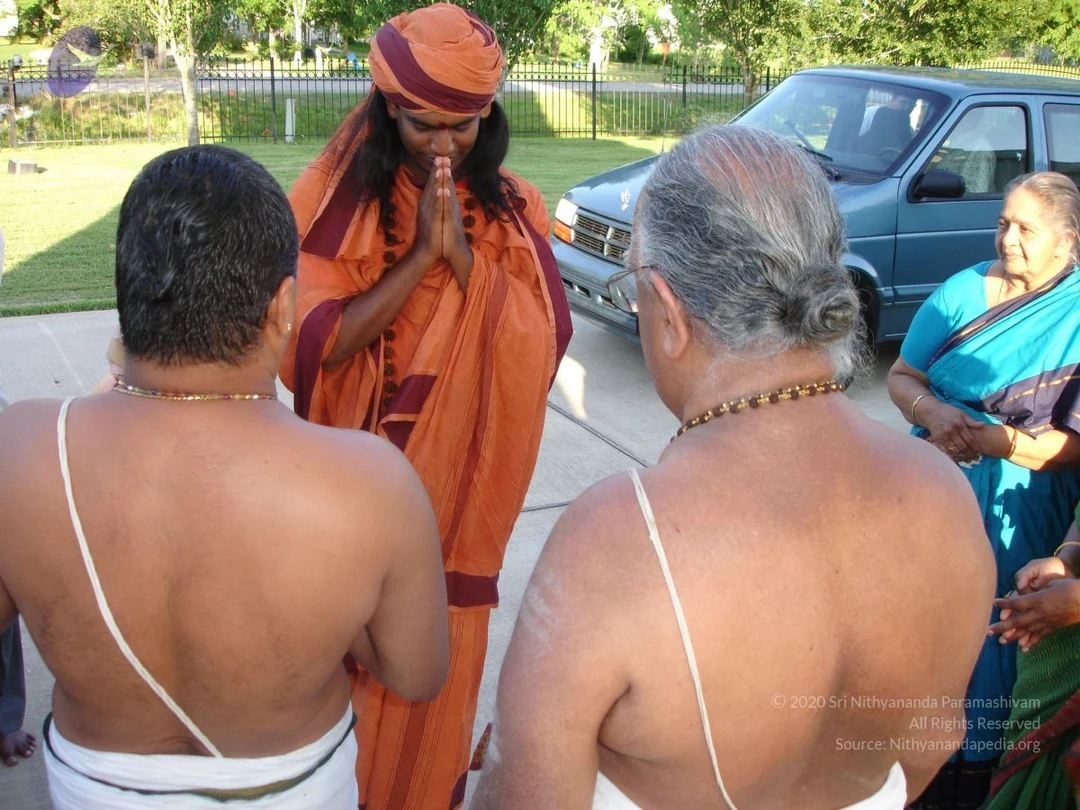
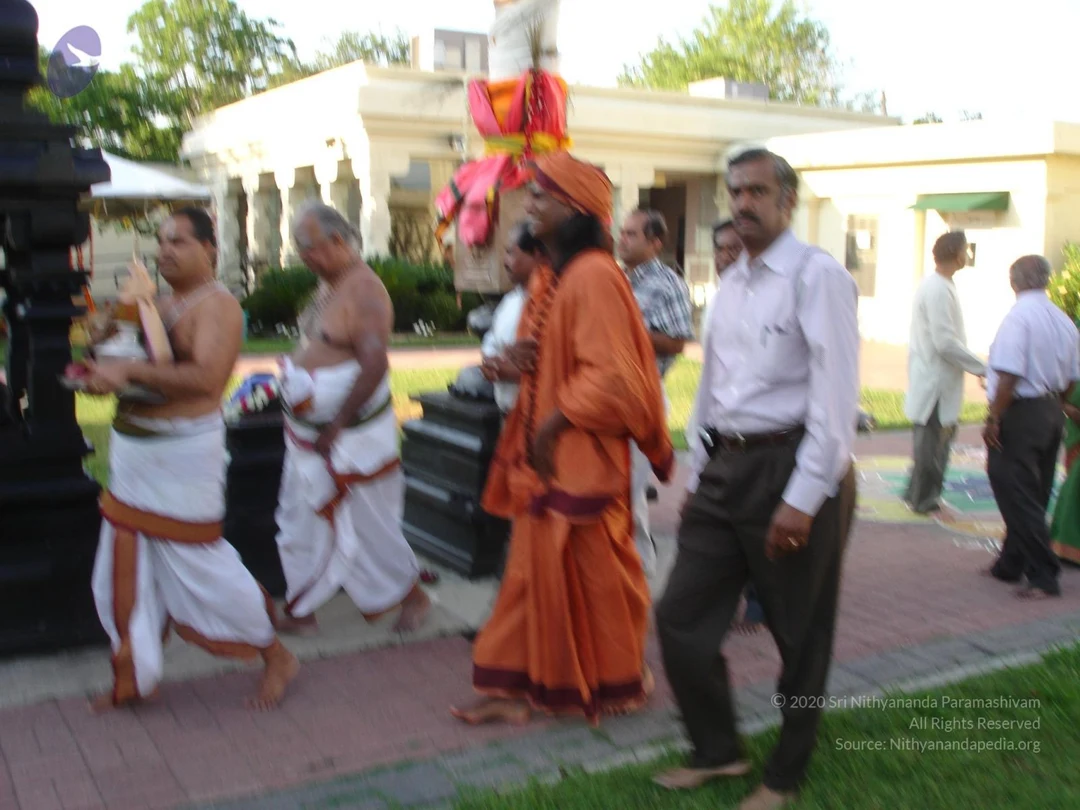
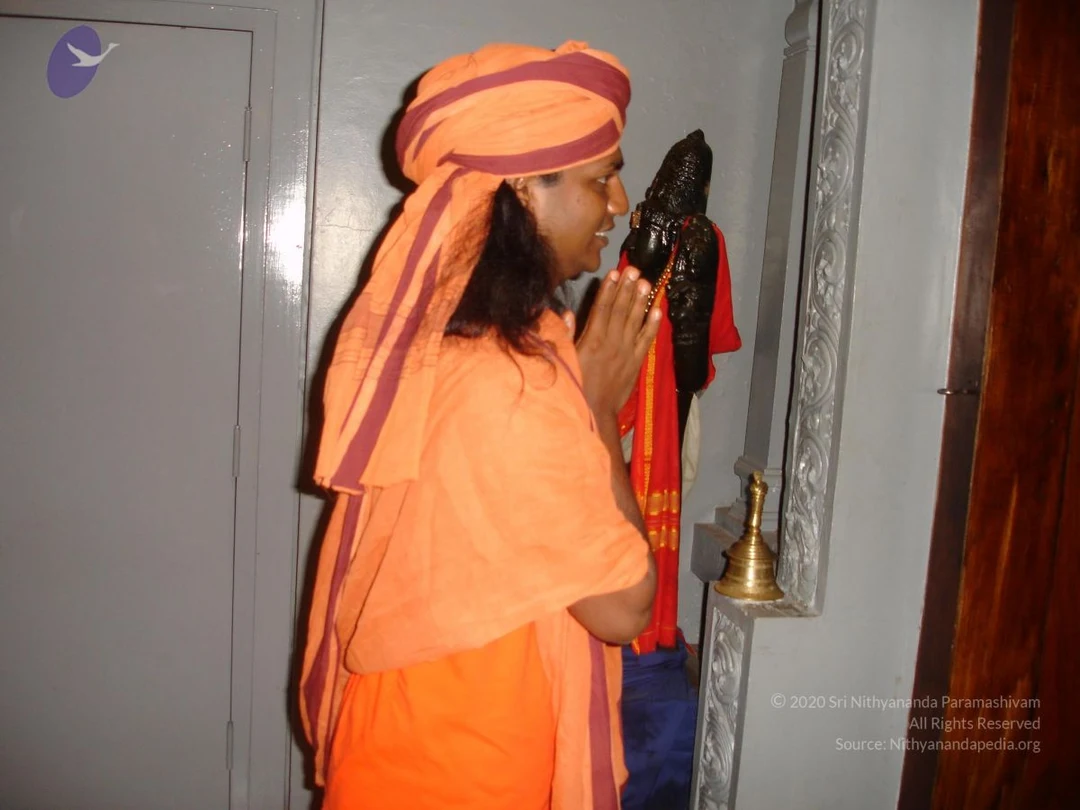
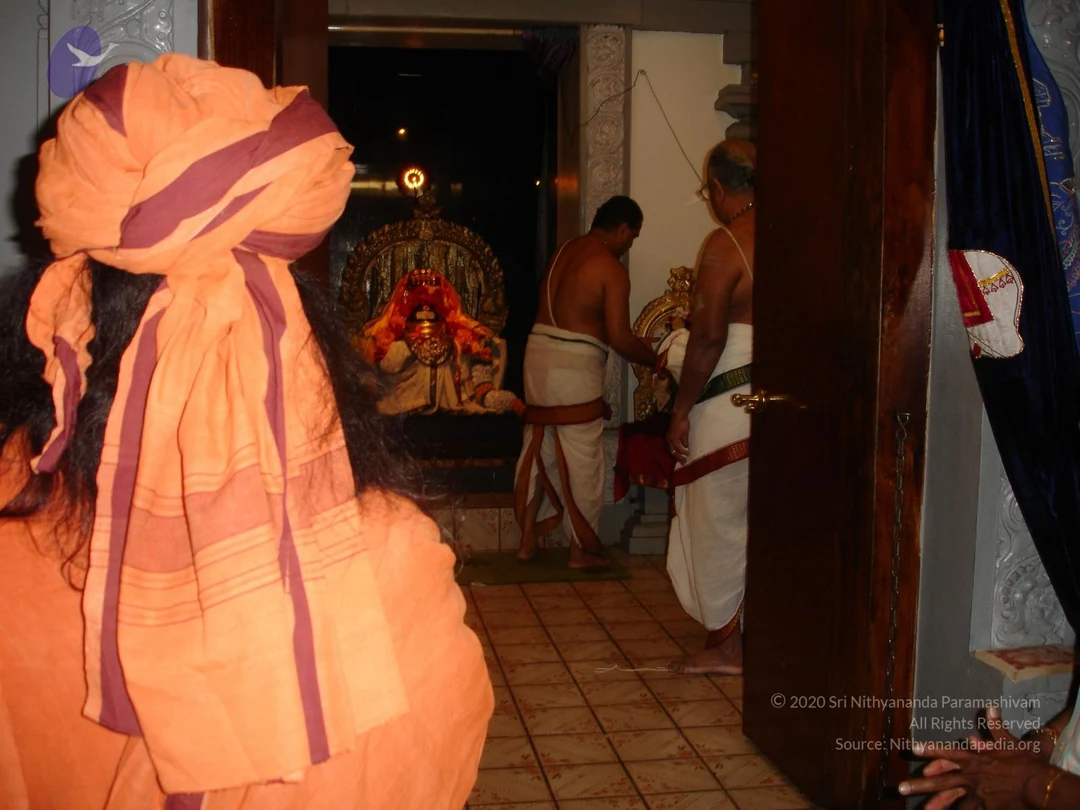
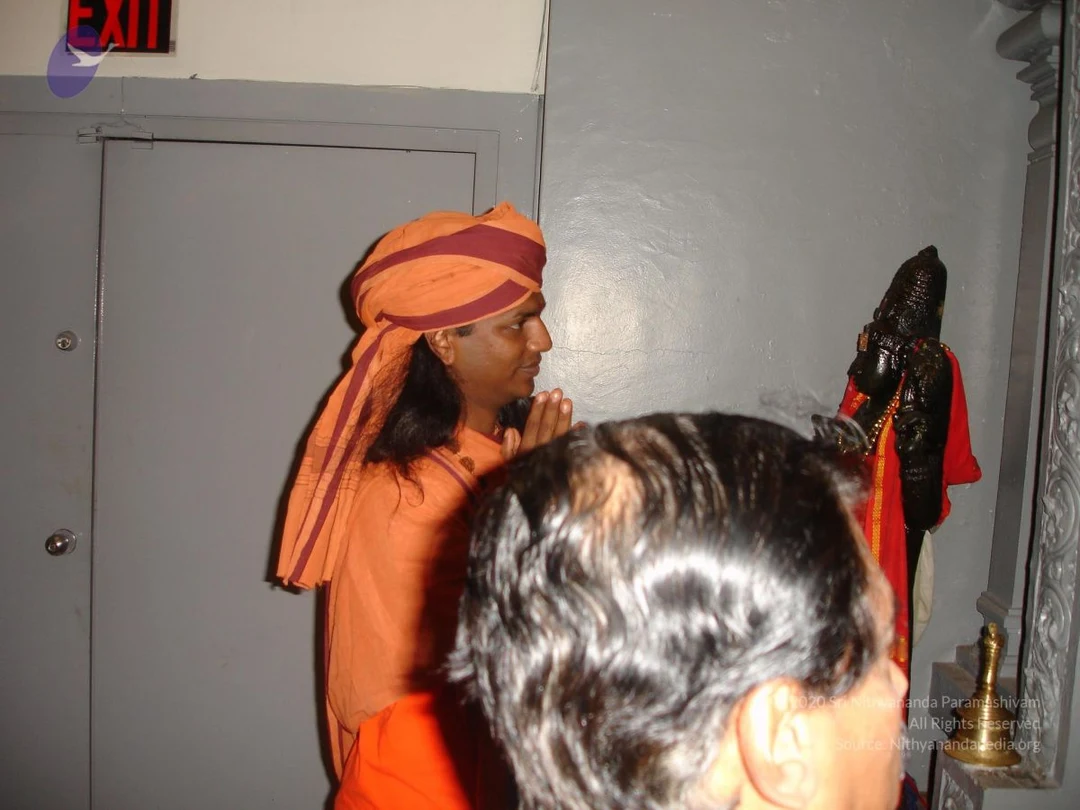
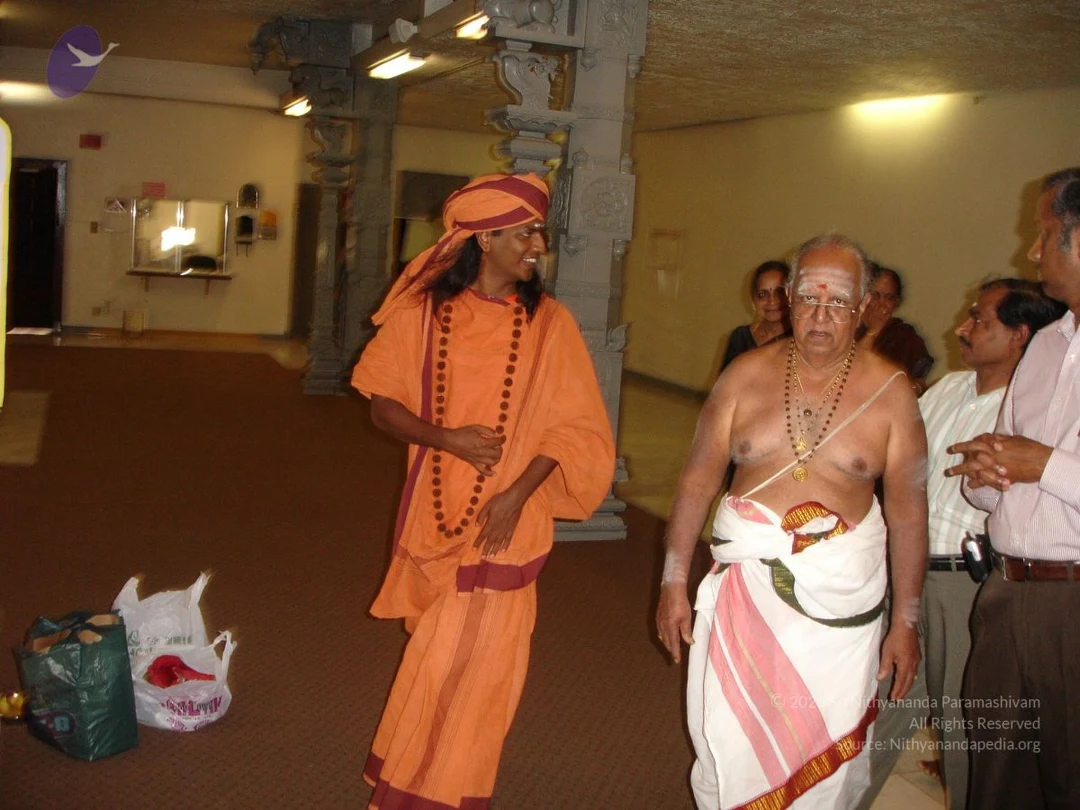
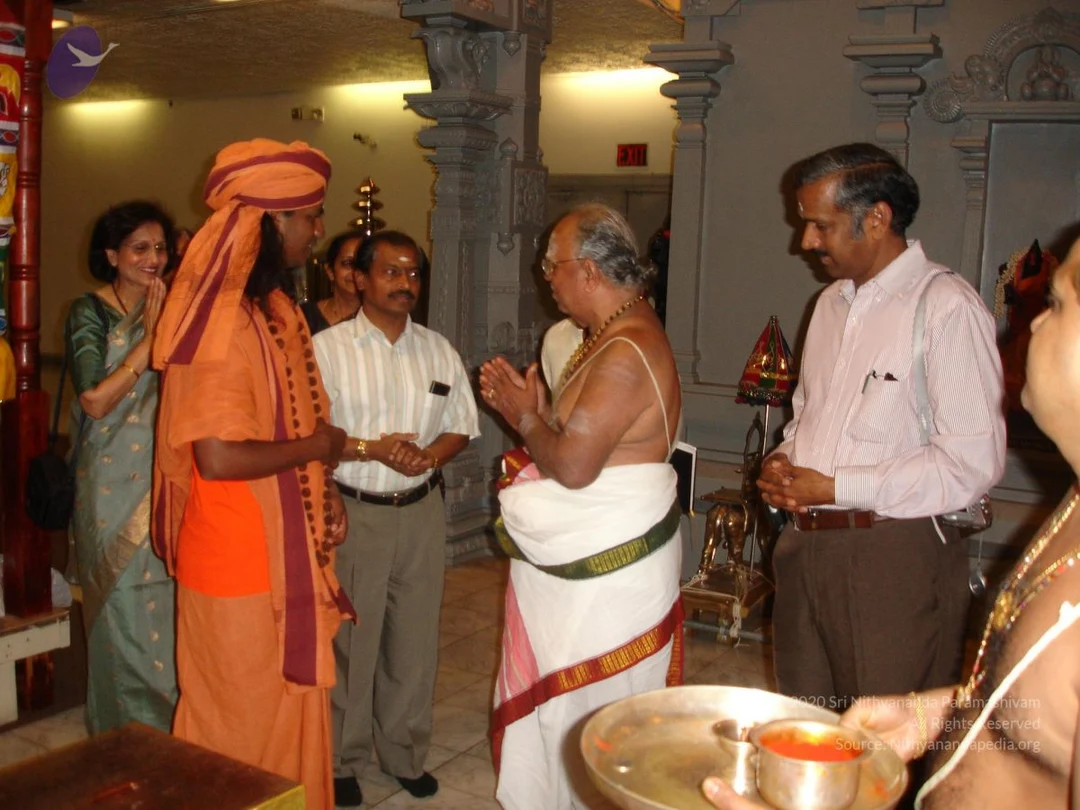
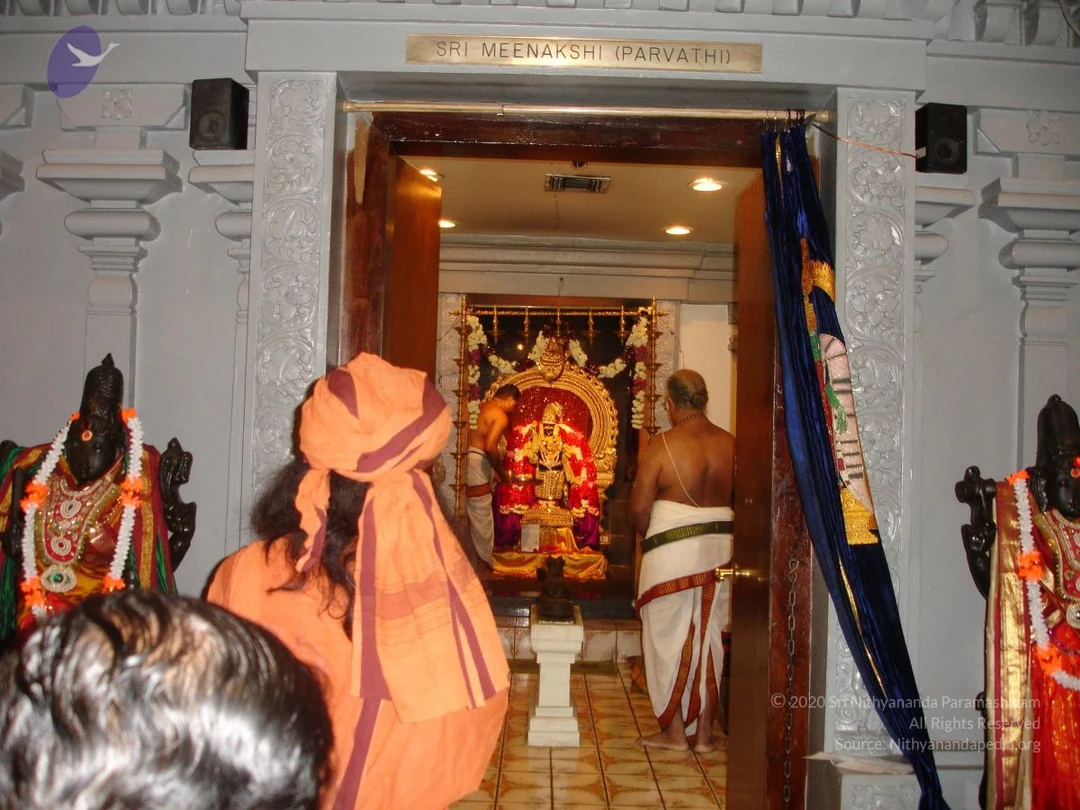
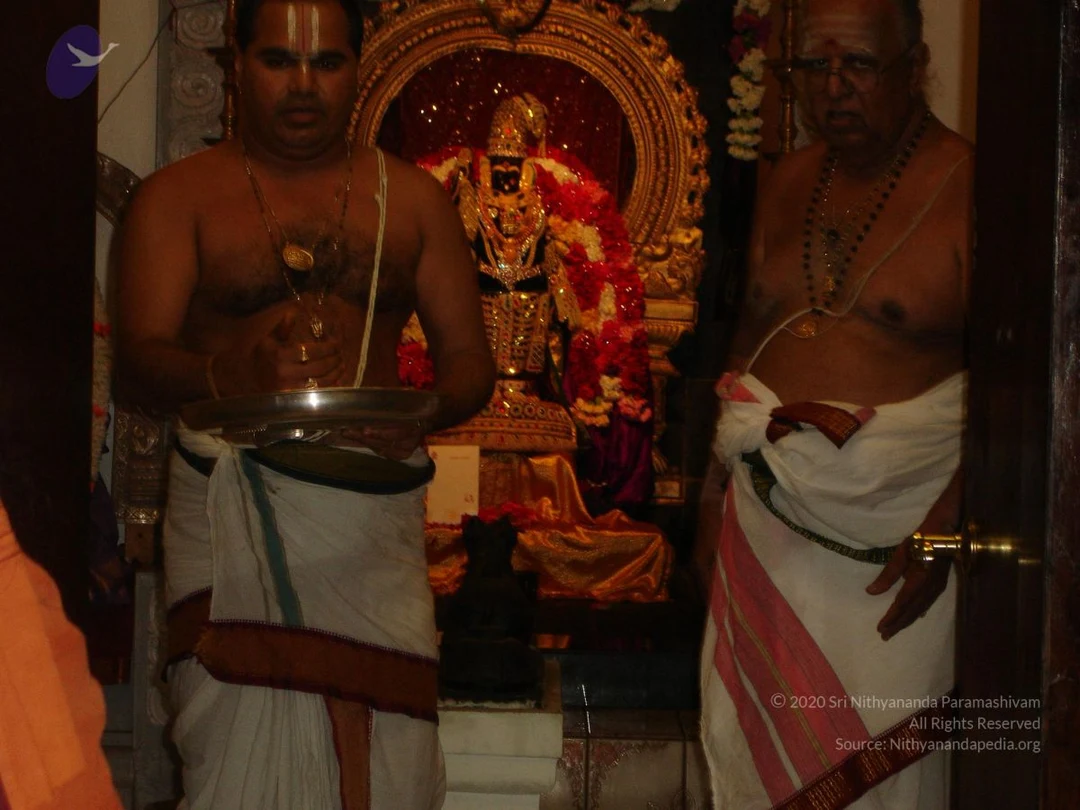
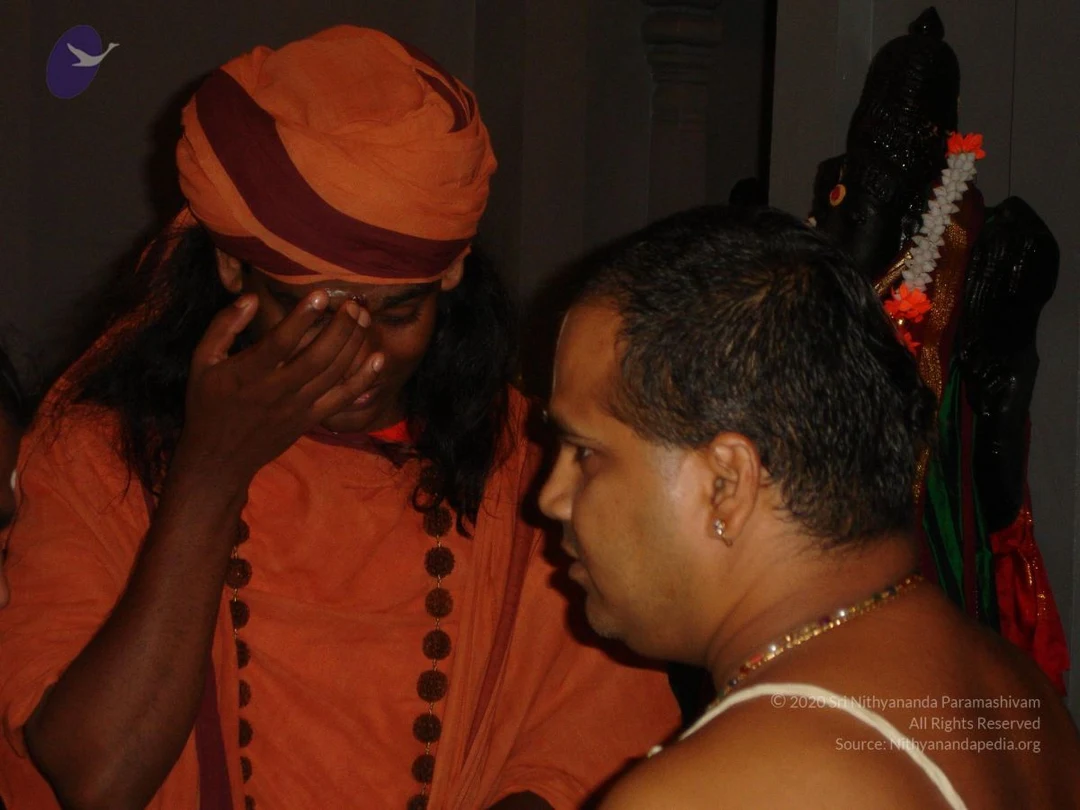
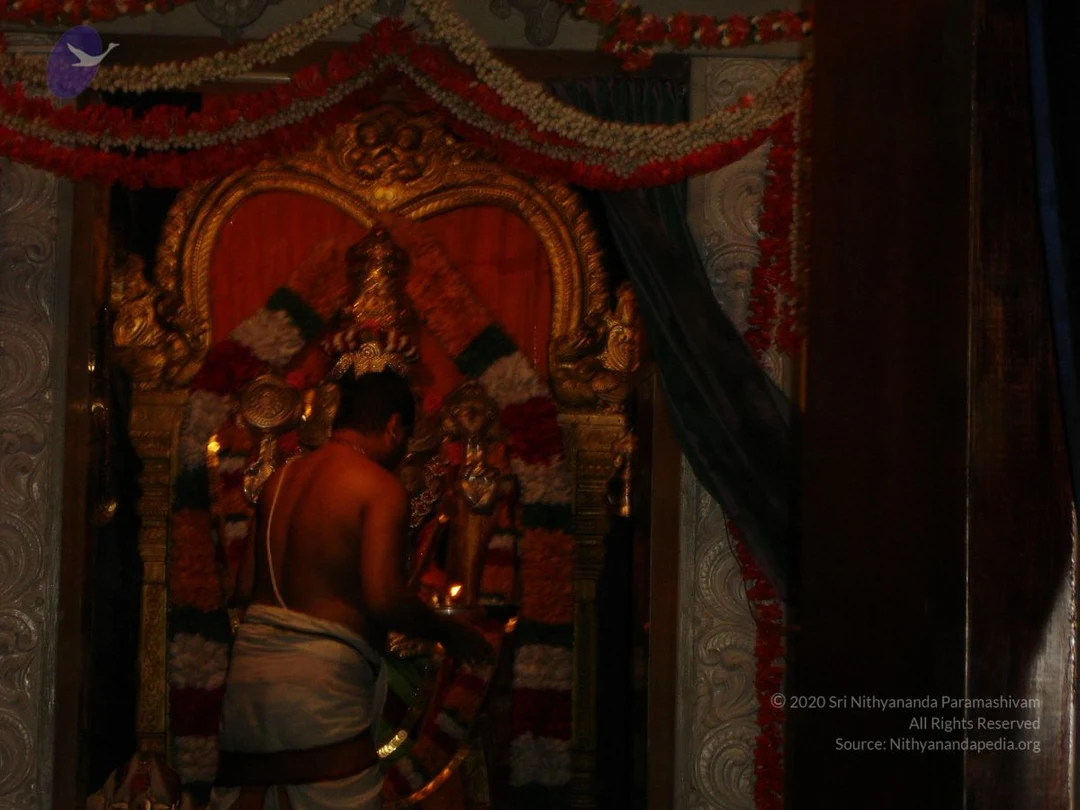
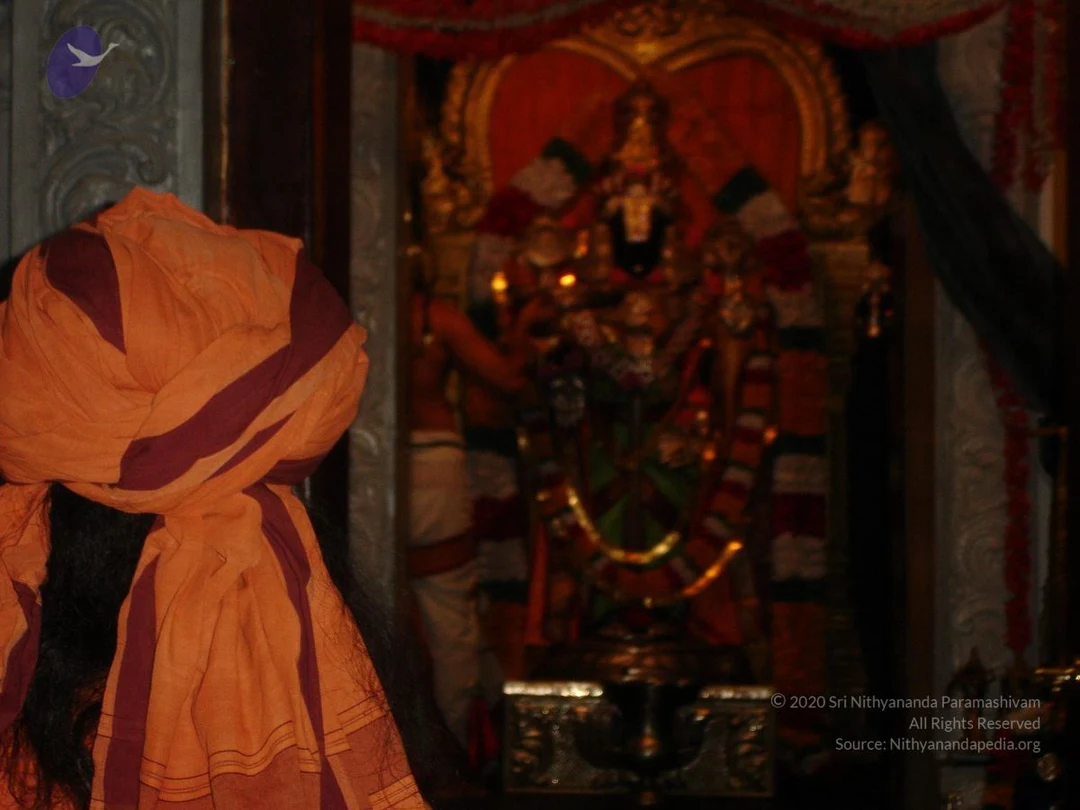
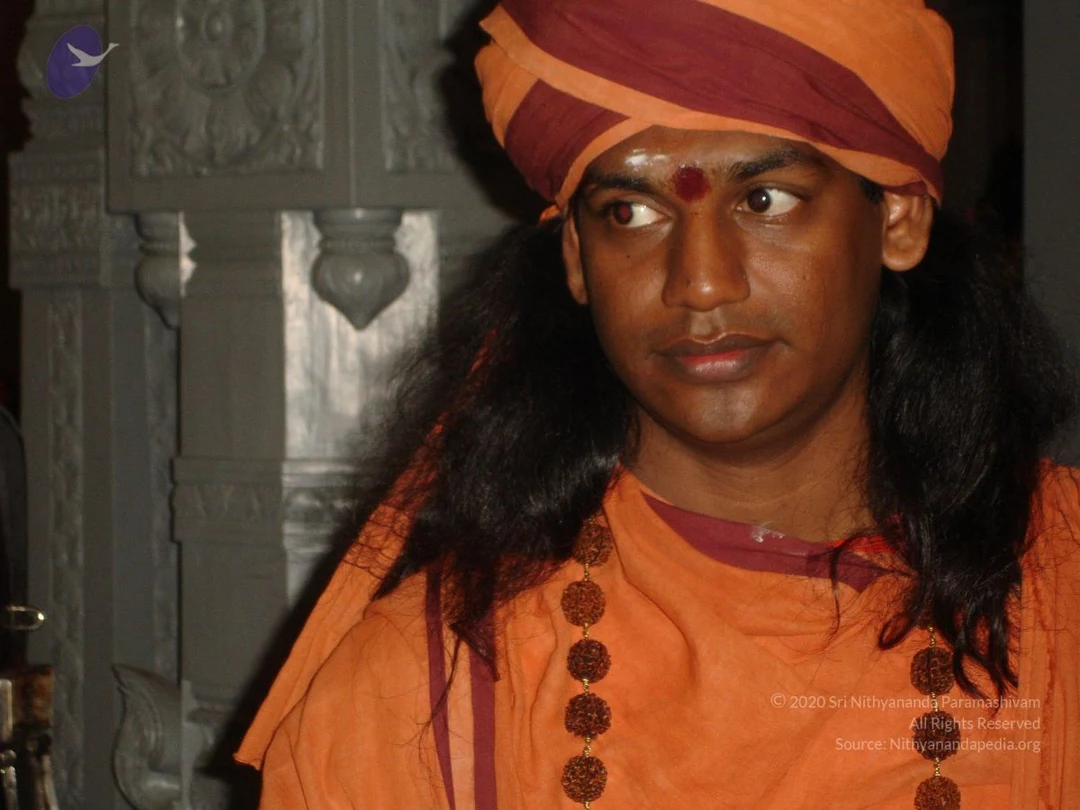
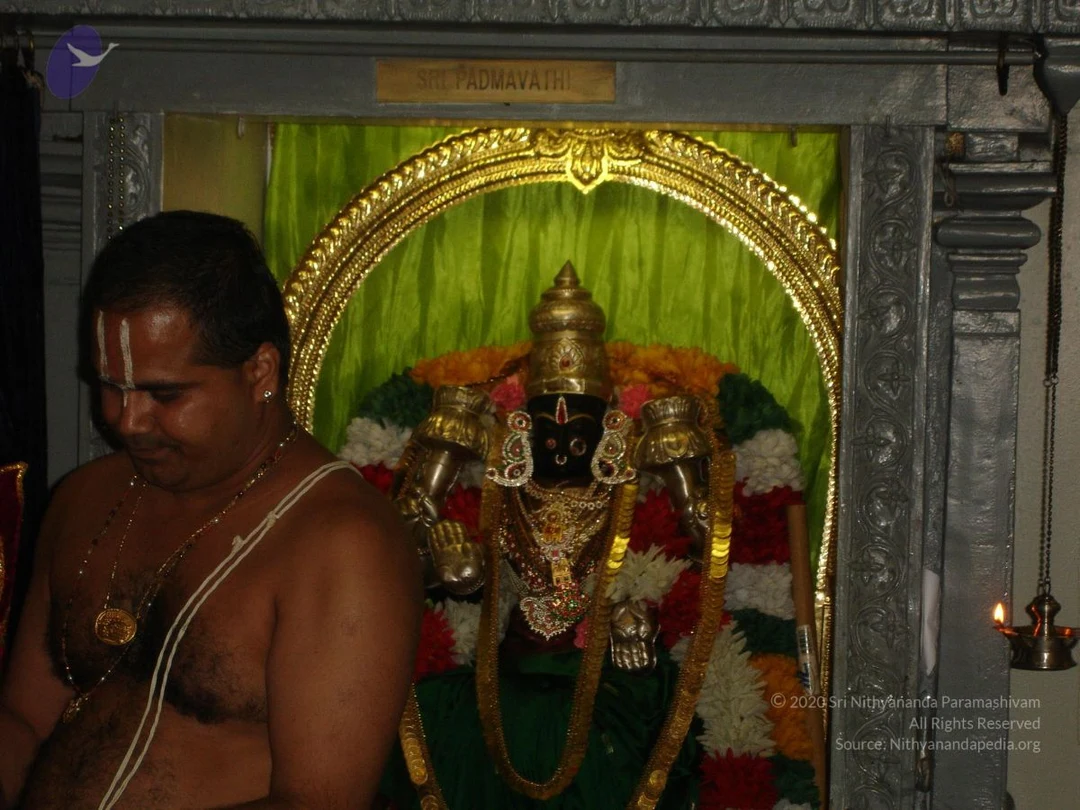
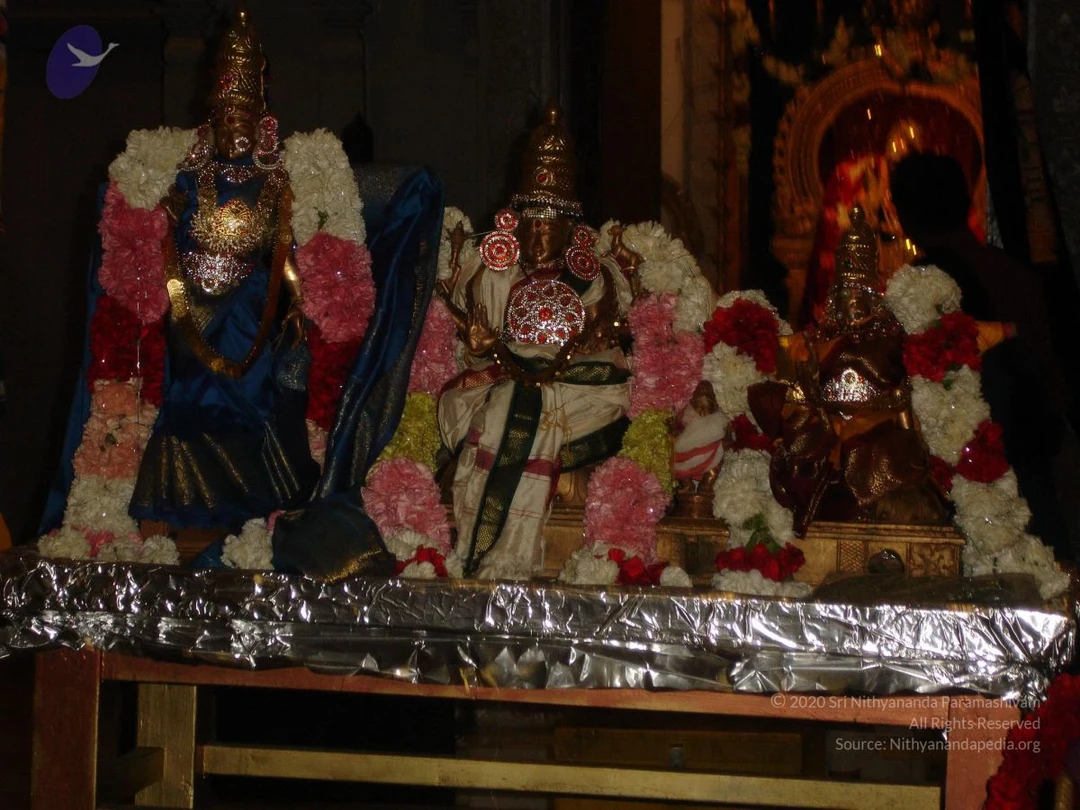
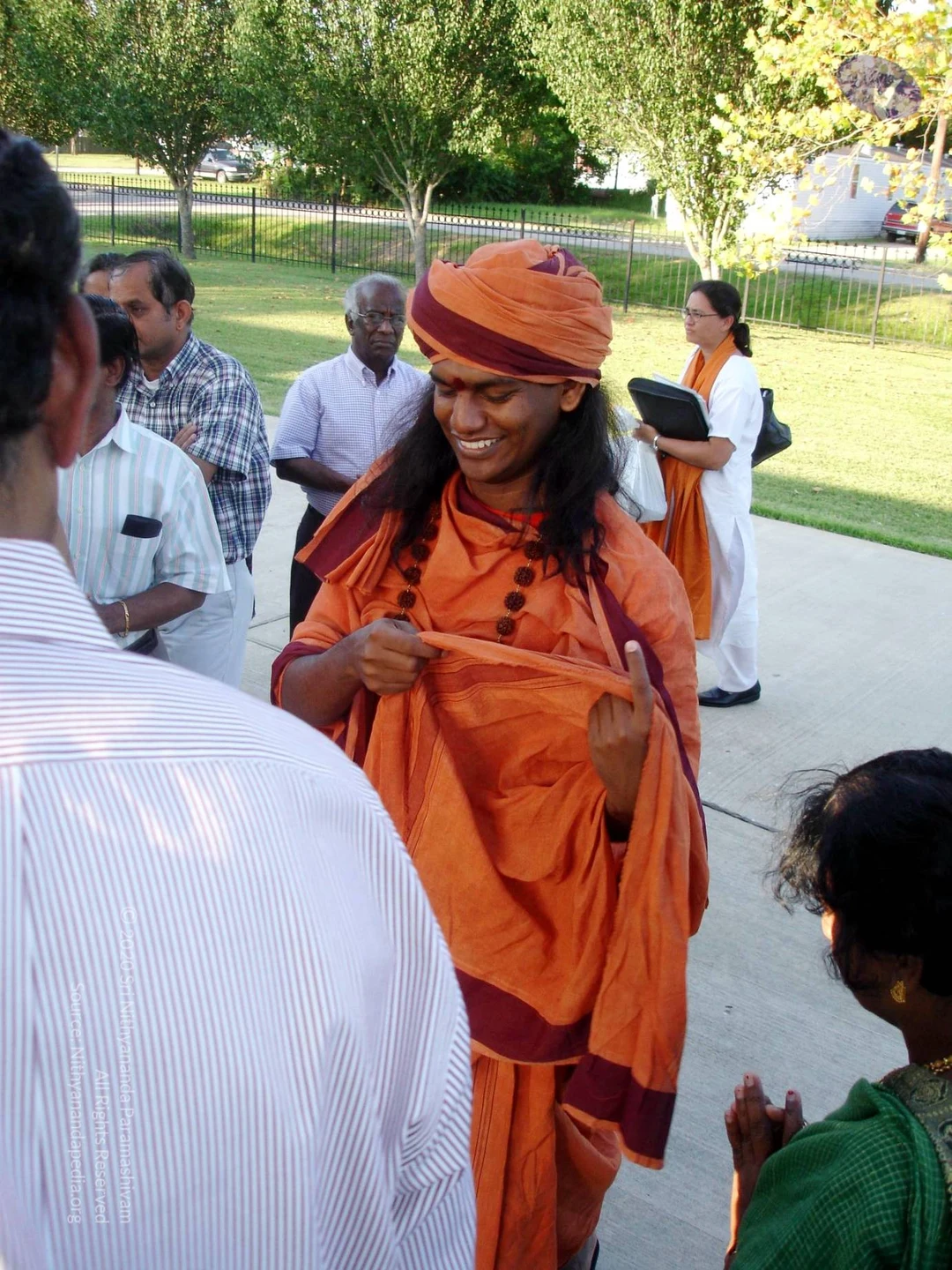
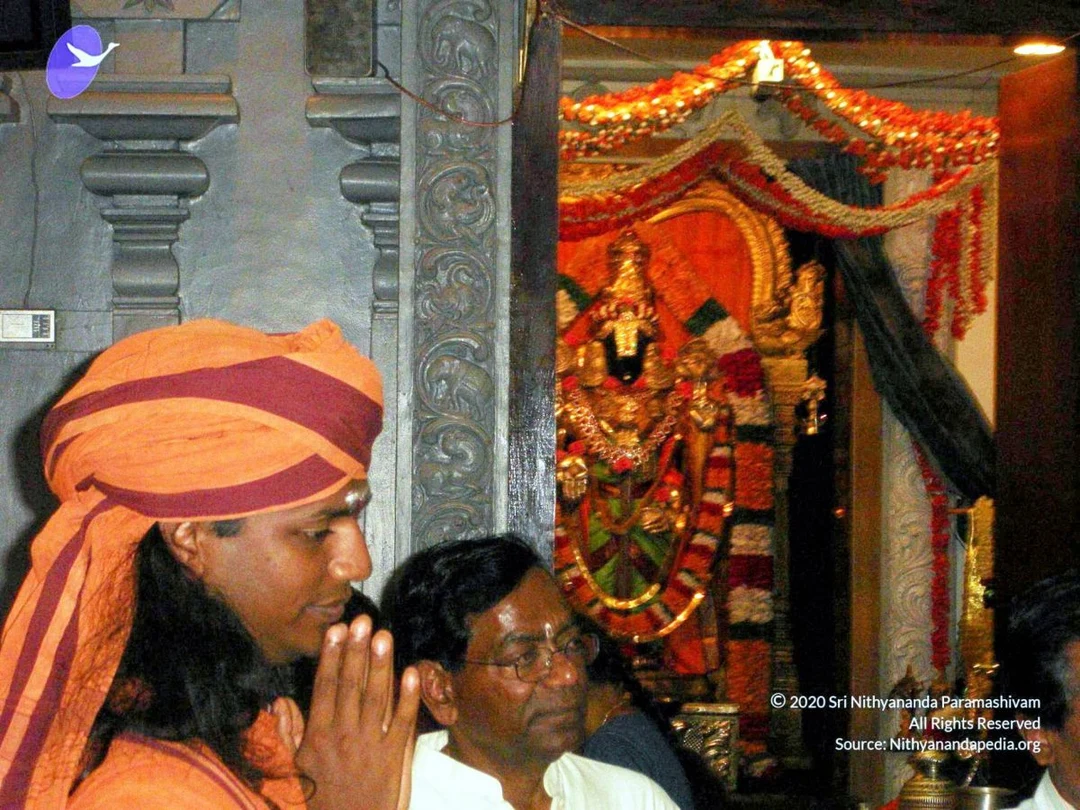
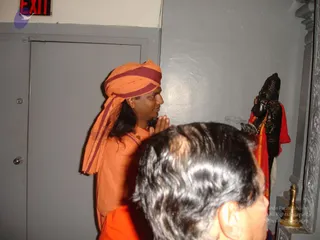
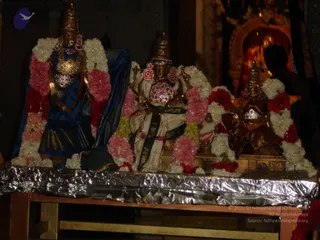
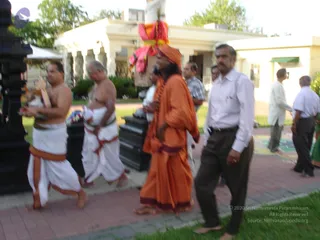
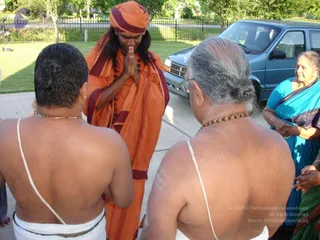
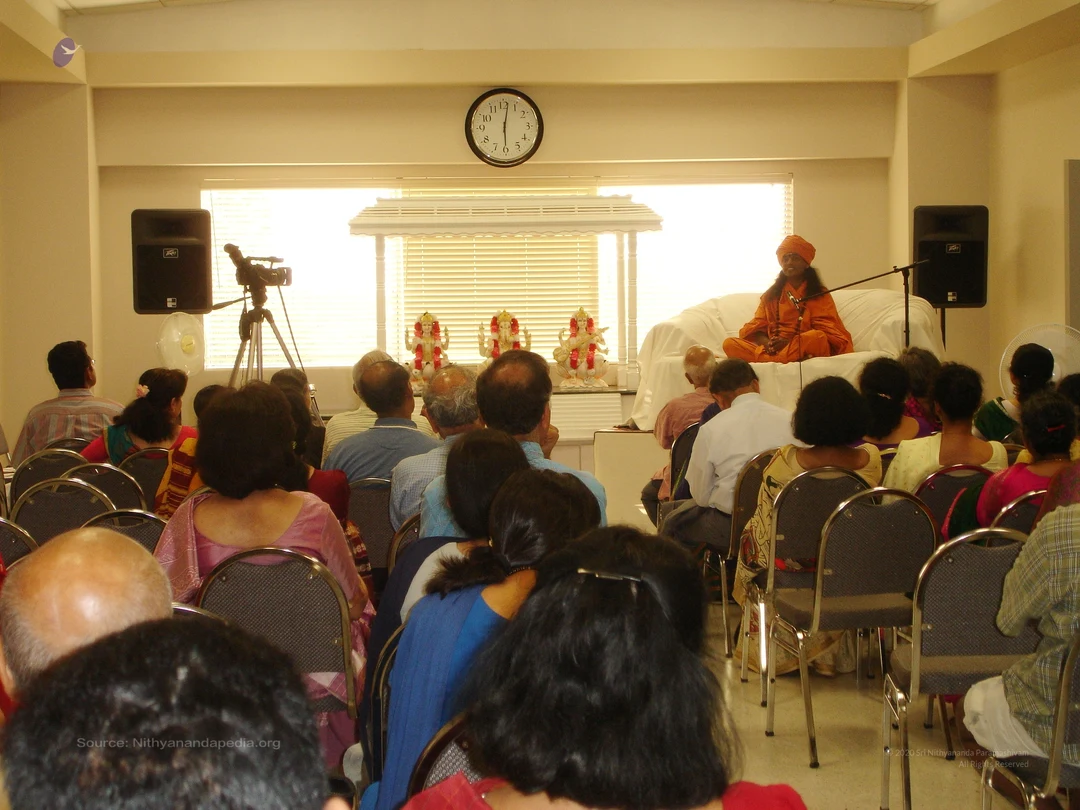
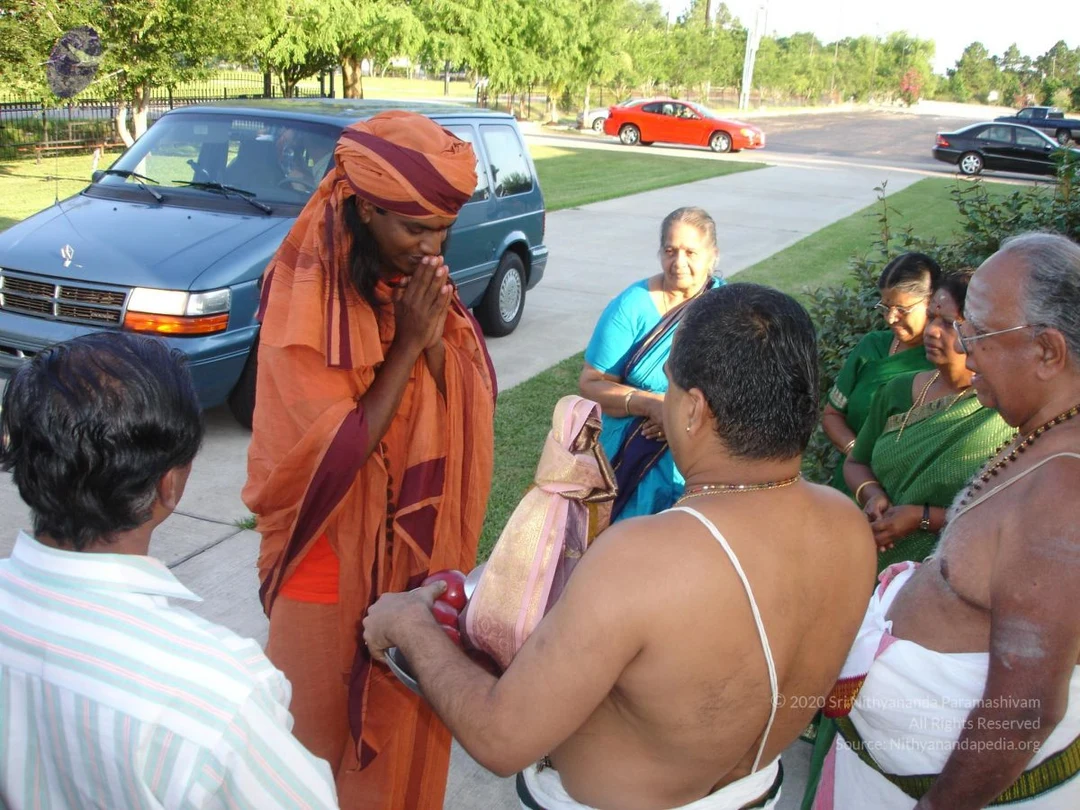
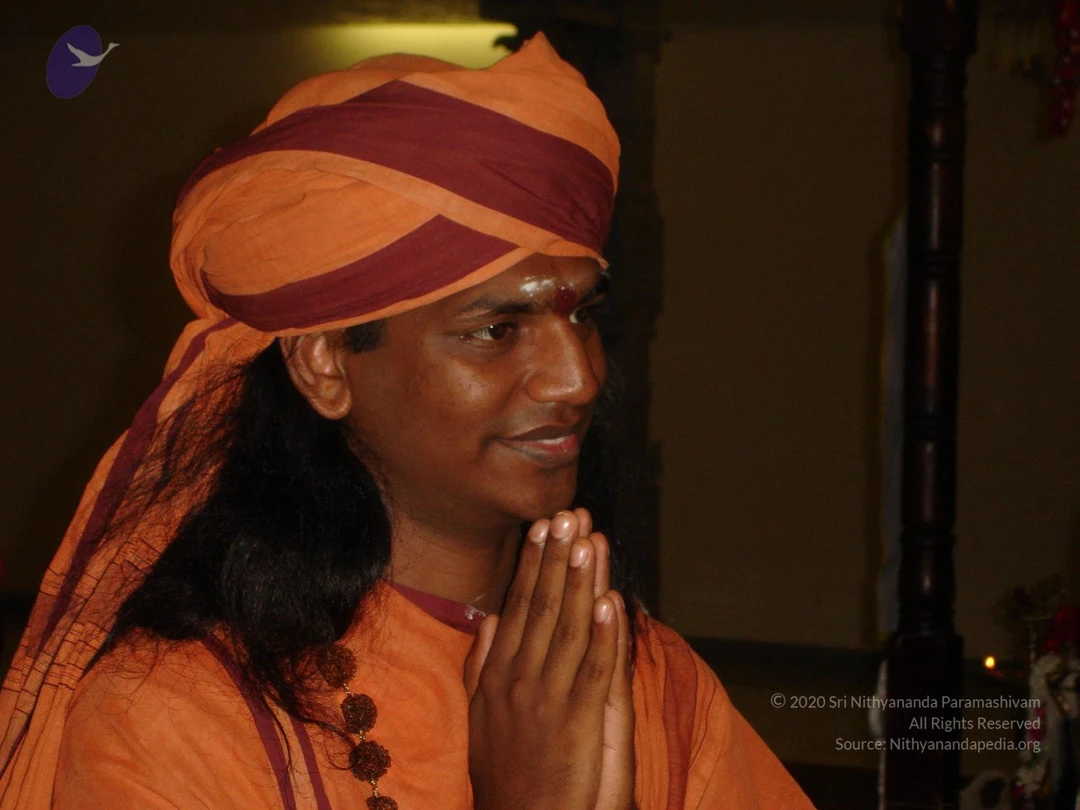
Swamiji arrived in Houston, USA on June 15, 2005, during His second world tour of this year. Below are some pictures from Swamijis discourse at the Meenakshi temple in Houston.
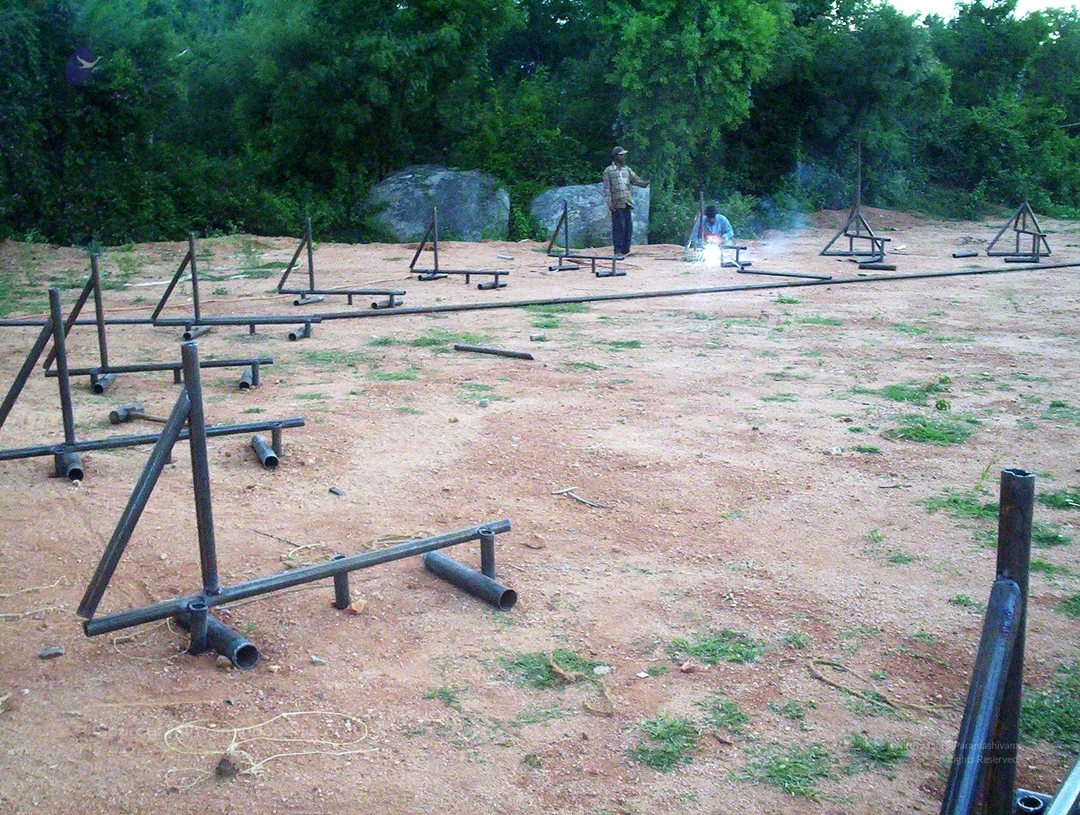
Below you can see some pictures of the progress in construction of Ananda Sabha at AdiKailasa, Bidadi.
Researches

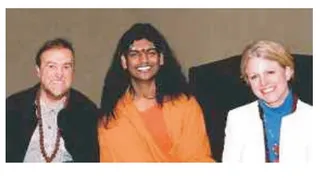
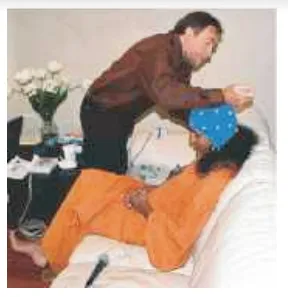
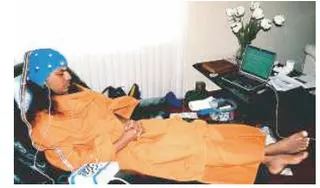
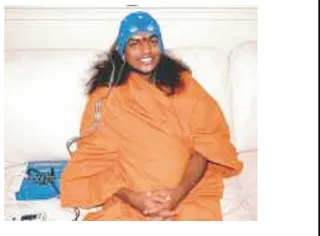
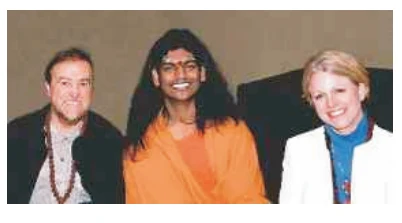
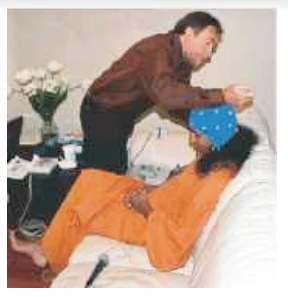
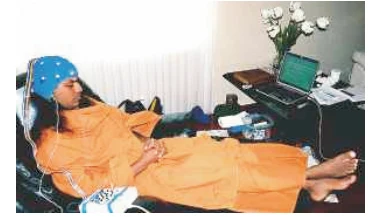
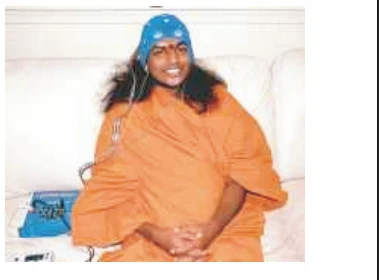
On 17 June 2005, while Swamiji was attending annual AAPI Convention in Houston, TX, Dr. Juan Acosta-Urquidi and his associate, Ann Trechak from Sound Health Designs, LLC, Wichita, KS, USA again, had the unique opportunity to hook up Swamiji to an EEG machine and examine his brainwave patterns as he shifted into distinct states of consciousness
In all his previous experience working with some very gifted subjects, Dr. Acosta had never recorded such a unique pattern of EEG mindstates. Swamiji proved to be a dream subject as he demonstrated his mastery at switching mindstates while remaining motionless. A representative sample of the recorded data is shown below.

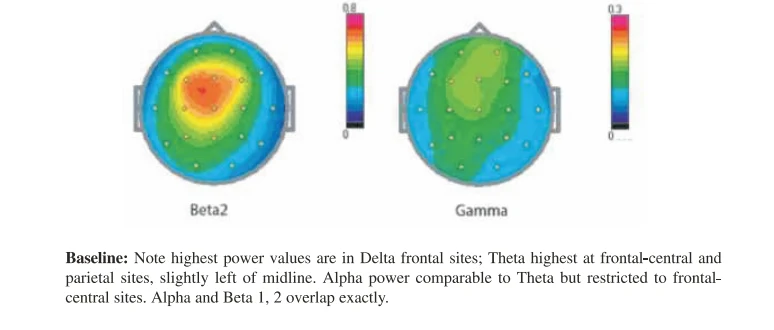
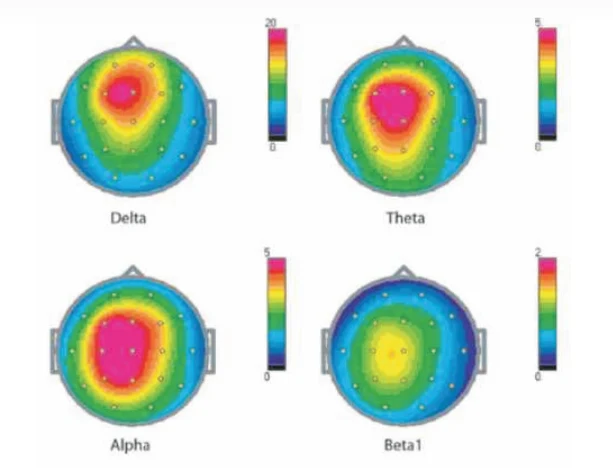
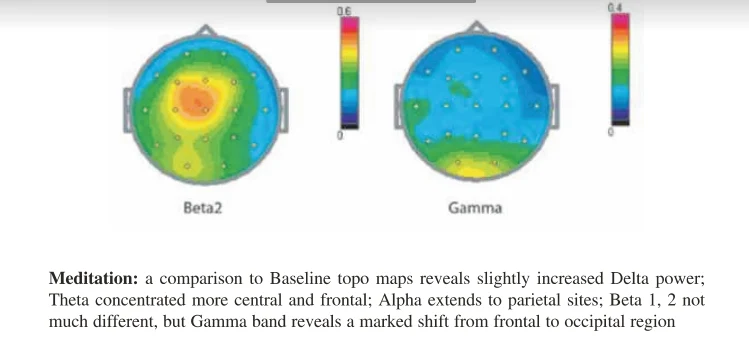
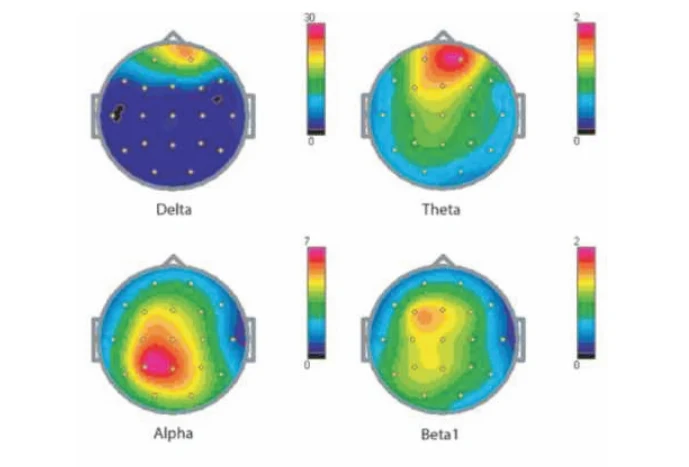
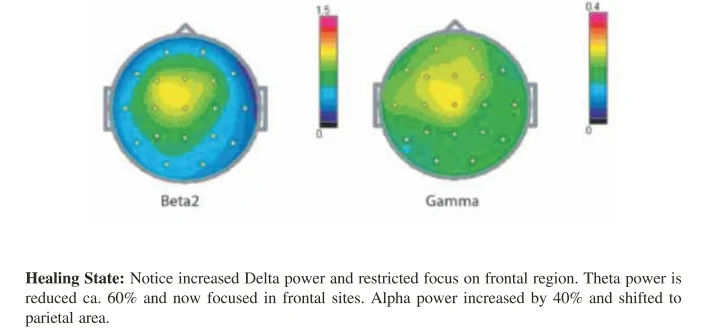
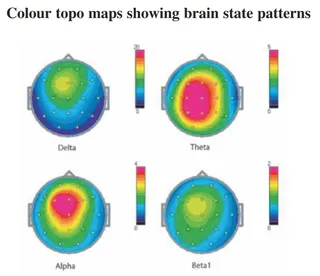
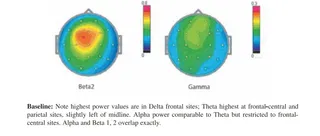
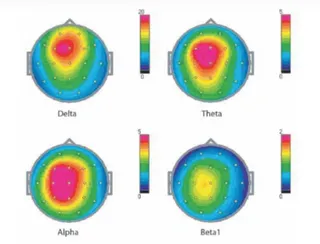
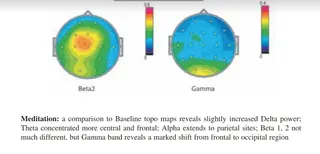
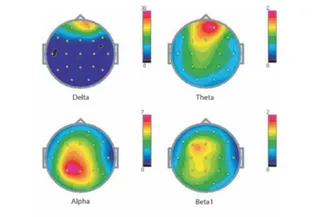
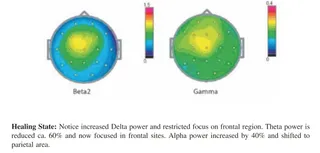
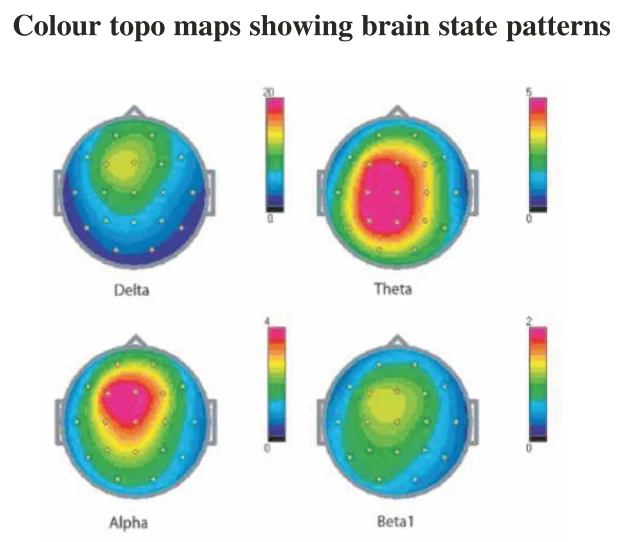
The brainstate patterns are displayed as colored topo maps, showing average power values (600 sec. samples) for different brainwave frequency bands (Delta, Theta, Alpha, Beta and Gamma).
The most striking findings were: At first glance, Baseline (eyes closed) condition pattern was almost indistinguishable from Meditation state, except for some minor differences. Notice subtle changes in the localization of Theta and Alpha maximum power values (hot spots), as if they swap places. The Meditation state showed slightly higher Alpha power, which also extended into more posterior (parietal) sites. The other detectable change was the antero-posterior edistribution of Gamma hot spots: from initially frontal-central in Baseline, to focalized occipital in Meditation state.
By contrast, the Healing state showed more robust differences: Delta power increased and was very focalized to frontal region, and Theta and Alpha power values reversed. Note also Betal, 2 & Gamma slightly increased compared to Baseline. These findings reveal that Swamiji has the unique ability to remain in a near-meditative state during rest eyes closed baseline conditions, when he was deliberately not attempting meditation. His Healing state is characterized by shifting into a more active and aroused condition, where he gains access to an energetic linkage with his client and his surroundings.
Photos Of The Day:

Meenakshi-Temple-Houston
Photos from this day

View all 32 photos

Photos

1 photoSource gallery
A photograph of a seated audience in a hall with beige walls and a wall clock, facing a raised platform. On the platform, a robed figure in orange-saffron clothing with an orange head wrap sits cross-legged before a microphone on a stand, with a white-draped sofa behind. Three floral-garlanded deity murtis sit on a white cloth in front of a window with blinds. Rows of audience members in folding chairs face the stage, including a person in a pink sari and others in blue and white. A tripod-mounted video camera and two black speakers flank the stage. The appearance-based label a person applies to the orange-robed figure on the platform, who appears to be giving a discourse.

Photos

1 photoSource gallery

Researches

6 photosSource gallery
A scanned page from a research article titled "Colour topo maps showing brain state patterns". It shows four colour-coded EEG topographic head maps arranged in a 2x2 grid, labelled Delta, Theta, Alpha and Beta1, each with a vertical colour scale bar. The head outlines have small electrode dots, with warm red and pink regions indicating the highest average power values and blue and green regions lower values. No people are pictured.Scientific figure from a research article showing two colored topographic brain maps drawn on outline head diagrams with small electrode dots. The left map labelled Beta2 has a red and orange hotspot at frontal-central sites, and the right map labelled Gamma is mostly green with a lighter band and blue edges. A colour scale bar sits beside each map, and a caption beneath explains the Baseline state power values for the Delta, Theta and Alpha bands. No people are shown.A scientific graphic showing four colored EEG topographic brain maps arranged in a two-by-two grid, labeled Delta, Theta, Alpha and Beta1. Each round head outline shows small electrode dots and a warm-to-cool color scale: red and magenta peaks mark high average power in the frontal, central or posterior regions, while blue marks low values. Color bars with numeric ranges sit beside each map, from 0 to 20 for Delta, 0 to 5 for Theta and Alpha, and 0 to 2 for Beta1. No people are visible.A scanned page from a research document showing two colored EEG topographic brain maps side by side, labelled Beta2 on the left and Gamma on the right. Each head outline has small electrode dots and a vertical color scale bar; the Beta2 map shows a warm orange-yellow concentration over the central-frontal area fading to blue, while the Gamma map is mostly blue with a yellow-green band toward the bottom (occipital) area. Below the maps is a printed caption describing meditation compared with baseline: slightly increased Delta, Theta concentrated centrally and frontally, Alpha extending to parietal sites, and a marked Gamma shift from frontal to occipital regions. No people are visible.A scientific graphic showing four colour-coded EEG topographic brain maps arranged in a two-by-two grid, each labelled with a brainwave band: Delta, Theta, Alpha and Beta1. Each head outline shows electrode points and a colour scale from blue (low) through green and yellow to red (high) for average power values. The Delta map is mostly blue with a red-orange area at the top front, Theta shows a red spot at the upper front, Alpha shows a strong red and yellow peak at the centre-left, and Beta1 shows a yellow and red area at the upper centre. No people are visible.Scientific scan of a research page showing two colored topographic brain maps on a white background, labelled Beta2 and Gamma, with color scales from 0 to 1.5 and 0 to 0.4. Each head outline has small electrode dots; yellow and green regions mark higher power over the frontal area. Below is a printed caption reading Healing State, describing increased Delta power, reduced Theta and increased Alpha shifting to the parietal area. No physical people are visible.

Meenakshi-Temple-Houston
20 photosSource gallery
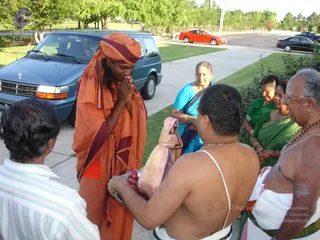
Outdoor photo on a suburban sidewalk beside a parked blue minivan, with a red car and trees behind. A person in a saffron-orange robe with maroon-striped borders and a matching orange turban stands at left with palms pressed together in namaste, head bowed. A bare-chested man in a white dhoti holds a silver plate with fruit, apples and a pink-and-gold cloth, offering it to the robed figure. Around them, three women in green and teal saris and a man in a white dhoti with a rudraksha-style necklace look on, and a man in a striped shirt stands at left edge. The visible robed figure's appearance is uncertain and is described only by role, as a devotee-style visitor receiving an offering.A photograph taken outdoors on a paved driveway in front of a green lawn and black iron fence. A man in an orange-saffron robe with a maroon border and a matching orange turban stands with palms pressed together in namaste, long dark hair falling past his shoulders, and rudraksha beads around his neck. Three people face him with their backs to the camera: two bare-chested men wearing white dhoti cloths over the shoulder, one with short dark hair and one with grey hair in a bun, both with beaded necklaces. To the right, an older woman in a turquoise sari with her hands folded stands beside a teal minivan. Probable Swamiji (orange robe, turban, long hair, rudraksha beads) is shown in appearance-based identification only.Outdoor procession on a brick path beside a temple complex with white colonnaded buildings and green lawns. In the centre, a figure in saffron-orange robes with a long wrapped turban in orange and pink, wearing a rudraksha mala, walks forward. Two priests in white dhotis with orange borders walk ahead; the left one carries a tray or offering, and the middle one has a bare chest and sacred thread. To the right, men in white and grey shirts and dark trousers walk along, and a man in a white shirt is prominent in the foreground. A small white canopy and a dark pillar stand at left. The photo is motion-blurred.A man in profile stands at right with palms pressed together in namaskar before a dark stone deity murti draped in red cloth with a rudraksha-style mala. He wears an orange saffron turban with maroon stripes and an orange robe over orange garments. A brass hand bell sits on a grey ledge beside the murti, next to a grey wall and a wooden door frame. The setting appears to be a small shrine or prayer niche. Whether the man is a person cannot be confirmed from the visible cues alone, so he is described by role as a devotee in prayer.Photograph taken from behind a person in the foreground wearing an orange and maroon turban and an orange garment, with long dark hair visible. Through a doorway, two shirtless priests in white dhotis work at a shrine where an illuminated deity murti draped in red and orange cloth sits on a decorated stone pedestal beneath a lit lamp. The floor is tiled in beige. A blue cloth hangs at the right edge of the frame beside the door.A photo taken indoors near a grey wall and grey door with a red EXIT sign above. A man in saffron-orange robes and an orange turban with maroon stripes stands in profile with palms pressed together in anjali mudra, long dark hair falling behind him, facing a dark stone deity murti draped in red cloth with gold trim. A brass oil lamp sits on the ledge to the right. In the foreground, the back of a person's dark-haired head is visible. Swamiji (probable) appearance-based: long hair, saffron-orange clothing and turban, praying before the deity.

June 17 2005

4 photosView all
Indoor photograph of three people posed side by side, smiling, against a dark backdrop. On the left, a man with short light hair wears a dark jacket and a wooden bead mala around his neck. In the centre, a young man with long dark hair, wearing a bright saffron-orange robe, stands with a broad smile, matching the page's Swamiji cue of long hair and saffron clothing, so this is a probable Swamiji. On the right, a woman with short blonde hair wears a white jacket over a blue top.A photograph of a person in an orange robe lying on a white sofa with long dark hair spread on a cushion, while a man in a brown long-sleeved shirt leans over them and attaches a blue sensor pad with white dots to their head. A white vase of white roses sits on a table at left, and a small white device and cables are visible on a stand nearby. The setting appears to be an indoor room during a medical or EEG electrode placement procedure.A photograph of a man reclining in a dark leather chair in a bright room, wearing a loose orange-saffron robe and a blue cap fitted with wires and electrode leads for an EEG recording. His hands rest at his sides and his feet are bare-looking near the chair edge. To the right stands a small white vase of white roses beside a laptop displaying a green screen on a desk. Pale curtains and a white wall fill the background. The scene shows a brainwave test session in progress.A photograph of a smiling person with long dark hair seated on a white couch, wearing a loose saffron-orange robe and a blue EEG electrode cap on the head, with wires attached to the cap. A blue electronic device with cables sits at the lower left, consistent with an EEG setup. The person's hands rest folded in the lap. The cap and wires indicate a brainwave measurement session. Swamiji appearance is probable: long swept-back hair and orange robe, seated for the EEG study described on the page.