Skip to content
Thursday

5 December 2024

Somaskanda Darshan: Sattvic Energy and Community

Dated photos
32
Source pages
1
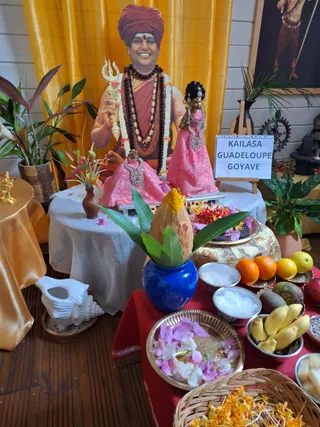
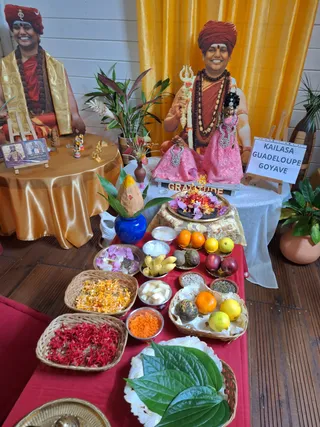
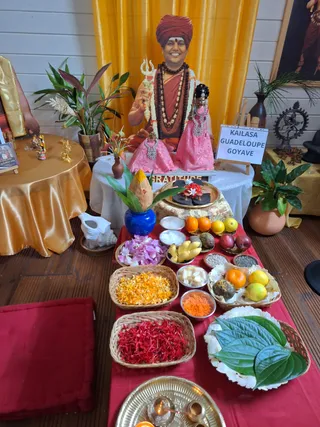
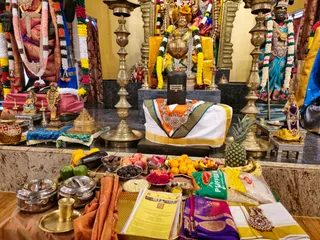
A devotional altar display in a wooden-floored room with a golden satin backdrop. Central is a large cutout or portrait of a smiling man in a red-maroon turban and saffron robe, with white and rudraksha malas and a gold trident, labelled on a sign beside it as KAILASA GUADELOUPE GOYAVE. Beside him stands a figurine of a child-like deity in pink embellished dress with silver jewellery and a gold crown. Offerings in front include a blue pot holding a coconut with mango leaves, bowls of white granules, fruits such as oranges, bananas and mangoes, pink and white flower petals in a brass plate, and a basket of marigold petals. A white conch shell stands on the left. No people are visible.A photograph of a ritual offering table set up before life-size printed cutouts of a smiling man in a red turban, saffron-red robes and rudraksha malas, one holding a silver trident. A silver-trimmed printed sign and a banner read KAILASA GUADELOUPE GOYAVE. Two pink-draped figurines of a deity pair stand in the centre, with a brass plate of flower petals. The red-covered table holds baskets of marigold and red petals, bananas, oranges, lemons, mangoes, coconut pieces, betel leaves, kumkum, a tray of mixed fruits, and a blue vase with a coconut. The left cutout wears a gold shawl and rudraksha mala beside a small table with gold-draped framed photographs and small brass figures. No physical people are visible.A photograph of a ritual offering display set on a red cloth in a wooden-floored room with a golden satin backdrop. Central is a large cardboard-style standee of a smiling man in an orange-red turban, rudraksha mala and white flower garland, holding a trident, with two dolls in pink lace dresses beside him. A sign reads KAILASA GUADELOUPE GOYAVE and a placard says GRATITUDE. In front are baskets and bowls of orange and yellow marigold petals, red flower petals, fruits including oranges, lemons, bananas and mangoes, grated carrot, coconut, betel leaves, pink flowers, and a blue pot holding a coconut with mango leaves. A brass tray with oil lamps sits at the bottom. Potted plants, a golden table and a Nataraja figure are visible. No people are visible.

December 05 2024

Original wiki page
Contents

In this satsang, THE SPH discusses sattvic energy, community and the development of KAILASA.

Event details

Date: 5 December 2024

Title

Somaskanda Darshan: Sattvic Energy and Community

Transcript

As the ultimate manifestation of Paramashiva Somaskanda Murthy Sishya Bhava Murthy, I bless you all with Paramadvaita, Paramashivasya, Somaskanda, Sishya Bhava yo, Paramavatare bhavatyaha Sarvepya Paramadvaitasya mamasishya. Om. Om. Om. Paramashiva's direct message from Maha Kailasa. The tip of prana increase you. Om, Om, listen. Paramashiva's direct message from Maha Kailasa. The depth and intensity of the prana in you decides the amount of sattva you produce. The sattvic energy you radiate decides the success around you. Listen. With intense sattvic energy, even if you are sitting in a remote forest, that forest will become a nation which happened in Bidadi. All of you should know when I went to Bidadi in 2002, it was a dense forest, 36 kilometers from Bangalore, which had only one road. Now it is a 10 lane, One of the important highways in the nation, the Bangalore Mysore Highway. At that time, 2002, it was a single road. You can go and see the history, and we did not have a direct access to the land. It was a forest. We only had a path walkway, the right to have walkway. But the intense sattvic energy generated with the tapas, It stood up as a city practically and now growing all over the world. Paramashiva's grace, listen. The intense sattvic energy you generate makes your life success. Satvik energy, the pure Satvik energy manifest from from the pure prana. The pure prana comes from the tejas of Paramashiva. Tejas of Paramashiva comes from Paramashiva himself. This pure prana manifest as strategies. It brings the tremendous vision not just for you, but for the whole humanity. Listen, only those who can make their vision into mission of many people achieve success even in business. Never ever think by hiring and firing system, meaning you will pay and hire people. If they are not settled, you will fire them. With this system, you can run a mediocre middle class company, a local business. You can't make your life successful. You can get a sympathy by putting a boat. Buy local. Give life to local. All that. Okay. I'm not against buying from local, giving life to and I encourage supporting the local businesses. But just being a small local business is not the success. Listen. Even in your business, only if you are able to make your vision as the mission for many people, you manifest success. For that, having vision starts with a high Prana and making that vision into mission, mission and then projects, tasks, subtasks and running it. Please listen. Enlightenment is not like getting mentally handicapped and sitting in one corner. No. Enlightenment as defined in Hindu tradition, Sanatana Hindu Dharma is active, alive, Unclutched, like Sri Ramachandra, Sri Krishna, Janaka Maharishi, active, alive, unclutched. Even Vyasa sent his son, Sugabh Brahma, to go and learn from Janaka Maharishi. Vyasa says, Janaka will make you Paramahamsa. So go from that what? I'm a born brahmachari. Janaka is a king, married, living with all the luxuries of the king and pleasures of the king. What Janaka can teach me? Yes, I say. Please go and speak. Then Janaka teaches the science of unclutching. That is a beautiful story. When Hindus misunderstood enlightenment, started thinking retiring into forest is enlightenment, they missed their life. Actually, even those who retired into forest for enlightenment after achieving built kingdoms, Vidya Rania. He returned into deep Shangehiri forest. In those days, Shangehiri is a deep forest. But when he achieved enlightenment, he initiated Hariharanbukha, made a kingdom. Ramadasa, when he achieved that enlightenment, the kind of prana he radiated, the kind of sattva he manifested, He created literally Shivaji and built the whole Maratha empire. Real Hindus are those not just born in Hindu families, but know the glorious past of the Hindu visionaries, knowing the right history of the Hindus and have the guts to revive it. Knowing the glory of enlightened Hindu civilization and reviving. I can see how Hindus are suffering due to lack of vision. When they spread all over the world and settle in various countries, some countries they went they were actually sold as slaves. Countries like some of the African countries and Oceania, some of the Caribbean countries. Hindus were sold as slaves. To some countries, they have been taken as enslaved laborers. After some time, they started going all over the world on their own, settled and became businessmen, and all over the world they have spread. But unfortunately, did not carry the vision their ancestors had about revival of the enlightened civilization. It is time now. We do it. We don't have time just to go on blaming our past mistakes. Let's bring the great enlightened civilization's past glory. Forget the recent past mistakes. Revive. Let us bring this ten important change in the lives with the vision for the future. First, whatever age, career, position you are in your life, bring yoga into your life. Add daily yoga into your life every possible way. Start with Pranayamas, Asanas, Surya Namaskar. Even if it is ten minutes, ten minutes, ten minutes, five, six time a day, it can add up to one hour. Somehow make it into 1 to 2 hours a day of yoga because that increases the prana level in you And moment the prana level increases and satva increases, you will have energy to have the vision and you will start planning so many wonderful things. Only then you will even believe your ancestors add a glorious enlightened civilization without the sattvic energy. Even if you read Puranas you will think its a myth, somebody wrote it. You will buy the theory forced upon you by the colonist, people who colonized you. They made you believe our Puranas are myth, and it is just stories, fairy tales. Unfortunately, without even reading the Puranas, you started believing they are myth. Even one Purana, if you read, the original and translation, how each Purana has its own calendar, do you know? Actually, each Purana gives very clearly. This is the calendar, the way you need to calculate the years for this Purana. If you take up that calendar and study that Purana, you will wake up every astrological details, astronomical details, cosmological details, that documentations about the flora and fauna is so detailed. It cannot be faked, it cannot be imagination unless it happened. Such detailed documentation is impossible. One of the biggest crime done against the Hindu civilization is that time scale, how to calculate the time. The definition given in Bhagavatam will not match for Devi Bhagavatam. The definition given in Shivamaha Puranam, Shivamaha Puranam will not match for Brahmana Puranam because for each Purana, the timeline, how to calculate the number of years is different. That is why the Purana will give a clear definition. This is the way, methodology. You need to take this Purana because each Purana was compiled from a different context, from a different social structure. For example, Shiva Mahapurana means all over the world at that time the known world wherever that Shiva bhakta stayed, Vyasa went to all those places and compiled all the historical incidents and documented it. So the time, the calendar, the almanac, the panchanga, they were following was documented in shiva maha purana, shiva maha purana, but in devi purana, he goes to all the places where devi worship was happening and the calendar they were following was different. The almanac they were following was different. So he documents their almanac. So the calendar almanac panchangam of Devi Puranam will not be should not be used to measure the timeline or the to date the incidence of Shomaha Purana. And this is for all the 18 Puranas and 2 idihasas. That is why if you understand the nuances, the deeper details you will understand our Puranasar history more truthfully documented than modern history. In the modern history, winners write the history and it never documents many truths. But Srimad Bhagavatam, which sings the glory of Krishna, does not hide the information Krishna was murdered. It gives its own interpretation but does not hide the fact Krishna was murdered. Ramayana, written by Valmiki to glorify Rama does not hide the fact he left the body in Sarayu. He took Jalasamadhi. They give their interpretation but does not hide the fact. So understand, Puranas are more factual than modern history. Puranas are more truthful than modern history. The flora and fauna and the roots Rama traveled. Astronomical events, astrological records, other cosmological happenings documented in Valmiki Ramayanam. If you read and decode the clear formulas given by Valmiki, don't try to apply it. The time calculation methods used in Mahabharata defined in other Puranas for Ramayana. No. That is the biggest mistake even modern day scholars are doing. That is why in Puranas, one of the important component of a Purana is it should define the whole background of the cosmology with which this Purana should be understood. Listen, Each Purana has to give. Like, these are the scales with which you need to understand this Purana. This is the methodology with which you should date this Purana. Yeah. Understand. Why there is so much abuse done to Hinduism and why repeatedly even Hindu scholars are confused about the authenticity of the Puranas. And some of the Puranas even say use only this dictionary to understand the words used in this Purana because the same word used in different Puranas give a completely different meaning. Even Hindu scholars are confused about Whether penning the dates or understanding the technical terms, if you follow the definition given in that Purana, you will understand Puranas are great truths. Through Nityananda AI, I'm doing this work. For each Purana, I'm going to make a separate AI model. So in the modern language, in a modern way, you can understand and date properly and see the whole details. So you wake up to the truth, it is history, not myth. This is too important for Hindus to know, so they get the confidence to revive this enlightened civilization. Hindus are so happy to know. Satyakama was sent to Gautama Maharishi to learn and en get enlightened, but they are terrorized to send their kids to Gurukul. I tell them, alright. If you are so insecure, at least give birth to few more kids. They think as if if they give the western education to their kids and get the job, get them married, their kids will take care of them in the old age. See what is happening. Your western educated kids are dumping you in the old age homes, are letting you live in very costly apartments alone because they are settled somewhere far away. Many time, depths are attended through video conference. Such large lies and blind spots, delusions with which life is woven. Whenever you ask people, please send your child to Gurukul. No. No. No. If he goes away to Gurukul, who will take care of me in the old age? Okay. Give them Western education. See. Are they taking care of me in the old age? No. Then it is sheer blind spot and not having confidence on your own civilization. The glorious past our masters had. And Gurukul is not just getting enlightened and moving away from society. No. Getting enlightened and building a city. If you give regular education to your son, he may build a house. If you give Gurukul education to your son, he will build a Kailasa. I am the example. With Paramashiva's grace, I'm building Kailasa because of the education I received in Arunachaleshwar temple under my gurus not because any western education. Fortunately, I did not receive any western education. This is my college education. Gurukul is competence building lifestyle. Competence building education. Western education is certificate centered education. Western education is focused on certificates. Gurukul education is focused on competence. The grand temples, roads, dams built in India thousands of years before. Even now, the Kalanai Anaikat stands on Kaveri built at least two thousand years before. Having larger vision happens only when you have a higher prana level. If you have higher prana and read puranas, you will know it is truth. Without higher level prana, even if you read pranas, you will never realize these are great truths. You will think it is a myth. Even if you have an insecurity, if I send my child to Gurukul, I will not have anyone to take care of me. Okay. Give birth to 5. Keep 3 for you and send 2 to Gurukul. For the future of Sanatana Hindu dharma, have larger vision. How Jews think for the next hundred years. How Catholics think for next hundred years. How Muslims think for next hundred years? Why Hindus are forgetting even to think for next generation? And they delude themselves into the Maya. Sanatana Hindu Dharma can never be destroyed. Those who delude themselves into the Maya, Sanatana Dharma can never be destroyed and never do anything to protect it, are the enemies of Sanatana Hindu dharma. If you feel Sanatana Hindu dharma can never be destroyed, then you should put all your life energy and take the risk to revive it and keep it alive further. Sanatana Hindu Dharma can never be destroyed is told to remove insecurities from you and make you dedicate to Thyaga sacrifice to keep it alive and revive it and take it further. Not for you to dump all the responsibility and put yourself into the delusion and thinking you don't need to do anything. Not to disown your responsibilities.

Photos
Photos from this day

View all 32 photos

KAILASA Goyave, Guadeloupe On 12/5/2024

3 photosView all
A devotional altar display in a wooden-floored room with a golden satin backdrop. Central is a large cutout or portrait of a smiling man in a red-maroon turban and saffron robe, with white and rudraksha malas and a gold trident, labelled on a sign beside it as KAILASA GUADELOUPE GOYAVE. Beside him stands a figurine of a child-like deity in pink embellished dress with silver jewellery and a gold crown. Offerings in front include a blue pot holding a coconut with mango leaves, bowls of white granules, fruits such as oranges, bananas and mangoes, pink and white flower petals in a brass plate, and a basket of marigold petals. A white conch shell stands on the left. No people are visible.A photograph of a ritual offering table set up before life-size printed cutouts of a smiling man in a red turban, saffron-red robes and rudraksha malas, one holding a silver trident. A silver-trimmed printed sign and a banner read KAILASA GUADELOUPE GOYAVE. Two pink-draped figurines of a deity pair stand in the centre, with a brass plate of flower petals. The red-covered table holds baskets of marigold and red petals, bananas, oranges, lemons, mangoes, coconut pieces, betel leaves, kumkum, a tray of mixed fruits, and a blue vase with a coconut. The left cutout wears a gold shawl and rudraksha mala beside a small table with gold-draped framed photographs and small brass figures. No physical people are visible.A photograph of a ritual offering display set on a red cloth in a wooden-floored room with a golden satin backdrop. Central is a large cardboard-style standee of a smiling man in an orange-red turban, rudraksha mala and white flower garland, holding a trident, with two dolls in pink lace dresses beside him. A sign reads KAILASA GUADELOUPE GOYAVE and a placard says GRATITUDE. In front are baskets and bowls of orange and yellow marigold petals, red flower petals, fruits including oranges, lemons, bananas and mangoes, grated carrot, coconut, betel leaves, pink flowers, and a blue pot holding a coconut with mango leaves. A brass tray with oil lamps sits at the bottom. Potted plants, a golden table and a Nataraja figure are visible. No people are visible.

KAILASA Melbourne, Australia On 12/5/2024

8 photosView all
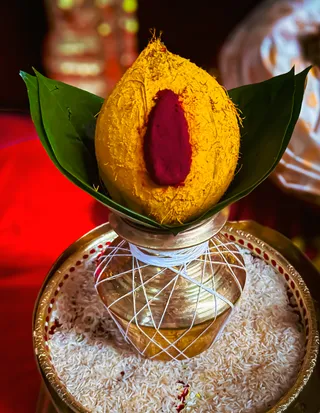
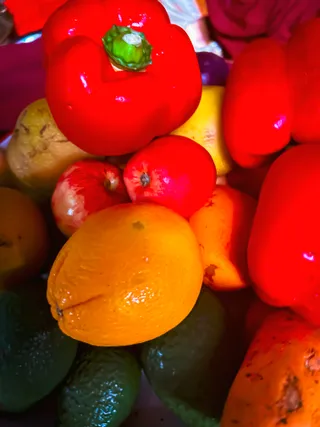
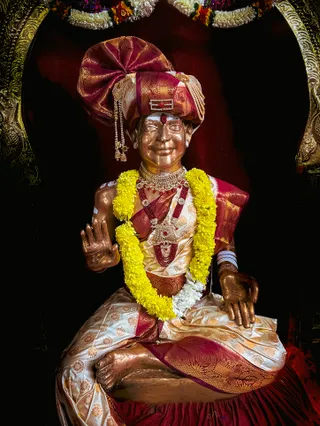
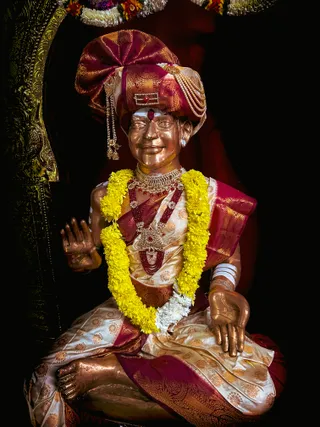
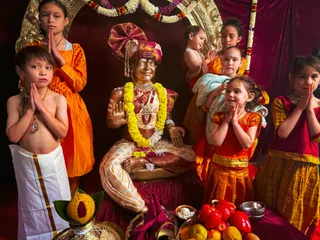
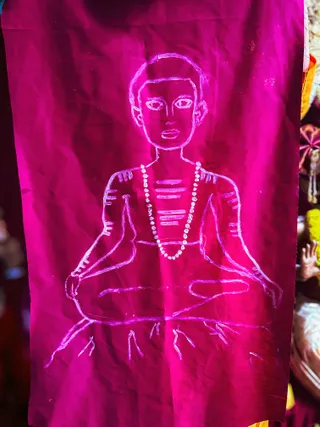
Close-up photograph of a kalasha on a brass plate filled with uncooked white rice. A glass pot is bound with white thread in a criss-cross pattern and is partly filled with clear liquid. Its mouth is capped by a yellow coconut wrapped in fibre, with a red-painted patch on its face and two green leaves fanning out behind it. The background is blurred red fabric with warm light. No people are visible.Close-up of a heap of glossy artificial fruit and vegetables in vivid red, orange, yellow and green. A large red bell pepper with a green stem dominates the upper left, with red apples, a yellow lemon, an orange and green cucumber-like items packed around it. No people or ritual setting is visible; the plastic gloss and tight framing make it appear to be decorative offerings or props.A golden-bronze statue of a seated figure in a maroon and gold turban with a jeweled ornament and dangling golden tassels, wearing a cream silk garment with gold brocade and maroon borders. The statue is draped with a thick yellow marigold garland and white flower garland, with layered gold and red-bead necklaces and a red bindi on the forehead. One hand is raised in blessing and the other rests on the lap, set against a dark backdrop with ornate gold arch framing. No living people are visible; the figure is a sculpted murti in a shrine-like setting.A bronze-coloured statue of a seated figure in a padmasana-like posture, shown against a black background. The statue wears a maroon and gold brocade turban decorated with pearl strands and a jewelled ornament, white urdhva-style markings on the forehead, a red bindi, and a cream silk garment with gold floral motifs and a deep maroon border. A yellow and white marigold garland hangs around the neck, over layered red bead malas and a gold and gemstone pendant with ornate choker necklace. The raised right hand shows an abhaya-like gesture while the left hand rests open on the lap. Gold filigree decoration frames the left edge, and floral garlands appear at the top. This is a murti, not a living person.A photograph of children with hands joined in namaskar before a golden deity murti seated on a throne-like seat with a gold arch behind it. The murti wears a maroon and gold turban-style headdress, a red-and-gold patterned garment, a jewelled necklace and a yellow marigold garland, with flowers at its feet. Children stand around it in orange, red and yellow silk outfits; a bare-chested boy in white dhoti with a gold border stands at left, and a small child in orange is held at the upper right. Plates of fruit, red bell peppers and a yellow sweet in a leaf sit in the foreground beside a brass bowl. Five children are physically present in the scene.A photograph of a magenta cloth banner with a white outline drawing of a seated figure in meditation posture, hands resting on the lap, wearing a beaded necklace and striped sacred marks on the chest. The figure has a shaved head and a plain tunic-like garment. Behind the banner, partially visible yellow flowers and a decorated deity murti with raised hand are seen. No physical people are visible.

KAILASA OHIO, USA On 12/5/2024

5 photosView all
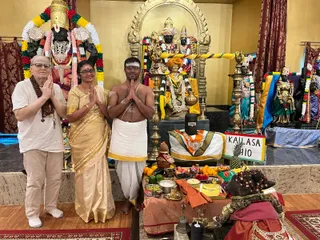
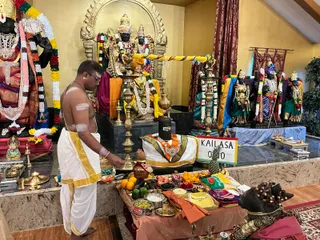
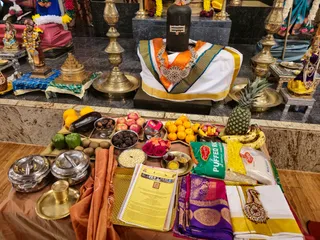
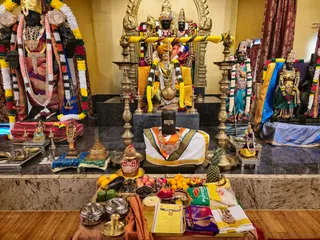
Three people stand with palms pressed together in namaste at a temple shrine in front of deity murtis draped with garlands. On the left, an elderly man in a white shirt, cream trousers and a brown beaded mala looks on. Beside him, a woman in a gold-and-cream saree with a red bindi and glasses also joins her hands. On the right, a bare-chested man in white dhoti with sacred ash markings on his forehead and body stands in prayer. Behind them, a golden-framed arch holds deities including a figure in an orange turban and gold garland. A black shivalingam sits on a white cloth with an orange-and-gold shawl, flanked by brass lamps, fruit, bowls of food and a sign reading KAILASA OHIO. A small figure with a dark face and red garment sits in the lower right foreground among offerings.A photograph of a temple shrine room with garlanded deity murtis on a raised golden-yellow platform. A bare-chested priest in white dhoti with gold border and white sacred ash marks on his arms and chest stands at left, reaching toward a brass lamp stand. Before him is a shiva lingam draped with an orange, white and green cloth, flanked by brass oil lamps and a kalasha. A table in front holds fruit, pineapple, sweets, bowls of food and a green and red offering. A sign reads KAILASA OHIO. Other garlanded deity murtis in colourful garments stand on the right side of the room.Indoor temple shrine photographed at close range. In the foreground, a long table holds offerings on brass trays: sliced fruit including pineapple, bananas, oranges, apples and kiwi, green peppers, an eggplant, dried fruit, a bowl of puffed rice, red flowers, a brass cup and small brass bowls, steel covered vessels, a yellow booklet, and folded saffron, purple and white cloths. Behind them, a black stone lingam sits on a white cloth edged with gold and an orange-and-cream patterned shawl, with a kalasha pot placed on top. Brass lamp stands flank it, and a figure in an orange turban and gold garments stands behind. Other deity murtis in blue, gold and red garments are draped with pink, white and yellow flower garlands. Pyramid-shaped brass objects sit on a side table. No people are visible in the scene.A photograph of a temple shrine with a black Shiva linga draped in a white cloth with orange and gold border and a jewelled orange garment, flanked by tall brass lamps and brass plates. In front, a wooden table displays ritual offerings: fresh fruits including oranges, apples, pineapple, bananas and a green pepper, puffed rice packets, nuts, red roses, turmeric and kumkum in small bowls, a yellow printed ritual sheet, a purple and gold silk sari, a white and gold dhoti, an orange cloth, and two silver covered vessels. Deity figures and garlands decorate the background shrine. No people are visible.A temple shrine interior with gold and yellow walls and deity murtis adorned with flower garlands in yellow, white, pink and red. A central black stone Shivalinga rests on a white cloth with orange and gold border, surrounded by brass oil lamps. In the centre back a figure in orange turban and orange-gold robes with a garland and a gold necklace sits on a raised platform, appearing as a statue or murti rather than a physical person. A tray in front holds fruits including oranges, apples, pineapple and bananas, rice, a kalasha-type vessel, brass bowls, folded purple and gold silks, and a printed sheet. No physical people are visible.

KAILASA OKLAHOMA, USA On 12/5/2024

5 photosView all
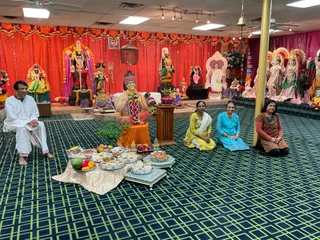
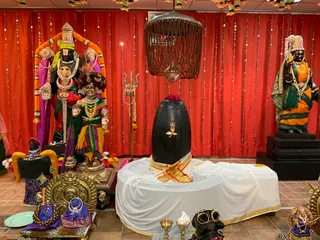
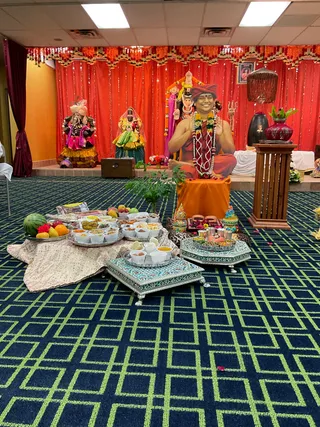
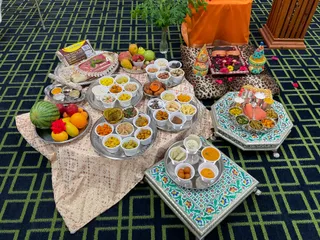
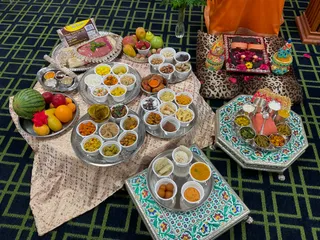
A temple room with red draped backdrop and garlands, many deity murtis on raised platforms. Center, a seated figure in orange clothing and an orange turban with a red-and-white rudraksha mala is a probable Swamiji candidate by appearance cues (orange clothing, turban, mala); the central figure sits behind a wooden pedestal with a kalasha-like vessel. A man in white kurta and dhoti sits on a chair at left, barefoot. Three women sit on the green-patterned carpet at right: one in a yellow sari, one in a turquoise salwar kameez, one in a brown kurta. In front, a platter of fruit including watermelon, bowls of sweets and offerings, and lit oil lamps form an offering arrangement, with a small potted plant nearby.Indoor temple shrine photographed with a red draped backdrop and strings of small lights. A large black Shiva lingam stands at centre on a white cloth draped with a gold-bordered yellow cloth, with a golden yellow and white band, and a hanging beaded red-brown canopy above it. To the left, a dark-skinned deity murti in a green and magenta garment, crowned and garlanded with marigolds, stands beside a second figure in a red and gold costume with a plumed headdress. On the right, a black stone deity murti in orange and green sari-style dress with a tall crown stands on a black pedestal. Brass oil lamps, a trident, floral offerings and a black decorated murti stand in the foreground. No physical people are visible.A photograph of a temple-style hall with a red draped backdrop and red-orange garland festoons along the top. On a raised orange-draped seat sits a smiling figure in a red turban, orange-red robes and a white-and-red beaded garland, hands raised in blessing. Probable Swamiji: the figure shows the red turban, saffron-orange robe and ornate garland cues, seated centrally on the dais. Flanking him are decorated deity murti in colourful dress, a brass and gold kalasha-style pot, a trident and a small framed portrait. In the foreground on the blue-and-green patterned carpet, silver and turquoise-inlaid platters hold fruit, sweets in white cups, a watermelon, mango and banana, arranged as food offerings for a naivedyam. Greenery and flower petals lie on the floor.Photograph of a floor-level array of food offerings (naivedyam) on a green and navy geometric carpet at a KAILASA centre. A pale peach cloth printed with small gold motifs covers the floor, holding steel plates and many small white paper cups filled with rice dishes, sweets, fried snacks, pickles, lentils and colourful chutneys. Whole fruits including watermelon, apples, oranges, mangoes and bananas sit on a steel tray beside a red flower. Behind, an orange cloth draped over a table, a leopard-print cushion, a vase of green leaves, and a decorated tray with flower petals and two small painted clay figures. A decorated silver-and-enamel thali holds small steel bowls and a cup. No people are visible.A photograph of a floor-level ritual food offering display on a navy and green patterned carpet. Many small white cups filled with different dishes sit on round silver trays covered by a pale gold cloth printed with Om symbols, including yellow sweets, orange curries, fried snacks, pickles, rice and sweets. Fresh fruit including watermelon, apples, oranges, mangoes and a dragon fruit sits on a silver tray at left. At upper right, a leopard-print cushion supports a red and gold tray with a pair of wooden sandals and rose petals, flanked by two decorated pots, and an orange cloth hangs behind. A silver octagonal tray with green and blue floral enamel holds steel bowls of vegetables and a pink-wrapped item. A small packet of pure dal or flour sits at top left. The arrangement reflects a Hindu naivedyam food offering.

KAILASA PHOENIX, USA On 12/5/2024

1 photoView all
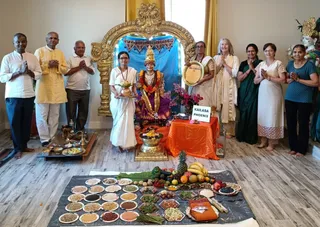
A photograph of a group of nine devotees standing in a bright room with light wood floors for a ritual display. In the centre, a woman in a white sari holds a brass plate with a kalasha, standing beside a golden deity murti in a purple garment with a golden crown and a garland of orange flowers, set within an ornate golden arch with a blue backdrop. A white placard reads KAILASA PHOENIX on an orange-draped table. A woman in a cream sari on the right holds a framed certificate. Men in white and cream kurtas on the left and women in saris and kurtas on the right stand with palms pressed together in anjali. In front, a black cloth holds a large naivedyam spread of grains, pulses, fruits, bananas, a pineapple, vegetables and sweets in small bowls. A brass lamp stand and offerings sit on a tray to the left.

KAILASA TORONTO, CANADA On 12/5/2024

10 photosView all
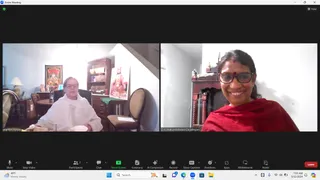
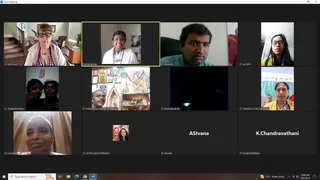
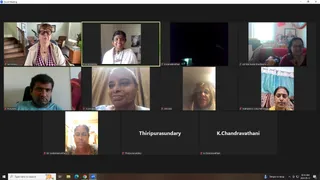
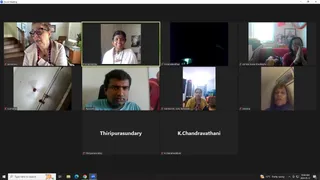
A screenshot of a Zoom video call with two participant tiles side by side. On the left, a woman with short light hair and glasses, wearing a white shawl, sits at a table in a room with a framed deity painting, a poster of a seated saffron-clad figure, and a wooden cabinet. On the right, a smiling woman with glasses and a red bindi, wearing a red shawl, stands before a wooden shrine with small deity figures. The Zoom toolbar shows Mute, Stop Video, Participants 2, Chat, Share Screen, Record and Leave buttons, with a Windows taskbar at the bottom.A screenshot of a Zoom Meeting gallery view with a grid of video tiles showing participants in home settings. Top-left, a woman with glasses and a white cardigan sits near a staircase. Top-centre, a smiling woman in a white top with a beaded necklace is highlighted, labelled Premabhaktika. Top-right, a man in a teal shirt and a young woman with glasses appear. Middle row includes two women side by side, a tile of a shrine-like altar with framed deity pictures and garlands, a dark tile labelled K.Kamalanathan, and an older woman in a yellow top labelled Subhashini, ooty, Tamil Nadu. Bottom row shows a smiling woman in a light sari, a small tile of a woman before a red-and-gold shrine, and two name-only tiles labelled ASIvana and K.Chandravathani. A taskbar and clock showing 10:08 AM, 2024-05-12 appear at the bottom.A Zoom meeting gallery view showing nine video tiles of participants in home settings. Top row: a woman with glasses and a cream cardigan over a checked top beside a staircase, a smiling woman in a white top with a lanyard labelled Premabhaktika, a black tile labelled K.Kamalanathan, and a woman in a dark top on a red sofa labelled AS-Ma Jnana Pradhayini. Middle row: a man in a teal shirt labelled Purusoth, a smiling older woman with white hair labelled S.Amutha, a woman with long hair labelled ASivana, and a woman in a yellow top before blue curtains labelled Subhashini, ooty, Tamilnadu. Bottom row: a woman in a yellow top labelled M. sivakamasunthary, and two name-only tiles reading Thiripurasundary and K.Chandravathani. The Zoom window shows a timestamp of 10:16 AM on 2024-05-12.A screenshot of a Zoom meeting grid showing nine video tiles of participants in their homes. Top left, a woman with glasses and a white cardigan with a red-and-black lanyard sits near a staircase, labelled 'lea khoury'. Top centre, a smiling woman in white with a lanyard, labelled 'Premabhaktika'. Top right, a woman in a red top with hands joined in namaste, labelled 'AS-Ma Jnana Pradhayini'. Middle row shows a ceiling fan tile labelled 'S.Amutha', a man in a teal shirt labelled 'Purusoth', a woman in a yellow saree labelled 'Subhashini, ooty, Tamilnadu', and a woman with reddish hair labelled 'ASivana'. Bottom row has two tiles with only names: 'Thiripurasundary' and 'K.Chandravathani'. A dark tile labelled 'K.Kamalanathan' is also present. The Zoom window shows the time 10:34 AM and 13°C weather in the taskbar.A Zoom video call screenshot showing a grid of eight participant tiles on a Windows desktop with the Zoom toolbar visible along the bottom. Top left, a woman with short grey hair and dark-framed glasses in a cream jacket sits in a living room labelled Lea Khoury. Top centre, a smiling woman in a white top with a lanyard, labelled Premabhaktika, is highlighted with a yellow frame. Middle row: a woman in a yellow cardigan labelled Subhashini, Ooty, Tamilnadu; a woman in a dark floral top labelled Thiripurasundary; and a woman with long hair labelled ASivana. Bottom row, two name-only tiles read S.Amutha and K.Chandravathani. Other participant names are K.Kamalanathan on a dark tile. The taskbar clock reads 10:39 AM on 2024-05-12.A photograph of a temple shrine room with gold-framed arched niches holding black stone deity murtis, and a central altar draped in purple and blue fabric. In the foreground a standing priest in a rust-coloured dhoti and saffron-brown shawl pours liquid from a vessel beside a brass tray of offerings. A large black stone shivalinga sits on a dark base in the centre, decorated with orange and white garlands, while stacks of folded cloth in pink, green and white lie on the right. The priest is the only physical person visible.