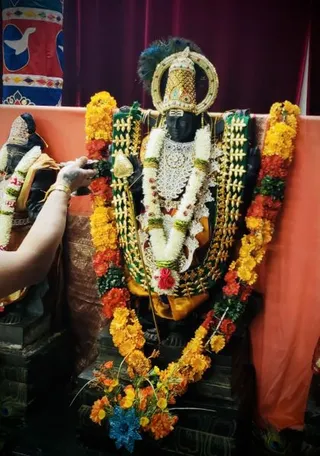
Skip to content
Saturday

27 February 2021

MAHESWARA PUJA || MOKSHADEEPAM OFFERED || MAGUDABHISHEKAM

Dated photos
92
Source pages
11
Media
1
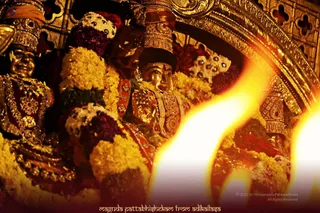
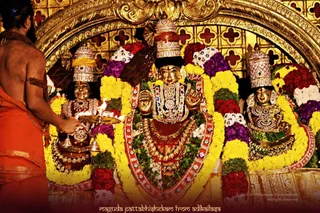
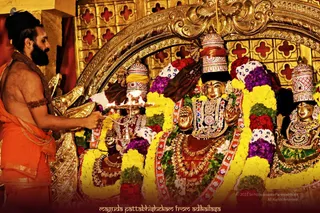
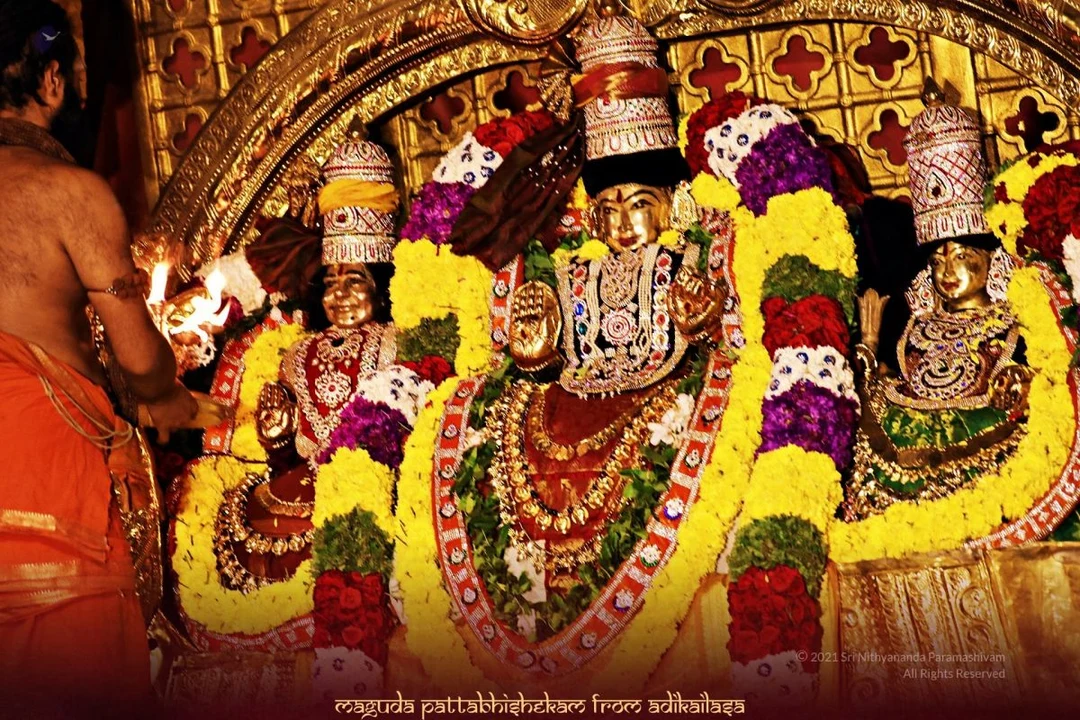
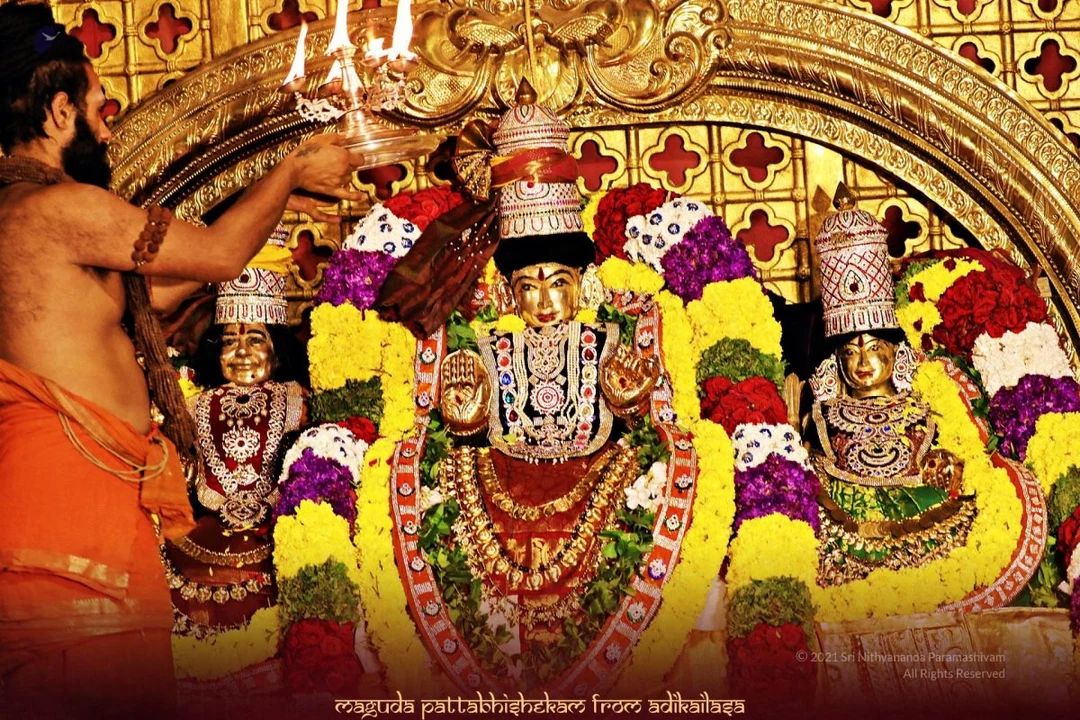
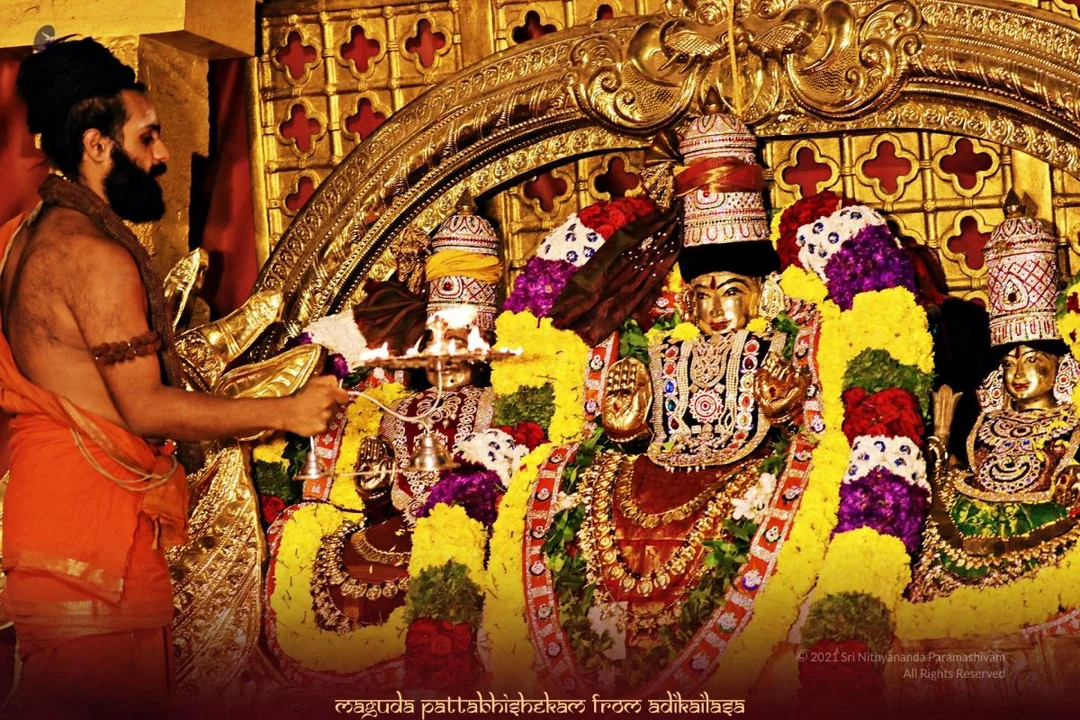
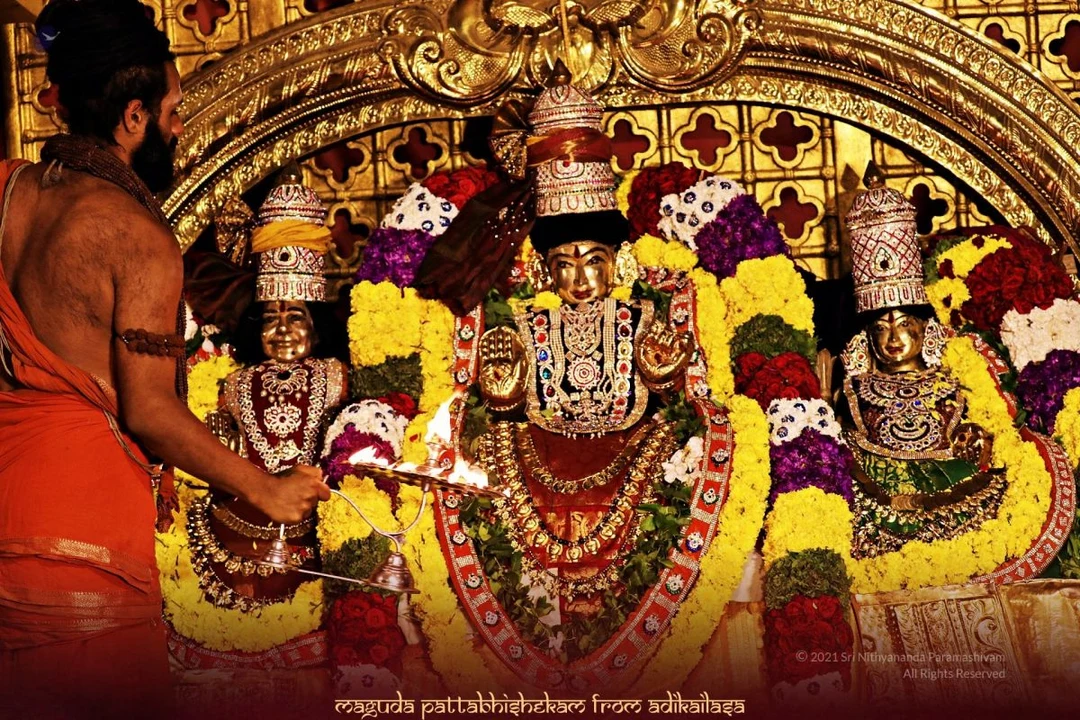
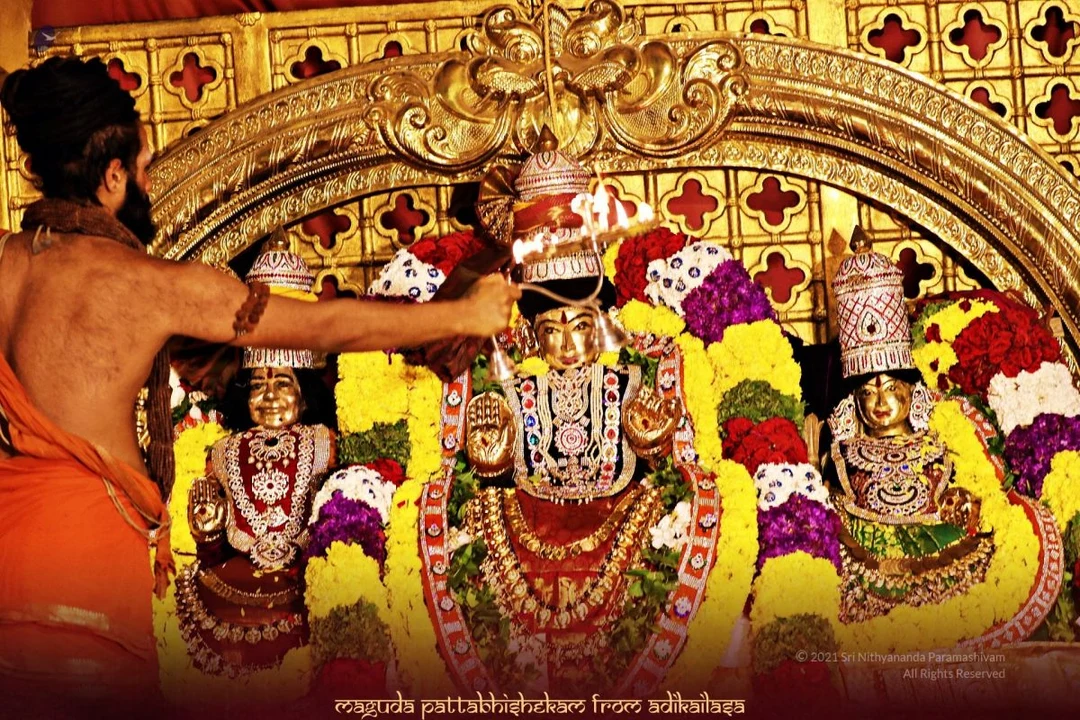
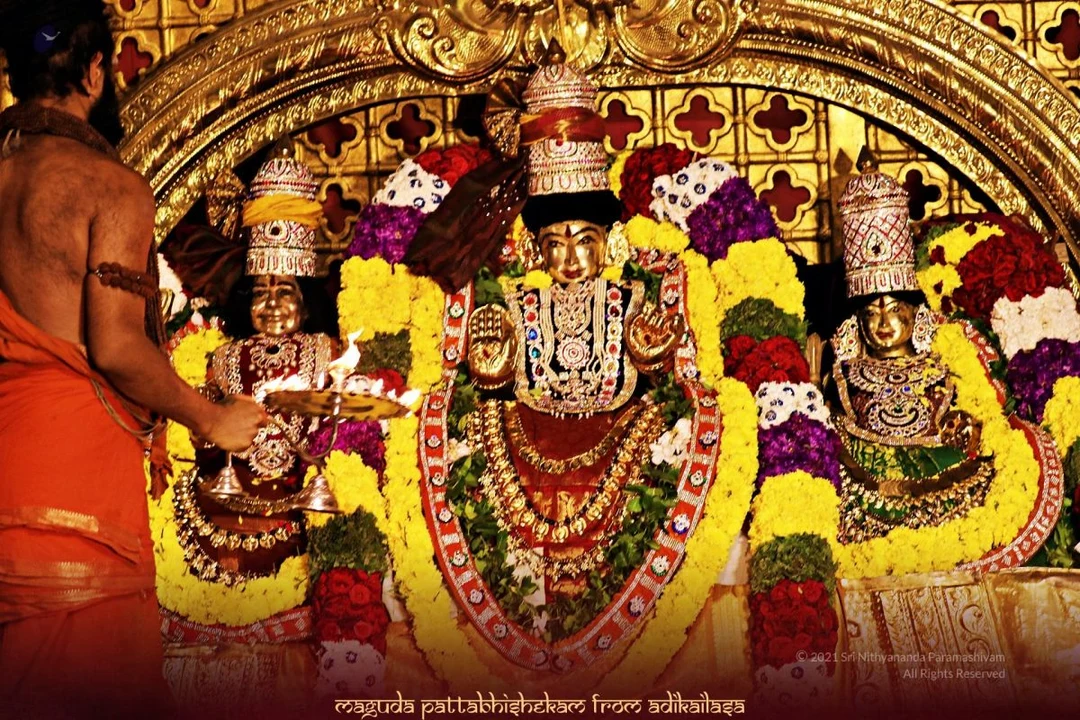
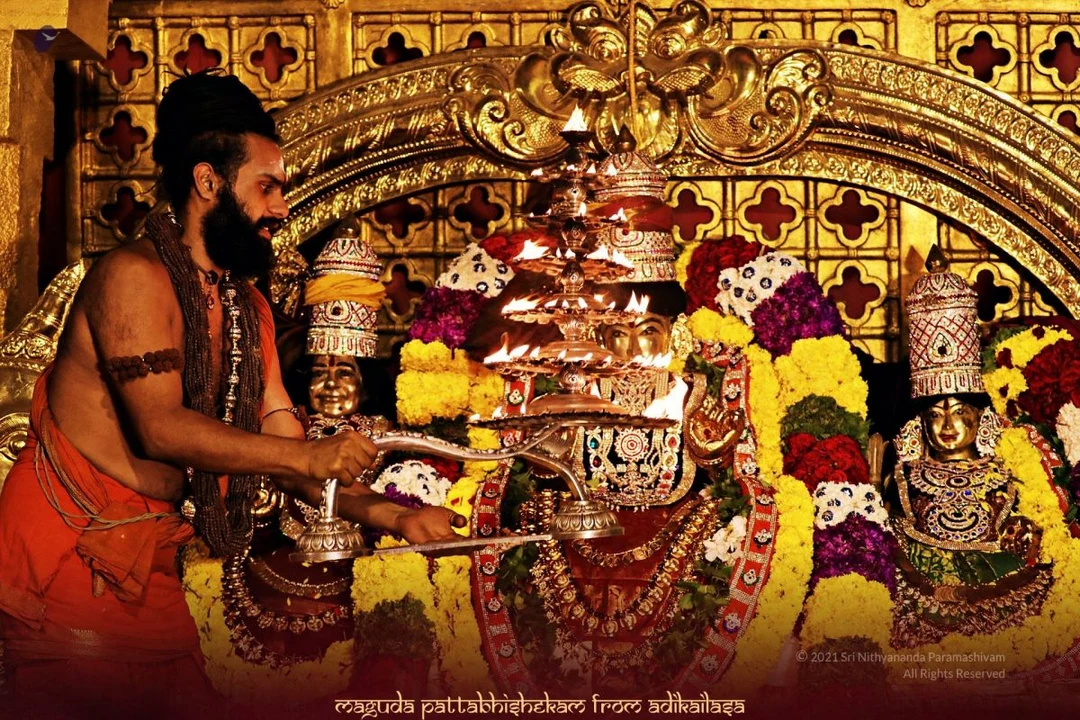
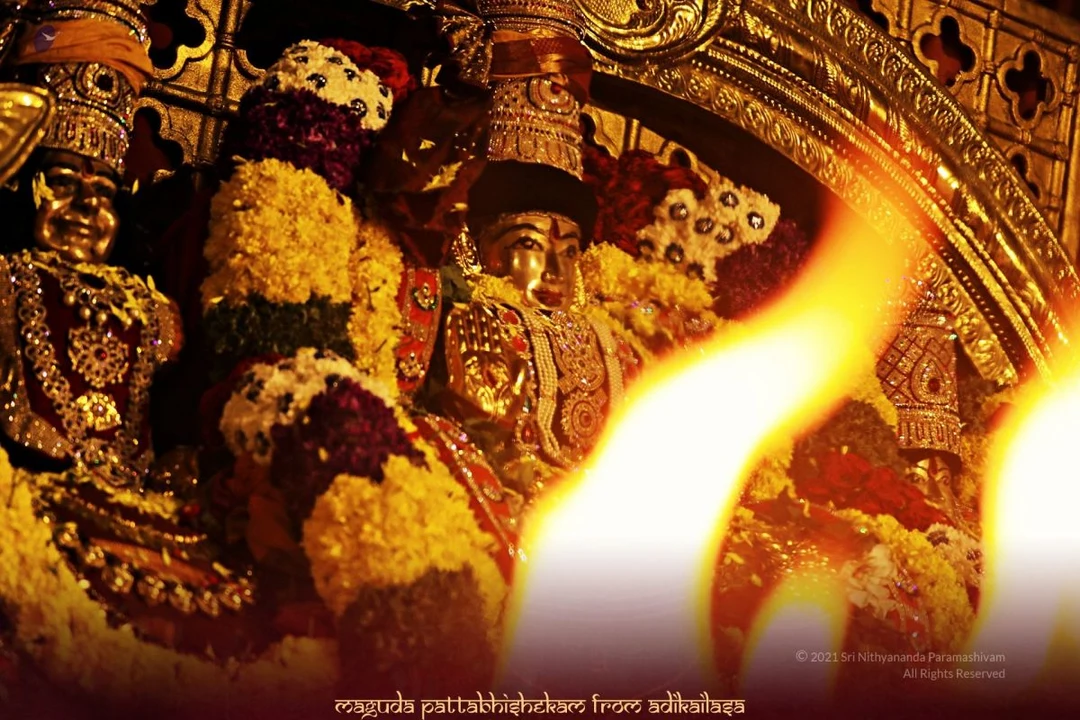
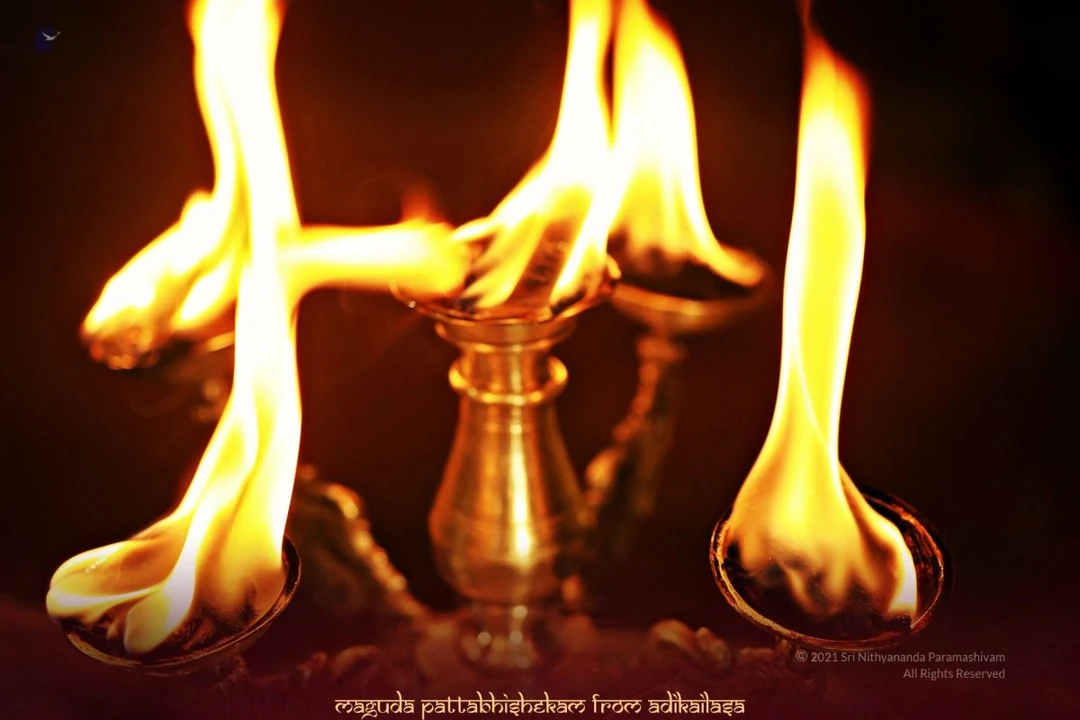
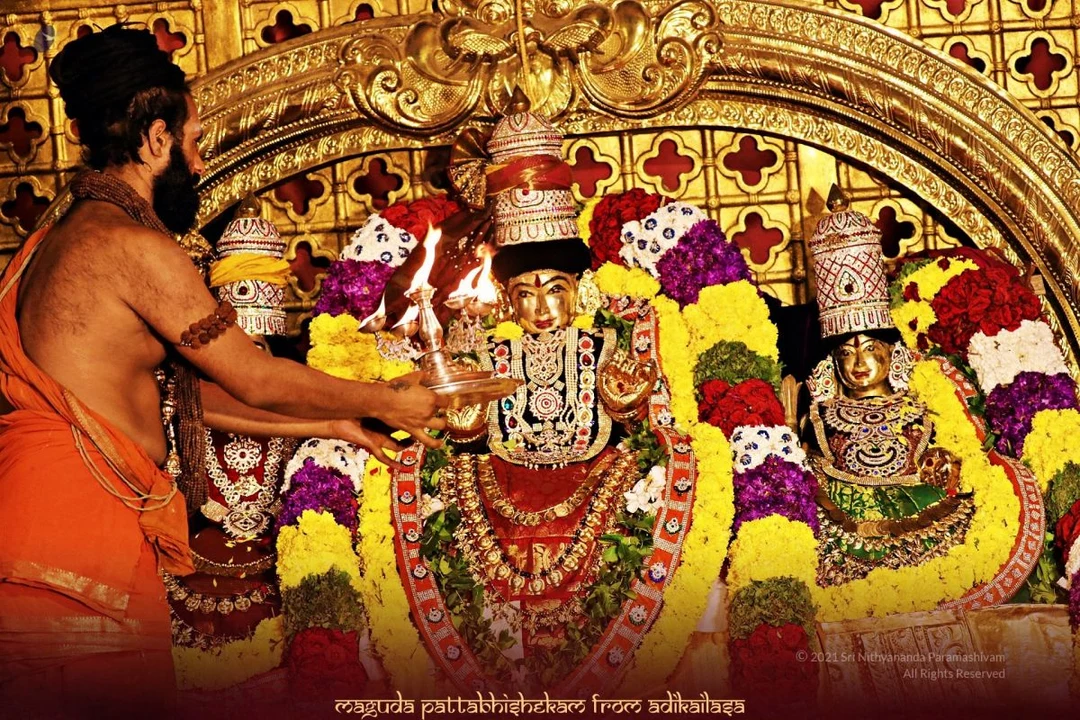
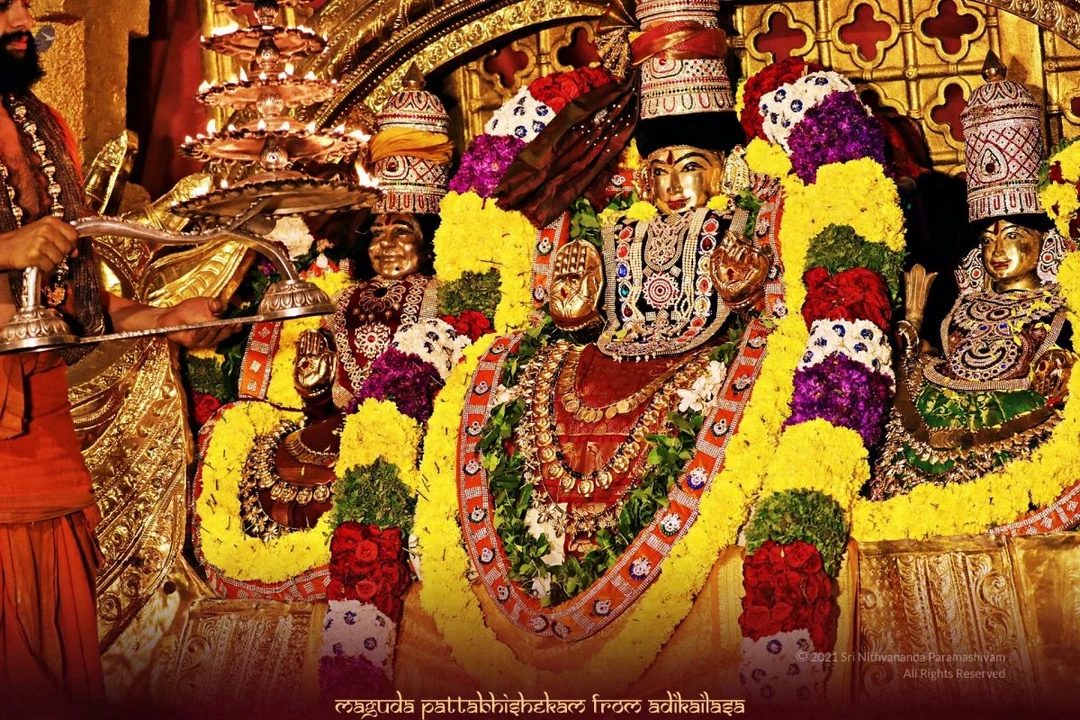
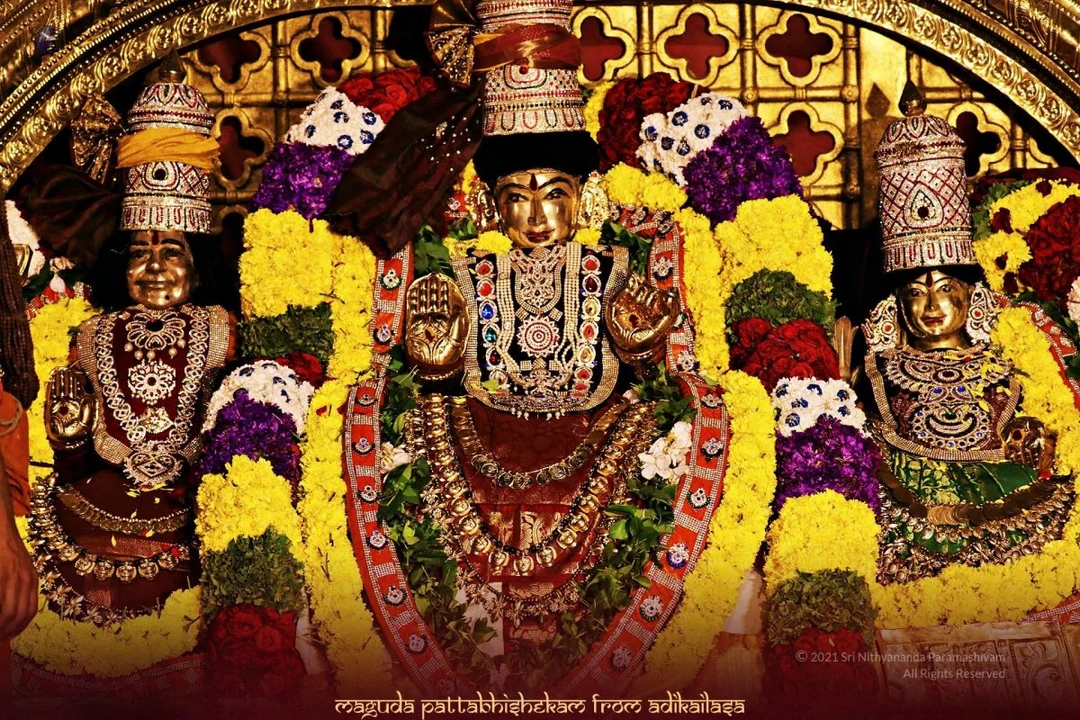
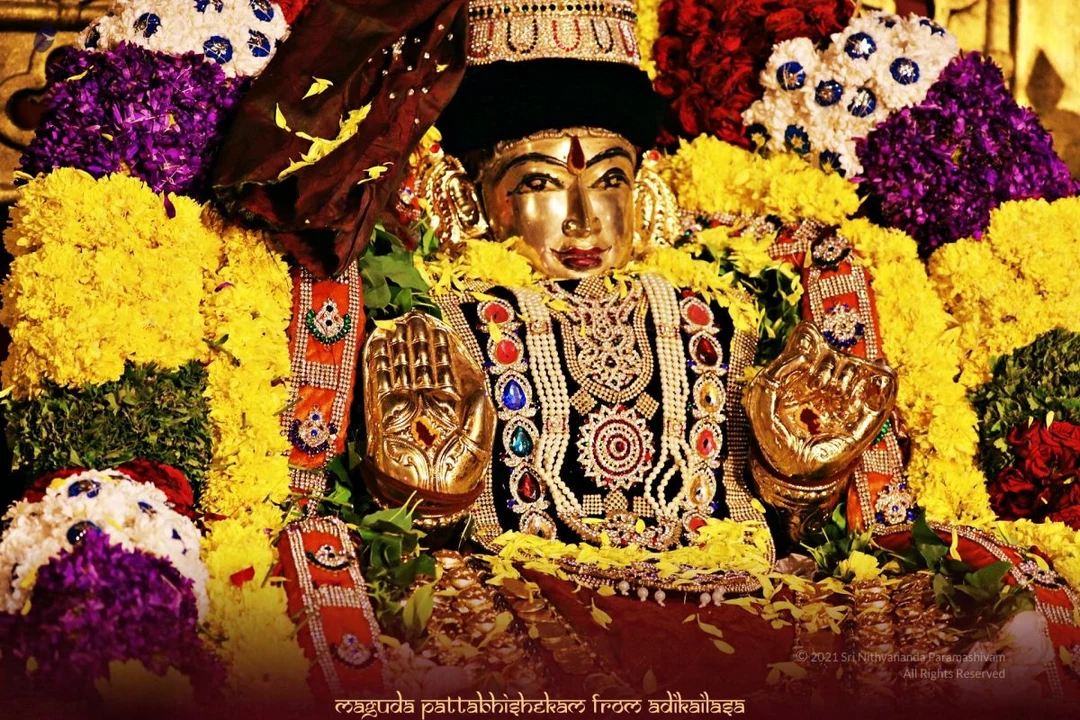
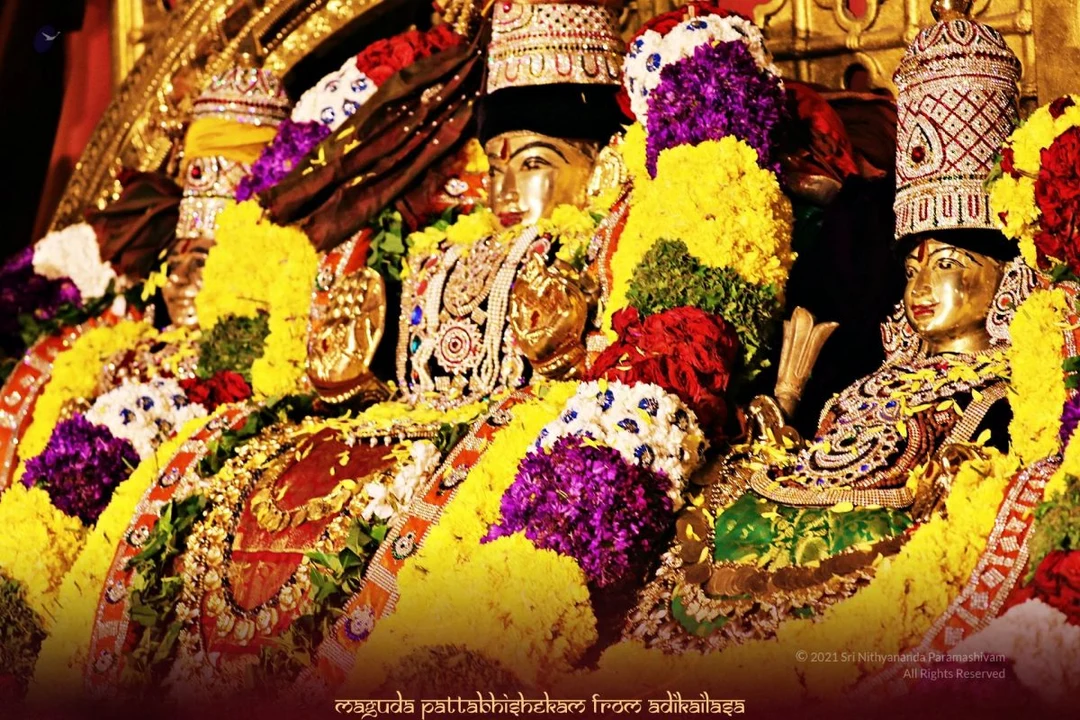
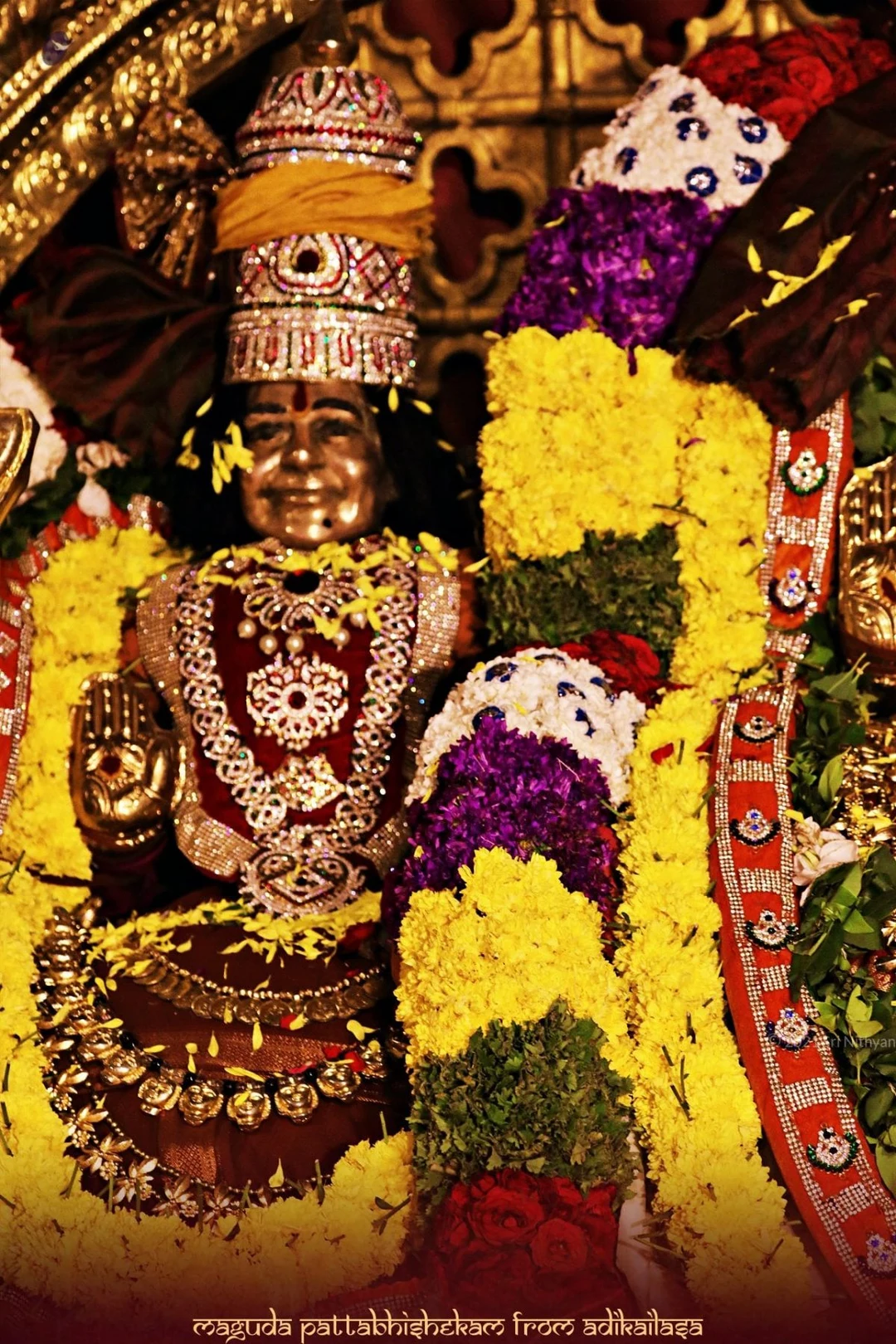
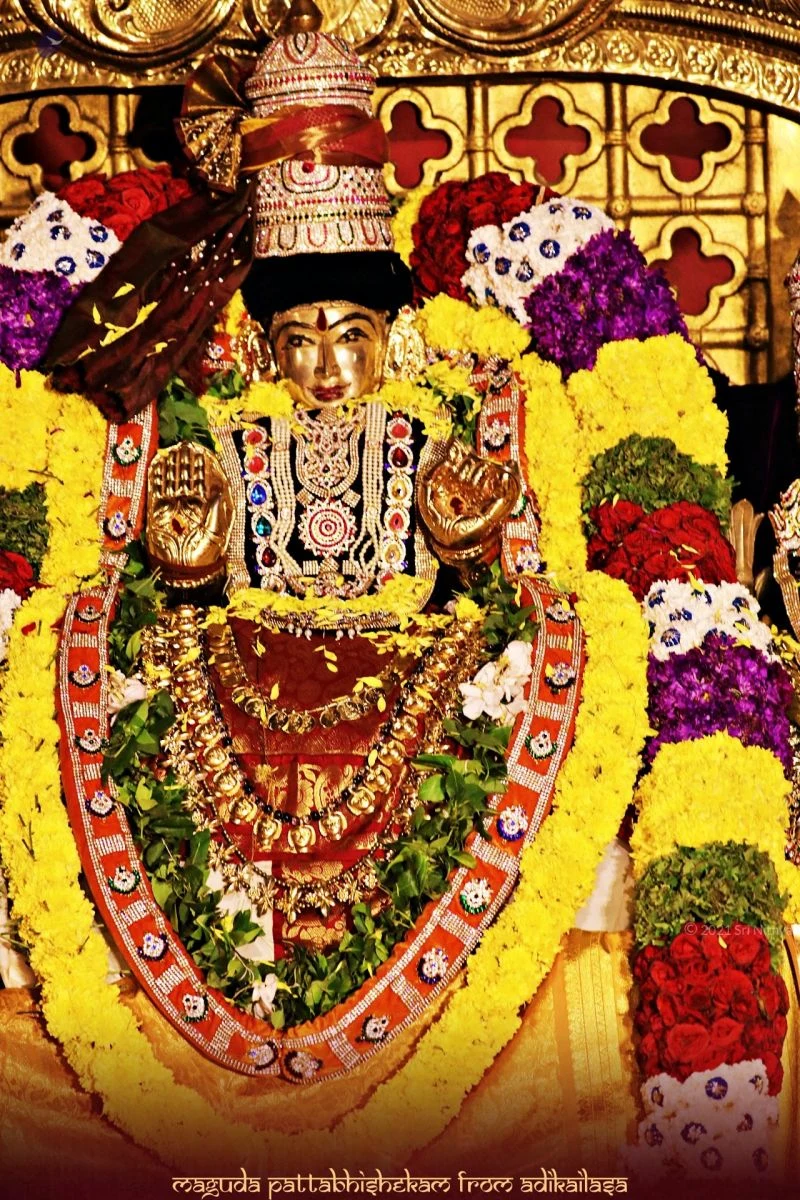
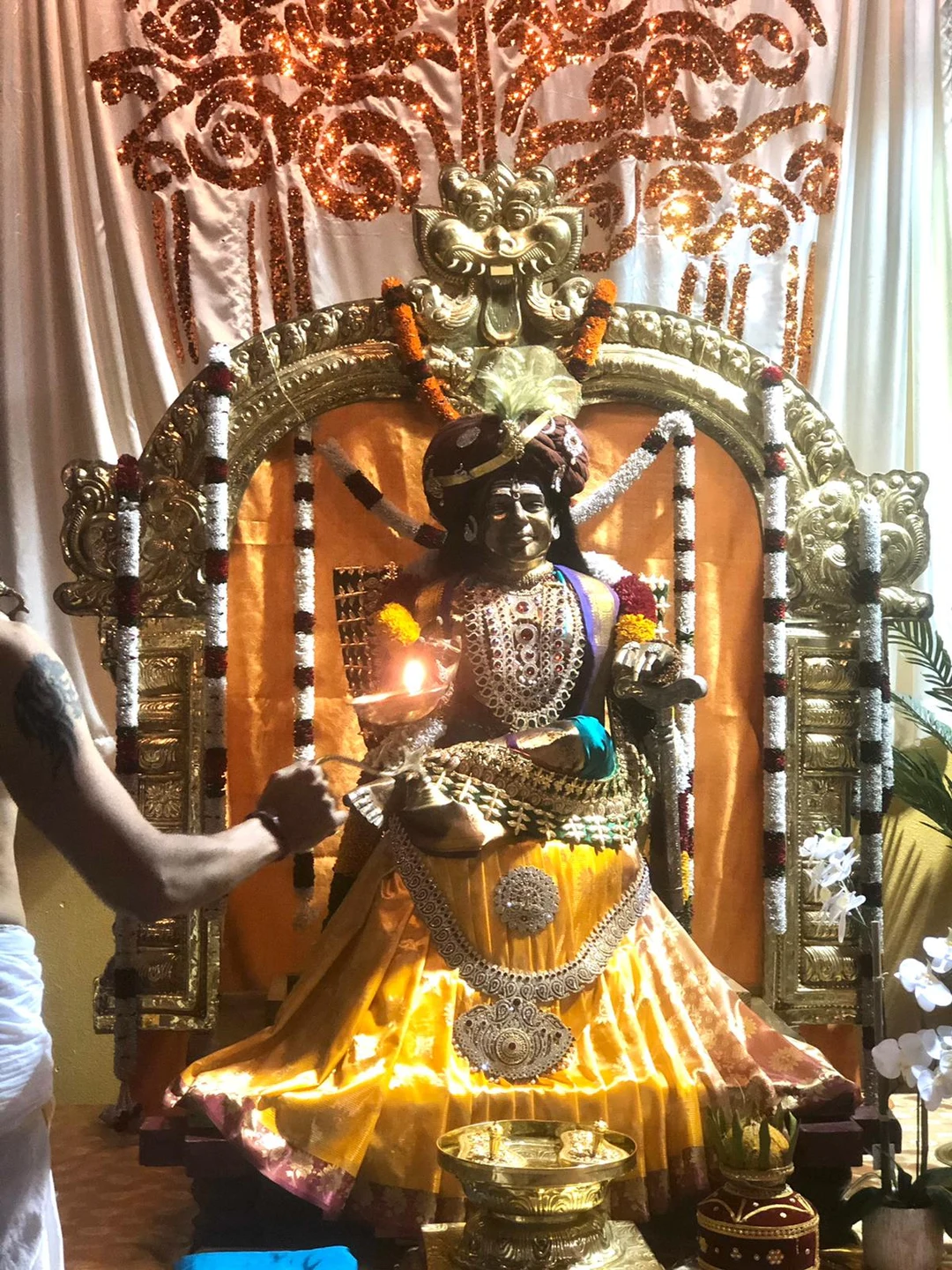
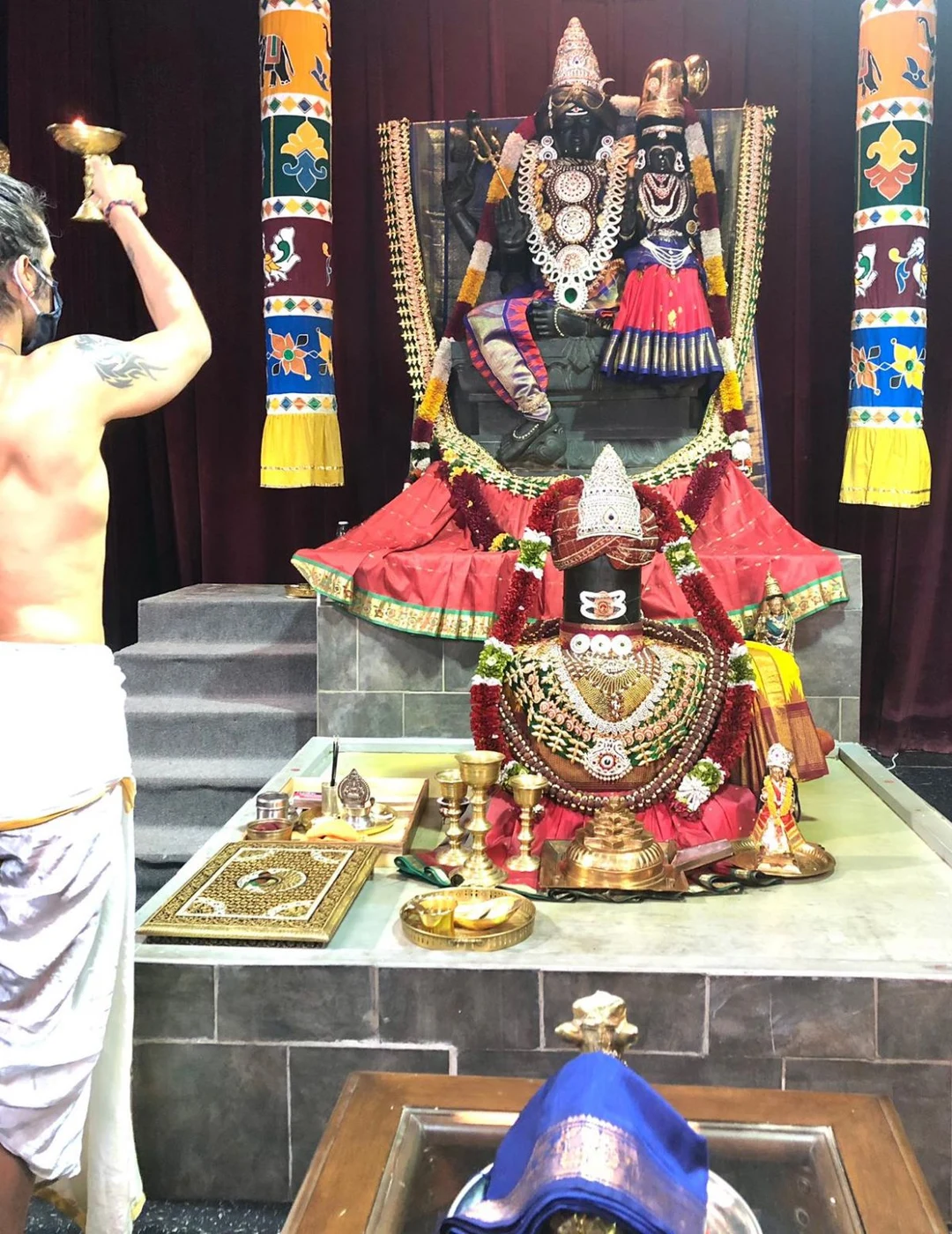
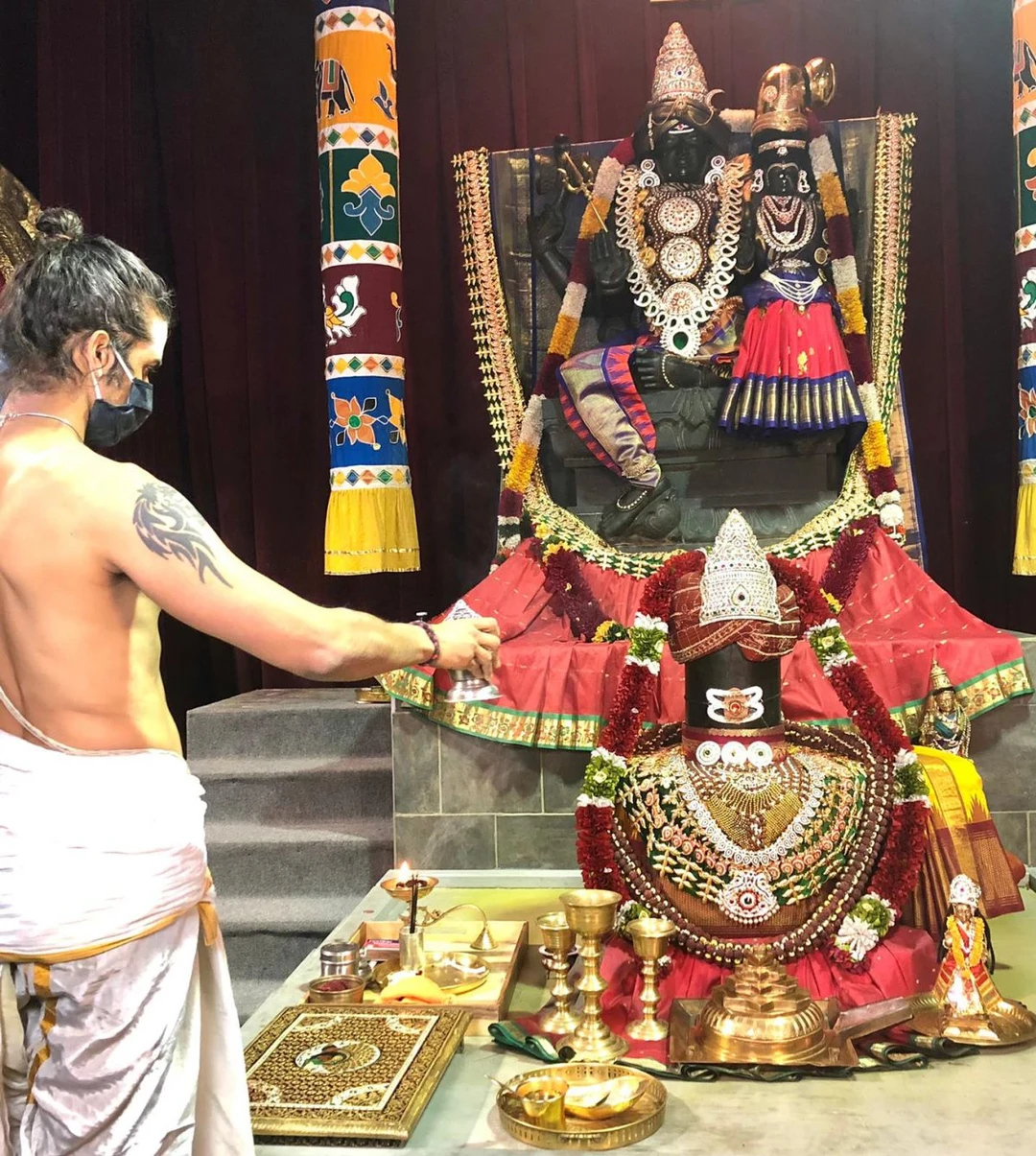
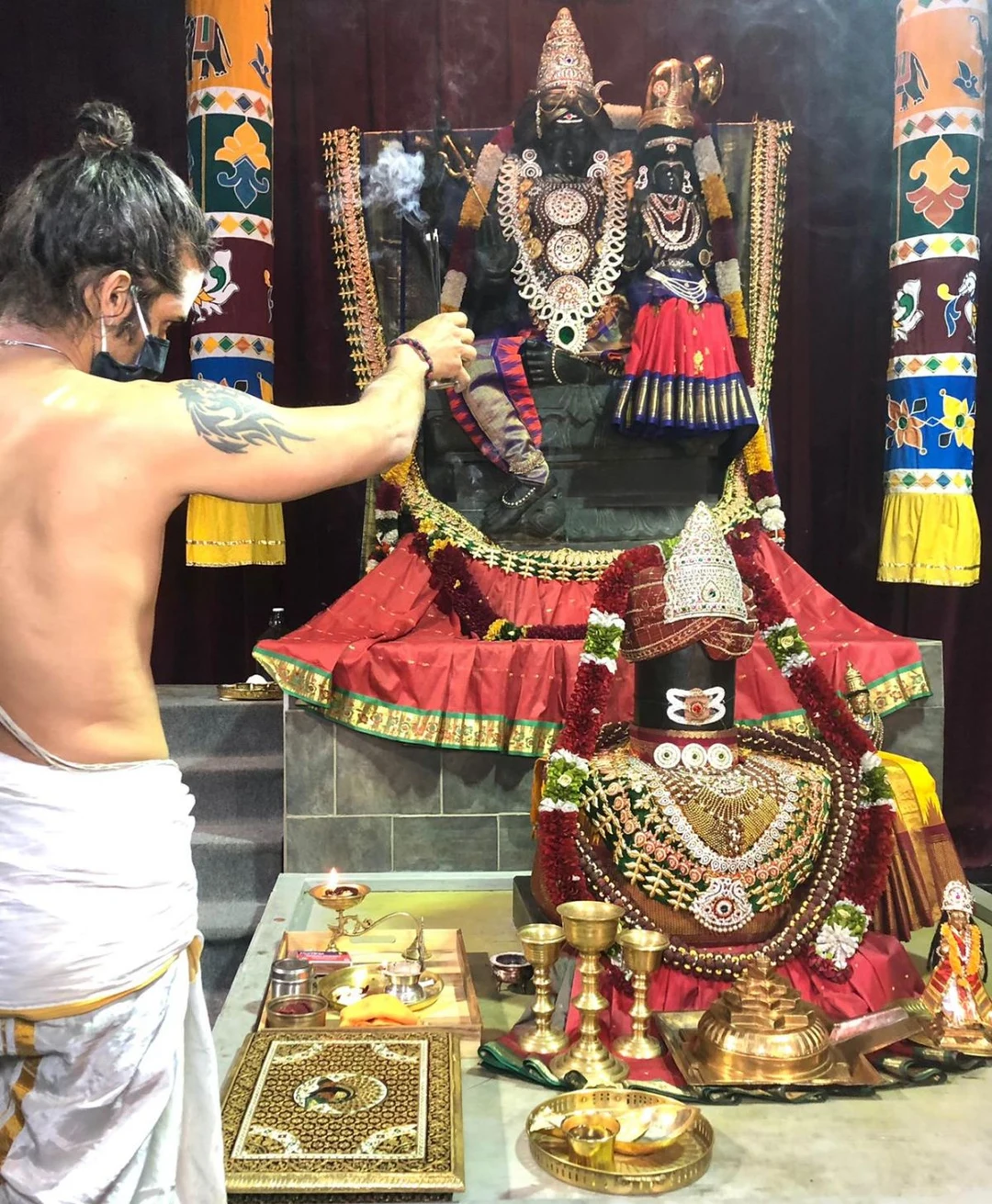
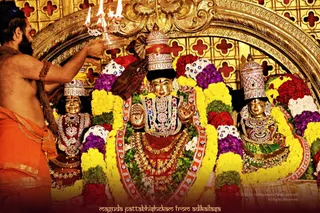
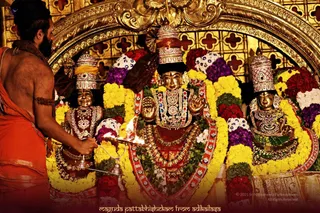
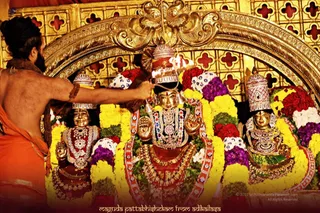
Golden deity murti figures decorated with yellow and orange marigold garlands and red flower garlands, adorned with gold crowns, jewelled necklaces and ornate golden armour-like ornaments, set within an ornate gold arch. Blurred flames of an oil lamp or fire occupy the right foreground. No physical people are visible; the figures are statues.A priest in orange-saffron robes stands at left, shirtless with a sacred thread over his shoulder, holding a brass aarti lamp with a flame toward three deity murtis in a golden shrine arch. The central murti wears a tall crown, jewelled breastplate and gold necklaces, with a red and gold sash, flanked by two smaller crowned murtis. Yellow and red-white garlands with green leaves cover the figures, marking a maguda pattabhishekam abhishekam-style worship at Adikailasa.A photograph of a temple worship scene at ADIKAILASA. A priest with a full beard, bare-chested and wearing an orange dhoti and orange shawl with a sacred thread, performs aarti with a lit lamp before a deity murti. The murti wears a tall decorated crown, gold jewellery and a rich red and gold garment, and is heavily garlanded with yellow marigolds and purple and red flowers. Smaller decorated figures in matching crowns flank it. The background is an ornate gold arch with gilded carvings and red cross-shaped lattice panels.

ADIKAILASA on 2/27/2021

Original wiki page
Contents

Daily Update - PDB + Daily pictures-maguda pattabhishekam from adikailasa Arthi

Event Details
Participants Count0
Event TypeBoth
Was Food Served in Event?No
Count of Meals Served
Volunteers Count0
Event Duration

maguda pattabhishekam from adikailasa Arthi

Pictures from the day
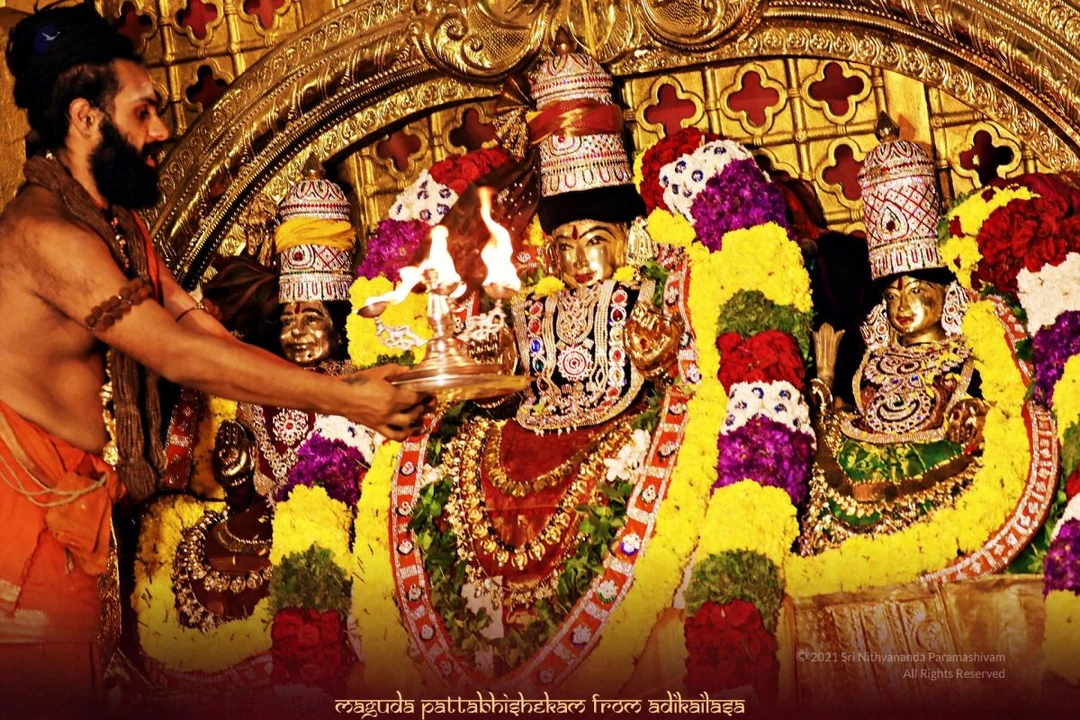
February 27 2021

Original wiki page
Contents

Title

MAHESWARA PUJA || MOKSHADEEPAM OFFERED || MAGUDABHISHEKAM

Narration

Video

Transcript

MAHESWARA PUJA and MOKSHADEEPAM OFFERED

MAHESWARA PUJA || PURNIMA || 27 FEB 2021 || OVER 700 LIVES || MOKSHADEEPAM OFFERED

REGARDLESS OF THE NUMBER OF BIRTHS THE SOUL WOULD HAVE TAKEN, REGARDLESS OF THE SOUL, WHILE EMBODIED HAVING BEEN INITIATED BY THE MASTER OR NOT IN HIS LIFETIME - THE MASTER CAN INTERVENE AND MAKE HIS PRESENCE AVAILABLE IN THE DEPARTED SOUL’S LIFE AND LEAD IT TO ENLIGHTENMENT! THIS IS POSSIBLE ONLY THROUGH MAHESHWARA PUJA!

THE SUPREME PONTIFF OF HINDUISM, JAGATGURU MAHASANNIDHANAM, HIS DIVINE HOLINESS BHAGAVAN NITHYANANDA PARAMASHIVAM SAYS, "THE BEST PLACE ON PLANET EARTH TO GIVE “PINDA THARPANA” IS THE STOMACH OF A SANNYASI. THAT IS, THE HUNGER FIRE (JATARAGNI) OF A SANNYASI IS THE BEST FIRE INTO WHICH YOU CAN OFFER THE “PINDA THARPANA”, THE “SHRAADDHA”, WHICH REACHES THE DEPARTED ANCESTORS, (PITRUS) DIRECTLY.

THE SOMASAMBHU PATATI SAYS, IT IS THOUSAND TIMES MORE GREATER THAN OFFERING ANY “SHRAADDHA”, ANY “PINDA”, IN ANY RIVER, ANY WATER-BODY, ANY LAKE, ANY HOLY LAND, ANY HOLY PLACE. OFFERING IT IN THE STOMACH OF THE LIVING INCARNATION OF PARAMASHIVA IS THE BEST FORM OF “PINDA THARPANA” AND 'SHRAADDHA'. IN HINDUISM, SHRAADHHA WHEREIN FOOD IS OFFERED TO SANYASIS FOR THE COMPLETION WITH THE DEPARTED SOULS, IS CALLED MAHESHWARA PUJA.

IN THE SOMASHAMBHU PADDHATI, SHRAADHHA VIDHI,SLOKA 3

लिङ्गिनो ब्राह्मणाद्याश्च श्राद्धीयाः शिवदीक्षिताः ।
LIṄGINO BRĀHMAṆĀDYĀŚCA ŚRĀDDHĪYĀḤ ŚIVADĪKṢITĀḤ ।

THE TRANSLATION GOES “THE SANNYASIS AND BRAHMANAS WHO HAVE BEEN INITIATED INTO THE SHIVA DEEKSHA ARE ELIGIBLE TO BE APPOINTED AS THE REPRESENTATIVES OF PITRUS IN THE SHRAADHHA.”

KAILASA’S DEPARTMENT OF RELIGION & WORSHIP CONDUCTS THE MAHESHWARA PUJA AS PRESCRIBED BY THE VEDAS AND AGAMAS REVIVED BY THE SPH NITHYANANDA PARAMASHIVAM. IN THE MAHESHWARA PUJA, AS THE 1008TH LIVING INCARNATION OF PARAMASHIVA, THE SPH PERSONALLY RECEIVED THE BHIKSHA (ALMS) AND HE LIBERATES THE DEPARTED SOUL ALONG WITH THE NITHYANANDA SANYAS ORDER (MONASTIC ORDER) FOR OVER 700 LIVES INCLUDING:

1.MATERNAL GRANDMOTHER OF THE SPH NITHYANANDA PARAMASHIVAM - MA YELLAMAL 2.SWAMI CHIDANANDA , HEAD OF CHICAGO OF RAMAKRISHNA MISSION, USA. 3.FOUNDING FATHER AND 4 TIMES PRIME MINISTER OF PAPUA NEW GUINEA: MR. MICHEAL SOMARE 4.400 LIVES LOST IN THE BUSHFIRE IN AUSTRALIA (INCLUDING ANIMALS). 5.60 LIVES LOST IN THE BOAT SINKING IN CONGO 6.58 LIVES LOST IN THE SNOW STORM IN USA 7.19 LIVES LOST IN THE FIRECRACKER FACTORY EXPLOSION IN INDIA 8.6 LIVES LOST IN THE PLANE CRASH IN MEXICO 9.6 LIVES LOST IN THE CAR CRASH IN USA 10.3 LIVES LOST IN THE SNOWSTORM IN GREECE 11.3 LIVES LOST IN THE EBOLA OUTBREAK IN GUINEA 12.SRI RINKU SHARMA, HINDU ACTIVIST 13.MA ANDREA BHARAT , TRINIDAD AND TOBAGO FOLLOWED BY: 2 LIVES FROM SINGAPORE 8 LIVES FROM USA 39 LIVES FROM CHINA 54 LIVES FROM MALAYSIA 14 LIVES FROM TAIWAN 6 LIVES FROM FRANCE 4 LIVES FROM SWITZERLAND 7 LIVES FROM INDIA 11 LIVES FROM CZECH REPUBLIC

MAGUDABHISHEKAM

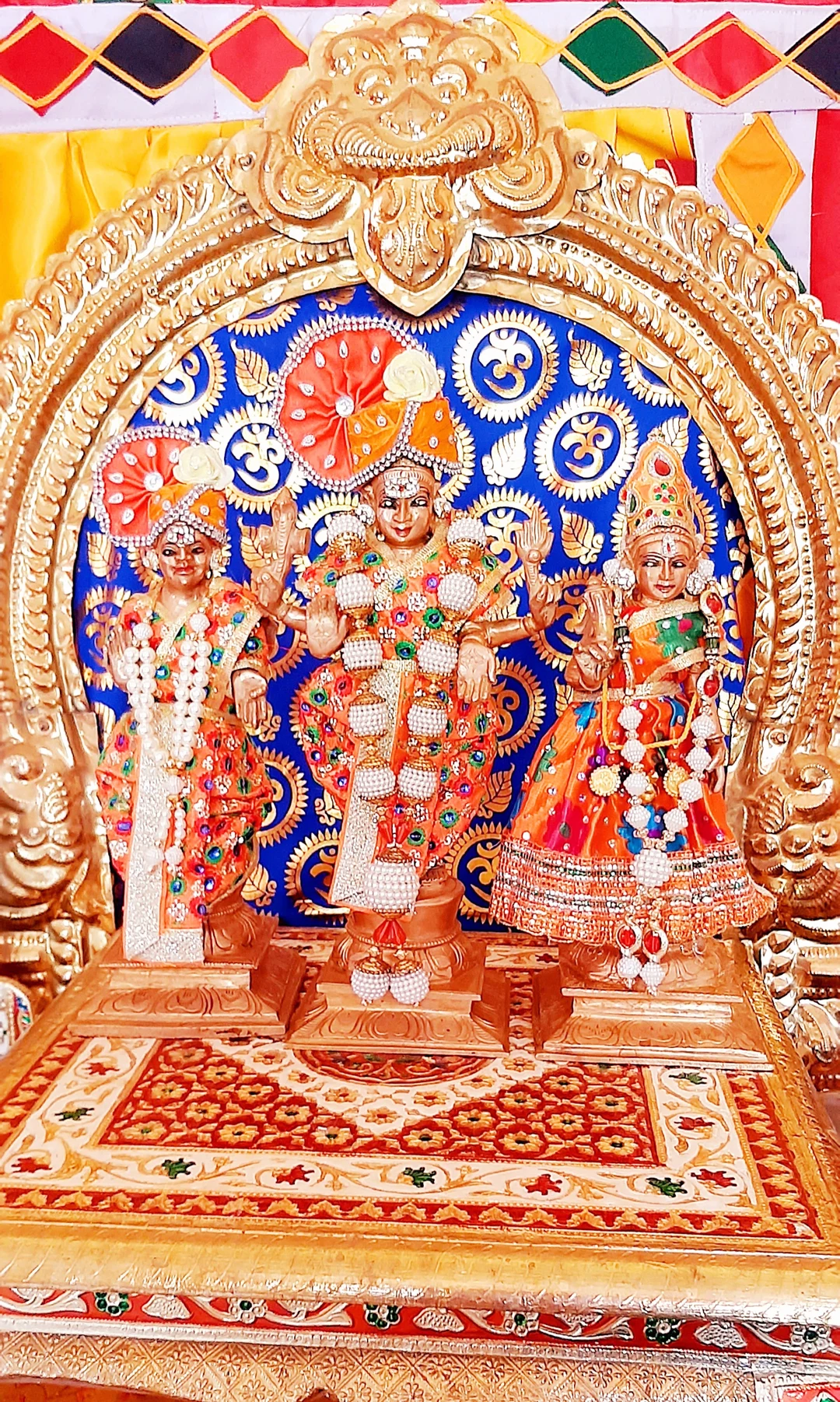
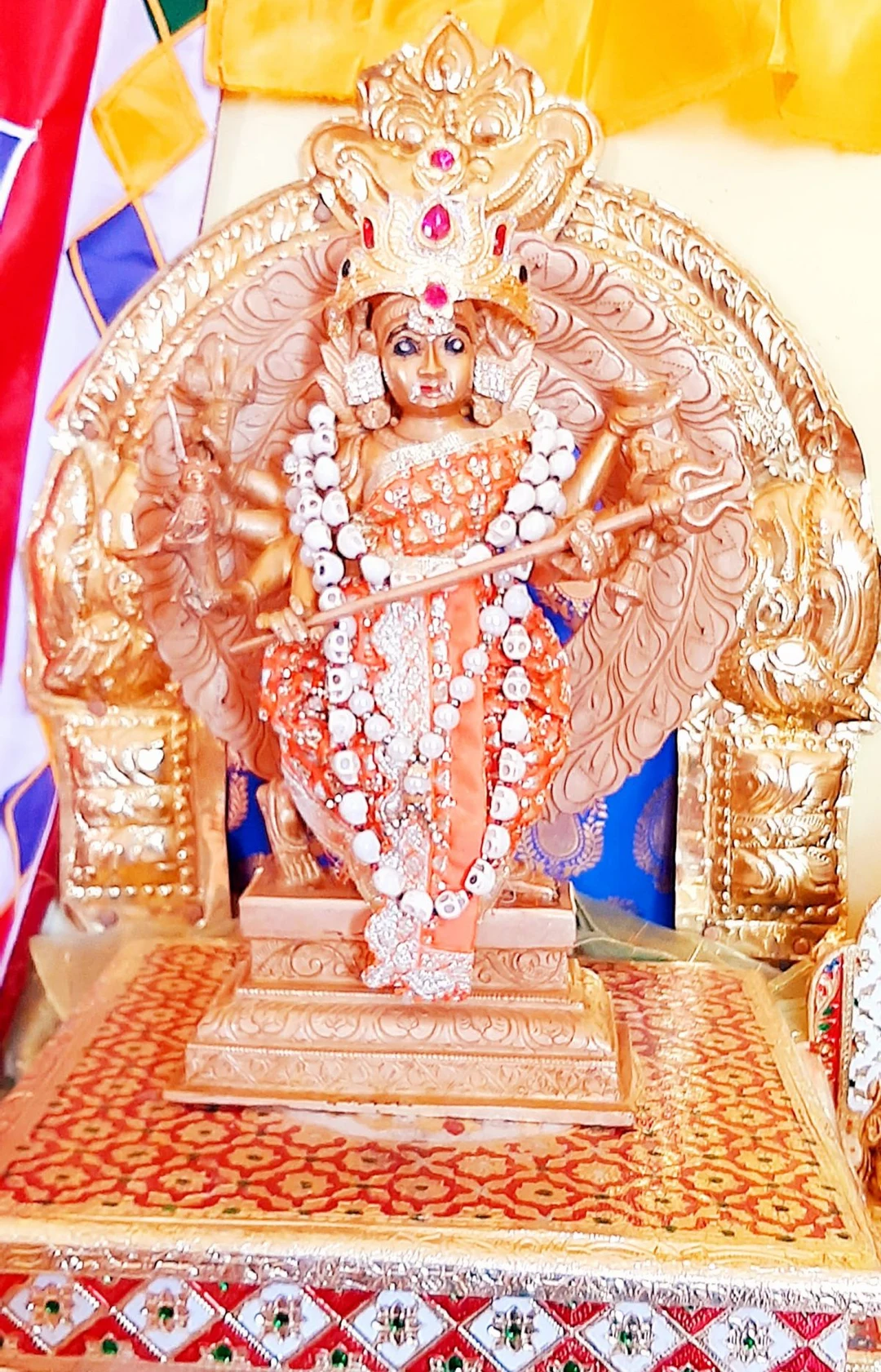
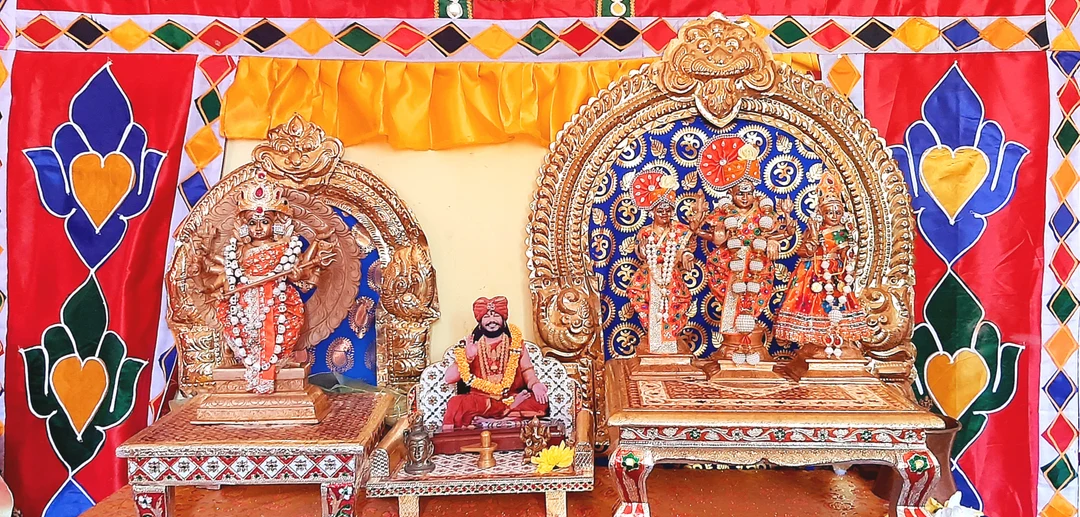
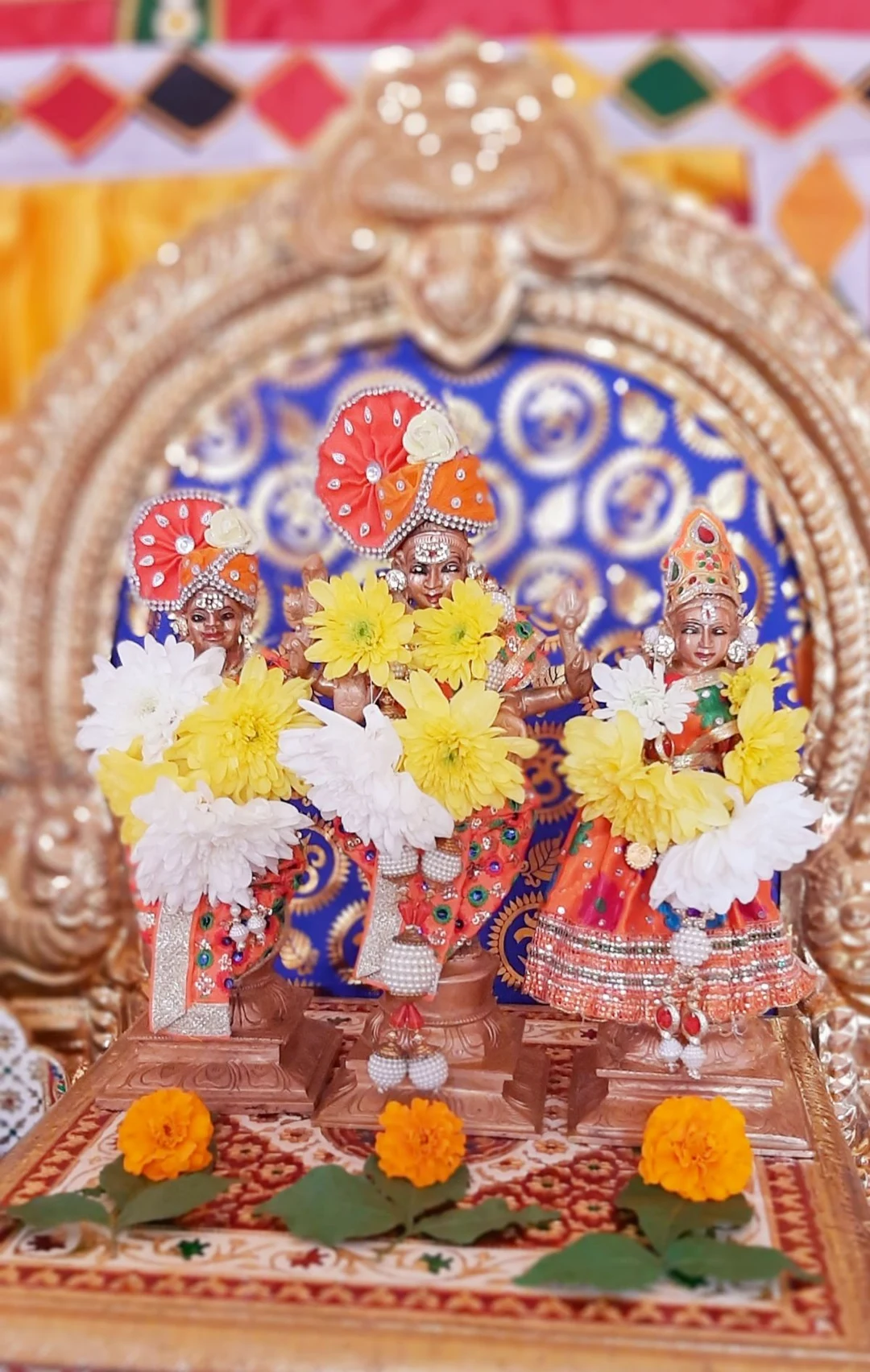
King Vallala Maharaja of the Hoysala dynasty (the last of the dynasty of Hindu Kings that ruled the kingdom of Tiruvannamalai, South India) was an ardent devotee of Lord Arunachaleswara (Paramashiva as He is known in Tiruvannamalai, The SPH’s birthplace). He built a huge Eastern-side temple tower in the Arunachaleswarar Temple in Tiruvannamalai between 1318 AD and 1343 AD. The tower is named after him - as the Vallala Maharaja Gopuram. The King prayed to Lord Arunachaleshwara for an heir and was blessed in return that The Lord Himself would be his son. Keeping up His word till date, the Lord performs the final rites for the King as his son would, every year on Masi Makha (the Tamil month Masi when the star Makha ascends in the stellar constellation).

The day following the final rites to King Vallala Maharajah (which happened on the 26th of February this year), Lord Arunachaleshwara Himself is crowned as the King of the Tiruvannamalai Kingdom, through a historic and grand ceremony at the Arunachaleshwara temple, Periya Naicker shrine. Therefore Lord Arunachaleshwara is not only the religious and spiritual head of Tiruvannamalai but the political head, King also. The ritualistic ceremony comprises the sacred bath - abhishekam - to Arunachaleshwara and a grand flower and jewel decoration adorning Him with the King’s crown and Royal turban. The ceremony is called Magudabhishekam (meaning coronation) and the decoration is called Raja alankaram (Raja - King; Alankaram - decoration). The ceremony commences at 5 pm and concludes at around 8:30 pm, witnessed by thronging devotees.

All the KAILASA’s temples worldwide will be performing the abhishekam and coronation to the deity of Arunachaleshwara and to the deity of The SPH JGM HDH Bhagavan Nithyananda Paramashivam who is the 1008th incarnation of Paramashiva, Lord Arunachaleshwara Himself, thus celebrating this historic event worldwide. The SPH has participated in this event every single year as a child in Tiruvannamalai till He was 17 years, when He left Tiruvannamalai for the international explosion of the Mission of KAILASA.

prayers to Paramashiva for the Atma Shanti of Mr. Micheal Somare

The Supreme Pontiff Of Hinduism, Jagatguru Mahasannidhanam, His Divine Holiness Bhagavan Nithyananda Paramashivam prays to Paramashiva for the Atma Shanti of Mr. Micheal Somare - the founding father and 4 times prime minister of Papua New Guinea.

The Department of External Affairs in collaboration with the Department of Religion & Worship would be offering Maheshwara Puja at the feet of The SPH for the Atma Shanti of the founding father of Papua New Guinea and requests healing for the people of Papua New Guinea for the lost of their leader. https://www.reuters.com/.../us-png-politics-somare...

photos

FB-Photos-of-the-Day

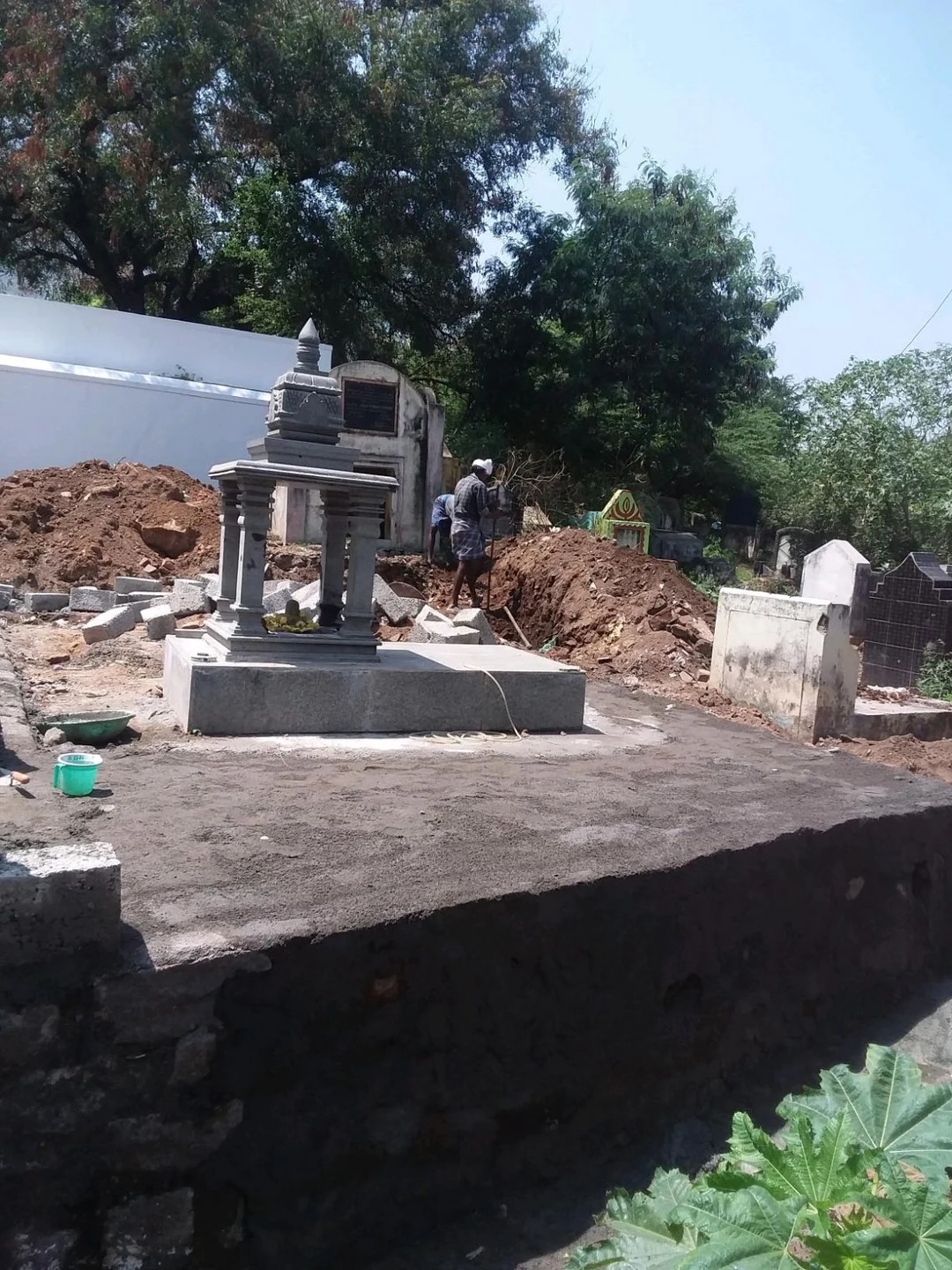
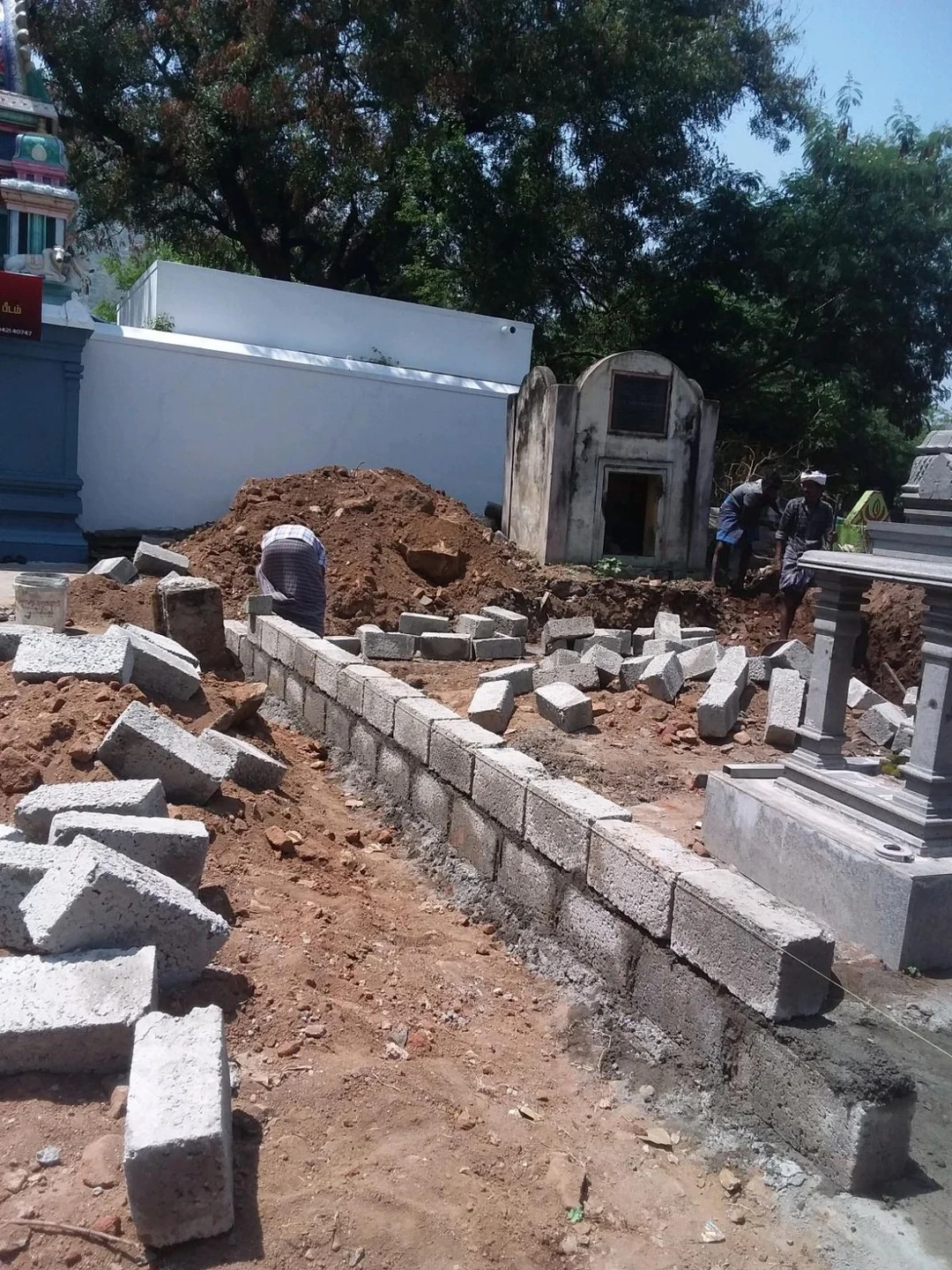
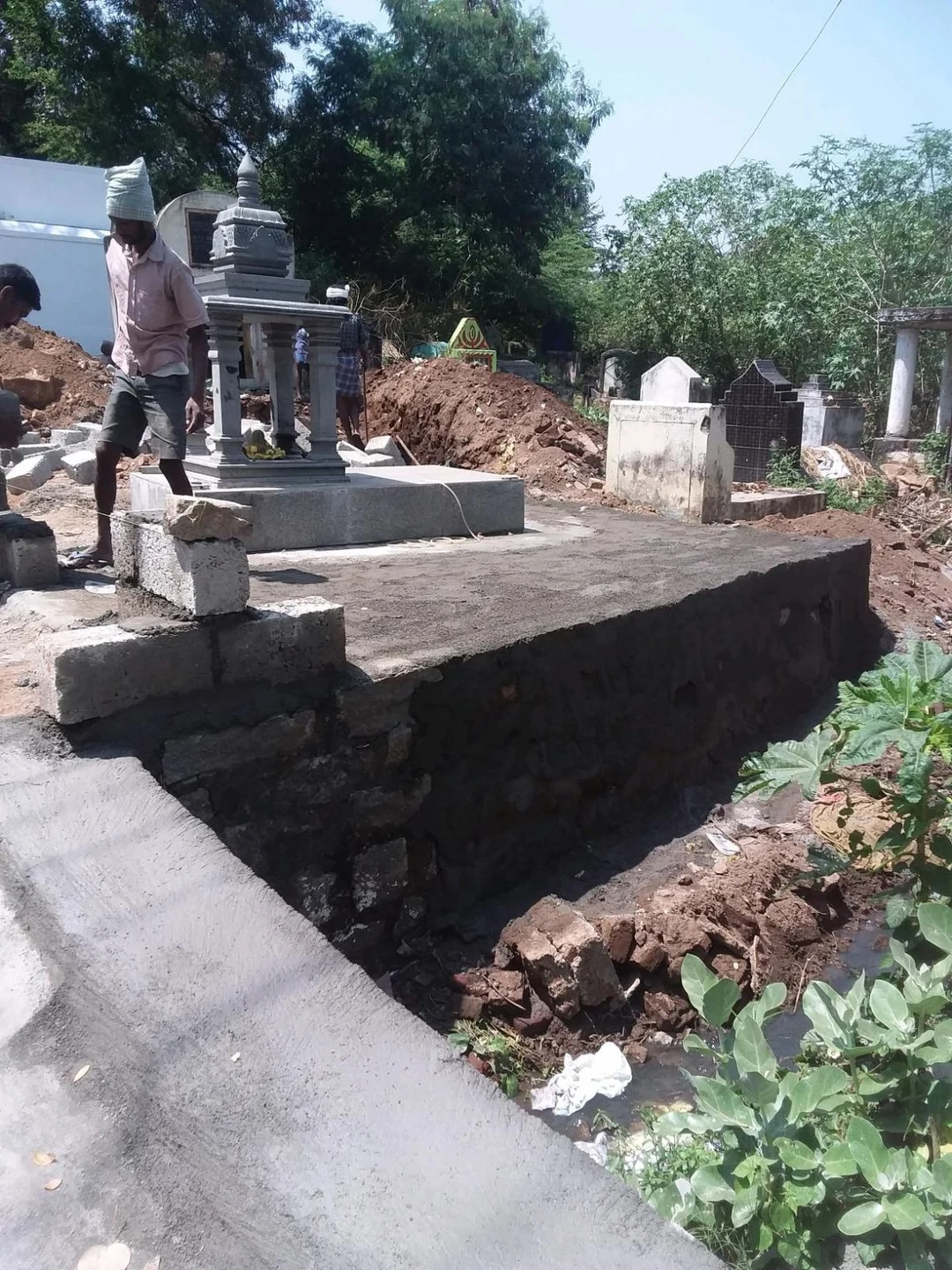
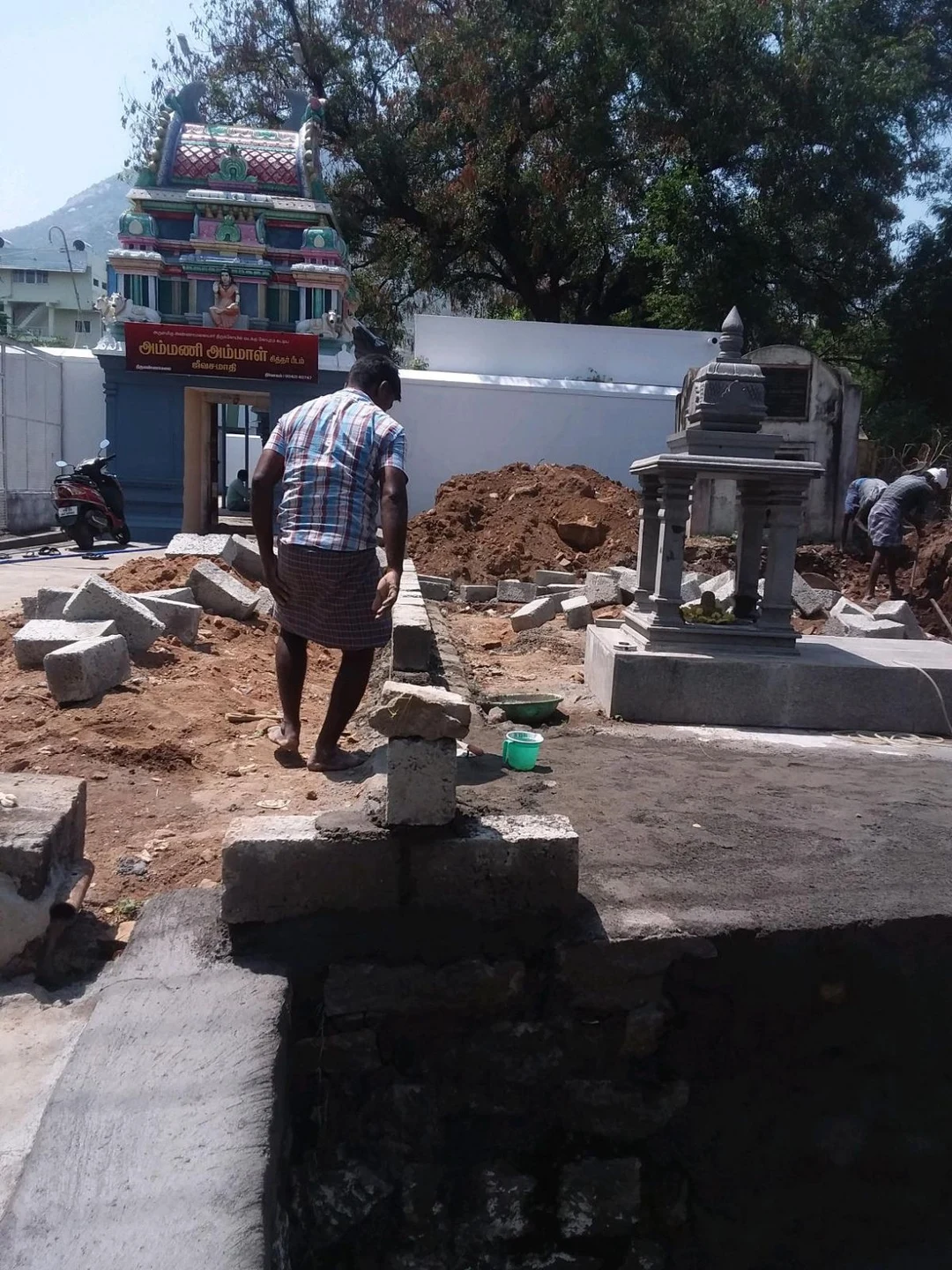
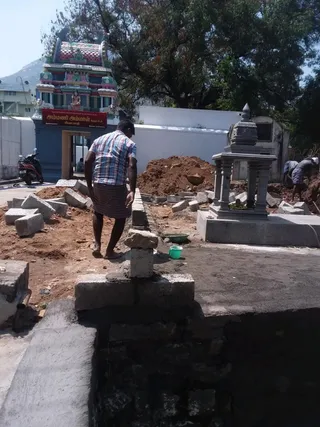
Construction work in progress for expansion of the Jeeva Samadhi of Mata Vibhutananda Puri in Tiruvannamalai

  • Construction for expansion of the Jeeva Samadhi (place of final resting of mortal frame) of Brahmayogini Mata Vibhutananda Puri, Guru of The SPH continues to happen in Tiruvannamalai (The SPH's birthplace).
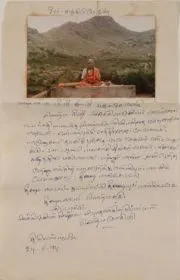
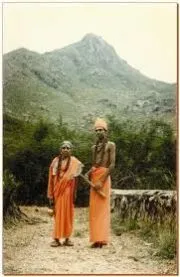
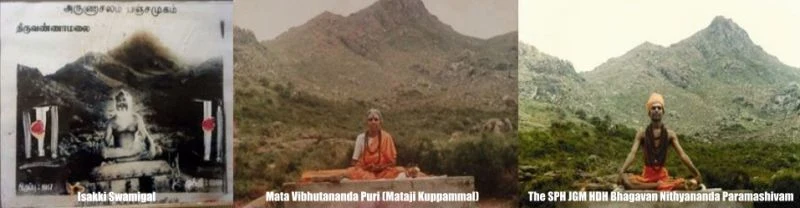
  • Mata Vibhutananda Puri (Mataji Kuppammal) was the only disciple of Isakki Mahamunivar of Tiruvannamalai and Guru of The SPH in the fields of Vedanta, Tantra and Sri Vidya.
  • She coronated The SPH as her only successor through an official ceremony and coronation document dated 24 May 1994 (when The SPH was 16 years old).
  • The SPH has undertaken the initiative to expand and build the Jeeva Samadhi of not only Mata Vibhutananda Puri but all His Gurus in Tiruvannamalai.
  • With the blessings of The SPH, Sanyasis of KAILASA's Nithyananda Order at KAILASA in Tiruvannamalai, are expanding the Jeeva Samadhi of Mata Vibhutananda Puri.
  • The Jeeva Samadhi is opposite Isanya Lingam (one of the eight Shivalingas for the eight cardinal directions in the Mountain Path around the Arunachala Hill).
  • It was established in January of 1995 by The SPH in the presence of the family members of Mata Vibhutananda Puri.
  • Mata Vibhutananda Puri had instructed The SPH about it while she was in the body (when The SPH was barely 17 years of age).
  • The SPH installed a Shiva Linga on the Jeeva Samadhi and performed the rituals as she had instructed.
  • The samadhi is being expanded to offer a space where disciples can come and offer Guru Puja and meditate as well.
  • This will serve as an energy hub in the enlightenment ecosystem of KAILASA for seekers.
  • The Guru-disciple tradition is the backbone of Hinduism through which the enlightenment Science is kept alive and transmitted from generation to generation.
  • The SPH works untiringly to preserve and protect the Guru-disciple tradition in every dimension possible with the deepest of gratitude.
  • In these photographs, you can see the Coronation document and photographs of Isakki Swamigal, Mata Vibhutananda Puri and The SPH.

Link to Facebook Page

https://www.facebook.com/ParamahamsaNithyananda/videos/811071319617653
https://www.facebook.com/ParamahamsaNithyananda/posts/4941738812580596
https://www.facebook.com/ParamahamsaNithyananda/videos/265369221813826
https://www.facebook.com/ParamahamsaNithyananda/videos/137471101513224

KAILASA FAMILIA PORTUGUESA, PORTUGAL on 2/27/2021

Original wiki page
Contents

Daily Update - PDB + Daily pictures-Bhava Samadhi Darshan

Event Details
Participants Count3
Event TypeOnline
Was Food Served in Event?Yes
Count of Meals Served5
Volunteers Count1
Event Duration

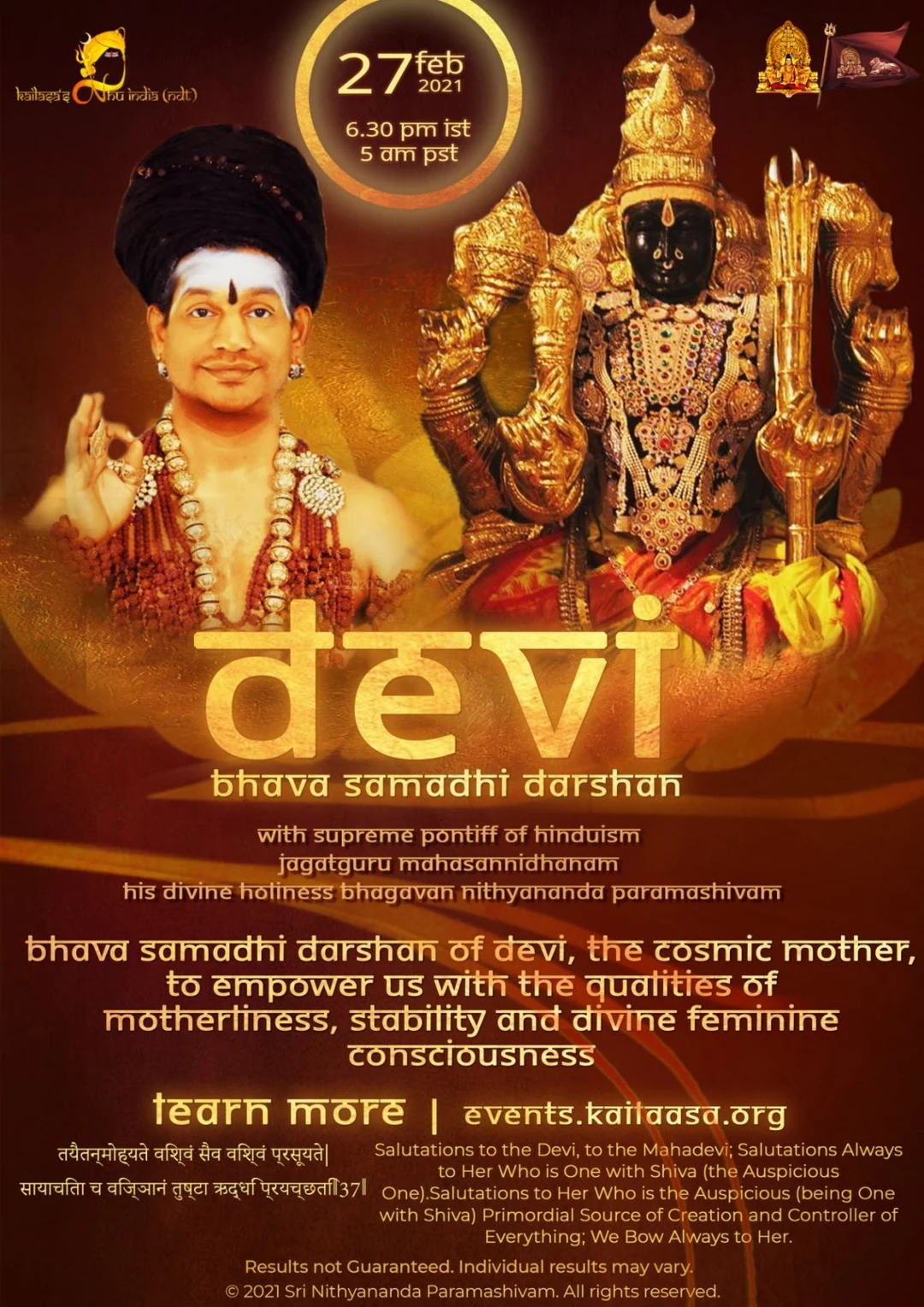
The fellow EKAILASIANS, Devotees and Disciples joined the LIVE DEVI BHAVA SAMADHI DARSHAN of The Supreme Pontiff of Hinduism, Jagatguru Mahasannidhanam, His Divine Holiness Bhagavan Nithyananda Paramashivam on:

27th February, 2020

Pictures from the day
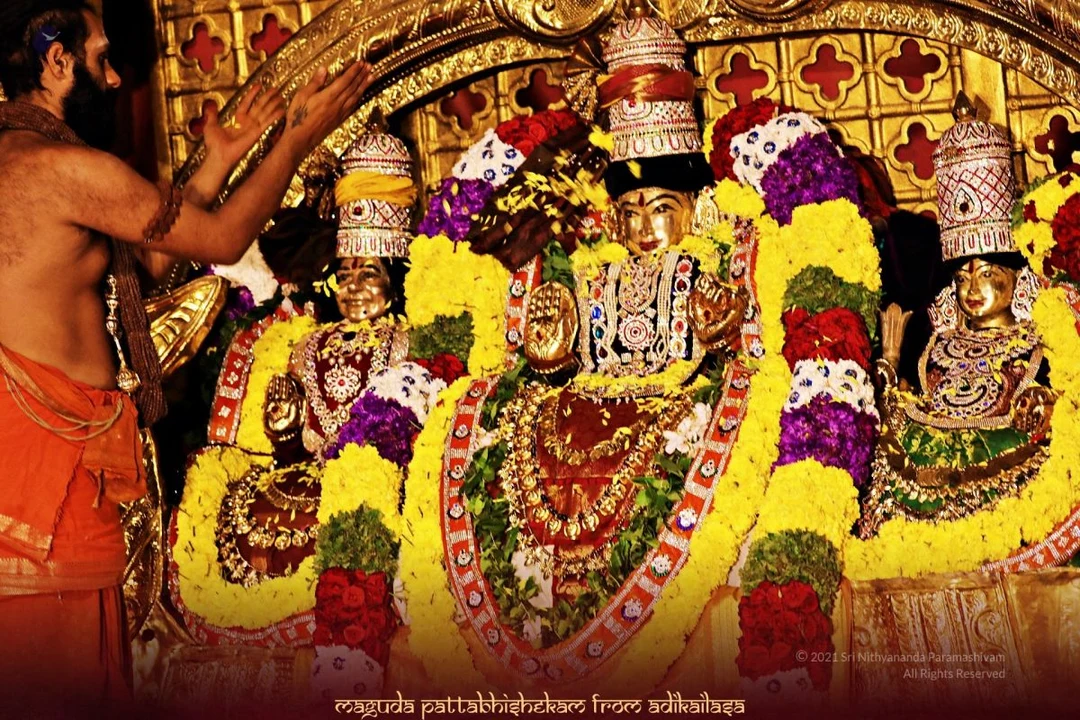
KAILASA HOUSTON, USA on 2/27/2021

Original wiki page
Contents

Daily Update - PDB + Daily pictures

Event Details
Participants Count14
Event TypeIn-Person
Was Food Served in Event?Yes
Count of Meals Served14
Volunteers Count14
Event Duration

Temple Activities

  1. 1. Suprabatham

Among all the Sevas offered , the Suprabhata Seva is considered very significant and much sought after because it is in the form of singing the Hymn of Morning Salutation to the deities. Only after the recitation of this hymn the doors of the Sanctum Sanctorum of the swamy is opened. Morning Pujacharya of the Day - Umesh Ayya

  1. 2. Morning Puja
Guru Puja

“Guru Pooja is a process of making yourself , so that the divine also has no choice but to be with you.” Guru Pooja - you give yourself to a process and make yourself completely choiceless. If you create such power about simple things that you do, then the benefit of sadhana will multiply manifold.

Shiva Puja

Removes ill-effects of planetary Doshas of malefic planets like Rahu Ketu, Saturn and any of those during their unfavorable cyclic transit. Leads revolutionary changes in physical-mental well being of devotees, blessing them safety from deadly diseases. Perpetual prosperity and gainful results in business, career, business etc, Protection from untimely death if devotees chant mantras and Invoke the blessings and grace of ParamaShiva.

  1. 3. Masai Magam

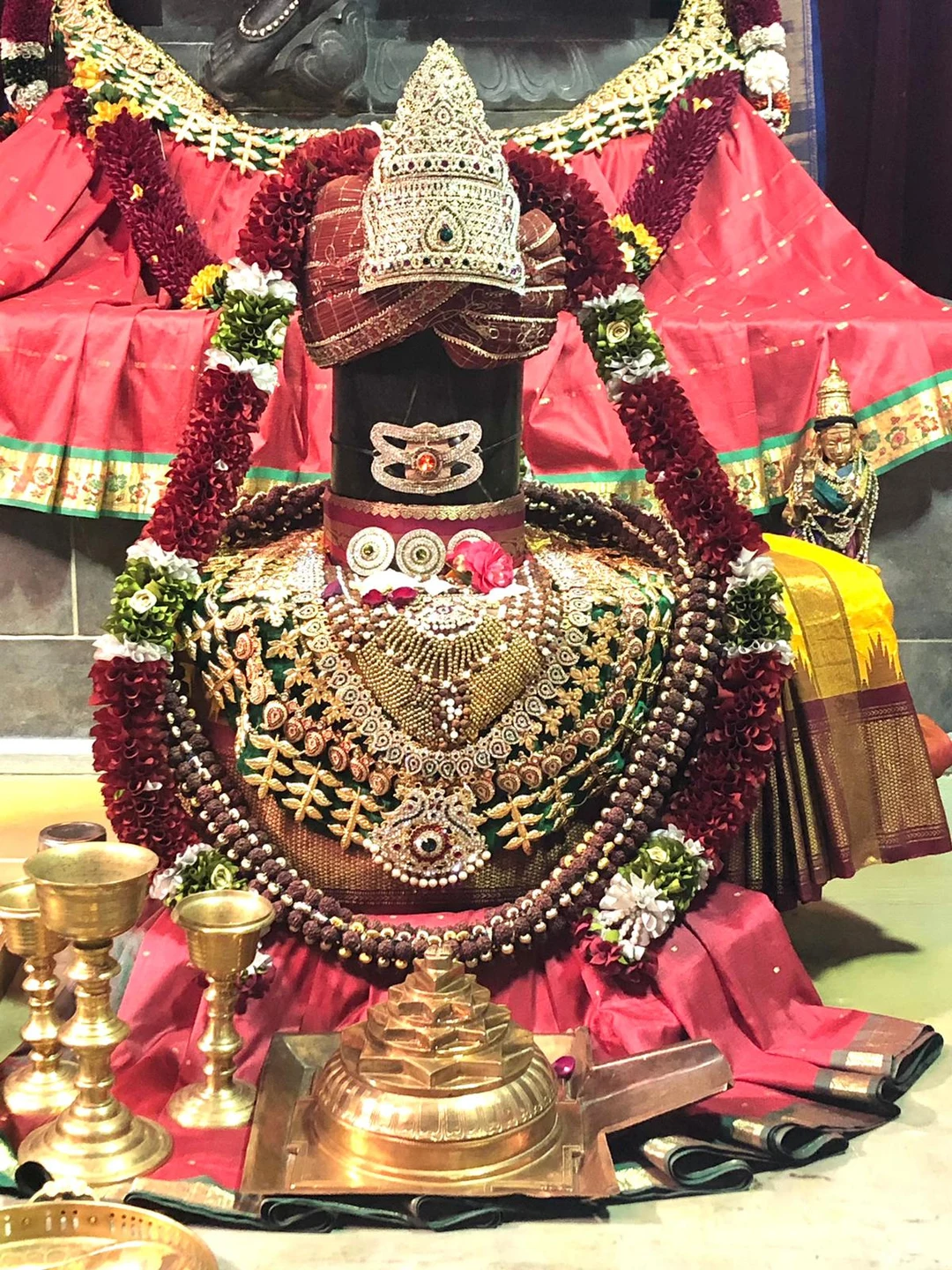
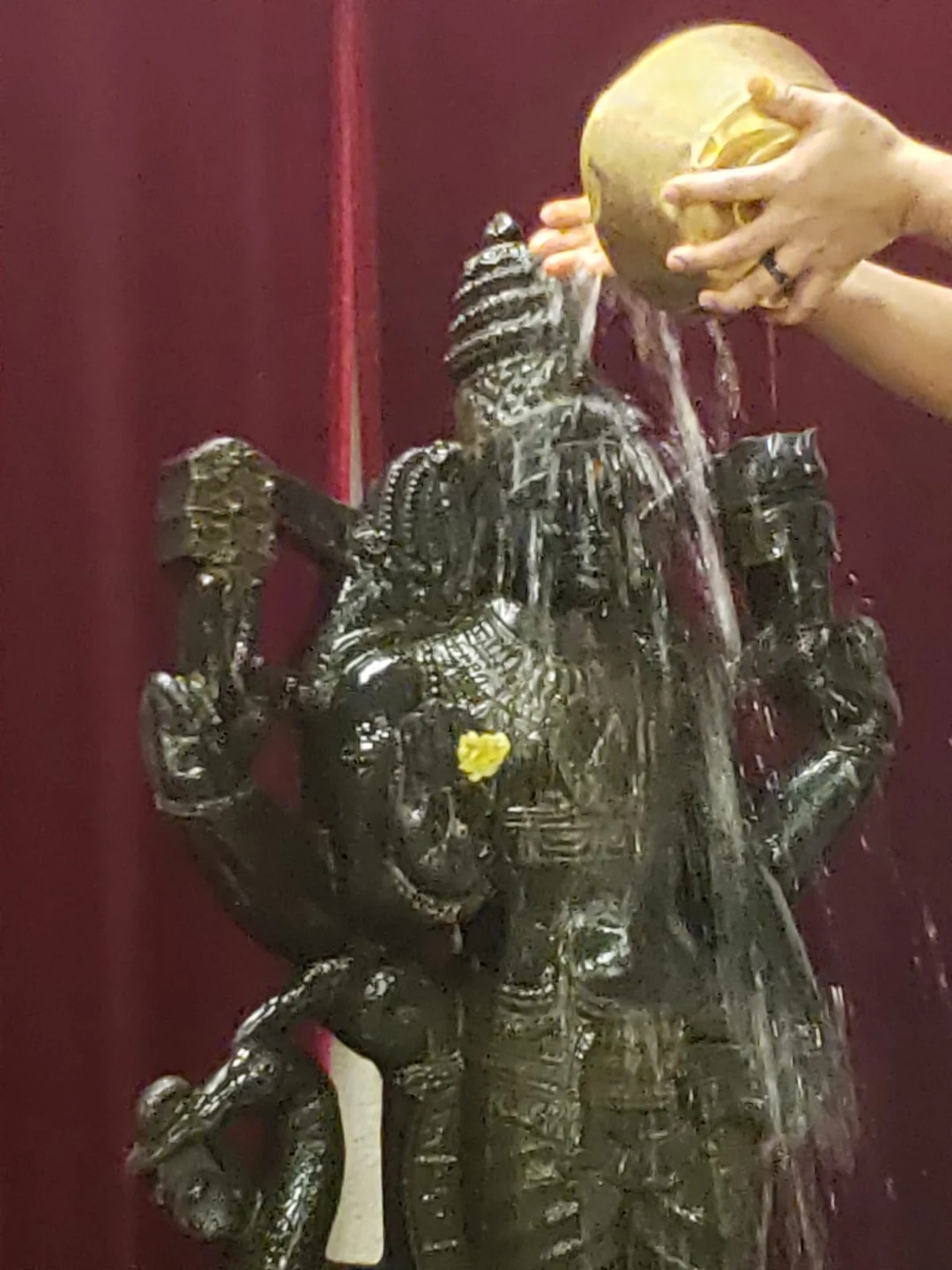
Kailasa Houston performed, 11 abishekam to the Moolavar with Kreetam & Turban.

The SPH JGM HDH Bhagavan Nithyananda Paramashivam who is the 1008th incarnation of Paramashiva, Lord Arunachaleshwara Himself, thus celebrating this historic event worldwide. The SPH has participated in this event every single year as a child in Tiruvannamalai till He was 17 years, when He left Tiruvannamalai for the international explosion of the Mission of KAILASA.

  1. 4. Volunteers Participated - 14
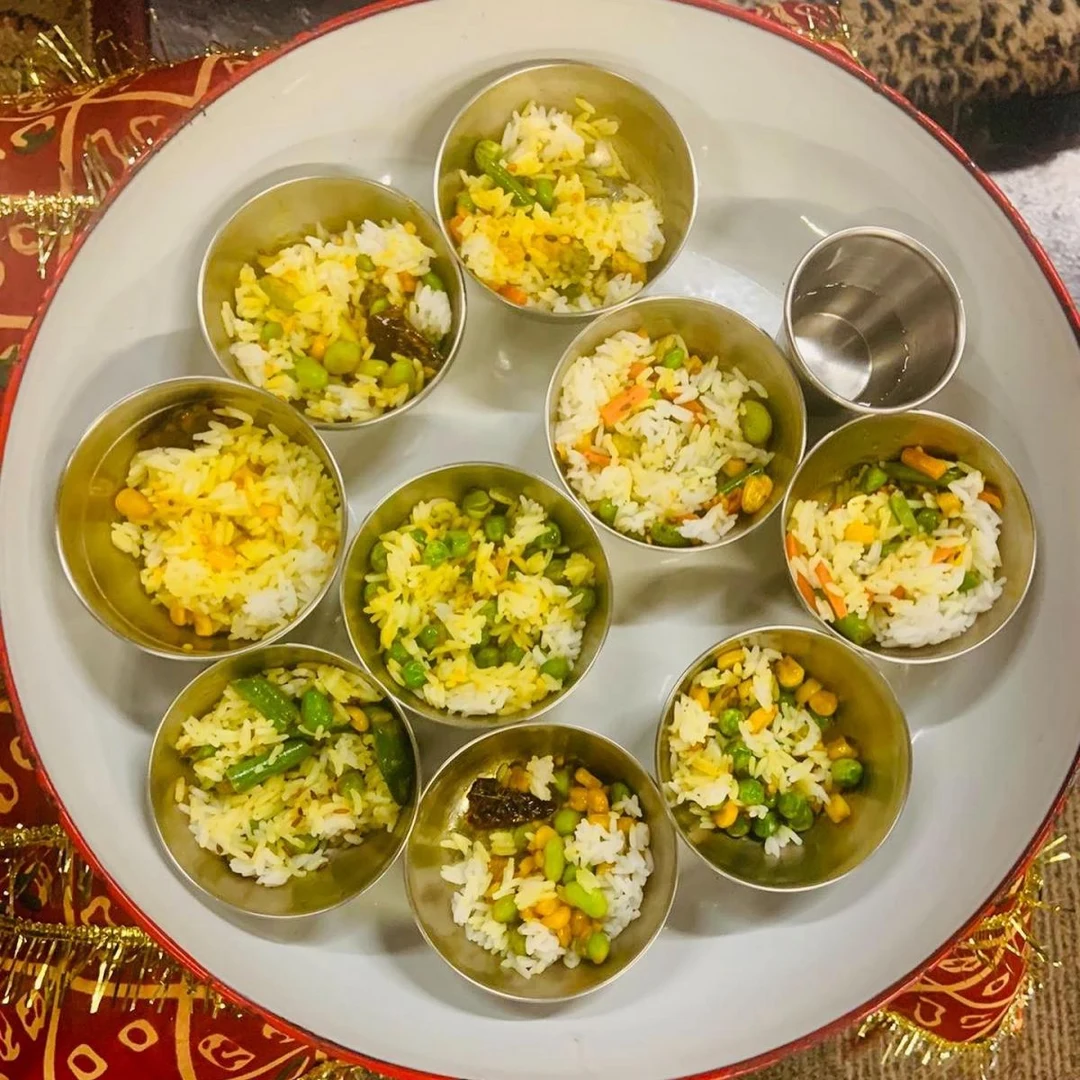
  1. 5. Neivadhyam - Tamrind Rice & Sweet Pongal.
  1. 6. Devi Bhava Darshan - Kailasa Houston participate in the Divine sacred ceremony.
  1. 7 Evening Guru Puja Shiva Puja - Evening Pujacharya of the day - Ma.Shakthiroopa
  1. 8 Vilaikku Puja - Ma.Cristy performed this sacred puja.

Thiruvilakku Pooja aims at collectively worshipping Mahalakshmi by a large number of women at a time. This is said to bring prosperity to the home and peace to the world. It is mainly done for the well-being of the woman’s family; it brings all auspicious things to each and every member.

  1. 9 Palliarai

Palliyarai is a Tamil word used for the Sanctum Sanctoram in Hindu temples, the equivalent of Garbhagraha. It generally means the place for divine resting and is considered very holy by the Hindus. In many traditional Hindu temples, during the final pooja (prayer) of the day, the Bogha murties is typically escorted to the residing place and this generally happens around 9 PM in our temple.

  1. 10 Enriching Activity - Yoga session by Ma.Jyothi Konda

At HIS lotus feet Ma.ShivaJnana

Pictures from the day
KAILASA HYDERABAD, INDIA on 2/27/2021

Original wiki page
Contents

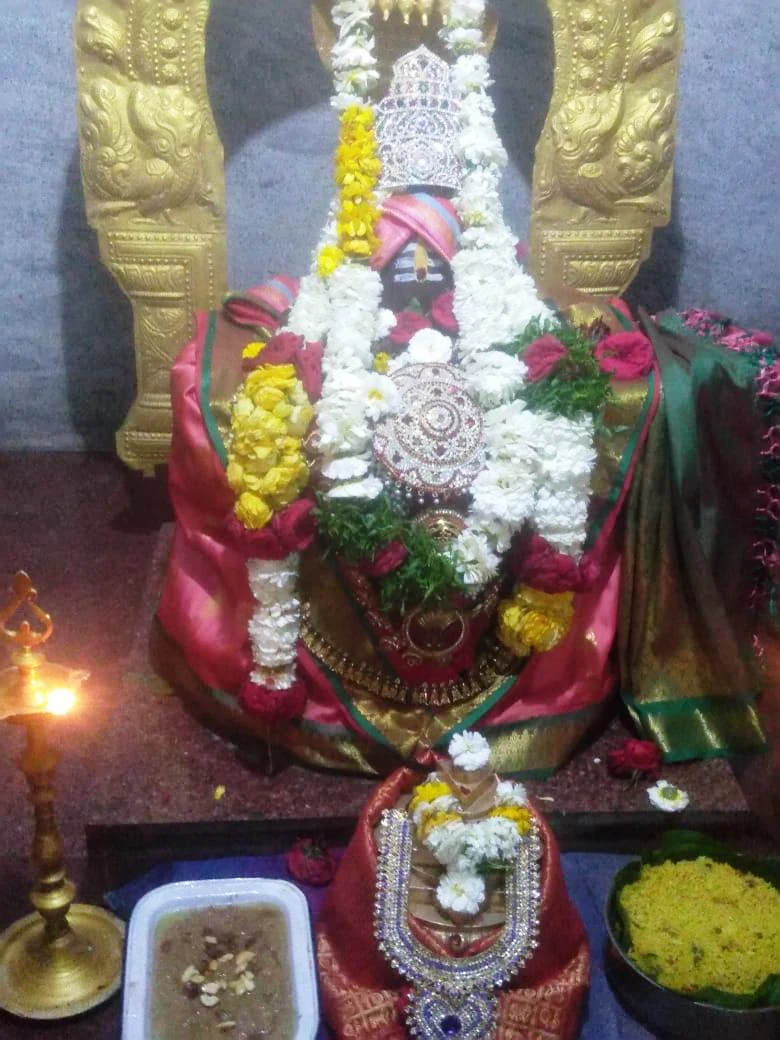
Makudabhishekam

Event Details
Participants Count11
Event TypeIn-Person
Was Food Served in Event?Yes
Count of Meals Served11
Volunteers Count4
Event Duration2 hrs

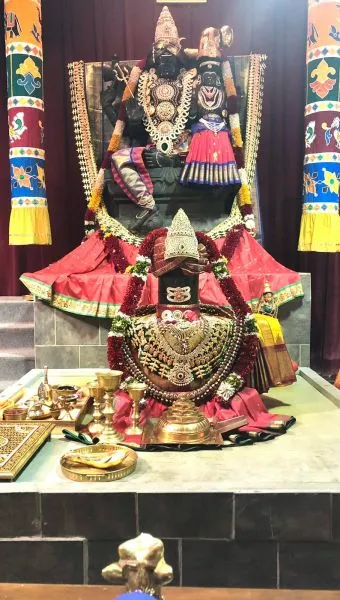
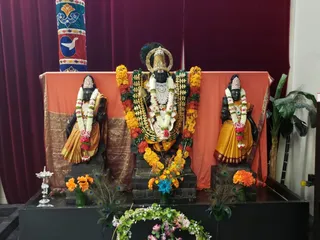
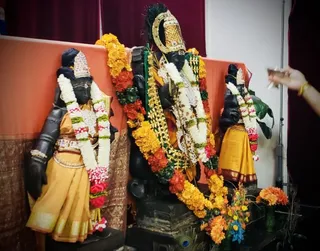
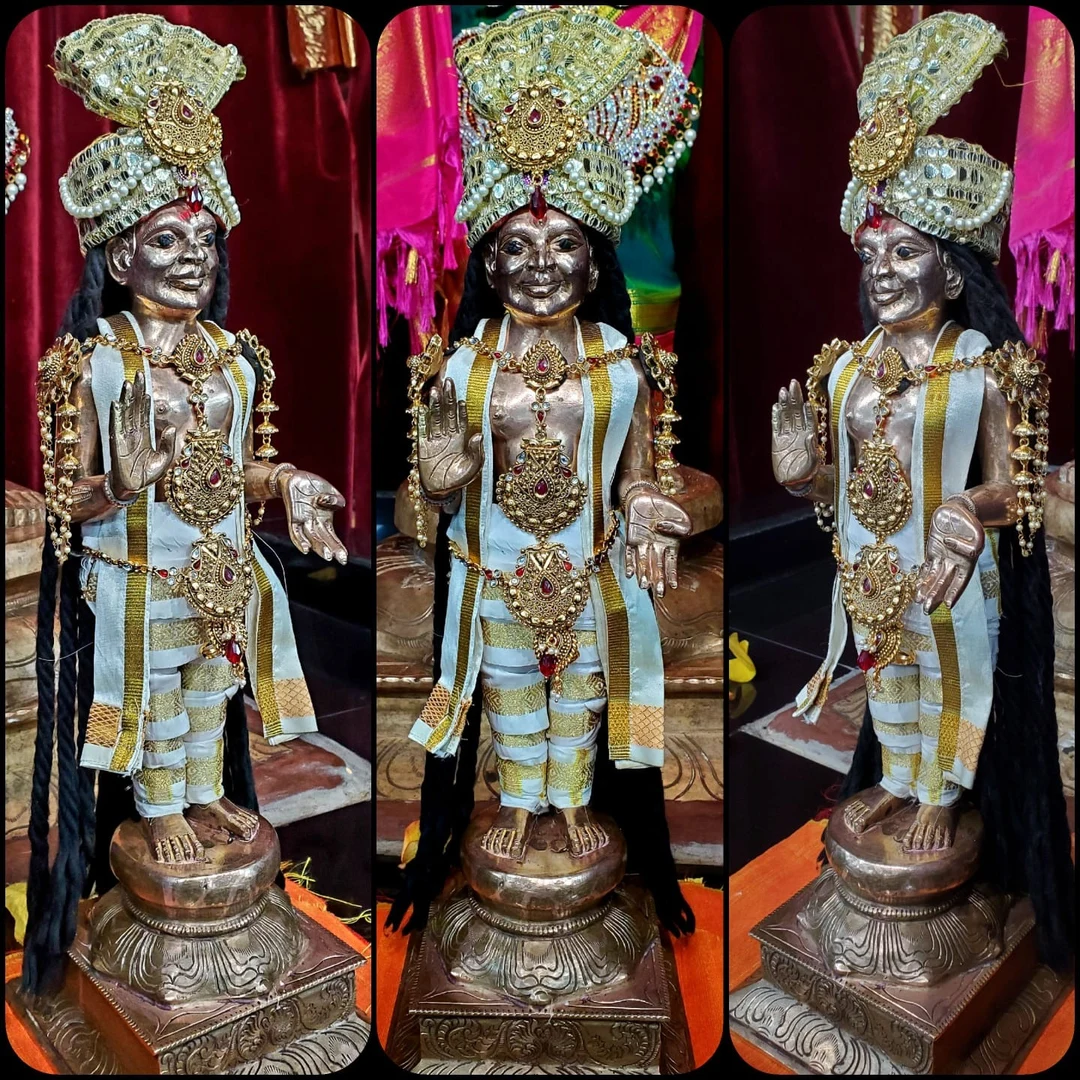
maguda pattabhishekam

Pictures from the day
KAILASA MAURITIUS on 2/27/2021

Original wiki page
Contents

Makudabhishekam-The Makudabhisekam on 27 February 2021

Event Details
Participants Count11
Event TypeIn-Person
Was Food Served in Event?Yes
Count of Meals Served18
Volunteers Count4
Event Duration3 hours

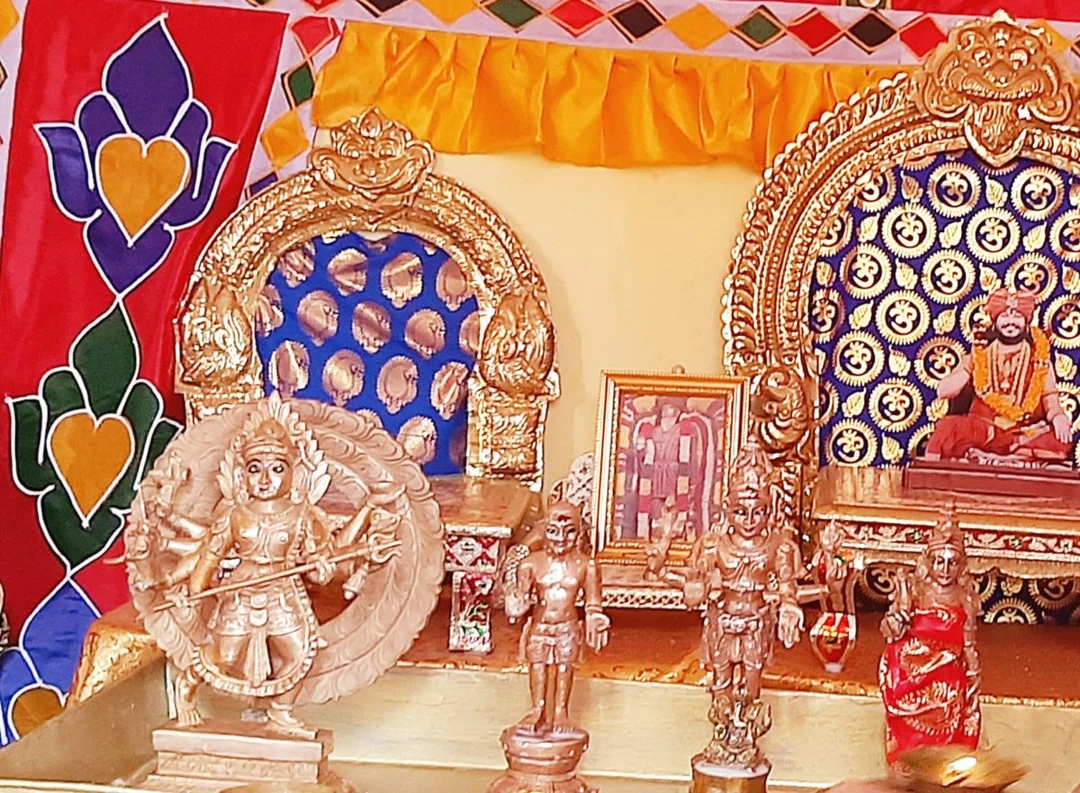
ON THE 27TH FEB (5PM) , MAGUDA PATTABHISHEKAM IS SCHEDULED FOR ALL OF OUR TEMPLES WORLDWIDE. WE WILL BE ALIGNING TO THE TIRUVANNAMALAI TEMPLE FOR THIS RITUAL. 

Coronation of Lord Arunachaleshwara (Paramashiva) as the King of the Tiruvannamalai Kingdom

King Vallala Maharaja of the Hoysala dynasty (the last of the dynasty of Hindu Kings that ruled the kingdom of Tiruvannamalai, South India) was an ardent devotee of Lord Arunachaleswara (Paramashiva as He is known in Tiruvannamalai, The SPH’s birthplace). He built a huge Eastern-side temple tower in the Arunachaleswarar Temple in Tiruvannamalai between 1318 AD and 1343 AD. The tower is named after him - as the Vallala Maharaja Gopuram. The King prayed to Lord Arunachaleshwara for an heir and was blessed in return that The Lord Himself would be his son. Keeping up His word till date, the Lord performs the final rites for the King as his son would, every year on Masi Makha (the Tamil month Masi when the star Makha ascends in the stellar constellation).

The day following the final rites to King Vallala Maharajah (which happened on the 26th of February this year), Lord Arunachaleshwara Himself is crowned as the King of the Tiruvannamalai Kingdom, through a historic and grand ceremony at the Arunachaleshwara temple, Periya Naicker shrine. Therefore Lord Arunachaleshwara is not only the religious and spiritual head of Tiruvannamalai but the political head, King also. The ritualistic ceremony comprises the sacred bath - abhishekam - to Arunachaleshwara and a grand flower and jewel decoration adorning Him with the King’s crown and Royal turban. The ceremony is called Magudabhishekam (meaning coronation) and the decoration is called Raja alankaram (Raja - King; Alankaram - decoration). The ceremony commences at 5 pm and concludes at around 8:30 pm, witnessed by thronging devotees. 

All the KAILASA’s temples worldwide will be performing the coronation to the main Shivalinga and to the deity of The SPH JGM HDH Bhagavan Nithyananda Paramashivam who is the 1008th incarnation of Paramashiva, Lord Arunachaleshwara Himself, thus celebrating this historic event worldwide. The SPH has participated in this event every single year as a child in Tiruvannamalai till He was 17 years, when He left Tiruvannamalai for the international explosion of the Mission of KAILASA. 

Pictures from the day
KAILASA MELBOURNE, AUSTRALIA on 2/27/2021

Original wiki page
Contents

Daily Update - PDB + Daily pictures

Event Details
Participants Count11
Event TypeIn-Person
Was Food Served in Event?Yes
Count of Meals Served19
Volunteers Count4
Event Duration

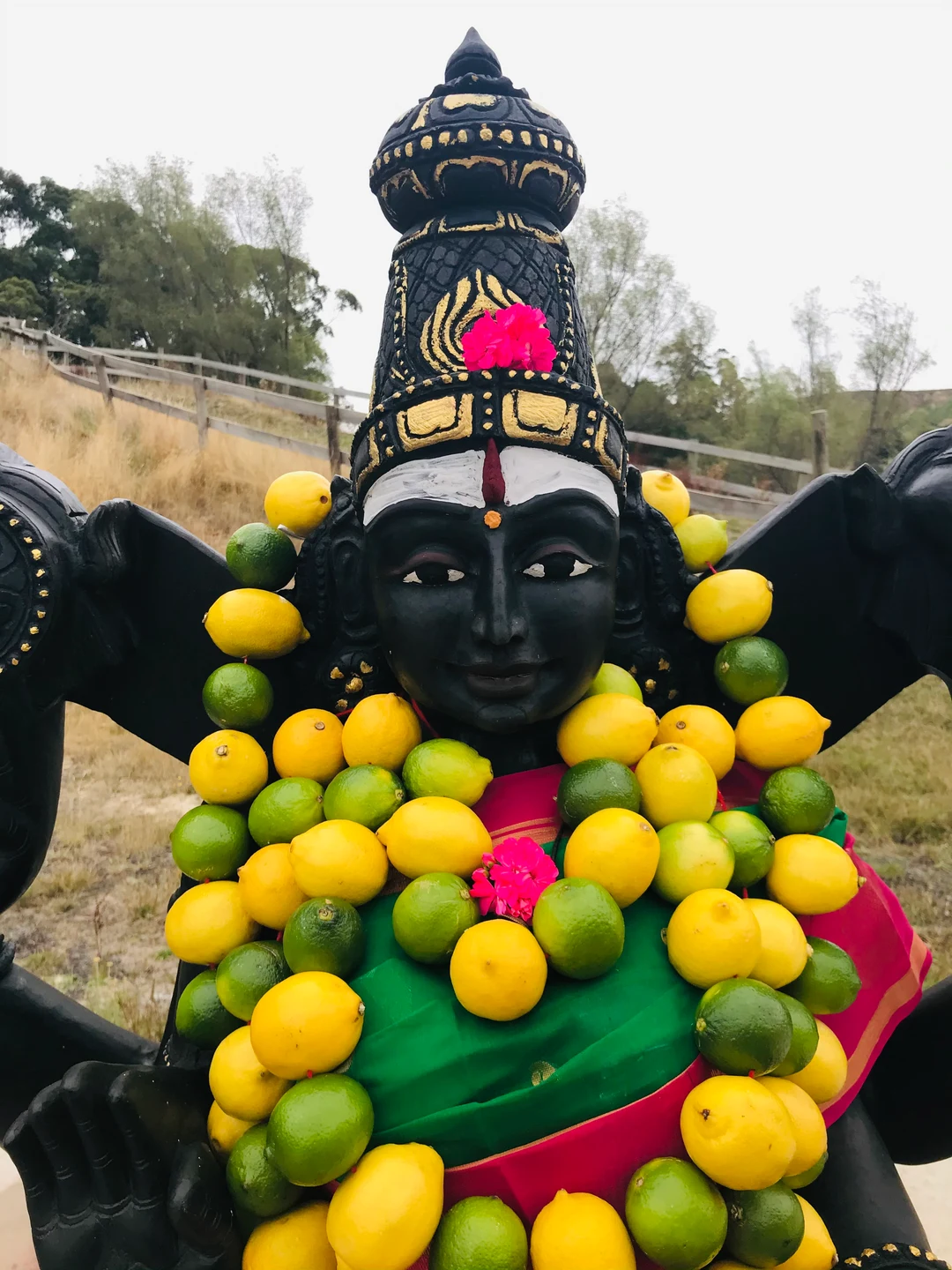
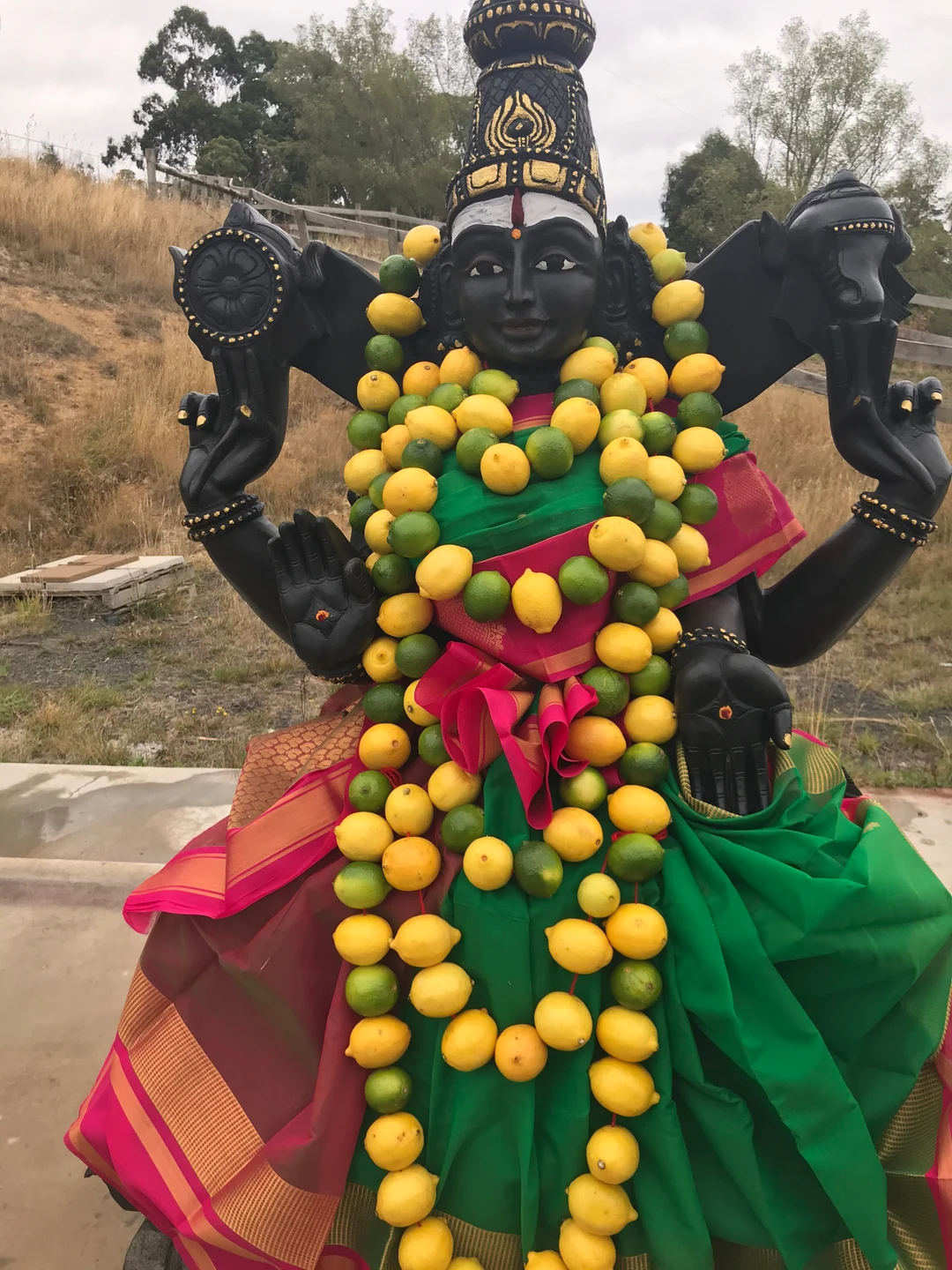
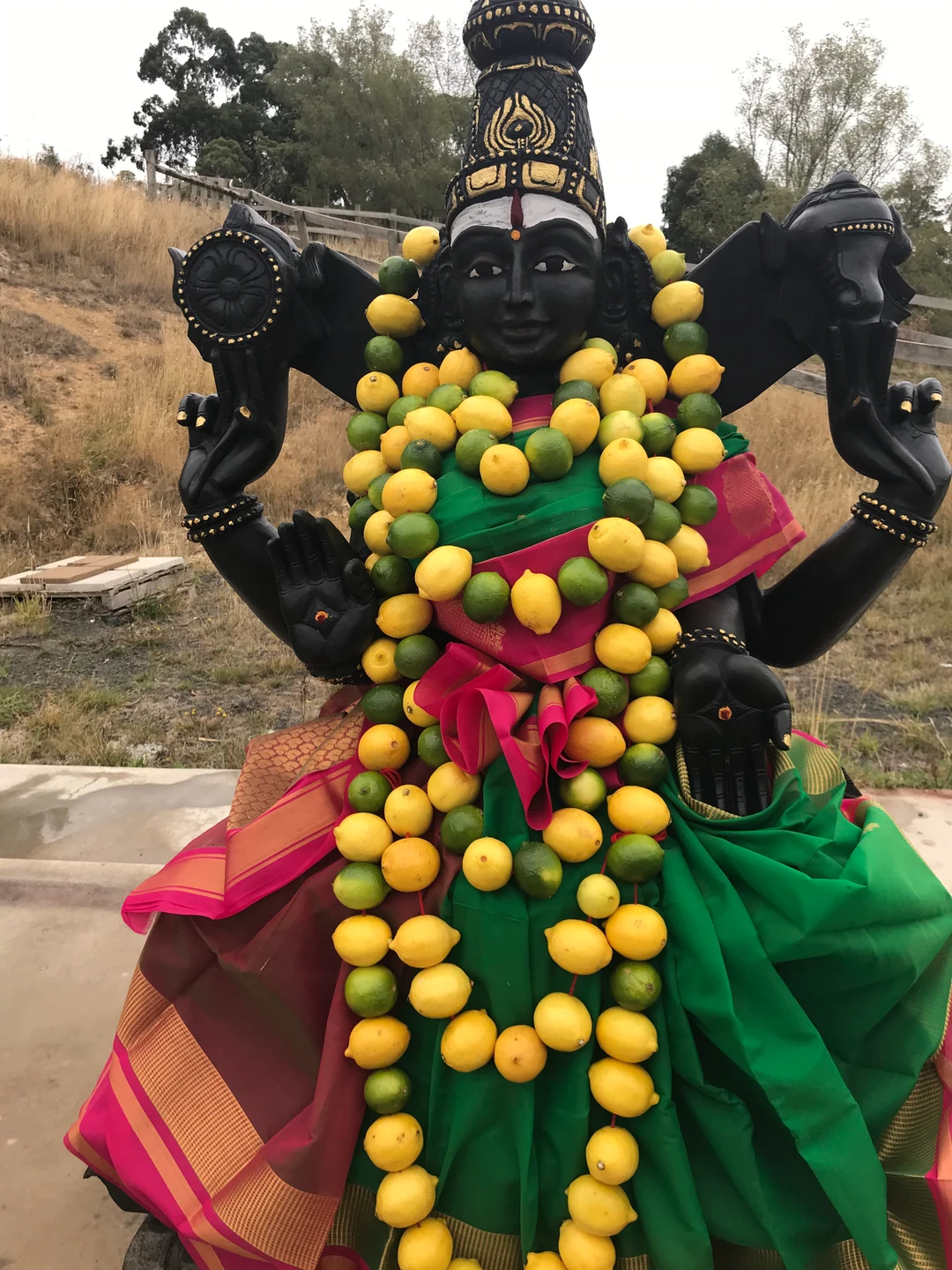
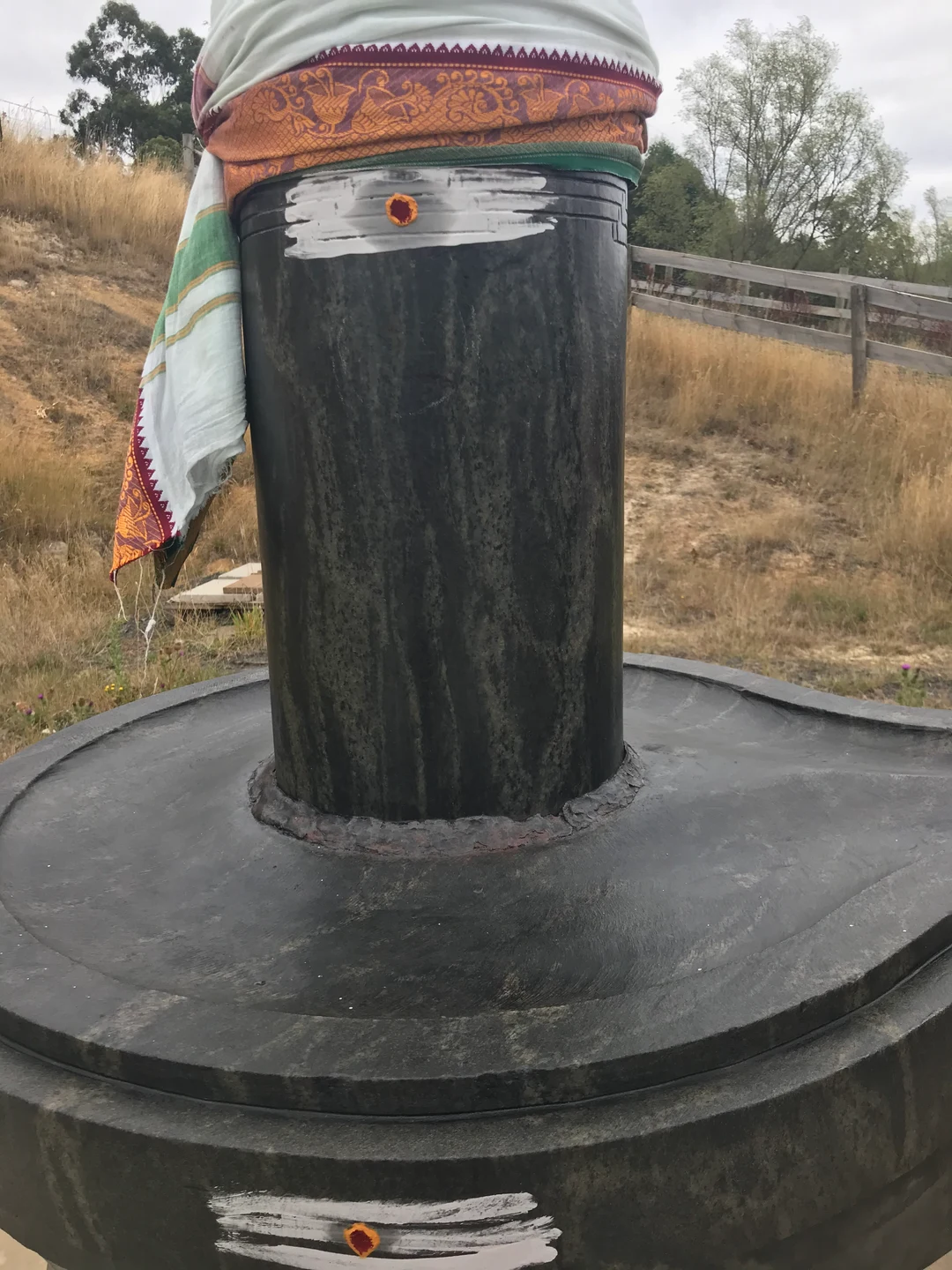
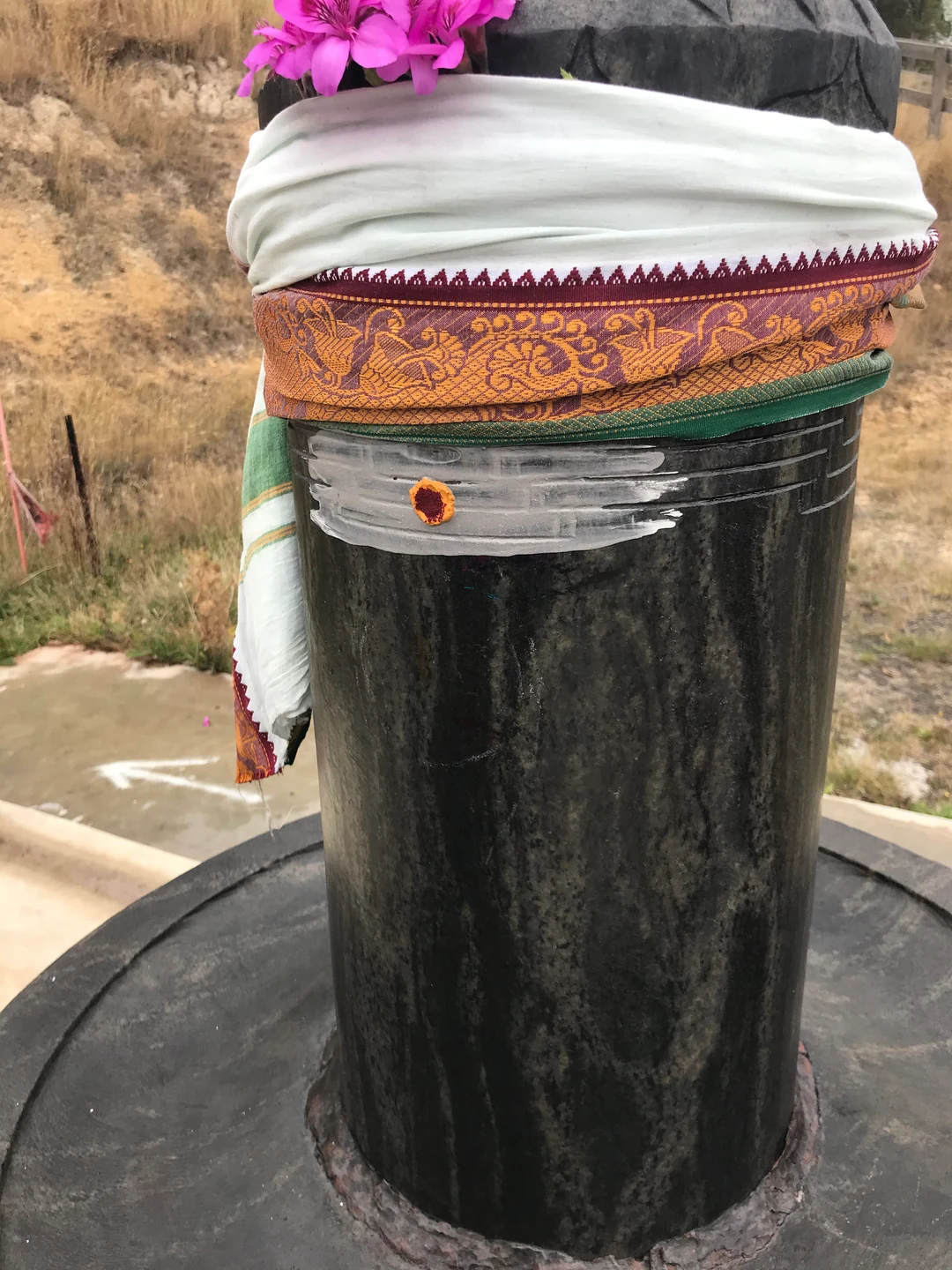
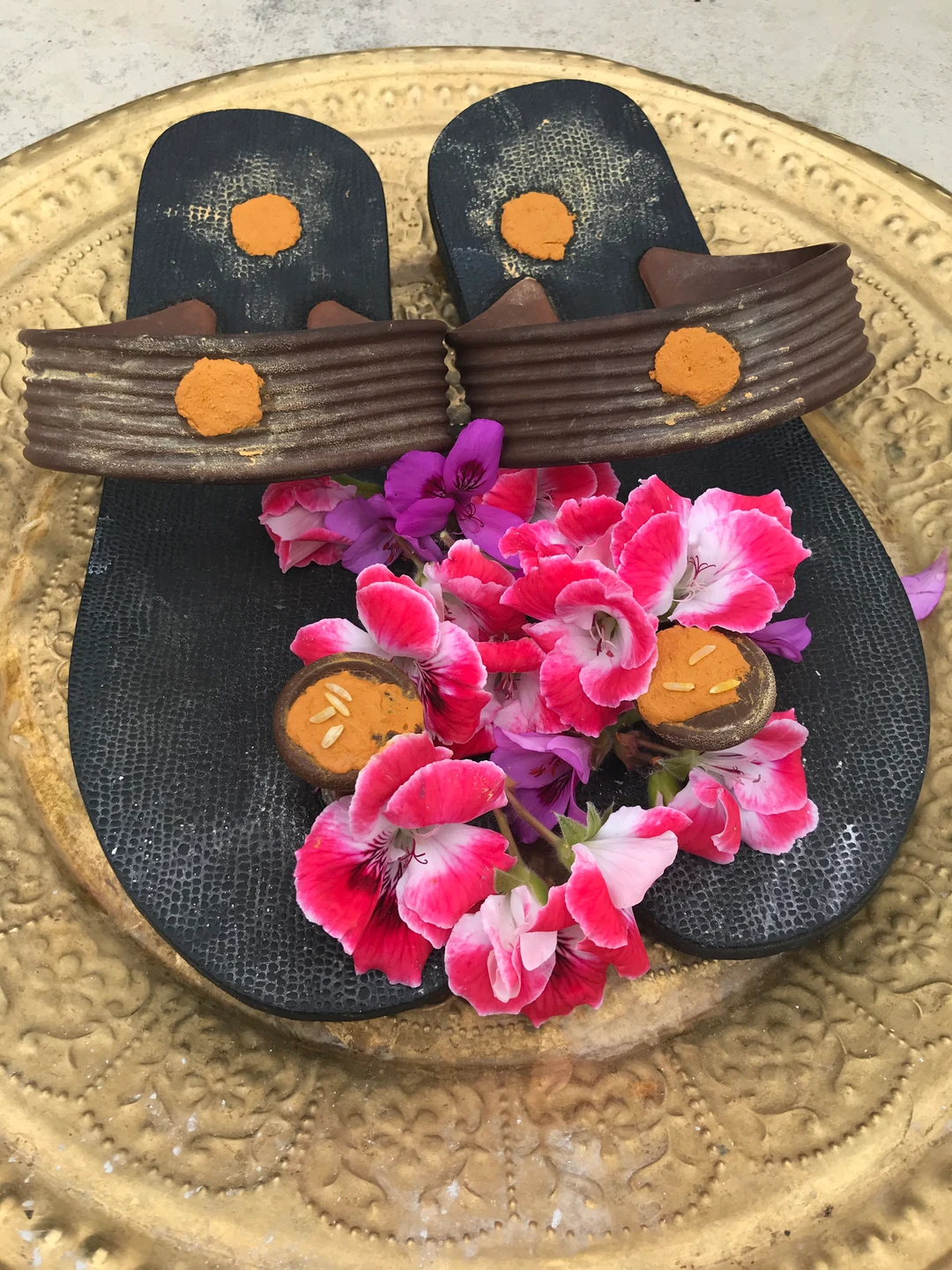
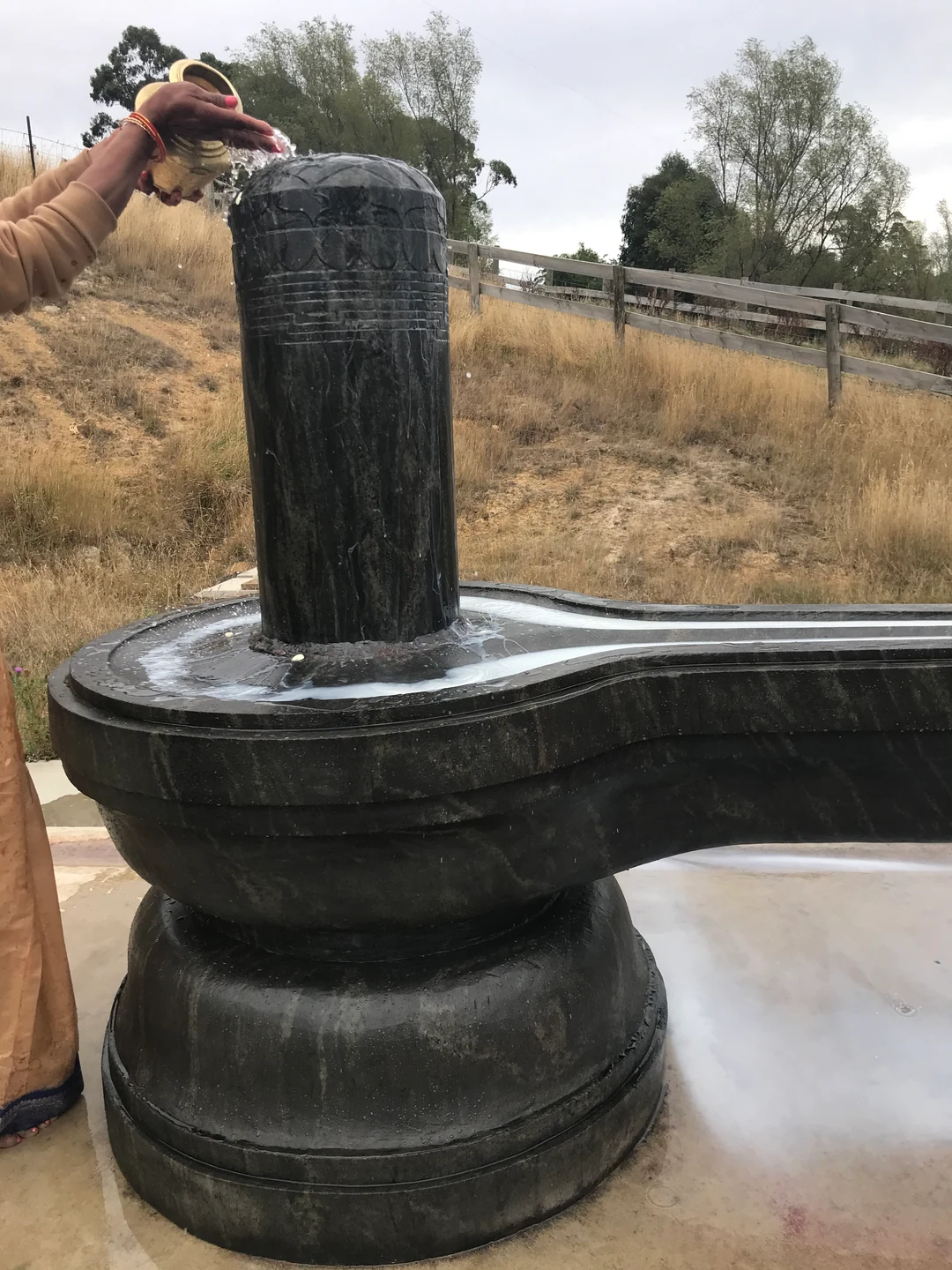
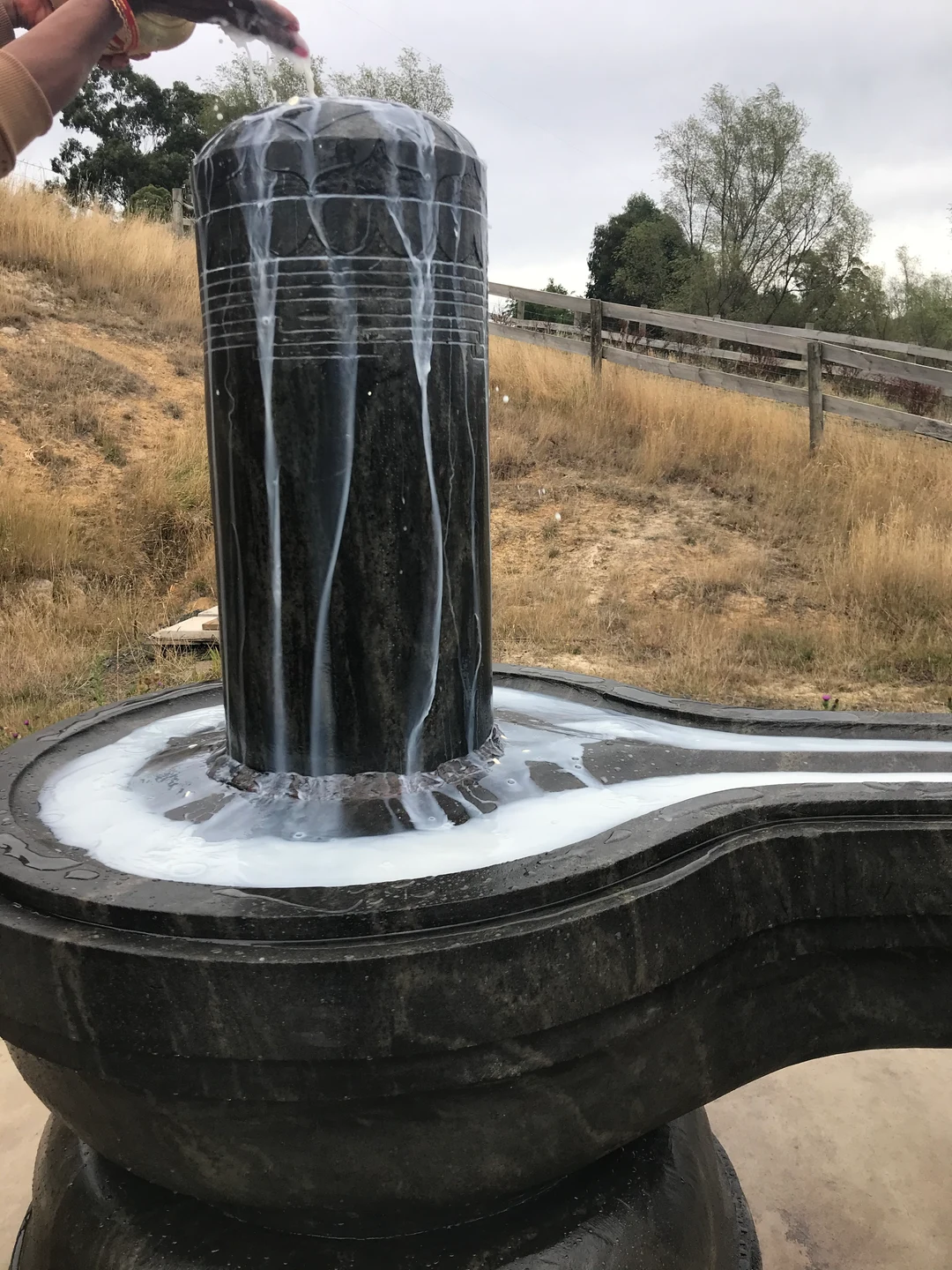
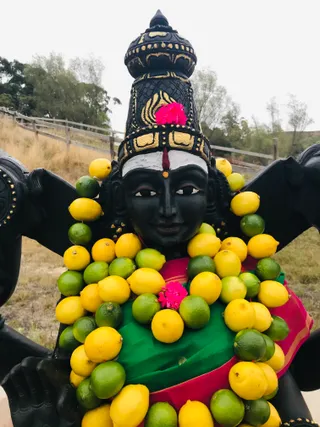
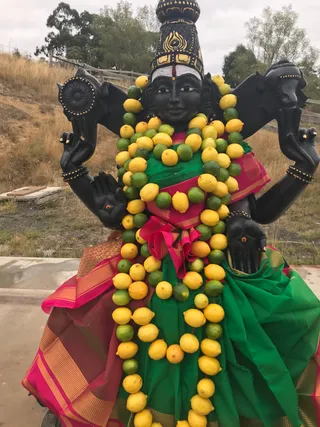
6AM Suprabhatam | Guru Puja and Paramashiva Puja | offering of Naivedhyam | taking Padukas down to the temple | evening naivedhyam | Abhishekam and Alangkaram for Devi Mookambika and Shiva Linga. Offered 108 Lemon Mala, Naivedhyam, Dhoopa, Deepa and Aarathi. 10:30 PM Maguda Pattabhishekam.

Pictures from the day

KAILASA RIO GRANDE DO SUL, BRAZIL on 2/27/2021

Original wiki page
Contents

Daily Update - PDB + Daily pictures

Event Details
Participants Count03
Event TypeOnline
Was Food Served in Event?No
Count of Meals Served
Volunteers Count1
Event Durationpredarshan darshan- 6h and meditation 2h

meditation (picture), watching and receiving devi darshan (not pictures - privaty event)

Pictures from the day

KAILASA SAN FERNANDO, TRINIDAD & TOBAGO on 2/27/2021

Original wiki page
Contents

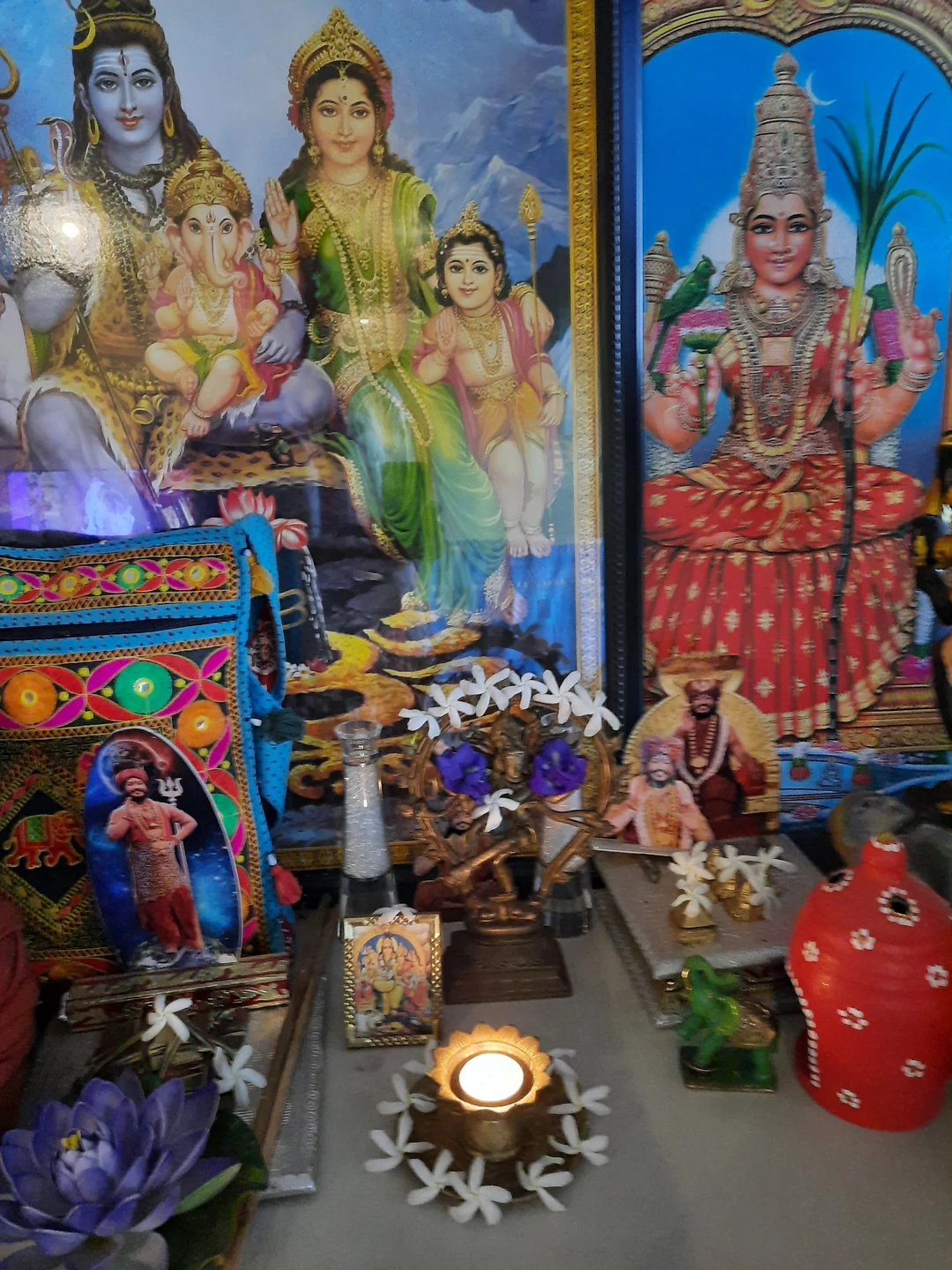
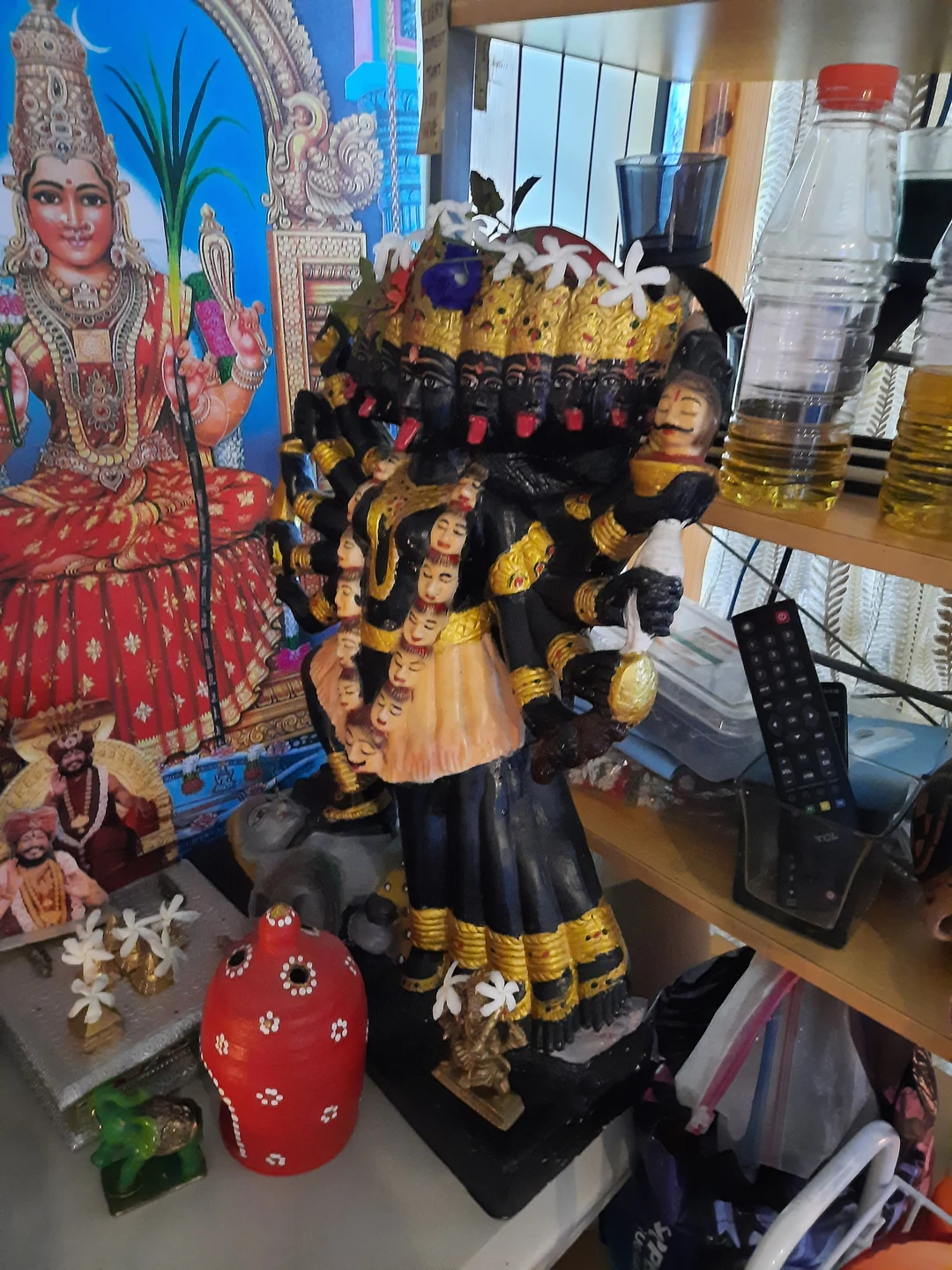
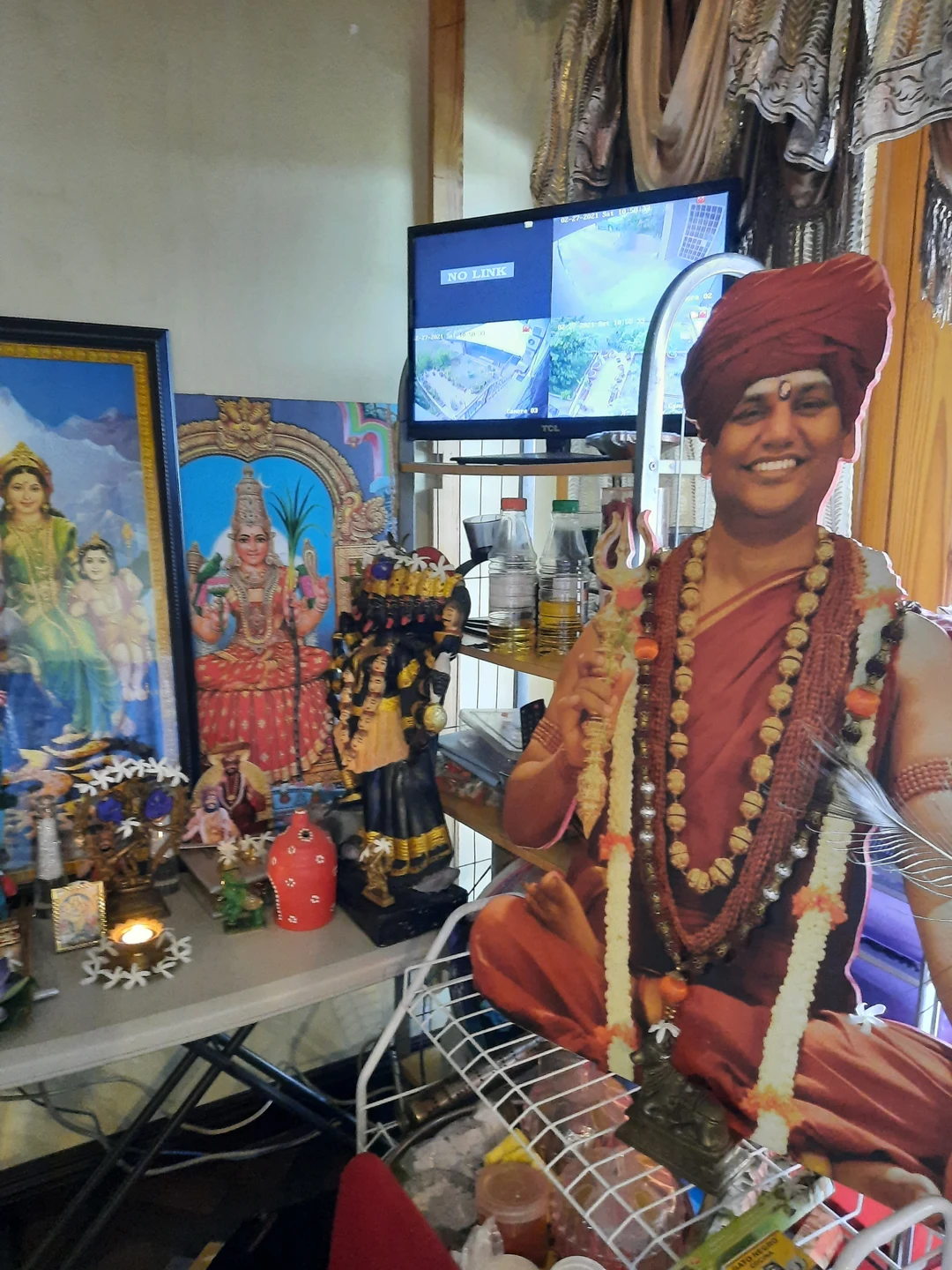
Daily Update - PDB + Daily pictures-Daily Paduka Puja

Event Details
Participants Count1
Event TypeIn-Person
Was Food Served in Event?No
Count of Meals Served
Volunteers Count1
Event Duration

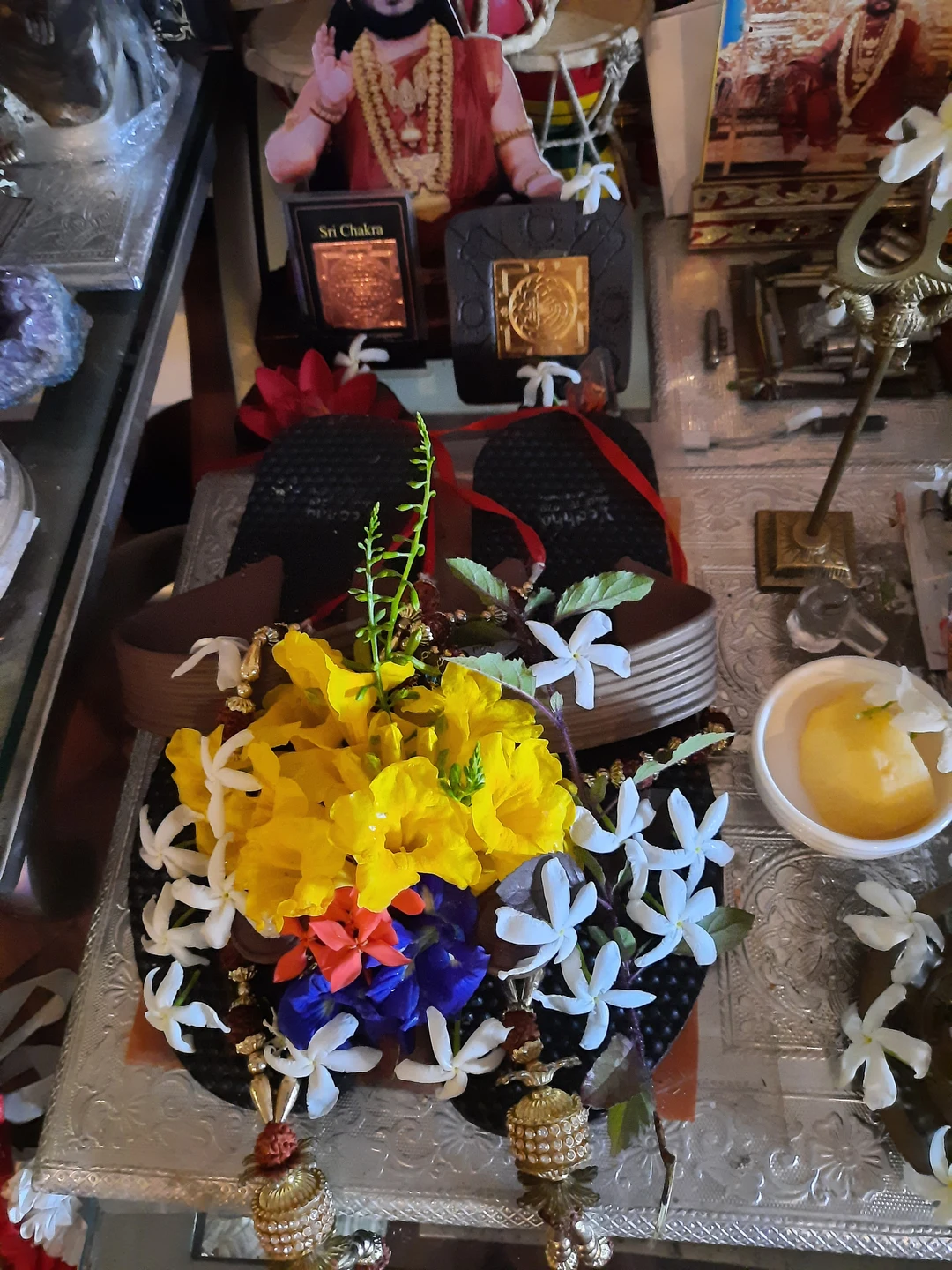
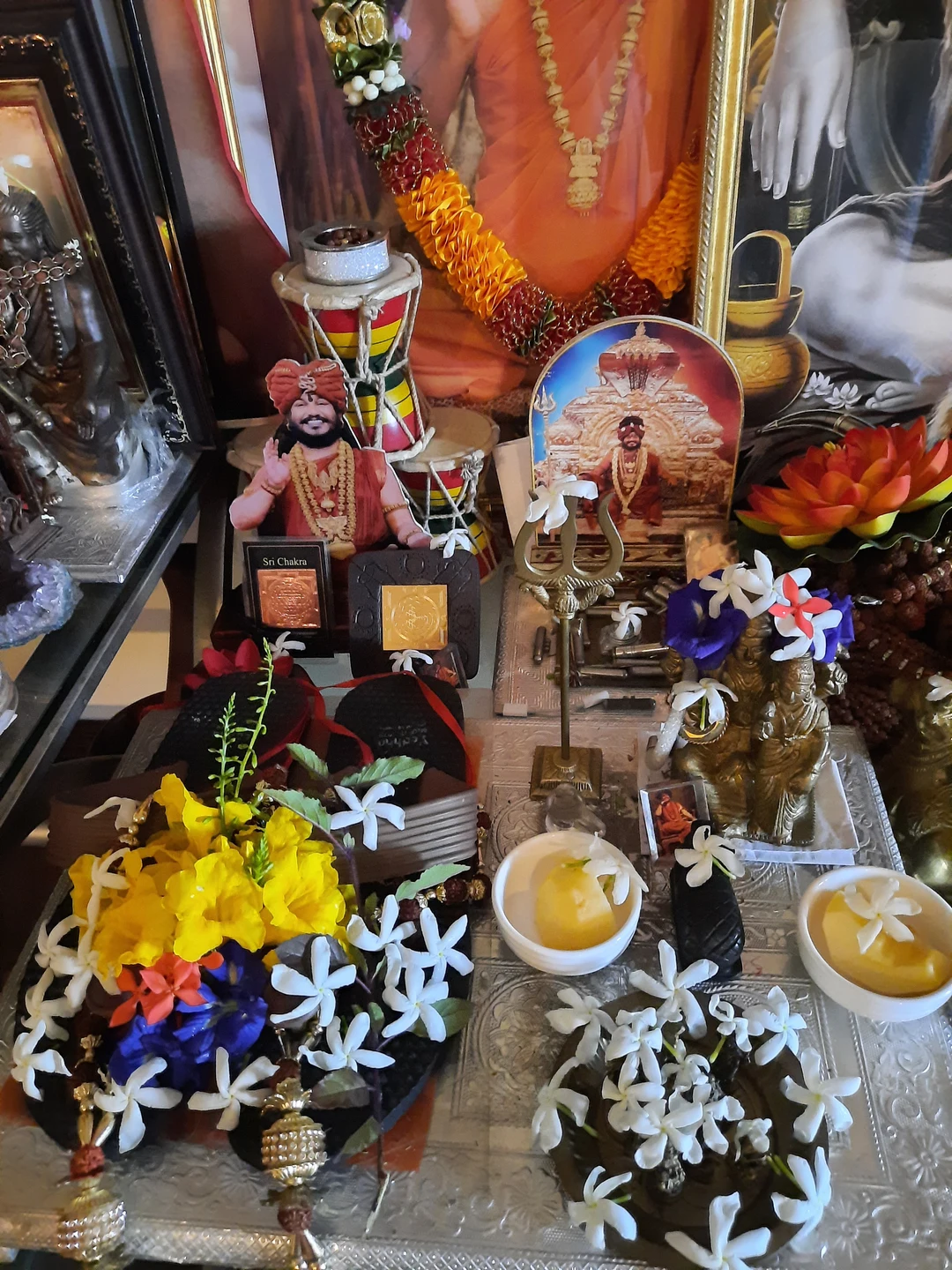
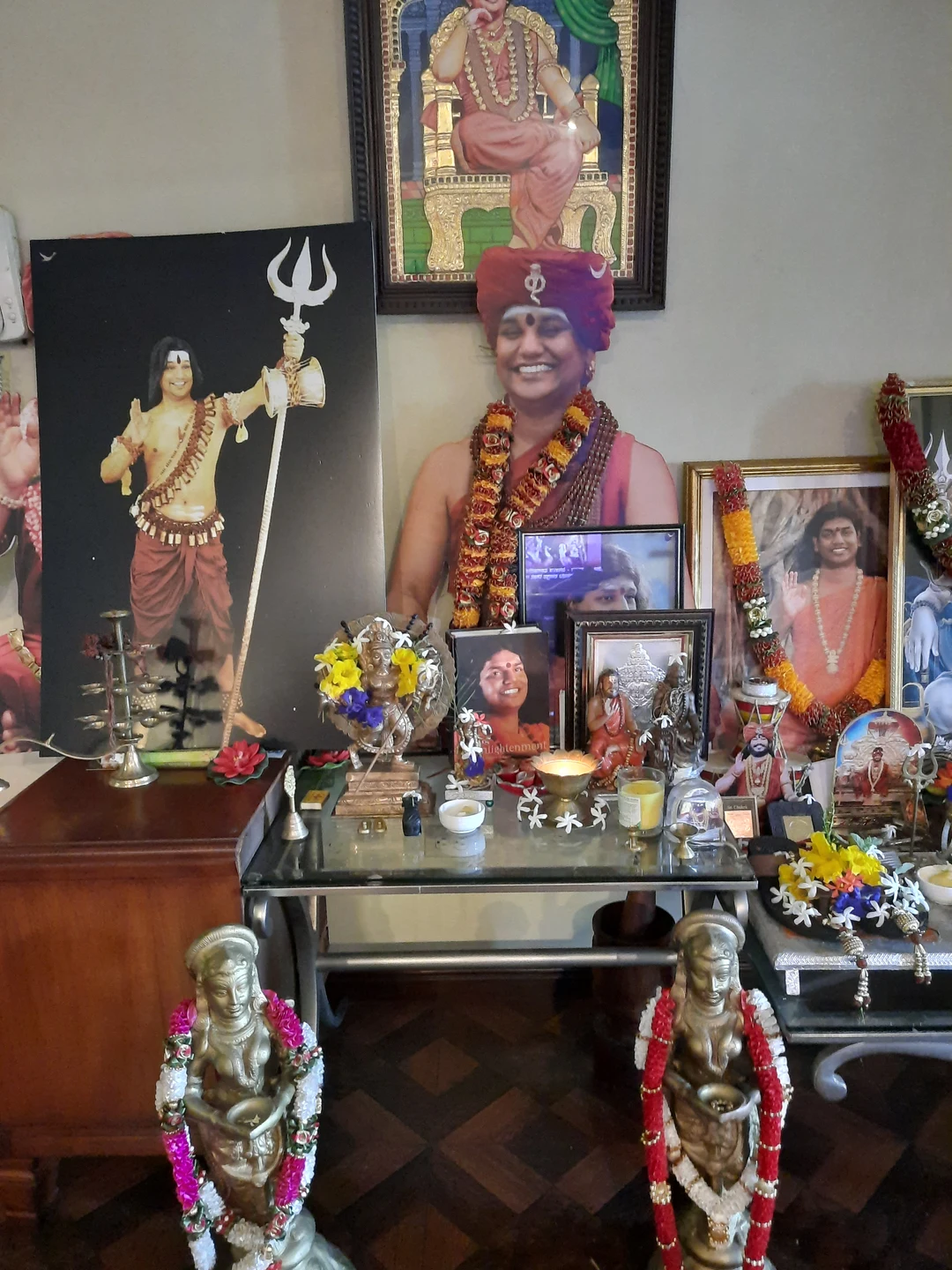
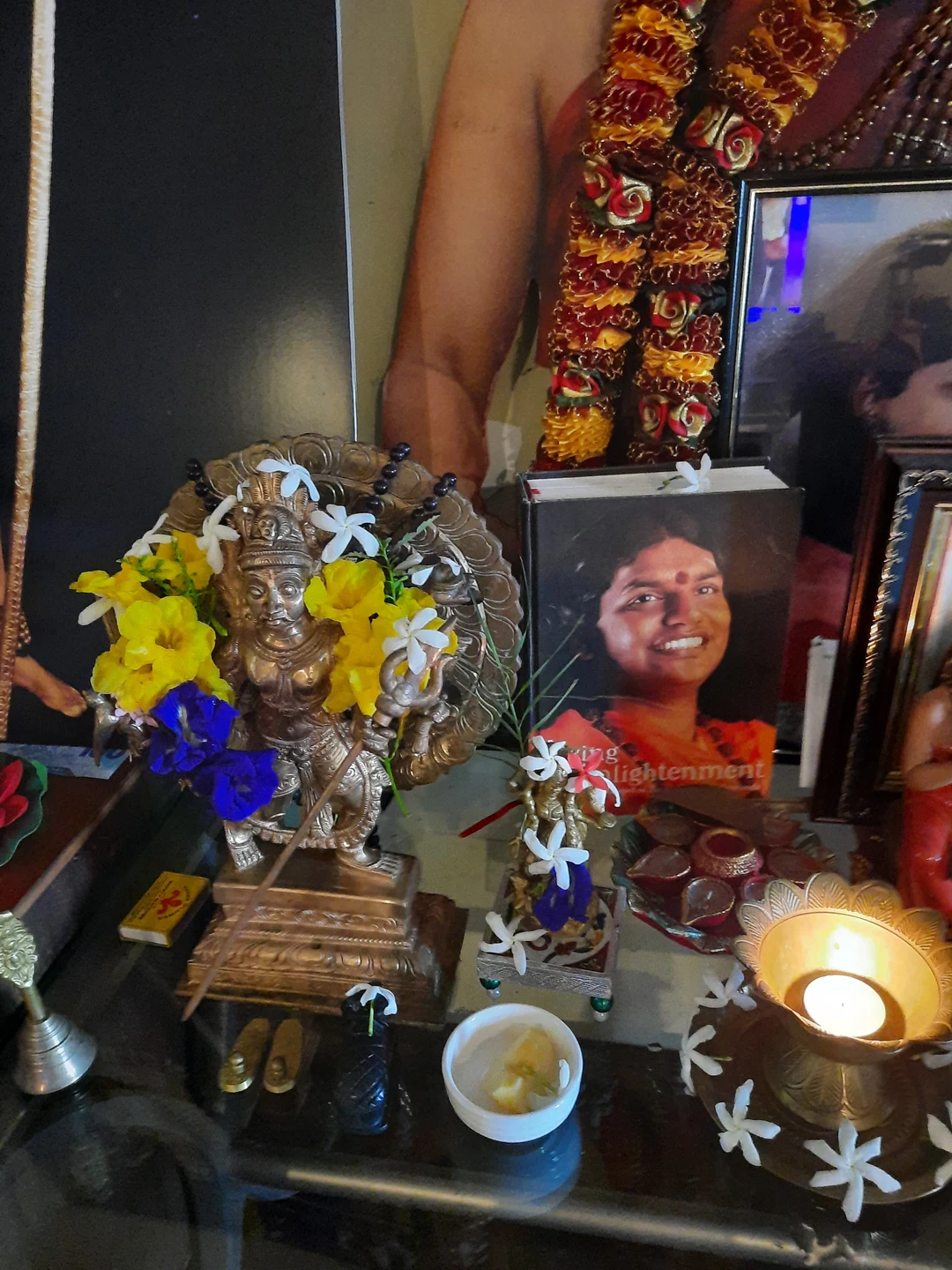
We offered the daily Puja to the sacred Padukas of our beloved Guru, Supreme Pontiff of Hinduism Jagatguru Mahasannidhanam HDH Bhagavan Nithyananda Paramashivam. Such a beautiful blessings.

Pictures from the day

KAILASA SAN JOSE, USA on 2/27/2021

Original wiki page
Contents

Makudabhishekam

Event Details
Participants Count11
Event TypeIn-Person
Was Food Served in Event?Yes
Count of Meals Served
Volunteers Count4
Event Duration

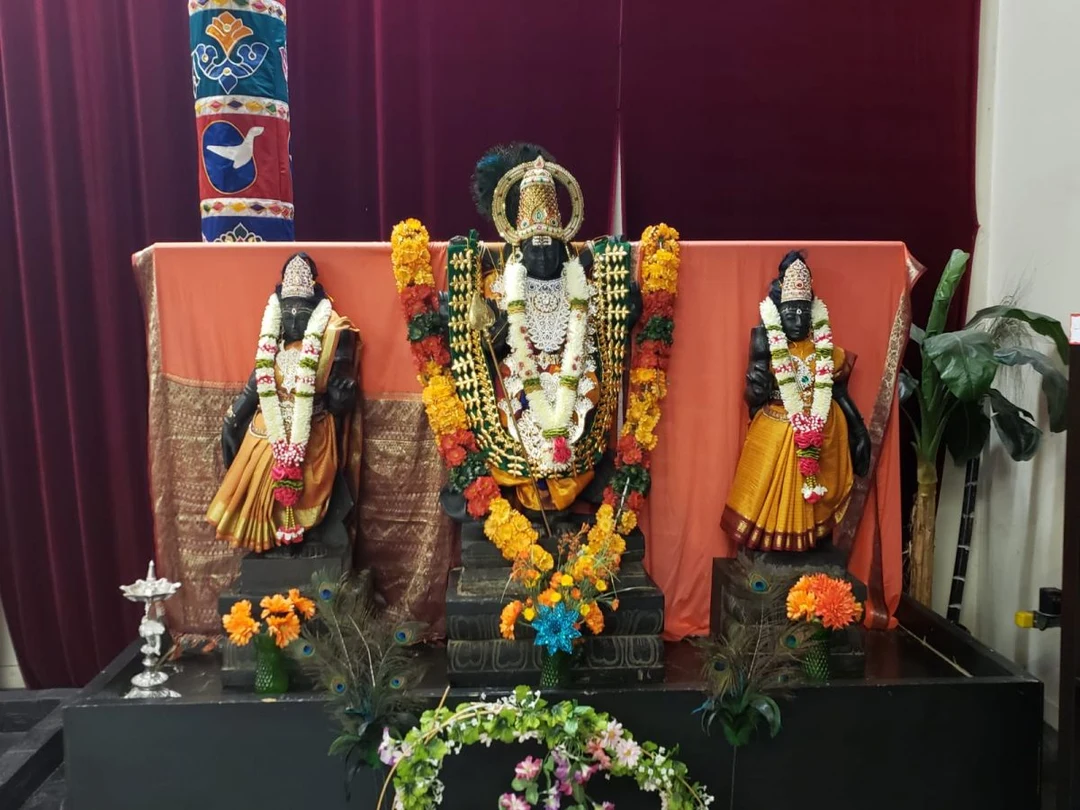
With the grace and blessings of The SPH JGM HDH Bhagavan Nithyananda Paramashivam, Kailasa San Jose today performed the coronation (Maguda Pattabhishekam) to Sri Nithyanandeshwara Paramashiva Linga and to the deity of The SPH JGM HDH Bhagavan Nithyananda Paramashivam who is the 1008th incarnation of Paramashiva, Lord Arunachaleshwara Himself.

The Maguda Pattabhishekam was performed in alignment with the Tiruvannamalai temple. It commemorates the coronation of Arunachaleshwara as the King of the Tiruvannamalai Kingdom, taking over from King Vallala Maharaja.

The SPH has participated in this event every single year as a child in Tiruvannamalai till He was 17 years, when He left Tiruvannamalai for the international explosion of the Mission of KAILASA.

Pictures from the day
KAILASA SEATTLE, USA on 2/27/2021

Original wiki page
Contents

Daily Update - PDB + Daily pictures

Event Details
Participants Count10
Event TypeOnline
Was Food Served in Event?No
Count of Meals Served
Volunteers Count5
Event Duration

"We start the day with performing the Suprabatham seva. It is the sacred process of waking up the deities. Morning Naivedhyam was offered to Moolavar.

Evening PPP was offered to SPH JGM HDH Bhagawan Nithyananda Paramashivam. Morning naivedhyam was offered to Moolavar. Evening naivedyam was offered to moolavar & HDH Nithyananda Paramashivam. We concluded the day with Palliarai Seva - The sacred process of putting the deities to sleep.

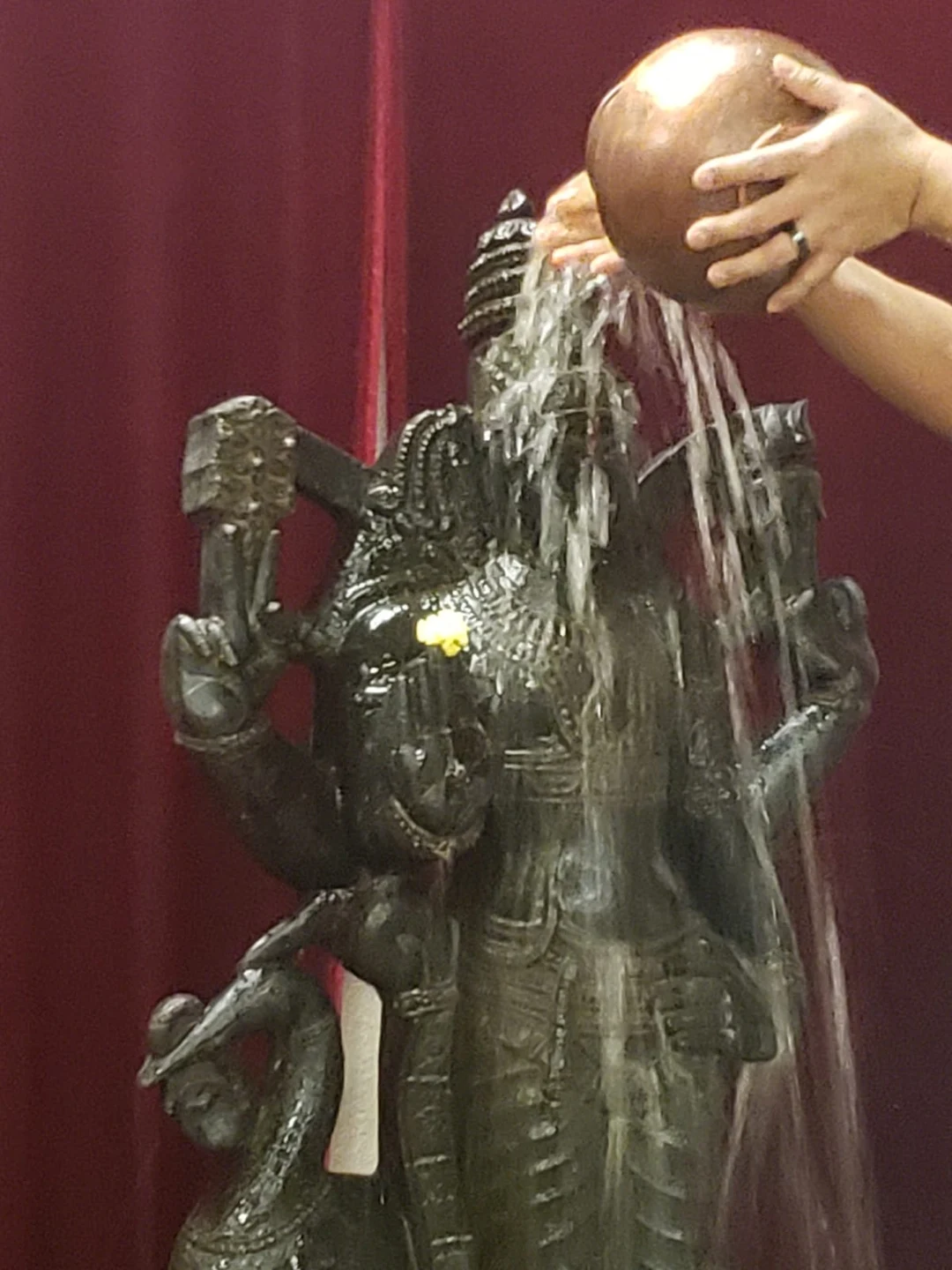
Morning PPP was offered to SPH JGM HDH Bhagawan Nithyananda Paramashivam. Abhishekam & Alankaram was offered to Sri Ananda Subramanya, Valli & Devasena. Dhoopam, Dheepam, Naivedhyam & Aarartrikam was also offered.

RudraAbhishekam & Alankaram was offered to Moolavar, Spatika Linga and bhoga murthies of HDH, Shiva & Meru. Dhoopam, Dheepam, Naivedhyam & Aarartrikam was also offered.

We continuously enrich the local community by conducting Vaakyartha Sadas and by creating posts across various social media platforms with the sacred truths revealed by HDH, darshan pictures of the deities and by going live during Bhava Samadhi Darshans & satsangs."

Presidential Daily Briefing

KAILASA-SEATTLE--USA-2021-02-27-14-ktQx7RV_KLFa59mqyhl8PoVwnP4mK0.pdf

Pictures from the day
Photos from this day

View all 92 photos

Pictures from the day

18 photosSource gallery
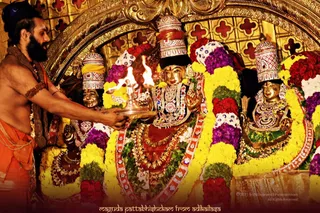
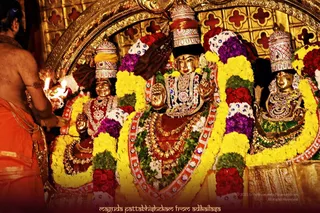
A photograph of a temple ritual at ADIKAILASA during a maguda pattabhishekam. A shirtless priest with a dark beard, wearing an orange cloth and a rudraksha-style brown cord around his neck and arm, holds a brass aarti plate with burning oil lamp flames toward three deity murtis. The central murti wears a red and jewelled garment with a gold crown, flanked by two smaller murtis in tall crowns and bright green and gold attire. The murtis are decorated with thick garlands of yellow marigolds, purple flowers, red roses and green leaves, set against an ornate gold arched shrine with red floral panels. A caption reads maguda pattabhishekam from adikailasa.A photograph of three golden deity murtis in an ornate golden shrine arch, dressed with crowns, jewelled necklaces and heavy garlands of yellow marigolds, red roses, white flowers and purple blooms. A bare-chested priest in orange dhoti stands at left holding a lit oil lamp toward the central figure during a ritual offering. The murtis are the focus; the priest is the only physical person visible.A photograph of a ritual abhishekam at a temple shrine. A bare-chested priest in an orange dhoti and sacred thread stands at left, holding a lit lamp in both hands above three golden deity murtis. The central murti is adorned with gold and jewelled ornaments, a red and gold garment, and a tall crown, flanked by two smaller murtis wearing similar crowns and jewellery. The figures are surrounded by yellow marigold garlands, purple and red flowers, and green leaves, set against an ornate gold arched backdrop with red quatrefoil motifs. A printed caption across the bottom reads maguda pattabhishekam from adikailasa.A photograph of a temple worship scene at ADIKAILASA. A priest with a full beard, bare-chested and wearing an orange dhoti and orange shawl with a sacred thread, performs aarti with a lit lamp before a deity murti. The murti wears a tall decorated crown, gold jewellery and a rich red and gold garment, and is heavily garlanded with yellow marigolds and purple and red flowers. Smaller decorated figures in matching crowns flank it. The background is an ornate gold arch with gilded carvings and red cross-shaped lattice panels.A bare-chested priest in orange cloth, with a sacred thread and a rudraksha-style arm band, performs aarti with a lit oil lamp before three gold-faced deity murtis decorated with yellow, red and purple garlands. The central figure wears a jewelled crown, a gold and gem-studded chest ornament and layered gold necklaces, flanked by two figures in tall crowns. A gilded arched backdrop frames the scene. The caption reads 'maguda pattabhishekam from adikailasa', indicating a temple ritual at ADIKAILASA.A priest in orange ceremonial cloth and a shawl, seen from behind with long hair tied up, performs an aarti with a lit lamp before three deity murtis adorned with yellow and red flower garlands and green leaves. The central murti wears a red garment, a jewelled chest ornament and layered gold necklaces, flanked by two smaller figures in red and green with crowns. An ornate gold arch frames the shrine, and the photo carries a banner reading maguda pattabhishekam from adikailasa.

FB-Photos-of-the-Day

9 photosSource gallery
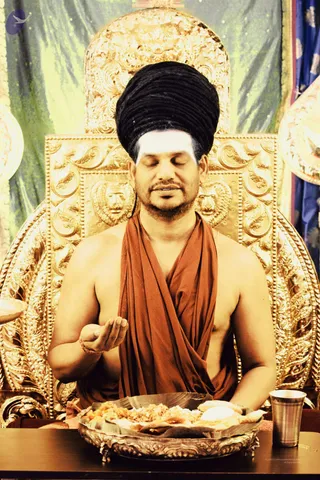
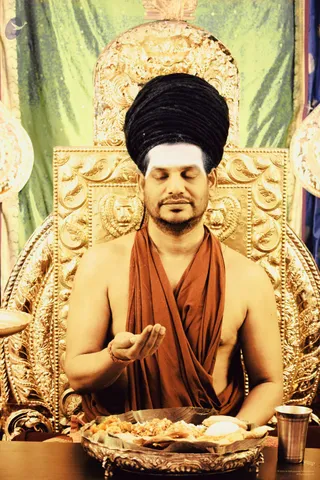
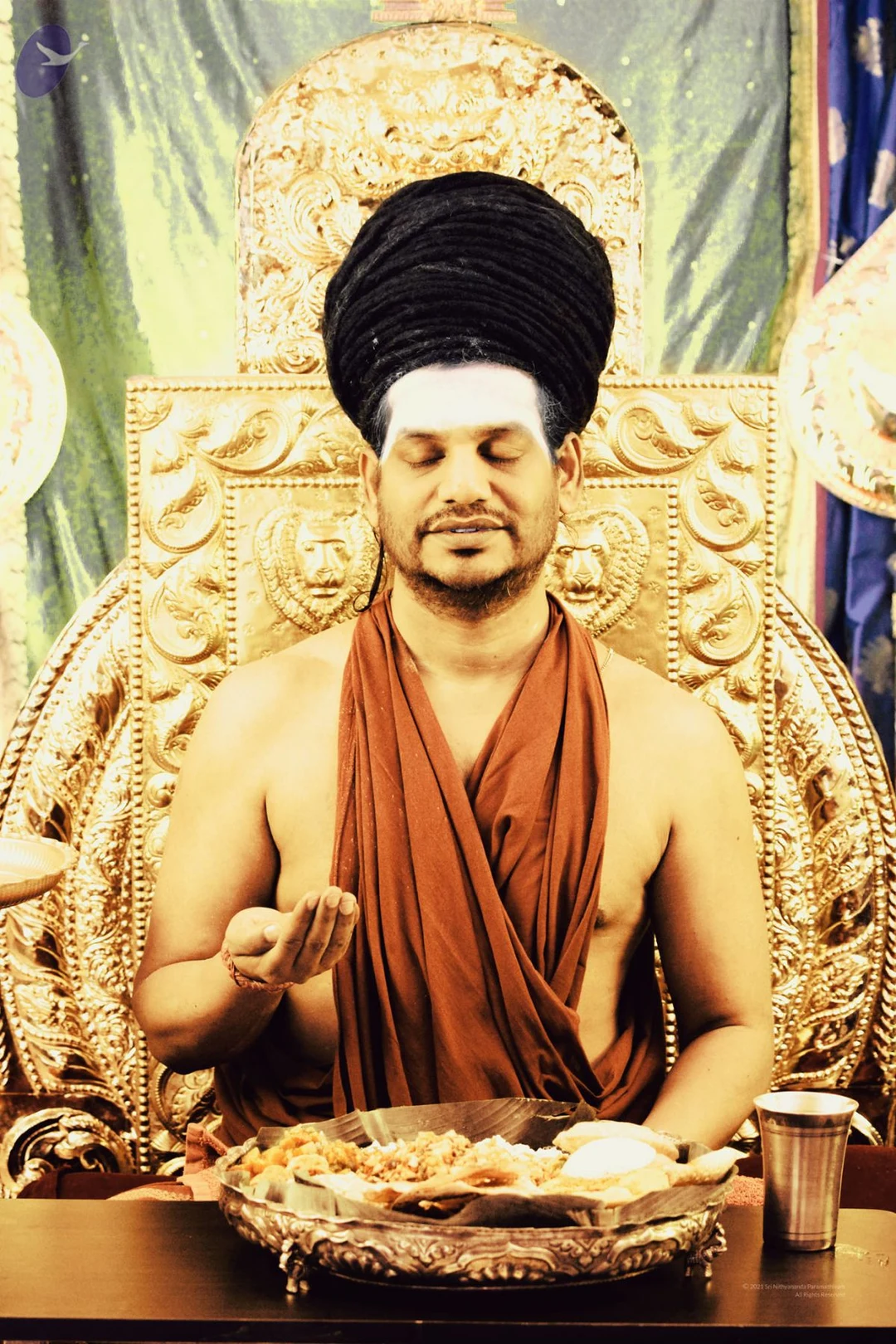
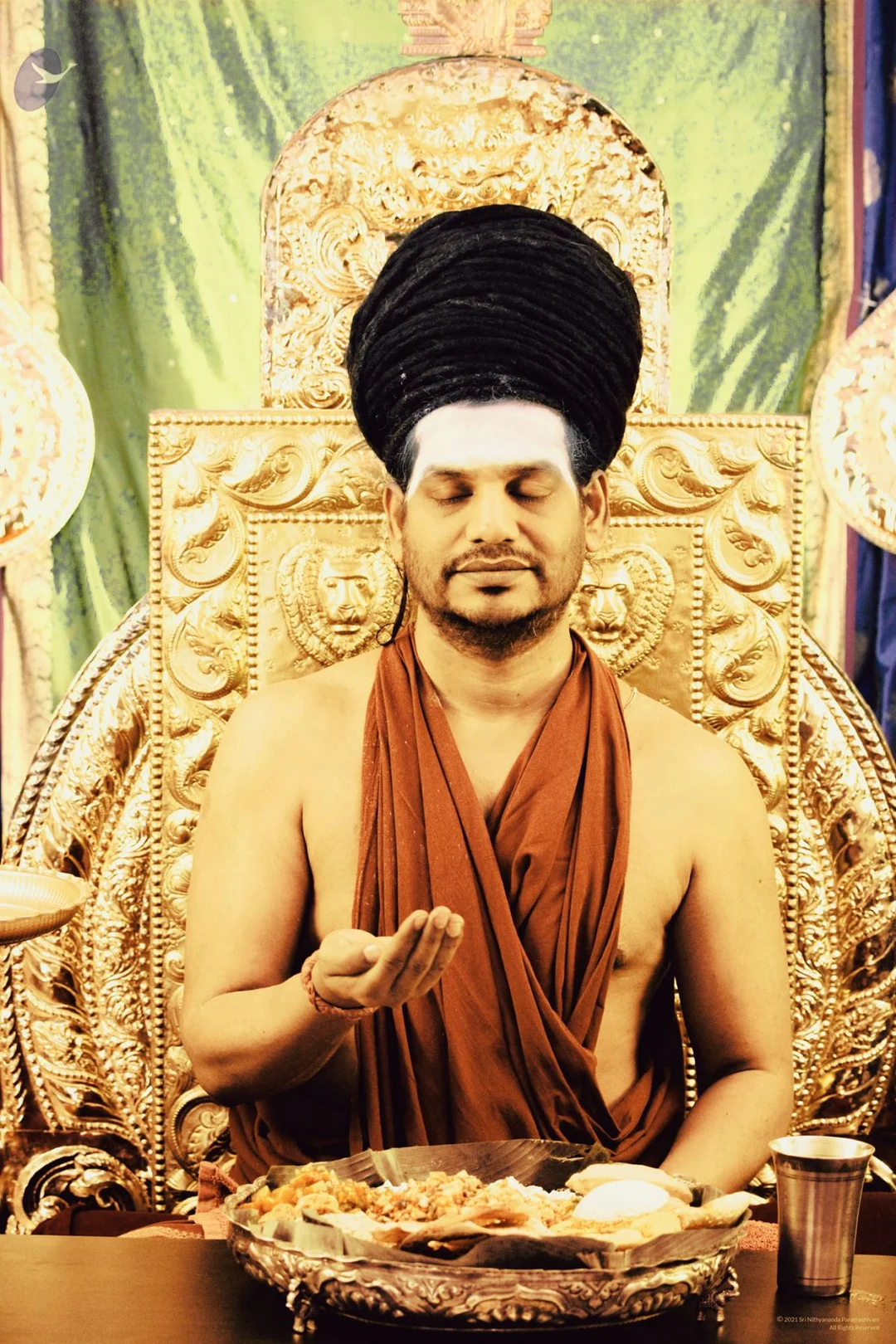
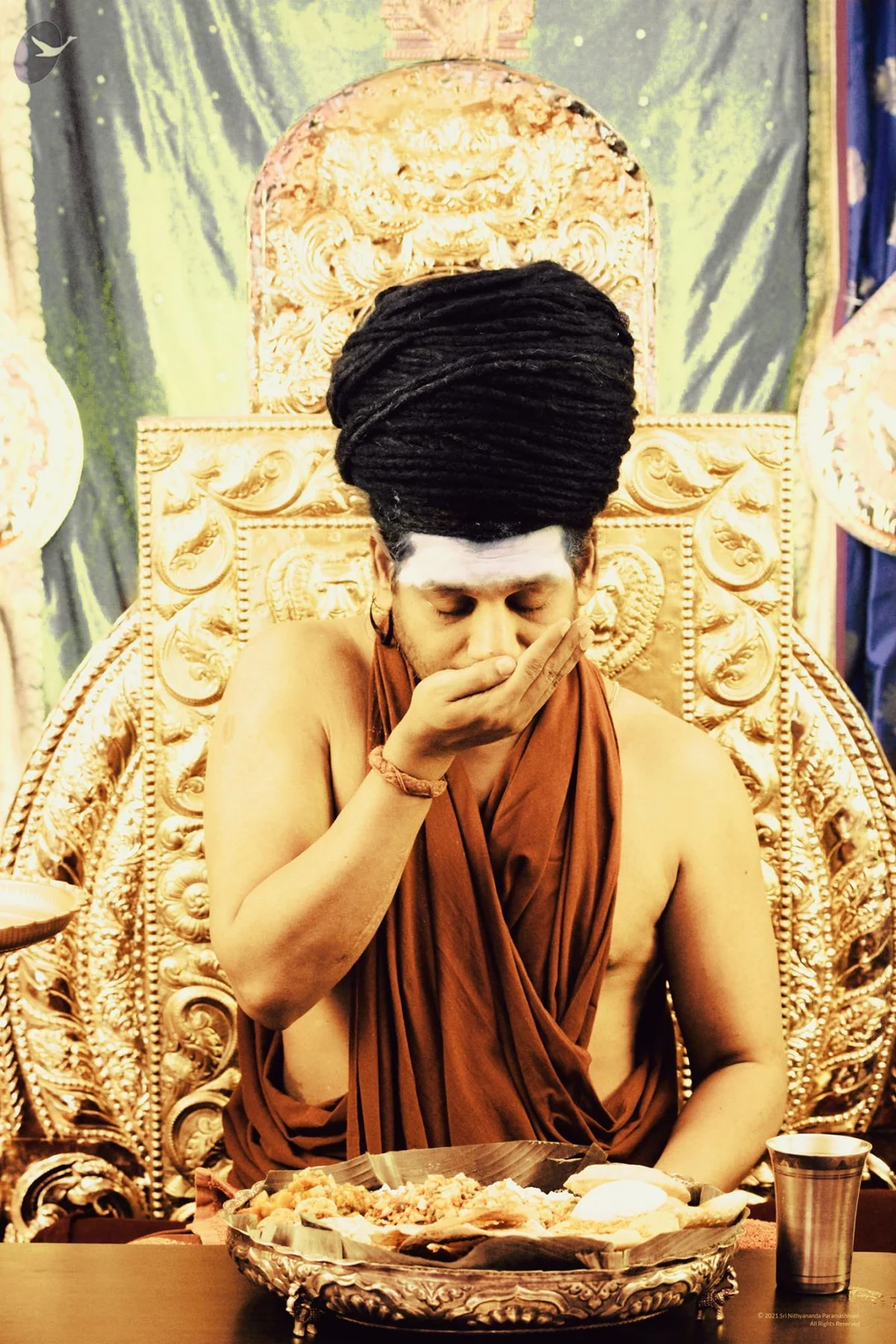
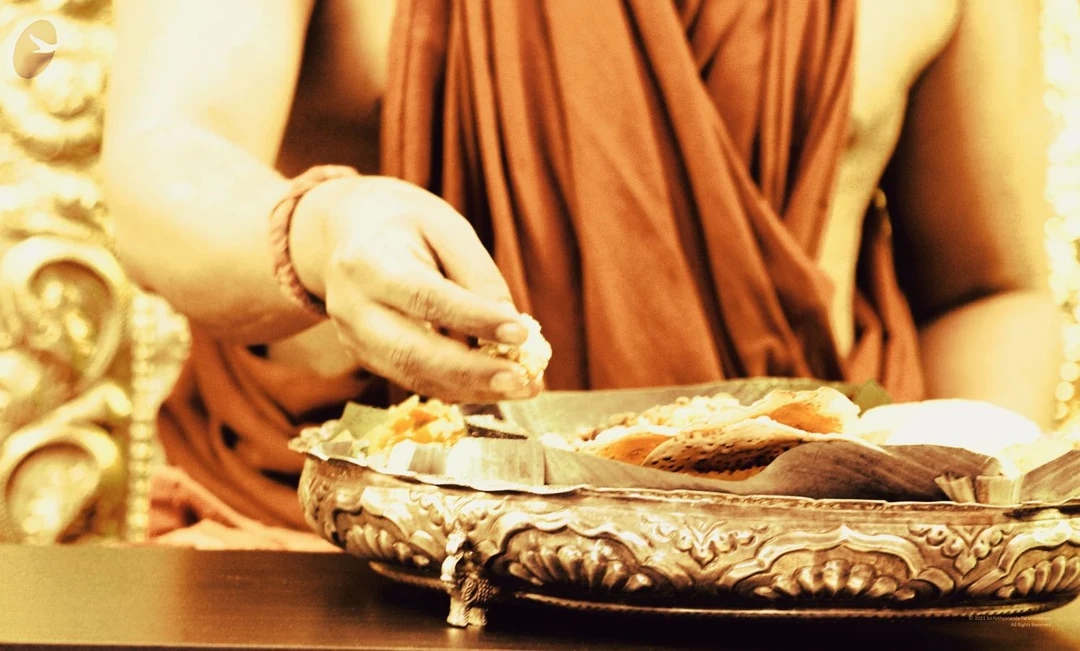
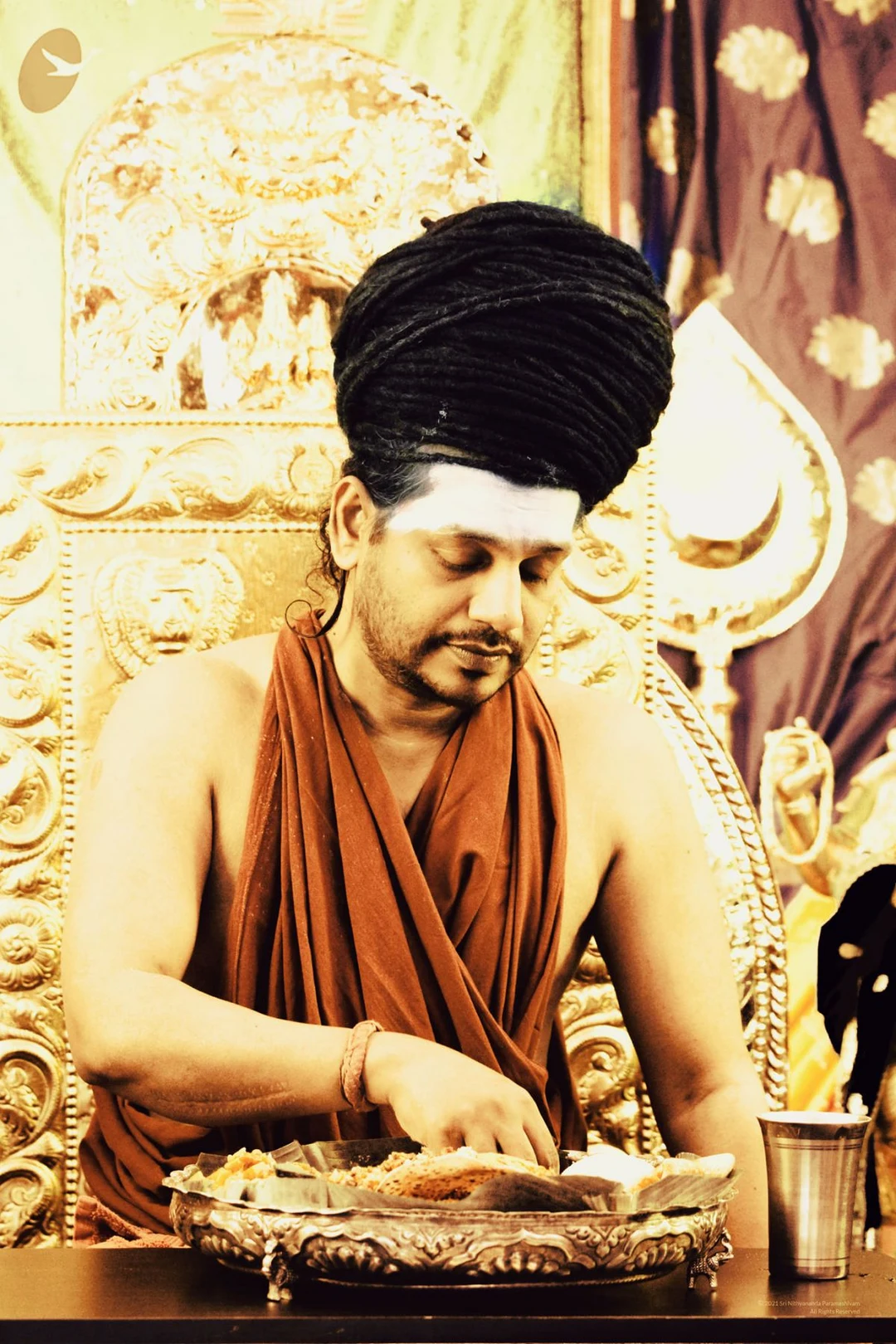
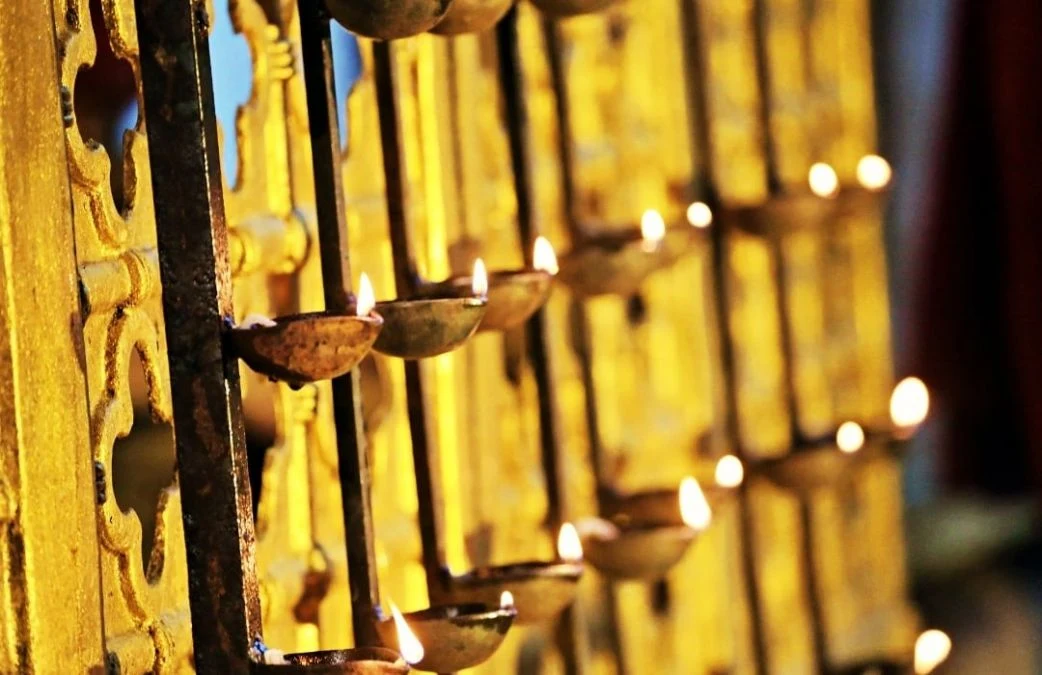
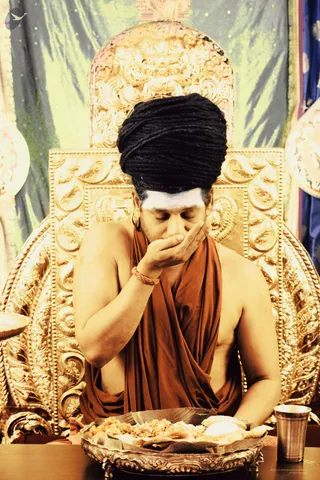
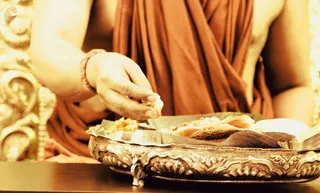
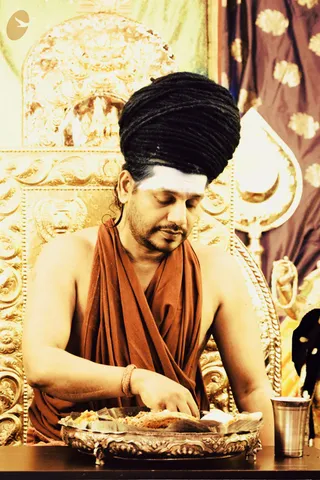
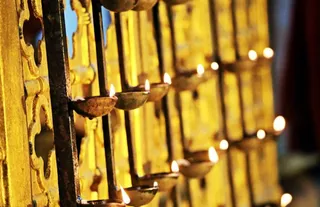
A bare-chested man with a tall coiled black topknot and a white forehead mark sits eyes-closed on an ornate gold throne carved with lion faces and floral scrollwork, draped in an orange-saffron cloth over his shoulders. He raises one hand palm-up, and in front of him on a dark table stands a large silver plate of food, with a steel tumbler to the right. The background shows green fabric and a blue drape.A photograph of a seated man with a tall coiled black hair crown and white forehead marking, wearing a rust-orange shawl draped over bare shoulders and a rudraksha-style wrist cord. He sits with eyes closed, one palm open and raised before a silver-rimmed plate of food, with a steel cup at the right. Behind him stands an ornate gilded throne with lion-face carvings against a green draped backdrop. Appearance-based candidate: Swamiji (probable), the crown hair, orange shawl and ceremonial throne setting being the qualifying cues, shown in person as a presiding priest during a food offering.A photograph of a bare-chested man seated on an ornate gold throne with carved floral and scroll motifs, behind a green and blue draped backdrop. He wears a large black turban-style bundle of hair, a white vertical forehead mark, an orange-saffron cloth draped over his shoulders, and a beaded bracelet. His right hand is raised to his mouth as he eats from a silver-rimmed leaf-lined plate of food, with a steel tumbler beside it on a wooden table. One person is visible. A , in the lower right, and the hair, saffron cloth and throne fit the a person cuesClose photograph of a person in an orange-saffron robe draped over the shoulders, with a red-beaded wrist band on the right wrist. The right hand lifts food from an ornately embossed silver tray holding yellow-orange sweets and offerings on leaf-like plates. Warm golden tones and a carved silver or gold pillar edge the frame. Only partial body is visible, no face shown. a person identity cannot be confirmed from appearance alone.A photograph of a man with a tall black turban-style hair bundle and a white vertical forehead mark, seated before an ornate gold-embossed throne. He wears an orange-brown ochre shawl draped over his bare shoulders and a red-thread bracelet on his wrist. He is serving or touching food from a silver-rimmed ornate platter on a dark table, with a steel tumbler to the right. Swamiji (probable): the long swept-back hair bundle, ochre shawl and gold-embossed throne are the cues. A golden-brown, sepia-toned filter covers the image, with a small copyright line visible at the lower right.Close-up photograph of a row of small brass oil lamps (diyas) lit with flames, set on iron rods against a golden, ornately carved wall panel. Their warm light reflects off the gilded surface. No people are visible; the lamps are arranged vertically in staggered rows, receding into the background.

Construction work in progress for expansion of the Jeeva Samadhi of Mata Vibhutananda Puri in Tiruvannamalai

4 photosSource gallery
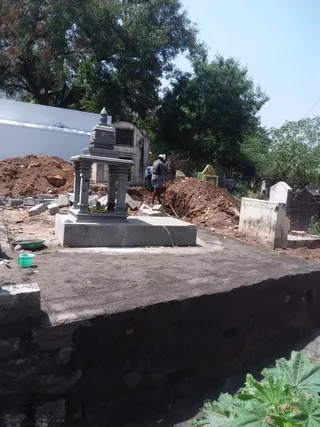
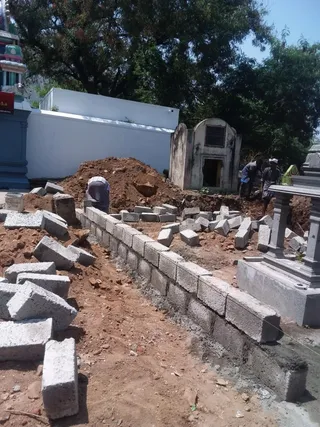
Outdoor construction site in a cemetery-like yard under bright daylight. A grey granite platform holds a small ornate stone shrine with four carved pillars and a pointed spire. Two workers, one in a white head cloth and checked lungi, dig in reddish soil piles beside rubble and concrete blocks. Trees and a white boundary wall surround the area, with a small green bucket on the ground. No identifiable a person figure is visible.A photograph of an outdoor construction site beside a temple wall. A low course of concrete blocks is being laid in a trench in red-brown earth, with loose blocks and a dirt mound scattered around. Two workers in dark lungis are digging and working at the back near a small weathered stone shrine with an arched top and a doorway. A man in a checked shirt bends over in the foreground. At the right stands a grey granite memorial with pillars and a platform. A blue temple wall and gopuram-style tower with painted colours appear at the left, under large green trees and bright sky.Outdoor photo of a cemetery site under construction in daylight. A concrete plinth with exposed stone rubble walls and a fresh concrete top stands in the foreground, with loose bricks and red earth piles around it. Behind it a grey granite shrine-like structure with pillars and a small finial stands on a granite base. A man in a pink shirt, grey shorts and a light cloth head wrap walks at left, and a second worker stands in the background. Old white and grey tombs and green trees fill the background.Outdoor construction site beside a colourful gopuram-style temple entrance with a red banner reading the Tamil name of a temple. A barefoot man in a checked lungi and plaid shirt stands on a low brick wall, looking down at stone blocks and a green bucket. Behind him, two workers dig in red earth and piles of granite blocks lie scattered. To the right, a grey granite shrine-like structure with pillars and a finial stands on a raised platform, with a small offering plate at its base. No a person candidate is visible.

Pictures from the day

1 photoSource gallery
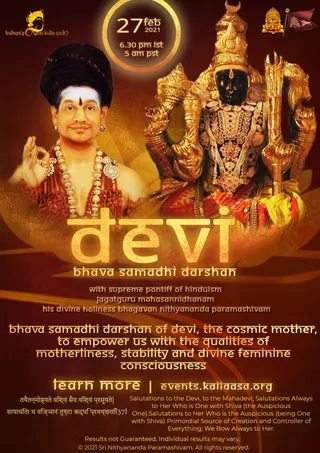
Event poster for a Devi Bhava Samadhi Darshan dated 27 February 2021, with a gold circular date badge reading 27 feb 2021, 6.30 pm ist, 5 am pst. On the left, a man with tall black swept-up hair, a white forehead marking with a central dot, earrings, rudraksha malas and ornate gold-and-gem necklaces, making a mudra with one hand, is shown in a portrait labelled with the name Nithyananda Paramashivam. On the right, a gold deity murti of Devi with a black face, crown, many gem-studded necklaces, and multiple arms holding a trident and other implements, set against red and yellow drapery and a lotus motif. Large gold lettering reads 'devi' above 'bhava samadhi darshan'. Sanskrit verse and an English blessing appear at the bottom with a legal disclaimer.

Pictures from the day

2 photosSource gallery
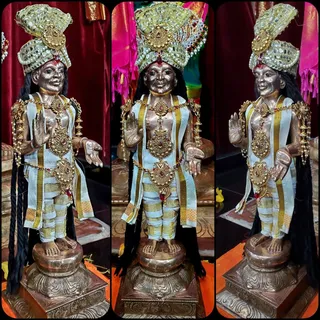
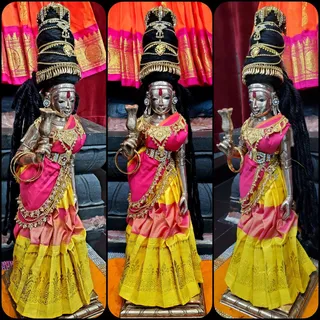
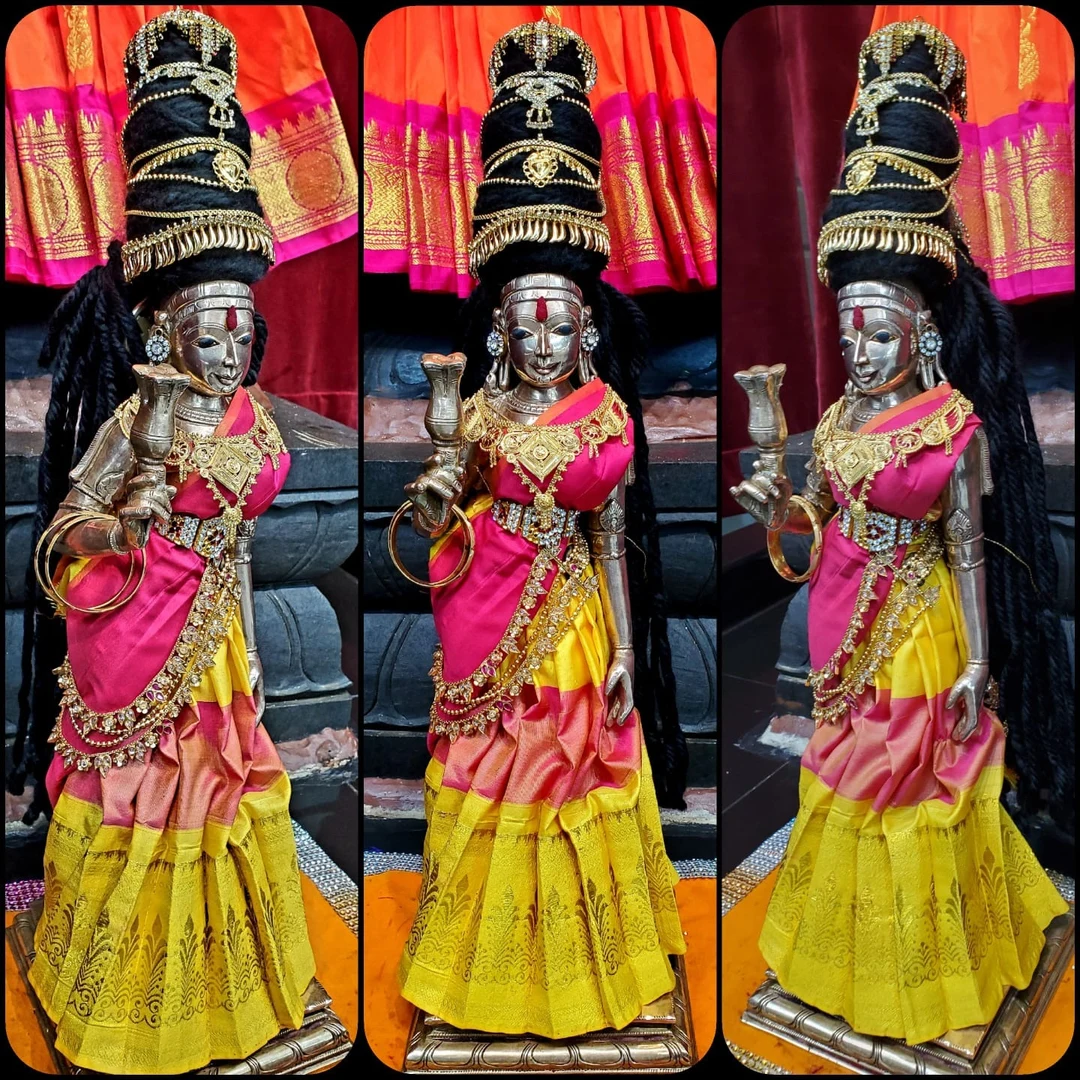
A three-panel collage of a bronze-toned standing statue of a deity or sage figure, shown from front, three-quarter and side angles. The figure wears an ornate golden and pearl-studded crown or turban, long black hair falling to the back, a white garment with gold borders, layered gold necklaces and pendants, a jewelled waist belt, and a red tilak on the forehead. Its right hand is raised in abhaya mudra and the left hangs open. It stands on a lotus-petal pedestal. Behind are red velvet drapes, pink silk fabric with gold fringe, and a colourful garland. No physical people are visible.A three-panel collage of a silver-toned metal statue of a female deity murti standing on a base before a red and orange silk drape with gold border. The deity wears a tall black hair crown topped with an ornate gold headdress, a red bindi, drop earrings, a gold choker and layered gold necklaces, a pink blouse with a yellow and pink skirt, and gold bangles. In the left and centre panels she holds a tall brass lamp stand in one hand, and in the right panel the stand is seen from the side. The statue is shown from several angles. No physical people appear.

Pictures from the day

6 photosSource gallery
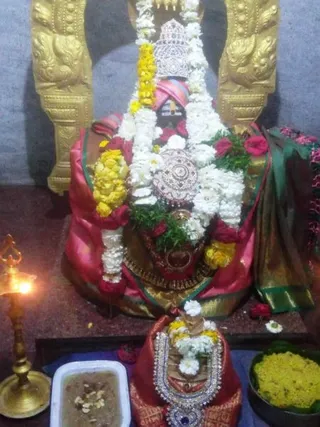
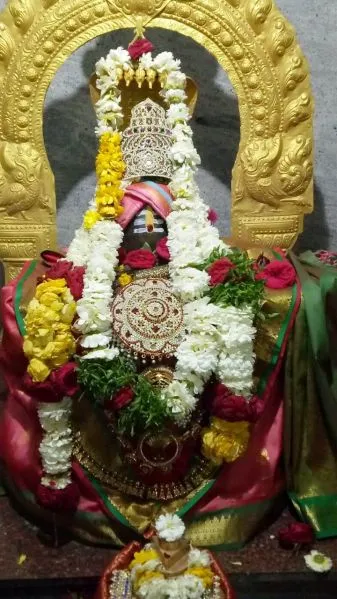
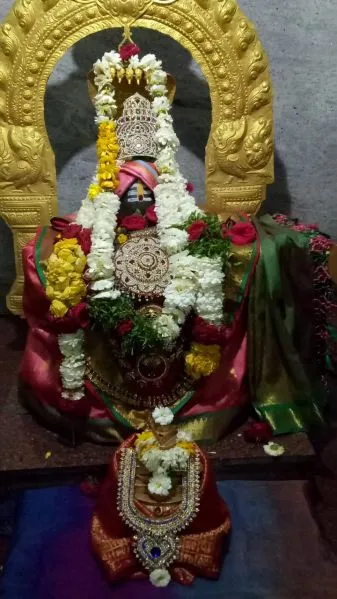
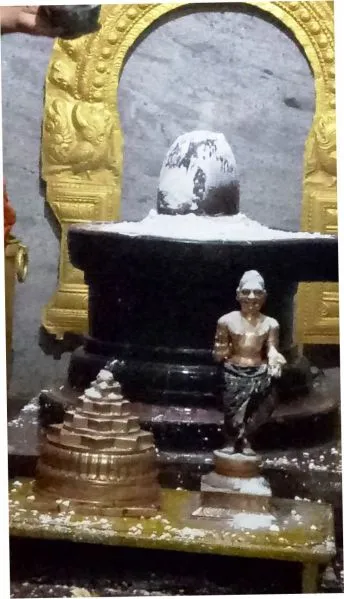
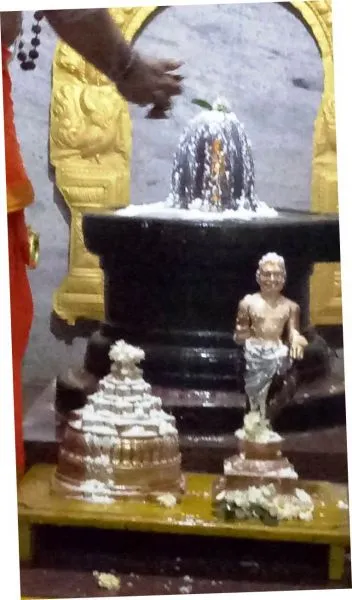
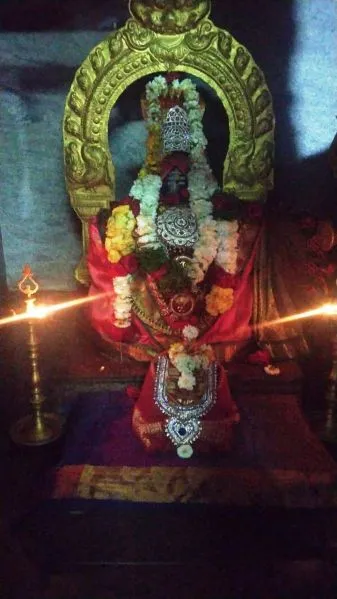
A photograph of a decorated deity murti, a lingam-form image dressed in white and yellow flower garlands and green leaves, with a pink and green silk cloth draped over it and a silver crown-like face ornament. A brass oil lamp with a lit flame stands at the left, and a gold-framed arch with carved gold panels surrounds the murti. In front, a small decorated pot with flowers and silver ornaments sits on a red cloth, beside a white dish of sweet pudding topped with nuts and a bowl of yellow rice. No people are visible in the scene.A decorated deity murti of a Shiva lingam dressed for worship, framed by a golden arched niche with carved motifs. The murti is wrapped in a pink and orange cloth and draped with long garlands of white jasmine, yellow marigold, red roses and green leaves. A silver crown-like ornament and a large round gold and red-jewelled shield-shaped ornament sit on the figure. Red rose petals and a small brass vessel with flowers appear in the foreground. No people are visible.A photograph of a decorated deity murti. The murti is draped in white and yellow flower garlands, red roses, and green leaves, with a silver crown and a silver ornamental plate at its centre. A pink and green silk cloth covers its base, and a golden arch frames it behind. In front, a silver necklace with a red stone lies on a red and gold cloth. No people are visible in the scene.Photograph of a Shiva lingam on a black peetha inside a gilded shrine arch decorated with carved golden motifs, the lingam dusted with white powder (likely vibhuti or milk residue). In front stands a small brass statue of a seated bare-chested figure with a draped dhoti and a small brass temple model beside it, set on a table with scattered white powder. A hand is visible at the upper left edge. No living people are clearly visible; the figures are statues and the scene shows an abhishekam setting.A photograph of a Shiva lingam on a black stone yoni-peetha base, its dome covered in white abhishekam powder with a green leaf on top, while a hand in an orange garment with a rudraksha mala pours or places an offering from the left. Beside it on a yellow-covered altar stand a small white-clad figure of a standing man with bare chest and a white shawl, and a white-dusted pot or kalasha with flower garlands. Golden arches frame the background. Petals and powder are scattered on the altar.A photograph of a deity murti in a dim shrine, draped in a red cloth and heavily garlanded with white and yellow flowers. Silver ornaments and a silver face or crown piece adorn the figure. An ornate golden arched frame surrounds the shrine niche, and brass oil lamps with lit wicks stand on either side, with a small lit flame at the lower left. No people are visible.

Pictures from the day

10 photosSource gallery
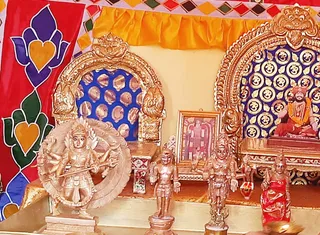
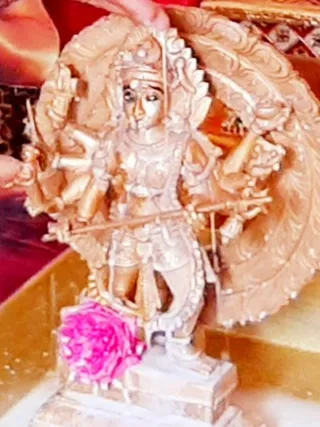
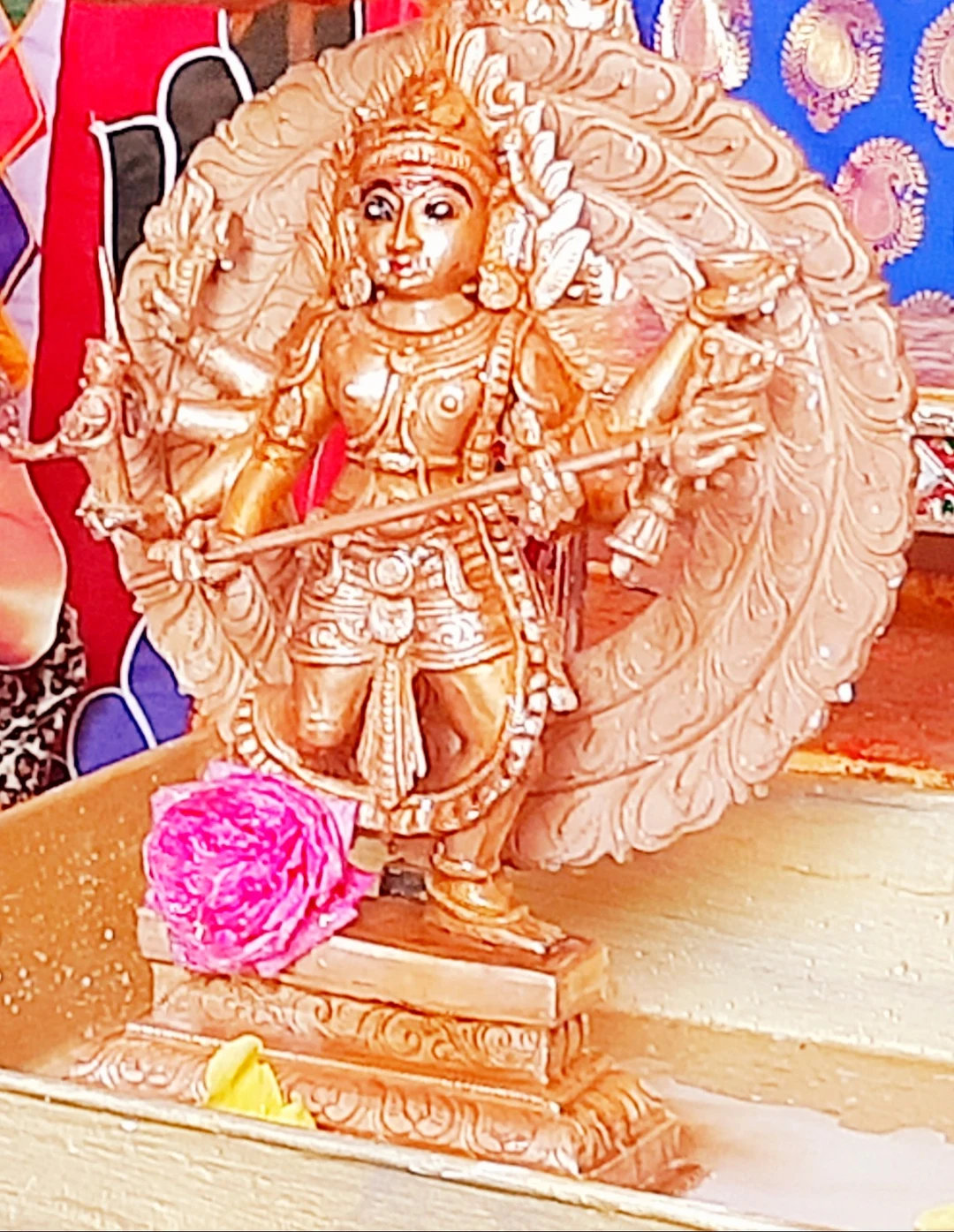
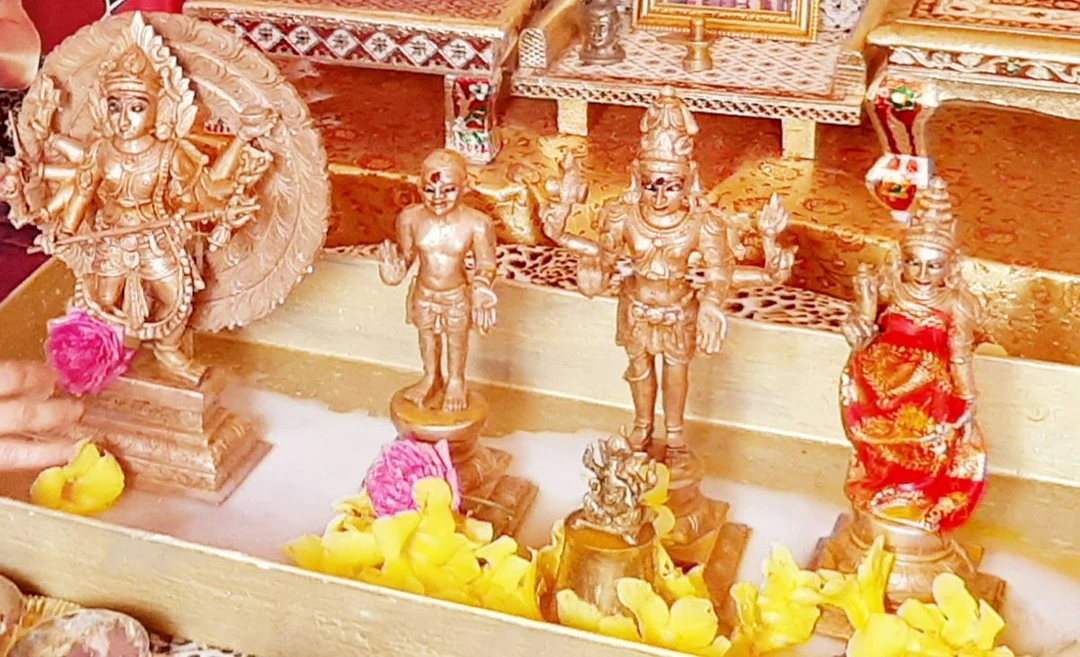
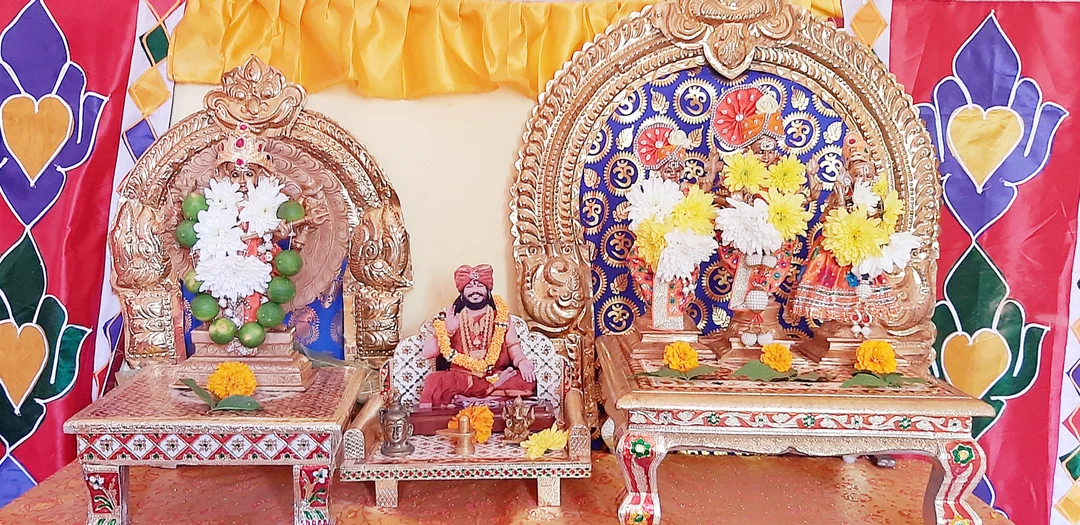
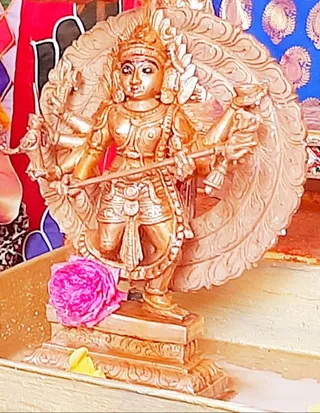
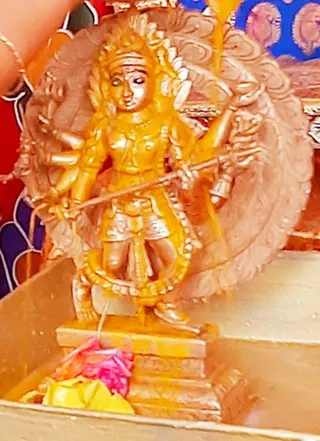
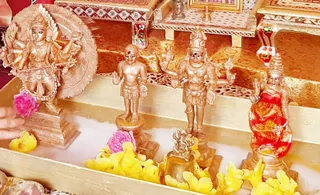
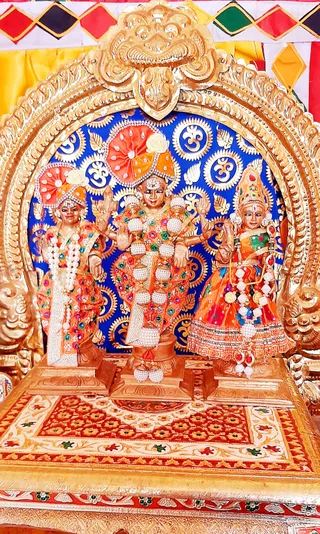
A decorated shrine with gold-framed arches lined in blue fabric stamped with gold Om symbols and rounded motifs. On the right, a small framed photograph shows a bearded man in a red-orange turban and orange-red robe with an orange flower garland, seated on a cushion; this is a depiction on a shrine, not a physical person. The shrine holds metal deity murtis: on the left a multi-armed goddess with a trident in front of a crescent-shaped halo, a standing male figure in the centre, and a small female figure in a red sari on the right. A framed devotional picture stands between the arches. A red and white banner with a stylised purple and orange lotus motif hangs behind, and a yellow drape is draped across the top. No people are physically present.Close-up photo of a small golden-toned metal murti of a multi-armed deity standing on a pedestal, holding a trident-like weapon across its body, with a large arched flame-like halo behind it. A pink flower sits at its base, and a hand in a red cloth edge is visible at the upper left. The statue is the central subject, with no visible people apart from partial hands.A bronze-toned metal murti of a multi-armed deity stands on a stepped base beside a pink rose petal and a yellow flower bud. The figure wears a crown, beaded necklace, ornate waist belt and dhoti-style garment, holding a long rod or staff across the body, with a bell-like object hanging from one hand. A large peacock-feather style arch frames the back. Behind it are red and blue textile patterns with gold paisley motifs. No people are visible.Close-up photo of a small golden-brown metal murti of a multi-armed deity standing on a stepped pedestal, with a large ornate prabhavali halo behind it. Yellow liquid. A pink and yellow floral offering lies at the base on a metal tray. Blue and pink decorated panels appear in the background. No people are visible.A photograph of a gilded metal ritual arrangement on a golden tray lined with white cloth and scattered with yellow and pink flowers. Several small bronze-coloured deity murtis stand in a row: on the left a multi-armed figure with a circular halo backdrop, in the centre a standing male figure with a tall crown holding a ritual object, and on the right a female figure in a red and orange draped sari. A small bronze vehicle-like figure sits at the base. Behind them are ornate gold and red decorated platforms and a framed picture. No physical people are visible except a partial hand at the left edge.Three decorated murti figures stand on a golden gilded shrine arch before a blue backdrop with gold om symbols. The central deity is a four-armed form draped in orange and gold garments, adorned with white pearl garlands and a jewelled crown. Figures on either side wear orange and multicoloured embellished dress with pearl garlands and crowns, decorated for a festival or pattabhishekam display. A patterned red-and-gold cloth covers the base, and a yellow and diamond-patterned cloth hangs above.

Pictures from the day

12 photosSource gallery
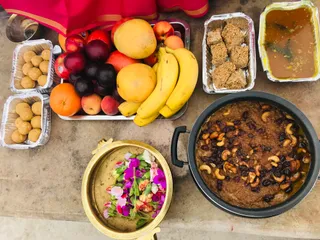
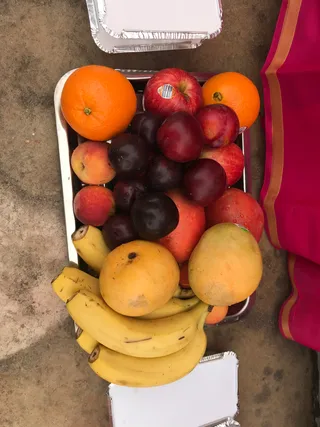
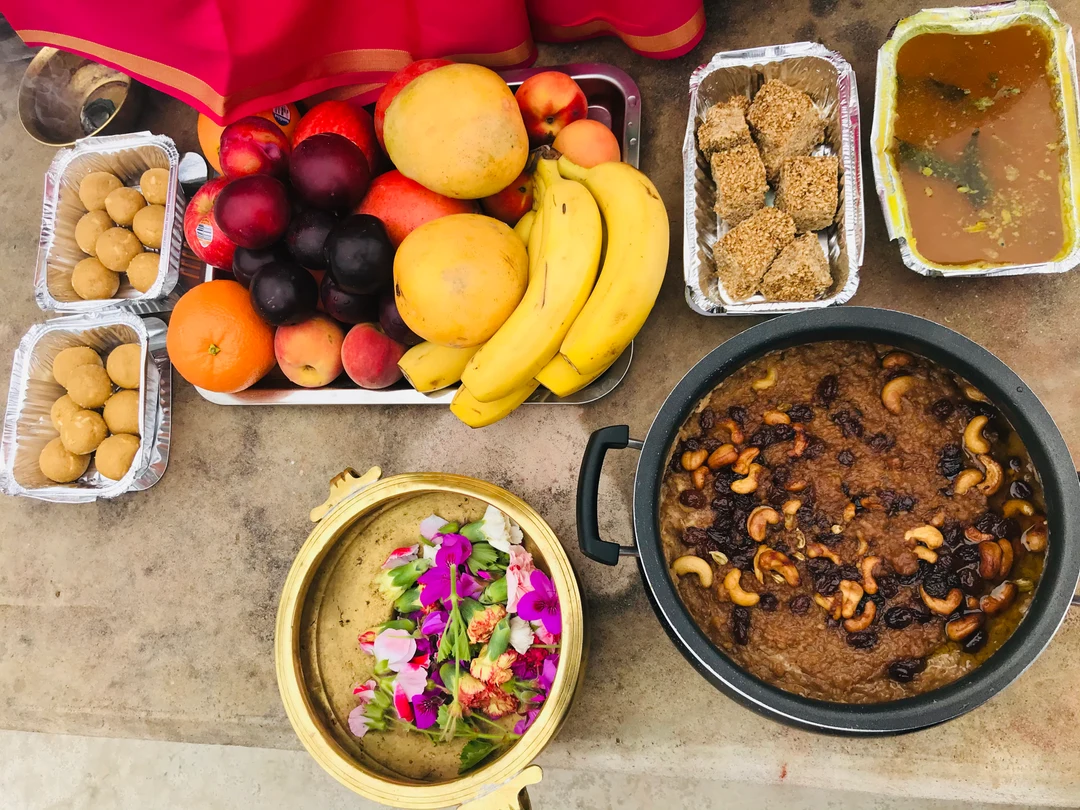
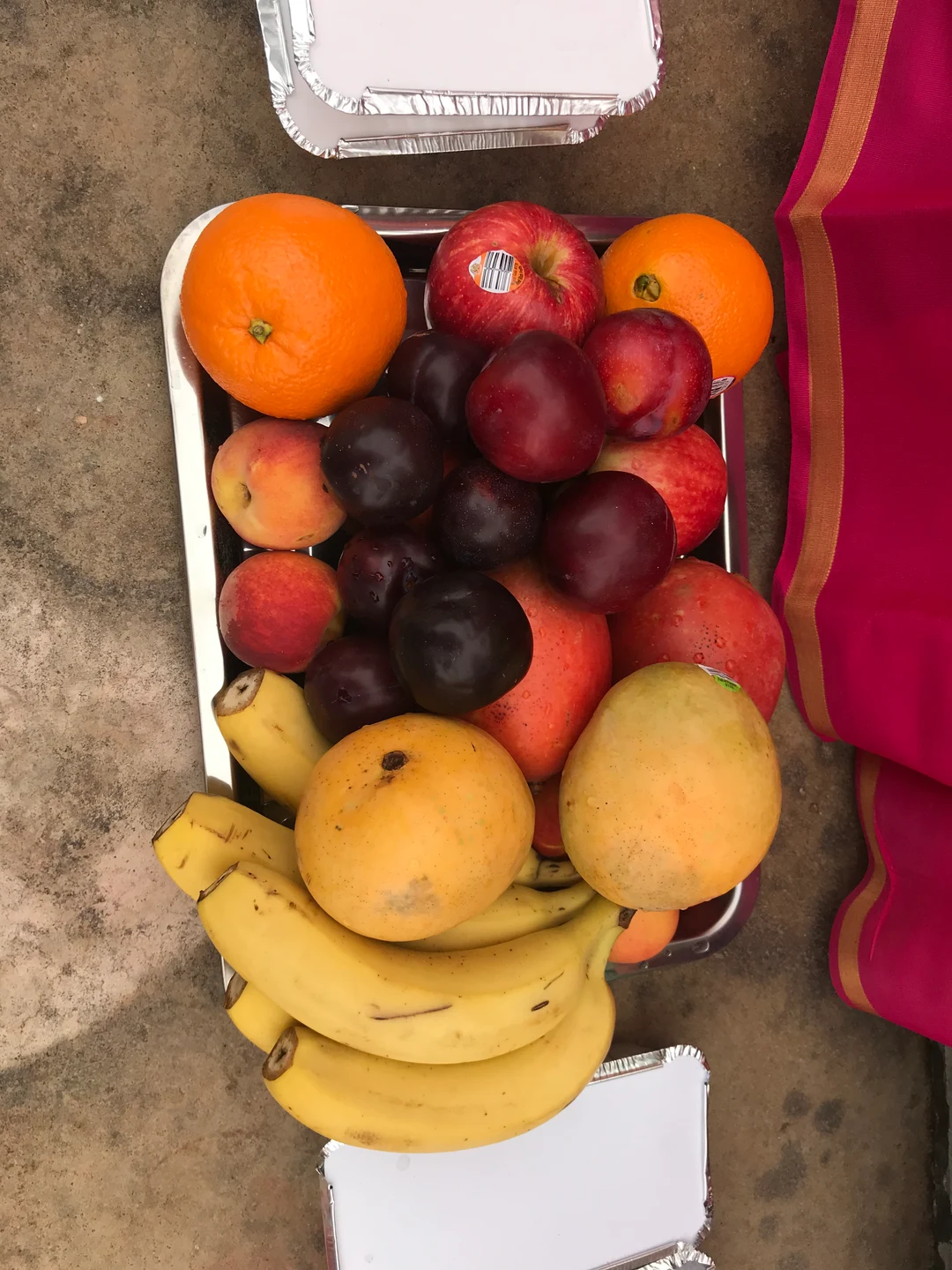
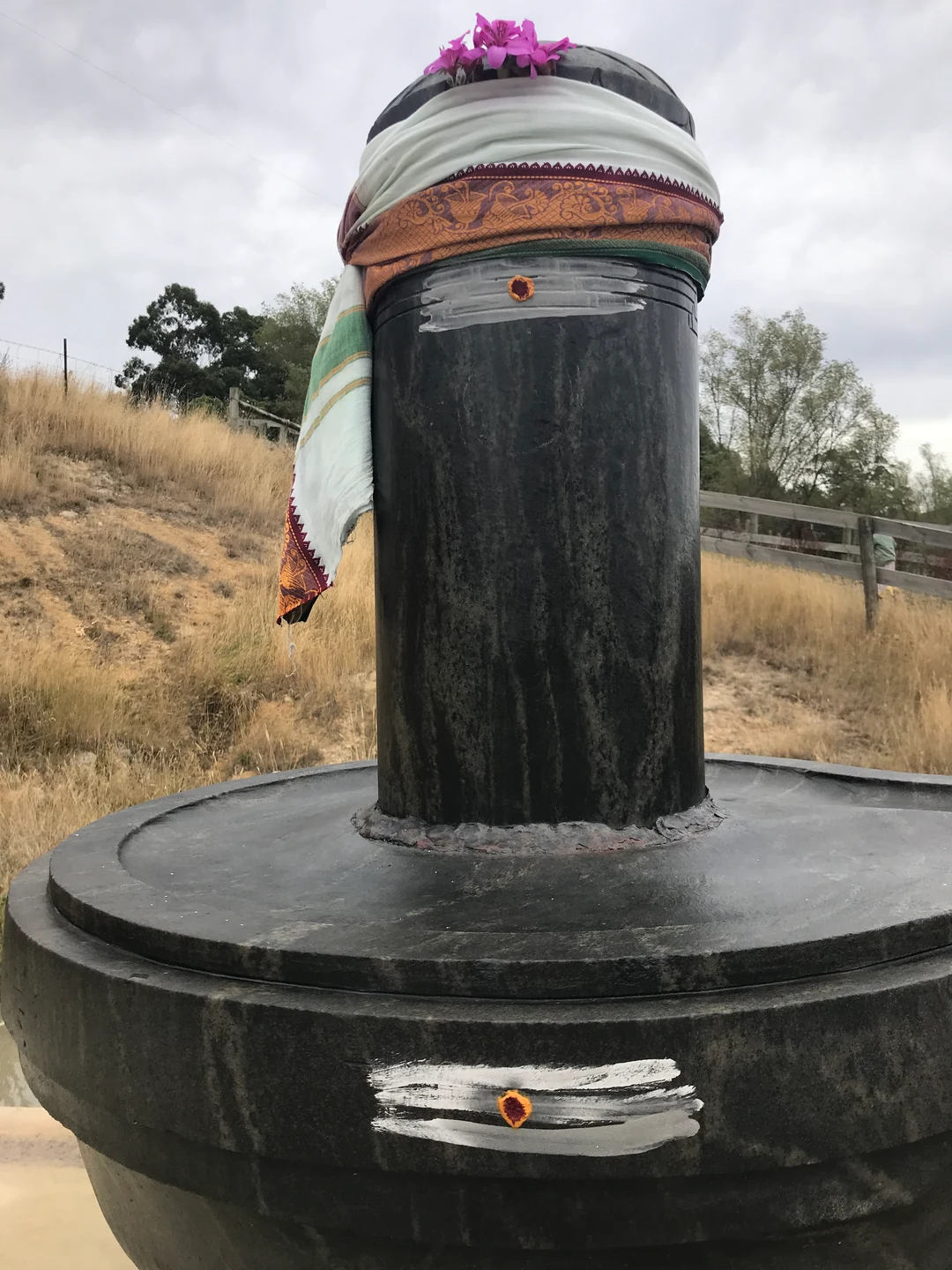
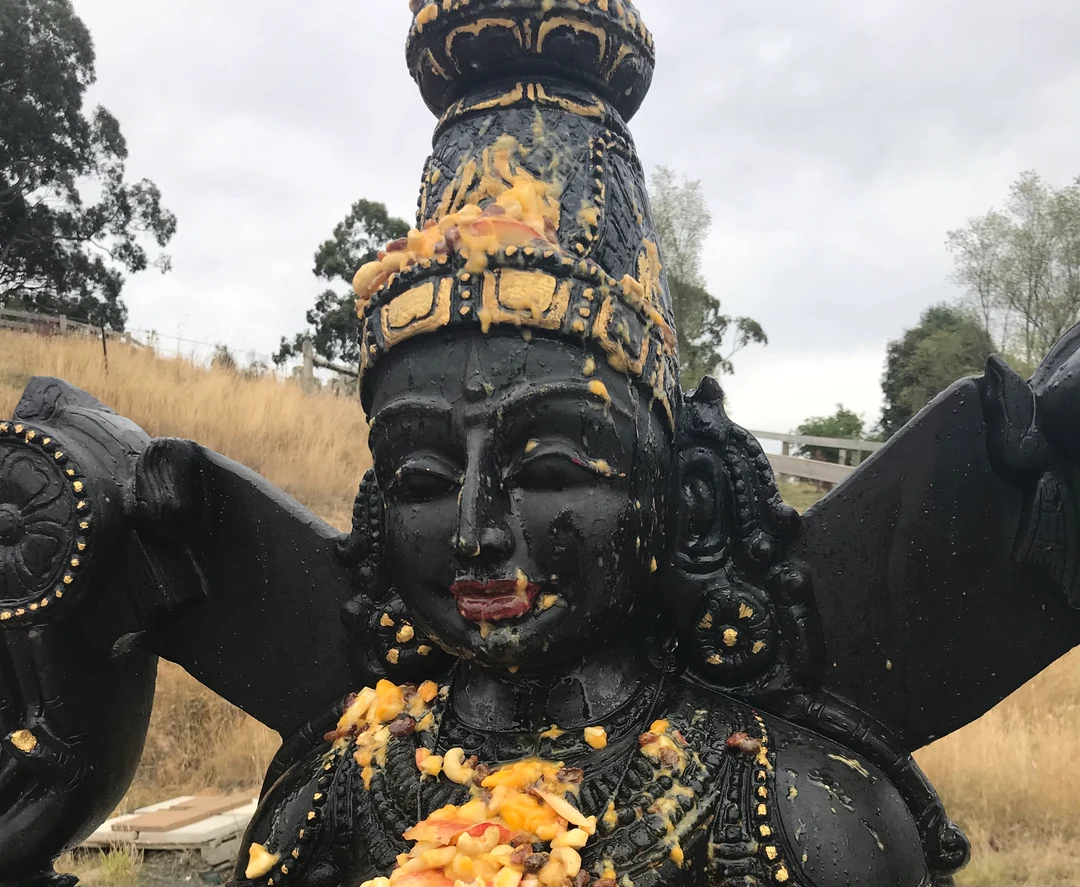
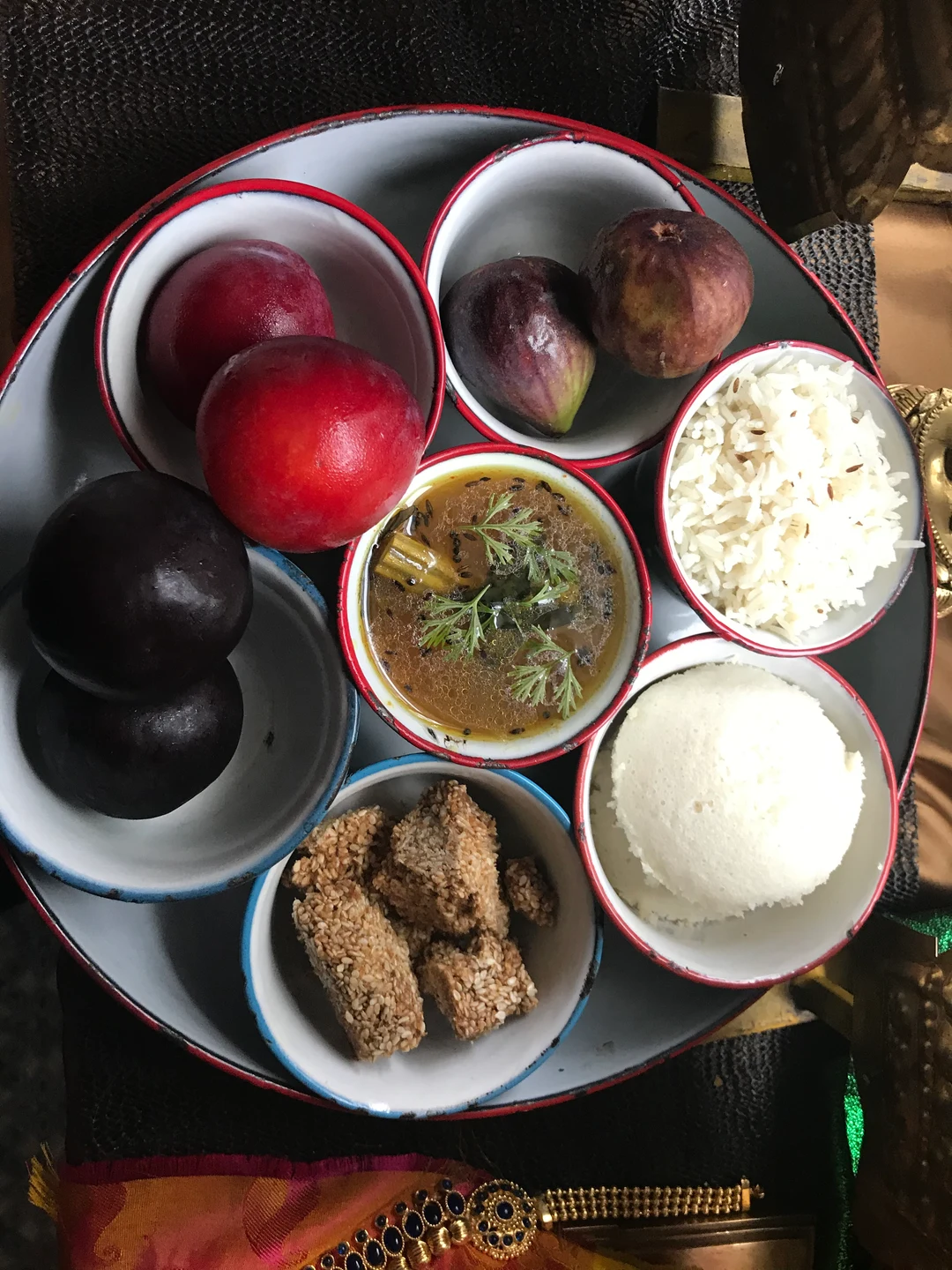
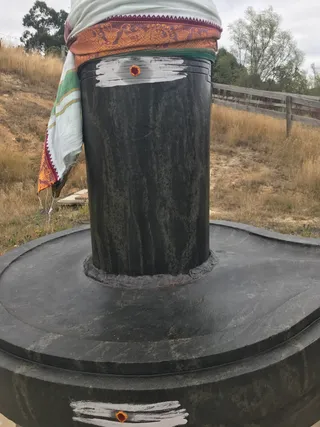
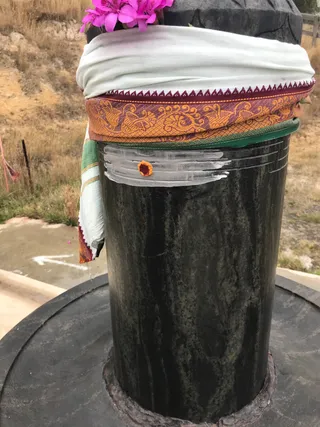
Overhead photo of a ritual offering spread on a stone floor. A large black pan holds a brown sweet dish topped with cashews and raisins. Beside it is a brass bowl of mixed flower petals in pink, purple and white. Fresh fruit fills an aluminium tray: bananas, mangoes, apples, plums and an orange. Foil containers hold round yellow laddu sweets, square brown sesame-style sweets, and a golden liquid dish. A red cloth with gold border edges the top of the frame. No people are visible.A photograph of a stainless steel tray filled with fresh fruit set on a stone-tiled floor beside a folded magenta cloth with gold border. The fruit includes oranges, red apples, plums, peaches, mangoes and a bunch of yellow bananas. Two aluminium foil food trays lie at the top and bottom edges of the frame. No people are visible. This appears to be an offering of fruit, possibly naivedhyam, but no person or ritual action is shown.Outdoor photograph of a black stone deity murti with a tall ornate gold-trimmed crown, white and red tilak on the forehead, and a pink flower tucked into the crown. The figure is garlanded with a dense lemon mala of yellow and green limes, with a green and red cloth draped at the chest. Dry grass, a wooden fence and trees stand behind it under an overcast sky.A black stone murti of a four-armed deity stands outdoors against a grassy hillside and wooden fence. It wears a tall gold-trimmed crown, a red bindi and white forehead markings, and is draped in a green and pink silk sari with gold borders. Multiple garlands of yellow and green lemons hang across its chest and shoulders, and its hands hold a discus-like wheel and other emblems. No people are visible.Outdoor photo of a large dark stone Shiva linga on a circular black stone yoni-peetha base, with white horizontal three-line ash markings and red kumkum dots on the linga and base. Above, the cropped lower body of a person wears a white dhoti-style cloth with a bordered orange, purple and green woven band at the waist. Dry golden grass, a wooden fence and trees fill the background.Close-up photograph of a dark polished stone Shiva linga on a black circular yoni-pitha base, outdoors with dry golden grass and a concrete path behind it. The linga is draped with a white cloth bordered by an orange and maroon patterned band and a green edge, and crowned with pink flowers at the top. White horizontal tripundra-style strokes and an orange kumkum dot mark its upper surface. No people are visible.

Pictures from the day

2 photosSource gallery
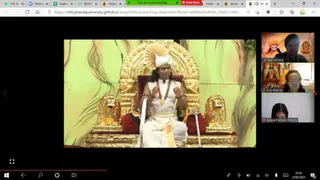
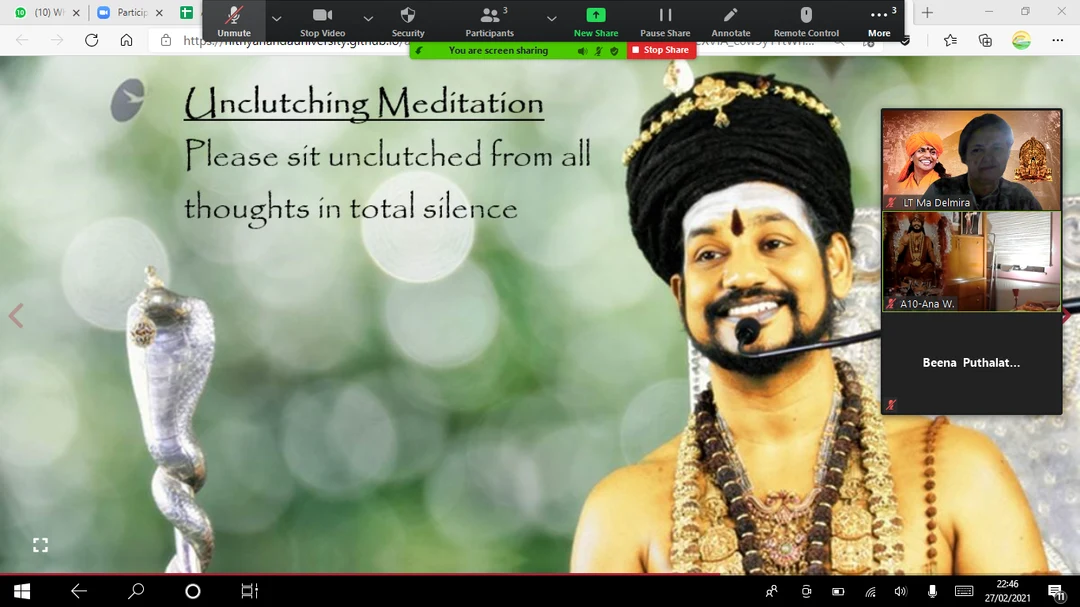
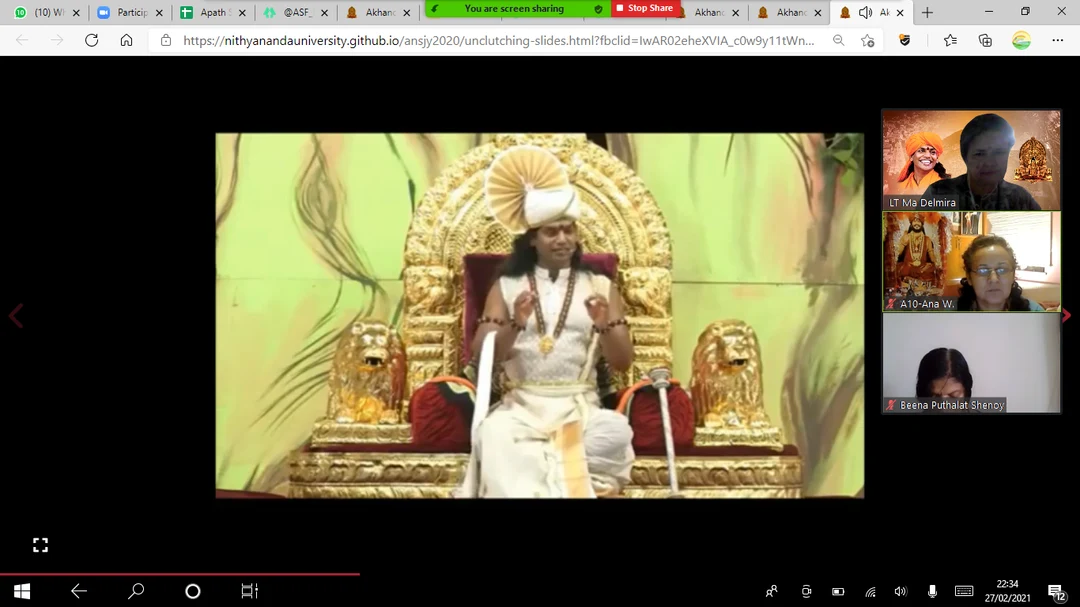
A screenshot of a Zoom video call shared on screen, showing a slide titled "Unclutching Meditation" with the instruction "Please sit unclutched from all thoughts in total silence." The slide features a smiling bare-chested figure with a tall black swept-back headdress, a white forehead mark and red bindi, rudraksha beads and layered gold necklaces, beside a silver cobra statue against a blurred green background. Small video tiles at right show a woman in an orange top with a deity image behind her, and a second participant in a room with a shrine-like setup. The figure's identity cannot be established from appearance here, so this is a depiction of a teacher on a slide. Zoom controls and a Windows taskbar frame the screenshot.Screenshot of a video call shared on screen with a browser window open to a nithyanandauniversity.github.io slides page. The main frame shows a man seated on an ornate golden throne flanked by two golden lion sculptures, against a green painted backdrop. He wears a large white turban, a white garment with a gold-trimmed sash, a long gold necklace, and beaded bracelets, and his hands are raised in a teaching gesture. On the right, three participant video tiles show a woman with reddish hair and an orange-and-white image, a woman in a dark top, and a woman with dark hair, labelled LT Ma Delmira, A10-Ana W., and Beena Puthalat Shenoy. Taskbar clock reads 22:34 on 27/02/2021. a person appears as the seated teacher on the throne; the presence of the throne alone is insufficient, so the a person field is set to unsure.

Pictures from the day

11 photosSource gallery
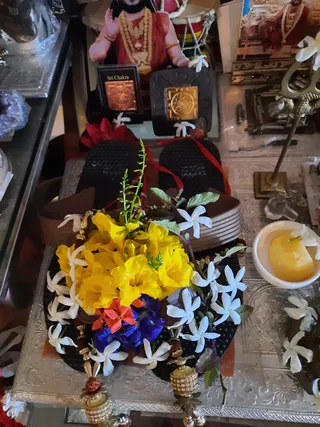
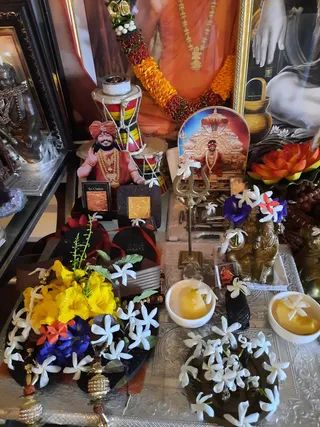
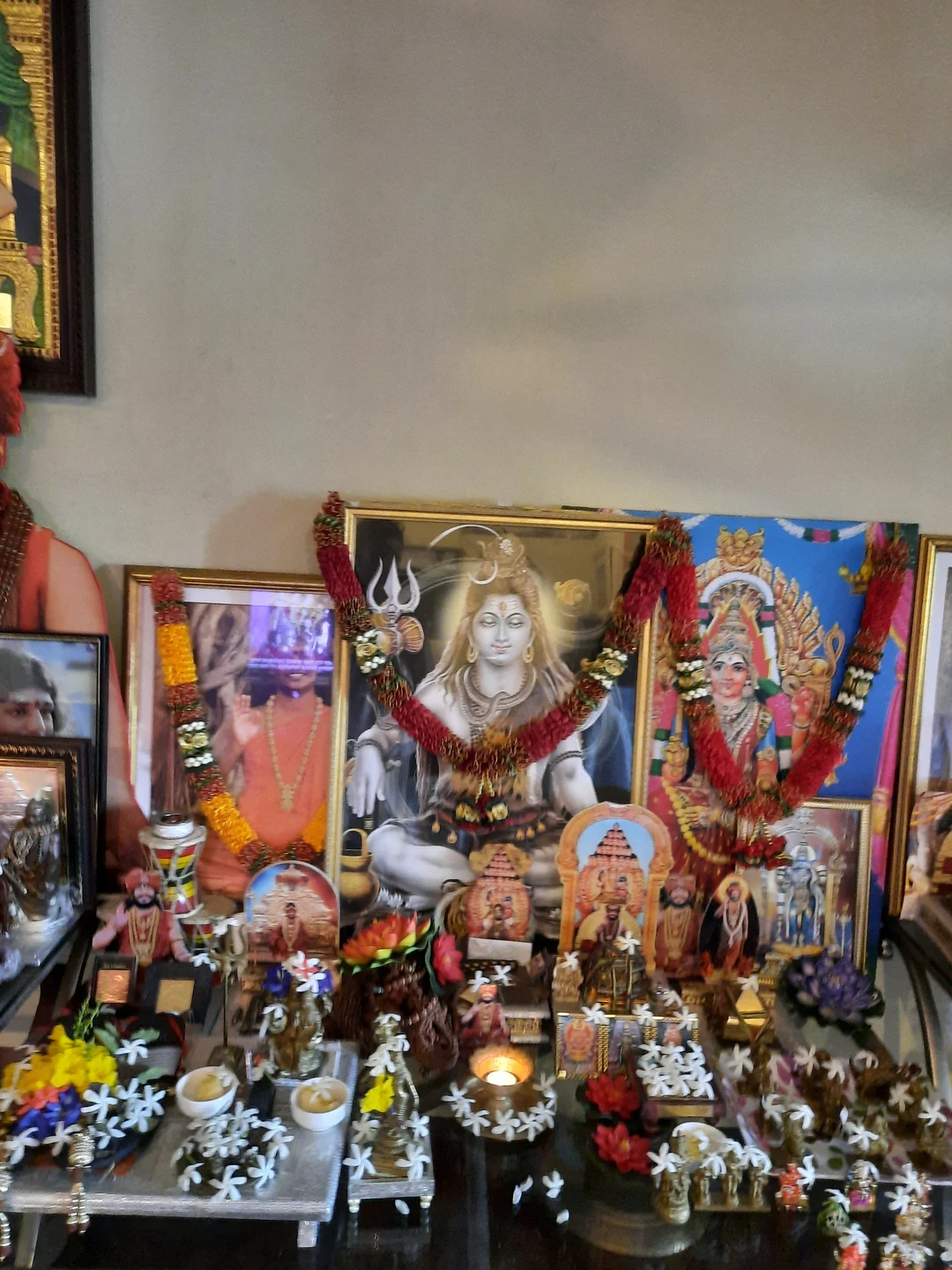
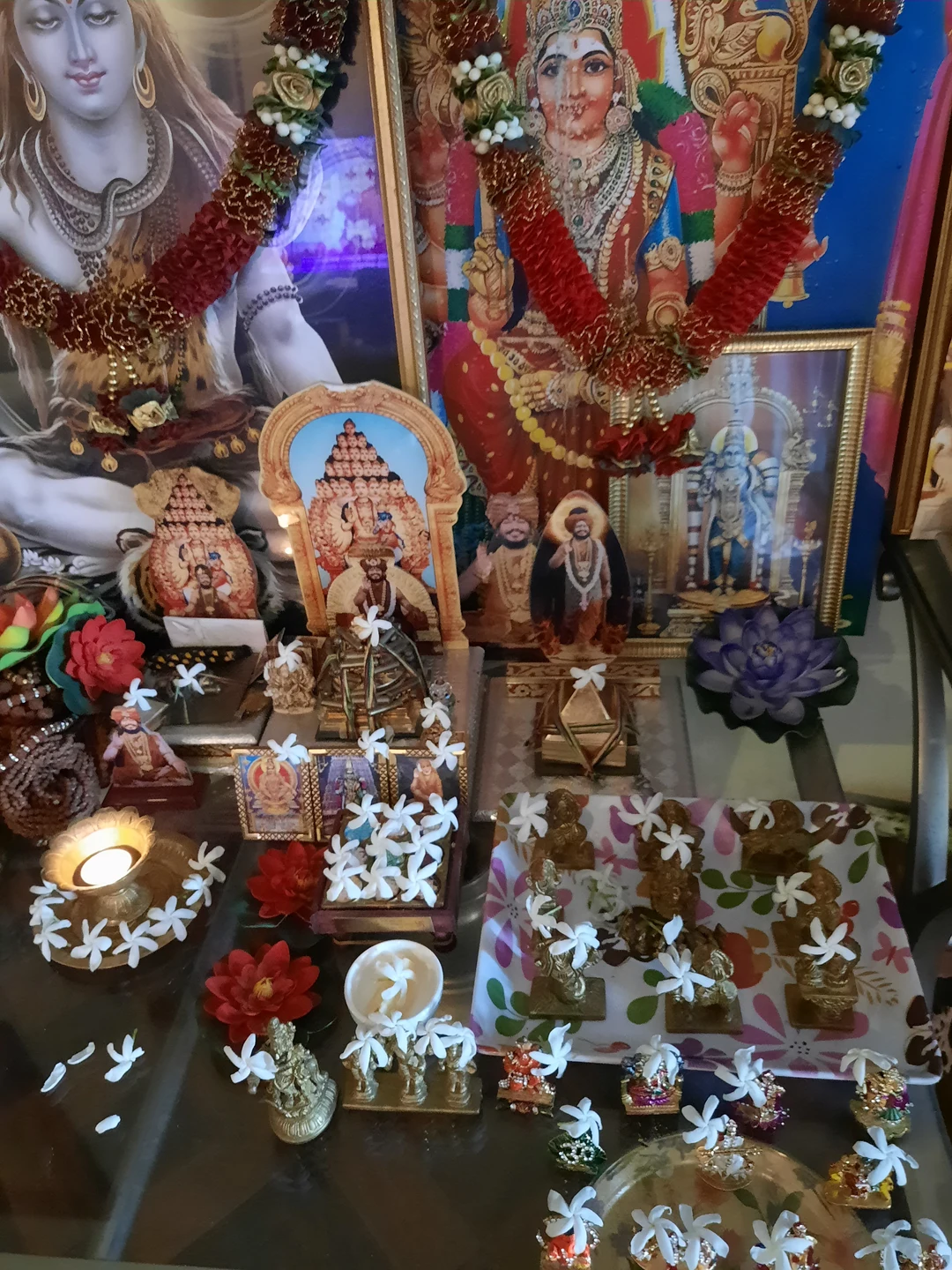
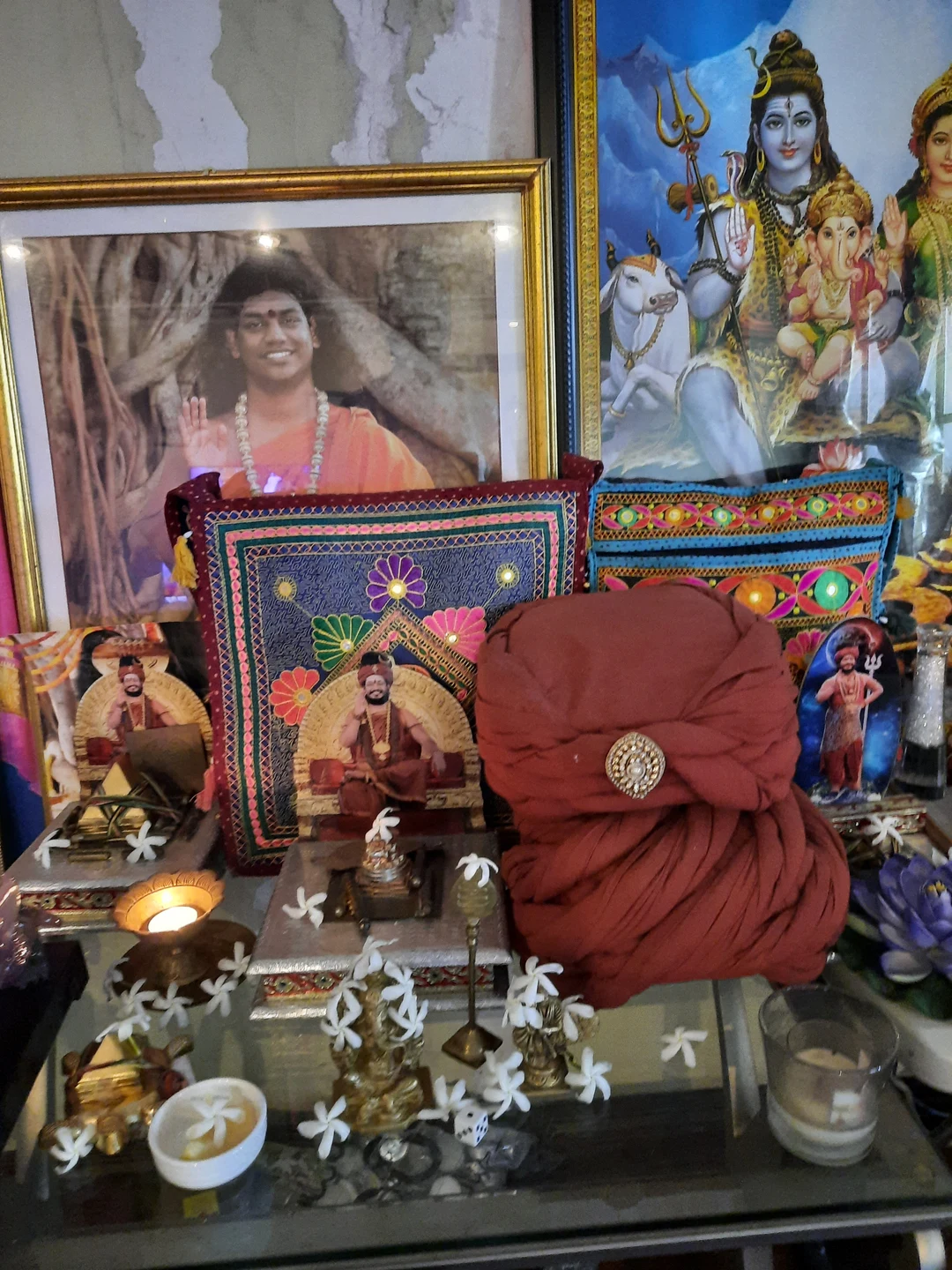
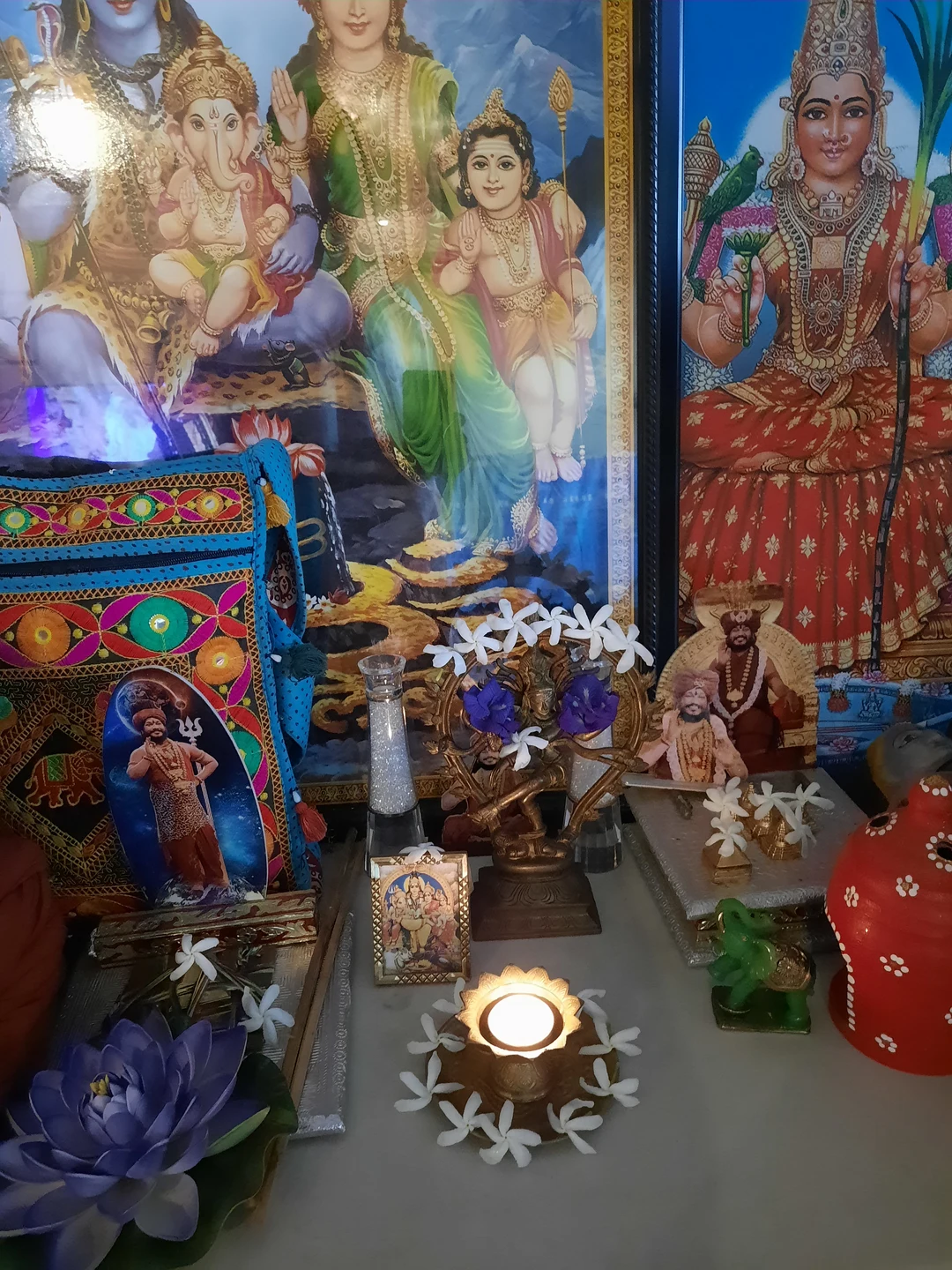
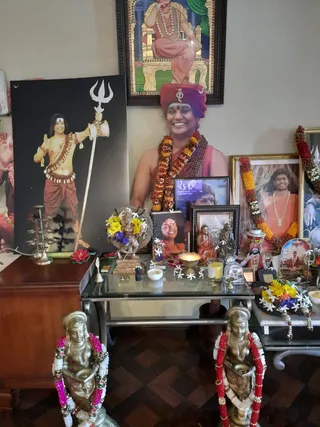
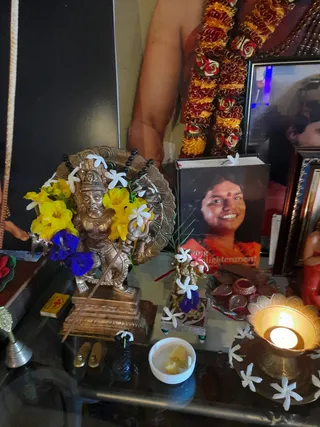
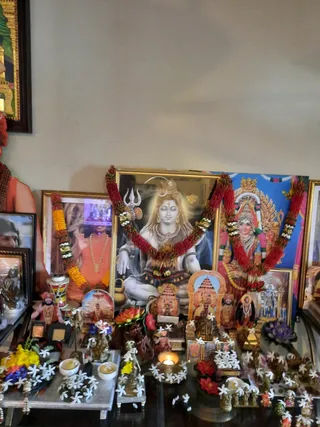
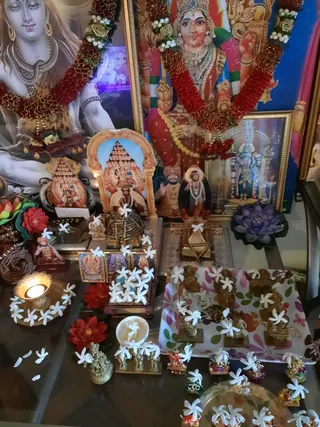
Overhead photo of a home shrine altar showing a pair of black sandal-style paduka slippers tied together with red ribbon, placed on a silver embossed tray. Yellow flowers, white jasmine blossoms, small orange-red flowers, blue flowers and green leaves are arranged over the paduka, with rudraksha beads and gold ornaments hanging at the front. A small white bowl holds a yellow sweet or offering. Behind them stands a red-clad deity murti wearing gold necklaces, beside a Sri Chakra yantra plate and a gold yantra on a black base. A brass lamp stand and a framed picture appear at the right edge. The scene is a daily paduka puja offering. No people are visible.Close-up of a home altar arranged with padukas, flowers and puja items on a silver-patterned tray. Center-left, a small figurine of a smiling bearded man in a red-orange turban, gold necklaces and red-orange garment raises one hand beside two drums in red, yellow and green, and two Sri Chakra yantra plates. A framed photo shows a bearded man in orange robes and gold necklaces before a temple-like backdrop. Yellow and orange flowers, white jasmine strands, a brass trident, brass deity figures, two white bowls of yellow offering, and rudraksha malas sit on the tray. Framed images of a seated saint in orange and a deity are behind. No people are physically present.A home altar arrangement with framed and printed portraits on a glass-topped table and a wall. A tall black-backed print shows a bare-chested figure with a long trident and rudraksha-style cords. On the wall above, a framed painting shows a seated figure on an ornate golden throne wearing pink-red robes. Central framed photos show a smiling man with a red-maroon turban and a bead necklace of rudraksha and orange marigold garlands, though these are portraits, not physical people. Brass figures of deity murti stand in front, garlanded with red and white flowers. Oil lamps, a lit candle, white flowers and yellow-blue floral arrangements sit on the table. No physical person is present.A home shrine table photographed close up. A bronze deity murti stands at left, adorned with yellow and blue flowers and white jasmine blossoms, with a bronze arch behind it. At center is a hardcover book titled partly "...Enlightenment" showing a smiling woman in an orange garment and a red bindi; a framed portrait and a garland of red and yellow roses hang behind. Small brass oil lamps and a lit wick lamp sit at right, with a white bowl of offering and a bell at left. Partial bare arm of a person in red-orange cloth is visible at the top.Home altar display with framed images and garlands. Center: a framed print of Lord Shiva seated in meditation with trident and crescent moon, draped in red and yellow marigold-and-jasmine garlands. Left: a framed portrait of a saffron-robed figure with a long beaded mala, wearing an orange robe, and a small framed portrait of a person in a dark suit. Right: a blue-background print of a goddess with a crown and red garment, also garlanded. Foreground: small brass murtis, a lit oil lamp, white frangipani flowers scattered across the glass table, bowls of offerings and a small kalasha. No people physically present in the scene.A home shrine table crowded with devotional images and small murtis decorated with white jasmine flowers. Large framed prints of a deity with long hair and beaded jewellery and a red-robed goddess with a red and gold garland hang behind. Small gilt statues and framed pictures stand on a glass top, including a bronze figure seated on a peetha and a deity murti under an arch. An oil lamp with a lit wick sits at left beside scattered jasmine petals, and a floral cloth holds several small gold-toned figures. Red artificial lotuses and a purple lotus add colour. No people are visible.

Pictures from the day

7 photosSource gallery
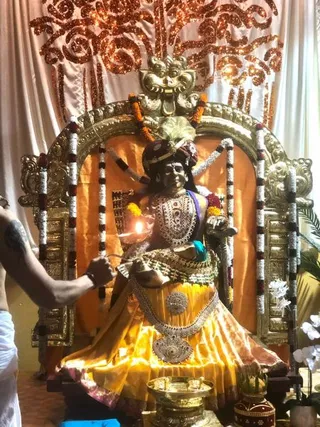
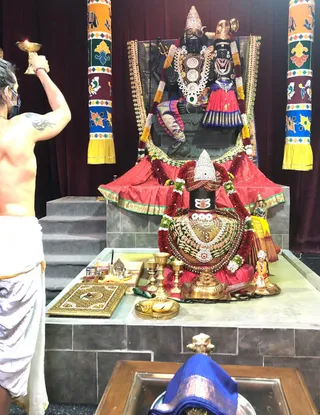
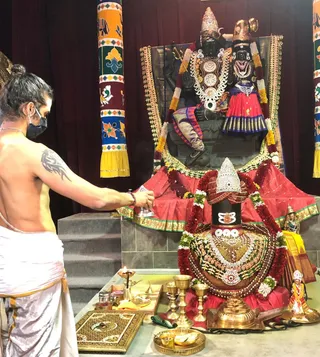
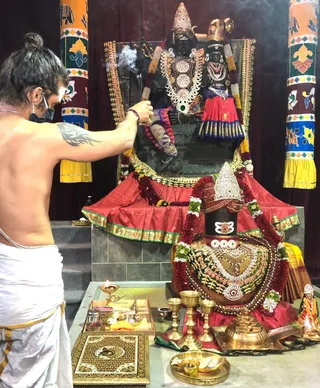
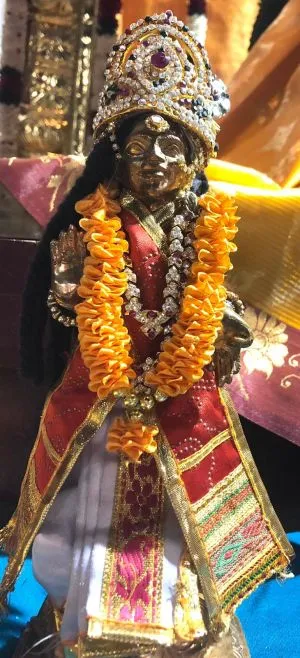
A dark-metal murti of a seated deity is dressed in a golden-yellow silk garment with zari border, layered silver-toned jewelled necklaces and a jewelled waist belt, and a maroon turban with a green feather. It sits on an ornate gilt throne arch with orange and white flower garlands, and holds a lit oil lamp in one hand. A bare-armed attendant in white reaches in from the left to tend the murti; a brass vessel sits in the foreground beside a white orchid. Behind is a golden sequined backdrop. The scene reads as a Makudabhishekam-style coronation decoration.A photograph of a temple shrine in a ritual setting. In the left foreground a shirtless priest in white dhoti holds a brass oil lamp aloft, wearing a face mask. Behind him stands a black stone deity murti of Shiva with a crown and a companion murti beside it, dressed in red and blue cloth, adorned with white and gold garlands. In front of the altar, a black Shiva linga is draped in red and white cloth, decorated with a silver face, rudraksha-style beads, flower garlands and gold jewellery. Brass lamps, a kalasha-style vessel, a small brass plate and a gold-patterned tray sit on the stone platform. Patterned banners in orange, yellow and green flank the shrine. The scene reflects an abhishekam or aarti in progress.A shirtless priest with his back to the camera, wearing a white dhoti and a black face mask, pours liquid from a small silver vessel over a shivalinga. The linga is decorated with a silver crown, a gold and jewelled necklace, red and white flower garlands, and sits on a gold base with brass lamps, bowls and a lit oil lamp arranged on a tray. Behind it, a dark stone deity pair, seated and garlanded with a red and gold cloth backdrop, is adorned with marigold garlands and a silver-embellished headdress. Striped painted pillars in red, yellow, green and blue frame the shrine room.A bare-chested priest in white dhoti with a tattooed upper arm and a black face mask waves incense before a shrine of dark stone deities adorned with garlands, silver ornaments and a red-and-gold cloth. A black Shiva linga dressed in a crown, gold jewellery and red-green-and-white garlands stands in front on a grey platform, flanked by brass vessels, a small oil lamp, a brass tray and a small figure. Colourful painted pillars frame the scene, and incense smoke rises. The setting suggests a Hindu abhishekam or puja.A close photograph of a dark metal deity murti standing against a bright background. The figure wears an ornate jeweled crown set with red and purple stones, a gold-and-silver necklace, and a long orange marigold garland. It is dressed in a red and gold brocade garment with white underwrap, and holds a ritual object in one hand. Blue fabric and draped gold cloth appear at the base. Ceremonial decoration suggests a coronation-themed abhishekam setting.A photograph of a shrine with a decorated Shiva linga on a raised stone platform, draped in a red silk cloth and covered with red flower garlands, gold ornaments and a gold crown-like mukut with a silver-toned arch. Behind it stands a dark murti of a deity dressed in red and gold garments, with a gold necklace and a tall crown. Brass ritual vessels, a plate and lamps sit on the foreground ledge, flanked by decorated pillars with yellow and red patterned panels. No people are visible, so this is a ritual decoration scene of a deity murti and linga rather than a person or event gathering.

Pictures from the day

9 photosSource gallery
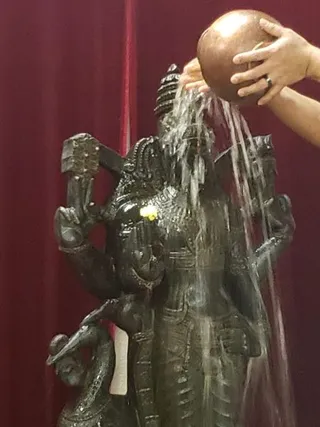
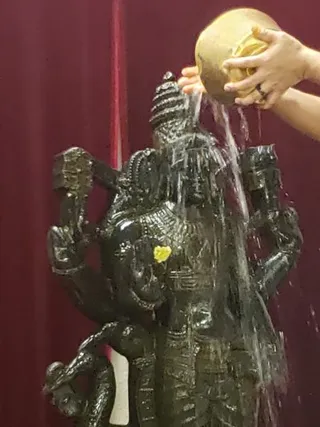
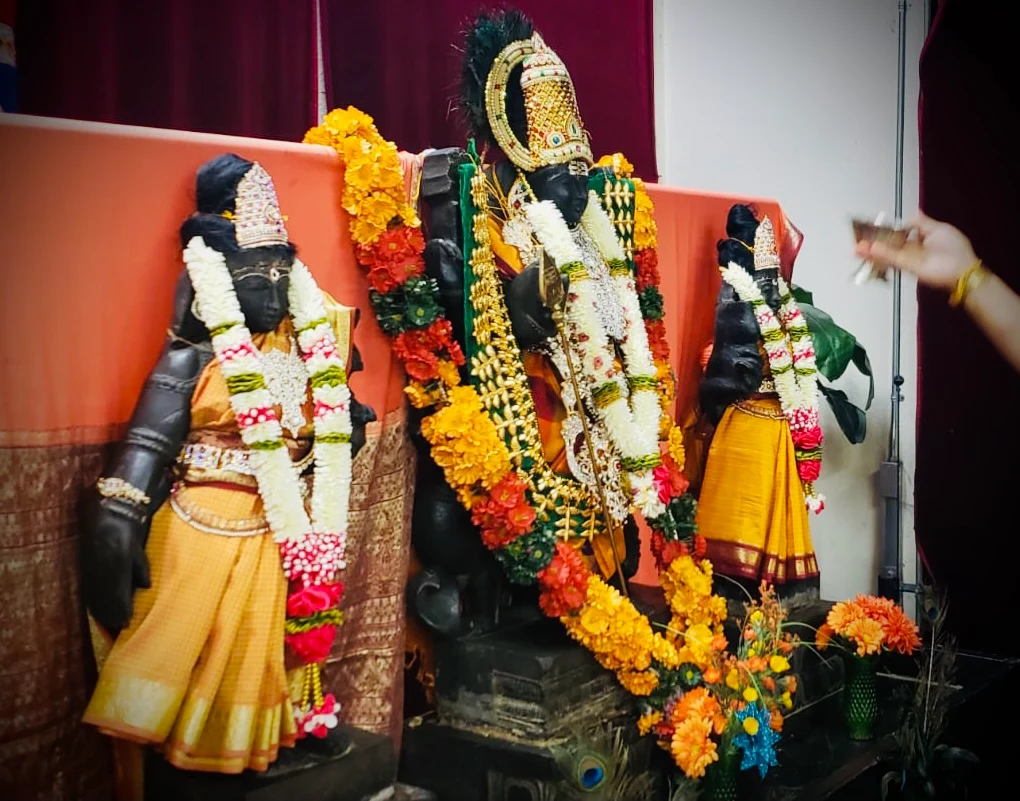
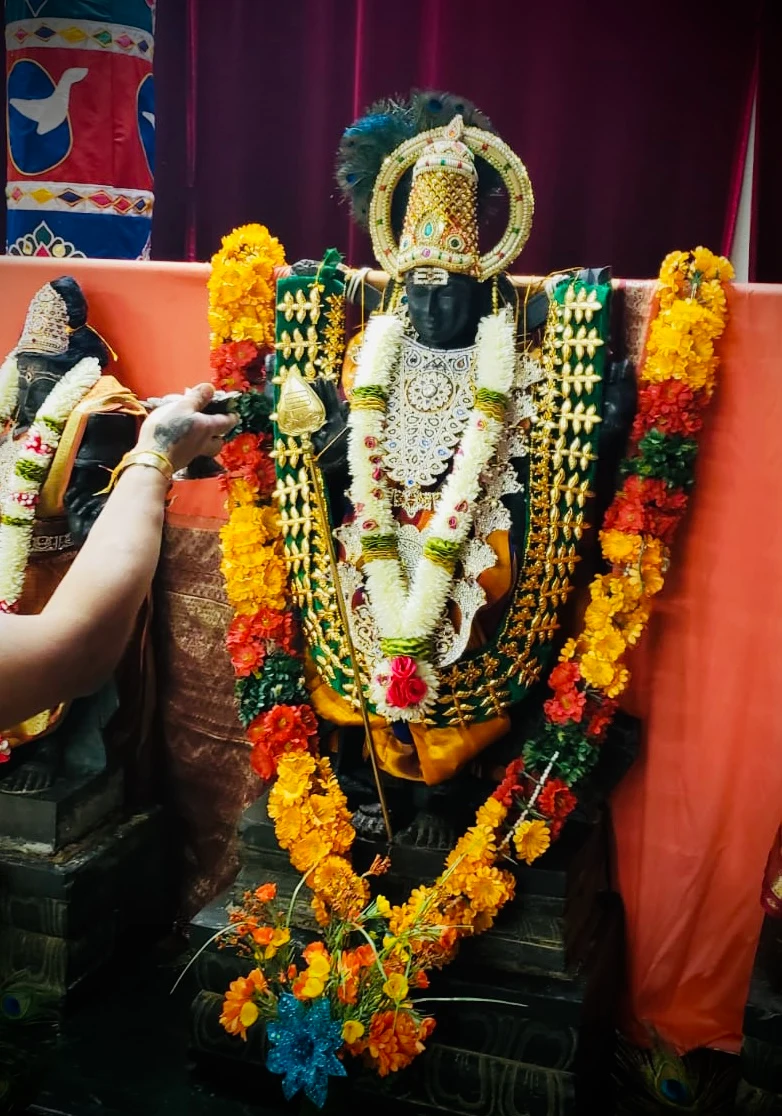
Close photo of a dark metal deity murti with a tall conical crown, multiple arms, and an elaborate necklace and armlets, standing before a deep red draped cloth. One upper hand holds a club-like object and another holds a cup or vessel, and a small yellow flower or offering sits on its chest. No physical people are visible; the figure is a statue.Photograph of three black stone murti deities dressed in yellow and gold silk garments and decorated with white jasmine and orange marigold garlands. The central figure wears a tall golden crown and holds a trident-like staff, flanked by two smaller deities on either side wearing crowns and garlands. Orange flowers sit in green vases at the lower right, a peacock feather lies at the base, and a red curtain backdrop is behind them. A hand holding an incense or camphor item enters from the right edge. No physical people are seated or standing as subjects; only a partial hand is visible.

KAILASA SAN FERNANDO, TRINIDAD & TOBAGO on 2/27/2021

1 photoView all
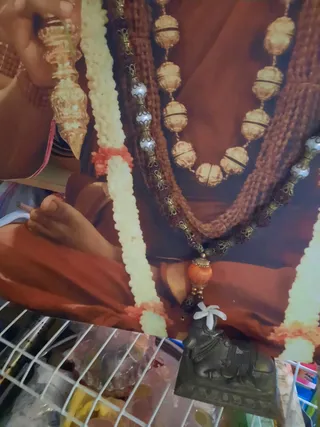
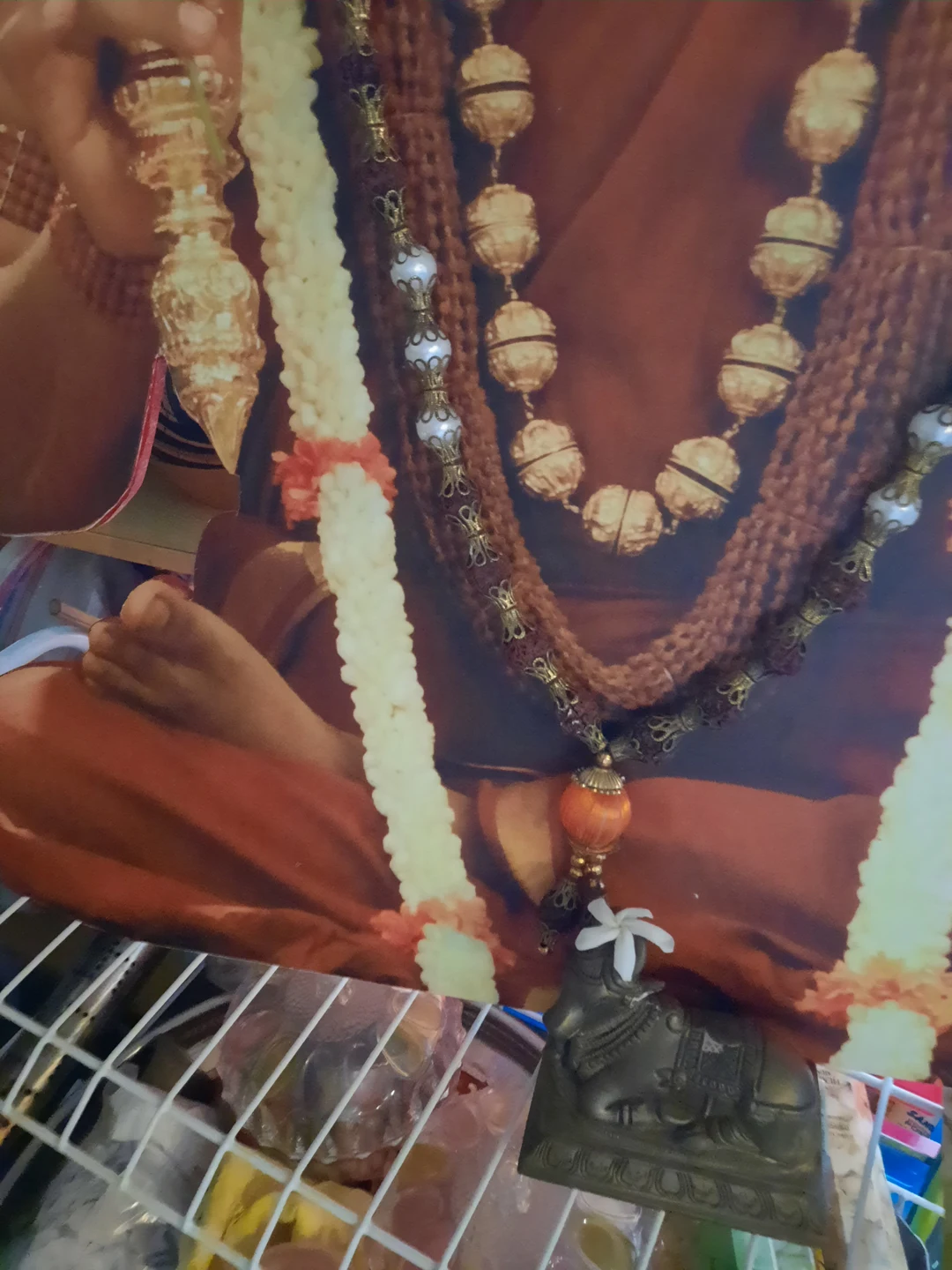
Close photograph of a printed portrait of a seated figure in saffron-orange robes, adorned with a white jasmine-type garland with orange flower accents, layered rudraksha malas with golden beads and white pearl-like beads, and an orange bead pendant. A small dark metal Nandi figure with a white flower rests in front of the print, which is placed over a white wire rack. A hand holding a brass or gold ritual implement appears at the upper left. Only a printed image of the seated figure is visible, with no physical people in the frame.