Skip to content
Thursday

13 July 2017

Google Confidence and Power Manifestation, The Future Education of Humanity

Dated photos
74
Source pages
1
Media
3
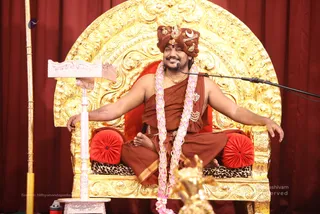
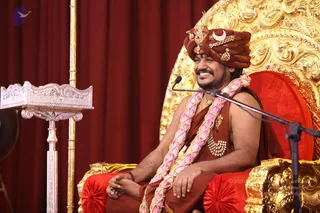
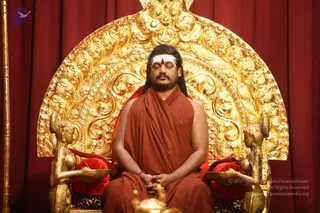
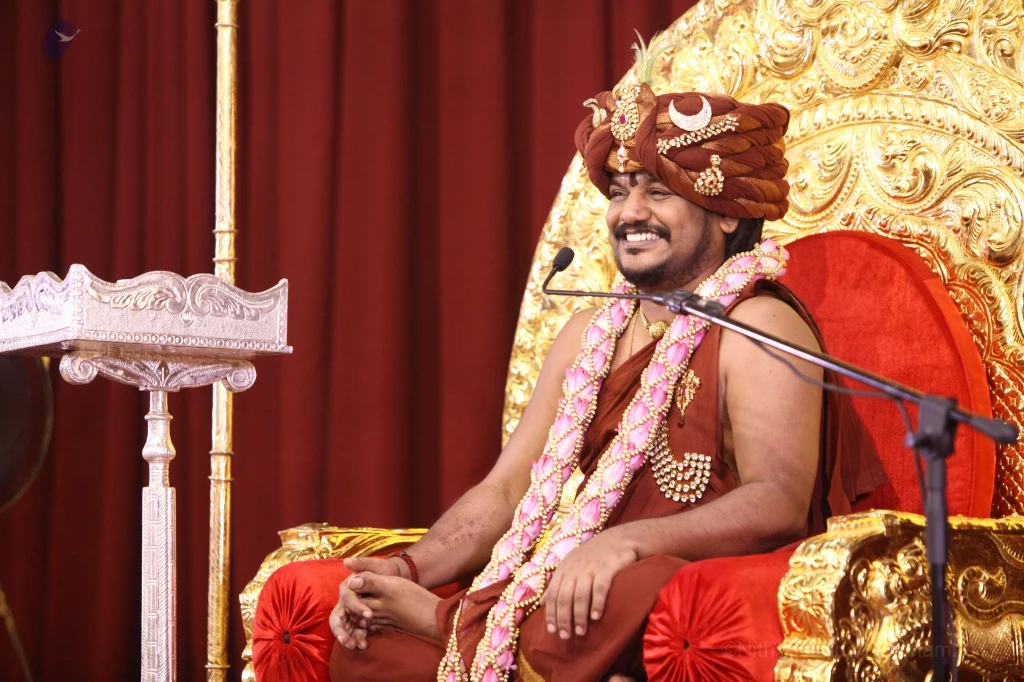
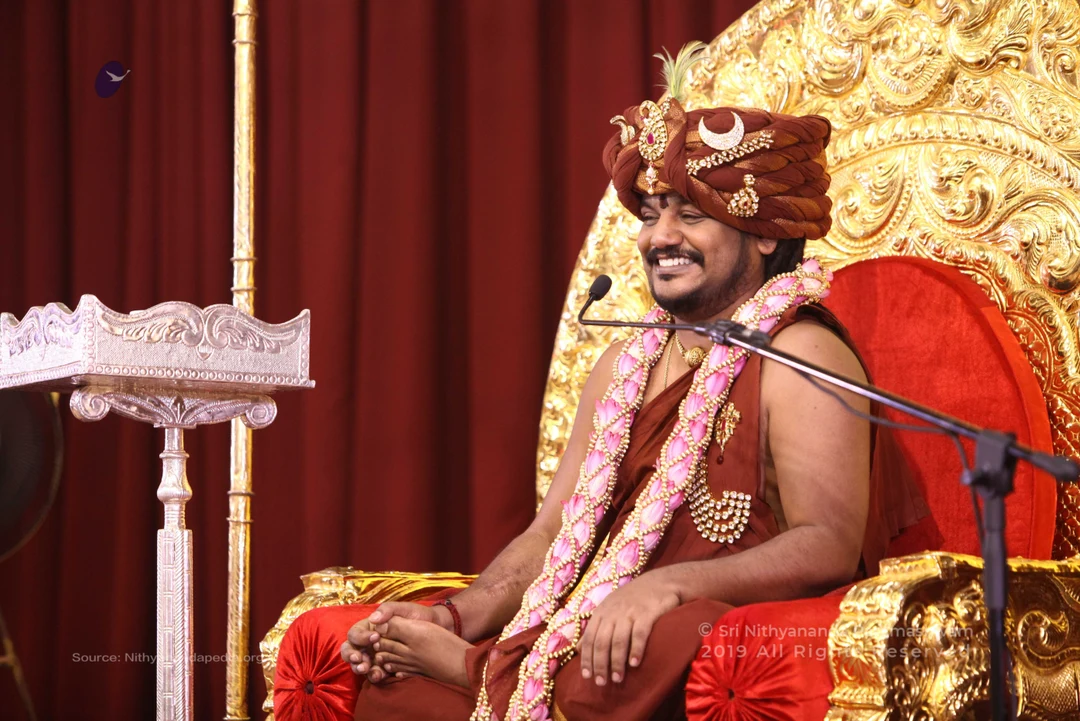
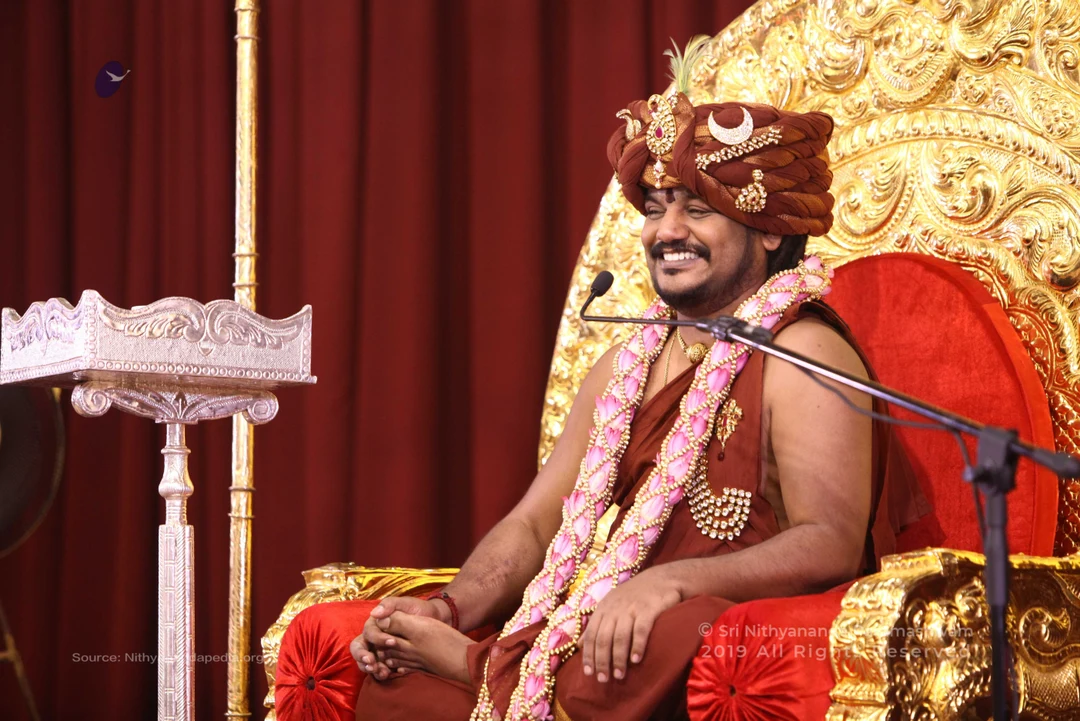
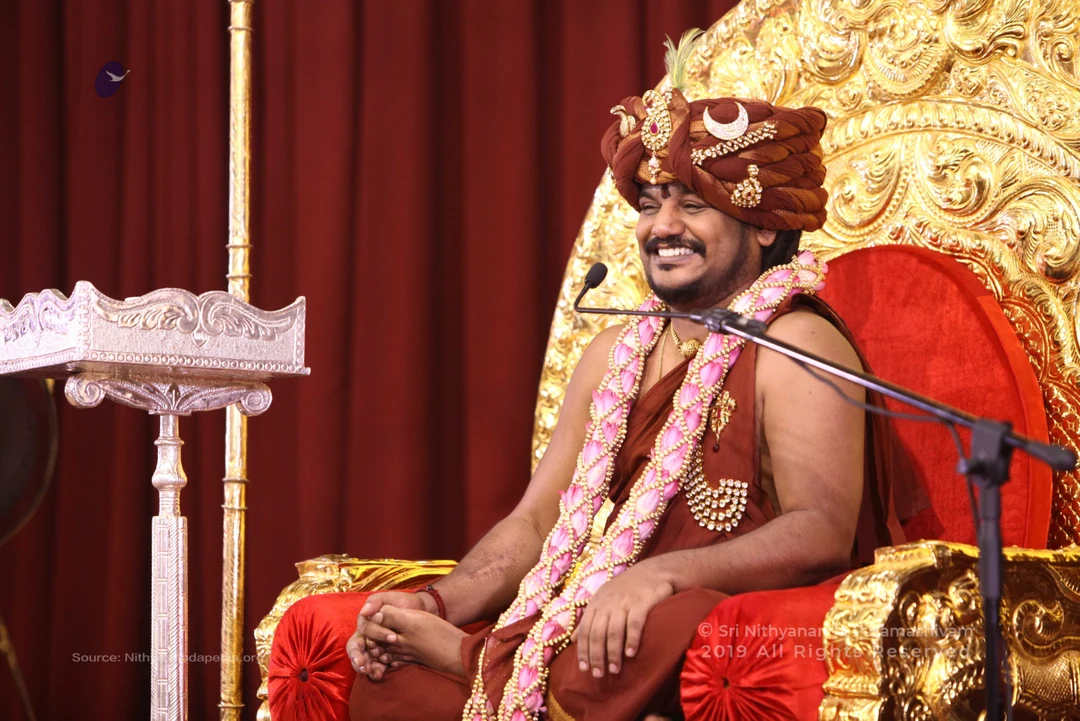
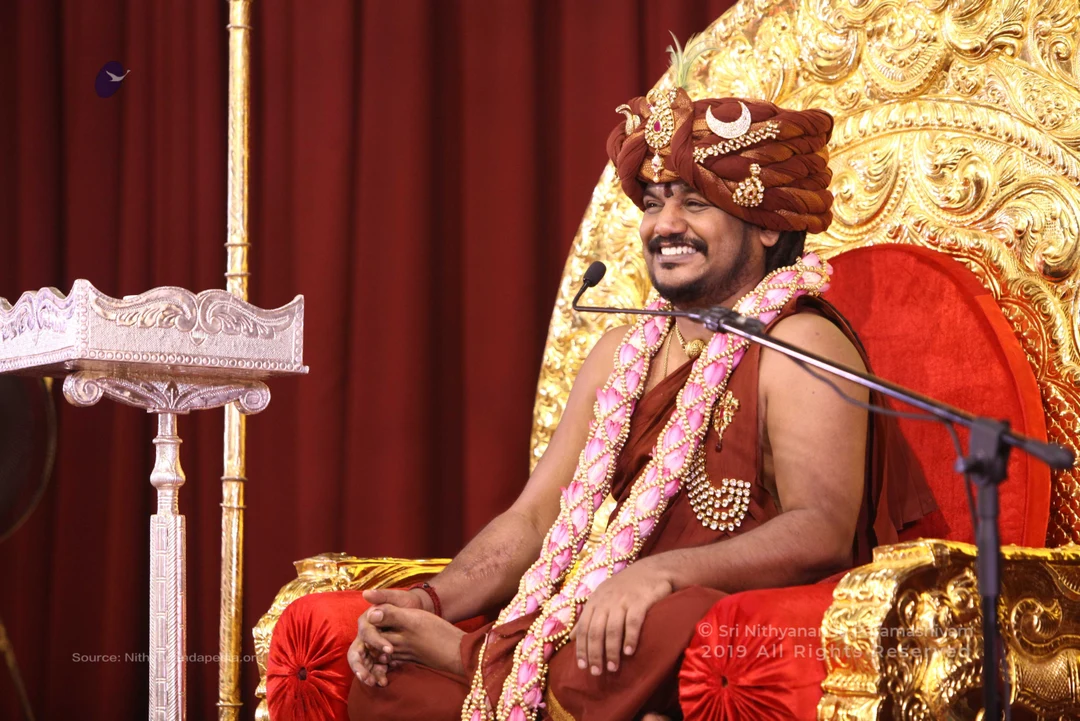
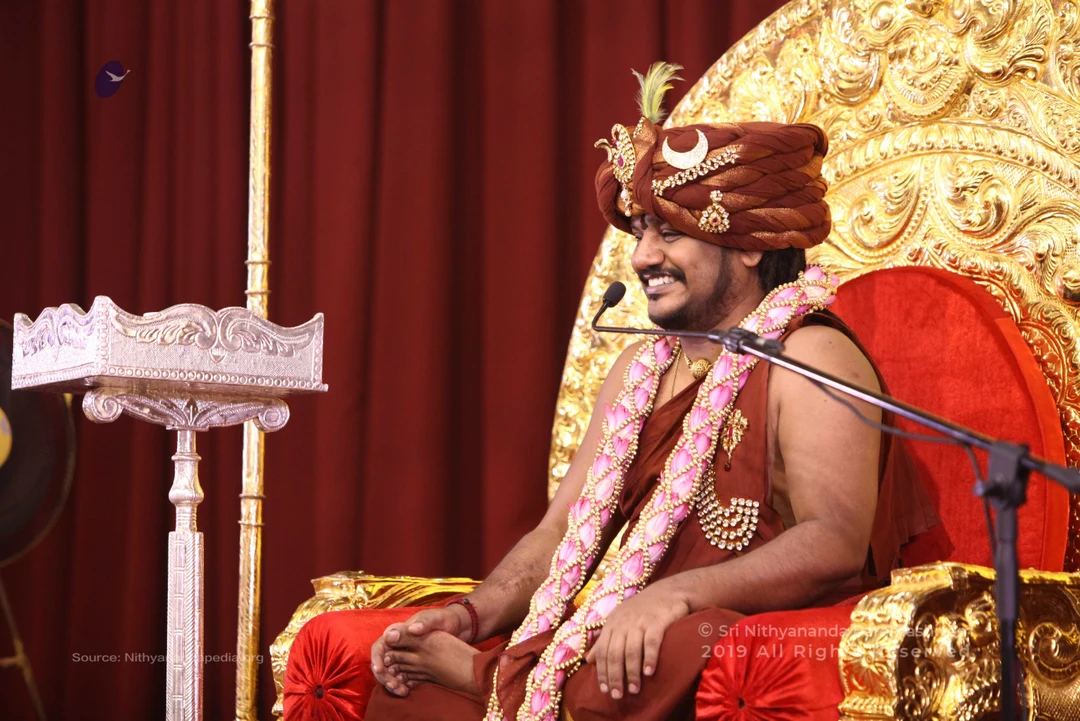
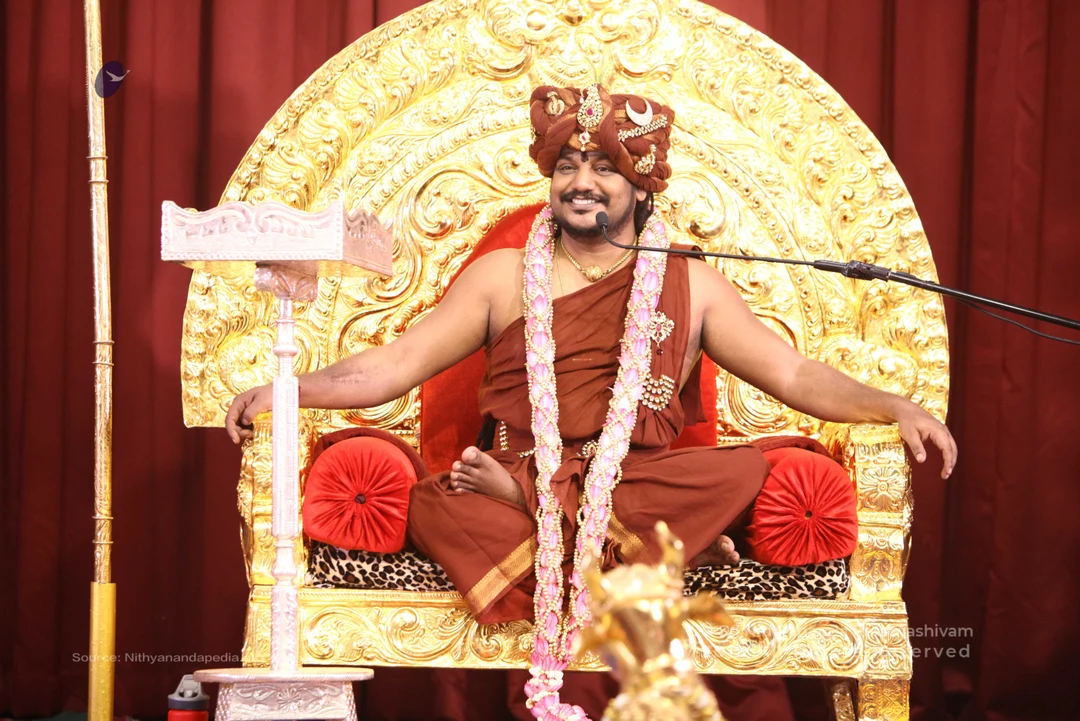
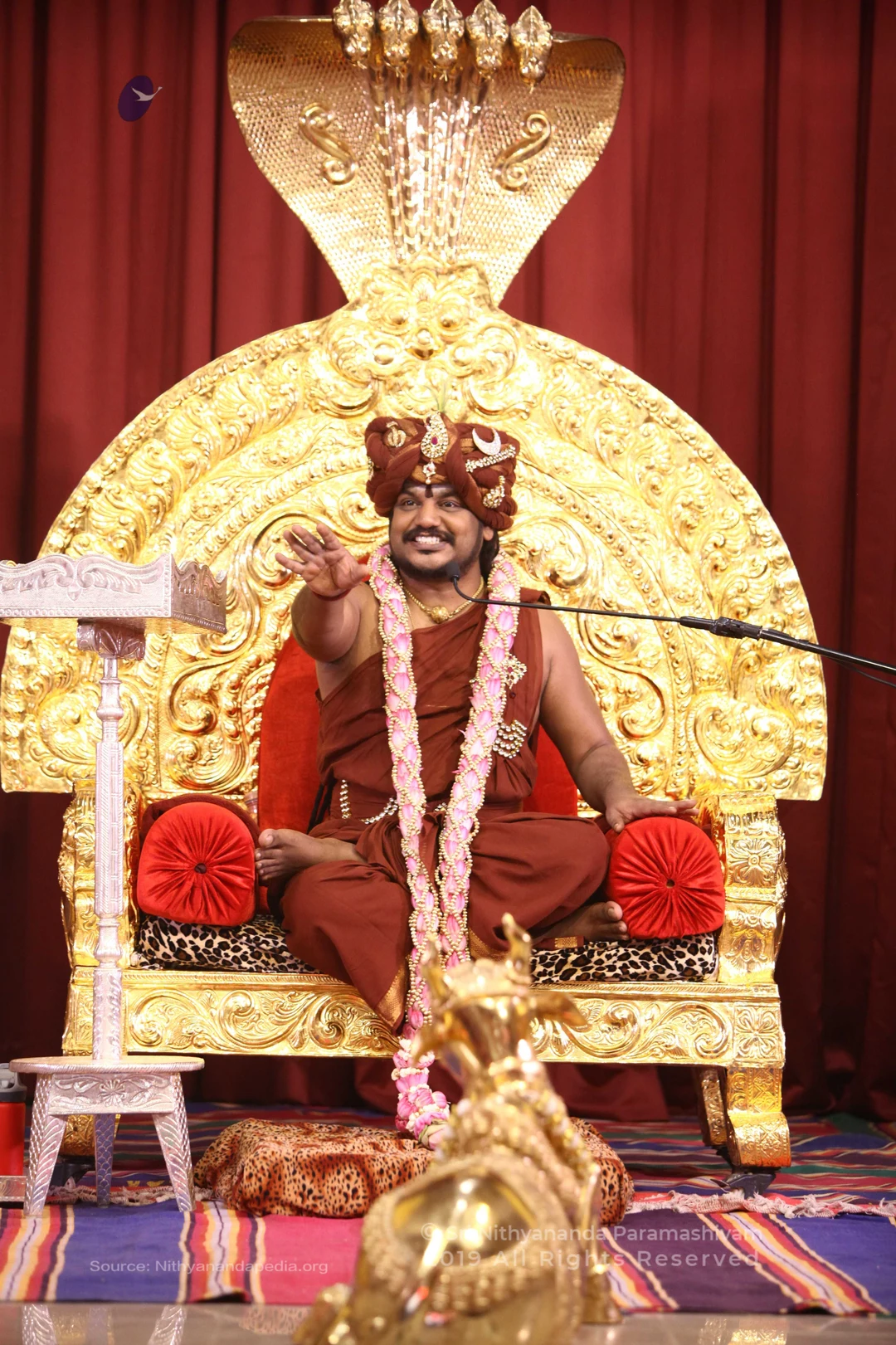
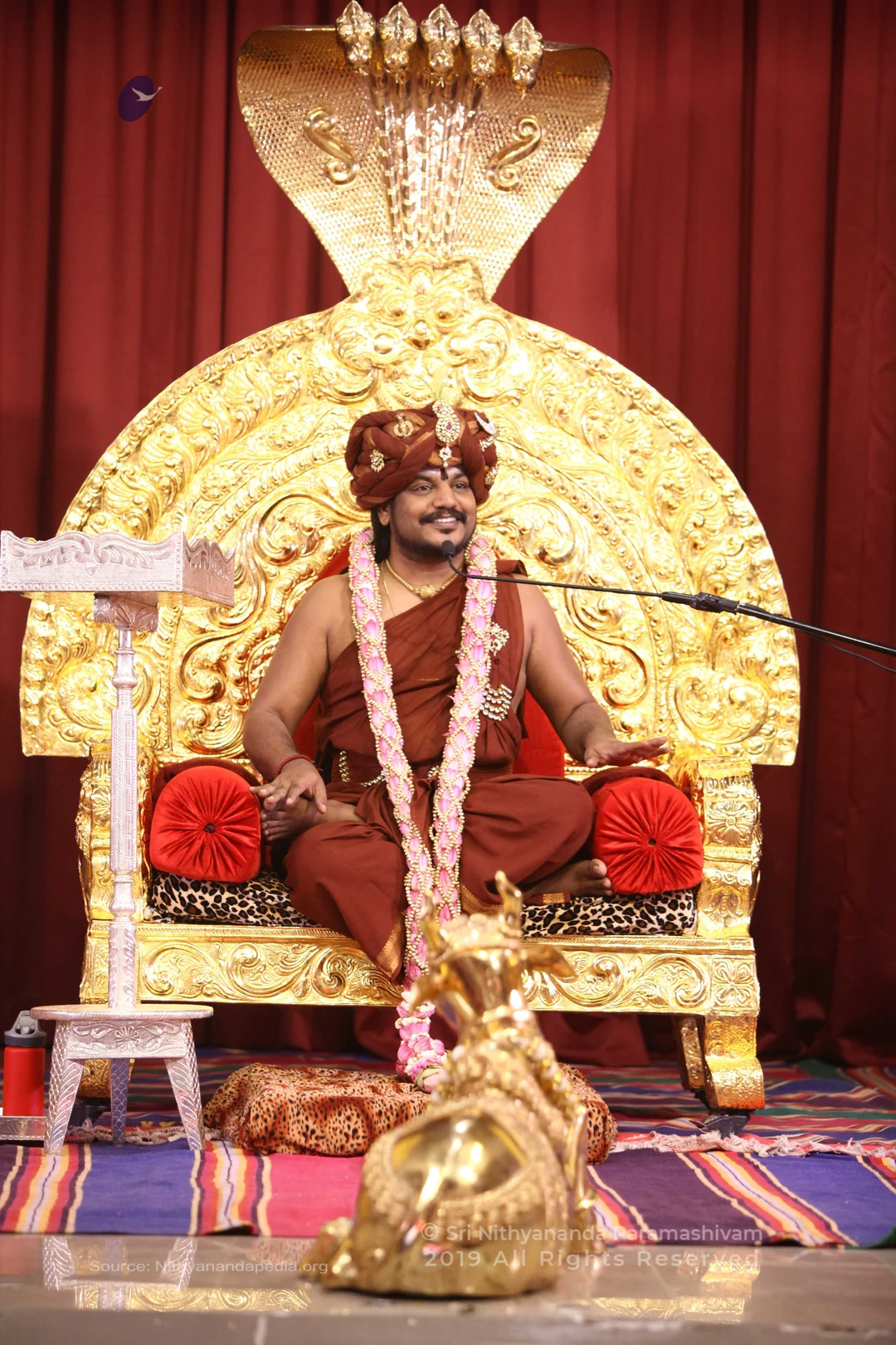
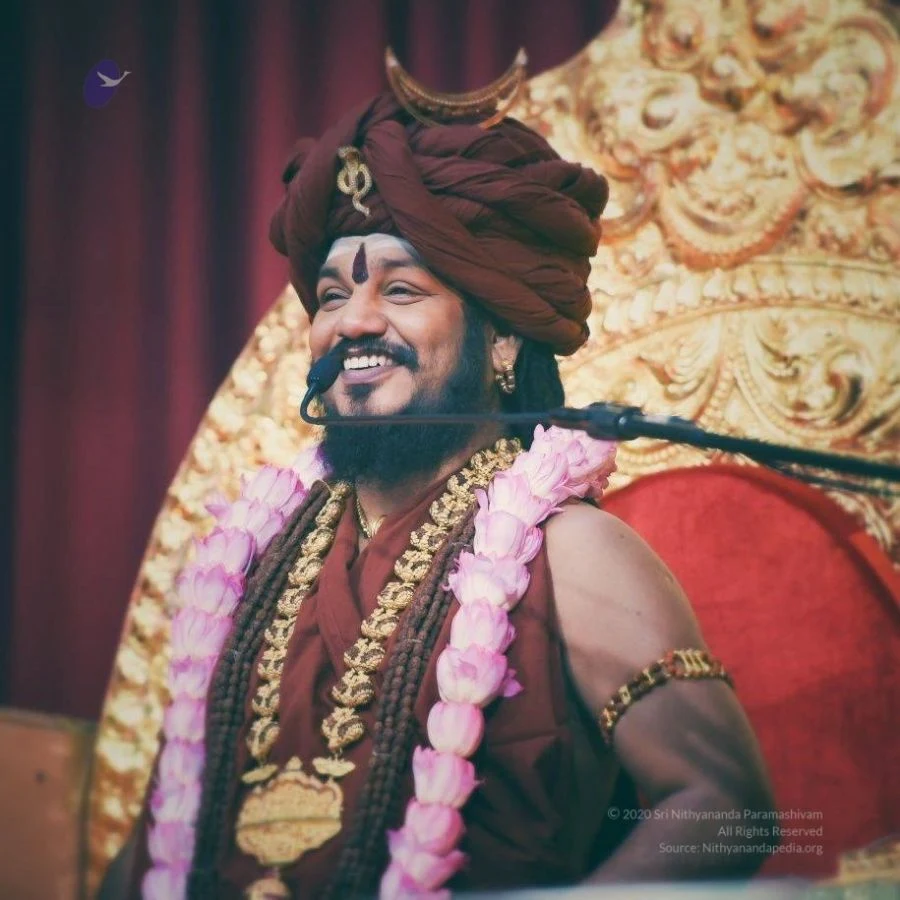
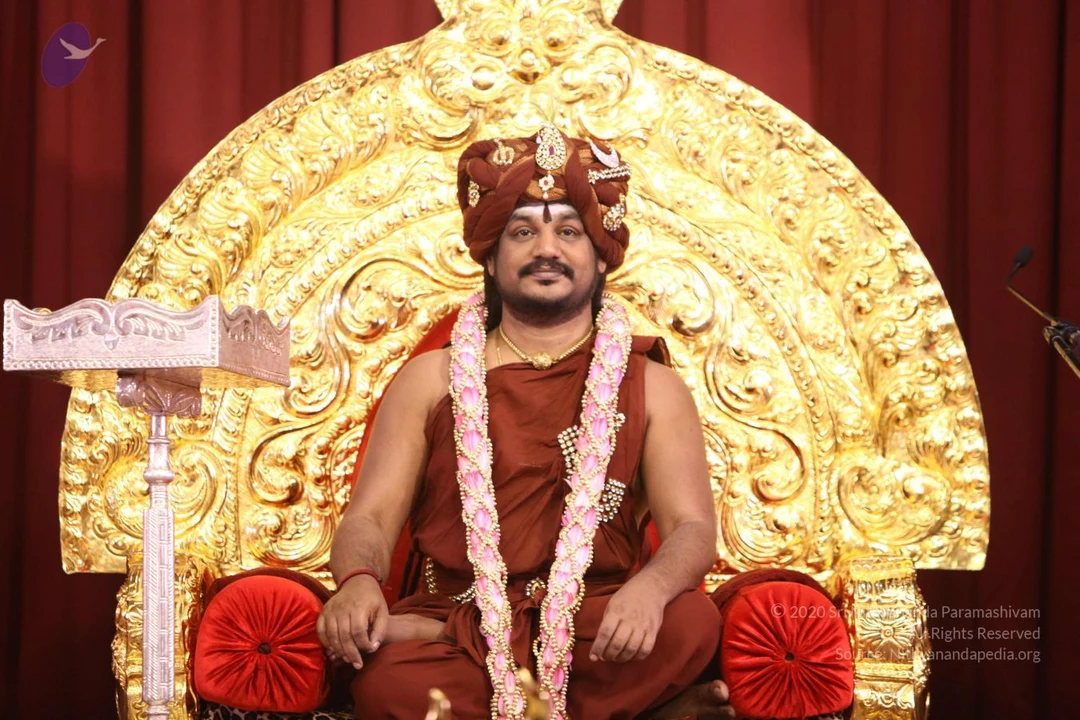
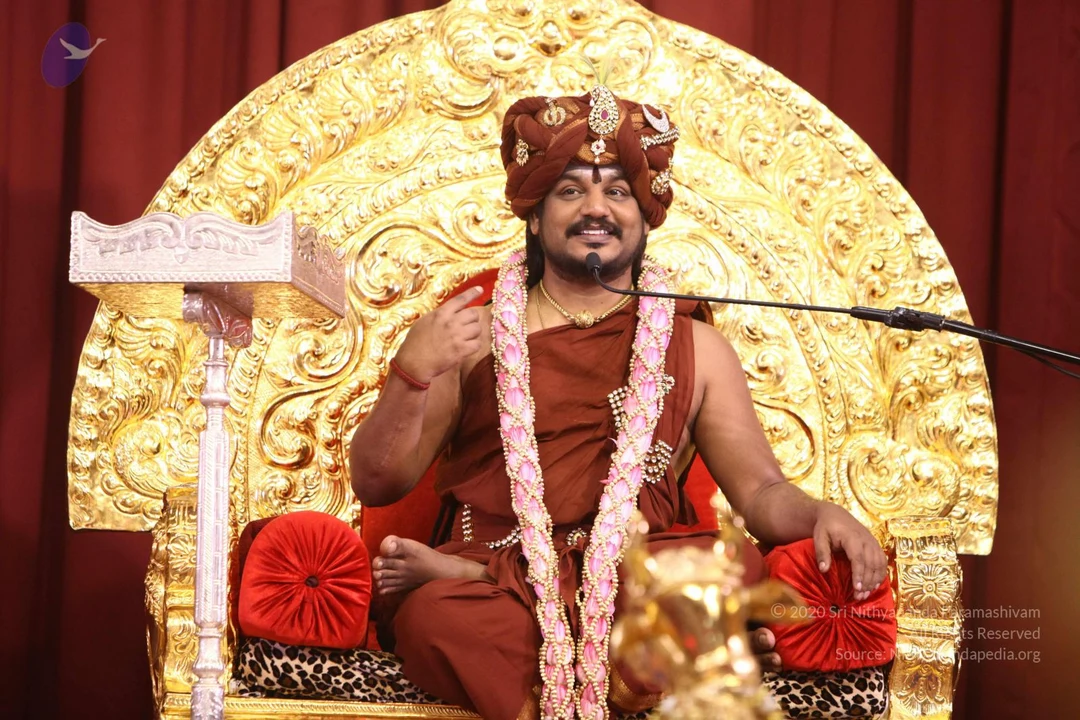
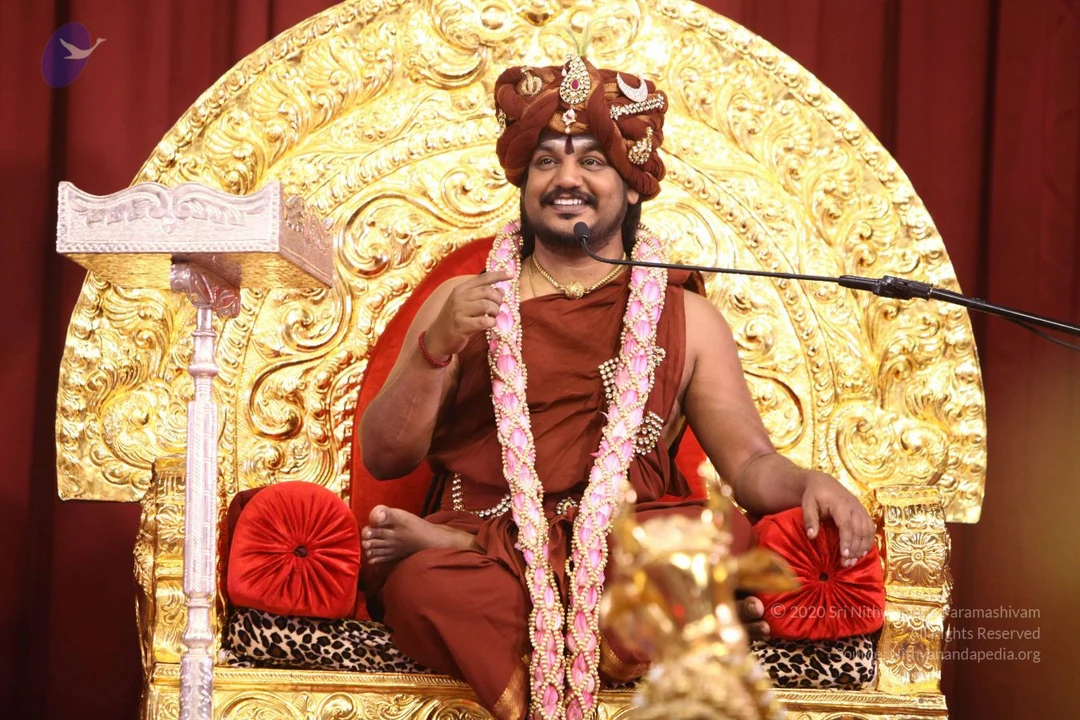
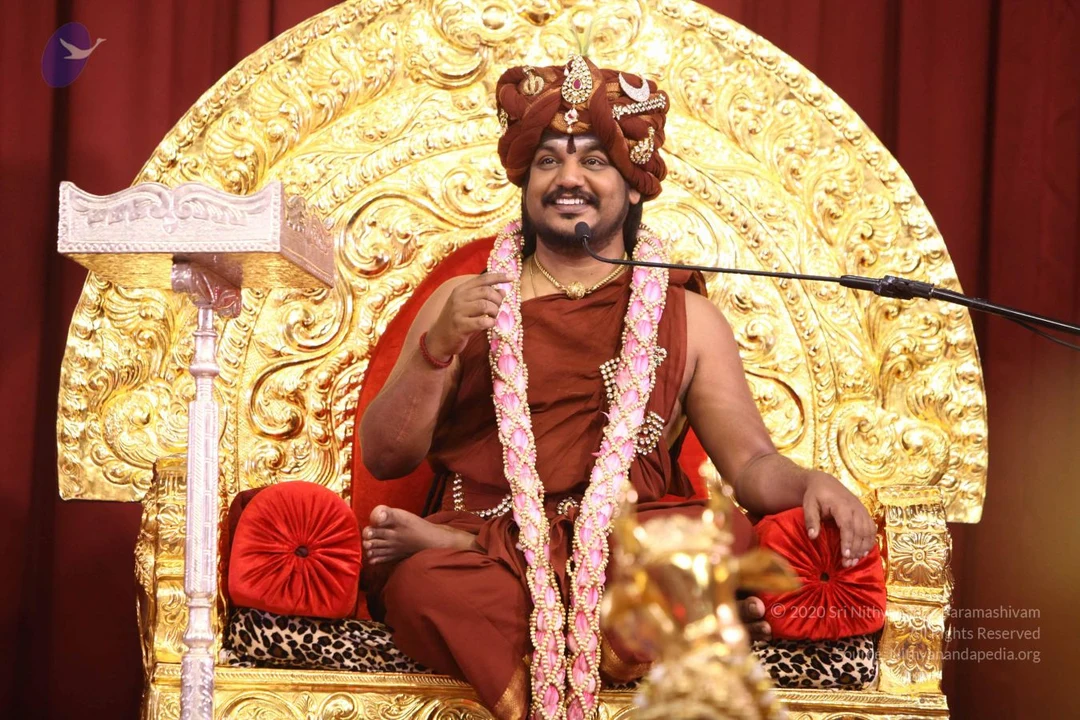
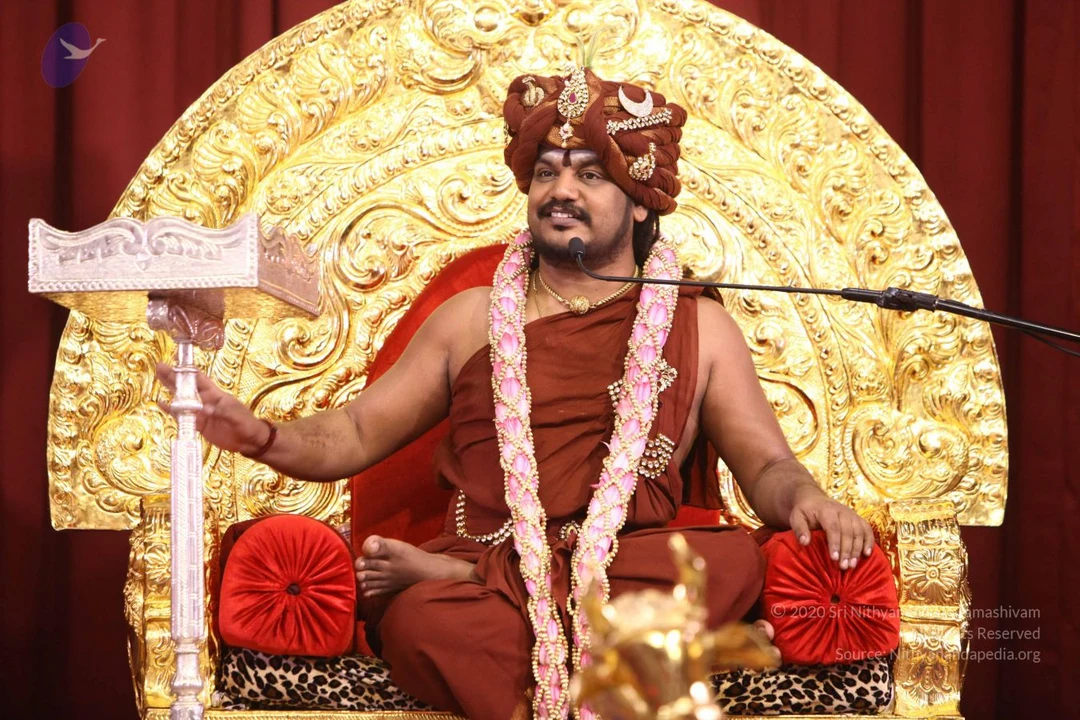
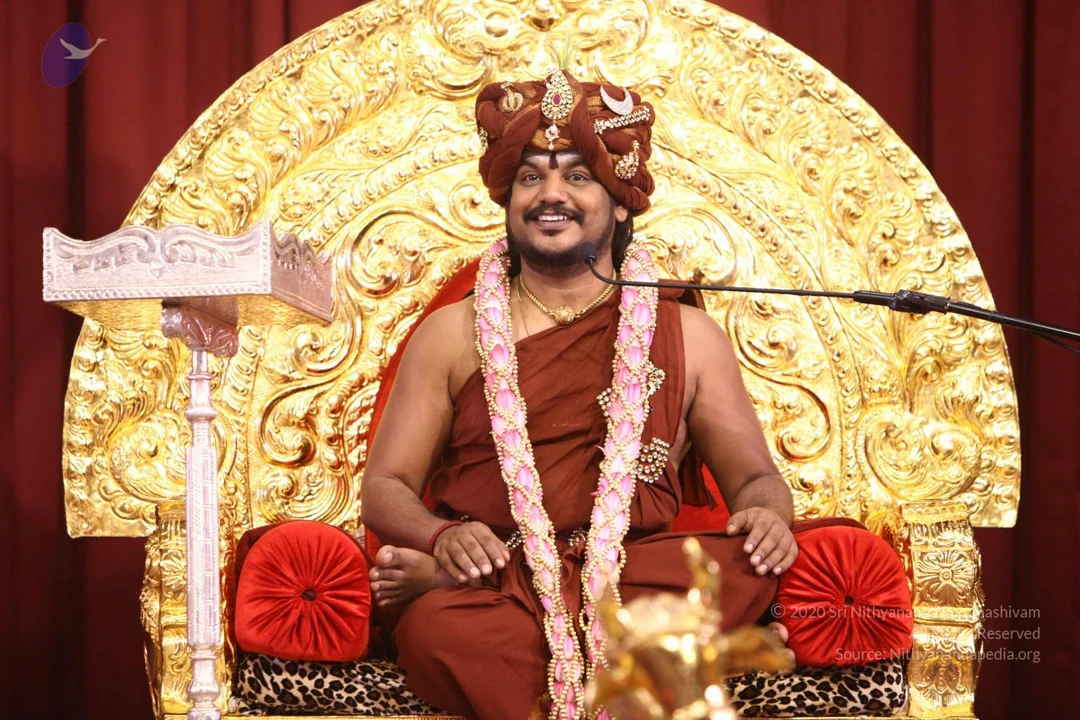
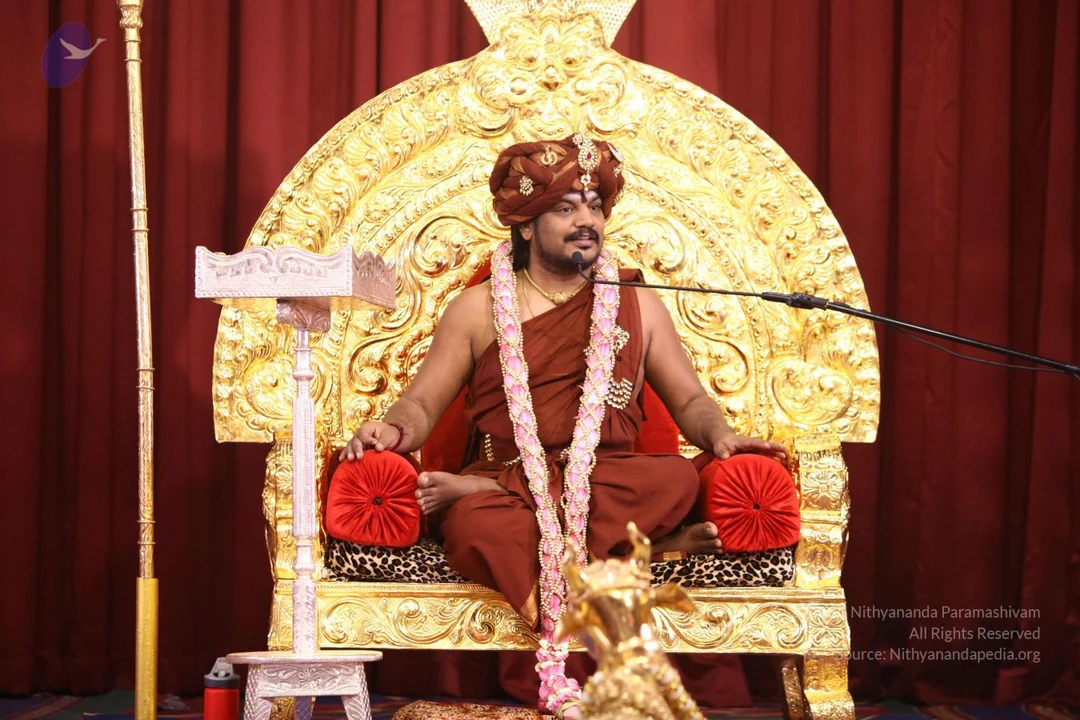
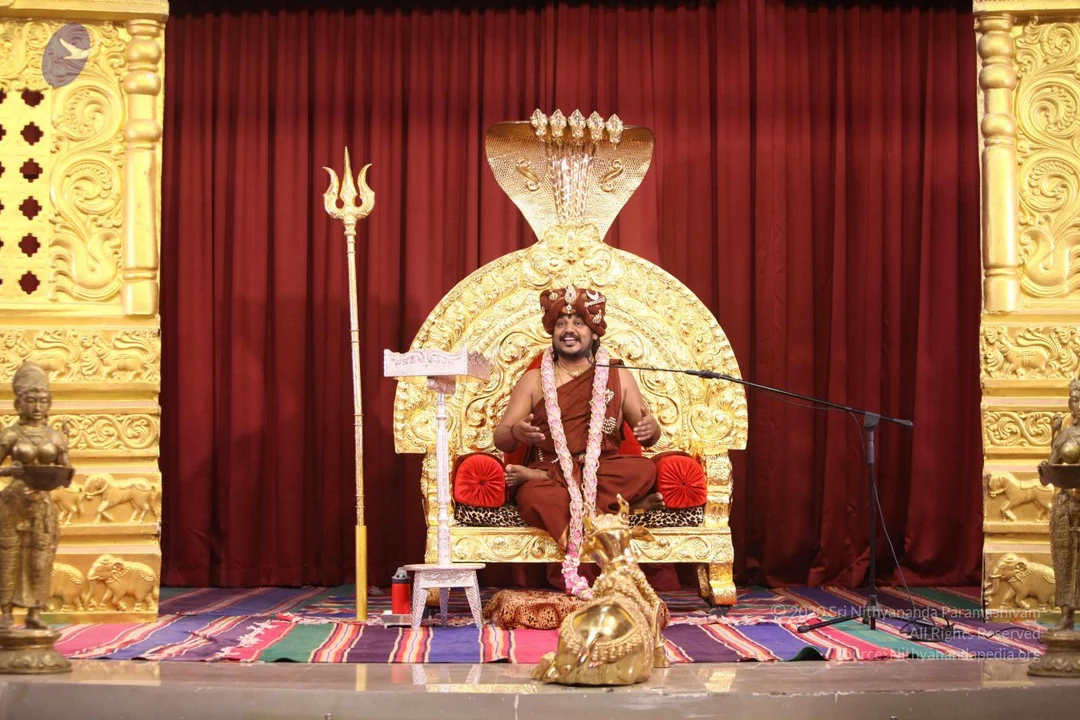
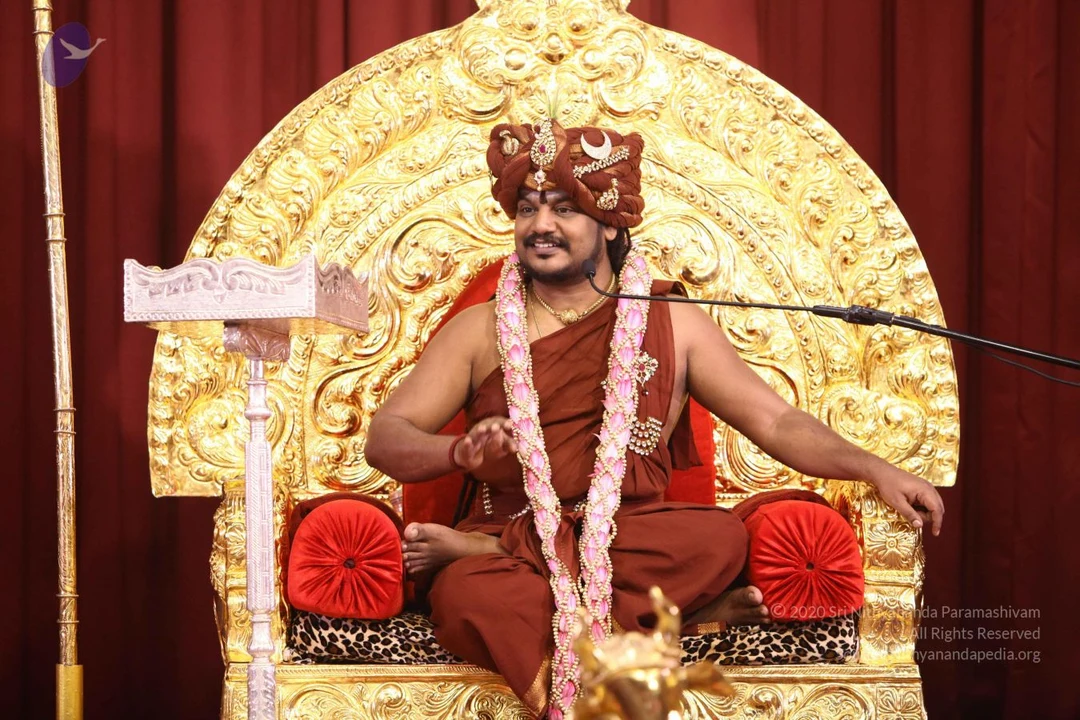
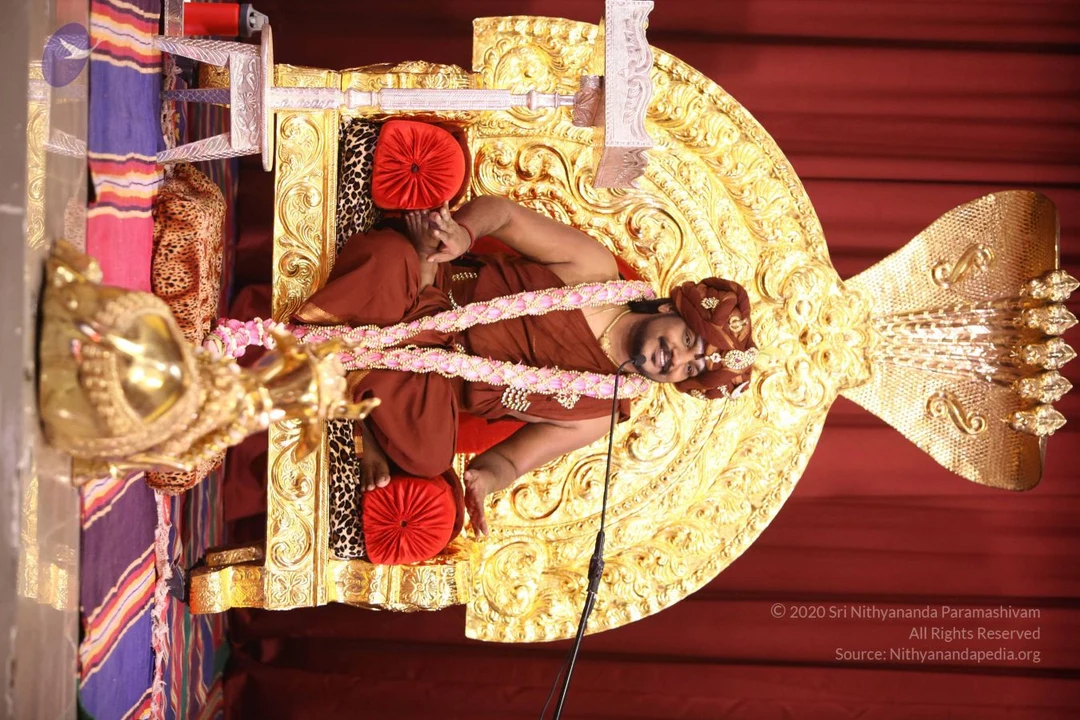
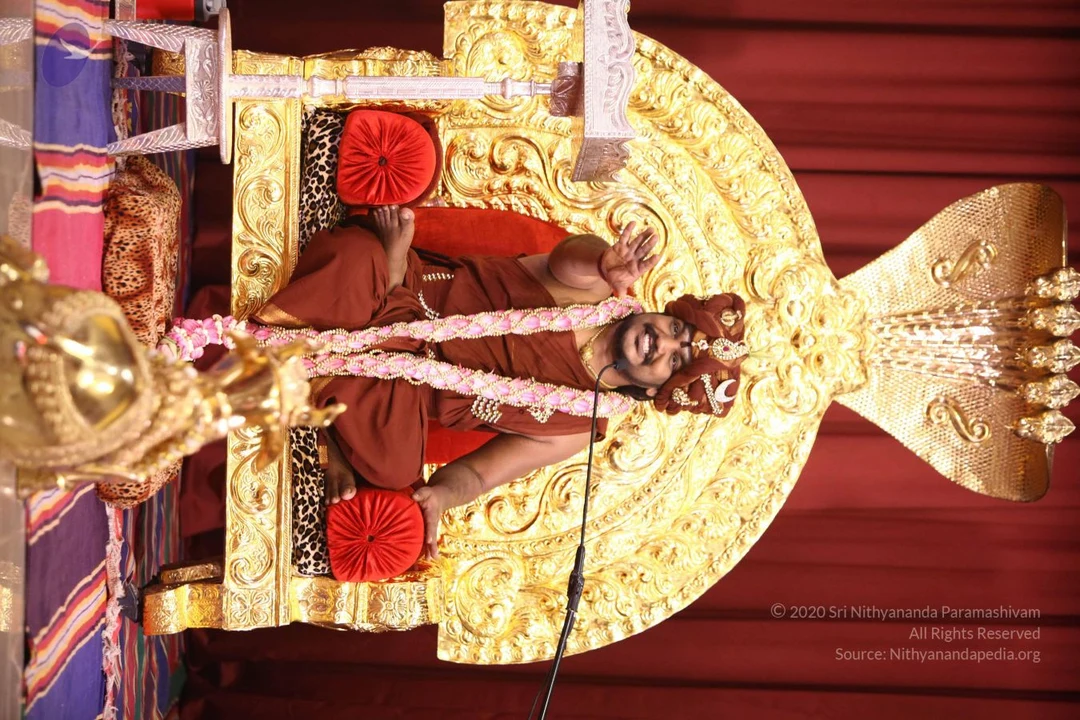
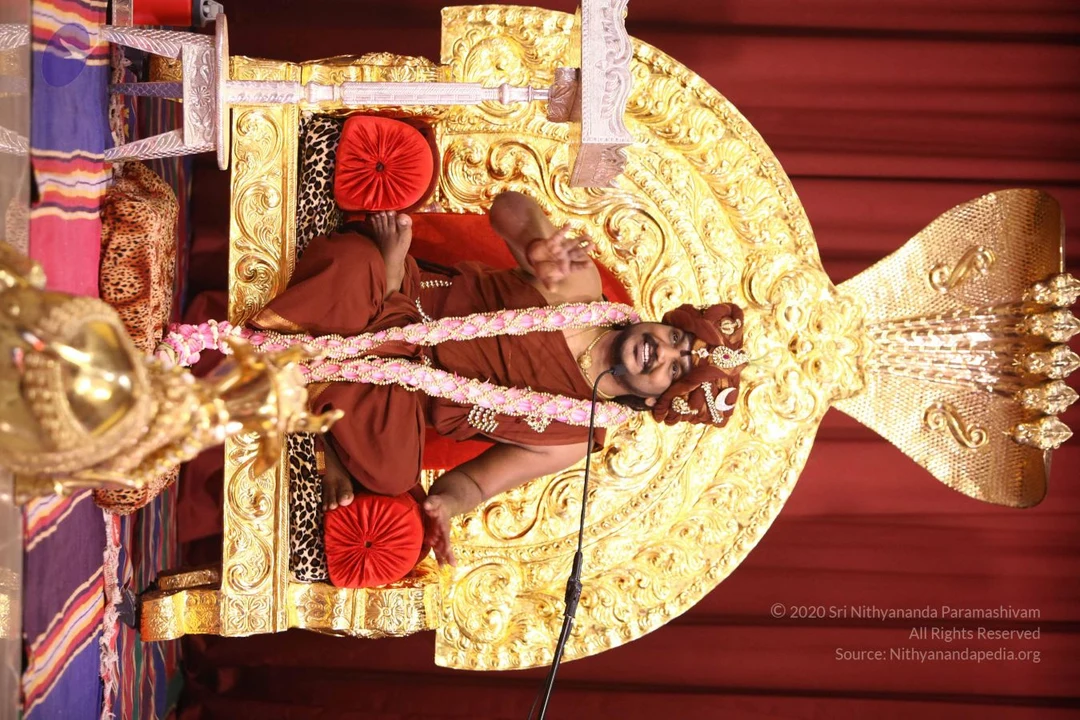
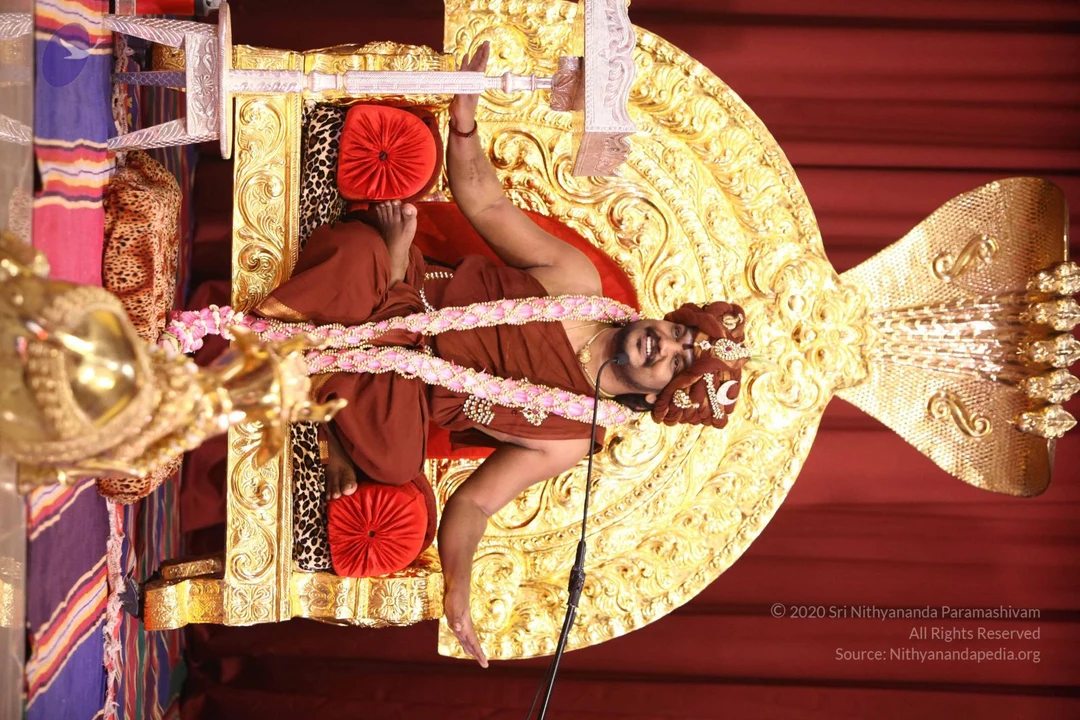
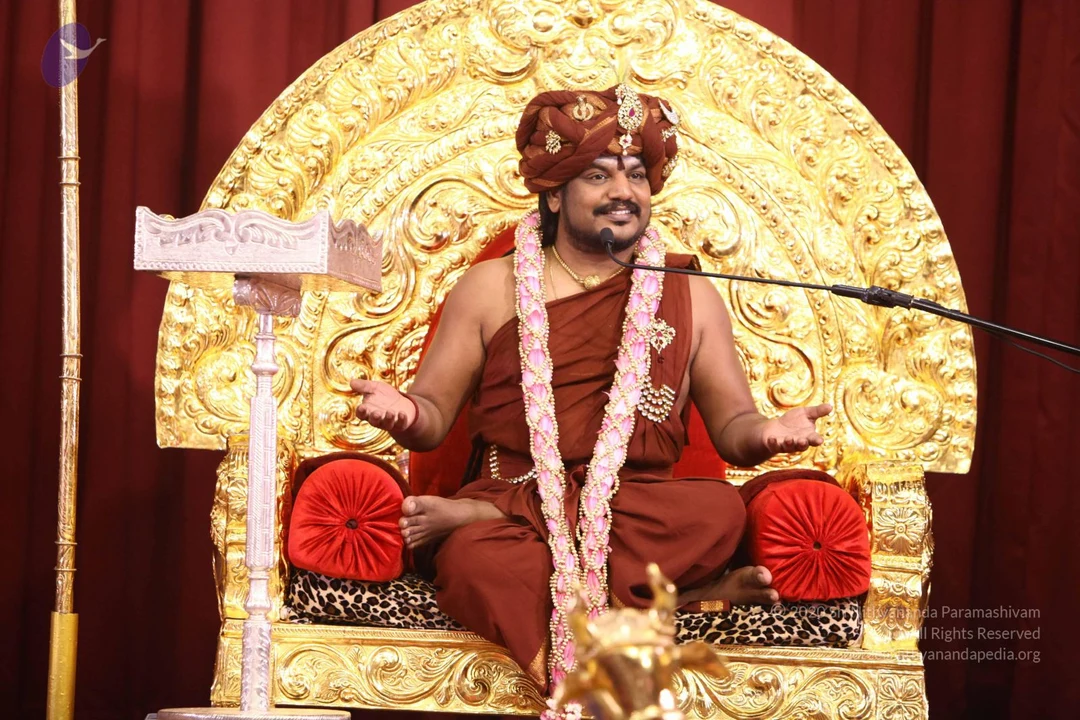
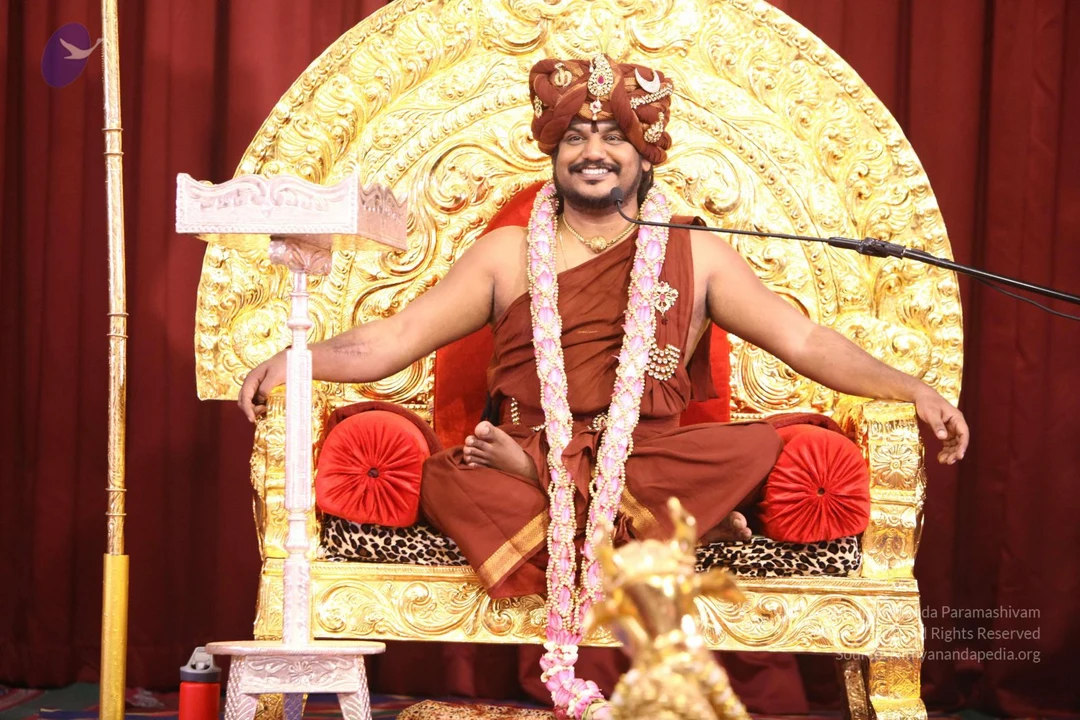
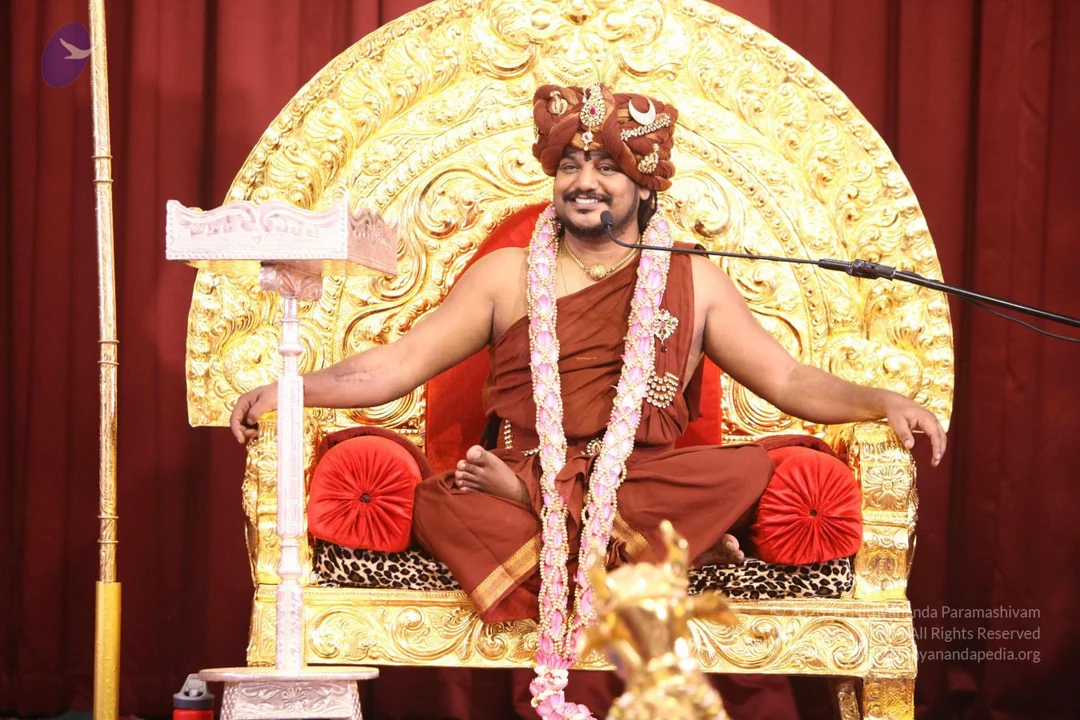
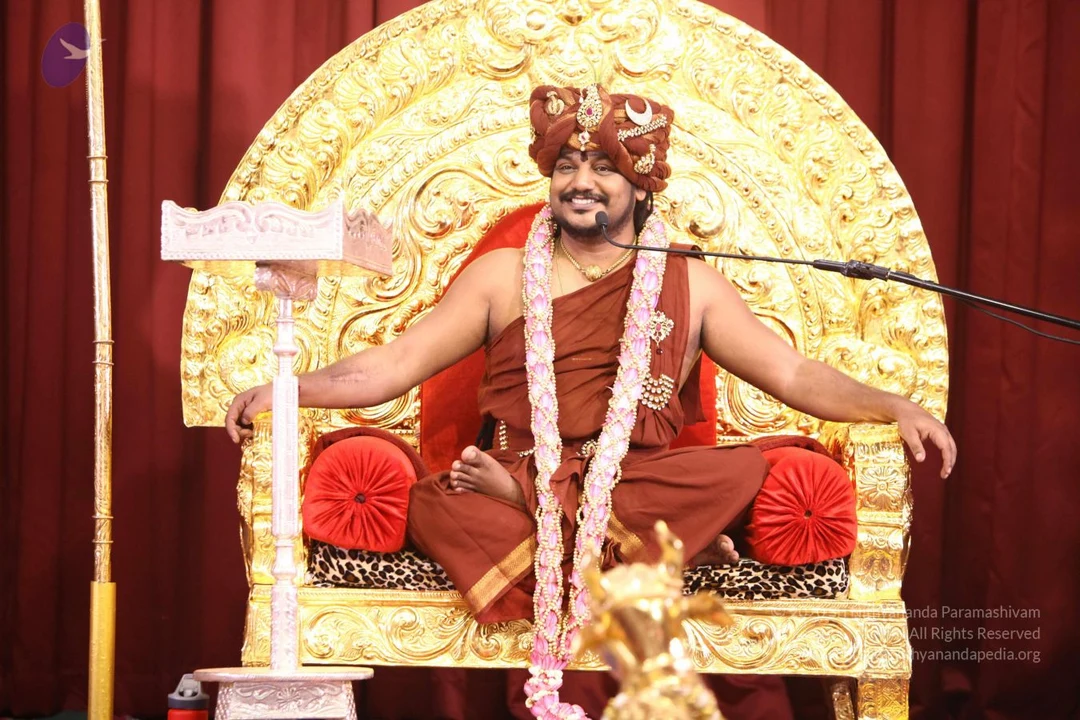
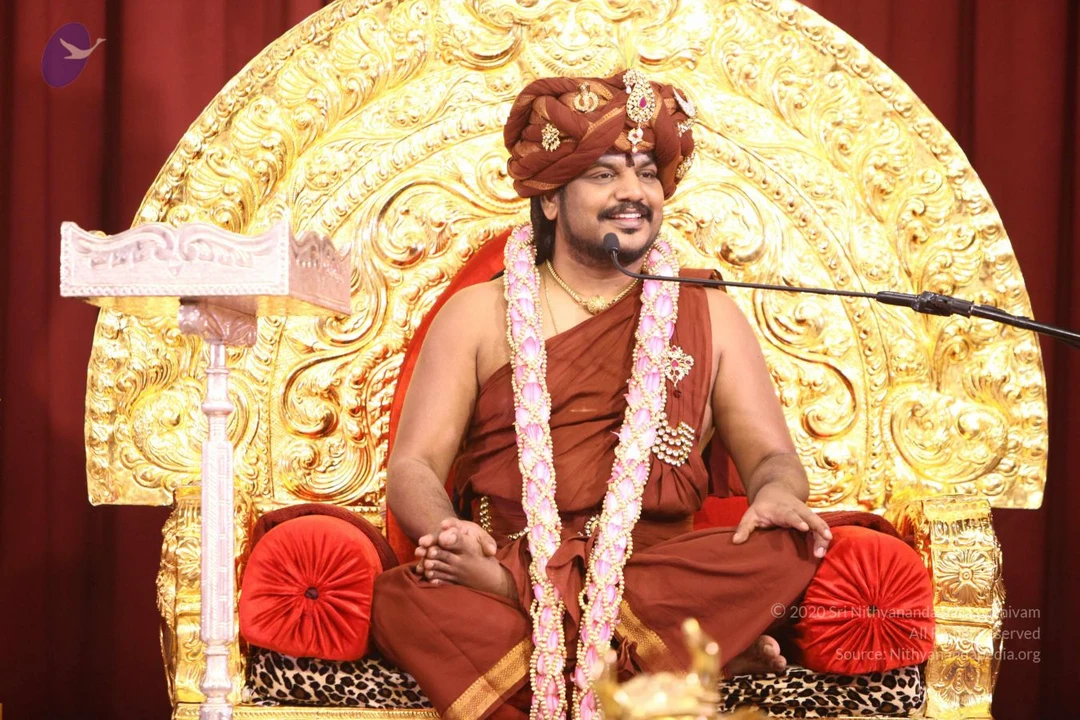
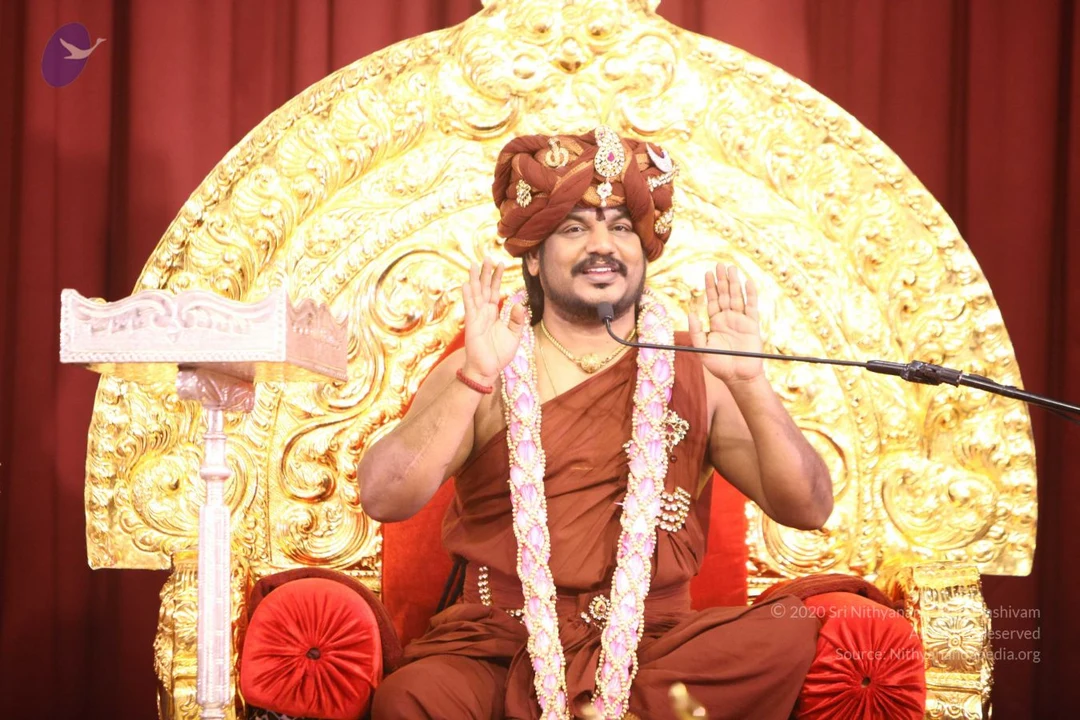
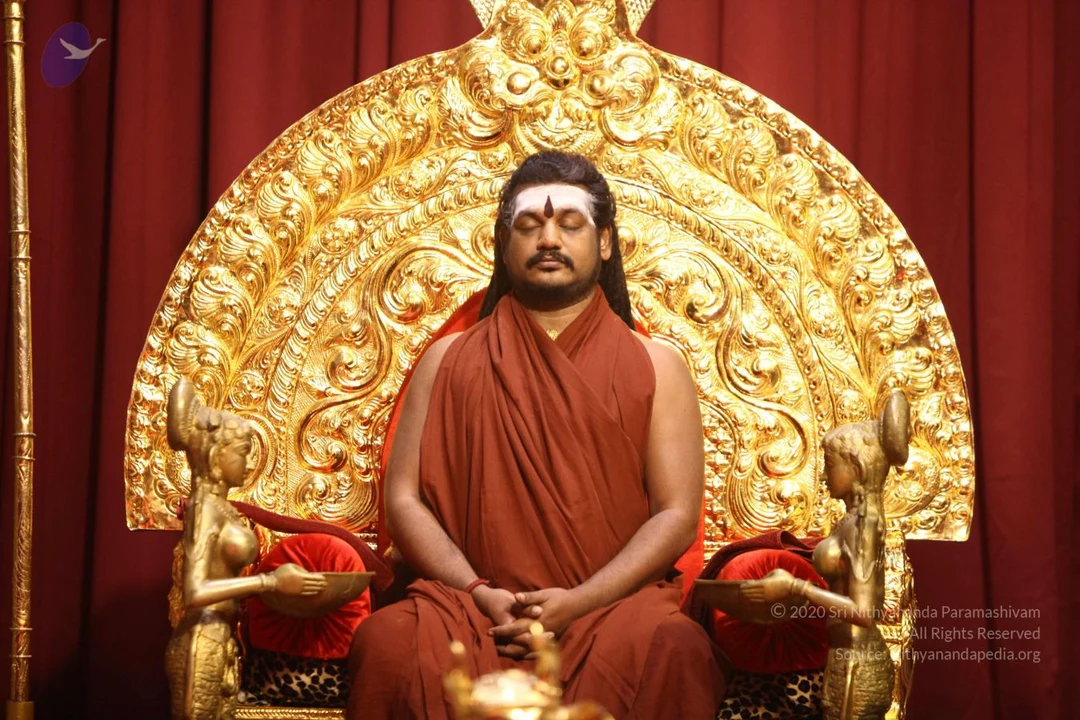
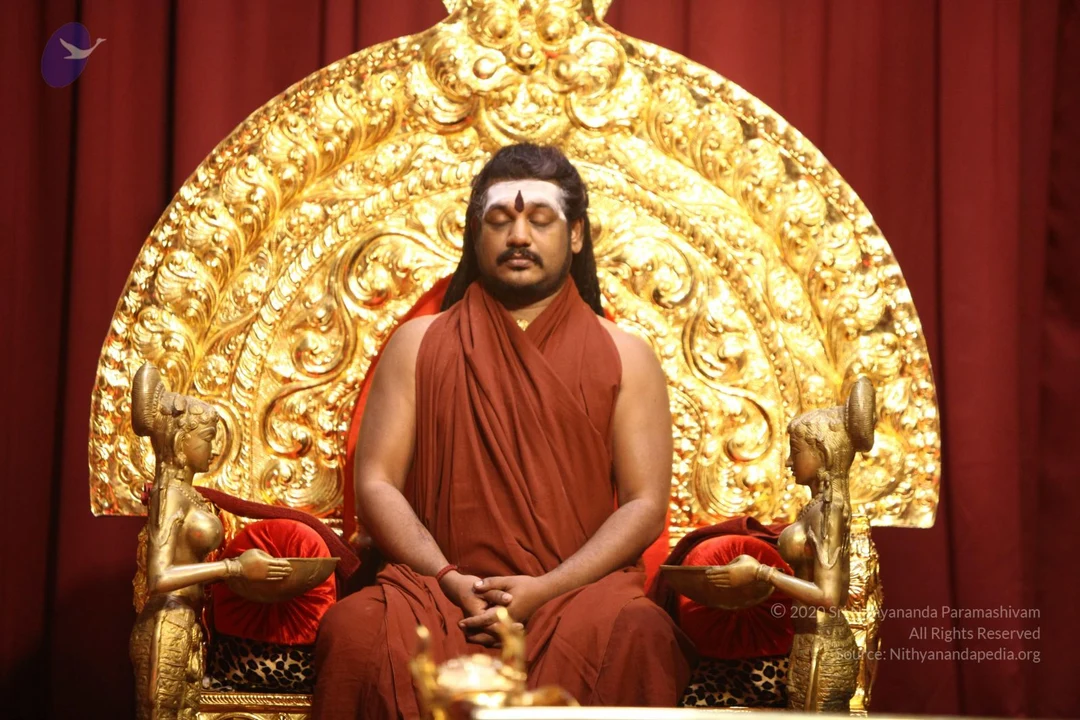
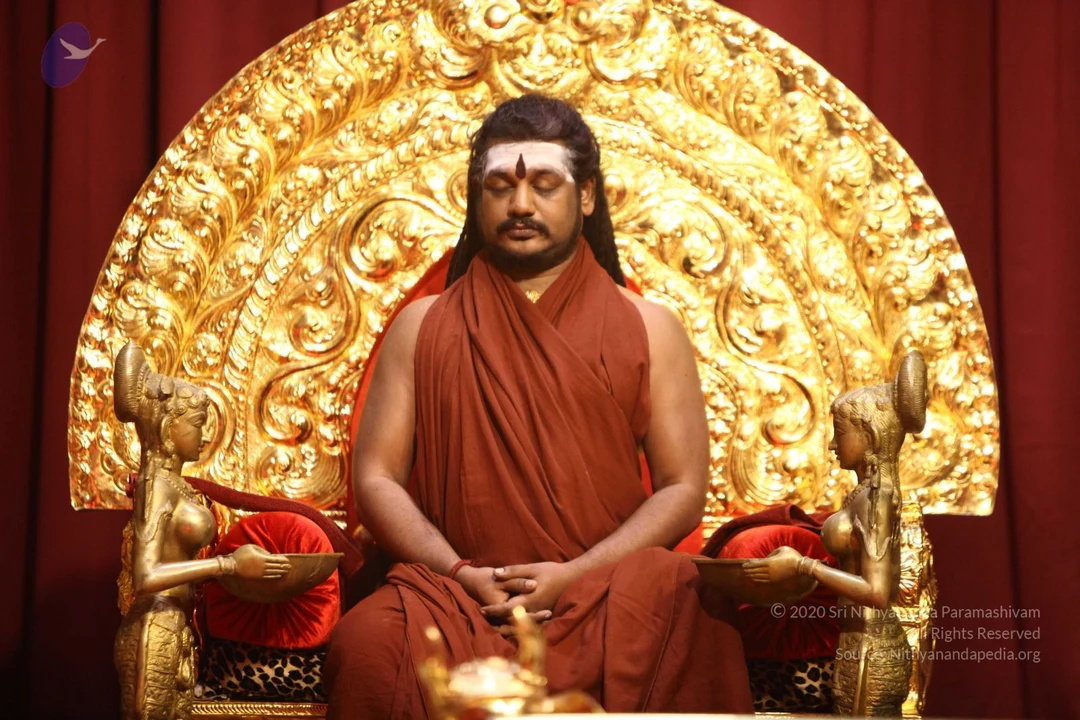
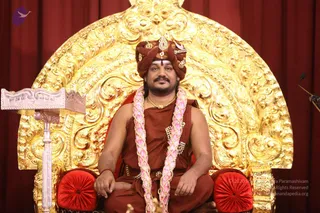
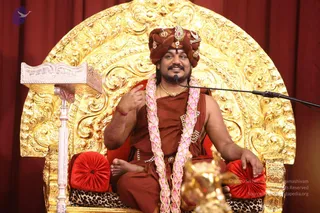
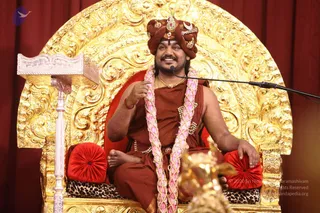
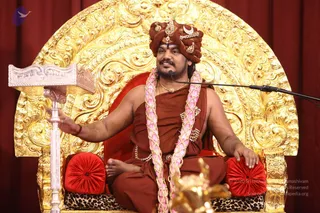
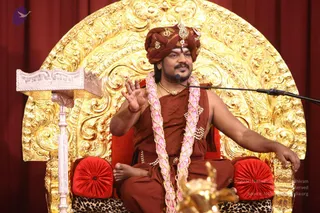
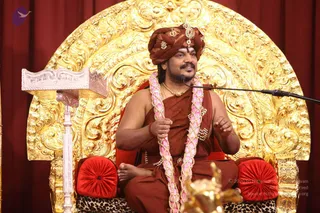
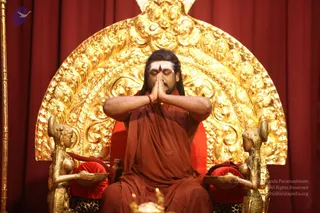
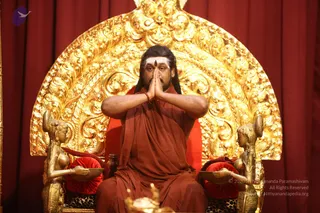
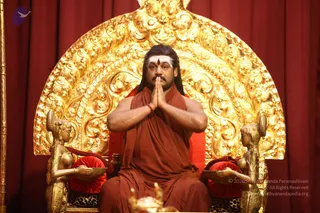
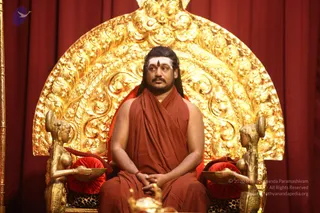
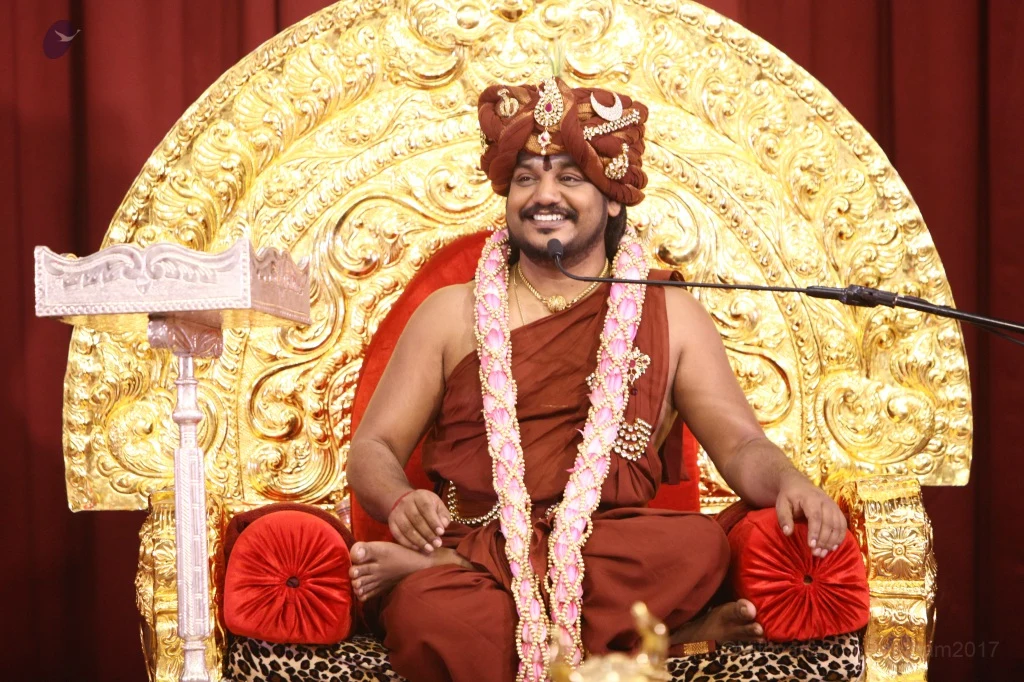
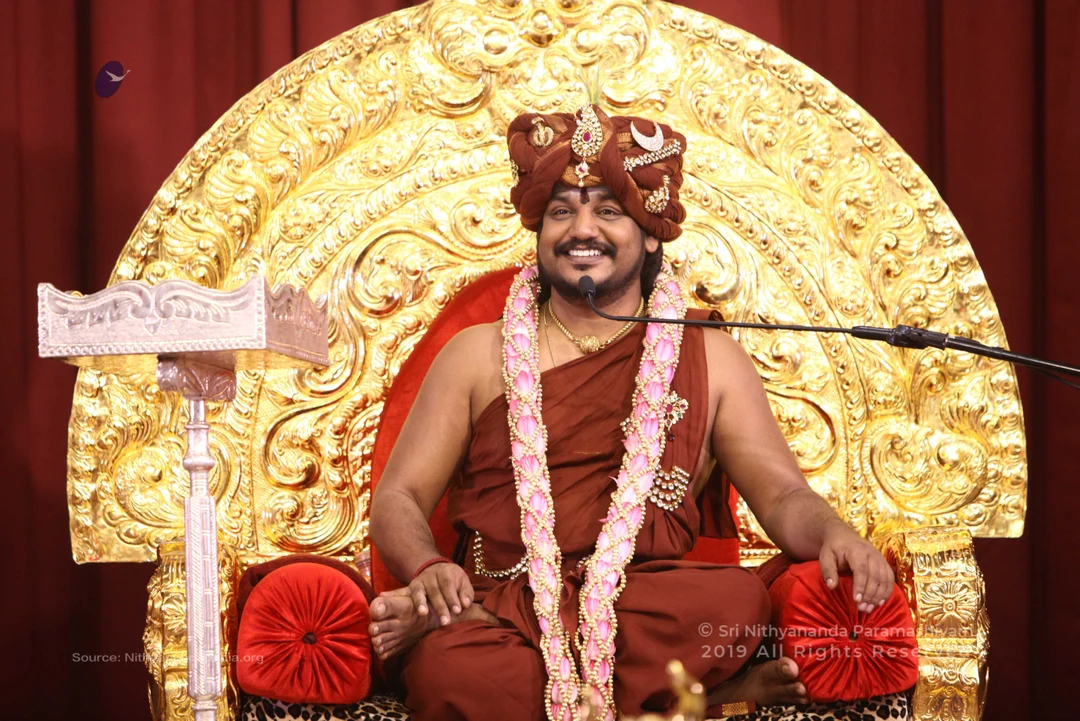
A smiling man sits on a gilded, ornately carved throne with a red velvet cushion before a deep red curtain. He wears a brown turban with a crescent and jewelled ornament, a brown shawl draped over the shoulders, a long pink and white flower garland, and gold necklaces, and he rests his folded hands in his lap. A microphone stands in front of him and a carved silver lectern is at left. Swamiji (probable): the seated figure wears a jewelled turban and shawl and ornate gold necklaces on a throne, consistent with a discourse setting. No other people are visible.A man seated cross-legged with eyes closed on an ornate golden throne with a large, elaborately carved arched back, in front of deep red draped curtains. He wears a rust-orange saffron wrap over his shoulders, a white vertical tilak with a red dot on his forehead, and a red thread on his wrist, with long dark hair falling behind. His hands are clasped in his lap. Two gilded carved female attendant figures holding trays flank the throne, and a gold ritual object is visible at the lower edge. The pose and setting suggest meditation or darshan. Swamiji (probable): the seated figure has long swept-back hair, saffron clothing and a ceremonial throne, which are cues for the page's identification.

July 13 2017

Original wiki page
Contents

Title

Google Confidence and Power Manifestation, The Future Education of Humanity

Description

In this discourse from 13 july 2017, His Holiness Paramahamsa Sri Nithyananda Swamiji explains about the future of education with an example of how after the introduction of calculater ,arithmetic table memorizing is redundant likewise after the launch of google all the education is redundant and irrelevant .So the future of education is google confidence and power manifestation.

Link to Video:

VideoAudio

Transcription

nithyānandeśvara sadāśiva samārambhām nithyānandeśvari ādiśakti madhyamām | asmat āchārya paryantām vande guru paramparām || I welcome all of you with My love and respects. I welcome all the Sri Mahants, Mahants, Kotaris, Thanedars, visitors, viewers and Saalokya mukthas - adheenavasis, who are sitting with us through Nithyananda TV, Facebook live, thousands of, hundreds of adheenavasis channels. I welcome every one of you with My love and respects.

(1:22)

Listen I will continue on this “Adheenam Chalo” series and nitty gritties, secrets of power manifestation. State of Sadashiva, space of Sadashiva, listen, State of Sadashiva, Space of Sadashiva, Power Manifestation of Sadashiva. That mudras I am showing, describes deeper level meanings. Listen carefully; state itself does not need to be practised. That is the most beautiful thing. He hardwired all of us exactly, precisely in the very state He exists. State does not need to be practiced, it only need to be recognised.

Listen, listen. The moment calculator comes, this arithmetic table memorising, is redundant, outdated. If you can have a calculator and just get any problem solved, why will you sit and memorise, “Oronnu onnu, eerendu rendu”, “Orrendu rendu, Eerendu naalu, Moorendu aaru” - that’s the way, in Tamil I am singing. It’s called “Vaaipaadu” – calculus in....I don’t know in each country, how they sing, but I know in all countries in all their languages they sing this. If you have a calculator, why do you need to sing this and memorise the whole thing. Even if you memorise, it is impossible to remember it when it is required. It is almost like a Karna’s education only. When you need it will not be there. Come on, tell me 17X19? This memorising the table is outdated, the moment calculator is there. Understand, you can have any argument. No, no, no, even then we need to memorise. End of the day it is stupid. What is being used in your life, whether in the bank or in all the strategy plannings, whether planning for a bridge or a building, is it your table you memorised or the calculator?

(5:11)

Next important thing you need to understand, listen carefully this is very important, the moment Google has come, all education is redundant and irrelevant. Whether you want to stitch a cloth or do a surgery, get enlightened or kill somebody. Whether you want to do the best action in the world - getting enlightened or you want to do the worst act - killing the people in the God and religion, terrorism... for anything, you type, there is an answer, very practical.

Somebody asked whether Google is a male or female. No, surely female, because even before you complete your sentence, how many suggestions come. ☺ Even before you complete the sentence, “how to”☺, see how many suggestions appear.

I tell you, all schools, all colleges, all universities are useless. No really, see. Education can never be book based, it has to be journal based. I know in India, we have this something called, “book based”, I studied little, fortunately, it is called Diploma in Mechanical Engineering. The machines in which we worked, you can see them only in museums of India. If at all, some industry is using those machines, don’t, for the sake of Goddel, don’t work in that industry. You will be getting 700 rupees salary. You can’t spend more than 2 or 3 days of your life with that salary. The education has moved so much away; actually I wanted to go to that institutions just to see what was the Mechanical engineering in 1940s. Not... see for the sake of archival purpose or museum purpose, you can go and see those workshops... not for any practical learning.

(8:22)

Education can never be book based, because by the time, book is published the material is irrelevant. If the material is not becoming irrelevant, by the time book is published, education is not happening, research and development is not happening there. Understand education can happen only by journal, magazine – means, continuously what is being churned out, that need to be released. Only that way, education happens. All My books are redundant, the moment they are published. Only satsang is the live and alive education method. Why do you think, I put all My books uploaded them freely in Google, in the internet. The moment we churn it out, it is already redundant and irrelevant. Within next week, I am ready with the next level. I tell you, being socially untouchable, gave Me tremendous strength and ability to look into the whole hypocritical network of the society. I tell you, unless you lived and faced the life of “socially untouchable”, you will never be out of society and your state will never be pure enough to teach, to share, to show the blind spots of the collective negativity.

Please understand, last few years of being socially untouchable, gave Me tremendous insights into the collective unconscious way of functioning and blind spots of the collective unconsciousness. The education material, I churned out in last few years, will be relevant, at least for next 1000 years. Understand, because it will be very difficult for society to evolve and catch up, with the speed with which I shared and delivered ☺. The most important funny thing, the speed with which I outdate Myself ☺ There are some Gurus who are still sitting with same technique for 40 years, which they did not develop, their Gurus developed. Here 1 week, I outdate Myself ☺

(12:38)

Understand, education means if it is a living organism, constantly you will be churning out. It can only be magazine based. People may have a doubt, sometimes people may tell, “No no no Swamiji, the further research development should be magazine based, but fundamental truths, we should study in the books.” No ! The further R&D should be so complete, it should be drilling fundamental principles in you, because with R&D even fundamental principles get refined. Understand, when you learn unclutching, the basic unit of the world “tattva”, the understanding will be different. When you are manifesting powers, the basic unit of the universe “tattva”, its understanding will be different. So along with the new R&D, even the understanding about the fundamental principles evolve.

Listen carefully, after the happening of the Google, understand, almost I am giving a space of an incarnation for Google! After happening of a Google, if you are studying anything which can be answered by the Google, you are a fool, utter fool and stupid; nothing more than that. The time, money, energy you spend in colleges, universities, it is like after inventing a machine which will just lift you for 3-400 feet and take you wherever you want, if you still continue to build huge roads, you are fool. And I tell you, the independent, individual safe flying machines are already out. But the petroleum and road industries, lobbies, the petroleum lobby is making sure they are not reaching to your hands. Same way diabetes, cancer, medicine for all these is already out... but it is not disease. It is an industry. Those industry, lobbies make sure those medicines doesn’t reach to your hands. Listen carefully, this is very important. Whatever reason you may give, still if you are sitting and studying geography, the names of the capitals of the countries, which we all used to do and having a map and mentioning the rivers and hills and mountains names. You are stupid, because the whole Google map is available. All you need to do is learn to type what need to be typed and open the Google maps app. You will see direct 3D.

(16:59)

There is no sacredness in blind spot ignorance methodologies. Please understand. Knowledge is sacred but not the methodologies which are outdated and be very clear, the great truths revealed in the Upanishads are sacred, no doubt. That does not mean, still you need to be only sitting and using the methodologies of the old, outdated, irrelevant, inefficient methods. And only Hinduism has guts to tell this.

I am developing a new word called “Google Confidence”. You just need to know where to find, where to search, what to search for running your life. Actually the education should be only one thing “Google confidence”; that’s all. All other education, schools, colleges, universities are useless, redundant, stupid. Have research wings to feed Google. Teach people to gain Google confidence, that’s all should be the education of the future.

Understand I am defining the education of the future. All the R&Ds should be directly fed into Google, through the universities and research institutes and all the human beings should be educated with the Google confidence - Where to search, what to search, get the best and customise it for your life. That’s all. Whether you want to build the body, get rid of a disease, do a new hairstyle or change gender, learn language, anything, I tell you, do not waste your time studying, educating yourself in anything which Google can answer. If you are doing that, you are wasting your life. The only thing Google cannot answer, which you need to do is power manifestation. No, actually, even in power manifestation you don’t need to manifest the powers which Google can support you. Those powers are not needed. They are redundant, irrelevant, useless.

(20:54)

Listen, I do not know when the society is going to wake up to the truth I am revealing. But I am telling you, the earlier society wakes up, better for society. Our whole Gurukul and University everything should run on Google confidence, that’s all. Why will you sit and study the stupid chemistry and the whole nonsense which you will never use in your life even once. If at all you need, all you need to do is just type “How to” and the tons of answers are there, which you can customise for yourself and enjoy, over. If some stupid fellows are expecting you to have that stupid degree to give job, don’t accept his job. He is going to make you live a redundant life, a government servant’s life. Sorry, I am not disrespecting...but after working with few retired government servants, appaahh!!! Few retired government servants have come here to be volunteer. Alright what to do!!

Listen!! Do not make your life structured on redundant methodologies. It might have been useful for your old generation. And I saw these fellows are establishing the same structure. One file moves from one table to another, another table to another, another table to another. These fellows will ask only one question, the next question some other fellows have to ask. Mmmm..... Kaalabhairava is landing in Me, the moment I ☺ If you are made to think end to end, life will become smooth, things cannot be complicated. Like how the medicine industry has become now. For right eye one doctor and left eye one doctor! Good they have not discovered third eye otherwise they would have developed another one doctor for that ☺ There will be one more stream of doctors. In Dentistry - 10 branch! In our villages, not only the whole body, the village doctor only will be the musician also. He will only play the music in the temple and it is not that he was inefficient... very efficient, I have seen. They are able to keep the health of the whole village.

(25:05)

Understand, after the happening of the Google, if you are spending your time, life, energy anything, for the sake of education, studying, researching which can be answered 10,000 times better by Google, you are destroying your life. You are destroying your life. I wanted a separate session in our schools called “Google confidence”. Understand, all the research in all the fields, all over the world should be fed into Google and all over the world people should be taught to access from the Google. This is going to be the future education method. I am telling you this will be the future education method. I think the world has reached a level for a rhythmic, organic Oneness World Order.... not One World Order, Oneness World Order.

Understand One World Order is stupidity which can never happen. Oneness World Order where the knowledge all these are completely free. Geography based mandaleshwars will be running. But everything else currency, travel, trade, business, owning, ownership everything will become open. All the best things will be available to the whole world. Some herb which grows to clean your dandruff, in the Amazon forests will be available in a remote village or some unique fabric grows in a remote village in India will be available in Switzerland, in a very comfortable, easy and cheapest possible way. I think in My lifetime itself we will be fortunate to see this Oneness Universe evolving. (28:24) If you just type how to handle, 10 suggestion come. How to handle a wife, how to handle stress, how to handle a wife in India, how to handle husband ☺ Oh God!! No I tell you, No really. After the happening of the Google, if you are still wasting your time in any so called outdated methods, so called old methods, it is just waste of life; not just waste of time, waste of life. All education should become internet based. Classrooms, schools, infrastructures built for education, all of them are already redundant and irrelevant. You just need research institutes to feed Google and the knowledge of Google Confidence... better search engines... better keywords, that’s it. Even the fundamental language can be taught... in Google. Instead of blaming internet, Facebook, YouTube, social media... absorb them, digest them into your life, and make your life better... by furthering the growth of the humanity. That is the only way to survive. The secret based classroom techniques and methods are outdated, useless. (31:21)

No really I am telling you. Soon, very soon I will make the whole Inner Awakening available in your bedroom through the internet. It is possible. All the programs, classes and education has to become internet based. I am evolving, I am evolving the whole system which will work for people from wherever they are. Listen intensely; whether you want to cook for 10,000 people or you want to clean the place where you are living or you want to handle your stress or you want to get enlightened or you want to make atmalinga bag, everything if Google can answer, don’t waste your time in studying it. Spend your time in learning Google confidence, building Google confidence, means better way to search, quicker way to search, align, customise for yourself. Let’s make our whole Sangha, understand Sangha is not organization. We are not the western definition of organization. Sangha where everyone is given what strengthens them. There is no generalization here. That is where the whole problem is. Everyone who comes from the western perspective of generalization and generalised equality, gets hurt.

Understand I am not equality based organization, I am equity based organization. Understand the western concept of organization is equality based. Here it is responsibilism; sangha is equity based... where your responsibilism responds to you, your responsibilism responds to you. The principles of regular society does not work here. It does not work even in the regular society. What is there? ☺ Only the principles of cosmos works here.

All education is outdated, if it can be answered by Google. I know when the motorised vehicles like car, buses, all of them came to exist, the whole bullock cart industry became redundant. When the flight became mode of transport, the road travel, travelling through road should have become redundant, but the strong lobby is still keeping it as method. Otherwise the long travel through the road is already become redundant. Now it is time, anything which can be answered by Google, studying those things should become redundant. The whole education methodology should be new, called “Google Confidence”.

(36:07)

Understand, spend your time in studying only things, which can’t be answered by Google, means power manifestation. Other than power manifestation, anything you do is useless, that is what I mean. End of the day, other than power manifestation, anything you are doing, you are integrated to bag full of one paise coins. In west what you call - pennies. Yes it is bag full, but how much 279 dollars, 423 dollars and 45 cent. Learn how to use, learn.... how to use your life on the planet earth, best. After the invention of the car, motorcycle can be for a pleasure ride; that cannot be the transportation mode. Same way, if you feel the pleasure by singing 2+2 is 4, 4 + 2 is 6, okay. “Rendum rendum naalu”, if you want to sing, that is okay but that cannot be the education mode. It can be song for entertainment but cannot be education mode. Don’t waste your time on that kind of a education. Understand I am revealing one of the important secret - Why in Hindu tradition, the best brains produced are from Sannyas sampradaya. I’ll tell you, why you know... when you are socially untouchable, actually sannyasis voluntarily declare that we don’t want to be part of this social structure, this grid based life. We are, we decide to live out of the grid life and society also declares them as untouched, untouchable. This existence gives you certain clarity and understanding, you catch all the blinds pots of society - how they are living in a rut without upgrading themselves, without evolving themselves.

(39:25)

Only 2 things you need to do in the life now. For the whole humanity has only 2 work 1. One, Develop this Google confidence, 2. Second, start manifesting powers, nothing else is worthy. That’s all.

That’s all is the complete life for the future of the human beings... future humanity. Essence of today’s satsang - Google confidence and power manifestation, that’s all.

With this I bless you all, let’s all radiate with Integrity, Authenticity, Responsibility, Enriching, Causing, living Shuddadvaitha saivam - Sadashivoham, the eternal bliss Nithyananda.

Thank You. Be blissful!!

(40:24)

Photos

Satsang
Darshan
Sakshi Pramana:

Sharing from SADASHIVATVA PROGRAM

Link to Facebook page

https://www.facebook.com/ParamahamsaNithyananda/photos/a.321615927926264/1445698008851378
https://www.facebook.com/ParamahamsaNithyananda/photos/a.321615927926264/1445774222177090
https://www.facebook.com/ParamahamsaNithyananda/photos/a.321615927926264/1445789275508918

Photos Of The Day:

FB-photo-of-the-day

Photos Of The Day:

Satsang

Darshan
Photos Of The Day:

Satsang

Darshan
Photos from this day

View all 74 photos

Satsang

1 photoSource gallery
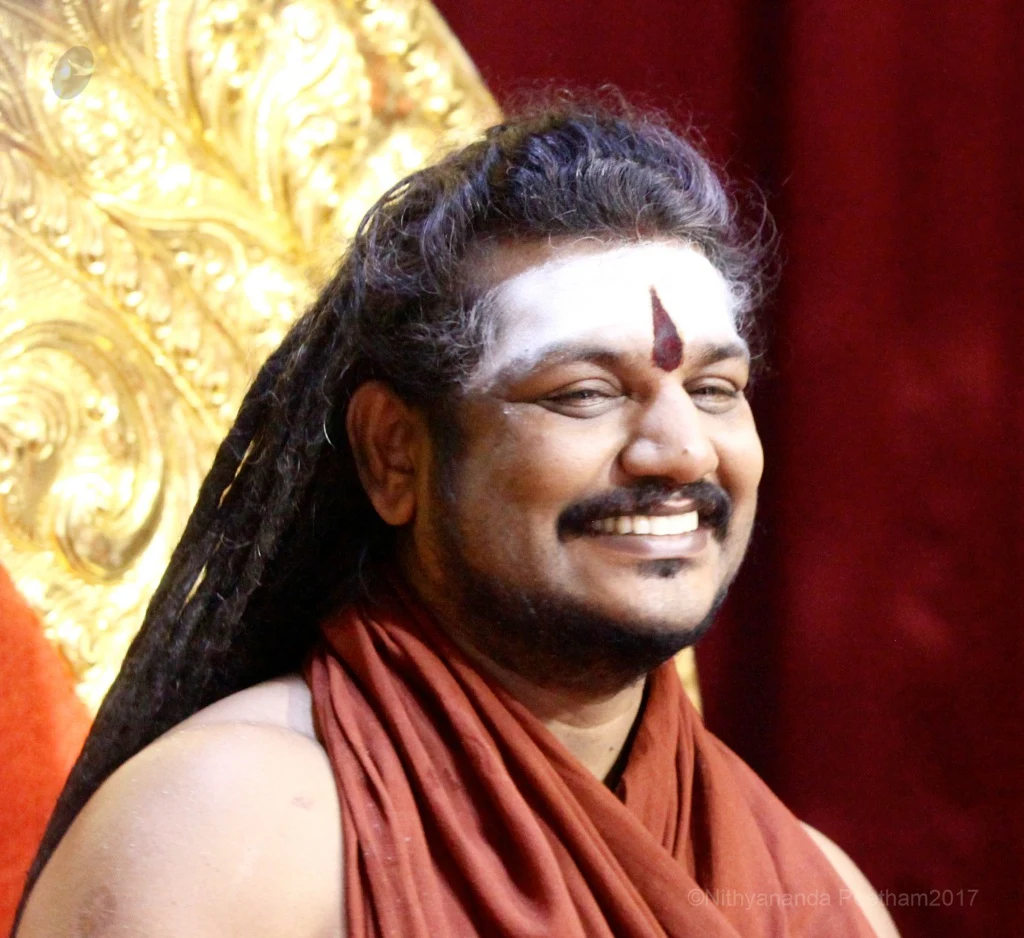
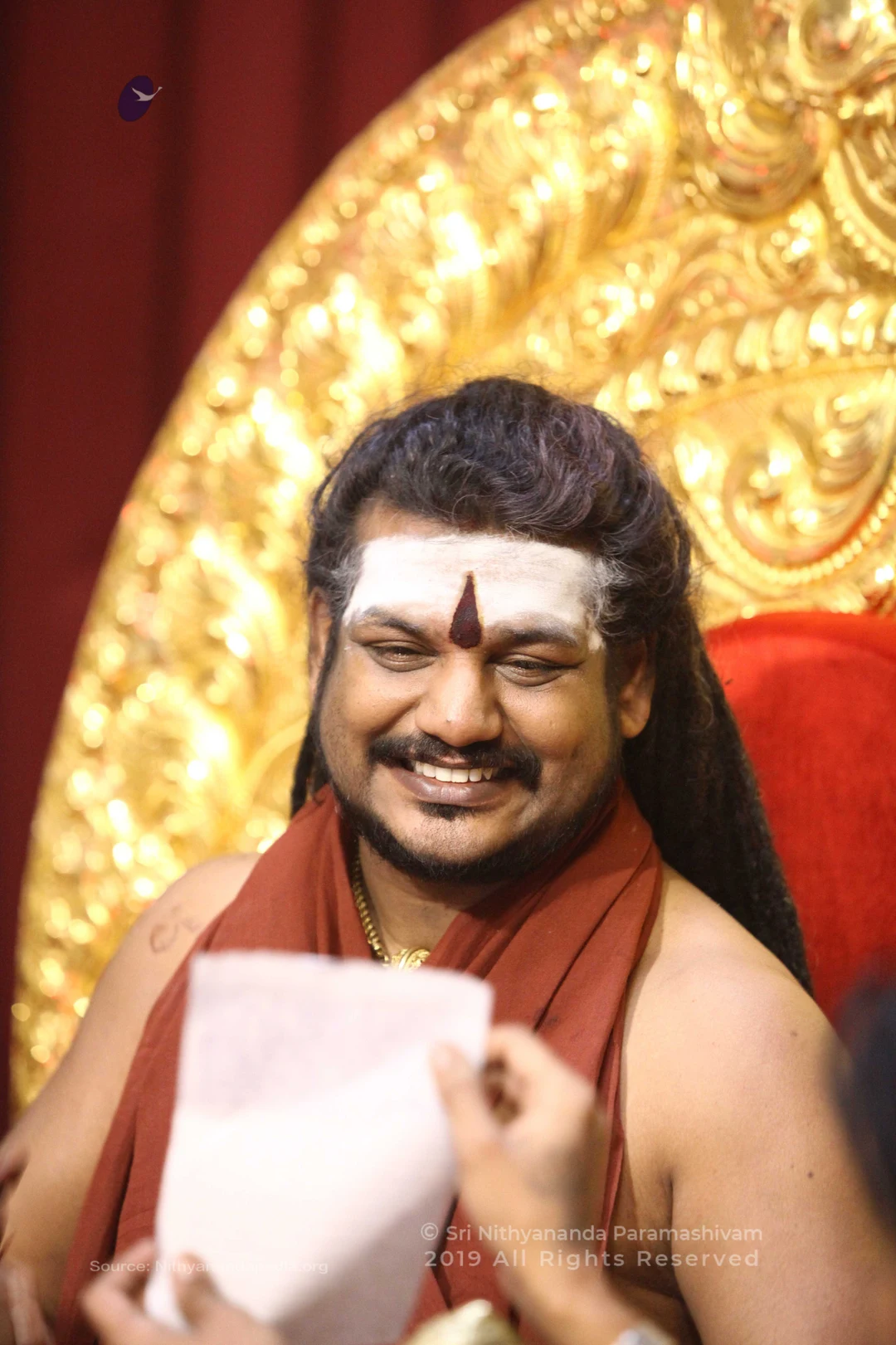
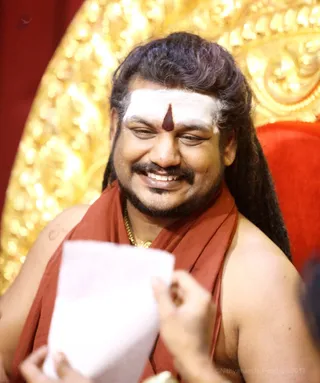
Close-up photograph of a smiling man with long, swept-back dark hair, white sacred ash on his forehead and a red vertical mark at the centre, a trimmed moustache and beard, and a rust-red shawl wrapped around his shoulders with bare upper shoulder visible. Behind him is an ornate gold carved throne back against a deep red velvet drape. Swamiji (probable) with long swept-back hair, rust-red shawl and ceremonial ash marks, seated before a gilded throne, smiling.

Darshan

3 photosSource gallery
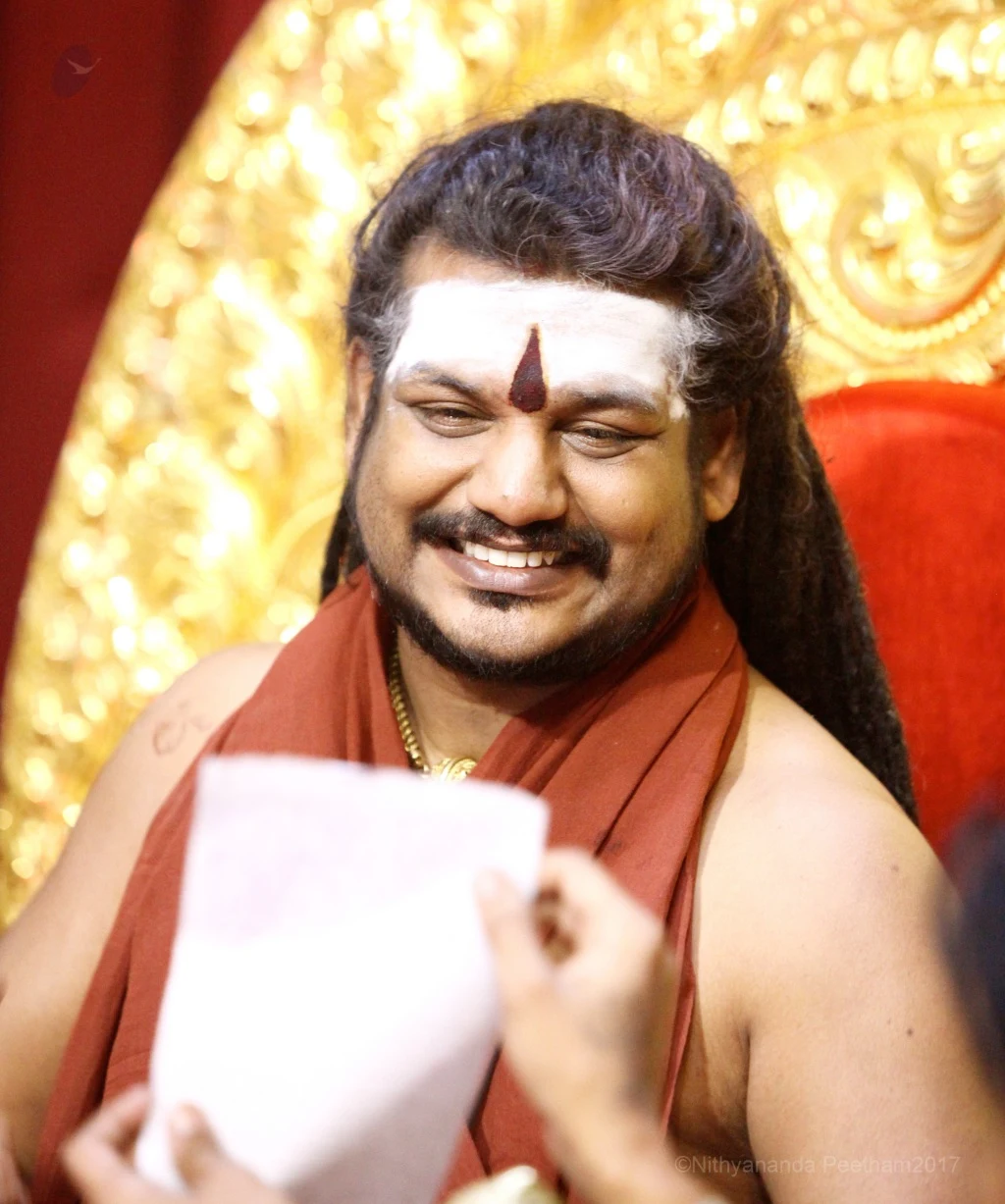
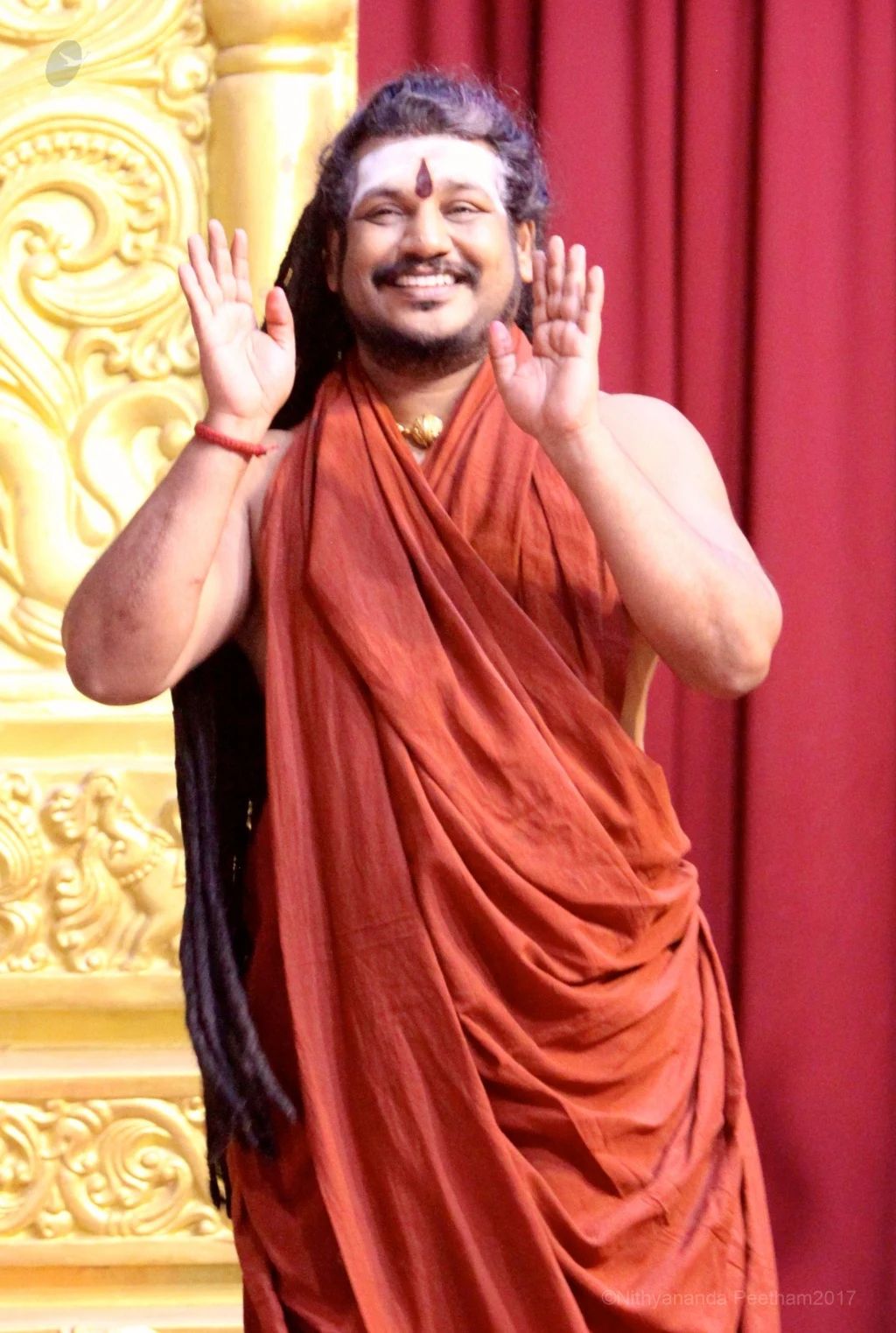
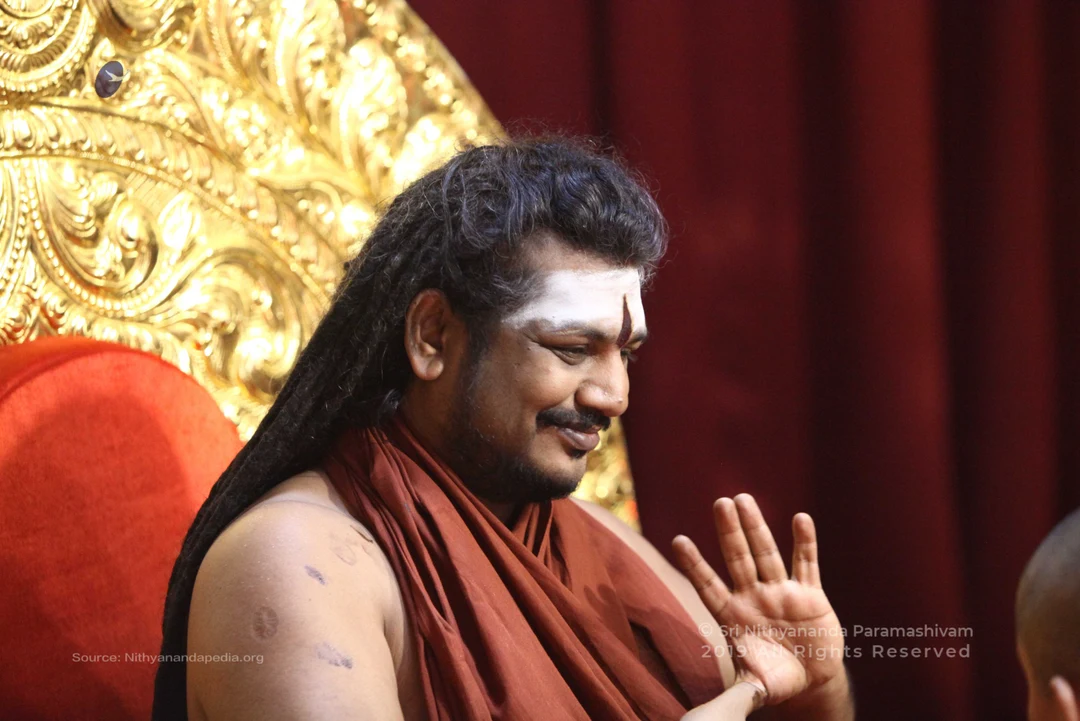
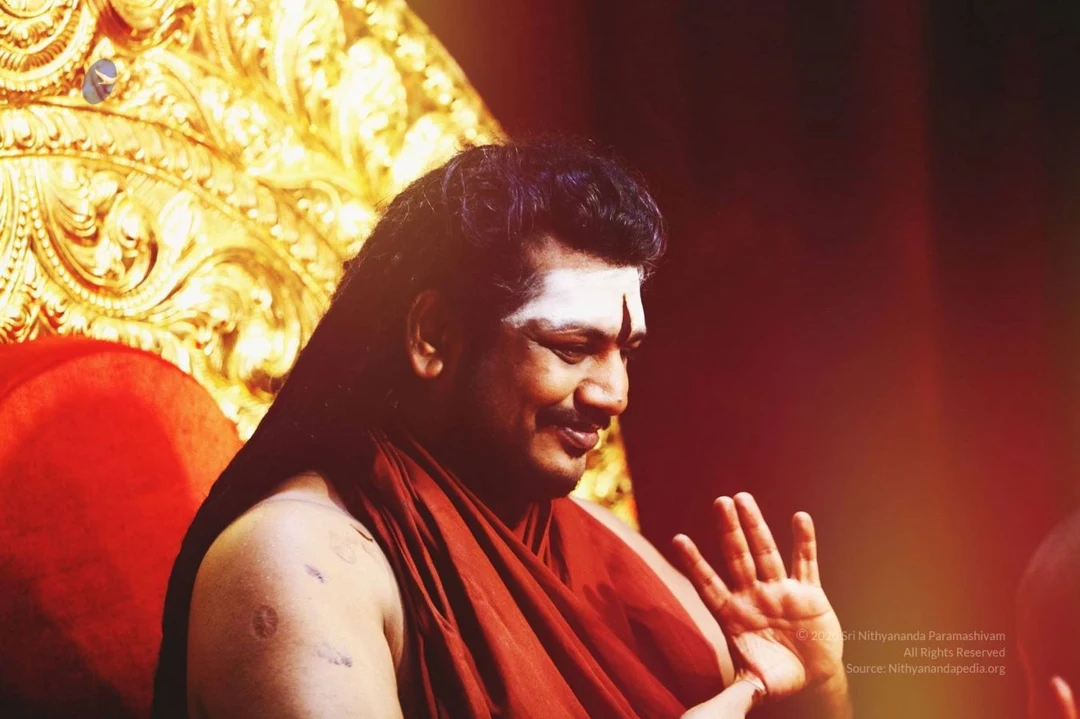
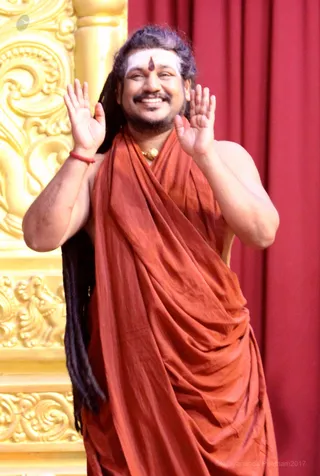
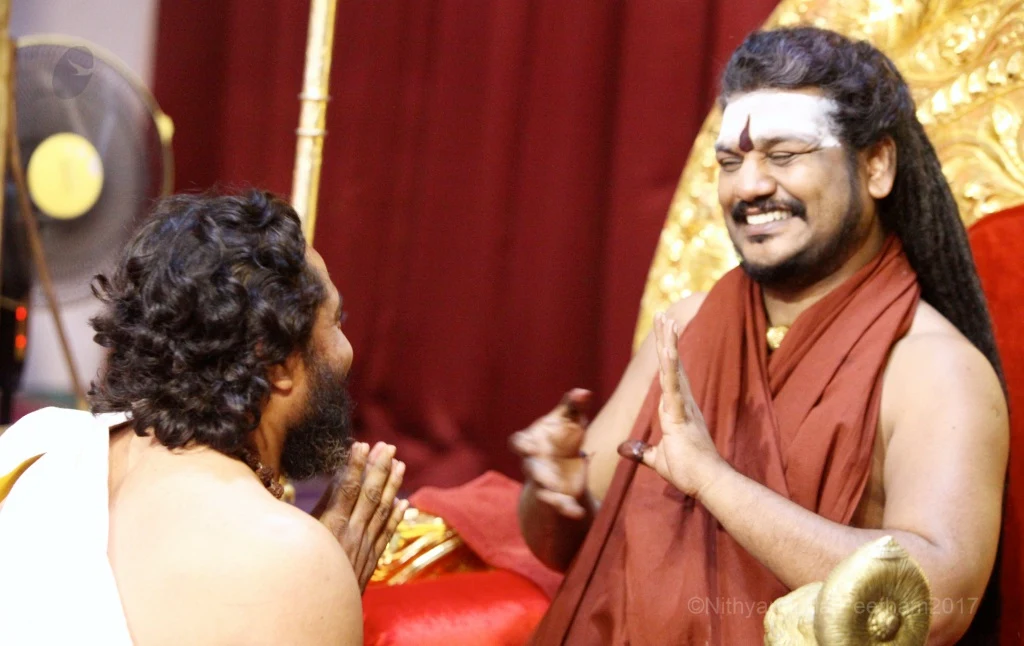
A photograph of two men in close conversation indoors. On the right, a smiling, bare-chested man with long swept-back hair, a broad white vibhuti band with a red dot on his forehead, a rudraksha-style gold necklace, and a red-saffron shawl draped over his shoulders, gesturing with raised hands while seated on an ornate gold-and-red throne. Facing him on the left, a bearded man with curly hair, bare-shouldered in white cloth, sits with palms pressed together in namaste. Behind them hang deep red curtains, a gold ceremonial staff stands at left, and a black fan with a gold grill is visible. The man on the right appears to be Swamiji (probable) based on the long swept-back hair, saffron shawl, gold necklace and throne, with the page noting his presence at this event.A smiling man with long dark hair and a white-and-red vertical tilak on his forehead sits on a red throne-like seat in front of an ornate gold backdrop. He wears a rust-red shawl over bare shoulders and a gold chain necklace, and he looks down at a sheet of paper held by a hand entering from the bottom edge. The photo shows a seated discourse setting with a red and gold decor. Swamiji (probable): the long hair, rust-red shawl and ceremonial gold necklace match cues associated with the page's described discourse event.A smiling man with long dark hair and a moustache stands on a stage with both hands raised beside his head, palms facing outward. He wears a draped rust-orange saffron cloth over one shoulder and a gold pendant on a cord at his neck, with a red thread on his wrist. A white tilak with a red bindi marks his forehead. Behind him are ornate gold carved panels and deep red curtains. The stage setting suggests a discourse or satsang. The appearance matches Swamiji (probable) from the long hair, saffron draped clothing, gold necklace and the page's stated presence; he is standing alone on stage, delivering the talk.

Darshan

12 photosSource gallery
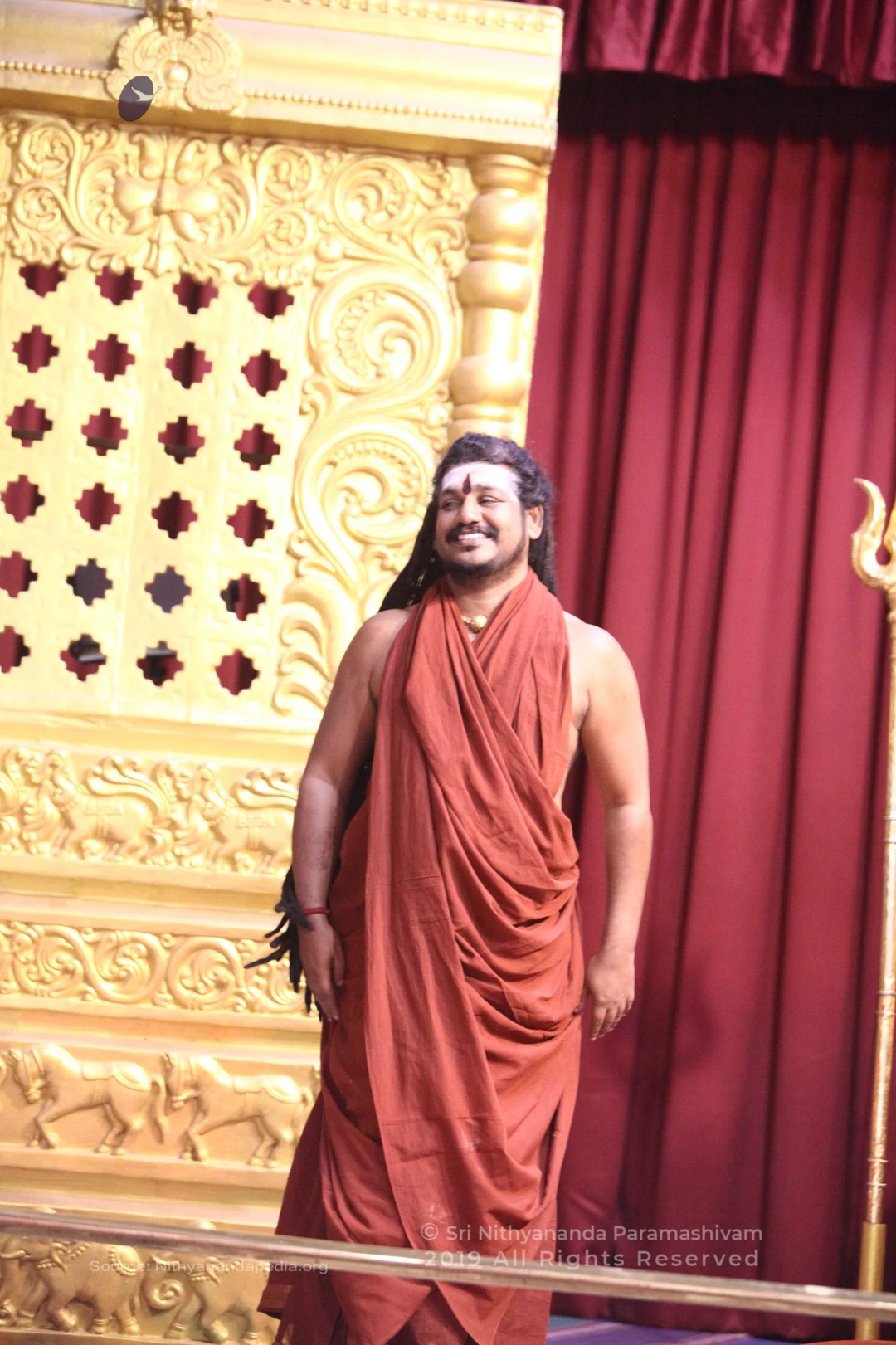
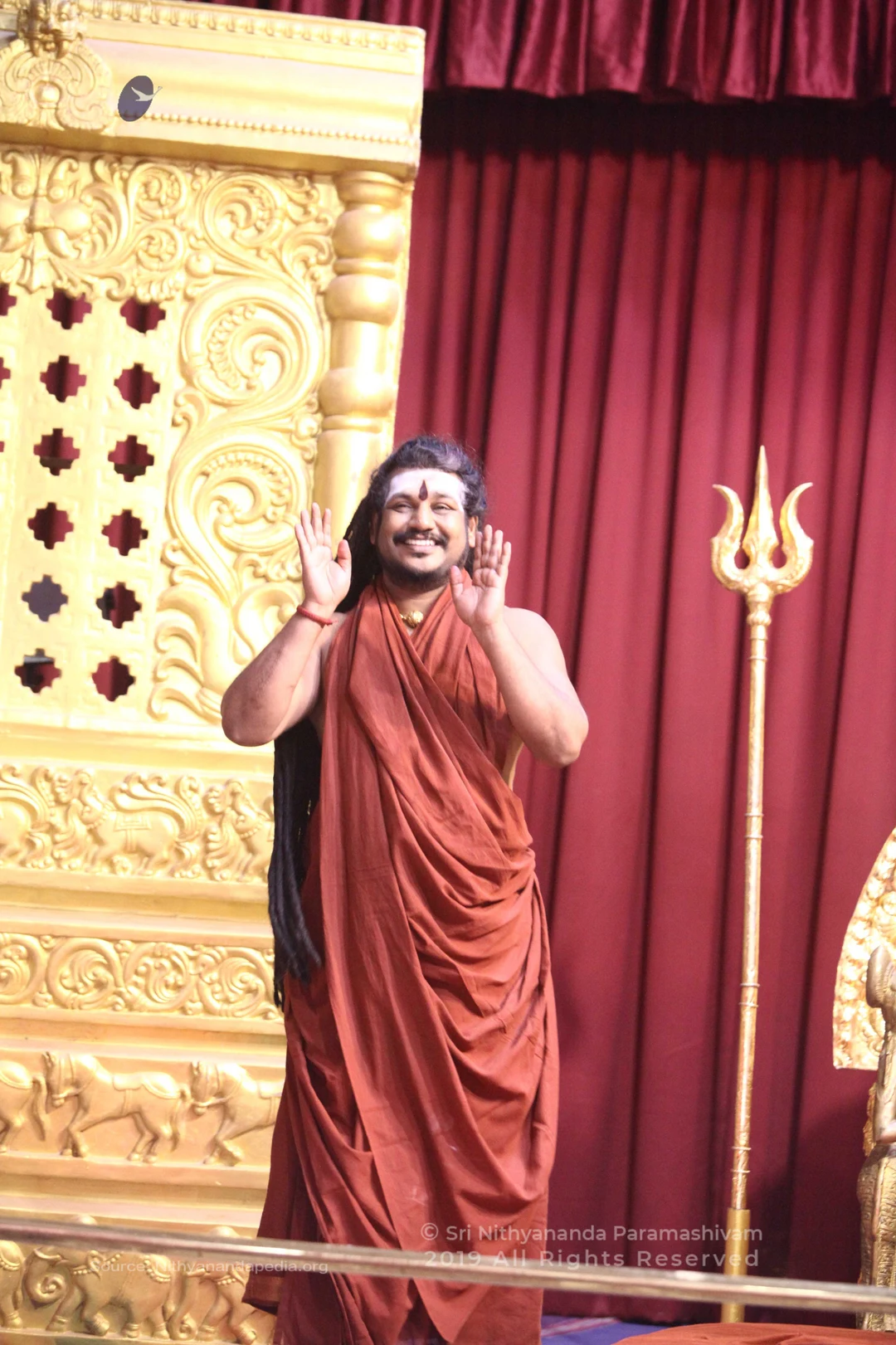
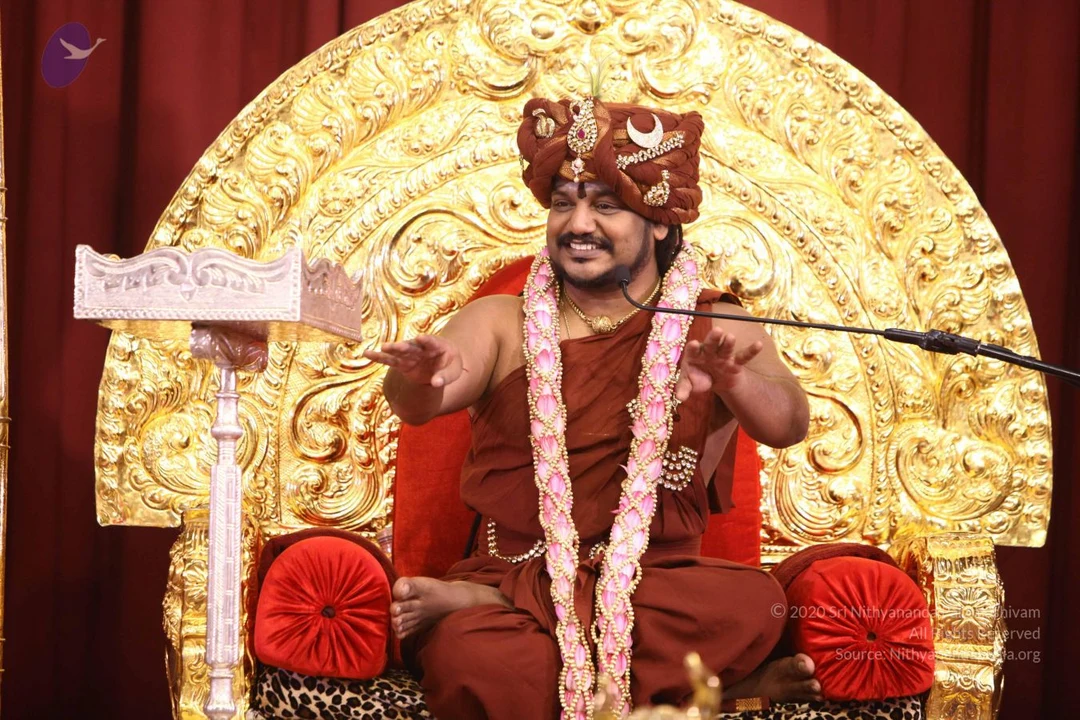
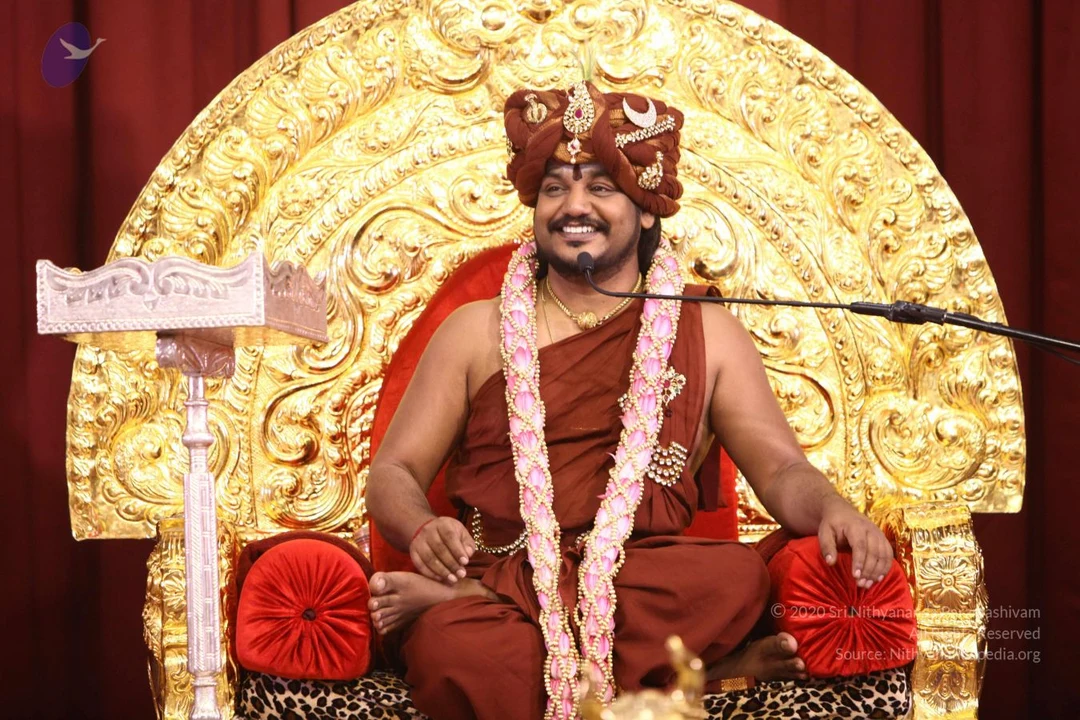
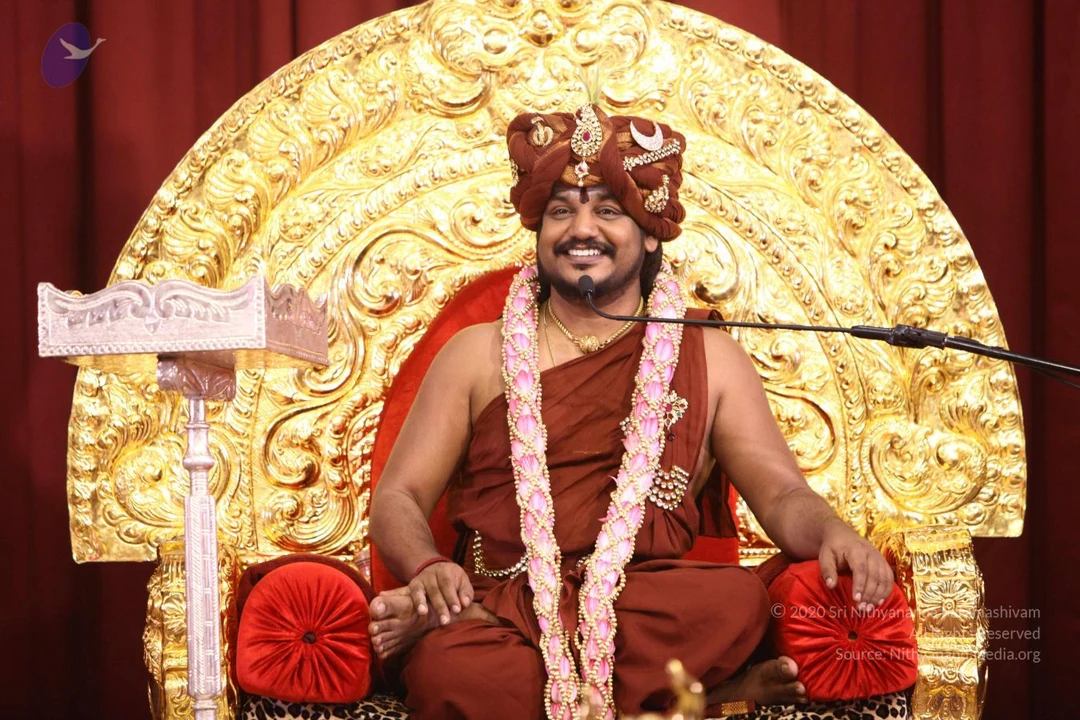
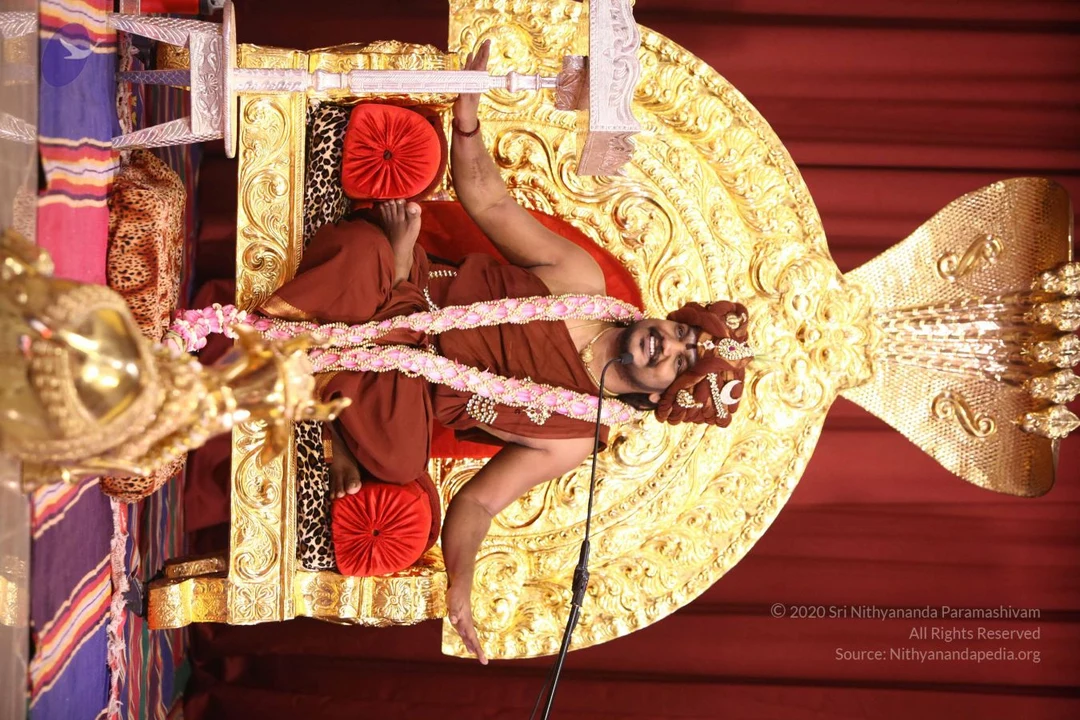
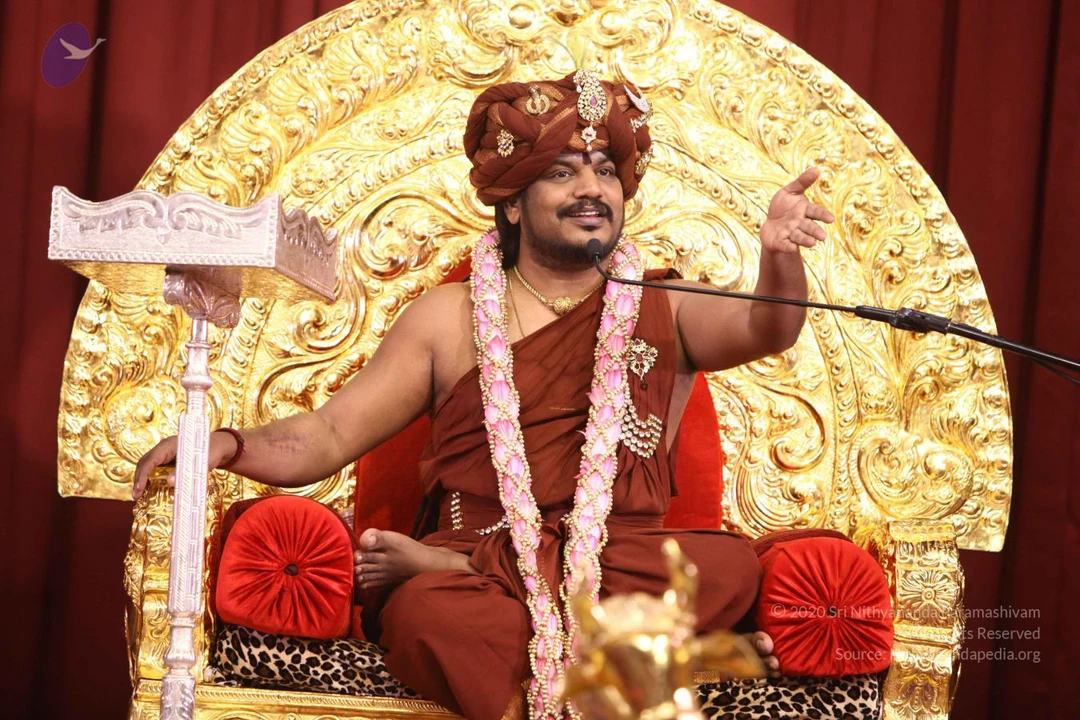
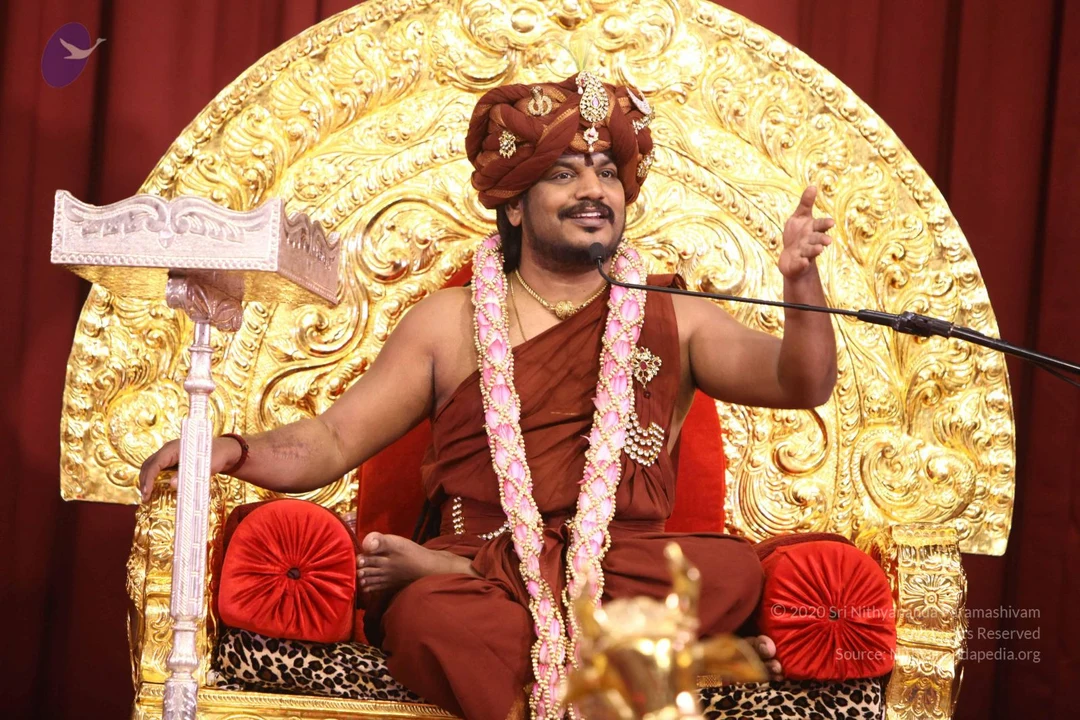
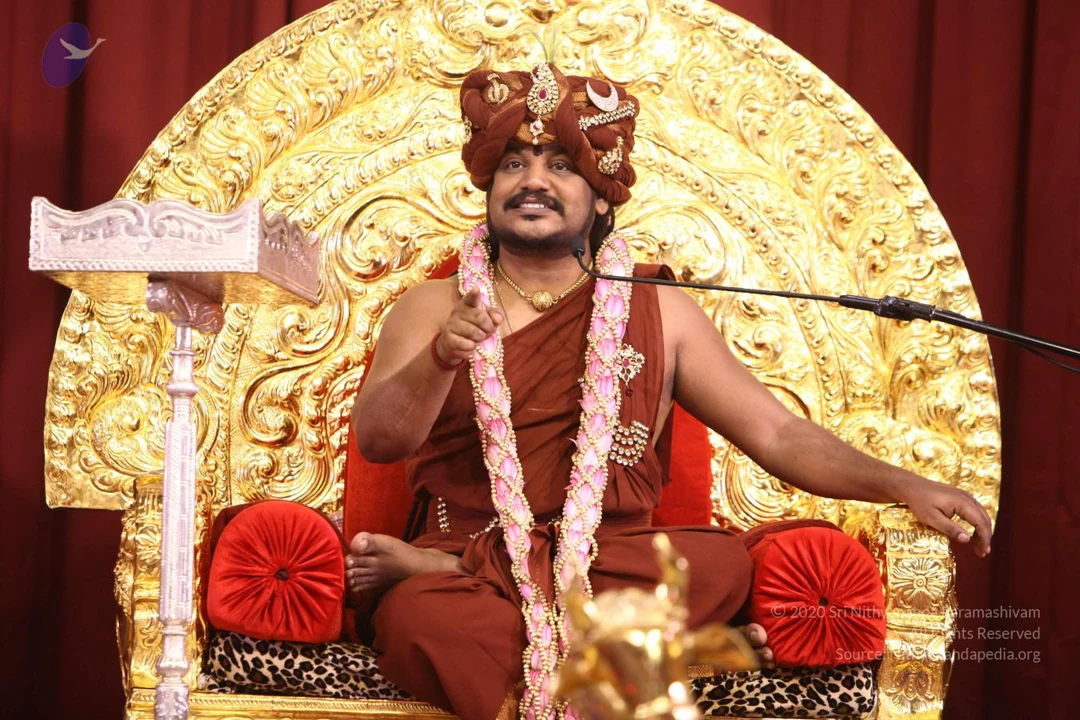
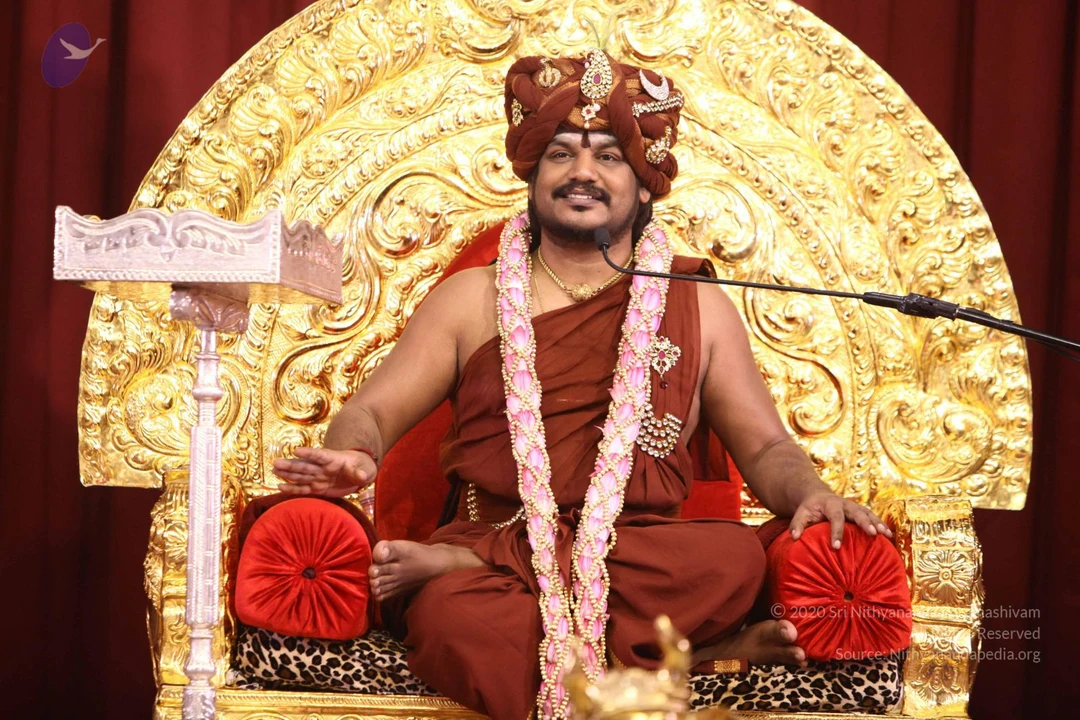
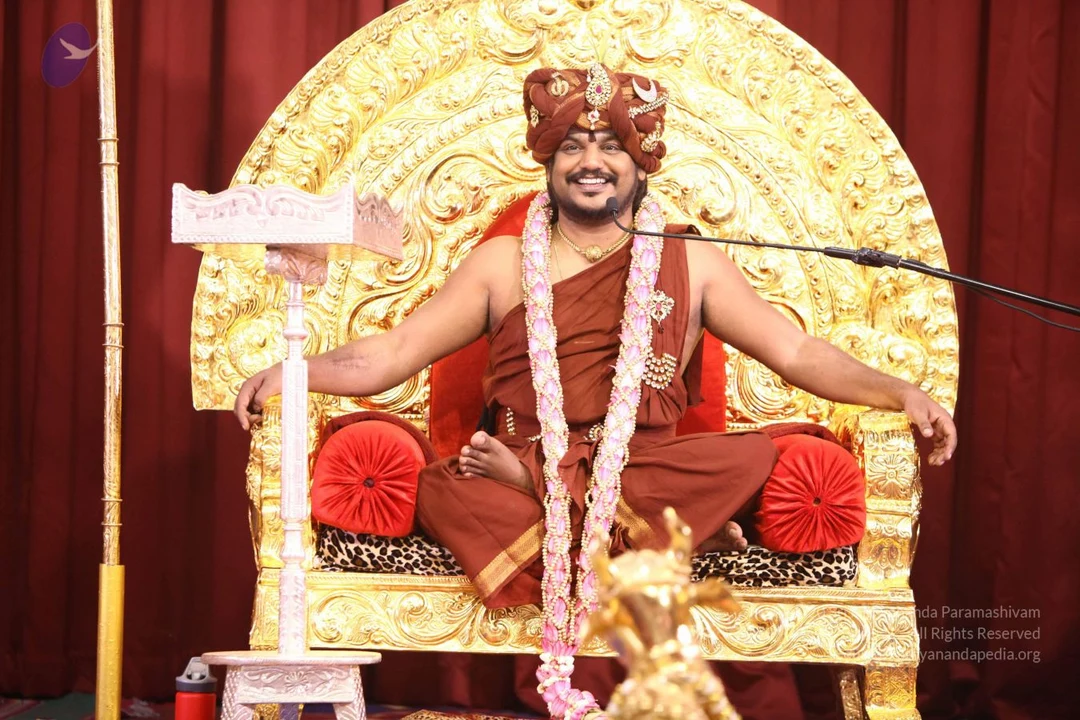
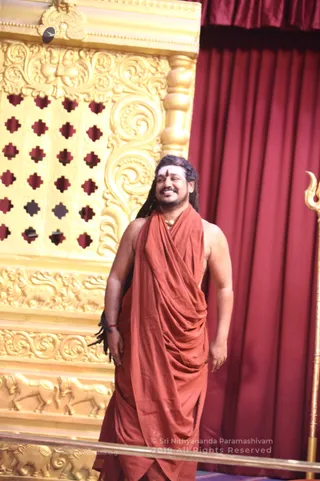
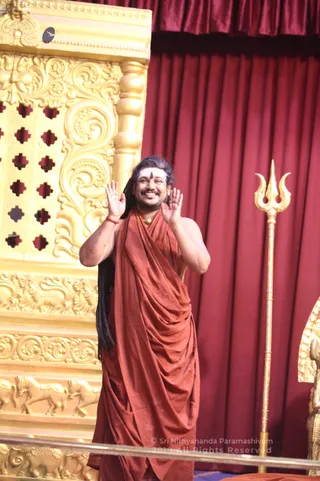
A man stands on a stage in front of an ornate gold carved screen with lattice panels and carved horses and elephants, with deep red curtains behind him and a gold trident-topped staff at right. He wears a reddish-orange draped cloth over his shoulders and torso, a white tilak on his forehead, a gold pendant necklace and a red thread on his wrist, and he has long dreadlocked hair. He smiles and looks to the side. Appearance-based label: Swamiji (probable), in person, with long hair, orange robes and a gold necklace as the qualifying cues, standing on the stage.A smiling man with long, dark, dreadlocked hair and a red bindi stands on a stage raising both palms in greeting. He wears a draped rust-orange cloth and a gold pendant, and a red thread is tied on one wrist. Behind him is an ornate gold throne carved with floral scrolls, lattice panels and animal reliefs, in front of deep red curtains. A gold trident stands to the right. Swamiji (probable): his long swept-back hair, saffron-orange draped clothing and ceremonial gold pendant match the appearance cues for the page's named subject, shown greeting on stage before a golden throne.A photograph of a long-haired man with dreadlocked hair, a white forehead band with a red vertical mark, and a rust-orange shawl draped over bare shoulders, seated before an ornate gold carved throne with a red cushion and red velvet drapes behind him. He smiles and raises his right hand, palm open, toward someone out of frame at the lower right, where a partially visible bald head appears. Swamiji (probable): the long matted hair, orange-red wrap and seated throne are consistent cues for the presentation the page describes. Plain setting suggests a satsang or discourse hall.A smiling man with long dark hair and a white forehead band with a central red mark sits on a red throne before an ornate gold-embossed backdrop. He wears a red-orange shawl over bare shoulders and a gold chain. A hand from the lower right holds up a white sheet of paper he is looking at. Red drapery is behind him. Swamiji (probable): the long hair, ceremonial gold necklace and red-orange shawl are the visible cues, and he is seated on a throne as the central figure.A photograph of a seated man on an ornate gold throne with red cushions, in front of a deep red curtain. He wears a rust-brown turban with a crescent-moon ornament and a feather plume, a brown-red sannyasi-style wrap, a pink and white flower garland, and gold necklaces. He smiles broadly with hands folded in his lap and sits beside a microphone on a stand. A silver carved lectern stands at left. The setting suggests a discourse or satsang. a person, the presenter, is seated on the throne with long swept-back hair and ceremonial gold ornaments.A man seated on an ornate golden throne with red cushions, smiling broadly before a dark red curtain. He wears a red-and-gold turban with a crescent-moon ornament and a jewelled brooch, a saffron-brown garment, and layered garlands of pink and white flowers. Gold ornaments rest on his chest. A microphone stand is in front of him and a silver lectern stands at left. a person: the turban, ornate jewelled headwear, saffron-toned clothing and garlands are cues, and he sits in the role of a speaker giving a discourse.

FB-photo-of-the-day

4 photosSource gallery
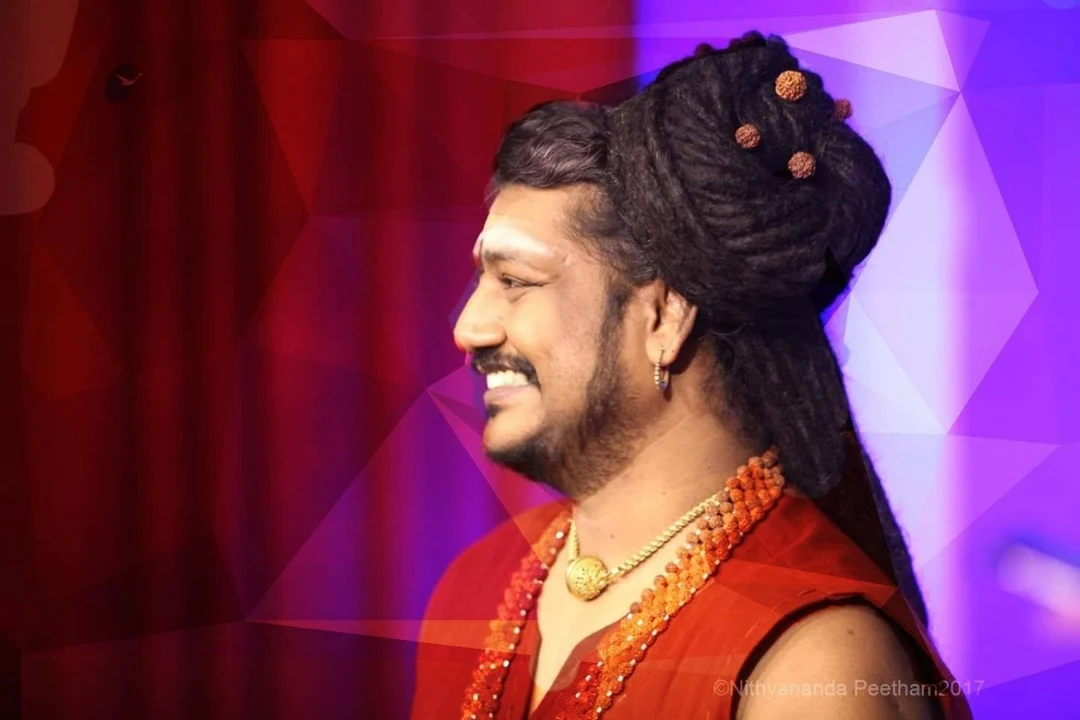
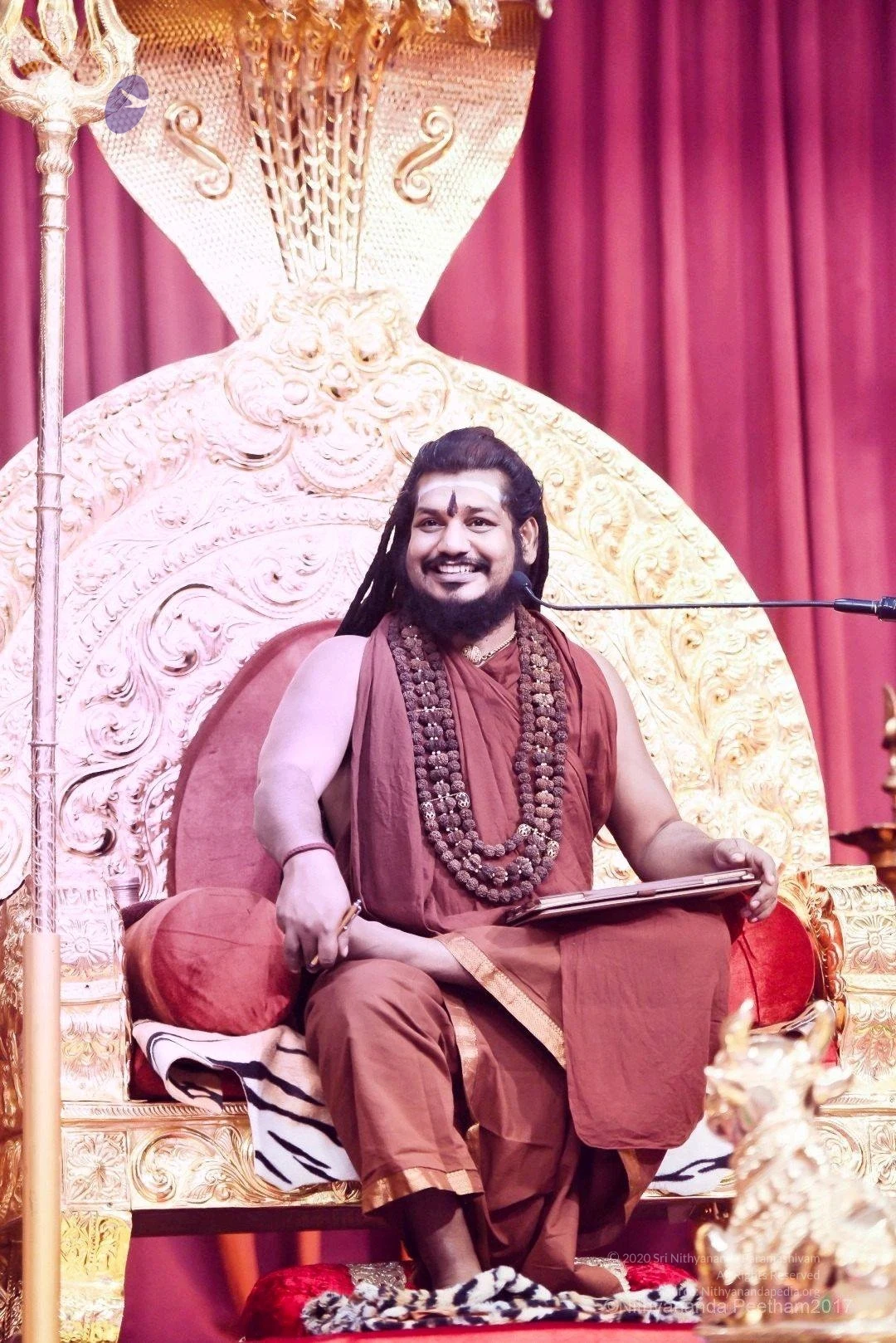
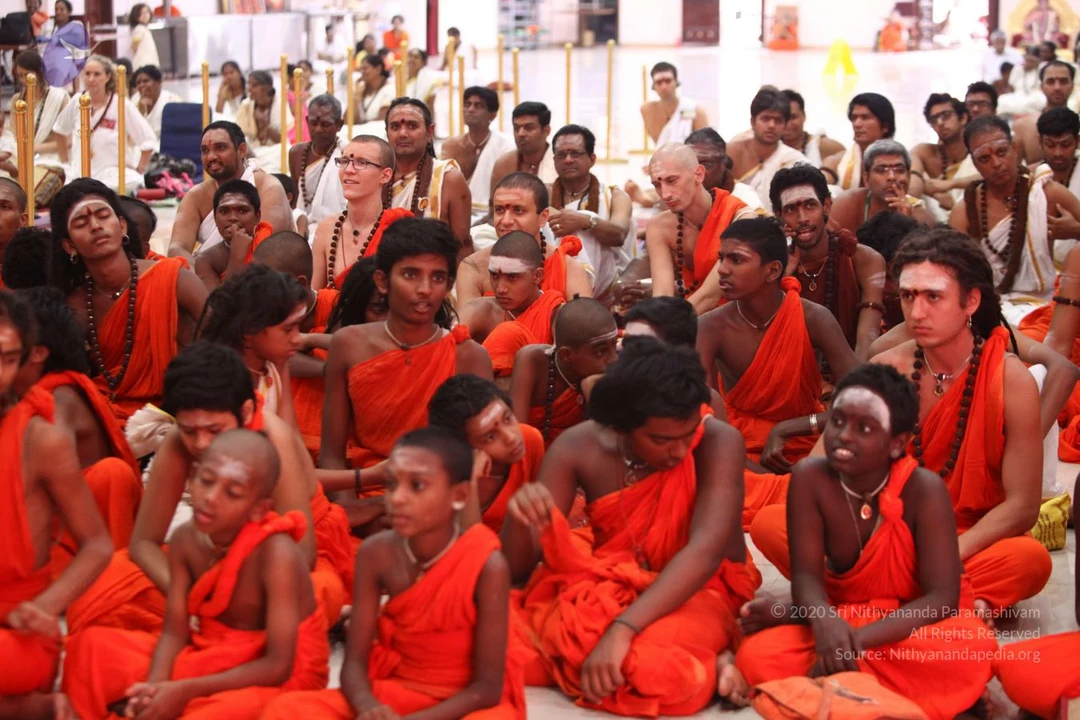
Profile of a smiling man in a red robe against a red and violet geometric backdrop. He has long dark hair piled high in a topknot decorated with rudraksha beads, a white vertical mark on his forehead, and a gold pendant on a gold chain. Layered orange-red beaded malas hang across his chest, and a small gold earring is visible. Probable Swamiji, in_person cue match: long swept-back hair with rudraksha, saffron-red ceremonial clothing and ornate gold necklace.A smiling man with long dark hair swept back and a white tripundra mark on his forehead sits before an ornate gold carved throne and a red cushion. He wears a rust-orange shawl draped over his shoulders and is making a hand gesture with his raised right palm. Probable Swamiji, identified by long swept-back hair, saffron/orange shawl and tripundra, seated in front of a gilded throne, appears to be addressing or blessing the audience. No other people are visible in the frame.A seated man in a rust-red robe and matching wrap sits on an ornate gold throne with a carved cobra-hood backrest against deep red drapes. He wears multiple strands of rudraksha beads and a gold chain, has a white forehead mark and long locks swept back, and holds a tablet and pen while smiling toward the camera. A microphone stands at his side, a golden trident leans on the left, and a striped tiger-skin cloth covers the seat. Swamiji (probable) appears in person here, the speaker of this discourse, with the distinctive saffron-red robes, rudraksha malas and long hair cues. Watermarked copyright text runs across the lower right of the image, and the frame is a photograph of one person.A smiling man in a maroon-brown turban with a small gold crescent ornament and a vertical tilak mark on his forehead sits in front of an ornate gold-carved throne with a red cushion. He wears a pink lotus garland, layered gold necklaces, a gold armlet and a rudraksha-style mala over a dark maroon robe, and a microphone stands in front of him. Appearance cues including the turban, ceremonial gold ornaments and maroon robe are consistent with Swamiji (probable), seated and speaking as a discourse presenter.

Satsang
42 photosSource gallery
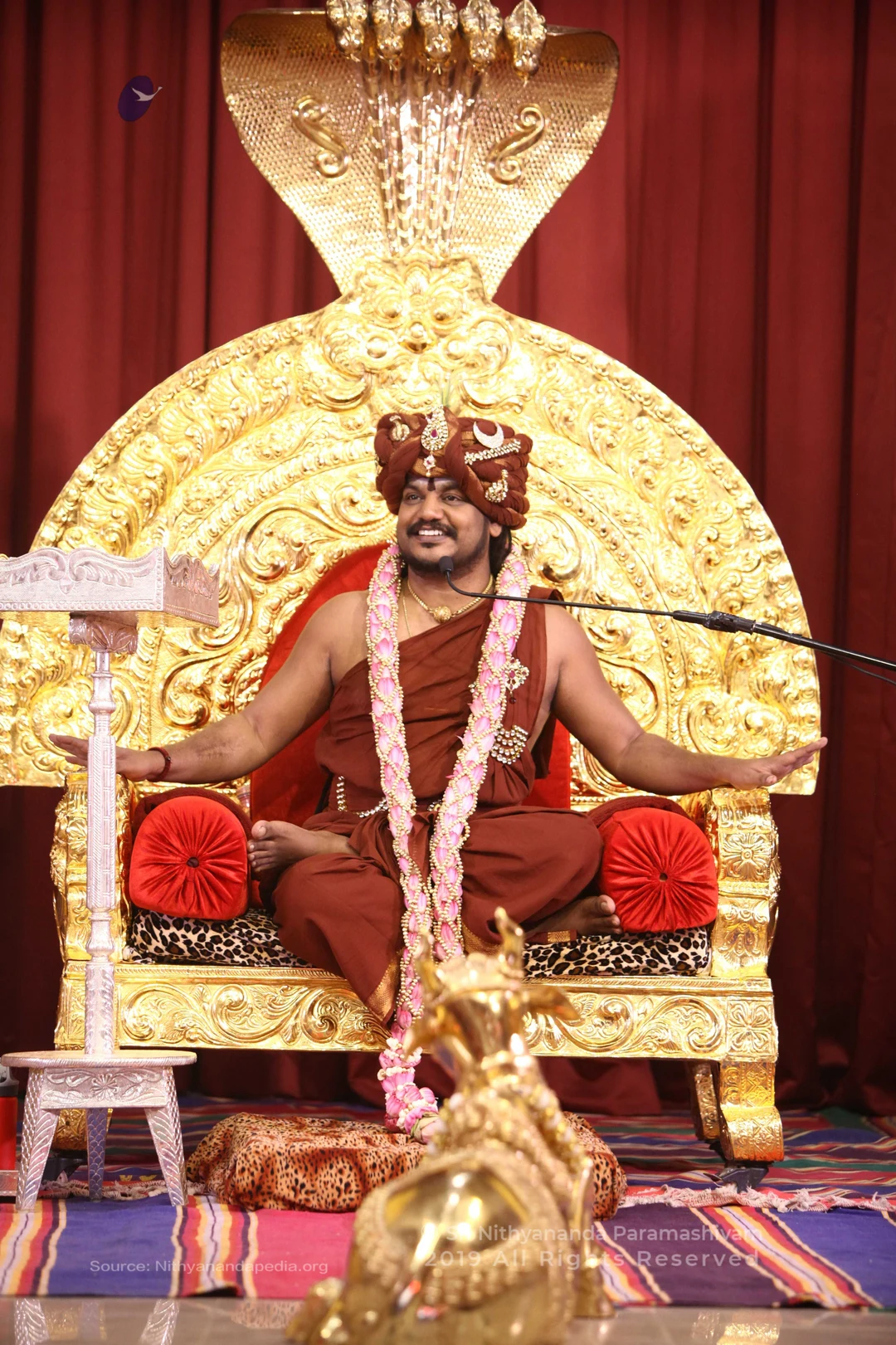
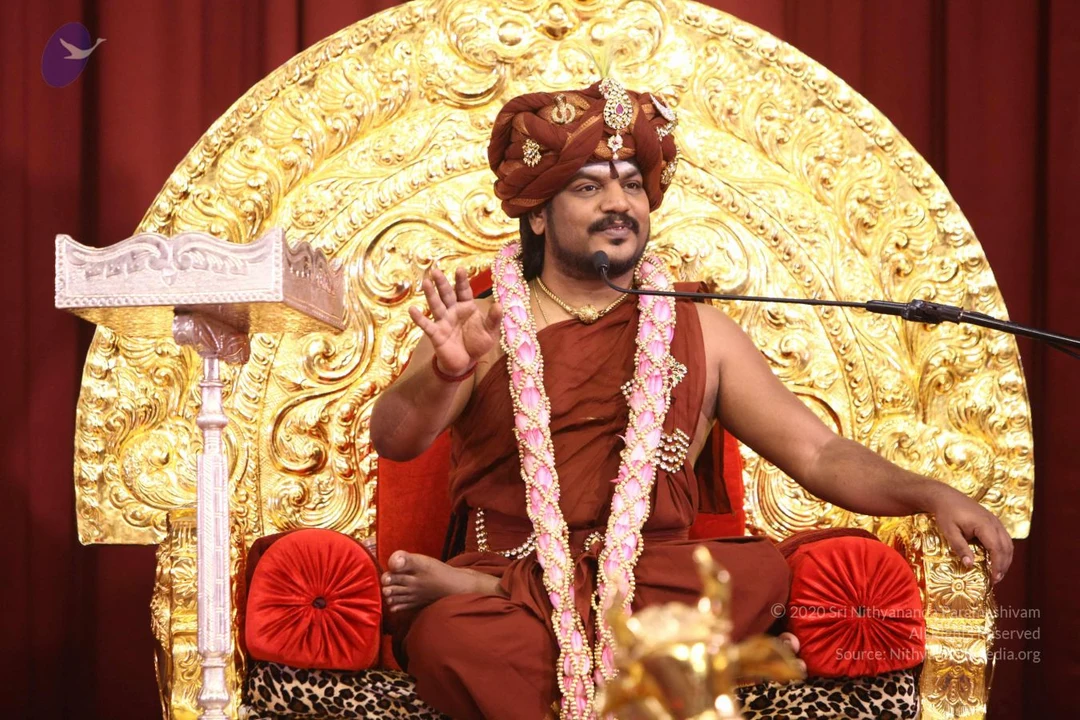
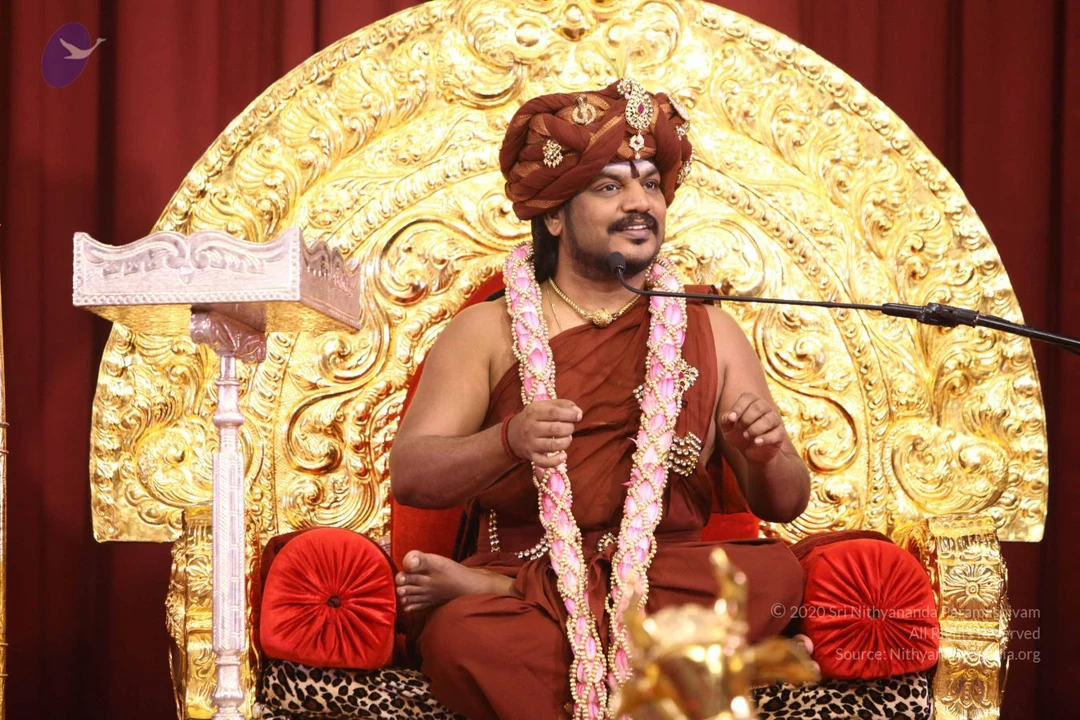
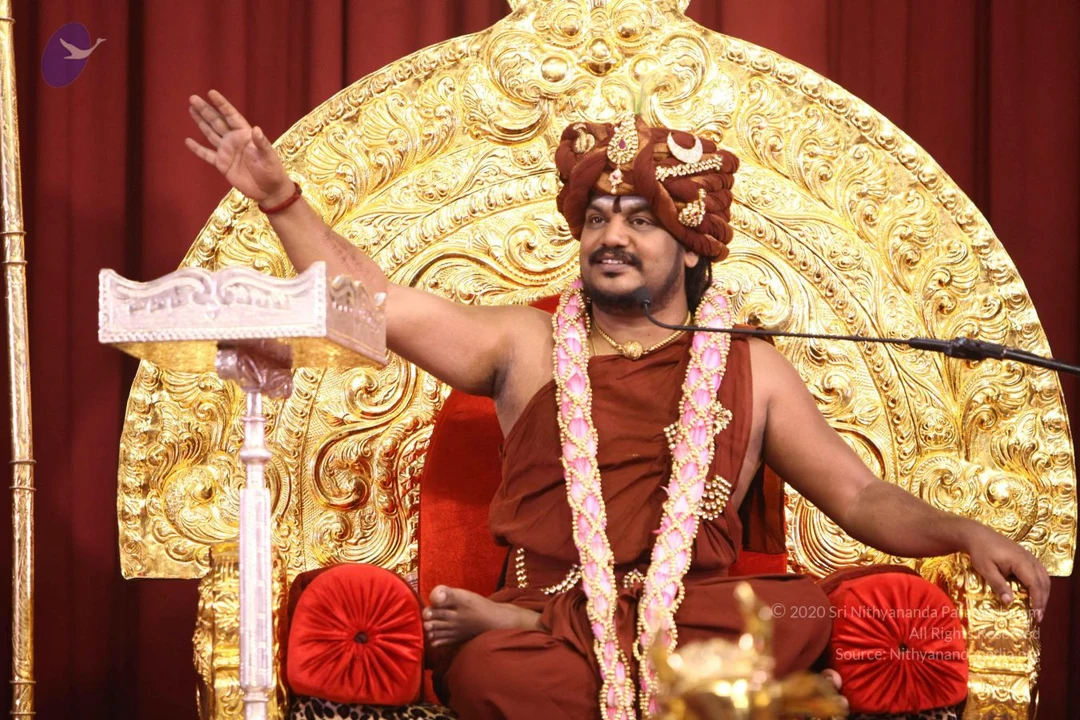
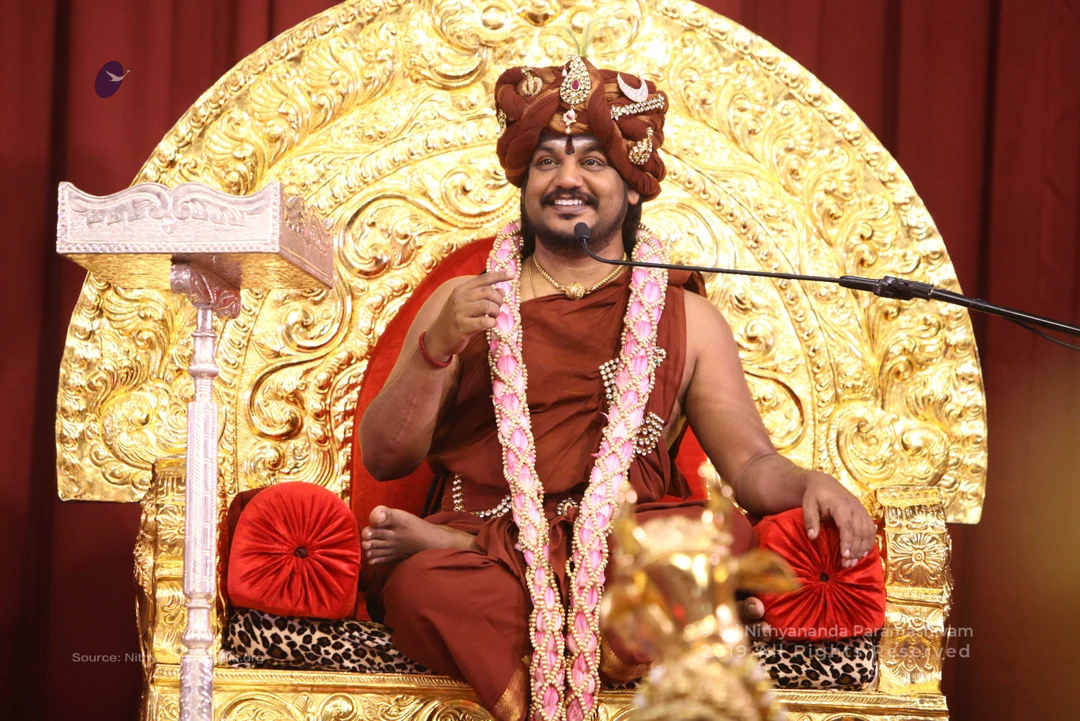
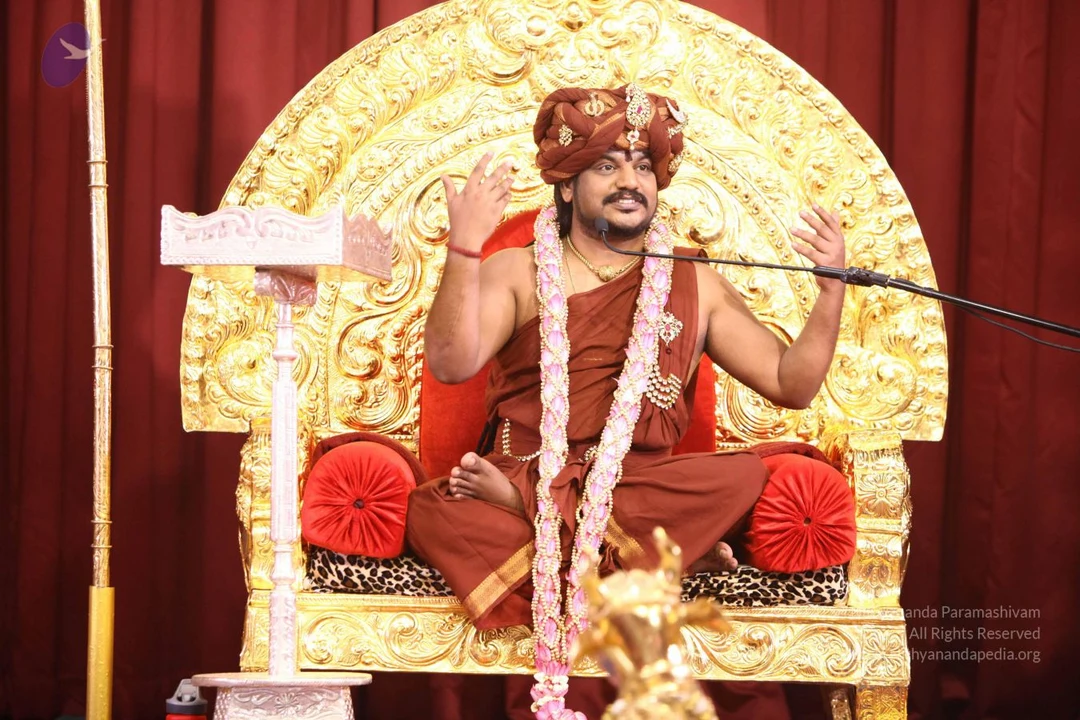
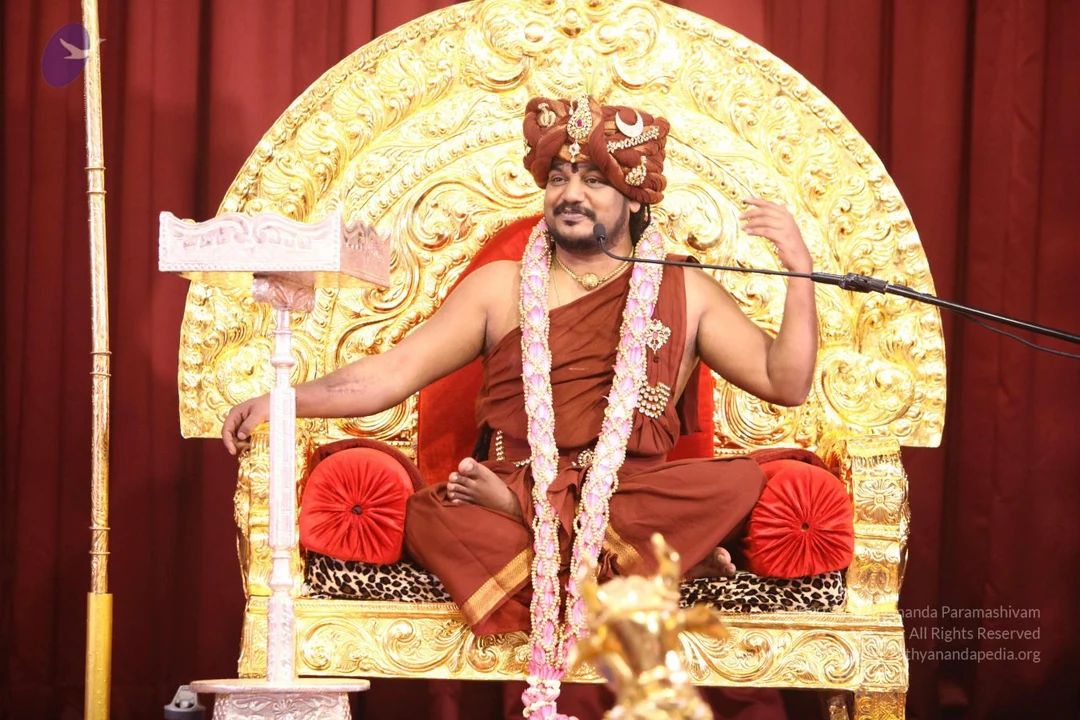
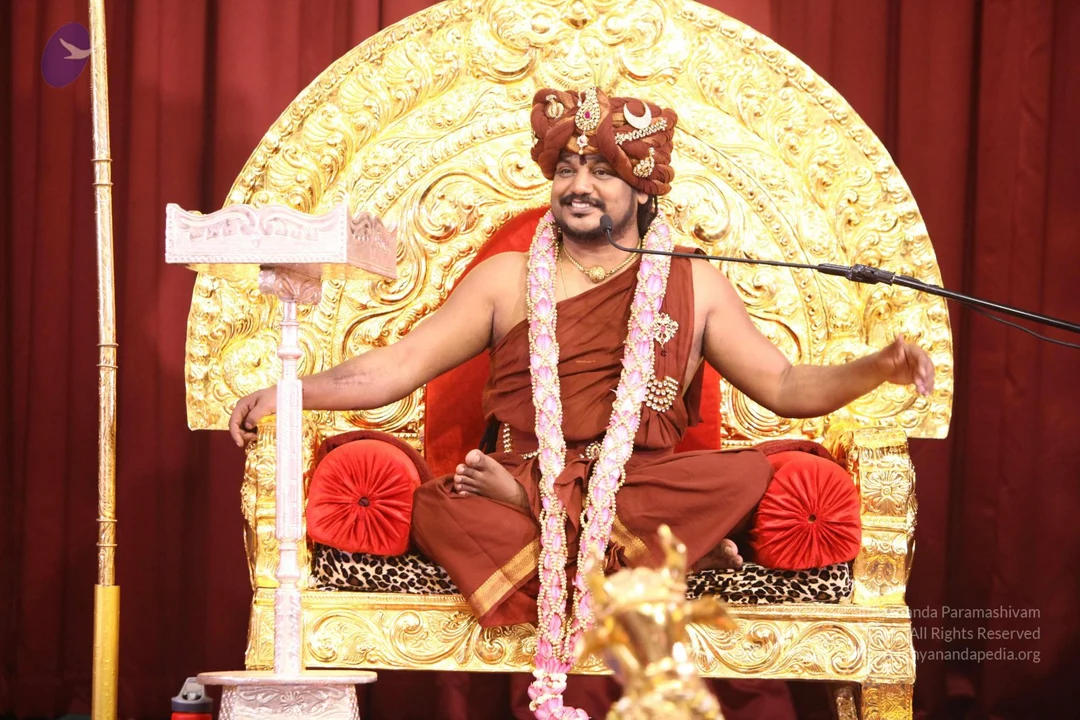
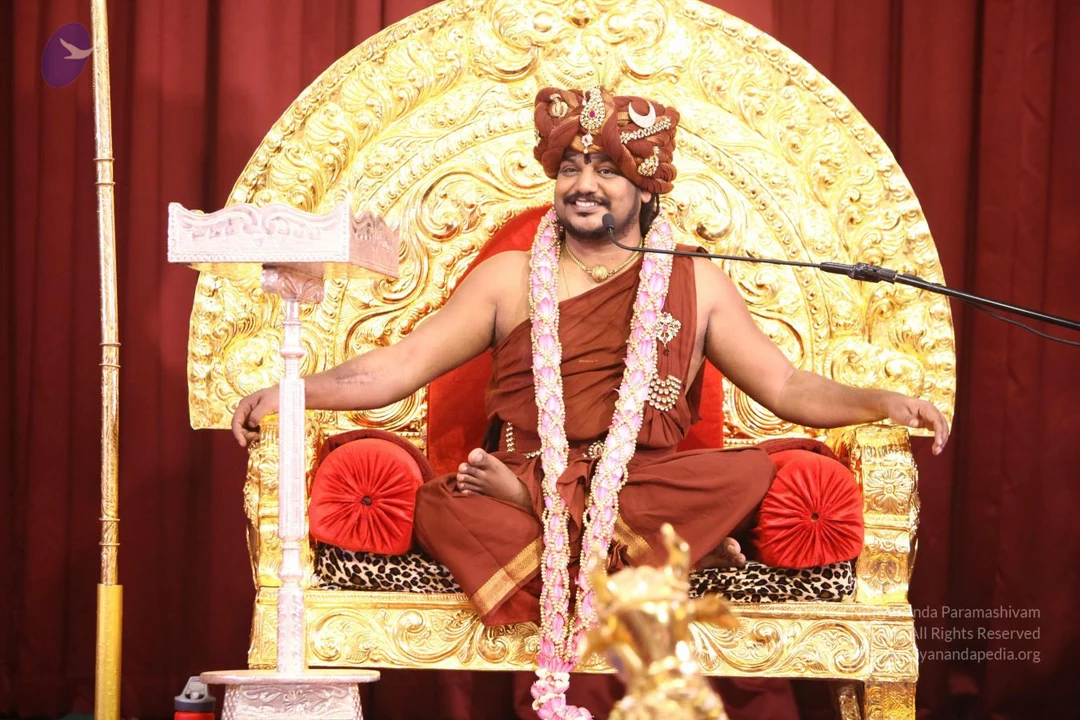
A seated man in a rust-red robe and matching red-orange turban sits on an ornate gold throne with a large carved gold back against a deep red curtain. He wears a pink and white flower garland, a gold necklace, and a rudraksha-style bead mala across his chest, with a red tilak on his forehead. Red velvet cushions sit on the armrests, and a small silver reading stand and a microphone are at the left and right edges. Swamiji (probable) is seated centrally as the presiding figure, identified by the rust-red robe, the ornate turban and the ceremonial gold necklace and garlands. A faint purple logo appears in the upper left corner.A man in rust-brown ochre robes and a matching brown turban with jeweled ornaments sits cross-legged on an ornate gold throne with a carved gold backrest. He wears pink and white flower garlands, a gold chain, and rudraksha-style beads, gesturing with one raised hand while speaking into a microphone on a stand. Red velvet cushions with a leopard-print seat frame him, and a gold lectern and deep red curtains form the backdrop. A gold ritual vessel is partly visible at the lower right. The scene resembles a discourse setting.A seated man on an ornate gold throne with a carved gilded backrest and red velvet cushions, in front of deep red drapes. He wears a rust-orange turban with a jewelled ornament, a rust-orange robe, and a long pink-and-white flower garland. Gold necklaces and a rudraksha-style bead ornament are visible, and his right hand is raised in a teaching gesture while he smiles toward a microphone on a stand. A carved white lectern stands to the left and a golden object is in the foreground. Swamiji (probable): the seated figure has a turban, ornate gold jewellery and a saffron-toned robe, consistent with the page's discourse context, but this is an appearance-based label only.A man seated on an ornate gold throne with a carved, high-backed gilded frame and red velvet cushions, speaking into a microphone on a stand. He wears a rust-brown turban adorned with a gold crest and jewels, a rust-brown robe, a gold necklace, and two long pink-and-white flower garlands. His left hand gestures toward a silver lectern-style stand, and a golden ritual object is visible in the foreground. Behind him hang deep red drapes. Probable Swamiji, seated in the teaching posture of a discourse, with the turban, ceremonial gold jewellery and garlands as the qualifying cues.A man seated on an ornate gold throne with carved golden backrest and red velvet cushions, gesturing with raised right hand while speaking into a microphone on a stand. He wears a rust-orange turban with gold ornaments and a jewelled brooch, a rust-orange robe, a gold necklace and long pink-and-white flower garlands. A carved white lectern stands at left against deep red drapes. a person by appearance cues: orange turban, ornate gold jewellery and garlands on a throne during discourse.A man seated on an ornate gilded throne with elaborate repoussé scrollwork and red velvet cushions, speaking into a microphone on a stand. He wears a rust-orange turban with gold and jewelled ornaments, a rust-orange cloth wrap over bare shoulders, a gold chain, and a long pink-and-white flower garland; his hands are raised in gesture and his feet are bare. Behind him hang deep red curtains, and a carved white lectern stands at left. The appearance of this seated speaker in turban, orange-red robes and garlands matches the Swamiji (probable) cues, given a discourse setting with a throne and the page noting Swamiji's presence. A copyright notice appears in the lower right corner.

Darshan

12 photosSource gallery
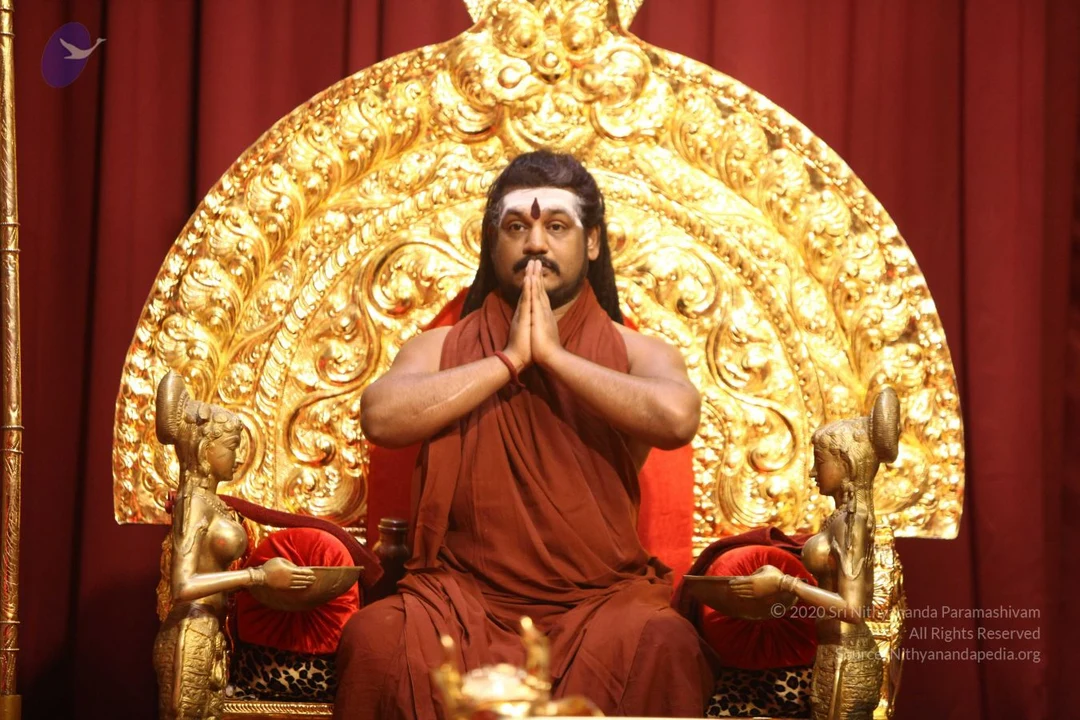
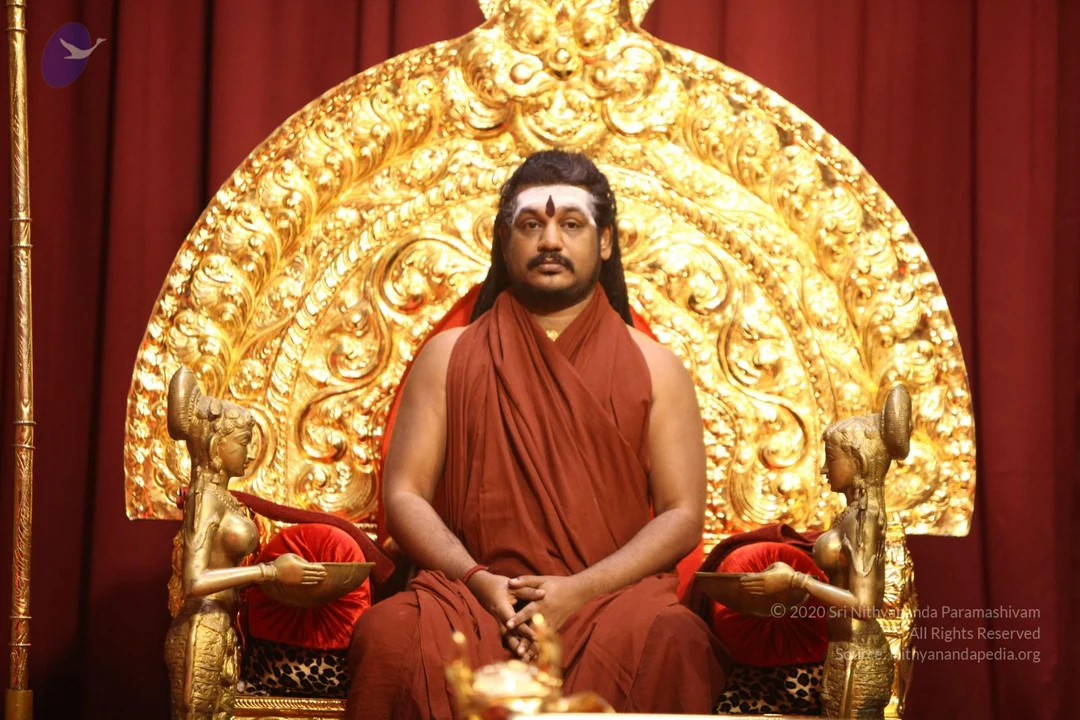
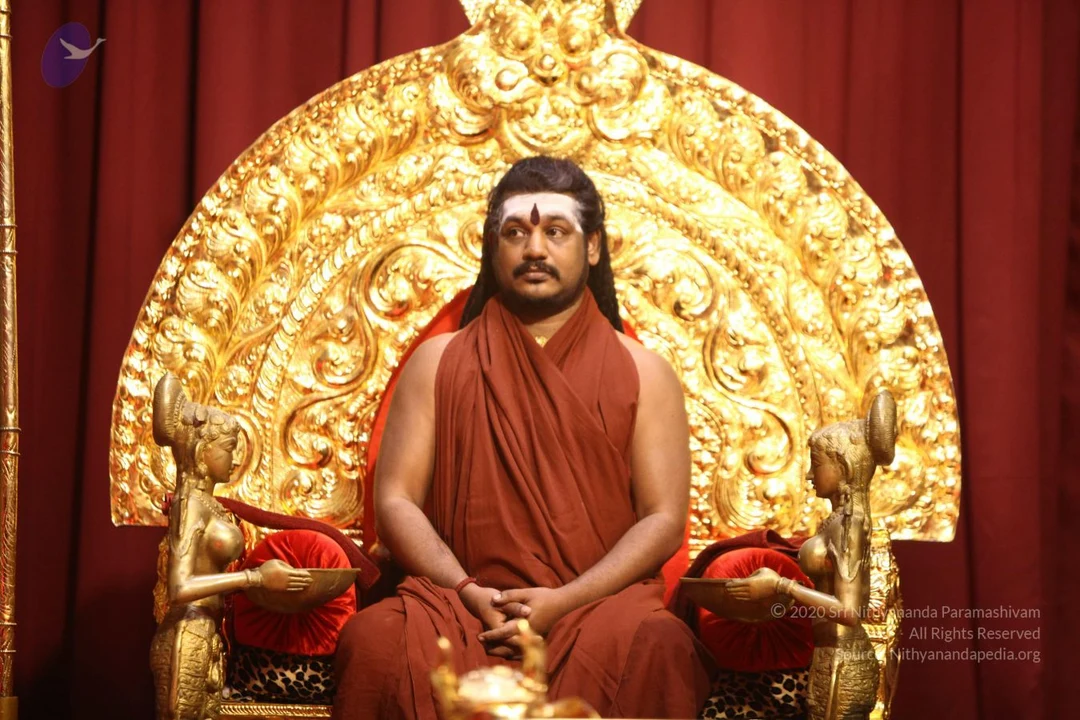
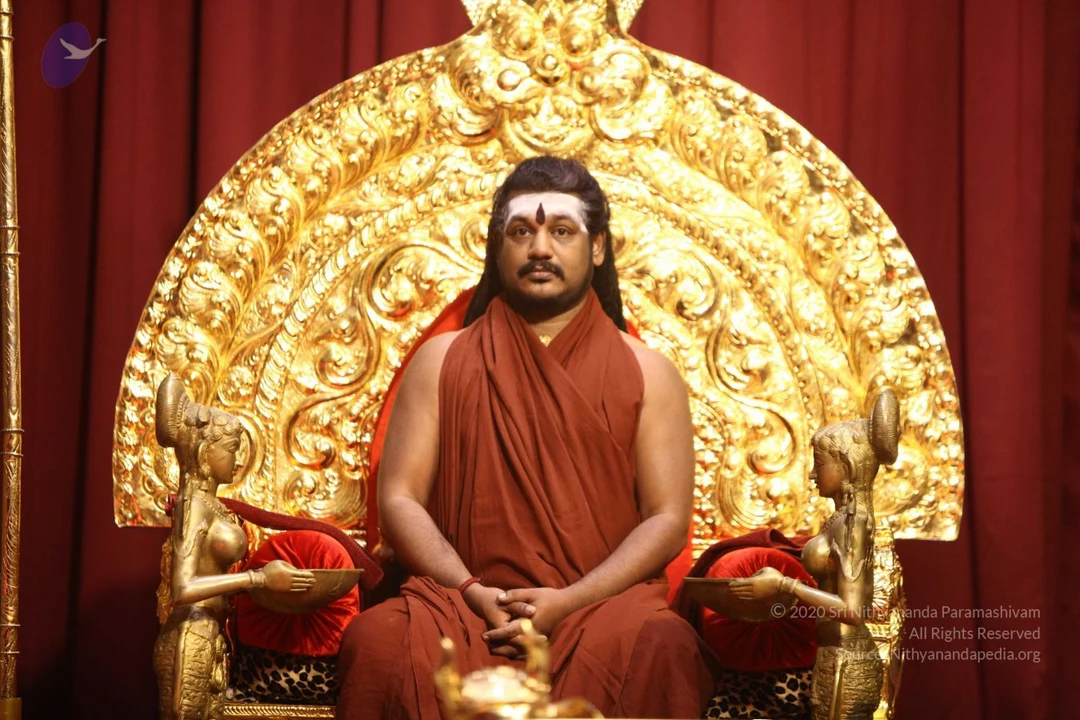
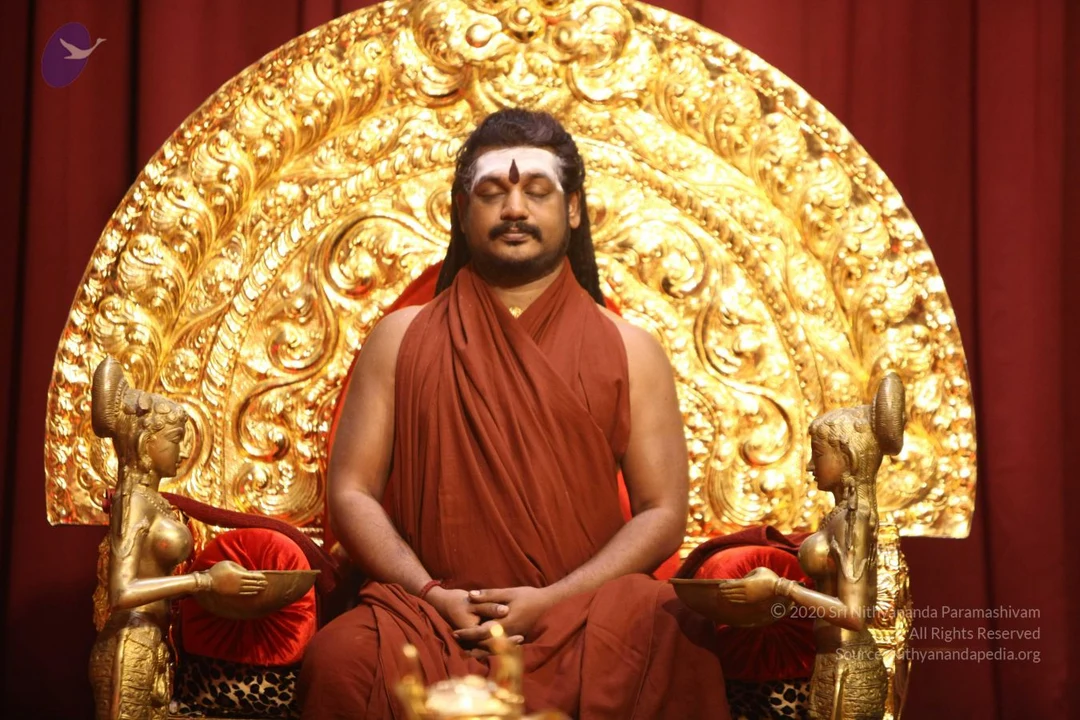
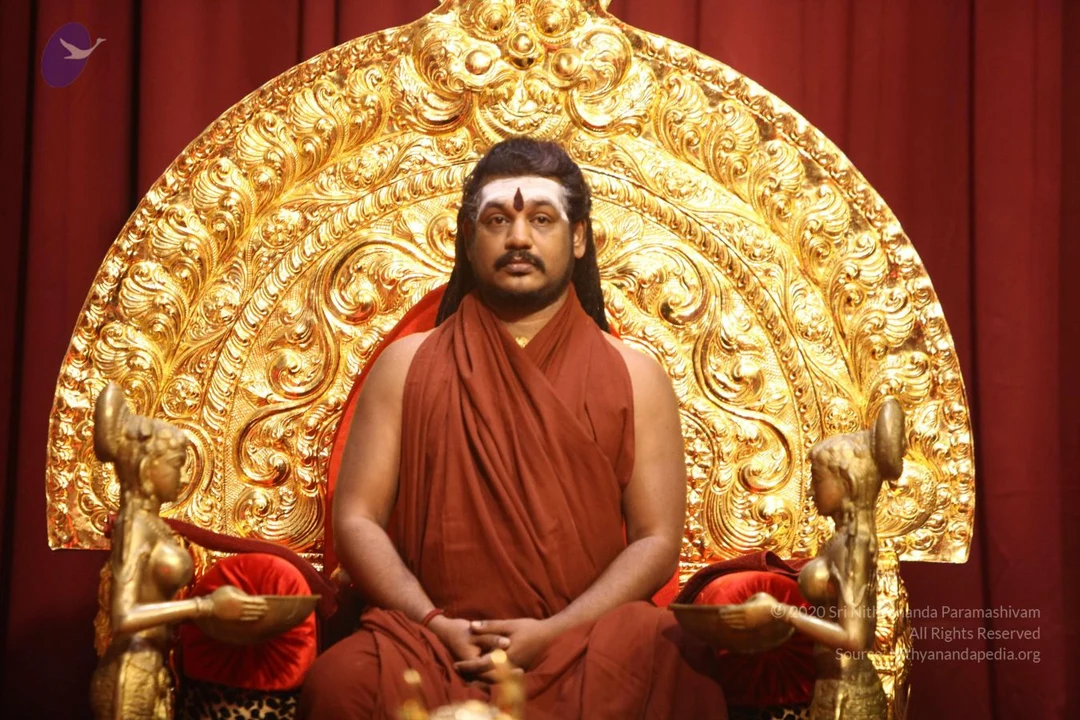
A man seated cross-legged with eyes closed on an ornate golden throne with a large, elaborately carved arched back, in front of deep red draped curtains. He wears a rust-orange saffron wrap over his shoulders, a white vertical tilak with a red dot on his forehead, and a red thread on his wrist, with long dark hair falling behind. His hands are clasped in his lap. Two gilded carved female attendant figures holding trays flank the throne, and a gold ritual object is visible at the lower edge. The pose and setting suggest meditation or darshan. Swamiji (probable): the seated figure has long swept-back hair, saffron clothing and a ceremonial throne, which are cues for the page's identification.A man seated on an ornate gold throne with a large gold arch carved in floral scrollwork, set against red drapery. He sits with palms pressed together in anjali mudra and eyes closed, wearing rust-red saffron robes, a red thread on his wrist and a white-and-red tilak on his forehead, with dark shoulder-length hair. Two gold female figurines flank the throne, each holding a shallow bowl. A gold kalasha-like object and a small brass vessel sit at the base. Swamiji (probable): the saffron robes, long swept-back hair and throne fit the presentation, but facial features are not used. The page-level cue is not visual evidence, so the identity is marked as probable only on appearance.A seated man in a rust-red robe sits centred before an ornate gold throne with a large gilded arched backrest, against a deep red draped curtain. He has a white forehead marking with a red bindi, long dark hair and his palms pressed together in namaste at his chest. Two golden female figurine attendants flank the throne, each holding a shallow golden bowl, and a gold ceremonial object sits in the lower foreground. The man resembles the Swamiji candidate with long hair, ochre robe and ritual forehead marking; appearance-based label: Swamiji (probable), seated on a peetha throne in a discourse setting.A man seated on a red cushioned throne before a large ornate gold backrest with scrollwork and a red curtain behind. He wears a rust-red ochre robe draped over the shoulders, a red mark on the forehead with white vertical markings, and a red bead wrist band. His hands are pressed together in namaskar greeting. Flanking the throne are two gold female figures holding bowls, and a gold-coloured vessel sits in the foreground. The person has long swept-back dark hair and a moustache, with the robe, forehead marking and bead band matching the sannyasi presentation. Appearance-based candidate: a person, seated in person in a ceremonial setting.A seated man in a rust-red saffron-toned sannyasi wrap sits centrally on an ornate gilded throne with a large golden scrolled halo backrest against a deep red curtain. He has long dark hair, a white forehead band with a red bindi, a moustache, and his hands are folded in his lap. Flanking him are two golden standing female figures holding shallow bowls, and a red cushion sits on the chair beside each. Dress and throne suggest the a person role of a seated teacher giving darshan. The bare-shouldered figure wears a red wrap and a thin red thread on the wrist. A small golden ritual vessel appears at the lower edge.A man seated on an ornate gold throne with a large gold arched backrest, flanked by two gold female figures holding bowls. He wears a rust-orange draped garment, a white forehead marking with a red central dot, and has long dark hair. His hands are folded in his lap. Red curtains hang behind the throne.

Satsang
42 photosSource gallery
A seated man in a rust-red robe and matching red-orange turban sits on an ornate gold throne with a large carved gold back against a deep red curtain. He wears a pink and white flower garland, a gold necklace, and a rudraksha-style bead mala across his chest, with a red tilak on his forehead. Red velvet cushions sit on the armrests, and a small silver reading stand and a microphone are at the left and right edges. Swamiji (probable) is seated centrally as the presiding figure, identified by the rust-red robe, the ornate turban and the ceremonial gold necklace and garlands. A faint purple logo appears in the upper left corner.A man in rust-brown ochre robes and a matching brown turban with jeweled ornaments sits cross-legged on an ornate gold throne with a carved gold backrest. He wears pink and white flower garlands, a gold chain, and rudraksha-style beads, gesturing with one raised hand while speaking into a microphone on a stand. Red velvet cushions with a leopard-print seat frame him, and a gold lectern and deep red curtains form the backdrop. A gold ritual vessel is partly visible at the lower right. The scene resembles a discourse setting.A seated man on an ornate gold throne with a carved gilded backrest and red velvet cushions, in front of deep red drapes. He wears a rust-orange turban with a jewelled ornament, a rust-orange robe, and a long pink-and-white flower garland. Gold necklaces and a rudraksha-style bead ornament are visible, and his right hand is raised in a teaching gesture while he smiles toward a microphone on a stand. A carved white lectern stands to the left and a golden object is in the foreground. Swamiji (probable): the seated figure has a turban, ornate gold jewellery and a saffron-toned robe, consistent with the page's discourse context, but this is an appearance-based label only.A man seated on an ornate gold throne with a carved, high-backed gilded frame and red velvet cushions, speaking into a microphone on a stand. He wears a rust-brown turban adorned with a gold crest and jewels, a rust-brown robe, a gold necklace, and two long pink-and-white flower garlands. His left hand gestures toward a silver lectern-style stand, and a golden ritual object is visible in the foreground. Behind him hang deep red drapes. Probable Swamiji, seated in the teaching posture of a discourse, with the turban, ceremonial gold jewellery and garlands as the qualifying cues.A man seated on an ornate gold throne with carved golden backrest and red velvet cushions, gesturing with raised right hand while speaking into a microphone on a stand. He wears a rust-orange turban with gold ornaments and a jewelled brooch, a rust-orange robe, a gold necklace and long pink-and-white flower garlands. A carved white lectern stands at left against deep red drapes. a person by appearance cues: orange turban, ornate gold jewellery and garlands on a throne during discourse.A man seated on an ornate gilded throne with elaborate repoussé scrollwork and red velvet cushions, speaking into a microphone on a stand. He wears a rust-orange turban with gold and jewelled ornaments, a rust-orange cloth wrap over bare shoulders, a gold chain, and a long pink-and-white flower garland; his hands are raised in gesture and his feet are bare. Behind him hang deep red curtains, and a carved white lectern stands at left. The appearance of this seated speaker in turban, orange-red robes and garlands matches the Swamiji (probable) cues, given a discourse setting with a throne and the page noting Swamiji's presence. A copyright notice appears in the lower right corner.
Darshan

12 photosSource gallery
A man seated cross-legged with eyes closed on an ornate golden throne with a large, elaborately carved arched back, in front of deep red draped curtains. He wears a rust-orange saffron wrap over his shoulders, a white vertical tilak with a red dot on his forehead, and a red thread on his wrist, with long dark hair falling behind. His hands are clasped in his lap. Two gilded carved female attendant figures holding trays flank the throne, and a gold ritual object is visible at the lower edge. The pose and setting suggest meditation or darshan. Swamiji (probable): the seated figure has long swept-back hair, saffron clothing and a ceremonial throne, which are cues for the page's identification.A man seated on an ornate gold throne with a large gold arch carved in floral scrollwork, set against red drapery. He sits with palms pressed together in anjali mudra and eyes closed, wearing rust-red saffron robes, a red thread on his wrist and a white-and-red tilak on his forehead, with dark shoulder-length hair. Two gold female figurines flank the throne, each holding a shallow bowl. A gold kalasha-like object and a small brass vessel sit at the base. Swamiji (probable): the saffron robes, long swept-back hair and throne fit the presentation, but facial features are not used. The page-level cue is not visual evidence, so the identity is marked as probable only on appearance.A seated man in a rust-red robe sits centred before an ornate gold throne with a large gilded arched backrest, against a deep red draped curtain. He has a white forehead marking with a red bindi, long dark hair and his palms pressed together in namaste at his chest. Two golden female figurine attendants flank the throne, each holding a shallow golden bowl, and a gold ceremonial object sits in the lower foreground. The man resembles the Swamiji candidate with long hair, ochre robe and ritual forehead marking; appearance-based label: Swamiji (probable), seated on a peetha throne in a discourse setting.A man seated on a red cushioned throne before a large ornate gold backrest with scrollwork and a red curtain behind. He wears a rust-red ochre robe draped over the shoulders, a red mark on the forehead with white vertical markings, and a red bead wrist band. His hands are pressed together in namaskar greeting. Flanking the throne are two gold female figures holding bowls, and a gold-coloured vessel sits in the foreground. The person has long swept-back dark hair and a moustache, with the robe, forehead marking and bead band matching the sannyasi presentation. Appearance-based candidate: a person, seated in person in a ceremonial setting.A seated man in a rust-red saffron-toned sannyasi wrap sits centrally on an ornate gilded throne with a large golden scrolled halo backrest against a deep red curtain. He has long dark hair, a white forehead band with a red bindi, a moustache, and his hands are folded in his lap. Flanking him are two golden standing female figures holding shallow bowls, and a red cushion sits on the chair beside each. Dress and throne suggest the a person role of a seated teacher giving darshan. The bare-shouldered figure wears a red wrap and a thin red thread on the wrist. A small golden ritual vessel appears at the lower edge.A man seated on an ornate gold throne with a large gold arched backrest, flanked by two gold female figures holding bowls. He wears a rust-orange draped garment, a white forehead marking with a red central dot, and has long dark hair. His hands are folded in his lap. Red curtains hang behind the throne.