Skip to content
Wednesday

11 June 2014

Completion process for self drive

Dated photos
126
Source pages
1
Media
2
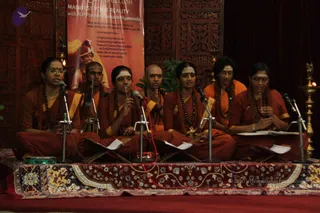
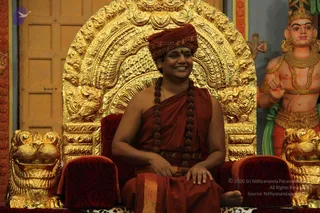
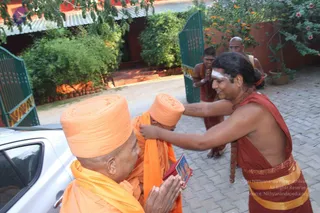
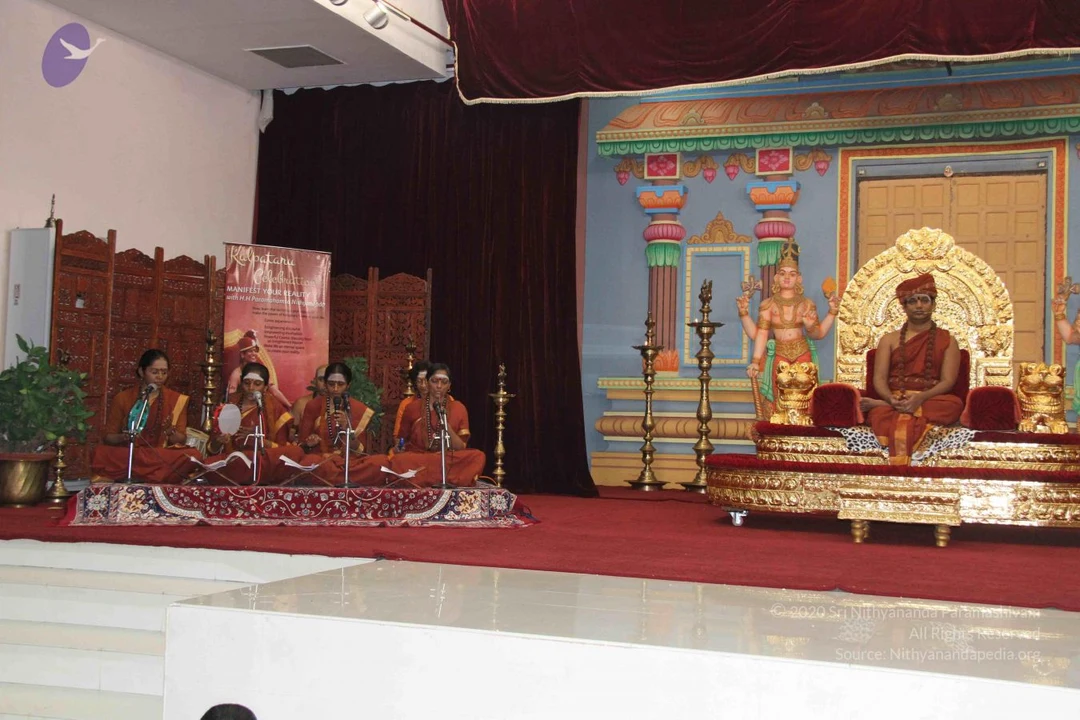
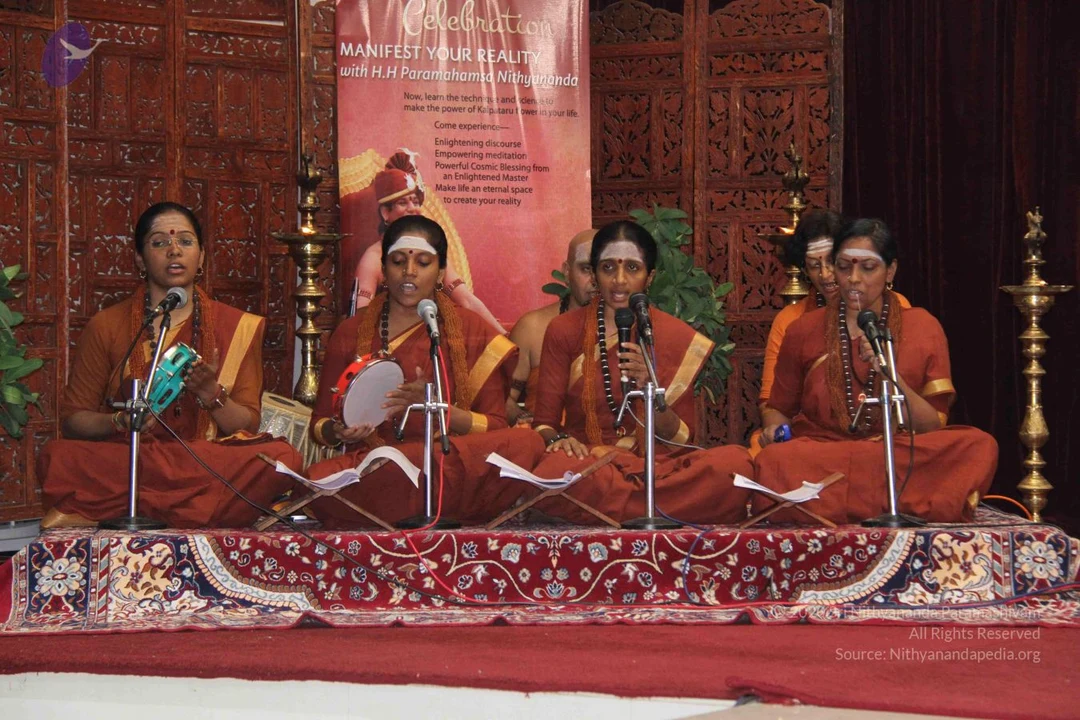
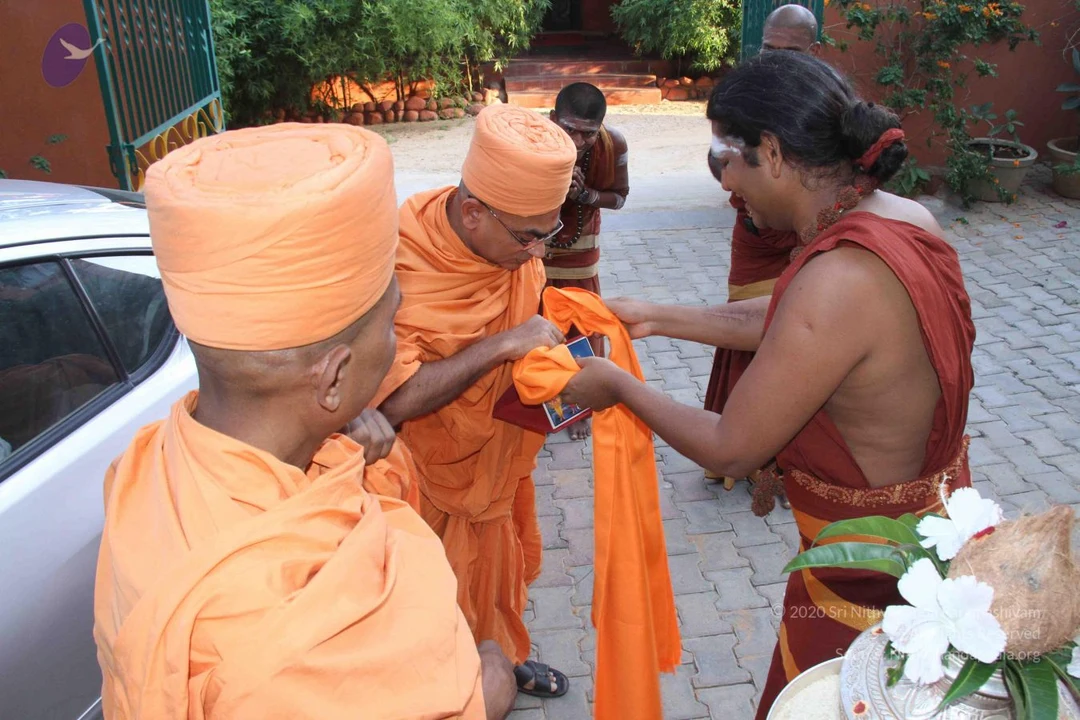
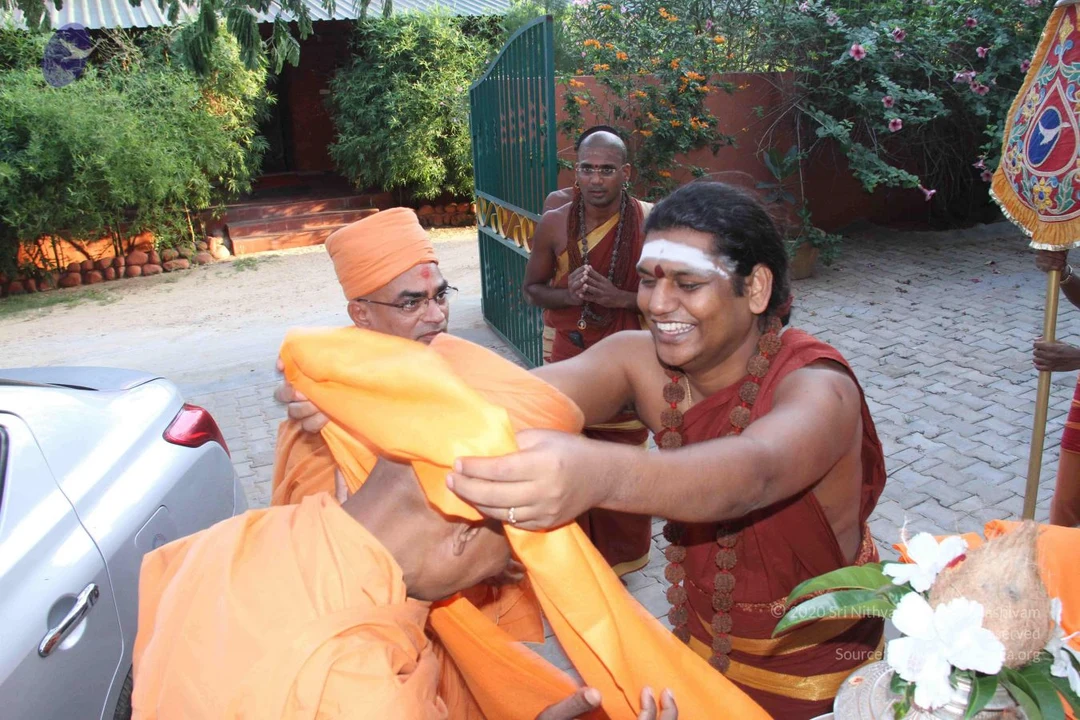
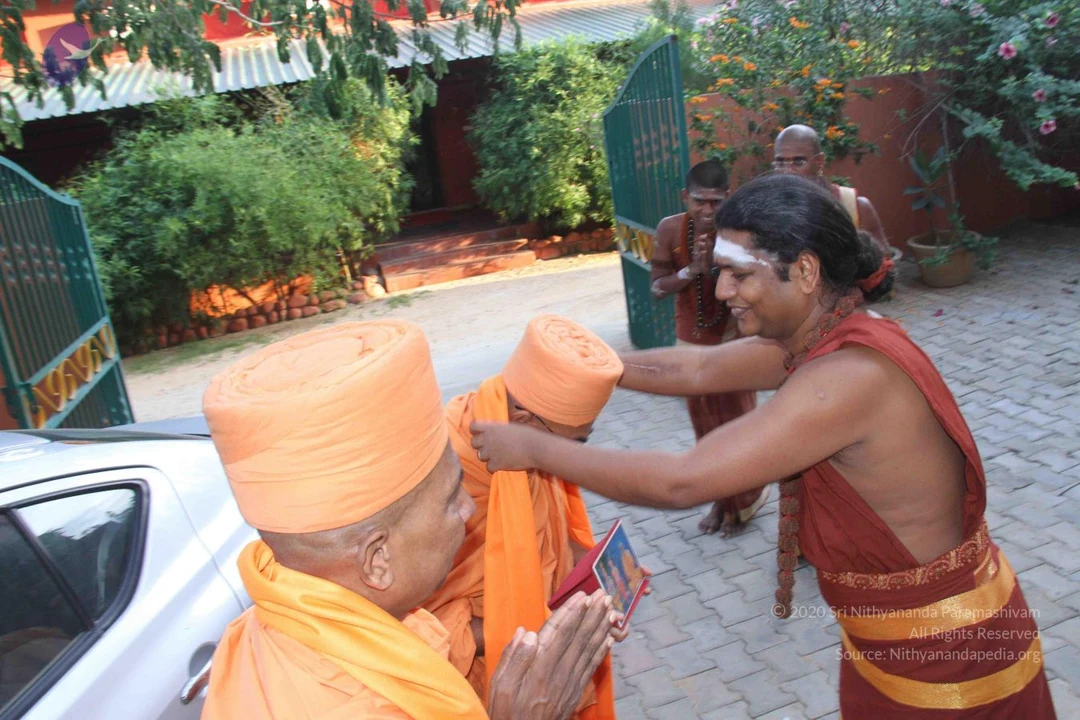
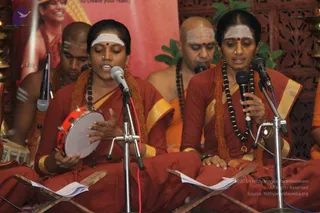
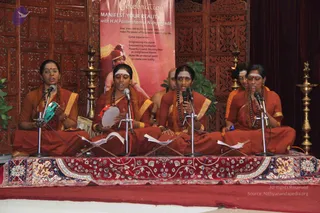
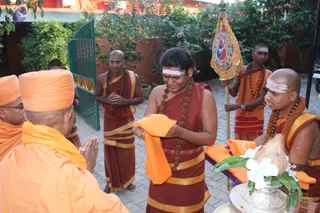
A photograph of six people seated cross-legged on a red and gold patterned rug on a raised stage, singing or chanting into microphone stands with sheet music on small stands in front of them. They wear orange-red robes with gold borders, rudraksha malas, and white vertical markings on their foreheads. Behind them hangs a red banner reading Manifest Your Reality with H.H. Paramahamsa Nithyananda, beside carved wooden panels. A brass oil lamp burns at the right edge, and a small harmonium-style instrument sits on the left.A seated man in a maroon-red robe and matching turban sits on an ornate gold throne with carved gold scrollwork and gold lion-head armrests, smiling, with his hands resting on his lap. He wears a long rudraksha mala of dark beads and a thin gold chain, and his bare feet are visible. To the right stands a painted deity murti with a gold crown, gold necklaces and armbands, and orange-red dhoti. Red velvet cushions cover the throne, and a wooden door panel is behind. The seated man is a probable Swamiji candidate on a throne, presented with an orange-red robe, turban, rudraksha mala and gold throne cues. One person is physically present.Outdoors on a paved courtyard beside a green metal gate and a white car, a man with long dark hair, a white tilak on his forehead, a red-maroon robe and a rudraksha mala places an orange shawl on the shoulders of a man in orange robes and an orange turban, who holds his hands folded in namaste and a small red booklet. Behind them another man in maroon robes and a mala stands near a bald man in an orange-banded robe, with orange flowering shrubs and a red wall in the background. The scene reads as a greeting or honouring of the orange-clad man.

June 11 2014

Original wiki page
Contents

Title:

Completion process for self drive

Description:

In today's (11th June, 2014) Morning Satsang, Paramahamsa Nithyananda expanded on Self Drive. He pointed out how intensely self driven children are and how even when they sleep they sleep without tiredness or powerlessness. He explained that misuse or abuse of the body before age 21 stops the self drive. Then he led us through a powerful process of looking in and completing with whatever patterns are stopping the self drive in us. Tags-Paramahamsa Nithyananda, Self Drive, children, sleep without tiredness or powerlessness, misuse or abuse of the body beforeage 21, powerful process,looking in, completion patterns, stopping.

Link to Video:

VideoAudio

Transcript:

TRANSCRIPTS:- Today I wanted to expand on "SELF-DRIVE".

Understand, yesterday I ran a special meditation for all the Kotharis, Mahants and Shrimahants, and a special Completion session. Today I wanted all the devotees all over the world to have the benefit of this Completion process.

First thing, find out what stopped your self-drive. Please understand, by your nature, when you are born, you are born with your high peak possibility self-drive. See the kids; with no purpose they are driven! Just they jump here and there, and whole day they are active, alive! Even when they are sleeping, they are not powerless or tired. They don't sleep out of powerlessness or tiredness. They don't sleep out of powerlessness or tiredness. Even while they are sleeping, they are not tired or powerless. So, understand, you are born with high self-drive. Where has it gone? Look in, what all started curbing, stopping your self-drive, what all has started reducing your self-drive, what all has started cutting down your self-drive. It can be as simple as your elder sister taking more marks in the school, or as complicated as some sexual abuse. It can vary from anything to anything, but there is a reason why your self-drive has been curtailed.

Please understand, just like a dam stops the river flow, patterns stop the self-drive. As I said, it can be as simple as your brother or sister has taken more marks, to as difficult as, as complicated as sexual abuse. All of you need to know, whether YOU use your body or you abuse others body before the age of twenty-one, it will stop your self-drive, it will become patterns and patterns and patterns. Twenty-one may seem to be too long that you have to wait, wait, wait, but unless your mind is also prepared to handle body, body being used before twenty-one, or abused..... If you yourself use your body for your own pleasure, that is what I call "using your body". If somebody else uses your body for their pleasure, it is "abusal". Don't allow before twenty-one, use or abuse. Patterns built in the young age may be the reason for the self-drive being stopped.

Now, today, let us all spend some time to dig out what all are the patterns which stopped your enthusiasm, excitement, self-drive. From the time you remember you, from the time you know you, what are all the incidents, what are all the happenings which stopped your self-drive, look in. I will guide you into this process today step-by-step.

So, now, first step, take a paper and pen, listen to yourself, what all are the patterns, reasons, causes you think your self-drive has been reduced. Anything which happened from your birth till the last moment, which stops your self-drive, reason for reduction in your self-drive, the pattern which stops your self-drive, pen down, start penning down. I will give you a few minutes time, start penning down.

(After a few minutes...........)

Try to find all the root incidents, incidents from which these patterns got developed or strengthened. Sometimes, the pattern may not get developed from the incident, but gets strengthened. Your decision not to be self-driving, if it is strengthened by some incident, pen down this incident. Like, you have done something; it has not been recognized; it has been thrown into the dustbin; even those incidents pen down.

(After a few minutes...........)

Now sit straight. Start completing with all these patterns. You can either use the mirror or your inner-space. Relive and relieve. Relive and relieve. Come to the clear decision, 'Self-drive will be my lifestyle! Self-drive from the right context will be my lifestyle!' Start!

Paramashivoham: 22-day Ultimate Spiritual Journey with the Avatar HDH Nithyananda Paramashivam Learn more: https://paramashivoham.nithyananda.org

Photos Of The Day:

Temple
Paduka-Puja
Nithya-Satsang

Nithya-Kirtan

Darshan

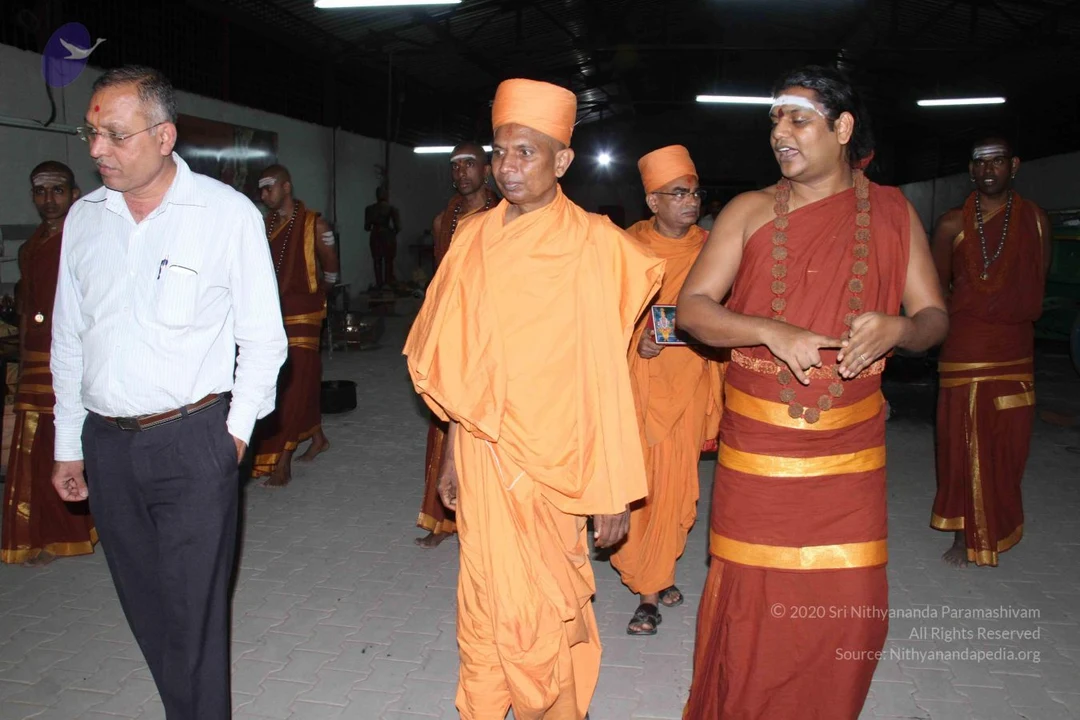
SWAMI-NARAYANA-SWAMI'S-VISITING-ADHEENAM

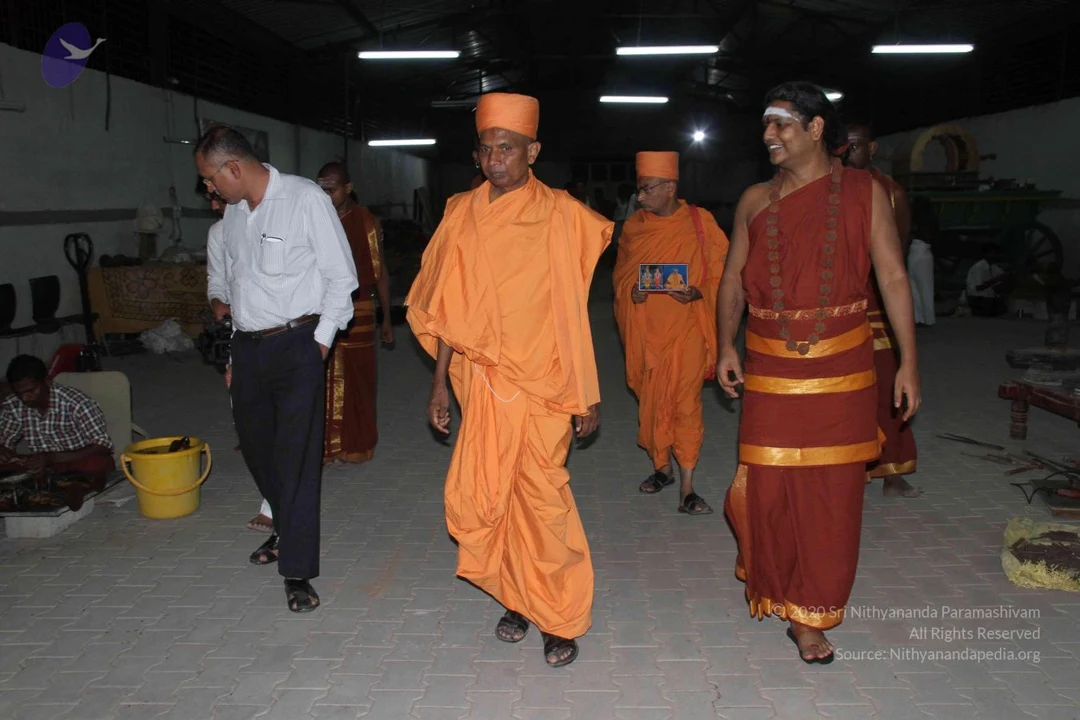
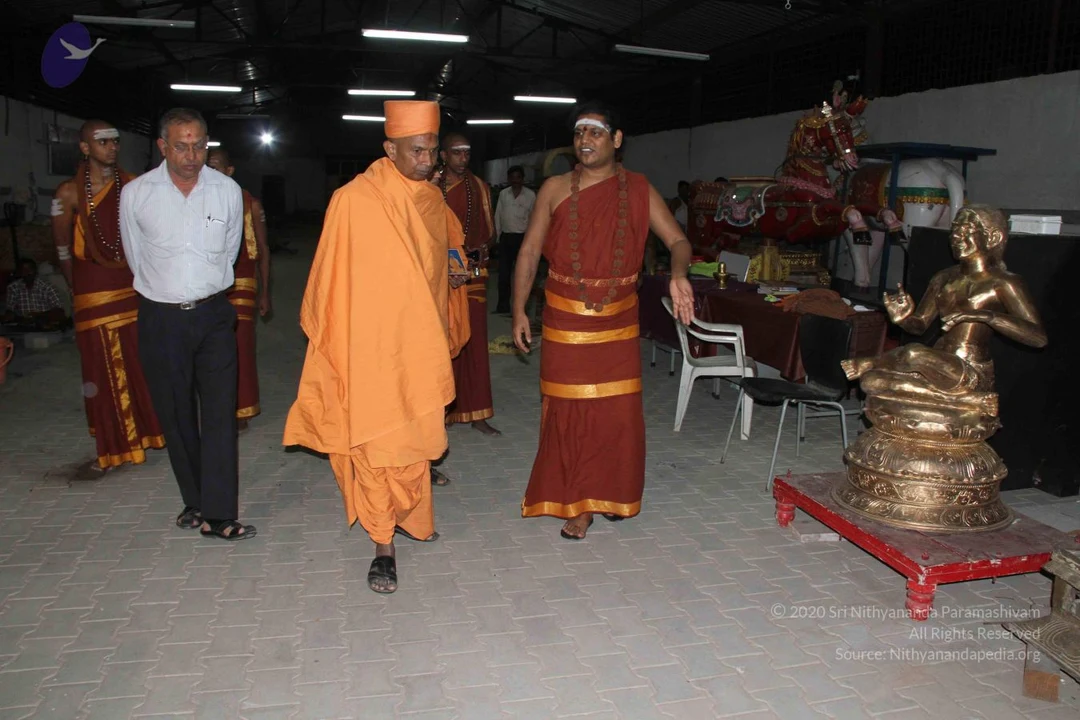
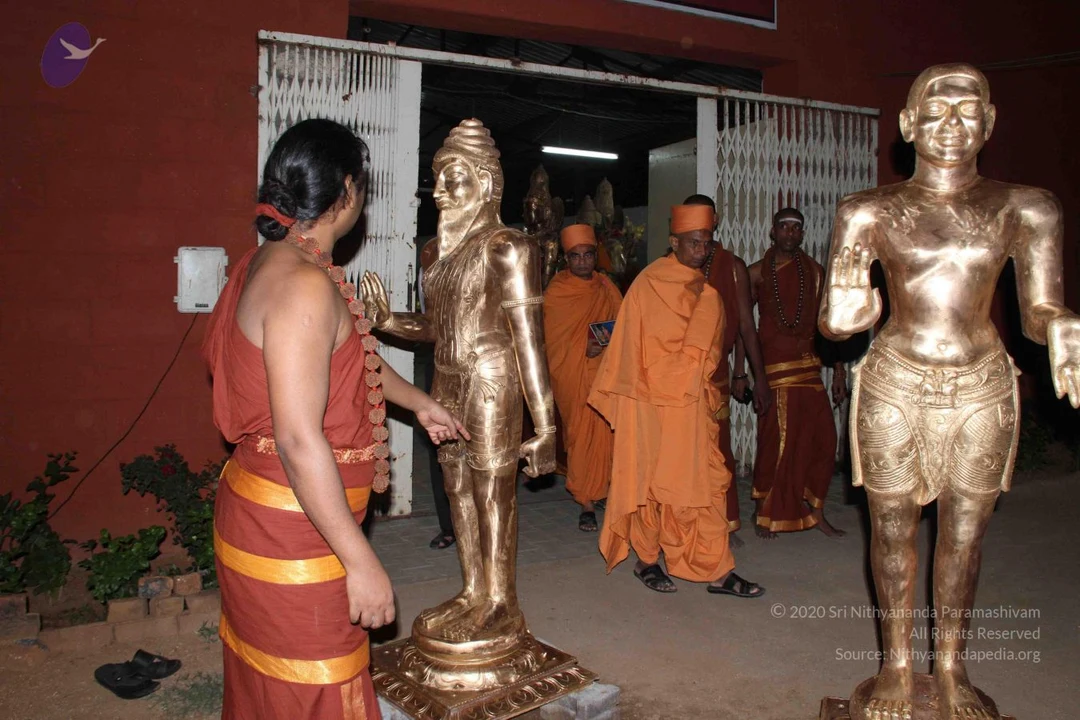
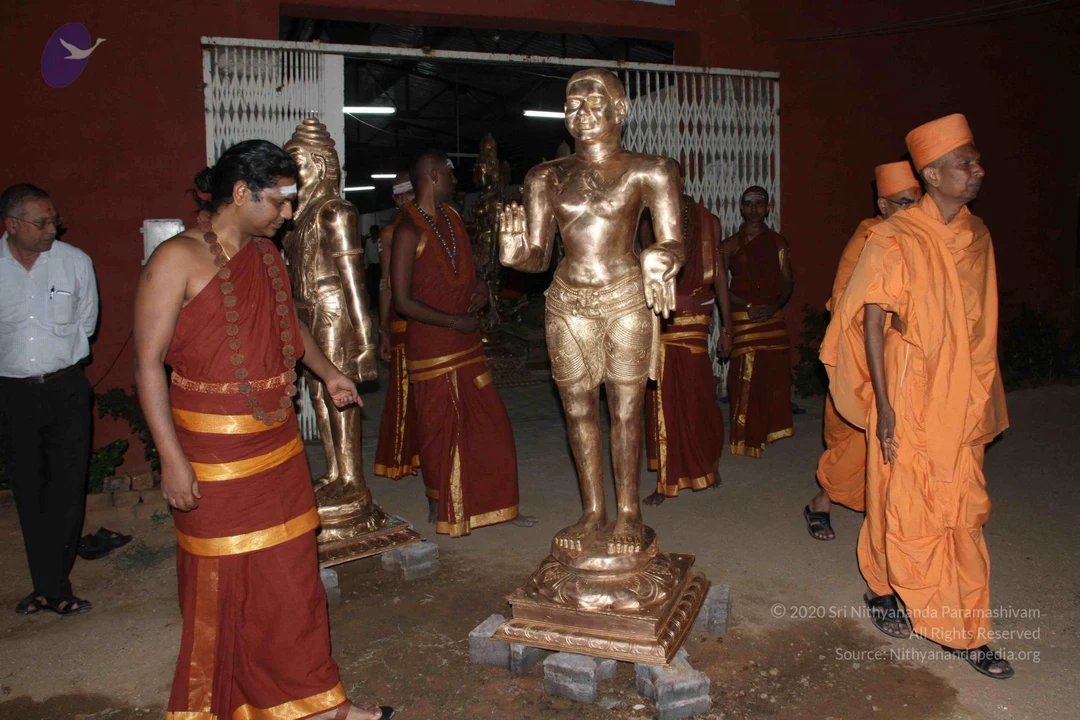
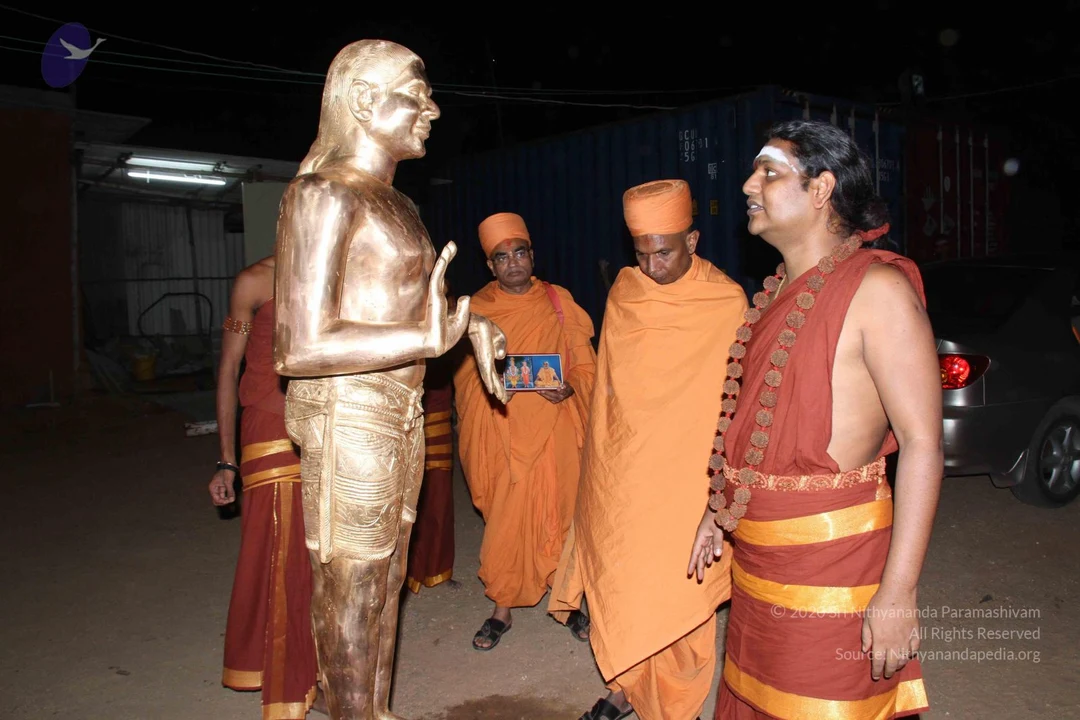
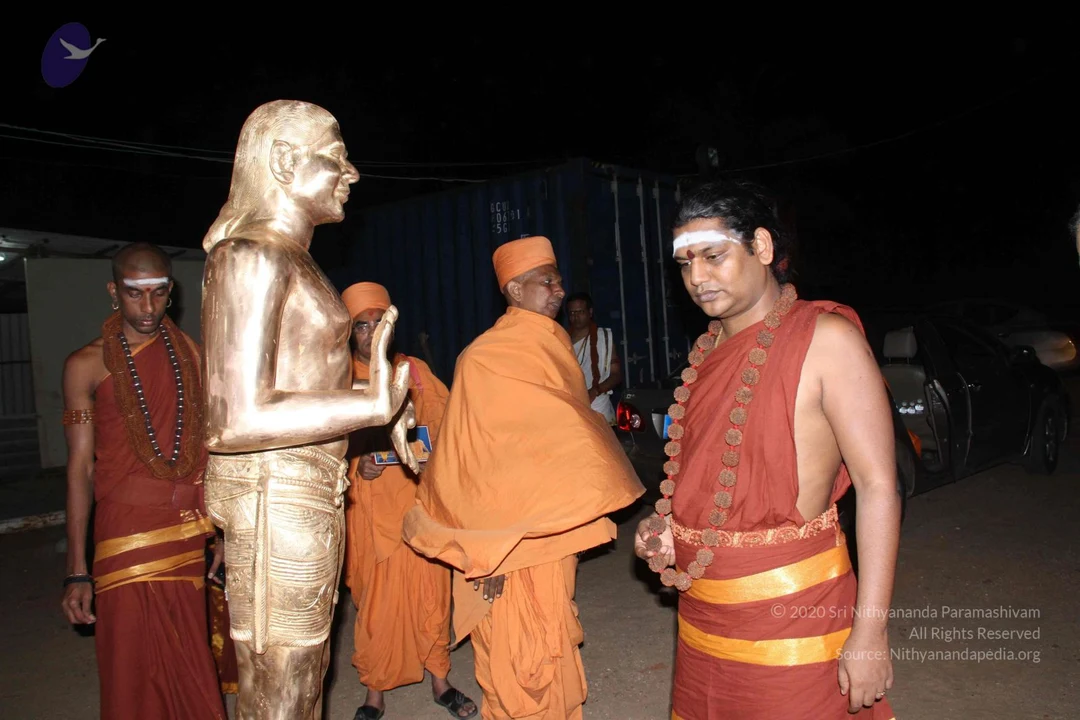
SWAMI-NARAYANAN-SWAMI'S-VISITING-SACRED-ARTS-ALONG-WITH-SWAMIJI

Nithya-Satsang

Paduka-Puja
Swami-Narayana-Swami-Visiting-Sacred-Arts-With-Swamiji

Temple

Photos from this day

View all 126 photos

Temple

23 photosSource gallery
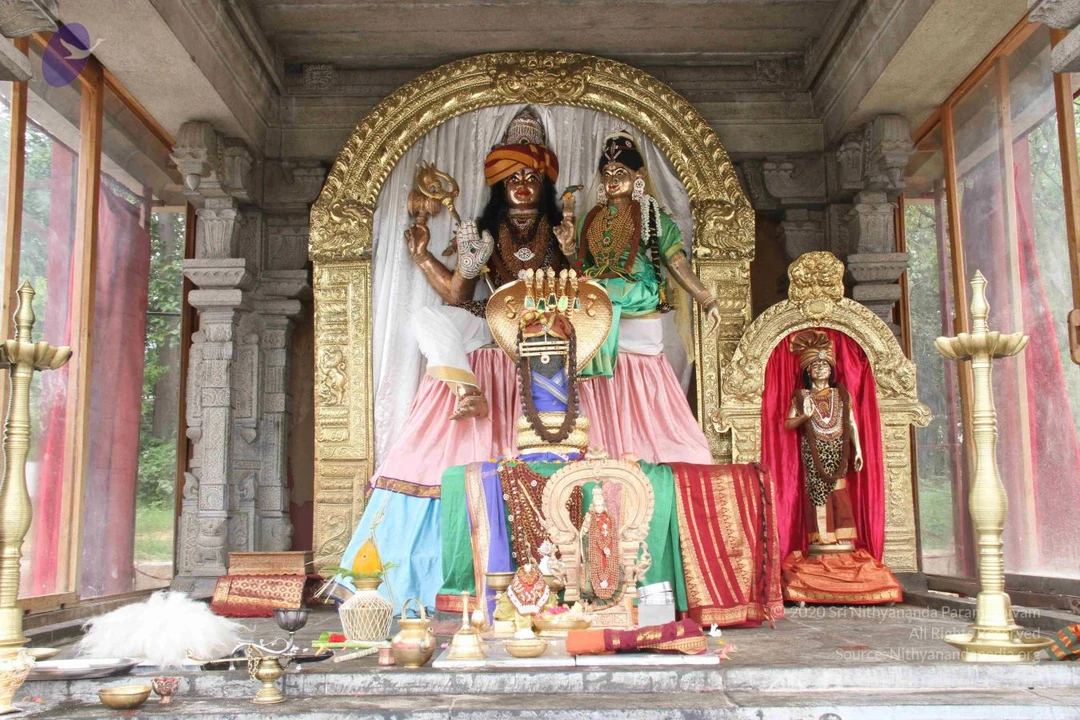
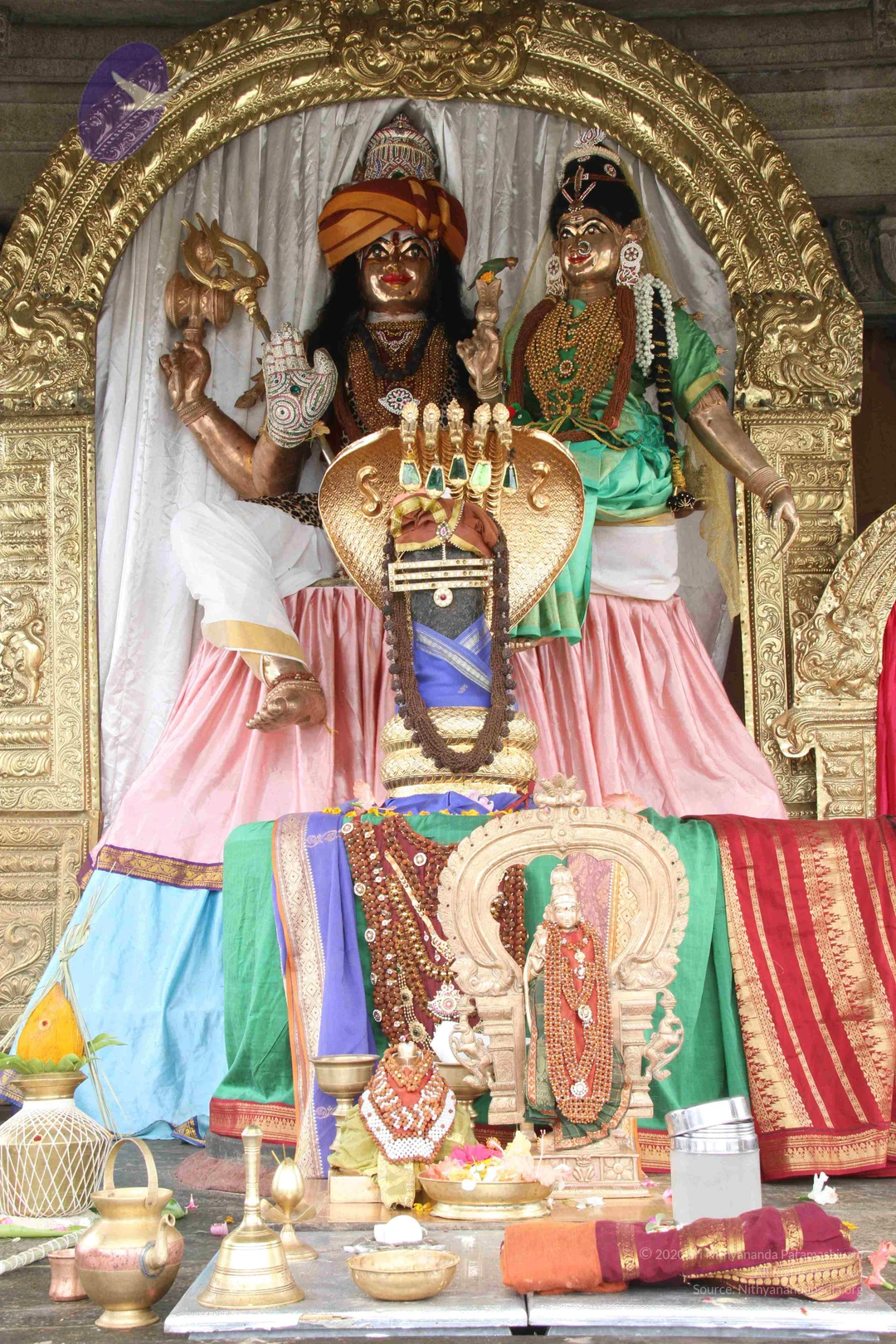
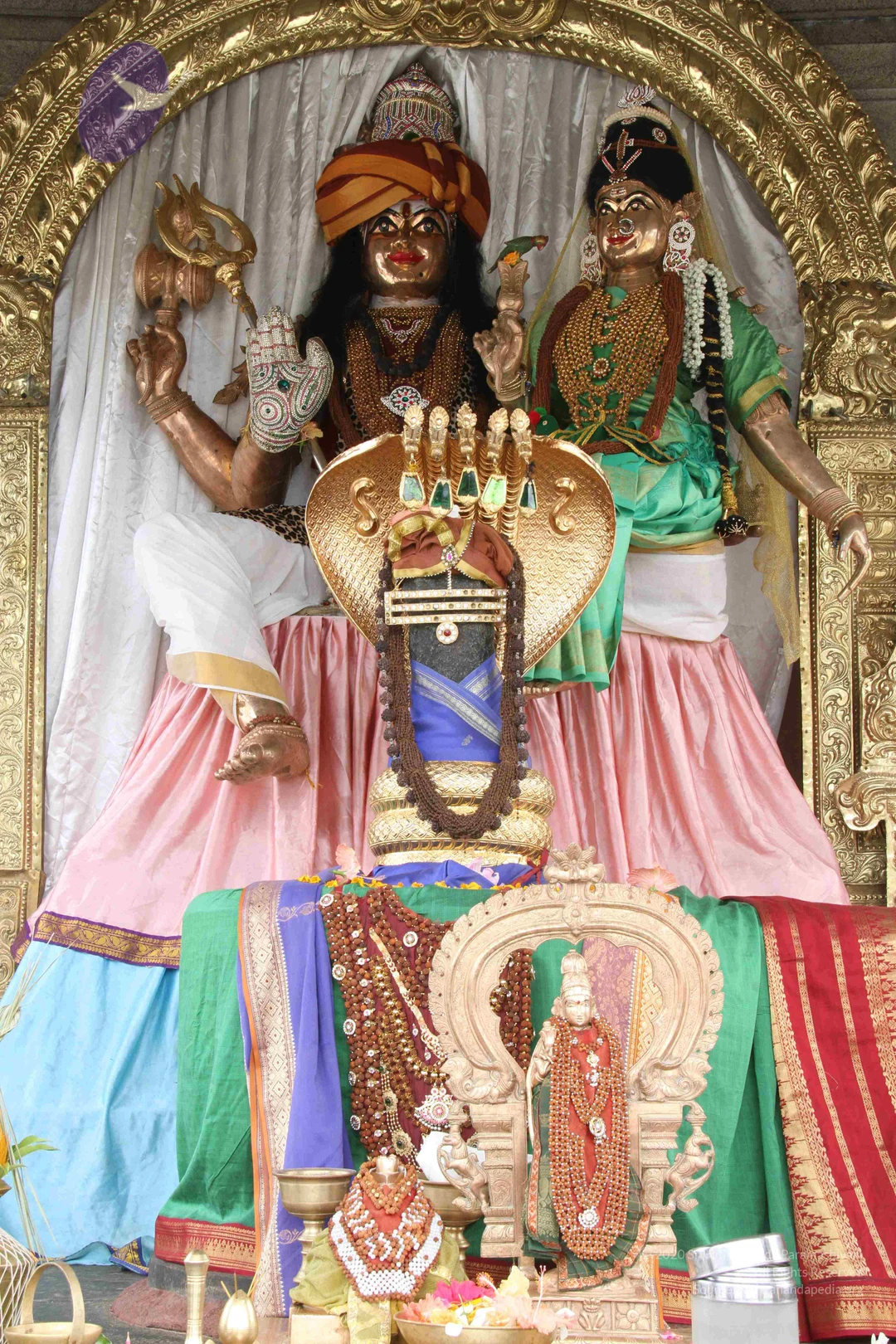
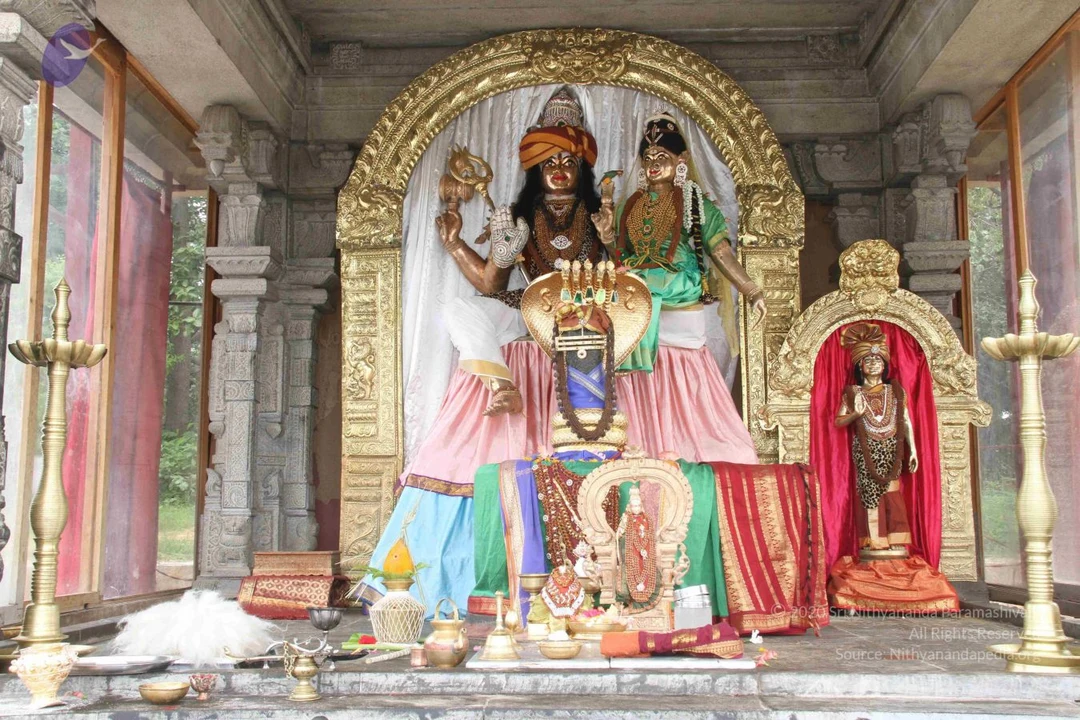
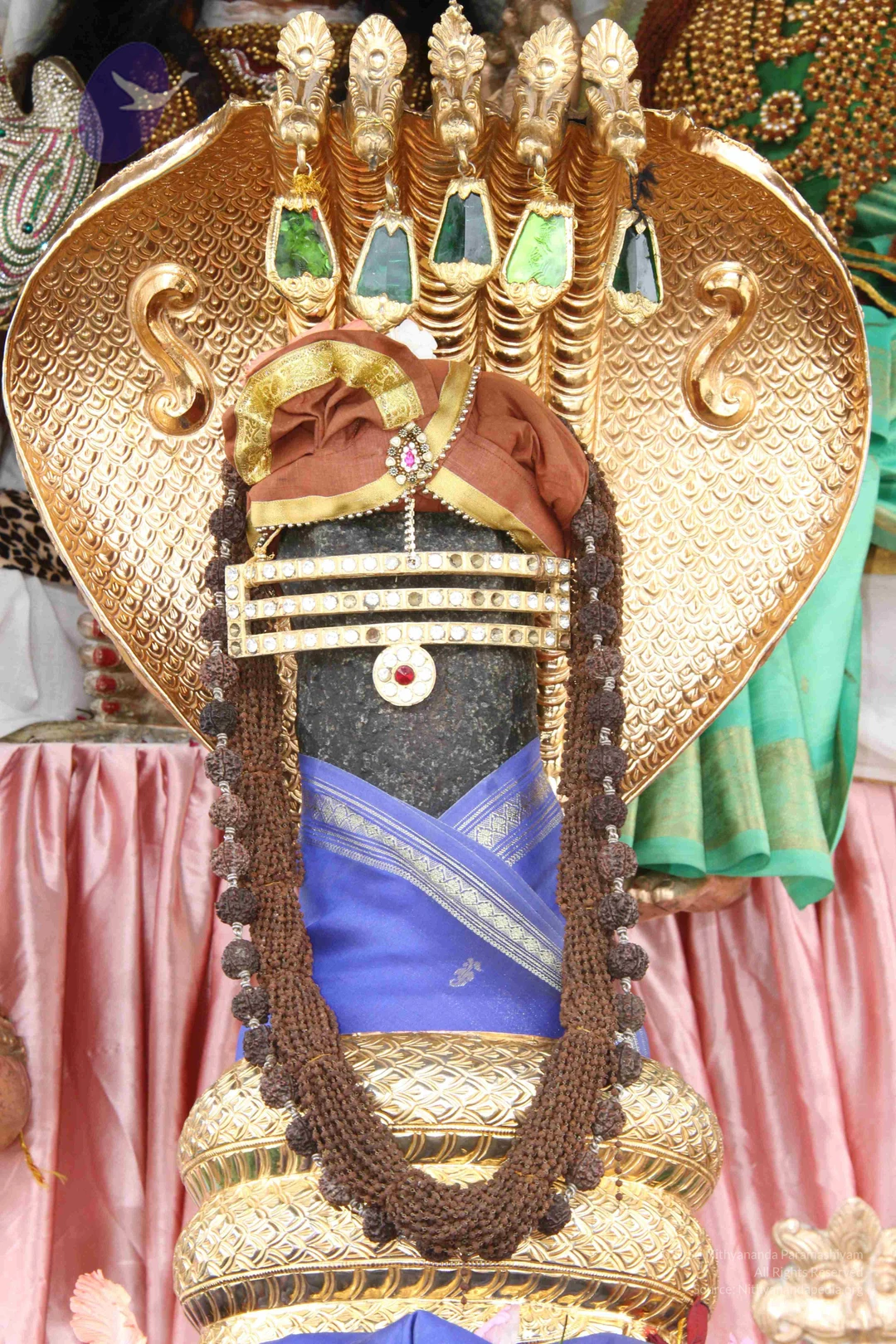
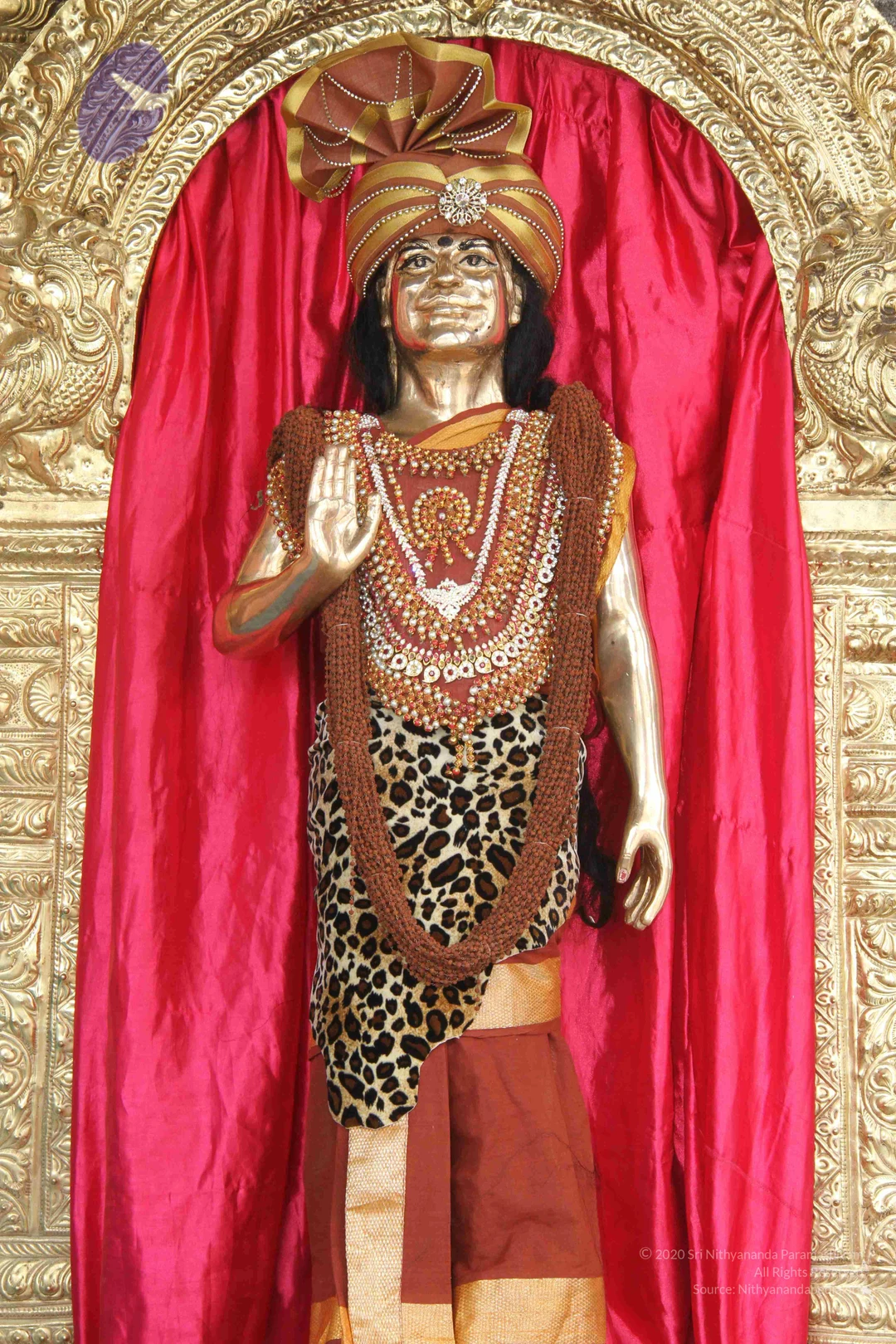
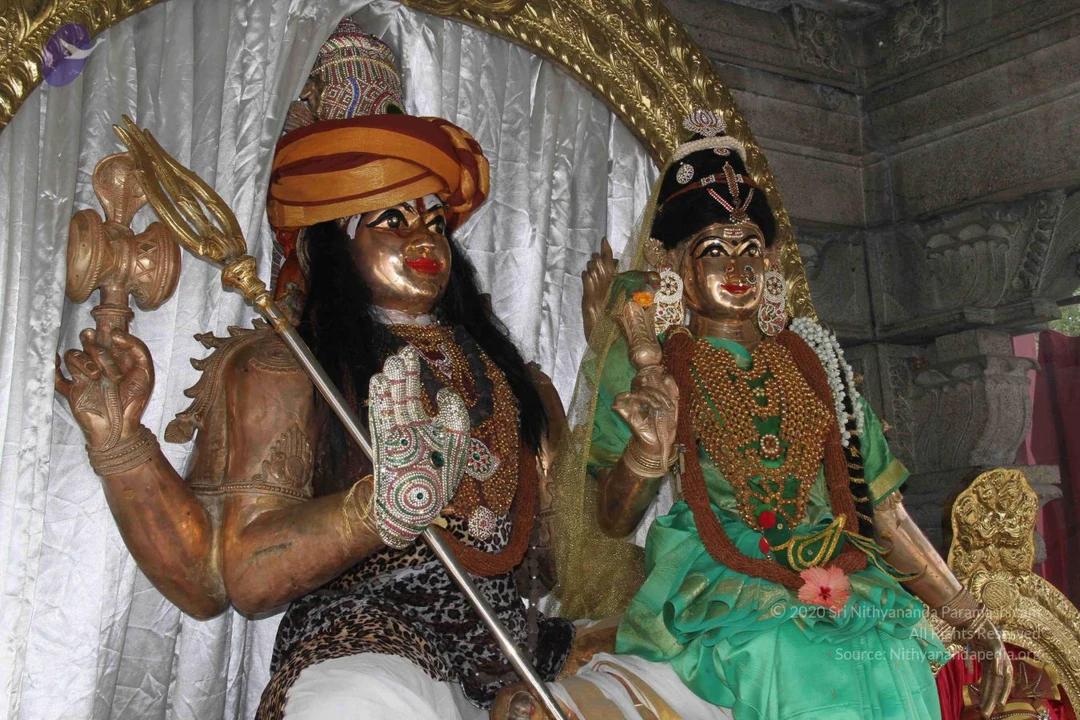
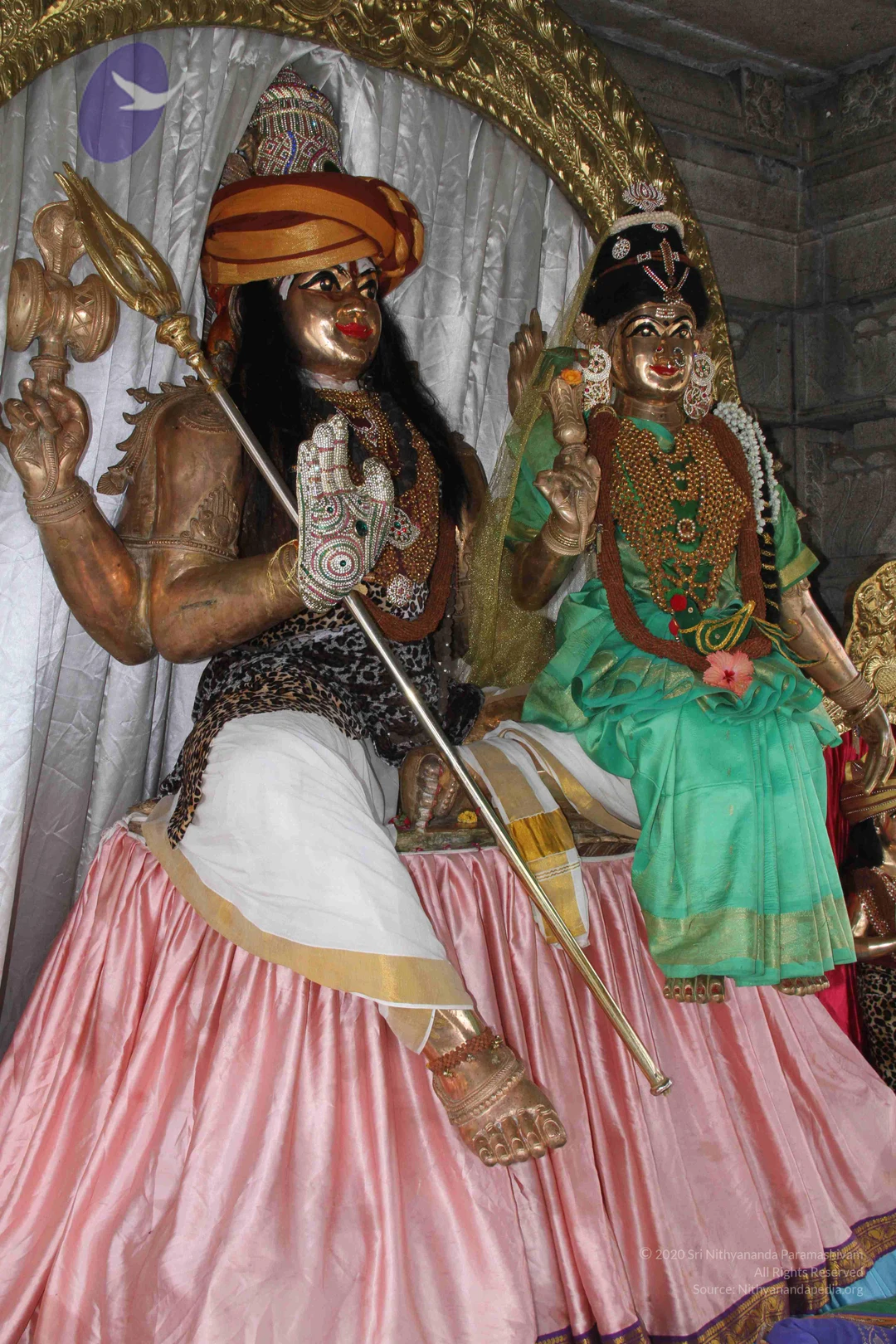
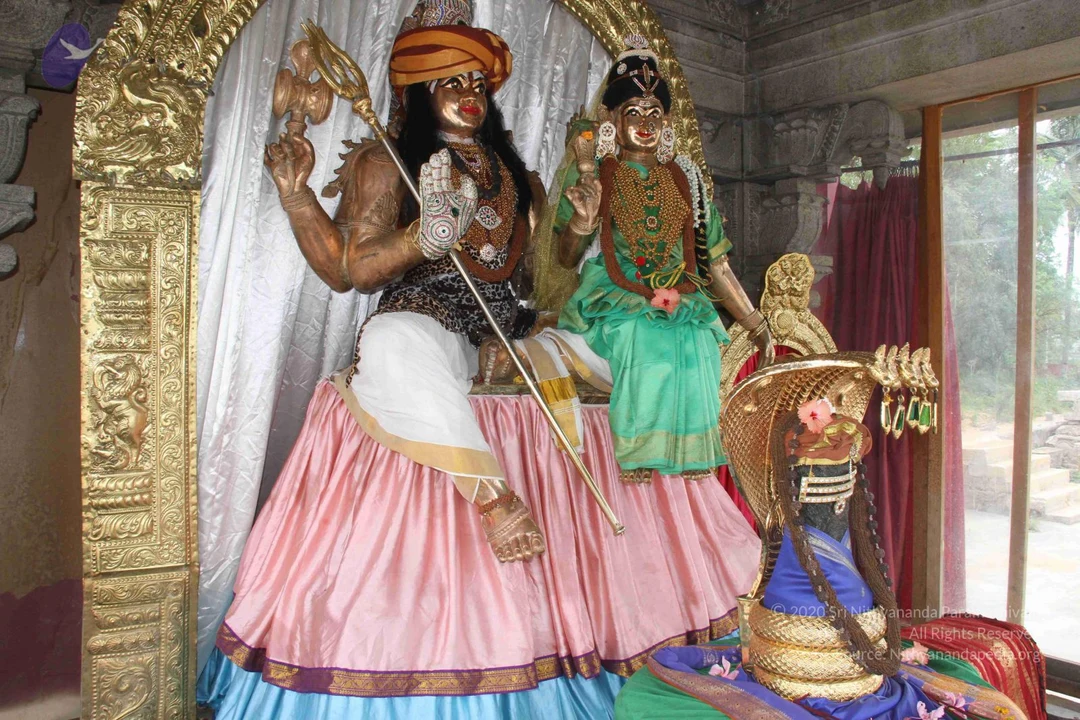
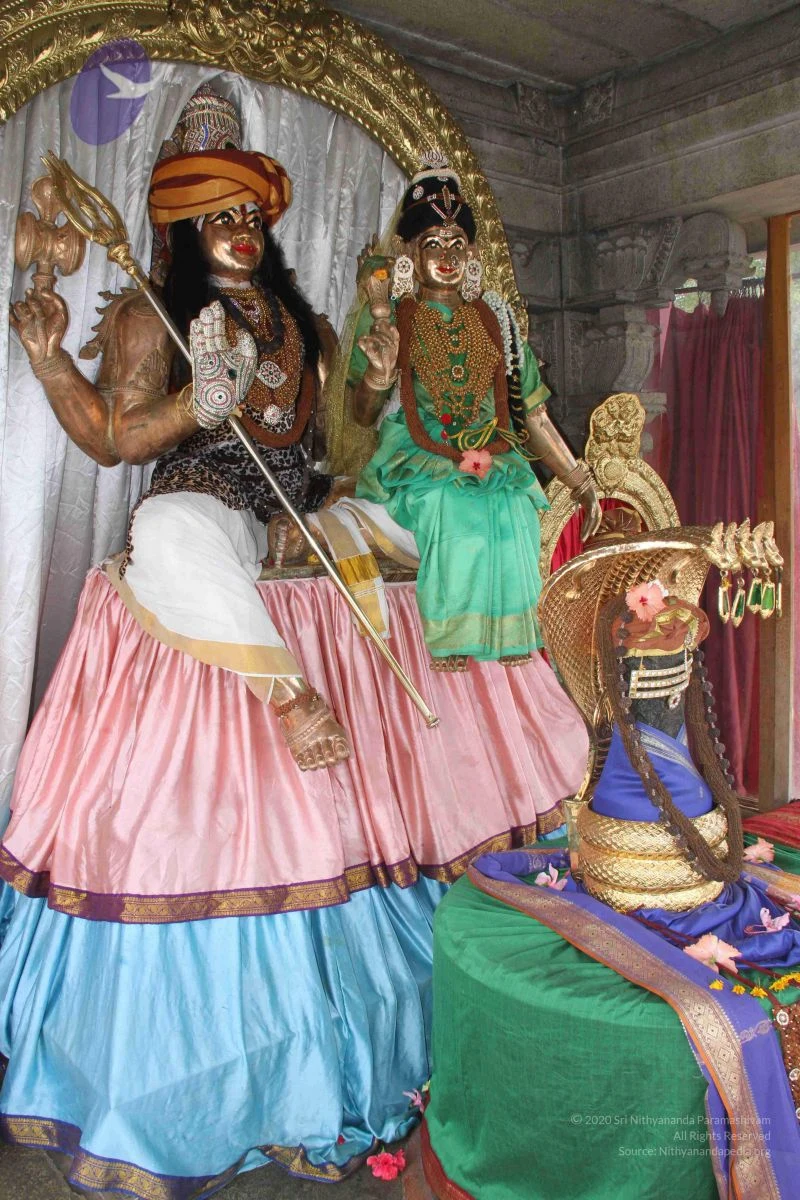
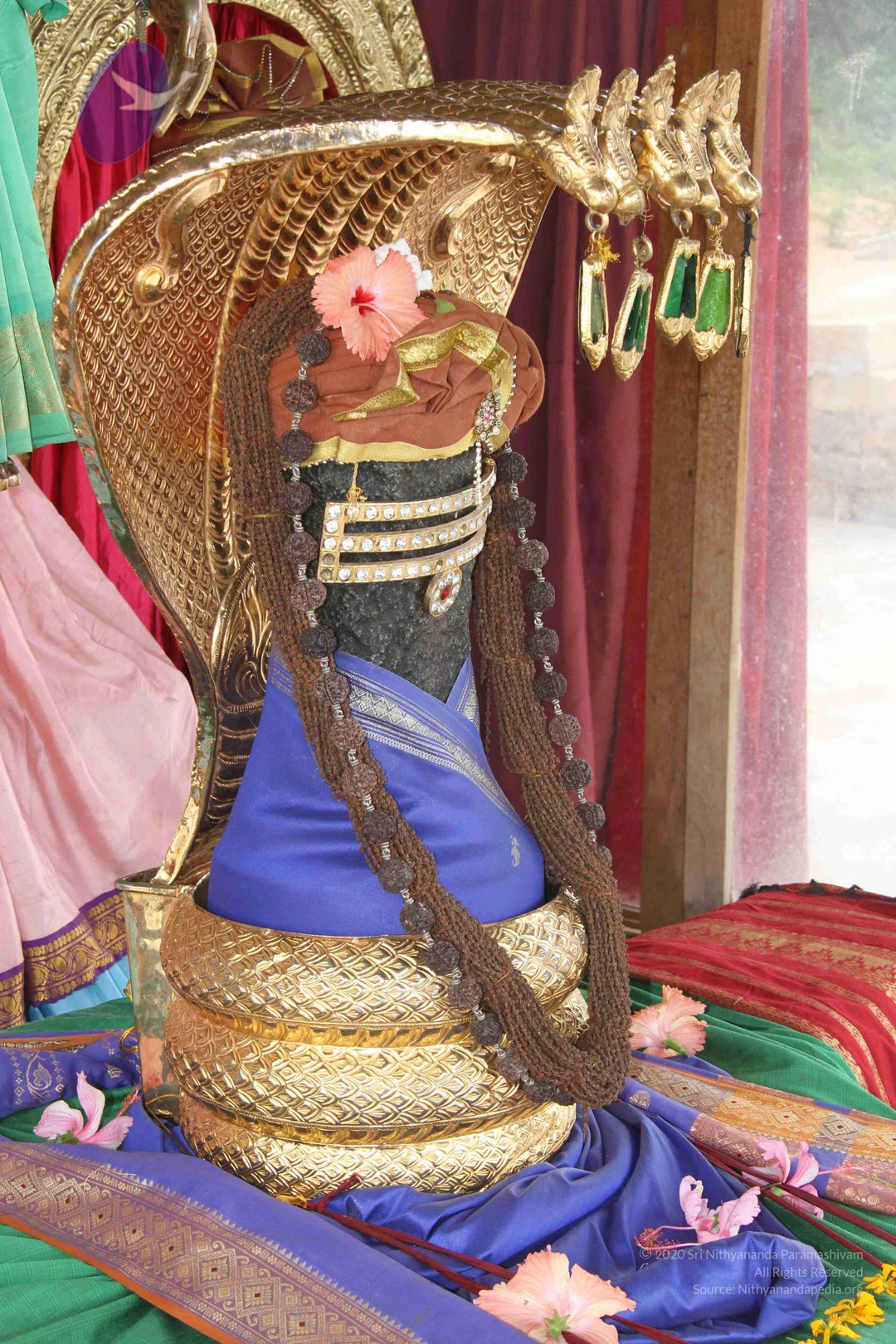
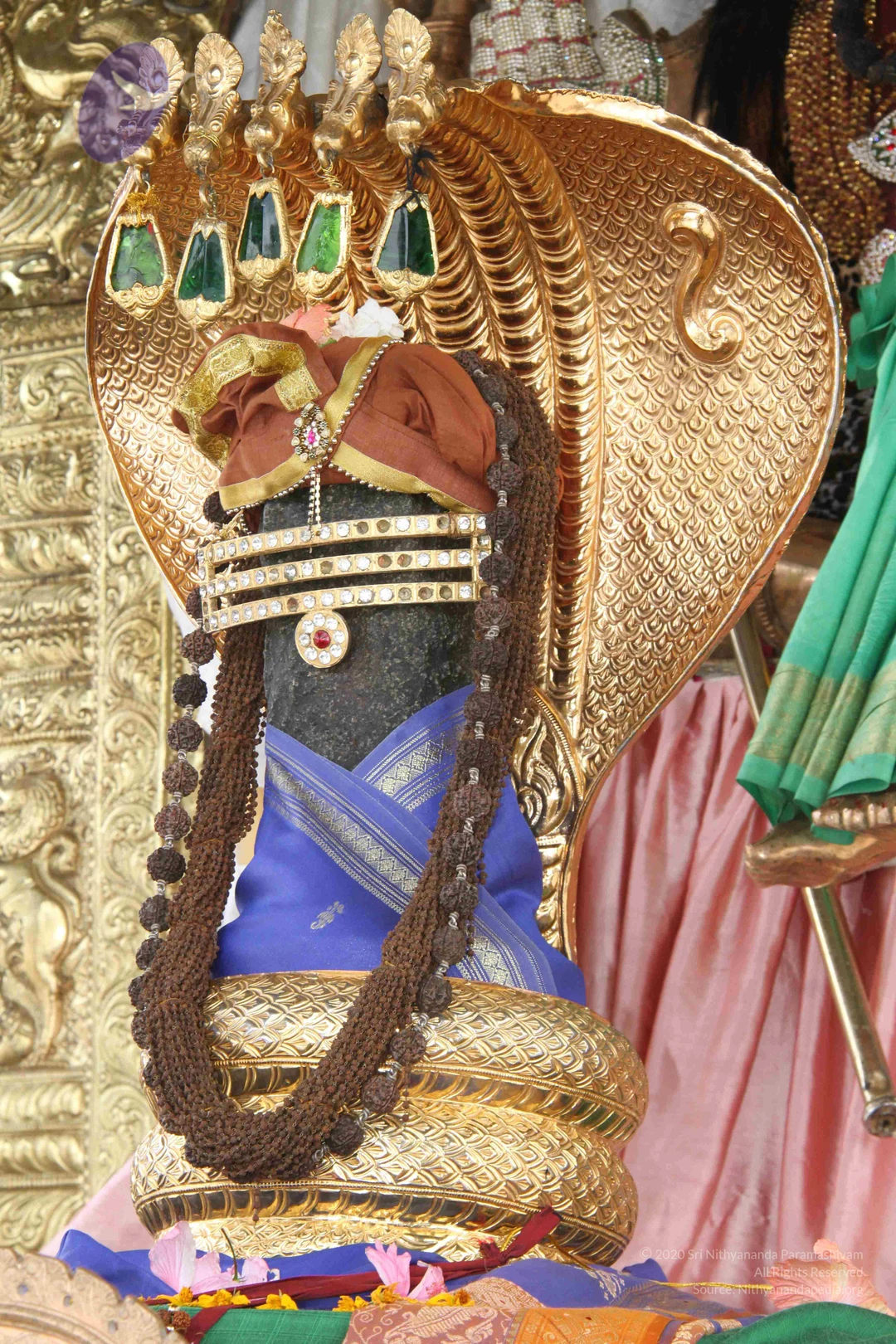
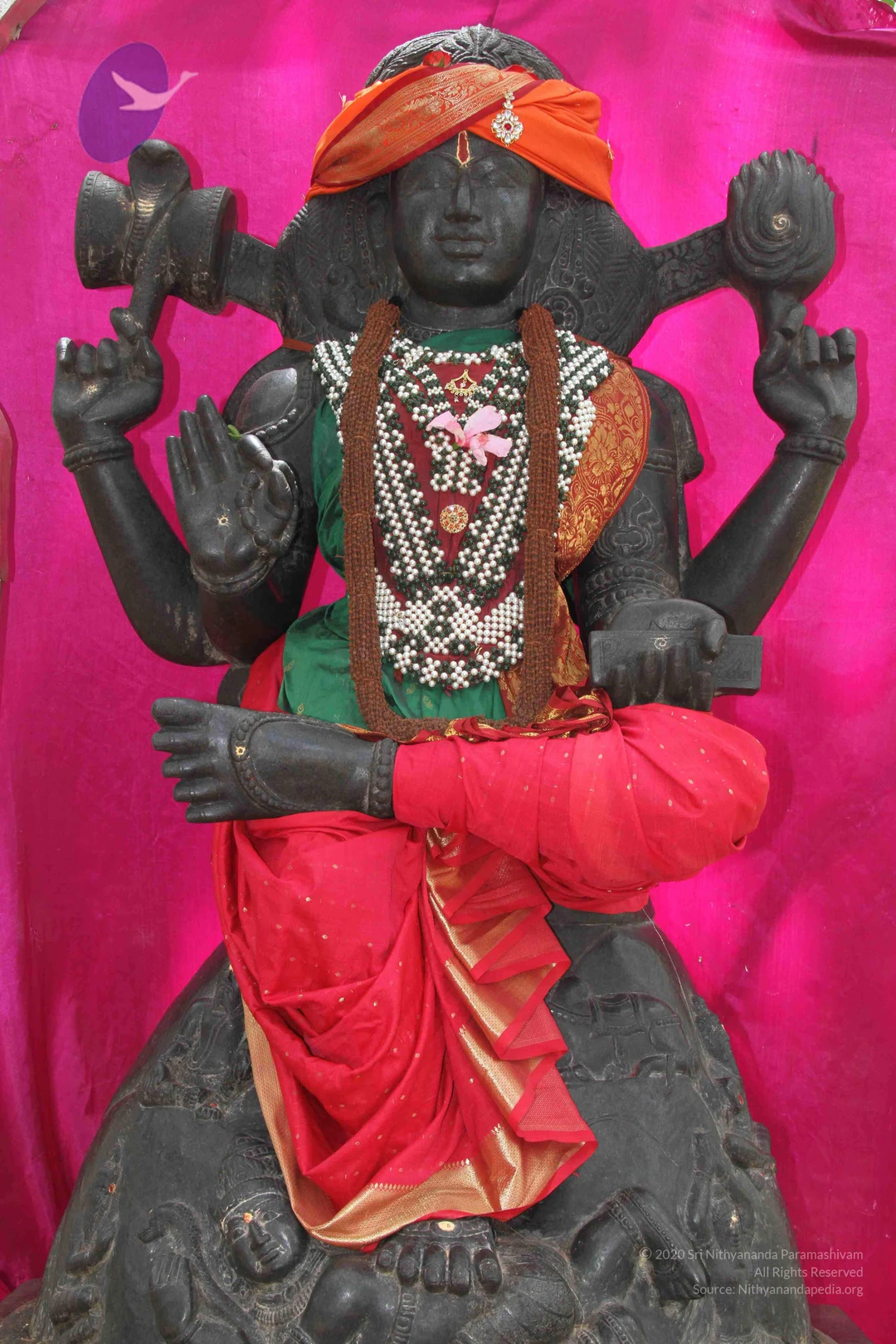
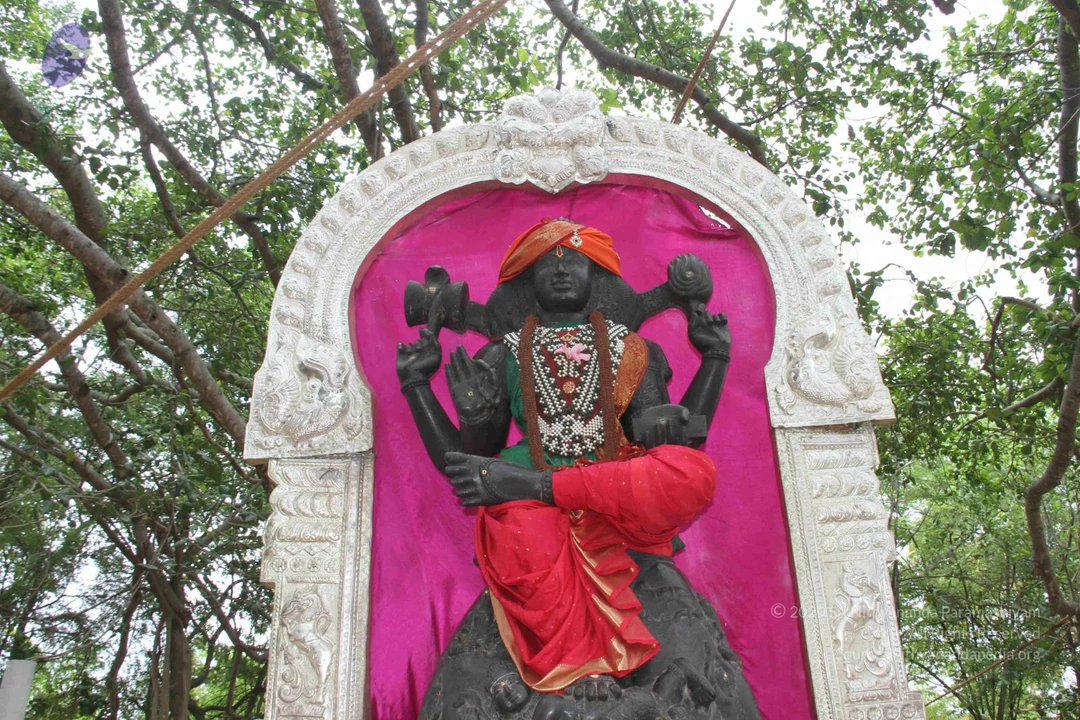
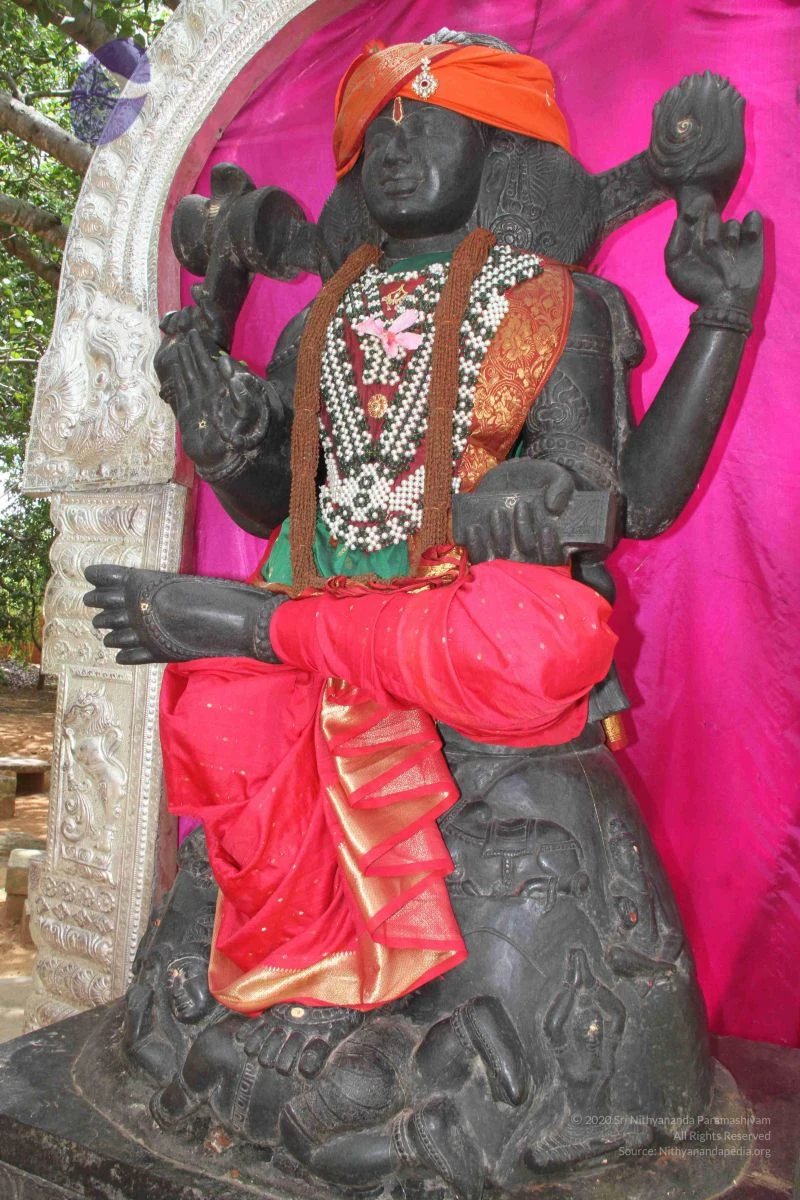
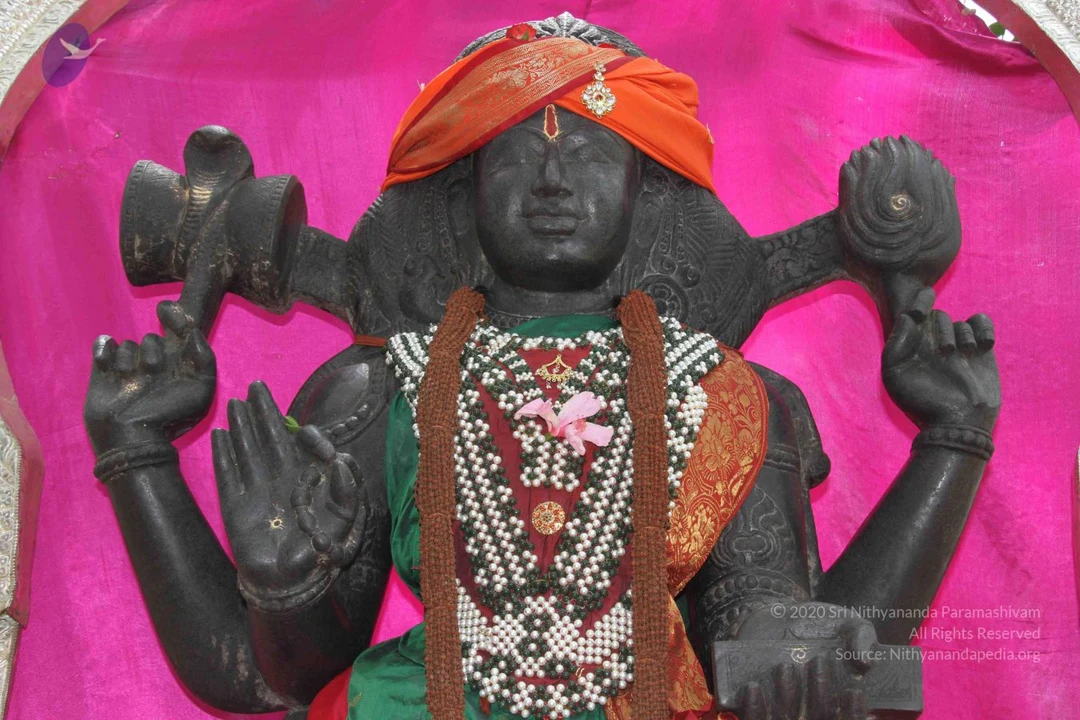
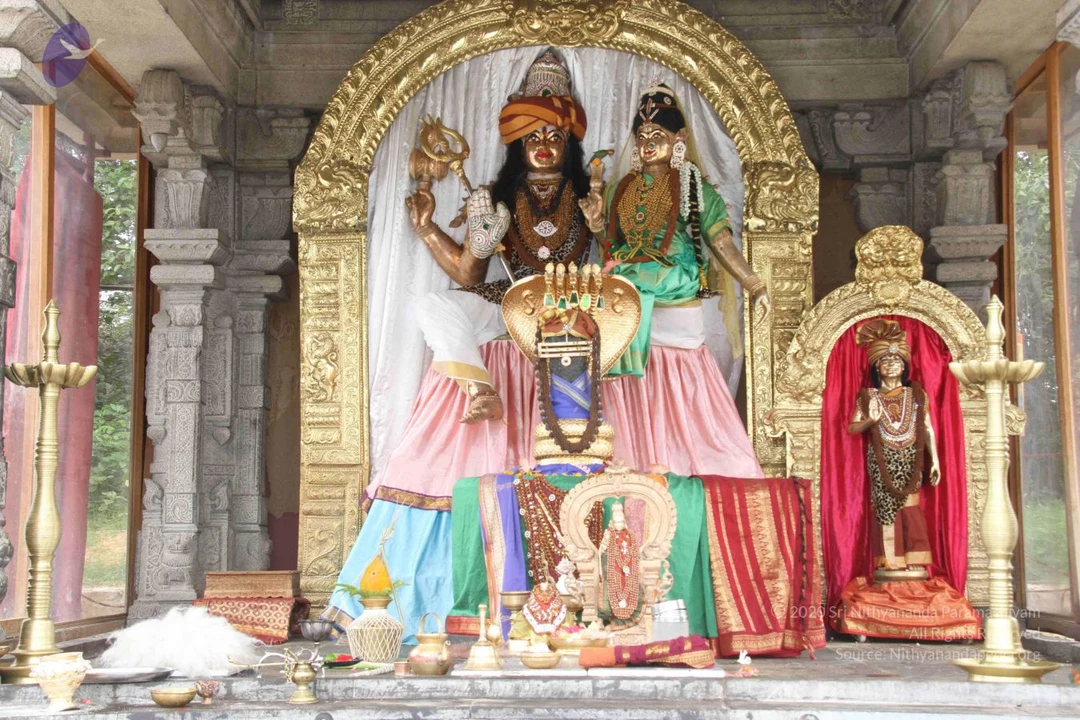
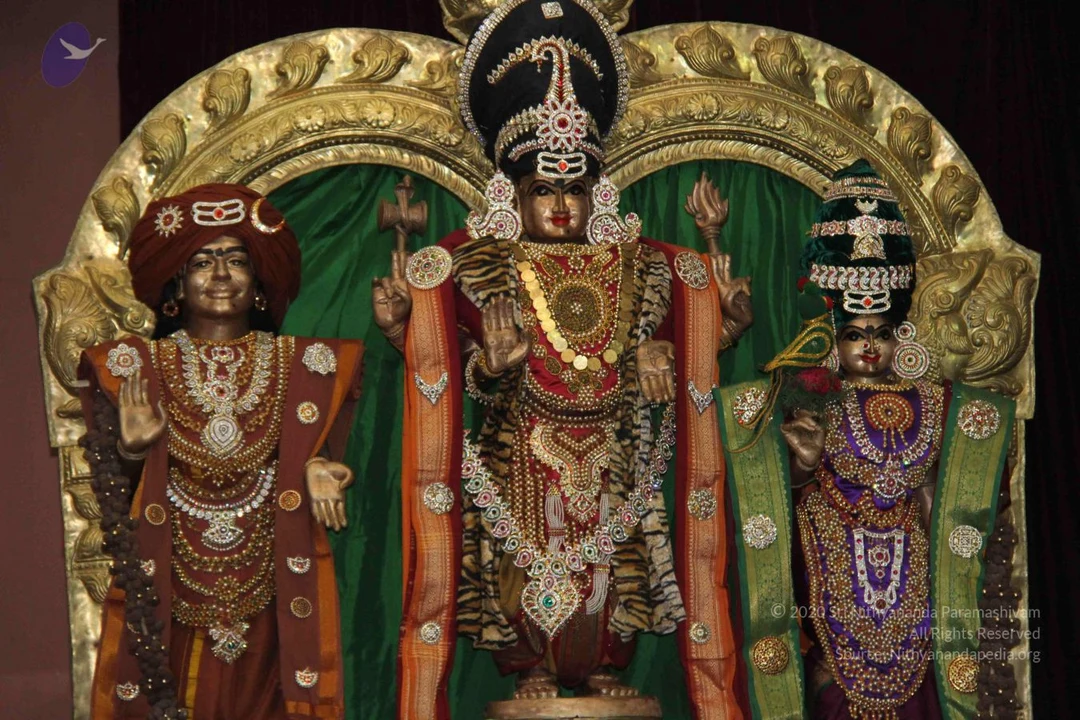
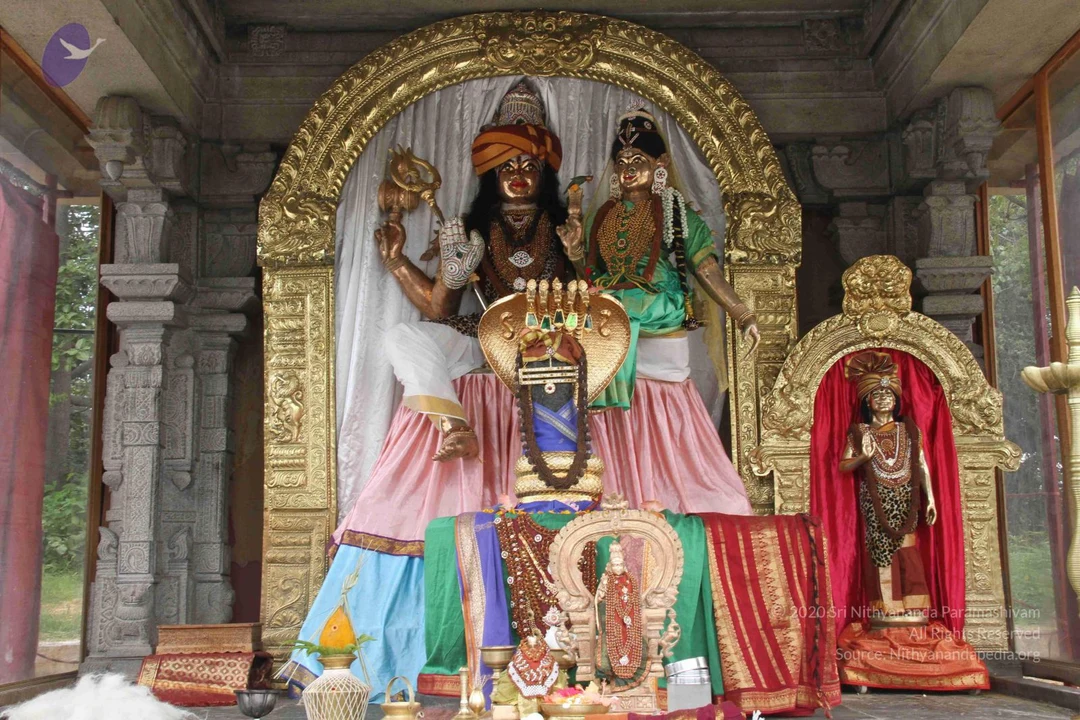
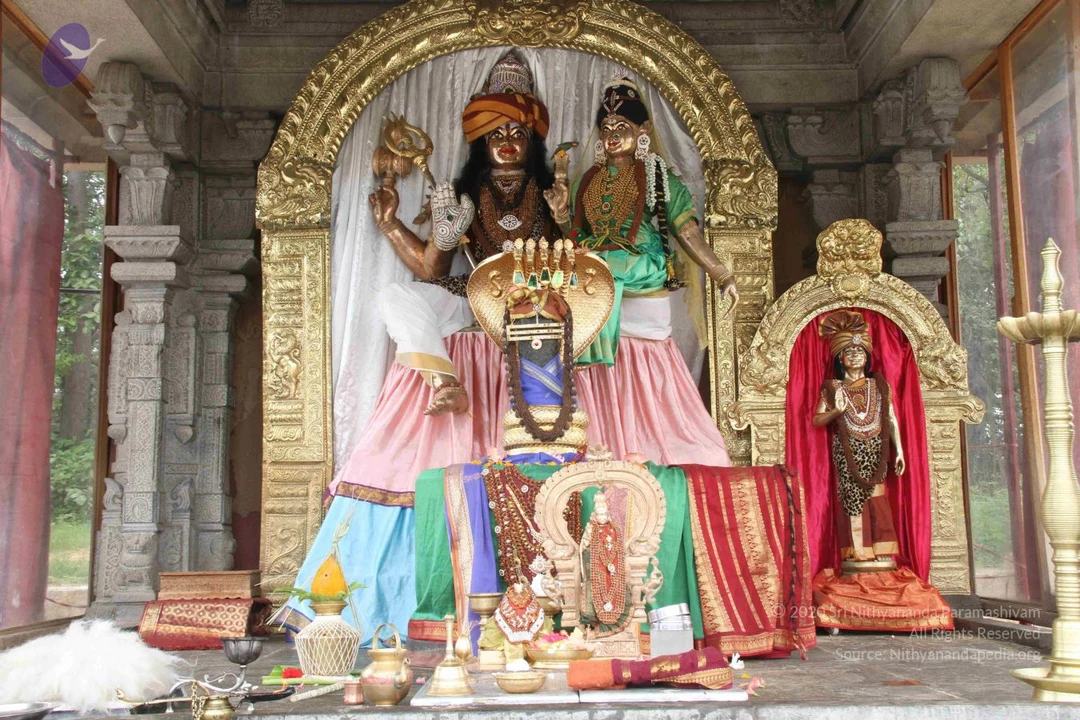
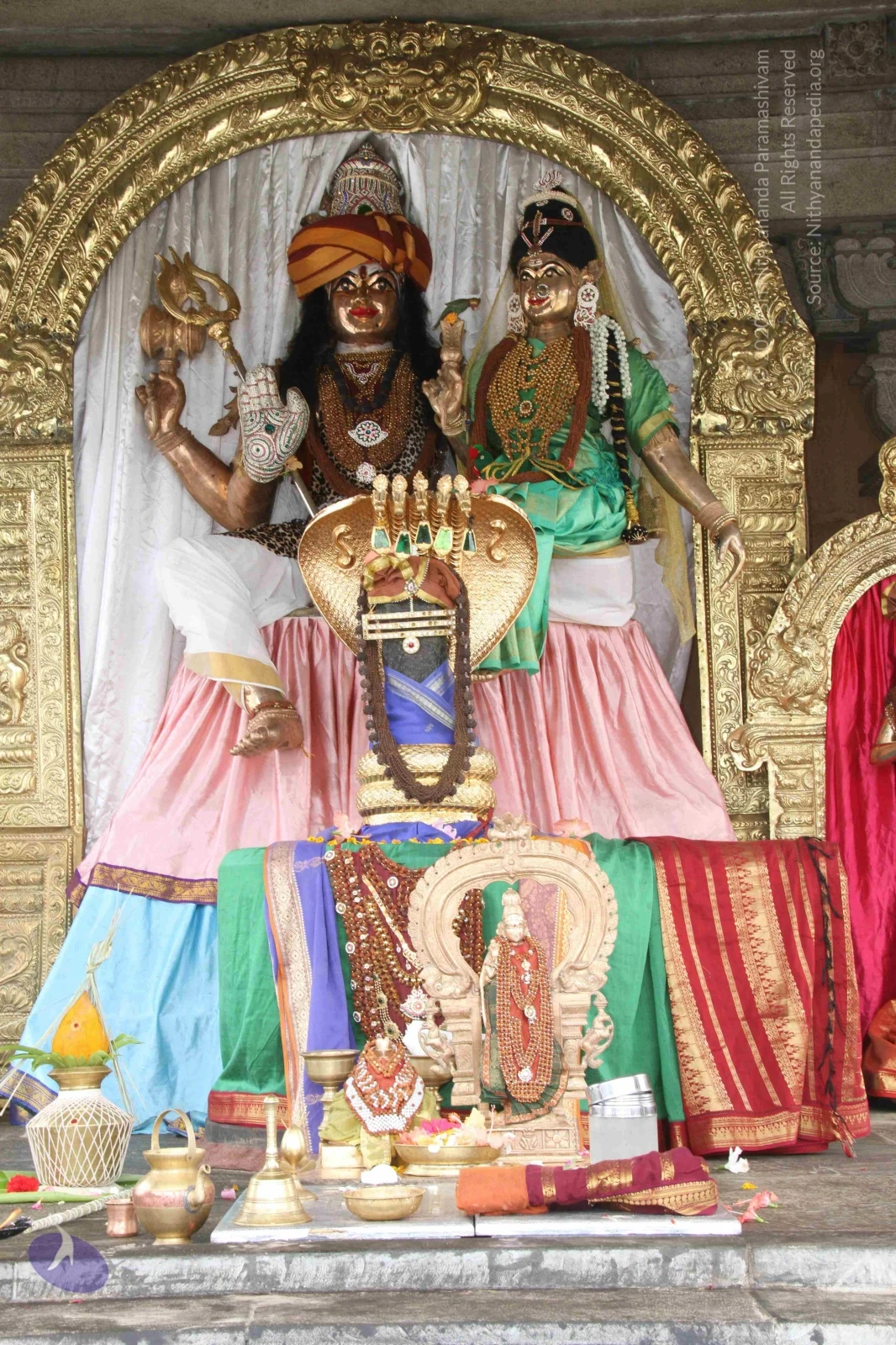
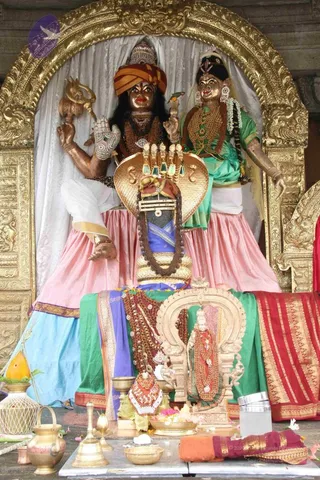
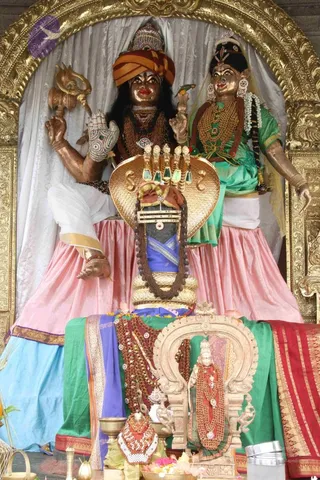
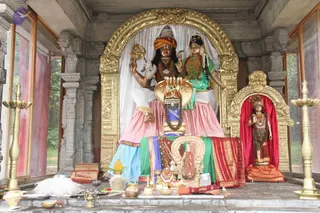
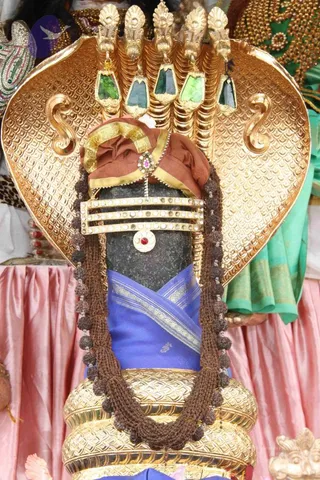
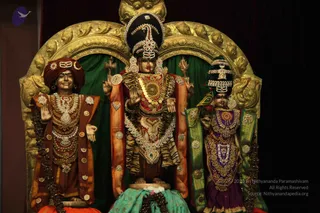
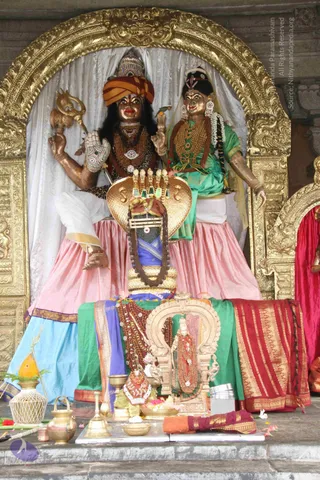
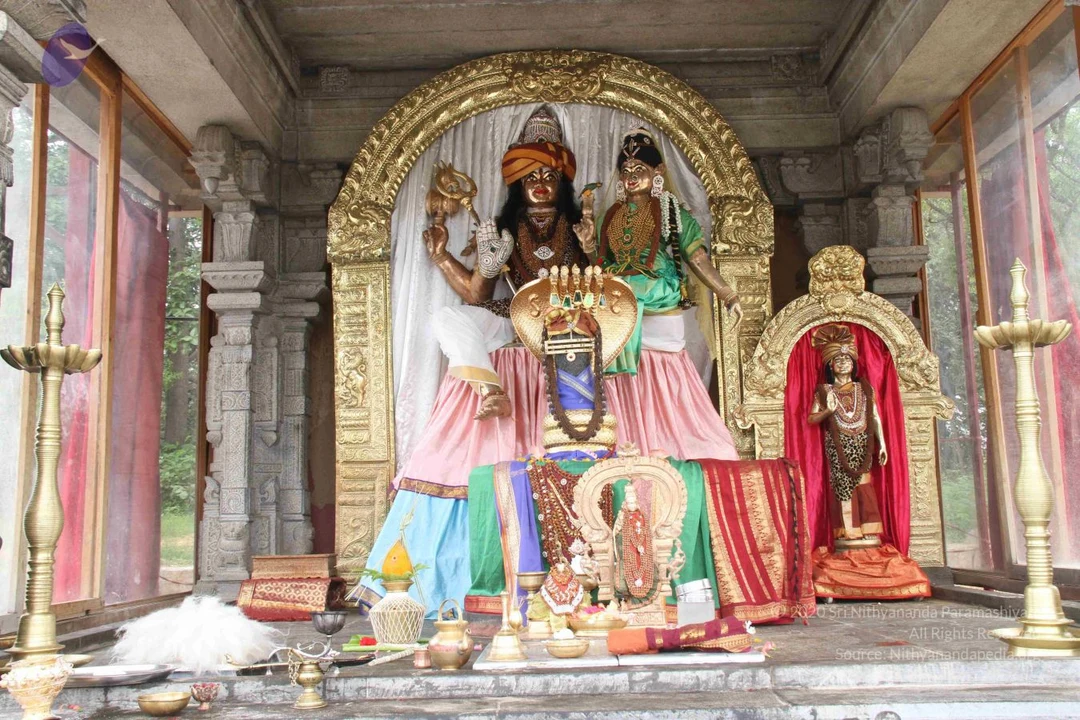
A shrine interior with a large gilded arch framing a pair of painted deity murtis: a four-armed figure with orange turban, trident-like staff and necklaces, beside a green-and-pink clad female form. Golden lamps stand at each side, with brass kalasha pots, bells and offering vessels on a stone platform. A smaller figure in a red-curtained niche to the right holds hands in anjali, wearing a red-and-gold garland and white turban. No people are physically present in the scene.A photograph of a temple shrine with a large pair of painted statues on a raised pedestal inside a gilded arch. The taller statue wears an orange-and-red turban, a rudraksha mala and gold necklaces, and holds a trident and a small drum, while the other statue wears a green and blue sari and gold jewellery. A smaller statue in a red-curtained niche to the right is in a standing devotional pose. Brass oil lamps stand on either side, with a kalasha, bells, a peetha-style base, flower garlands, a white fan and offering bowls on the platform. The scene shows deity murti, with no physical people present.A golden-arched shrine displays a pair of large painted deity murti seated on a pink draped dais. The male figure wears an orange-and-red turban and holds a trident, while the female figure wears a green blouse with a white garland and gold jewellery. In front, a dark stone linga wrapped in a blue cloth and rudraksha malas sits beneath a golden hooded cobra canopy. Brass bells, a kalasha pot, a brass lamp and flower offerings are arranged on the altar, with a small gold shrine of a standing deity to the right. No people are visible.A photograph of a shrine featuring a large golden-bronze statue pair of a male deity with an orange-and-maroon turban, holding a trident, and a female deity in a green sari with gold necklaces and white jasmine garland. Between them rises a dark black stone lingam draped in a blue cloth and rudraksha malas, sheltered by a golden five-hooded serpent hood. In front sit a small golden deity murti in an arched gold frame, brass lamps, kalasha-like vessels, and flower offerings. Pink and green silk drapes and a gilded arch frame the scene. No living people are visible.A shrine interior with a large sculptural group of two deity murtis standing behind a golden peetha, one male figure wearing an orange and yellow turban and rudraksha-style necklaces with a trident-like staff, the other female with a green choli, pink skirt and a crown. Between them rests a golden shivalingam-like form with offerings. Ornate golden arch frames the group; brass oil lamps stand at the sides, with brass kalashas, bells, bowls and white ritual cloth on the altar in front. A smaller figure in a red-curtained niche to the right is also a statue. No living people are visible.A dark stone Shiva lingam is dressed for worship, with a golden five-headed cobra hood (naga) arching behind it. The hood has five golden snake heads set with green gemstones. The lingam wears a brown cloth turban-like wrap with a gold border and a jewelled brooch, a gold-and-white-stone band across its middle with a red stone centre, and a long brown rudraksha mala draped down the front. A blue silk sari-style cloth is wrapped around its base, above a tiered gold pedestal, set against pink satin drapes and green fabric. No physical people are visible; this is a decorated deity murti.

Paduka-Puja
25 photosSource gallery
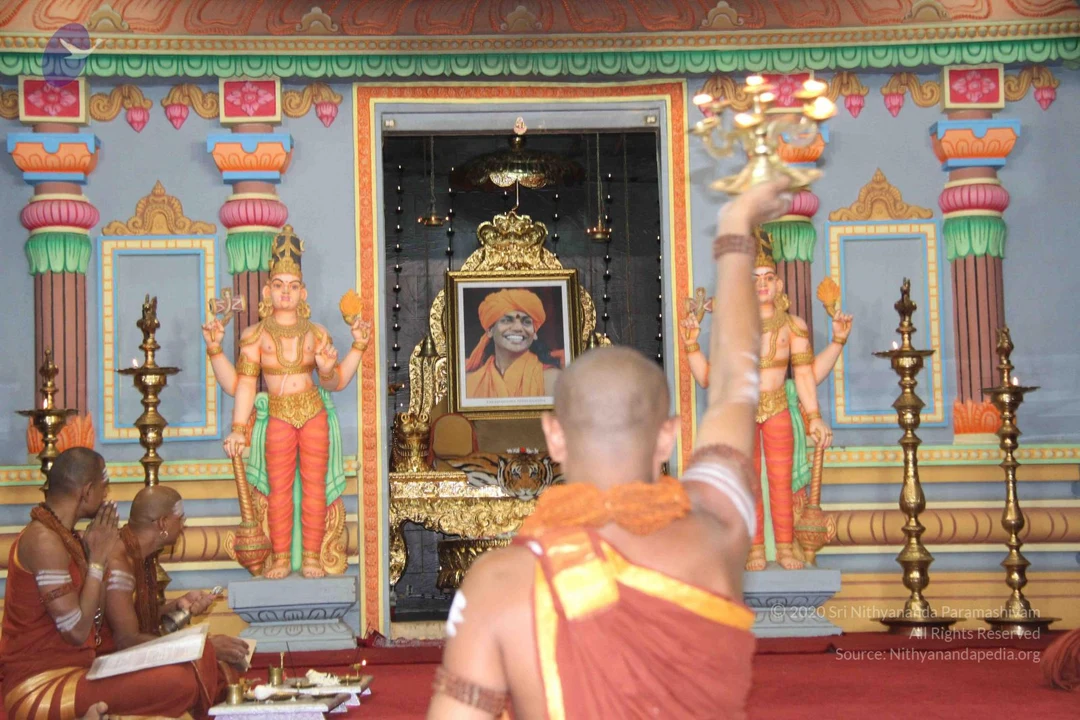
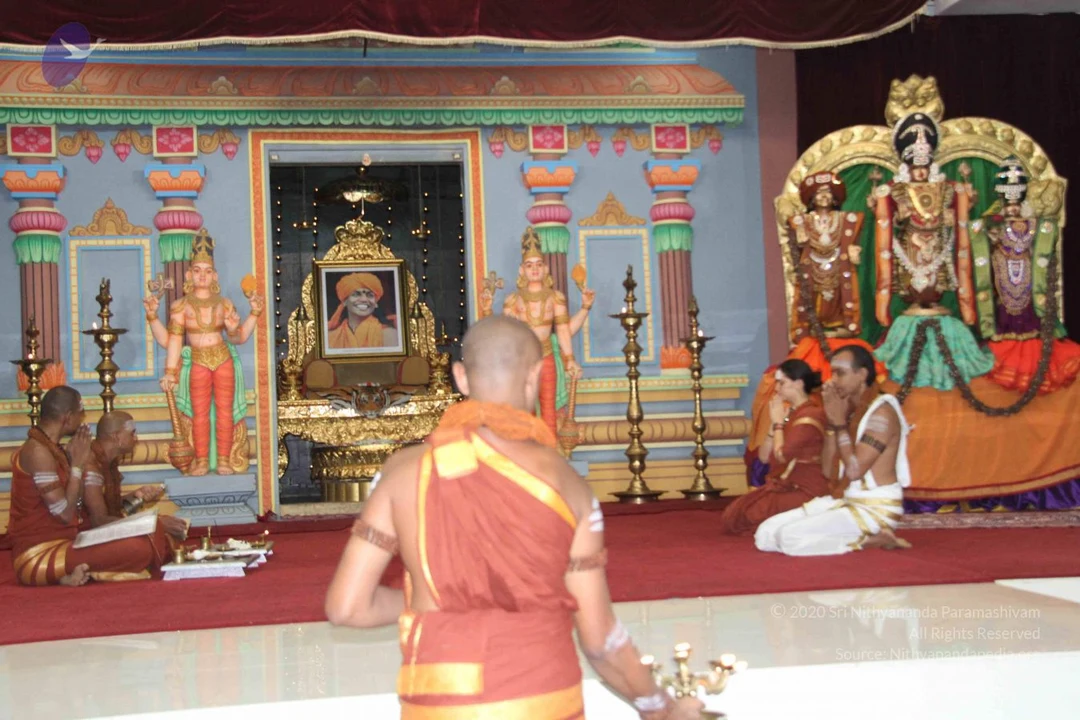
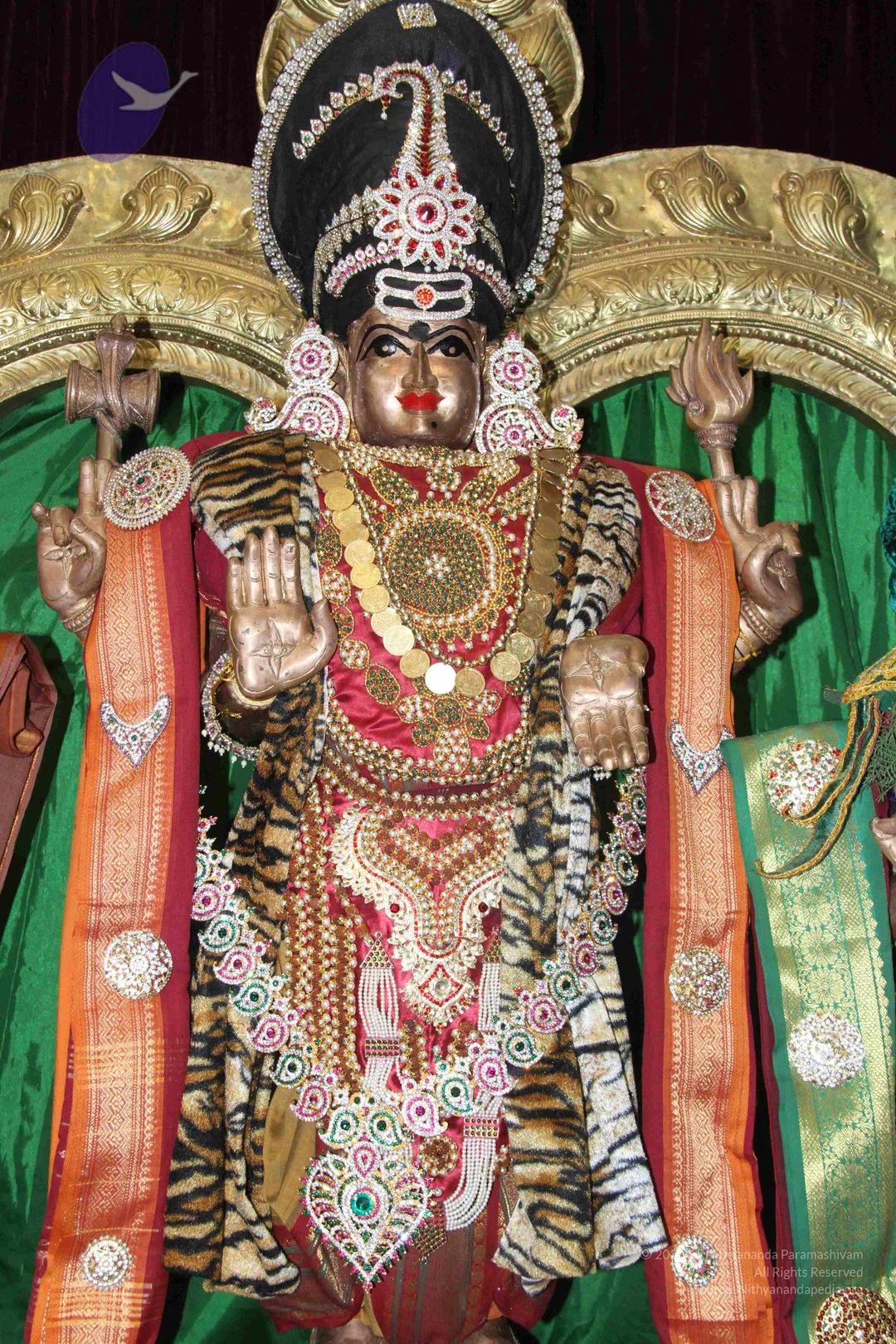
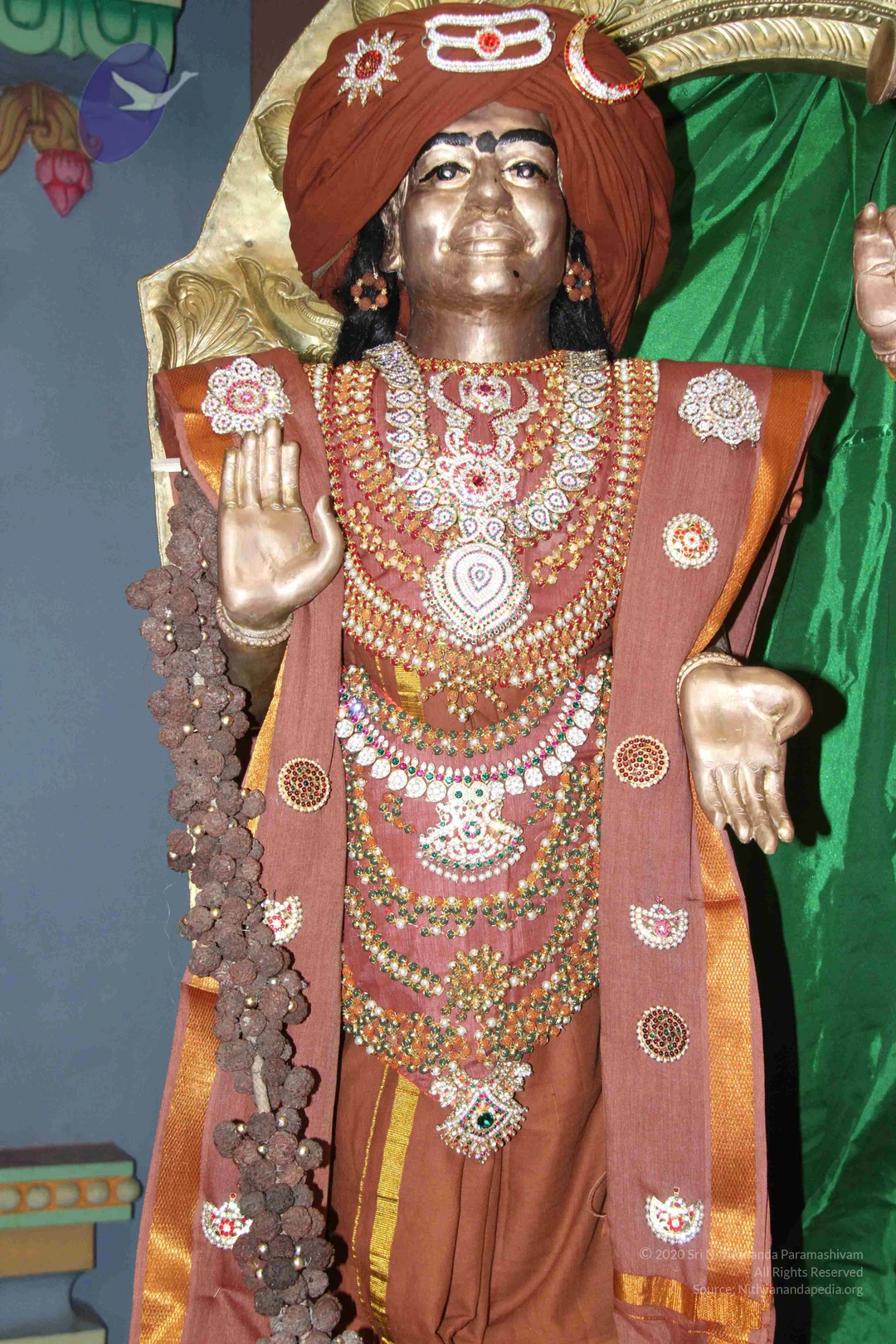
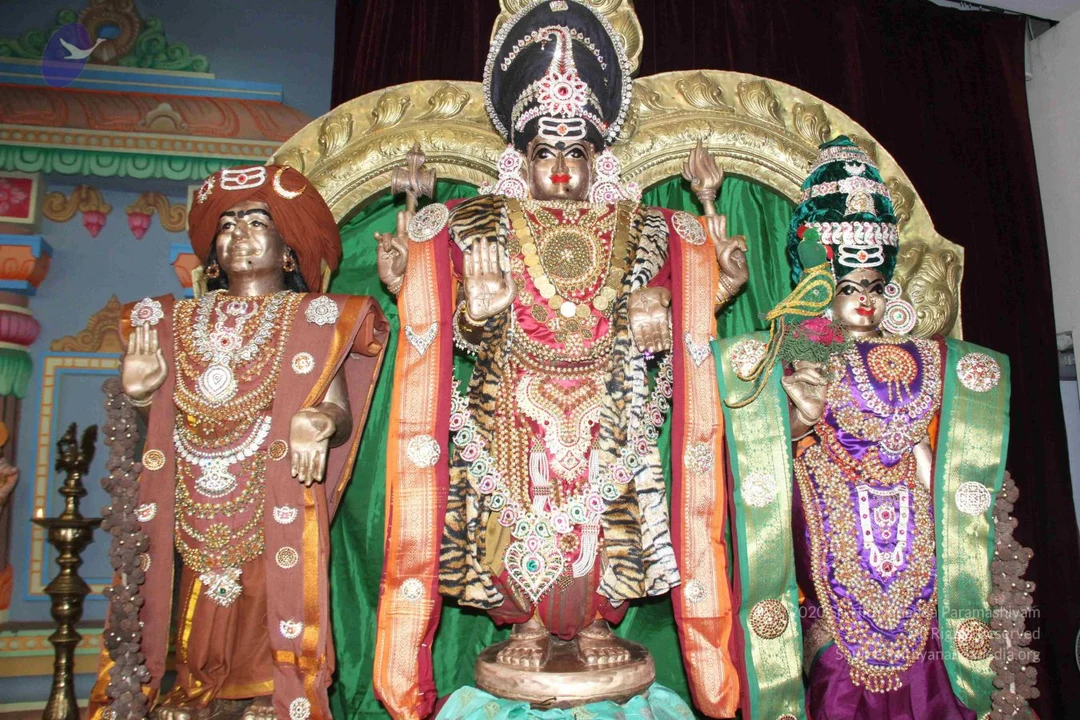
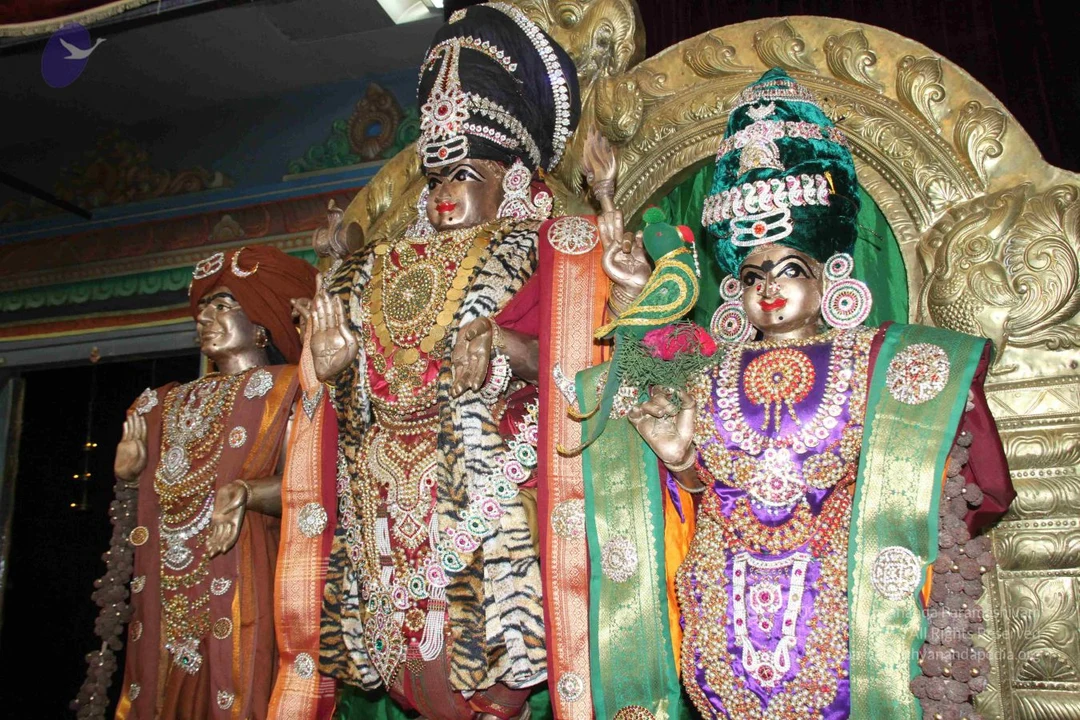
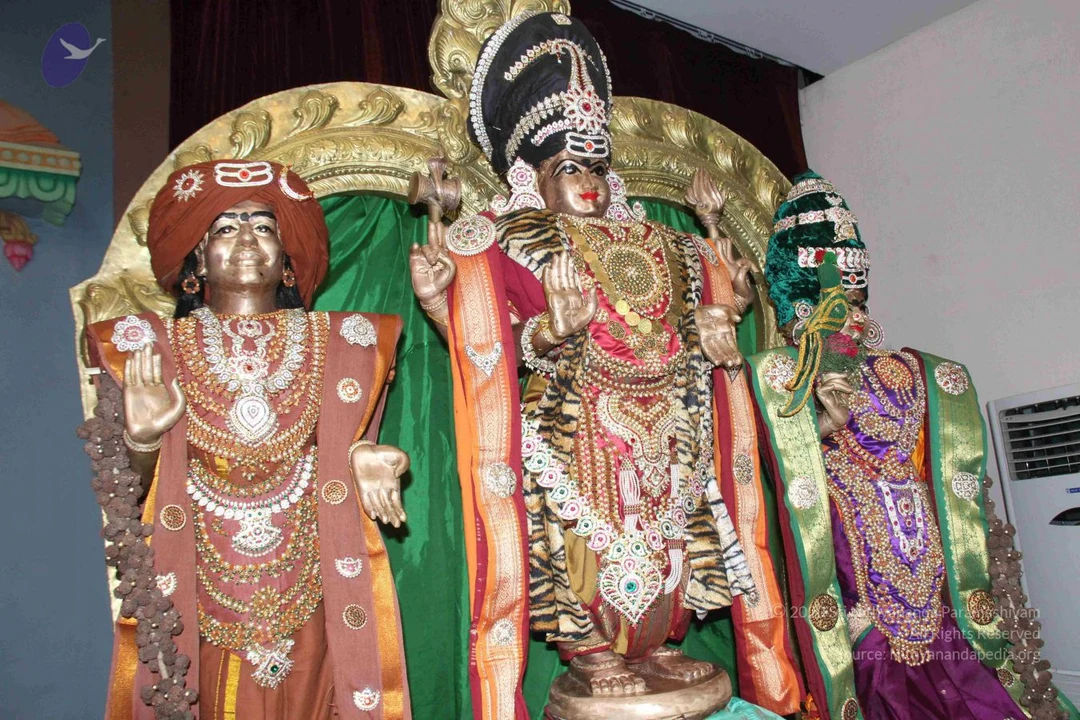
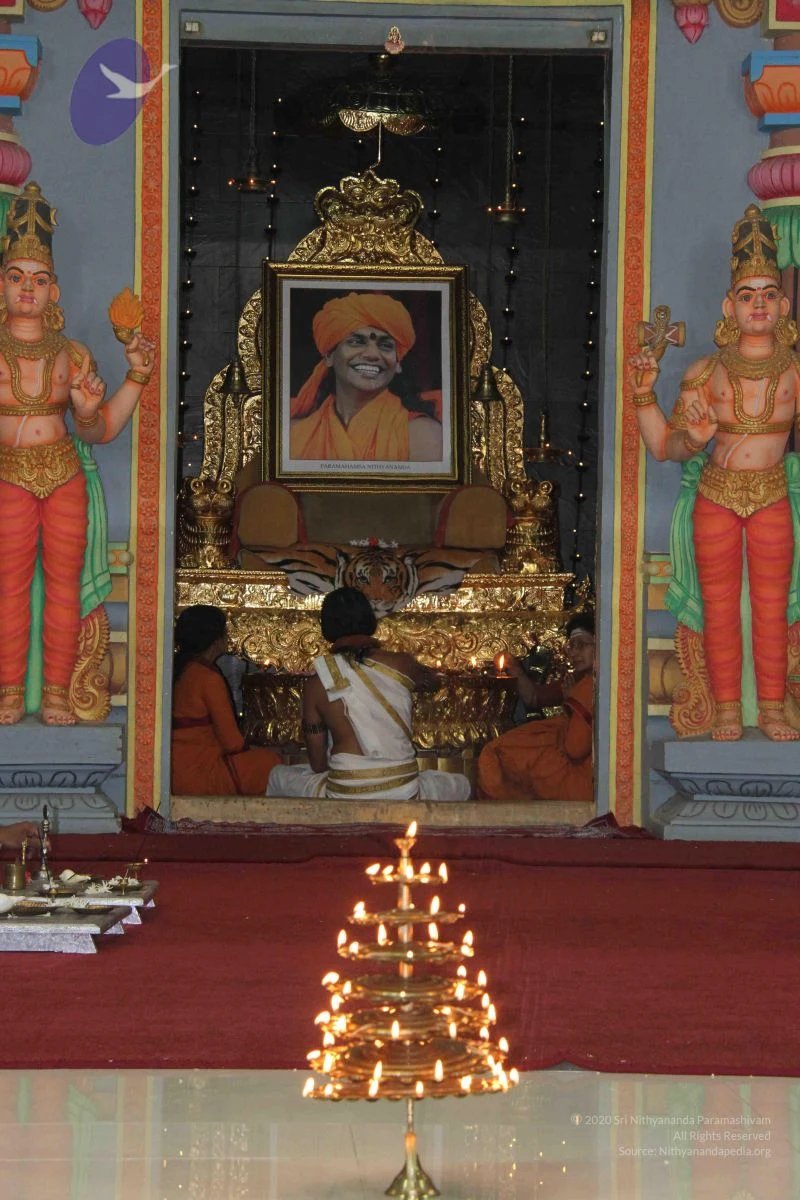
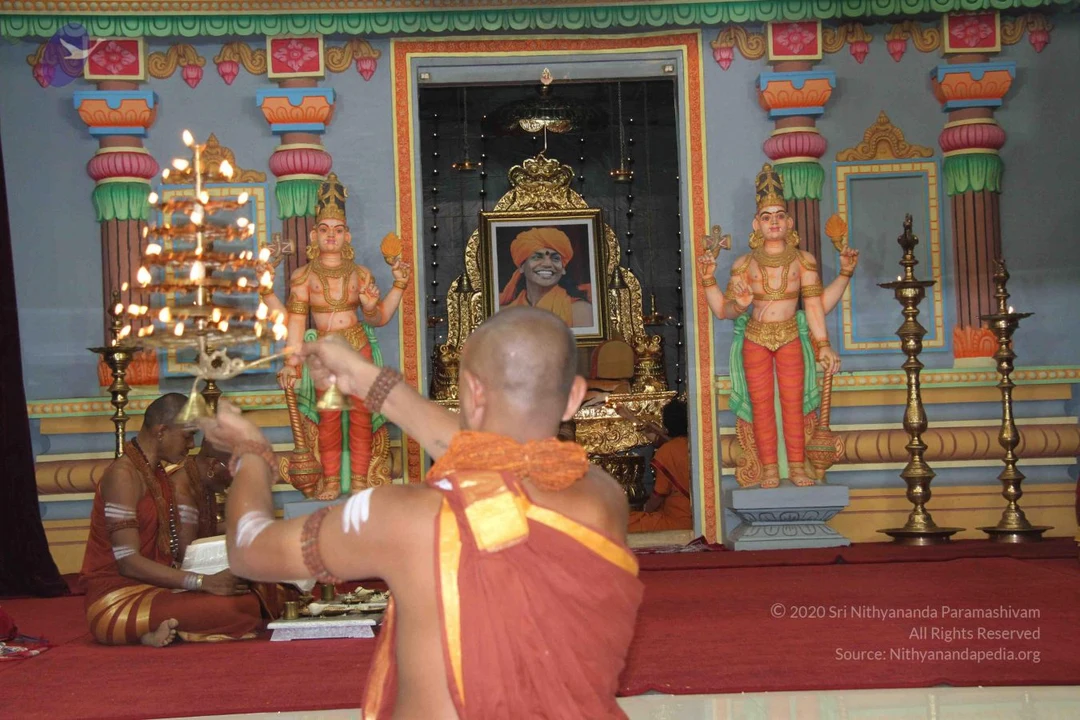
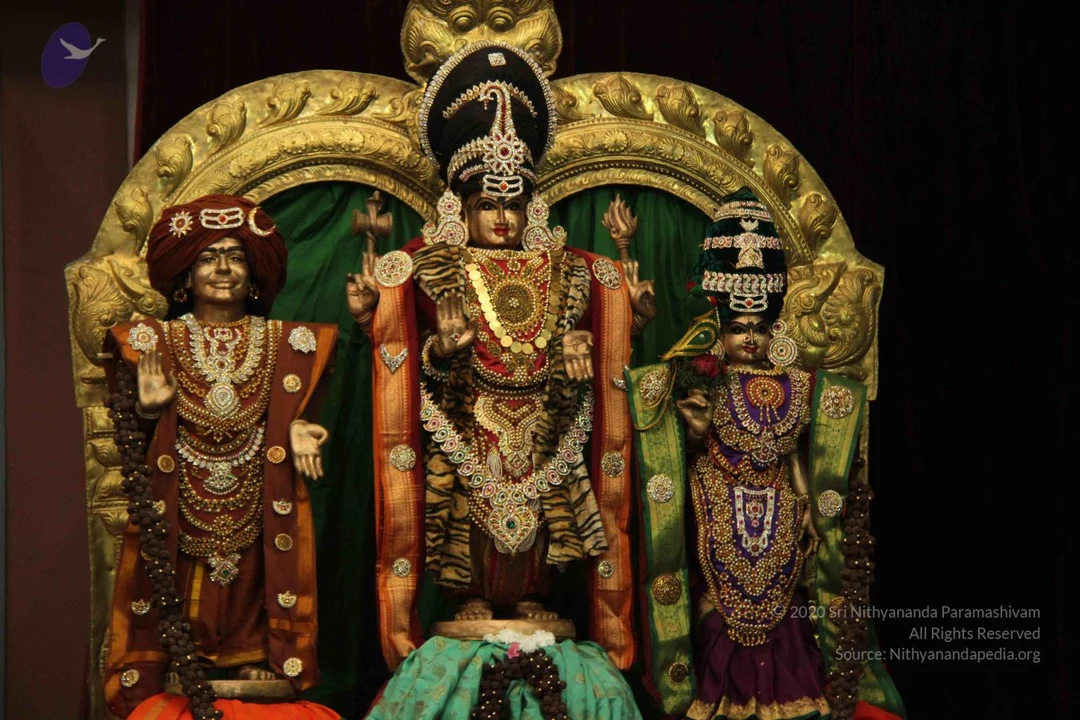
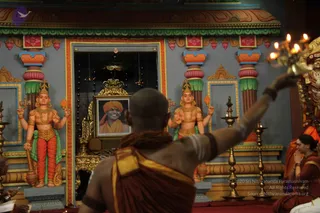
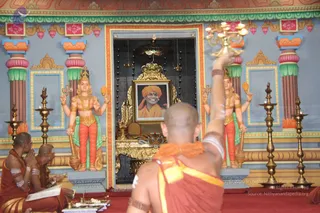
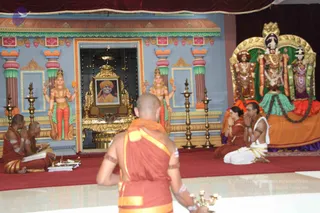
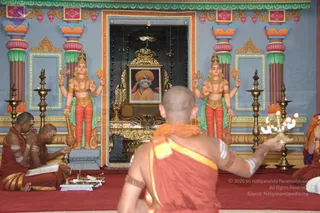
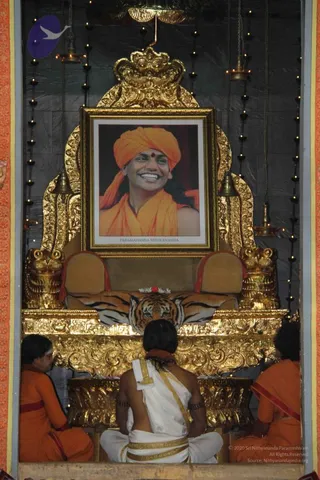
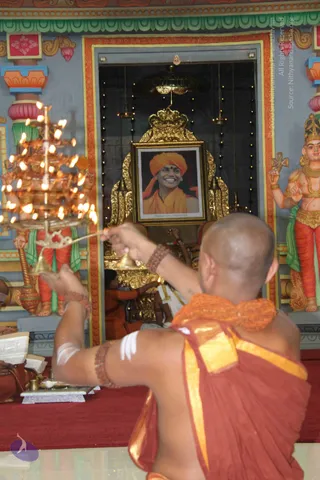
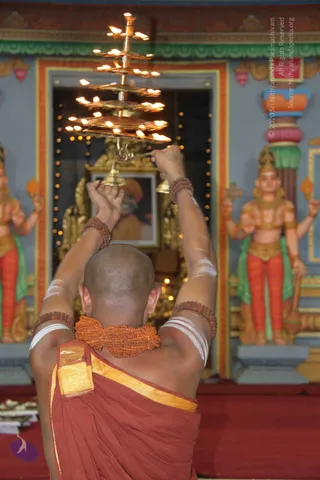
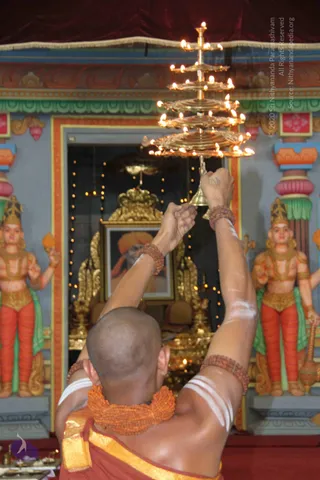
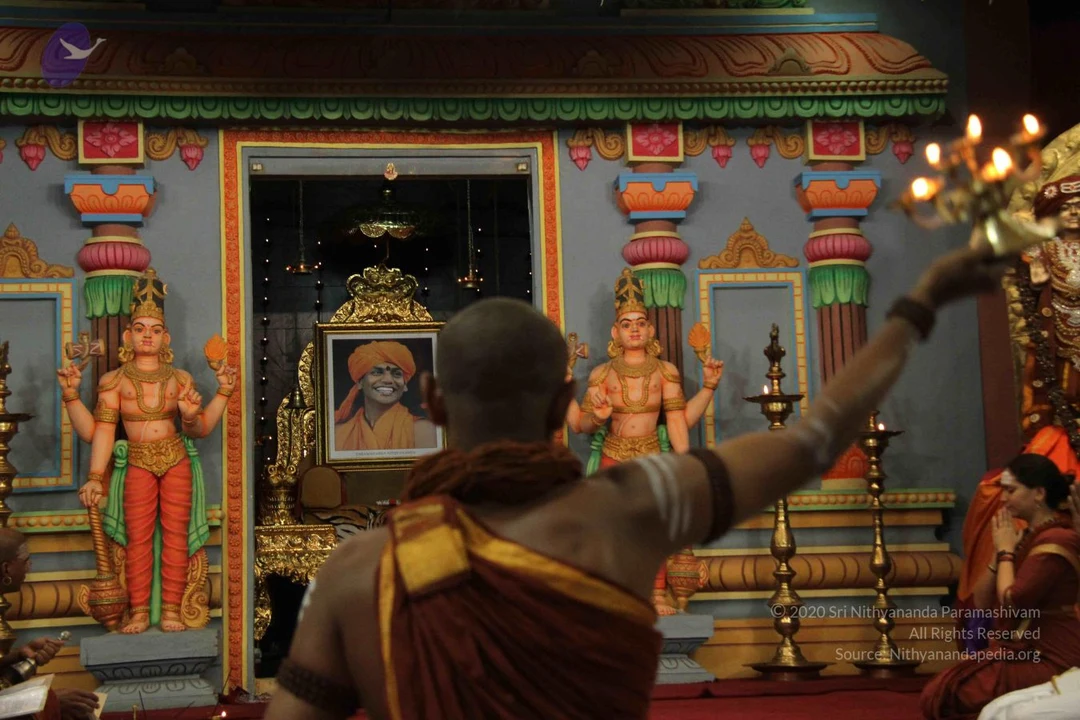
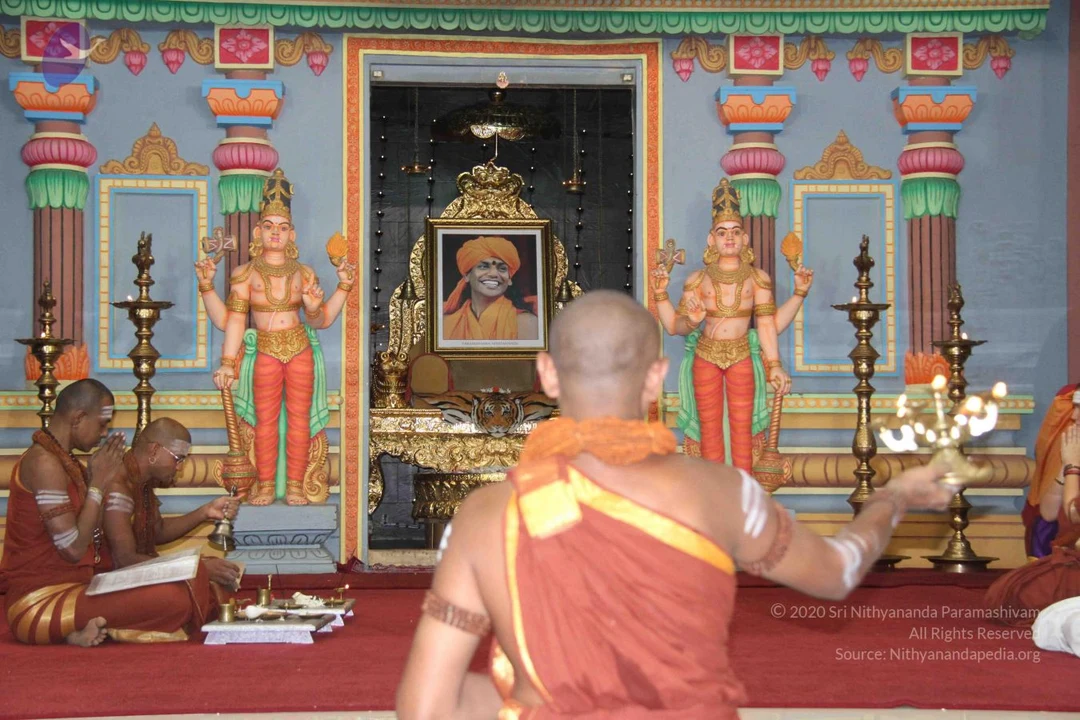
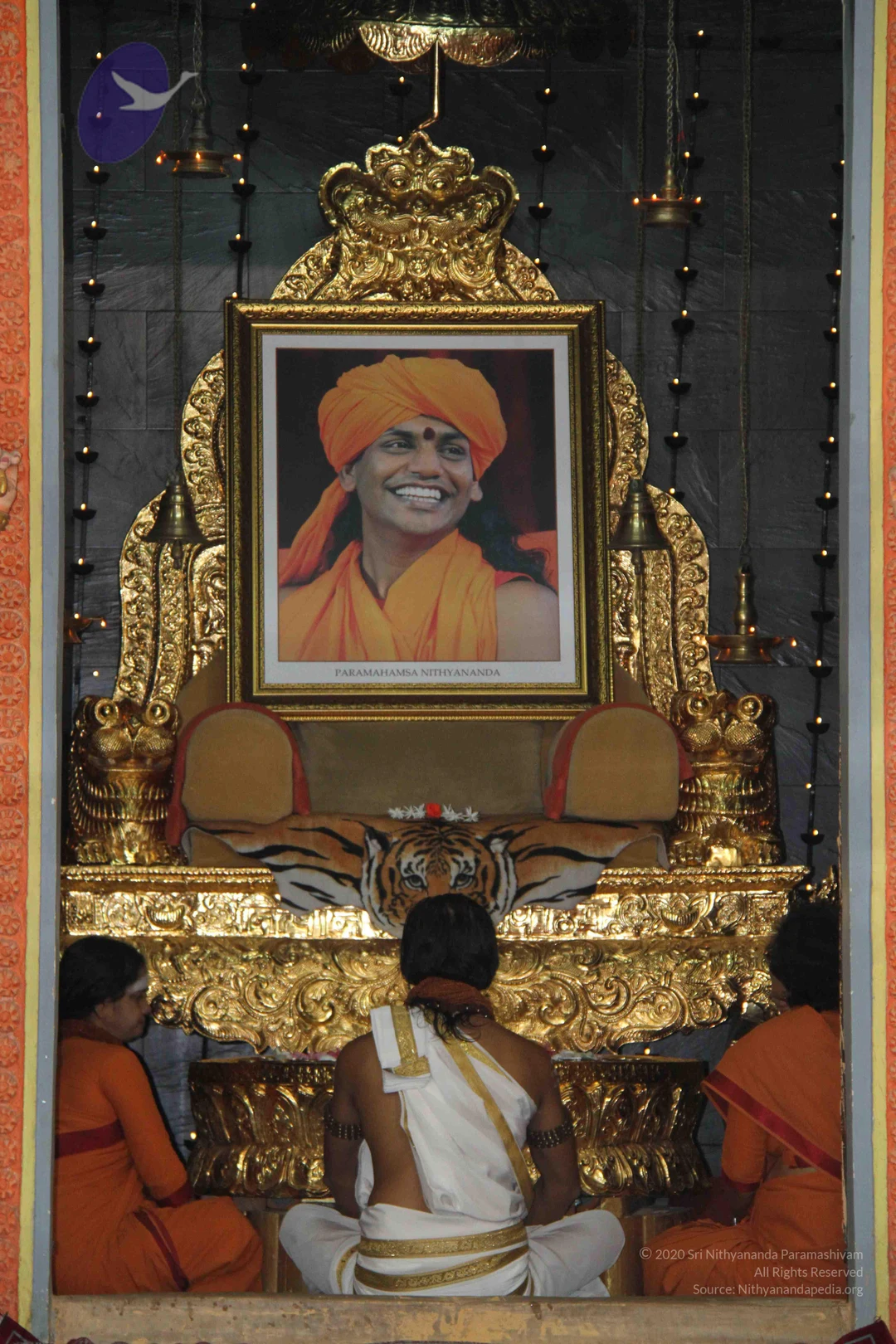
A priest seen from behind, bald-headed and bare-shouldered, wears a maroon-and-gold shawl and raises a multi-flame lamp high with his right arm inside an ornately painted temple shrine. Two painted attendant figures with gold crowns and orange sashes stand on either side of a framed portrait of a smiling man in an orange turban and saffron robe, hung on a gold-trimmed niche. Brass oil lamps sit on the floor, a woman in a maroon sari with folded hands is at the right edge, and a gold-clad deity figure appears at the far right. Colourful pillars, green and red borders and a gold throne-like seat frame the scene. The portrait is a printed picture rather than a physical person; the priest's appearance does not meet the criteria for identifying a person.Photograph of a temple ritual in a shrine room with blue and pink painted walls. A bald priest with his back to the camera, wearing an orange shawl and saffron cloth, raises a brass lamp with his right arm. Two seated priests in orange garments to the left hold a ritual book and cloth. A framed portrait labelled "Paramahamsa Nithyananda" shows a smiling man in an orange turban, set on a gilded throne with a tiger-skin cushion. Two standing gold-and-green deity murti flank the shrine, and brass oil lamps stand along the walls.A photograph of a temple-style shrine stage. In the centre, a framed portrait on a gilded throne shows a smiling figure with a saffron turban and orange robe, presented as a depiction, not a living person. To the right, a decorated altar holds deity murtis draped in garlands and bright green, orange and red cloth. A shaven-headed priest in a saffron-red robe with a gold border stands in the foreground with his back to the camera, facing the shrine. Two seated priests in saffron-red robes join their palms at left, and on the right a woman in a red sari and a man in white dhoti sit with hands folded in prayer. Brass oil lamps stand along the red carpet, and pillars with painted deity figures frame the scene. Hindu puja or satsang context.A temple shrine with blue and pink painted pillars and a green-and-orange border. At the centre, a framed portrait of a smiling man in an orange turban and orange robe sits on a golden throne-like stand, labelled as a portrait of Paramahamsa Nithyananda. Two tall gold-coloured dvarapala-style statues with four arms flank the shrine, one holding a trident-like staff. In the foreground, a shaven-headed priest in orange robes with white tripundra markings holds a lit lamp. Two seated priests in red and orange robes with white forehead markings sit on a red mat, one reading from a book and another ringing a bell beside brass puja vessels. A brass lamp stands on each side of the shrine.A gilded shrine holds a framed portrait of a smiling man in an orange turban and orange shawl with a red bindi, captioned PARAMAHAMSA NITHYANANDA, set on a gold throne draped with a tiger-skin cloth and a small floral offering. Three people sit in front of the throne: a figure in a white dhoti with gold border and bare upper body, seen from behind, flanked by two people in orange robes.Three decorated deity murtis stand on a green cloth backdrop before a gold arched frame in a temple hall. The central figure, with a tall black crown, a tiger-striped shawl over red and orange garments, and an abundance of gold and jewelled necklaces, holds a trident and a raised hand. The figure to the left wears an orange headcloth, a brown-red robe and jewelled necklaces, and the figure to the right wears a green crown, a purple sari with green border and layered gold garlands. A brass oil lamp stands at the left edge. The murtis are sculpted figures, not living people.

Nithya-Satsang

11 photosSource gallery
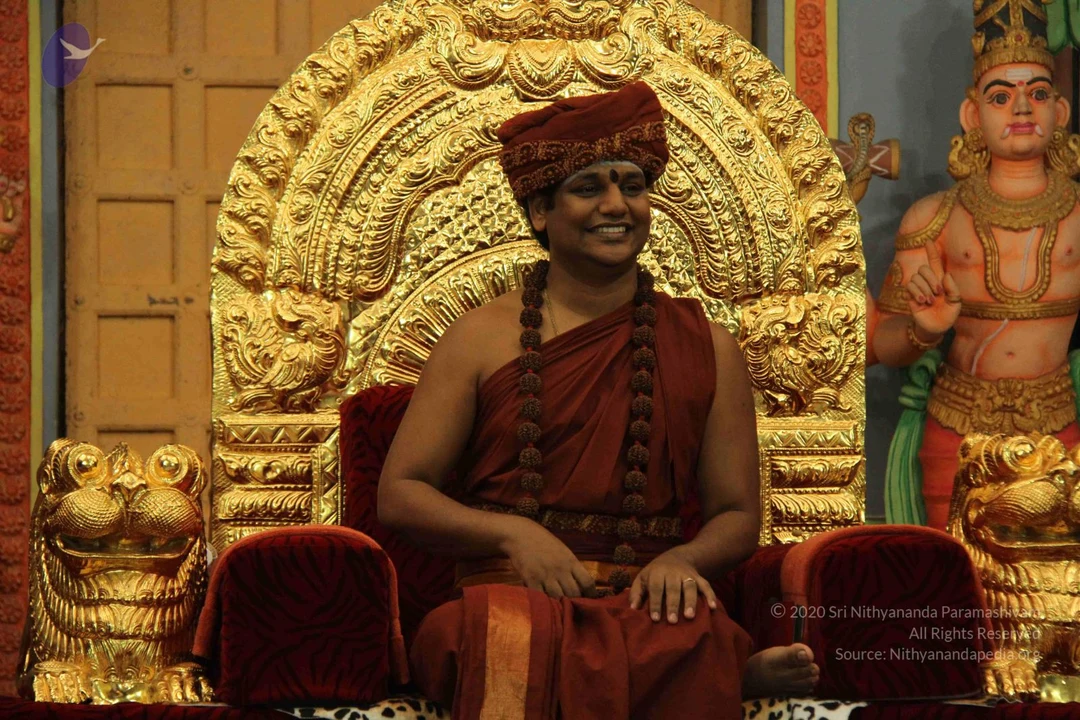
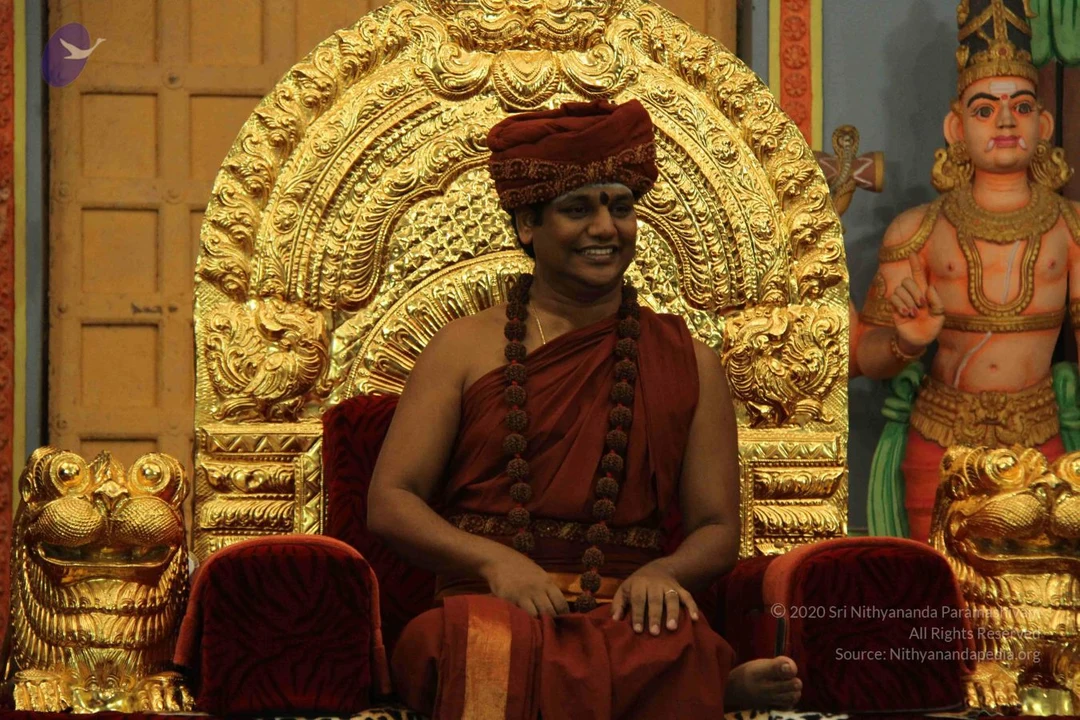
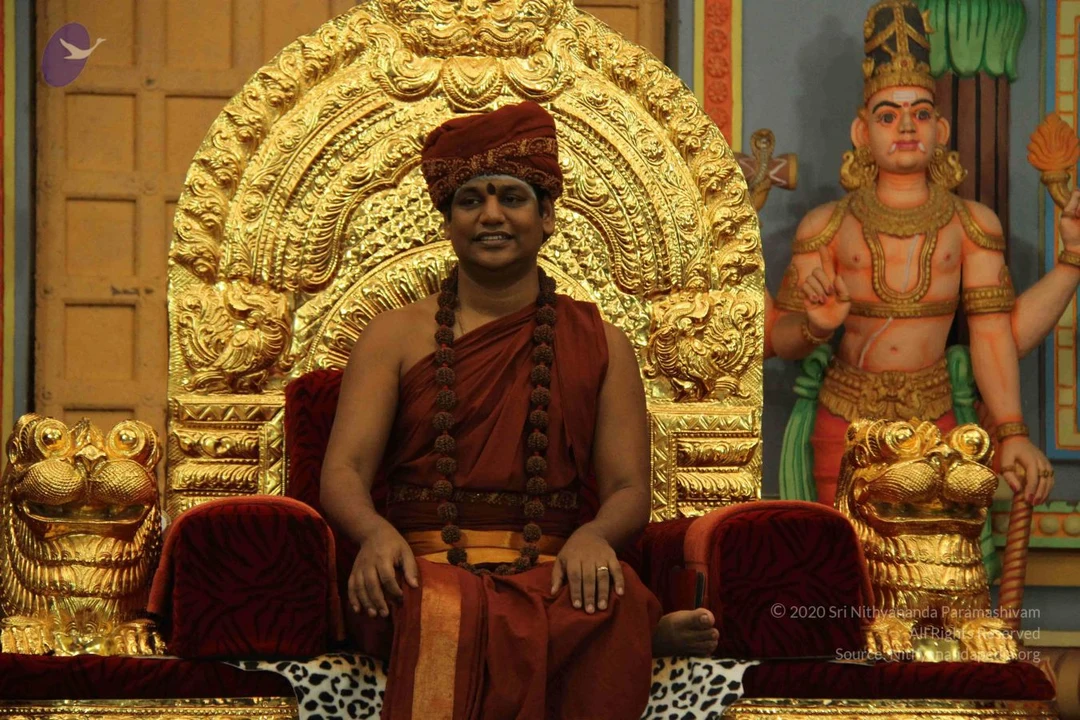
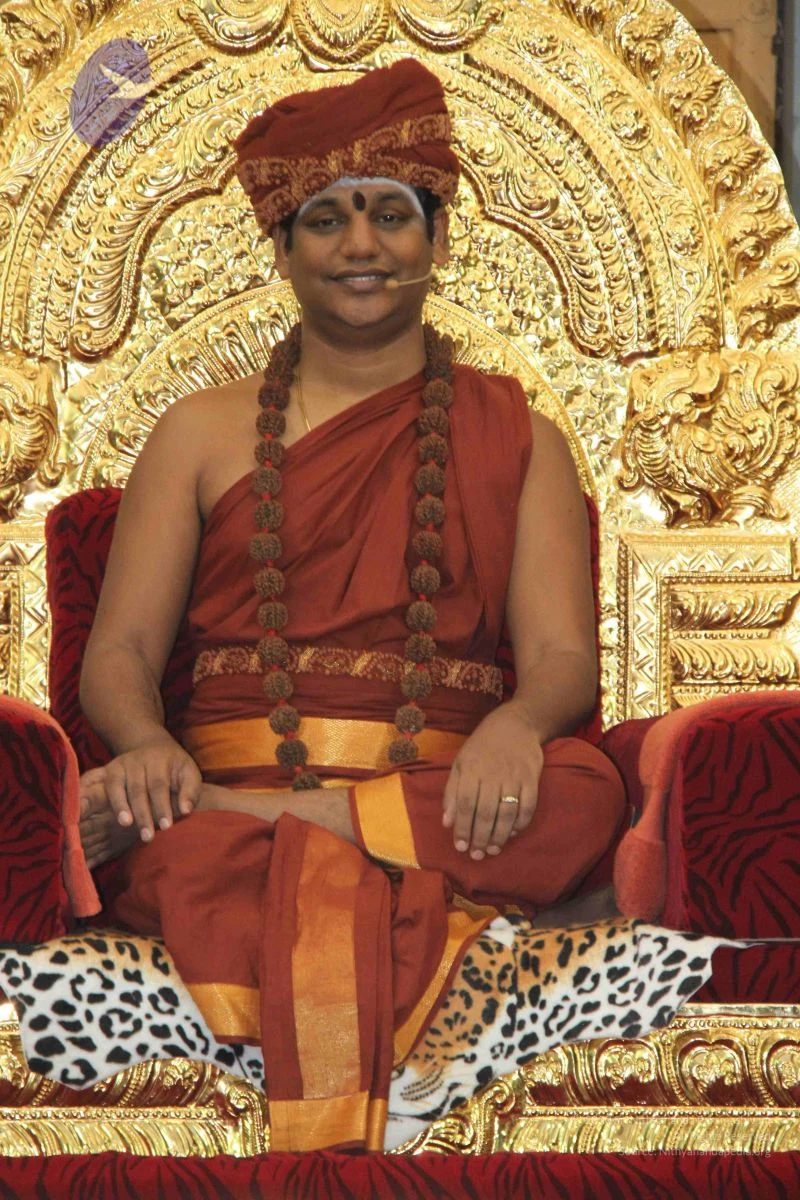
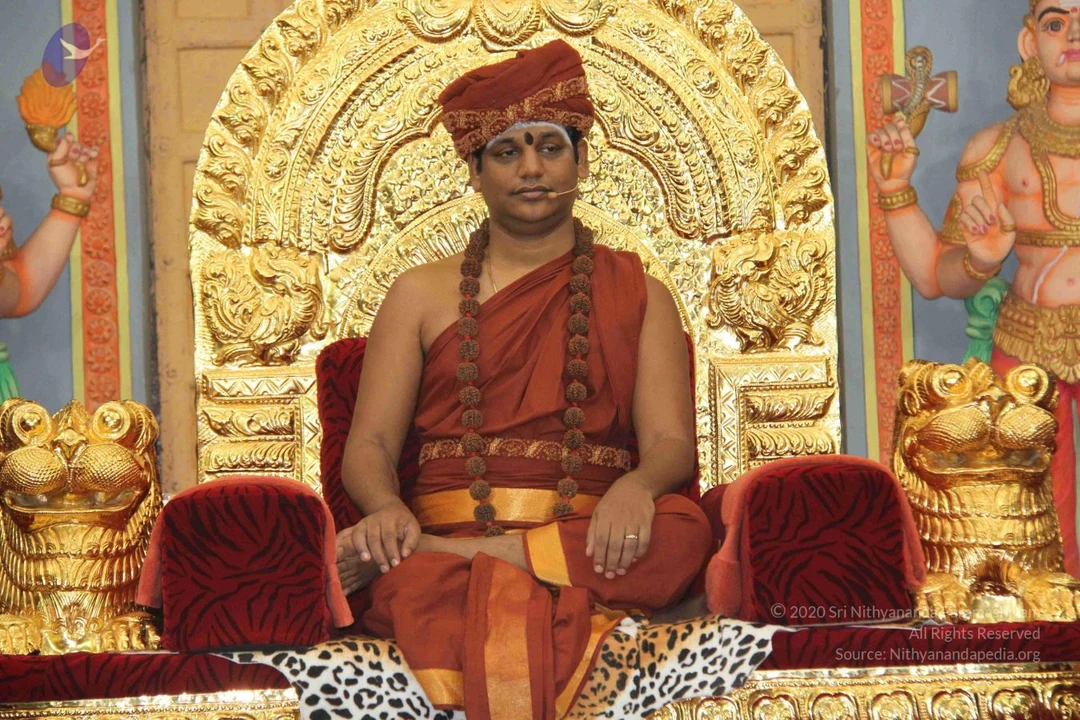
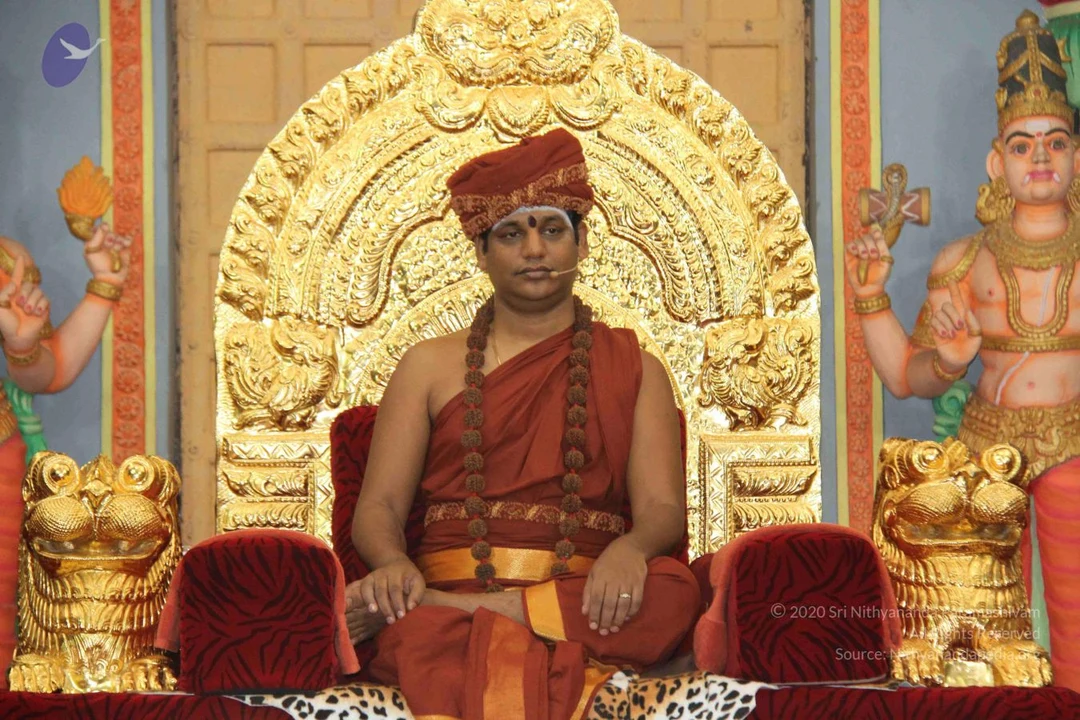
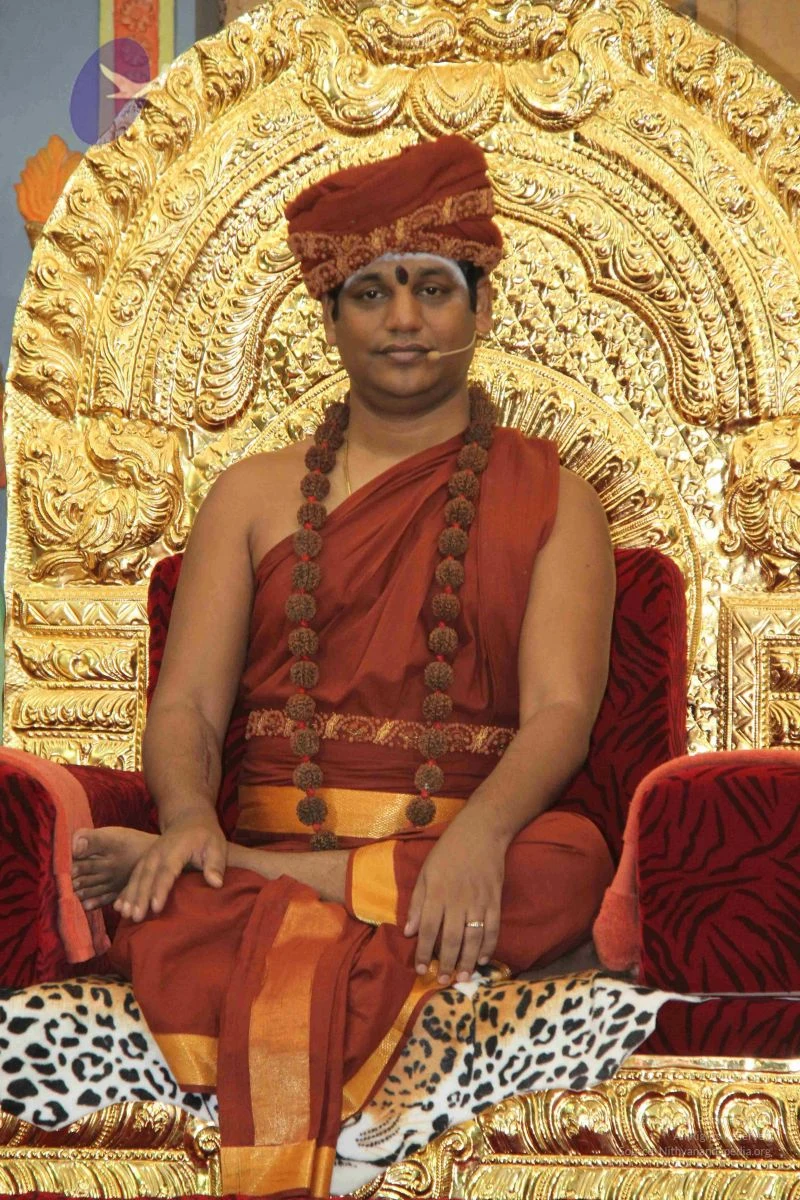
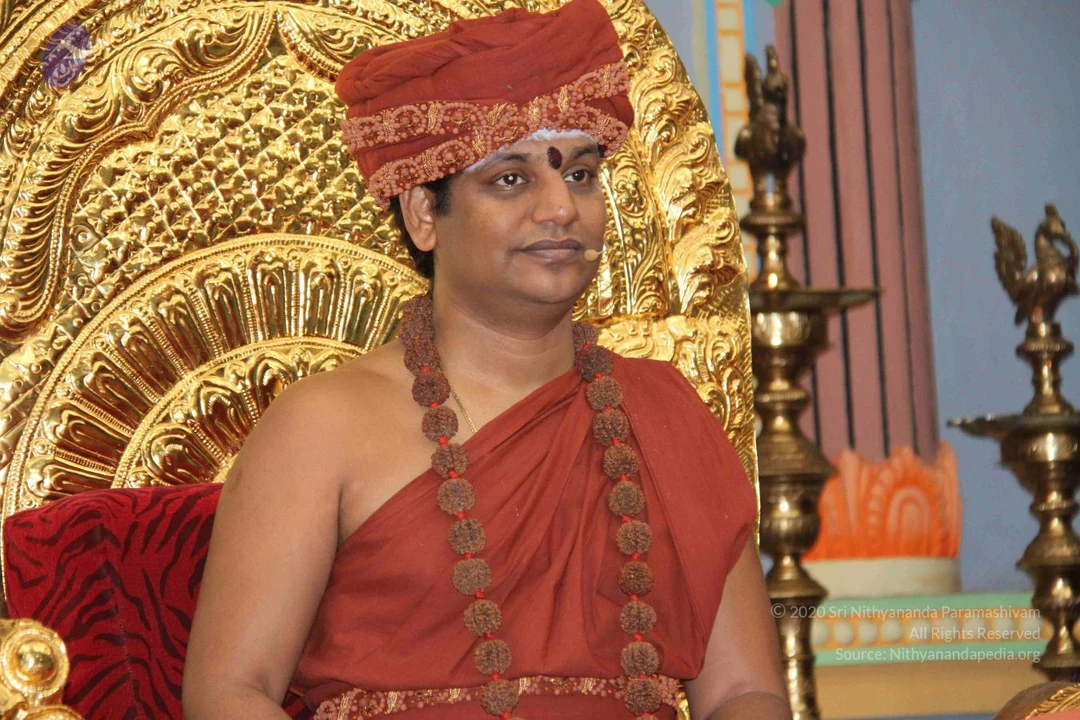
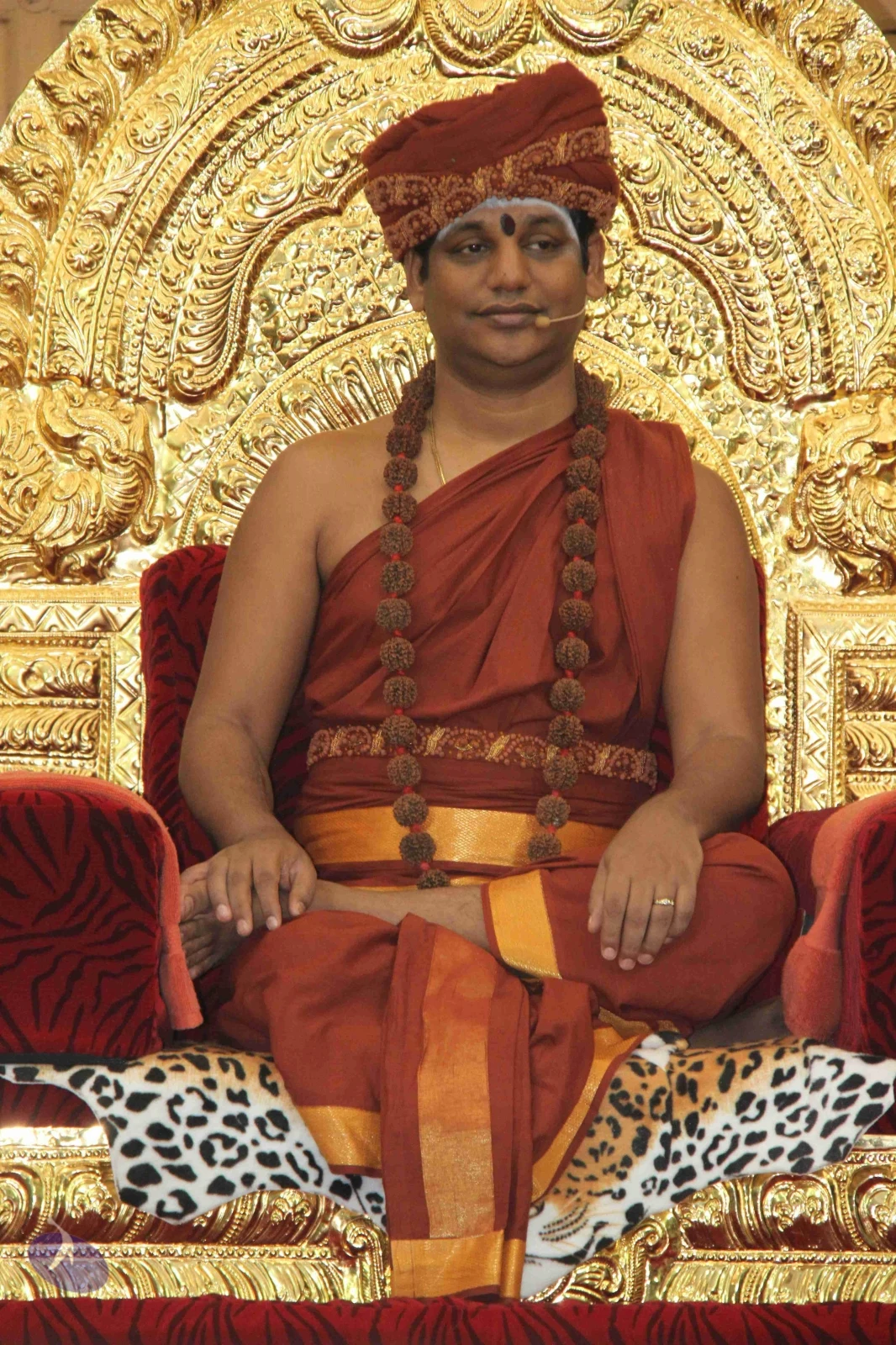
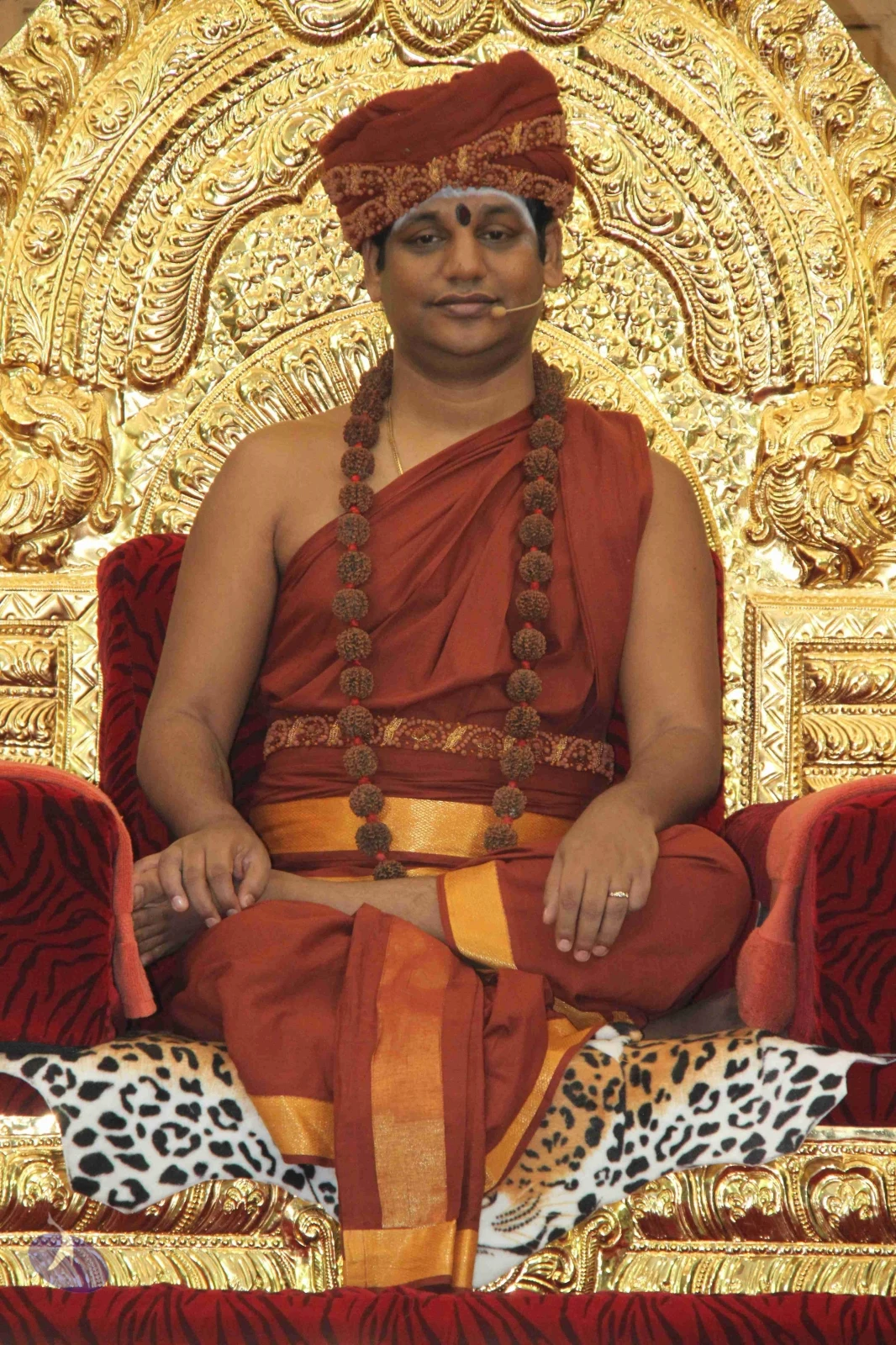
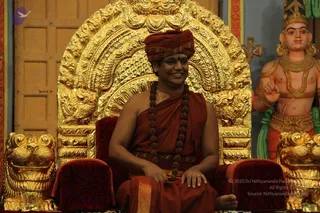
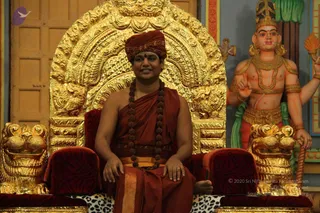
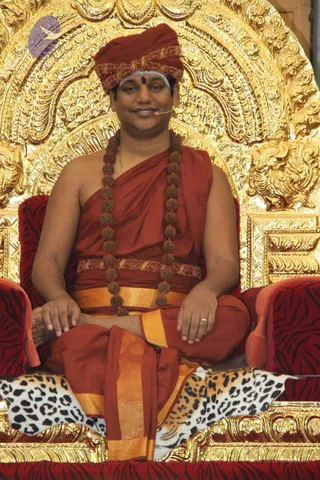
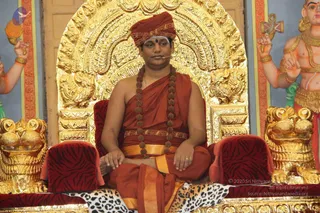
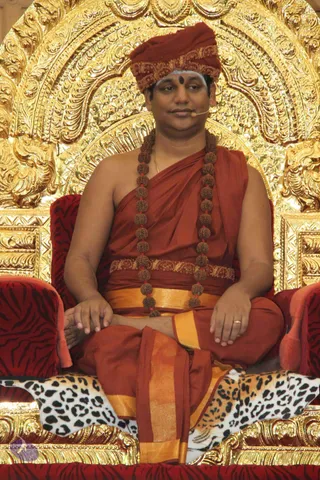
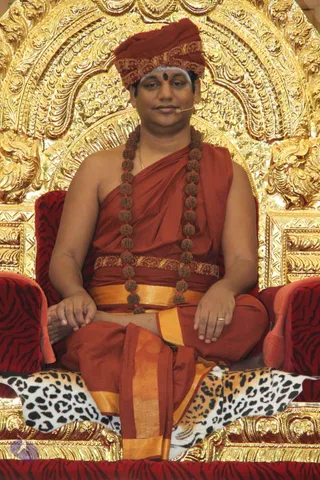
A seated man in a maroon-red robe and matching turban sits on an ornate gold throne with carved gold scrollwork and gold lion-head armrests, smiling, with his hands resting on his lap. He wears a long rudraksha mala of dark beads and a thin gold chain, and his bare feet are visible. To the right stands a painted deity murti with a gold crown, gold necklaces and armbands, and orange-red dhoti. Red velvet cushions cover the throne, and a wooden door panel is behind. The seated man is a probable Swamiji candidate on a throne, presented with an orange-red robe, turban, rudraksha mala and gold throne cues. One person is physically present.A seated figure in a maroon-red turban and maroon-red saffron-toned robes sits on an ornate gilded throne with carved lion-head armrests and red velvet cushions. A long rudraksha mala with multiple strands hangs across the chest, and a thin gold necklace is visible. A large painted deity statue with gold jewellery, an orange-toned body and a tall crown stands to the right. The seated figure smiles broadly with hands resting on the lap. Swamiji (probable): the seated figure's appearance shows a maroon turban, rudraksha mala and ornate gilded throne cues.A photograph of a man seated on an ornate gilded throne with lion-head armrests and red velvet cushions, a leopard-print cloth spread at his feet. He wears a deep red-maroon turban, a matching saffron-red robe draped over one shoulder, a gold-trimmed waist sash, and a long rudraksha mala of dark beads hanging to his waist. He sits with hands resting on the armrests and smiles toward the camera. Beside the throne stands a painted deity murti with a gold crown, multiple arms, orange-pink skin, gold jewellery and a trident-like staff. The background shows a wooden door and painted panels.Three life-size sculpted figures stand in a gilded arched niche against a green draped backdrop. The central figure is a deity murti wearing a tall black crown with white and gold ornaments, a tiger-skin garment, a red and gold sash, and layered gold and jewelled necklaces; it holds a trident and other ritual emblems. The figure on the left is a male statue in an orange-red turban and orange-brown robe, adorned with gold and jewelled necklaces and garlands of rudraksha beads. The figure on the right is a female statue in a tall ornate crown and purple skirt with gold embellishments and a green shawl. Rudraksha mala garlands hang over the base, and a green cloth covers the platform. No living people are visible; the figures are statues.A seated man on an ornate gilded throne with embossed floral and scroll carvings, draped in a leopard-print cloth. He wears a rust-red turban, red-orange robes with a gold-bordered waist sash, and a long double strand of rudraksha beads reaching his waist, with a gold chain at his neck. A red bindi marks his forehead and a small microphone is clipped near his mouth. His hands rest on his lap and he smiles toward the camera. Cues including the rudraksha mala, red turban and robes, and a ceremonial throne suggest Swamiji (probable), seated as the speaker of a satsang.A seated man in a red-orange turban and matching saffron-red robe sits cross-legged on an ornate gold throne with carved lion heads and red tiger-striped cushions. He wears a long rudraksha mala with a ceremonial gold waist sash and a small red bindi, and has a clip microphone on his face. Behind him stand painted deity murti figures with gold jewelry, and a leopard-print cloth lies on the dais. a person: long-haired presentation is not visible, but the saffron robe, rudraksha mala and throne with turban suggest the a person role for this satsang event. One physical person is present.

Nithya-Kirtan

5 photosSource gallery
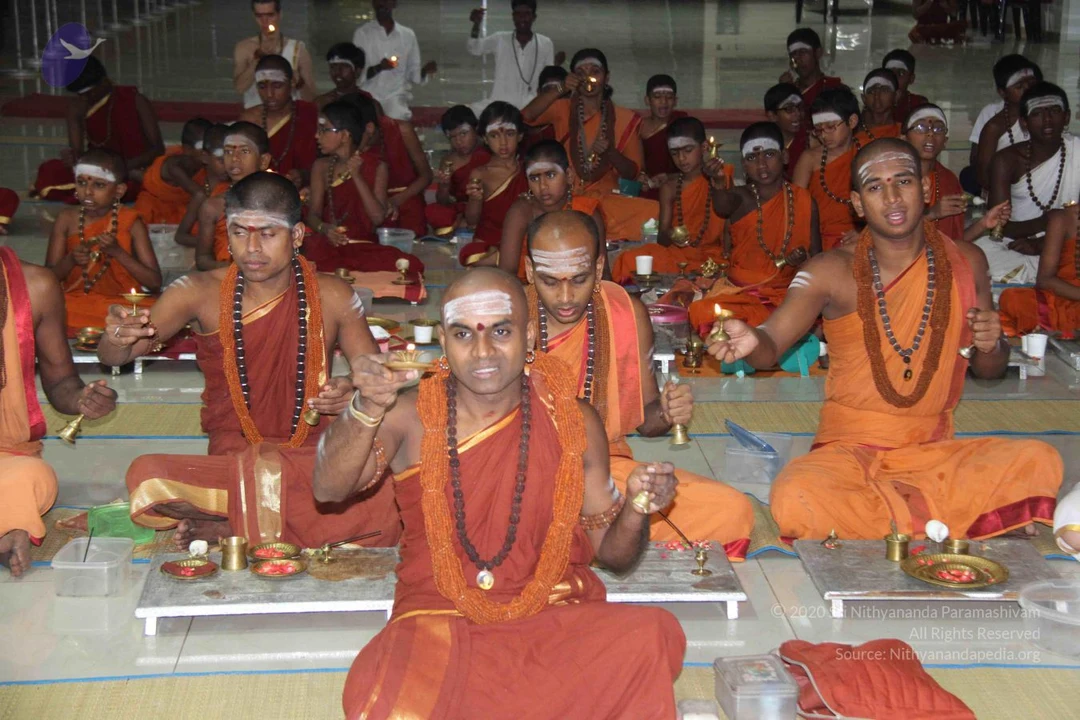
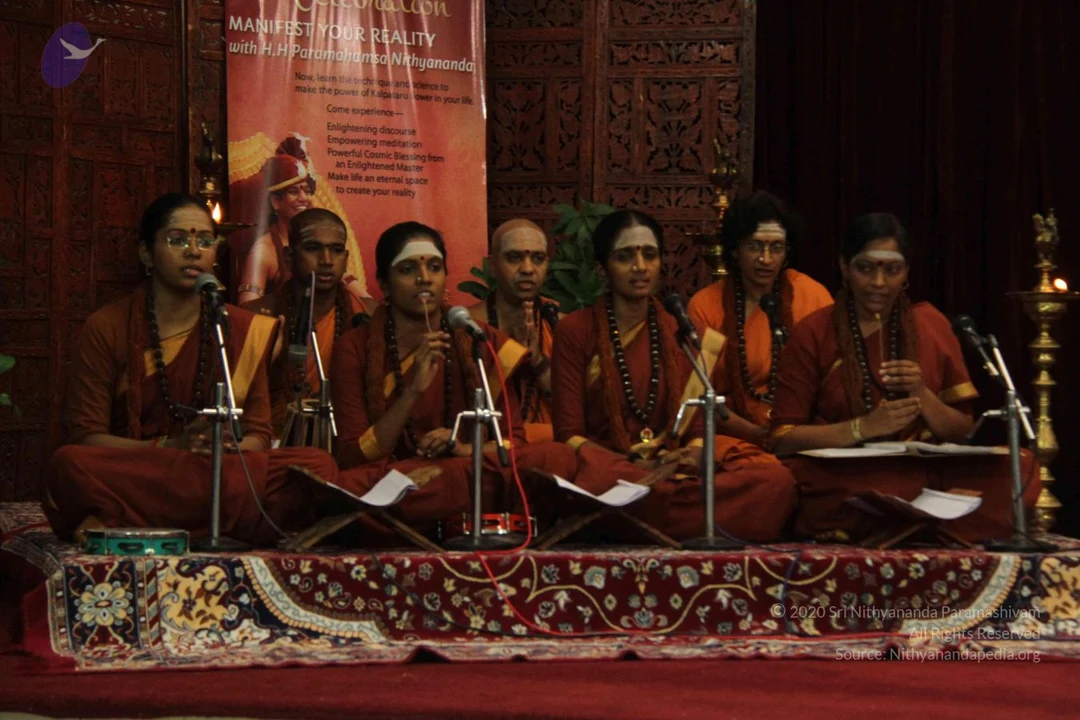
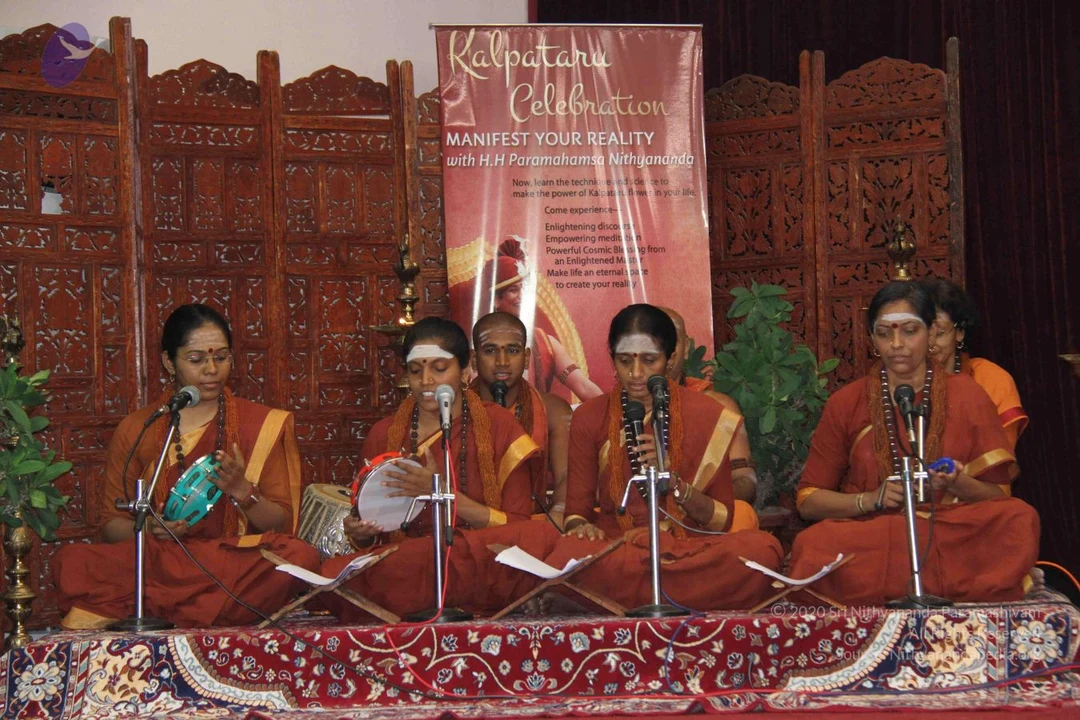
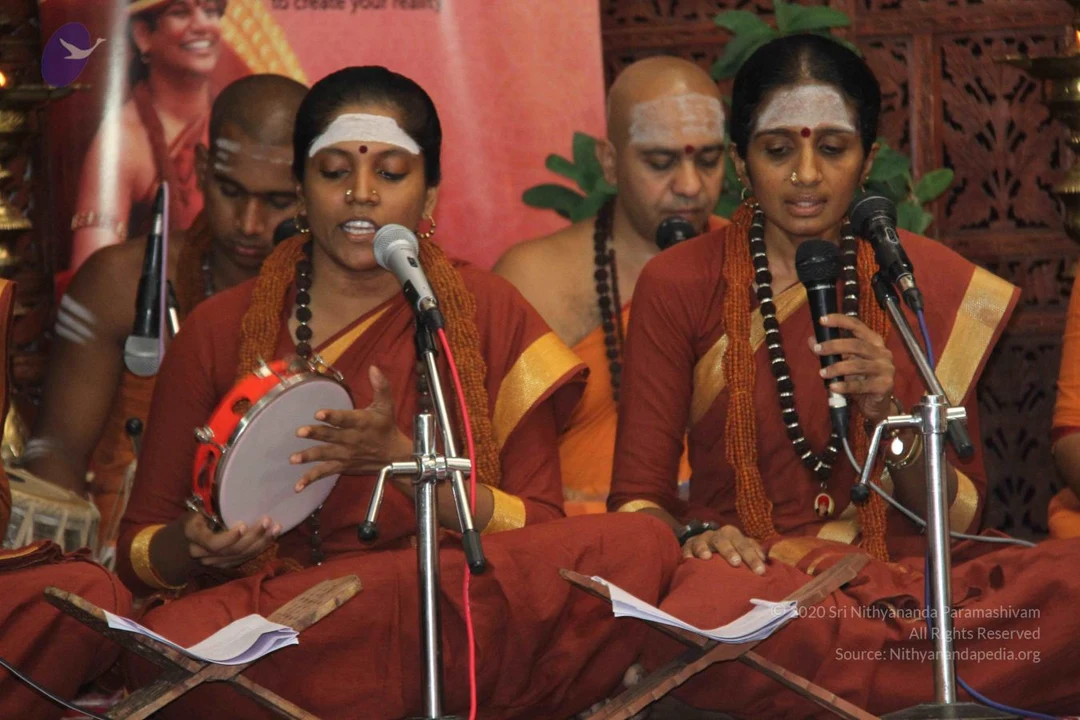
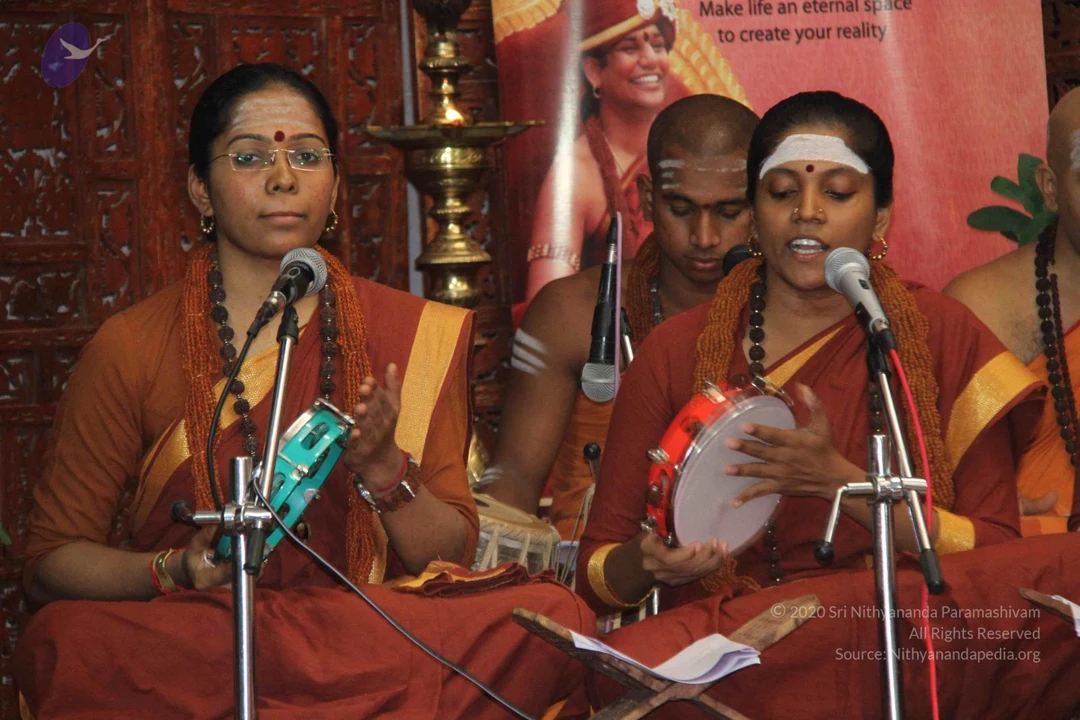
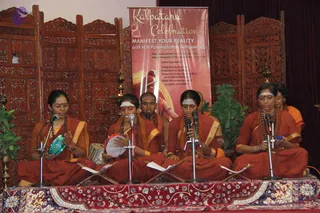
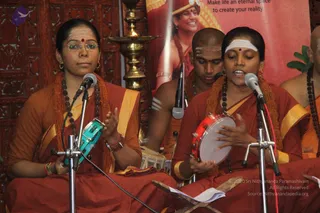
A photograph of six people seated cross-legged on a red and gold patterned rug on a raised stage, singing or chanting into microphone stands with sheet music on small stands in front of them. They wear orange-red robes with gold borders, rudraksha malas, and white vertical markings on their foreheads. Behind them hangs a red banner reading Manifest Your Reality with H.H. Paramahamsa Nithyananda, beside carved wooden panels. A brass oil lamp burns at the right edge, and a small harmonium-style instrument sits on the left.A group of women and a man in saffron-orange robes with white forehead markings sit cross-legged on a red and gold floral carpeted stage, singing into microphones on stands. One woman on the left plays a turquoise tambourine, another in the centre plays a small round hand drum, and sheets of paper rest on stands before them. Behind them a tall red banner reads Kalpataru Celebration, MANIFEST YOUR REALITY with H.H Paramahamsa Nithyananda, listing enlightening discourses, empowering meditation and powerful cosmic blessing, beside carved wooden lattice screens and a potted plant. The performers appear to be chanting or singing devotional music. No a person candidate is physically visible among those on stage.Women in saffron-red sarees with gold borders sit cross-legged at microphone stands, singing. The woman on the left plays a red tambourine and has a white vibhuti band and red bindi on her forehead, with orange-beaded necklaces. The woman on the right, with rudraksha malas around her neck, holds a microphone and sings. Behind them, a man in orange with white tripundra markings and a bald head sits near a microphone, and a man on the far left wears orange and sits in the background. A red banner with a woman's image and text is behind them, beside brass lamps and a carved wooden screen. The scene suggests a devotional musical recital.Four people in saffron-orange sannyasi-style clothing perform devotional music seated before microphones on stands. On the left, a woman in rust-orange garments with a gold border and round glasses plays a turquoise harmonium-style instrument. In the centre, a woman with a white tilak on her forehead, red bindi and rudraksha mala sings while holding a small red and white tambourine. A bald man in orange with white facial markings sits behind them, and another orange-clad figure is at the right edge. Behind them a red banner shows a smiling woman in orange with the slogan 'Make life an eternal space to create your reality', and a brass oil lamp and carved wooden screen stand at the back.A photograph of a devotional music performance on a stage with a patterned red carpet. Several women in saffron-orange sarees with gold borders sit cross-legged behind microphone stands, singing. The woman second from left plays a hand frame drum, and the woman at far left plays a small teal percussion instrument. Several have white forehead markings and rudraksha malas. Behind them stands a red banner reading Celebration, MANIFEST YOUR REALITY with H.H Paramahamsa Nithyananda, with a portrait on it labelled with that name. Brass lamps flank the stage and carved wooden screens form the backdrop. A man in saffron stands behind the singers.

Darshan

9 photosSource gallery
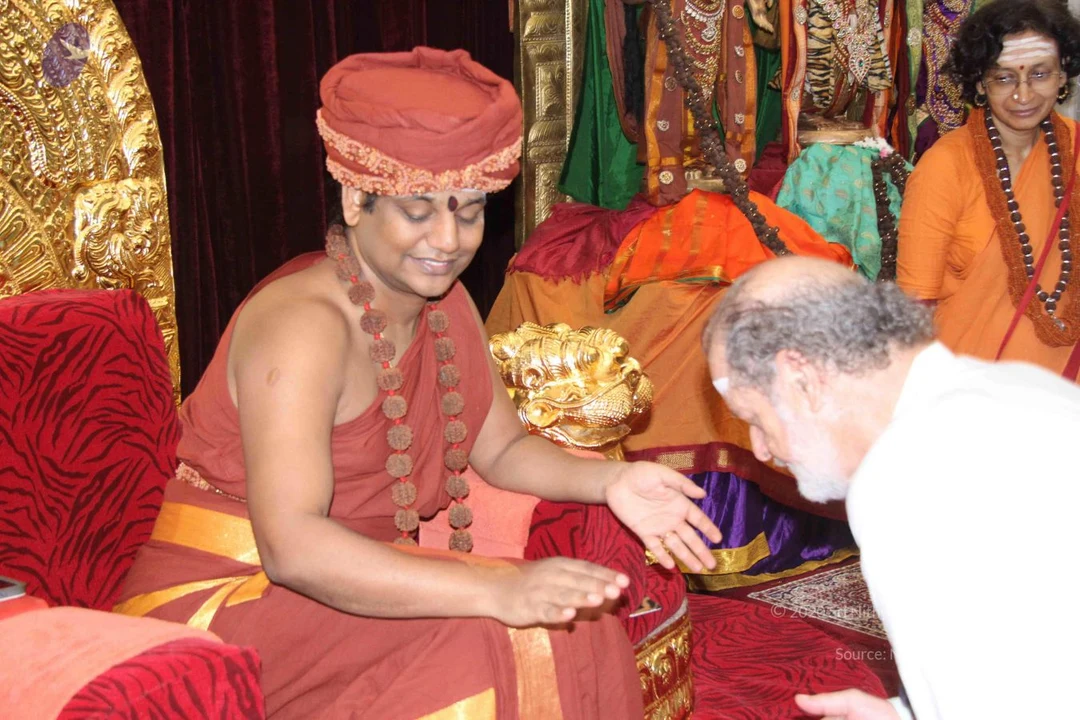
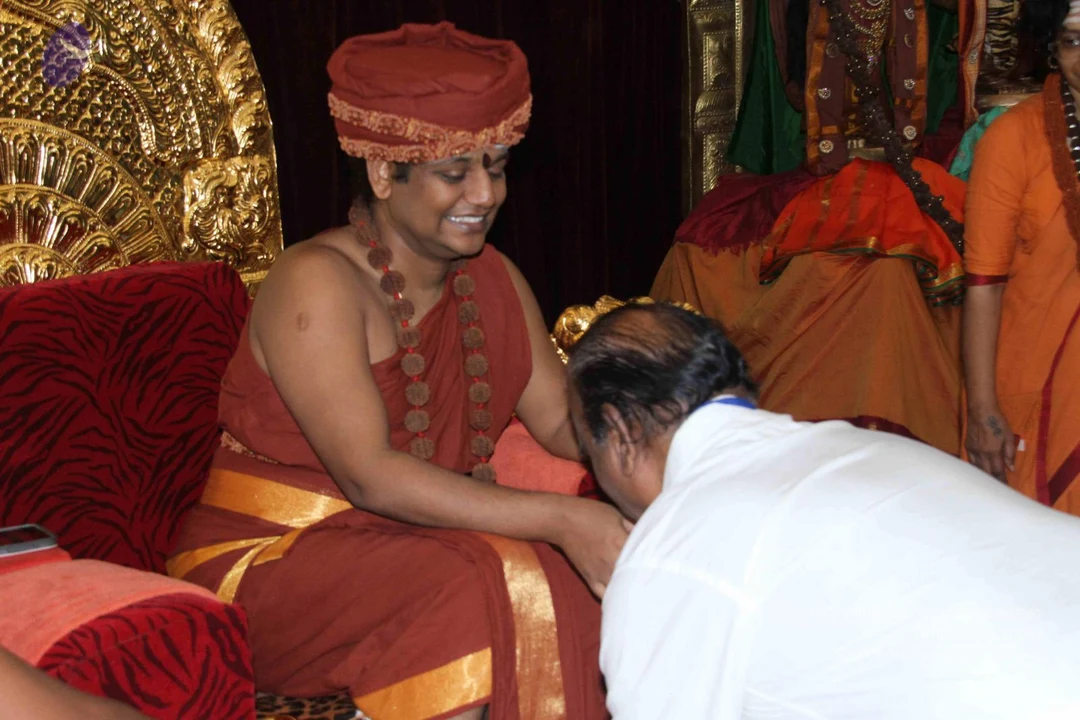
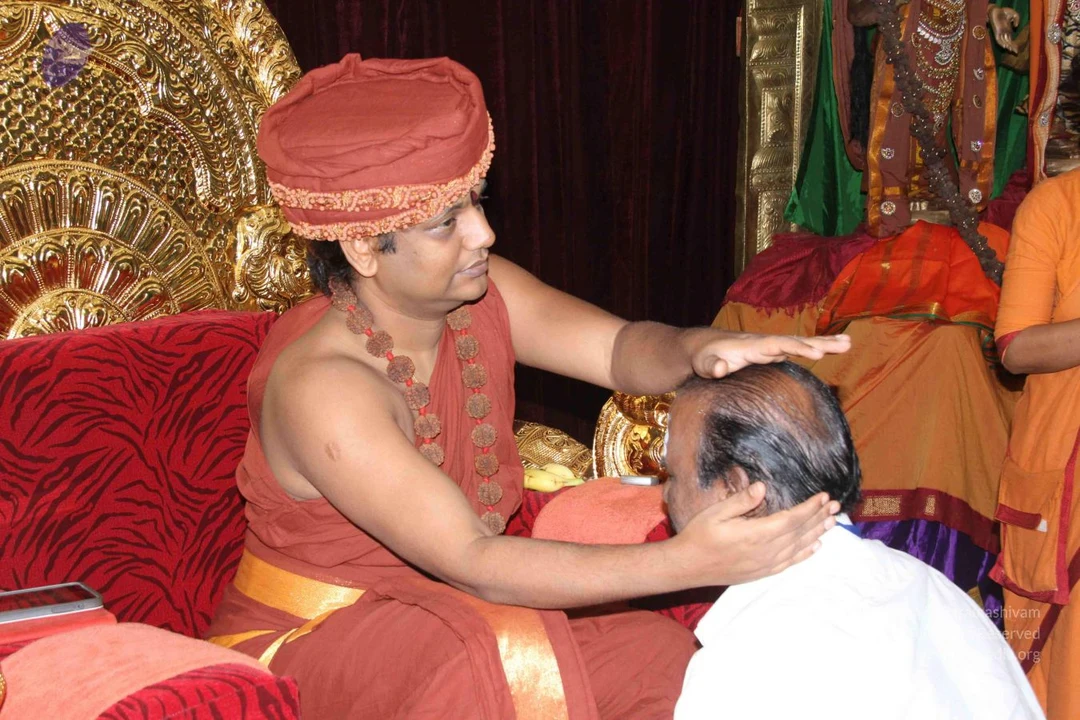
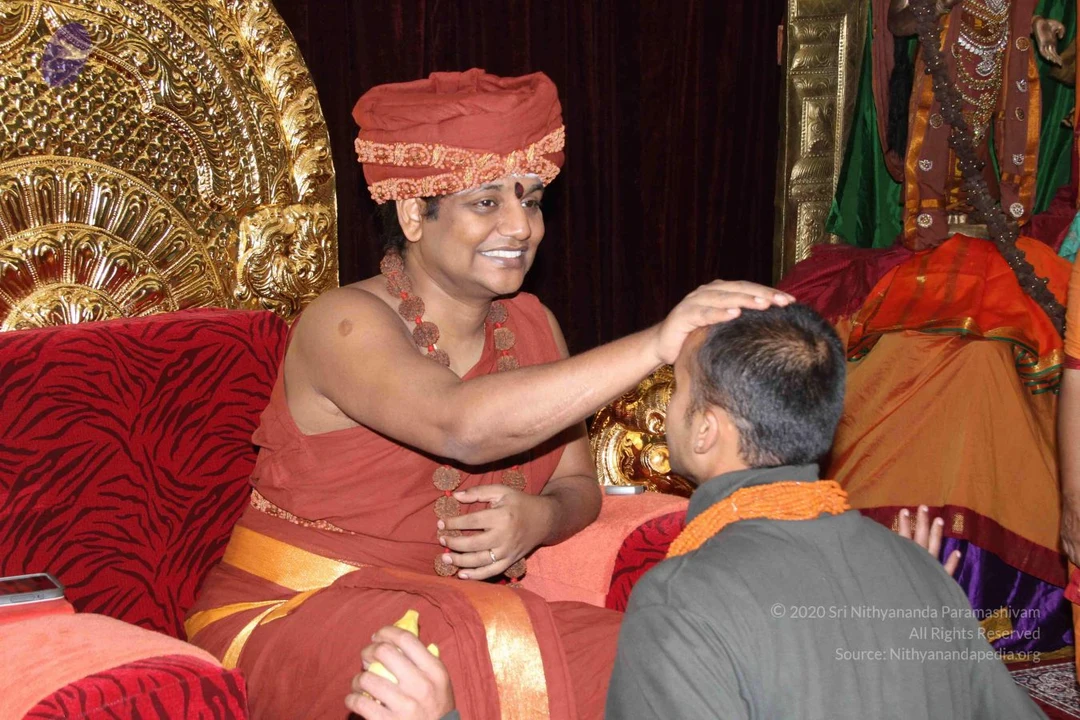
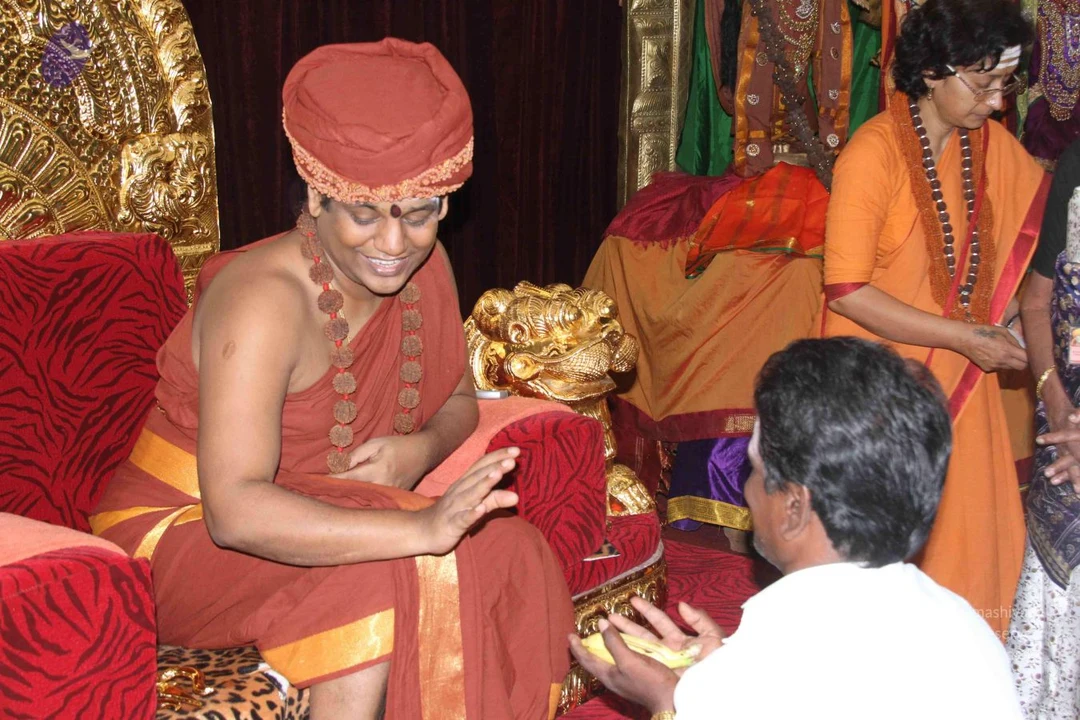
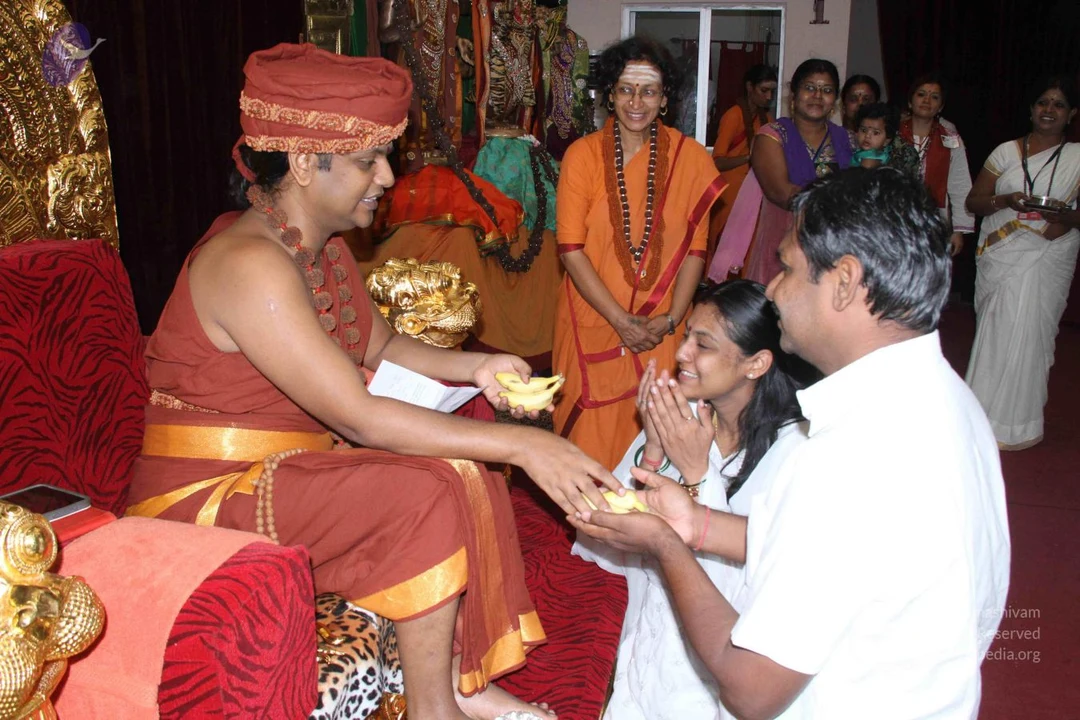
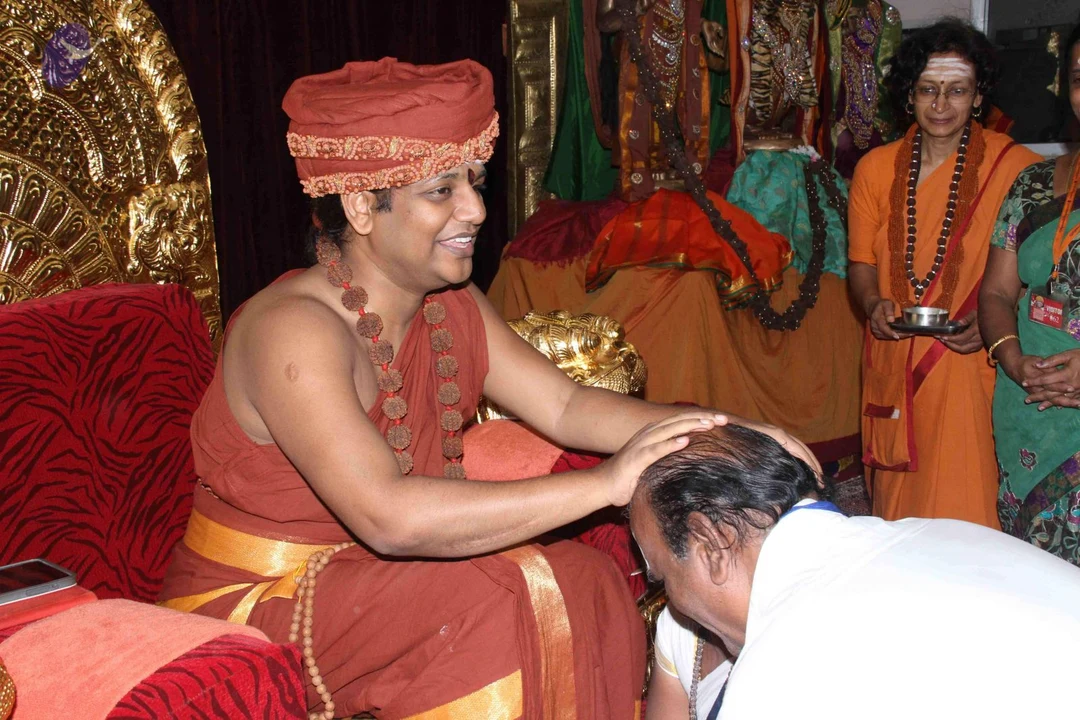
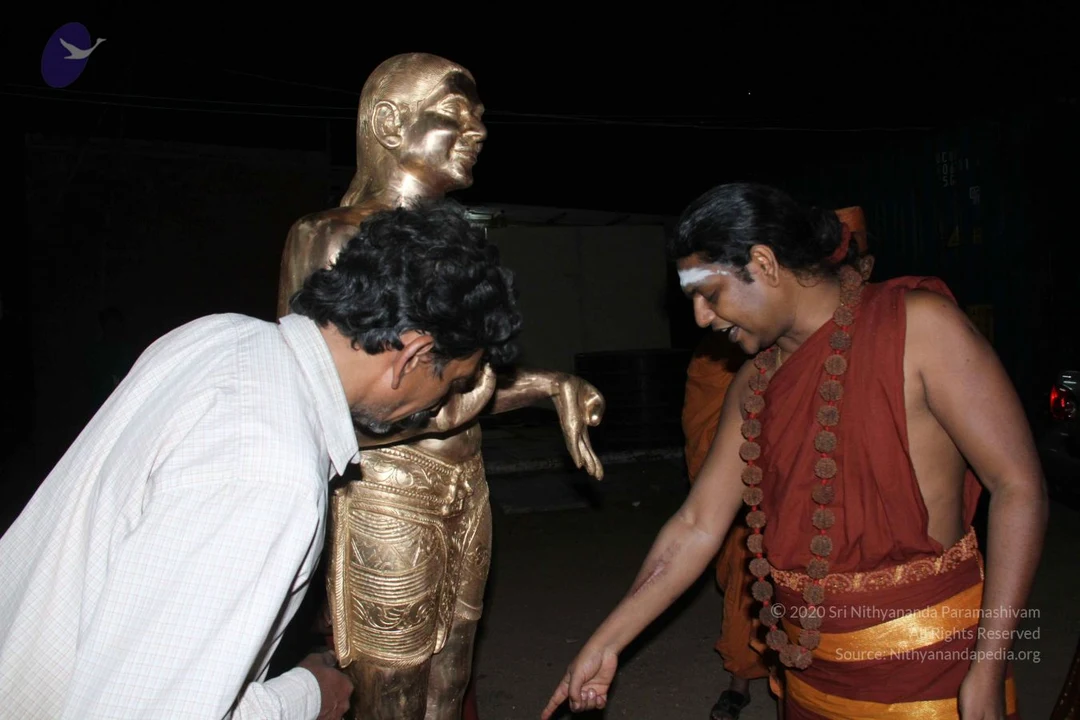
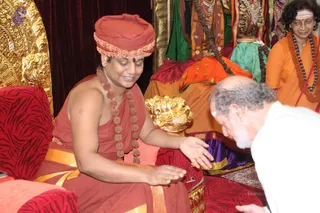
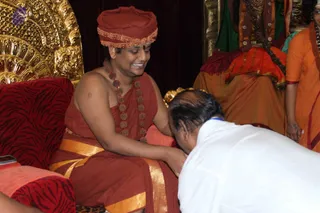
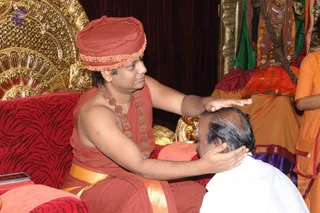
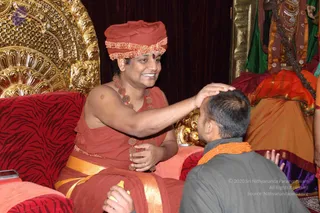
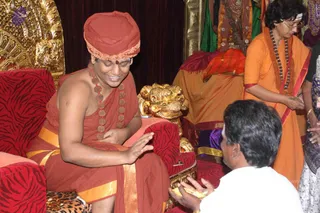
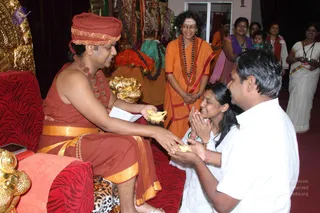
A seated person in a rust-red saffron robe and matching turban with a red bindi sits on a red zebra-striped cushioned seat in front of a gold-framed backdrop and hanging colourful silk garments. A rudraksha mala of large beads hangs on the chest and a gold-decorated lion-headed arm of the seat is visible. A bald, grey-bearded man in a white shirt leans forward and extends his hand toward the seated figure, while a woman in orange robes with a rudraksha mala stands at right. Appearance cues (turban, rudraksha mala, saffron robes) match a person, though the presentation is not fully certain; he is seated in an honoured position receiving a visitor's gesture. Three physical people are visible.A seated man in a maroon-red robe with gold-edged border and a maroon turban with gold trim sits on a red and black tiger-striped cushioned seat, smiling as he looks down. He wears a long necklace of large rudraksha-style beads. In front of him, a man in a white shirt bends forward to touch his feet, with his head bowed to the seated man's hand. Behind them stands an ornate gold throne-like backrest and a deity murti draped in red and orange cloth, with a woman in orange clothing at the right edge.A photograph of a seated man in a red-maroon turban and maroon-saffron robe wearing a multi-strand rudraksha mala, placing both hands on the head of a kneeling older man in a white shirt who bows forward with his eyes closed. The seated man sits on a red tiger-striped cushioned seat in front of an ornate gold throne-like backdrop; to the right are draped orange, green and red cloths, a brass vessel with fruit, and a standing person in orange. The gesture suggests blessing or initiation at a ritual setting.A seated man in a rust-red turban with gold border and red-brown robes sits on a red zebra-striped cushioned seat in front of an ornate gold-embossed backdrop. He smiles while resting his right hand on the head of a kneeling man in a grey jacket with an orange flower garland. Behind them, a deity murti in orange and green draped cloth stands with a rudraksha-style mala visible, and a golden peetha and red-and-orange cloth are arranged on the right. The scene shows a blessing given to a devotee. A probable Swamiji figure with a rudraksha mala and red turban is present, though the appearance cues are only partially distinctive.A photograph of a seated man in a red-maroon robe with gold-edged border and a matching maroon turban with gold trim, wearing a long necklace of rudraksha-style beads and gold medallions and a red bindi, smiling and gesturing with one hand toward a kneeling man in a white shirt who holds a small gold-colored offering. He sits on a red and gold upholstered throne with a gilded lion-head armrest and a leopard-print cloth beneath. Behind him a woman in orange sari with a beaded mala waits to the side, and gold-framed ornate hangings and draped fabrics in green, purple and orange fill the background. The man in the throne has appearance cues consistent with the page's identification, but this is uncertain, so he is described by role as a seated teacher receiving a devotee.Indoor darshan scene in an ashram hall with a gold-trimmed red throne covered in zebra-print cushions. A man in rust-red robes with a gold waist sash, a rust-red turban, layered beaded necklaces and rudraksha malas sits on the throne, holding bananas and a folded paper toward two devotees kneeling before him. A woman in a white dress with folded hands smiles, and a man in a white shirt bends forward to receive the fruit. Behind them, a woman in orange robes with a rudraksha mala and tripundra marks stands with hands folded, and several women in saris and salwar, one holding a small child, watch. A golden lion-like figure and draped deity murti fabrics fill the background. The central figure has distinctive presentation cues, so this is a person seated in a throne-like setting in person.

SWAMI-NARAYANA-SWAMI'S-VISITING-ADHEENAM

13 photosSource gallery
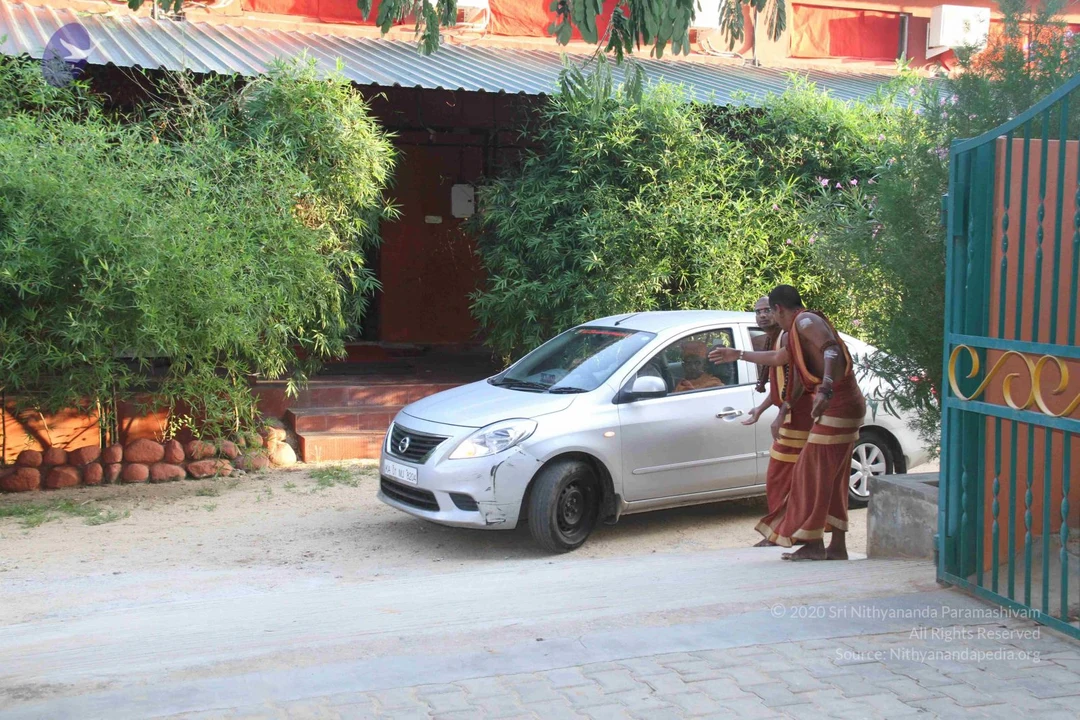
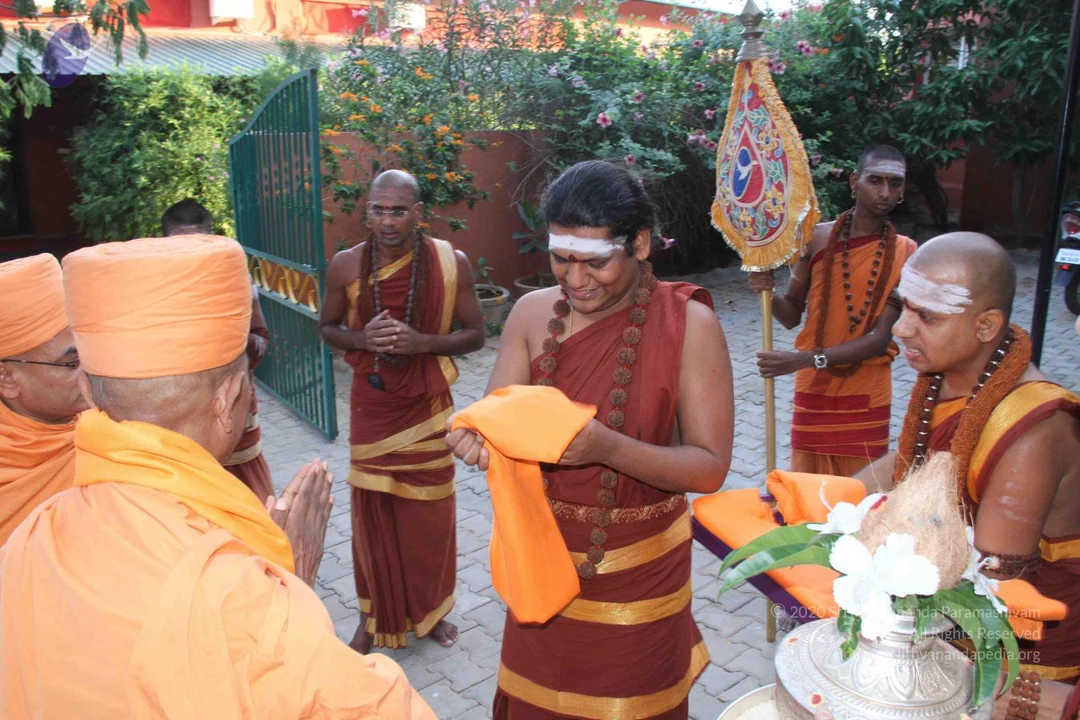
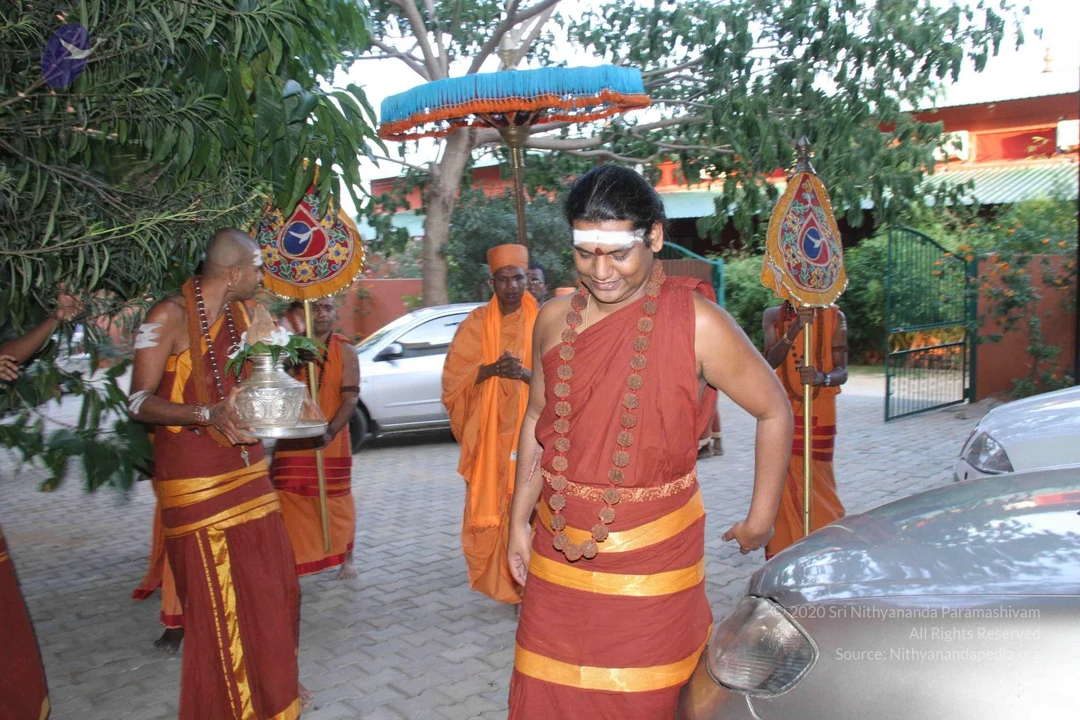
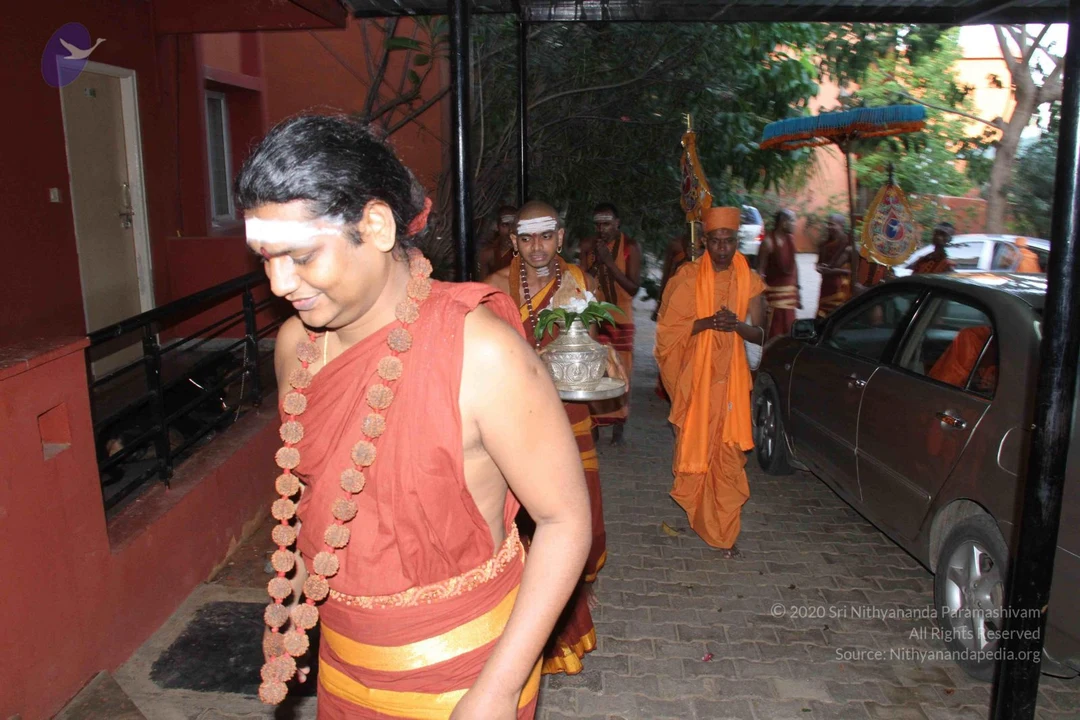
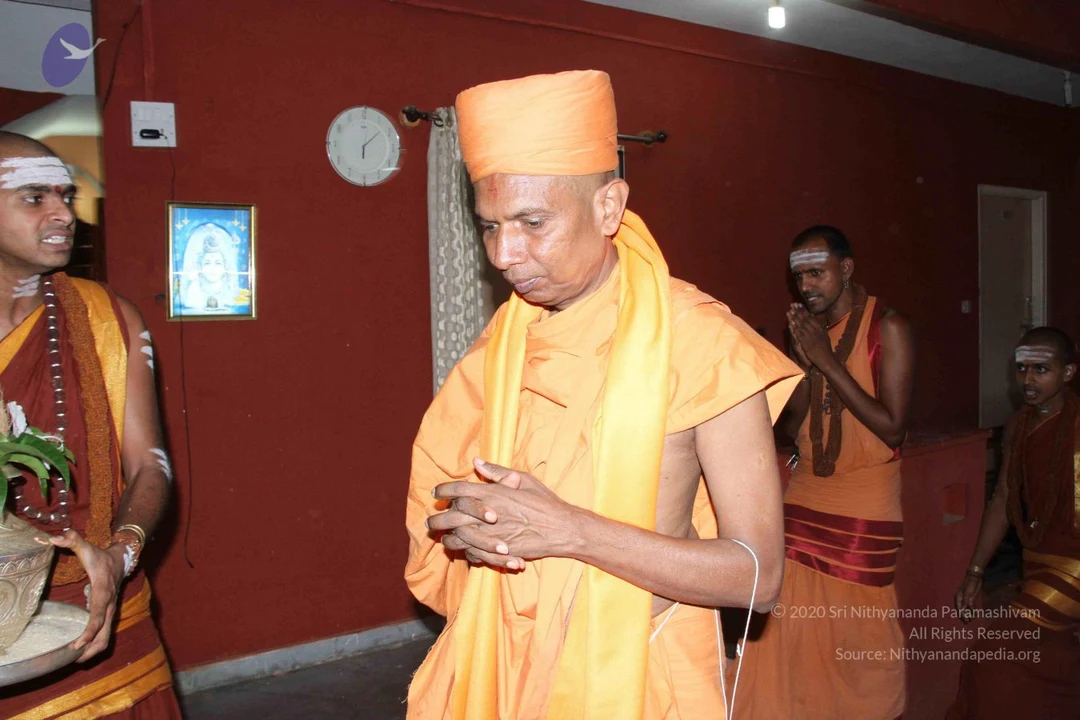
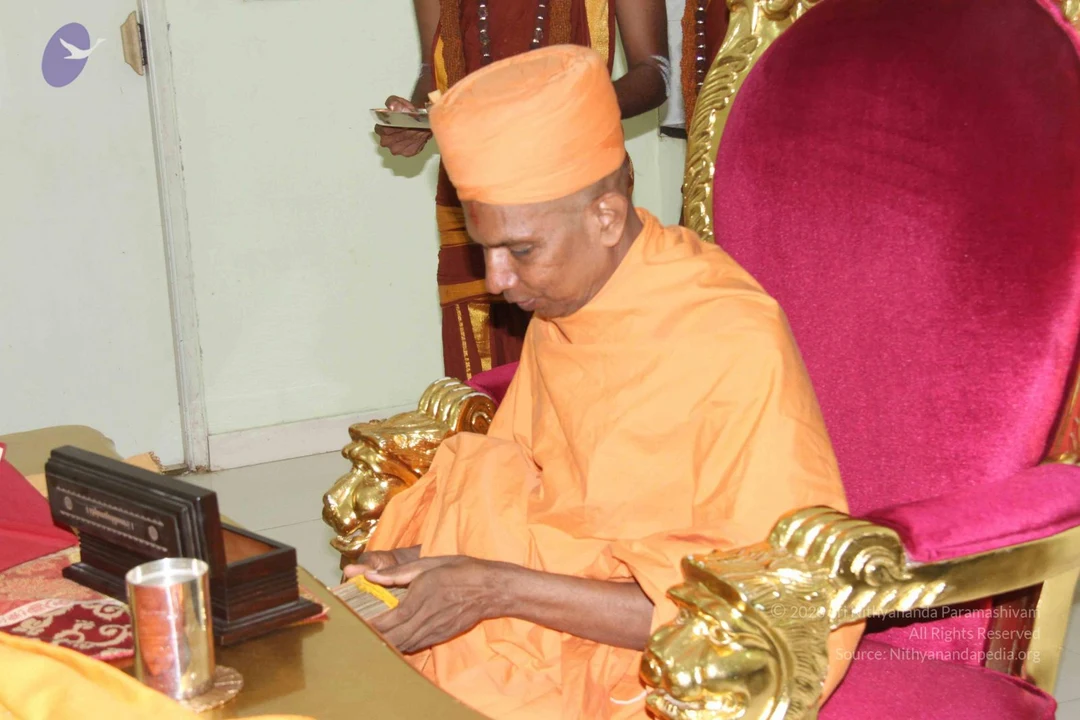
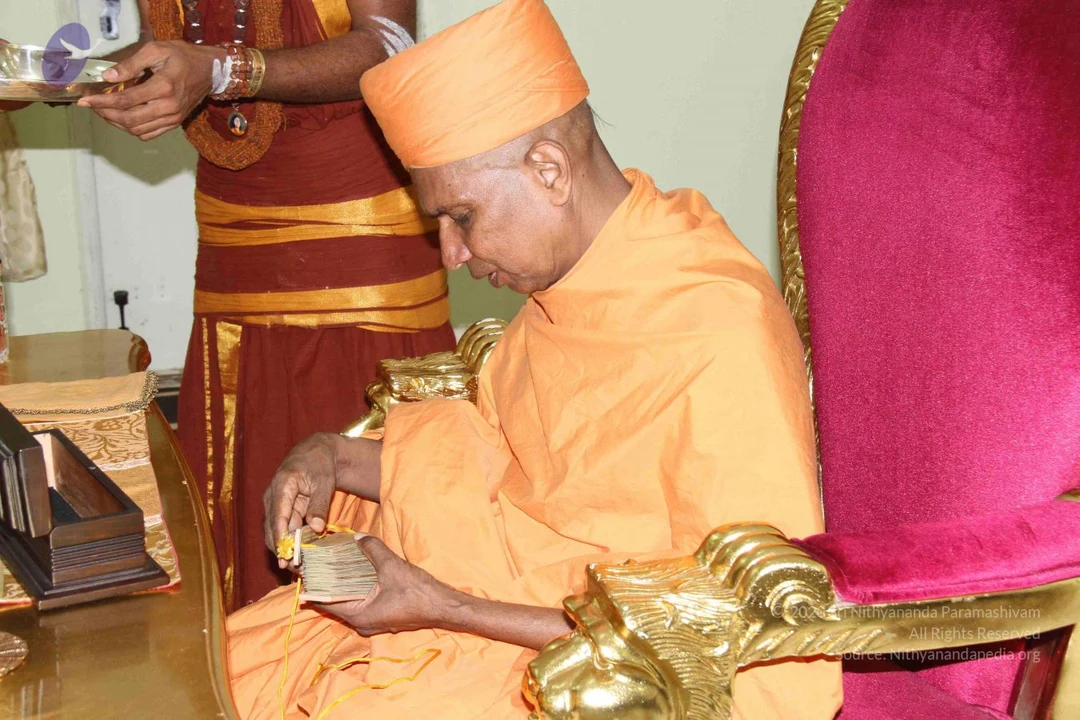
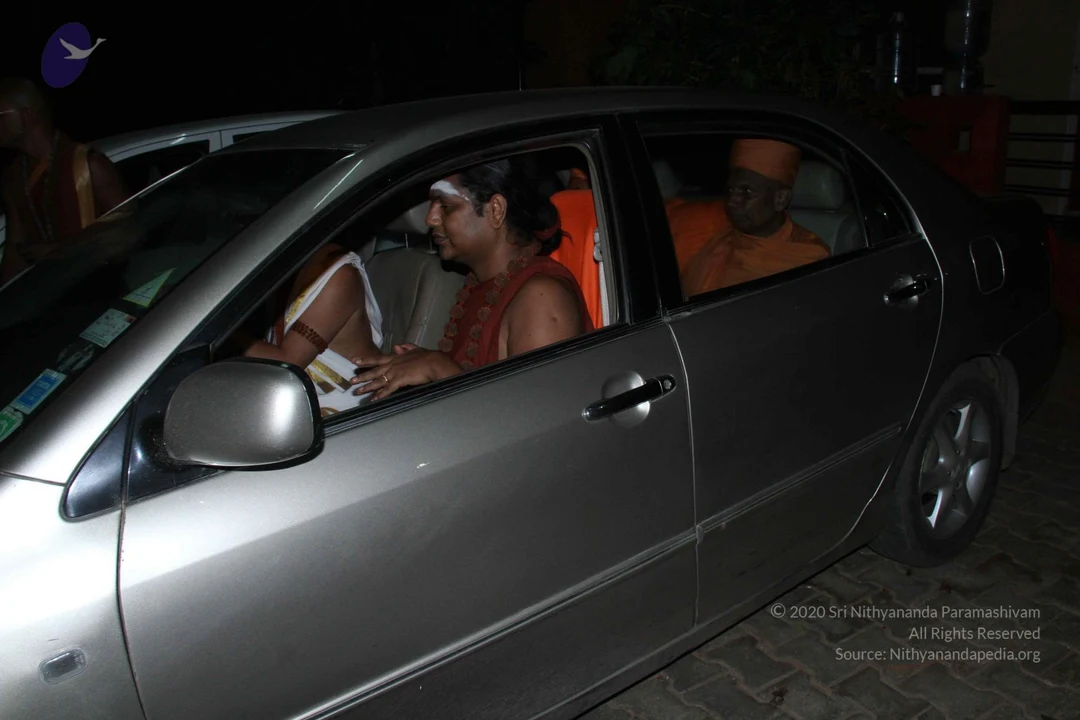
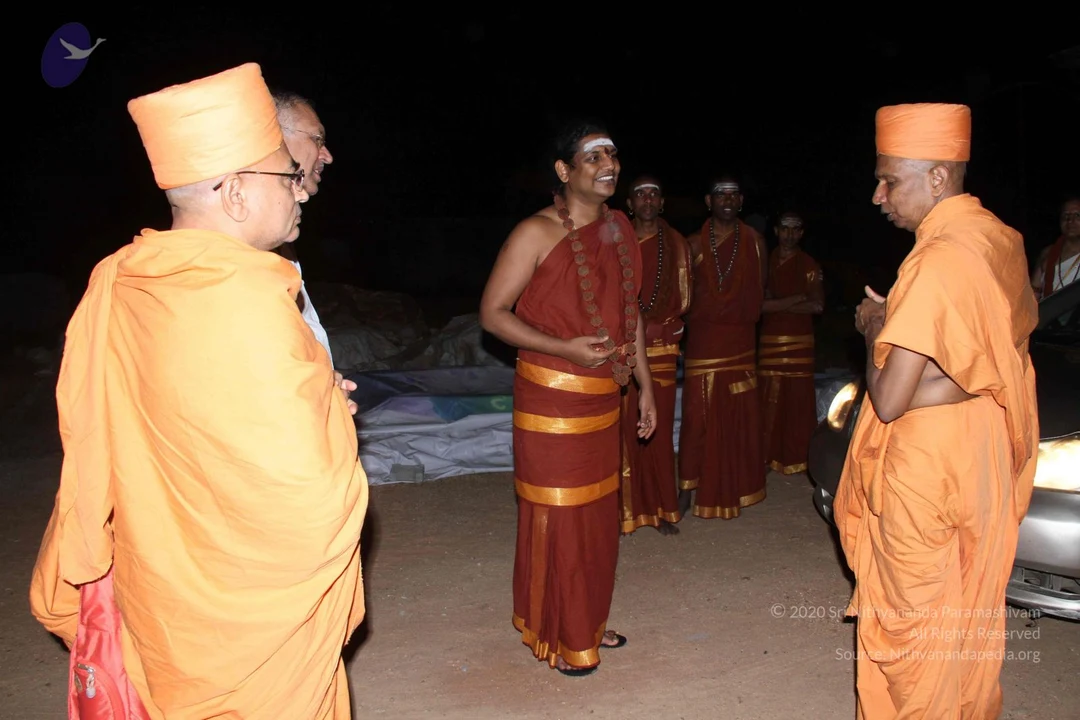
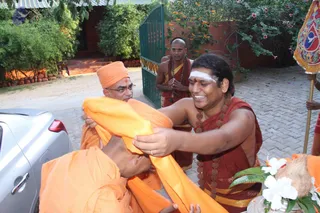
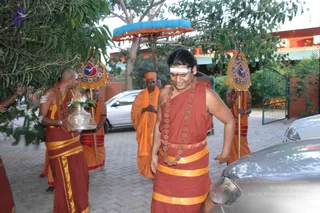
A photograph of a silver sedan parked on a sandy driveway beside a red-brick building with a red doorway, framed by green shrubs and a low stone wall. Two men in reddish-brown and gold-bordered traditional dhoti-style garments stand near the car's front passenger side; one points toward the open rear window where a person in orange clothing sits inside. A teal gate with gold scrollwork is at the right edge. Two people are visible outside the car, and one seated occupant is visible through the window.Outdoor photo on a paved courtyard beside a silver car and a green gate. Two monks in saffron-orange turbans and robes stand at left; the one in the centre wears glasses and is handing a saffron cloth. A third man in red-orange cloth with a rudraksha mala and a tilak stands behind, and a woman in a red-orange wrap with a red hair ribbon and a long necklace holds the cloth's end, with a silver tray of white flowers, a coconut and leaves in the foreground. Red-orange wall and potted plants behind. Hindu ritual exchange. a person appearance is uncertain, so no identity is asserted.Outdoor photo at an ashram gate beside a silver car. A smiling man in a deep red-maroon robe with a gold border and a white tilak across his forehead, wearing layered rudraksha malas, holds an orange saffron shawl open and drapes it over the bowed head of an older man in orange robes and an orange turban, who wears glasses. A bald attendant in an orange-and-red robe with rudraksha malas stands with hands folded behind them, and another person stands by the green gate. Pink and orange flowers and green shrubs surround the courtyard. A tray with white flowers, a coconut and orange cloth sits in the lower right, and a decorated ceremonial banner with a fringe is at the right edge. The smiling man in red is a person candidate given his rudraksha malas, white tilak and red robe, though this is uncertain.Outdoor photo of a ceremonial welcome on a paved courtyard in front of a green metal gate and flowering shrubs. A man with long swept-back hair, wearing a red-brown dhoti and sleeveless top, a rudraksha mala and a gold-coloured ornamental necklace, stands centre-frame smiling as he receives an orange cloth. Around him, saffron-clad sannyasis with shaved heads and white tilak marks stand with hands folded or hold a saffron-and-blue pennant on a tall pole. A silver-rimmed vessel holds white flowers and a coconut, and an orange-draped table with a rudraksha mala sits at right. The setting suggests a formal reception or puja welcome.Outdoors on a paved courtyard beside a green metal gate and a white car, a man with long dark hair, a white tilak on his forehead, a red-maroon robe and a rudraksha mala places an orange shawl on the shoulders of a man in orange robes and an orange turban, who holds his hands folded in namaste and a small red booklet. Behind them another man in maroon robes and a mala stands near a bald man in an orange-banded robe, with orange flowering shrubs and a red wall in the background. The scene reads as a greeting or honouring of the orange-clad man.Outdoor photograph of a procession on a paved courtyard beside parked silver cars and a red-walled building. A man in the centre wears a red-maroon dhoti-style garment with an orange-gold sash and a long necklace of rudraksha-style beads, with a white band across his forehead; he walks forward with a slight smile and his eyes lowered. Behind him, a man in an orange robe holds his hands together in greeting. At left, a shaved-headed attendant in red-maroon and gold cloth carries a silver vessel with green leaves. Two attendants in orange-gold hold ornate embroidered standards topped with a blue-fringed canopy above. Mango-like foliage frames the upper left corner. The procession suggests a formal ceremonial escort.

SWAMI-NARAYANAN-SWAMI'S-VISITING-SACRED-ARTS-ALONG-WITH-SWAMIJI

20 photosSource gallery
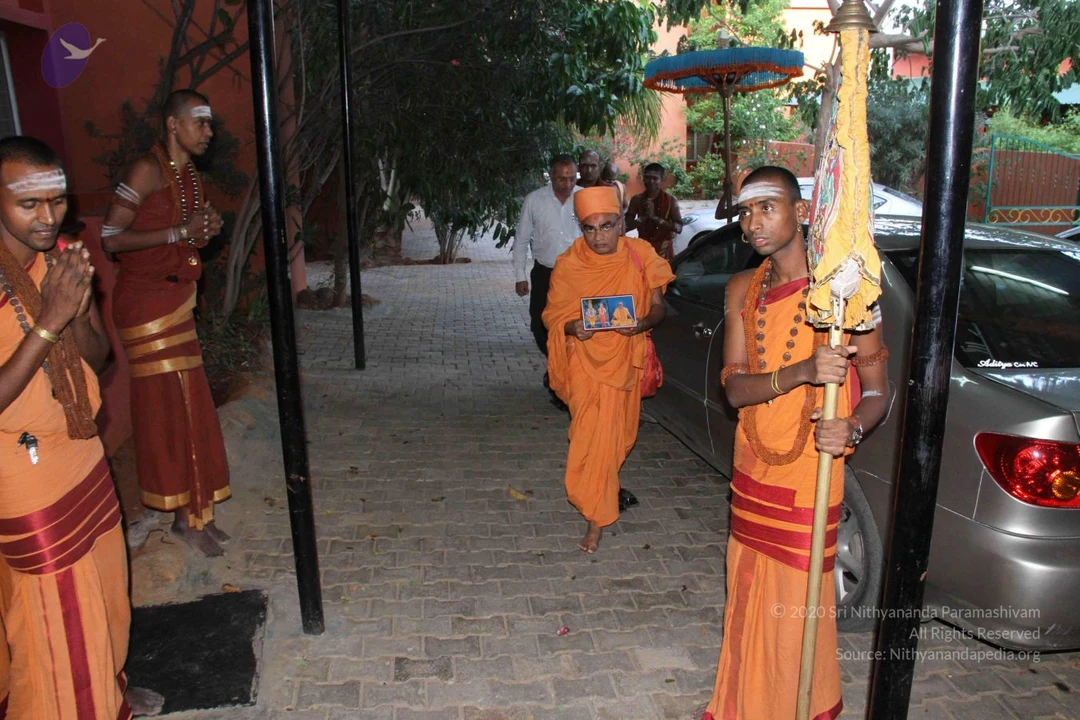
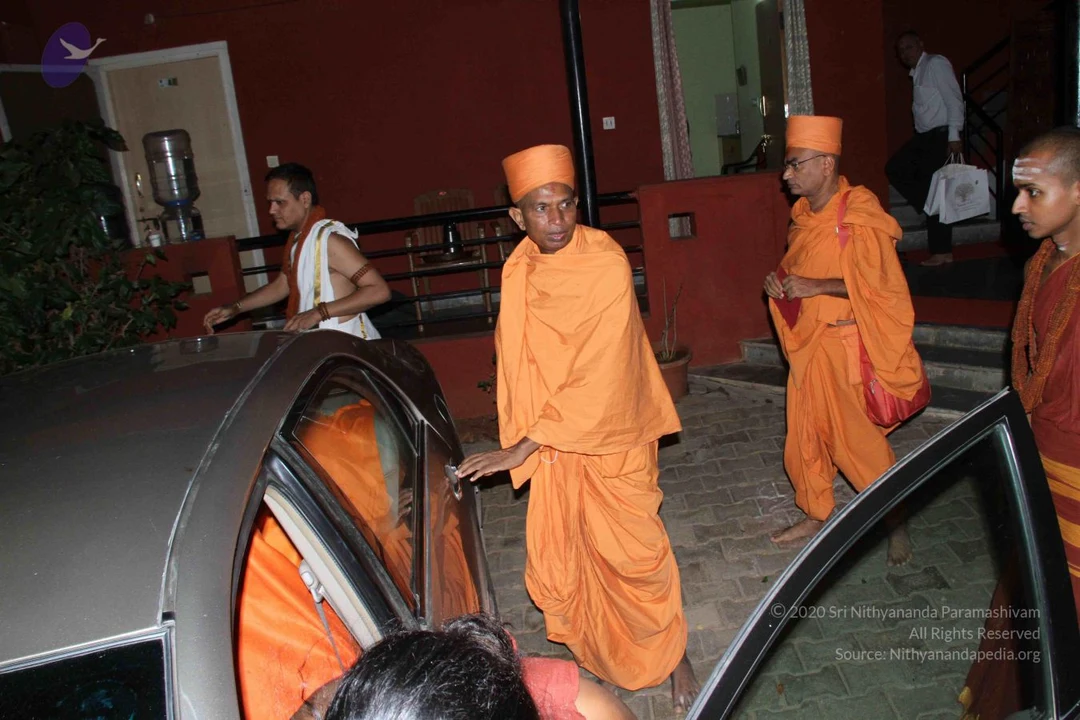
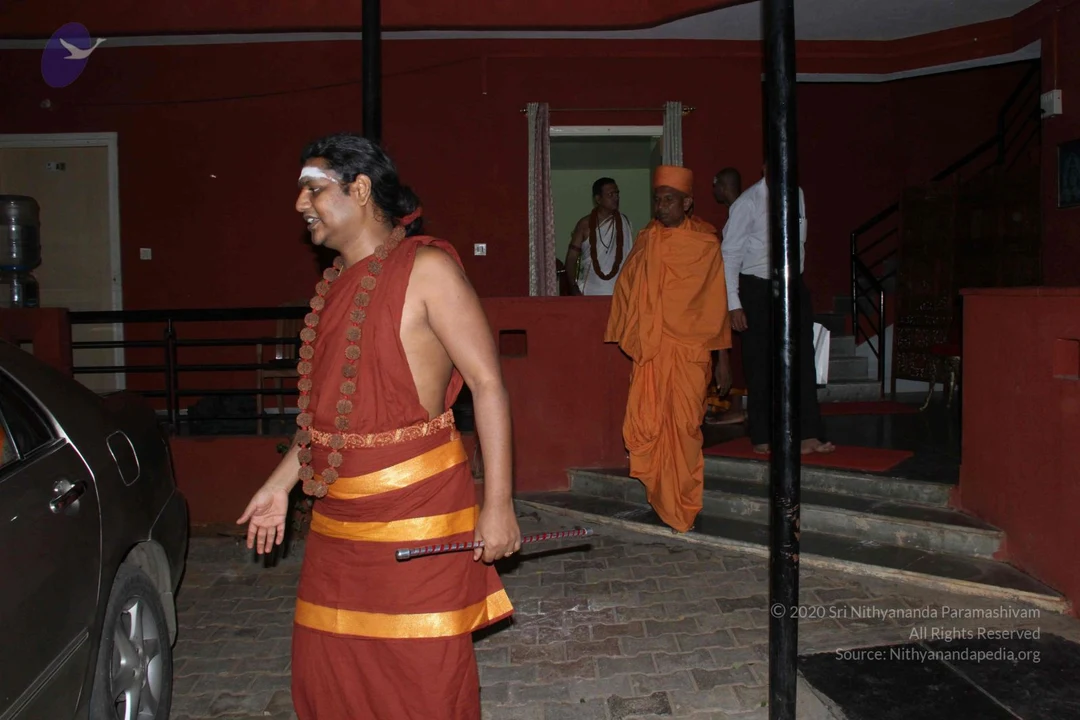
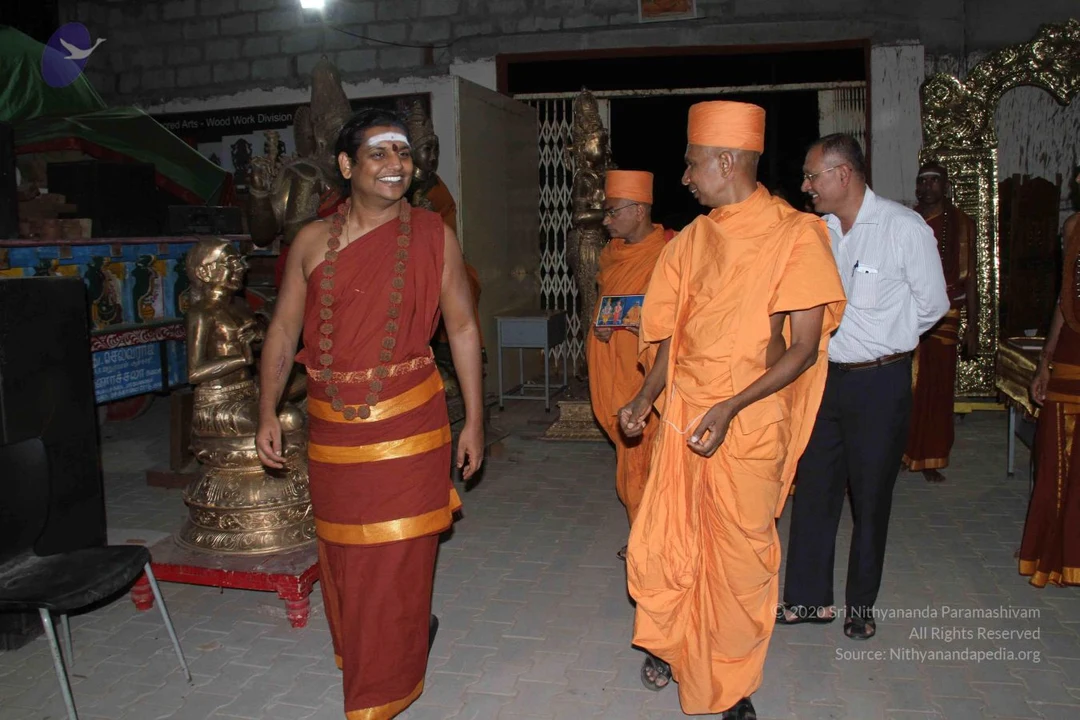
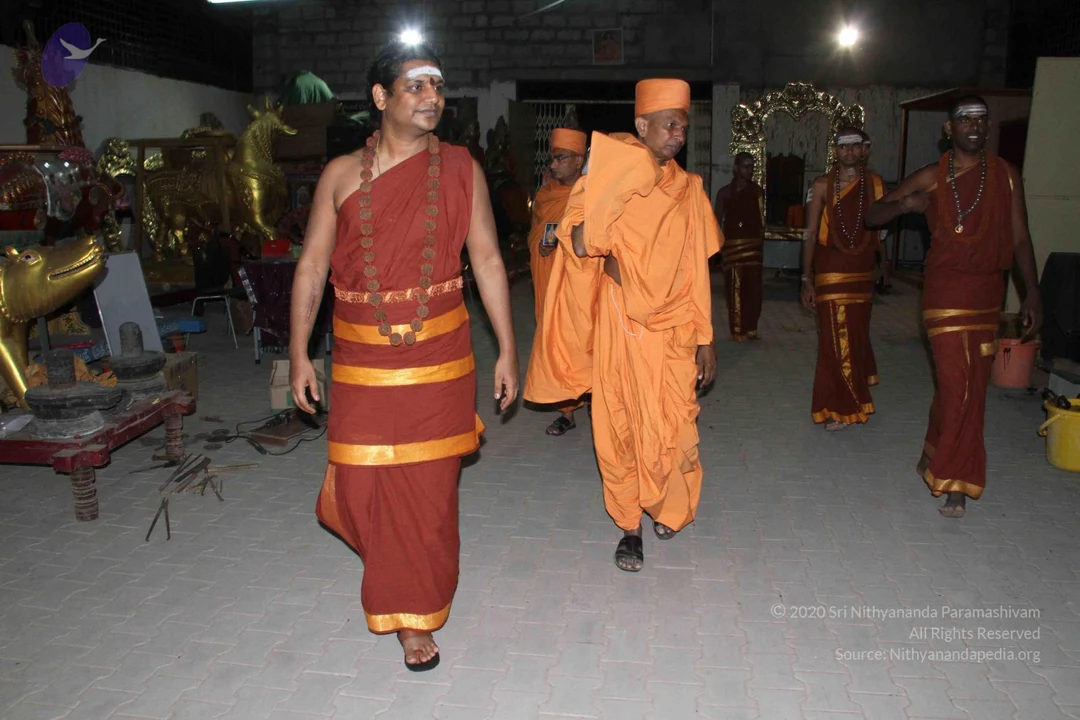
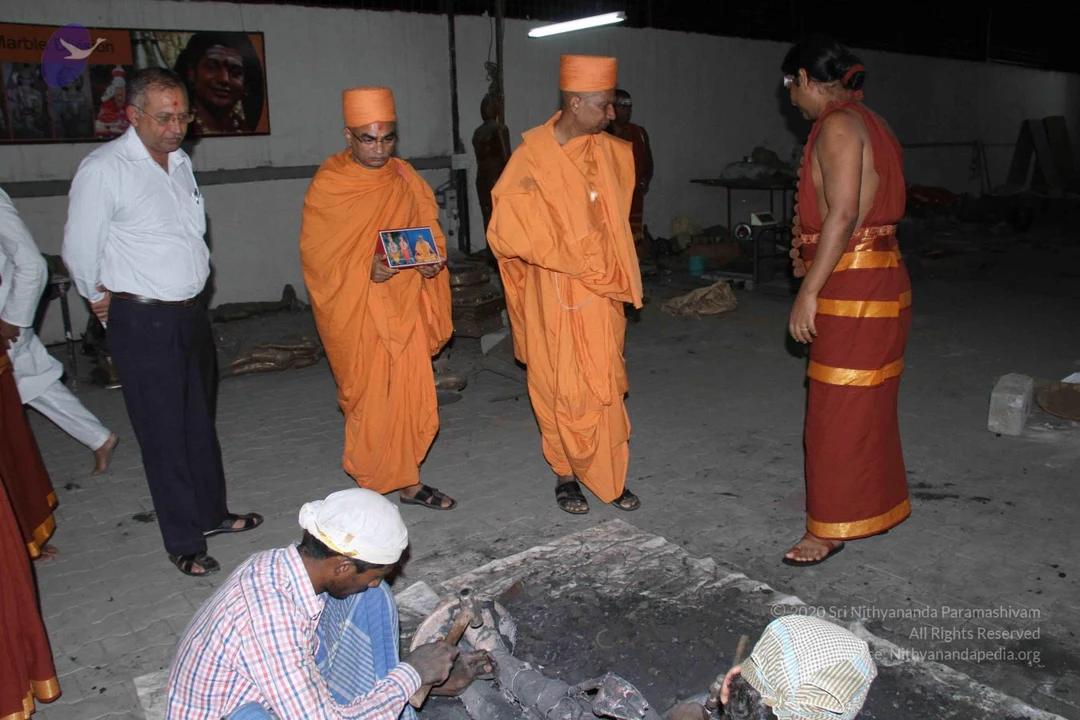
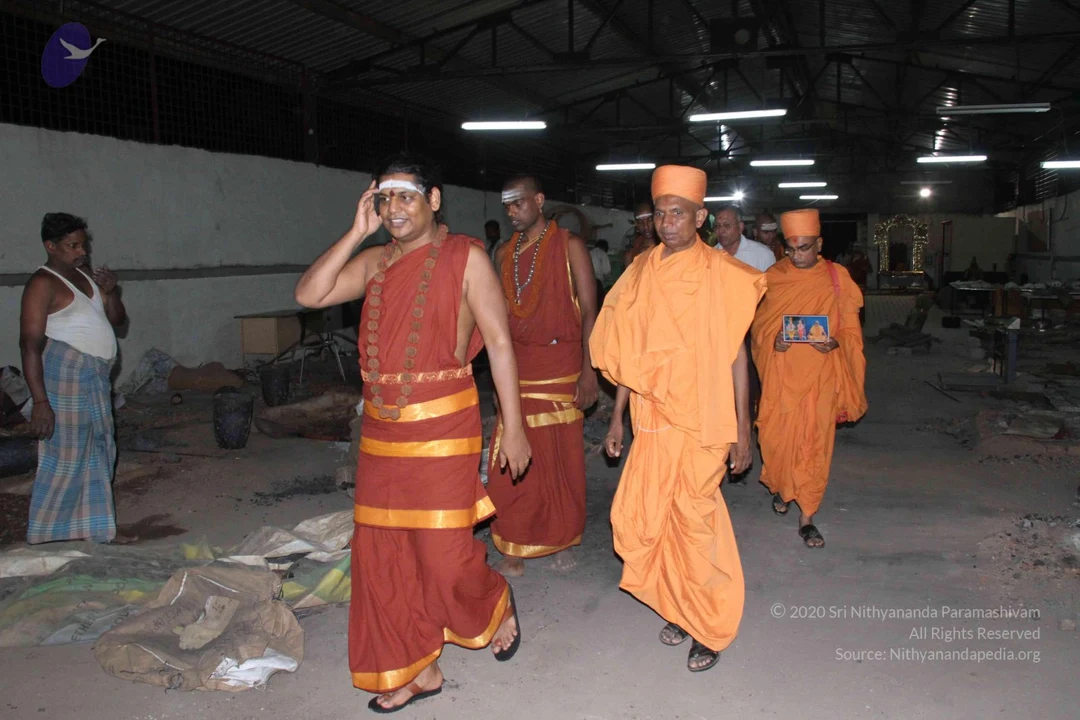
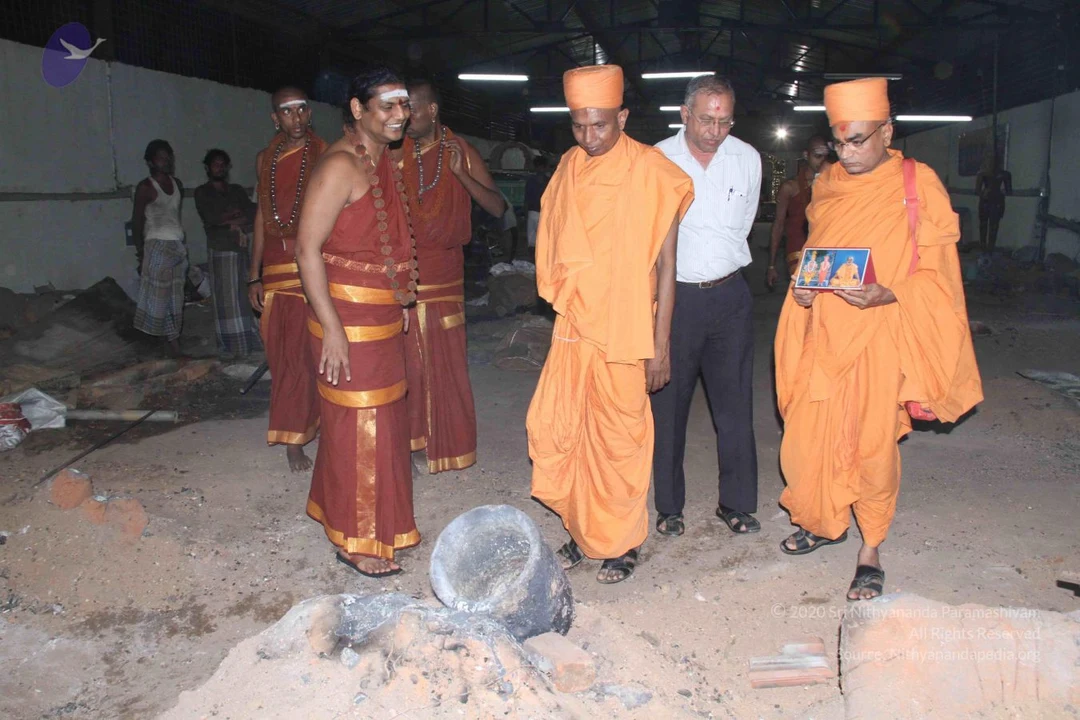
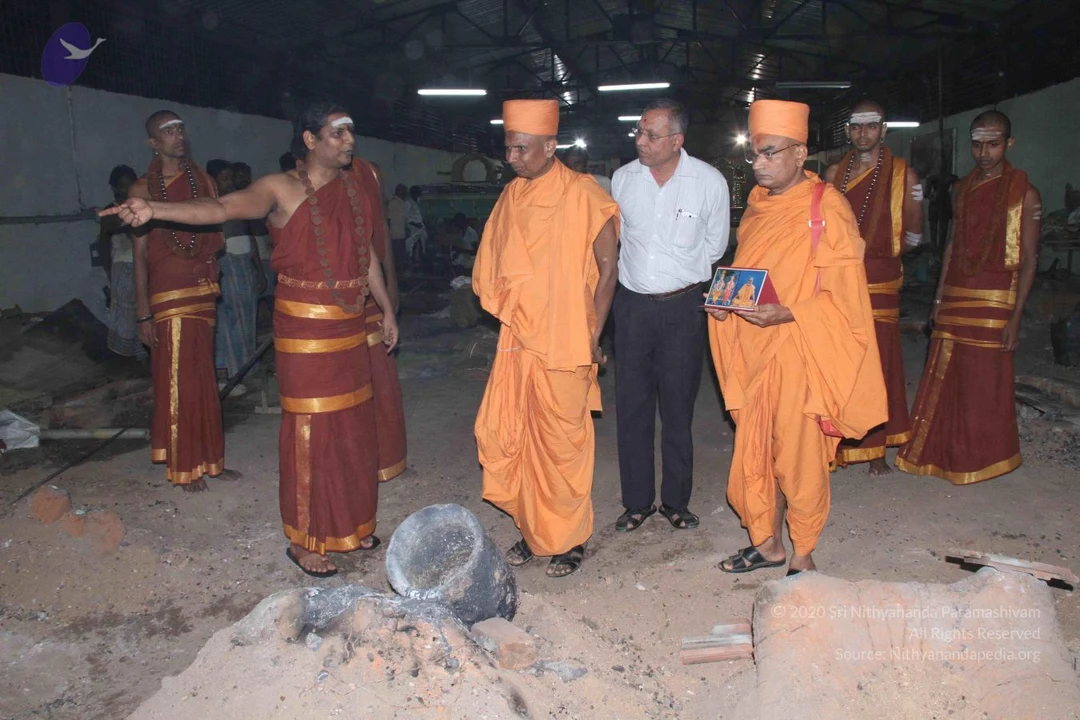
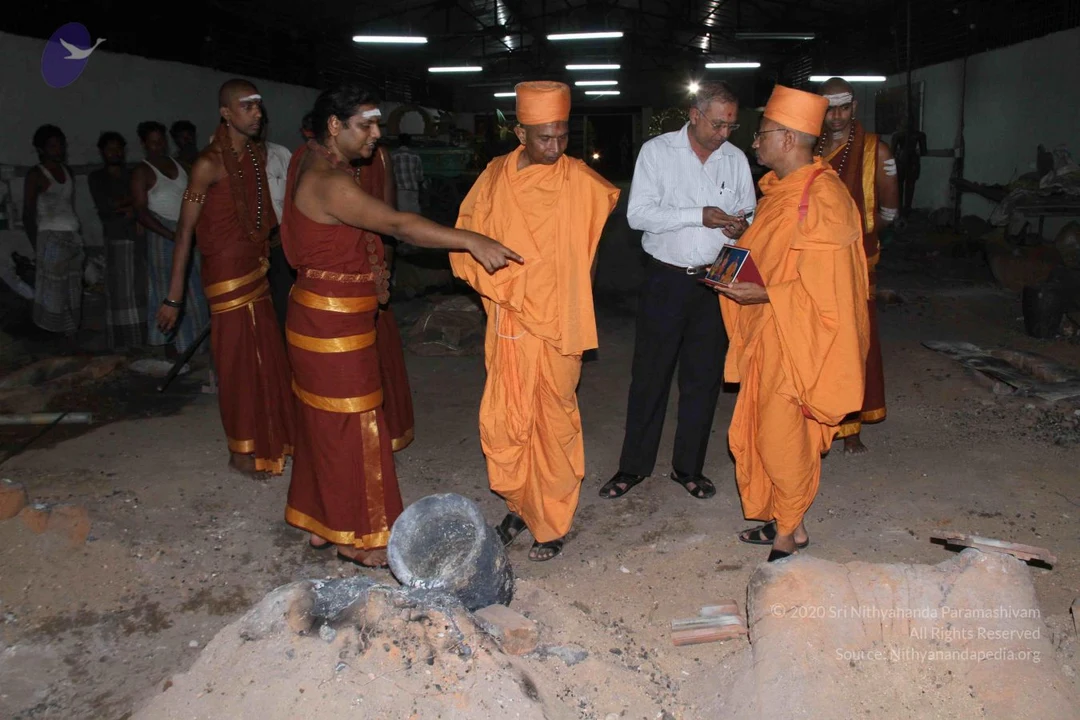
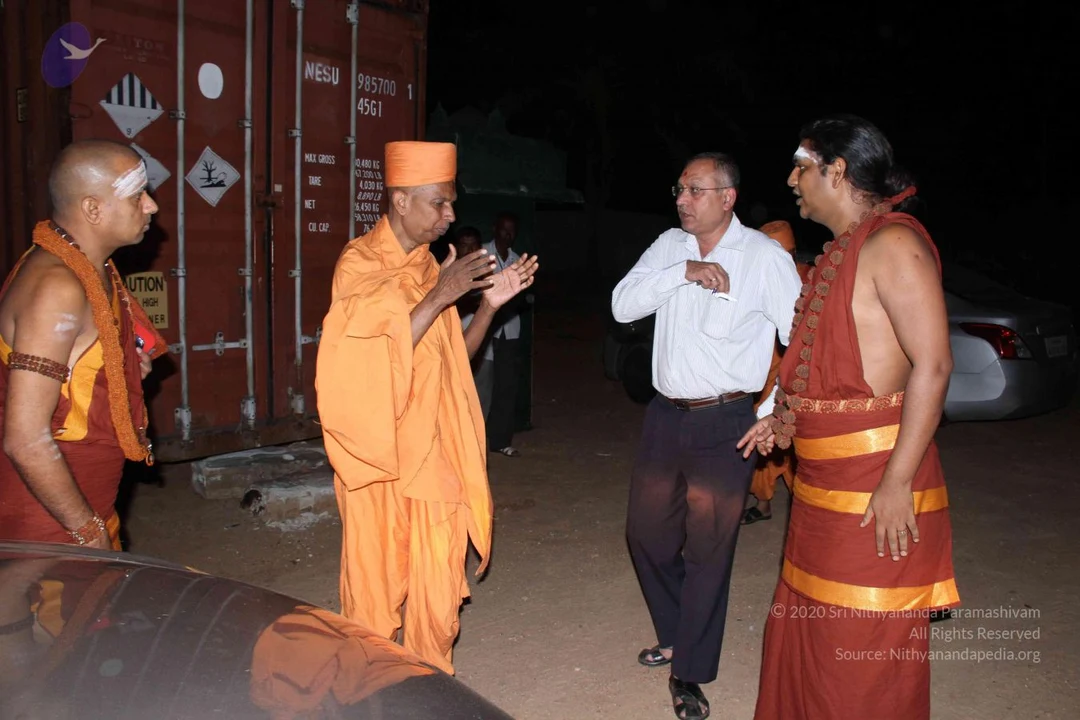
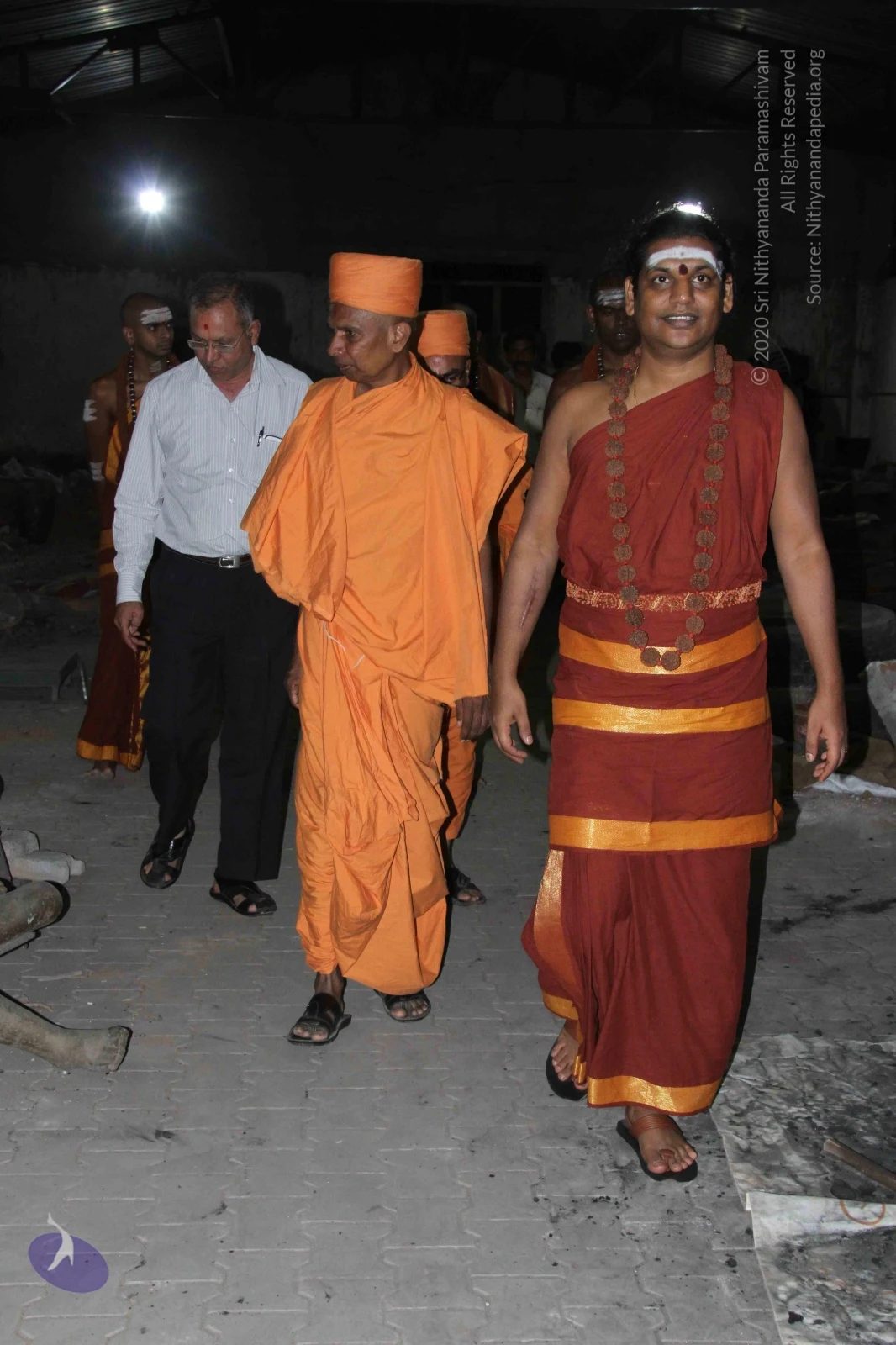
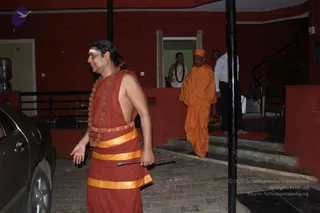
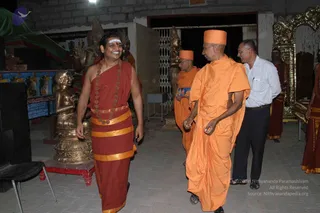
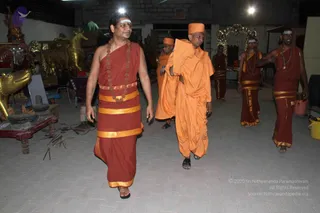
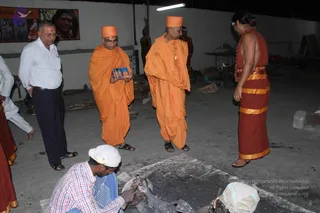
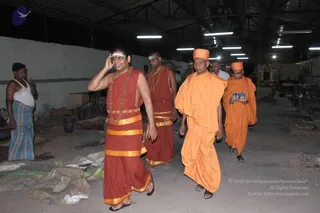
Photograph of an evening scene at a red-walled building entrance beside a parked dark car. In the foreground a man with long dark hair swept back, a white forehead mark, rudraksha mala necklaces and a maroon-red wrap with gold-yellow bands walks with a short dark rod in his right hand. Behind him a man in an orange saffron robe and orange cap descends stairs, while another man in white clothes stands in a doorway and a man in white shirt and dark trousers stands near the staircase. The wall is red with black metal railings and a water cooler at left.A night photograph taken through the open windows of a silver-grey sedan parked on a paved driveway. In the driver's seat a man with long dark hair tied back, a white tilak on his forehead, a rust-red shawl and a beaded necklace sits with his hands resting on the steering wheel area. In the back seat a man in an orange robe and orange head covering sits by the window, and a person in white clothing with a gold-bordered cloth is partly visible beside the driver. Another figure in orange stands at the far left edge outside the car. Trees and a red wall appear in the background.Indoor photograph in a hall with a tiled floor and a wall sign reading "Wood Work Division" behind a display of golden deity sculptures and a large gilt mirror frame. A smiling man on the left wears a white tilak, a rudraksha mala, and a red dhoti-style garment with a gold-bordered sash. Beside him, a saffron-robed sannyasi with a saffron head wrap and smiling expression walks alongside another saffron-robed monk holding a small book. On the right, a man in a white shirt and dark trousers stands behind them, and a figure in red robes appears at the far right edge. The people are walking together past the sculptures.A photograph of several men walking across a paved hall at night, lit by overhead lamps. In the foreground at left, a man in a maroon-red dhoti and shawl with gold borders, a rudraksha mala and a white tripundra on his forehead, walks beside an older man in saffron-orange robes and a saffron head cloth with bare feet in sandals. Behind them, men in maroon and saffron robes walk in a line, one with a rudraksha mala. At left, a golden bull statue, a gilded ornamental frame and a stone shivalinga sit on a red table, with a gold chariot-like object in the background.A night-time photograph at an outdoor sculpture workshop. Two men in saffron-orange robes and matching orange head wraps stand on the paved ground; one holds a small framed colour photograph showing figures in orange. A man in a white shirt and dark trousers stands at left, and a woman in a red-and-gold bordered sari stands at right, facing the robed men. In the foreground, two workers crouch beside a fire or carving area with metal tools, one in a white head cloth and checked shirt. A dark wall behind holds a large colour poster of deities and a bearded figure in orange, with a marble-works logo at upper left. Scattered stone and tools fill the background.Photograph inside a large, bare warehouse-style hall with a corrugated metal roof and fluorescent tubes, the floor littered with sacks and debris. Four men walk in a line. The front figure in a rust-red dhoti-style wrap with gold-bordered cloth, a gold-bordered sash and a long beaded mala, a white forehead band, raises one hand to his head. Behind him a man in a rust-red wrap with gold borders and a rudraksha-style mala walks with a tilak. Two monks in saffron-orange robes and orange caps walk on the right; the nearer one holds a framed picture of deity figures. A bare-chested man in a white vest and checked lungi stands at left. A small ornate golden shrine or altar sits at the back right. a person candidate in saffron-clad rear figure is not clearly identifiable from appearance.

Nithya-Satsang

4 photosSource gallery
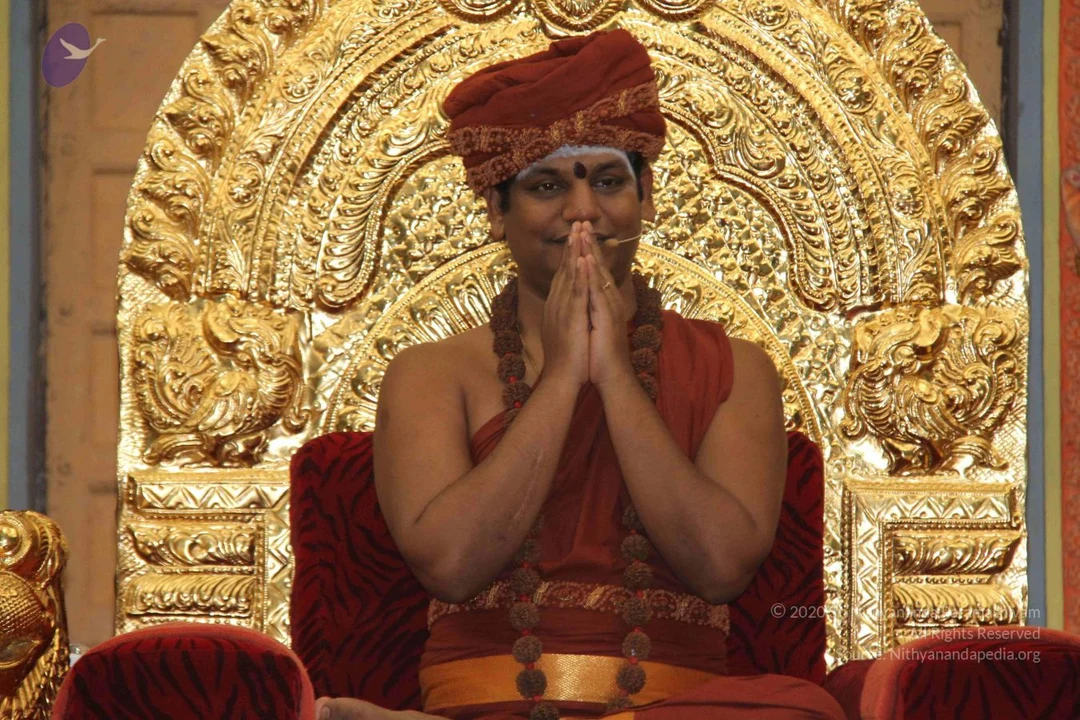
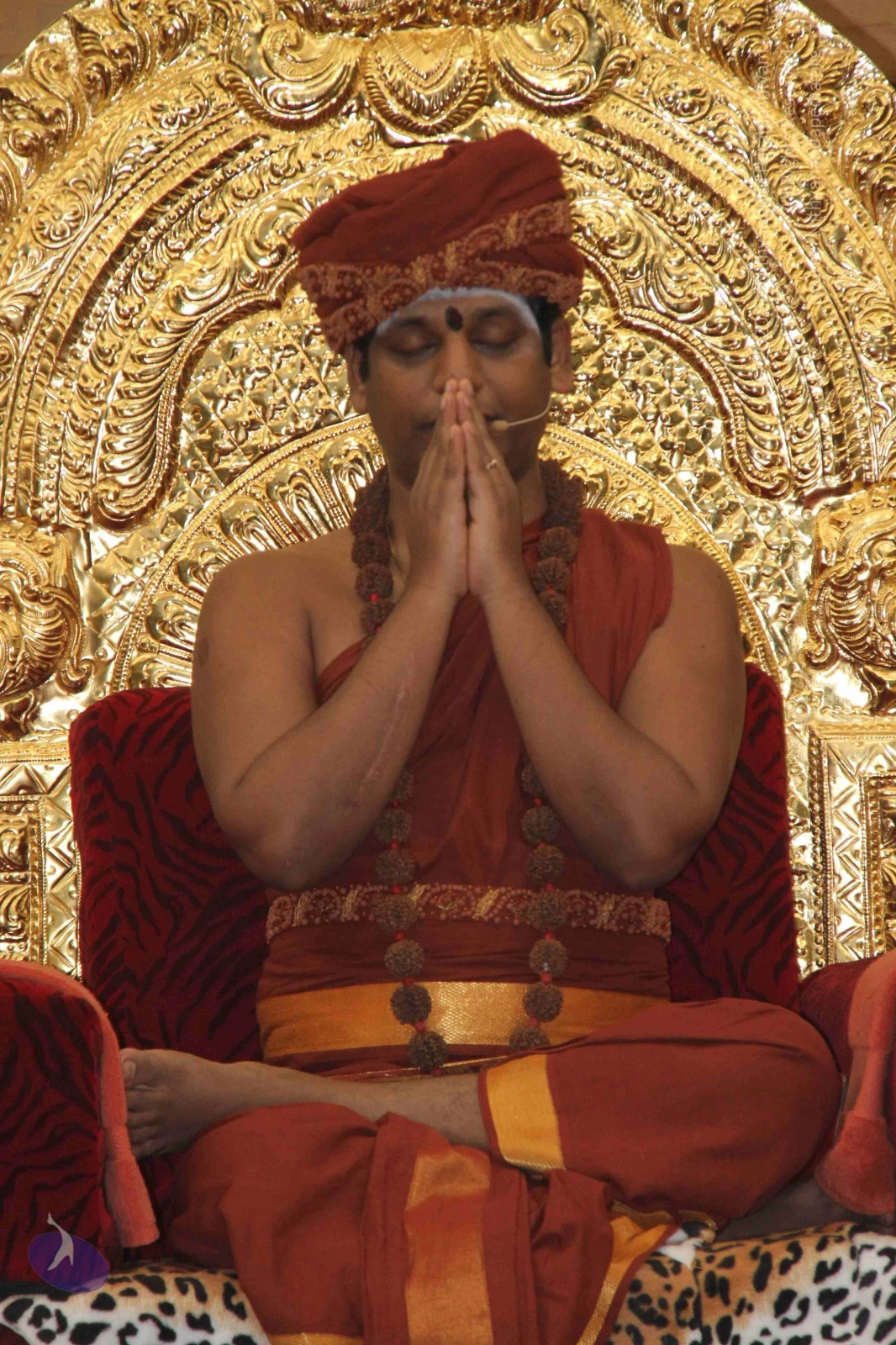
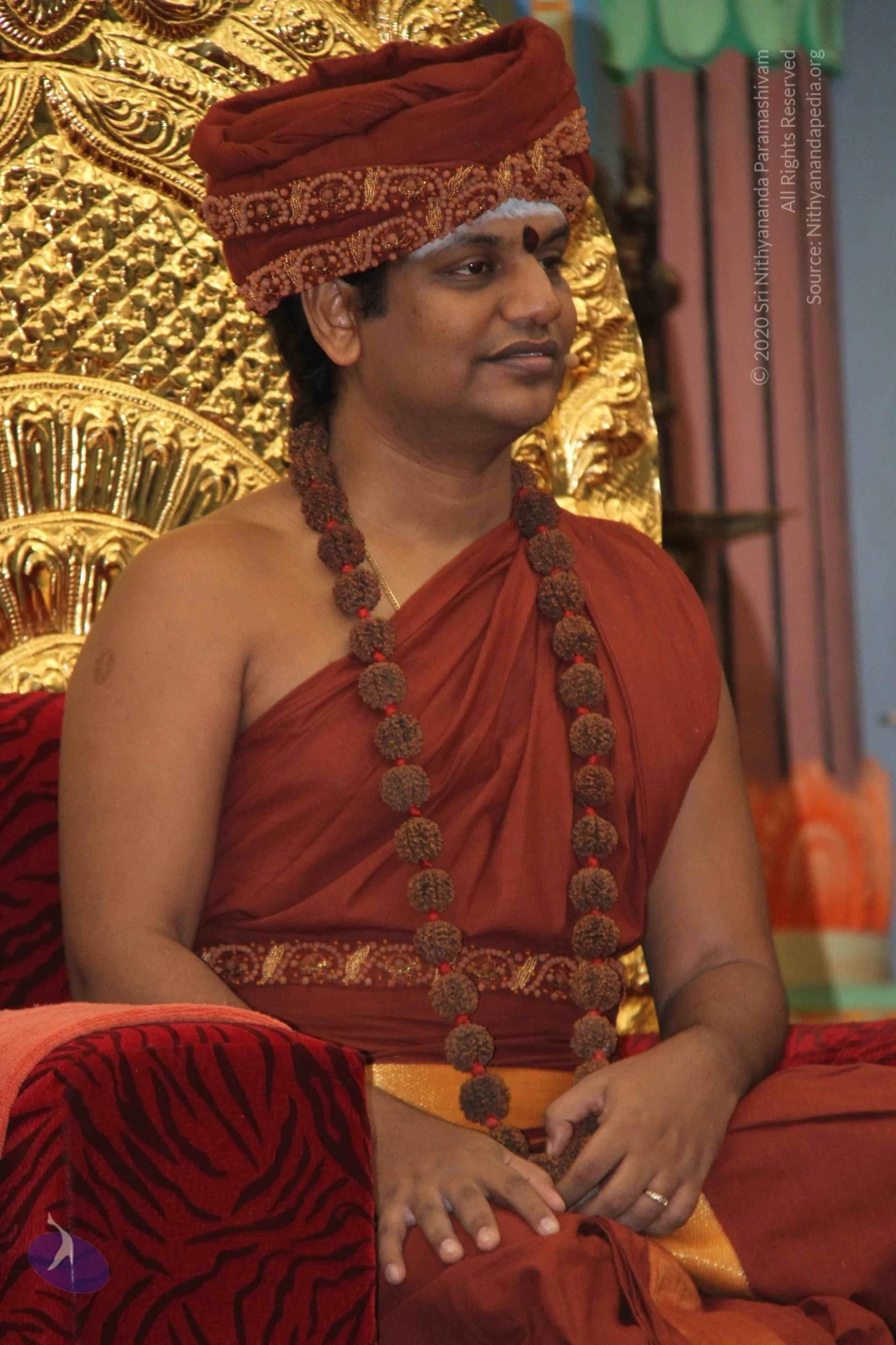
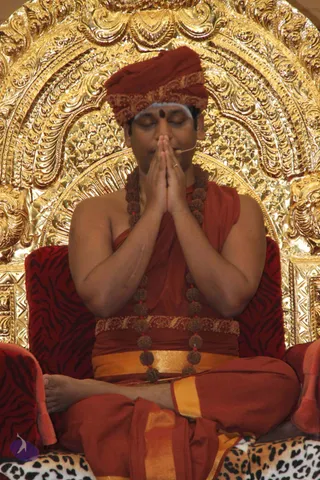
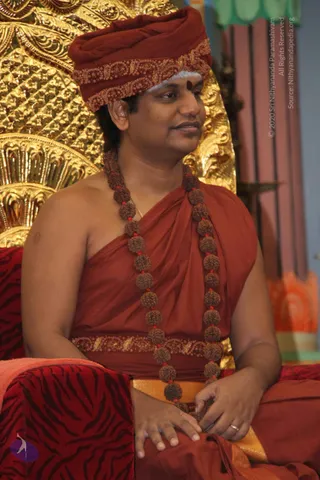
A man seated cross-legged on an ornate gold throne with a red velvet cushion and a leopard-print cloth draped over the seat edge. He wears a red-orange turban with a gold-embroidered border, an orange-red shawl and dhoti with gold borders, a gold-coloured waist cloth, and a long multi-strand rudraksha mala with red threads. He has a vibhuti line and red kumkum bindi on his forehead, a small microphone clipped near his face, and a ring on one finger, hands resting on his lap. Appearance-based candidate: Swamiji (probable), seated as a speaker in a satsang setting, with the swept-back turban, rudraksha malas and saffron-orange clothing as distinguishing cues.A seated man on an ornate gilded throne with red tiger-striped upholstery and a leopard-print cloth draped over the seat. He wears a rust-red turban with gold trim, a red-orange robe with a gold-bordered sash, and a long necklace of rudraksha beads. A small red dot marks his forehead and a headset microphone is visible at his cheek. His hands rest in his lap. The scene looks like a satsang or discourse setting. Appearance-based cues including the turban, rudraksha mala and saffron-orange robe suggest Swamiji (probable), seated in person on the throne.A seated man in an ornate golden throne with a carved arched backrest, wearing a red-orange turban with gold border, saffron-red robes with a gold-bordered waist cloth, and a long mala of rudraksha beads. He sits cross-legged on a red tiger-striped cushion with a leopard-print covering, eyes closed, palms pressed together in namaste at the chest, with a small headset microphone clipped near his face. One physical person is visible.A photograph of a man seated on a red and gold throne against a gilded backdrop. He wears a red-maroon turban with beaded gold trim, a red-maroon shawl draped over his bare shoulder and an orange-gold waist sash. A long necklace of rudraksha beads hangs to his waist, and a red bindi is on his forehead. His hands rest on his lap, and he looks to one side.

Paduka-Puja
6 photosSource gallery
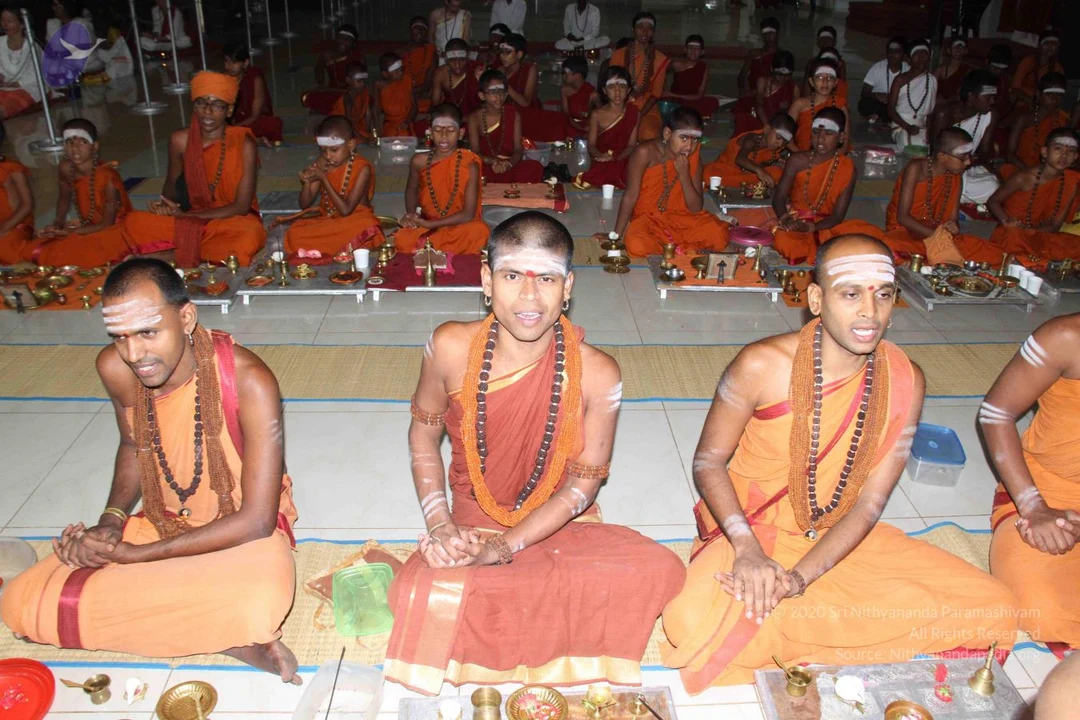
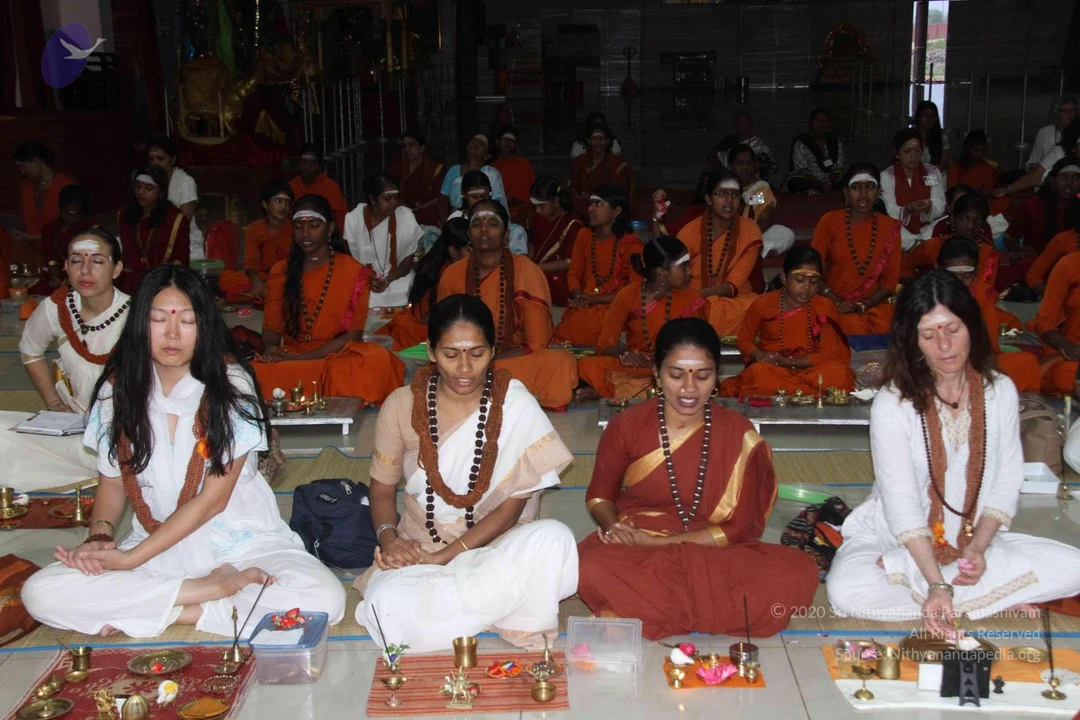
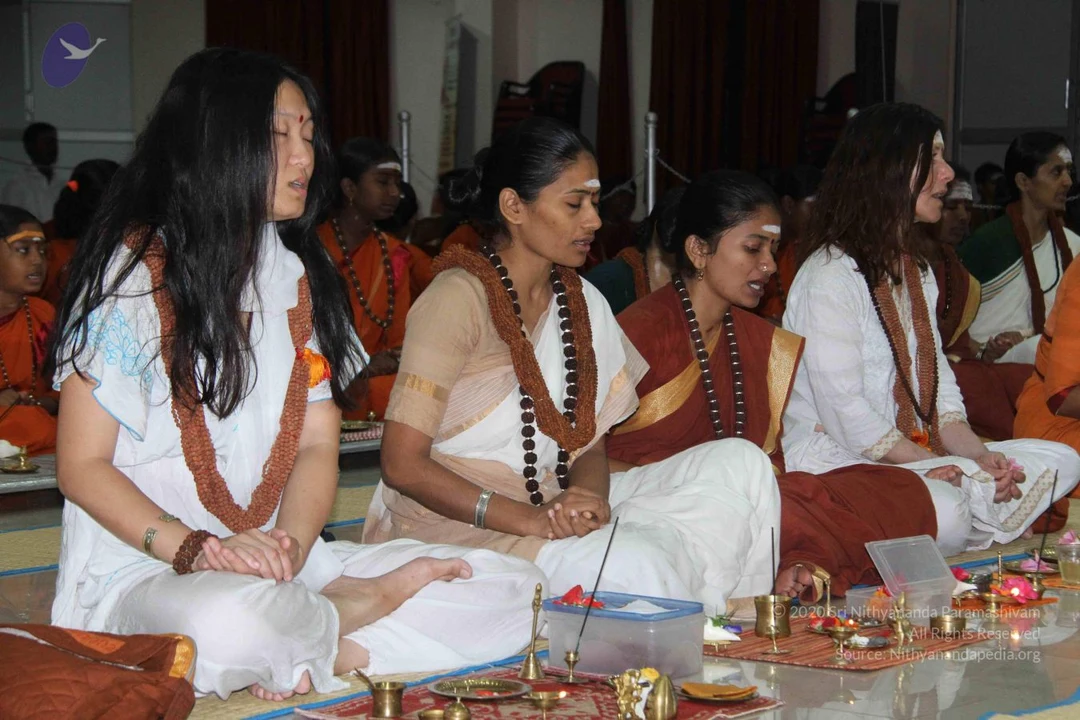
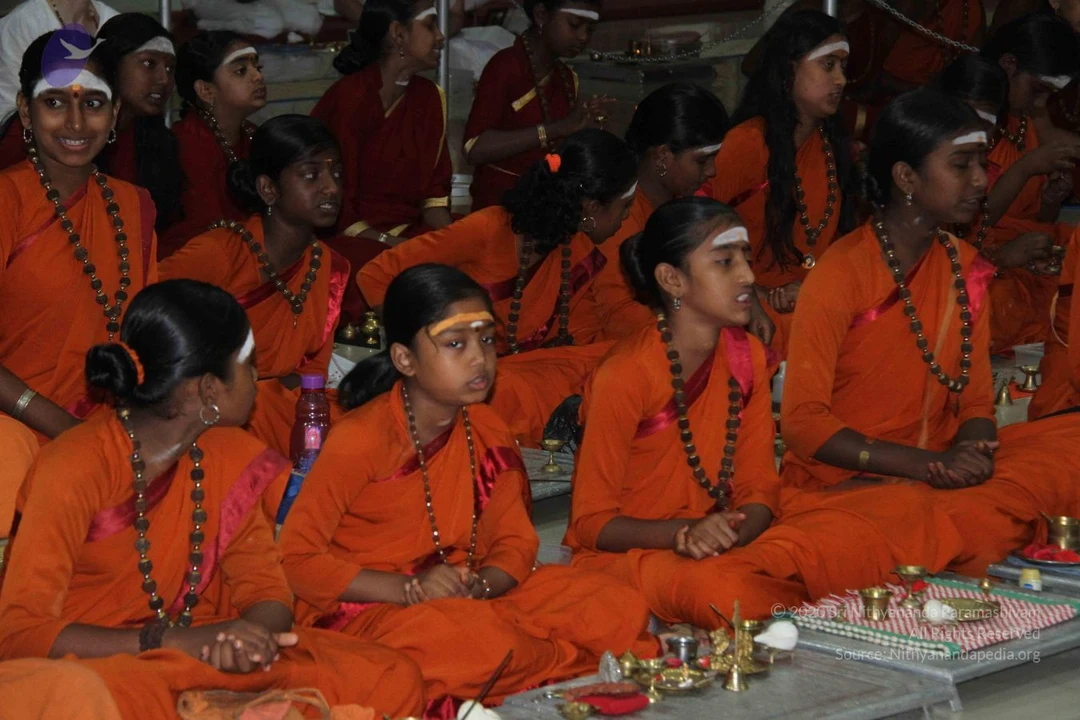
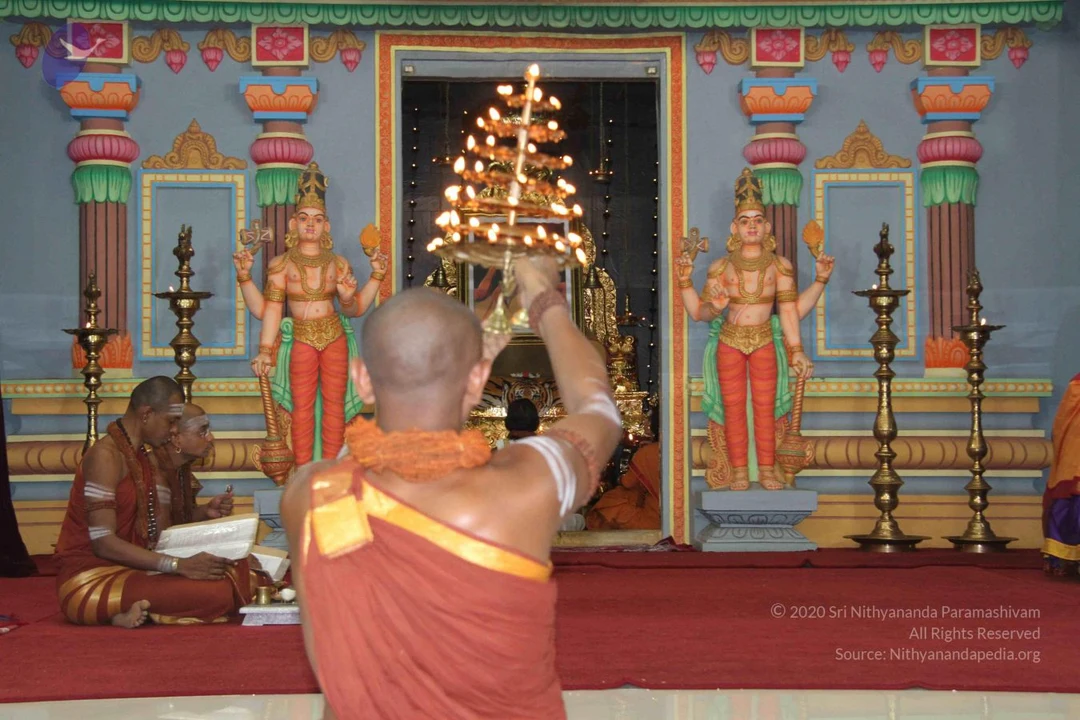
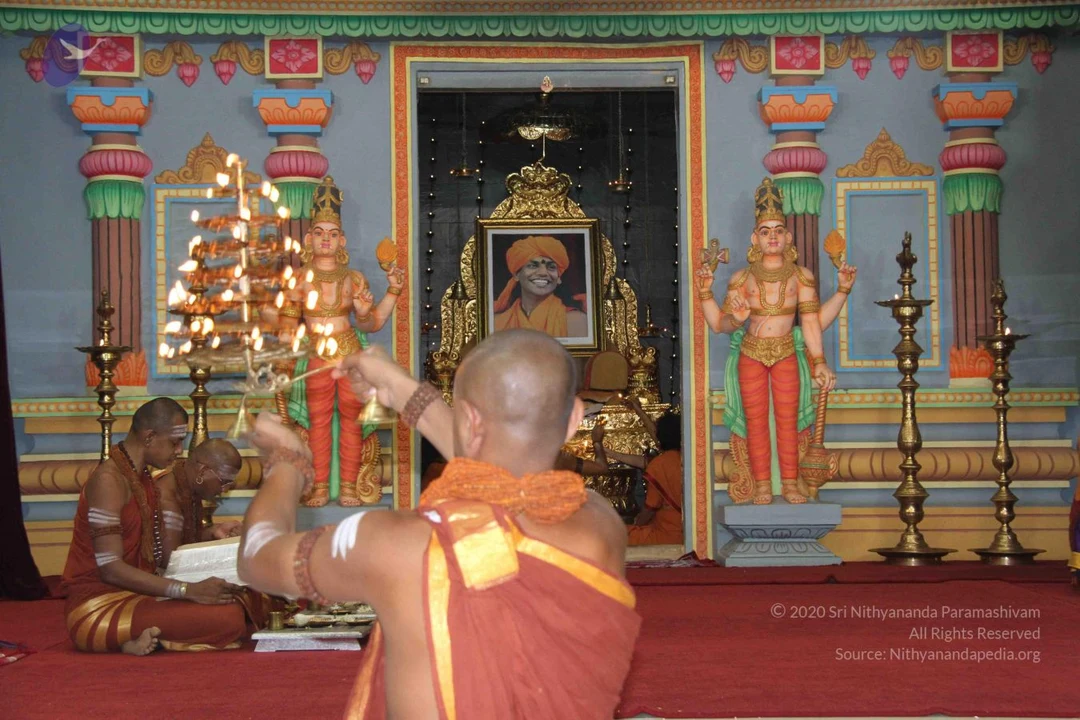
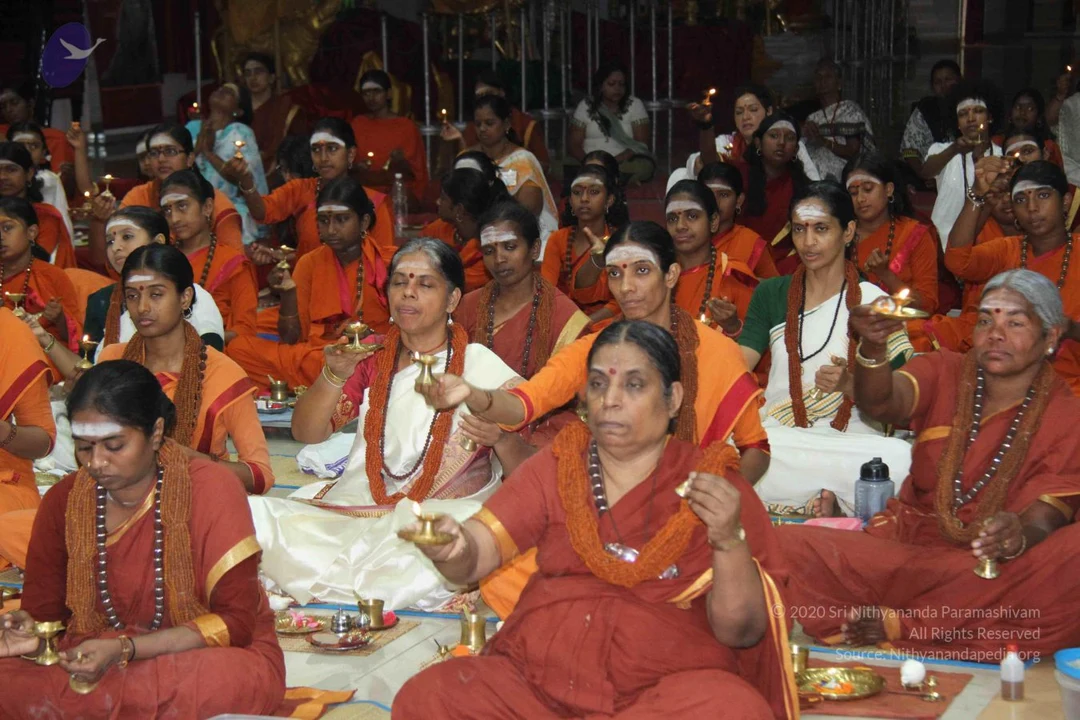
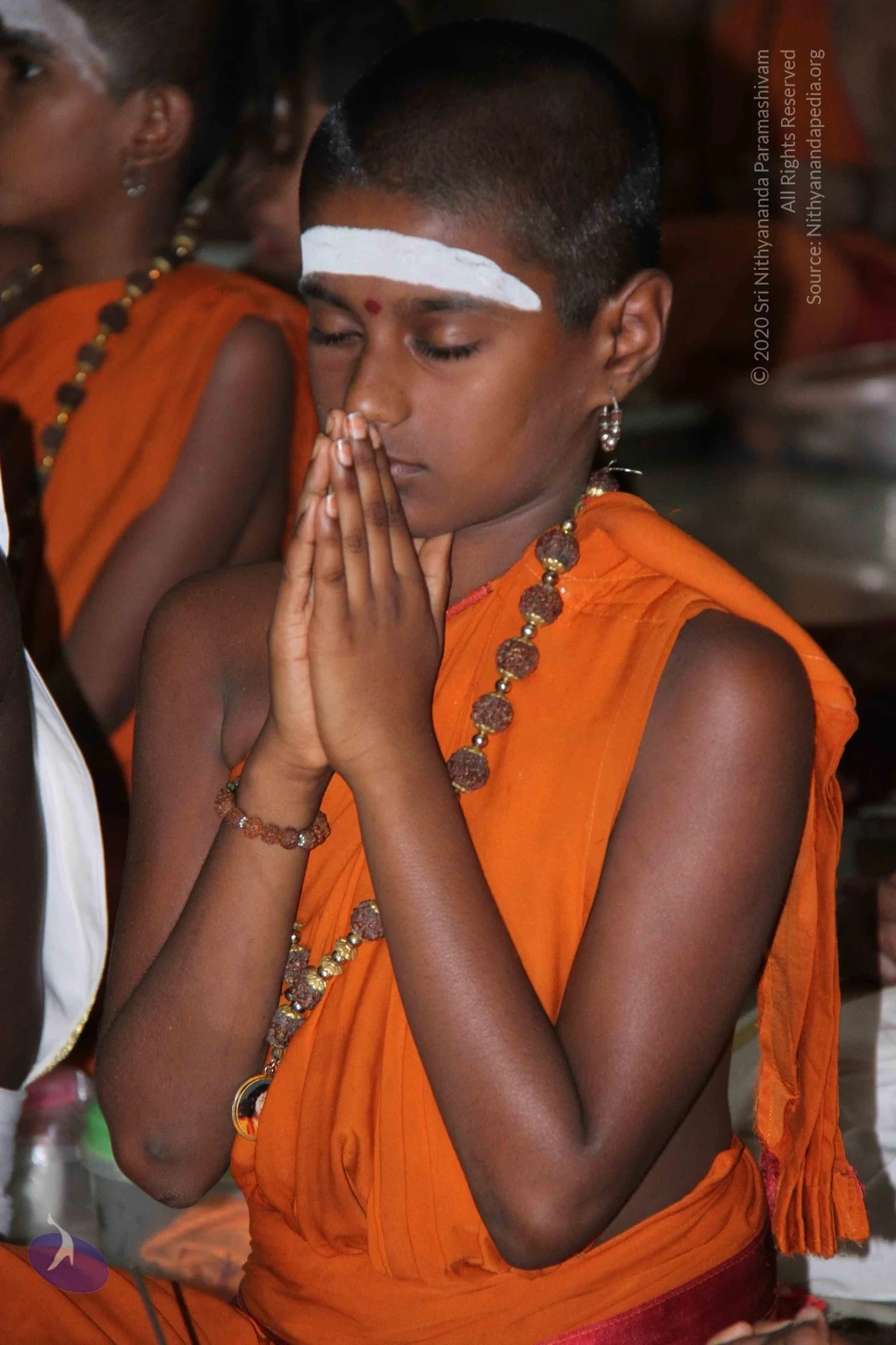
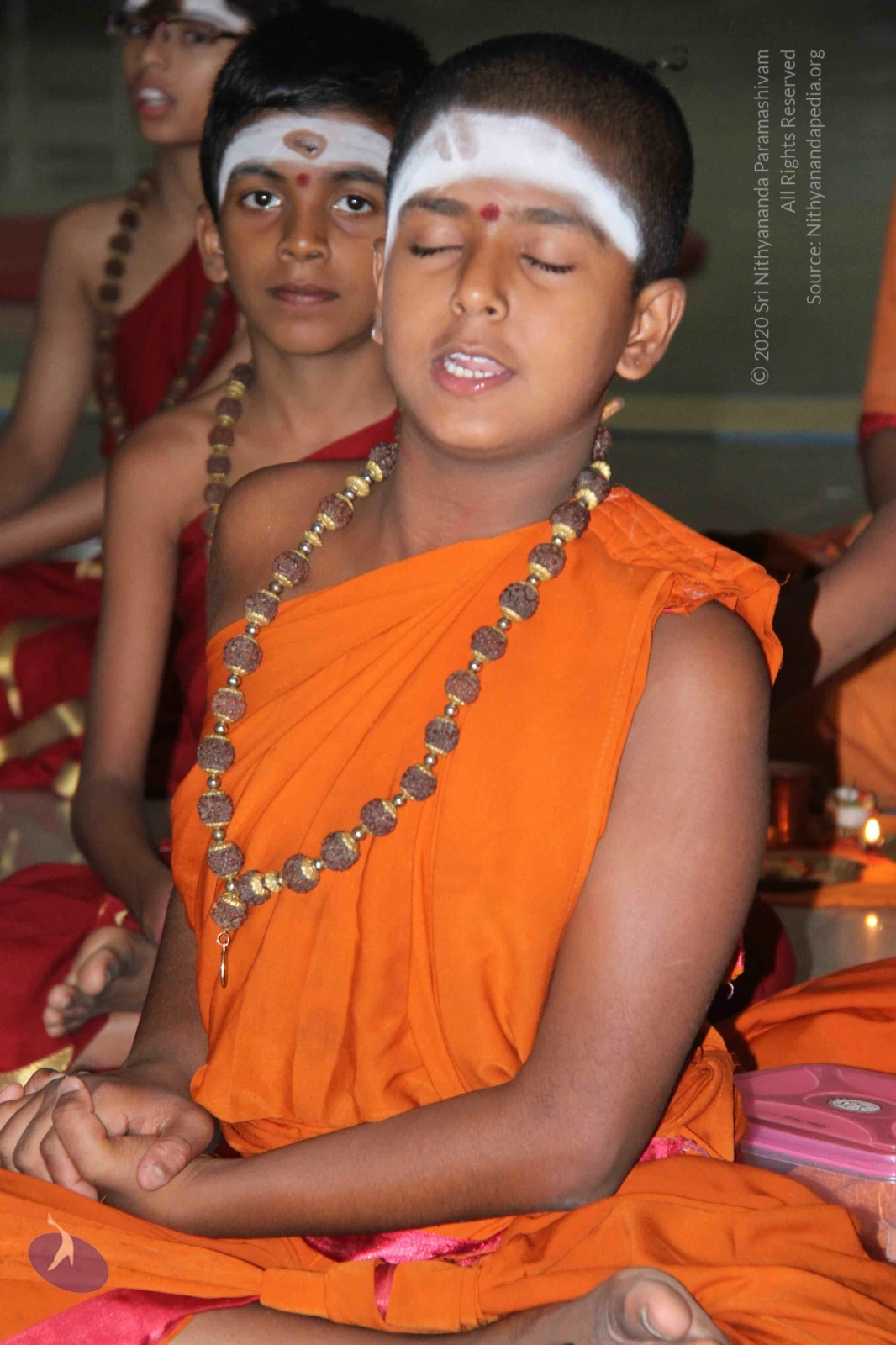
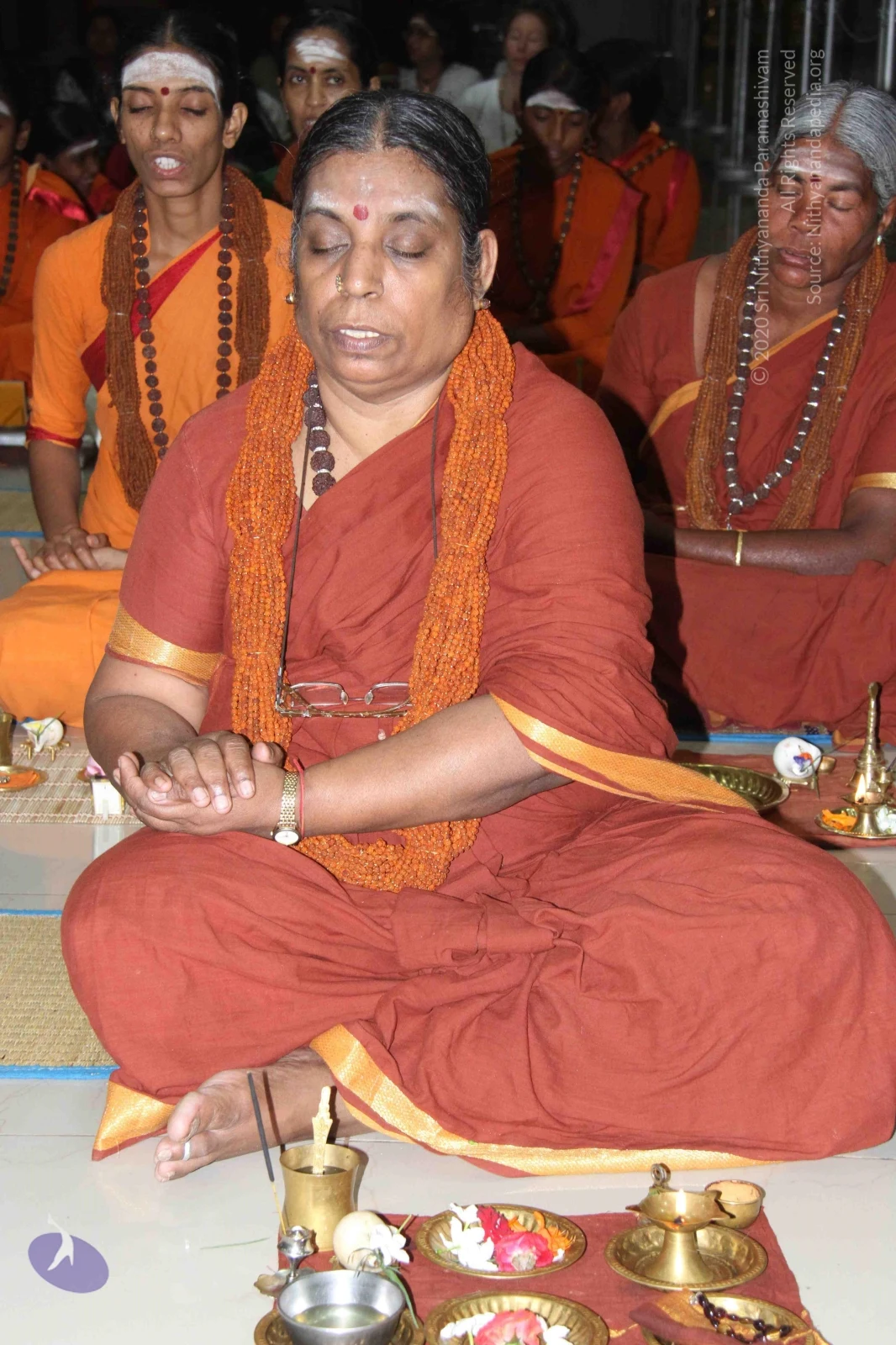
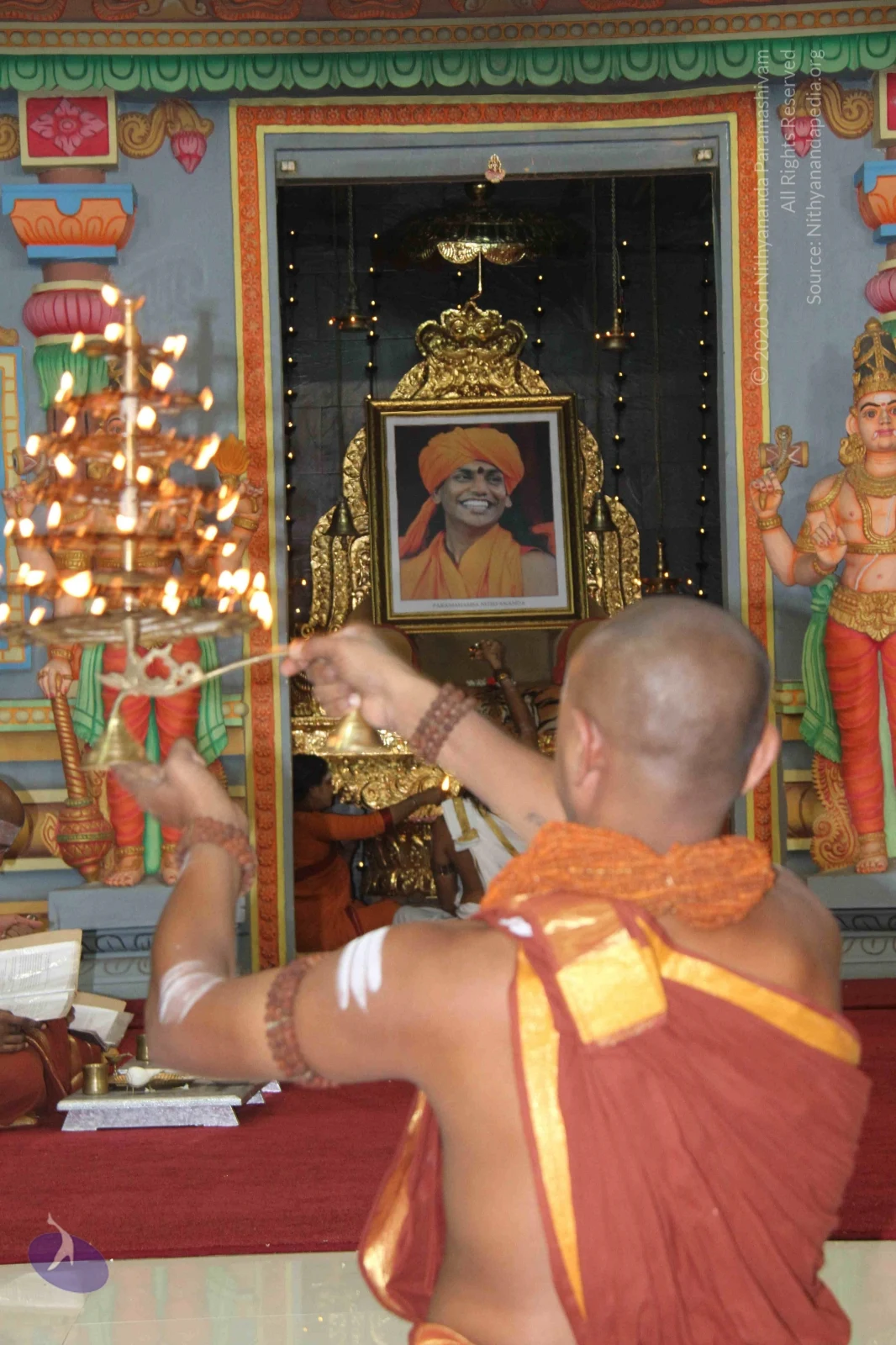
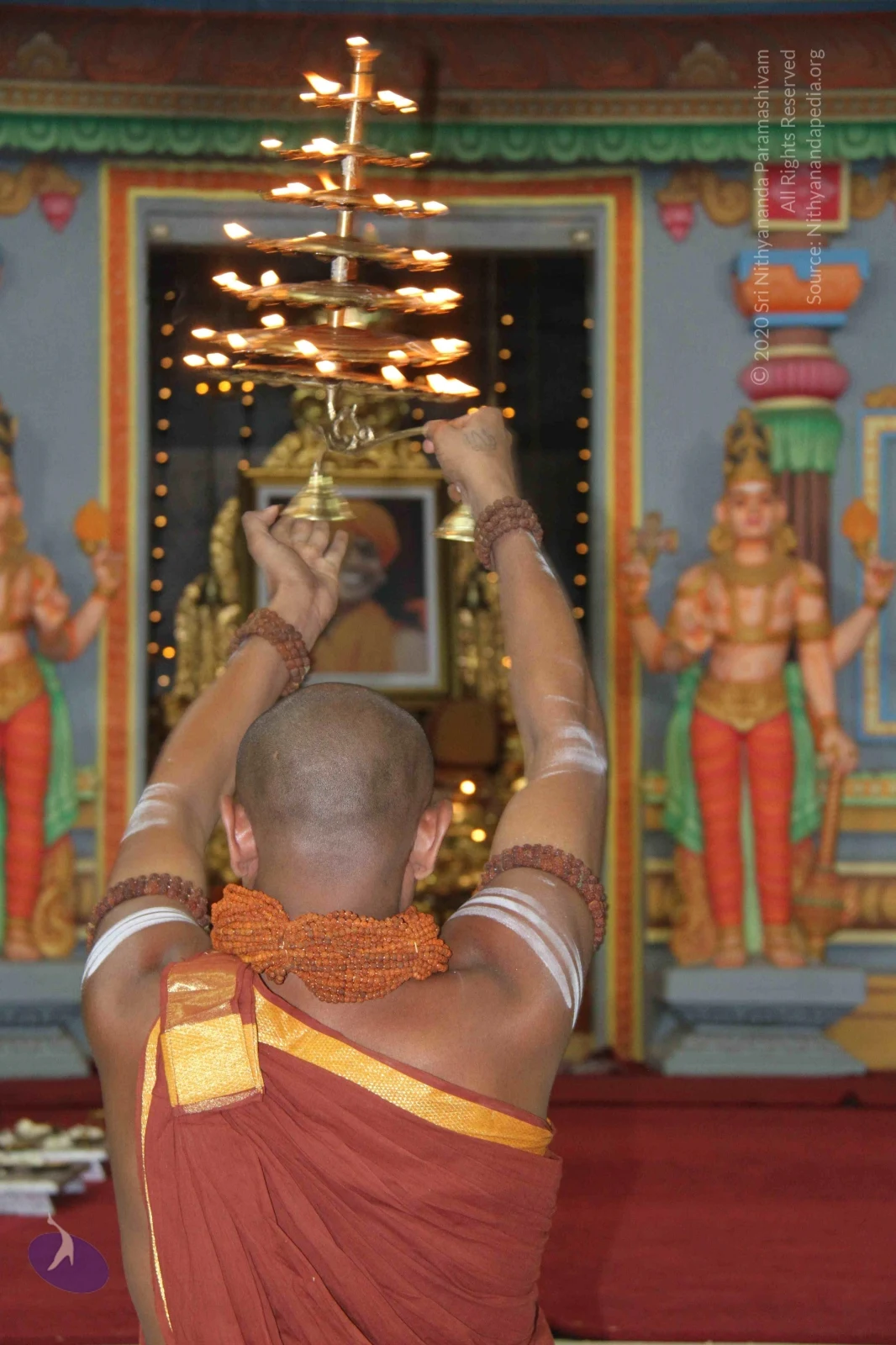
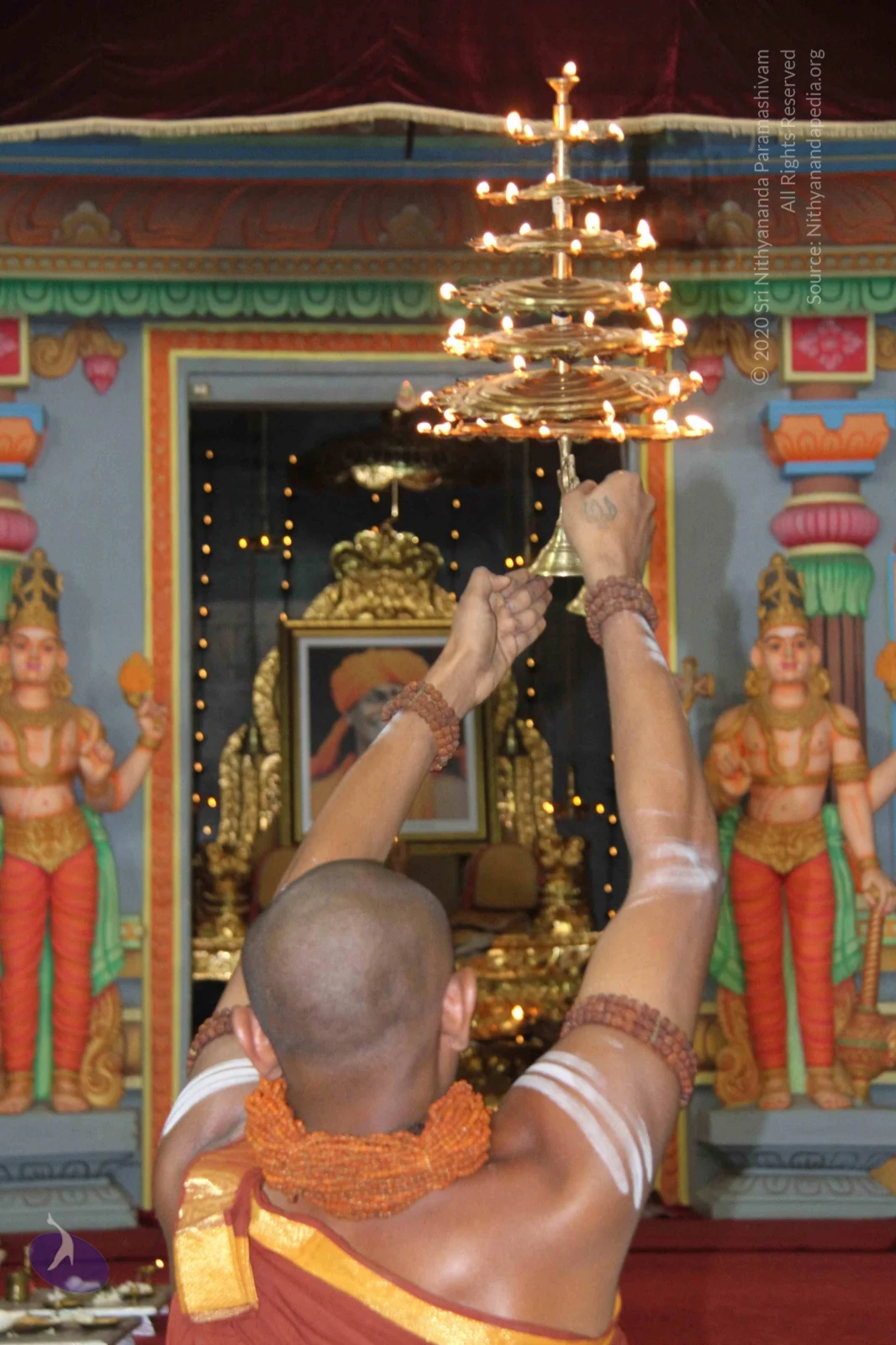
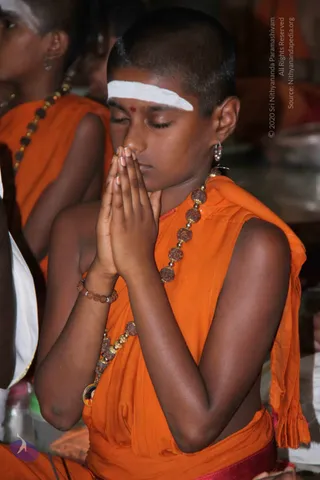
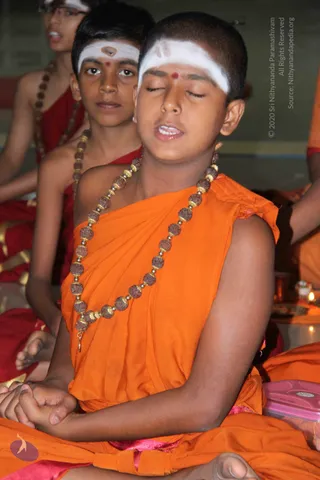
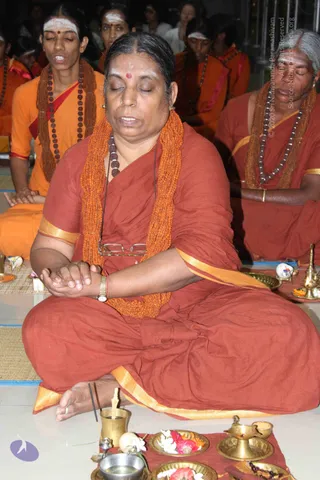
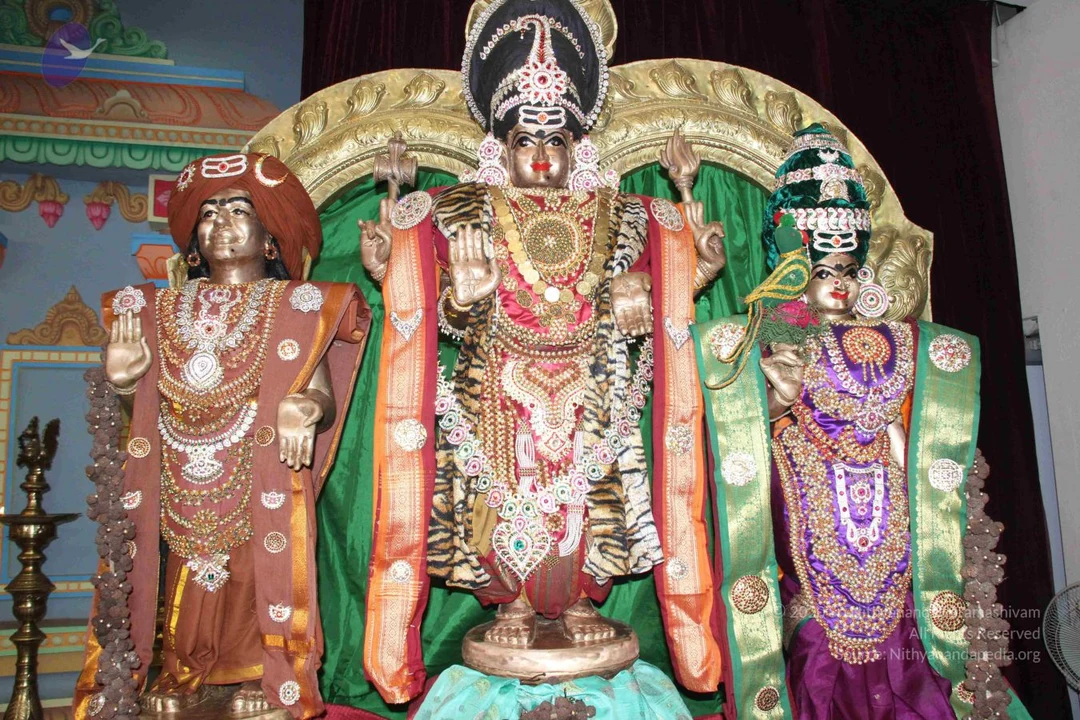
Close photo of a young boy with a shaved head and a white vertical tilak with a red dot on his forehead, eyes closed, palms pressed together in namaste. He wears a saffron-orange sleeveless garment and multiple rudraksha mala strands with gold-toned beads, plus a small rudraksha bracelet and a small earring. Other saffron-clad boys sit in the blurred background. The boy appears to be a devotee or young disciple; no one in the image is identified as a person.Close photo of young boys seated in meditation at an ashram satsang. The foreground boy has his eyes closed, hands in a meditative mudra, and wears an orange robe with a rudraksha mala with gold beads. Behind him, a second boy with a white forehead band and red bindi looks forward, and another boy in red garments sits further back. Small oil lamps and brass vessels are visible at the right edge.A seated woman in a rust-red sari with gold border sits cross-legged with eyes closed and hands folded in her lap, wearing an orange rudraksha mala and a red bindi. Behind her, several people in orange and rust robes with rudraksha necklaces and white forehead markings sit in meditation or chanting. In front of her on the floor are brass plates with flowers and fruit, a brass lamp, a brass kalasha, a bowl of water and incense sticks.A shaved-headed priest in a red-and-orange dhoti with a gold-bordered orange shawl performs aarti with a multi-tiered brass lamp of many lit flames, held before a framed portrait on a golden throne-like niche in a colourfully painted temple shrine. The framed portrait shows a smiling man in an orange turban and orange robe, labelled "Paramahamsa Nithyananda". Two painted guardian figures in red dhotis and gold ornaments flank the shrine. Another attendant in orange and a seated figure in white are partly visible in the background, with a red floor cloth and brass ritual items on a silver tray at the lower left.A shaved-headed priest seen from behind performs aarti with a multi-tiered brass lamp holding many lit oil lamps, raised above his head with both arms. He wears a rust-red dhoti with a gold border, a thick orange rudraksha mala around his neck, rudraksha bracelets on his wrists, and white horizontal arm markings. Before him stands a shrine with a framed portrait of a saffron-turbaned figure, flanked by two painted deity murtis in red and green dress with four arms. Warm lights glow in the background.A bald priest seen from behind raises a tiered brass oil lamp (aarti) with many lit wicks, both arms extended upward in a temple shrine. He wears a saffron-orange shawl over bare shoulders, an orange rudraksha mala around his neck, rudraksha bracelets on his wrists, and white sacred marks painted on his arms. Before him stand two painted guardian figures in orange and red dhotis with crowns and green sashes, flanking a doorway. Inside the shrine, a framed portrait labelled Paramahamsa Nithyananda shows a figure in an orange turban, set before golden ornate decorations and a seated throne-like altar with string lights glowing. The priest's identity is not established from his appearance.

Swami-Narayana-Swami-Visiting-Sacred-Arts-With-Swamiji
4 photosSource gallery
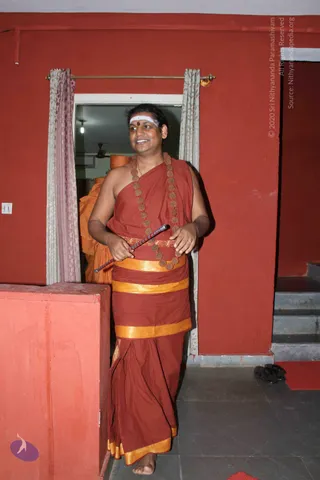
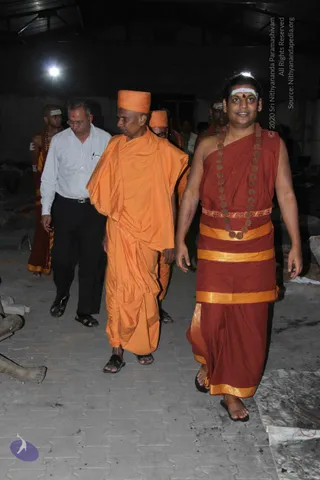
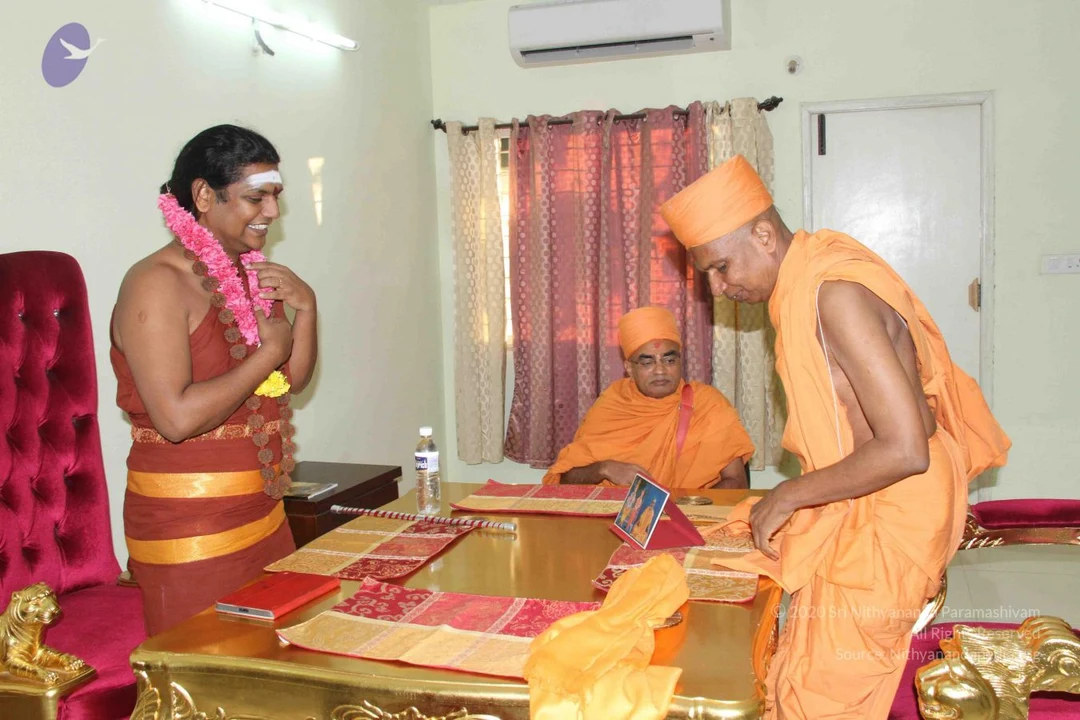
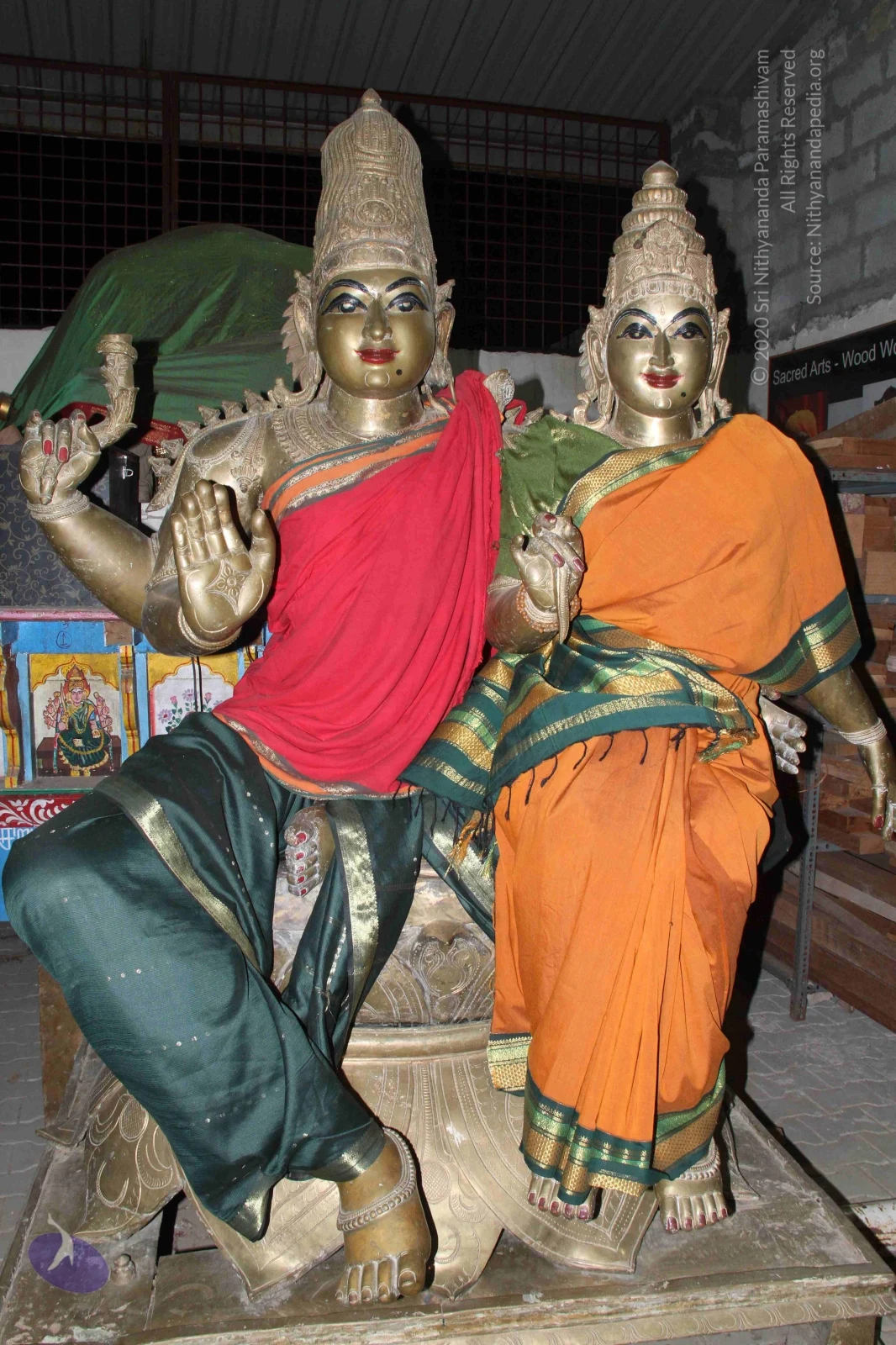
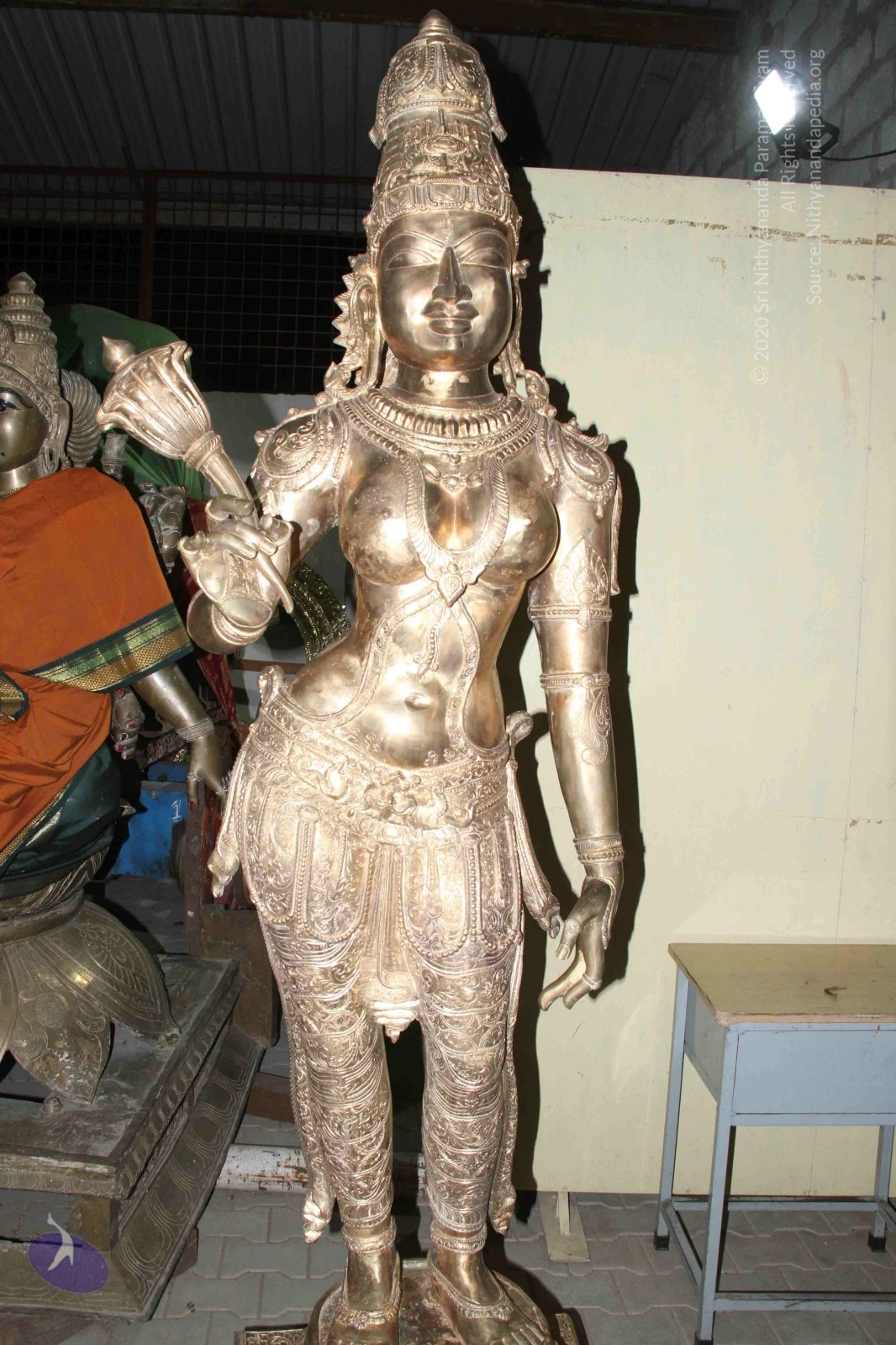
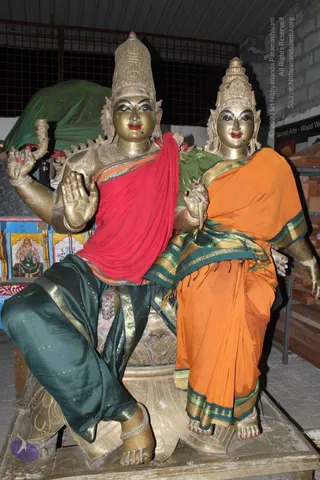
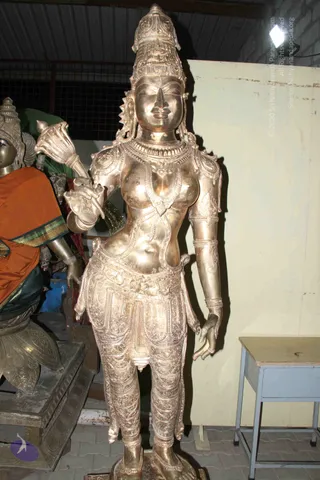
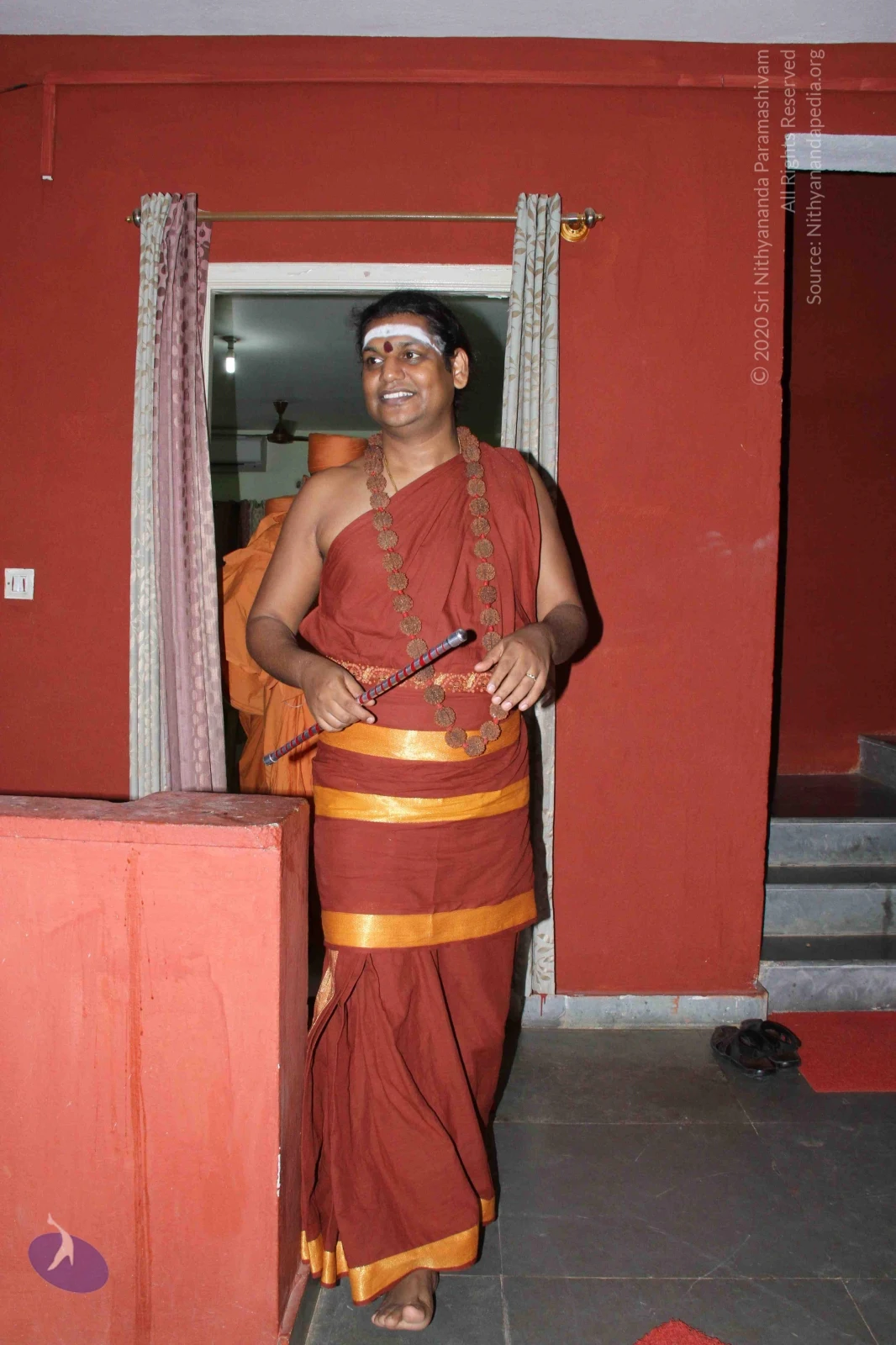
A smiling man stands in a red-walled room beside a doorway with light curtains, wearing a maroon dhoti and shawl edged with gold borders and a gold-bordered waist cloth. He wears a white vertical forehead mark with a red dot, and a long rudraksha mala hangs across his chest. He holds a striped stick in his hands. A person in orange robes is partly visible inside the doorway, and a pair of sandals sits on the floor at right. The appearance-based identity is unsure because only the sannyasi-style dress and rudraksha cues are visible, not the distinctive hair, crown or ornate adornments needed to match the page's a person claim.Nighttime photo of several men walking across a paved floor in a dim hall under a corrugated roof with a bright light above. On the right, a man in maroon dhoti and shawl with a gold border and a long rudraksha mala walks with a white tilak and red bindi, smiling. Beside him, a man in saffron robes and a tall saffron turban walks in the middle, and a man in a white shirt and dark trousers walks on the left. Other men in maroon and saffron with white forehead markings follow behind. a person: the man on the right, shown walking in maroon robes with rudraksha beads and a white tilak, is a candidate by these cues.A photograph of two large golden metal statues of a seated divine couple in a workshop or storage space. The figure on the left wears a tall crown, a red shawl over the chest, and dark green silk dhoti with gold border, with one hand raised in abhaya mudra and the other holding a conch-like object. The figure on the right wears a tall crown and an orange sari with a dark green and gold border. Behind them are wooden planks, a green cloth, and a painted panel showing a deity. These are statues, not living people, and no person is clearly identifiable as a person in the scene.A large polished bronze statue of a standing female deity with an ornate tall crown, elaborate necklaces and armlets, and a richly carved jeweled waist garment, holding a ceremonial object in one raised hand. The figure stands in a workshop or storage hall with a corrugated metal roof, a plain white wall, and a small grey table at right. To the left, part of another bronze figure in an orange and green sari is visible. No people are visible in the scene.

Temple

6 photosSource gallery
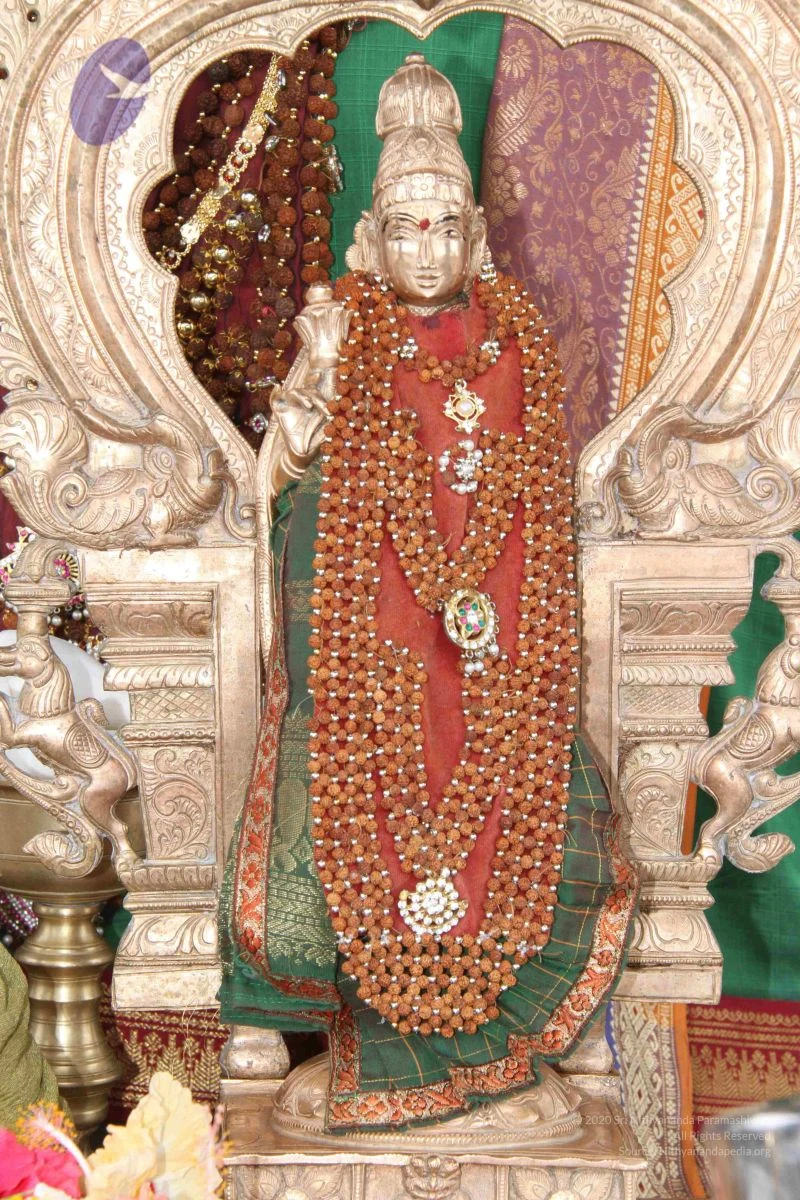
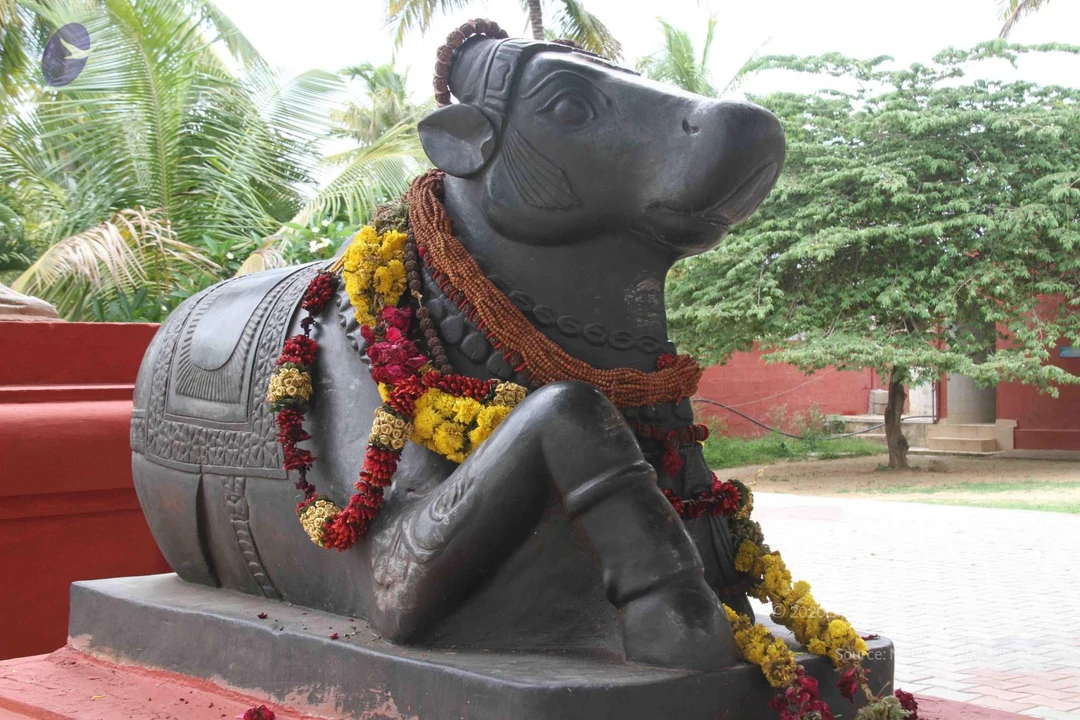
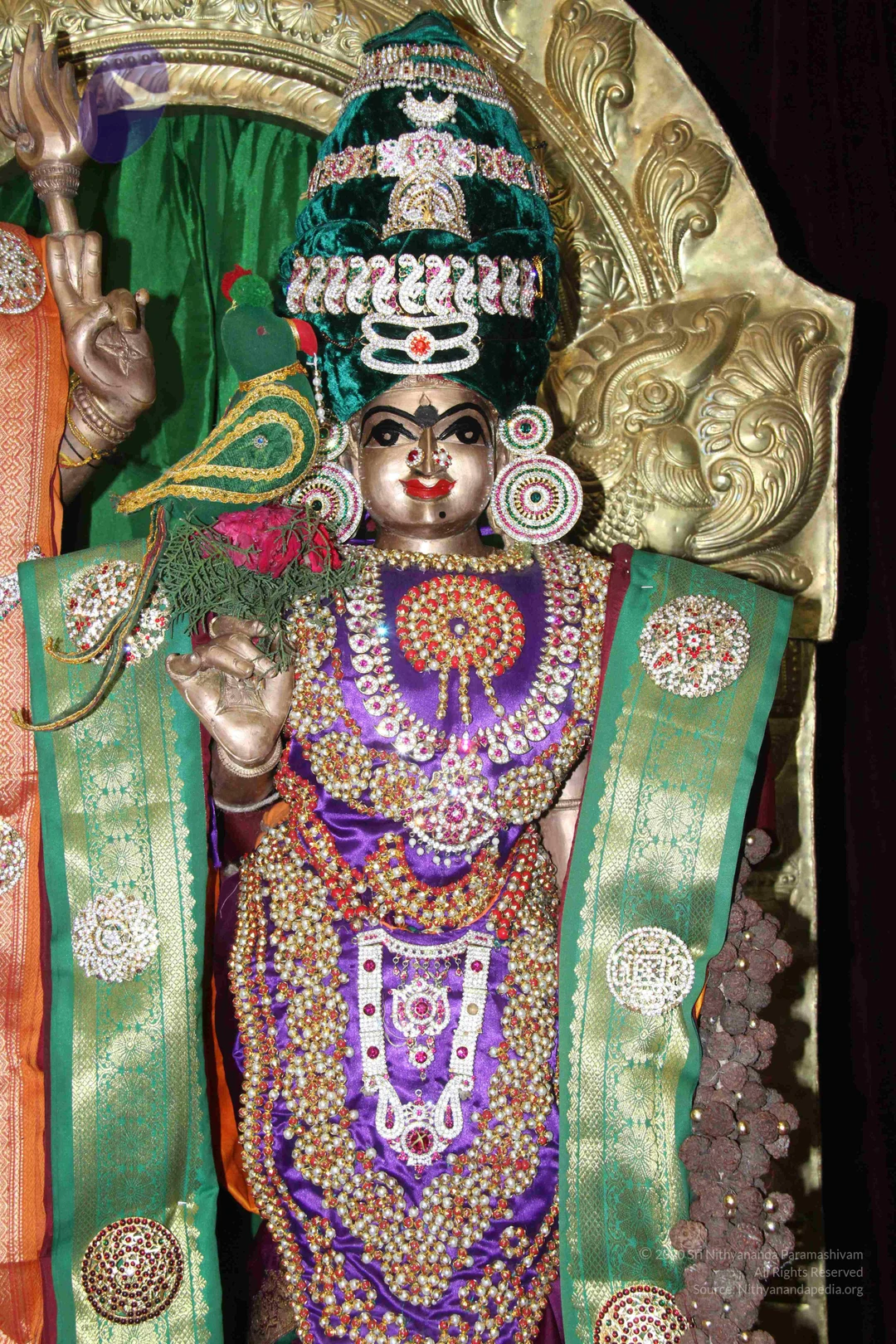
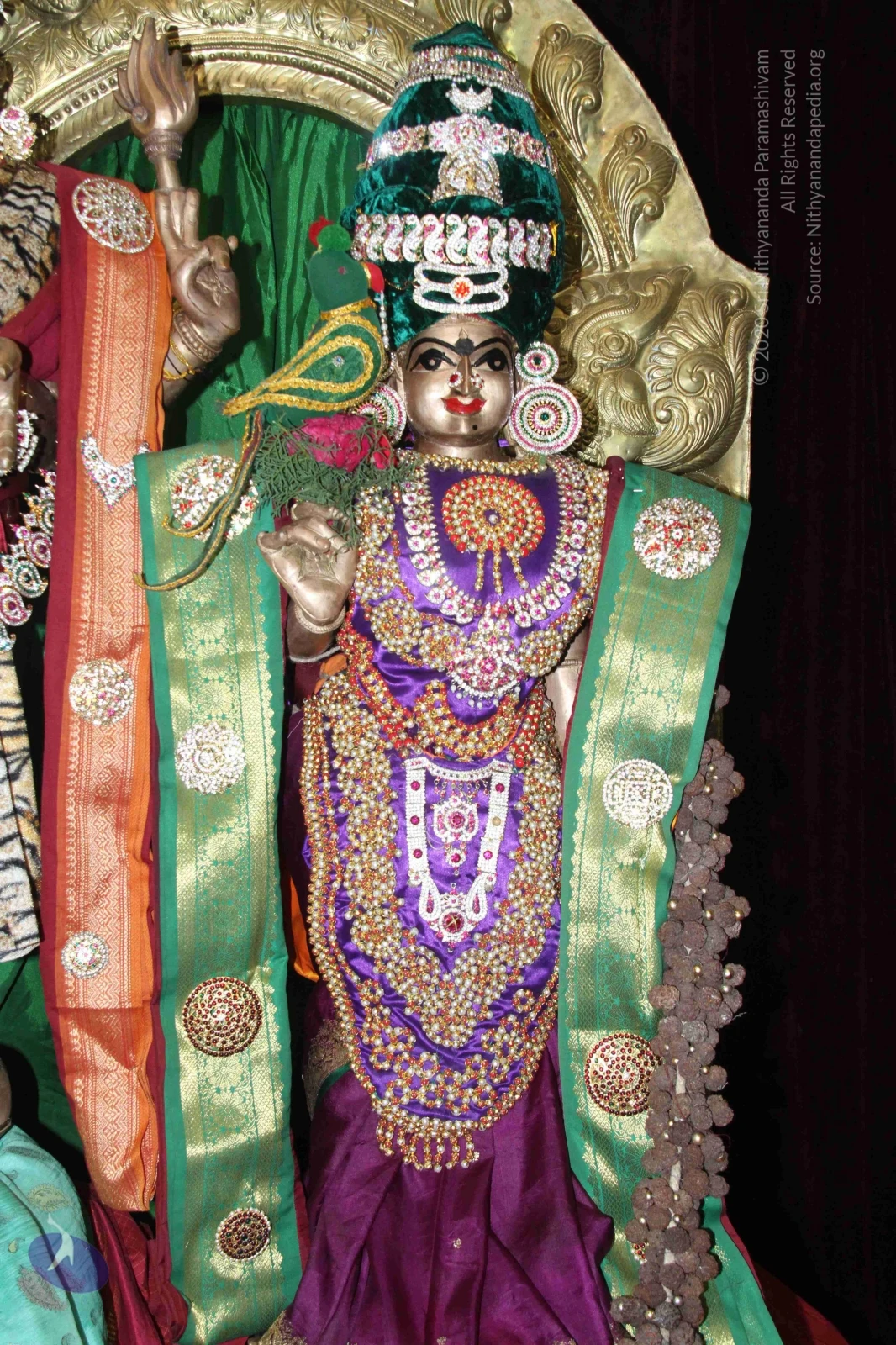
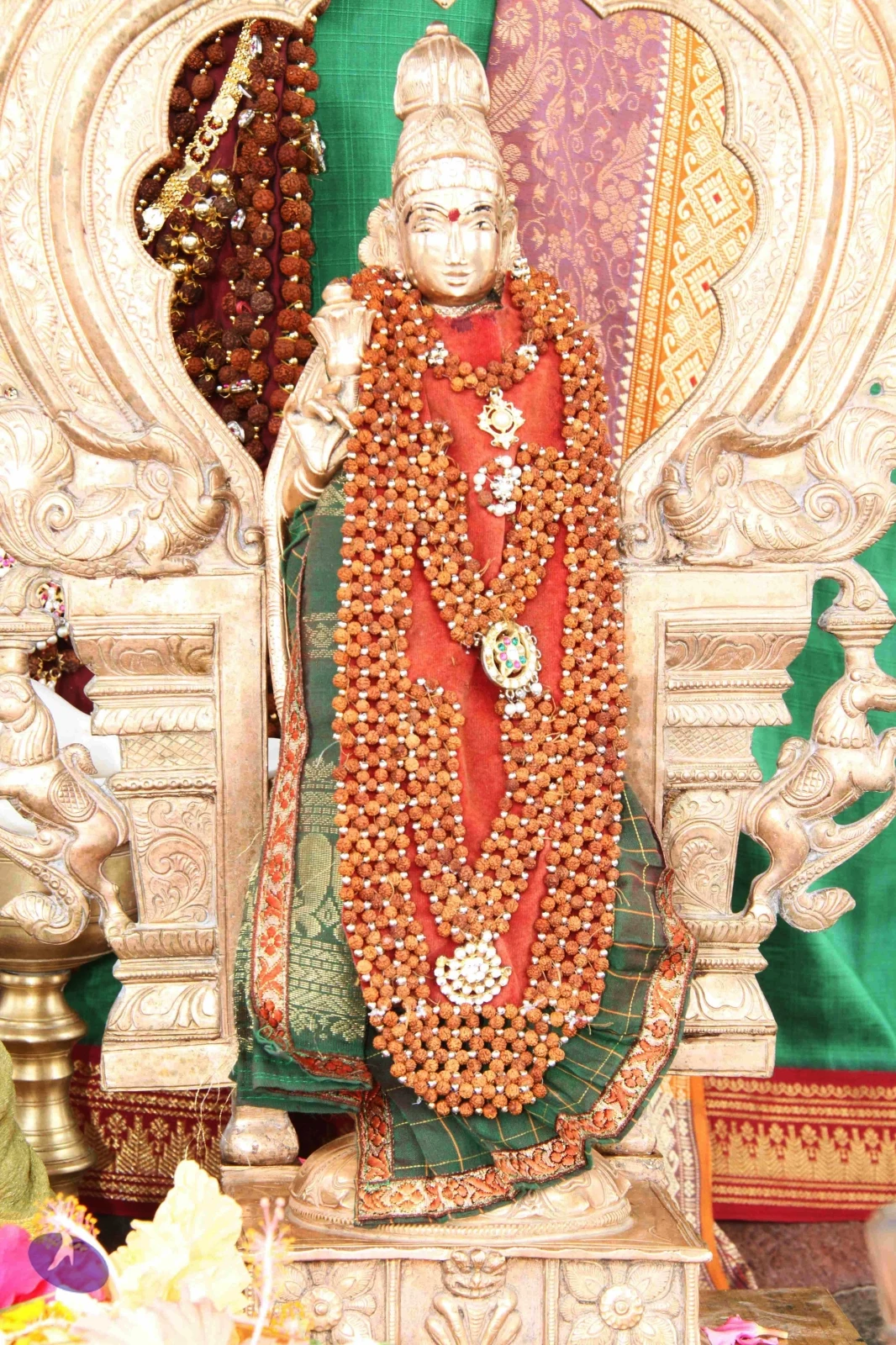
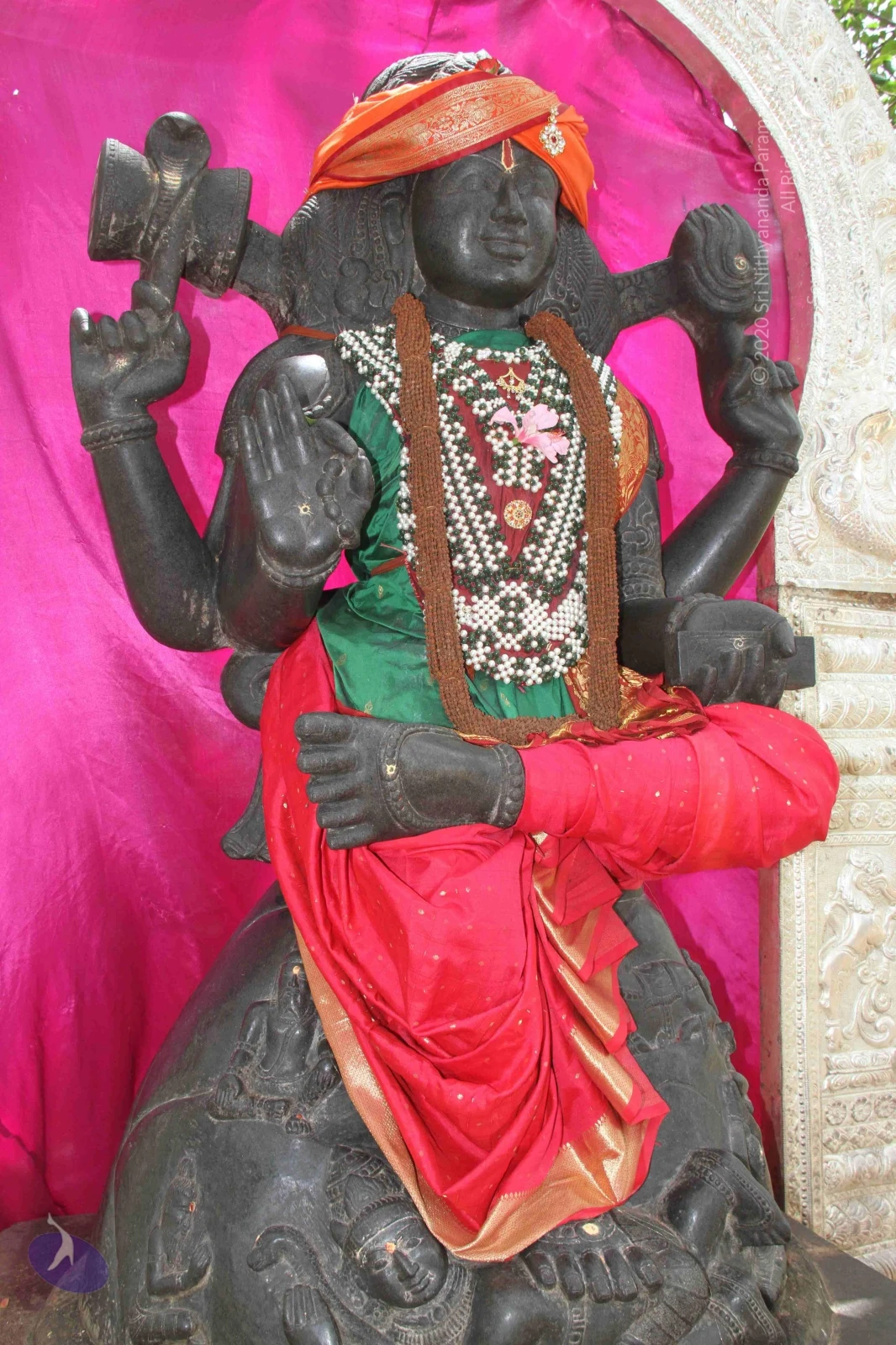
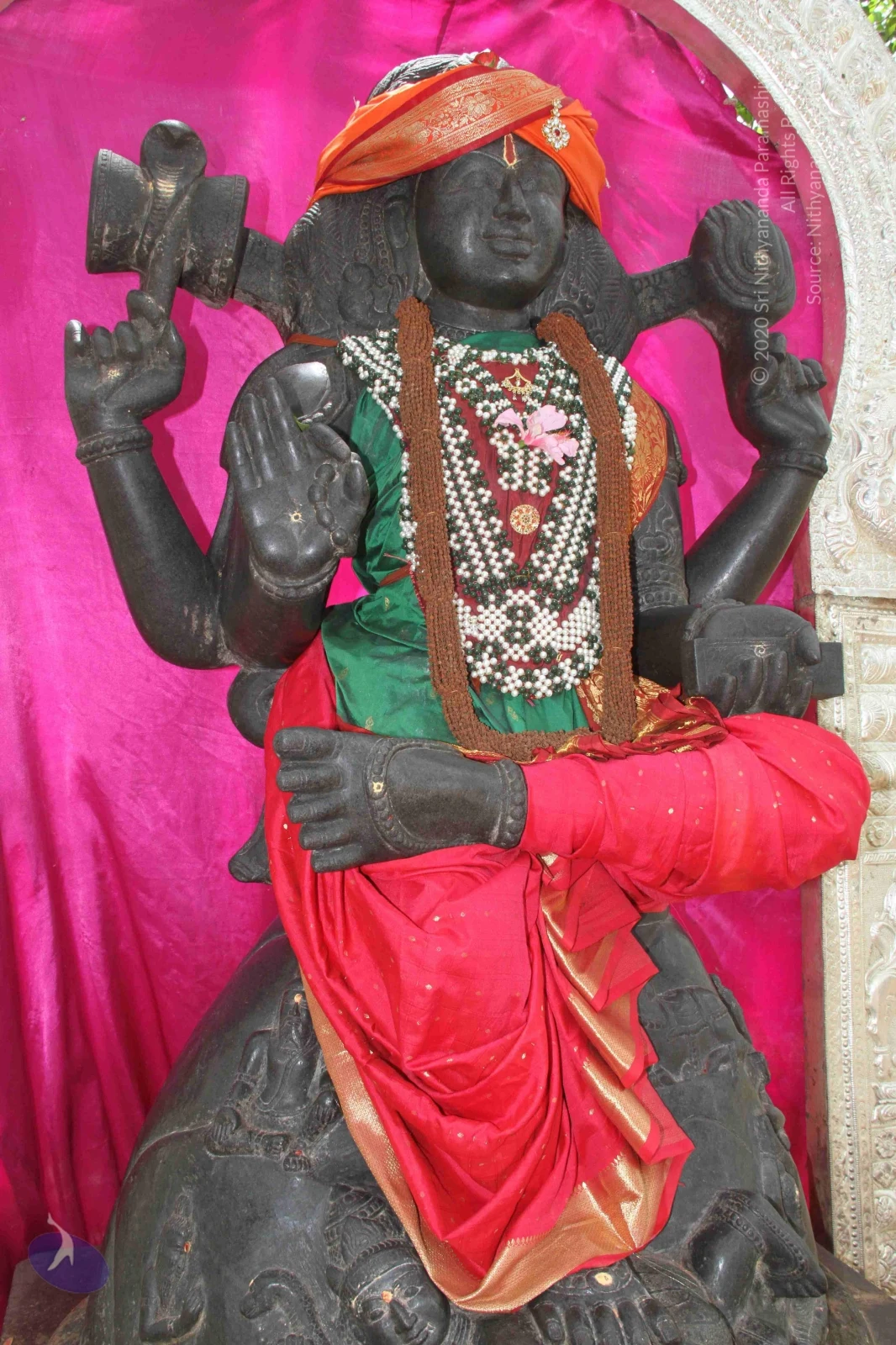
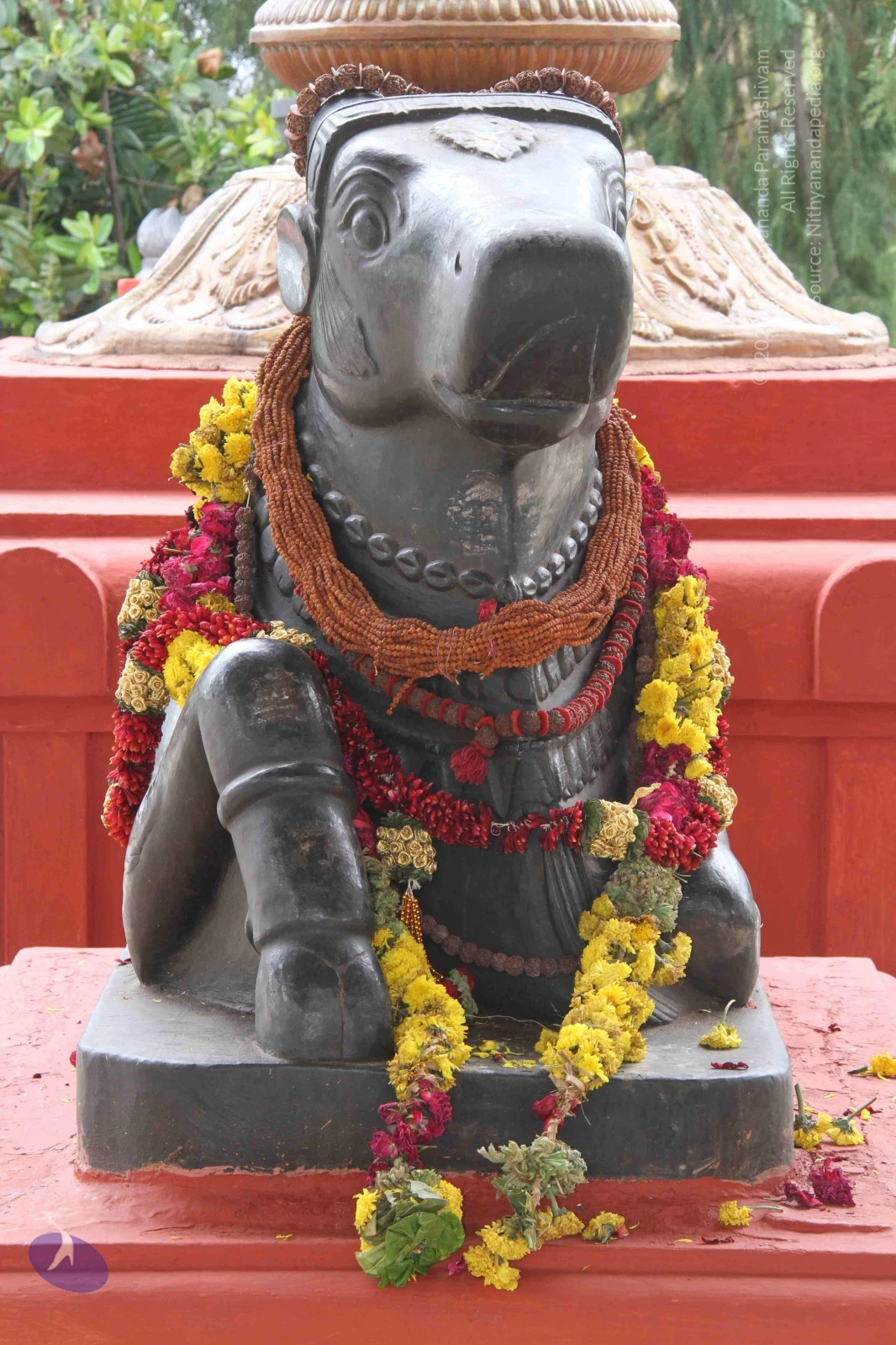
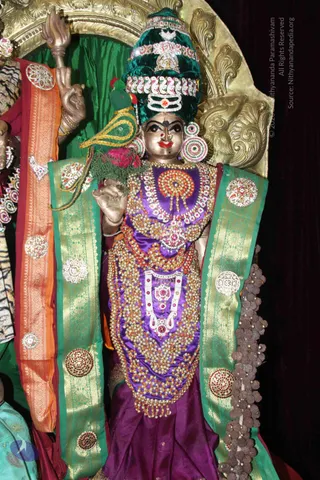
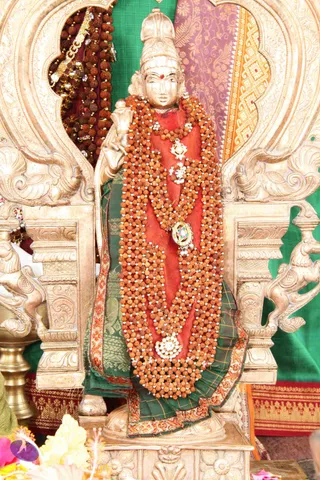
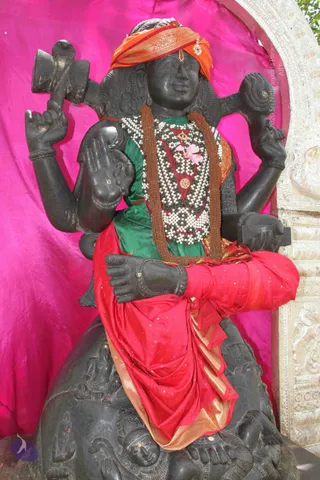
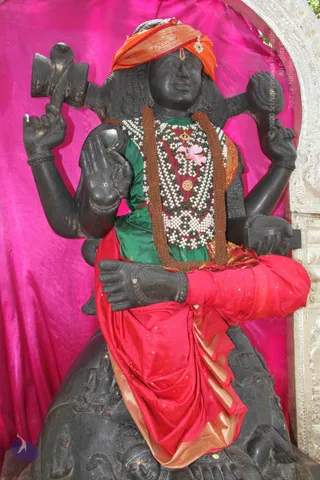
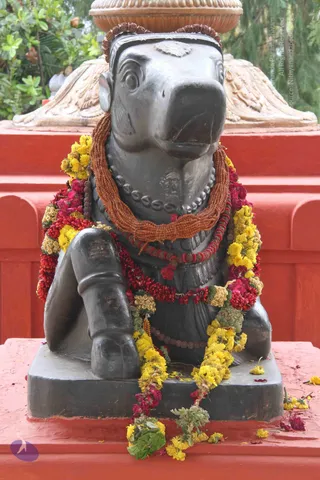
A decorated deity murti stands in a shrine, filling the frame. It wears a tall green velvet crown studded with white and red stones, a purple silk garment under layered gold and pearl necklaces, and large jewelled earrings. Green and orange brocade shawls with gold borders and round stone medallions drape over both arms, and a rudraksha garland hangs at the right side. One hand holds a bunch of green leaves and a red flower, and the raised hand holds a flame-like staff. A gold repoussé backdrop and green cloth surround the figure. No physical people are visible.A photograph of a temple shrine with a large gilded arch framing a pair of painted deity statues seated on a pink-draped platform. The male figure wears an orange and maroon turban, rudraksha and gold necklaces, and holds a trident; the female figure wears a green sari, gold jewellery and a flower garland. In front stands a tall black shivalinga with a gold cobra hood, draped in a blue cloth and garlanded, with a small silver deity murti in a niche. Brass lamps, a kalasha pot, a brass bowl, flower petals and a red and gold cloth lie on the stone step. No living people are visible.A silver-finished deity murti stands on a carved silver pedestal within an ornate silver arched shrine frame. The figure wears a red garment and a green and gold-bordered dhoti, and is draped in dense multi-strand garlands of rudraksha beads interspersed with white beads, with a central jewelled pendant and a gold medallion. A red tilak marks the forehead, and a short staff or ritual object is held in one hand. Behind the murti hang rudraksha malas, green and purple silk drapes, and flower offerings lie at the base, with brass lamps at the side.A black stone statue of a multi-armed deity seated on a carved stone base, set against a magenta cloth backdrop with an ornate silver arch. The murti wears an orange and gold turban, a green blouse, and a red and gold sari draped over its lap. It is adorned with a white jasmine garland, a brown rudraksha-style mala, and a pink flower at the chest. One upraised hand holds a trident-like staff and another holds a small object, while the lower hands rest in a lap-held gesture. No physical people are present.A black stone statue of a multi-armed deity seated in a cross-legged pose on a carved pedestal, set against a bright magenta cloth backdrop with an ornate silver arch. The figure wears an orange and gold turban, a green garment with a red and gold sash, a layered white and green garland of beads, and a brown rudraksha-style mala. One hand raises a serpent-topped staff, another holds a small object, and the others rest in mudra poses. A pink flower is tucked at the chest. This is a deity murti, not a living person.A dark stone or black-polished statue of the seated bull Nandi, the sacred bull of Shiva, is decorated with garlands of yellow marigolds and red flowers and strands of rudraksha beads draped over its neck and chest. A cream-coloured ornamental capital sits above it, and a red-painted platform with scattered flower petals lies beneath, with green leaves and foliage in the background. The statue is a Nandi murti, and no people appear in the frame.