Skip to content
Thursday

17 October 2013

Self, World, God & Humanity.

Dated photos
177
Source pages
1
Media
2
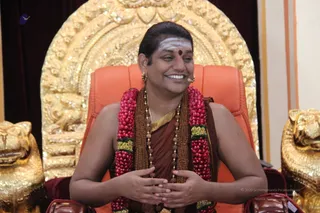
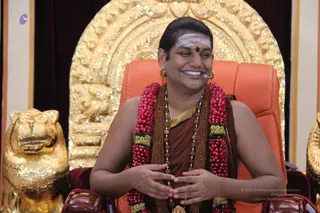
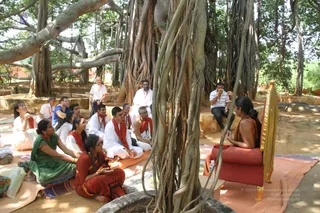
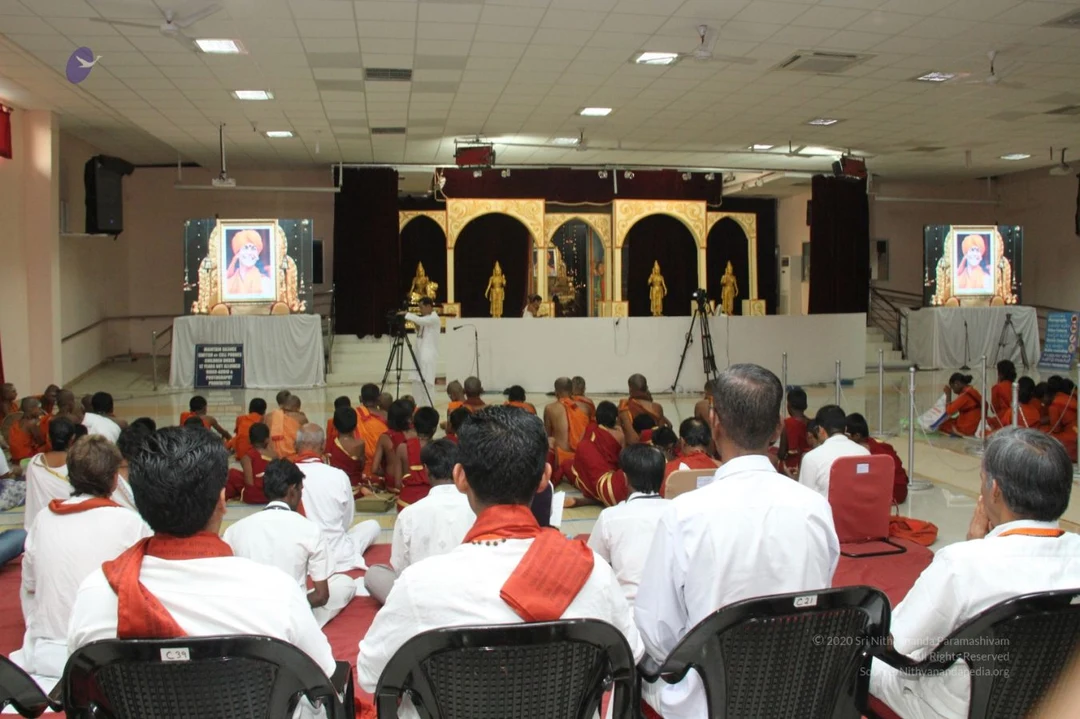
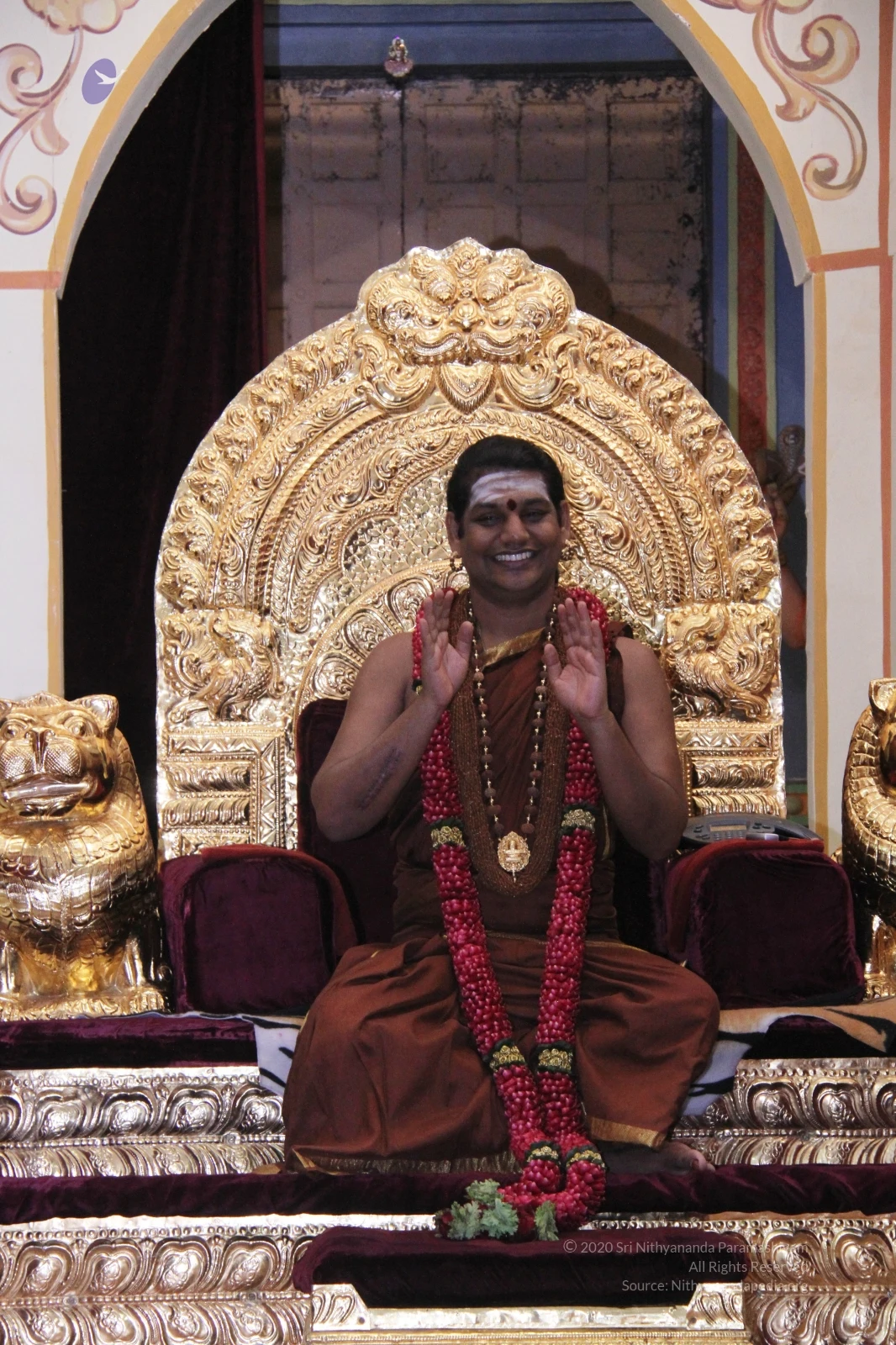
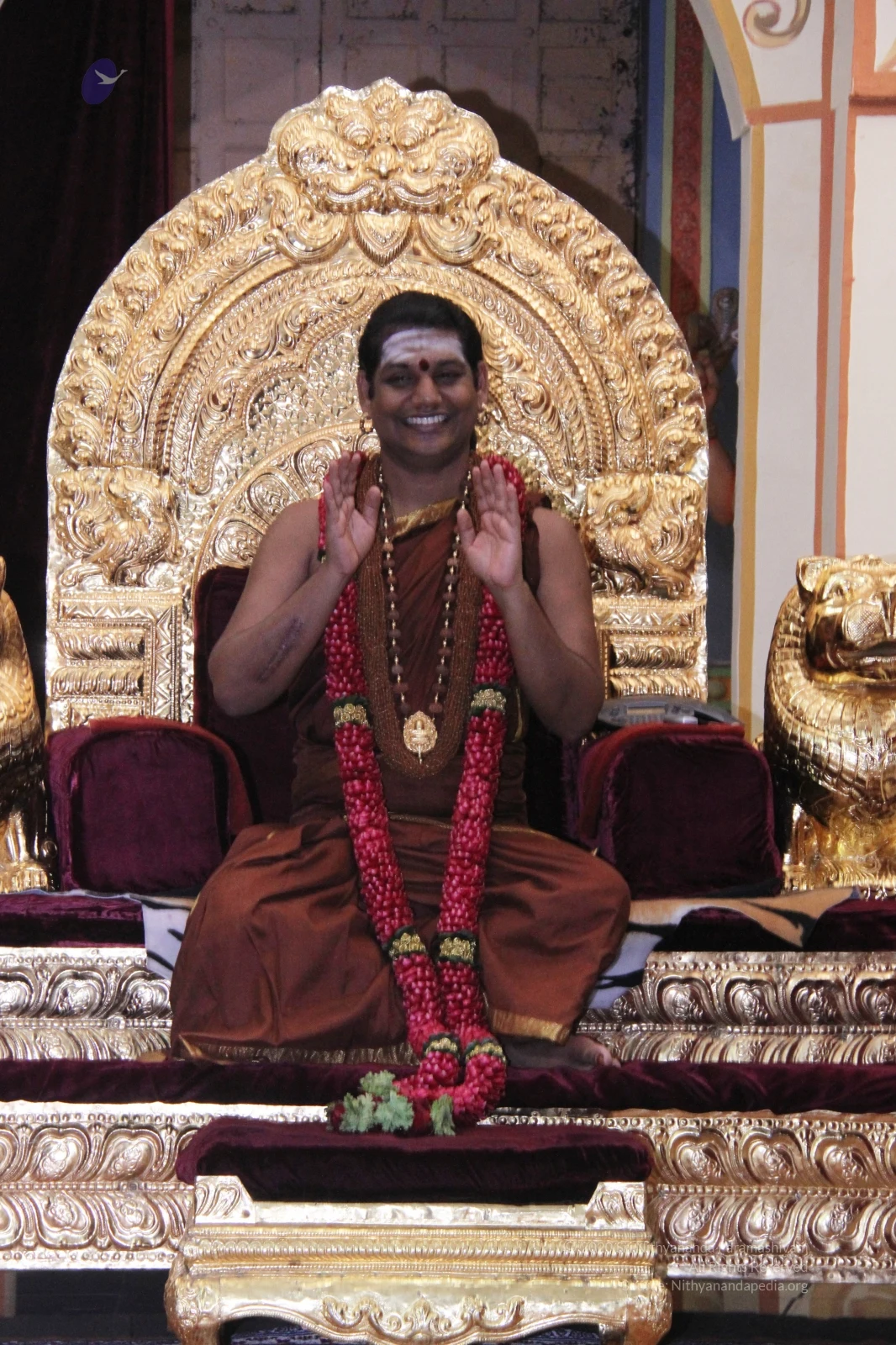
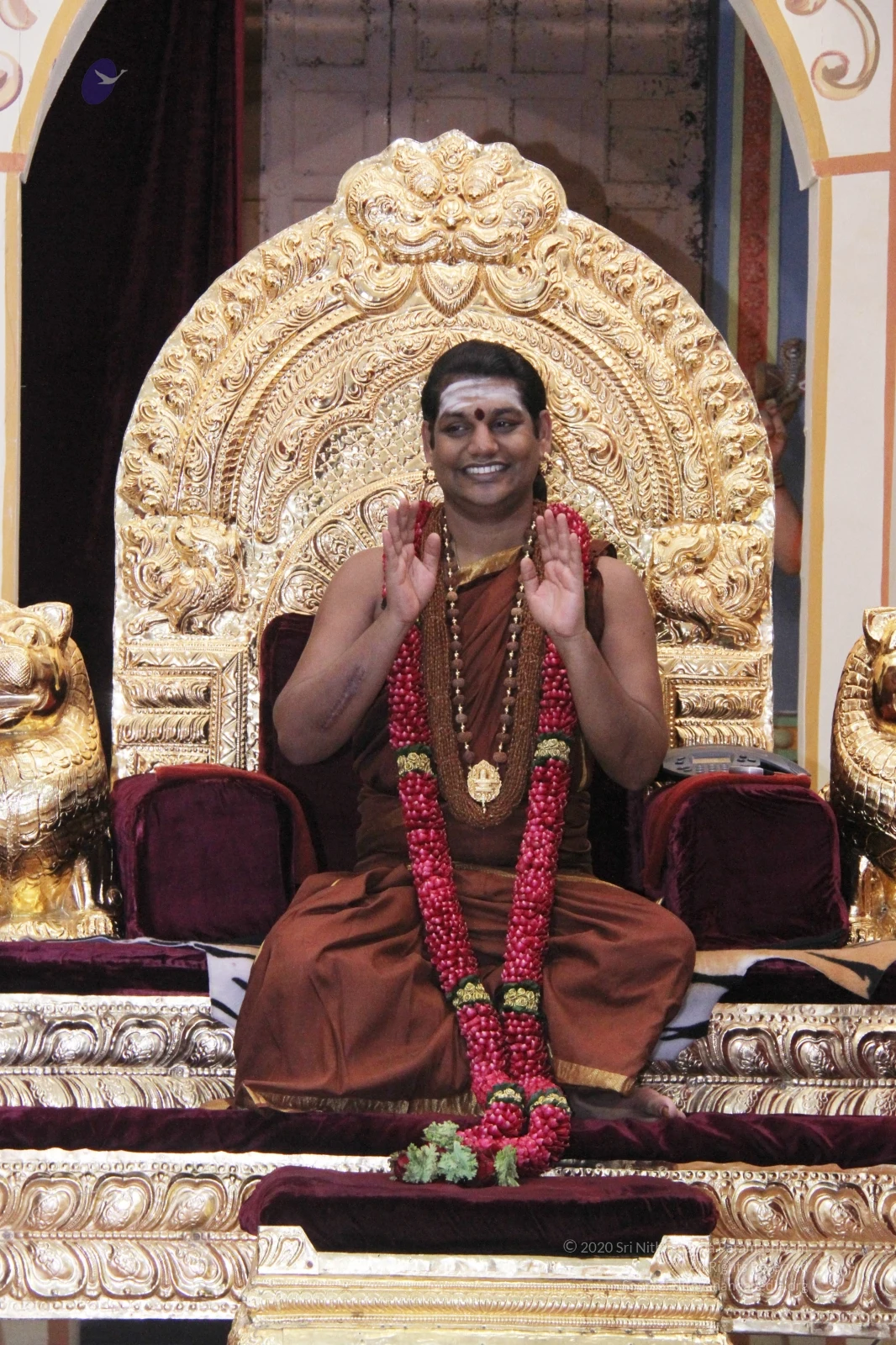
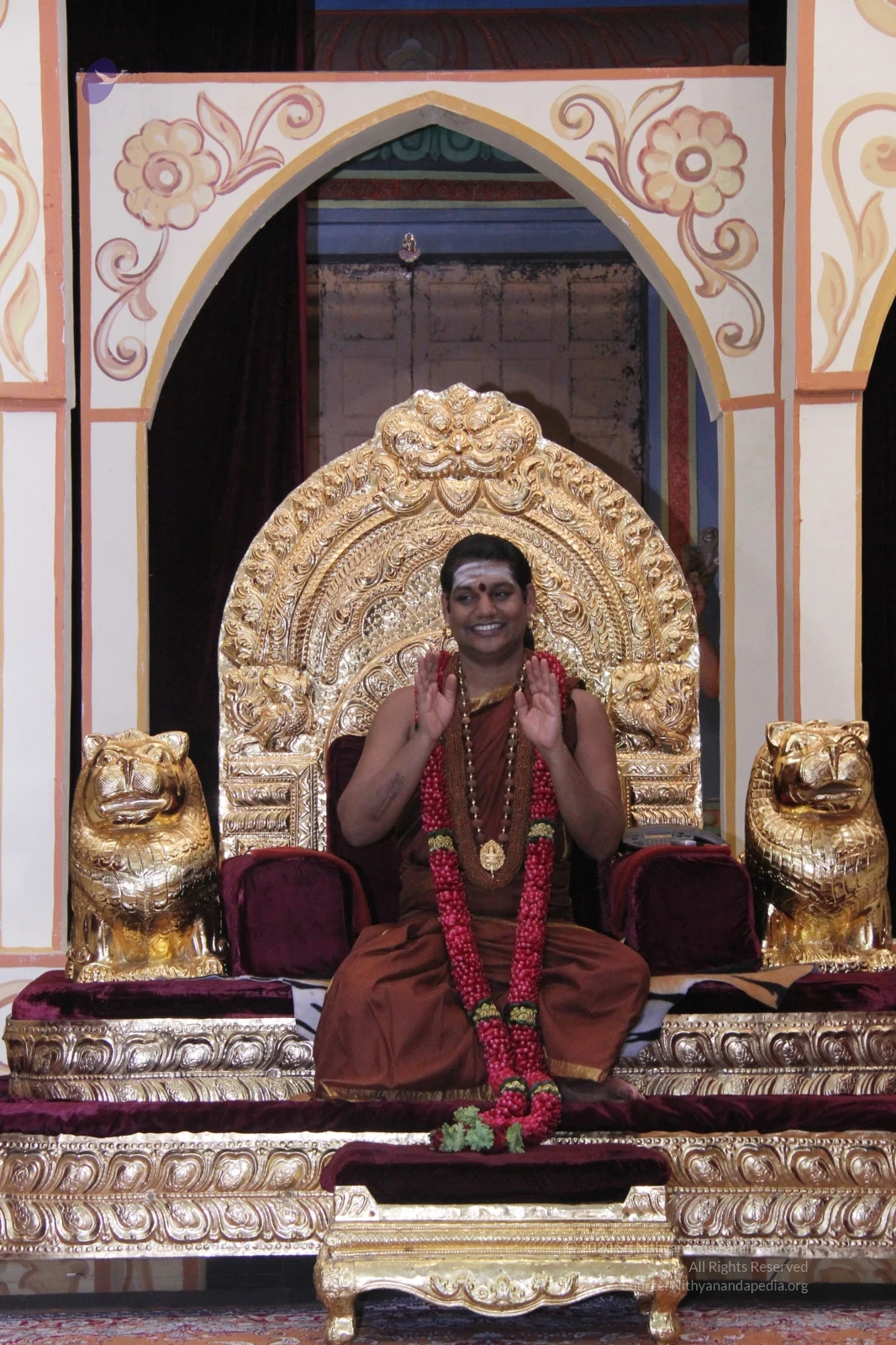
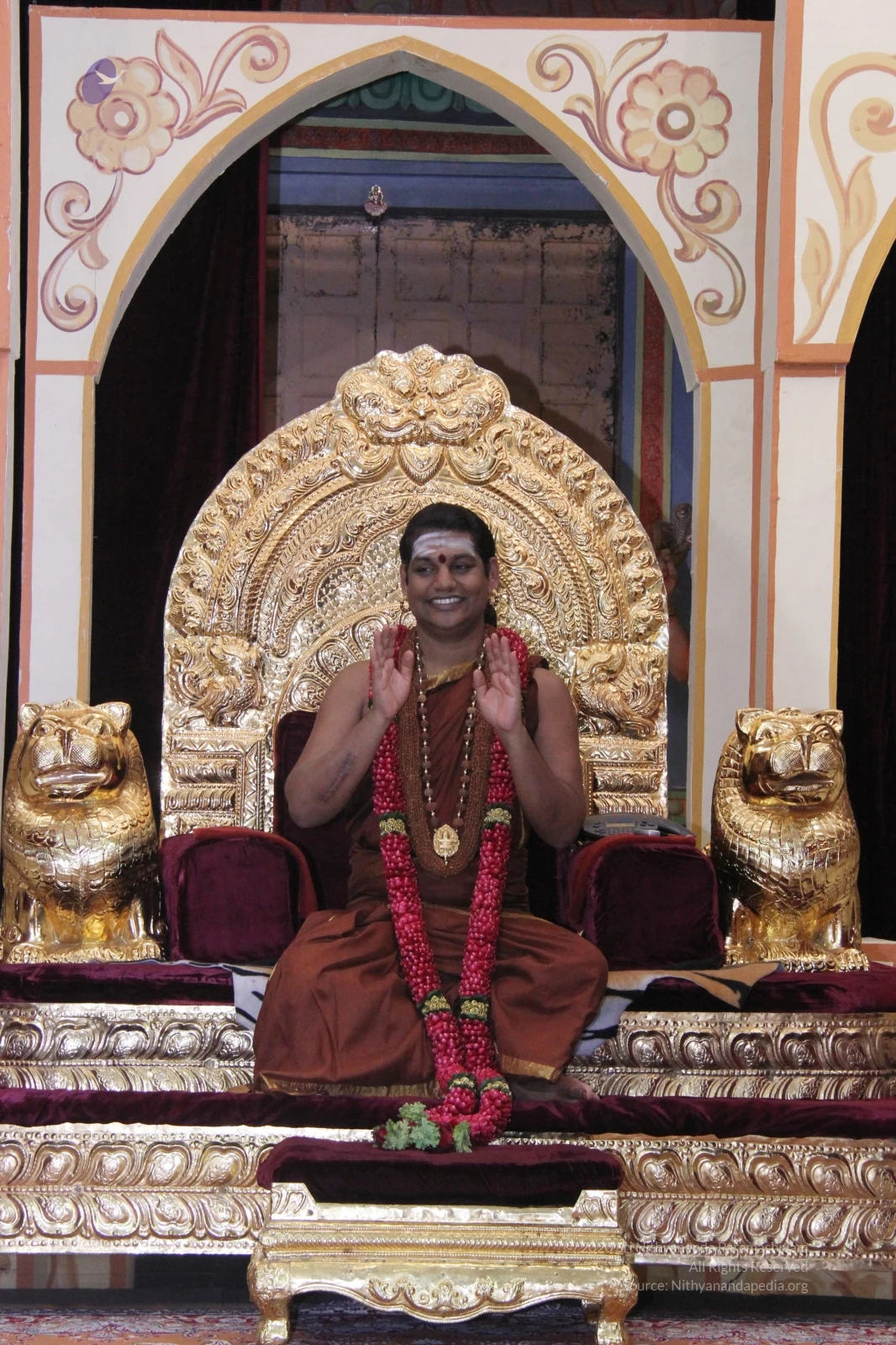
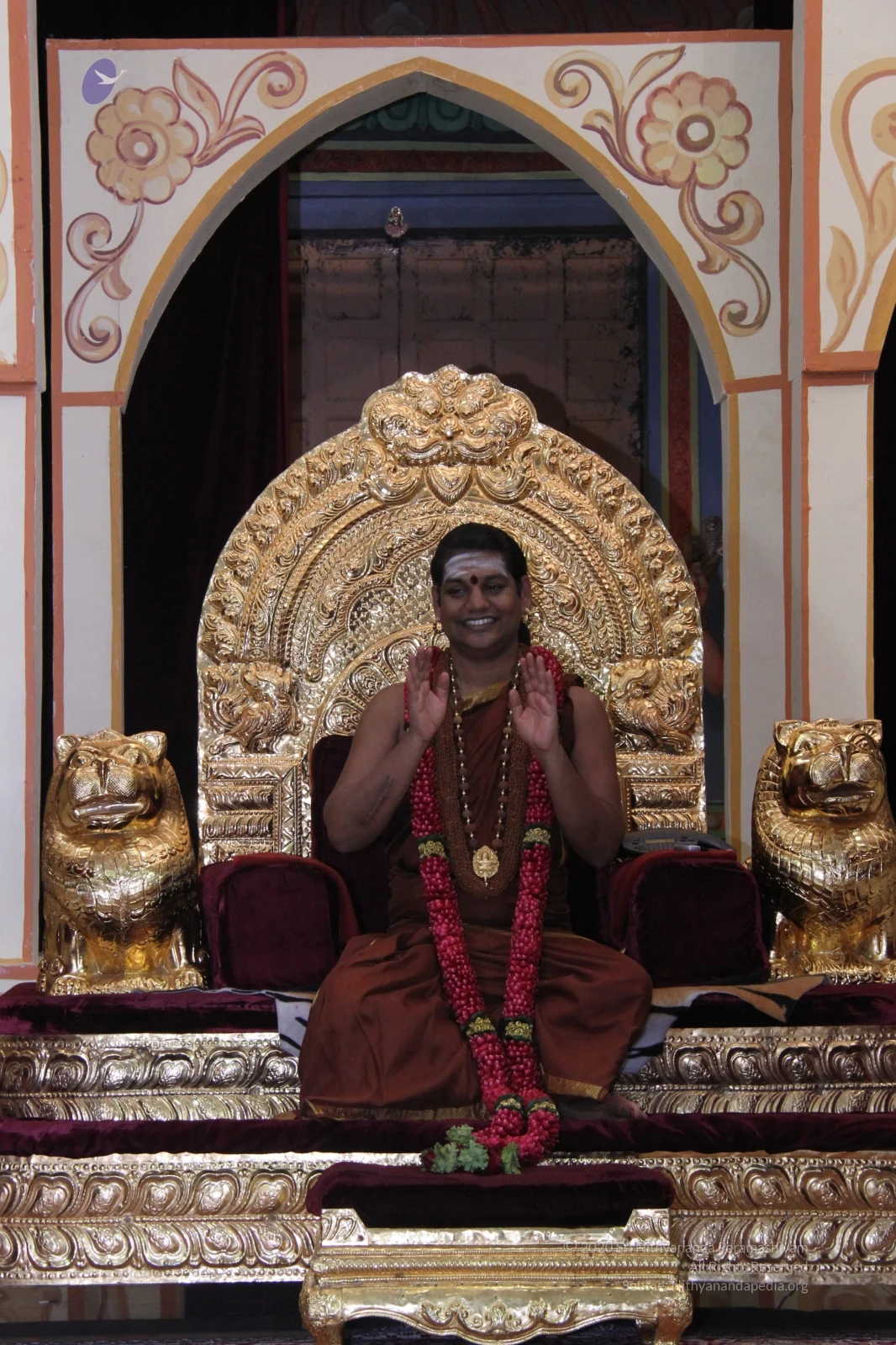
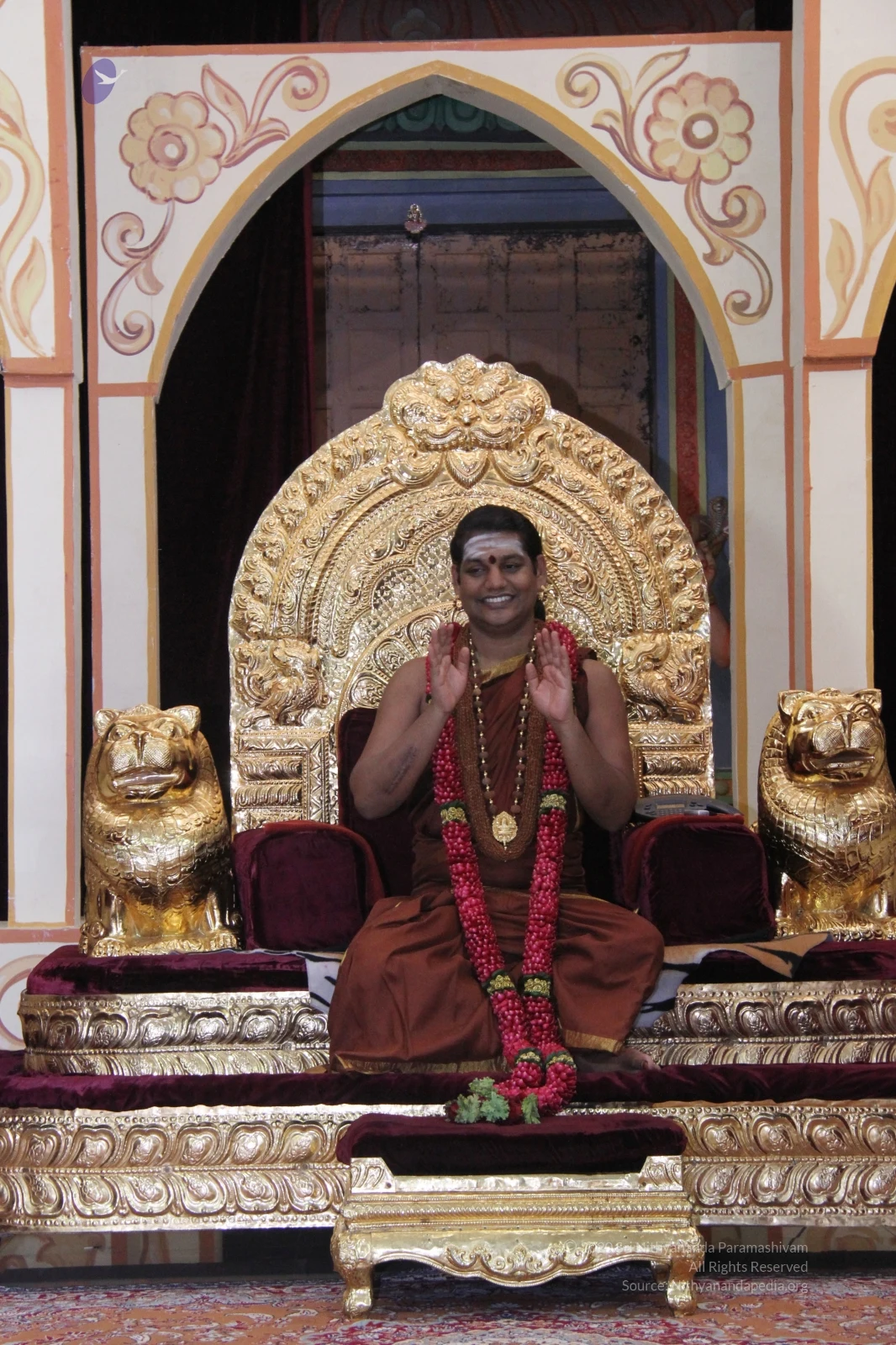
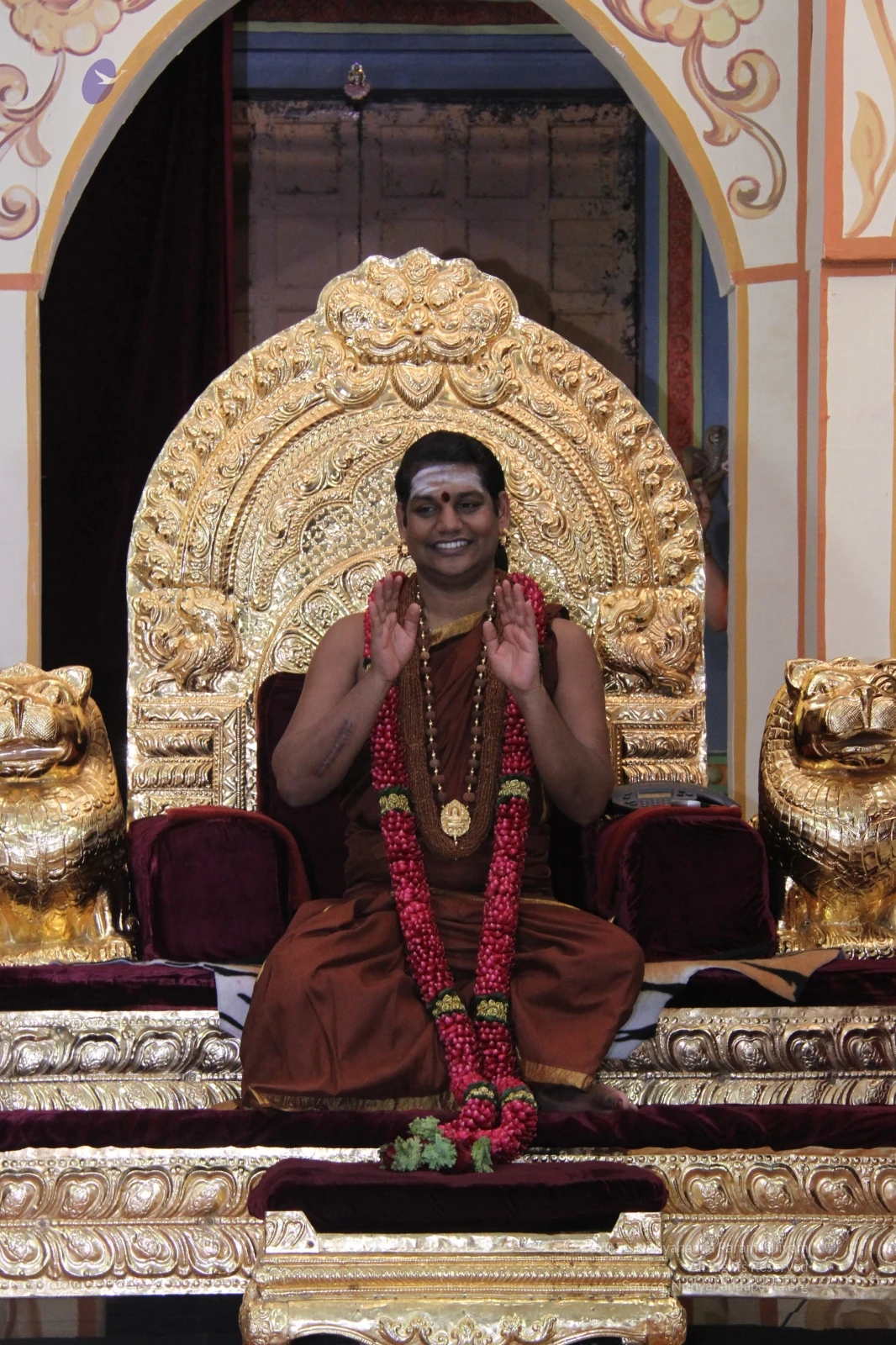
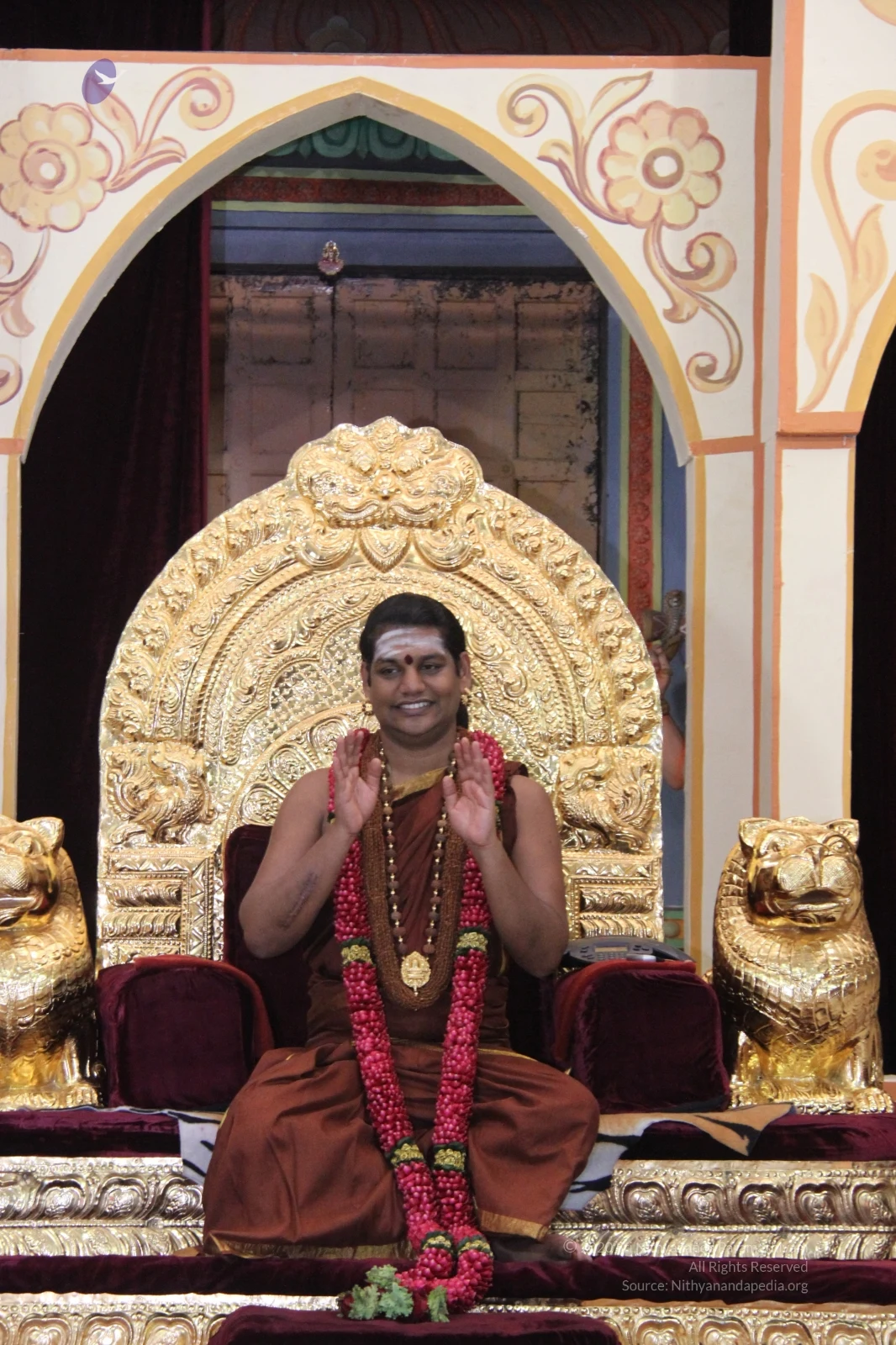
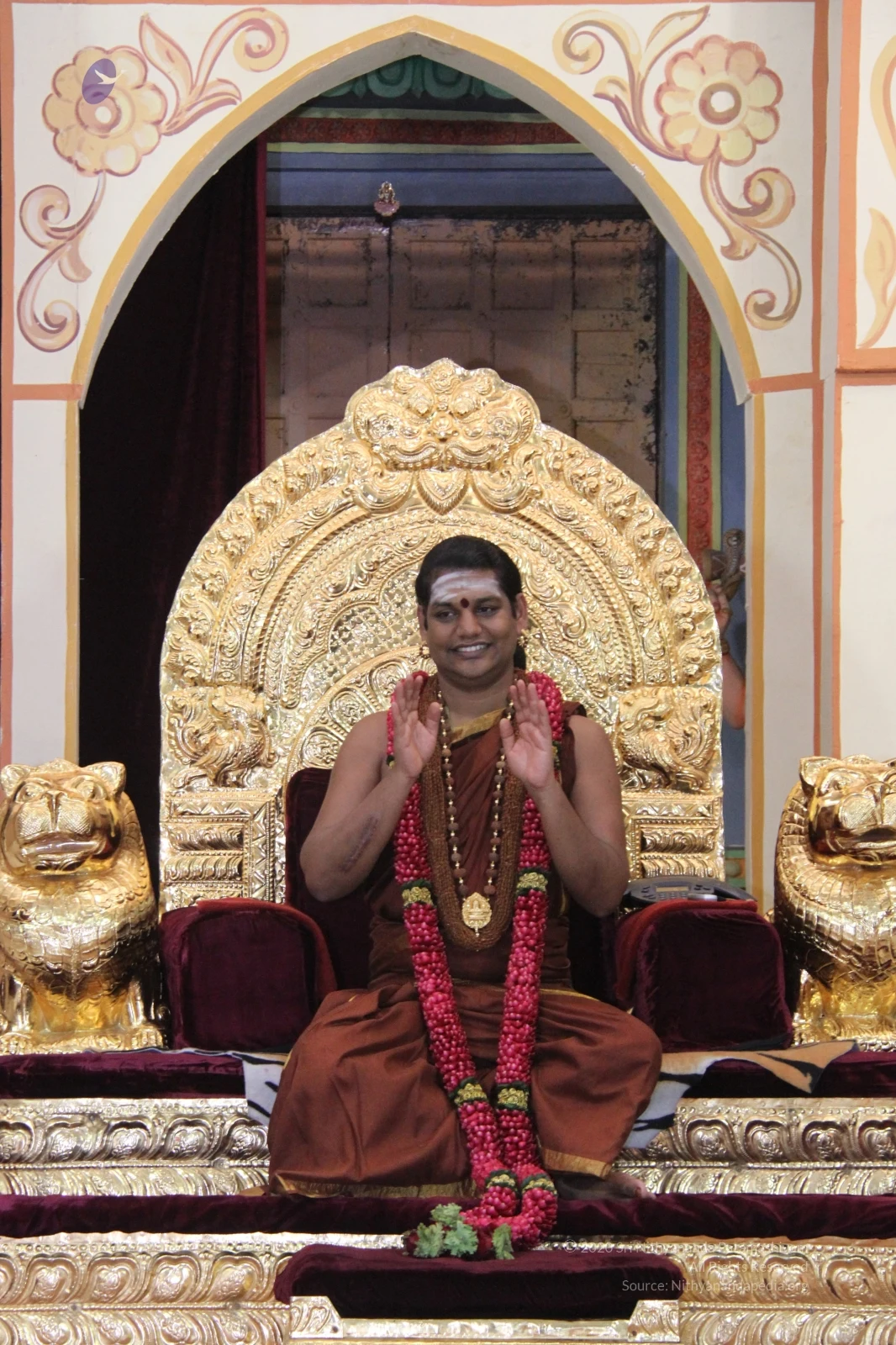
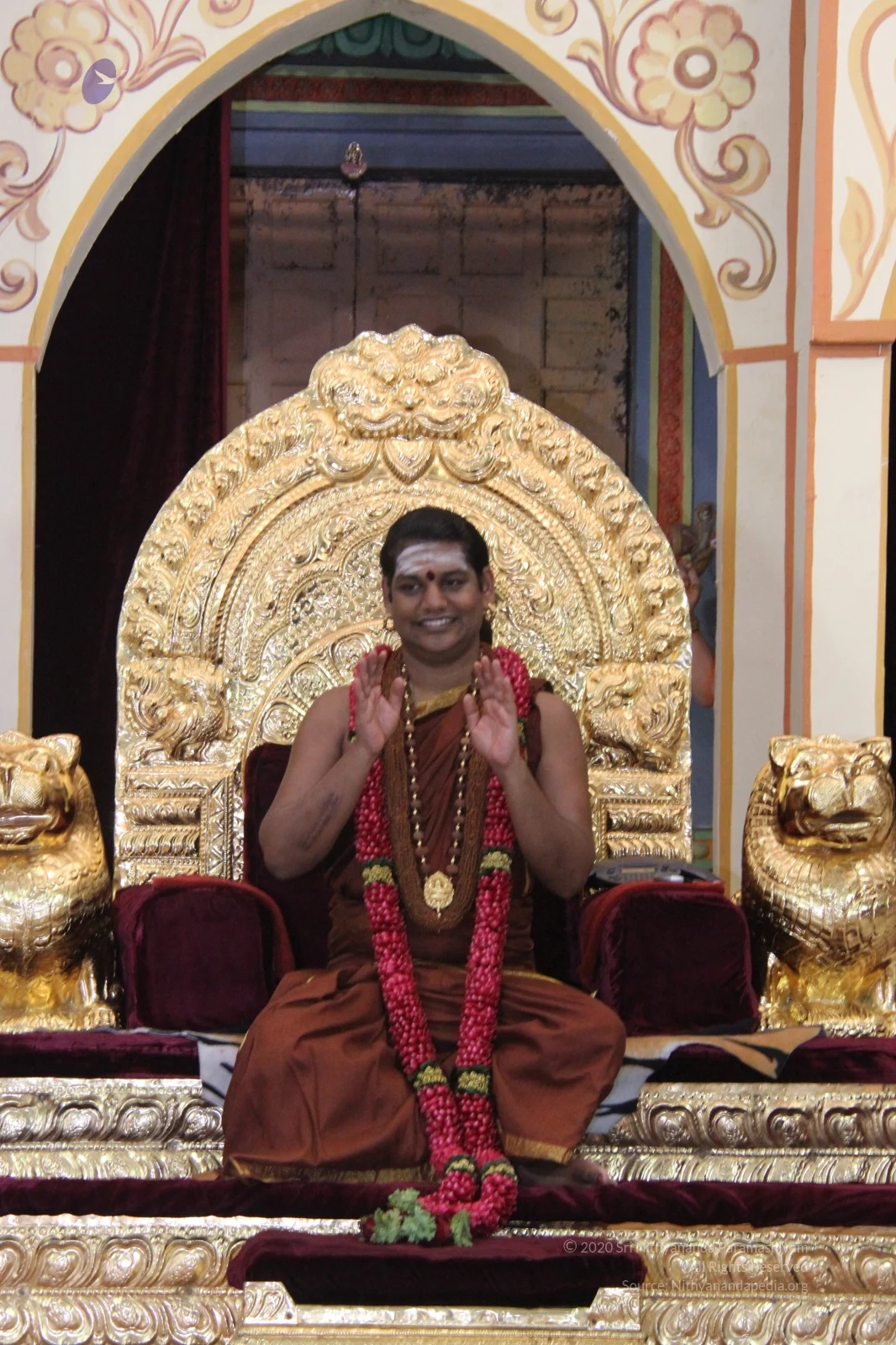
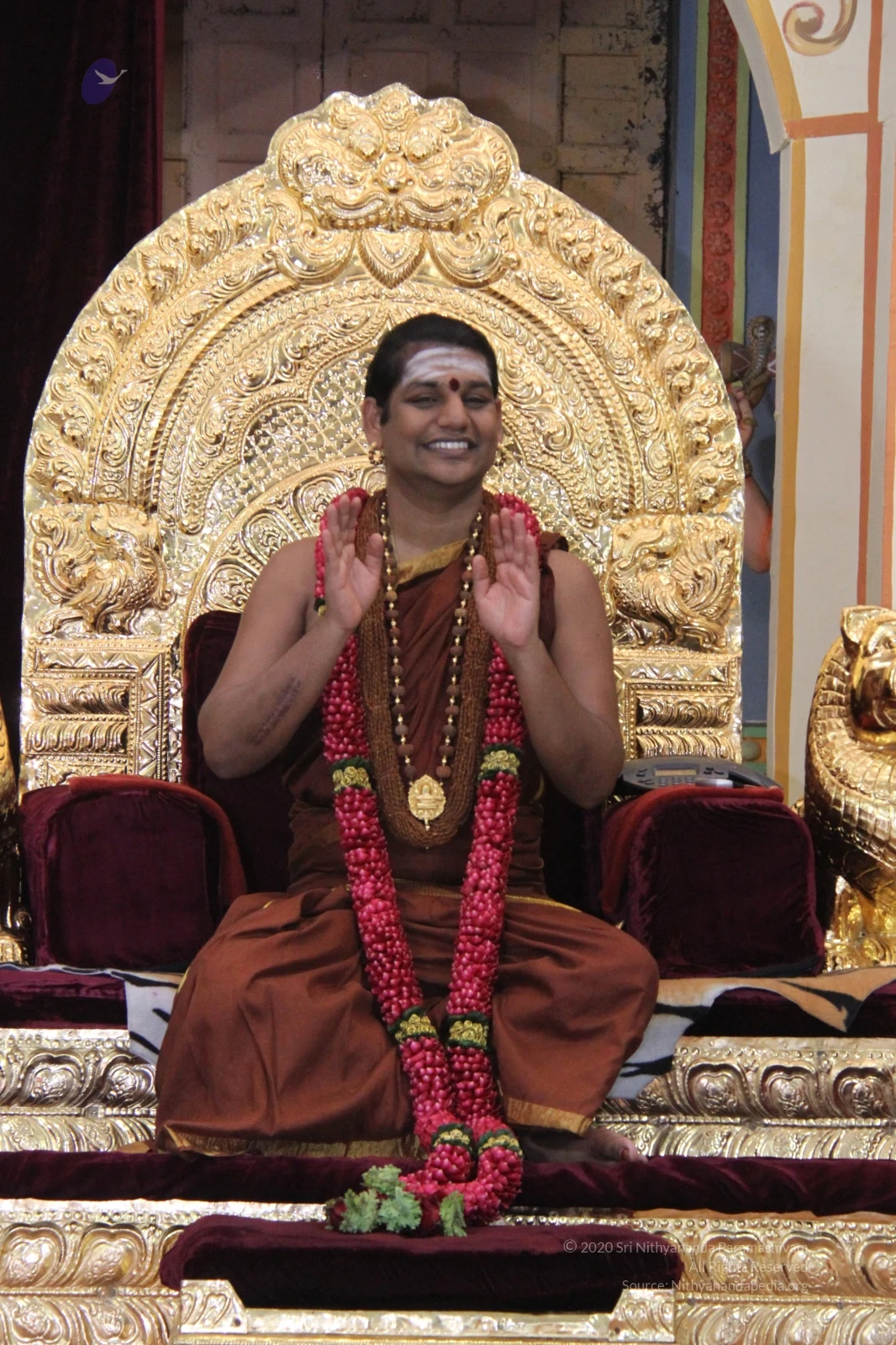
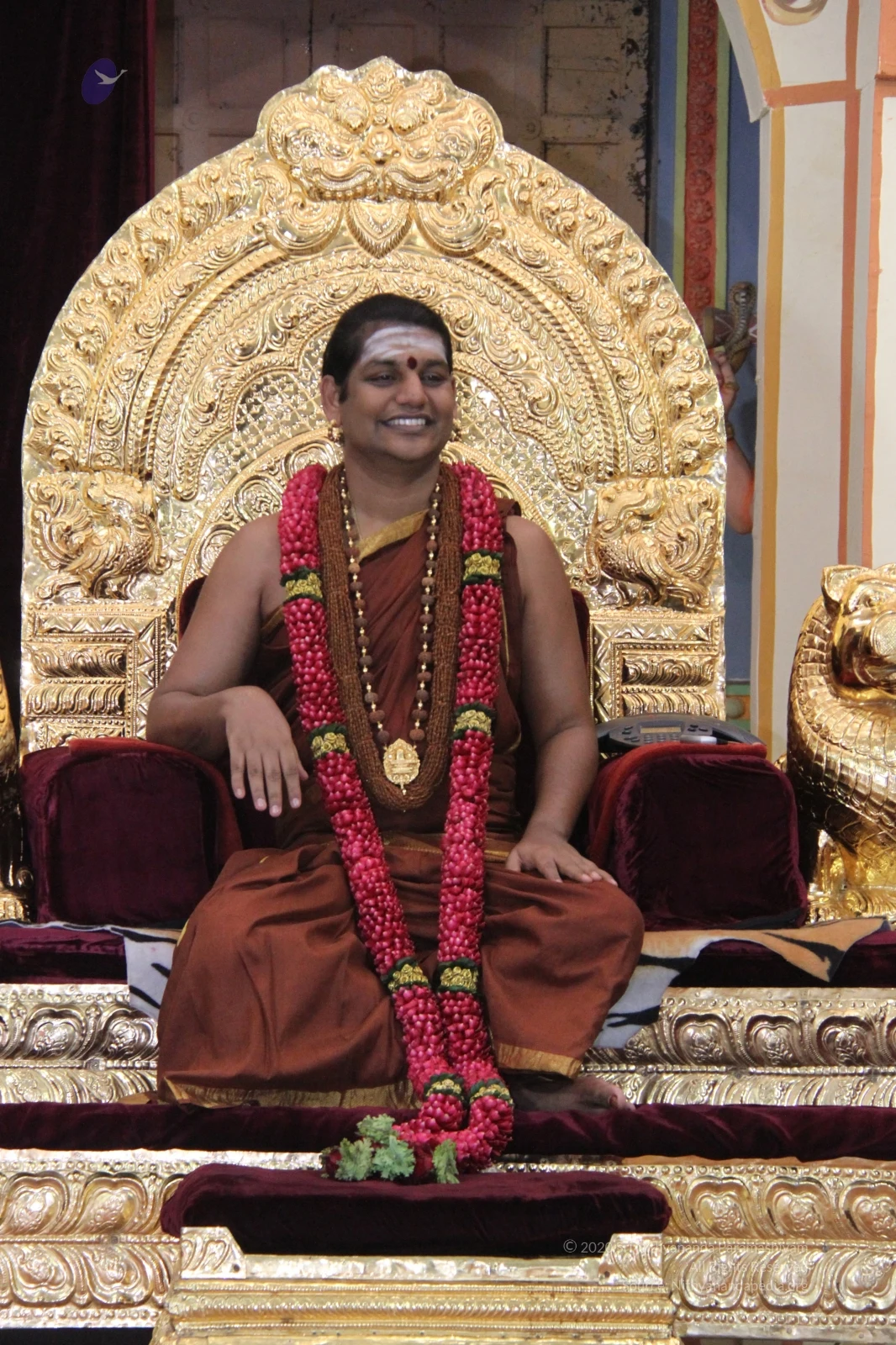
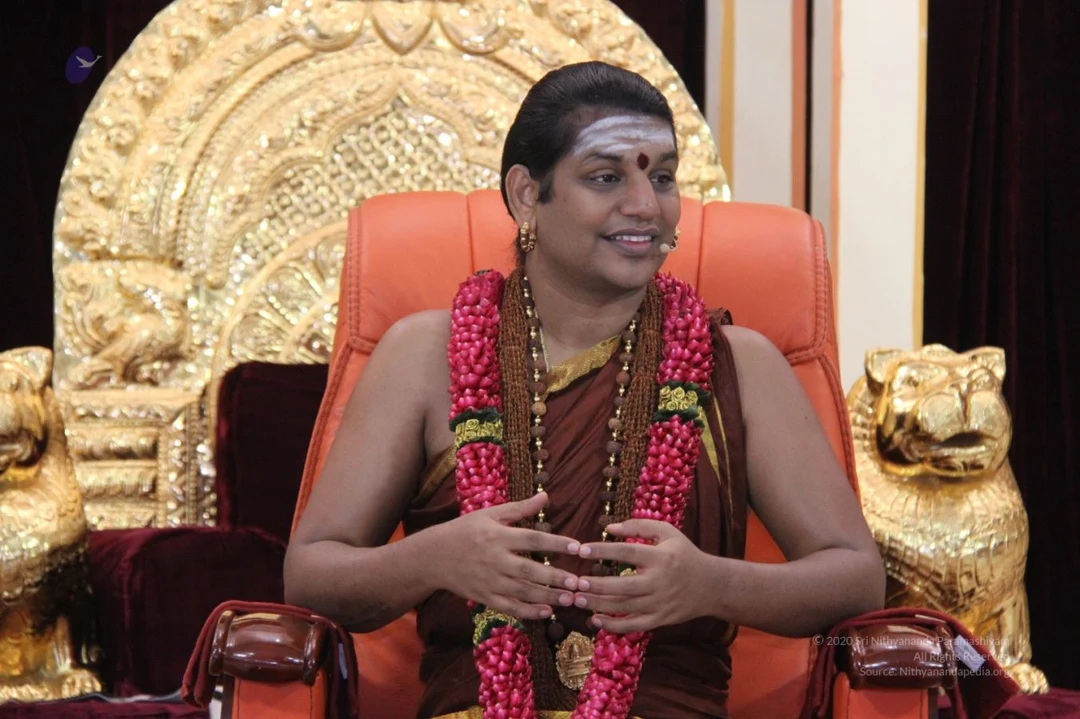
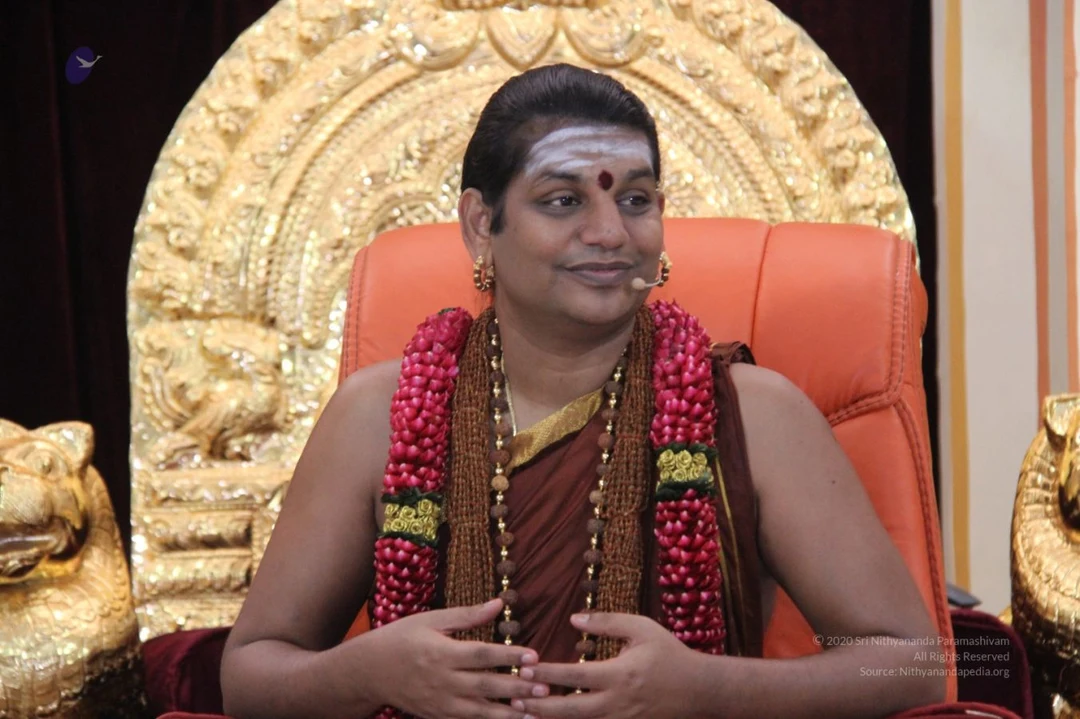
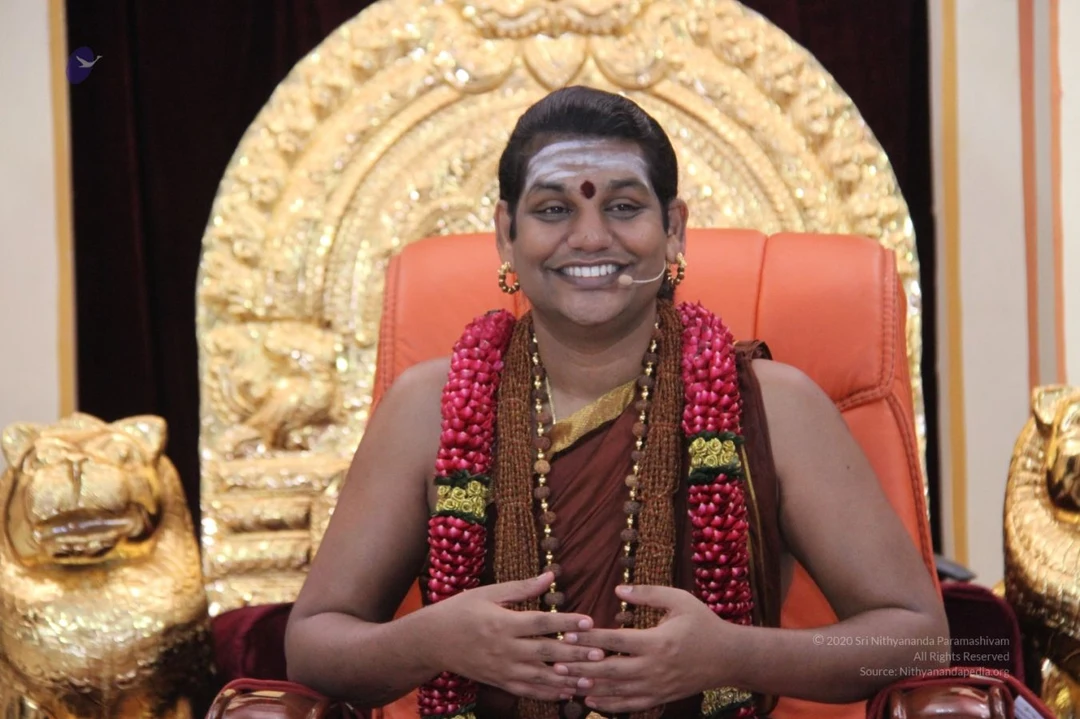
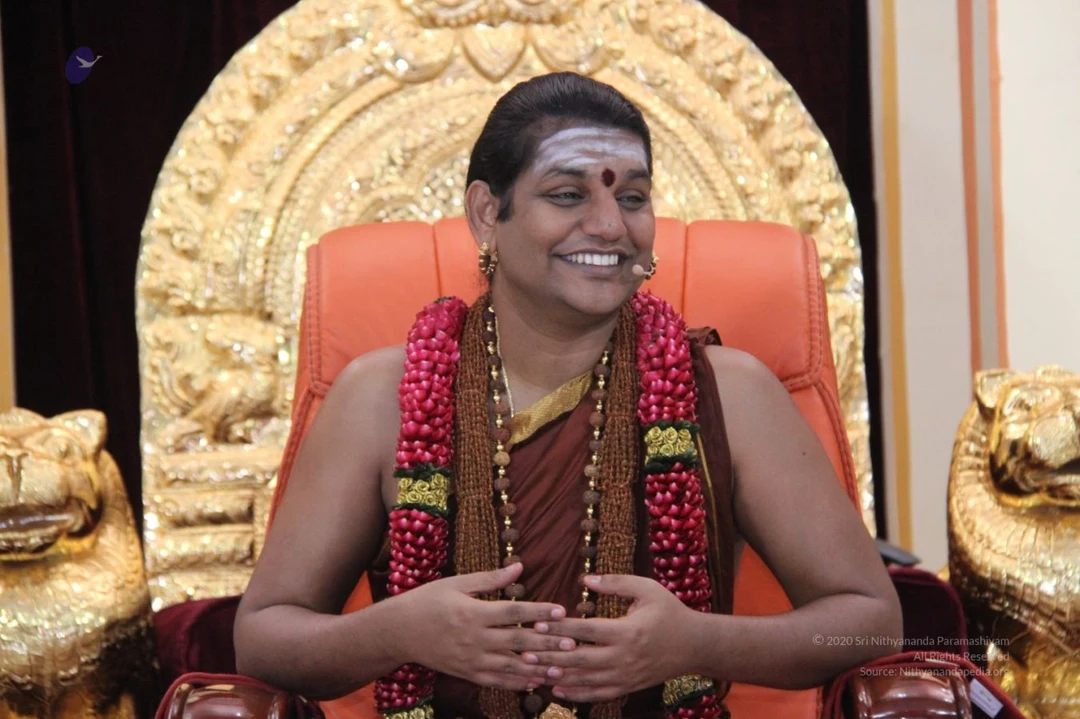
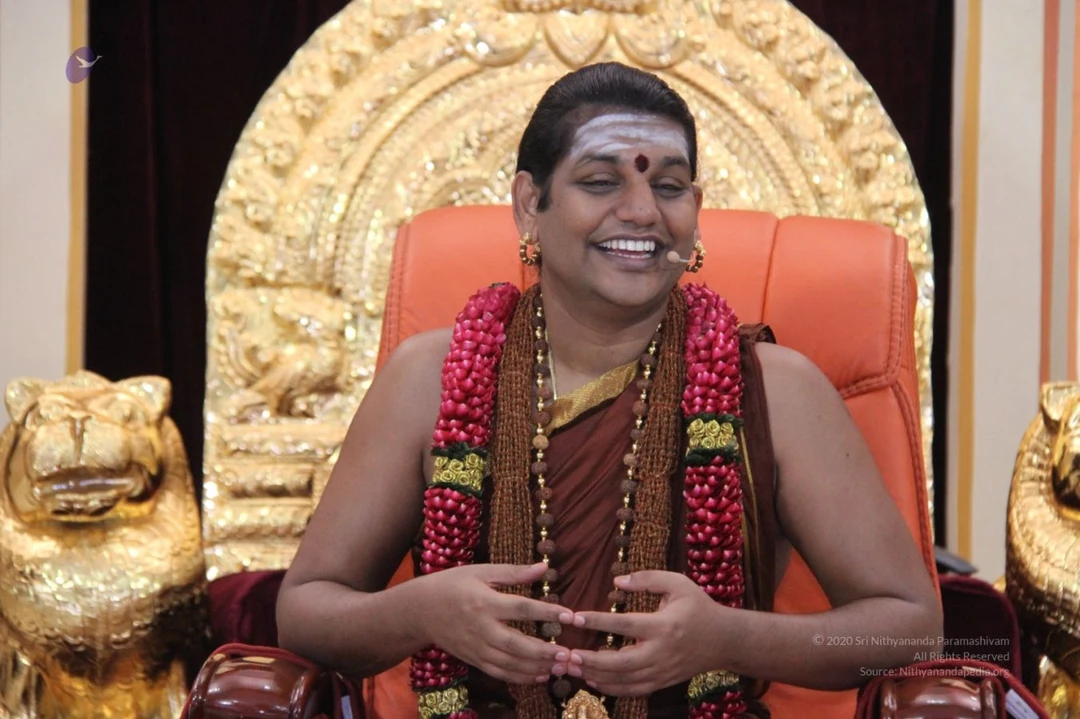
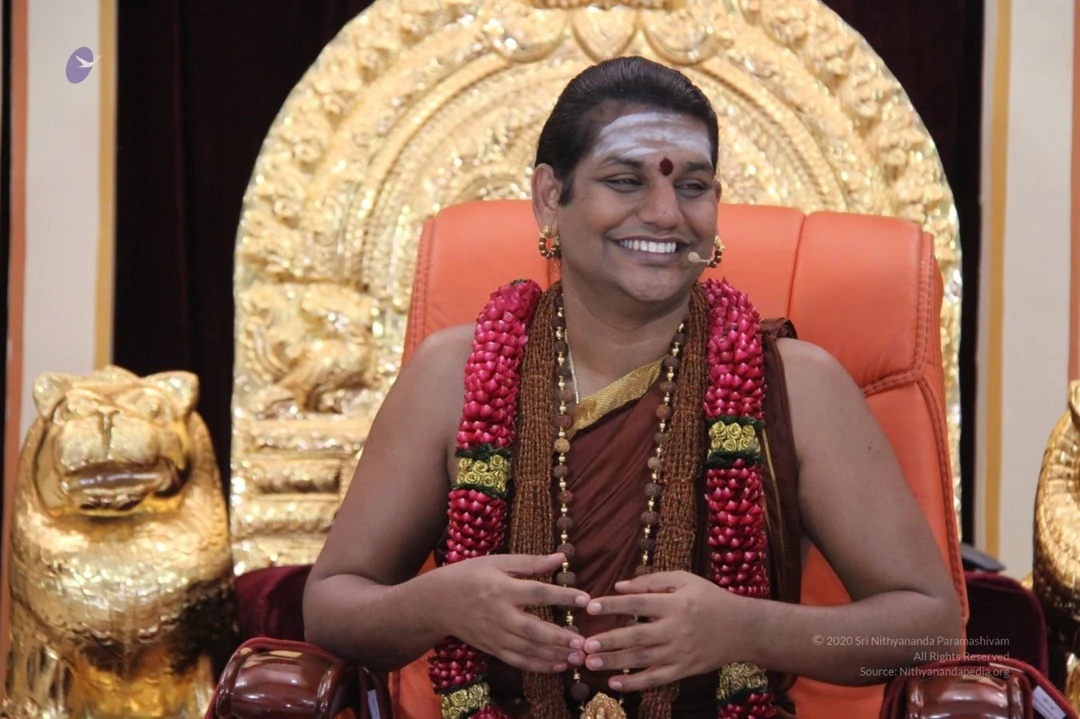
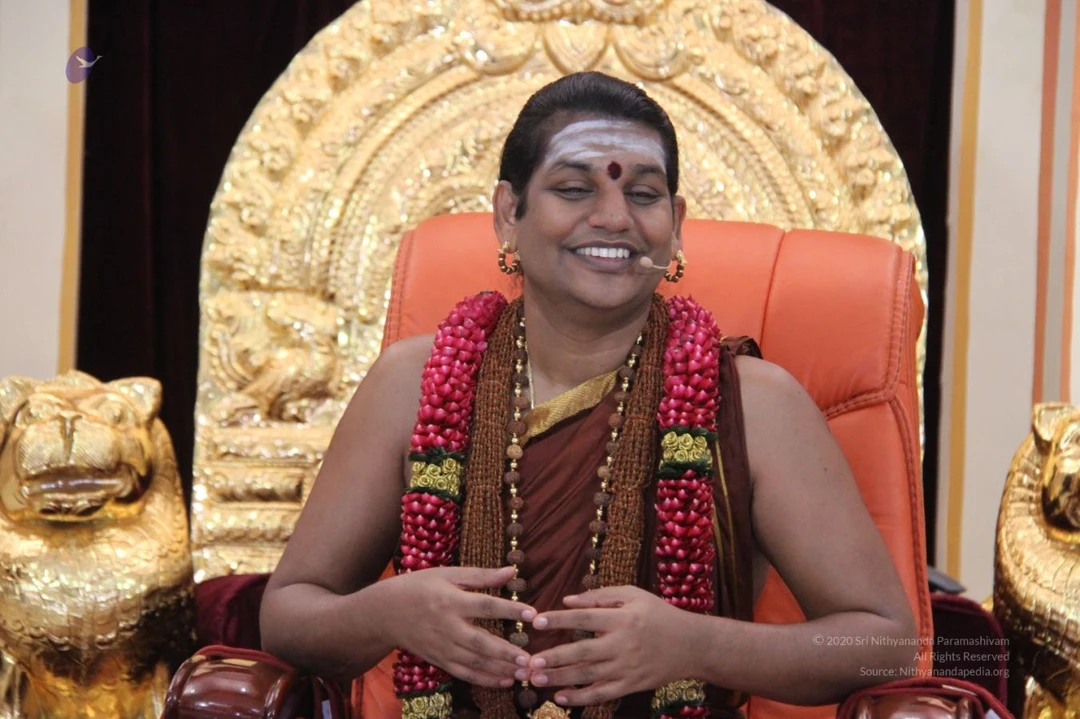
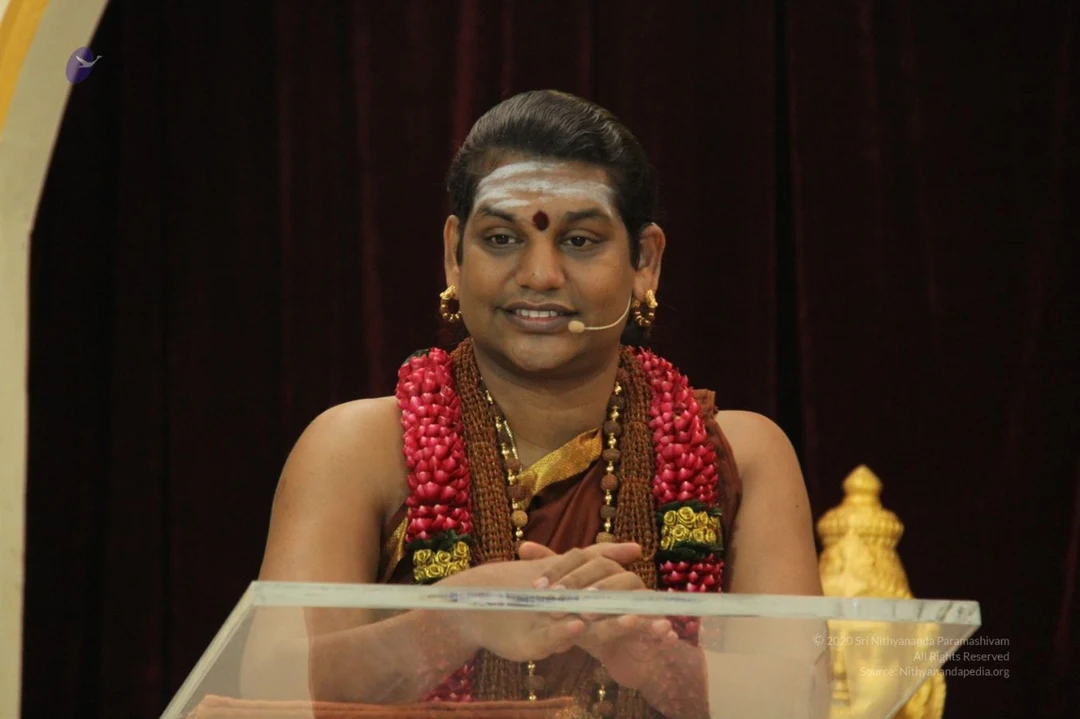
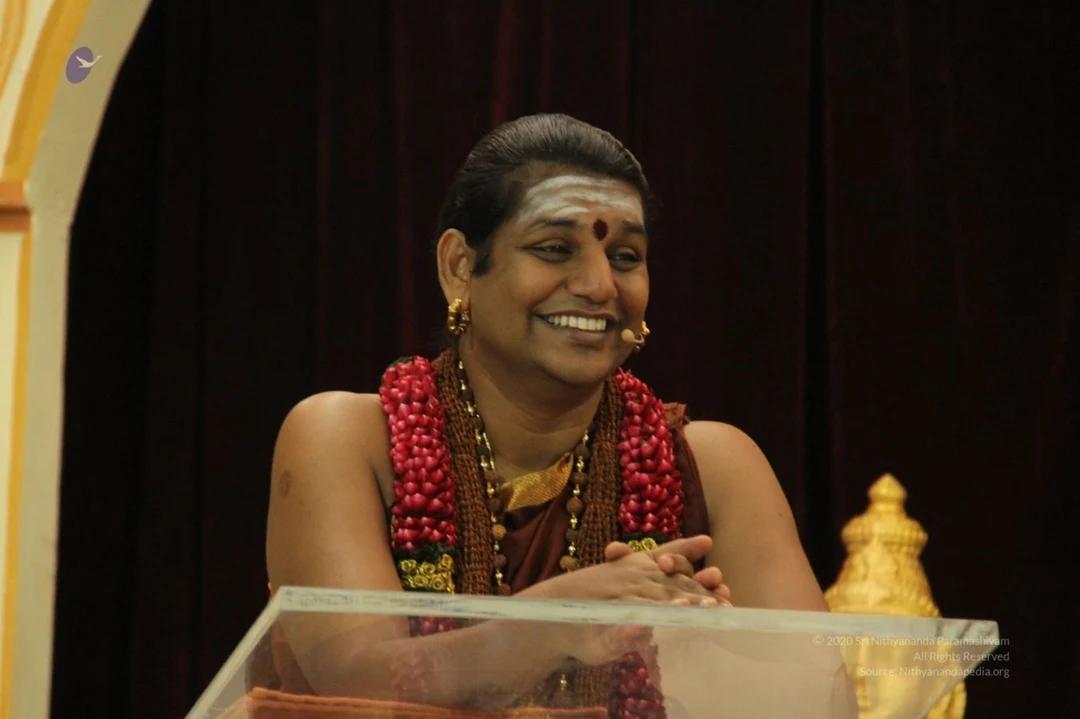
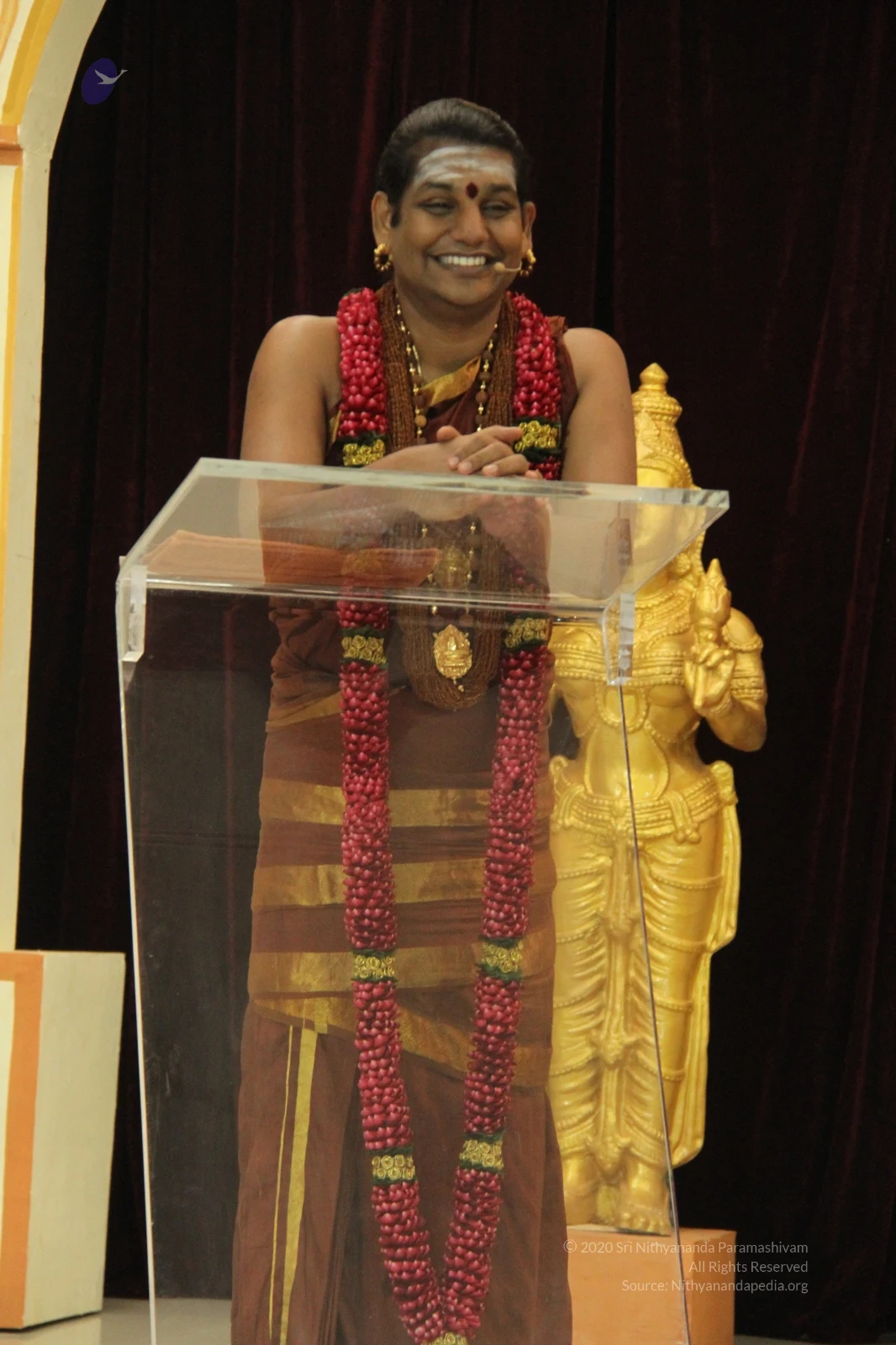
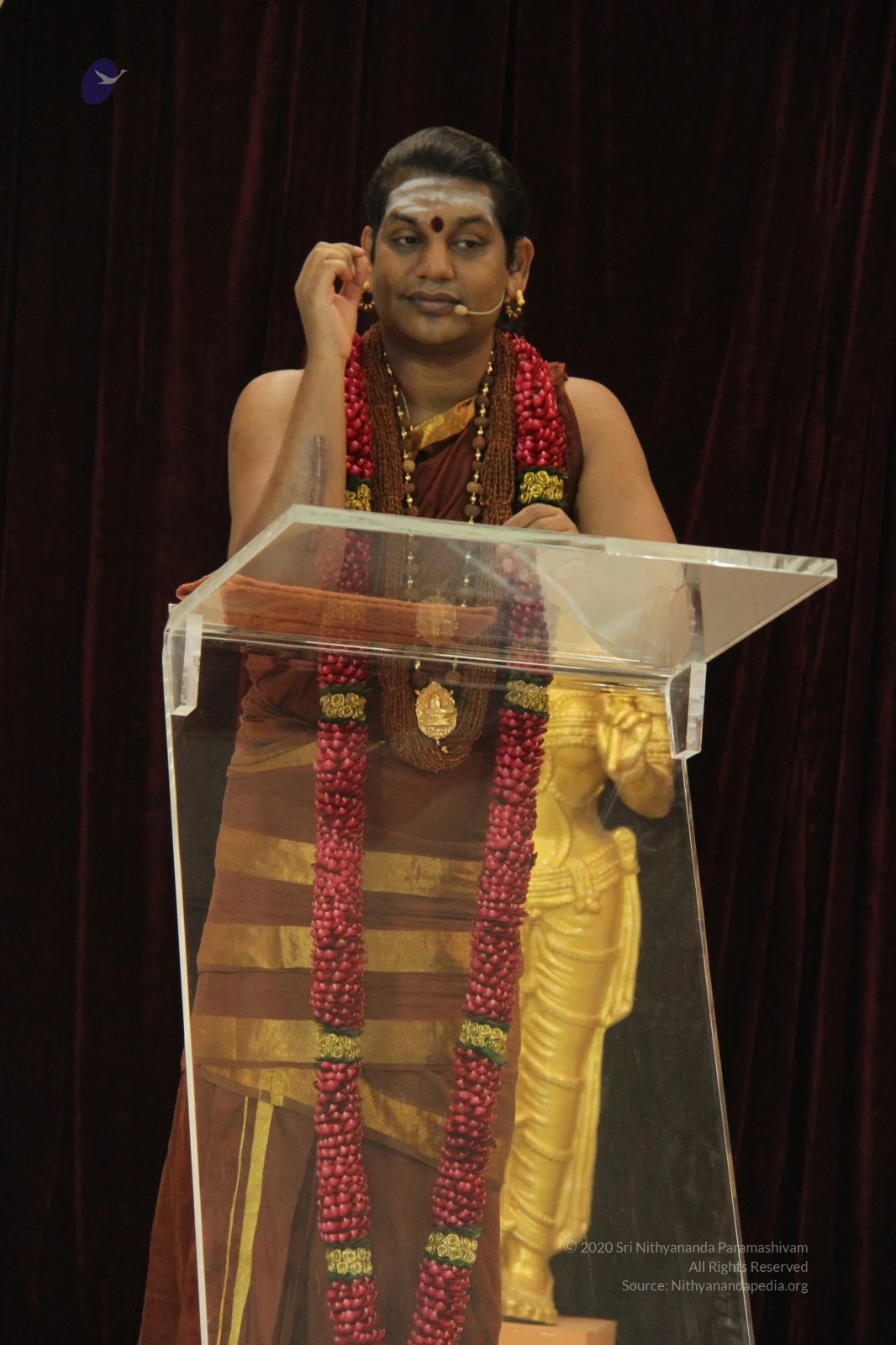
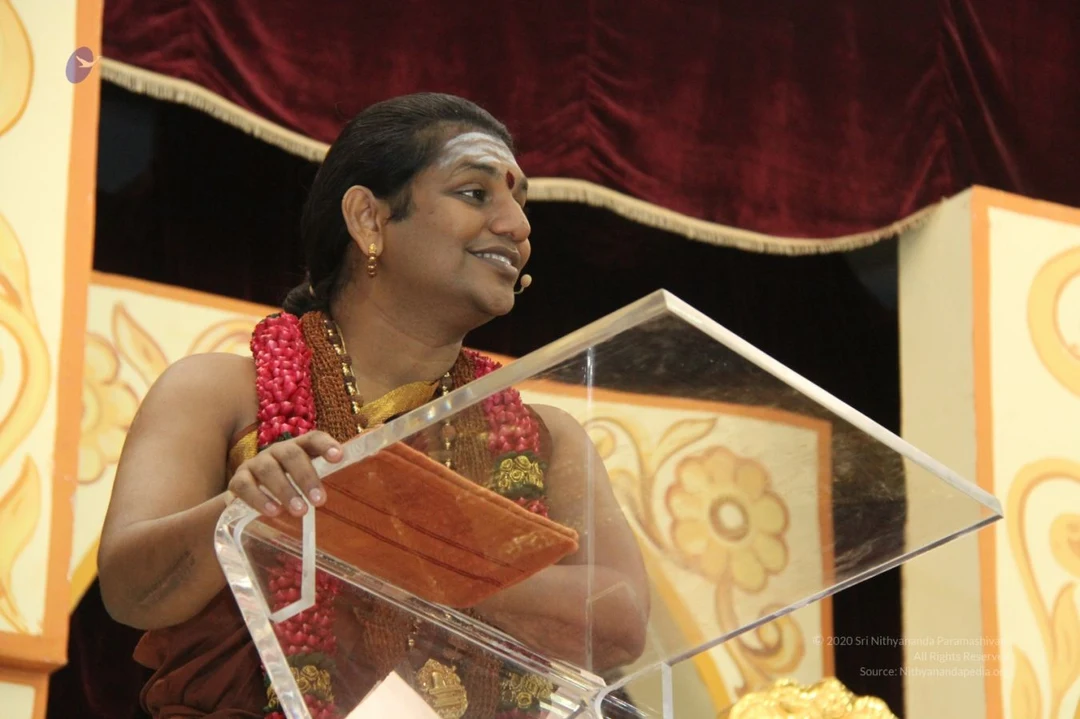
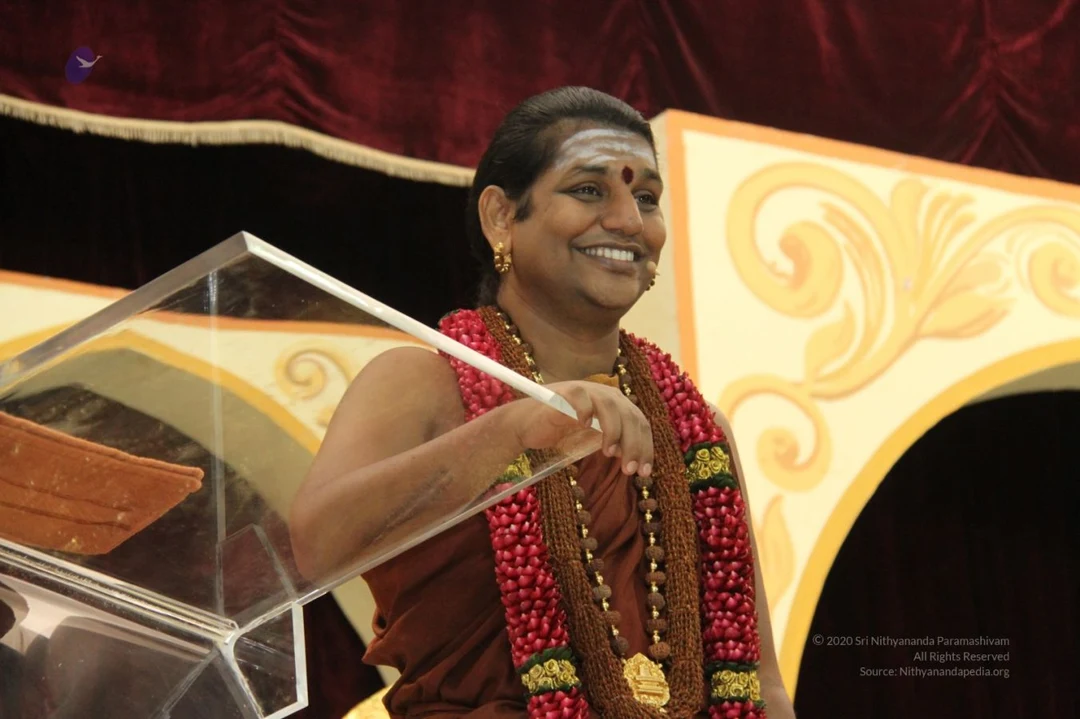
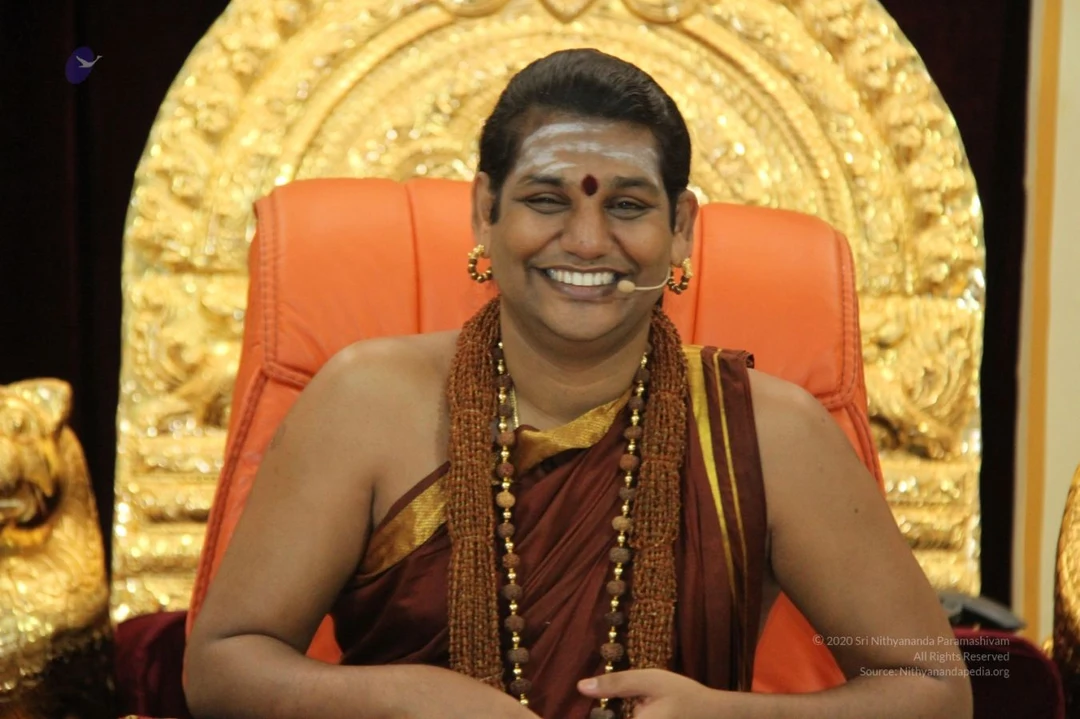
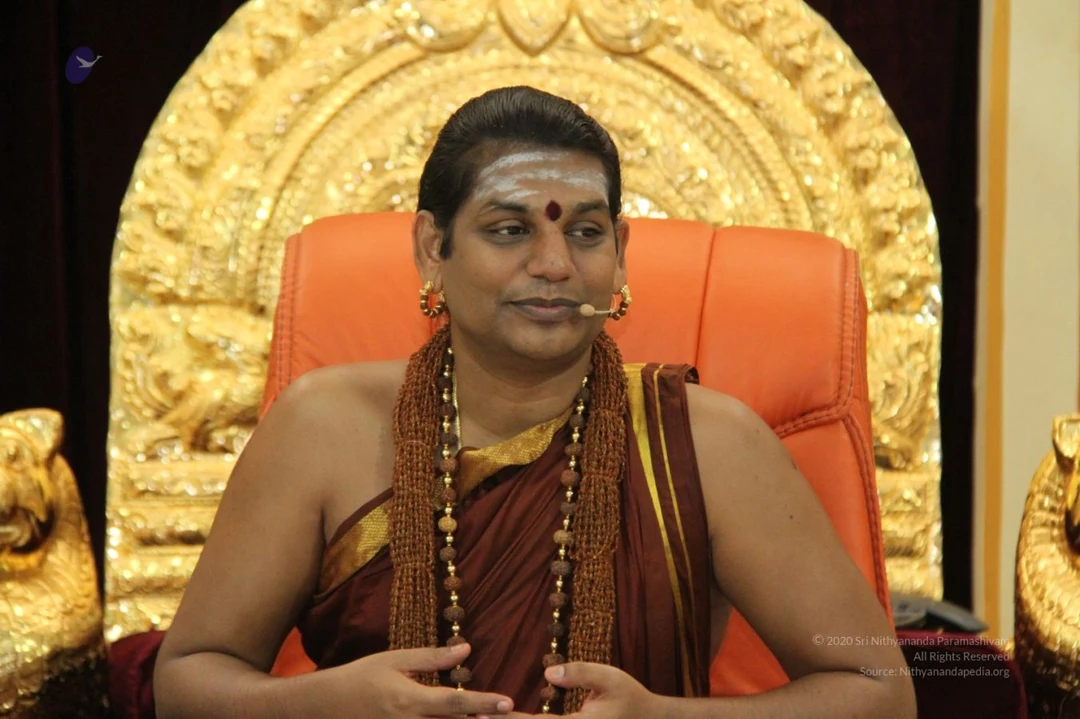
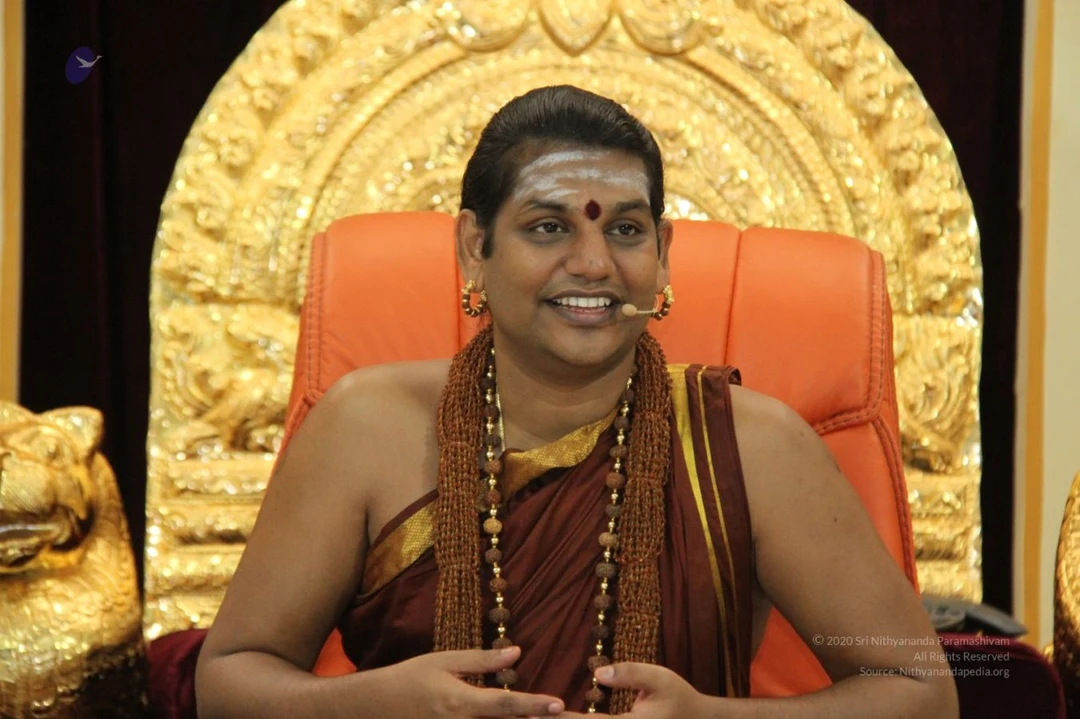
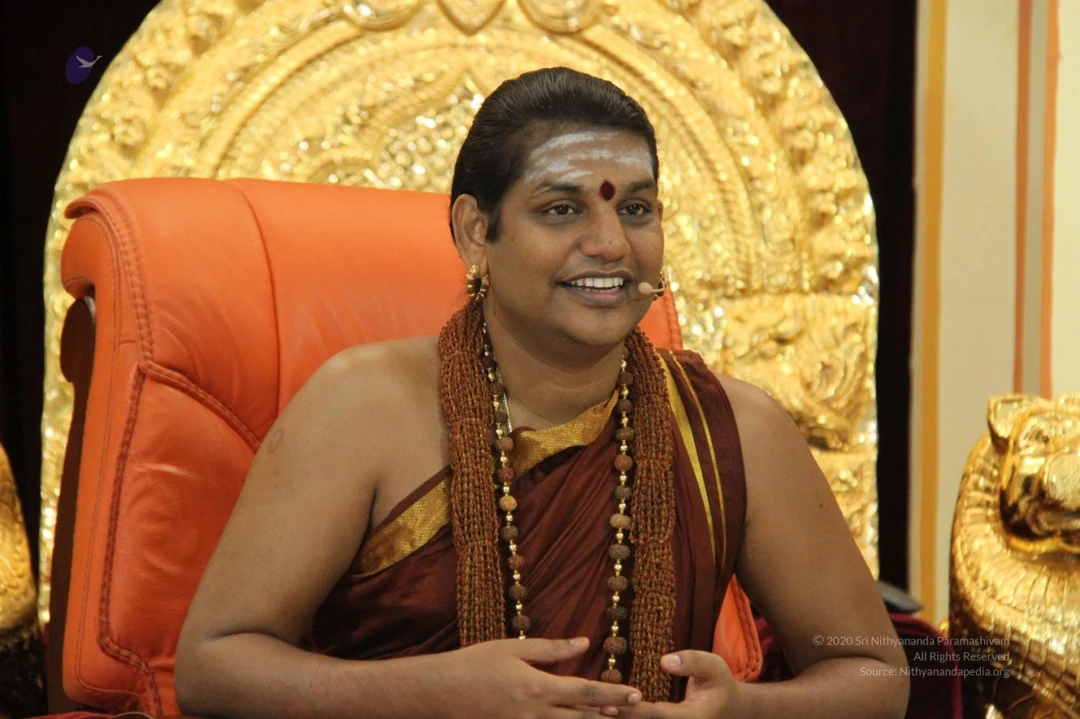
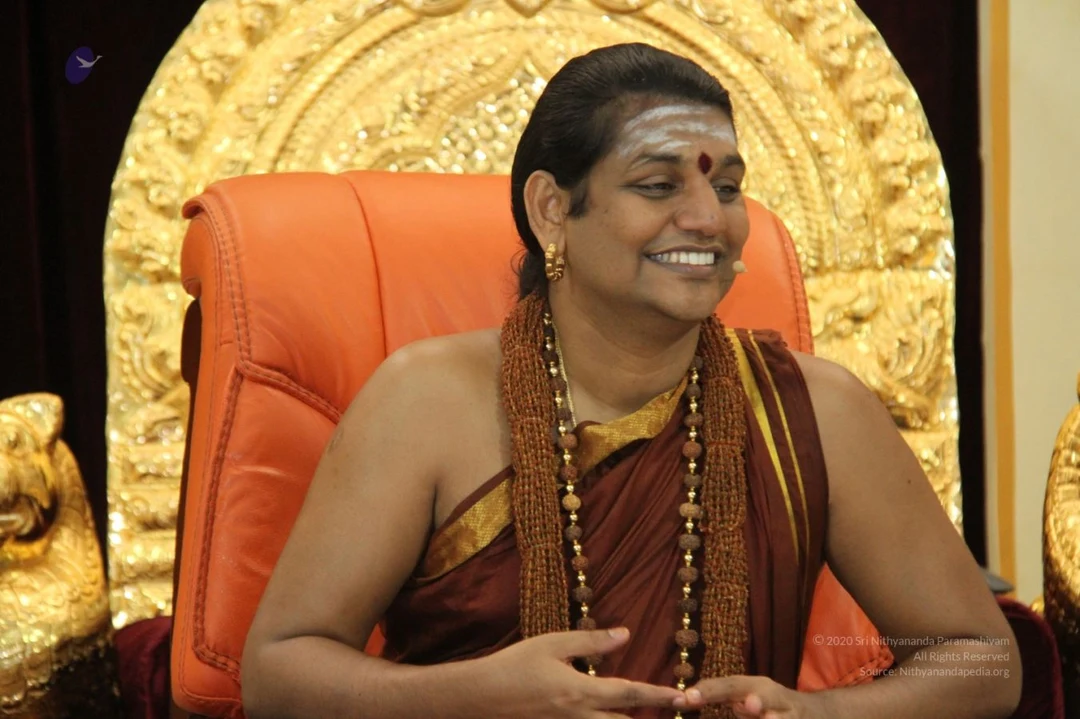
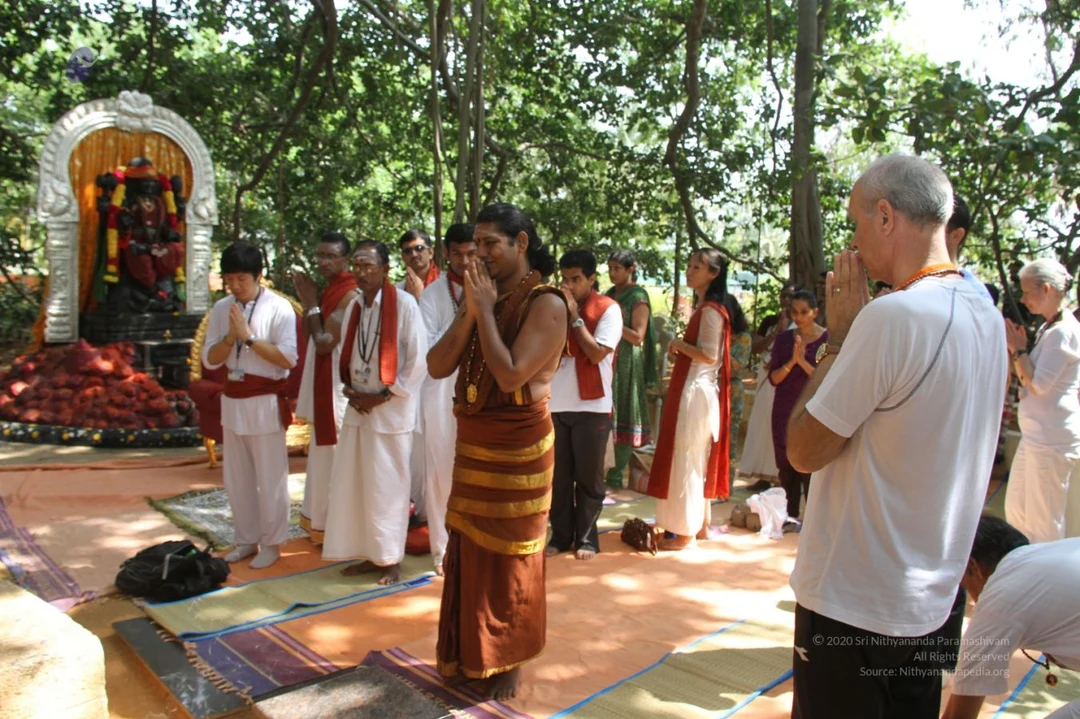
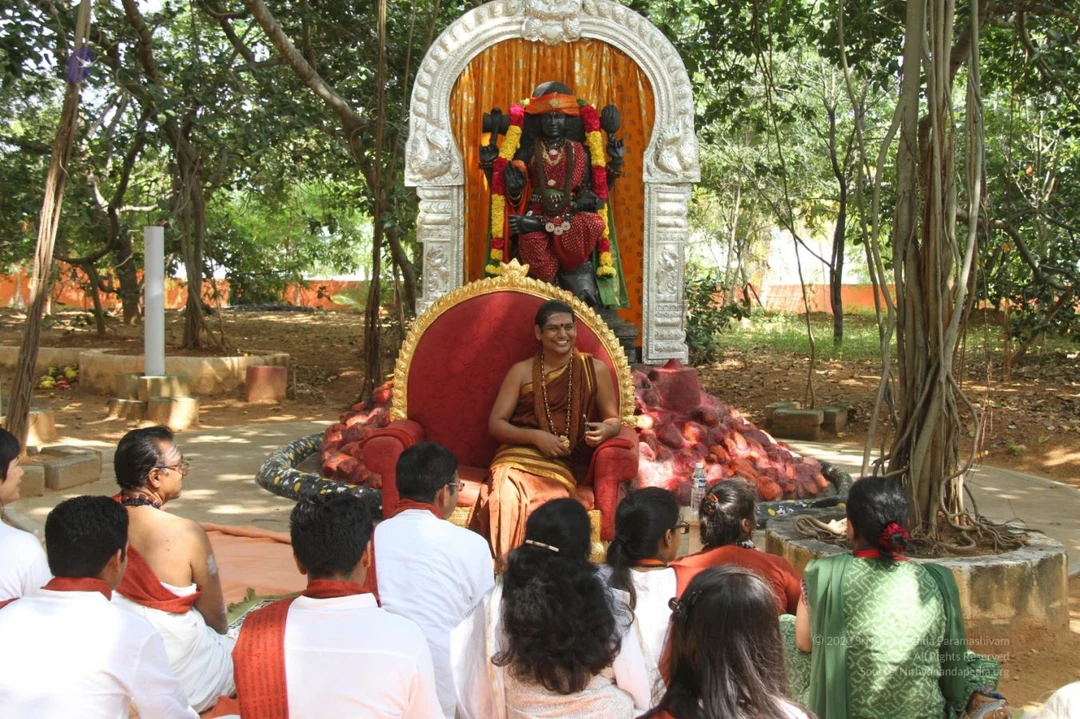
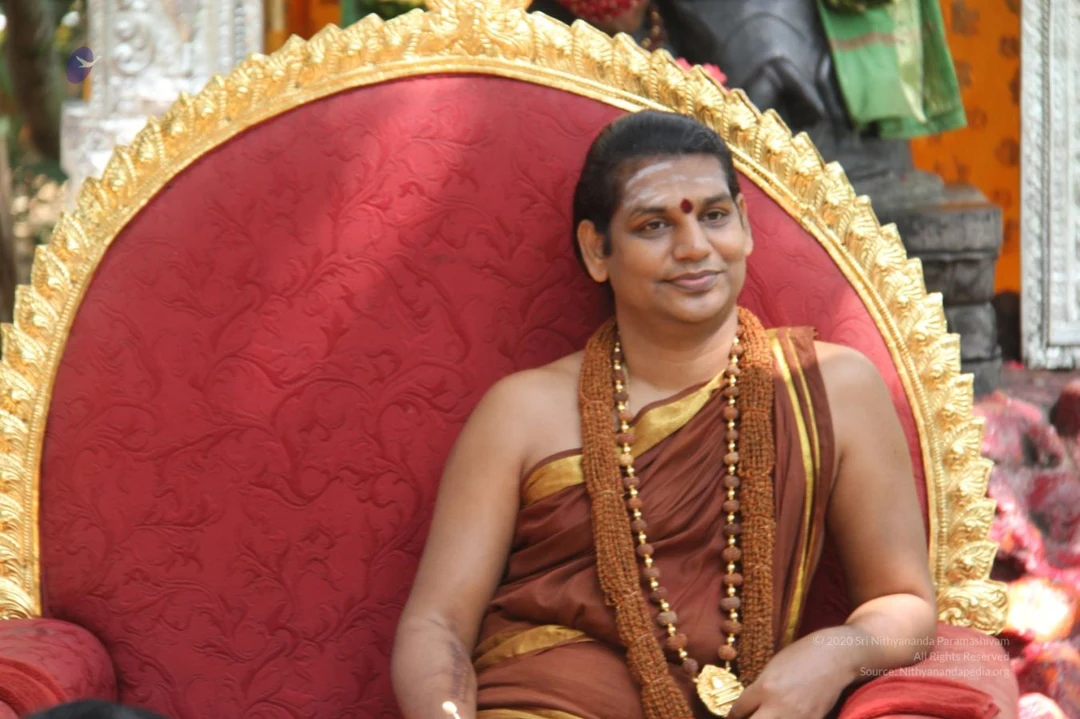
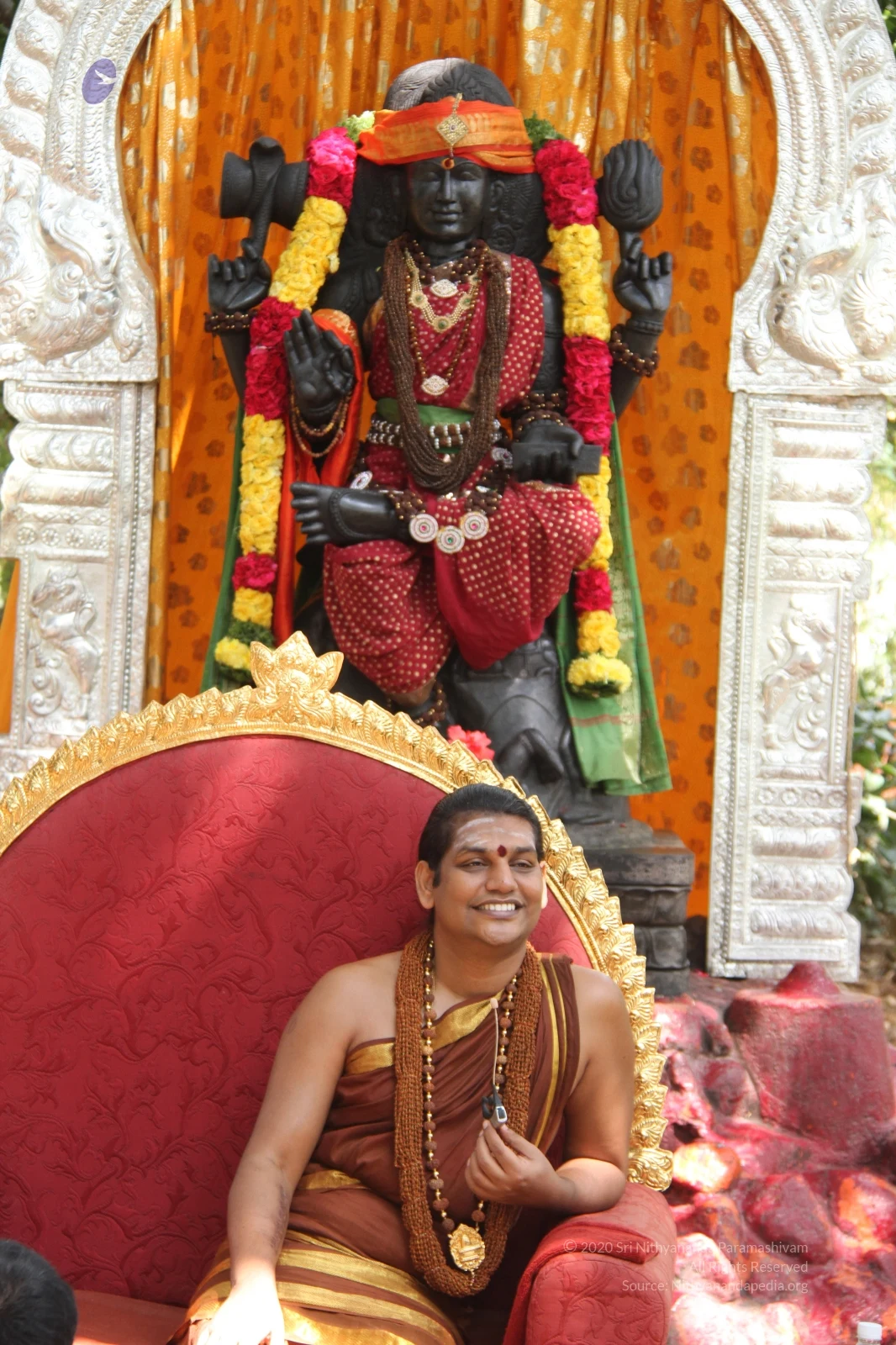
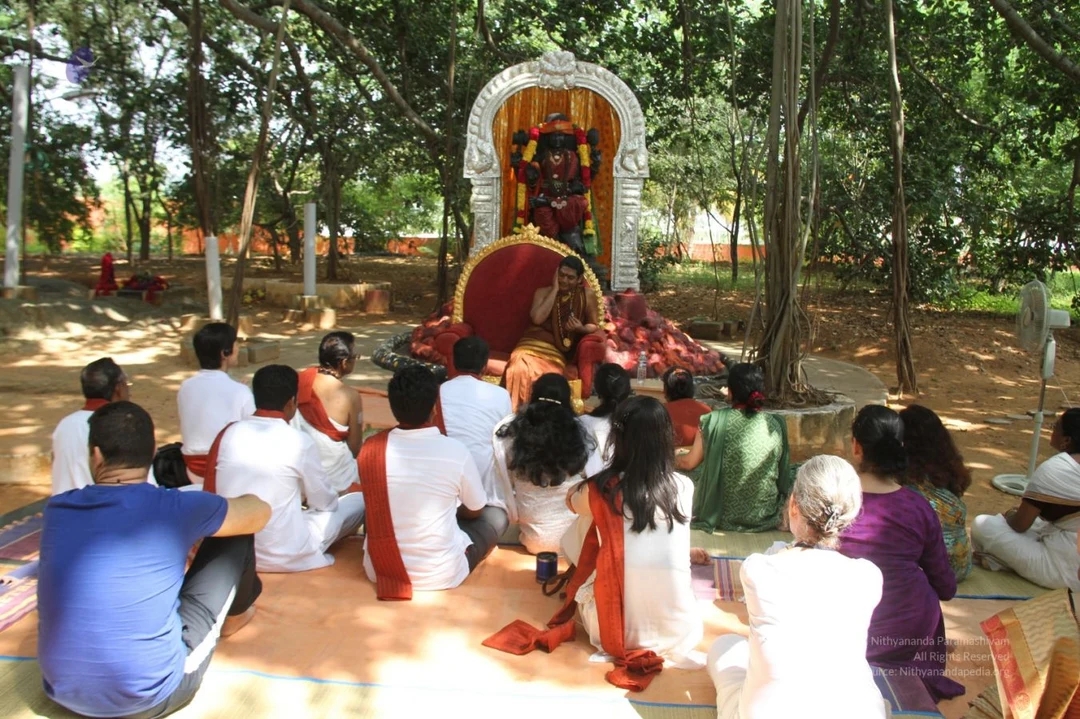
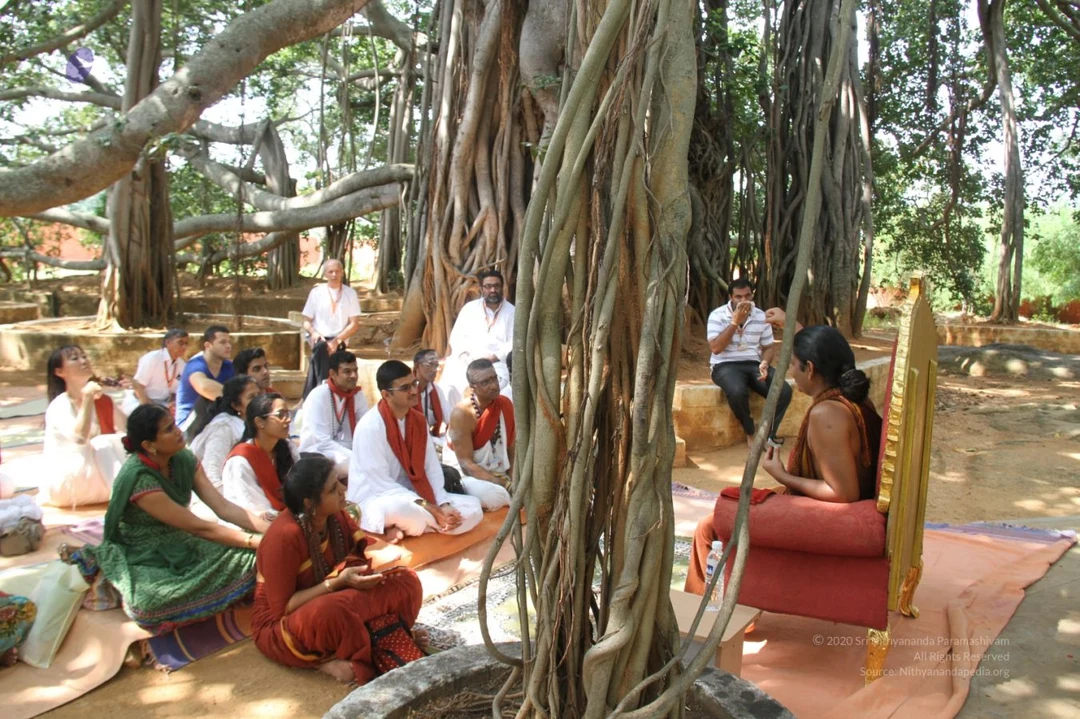
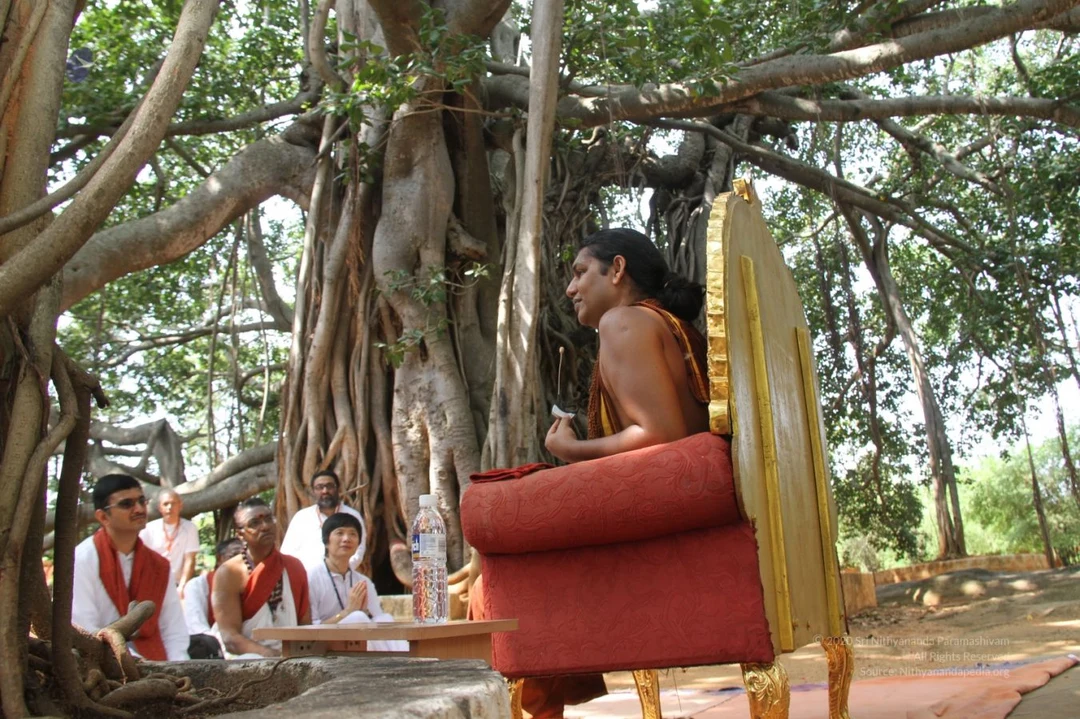
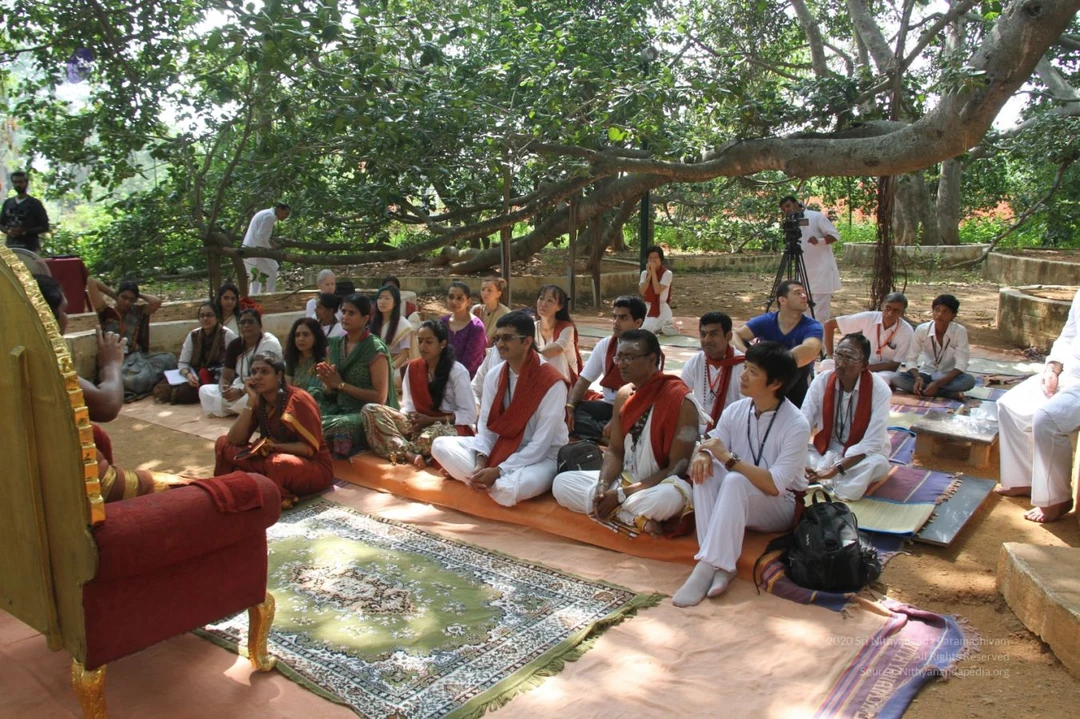
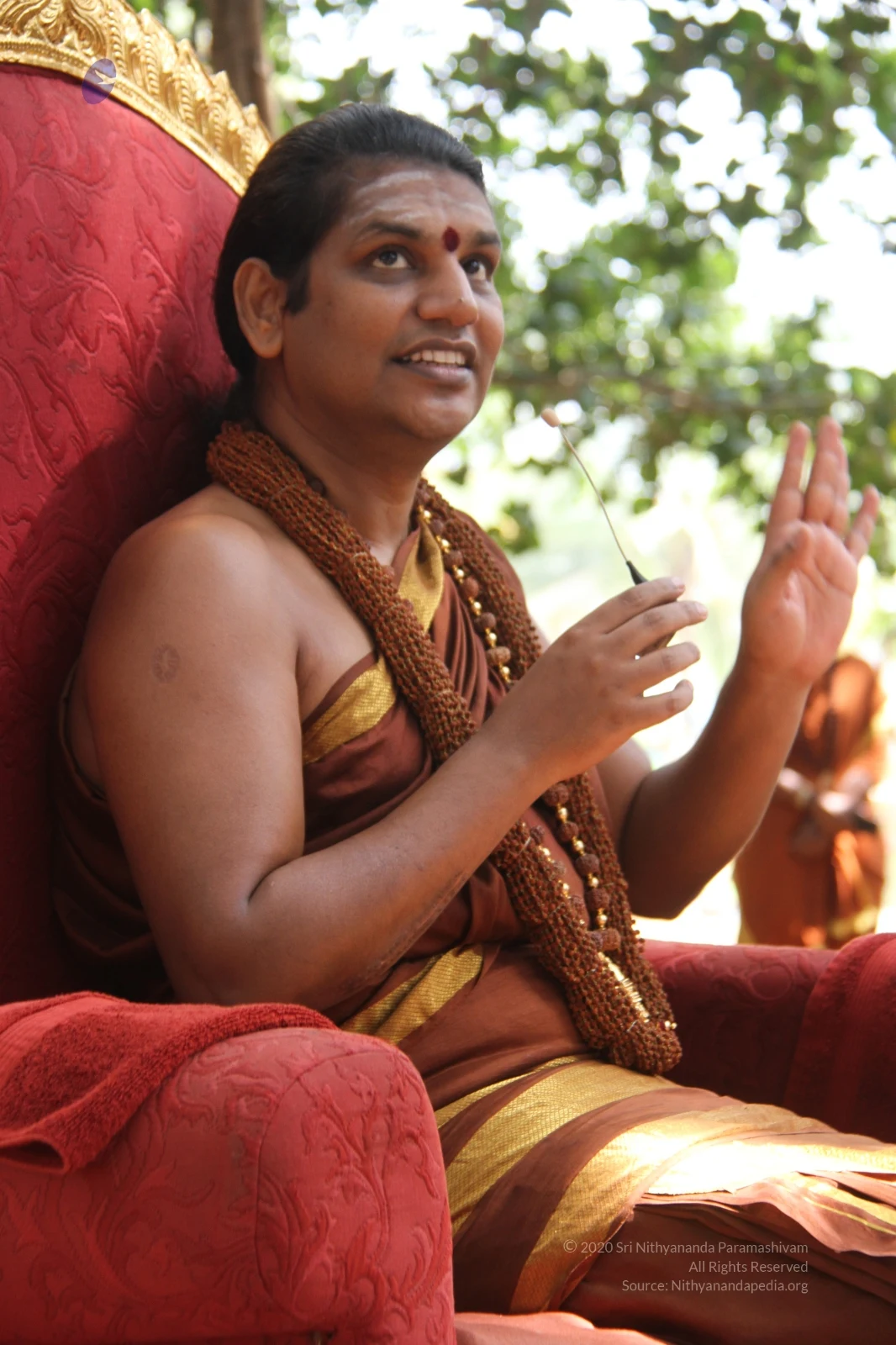
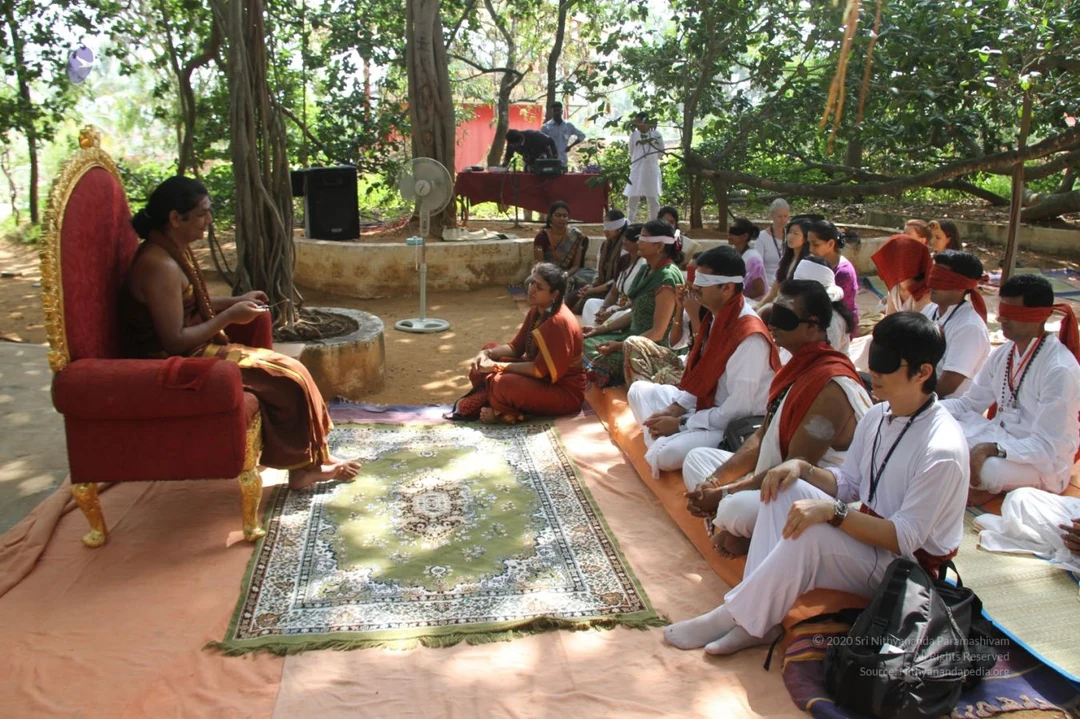
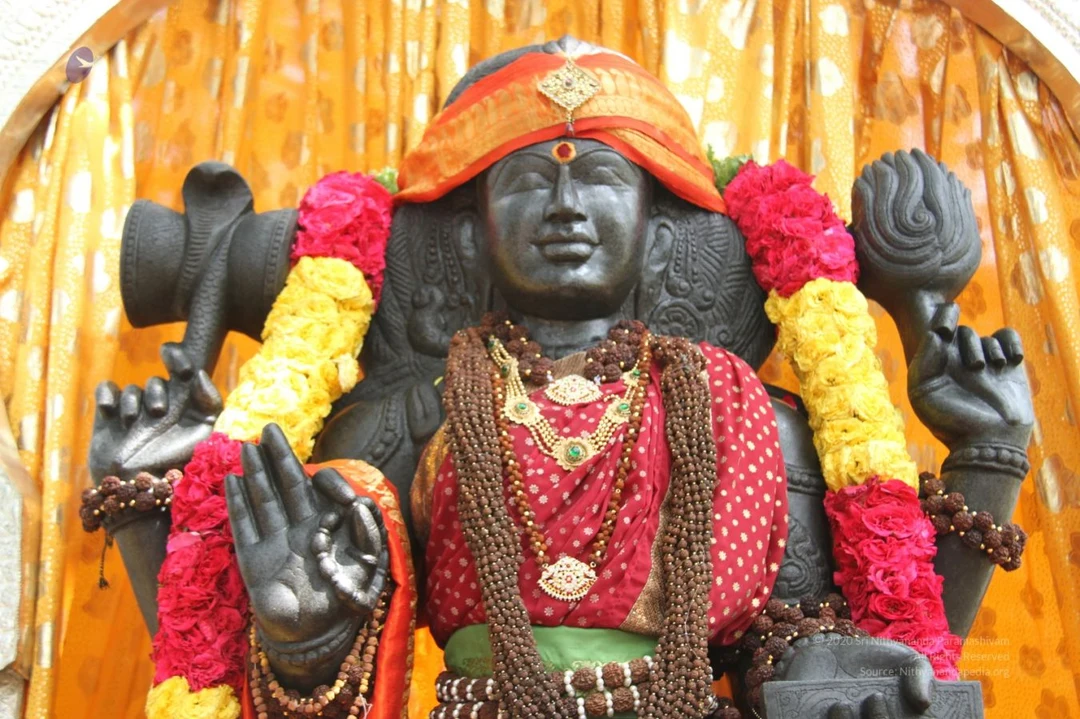
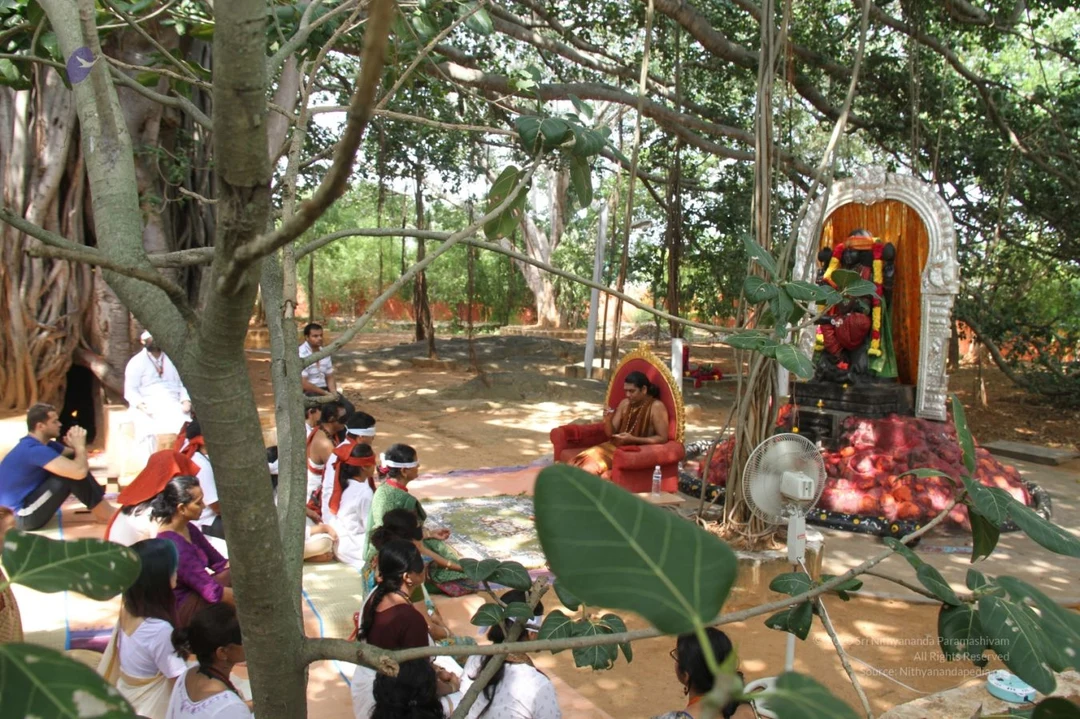
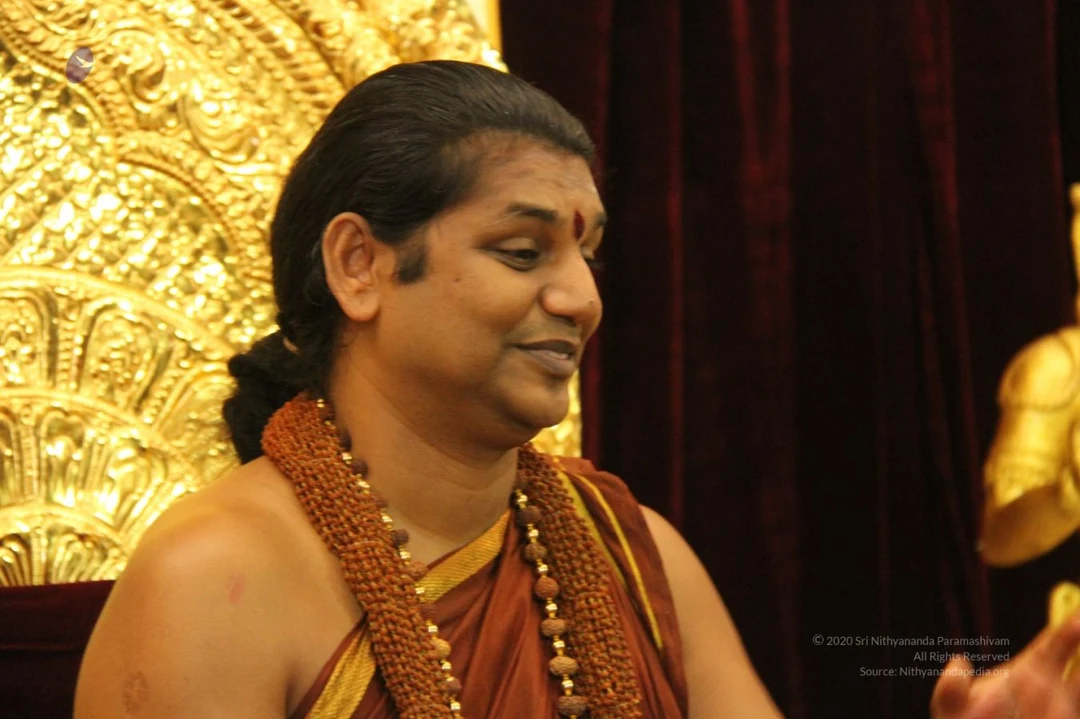
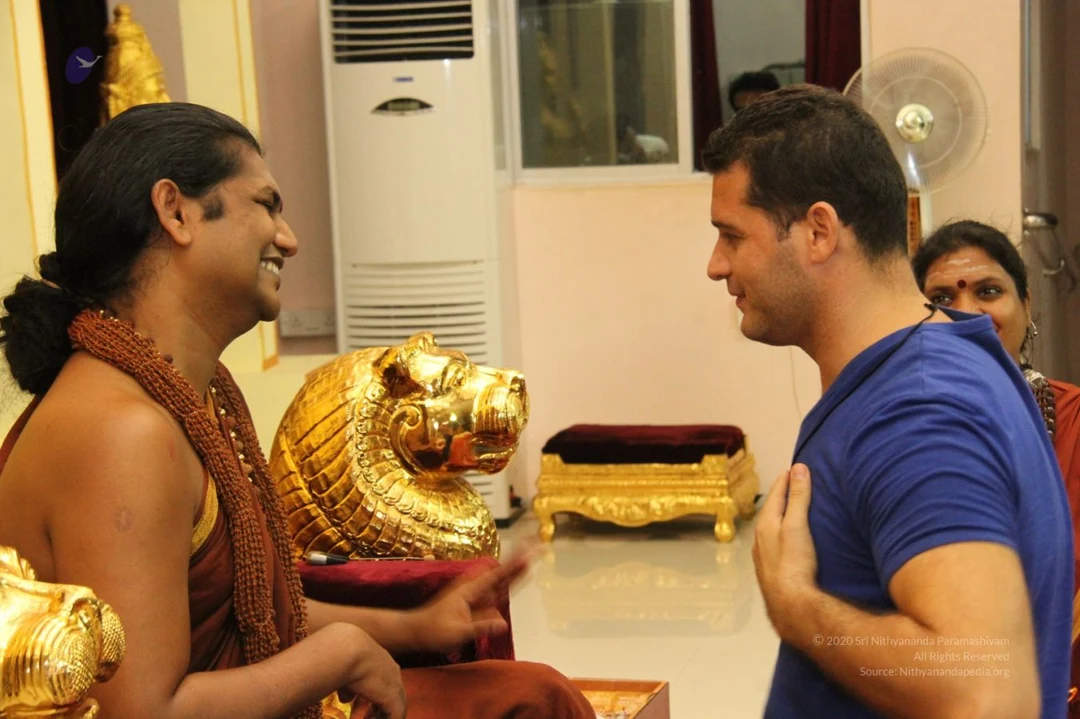
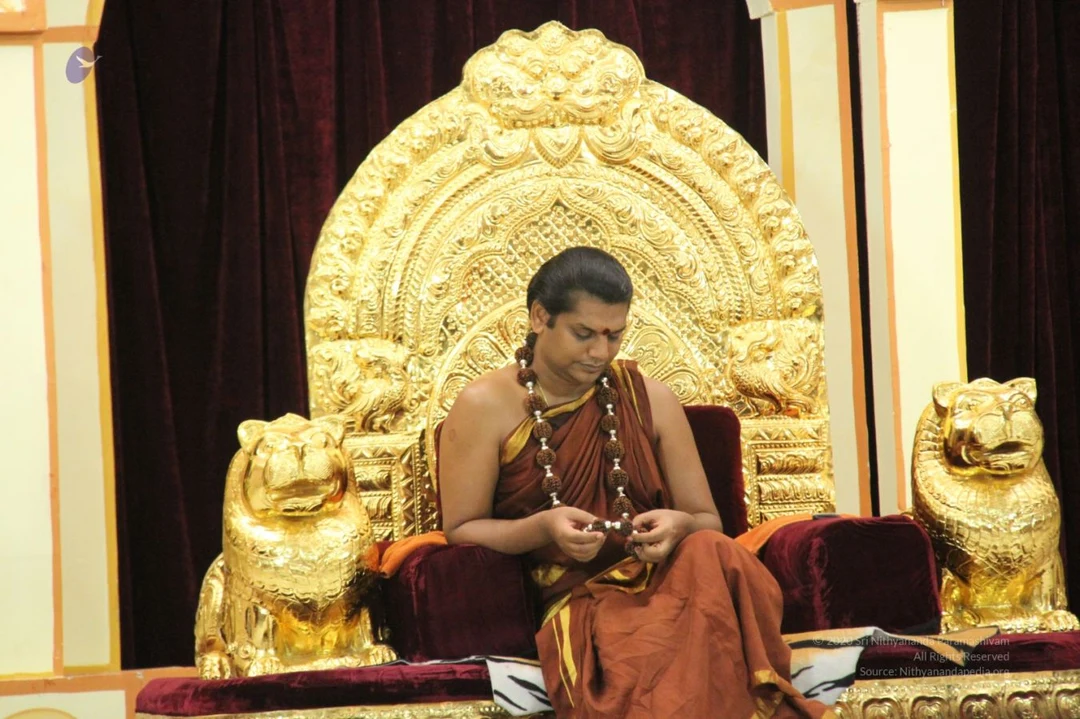
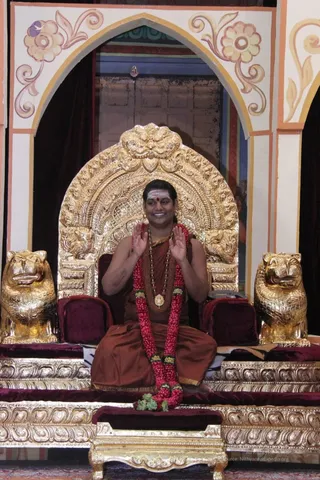
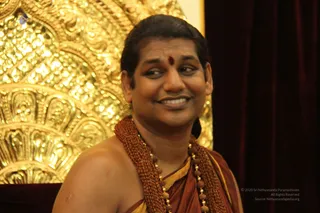
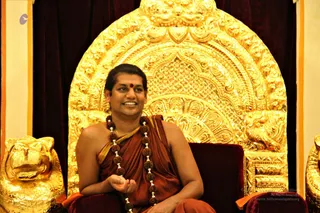
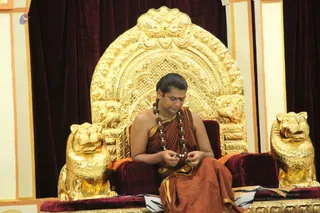
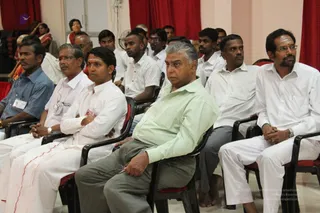
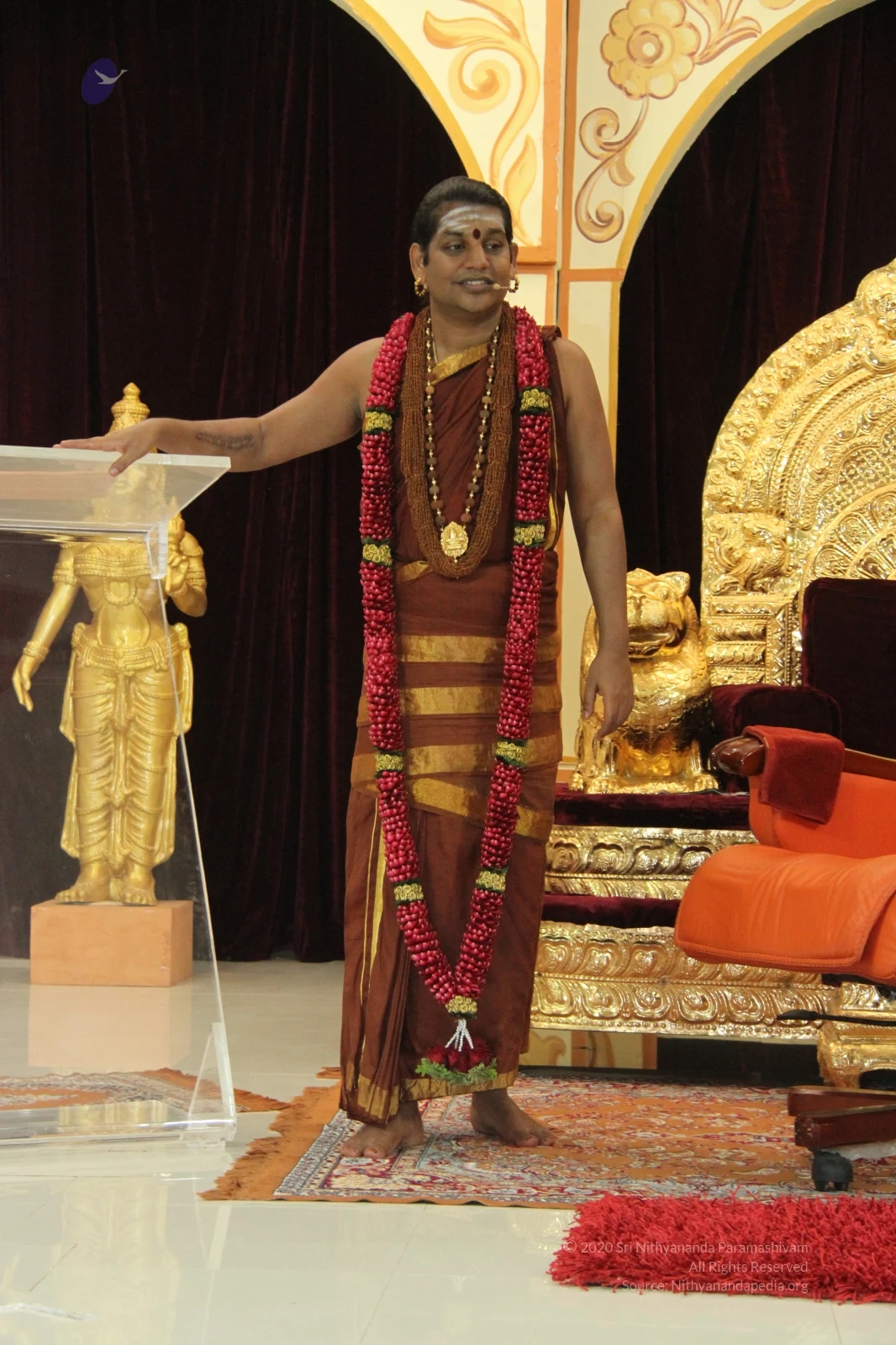
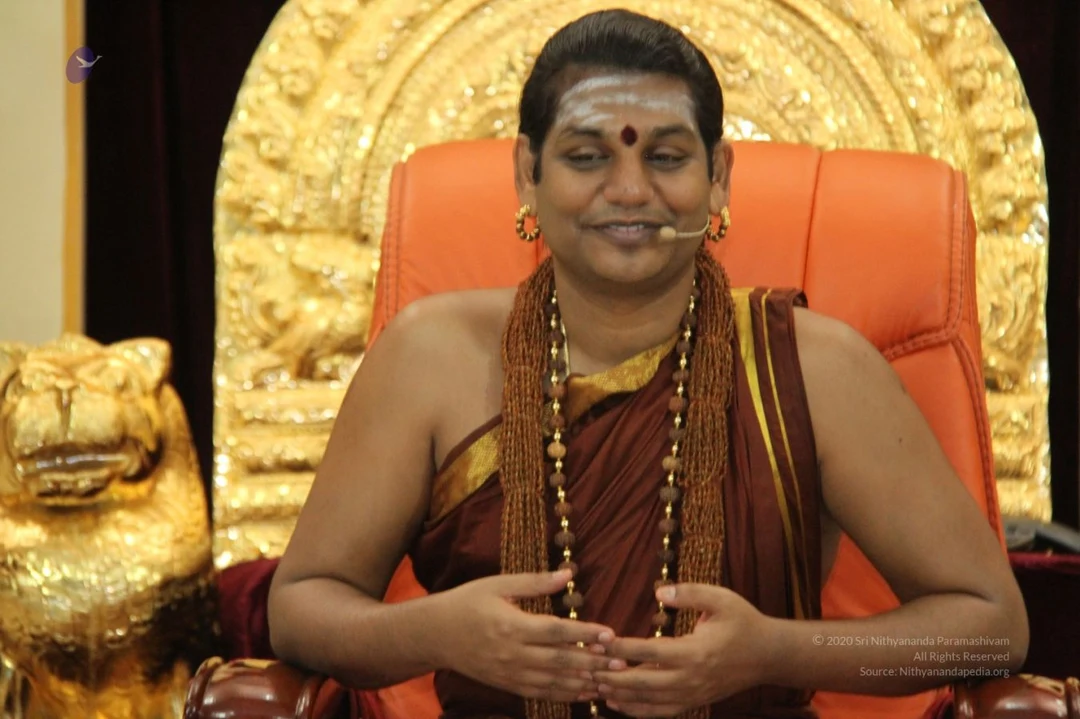
A smiling man sits on an orange leather throne with ornate gold carved backrest and gilded lion-head armrests. He wears a brown-maroon robe with a gold border, a rudraksha mala and a long pink-red flower garland, with white vertical marks and a red bindi on his forehead, and a small headset microphone. His hands rest folded in his lap. The scene appears to be a satsang setting. a person: the seated man has a shaved-back swept hairstyle, rudraksha malas and ceremonial garlands with a saffron-brown robe, consistent with the page's reference to a person.A smiling man sits on an orange leather throne-style chair in front of an ornate gold-embossed arch with gold lion sculptures at each side. He wears a brown-red saffron-toned cloth draped over bare shoulders, multiple red and yellow flower garlands, a beaded rudraksha mala, a gold necklace, gold earrings and a headset microphone. He has white vibhuti stripes and a red kumkum dot on his forehead, and his hands rest together in his lap. Swamiji (probable): long swept-back hair, ornate gold jewellery and saffron clothing indicate a sannyasi teacher giving satsang. The background includes deep red drapes and a small logo at the top left.Outdoors under large banyan trees with dense hanging aerial roots, a group of about twenty devotees sits on mats and low stone steps for a satsang. In the foreground, a woman in green and gold salwar sits with hands folded, and a young woman in a red-orange top sits cross-legged. Several men in white kurtas wear red-orange shawls. At right, a seated figure in an orange-red robe and long dark hair sits on a red-cushioned golden throne-style chair, facing the group. A man in a white-and-grey striped shirt sits at the right edge.

October 17 2013

Original wiki page
Contents

Title:

Self, World, God & Humanity.

Description:

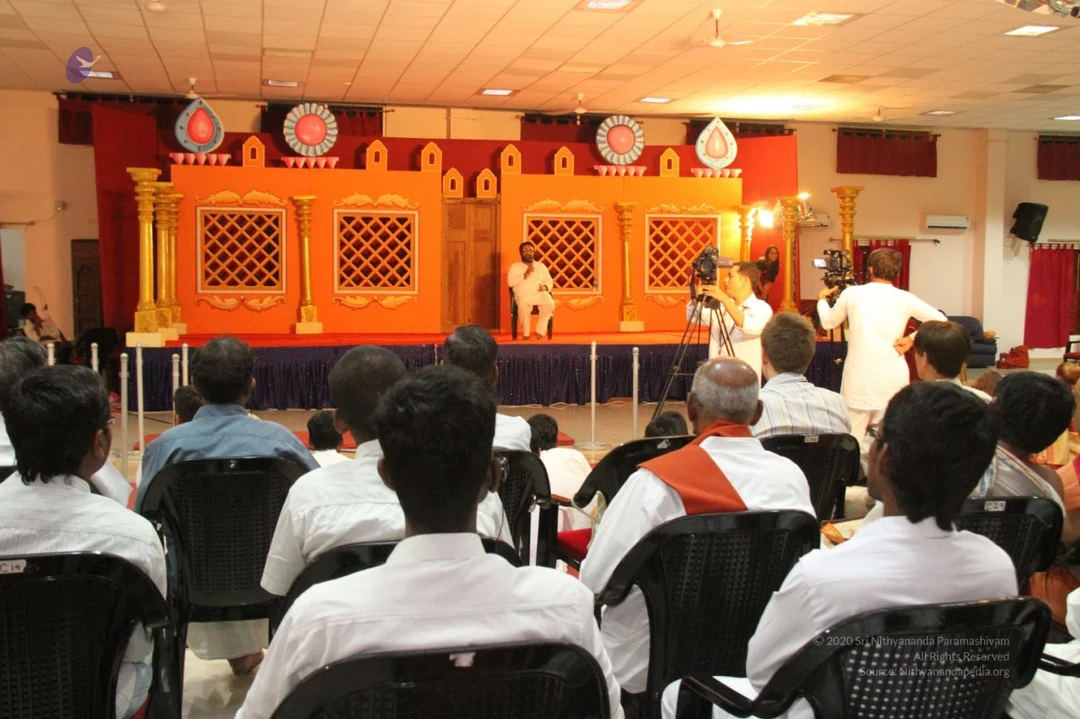
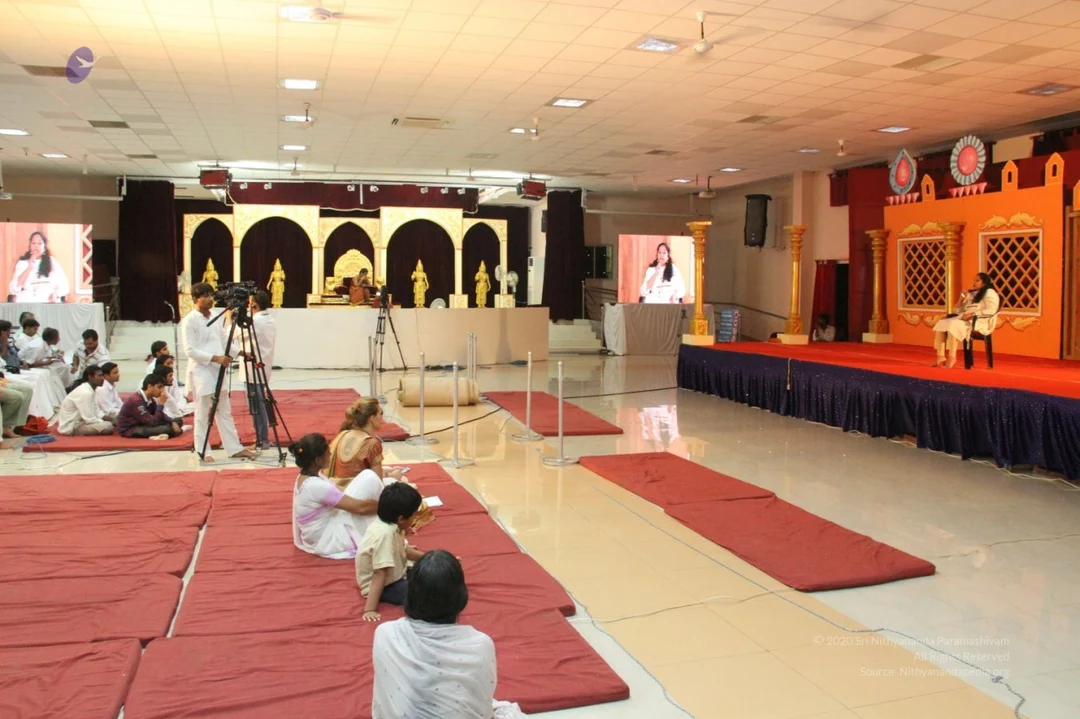
In today’s morning Satsang, Paramahamsa Nithyananda declares that if our words, thinking, and feeling are not making us feel powerful, then they are making someone else powerful – we are in powerlessness. How we express ourselves, in either joy or sadness, should be unique to us, not dictated by media or society. Let us realize the power that our words, thinking, and feelings have on our lives and use them to live to our peak possibility!

Link to Video:

VideoAudio

Transcript:

I welcome all of you with my love and respects.

Today I wanted to expand on some of these principles in depth. This Power of Words, what it can cause in you, Power of Thinking, Power of Feeling, Power of Living. I think more than the word ‘Power of Living’, I may use the word ‘Powers of Living’, because living is not words plus feelings plus thinking. Please listen. Life is not equalent to words plus thinking plus feeling; it is something more than all these put together. See, life is not something equalent to your body plus mind. There is something more. That component which is something more is still not defined and can’t be explained. I can say, that is the grey area.

Understand step by step the Power of Words. Words you utter can either make your life or break your life. Words others utter towards you can make your life or break your life. And the words others utter towards you is not accident; the words you utter towards others is responsible for the words others throw towards you. Please listen, the words you throw at your servant, you will receive it from your boss. The words you throw at your neighbors, you will receive it from somebody else who is around you in your life. The words you utter literally designs the karmic flow of your life. It is like, the road you take is going to decide the destination you are going to reach. The words you start uttering is going to decide the karmic flow of your life. It can either make or break your life.

Second important thing I wanted you to know. The words you utter towards you, that is most important than the words you utter towards others; the words you utter towards others and the words you utter towards you. Look in. Constantly, the words you utter towards you, the words you utter towards yourself, I tell you, the words you utter towards yourself immediately can change the way you think about you, the way you feel about you, the way your body, mind, muscles respond.

I tell you, the words, Power of Words is Saraswathi.

Power of Thinking is Lakshmi.

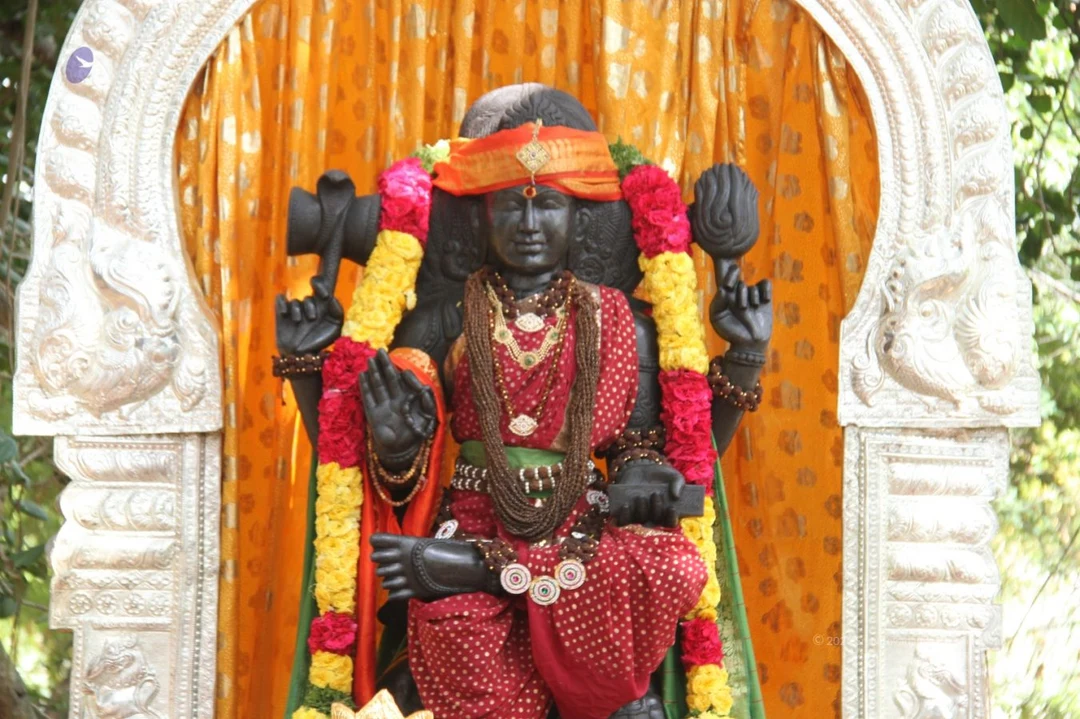
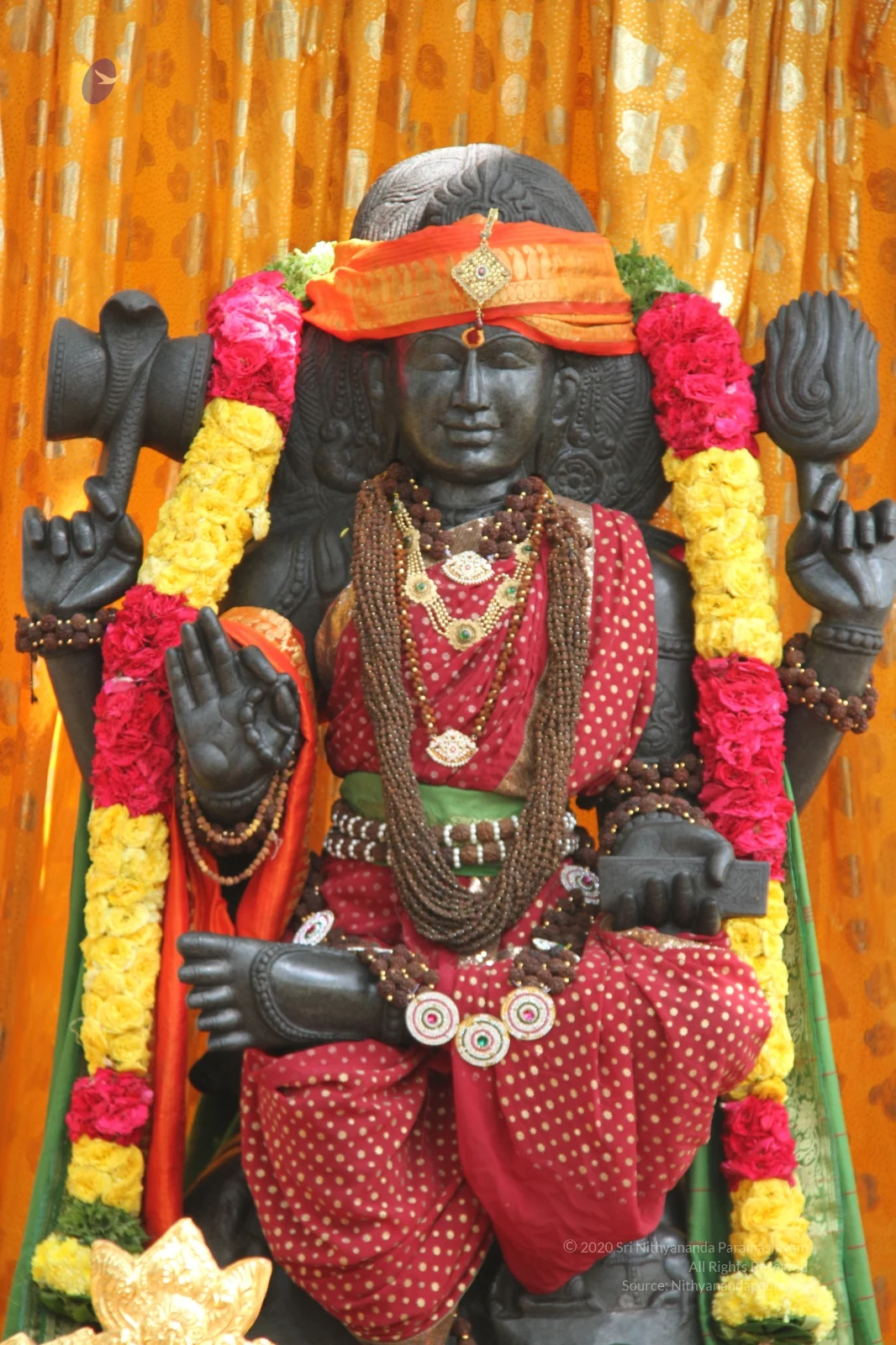
Power of Feeling is Durga.

All the three are available to us if we know how to harness the power, how to use that power.

Power of Thinking - In one moment you can make anything look like God; within next few moments you can make anything look like demon in your life. Please understand, if you bow down, even a small stone can become a God. If you are afraid of, even God will look like demon.

I have seen, people who are afraid of Completion, the spiritual process, they really can’t even face me. I have seen this many time.

‘No, no, no. I don’t want to come to see him.’ Why? ‘No, no, no. Then I may have to give up alcohol. I may have to give up smoking.’

I have seen many people come and tell me, ‘Swamiji, my husband doesn’t want to come and see you.’

I ask, ‘Why? Why, why is he afraid?’

‘No, he feels if he sees you he has to give up on non-veg and alcohol.’

I tell them ‘No I am not going to ask him to give up non veg and alcohol’

‘No, no, he knows if he sees you he will give up automatically. He is afraid that his life will change.’

Even if they come they will not look in my direction. They will look in the other way.

Please listen, the Power of Thinking, your logic, can play any side. The way you think is a power for you and people around you. 600 billion dollar US spends all over the word just to promote their lifestyle through media. Please understand, just to promote their lifestyle through media; their way of clothing, eating, dressing. 600 billion dollars every year U.S spends. Why? Because, the moment you start thinking the way they want you to think, now you have become a market, a buyer for them - their products. Now whole life you earn for whom? For them! Because, if you want to be joyful, you have to do what they are asking you to do, if you think you are joyful, you are going to celebrate the way they expect you to celebrate, the way they want you to spend.

In those days, when you are happy, you run to the temple. When you are sad, you run to the temple. Now, when you are happy, you run to THE TASMAC. When you are sad, you run to the TASMAC. TASMAC is alcohol shop in Tamil Nadu. It’s a brand for liquor shop.

Please understand, the thinking, the way you think is going to add either power to you or power to others. The moment America makes you think as they want you to think, then naturally your food becomes what they want, your clothes becomes what they want, your way of living becomes the way they want. So, now, whether you are happy or joyful, they are going to make money out of you. Your joy is going to make money for them. Your happiness is going to make money for them. It is so unfortunate, you celebrate your festivals as they want.

And I am really, really, really shocked and I cannot tolerate this one thing. Our culture is based on eat what grows in the land you live. Please understand, that is why our eating style changes every 100 kilometer. Travel in India, every 100 kilometer, the way we cook, what we eat changes. Because we believe a deep feeling-connection with the land we live. You should also know, our science of housing – we call it ‘Vastu Veda’ – says very clearly, make your house or the place for any purpose, like common halls, temples, anything, make from the material you get from that area. Only that way, the longevity, life of the construction is ensured. Actually, if this law is followed, we will not have so many people dying in tsunami. Because we start moving material from one area to another area where we can’t live, but we force the nature to accommodate us, when the nature gets agitated, aggravated, large number of deaths happen.

10:18

Our lifestyle is such beautiful lifestyle, I tell you, the variety, variety is our lifestyle. Travel every 100 kilometer in India; you will see a different way of food, different way of dressing. Please understand, don’t ever think whole Karnataka people wear the dress in the same way or whole Andhra people wear dress in the same way, whole Tamil Nadu people dress in the same way. No. Every 100 kilometer, we have unique way of dressing. Every 100 kilometer we have unique way of eating. Every 100 kilometer we had unique way of housing ourselves.

It is unfortunately, these multinational companies, this concept of franchise, making all of you, treating all of you as animals, which are responsible for all the crimes in the world. Do you know, the animal you eat in KFC cannot be called any more as ‘chicken’? In the KFC, what you eat cannot be called any more as a ‘chicken’ as per law, because the chicken is produced without feather, bone. For the sake of large amount of flesh, the whole structure is genetically altered; they are fed not through natural way. They are made to weigh heavy not through natural way. Everything is artificial. Because of that, the court has ruled you cannot use any more the word ‘chicken’ for what you eat in KFC. Please understand, the extreme, extreme horror, extreme separation from Nature. Nothing is natural – what you eat, what you wear, where you live – nothing is natural.

I need to explain this one truth. Yesterday, we were sitting and discussing these ‘transformation’ business organizations, the organizations which does this spiritual transformation as a business. Some are for profit, some are non-profit, but the transformation is their business. I was looking at how these organizations map Hindu dharma into western frame. I was looking at the whole thing and how they are miserably failing trying to create the KFC animal out of chicken. I will call that as ‘KFC animal’, because we don’t have any other name what KFC produces. The KFC animal is altered chicken. Same way, all their transformation ideologies are altered Upanishads, altered Vedas. But, please understand, they have moved too much away from the original truth. I want you to get it. Please listen. Really its a very important truth. Get it.

As I said, our Rishis have not copyrighted the sacred truths. They hid all the truths in the language. ‘Thathaata’ is not ‘acceptance’; it is ‘non-resistance’. Same way, the four major components you need to understand now is Self, World, God and Humanity. But if you see earlier scriptures, Hinduism says only three – Self, World, God. I am adding fourth. You may wonder why?

Please listen, originally if you see all the scriptures of Dwapara yuga, the Rama’s age; in Satya Yuga, there was no need for any scriptures. It was just ‘shruti’; they heard and became enlightened. So, no need for any book. Master teaches, disciple gets enlightened, over; no need for any book. There was no book in Satya Yuga.

In the Dwapara yuga the Rama’s Age, the separation started getting into the collective memory. Means, the critical mass started feeling separated from the ‘I’ and the ‘World’. The gap between ‘Me’ and ‘World’ started. But still, the connection with God continued to exist.

Please listen.

Then, in the Treta Yuga, Krishna’s Age, the critical mass has started suffering with the separation with God also. Rama is Dwapara, Krishna is Treta, when Krishna left the body, Kali started. When Kali was about to start, Krishna left the body. So, please listen, when the critical mass is suffering the separation from God, then you have to make three entity. The understanding about all the three entity is required.

Now, the fourth entity, means the ‘Humanity’, has moved so much out of the Nature, the World, we will have to have ‘Humanity’ as the fourth entity.

Please listen, all philosophies are created for you to understand the important components of life. In Satya yuga there was no separation between the ‘I’ and the ‘god’, ‘I’ and the ‘world’. So enlightenment was transmitted just by the word, without any book.

Second, in Dwapara Yuga, the separation, collective mass started feeling separated from ‘I’ and ‘World’. The gap between ‘I’ and ‘World’ is experienced by the collective mass. So, all the scriptures of Dwapara Yuga speaks only about these two – Jeeva and Jagat – Self and the World.

Next, the third Yuga, Treta Yuga, Krishna’s time, the common mass has started feeling separated not only from the ‘World’, from ‘God’ also. That is why you have to understand now all the three – Self, God and World.

Now there is one more separation happening, the human-beings’ life is so much away from the World, I will have to create the fourth division – ‘Self’, ‘God’, ‘World’ and ‘Humanity’ - Society. Because, what you think as valuable is moved out of Nature. It is now no more the rare items in the Nature are valuable. Paper is more valuable. Your dollar; it’s a man-invented valuable. Your pleasures are no more based on Nature. Your pains are no more based on Nature. When you are with Nature, your pain is only physical pain. But now, if you don’t get an award, you experience pain; which is not natural. In those days, your pleasure was having gold or pearls or diamonds which is naturally available, rarely. Because of the demand and supply gap, that becomes valuable. Anything more demand and less supply, that becomes valuable. It was natural law. But now, what you think as valuable is ‘created demand’, or ‘created understanding’. Dollar is not natural phenomena; it’s artificial phenomena. Same way, the principles with which you think or live is not nature-based; it is law-based, the country’s law based.

20:17

Please listen. So, the country law has become a significant part of your thinking system. One generation before, naturally we lived on ordinary tap water and bore-well water. It is not that we were dying every other day through the water contamination. But now we are made to believe, made to think, we continue to think, without packaged drinking water you cannot survive. And you cannot survive. That is the truth. Because you have started so strongly believing, our body believes it. Anyhow….

Listen. This separation is caused by ignorant visionaries, ignorant leaders, ignorant decision-makers. I tell you, when you think the way ignorance wants you to think, it is blind leading the blind. In Tamil there is a beautiful verse by a great saint Tirumoolar:

‘KurudumKurudumKurudaatamAadi KuzhiyilVizhundhadhaamey’

‘A blind and the blind played the blind game and fell into the ditch.’

So, please understand, the way you think is very important. Either it can make you powerful or powerless. A simple thinking you have about your drinking water can make your immune system powerful or powerless. The simple thinking you have about your food can make you strong or weak. Through our Nirahara Samyama, I broke many myths taught to you by your so-called MNCs and MNC-promoted medical system. Listen. I have proved without eating, the Vitamin D goes up, your hemoglobin level goes up, your body is free from the diseases, which is completely breaking all the myths you have been taught from the begining, as I said, by the so-called MNCs.

I am not against having pizza once in a while, I am not against having KFC food or McDonald’s food once in a while, but the way it is happening, we are going to become just like U.S where we are going to eat the same food which is not right decision for our health, because our system functions based on the land we live, the air we breathe.People who live on the banks of a river, if they eat the fish from that river, their whole body is perfectly balanced, but not the people who live far away from that river. If you are living near the ocean, eat the fish available from the ocean, your body will be balanced. You do not know the hundred-and-ten things behind the happening in the whole ecology system.

Please understand, the idea of food itself is nothing but the things which you do not have, which other components of the five elements has around you, taking that and strengthening your body is ‘food’. So, eat what grows in the land around you, eat what is available from the place where you are living, build your housing from the material available in your area. If you are living near a forest, don’t go and bring TMT iron rods and pour the RCC concrete and create a RCC bungalow to live. No. If you are living near a forest, make beautiful housing out of the wood available from the forest, out of the materials available from that area. Because, even the house you live in adds energy to you, the area you live in, the land you live in, always balances and supplies what you don’t have naturally, through these materials like food and the air and the way you use things.

I know, what I am proposing will have hundreds of questions. I am telling you, I am building the house where I am going to stay out of the mud of this land. We just add little lime or the haritaki powder for bonding. We are actually already working. When you dig foundation, the mud you get, make blocks out of that and start living. You will have highest health, the peak health. Unfortunately, you think now the way MNCs want you to think. Somebody else is harnessing Power of your Thinking. Somebody else is enjoying the way you think.

Wear the dress made out of the cotton growing in your area. Don’t bring gunny bag from some country. No. In my native – I am born and brought up in Tiruvannamalai – in my native I have seen some great siddhas, sadhus; they will wear the gunny bag. People will make fun of them. Now I see the whole world is wearing gunny bag in the name of jeans. They used to call him Saakapi swami. Now I am seeing the whole world has become Saakapi swami. But one good thing, he used to wear the natural gunny bag which you get from the jute in that area. Now you import that gunny bag from all the way from some country and make that as a fashion. The way you think becomes power for somebody else.

The worst thing can happen to human-being is forgetting the right way of feeling. What kind of a feeling if you cherish or entertain will lead you to the peak possibility of your life? But unfortunately, see even our food, clothes getting destroyed; I am not worried so much about it. I feel, but the way we feel joy, sadness, even that is getting destroyed, corrupted. Our way of enjoying pleasures, our dances, our singing. Why should I jump when I am feeling joyful as he wants me to jump? Let me jump as I like to, as I wanted. But, unfortunately, even your crying, your laughing, your joy, your sadness, everything is dictated by MNCs in the modern world. When you are feeling joyful what you are supposed to do, you have been told, promoted constantly through the advertisements and publicity and media and everything. The moment you feel joyful you feel immediately you should open a champagne. The moment you feel you are sad, you feel immediately you should open a bottle; whether you feel sad or joyful it is income for him. The way you feel is corrupted. If you are feeling joyful, jump and dance, celebrate the life. If you are feeling sad, scream and complete with it. Be in peace. Let your feeling flow in a very natural way. But unfortunately, even in your feeling, you are no more natural.

Please understand, if your words are not power for you, it is power for somebody else. If your thinking is not making you powerful, it is making somebody else powerful. If your feeling is not making you powerful, it is making somebody else powerful and naturally making you powerless. If your thinking is not making you powerful, two thing you need to know – it is making somebody else powerful, and making you powerless. If your words are not making you powerful, know two things – they are making somebody else powerful and making you powerless. If your feeling is not making you powerful, it is making somebody else powerful and it is making you powerless. Same way, your living.

Understand, move from MNC of Multi-National Companies to MNC of Maha Nirvani Culture. We need new MNC. For new people I wanted to say, Mahanirvani is the peetha, means the oldest Hindu spiritual organization which I belong to as a Mahamandaleshwar.

Now, the essence of today’s satsangh:

When the words make you powerless, it is making somebody else powerful.

When your thinking is not making you powerful, it is making you powerless and making somebody else powerful.

Same way, with your feeling and living.

I will continue on this subject tomorrow also, especially about ‘Living’.

Tags:

Paramahamsa Nithyananda, powerful, powerlessness, joy, unique, media, society, possibility.

Photos Of The Day:

Paduka-Puja-Crowd-Shots-Individuals
Nithya-Satsang-Swamiji

Sarva-Darshan

Final-Blessing

IA-Day21-Graduation

IA-Day21-IA-Swamiji-Banyan-Tree-Temple-Session

IA-Day21-IA-Darshan

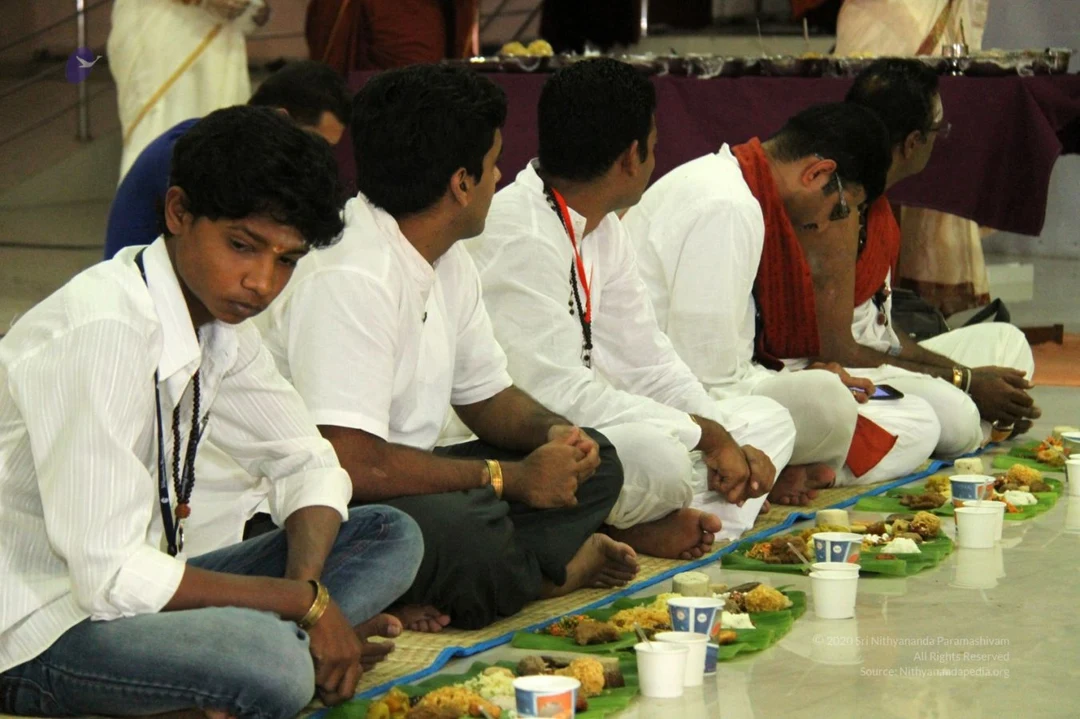
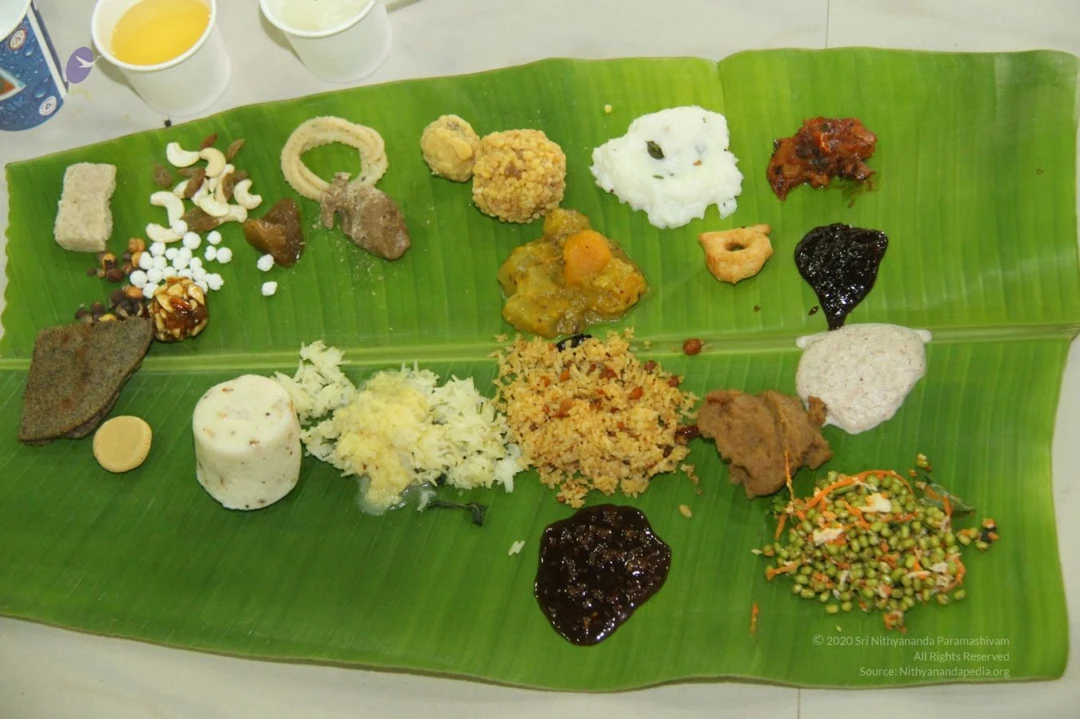
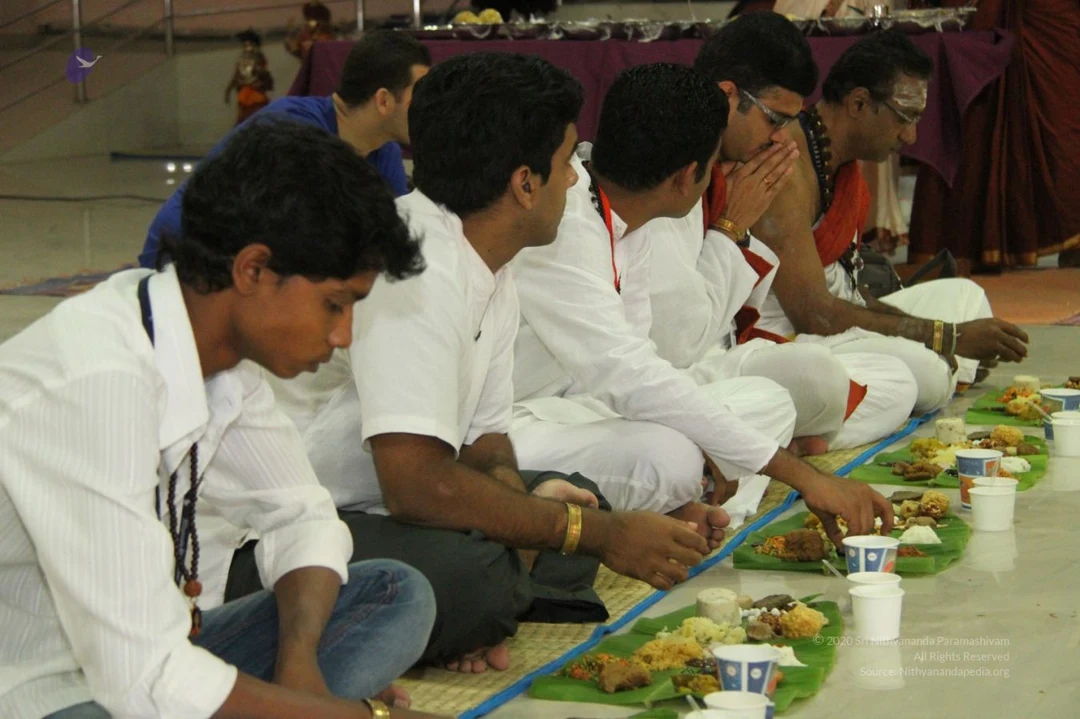
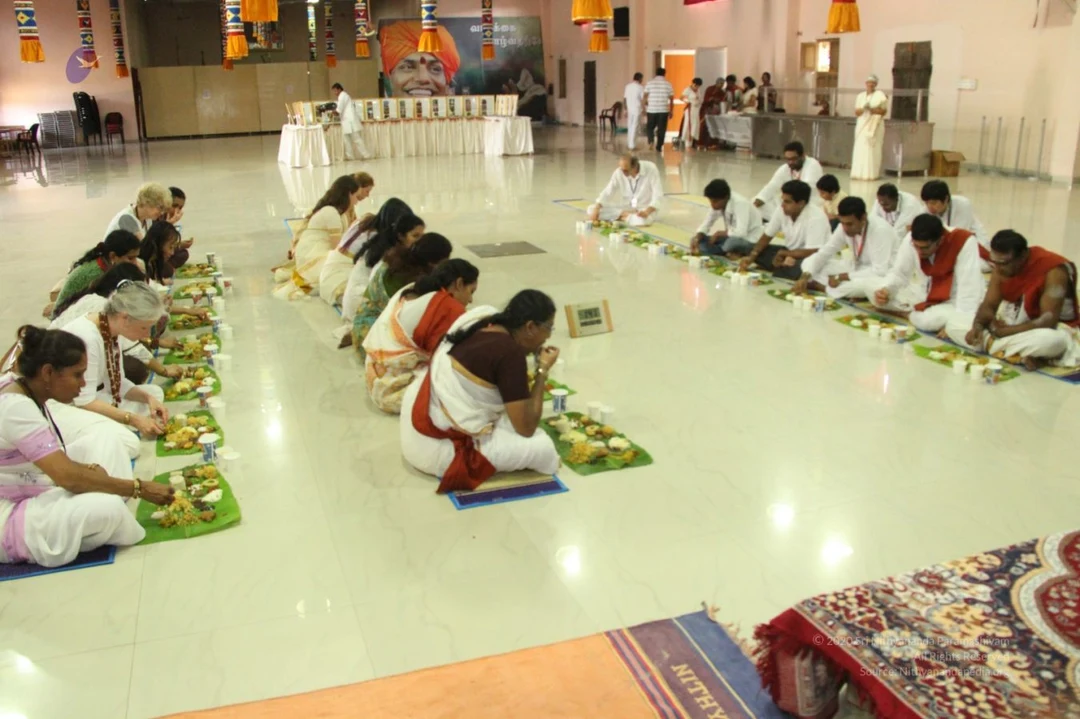
IA-Day21-IA-Swamiji-21Naivedyam

IA-Day21-Glimpses

ThanthiT-Set

Photos from this day

View all 177 photos

Paduka-Puja-Crowd-Shots-Individuals
29 photosSource gallery
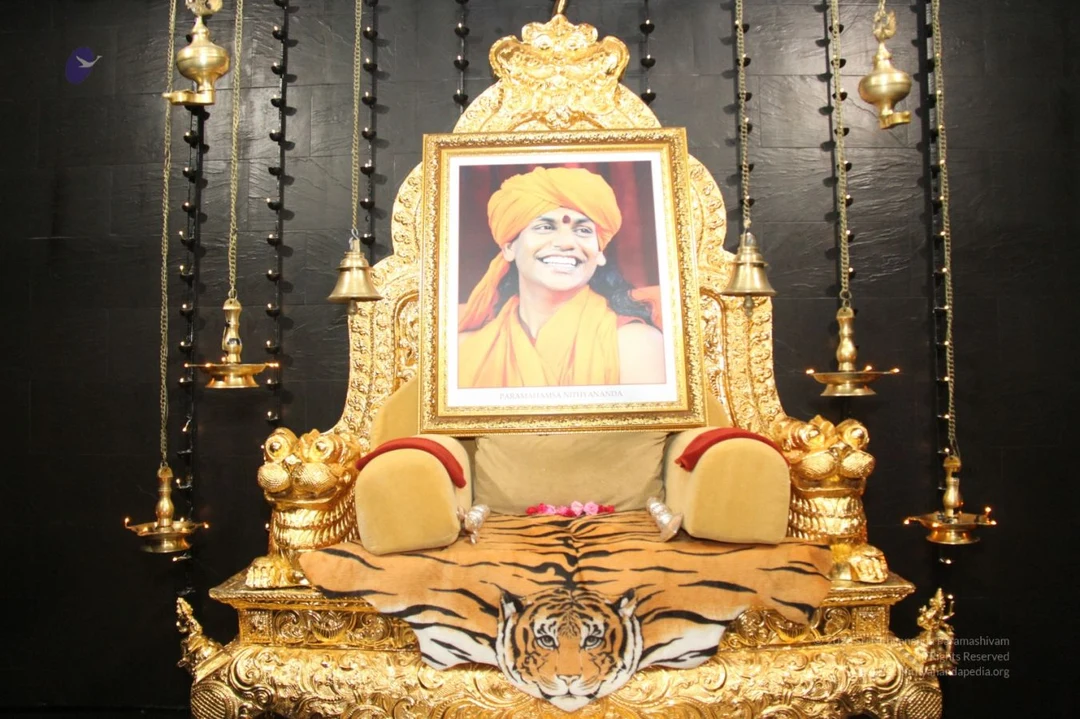
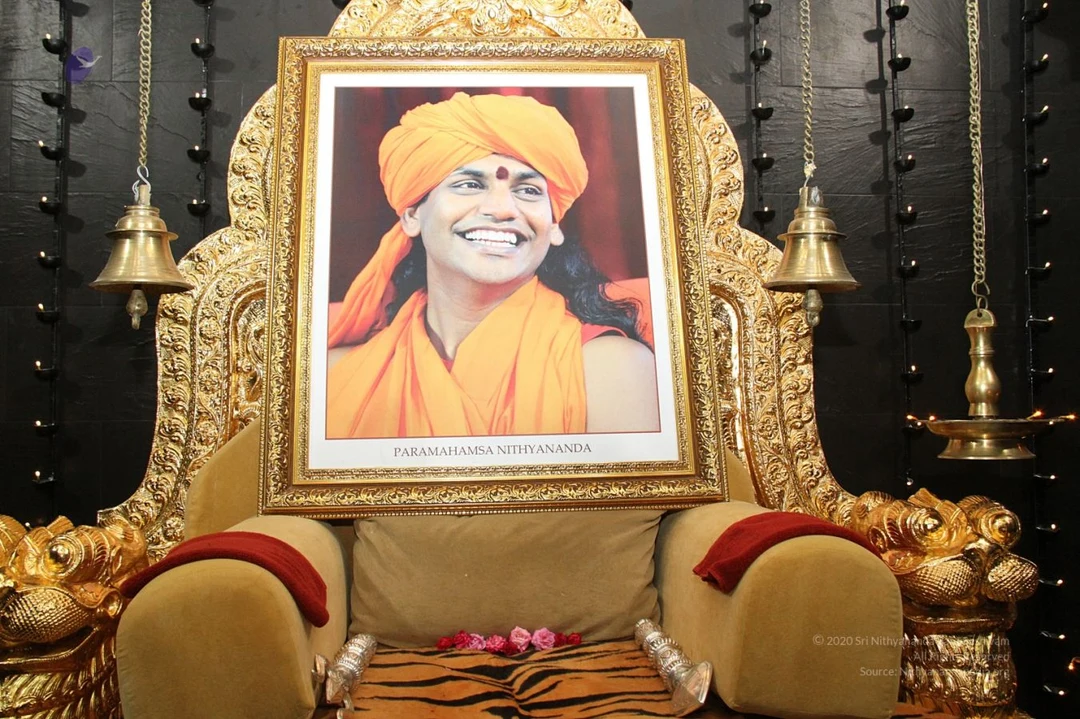
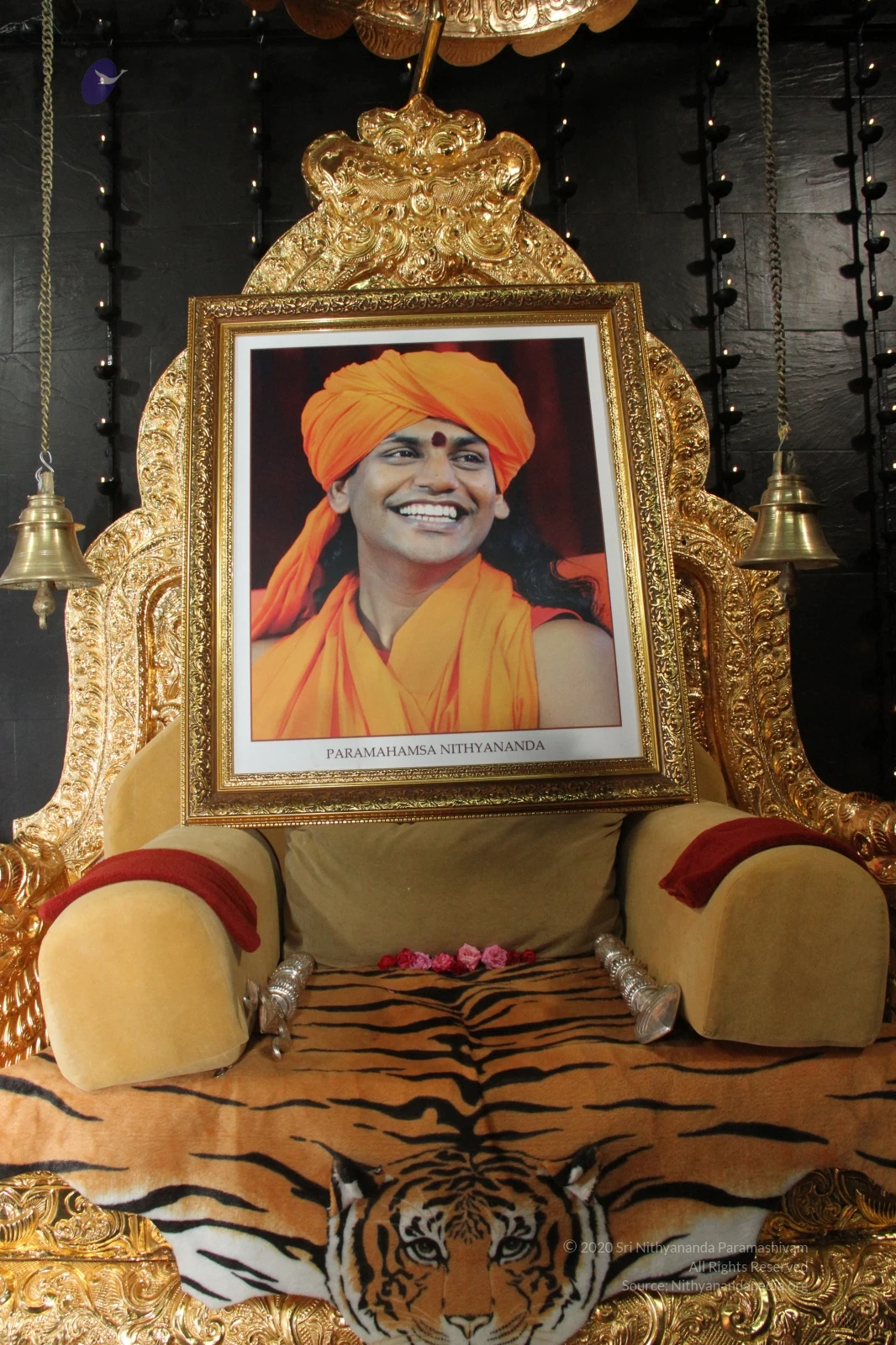
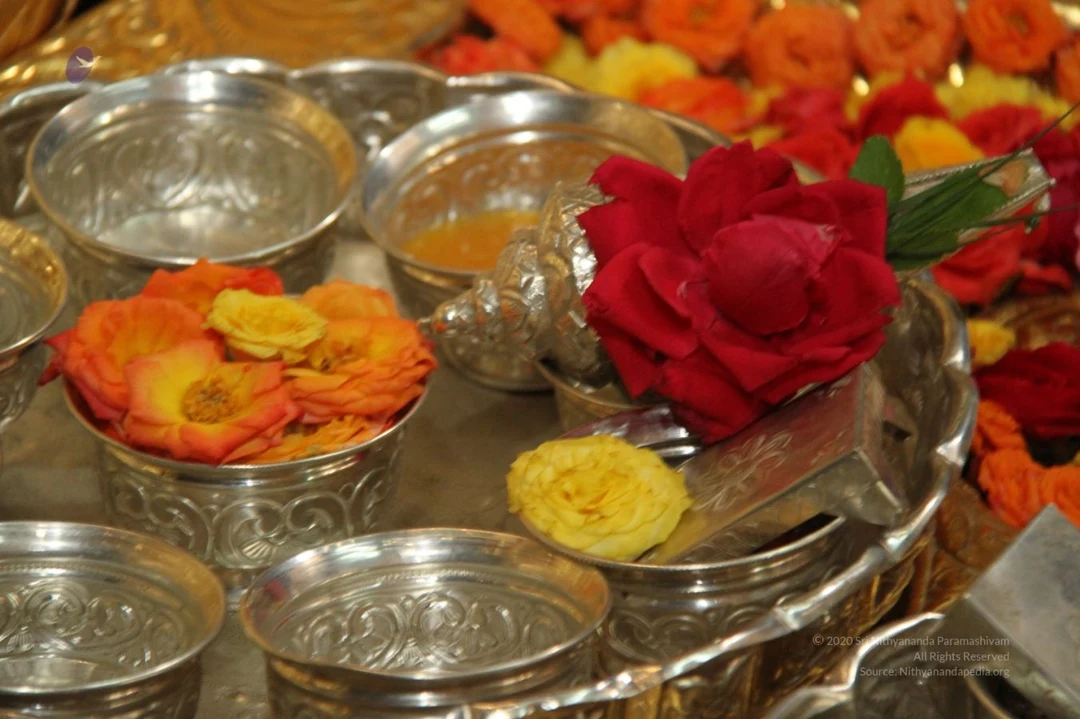
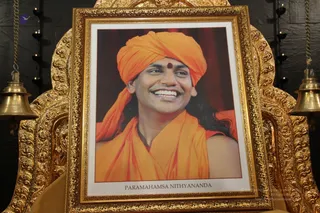
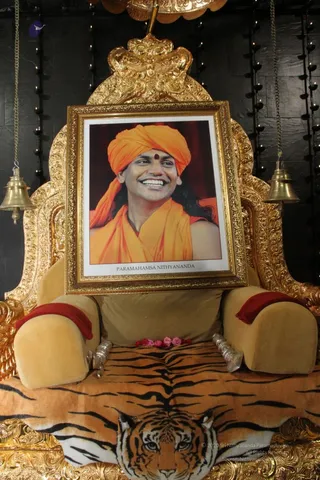
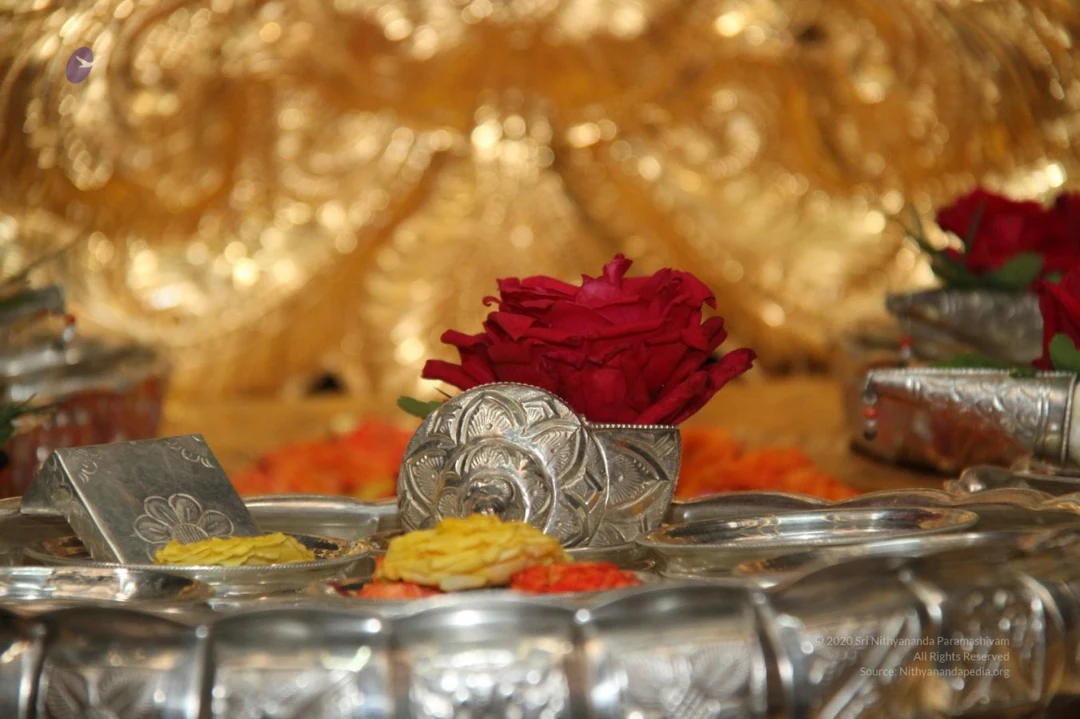
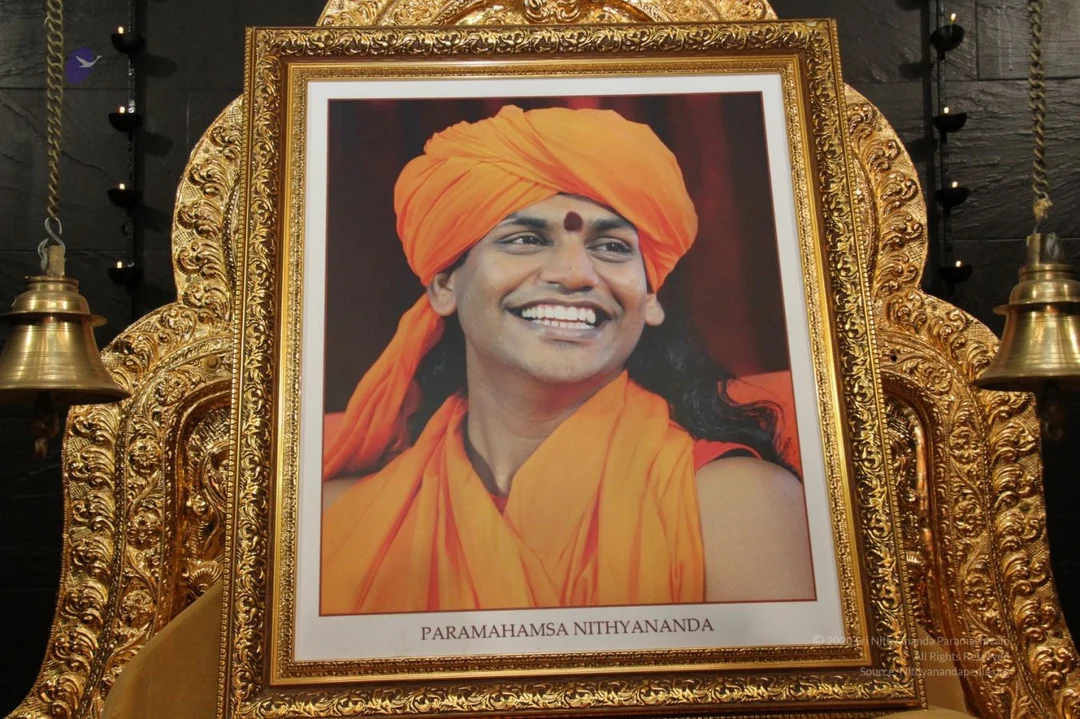
Close-up photograph of silver ritual vessels and offerings arranged on a silver tray in front of a blurred gold textile backdrop. A single red rose sits in an ornately engraved silver bowl, with yellow and orange marigold petals scattered around it. A small engraved silver box with floral motifs rests at left, and more silver containers with red flowers appear at right. No people are visible.A photograph of an empty ornate golden throne with carved lion-head armrests and a tiger-skin cloth draped over the seat, set against a black wall. Hanging from above are golden oil lamps and bells. Above the seat sits a framed portrait labelled "Paramahamsa Nithyananda" showing a smiling man in an orange turban and orange robe with a red bindi, with a red-and-pink flower offering placed on the cushion. No physical people are present.An empty ornate gold throne with a tan cushioned seat and red armrest covers, draped with a tiger-striped cloth. Mounted on the throne back is a large framed portrait labelled "PARAMAHAMSA NITHYANANDA" showing a smiling man with an orange turban, a red bindi, and an orange shawl. Brass hanging bells and a brass oil lamp flank the throne against a dark wall with a pink flower garland at its base. The portrait is a printed depiction, not a person physically present.A large framed portrait photograph is displayed on an ornate gilded throne-style seat, with brass hanging bells on either side. The portrait shows a smiling man in an orange saffron turban with a red tilak mark on his forehead, wearing an orange saffron shawl over his shoulders, with long dark hair visible. A printed caption beneath the portrait reads "PARAMAHAMSA NITHYANANDA", and a Paramahamsa Dhyanapeetham, , Source . a person appears as the portrait subject, shown as a depiction in a printed photograph rather than in person. No physical people are present in the sceneA framed portrait labelled "PARAMAHAMSA NITHYANANDA" sits on an ornate gold throne draped with a tiger-skin rug and tan cushions with red accents. The portrait shows a smiling man in an orange turban and orange shawl with a red bindi, and the throne is decorated with gold filigree, brass bells hang from chains on either side, pink flower petals lie on the seat, and a row of small lamps glows on the black backdrop. No physical people are present; the figure is shown only in print, so it is a depiction of a candidate Swamiji (probable) with distinctive orange turban, shawl and bindi cues.Close-up photograph of a bright red rose with green leaves resting in a silver ritual bowl, with more red roses and an orange rose blurred in the background. The bowl and surrounding metal vessels have a golden and silver sheen. No people are visible.

Nithya-Satsang-Swamiji
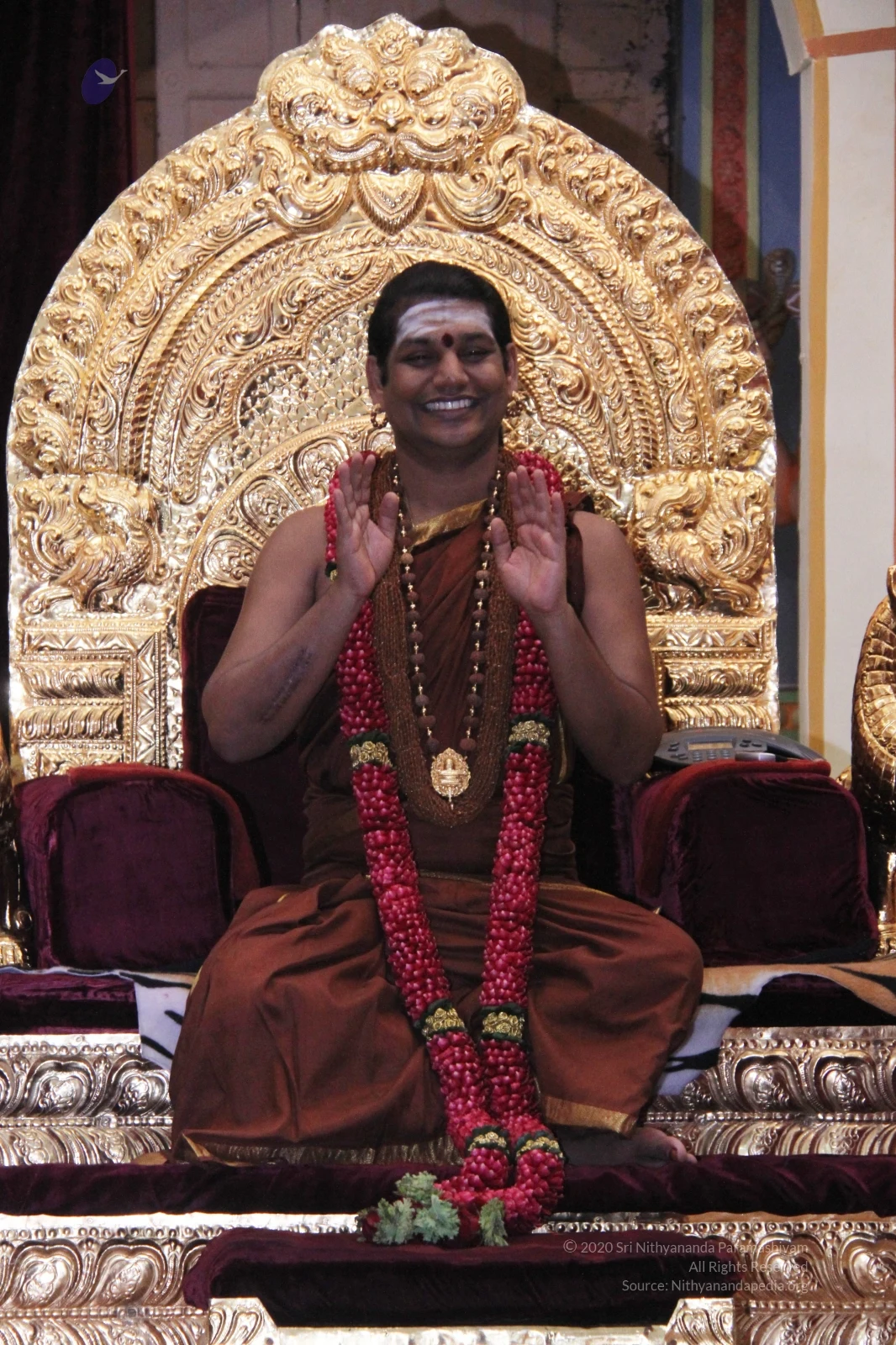
42 photosSource gallery
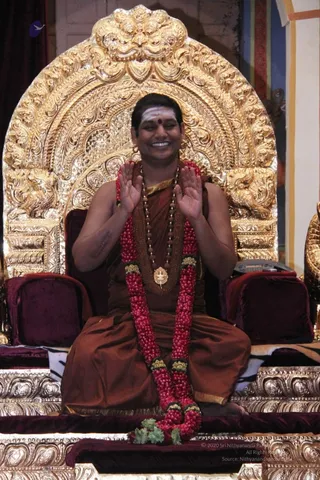
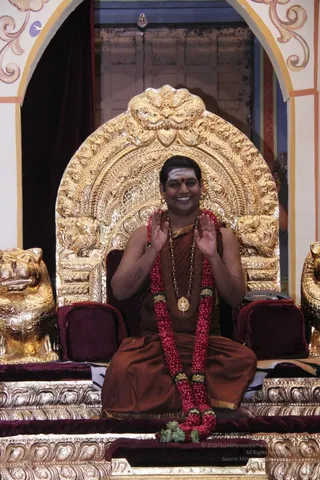
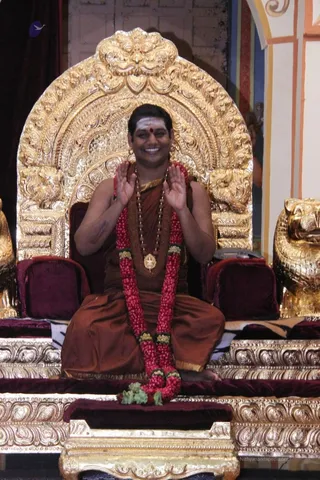
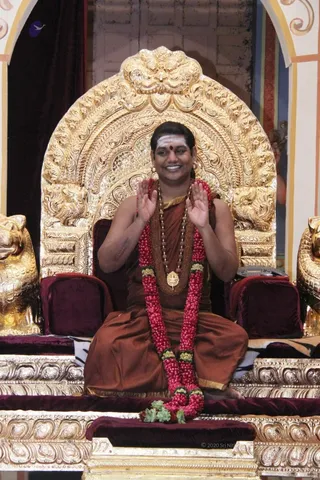
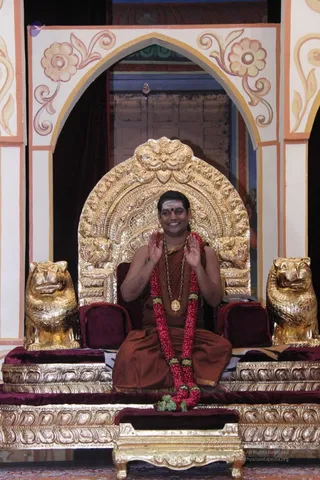
A smiling man seated on an ornate gold-gilded throne with a large arched backrest carved with floral and lion-like motifs, red velvet cushions on the seat and armrests. He wears a rust-orange robe with gold border, a long multi-strand brown rudraksha mala, a gold pendant, and a thick layered red flower garland with green leaves draped to his lap. A white vertical tilak and red bindi mark his forehead. He raises both palms outward in a gesture of greeting or blessing. Behind him a patterned cloth and a white wall are visible.A smiling man sits cross-legged on an ornate gilded throne with a tall arched back carved in floral and scrollwork, flanked by golden lion figures. He wears a rust-orange ochre robe and a long red flower garland, with a rudraksha mala and a gold pendant at his chest. His hands are raised palms-forward in greeting, and he has a white vertical tilak with a red dot on his forehead. Behind him stand a dark maroon curtain and a painted arch with scrollwork, with a decorative doorway beyond. A red-and-white garland rests at his feet. The pictured person is a seated man giving a blessing gesture on a throne, with the appearance-based label a person given his saffron-orange robe, rudraksha mala, gold pendant and ceremonial throne.A smiling man sits cross-legged on an ornate gold throne with carved lion-head armrests and a deep red velvet cushion. He wears a rust-orange robe, a beaded rudraksha mala, a gold pendant, and a thick red flower garland, with white vibhuti and a red kumkum dot on his forehead. He raises both palms in greeting toward the audience. A gold lion sculpture is on the right.A seated man in a rust-brown robe sits on an ornate gold throne with a carved arched back and gilded lion-form armrests, against a backdrop with painted cream and pink arches. He has white and red forehead markings, a rudraksha mala with a gold pendant, and a thick red flower garland. He smiles and raises both palms together in a greeting gesture. a person, with a wood-brown robe, rudraksha mala and ceremonial garland on a golden throne, appearing in person at a satsang.A photograph of a seated man on an ornate gilded throne with arched backrest carved with floral and scroll motifs, flanked by two gilded lion sculptures and velvet cushions. He wears an ochre-brown robe, a rudraksha mala with a gold pendant, and a long red flower garland, with white and red forehead markings. He sits with palms pressed together in greeting, smiling. Behind him is an arched frame painted with flowers and a wooden doorway.A seated man in an ornate golden throne with a gilded arched back flanked by two golden lion sculptures. He wears a rust-orange robe, a rudraksha mala and a ceremonial gold pendant necklace, and a long red flower garland hangs over his shoulders and lap. His palms are raised together in greeting while he smiles. A white painted arch with floral scrollwork frames the stage behind him, and a figure is partially visible at the right edge. Appearance-based cues (orange robe, rudraksha mala, gold pendant, throne setting) are consistent with a person, seated in a satsang setting.

Sarva-Darshan

12 photosSource gallery
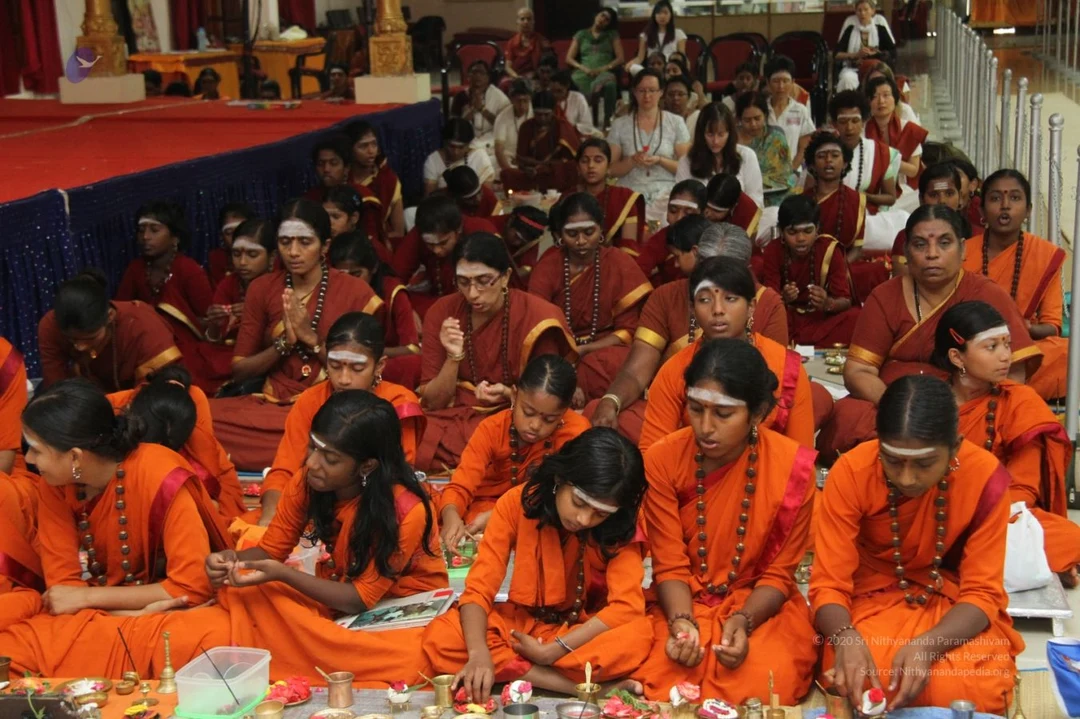
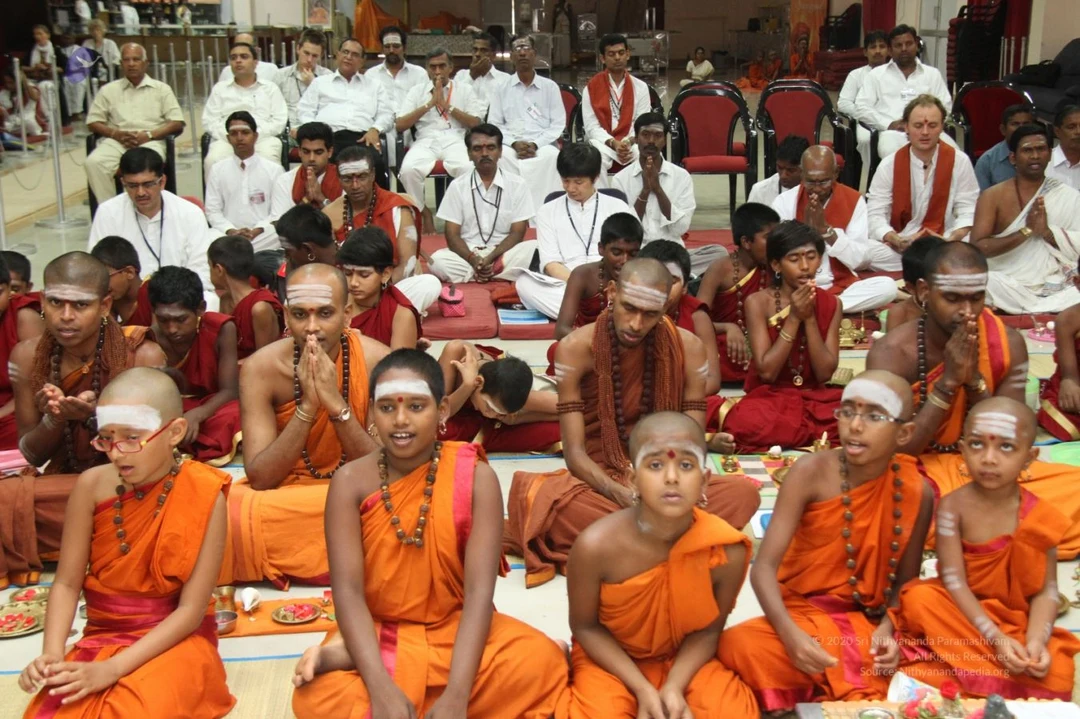
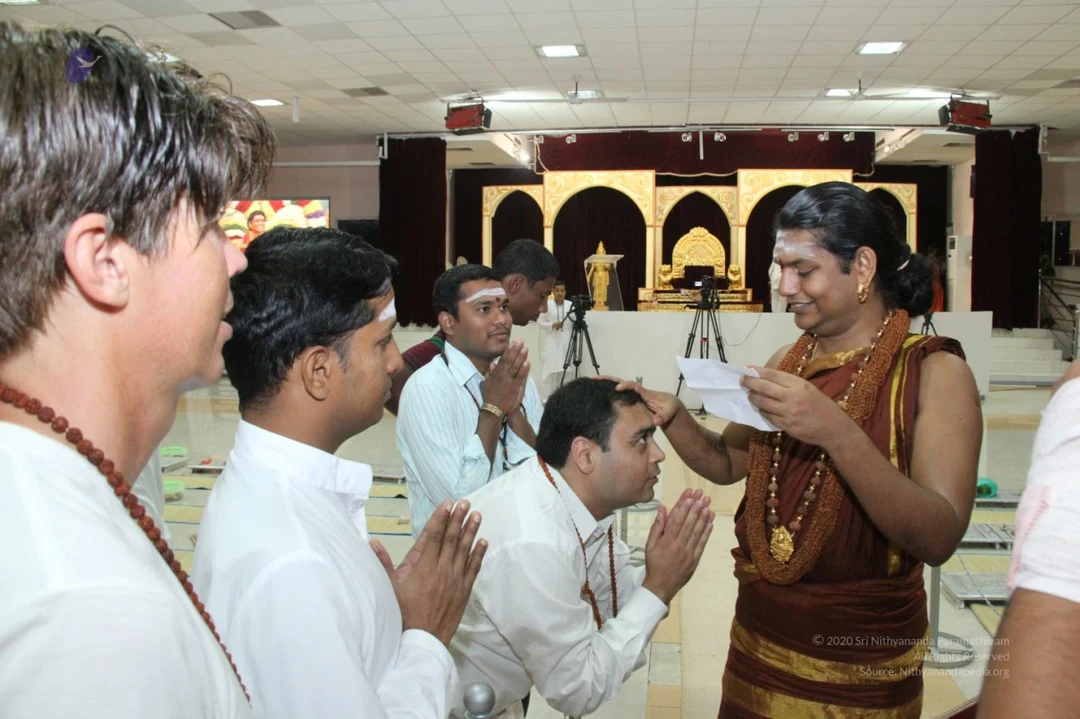
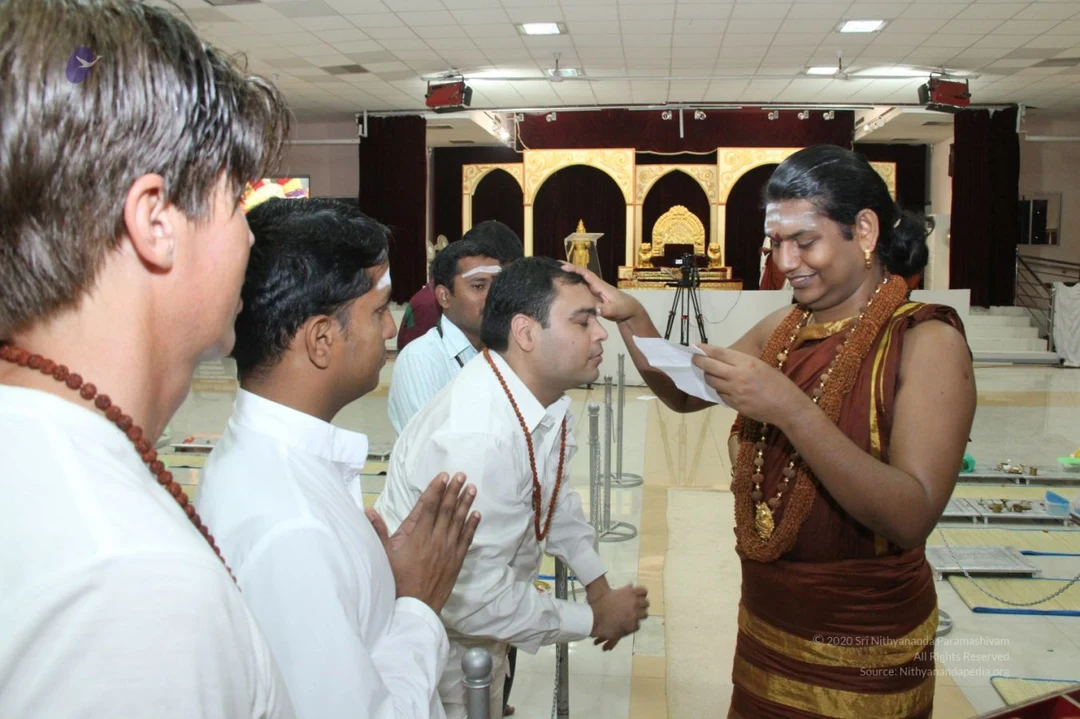
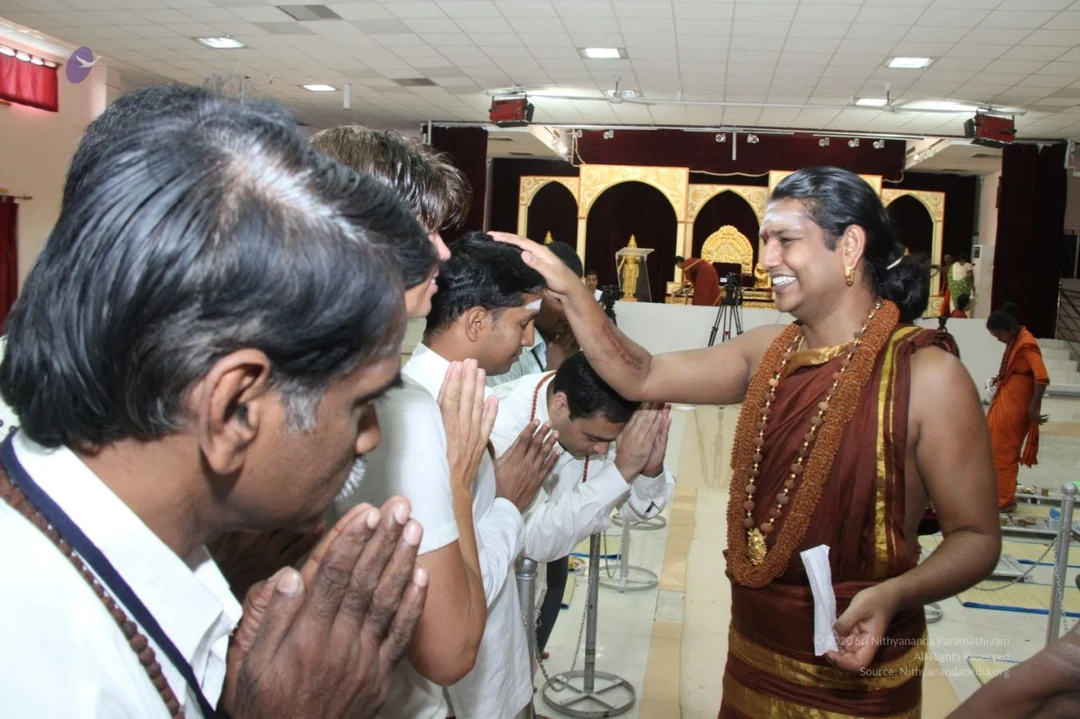
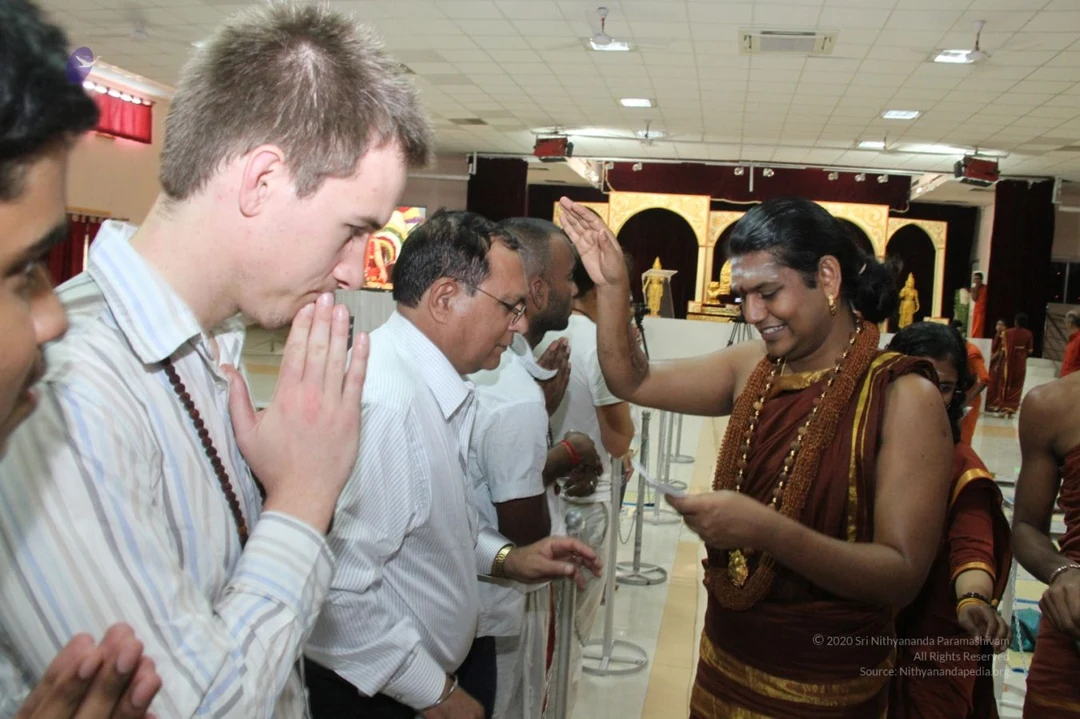
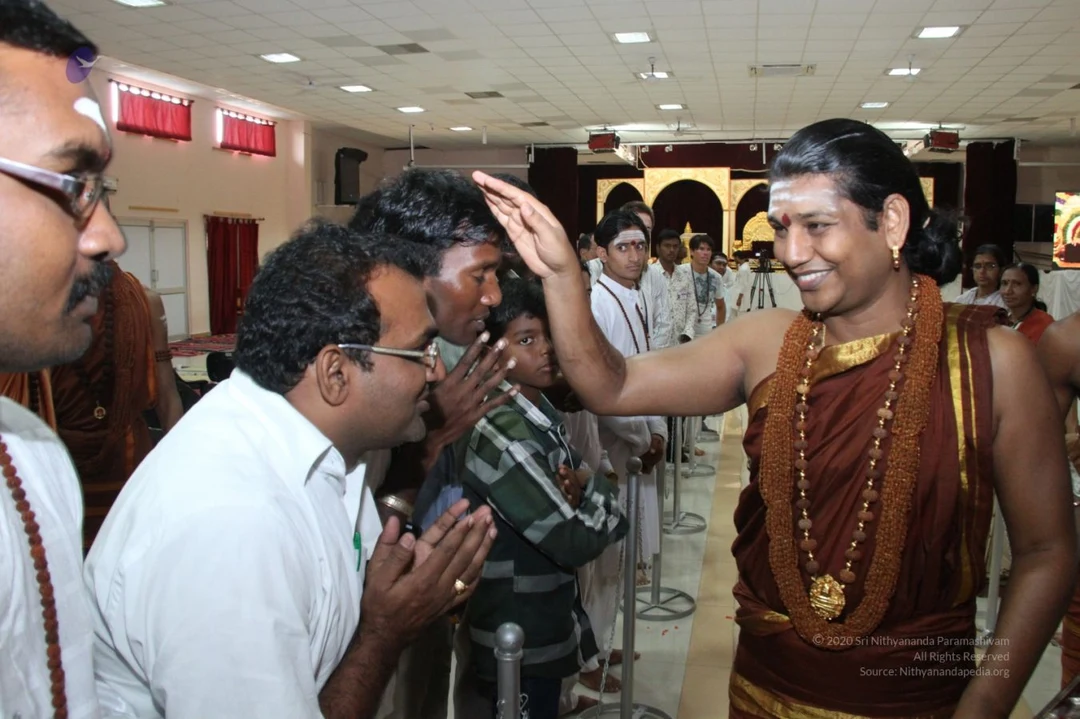
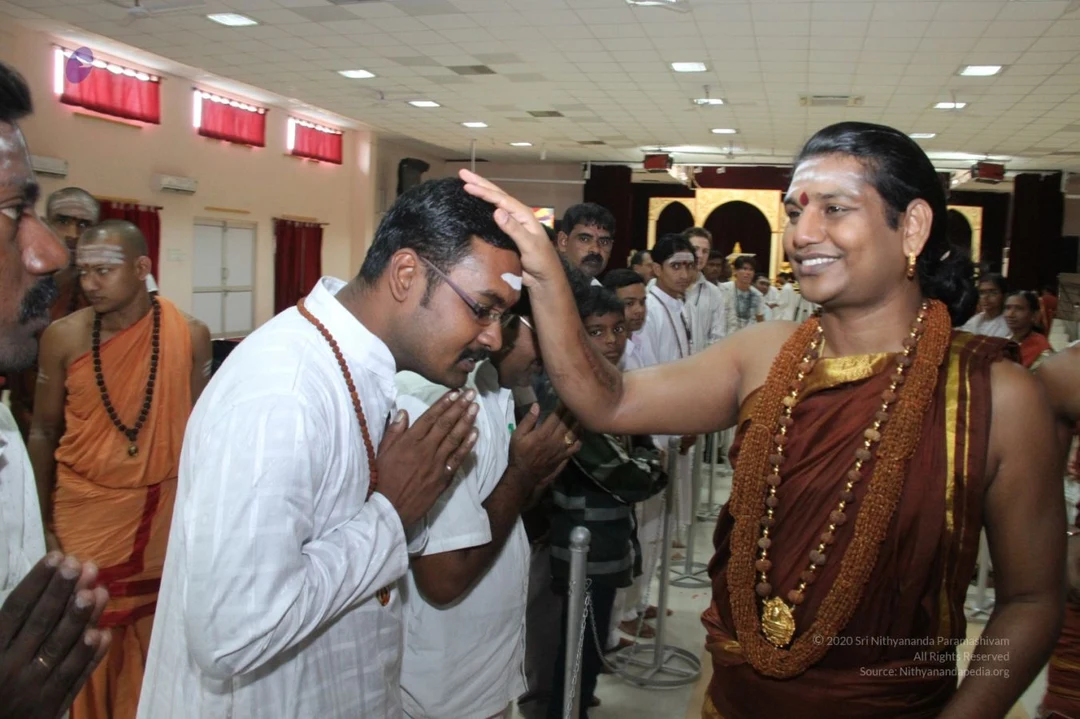
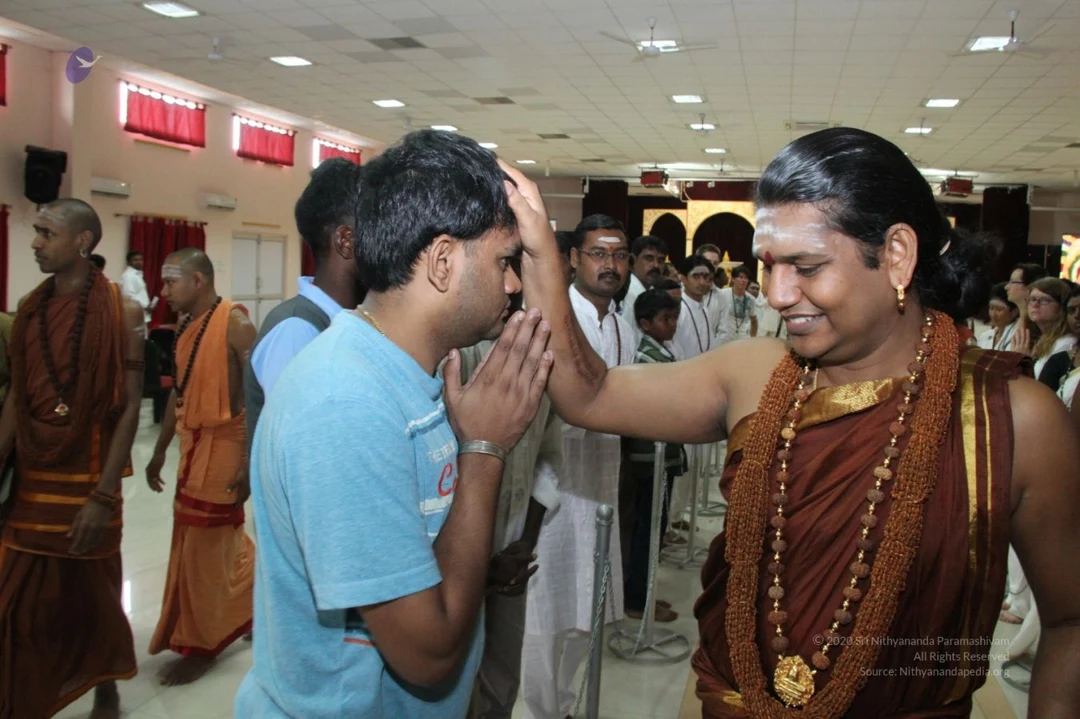
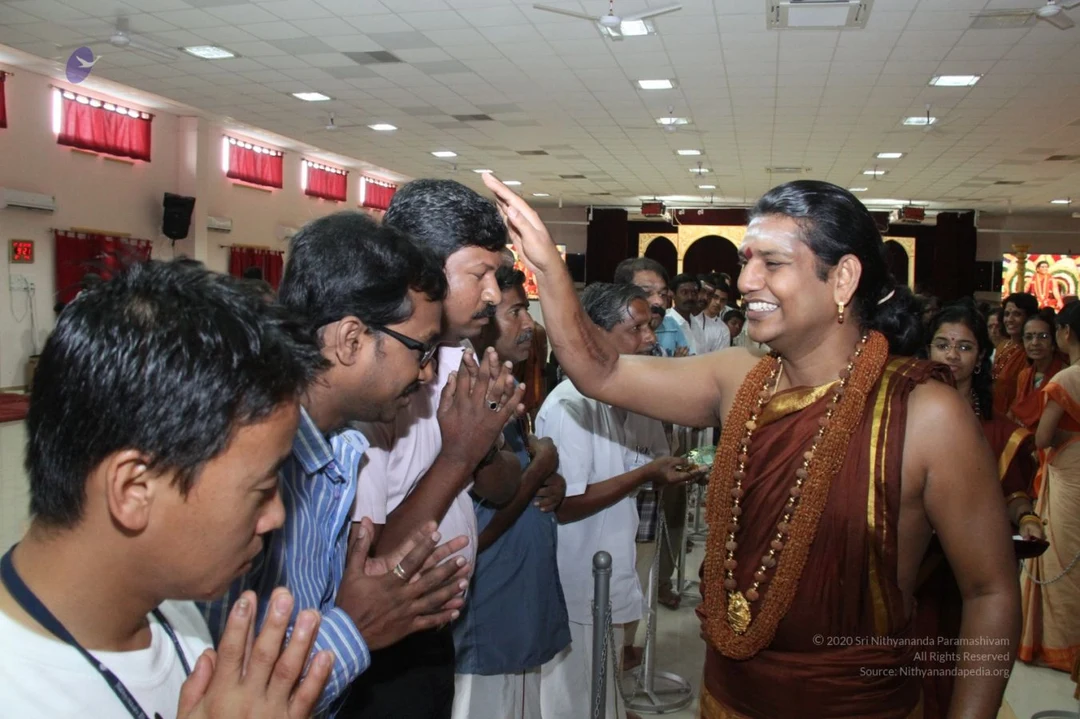
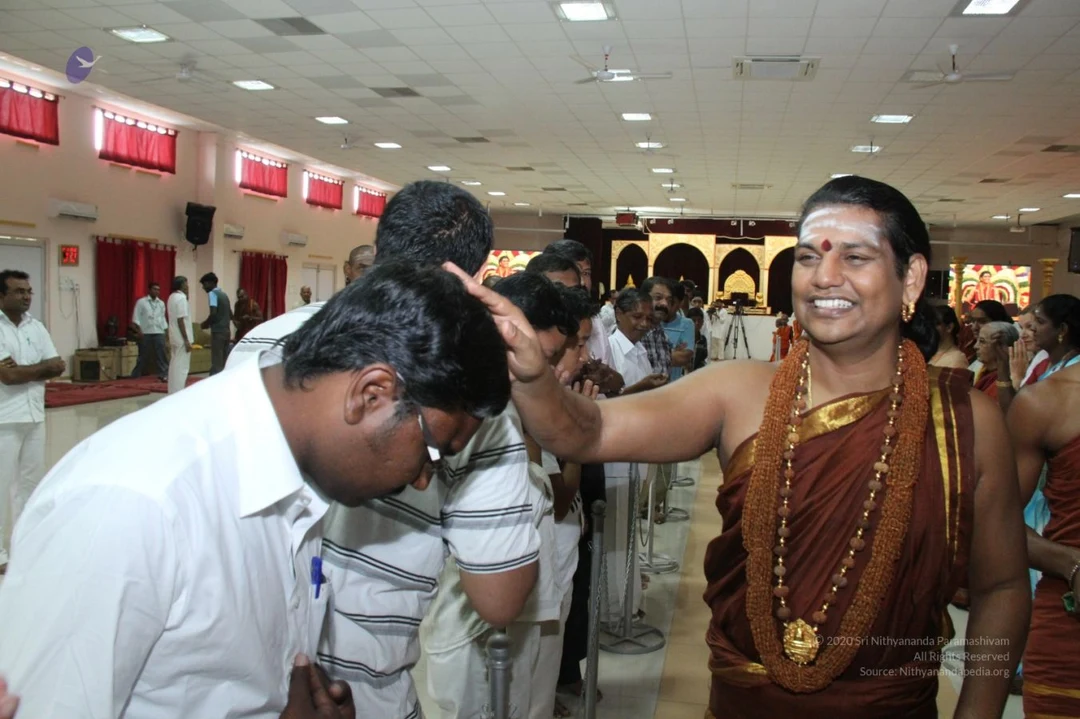
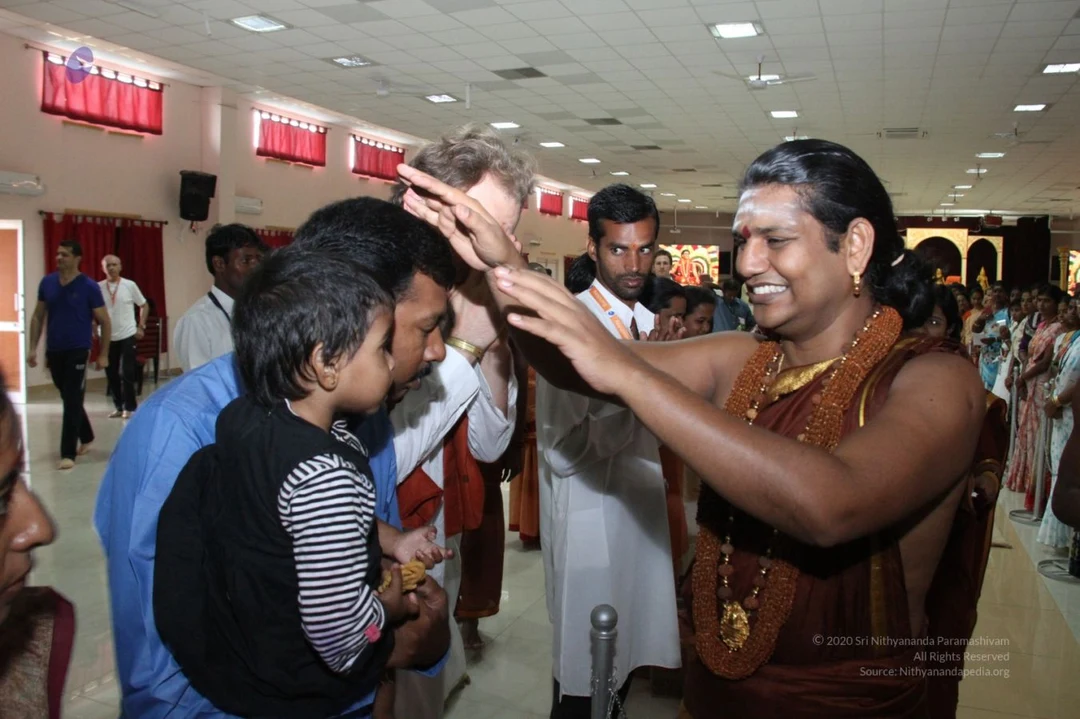
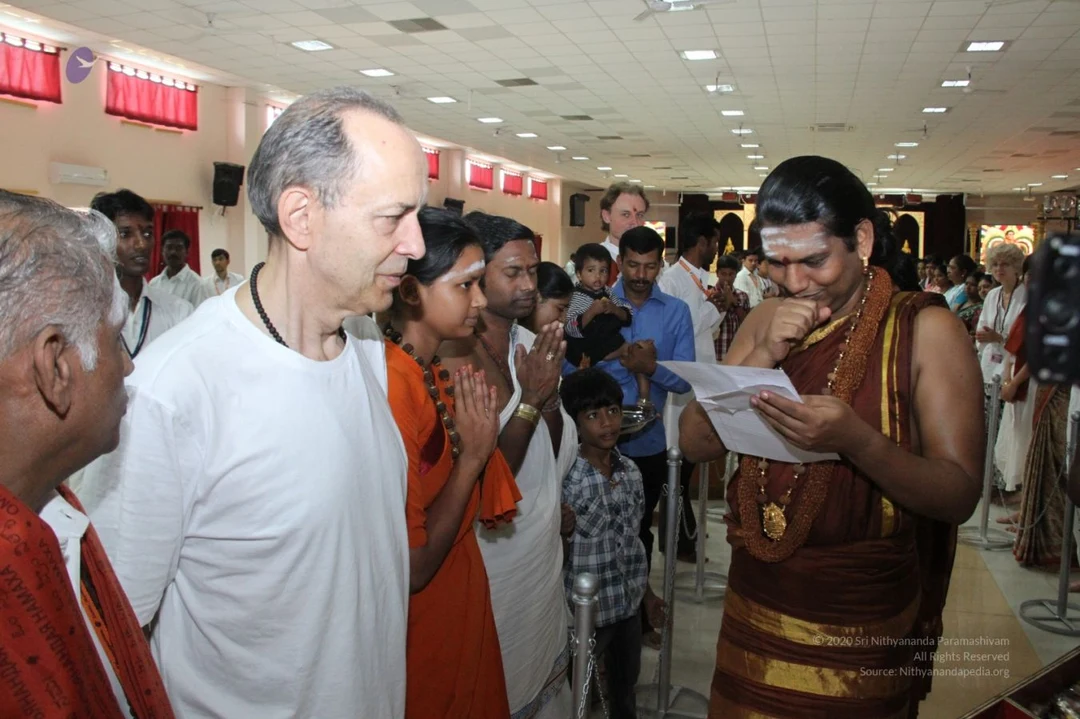
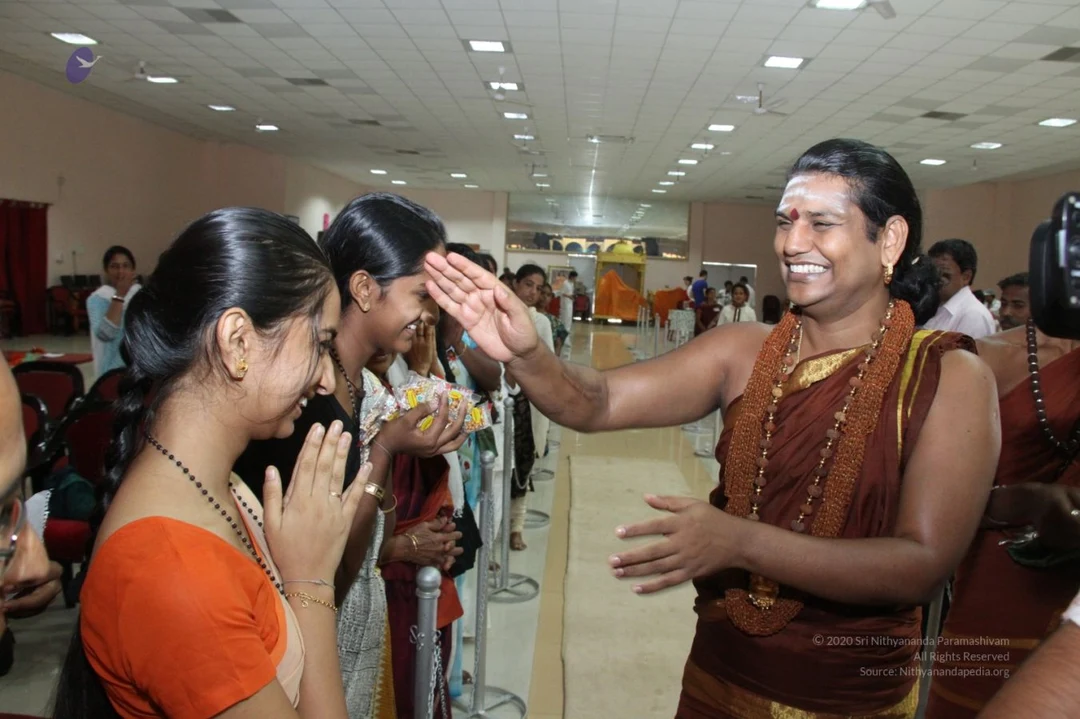
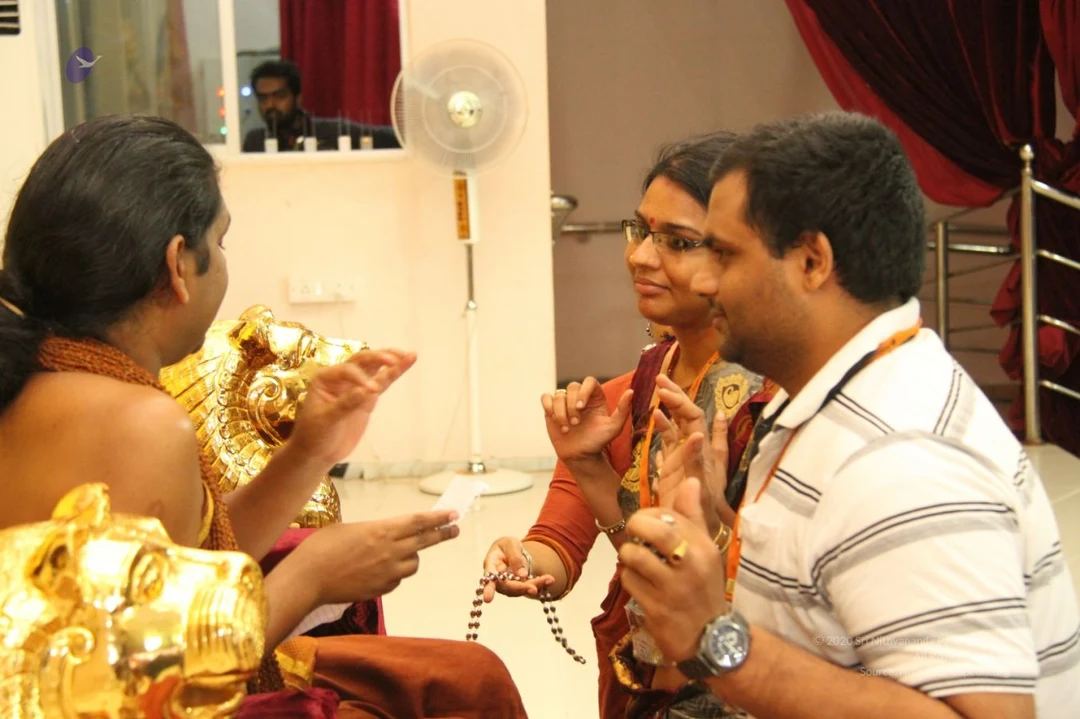
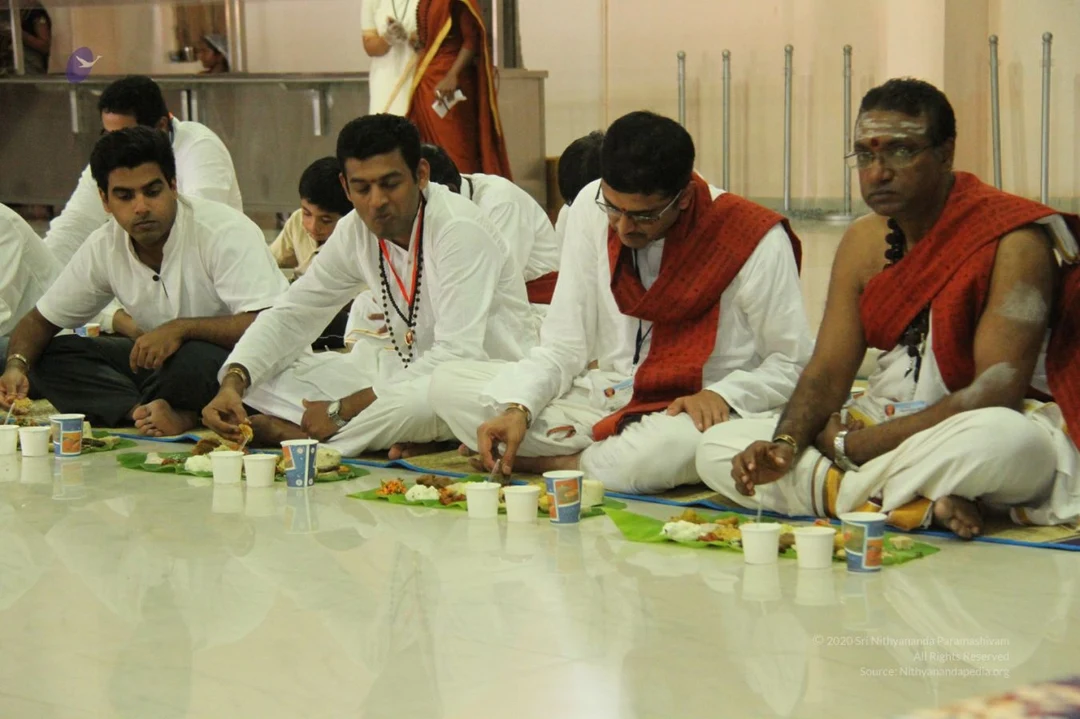
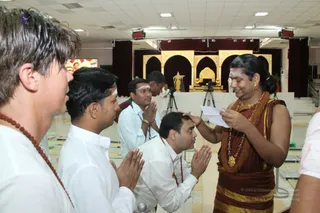
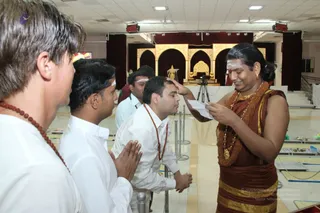
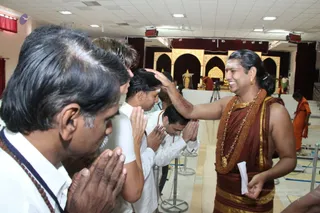
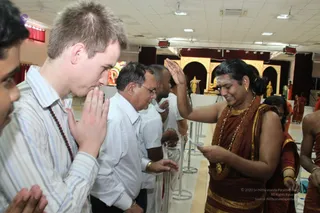
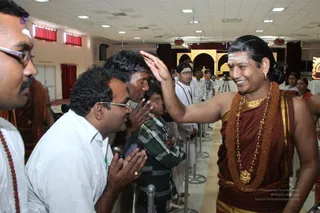
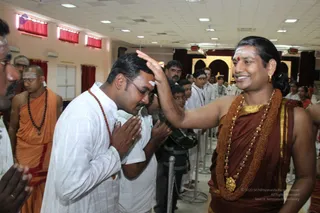
A photograph in a large hall with gold-trimmed arches, maroon drapes and a golden throne-like seat with a small altar in the background. A figure with long swept-back dark hair, rudraksha mala and gold necklaces, wearing a maroon and gold-bordered robe, touches the forehead of a kneeling man in white with folded hands, while holding a paper. Other men in white shirts with rudraksha malas and white forehead markings stand with palms joined, and a bare-armed onlooker is at the right edge. Three camera tripods and a small monitor are visible. a person: the figure in the maroon robe shows long hair, gold ornaments and rudraksha malas, consistent with a blessing role.A photograph in an indoor hall with gold-trimmed arched stage and maroon curtains behind. A person in a rust-brown dhoti-style wrap with gold border, layered rudraksha and gold beaded necklaces, and a dark bun, applies a white sacred marking to the forehead of a man in white shirt who has his eyes closed and hands joined, wearing a rudraksha mala. Several men in white stand to the left with hands folded and white forehead marks, one with a rudraksha mala. Floor is covered with mats and small offering plates. A figure appearing as Swamiji (probable) stands at right, presenting the marking with ornate jewelry and a rudraksha mala; the cues are the dark swept-back hair in a bun, layered rudraksha and gold necklaces, and the rust-saffron clothing. A tripod camera stands near the stage.A photograph in a large hall with a gold-trimmed stage and dark red curtains in the background. On the right, a man with long swept-back dark hair, a rudraksha mala, a gold ceremonial necklace and a reddish-brown wrap with gold border, holds a folded paper and places his hand on the head of a devotee. Several devotees in white shirts stand with palms pressed together in namaskar, bowing their heads, one wearing a rudraksha mala. A figure in orange robes appears further right, and a deity murti sits on the stage. a person, a person giving blessing to devotees. Seven or more people are visible.Indoor satsang hall with a golden shrine and deity murtis in arches behind. In the foreground a man with a short light-brown haircut and white striped shirt stands with palms pressed together in namaskar, next to a man in glasses and a striped shirt with hands folded. On the right, a robed figure in maroon-and-gold saffron-toned cloth wears a long rudraksha mala and heavy ornate gold-coloured necklace, with long hair swept back, and holds a small object while raising a hand in blessing toward a devotee. Another robed attendant stands behind. a person by appearance cues (long swept-back hair, rudraksha mala, ornate gold necklace, maroon-saffron robe) is the figure giving blessing, with devotees receiving it.A photograph of a hall where a robed man with long swept-back hair, white forehead markings, a red tilak and a sandalwood-brown robe with gold border stands at right, raising his right palm in blessing toward devotees. He wears a dense rudraksha mala, a large gold pendant, and earrings. Before him, a man in a white shirt presses his palms together in namaskar, while another man in a dark shirt leans forward with hands folded. A boy in a green checked shirt stands between them. Behind, rows of people in white and brown clothes stand along metal barrier posts, and a golden ornate arch and a lit display screen are visible at the back of the room.A photo in a bright hall with red curtains and gold-trimmed arches. A man in a brown-and-gold dhoti-style garment, with a rudraksha mala, gold necklace and a red tilak, smiles while placing his palm on the forehead of a bespectacled man in a white shirt who bows with folded hands. Other men in orange and white ritual clothes, some with rudraksha malas and white forehead markings, stand behind them, and a row of devotees with folded hands waits along barrier rails. A depiction of the blessing is shown as devotees watch.
Final-Blessing

6 photosSource gallery
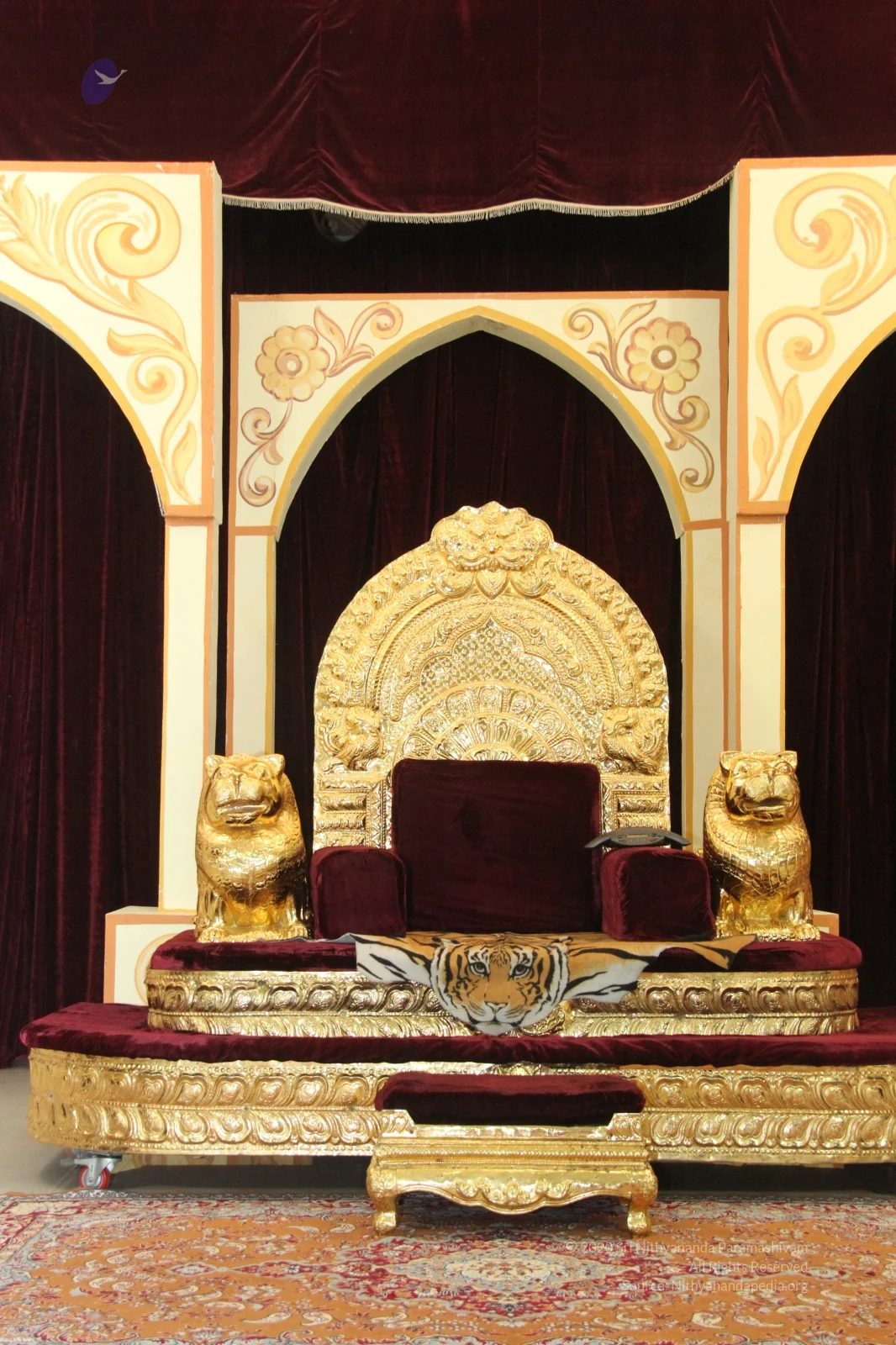
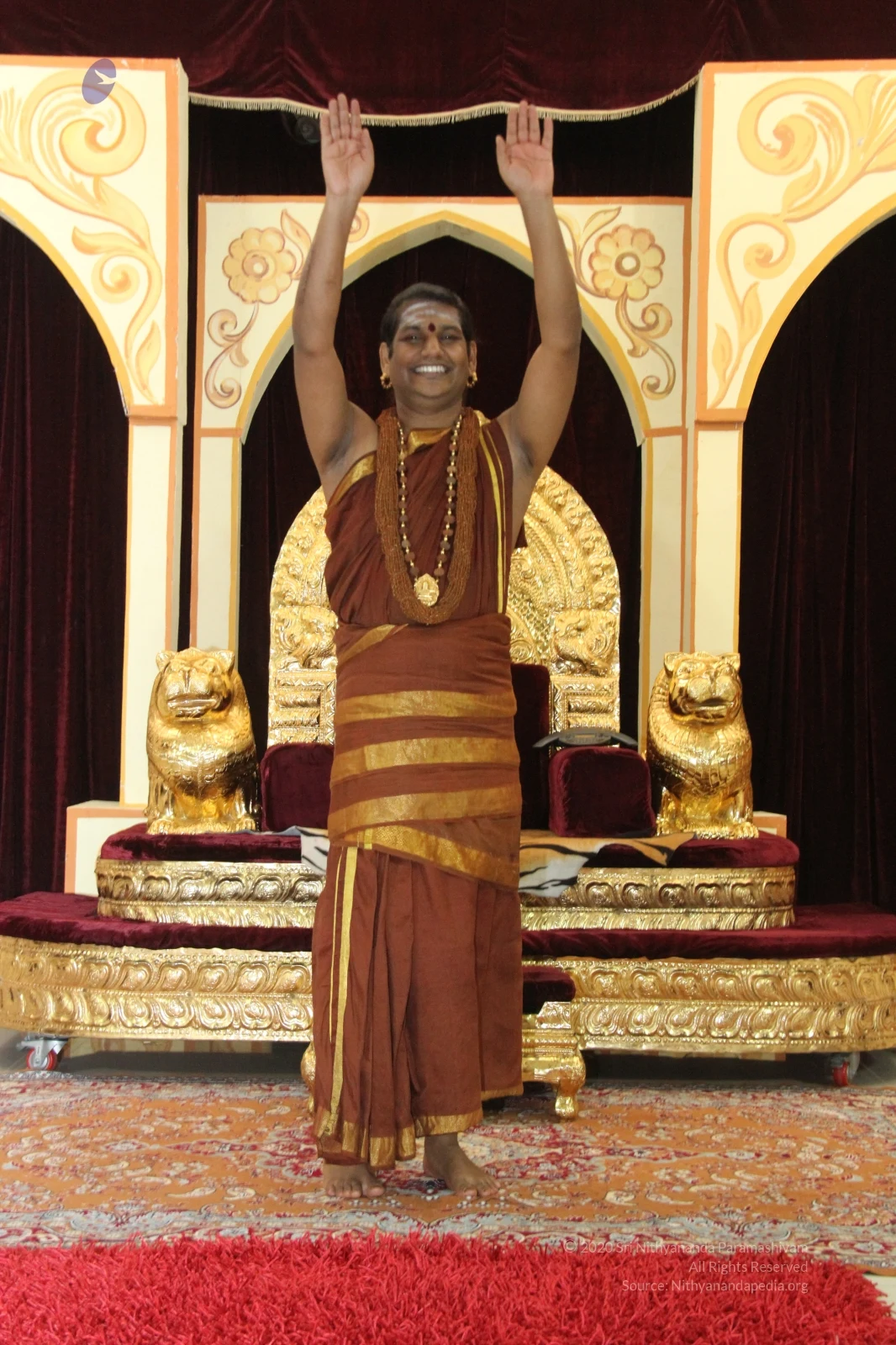
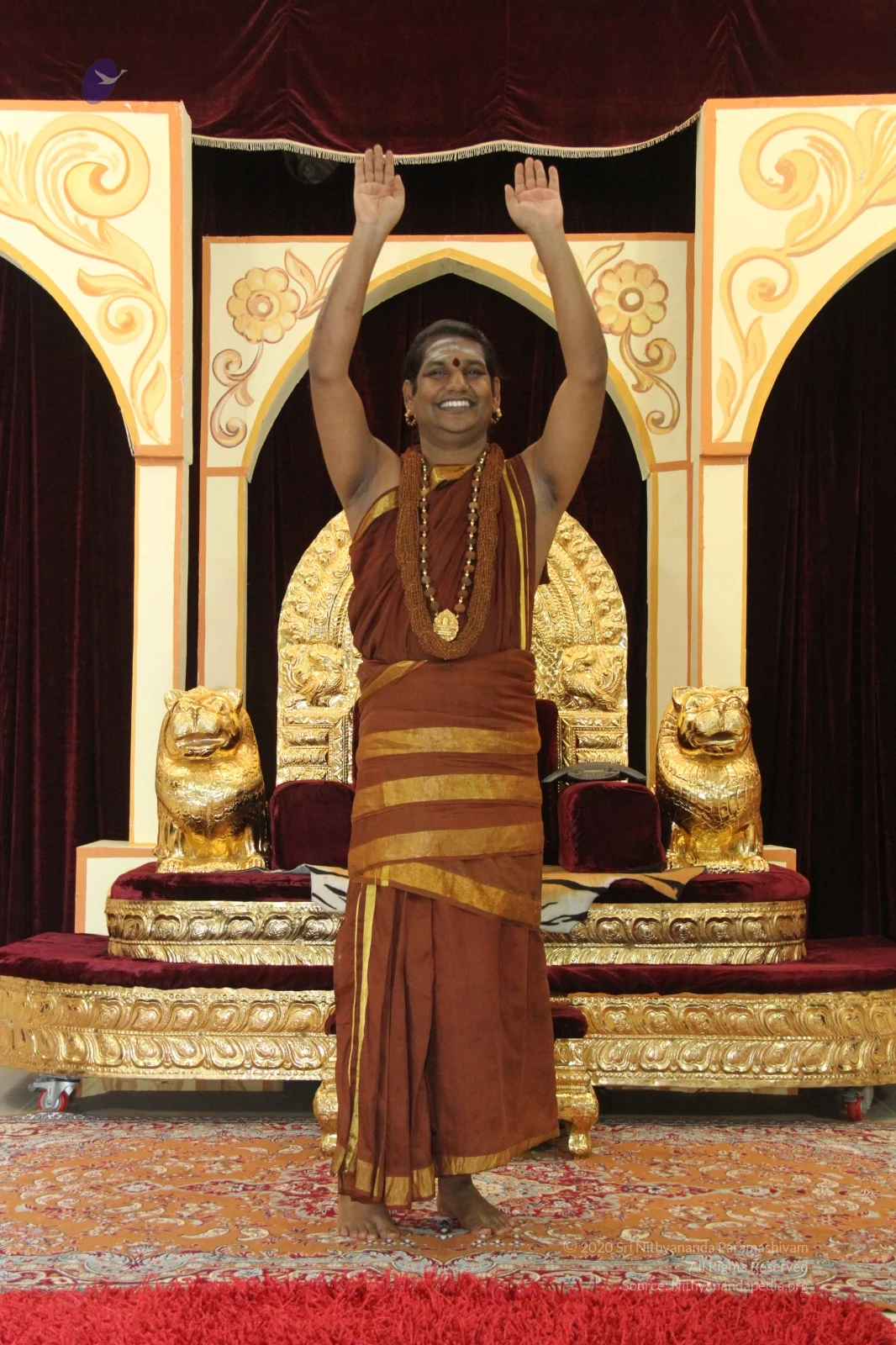
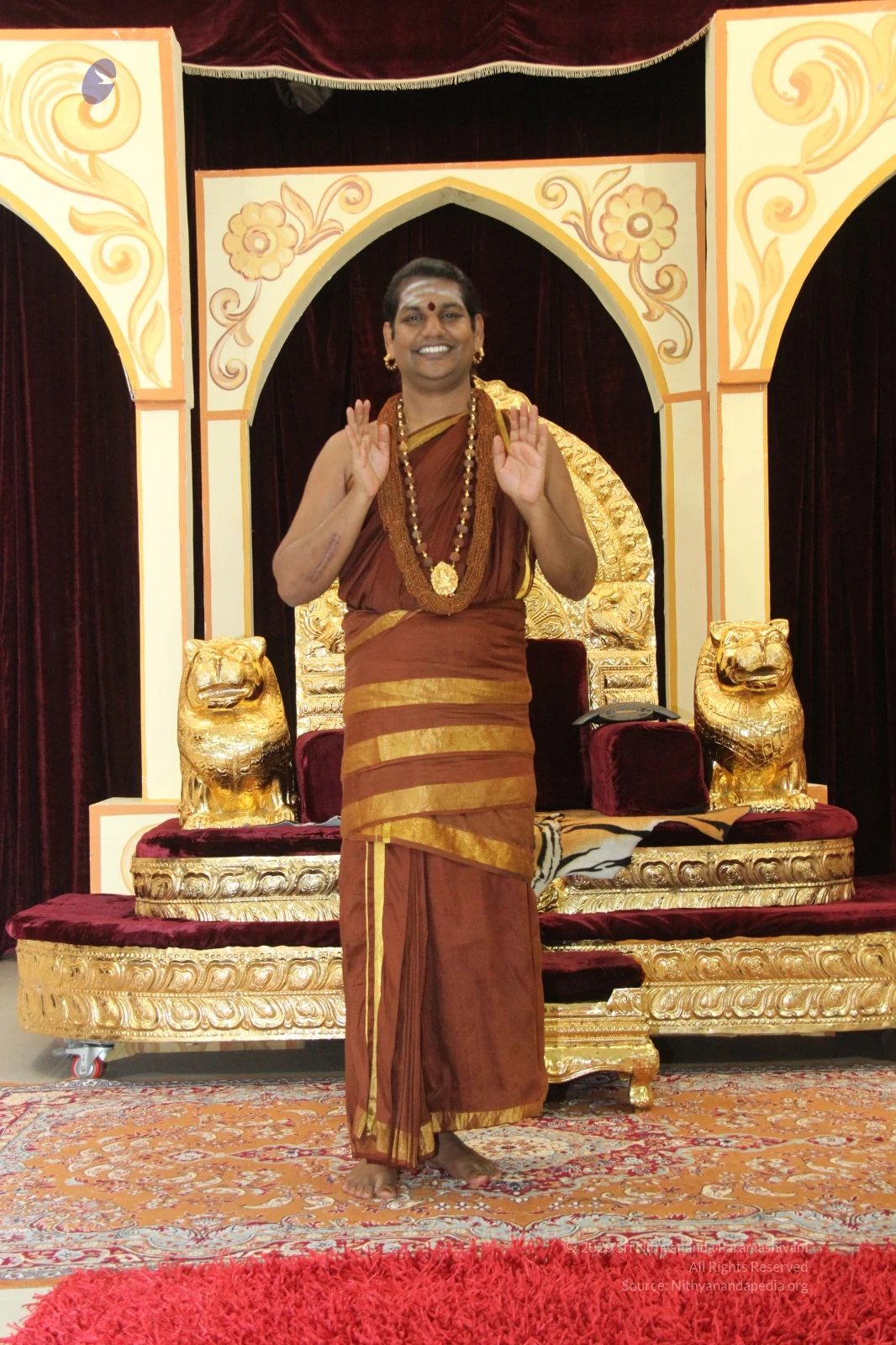
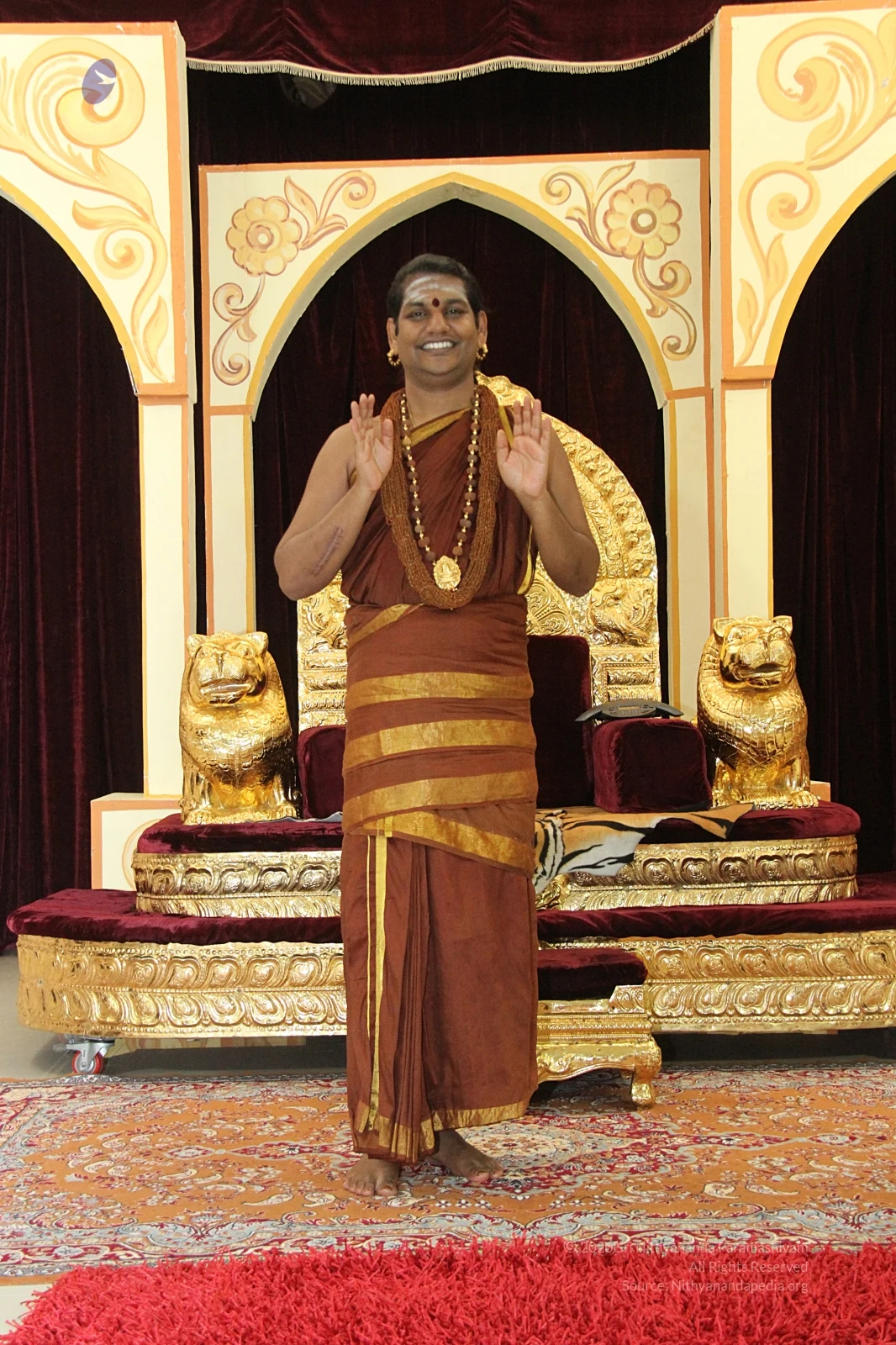
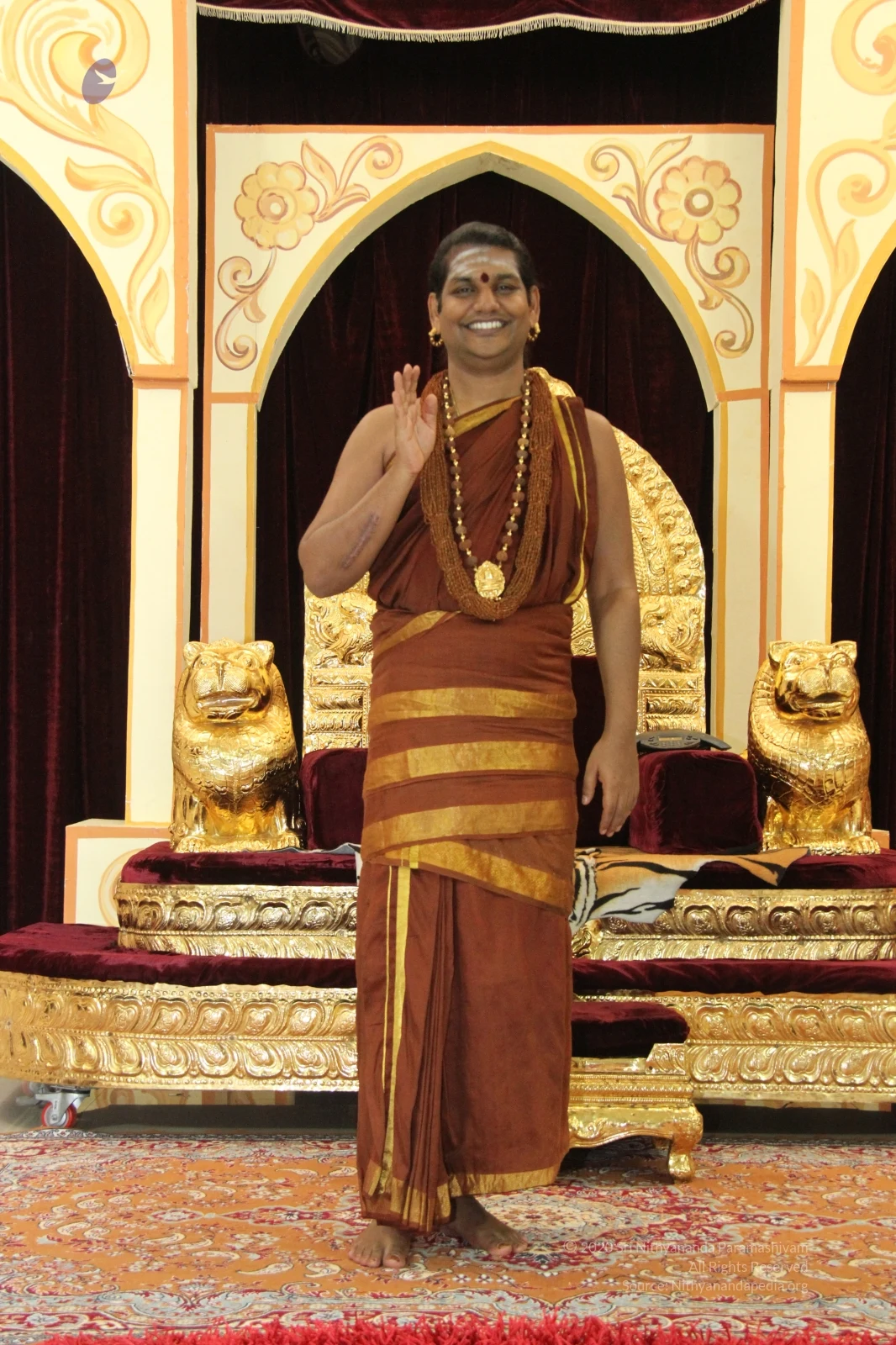
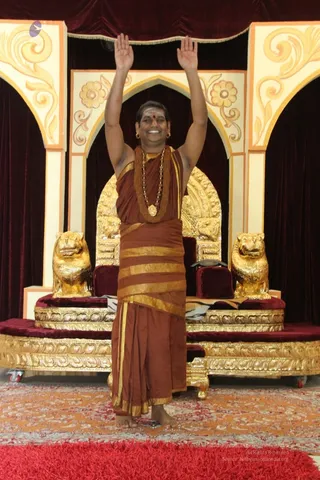
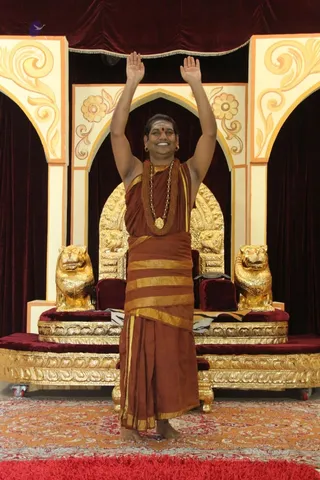
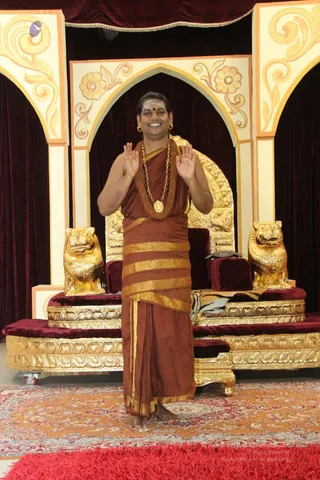
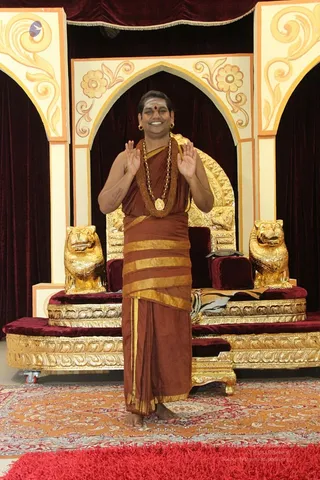
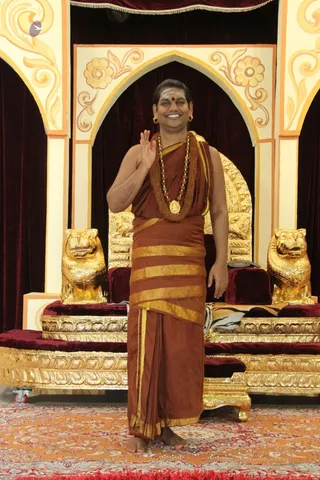
An empty ornate gold throne stands on a raised red velvet dais in a hall with maroon velvet drapes and cream arches painted with gold scrollwork. The throne has an elaborately carved gilded arched back, a deep red velvet seat and armrests, and two gilded lion figures flanking it. A tiger-skin rug with a striped tiger head lies over the seat base, and a gilded footstool sits in front on an oriental-patterned carpet. No people are visible.A smiling man with short dark hair and a red bindi stands barefoot on a patterned red rug with both arms raised overhead, palms open. He wears a rust-red and gold-bordered draped cloth, a rudraksha mala with a large central pendant, and gold earrings. Behind him is an ornate golden throne with lion-shaped armrests, deep red velvet cushions and red velvet drapes with gilded cream arches. The figure has distinctive ceremonial adornments and a throne setting, but the candidate's appearance is not sufficiently distinctive to confirm the page's claim, so this is an unsure in-person candidate described by role as a man standing before the throne.A smiling man in a rust-brown dhoti-style wrap with gold-bordered edges stands barefoot on an ornate red carpet, both arms raised overhead with palms open. He wears a long rudraksha mala with a gold pendant and gold earrings, and has a red bindi and sacred ash marks on his forehead. Behind him stands a gilded throne with carved lion figures, dark red velvet cushions and maroon drapes with painted gold floral arches. The pose suggests a teaching or blessing moment in a stage-like setting. A man in this rust robe and mala matches the page's a person reference; appearance cues are consistent with a probable identification, though the throne and clothing alone are not decisive.A smiling man stands barefoot on a red and orange patterned rug in front of an ornate golden throne with lion-shaped armrests and a tiger-skin draped over the seat, set before arched cream panels with gold floral scrollwork and dark red velvet drapes. He wears a rust-brown dhoti and shoulder cloth edged with gold borders, a beaded rudraksha mala with a large gold pendant, gold earrings, a white tilak with a red dot on his forehead, and raises both palms outward in a greeting gesture. a person is in the scene, identified by his distinctive ornate ceremonial presentation, rudraksha mala and gold pendant, standing in front of the throne as the main subject.A standing man in rust-brown robes with a gold-bordered wrap and dhoti smiles and raises both palms toward the camera in a greeting. He wears a rudraksha mala with a gold pendant, gold earrings and a red bindi with vibhuti markings on his forehead. Behind him stands a gold-gilded throne with two golden lion figures, framed by cream arches with gold floral painting and dark red velvet drapes, on an ornate oriental carpet. A tiger-striped cloth lies on the throne.A standing man in a rust-brown dhoti-style garment with gold borders and a matching draped shawl smiles and raises his right hand in a blessing gesture. He wears a thick rudraksha mala with a gold pendant, gold earrings, a red bindi and white tripundra marks. He is barefoot on a patterned red carpet in front of an ornate golden throne with lion-shaped armrests, red velvet cushions, a tiger-striped cloth and maroon curtains. a person appearance cues: rudraksha mala and ceremonial gold pendant with a saffron-ornate garment.

IA-Day21-Graduation

6 photosSource gallery
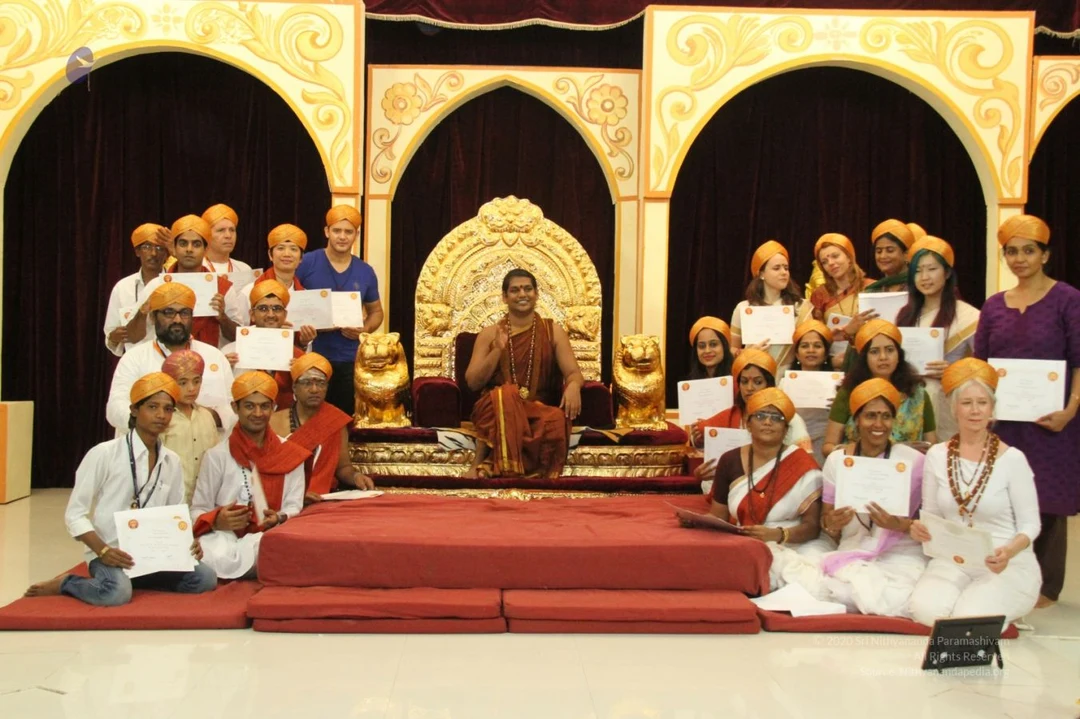
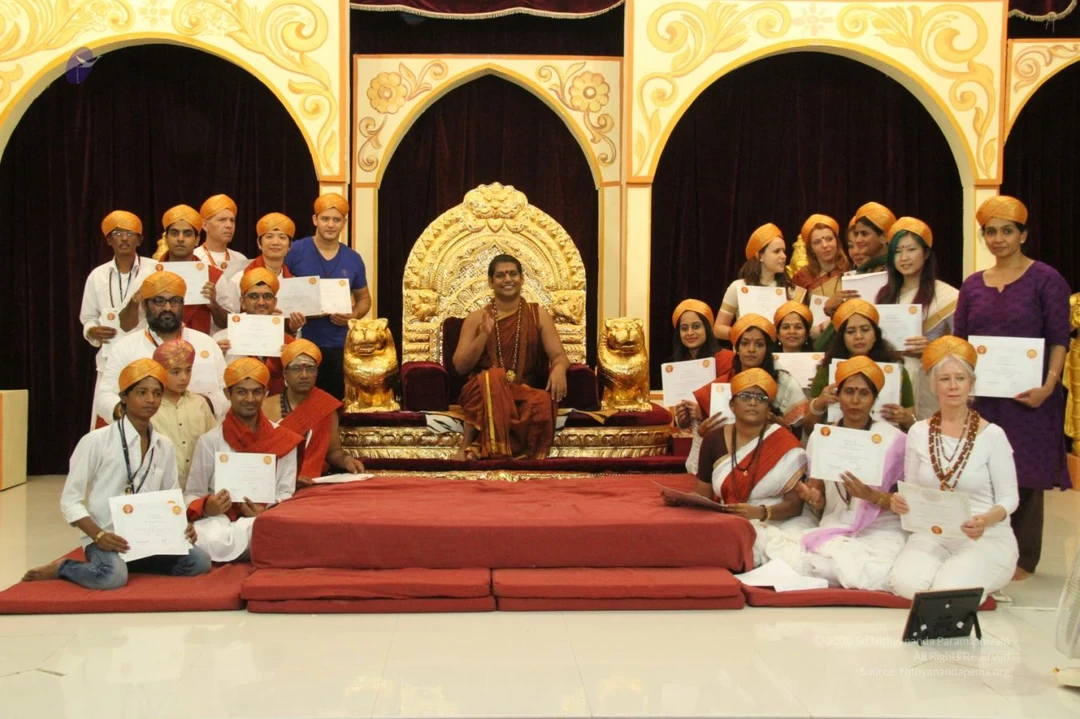
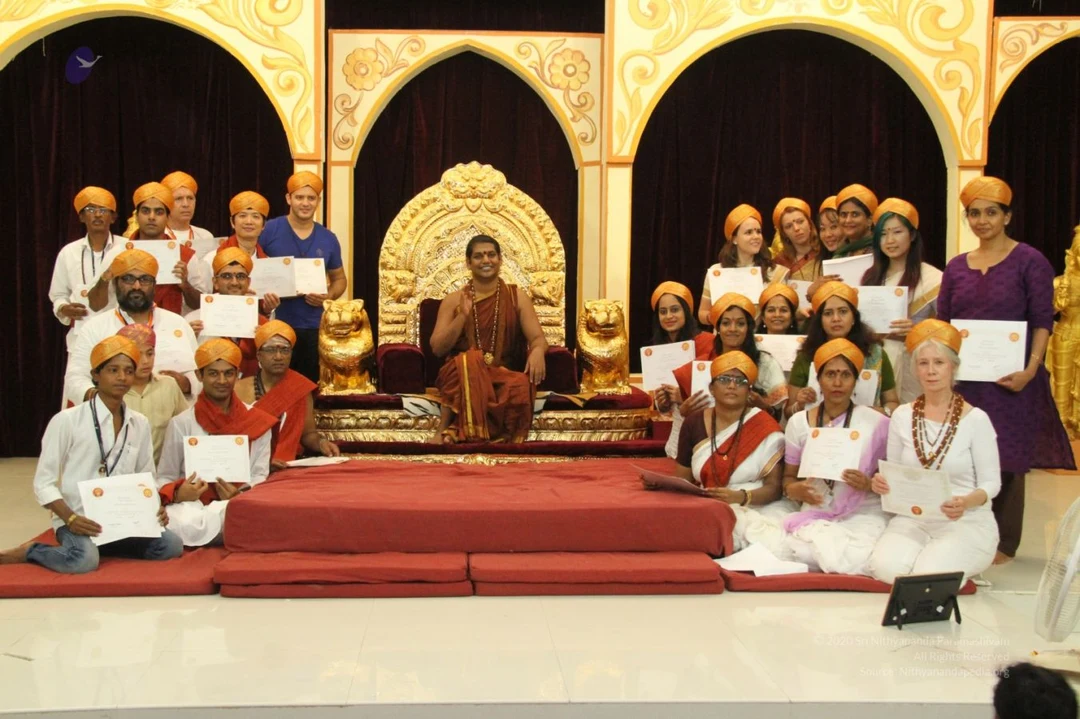
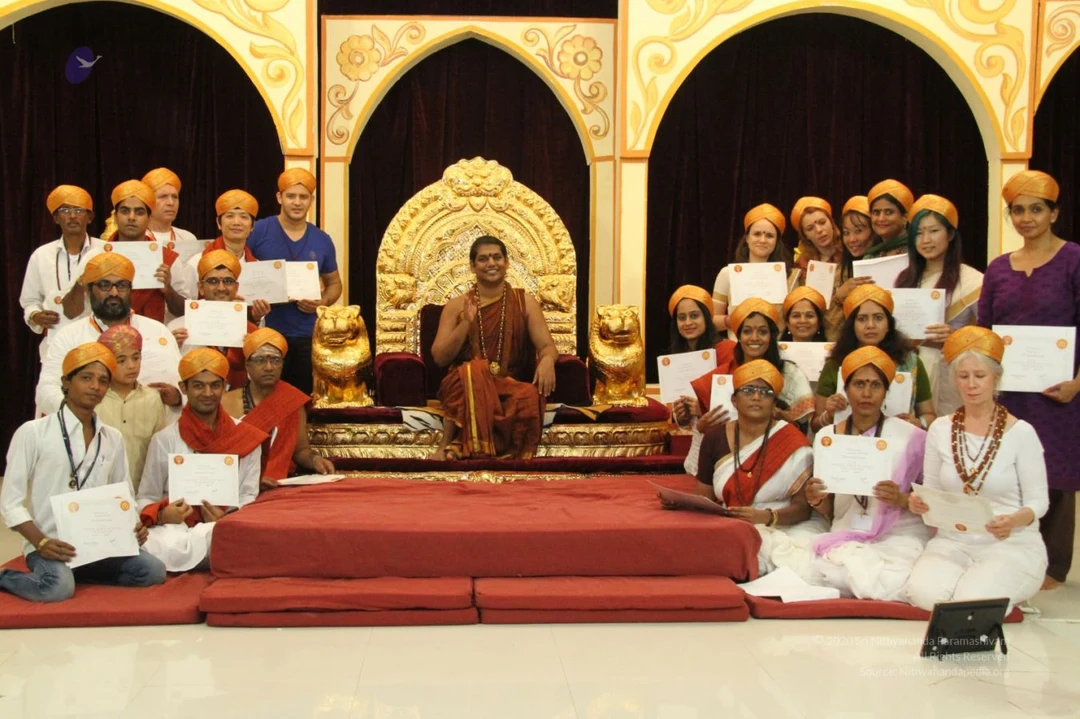
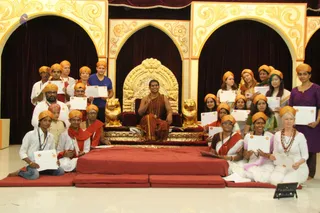
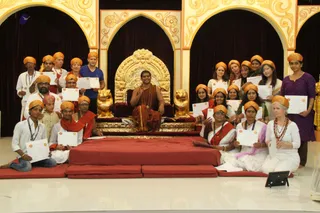
A group photograph of many participants posed around a central figure seated on an ornate golden throne with gold lion figures at its base, against a maroon velvet backdrop and cream arches with gold floral trim. The seated man wears saffron-orange robes, a rudraksha mala and a gold necklace, and makes a raised hand gesture. Around him, roughly twenty-five people wear orange head wraps and hold white certificates; many women wear white or saffron saris, a man in a blue t-shirt stands at the back, and a woman in a purple kurta stands at the right. Those in front sit on red cushions on a red mat. The person on the throne is an appearance-based a person with saffron robes, a rudraksha mala and gold necklace, seated centrally on a throne.A group photo in a hall with cream and gold arched decor and deep maroon drapes. A seated man in the centre, wearing a saffron-orange robe, rudraksha mala and gold necklace, sits on an ornate gold throne flanked by two golden lion figures on a red-draped dais. Around him about twenty-five people hold certificates; most wear orange turbans, and several wear white or red-and-white garments, a purple kurta, and blue shirts. Some are seated on red cushions in front, others standing behind. The seated figure matches the a person cues of a saffron robe, mala and ornate gold necklace, with his role as central figure on the throne.A group photograph in an ornate hall with gold-painted arches and a golden lion-flanked throne. A seated man in an orange-brown robe and rudraksha mala sits centrally on a golden throne with red cushions, with a red-draped platform in front. Around him, many people in orange or saffron turbans hold white certificates; women in white saris and men in white kurtas sit or stand, and a woman in a purple kurta stands at right. The setting is a formal certificate-presentation style gathering. The central seated man has long hair and a rudraksha mala, and the page presents him as Swamiji, so the appearance-based label is probable; the appearance cues are the rudraksha mala and orange robe, adjacent to his seated role on the throne.A group photo of about two dozen people posed around a central seated figure on an ornate golden throne flanked by golden lion statues. The seated man wears an orange-brown robe, a long beaded necklace, and a red-orange cloth draped over one shoulder, with his hand raised in blessing. Many standing and seated participants wear orange-yellow turbans and white or red clothing, and most hold white certificates. Gold arches with floral patterns and red floor cushions frame the scene. A woman on the right wears a purple kurta, and a woman on the far right wears white with rudraksha beads.A group photograph on a stage with gold arched panels and dark maroon curtains. A man in orange-brown robes with a long necklace sits centrally on an ornate gold throne flanked by golden lion figures. Around him, many people in orange turbans hold white certificates; some wear white kurtas, others saffron or red shawls and sarees. A woman in a purple salwar kameez stands at right, and a woman in white with a rudraksha-style necklace sits at front right. Red floor mats and cushions lie in front of the throne.A group photograph on a stage with gold-and-cream arches and dark maroon drapes. A central seated figure sits on an ornate gold throne flanked by gold lion statues, wearing a saffron-orange dhoti-style garment and a beaded mala, with one hand raised. Around him, about two dozen people stand and kneel, many in saffron-orange head turbans, holding white certificates; some wear white kurtas with lanyards, one woman wears a purple salwar kameez, and several women wear white saris with red borders. A gold deity murti stands at the right edge. A red cushioned platform lies in front, and a pedestal fan is visible at the lower right.

IA-Day21-IA-Swamiji-Banyan-Tree-Temple-Session

31 photosSource gallery
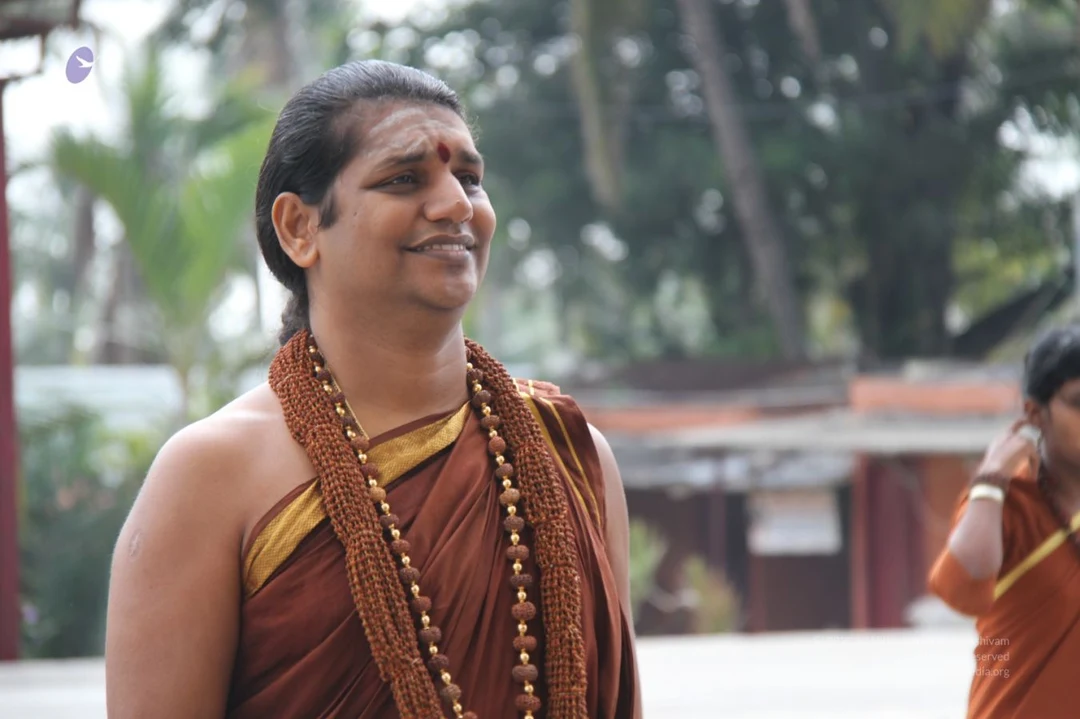
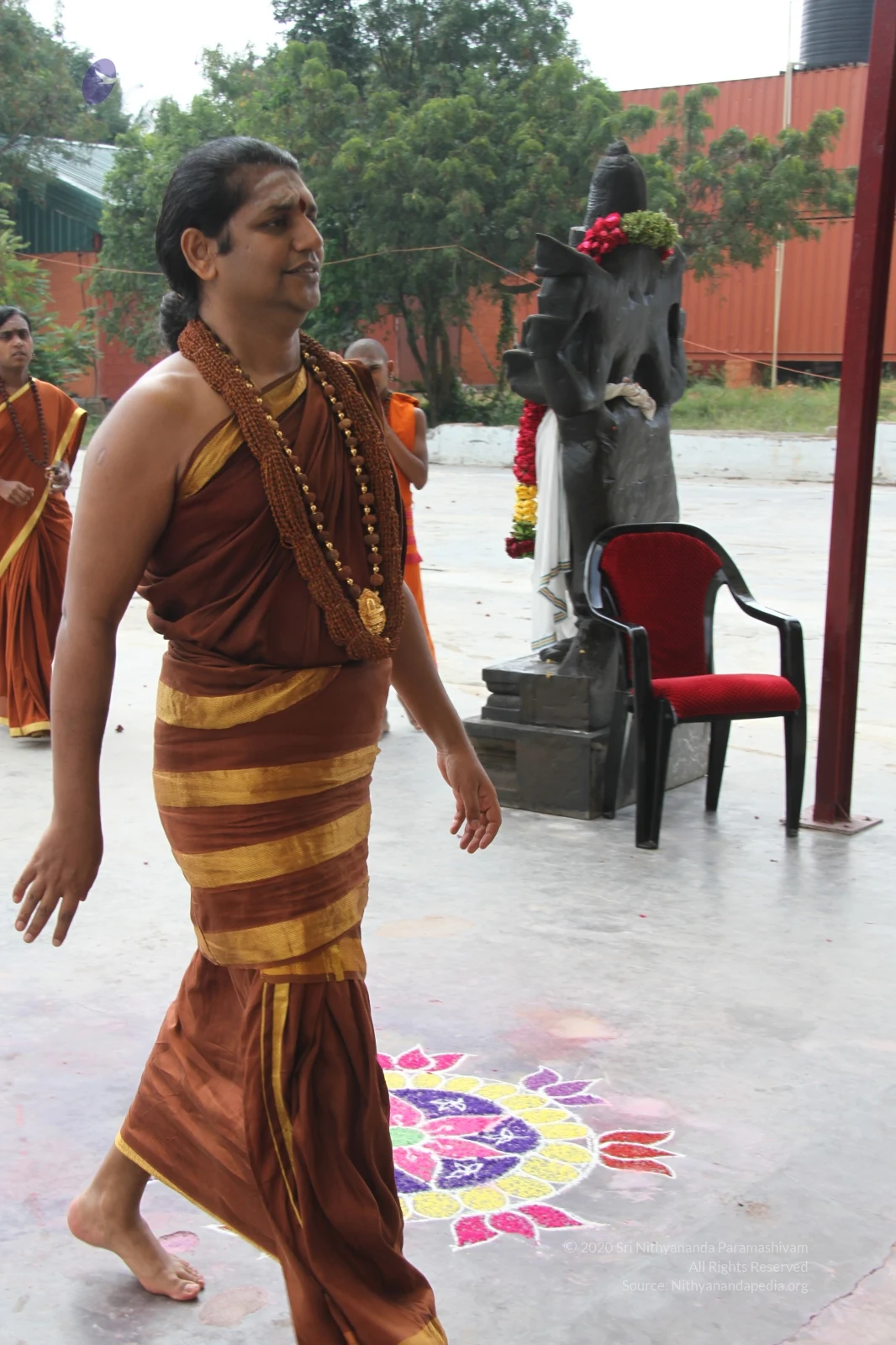
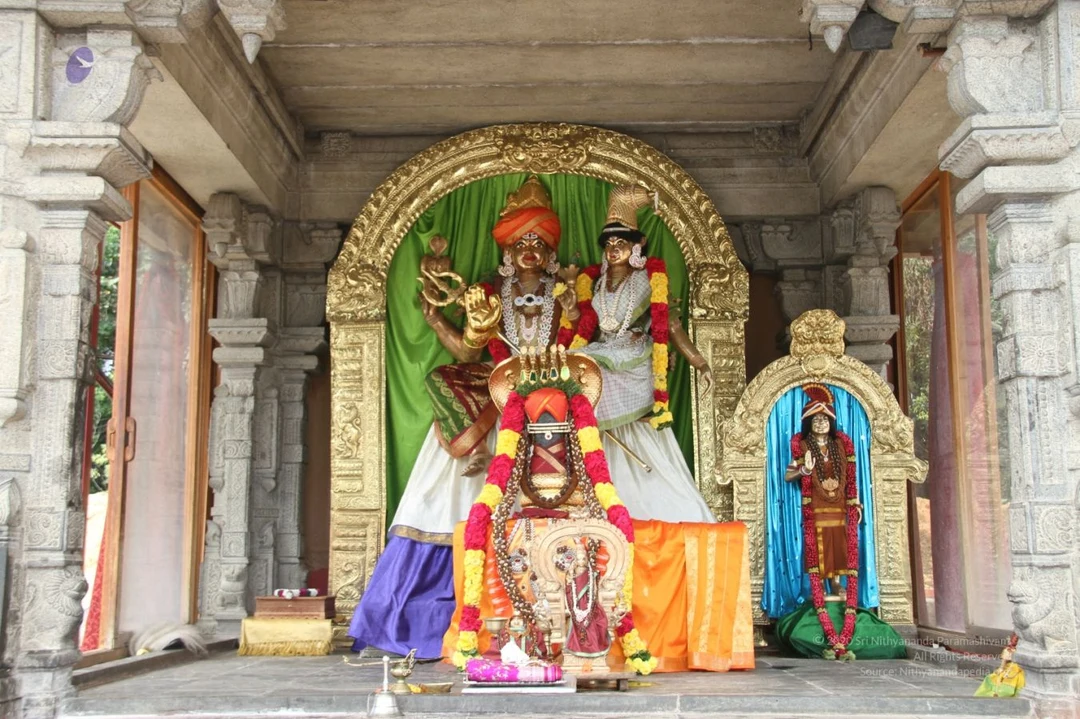
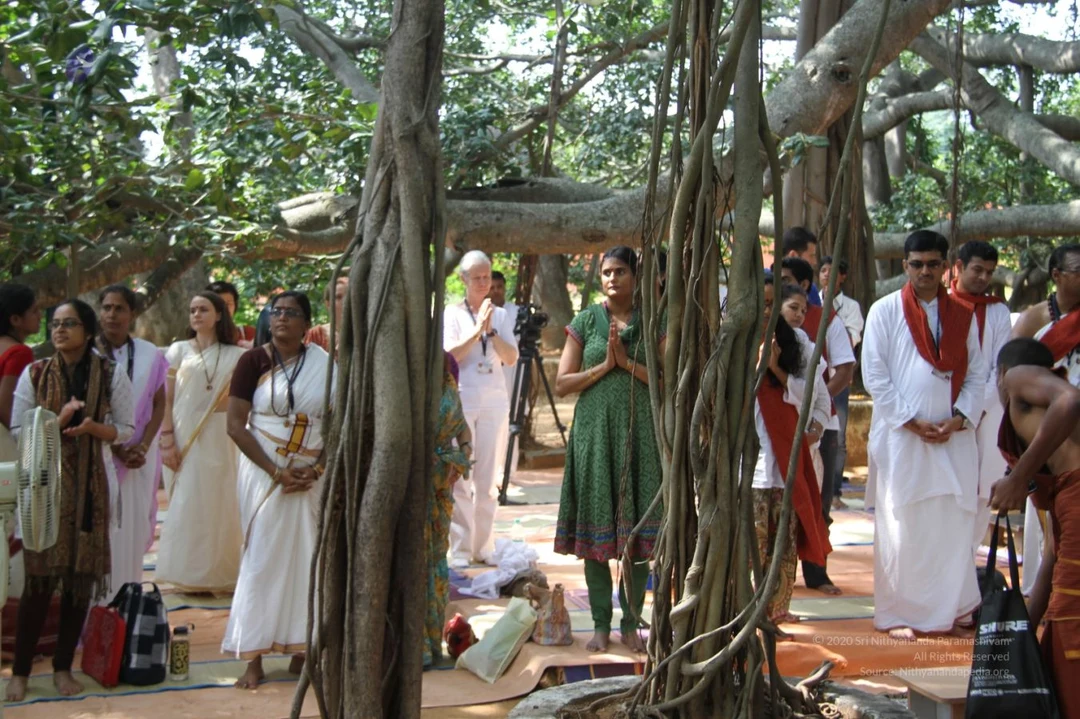
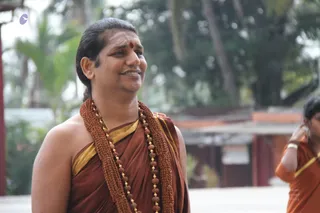
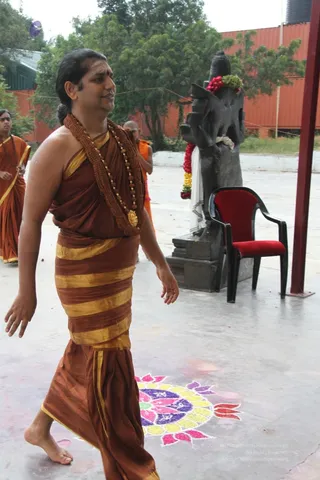
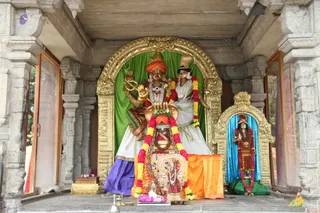
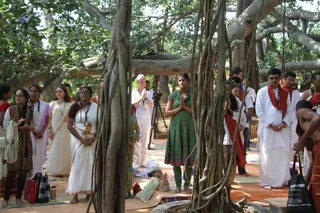
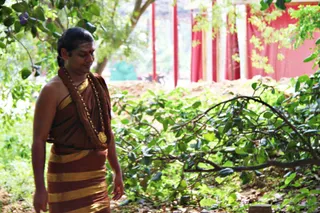
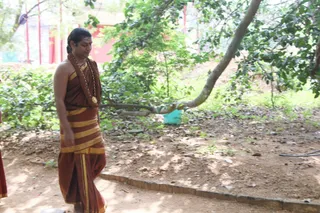
A man with long dark hair swept back into a low tail stands outdoors in front of blurred palm trees and a building. He wears a red bindi, a brown-orange saffron-toned wrap with a gold border, and a dense multi-strand rudraksha mala with a gold-tipped necklace. He smiles and looks off to the side. Behind him at right, a second person in similar orange-brown clothing and white bangles adjusts their hair. a person cues: long swept-back hair, rudraksha malas and saffron-orange clothing. The image is a watermarked photograph.A barefoot man in a brown and gold-bordered dhoti and shawl walks across a concrete courtyard past a rangoli of pink, purple, yellow and red petals. He wears a long rudraksha mala with a gold pendant and a red bindi on his forehead, and his hair is swept back into a bun. Behind him, two people in orange robes stand near a dark stone deity murti draped with a white cloth and garlanded with red and yellow flowers. A red-cushioned black chair sits beside the murti, and a red pillar and green trees frame the scene.A shrine with statues of deities behind a green curtain and a gilded arch. The central figure is a seated statue wearing an orange turban, rudraksha malas and bead necklaces, with a garland of red and yellow flowers draped over it and an orange cloth beneath. Beside it stands a seated female deity in a white and grey sari with a crown and a flower garland, and a seated male deity in dark clothing. To the right a smaller standing figure in a blue-backed niche wears a red garland and a rudraksha mala, with hands folded in greeting. Brass oil lamps and a small offering sit on the stone platform in front. The sandstone pillars and carved walls frame the scene. No living people are visible.Outdoor photo beneath a large banyan tree with dense hanging aerial roots. A crowd of devotees stands on mats in a shaded courtyard, many with hands held together in anjali mudra. Foreground left, a woman in a brown-and-gold shawl and a man in white hold small bags. A woman in a cream sari with a red border stands left, and a woman in a green salwar kameez with a dupatta stands center, palms pressed together. A man in a white kurta and white dhoti with a red shawl stands right, hands folded at his waist, and another man in a white shirt with a red shawl stands nearby. Several people wear rudraksha-style necklaces and beaded malas. A camera on a tripod is visible center. A tall white-clad man with light hair stands behind the group. A black tote bag bears a printed logo and a small stone shrine or offering item sits on the ground.A man in a brown and gold-bordered dhoti and matching brown shawl with a rudraksha mala and a large gold pendant walks slowly through a green garden, his head lowered in a calm, downcast expression. A red tilak mark is visible on his forehead. Behind him are leafy trees, a mound of earth, and red curtains on pillars. Watermarked copyright text and a small photo caption are visible in the lower right corner.A man walks along a dirt path beneath leafy trees in a garden setting. He wears a reddish-brown dhoti and shoulder cloth with gold-coloured borders, and a wooden-bead mala with a small pendant hangs around his neck. His head is shaved on top with a short tuft at the back, and he looks downward as he walks. Green shrubs, a curving tree branch and red pillars appear in the background, with a small blue object on the ground.

IA-Day21-IA-Darshan

10 photosSource gallery
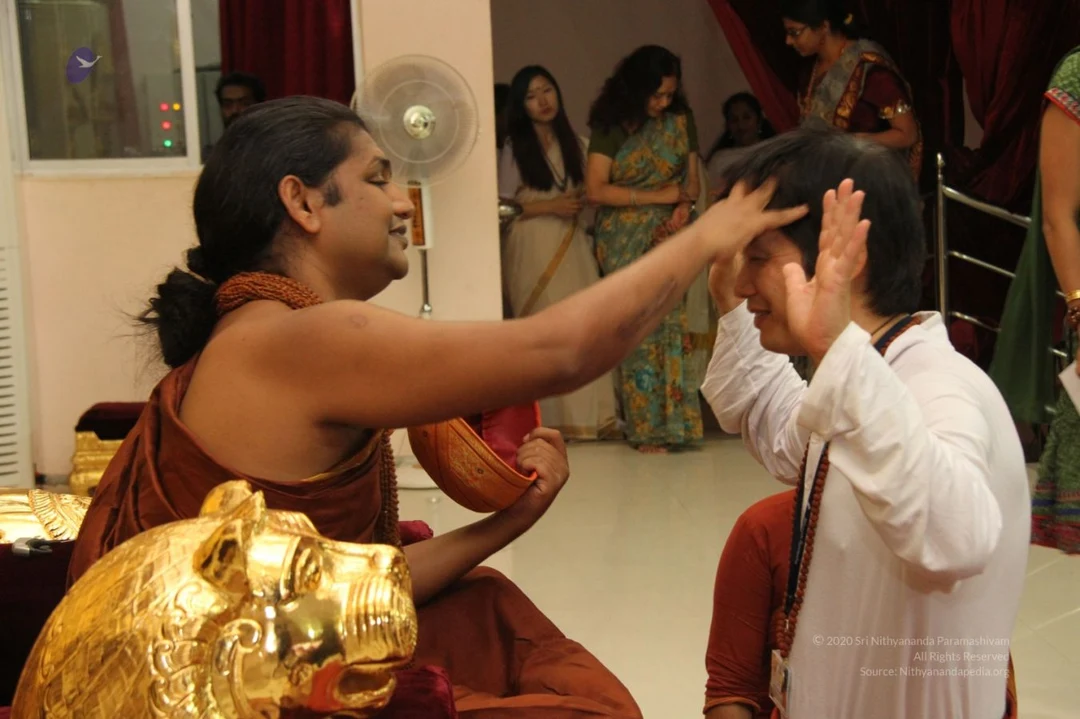
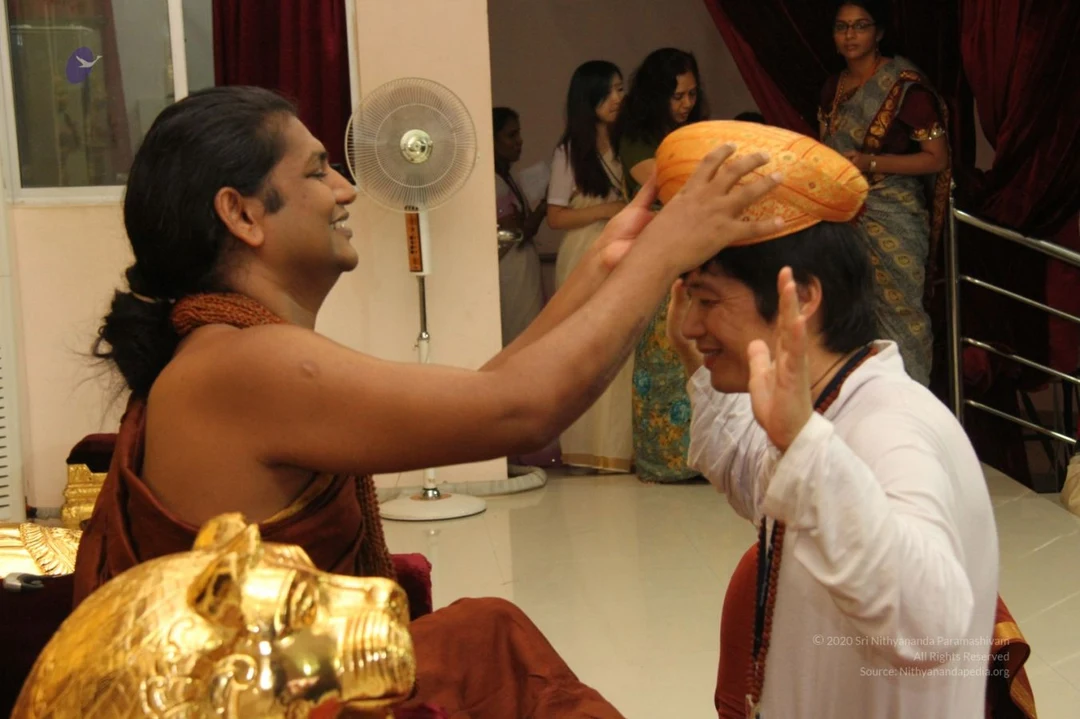
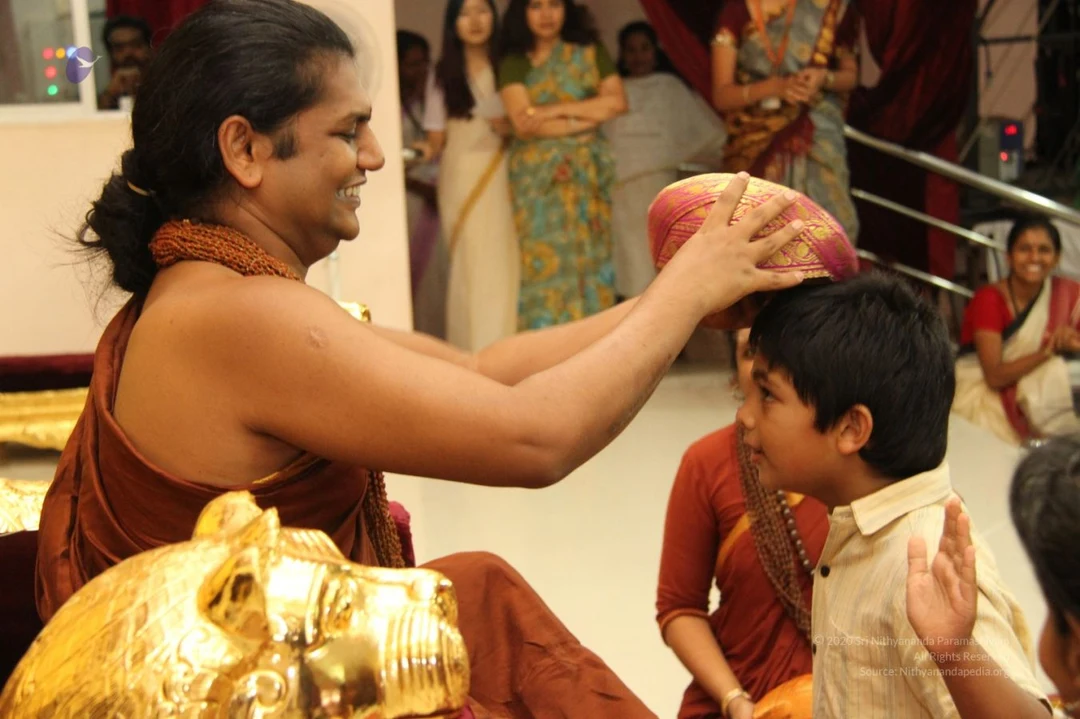
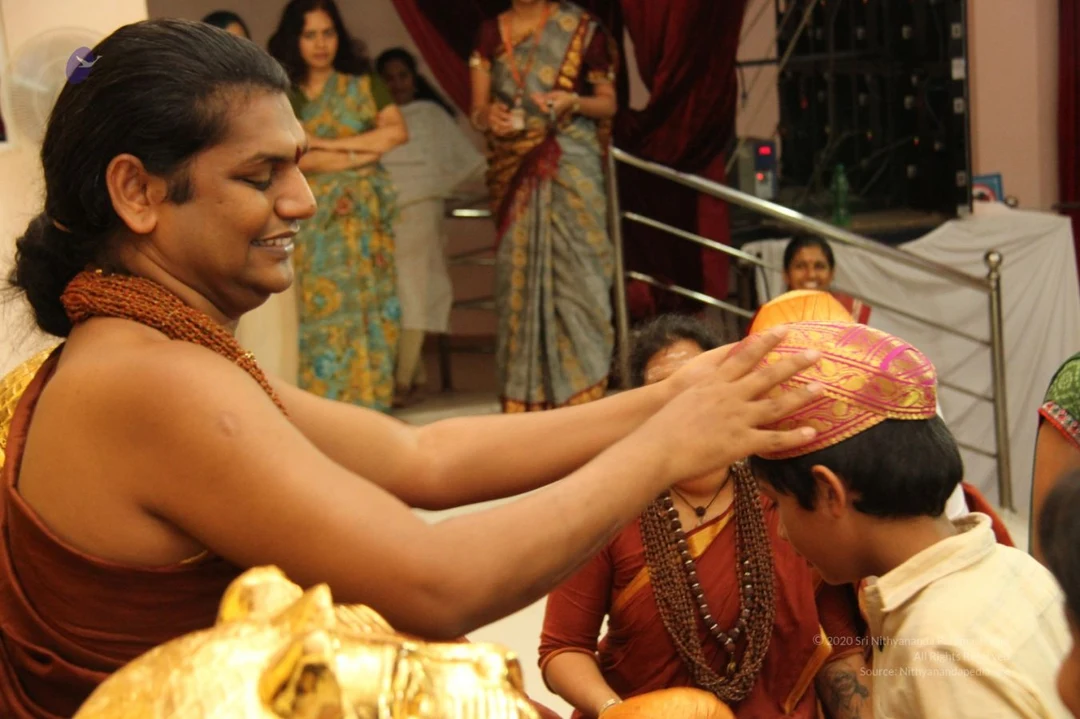
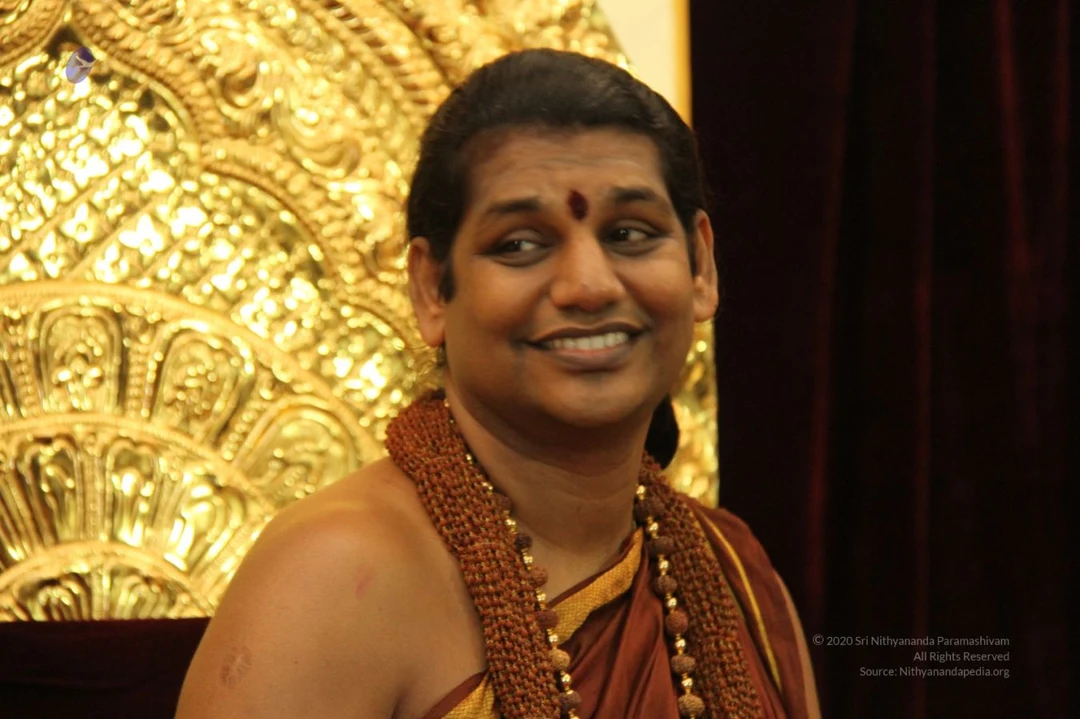
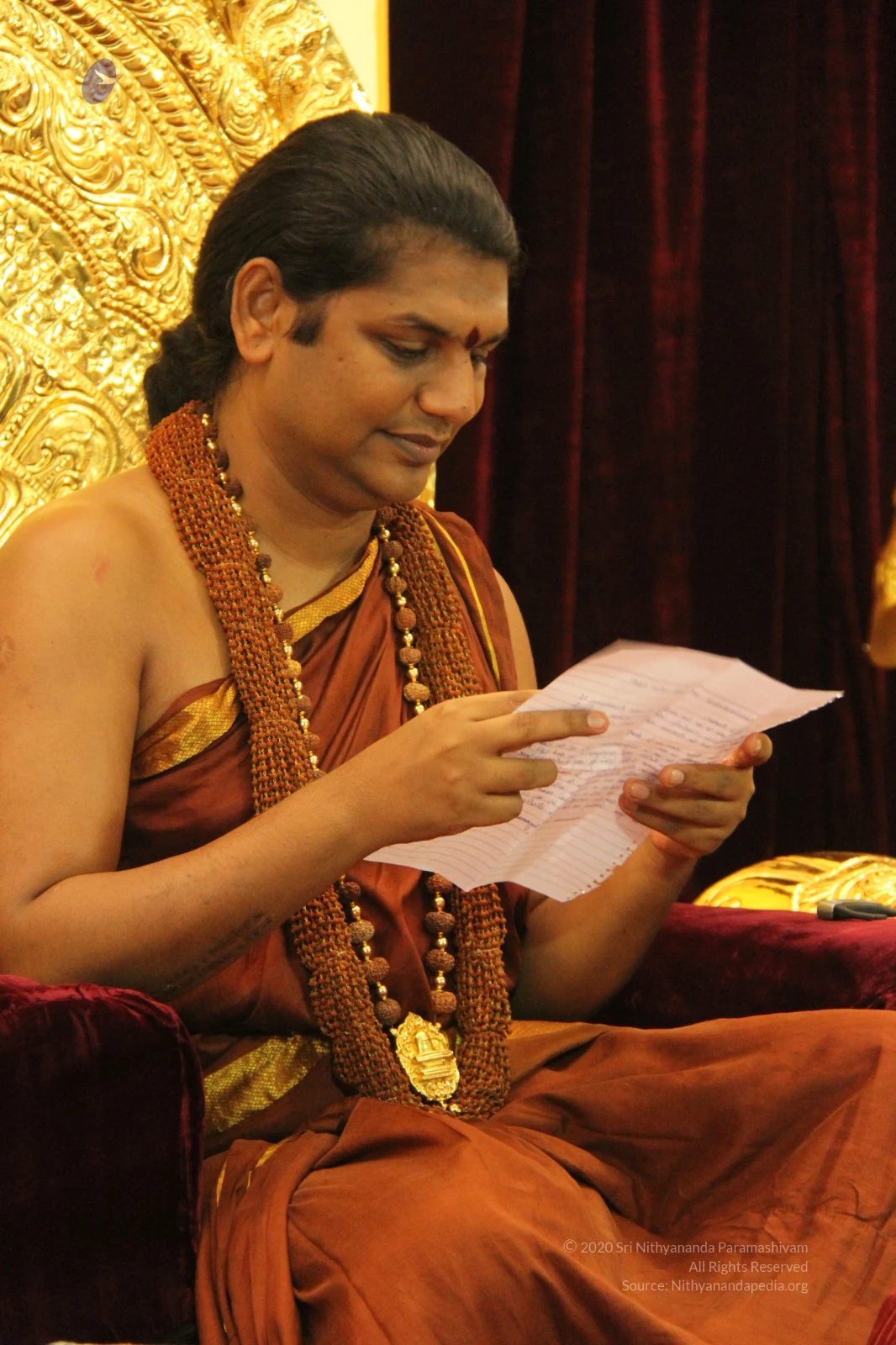
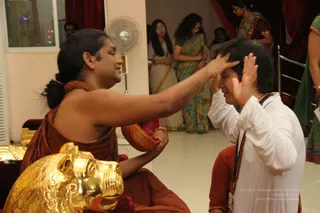
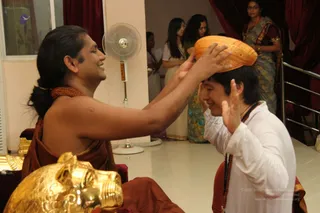
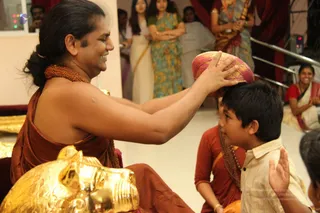
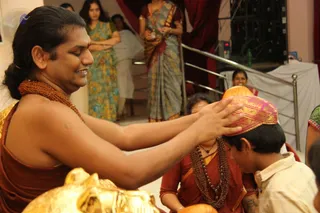
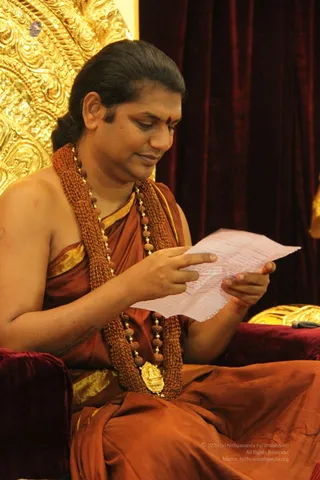
A seated man in an orange-brown robe with a rudraksha mala and a long hair bun places his right hand on the forehead of a kneeling devotee in a white shirt and beaded mala. The devotee holds up a hand in a blessing or reverent gesture. The giver sits beside a gilded lion-faced throne-like seat. Behind them, several women in sarees and salwar, one in a green saree, stand in a bright room with a window, a fan and red curtains. The scene reads as a blessing or initiation moment during a satsang setting. The giver shows cues consistent with the page's Swamiji reference, including the long hair bun, orange robe and rudraksha mala, so this is a probable identification from appearance only.Indoor photograph of a seated man with long dark hair tied back, wearing a rust-orange cloth wrapped over his shoulders and a rudraksha mala, smiling as he places both hands on the head of a smiling person in a white kurta with a rudraksha mala, who is receiving an orange-gold turban or head cloth. A gold lion-faced ornament sits in the foreground. Behind them, women in saris and a woman in a light kurta stand near a red curtain and a pedestal fan on a white tiled floor. The scene suggests a blessing being given, possibly an initiation or darshan.A photograph of a seated man in a rust-orange wrap with a rudraksha mala draped over his shoulders, smiling as he places a pink-and-gold turban-style cloth on the head of a young boy in a cream shirt. The man has long dark hair tied back. Behind him stand women in colourful saris, and a woman in a red saree sits to the right. A golden lion-headed seat or throne with a gold carved figure is in the lower left.A photograph of a seated man in a rust-red shawl with a rudraksha mala and a gold-toned necklace, hair swept back, placing his hand on the head of a young boy in a cream shirt who wears an orange and pink patterned headpiece. A woman in a rust-red sari with rudraksha beads stands beside them. A golden kalasha-like vessel sits in the foreground, and women in saree stand in the background near a stage with red curtains and a railing. The seated man has distinctive visible cues of long swept-back hair, rudraksha mala and gold necklace, so this is an appearance-based probable Swamiji (probable) in person.A smiling man with swept-back dark hair and a red tilak on his forehead sits before an ornate gold-embossed backdrop, glancing to the side. He wears a rust-brown and saffron-gold robe draped over one shoulder and a thick rudraksha mala with ceremonial gold beads around his neck. Dark red velvet drapes frame the right side of the scene.A man seated on a red velvet-upholstered throne before a gold-embossed ornate backrest and deep red velvet drapery reads a handwritten sheet of paper held in both hands. He wears a rust-orange saffron-toned garment with gold-bordered edges, a long woven rudraksha mala with gold beads, and a gold ceremonial pendant at his chest. A red tilak mark is visible on his forehead, and his dark hair is swept back into a low knot. a person is seated and reading a written text in a discourse setting.
IA-Day21-IA-Swamiji-21Naivedyam

16 photosSource gallery
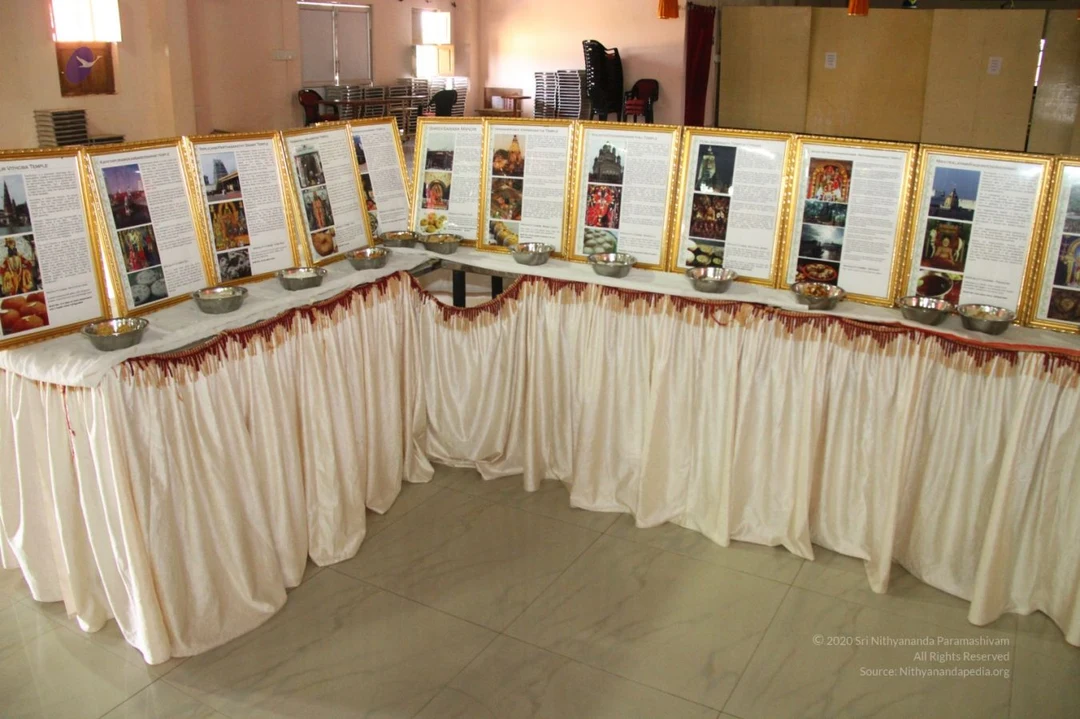
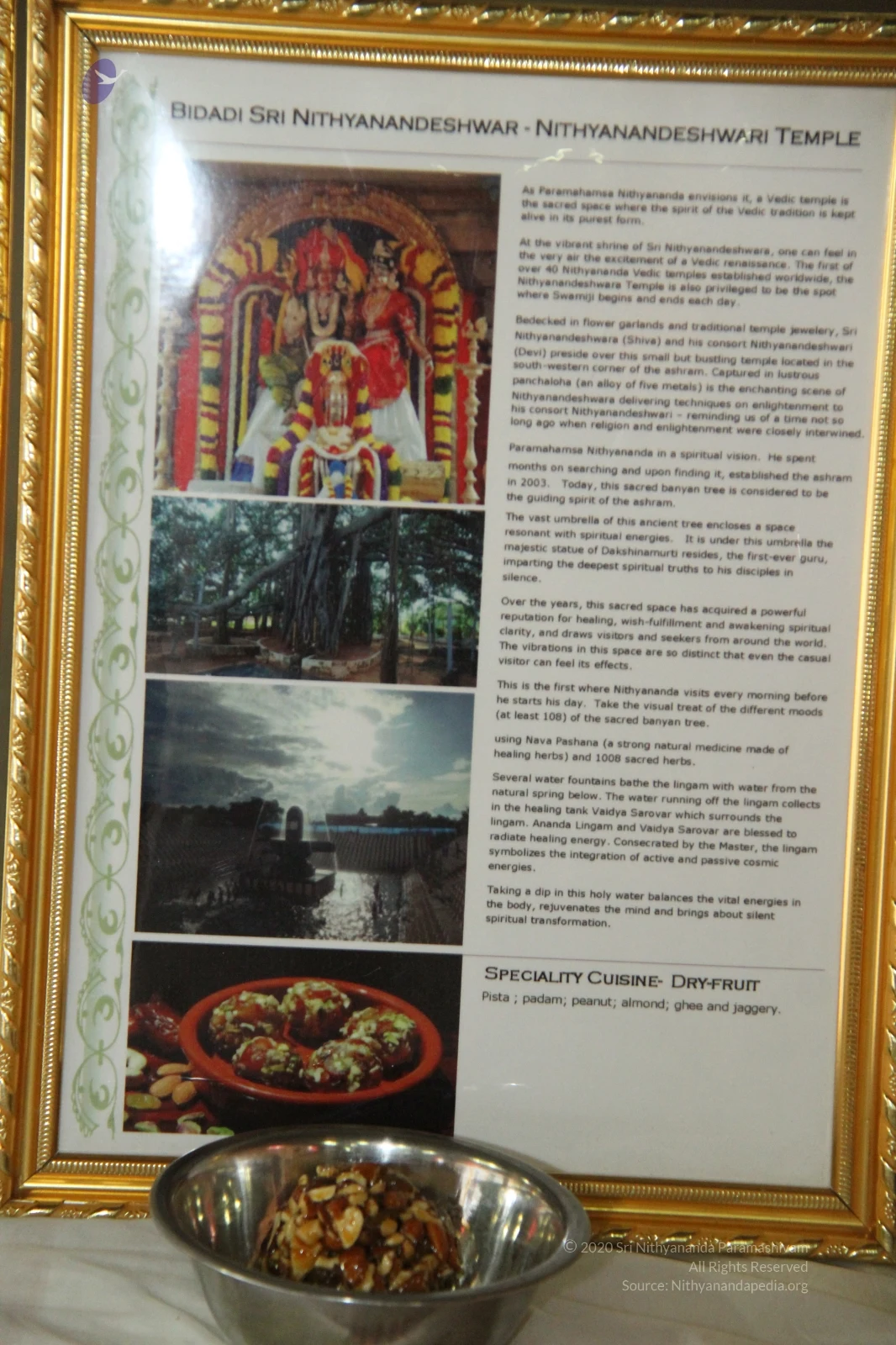
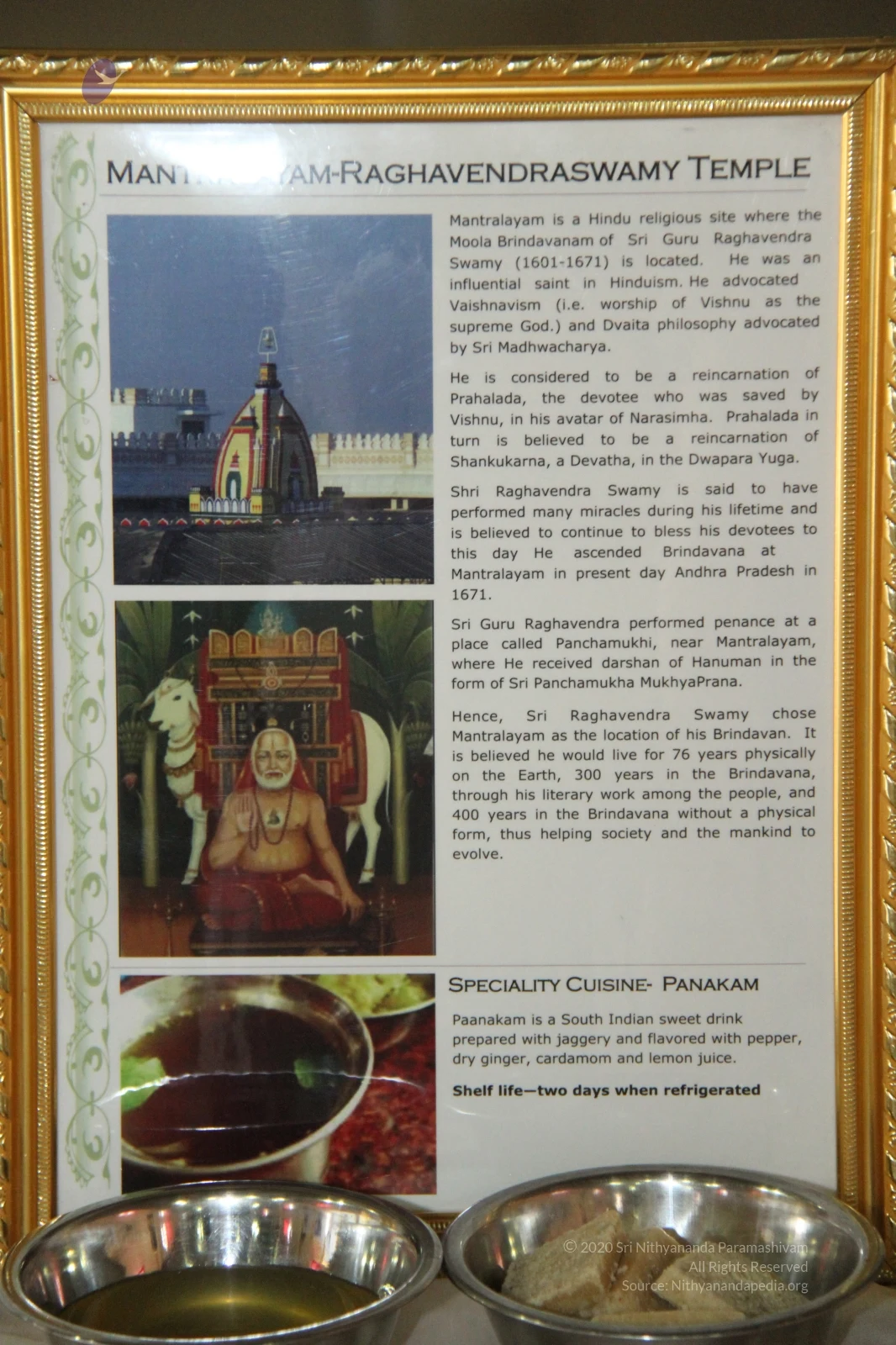
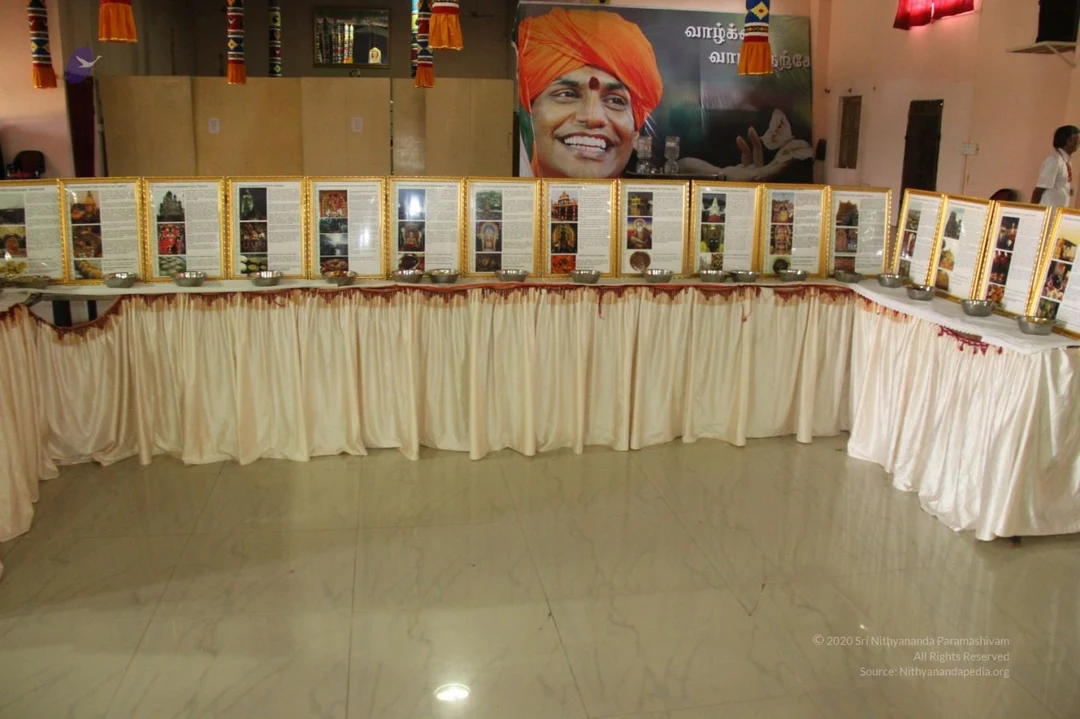
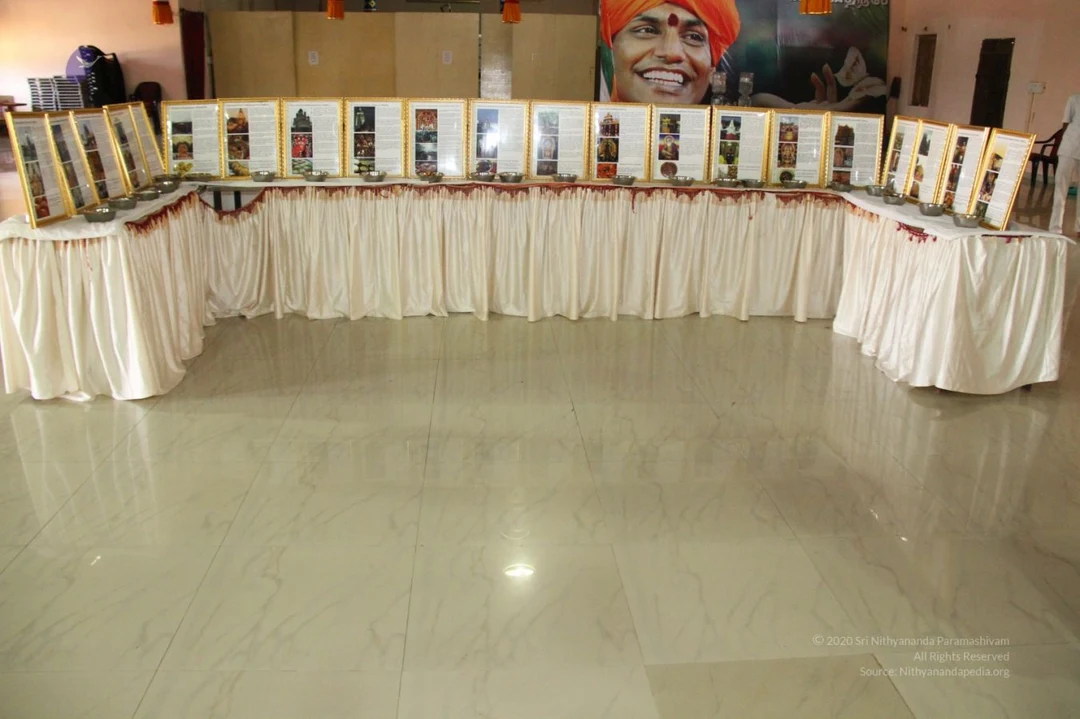
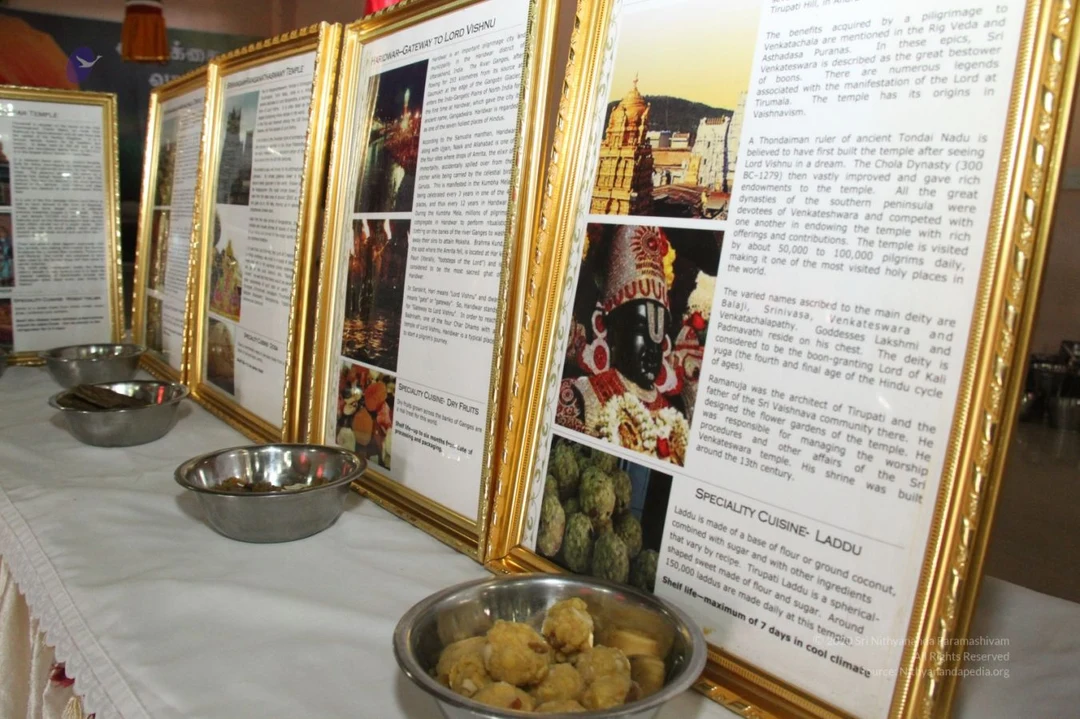
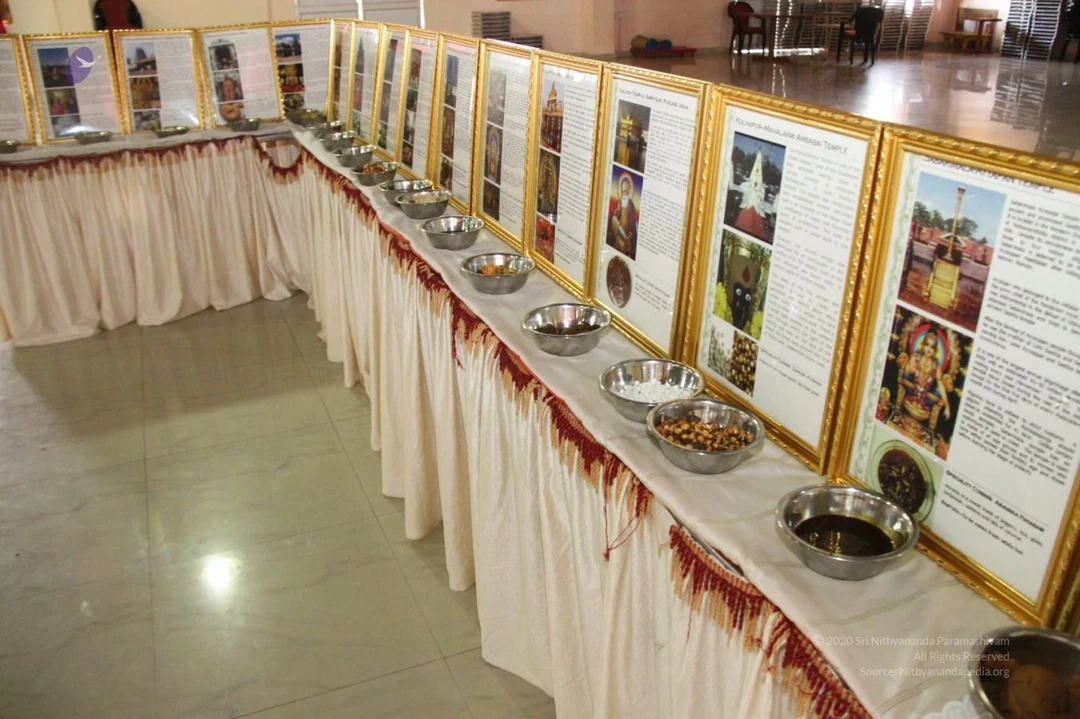
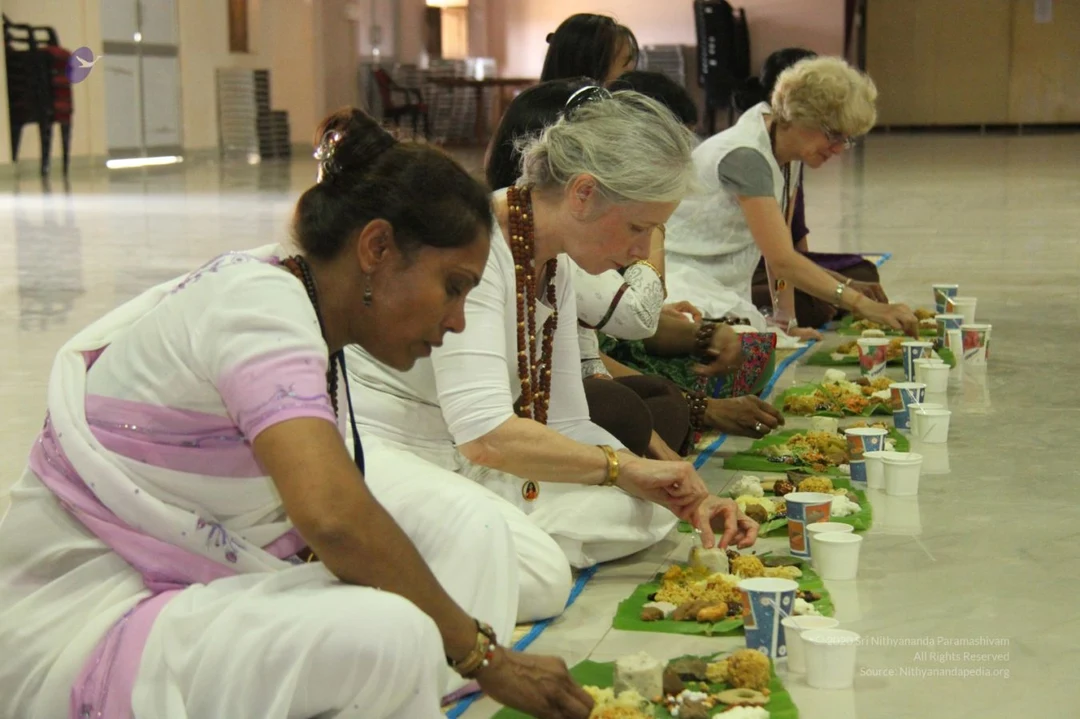
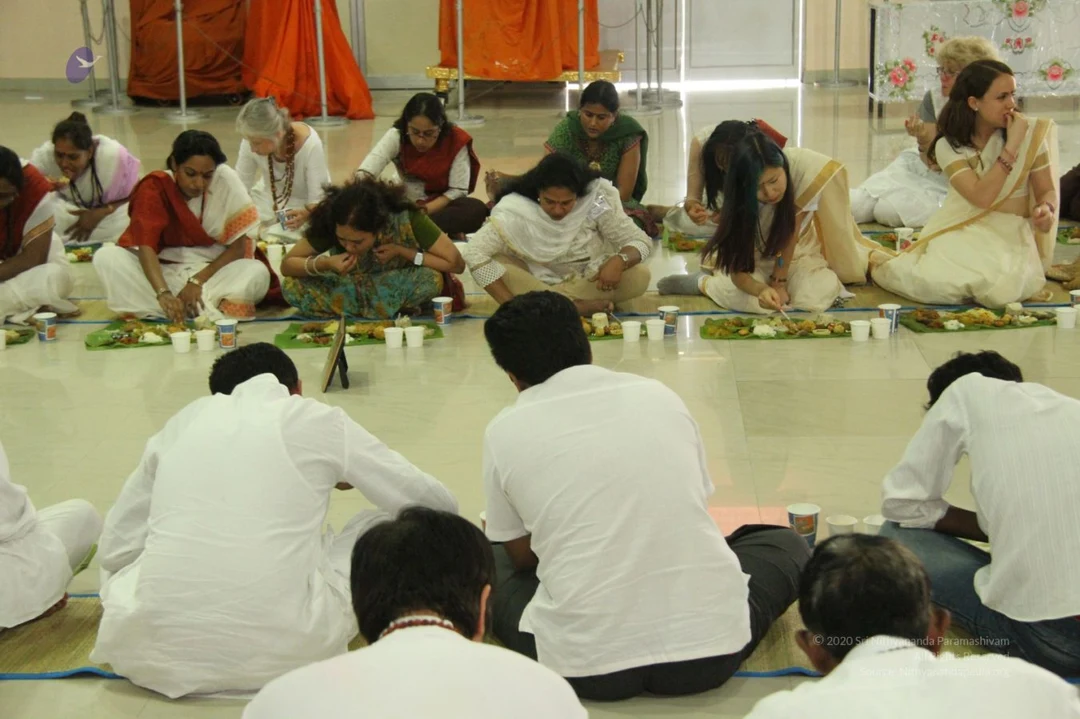
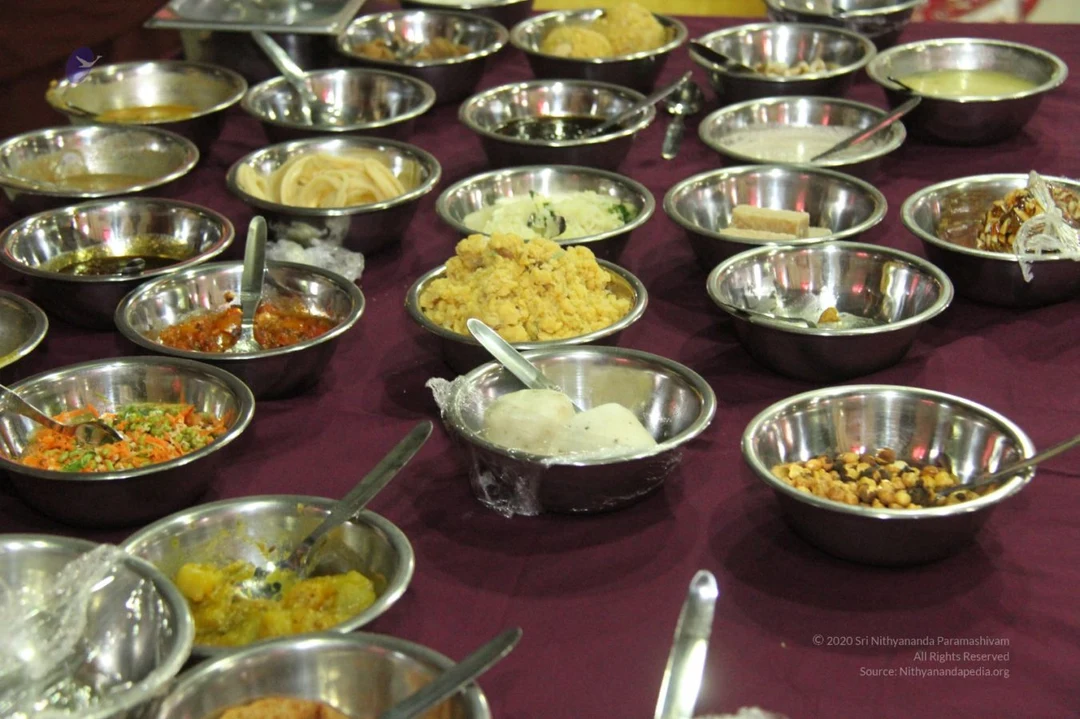
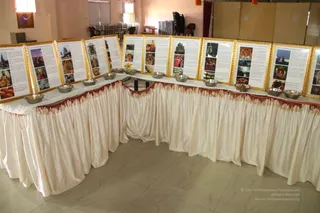
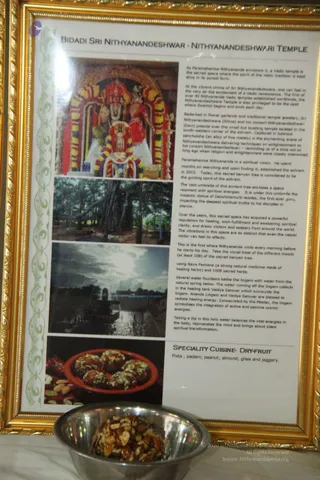
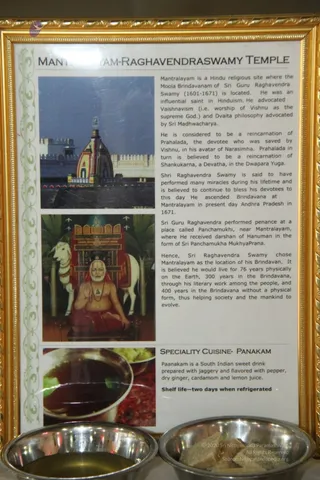
A photograph of an indoor exhibition display in a hall with cream tiled floor. A long draped table with cream silk-look covering and red fringe holds a row of stainless steel bowls. Behind it stand about ten gilt-framed panels, each with a white text column and several coloured photographs of temples, deity murtis, ritual scenes and festival images. Stacked chairs and a red chair are visible at the back, along with a wall with a purple logo. No people are visible.A framed gold-bordered information panel titled "Bidadi Sri Nithyanandeshwar - Nithyanandeshwari Temple" hangs on a wall above a silver bowl of nuts and dried fruit. The panel has a block of descriptive text beside four photographs: a deity pair of Shiva and Devi decorated with red and yellow flower garlands in an arched shrine, a large banyan tree, a lingam with water fountains under a cloudy sky, and a red clay dish of dry-fruit sweets. A caption reads Speciality Cuisine - Dry-fruit. No people are visible.Framed gold-bordered information board titled "Mantralayam-Raghavendraswamy Temple" with a photo of a temple shrine with a tall pyramidal spire, a painting of a seated saint with white beard and red robe before a red throne with a white cow beside him, and a photo of a bowl of dark drink labelled Speciality Cuisine Panakam. Two steel bowls sit in front of the board, one with clear liquid and one with jaggery pieces. The printed text describes Sri Guru Raghavendra Swamy as a saint venerated in Vaishnavism.A photograph of an indoor hall with a long curved table draped in cream satin with maroon trim, displaying a row of framed gold-bordered panels. Each panel holds printed text and small photographs of deities and temples, and small silver bowls sit in front of them. Behind the table is a large banner showing a smiling man with a bright orange turban and a red dot on his forehead, with Tamil text above him. Colourful woven tassels hang from the top of the wall. A single person in white stands at the far right edge, partly visible. The floor is pale polished tile.A photograph of an empty hall with a glossy marble floor and a long U-shaped table draped in cream fabric with red trim. Rows of framed gold-bordered photographs with text panels sit on the table, each with a small brass bowl or lamp in front. Behind the table a large banner shows a smiling man in an orange-saffron turban with a red bindi, and a pink wall with hanging orange lanterns is visible at the top. No people are visible in the scene.A display of framed gold-bordered information panels on a white draped table at an indoor exhibition. Panels describe Haridwar, Tirupati Venkateswara Temple and speciality cuisines; one panel shows a photo of a deity murti of Lord Venkateswara adorned with flower garlands and a tilak. Steel bowls hold laddu sweets, dry fruits and other snacks in front of the panels. No people are visible.

IA-Day21-Glimpses

24 photosSource gallery
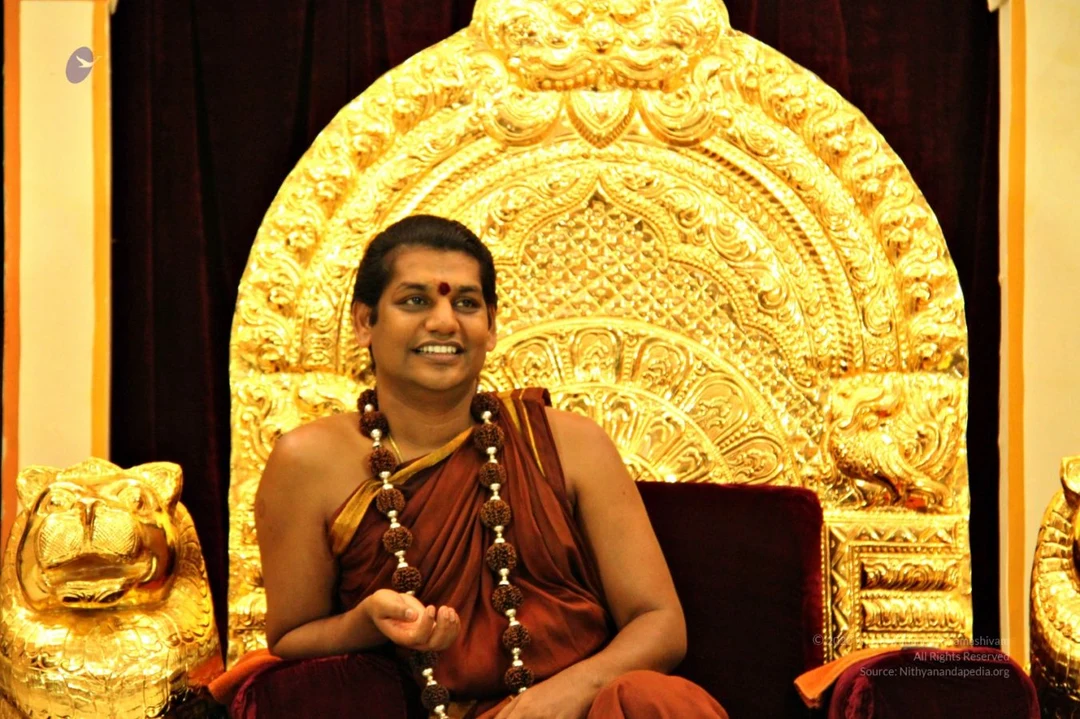
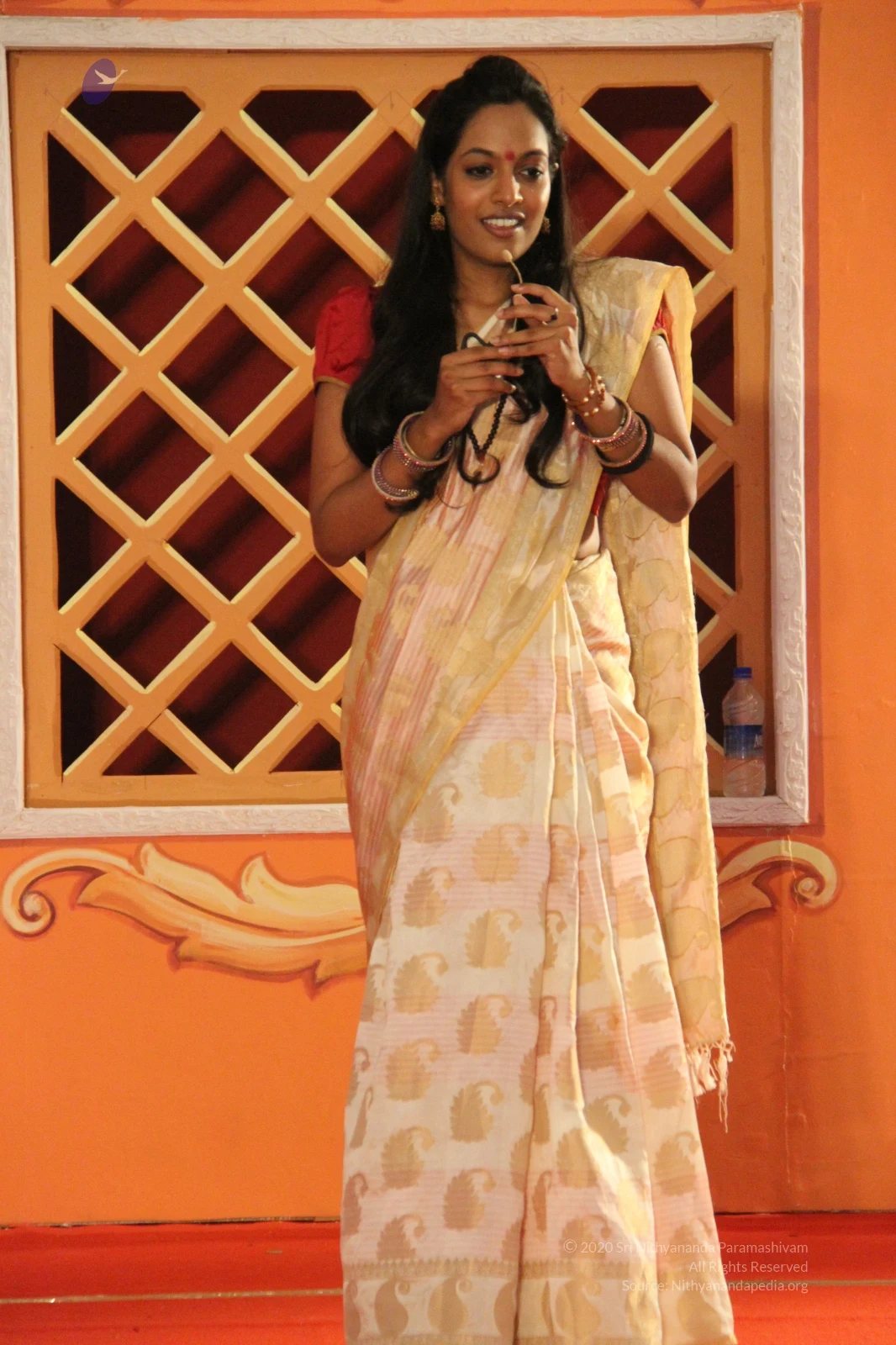
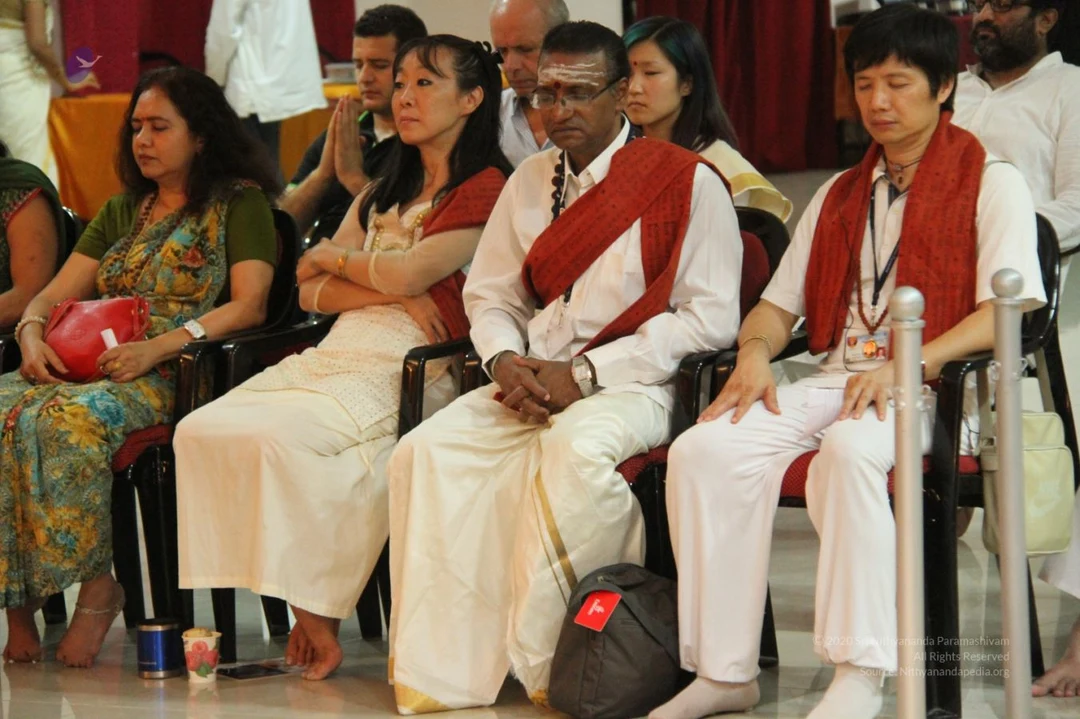
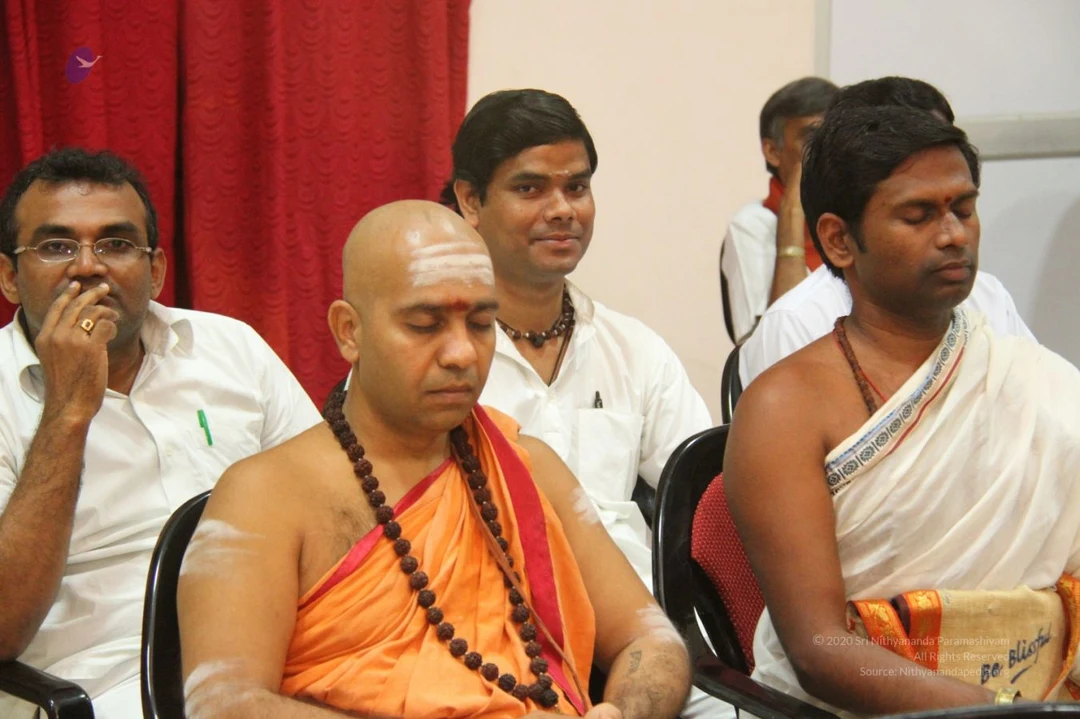
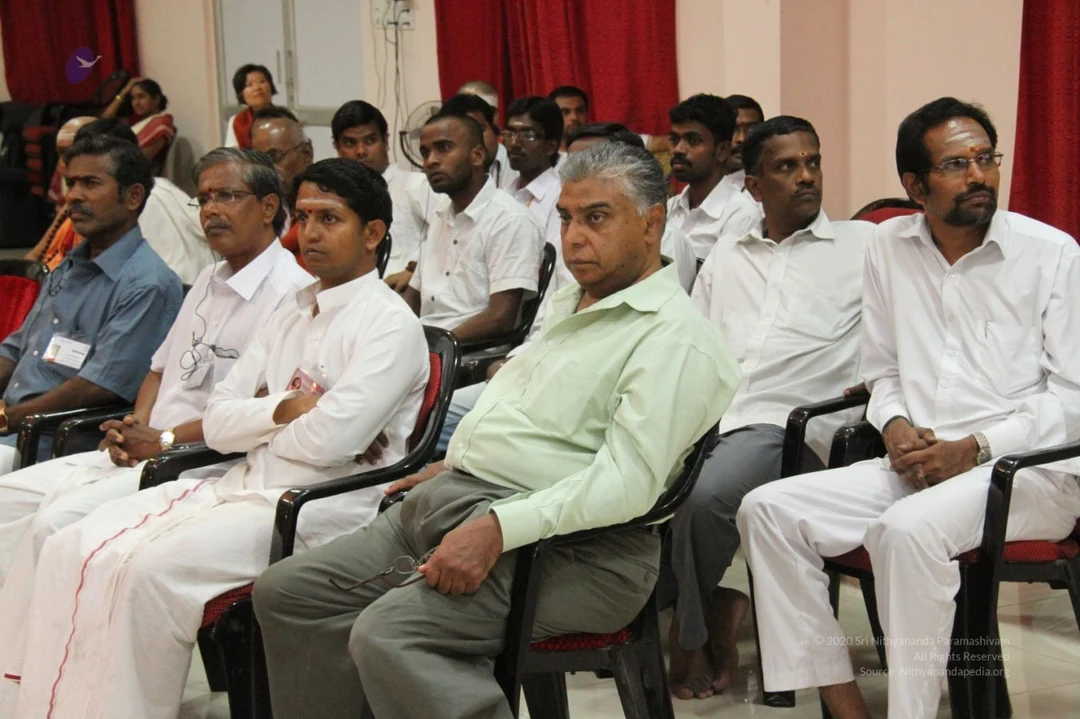
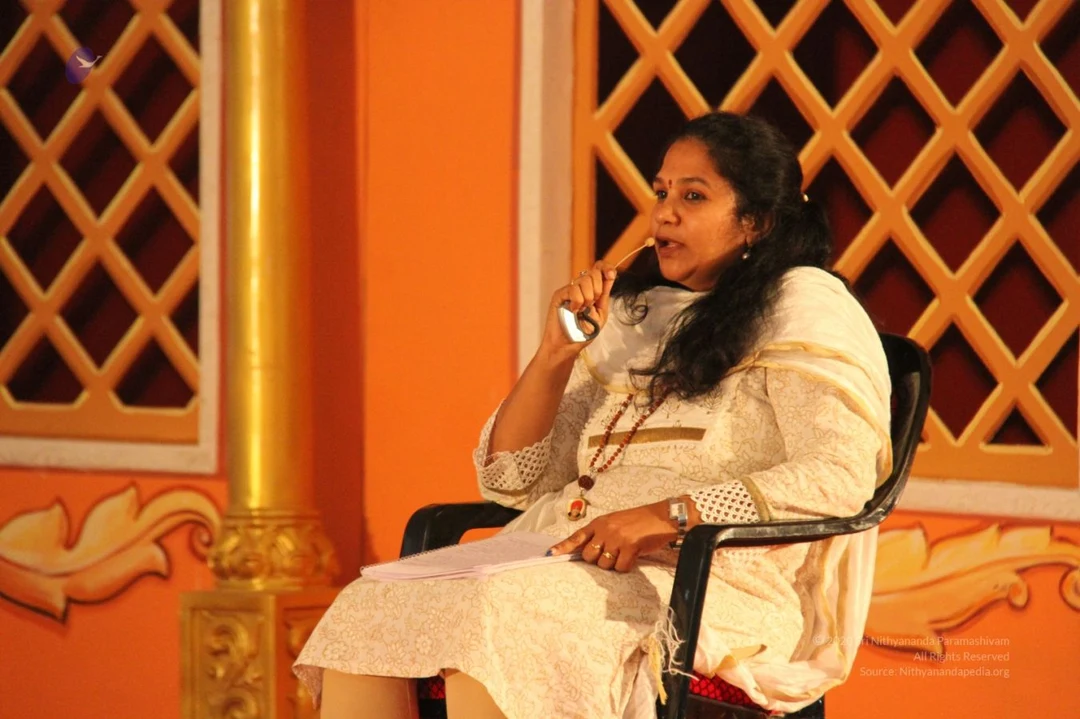
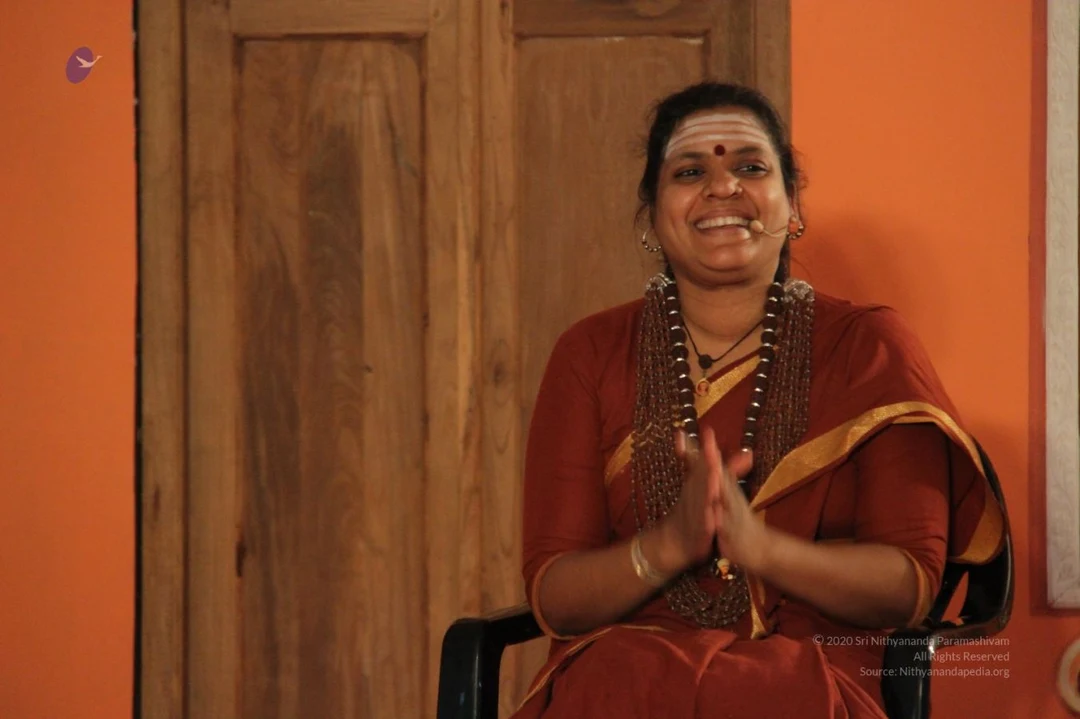
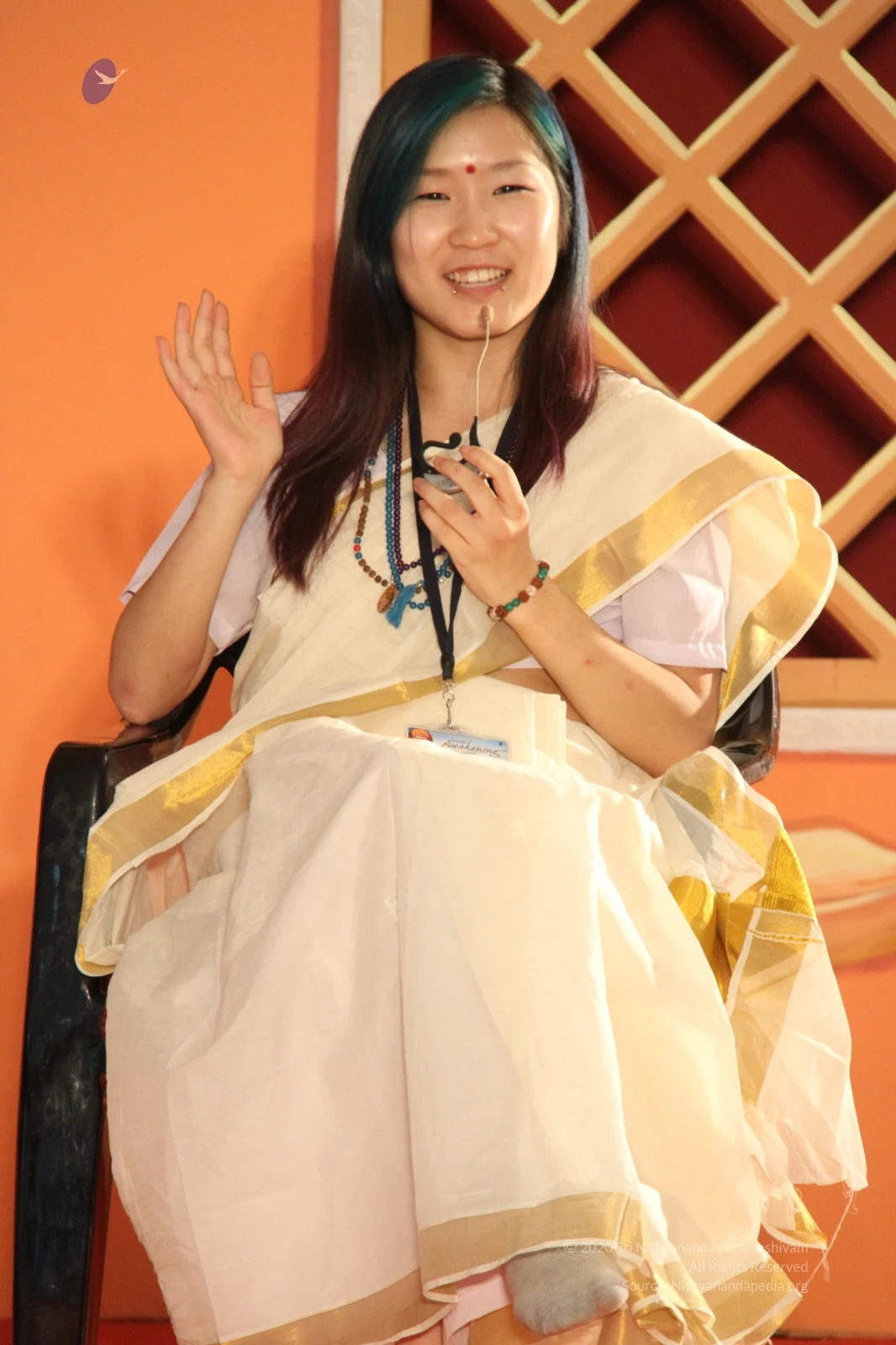
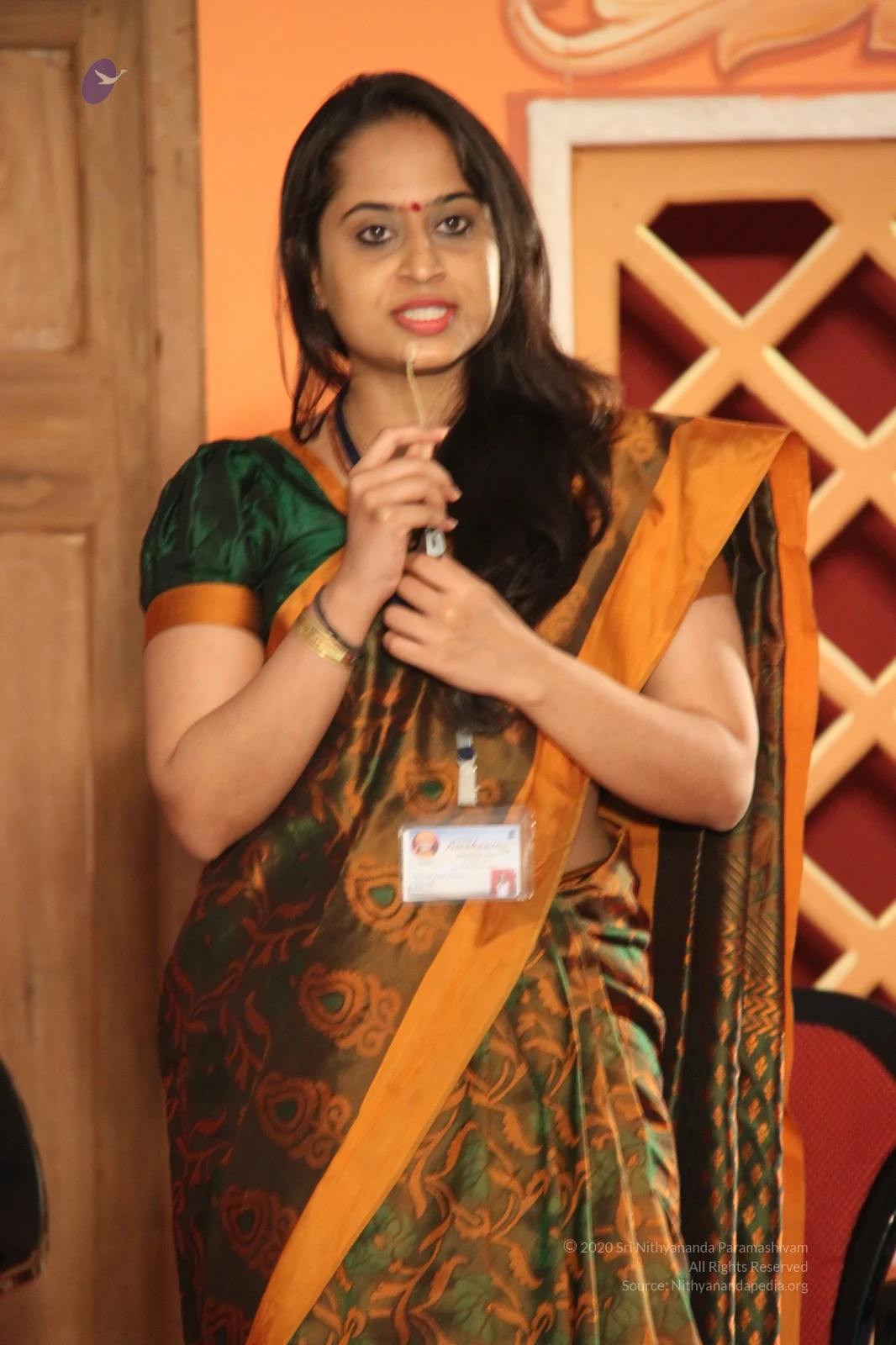
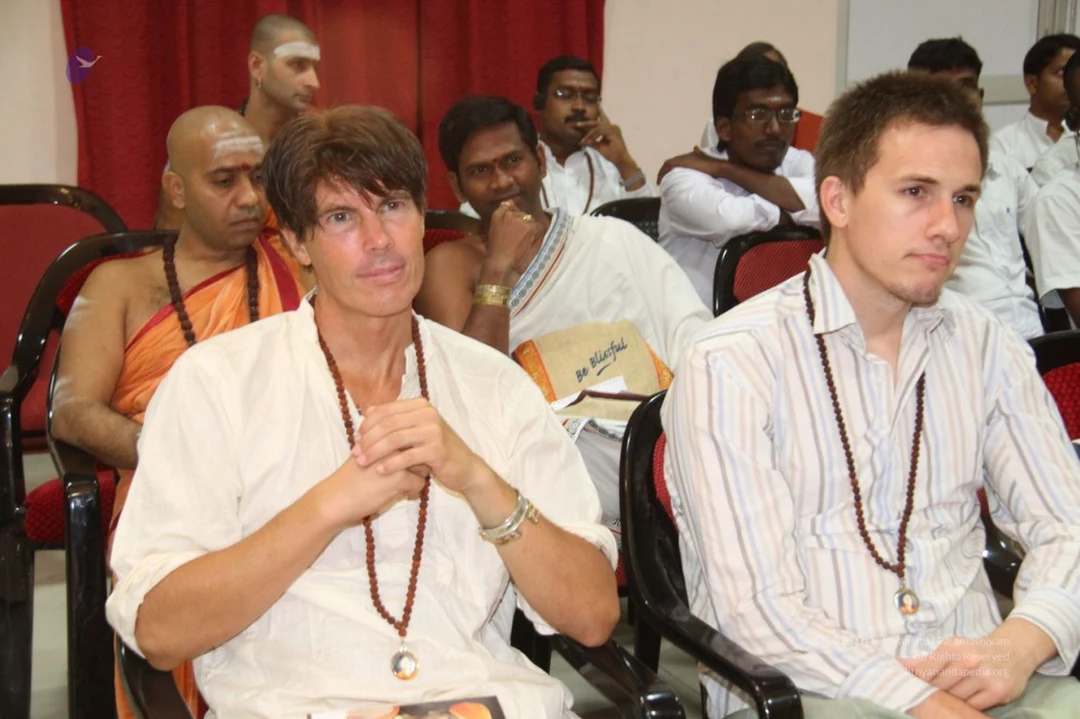
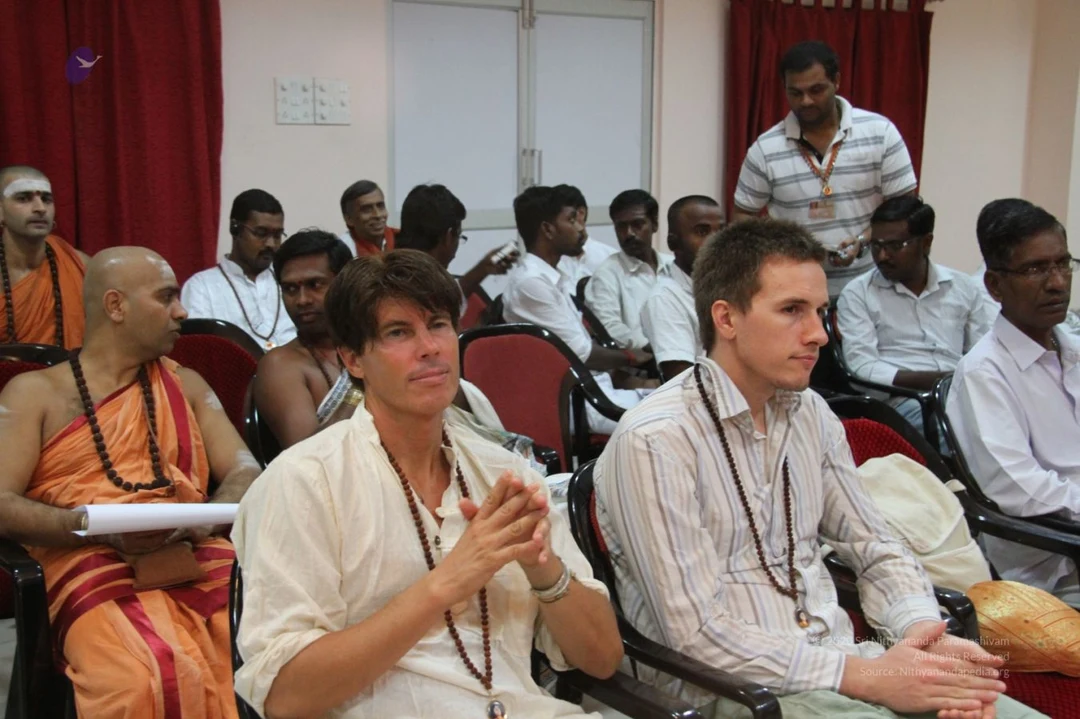
A man seated on a red velvet cushioned throne in front of an ornate gold-leafed backrest with carved floral and arched motifs. Golden lion-head armrests flank him. He wears a rust-orange sannyasi wrap draped over one shoulder, a long necklace of rudraksha beads with white spacers, and a red bindi on his forehead. He smiles and gestures with his right hand while speaking. a person: the appearance cues are a saffron-orange wrap, rudraksha mala and a golden-throne setting, but the face and presentation are not distinctive enough for a firm match. Dark curtains are behind the throne.A woman stands on an orange stage in front of a latticed orange-and-maroon window, speaking and smiling while holding a small wooden rudraksha mala-style strand between her hands. She wears a cream and gold woven saree with paisley motifs, a red blouse, a red bindi, gold jhumka earrings, and many bangles. A plastic water bottle sits near the window. No a person candidate is visible.A photograph of seated devotees at a satsang, eyes mostly closed in meditative stillness. From left, a woman in a green blouse and floral sari holds a red purse; a woman in a cream salwar kameez with a red shawl sits with arms folded; a man in white shirt and cream dhoti with gold border and red shawl, with a rudraksha mala and white vibhuti on his forehead, sits with hands clasped; a young woman in a cream outfit sits behind; at right, a man in white kurta and pants with a red shawl and lanyard rests his hand on his knee. Some people are standing behind them; a small metal cup and bags lie on the floor.Indoor satsang with seated devotees in a row of plastic chairs before a red curtain. In the foreground a shaved-headed man in an orange saffron robe and a long rudraksha mala sits with eyes closed, white and red tilak on his forehead and white ash markings on his arms; a person figure in saffron, though the cues are limited. To his right a man in a white shirt with a rudraksha necklace smiles, and at far right a man in a white dhoti with a red-and-gold border and rudraksha mala sits with eyes closed. On the left a man in white shirt and glasses touches his face. Other seated people are partly visible behind.A man sits on an ornate gilded throne with a tall arched back carved with floral and scrollwork motifs, flanked by two gold lion-shaped armrests. He wears a rust-orange dhoti and a matching draped cloth over one shoulder, leaving the upper body partly bare, with a long rudraksha mala of dark beads around his neck and a small red bindi on his forehead. His hair is swept back and he looks down, handling a mala or prayer beads in both hands. Burgundy velvet drapes and cream panels form the backdrop. The person appears to be Swamiji (probable), identified by the swept-back hair, rudraksha malas and saffron-orange clothing, seated in a position of honour on the throne.A seated audience of men in an indoor hall with red curtains attends a satsang. In the foreground a man in a light green shirt and grey trousers sits with his hands clasped, while beside him a younger man in white shirt and white dhoti wears a tilak on his forehead and holds a folded paper. To the right a man in a white shirt and grey trousers sits with hands folded, and a bespectacled man in a white shirt has a tilak. Rows of seated men in white shirts and a few women in saffron-toned saris are visible behind them, some with tilak marks. The scene is a seated congregation listening to a talk.
ThanthiT-Set

1 photoSource gallery
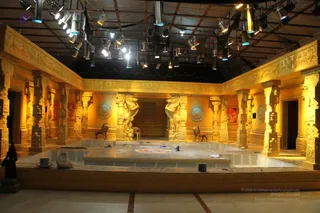
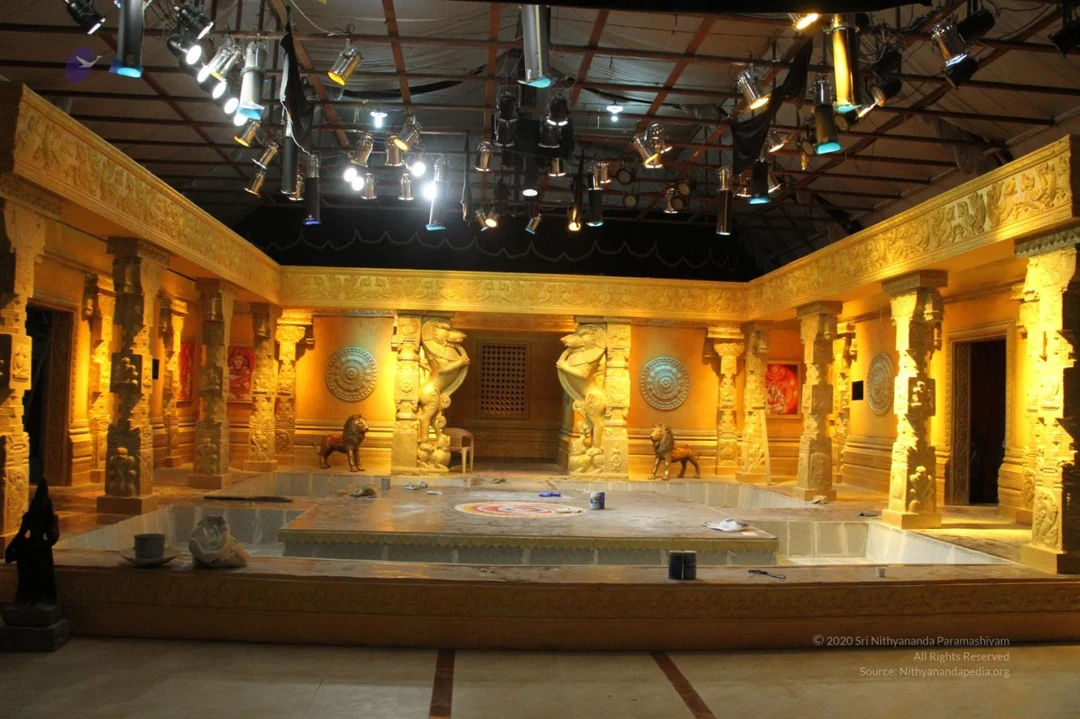
A photograph of an empty, under-construction ornate hall with golden sandstone-style walls carved with reliefs and friezes. Two large carved pillars flank a raised central stage or platform with a small floral rangoli-like design on its floor. Two bronze lion statues stand near the stage, and circular carved medallions decorate the walls. Overhead, stage lighting fixtures hang from metal trusses, and paint cans and tools lie on the floor, indicating unfinished work. No people are visible.