Skip to content
Wednesday

19 June 2013

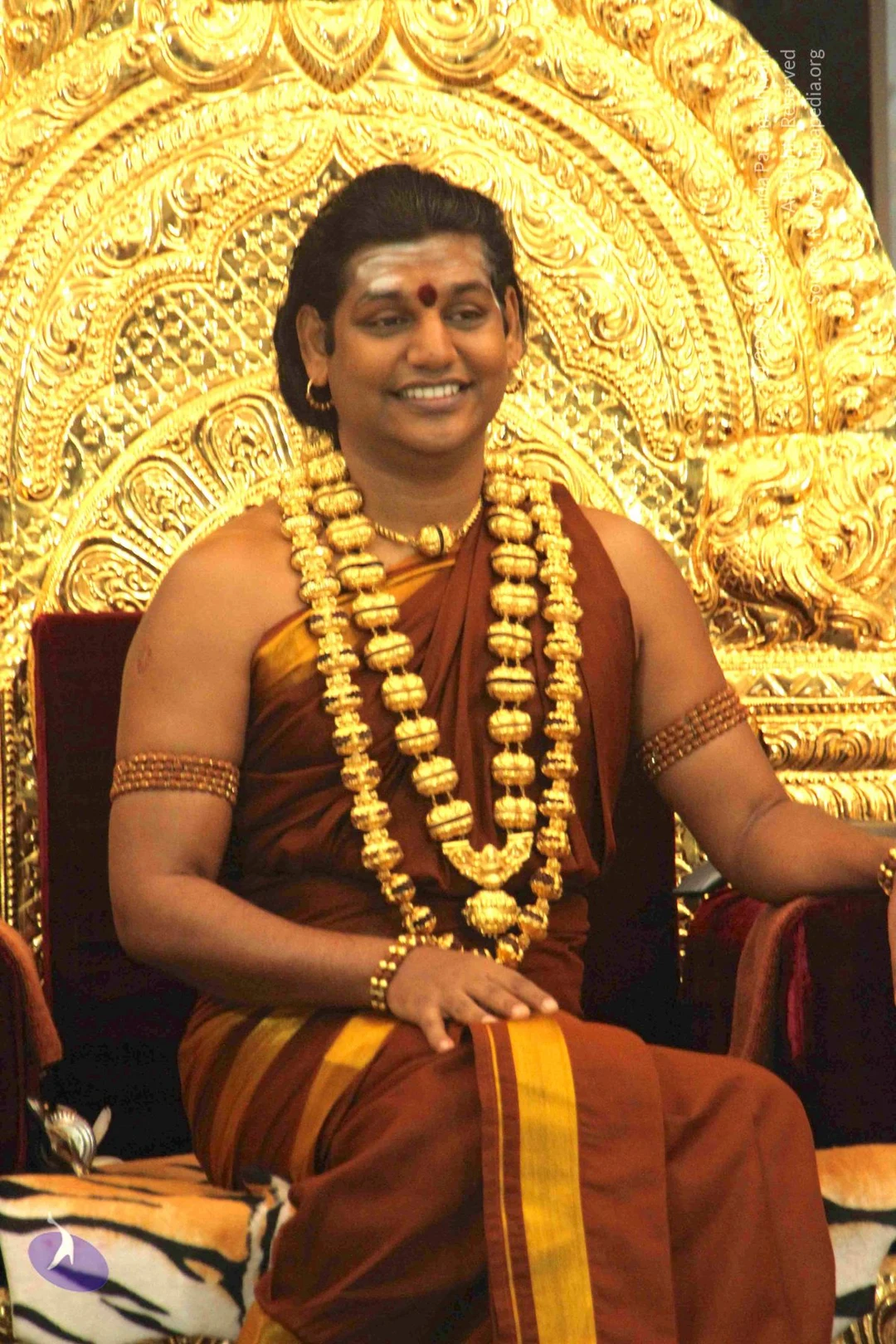
Supreme Pontiff of Hinduism HDH Bhagavan Sri Nithyananda Paramashivam

Dated photos
489
Source pages
1
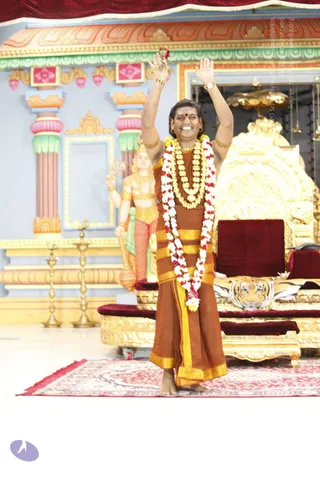
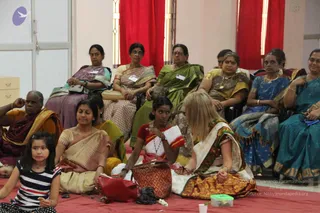
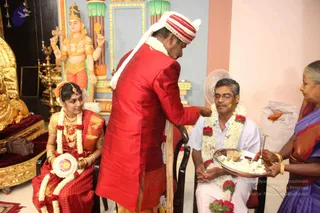
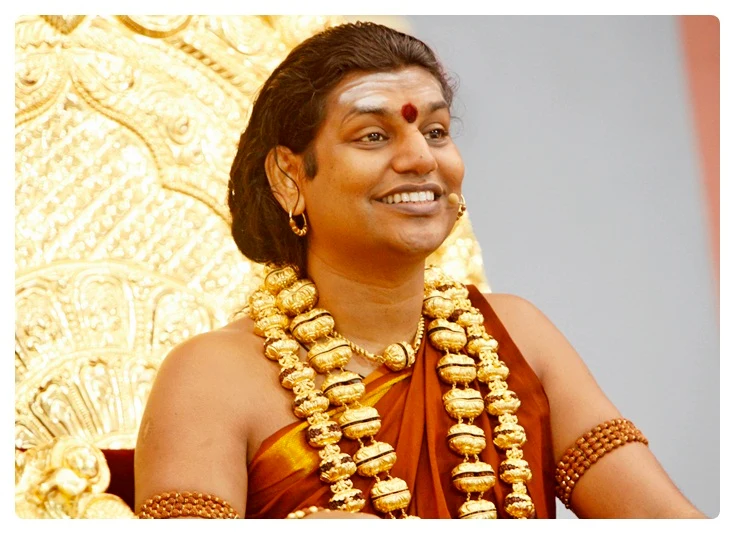
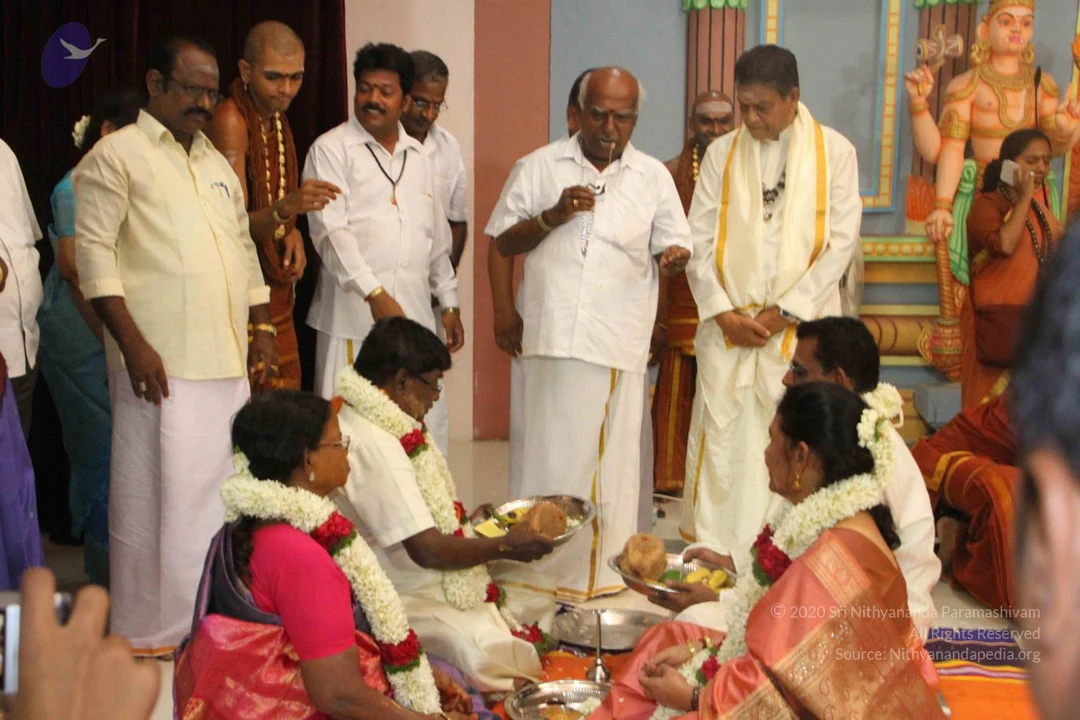
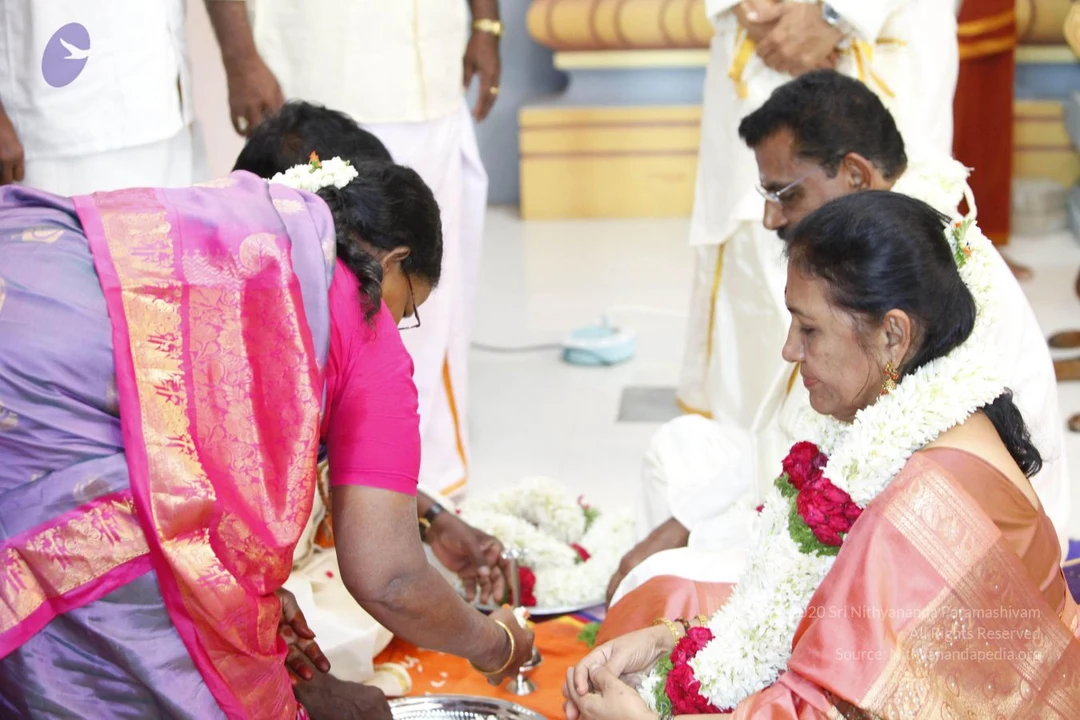
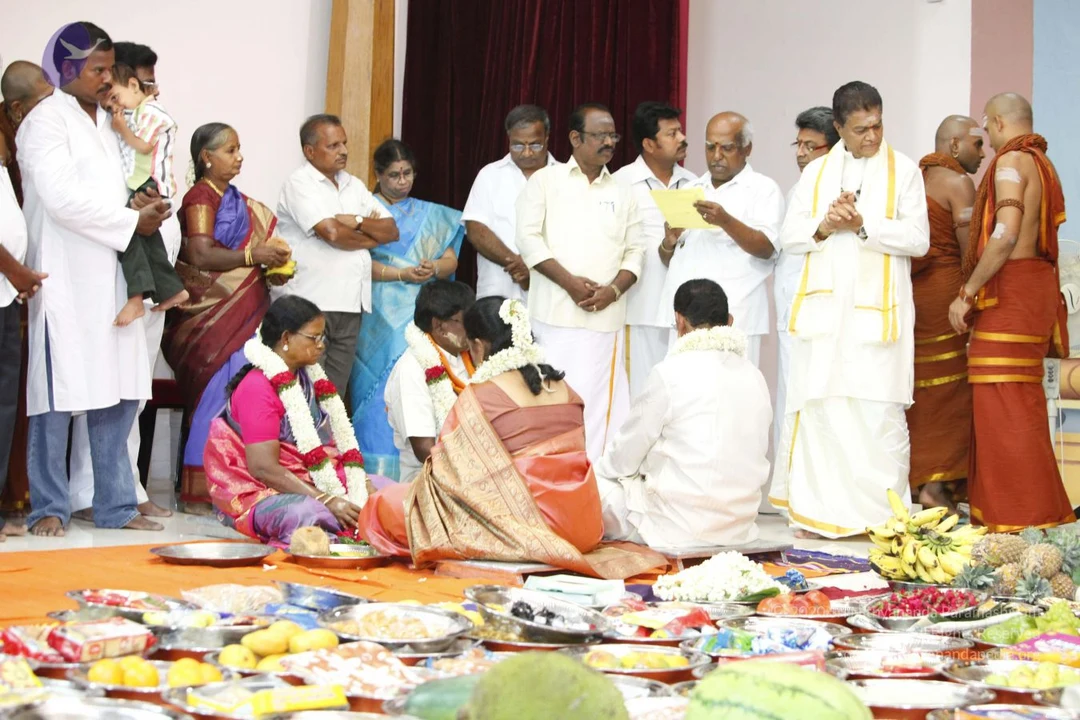
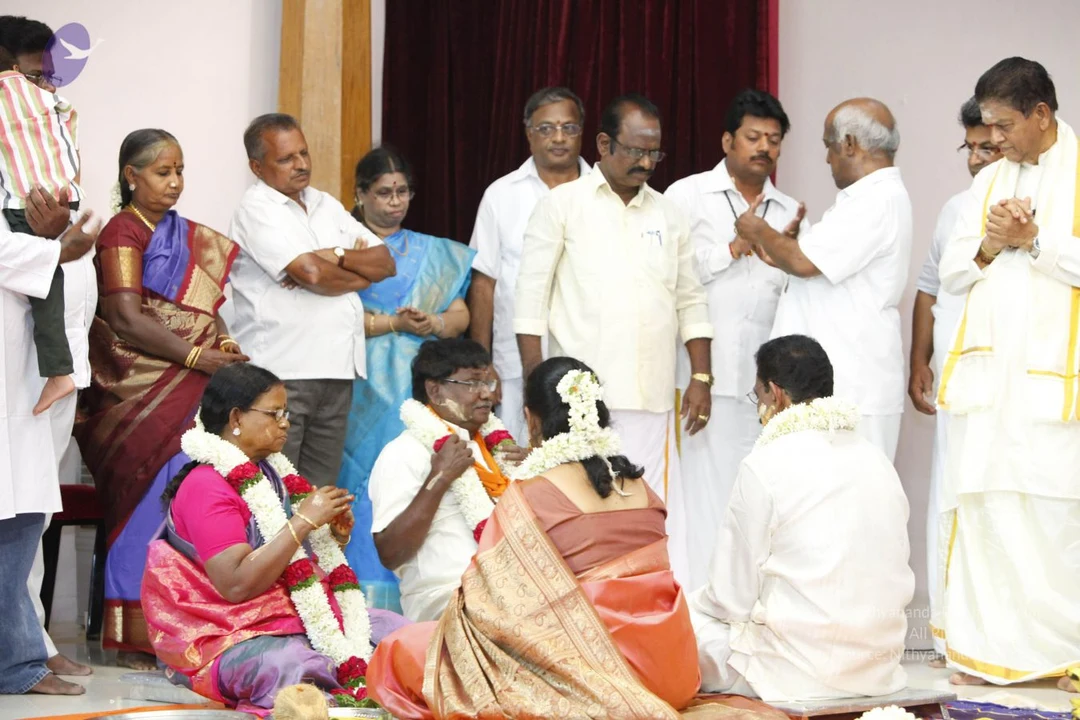
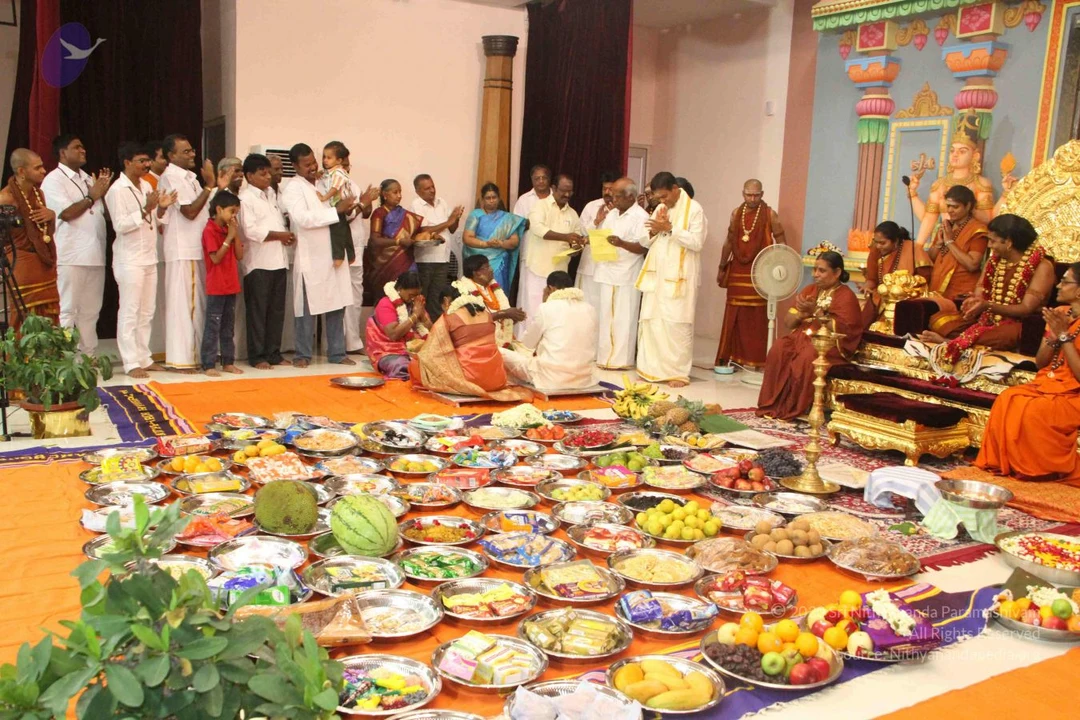
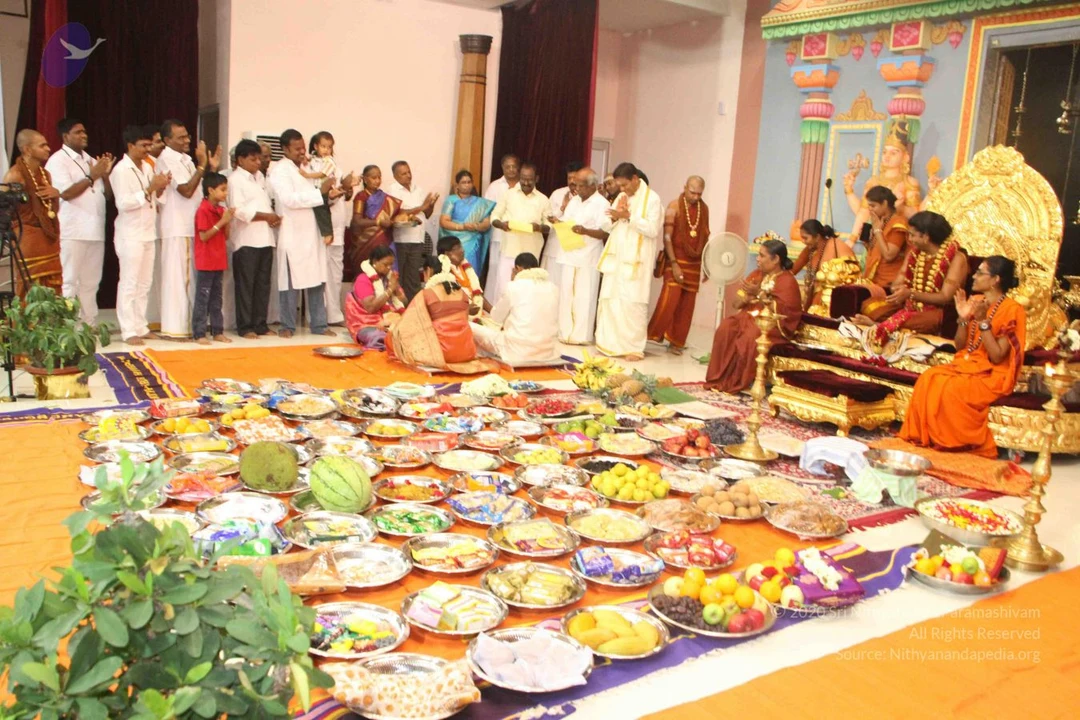
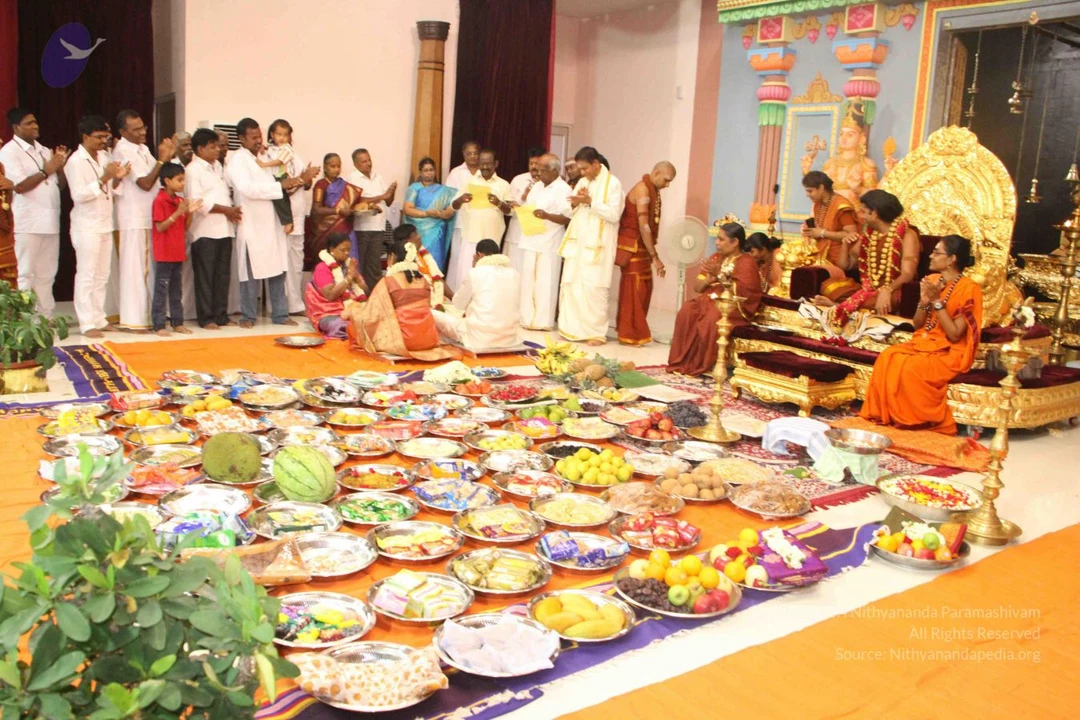
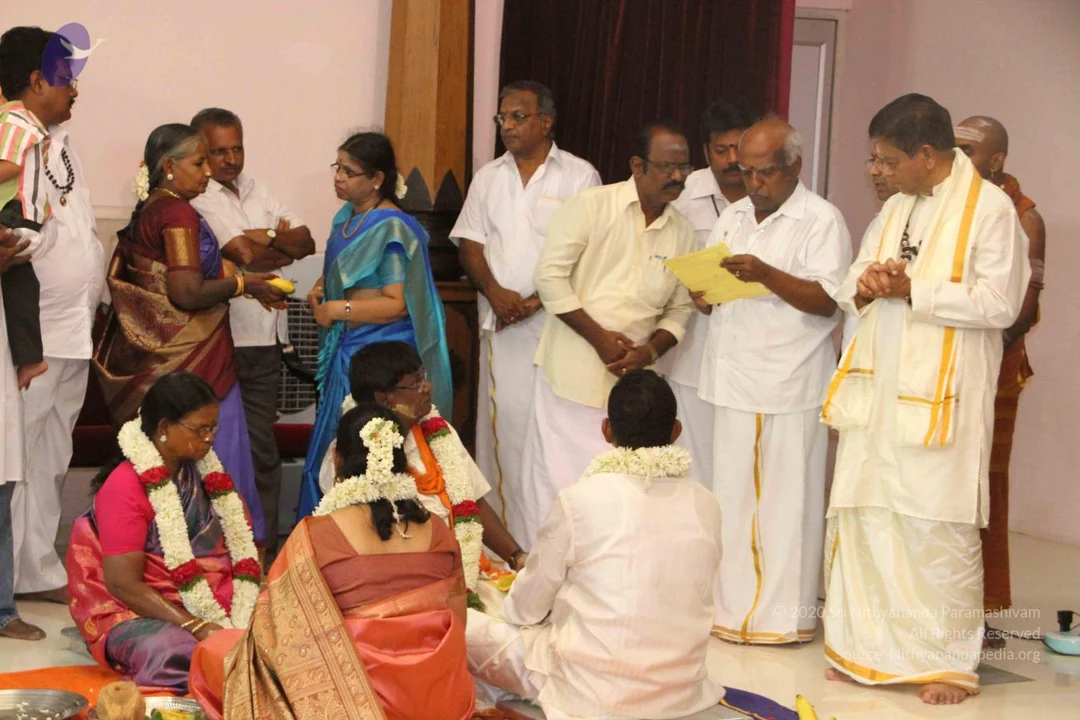
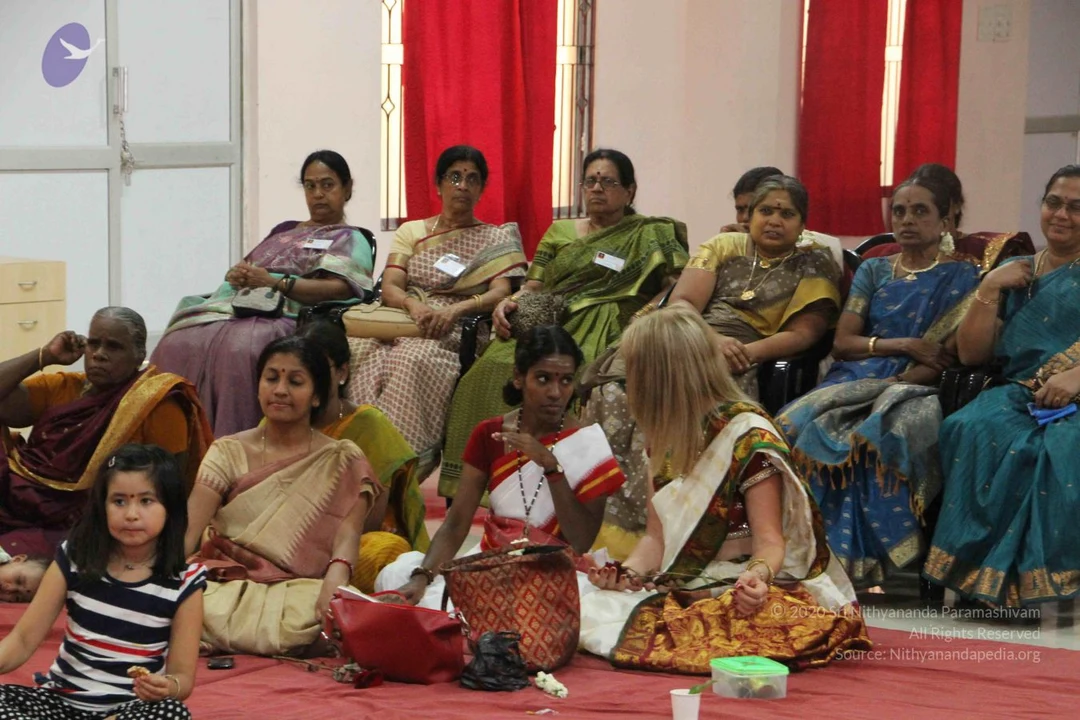
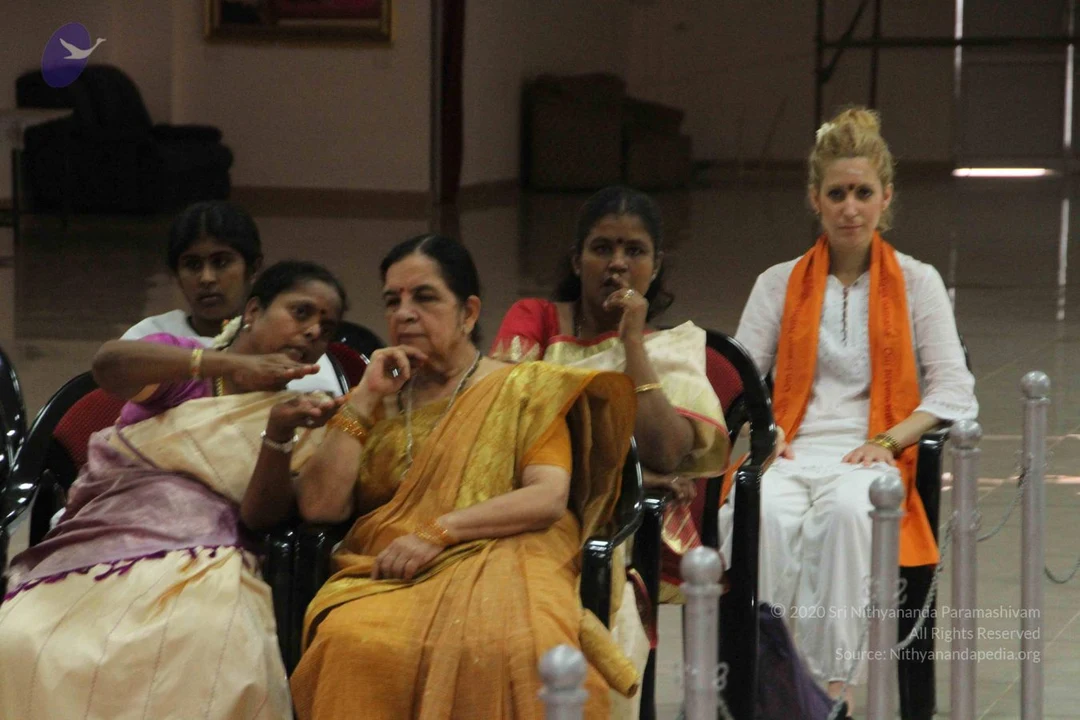
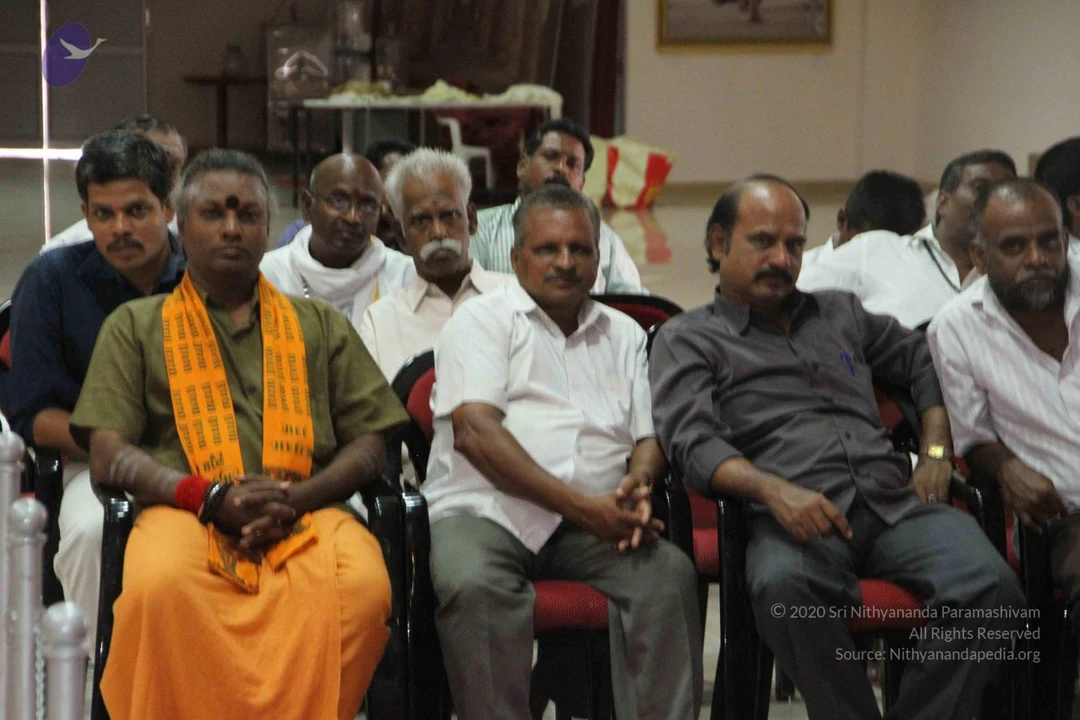
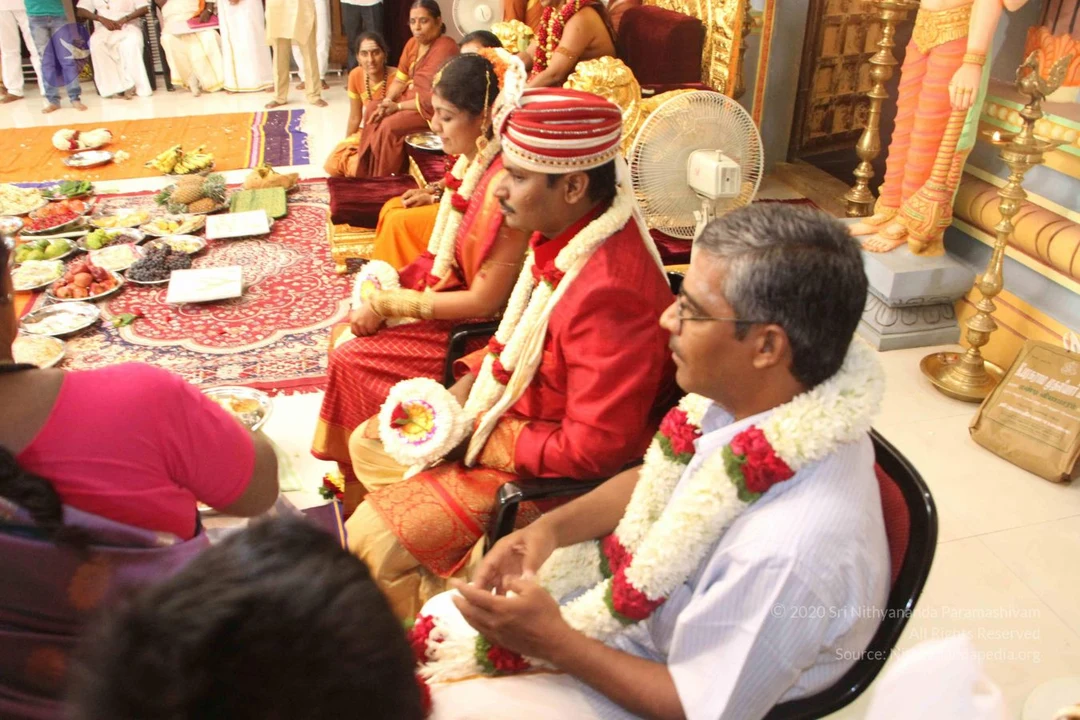
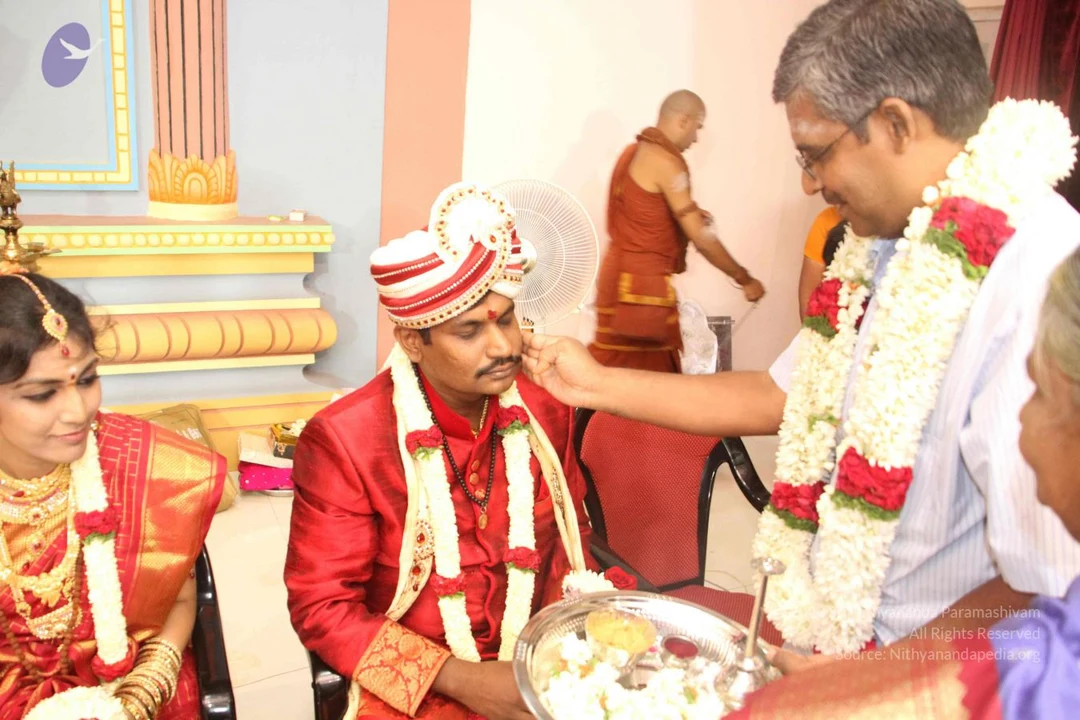
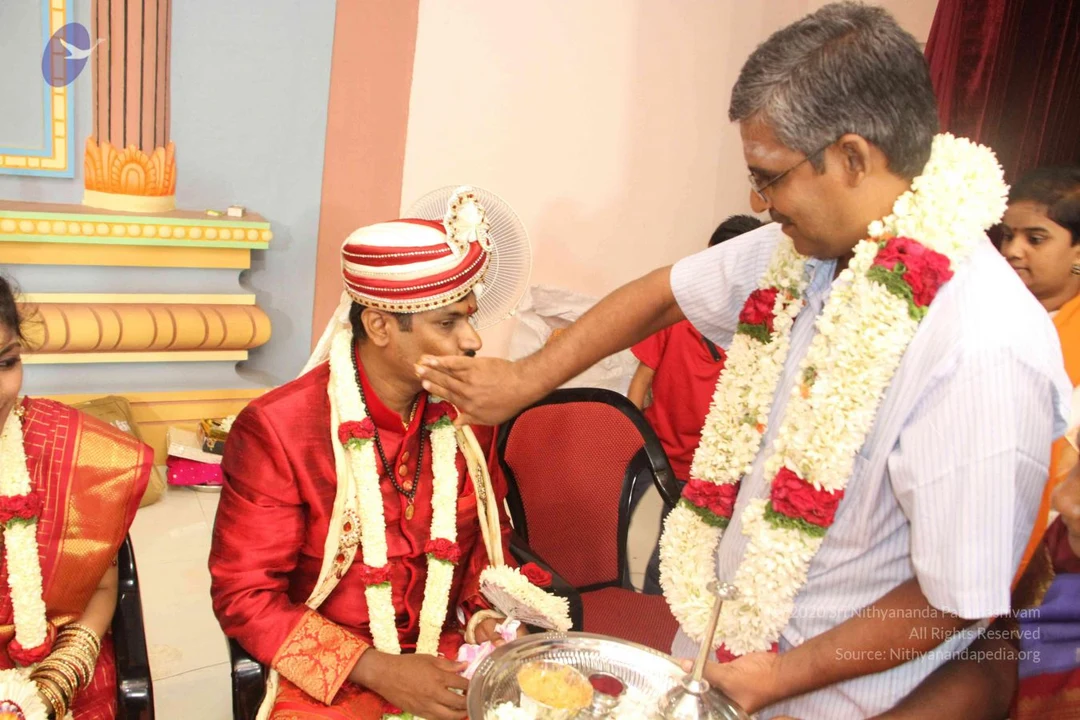
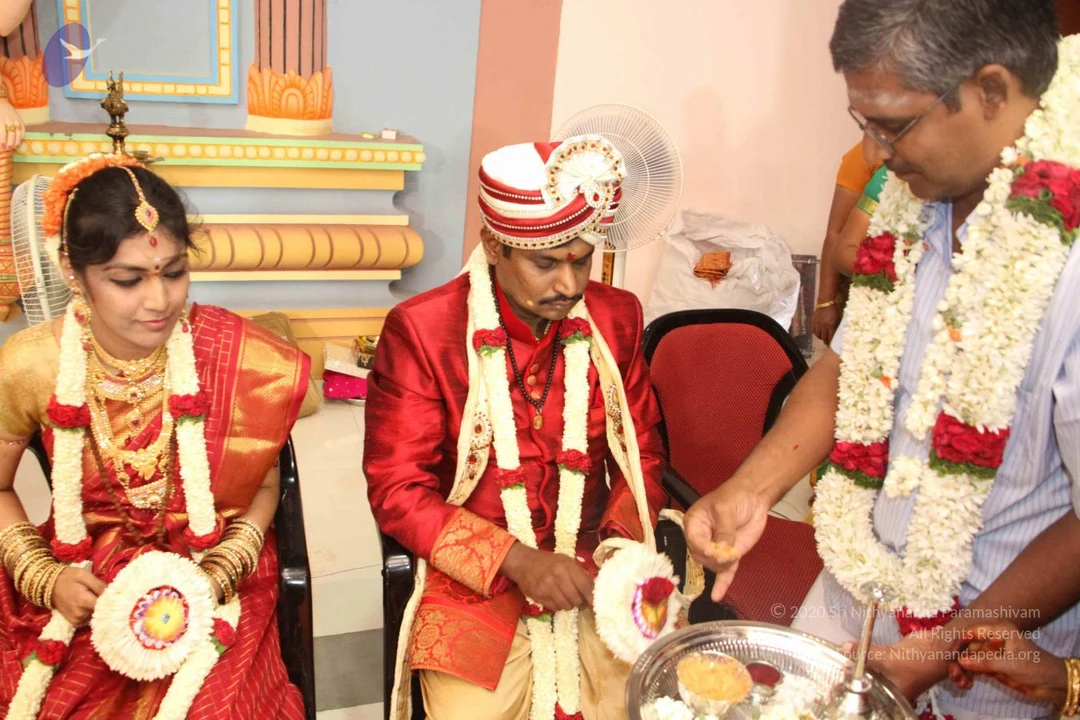
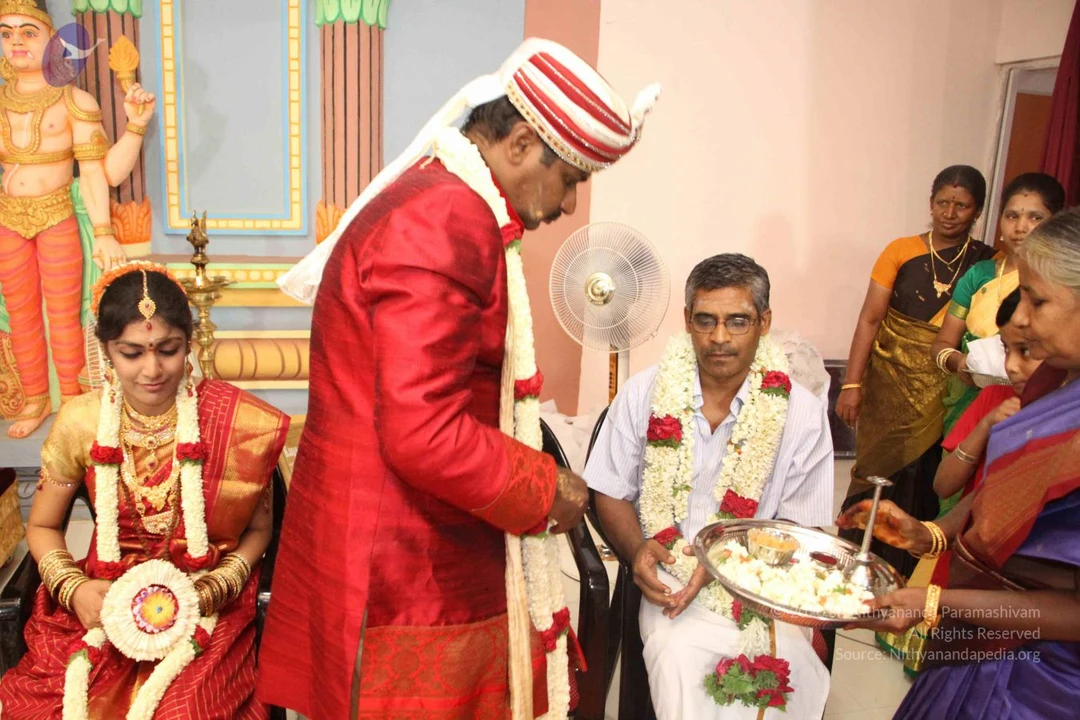
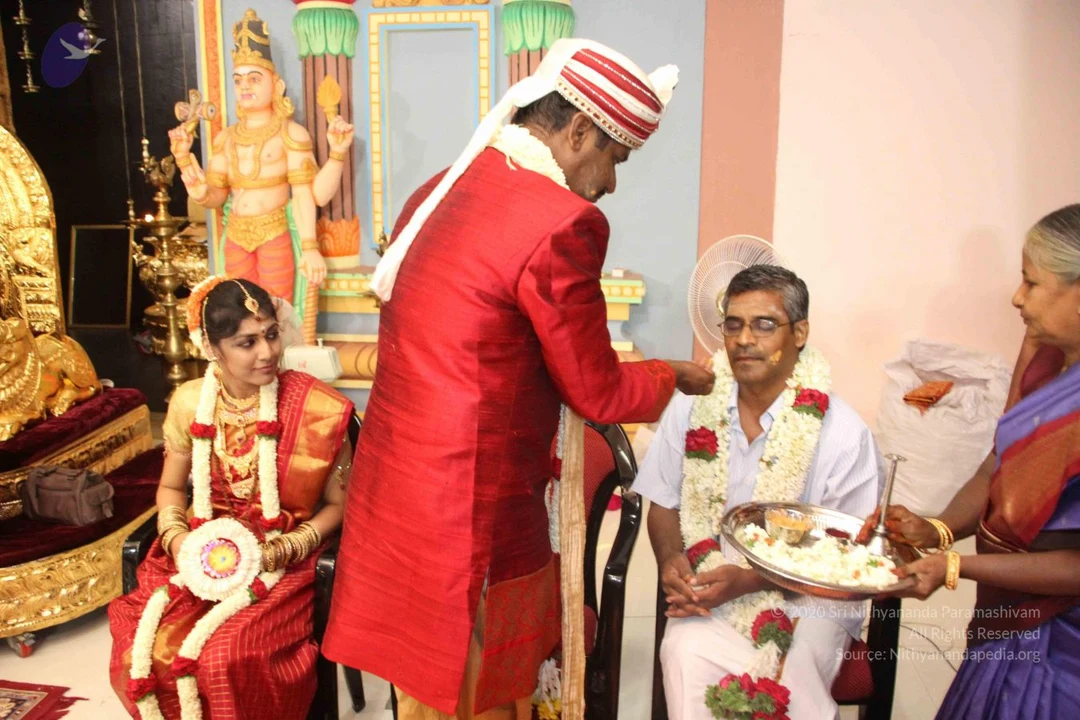
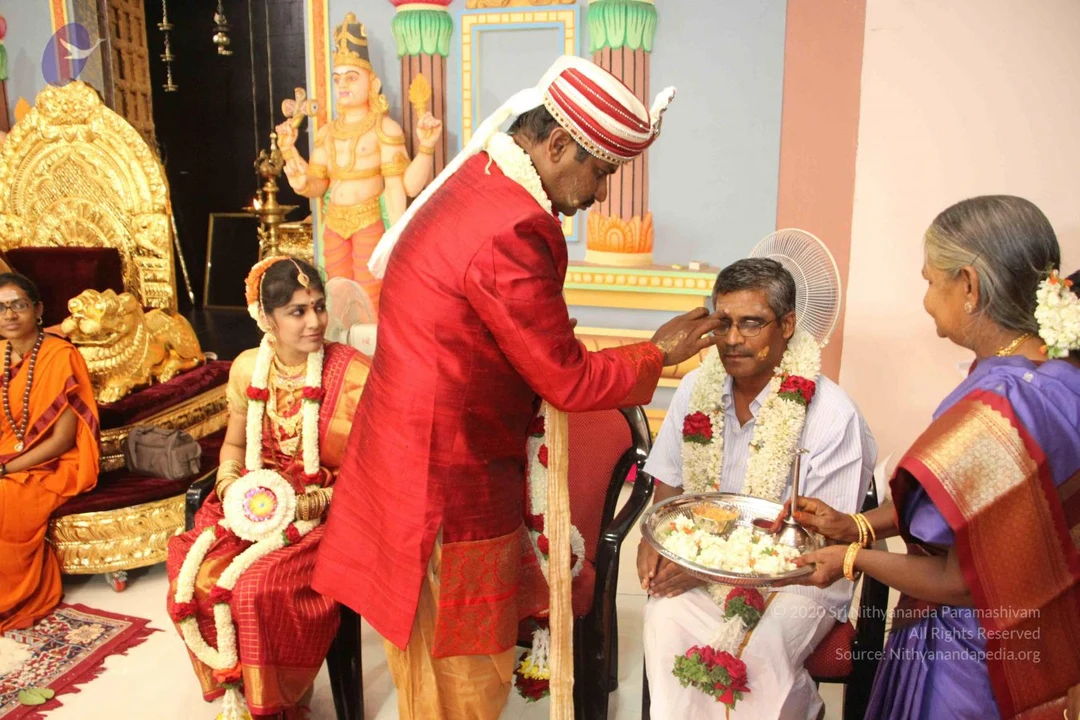
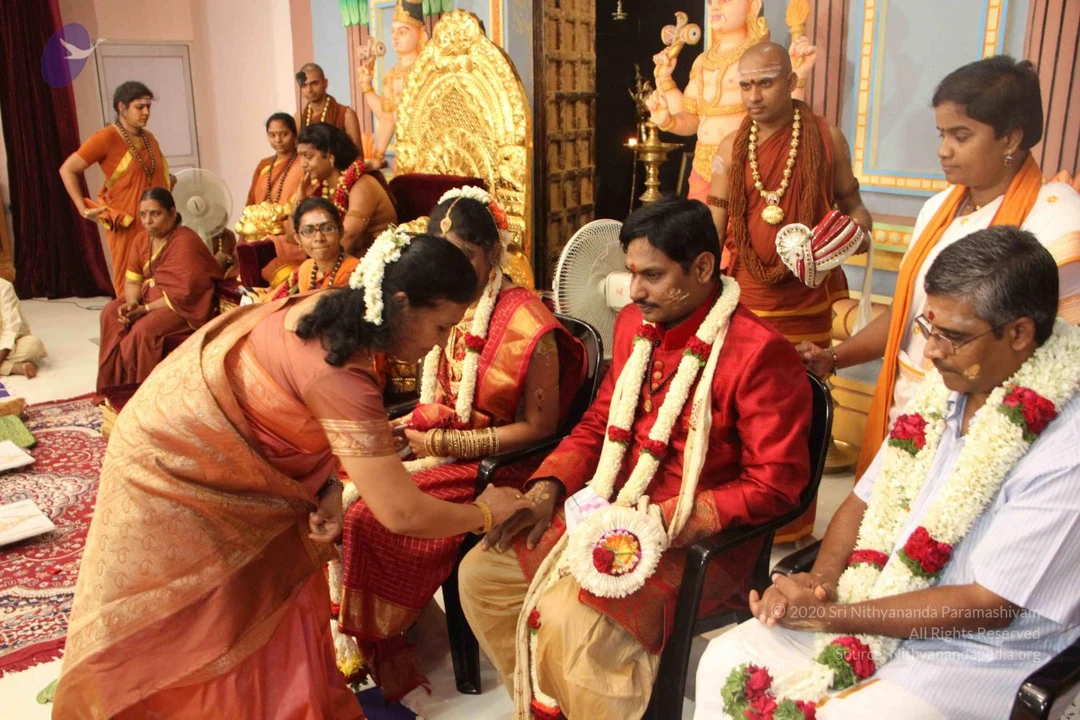
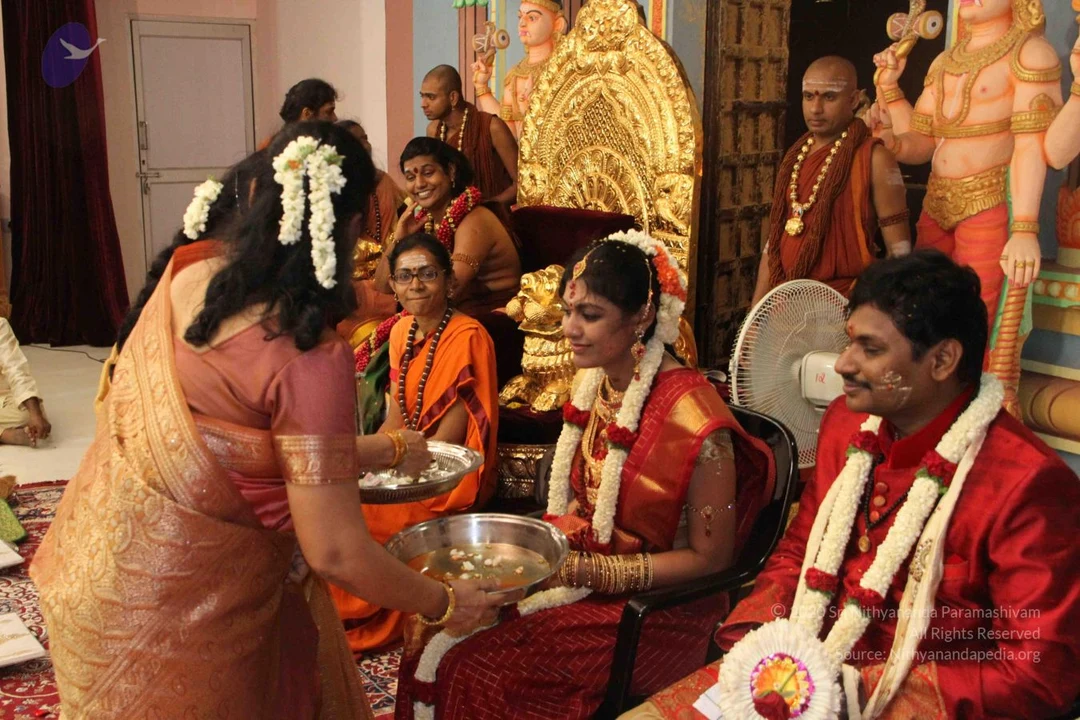
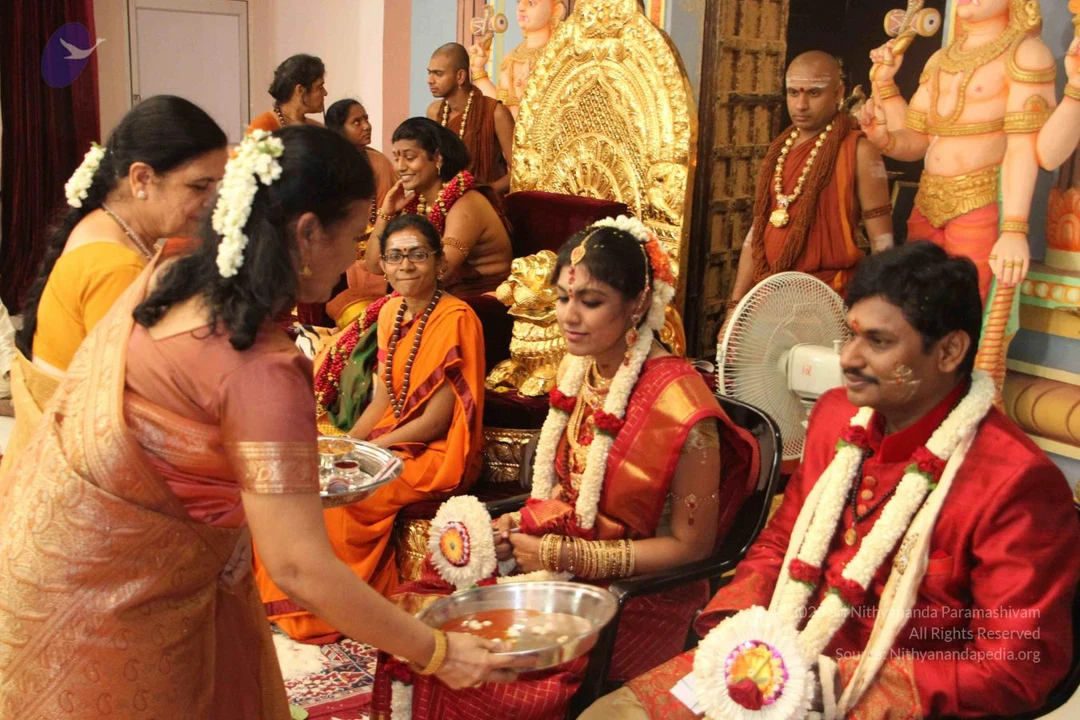
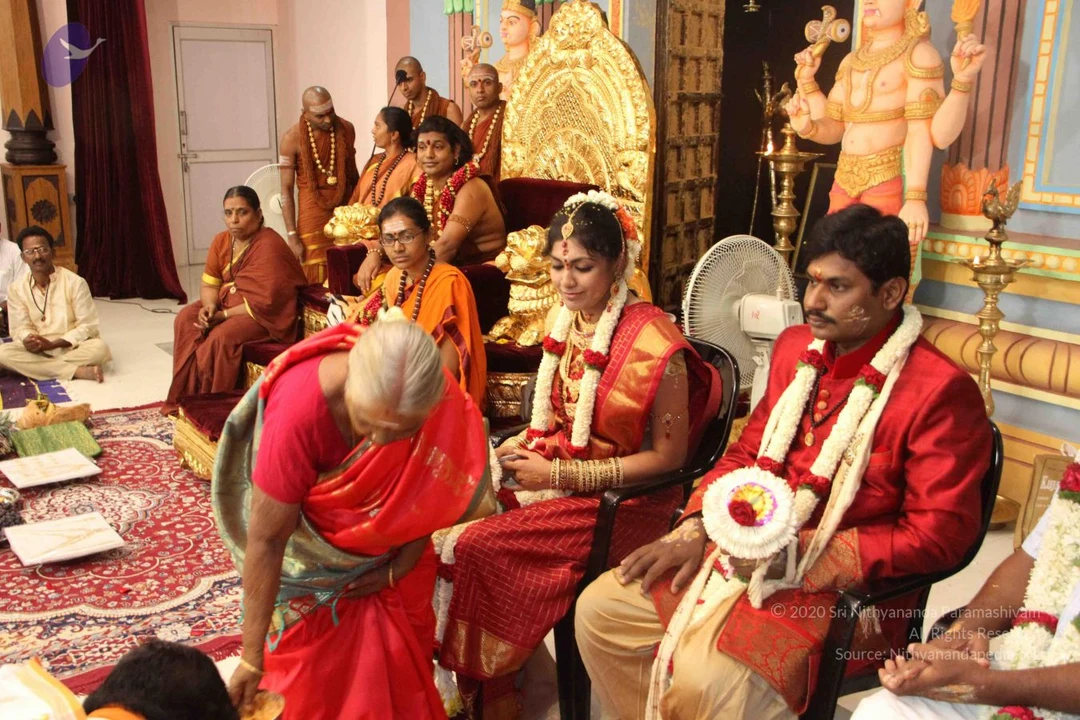
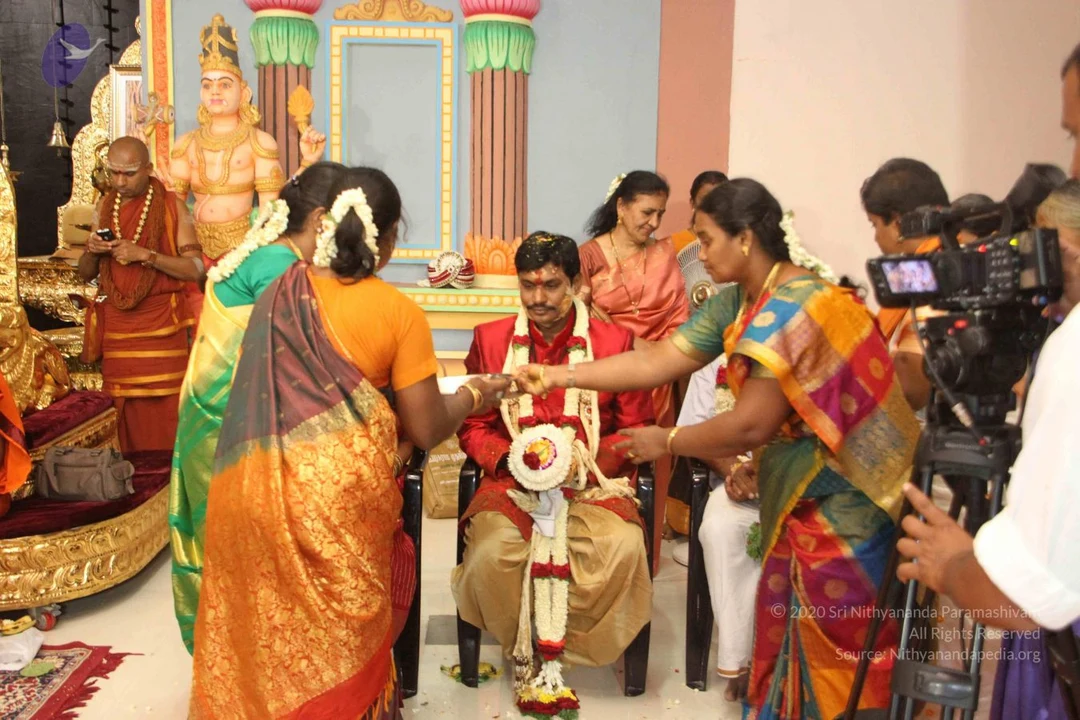
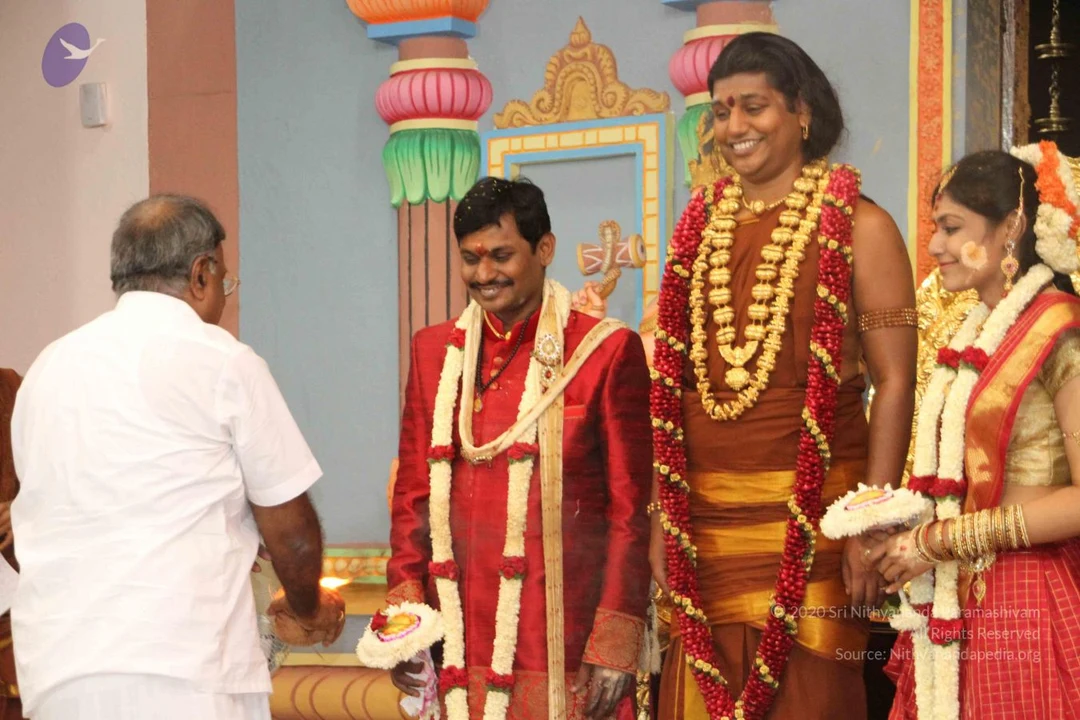
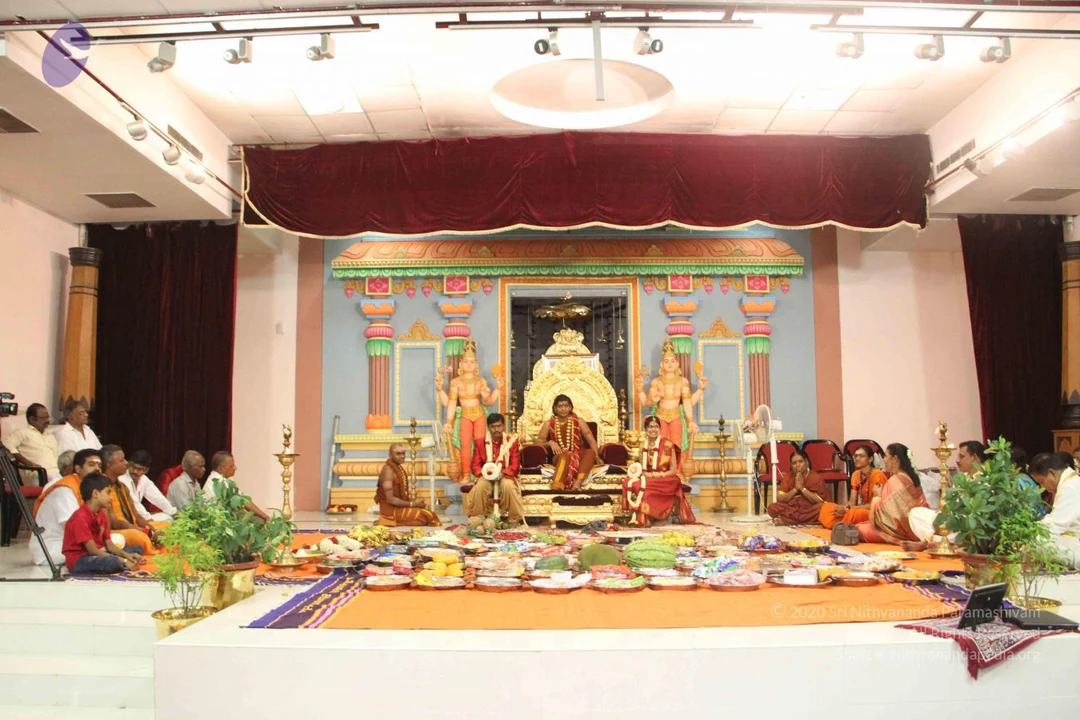
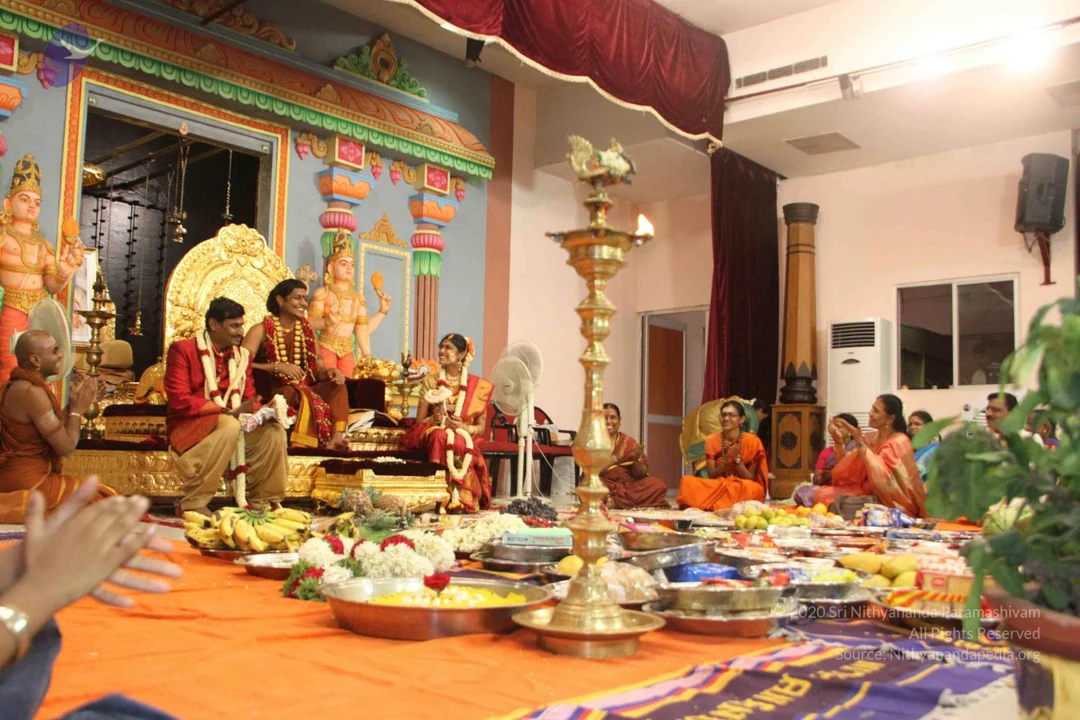
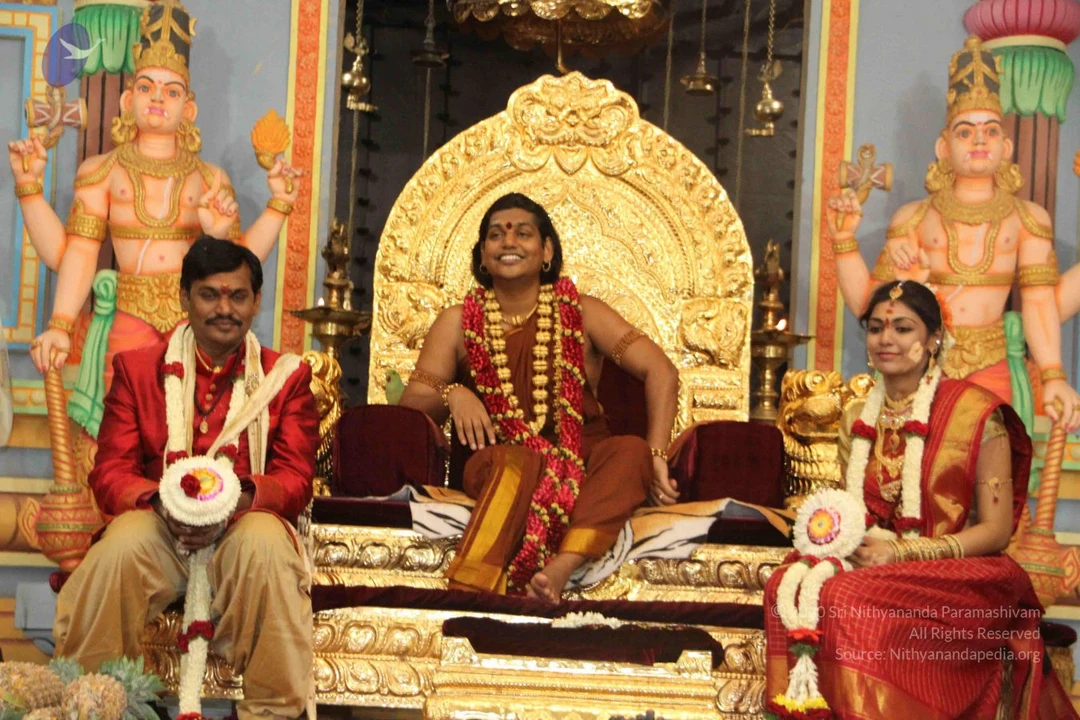
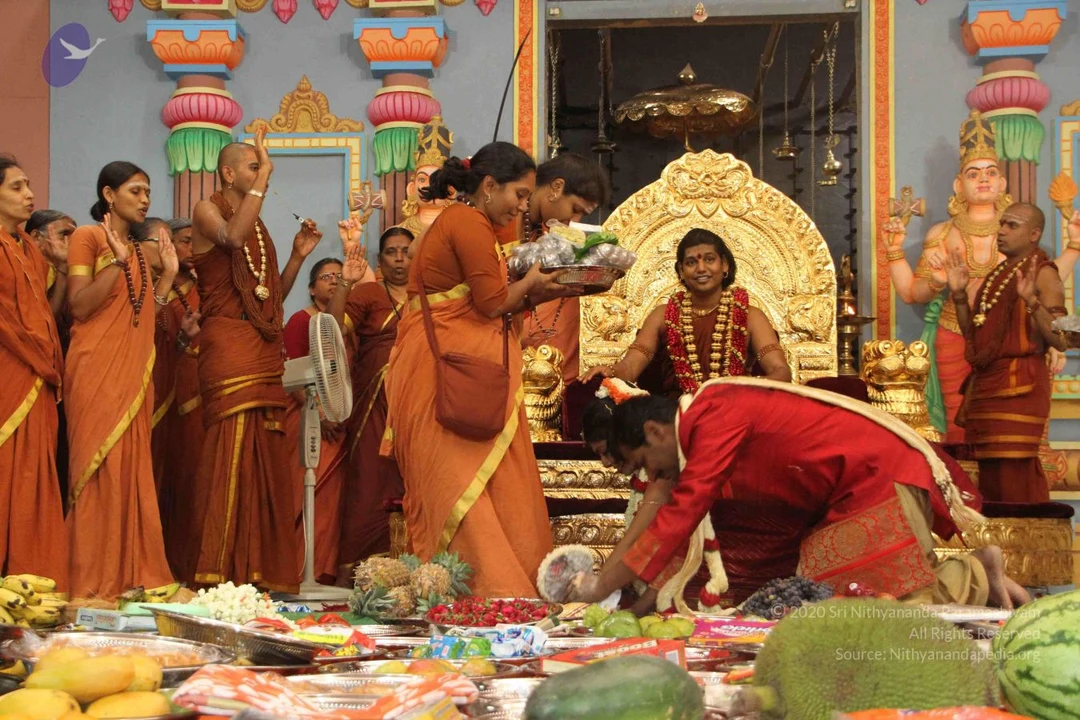
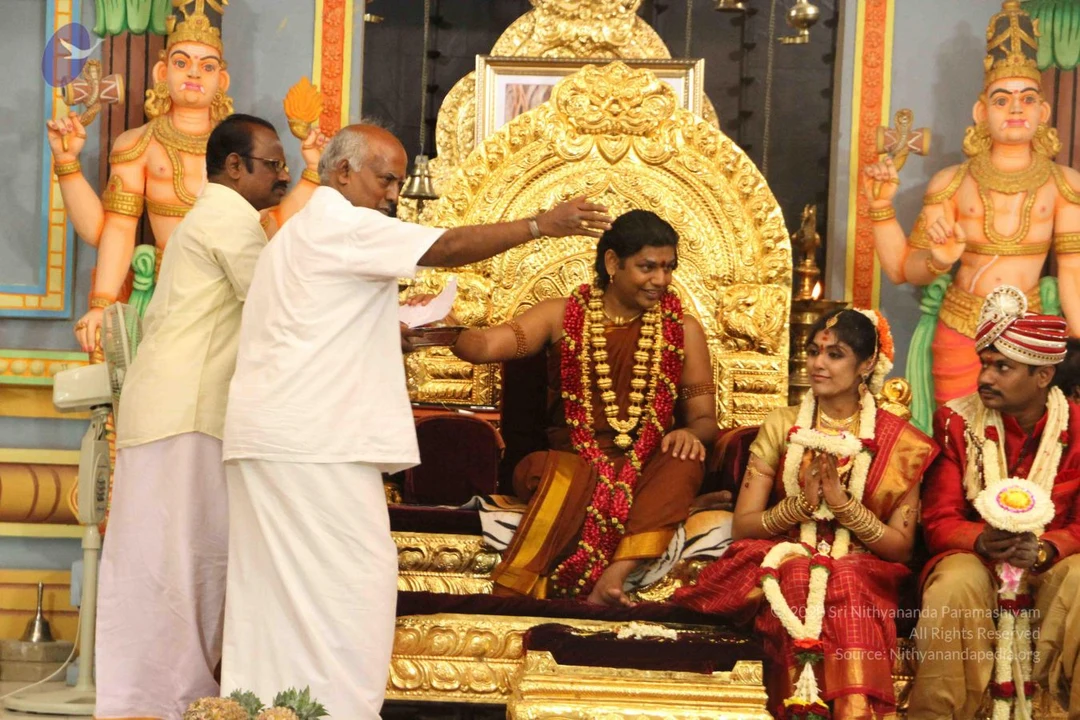
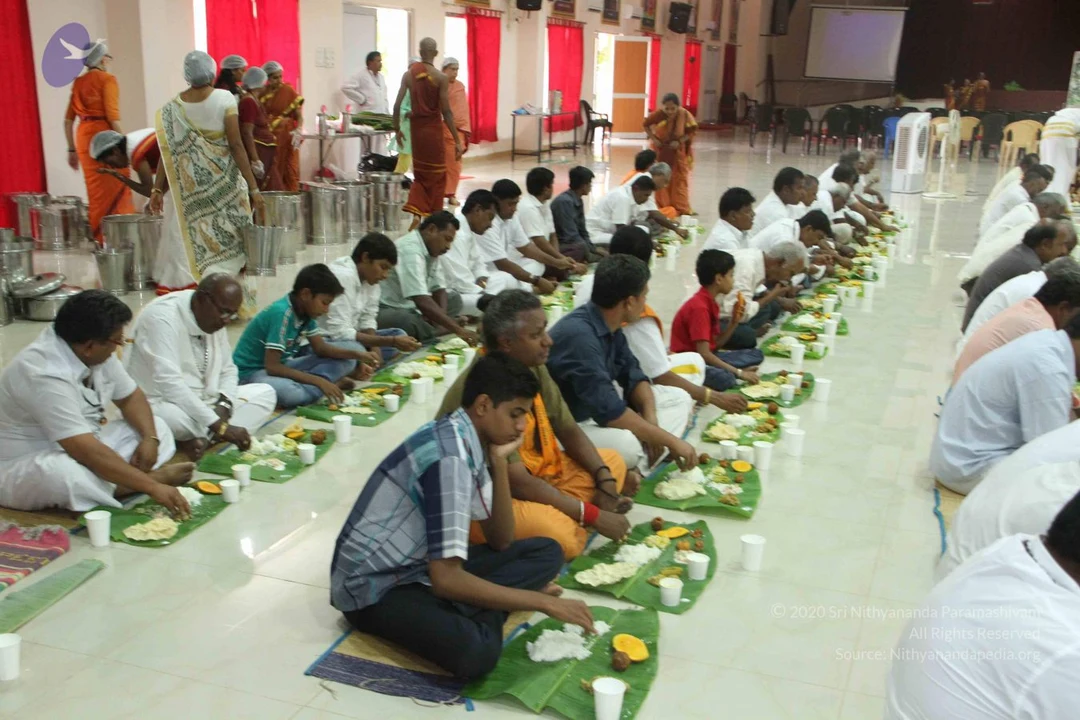
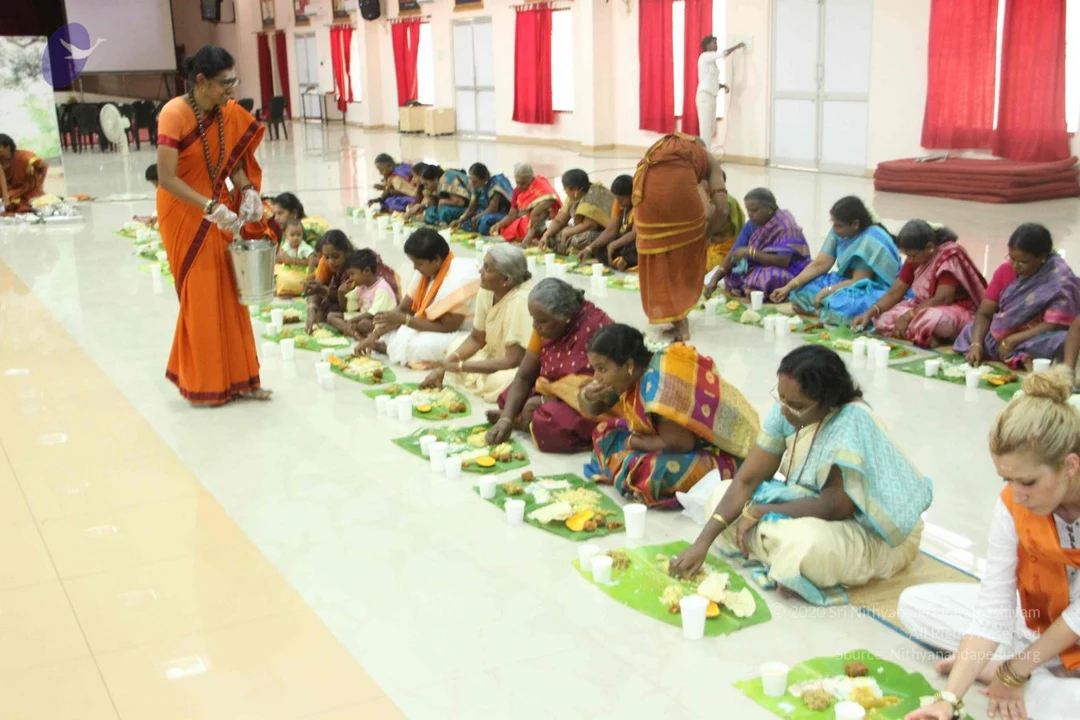
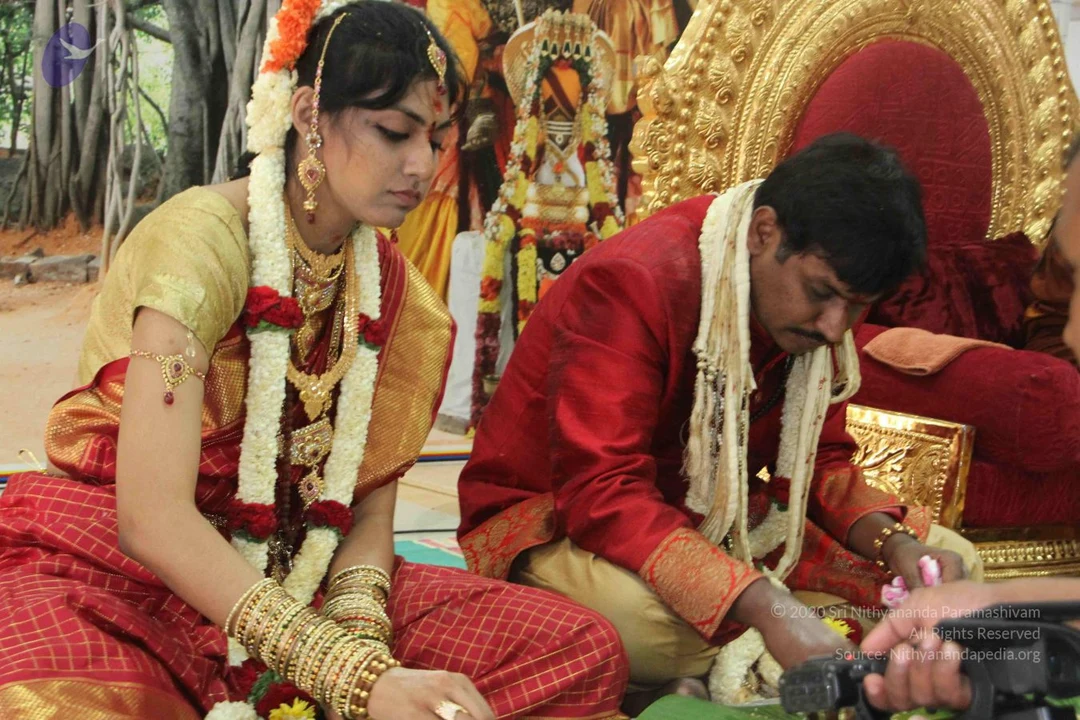
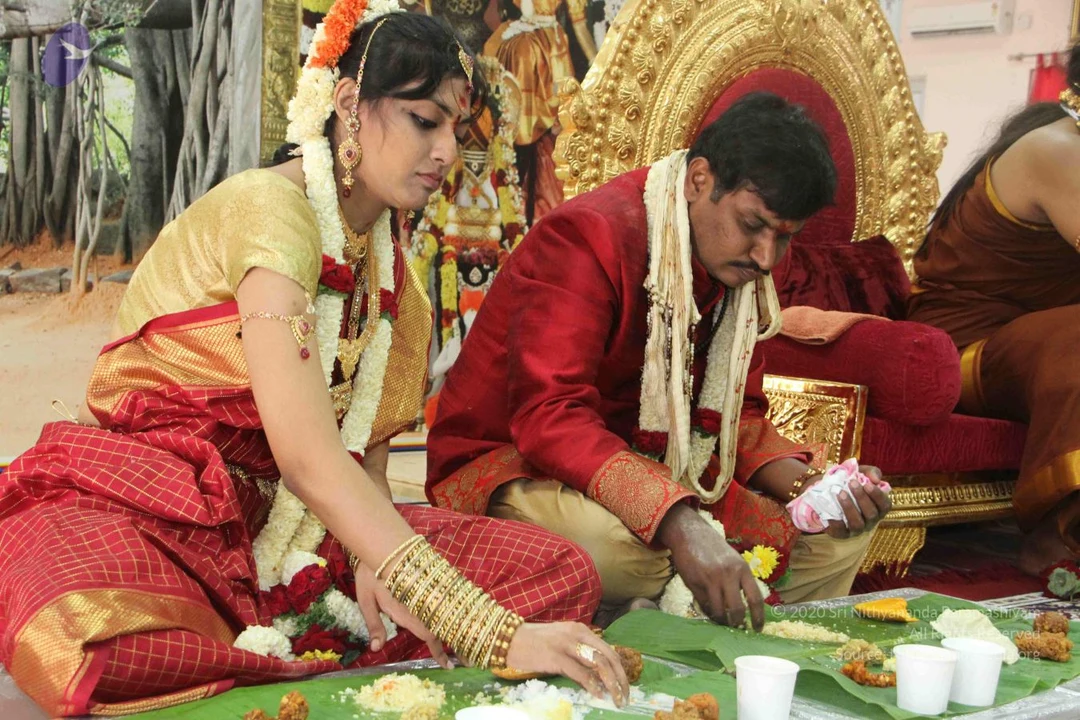
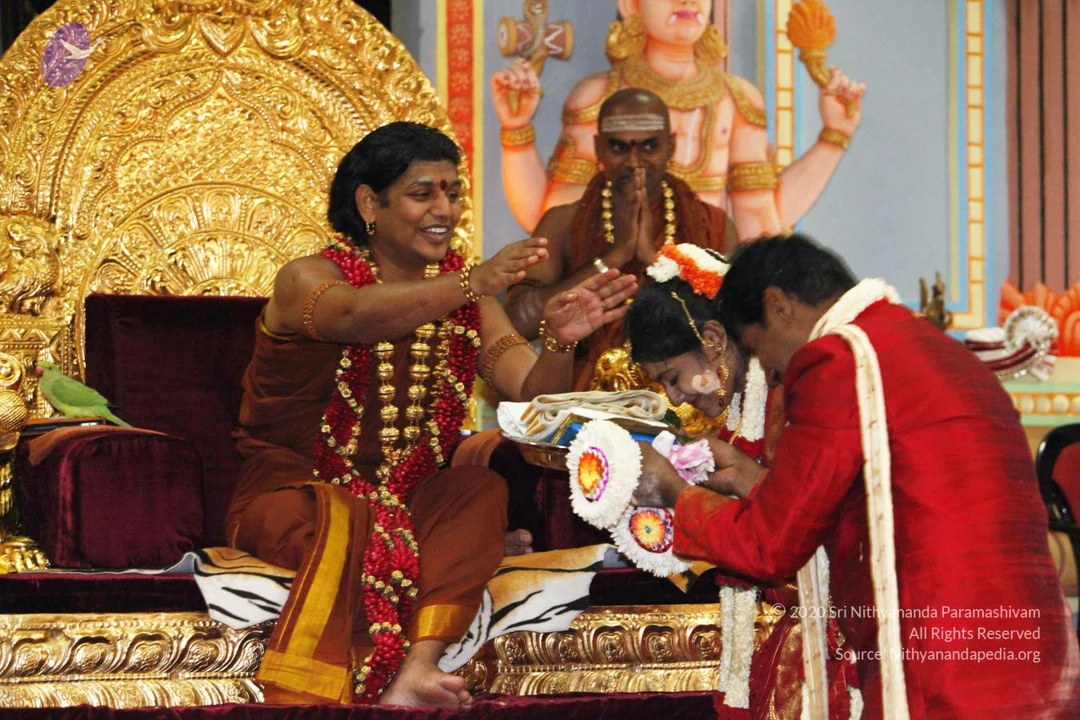
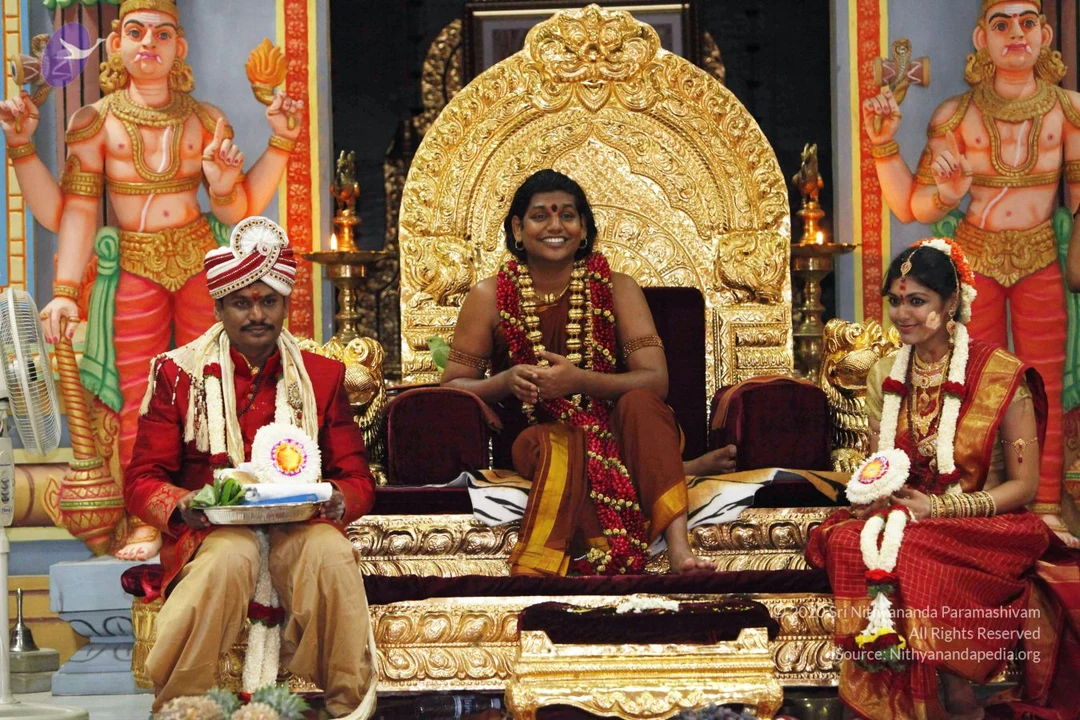
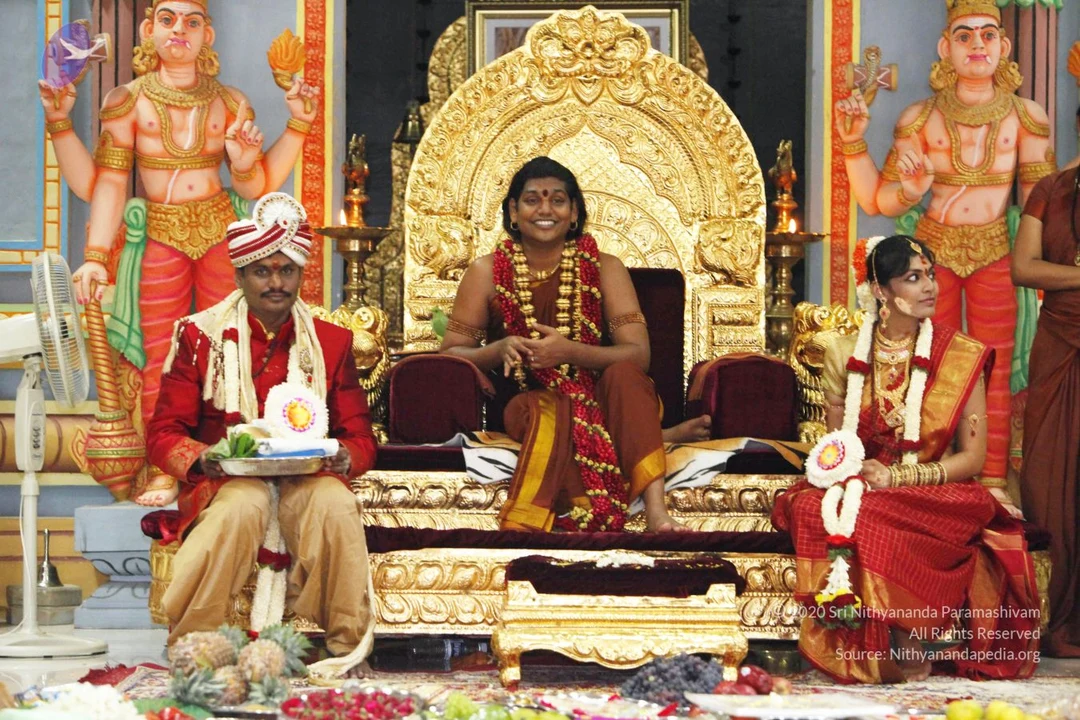
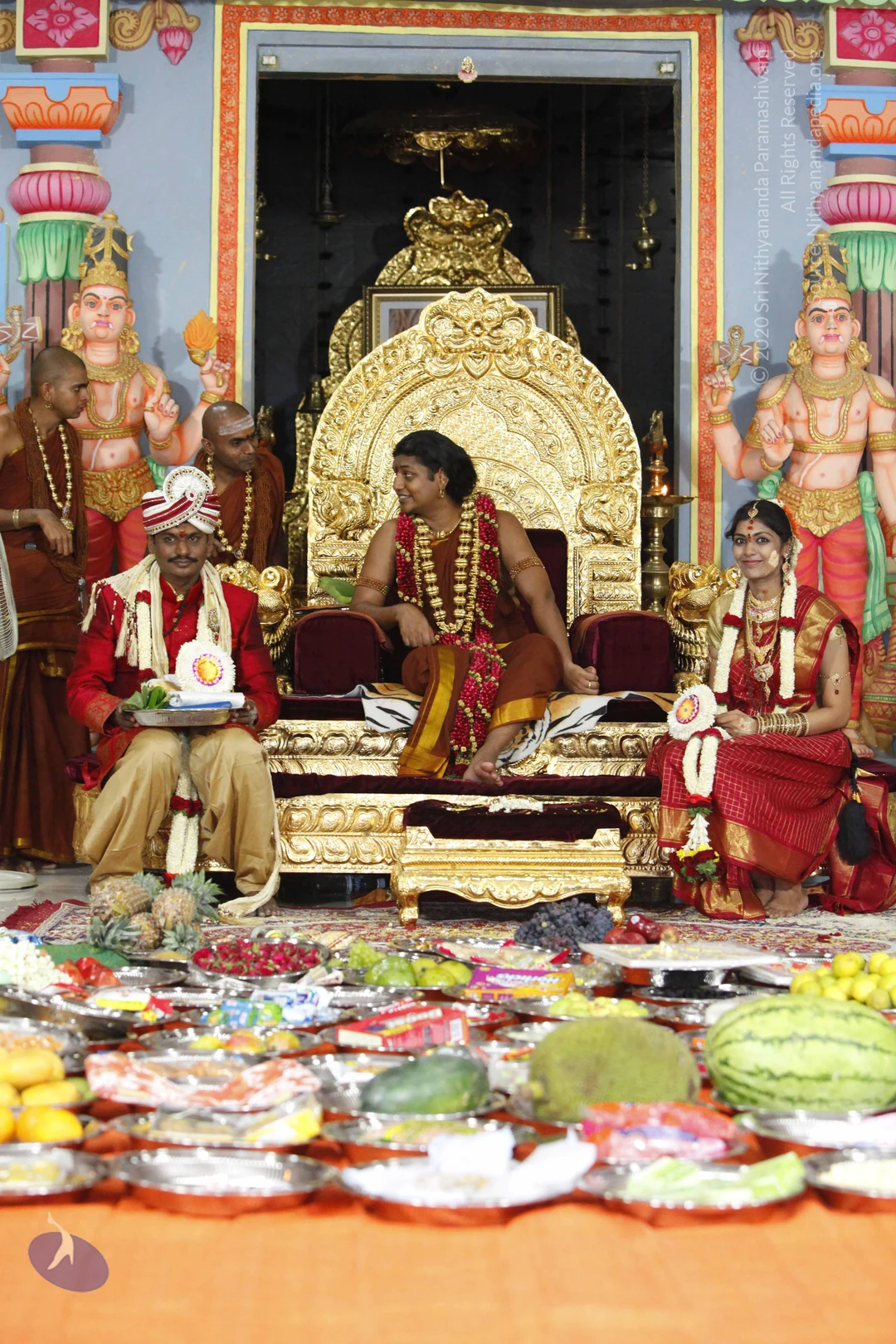
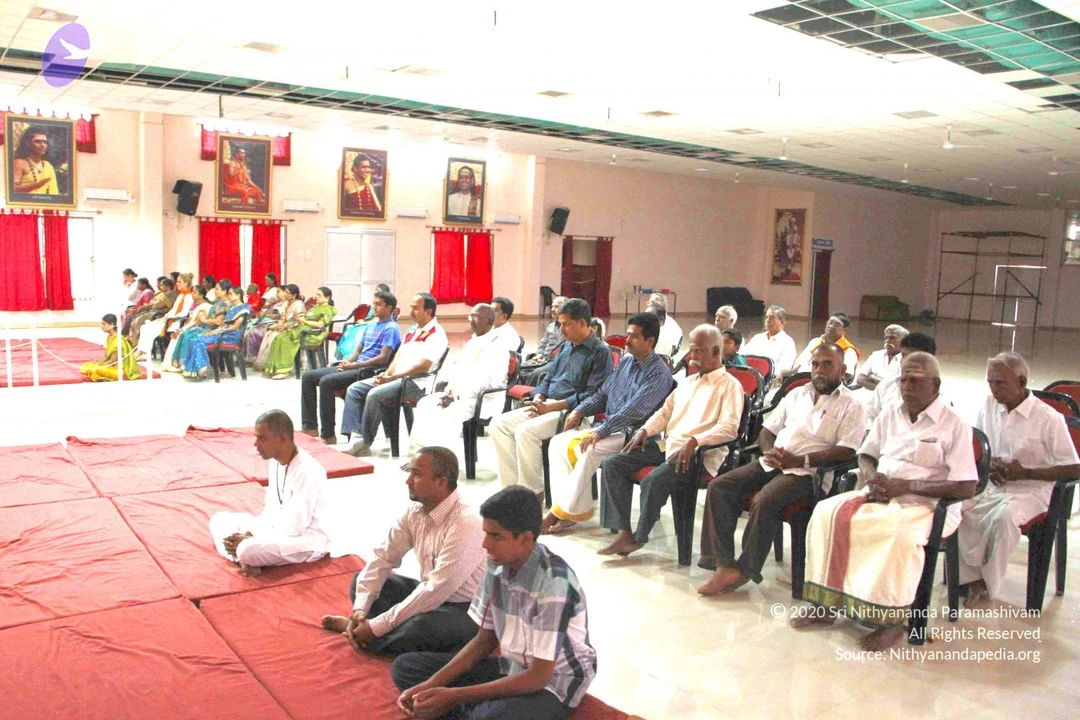
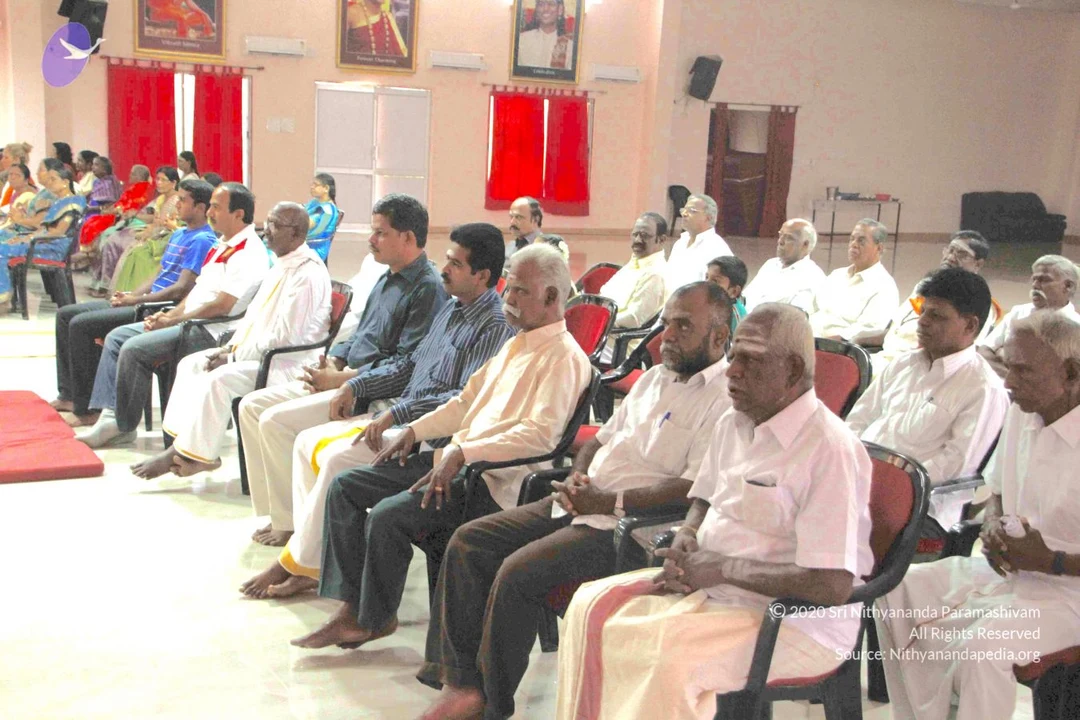
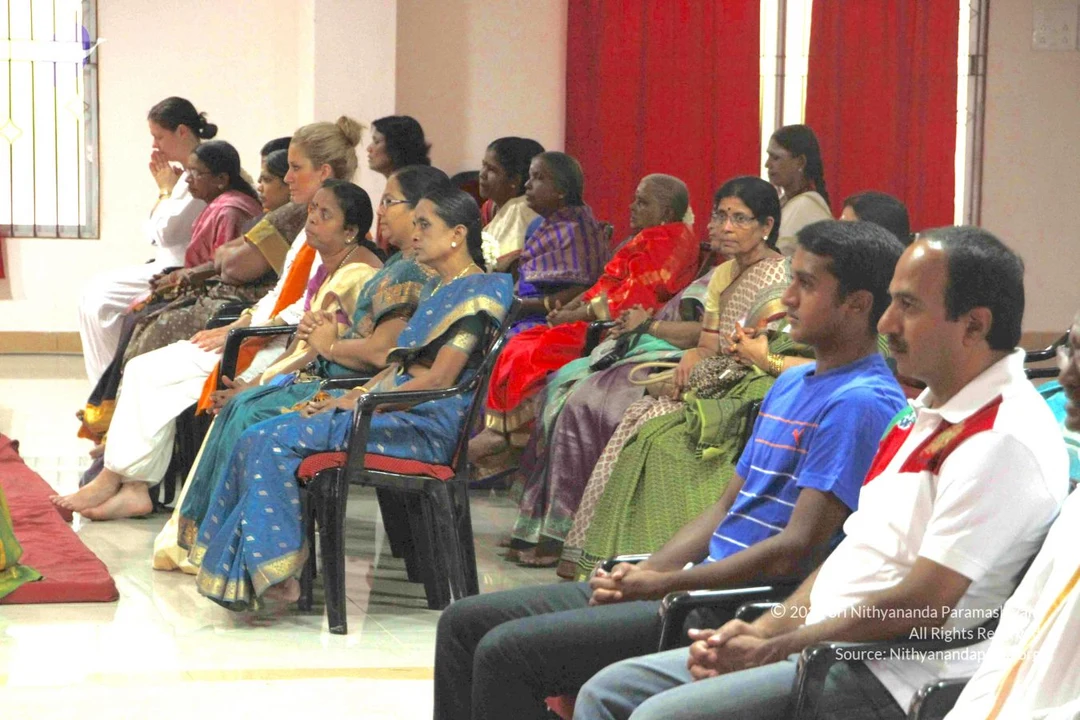
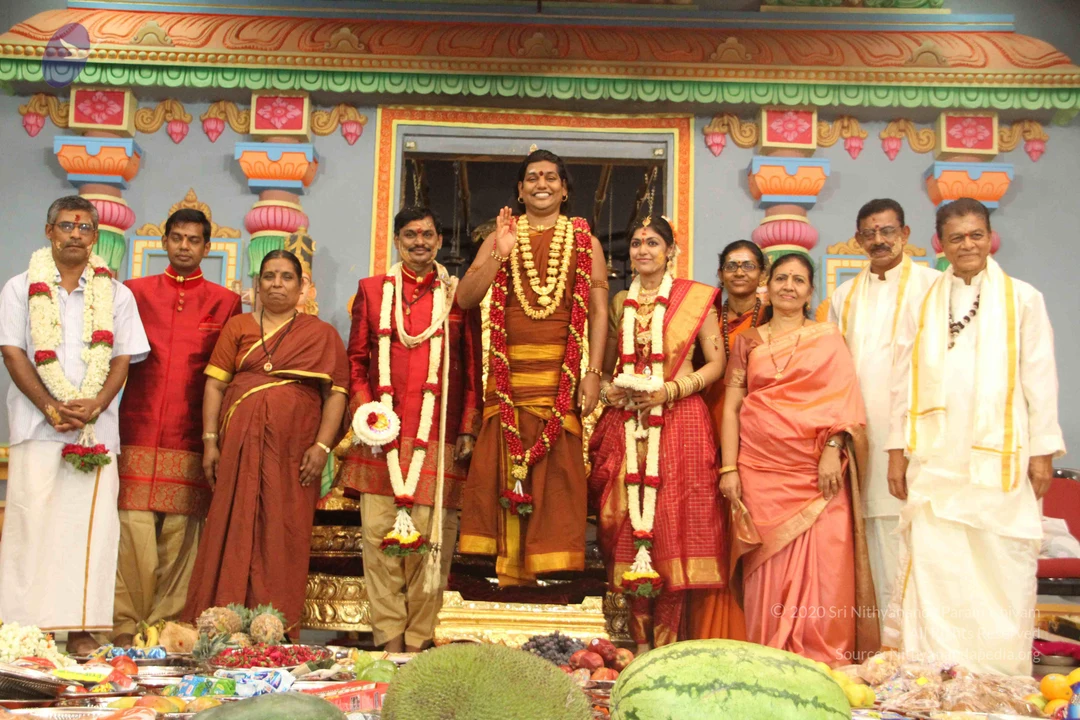
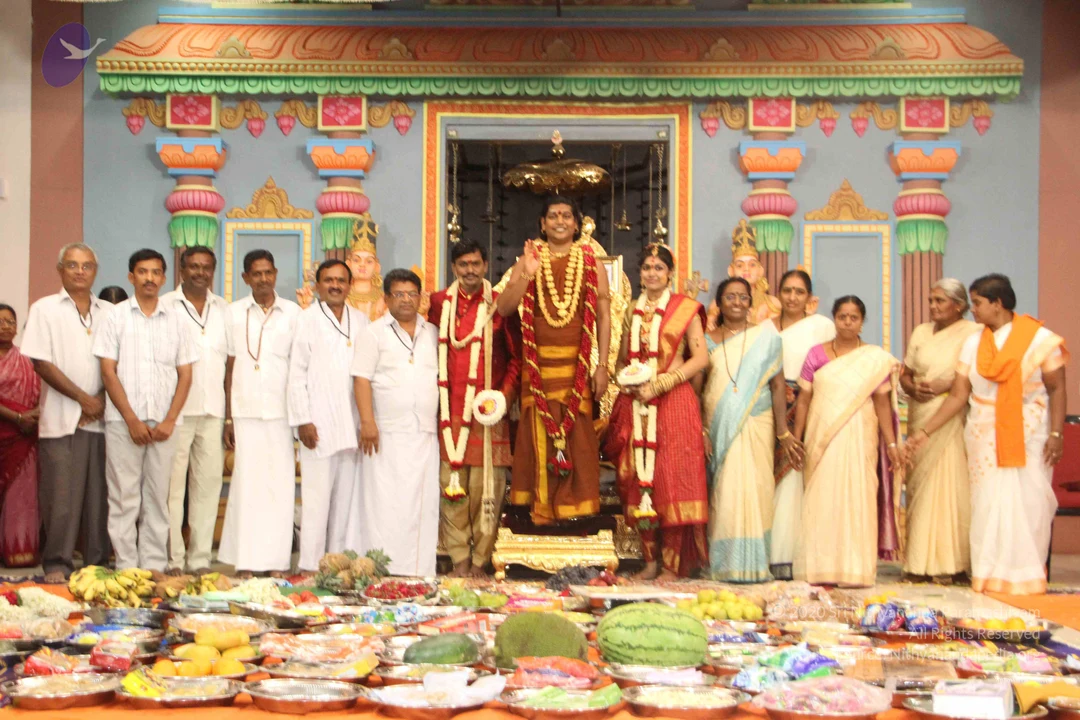
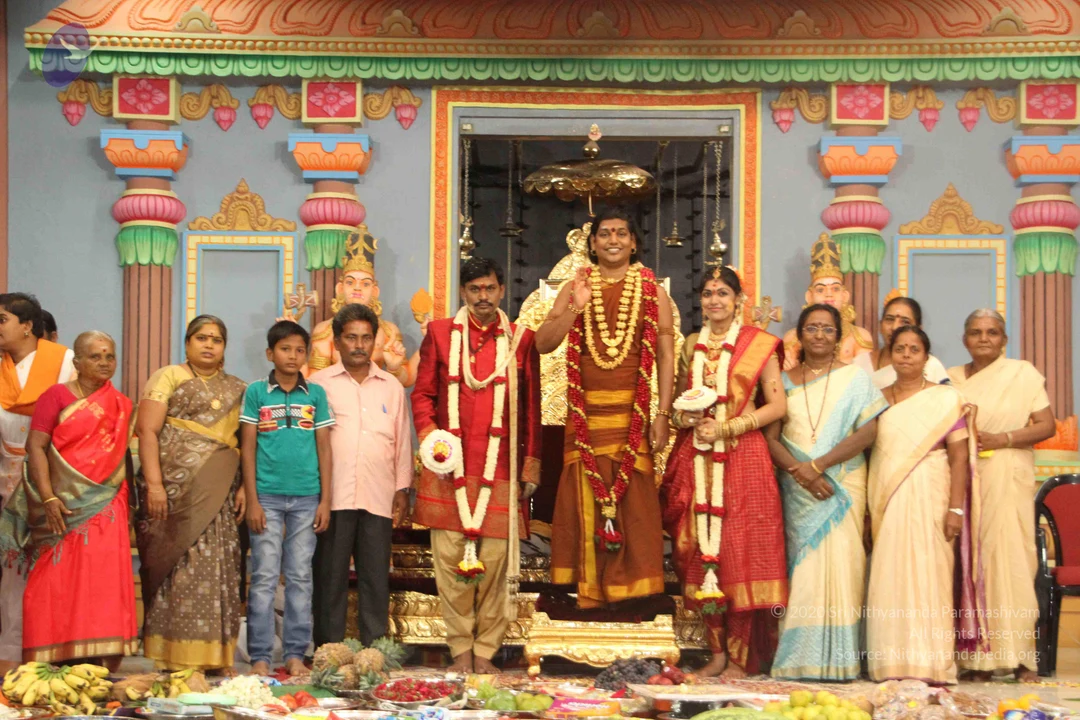
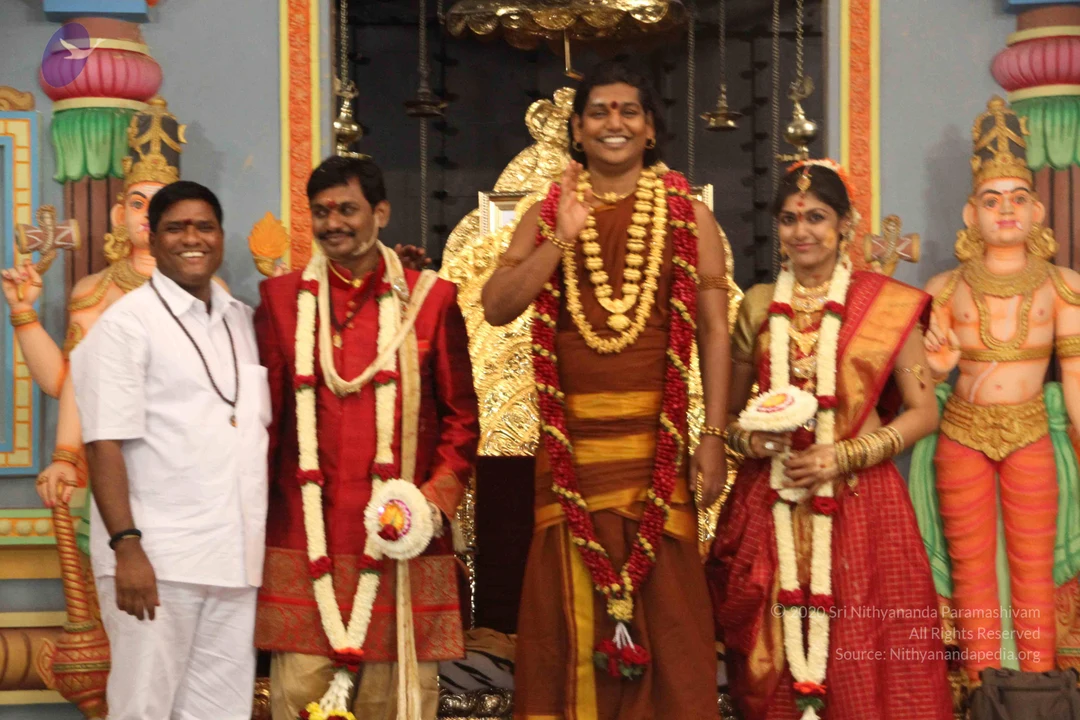
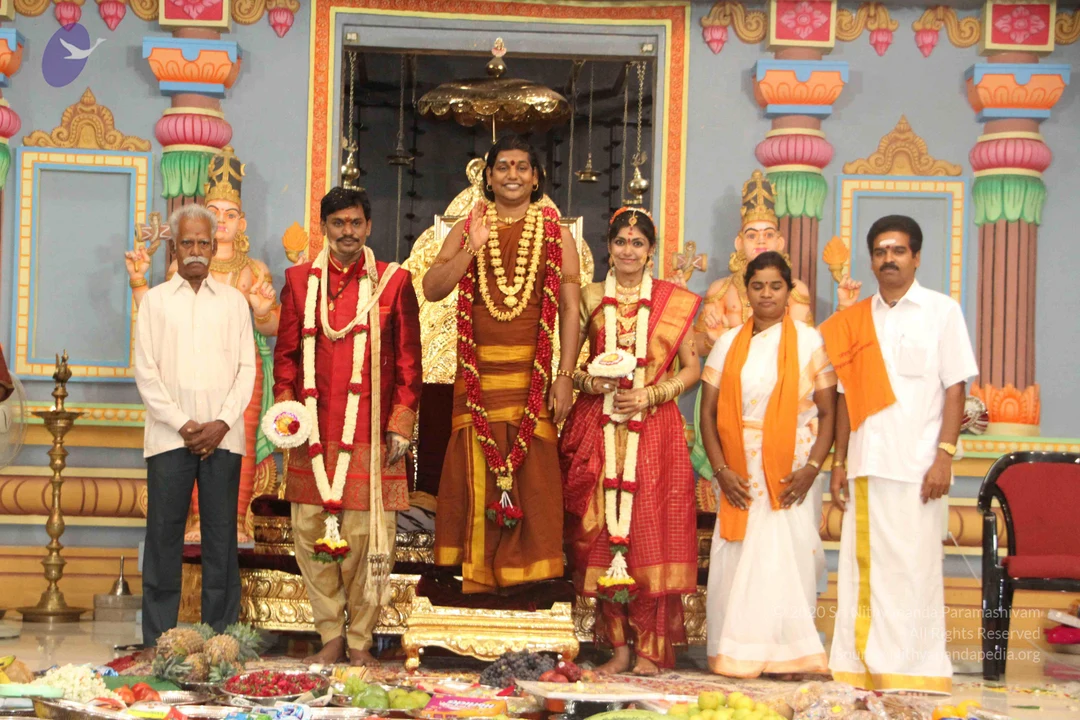
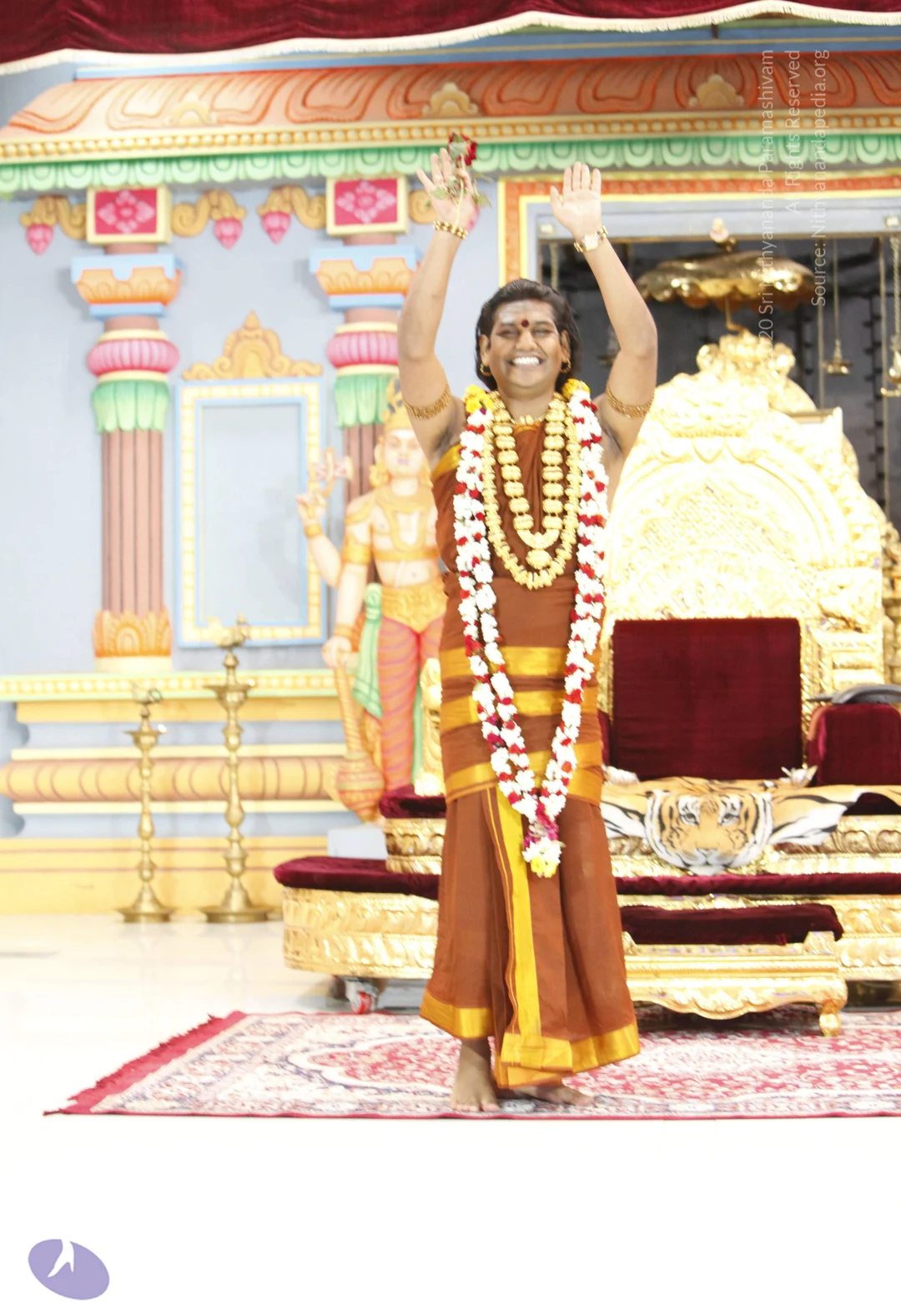
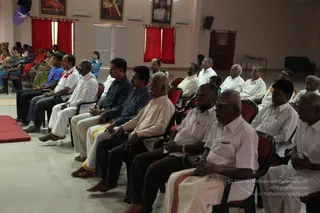
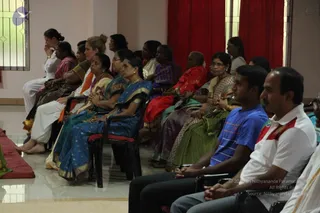
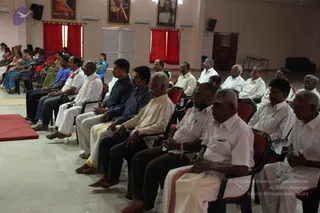
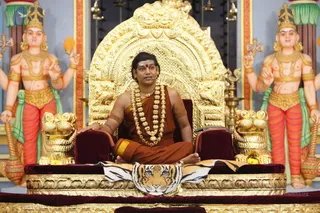
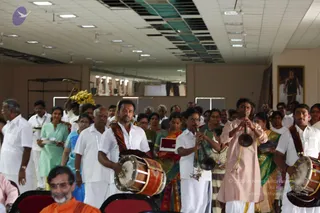
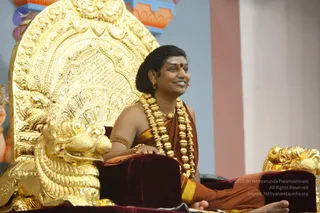
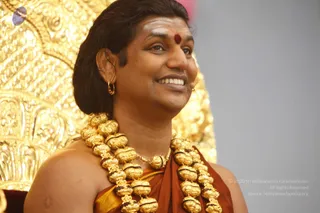
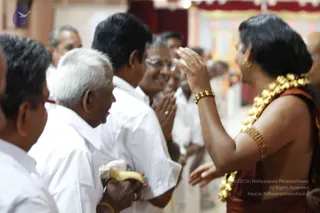
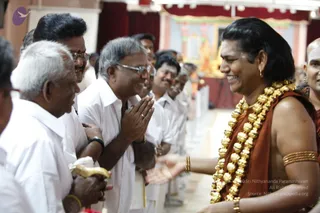
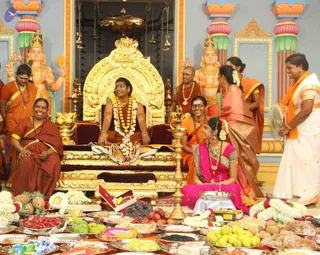
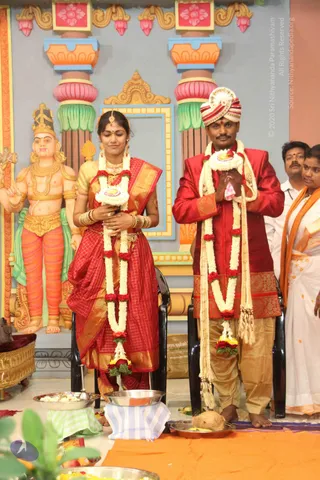
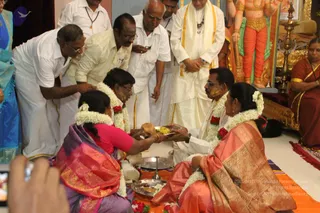
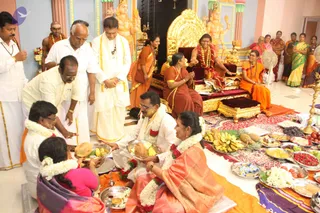
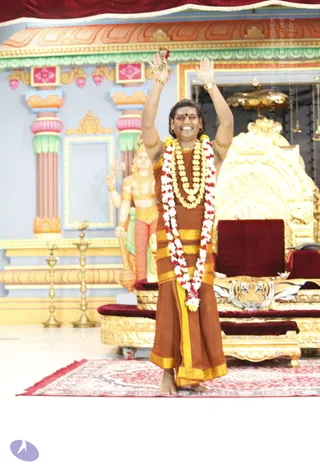
A smiling man stands barefoot on a red patterned rug with both arms raised in greeting. He wears a rust-brown dhoti-style wrap with gold borders, a layered gold necklace, a white and red flower garland, gold bangles and a red bindi. Behind him is a gold throne with a red velvet seat draped with a tiger-print cloth, flanked by brass oil lamps. A painted backdrop shows a colourful deity figure and decorated columns, and a gold canopy hangs at the upper right.A satsang-style gathering in a bright hall with red curtains and cream walls. Women in saris sit on red floor mats and chairs, several with name badges. In the foreground a small girl in a navy and white striped top sits cross-legged, and a woman in a cream sari with a red and gold border sits beside a younger woman in a red blouse who holds a small notebook. A blonde woman in a gold-bordered cream sari leans toward her and gestures. Women in teal, green, purple and red saris, some wearing gold necklaces and bangles, sit along the back. A white flower garland and a plastic container lie on the floor. No visible a person candidate is present.A photograph of a traditional Hindu engagement ceremony indoors in front of a temple-style shrine. A bride in a red and gold silk sari with a floral garland and gold jewellery sits on the left beside a golden chair. A groom in a red silk jacket, white and red turban and white garland stands bent forward, applying a mark to the forehead of a seated older man in glasses, white shirt and white garland. The seated man holds a silver tray with rice and a small bowl. On the right an older woman in a blue sari holds a lamp-like vessel. Behind them stands a golden deity murti with four arms, and a brass oil lamp sits on the left. A fan and a white sack appear at the right edge.

June 19 2013

Original wiki page
Contents

Title:

Supreme Pontiff of Hinduism HDH Bhagavan Sri Nithyananda Paramashivam

Photos
Photos Of The Day:

SWAMINIS
Photos Of The Day:

Temple
paduka-puja

Receiving-Swamiji-in-Traditional-Method

Nithya-Satsang

Sarva-Darshan

Swamiji-speech-IN-Lotus-Television

Photos Of The Day:

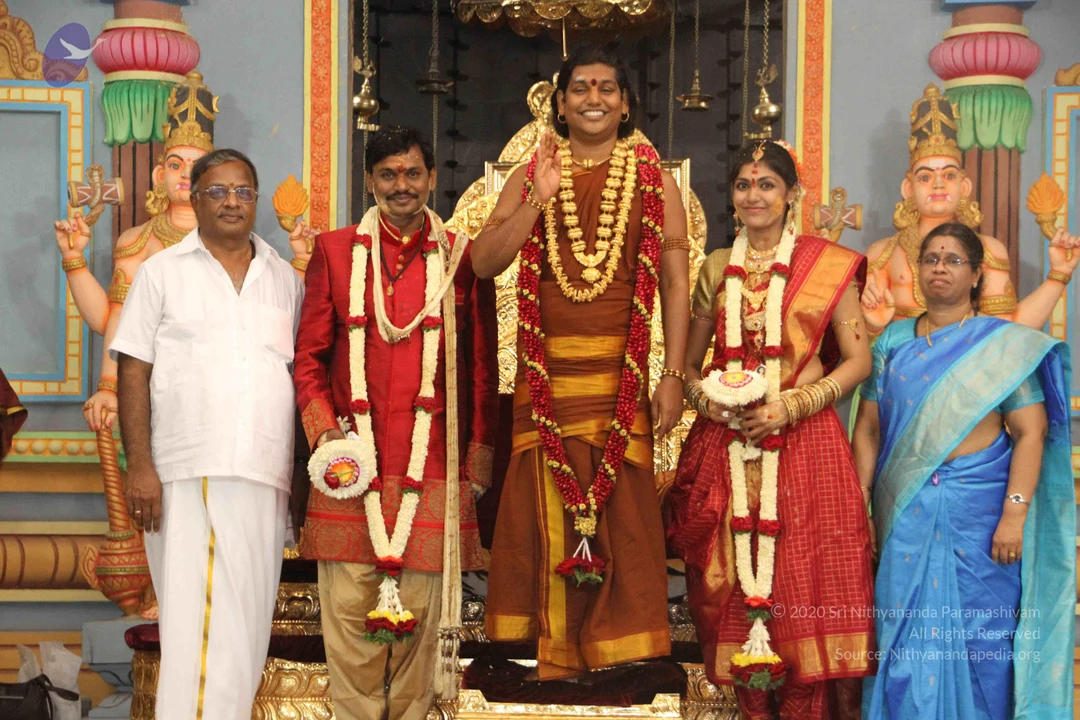
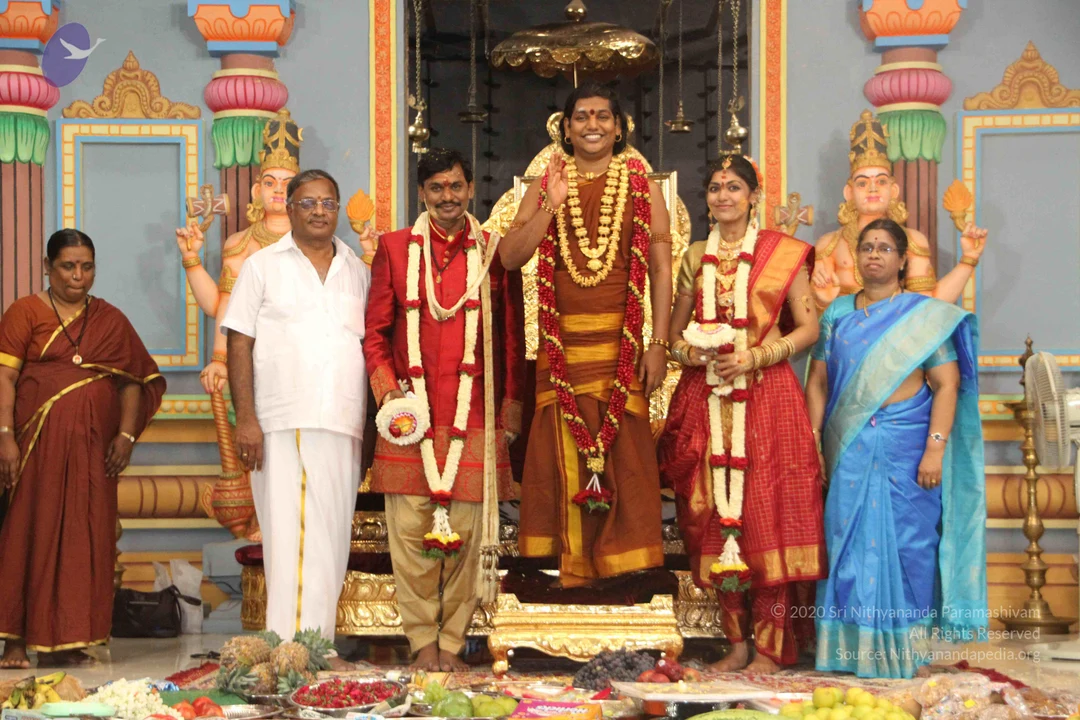
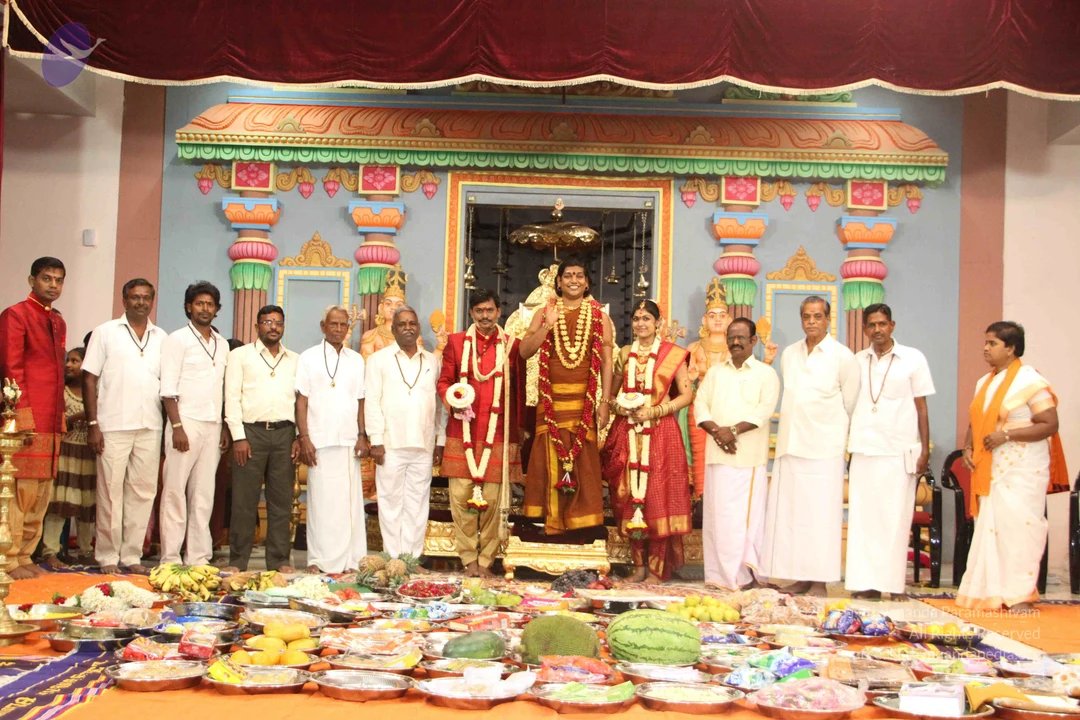
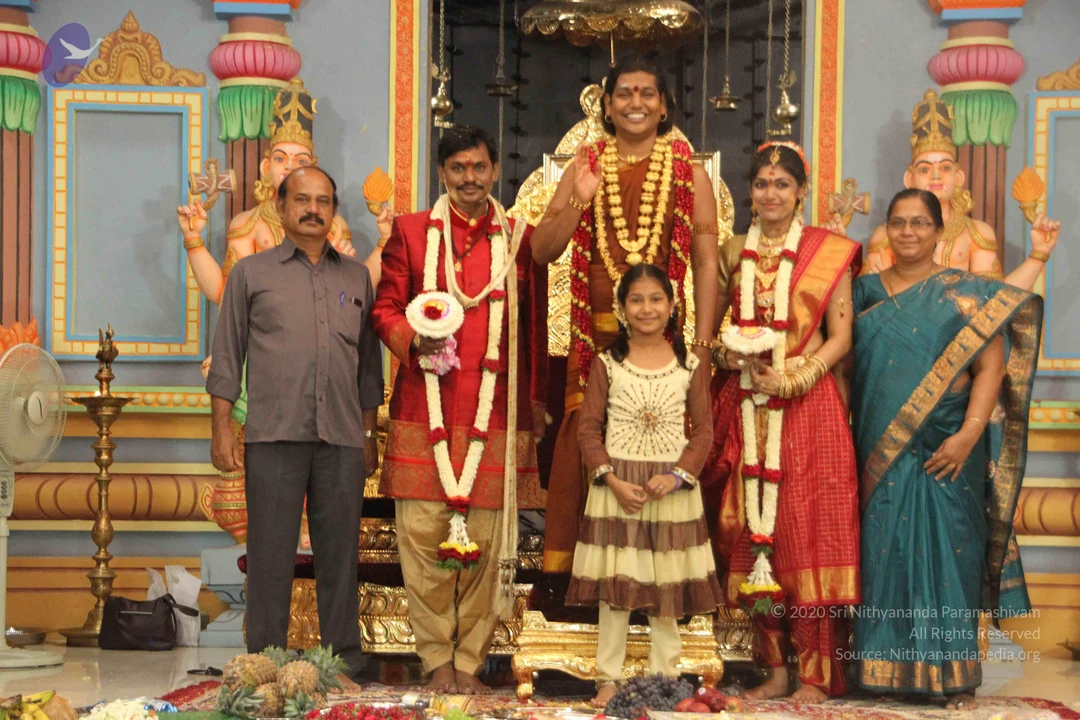
Senthil-Anna-Engagement

Photos Of The Day:

Office-Yoga-Swaminis

Photos Of The Day:

Temple
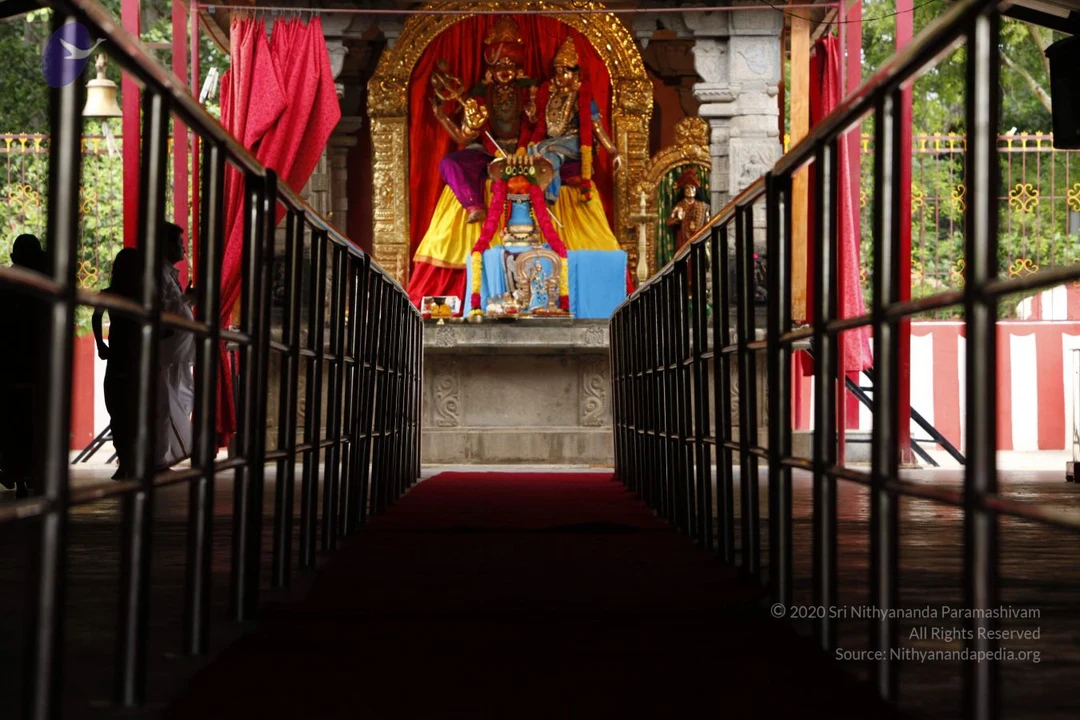
Padduka-Puja

Gurukul-Kids-Group-Temple-Instrument

Satsang-Swamiji-Crowd

Sarva-Darshan

Photos Of The Day:

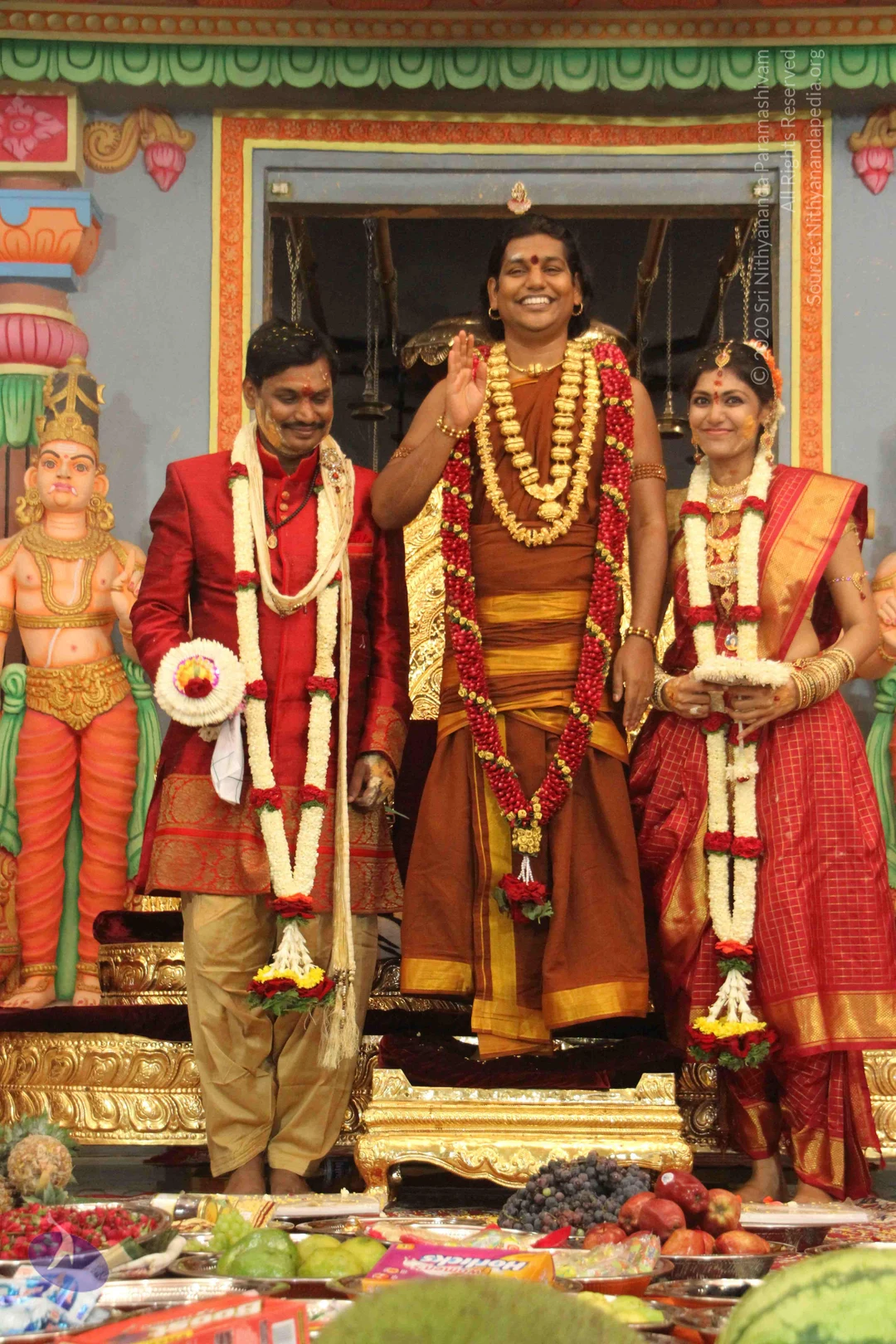
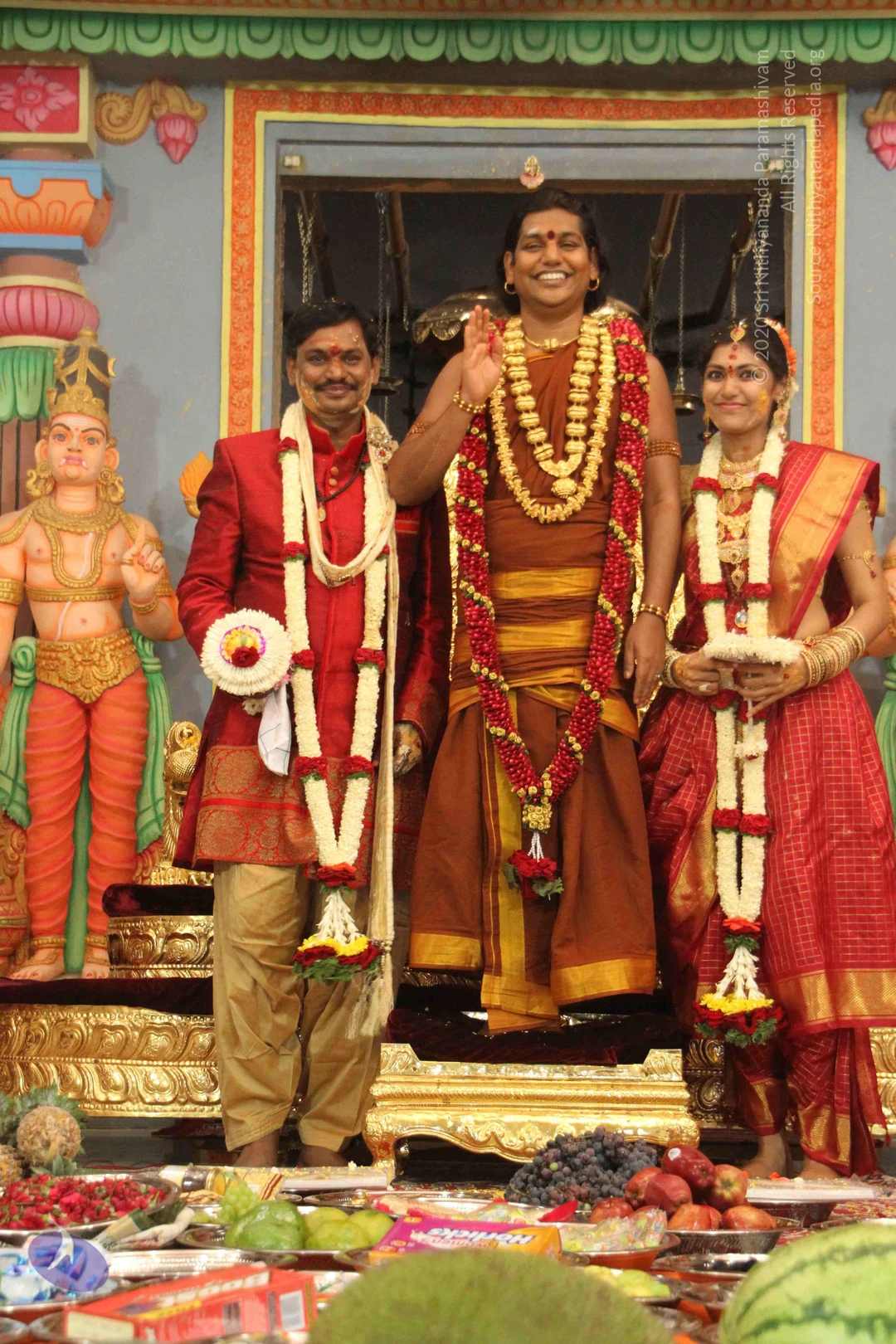
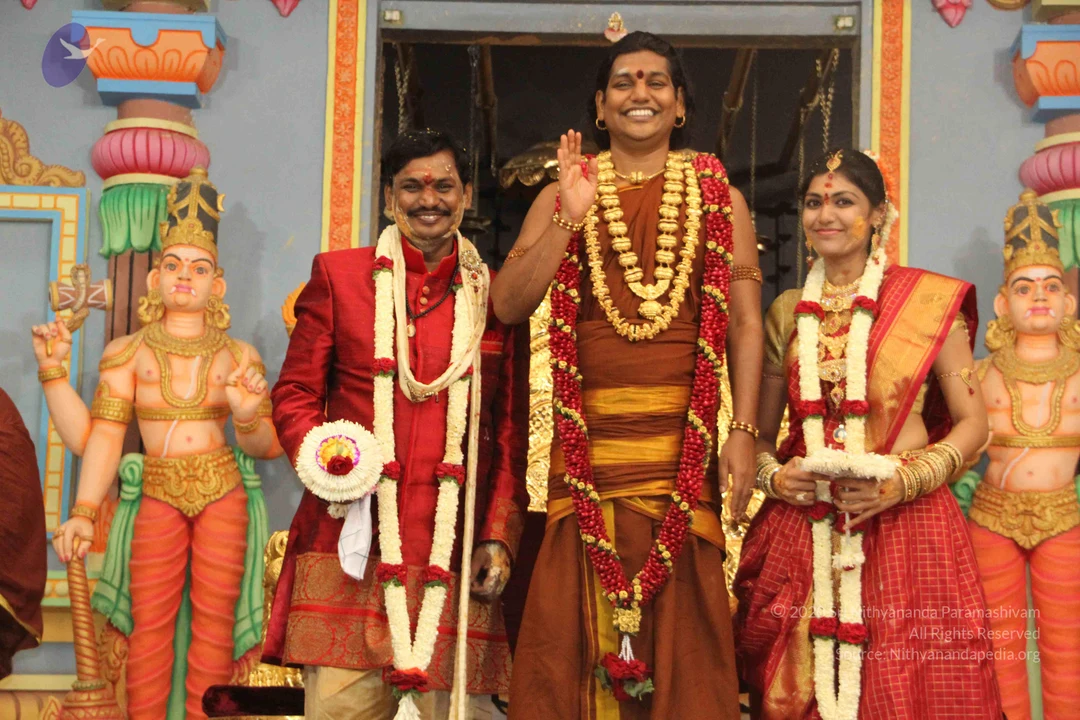
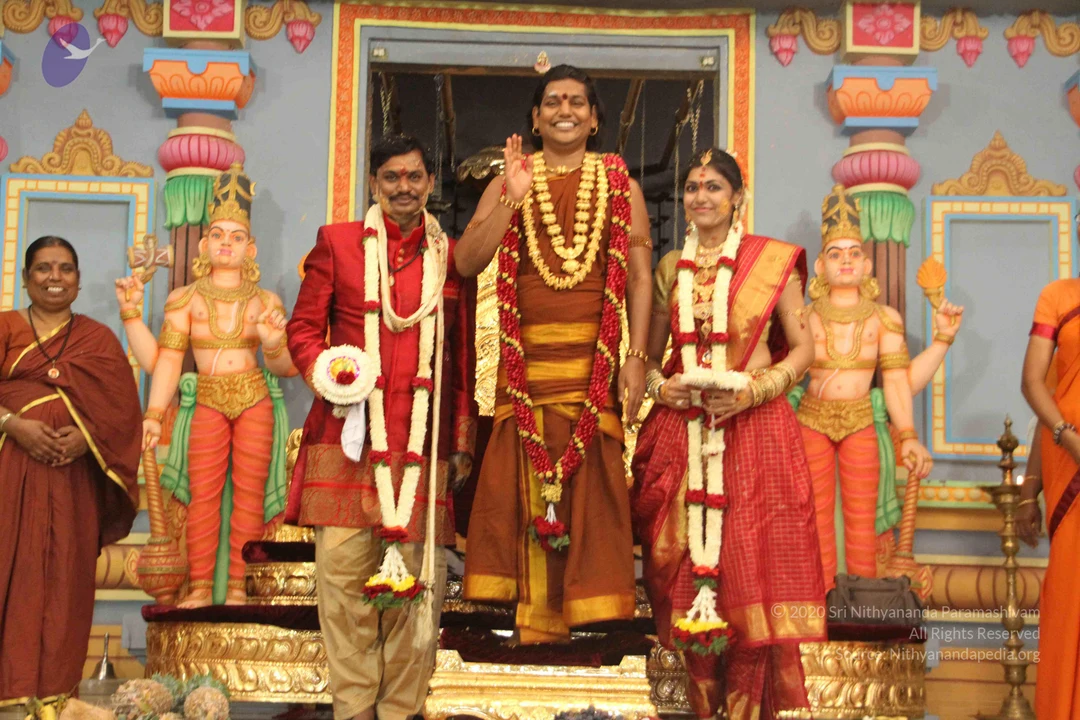
Senthil-Anna-Engagement

Photos Of The Day:

Temple
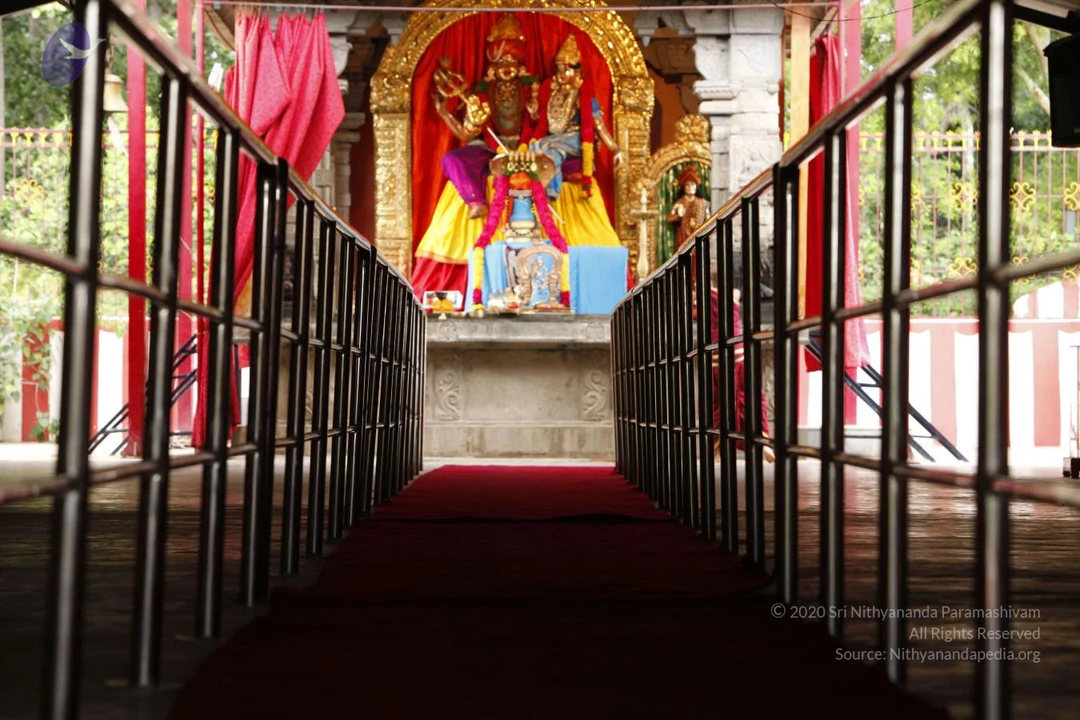
Padduka-Puja

Satsang-Swamiji-Crowd

Sarva-Darshan

Final-Blessing

Garbha-Mandir

Photos Of The Day:

01-Senthil-Anna-Engagement

01-ADIKAILASA-TEMPLE

02-PADUKA-PUJA

03-NITHYA-SATSANG

04-BLESSINGS

Photos from this day

View all 489 photos

Photos

13 photosSource gallery
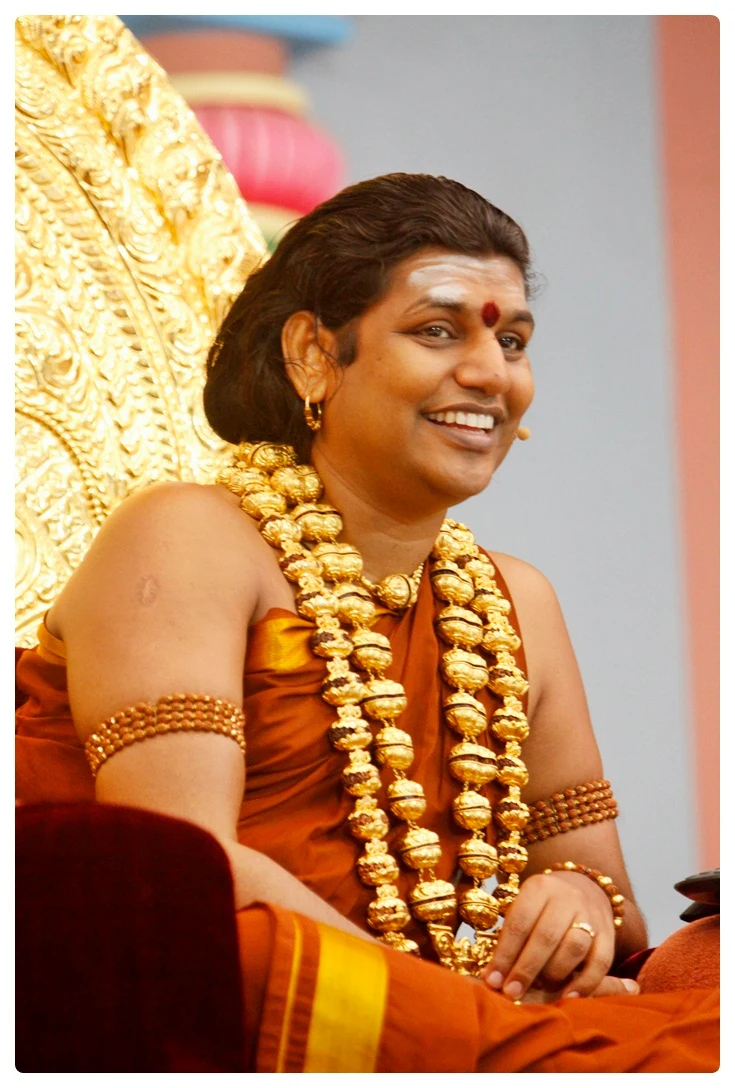
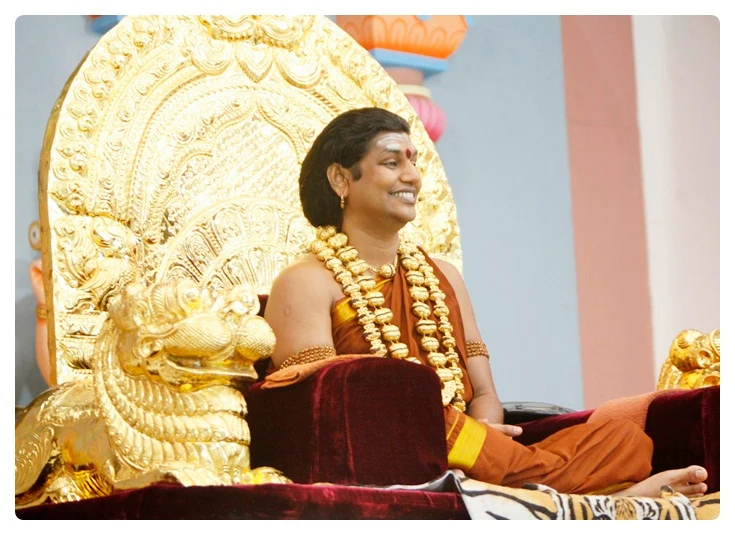
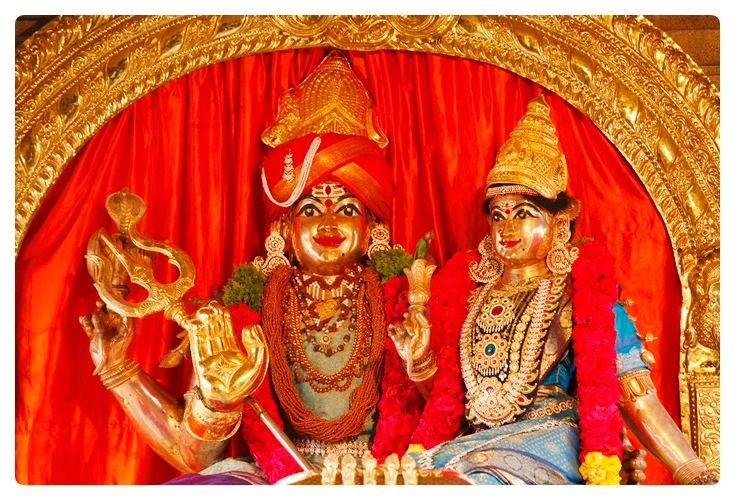
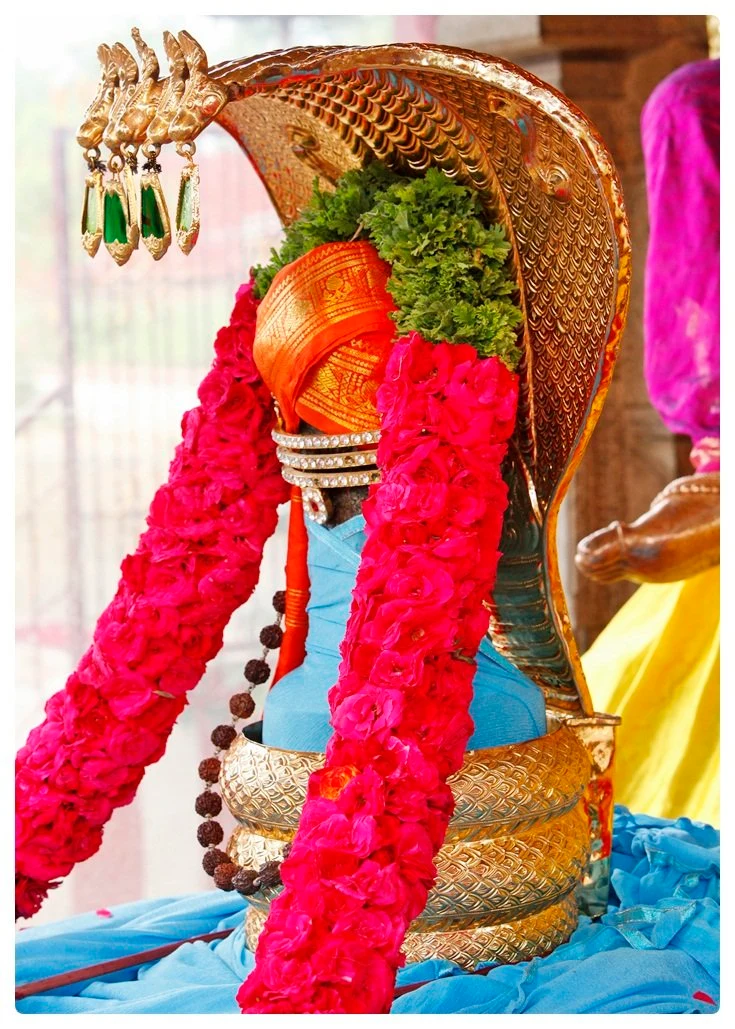
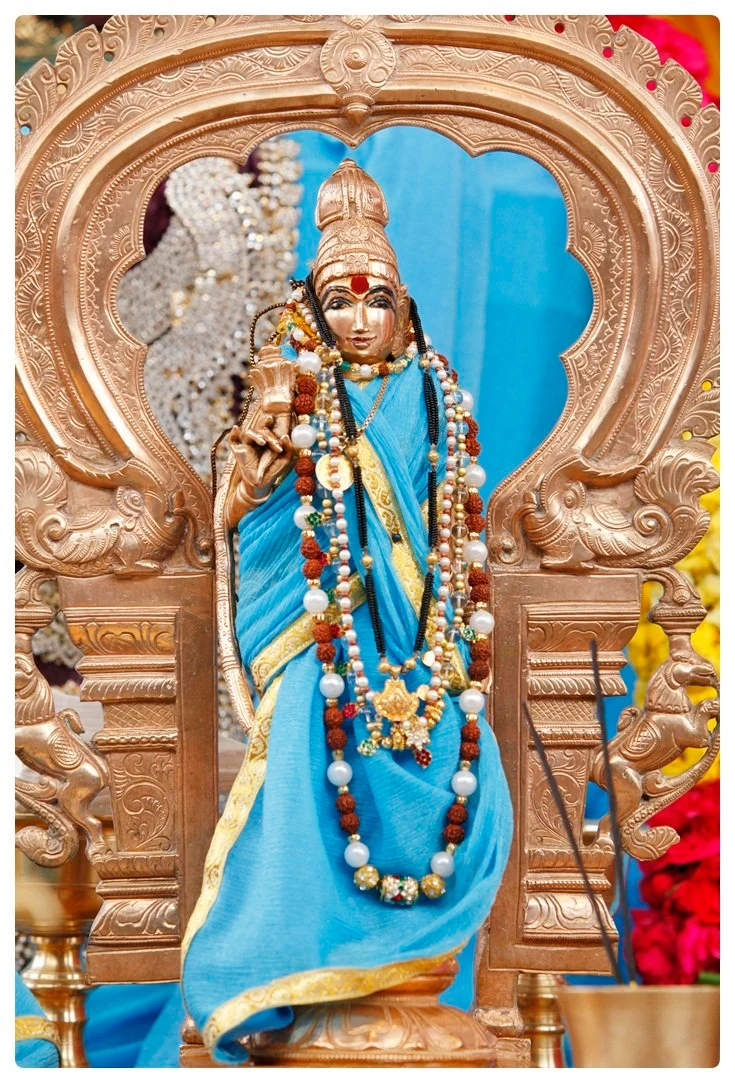
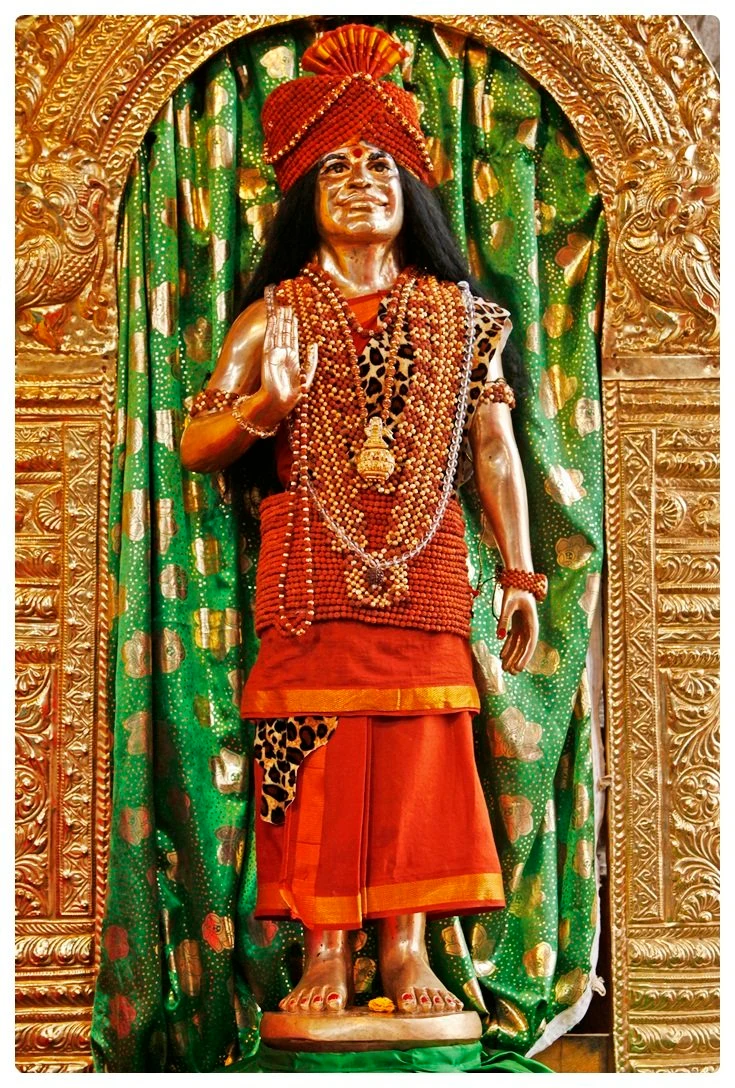
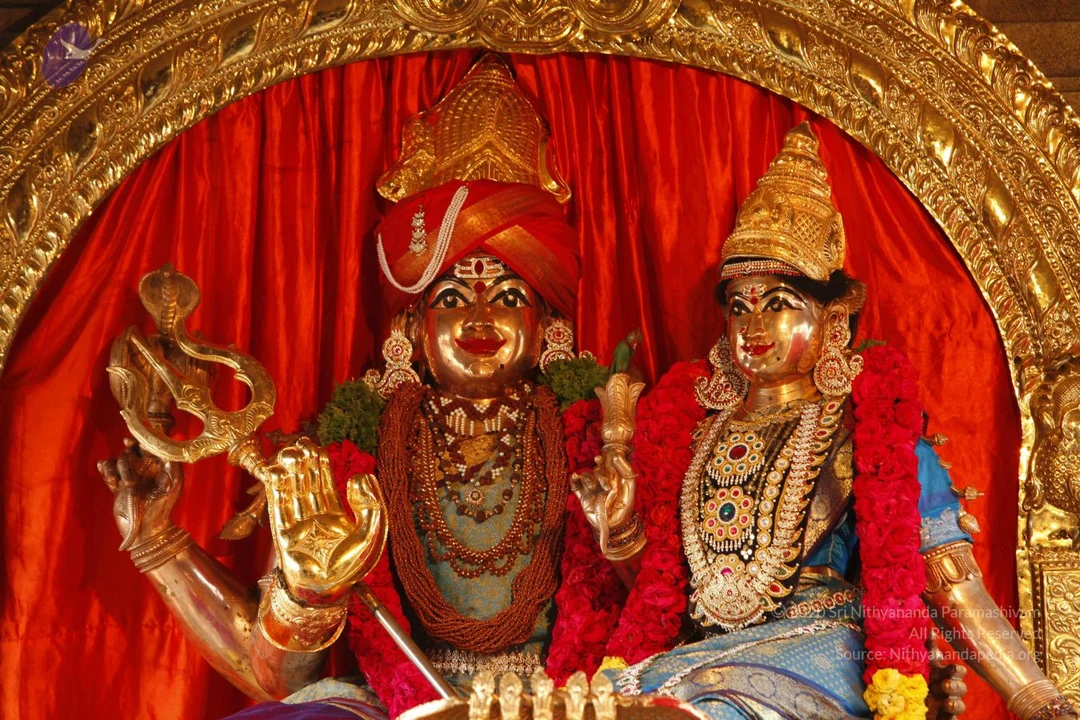
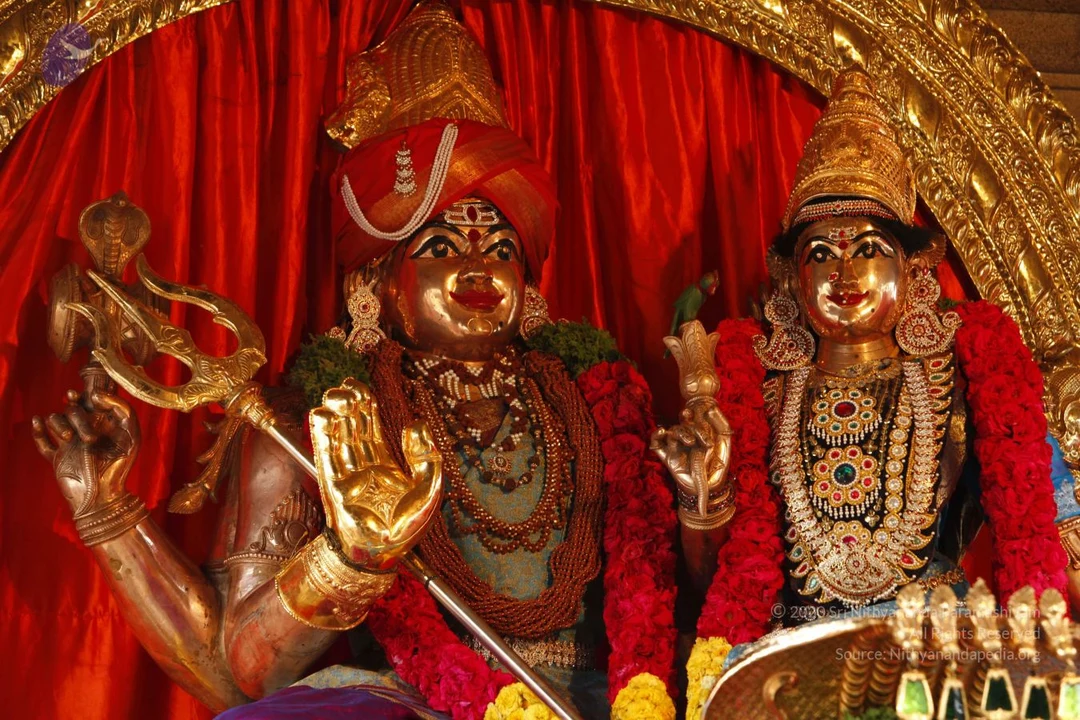
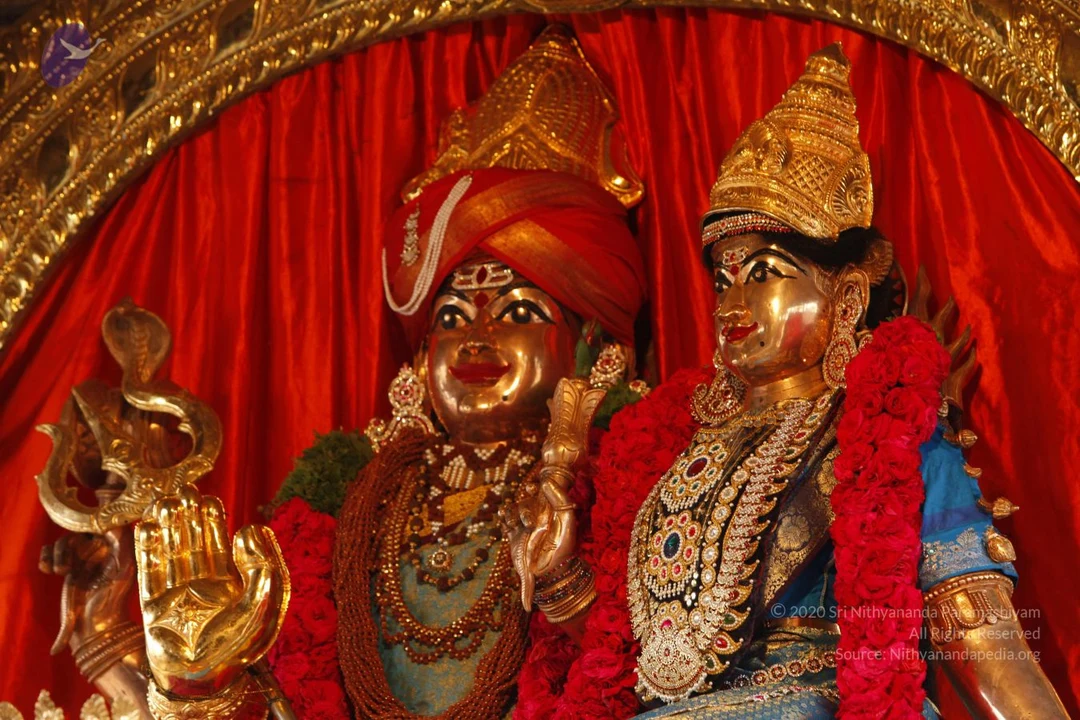
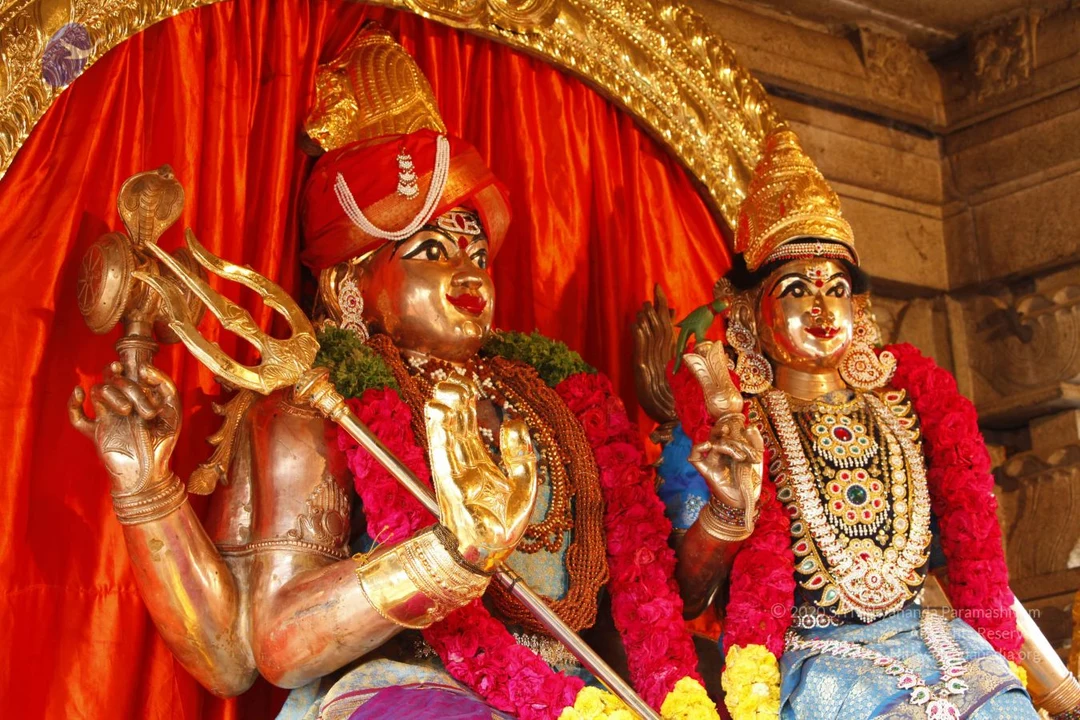
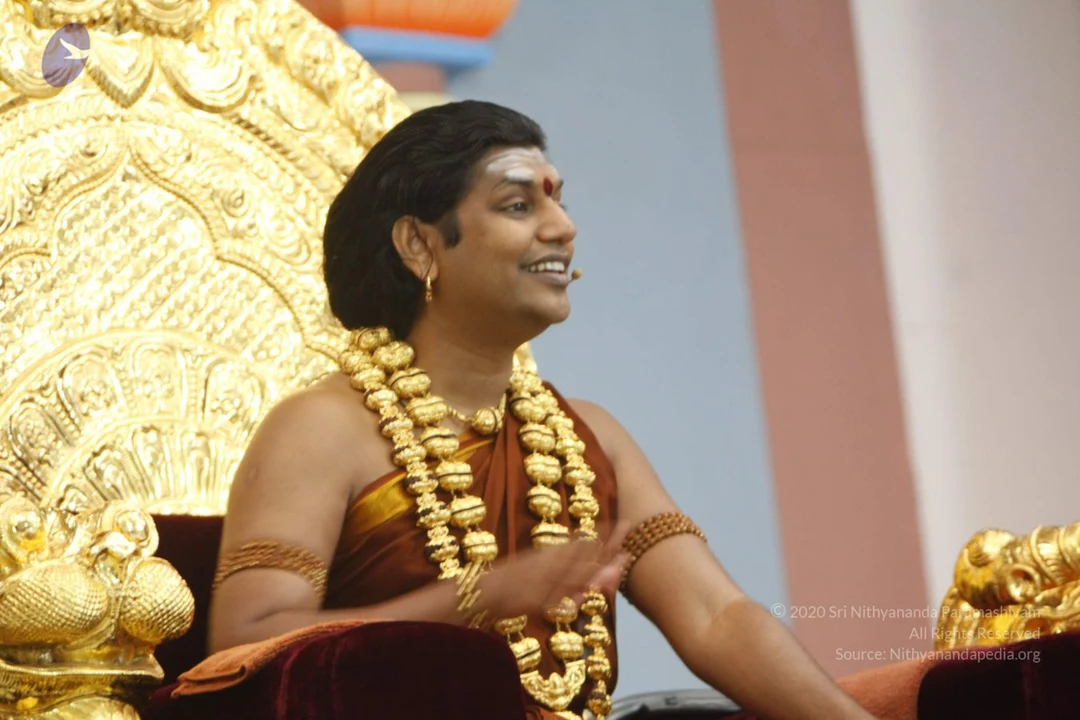
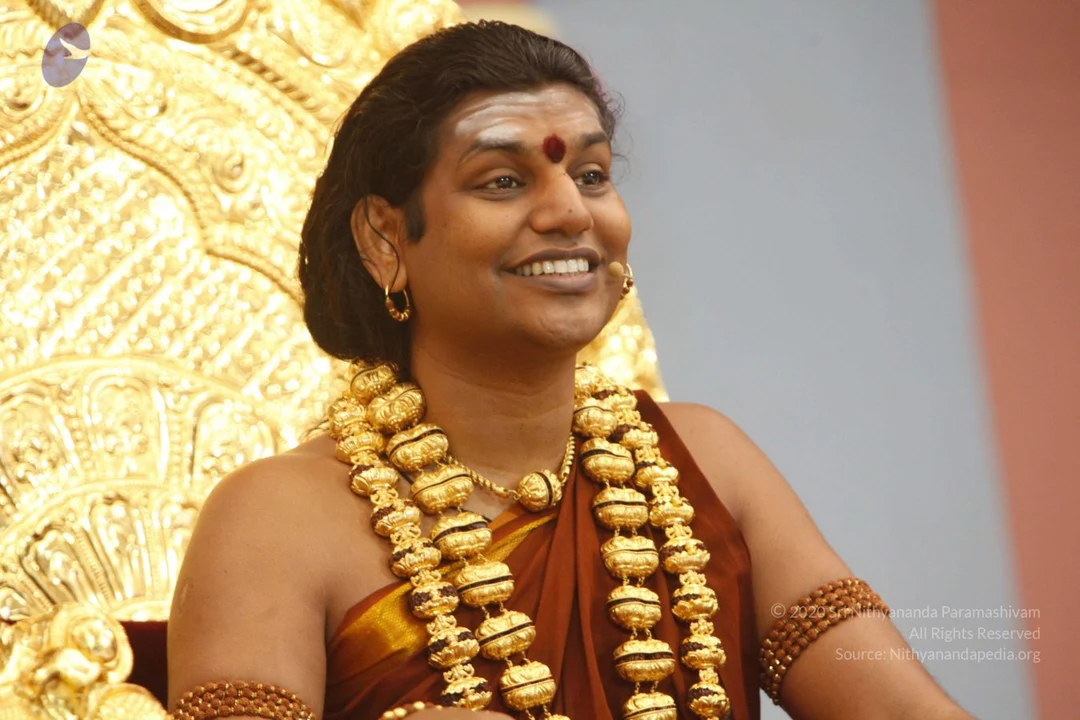
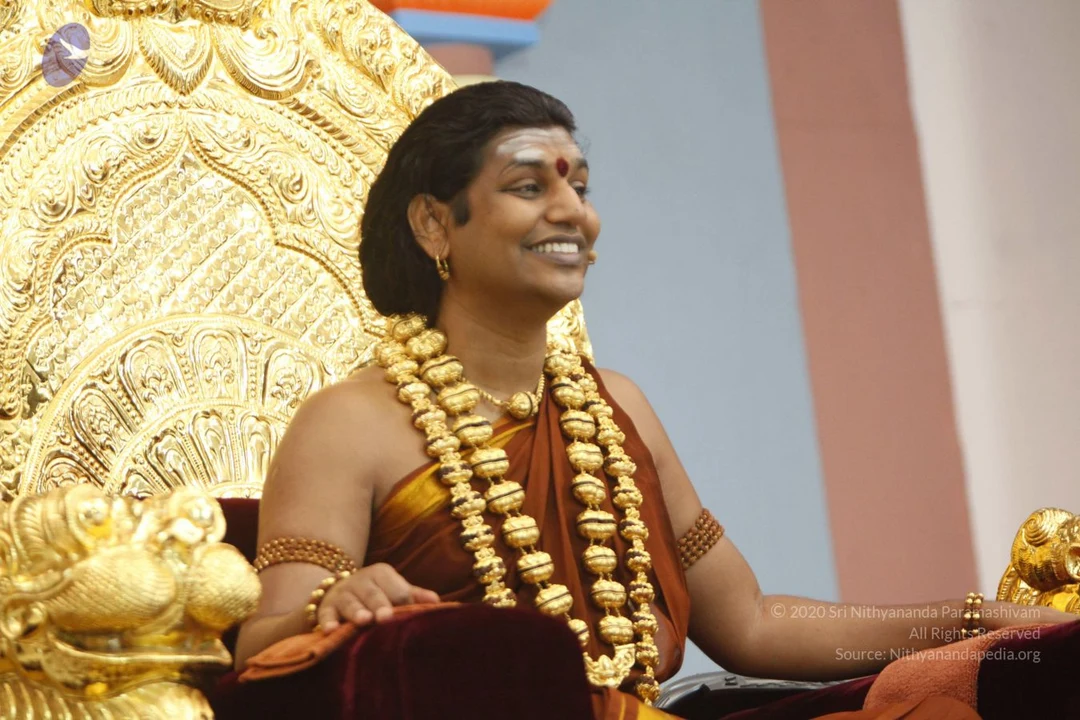
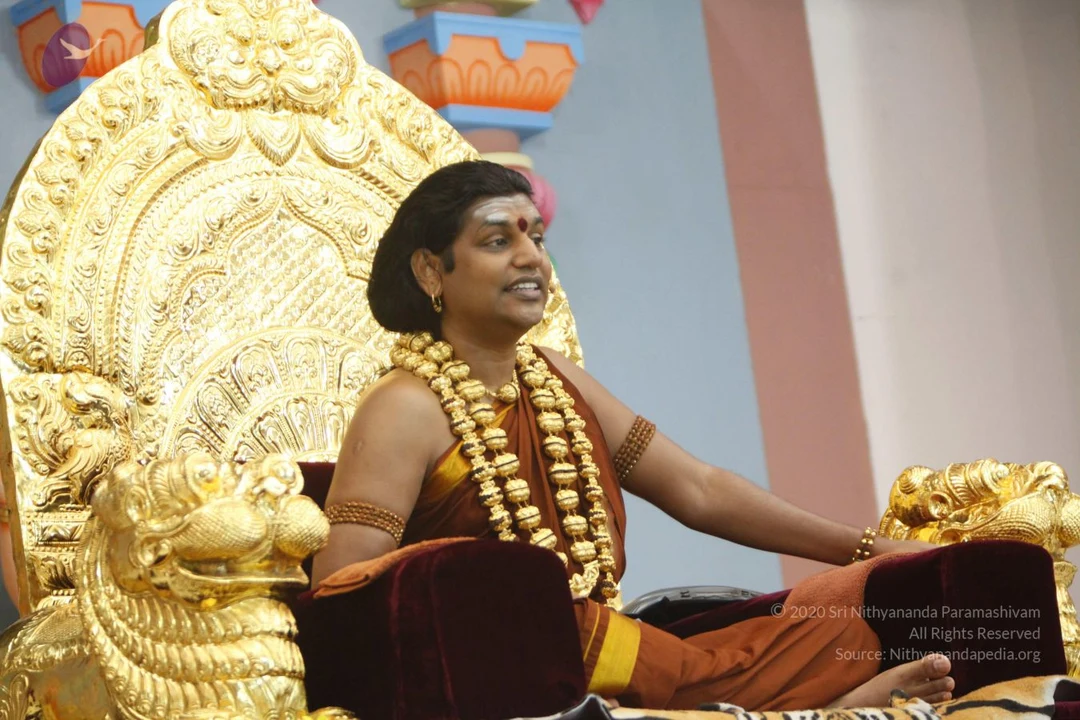
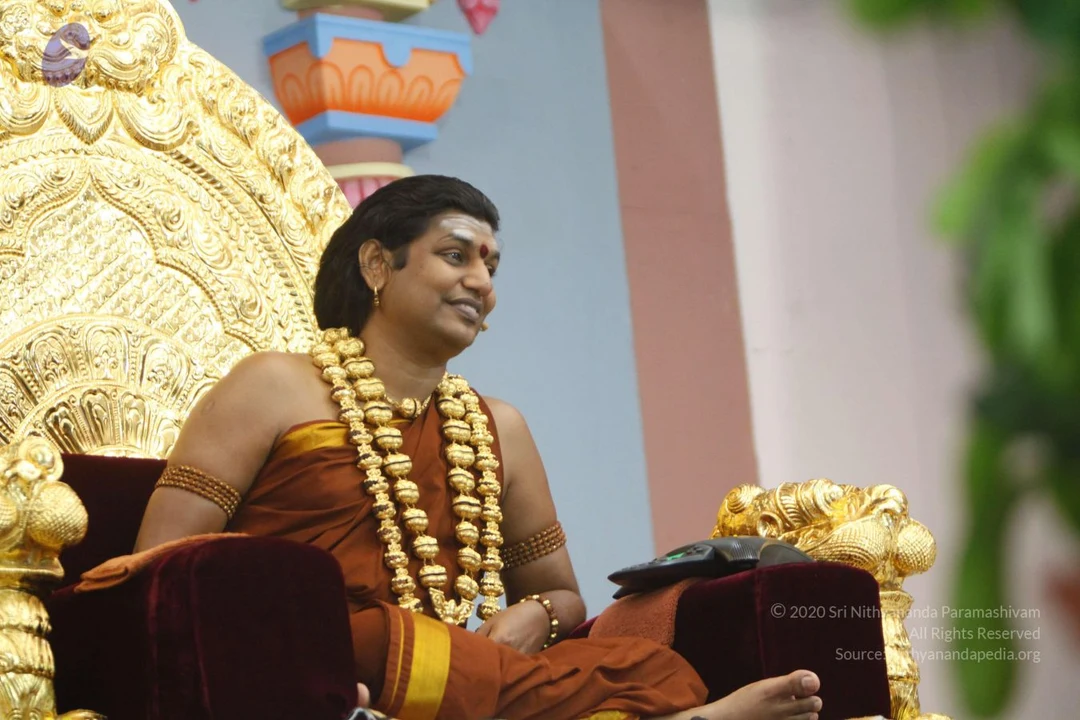
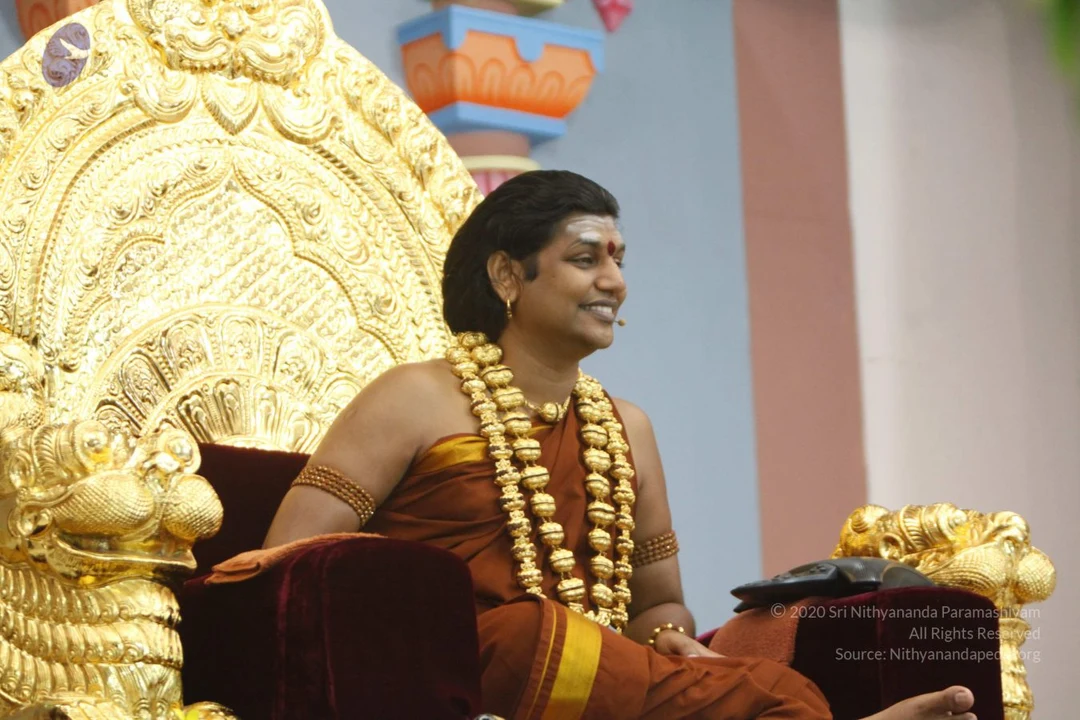
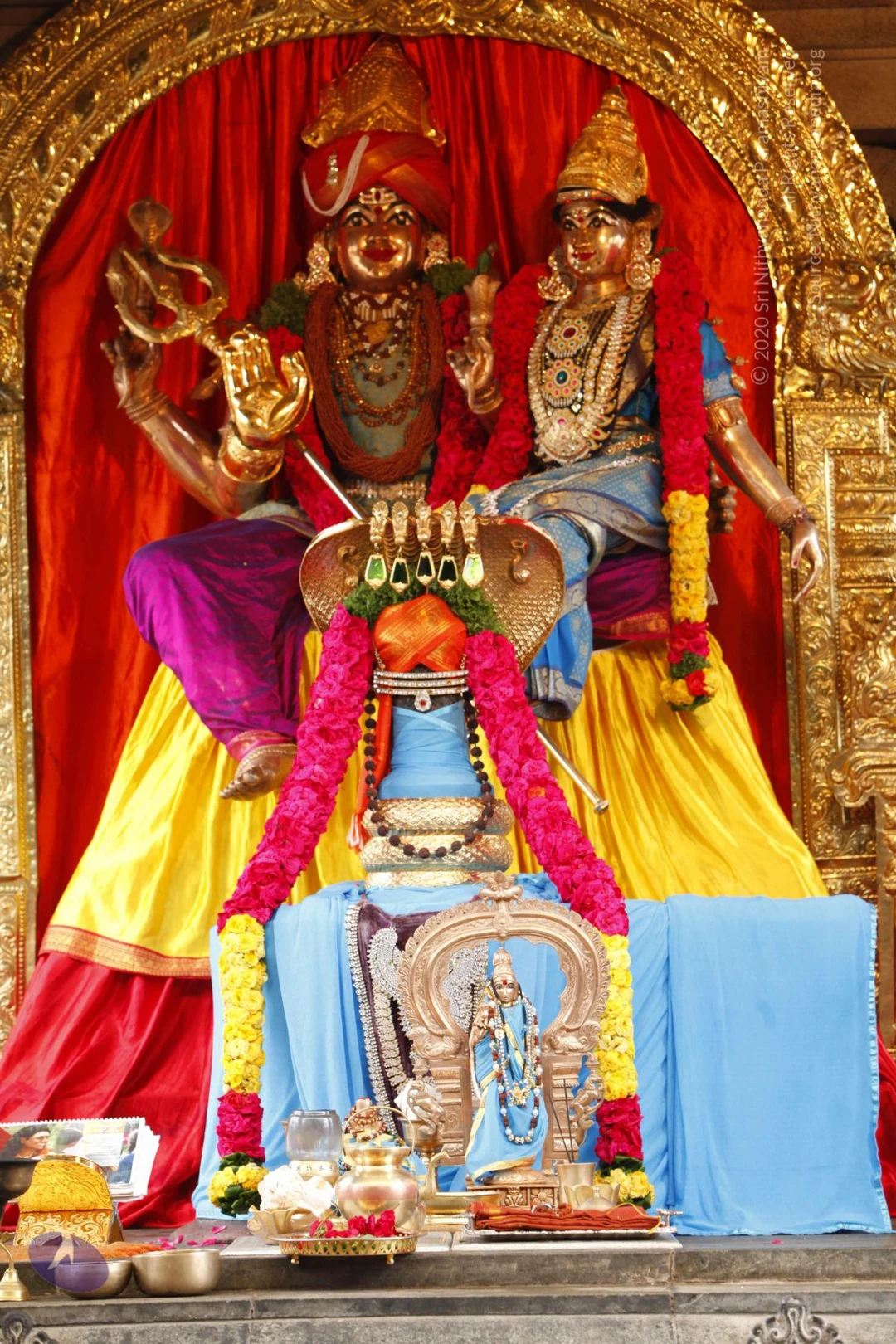
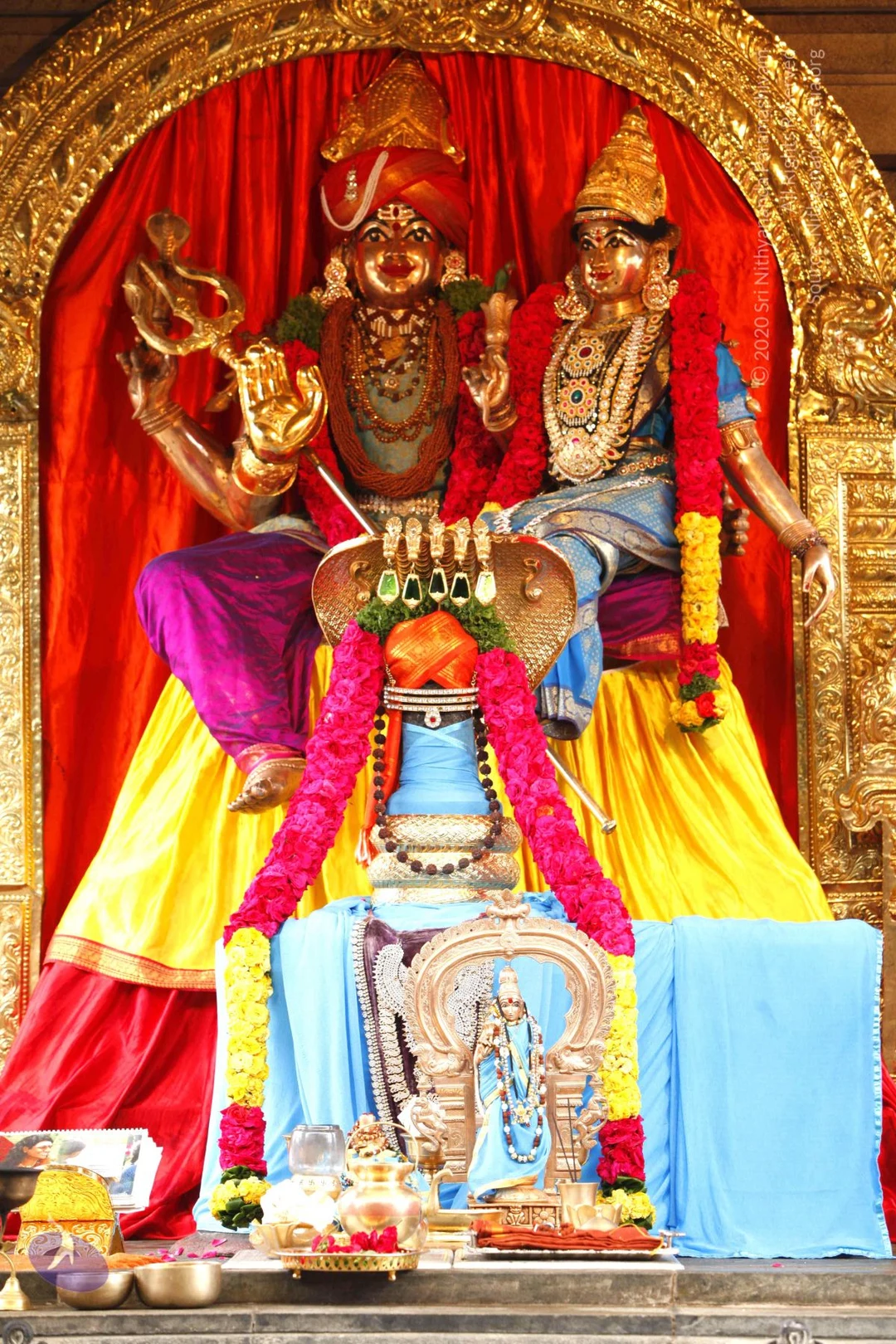
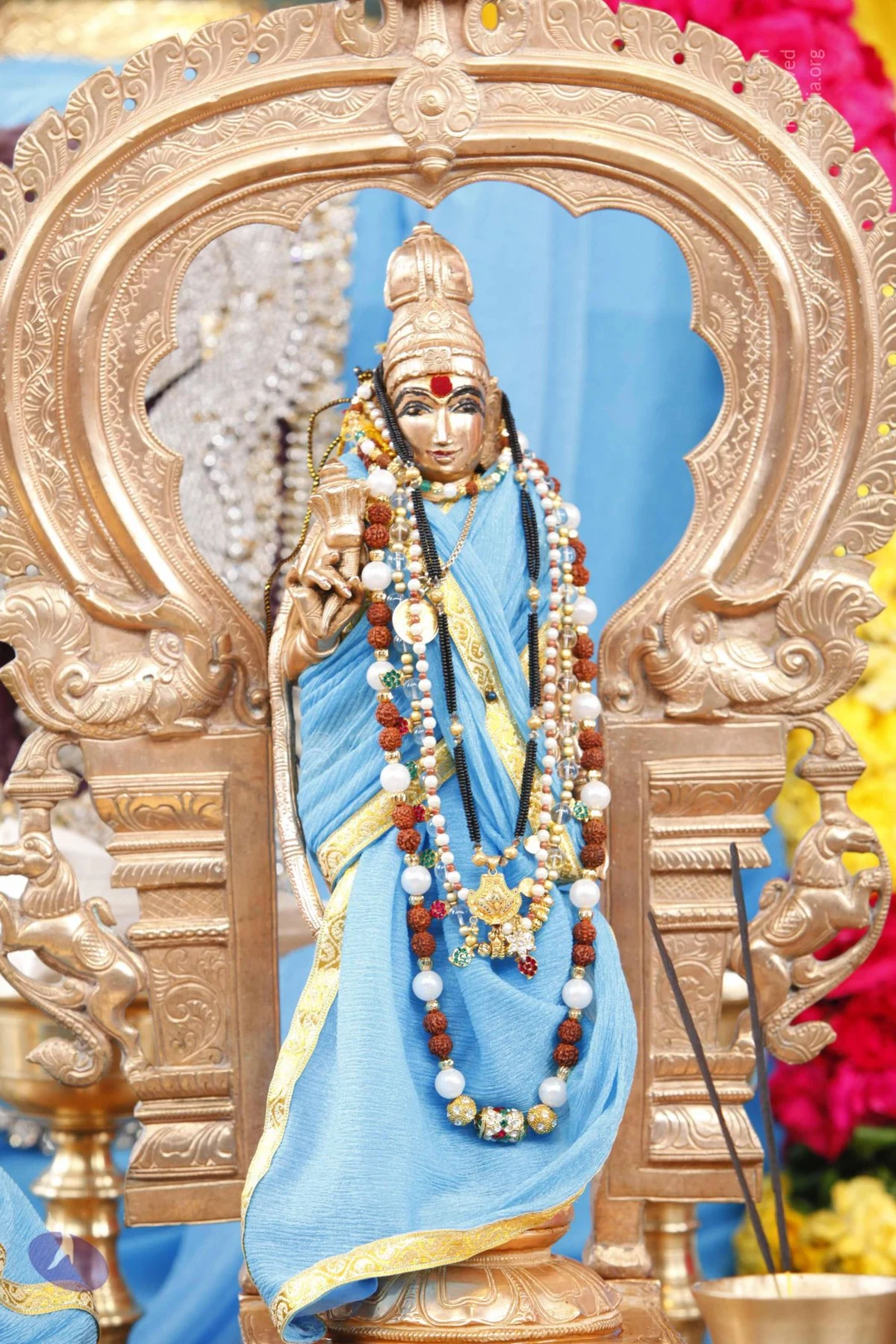
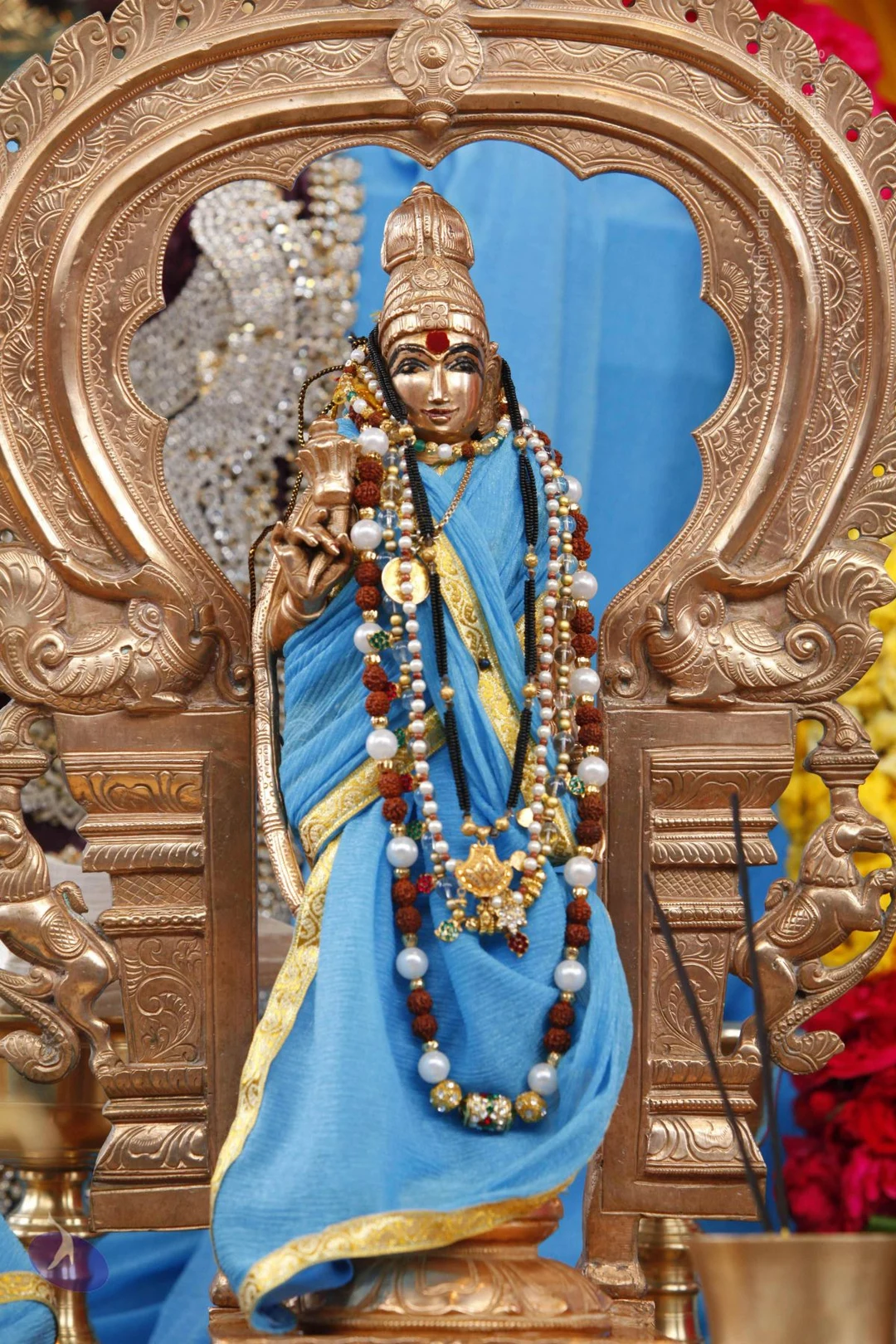
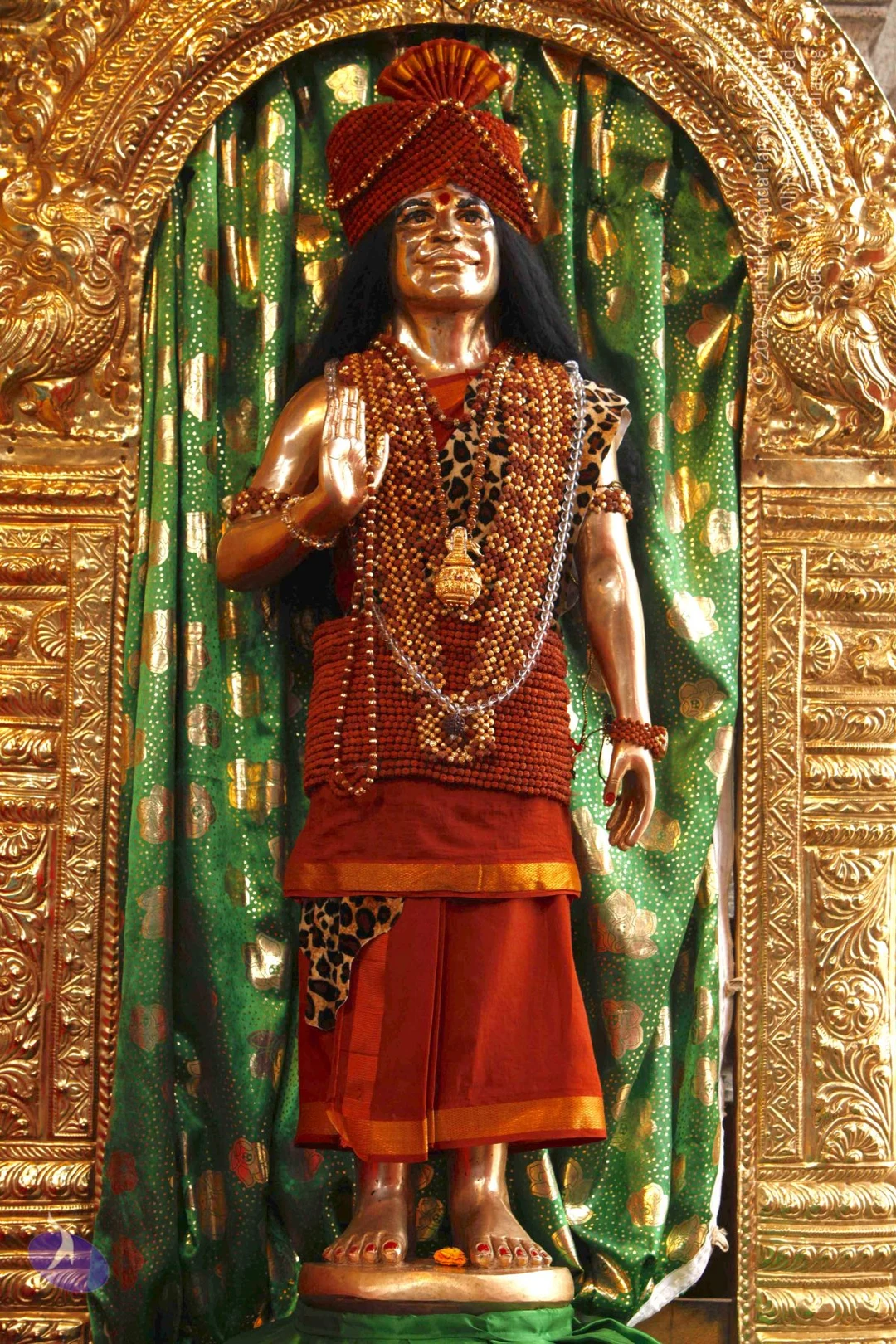
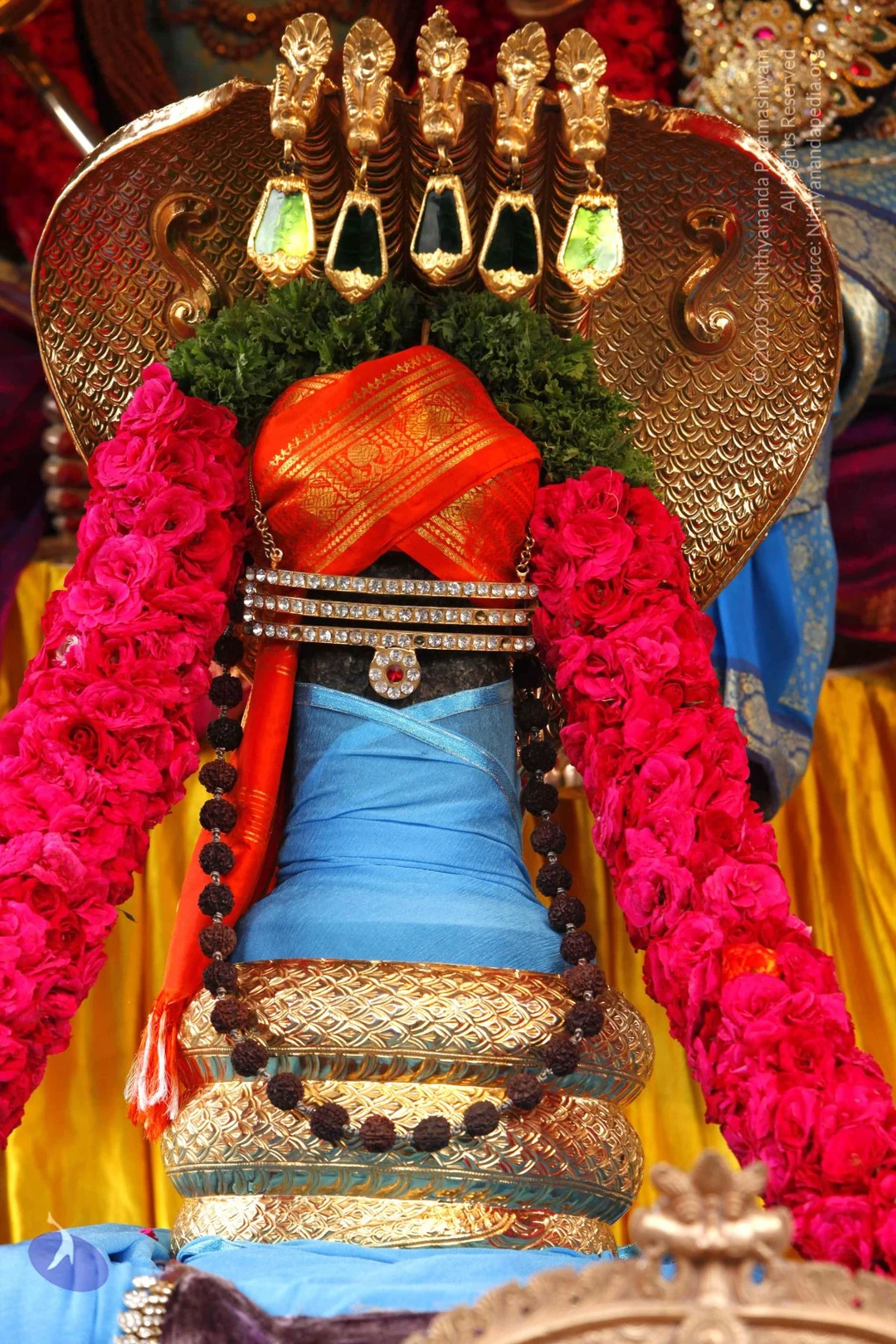
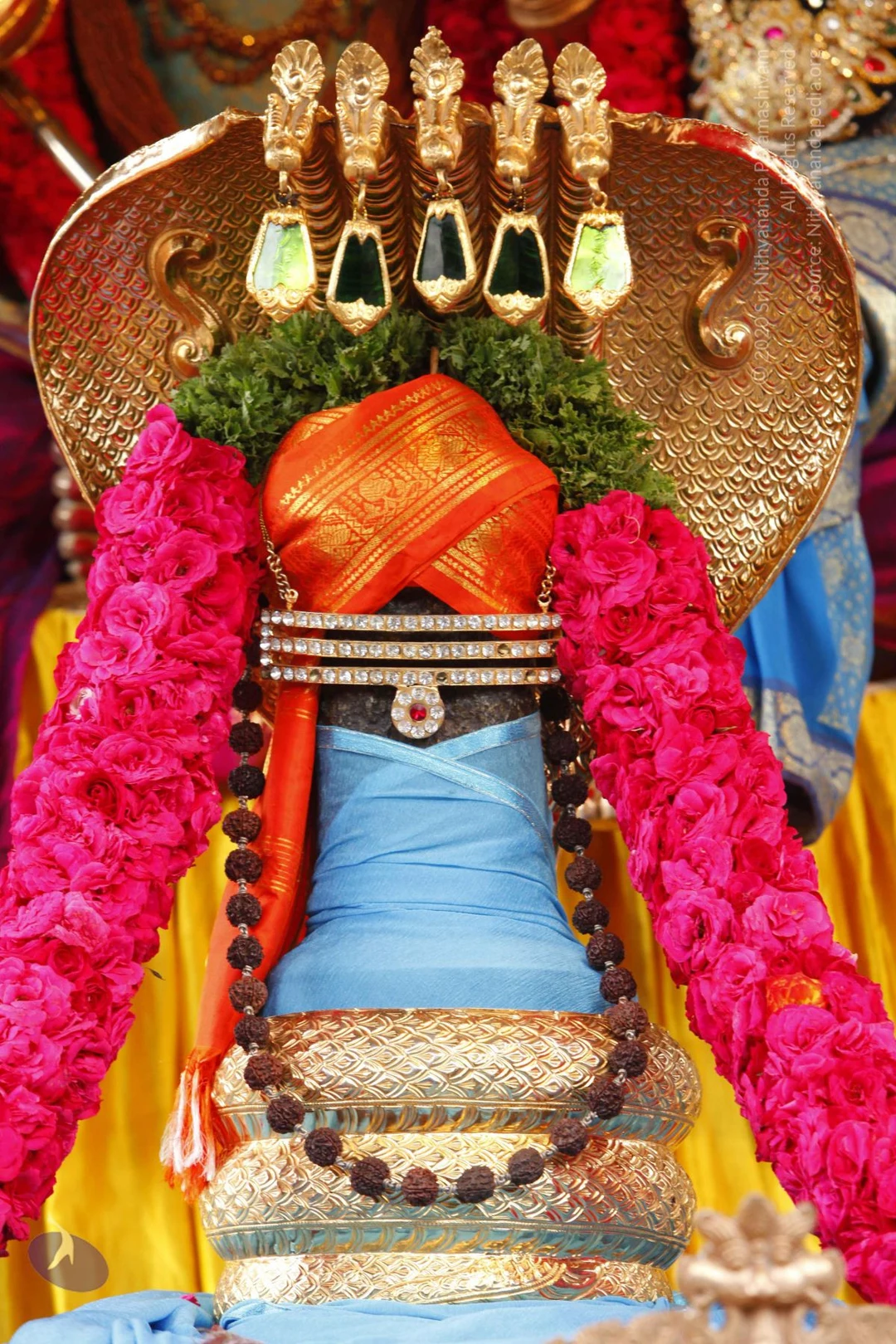
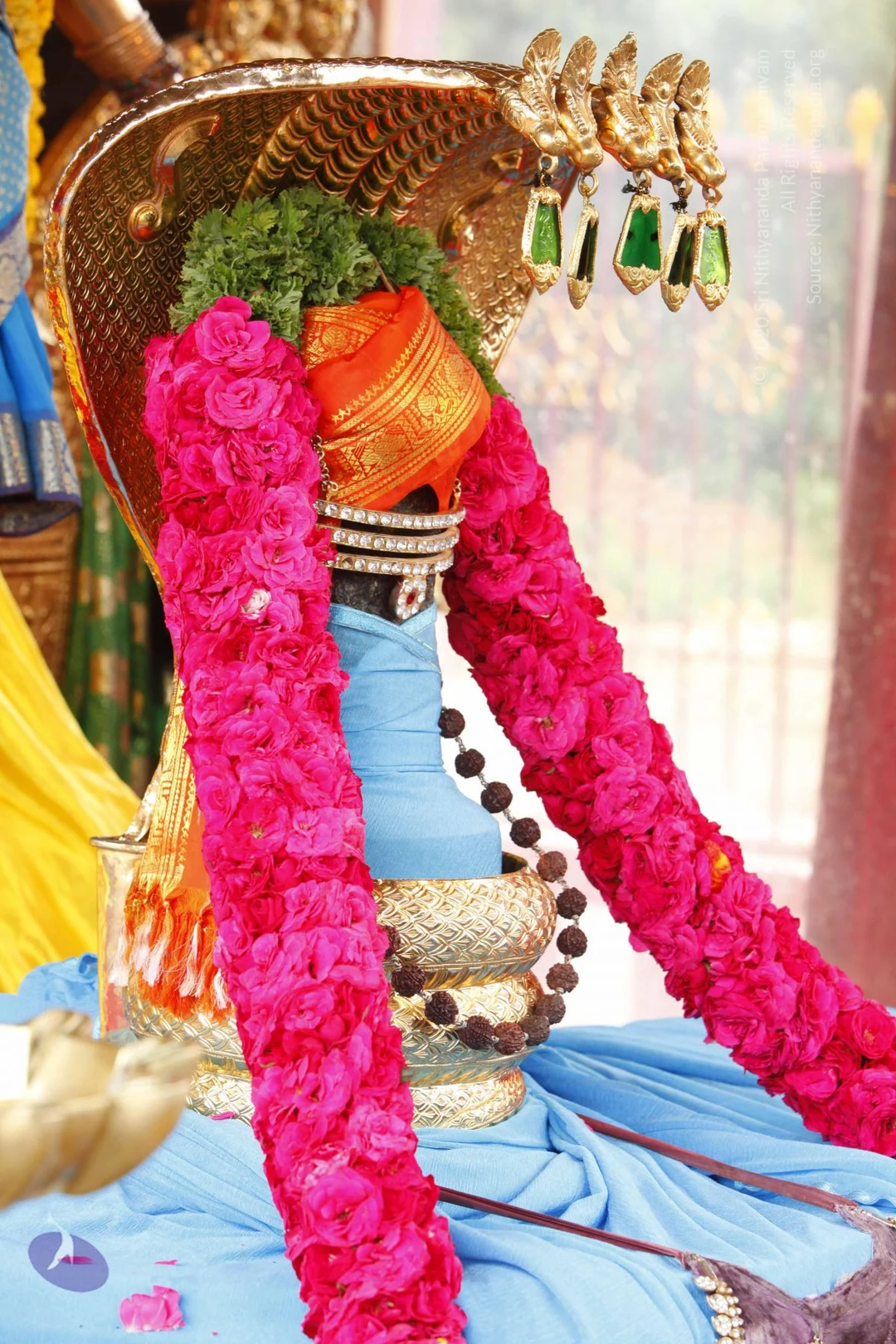
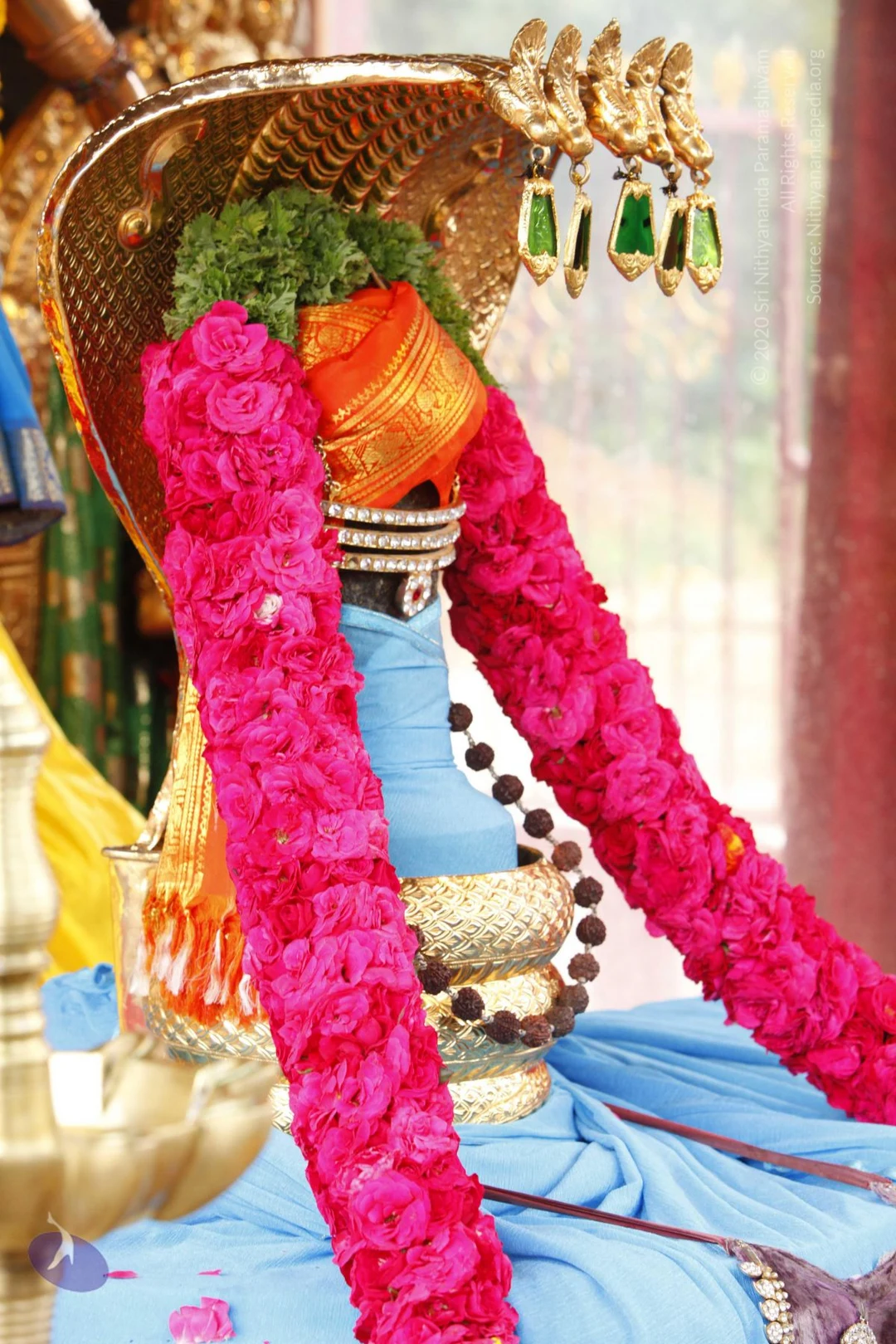
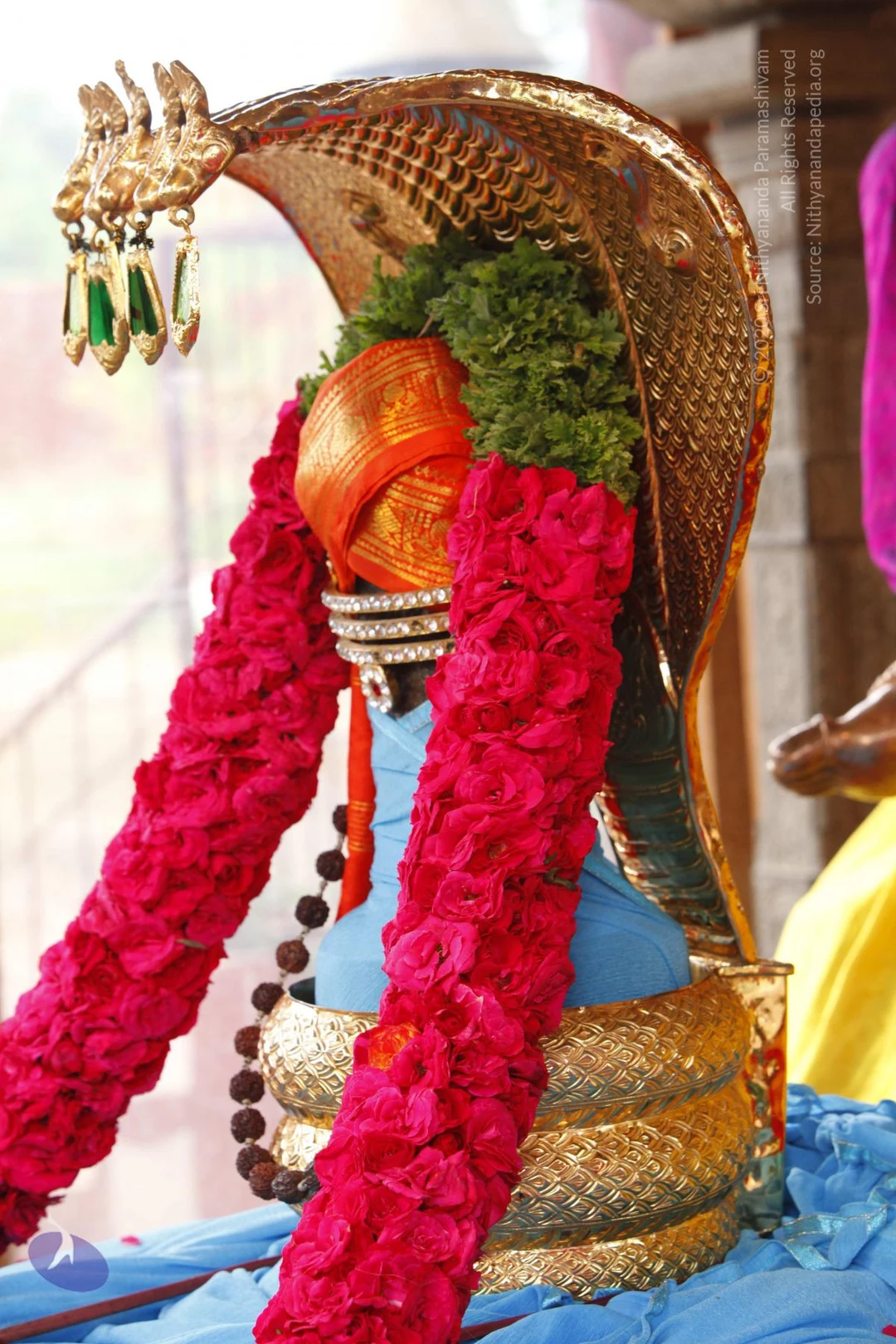
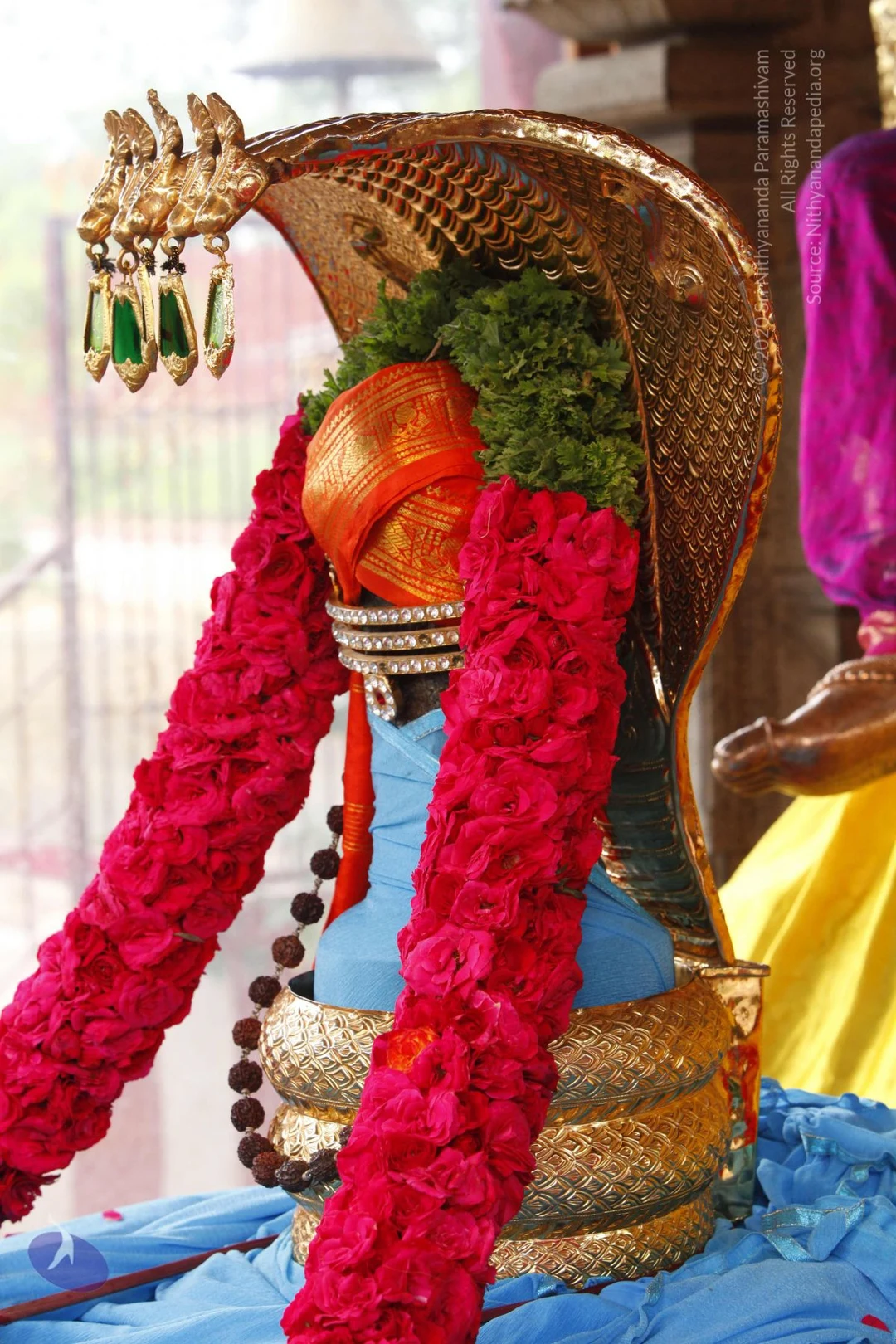
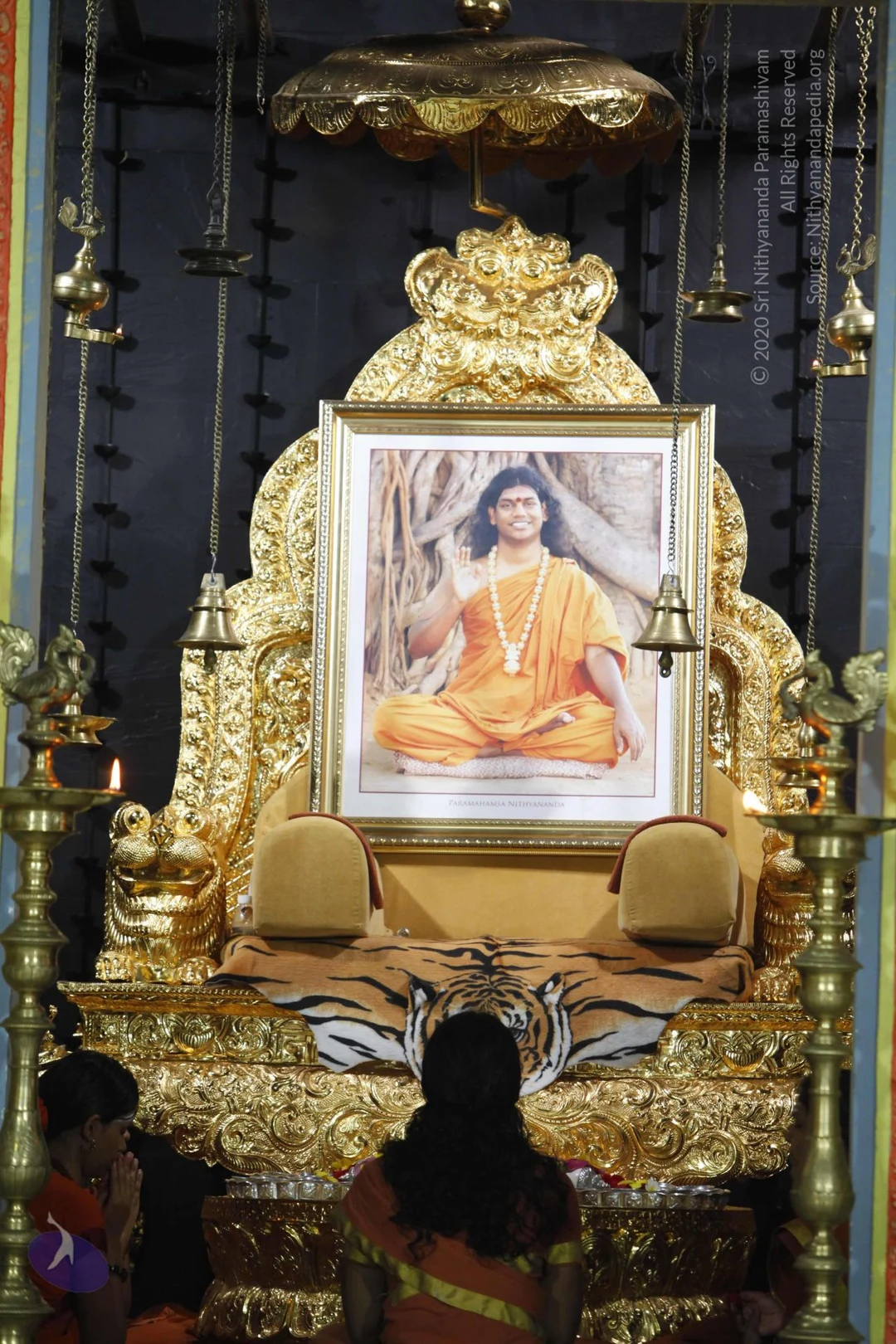
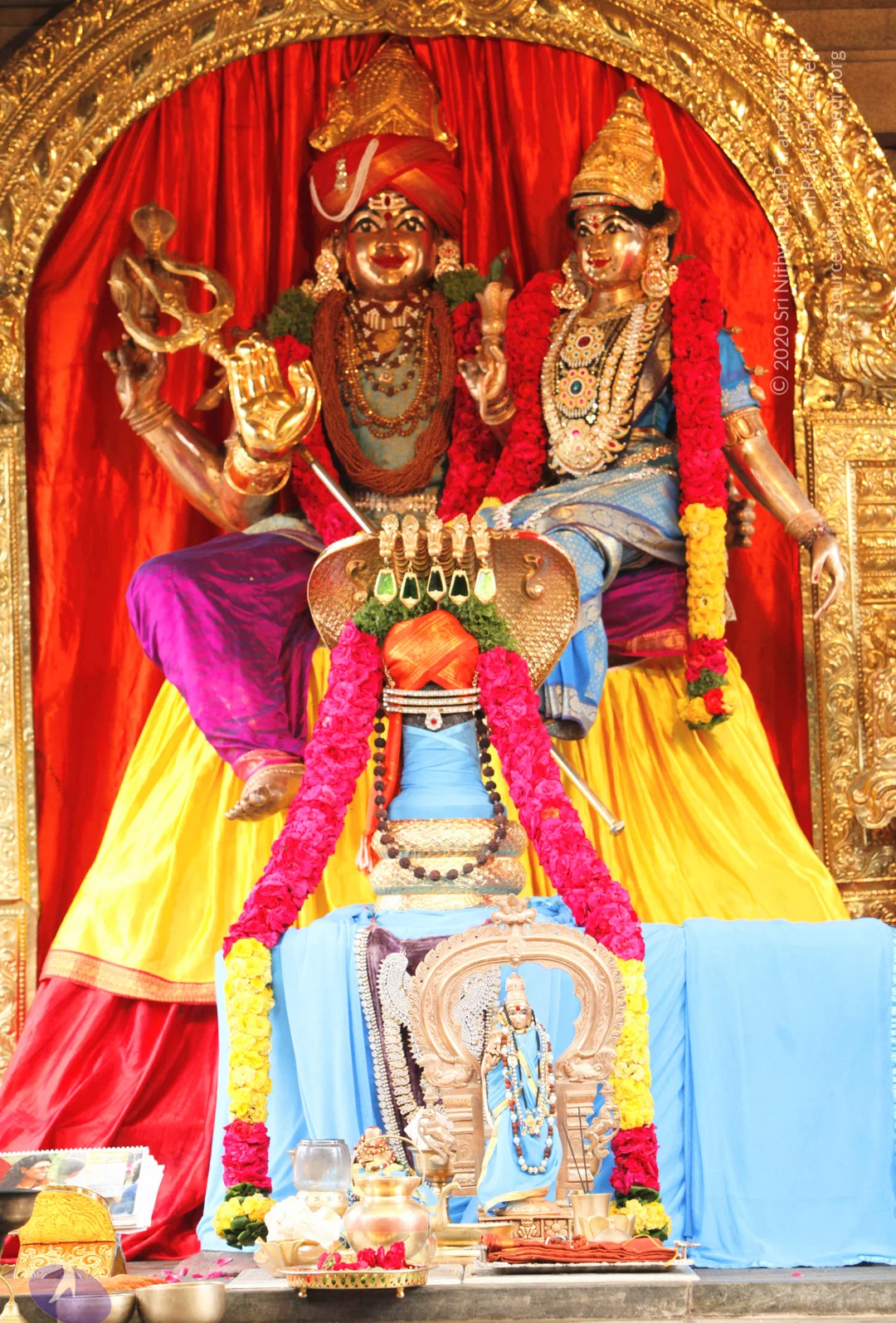
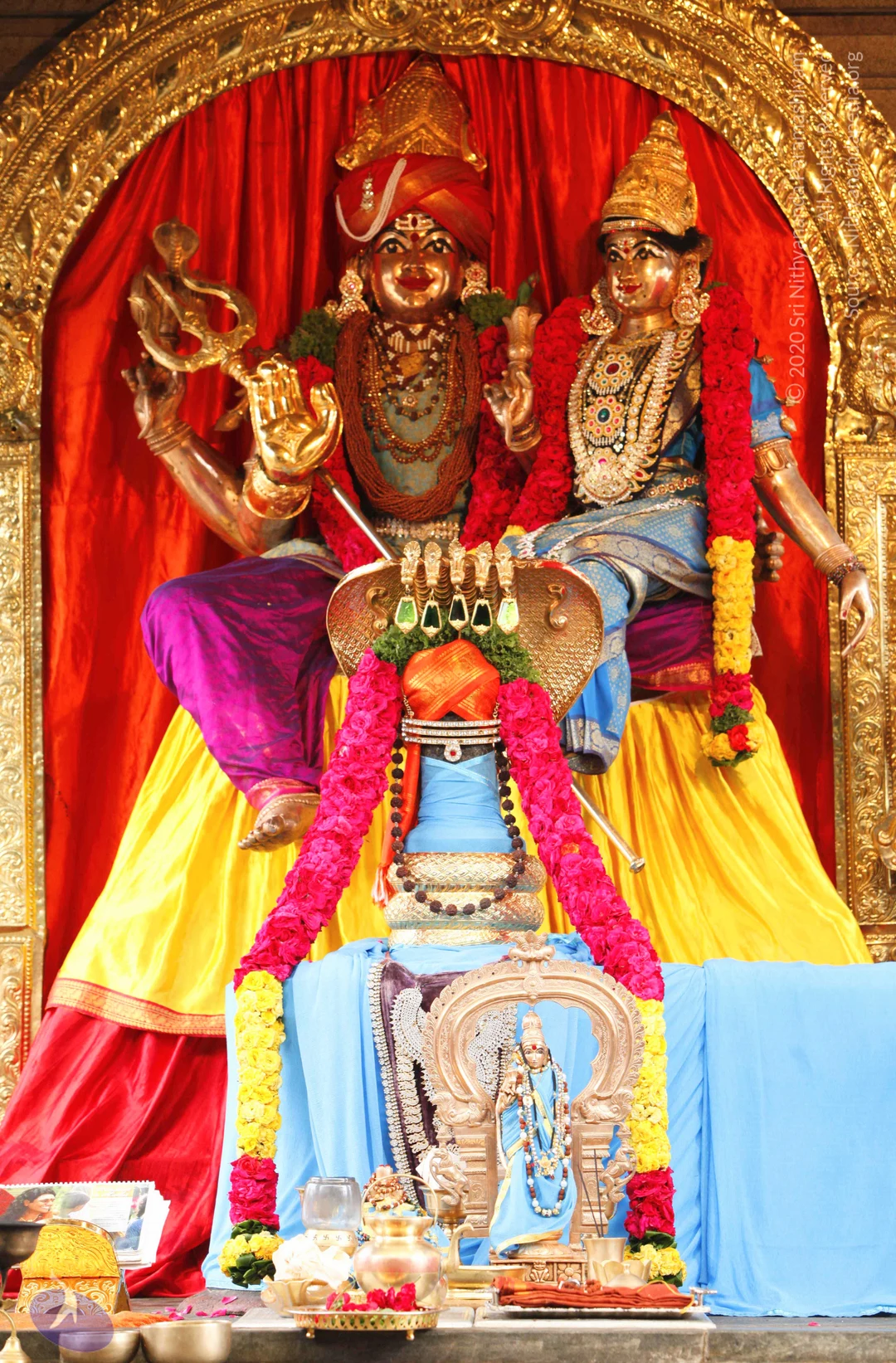
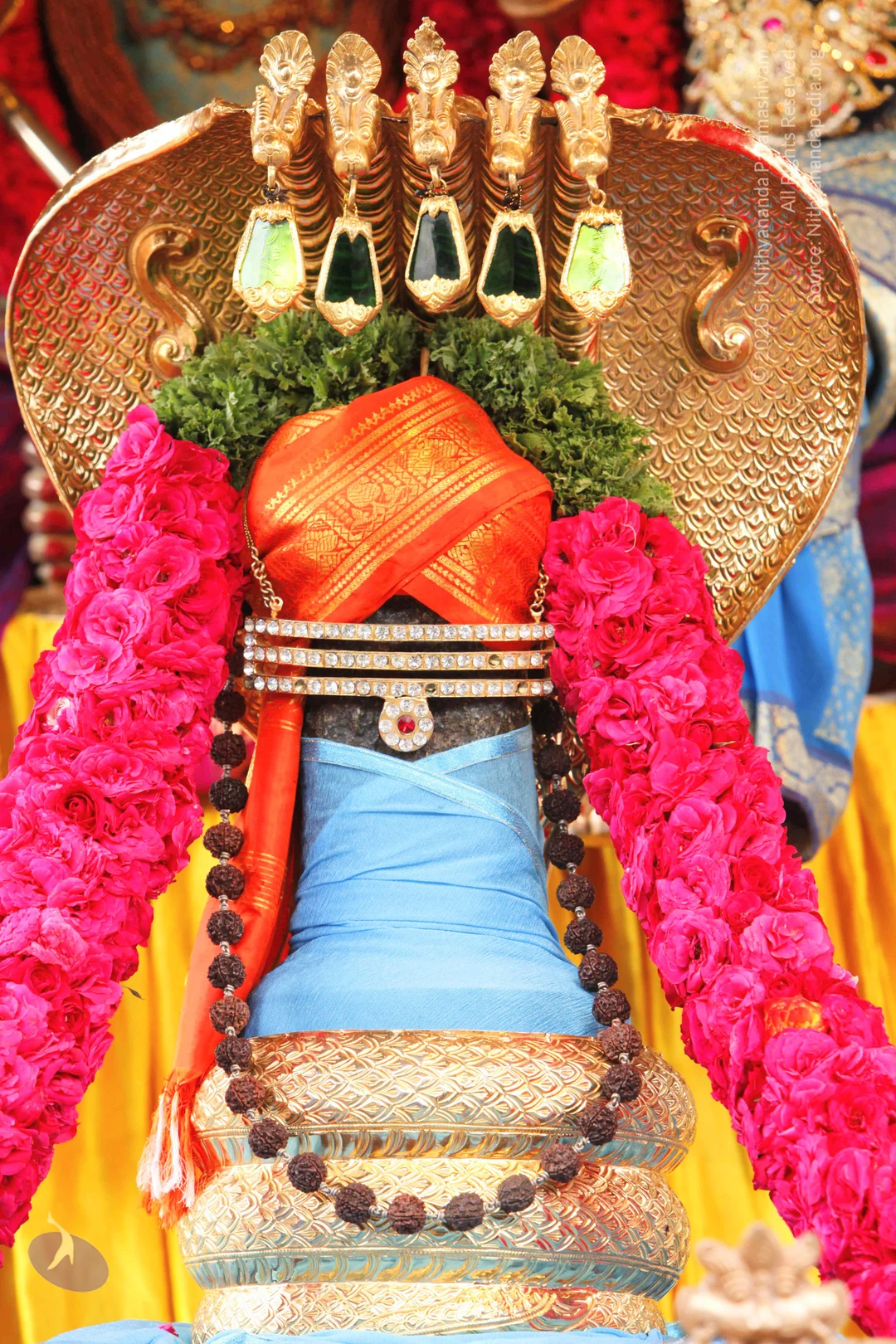
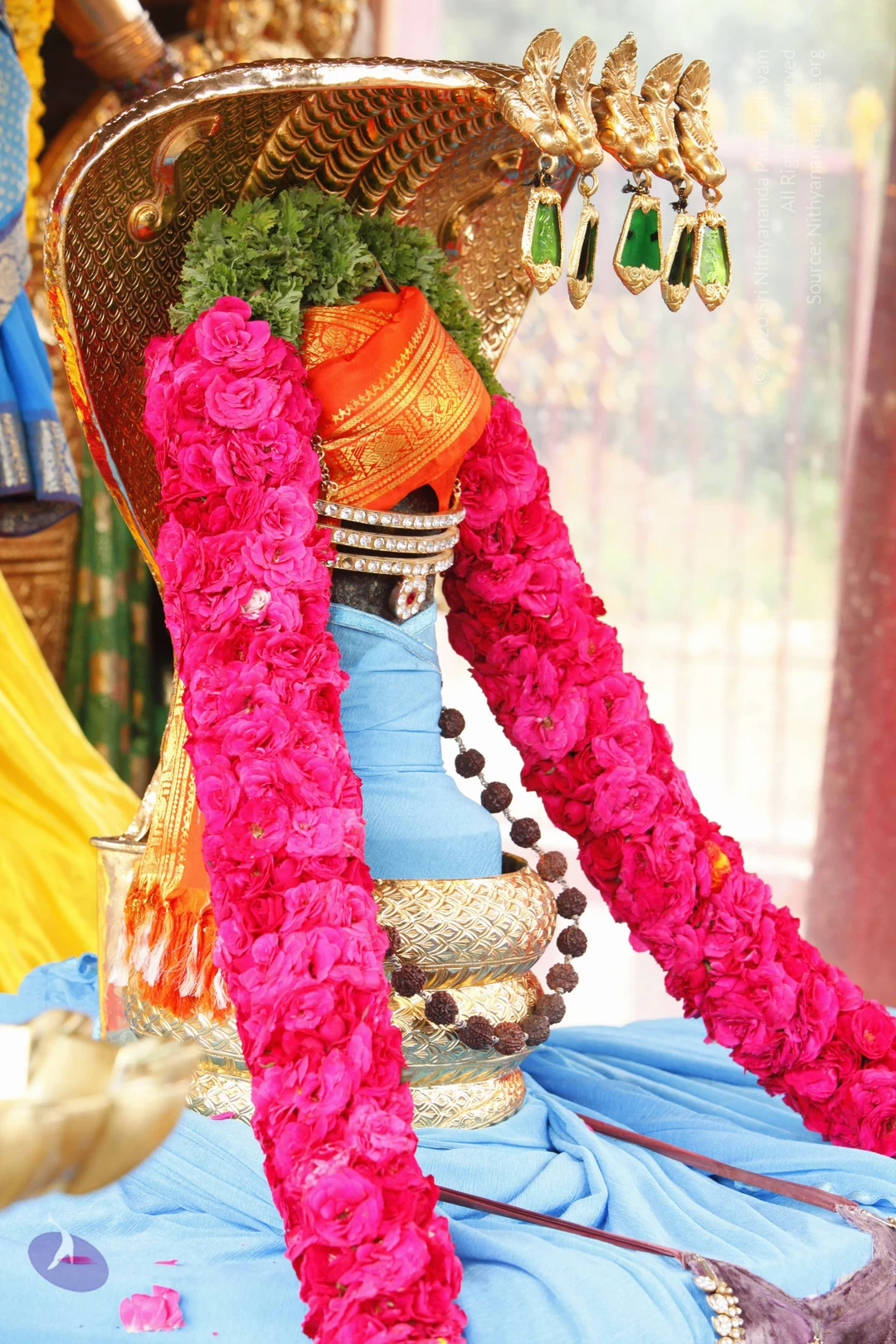
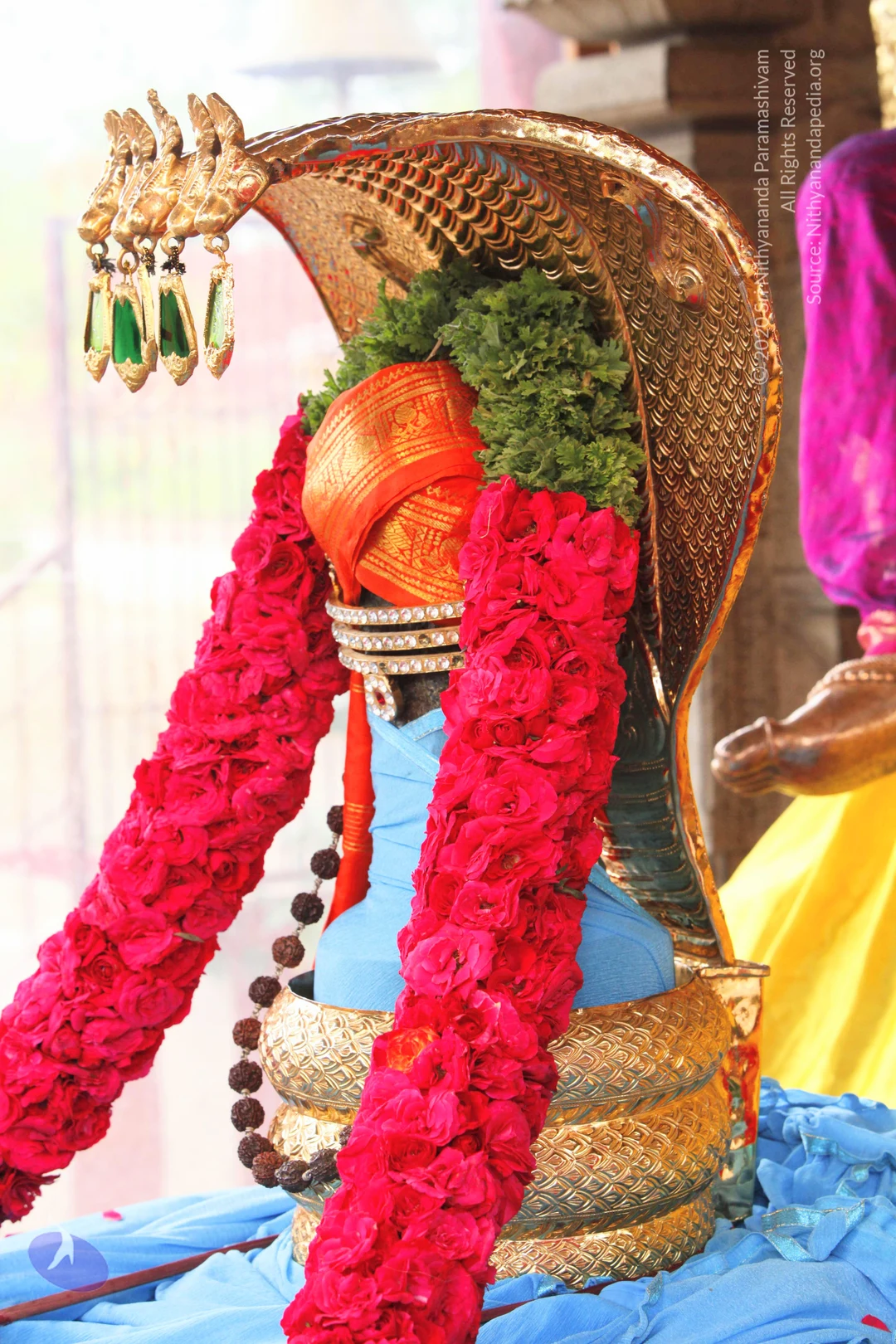
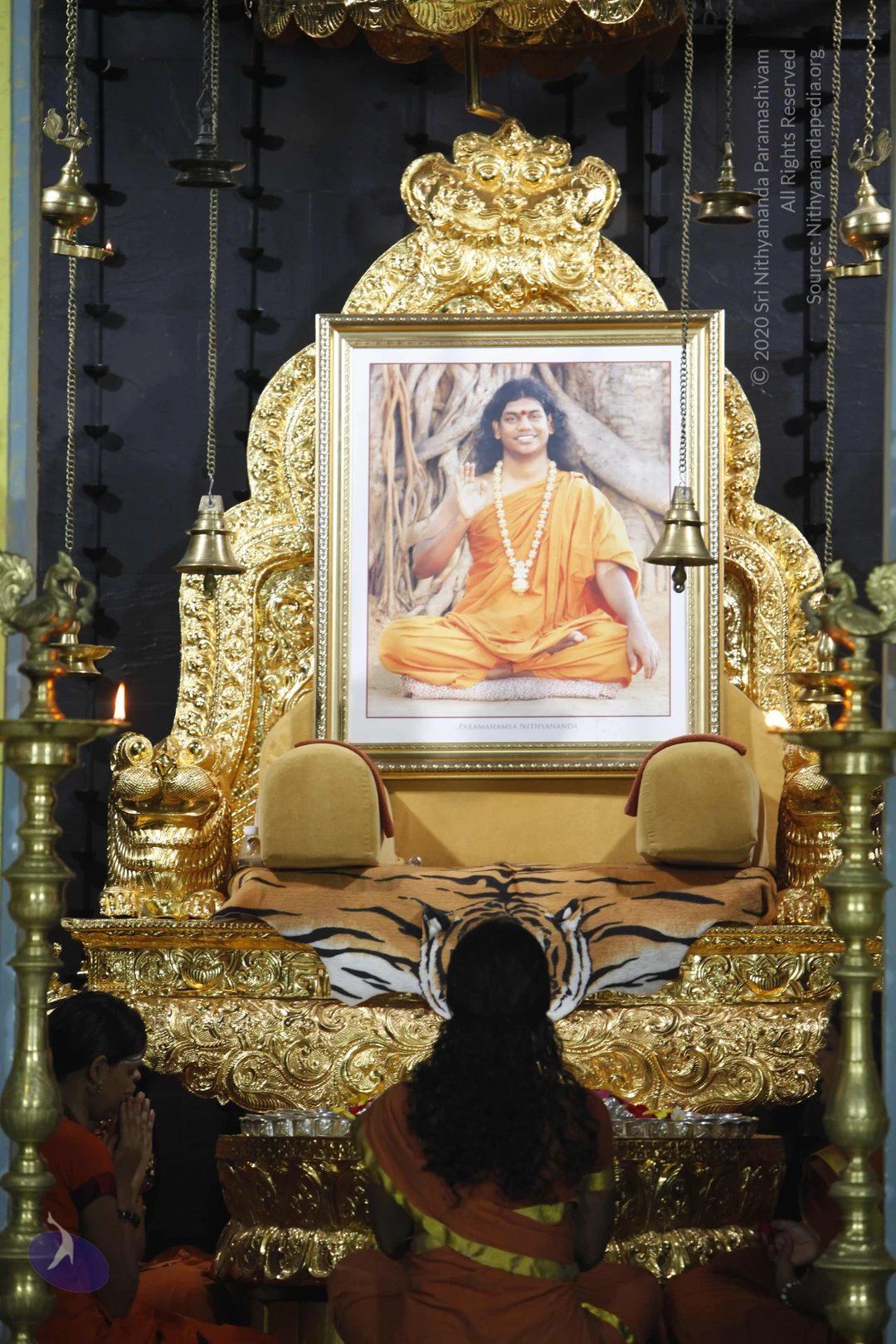
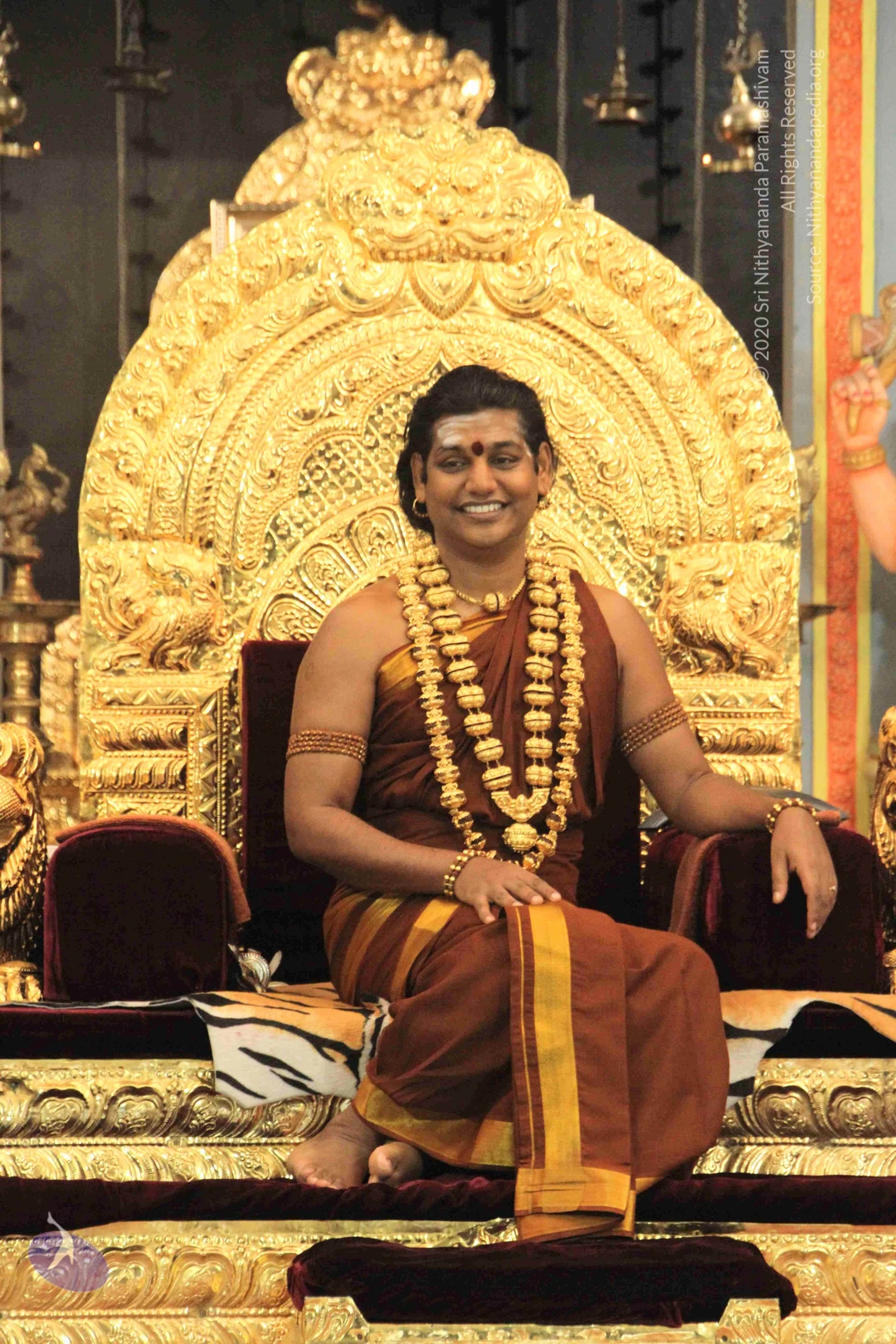
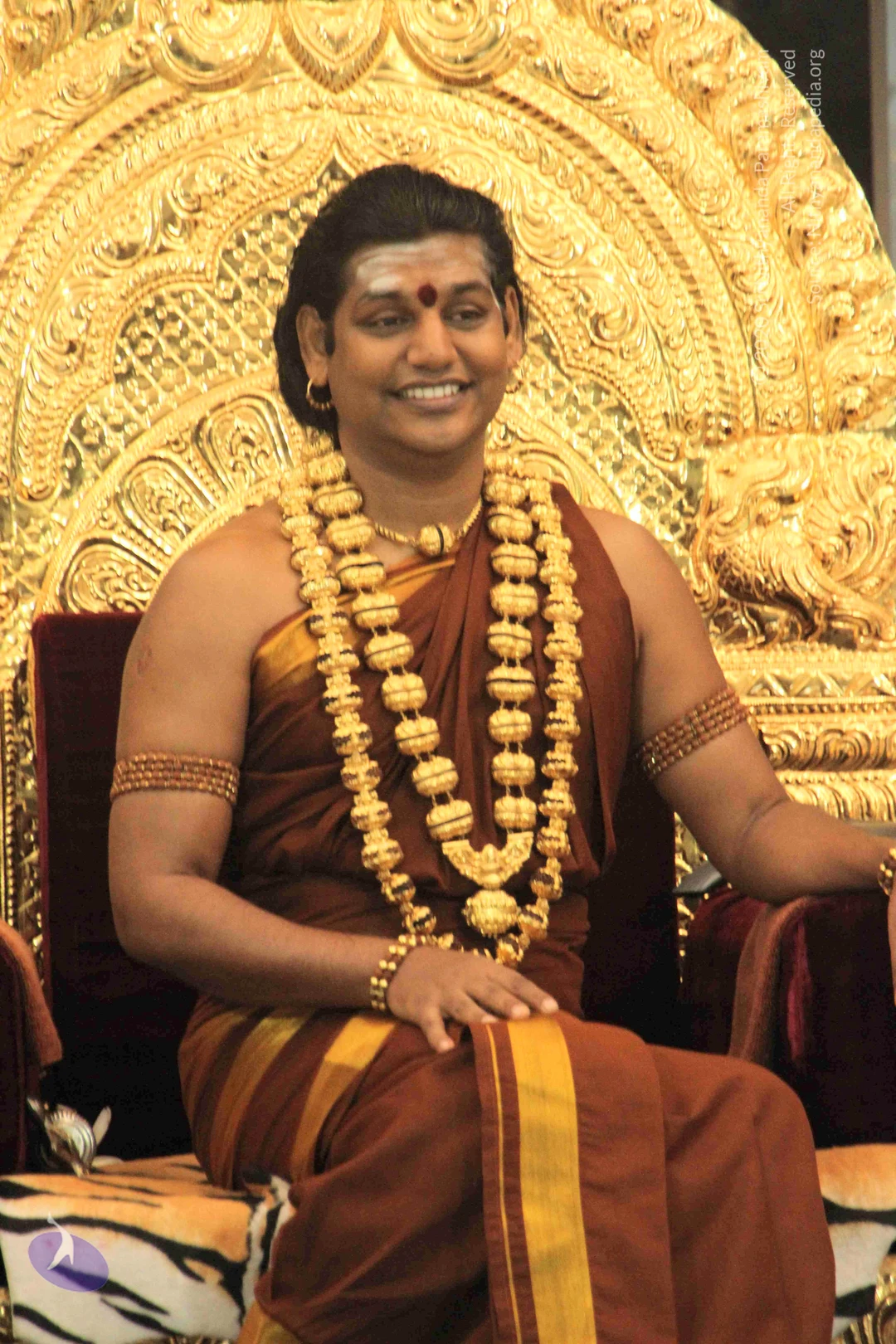
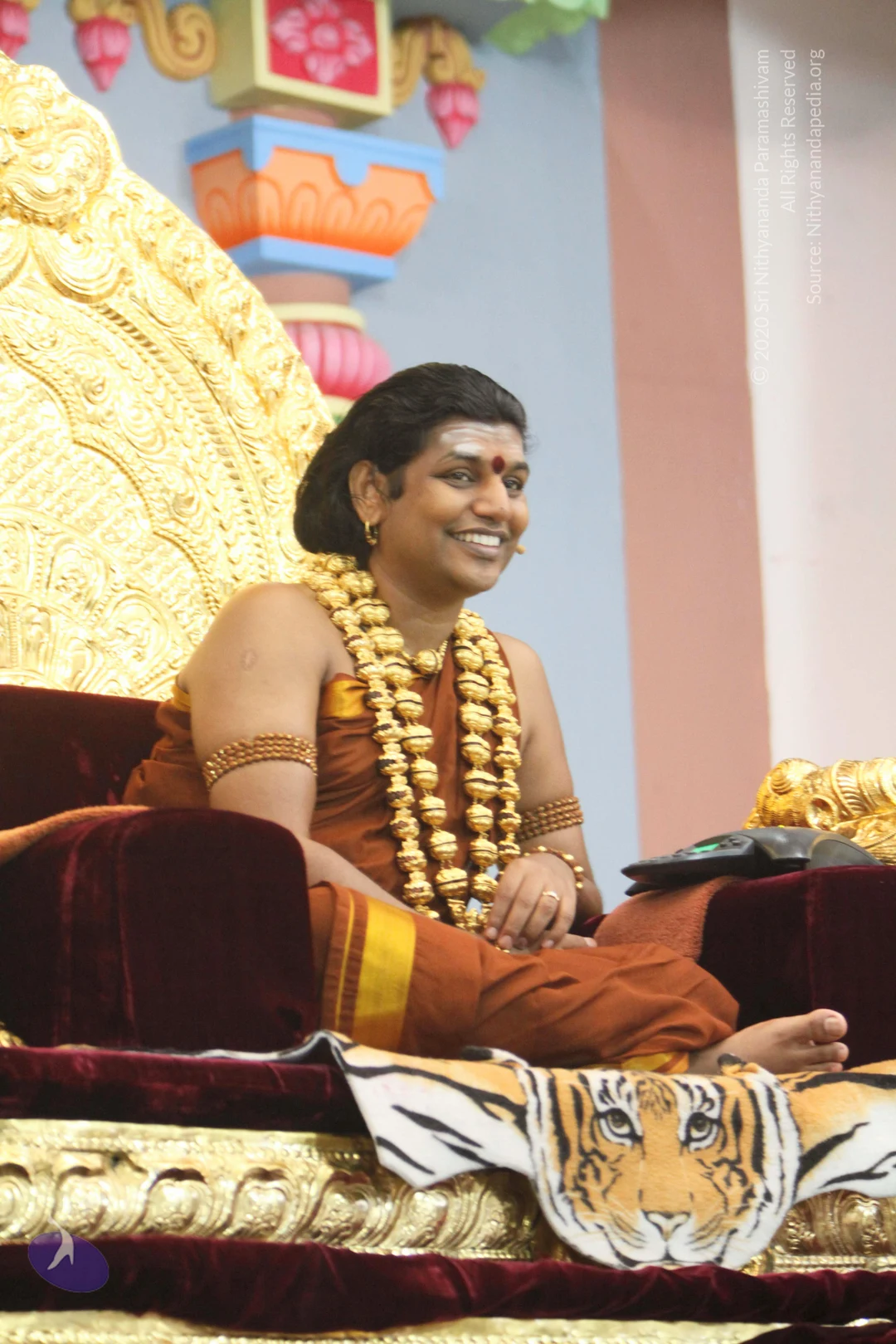
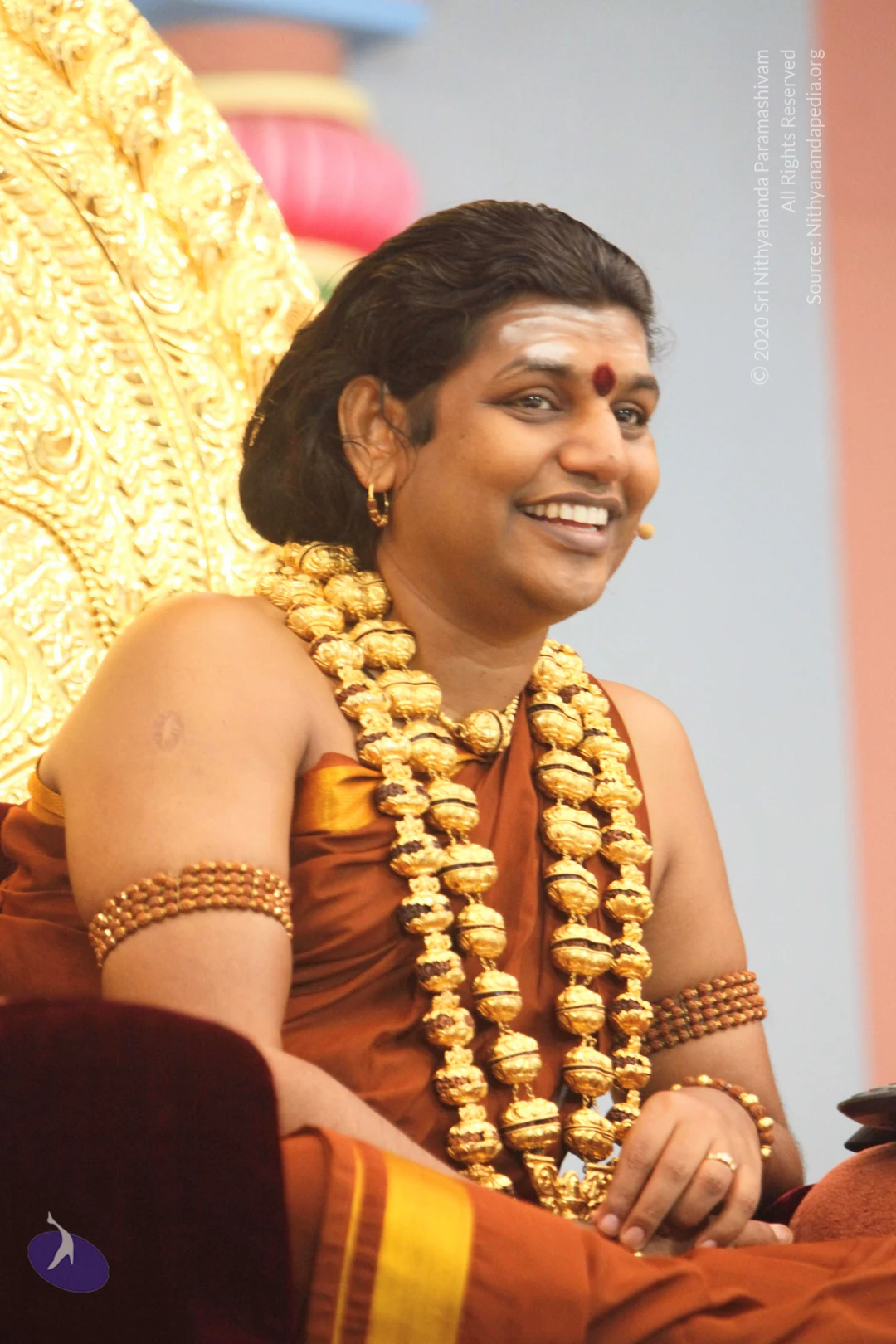
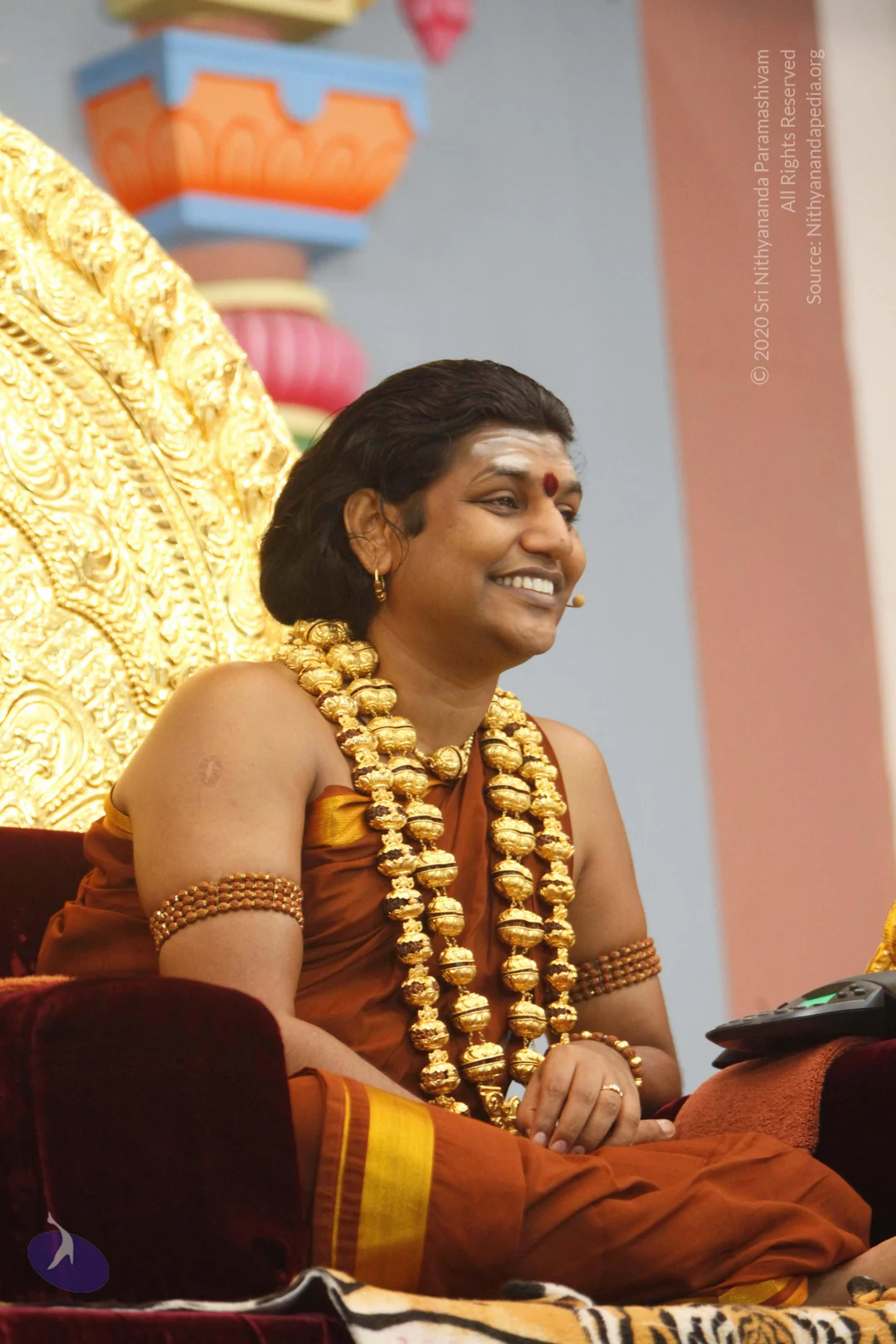
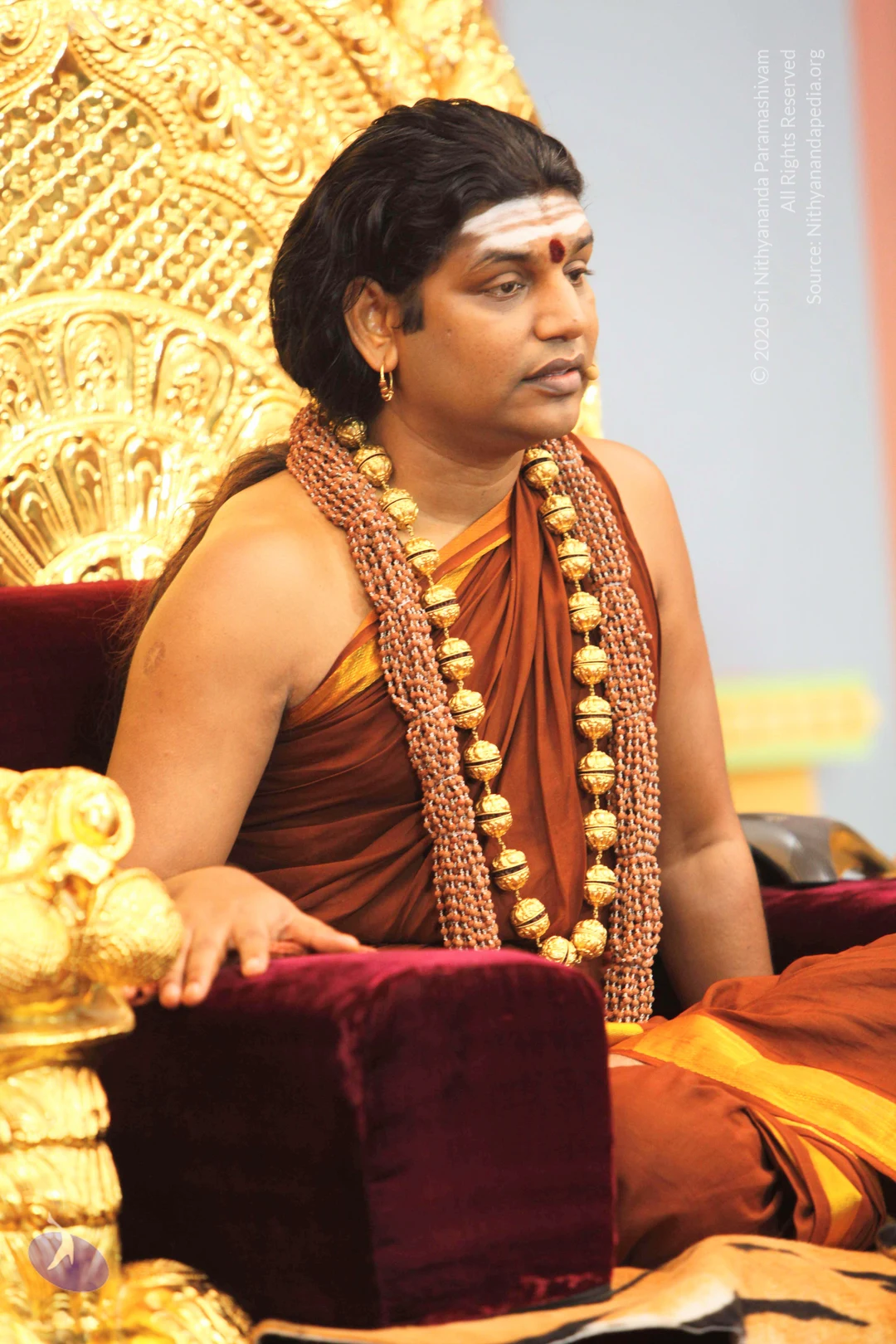
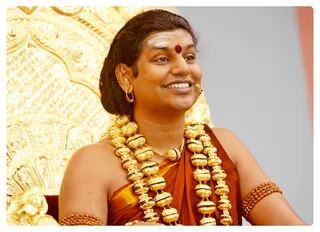
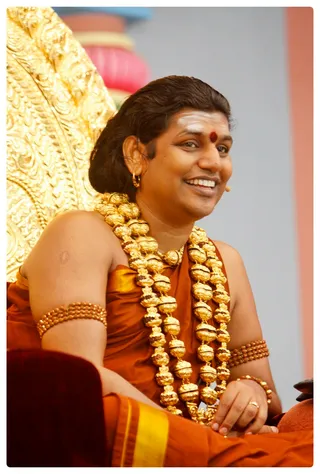
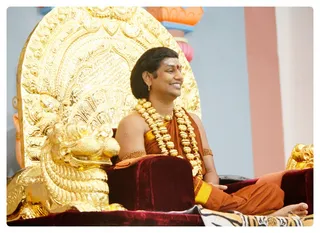
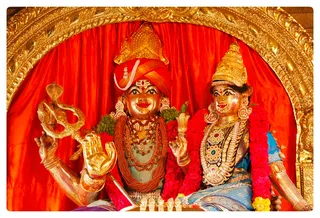
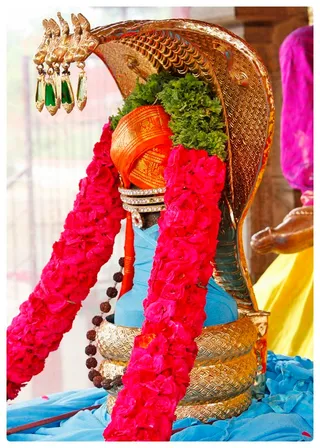
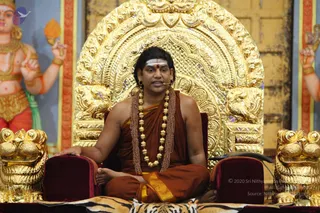
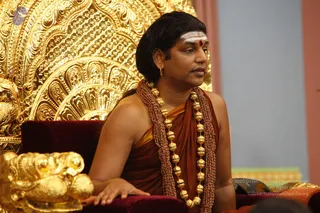
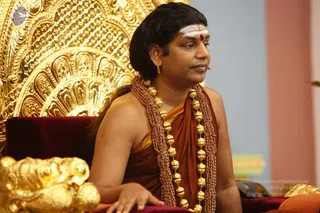
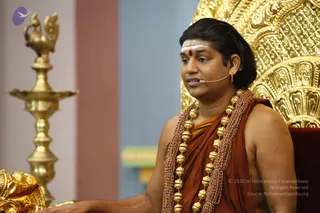
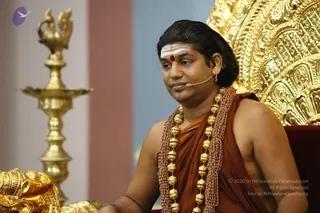
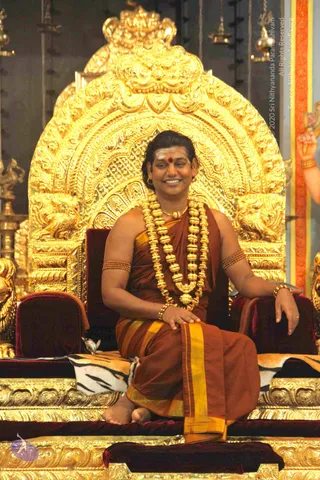
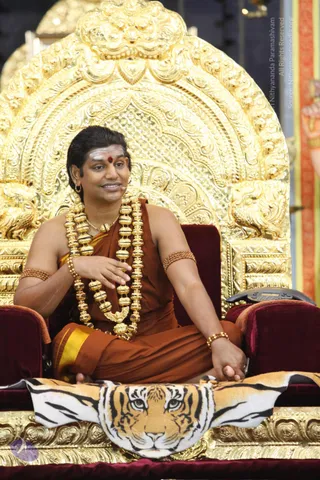
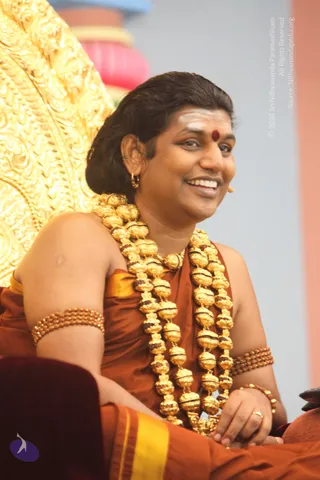
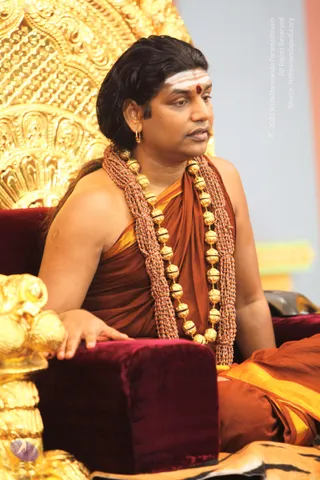
A framed portrait of a young man in saffron-orange robes, with a white beaded garland and a red-and-white tilak mark on his forehead, is displayed on an ornate gold throne with carved lion-faced armrests. He sits cross-legged with one hand raised in blessing against a backdrop of large tree roots. Hanging brass oil lamps and bells with chains surround the throne, and a lit oil lamp sits at the left edge. Two cushioned chairs with maroon trim sit in front. The printed caption at the bottom of the portrait reads Paramahamsa Nithyananda. No physical people are visible.A smiling man sits on an ornate gold-leaf throne with a radiant gold background. He wears a saffron-orange draped garment over one shoulder, layered gold bead necklaces, a gold chain, gold hoop earring, a small microphone at his ear, and woven bangles on his upper arms. A red bindi and white forehead markings are visible.a person seated on an ornate gold throne, smiling, wearing an orange saffron cloth draped over the shoulder and a multi-strand ceremonial gold bead necklace with rudraksha-style beads. He has a red bindi and white vibhuti marking on the forehead, gold bangles on the upper arms, a wrist bracelet and a ring, and a small microphone clipped near the face. Behind him are a pink and red decorative pillar and a grey backdrop. The figure is a single person in a stage or satsang setting, and the appearance cues are a swept-back hairstyle, ceremonial gold necklaces, saffron clothing and rudraksha adornments.A man seated on an ornate gold throne with a carved lion-head armrest and a crimson velvet cushion, draped over a striped tiger-skin rug. He wears an orange-saffron dhoti and upper cloth, a heavy multi-strand gold necklace of beads, gold armlets, and a red tilak on his forehead. He smiles while looking to the side, with long swept-back dark hair. Behind him a golden throne back and a pastel blue and pink wall. Swamiji (probable) appears in person with the distinctive saffron clothing, ornate gold necklace and long hair cues, seated on the throne.A photograph of a gilded metal murti of a deity couple seated before a red drape within an ornate golden arch. The figure on the left, with a gold trident-like staff and red turban with white and red forehead marks, wears a thick rudraksha-style red-brown bead mala and a blue garment. The figure on the right wears a gold crown, a jewelled necklace, blue sari and red and pink flower garlands. Both have red tilaka marks and gold dress ornaments. Deity murti, no physical people visible.A close-up photograph of a deity murti decorated for worship. The figure is draped in a blue cloth and wears a gold cobra hood with green stone pendants and a golden crown-like band with white stones. A bright orange and gold silk head cloth is tied at the top, with green leaves and a thick pink flower garland hanging across the chest. Rudraksha beads hang at the side, and a bright yellow and magenta cloth and a gold-toned arm appear at the right edge. No physical people are visible.

SWAMINIS

6 photosSource gallery
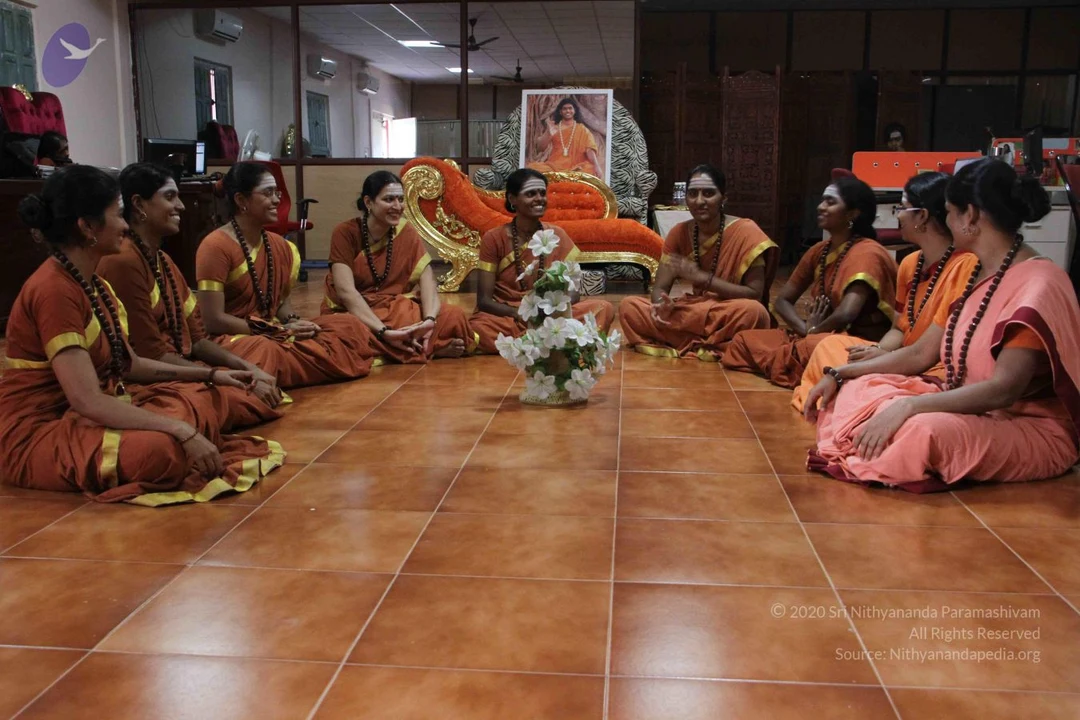
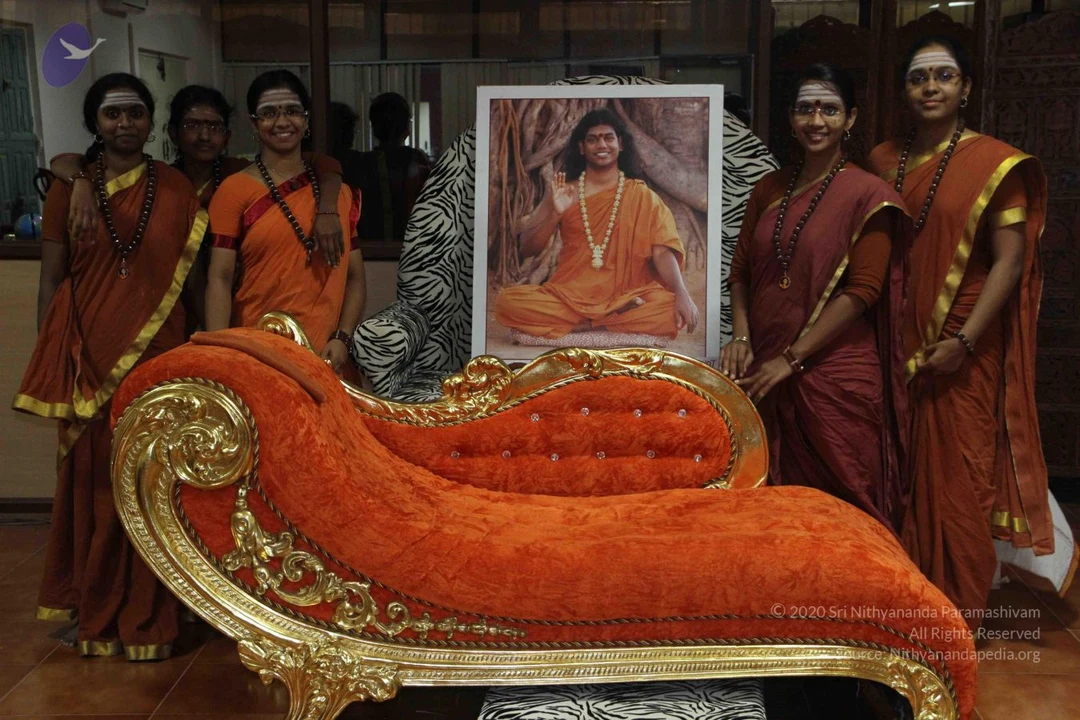
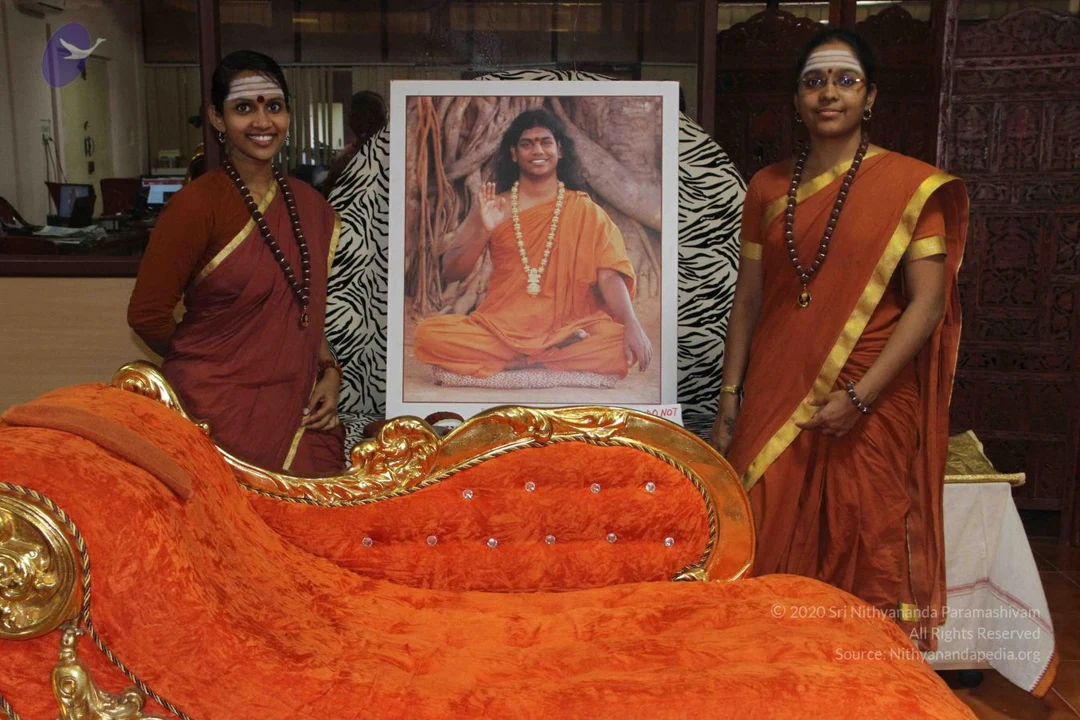
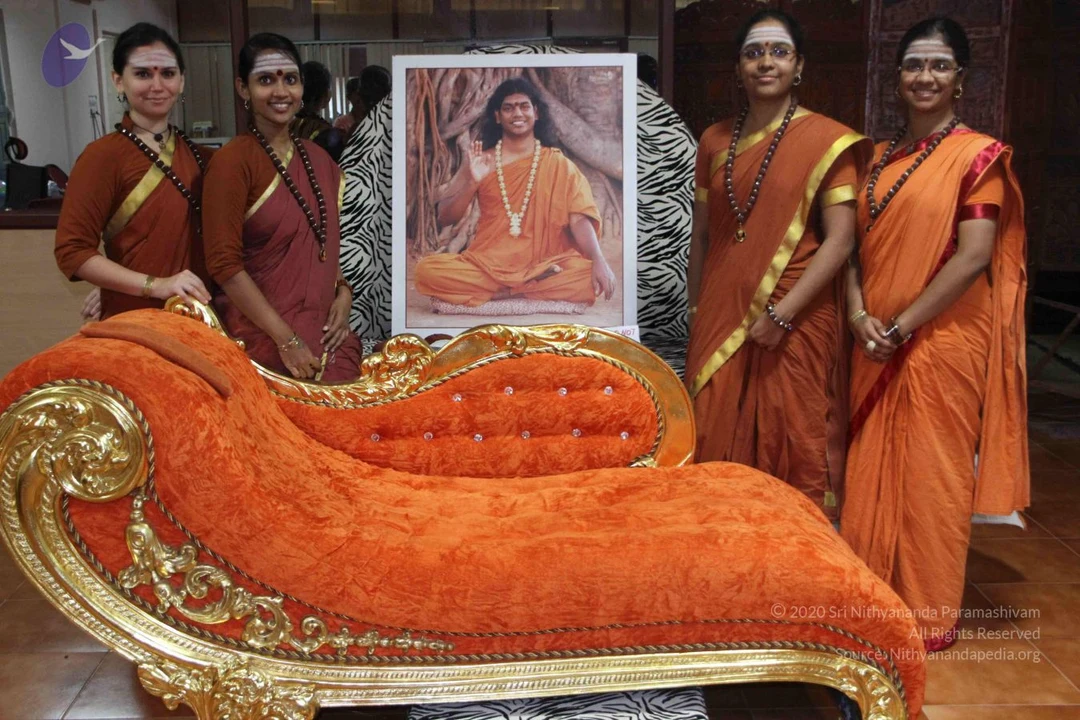
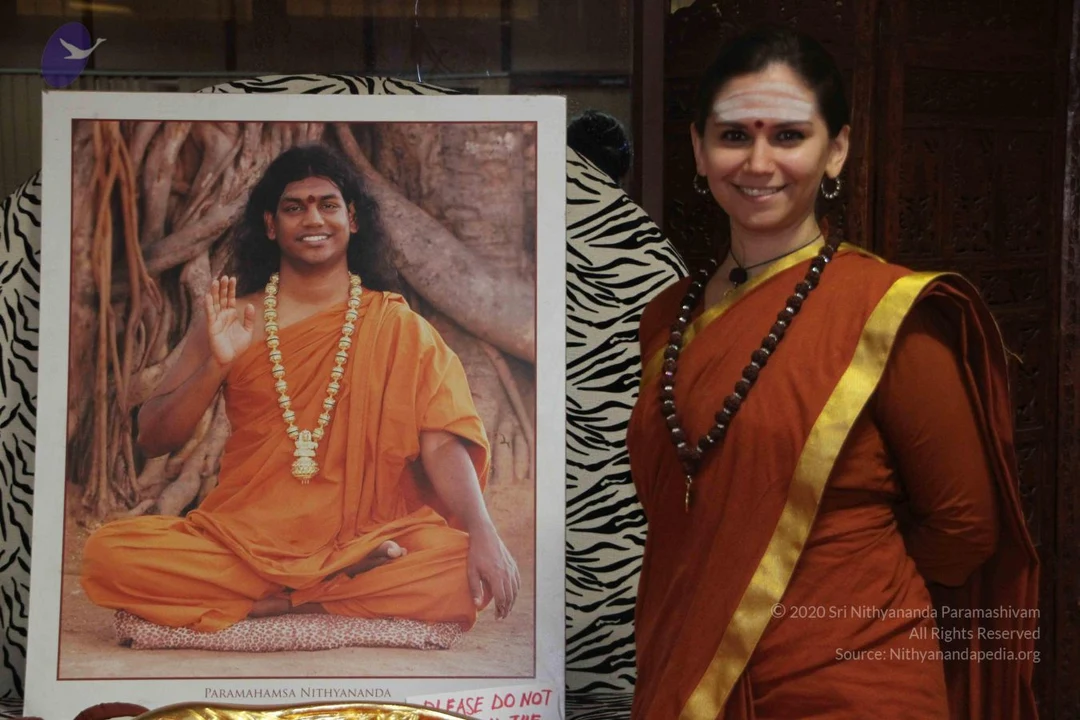
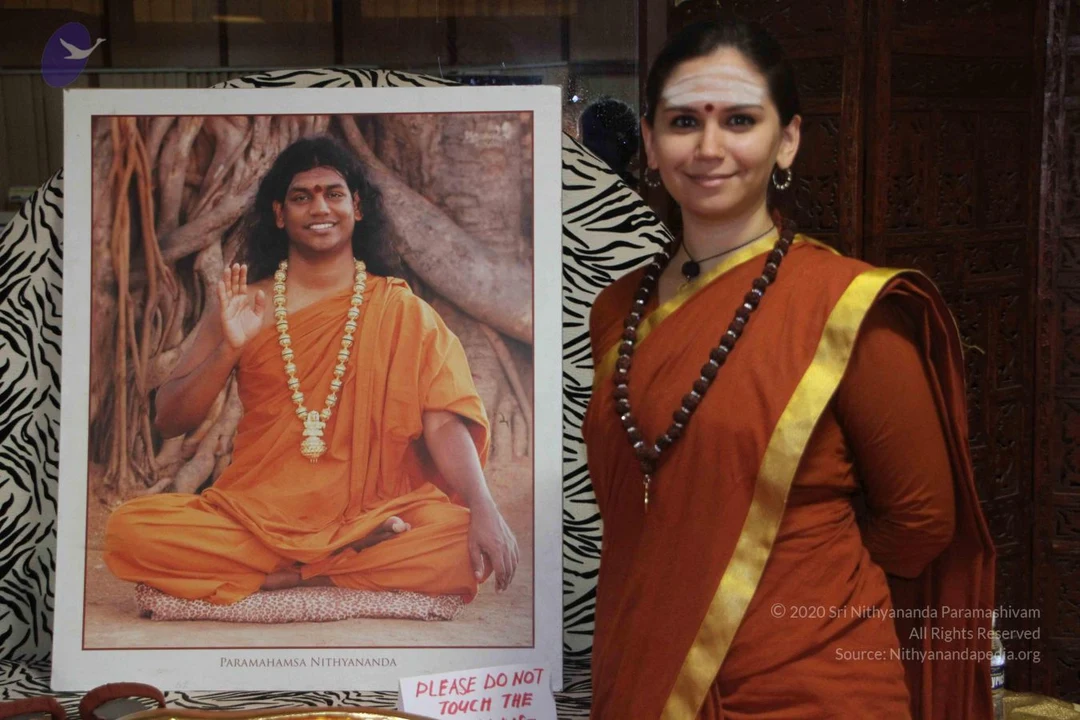
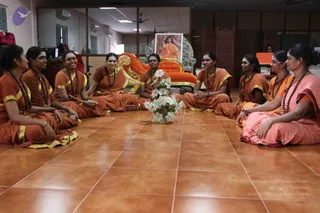
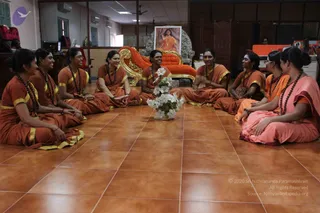
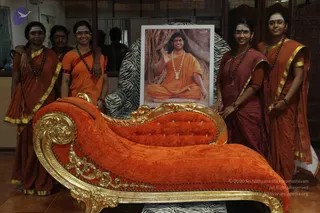
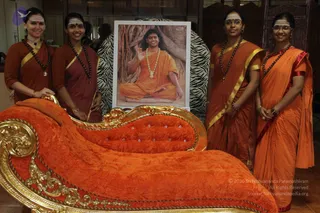
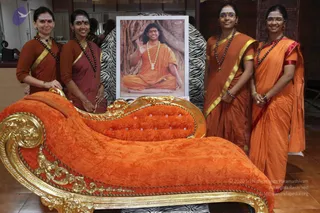
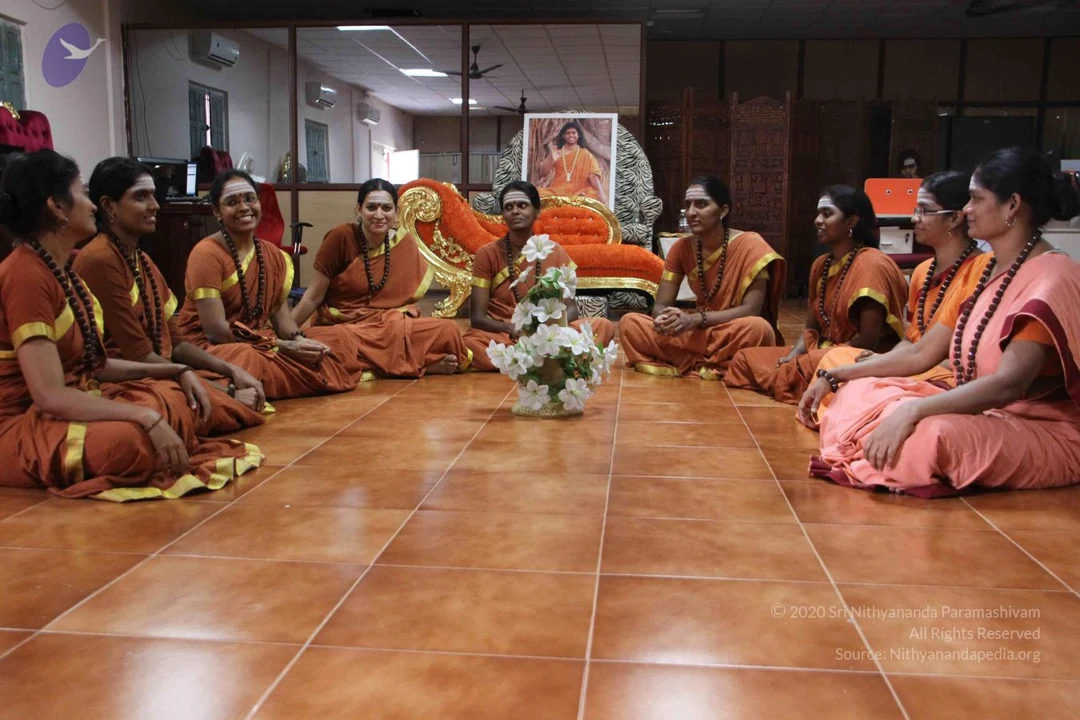
A group of eight women in orange and saffron saris with gold borders sit on a tiled floor in a hall, facing inward around a vase of white flowers. Several wear rudraksha malas and some have white markings on their foreheads. Behind them stands an ornate orange and gold throne decorated with flowers, with a zebra-patterned seat, and a framed portrait of a figure in orange robes with a mala rests on a stand nearby. Office-style windows and a wooden partition are visible in the background.Seven women in orange and saffron saris with yellow borders and rudraksha malas sit cross-legged in a circle on a terracotta-tiled floor in an office-like hall. A small vase of white flowers sits in the centre. Behind them a golden-framed throne covered in orange flowers stands beside a large portrait of a figure in orange robes with long hair. The woman seated at the far right wears a pink sari. Glass partitions, desks and a wooden screen fill the background.Five women in orange and maroon saris with gold borders stand around an ornate gold-framed orange velvet chaise lounge in an indoor room with tiled floor and wooden cabinetry. Behind the couch a framed portrait shows a seated figure in orange robes with a white flower garland, one hand raised, in front of a large banyan tree trunk; the figure is a printed image, not a physical person. The women wear rudraksha malas and white sacred ash marks on their foreheads. A zebra-print cushion sits behind the portrait.Two smiling women stand either side of a framed printed portrait on a zebra-striped backdrop, in front of an ornate orange velvet and gold-trimmed couch. Both wear rust-red saris with gold borders, rudraksha malas and white tilak markings on their foreheads. The central portrait shows a seated figure in orange robes with a white flower garland, hands raised in a blessing gesture, beneath a large banyan-like tree. The portrait is a printed depiction, not a physical person, and no name is legibly printed on it. The seated figure's appearance is consistent with a person depiction, given the orange clothing, garland and blessing pose, which are distinctive visible cues.Four women in orange and maroon sarees with gold borders stand beside an ornate gold-framed orange velvet chaise, a throne-like seat with tufted cushion and crystal buttons. Each wears rudraksha malas and white vertical forehead markings, and one wears a red bindi and glasses. Behind them a large printed portrait shows a man in orange robes seated in lotus pose with a white flower garland, one hand raised in blessing, before a banyan tree. The seat and backdrop are draped in zebra-print fabric. The women are standing, not seated.Four women stand in front of an ornate gold-framed orange velvet chaise lounge with crystal studs. They wear orange and rust-red saris with gold borders, rudraksha malas, and white forehead markings. A framed portrait behind them shows a seated robed figure in orange with a garland, raising a hand beneath a large banyan tree; the portrait is printed, not a physical person. Zebra-striped panels stand behind the group. The women appear to be devotees or ashram members posing beside the couch.

Temple

15 photosSource gallery
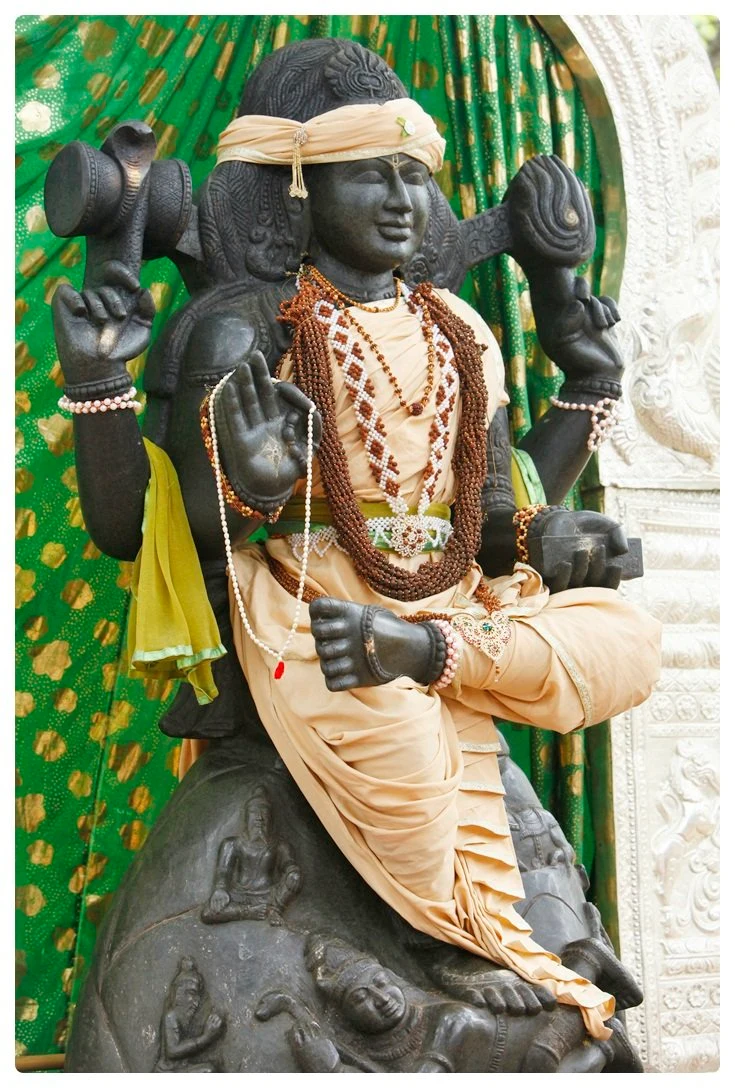
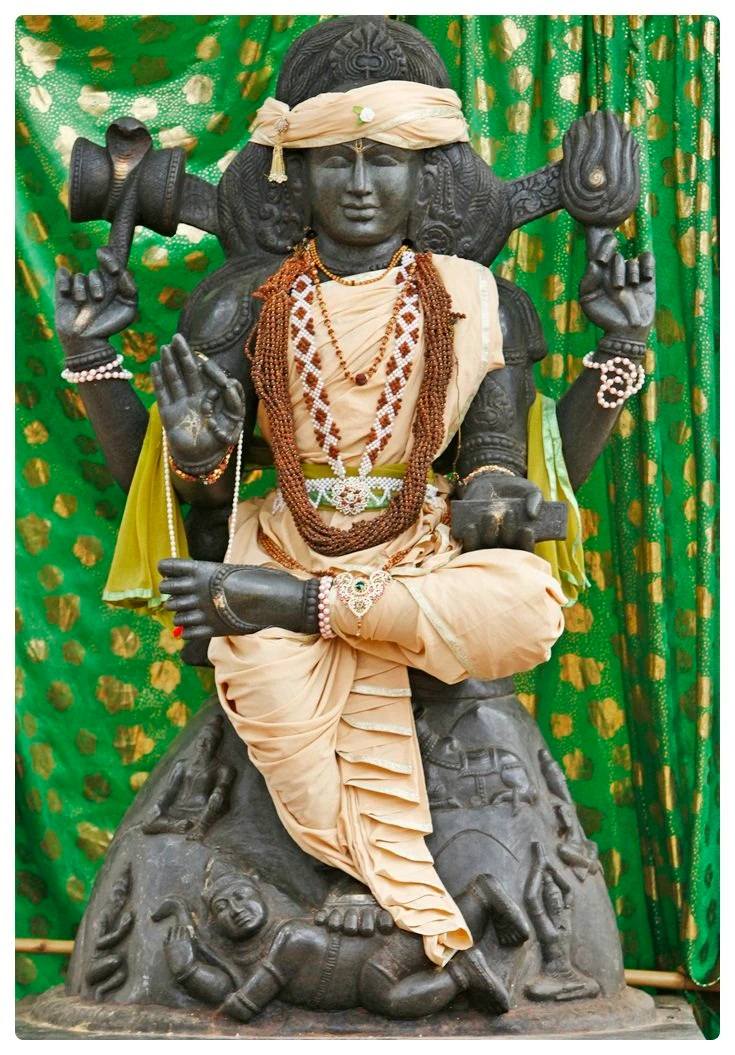
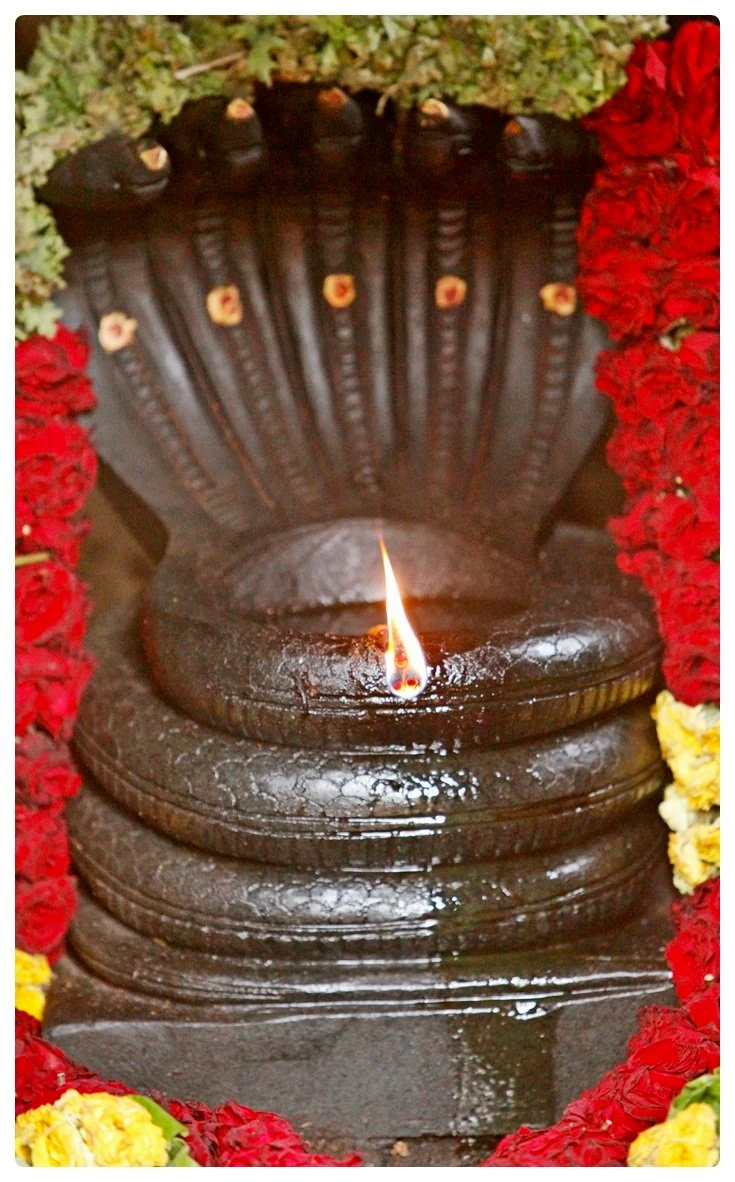
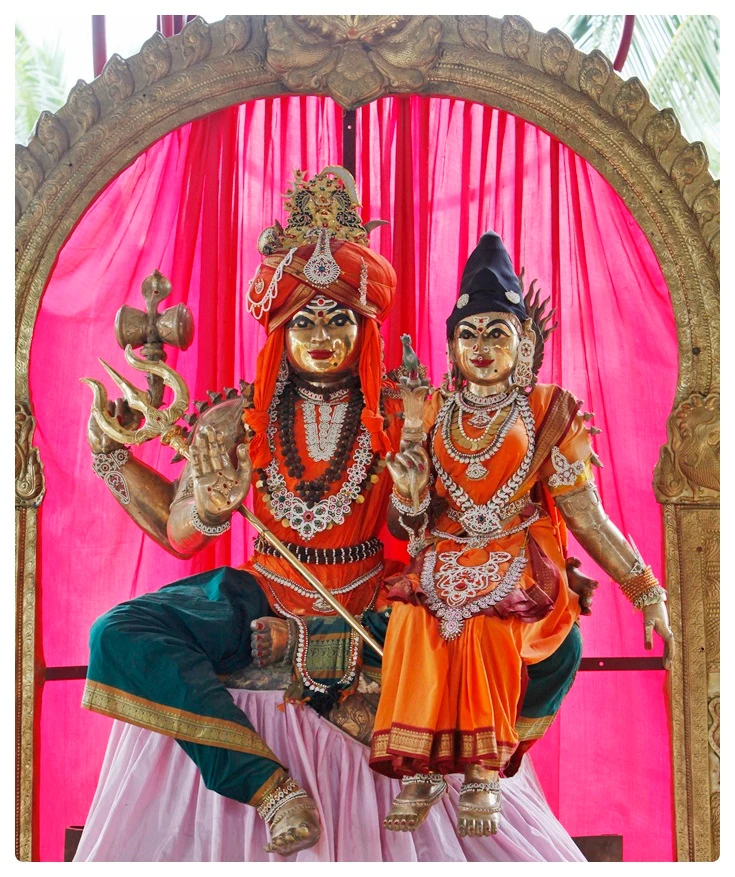
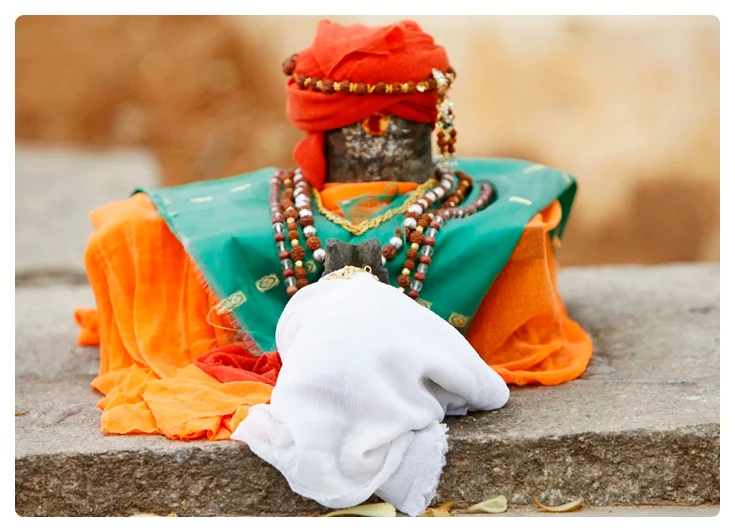
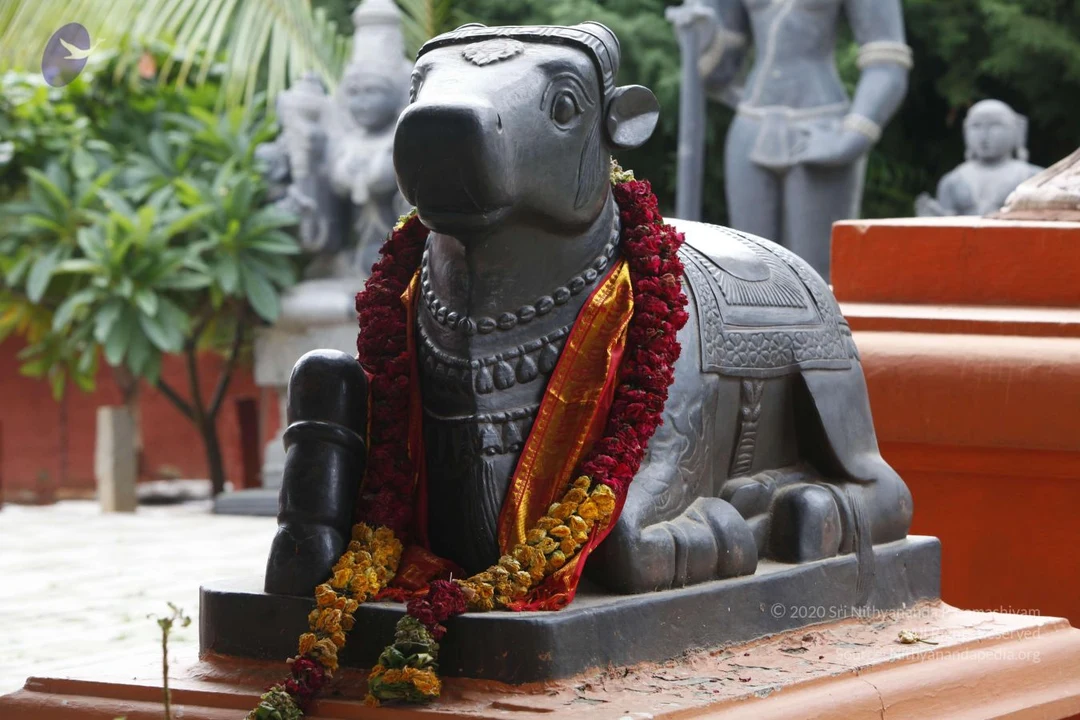
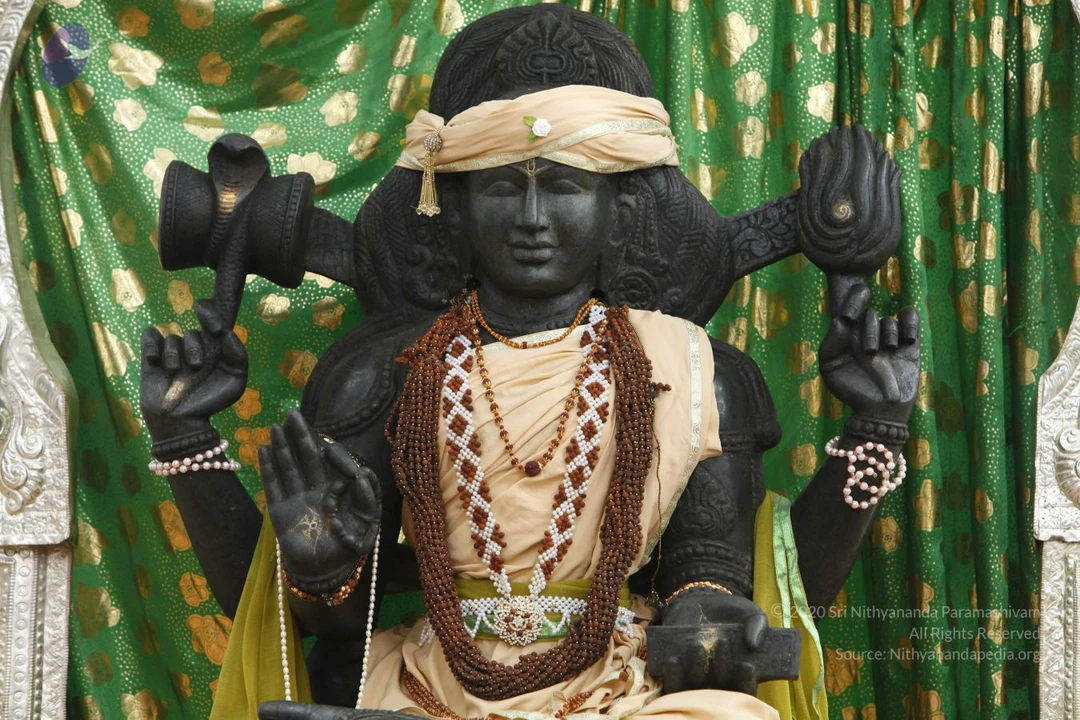
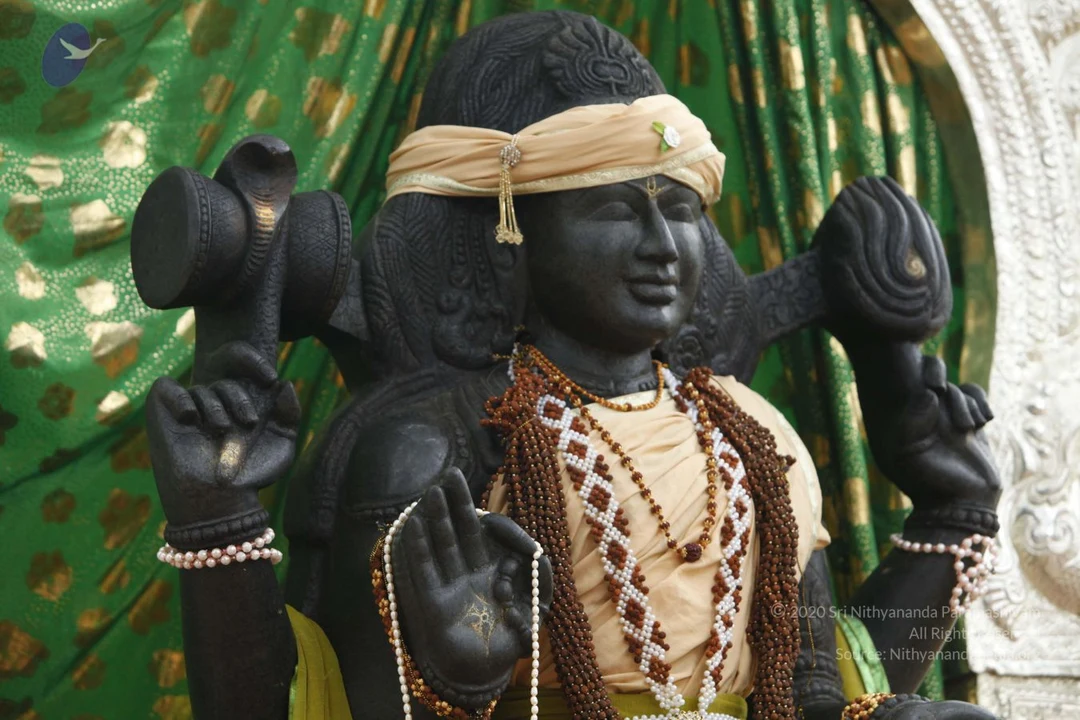
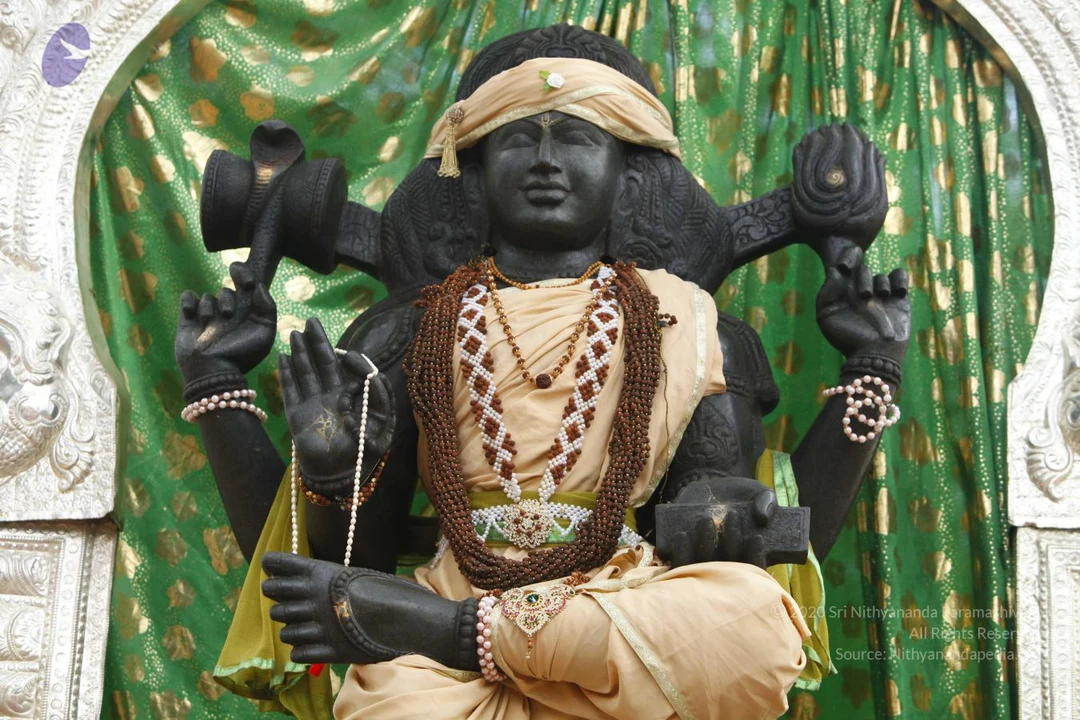
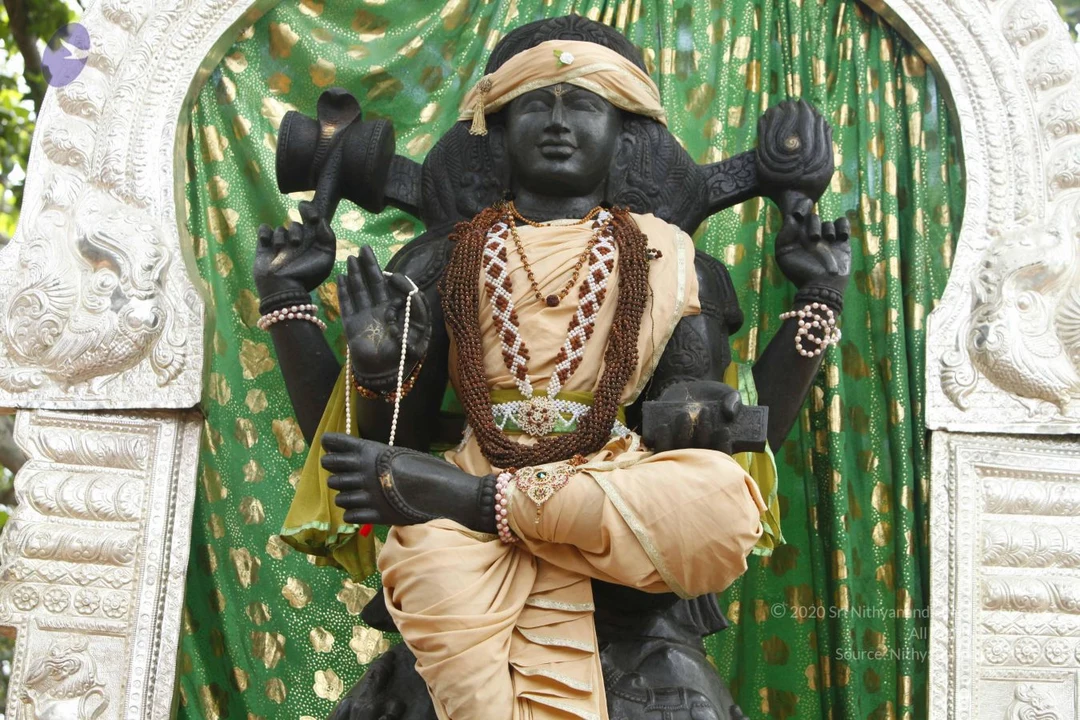
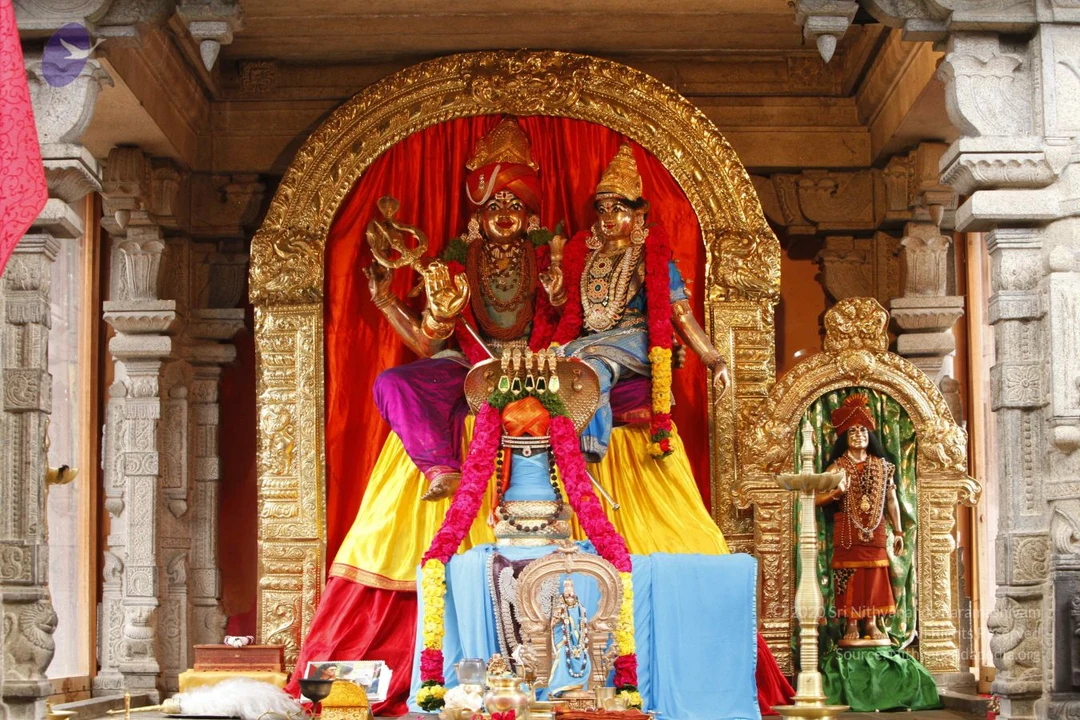
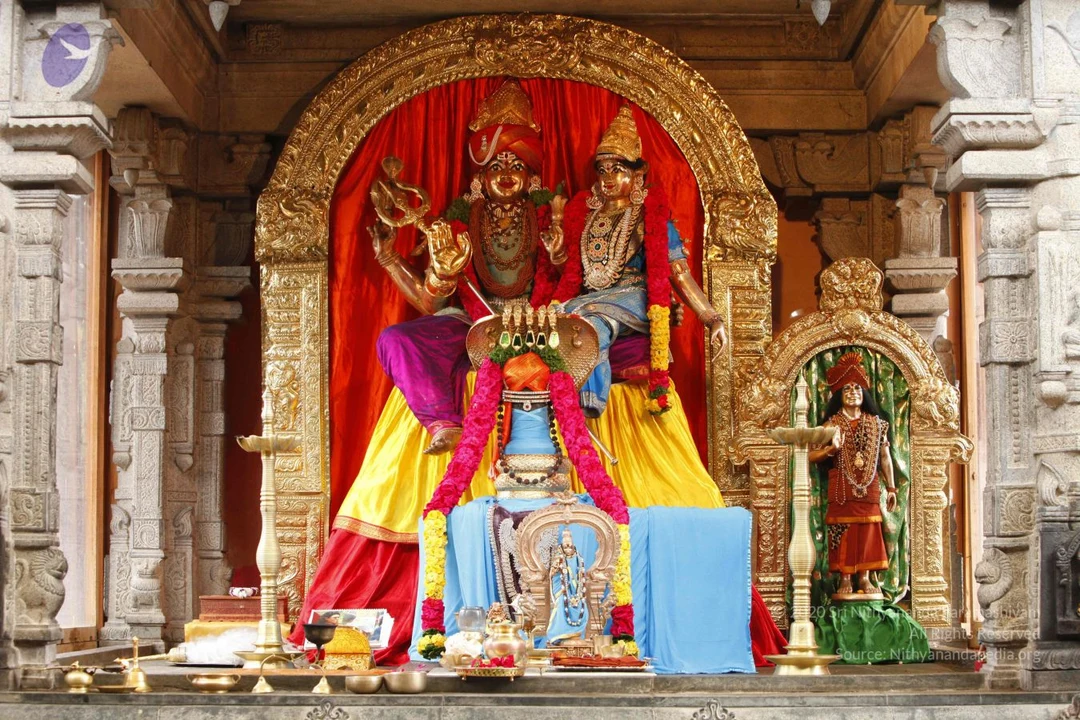
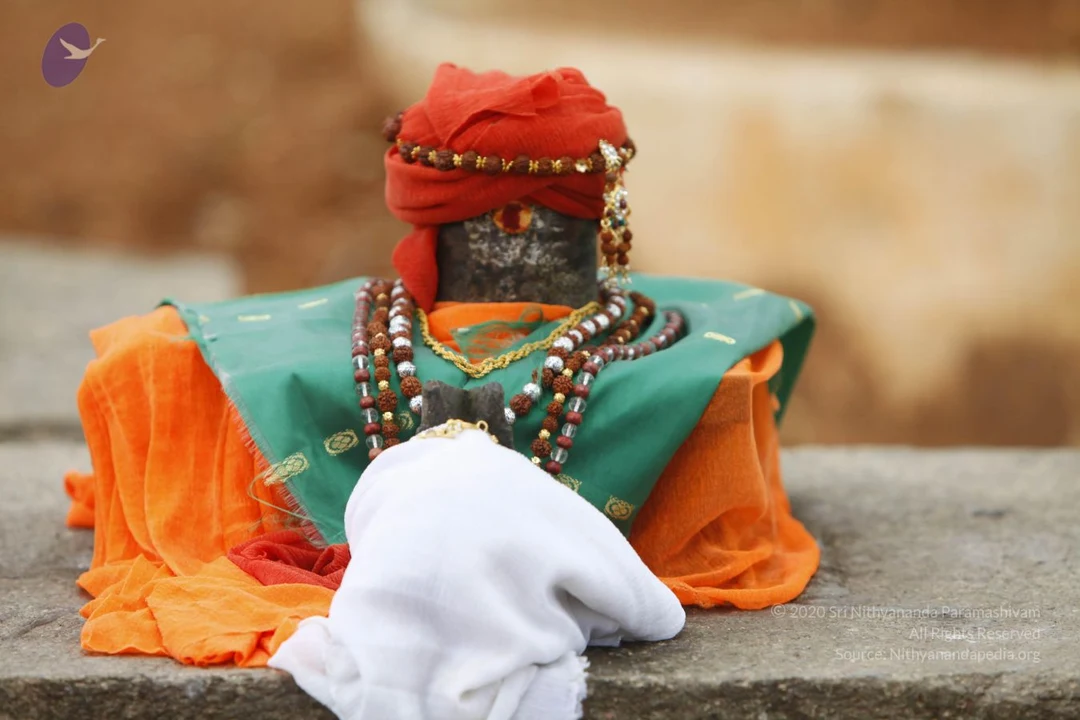
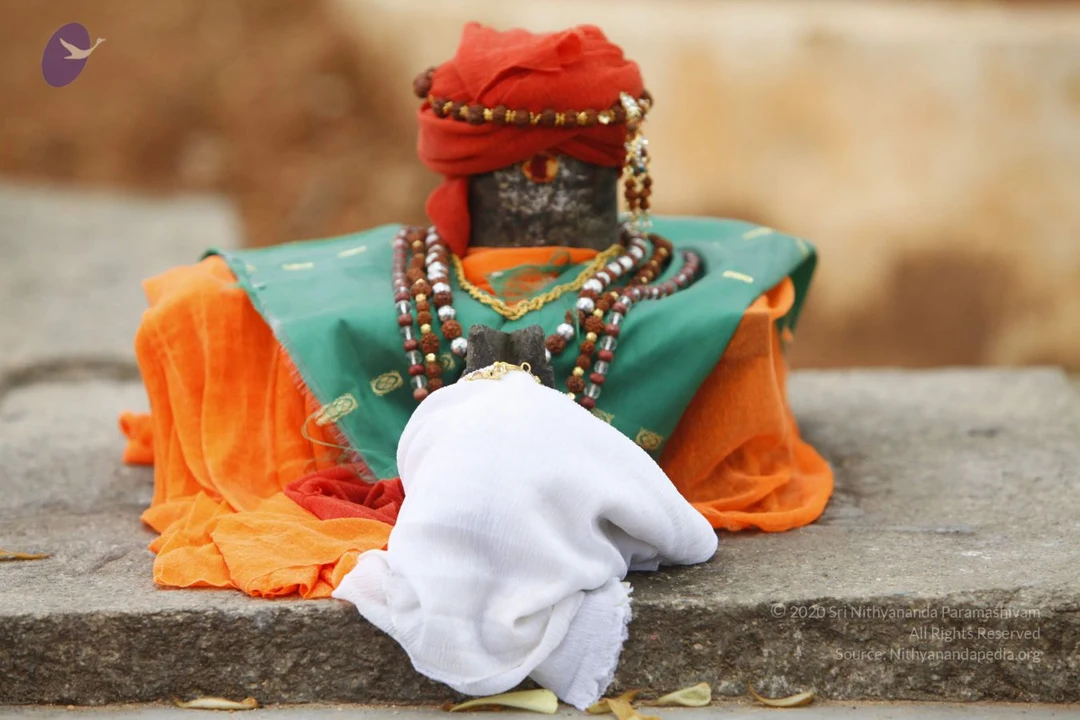
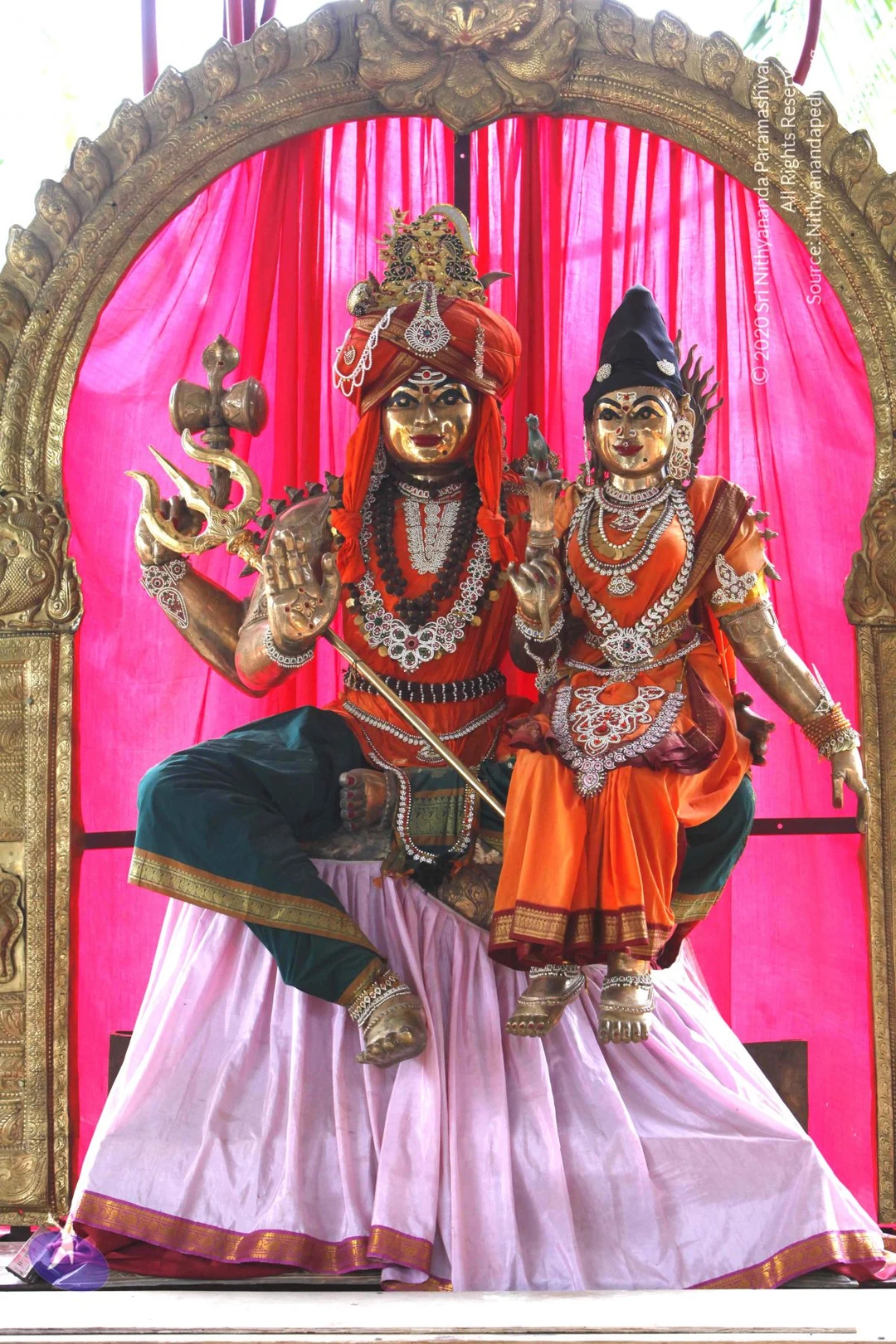
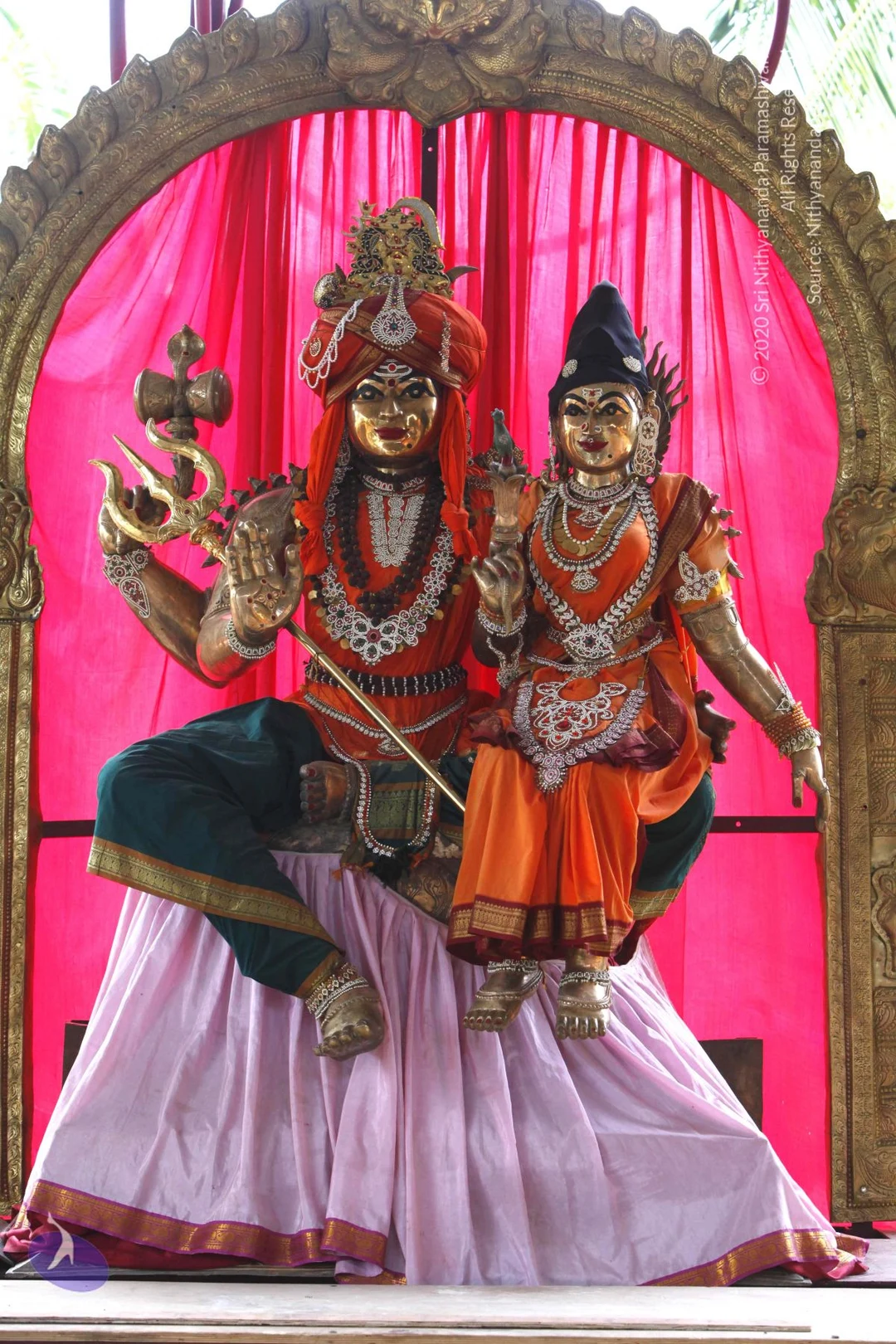
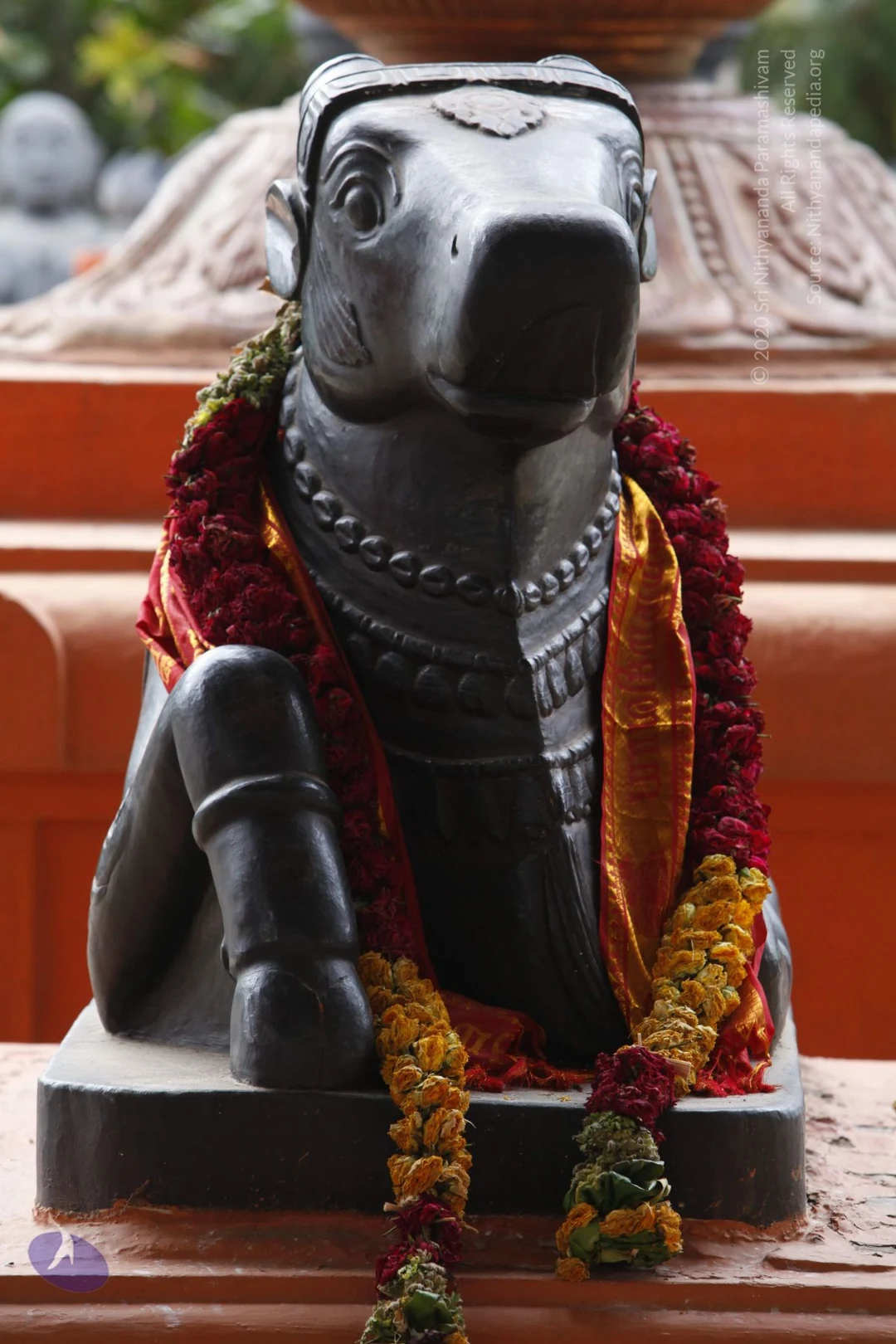
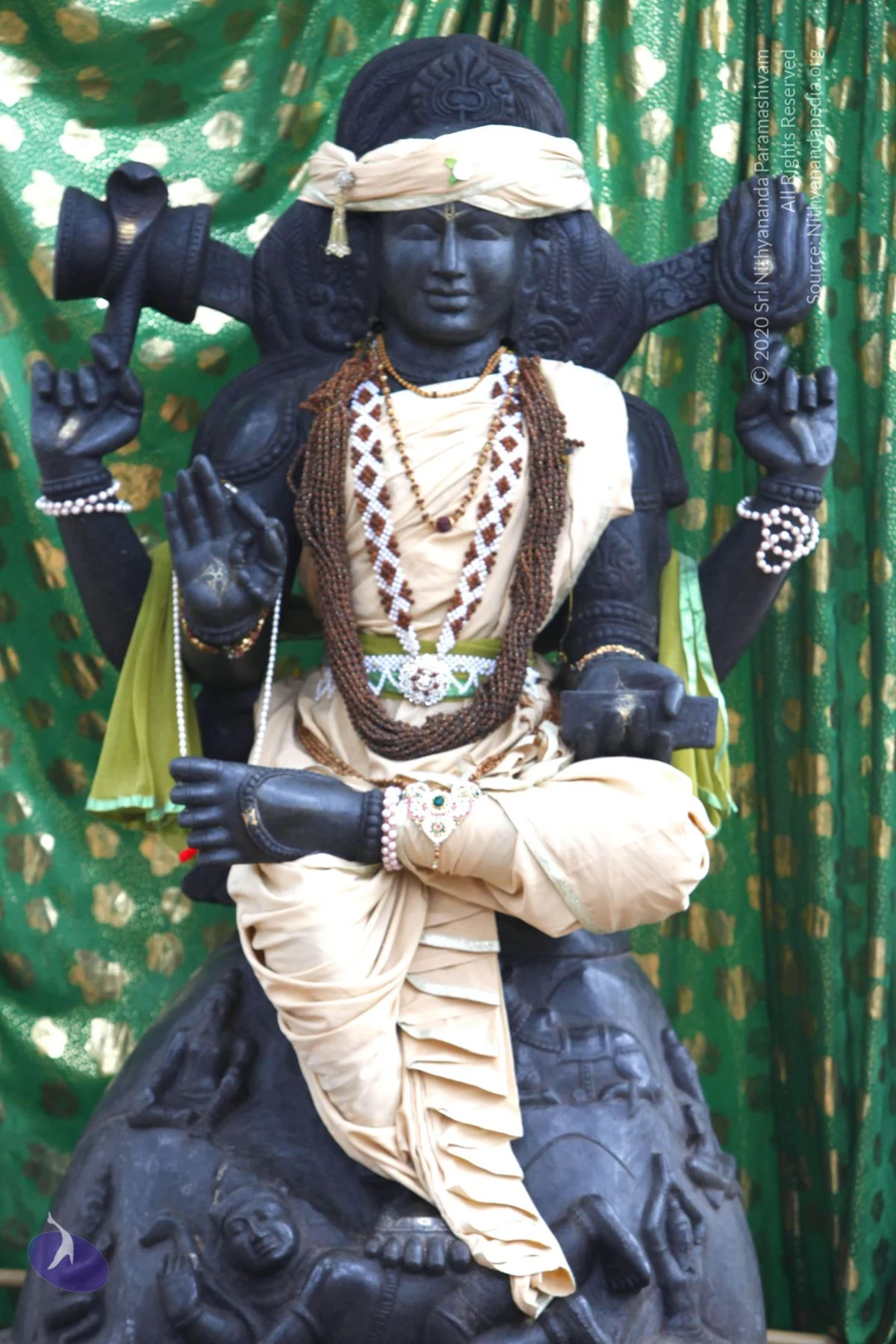
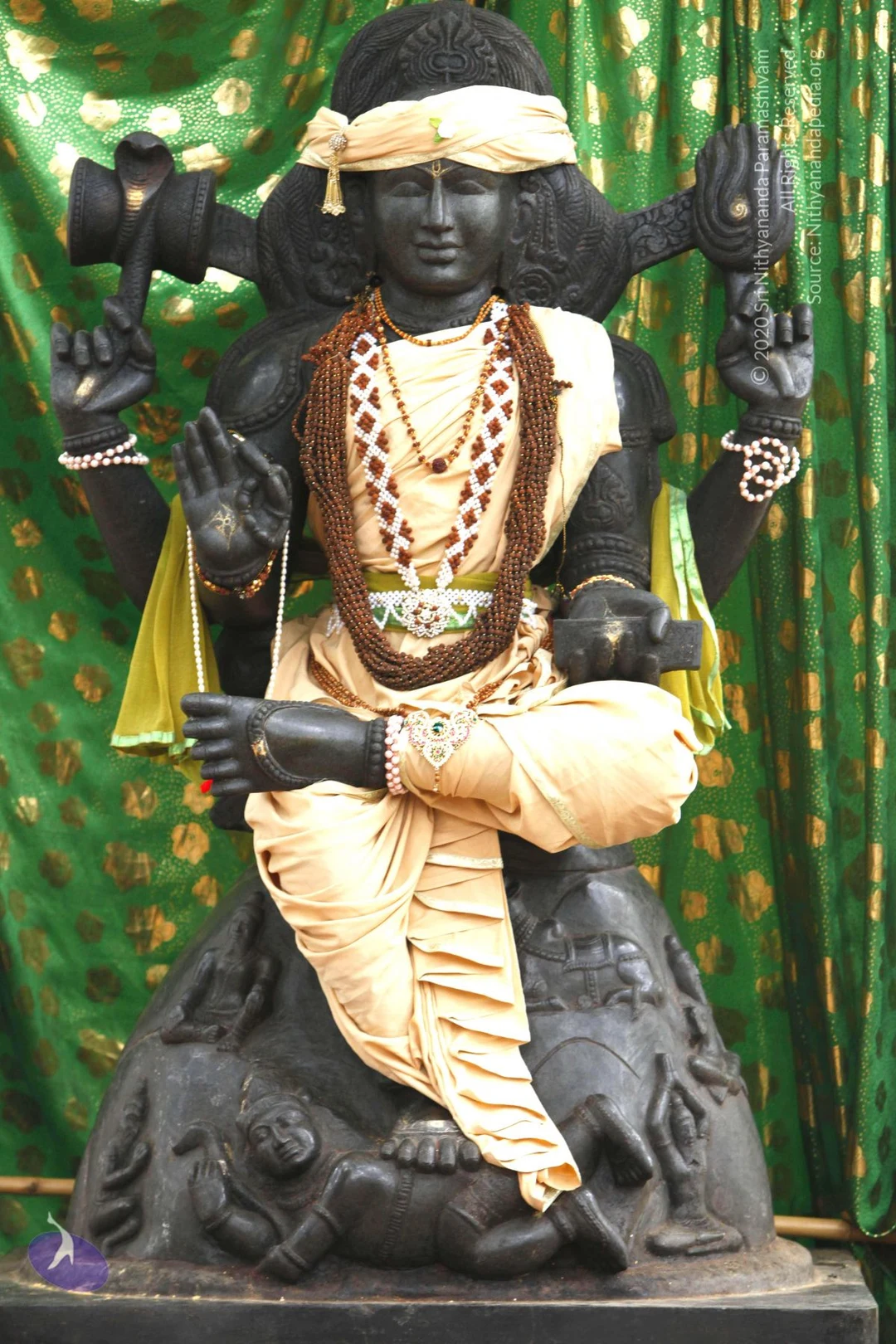
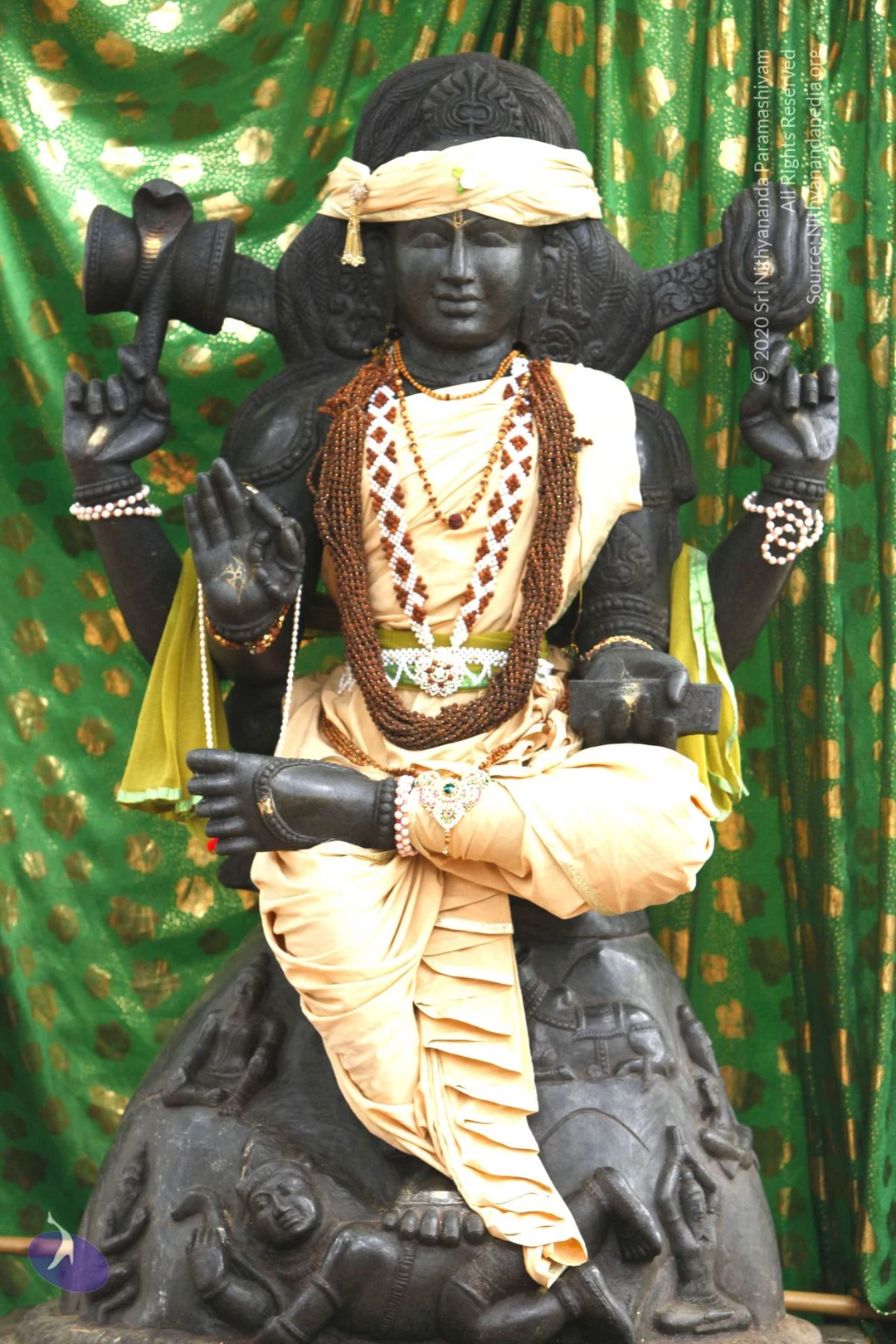
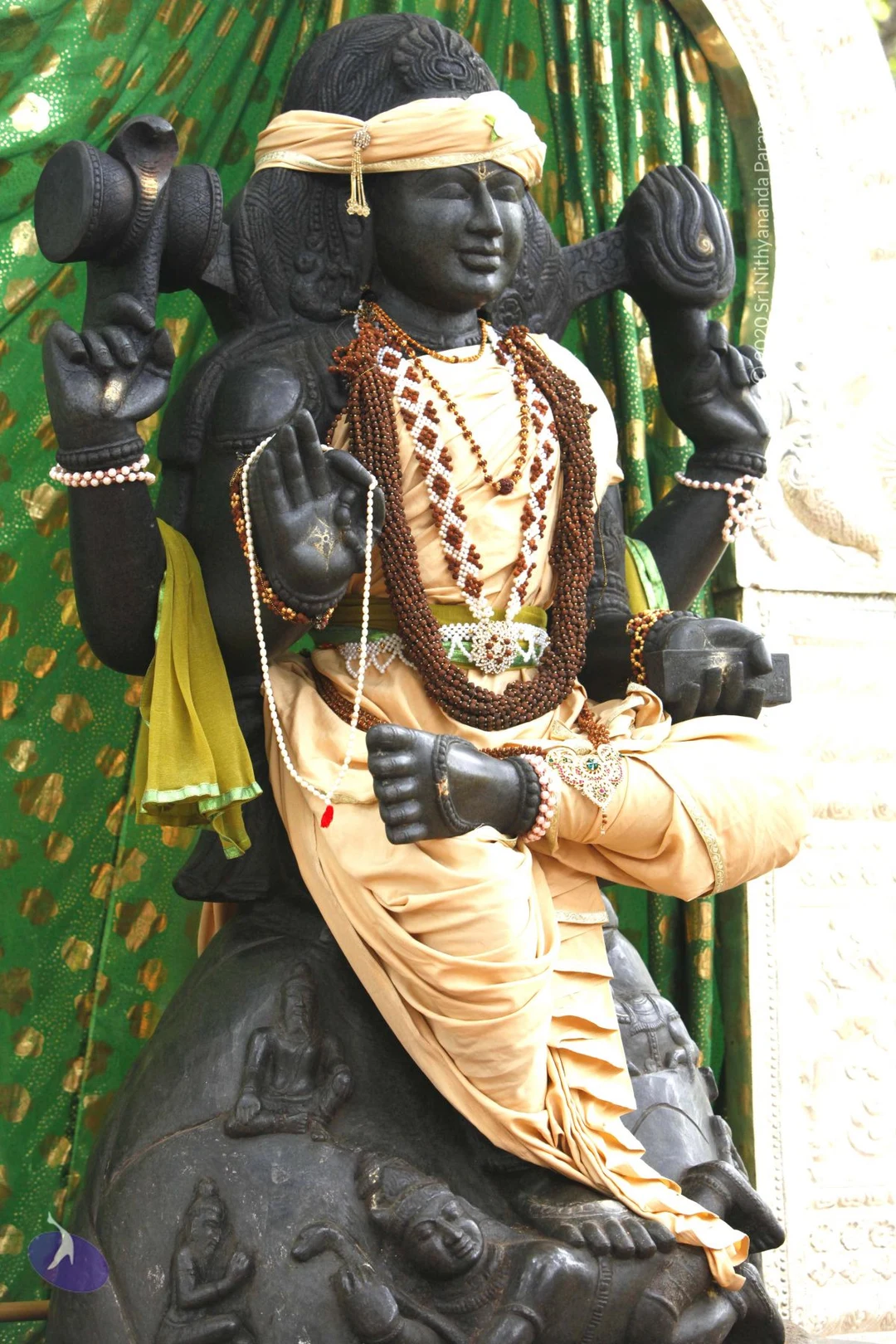
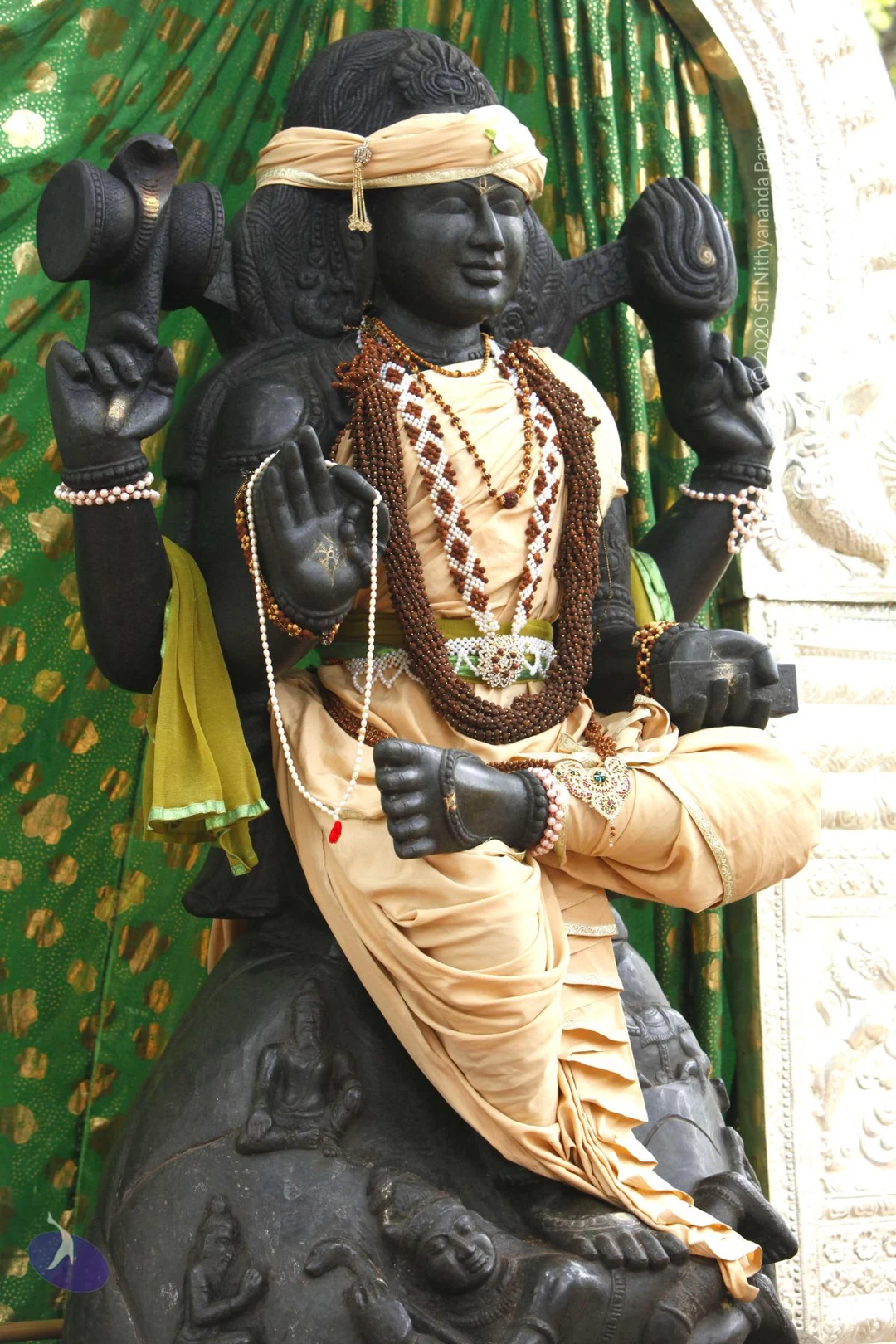
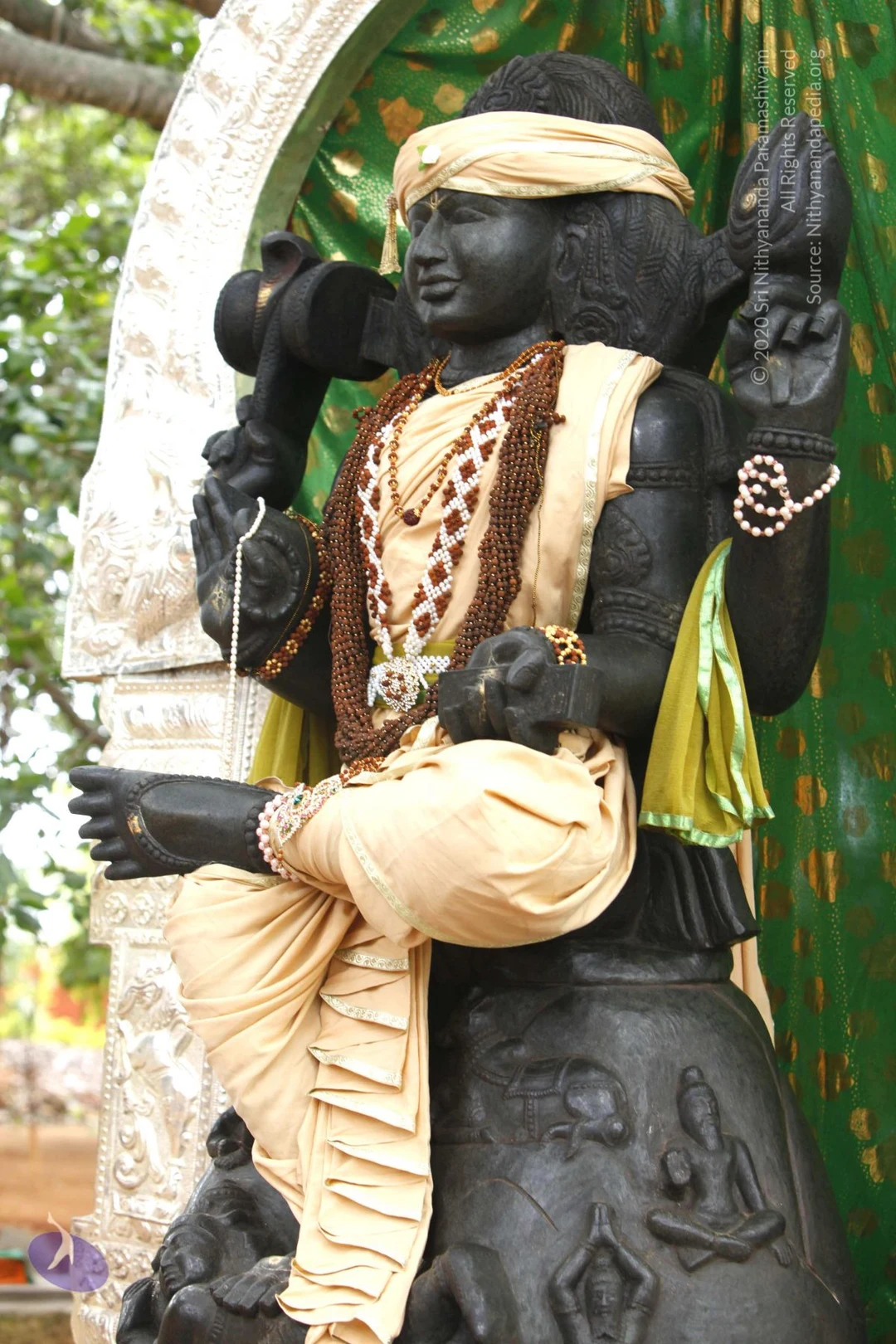
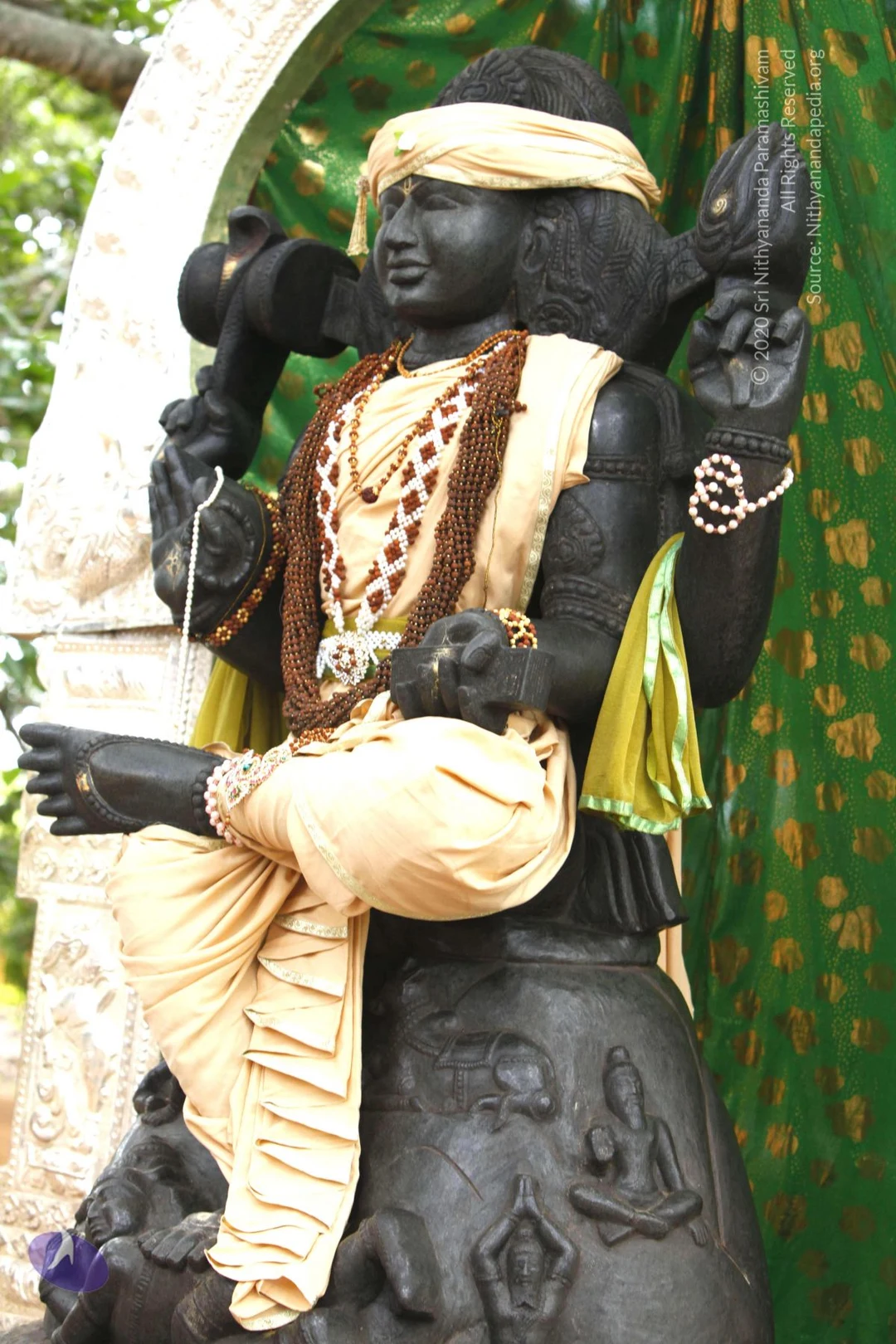
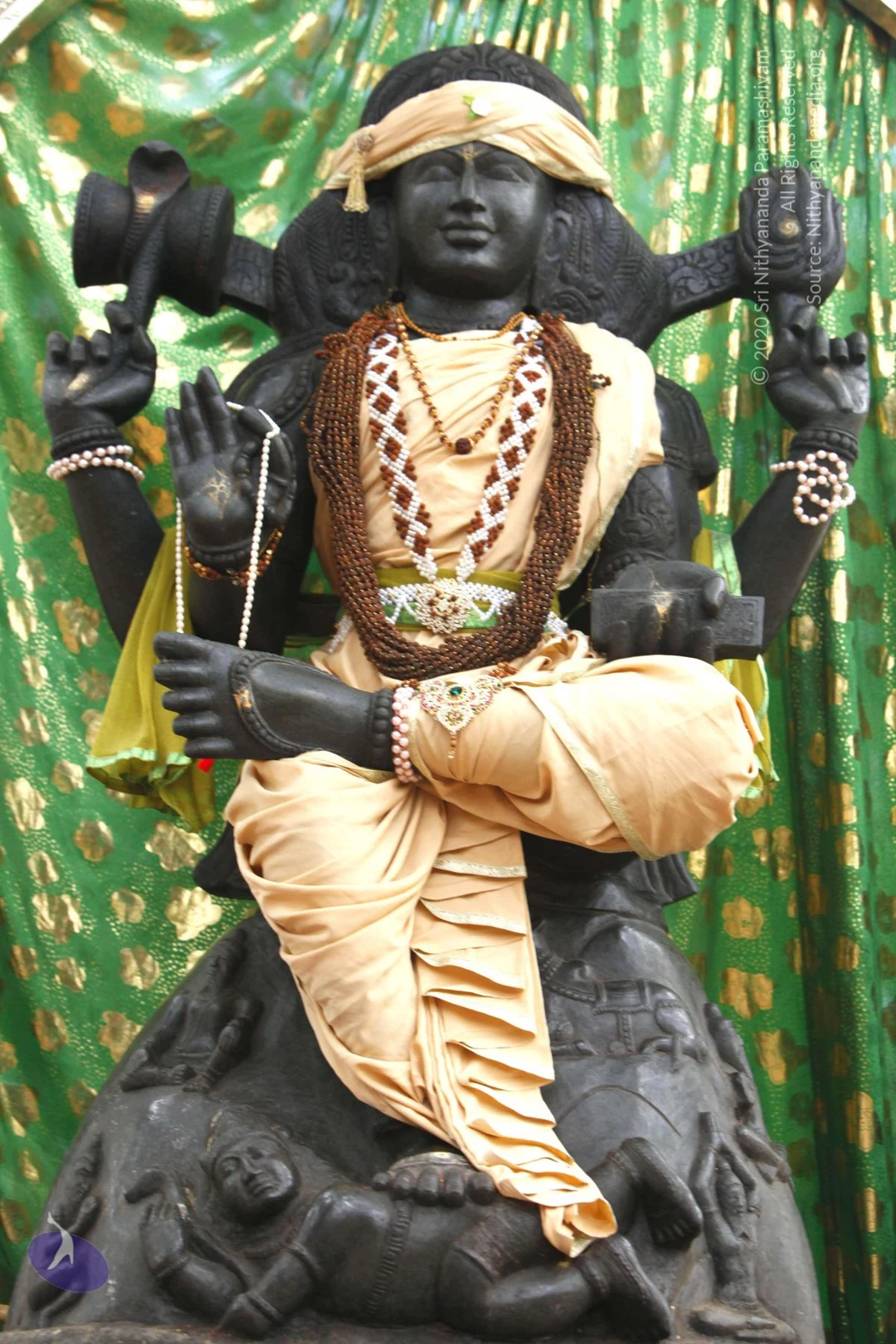
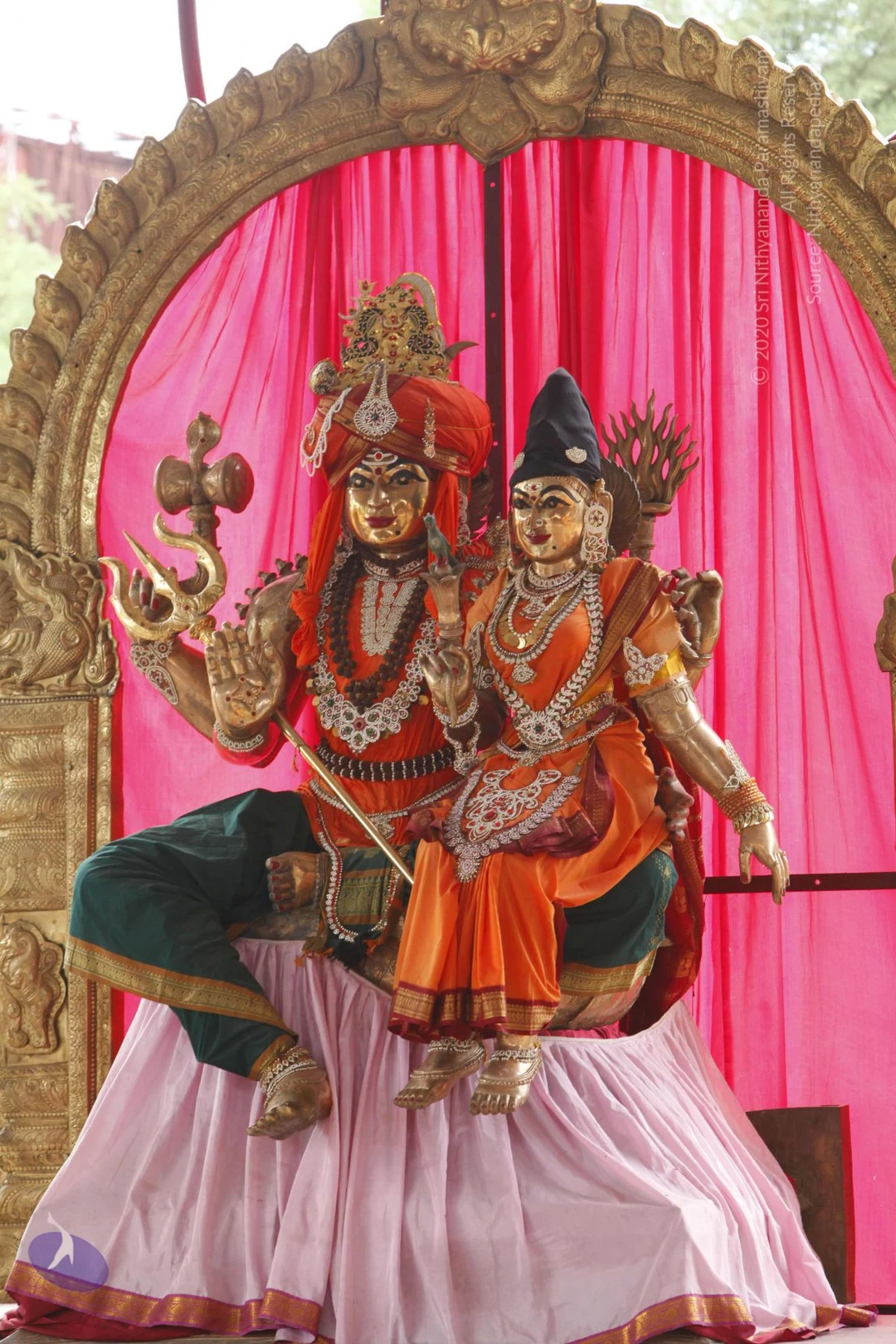
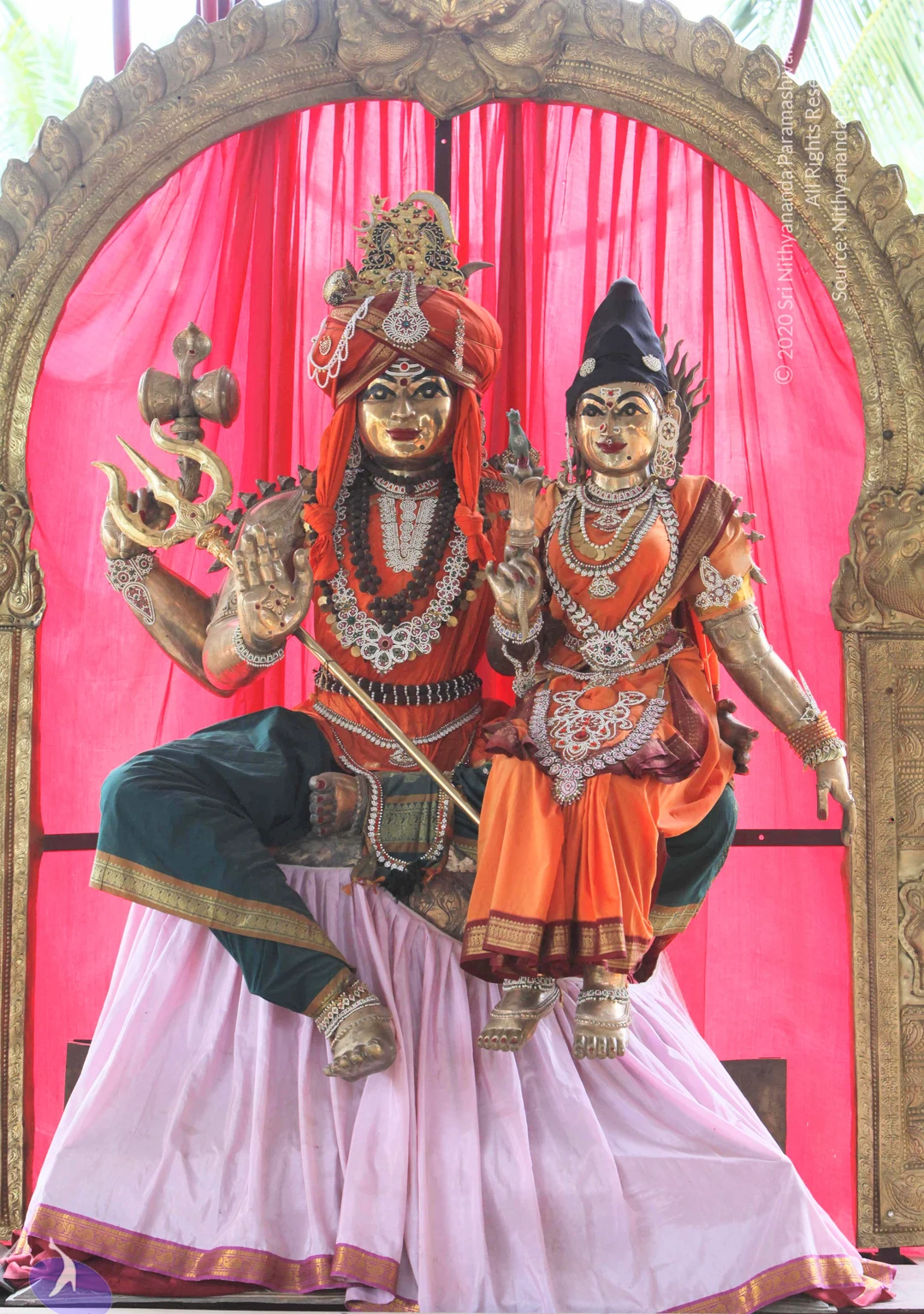
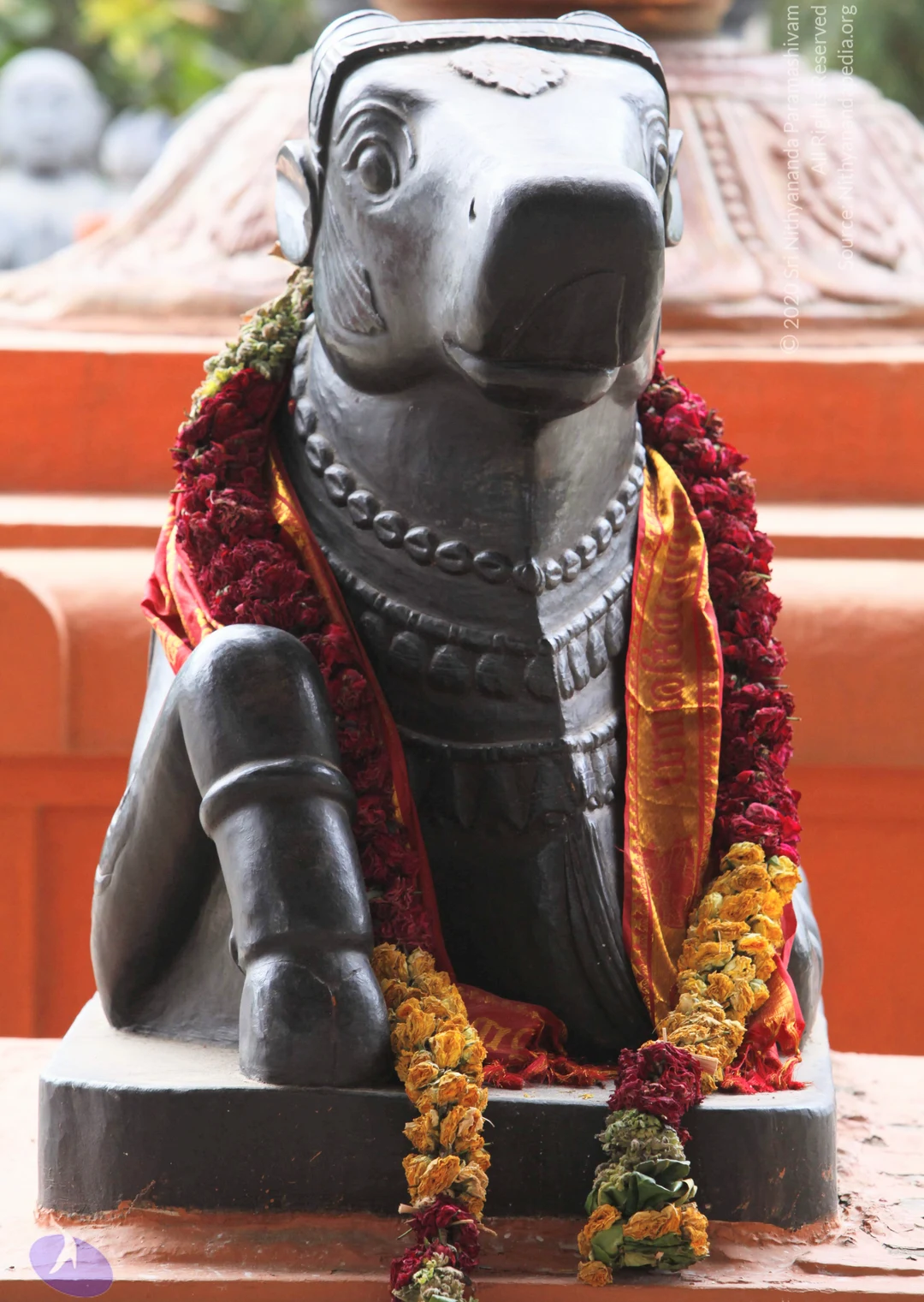
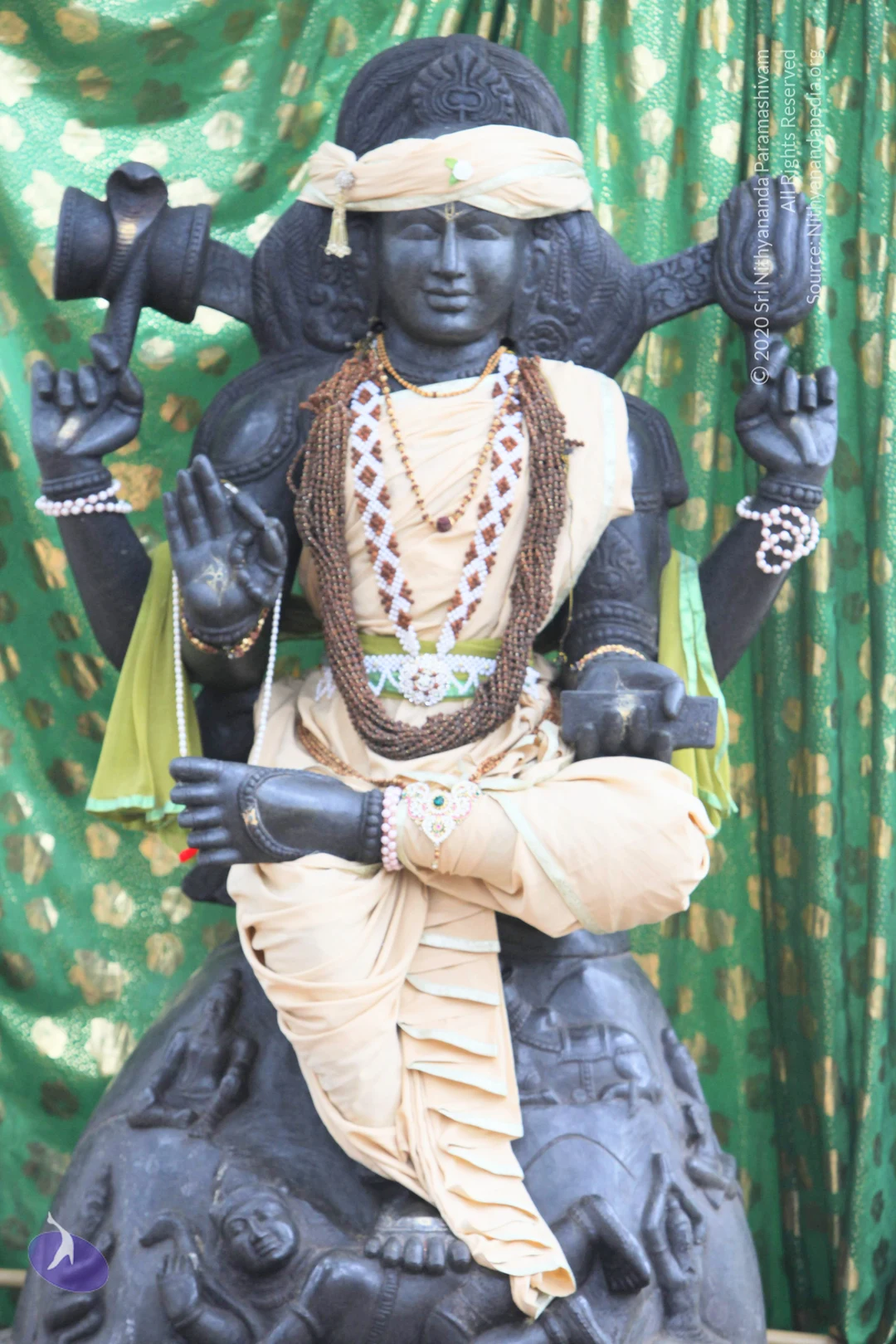
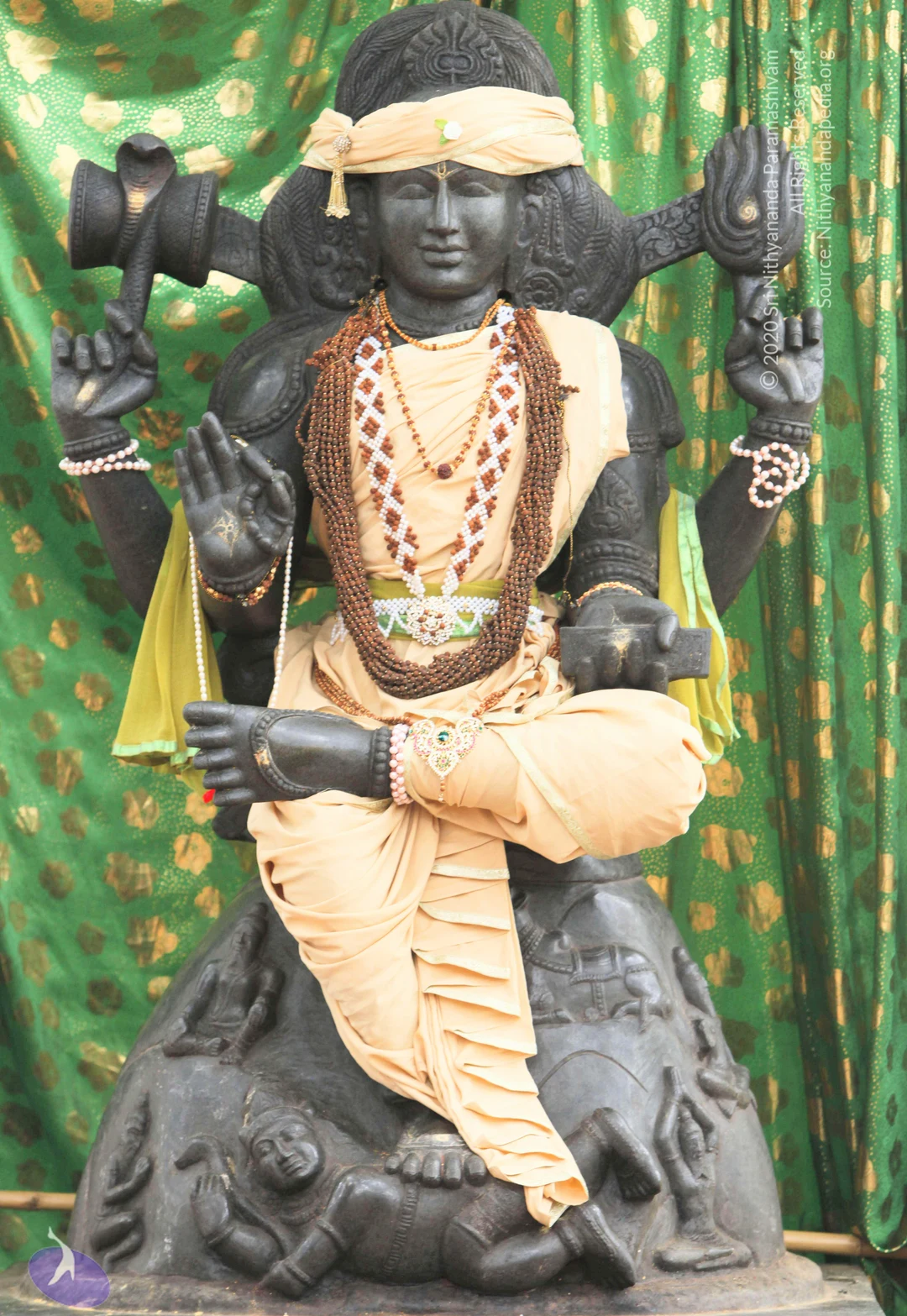
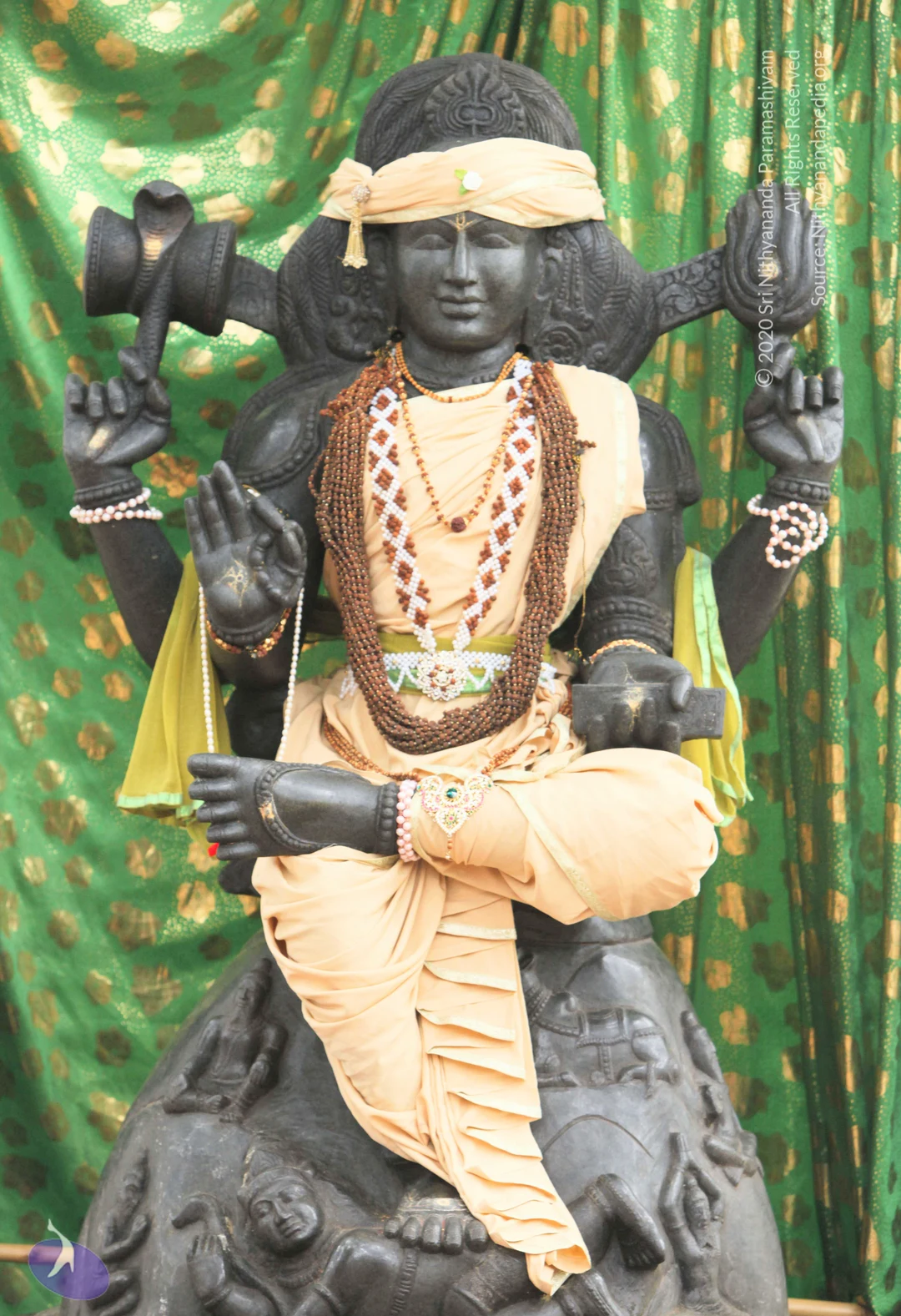
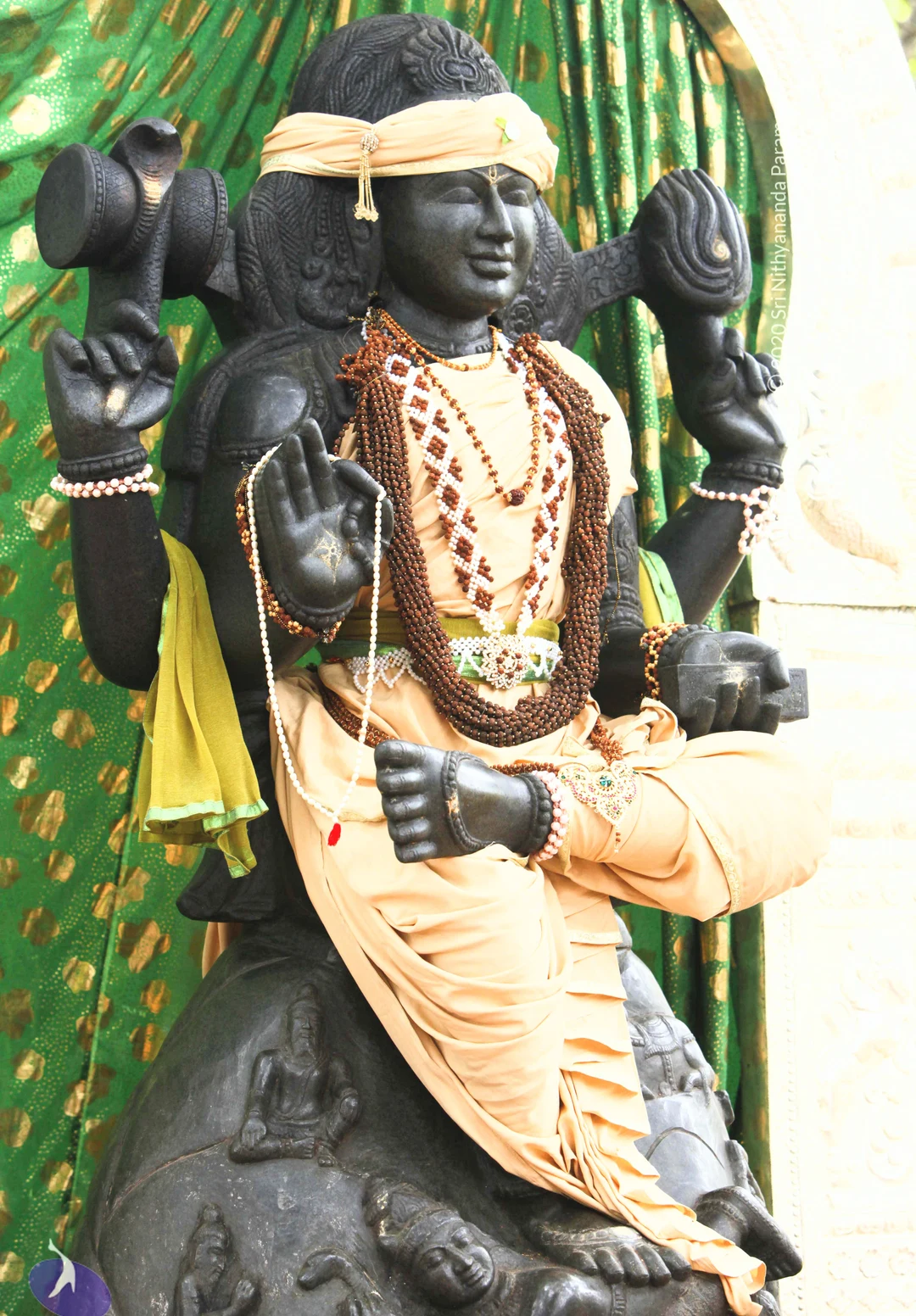
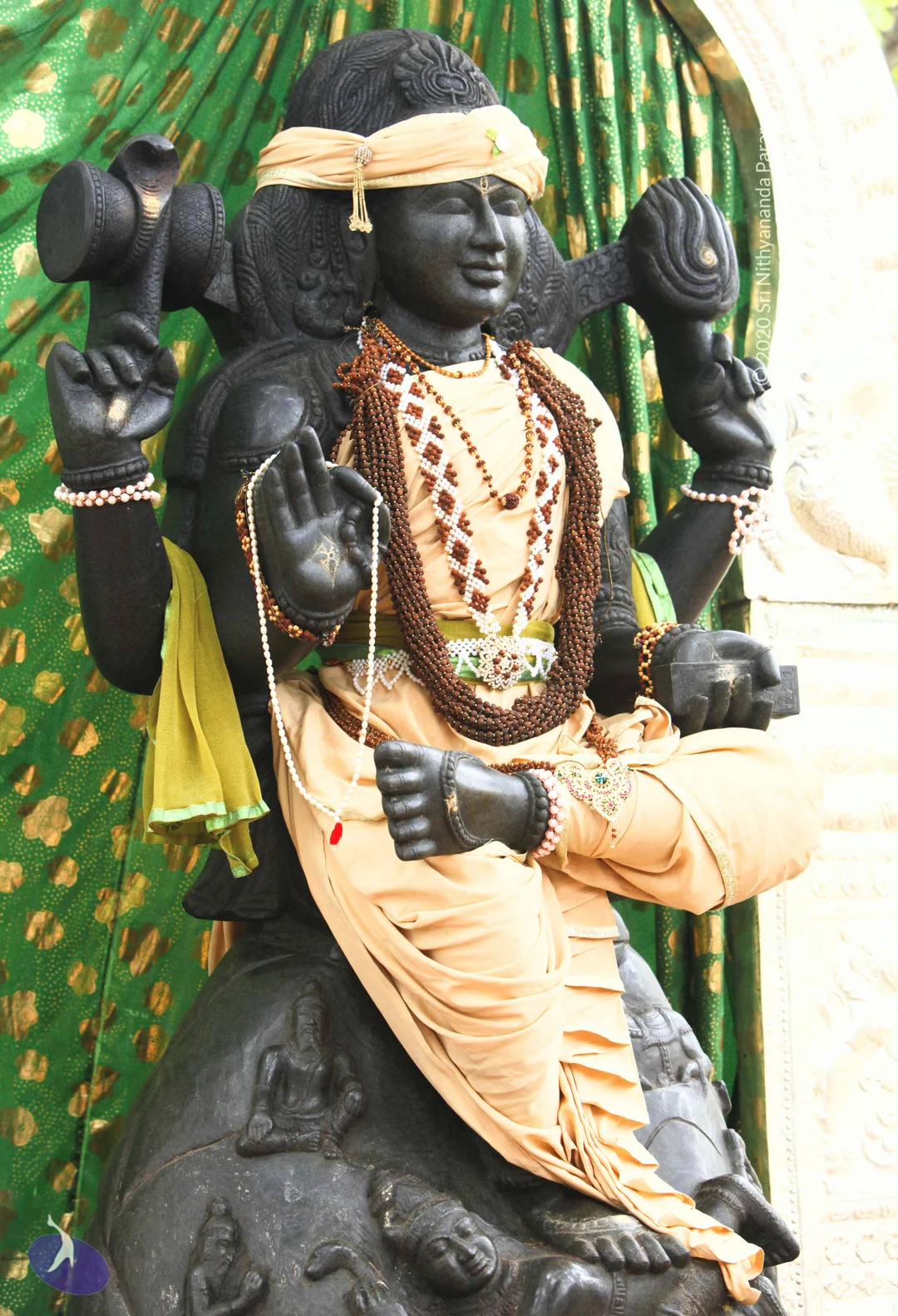
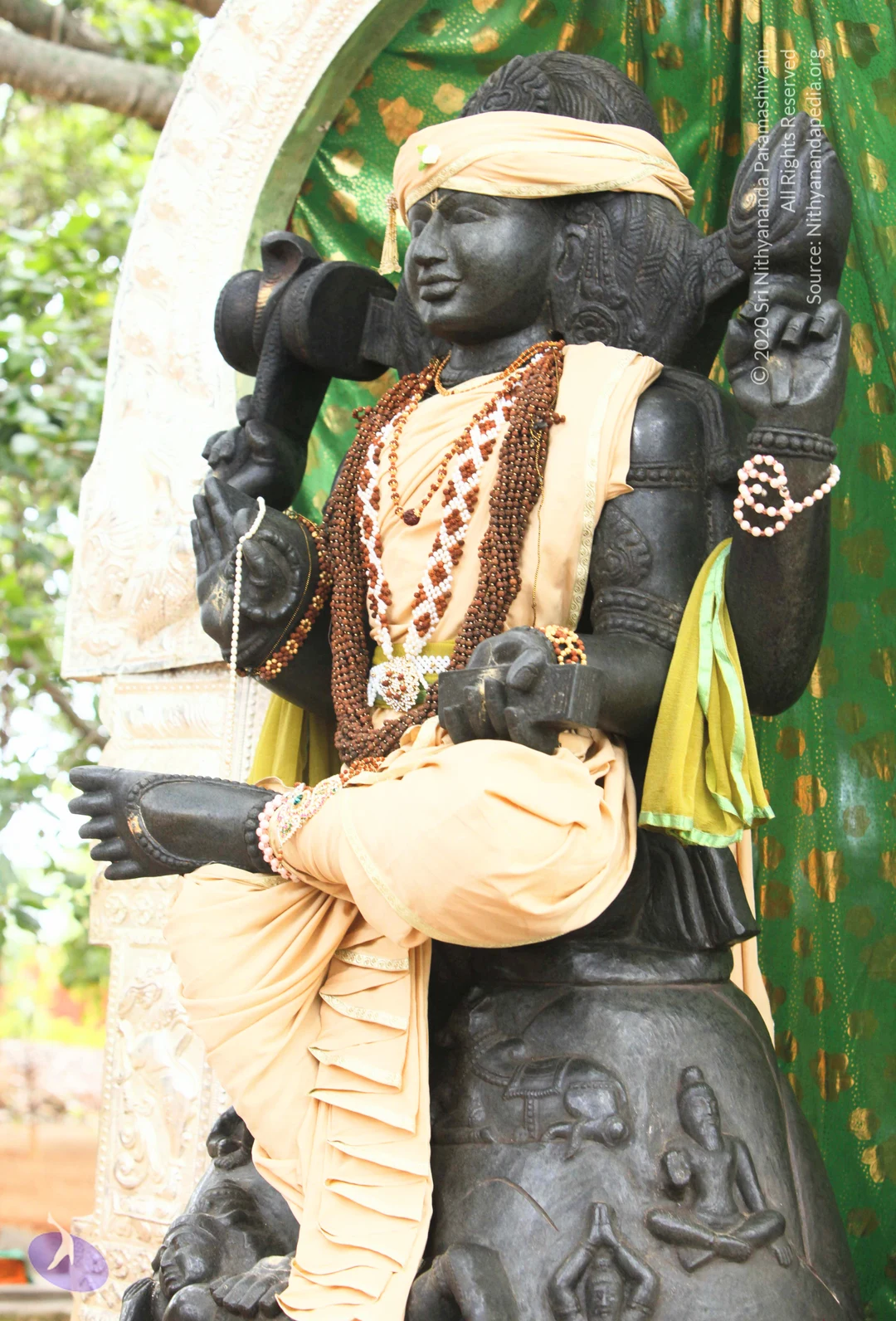
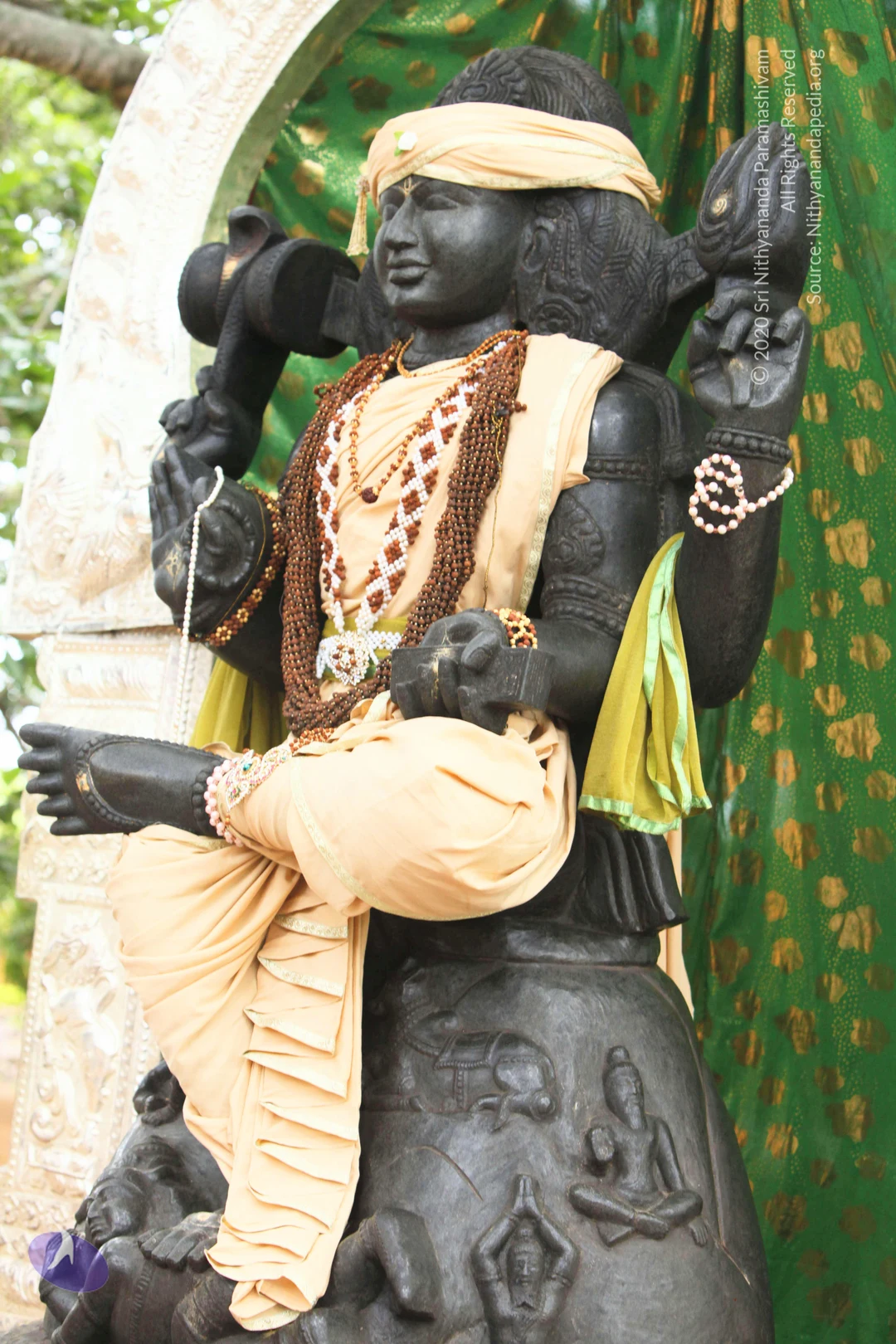
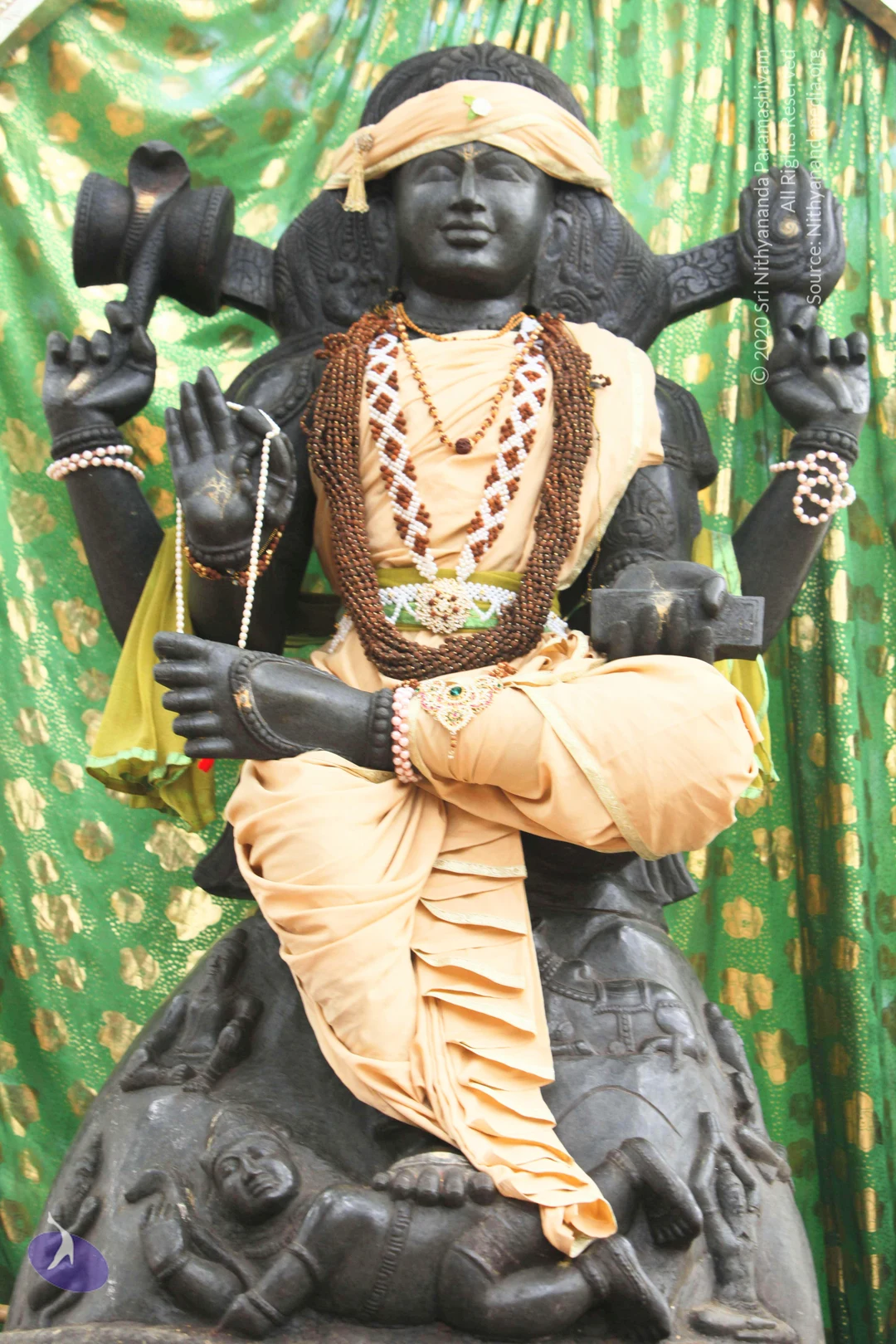
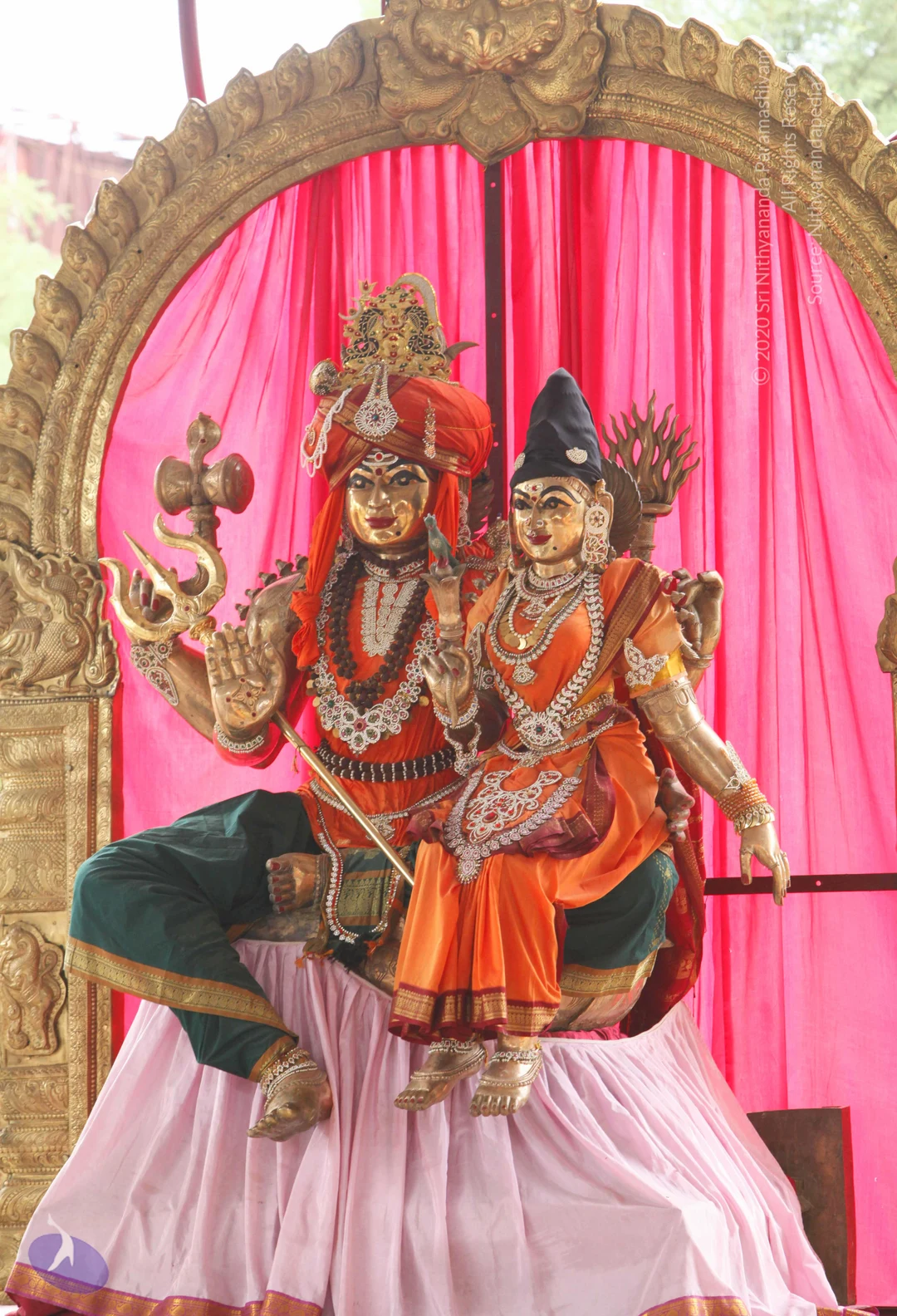
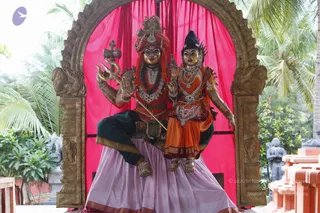
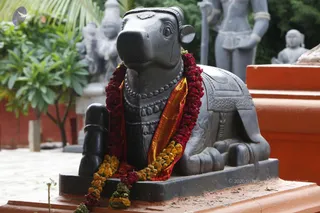
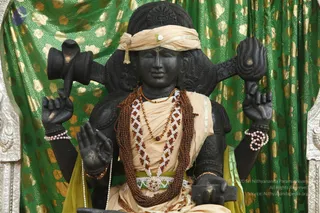
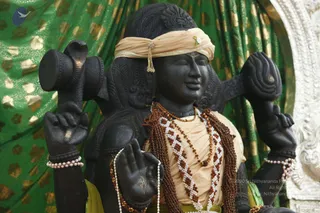
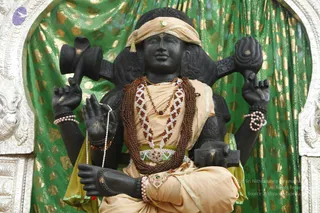
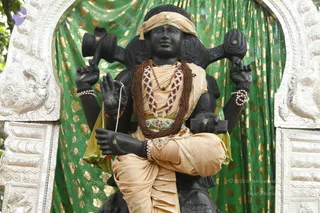
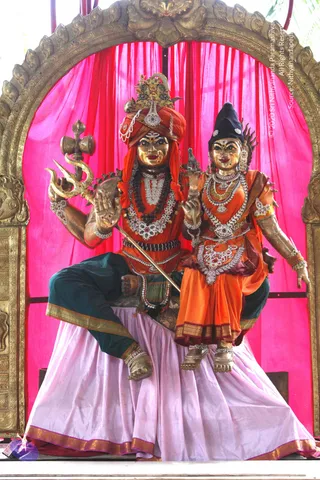
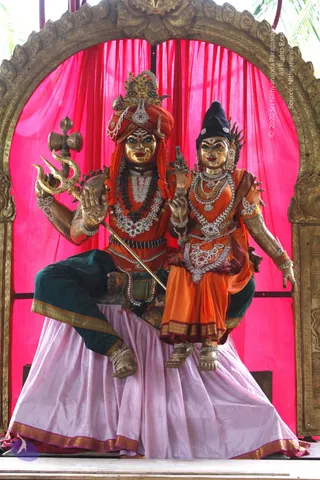
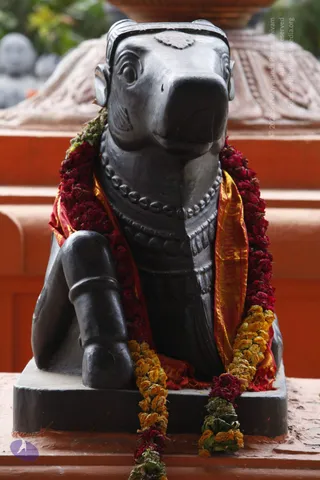
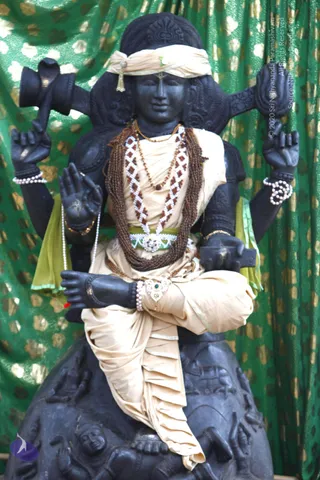
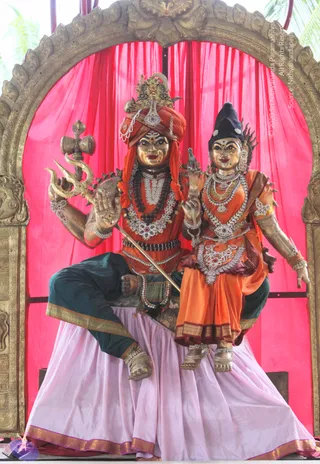
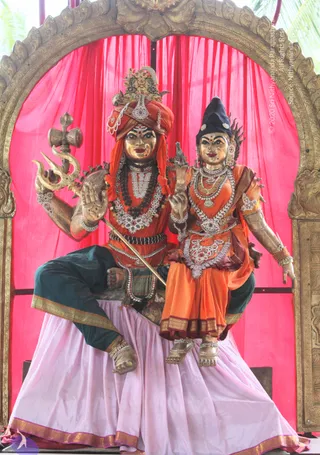
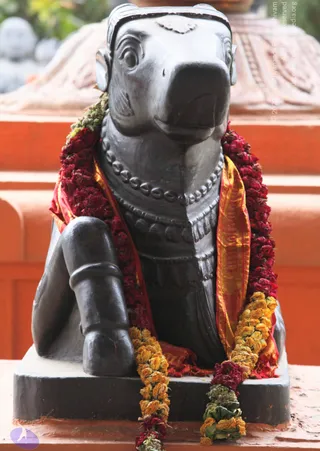
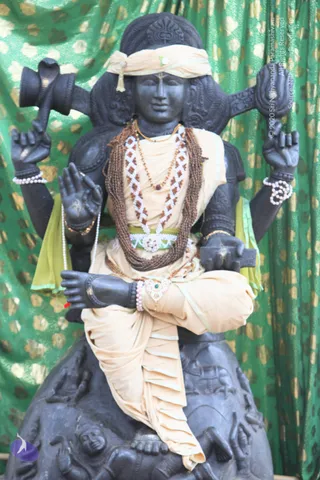
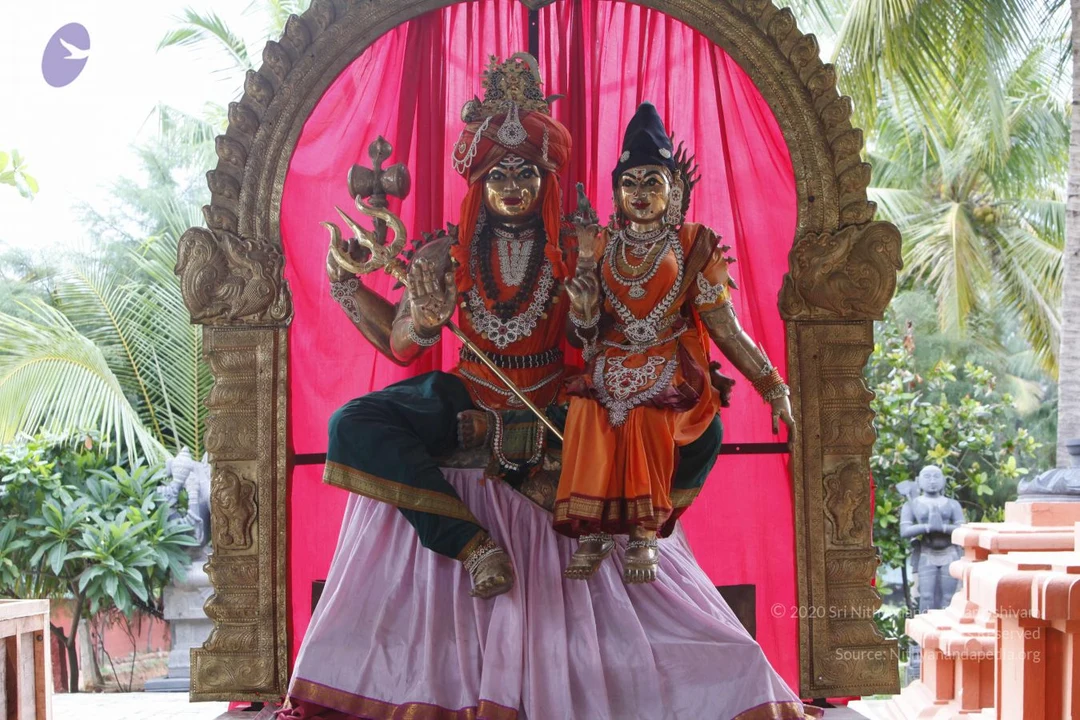
Photograph of a pair of life-size golden statues seated together on a lavender draped platform in front of a red curtain within an ornate golden arched frame, with palm trees and green foliage behind. The figure on the left has a red and orange turban, a rudraksha mala and a trident held in one hand, wearing dark green trousers and an orange garment. The figure on the right wears a dark crown-like headpiece, an orange sari and layered ornate necklaces. Both are statues, not living people.A dark grey stone Nandi bull statue sits on a black pedestal atop an orange-red base, draped with a red and yellow silk shawl and garlands of red and orange marigold flowers. Its neck bears a beaded necklace and it wears a decorated saddle cloth. Behind it stand blurred grey sculptures of deity figures, one holding a staff, beside green foliage and frangipani-like trees in a temple courtyard. Scattered flower petals lie on the base. No physical people are visible.A black stone murti of a four-armed deity seated against a green cloth with gold dots. The figure wears a peach-coloured cloth wrapped around the body and head, a peach headband with a gold tassel and white flower, and many rudraksha and white bead malas across the chest. Its raised hands hold a small cobra-like object and a flaming or spiral item, with a gold-ornamented belt. No living people are visible.A black stone murti of a deity with multiple arms stands before a green fabric backdrop with gold square motifs. The figure wears a peach-coloured headband with a tassel, a peach cloth wrap, and layered necklaces of rudraksha-style brown beads and white pearl strands. One raised hand holds a small trident-like staff, and the other hand is held in blessing with marks on the palm. White pearl bracelets adorn the wrists. A white carved arch frames the right side. No physical people are visible; the figure is a statue.A dark black stone murti of a multi-armed deity seated in an ornate silver arched niche against a green fabric backdrop with gold dot patterns. The figure wears a peach-coloured dhoti and shawl, a peach turban with a golden tassel, layered rudraksha and white pearl malas, a gold jewelled armlet and pearl bracelets. Its hands hold a trident-like staff, a rattle-like object, a mala and a small square item. No living people are visible.A dark stone statue of a multi-armed deity murti sits seated in a silver-framed niche against a green fabric backdrop scattered with gold dots. The murti wears a peach-coloured dhoti and shawl, a saffron-peach head wrap, layered rudraksha and beaded necklaces, and bead bracelets on its wrists. Its raised hands hold a drum-like object and a ritual implement, and one hand holds a japa mala. The silver arch is carved with floral and animal motifs. No physical people are visible.

paduka-puja

9 photosSource gallery
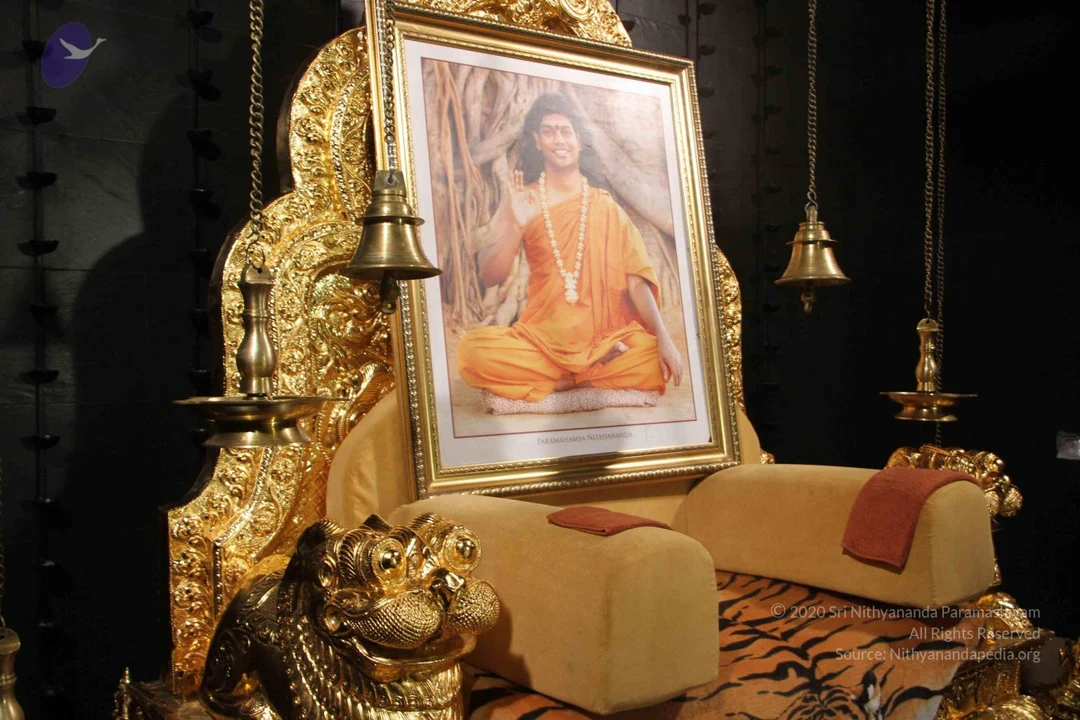
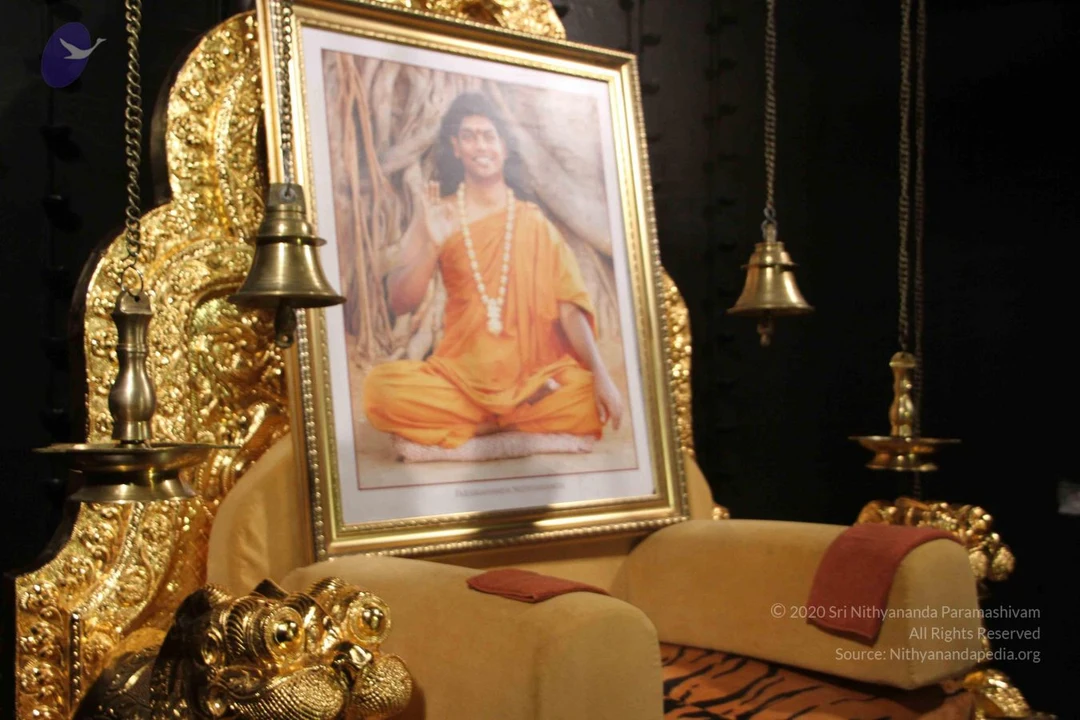
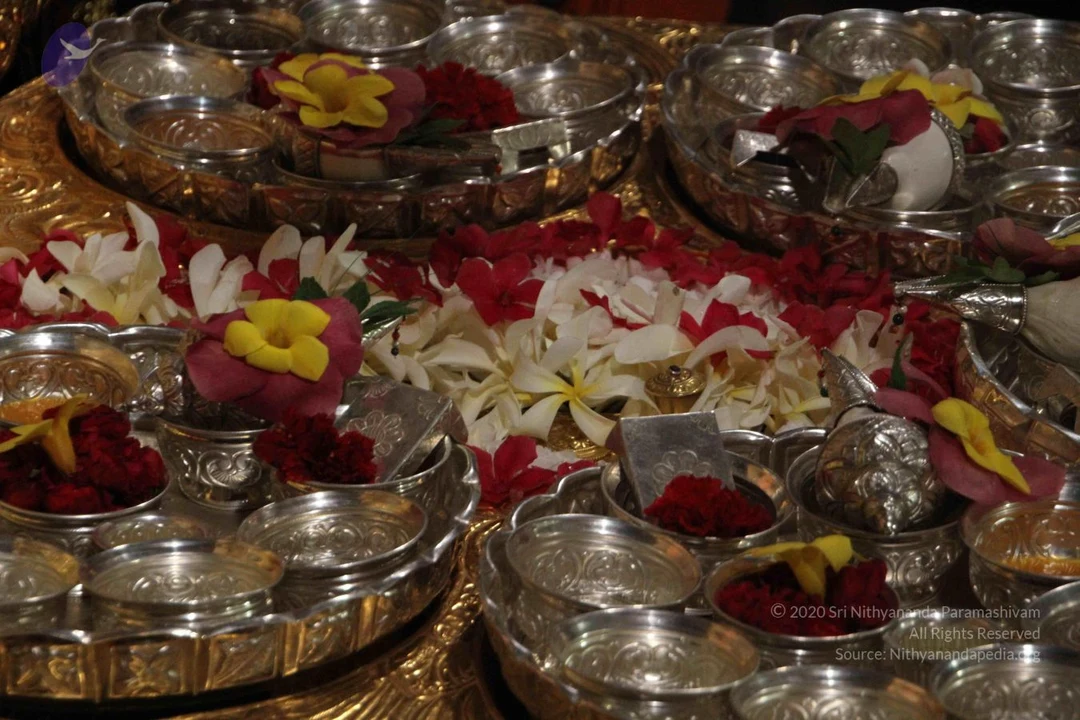
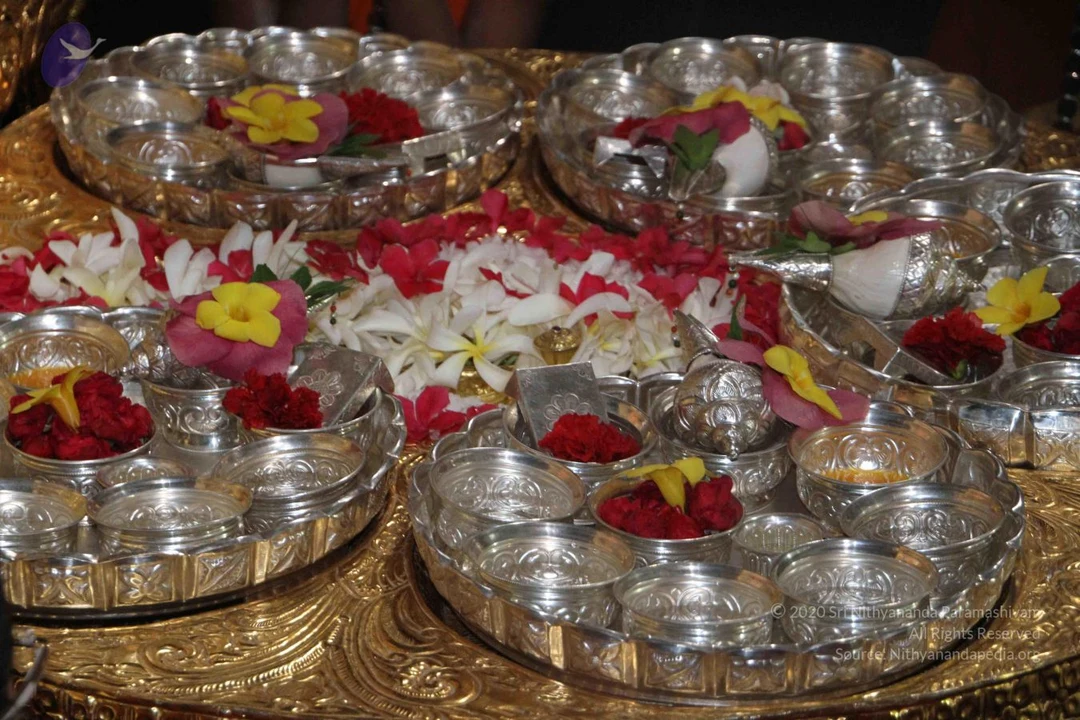
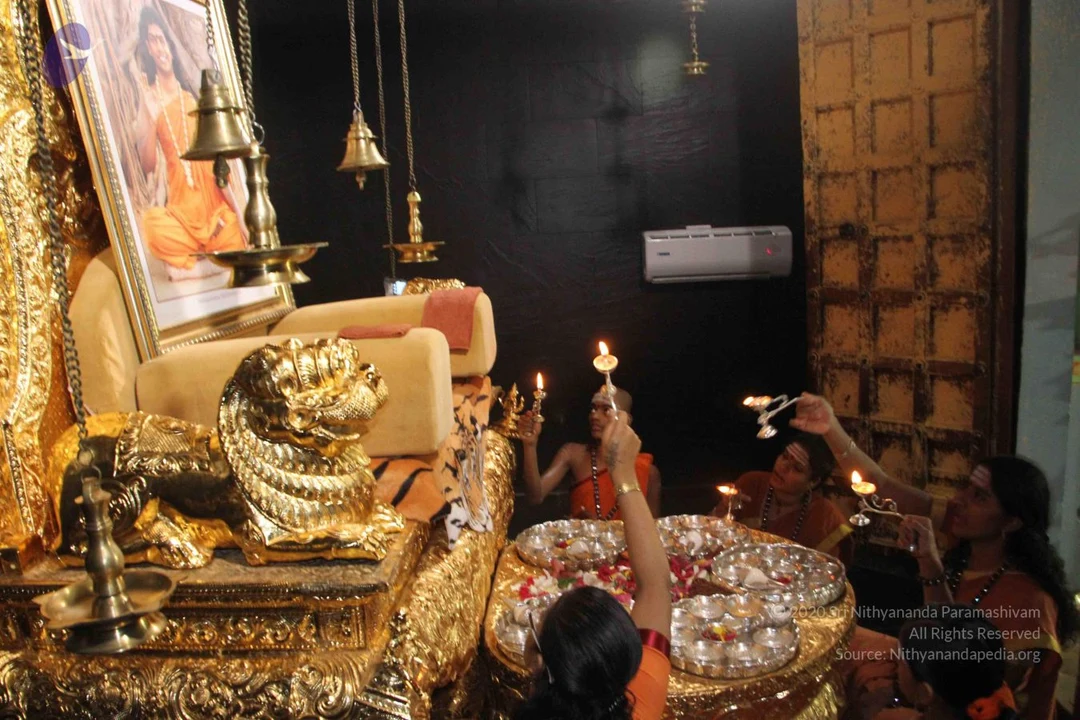
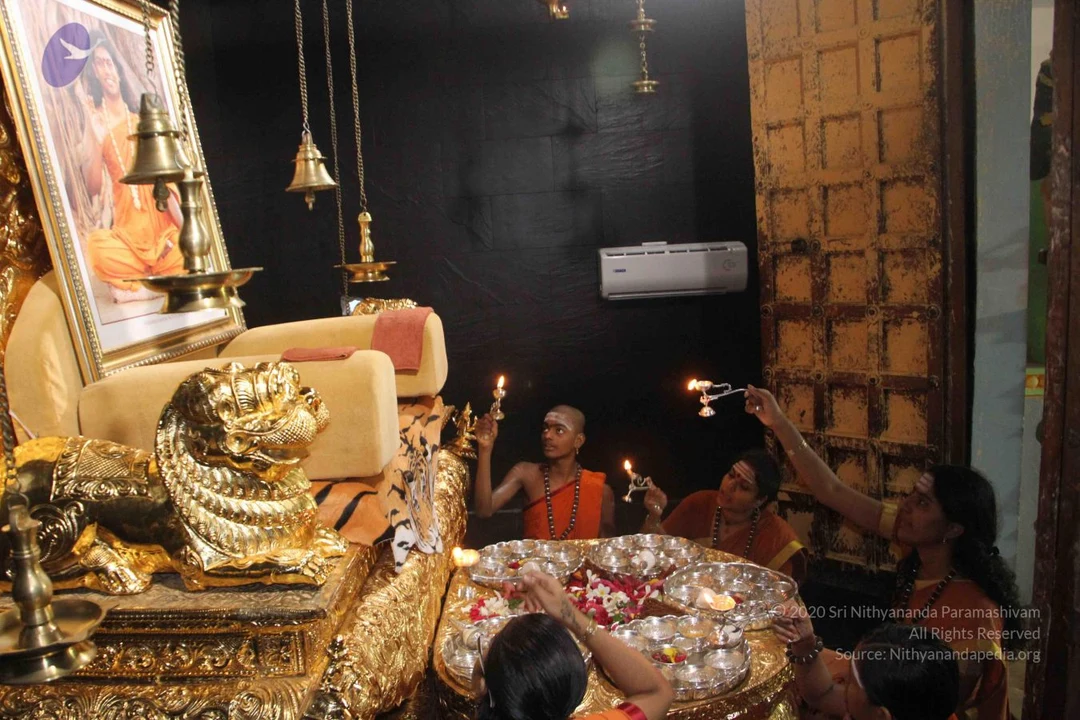
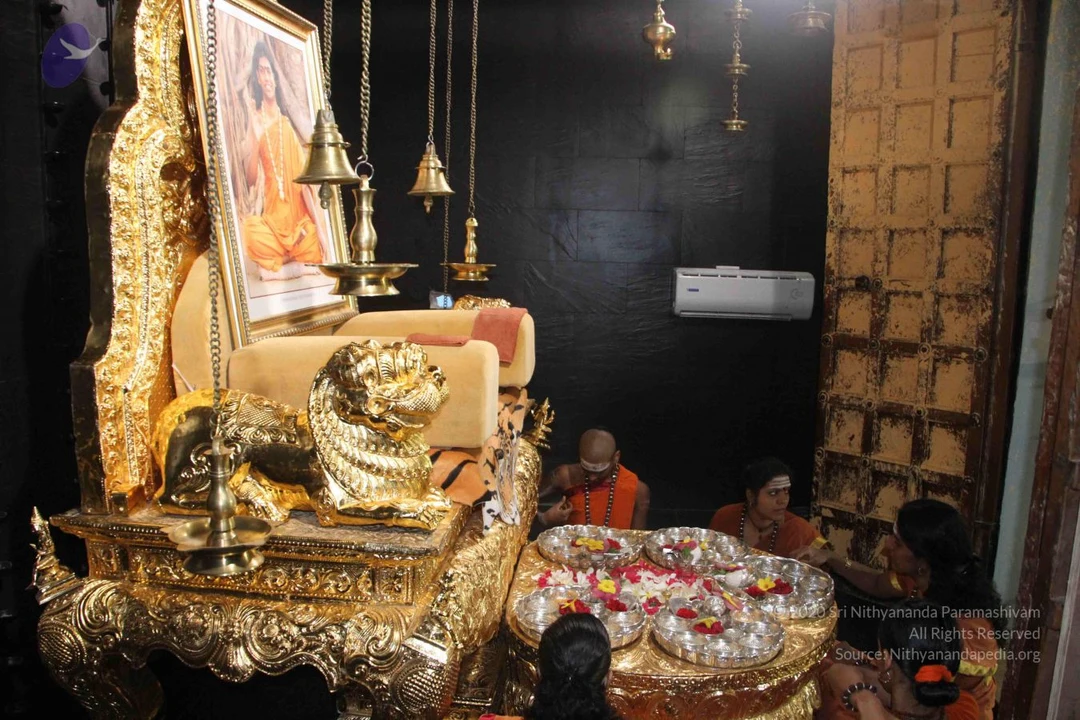
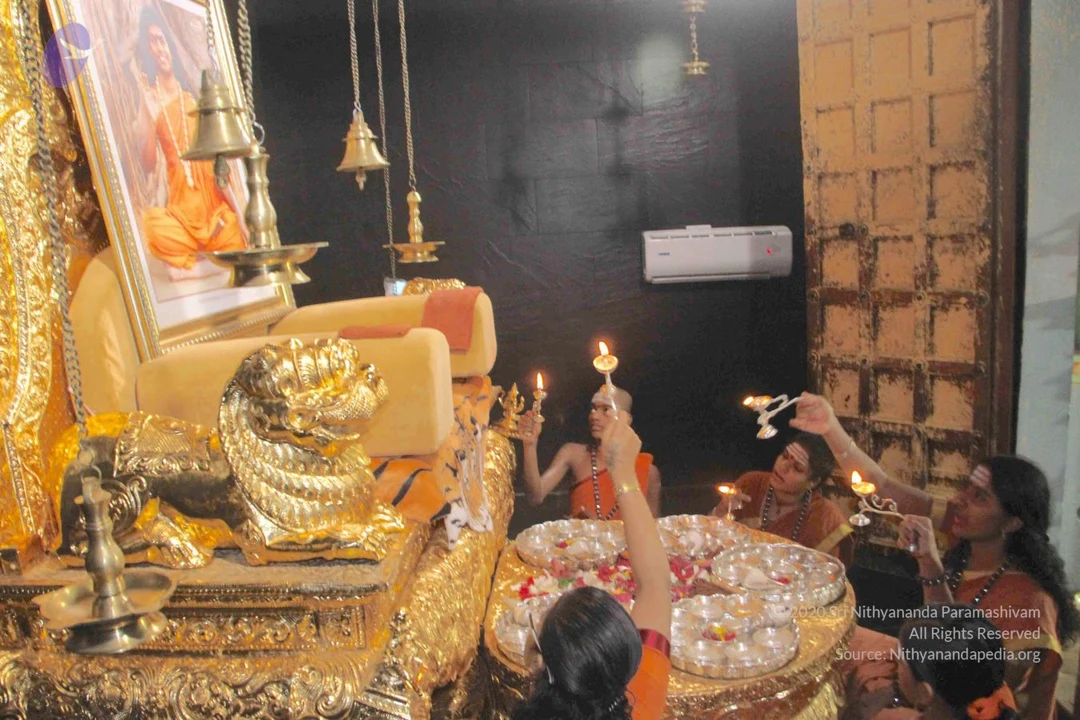
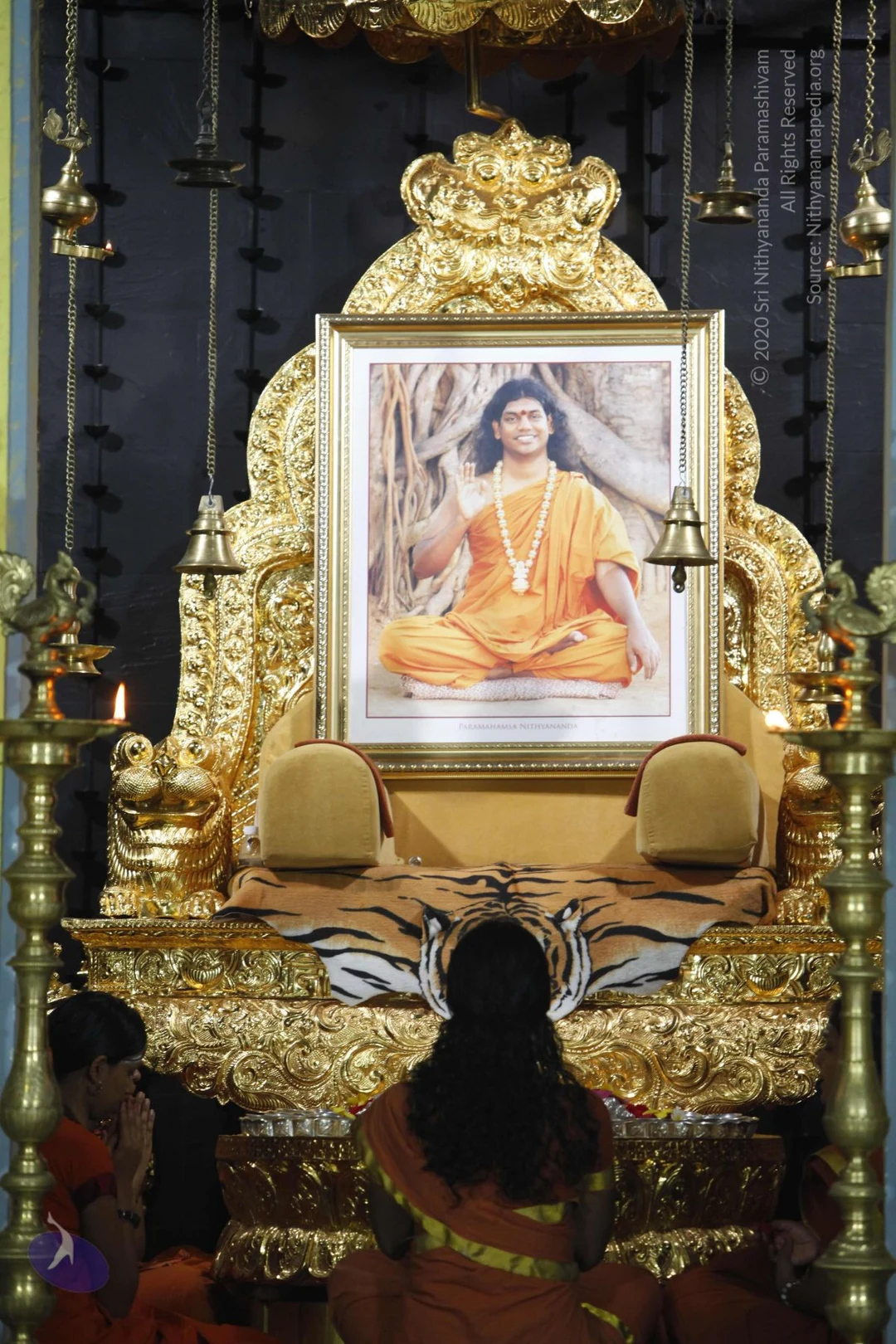
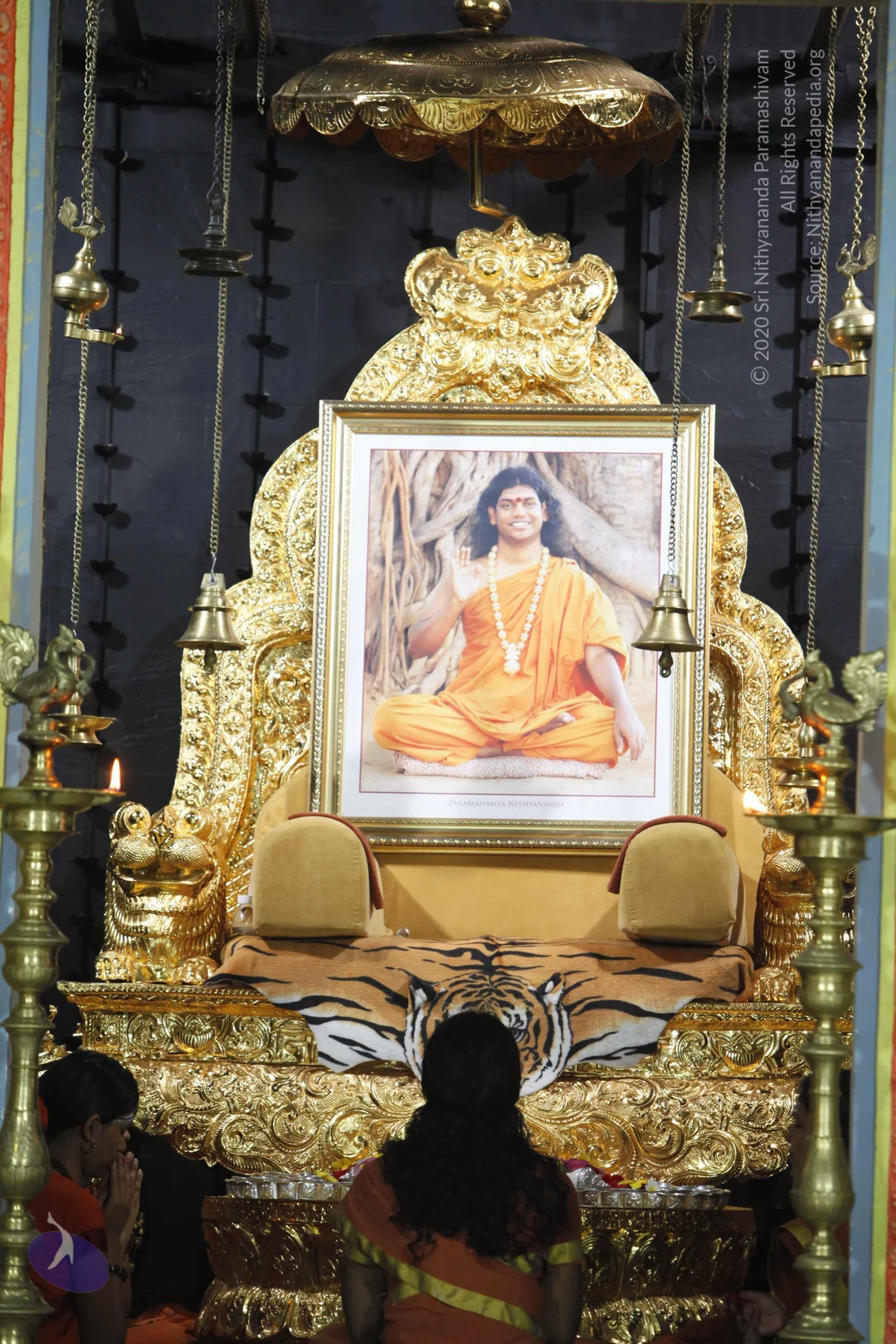
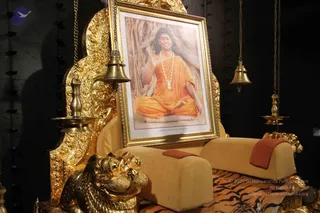
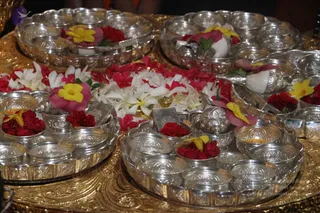
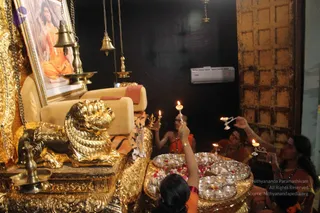
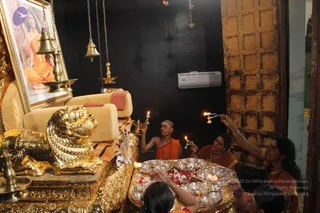
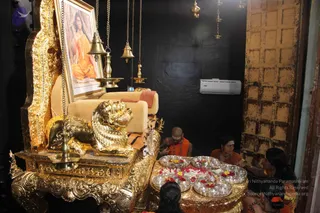
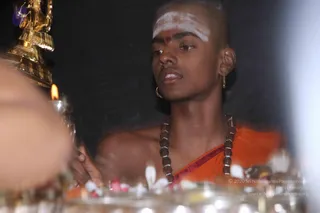
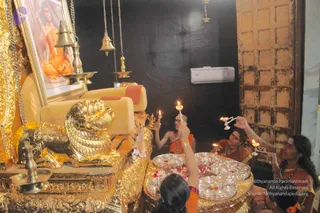
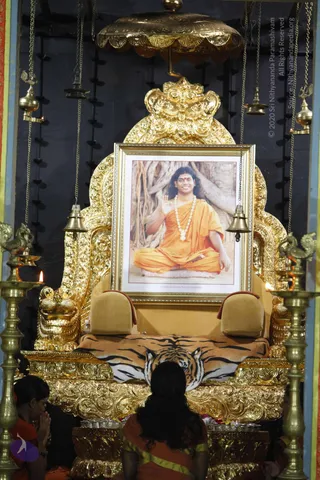
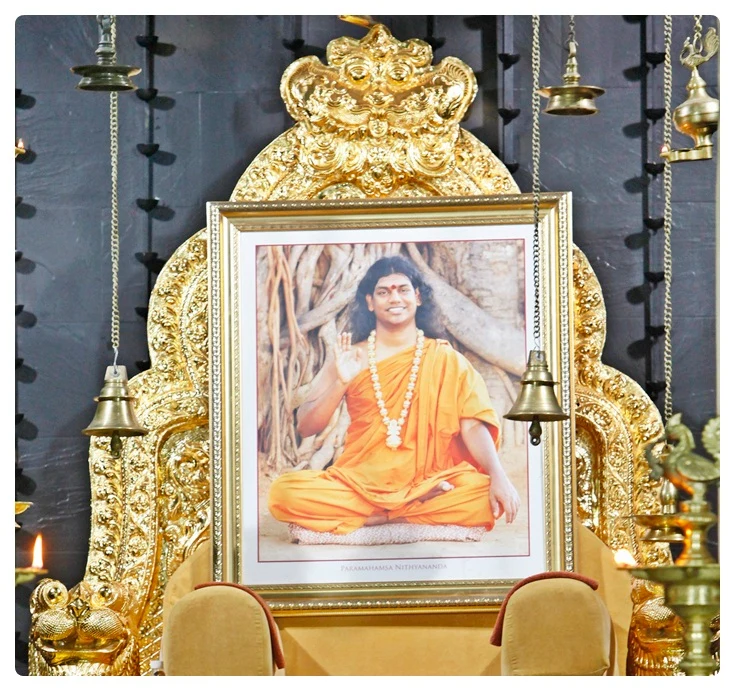
A framed portrait labelled "PARAMAHAMSA NITHYANANDA" sits on an ornate gilded throne with lion-head armrests and a tiger-striped rug. The portrait shows a seated figure in orange robes with a white bead garland, one hand raised, before a banyan tree background. Brass hanging bells and a brass oil lamp flank the throne. No physical people are visible; the figure is depicted only in the printed portrait.A framed portrait on a gilded, ornately carved throne with brass bells and hanging brass oil lamps on chains, against a dark background. The portrait shows a seated figure in orange-saffron robes with a white beaded mala necklace, hand raised in blessing, before a banyan root backdrop. The throne has a golden-brown velvet seat with a tiger-striped cloth and a red cloth draped over the armrest. No physical people are present. Swamiji (probable) appearance cues are visible in the depicted portrait: long swept-back hair, saffron robes and a mala necklace, shown as a painted or printed depiction rather than a person in the room.Close view of a temple puja tray arrangement on a gold-coloured metal surface. Silver bowls and a small silver vessel hold red carnations, yellow and white plumeria-type flowers, and loose white and red petals strewn across the tray. A silver spoon and small brass fittings sit among the offerings. No people are visible.A photograph of a ritual offering arrangement on an ornate gold-embossed tray. Multiple silver bowls and small silver dishes hold red flowers, yellow flowers, turmeric or kumkum powder, and pink blossoms. Loose white and red flower petals are spread across the centre, with a silver conch-shaped vessel and a small silver container visible among them. No people are visible in the frame.Inside a temple shrine with gold-plated decoration, a framed portrait on the left shows a long-haired figure in orange robes seated on a cushioned seat. Four people perform an aarti with oil lamps and a silver plate of flowers and lamps. A bald man in an orange robe with rudraksha mala holds a lit lamp, a woman in orange sari holds a lamp, and another woman in orange with a mala holds a lit camphor plate. Brass bells hang from chains and a gold lion-form statue rests at the front. A wall air conditioner and a golden studded door are visible behind them.Inside a shrine room with black walls and a gold-framed portrait at left, four devotees perform aarti. A shaved-headed young priest in orange robes and rudraksha mala holds a lit lamp at centre-left, while a woman in orange-red sari with a mala lifts a lamp in the foreground. A woman at right in orange sari raises a flaming lamp. A large brass plate of kalasha-like offerings, flower garlands and small oil lamps sits on a gold-covered table. A golden lion-shaped stand and a tiger-striped cushion stand nearby, under hanging brass bells and a wall air conditioner. The framed portrait shows a robed figure seated in orange with a pale cloth, but no one is clearly identifiable as the person pictured.

Receiving-Swamiji-in-Traditional-Method
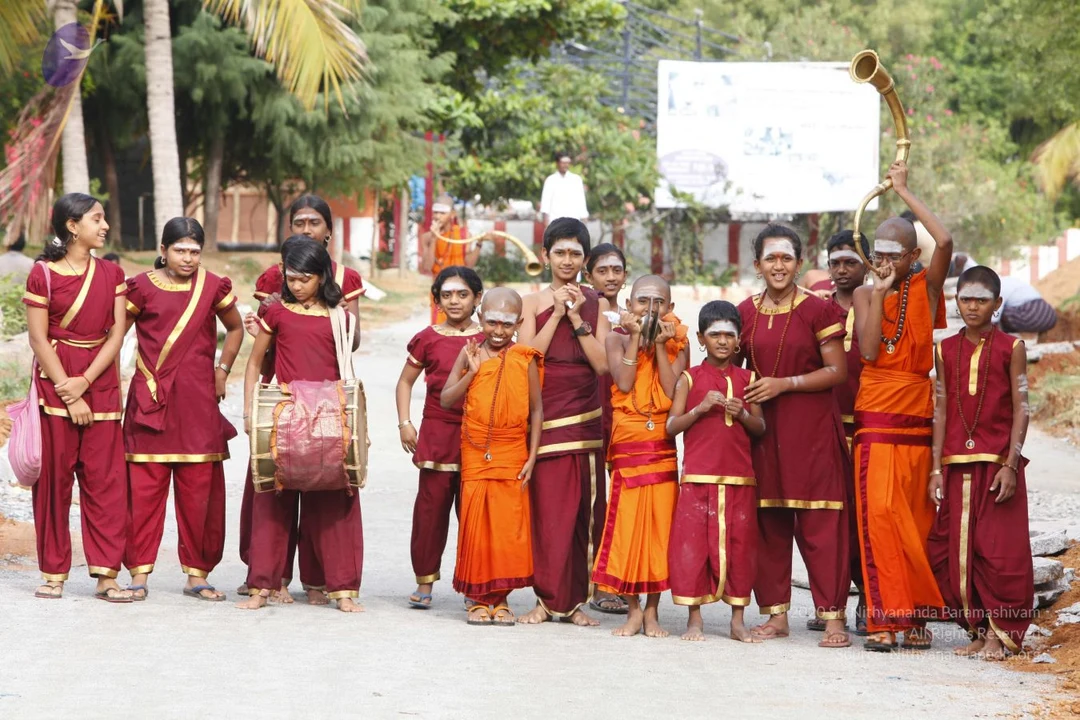
3 photosSource gallery
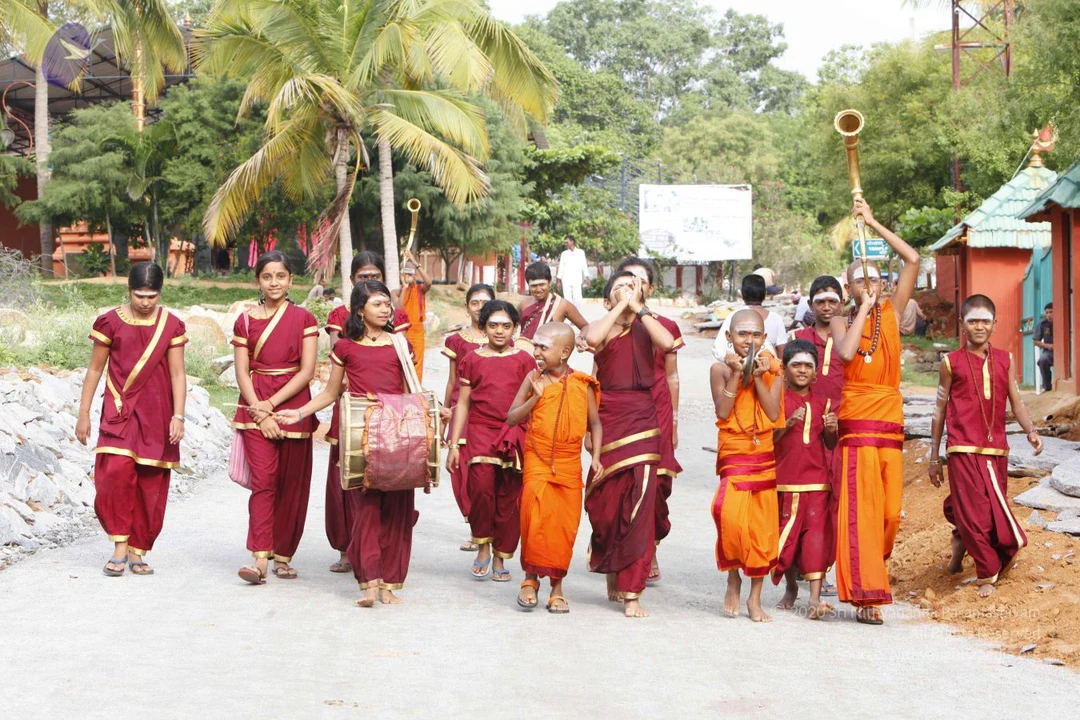
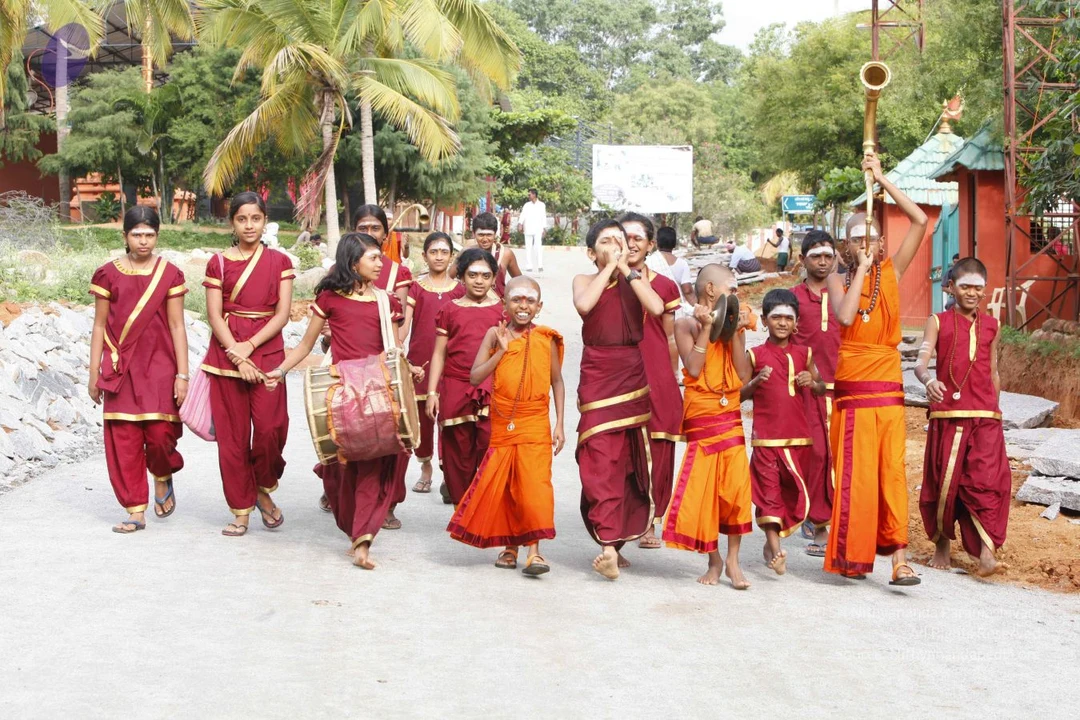
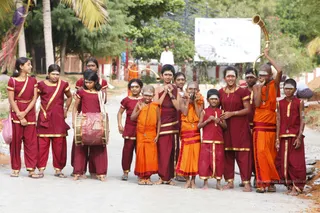
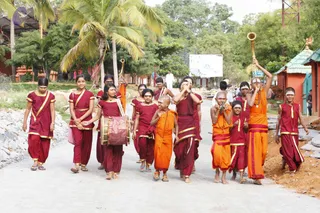
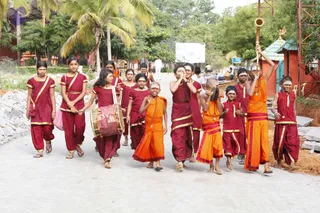
A group of about fifteen young students in maroon and orange traditional clothing walk along a paved road, with bare feet and sandals. Several wear maroon kurtas with gold borders and orange dhotis or sarees, and many have white vibhuti marks on their foreheads. One girl on the left carries a pink bag, and a boy in the centre plays a long brass horn, while another holds a drum. Palm trees and a white signboard with blue lettering stand in the background, and a man in white is visible further back.A procession of young children walking down a paved road lined with palm trees and greenery. Girls and boys wear maroon and gold dress, while several boys in saffron-orange robes walk barefoot, some with shaved heads and white sacred markings on their foreheads. Two boys in the front-right raise long brass horns (ceremonial trumpets), and a girl in maroon carries a drum wrapped in red cloth. A man in white clothing stands in the background near a small red-roofed shrine and a road sign. The scene appears to be an ashram procession, with no identifiable a person visible.A photograph of a group of young children walking barefoot along a paved road in an ashram setting, with palm trees, greenery and small red-roofed buildings behind them. Many wear maroon kurta-style tunics with gold trim and maroon dhotis, while several boys in saffron-orange robes with gold borders lead the group. One child in saffron holds a tall gold-topped staff aloft, another plays a hand cymbal, a girl carries a drum slung over her shoulder, and others sound conch-like horns or blow into their hands. Their faces bear white and painted markings. Along the roadside, adults in white and small figures stand in the background near a rock pile and a signboard.

Nithya-Satsang

20 photosSource gallery
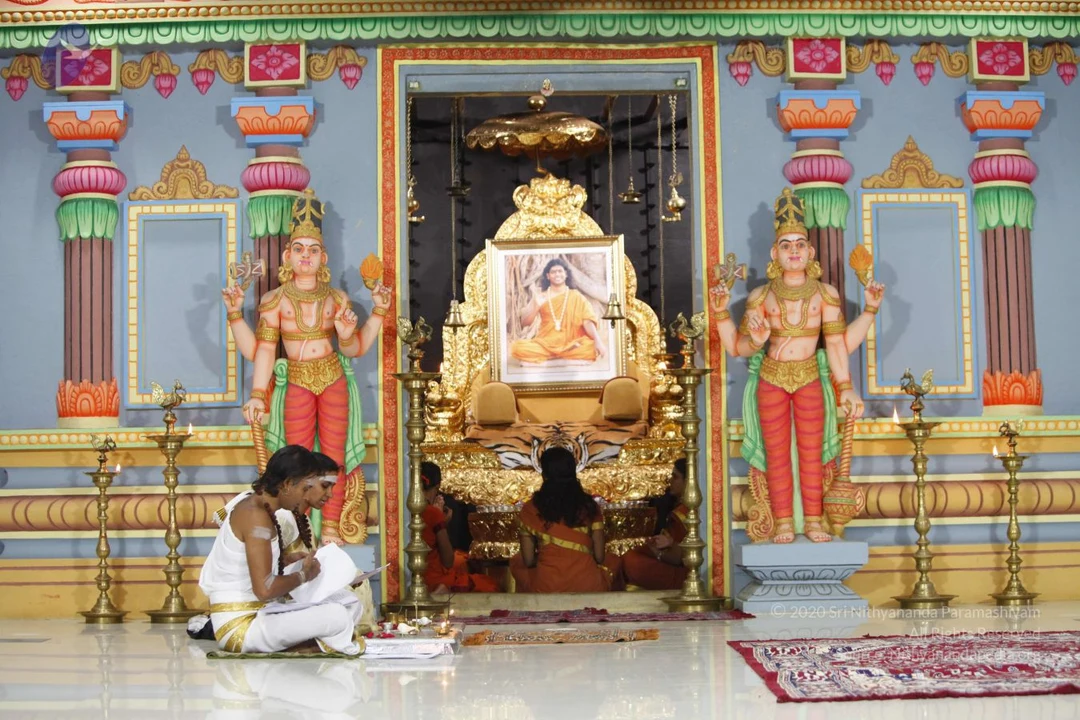
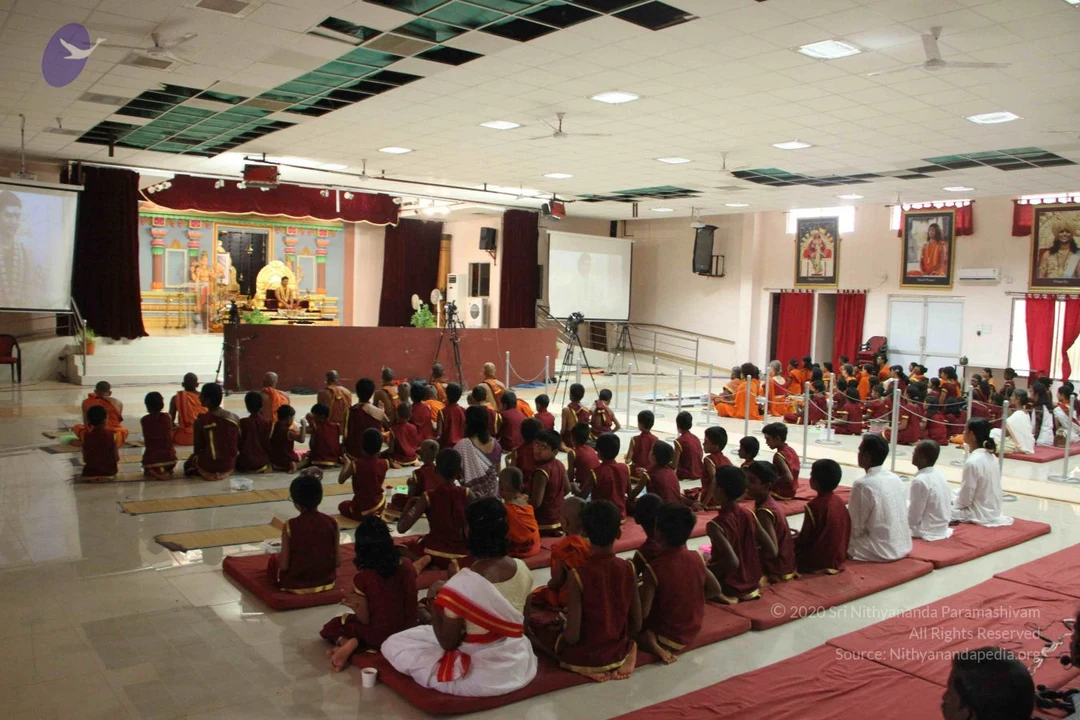
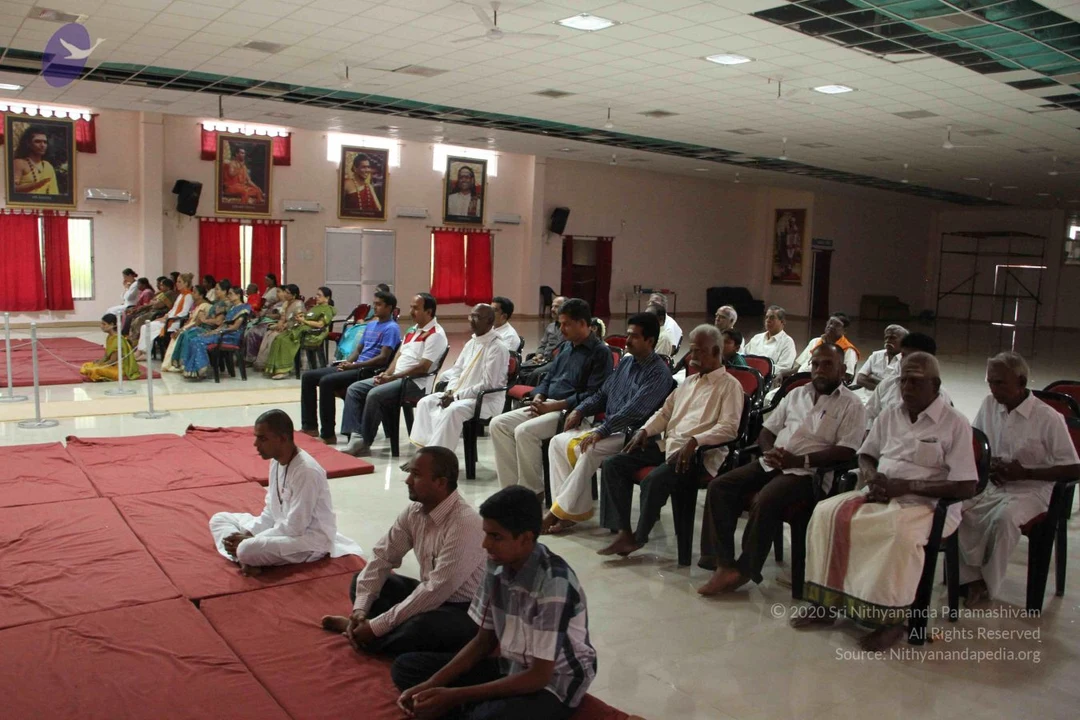
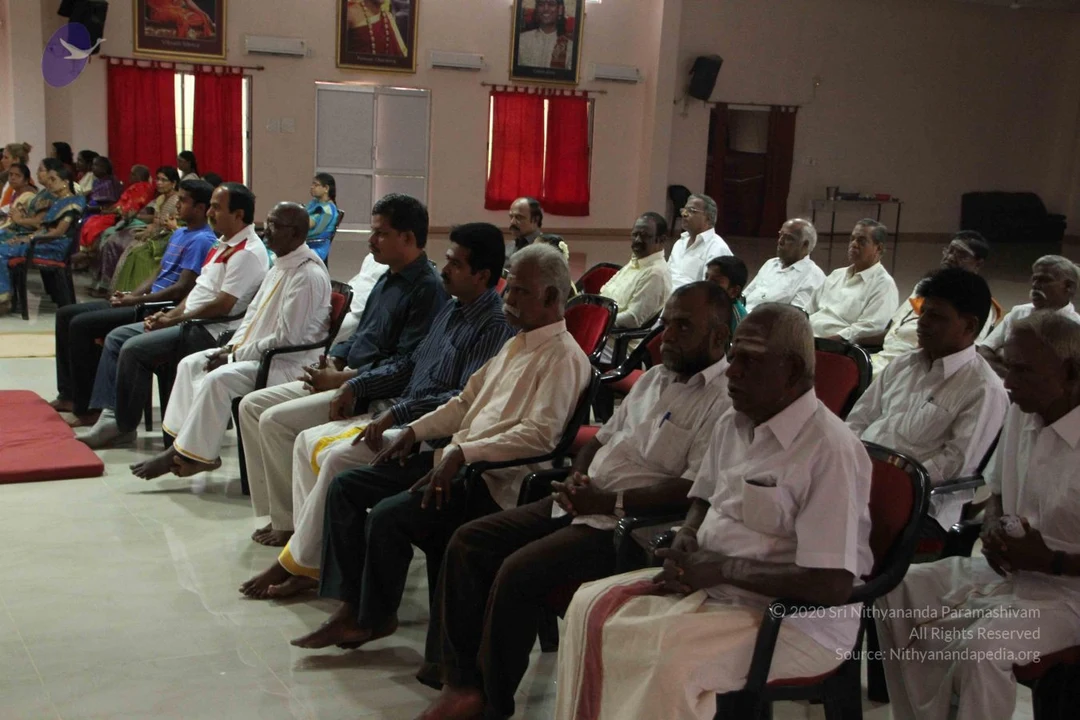
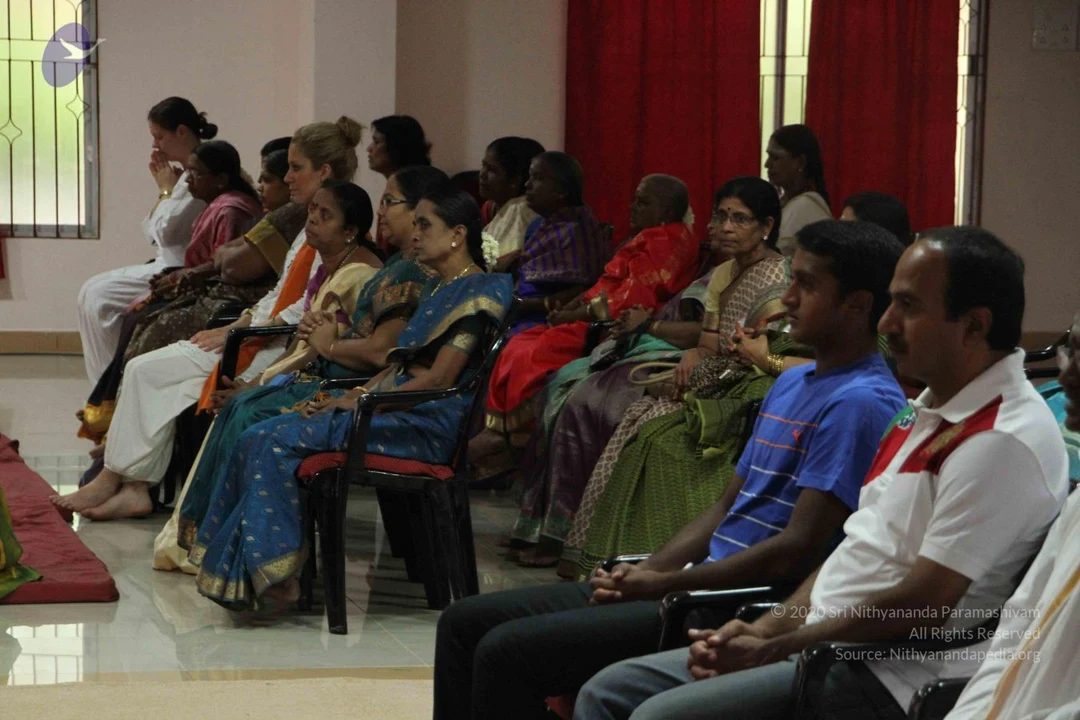
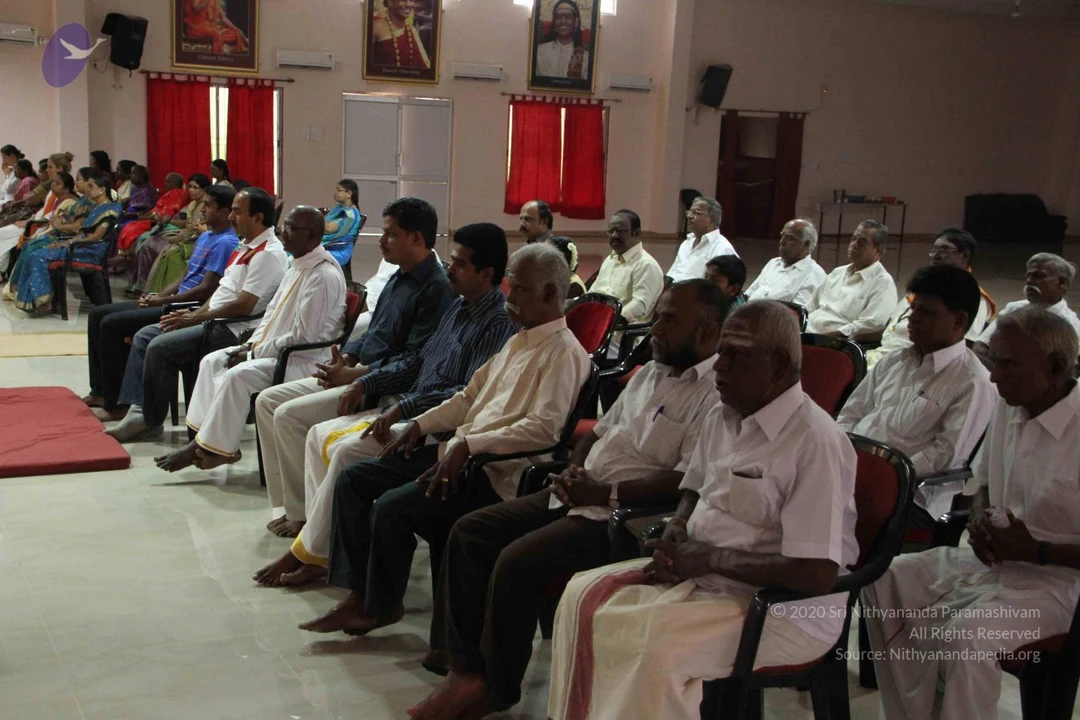
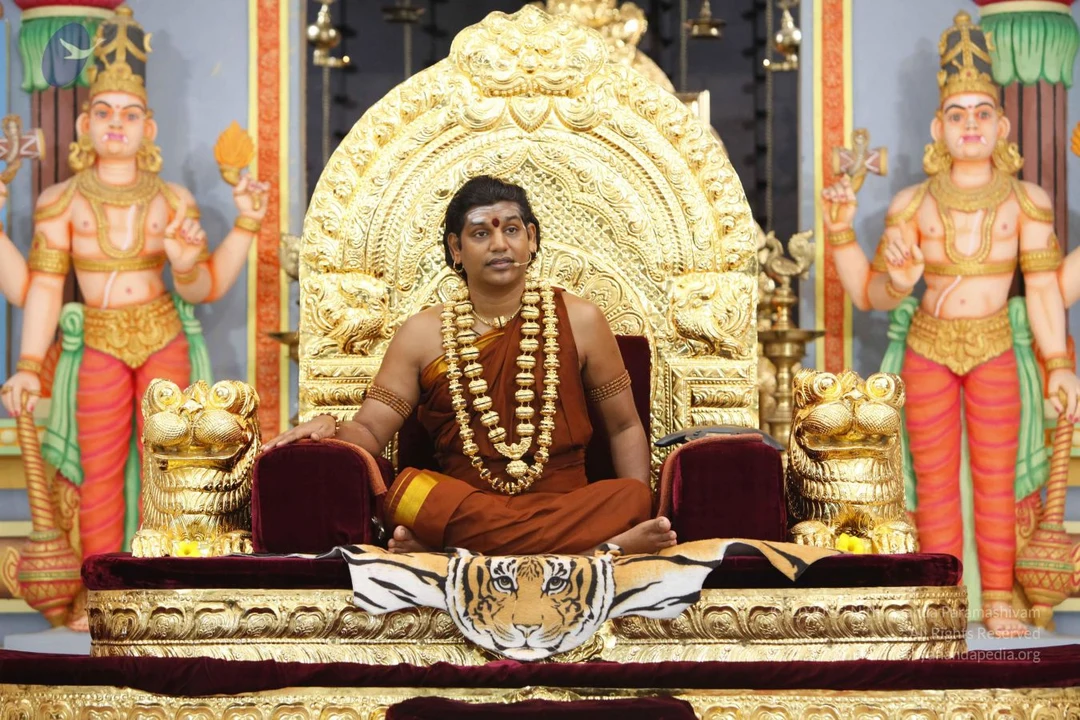
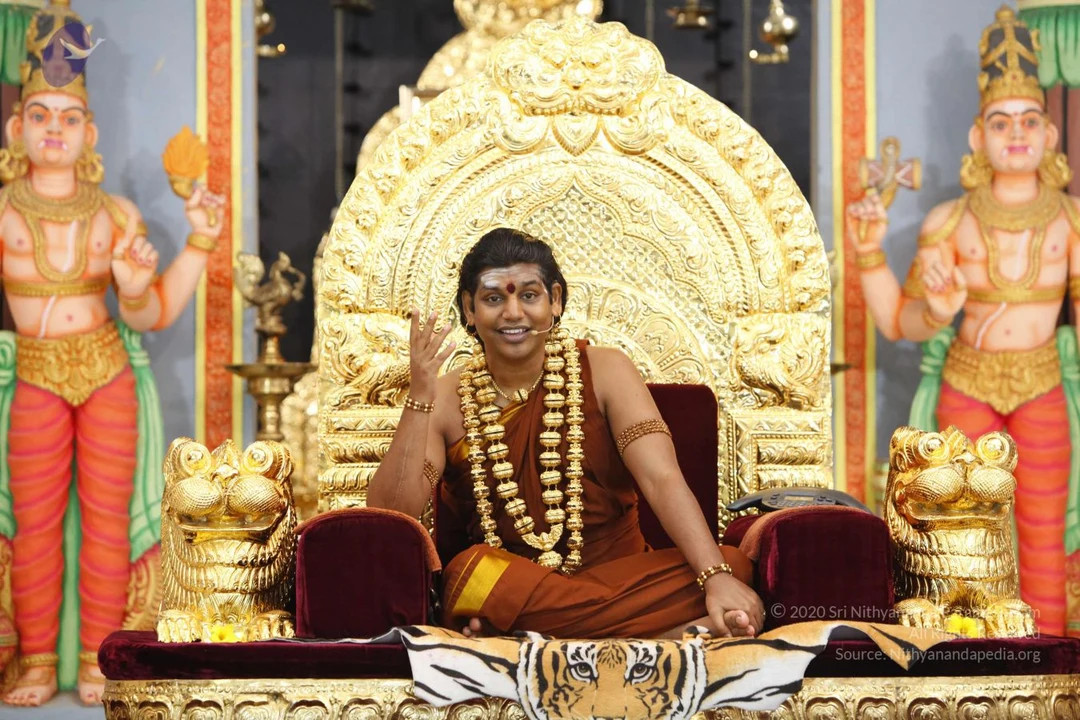
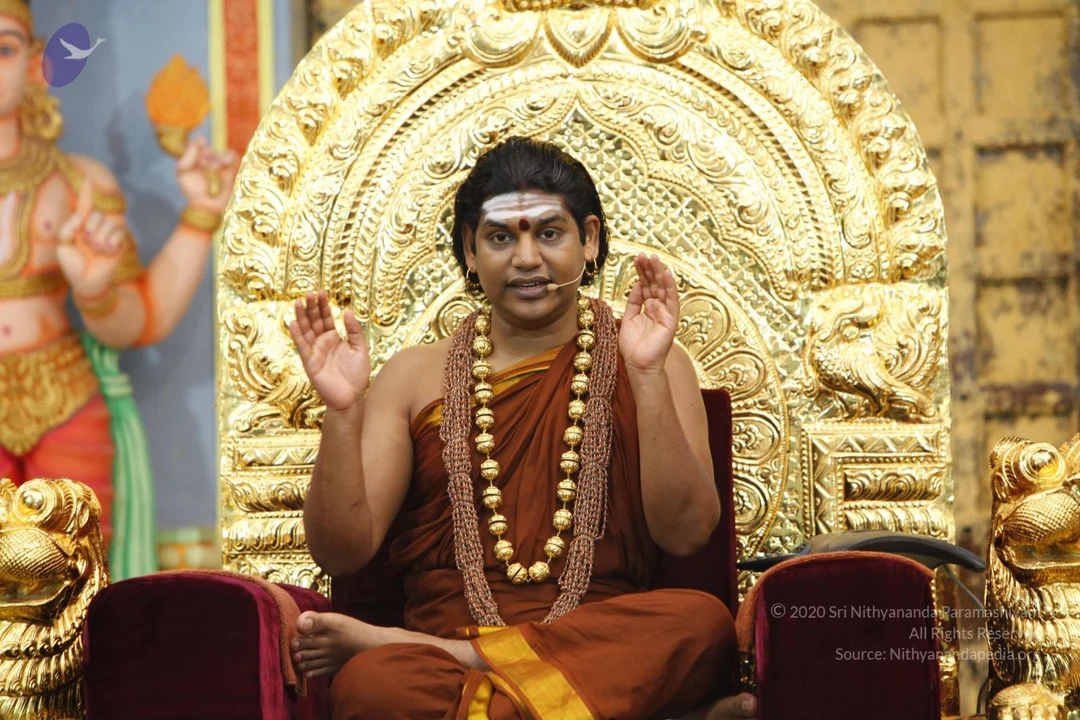
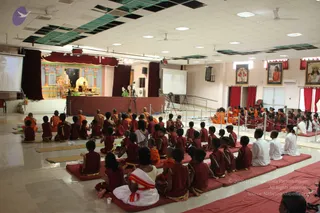
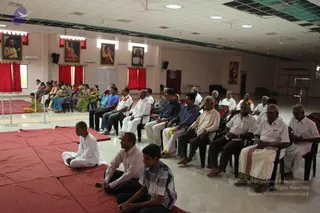
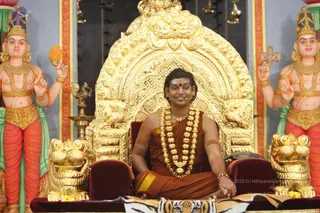
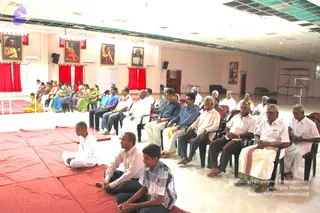
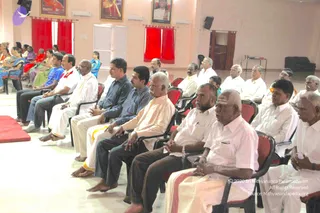
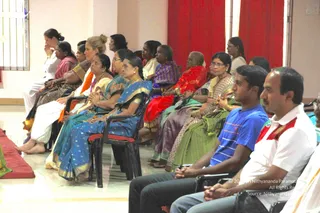
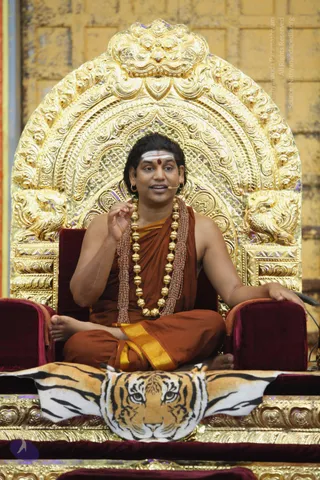
Indoor satsang hall with a large audience seated on red mats in rows facing a raised stage at the far end. Many children and young people in maroon uniforms sit on the left, with saffron-robed monastics and white-clad adults among them. On the stage, a figure in saffron sits behind a decorated altar with ornate golden arches and deity images. Framed portraits hang on the right wall, a projection screen shows an image at left, and camera tripods stand near the front. Ceiling fans and recessed lights overhead.A photograph of a large hall with a polished floor and red mats, where a seated audience listens to a satsang. In the foreground a young man in white clothes sits cross-legged on the red mat, with a man in a pink-striped shirt and a boy in a checked shirt seated in front. Rows of men in white shirts and white dhotis sit on chairs at right, and women in colourful saris sit in rows on the left. Framed portraits of women hang on the back wall, and a few ceiling fans and red curtains complete the room. No one is identifiable as a person in this view.A seated audience of men and women fills rows of red-cushioned chairs in a bright hall with pale walls and red curtains. Most men wear white shirts and white dhotis, while some wear blue or striped shirts. Several elderly men in front face forward attentively, and women in colourful saris sit at the left. Three framed portraits hang on the back wall above the windows, though their subjects are not clearly visible. No speaker or deity is in view, and the audience is seated facing the stage area beyond the frame.Seated audience in a bright hall with red curtains at the windows, attending a satsang. Women in saris and salwar kameez sit on black plastic chairs, several with hands folded in prayer, one woman in a white top with hands pressed together at the left edge. Men in a blue striped t-shirt and a white polo with red trim sit in front on the right, one with hands clasped. No speaker or throne is visible in frame, and no one is identified as a person. A red mat lies at the lower left.Seated audience inside a bright hall with cream walls and a red floor mat at left, attending a satsang. Many men in white shirts and white dhotis sit on red-cushioned chairs in rows, some in pale kurtas and checked shirts, with women in colourful saris seated at the back. Three framed portraits hang on the wall above red curtains, and a black loudspeaker is mounted in the upper corners. The audience looks forward toward the unseen speaker, and several men have their hands together.A man seated cross-legged on an ornate golden throne with lion-head armrests, draped with a tiger-striped cloth at the base. He wears an orange-saffron dhoti and shawl, a long multi-strand rudraksha mala, a gold necklace, gold armbands and a red tilak on his forehead. Two painted guardian figures with multiple arms and gold ornaments flank the throne, one holding a flame-like lamp.

Sarva-Darshan
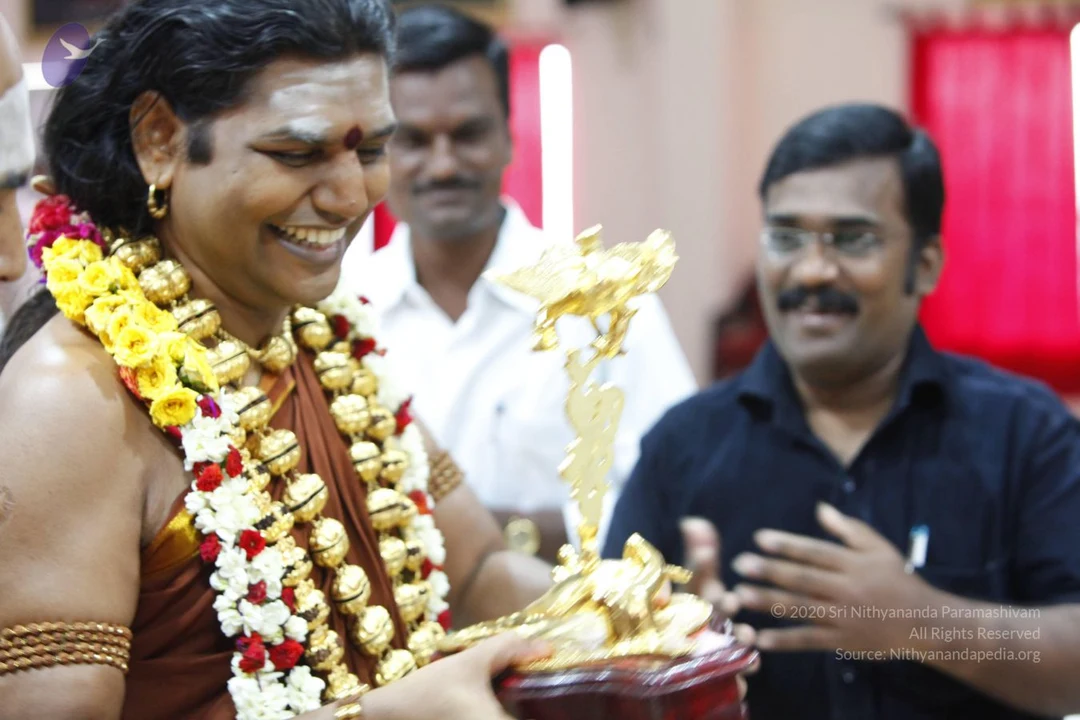
6 photosSource gallery
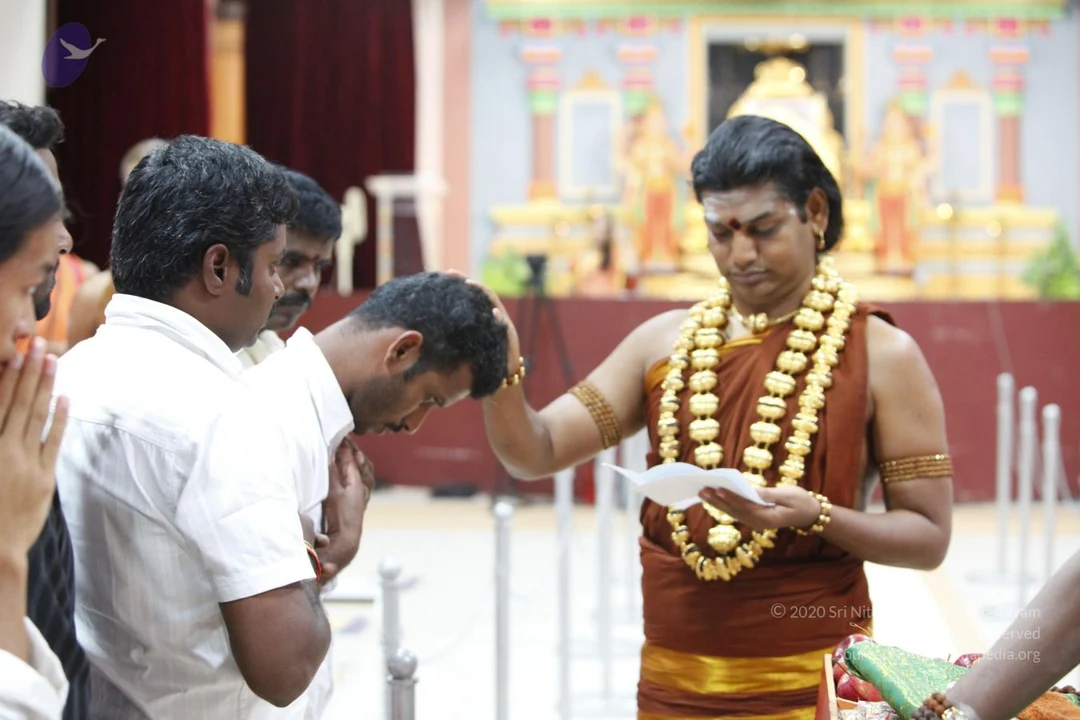
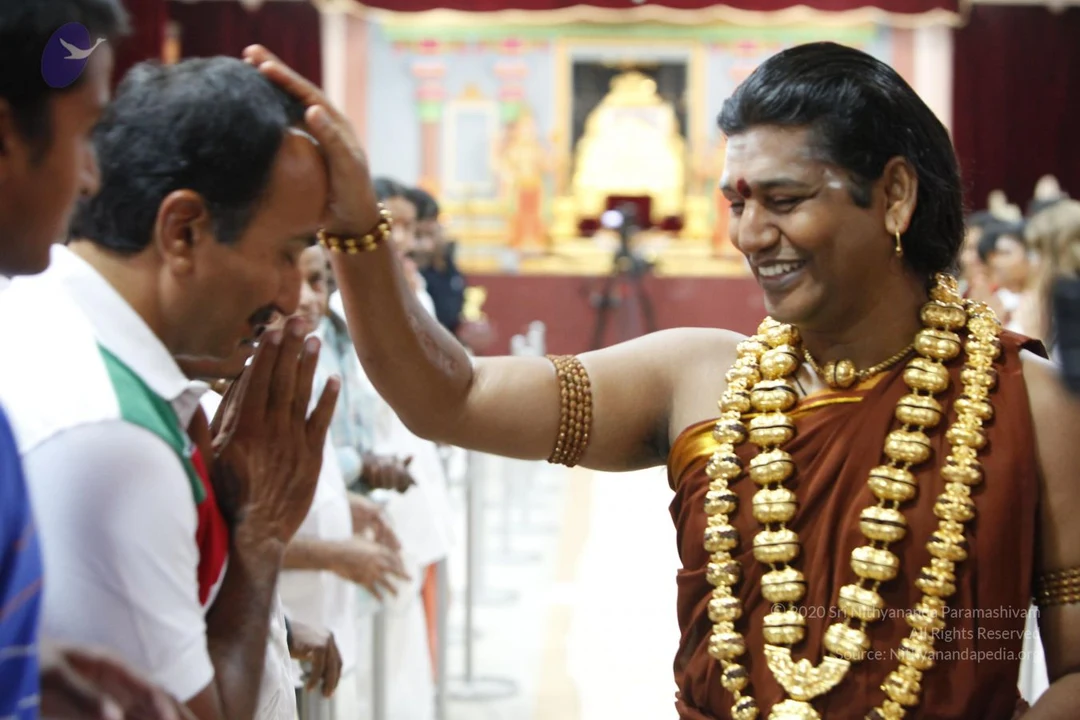
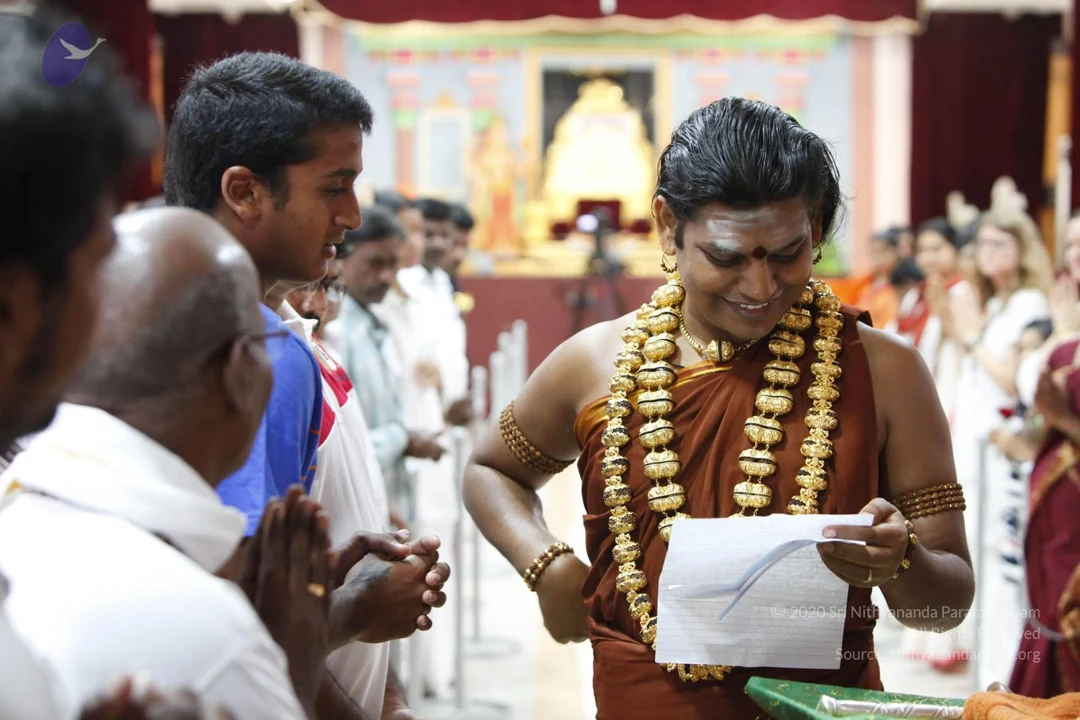
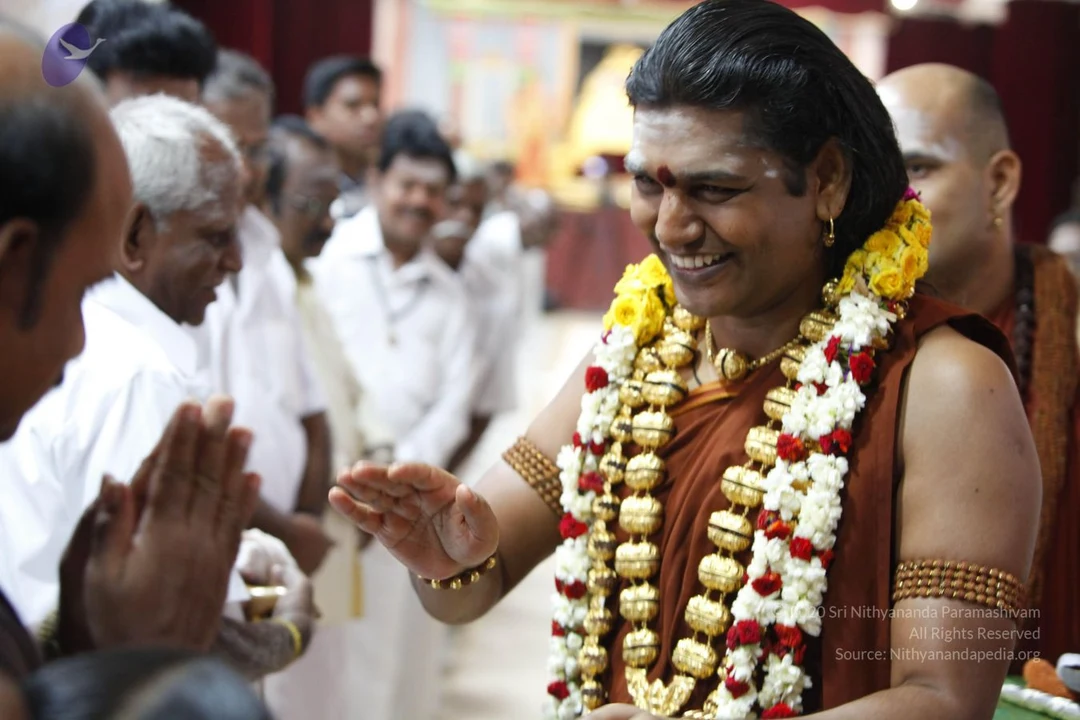
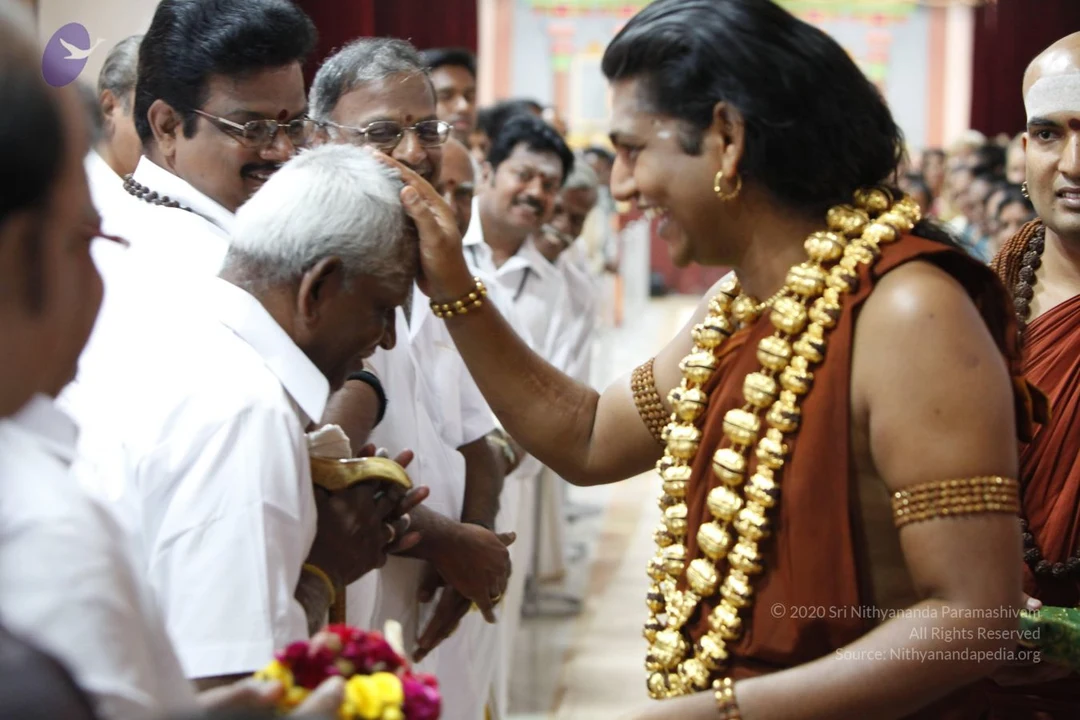
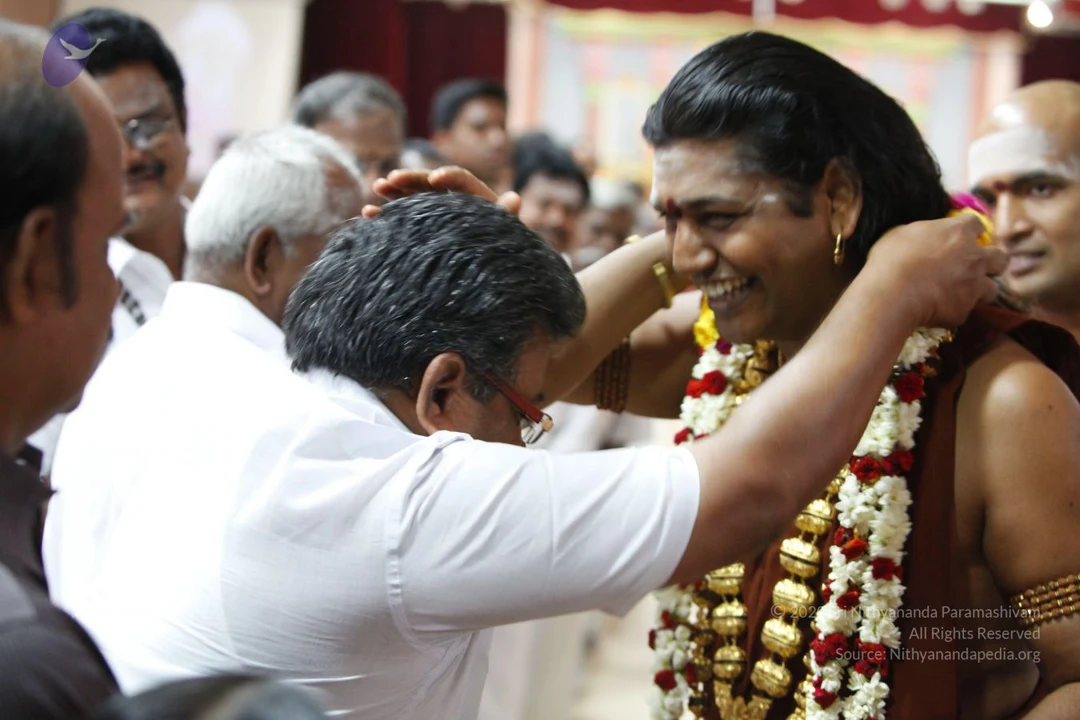
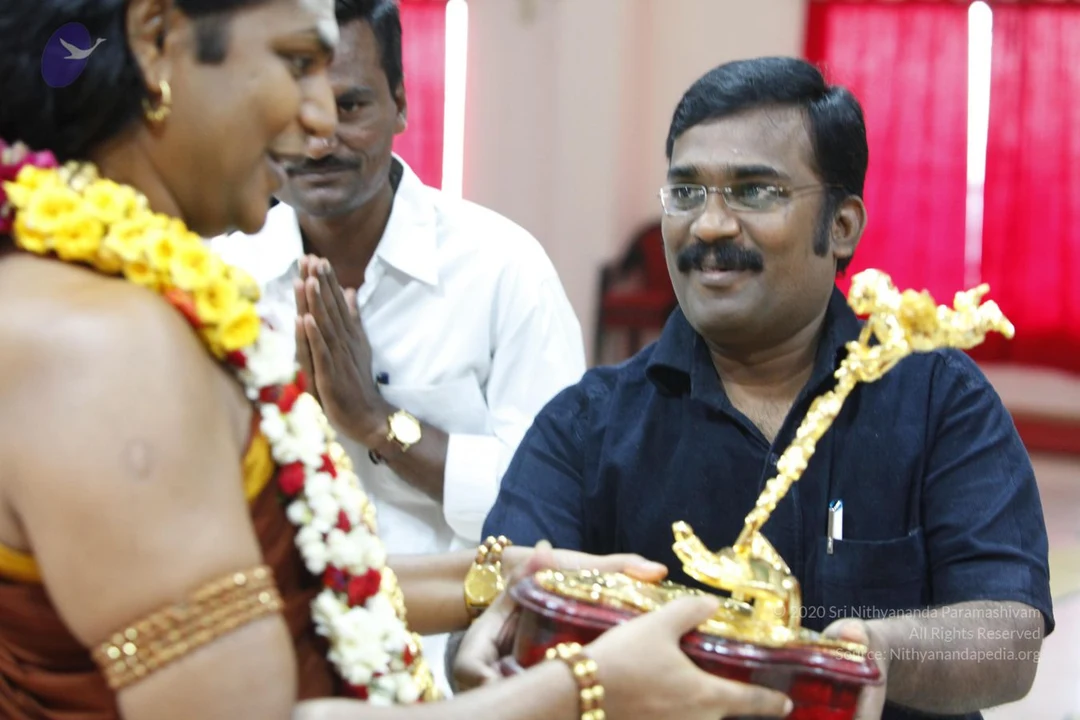
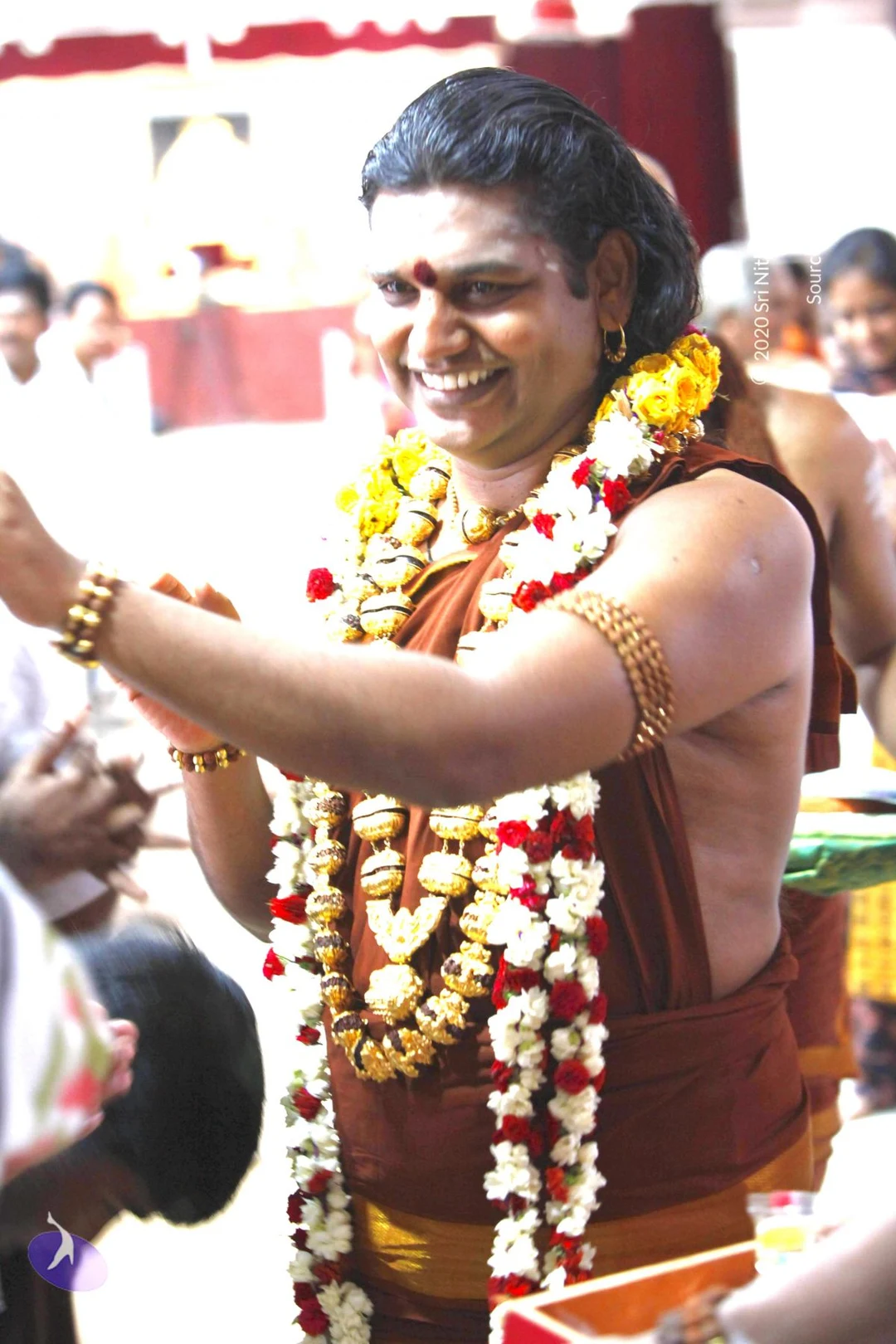
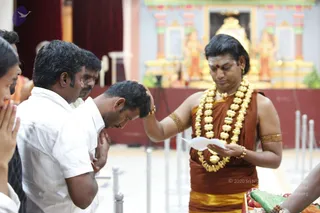
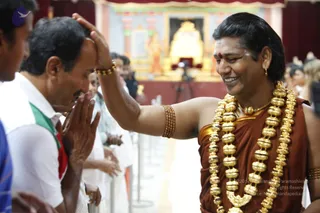
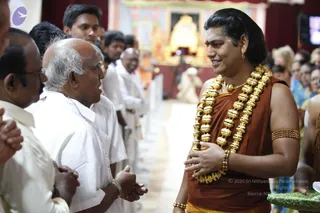
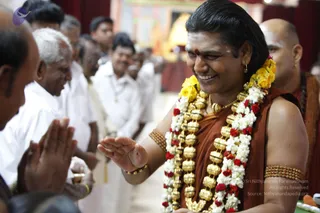
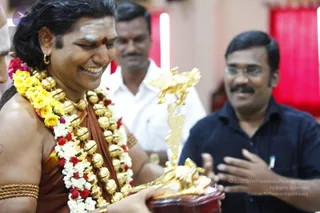
A man in a rust-brown dhoti and shawl, wearing a heavy gold-bead necklace and gold armlets, stands at a blessing, placing his right hand on the head of a bowing man in a white shirt. He holds a folded paper in his left hand. A red tilak marks his forehead and he has short dark hair. Other devotees with folded hands stand nearby, and a tray of fruit and cloth lies at the lower right. Behind them is a temple shrine with gold-tinted deity murti and painted columns, with a red curtain and silver stanchions in the foreground.A smiling man in a rust-orange garment and heavy gold bead necklaces stands on the right, his right hand raised and resting on the crown of a bowing man in a white collared shirt with green and red trim, who presses his palms together in greeting. Gold bangles adorn the raised arm. Behind them, several people in white stand in a temple hall with red drapes, a gilded shrine and a golden throne-like altar in the background. A blessing is being given with a hand on the head.A photograph of a temple interior where a man with swept-back hair, a red bindi and white forehead markings stands in a rust-orange dhoti-style wrap and multiple long gold bead necklaces, smiling as he reads a sheet of paper held in both hands. Gold bangles adorn his upper arms. Around him, devotees with palms pressed together in namaskar stand, including a bald older man in white at left and a younger man in a blue shirt. Behind them, a golden throne-like structure and ornate decorations are visible, with more people in white clothing in the background.A photograph of a man in an orange-saffron wrap with a thick multi-strand gold bead necklace, gold earrings, a gold armlet, and a dark swept-back hairstyle, smiling as he stands in conversation with older devotees in white shirts and white dhotis. A man in a white shirt with grey hair and a silver chain faces him with hands joined in a respectful gesture, while others in white and a few onlookers stand nearby in a hall with a golden deity shrine and red drapes in the background. The saffron-clad figure has distinctive ornate gold adornments and a swept-back hairstyle, consistent with the page's reference to a person, appearing in person.Photograph of a smiling man with long swept-back black hair, wearing a saffron-orange draped robe, a thick garland of golden bead-like pendants, red roses and white jasmine, a gold necklace, gold armlets and ornate gold bracelets. He has white and red sacred marks on his forehead. He extends his right hand in a blessing gesture toward a white-clad devotee on the left whose palms are pressed together in namaskar. Other white-clad devotees stand behind in a temple hall with red drapes.A smiling man with long dark hair, a red bindi and gold armband wears a brown-orange cloth over his shoulder and a thick garland of yellow, white and red flowers with gold beads. He holds a gold figurine of a deity atop a red tray, while a man in a dark shirt with glasses gestures beside him and another man in a white shirt stands behind. Red curtains hang in the background. Appearance-based label: Swamiji (probable), with long swept-back hair, saffron-brown clothing and a gold bead garland as cues, receiving a ceremonial gold offering.

Swamiji-speech-IN-Lotus-Television
8 photosSource gallery
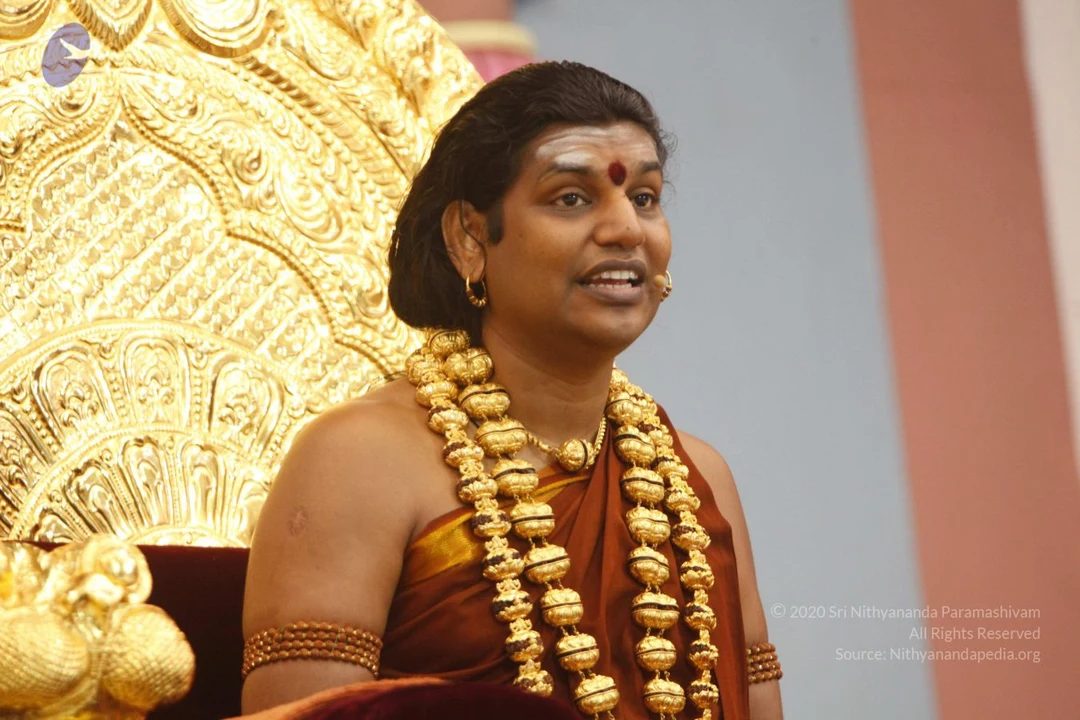
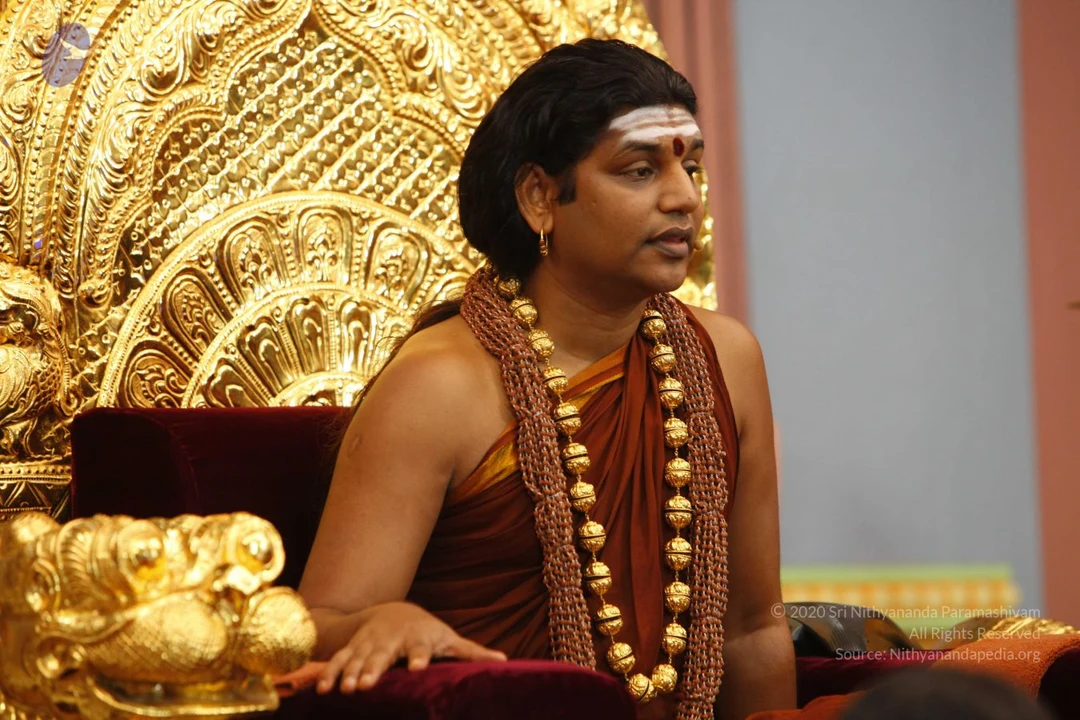
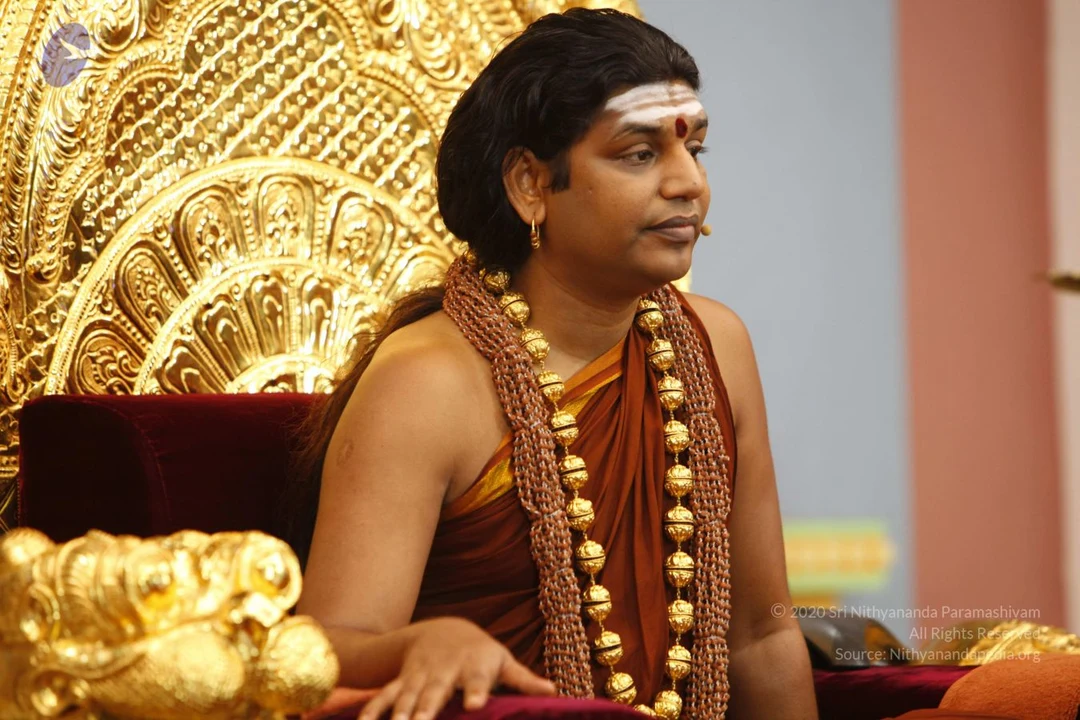
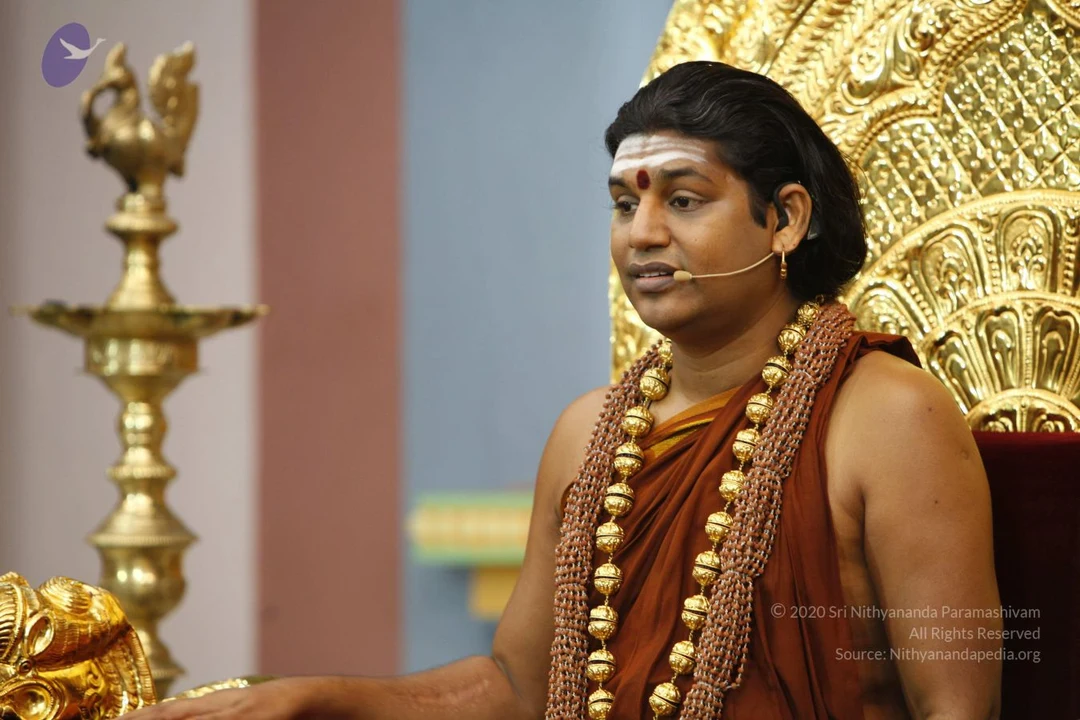
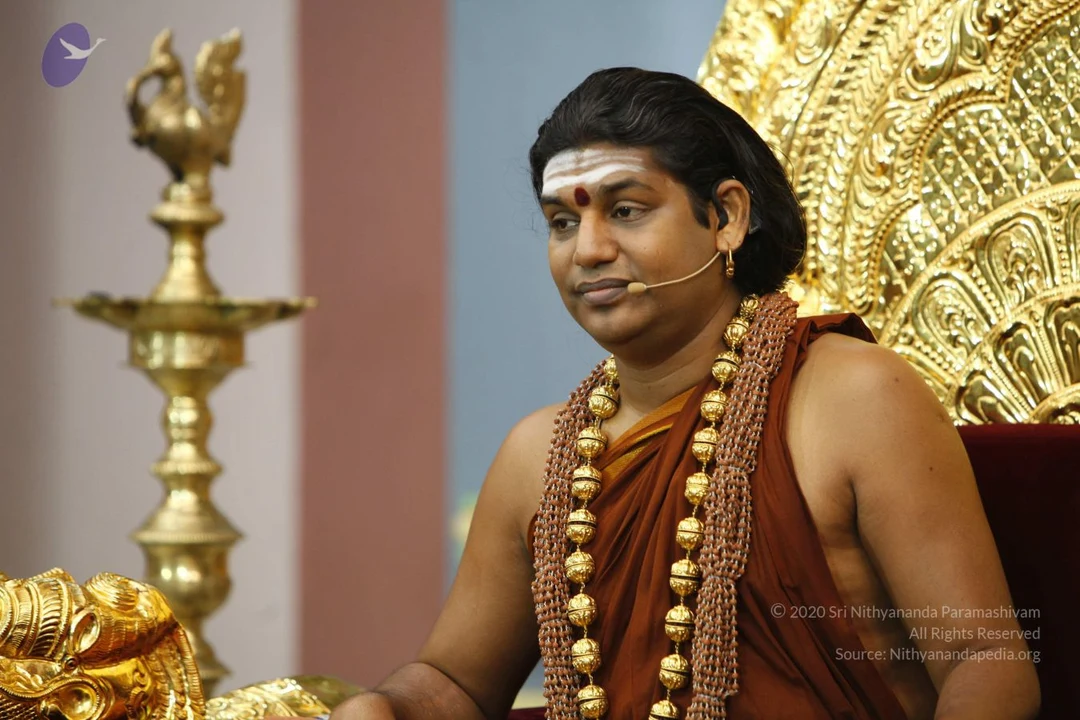
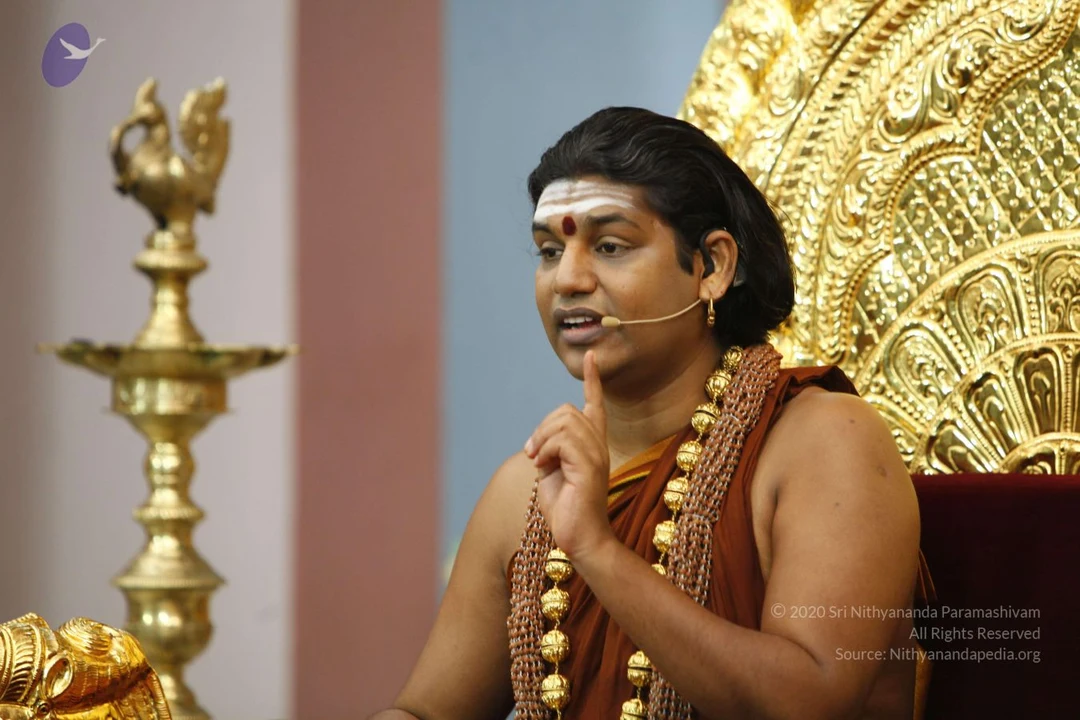
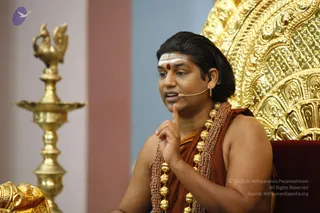
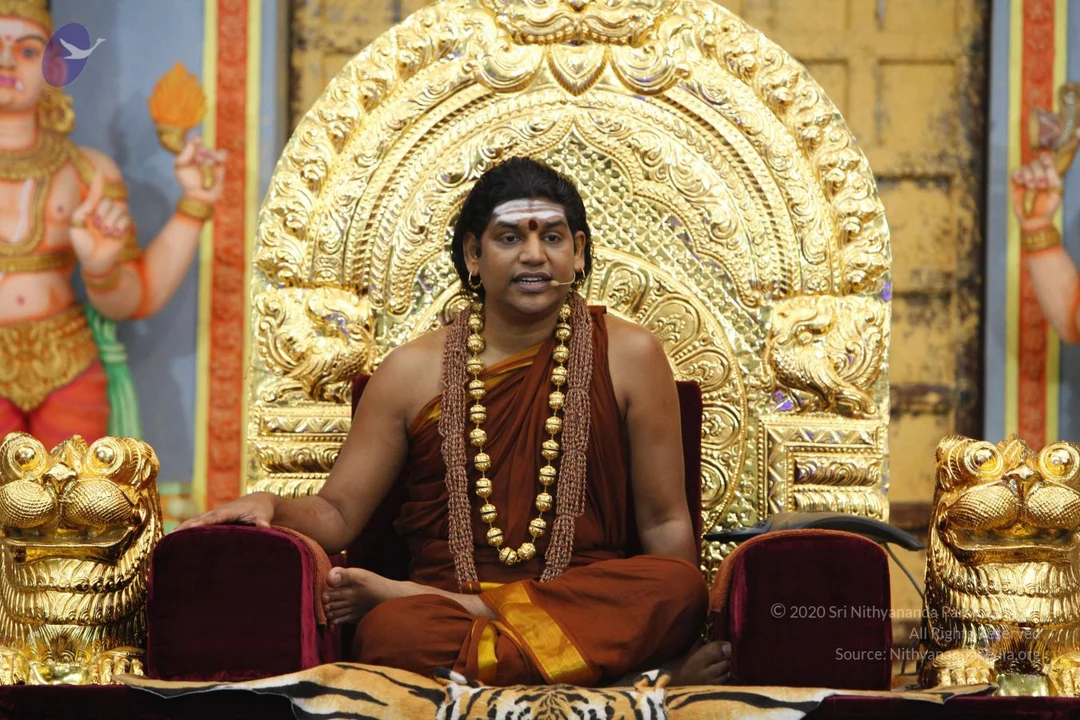
A man in a rust-orange saffron wrap and dhoti sits cross-legged on an ornate golden throne with lion-head armrests, draped with a striped tiger-skin cloth. He wears a gold necklace of large beads, rudraksha mala strands, gold earrings and a white tripundra on his forehead with a red bindi, and speaks into a small headset microphone. Behind him stand two painted deity figures holding ceremonial objects. The a person cues are the seated pose on the golden throne, the saffron clothing and the rudraksha mala, but the face is not clear enough to confirm. Satsang discourse at the ashram.A seated man on a red velvet throne with an ornate gold backrest and gold lion-head armrest, wearing a rust-brown draped shawl over a bare shoulder and a long chain of gold beads with rudraksha-style strands. He has a white horizontal tilak with a red dot on his forehead and a gold earring, and his right hand rests on the armrest. a person: a man with a swept-back dark hairstyle, ceremonial gold beads and a shawl; the photo is an ornate satsang or darshan setting.A seated man in a rust-orange shawl draped over one shoulder sits on a deep red velvet throne in front of an ornate gold repoussé backrest with fan-like scrollwork. He wears long rudraksha mala beads with large gold bead spacers across his chest, a small gold earring, and white vibhuti with a red kumkum dot on his forehead. His long dark hair is swept back, and his hand rests on the armrest. A gold armrest and a small lapel microphone are visible.A photograph of a man seated on an ornate gold throne with a carved gold backrest, speaking into a small head-mounted microphone. He wears a saffron-orange robe draped over his shoulder, a rudraksha mala with ornate gold beads and a second mala of brown-beaded strands, a white tripundra with a red dot on his forehead, and gold earrings. A tall brass oil lamp stands at the left and a gold ceremonial vessel is partly visible in the lower left corner. The background is blue and pink walls.Photo of a man seated on a golden throne at a satsang, wearing an ochre-orange wrap over bare shoulders and a long mala of gold beads with rudraksha-style strands. He has long swept-back hair, a white tilak with a red dot on his forehead, and a small headset microphone. Behind him rises an ornate gold throne back, and at left stands a tall brass oil lamp with a bird-shaped finial. Appearance-based probable identification: Swamiji (probable), seated on a throne with ceremonial gold ornaments, long swept-back hair, ochre wrap and mala cues, presiding over the satsang as the speaker.A photograph of a man seated before a large ornate golden throne with a peacock-finial, speaking with raised index finger. He wears a rust-orange wrap, a rudraksha-style necklace of gold beads and a white forehead mark with a red dot, and a small headset microphone. A tall brass oil lamp stands to the left. Swamiji (probable) is shown seated and addressing an audience, identified by saffron clothing, long swept-back hair and ceremonial gold beaded necklace.

Senthil-Anna-Engagement
205 photosSource gallery
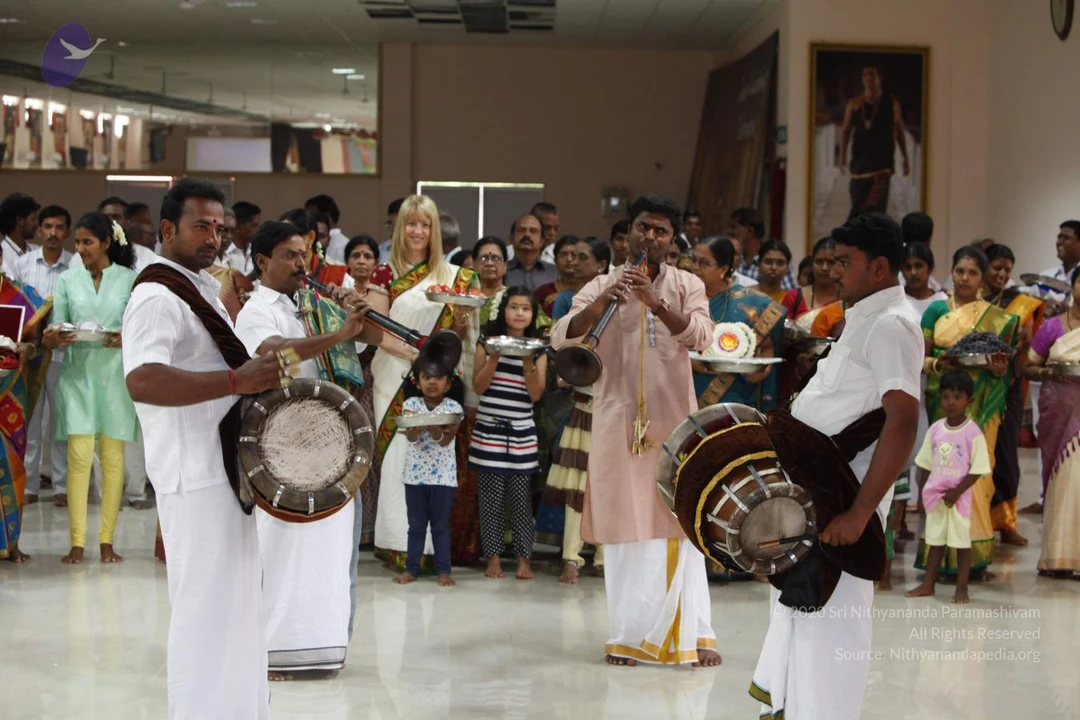
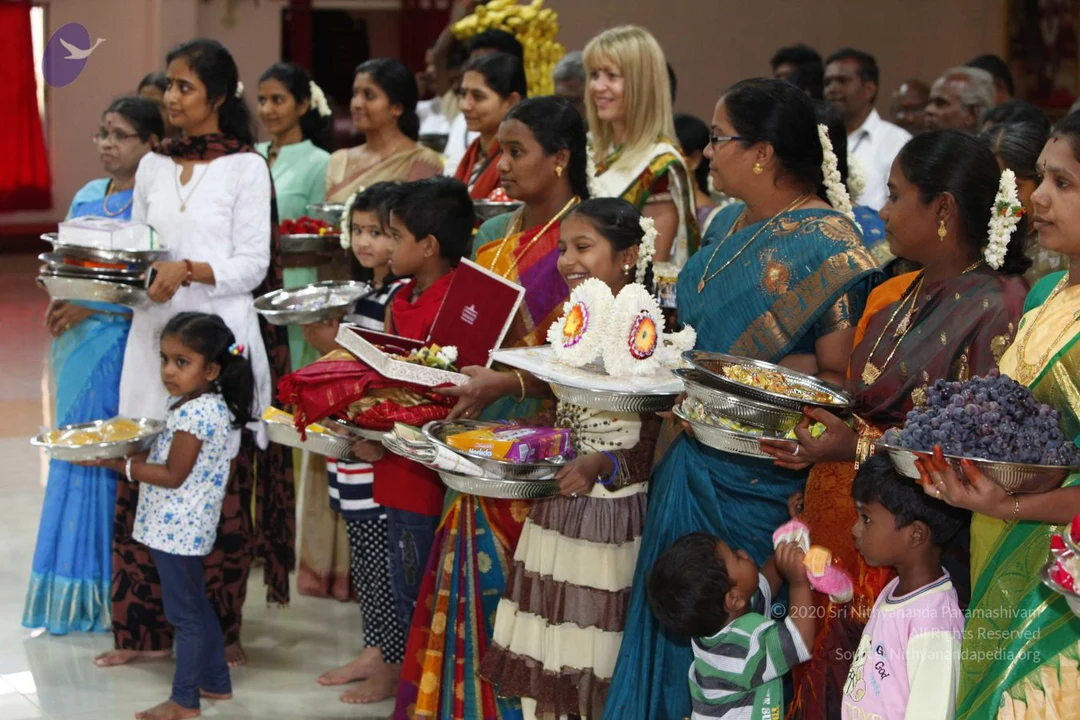
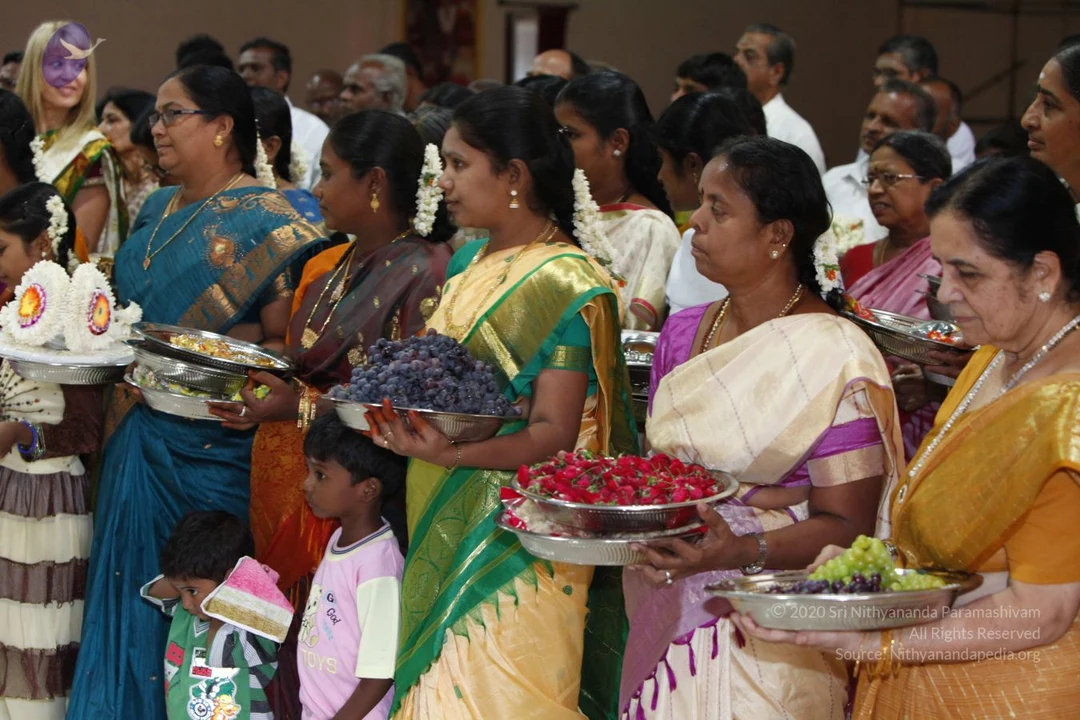
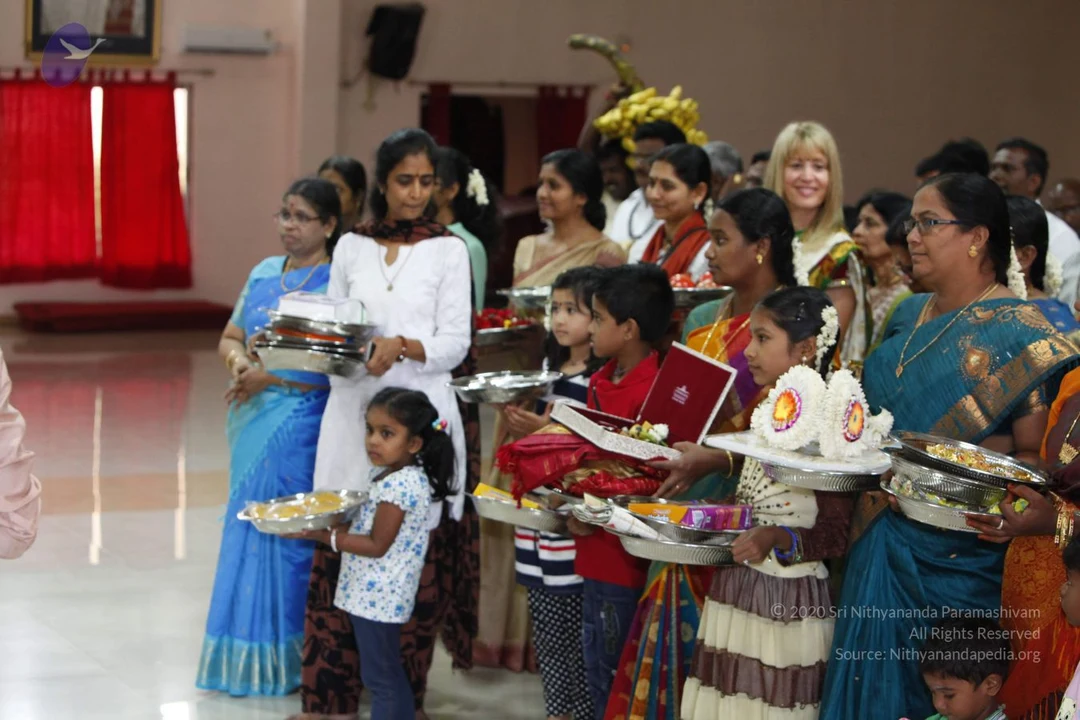
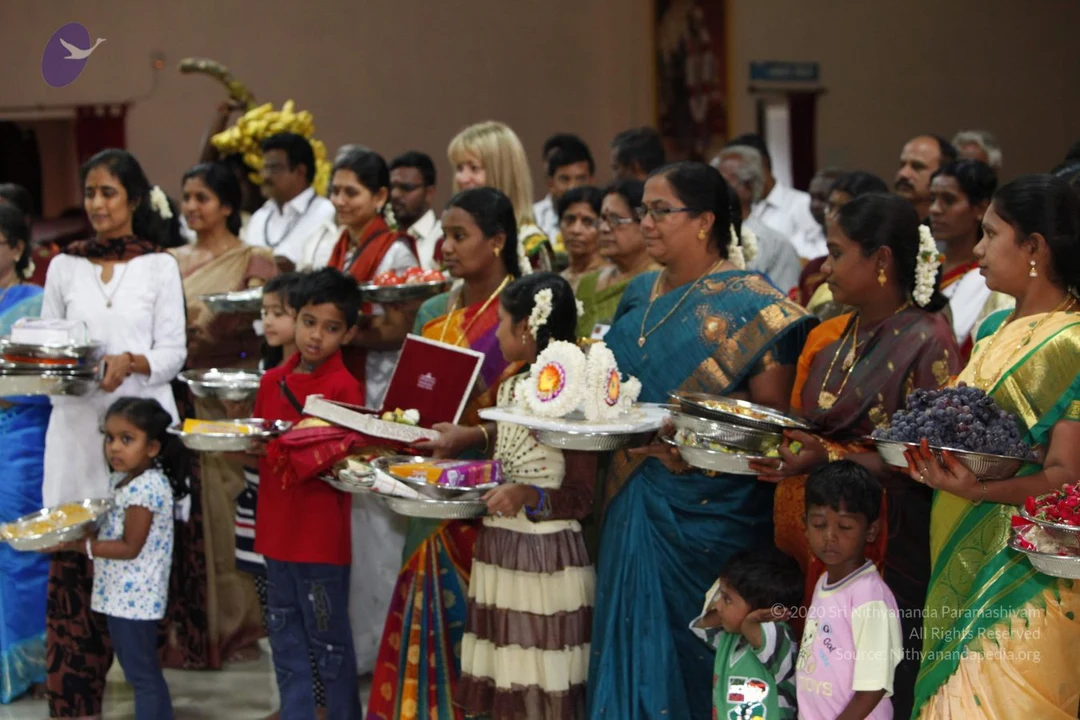
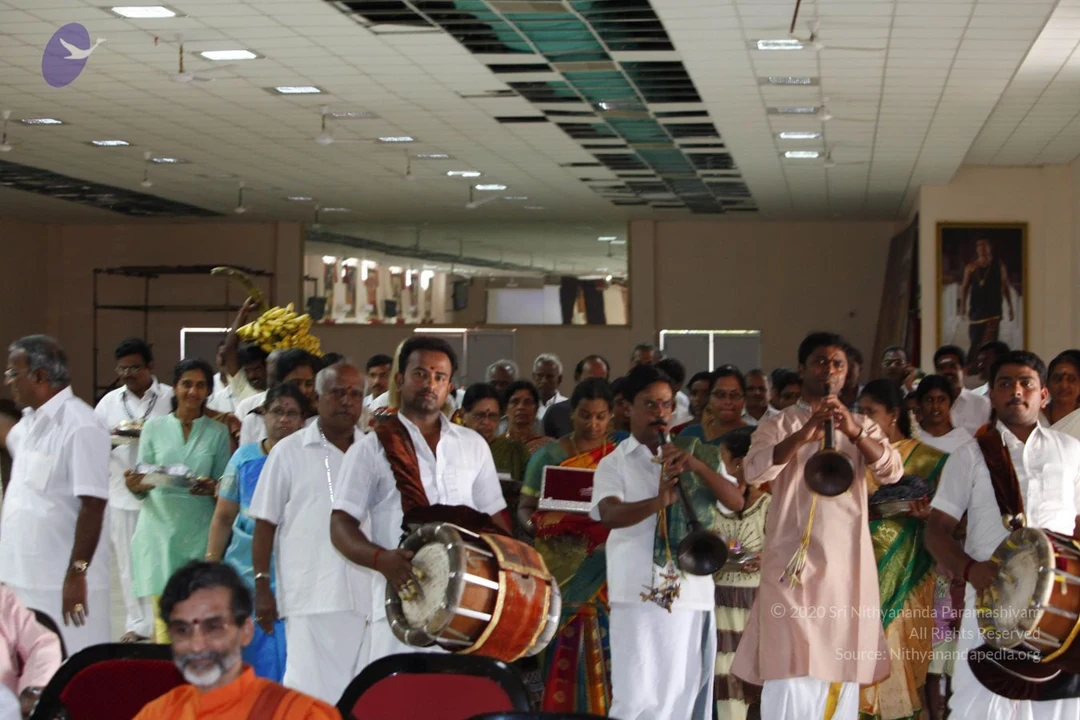
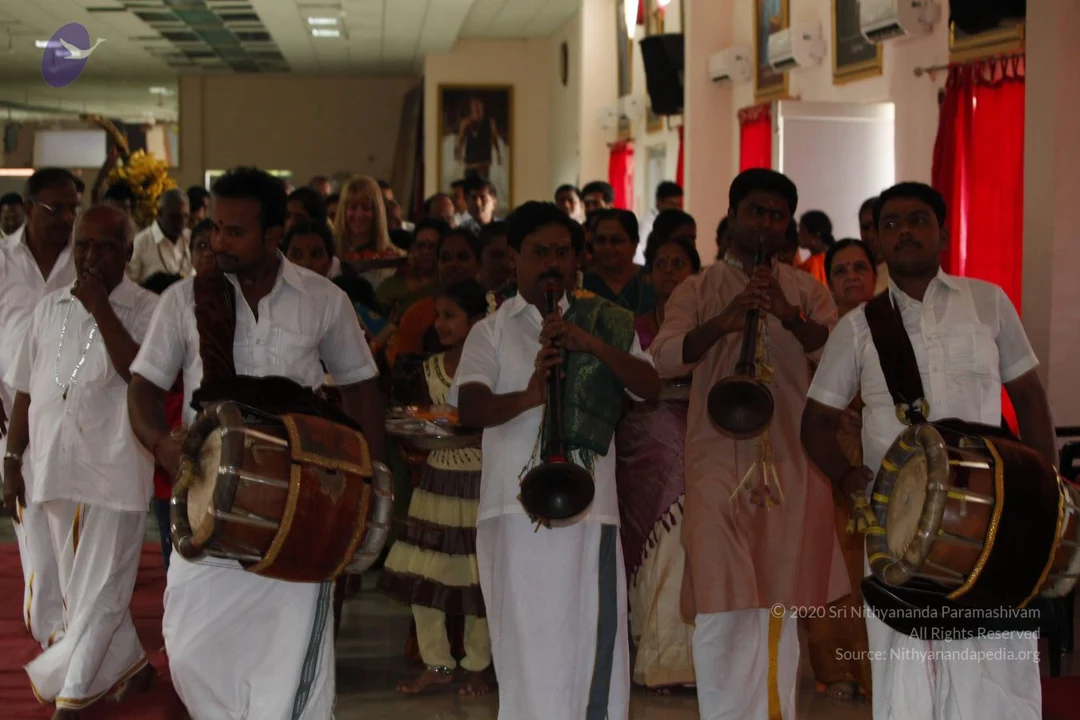
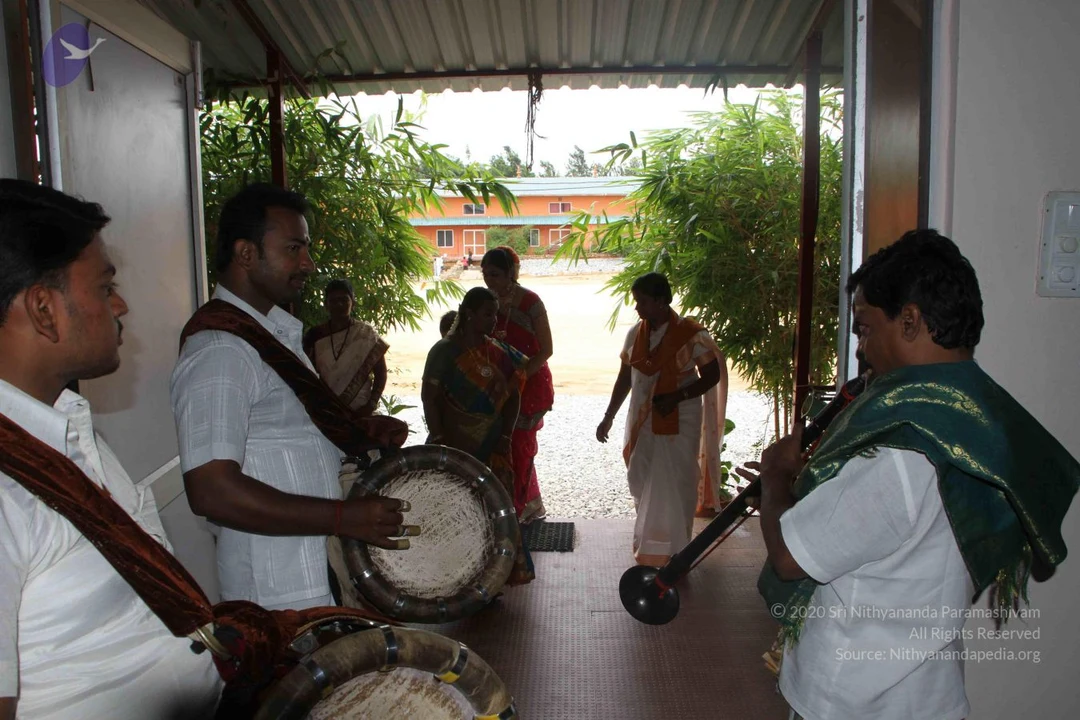
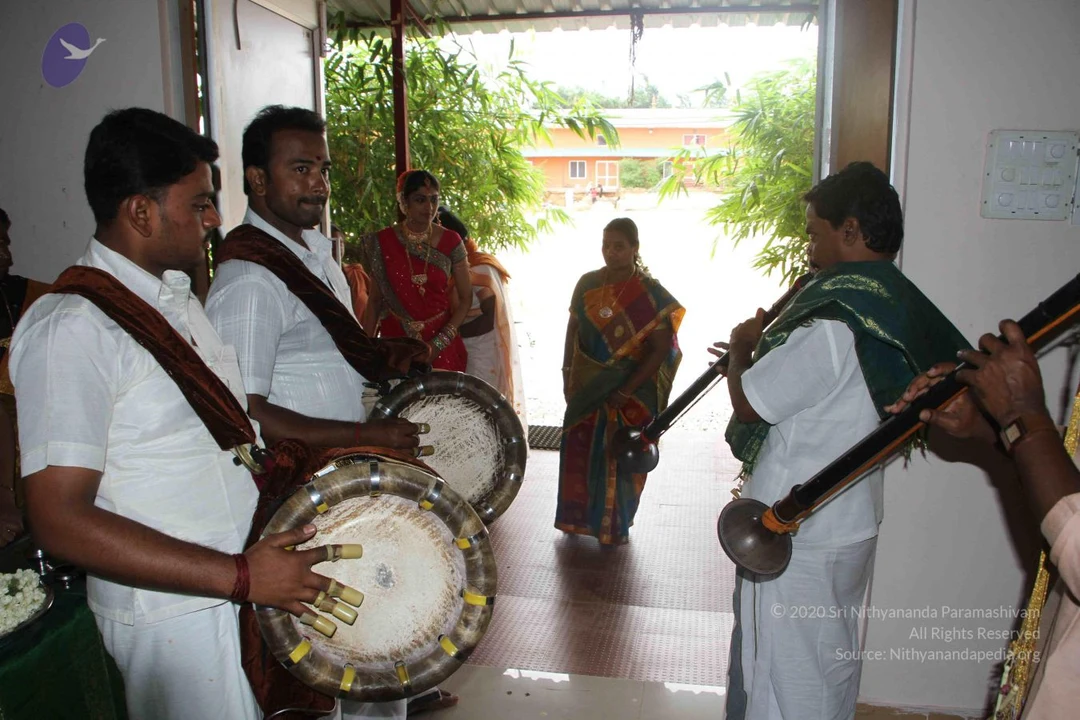
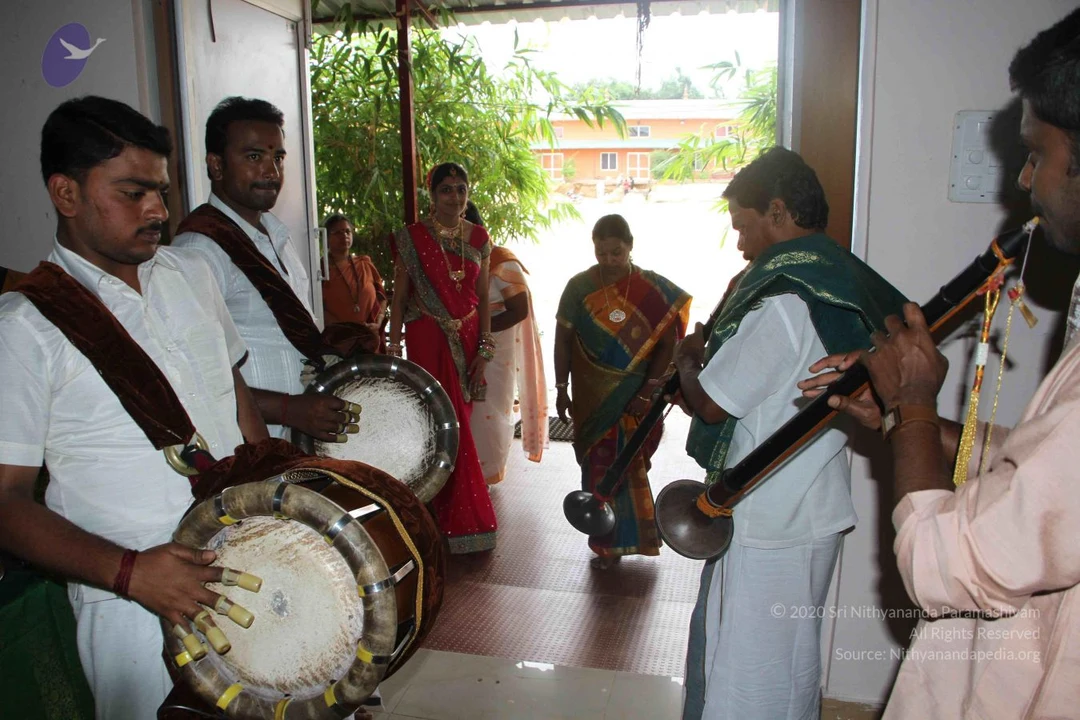
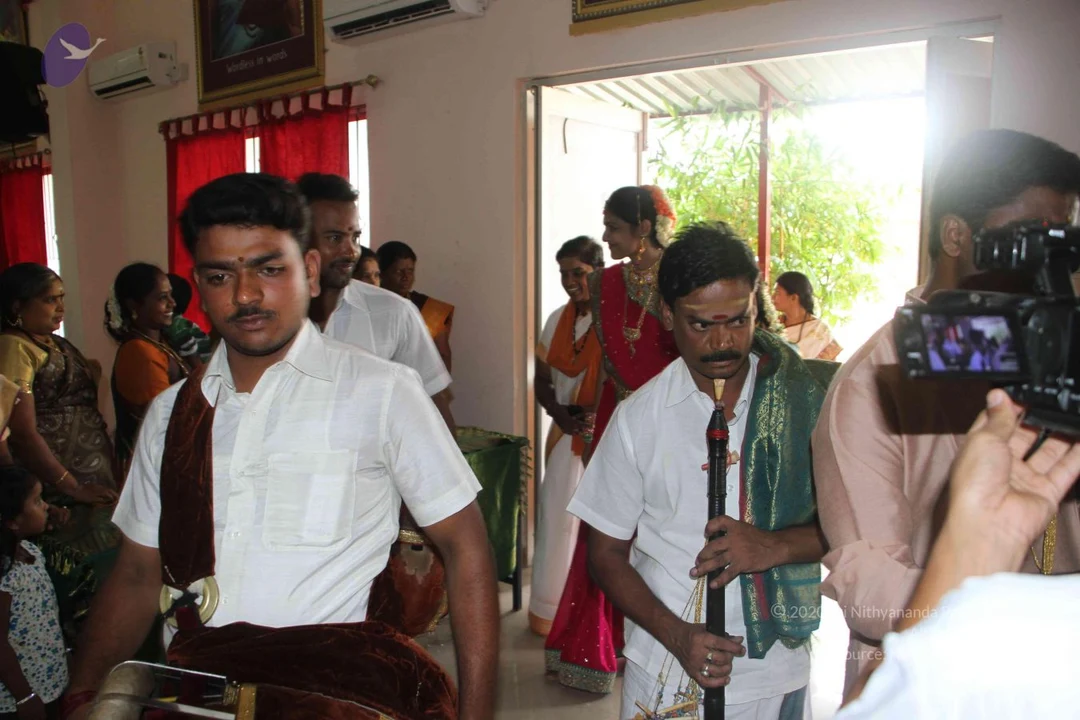
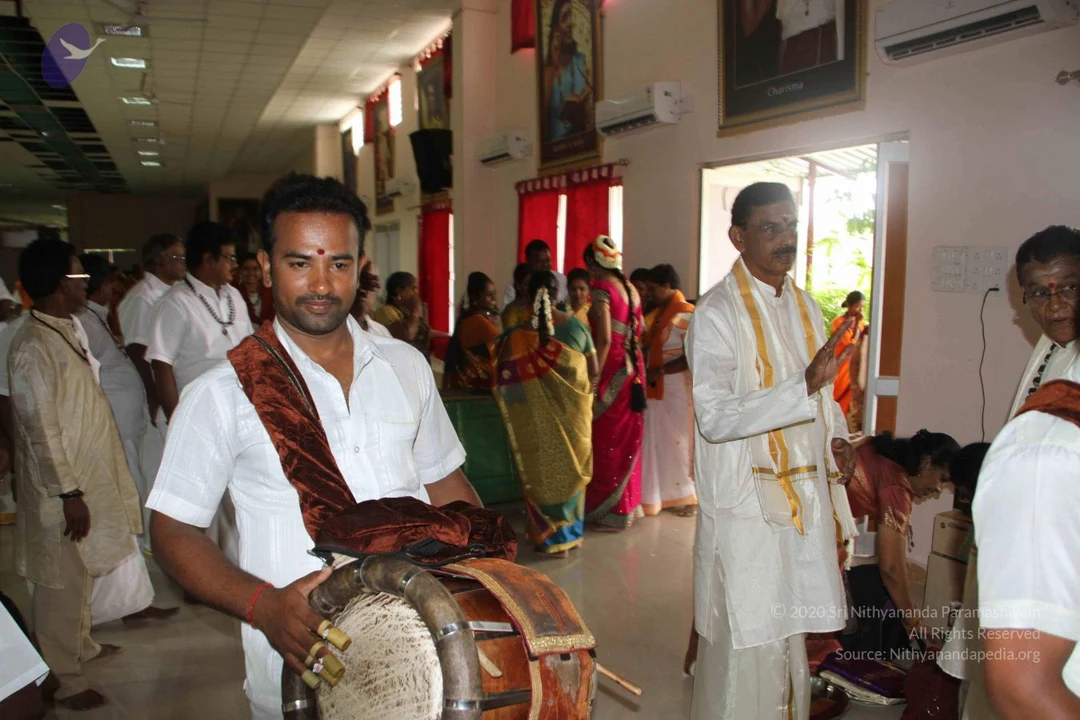
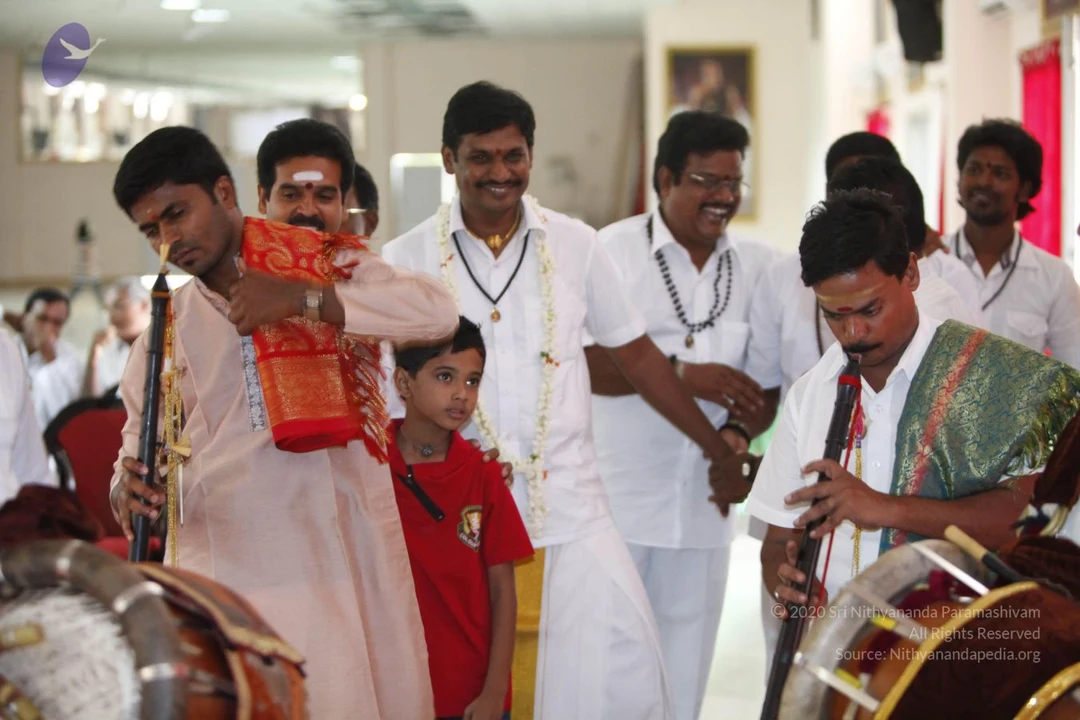
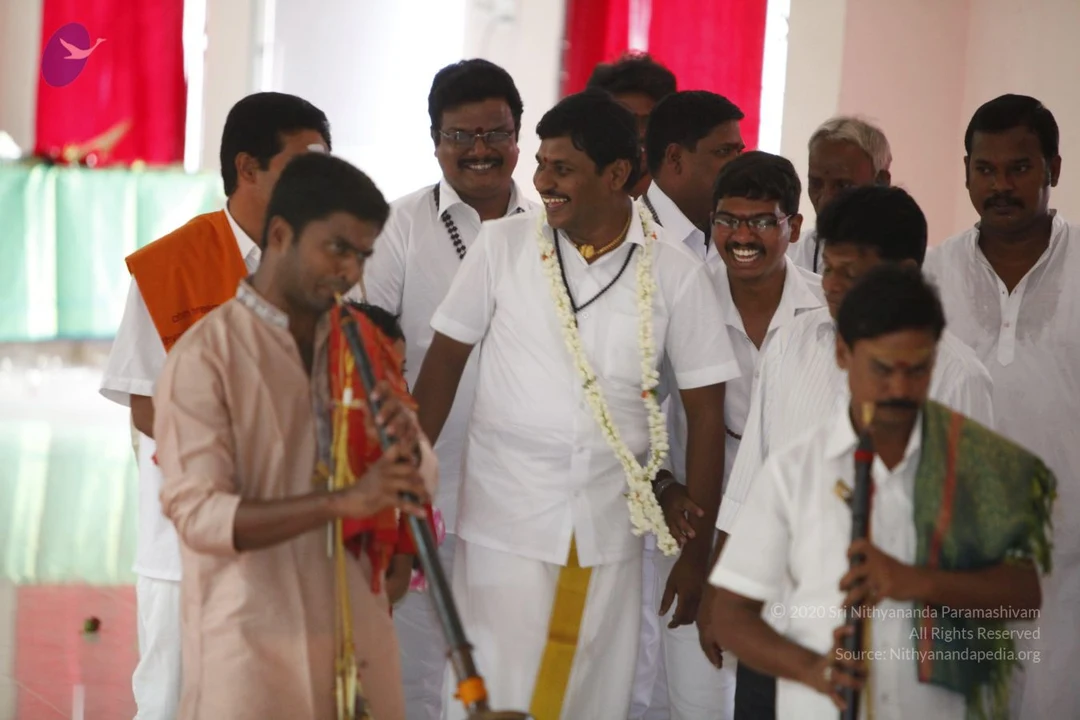
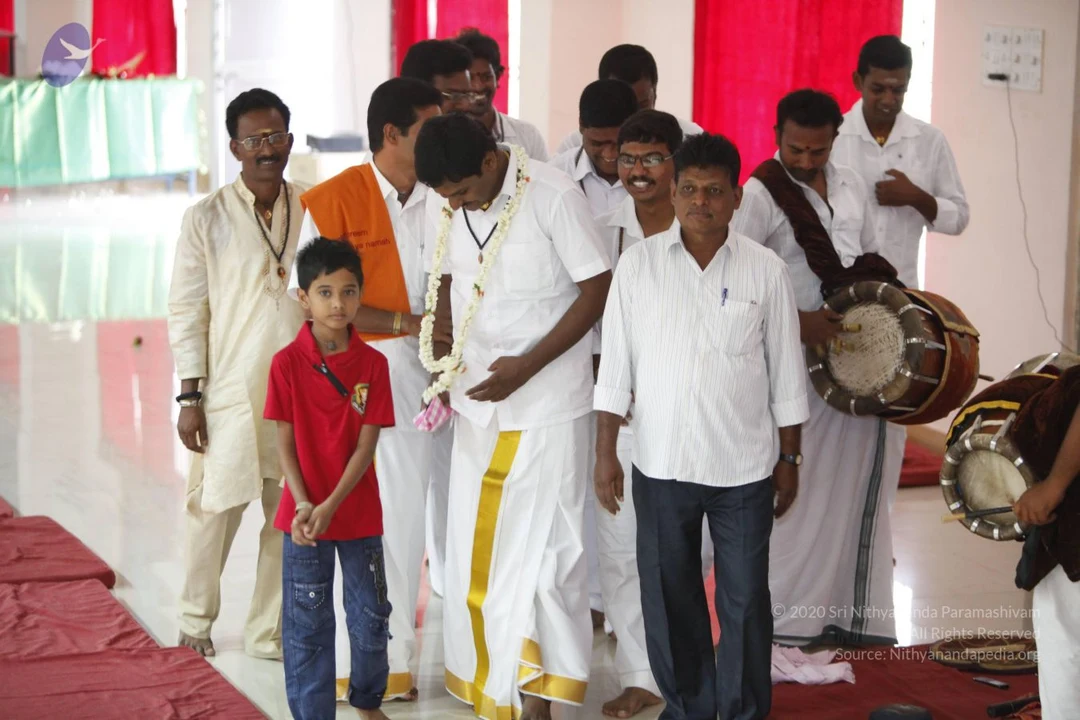
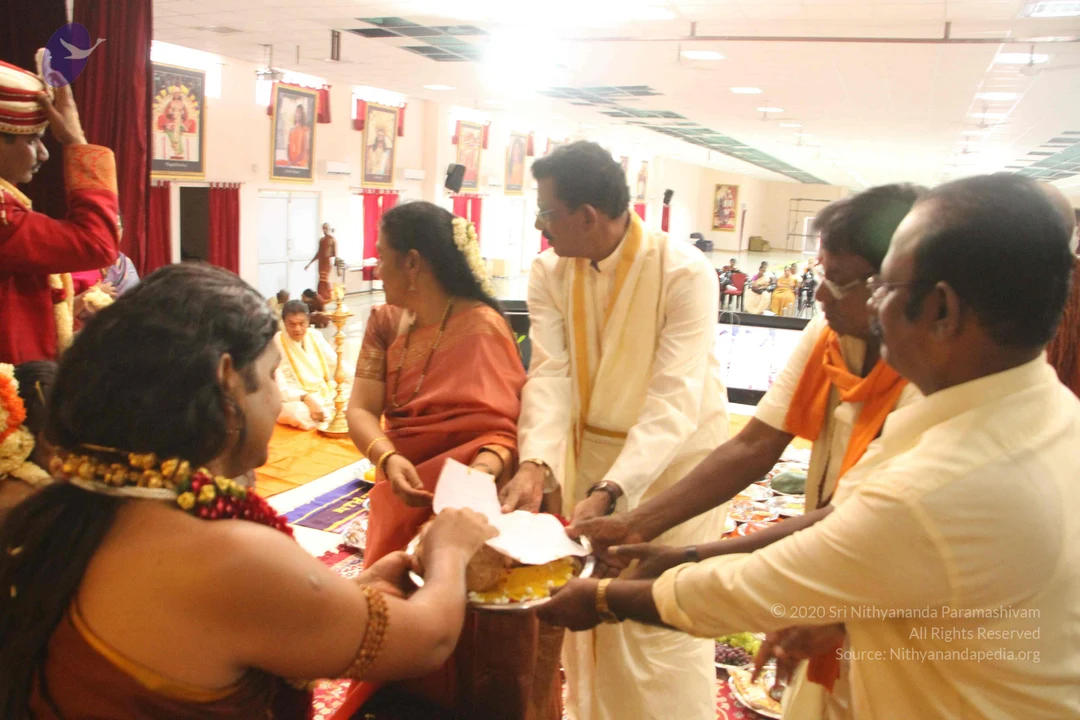
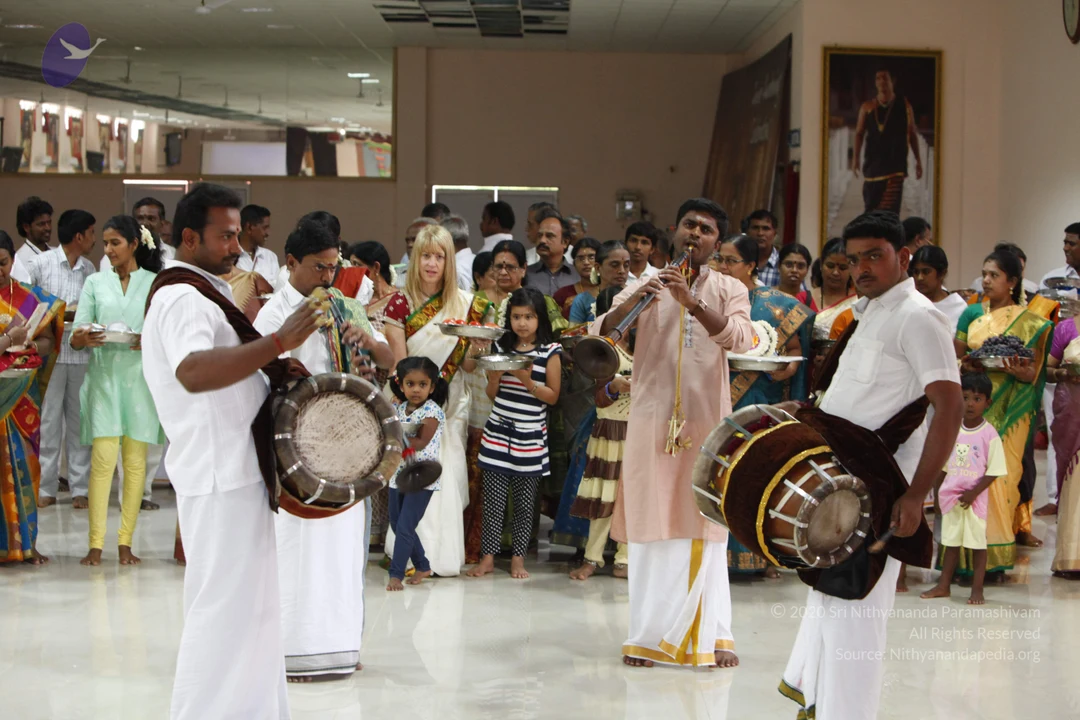
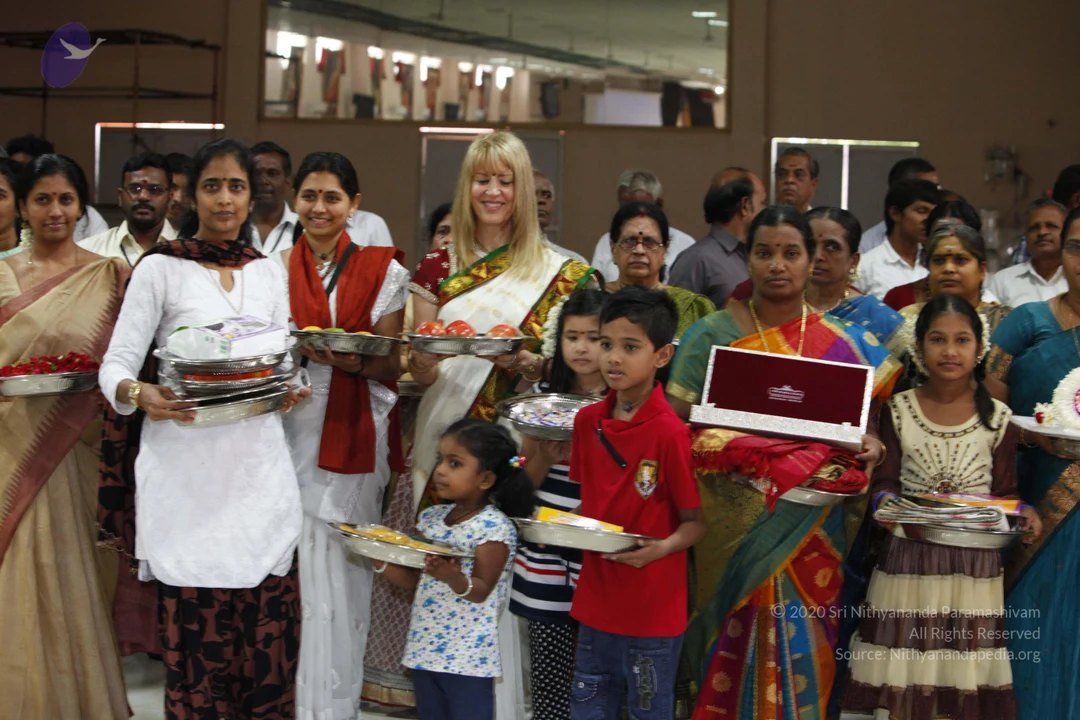
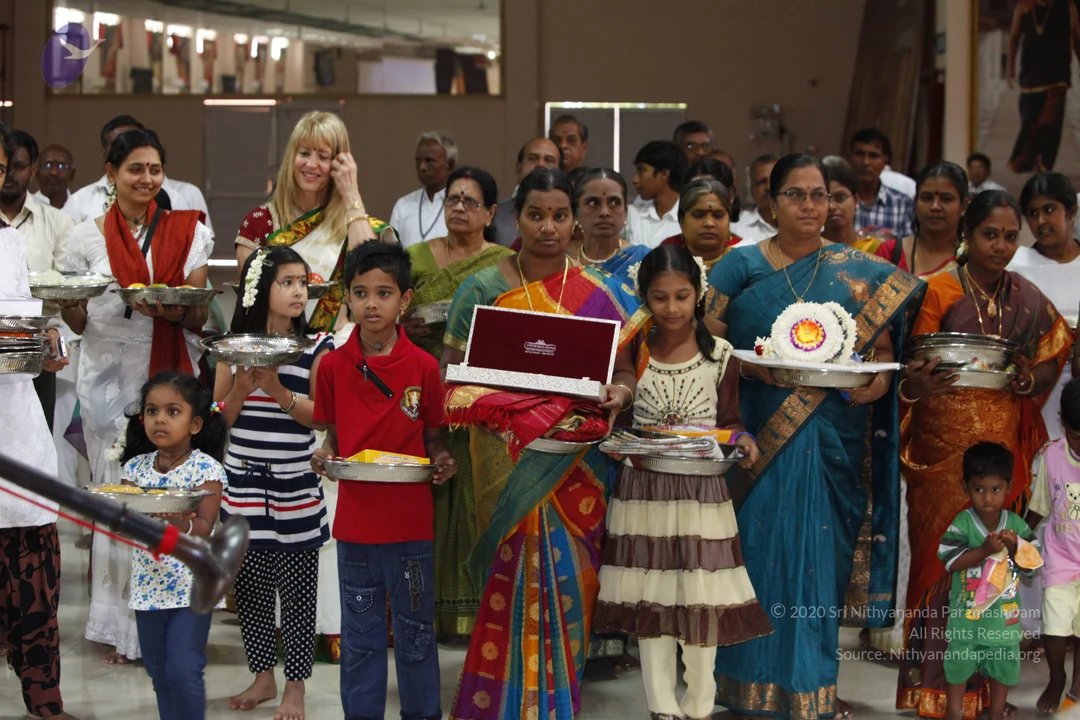
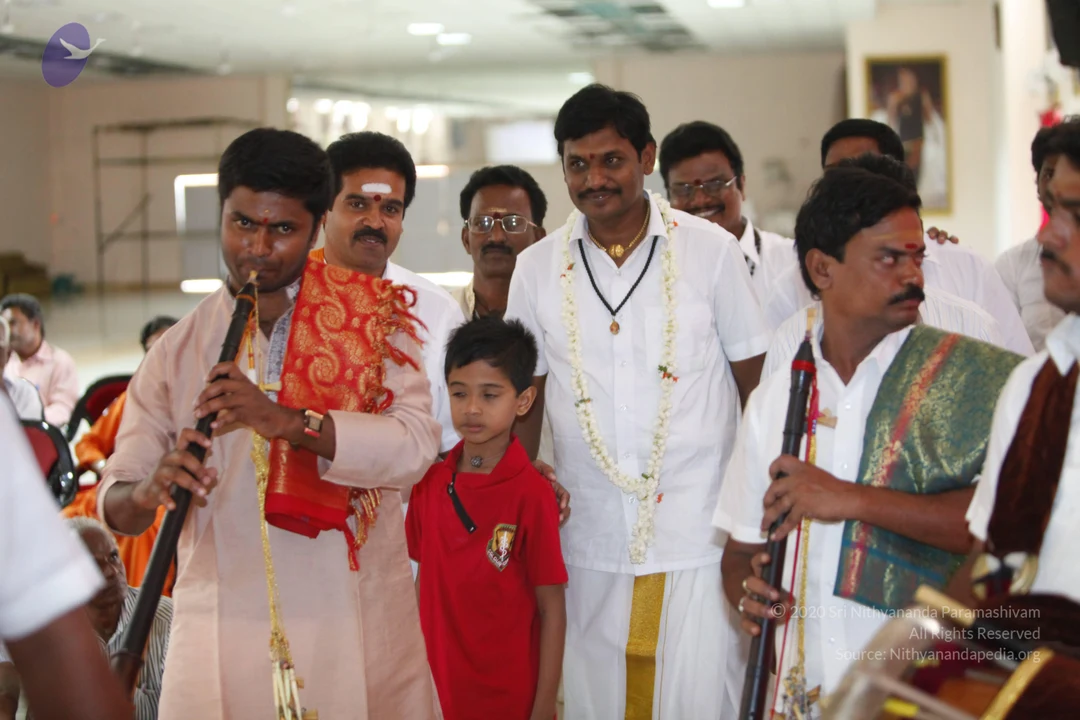
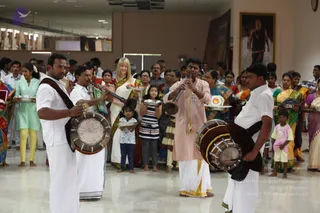
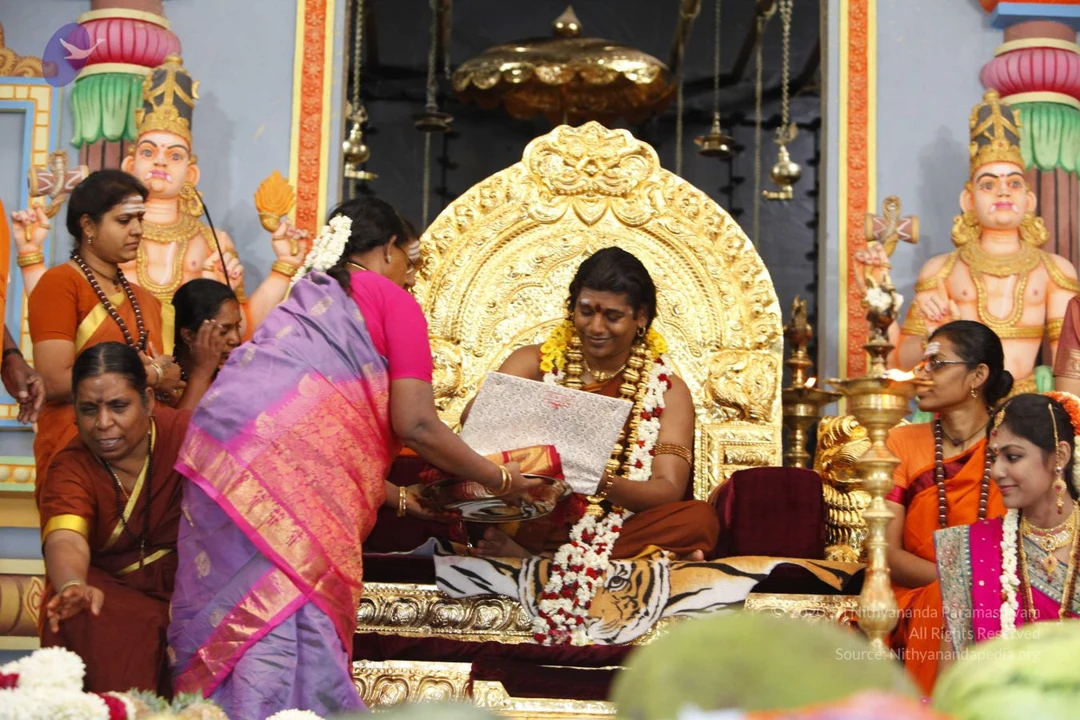
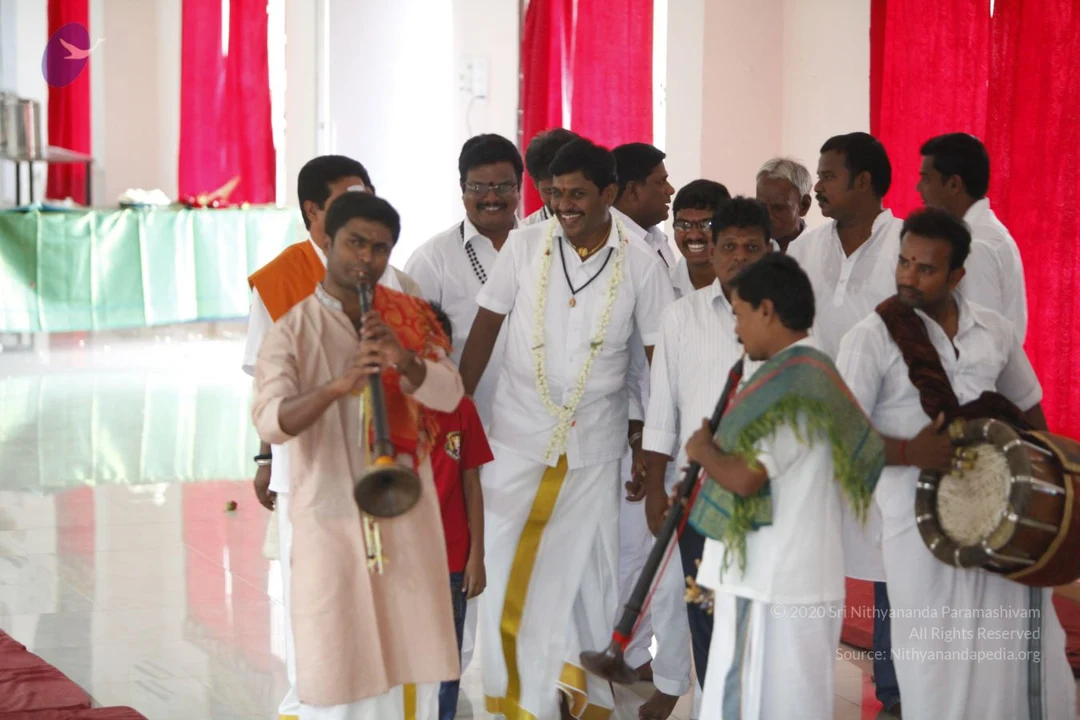
A photograph of a ceremonial welcome in a bright tiled hall. In the foreground, two drummers in white dhoti and shirt play large barrel drums slung over their shoulders, and a man in a pink kurta with a gold-coloured shawl and white dhoti plays a long wind instrument (nadaswaram-style horn). Behind them a crowd of devotees, many women in colourful saris holding brass plates of offerings, flowers and fruit, watches; a blonde woman in a white sari with green border stands among them and a small girl in a striped top holds a plate. A framed portrait on the back wall shows a man in a sleeveless top and dhoti. A band of white-clad musicians and plate-carrying devotees forms a ceremonial procession.A line of women and children stands on a polished floor holding silver trays and bowls of offerings: fruit, sweets, flower garlands and a bowl of purple grapes. Women wear silk saris in teal, maroon and green with gold necklaces and jasmine flowers in their hair. A girl in a striped skirt holds a tray with two white and orange flower garlands, and a boy in a red shirt carries a red-covered book. Adults in white and blue stand behind, and a young child in a striped shirt reaches for a sweet. Red curtains and a gilded backdrop are visible behind them.A line of women in silk saris stands in a hall holding metal trays of offerings. In front, a woman in a teal and gold sari holds a tray of purple grapes, a woman in a green and gold sari holds a tray of red flowers, and a woman in a cream and purple sari holds a tray of red fruit. A woman in a gold and orange sari holds green and purple grapes, and a woman in a brown and orange sari wears white flower garlands in her hair. Behind them, men in white shirts and other devotees watch. Small children stand at the left edge, one holding a pink sweet. A photo credit overlay reads 2020 Sri Nithyananda Paramashivam and a source line appears on the imageA photo inside a hall with red curtains as devotees in festive saris and salwar kameez walk in a line carrying silver thalis of offerings, flowers and fruit. Foreground: a young girl in a white floral top holds a thali of yellow food; a boy in a red shirt holds a red book and bundled cloth; a girl in a patterned dress wears white flower garlands on her head. A woman in a white kurta with a scarf carries a tray, and a woman in a teal sari with gold jewellery stands at right. Several adults and children stand behind them. The scene reflects a ritual offering procession.A photograph of a long line of devotees carrying offering trays in a hall, most of them women in sarees and salwar kameez, with children among them. Foreground women wear a teal saree, a maroon and gold saree, a green-and-gold saree and a white churidar, with gold jewellery and white jasmine flowers in their hair. Trays hold fruit such as grapes and berries, sweets, betel-style offerings and marigold-style flower garlands. A young girl in a blue top holds a small tray at left, and a boy in a red shirt stands near a red book held by a woman. Behind them men in white shirts stand in the background, and a banana-leaf-decorated display is visible at top left.A procession of devotees moves through an indoor hall with a drab ceiling of recessed lights and a framed portrait on the right wall. In the foreground, a man in a white dhoti and shirt with a maroon shawl plays a large barrel drum. Beside him, a man in white plays a long wind instrument, and a man in a pink kurta holds a horn-shaped instrument. Women in saris, including green and teal ones, carry metal trays and a bunch of bananas is raised above the crowd. In the lower left corner, a bald man in an orange robe is seated near the edge of the frame. Many people in white traditional clothing stand in the background.

Office-Yoga-Swaminis

10 photosSource gallery
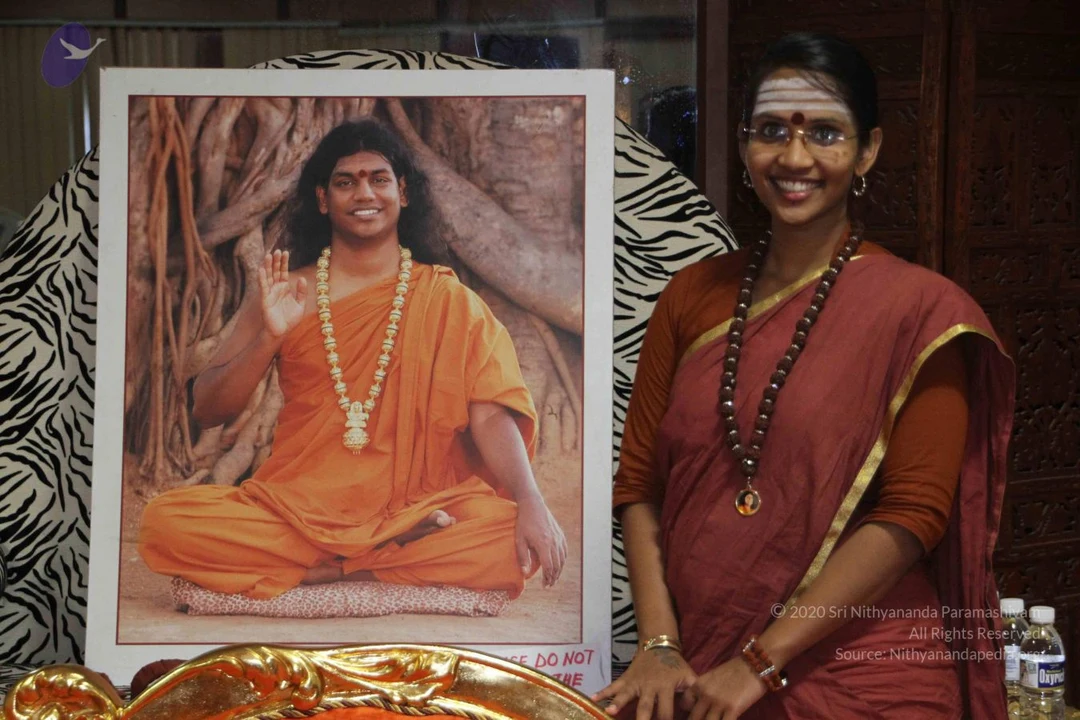
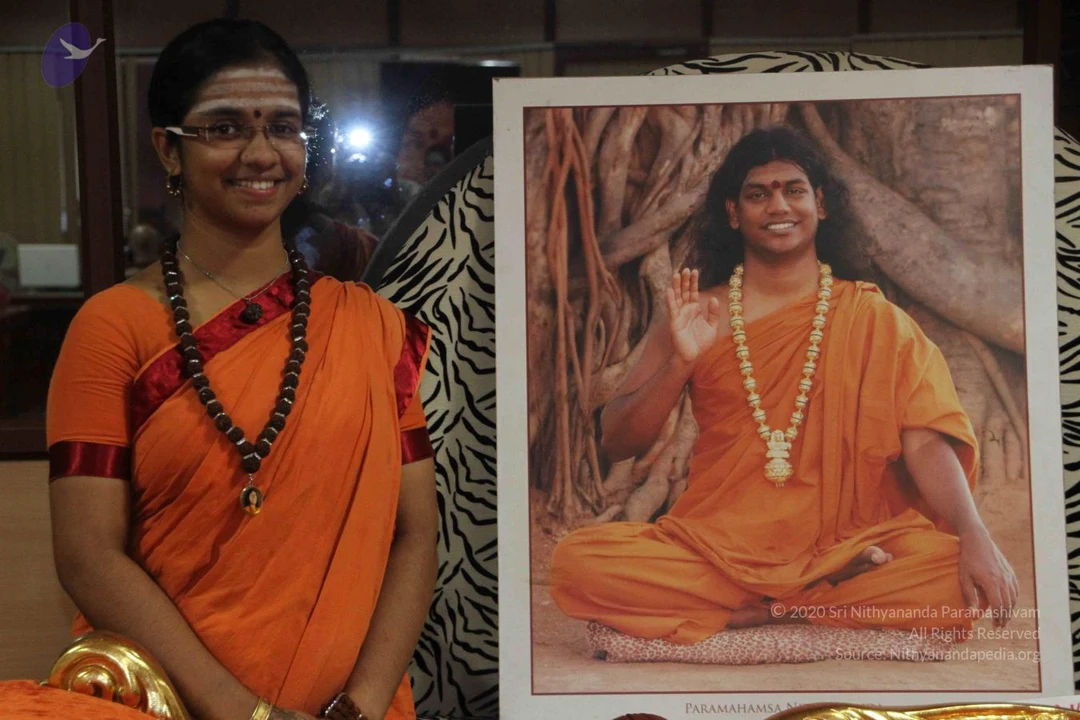
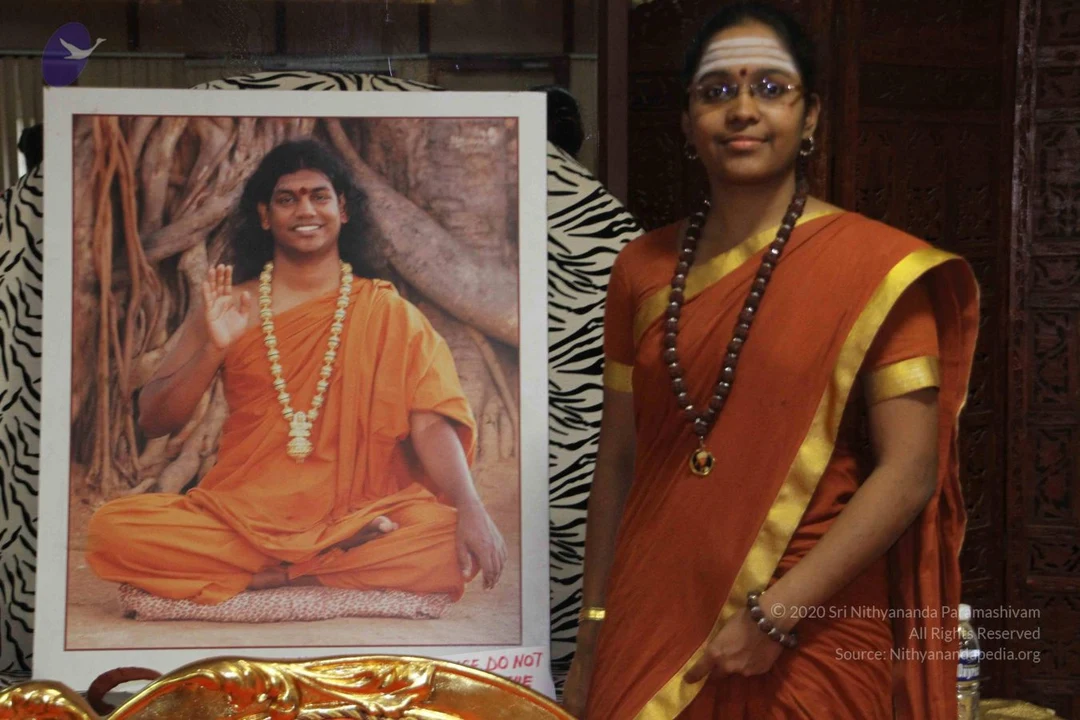
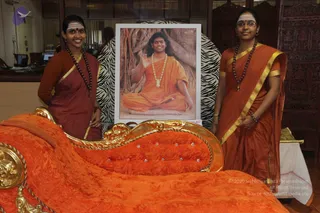
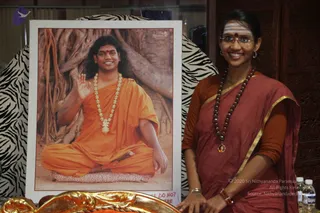
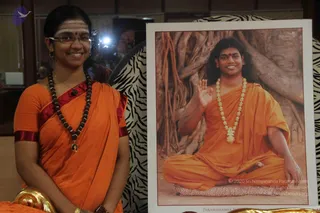
A group of eight women in orange and saffron saris with gold borders sit on a tiled floor in a hall, facing inward around a vase of white flowers. Several wear rudraksha malas and some have white markings on their foreheads. Behind them stands an ornate orange and gold throne decorated with flowers, with a zebra-patterned seat, and a framed portrait of a figure in orange robes with a mala rests on a stand nearby. Office-style windows and a wooden partition are visible in the background.Five women in orange and maroon saris with gold borders stand around an ornate gold-framed orange velvet chaise lounge in an indoor room with tiled floor and wooden cabinetry. Behind the couch a framed portrait shows a seated figure in orange robes with a white flower garland, one hand raised, in front of a large banyan tree trunk; the figure is a printed image, not a physical person. The women wear rudraksha malas and white sacred ash marks on their foreheads. A zebra-print cushion sits behind the portrait.A smiling woman in a rust-red sari with a gold border stands beside a large printed portrait of a seated man in orange robes with a white garland and gold pendant, his hand raised in blessing, before a bare tree with exposed roots. The woman wears a white forehead marking, a red bindi, rudraksha beads, a pendant and bangles. A zebra-striped cloth backdrop and a gold-edged tray in the foreground complete the scene. The portrait is a printed depiction, not a physical person in the scene.A smiling woman in orange saree with red border and a rudraksha mala stands beside a large framed portrait on a zebra-striped chair. The woman has white vibhuti on her forehead and wears glasses and small gold earrings. The portrait shows a seated man in orange robes and a floral garland with a gold pendant, raising one hand in blessing before a banyan tree trunk.Two smiling women stand either side of a framed printed portrait on a zebra-striped backdrop, in front of an ornate orange velvet and gold-trimmed couch. Both wear rust-red saris with gold borders, rudraksha malas and white tilak markings on their foreheads. The central portrait shows a seated figure in orange robes with a white flower garland, hands raised in a blessing gesture, beneath a large banyan-like tree. The portrait is a printed depiction, not a physical person, and no name is legibly printed on it. The seated figure's appearance is consistent with a person depiction, given the orange clothing, garland and blessing pose, which are distinctive visible cues.Four women in orange and maroon sarees with gold borders stand beside an ornate gold-framed orange velvet chaise, a throne-like seat with tufted cushion and crystal buttons. Each wears rudraksha malas and white vertical forehead markings, and one wears a red bindi and glasses. Behind them a large printed portrait shows a man in orange robes seated in lotus pose with a white flower garland, one hand raised in blessing, before a banyan tree. The seat and backdrop are draped in zebra-print fabric. The women are standing, not seated.

Temple

17 photosSource gallery
Photograph of a pair of life-size golden statues seated together on a lavender draped platform in front of a red curtain within an ornate golden arched frame, with palm trees and green foliage behind. The figure on the left has a red and orange turban, a rudraksha mala and a trident held in one hand, wearing dark green trousers and an orange garment. The figure on the right wears a dark crown-like headpiece, an orange sari and layered ornate necklaces. Both are statues, not living people.A dark grey stone Nandi bull statue sits on a black pedestal atop an orange-red base, draped with a red and yellow silk shawl and garlands of red and orange marigold flowers. Its neck bears a beaded necklace and it wears a decorated saddle cloth. Behind it stand blurred grey sculptures of deity figures, one holding a staff, beside green foliage and frangipani-like trees in a temple courtyard. Scattered flower petals lie on the base. No physical people are visible.A black stone murti of a four-armed deity seated against a green cloth with gold dots. The figure wears a peach-coloured cloth wrapped around the body and head, a peach headband with a gold tassel and white flower, and many rudraksha and white bead malas across the chest. Its raised hands hold a small cobra-like object and a flaming or spiral item, with a gold-ornamented belt. No living people are visible.A black stone murti of a deity with multiple arms stands before a green fabric backdrop with gold square motifs. The figure wears a peach-coloured headband with a tassel, a peach cloth wrap, and layered necklaces of rudraksha-style brown beads and white pearl strands. One raised hand holds a small trident-like staff, and the other hand is held in blessing with marks on the palm. White pearl bracelets adorn the wrists. A white carved arch frames the right side. No physical people are visible; the figure is a statue.A dark black stone murti of a multi-armed deity seated in an ornate silver arched niche against a green fabric backdrop with gold dot patterns. The figure wears a peach-coloured dhoti and shawl, a peach turban with a golden tassel, layered rudraksha and white pearl malas, a gold jewelled armlet and pearl bracelets. Its hands hold a trident-like staff, a rattle-like object, a mala and a small square item. No living people are visible.A dark stone statue of a multi-armed deity murti sits seated in a silver-framed niche against a green fabric backdrop scattered with gold dots. The murti wears a peach-coloured dhoti and shawl, a saffron-peach head wrap, layered rudraksha and beaded necklaces, and bead bracelets on its wrists. Its raised hands hold a drum-like object and a ritual implement, and one hand holds a japa mala. The silver arch is carved with floral and animal motifs. No physical people are visible.

Padduka-Puja

10 photosSource gallery
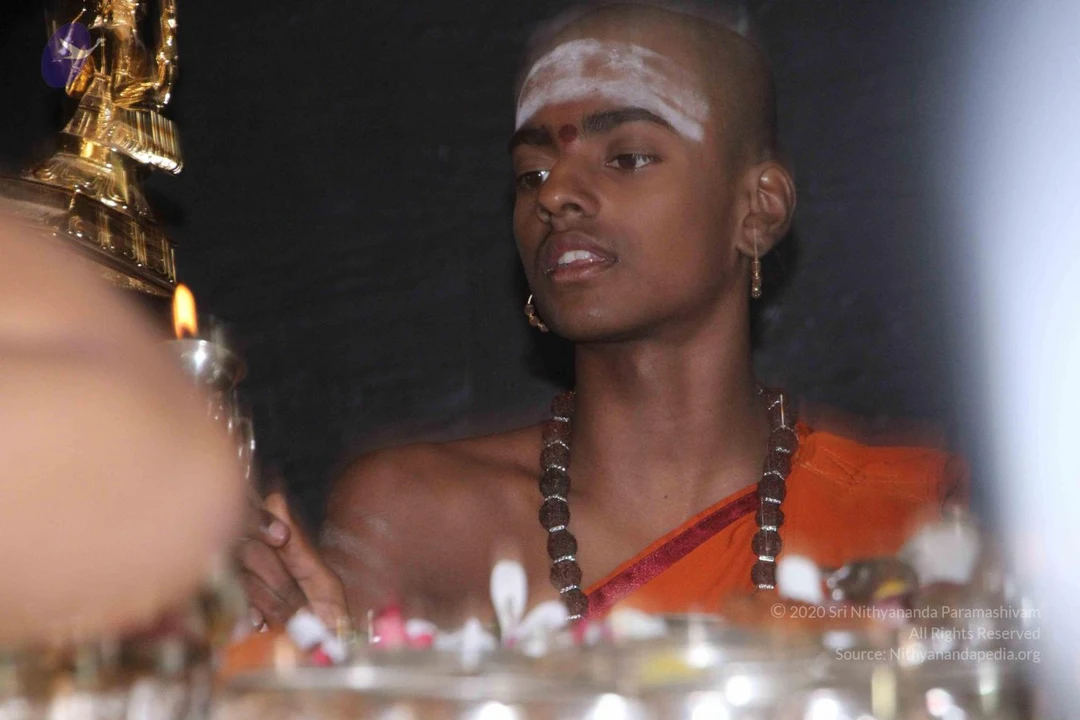
A framed portrait labelled "PARAMAHAMSA NITHYANANDA" sits on an ornate gilded throne with lion-head armrests and a tiger-striped rug. The portrait shows a seated figure in orange robes with a white bead garland, one hand raised, before a banyan tree background. Brass hanging bells and a brass oil lamp flank the throne. No physical people are visible; the figure is depicted only in the printed portrait.A framed portrait on a gilded, ornately carved throne with brass bells and hanging brass oil lamps on chains, against a dark background. The portrait shows a seated figure in orange-saffron robes with a white beaded mala necklace, hand raised in blessing, before a banyan root backdrop. The throne has a golden-brown velvet seat with a tiger-striped cloth and a red cloth draped over the armrest. No physical people are present. Swamiji (probable) appearance cues are visible in the depicted portrait: long swept-back hair, saffron robes and a mala necklace, shown as a painted or printed depiction rather than a person in the room.A photograph of a ritual offering arrangement on an ornate gold-embossed tray. Multiple silver bowls and small silver dishes hold red flowers, yellow flowers, turmeric or kumkum powder, and pink blossoms. Loose white and red flower petals are spread across the centre, with a silver conch-shaped vessel and a small silver container visible among them. No people are visible in the frame.A photograph inside a gilded shrine room with a black stone wall and a golden door. On the left, an ornate gold throne-like seat with a carved golden lion figure stands beneath a framed portrait labelled as Paramahamsa Nithyananda, showing a long-haired figure in orange robes seated on a platform. Brass hanging lamps and bells hang from chains above. In the foreground, a shaved-headed man in an orange robe with a rudraksha mala and a white forehead mark sits with a row of silver plates holding flowers and offerings on a gold table, while a woman in orange and another woman in saffron assist with the puja. A wall air conditioner is mounted in the background.Close photo of a shaved-headed young man in an orange saffron garment with a rudraksha mala around his neck, wearing a white tripundra with a red bindi on his forehead and a small gold earring. He sits before a golden deity image at the top left and a lit oil lamp, with flower petals and metal bowls in the foreground. Background is dark. The person is not presented with cues qualifying as the a person candidate, so the role is given as a priest or devotee.Inside a shrine room with black walls and a gold-framed portrait at left, four devotees perform aarti. A shaved-headed young priest in orange robes and rudraksha mala holds a lit lamp at centre-left, while a woman in orange-red sari with a mala lifts a lamp in the foreground. A woman at right in orange sari raises a flaming lamp. A large brass plate of kalasha-like offerings, flower garlands and small oil lamps sits on a gold-covered table. A golden lion-shaped stand and a tiger-striped cushion stand nearby, under hanging brass bells and a wall air conditioner. The framed portrait shows a robed figure seated in orange with a pale cloth, but no one is clearly identifiable as the person pictured.

Gurukul-Kids-Group-Temple-Instrument

3 photosSource gallery
A group of about fifteen young students in maroon and orange traditional clothing walk along a paved road, with bare feet and sandals. Several wear maroon kurtas with gold borders and orange dhotis or sarees, and many have white vibhuti marks on their foreheads. One girl on the left carries a pink bag, and a boy in the centre plays a long brass horn, while another holds a drum. Palm trees and a white signboard with blue lettering stand in the background, and a man in white is visible further back.A procession of young children walking down a paved road lined with palm trees and greenery. Girls and boys wear maroon and gold dress, while several boys in saffron-orange robes walk barefoot, some with shaved heads and white sacred markings on their foreheads. Two boys in the front-right raise long brass horns (ceremonial trumpets), and a girl in maroon carries a drum wrapped in red cloth. A man in white clothing stands in the background near a small red-roofed shrine and a road sign. The scene appears to be an ashram procession, with no identifiable a person visible.A photograph of a group of young children walking barefoot along a paved road in an ashram setting, with palm trees, greenery and small red-roofed buildings behind them. Many wear maroon kurta-style tunics with gold trim and maroon dhotis, while several boys in saffron-orange robes with gold borders lead the group. One child in saffron holds a tall gold-topped staff aloft, another plays a hand cymbal, a girl carries a drum slung over her shoulder, and others sound conch-like horns or blow into their hands. Their faces bear white and painted markings. Along the roadside, adults in white and small figures stand in the background near a rock pile and a signboard.

Satsang-Swamiji-Crowd

6 photosSource gallery
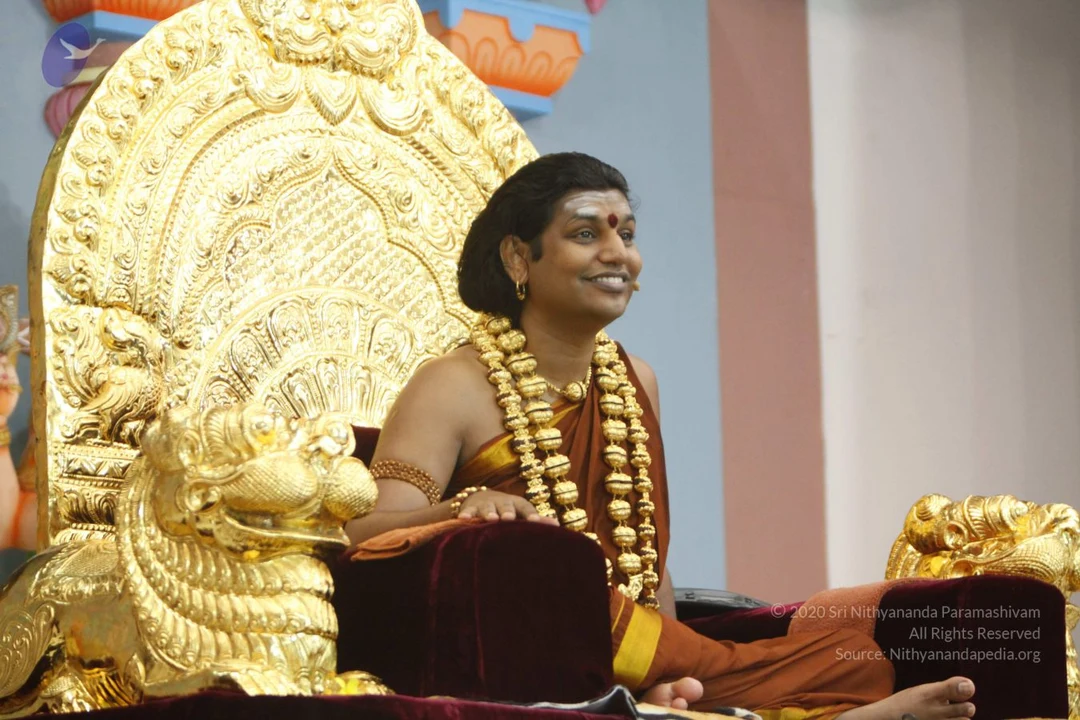
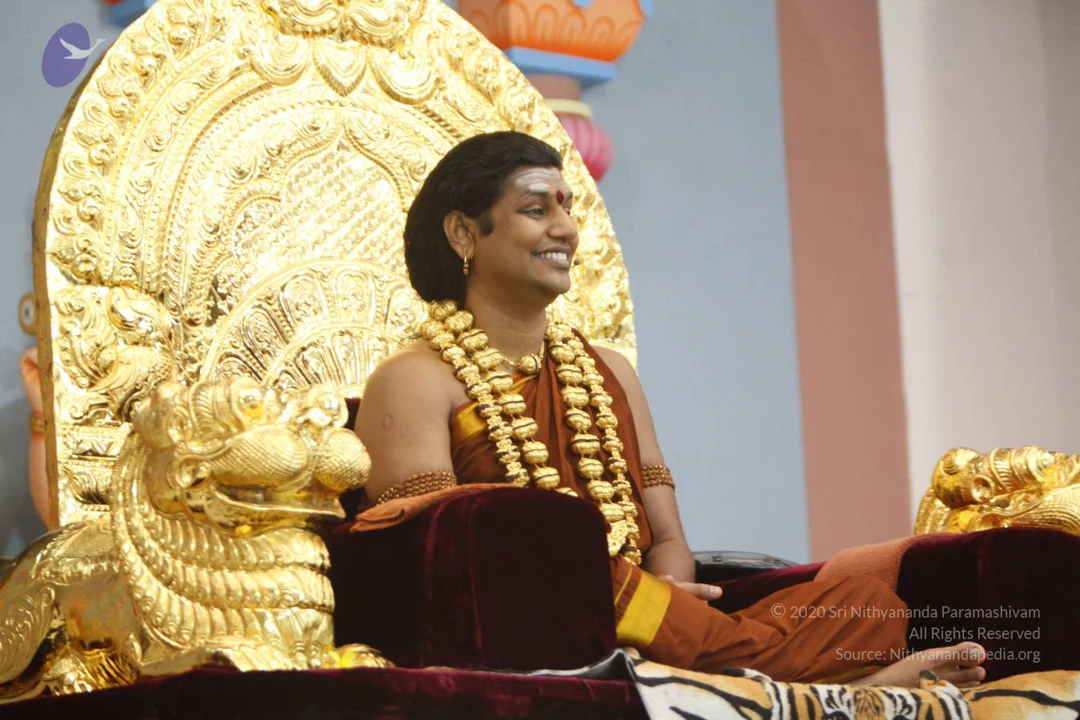
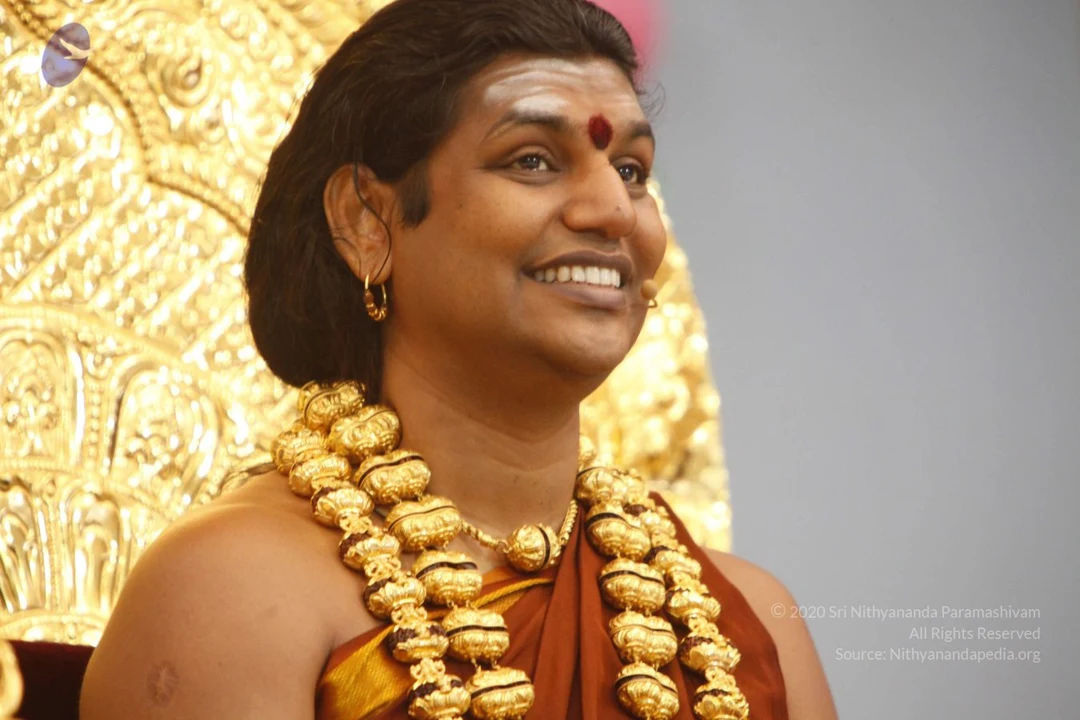
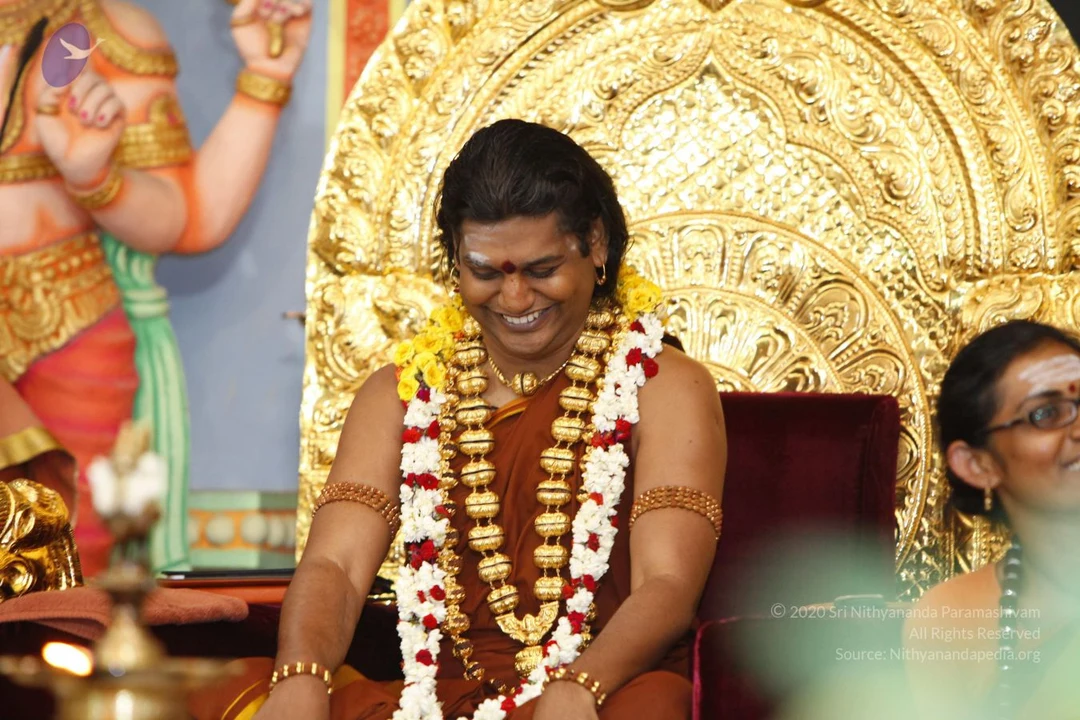
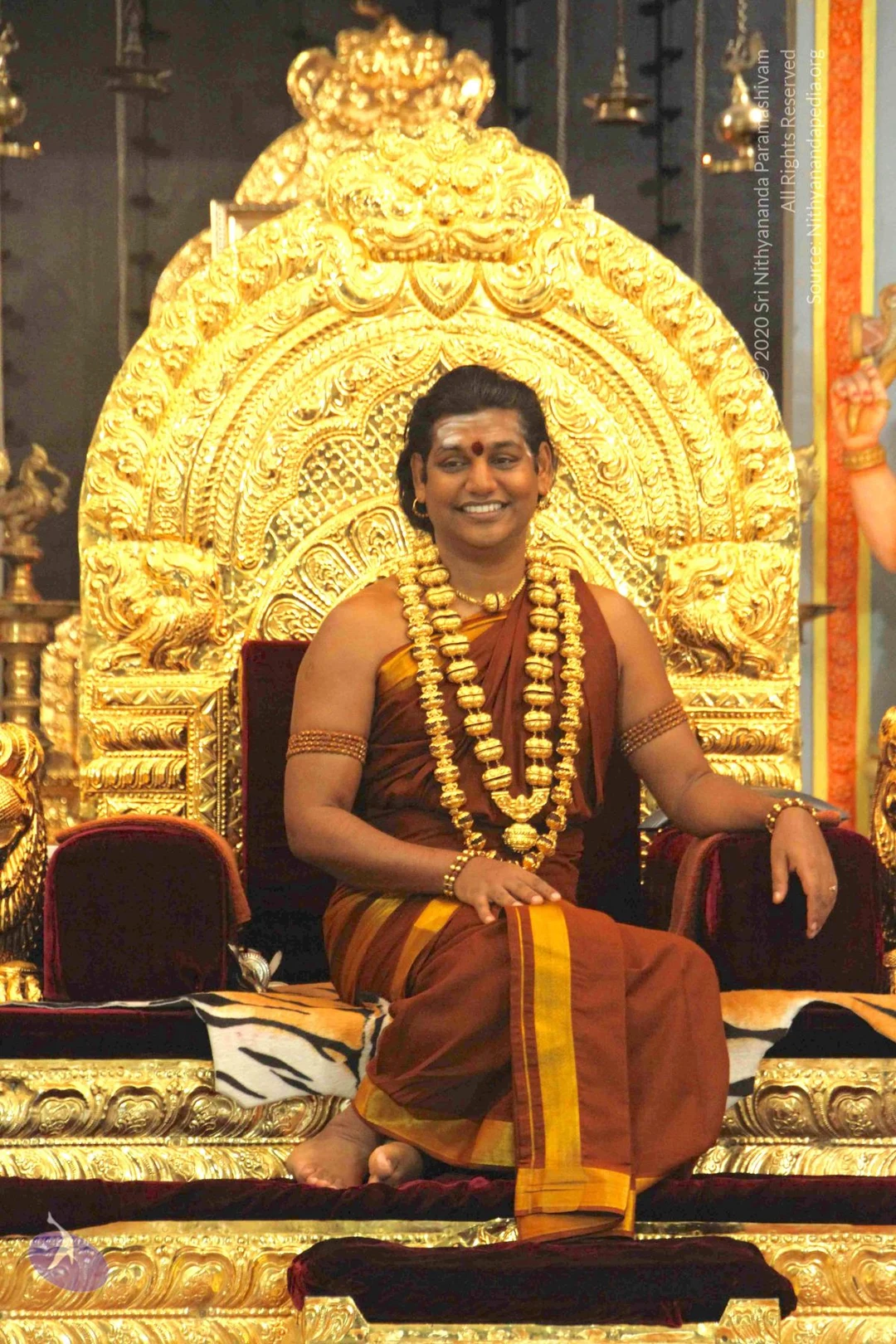
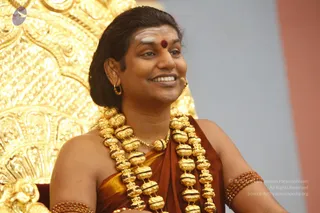
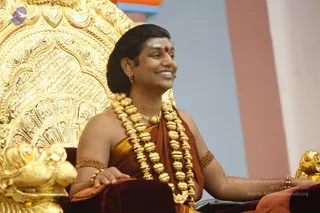
Indoor satsang hall with a large audience seated on red mats in rows facing a raised stage at the far end. Many children and young people in maroon uniforms sit on the left, with saffron-robed monastics and white-clad adults among them. On the stage, a figure in saffron sits behind a decorated altar with ornate golden arches and deity images. Framed portraits hang on the right wall, a projection screen shows an image at left, and camera tripods stand near the front. Ceiling fans and recessed lights overhead.A photograph of a seated man on an ornate golden throne with a tall gilded arch, flanked by golden lion-head armrests and a tiger-skin rug at the base. He wears a saffron-orange robe with a gold-bordered cloth, a multi-strand golden bead necklace, gold bangles and a red bindi with white vibhuti markings. Two painted, multi-armed guardian statues in red-and-gold dhoti and crown stand on either side, holding a flame lamp and a trident-like object. Brass oil lamps sit near the throne, and a golden kalasha-like finial tops the backdrop. Appearance-based cues of long hair and saffron clothing with ornate adornments suggest a person, though the face and hair are not clearly visible, so identity is uncertain.Photo of a smiling man seated before an ornate gold-leaf throne, wearing an orange-red saffron-toned wrap over bare shoulders, multiple heavy gold bead necklaces and a rudraksha-style bracelet on the upper arm, a white tripundra and red bindi on the forehead, and a small gold earring with a headset microphone. a person by appearance cues: swept-back hair, ornate gold jewellery and saffron clothing, seated in a position of honour.A smiling man with short dark hair and a red bindi and white tilak on his forehead sits on an ornate gold throne with a large carved gold backrest. He wears a rust-orange shawl over a bare shoulder, multiple strands of large gold beaded necklaces, gold bangles on his upper arms and wrist, and small gold earrings. His hand rests on a dark red velvet cushion. Behind him stand pale blue and terracotta-coloured walls. Visible a person cues include the ornate gold throne setting, orange shawl and layered gold malas, though the image appearance alone is uncertain.A smiling man with swept-back dark hair and a red bindi sits on an ornate gold throne carved with lion-head armrests and a large gold backrest. He wears a rust-orange garment over the shoulder with a gold border, multiple heavy gold bead necklaces, a gold armband and gold earring. He is seated on a maroon cushioned seat, with bare feet, in a temple-style hall with pale walls and an orange and blue painted pillar behind him.a person seated in close-up before a gilded throne with ornate golden relief, smiling and looking to the right. He wears a rust-orange shawl draped over bare shoulders, a heavy multi-strand gold bead necklace with dark accents, gold hoop earrings, a red kumkum dot and white vibhuti on the forehead, and a small headset microphone near the ear. Behind him is a plain grey backdrop.

Sarva-Darshan

13 photosSource gallery
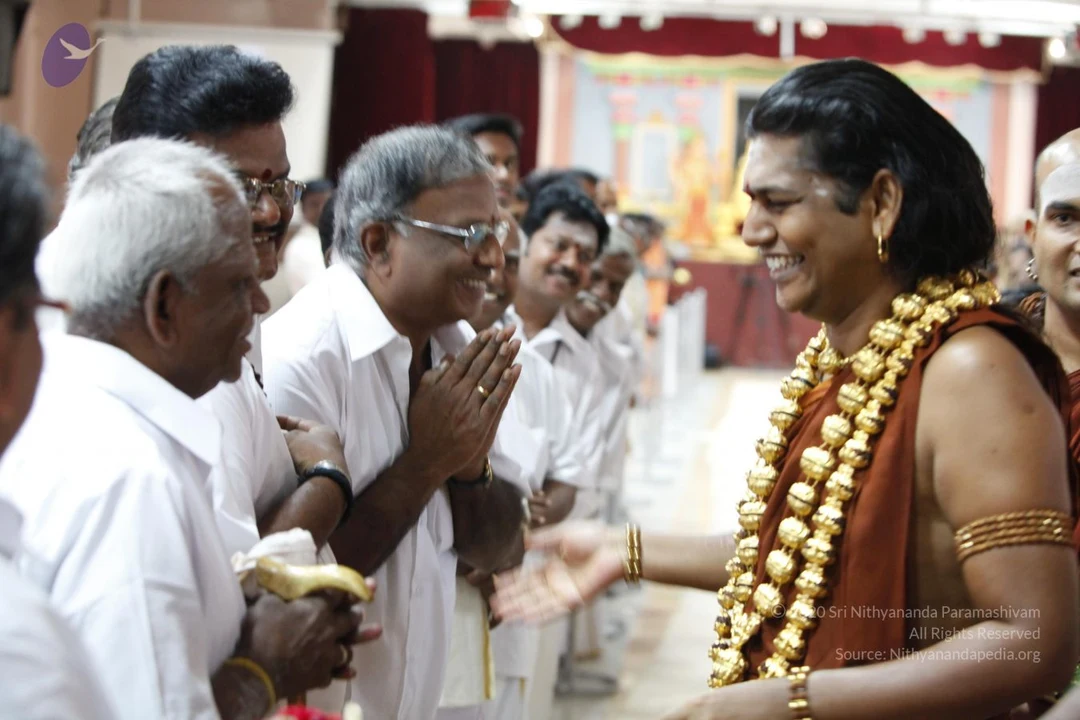
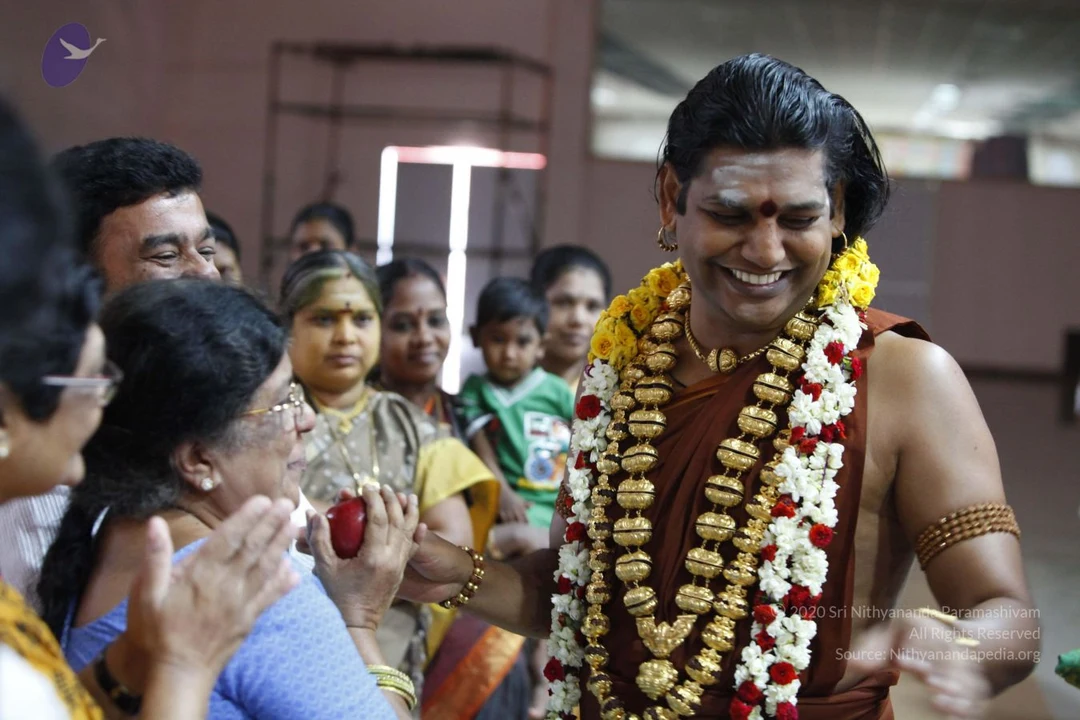
A man in a rust-brown dhoti and shawl, wearing a heavy gold-bead necklace and gold armlets, stands at a blessing, placing his right hand on the head of a bowing man in a white shirt. He holds a folded paper in his left hand. A red tilak marks his forehead and he has short dark hair. Other devotees with folded hands stand nearby, and a tray of fruit and cloth lies at the lower right. Behind them is a temple shrine with gold-tinted deity murti and painted columns, with a red curtain and silver stanchions in the foreground.A smiling man in a rust-orange garment and heavy gold bead necklaces stands on the right, his right hand raised and resting on the crown of a bowing man in a white collared shirt with green and red trim, who presses his palms together in greeting. Gold bangles adorn the raised arm. Behind them, several people in white stand in a temple hall with red drapes, a gilded shrine and a golden throne-like altar in the background. A blessing is being given with a hand on the head.A photograph of a temple interior where a man with swept-back hair, a red bindi and white forehead markings stands in a rust-orange dhoti-style wrap and multiple long gold bead necklaces, smiling as he reads a sheet of paper held in both hands. Gold bangles adorn his upper arms. Around him, devotees with palms pressed together in namaskar stand, including a bald older man in white at left and a younger man in a blue shirt. Behind them, a golden throne-like structure and ornate decorations are visible, with more people in white clothing in the background.A photograph of a man in an orange-saffron wrap with a thick multi-strand gold bead necklace, gold earrings, a gold armlet, and a dark swept-back hairstyle, smiling as he stands in conversation with older devotees in white shirts and white dhotis. A man in a white shirt with grey hair and a silver chain faces him with hands joined in a respectful gesture, while others in white and a few onlookers stand nearby in a hall with a golden deity shrine and red drapes in the background. The saffron-clad figure has distinctive ornate gold adornments and a swept-back hairstyle, consistent with the page's reference to a person, appearing in person.Photo of a devotee-gathering scene in a hall with red and patterned decorative panels behind. A person in an orange-brown garment with a thick gold bead garland, gold bangles and an upper-arm band faces right, raising a hand in blessing toward a group of men in white shirts. Several men stand with palms pressed together in namaskar, one older man with white hair holds a banana, and a man in glasses smiles. Others stand in the background. The blessing and greeting appear to be a darshan exchange.A photograph of a person in an orange-saffron garment with long swept-back dark hair, a heavy ornate gold bead necklace, gold bangles and gold earrings, smiling broadly while extending a hand to a line of men in white shirts and white dhotis who stand with palms pressed together in greeting. The man in front has grey hair and glasses and holds a folded white cloth and a gold item. Behind them, a hall with red drapes and a decorated altar backdrop. Probable Swamiji is the central figure in saffron, receiving devotees; the cues are the long swept-back hair, saffron clothing and ornate gold necklace.

Senthil-Anna-Engagement
26 photosSource gallery
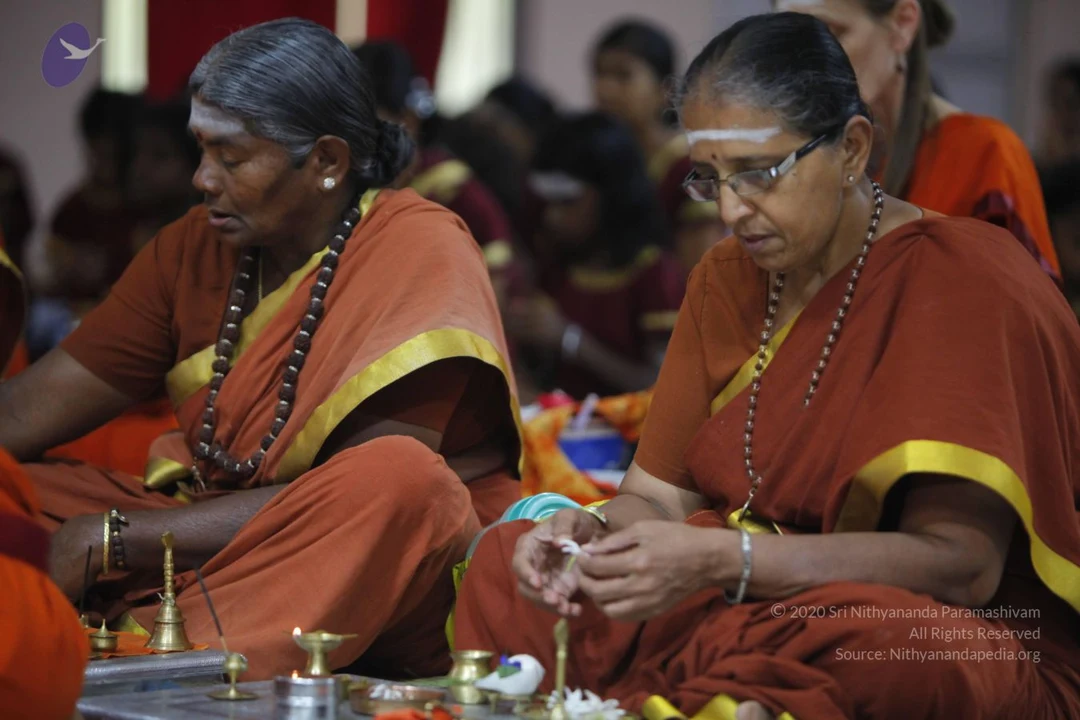
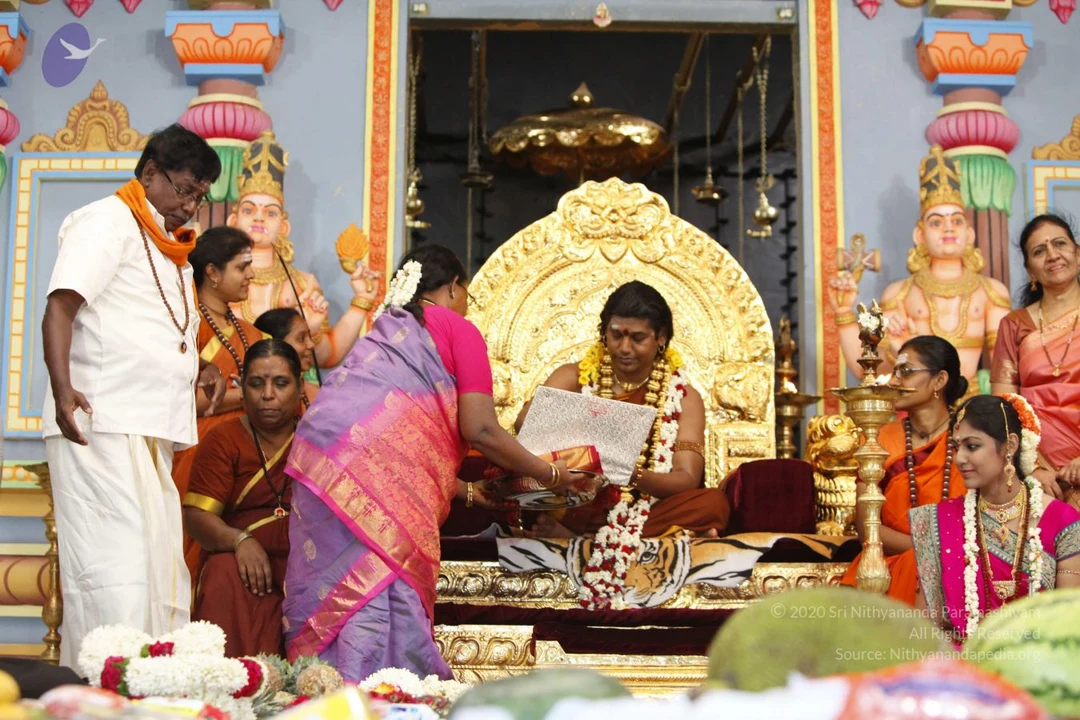
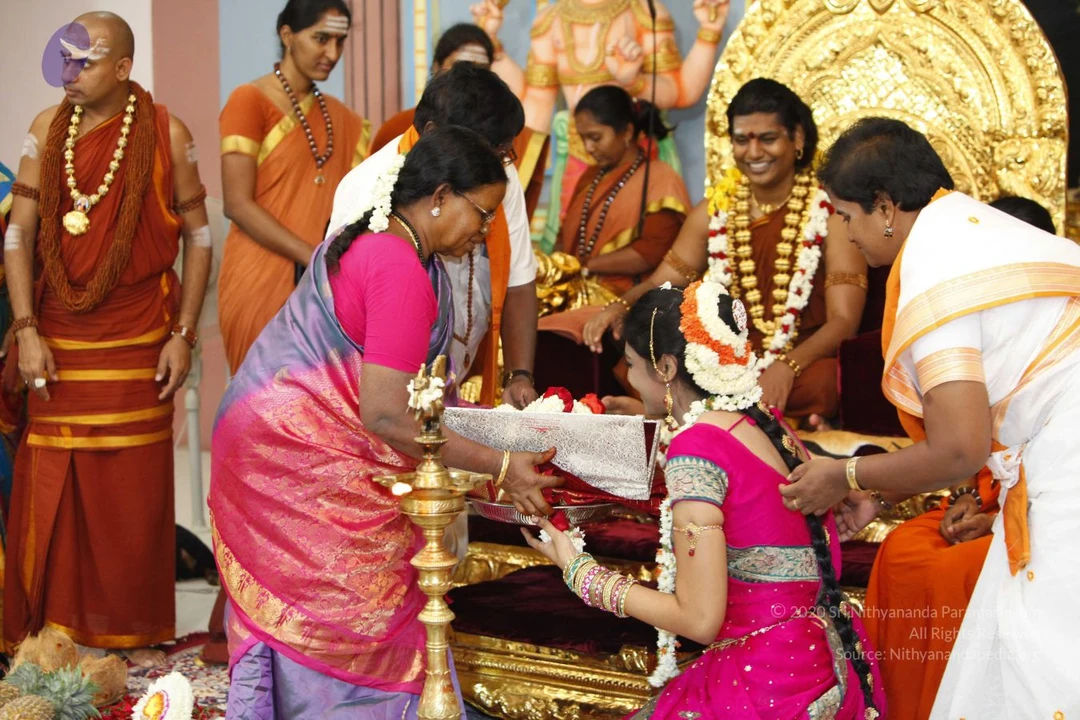
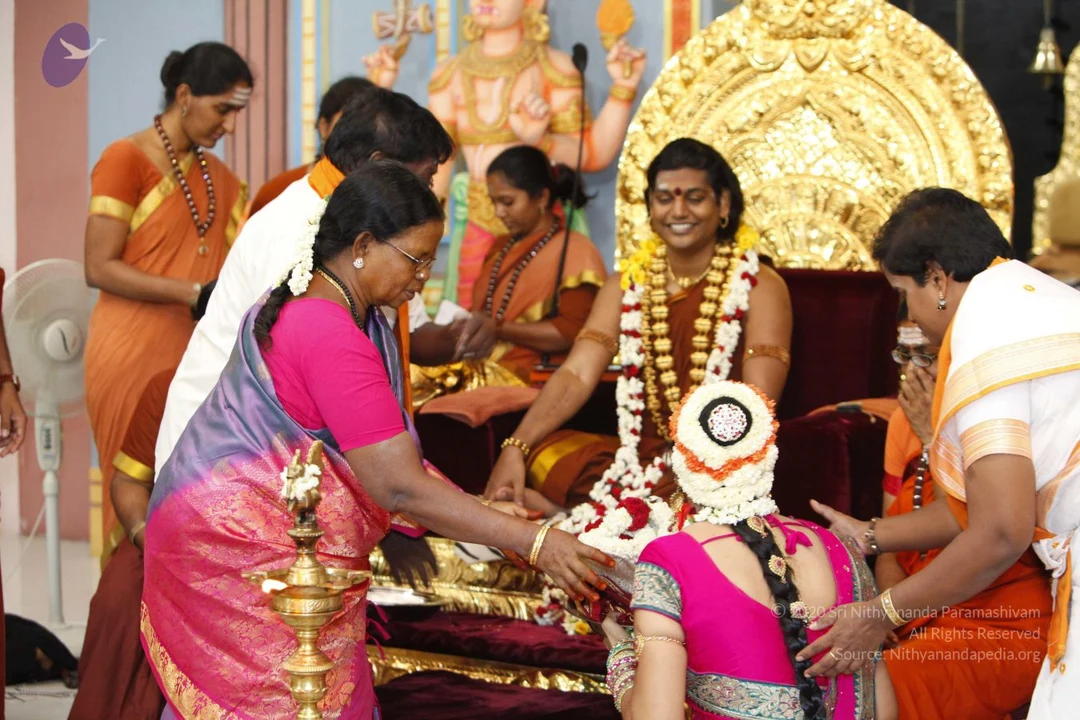
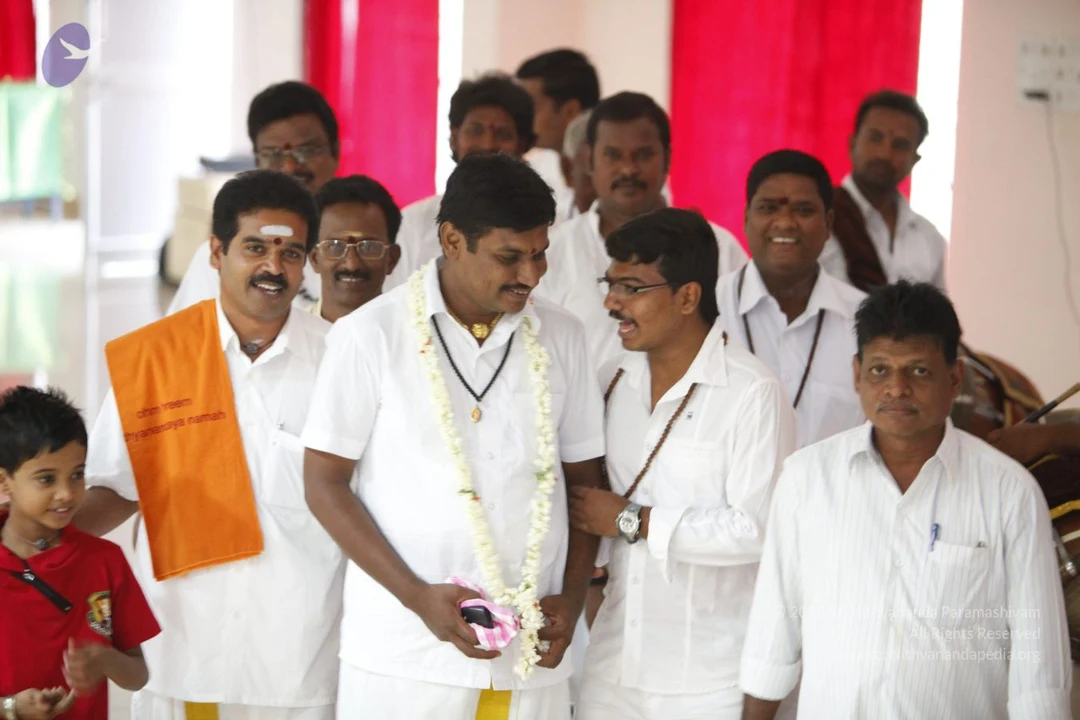
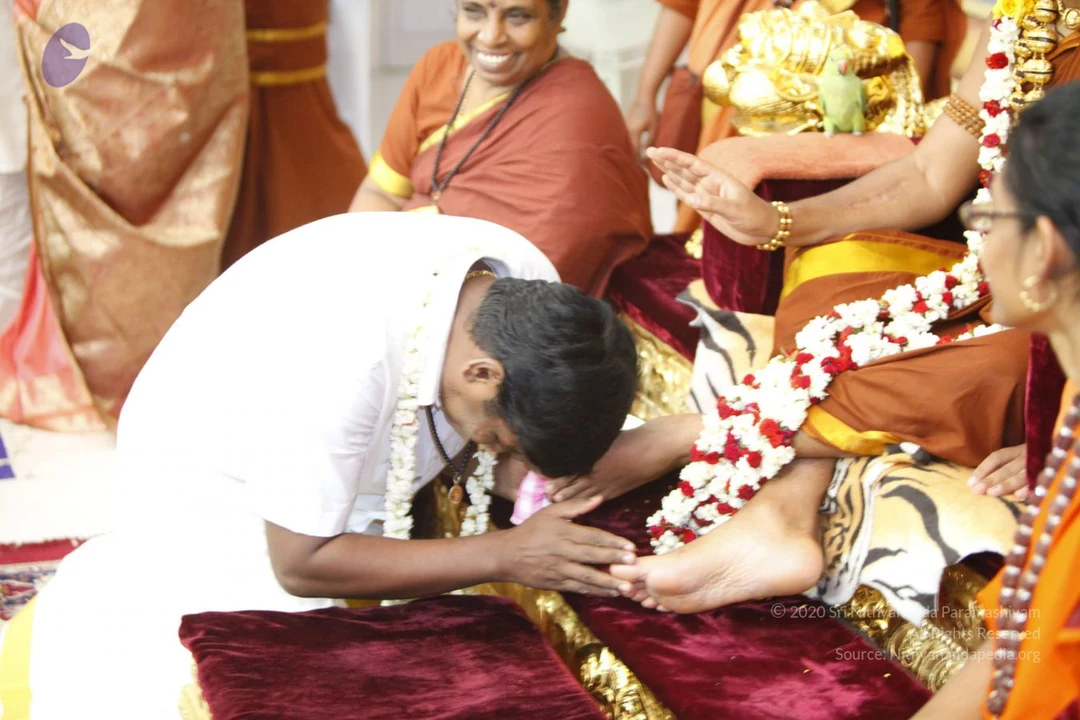
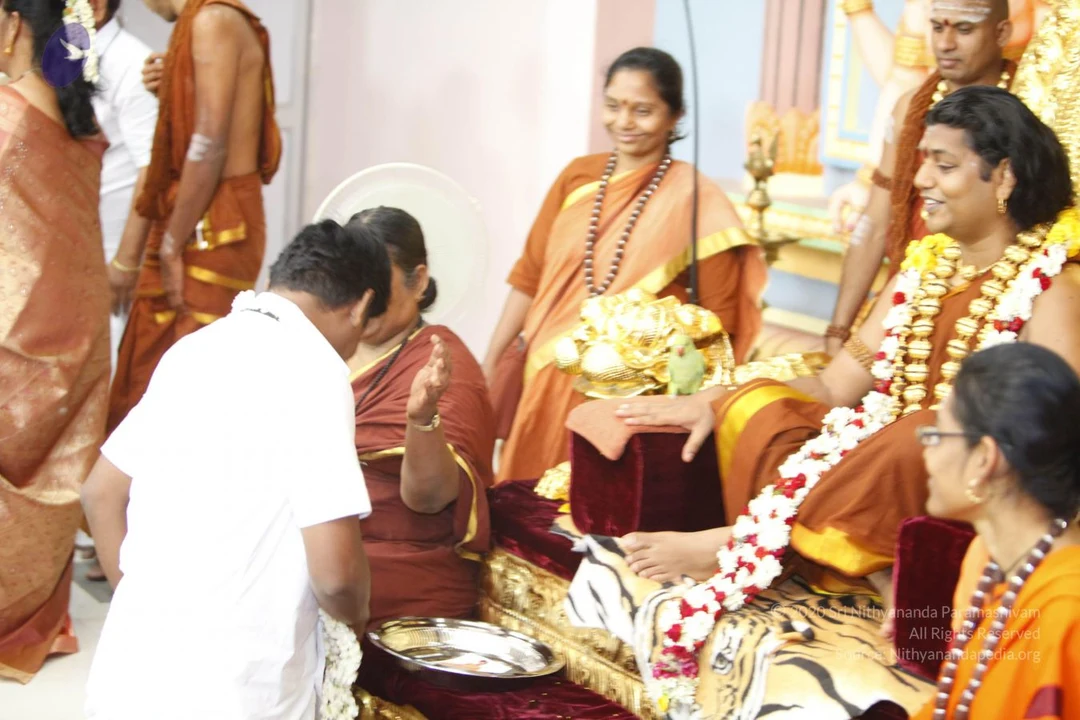
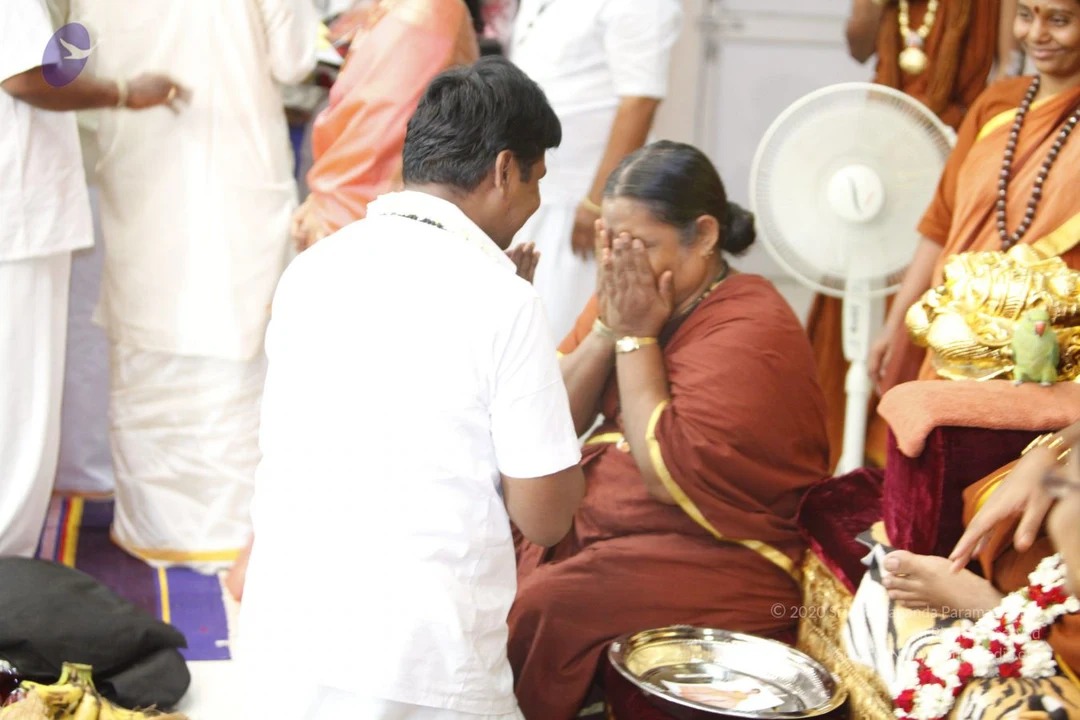
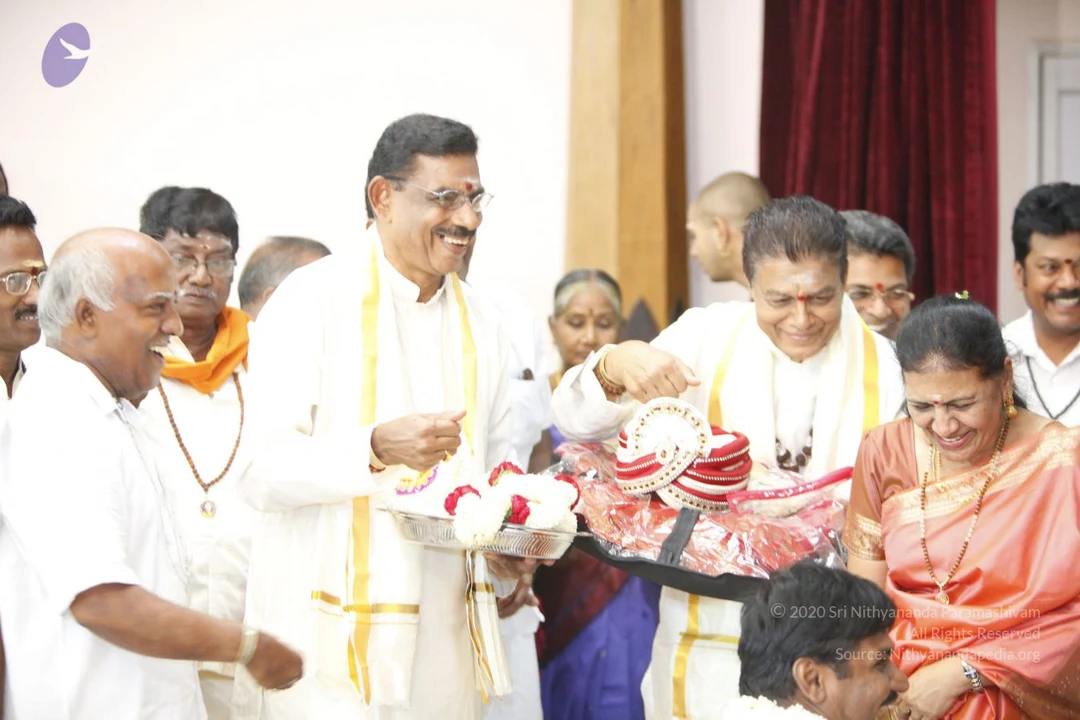
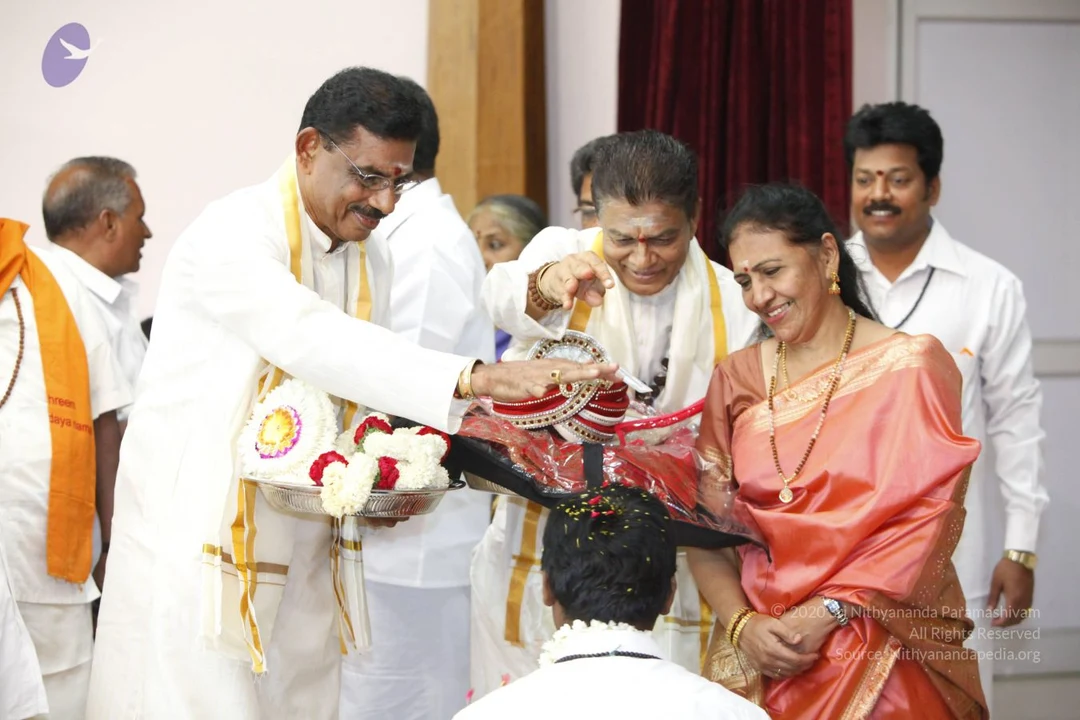
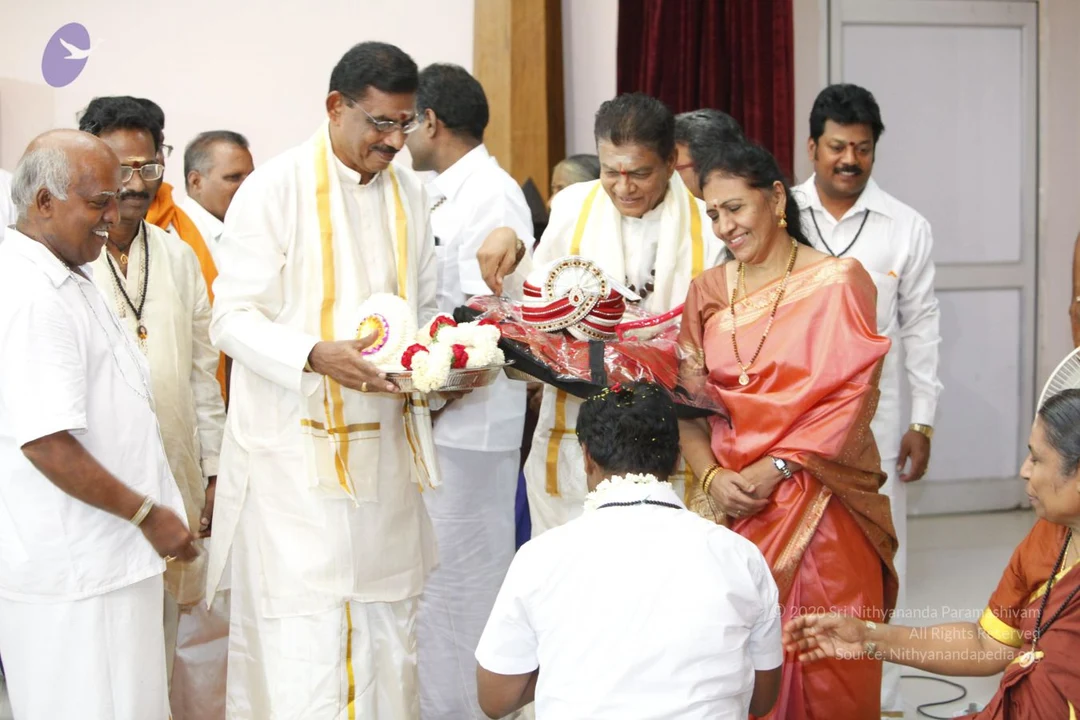
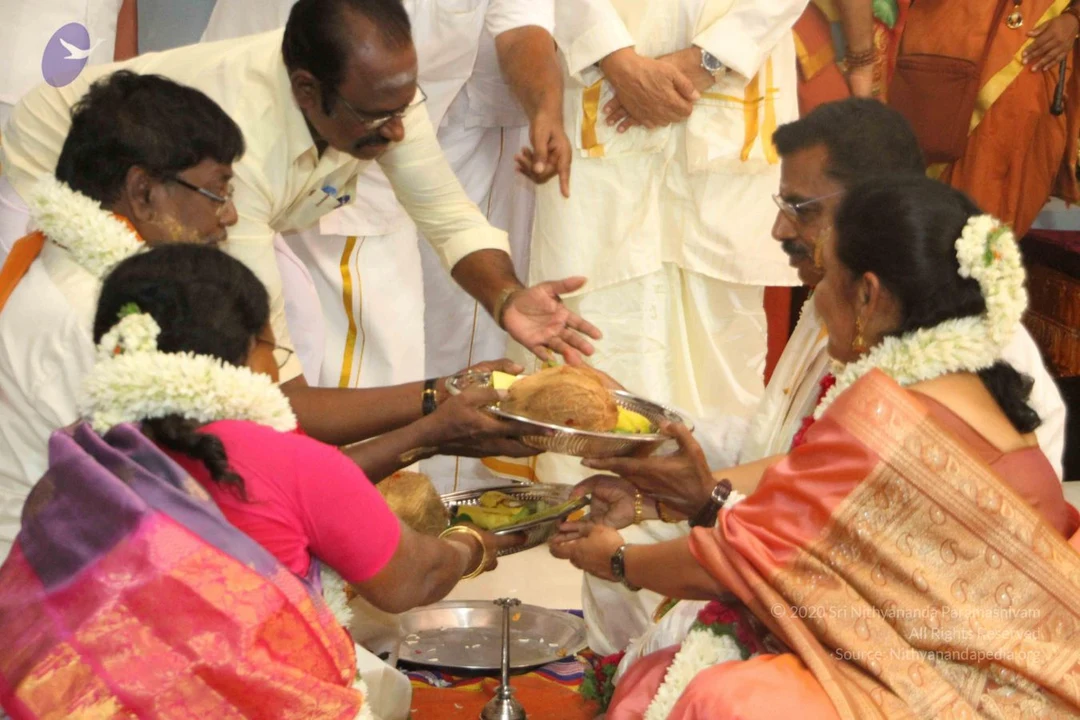
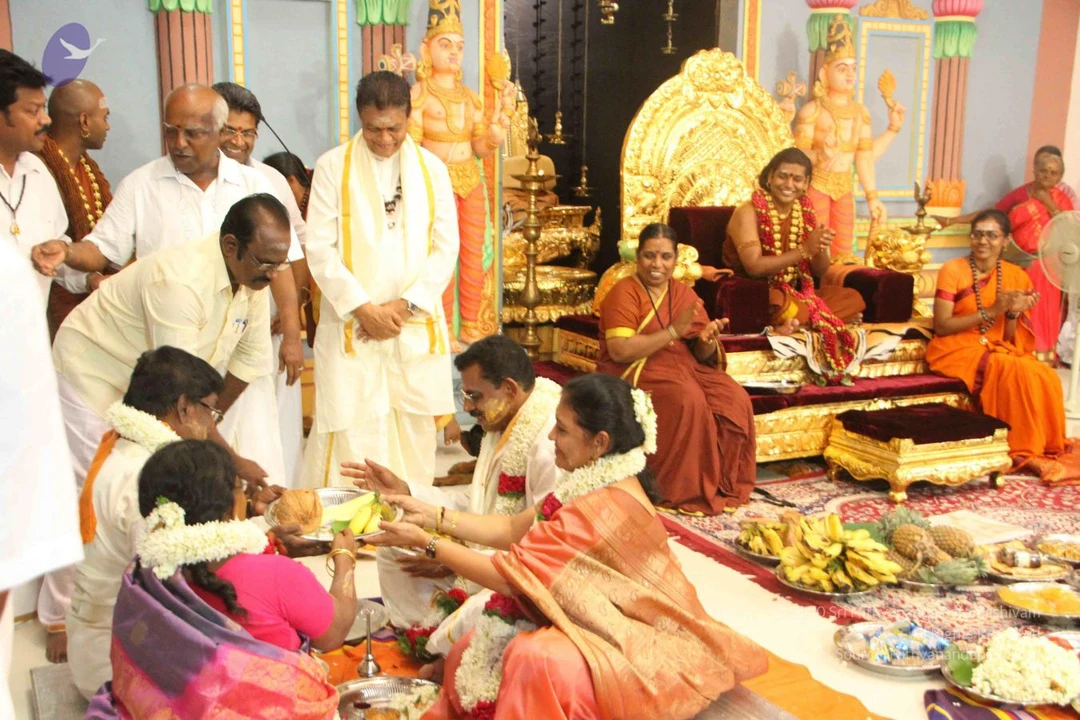
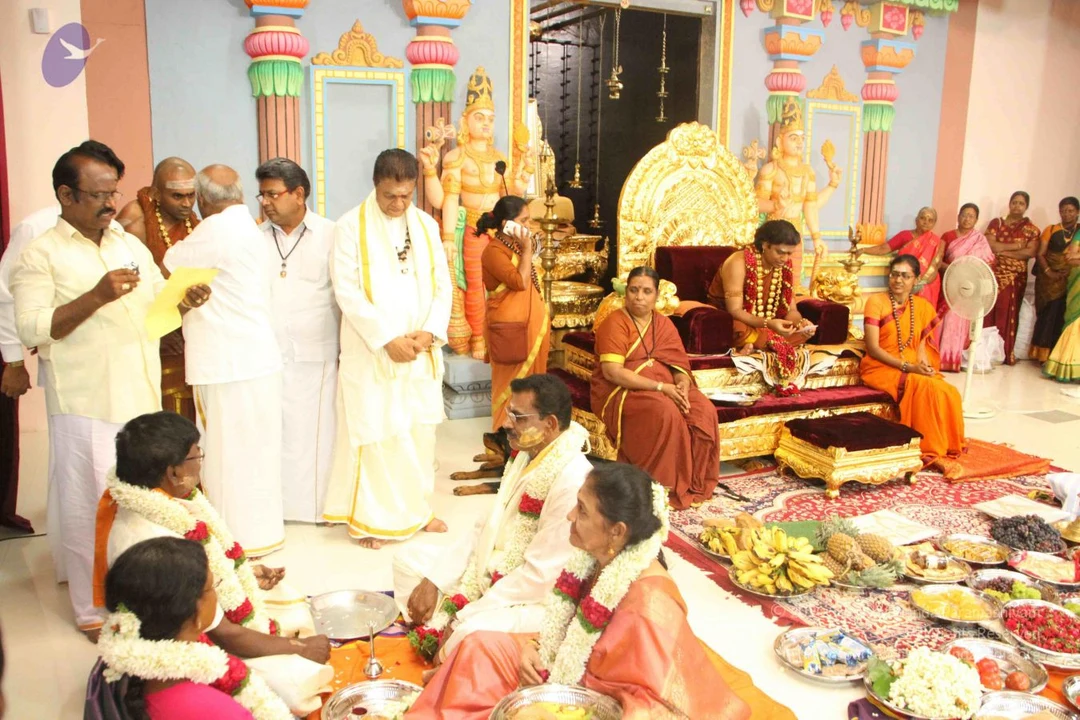
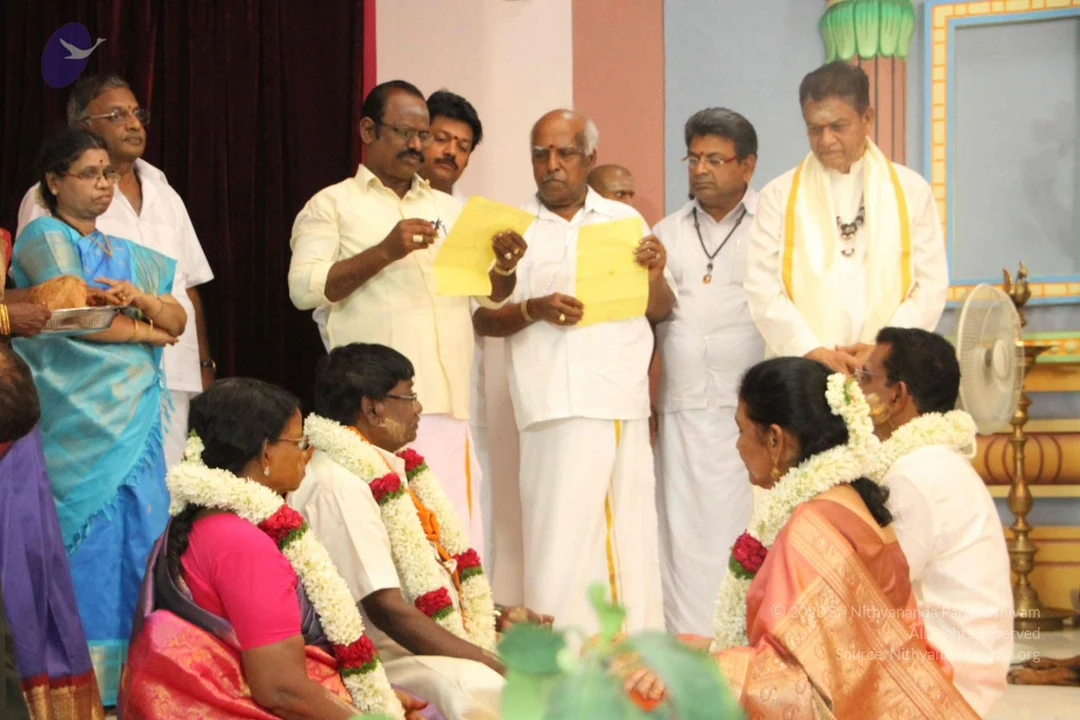
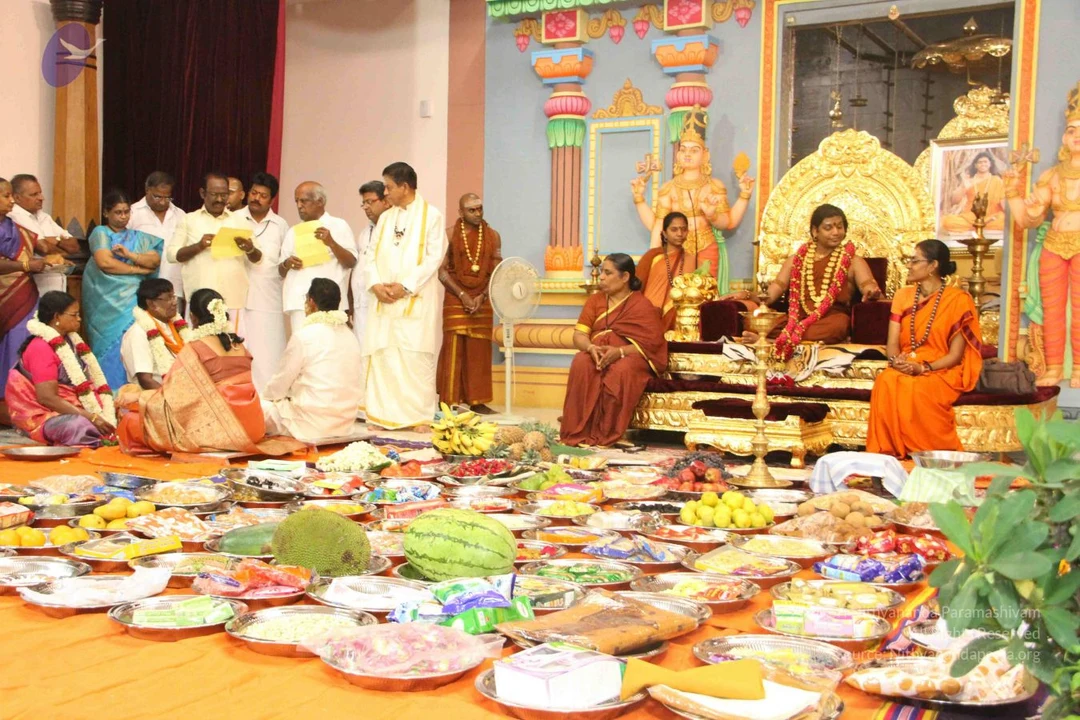
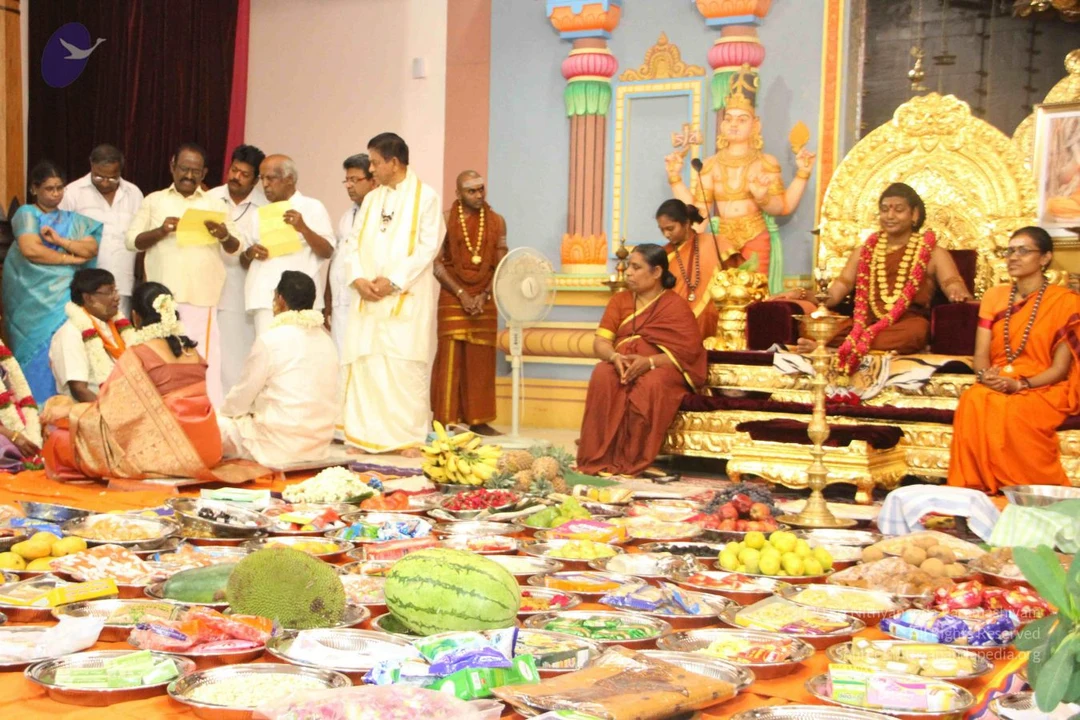
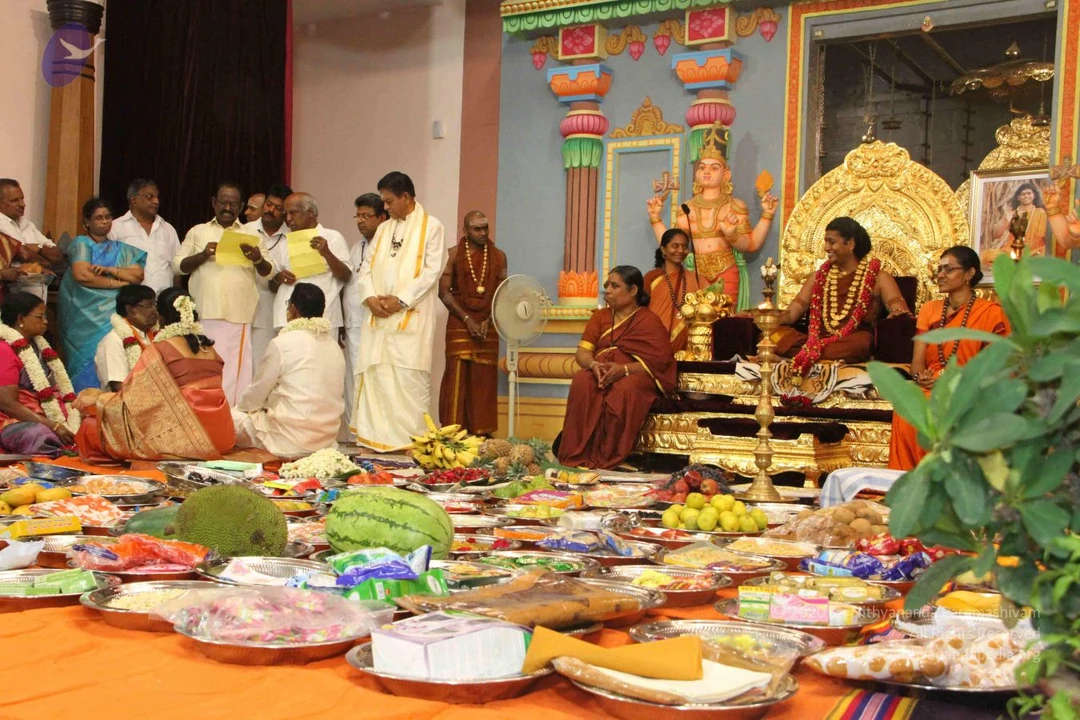
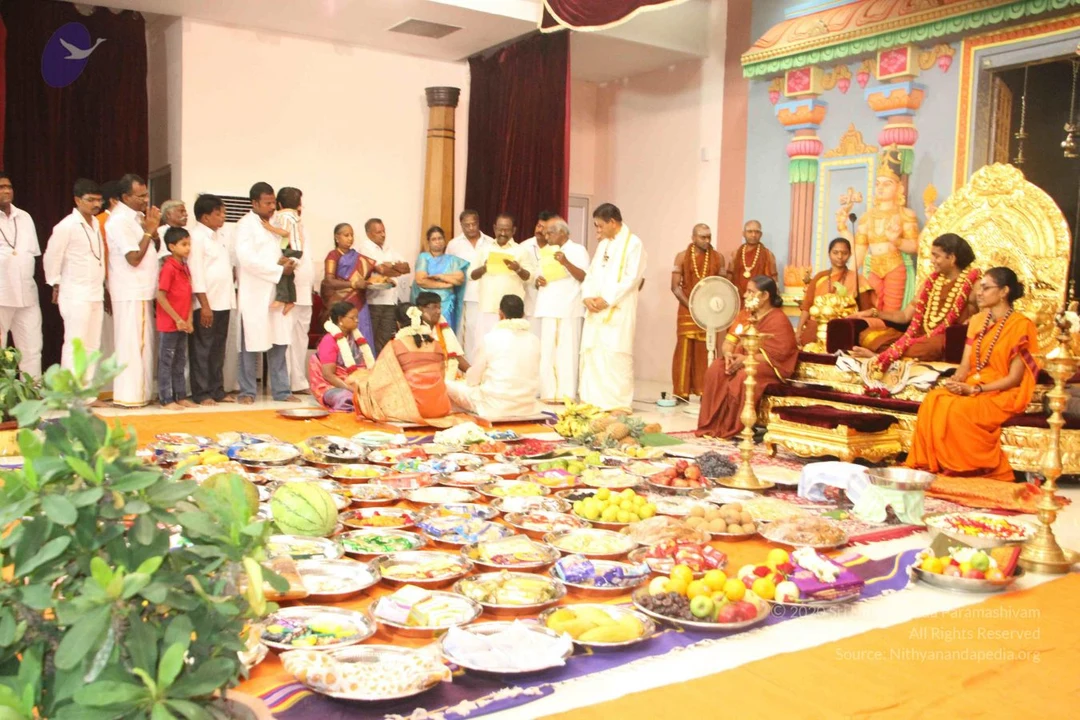
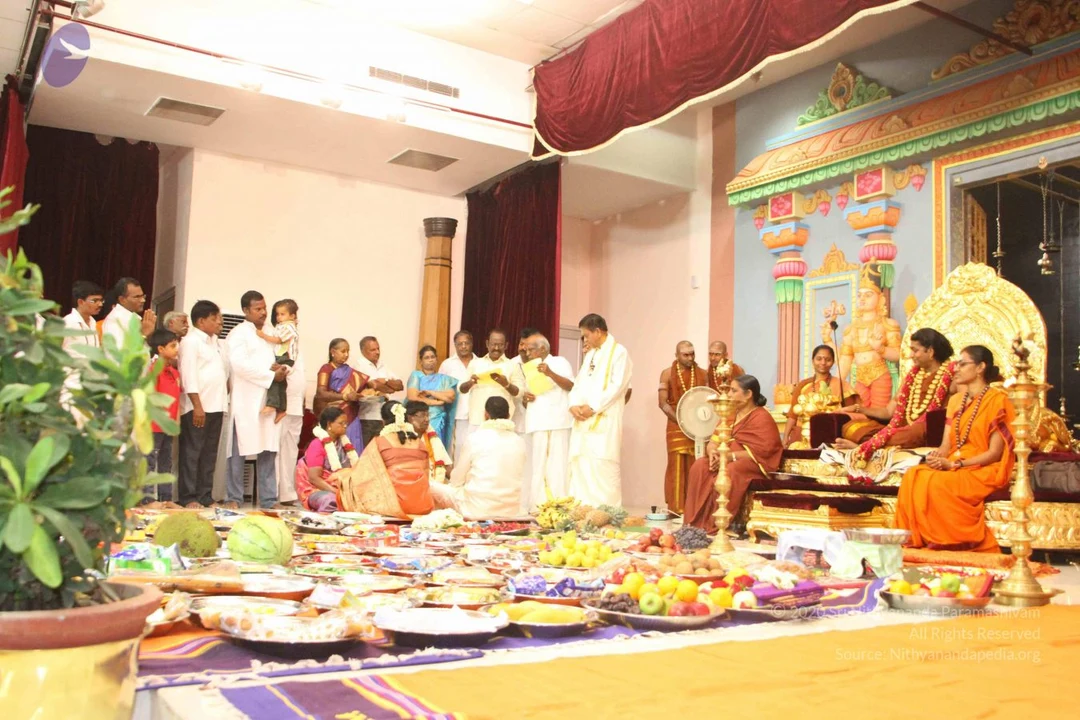
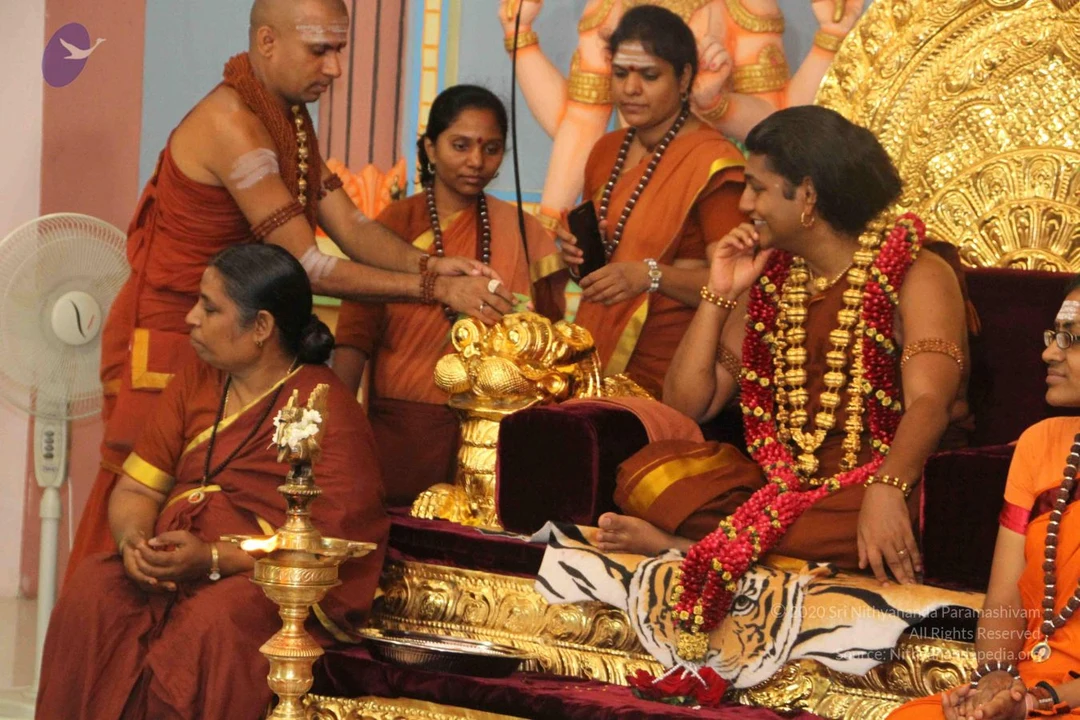
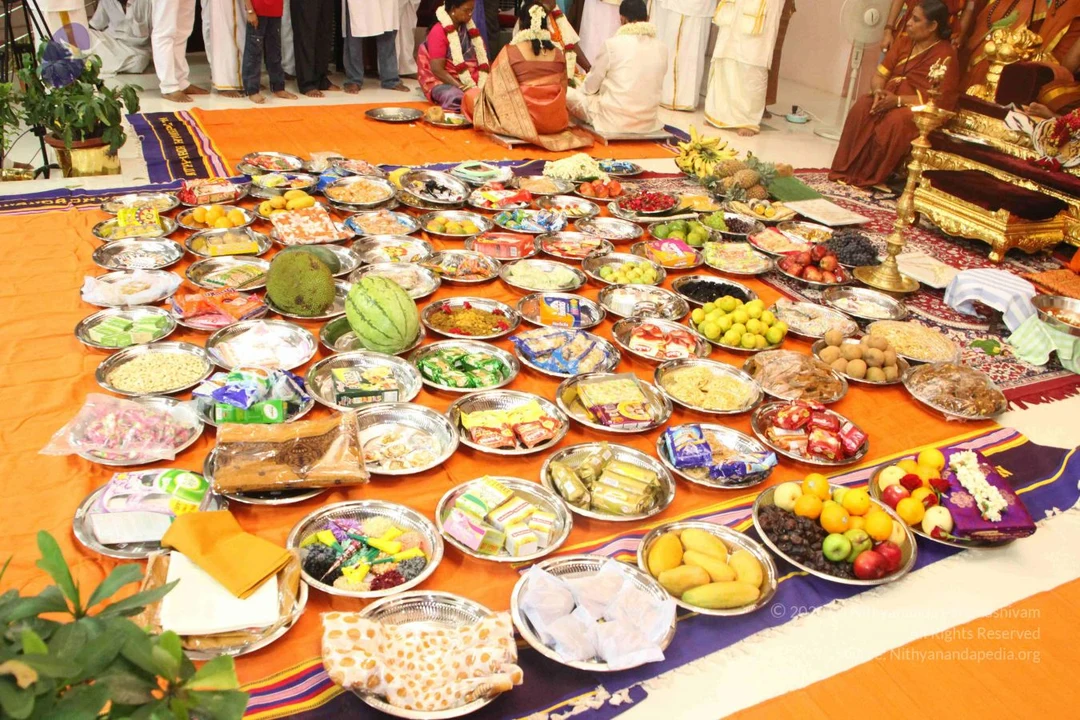
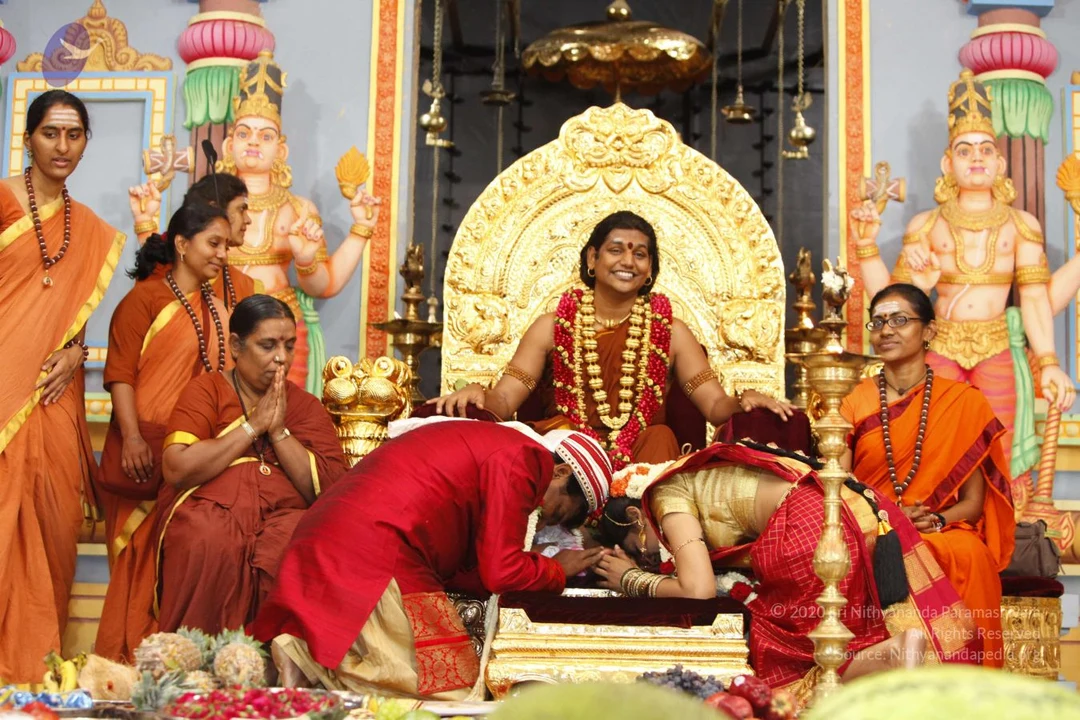
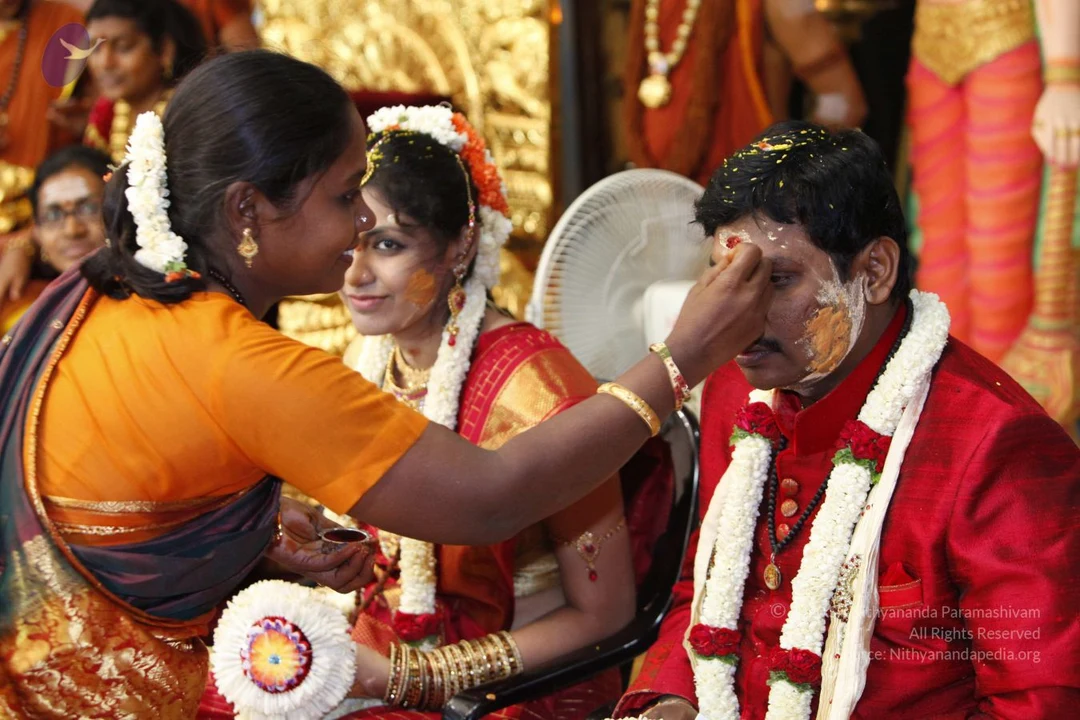
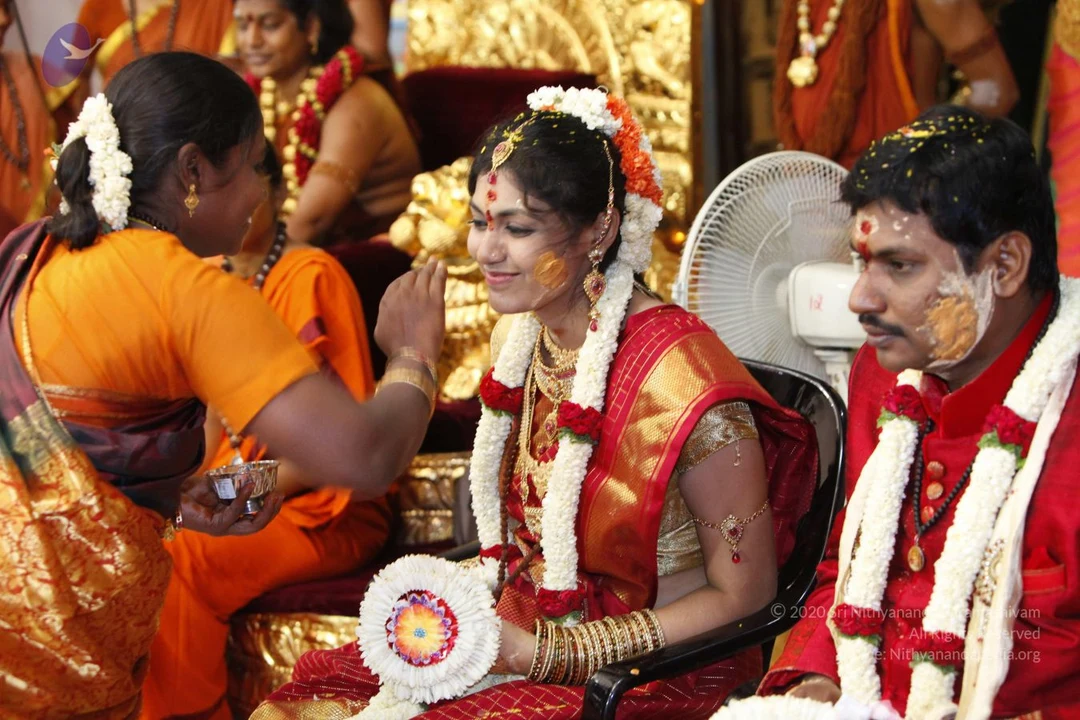
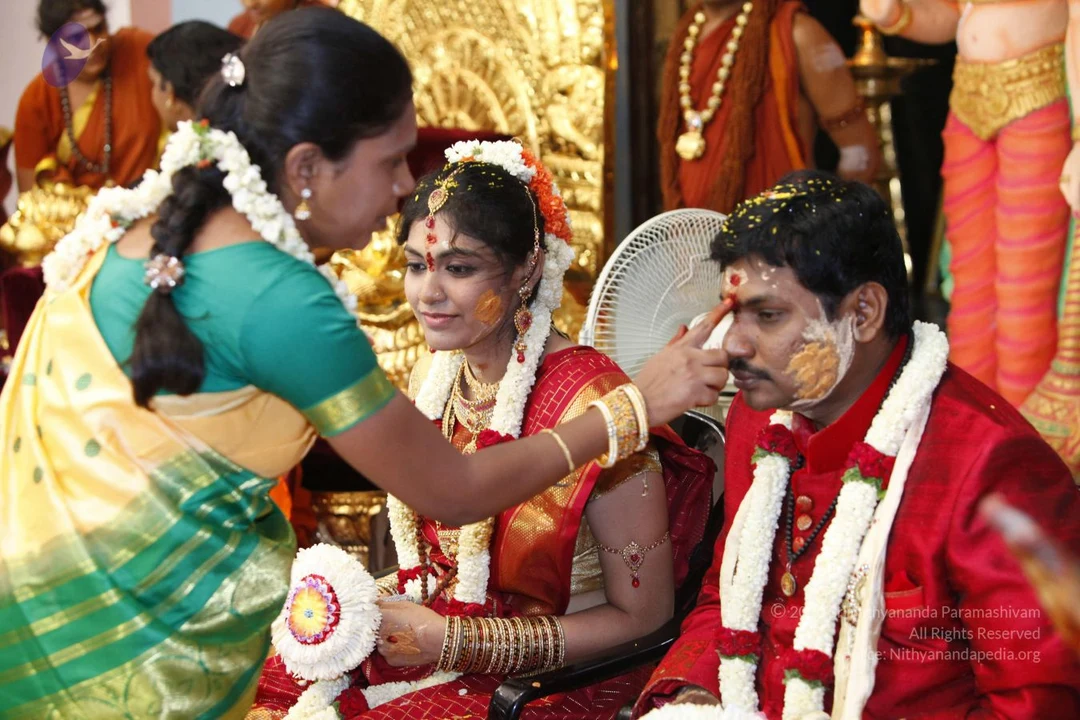
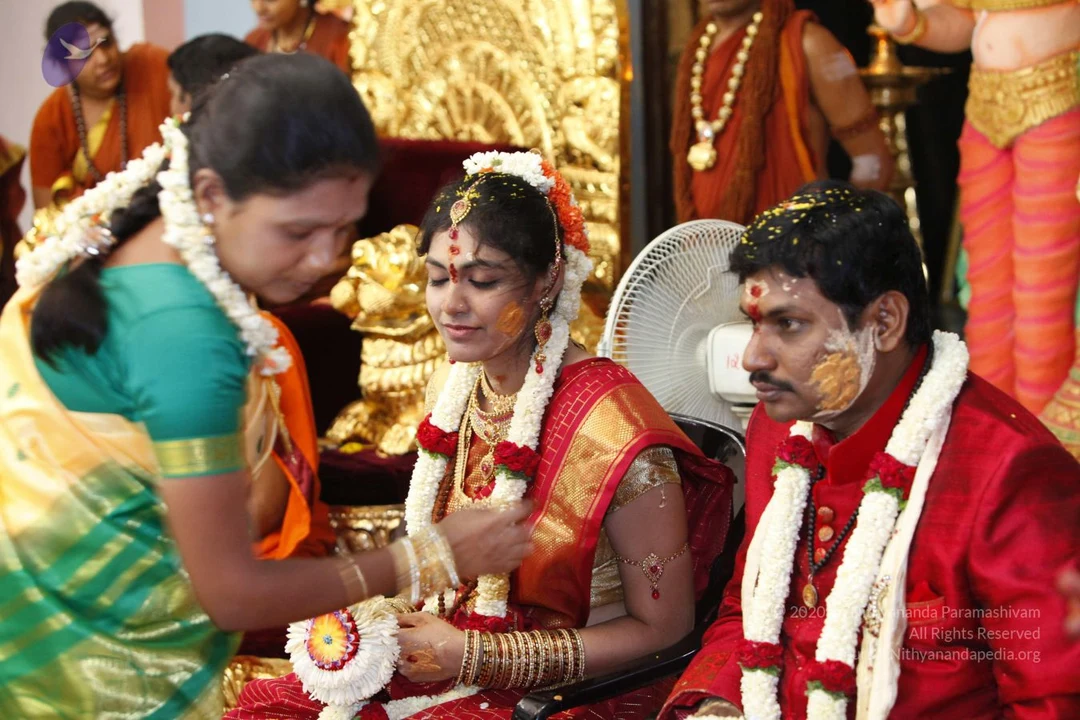
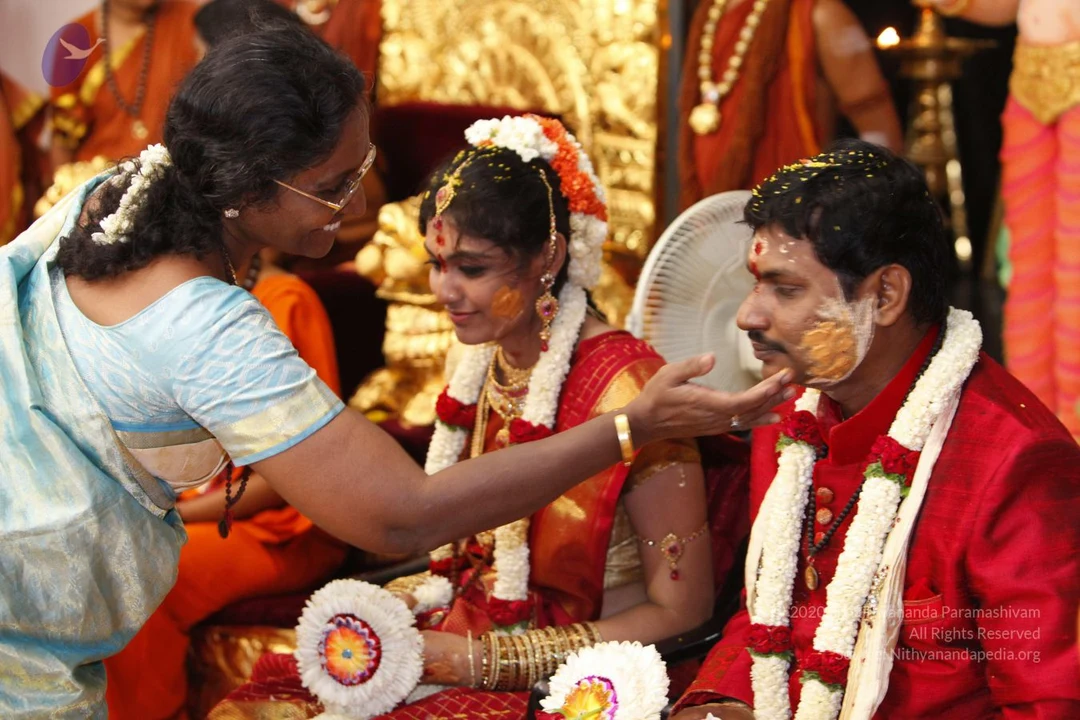
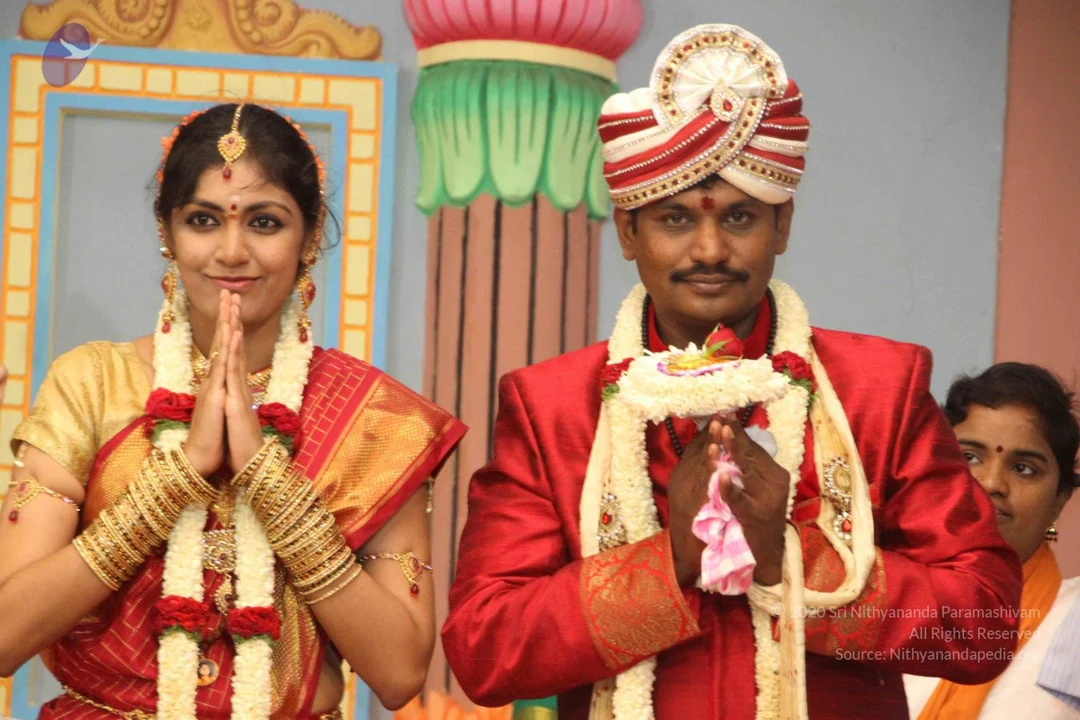
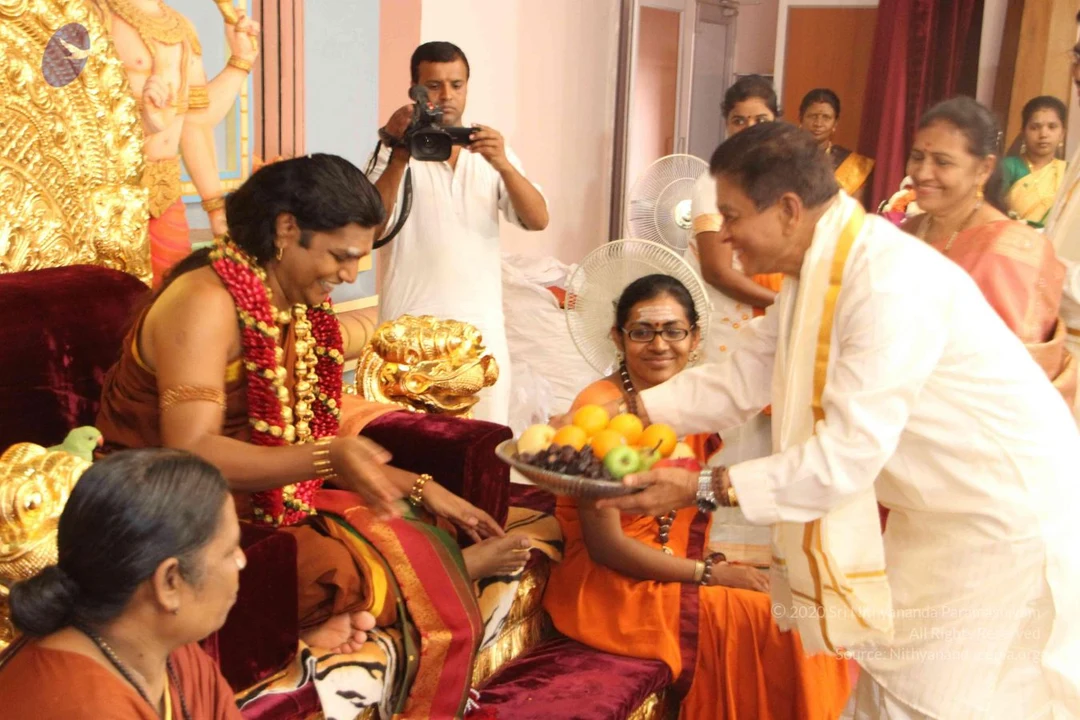
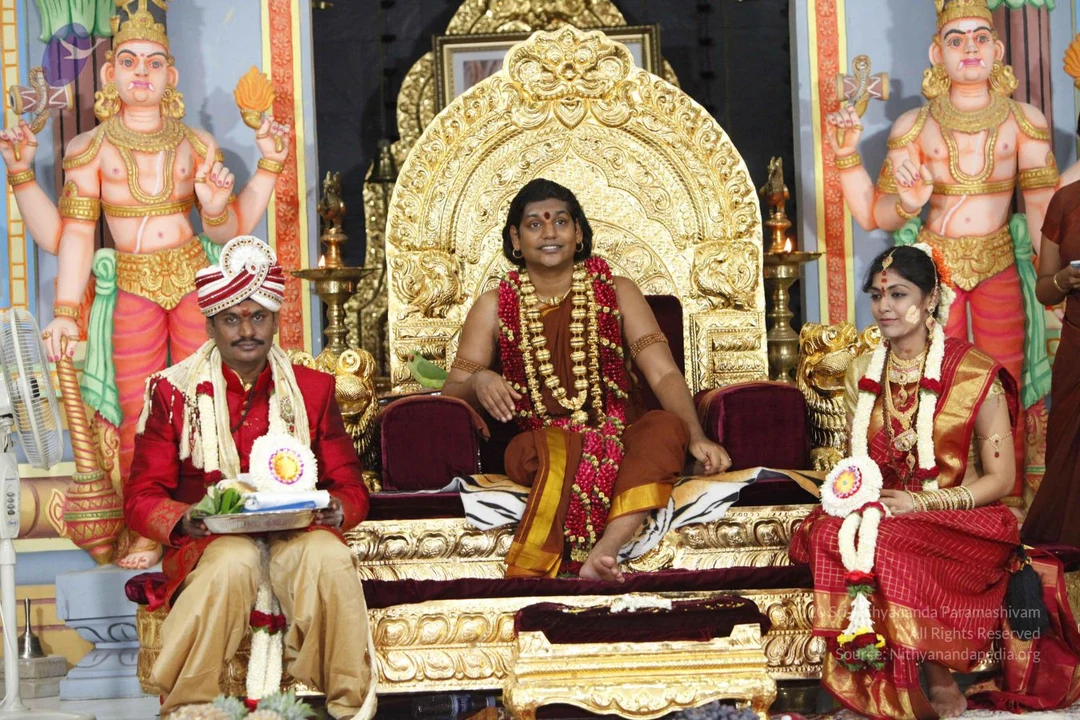
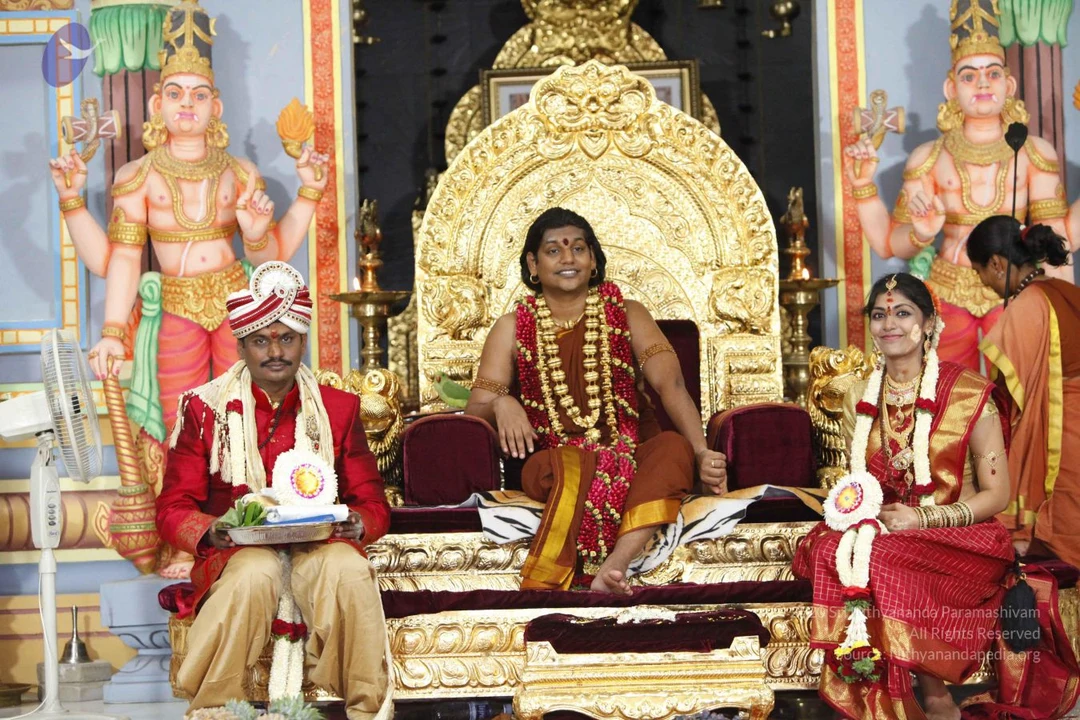
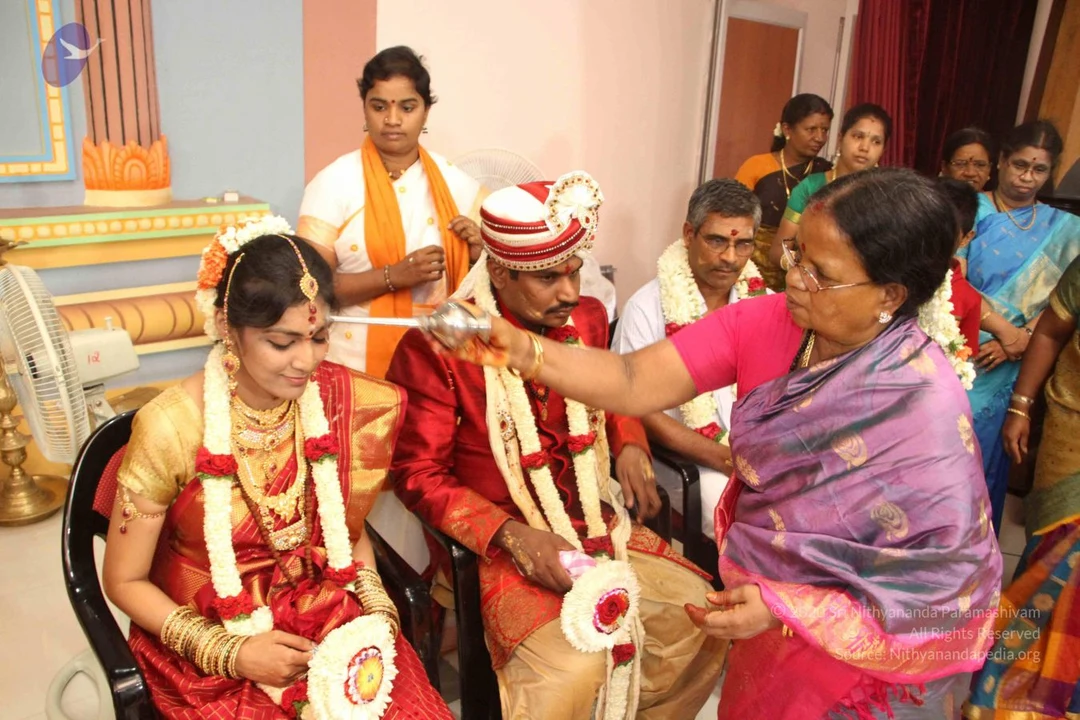
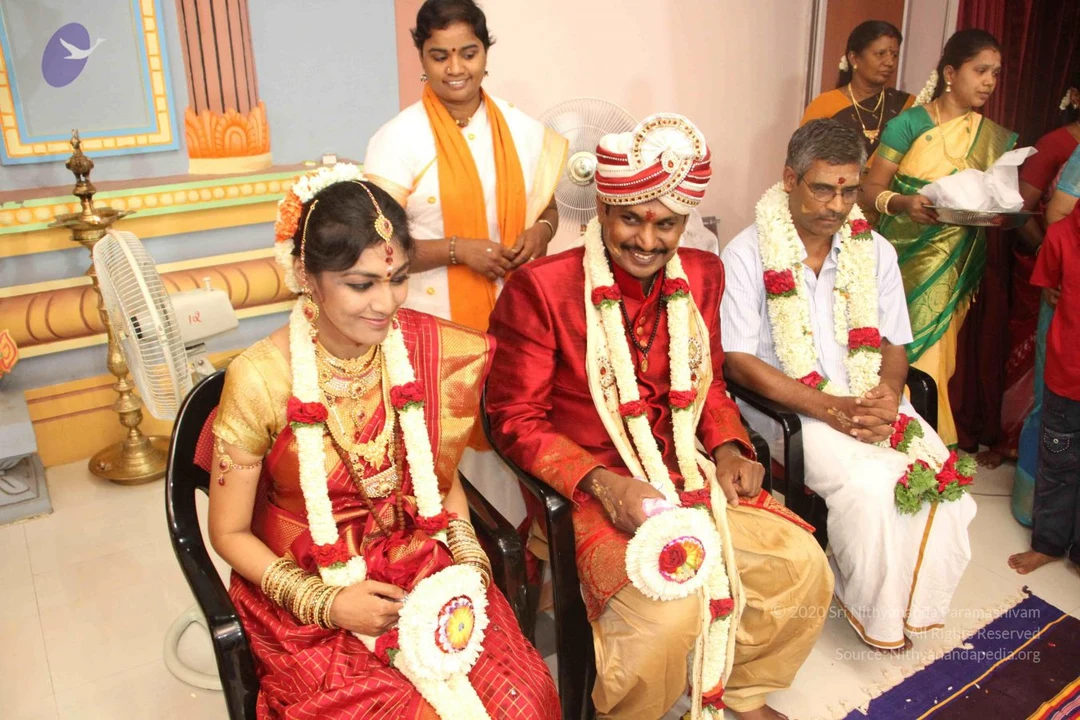
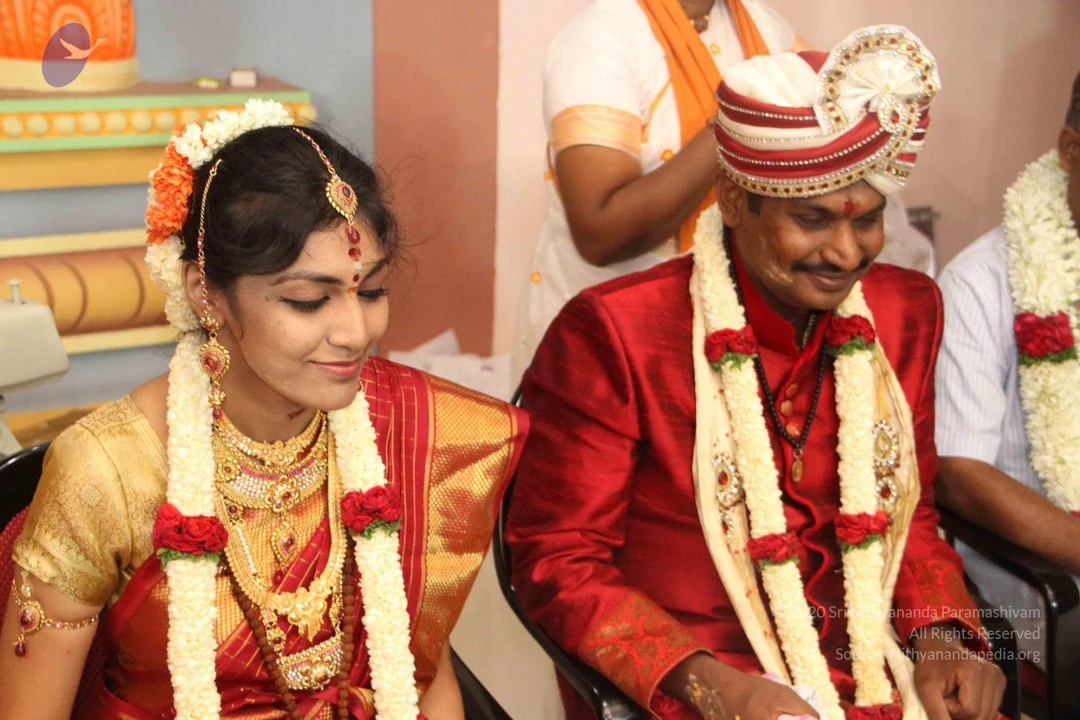
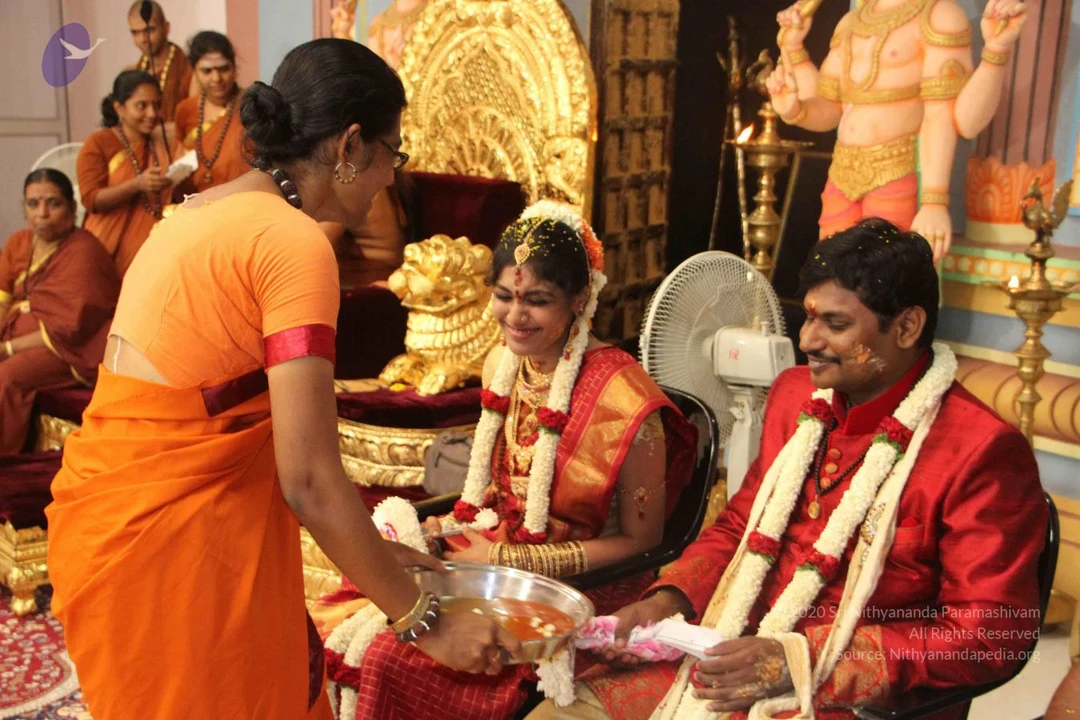
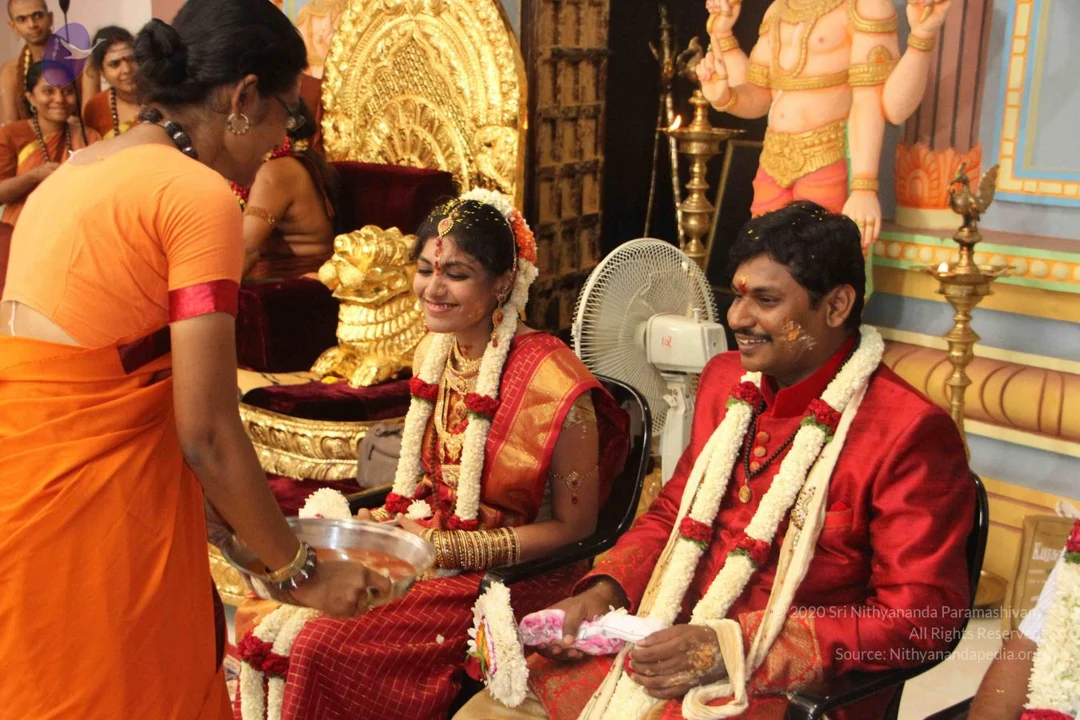
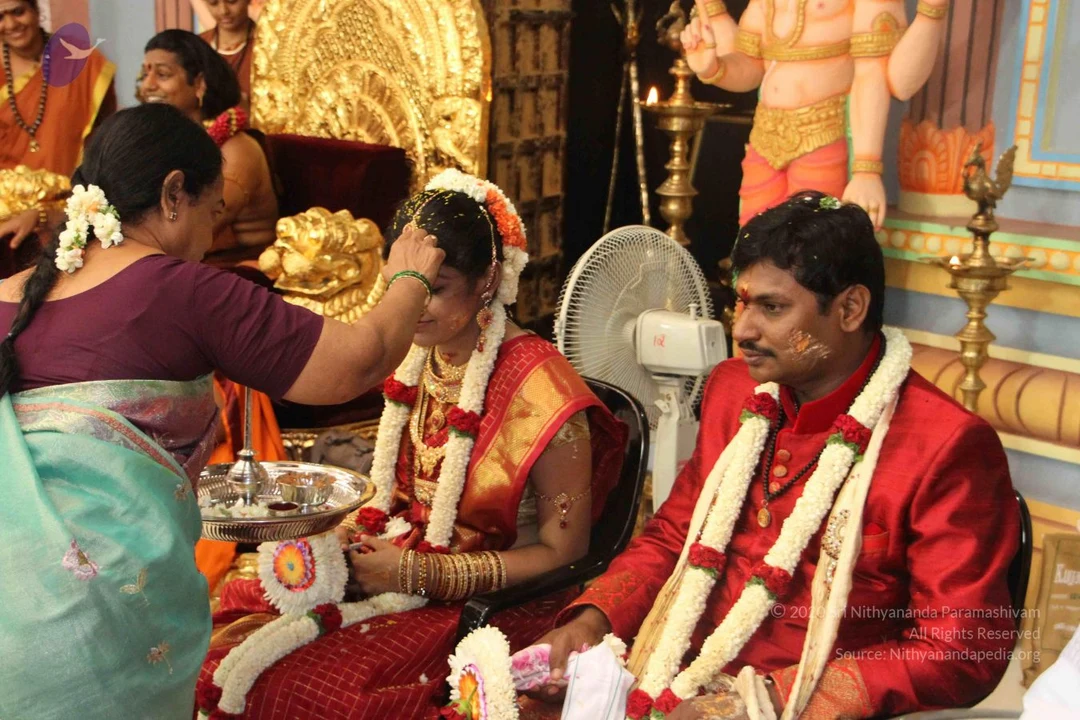
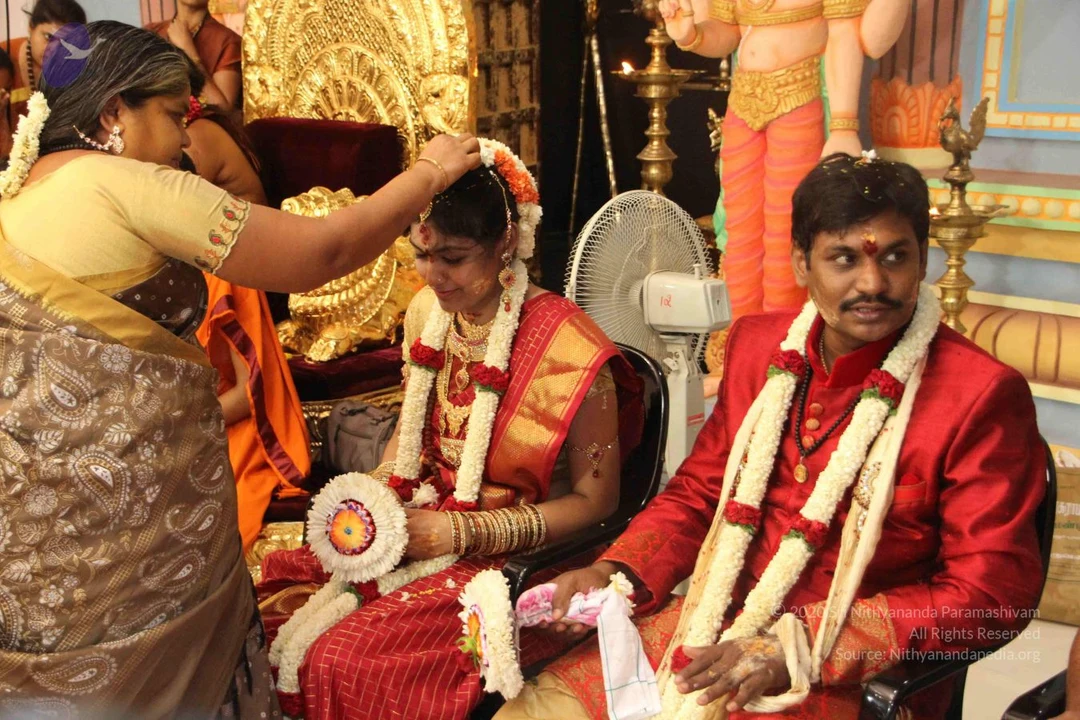
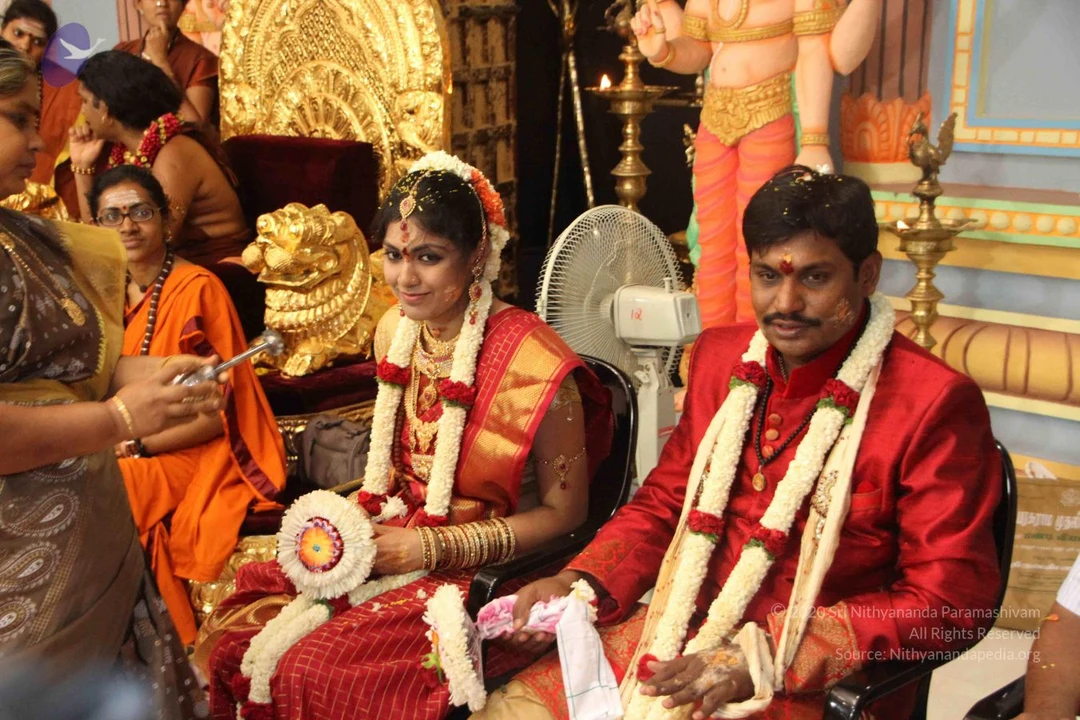
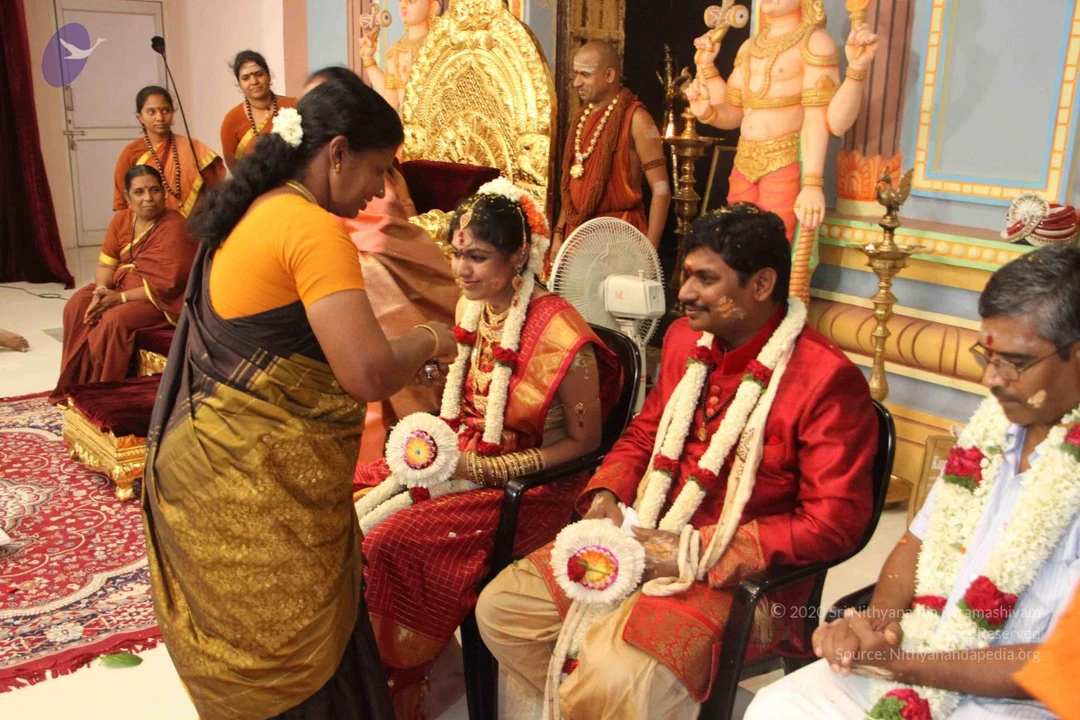
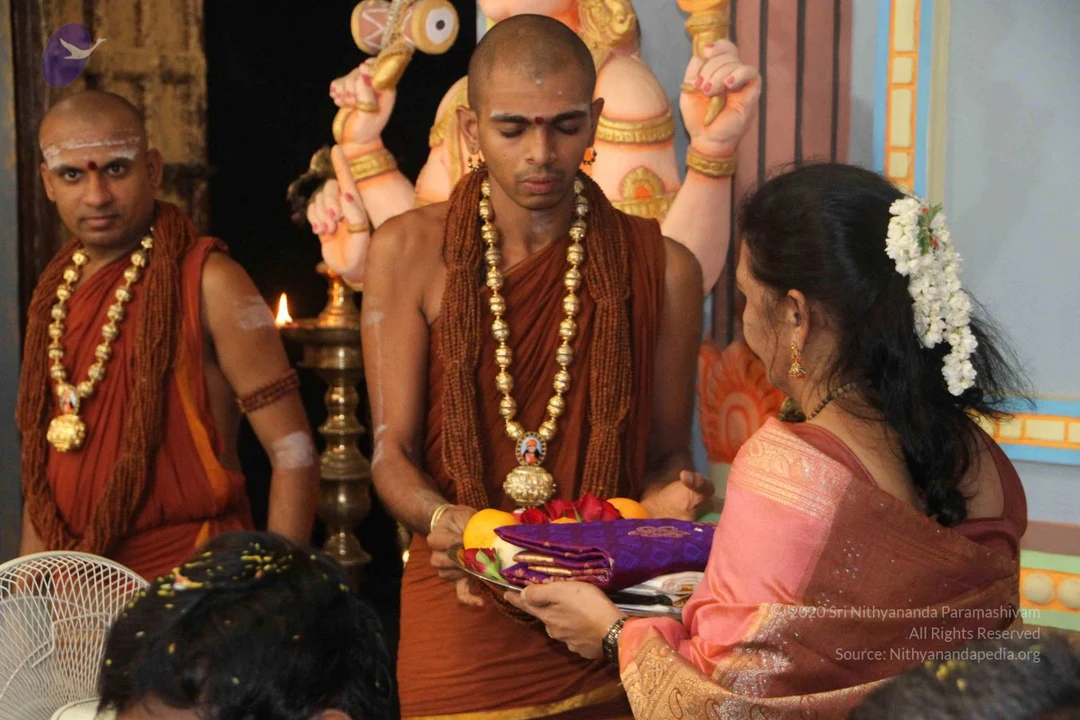
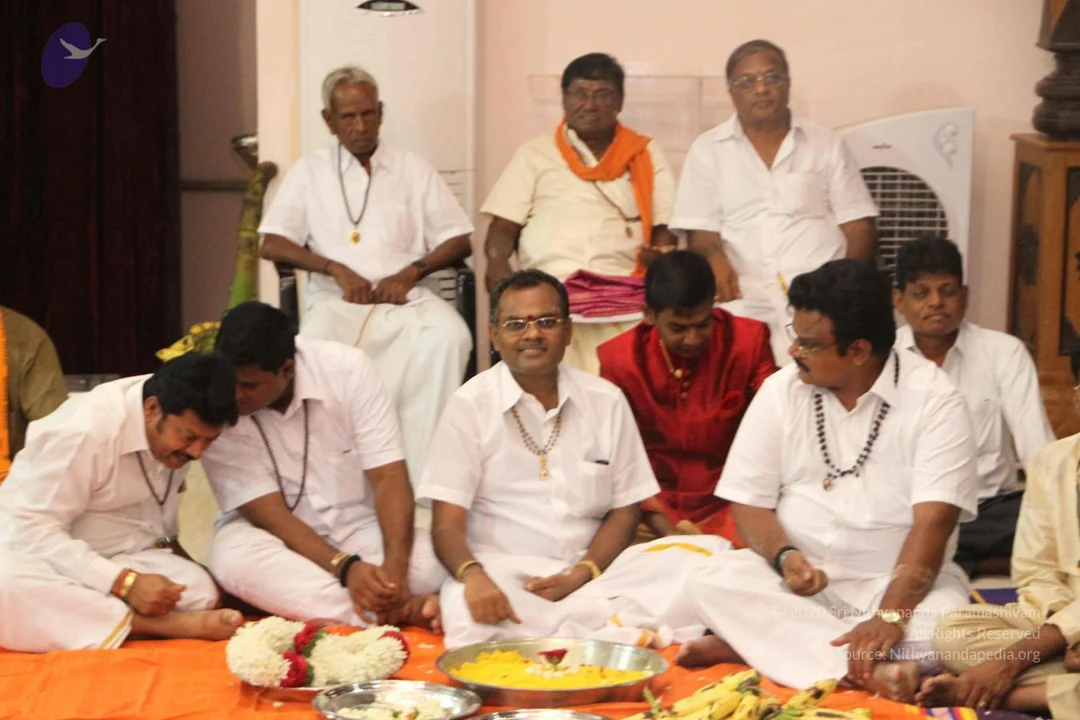
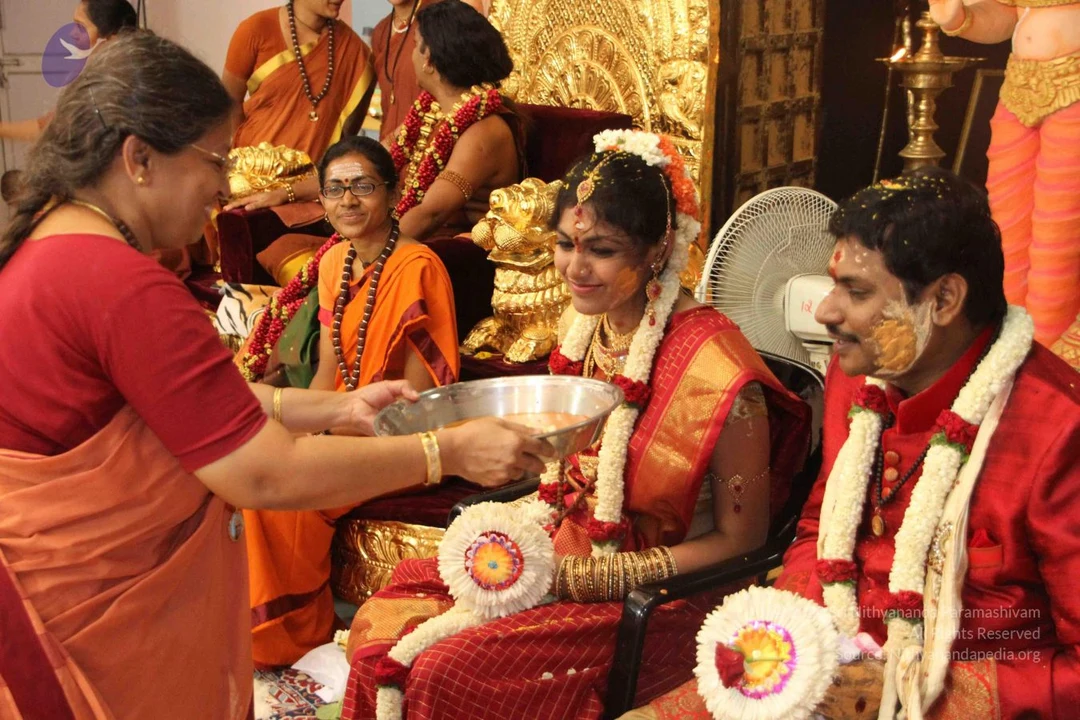
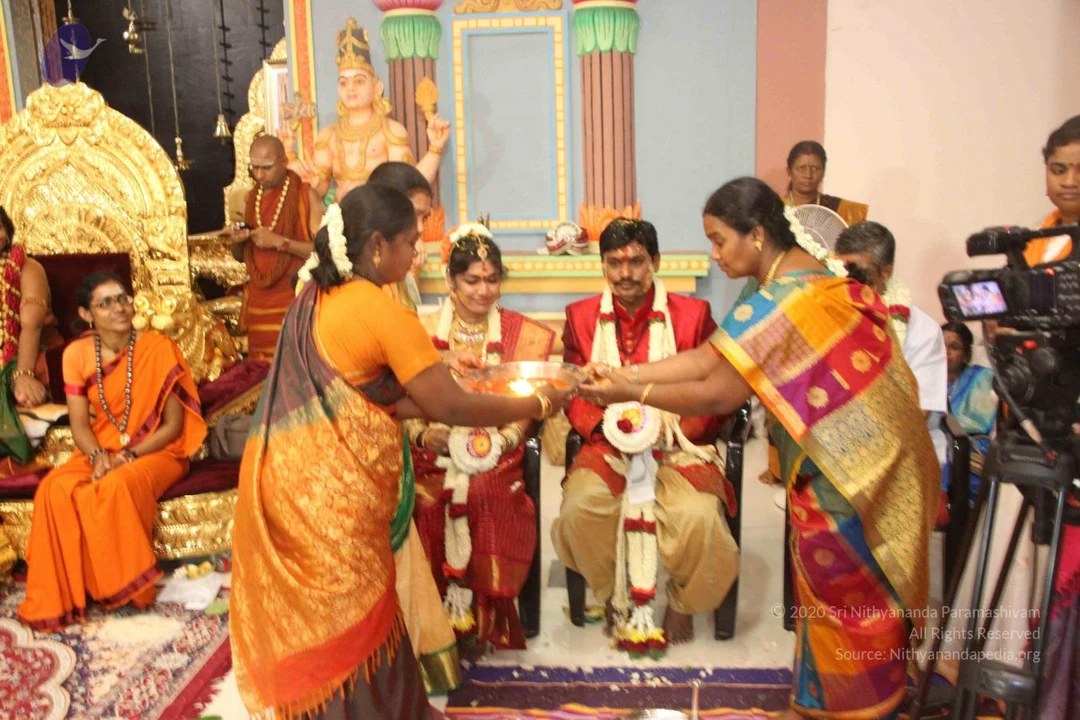
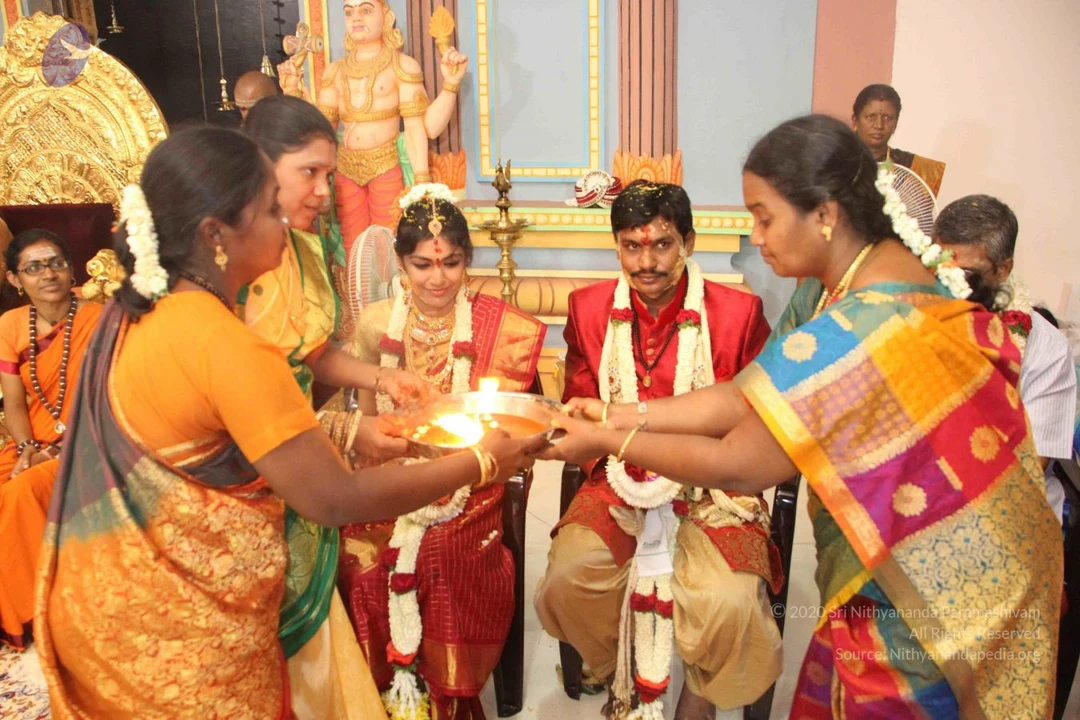
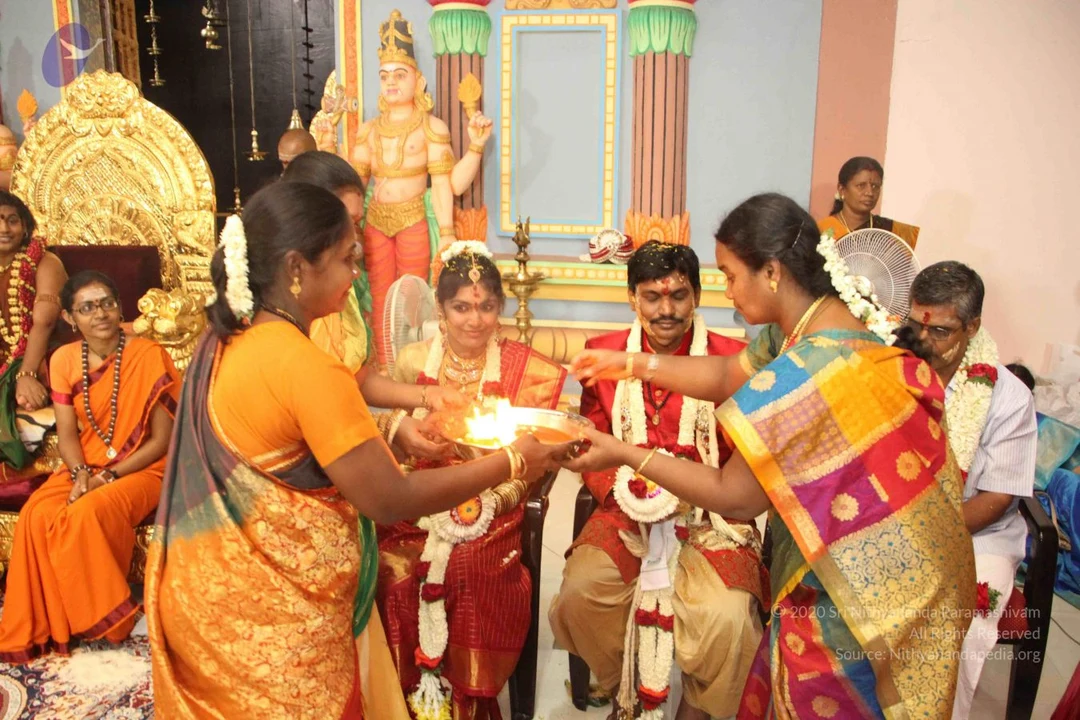
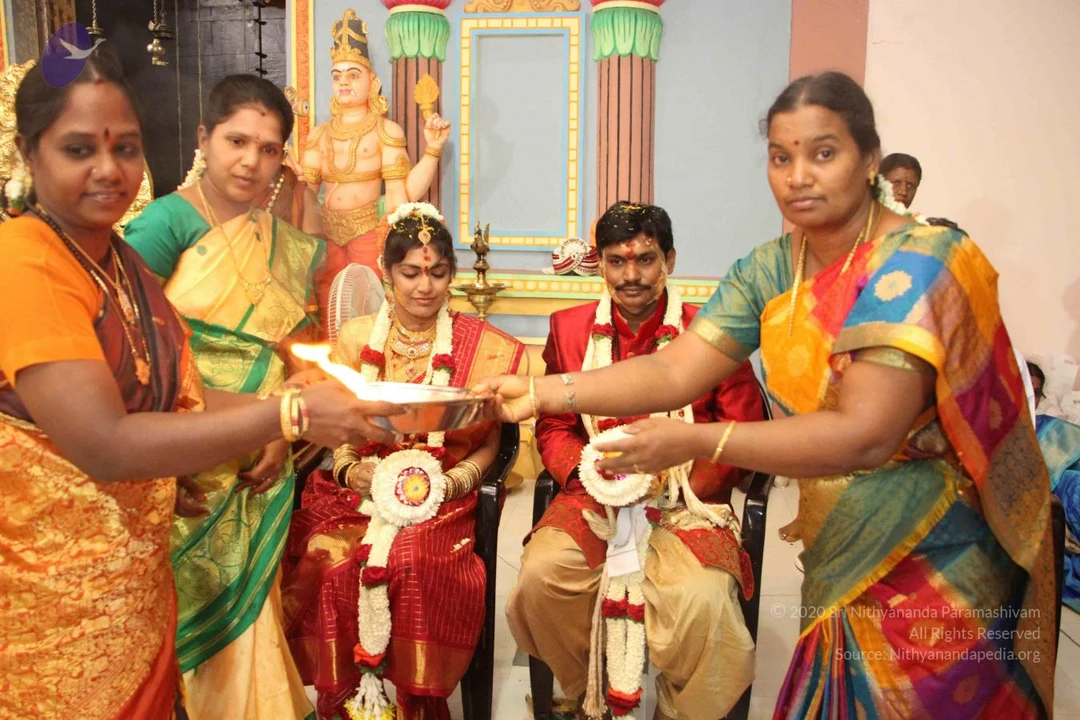
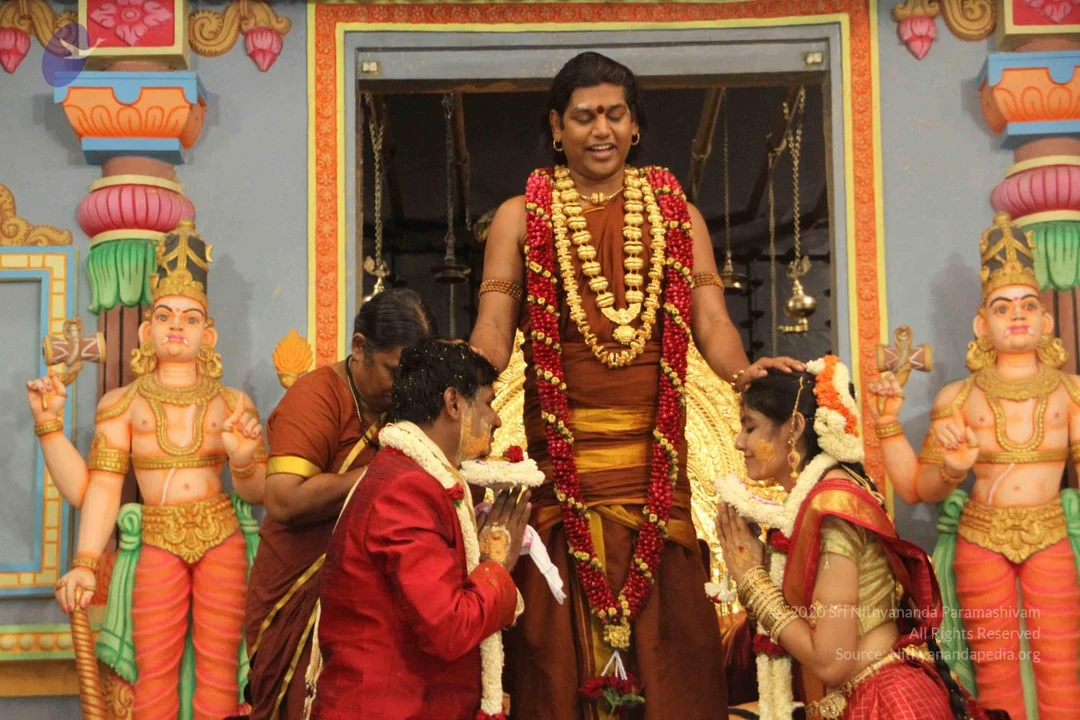
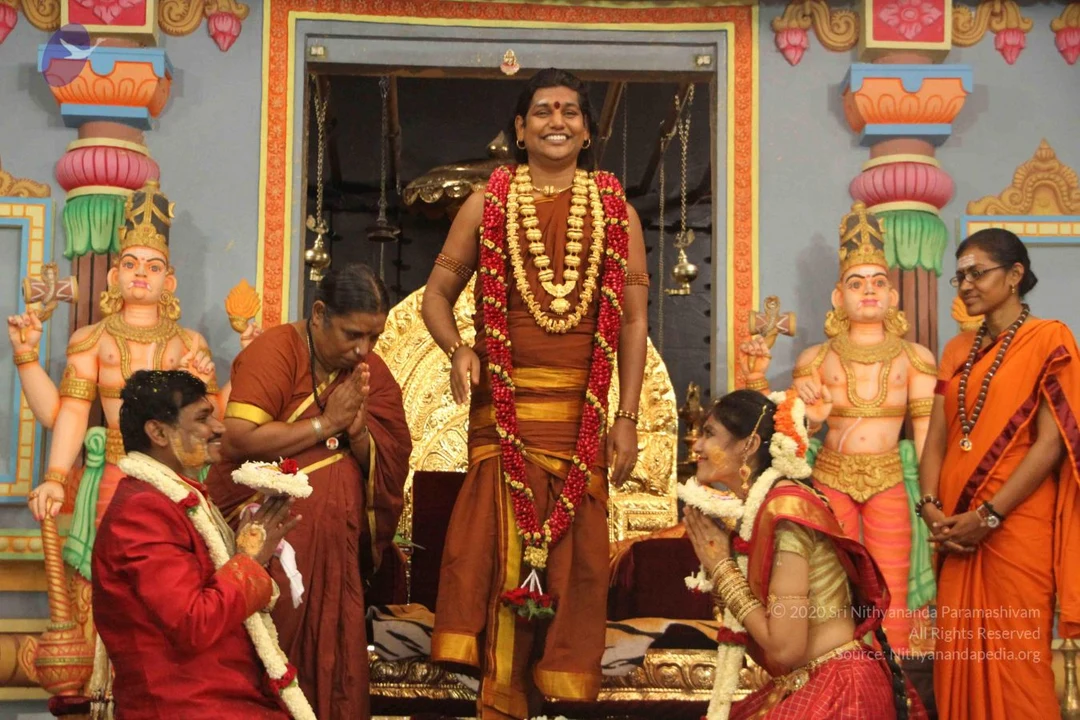
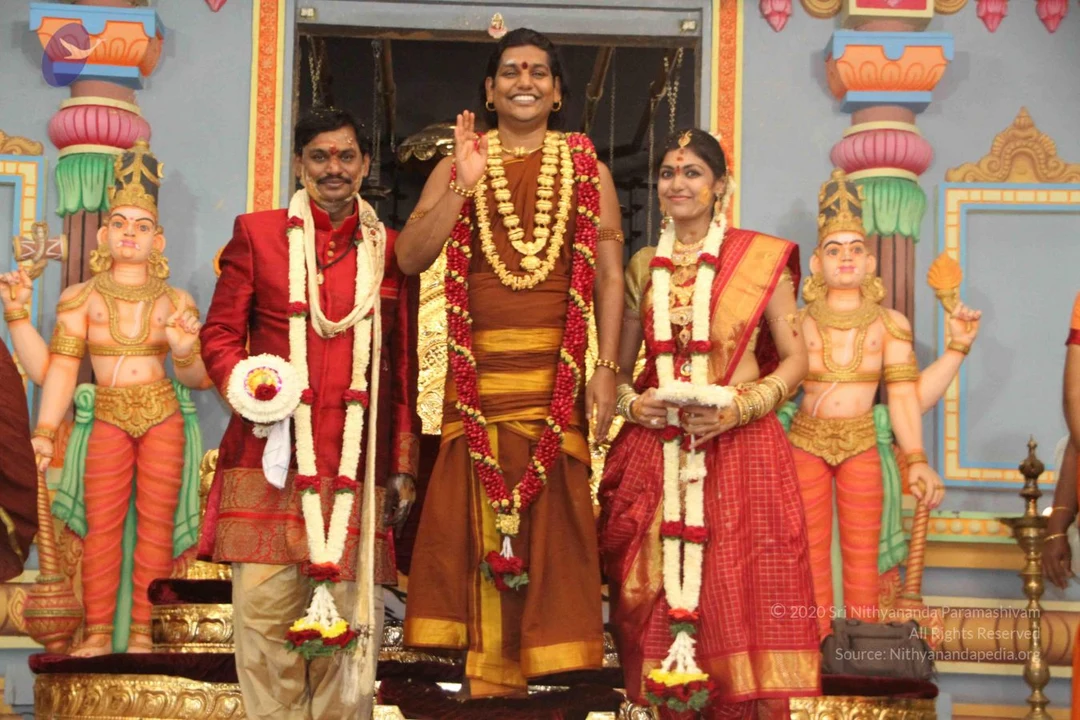
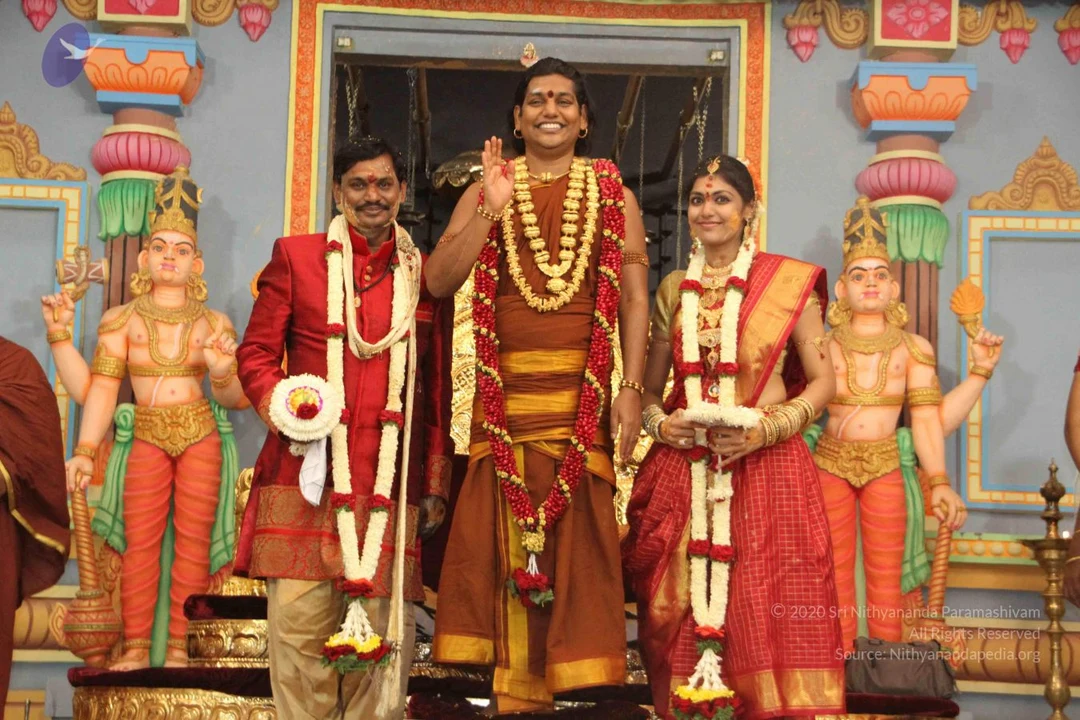
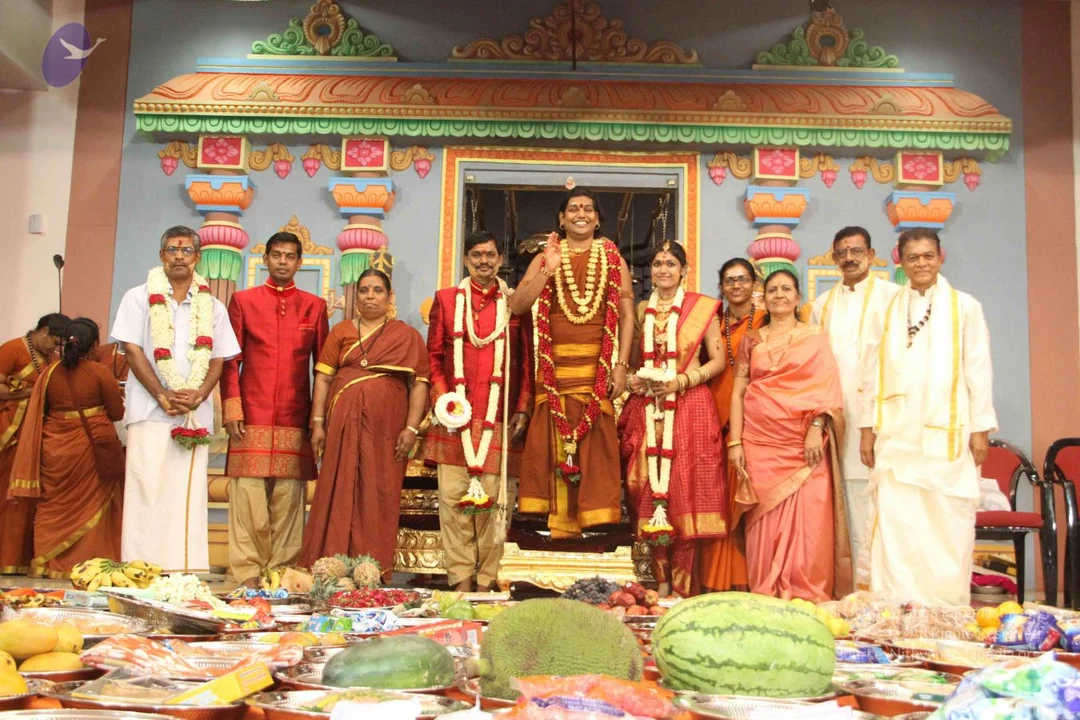
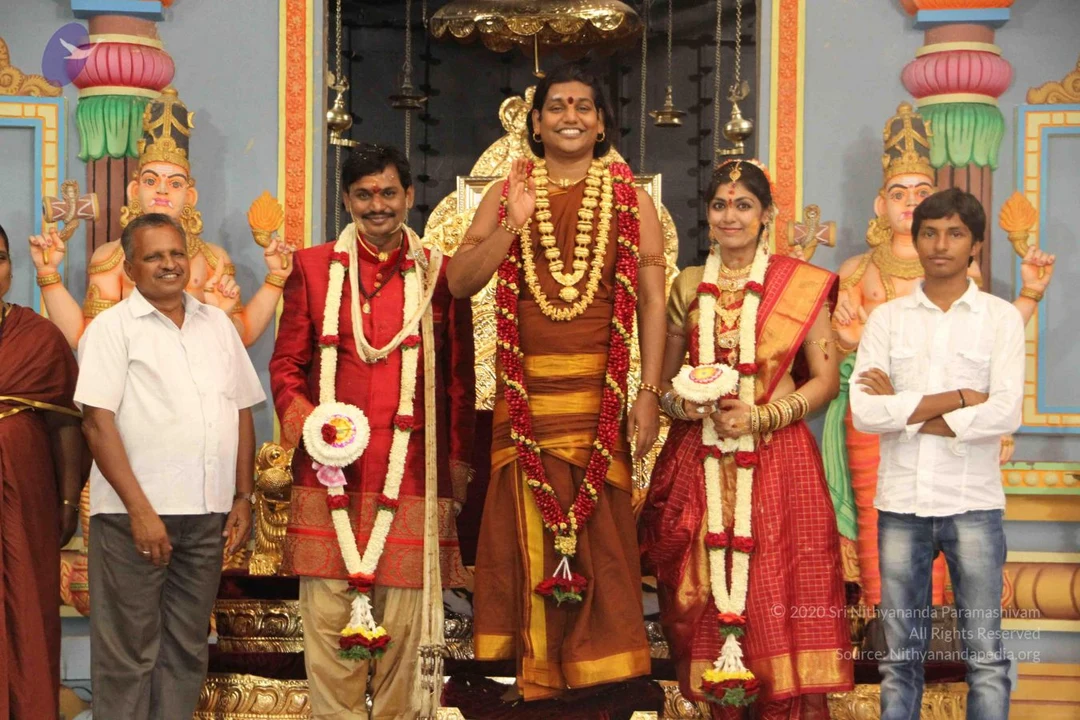
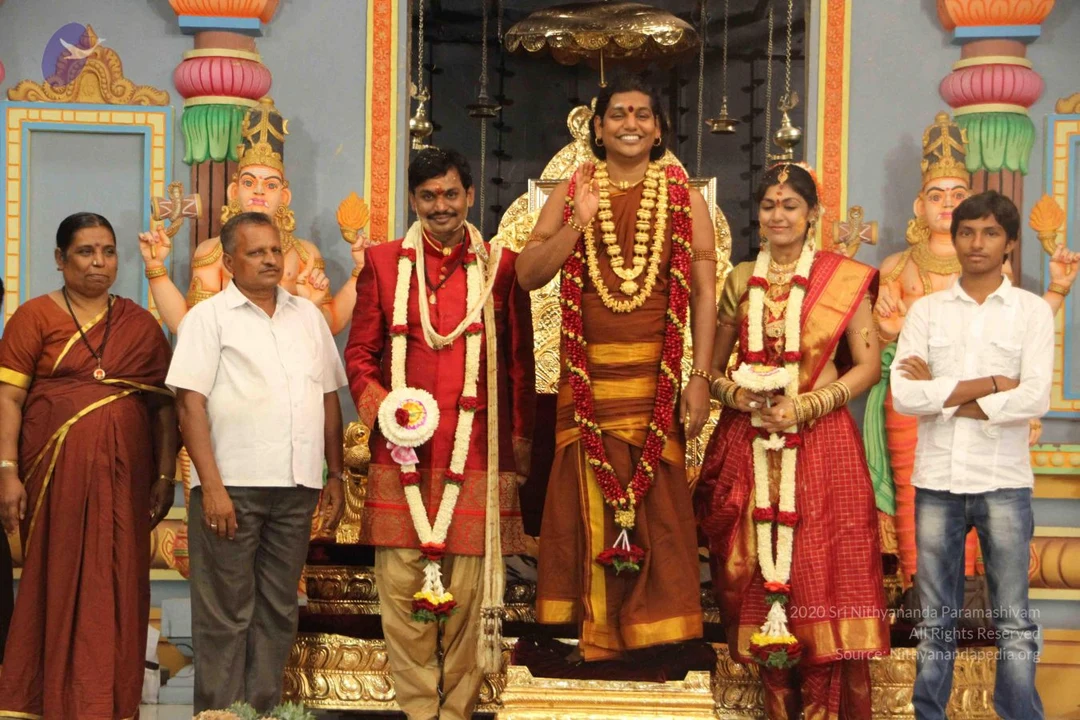
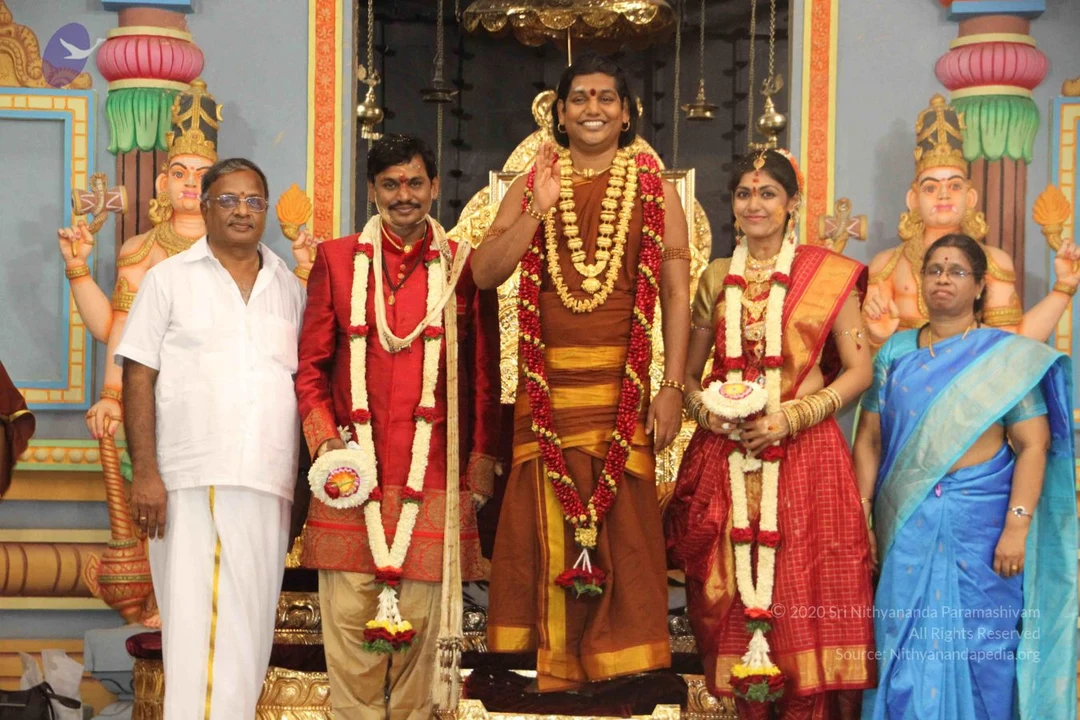
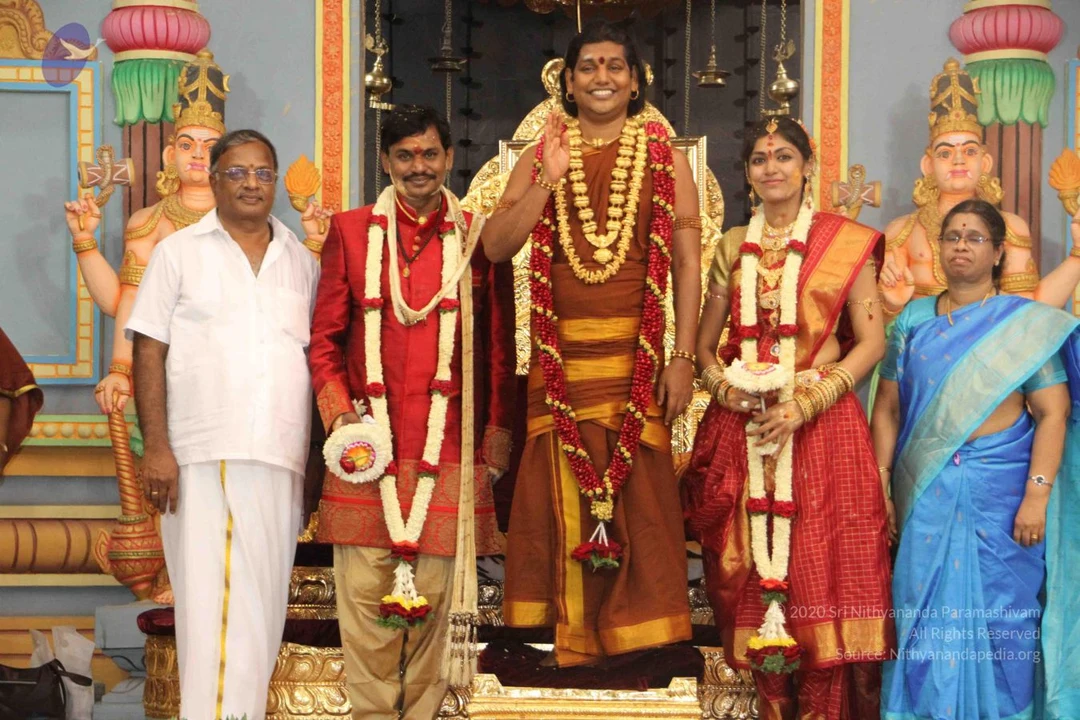
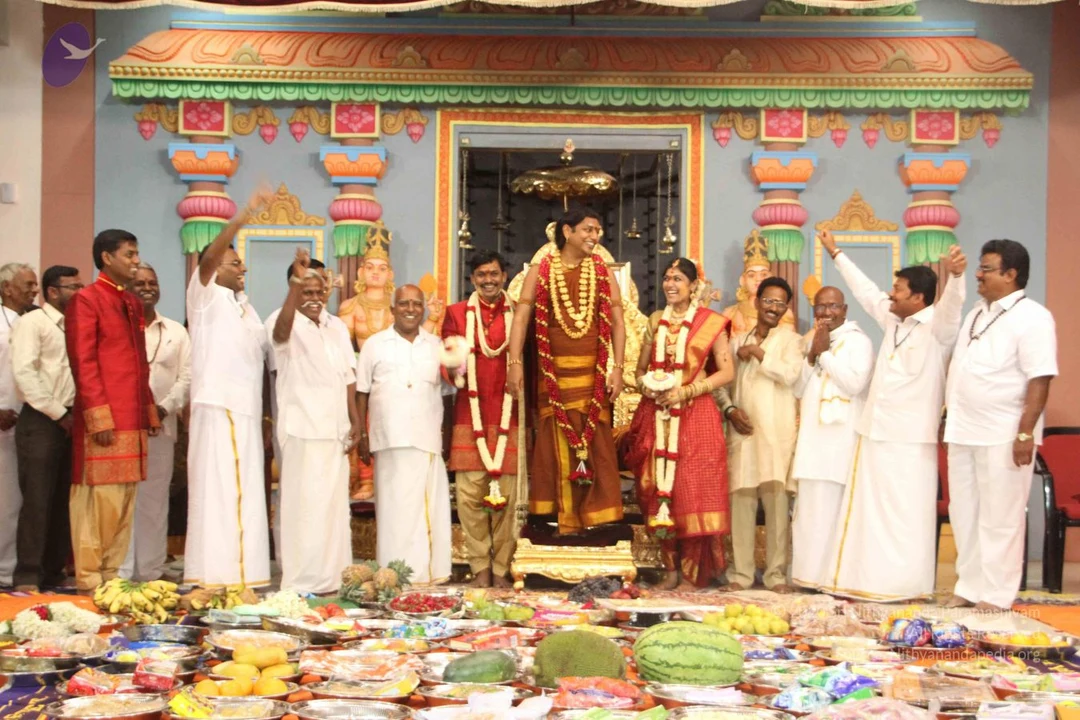
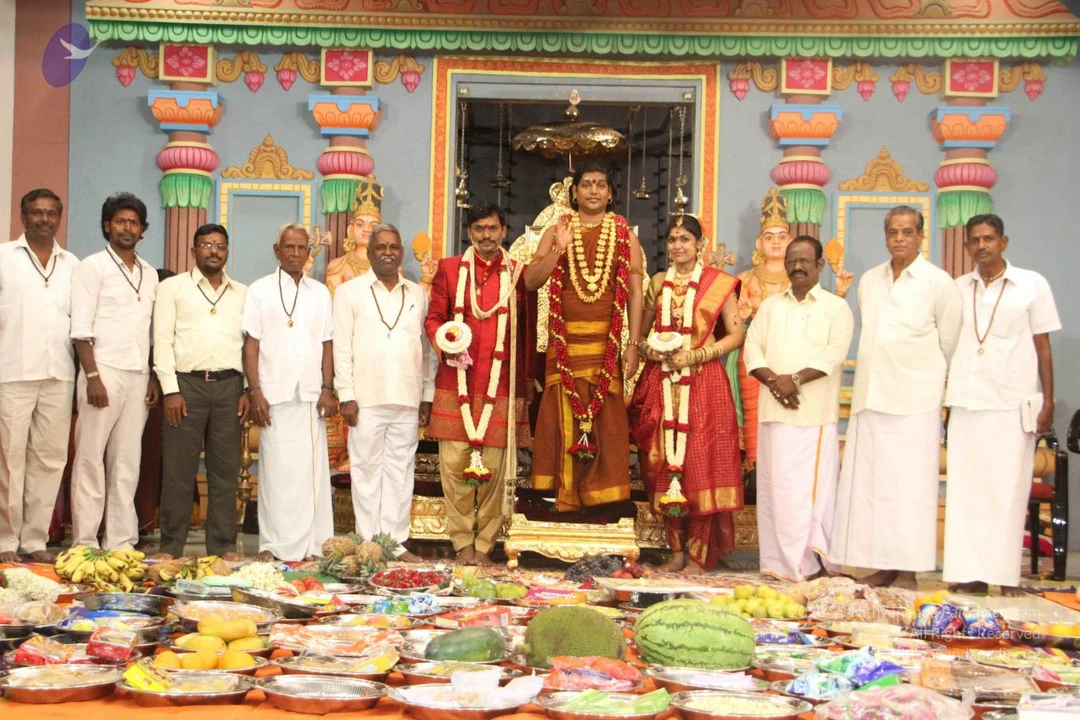
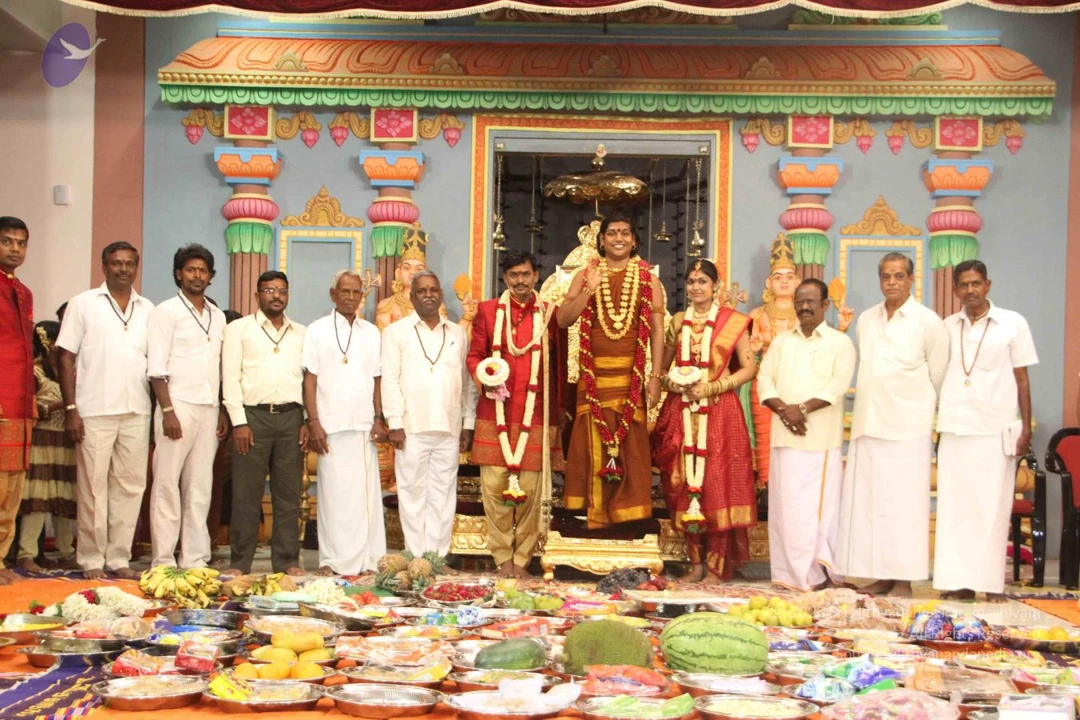
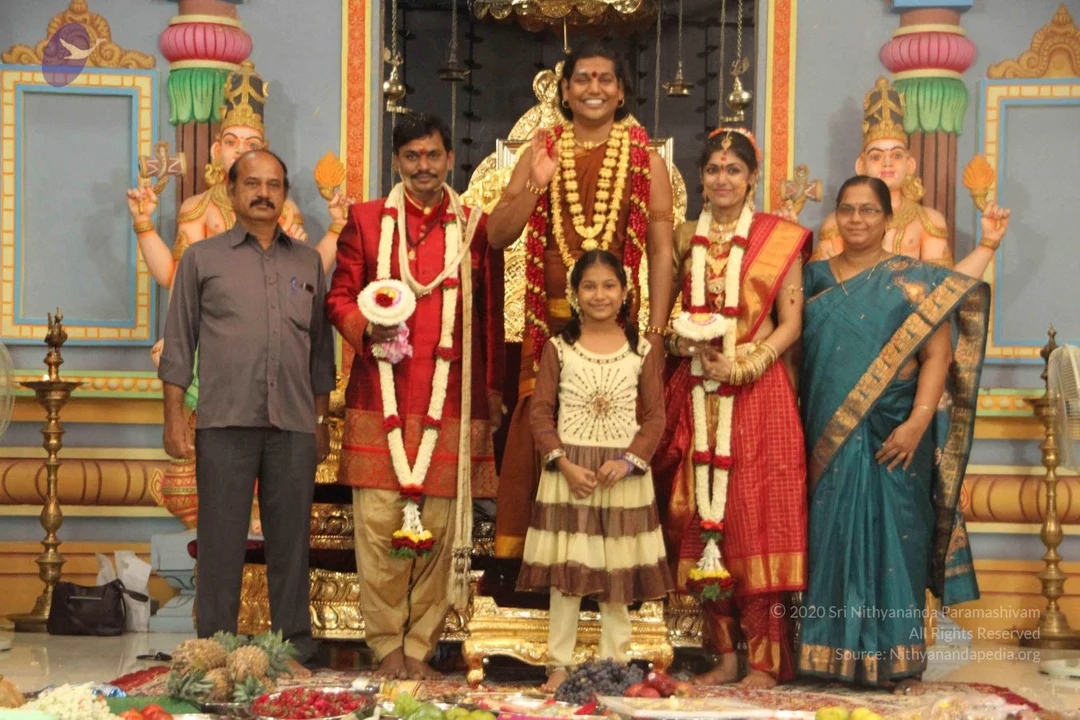
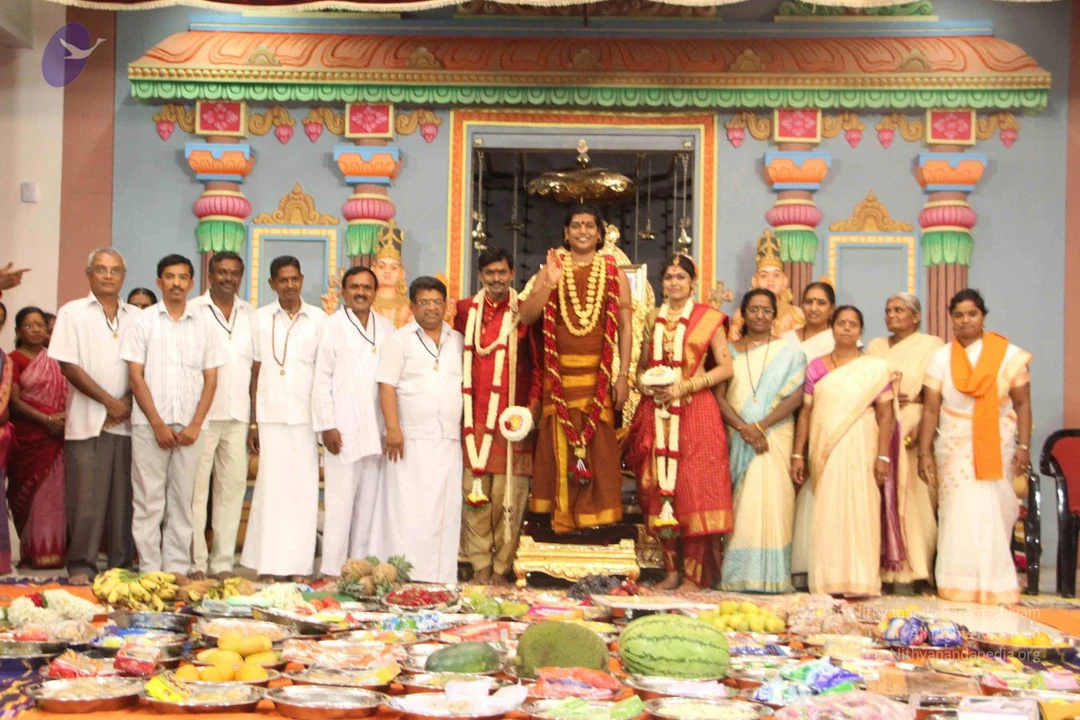
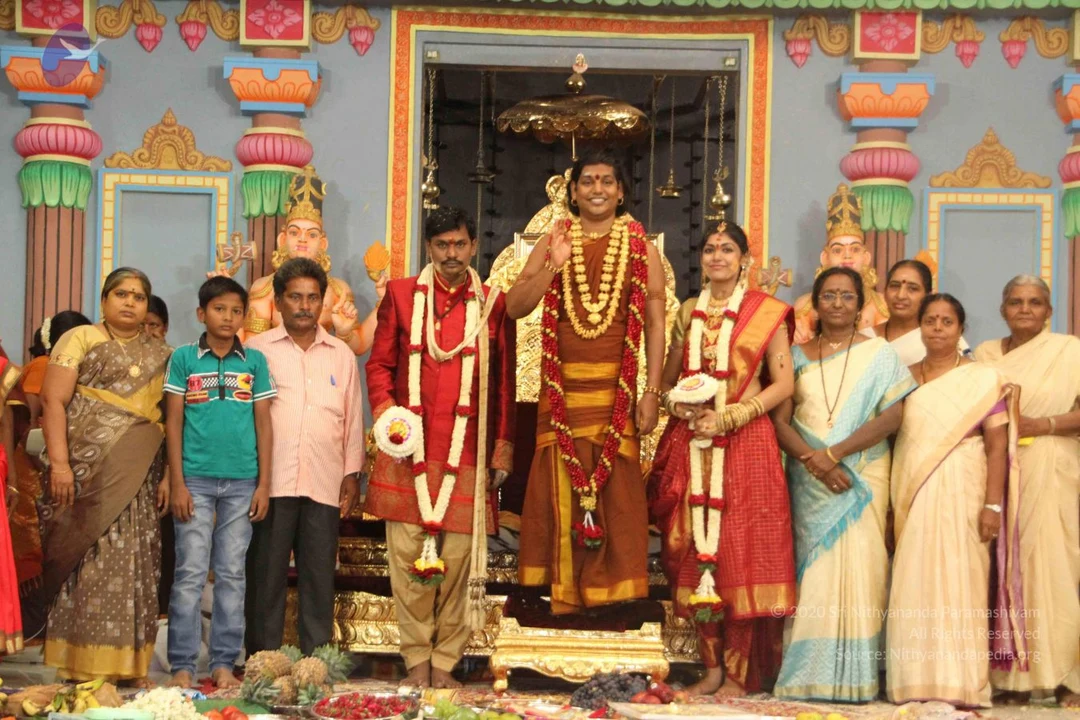
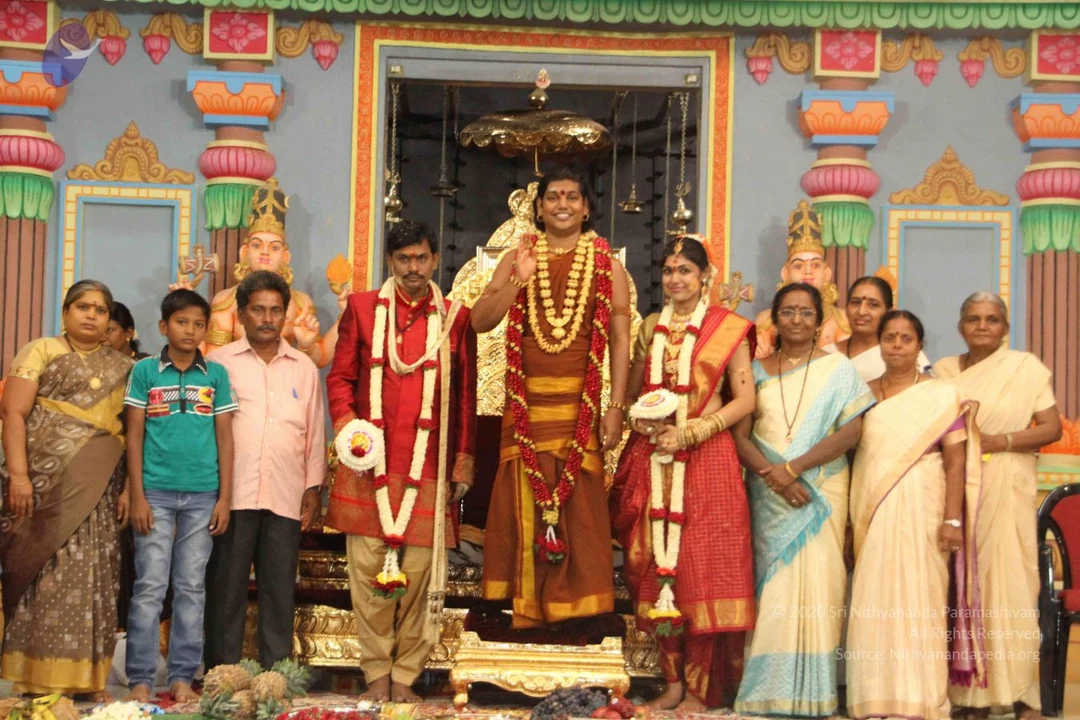
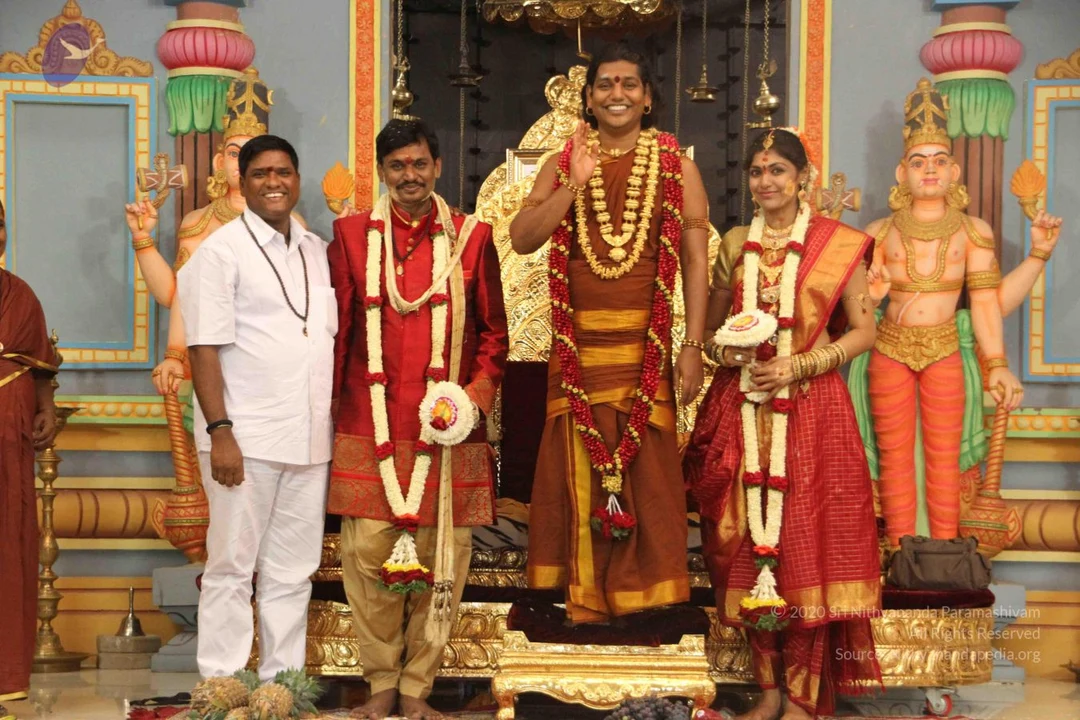
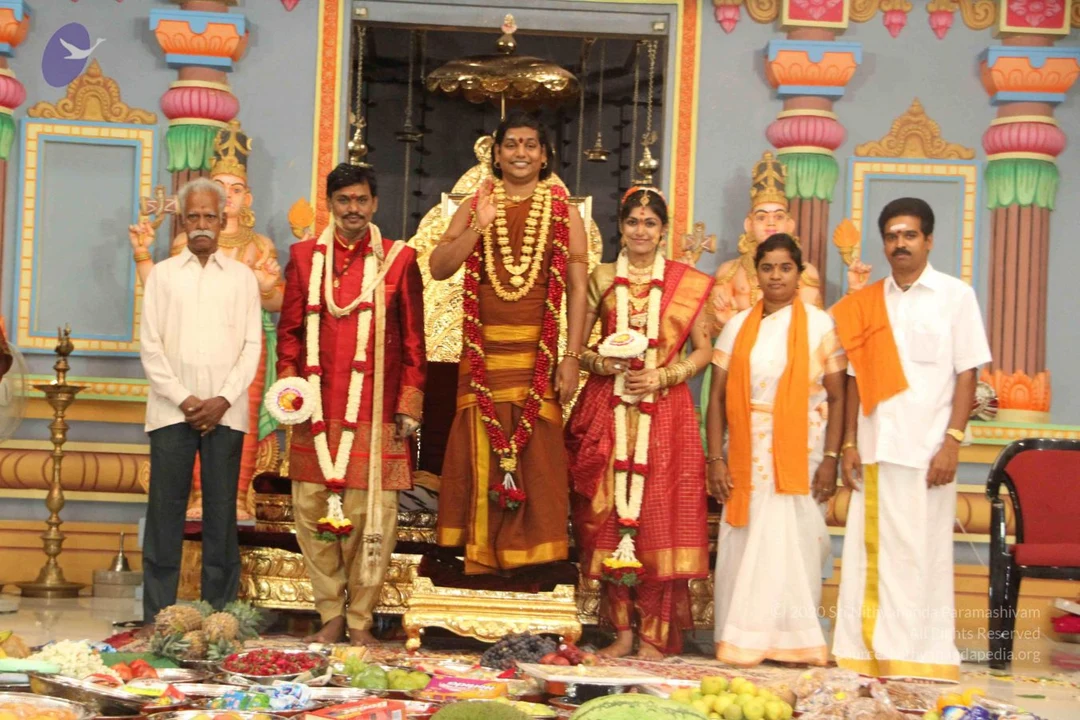
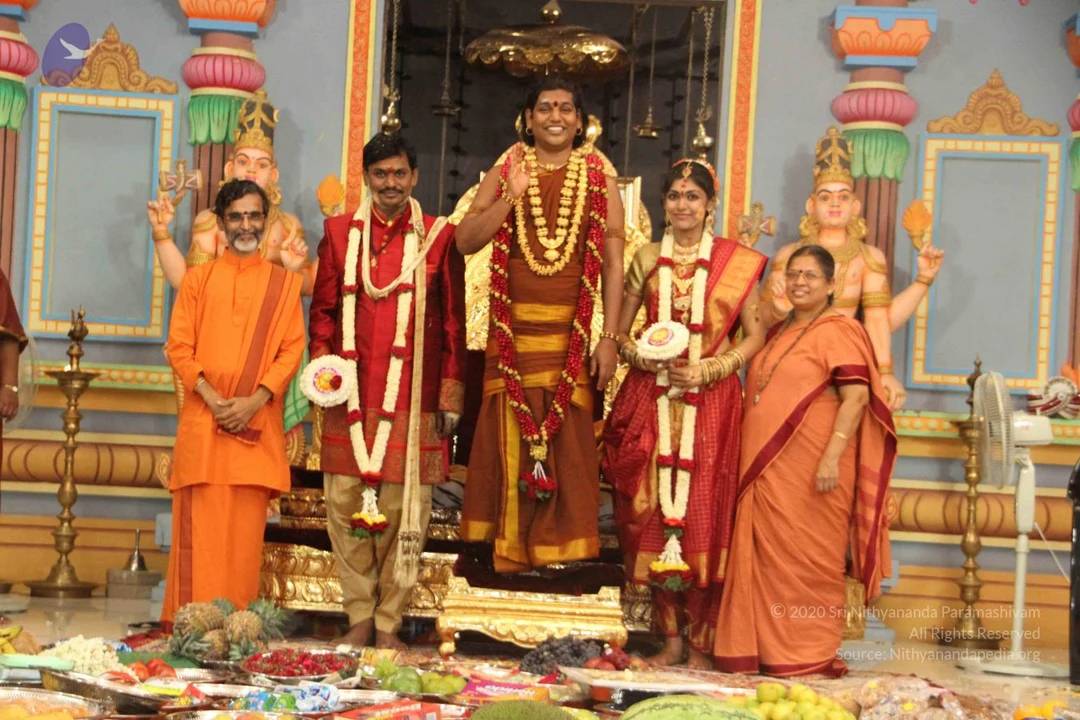
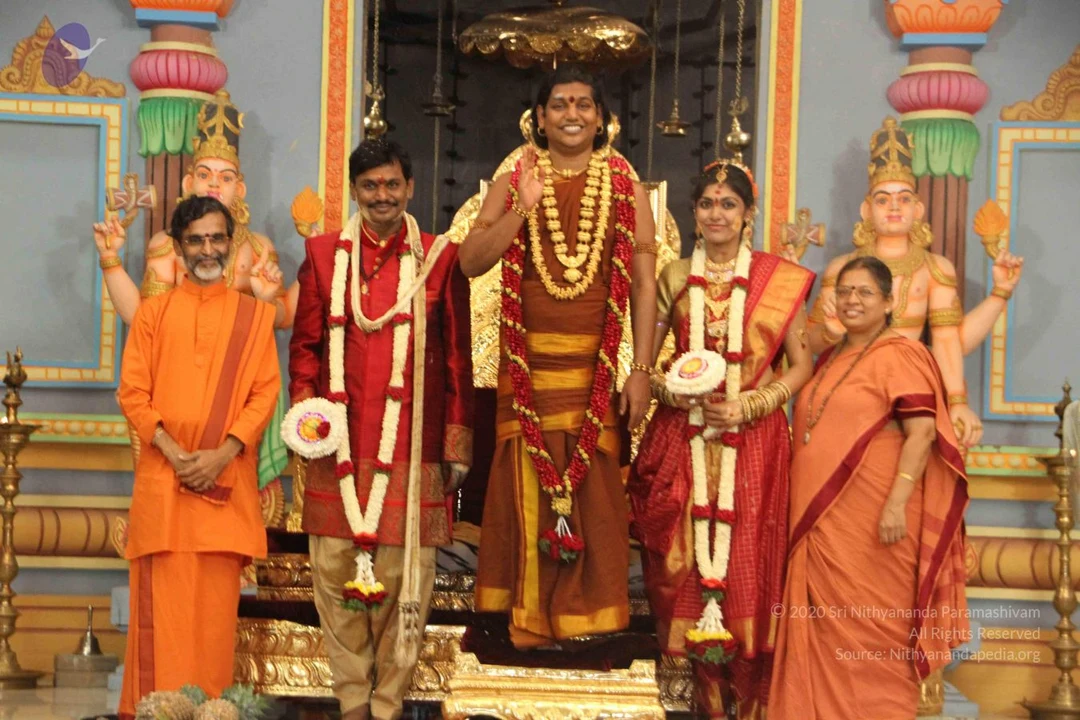
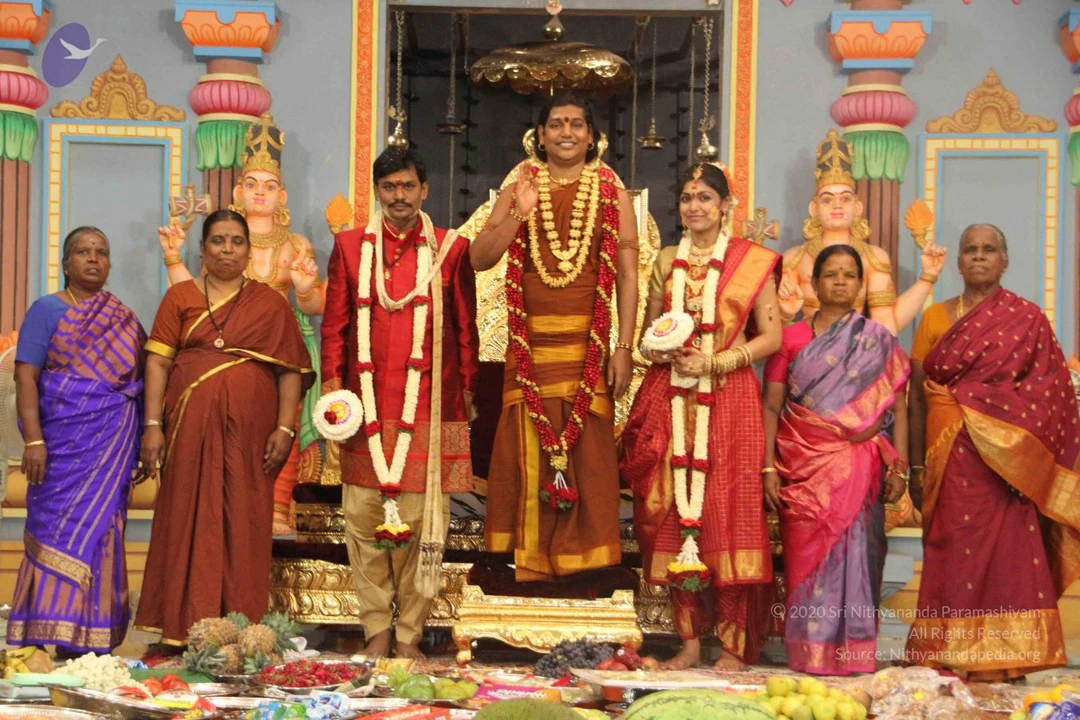
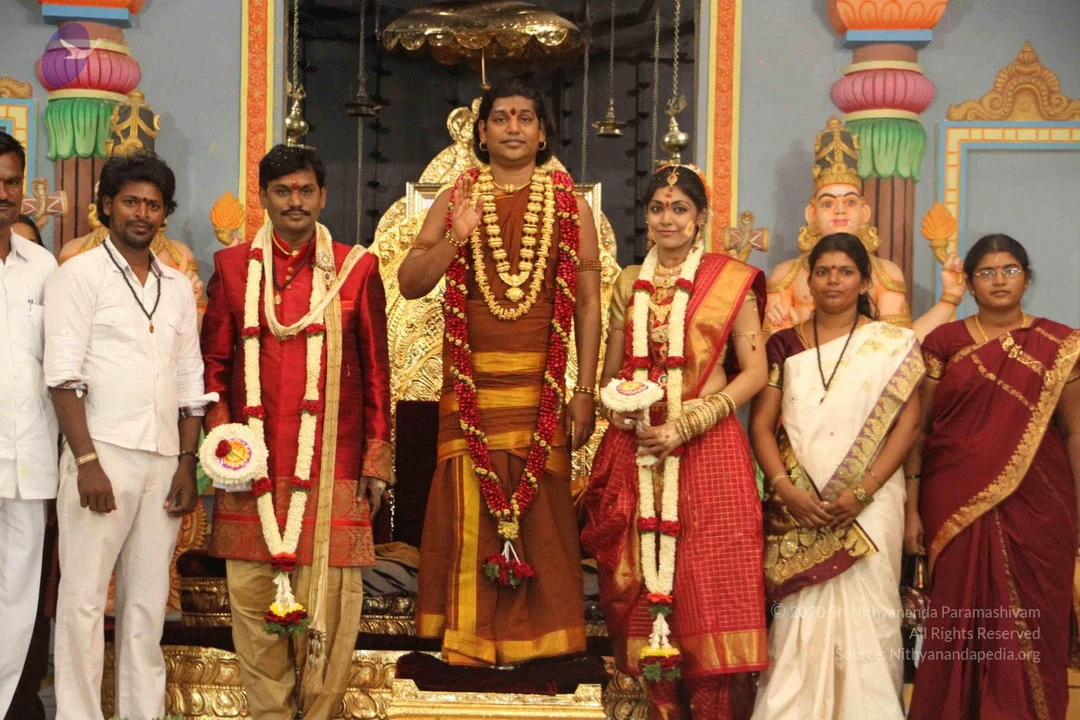
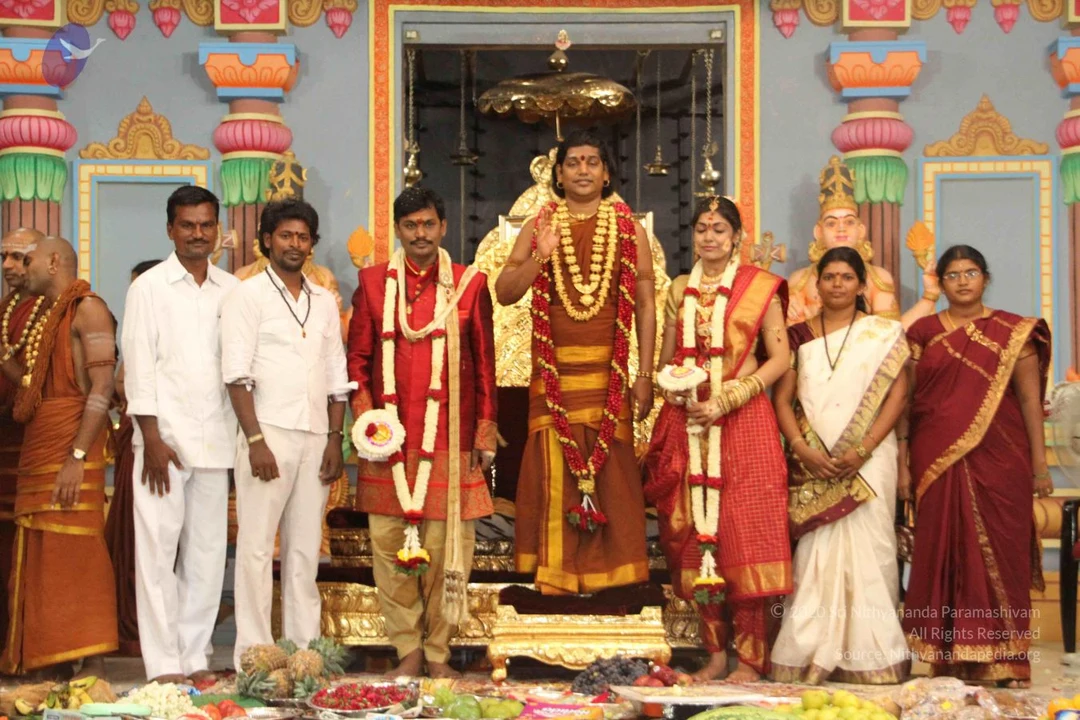
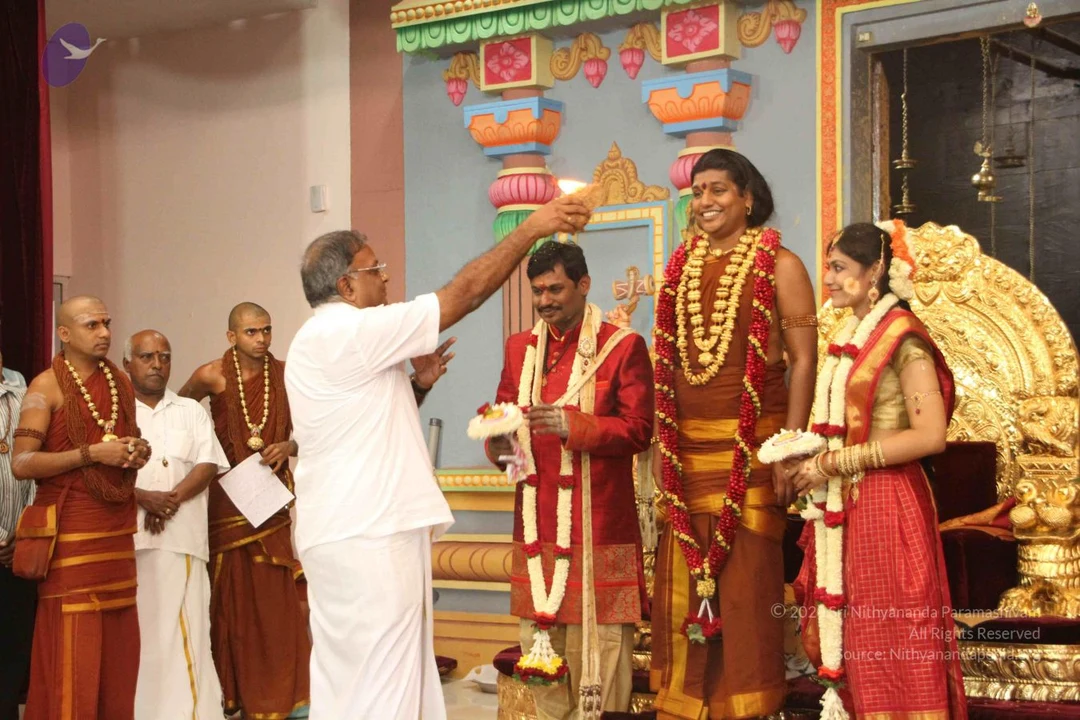
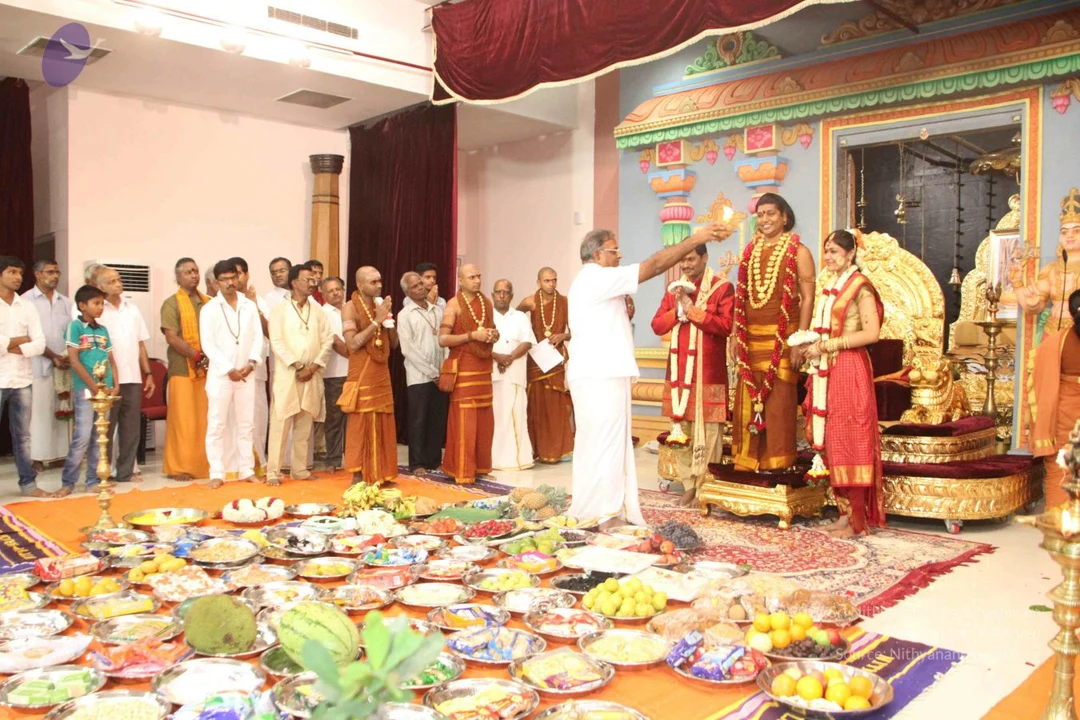
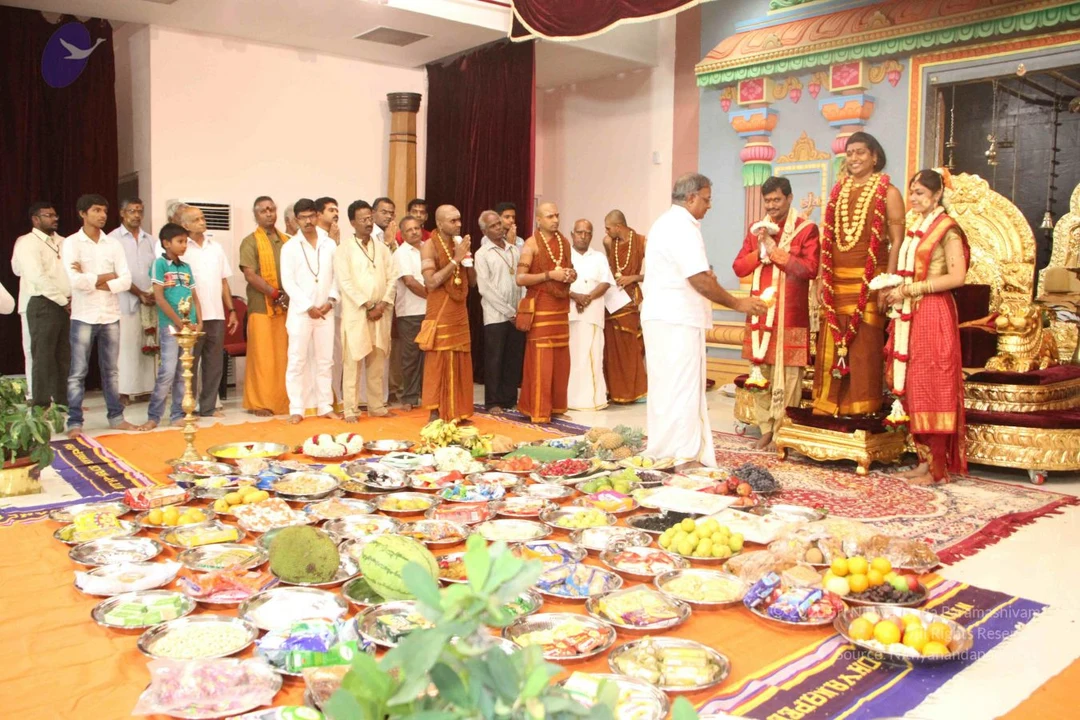
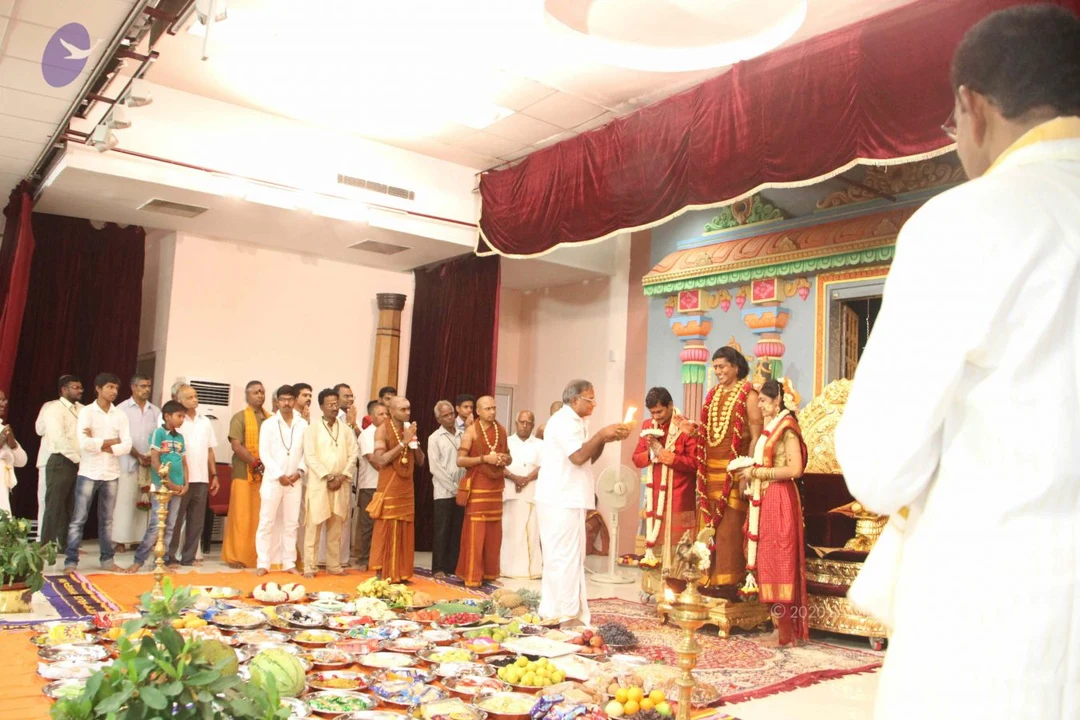
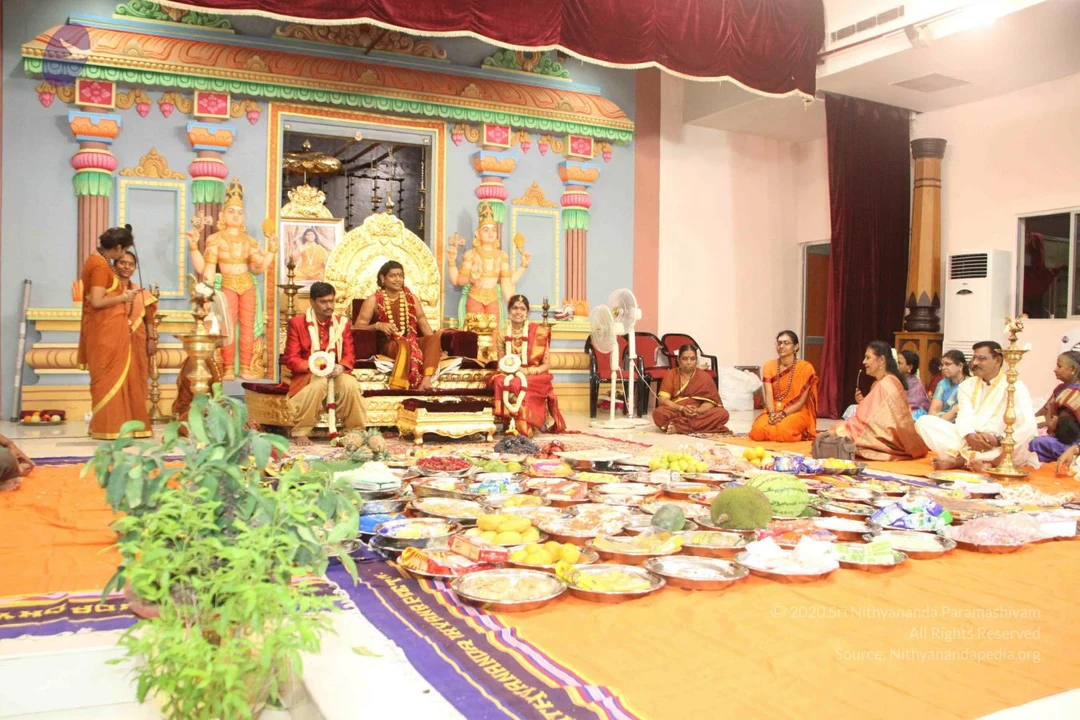
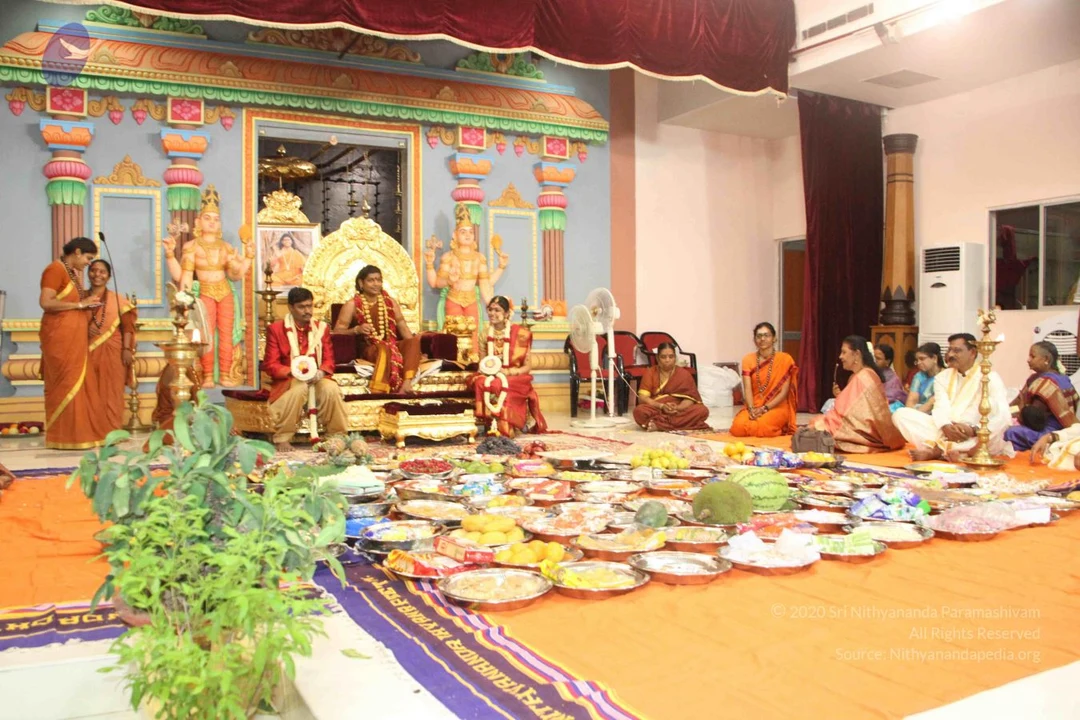
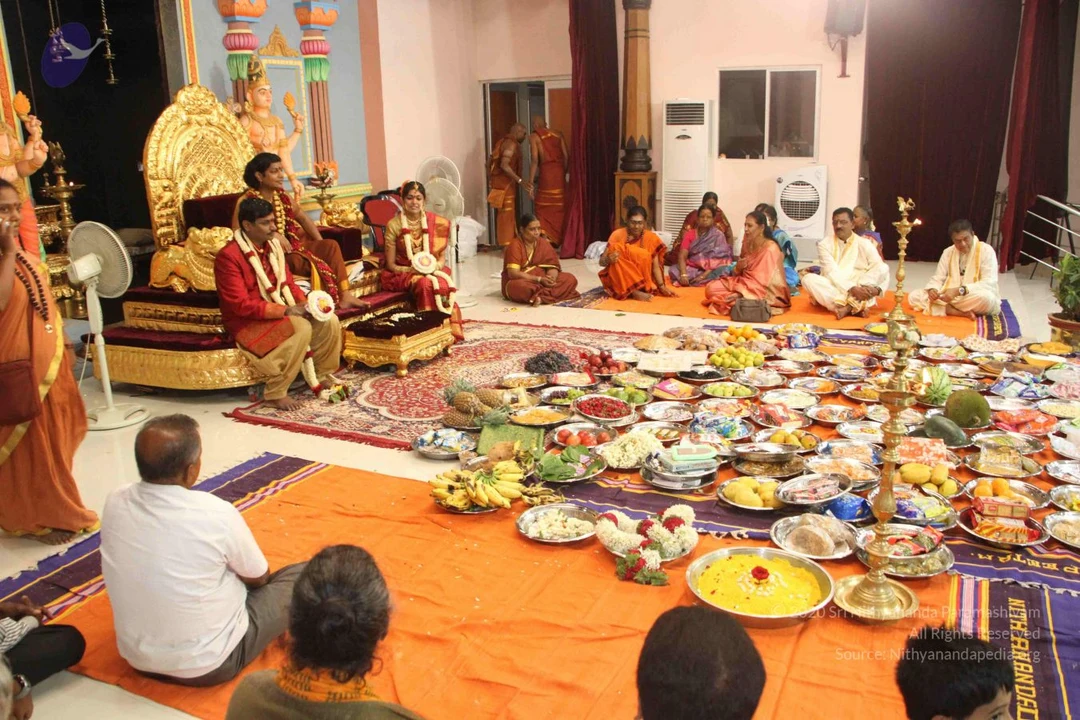
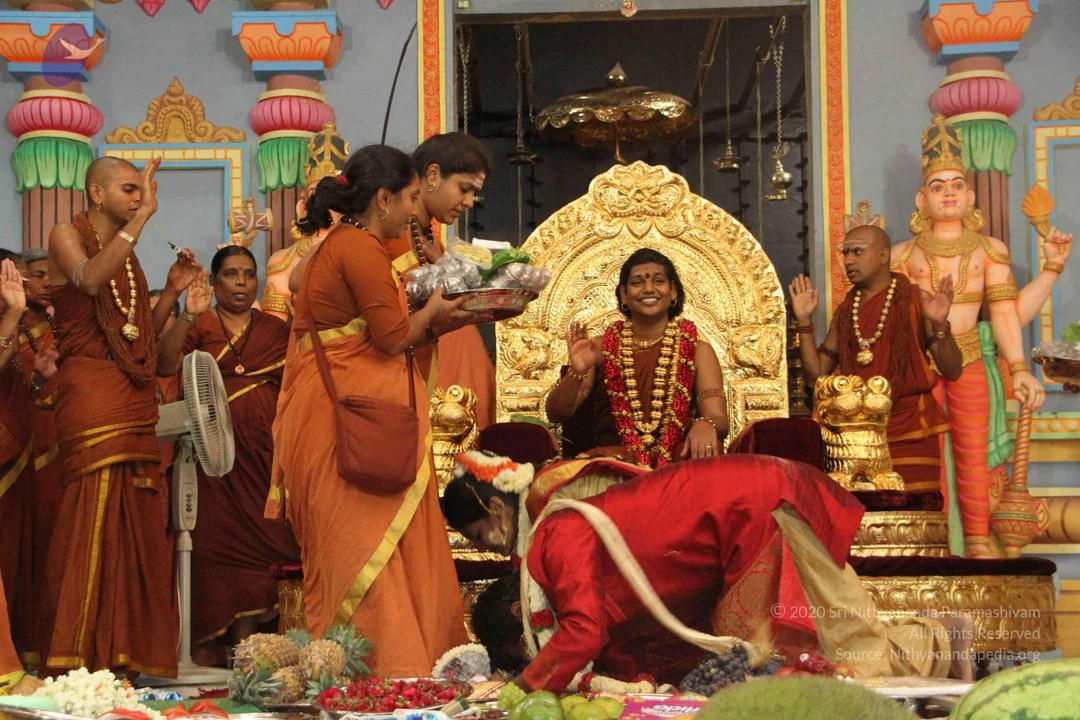
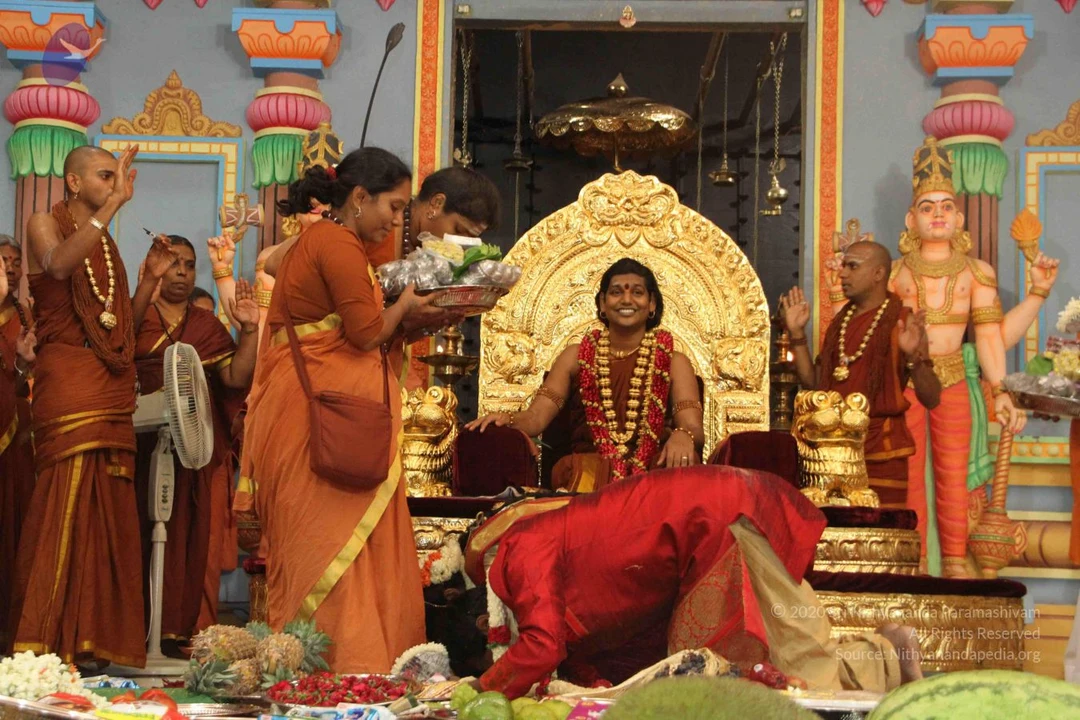
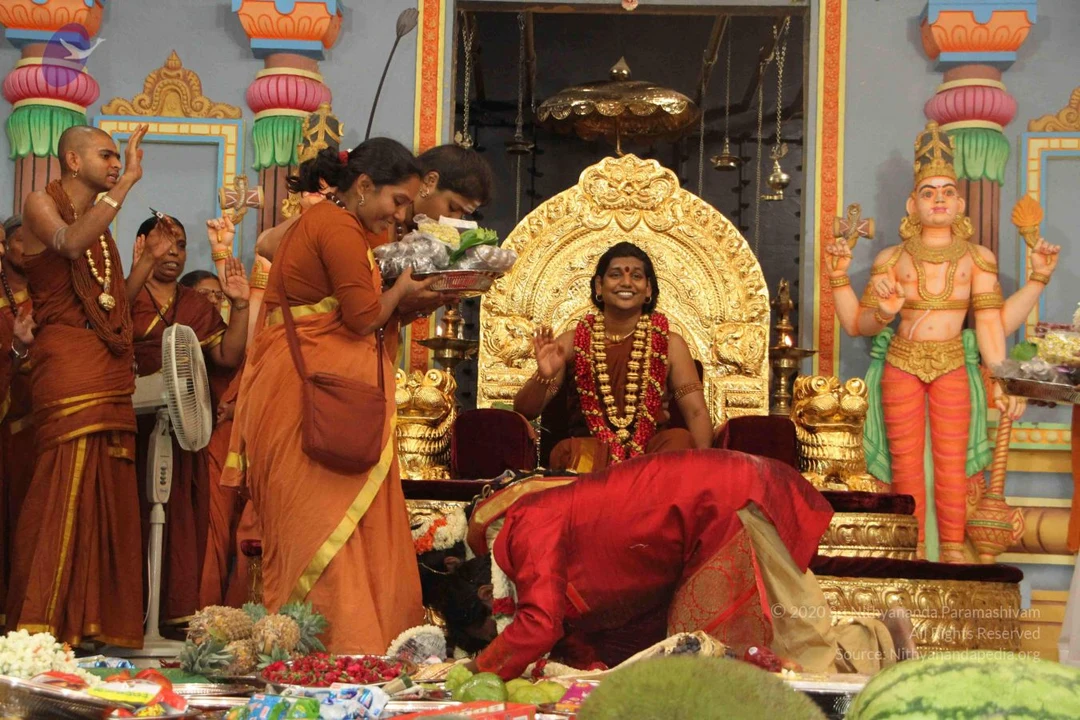
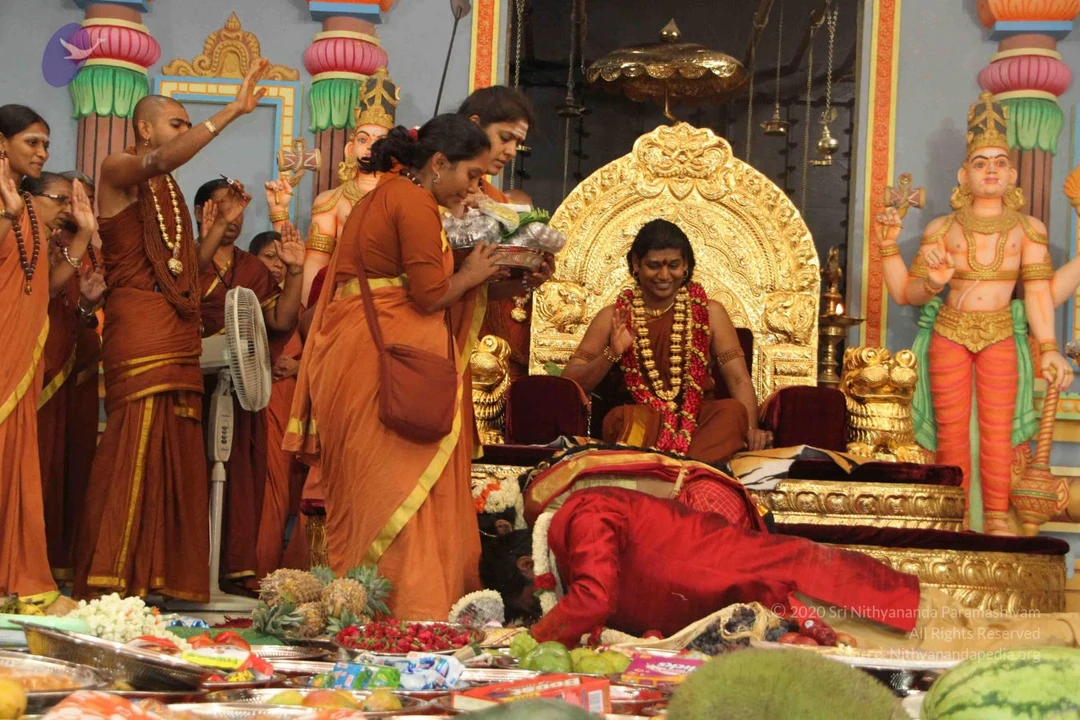
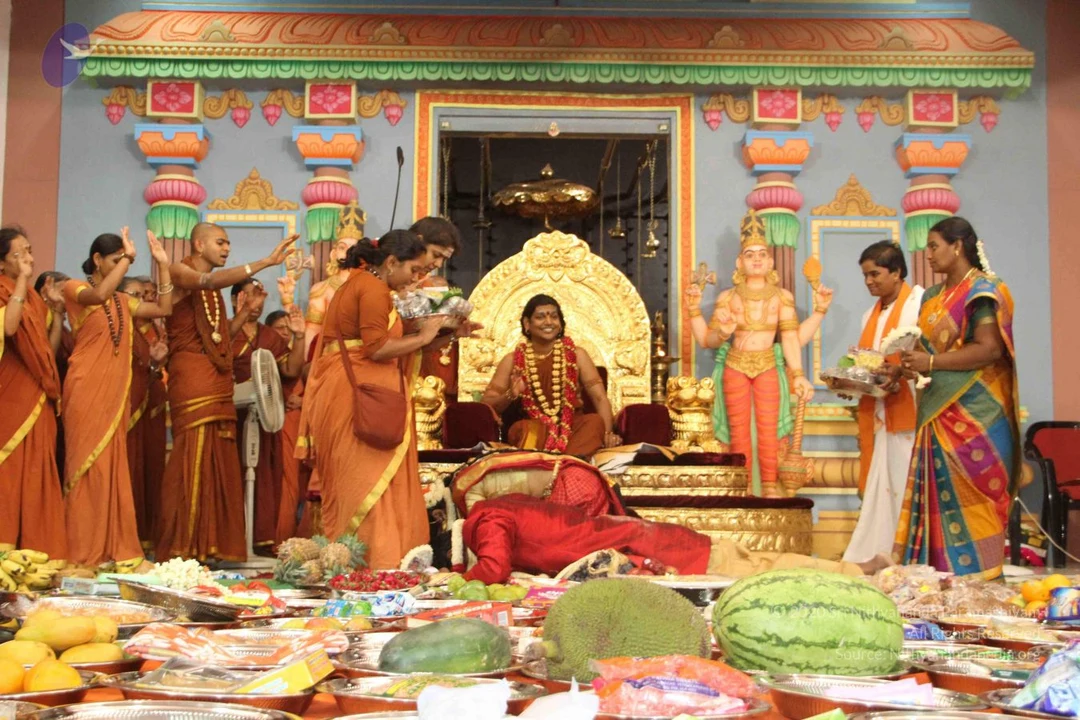
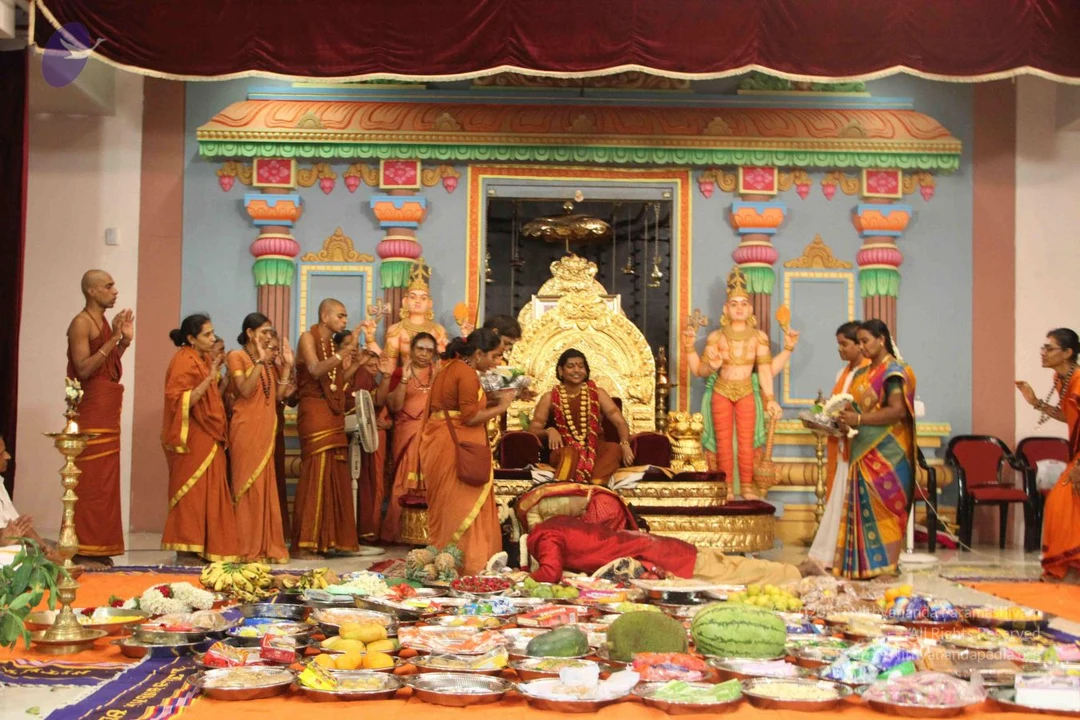
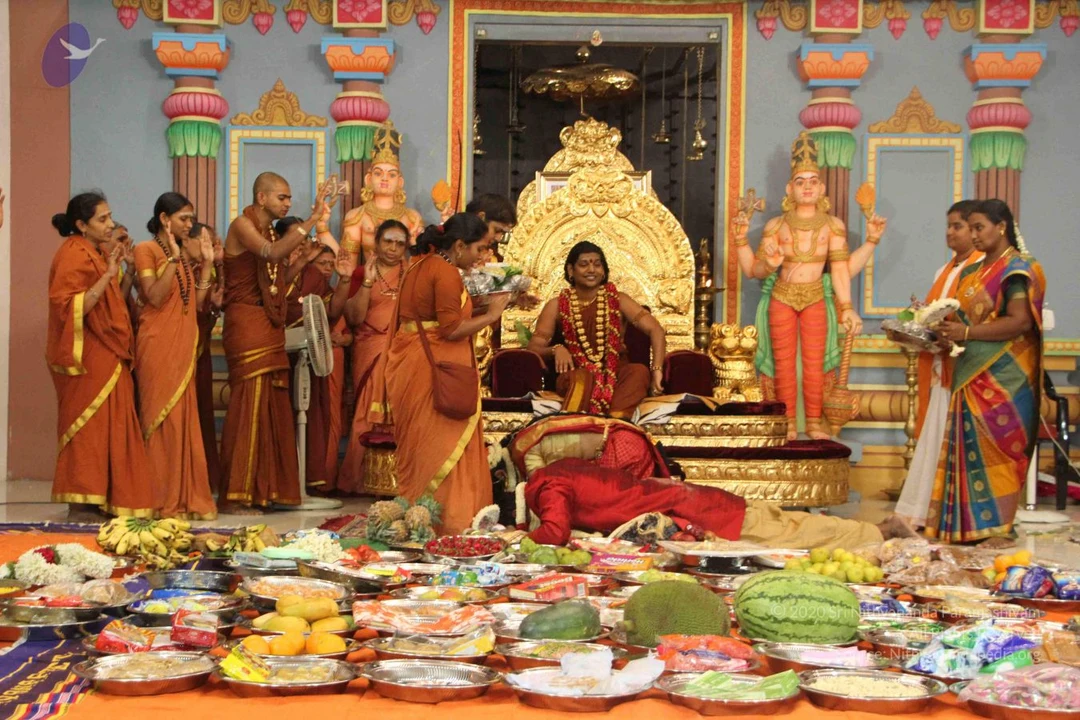
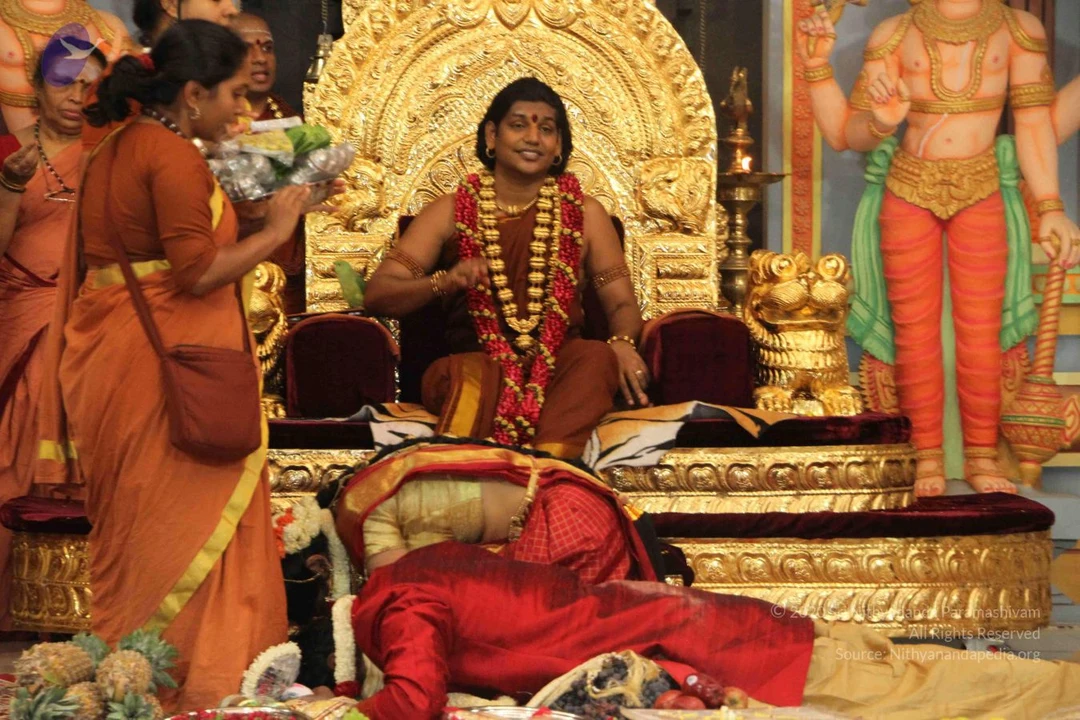
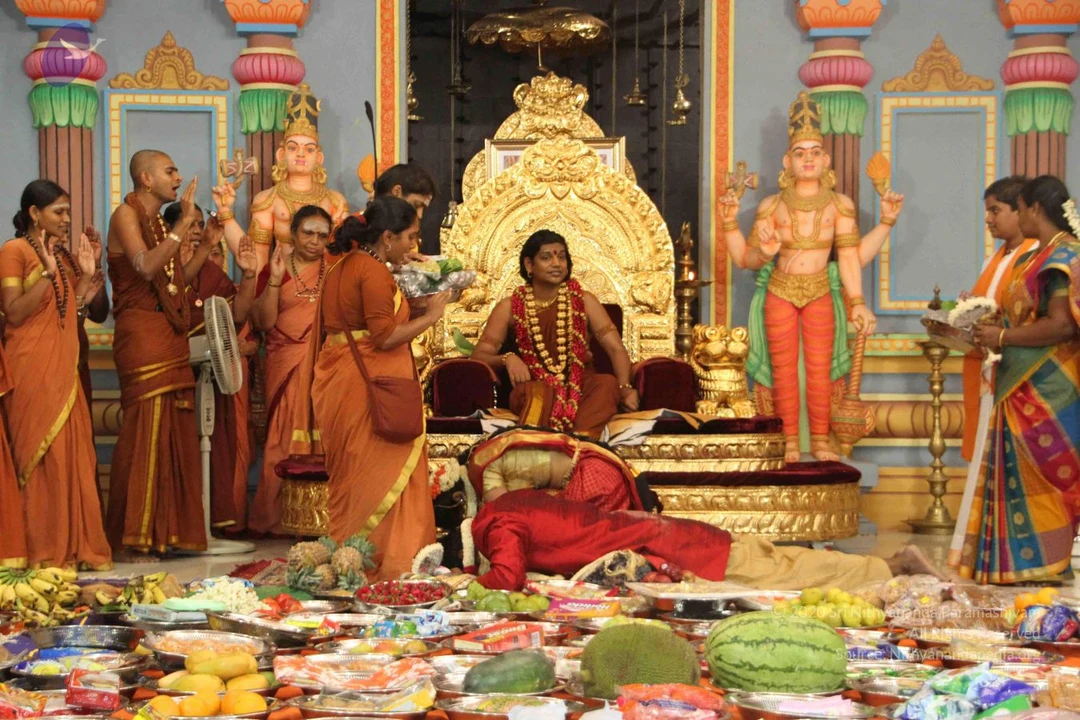
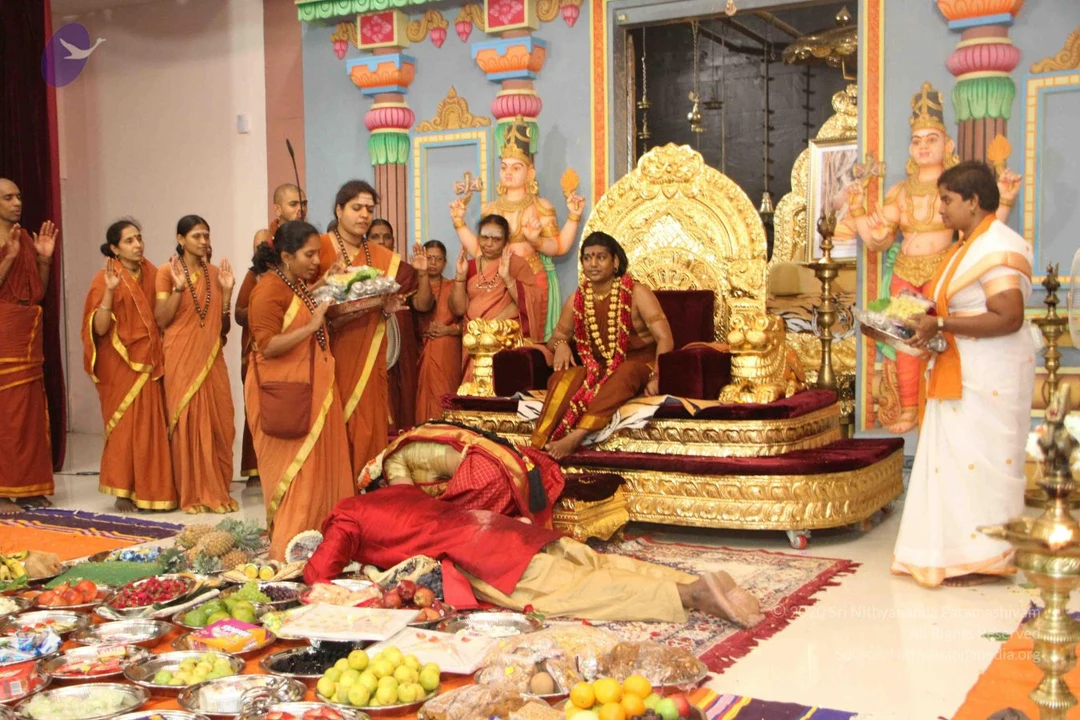
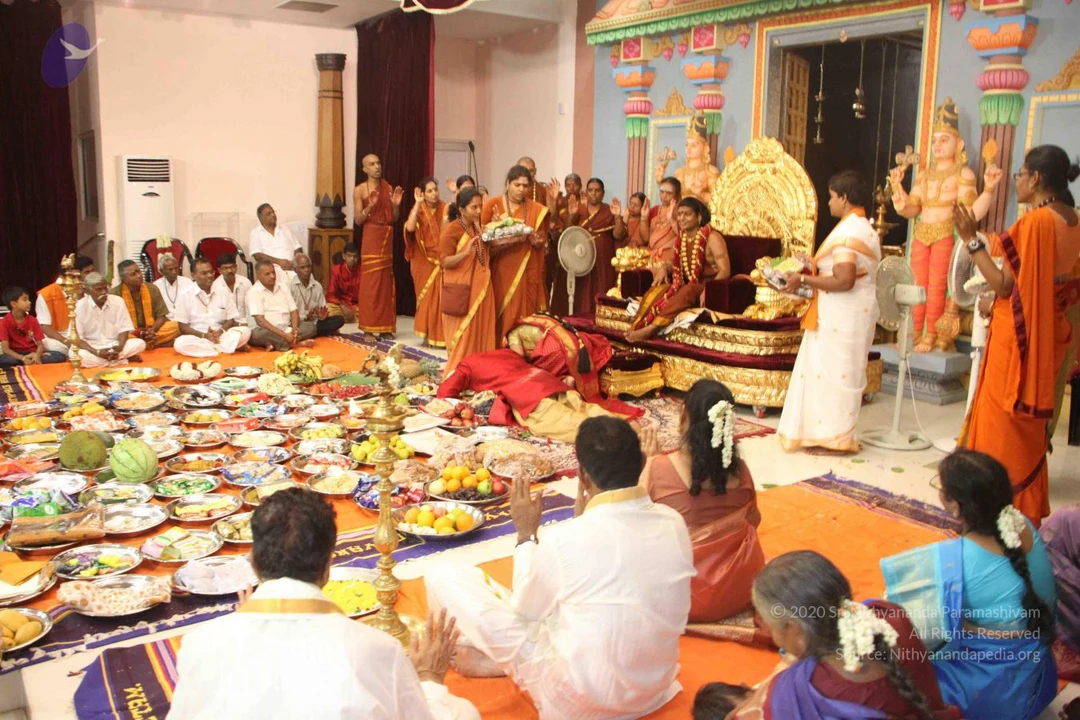
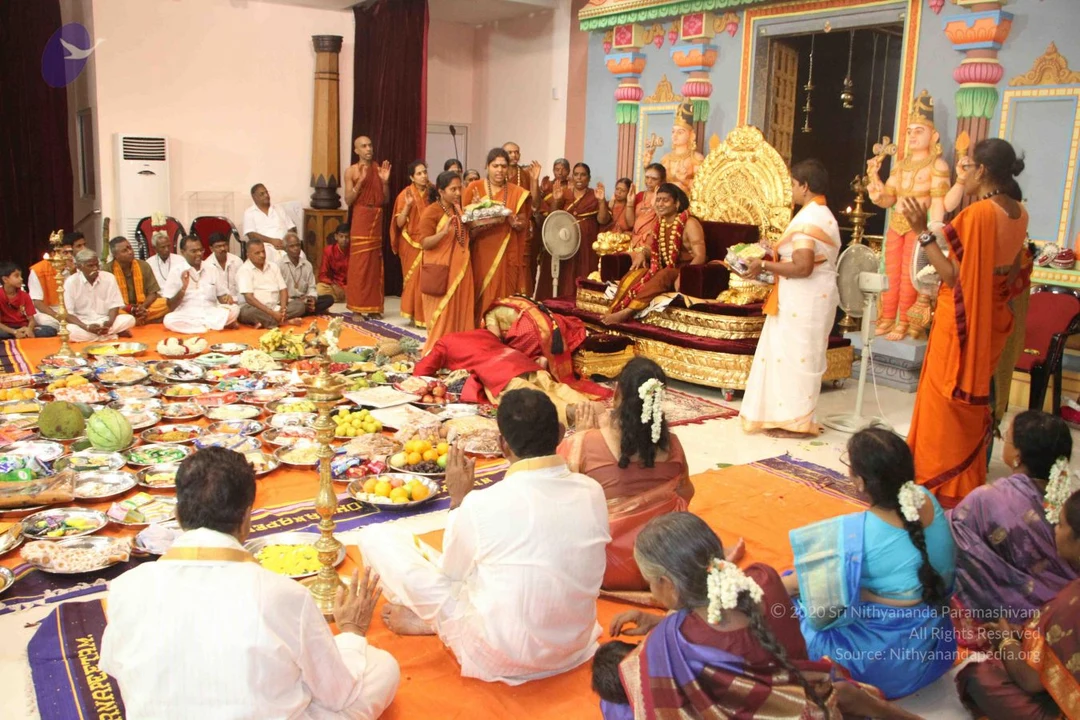
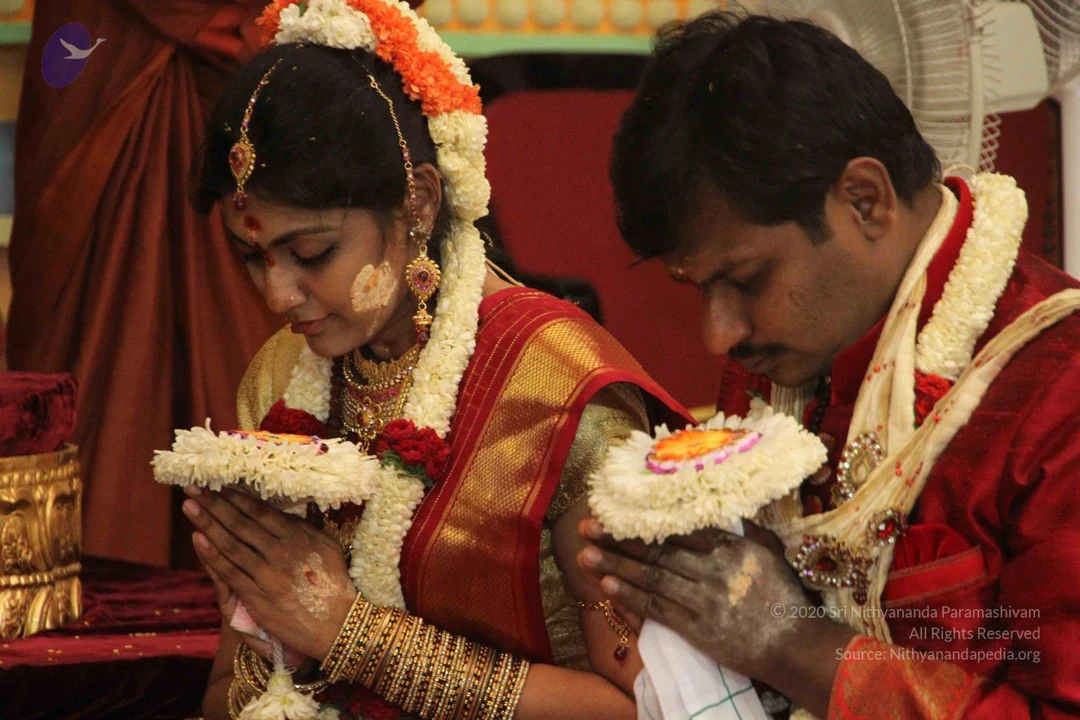
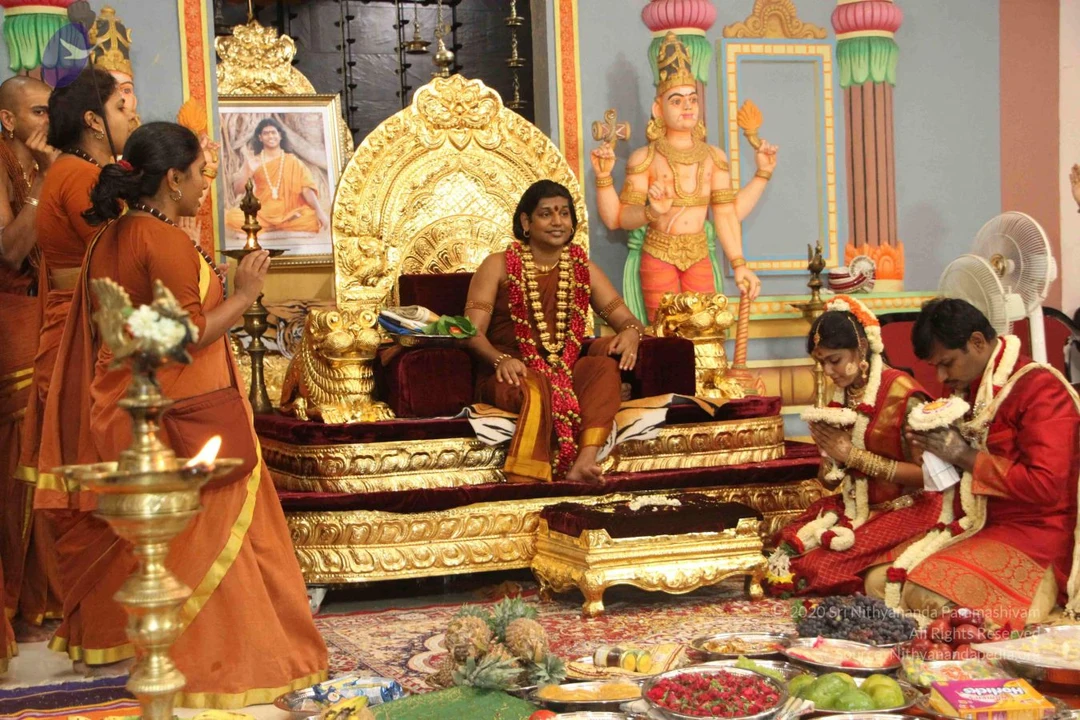
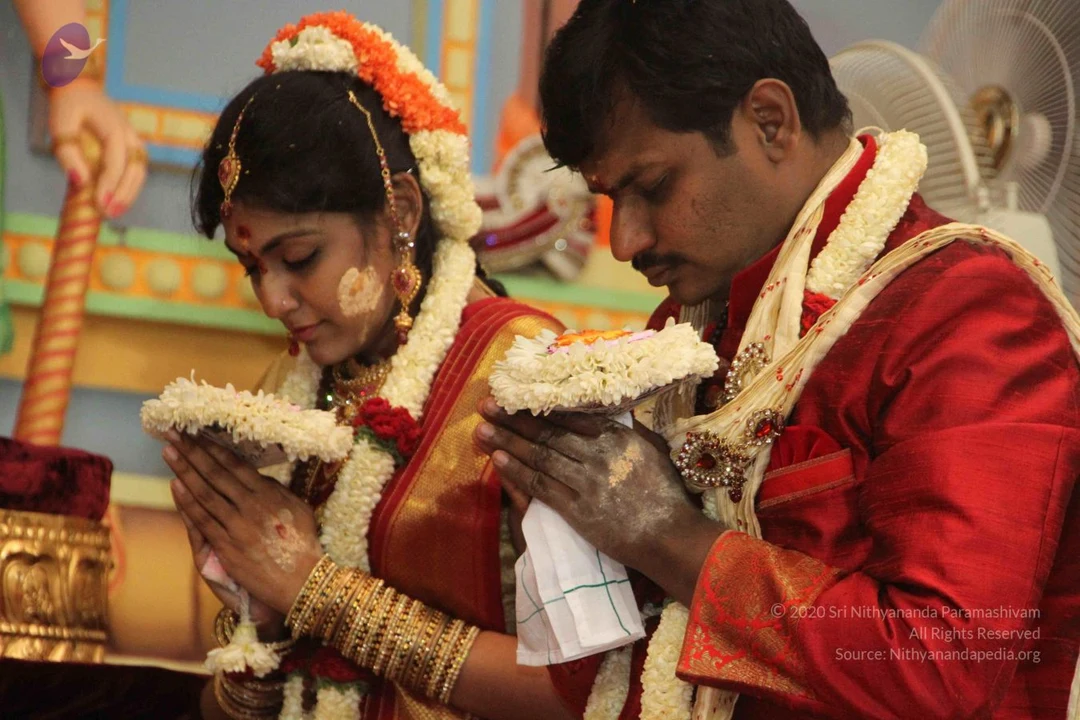
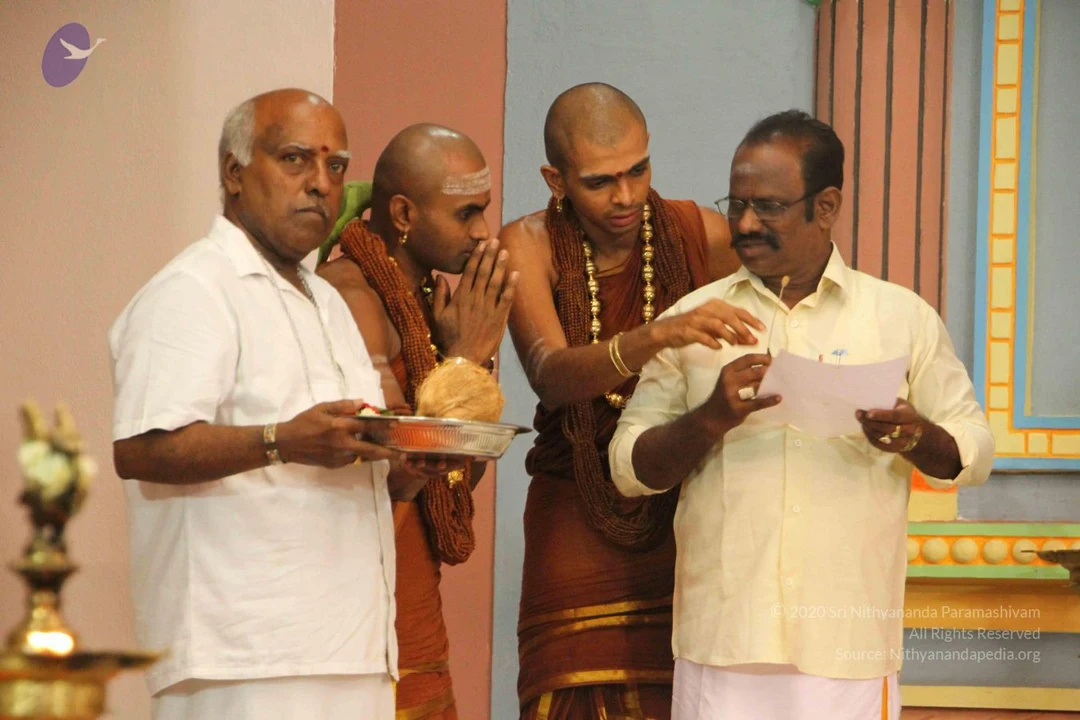
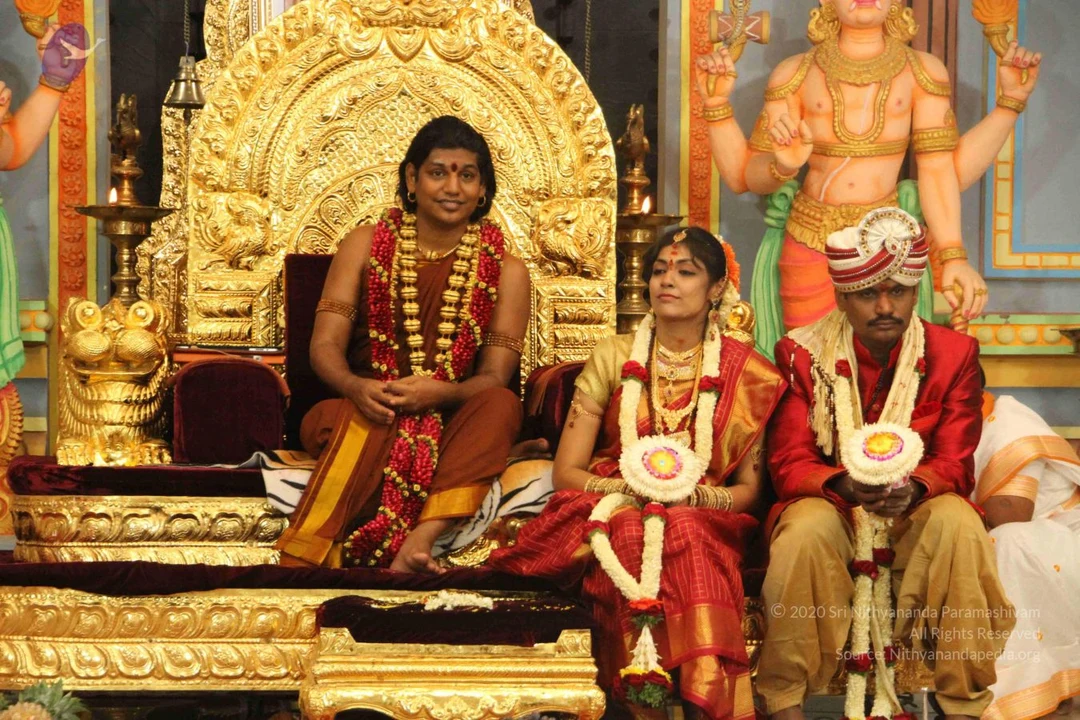
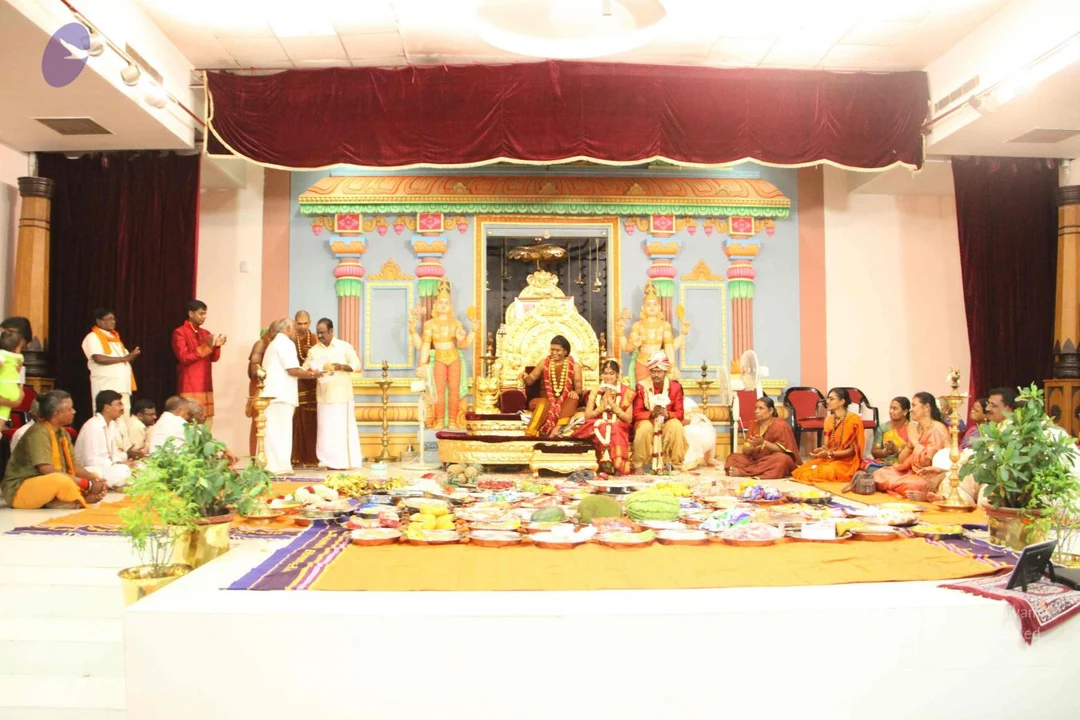
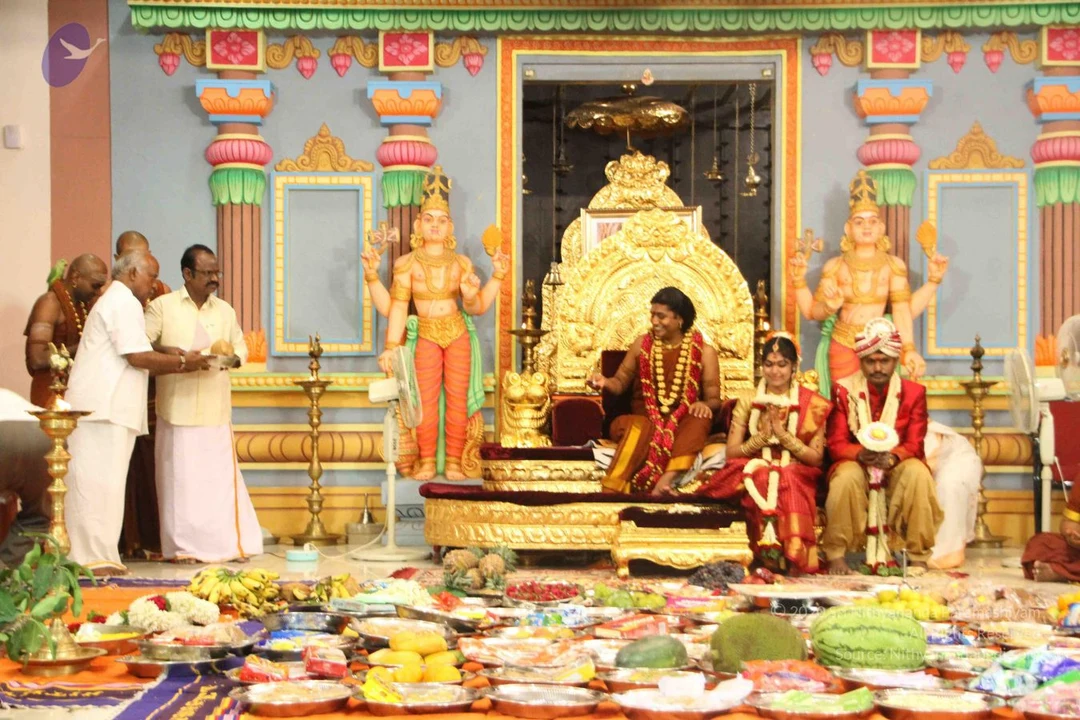
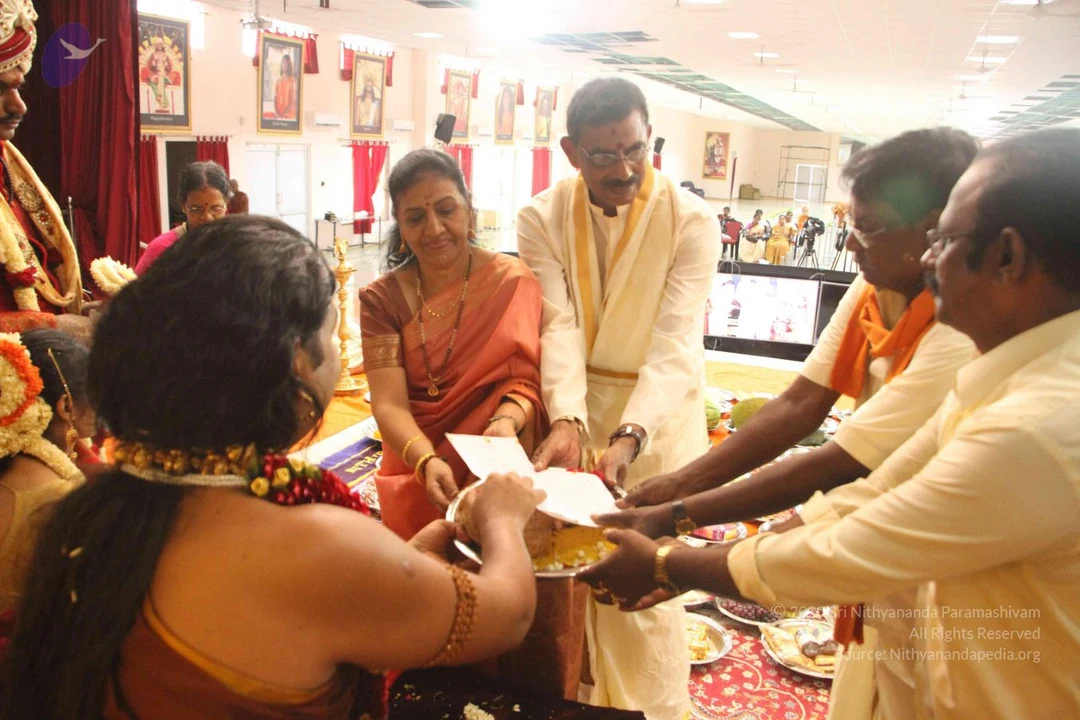
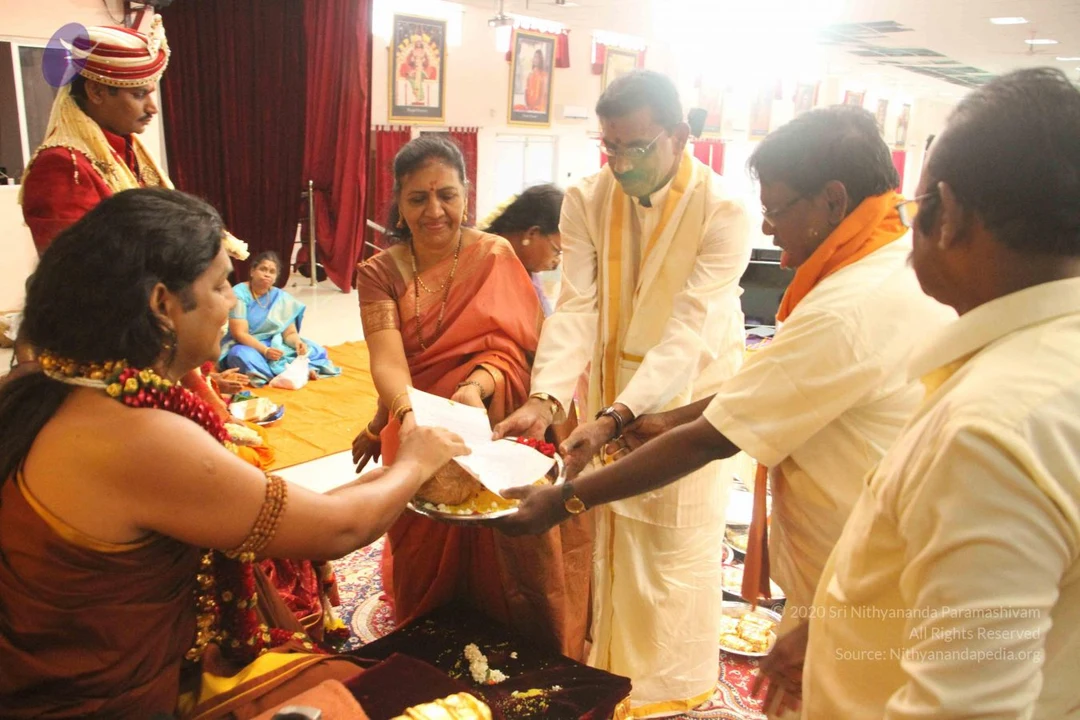
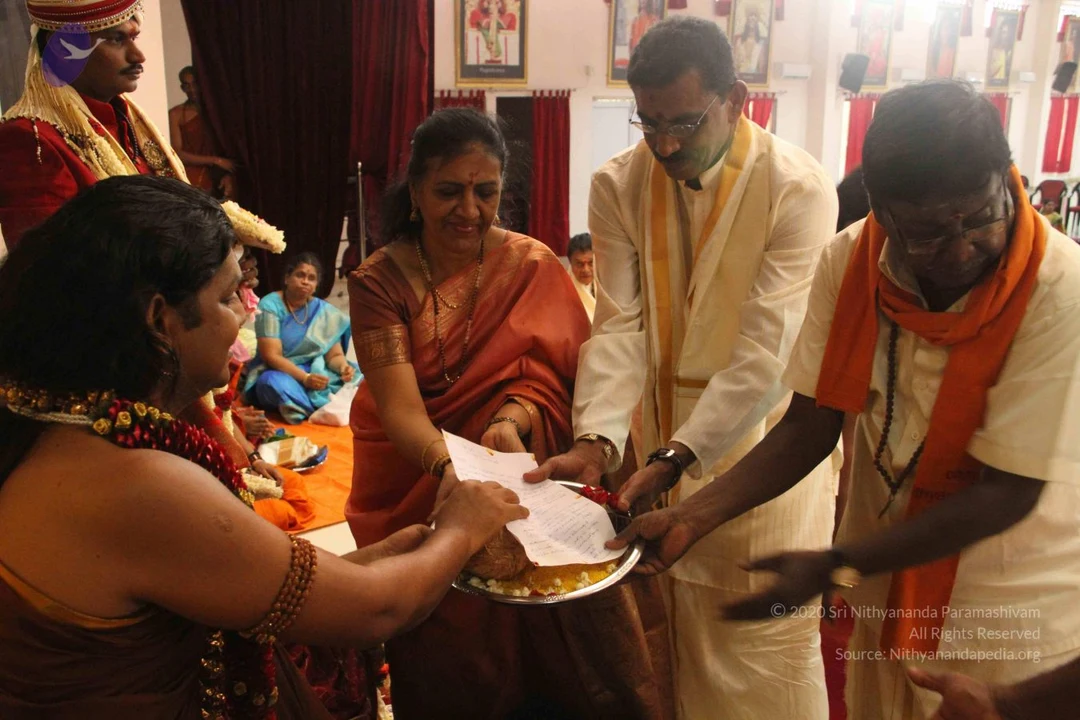
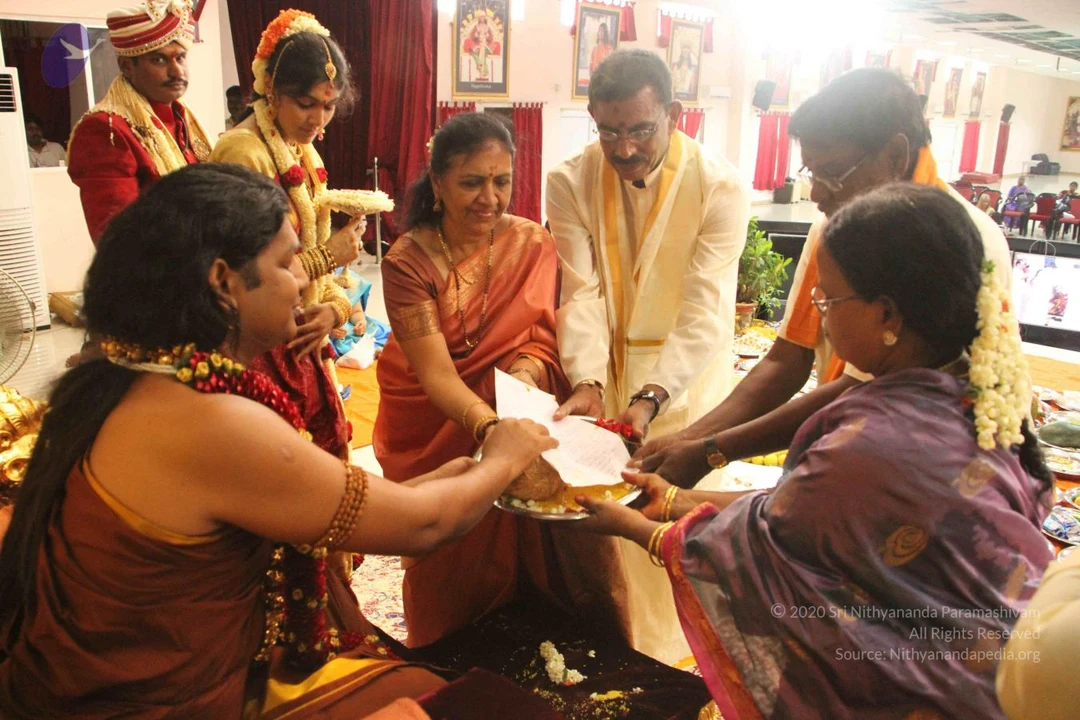
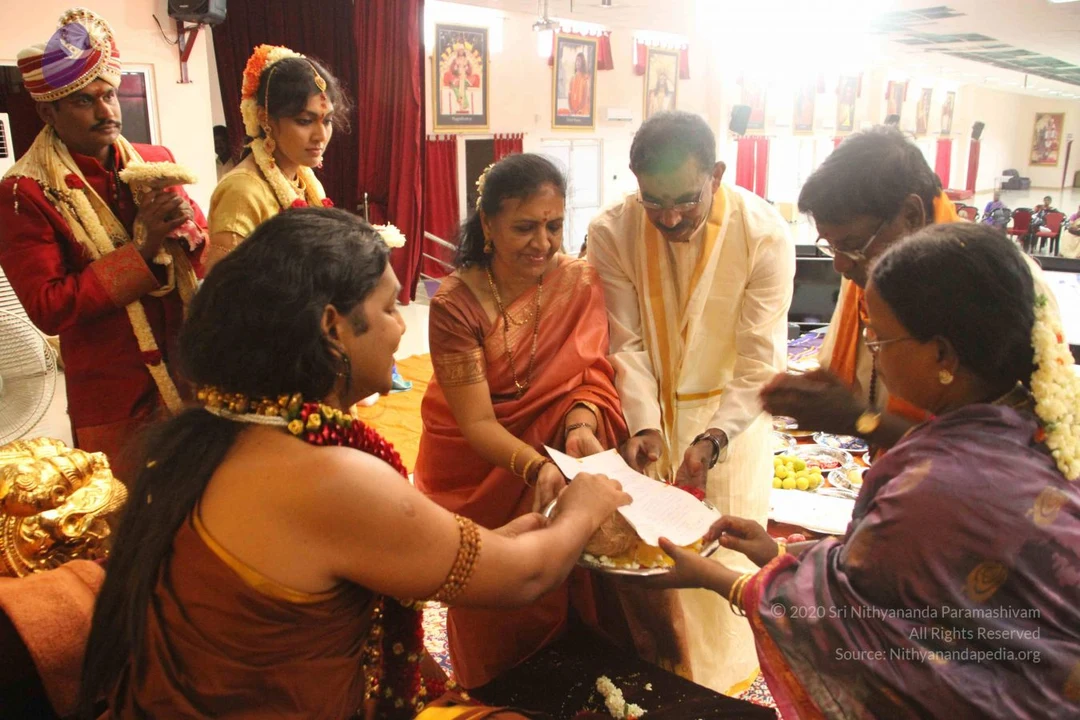
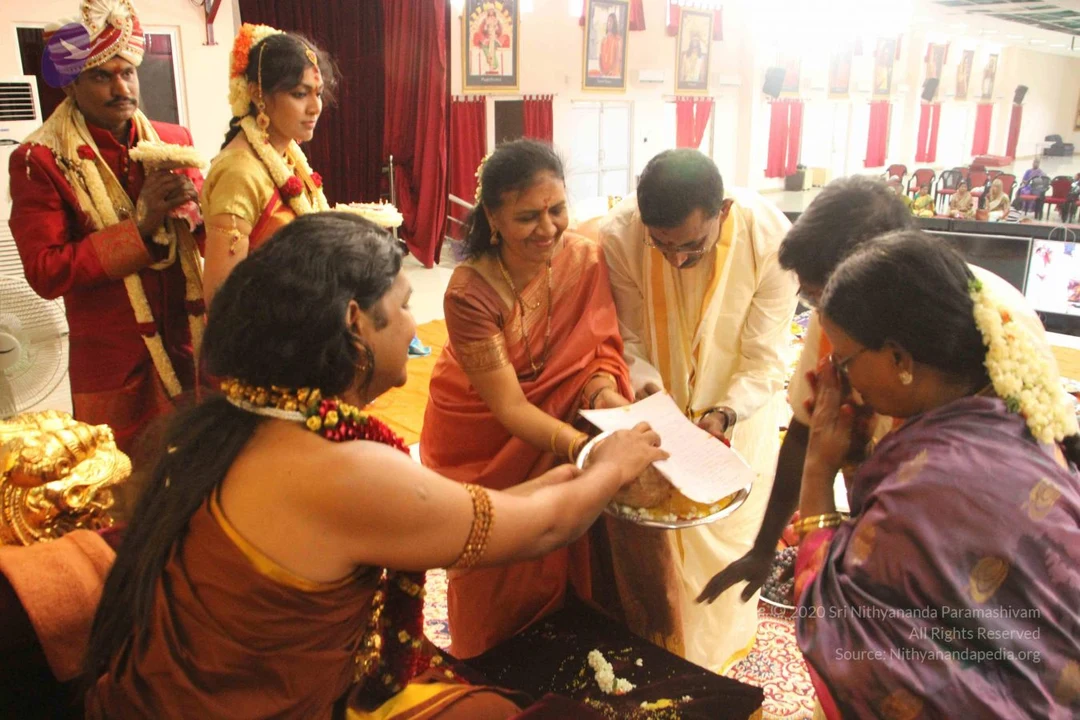
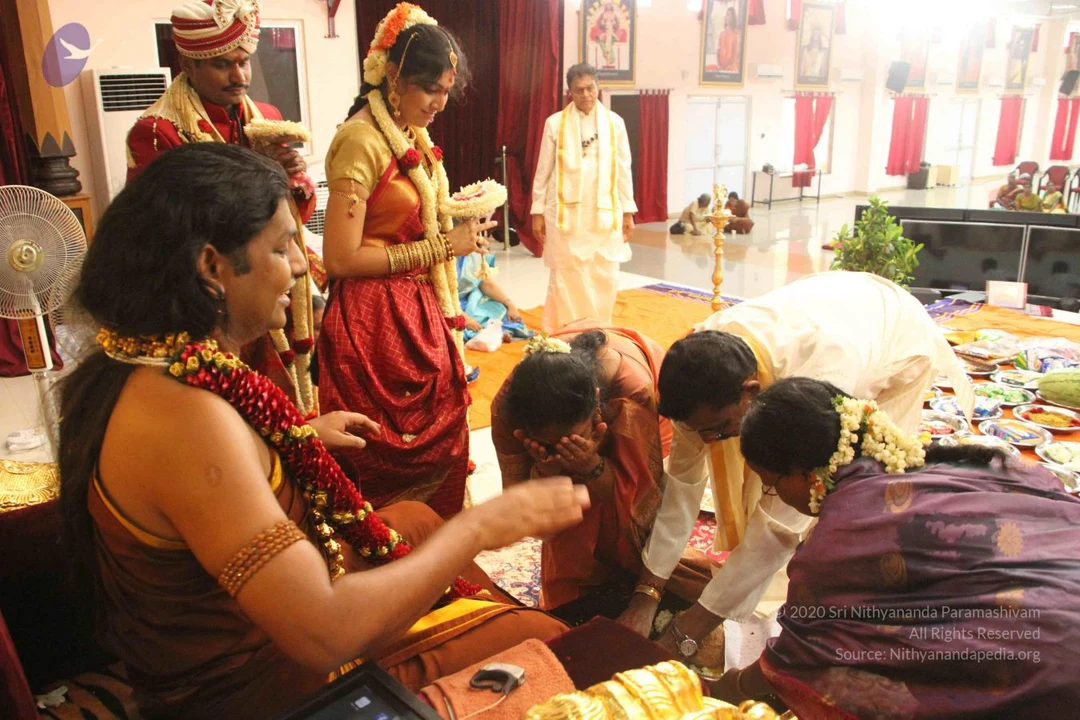
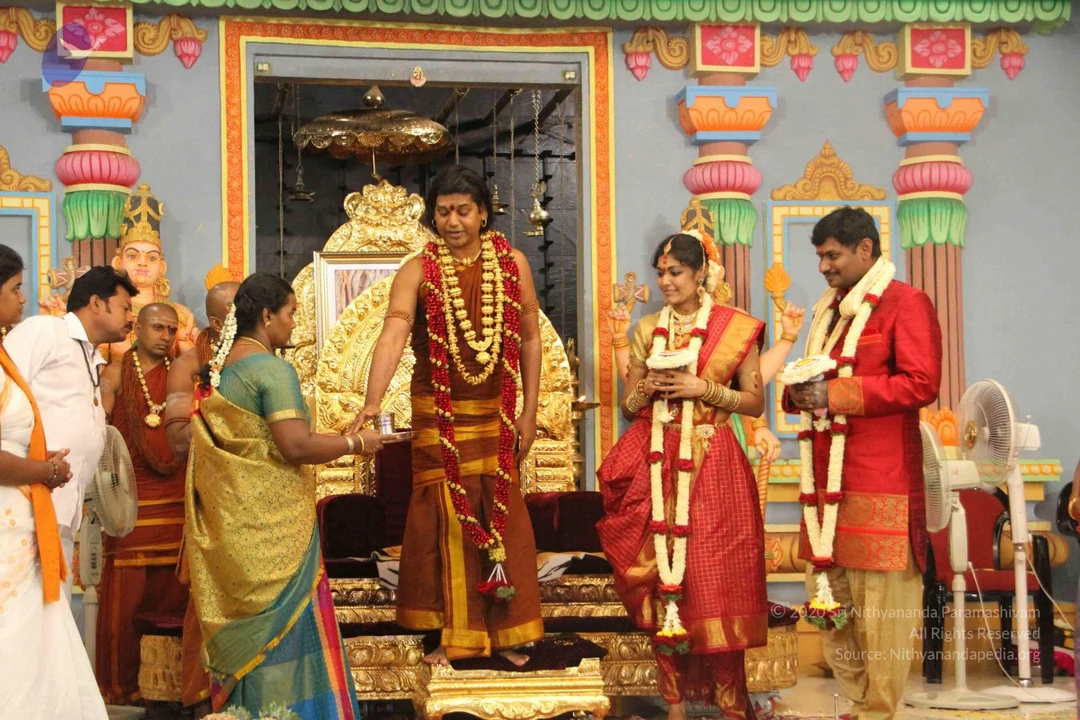
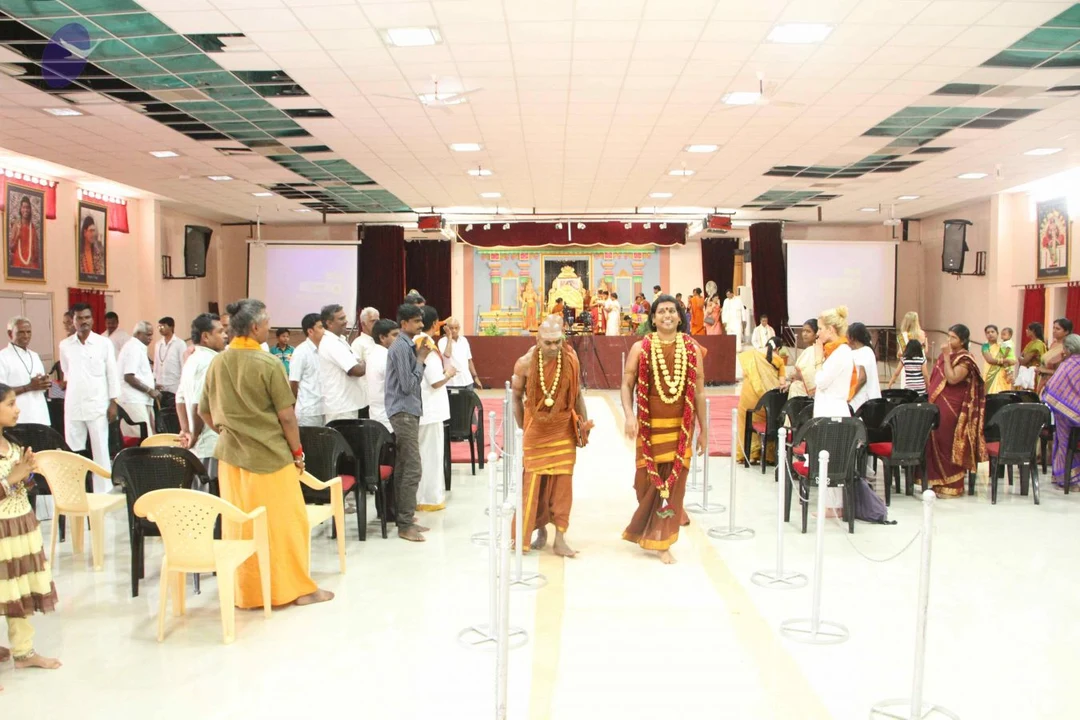
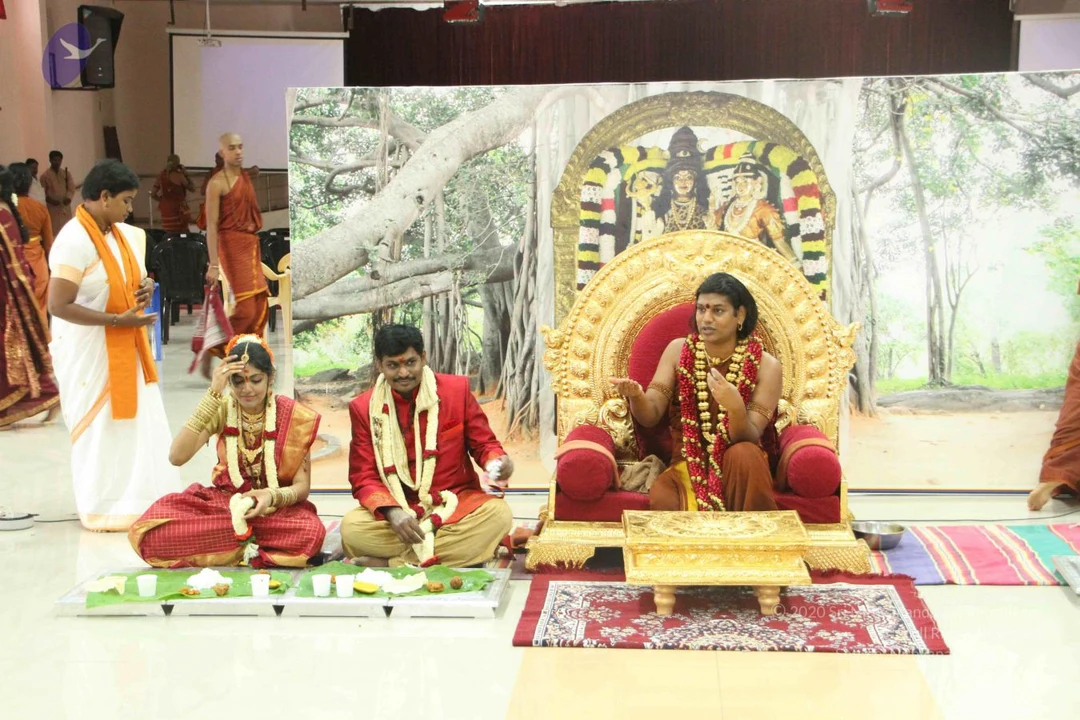
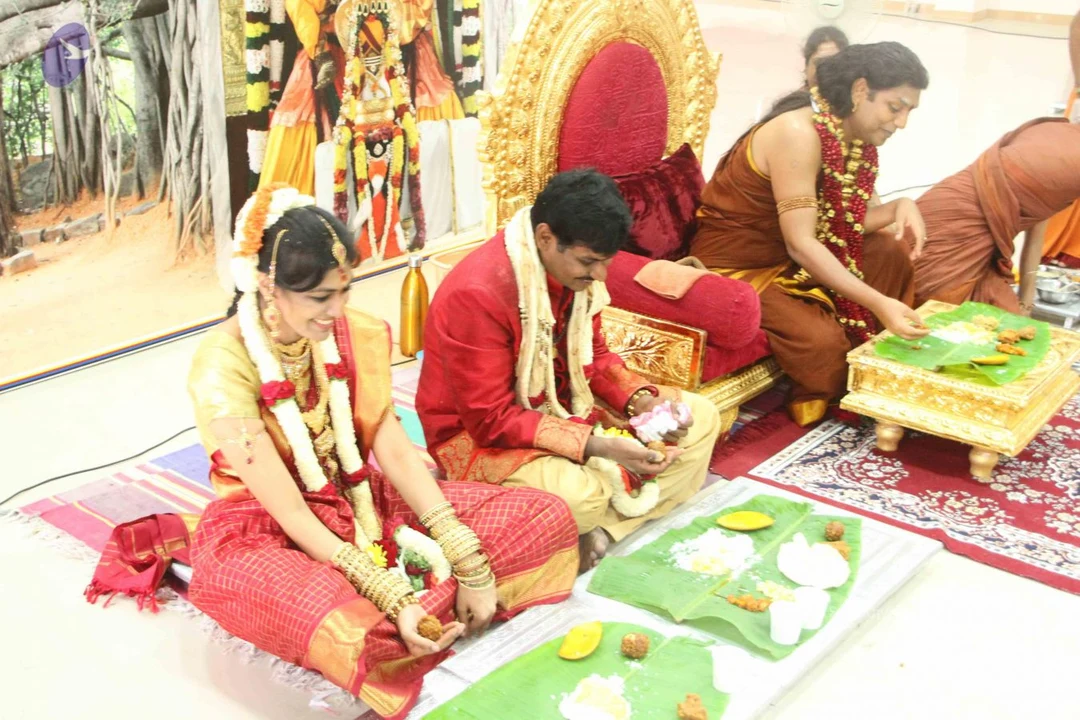
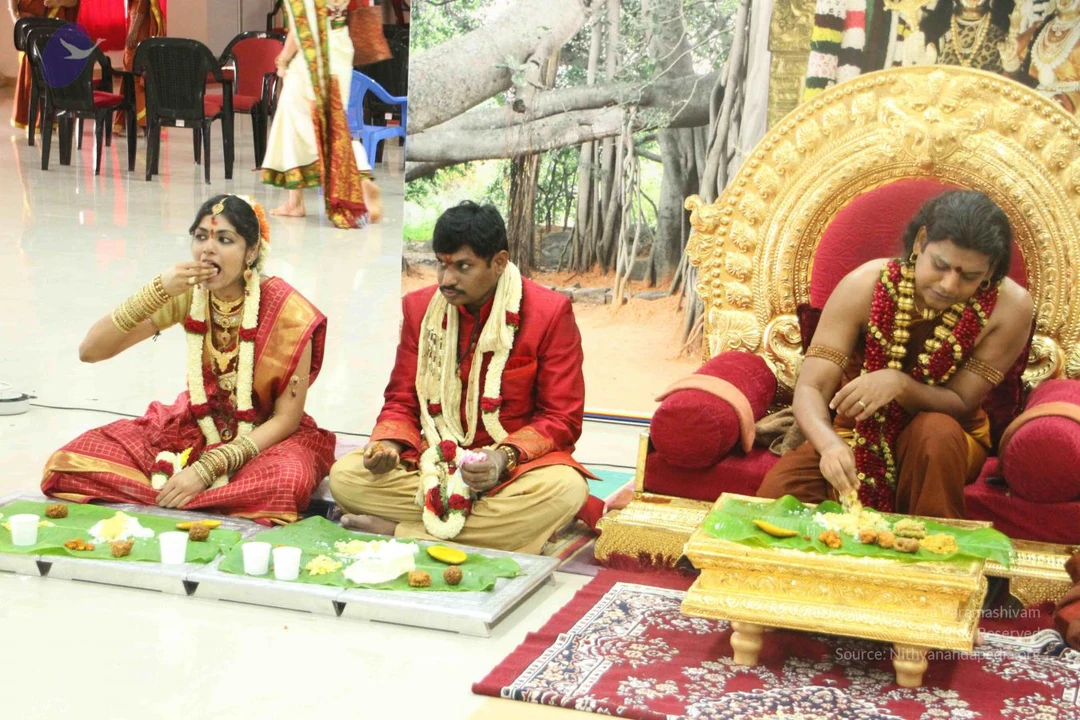
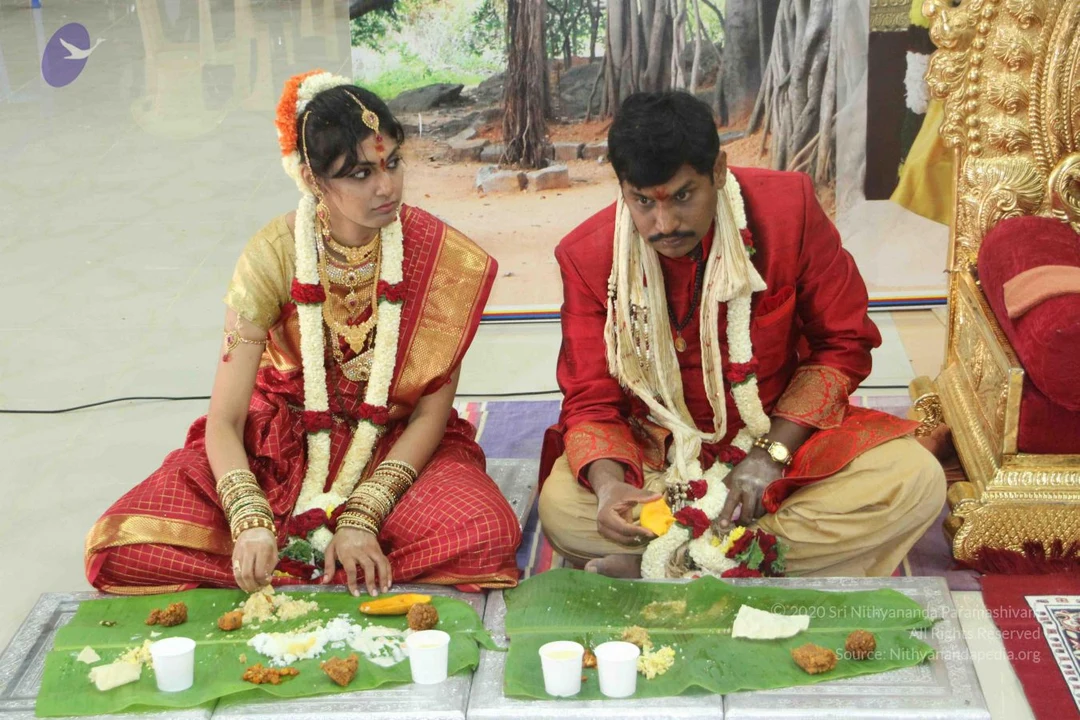
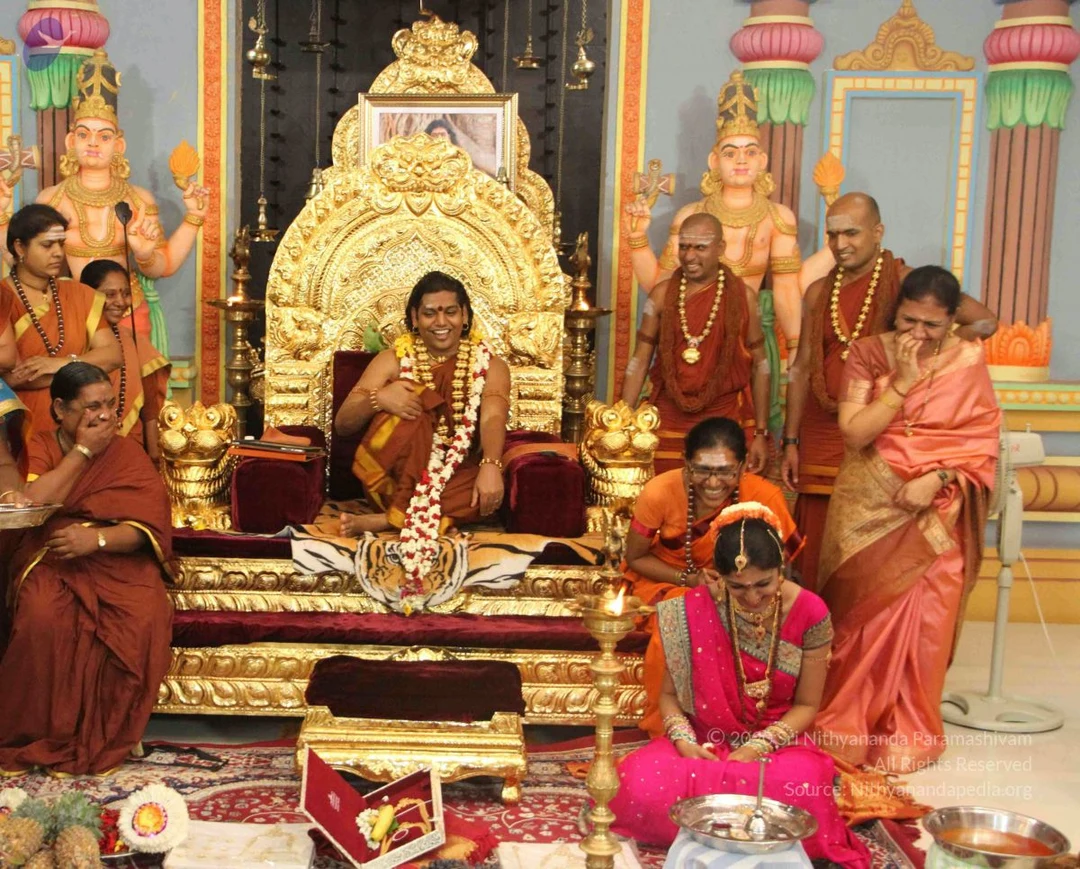
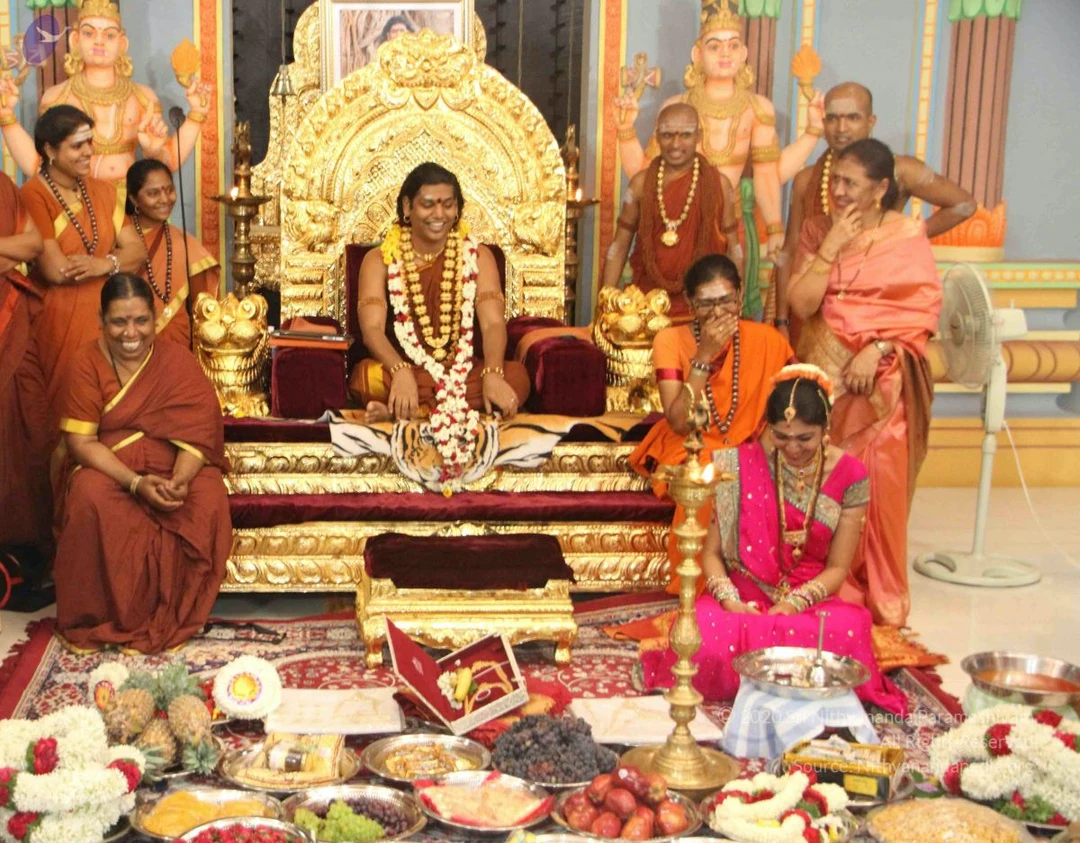
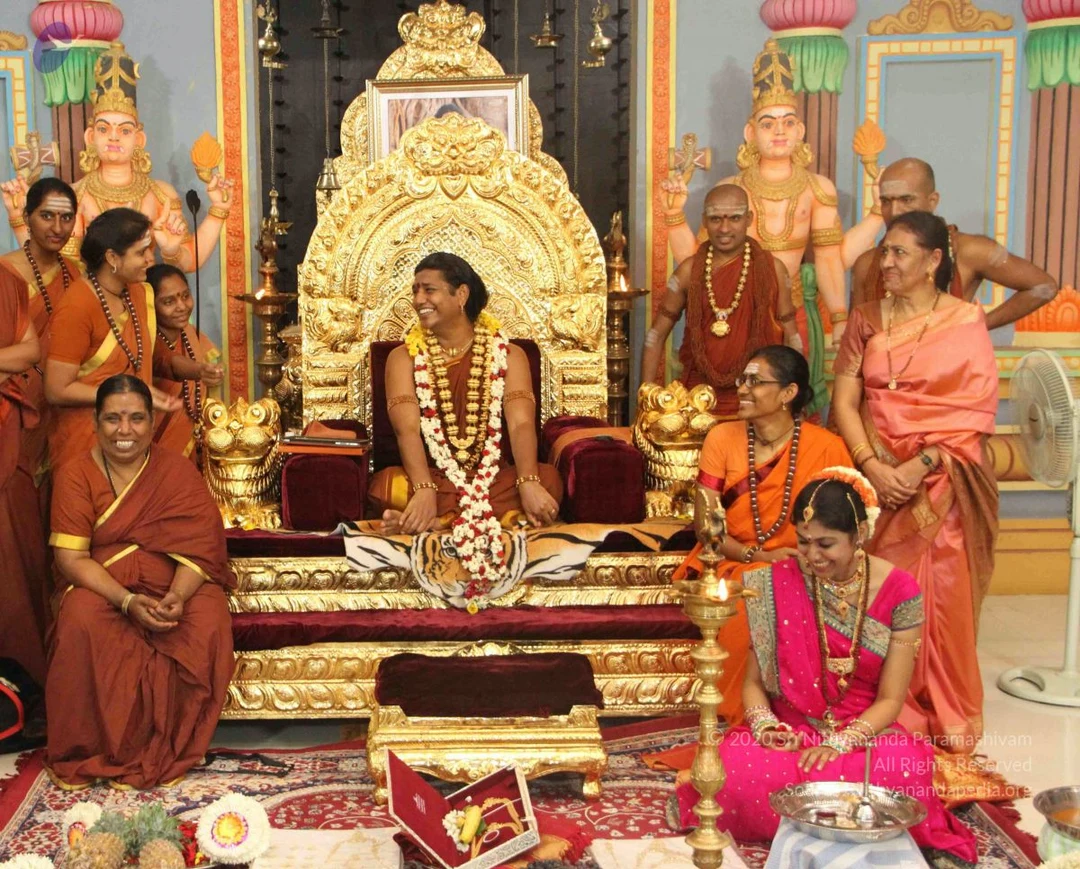
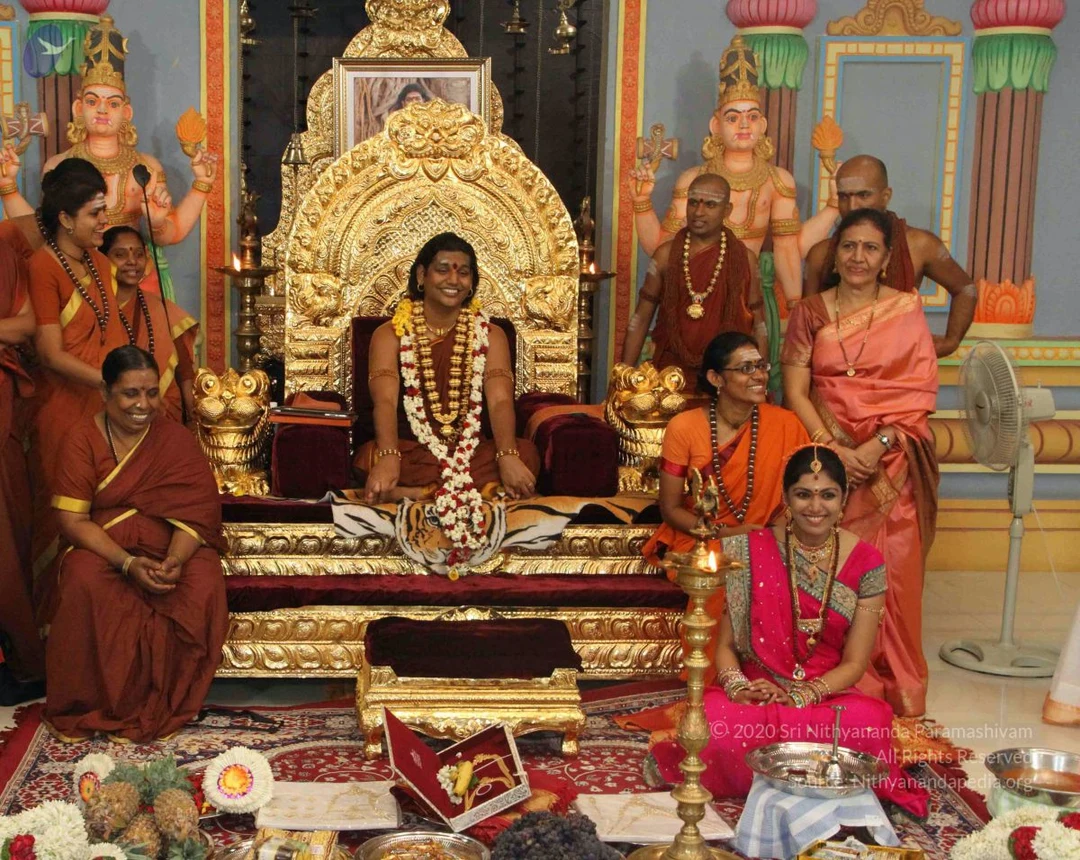
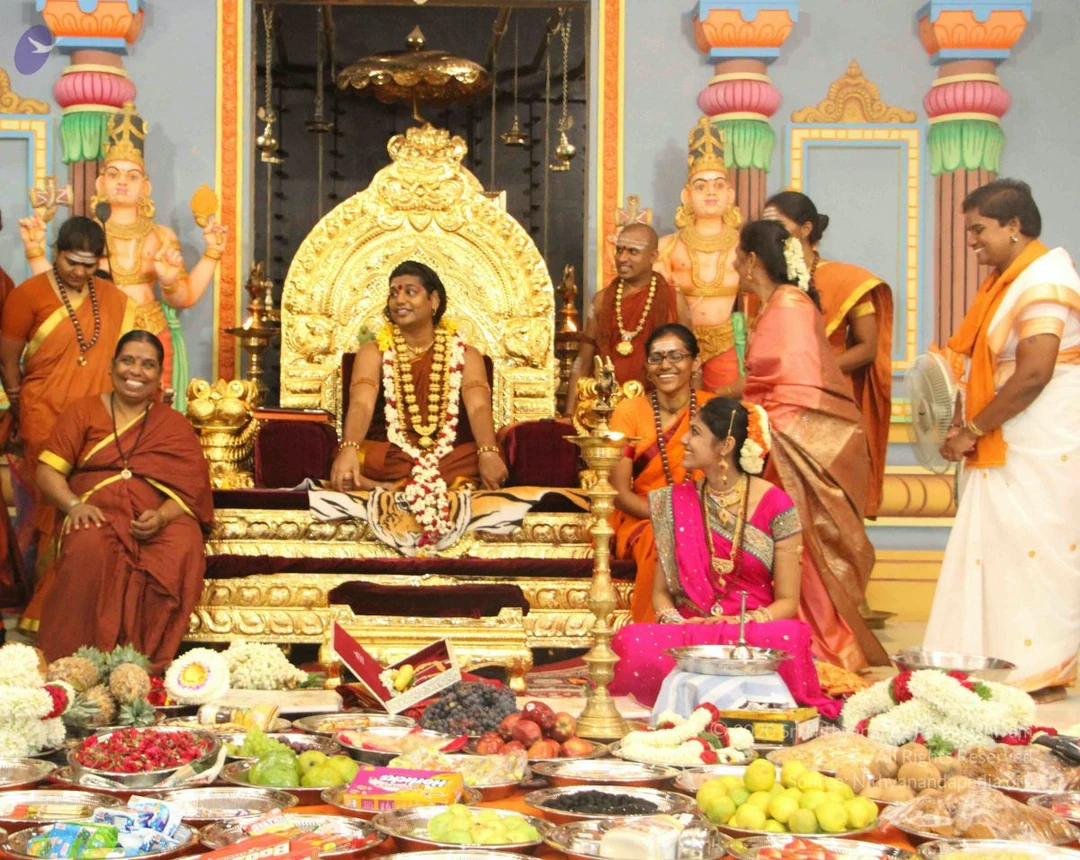
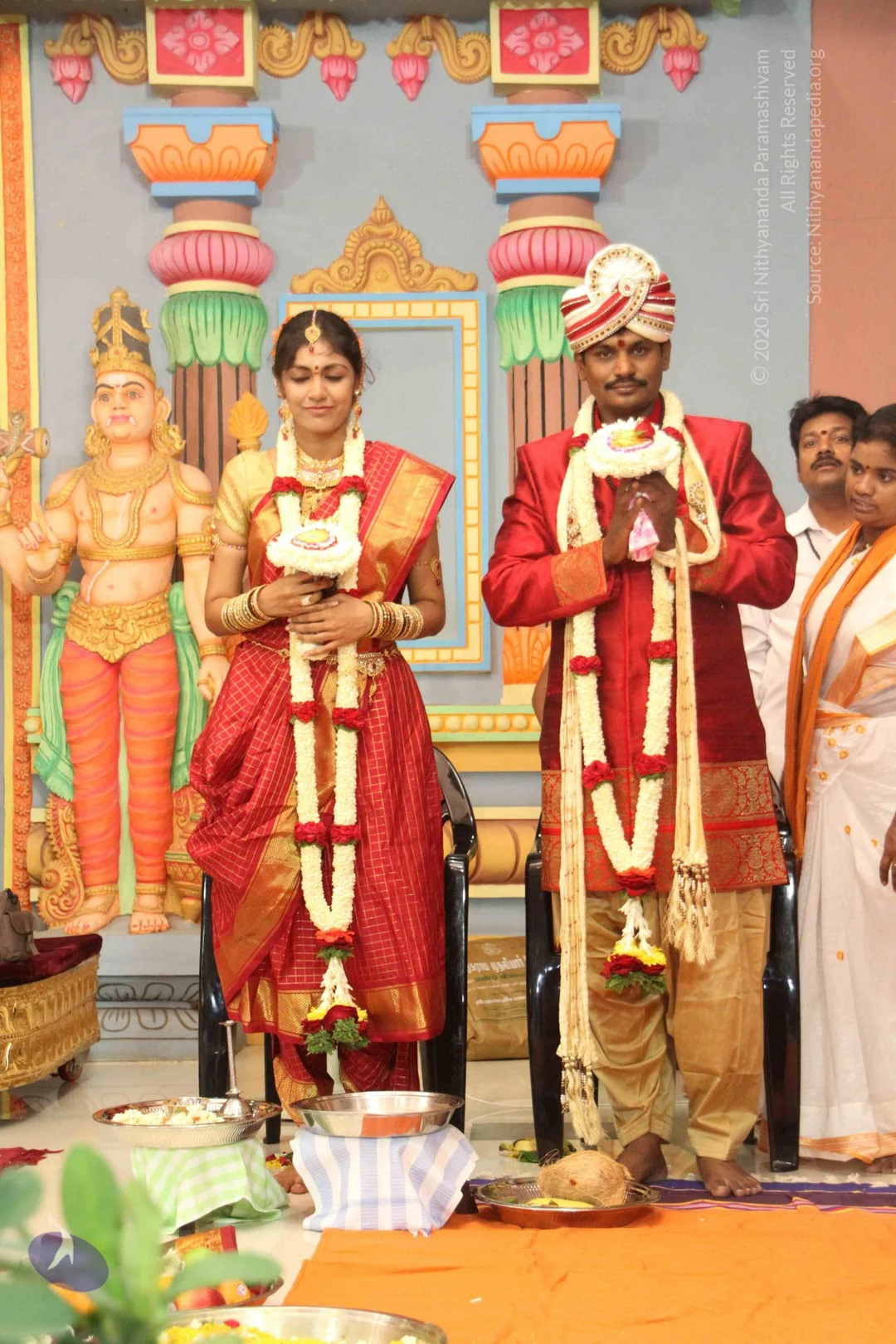
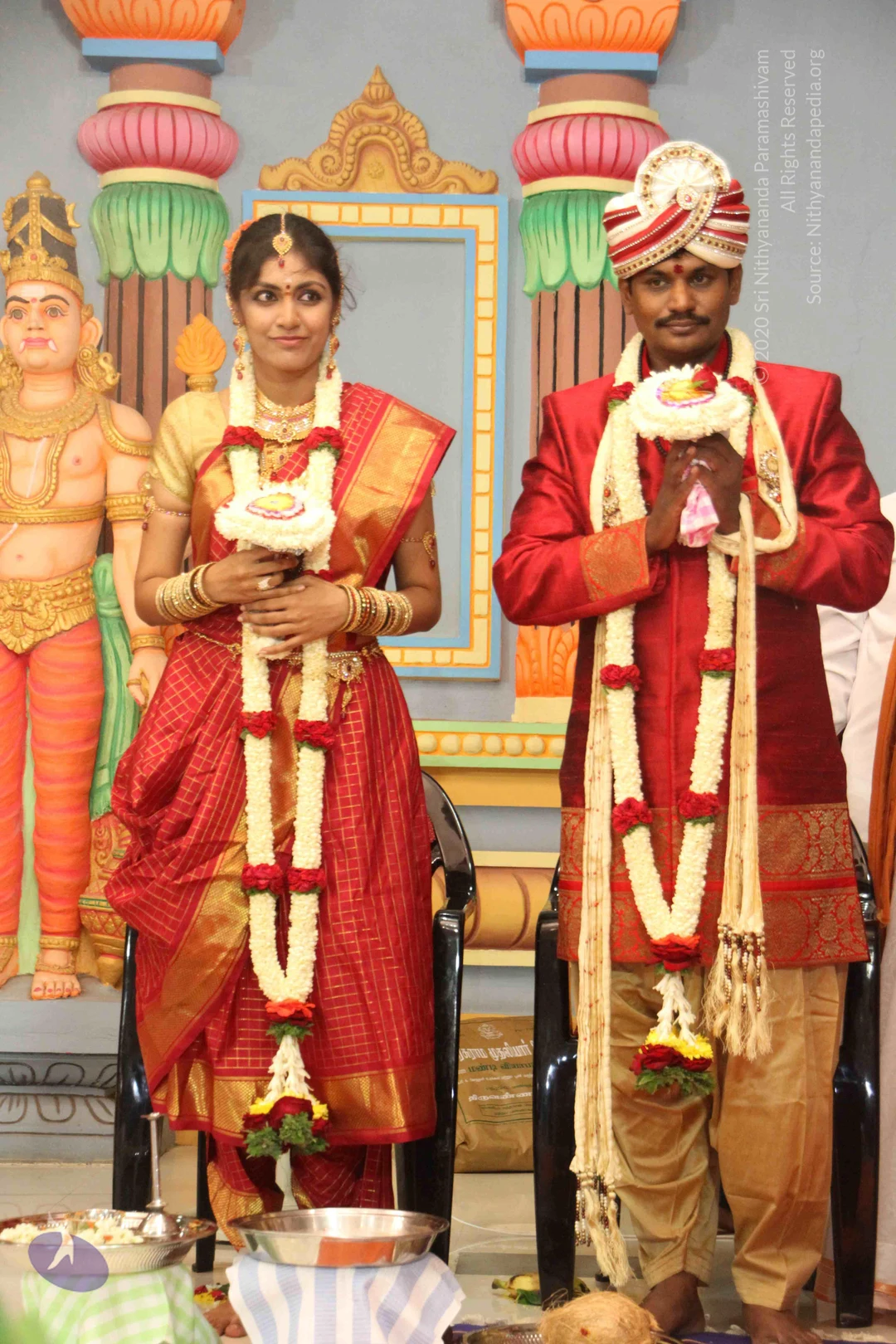
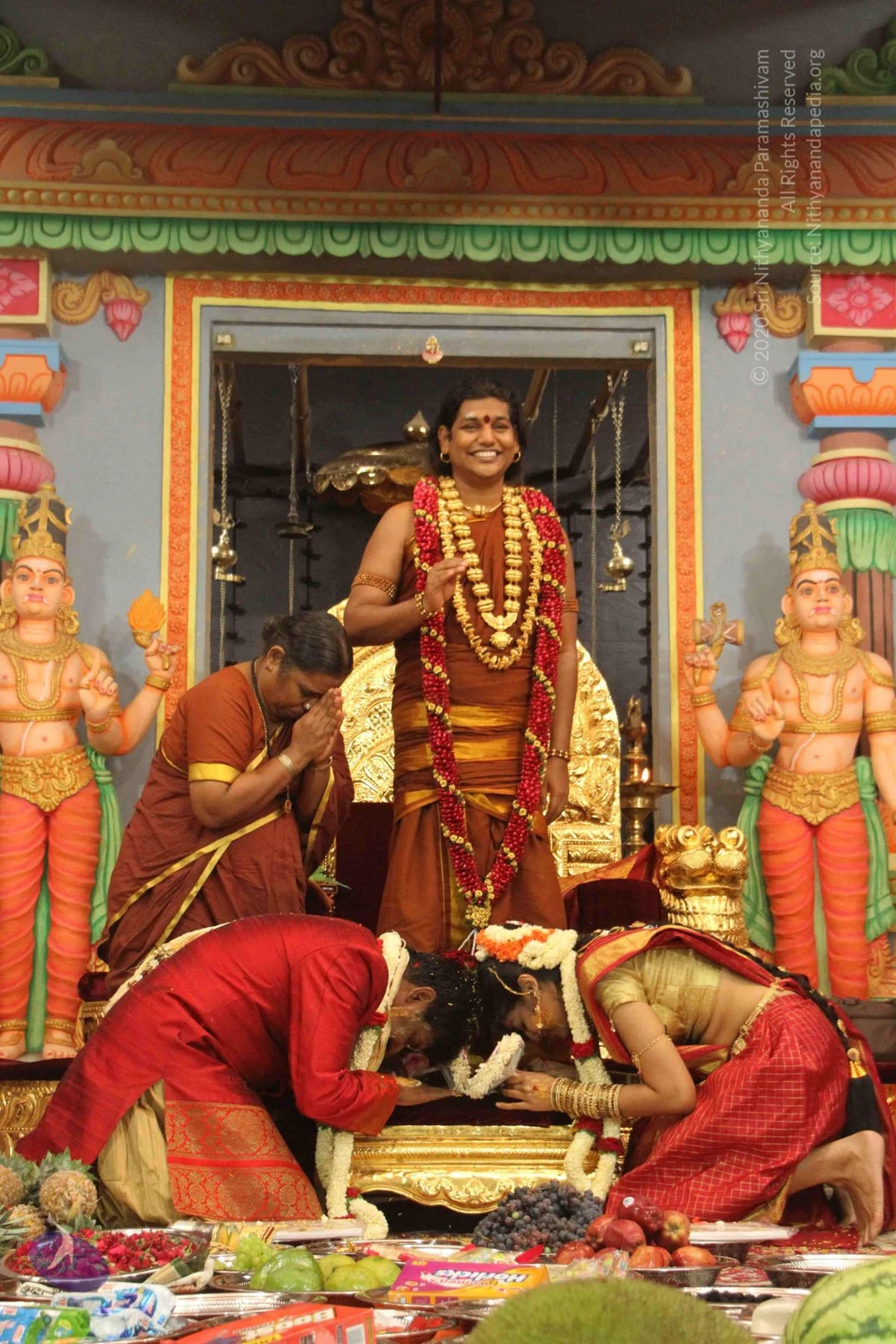
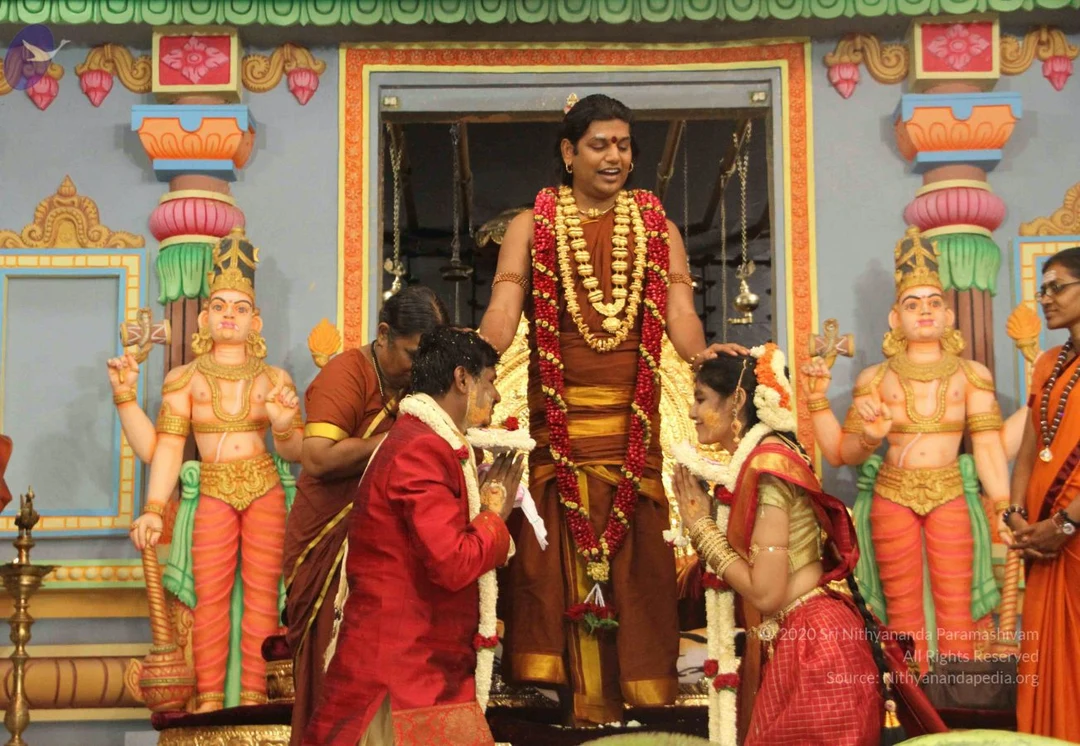
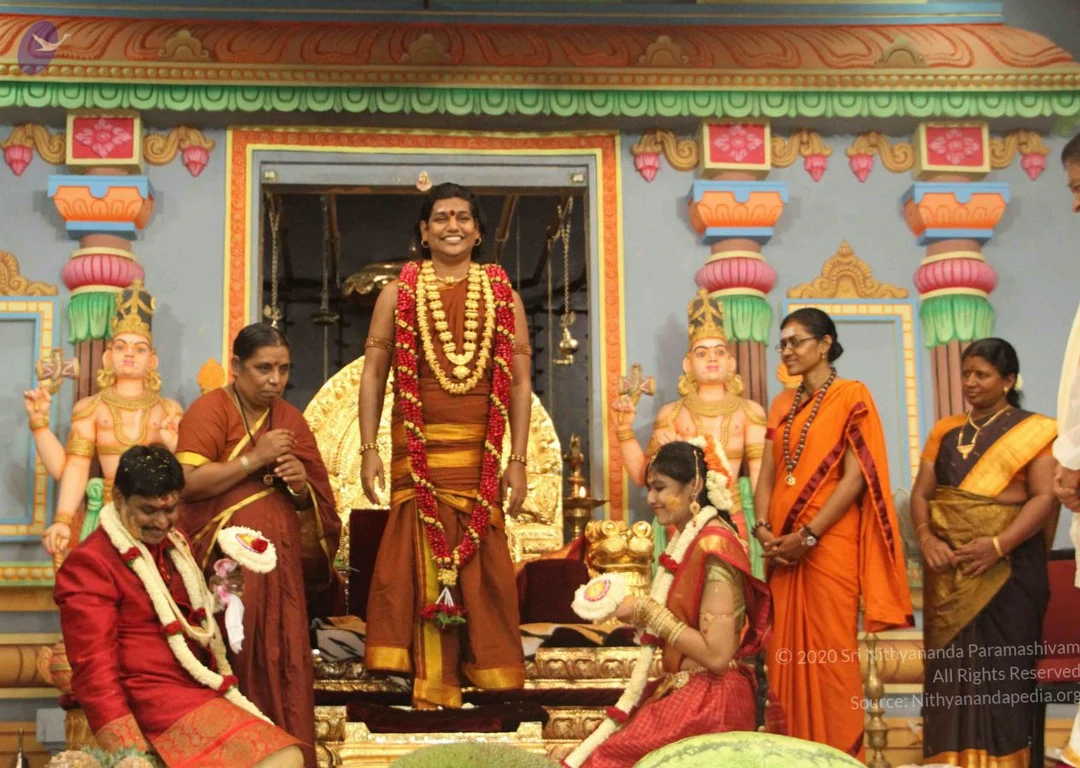
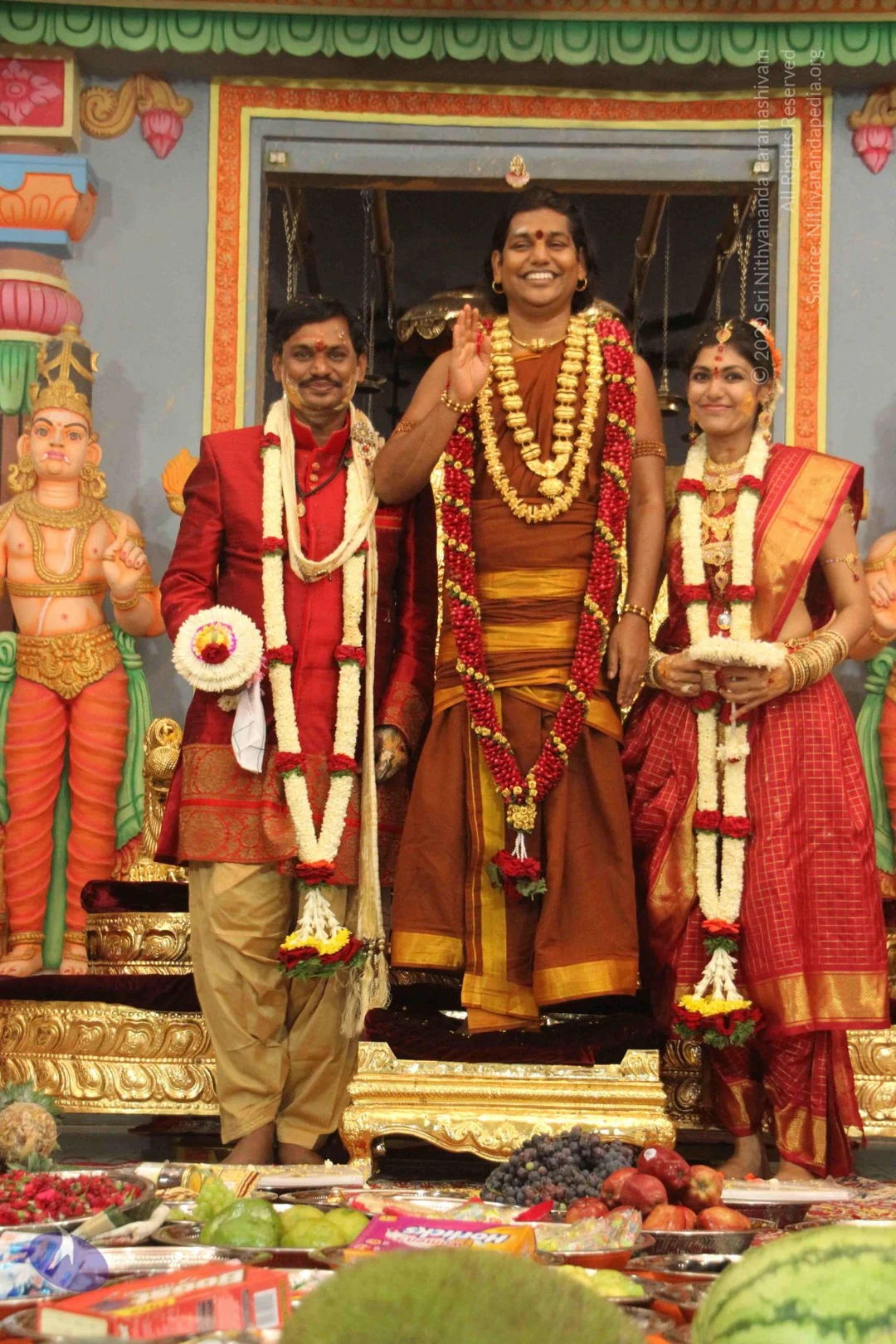
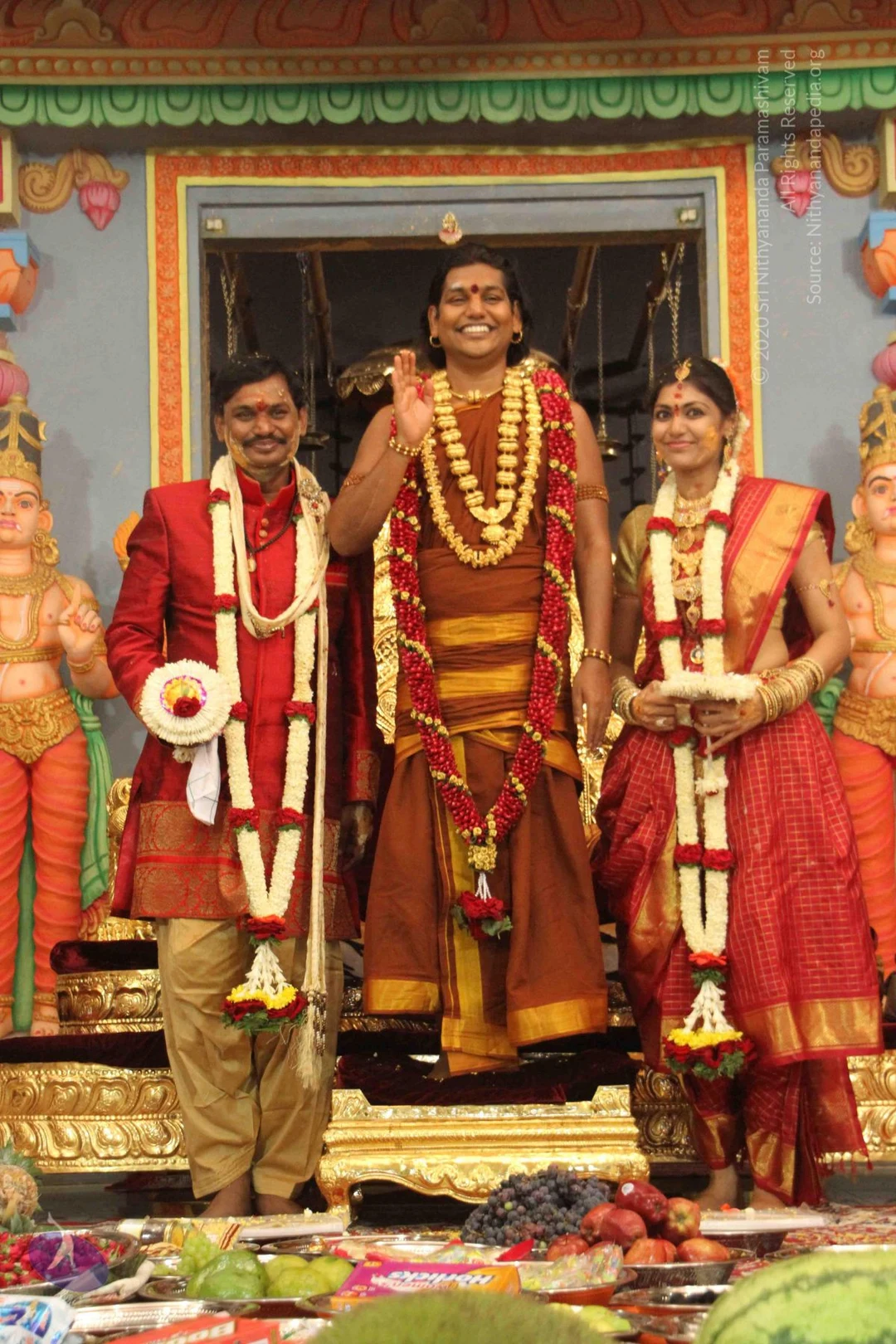
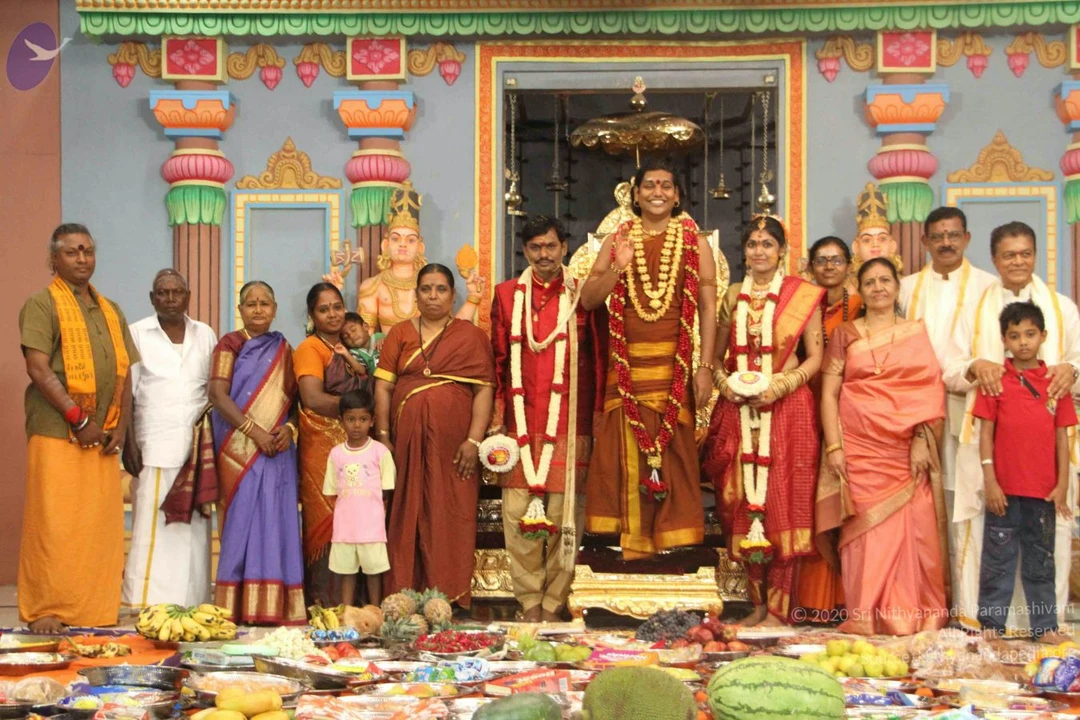
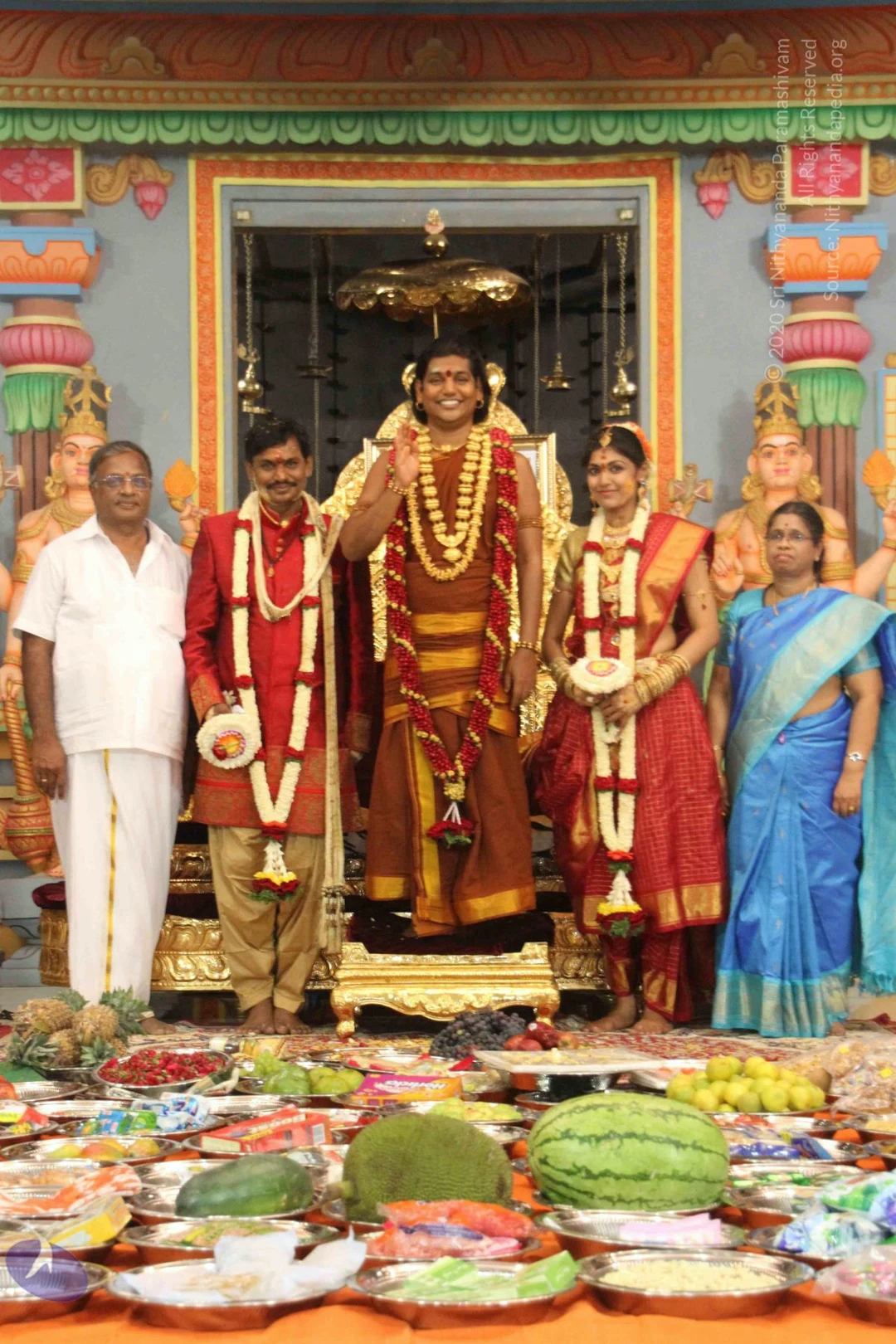
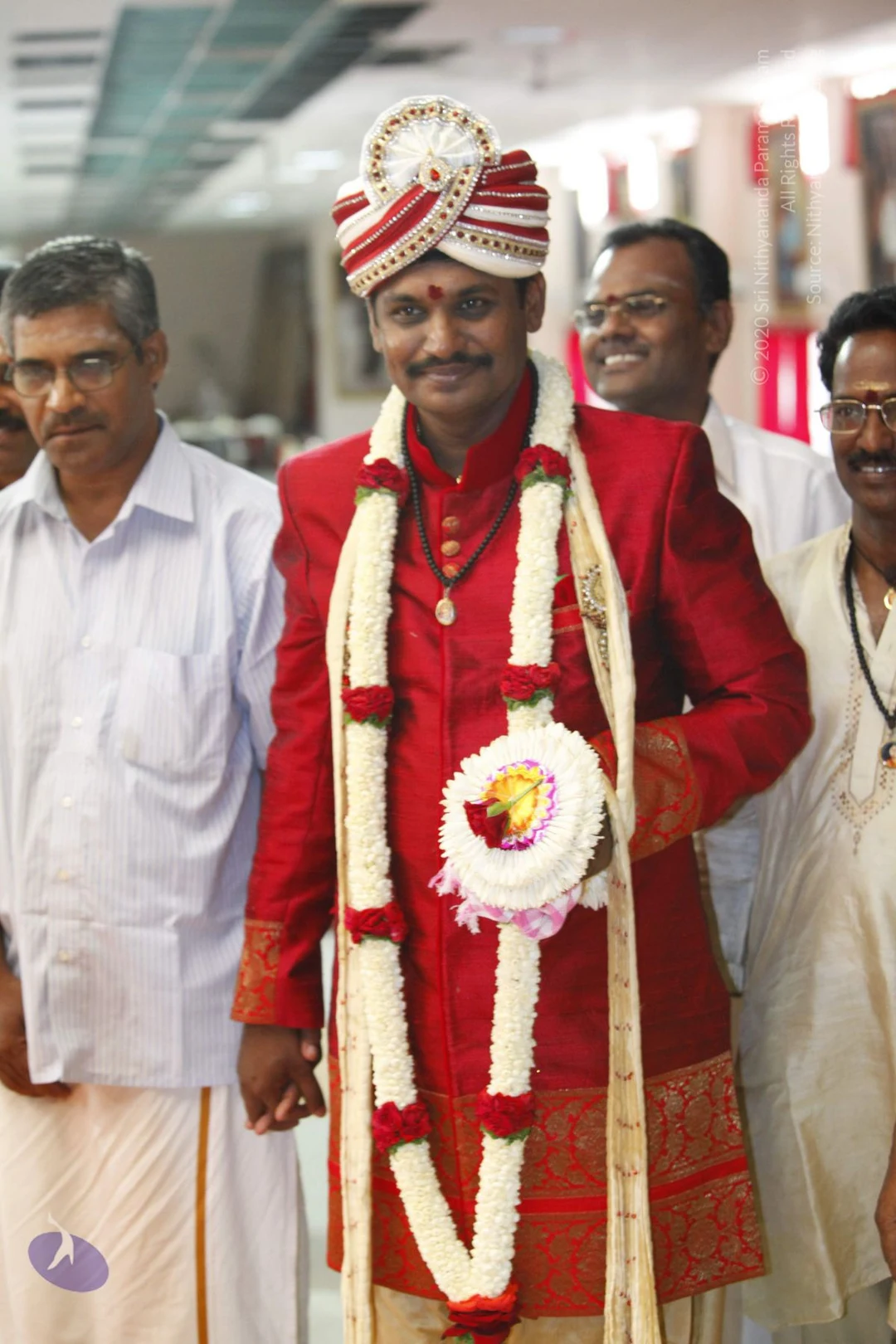
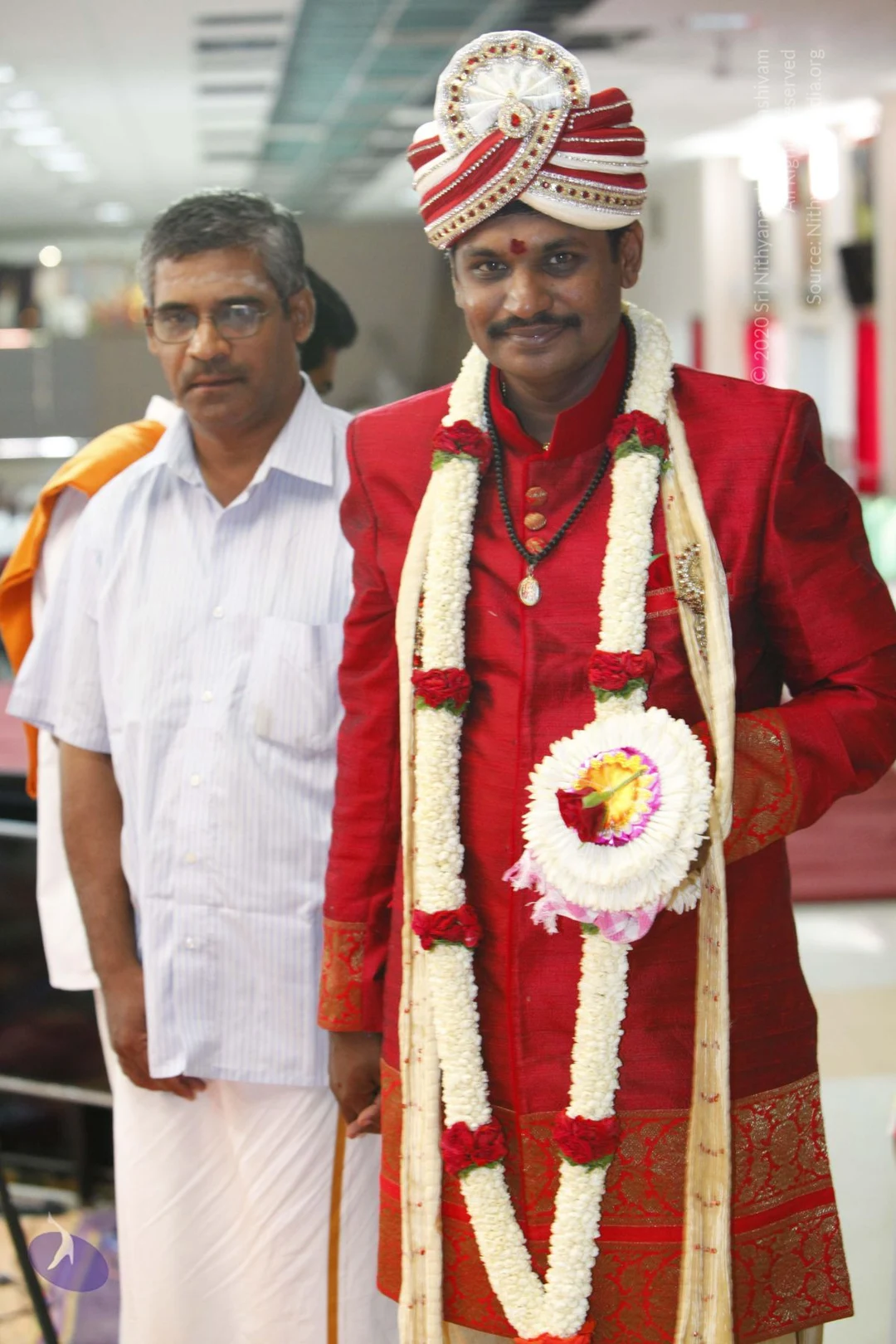
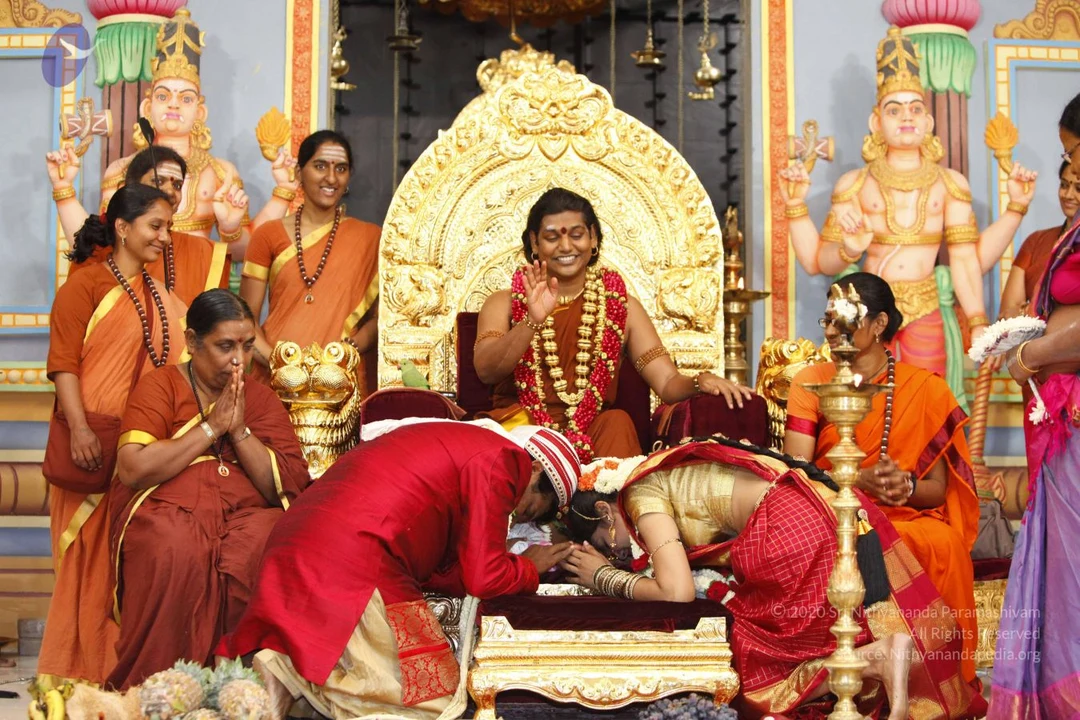
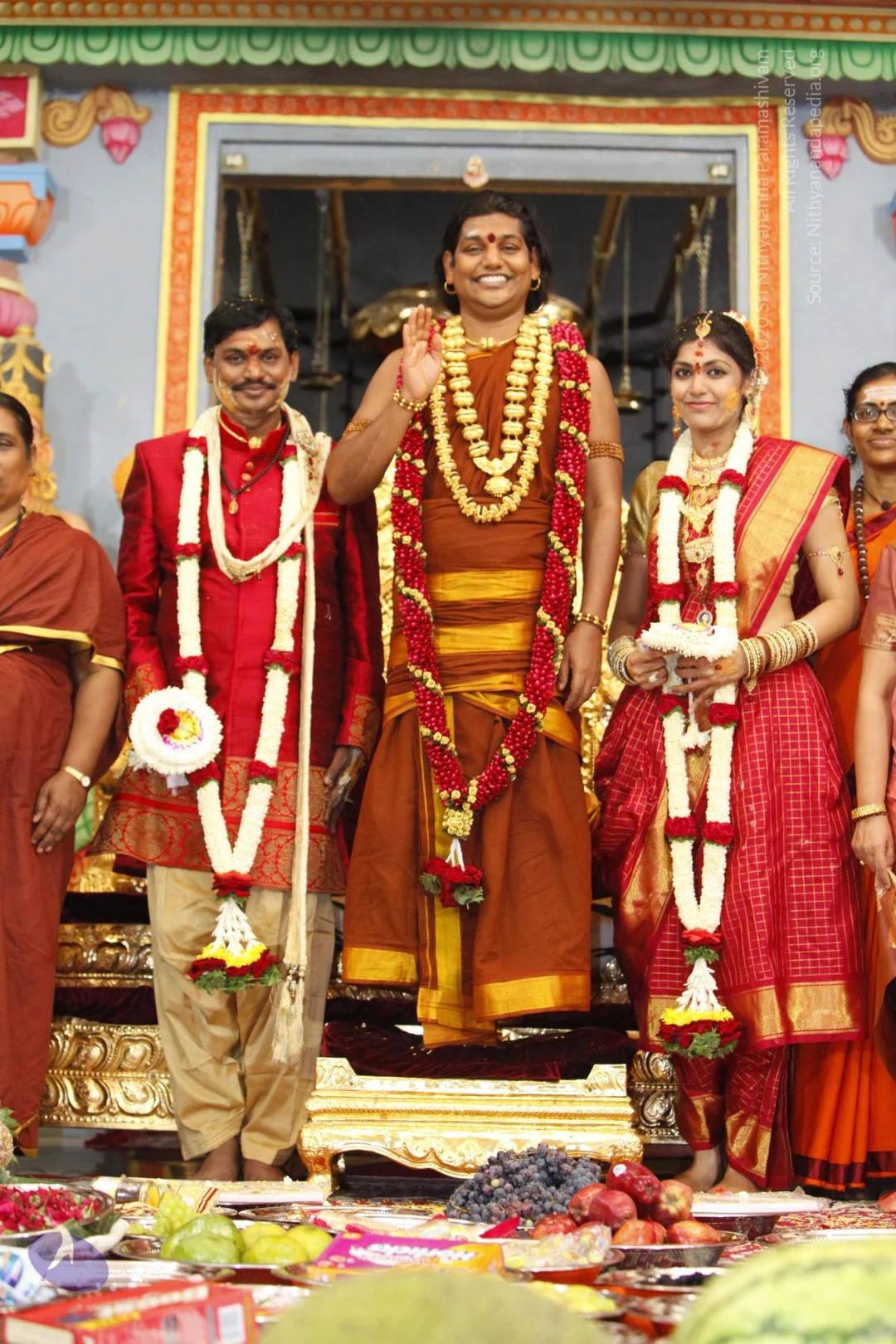
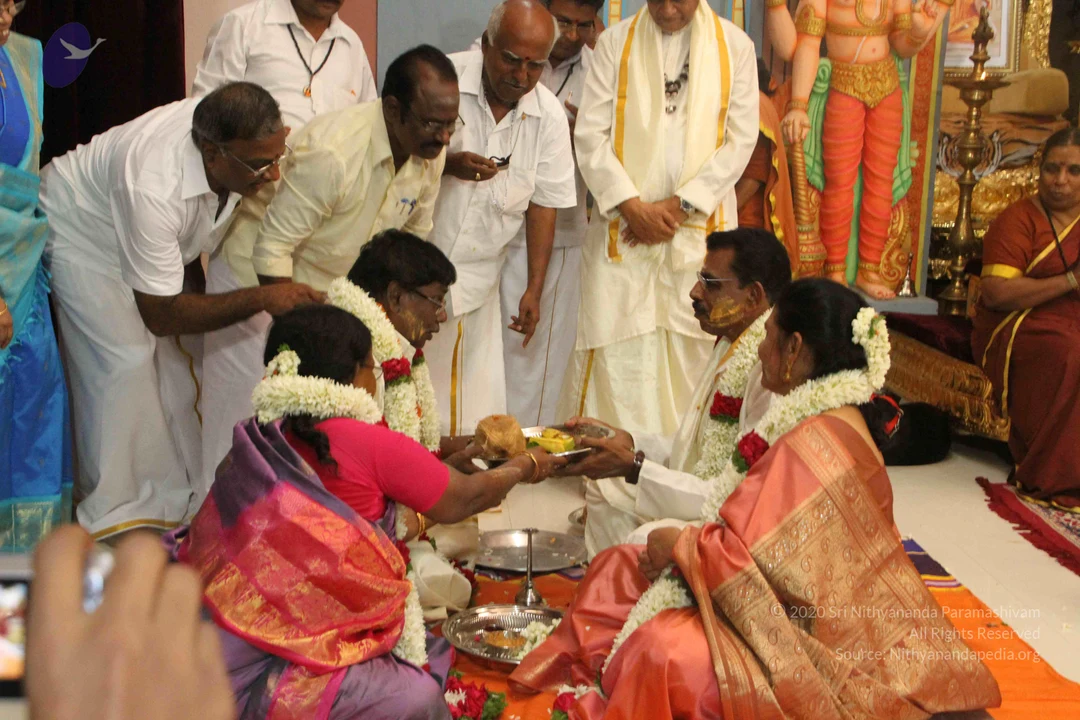
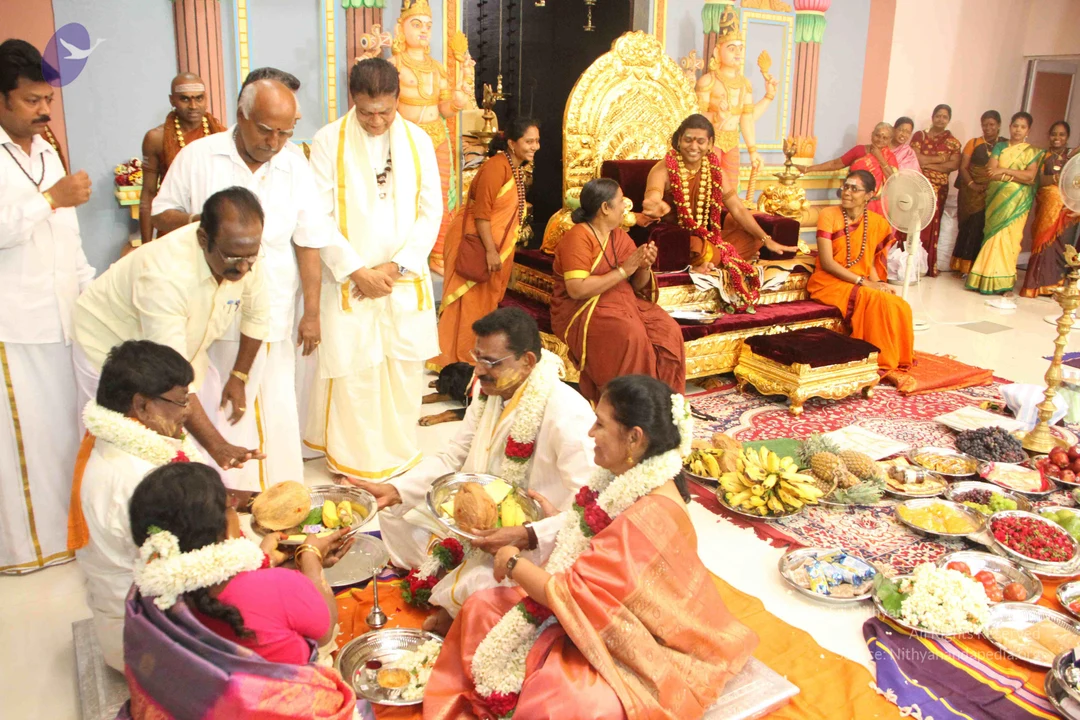
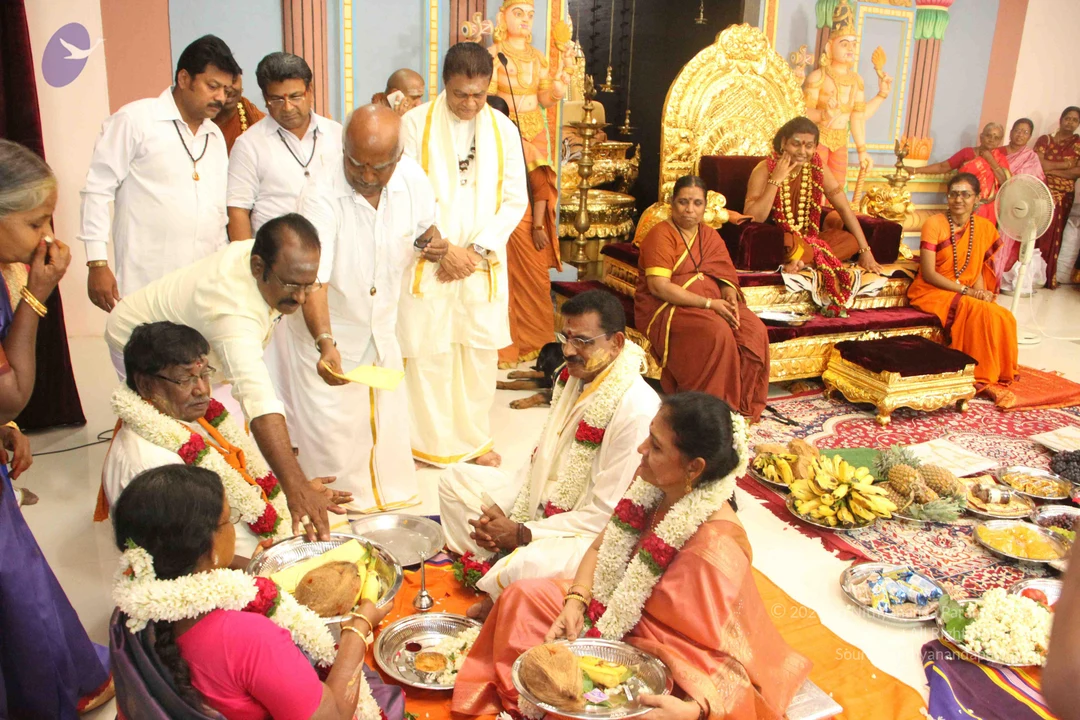
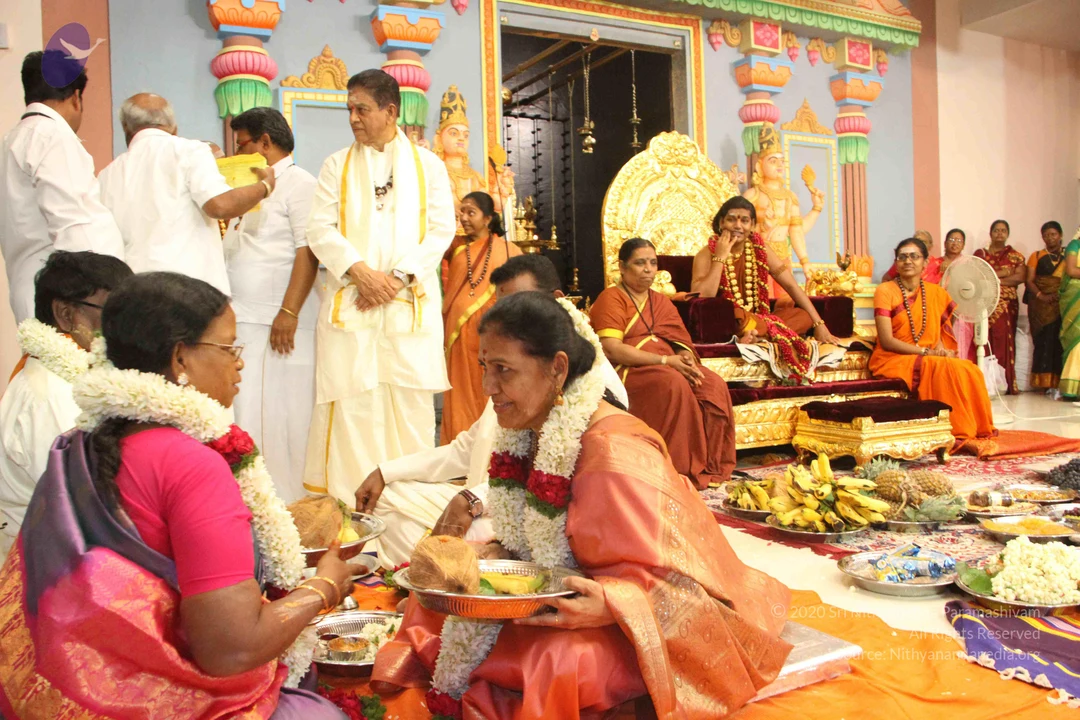
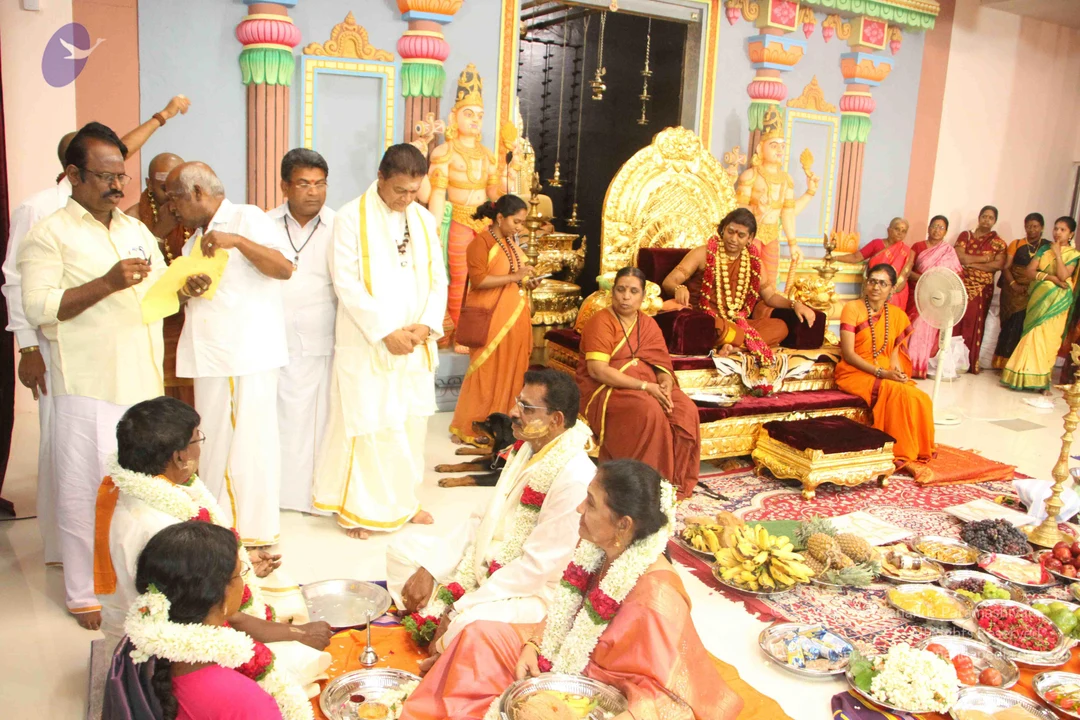
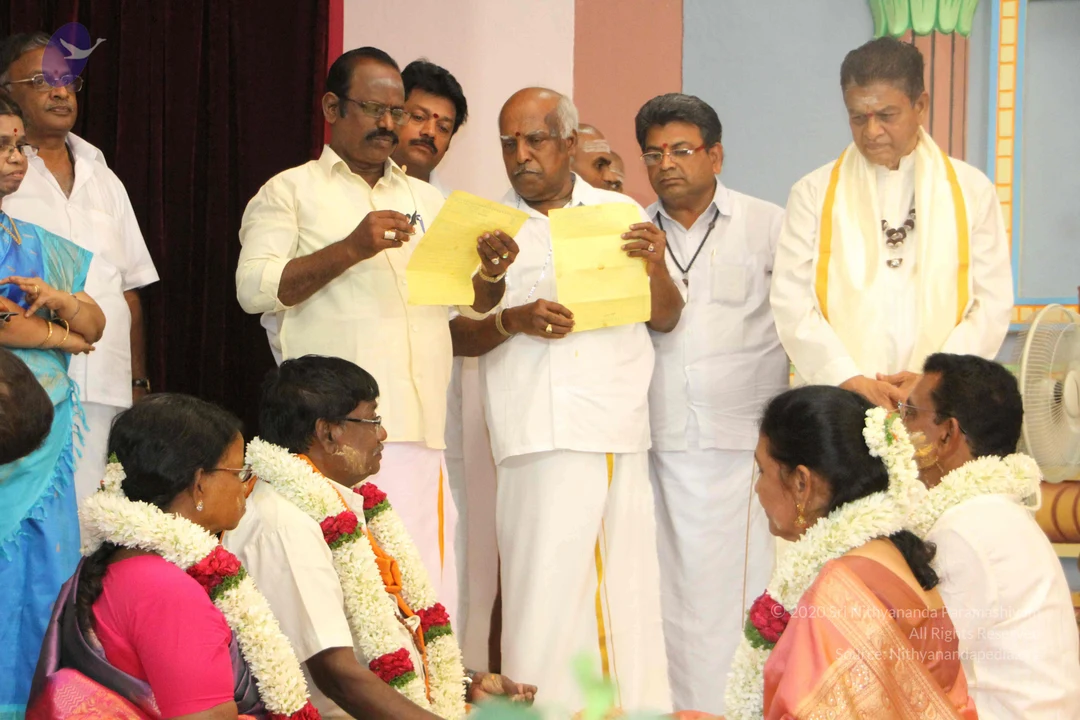
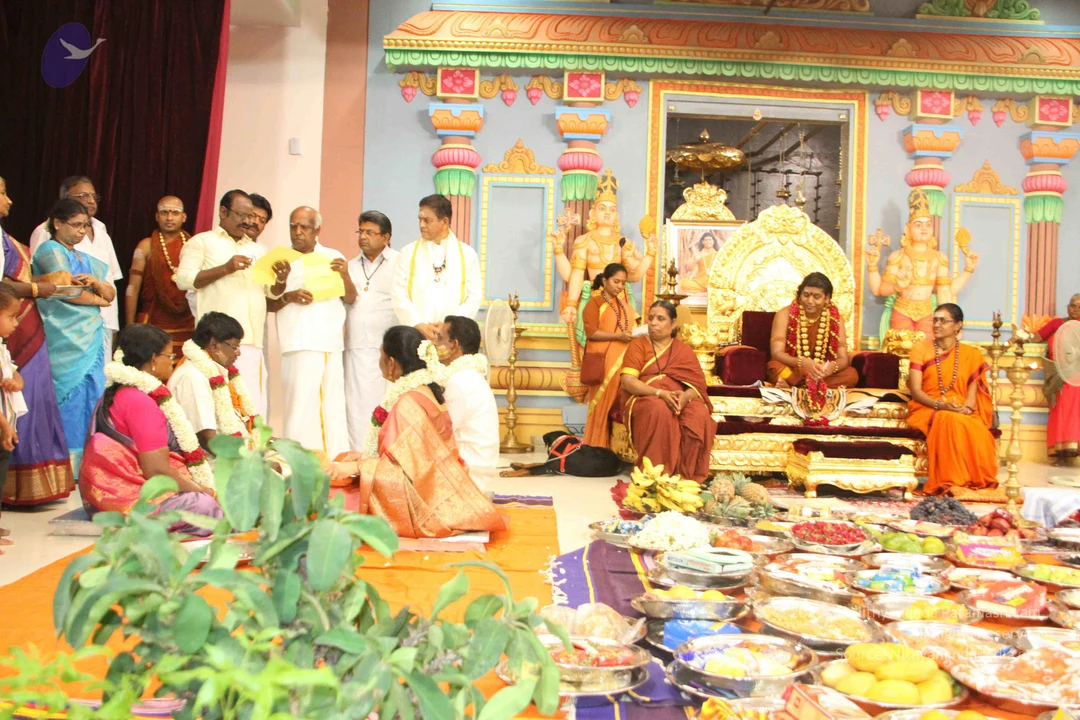
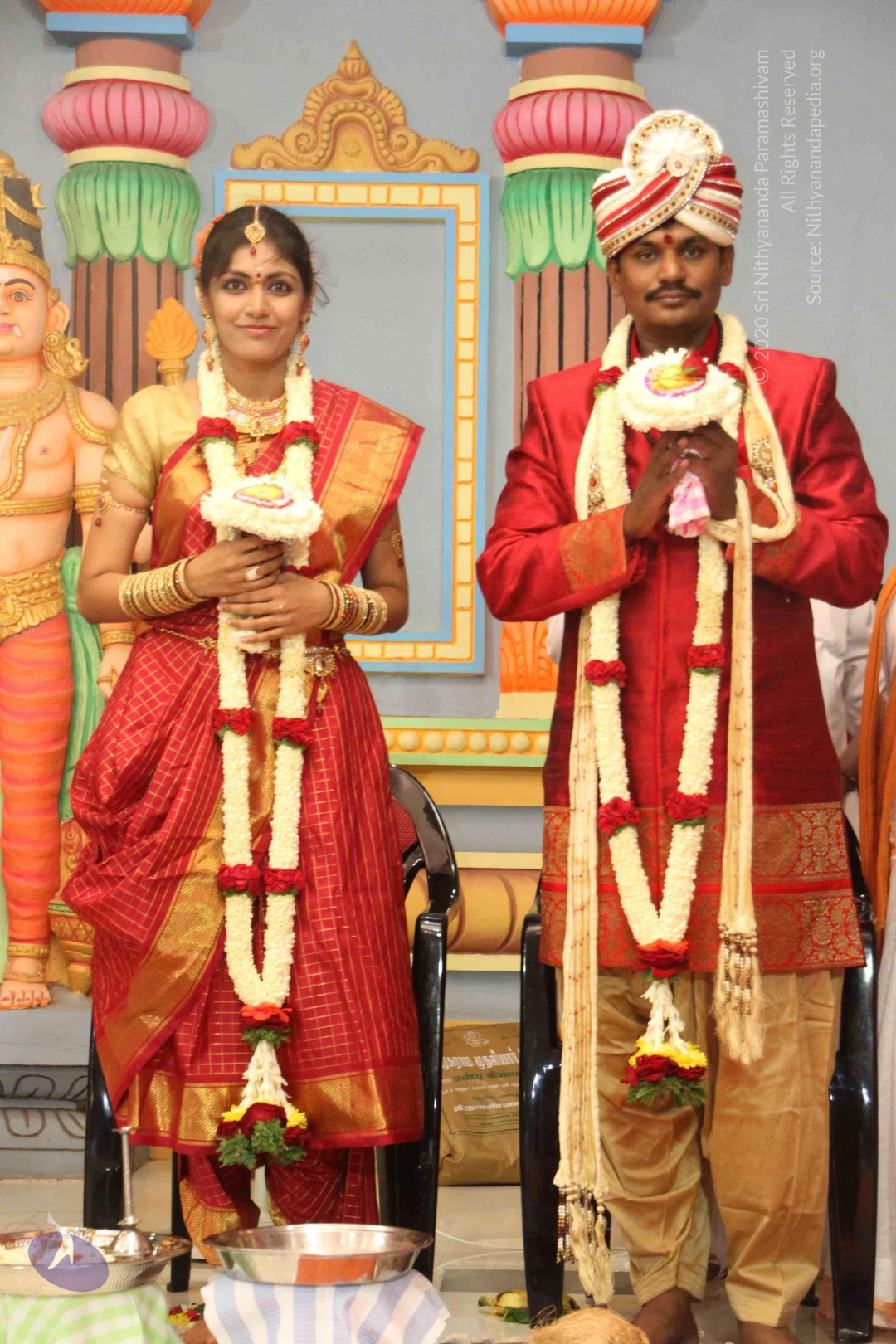
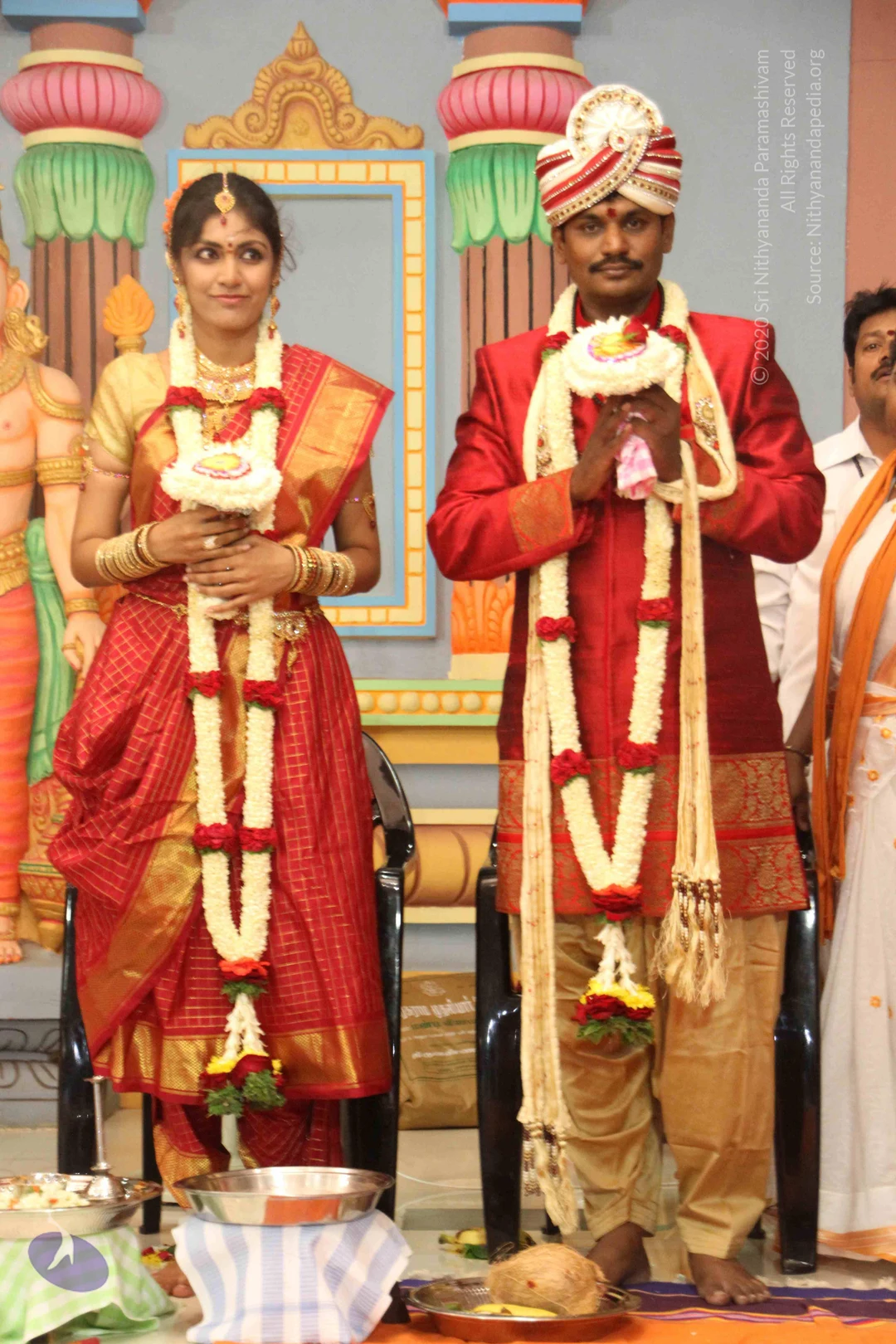
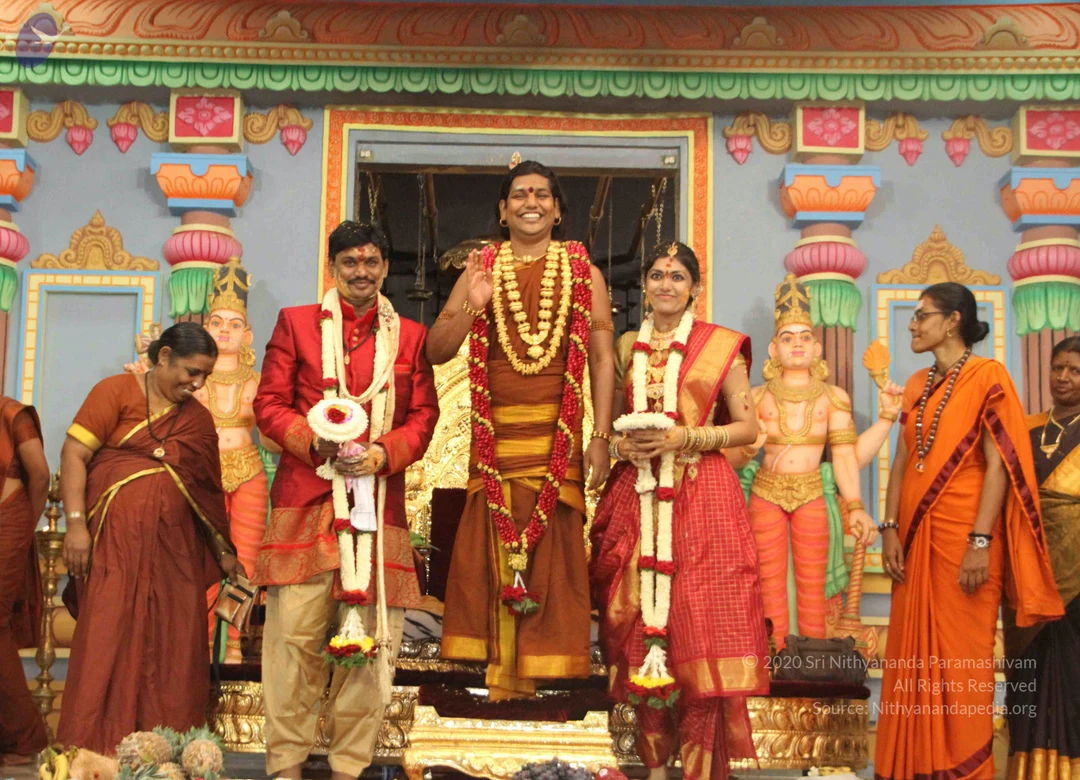
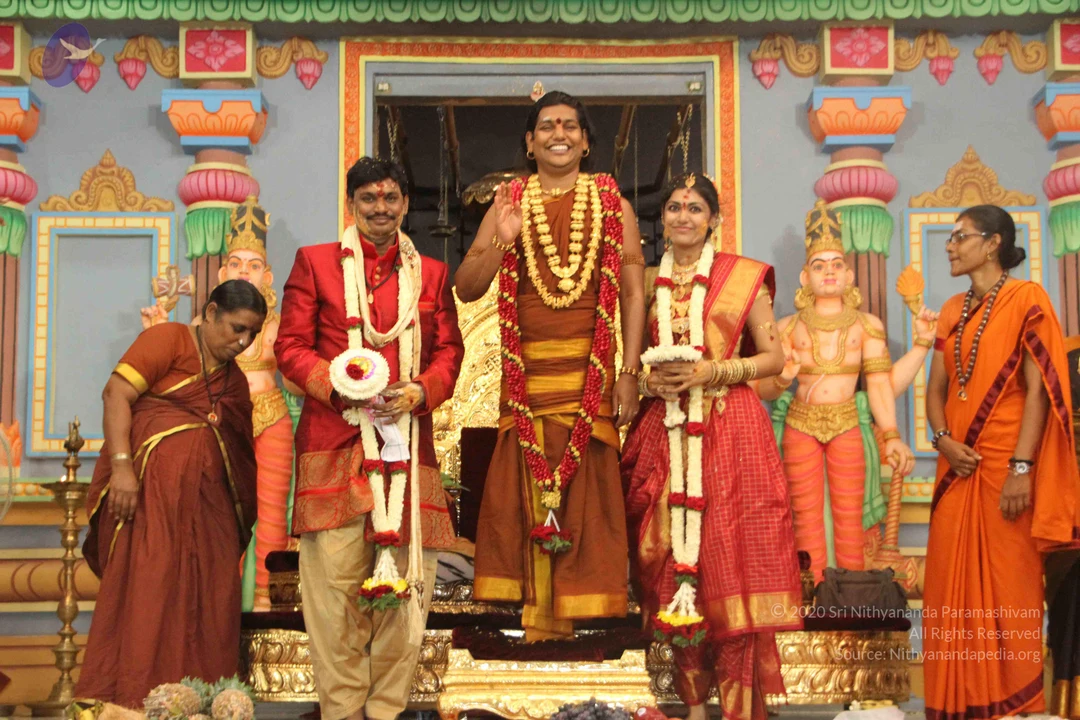
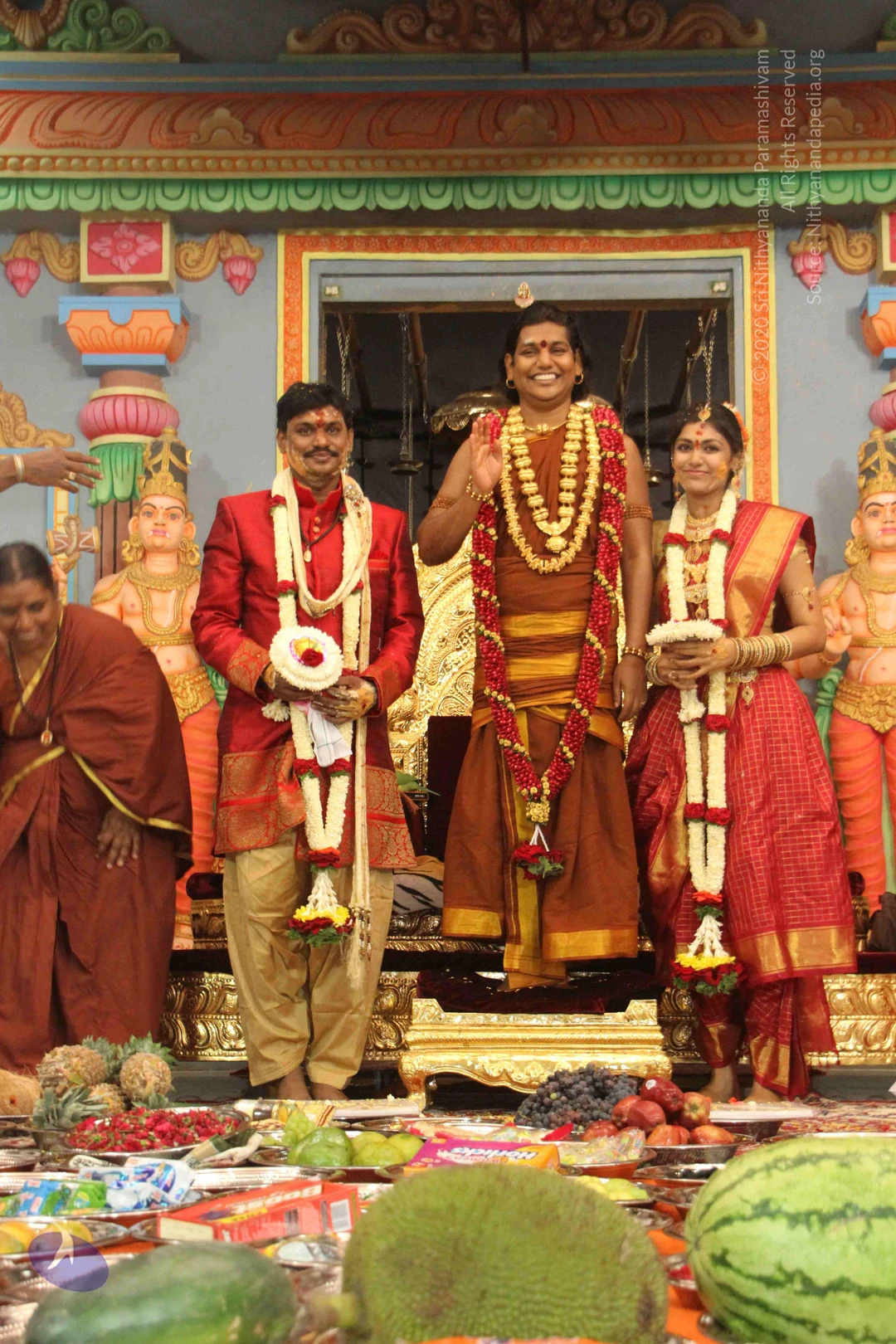
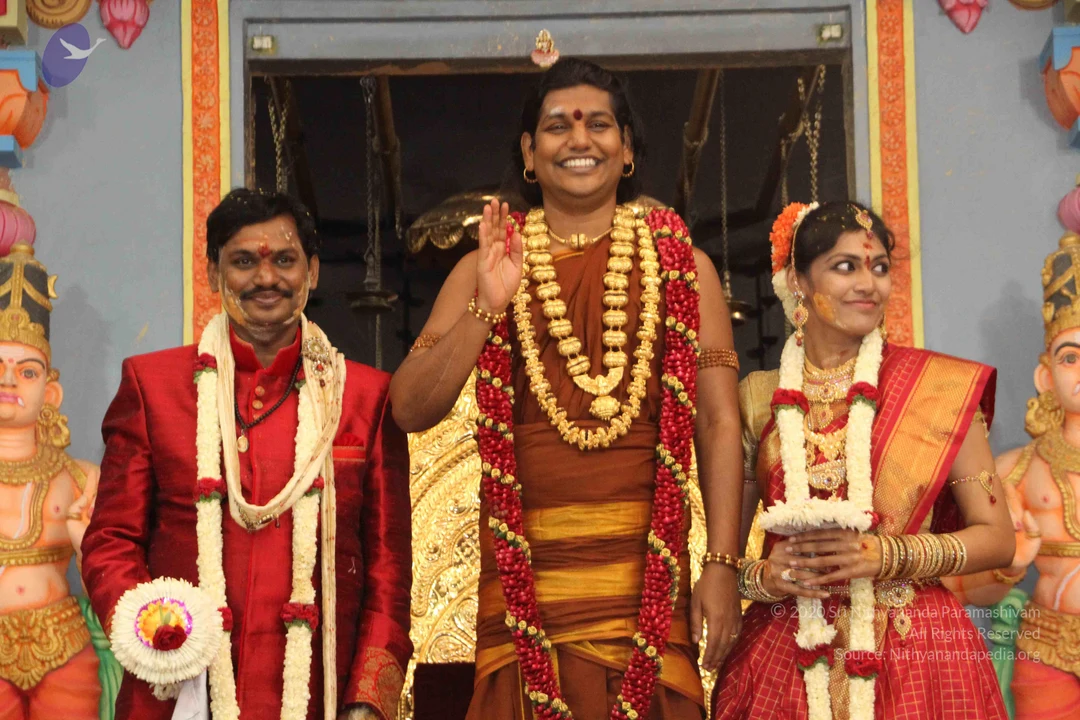
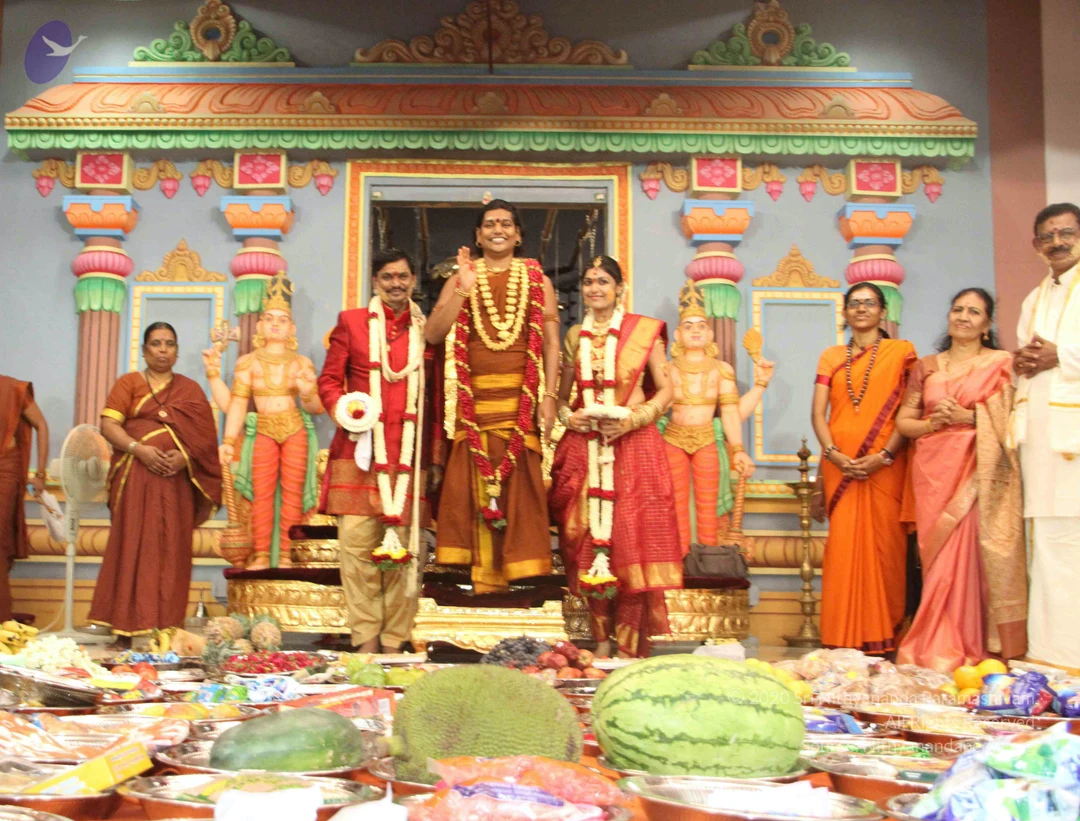
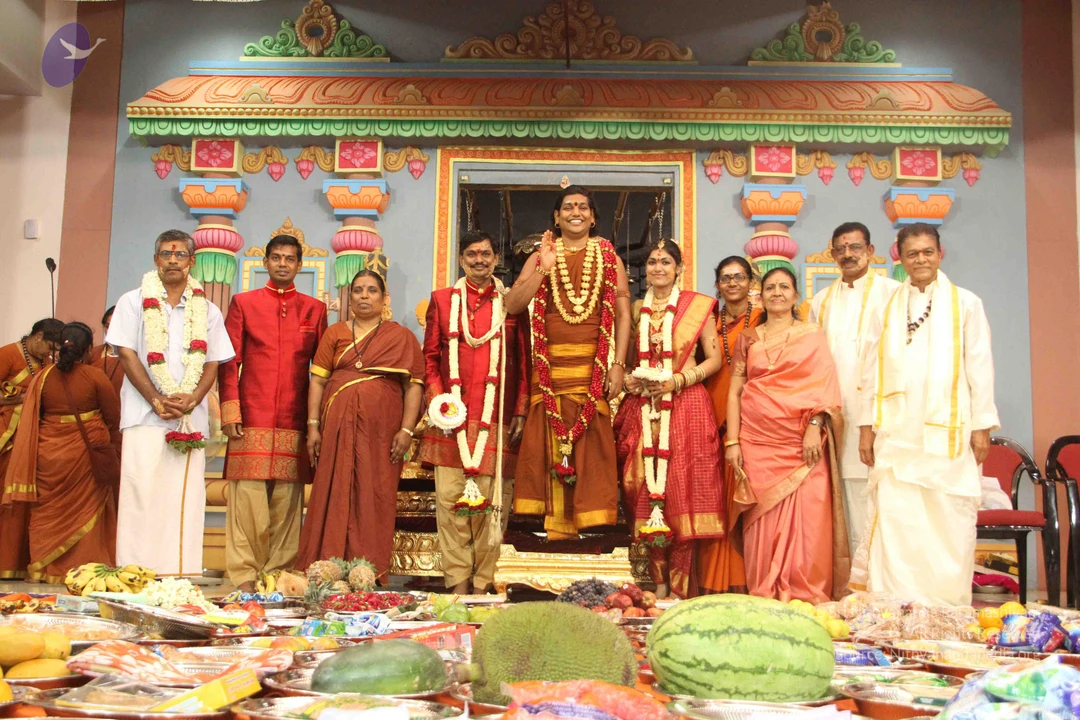
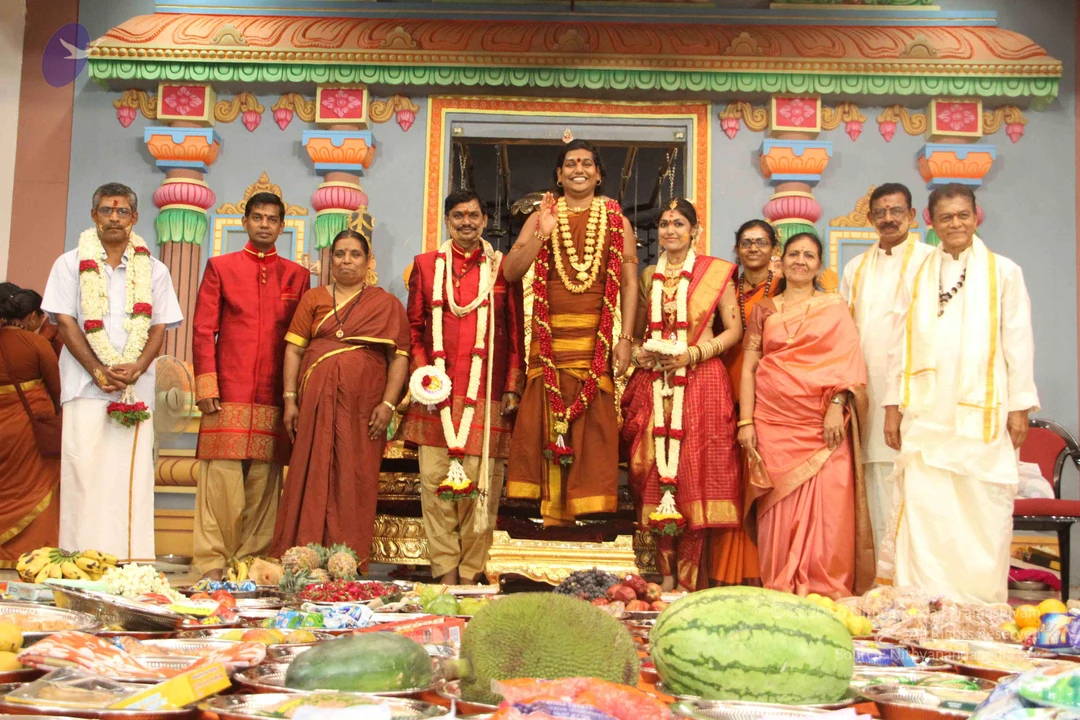
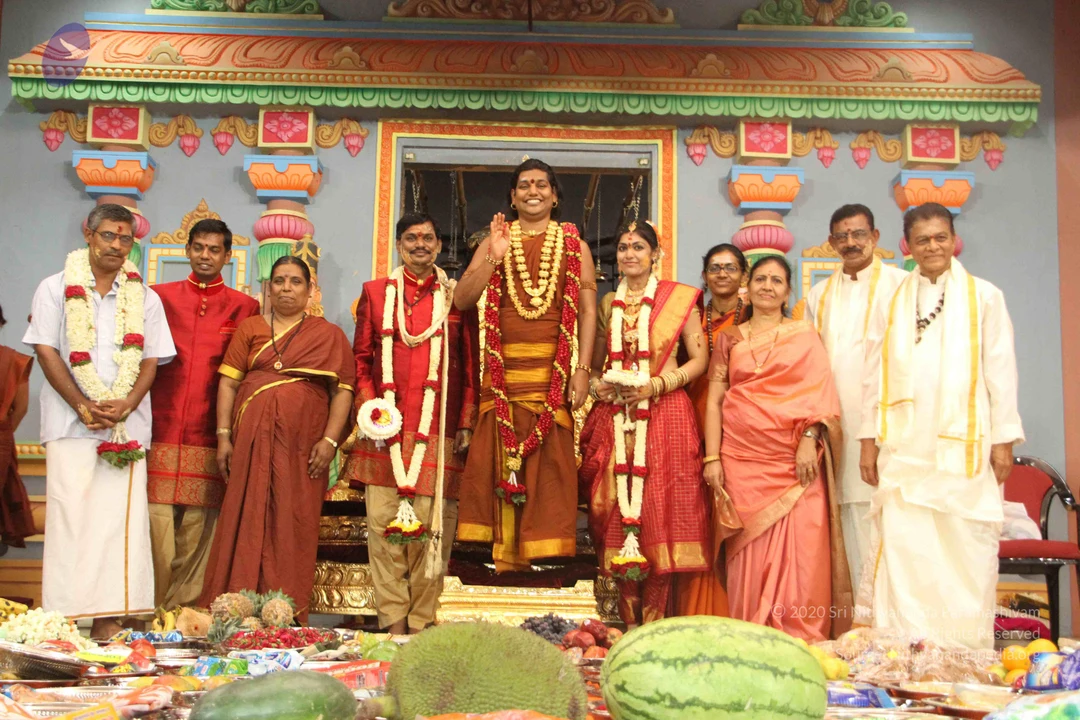
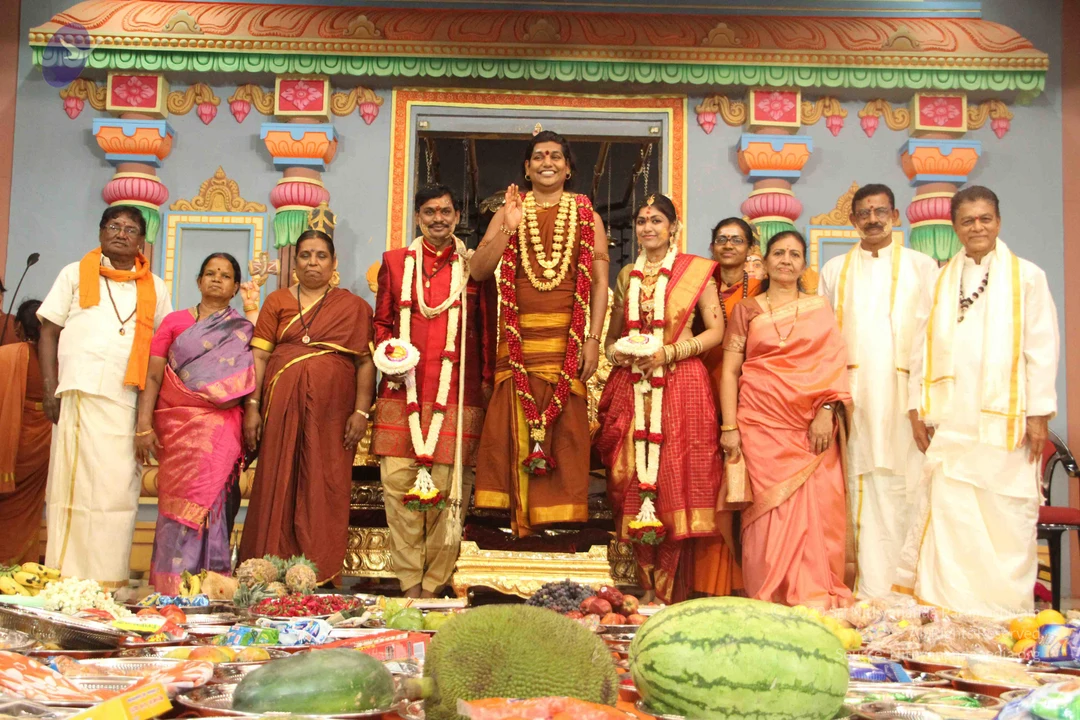
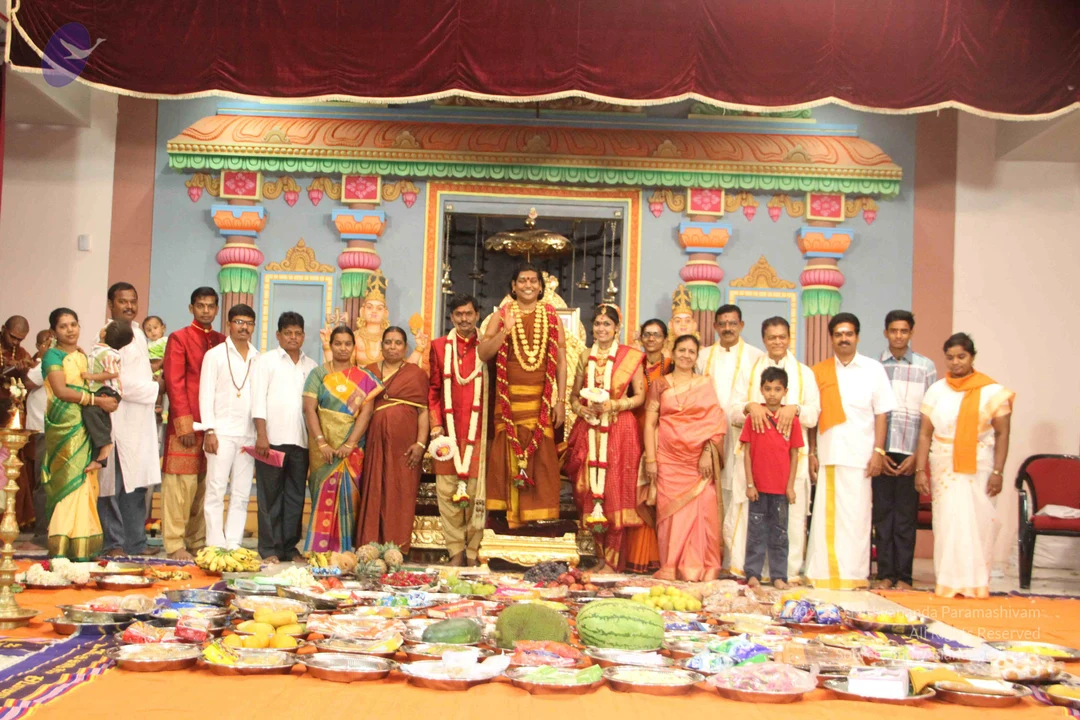
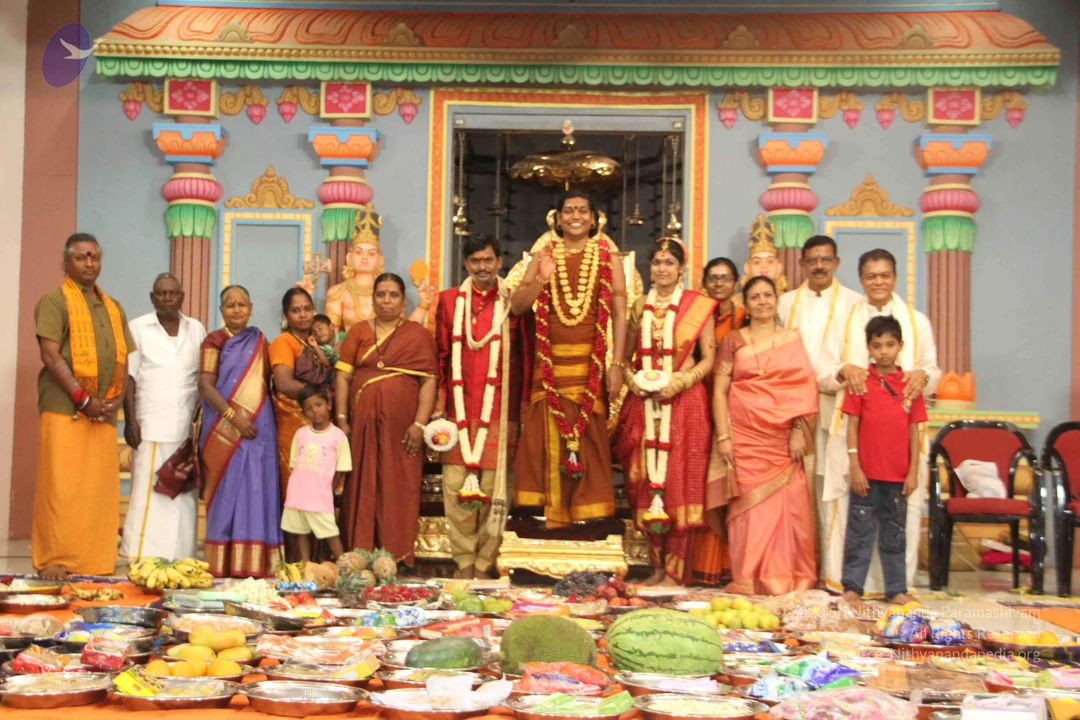
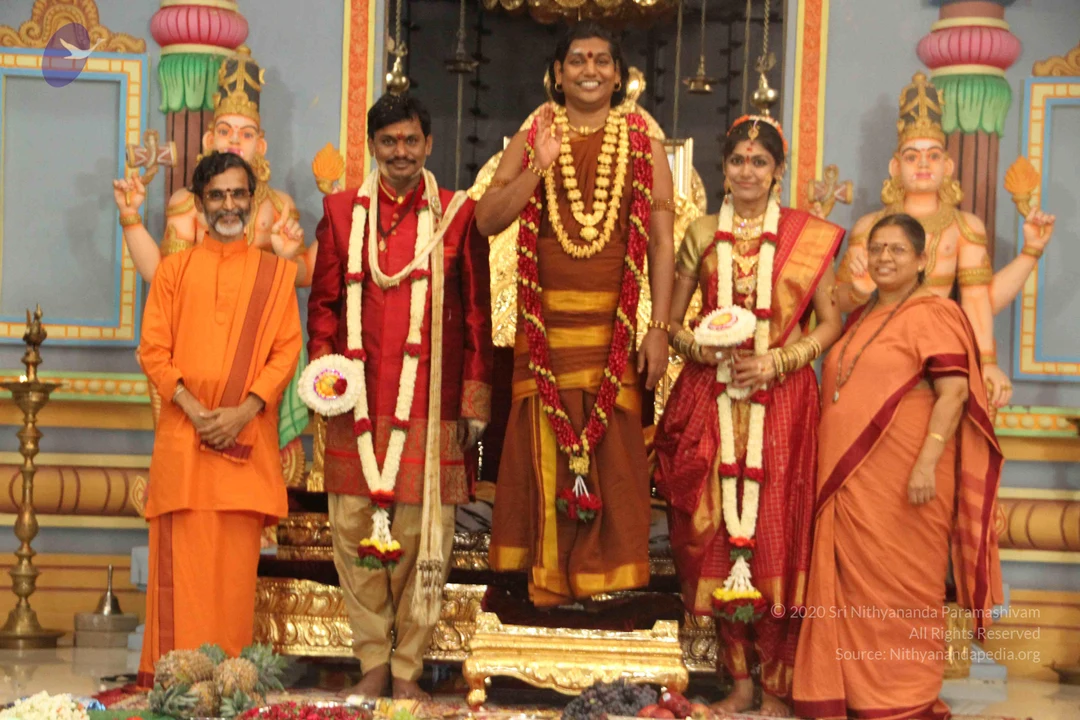
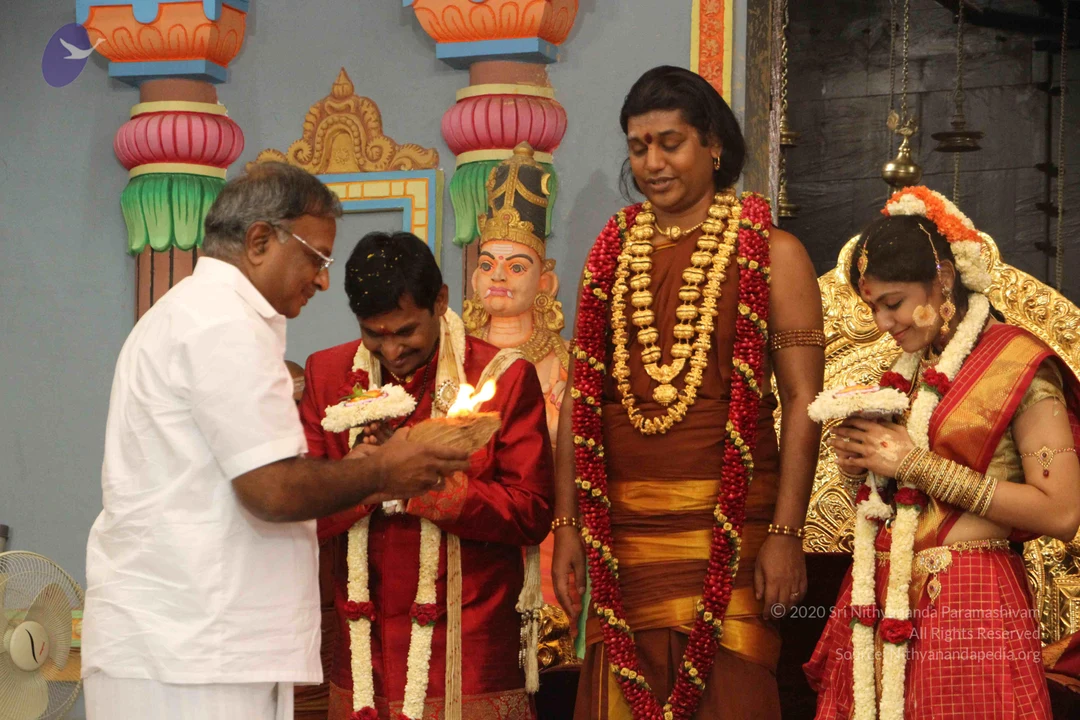
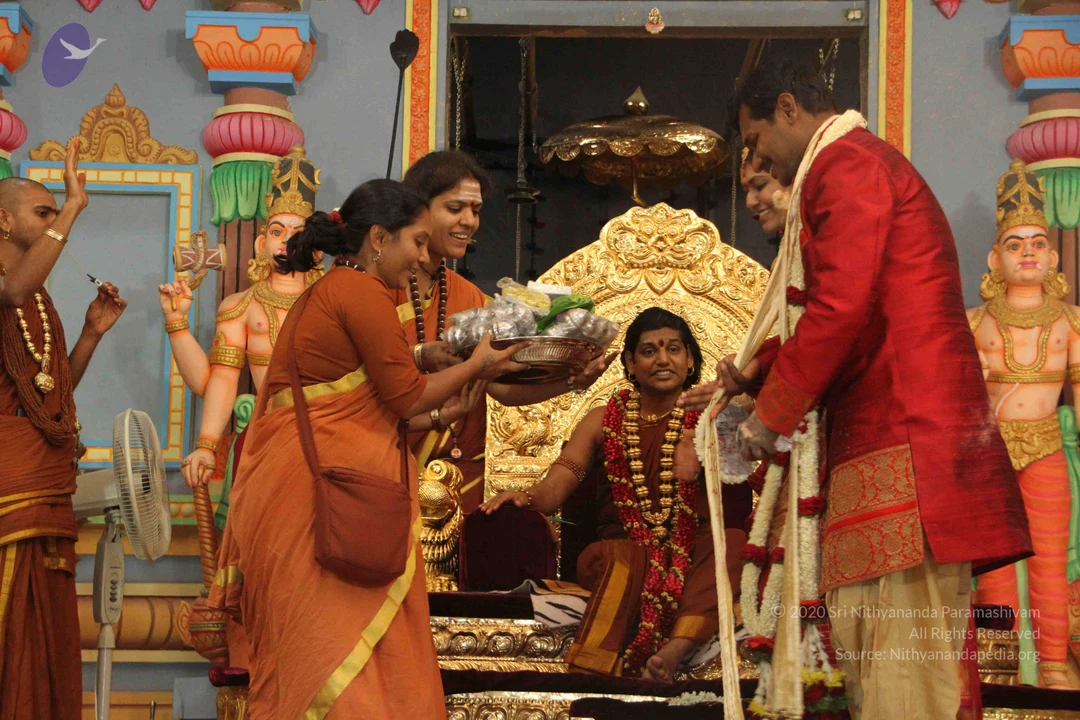
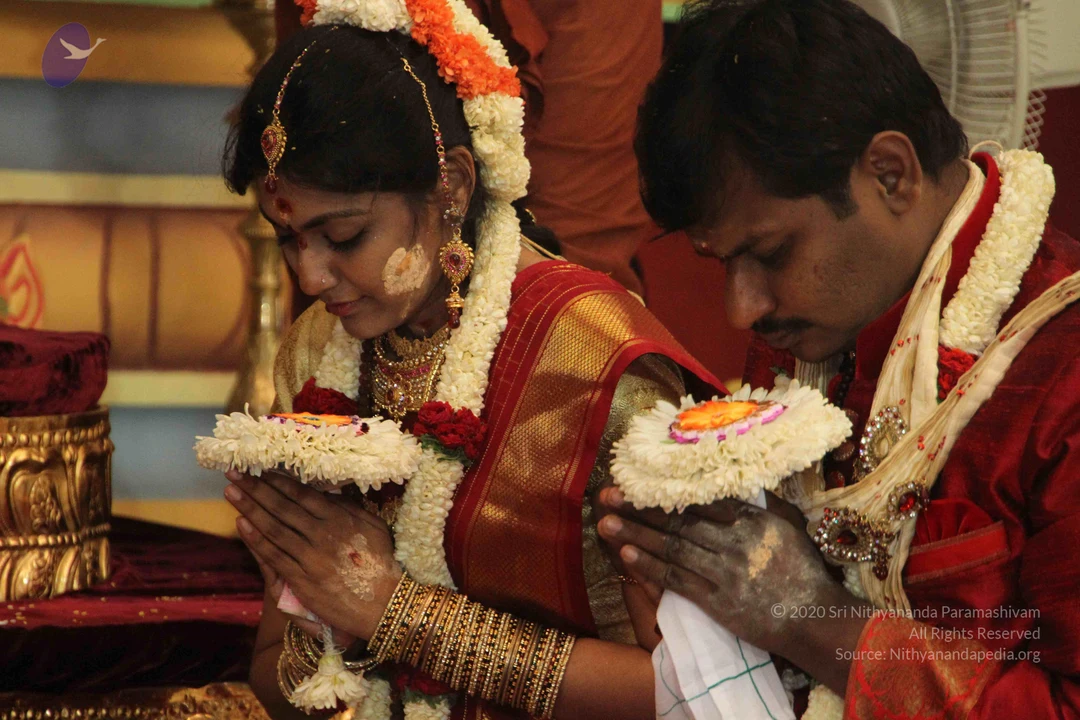
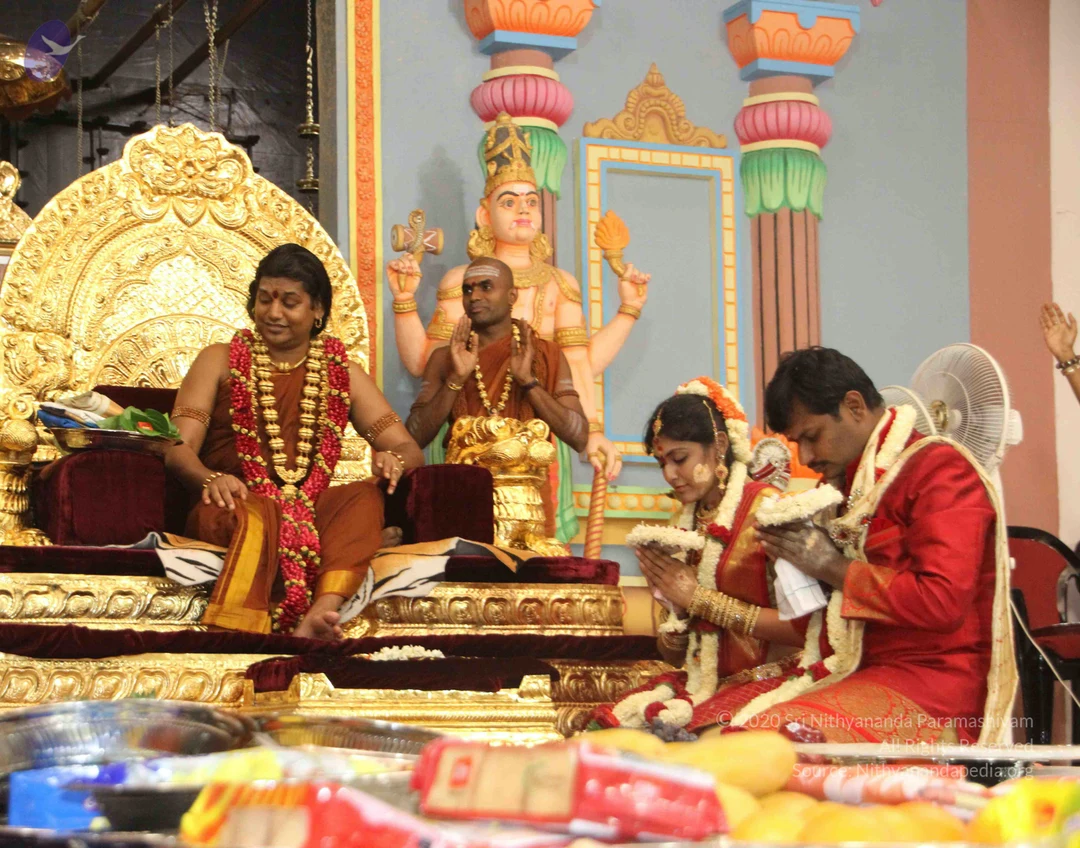
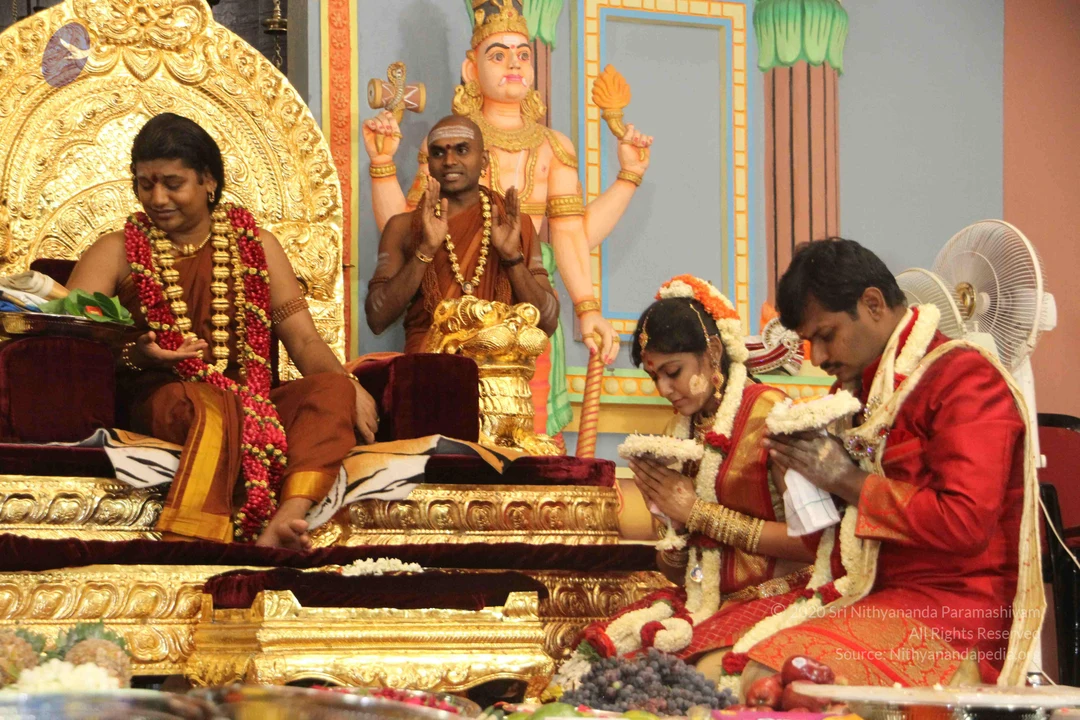
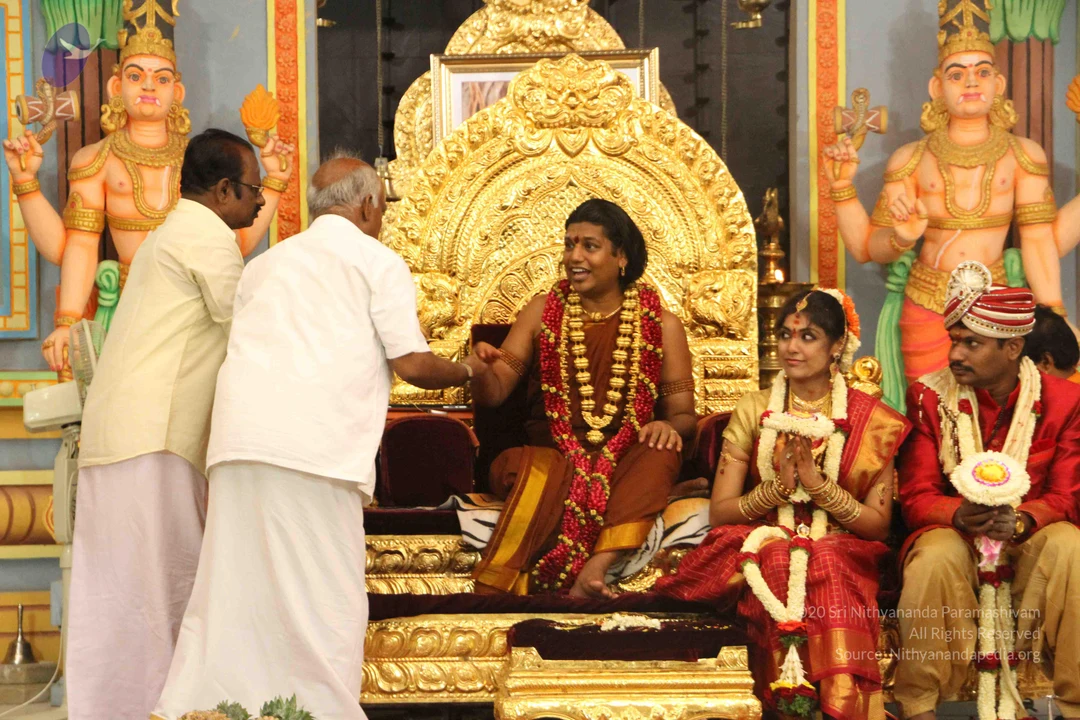
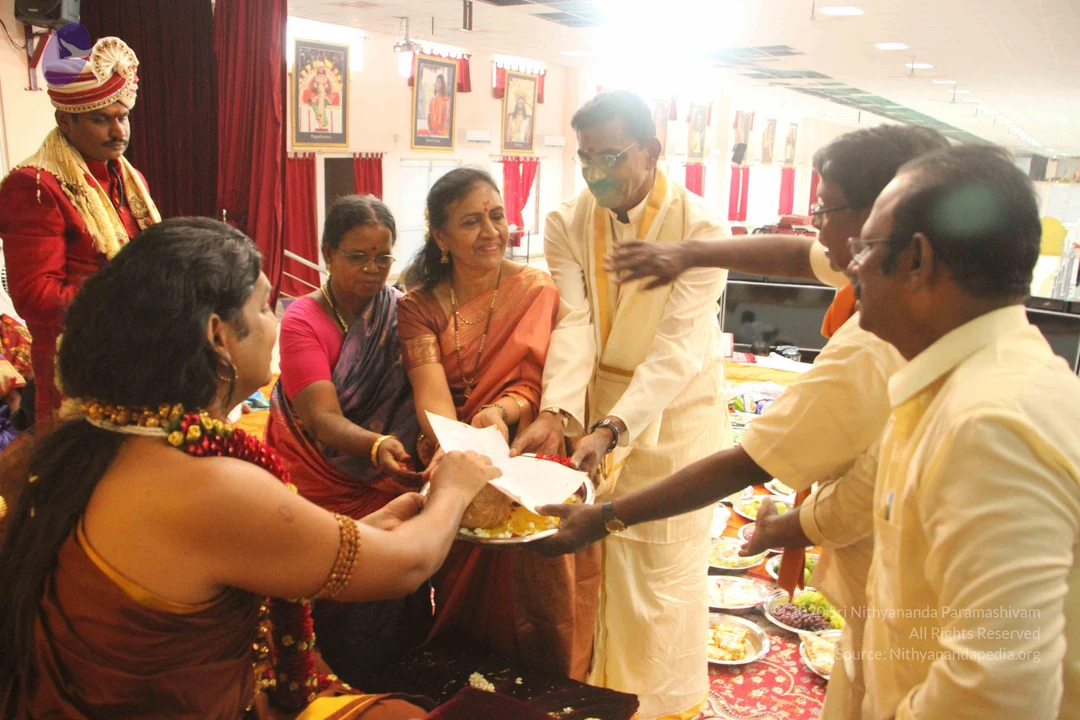
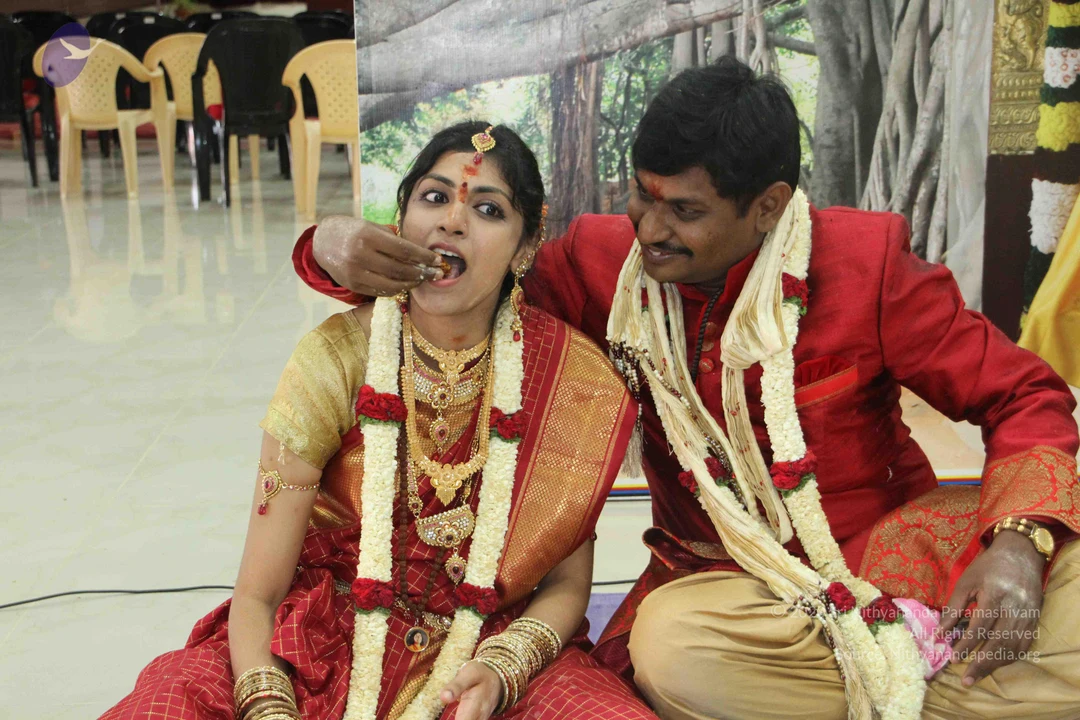
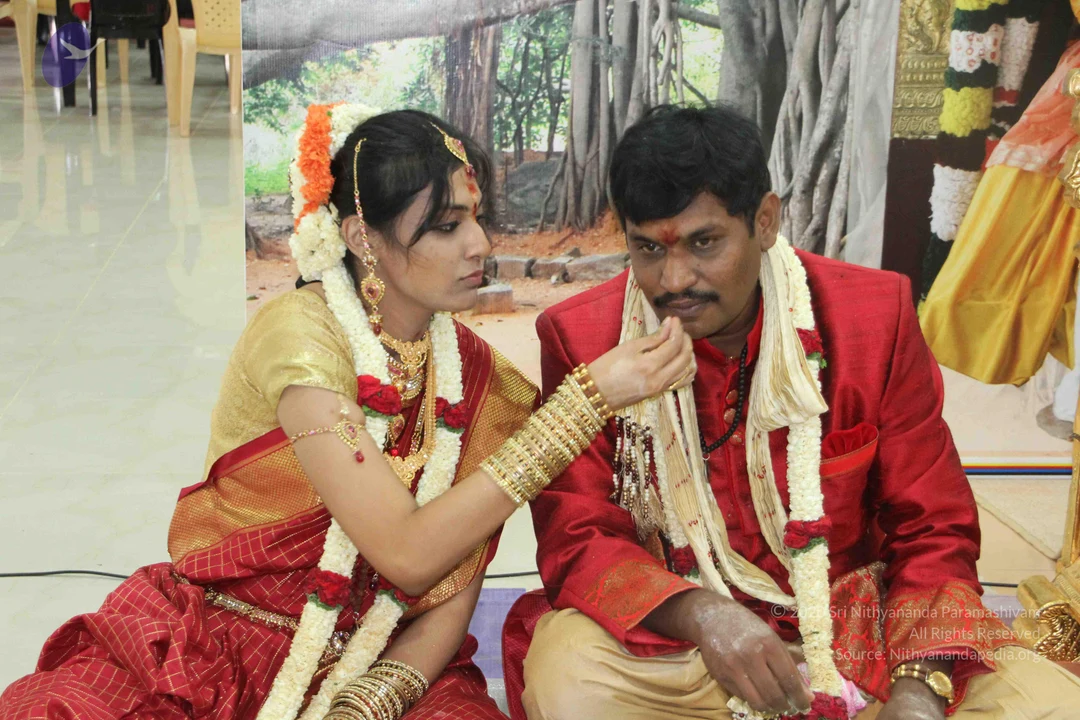
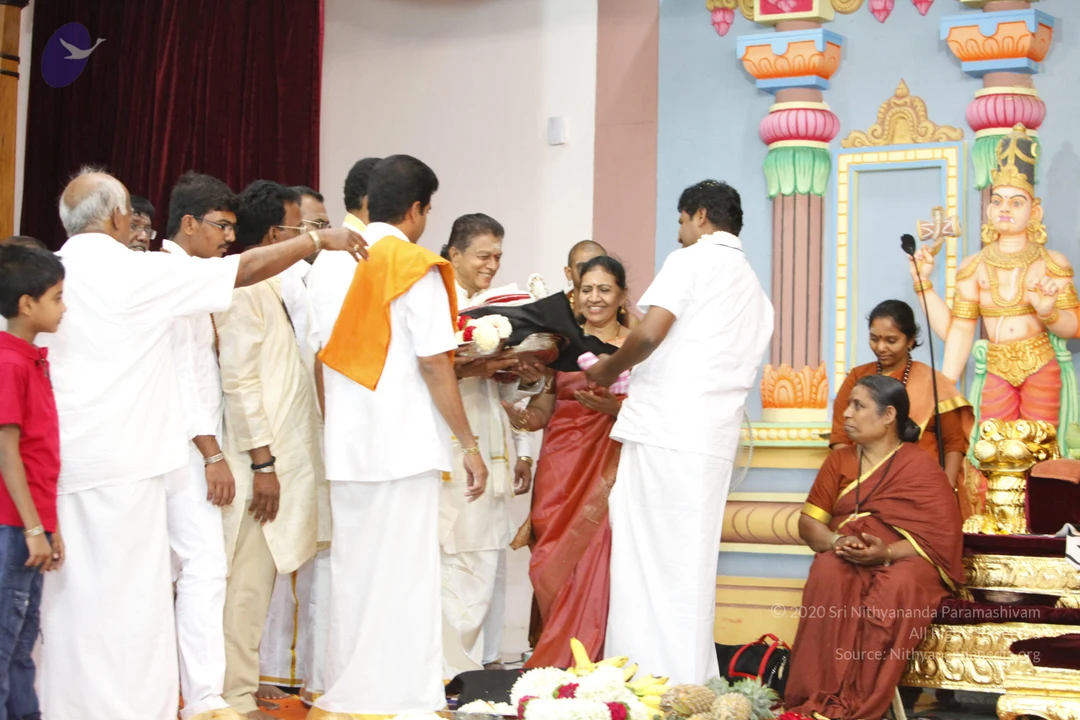
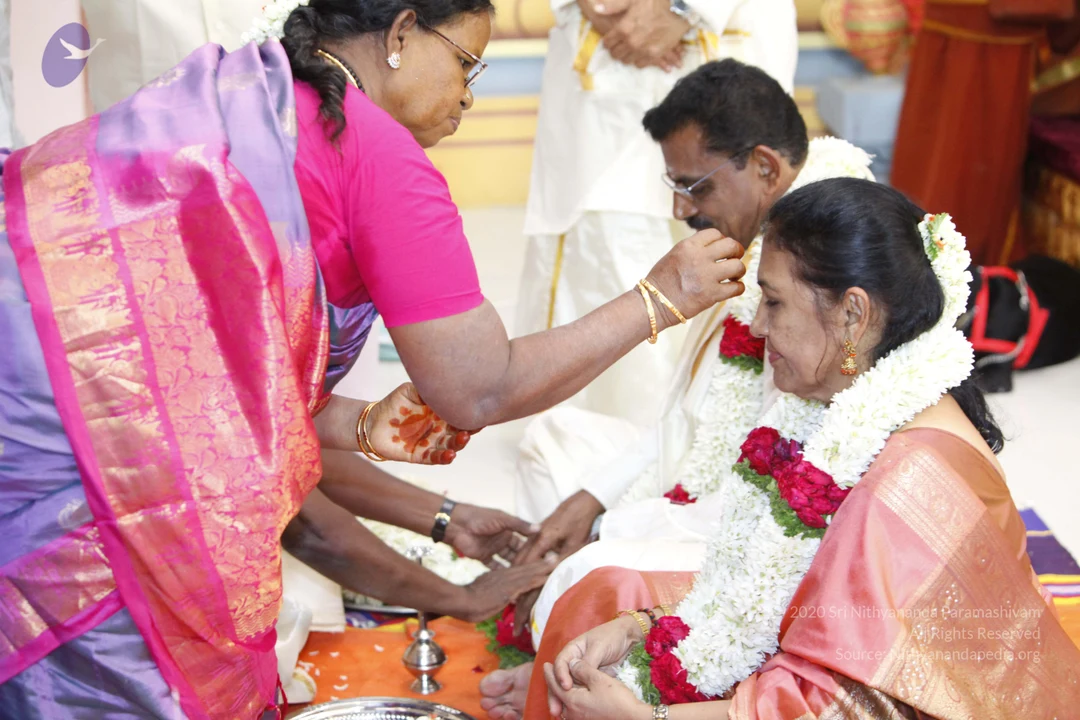
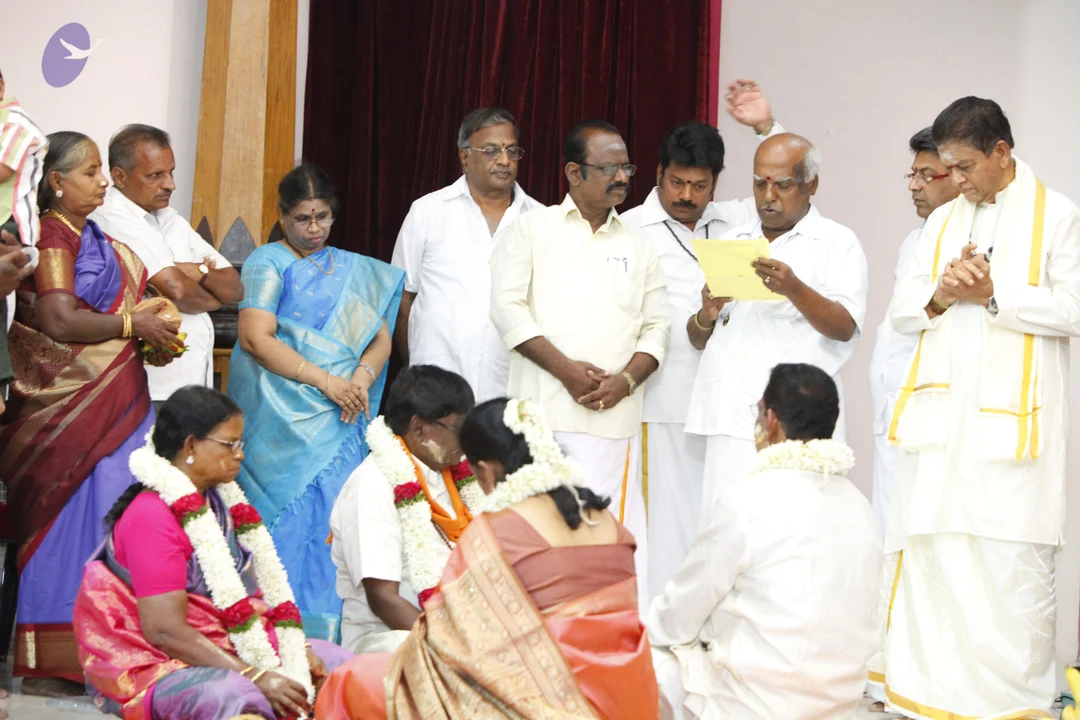
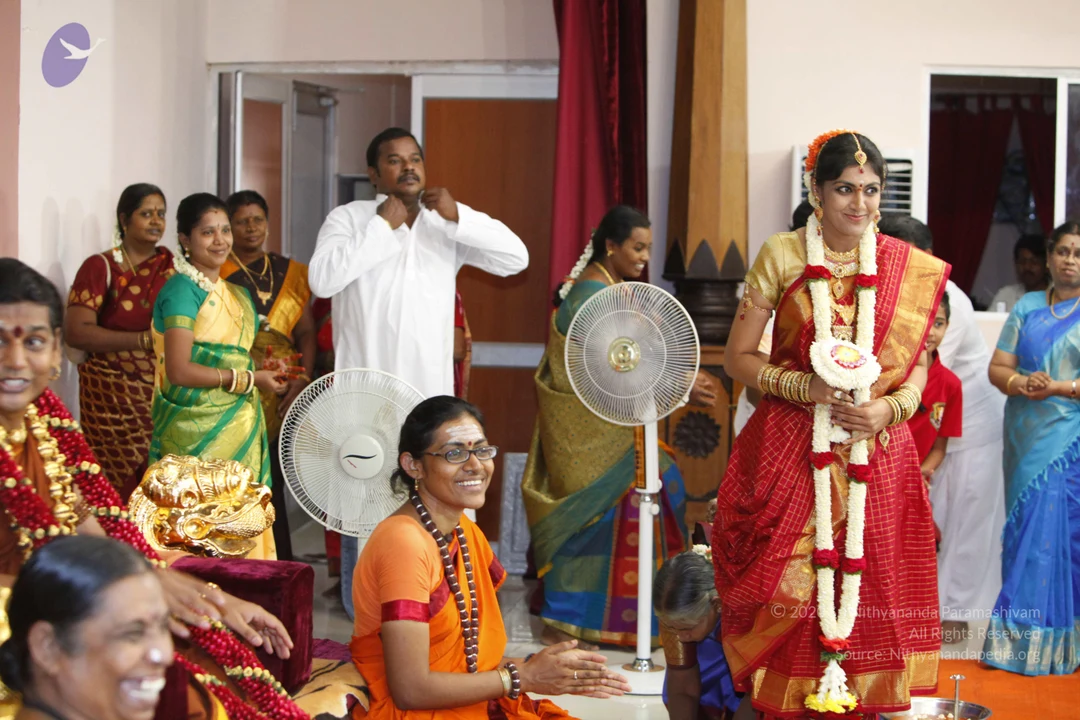
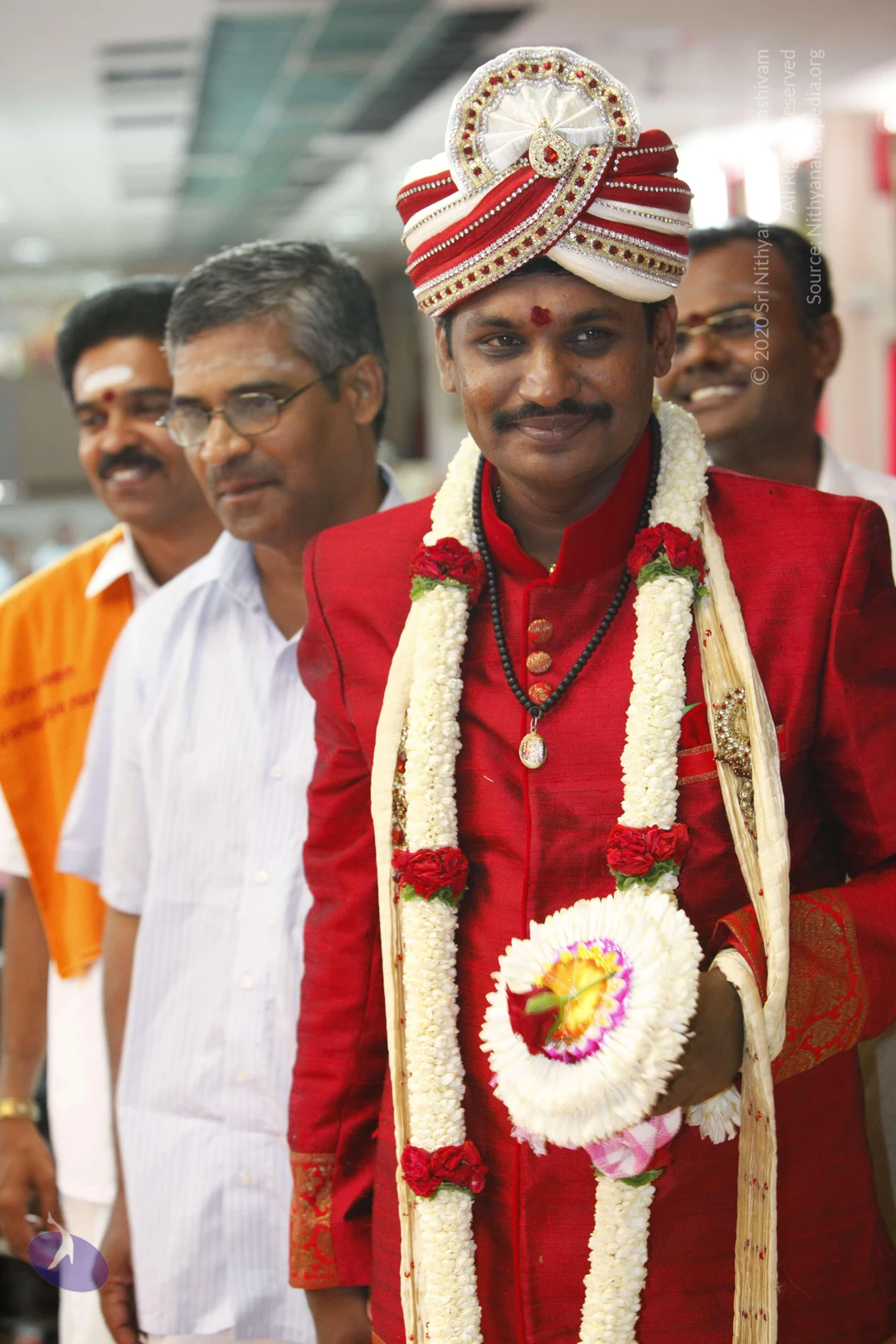
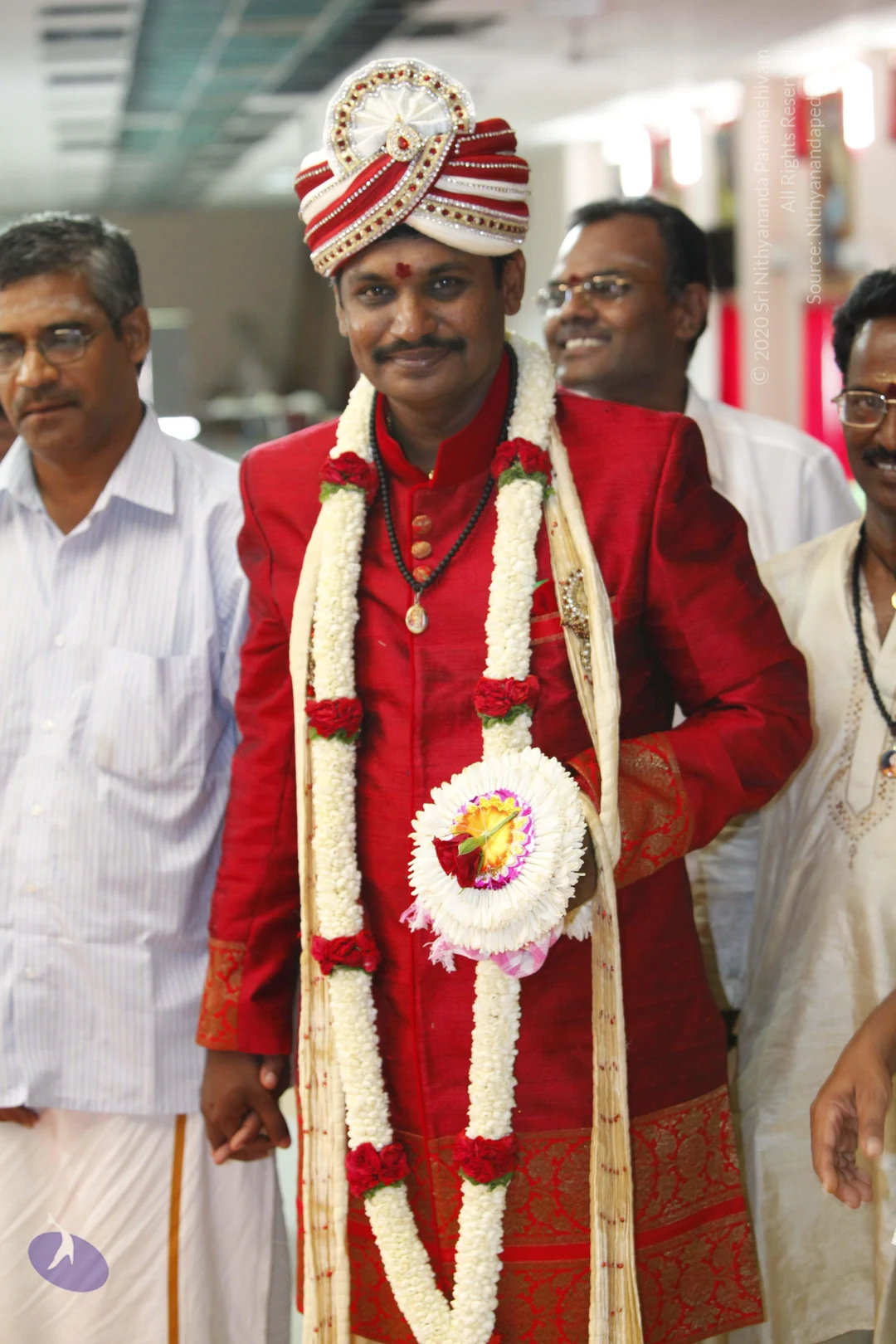
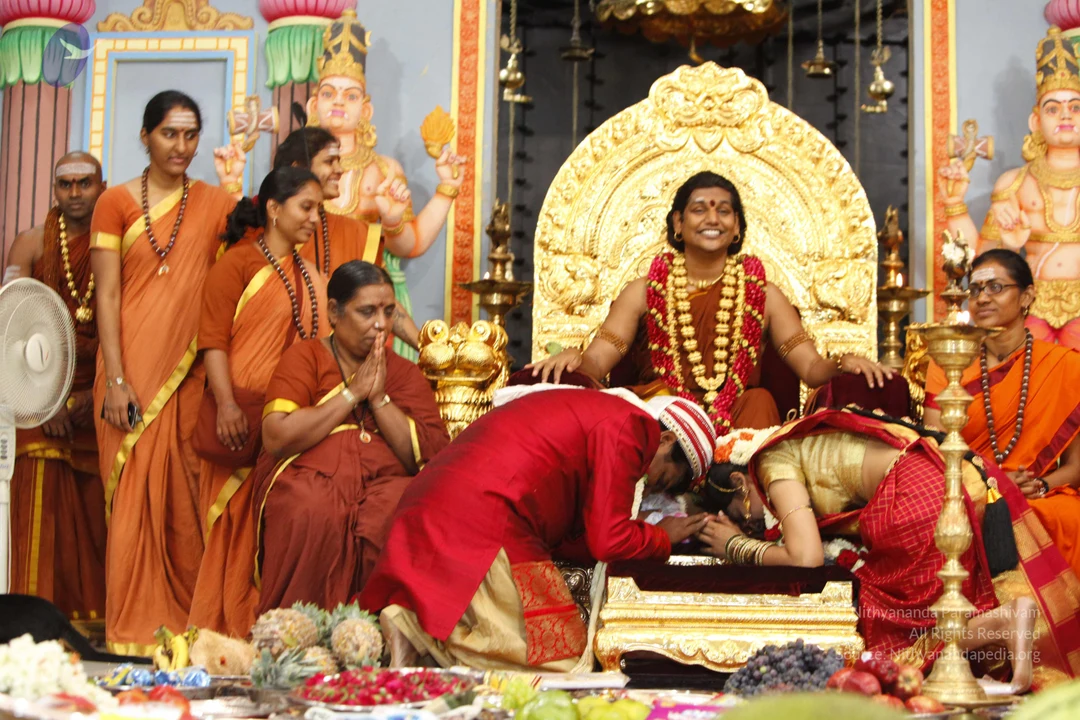
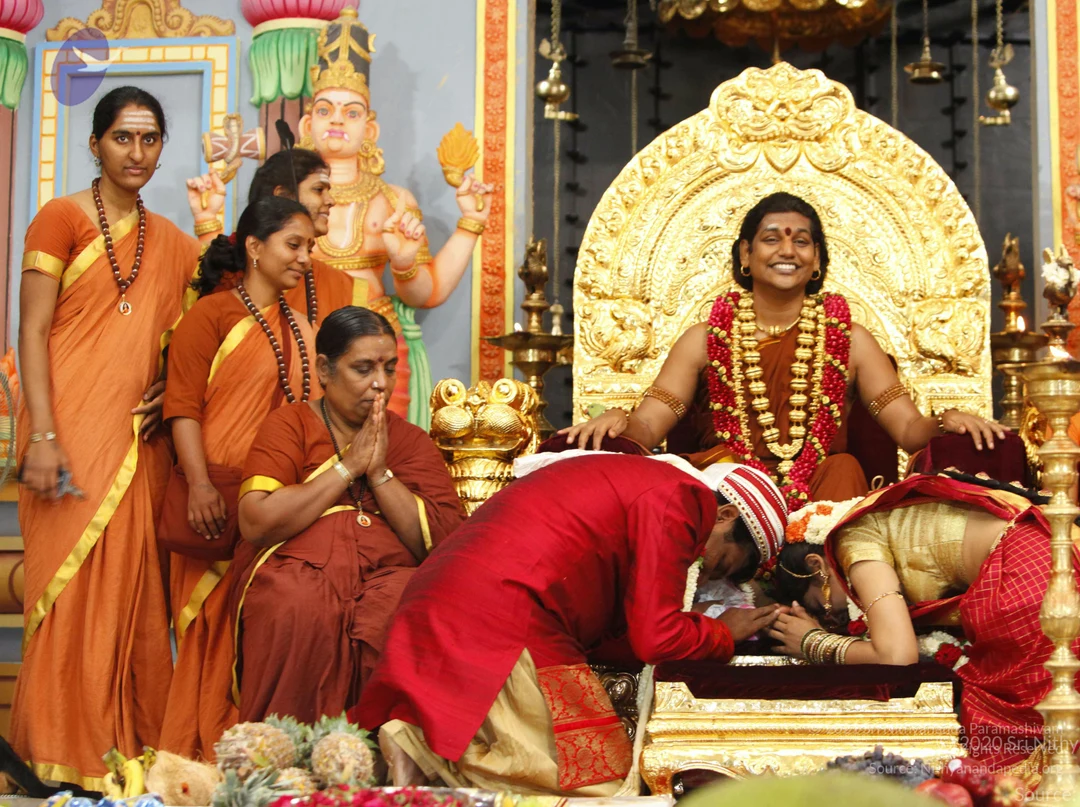
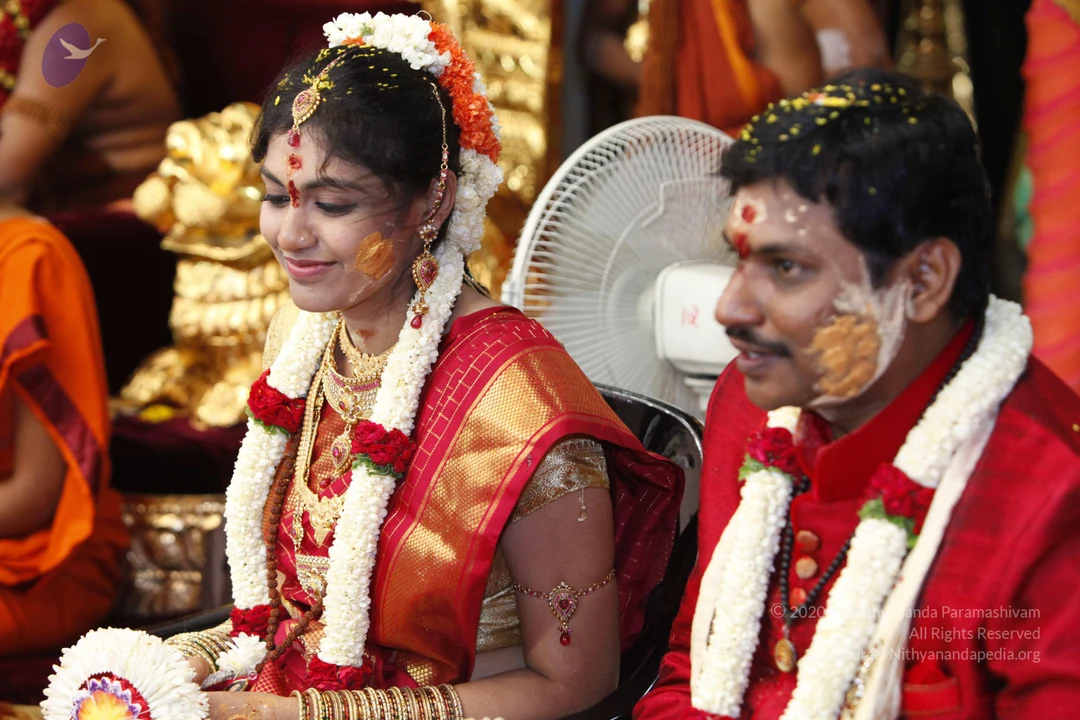
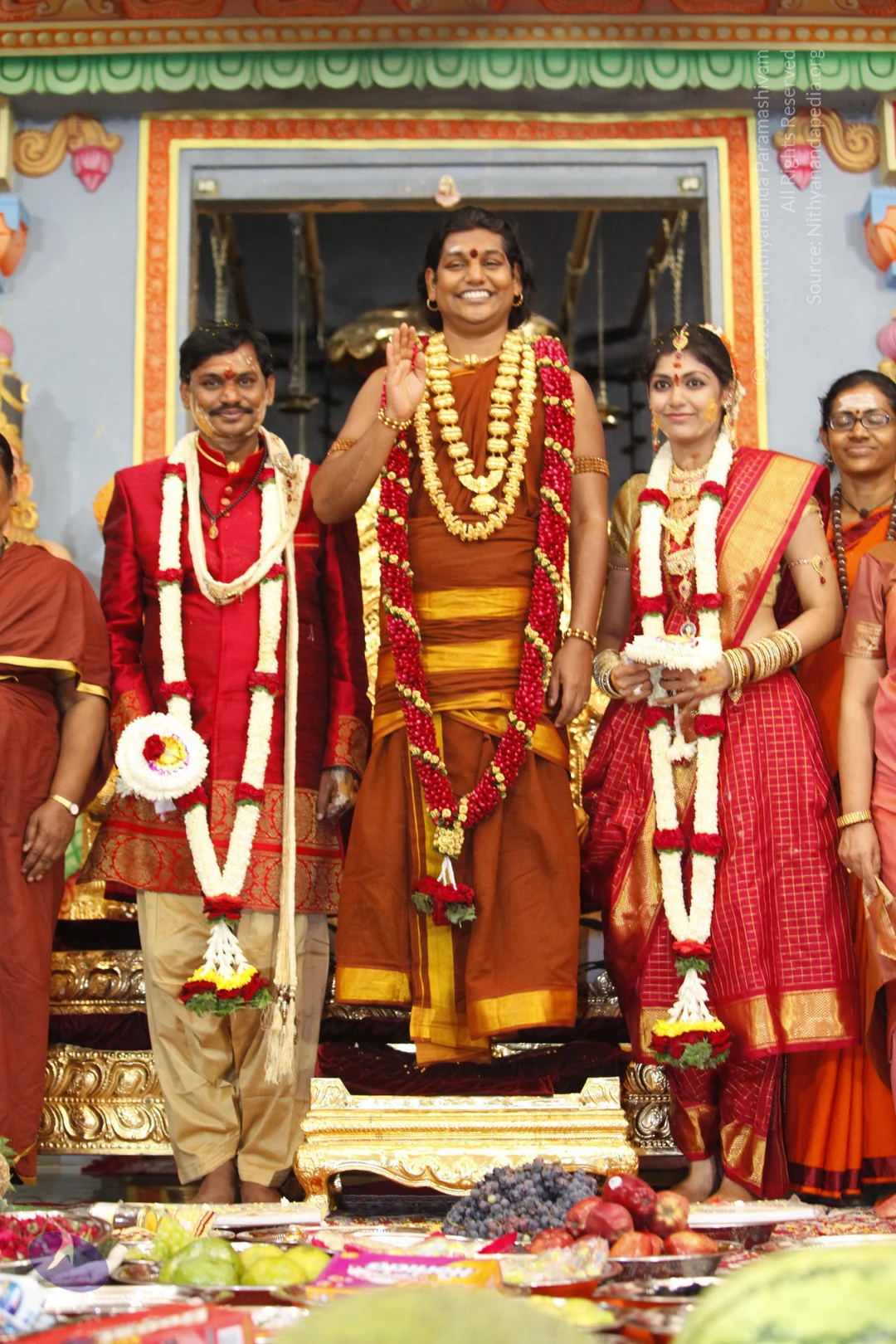
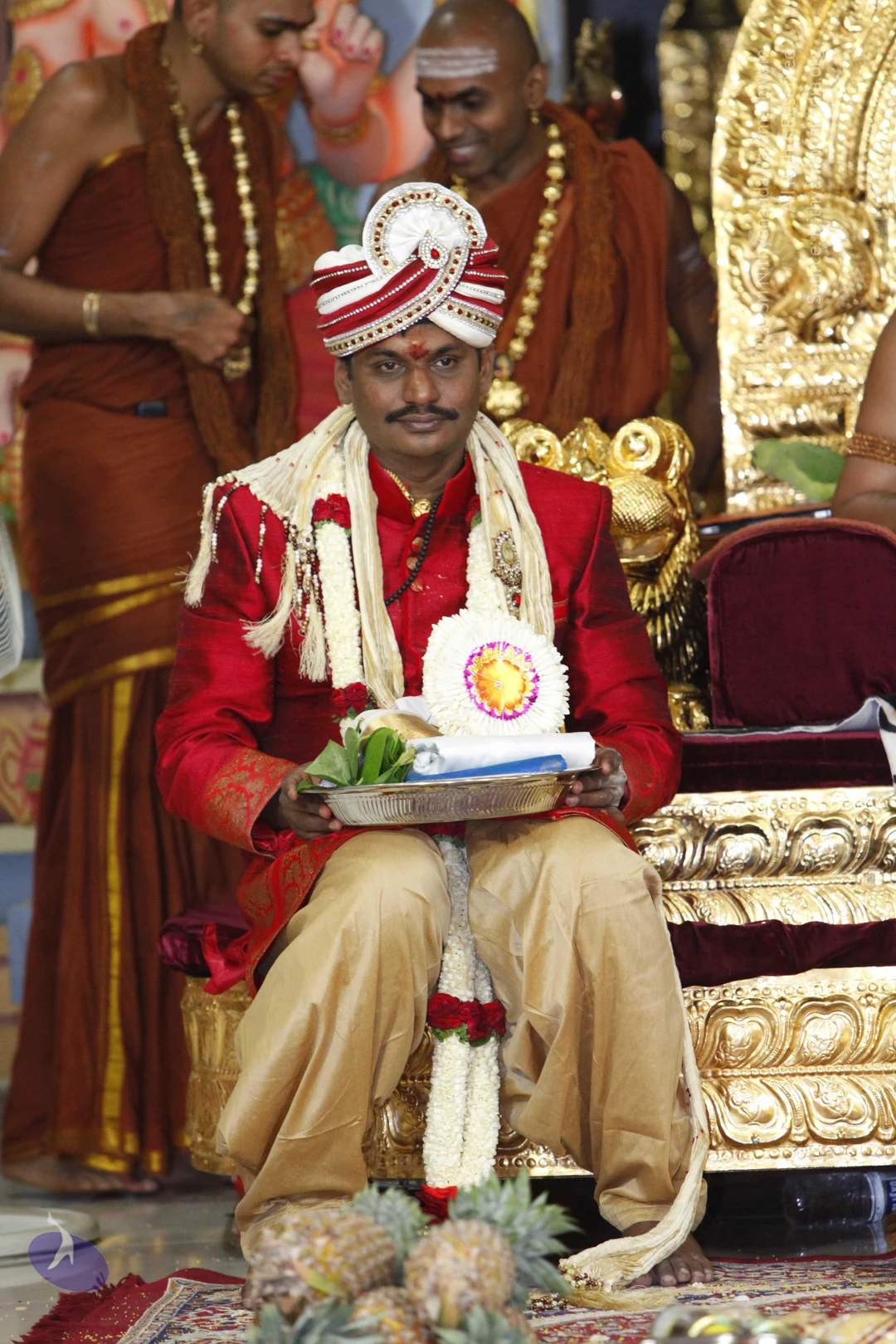
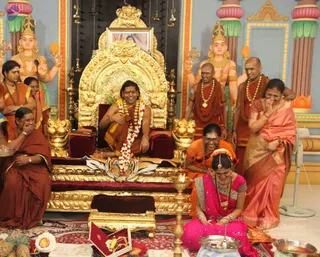
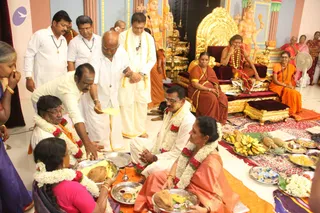
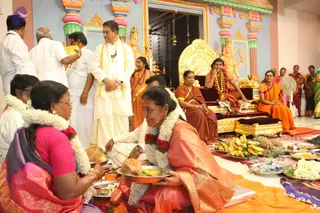
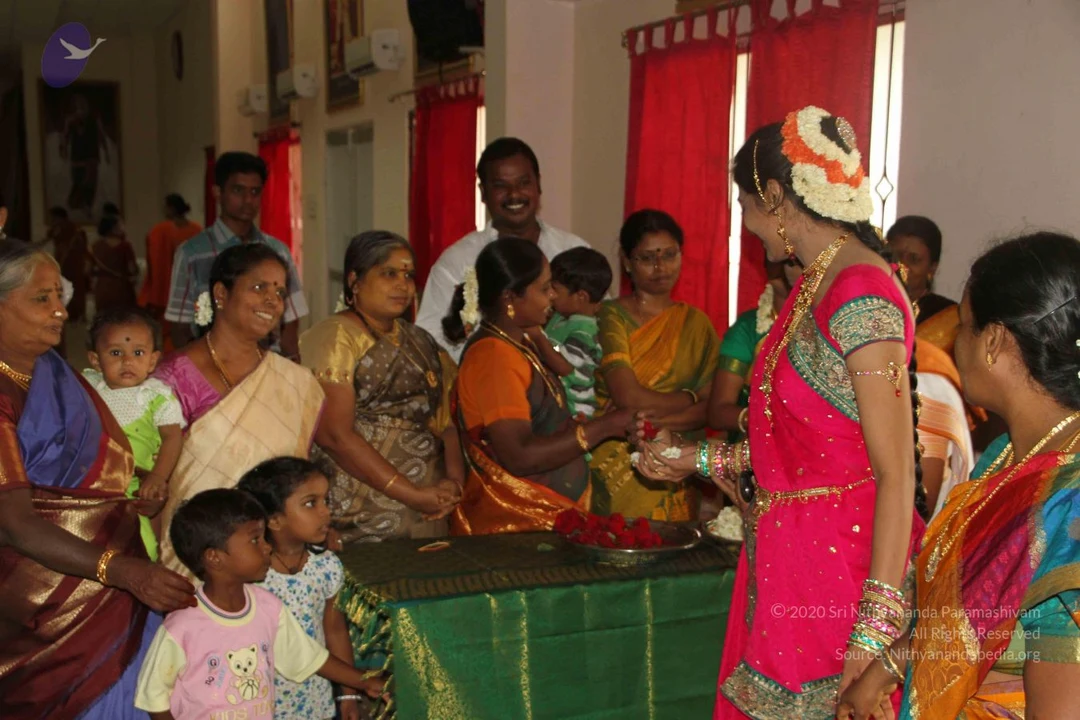
A photograph of a ceremony in a temple hall. A man seated on an ornate gold throne with a tiger-skin cushion wears orange robes, a long white-and-orange flower garland, and gold ornaments, smiling. Beside him stands a framed portrait. Two gold deity statues with multiple arms flank the throne. Around him, women and men in orange, rust and peach robes and rudraksha malas gather, some with hands raised or smiling. In front, a woman in a pink sari and gold jewellery sits with a brass tray and a lit oil lamp beside a bowl. Gold kalasha-style lamps and a red box with flowers are on the carpet. Garlanded fruit sits at the lower left.A ceremonial indoor scene before a golden throne with a large gilded backrest and carved lion-form armrests. A man with long dark hair, a flower garland and an orange robe sits centred on a tiger-skin cloth, smiling; a probable Swamiji by his throne placement, distinctive long hair, garland and saffron clothing. Around him, women in orange and saffron saris wear rudraksha malas, and two attendants in orange stand behind the throne beside painted deity murti figures holding lamps and a kalasha-like offering. A woman in a hot pink sari with bangles and a bridal forehead ornament sits at lower right beside a brass oil lamp, while a seated woman in a maroon sari and a bald-headed man in saffron stand nearby. Plates of fruit, pineapple, grapes, flower garlands and sweets are arranged on the red carpet in front.A seated man in a golden throne of ornate carved gold, wearing saffron-orange clothing, a rudraksha mala and a long garland of white and orange flowers, sits on a tiger-skin cloth in a temple hall. Probable Swamiji is seated centrally, with cues including long swept-back hair, ceremonial gold necklaces and saffron clothing. Around him, several women in orange, rust and pink saris wearing rudraksha malas sit or stand; a woman in pink and gold sari kneels at the front beside a brass aarti plate and a tall brass oil lamp. Two gilded standing figures with raised hands and crowns flank the throne, and a framed portrait hangs above it. Brass lamps, a golden footstool, and a red puja box with flowers sit on the red-and-gold carpet, consistent with a paduka puja offering.A photograph inside a temple shrine with a large gilded throne in the centre. A seated figure in an orange-brown robe wears a white and orange flower garland and a multi-strand rudraksha mala, with bare arms and a shaved head, sitting on a tiger-skin cover; this is a person seated on the peetha, with long-haired appearance cues not clearly visible. Flanking him are two gilded deity murti on the back wall, and a framed portrait sits above the throne. Around the throne, several women in orange, rust and salmon saris with rudraksha malas sit or stand; a woman in a pink sari holds a brass tray and a brass oil lamp in the foreground, and fruit, flower garlands, a red gift box and plates lie on the floor carpet. A standing fan is visible at right.A photograph of a temple hall with a large gilded throne canopy and a golden throne draped with a tiger-skin cloth. A seated figure in orange-saffron robes with a white flower and marigold garland sits on the throne, with a cluster of women and a bald man in orange and red clothing around it. Standing figures wear orange saffron saris and one wears a white and gold sari with orange shawl. A woman in a pink silk sari with gold jewellery sits in front, beside brass oil lamps. Foreground tables hold fruit offerings including pineapples, grapes, apples, limes, and garlands, with sweets and packaged items on steel plates. Painted pillars with lotus capitals and a deity figure frame the scene.A couple stands in an engagement ceremony in a temple-style hall. The woman in a red and gold silk sari with a gold necklace and bangles holds a garland-wrapped offering plate with betel leaves, and the man in a red silk jacket with gold-bordered cream and red turban holds one too, with a white and red garland draped over his shoulders. Both stand before a coconut on a metal tray, a steel bowl of rice and a kalasha-like brass vessel. Behind them is a painted deity murti with gold ornaments and a crown, flanked by ornate pink and green pillars. A man in white and an older woman in a white sari with an orange border stand at the right edge, observing the ceremony.

Temple

30 photosSource gallery
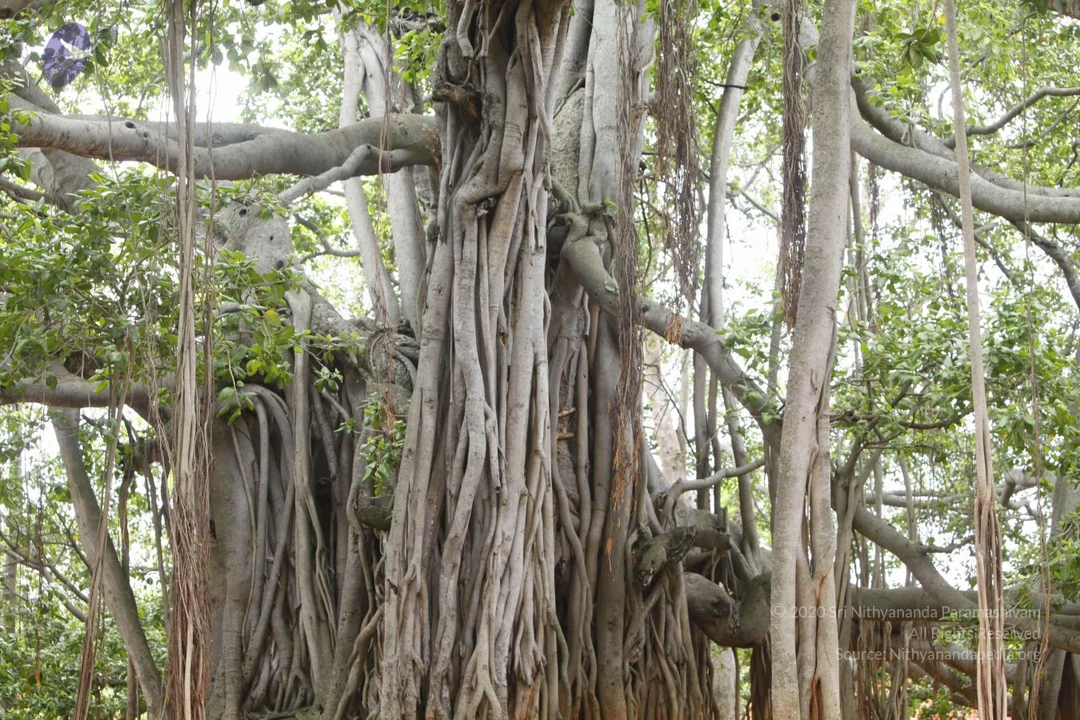
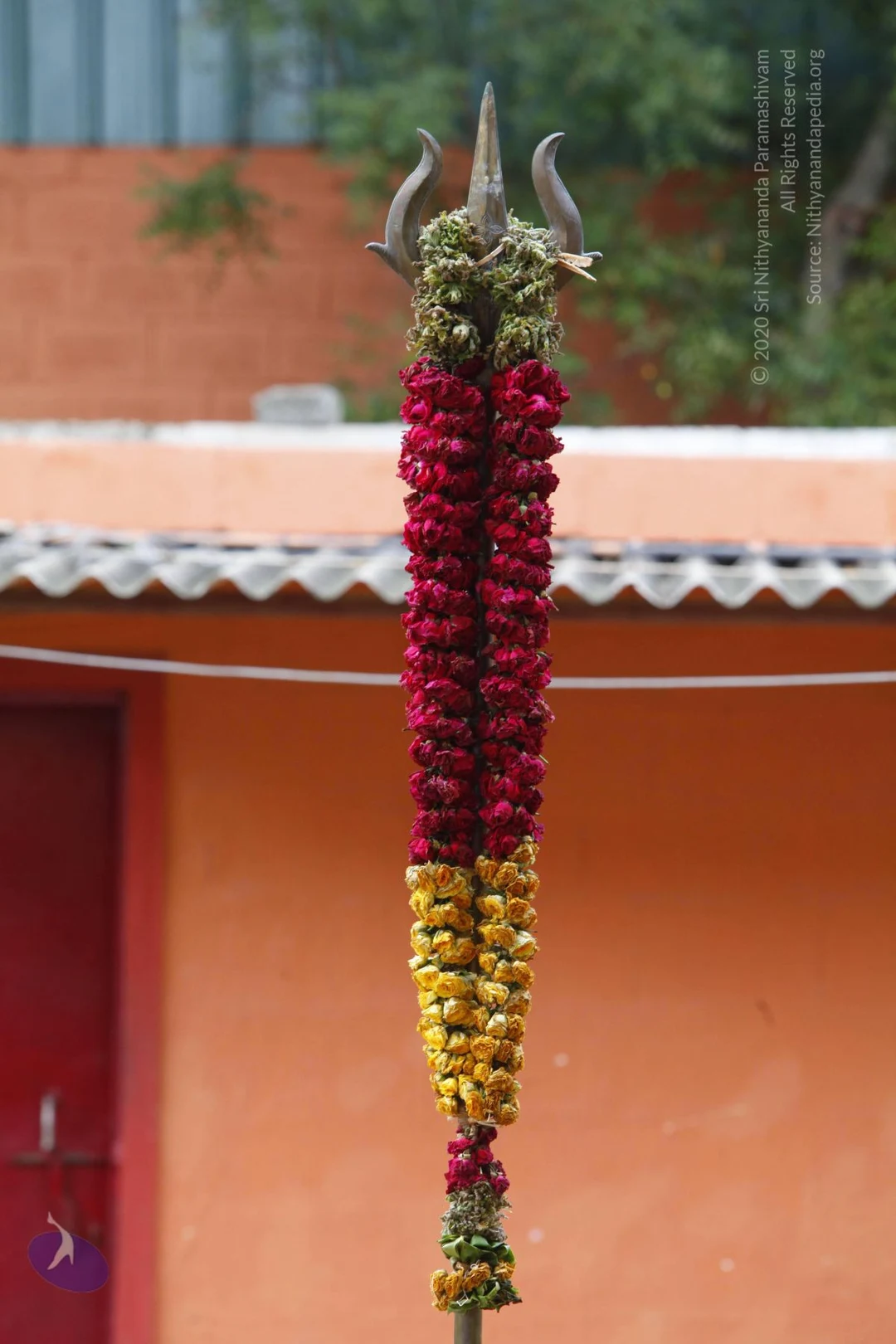
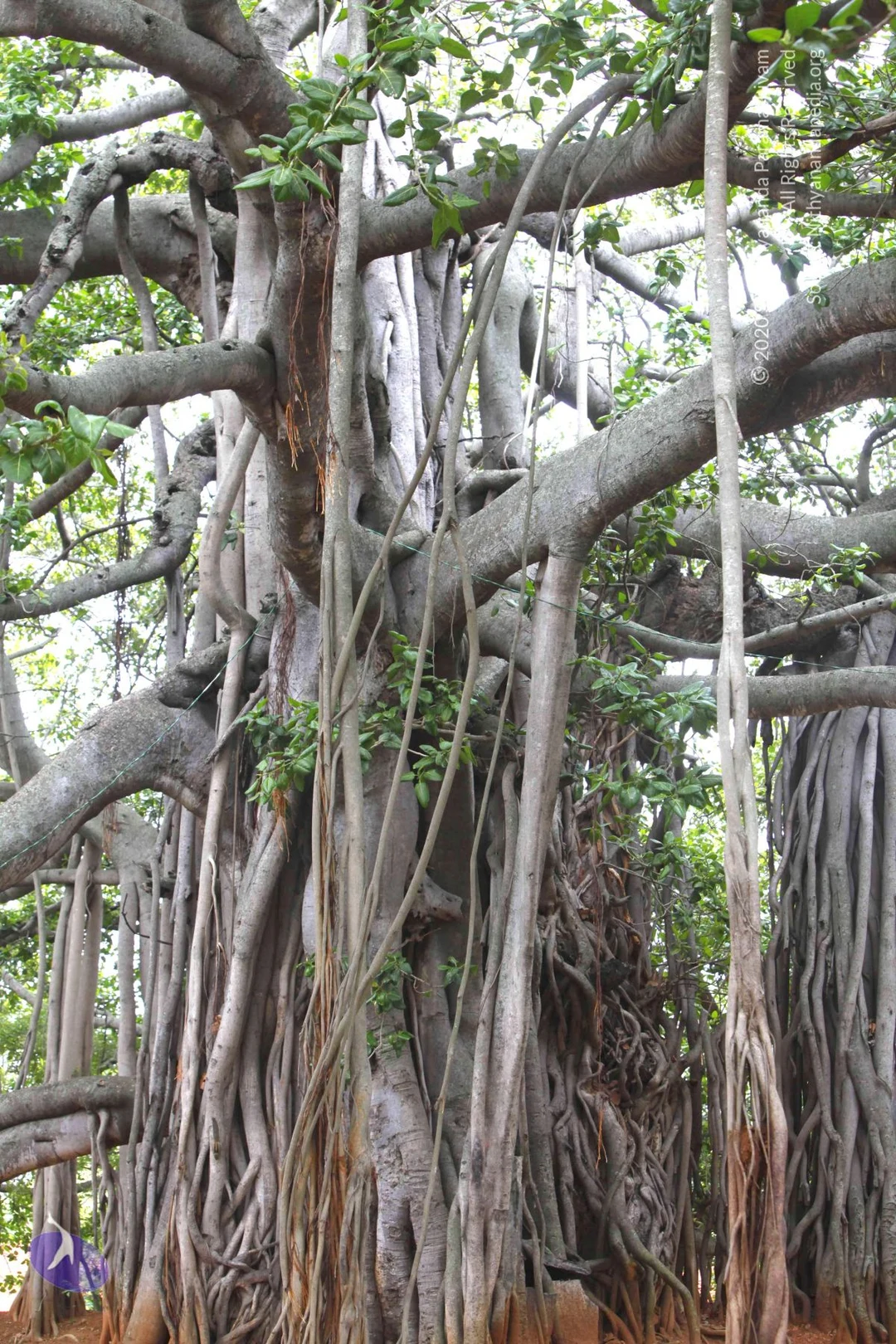
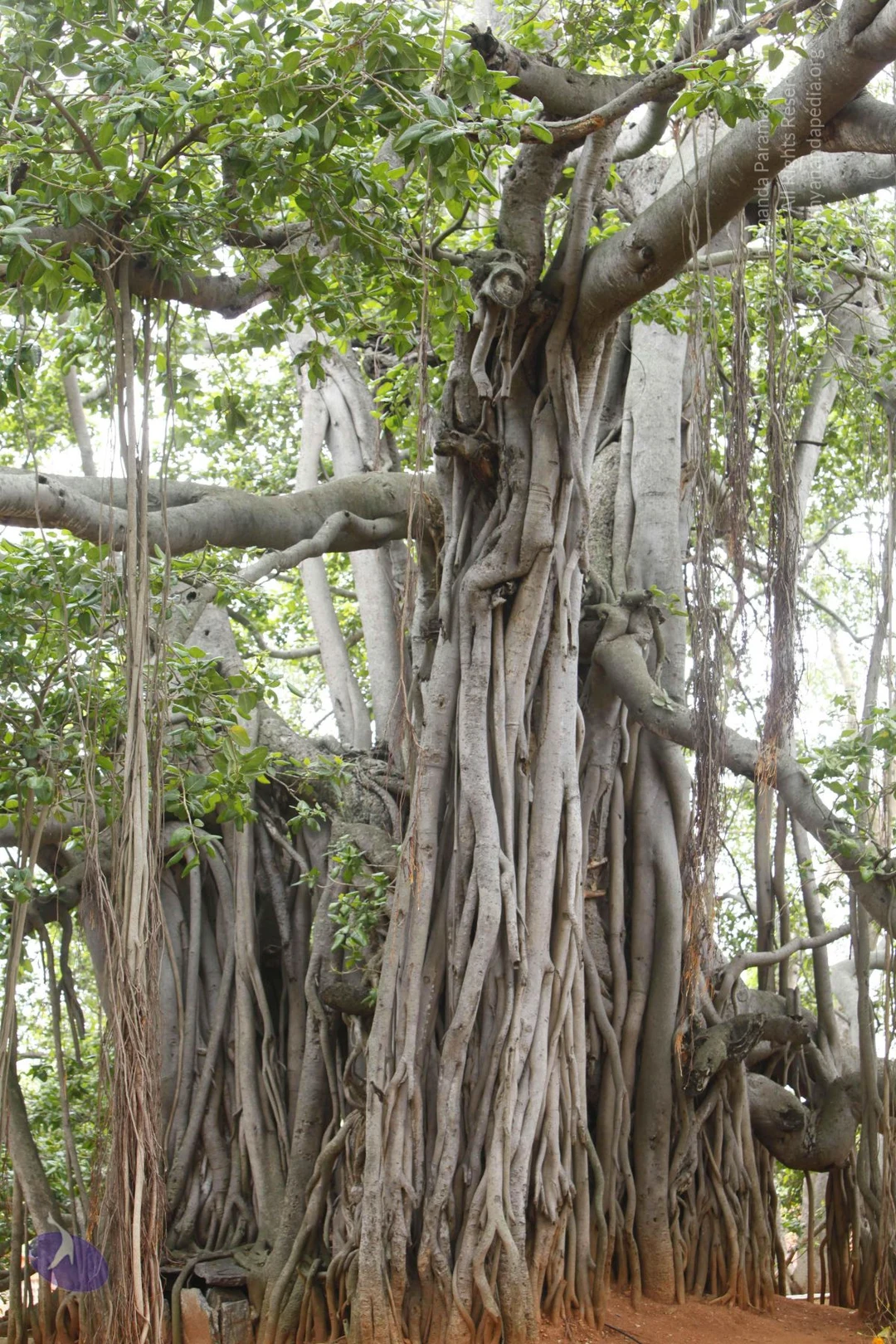
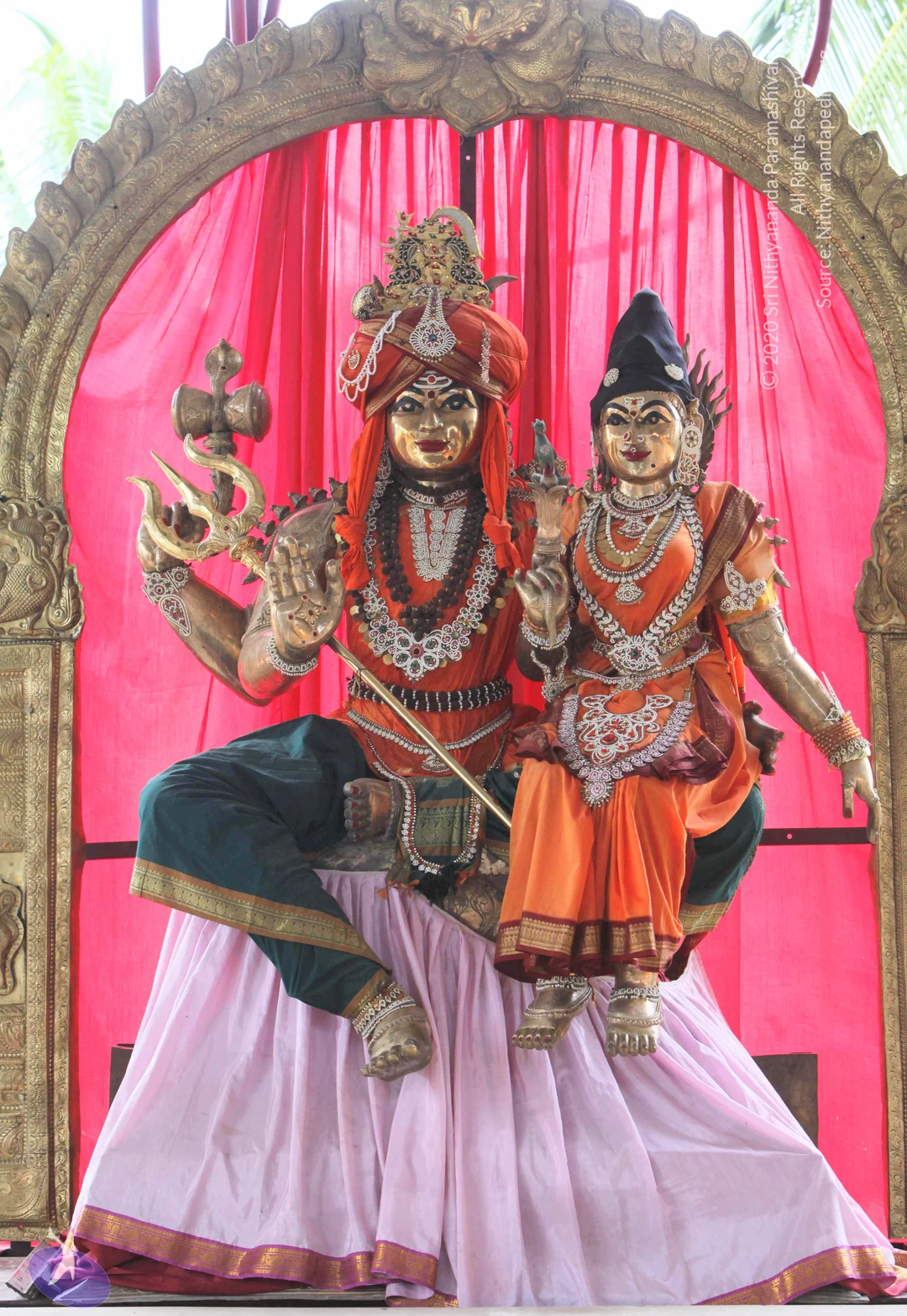
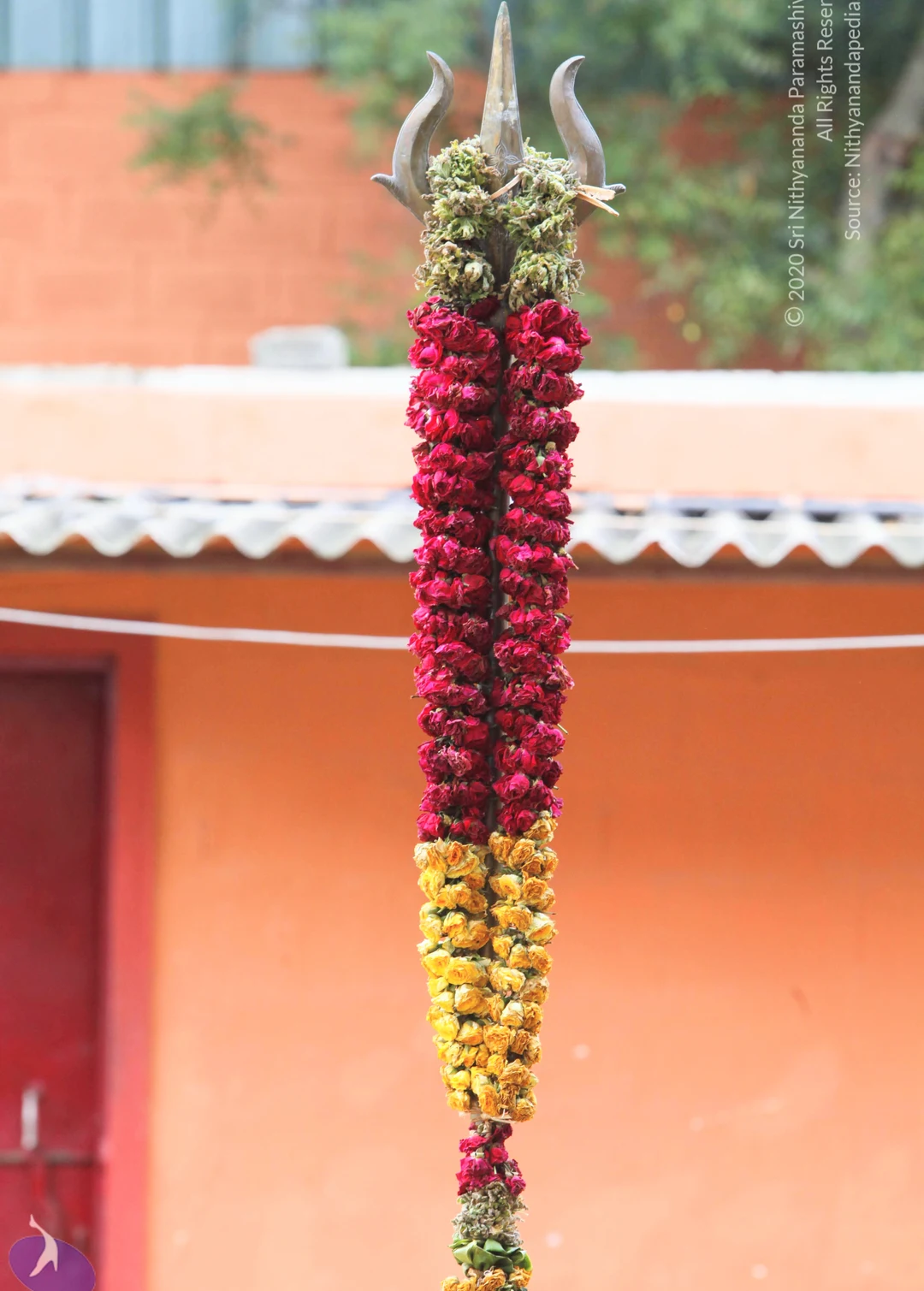
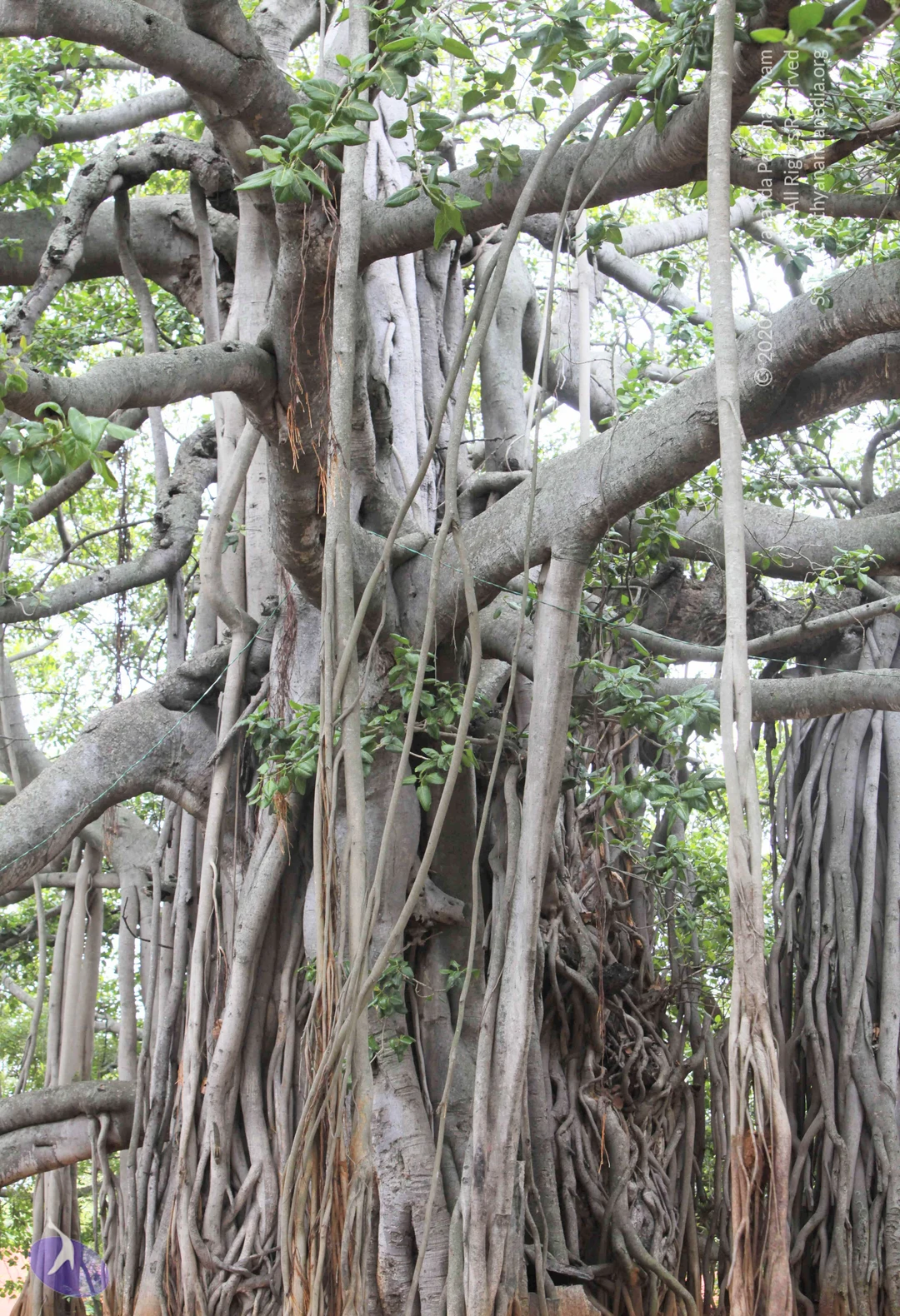
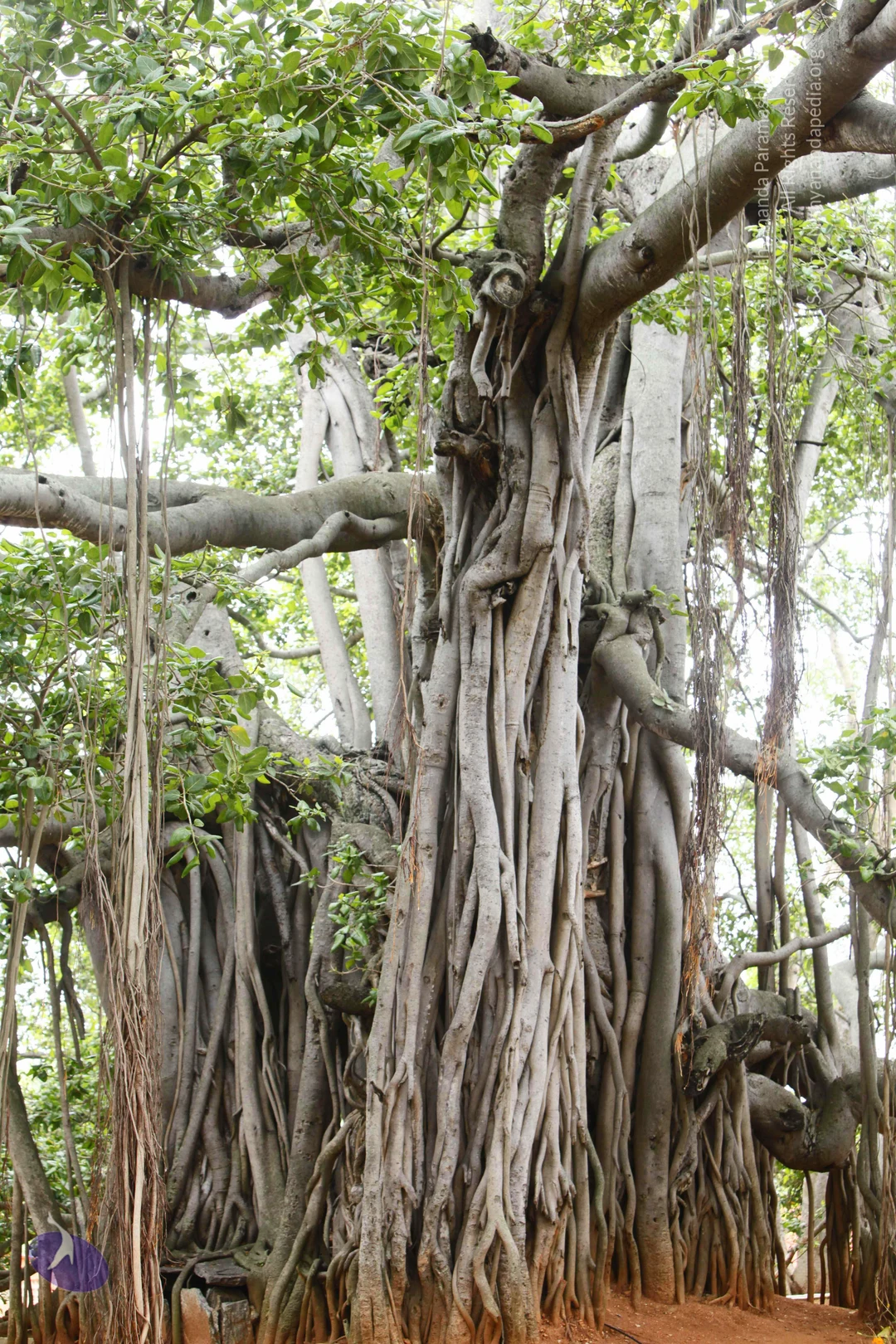
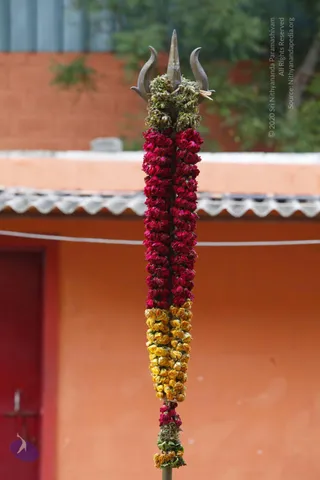
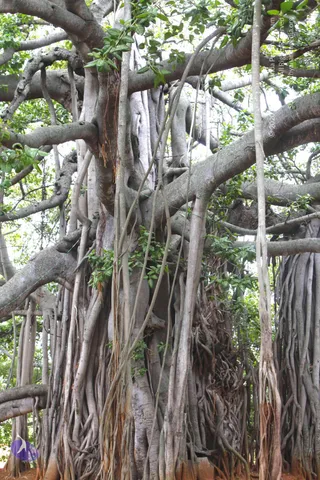
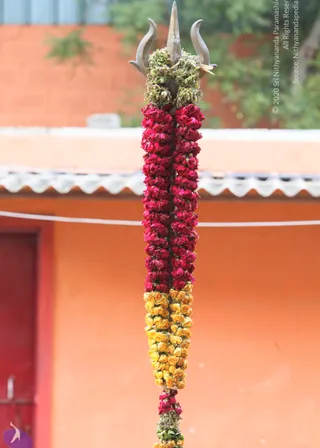
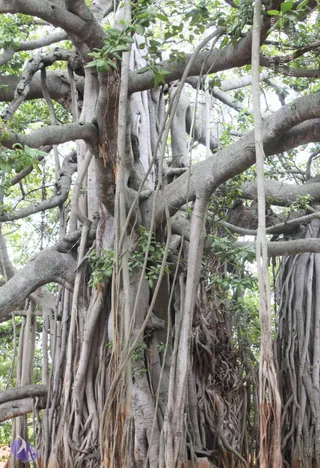
Two gilded deity statues seated side by side on a pale lilac draped pedestal before a bright pink curtain within an ornate gold arched frame. The male figure wears an orange turban and a crown, holds a golden trident and a small drum, and wears rudraksha beads and silver necklaces, with dark green trousers. The female figure wears an orange sari with silver jewellery, a dark blue cap-like headdress and a small bird perched on her hand. Deity murti; no living people visible.Two golden metal statues of a seated deity pair under an ornate gilded arch against a bright pink draped backdrop. The male figure wears an orange-red turban and red garments with a dark green lower wrap, layered rudraksha and jewelled necklaces, and holds a golden trident. The female figure wears an orange sari with a dark crowned headdress, silver jewellery and bangles. Both sit on a pale lilac pleated cloth draped over a platform.A dark grey stone statue of a seated Nandi bull sits on a black pedestal in front of an orange-red temple structure. The bull wears a red and gold silk cloth draped over its back, and multiple garlands of red and yellow flowers hang across its neck and chest. A beaded necklace and a forehead ornament are carved into the figure. No physical people are visible; the background shows blurred greenery and other stone figures.Photograph of a tall metal trident (trishul) standing upright on a pole, its three prongs crowned with dried green and white flower garlands. Below, the shaft is wrapped in dense bands of red roses and yellow marigold-type flowers. Behind it are orange-washed walls, a red door and a corrugated roof edge. No people are visible. A small logo sits in the lower left corner.A large old banyan tree with a thick, spreading canopy of grey, sinuous branches and dense green leaves. Numerous aerial roots and hanging vines descend from the limbs to the ground, forming multiple trunks and a tangled root mass at the base. No people, deities or ritual objects are visible; the scene is an outdoor natural tree photograph.A large dark stone murti of a multi-armed deity seated in a meditative cross-legged pose on a rocky base carved with small figures. The figure wears a cream draped cloth, a white and brown beaded necklace, layered rudraksha-style brown bead malas, a white pearl bracelet, and a cream headband with a jewelled brooch. It holds ritual objects in its raised hands, including a trident-like staff and a drum. A green cloth with gold dots forms the backdrop. No physical people are visible.

Padduka-Puja

4 photosSource gallery
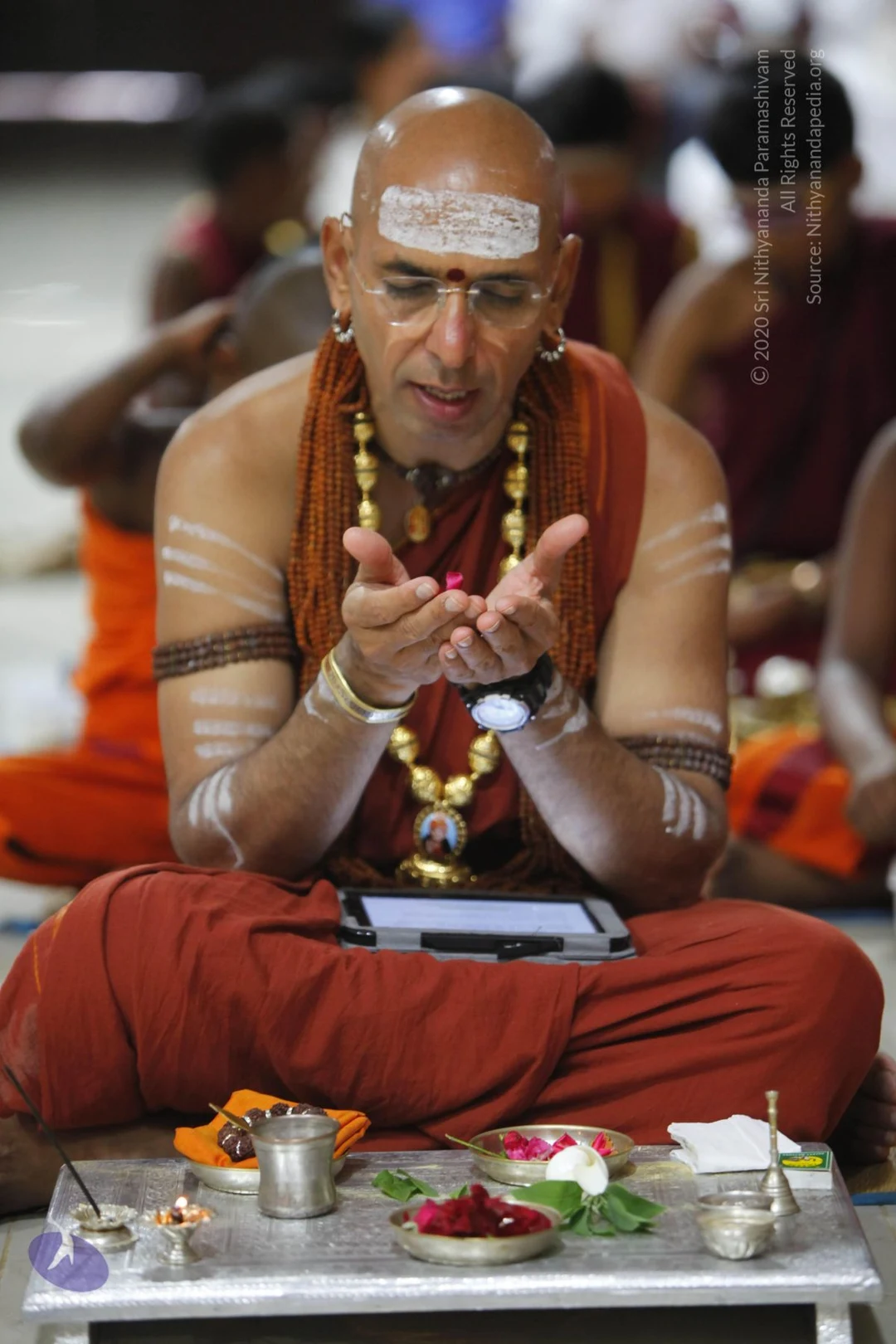
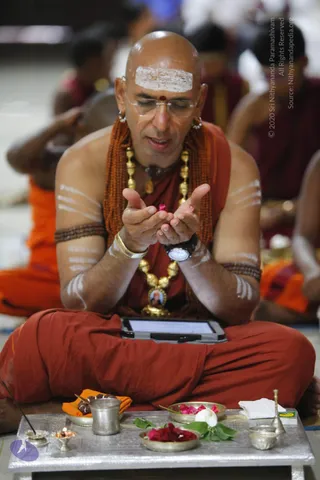
A photograph inside a temple shrine with a gilded throne-like seat draped in orange and tiger-print cloth, flanked by a golden serpent sculpture and brass bells and oil lamps hanging above. On the left, a framed portrait shows a figure in orange robes with long dark hair. Four people in orange and saffron clothing perform aarti: one shaved-headed man in orange raises a lit oil lamp, a woman in orange with rudraksha mala holds a lamp, and a woman in orange at the right lifts an aarti lamp over trays of flowers and offerings. Thali trays with petals and lit diyas sit on a gold table. An air conditioner is mounted on the dark back wall beside a carved wooden door.A photograph inside a temple shows an ornate gilded throne draped with a tiger-striped cloth and flanked by gold lion figures. Hanging from the canopy are brass bells and small lamps, and brass oil lamps stand at the sides, one with a lit flame. At the center sits a framed portrait labelled "PARAMAHAMSA NITHYANANDA" showing a smiling figure with long dark hair, a red forehead mark, a white flower garland and orange robes, seated cross-legged before a banyan tree. Two women in orange clothes sit in the foreground: one in the lower left with hands pressed in prayer, and a woman with curly dark hair facing the throne from behind. The scene conveys a puja before the throne.Ornate gilded throne draped with a tiger-skin cloth holds a framed photograph of a seated man in saffron robes, with a rudraksha-style bead necklace, raising one hand in blessing, against a banyan-root backdrop. The printed caption reads "Paramahamsa Nithyananda". Oil lamps hang and stand beside the throne, and bells hang from chains. In the foreground, a woman with long dark hair in an orange sari sits with her back to the camera, and another woman at left kneels with palms joined in prayer, both in orange clothing. The scene shows a devotional puja before the framed portrait.A seated man in rust-red robes and a bare chest with white ash markings on his arms and forehead sits cross-legged before a silver puja tray. He wears a long tulsi/rudraksha-style bead necklace, gold ceremonial necklaces with a small framed pendant, a gold bracelet, and a wristwatch. He holds a red flower petal between his cupped hands, reciting in front of offerings of rose petals, bilva leaves, a white flower, a brass kalasha-style vessel, a small oil lamp, an incense stick and a bowl of fruit on an orange cloth. Blurred devotees in orange and maroon robes sit behind him in a hall.

Satsang-Swamiji-Crowd

9 photosSource gallery
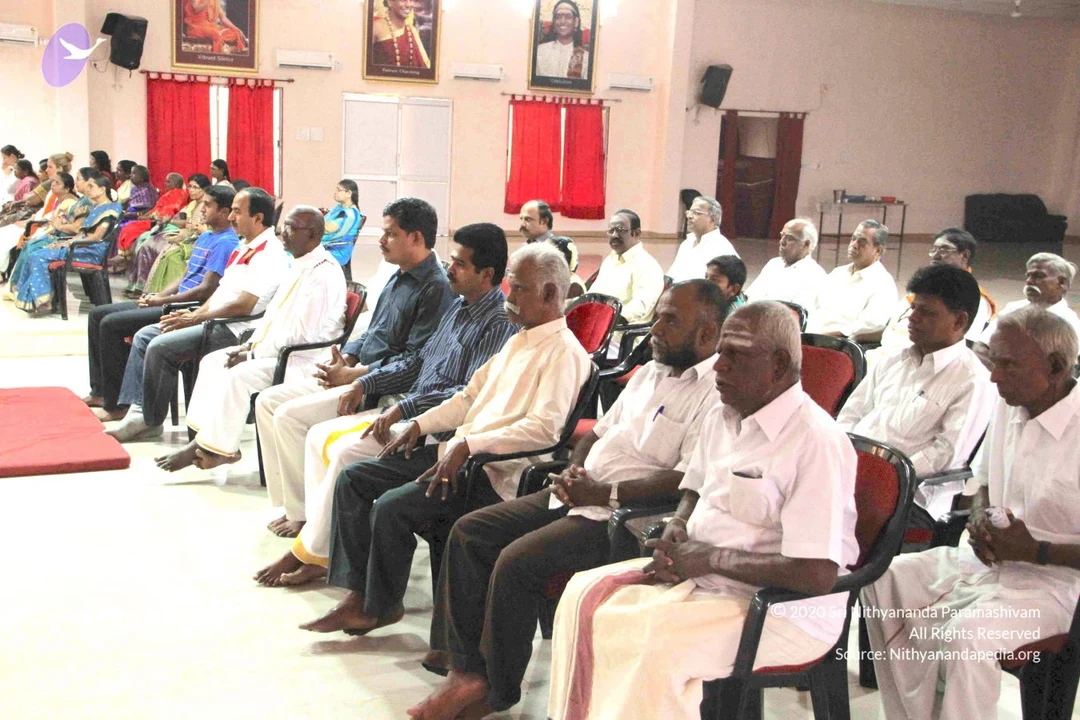
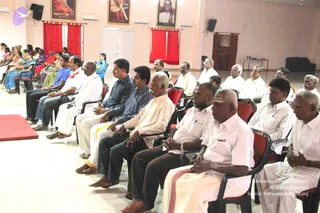
A smiling man with swept-back dark hair, a red bindi and white tilak sits on an ornate gold throne with a carved arched back and lion figures. He wears a rust-brown dhoti with a gold border, a brown shawl, multiple thick gold bead necklaces and gold armlets and bracelets. A striped tiger-skin cloth covers the seat. Gold lamps stand behind him and a partial figure appears at the right edge. Swamiji (probable): the seated man has long swept-back hair, ceremonial gold necklaces and saffron-brown clothing, with the throne as setting. A printed copyright line runs vertically along the right side.A smiling man seated on an ornate gold throne with a richly carved golden backrest. He wears a rust-brown robe with a gold-striped border and draped over one shoulder, multiple strands of large gold beaded necklaces, gold armbands and a gold necklace. He has a white vertical forehead marking and a red bindi, with gold earrings. His hand rests on his knee, and a tiger-striped cushion is visible at the lower left. Appearance-based label: a person, seated in person with ceremonial gold ornaments and saffron-brown robes.A seated audience fills a large hall with red-cushioned mats on the floor in front, where a young man in white sits cross-legged at left and two men in pale shirts sit on the mats near the lower edge. Rows of men and women in plain and colourful saris and salwars sit on plastic chairs and along a raised stage area at left; many wear white dhotis and shirts. Three framed portraits of women in saris hang on the back wall between red curtains, and a framed photo of a standing figure appears on the right wall. The scene suggests a satsang gathering, with no visible speaker.A seated audience of men and women in a bright hall attends a satsang. In the foreground, older men in white shirts and dhotis sit on red-cushioned chairs, one in a cream kurta and another in a blue-and-white striped shirt. Behind them, rows of attendees sit in plastic chairs, several women in saris and salwar kameez. Red curtains hang on the windows, and framed portraits hang on the wall above, with no visible a person figure among the people. A red mat lies at the left edge. The seated listeners are attentive, facing the stage out of frame.A seated audience at a satsang inside a hall with cream walls, red curtains and a red floor mat at left. Rows of women in saris and salwar kameez sit on black plastic chairs, several with hands folded or palms together; one woman in red and gold and another in blue with gold border are prominent. At right a young man in a blue striped t-shirt and a man in a white polo with a red-and-white collar sit with hands clasped. Their attention is directed toward the front, out of frame. Roughly a dozen to twenty visible people.Indoor satsang hall where a seated audience of men and women in white dhotis, pastel shirts and sarees listens attentively. Rows of red-cushioned chairs face forward, with a red mat on the left floor. Framed portraits hang on the back wall above red curtains, and a loudspeaker is mounted on the wall. Several men in the front row wear white dhotis and shirts, one in a striped shirt, and many sit barefoot. No identifiable presiding figure is visible in this frame.

Sarva-Darshan

1 photoSource gallery
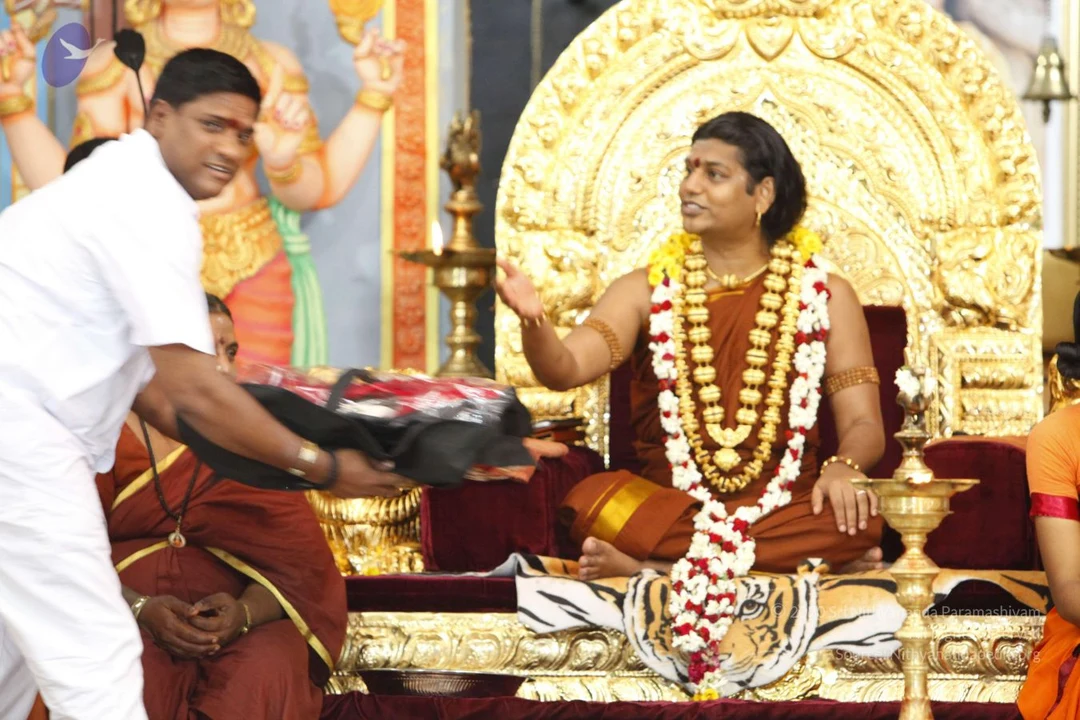
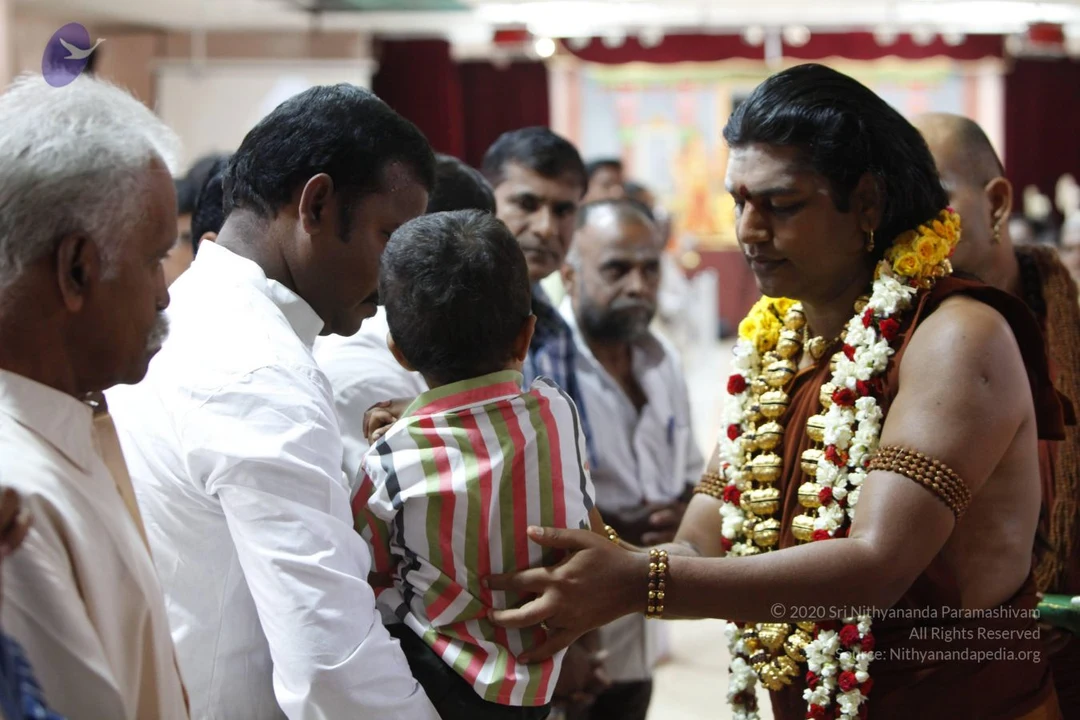
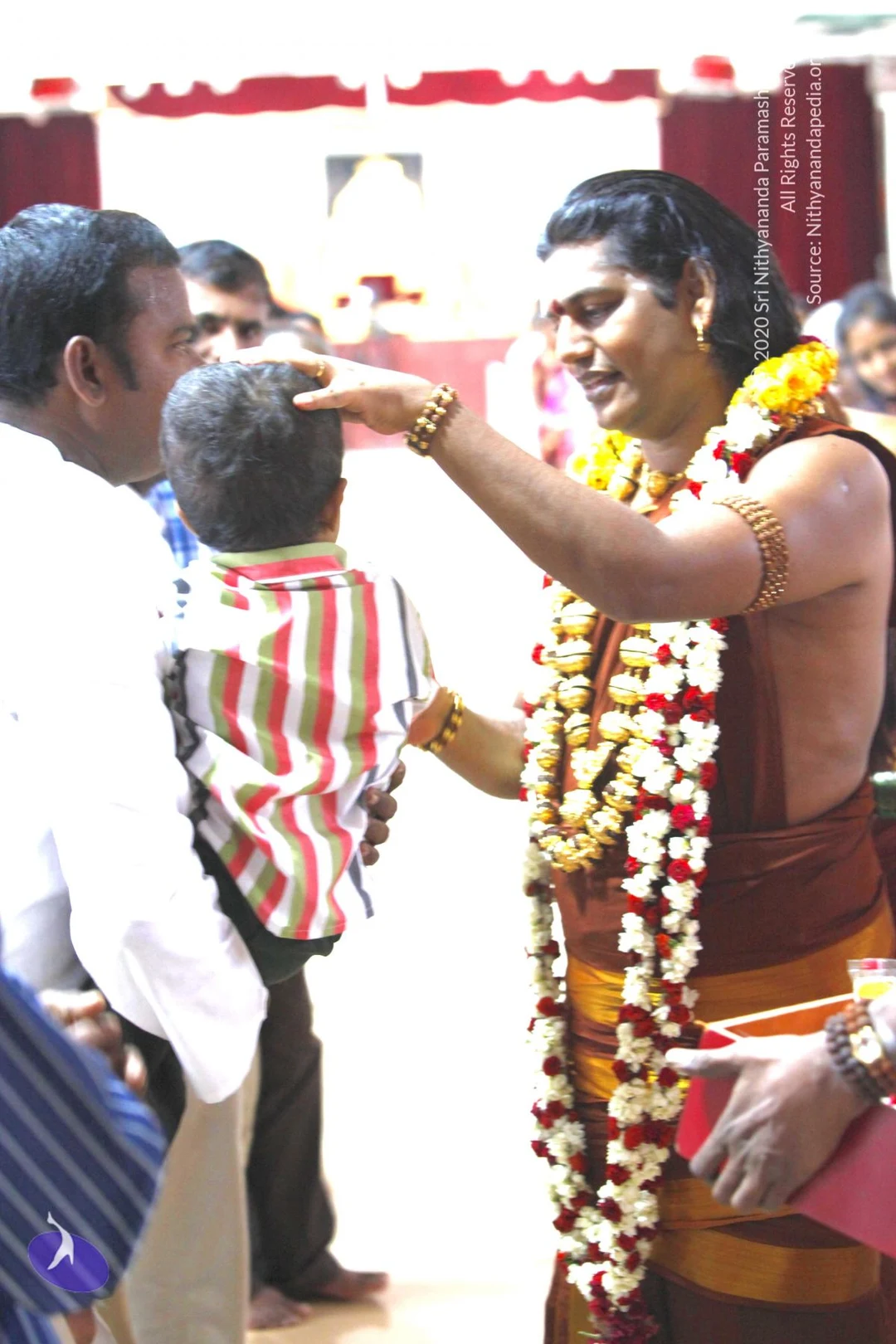
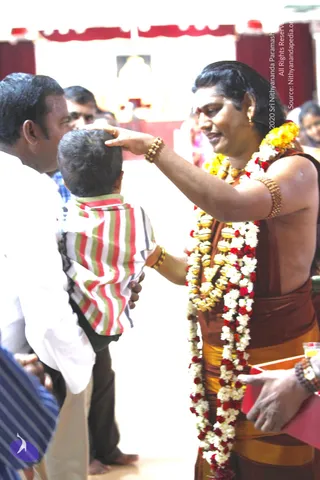
A man in a rust-brown robe with a gold-coloured waist cloth and a long garland of white jasmine, red roses and yellow marigolds stands with his right hand raised, placing his palm on the head of a young boy in a red, green and white striped shirt. The man wears gold earrings, a gold armlet, beaded bracelets and a vibhuti mark on his forehead, and a long swept-back hair style is visible. An adult in a white shirt stands at left holding the boy's shoulder, and a few other people stand in the background in front of a red-draped temple hall. A person at lower right holds a red object. Probable Swamiji: the visible cues are long swept-back hair, ornate gold jewellery, a saffron-toned robe and a garland, and he is shown giving a blessing to a child.

Final-Blessing

3 photosSource gallery
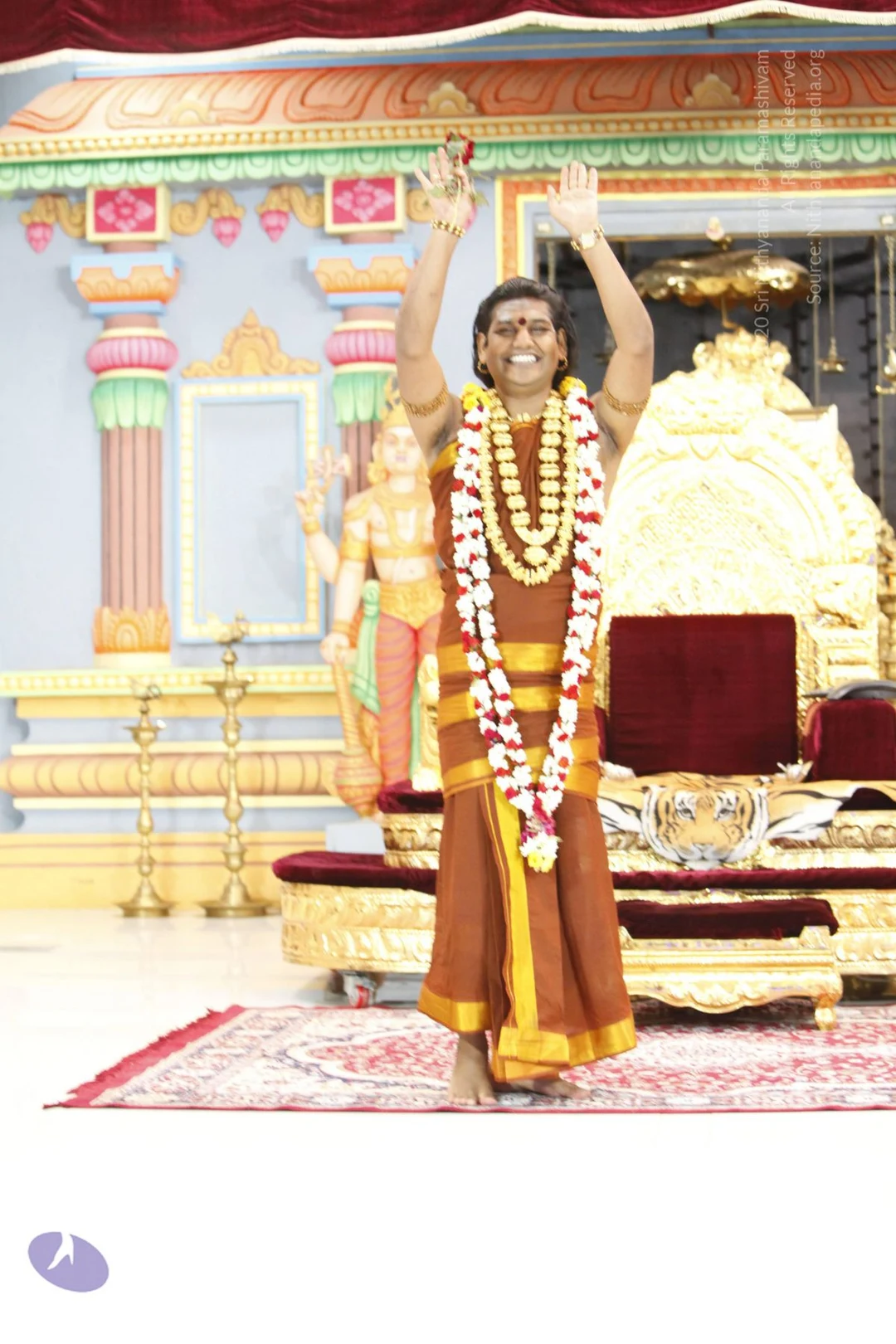
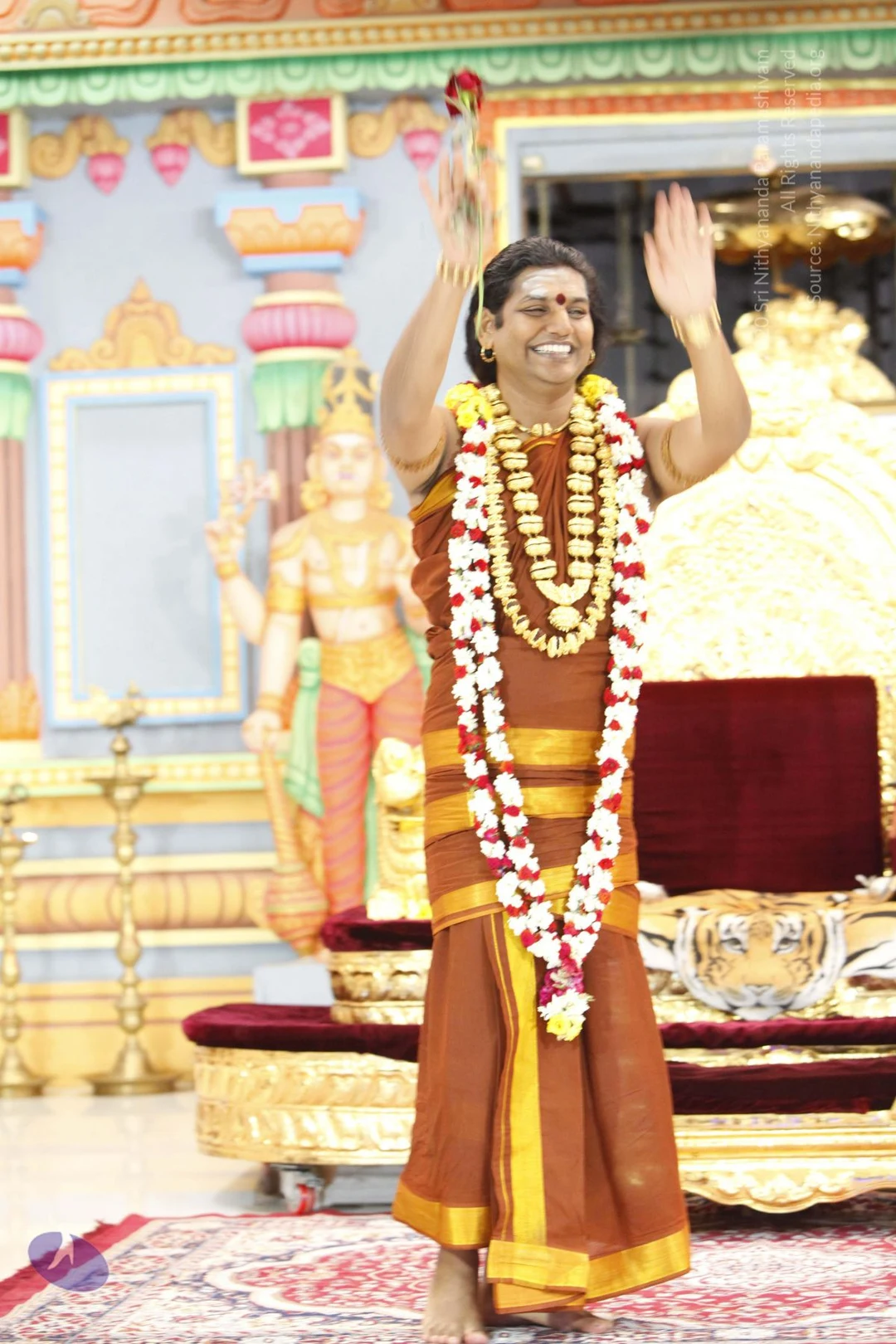
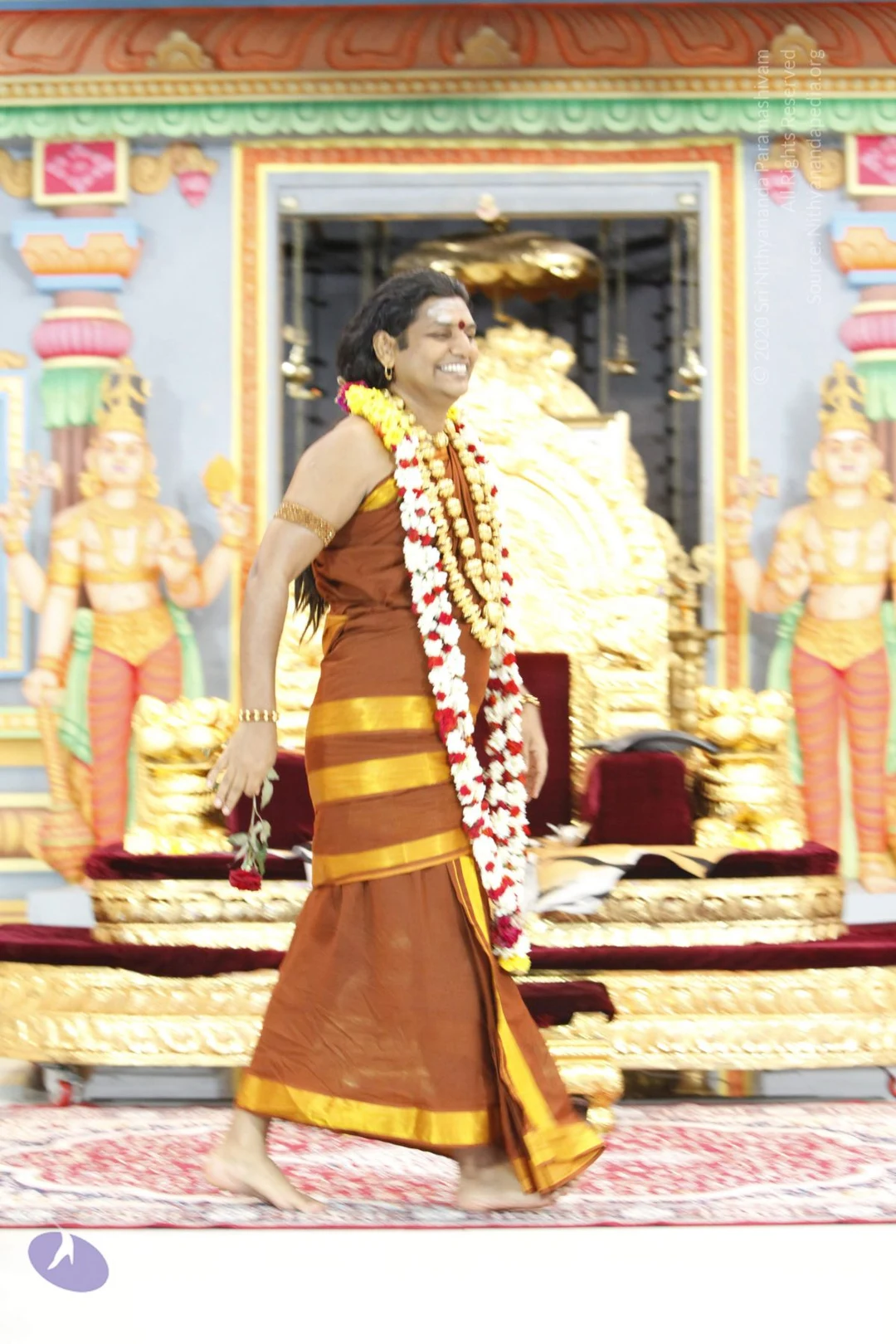
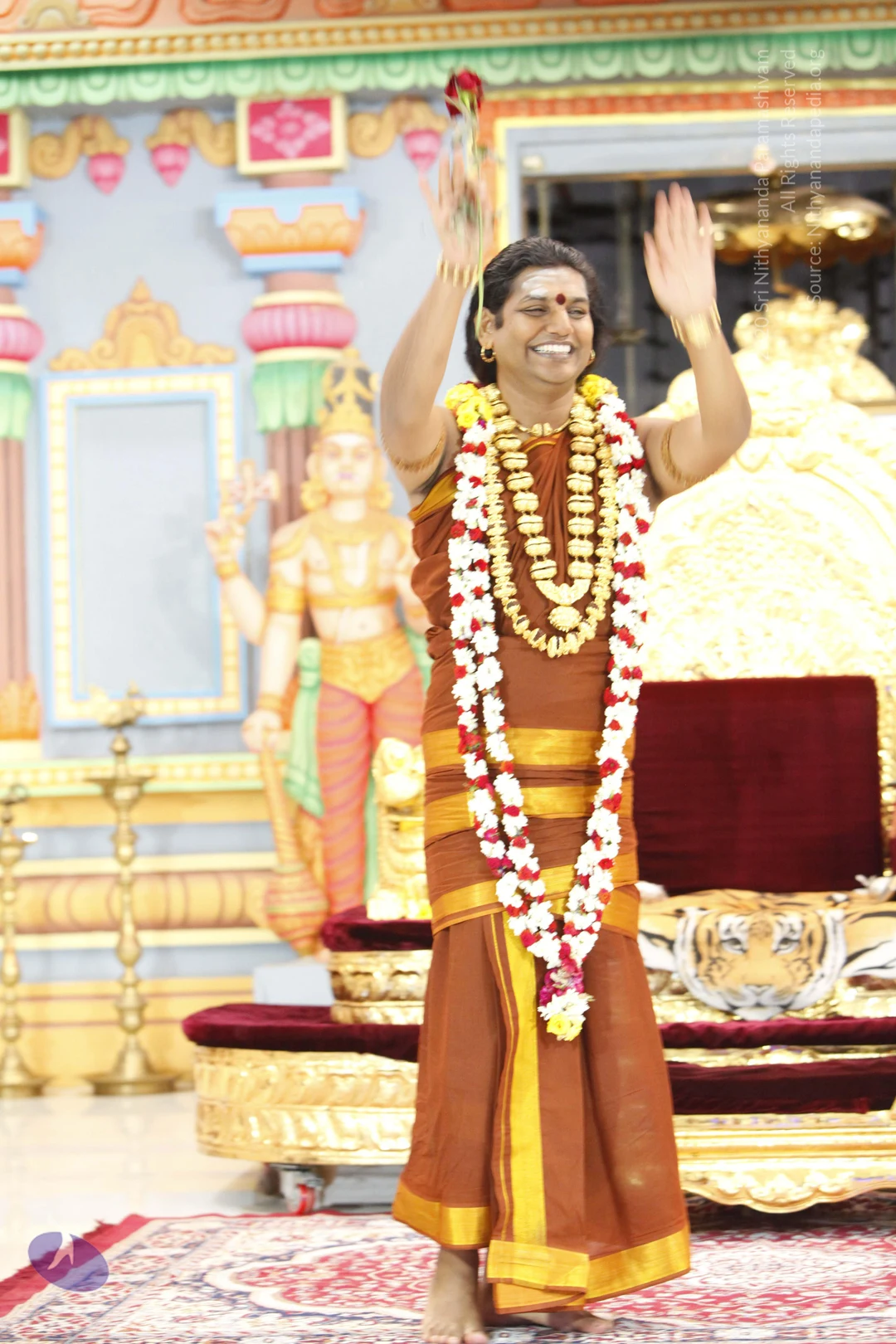
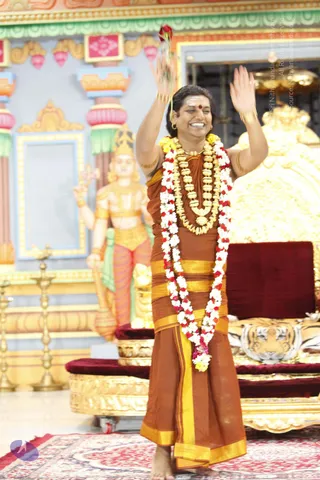
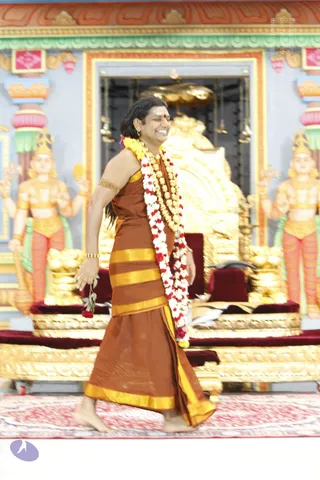
A smiling man stands barefoot on a red patterned rug with both arms raised in greeting. He wears a rust-brown dhoti-style wrap with gold borders, a layered gold necklace, a white and red flower garland, gold bangles and a red bindi. Behind him is a gold throne with a red velvet seat draped with a tiger-print cloth, flanked by brass oil lamps. A painted backdrop shows a colourful deity figure and decorated columns, and a gold canopy hangs at the upper right.A smiling man stands barefoot on a red and cream rug in a richly decorated hall, raising both hands with a red rose held aloft in his right hand. He wears a rust-brown dhoti and shawl with gold borders, layered white, red and yellow flower garlands, a heavy gold bead necklace, gold armlets, and a red bindi with vibhuti on his forehead. Behind him stands a golden deity murti with multiple arms and a crown, beside a gold throne draped in red velvet and a tiger-skin cover. Brass lamp stands flank the scene and painted pink and green pillars frame the hall. The man's appearance matches the a person cues of ornate gold jewellery, garlands and saffron-toned attire, and the page names him, so he is identified as a person giving blessings.A smiling man with long dark hair walks barefoot across a red patterned rug in front of an ornate temple backdrop. He wears a rust-brown garment with broad gold borders, a gold armlet and bangles, and a multi-strand garland of white, yellow and red flowers over his shoulder, with a red flower held in his hand. A red-and-white forehead mark is visible. Behind him stand two gilded deity figures with raised arms, flanking a gold-decorated seat with red cushions and hanging bells. a person: long swept-back hair and a saffron-toned robe with a garland are visible, and the page indicates his presence, but the appearance cues are not conclusive enough for certainty.

Garbha-Mandir

2 photosSource gallery
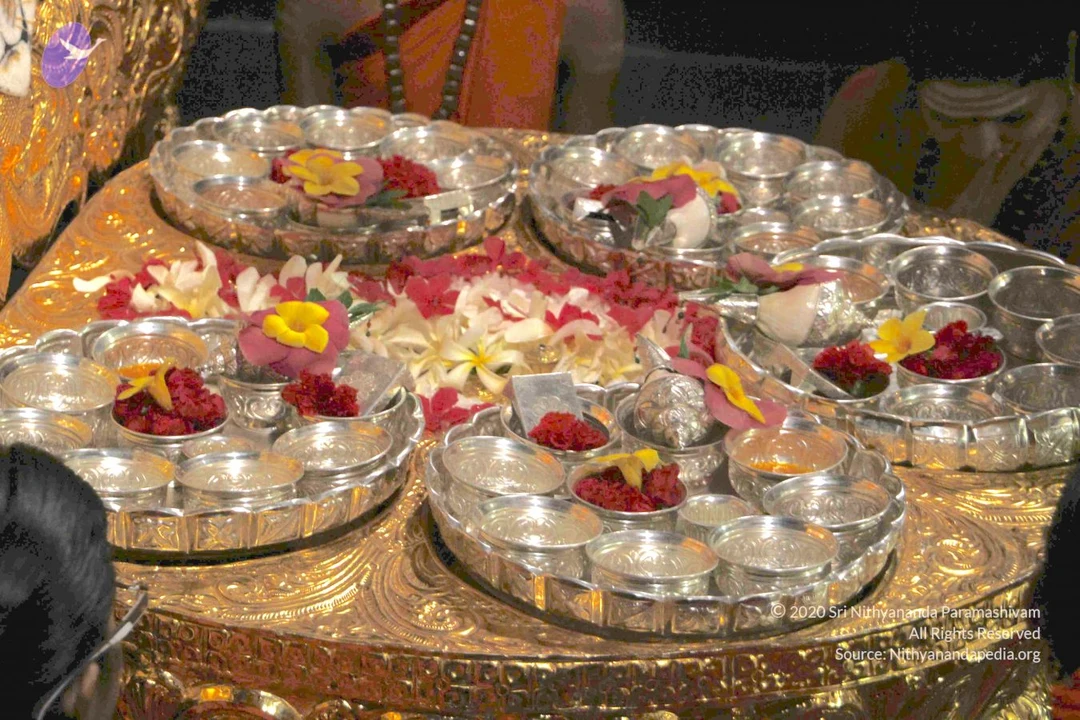
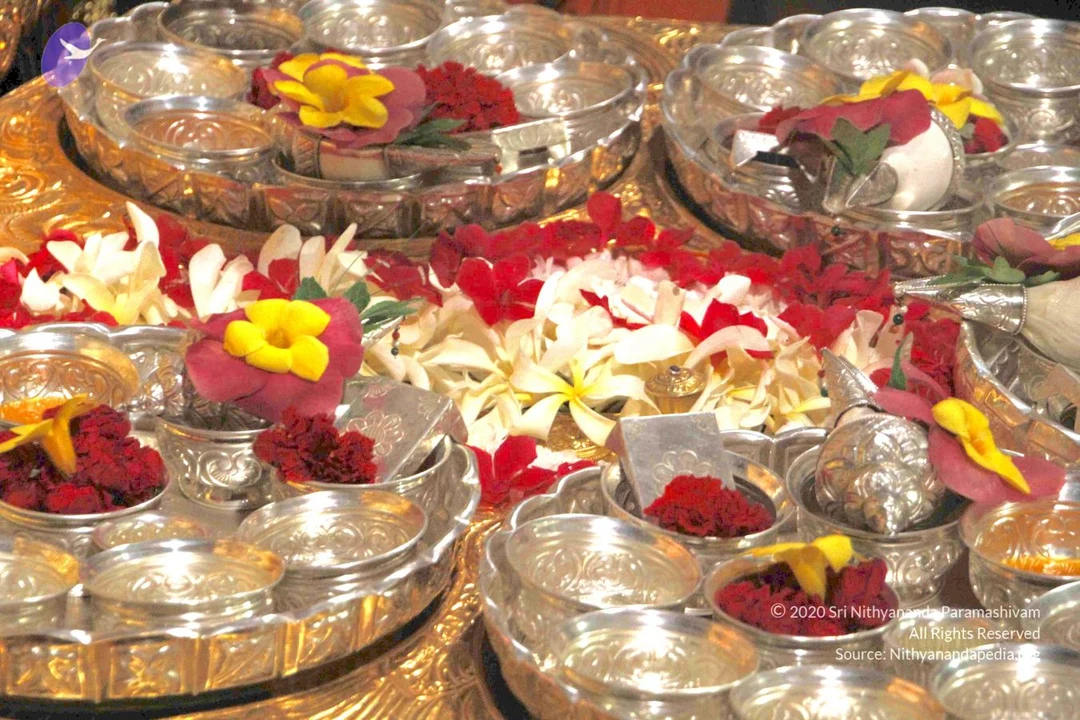
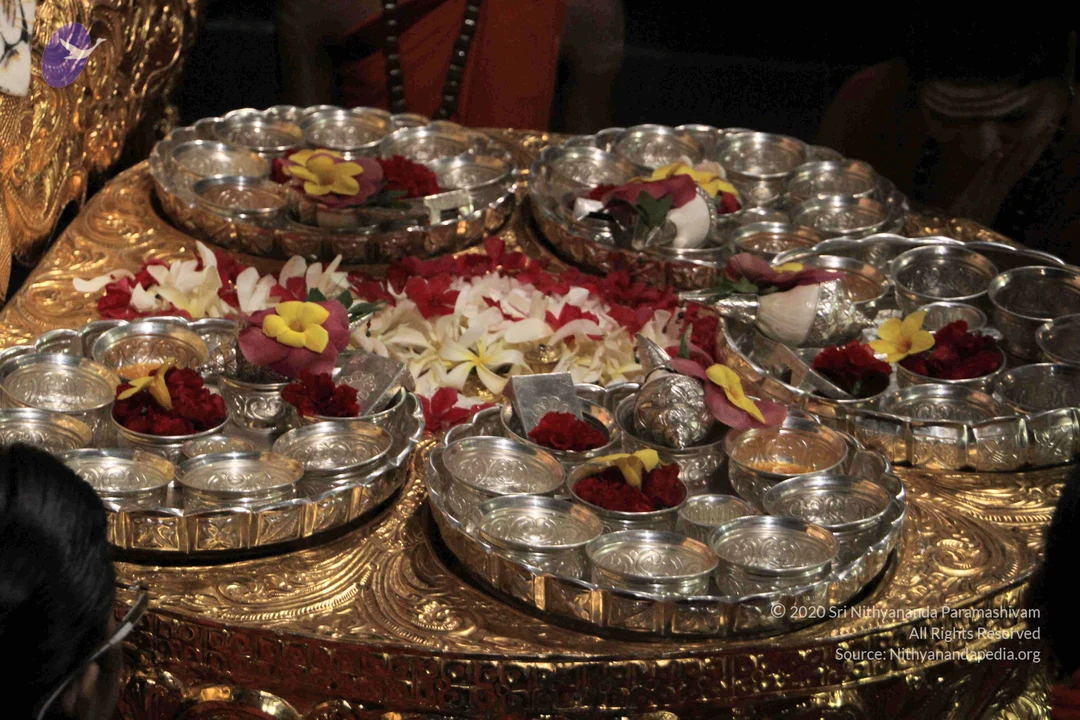
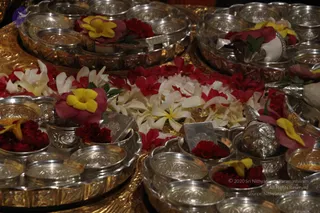
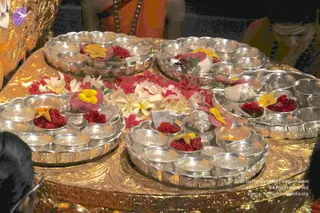
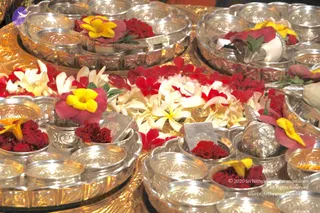
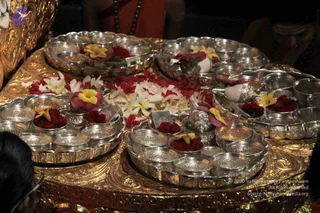
A photograph of an ornate gold-brocaded table set for a ritual offering. Multiple round silver trays with scalloped rims hold small silver bowls filled with red flower petals, yellow and pink blossoms, and white plumeria-like flowers. A silver cup and small silver vessels sit among the petals. At the top edge, the orange and saffron-coloured clothing and a rudraksha-style bead strand of a seated figure are partly visible, and a lower-left corner shows the head of a person. Pieces of the scene are cut off, including the upper and lower frame edges. The arrangement suggests a puja offering of flowers and vessels.Close-up photo of ritual offerings arranged on ornate silver and brass trays. Silver bowls hold red and yellow flowers, red roses and white and yellow plumeria garlands cover a gilded surface, and a silver spoon and small silver vessels sit among them. No people are visible.

Photos Of The Day:

1 photoSource gallery
Seven women in orange and saffron saris with yellow borders and rudraksha malas sit cross-legged in a circle on a terracotta-tiled floor in an office-like hall. A small vase of white flowers sits in the centre. Behind them a golden-framed throne covered in orange flowers stands beside a large portrait of a figure in orange robes with long hair. The woman seated at the far right wears a pink sari. Glass partitions, desks and a wooden screen fill the background.

01-Senthil-Anna-Engagement
82 photosSource gallery
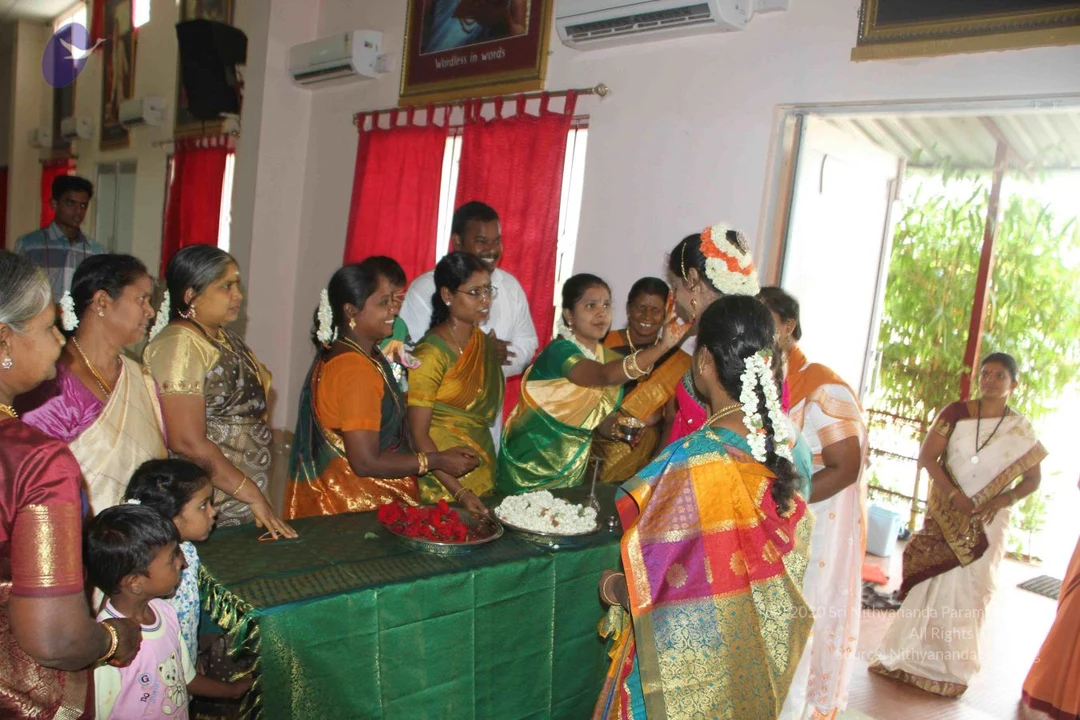
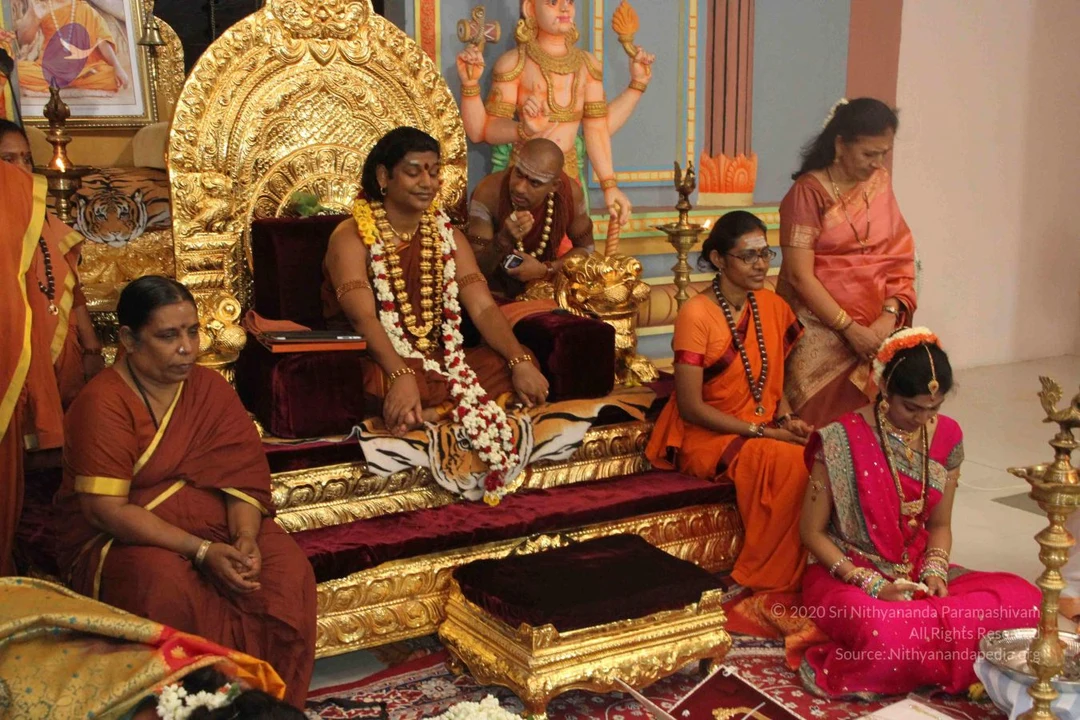
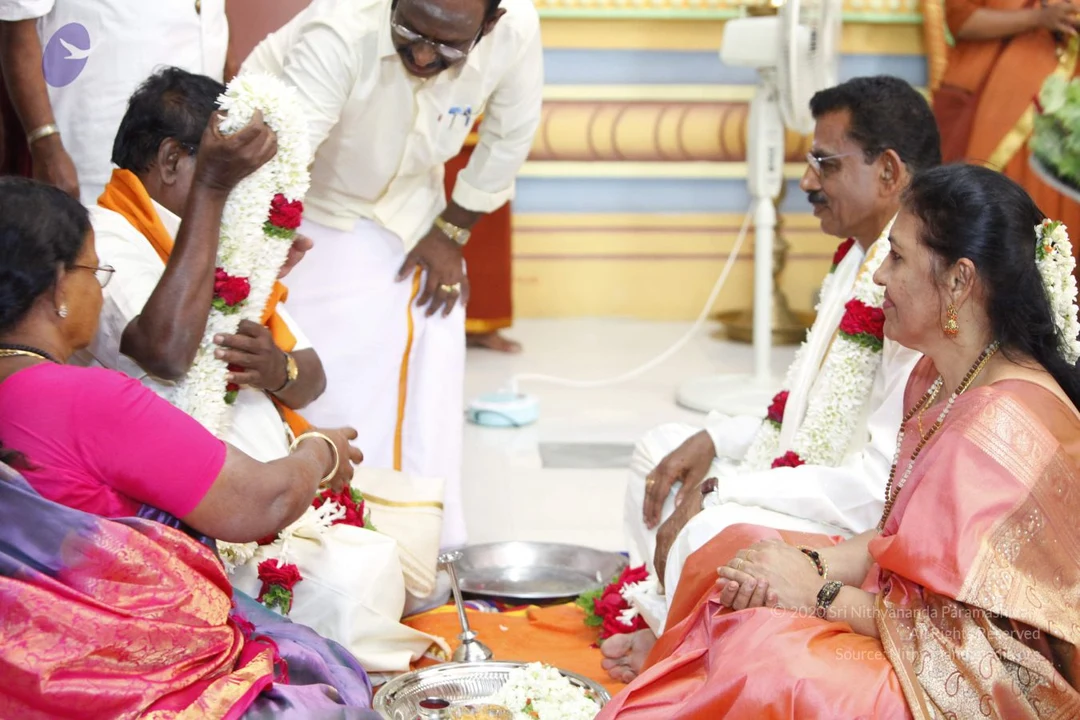
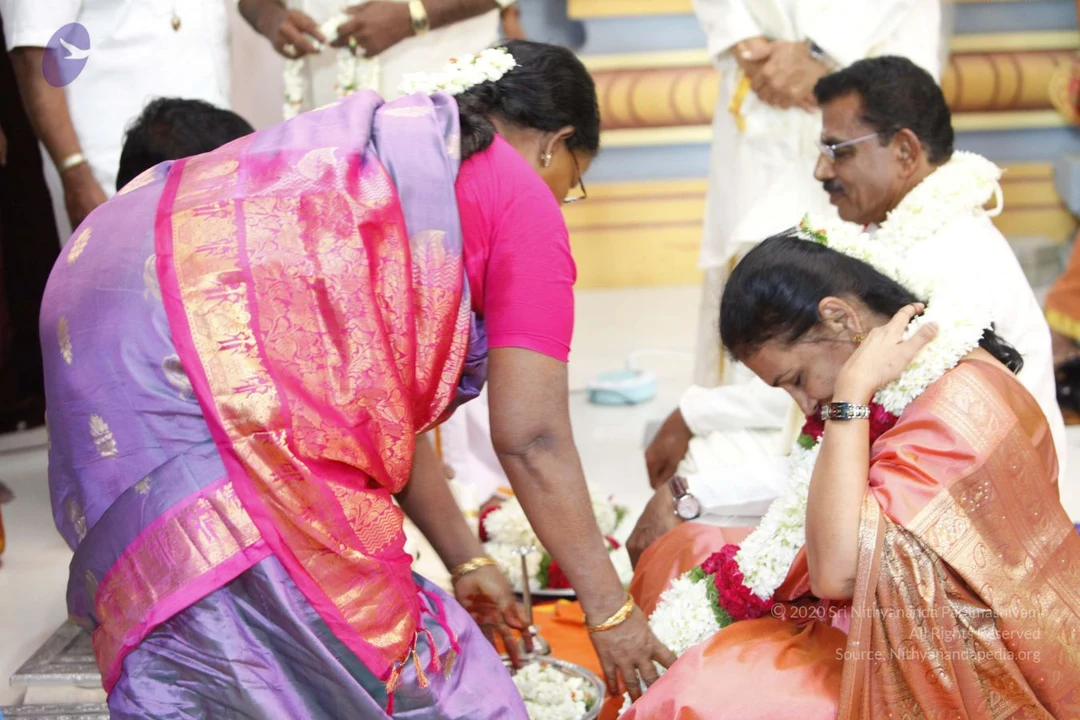
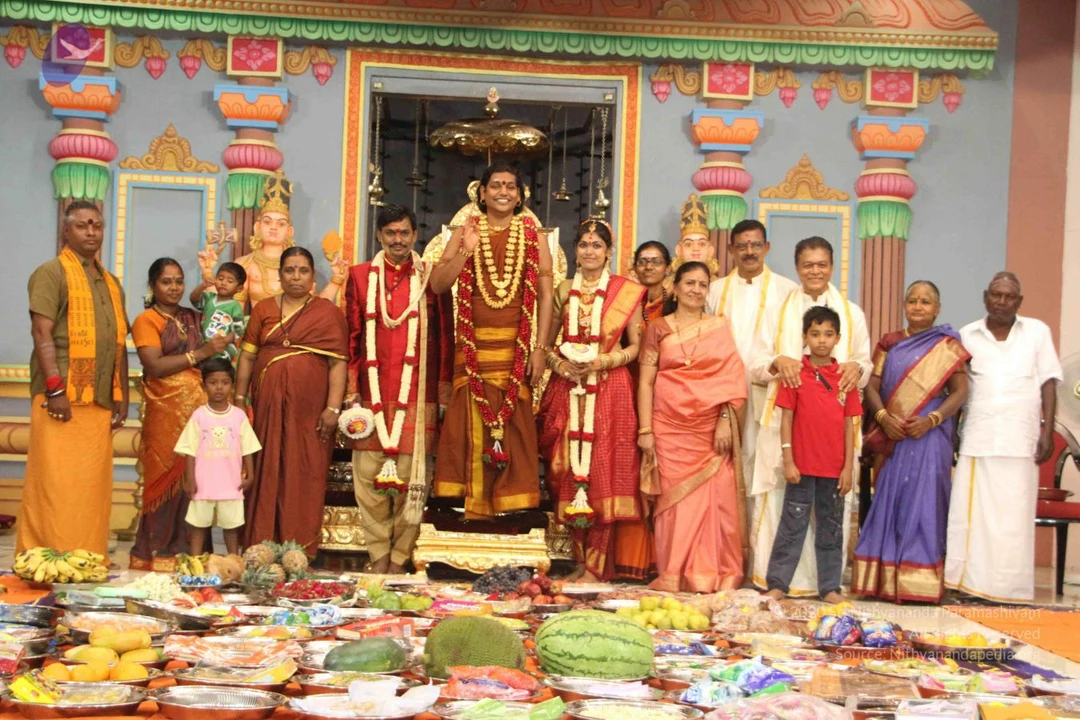
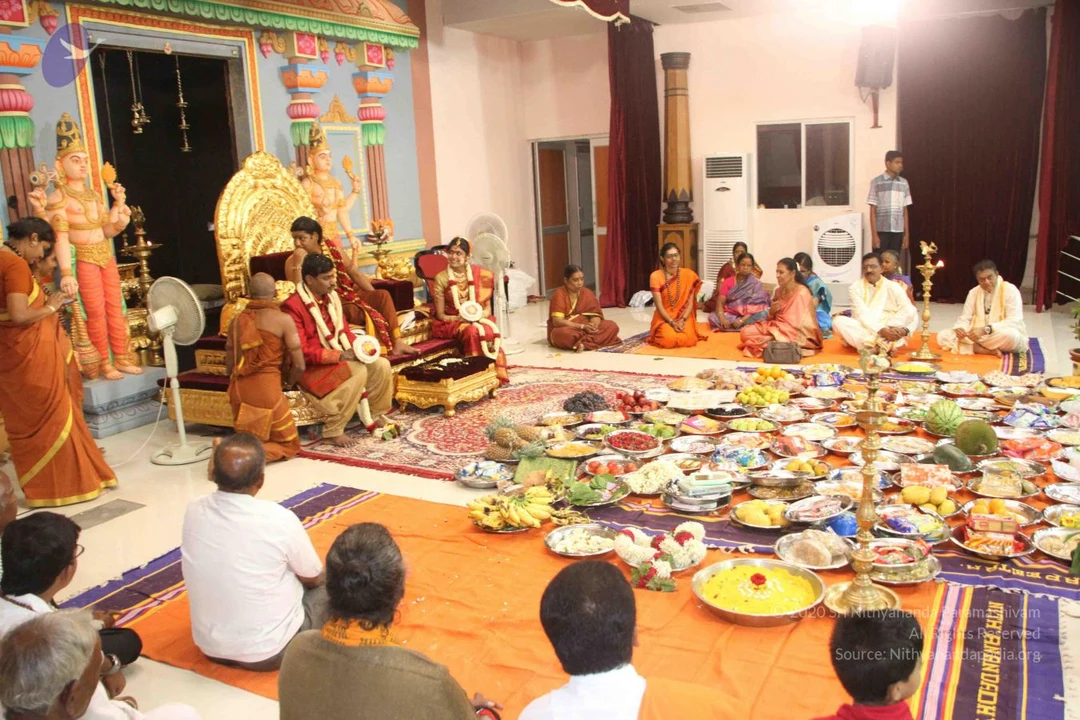
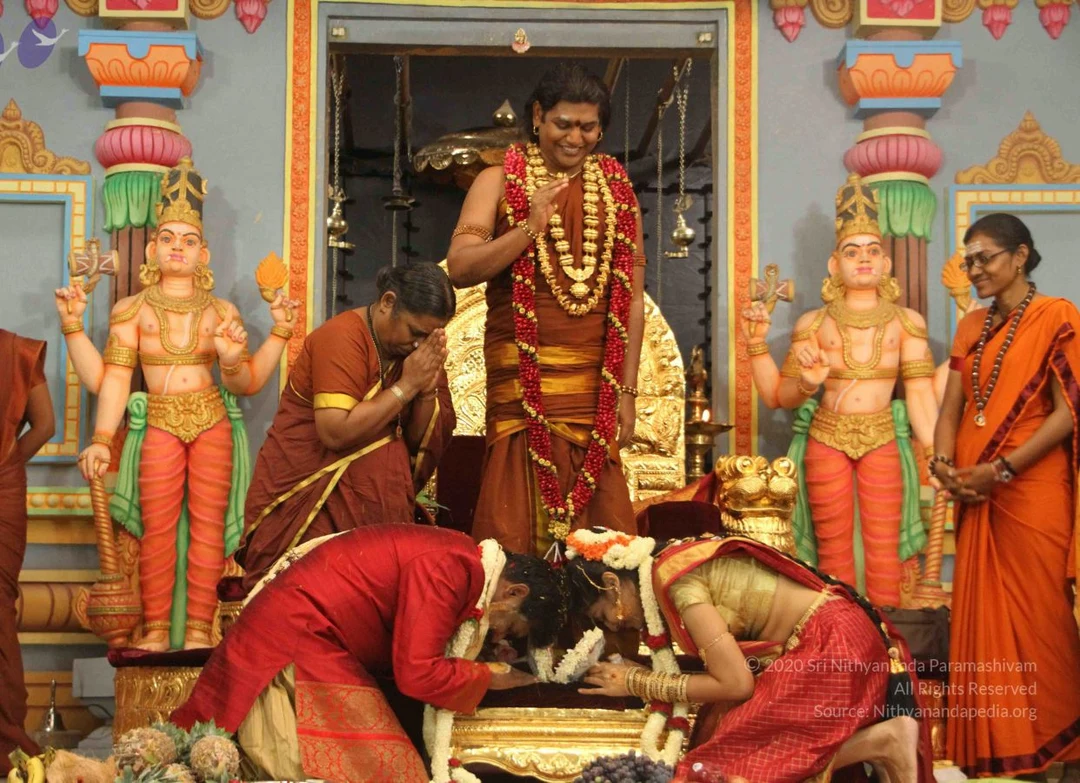
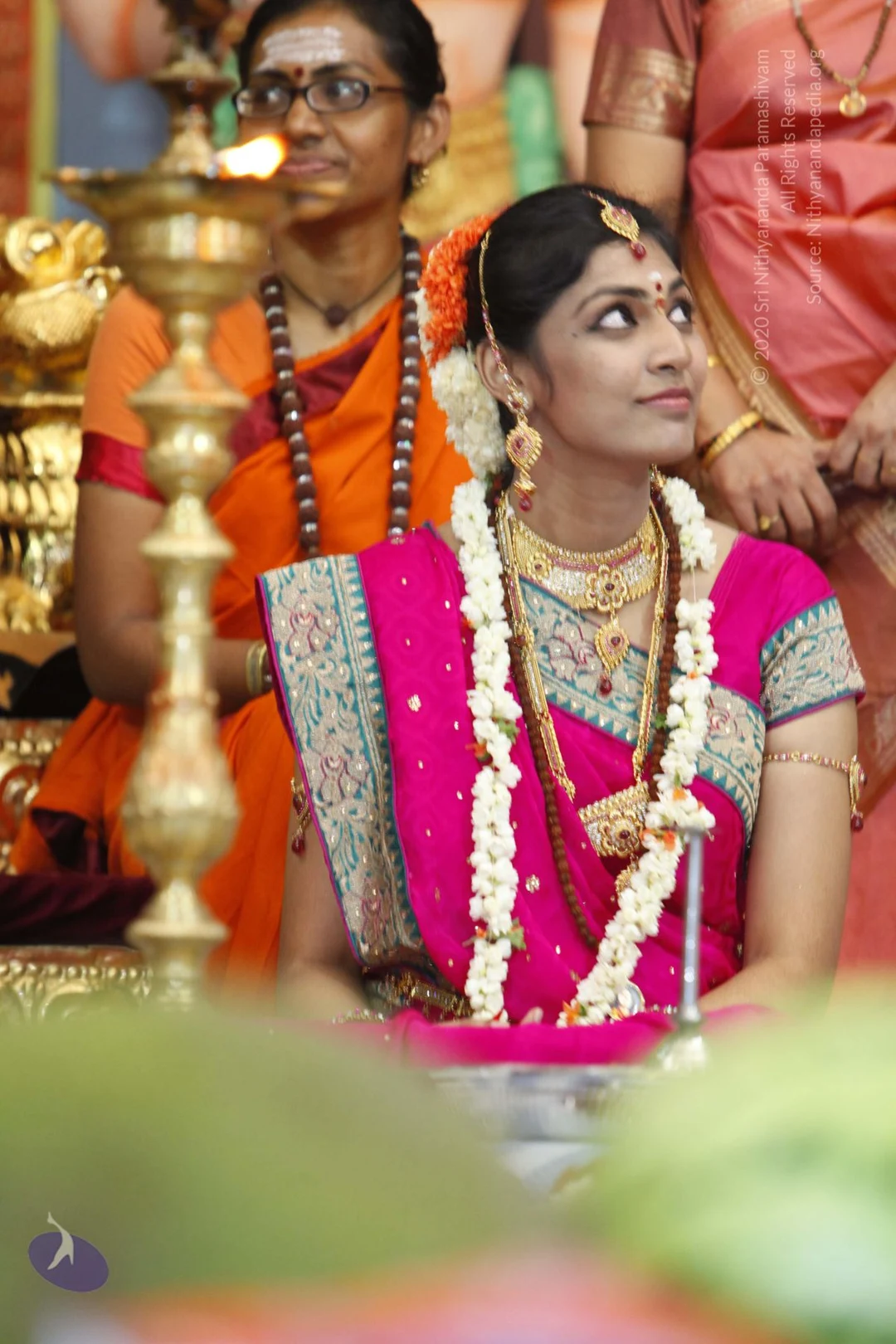
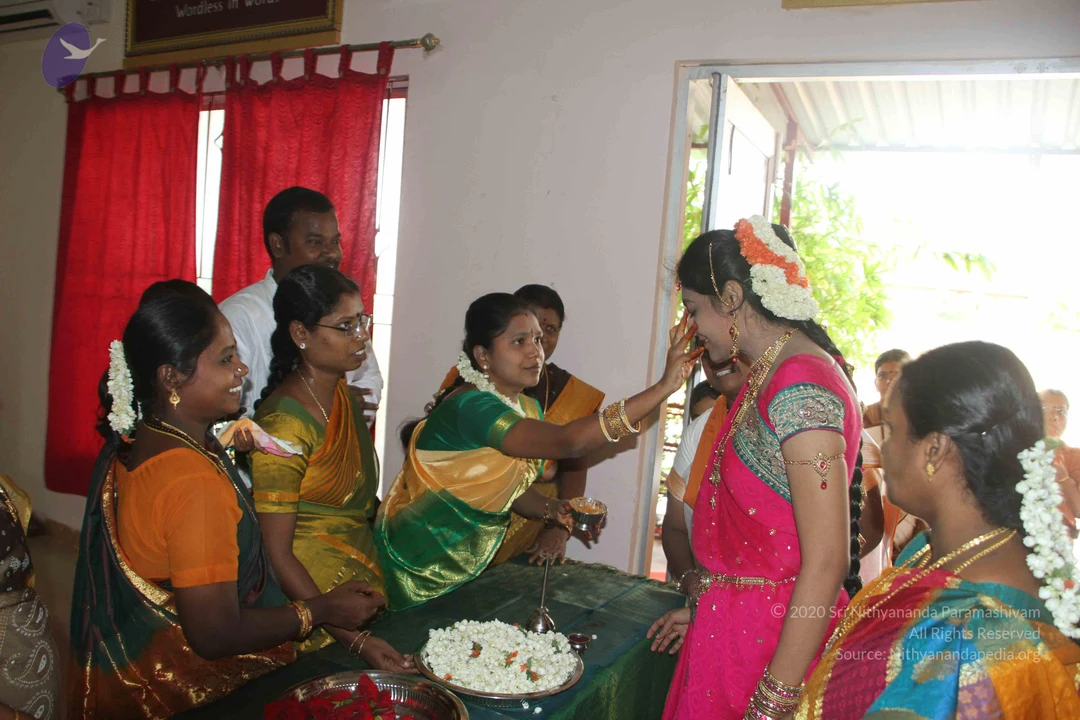
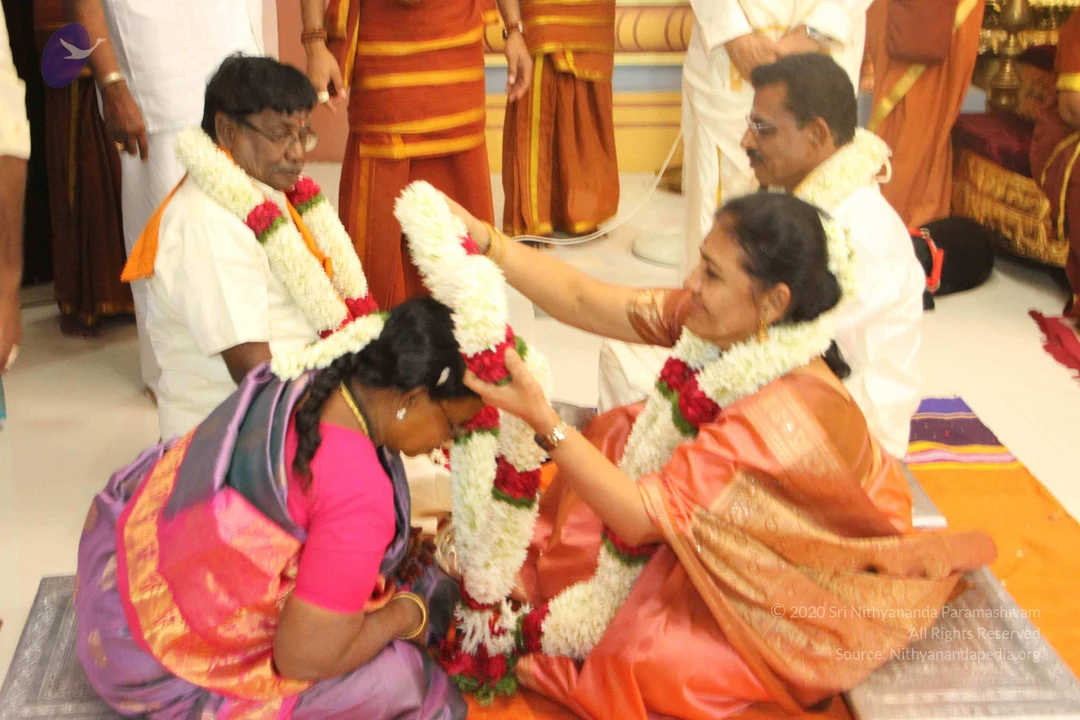
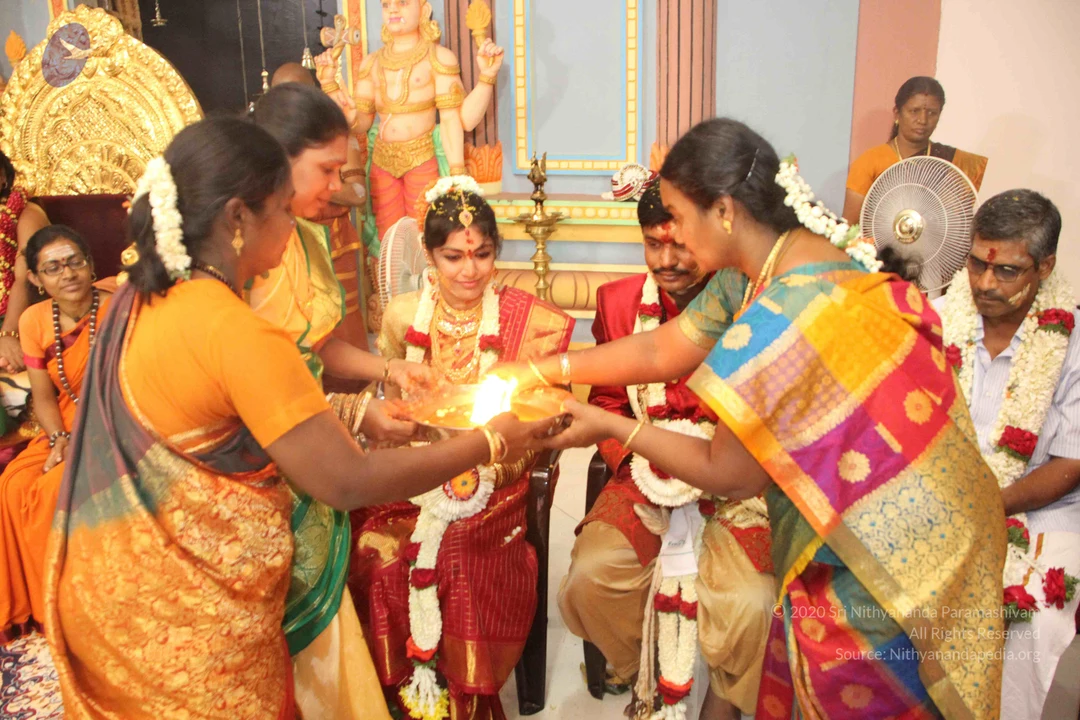
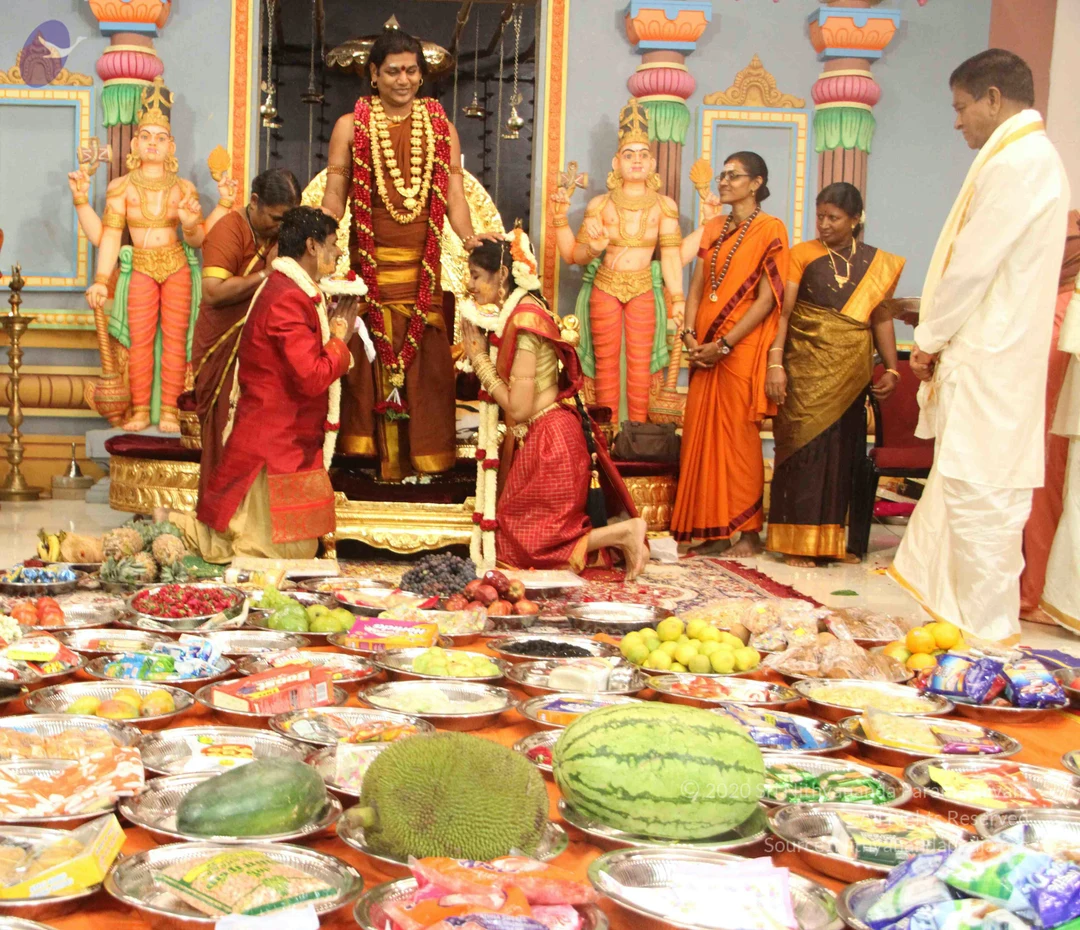
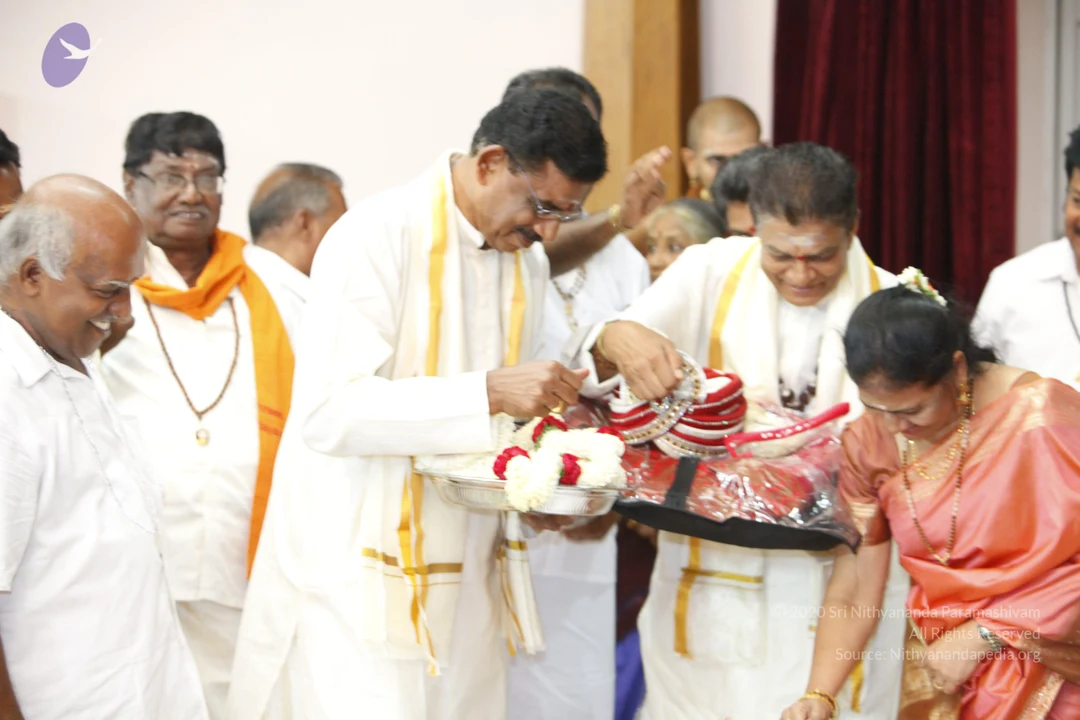
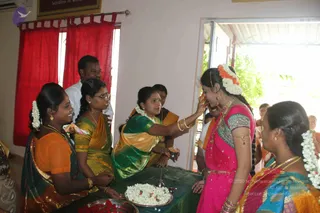
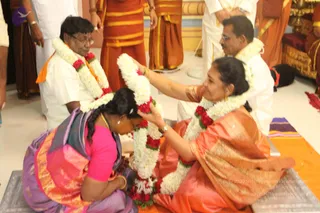
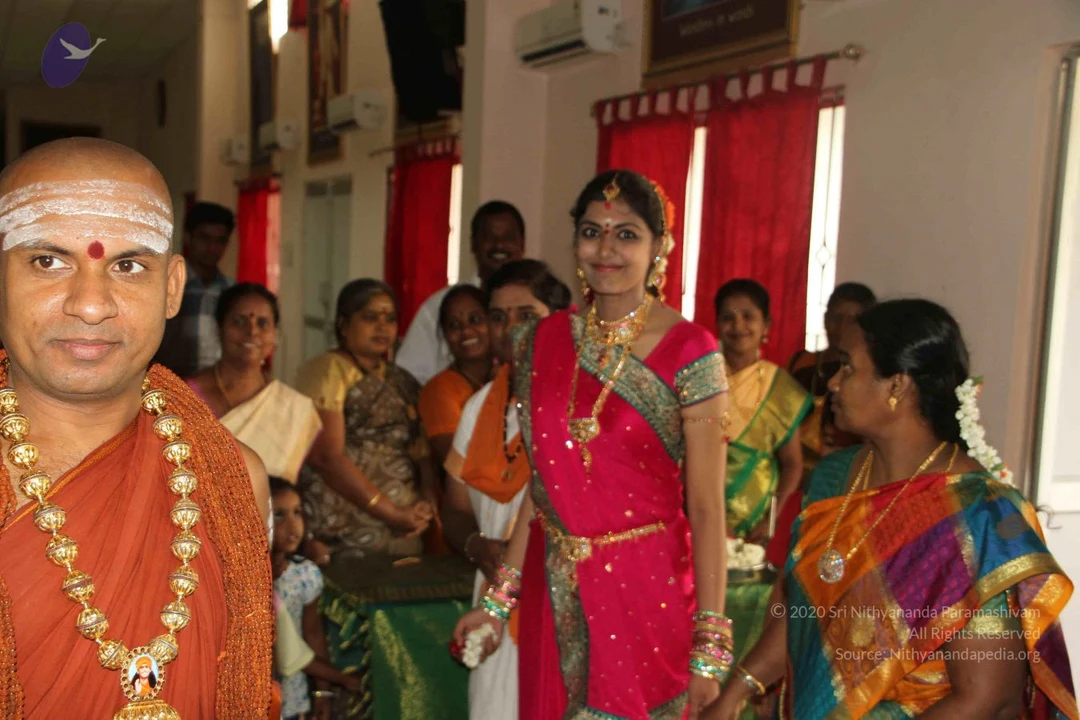
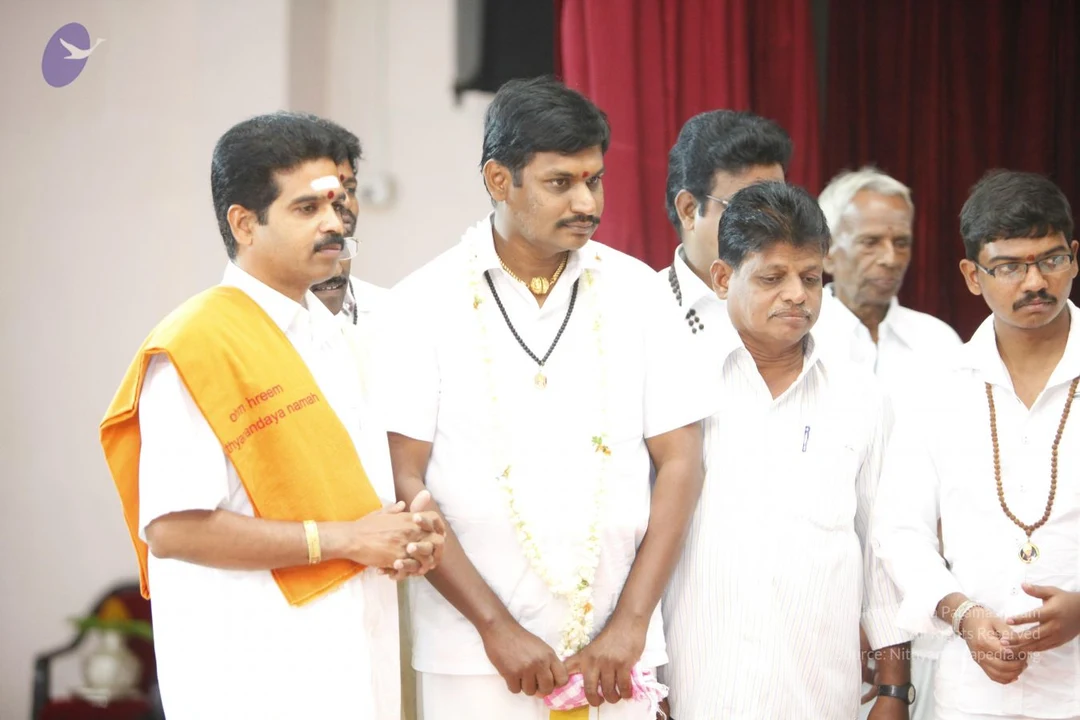
Indoor engagement-ceremony scene in a plain room with pink walls and red curtains. A young woman in a pink and teal silk sari with gold jewellery and a white-and-orange flower garland in her hair stands at the centre, while a woman in a green and gold sari dabs a mark on her cheek. Other women in orange, green and yellow saris sit or stand around a green table holding a silver tray of white jasmine flowers, a small brass lamp and a bowl. A man in a white shirt stands at the back near a doorway. No a person candidate is visible.A photograph of a ceremonial blessing in a temple hall. A woman in an orange-and-gold silk saree and gold bangles, seated on the floor, lifts a long garland of white jasmine and red roses toward a woman in a purple saree with a pink blouse, who bows her head forward to receive it. Behind them, a man in white dhoti and shirt wears a similar white-and-red garland and sits with folded hands, while another man in a white shirt with garland sits nearby. Other people in saffron-orange and red-striped dhotis stand in the background near a golden lamp stand. A white ritual mat and orange cloth cover the floor.A photograph of a seated ritual exchange in a temple hall. Two couples sit on an orange cloth: a woman in a pink blouse and purple sari on the left, a woman in an orange and gold sari on the right, each wearing white jasmine garlands with red flowers. A man in a white dhoti and gold-bordered shawl holds a brass plate with a coconut, bananas and a sweet, offering it toward the seated women. Behind them standing men in white dhotis and shirts watch, one wearing glasses, one holding a phone. A tall orange and red painted deity murti stands in the background with a brass lamp beside it, and a seated woman in a red sari sits at the right edge.Inside a temple hall with gold-framed throne and deity statues, a seated figure on a red-cushioned gold throne wears orange robes and a red-and-orange garland, while a woman in an orange sari sits nearby. Around a spread of fruit, flowers and sweets on a patterned rug, several devotees in white dhotis and orange or pink saris kneel and offer coconuts, bananas and plates in a puja. Men in white shirts and gold-bordered dhotis stand near, and a row of women in saris watches from the right. The scene suggests a ritual offering ceremony during an engagement event, with a paduka-style blessing context.A temple ceremony in a decorated hall with a gilded throne and a raised dais. On the throne sits a figure in red and gold with a white garland, the appearance is consistent with a person, wearing a red-garlanded gold-and-red setting. Seated on the floor in front, a man in white dhoti and shirt with a white garland and red flowers receives a ritual offering from a man in white with a plate of fruit, coconut and banana; a woman in an orange sari with a garland sits beside him with offering trays of fruit, coconut, sweets and flowers. Several people in white shirts and dhotis stand behind, and women in orange and red saris sit at the back. Brass lamps and gilt figures of deities stand at the sides. Visible people: about ten.A photograph inside a temple hall with blue and pink pillars and a golden throne-like seat. A man with long dark hair, wearing a red-orange garland and sitting on a cushioned gold seat, is seated among offerings. A man in white dhoti and shawl with a gold border stands near the centre, and several women in orange and maroon saris with garlands sit on the floor. Foreground women hold silver plates of bananas, coconut and sweets, and a low tray of fruit, pineapple and flowers lies before them. Several standing men in white shirts and dhotis surround the seat, and a fan is visible at right.
01-ADIKAILASA-TEMPLE

23 photosSource gallery
A photograph of a pair of gilded deity murti seated on a lavender draped platform before a red curtain within an ornate golden arch. The taller figure wears an orange turban, a crown, rudraksha malas and silver jewellery, holds a trident and a drum, and wears dark green trousers under an orange garment. The companion figure wears a dark cap, an orange sari with silver ornaments and a bird in hand. The setting appears to be a temple display of deity statues, with no physical people visible.Two golden statues of a deity couple seated together on a pale lilac draped pedestal before a bright pink curtain framed by an ornate gilded arch. The male figure wears an orange-red turban and a dark green lower garment, holds a trident and a rudraksha mala with silver jewellery. The female figure wears an orange sari with silver necklaces and a dark cap, and holds a small bird-like object. The statues are not people; no living persons are visible.A dark stone or metal statue of Nandi, the seated bull, facing forward on a dark plinth in front of an orange-red temple wall. The bull wears a red and gold silk cloth draped over its shoulders, a beaded necklace at its throat, and garlands of red and yellow marigold and rose-like flowers hanging down its chest and front legs. A carved sandstone pillar and blurred greenery appear behind. No people are visible.A tall trident (trishul) with silver-toned prongs is decorated with two long garlands of red and yellow flowers, with dried green foliage wrapped near the top. The trident is held upright against an orange-washed wall with a red door on the left and a corrugated roof and clothesline behind it. No people are visible.A large banyan tree photographed close up, with a thick, spreading canopy of grey horizontal limbs and many aerial roots descending in hanging clusters and tangled columns from the branches to the ground. Green leaves are scattered through the upper branches, and thin thread-like lines are strung across some limbs. No people, deity forms, or ritual activity are visible in the scene.A dark stone murti of a multi-armed deity seated in a meditative pose on a carved rock base, set against a green curtain with gold dot pattern. The figure wears a cream cloth wrapped as a dhoti and a cream headband tied at the forehead, with layered rudraksha and bead malas, a white and gold beaded necklace, and a green sash at the waist. Its upper hands hold a snake-wrapped drum-like object and a lotus-shaped item, while lower hands rest in mudra. The deity murti is shown alone, with no physical people present.

02-PADUKA-PUJA

2 photosSource gallery
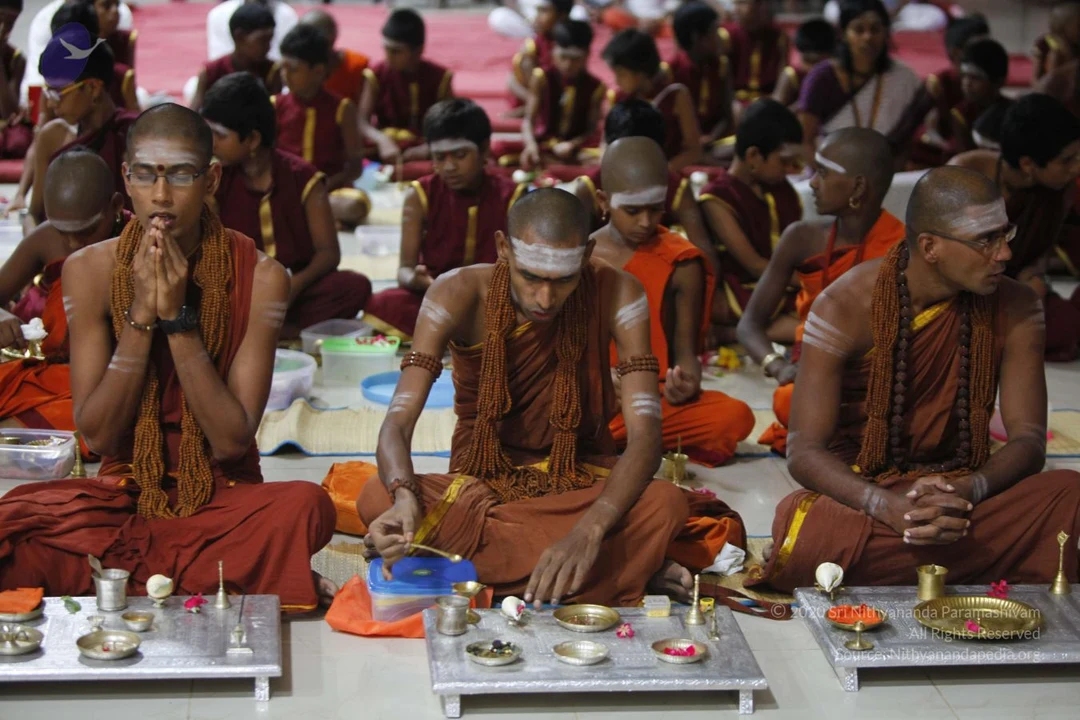
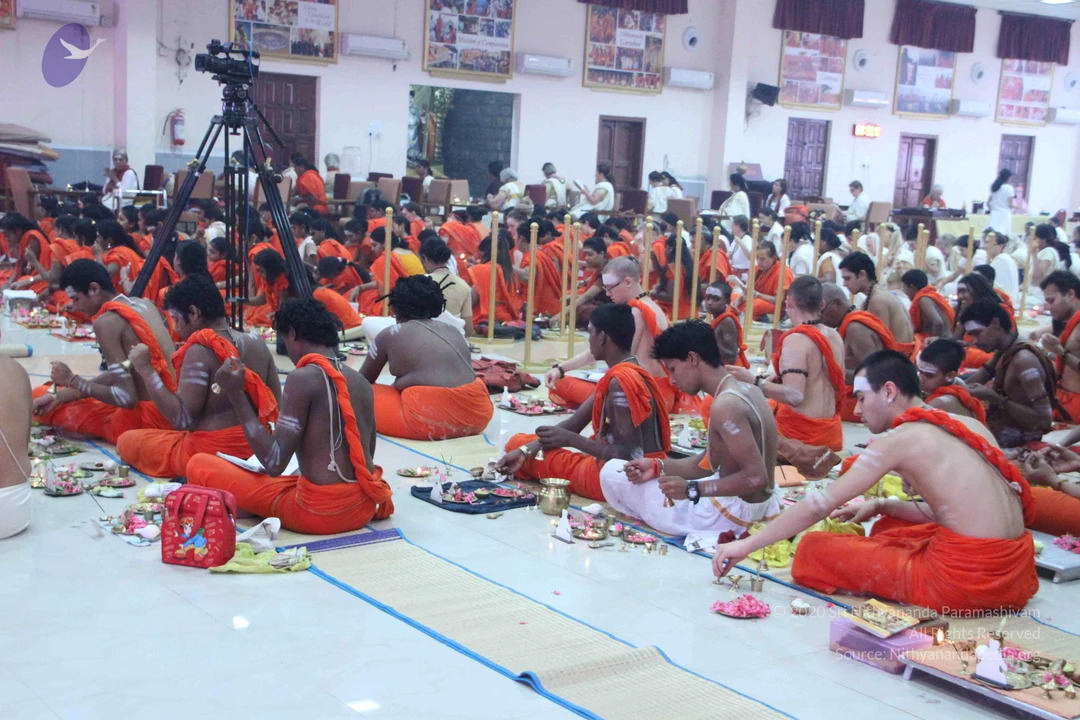
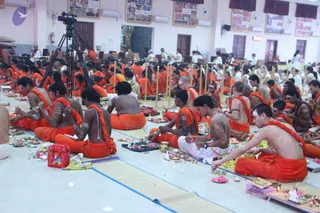
A large hall with many seated men in saffron-orange dhotis and orange shawls, bare-chested with white tripundra markings on their chests and arms, sitting in long rows on mats before brass pujas plates, flower petals, small oil lamps and offering trays. A tripod-mounted video camera stands at left among the rows. Behind them, white-clad attendants move about, and framed photographs hang on the cream walls. The scene suggests a paduka puja ceremony with ritual offerings. No single person can be identified as a person from appearance here, so the figures are described by role and dress only.A photograph of a ritual offering arrangement on an ornate gold-embossed table. Multiple silver bowls and trays are filled with red flower petals, yellow and white plumeria and other blossoms, arranged in circular patterns around a central silver vessel and a silver kalasha-like pot. A small silver lamp and a silver spoon rest among the offerings. At the left edge, a partially visible person with dark hair is seen, and a sliver of another person appears at the top right. The scene suggests a puja offering setup, with flowers and silver vessels prepared before a ritual.
03-NITHYA-SATSANG

4 photosSource gallery
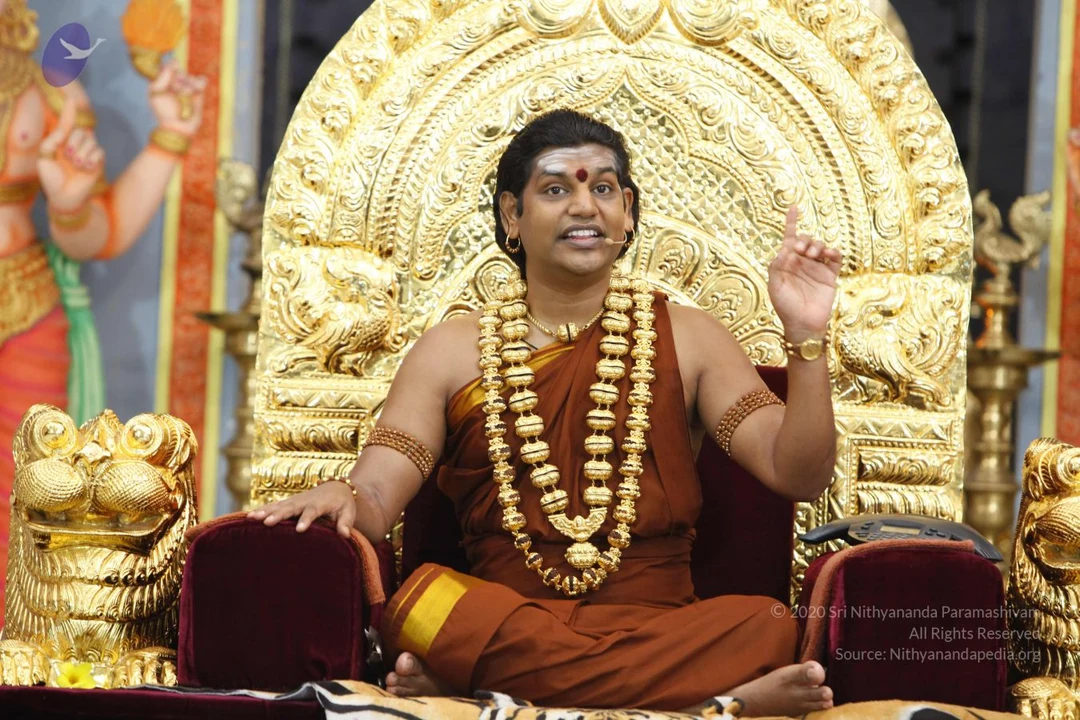
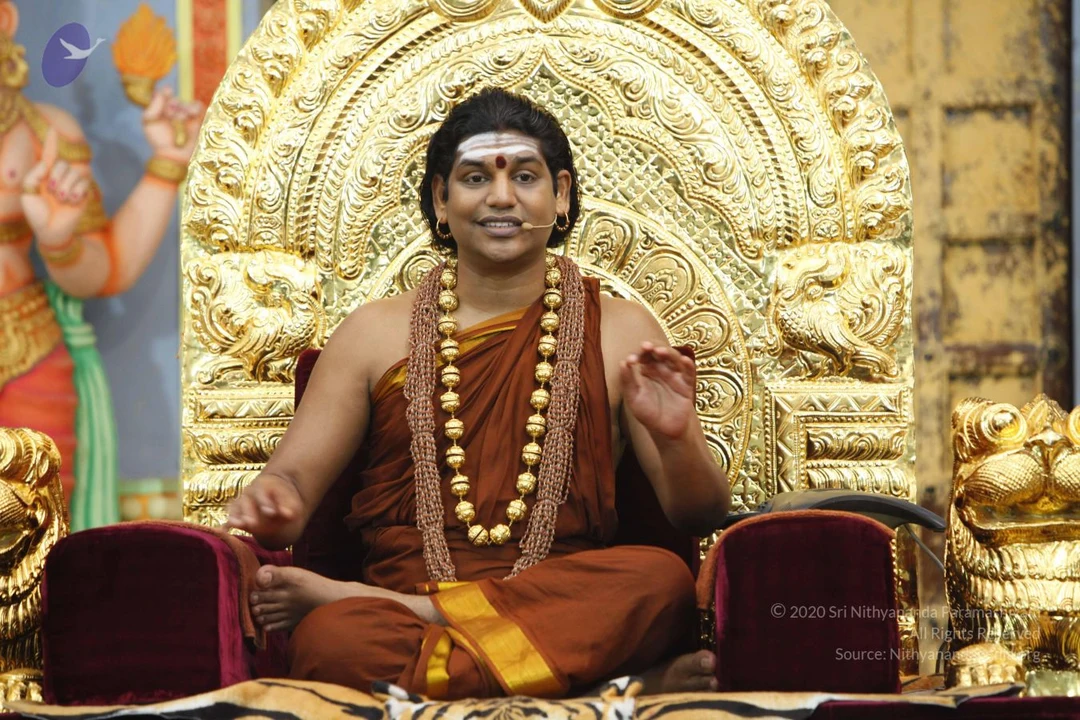
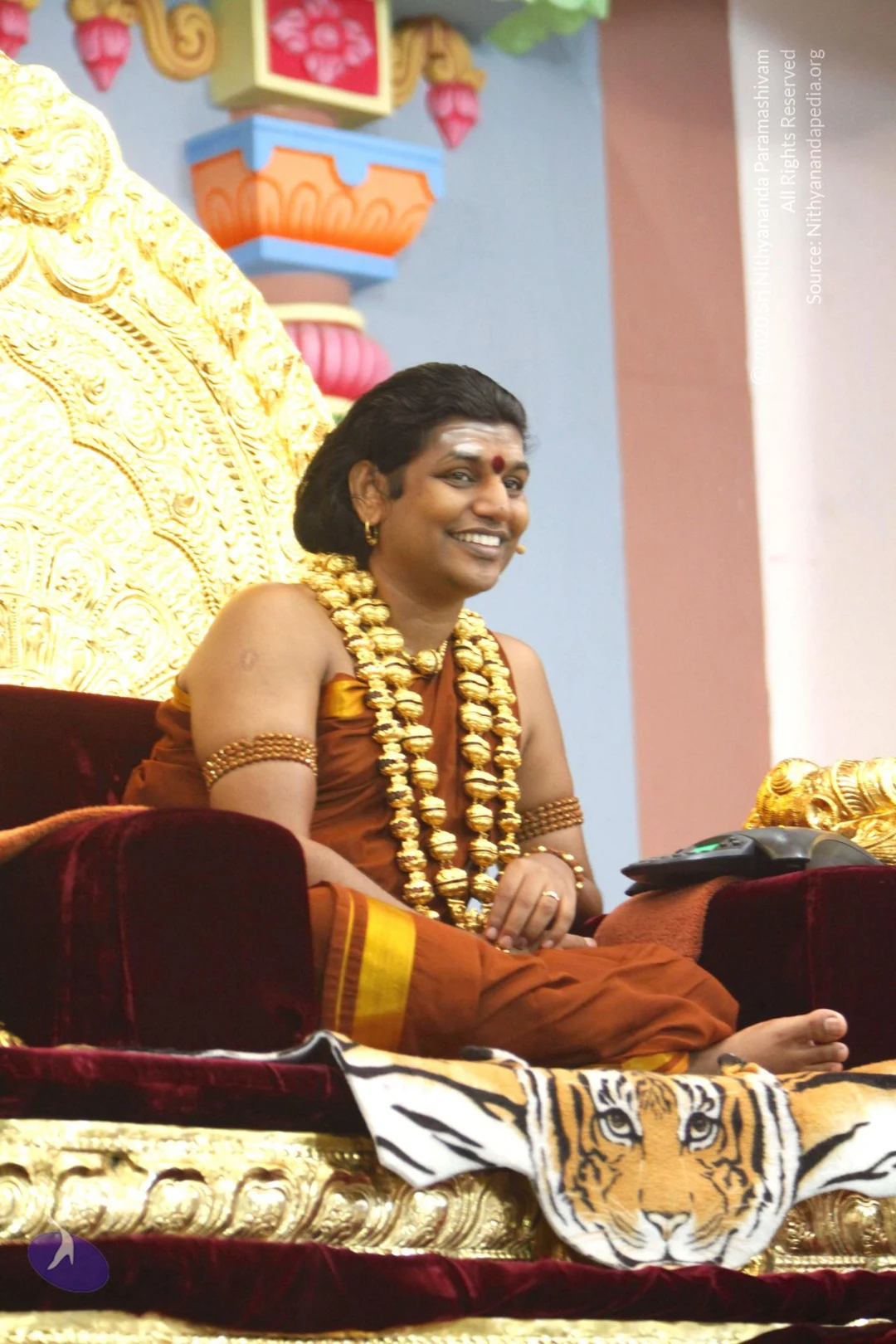
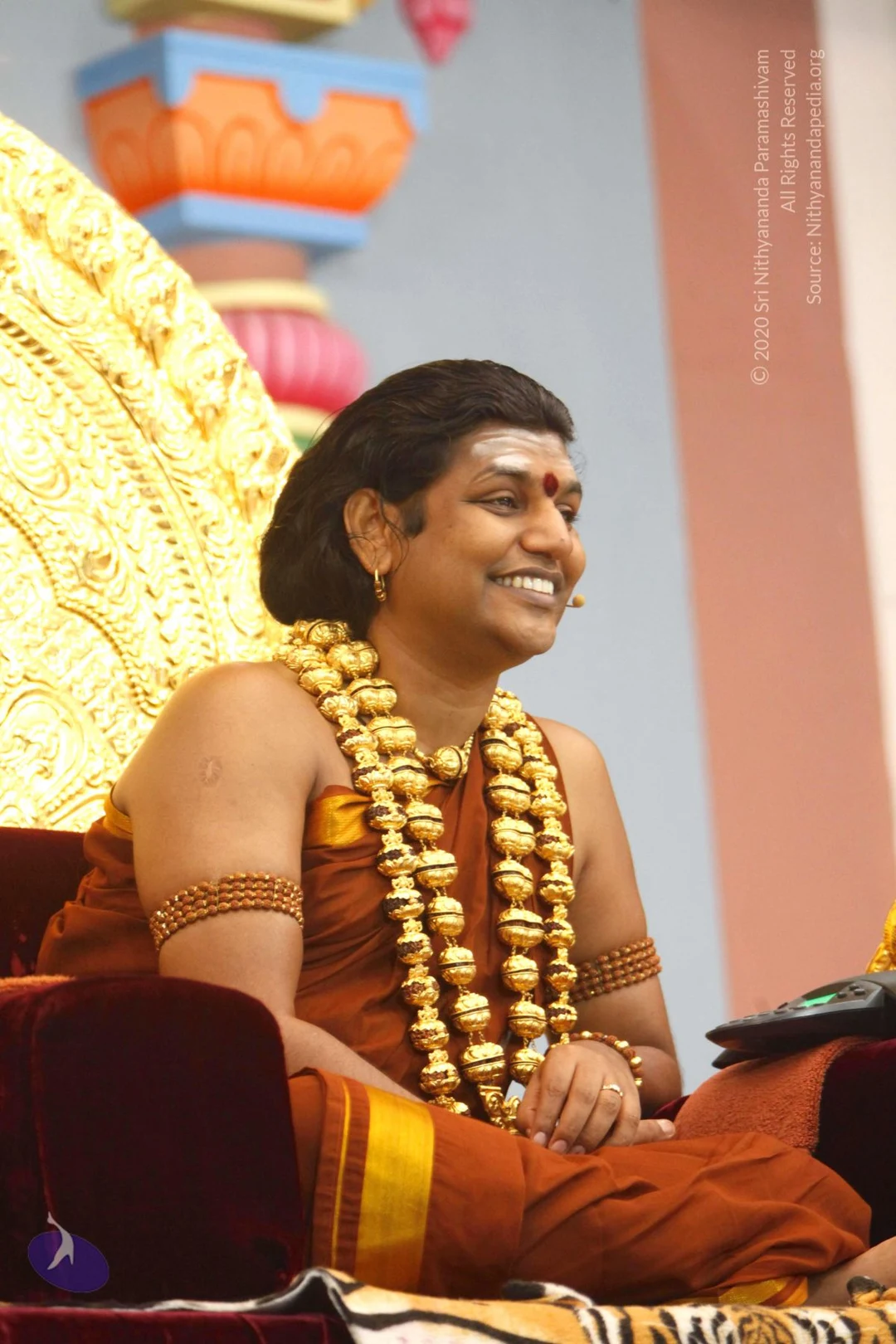
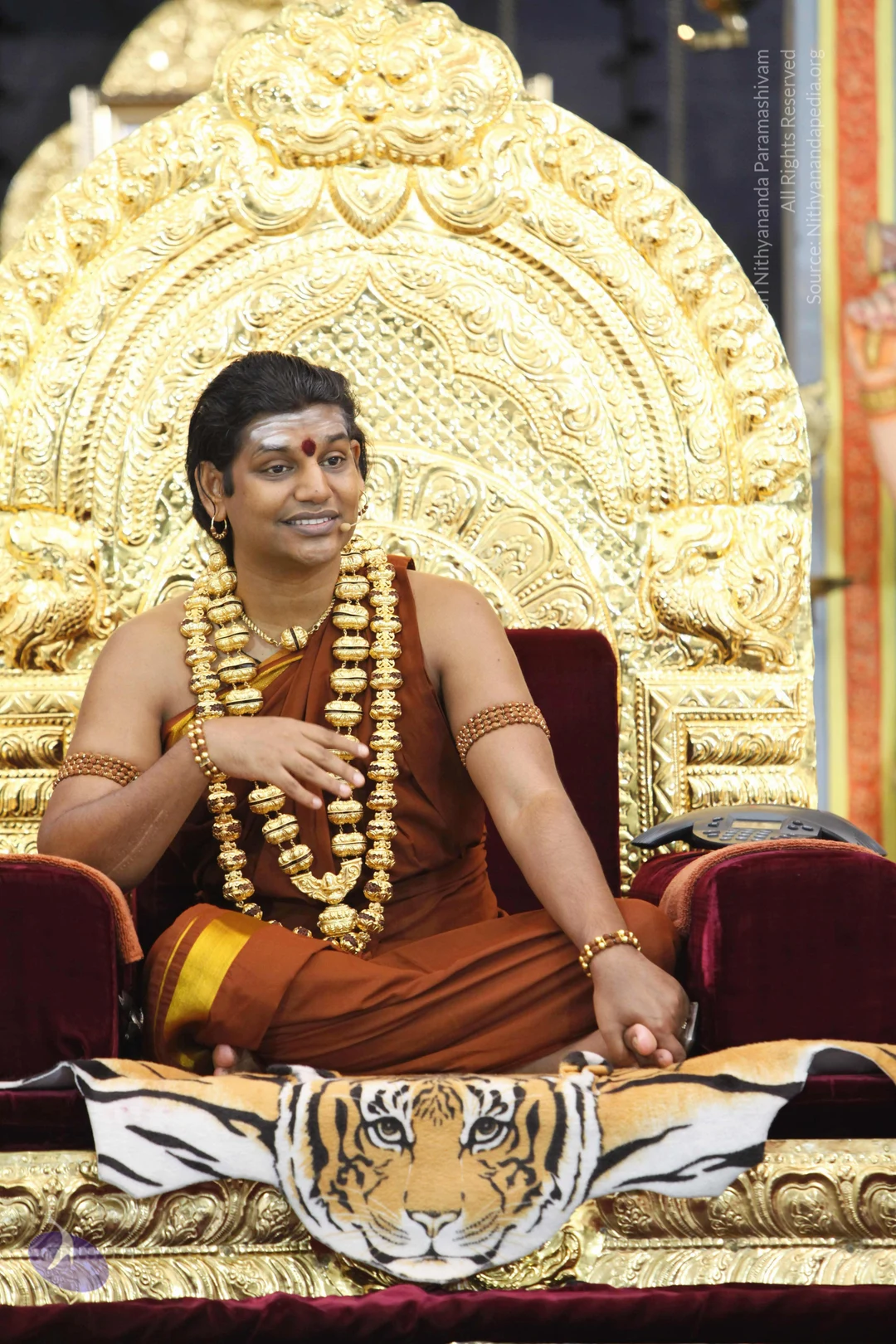
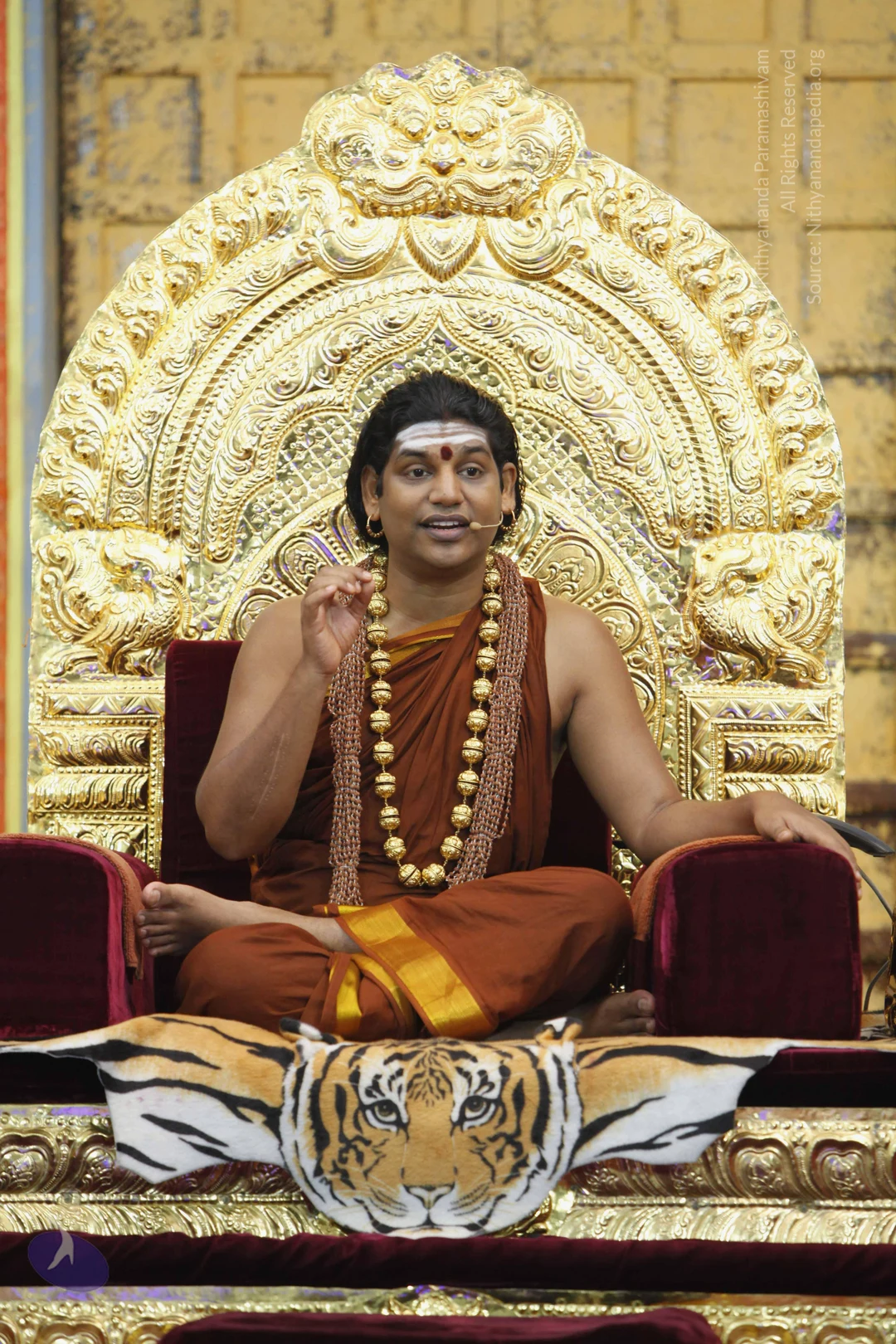
A seated man in rust-orange robes sits on an ornate gold throne with a tiger-face cloth draped over the platform in front. He wears heavy multi-strand gold bead necklaces, gold bangles on the wrists and upper arms, a small gold earring, and a red bindi with white tilak marks on the forehead. He gestures with one hand while speaking, with a small microphone clipped near his face. A black telephone-like device sits on the right armrest of the throne. Behind him are gold-embossed carvings and a red-and-gold textile. A satsang discourse setting is visible. a person: the man has distinctive ceremonial gold necklaces and a seated throne presentation consistent with the page's a person reference, though the identification is appearance-based.A smiling man sits on an ornate gilded throne with carved golden patterns. He wears an orange-brown saffron-toned garment draped over one shoulder, multiple long strands of gold-bead malas with rudraksha-style beads around his neck, and matching beaded armlets. He has a white tilak stripe and a red dot on his forehead, a small gold earring, and a gold ring. A small lapel microphone is visible near his face. A pink and red pillar appears behind the throne. Appearance-based cues suggest a person seated in person; the image is a photograph of one person.A seated man in an orange-brown draped garment with a gold-and-gold-bead necklace layered over rudraksha malas sits on a red velvet throne with ornate gold carved backrest and armrest. He has long swept-back dark hair, a white vertical tilak with a red dot on the forehead, and gold earrings. His hand rests on the velvet armrest; a tiger-striped cloth is visible at the bottom. a person: the long swept-back hair, rudraksha malas and ceremonial gold beads with orange robe fit the a person presentation, though the identification is based on appearance only and the image is a single seated person in a satsang-style setting.A man with swept-back dark hair sits cross-legged on an ornate gold throne with a carved arched back, gesturing with his right hand while speaking into a small headset microphone. He wears a rust-orange robe with a gold-bordered cloth wrap, a long gold bead necklace and a rudraksha-style mala, and has white and red tilak marks on his forehead. A tiger-face skin rug lies beneath him. Swamiji (probable) appears as the seated speaker, identified by appearance cues including swept-back hair, saffron-orange robes, ornate gold necklaces and the ornate golden throne.
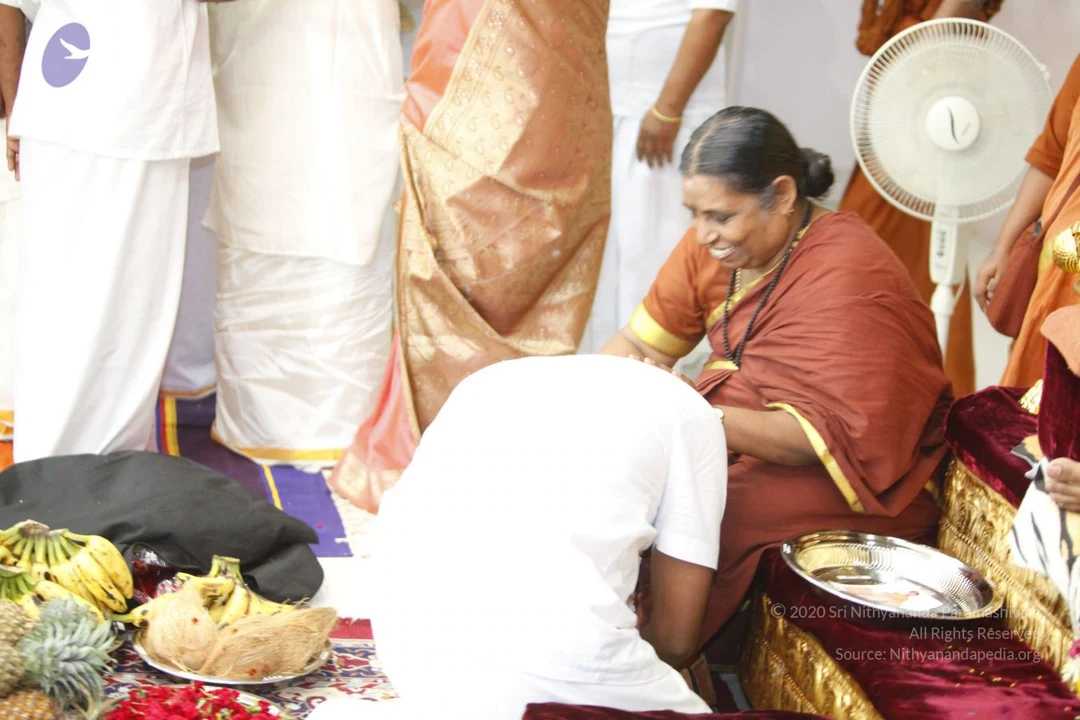
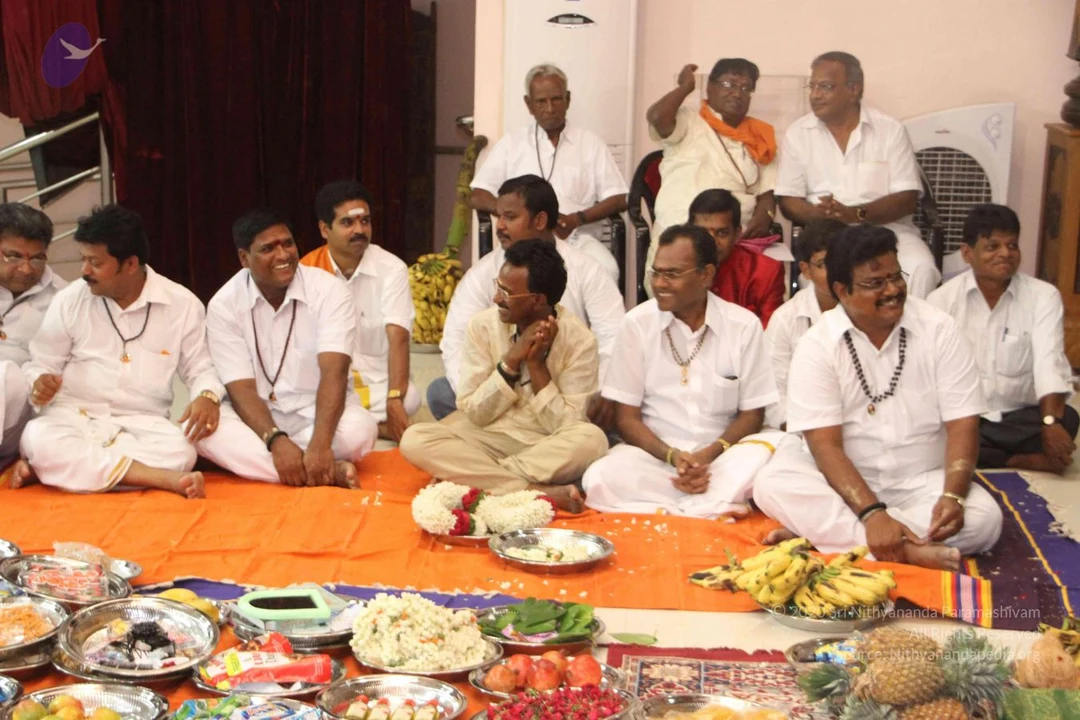
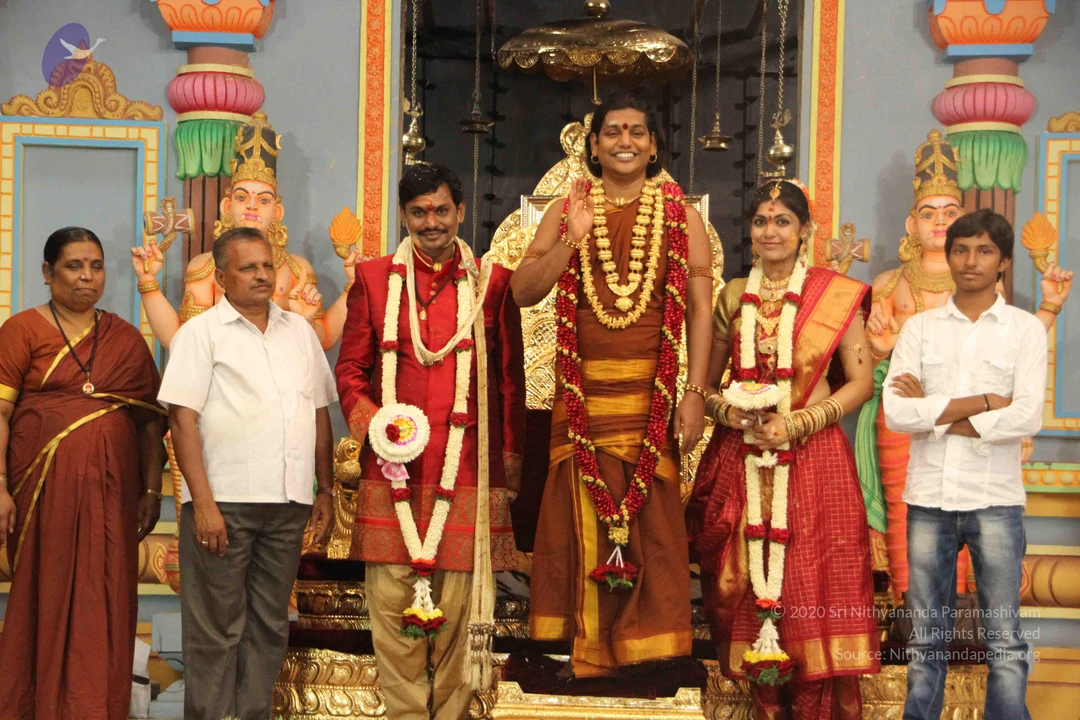
04-BLESSINGS

1 photoSource gallery
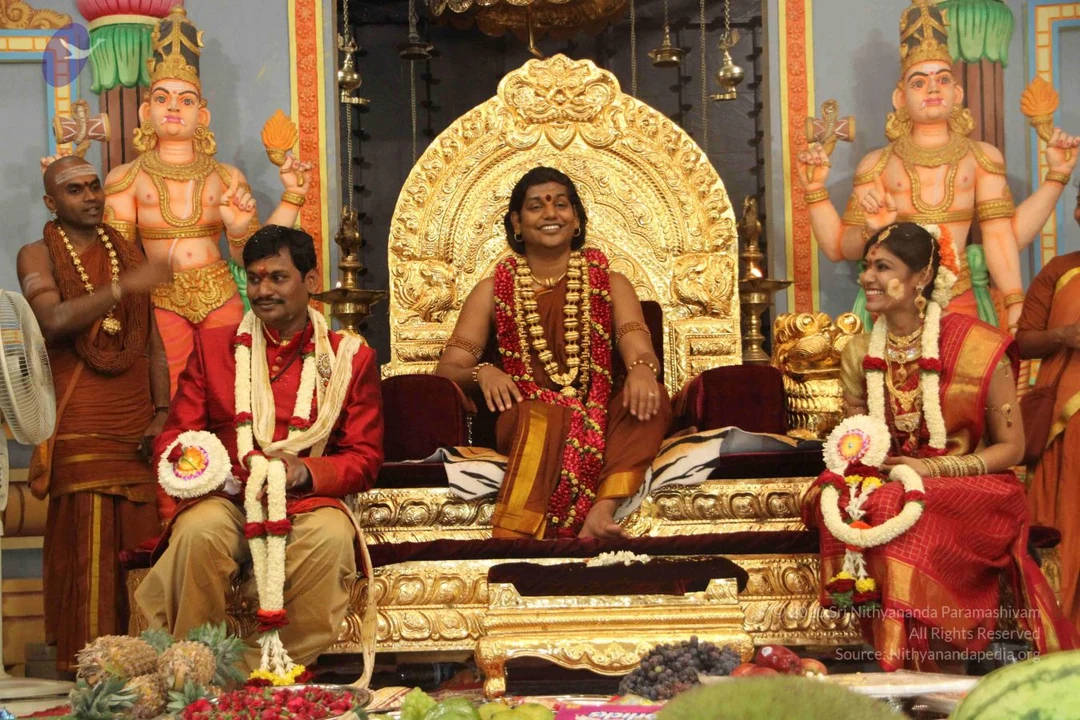
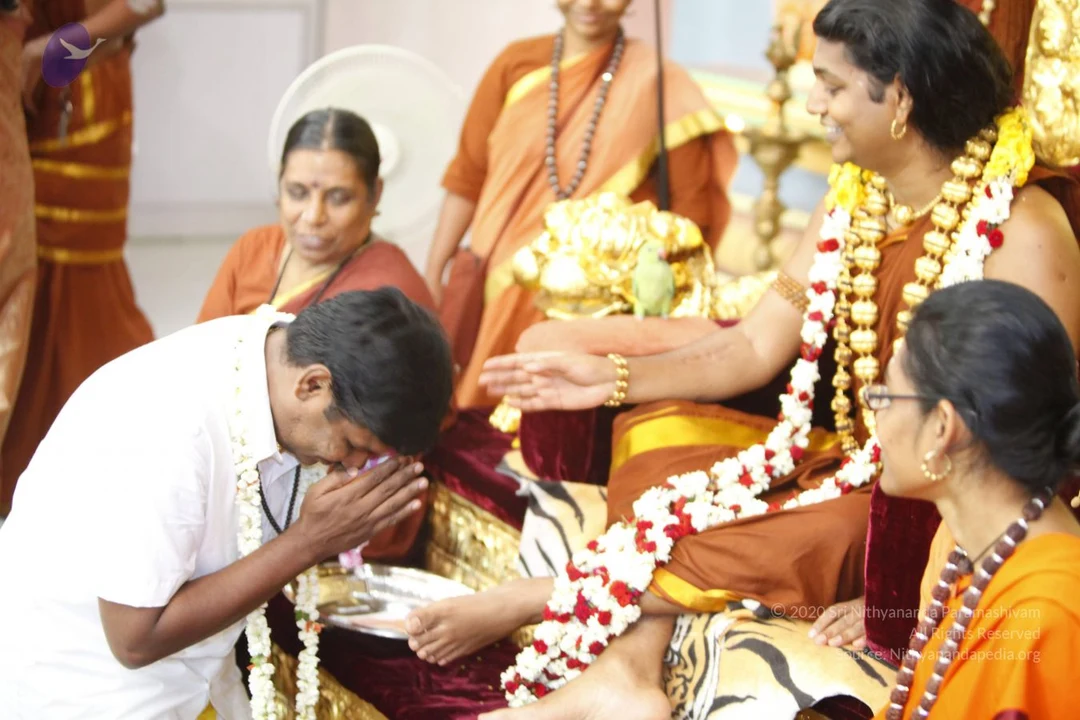
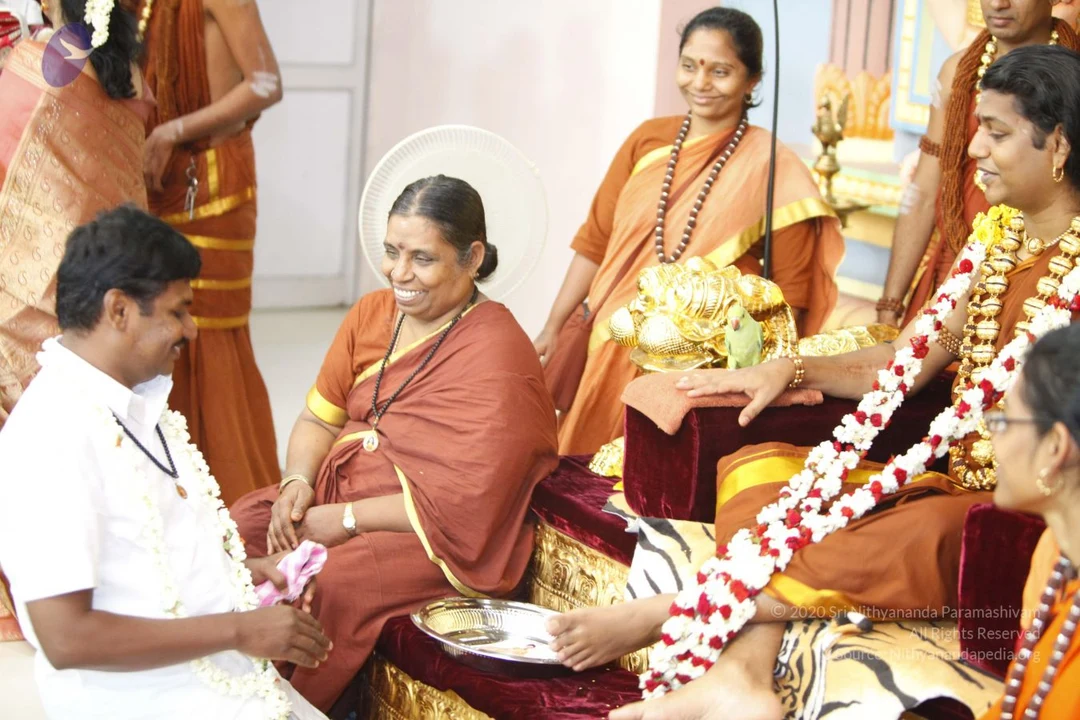
A smiling man stands barefoot on a red patterned rug with both arms raised in greeting, a red bindi on his forehead and a flower held in one hand. He wears a rust-brown dhoti and shawl edged with gold borders, a white and red flower garland, and layered gold beaded necklaces. Behind him are a gold ornate throne with a red velvet seat and tiger-skin cover, brass lamps on stands, and a painted deity figure in a colourful temple setting with pink and green pillars.