Skip to content
Friday

11 January 2013

Nachiketa, the Child who Conquered Death

Dated photos
290
Source pages
1
Media
2
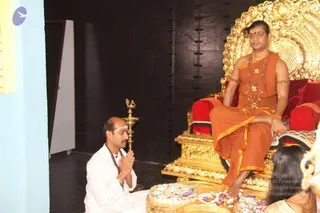
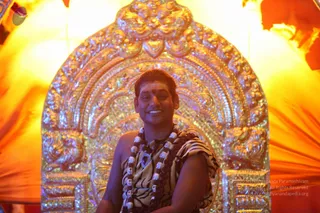
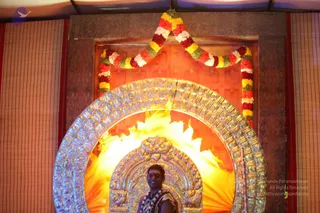
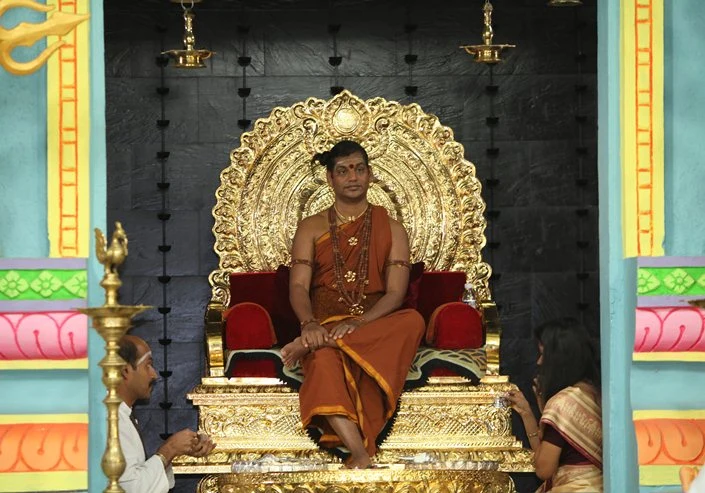
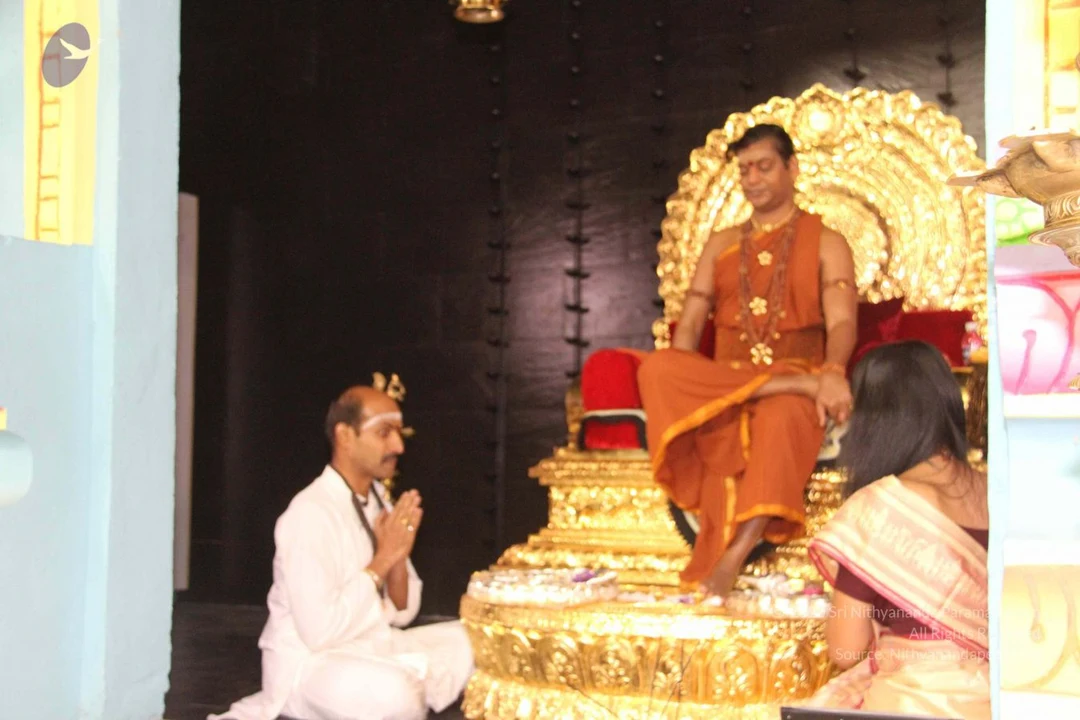
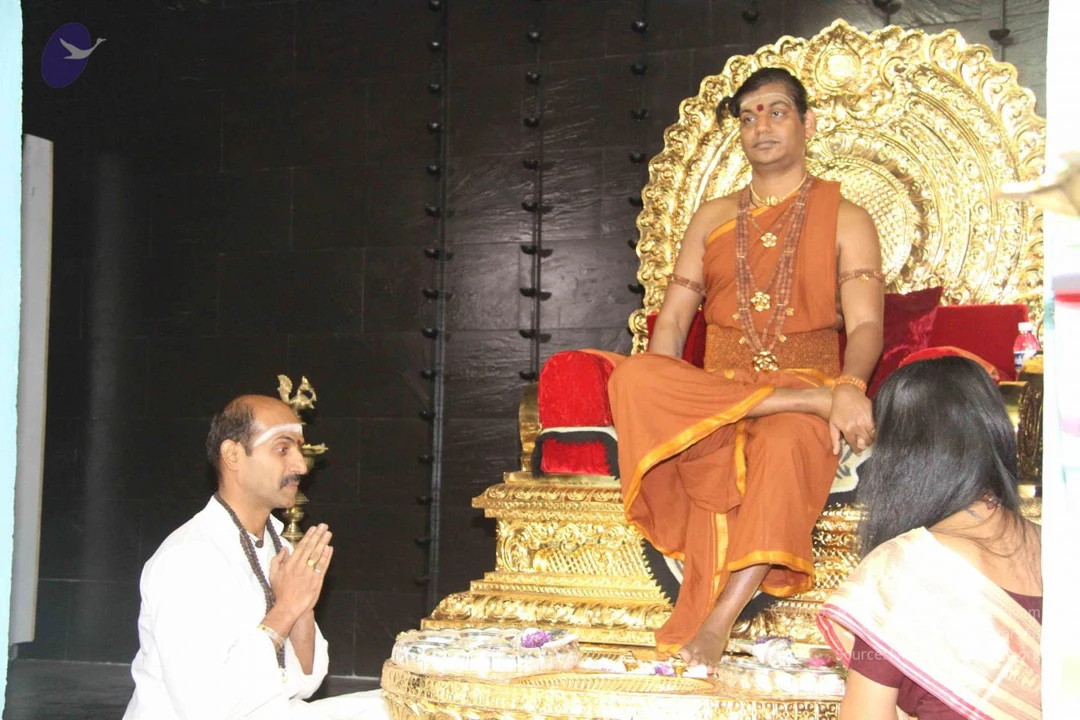
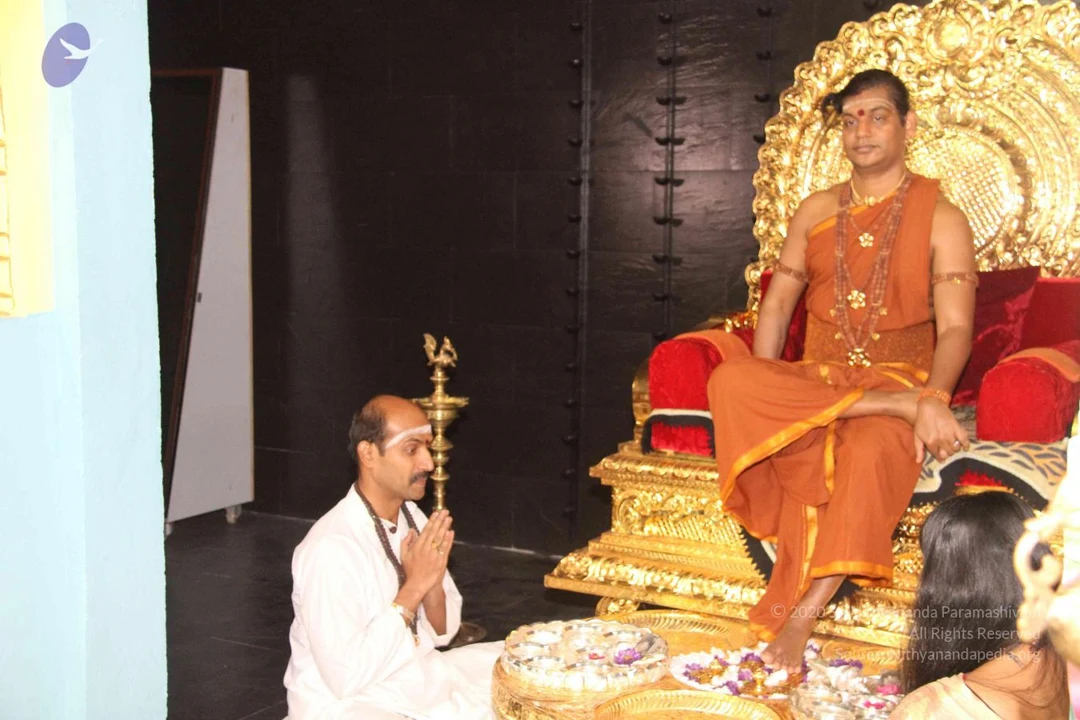
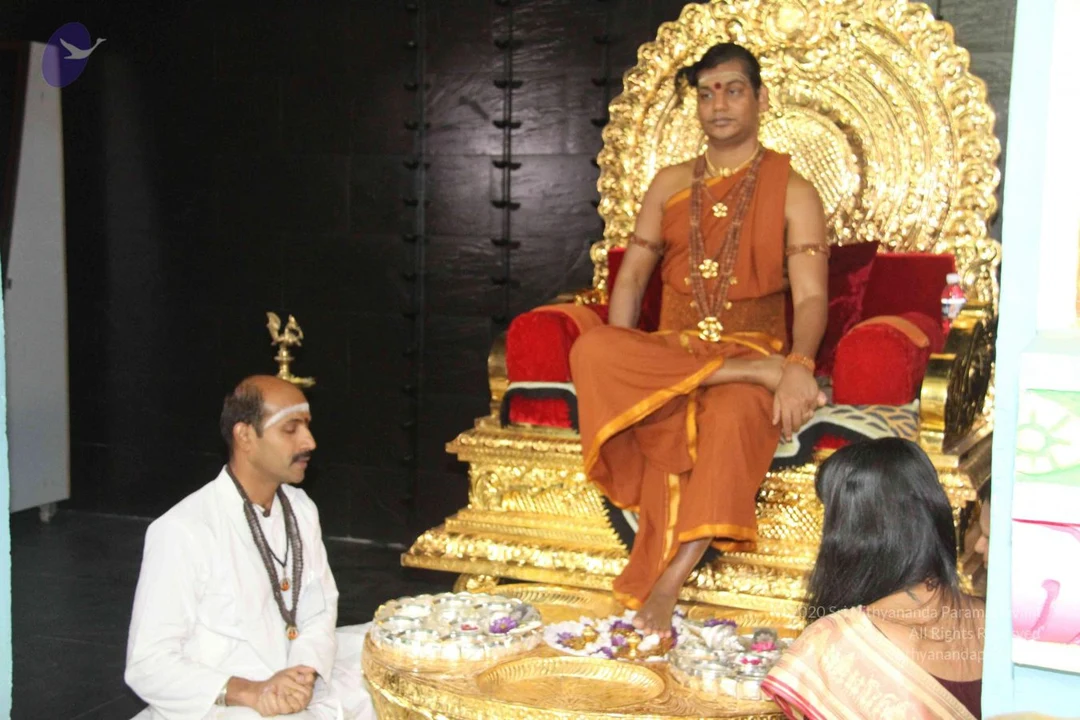
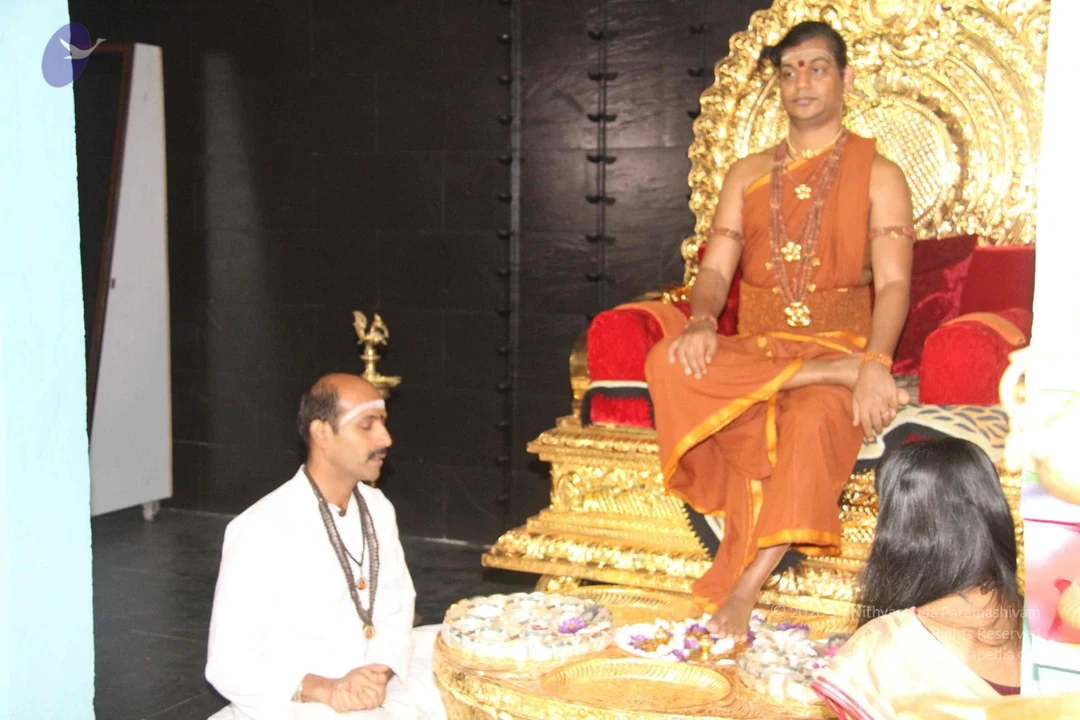
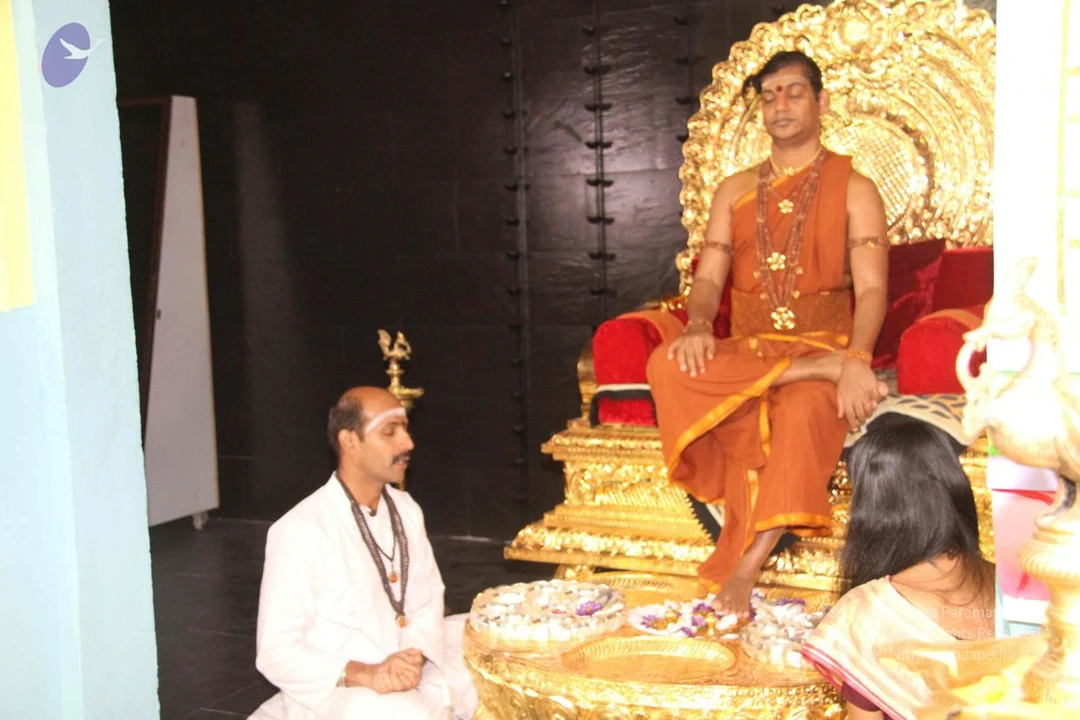
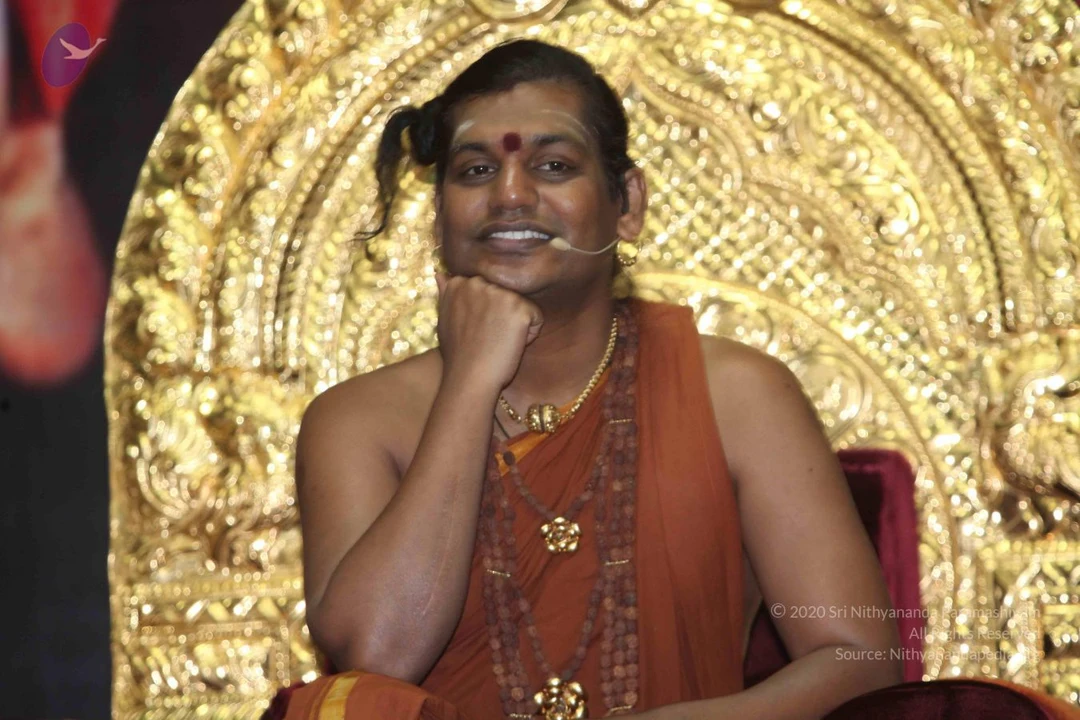
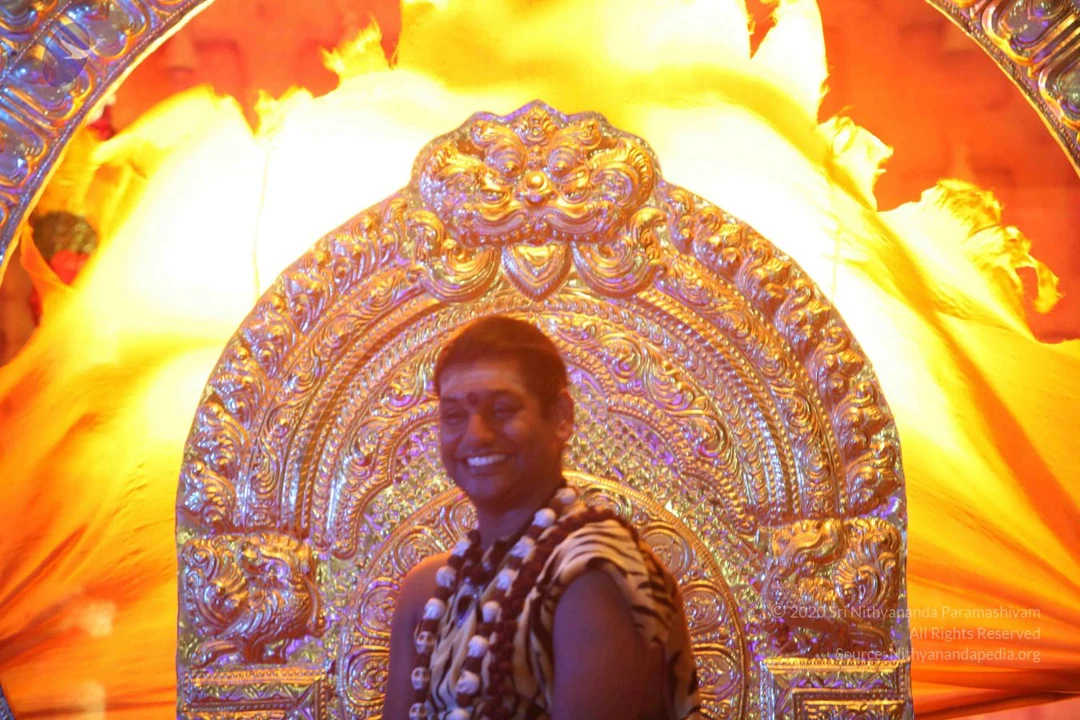
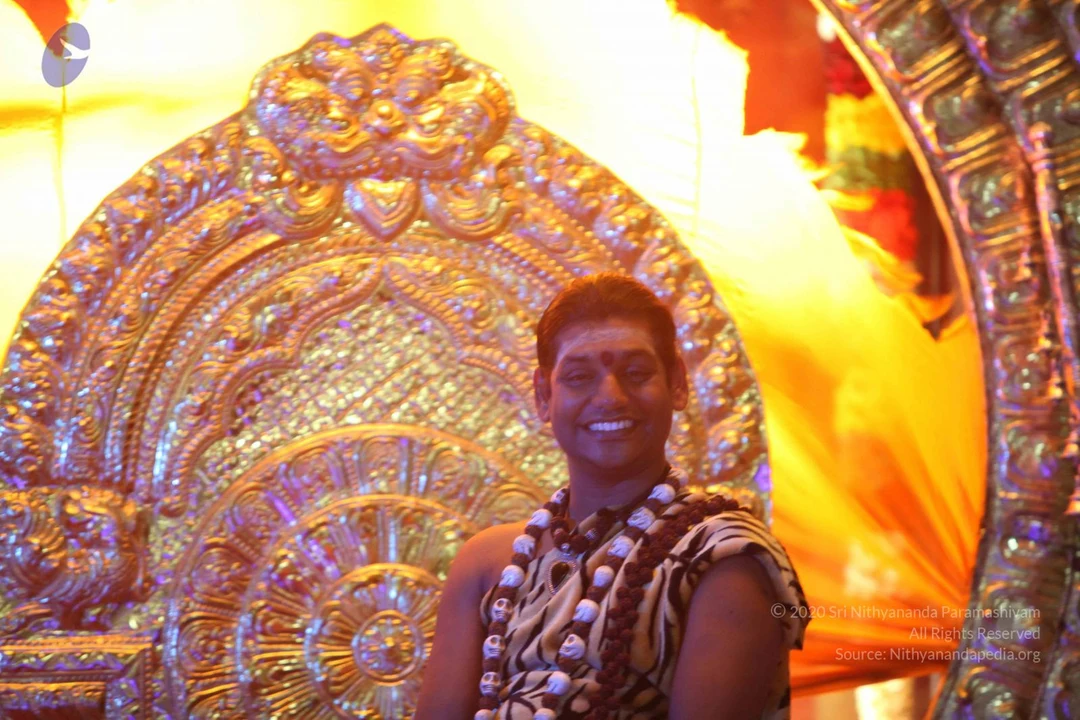
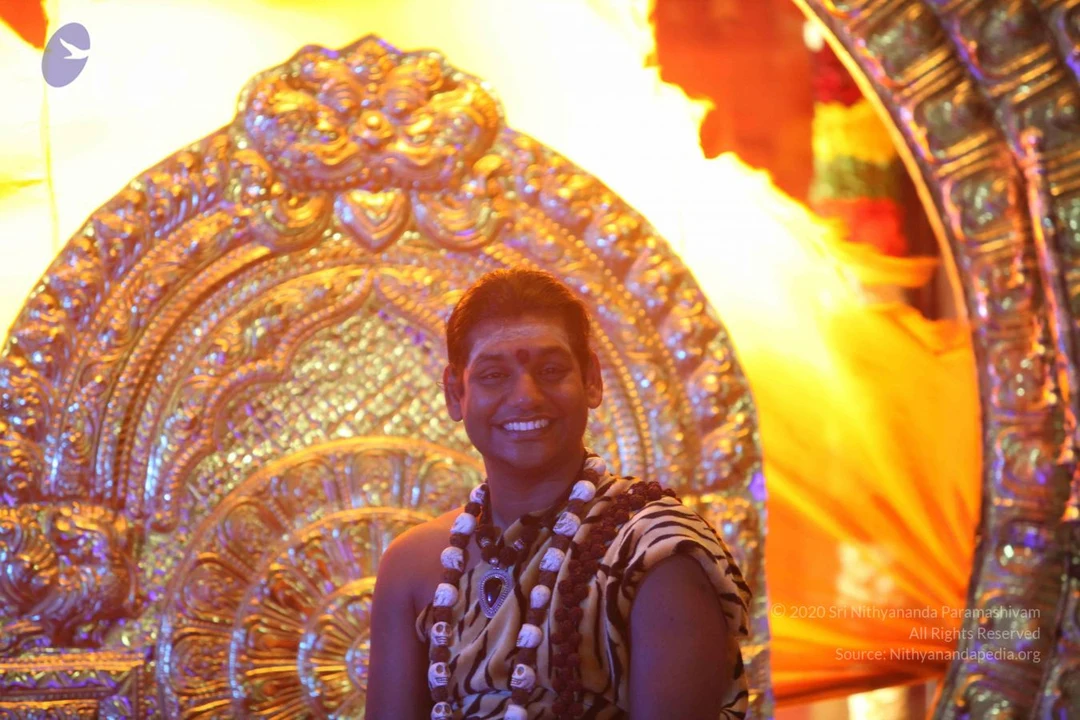
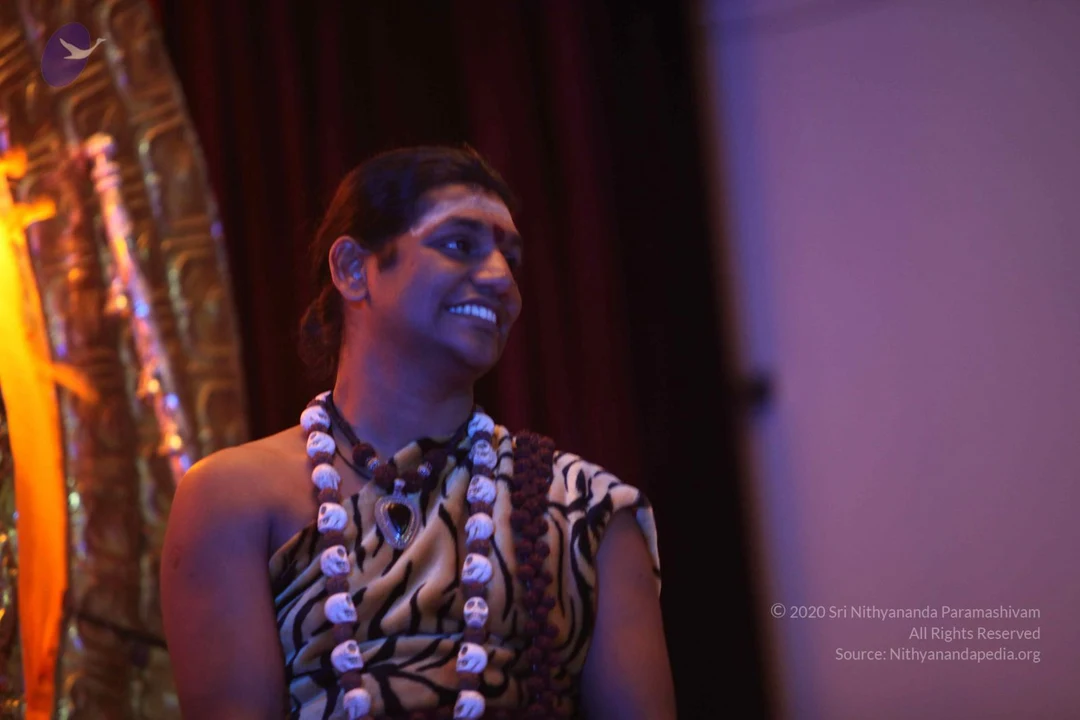
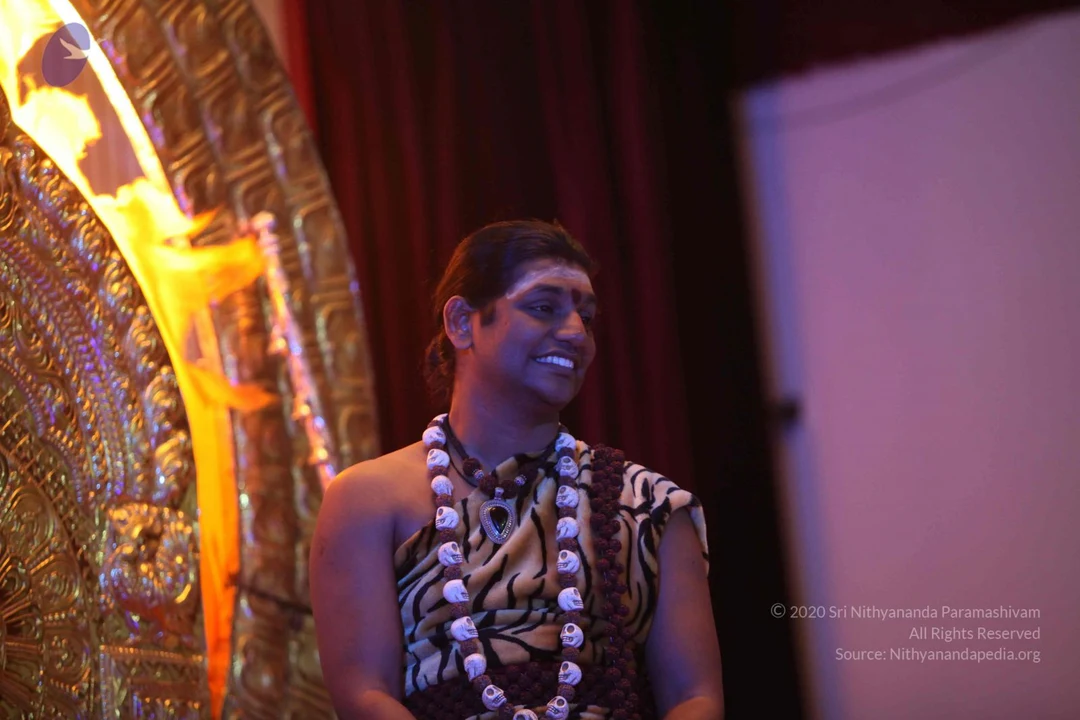
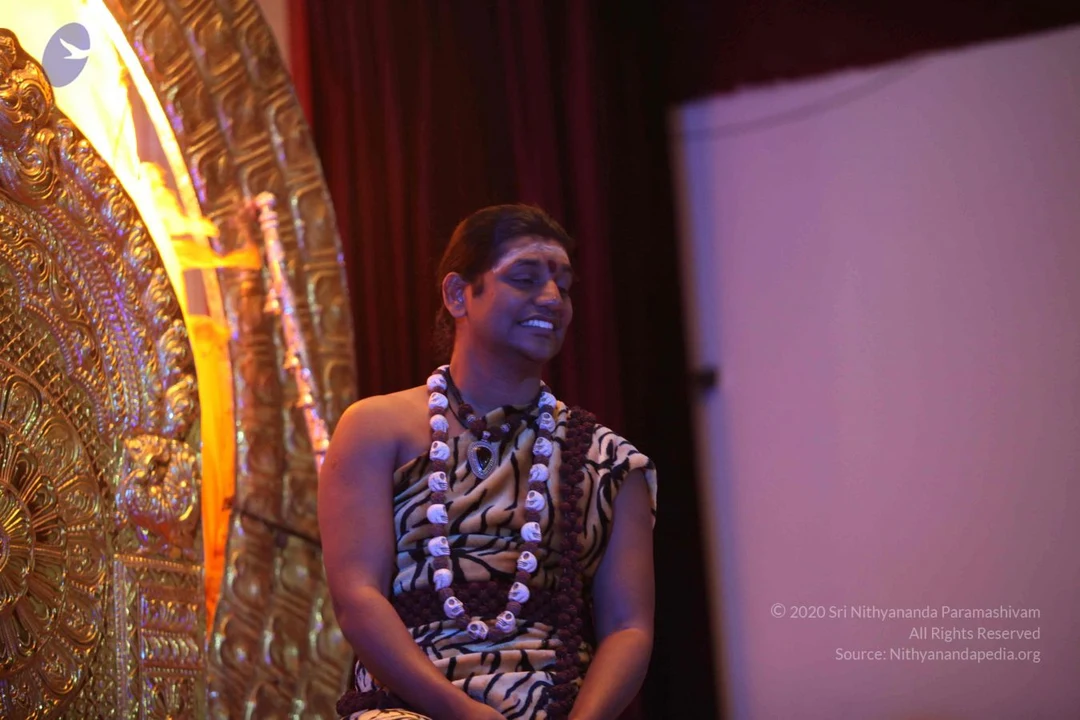
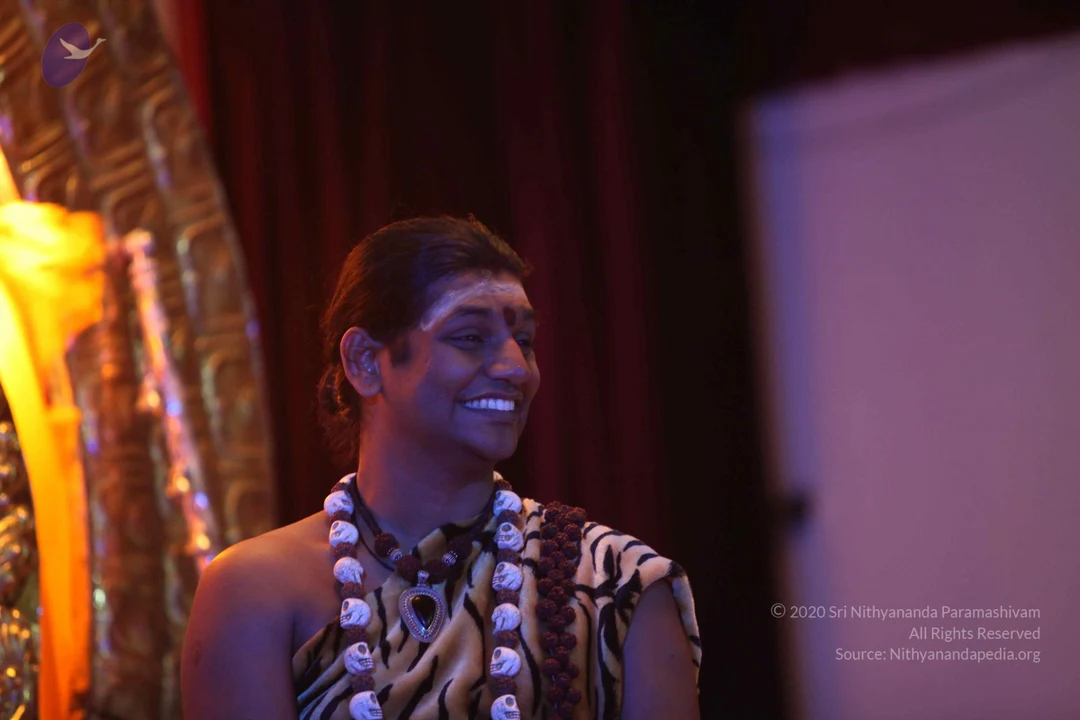
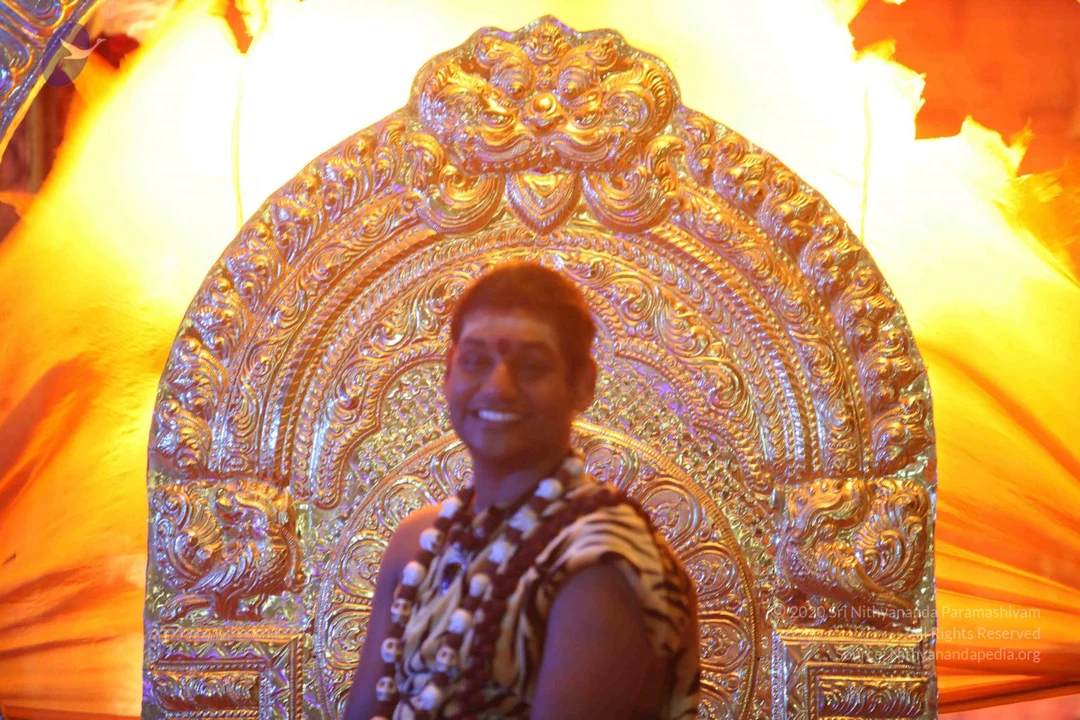
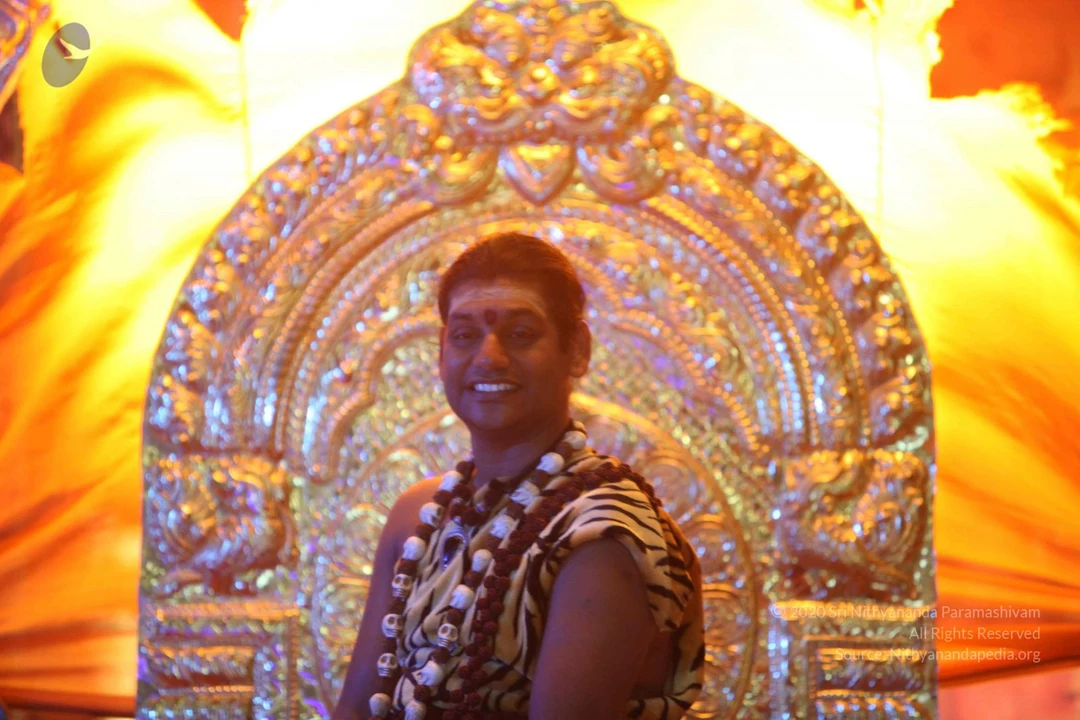
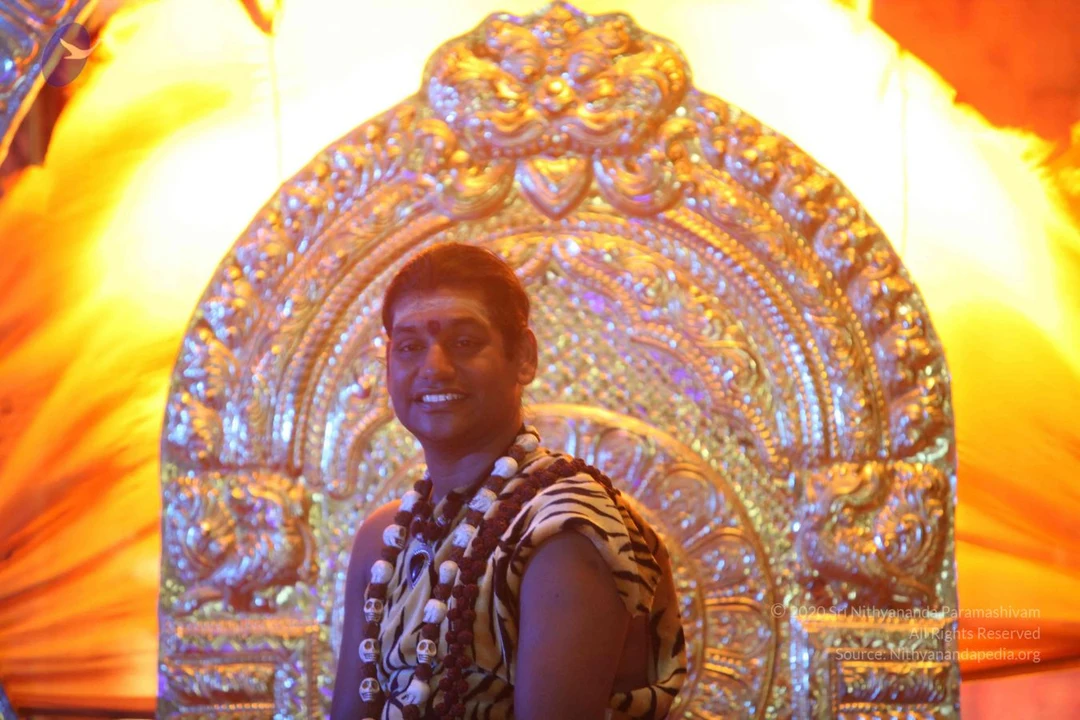
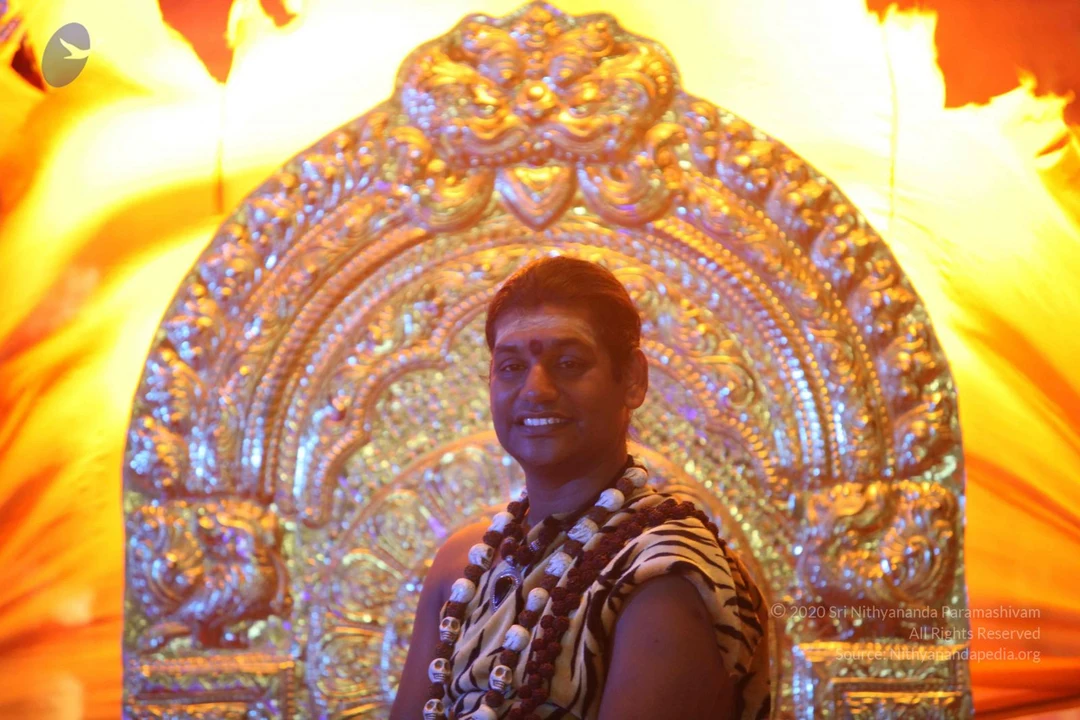
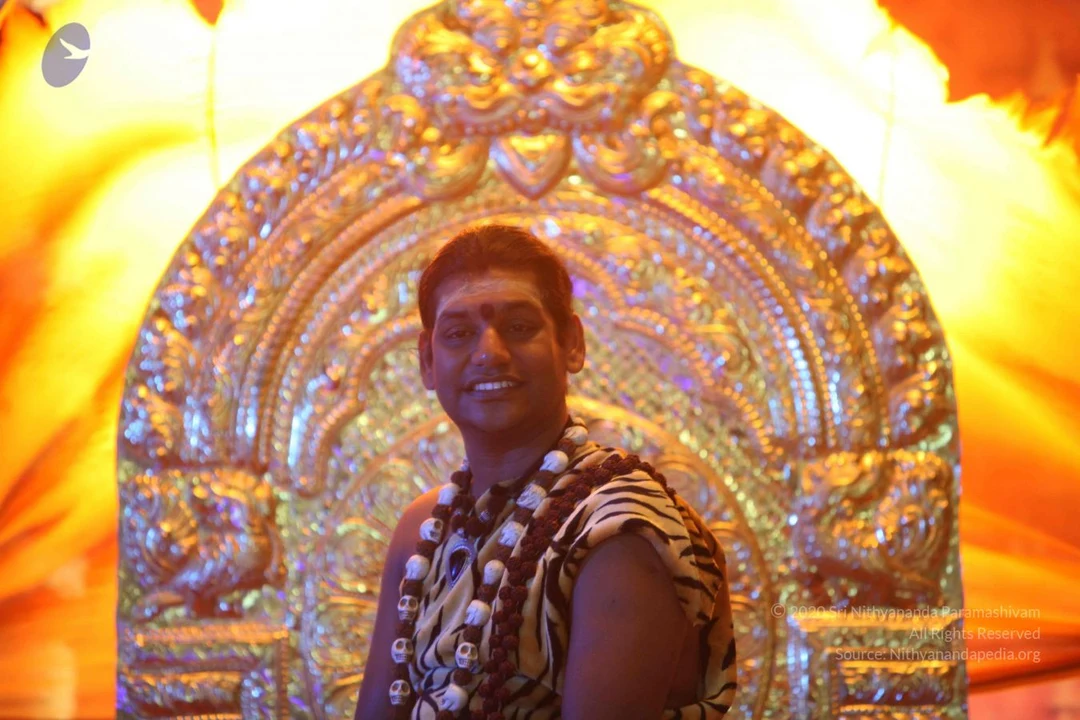
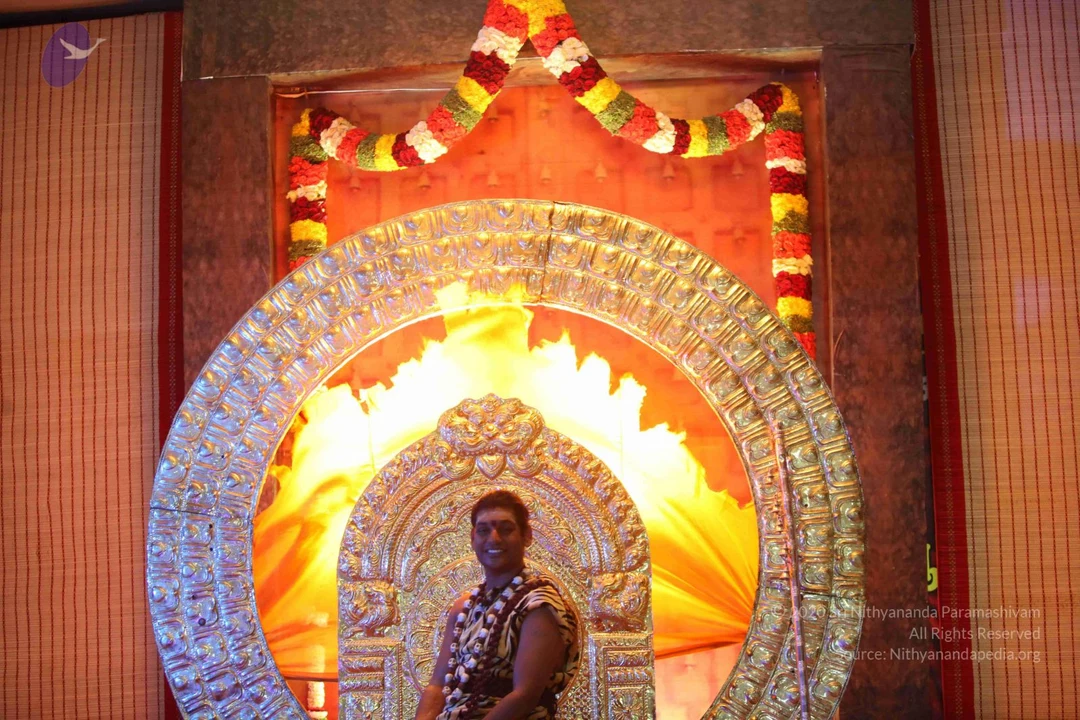
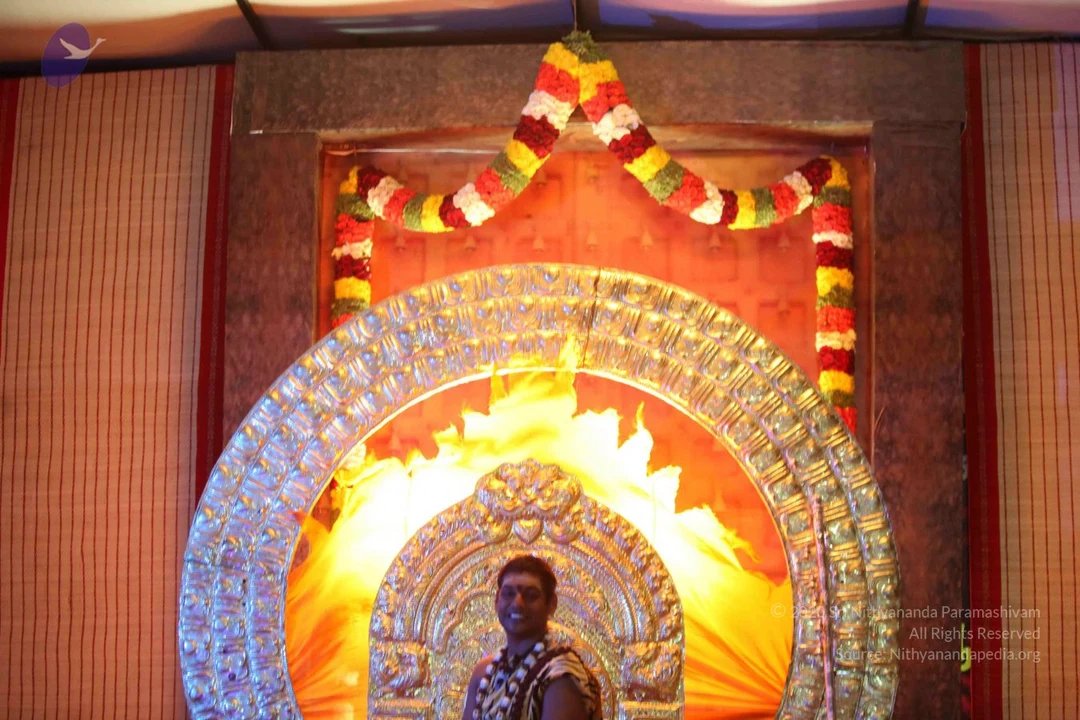
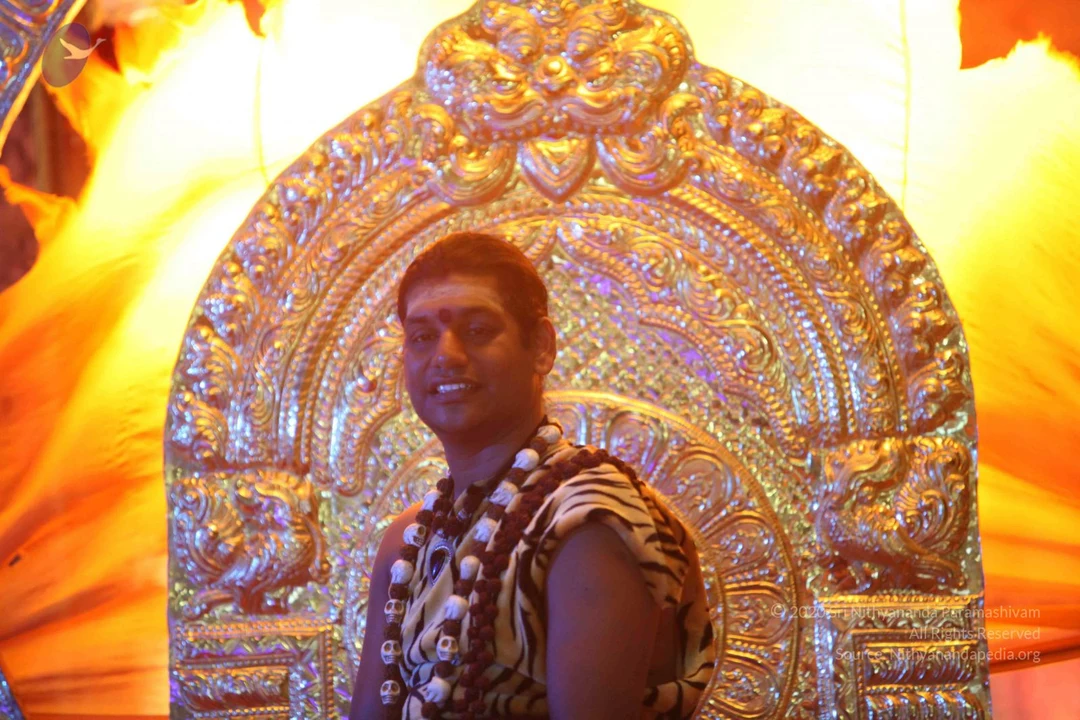
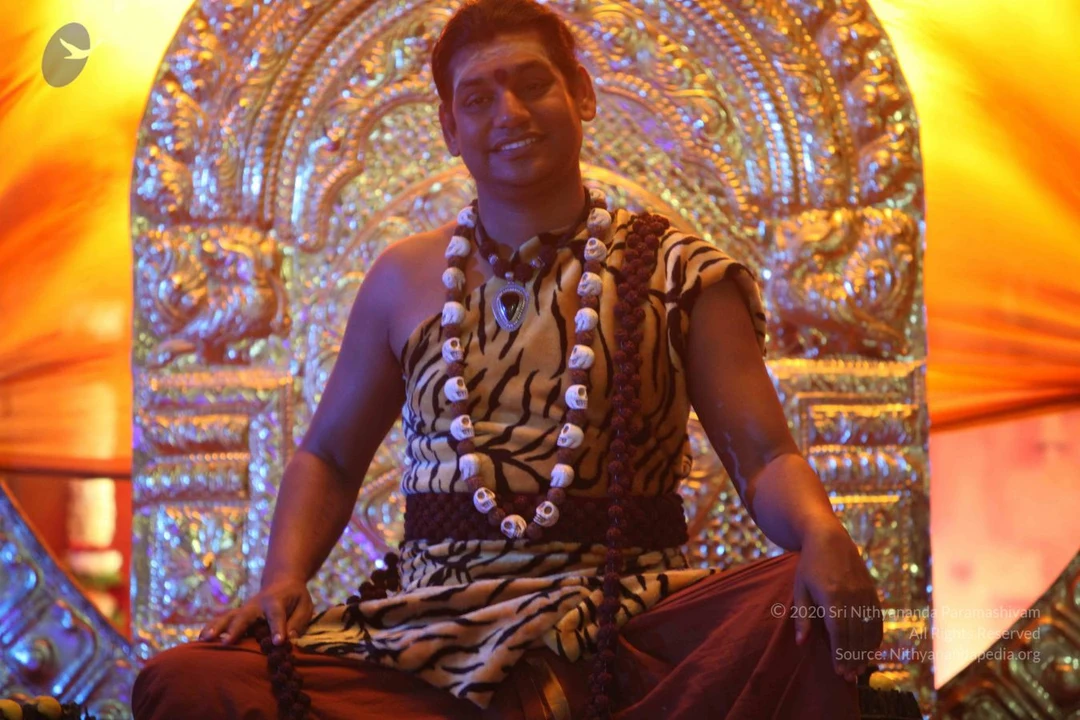
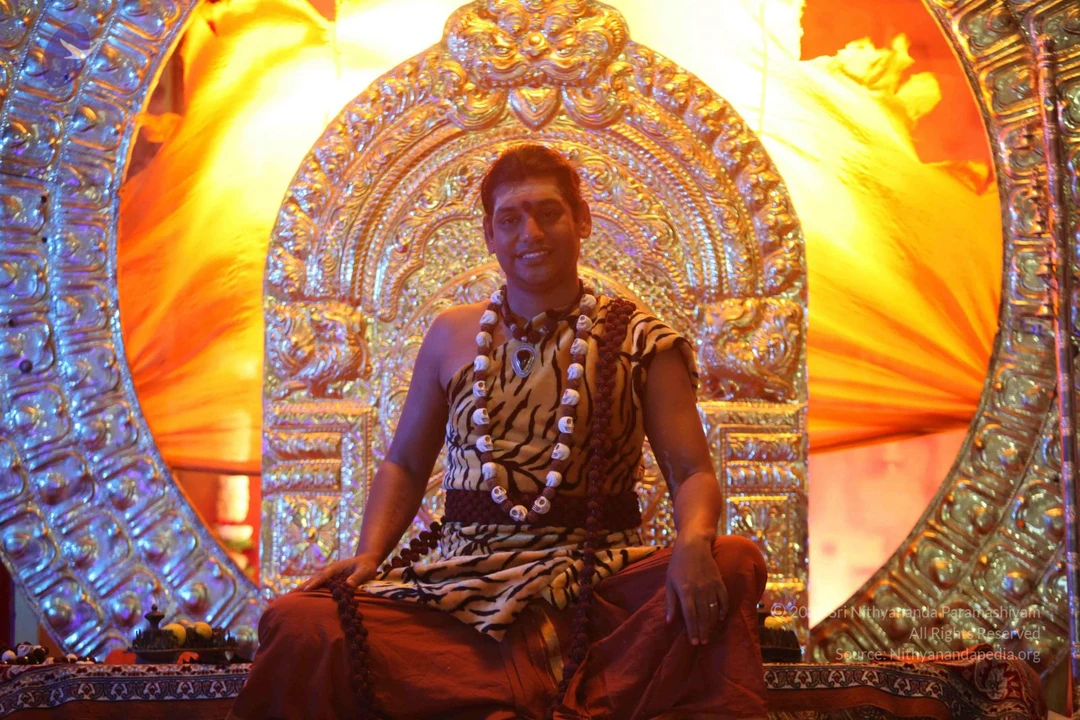
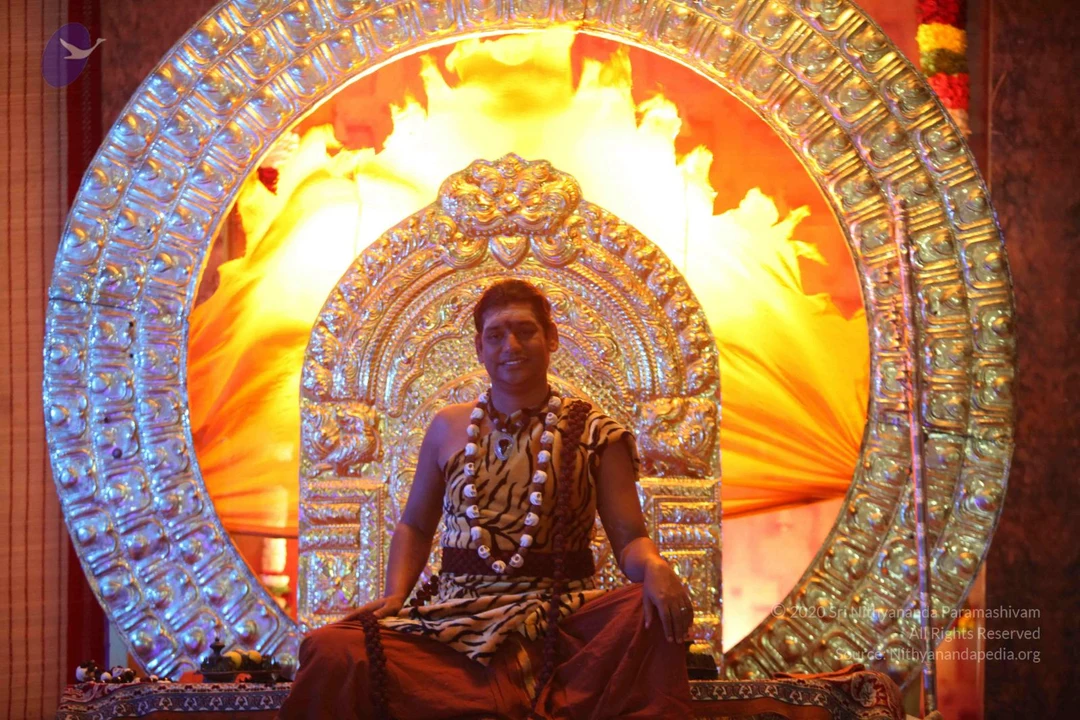
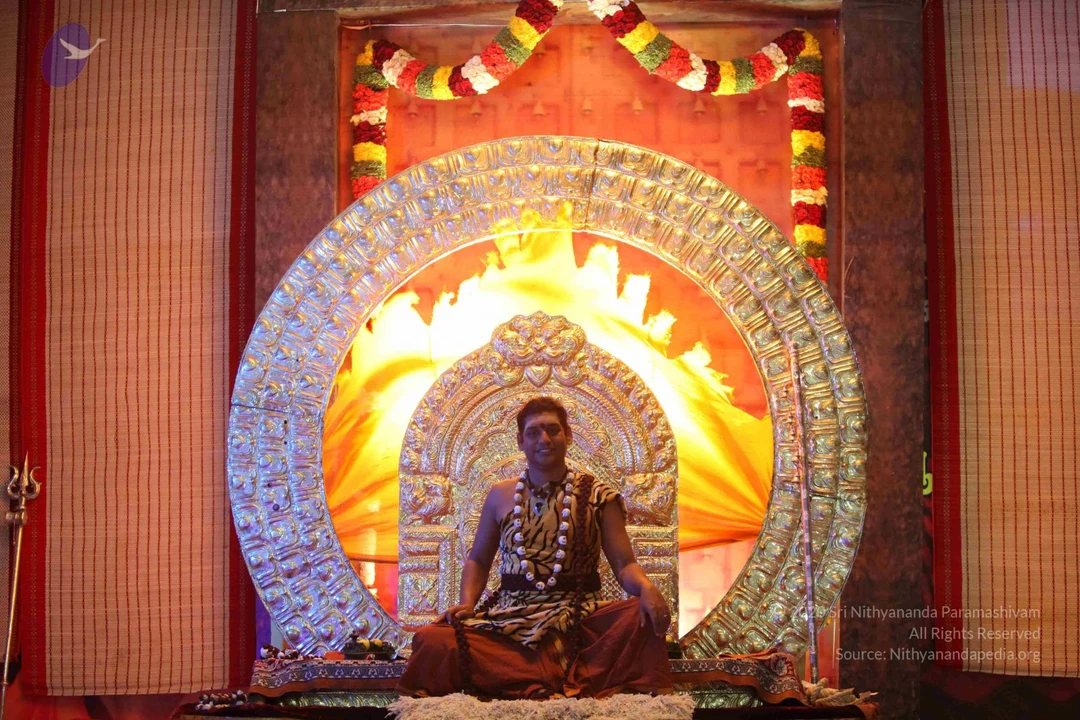
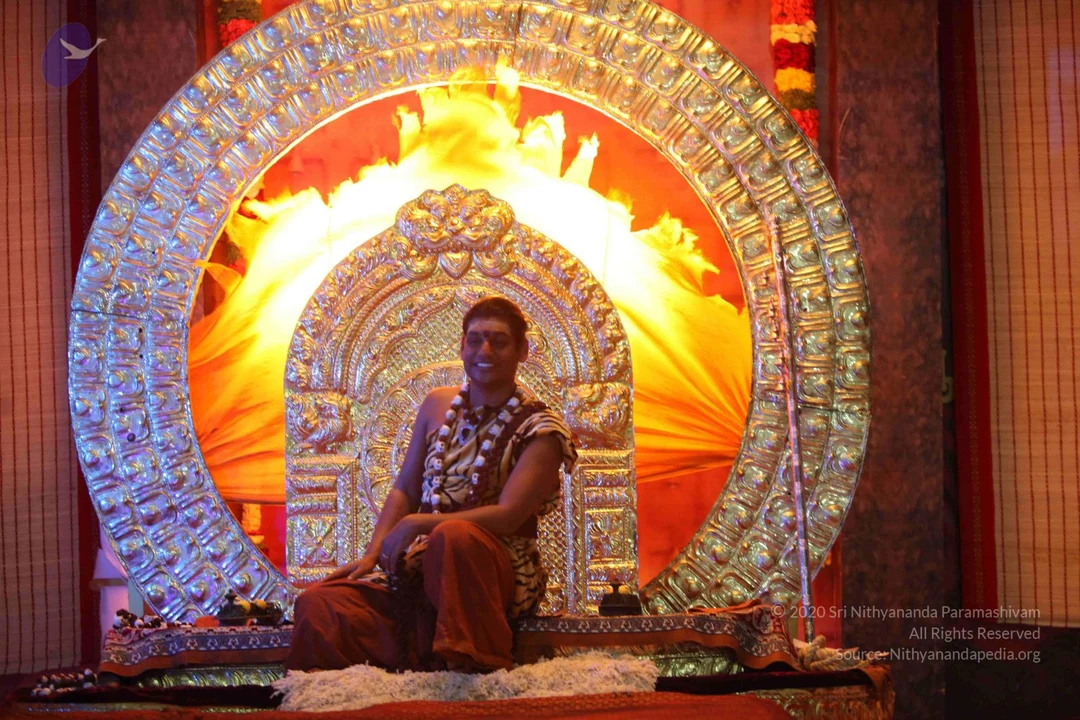
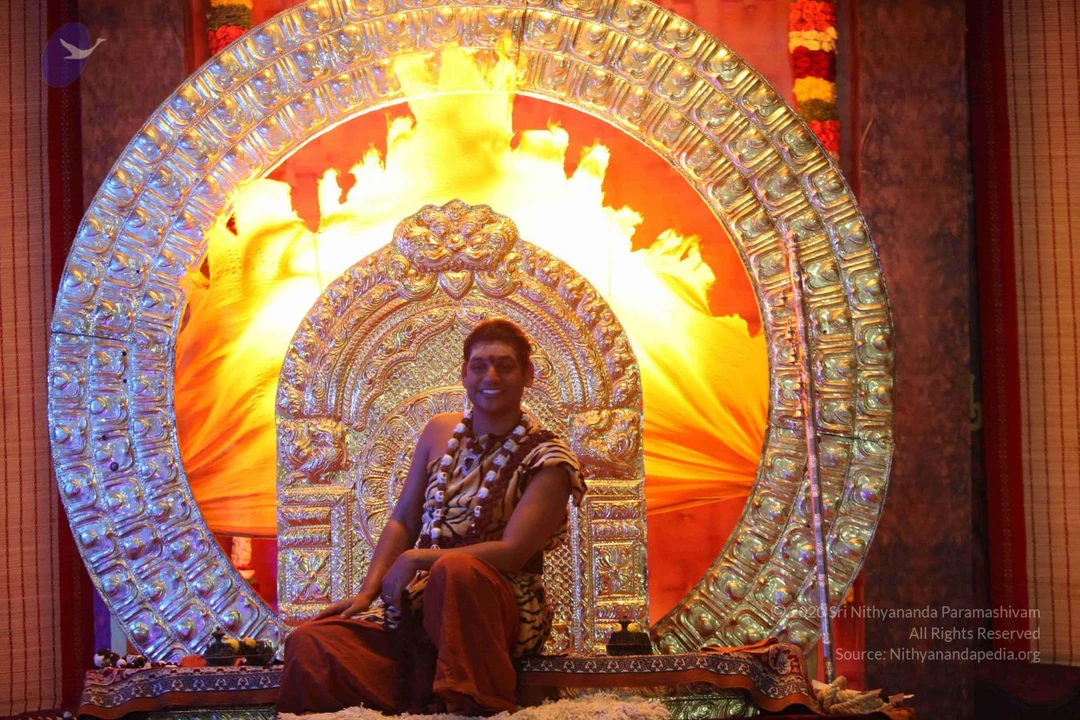
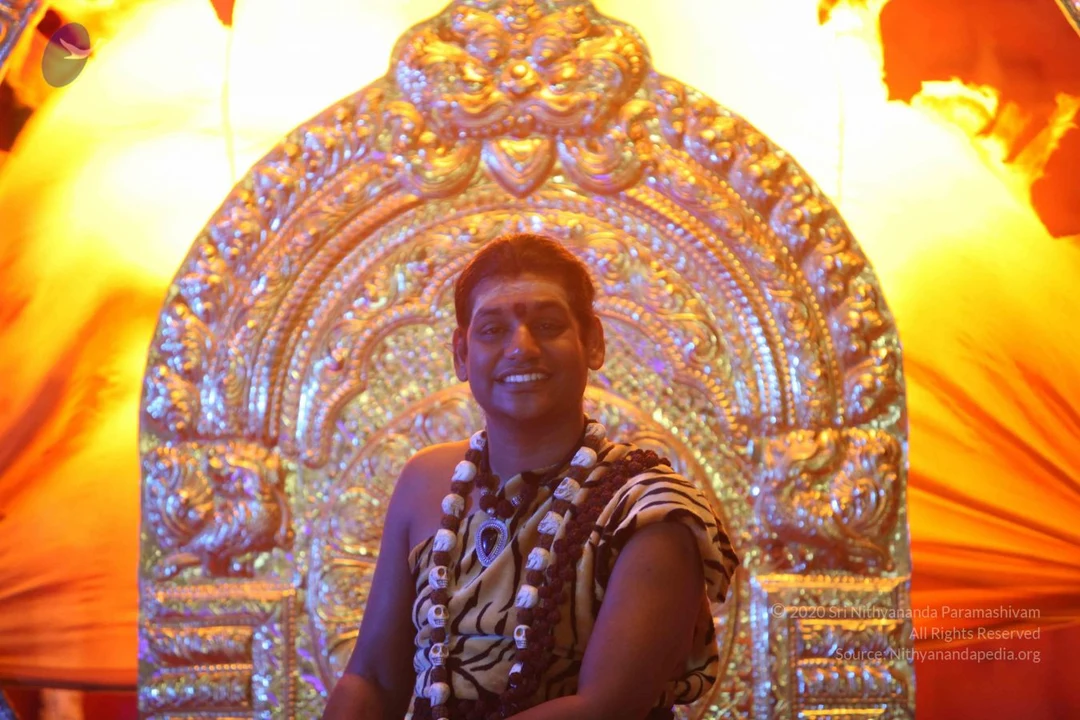
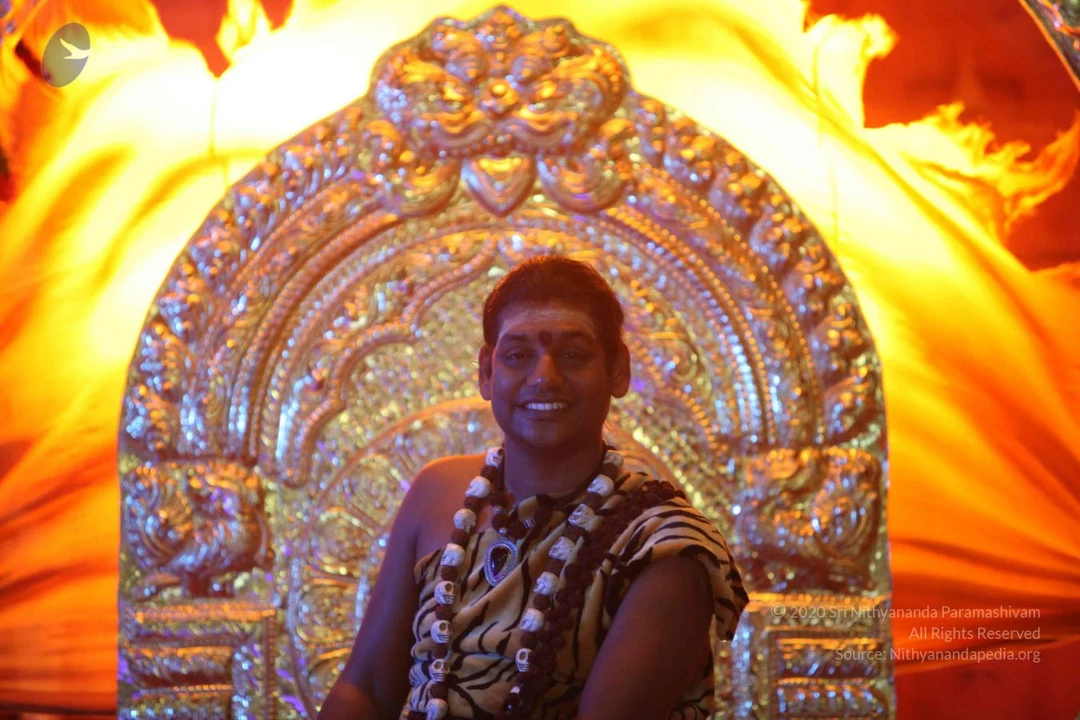
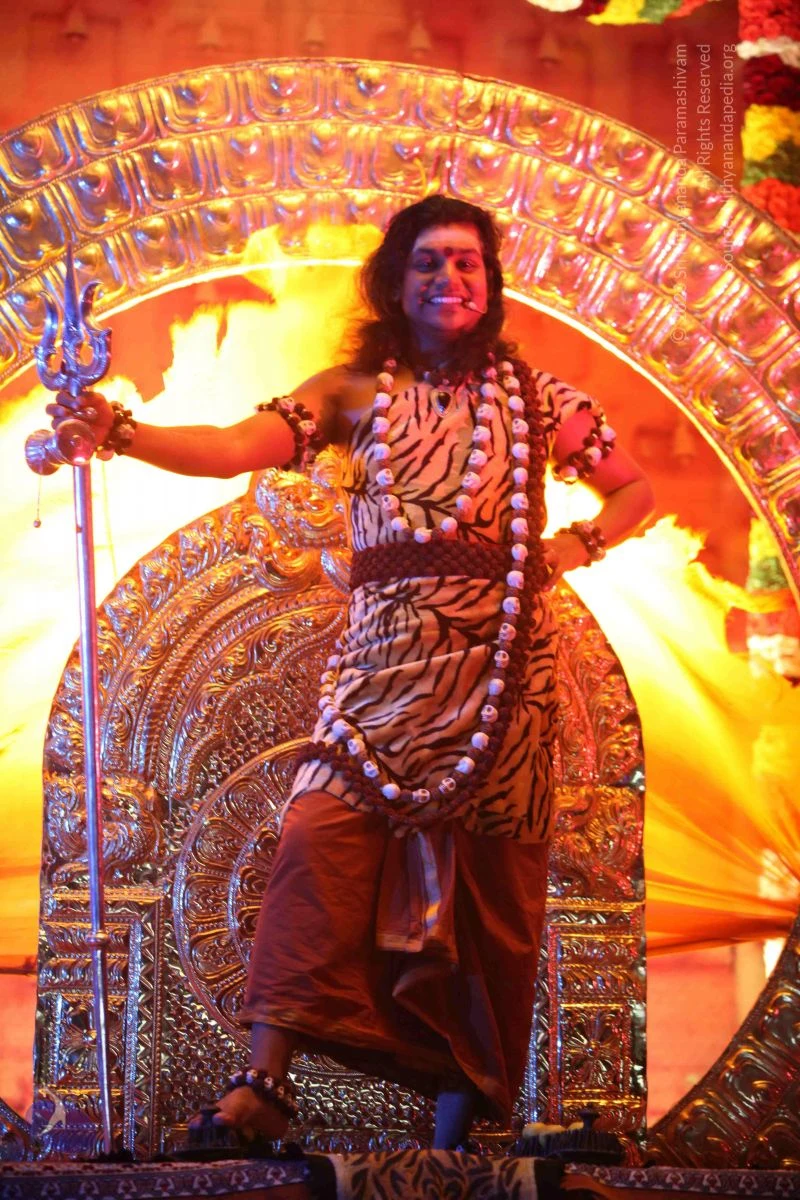
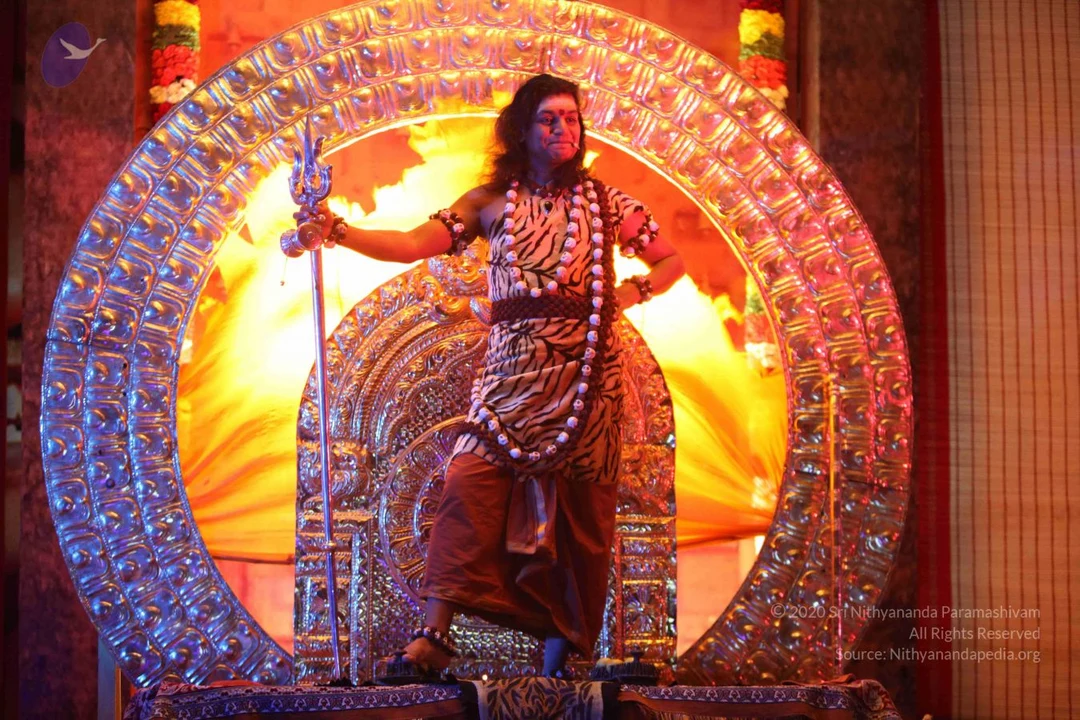
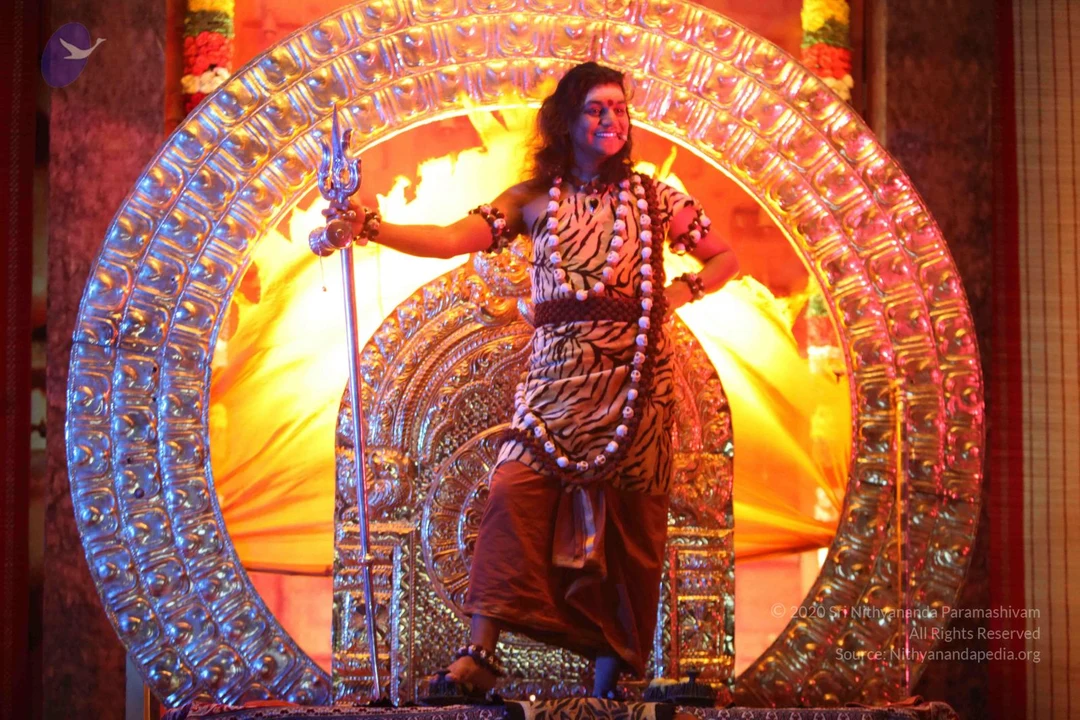
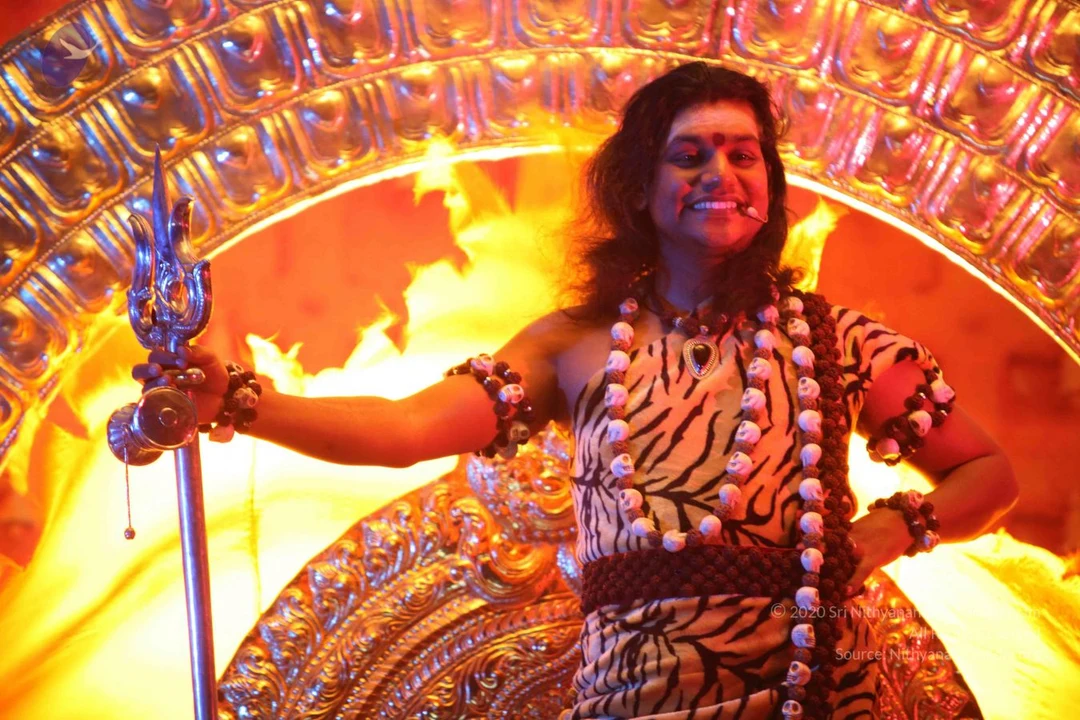
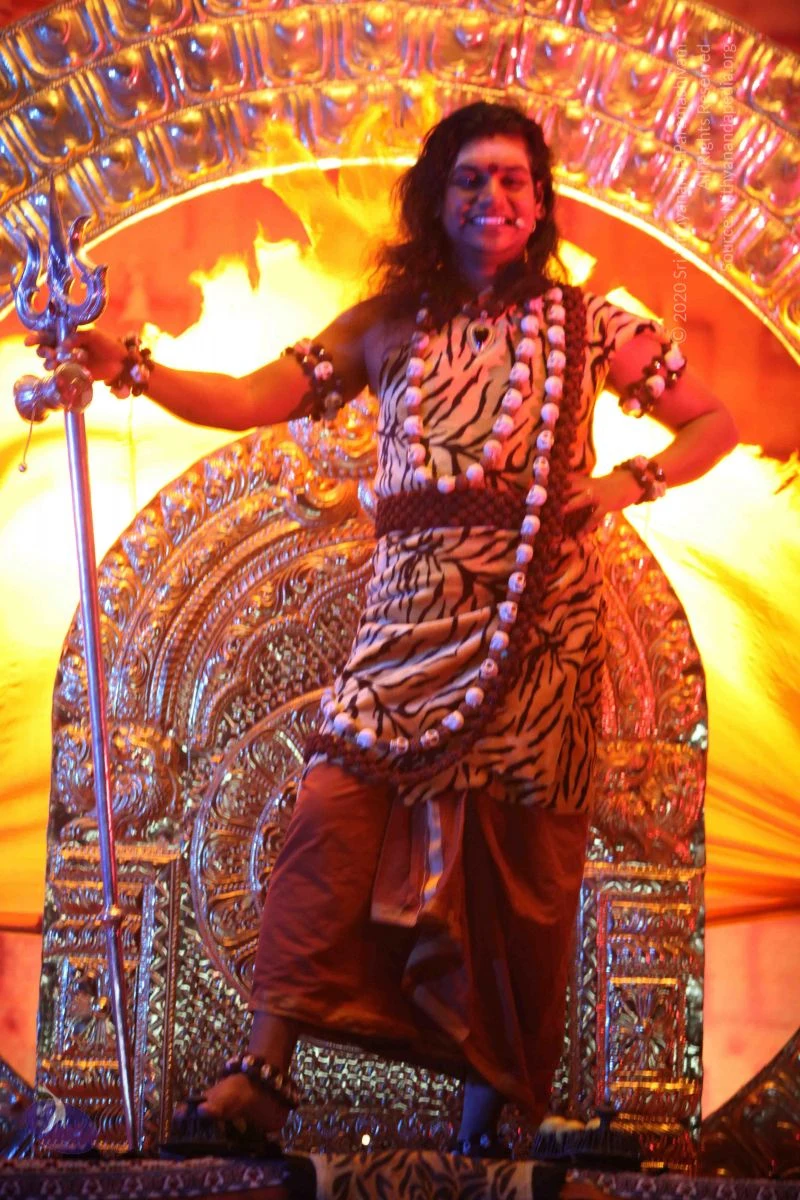
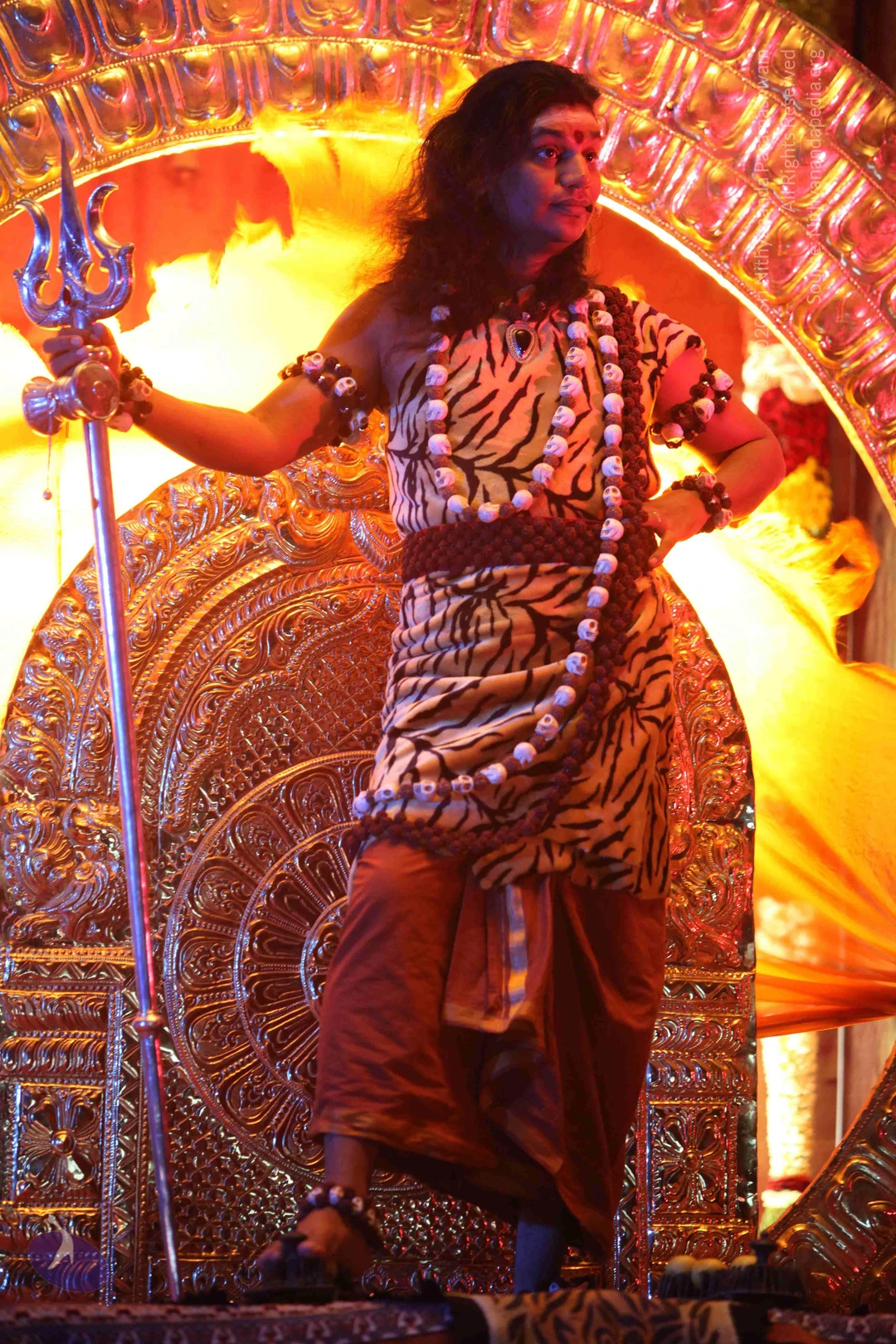
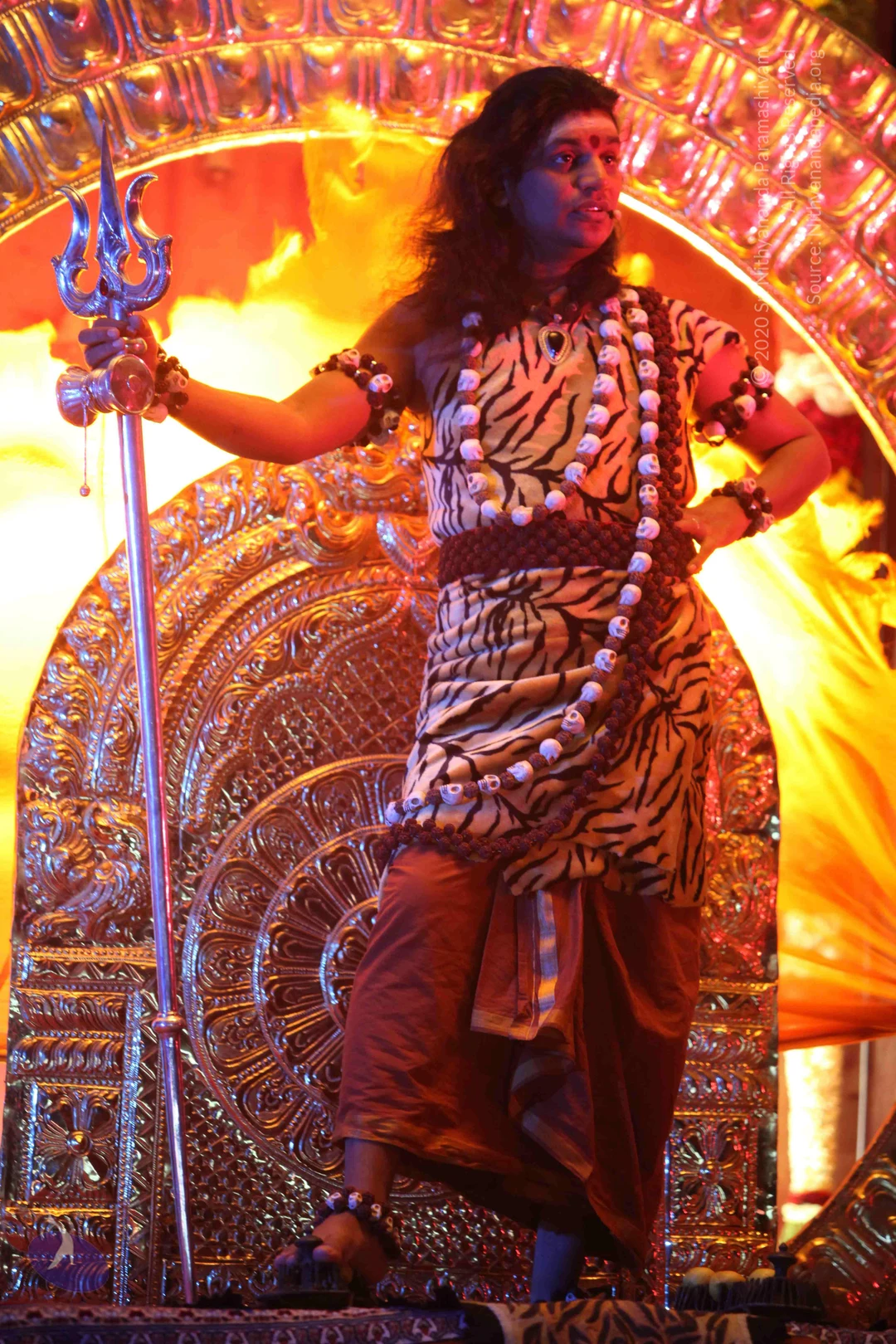
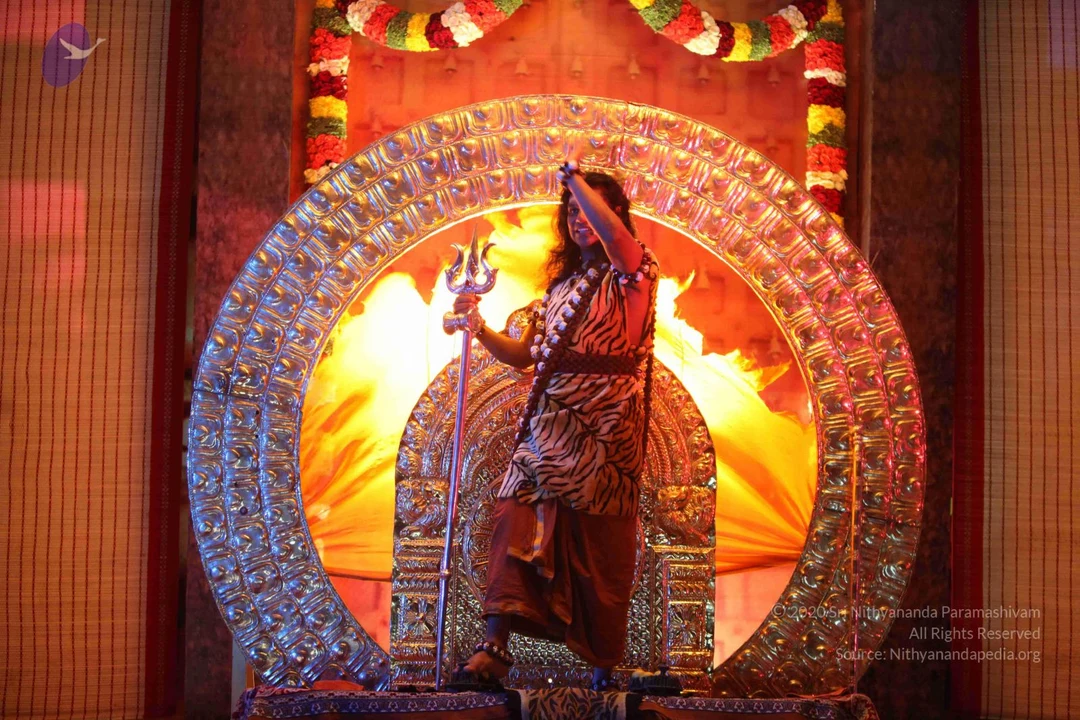
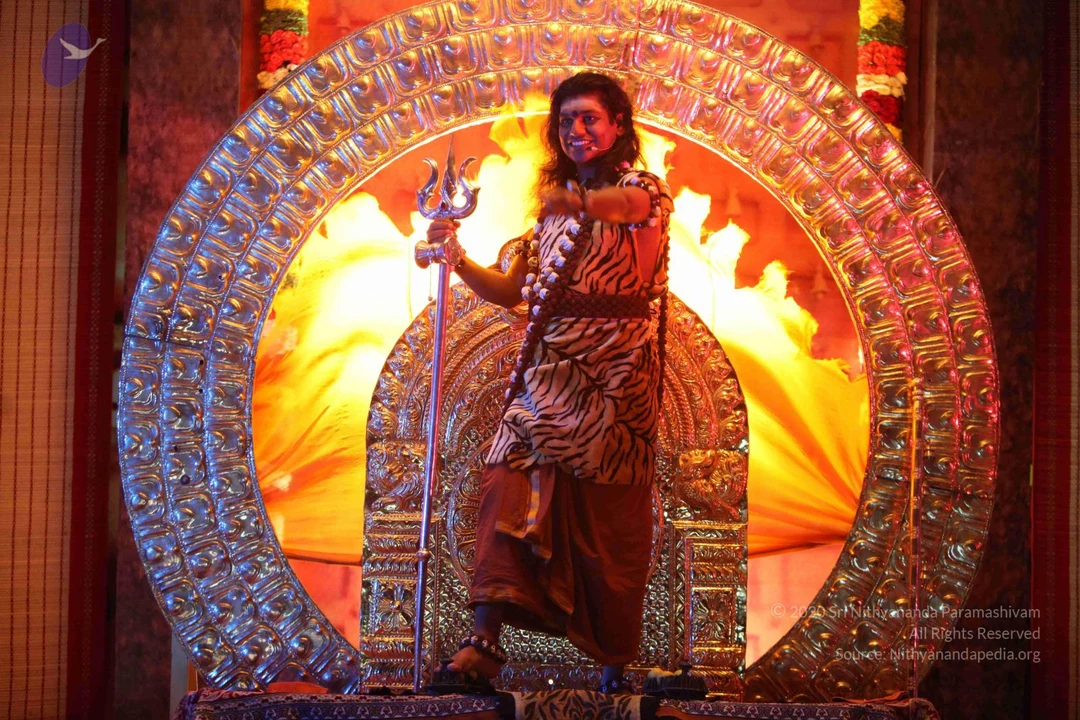
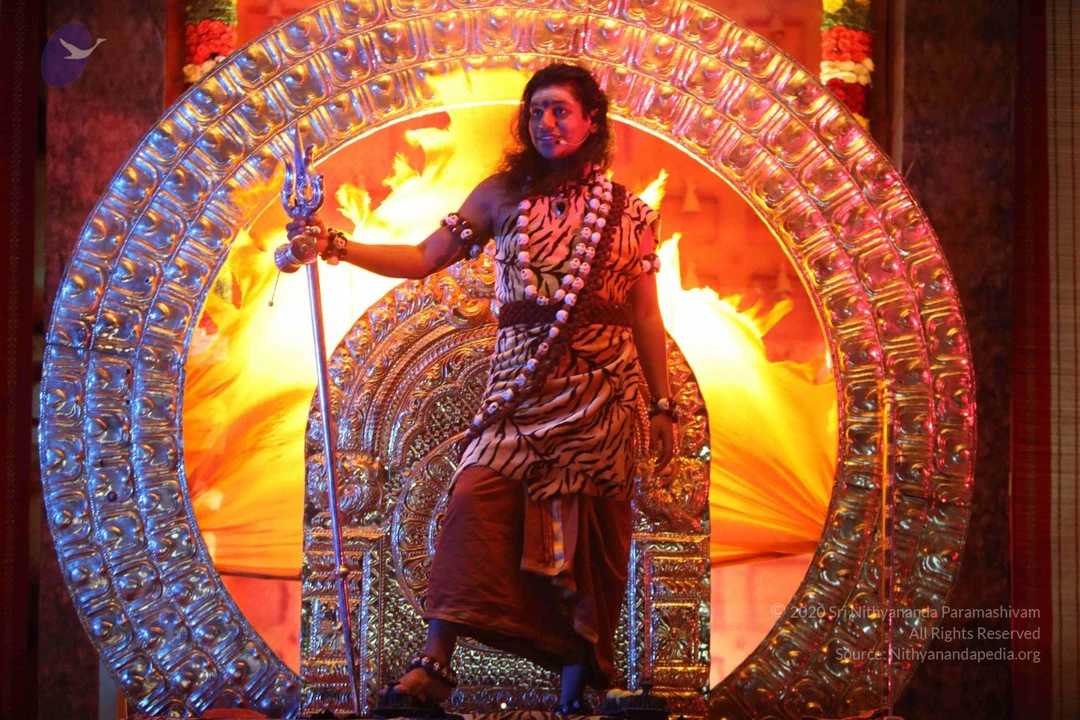
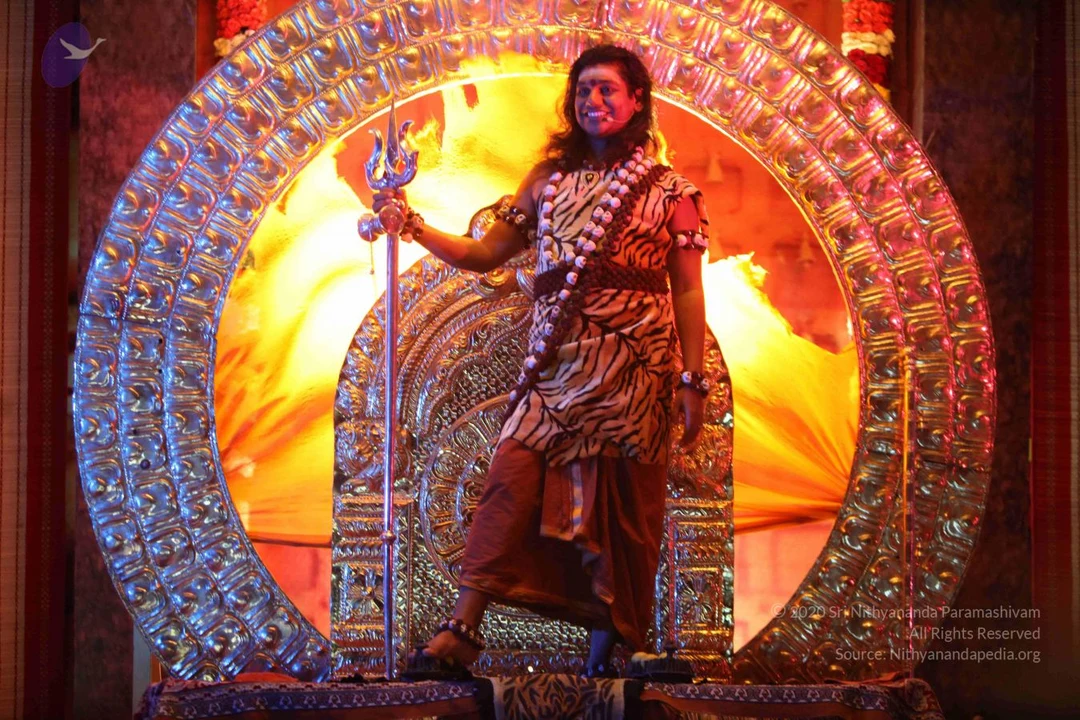
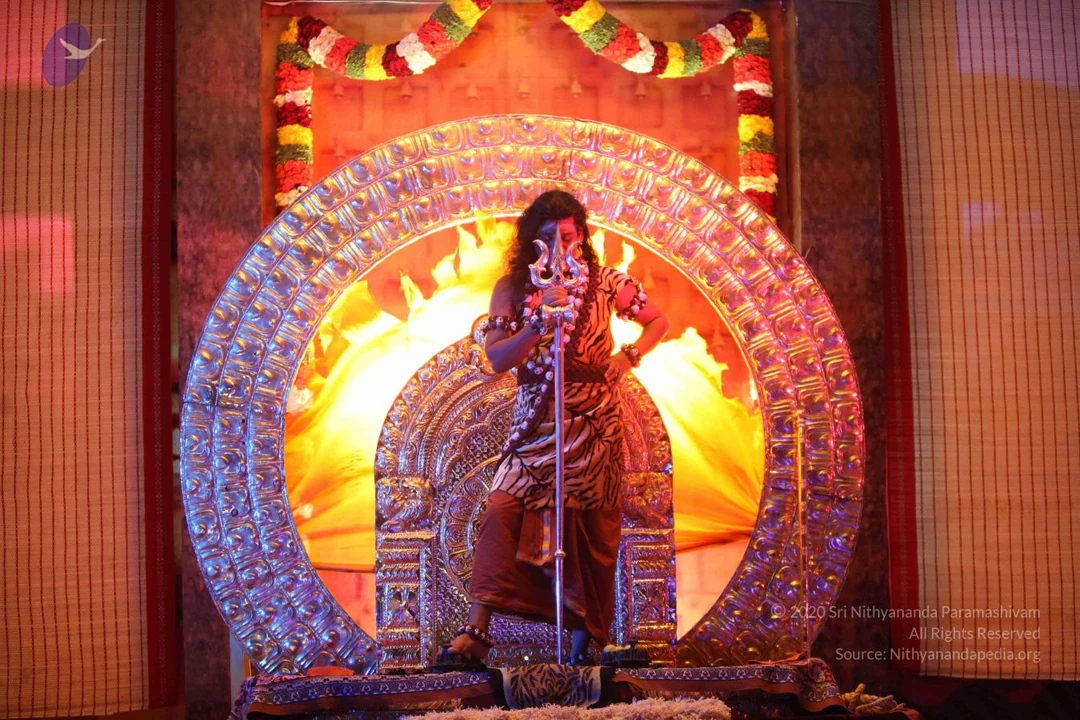
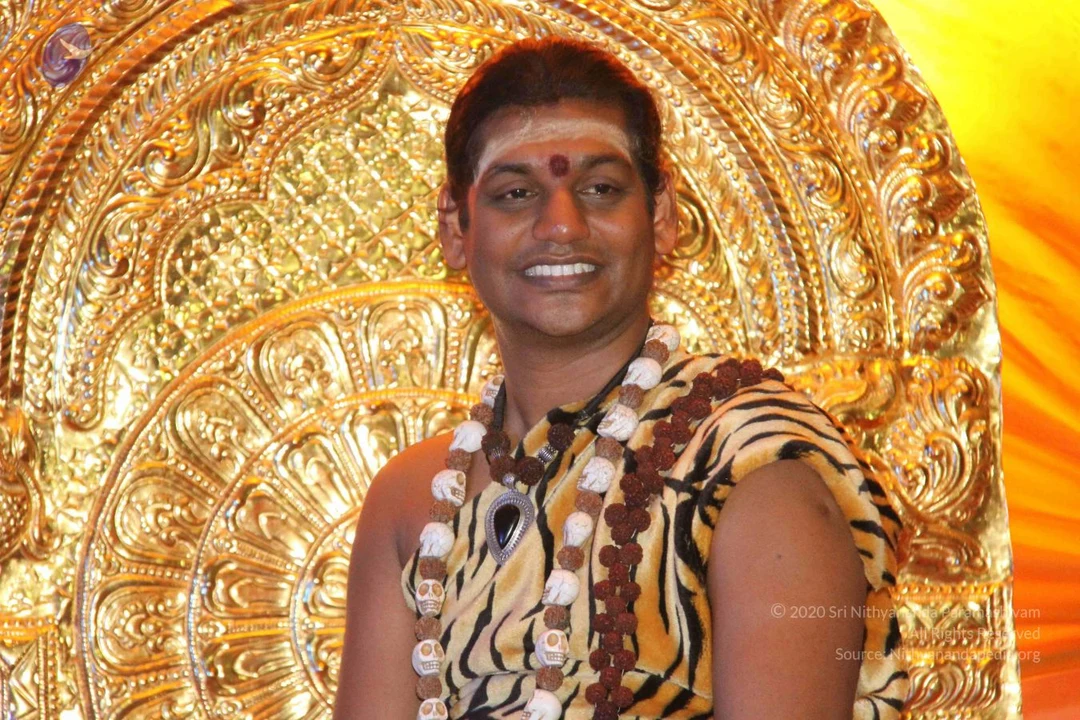
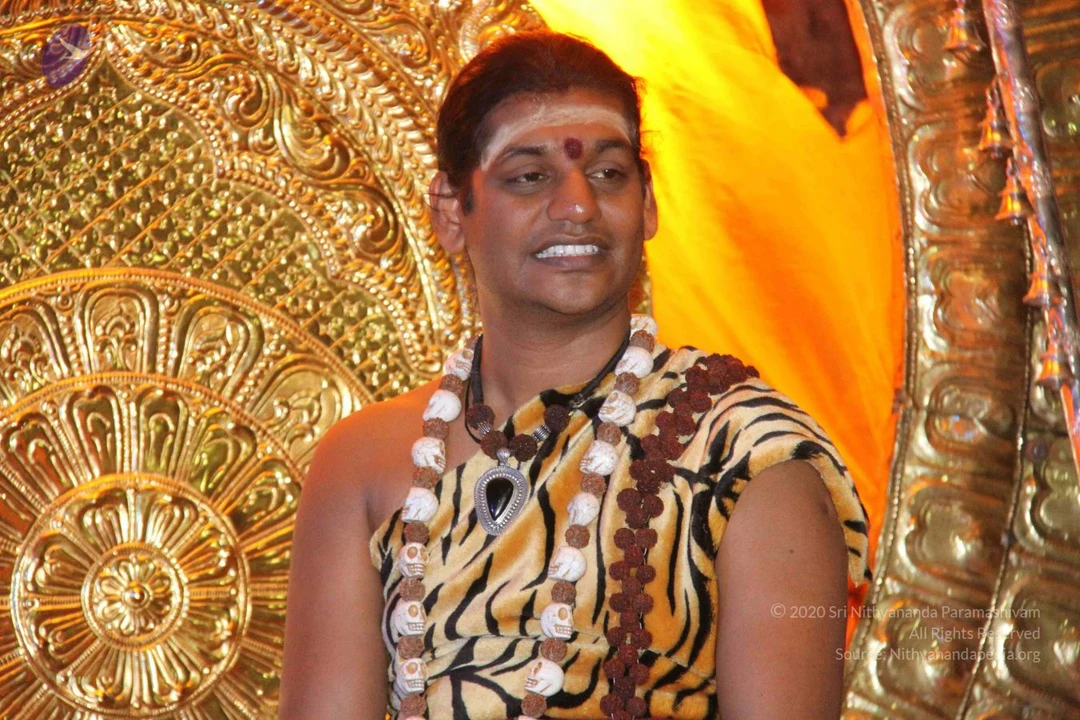
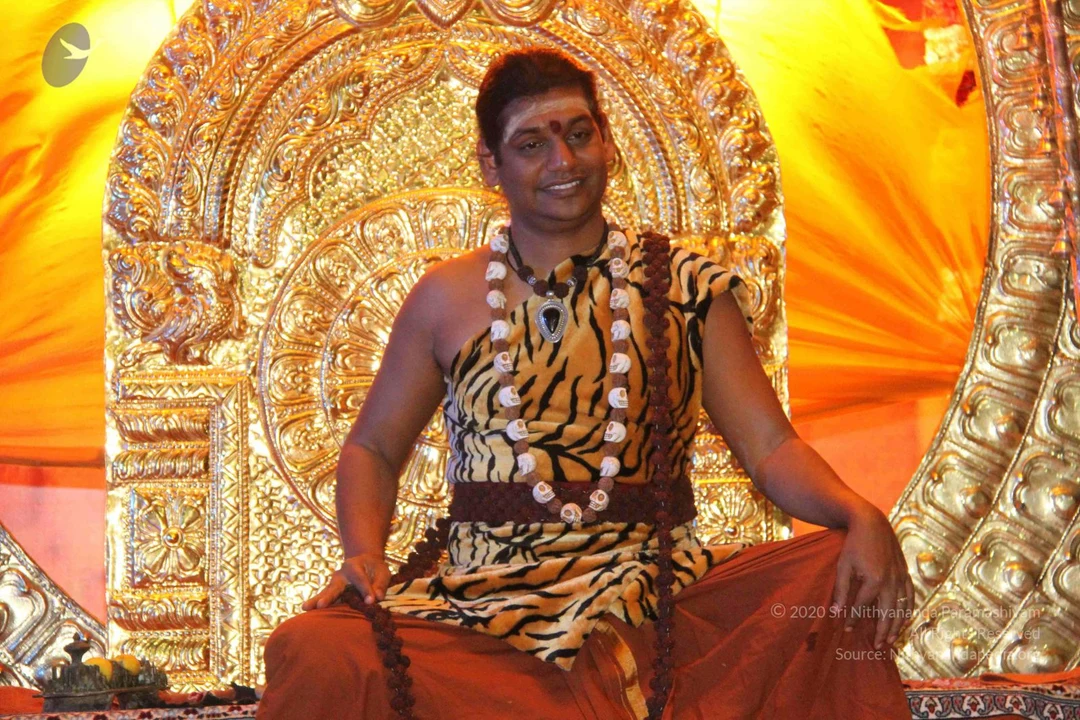
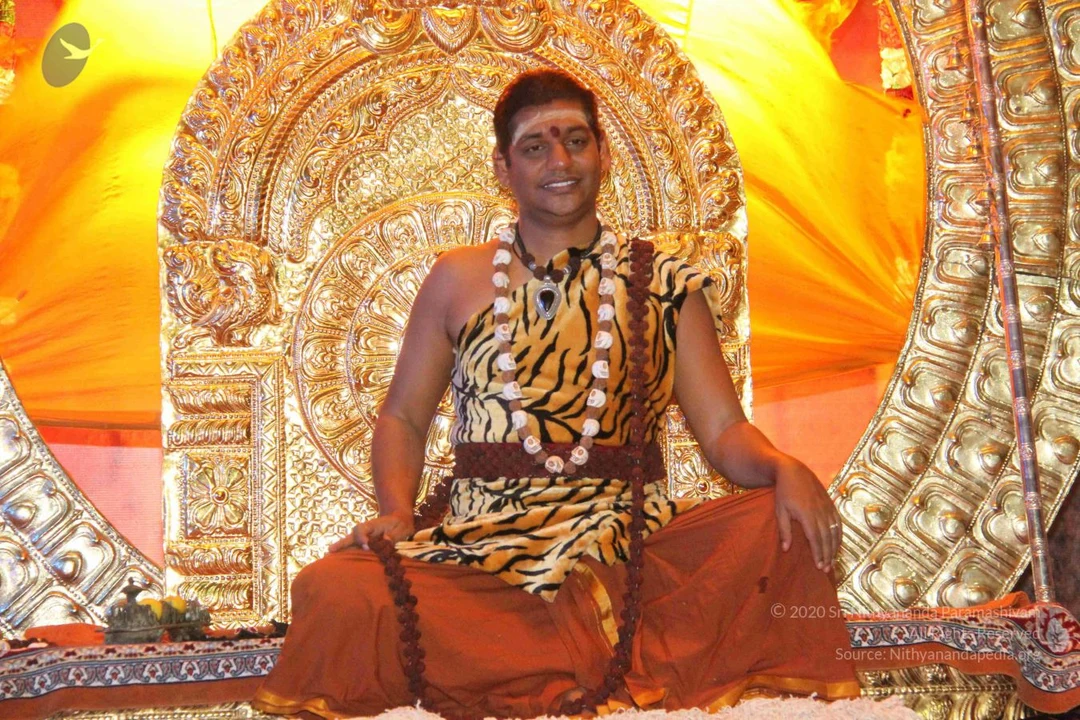
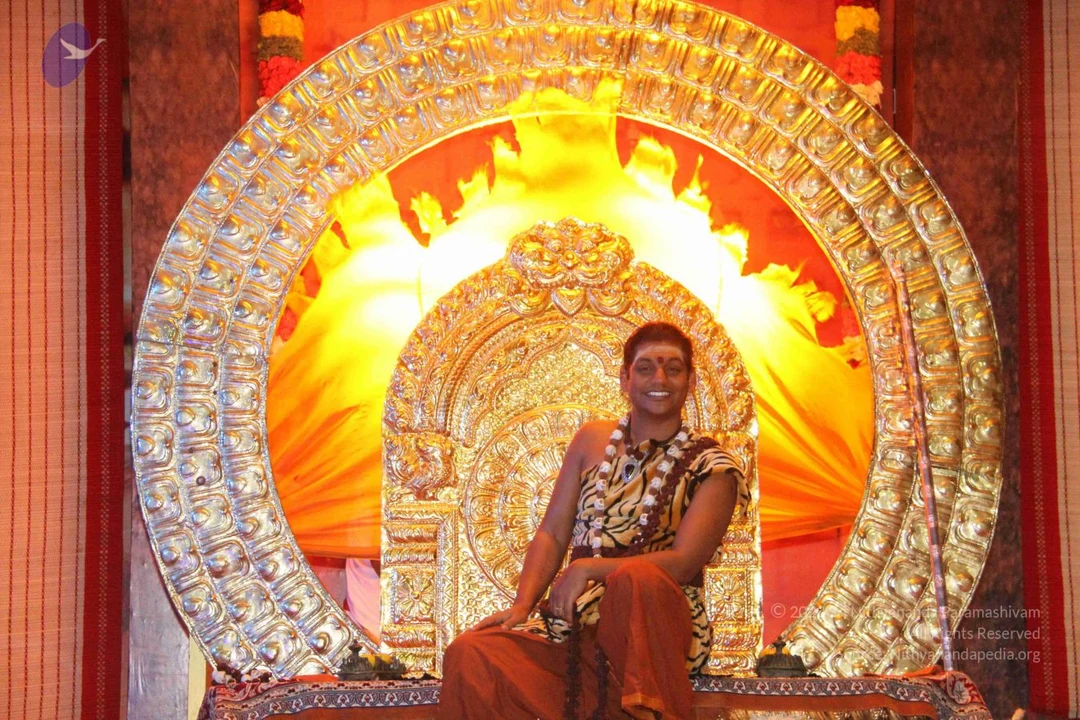
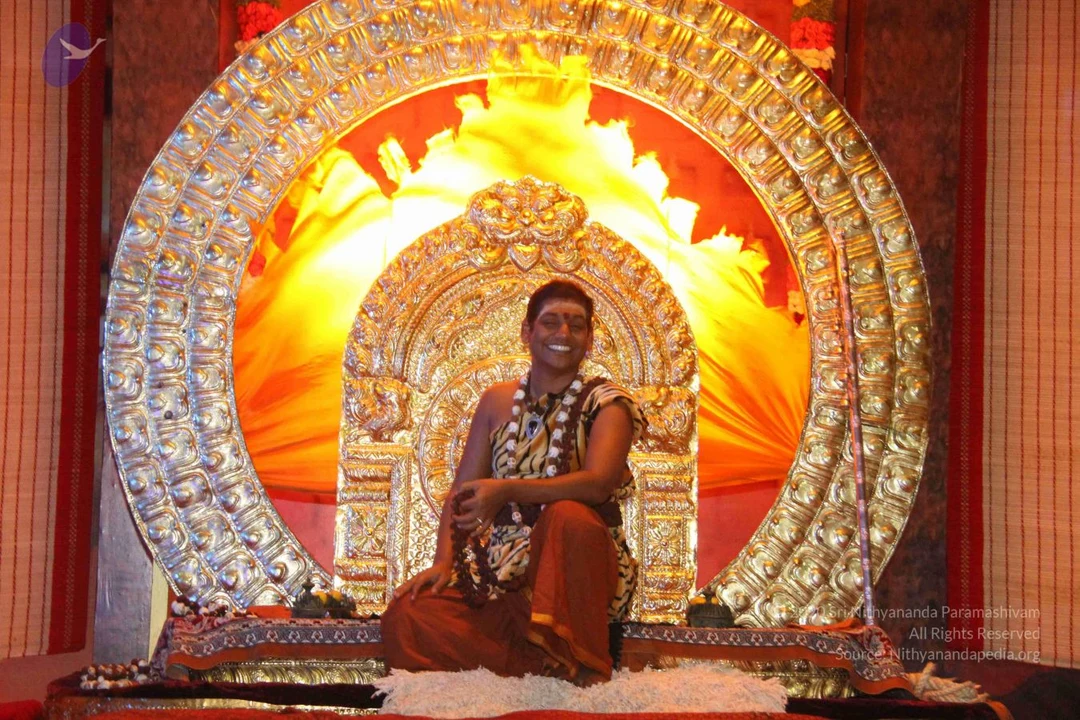
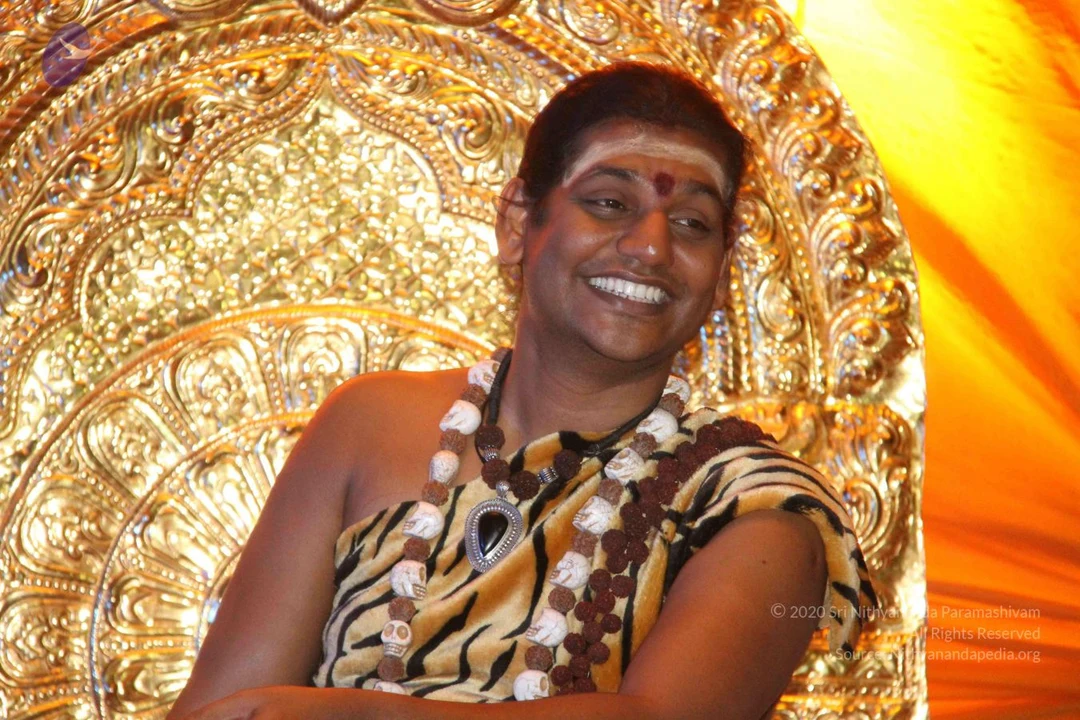
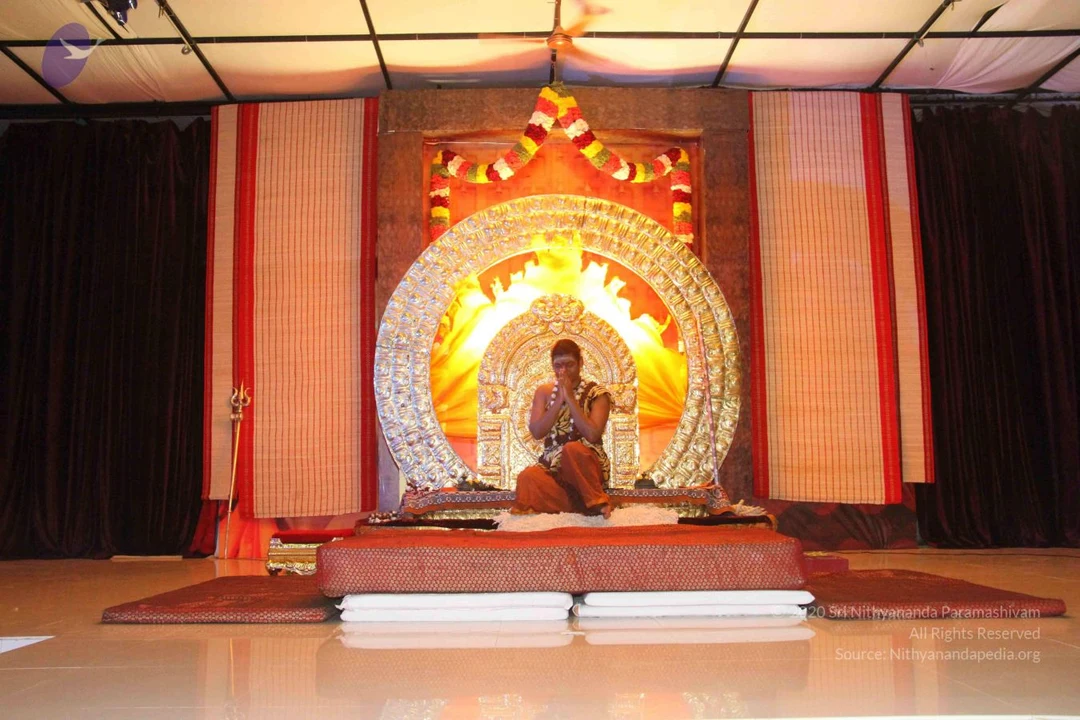
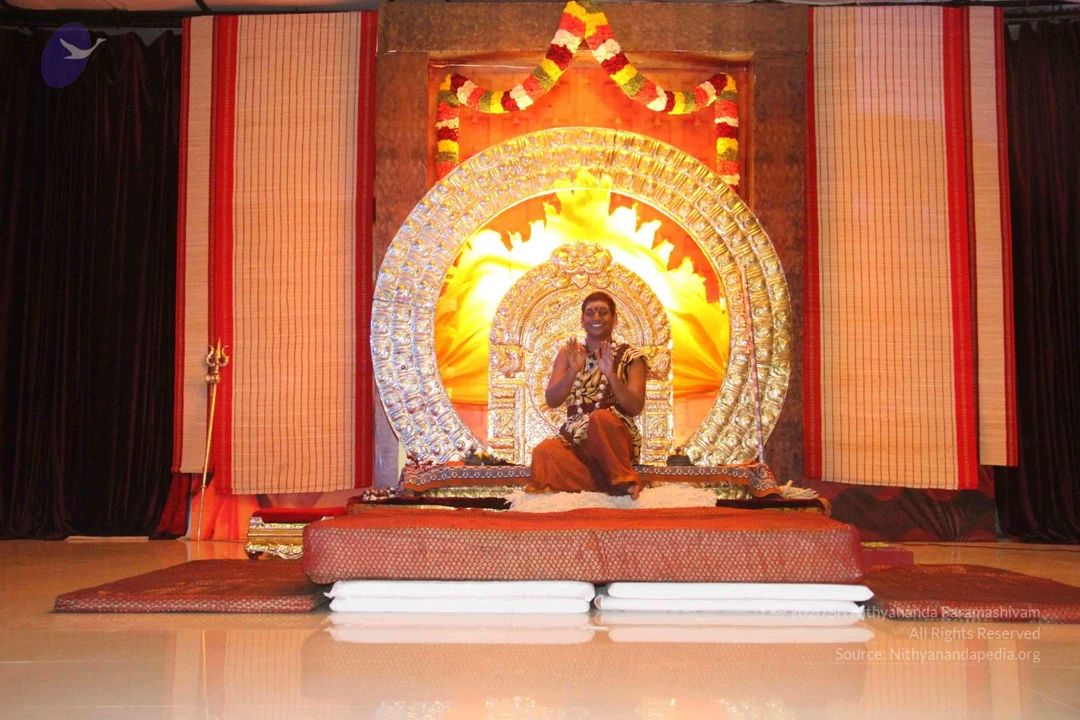
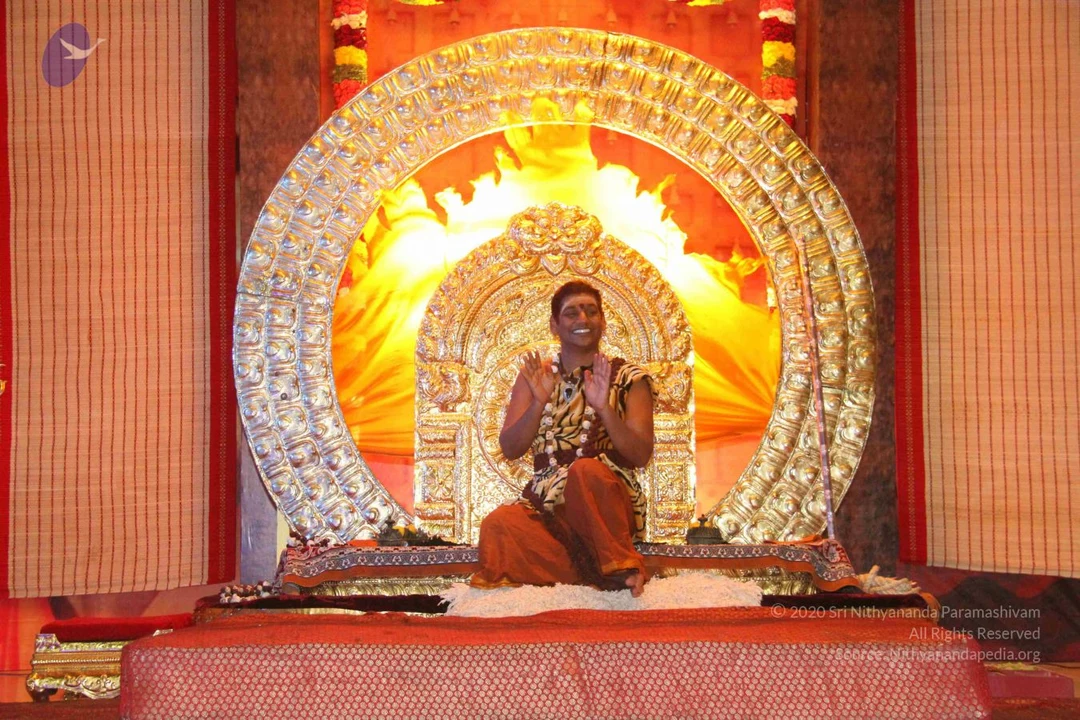
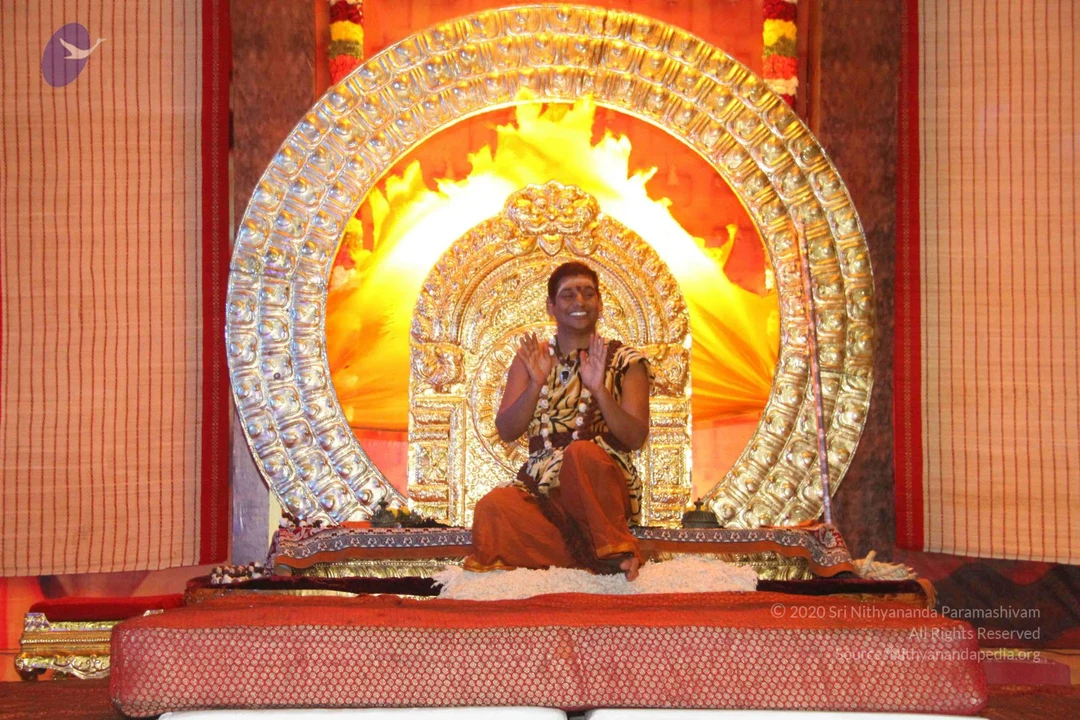
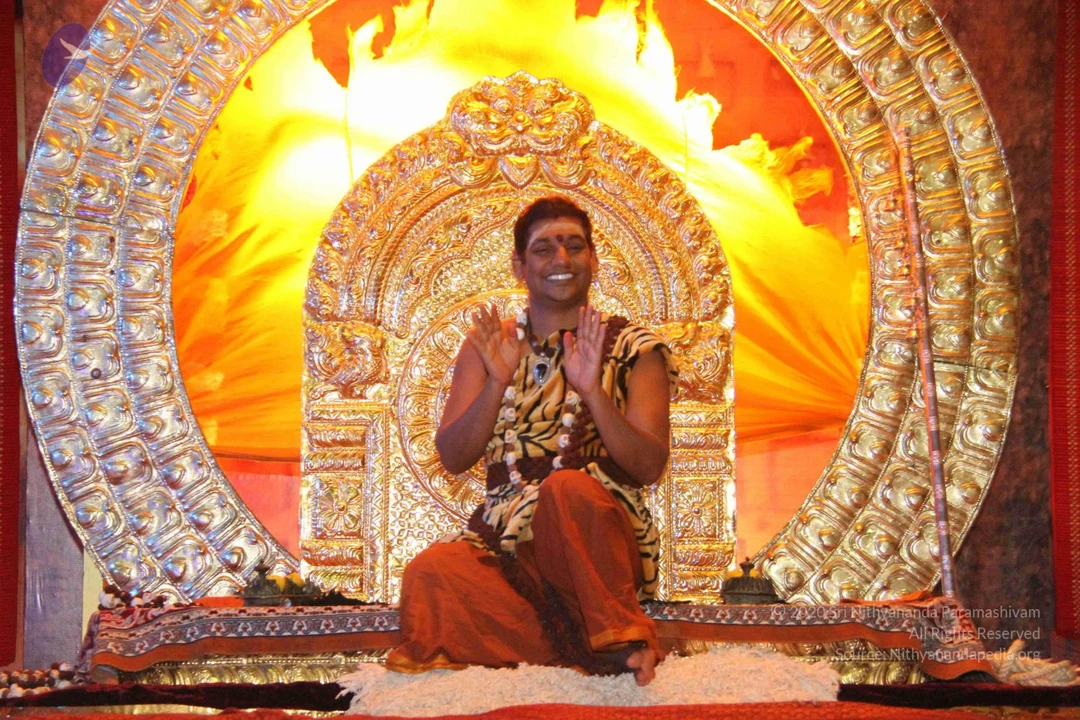
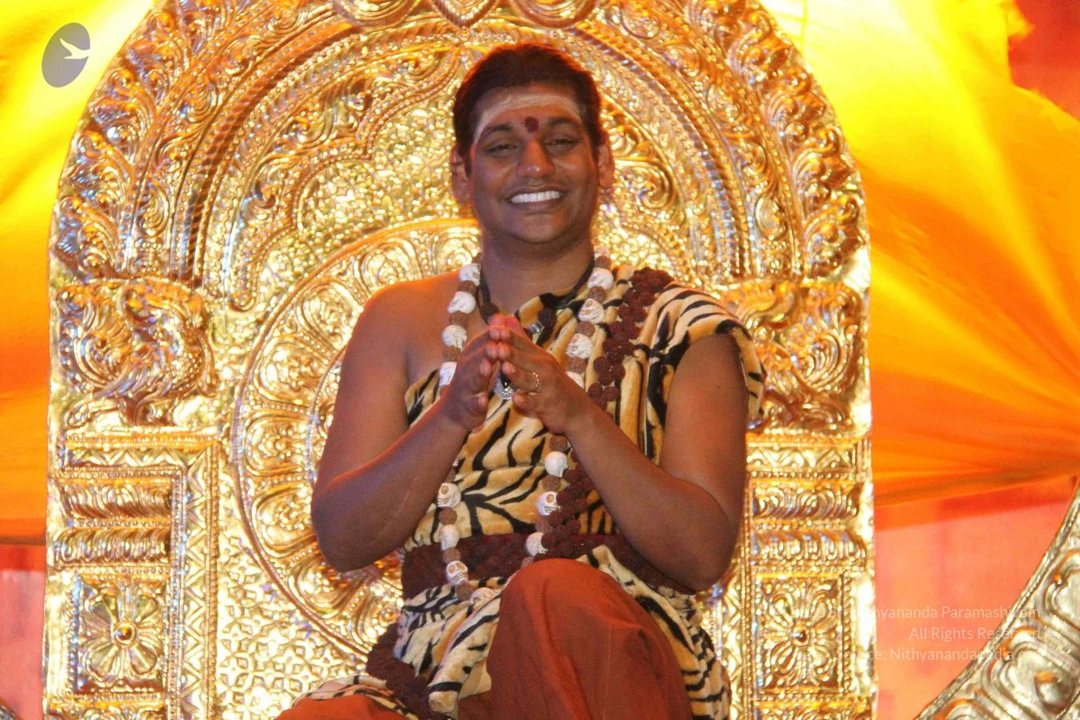
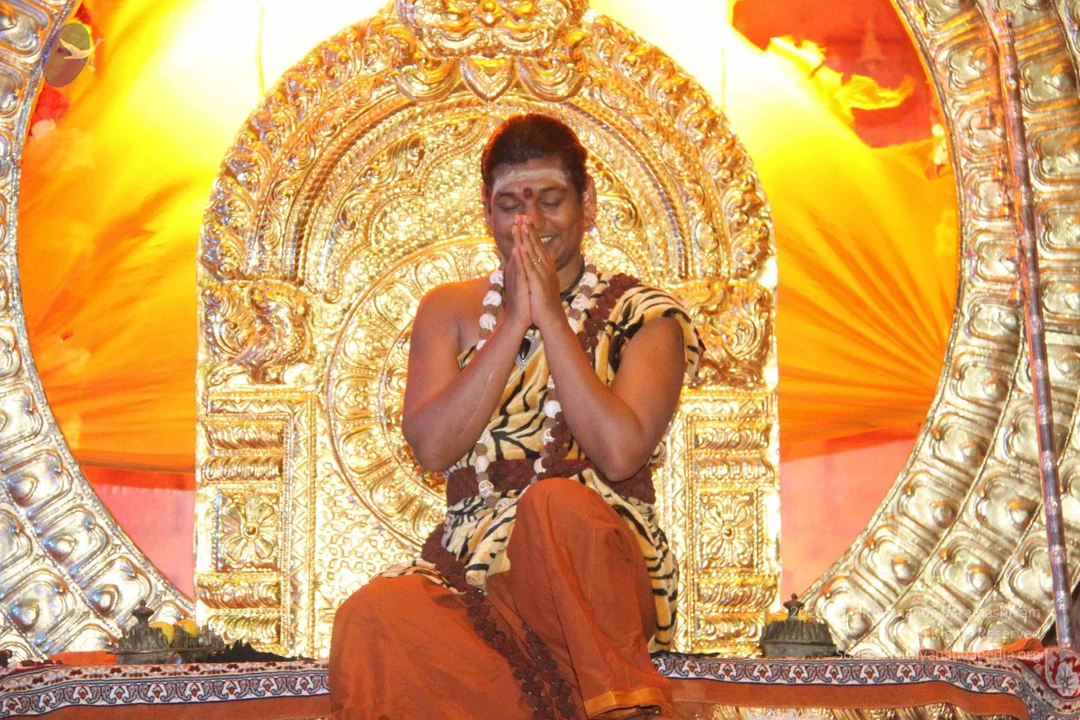
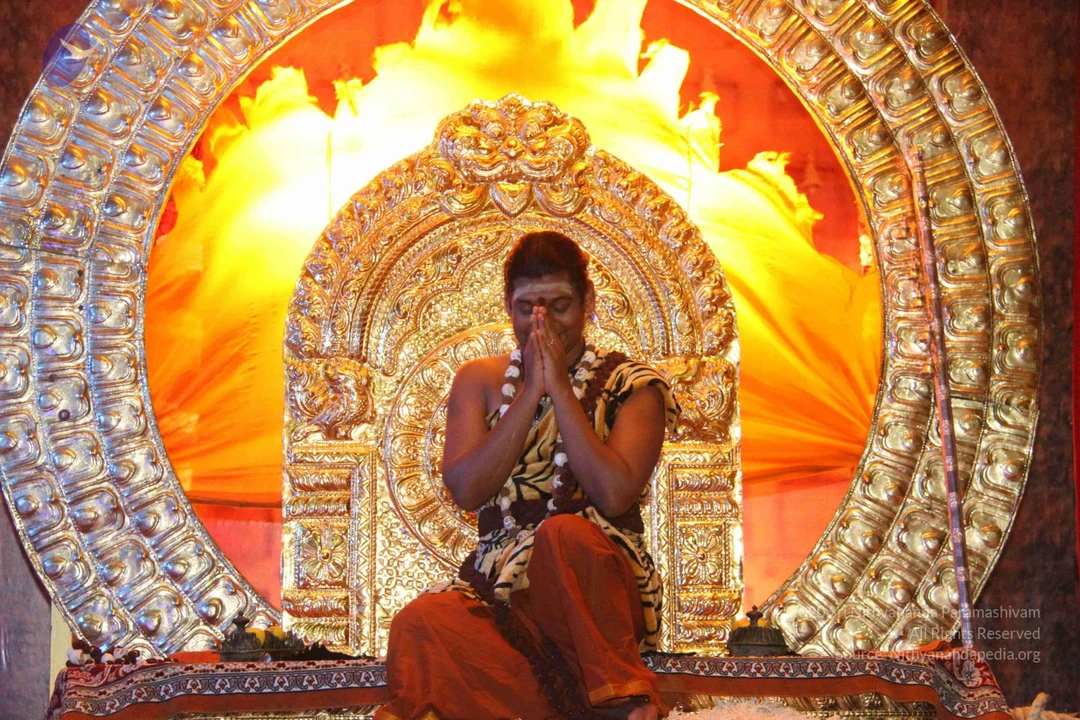
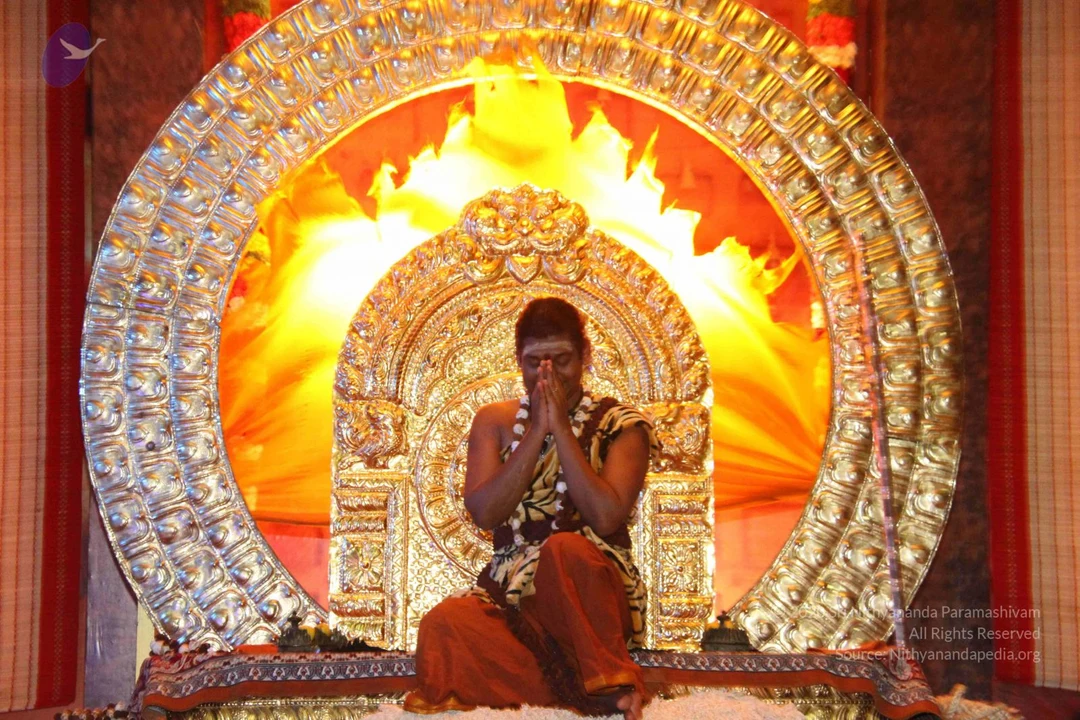
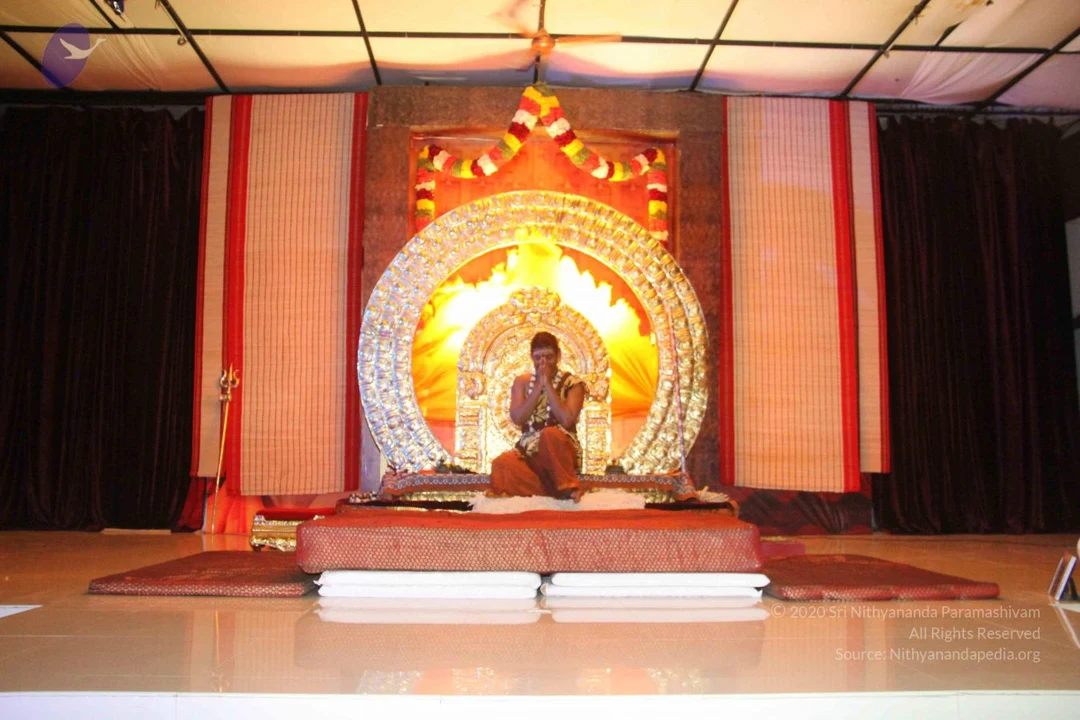
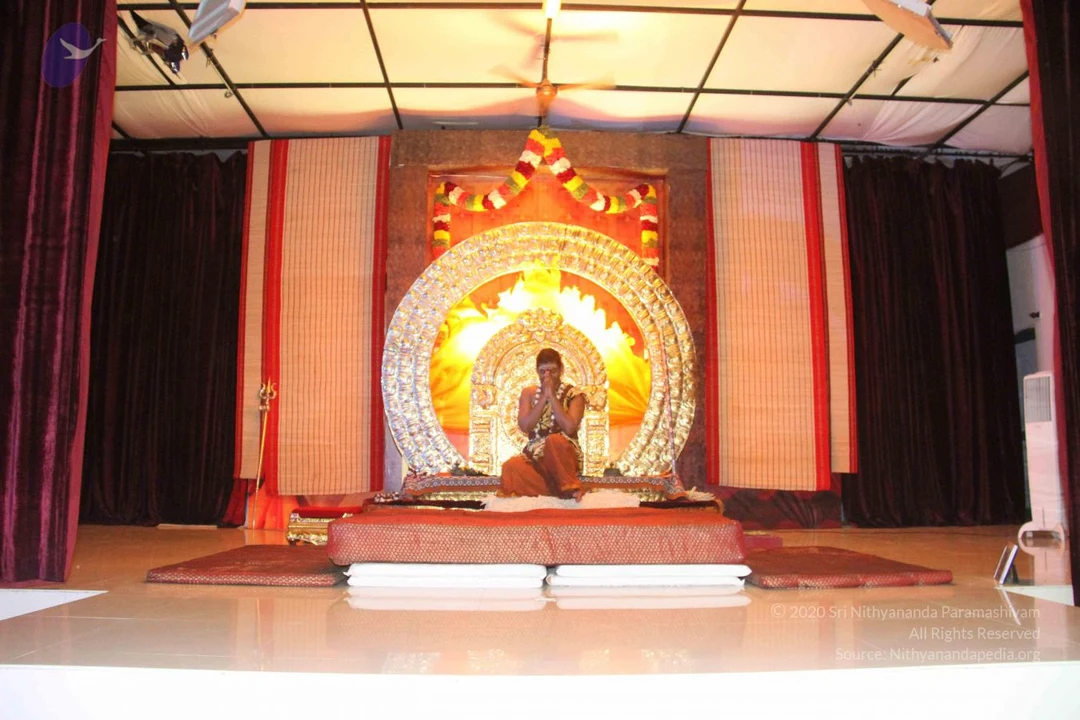
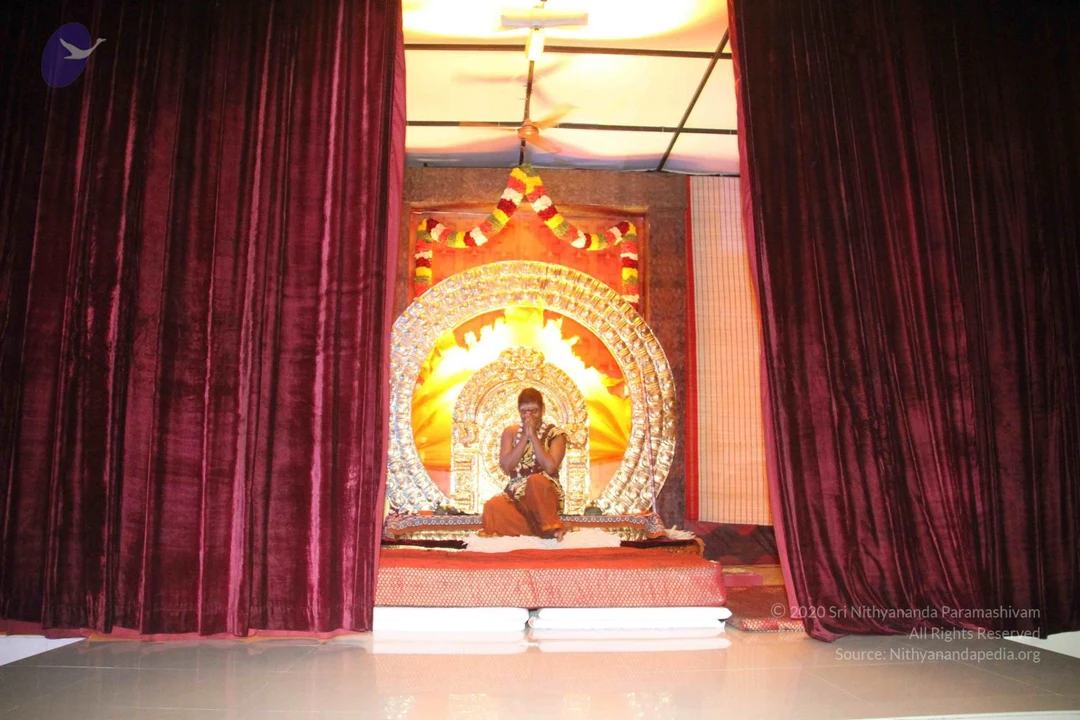
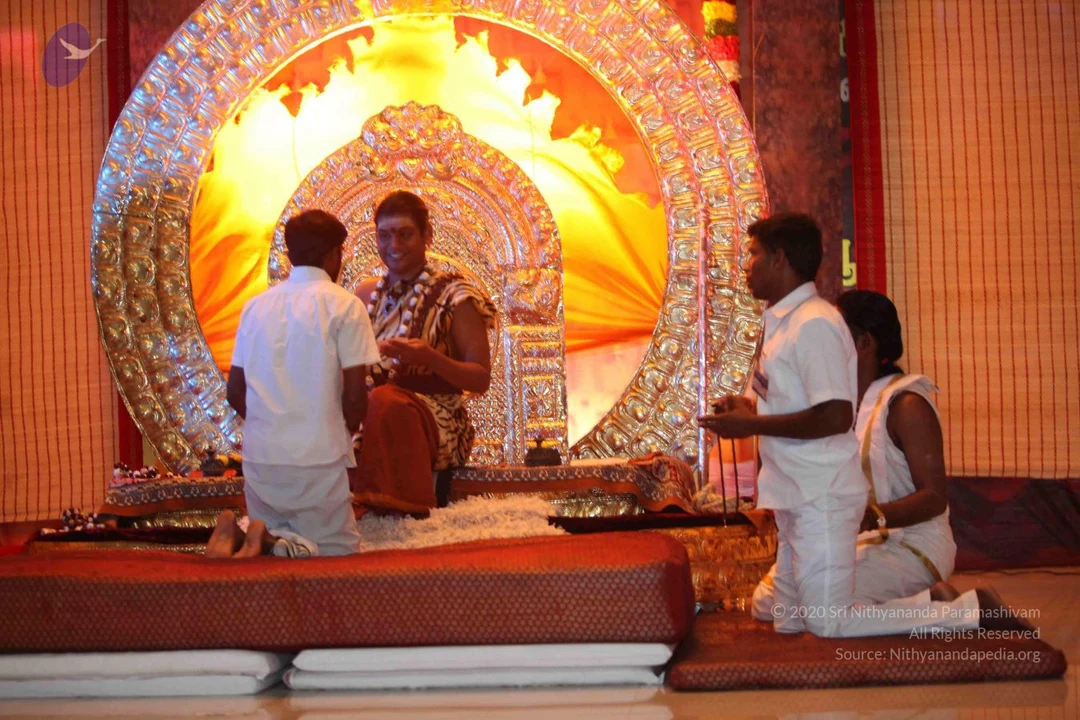
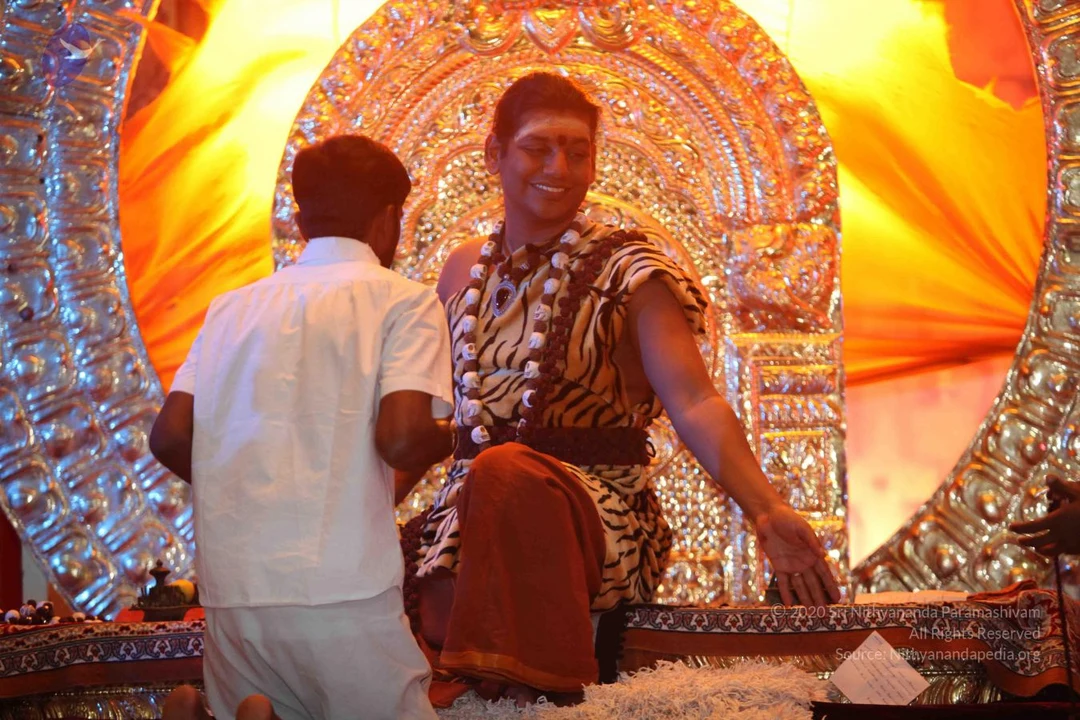
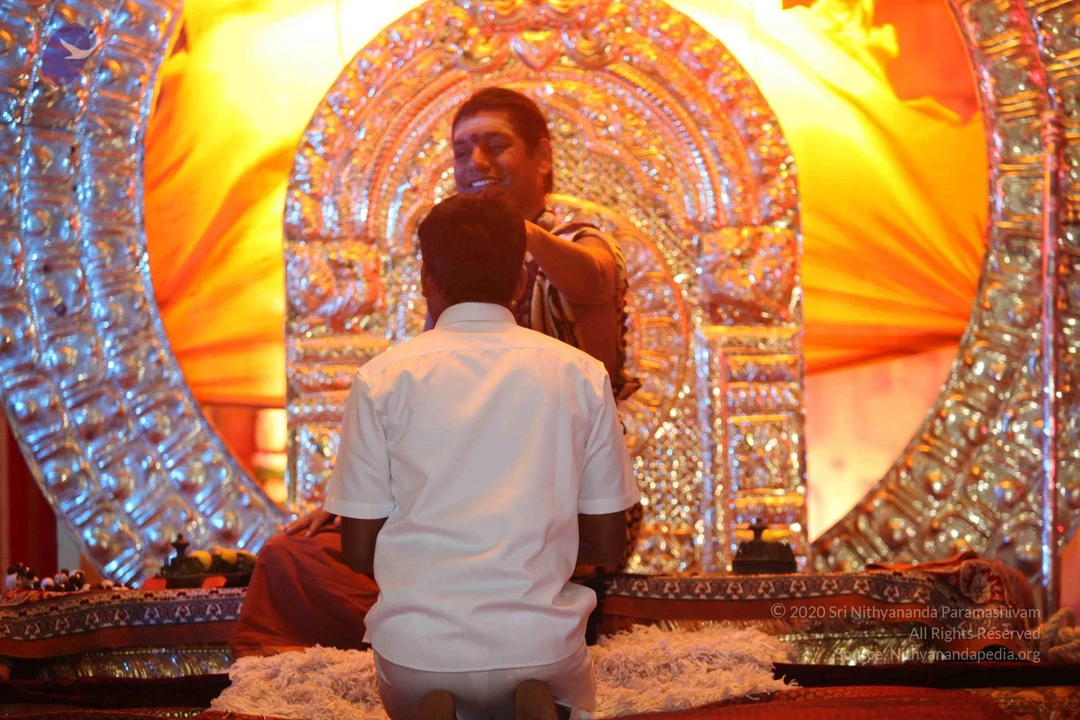
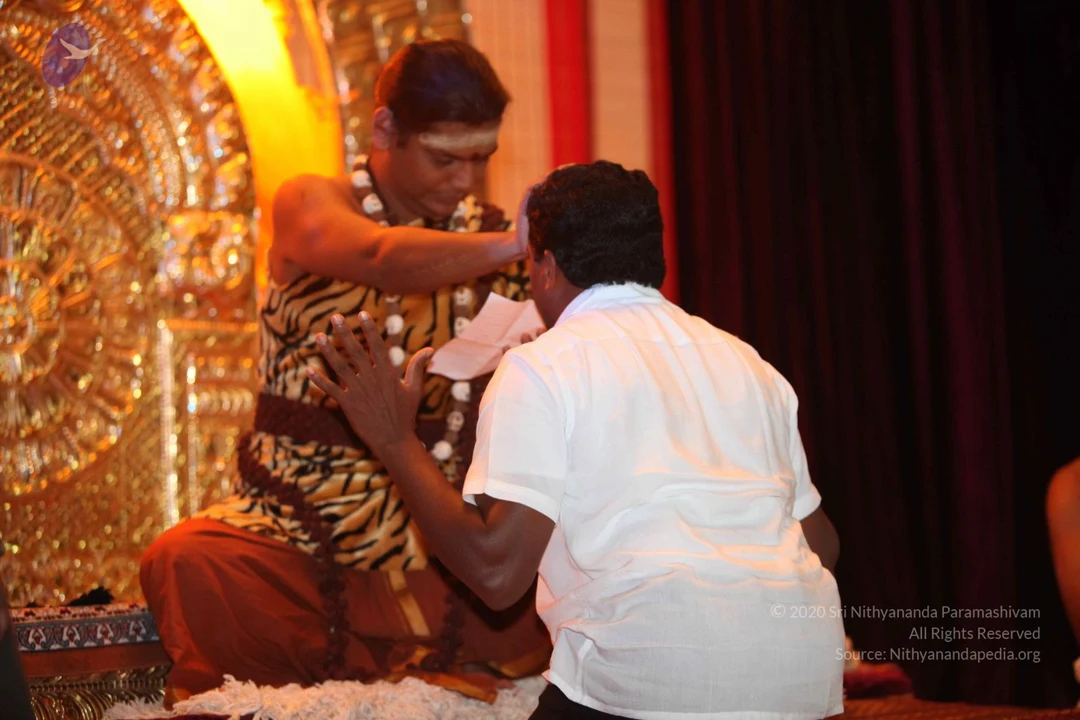
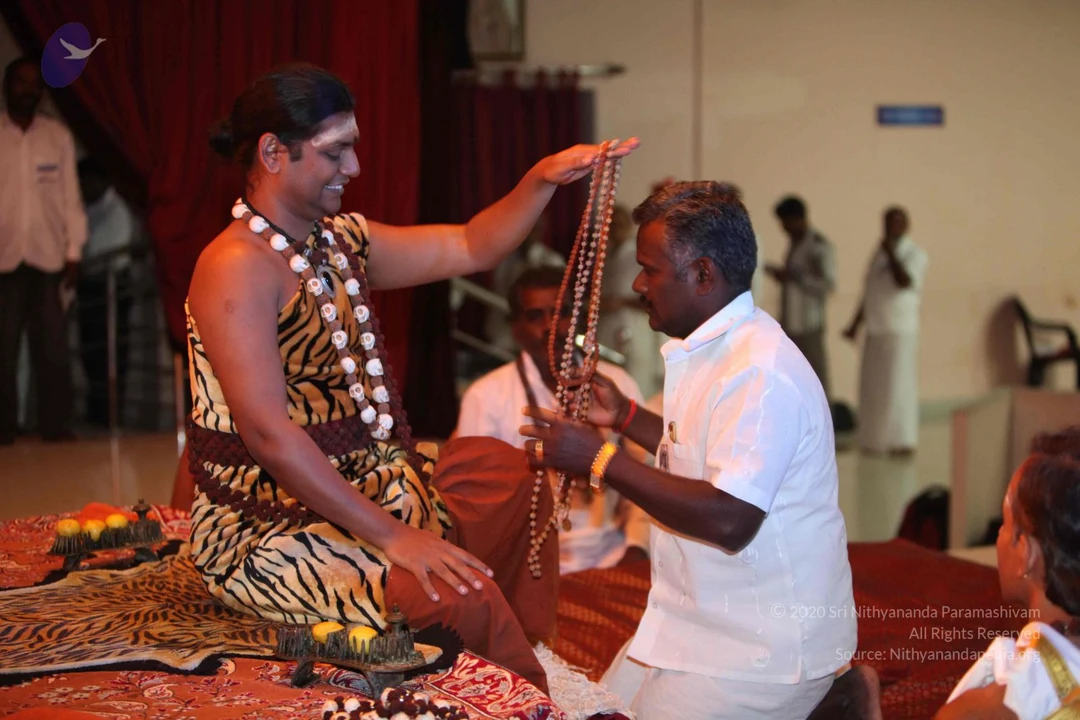
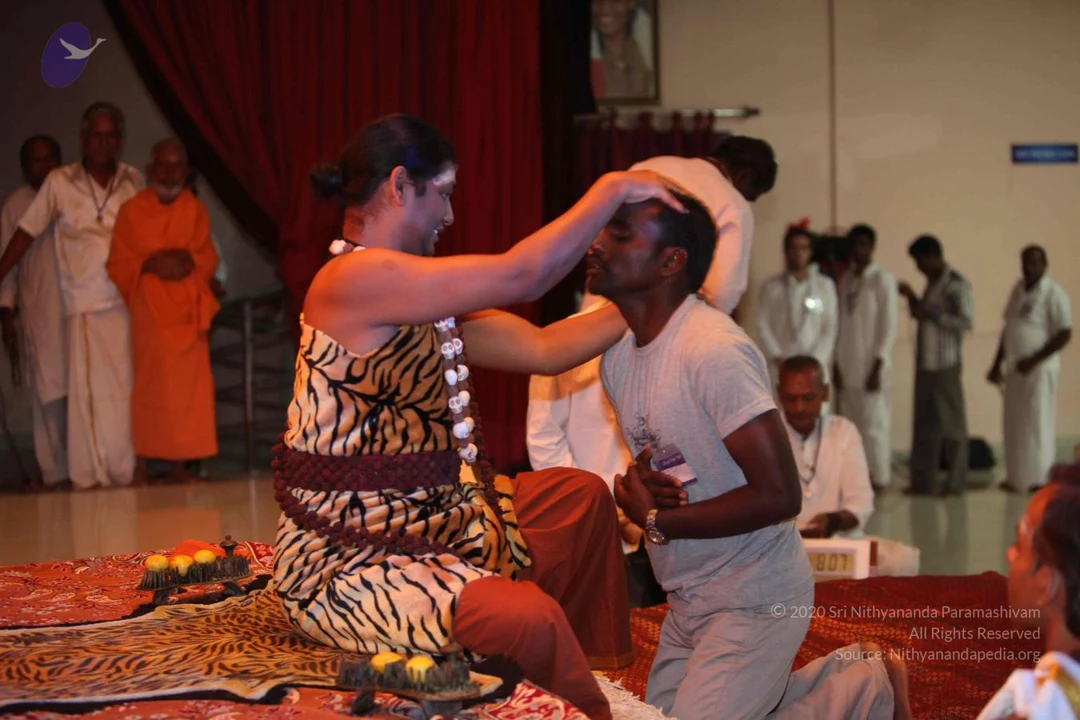
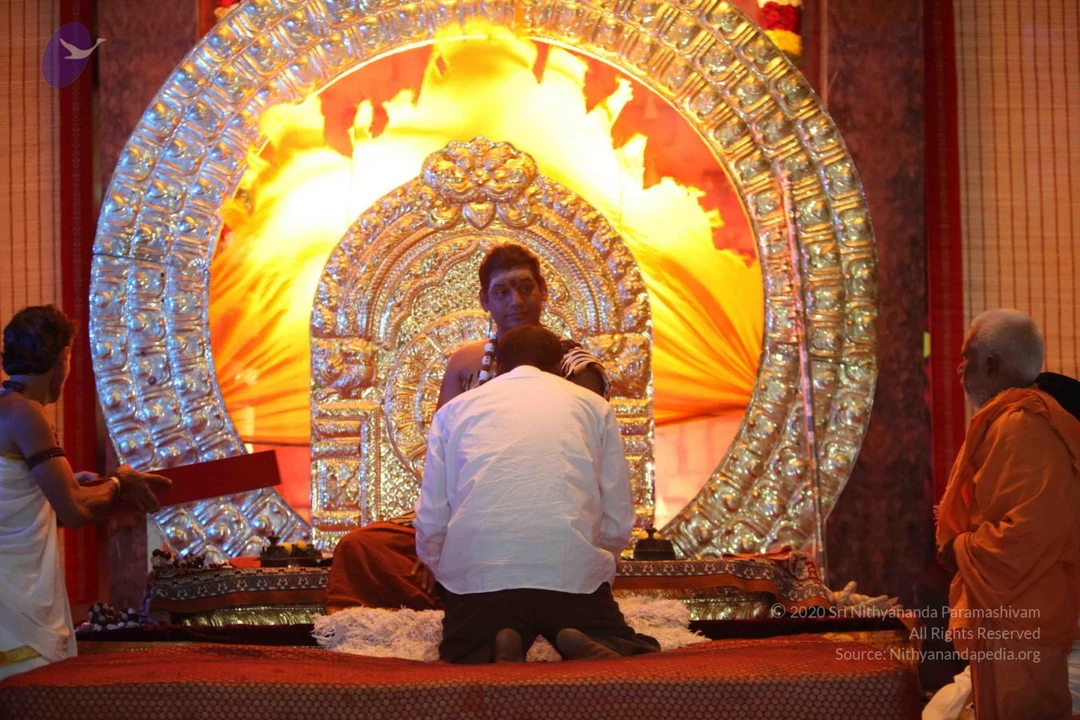
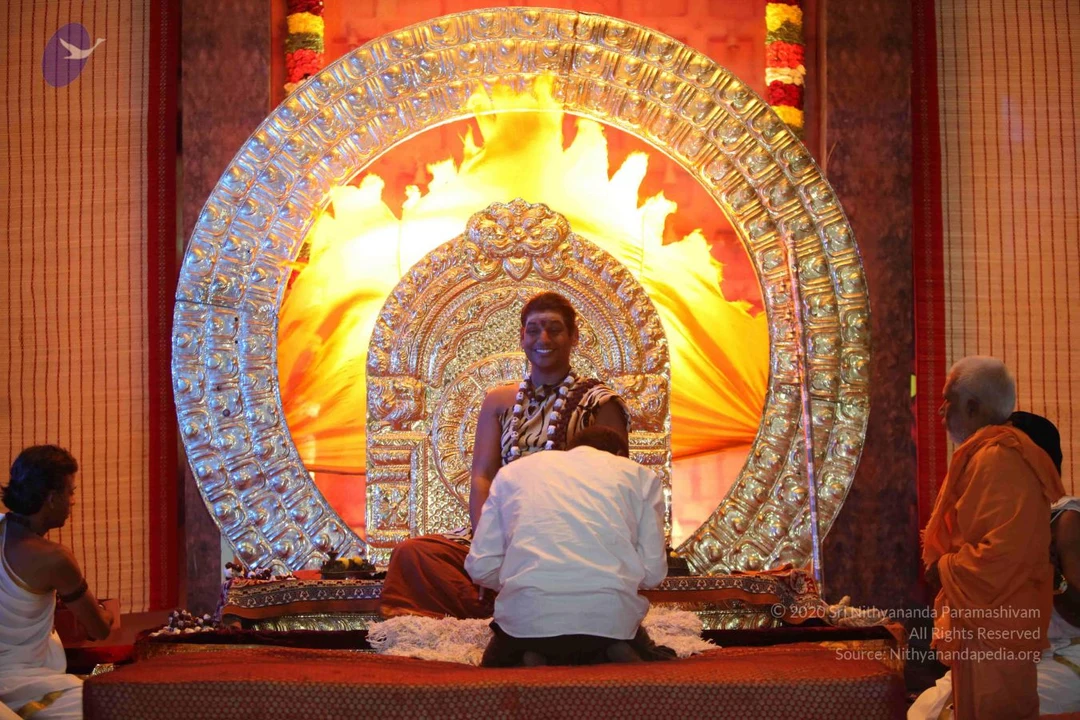
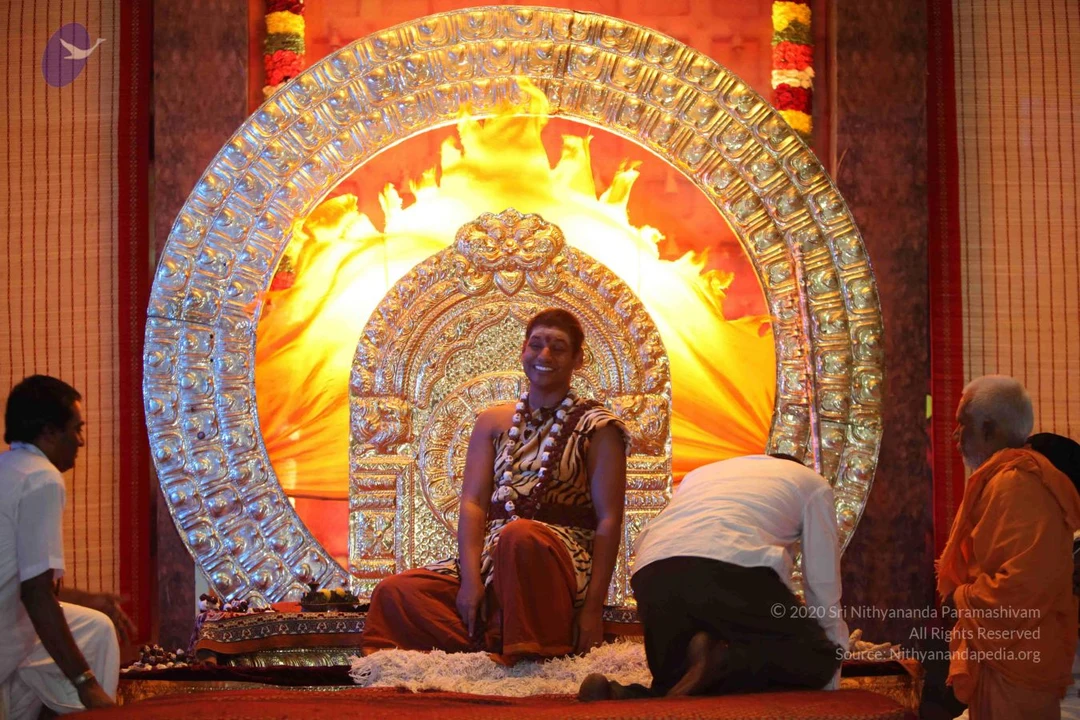
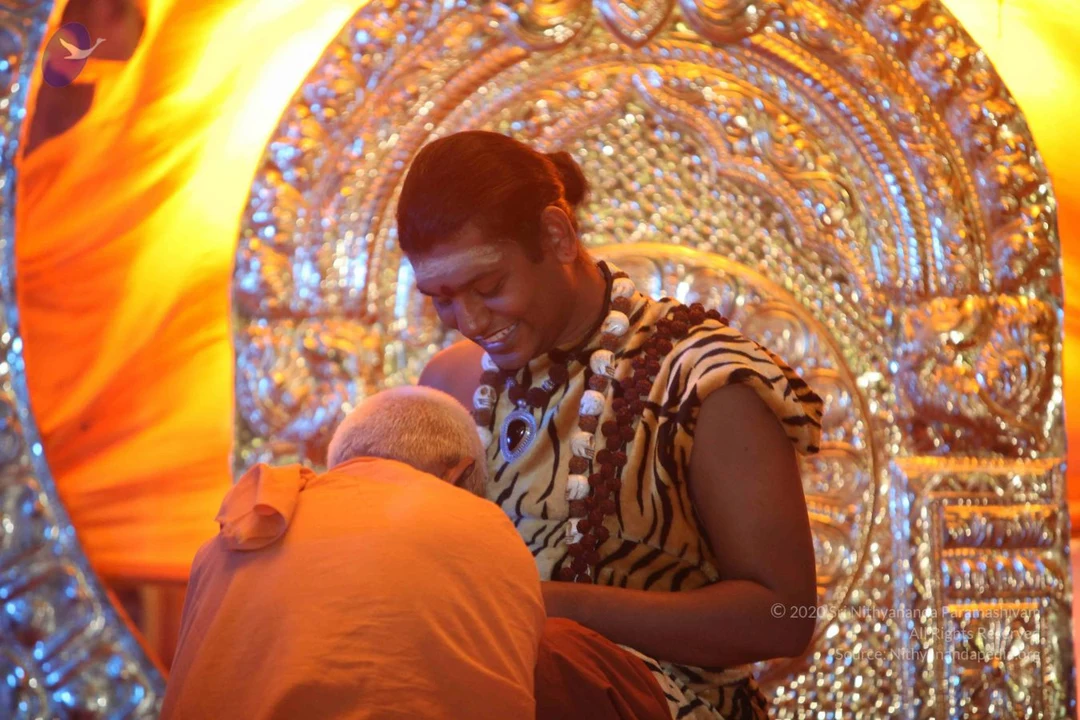
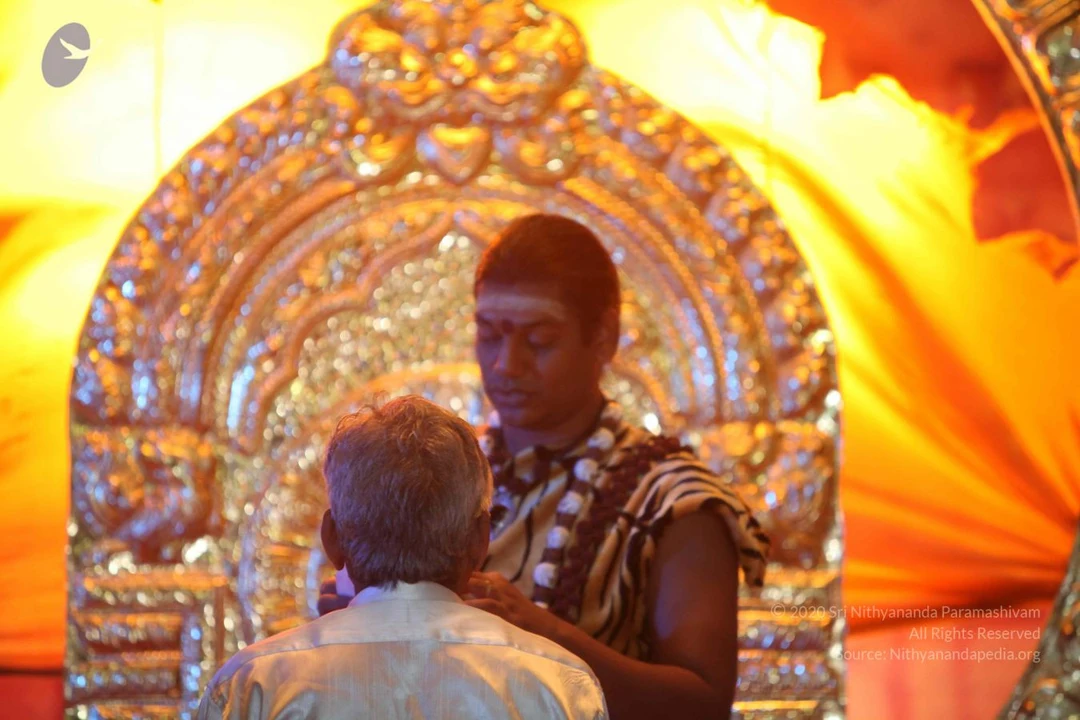
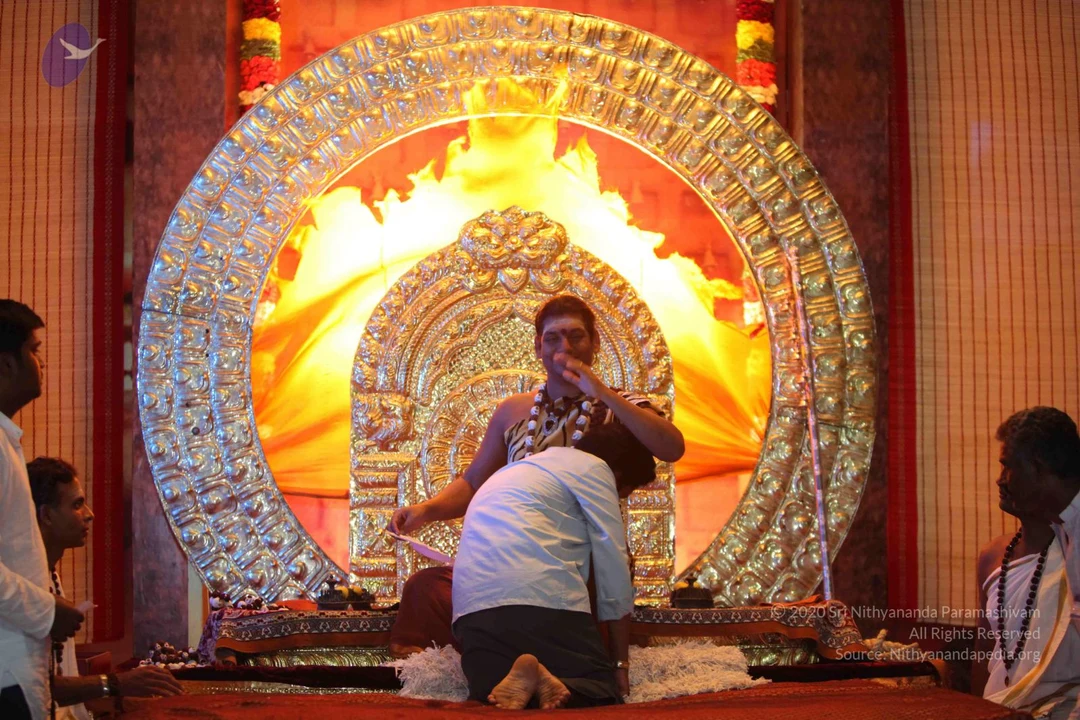
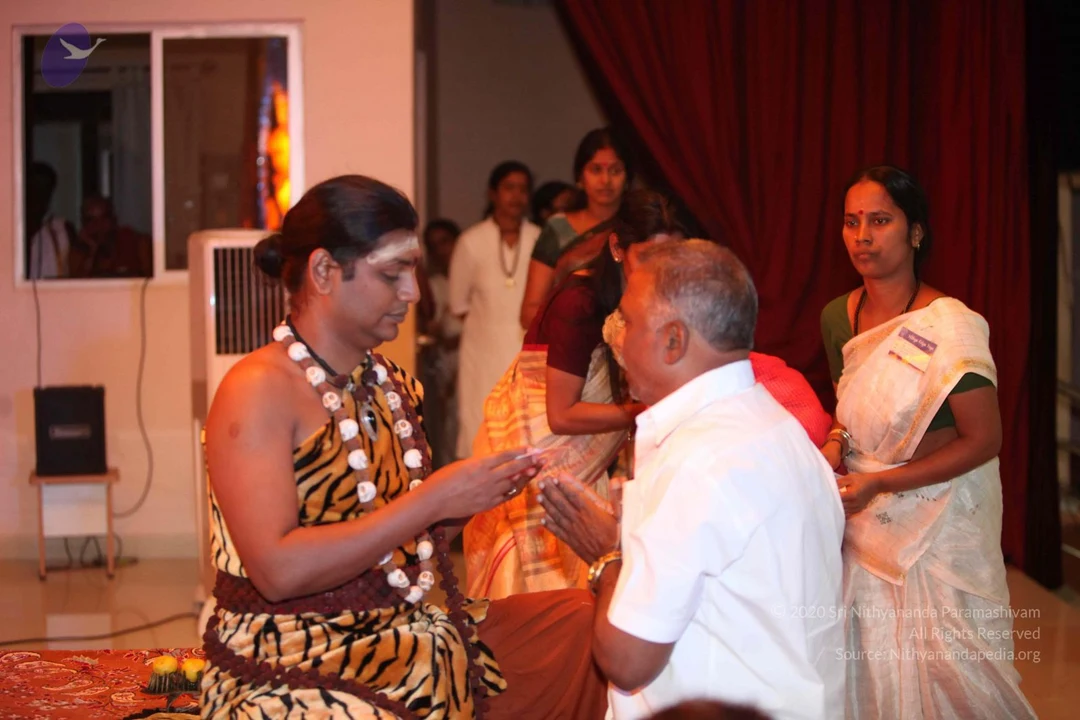
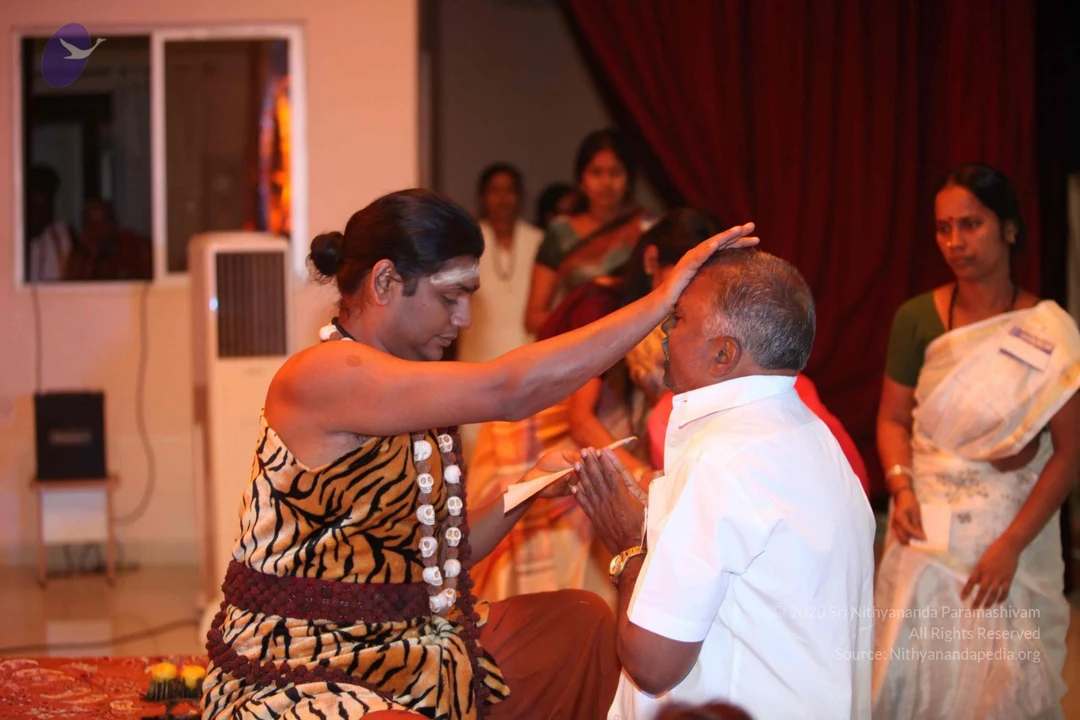
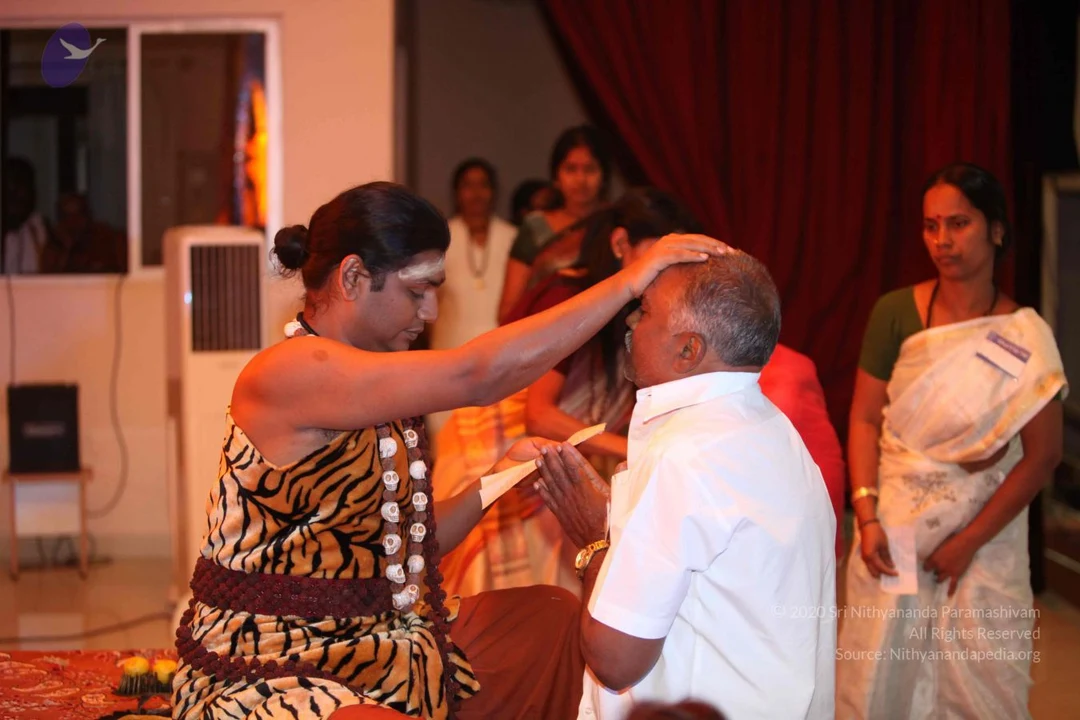
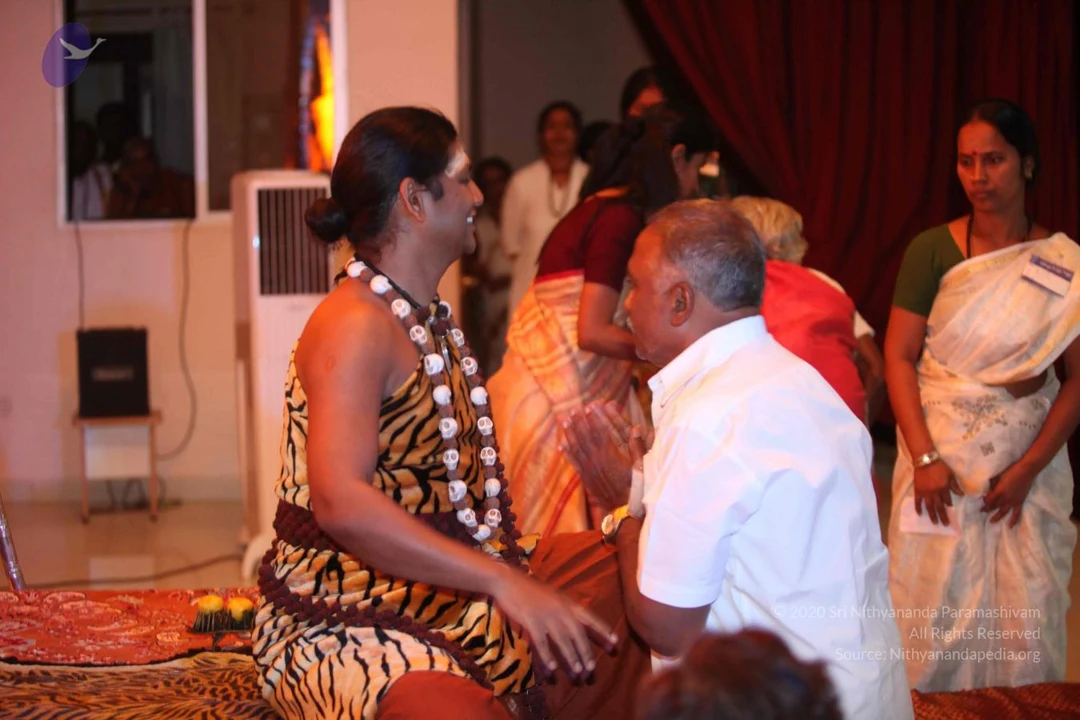
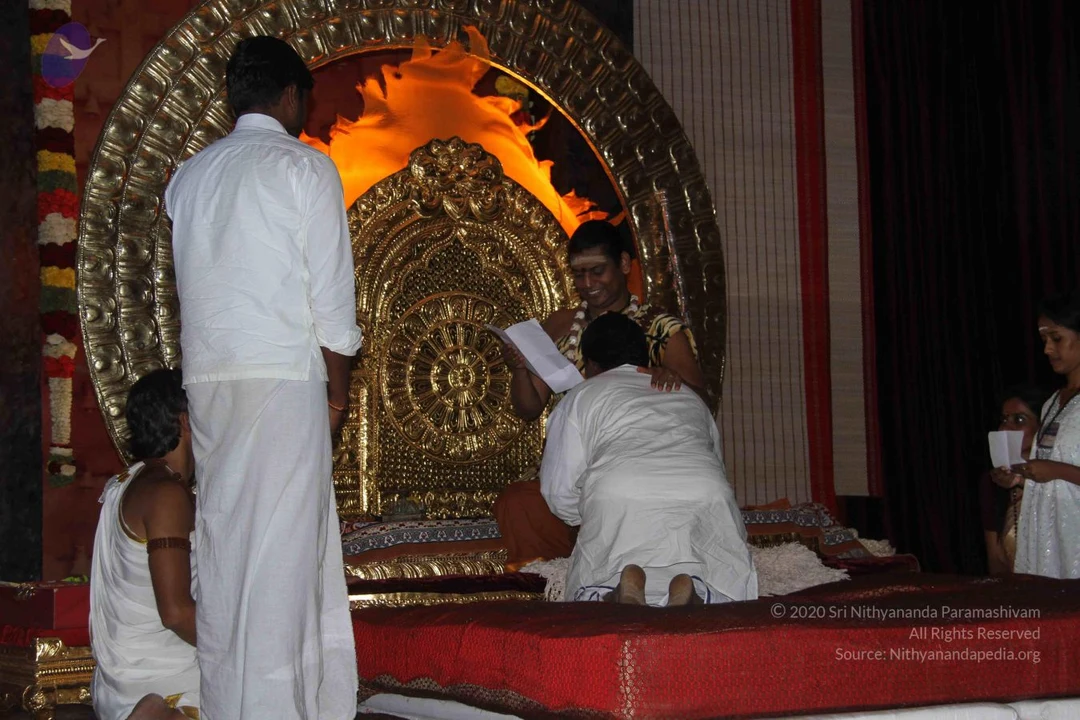
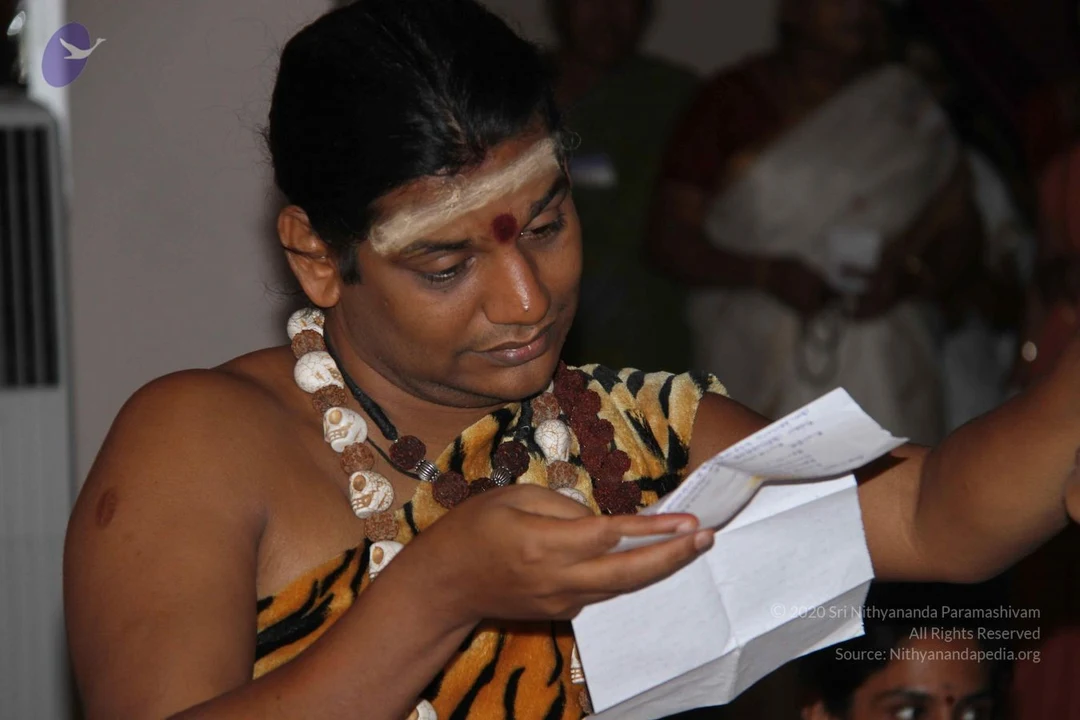
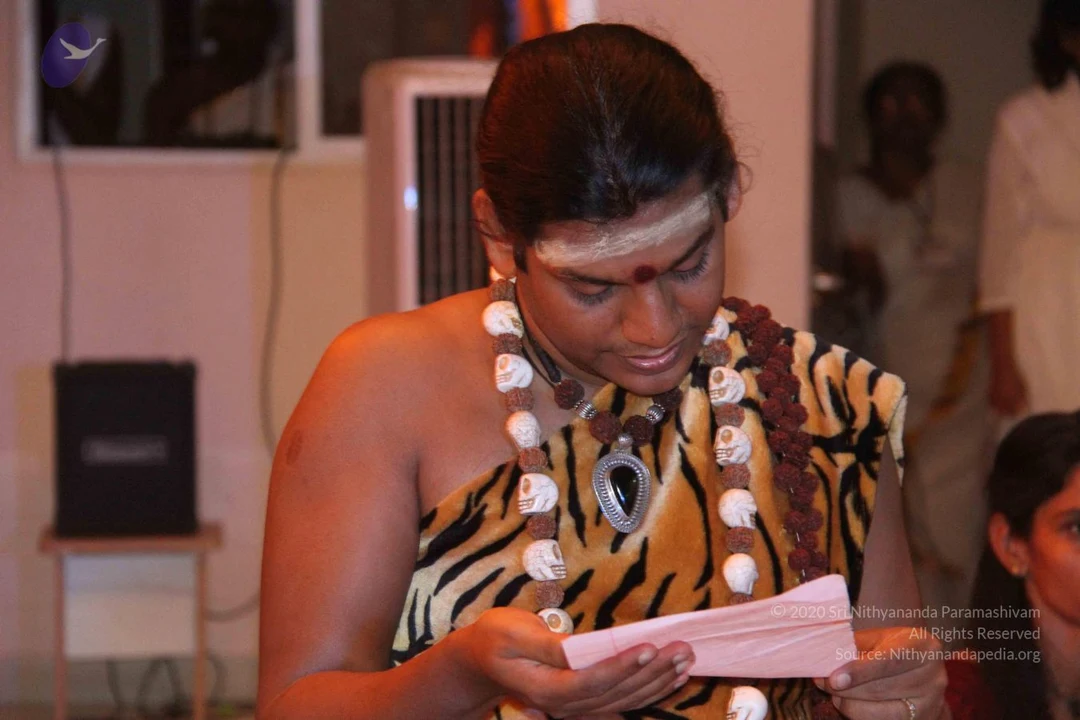
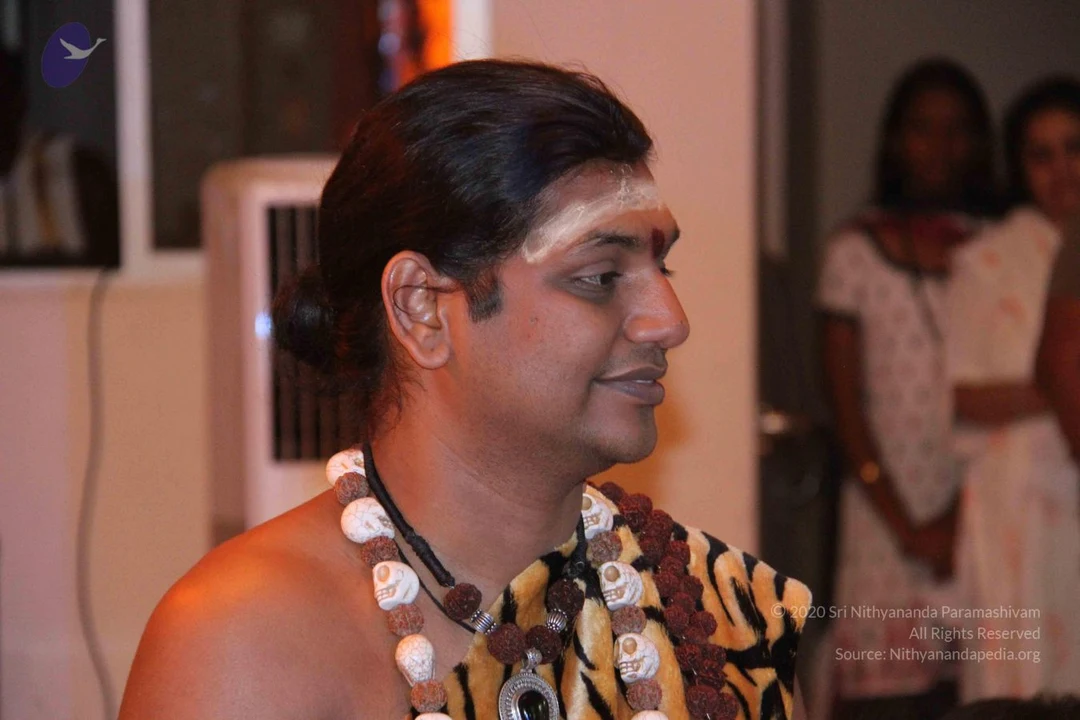
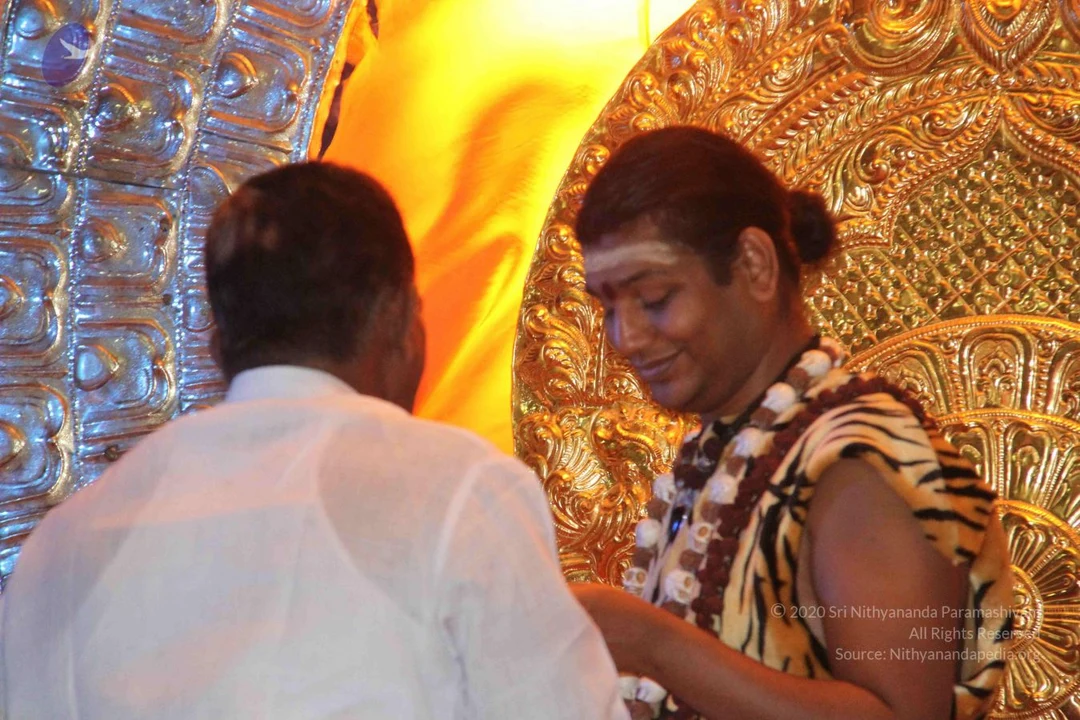
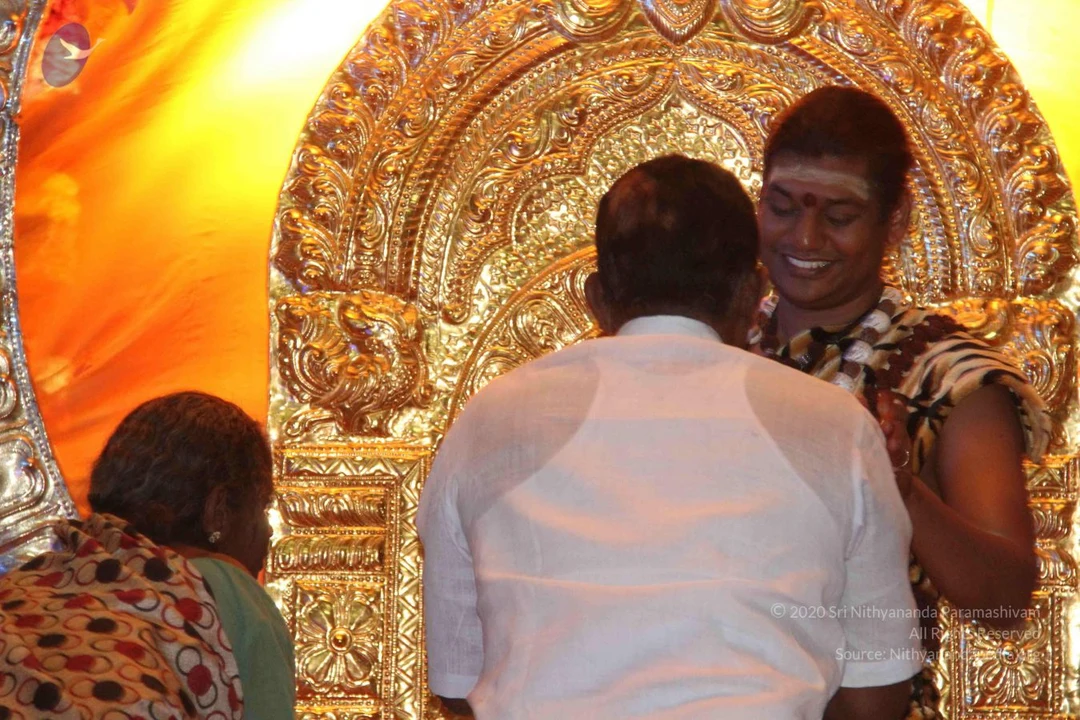
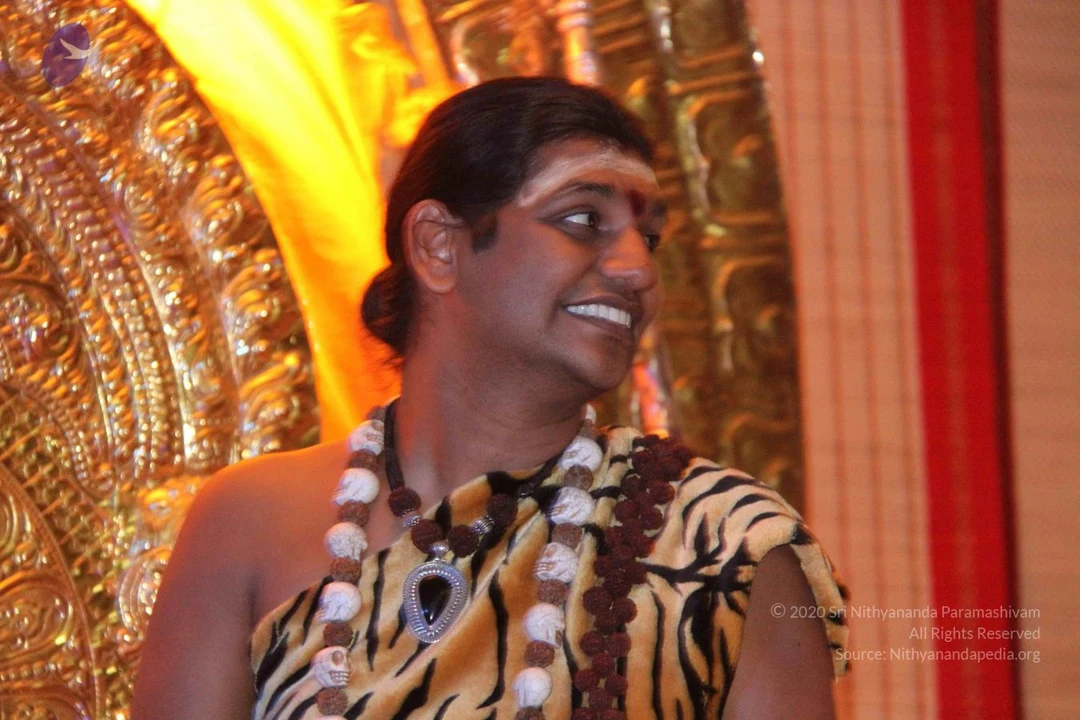
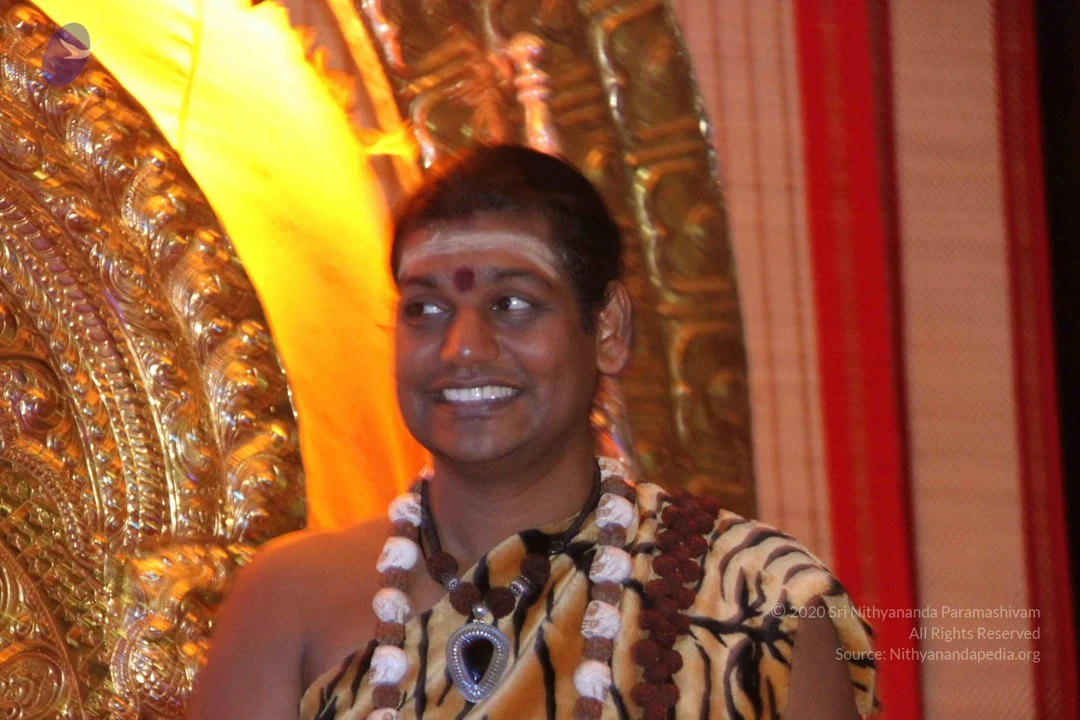
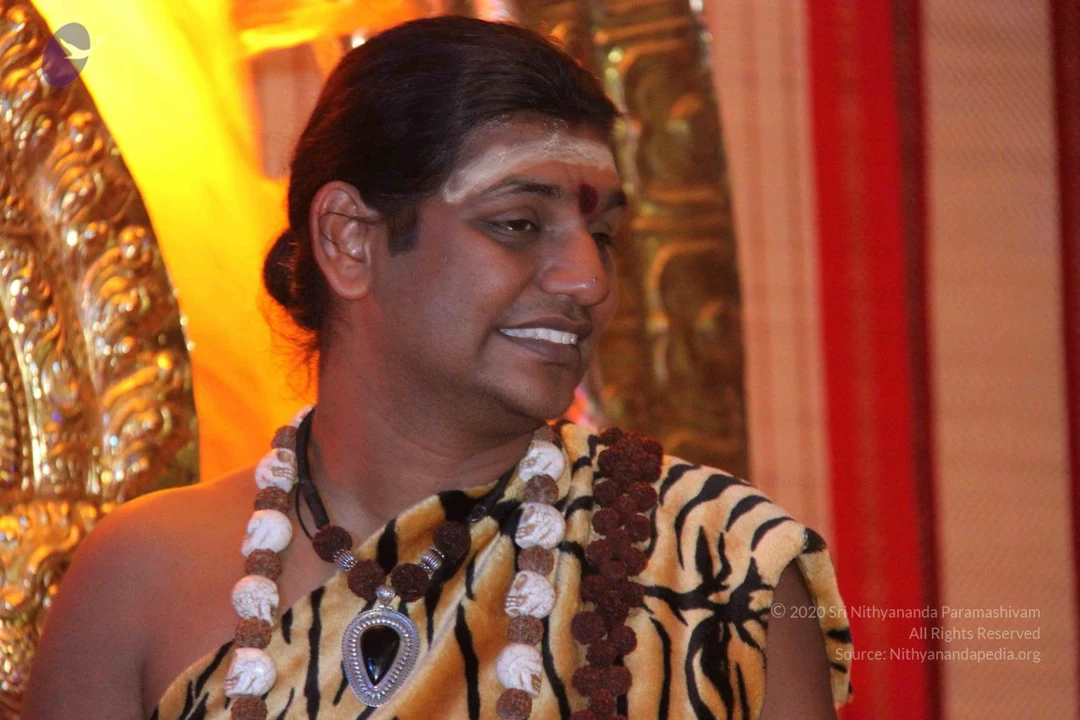
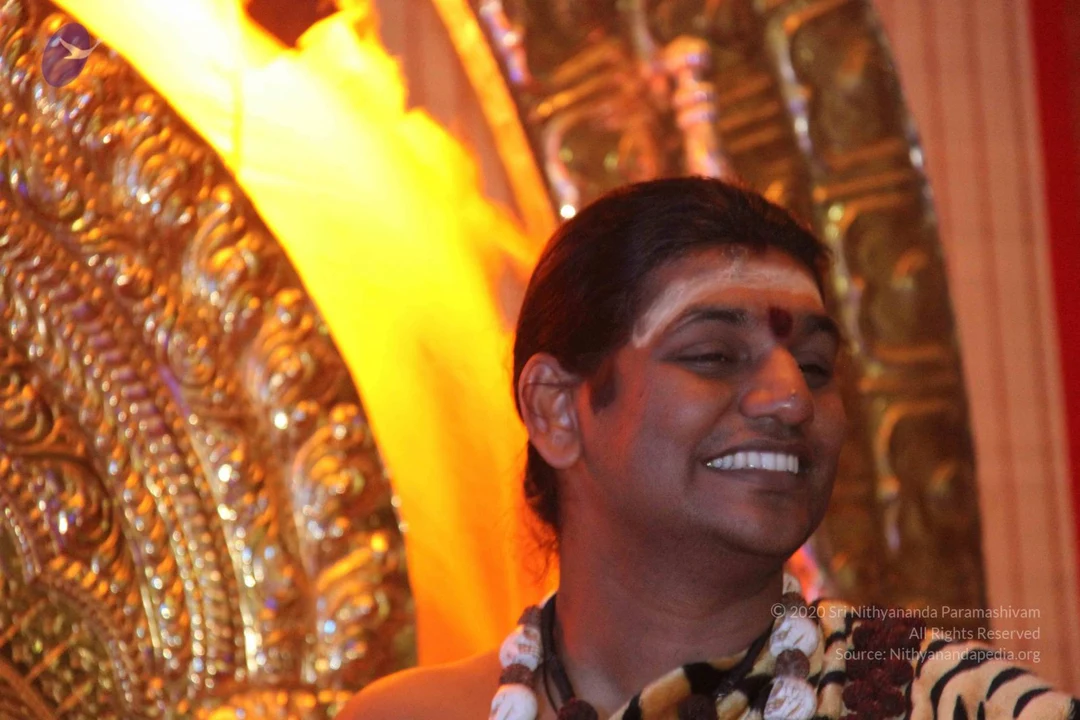
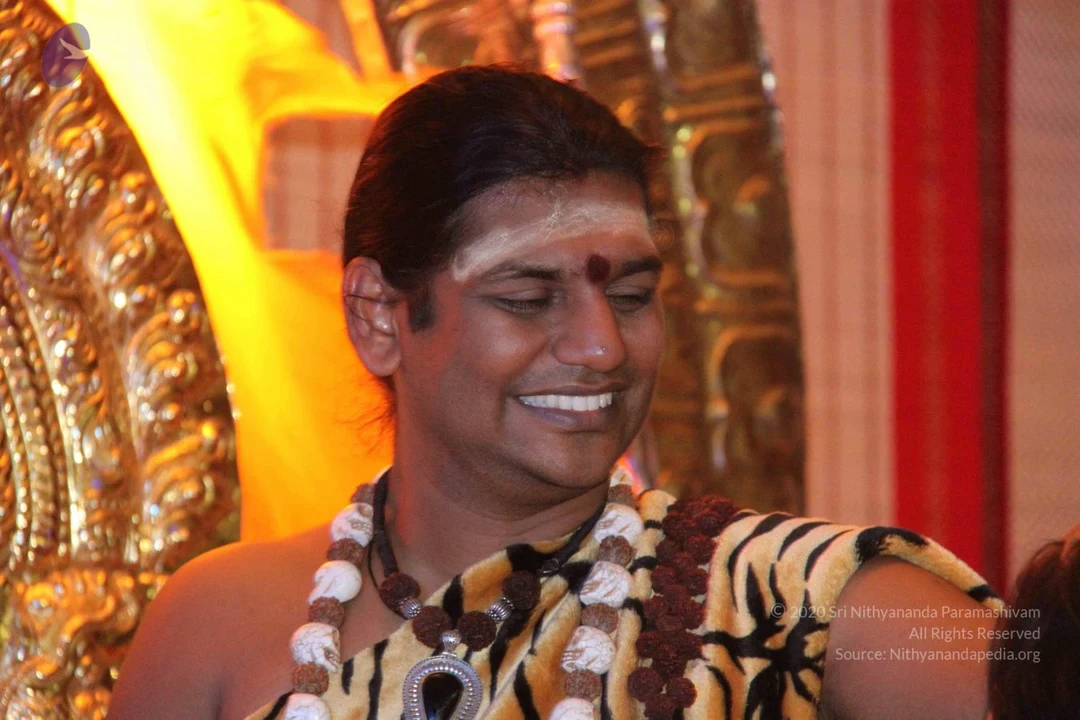
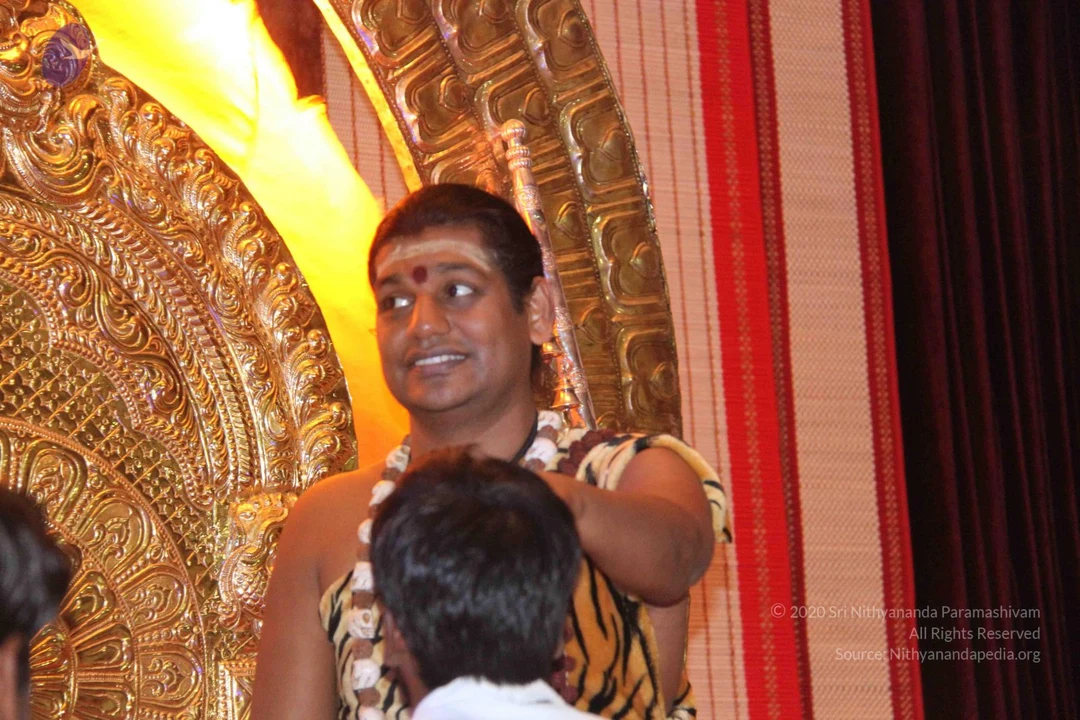
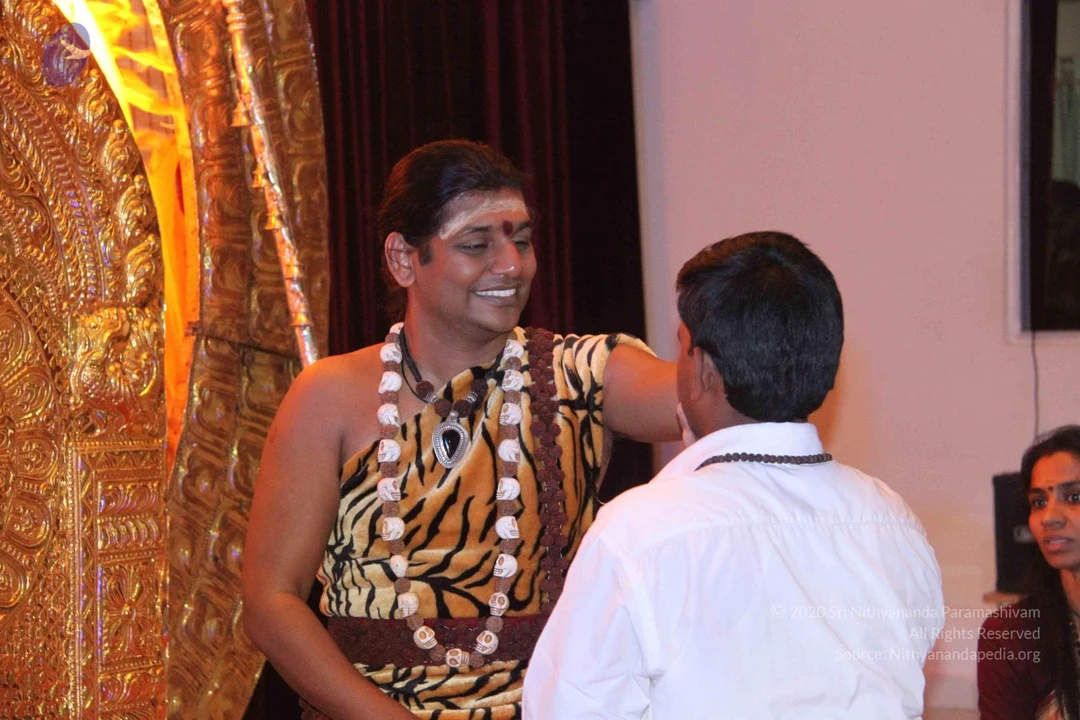
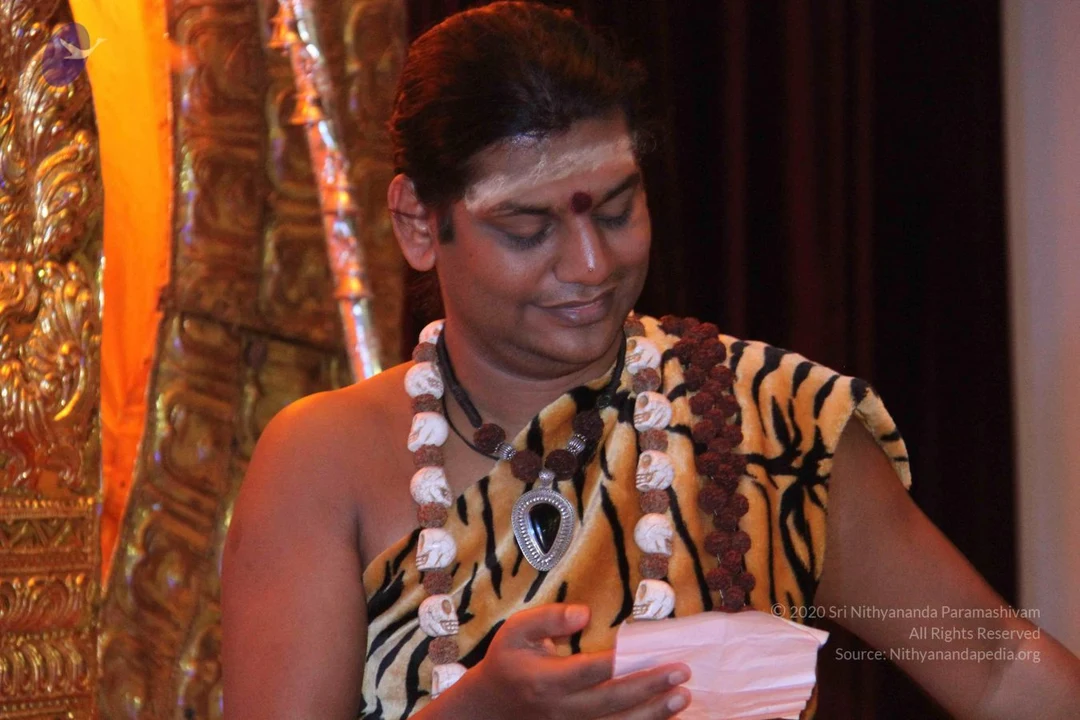
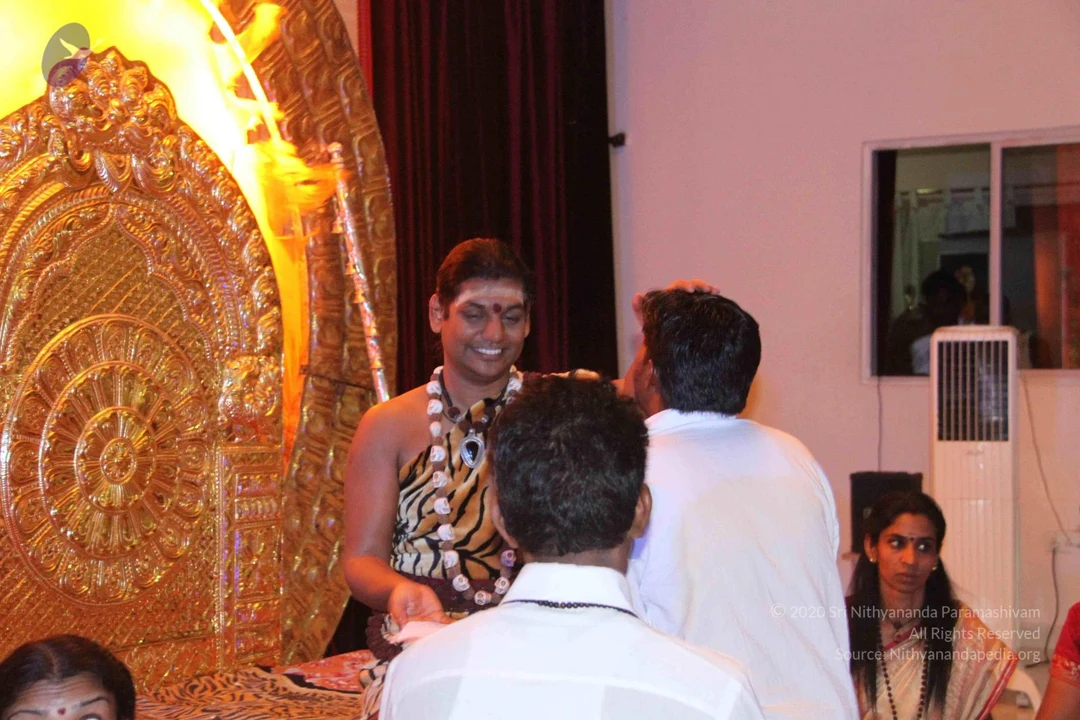
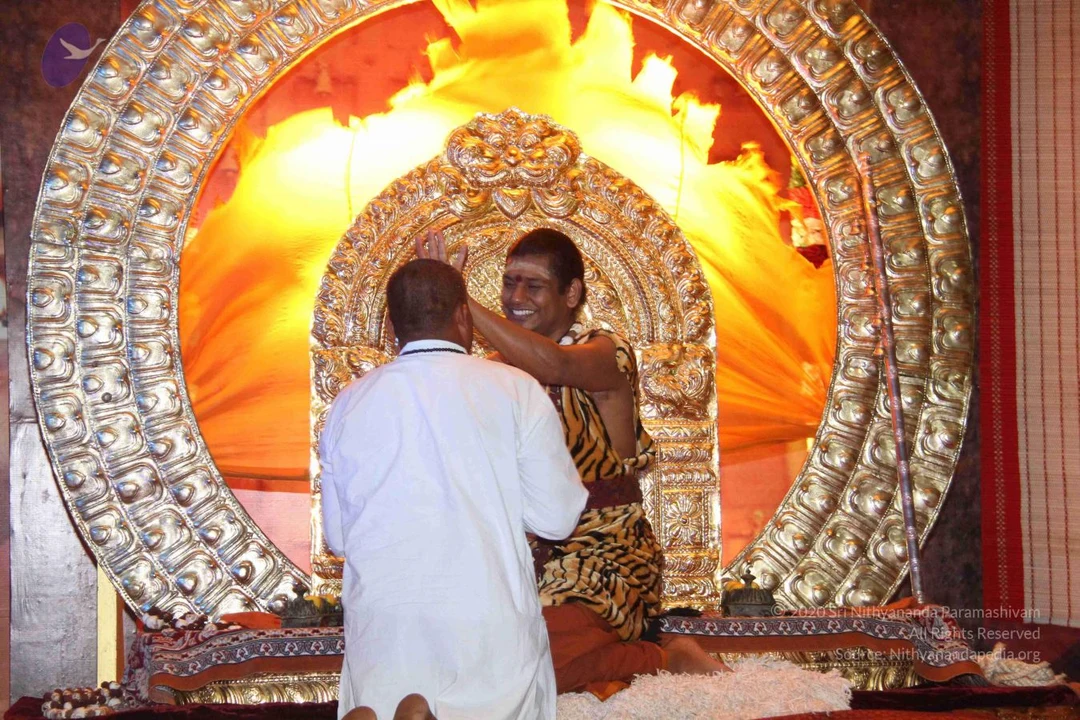
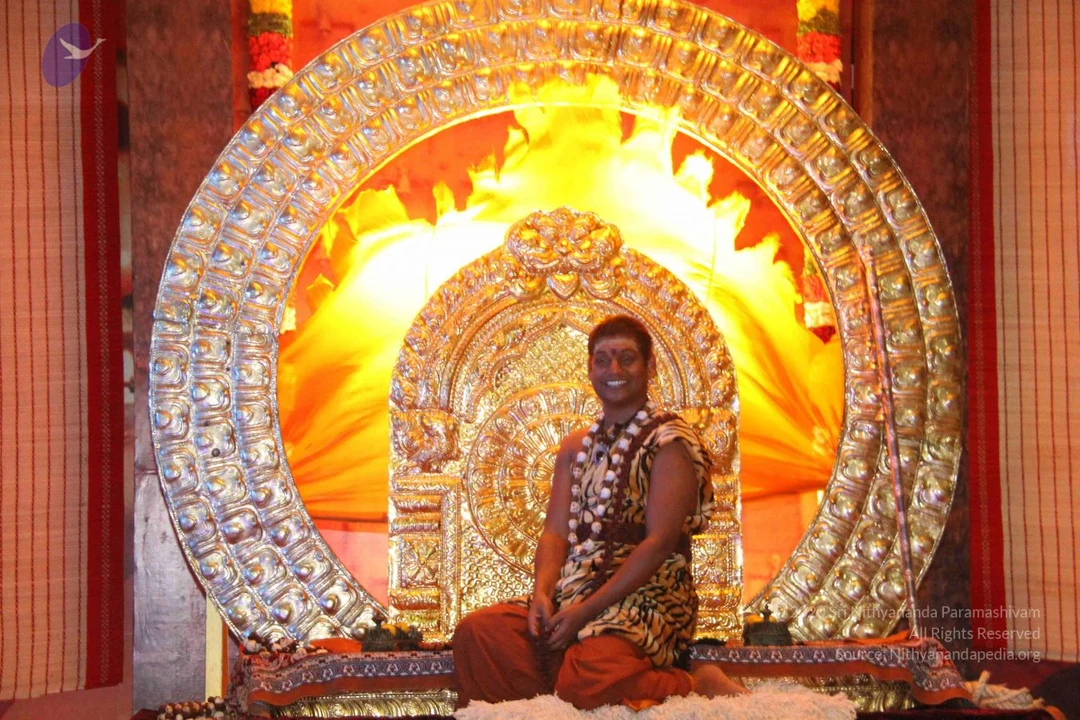
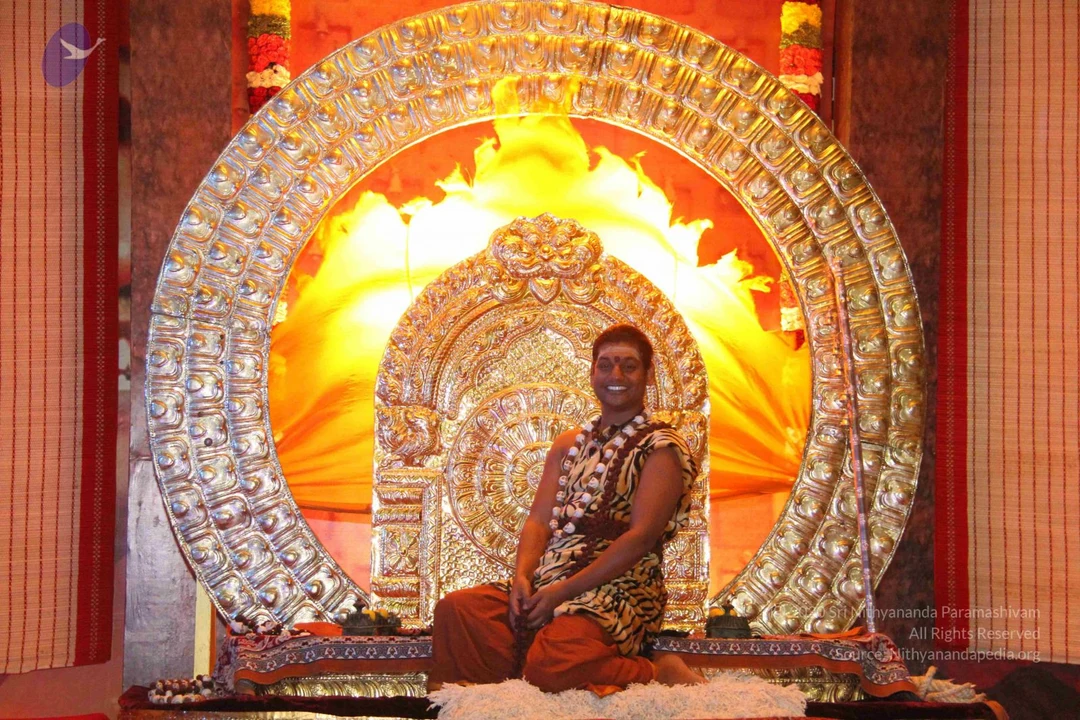
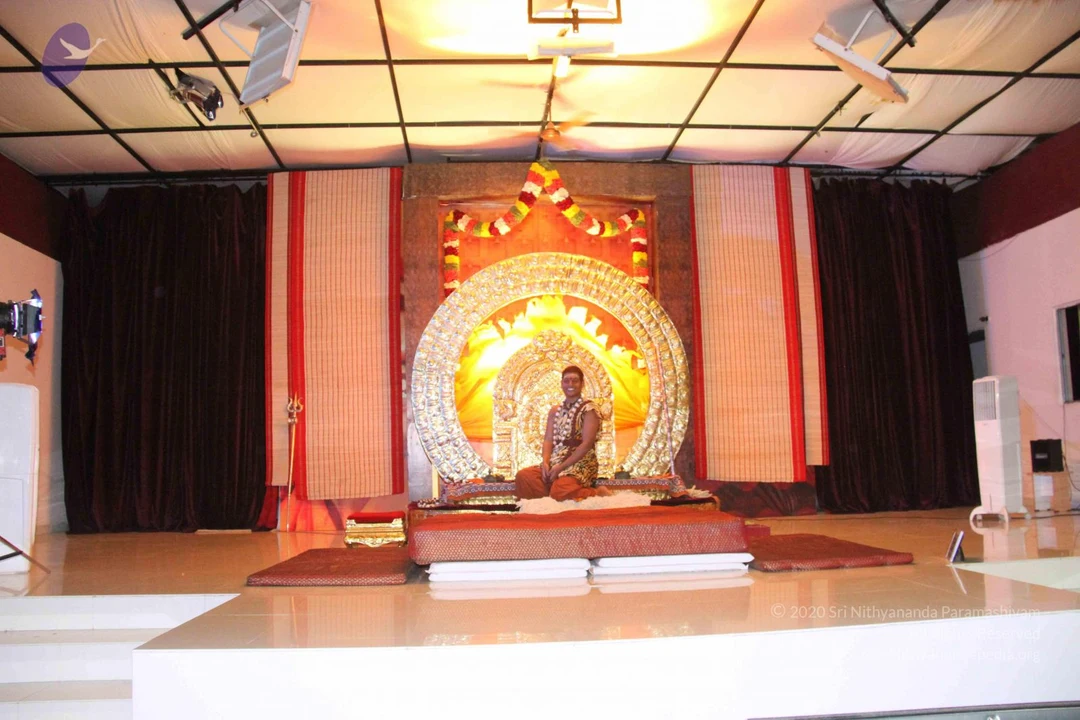
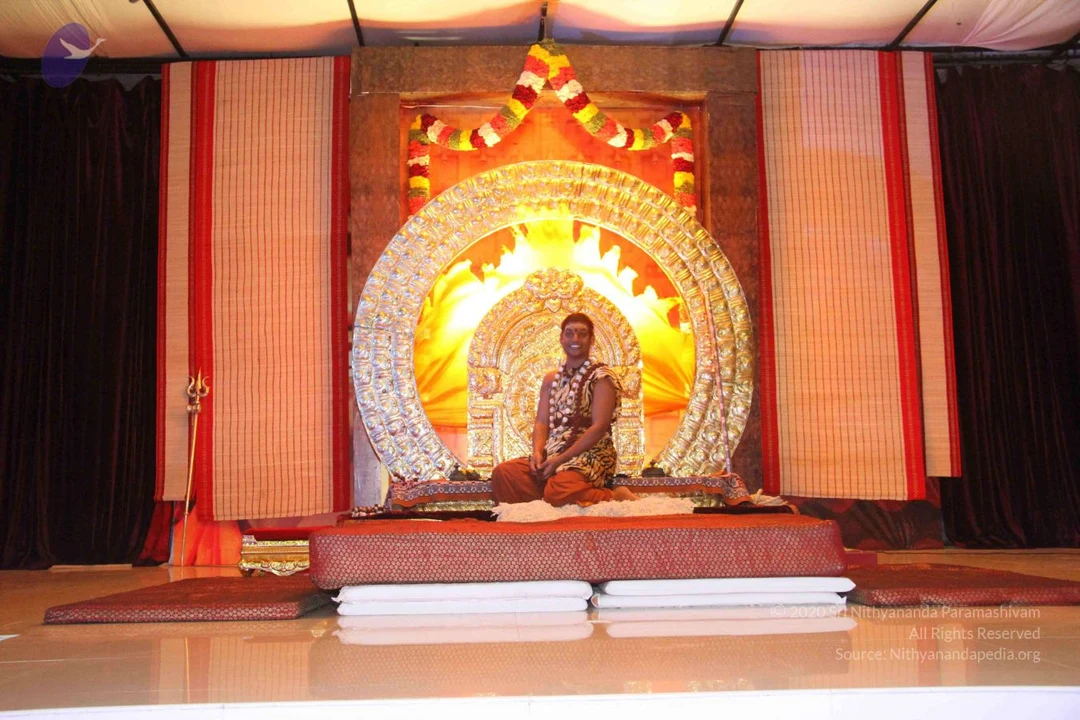
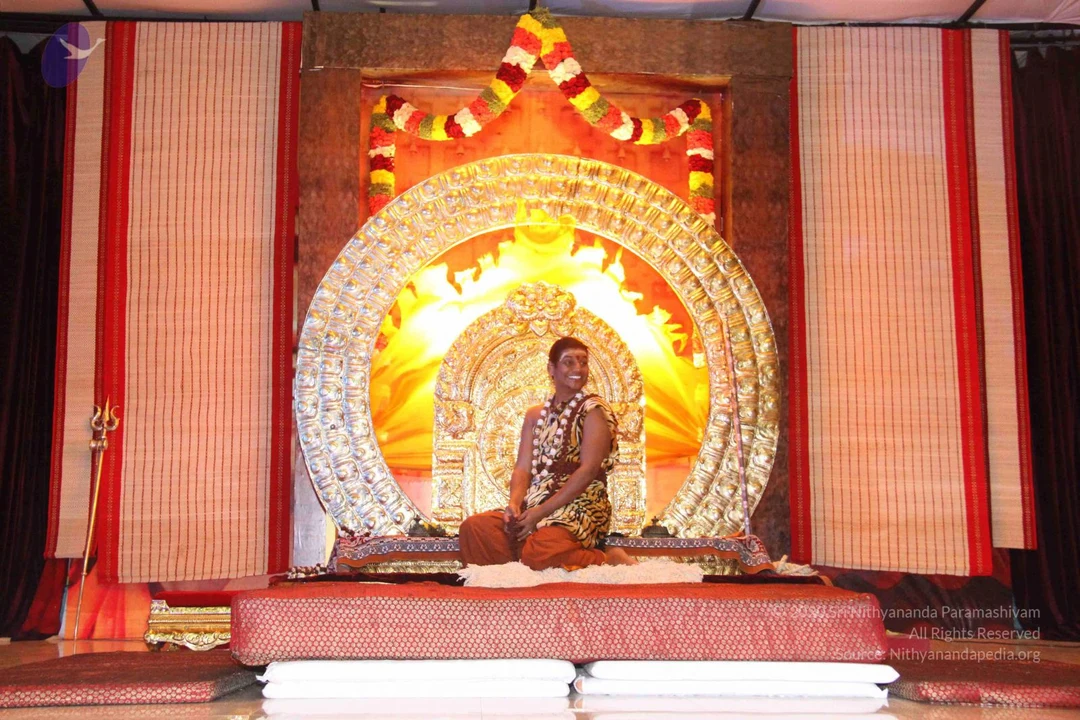
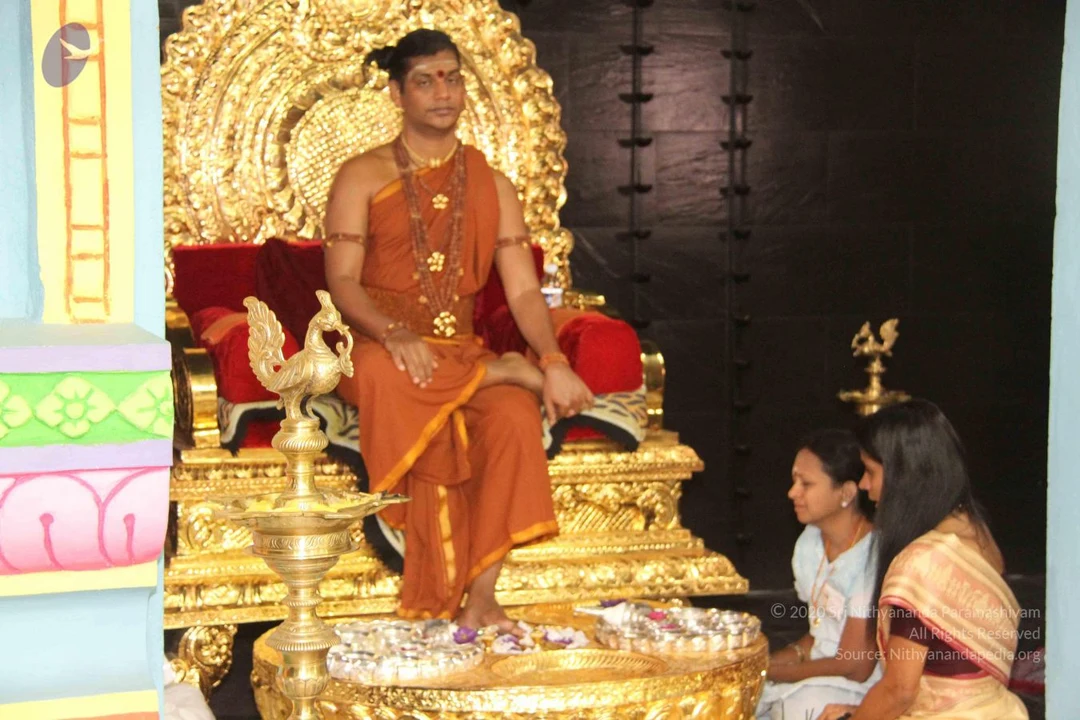
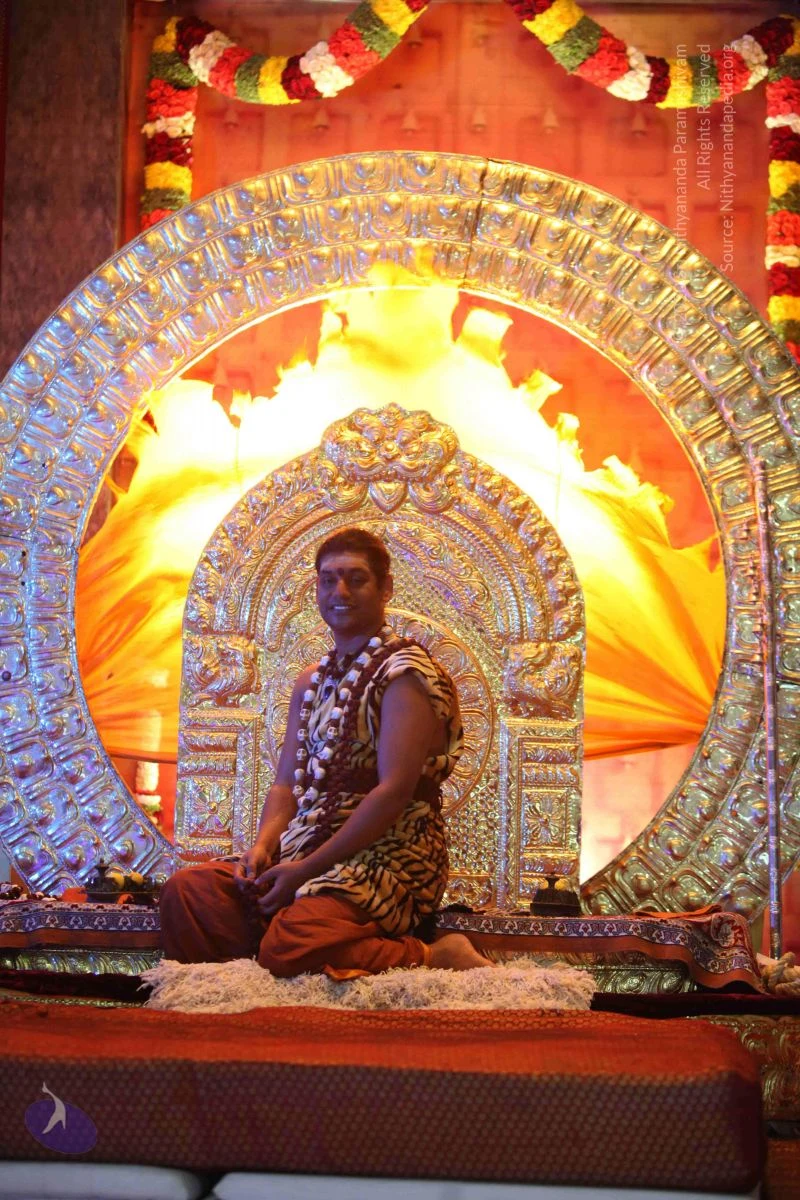
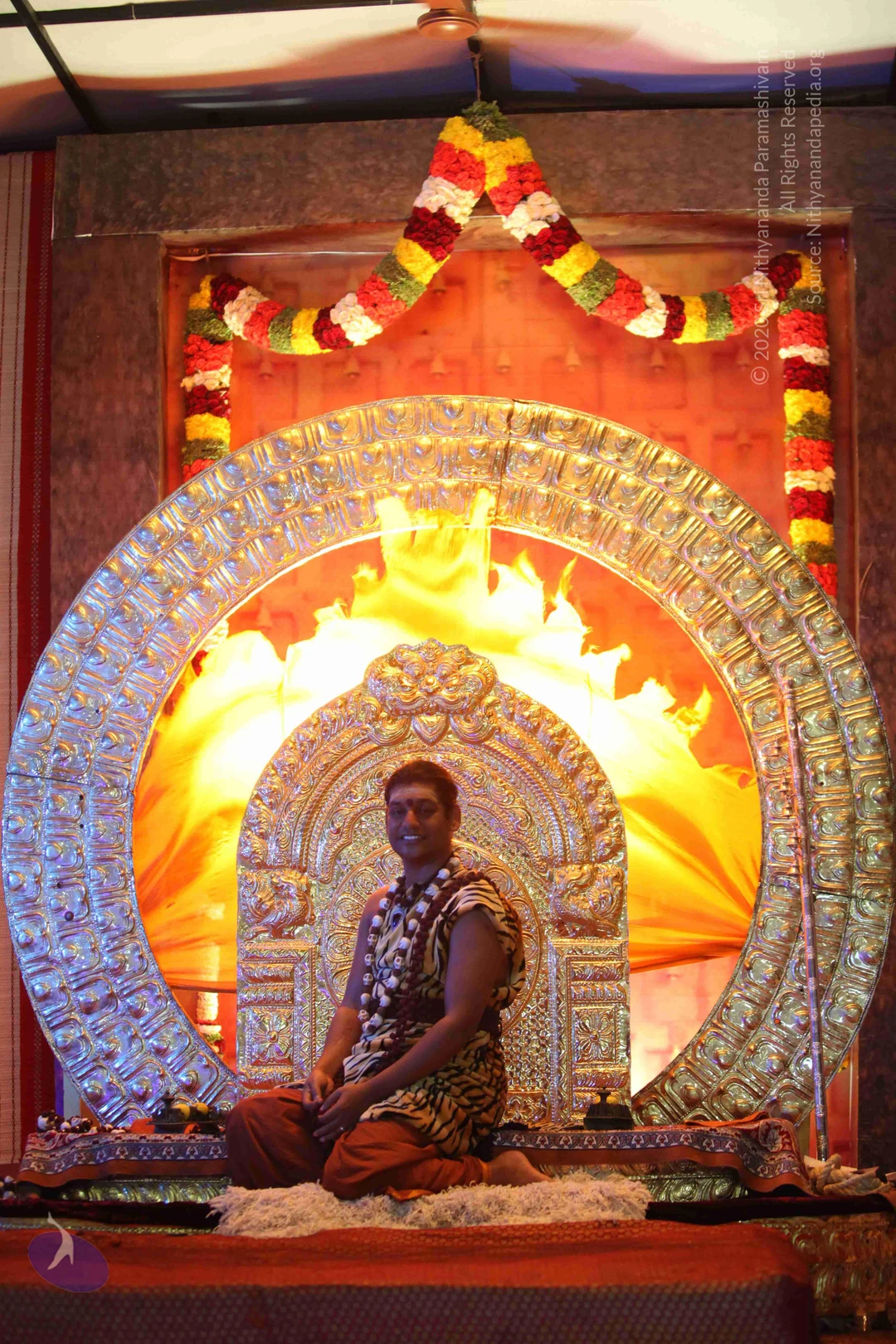
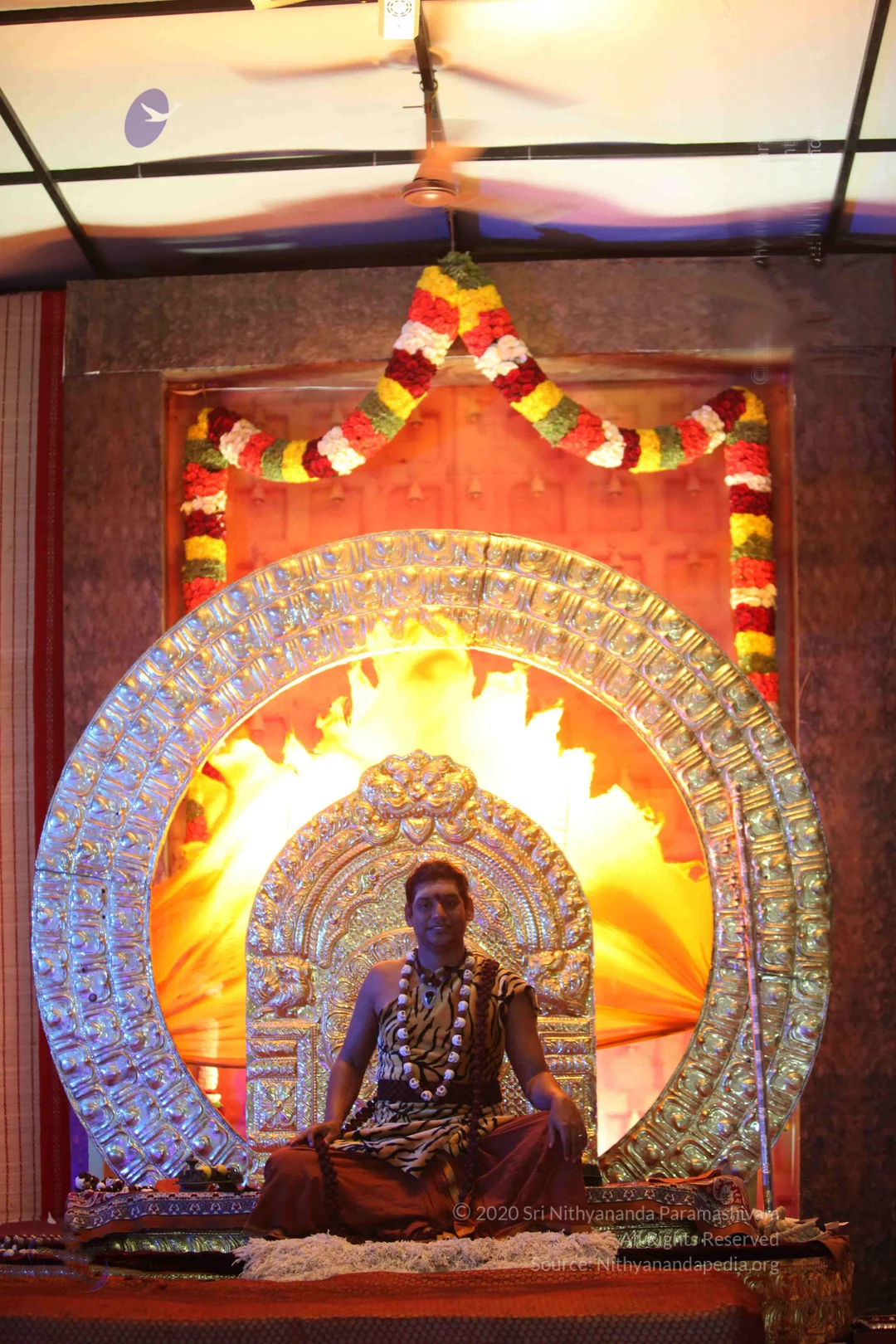
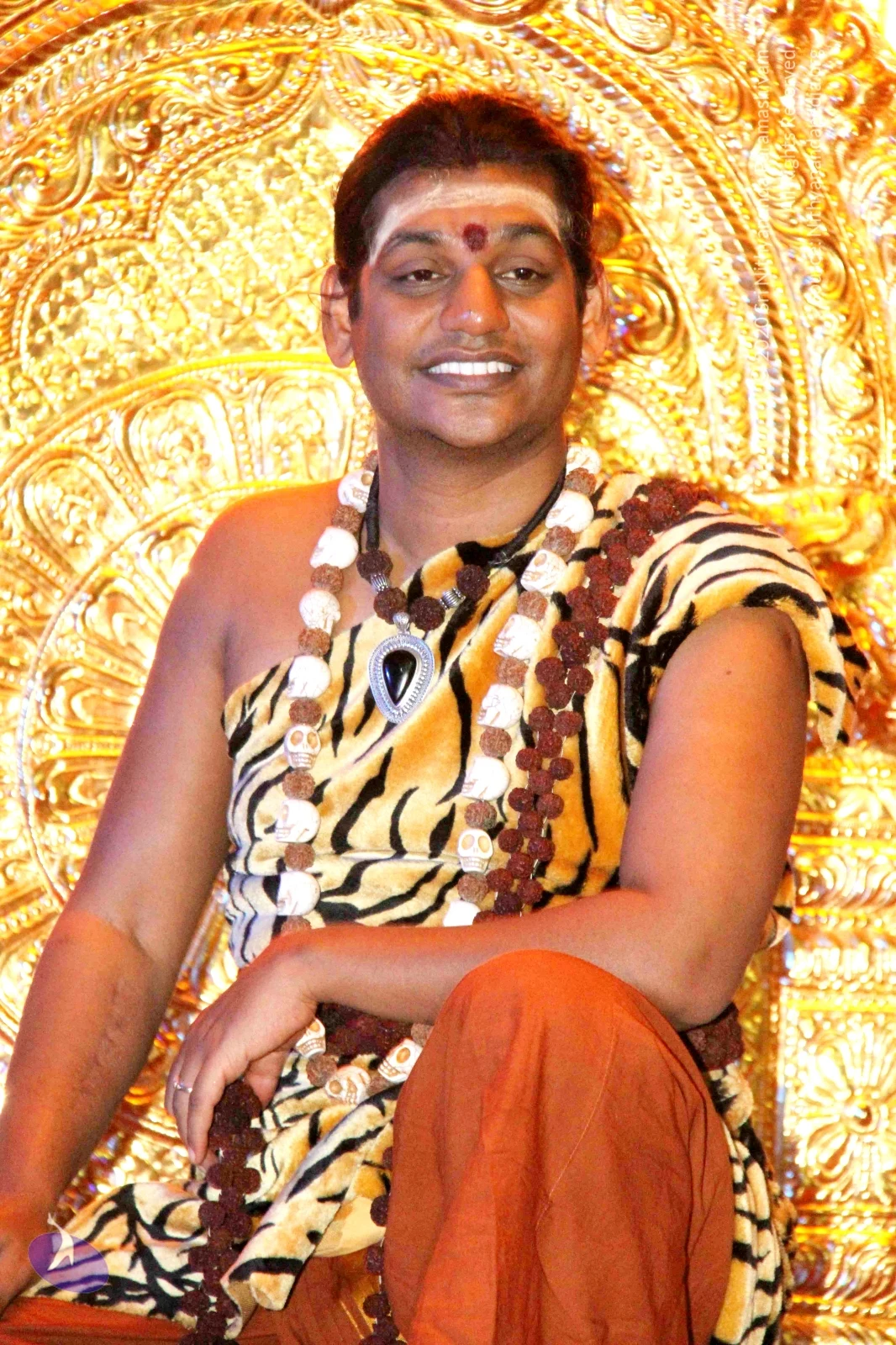
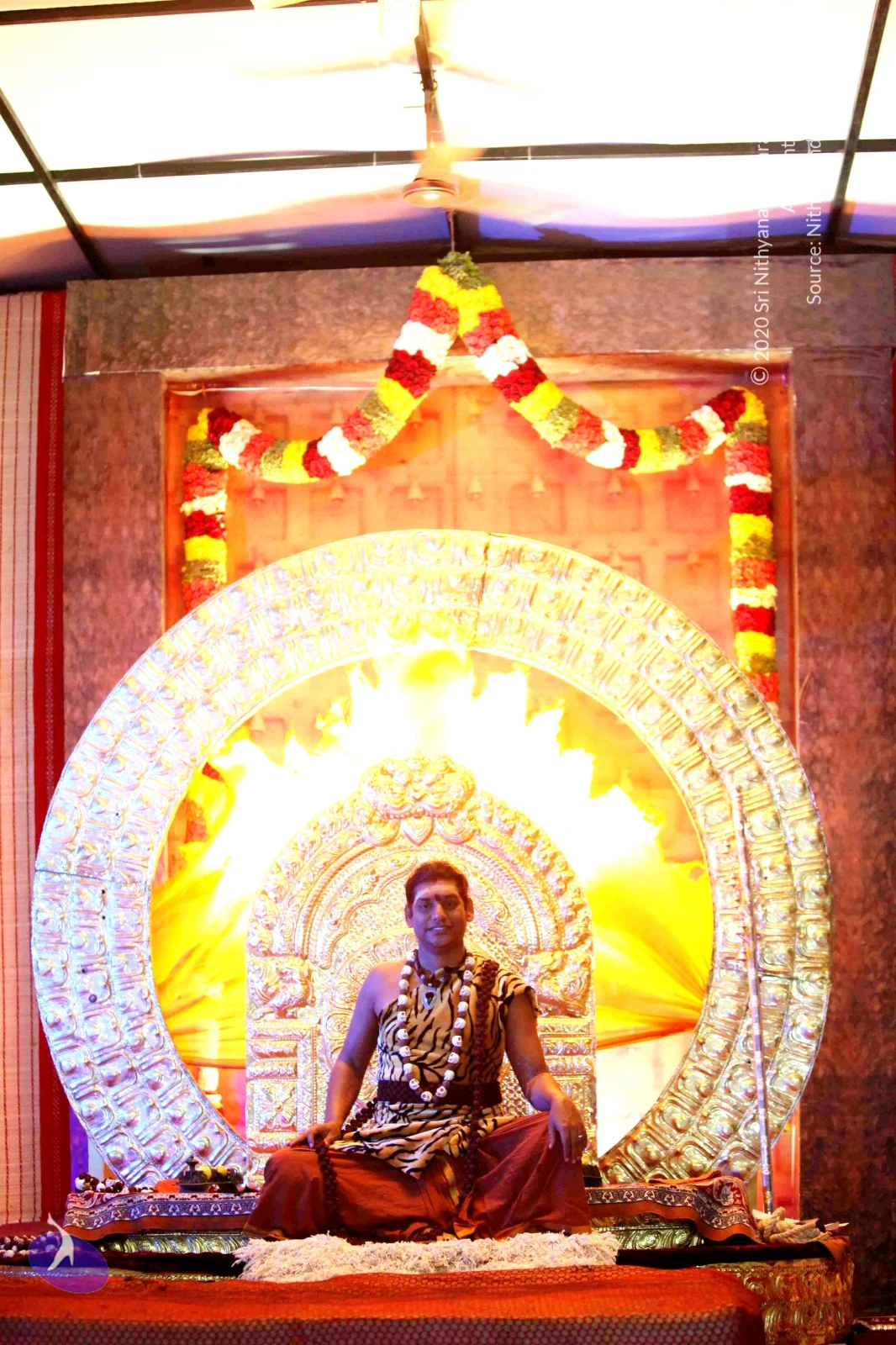
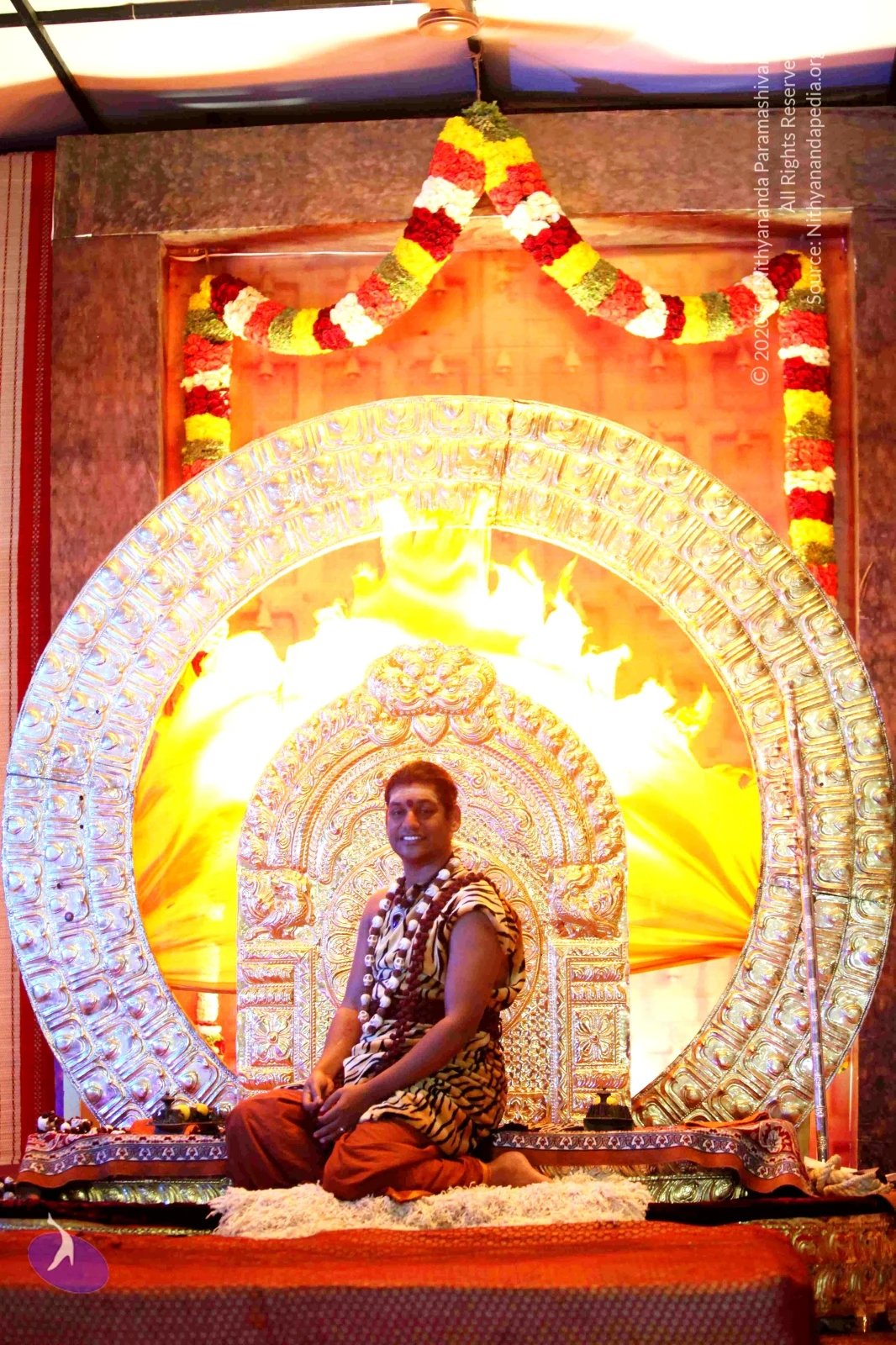
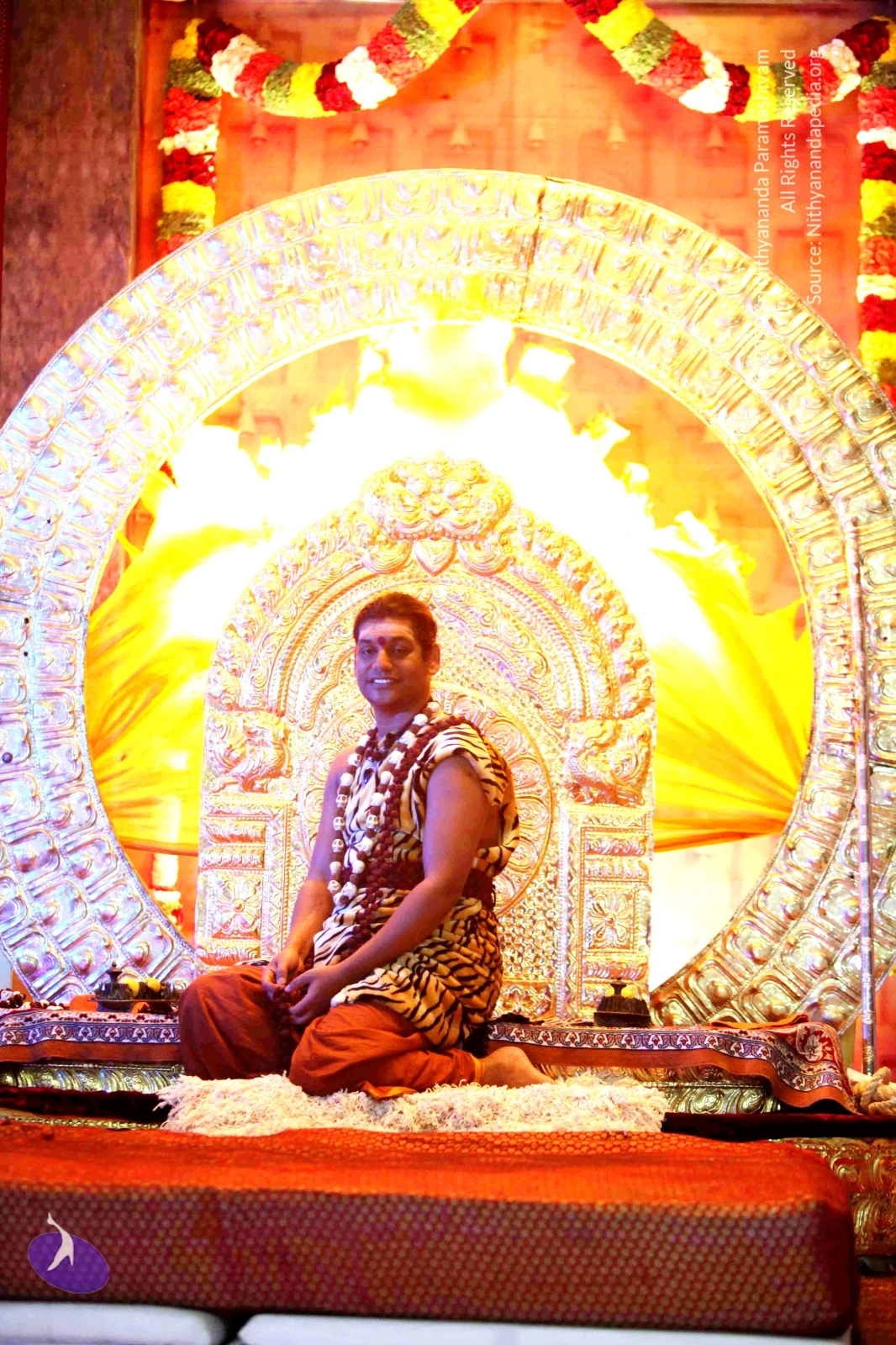
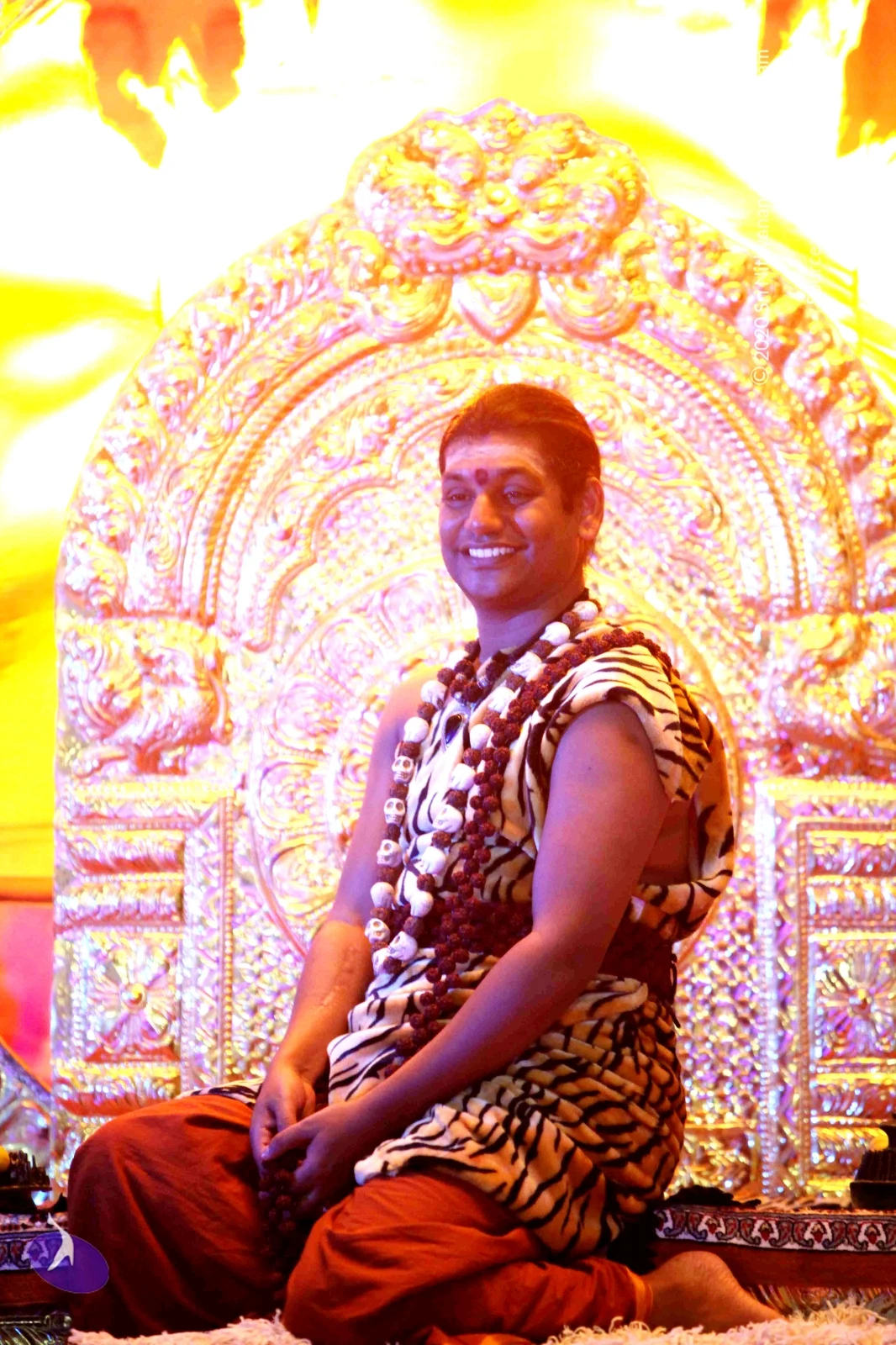
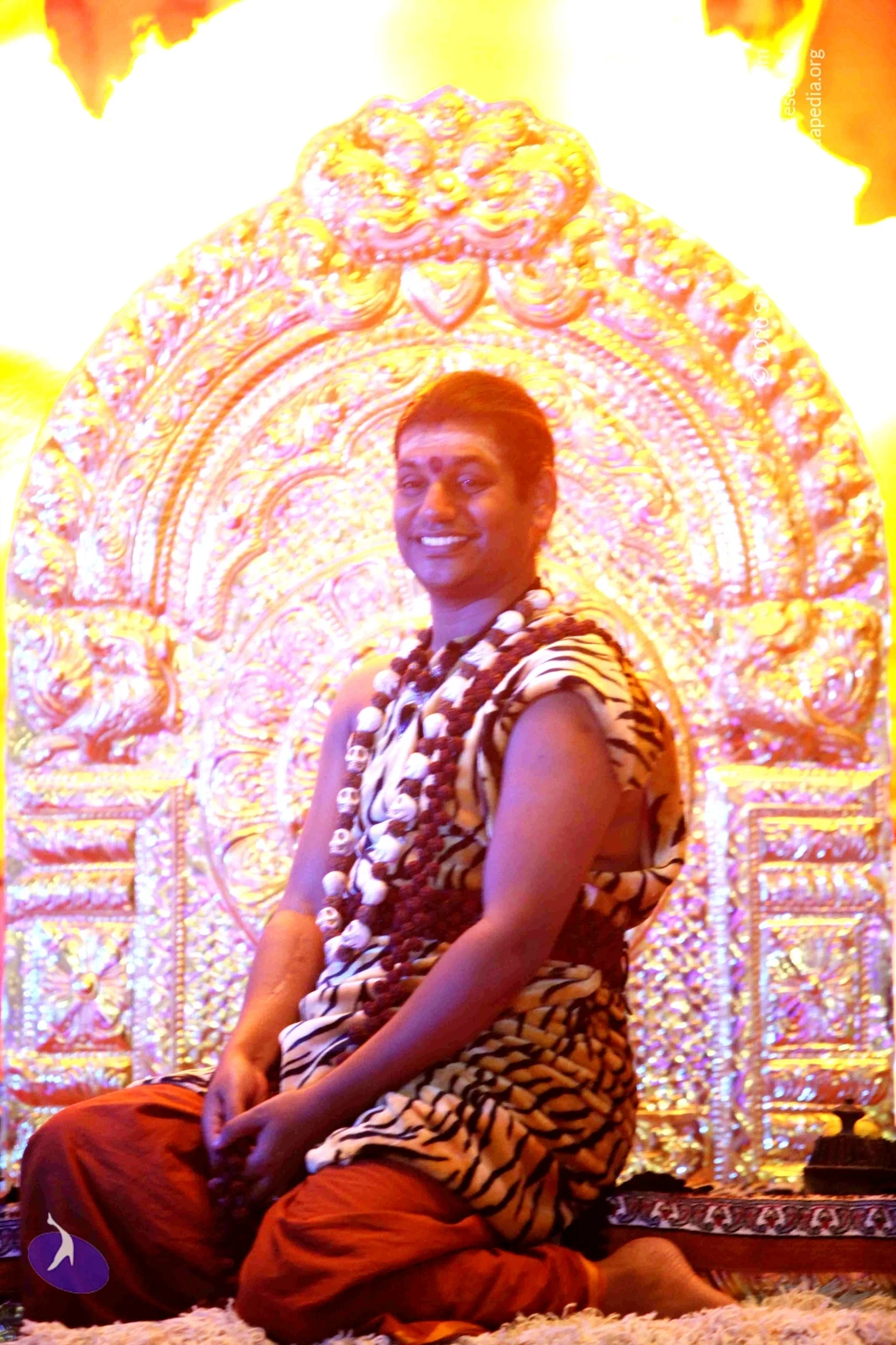
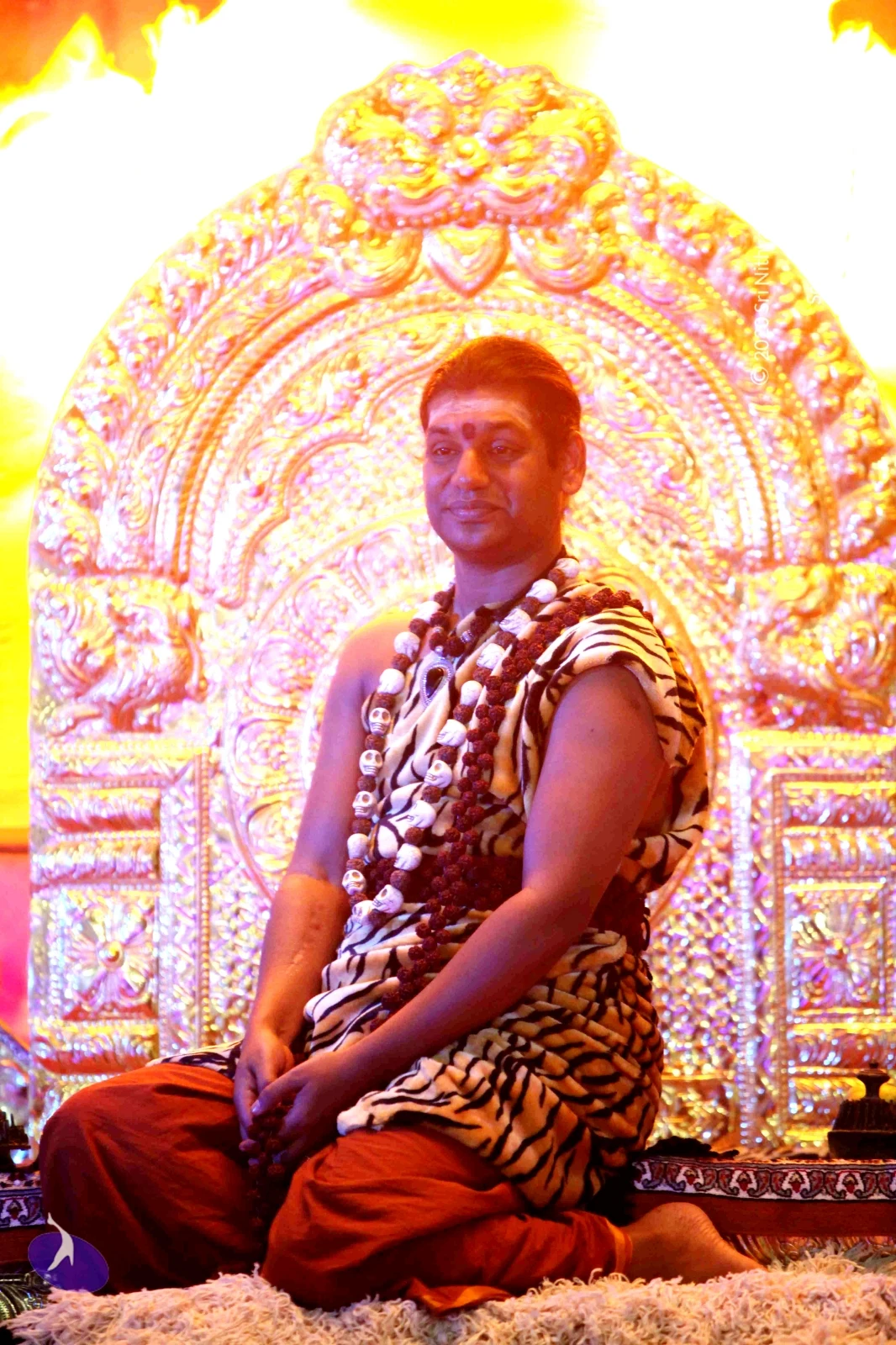
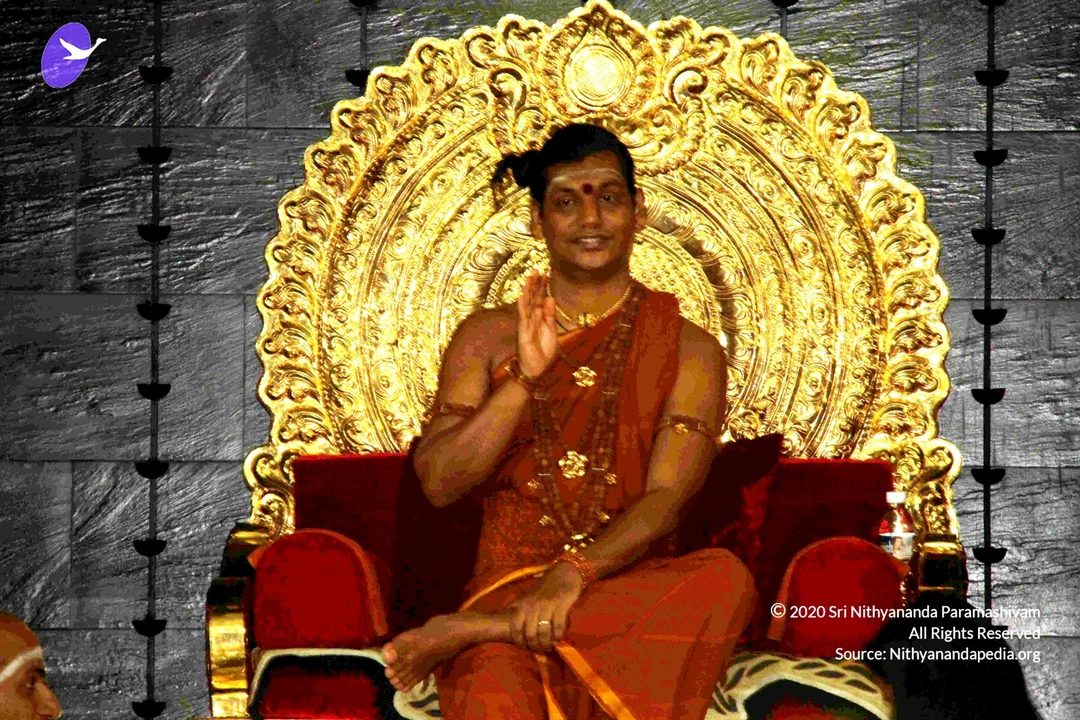
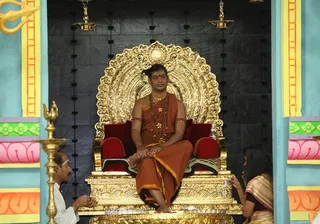
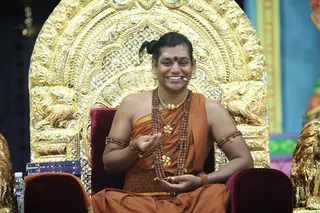
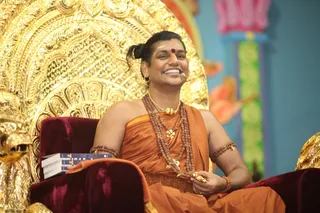
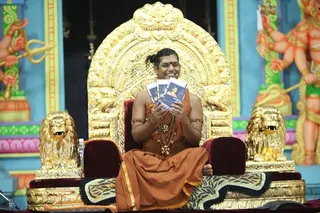
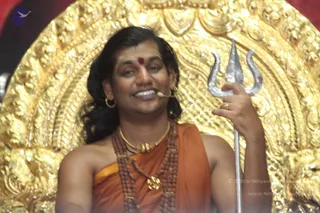
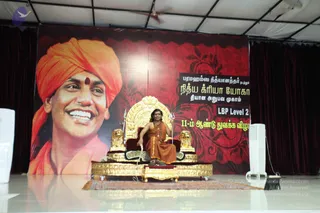
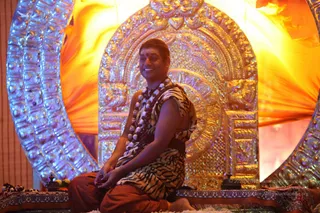
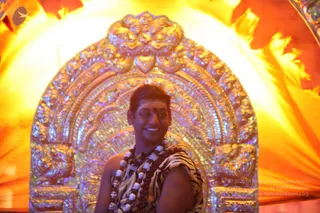
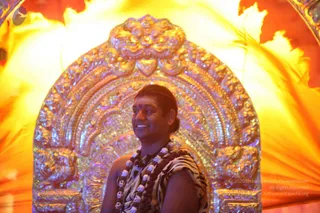
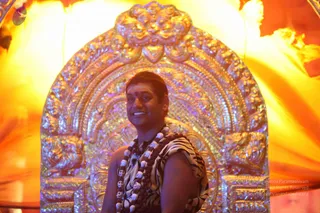
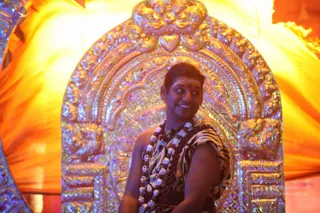
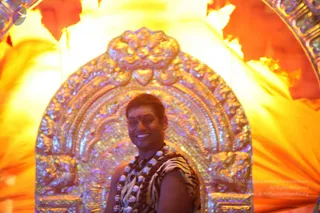
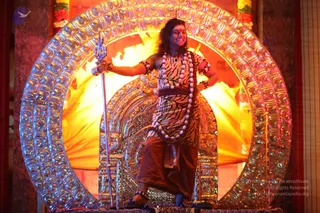
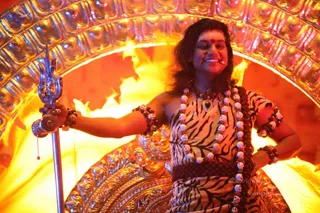
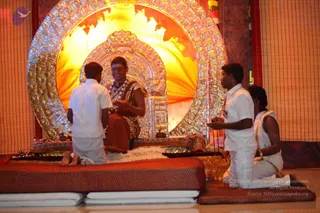
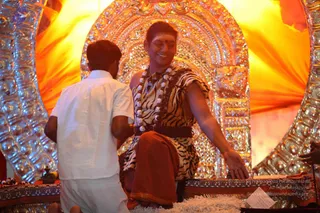
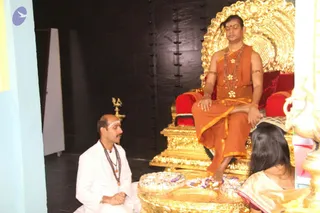
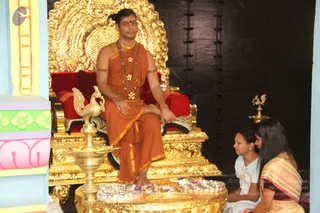
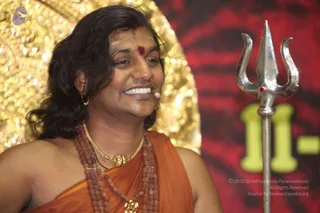
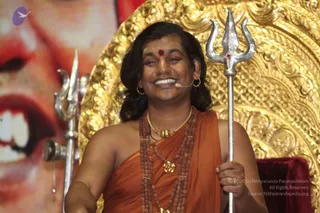
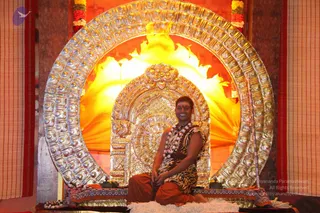
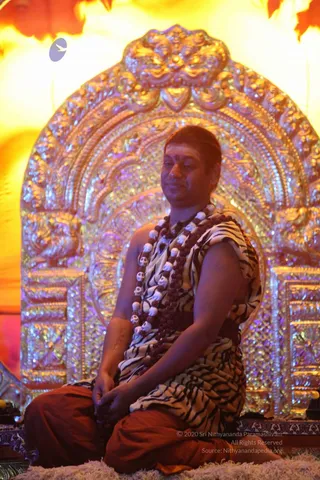
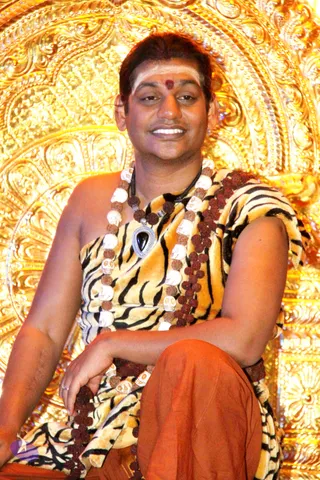
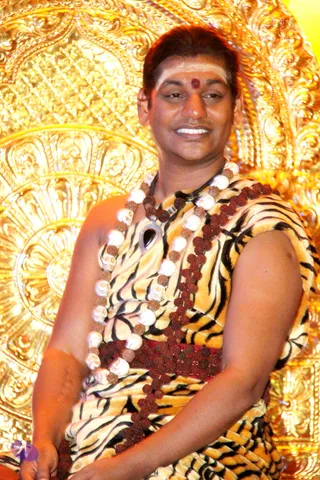
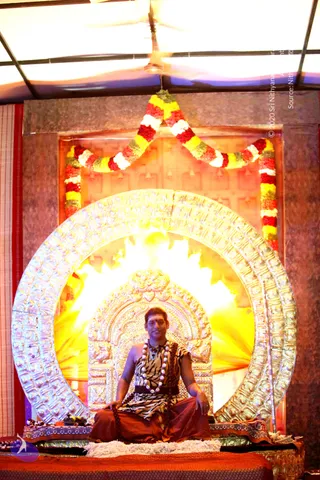
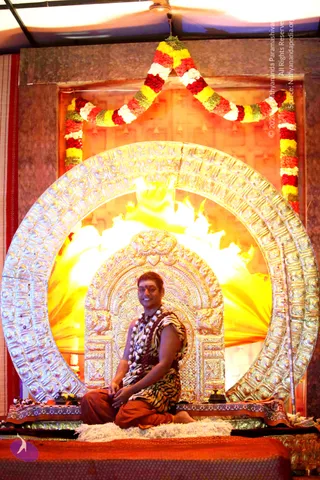
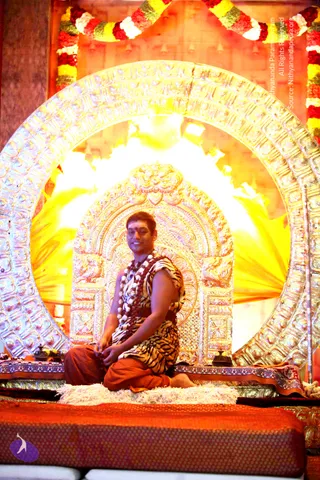
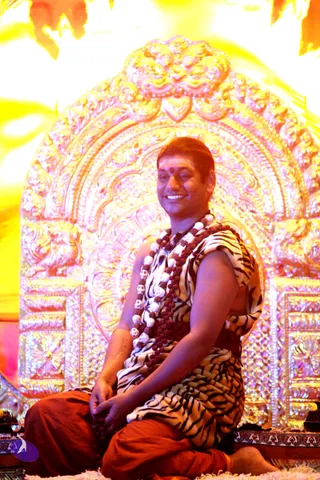
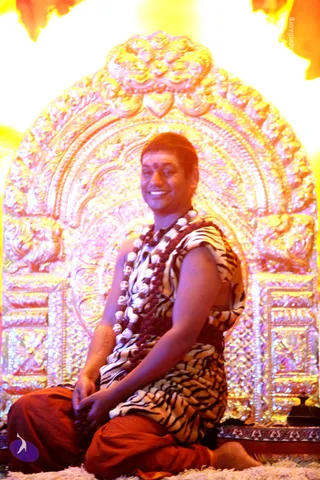
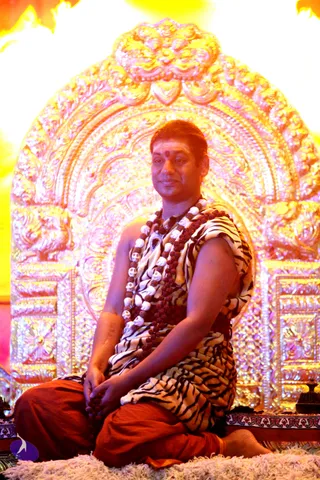
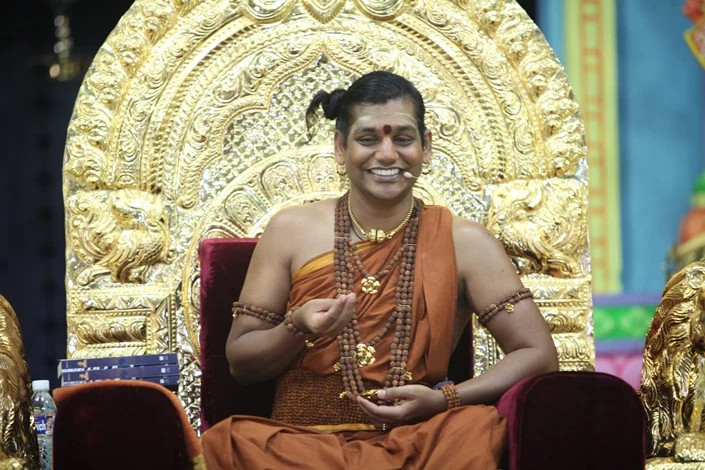
A seated figure on an ornate gold throne with red cushioned armrests is dressed in saffron-orange robes and a saffron shawl, wearing layered beaded necklaces, a rudraksha mala and a red bindi, with gold bangles on the arms. A man in white ritual clothes kneels on the dark floor at left, palms pressed together in namaste, with a white tilak on his forehead and a mala around his neck. Nearby stand a brass oil lamp and silver trays holding flowers and offerings. A woman in the lower right corner is partly visible. The wall behind is dark and studded, with a turquoise panel at left. a person: the seated figure wears saffron robes, a rudraksha mala and gold necklaces on a throne, and is.A smiling man sits before an ornate silver-gilt arched throne backdrop with floral and scrollwork relief, lit by warm orange light behind. He is bare-shouldered, wrapped in a cream and dark-striped cloth, wears layered white and rudraksha malas and a pendant, and has a tilak on his forehead. The strong adornment and throne setting suggest a person, but the visible cues are limited to the wrap, malas and throne, so identity is uncertain.A photograph of a temple-style shrine set against a backdrop of glowing orange-yellow light, with a large ornate silver arch framing a golden-lit fire-like glow. A floral garland of red, yellow, white and green marigold-style flowers arches across the top of the shrine. In the lower centre, a single man stands in front of the silver frame, wearing a white-and-brown wrap over his shoulder and a garland of white flowers around his neck, with a calm expression. The setting suggests a ritual or homa-style fire arrangement inside a decorated hall with striped red-and-cream drapes on either side.

January 11 2013

Original wiki page
Contents

Title

Nachiketa, the Child who Conquered Death

Description

In today’s morning satsang, Paramahamsa Nithyananda (Swamiji) continues his discussion of authenticity with the example of Nachiketa, a young prince who saw his father behaving disrespectfully to the gods. Nachiketa took responsibility for his father’s inauthenticity – pretending to worship but not enacting the inward spirit of devotion. Without insulting his father, he wanted to protect him from falling out of integrity, so he offered himself to appease the gods. He acts as a team member for his father, a subject and supporter, not attempting to displace his king’s authority. Nithyananda warns his followers that anyone who believes himself to be a team leader is a failure: everyone stands authentically only as members of a team. This creates the possibility of peaceful co-existence with all humanity.

Video and Audio - Nachiketha - The Child Who Conquered Death - Nithyananda

VideoAudio

Transcript

(0:26) || Sadāshiva samārambhām

Jnāna sambhandāchārya madhyamām | Asmat ācārya paryantām Vande Guru Paramparām ||

(0:50) I welcome all the Devotees, Disciples, Samajis, Satasaghis sitting with us. Cities sitting with us in two-way video conferencing, having Nayana Deeksha. Tirunvamalai-Arunachalam, Los Angeles-Arunachalam, Toronto-Kailasam, Vancouver-Pury, Dubai, Hyderabad-Bahyanagaram, San Jose-Madurai, Seattle-Chidambaram, Oklahoma-Somanatham, Phoenix-Kancheepuram, Singapore-Singaborham, Canberra-Australia, La Spade-Pondicherry, Chicago-Loop, Rishi Tejomaya-Velur, North Hollywood-California, Chennai-Alwarpet, Adyar-Chennai, Eldams Road-Chennai, Ma Priyankananda and Krishaant, Malaysia and Louisville-Kentucky, Scottsdale-Arizona and Eldams Road-Chennai, Alwarpet-Chennai.

(2:18) If I don't tell Krishaant’s name, he will send a Facebook message; “Mchha you tell only my Akka’s name, not me. Charlotte-SriSailam, Bengaluru-North, Ohio-Prayag. Satisfying these kids is the biggest job, God! But I've taken up that responsibility. I'm going to bring up all these kids by raising myself to their Anyakara. New York-Varanasi, Bengaluru-North, Austin, Atlanta-Ujjaini, Edgewater-New Jersey, Bengaluru-Malleshwaram, Charlotte-SriSailam, Bengaluru-Marathahalli, Guadalupe-Rameshwaram, St. Louis-Tirumala, St Julien-France, Philadelphia, am I right? Atlanta-Ujjaini. That's it? Ohio-Prayag, Austin. Hmm?

(3:32) So I welcome all of you with My love and blessings. There are some more kids in Malaysia - Premikananda. She will go on nagging me in the Facebook. If she knows I am online that's all ‘taka, taka, taka, taka, taka, taka, taka, taka’ - 25 messages come, before I attend one or two emails. You see, before I attend some messages, some 25 message will come and in half-and-hour she will miss me 25 times. I’ll say: "You should know your dad has little, some other work also. It's not that he has only one daughter. But earlier, I did not have this much of patience. Now I decided, I am going to handle them with all my patience. Little senior kids, they understand, ‘He‘s really, really busy.’ Little small kids they don't understand. But I decided, I am going to cope up with even small kids.

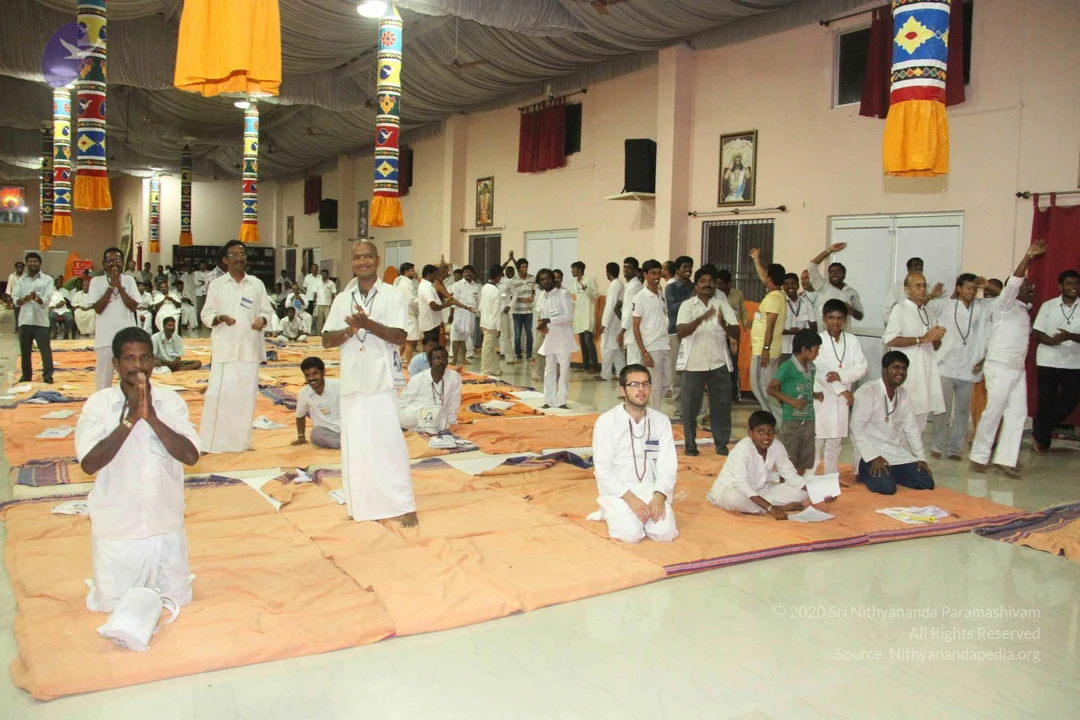
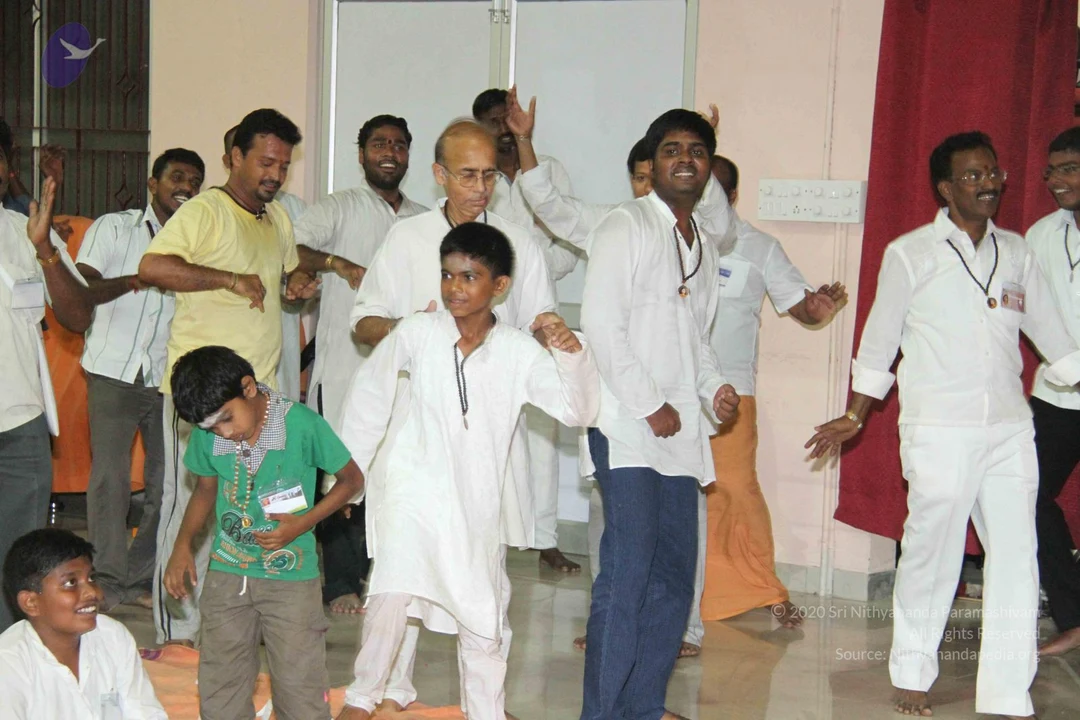
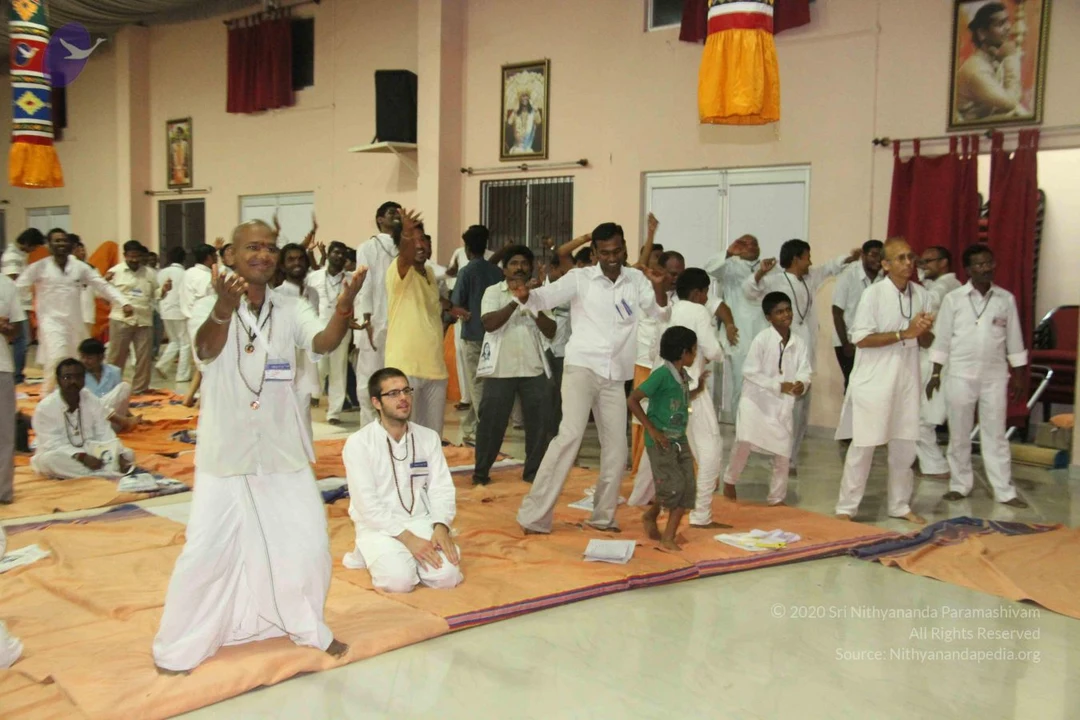
(4:56) Of course, my Gurukul to all ‘Nachiketas’, they never ask for attention. All over the world, all of you should know - my, all my Gurukul kids, each one of them are mentoring one-one Ashramite, Bramhachari or Bramhacharini; most of the time 7 or 8 year old child; children are mentoring their father and mother. Please understand, and they are really doing well - that's the beauty. They are really doing well. So all the Gurukul kids are ably assisting me in my Sangha.

(5:51) Understand. They are ably assisting me in my Sangha and so I am going to take a Inner Awakening - 11 days, for Ashramites. In that Gurukul kids also will be participating. That 11 days - no school, no school for Gurukul kids. They will be having directly sessions from me. What's the, the dates Ma? 15th to 23. So Gurukul is... There's, it’s already vacation? But some of them will be going to their homes.

(6:46) You see, there is a, there are 2 batch - February, sorry January 15th to 23, one batch and January 28th to February 3rd, second batch. Hmm.. See if your mentor is attending, you have to be in the same batch. So if your child is in Gurukul - understand, you are literally supporting my Sangha by giving one person from your life, from your family. Because they are very ably assisting me in my mission. See my mission is all about having Authenticity and Integrity. It is not about any other efficiency. With Authenticity, Integrity and Responsibility, the word efficiency is too small. You just explode.

(7:59) I also commit with my Gurukul kids; within this year, I’ll build the whole Gurukul like Vashishta's Gurukul. This is my commitment to the Gurukul kids. The same type of landscape and the NDTV Ramayana has done a very good job by studying the original Ramayana and making that kind of a Landscape and ambiance available. We will also dig out the original Ramayana - Valmiki's Ramayana - and get an ambiance, built. I think very soon, I’ll be known for my Gurukul. I am going to put that much of energy and intelligence and time into it and the infrastructure - making infrastructure available.

(9:33) Alright. Today I have a very beautiful thing. ‘The Bhagavad Gita’, printed edition of first three volumes I am releasing in Tamil. Bhagavad Gitai Tamil Mudal Mundra Adhyay engalam puttaka maya velivantha vittane.

(10:27) I sincerely congratulate and thank and bless my Tamil publication team for their hard work. I sincerely thank them and bless them. I know, it is, this whole book is only, see from my side it's only my saliva - just words. I have not put any other effort. From their side, it is their blood. They’ve put their blood to get these books out and I also wanted to tell you guys, don't think only three volumes have come. All eighteen are ready. It is getting printed. It's under printing, na Ma? Twelve are ready, twelve volumes are ready. It’s getting printed. Very soon other nine volumes will be out, to be in your hands. I tell you guys, they have done a amazing job. They have just done amazing job. It is too much. It's really too much and I sincerely congratulate and bless the whole department. Great!

(11:44) And one more thing, the Publication Department, they are also not able to give whole, their whole time to publication. They are pulled and pushed into so many work. But with all that, they came up with this volume. It is so beautiful. The moment I saw this book, I felt “Oh God!”. Even in English, I think we need to do now, revamp and redo the Gita. We have come up with three volumes, hmm? We should come out with eighteen books also. As a single volume also, we’ll come.

(12:30) Today, Nirahara Samyama, 2nd Level 4th Day and Nithya Kriya Yoga, Tamil program also and eN Genius memory camp, 4th day. Today I am officially launching Nithya Yoga - new YouTube channel. Yes. The address will be www.youtube.com/nithyanandayoga. Blessings. Blessings. So launch it ma. People will be able to see it? Great! Blessings. This will be the repository.

(14:02) Let's start today's subject, ‘Authenticity’. I'll continue on authenticity and our great hero Nachiketha. We should also have all of our Gurukul - different blocks - named after all these great Masters, child Masters, hmmm? Our kitchen should be named after Jnana Sambandar, because he received the milk and and each block should be named after Great Masters. The Bhajan Hall can be named in the name of Mira nandal and some Hall can be named in the name of Markandeya. Some place can be named with the Nachiketha, hmm?

(15:19) And I also commit with the Gurukul and Gurukul kids, before the end of this year - I'll make the whole Gurukul as managed by Gurukul kids. The teachers will be there only assisting. It'll be self-managed school, where the Gurukul kids will manage the whole administration. You see, the other day in the ‘Life Ok’ channel I was seeing, they were showing, demonstrating that Malakamba and the Yoga and the Pole and all that. It was not even 10% of what our Gurukul kids are doing. But unfortunately, we did not reach out to all these channels and media about our Gurukul kids.

(16:11) Aye Gurukul kids, you yourself take the responsibility. Start sending email to all of them, with the videos and photographs of what you're performing and ask them to give you opportunity to come and perform in their shows. So we will have a full-fledged office, with the internet facilities for Gurukul kids. They can go on work, they can have access to Facebook, email and work with the world. Reach out and tell them. Tell the world what they're learning, how they are living and I also guarantee none of my Gurukul kids will browse porn-site. I don't need to put any firewall for them. Just my word is enough. Aye my kids, porn is not good for your life. I already put my firewall, I know. I have put the firewall for my kids.

(17:30) So, make a beautiful office available for the Gurukul kids. By the end of this year, Gurukul will become self-managed, managed by Gurukul kids. So the teachers will be there only to assist and give them the education, the technical knowledge - that component and supporting them, helping them. It’ll be a new type of Learning System, the Education System. Means, of course I can't say new type, it's the oldest type of Learning System, where the kids will be learning. And I wanted the deities of Saptrishis, Chatur Vedas - make all the deities - and I wanted all that to be installed in the Gurukul. Start planning - Saptrishis and Chatur Vedas. Hmm?

(18:56) Gurukul should become a place for even Tourism Attraction. Understand. By the end of this year, I'll throw the Gurukul open to public, to come and see. And I also as a first initiation, I hand over maintaining, the most sacred thing I hold in my heart - maintaining the Banyan tree and the Temple to Gurukul from today.

(19:42) That's the most sacred thing, I hold very near and dear to my heart - the Banyan Tree and the Temple. So today I hand it over to Gurukul. So now one-by-one it’s going to Gurukul and they're doing amazing job. And I wanted all the Ashramites - who are mentored by Gurukul kids - understand, they are the Nachiketas happening in your life. Learn from them. Learn from them. Because I cannot come and monitor each one of you, I put them.

(20:36) First thing, you can't bribe them. Second thing, they're very authentic. Third thing, they do not talk to you by judging you. They only look at the problem and handle. They do not judge you. They just find solution for problems. If my energy beads are hurting me, now I don't call anybody, I just call the Gurukul kids. I know Alaya is the mentor, for the in-charge of energy bead, so I call, ‘Alaya’ and I know, by tomorrow she will fix it. I don't need to call anybody else anymore. I really feel only now, the real Gurukul is happening.

(22:02) Their commitment - God! - Responsibility. Just living with authenticity. Thanks to Nachiketha. I also pray to Nachiketha, ‘Let Your Presence be here, radiating Authenticity in all of us and in our Gurukul kids’. And I wanted Gurukul kids to develop their own website - their own communication system - have live Google Hangout, Facebook, Orkut, YouTube channel, Twitter, Chat rooms, Chat windows for Gurukul. I know the kids will do it.

(23:12) So after the Inner Awakening for Ashramites, I am going to do two batch. Of course, Gurukul kids are also going to be there. After that, for the Gurukul kids, whose parents agree, I’ll be giving them Krama Brahmacharya. ‘Krama Brahmacharya’ means, living the life of learning and the regulations of learning - like Celibacy and all that; regulations required for learning, Celibacy and everything - till they get married. It's not that they should not get married, they can get married. Till they get married, they will live this Brahmacharya life. Of course, if they decide to take Sanyas, then they will take the Naishtika Brahmacharya and go for Sanyas. We are also aligning all our Sanyas procedures and everything - Sanyas rules and everything to the original Upanishads. I am working on it, with original Manus and Upanishads - We’re aligning.

(24:50) Let's invoke the presence of Nachiketa and Yama, Lord of death. Let's enter into Kato Upanishad - ‘Authenticity’. So yesterday, we stopped at the story where Nachiketha is going towards death’s house and father is saying, ”Don't go, don't go.” I’ll read out from the translation of the original Upanishad, the scene and then I will comment. After the father said, “I’ll give you unto death, let you die”. Nachiketas thinks, Nachiketa is thinking, “Among many, I stand first; among many, I stand in the middle. What will be accomplished for my father, by my going this day to Yama?” It was not conceit which led Nachiketha to consider his own standing and importance. He was weighing his value as a Son and people in order to be able to judge whether or not he had merit enough to prove a worthy gift.

(26:42) Although he realized that his father’s harsh reply was only the expression of a momentary outburst of anger; yet he believed that greater harm might befall his father, if his words was not kept. Therefore he sought to strengthen his father’s resolution, by reminding him of the transitory condition of life. He said, “Look back to those who lived before and look to those who live now. Like grain the mortal decays and like grain springs up. All things perish, truth alone remains. Why then fear to sacrifice me also.” Thus Nachikethas convinced his father, that he should remain true to his word and send him to Yama, the ruler of death. Then Nachikethas went to the Abode of death, but Yama was absent and the boy waited without food or a drink for three days. On Yama’s return, one of his households said to him. Yes. Now I'll comment on this.

(28:04) The whole scene is mystical. Nachiketha, who is embodiment of Shraddha, Authenticity, thinks to himself, “Among many, in many ways I am first. In many ways I am middle but never last”. Please understand. This is the best mental set up, an Authentic being can have. When he says, “Among many, I am first” - that is his Mamakara. Second word he says, when he says, “Among many I am middle” - that is his Ahamkara. When he says; “I am never the last. Then how am I going to prove myself to his words?” - that is his Anyakara, his responsibility to Anyakara. Understand. In your case you say inside you, “Among many I am the last” - that is Mamakara. “Among many, I am the first” - that is Ahankara. “Then why should I do anything?” - that is Anyakara. “Why should I bother to do anything?” - that is Anyakara. The right Ahankara, Mamakara, Anyakara is described, just in these few words.

(30:20) Let me read out once more, the original verse. Please understand. I am going to read out the original verse - the translation. Nachikethas thought, “Among many, I stand first” - Mamakara. Means, in his heart he knows, he is first - means realization; strong trust on himself. He has not given up on himself. A clear Mamakara. Second line, “Among many others, I stand in the middle.” Means, when he expresses his Ahankara, he never puts himself in the first or he never puts himself in the last. He is with the whole.

(31:19) As a team - understand - a right leader will always project himself as the part of the team, not head of the team. You should feel you are head of the team; but you should project only as the part of the team. Anybody who projects themself, anybody has the Ahankara of the head of the team, you are a failure; because, the greatest enemy of Anyakara is Ahankara.

(31:59) Understand. In this whole scene, only Ahankara and Anyakara fights. Mamakara is like a husband, Ahankara is like a daughter-in-law, Anyakara is mother-in-law. The fight is always between daughter-in-law and mother-in-law. Husband is hiding in the bathroom; shutting the door and opening the shower and imagining as if he is not hearing any sound. He shuts the bathroom door and opens the shower. If you open the shower in the bathroom, you will not hear the sound from outside. Mamakara shuts all the doors and opens his inner chatter - that’s the shower - and acts as if he doesn’t hear any sound. If the Ahankara projects as the head; Anyakara is going to immediately reject it and raise the level of the fight - conflict. So a right leader is the person, who projects himself as part of the team. Understand. So Nachiketha's Ahankara is, “I stand in the middle”. Means, I am part of the team in many ways.

(33:59) Now - next statement. “What will be accomplished for my father, by my going to this day to Yama”. This is Anyakara - responsibility for Anyakara. Now Nachiketha thinks, “Yes, my father expects me to go to Yama - right? I should take the responsibility and reach the goal my father wanted to reach by sending me to Yama. Not just doing what my father said, I’ll have to fulfil what for my father said.”

(34:56) Understand. When I tell you, “Attend the yoga every morning.” Not that you will follow that only literally. You will also fulfill, what for I ask you to attend the yoga - health. So you have to do heavy yoga intensely and see to it you are healthy. Fulfilling the Anyakara not just by letter - with the spirit. I know many people come for morning yoga and [Swamiji demonstrates]. Without giving any pressure on their muscle, without giving any pressure to their hair and nail; without disturbing their make-up, they do yoga. It is following the letter, not the spirit. Here Nachikethas is so clear. He says, “What will be accomplished for my father, by me going this day to Yama?” Means, he is going to be doing what father said, not just as letter, but also as spirit. With the spirit, he is going to follow.

(36:48) With Anyakara... When you take the responsibility for Anyakara, you have to follow the letter and spirit both. If you are trying to follow just letter - it is cheating. If I asked you to come for every morning Satsang, what is the purpose? For you to live and get Enlightened. If you just come here and sit and sleep, you follow the letter not the spirit. If you just get Enlightened wherever you are and don't attend the Satsang, you follow the spirit not the letter. But here, with Anyakaa you are expected to follow both.

(37:38) The next line, ‘It was not conceit which led Nachikethas to consider his own standing and importance’. Understand. Nachiketa is not cunning and egoistic - conceit - no. These three statement shows very clearly, his authenticity of Mamakara, Ahankara and Anyakara. In your case, your Mamakara is always powerless; Ahankara is powerful or I can say, not powerful, showing power; Anyakara is violence - conflict. With Nachiketas, the whole thing is the other way. Mamakara - powerful; Ahankara - co-existing; Anyakara - responsibility.

(38:45) Mamakara is Satya; Ahankara is Ahimsa; Anyakara is Brahmacharya, Asteya, Aparigraha. Understand? Mamakara is Satya, Ahamkara is Ahimsa, Anyakara is Asteya Aparigraha Brahmacharya - means, what he feels inside as energy, integrated, empowered. How he projects himself to others is the possibility for co-existence.

(39:50) Understand. I proved My possibility to co-exist with all the seekers. That is the reason thousands gather around Me. Each Ashramite’s responsible to prove to everyone, as Ahankara you have to show to the world, that you are a great possibility for people to coexist with you. When you go and stand to take a class, the very presence, the words you utter, the way you handle people, you deal with people - every person who looks should know, you are a great possibility for coexistence.

(40:45) I have seen Virupa does that job. I have observed Virupa many times. Anybody sees her can understand, she's a possibility for coexistence. Each Acharya, each Ashramite, each one of My Disciple, Organizer, Satsangi, Samaji, Follower, Devotee - wherever you stand, whatever you do - your Ahamkara, should tell, make a statement to everybody, ‘I'm a possibility for coexistence’. If your Ahankara says, ‘I am the top’ - you are not a possibility for coexistence. If your Ahankara says, ‘I am the bottom.’ - you are not the possibility for coexistence. Who will want to live with a fool? Ahankara should be, making everyone understand, ‘I am a possibility for coexistence’. Unfortunately still now, no one has able to demystify these three lines. So many different, different commentaries. Nobody is able to demystify why these three statements? By recording these three statements, what the Rishi wants to tell the world?

(42:49) How many of you have read ‘Kato Upanishad’ earlier, before? Any of you have even imagined this meaning? What you, even I did not imagine. Thanks to Saraswati for flowing. So Nachiketas... Actually these three statements are the photograph of Nachiketha’s Mamakara, Ahankara Anyakara. Rishi wants this to be on record, so that at some time in future, some Incarnation will read and make it alive to people. Make people understand this truth. The treasure is just packed and kept.

(43:47) Rishi also very beautifully says... The Rishi of the Kato Upanishad records... I think the Rishi of the Kato Upanishad is Yama Dharma himself. It was written by Lord of Death, Yama himself. The Rishi records, ‘He was weighing his value as a Son and people, in order to be able to judge, whether or not he had merit, to prove a worthy gift’. Means, by this way of thinking, he was taking the responsibility and committing with his responsibility. Yama records, Lord of Death, Kala records as a... Here, he was weighing. He means Nachiketa. ‘Nachiketa was weighing his value as a Son and Pupil; in order to be able to judge, whether or not he had merit enough to prove a worthy gift. Although he realized, that his father's harsh reply, was only the expression of a momentary outburst of anger.’ This line means, Nachiketa is not foolishly following his Anyakara as morality or ethics of the society. He's doing it with Authenticity. There are ethics of society, where it says, ‘Literally follow whatever your dad says’. He is not doing it in that way. That is why Rishi records, Nachiketha knows father is angry and he shouted. It is momentary anger reply. Nachiketha is following with Authenticity, not with ethics.

(46:08) Understand. What you do is also important and why you do is also important. If Nachiketha has gone to Kala, Yama, just because he has to obey his father's words, he can only be considered as the best ethical man, a great person of morality. But, the reason why he is going to death is not just because of his father said. Which is... He is going because of his Authenticity and Responsibility for the inauthenticity of his father.

(47:01) When Rama went to Forest, he took the Responsibility for the Integrity of his father. Just before he was leaving to the forest, even Kaikeyi changed the mind. She begged, “Forgive me Rama, I did a mistake. No, no, no, no. Don't go”. Because, Kaikeyi is too strongly attached to Rama. It was actually Kaikeyi who brought up Rama, not Kaushalya. Kaikeyi brought up Rama. So, when she asked Dasaratha, her only intellectual mind was convinced; her emotional being was not convinced. So when he saw the scene of Rama, in ocre rope going to forest. The Sita, Sita was very close to Kaikeyi. Both of them had a relationship of Mother and Daughter, not Mother-in-law and Daughter-in-law.

(48:17) Kaikeyi was more like a friend to Sita. There are many beautiful poetical rendering of Ramayana - records Kaikeyi, coaching, educating Sita for the life. She was a Friend, Mentor, Mother. But the moment she saw, Kaikeyi saw the scene - Rama and Sita and Lakshmana going, she couldn't handle. She went and begged, “No, no, no. Don't go please”. He said, “No. I take the Responsibility for the Integrity of my Father.” Here, Nachiketha takes the Responsibility, even for the inauthenticity of the Father.

(49:43) And, the next line, ‘Yet he believed that the greater harm might befall his father, if his word was not kept’. Nachiketha takes the Responsibility for the inauthenticity of the Father. You see, he is inauthentic, that is where he is based at now. ‘He need to be raised, raised to the level of Authenticity. Now, if I don't keep up his word, he will be out of Integrity also. So, at least, let me bring him to Integrity by sacrificing my life, so that he moves to the next step of Authenticity’. ‘Therefore, he sought to strengthen his Father’s resolution, by reminding him of the transitory condition of life. Now the Father has fallen back to Mamakara. Only when he was bursting in anger, he was in Ahankara.

(51:17) Understand. Whenever you deal with people; see, whether he is standing on Mamakara or Ahankara or Anyakara - because there are three personality in each one of you. Handle him from, based on that. Gurukul kids are you listening? When your Mentor has a problem... Sorry, when your student has a problem, see whether he is talking to you from Mamakara, Ahankara or Anyakara.

(51:53) When Vajashravas said, “Let you die. I gave you on to Yama”; he was operating from Ahankara. Unfortunately, Ahankara does not get continuously fuelled. When the emotions burst, person is naturally pushed back to Mamakara - sucked into Mamakara. Now, he is in Mamakara, the powerless state. He says, “Don't go, don't go”. Same way with Kaikeyi, when she asked for the boon she was working from Ahankara. Then suddenly, she fell back on Mamakara and begging Rama, “Don't go”. And I know, a personality like Rama, he would have been the life of the whole Palace.

(53:08) Life comes from Life not from, just buildings. Understand, Life comes from Life, not just from buildings. That is why, in the forest, without any building, from all over the world, people come and stay. Most of the people who come and stay here, I can say, why most, almost everyone who come and stay here; have better accommodation outside in their house. But better space here. Better place there, better space here. A personality like a Rama, if he leaves the palace, it means literally, palace is moving out of palace, leaving only palatial buildings. Palace is moving out of palace, just leaving palatial buildings.

(54:59) One Ashramite, little loose, wanted to leave the ashram. All I did is, just asked one question, ‘Just remember, morning when you wake up, will you be able to be alive without seeing me?’ She said, “No I'm not going out of the Ashram. I forget. I dropped my decision.” That's all, only one question. Because life, life happens from life. Please understand. This is the Mahavakya for today, ‘Life happens from life’. You can't make meaning out of this statement, if you just put it in the Facebook. Only if you listen to the Satsang you will understand.

(56:17) Mahavakyas are the words, only in the context they make meaning. Otherwise, nothing can be understood out of it. Thousands of people listen to the word, ‘Tat twam asi’. Who can understand? No! Only from the right person, in the right time, in the right Muhurta, they make meaning. Life happens from Life, not from buildings, not from bank balances not from anything else. Life happens from Life.

(57:22) Nachiketa takes the responsibility for Father's inauthenticity and he does not want Father to fall out of Integrity also. So he decides and he convinces the Father; now who has fallen into the space of powerlessness. He has fallen into Mamakara and he's feeling terrified, horrible, weak, powerless to let go Nachiketha. Nachiketha teaches him, reminding the Father of the transitory condition of life. I tell you, when you become Authentic, the first thing you will have is fearlessness, all fear will disappear. You will understand the transitory condition of life, the transitory condition of all the prefixes, suffixes, you give it to life. Prefixes are preferences, suffixes are sufferings - all the prefixes you give for your life and suffixes you give for life. Life itself is Eternal; the prefixes and suffixes are transitory.

(59:10) Nachiketha reminds his Dad about the transitory condition of prefixes and suffixes you give it to life. Rich life - prefix. Life of suffering - suffix. Life is Eternal; neither the prefix nor the suffix is Eternal - the transitory condition of life prefixes and suffixes. He said, ‘Look back to those who lived before and look to those just lived now, like the grain the mortal decays and like the grain springs up’. He talks to his Dad.

(1:00:00) Understand. Seven year old child talks to his dad. Dad as Anubhava, Nachiketa as Anubhuti. Dad has seen thousands of people taking birth and dying like a grain. But Nachiketa remembers thousands of people taking birth like a grain and dying in right time. Remembrance in right time, is Anubhuti; not remembering but only seen, is Anubhava. Anubhava is fact - ‘The World’. Anubhuti is knowledge, realization, right ‘My World’. Dad has experience, Nachiketha has realization. Son is telling the Father, “Dad, don't you see like a grain, people die and come and go”. How many deaths Nachiketa would have seen in his seven year existence? Maybe maximum one or two, or he may not have even seen, just only heard. But he learnt the lesson.

(1:01:51) I always tell a story - Anubhava means, touching every type of fire and learning, ‘Oh this fire also burns? Okay. Oh charcoal fire burns? Okay. Then oh Matchstick fire burns? Okay. Gas stick fire burns? Okay. Oh, firewood fire burns? Okay. Oh, kerosene fire burns? Okay’. Touching almost every type of fire and learning the lesson - all types of fire burns. By the time you learned the lesson, all types of fire burns, your body is ready to be burnt. You are dead. But the moment you touch one fire and it burns or you see somebody touches and it burns; learning all fire burns is realization - Anubhava, Anubhuti.

(1:03:05) Vajashravas is supposed to be telling these words to Nachiketa, ‘Oh my Son, people come and go. I have seen millions coming and going in my life’. But, see the fun, opposite is happening. I can see when My mentors are mentoring their students - the Nachiketas relating with Vajashravas. By the time my kids complete the Gurukul, they will have easily, post-graduation in Psychology and Business Administration. Because, the essence of everything, I just chew it up in My all grinding machine - My brain - and give the essence. I also commit, I'll teach Astrology to My Gurukul kids, At least the basic principles. You see I myself, not a master of Astrology. I know basic principles. I'll teach the basic principles. To master you need to spend years on it. Of course, mastering the planets is easy. Not. (Laughing).

(1:04:54) Nachiketa convinces his father about the transitory condition of prefixes and suffixes of life and he says, everything dies and reborn, comes back. All things perish, truth alone remains. Truth alone remains. Truth alone remains. Then Nachiketha says, ‘Dad then, why are you afraid to sacrifice me also?’ He is going to sacrifice himself, he is consoling the dad, ‘Why are you afraid to sacrifice me?’ So Courageous, Authentic Beings are not afraid, even when they have to sacrifice themselves; inauthentic beings are afraid, even they have to sacrifice others for their words.

(1:06:20) Inauthentic beings create violence and get frightened by the same violence. They shout and they get frightened by the same sound which they created. They shout, scream and get frightened; start shivering by the same screaming and shouting they did. So Nachiketa is convincing, ‘Don't be afraid to sacrifice me’ and Nachiketa with his Authenticity takes the Responsibility for inauthenticity of his Dad and thus Nachiketas convinced his Father. Means, he completed his Responsibility, he did not give up on his Dad. He fulfilled his commitment of healing him, making him understand that he should remain true to his world and send him to Yama, the ruler of Death, Lord of Death. Then Nachiketas went to the abode of Death.

(1:07:37) Understand. Here lies the answer, for one of the biggest problem, all my Ashramites face. They say, “My parent’s Anyakara is that I should come back. Should I fulfill that Anyakara or should I stay here?” Yesterday this was a big discussion. Now, Nachiketa's behavior is answer. See very clearly, the Anyakara of Vajashravas is, asking Nachiketa to stay back. But, neither Nachiketa stayed back, nor he did not raise himself to the Anyakara of his father. He took the Responsibility and showed his Father, made his Father understand, about his inauthenticity and out of Integrity; convinced that he doing what he has to do, is good for him also. So, all the Ashramites, this is the answer. Making your parents understand, by taking Responsibility for their inauthenticity, suffering and out of integrity and their powerlessness - everything.

(1:09:32) Why do they want you back? Because of their powerlessness. If they want you back, because of their Authenticity - nothing wrong. But they want you back because of their inauthenticity. So now, take responsibility for their inauthenticity, don't give up on them. Work, work, work with them and do what Nachiketas did. Nachiketas convinced his Father that he should remain true to his word and send him to Yama, the ruler of Death. You will find millions of ways to convince your parents, that the path you have chosen is good for you and for them.

(1:10:42) Then, Nachiketas went to the abode of Death. But Yama was absent and the boy waited without food or drink for three days. This is Mystical. Means, with that Authenticity, “I want to face Death”, he sat, without food or water, in pure Nirahara Samyama; just exhaling not even inhaling. Even if you inhale, it is a Ahara. Only exhaling, means, all the collected life-energy which was there in his seven years of life, he is sending them out; he is releasing them, waiting for death.

(1:11:48) If you just decide with Authenticity, ‘I want to face Kala, Lord of Death’ - go on exhaling, exhaling, exhaling. With Authenticity if you decide; you will not be inhaling, just exhaling; releasing all the Life Energy stored in your body and in you till now, which you collected and stored; releasing everything and not taking anything which is source of Life - Food, Water or Prana. In three days you will have a pure death experience.

(1:12:37) Once we start functioning Varanasi Ashram, the Manikarnika Ghat; any seeker who want to experience the pure death experience - not physically dying, Consciously facing Death, can take up this practice. Not only you will not eat or drink for three days, you will not even inhale. Authentically you will tell yourself, I do not want to inhale, take the life source Prana into me. Telling is enough; your body will just do only exhaling. The pattern of inhaling and exhaling will be broken by Authentic declaration and Nachiketas Authenticity - he just broke the pattern in three days, inhaling and exhaling.

(1:13:46) Third day he broke the pattern. That is what they mean, when he went to the Abode of Yama, three days he was absent. Because it took three days for Nachiketa to come face-to-face with Yama Dharma. On Yamas return, one of his household said to him a beautiful story. Like fire, a Brahmana guest enters into the house. That fire is quenched by an offering, “Oh Vaivaswatha bring water”. Means, the assistant of Yama Dharma, tells Yama, “Oh Lord like a fire, a Brahmana comes to your house. If you don't do what needs to be done, it can burn and destroy your house. If you do what needs to be done, he can be available for you for cooking and all the enriching of your life.’ When a right Brahmana comes, you take care of him, he will enrich your life forever. If not, you can destroy your life. So, the assistant is telling Yama, “Take care of him. A Brahmana is here.”

(1:15:37) Understand. With this word, the whole problem of Caste System is broken; because, Nachiketa is Vaishya by birth. He is a son of a King. But, the Upanishad records him, ‘A Brahmana is waiting’. Understand. He is the Son of a King. It means what? The title is based on the quality of a person, not based on just birth. Next verse says, ‘The foolish man in whose house a Brahmana guest remains without food, all his hopes and expectations, all the merit gained by his association with the Holy, by his good words and deeds, all his Sons and cattle are destroyed.’

(1:16:59) Please understand. Each one of this word is very, very meaningful. If an Authentic person comes to your life, you don't take care of him in your life; whatever you have in your life, will be destroyed very soon - you will lose it very soon. You will lose him and everything else in your life. Very rare to see Authentic beings in your life. Blessed are those, who don't miss Authentic beings happened in their life. Never ever fight with an Authentic being, because it’ll always be losing battle for you. That is why I tell you, even if you suspect somebody is Enlightened, don't abuse them. The foolish man in whose house a Brahmana guest remains without food - means, unattended, disrespected, not taken care - all his hopes and expectations; what a beautiful description, ‘All the merit gained by his association with the Holy, by his good words and deeds, all his Sons and cattle are destroyed’, means, everything said-unsaid.

(1:18:58) According to the ancient Vedic ideal, the guest is representative of God - should be received with due reverence and honor. Please understand. Revering the guest, honoring the guest is not just social, moral or just ethical responsibility; it is a spiritual responsibility. Whoever has made shelter for their body, food for their body, should take the responsibility for anybody who does not have shelter or food, who comes in your breathing space.

(1:19:58) Understand. If you have made food, shelter, cloth for yourself and anybody without any of these three comes in your breathing space; you are responsible for providing all the three for them. Only if there's a danger from the other person to your life or possession, you are allowed not to take responsibility for that other person. This is the command I give for all My householder disciples, My Grihasta disciples. I give you all, this as a command from Upanishad and my personal suggestion for visitors and followers - Guruvaak for My Disciples and Devotees. If you have food, shelter, clothes - anybody comes in your breathing space who don't have all these three; you are responsible to provide all these three to him or her. Only if there is a danger for you or your possessions from that person, you are exempted from this responsibility. Okay? Clear?

(1:21:57) Anybody who is established in Authenticity, will never be a danger for your life. So if you see somebody established in Authenticity, you should take care of him. And after this program, I'm going to be doing the Inner Awakening for the Ashramites and I’ll be giving them the special bracelet. They should wear only if they're established in Authenticity. Whenever they feel they are not in Authenticity, they should remove that bracelet. So all our Devotees all over the world will know. Whether to treat him as a Brahmana or not and each individual takes the responsibility now to be a Brahmana. What a beautiful verse. The foolish man in whose house a Brahmana guest remains without food, all his hopes and expectations, means future plans, all the merit gained by his association with the Holy, means the Punya he receives from the Satsanga - that’s a highest Punya, understand, highest Punya a man can receive is the Punya of a Satsanga - the Upanishadic Rishi declares, ‘Even that highest Punya is destroyed’.

(1:24:03) We have to revive this great tradition of respecting Brahmanas, by first creating Brahmanas. The moment I uttered this word, I know thousands of my disciples have now, already resolved that, ‘I will take responsibility of anybody comes in my breathing space, for their food and shelter, if I have food and shelter’. But now, it is my responsibility to create Brahmanas, who will come and accept your hospitality. Very easy to create people who will give hospitality; very difficult to create people who are worthy of receiving that hospitality. Now I have to do that job.

(1:25:13) The merit, that man got by good words and deeds, all his Sons and cattle, everything is destroyed, if a Authentic person comes to your house as a guest and remains without food. So how Yama reacts, let's see tomorrow. I have commented just on two verse. Let's see tomorrow, how Yama responds.

(1:26:07) [Presentation and song on Paramahamsa Nithyananda] (1:30:11)

Photos

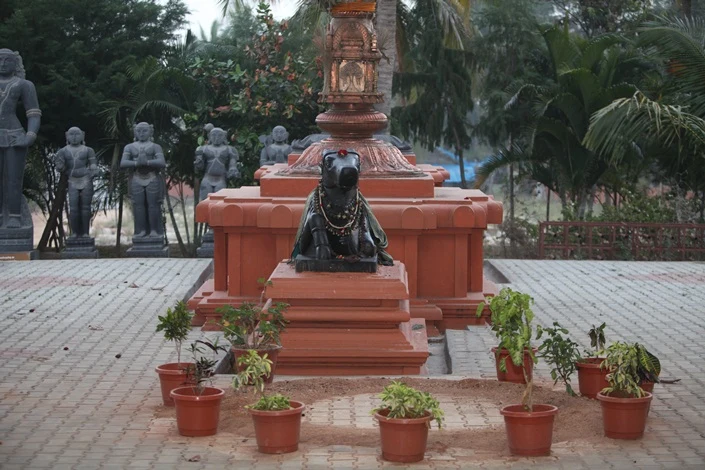
Temple
Puja
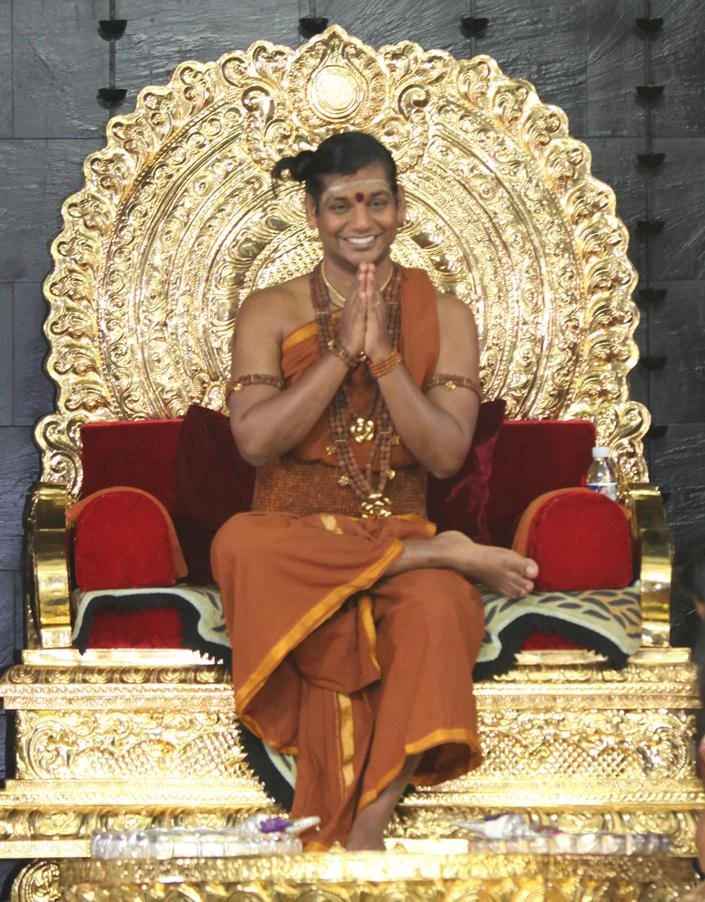
Satsang
Tags

Paramahamsa Nithyananda, authenticity, young, prince, father, god, responsibility, worship, spirit, devotion, integrity, king, authority, team leader, failure, possibility, create, peaceful, humanity

Photos Of The Day:

PADA-POOJA
NITHYA-KRIYA-YOGA
AKASHIC-READINGS
KALABHAIRAVA-DARSHAN

AKASHIC-READINGS
DARSHAN

Photos Of The Day:

satsang-and-nky

web-selected

output

energy-darshan

selected

1-Akashic-Reading-And-Energy-Darshan

2-Energy-Darshan

3-Satsang-And-Nithya-Kriya-Yogam

Photos from this day

View all 290 photos

Temple

4 photosSource gallery
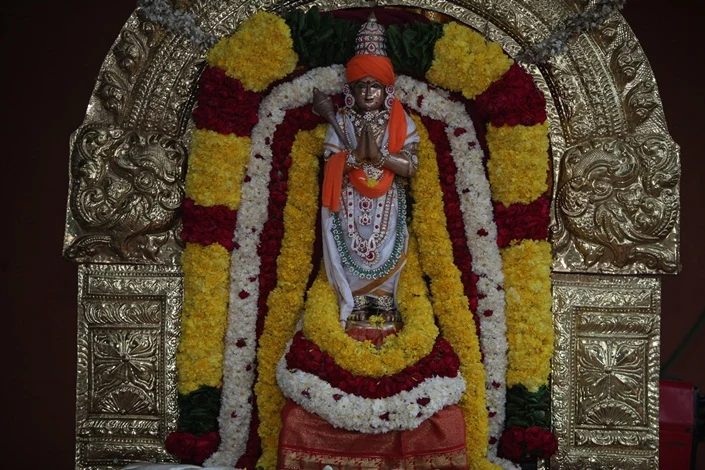
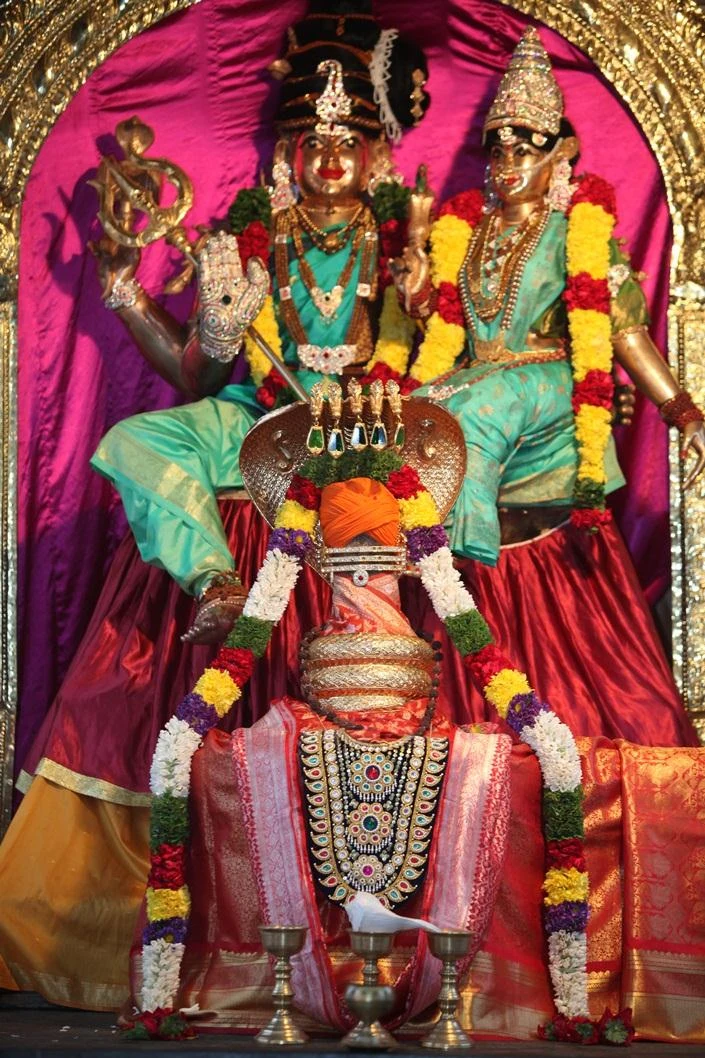
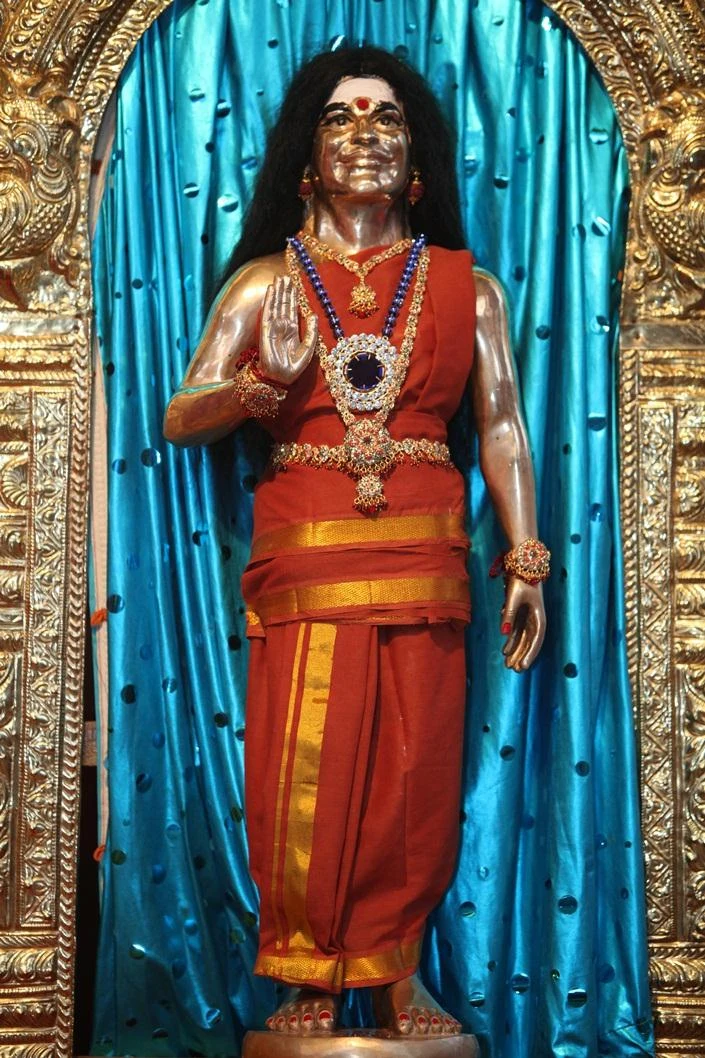
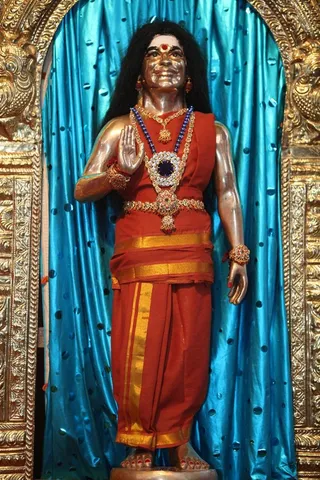
A dark stone Nandi bull statue sits on a red sandstone plinth at the centre of an open courtyard, draped with a beaded necklace and marked with a red tilak on its forehead. Behind it rises a tiered red pedestal topped with an ornate golden shrine finial. Grey stone figures of standing deities and attendants stand in a row on the left, and palm trees and flowering shrubs frame the background. Potted green plants line the foreground paving stones. No people are visible.A small standing deity murti is decorated for worship within an ornate gilded arch. The figure wears an orange-saffron turban and a white dhoti with red and green embroidered trim, and has hands joined in namaskar. It is garlanded with bands of yellow and orange marigolds, red roses and white flowers, with green leaves at the top. Brass-coloured ornamental panels frame the shrine, and a red cloth lies at the base. No people are visible.A photograph of a deity murti set in a golden arched niche with a magenta backdrop. Two standing figures painted in gold tones wear teal and red garments with gold borders, layered necklaces, and jewelled crowns, one holding a trident-like staff, and flower garlands of marigold, red and white blossoms drape over them. In front, a large Shivalinga-like form wrapped in a saffron turban and a red and gold silk cloth with a jewelled necklace is adorned with a garland, and a row of brass oil lamps sits on the floor before it. No physical people are visible.A life-size statue of a long-haired figure stands in front of a turquoise satin backdrop with blue dots, framed by ornate gold carved panels. The statue wears a red-orange dhoti with gold borders and a sleeveless red-orange top, with a red bindi on the forehead. It has a heavy gold necklace set with a large blue and white gem, blue beads, a jewelled gold waistband, gold bangles and red-stone bracelets, and red-painted toes. Its right hand is raised in blessing. The figure is a depiction, not a living person, and no physical people are present.

Puja

4 photosSource gallery
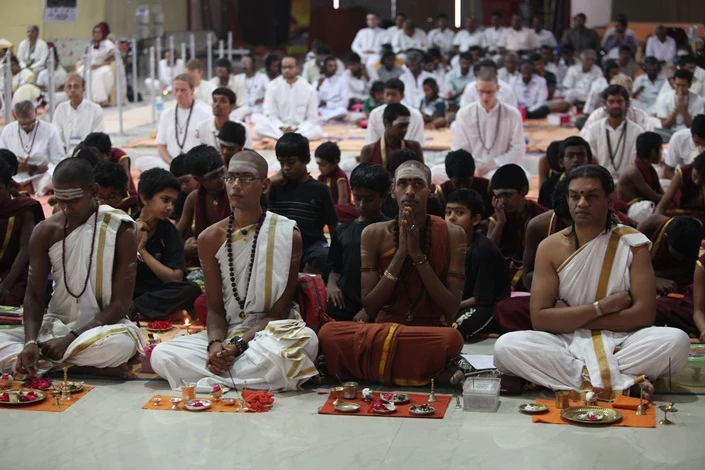
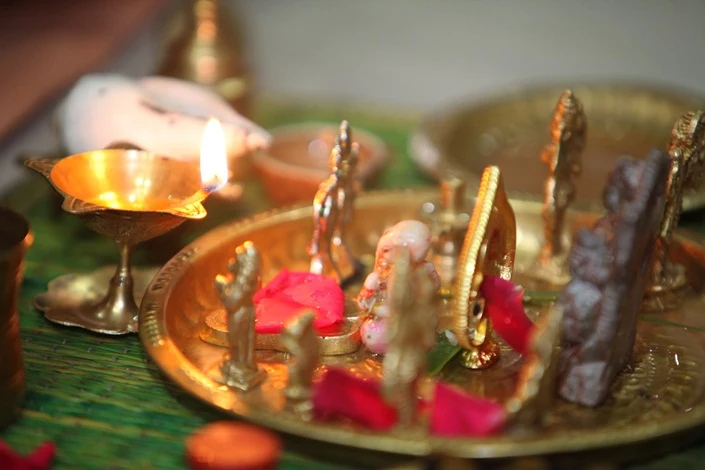
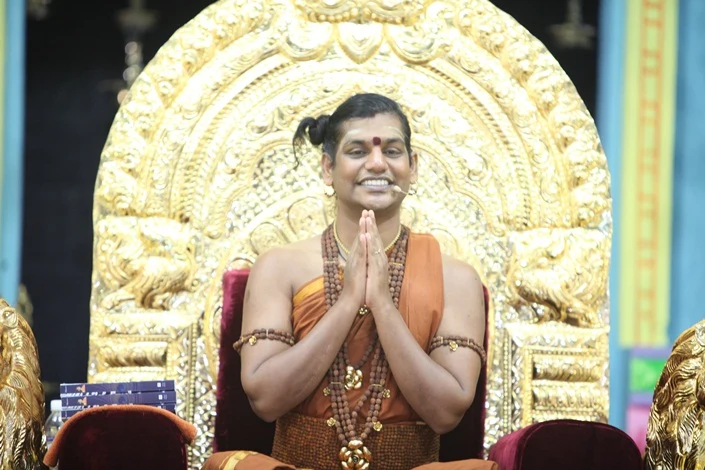
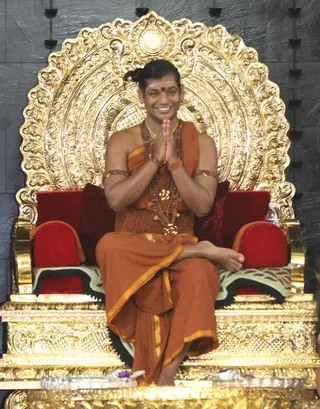
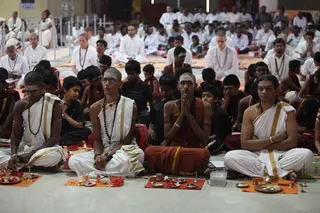
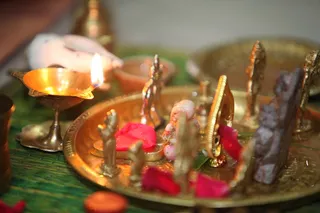
A seated man in saffron-orange robes sits on an ornate gold throne with red cushions, hands joined in namaste and smiling. He wears a red bindi, rudraksha malas, a gold pendant and bangles, with bare feet and a water bottle beside the throne. Swamiji (probable): long hair tied up, saffron clothing, rudraksha malas and ceremonial gold necklace, seated on a throne in a satsang setting.A seated group of devotees in a hall performs a puja with brass plates before them, each holding small oil lamps, flowers and offerings on orange cloths. Front row: a shaved-headed young man in white dhoti with gold border and rudraksha mala, another in white with a shaved head holding a mala, and in the centre a shaved-headed man in orange-red robe with hands pressed in anjali. At right a man in white dhoti and shawl with gold border sits with hands folded. Behind them many seated people in white and saffron clothing, including children, fill the room; some are visibly older men in white. Pillars and a white-clad crowd continue into the background.Close-up photo of a brass puja thali on a green cloth. A lit brass oil lamp with a flame stands at left, beside a small brass cup. The tray holds small brass deity figurines and a metal idol, a pinkish-white flower, scattered red and pink flower petals, and a few brass pieces including a carved stone-like item. No people are visible, and no one in the scene can be identified as a person.A man seated on an ornate gilded throne with a large golden arched backrest and red cushions, in a richly decorated hall with turquoise, pink and yellow painted panels. He wears an orange-saffron dhoti and shawl draped over his shoulders, with a red tilak on his forehead, a rudraksha mala and ceremonial gold necklaces, and his arms are adorned with gold armbands. Brass oil lamps stand on either side. At the left, a man in white ritual clothes with a white tilak sits with folded hands, and at the right a woman in a cream and red sari sits near the throne, holding an object. The throne is a clear marker of Swamiji's seat, but appearance alone supports only a probable identification with long swept-back hair, orange clothing and rudraksha cues. Swamiji (probable) seated on the throne in the satsang hall.

Satsang

7 photosSource gallery
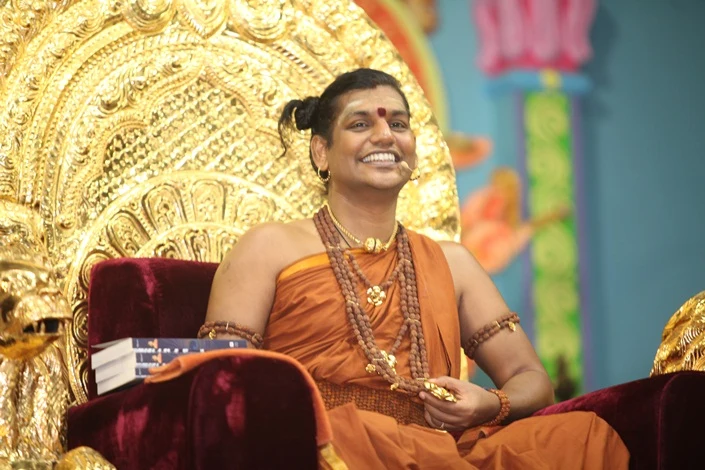
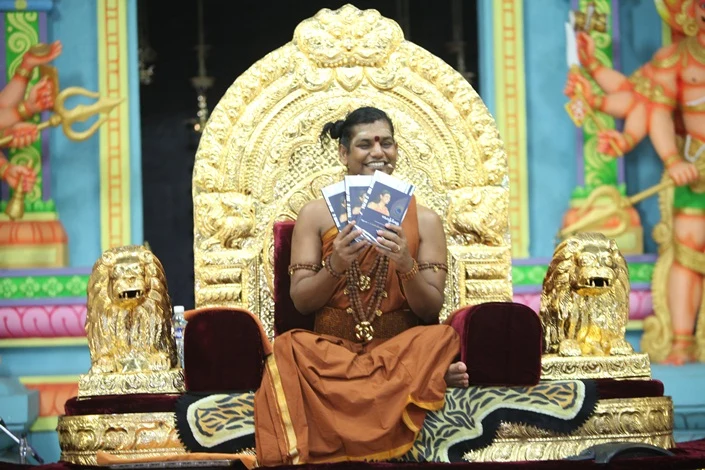
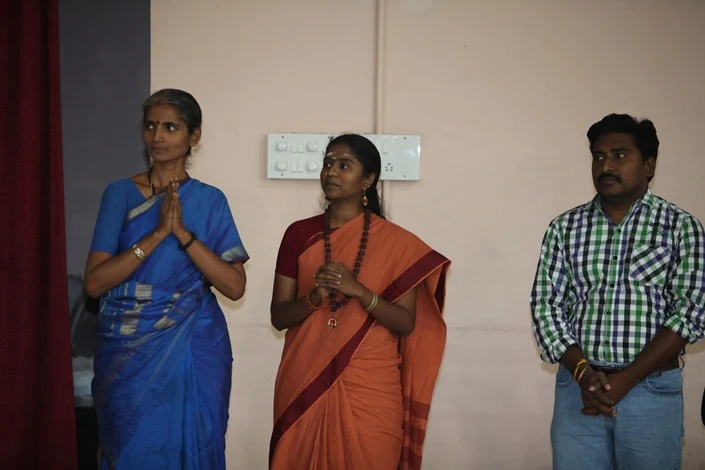
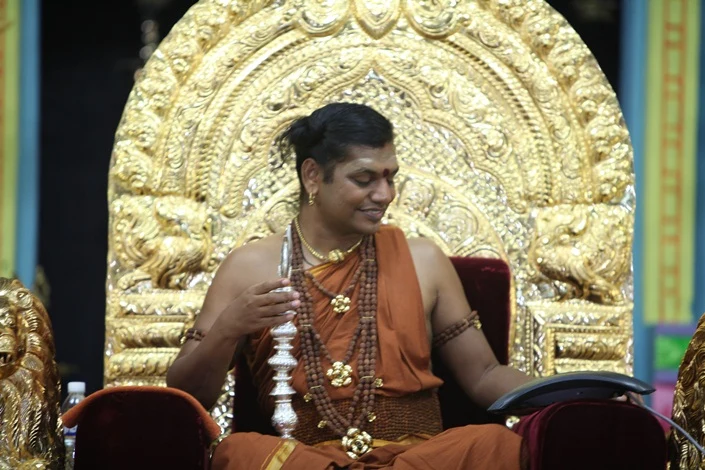
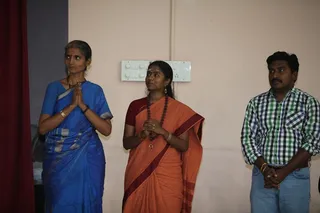
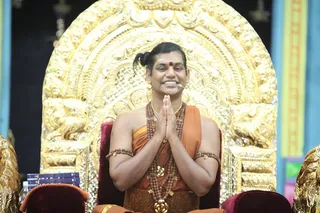
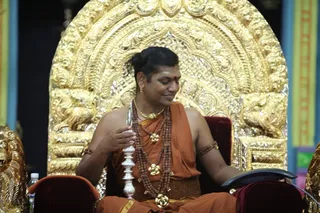
A smiling man with a top-knot bun sits on an ornate gilded throne carved with lion figures and plush burgundy cushions. He wears a saffron-orange dhoti and matching shawl, a thick rudraksha mala, a gold necklace, and beaded wristbands, with a red bindi on his forehead. His hands rest in front of him in a gesturing pose. A water bottle and a stack of books sit at the left edge of the frame, and a small microphone is visible near his face. The background shows colourful temple-style hangings.A smiling man sits on an ornate red velvet throne with a large gold carved backrest and gold lion-like armrest. He wears an orange saffron wrap, multiple rudraksha mala necklaces, a gold ceremonial pendant necklace, gold bangles, and a red bindi with hair tied up in a bun with a gold earring. Beside him on the throne armrest are a stack of books. A colourful painted backdrop with gold and green patterns is behind him.A smiling person in orange-saffron robes sits on an ornate golden throne flanked by two golden lion sculptures, holding a fan of three small blue-and-white booklets or cards in both hands. Beaded rudraksha-style malas and gold ornaments hang on the chest, and bangles are on the wrists. Behind the throne, painted colourful deity figures with weapons, including a red figure holding a trident-like staff, frame the stage. Red and purple cushions and a patterned mat sit at the base of the throne. The page suggests a satsang discourse; the appearance-based identification is probable, so the figure is described as a person, seated on the throne and holding booklets during the talk.Three people stand in a plain room with a pale wall and an electrical switch panel behind them, beside a dark red curtain at left. At left, a woman in a blue saree with a striped border presses her palms together in anjali mudra, with gold bangles on her wrists. In the centre, a woman in an orange saree with a maroon border holds her palms together, wearing a rudraksha mala and a pendant, with gold bangles. At right, a man in a green and white checked shirt and jeans stands with his hands clasped in front of him. No deity, throne or a person depiction is visible, so no a person candidate is present.A smiling person sits with palms pressed together in namaste on a red velvet cushioned seat in front of an ornate gold throne carved with lions and floral motifs. The person wears an orange-saffron garment over the shoulders, multiple rudraksha mala necklaces, a large gold pendant, gold bangles, a red bindi on the forehead and hair tied in a bun. Stacked books sit on a red chair to the left, and a gold-carved armrest is visible at the edge. The background shows blue and green panels. Swamiji (probable): long hair in a bun, saffron garment, rudraksha malas and gold pendant, seated before a throne as the satsang speaker.A seated man in saffron-orange robes sits on a red-cushioned chair before an ornate gold throne carved with lion and floral motifs. He wears layered rudraksha malas, gold ornaments and a gold necklace, a red bindi on his forehead, and gold armbands. He holds a silver ritual vessel in one hand and rests the other on the chair arm, smiling. a person based on the saffron robes, rudraksha malas, ceremonial gold necklaces and arm adornments; he is seated in a satsang setting with a bottle of water visible at the left edge.

PADA-POOJA

8 photosSource gallery
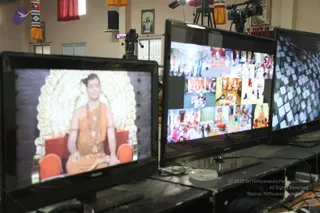
Photograph of monitors in a hall used for a live video satsang. The centre screen displays a grid of video feeds showing devotees in groups, some before deity altars with lamps and garlands. Behind the screens are a camera on a tripod, red and yellow hanging cloths, and framed religious pictures on a pale wall.A photograph inside a temple-like hall showing a man seated on an ornate gilded throne with a golden arched back and cushioned red seat. He wears an orange saffron robe, a multi-strand rudraksha mala, a gold necklace, armlets, and a red tilak on his forehead. A shaved-headed man in white dhoti and white shirt with a white vibhuti line kneels at left with palms pressed together in namaskar. A woman in a cream and pink sari stands at right beside a tall golden lamp stand. A gold-and-pink altar ledge with a golden base surrounds the throne, and dark wooden panels form the backdrop. a person is seated on the throne, identified by orange robe, rudraksha mala and gold ornaments, while the kneeling man is a devotee.A seated man in a saffron-orange robe with a gold-embroidered border sits on an ornate gold throne with red cushions, wearing a rudraksha mala, multiple gold necklaces, and bangles, with a red bindi on his forehead. In front of him a man in white ritual clothes, with a white tilak on his forehead and a mala around his neck, kneels with palms pressed together in namaste. A woman in a white-and-maroon sari sits at the lower right edge of the frame. Behind them are a dark wood-panelled wall and a brass oil lamp, and gold offering trays with flowers sit at the base of the throne. The seated figure is a person by his saffron and ornate adornments; the kneeling man is a devotee.A seated figure on an ornate gold throne with red cushioned armrests is dressed in saffron-orange robes and a saffron shawl, wearing layered beaded necklaces, a rudraksha mala and a red bindi, with gold bangles on the arms. A man in white ritual clothes kneels on the dark floor at left, palms pressed together in namaste, with a white tilak on his forehead and a mala around his neck. Nearby stand a brass oil lamp and silver trays holding flowers and offerings. A woman in the lower right corner is partly visible. The wall behind is dark and studded, with a turquoise panel at left. a person: the seated figure wears saffron robes, a rudraksha mala and gold necklaces on a throne, and is.Photograph of a satsang-style ritual in an indoor hall. A man in an orange robe with a red tilak, layered gold and bead ornaments, and a bare chest is seated on an ornate gold throne with red cushions, his bare feet resting on a gold footstool. A man in white ritual clothes with a white forehead band and a rudraksha mala kneels before him with hands folded. A woman in a pink sari sits at the lower right, and a plate of flowers and offerings lies at the base of the throne. a person is the figure on the throne, identified by the page and the orange robe with rudraksha malas and gold necklaces.A seated figure in a saffron-orange robe with a gold-bordered shawl, wearing layered rudraksha malas and ceremonial gold necklaces, sits on an ornate gold throne with red velvet cushions against a dark wall. A kneeling devotee in white ritual clothes, with white forehead markings and a rudraksha mala, sits at the lower left before a gold tray holding flowers and offerings. A woman in a cream sari with long dark hair sits at the lower right. A brass oil lamp stands in the background. a person: the saffron-robed, mala-adorned figure on the throne has distinctive ceremonial cues, though the appearance is only partly clear.

NITHYA-KRIYA-YOGA

5 photosSource gallery
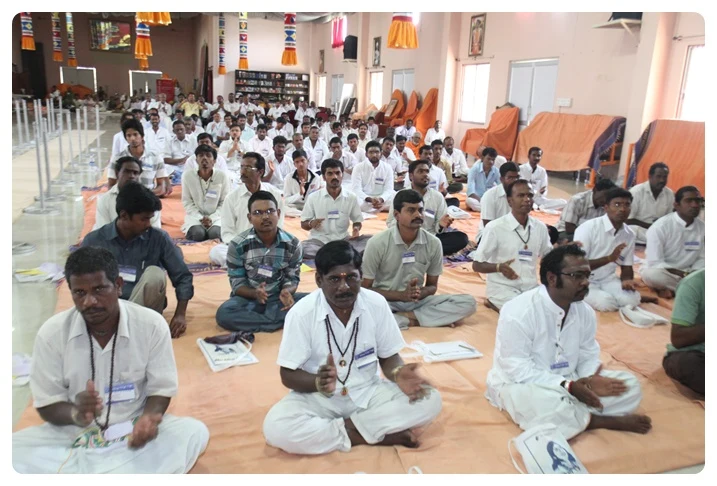
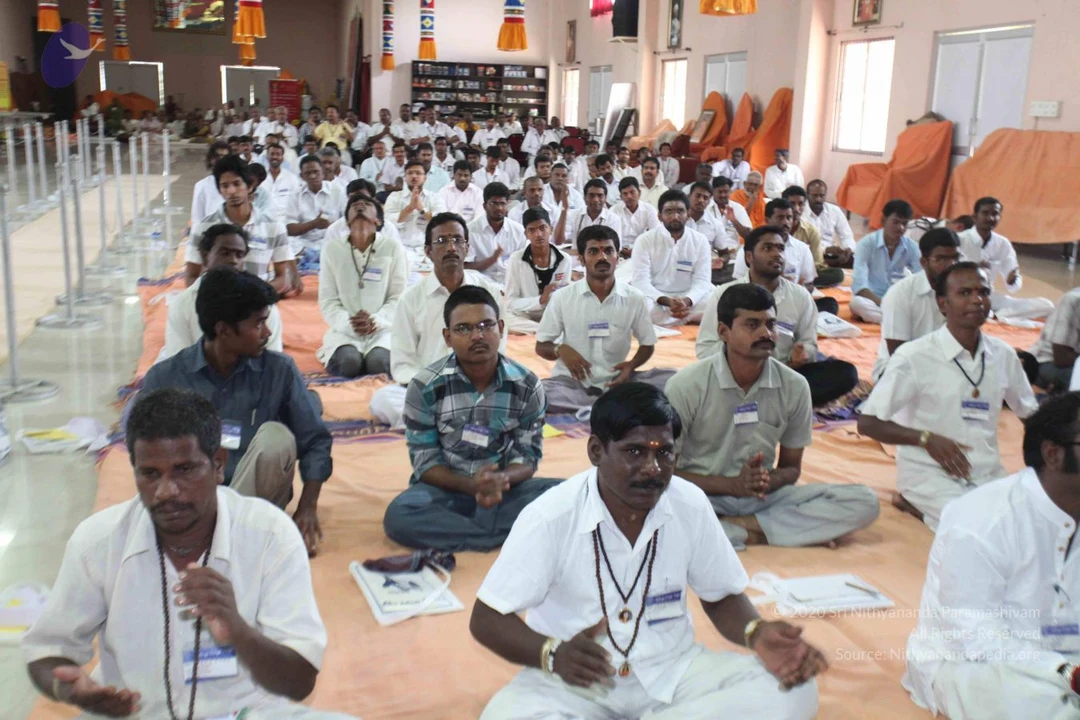
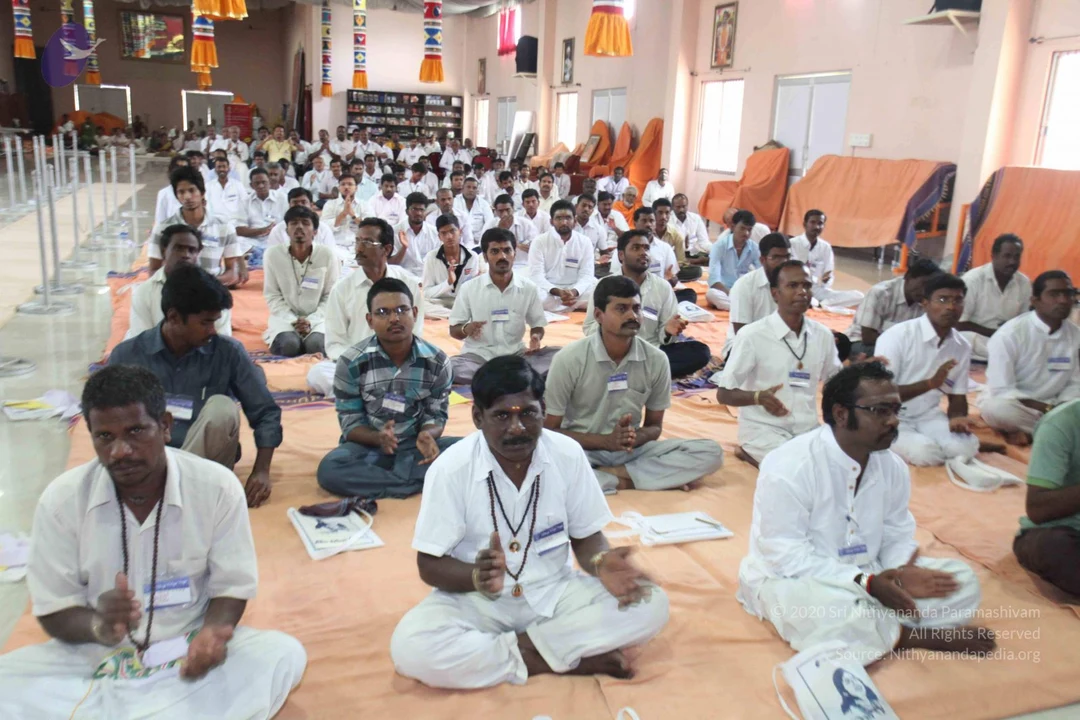
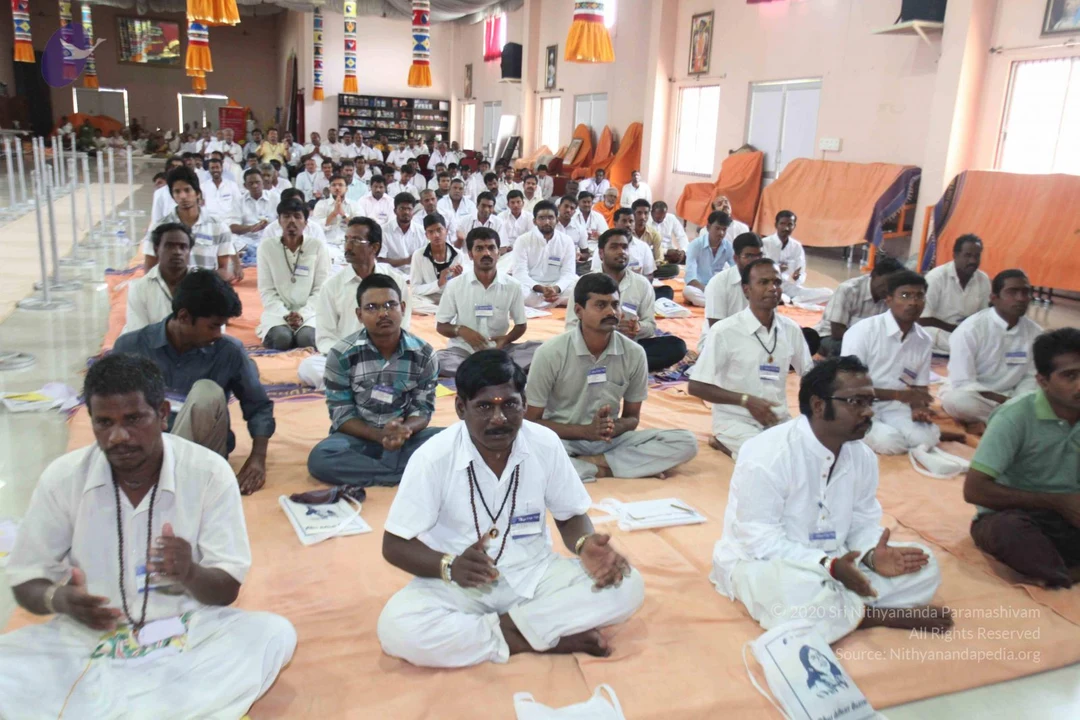
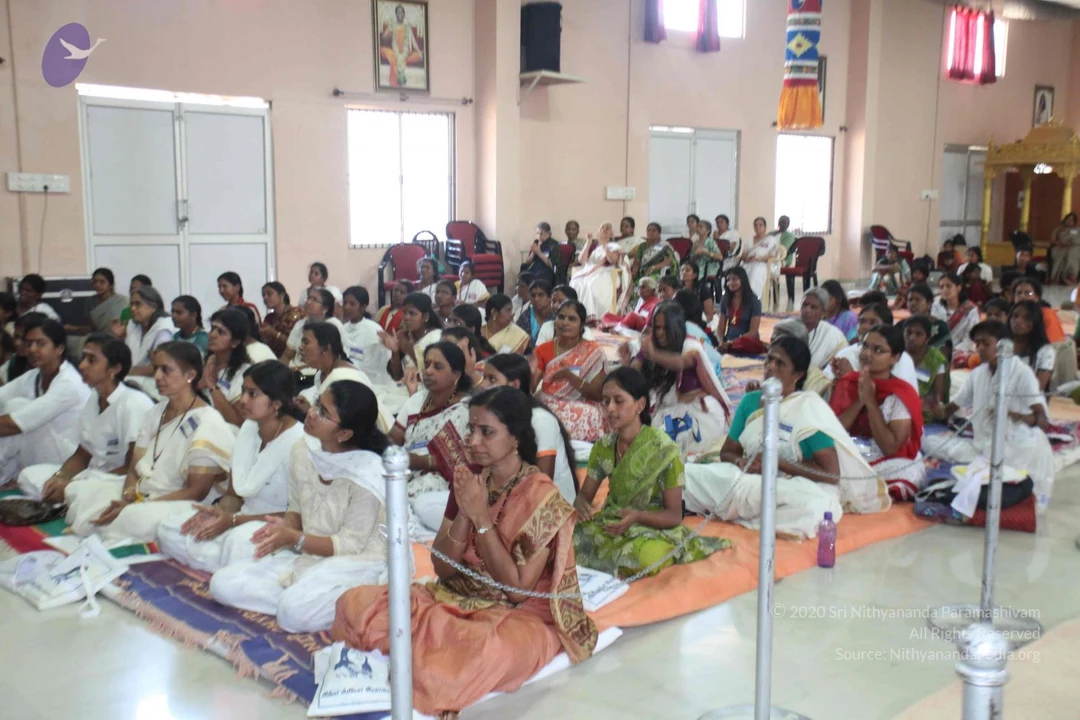
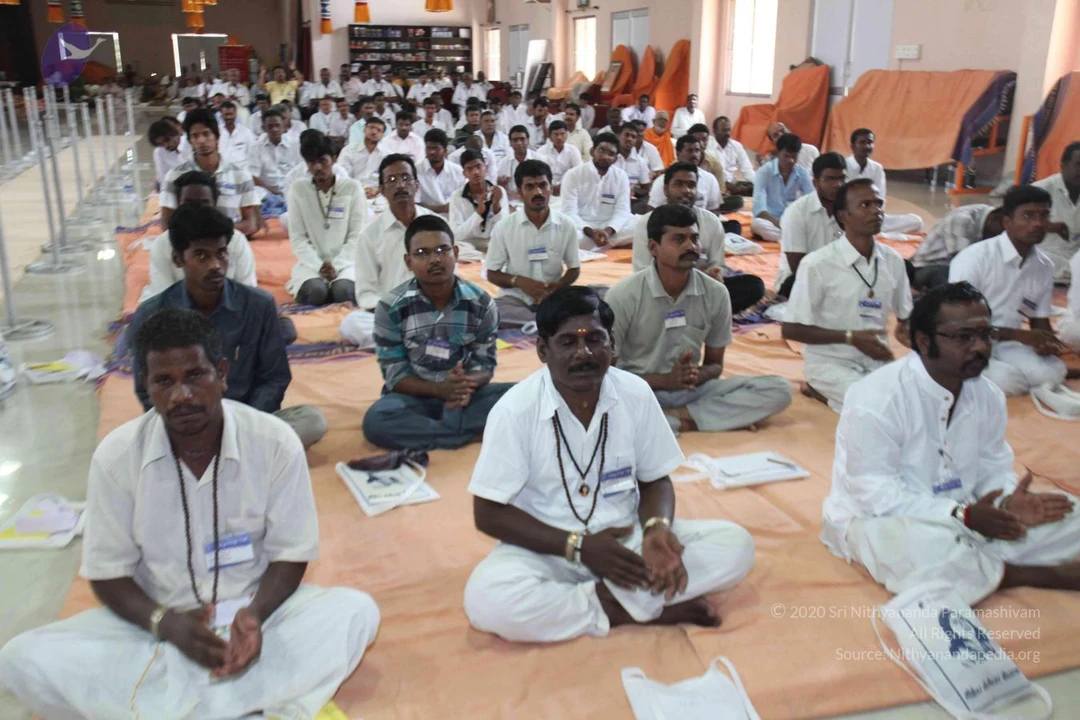
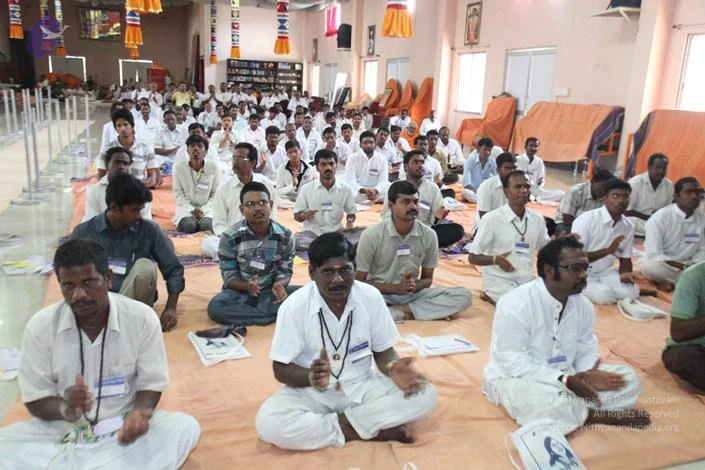
A photograph of a large seated audience during a satsang in an ashram hall with orange floor cloths. Rows of men sit cross-legged on orange and patterned mats, many in white shirts and white dhotis, with name badges clipped to their chests and some with rudraksha malas around their necks. In the foreground a man in a white shirt holds his hands together in prayer, and a man in a grey shirt and a checked shirt sit nearby. Behind them, rows of attendees face forward, with orange saffron cloths draped over chairs along the right wall and shelves of books at the back. No a person candidate is visible.A large hall of seated devotees, mostly men in white shirts and white dhotis, sits on orange and patterned mats in rows facing forward. Several wear rudraksha malas around their necks, and some have their hands folded in namaskar or resting on their knees. Lanyards with name badges hang from many shirts, and small notebooks lie on the mats. Behind them, orange-draped chairs and orange and pink hanging fabric decorate the room, with bookshelves along the back wall. No a person candidate is visibly identifiable in the crowd, so the appearance is uncertain and the scene reads as a satsang audience.A large hall with many seated men in white dhotis and white shirts sits on orange cloth mats in rows, many with hands raised in gesture and some wearing rudraksha malas. In the foreground, a bearded man in white with a rudraksha mala and a gold chain sits with palms together, while a man in grey shirt and a man in plaid shirt sit nearby. Orange draped cloths lie over seating at right, and orange-and-white hanging ornaments decorate the ceiling. Participants wear name badges on their shirts. The setting appears to be a satsang gathering, with no clearly visible a person in the frame.A photograph of a large satsang hall where many women devotees sit cross-legged on mats and cloth on the floor, facing a raised area at the front. Many wear white or cream saris with white blouses, while others wear orange, red, green and pink saris. Several have hands folded in namaste. A woman in a front row wears an orange sari and holds a small paper booklet, and a woman beside her wears a green sari. Behind the seated rows, a few women stand or sit on chairs near the wall. On the wall are a framed portrait of a seated figure, a hanging striped cloth, and a gilded ornate canopy or throne at the right edge. Metal stanchions with chain barriers separate the seating area, and white double doors and windows line the back wall.A large seated group of men in white ritual clothes sits cross-legged on orange cloth mats in a hall, attending satsang. Many wear white shirts and dhotis, and several have rudraksha malas and name badges clipped to their shirts. Some have hands folded in prayer or resting on their knees, and a row of orange-draped seating and metal barriers lines the room. Foreground devotees have sandalwood or kumkum marks on their foreheads. No individual is clearly identifiable as a person in this crowd.

AKASHIC-READINGS
25 photosSource gallery
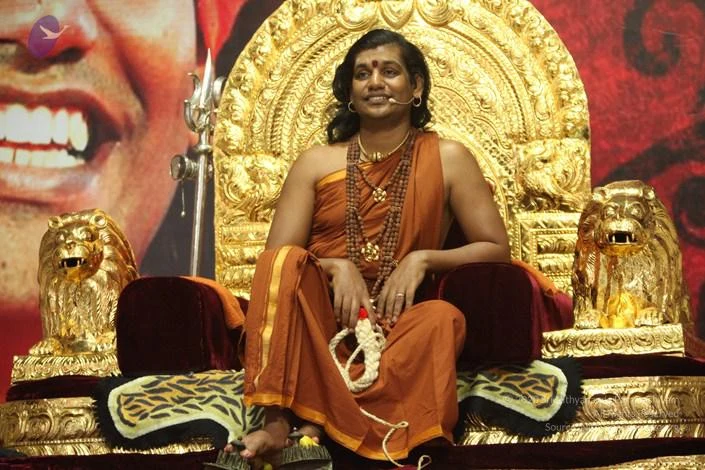
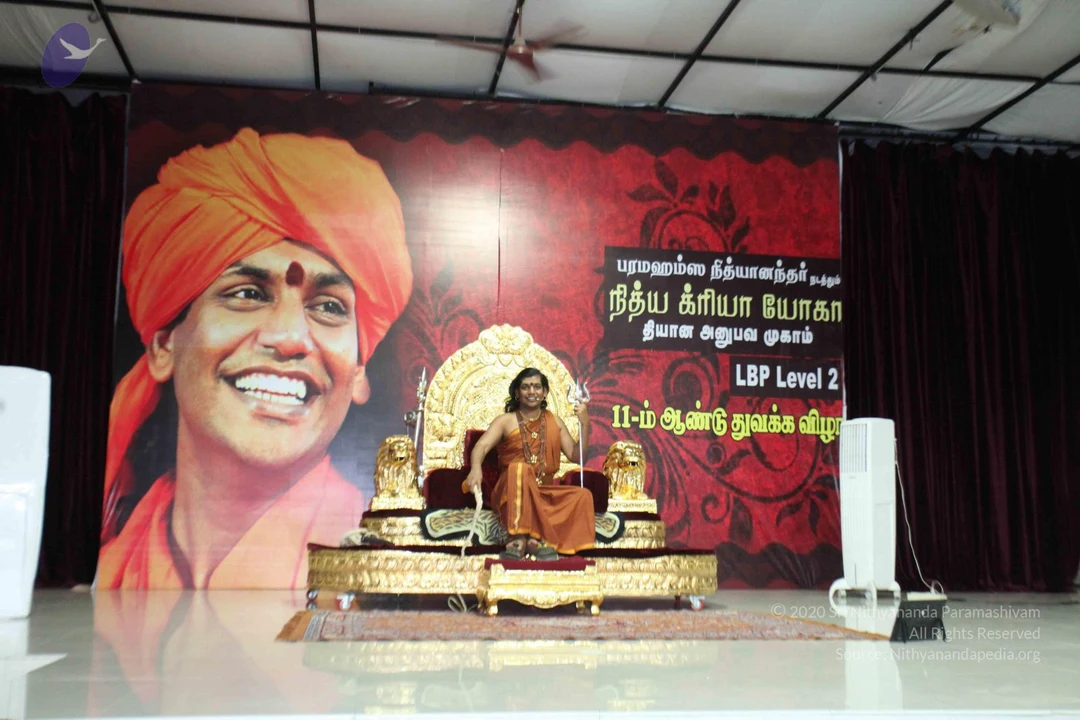
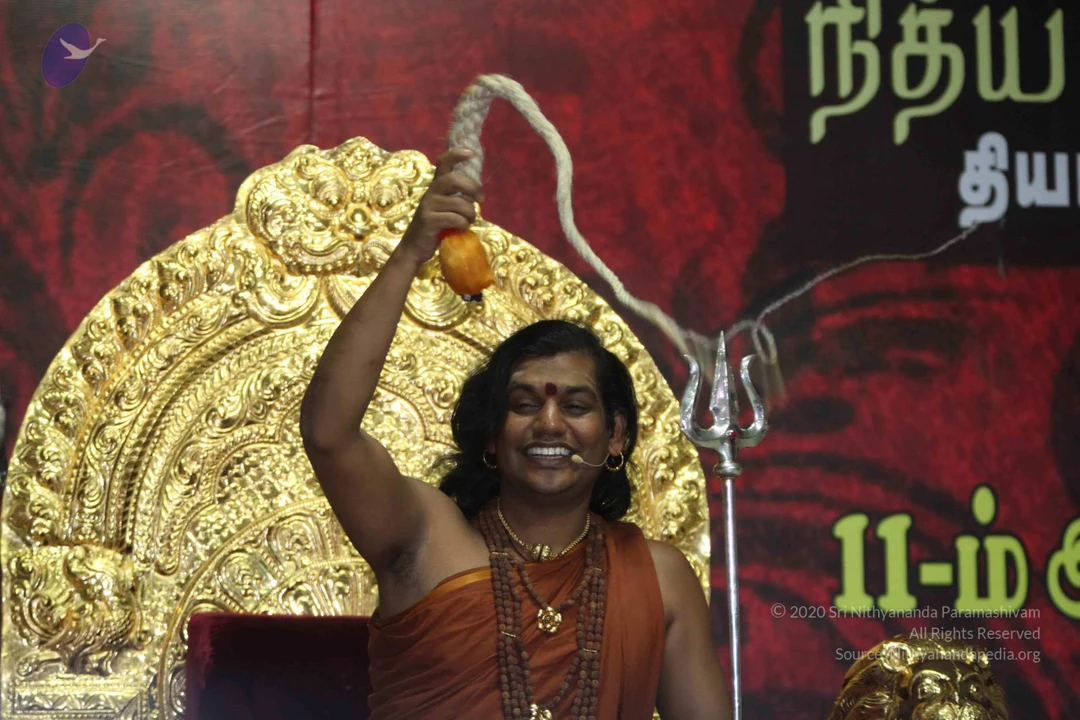
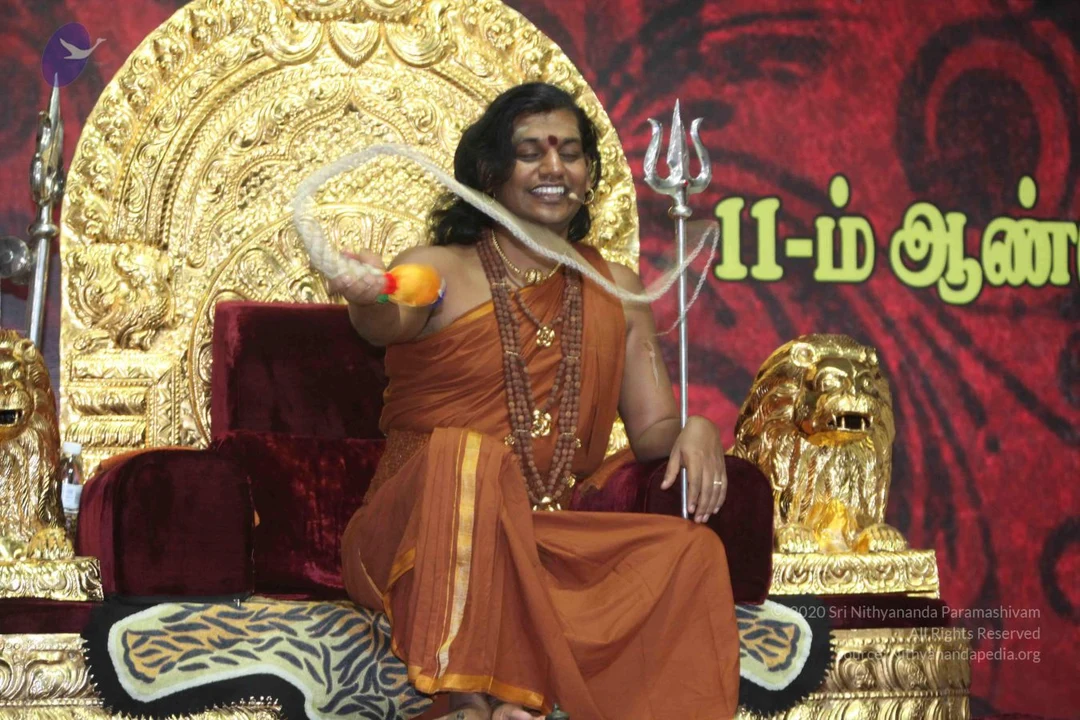
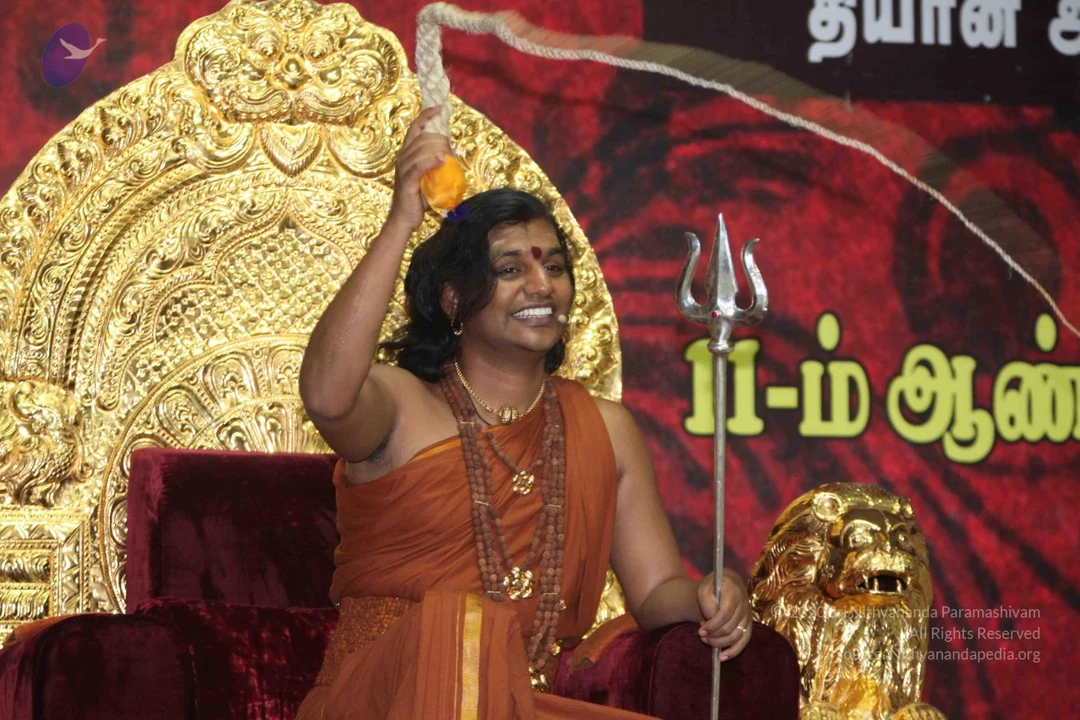
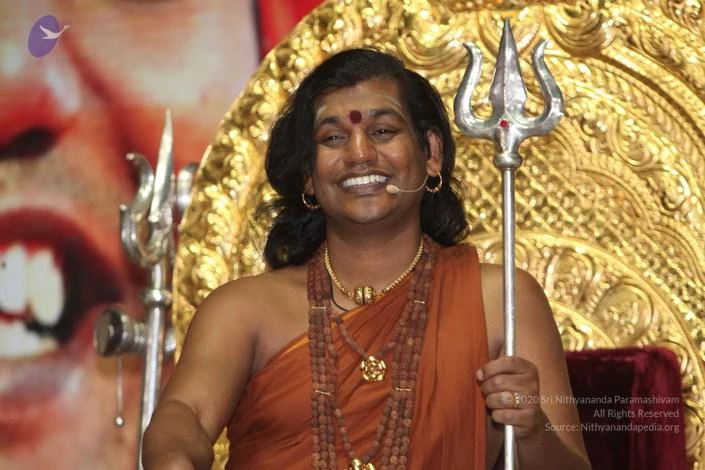
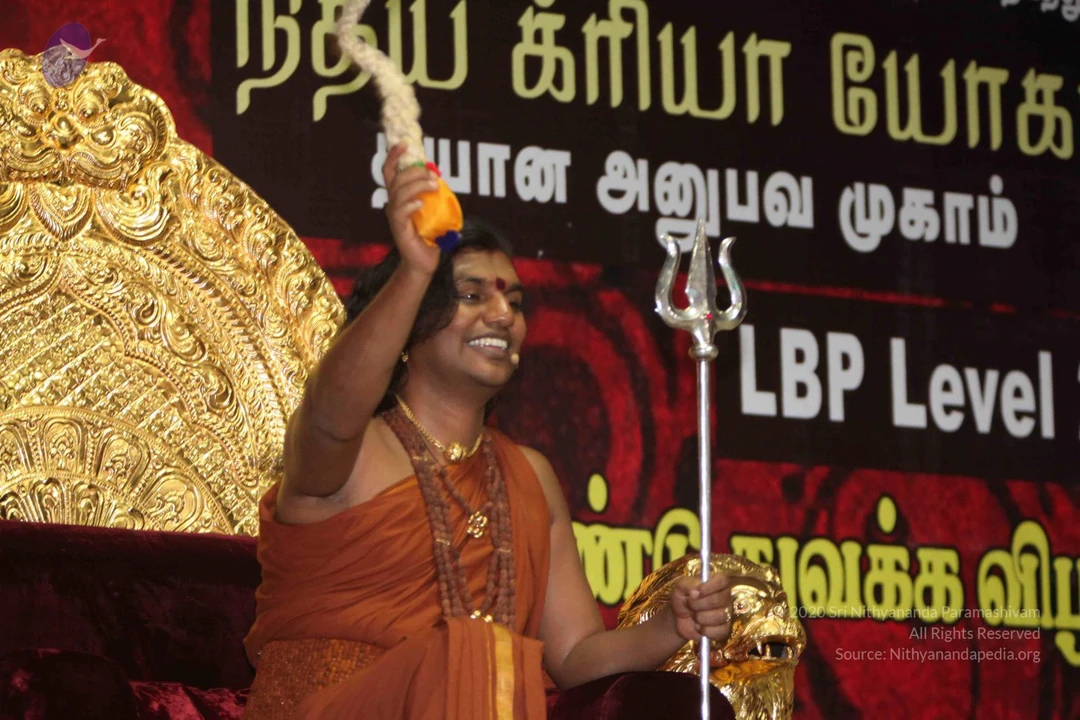
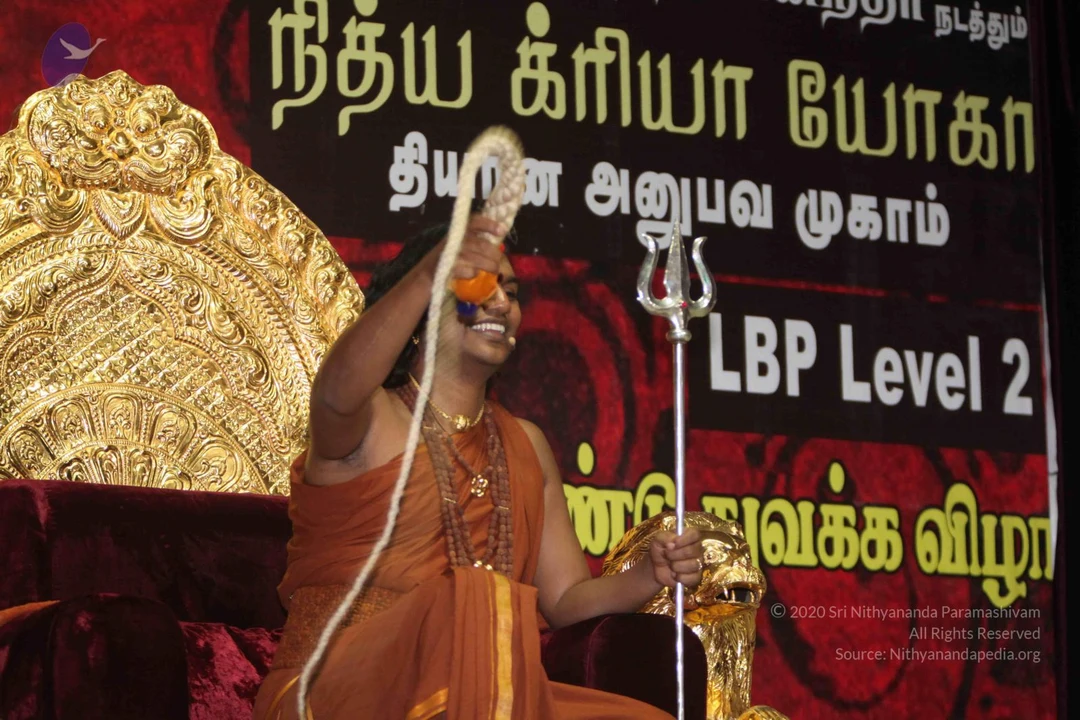
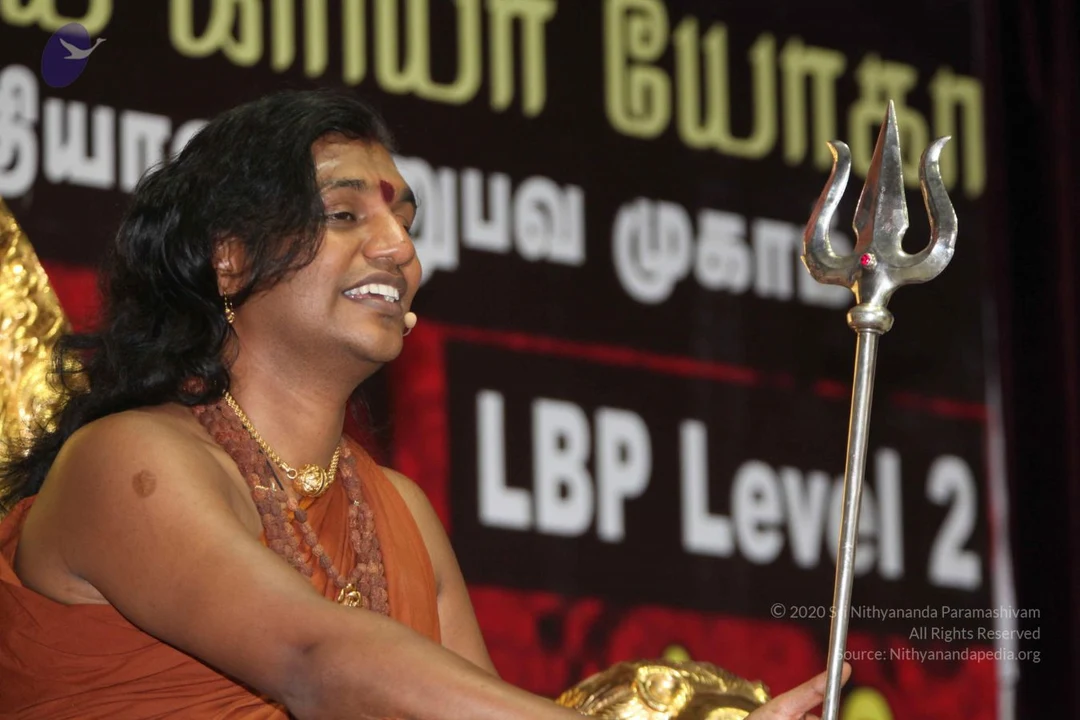
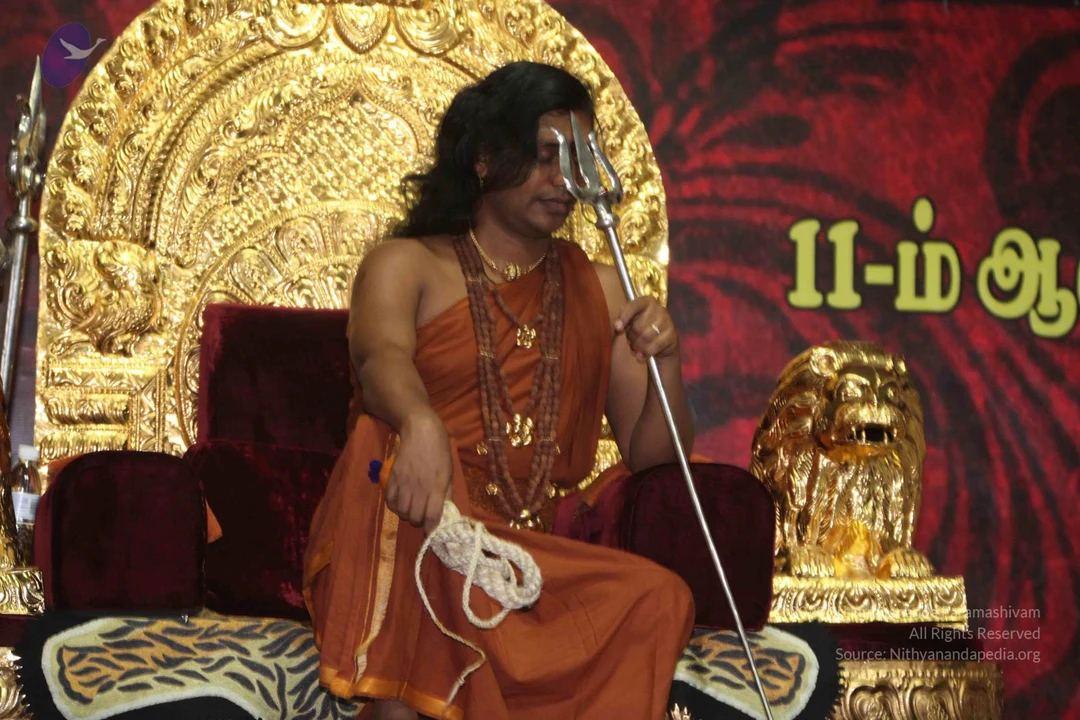
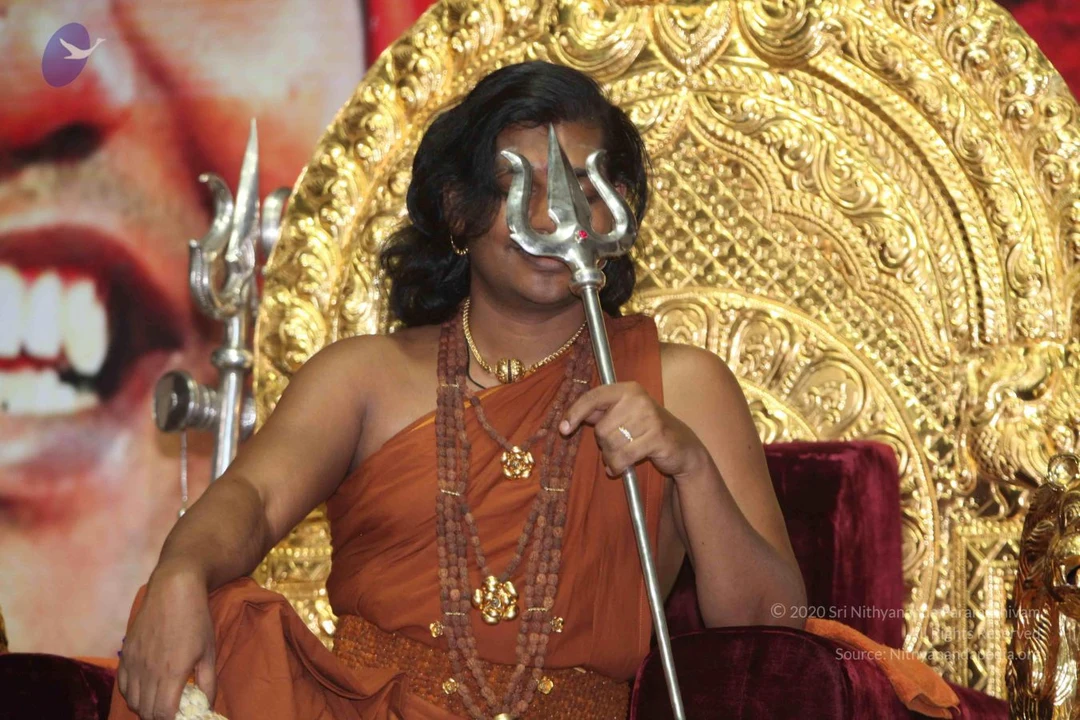
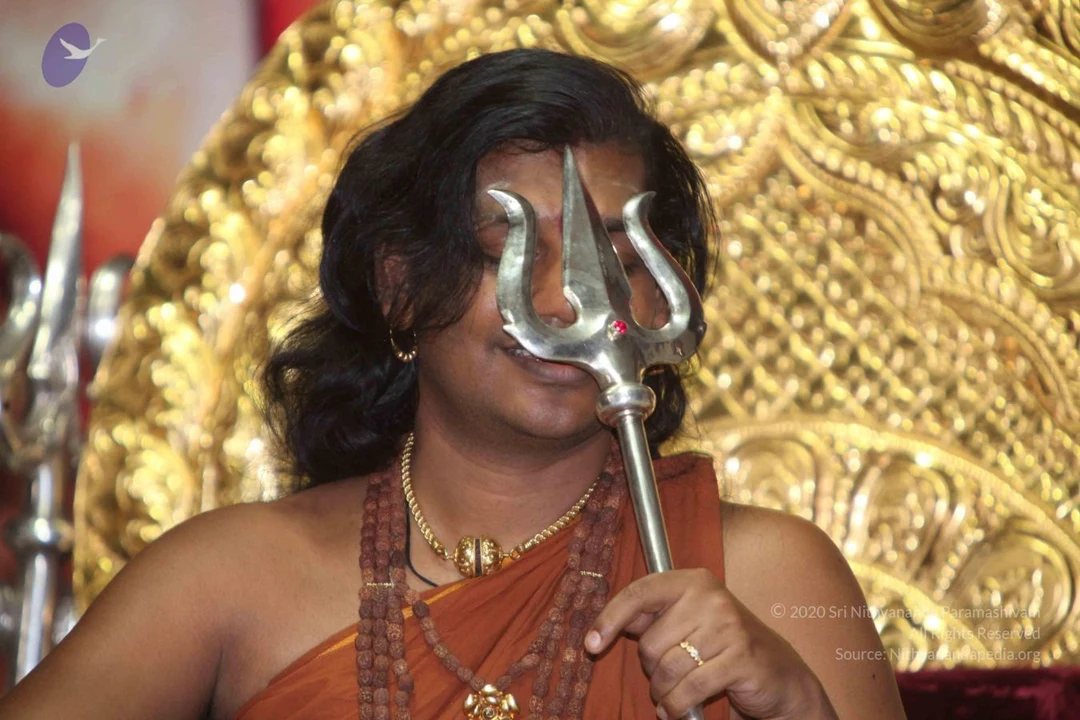
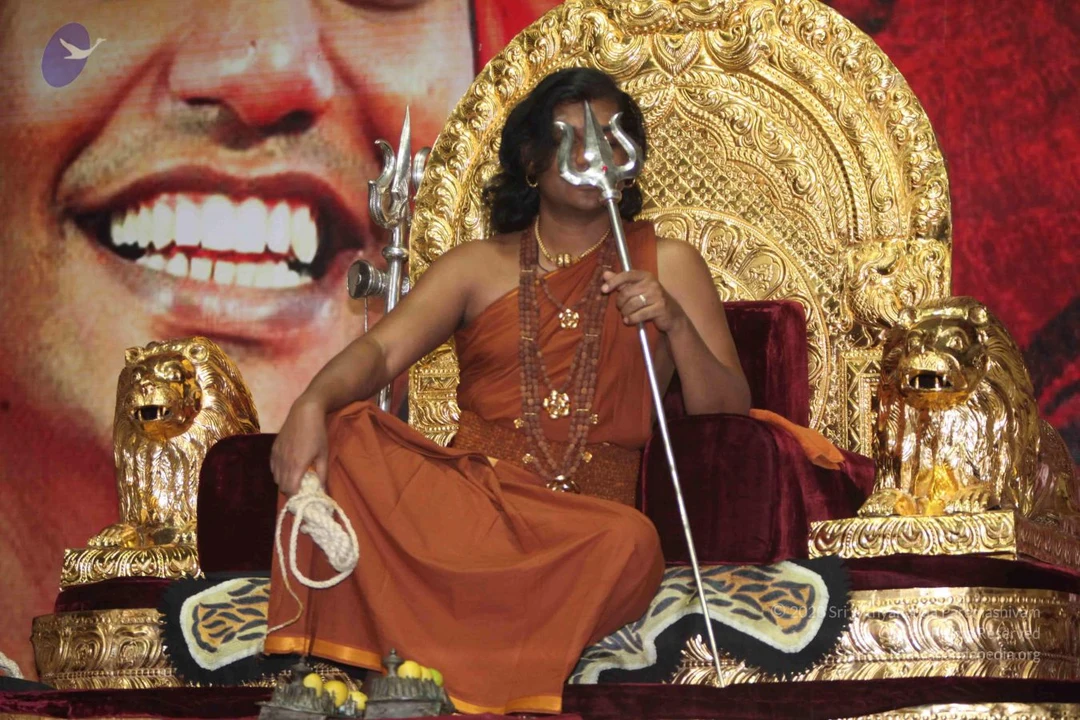
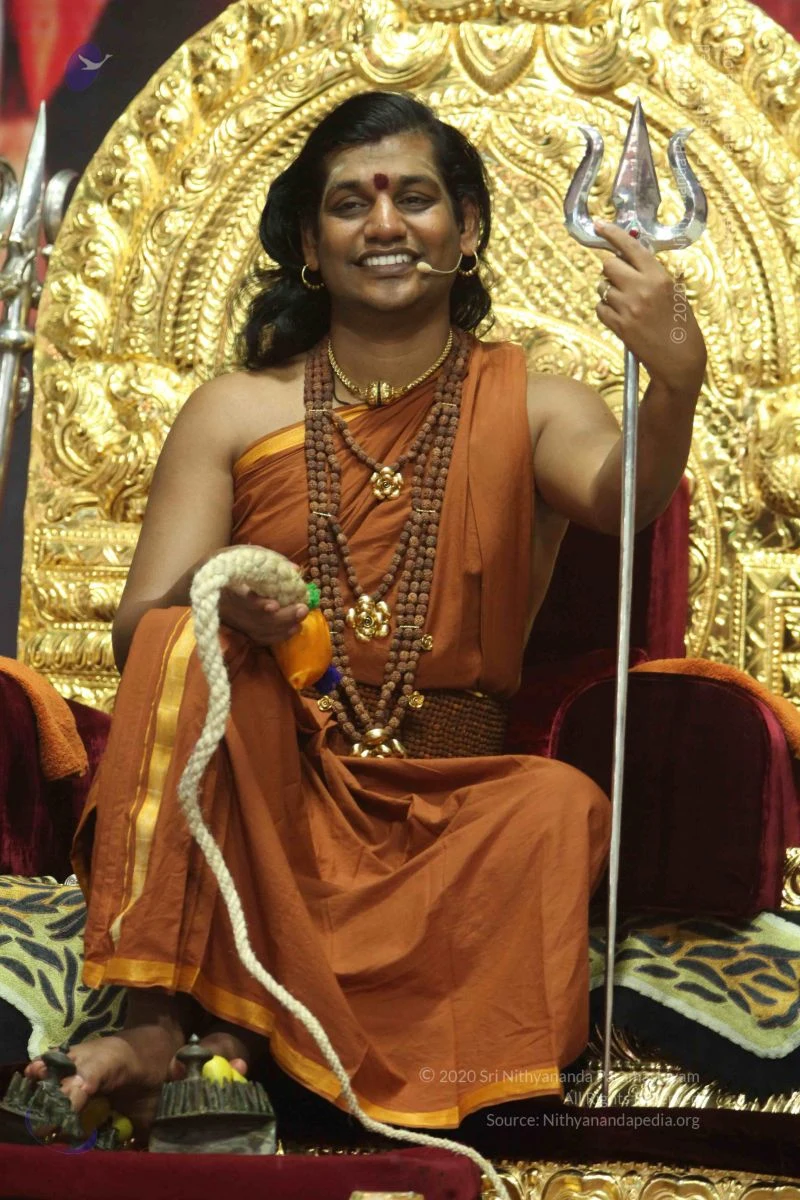
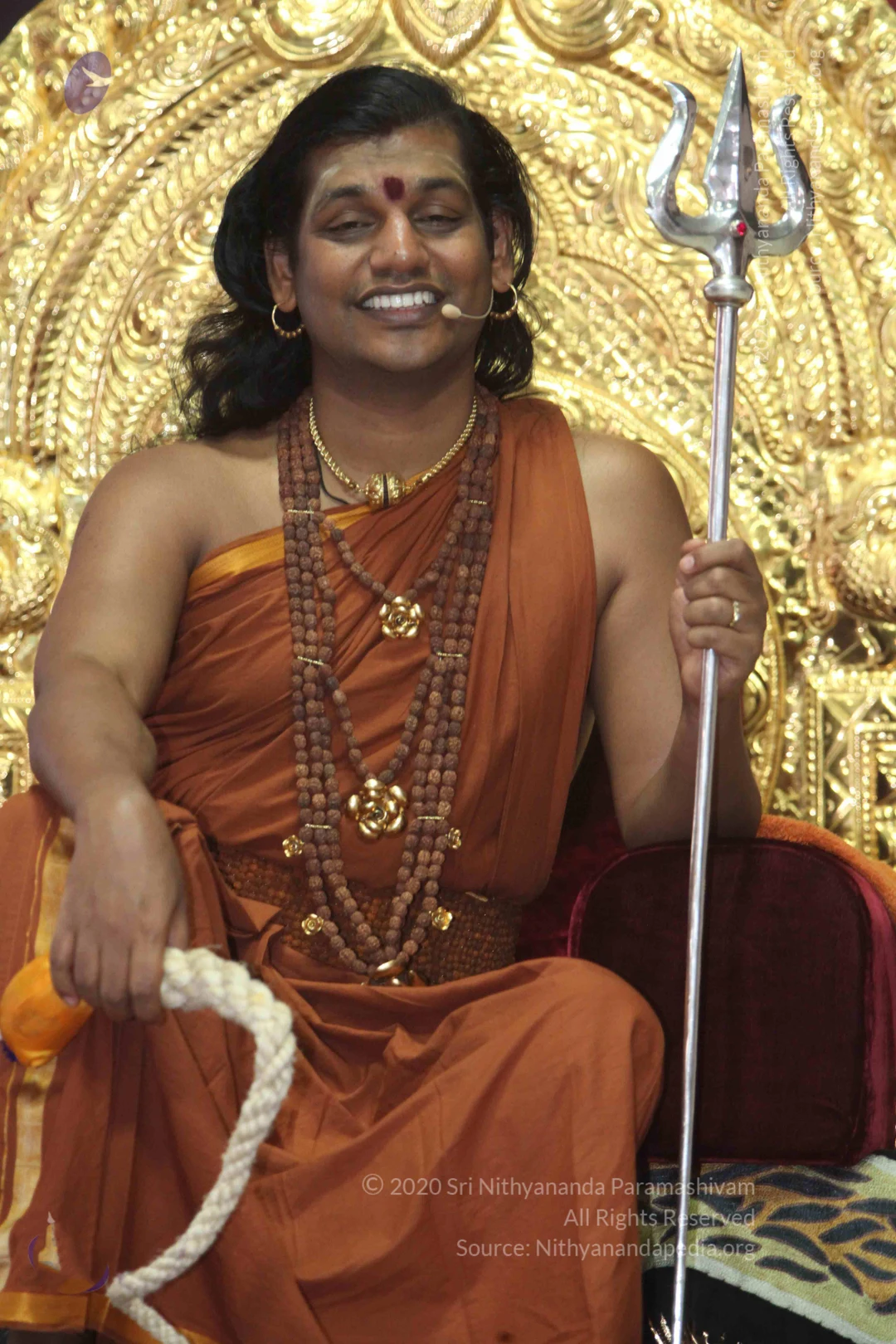
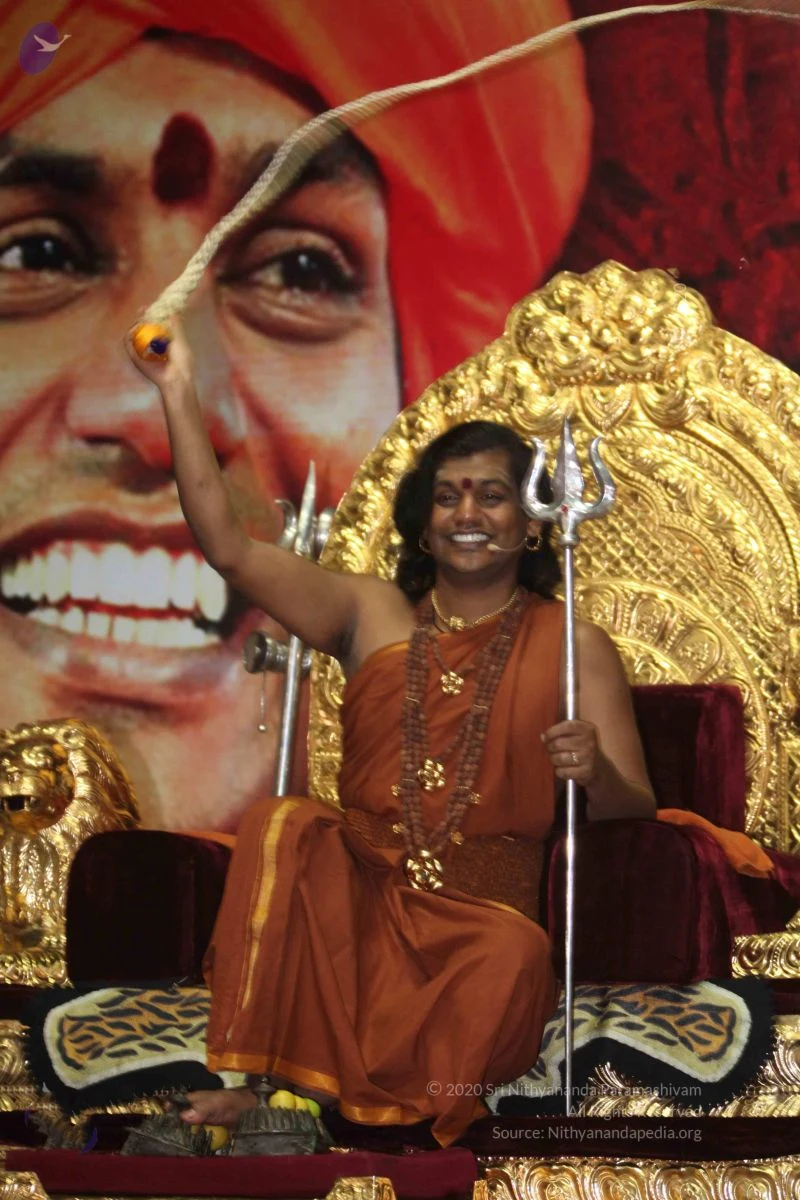
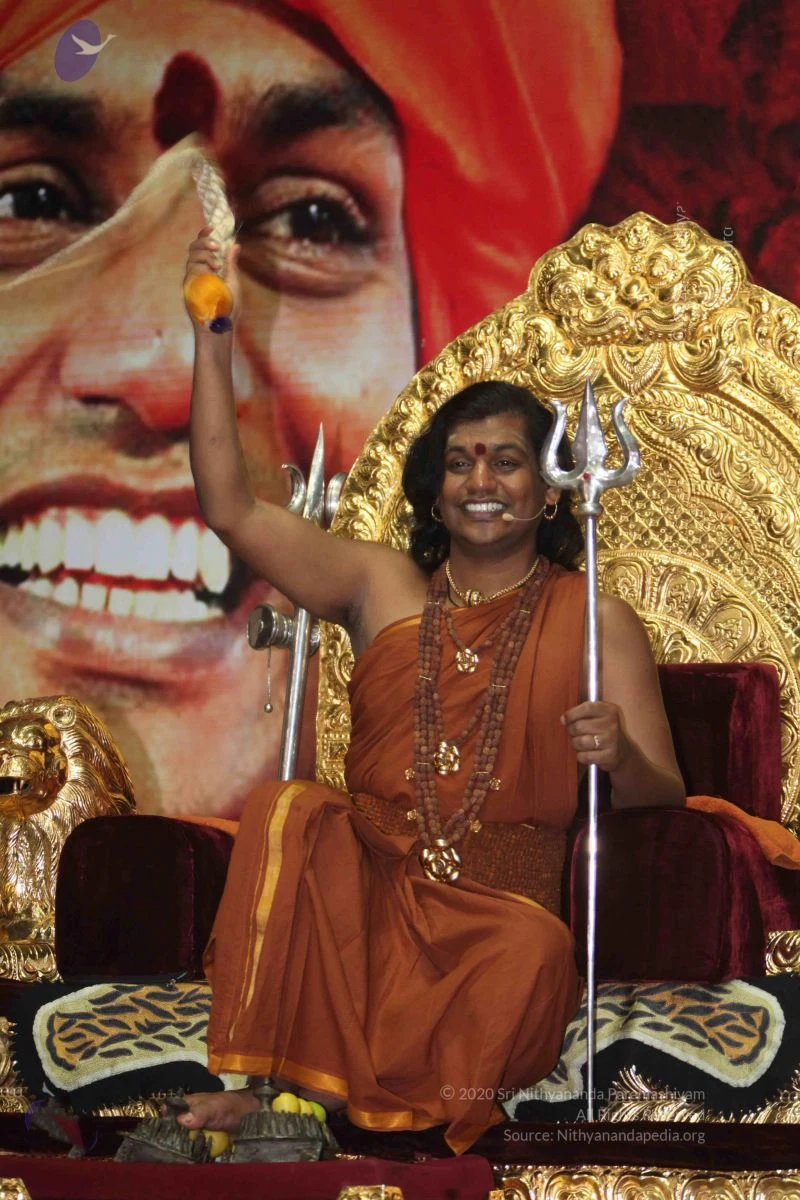
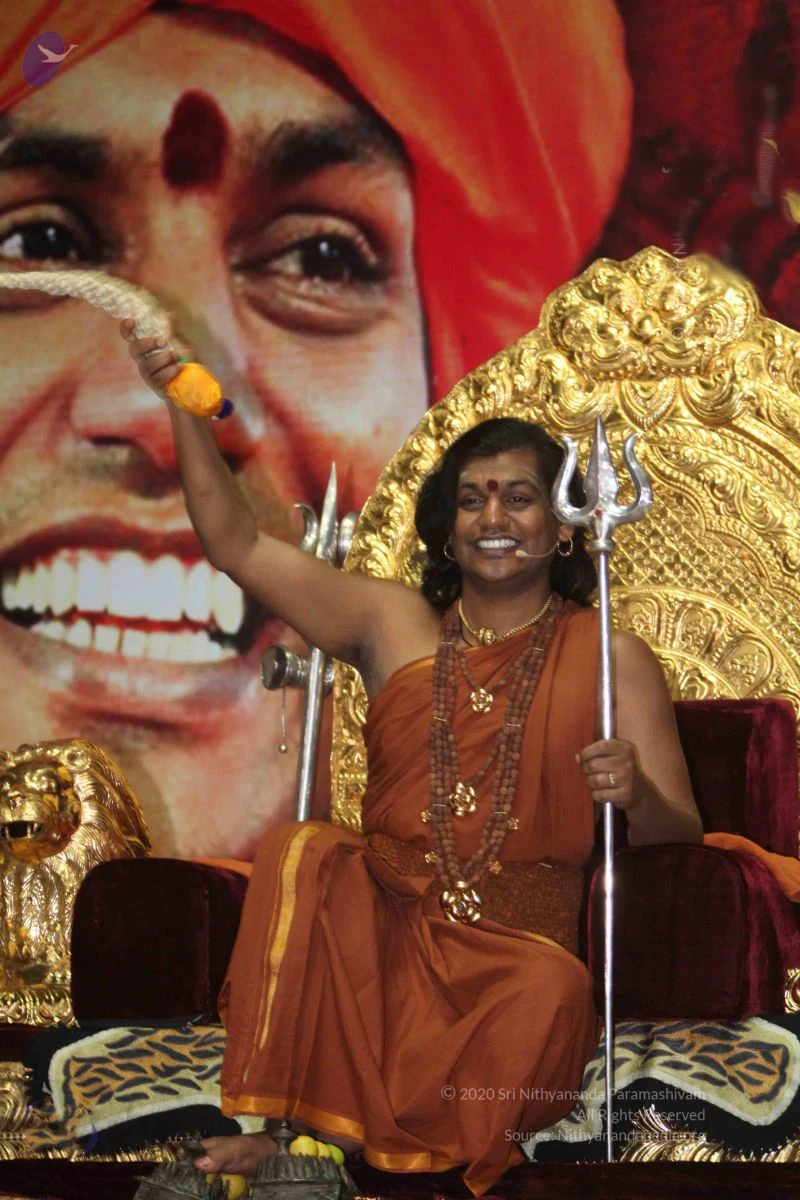
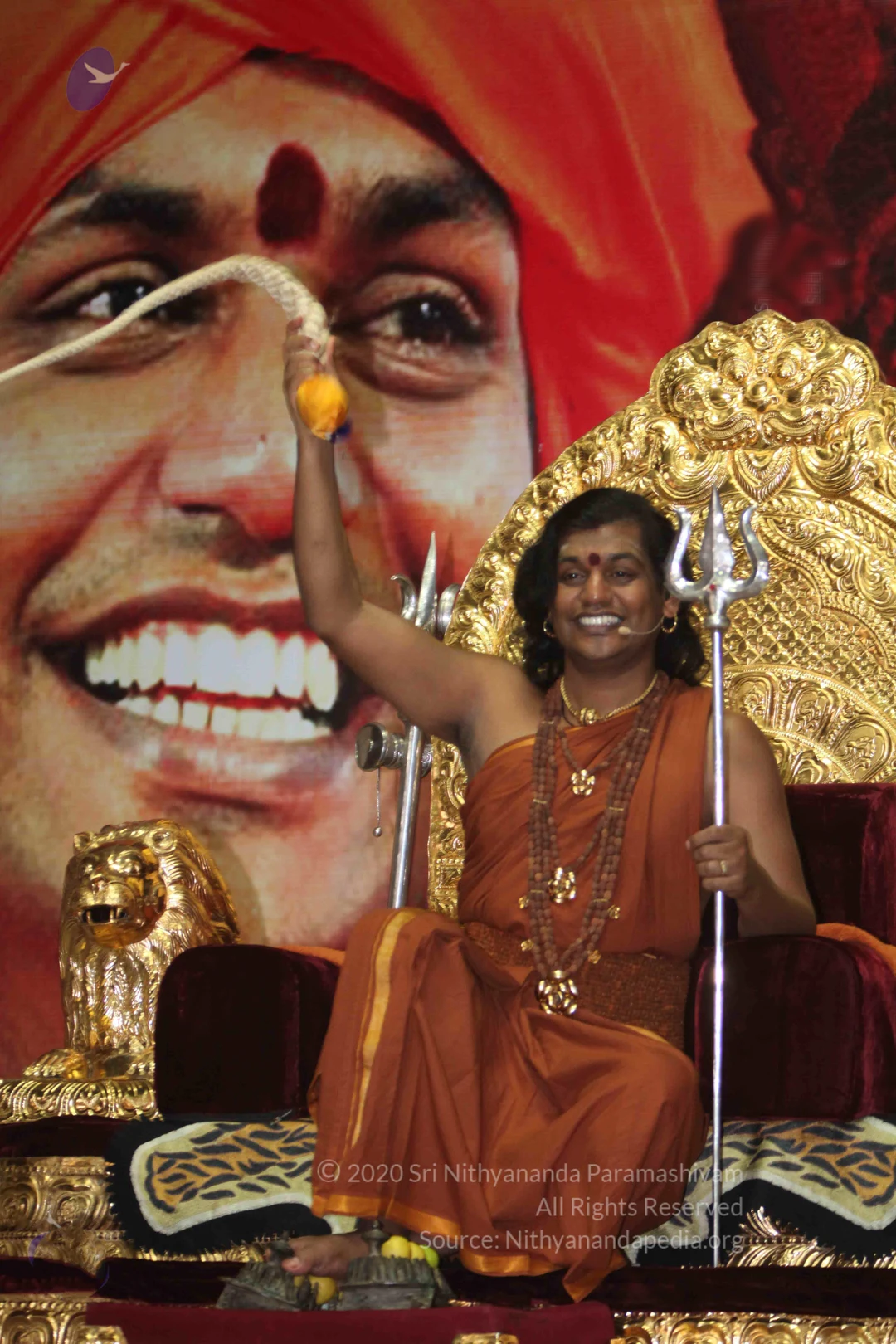
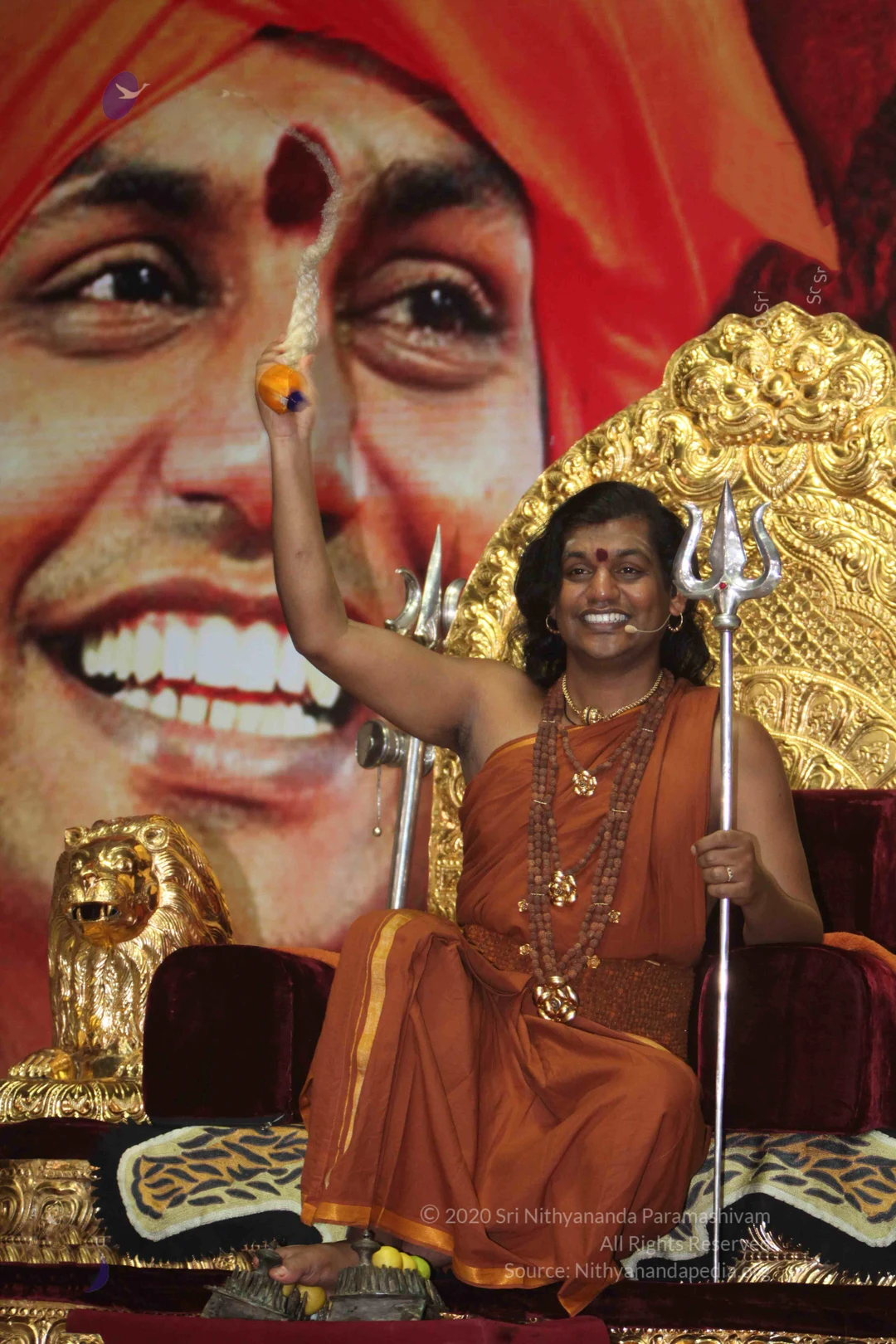
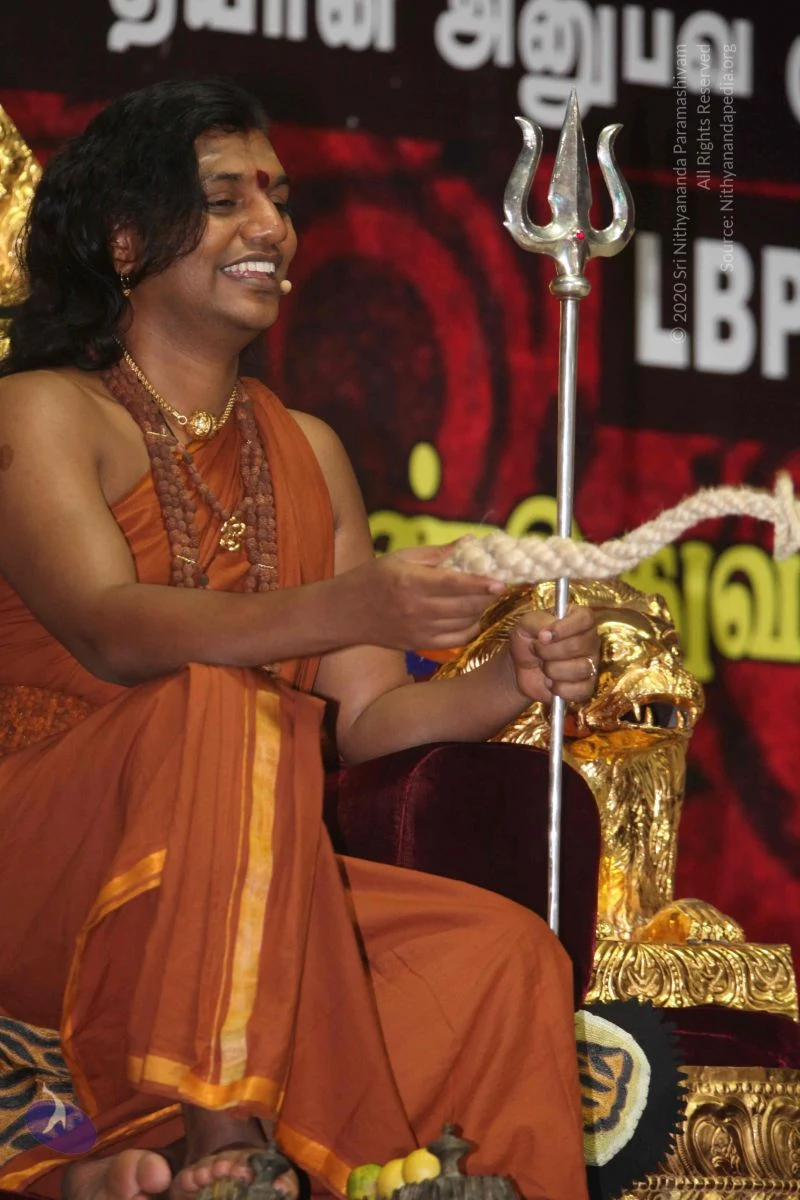
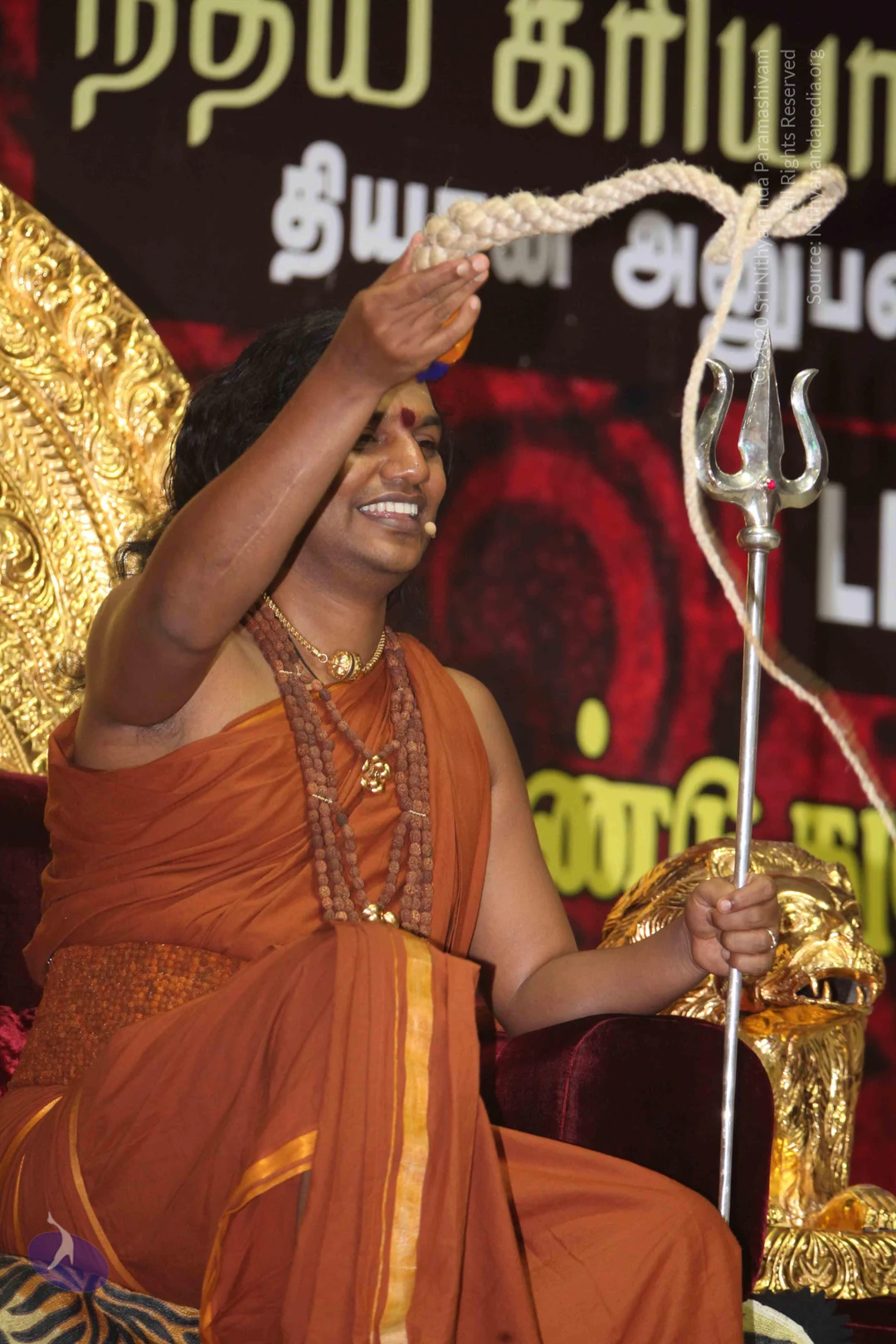
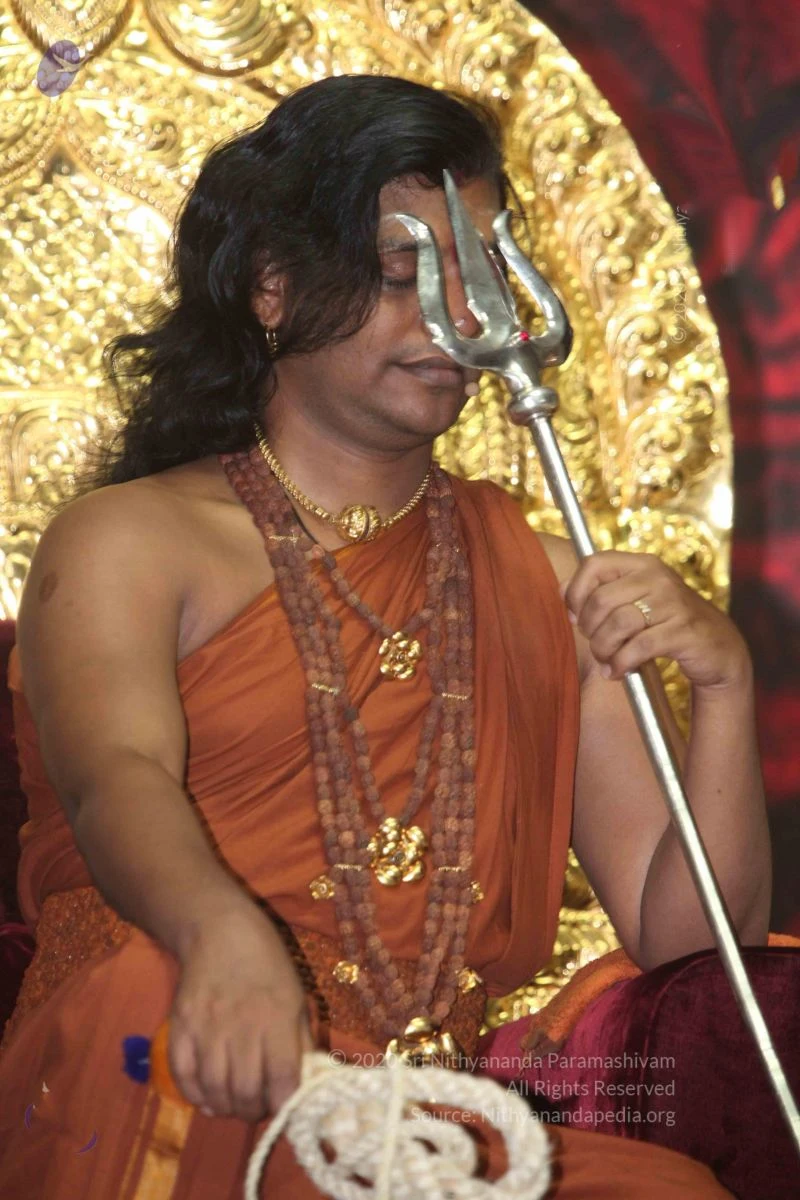
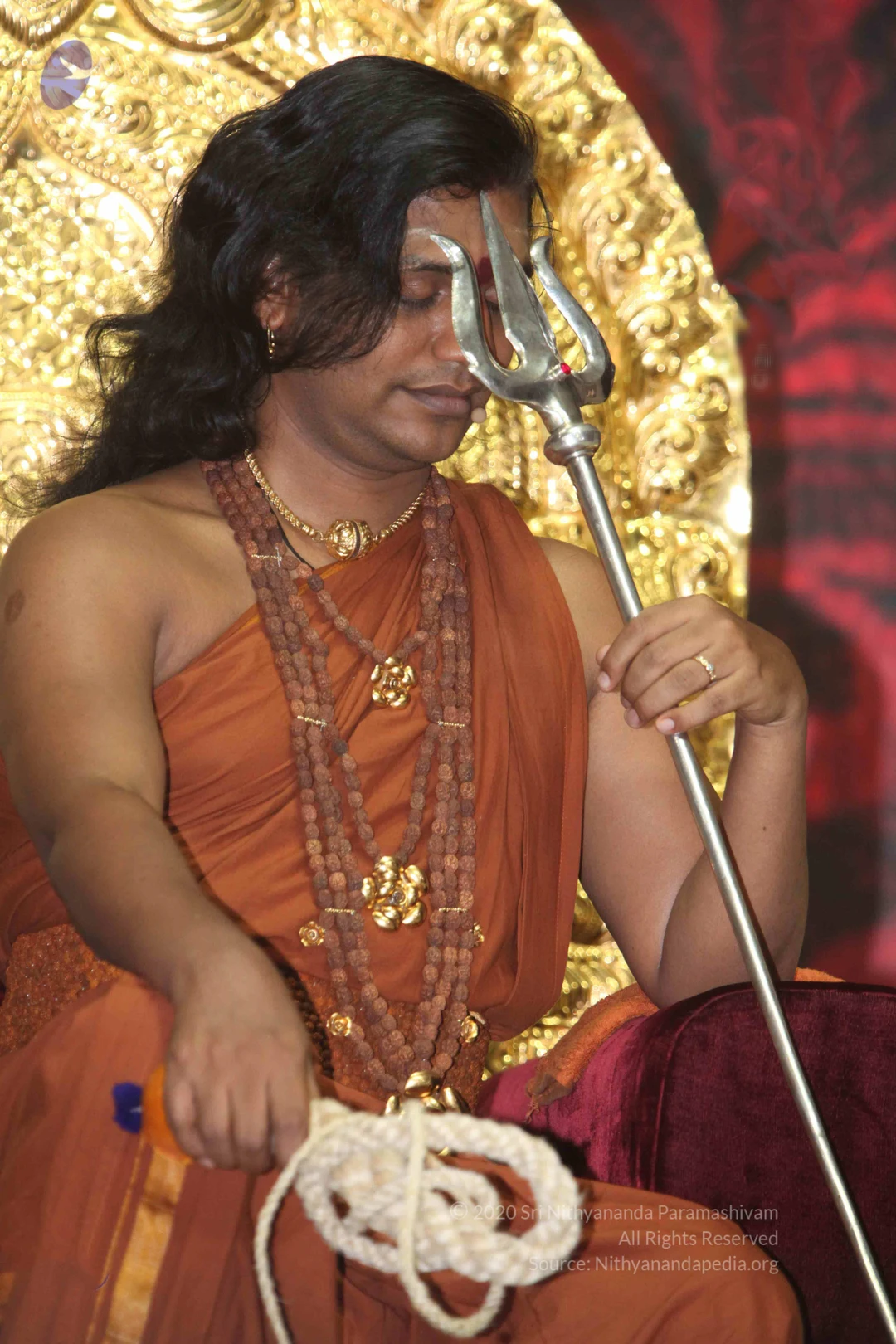
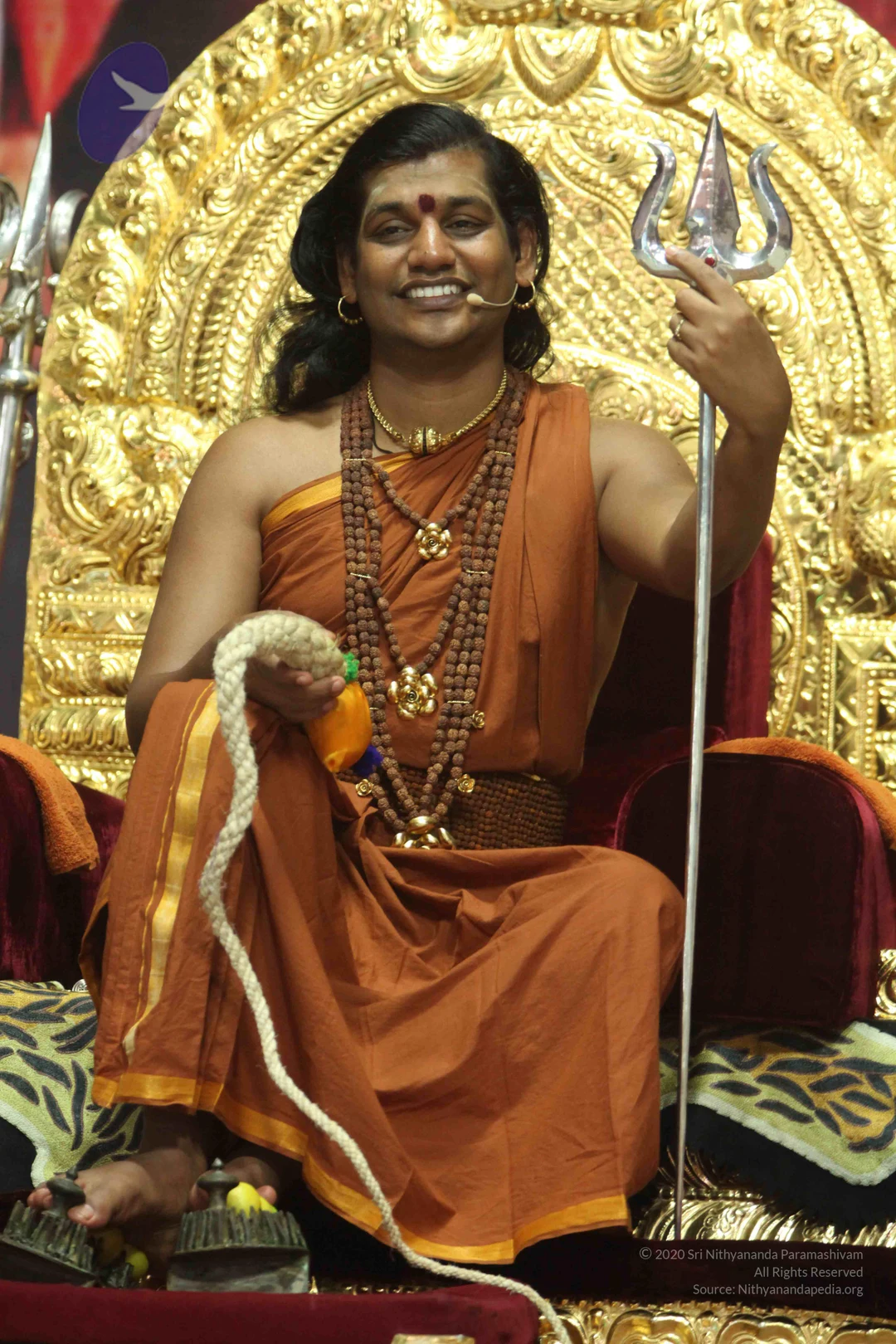
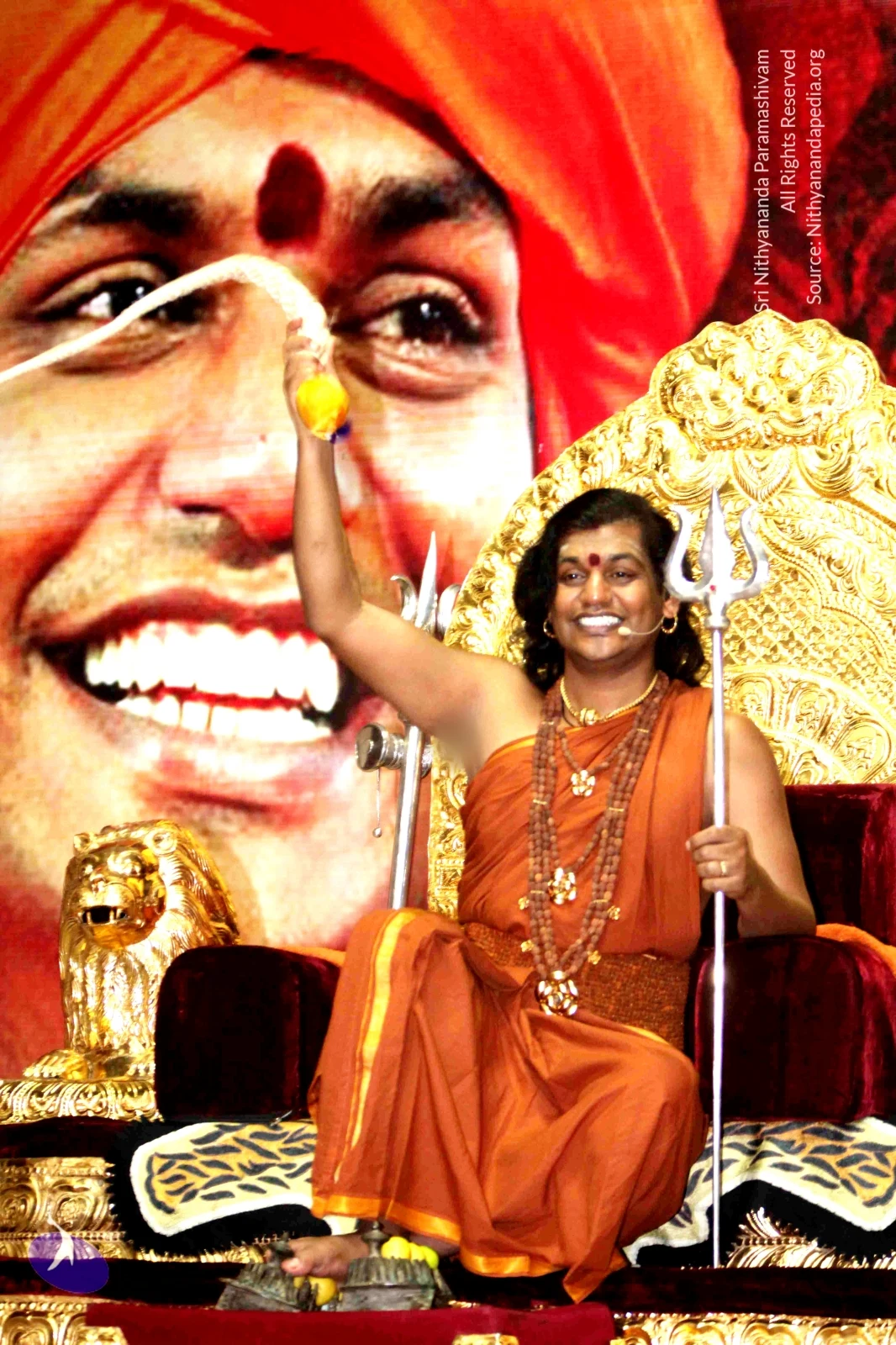
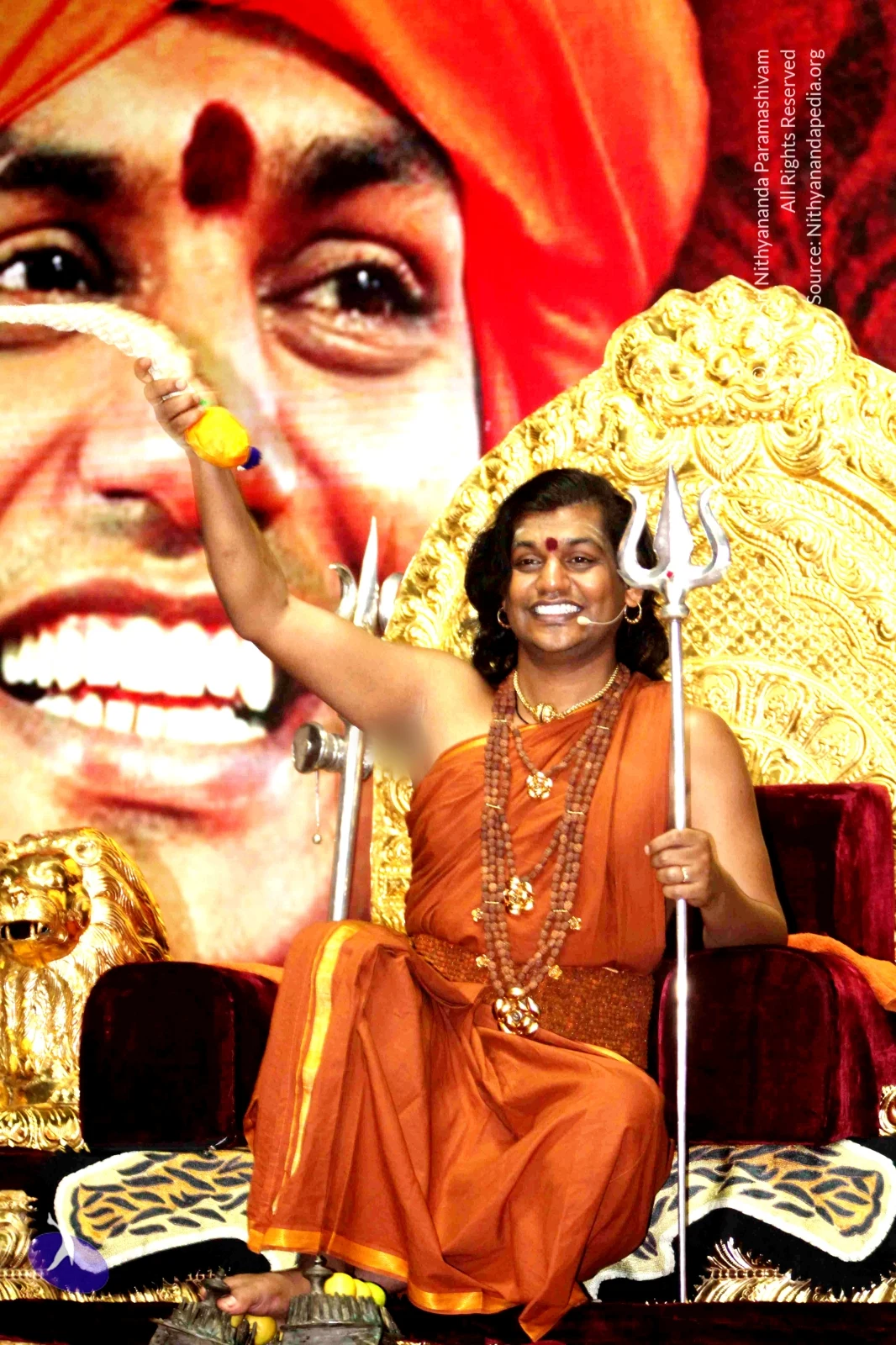
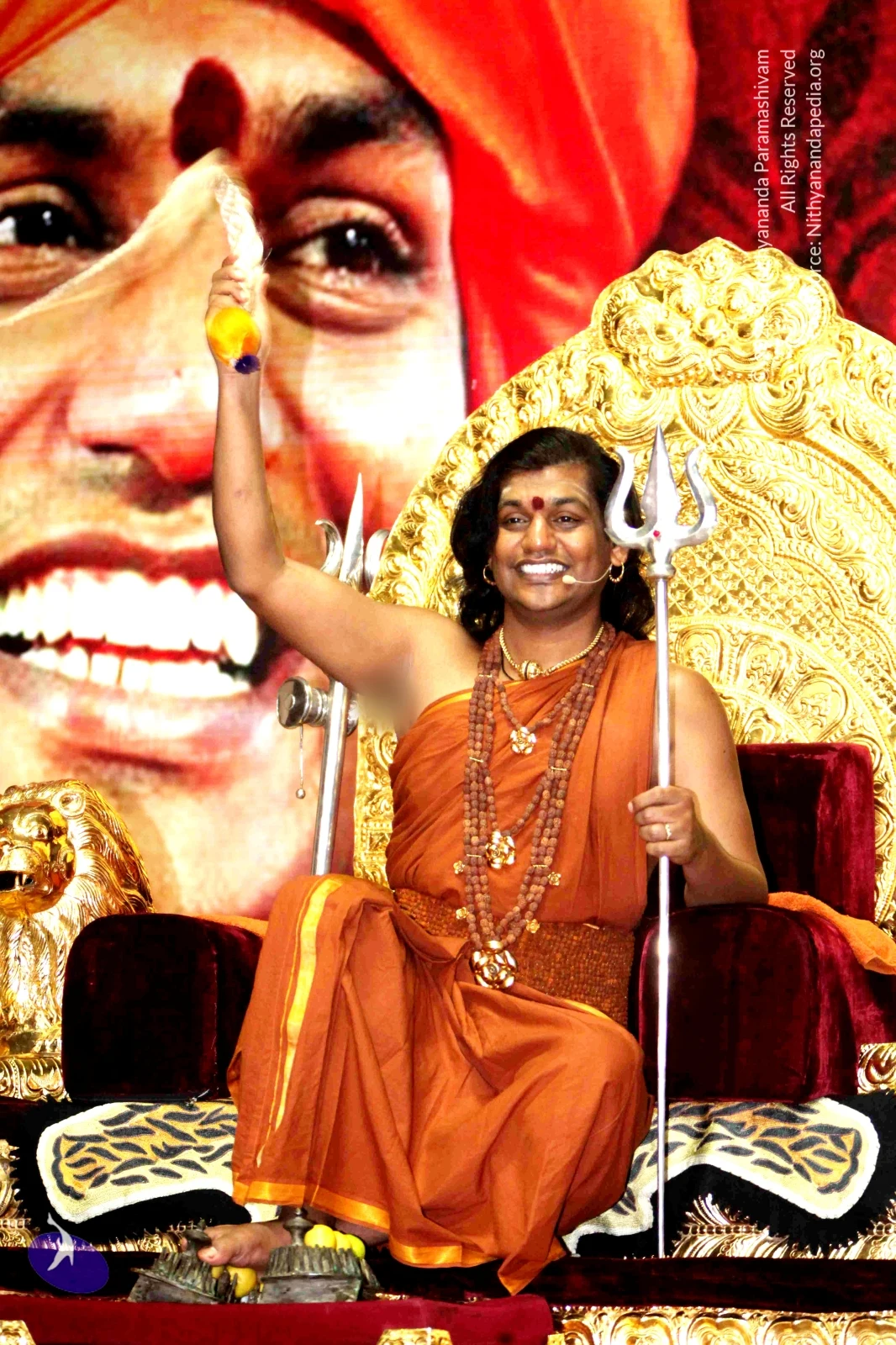
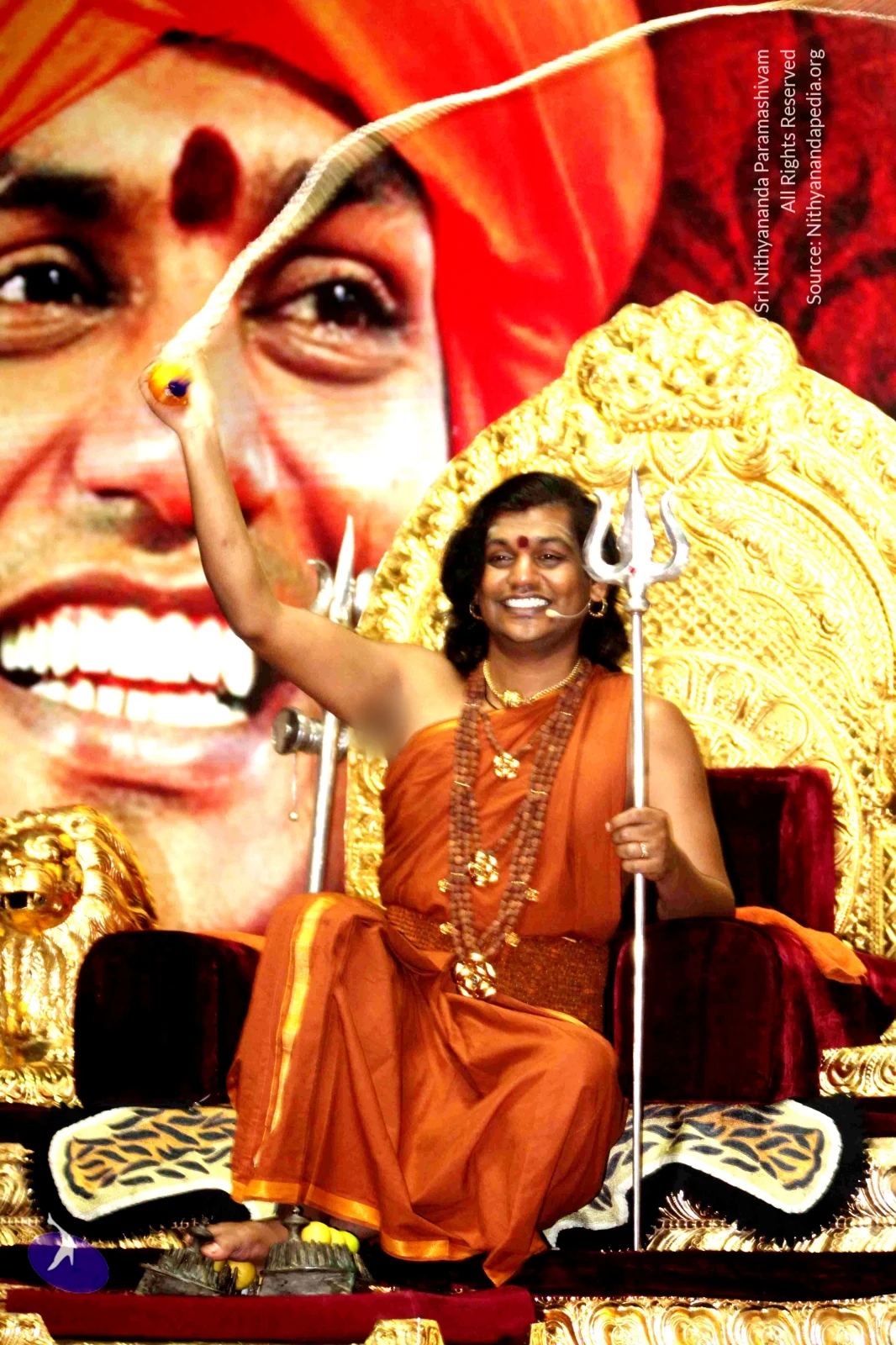
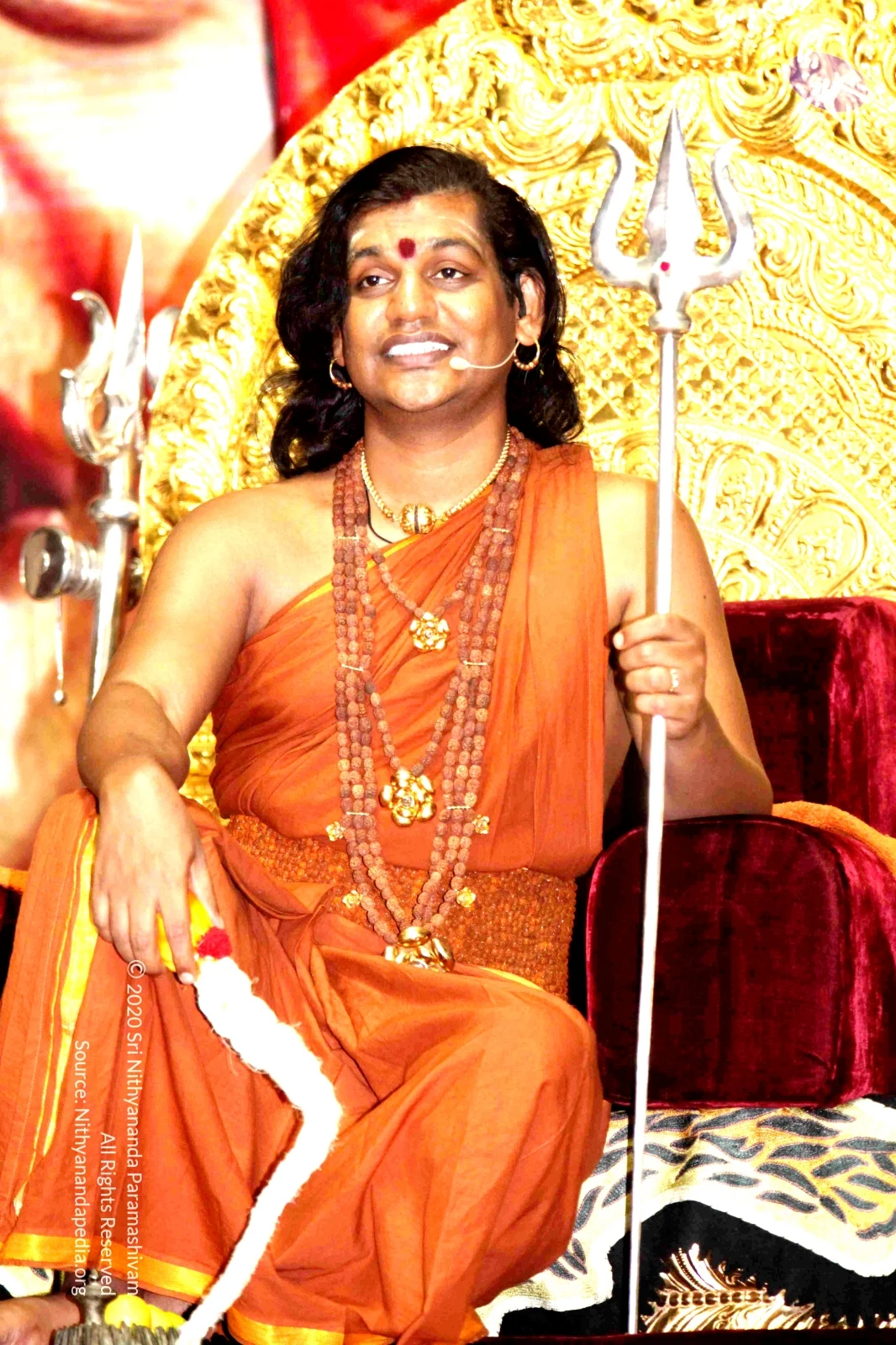
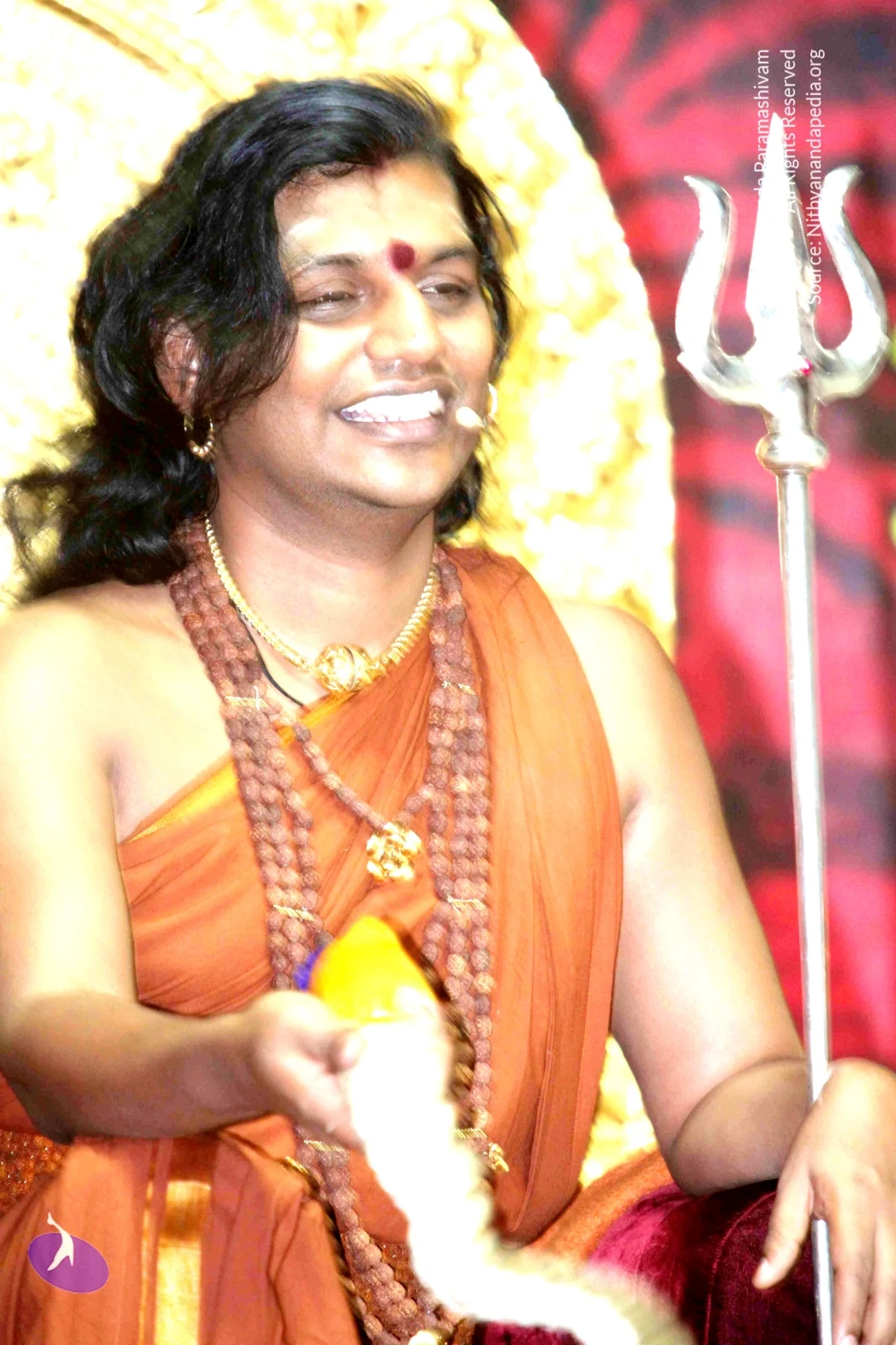
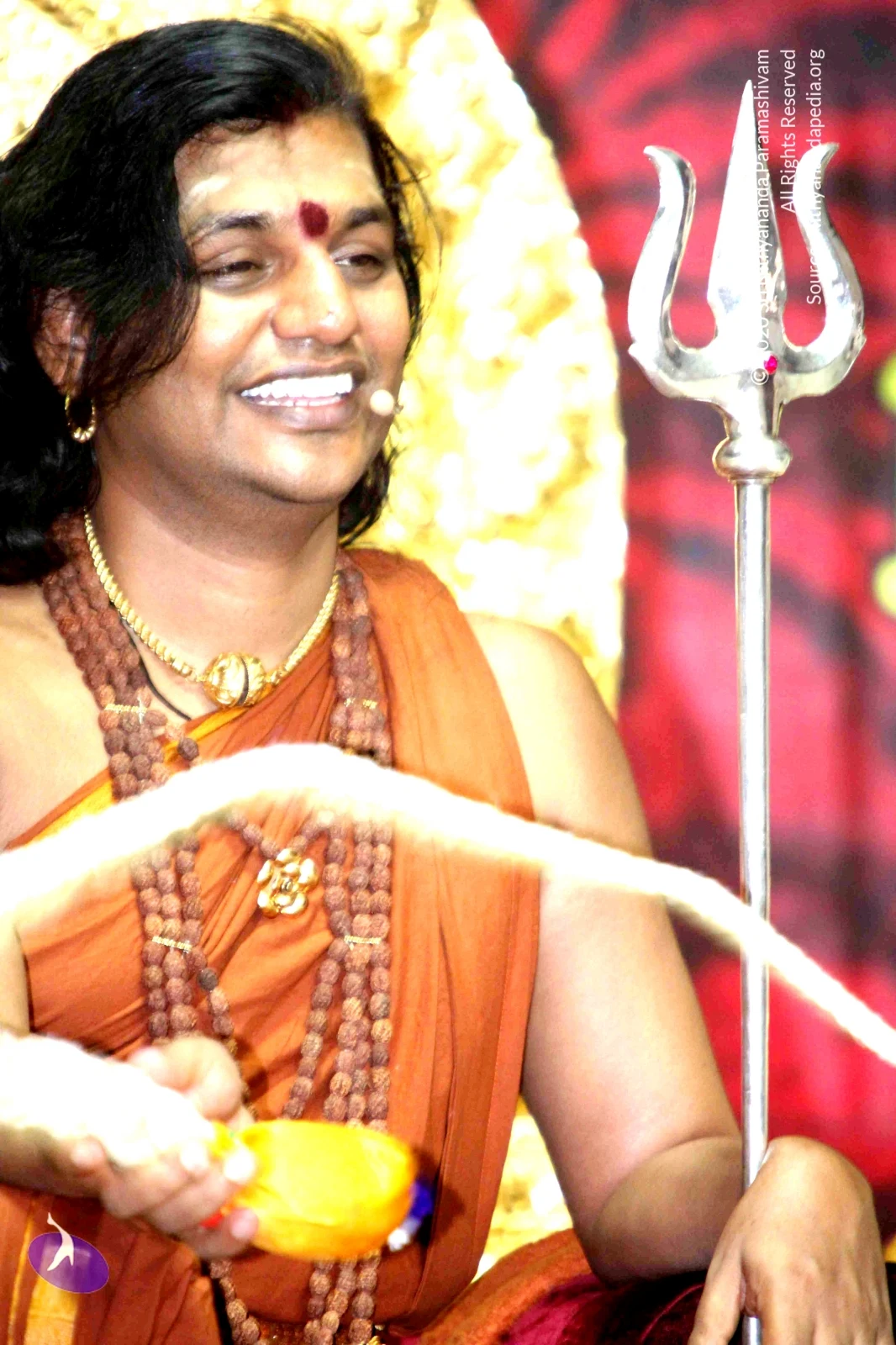
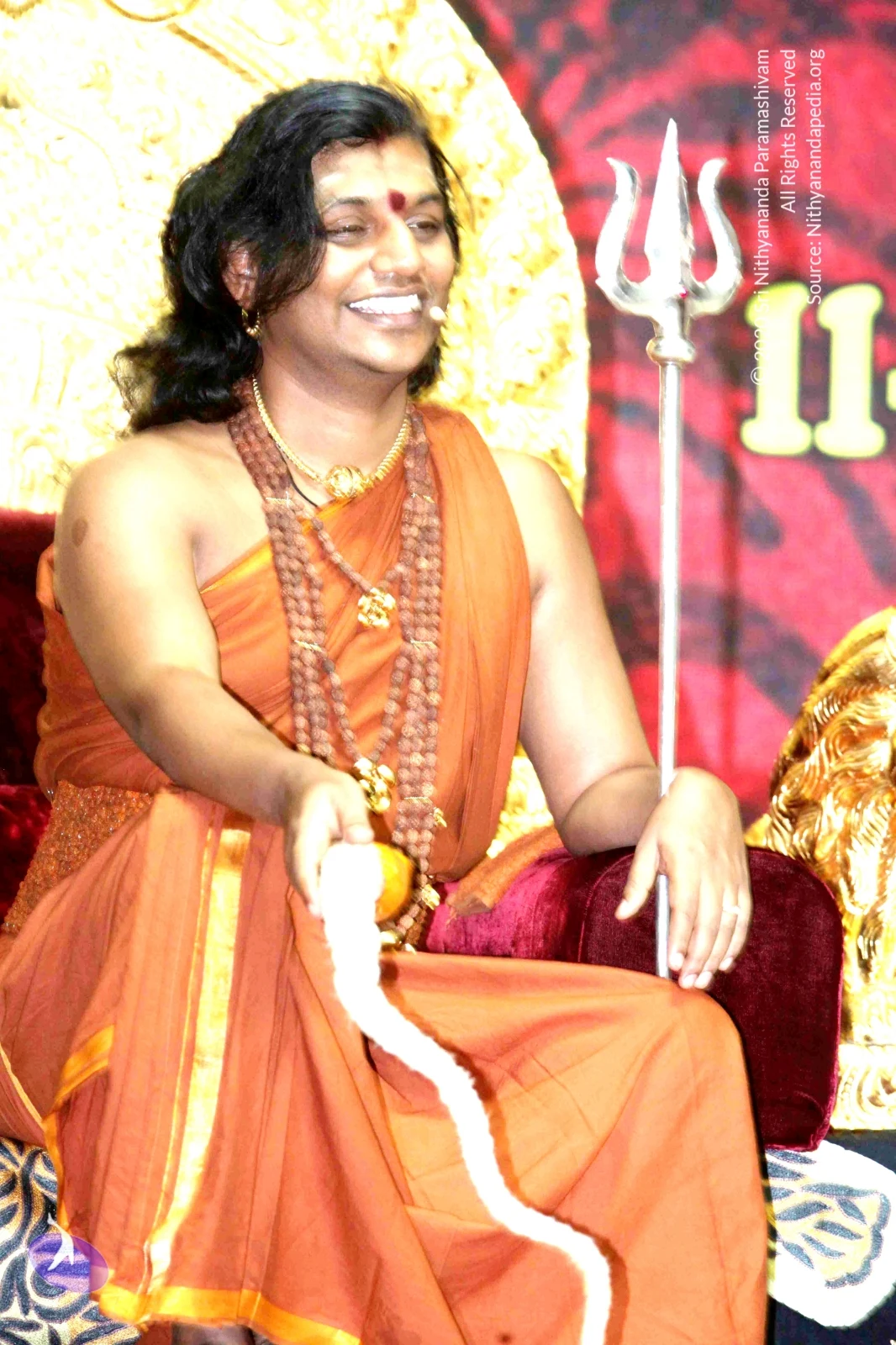
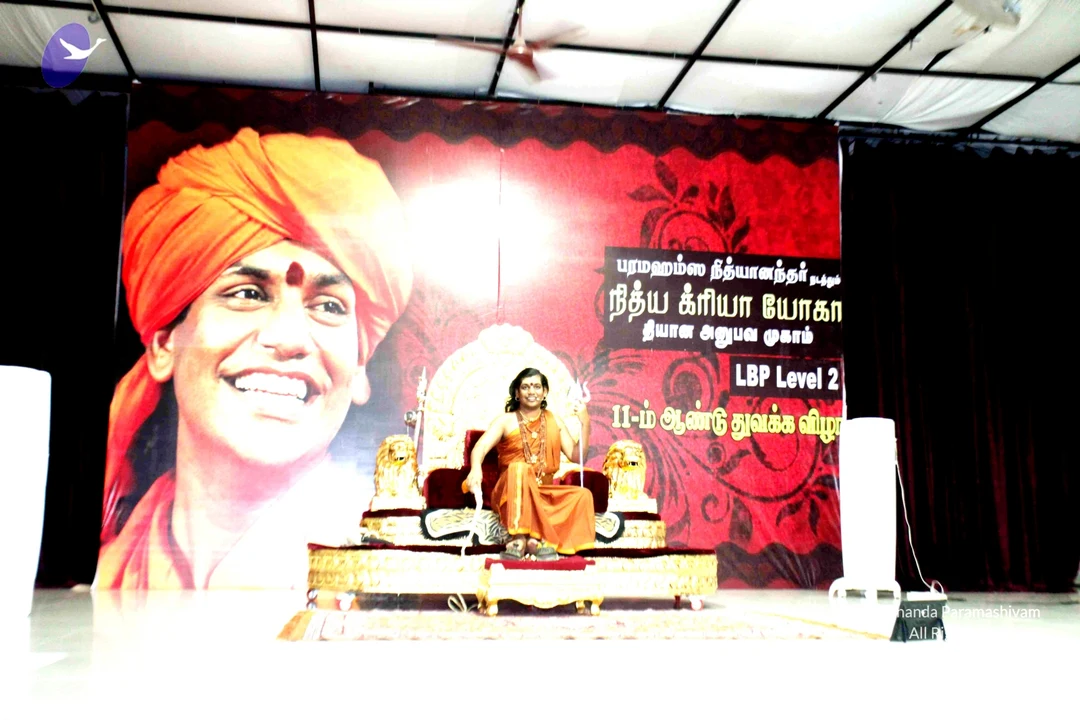
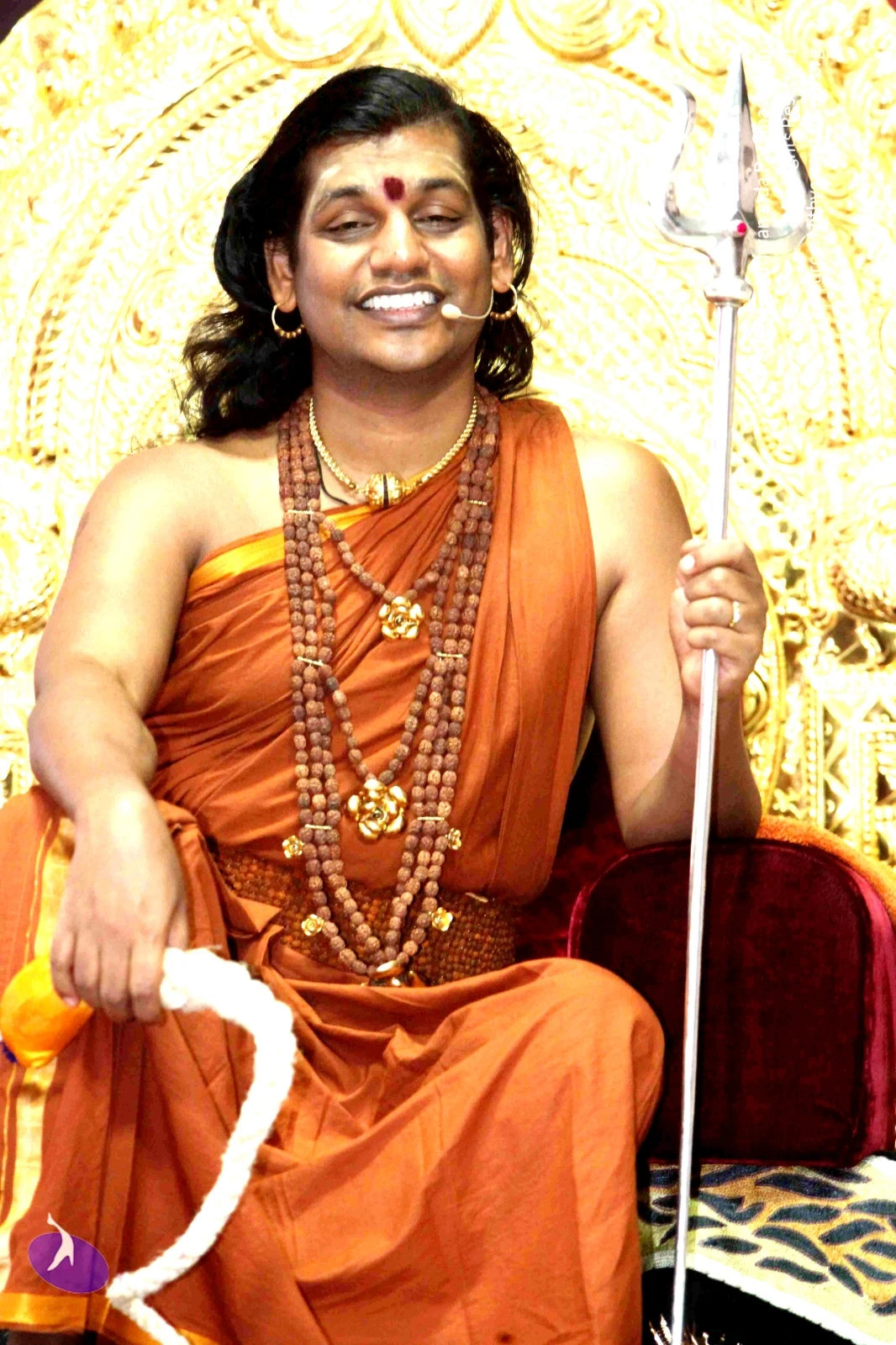
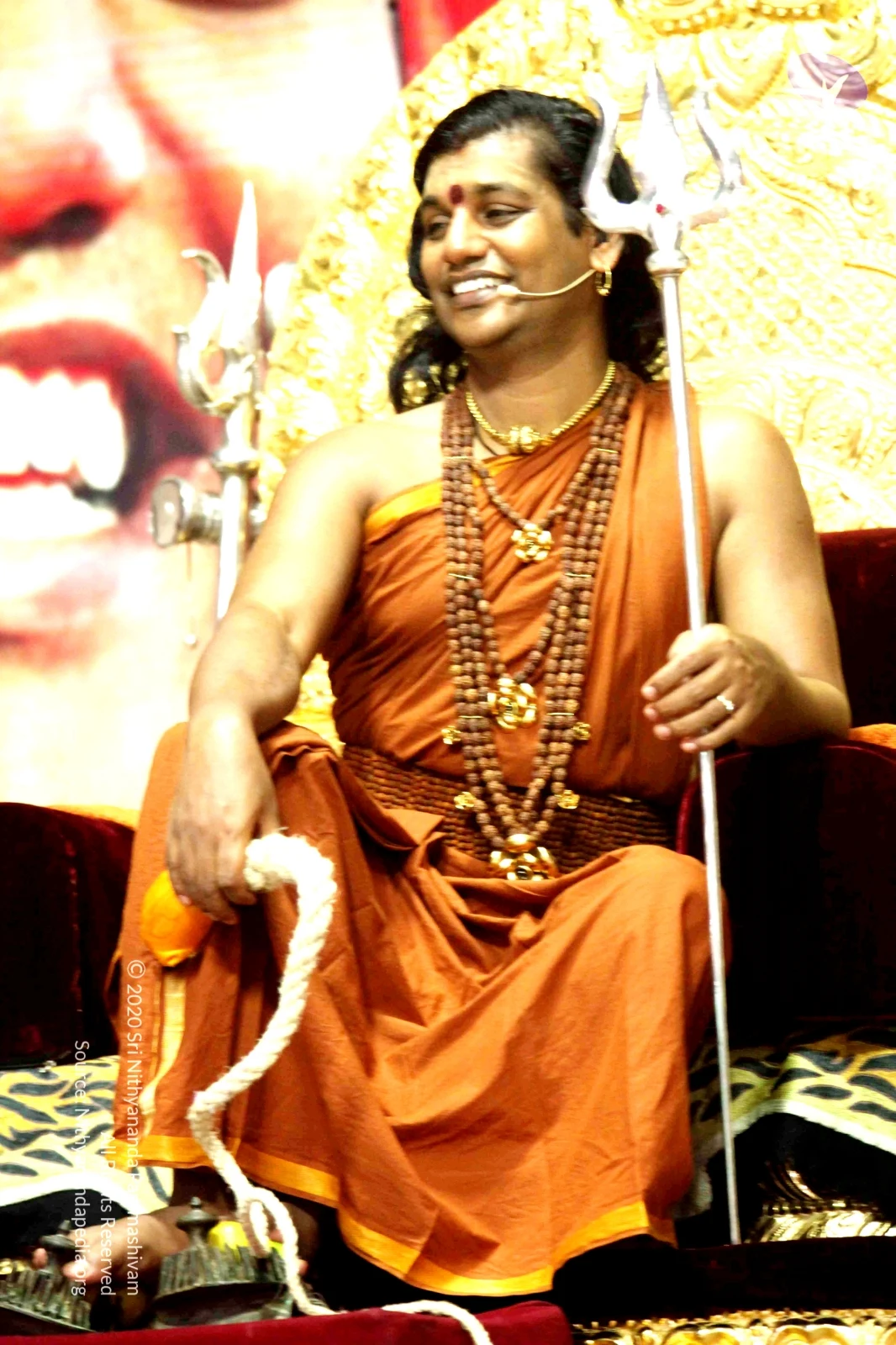
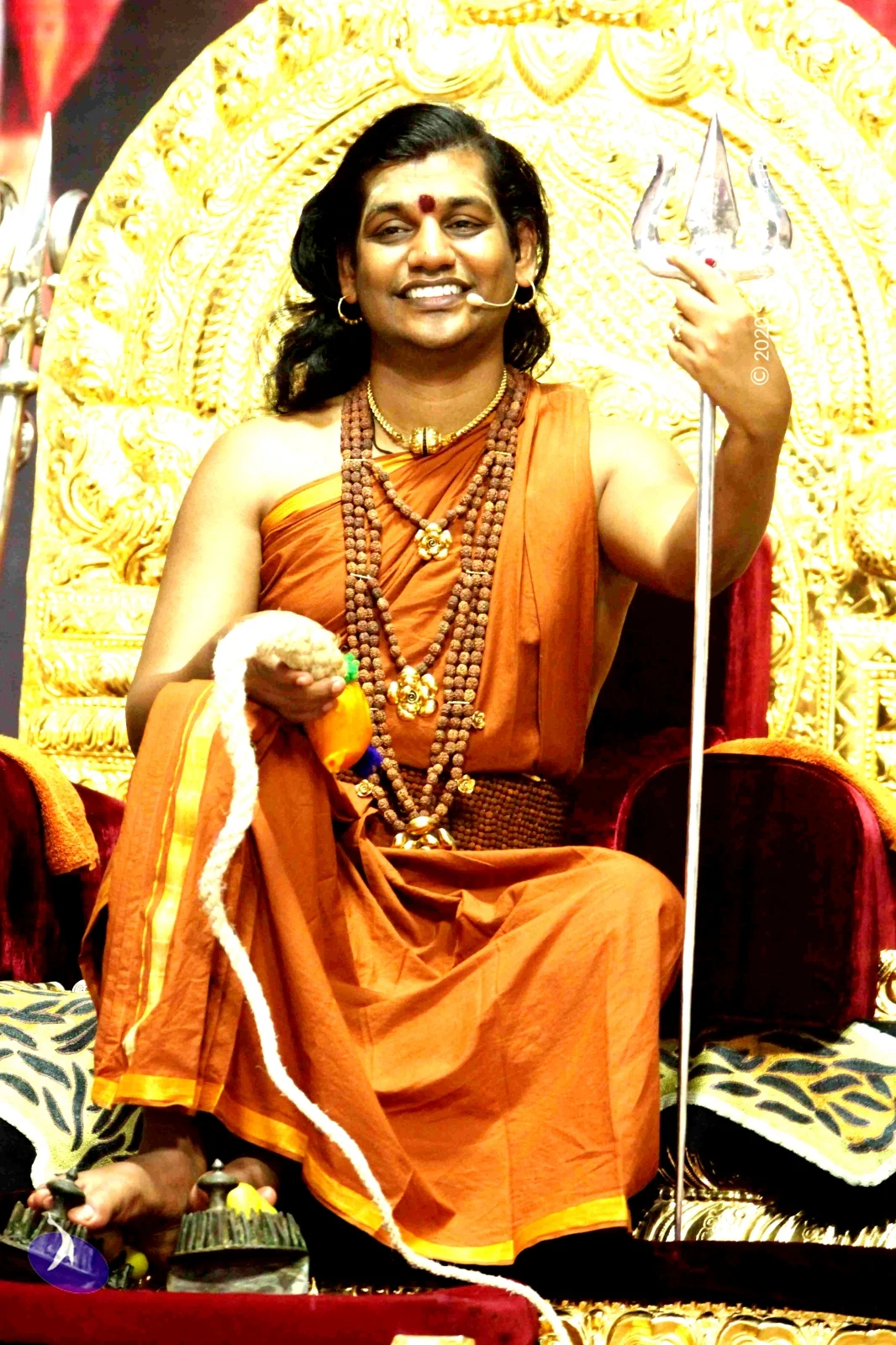
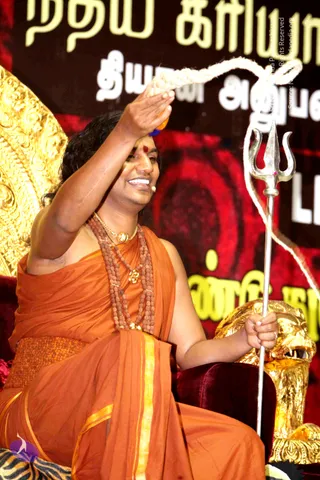
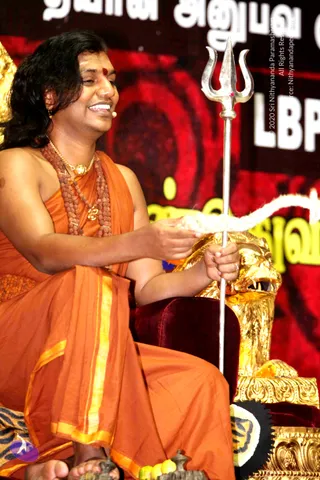
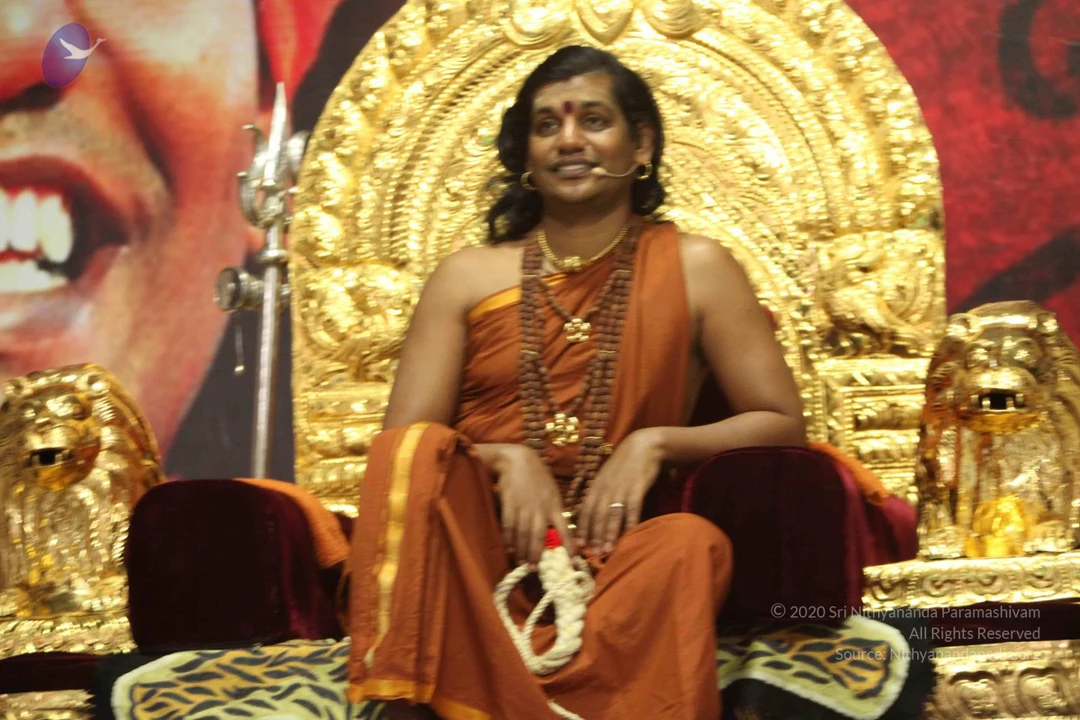
A man seated on an ornate golden throne with lion-head armrests, draped in a tiger-print cloth, smiles while speaking into a headset microphone. He wears saffron-orange robes with a gold-striped shawl, multiple rudraksha malas, a gold chain and a red bindi. He holds a white rope-like cord. Behind him a large red backdrop shows a painted face with bared teeth, and a trident stands to the left. Swamiji (probable) appears in the appearance-based label: long swept-back hair, saffron robes, rudraksha malas and ceremonial gold necklace, seated as the speaker at a satsang.A man with long swept-back dark hair sits on an ornate gold throne with carved gold lion armrests and a deep red velvet seat, against a large close-up printed photo of a smiling face behind him. He wears a saffron-orange robe with a gold-trimmed sash, layered rudraksha malas, gold pendant necklaces, a gold earring and a forehead bindi. He holds a silver trident in one hand and a rope in the other, and a small microphone is at his chin. Swamiji (probable): the long swept-back hair, saffron clothing, rudraksha malas and gold ornaments are the cues, seated as a teacher on the throne. A brass vessel sits near his feet.A photograph of a seated figure on an ornate golden throne with carved lion heads on both sides, backed by a golden arched frame and a red painted backdrop. The person wears a saffron-orange wrap over the shoulder, multiple rudraksha mala strands, a gold ceremonial necklace, and gold earrings, with a red bindi on the forehead. They hold a silver trident staff upright in the right hand and a white rope in the left, smiling and looking to the side. A tiger-striped cloth covers the throne base. a person (saffron wrap, rudraksha malas and ornate gold adornments, seated on a throne at a satsang setting), one person.A smiling man with long dark hair, a red bindi on his forehead and a headset microphone, wears an orange-saffron cloth draped over his shoulders and a rudraksha mala with a gold pendant and gold necklace. He holds a silver trident in his right hand, seated before an ornate gold repoussé backdrop. Probable Swamiji by appearance: long swept-back hair, saffron clothing, rudraksha mala and gold necklace, with the trident and gold throne-like backdrop as setting.A seated figure on an ornate golden throne with lion-form armrests on a stage, holding a trident-like staff in one hand and a ritual object in the other. He wears orange-saffron robes, a rudraksha mala and a gold-toned necklace. Behind him is a large red backdrop with a painted portrait of a smiling man in an orange turban and red tilak, with Tamil lettering on the right. Two white fan units stand on either side of the stage and a carpet lies at the base of the throne. The seated figure's identity is uncertain from appearance, so only role and attire are described.

KALABHAIRAVA-DARSHAN

33 photosSource gallery
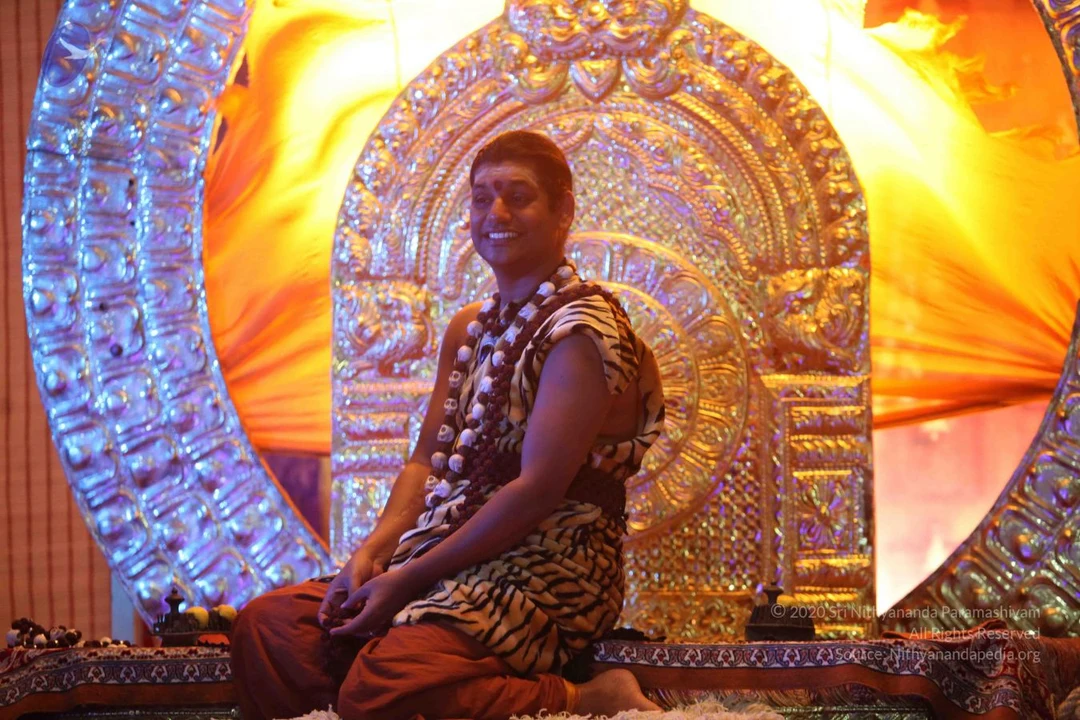
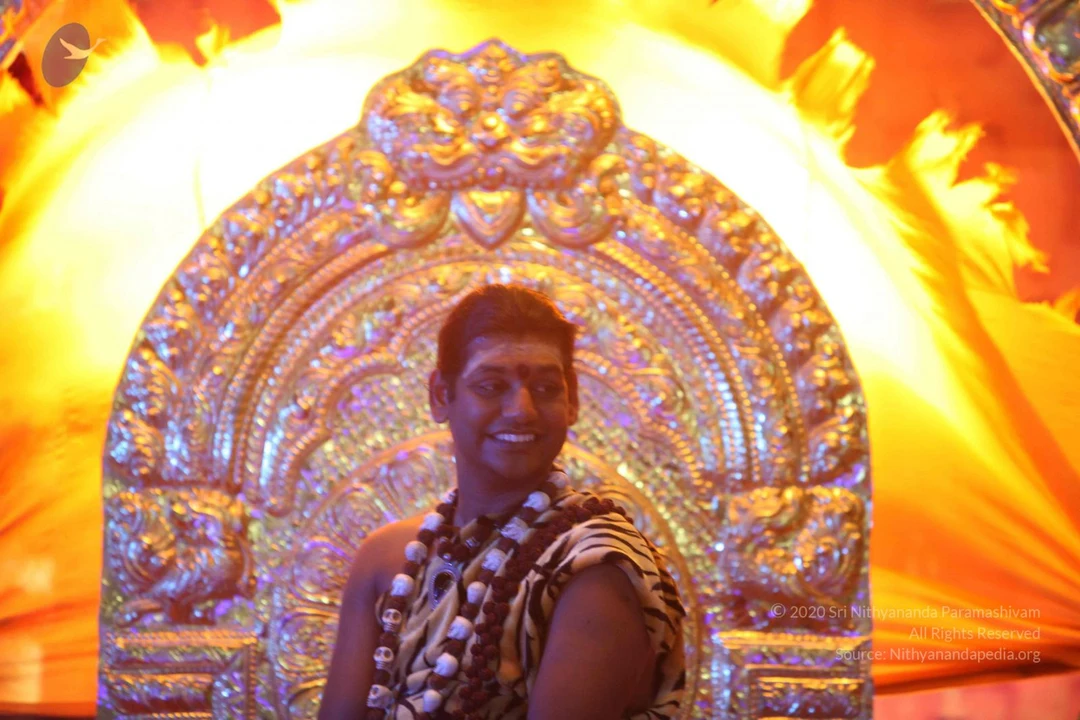
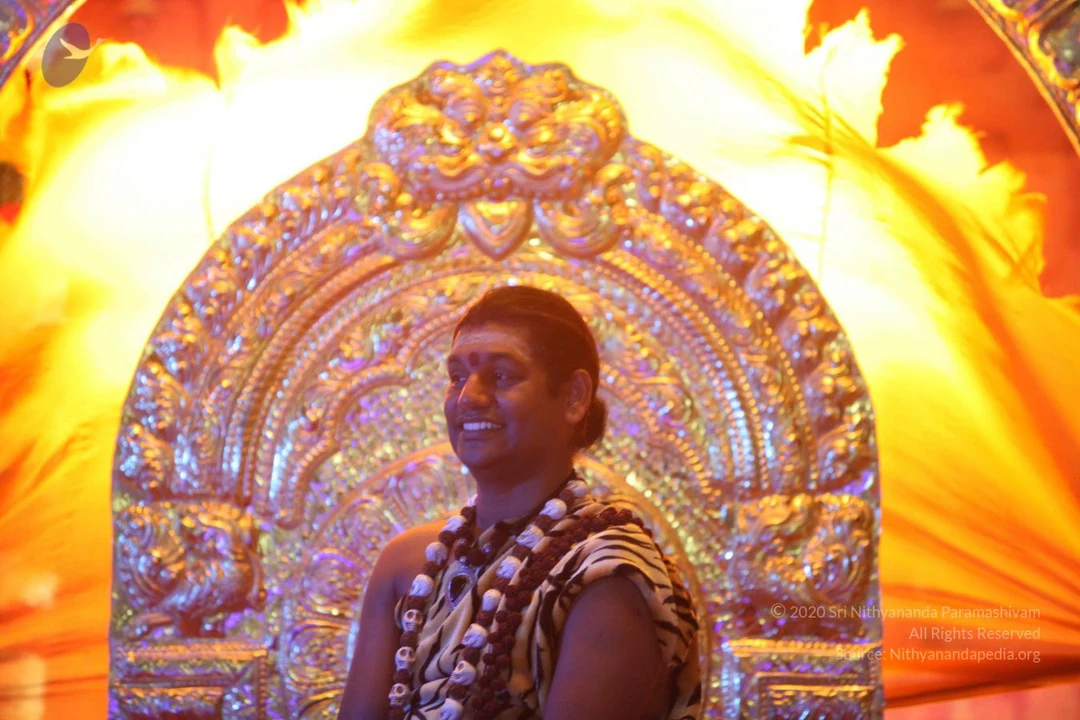
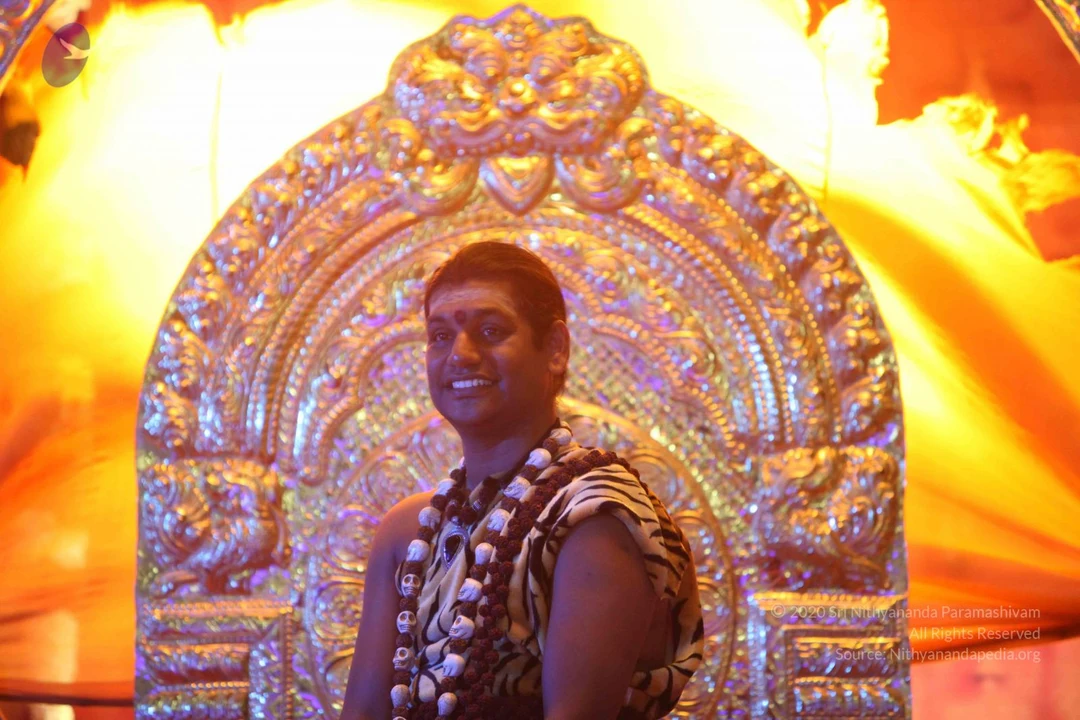
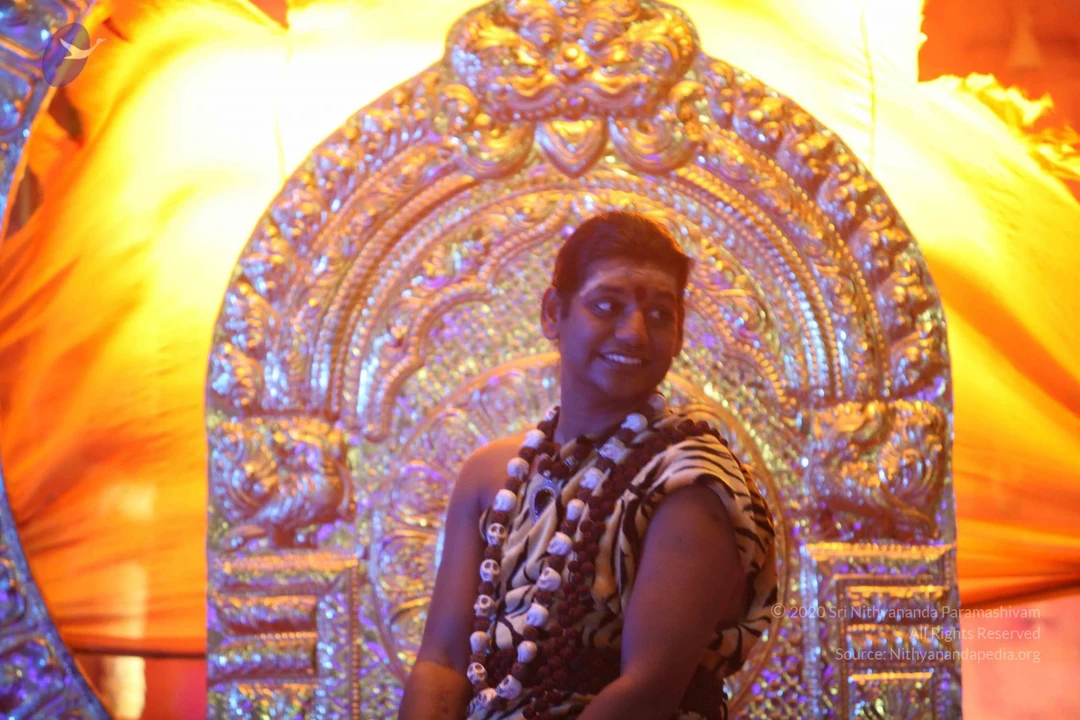
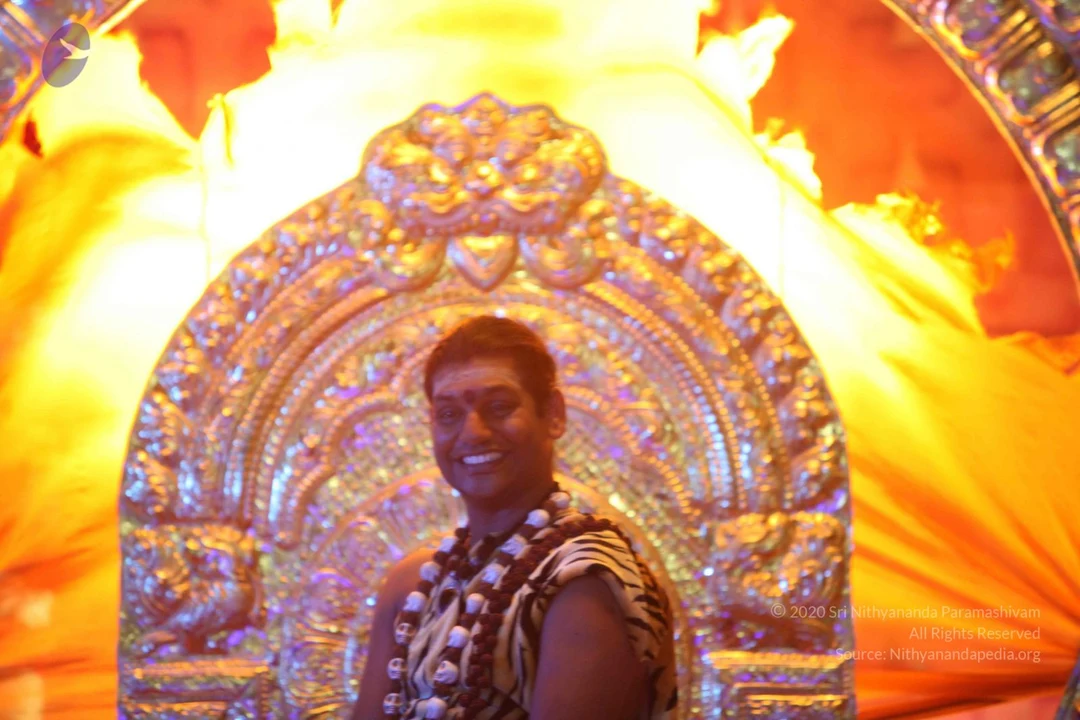
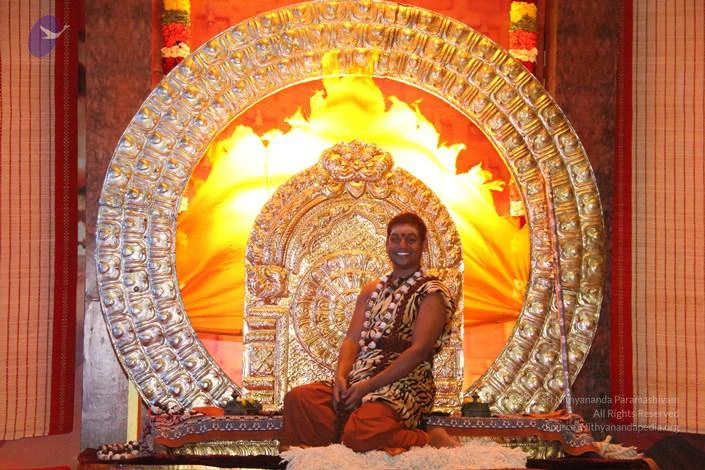
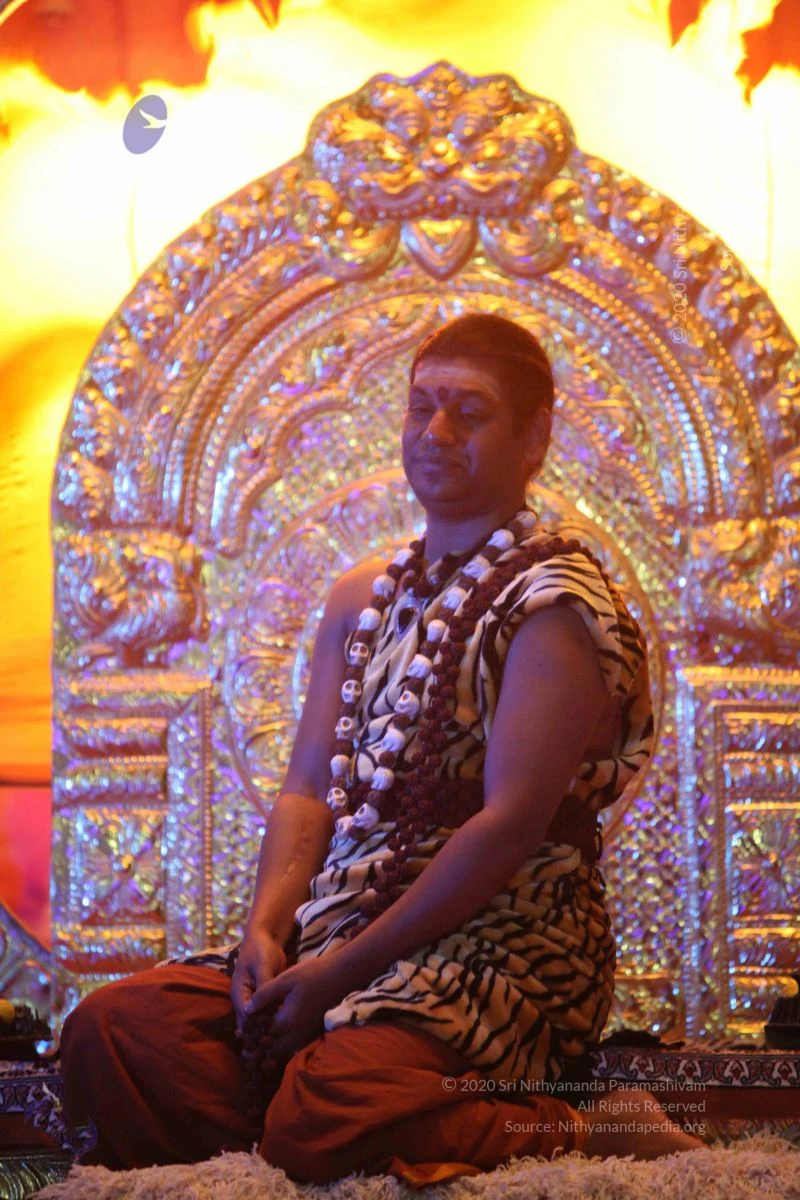
A seated man in a tiger-striped shawl and rust-red dhoti sits cross-legged on an ornate platform before a large gilded arched backdrop with embossed silver-and-gold tiles and an orange illuminated fabric canopy. He wears a dark rudraksha mala with white beads and smiles toward the camera with his hands clasped in his lap. Oil lamps and a small bundle of beads rest on the cushioned seat in front of him. a person is seated as the central figure of a satsang stage, identified by his tiger-print shawl, rudraksha mala and the ceremonial setting.A smiling man with short dark hair and a small red bindi stands before an ornate golden silver arch framed by orange and yellow flames of light. He wears a striped tiger-pattern cloth over one shoulder and a multi-strand mala of rudraksha and white beads with a large pendant around his neck. The arch is richly embossed with floral and scroll motifs. a person: the seated figure's appearance shows only a shaved-head-free short hairstyle and rudraksha mala, which is insufficient to confirm identity.A smiling man with a short dark hairstyle and a red bindi stands in front of an ornate golden silver arch-shaped throne back, lit by warm orange flames or fabric behind it. He wears a striped tiger-print wrap over his shoulder, a rudraksha mala with white beads, and a dark pendant. No other people are visible.A smiling man stands before an ornate silver-toned arched throne backdrop with repoussé floral and scroll carvings, lit by warm orange and yellow fabric behind him. He wears a black-and-white patterned wrap over one shoulder, a rudraksha mala with skull-like beads, and a red tilak on his forehead. One physical person is visible.A smiling man with short dark hair and a small tilak stands before an ornate gold-and-silver carved arch backdrop lit by warm orange light and draped with orange fabric. He wears a striped cream-and-black garment and several long rudraksha malas with pale beads hanging across his chest. a person: a man with a short head and rudraksha malas and a striped wrap; appearance cues are limited, so this identification is uncertain. The setting resembles a stage or throne-style decor.A smiling man with short dark hair and a red bindi stands before an ornate silver-gilded arched throne backdrop lit by warm orange and yellow light, with glowing flame-like fabric behind it. He wears a white and black tiger-striped garment and a multi-strand necklace of rudraksha-style beads and white-tipped beads. a person appearance-based label: the figure has a distinctive ceremonial bead necklace and striped wrap, but identity is uncertain from appearance alone. The scene is a ceremonial stage setting with a decorative peetha-style backdrop.

AKASHIC-READINGS
68 photosSource gallery
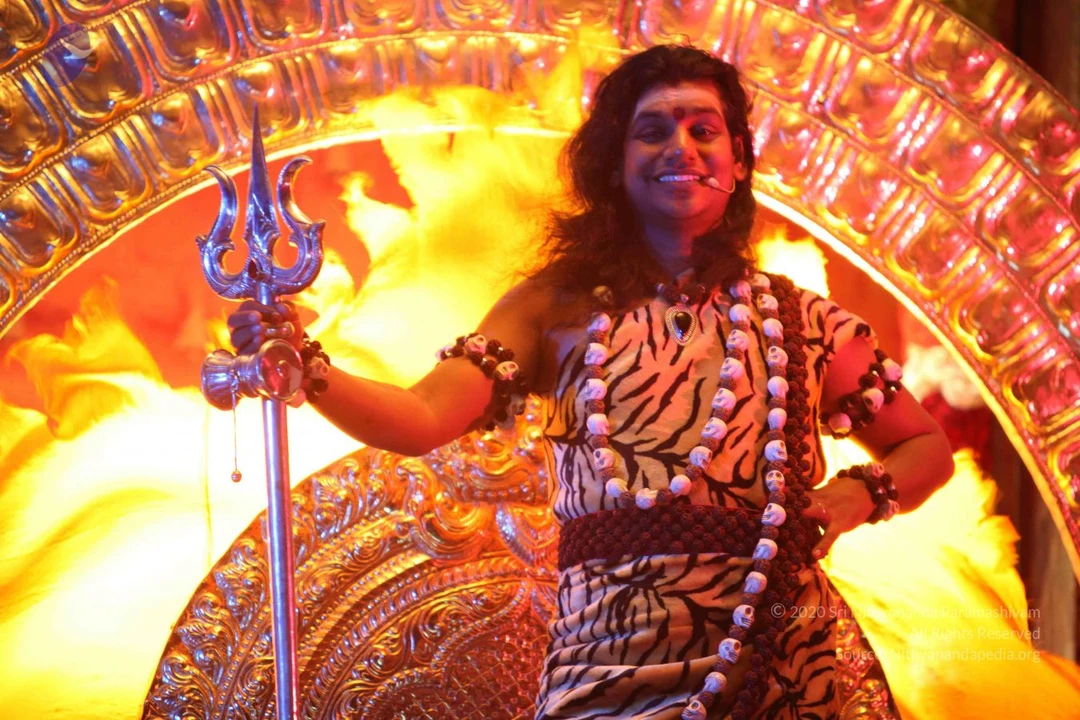
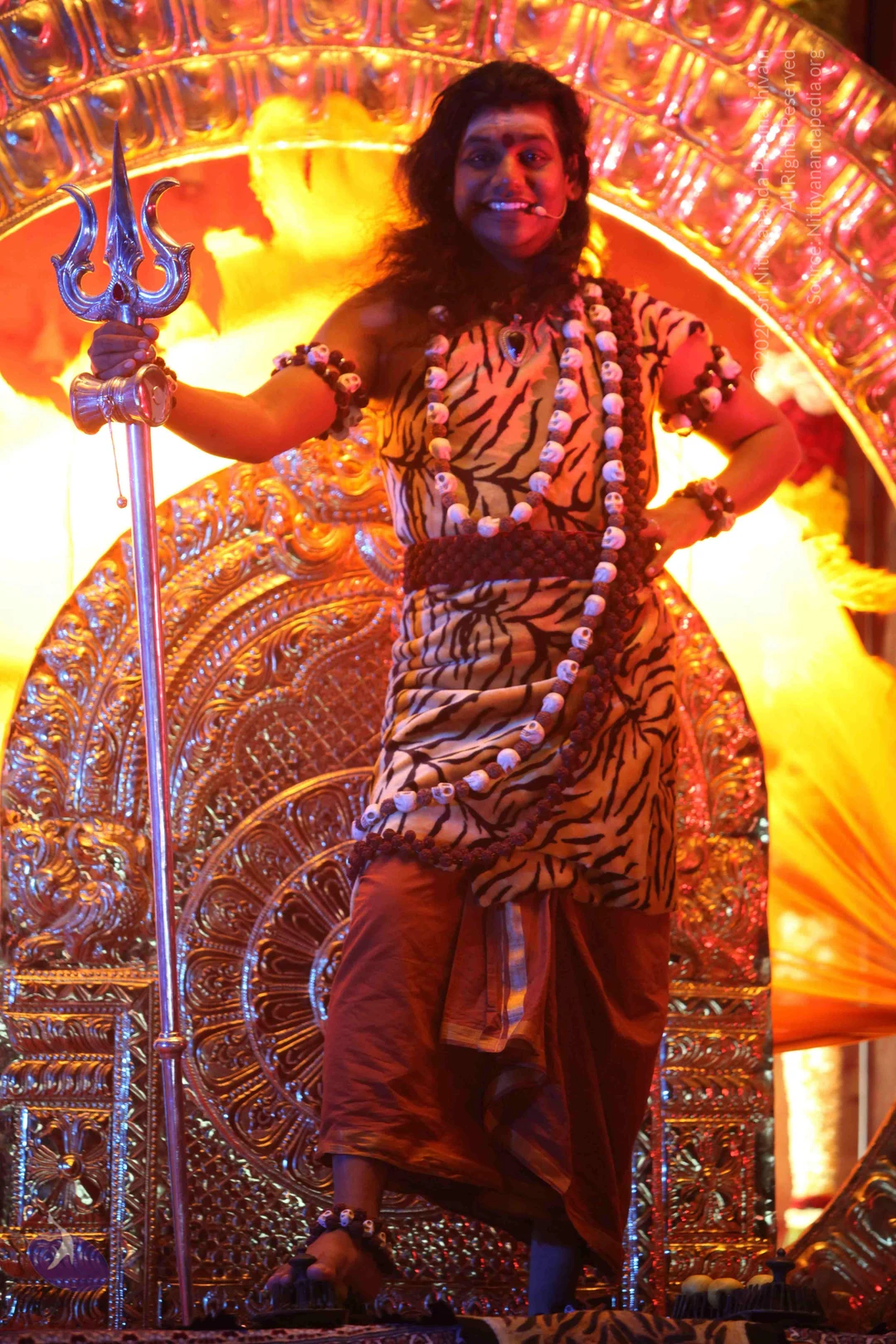
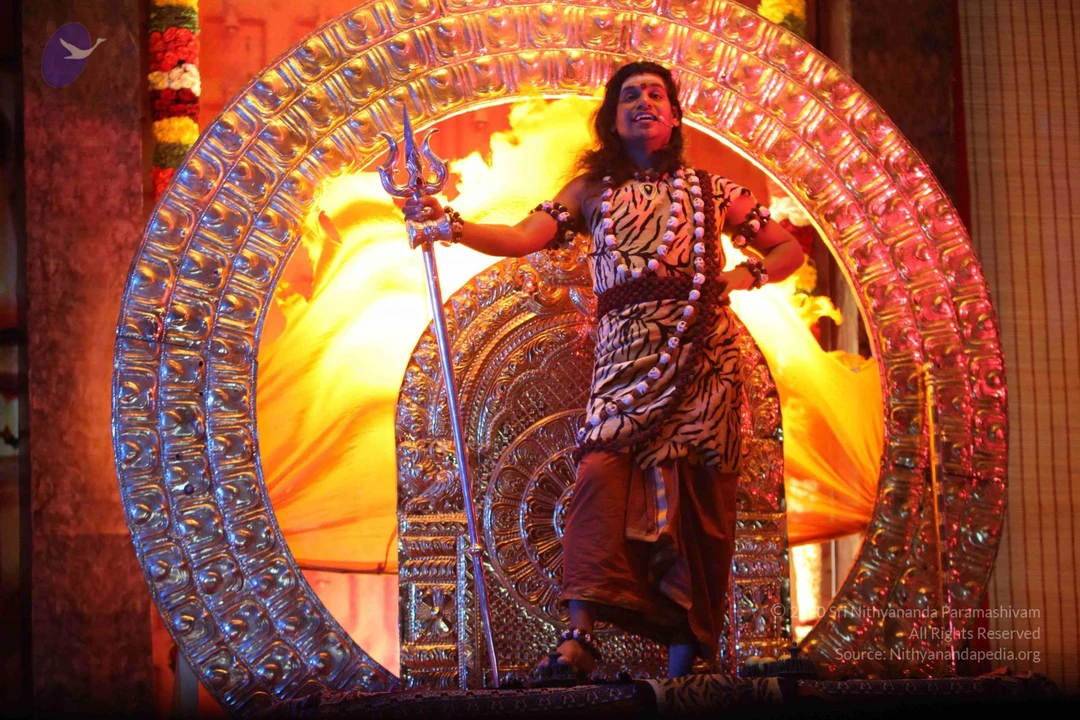
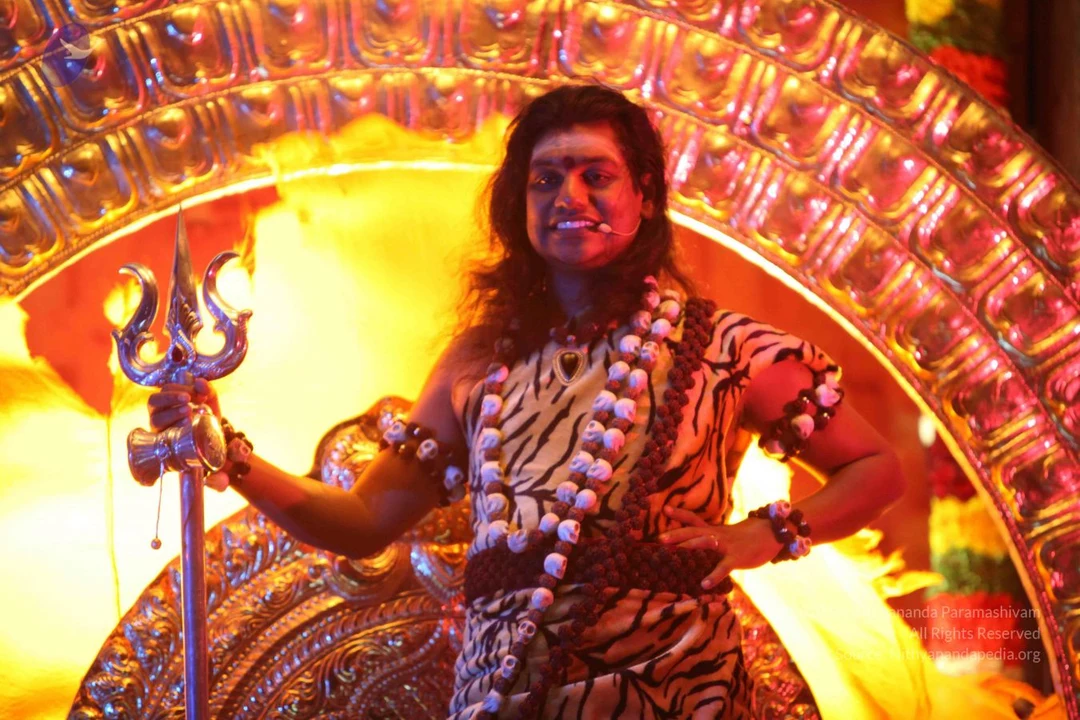
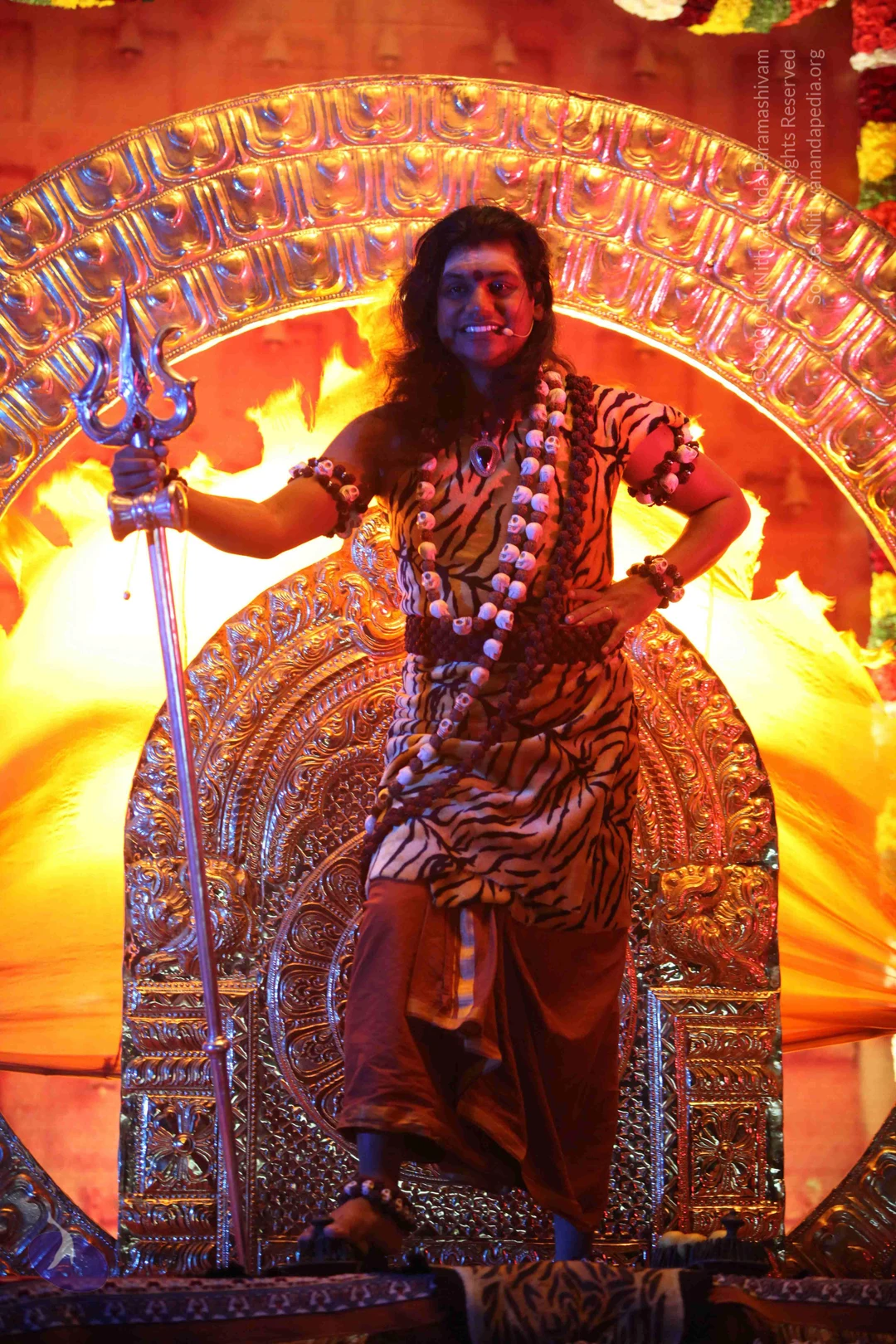
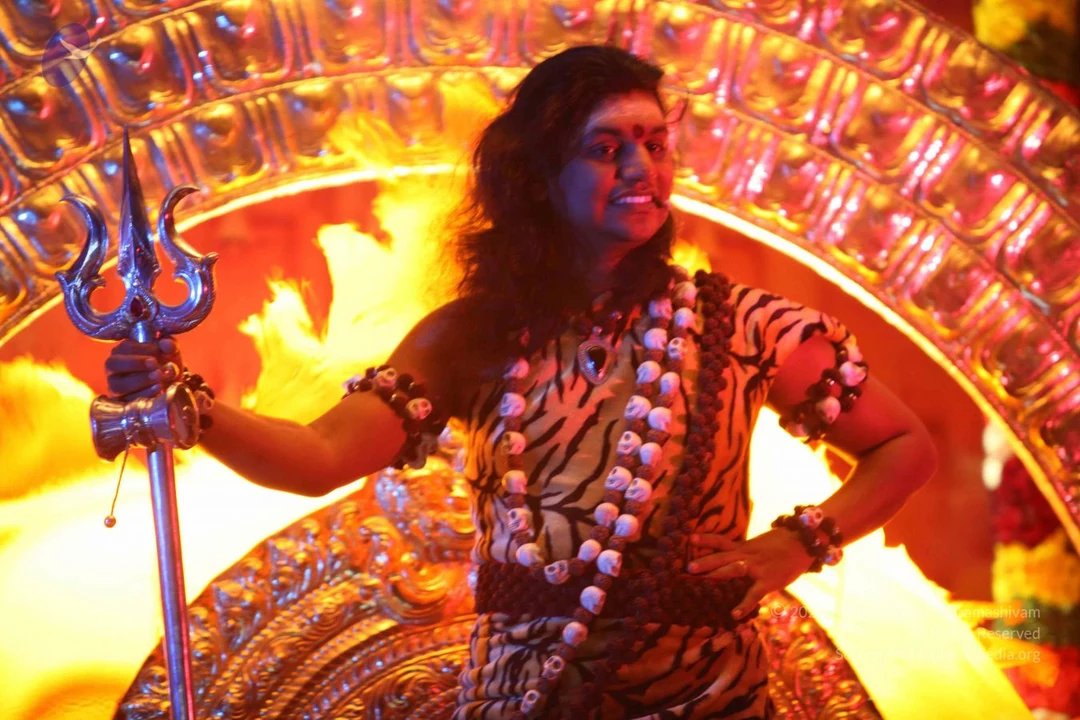
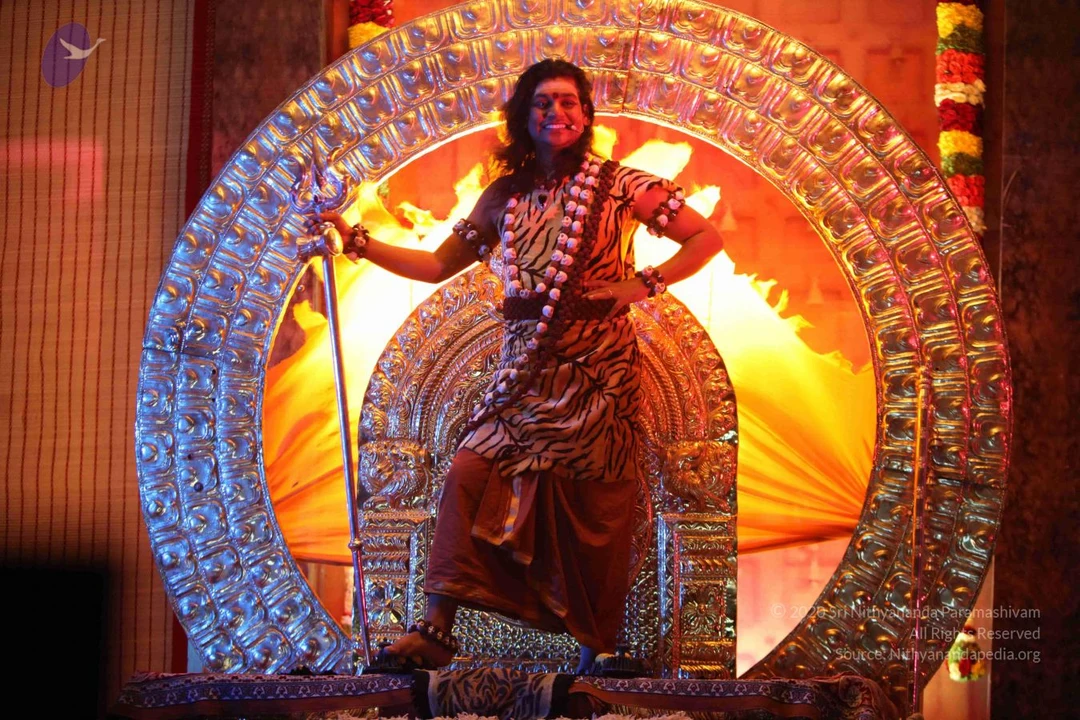
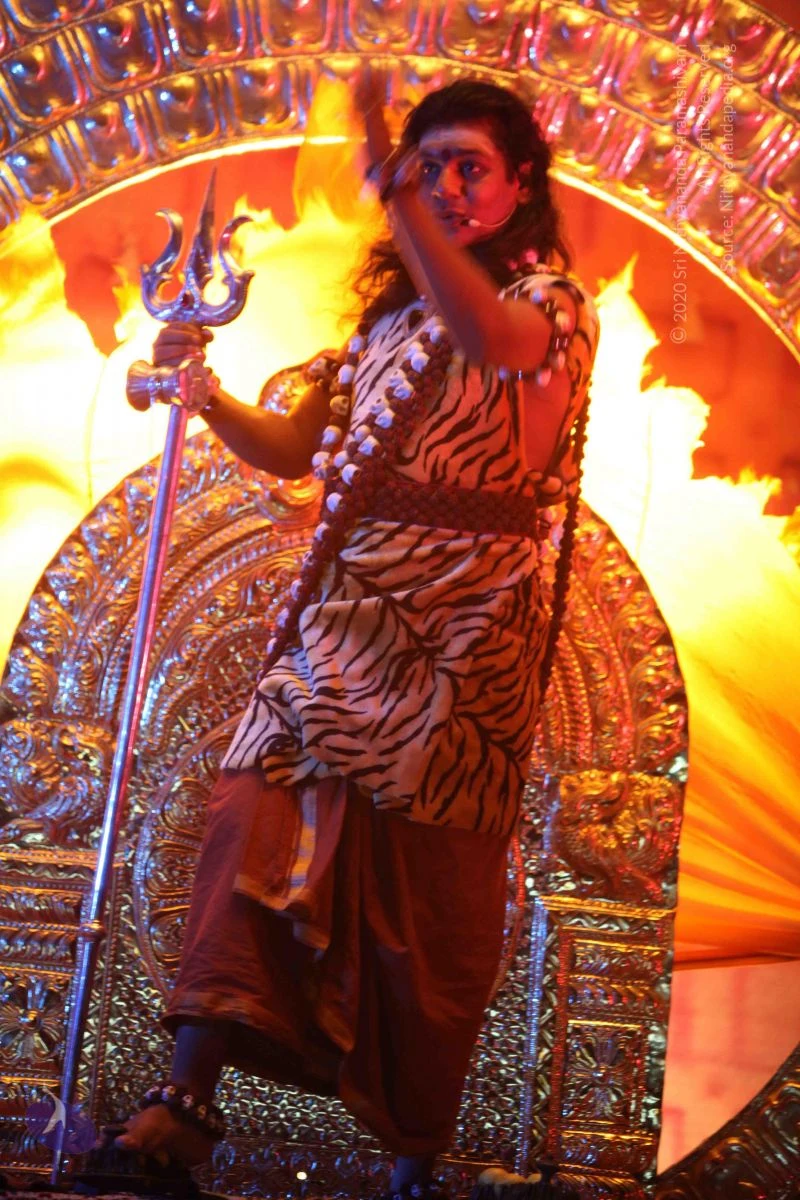
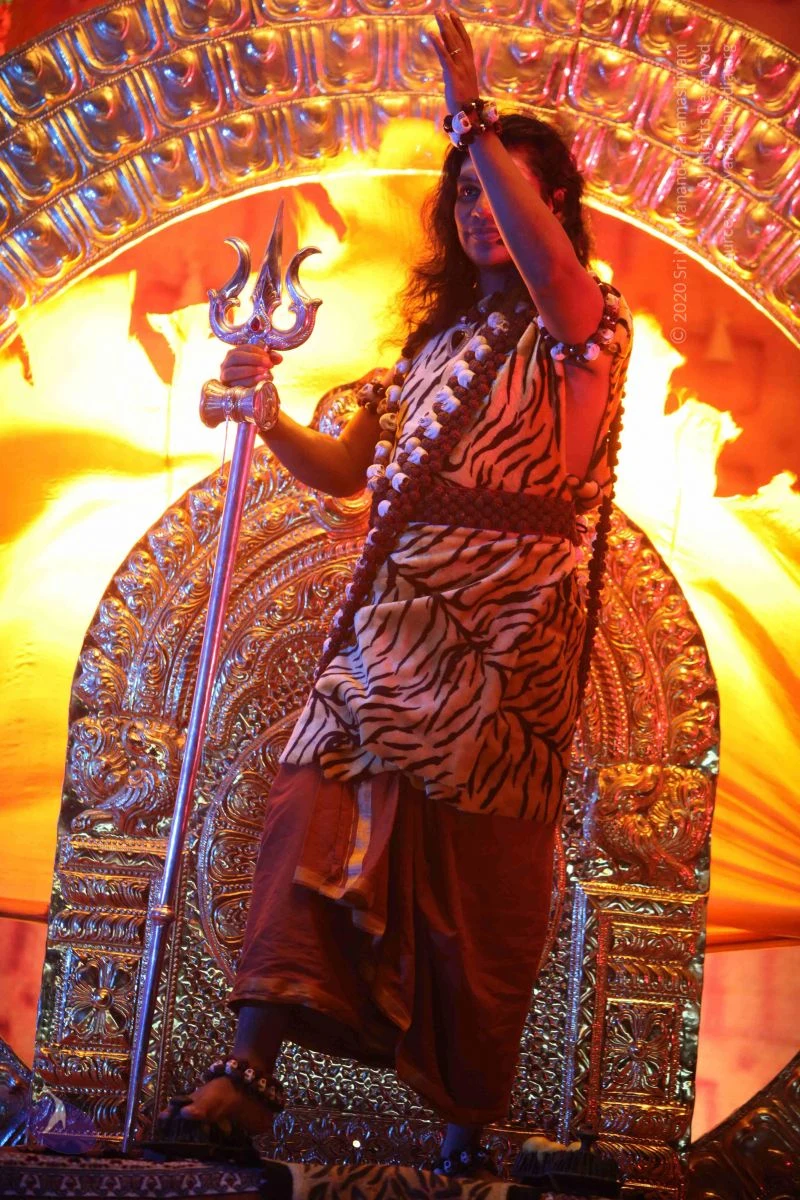
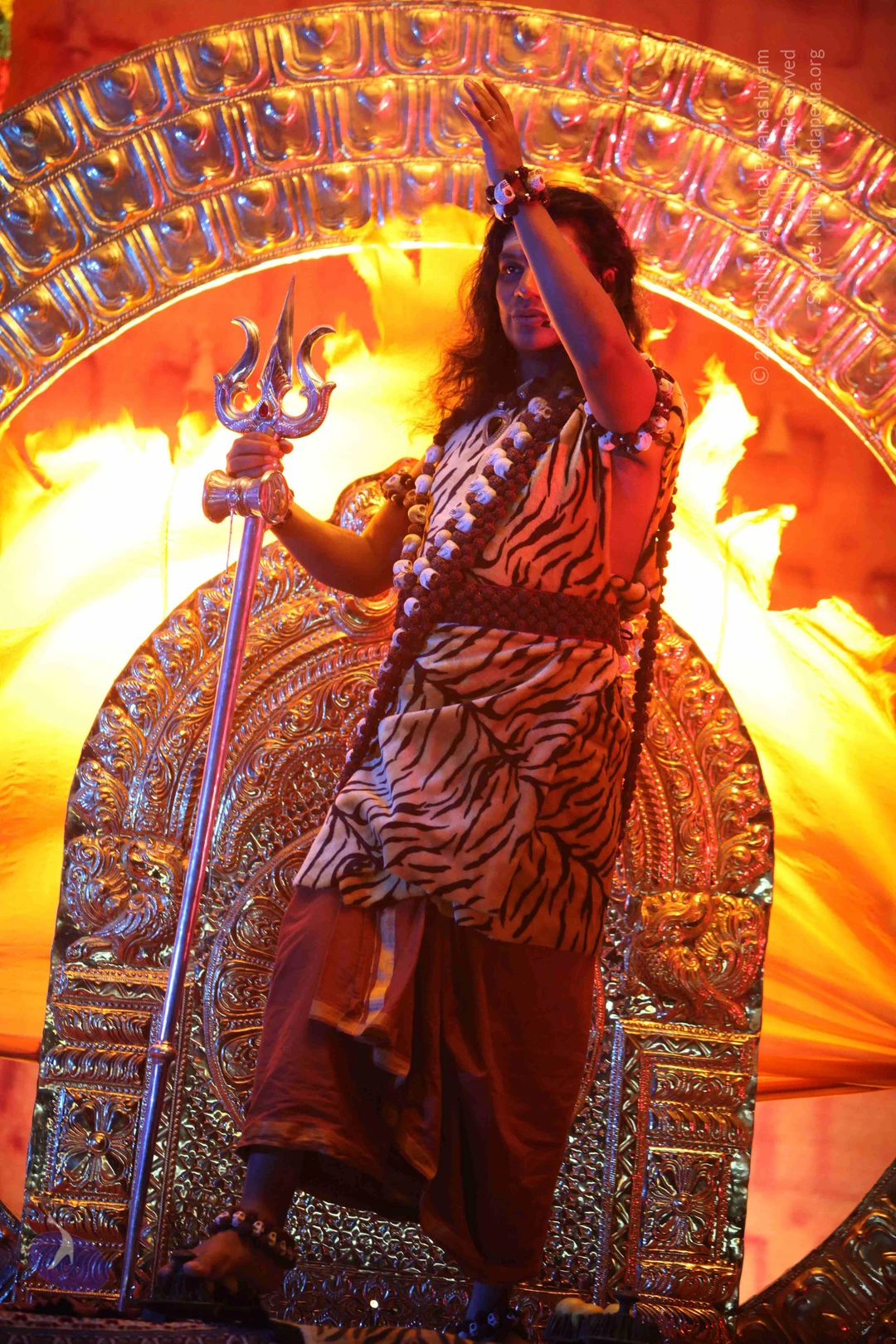
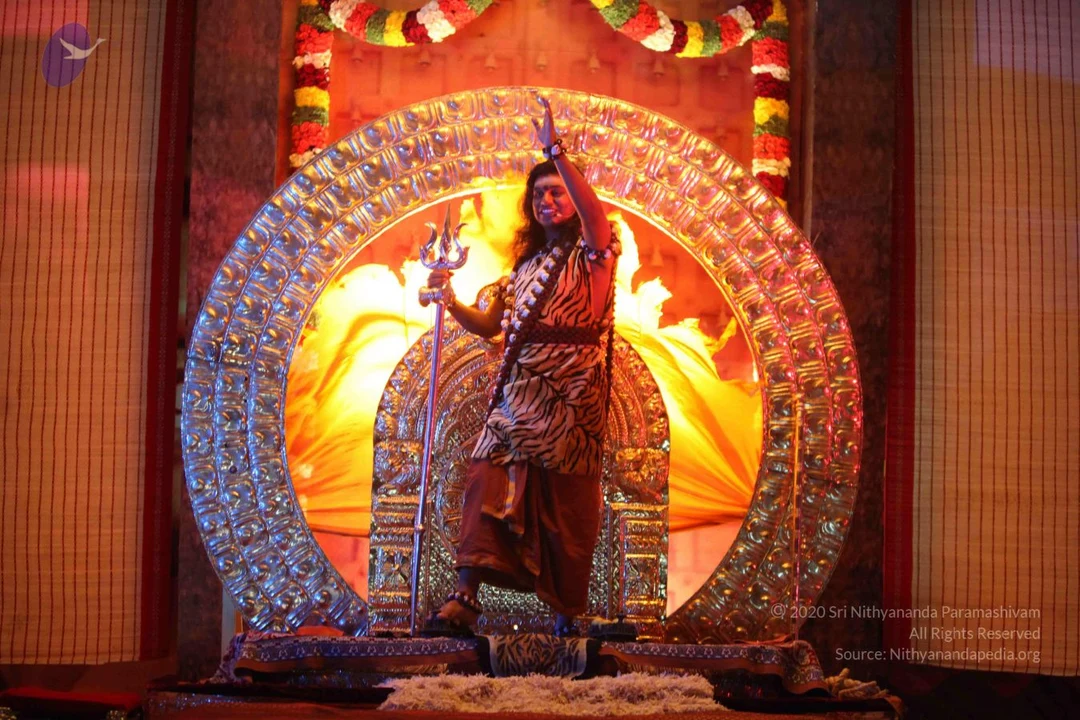
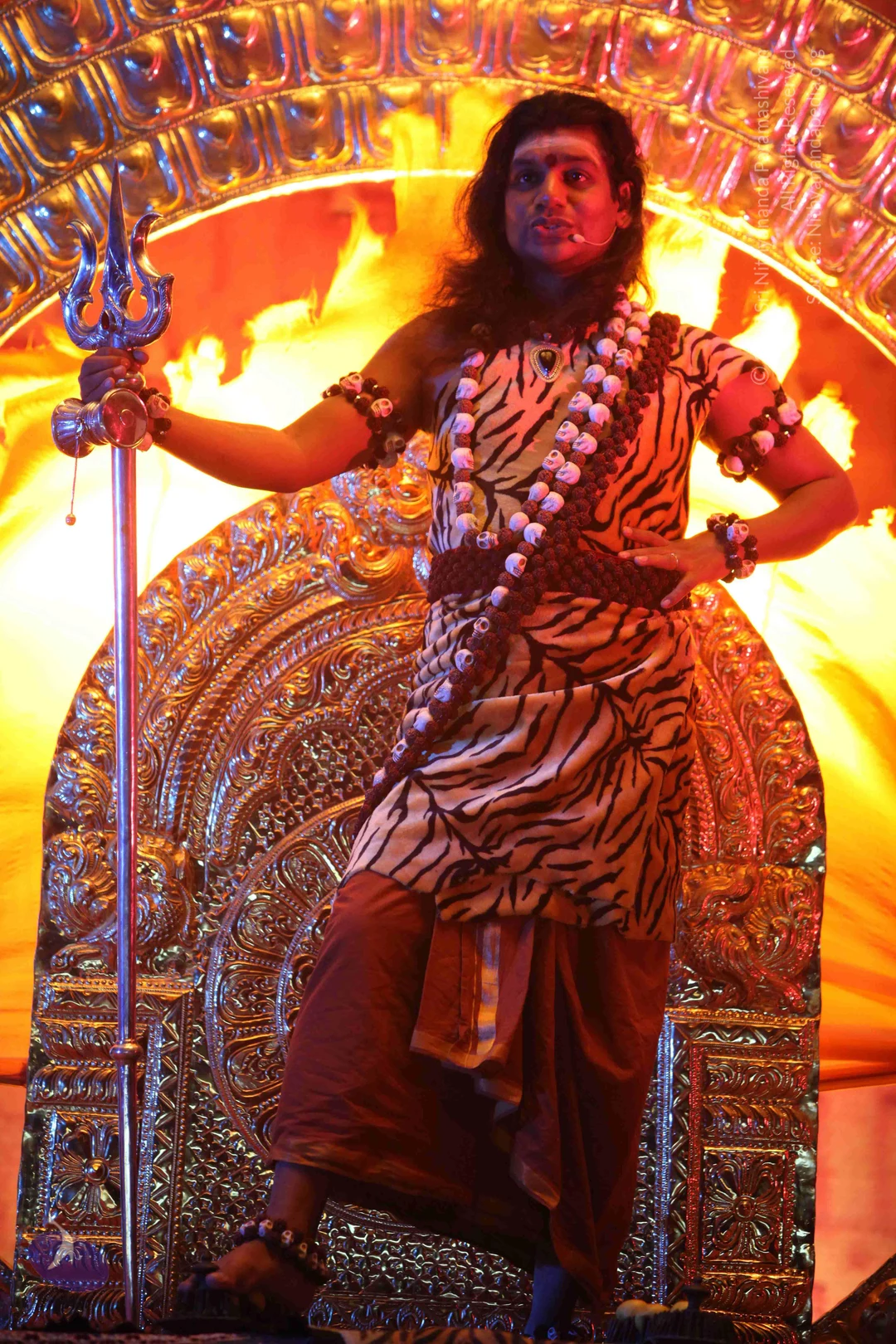
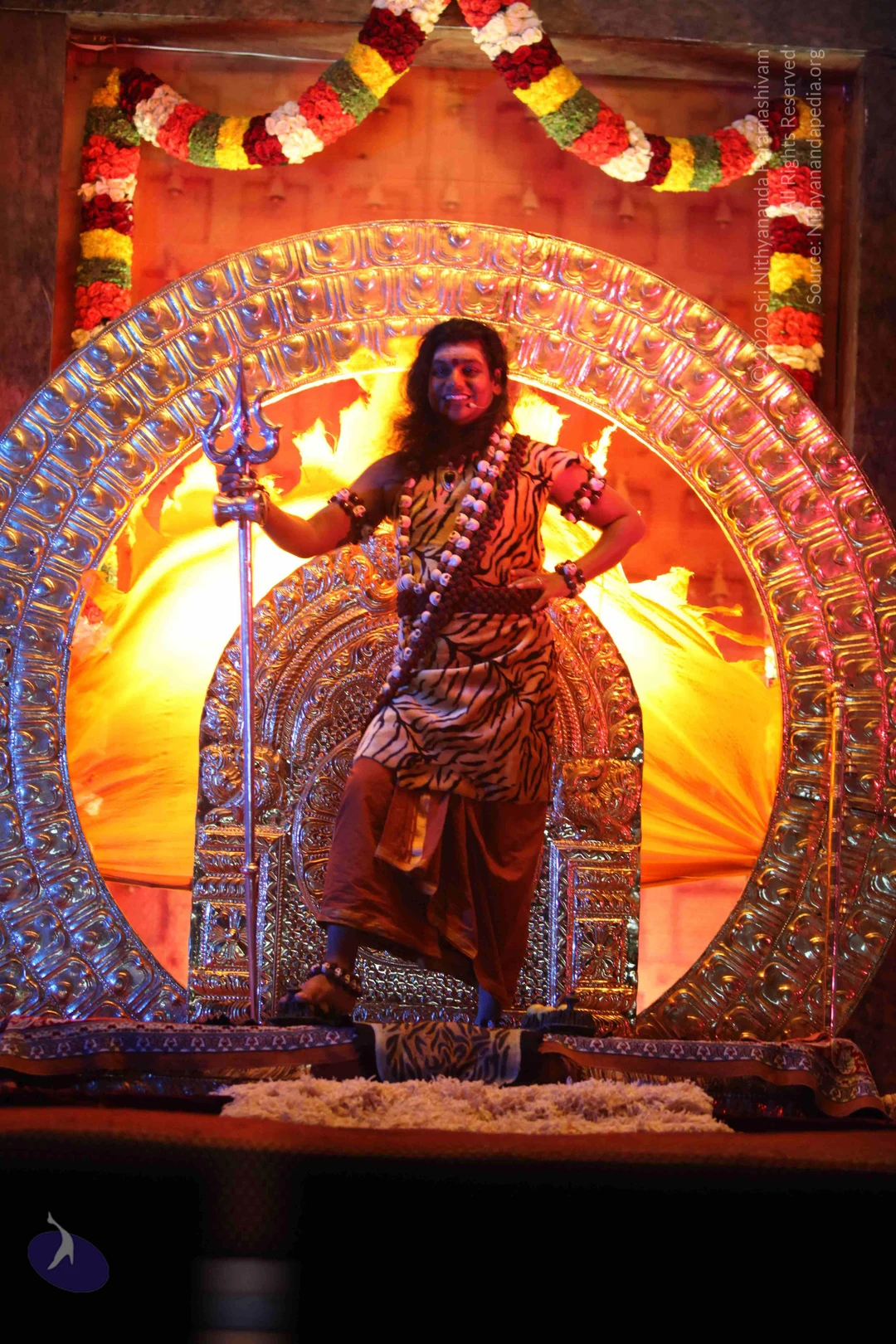
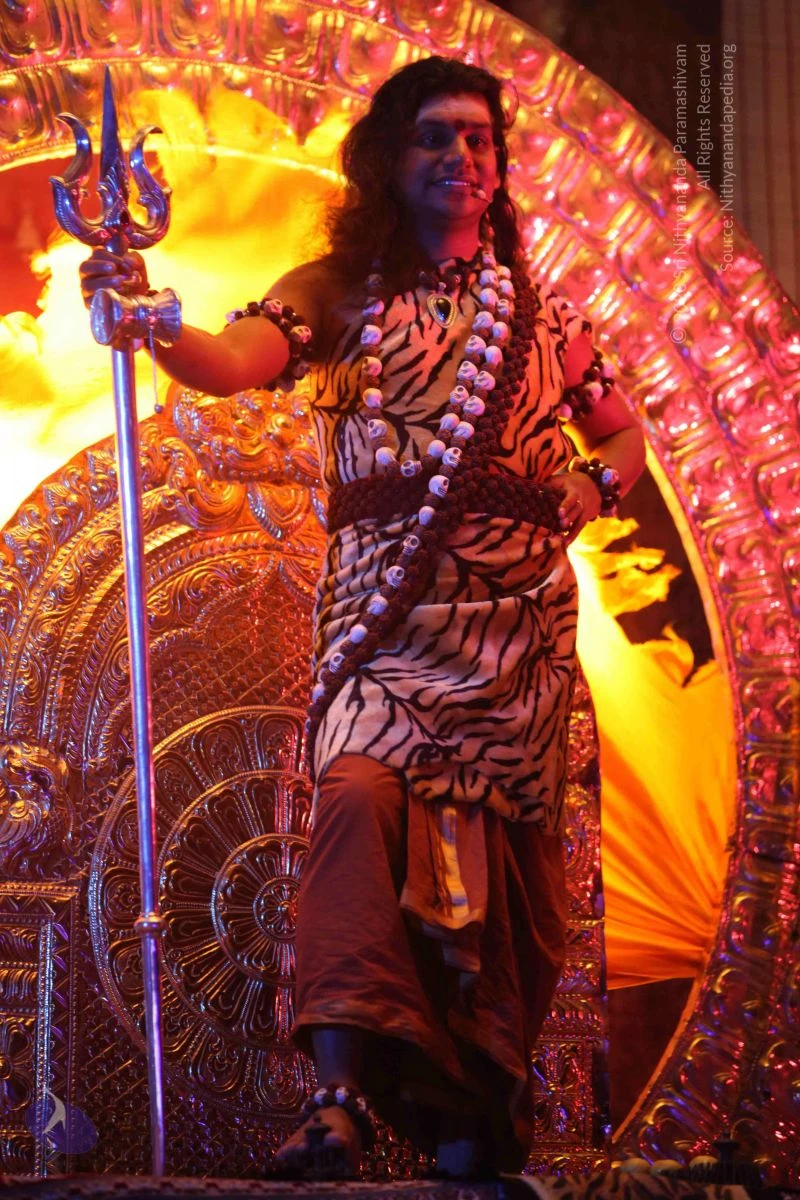
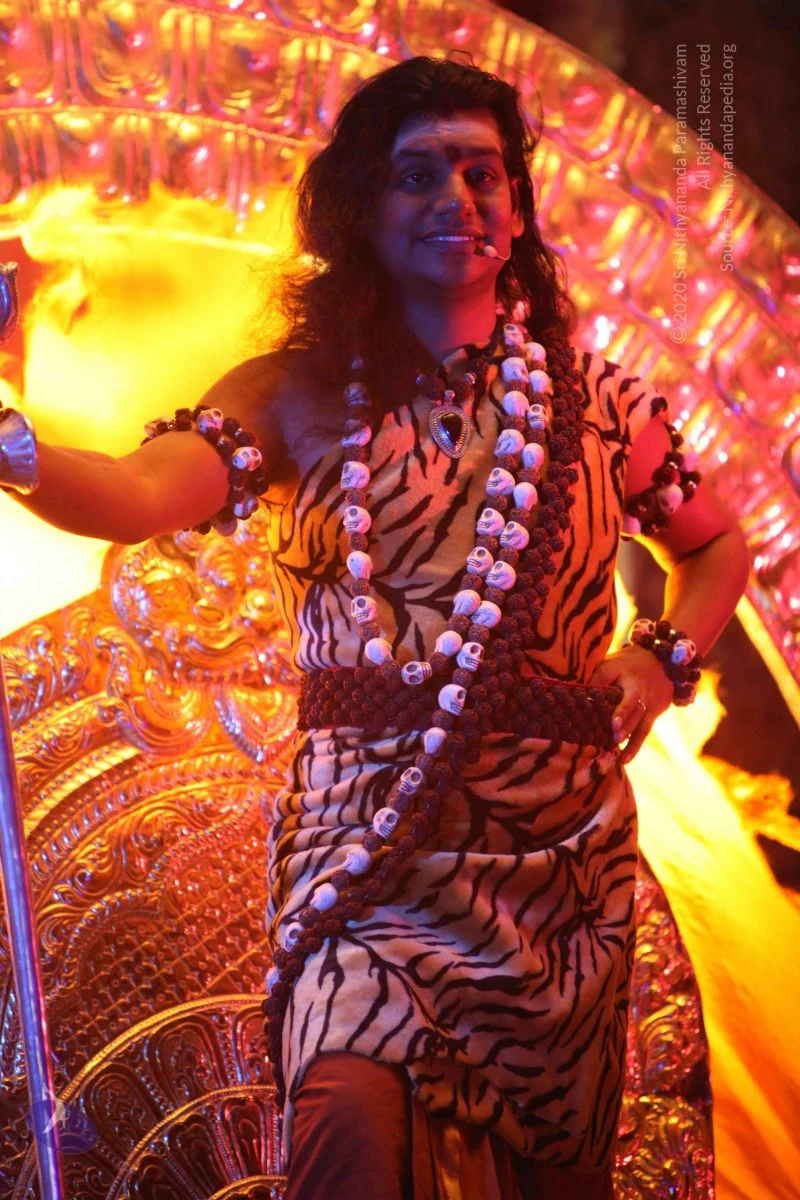
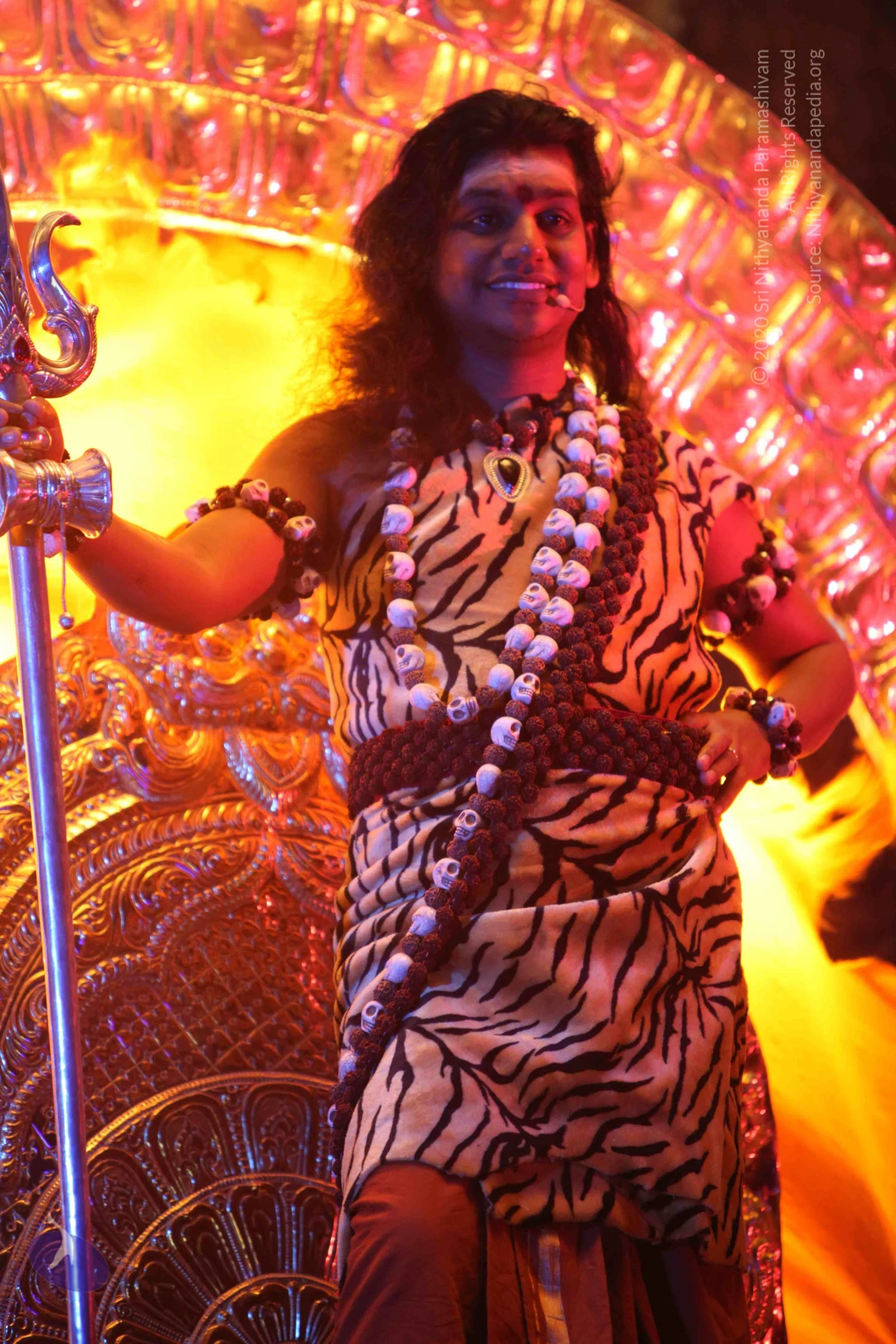
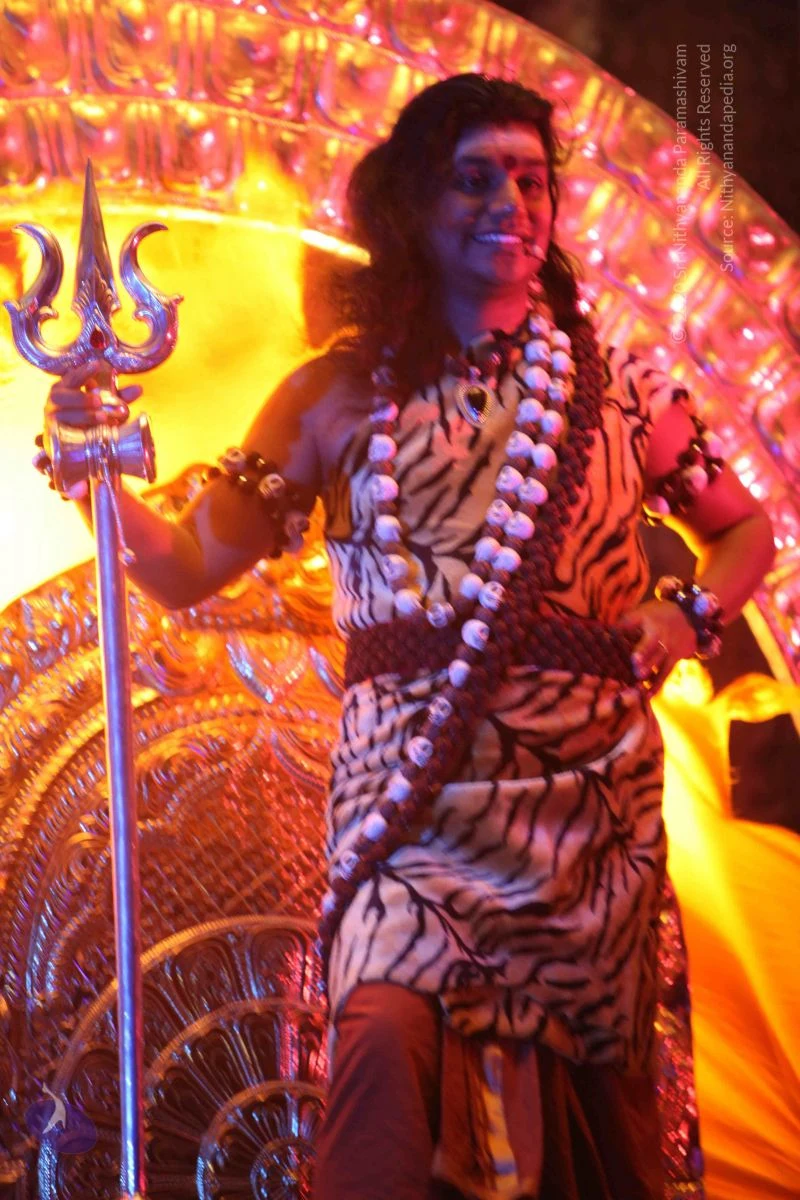
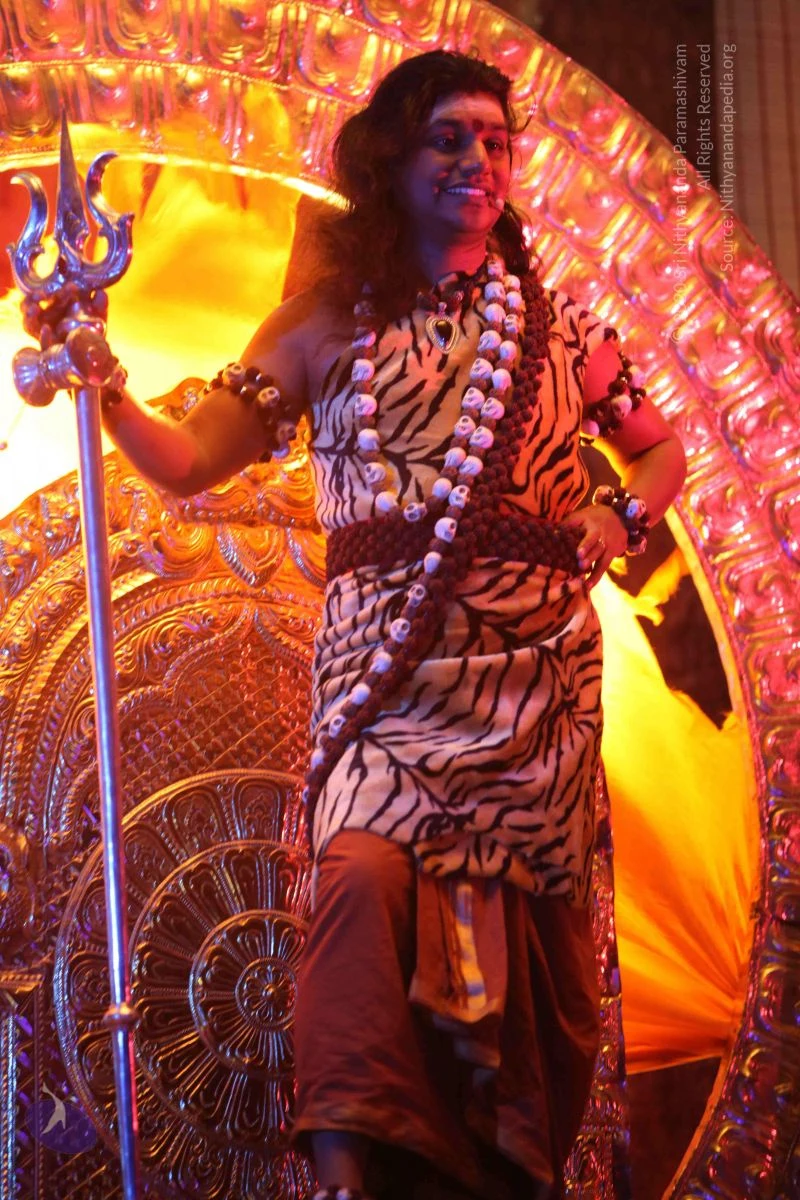
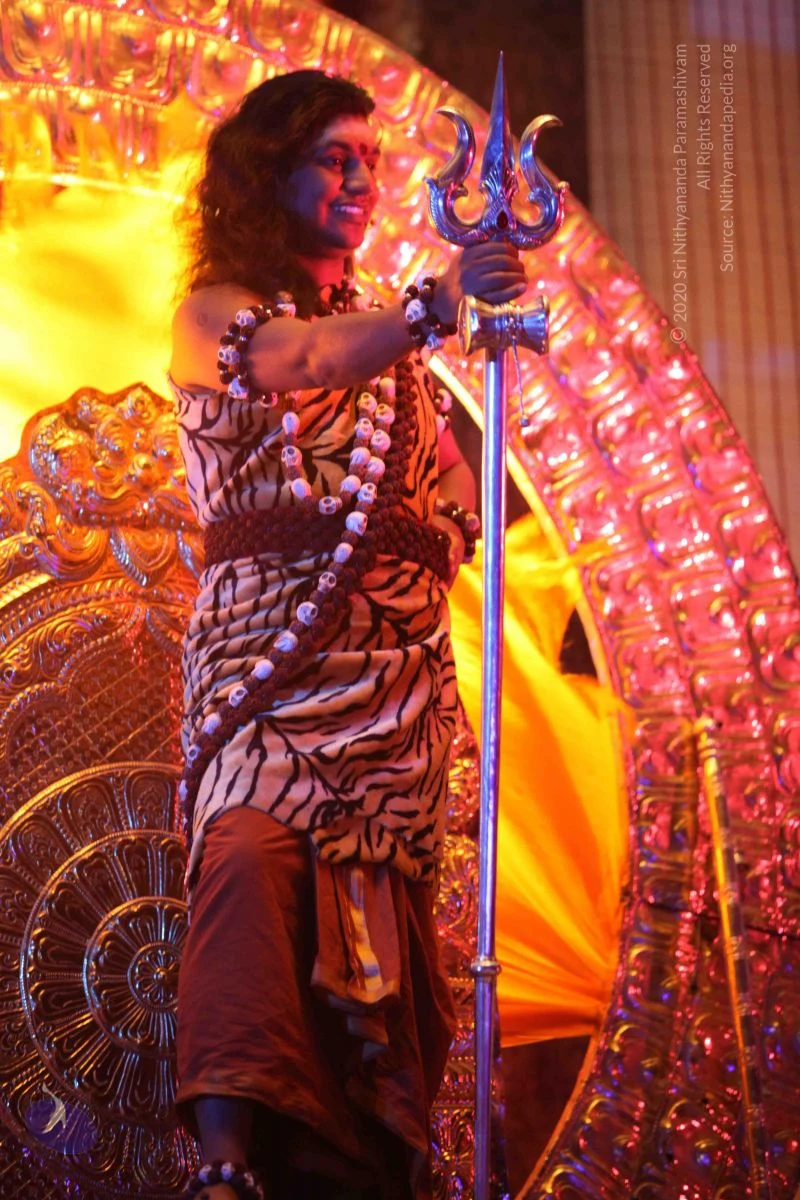
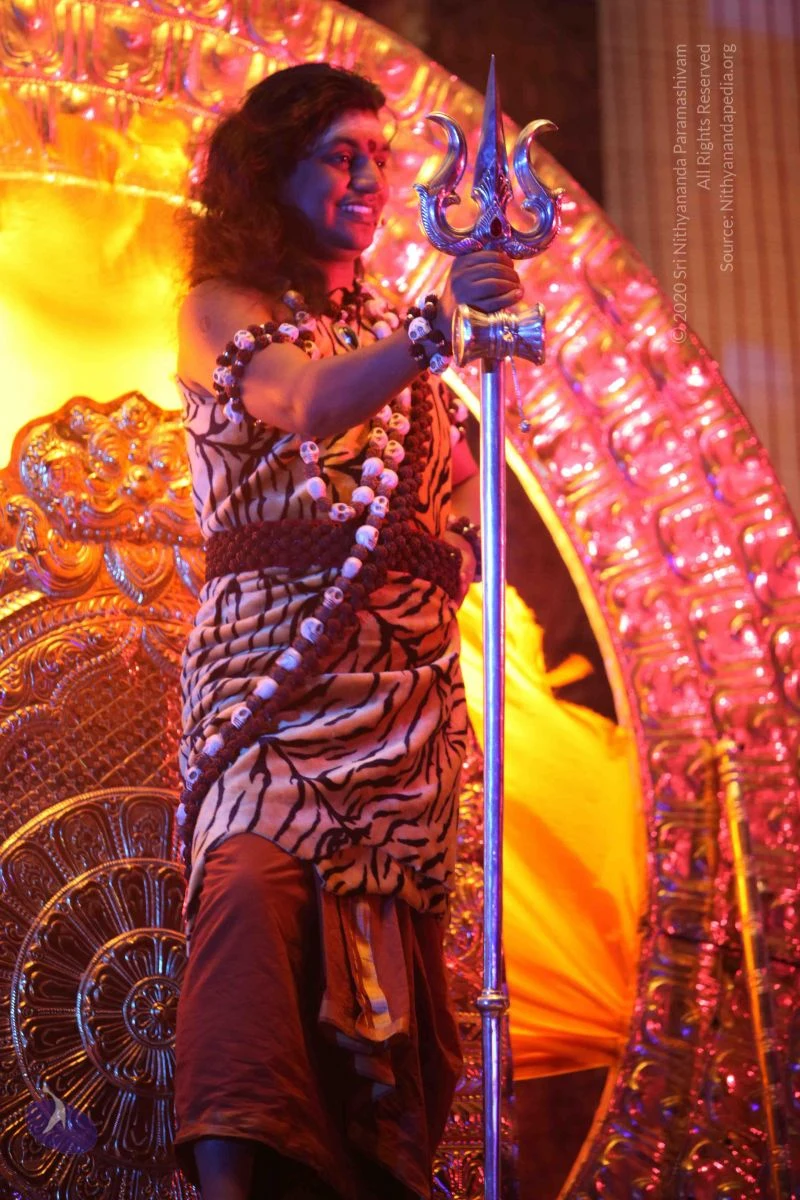
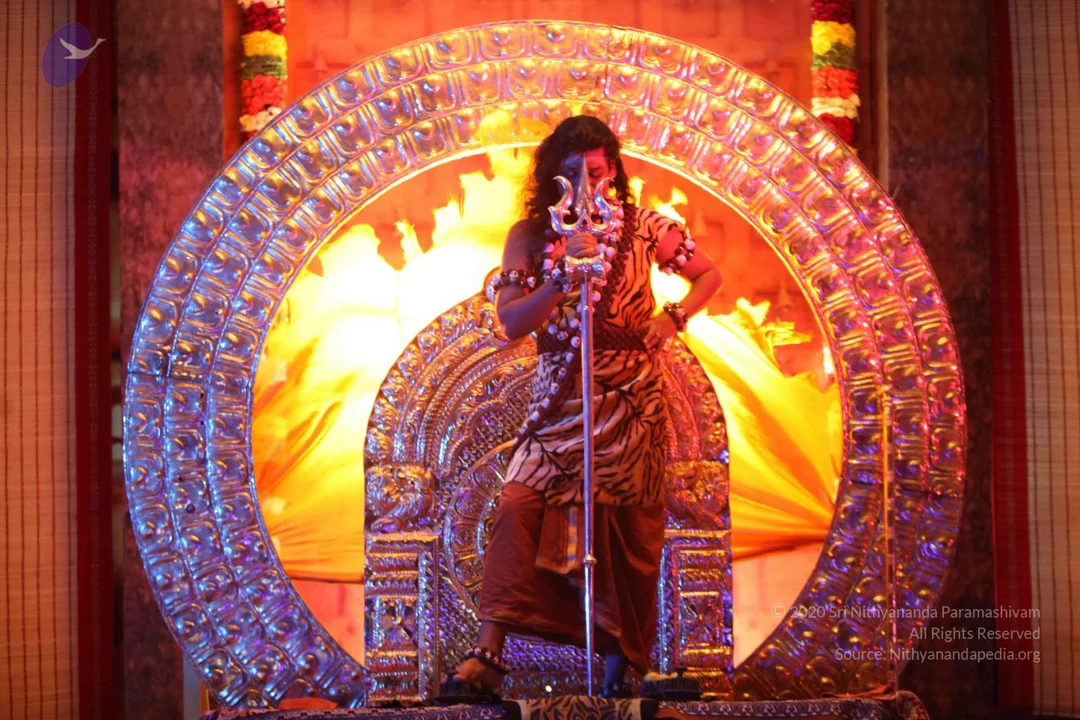
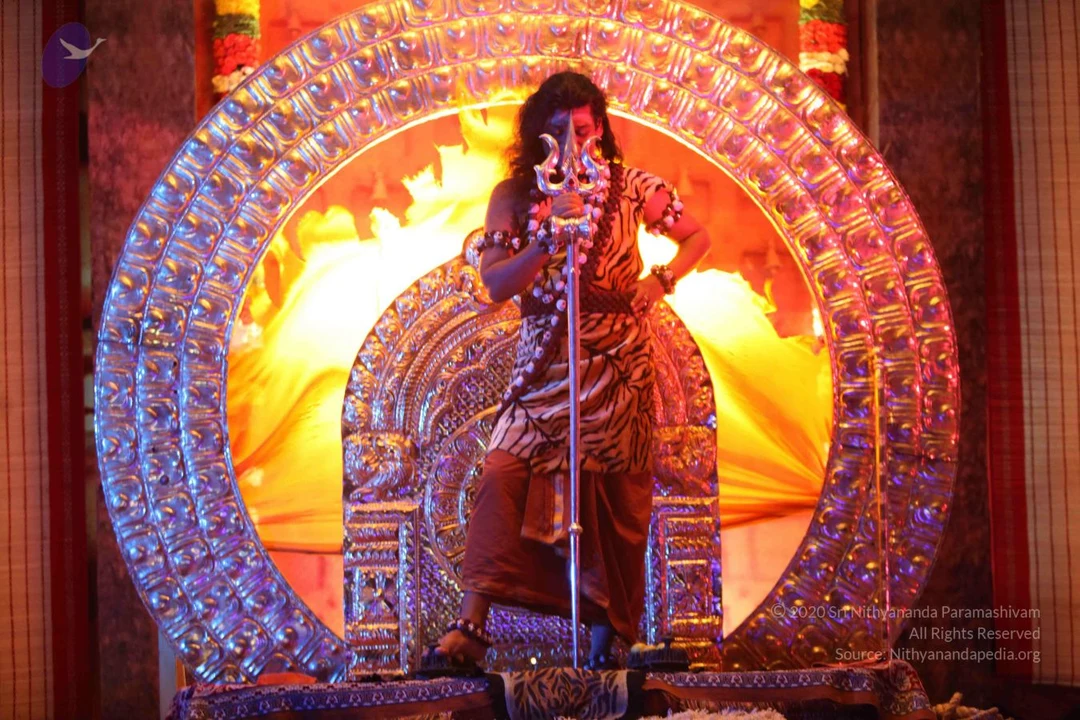
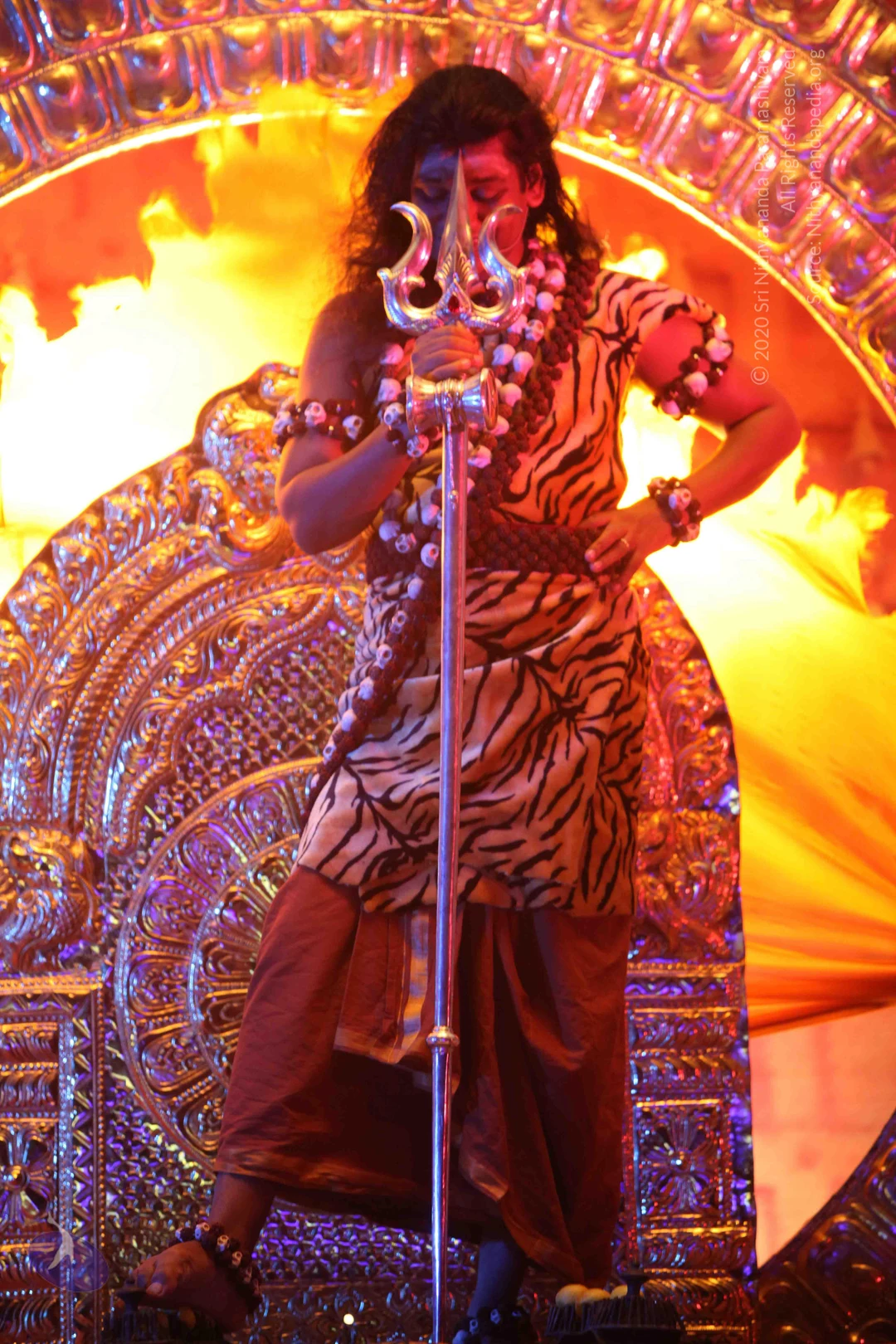
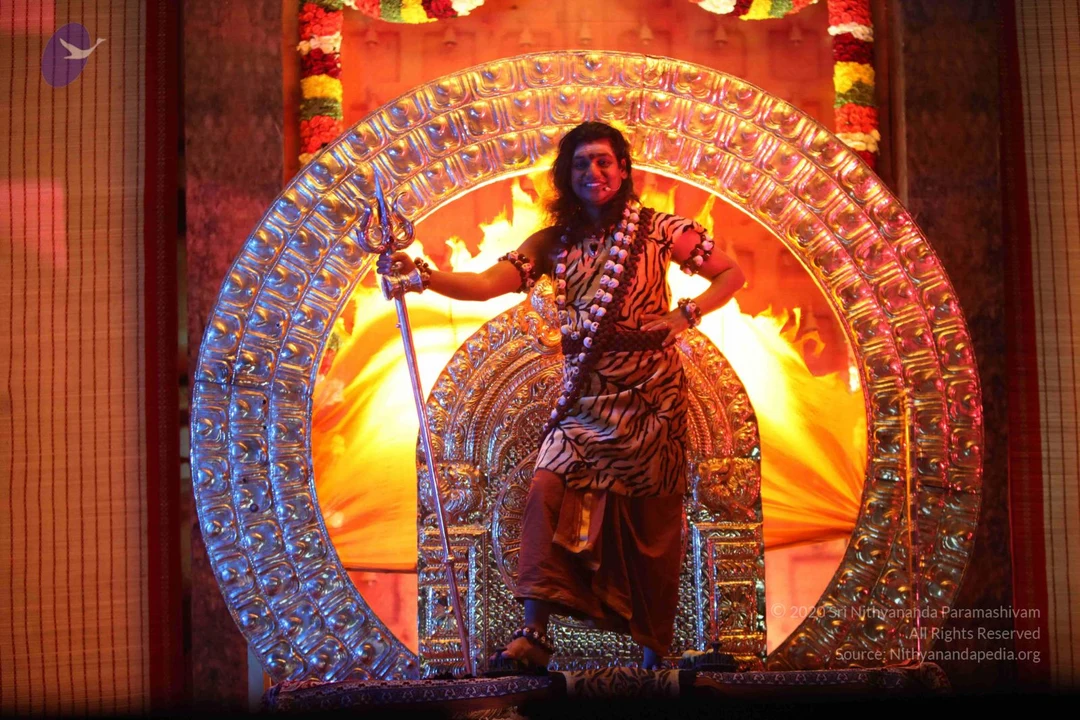
A performer dressed as a Shiva-like deity stands before a large ornate silver circular frame with a glowing orange flame behind him. He wears a tiger-striped garment, white bead necklaces, rudraksha-style beads, beaded bracelets and a red dot on the forehead, and holds a silver trident in one hand. He stands at the centre of a stage, with a golden-yellow cloth and a silver throne-like backdrop behind him, and a bamboo screen at right.A performer on a raised stage wears a tiger-striped garment with a maroon sash and dhoti-style red-brown lower wrap, with a long multi-strand white bead mala and rudraksha-style beaded bracelets. He holds a silver trident in one hand and extends the other arm toward the audience. Behind him is an ornate gilded silver arch and a backdrop lit with bright orange flames. The performer appears to be the central figure of a dramatic stage presentation, and the ornate tiger-striped costume and trident suggest a Shiva-themed role. No clear visible text on the image. a person cues are not sufficiently distinctive to confirm identity from appearance alone.A man stands on a raised platform before an ornate silver arched backdrop lit by warm orange flames. He holds a silver trident in his left hand, wears a tiger-striped garment draped over his torso, a rudraksha mala and a long necklace of white beads, and a dark maroon-brown dhoti. He has long dark hair, a headset microphone, and dark beaded bracelets on his arms. a person's appearance matches the stage performance; he is in a dramatic, theatrical pose with the trident raised.A standing figure stands before a large ornate silver circular arch framed by glowing orange-yellow fabric and warm light. The figure wears a tiger-striped garment, a long multi-strand rudraksha mala with white beads, bead bracelets on both arms, and dark reddish-brown lower cloth. He holds a silver trident in one hand, with long dark hair falling past the shoulders, in a ceremonial pose on a raised platform draped with tiger-patterned cloth. Garlands of red and white flowers hang at the top corners of the arch.A photograph of a person standing on a raised platform in front of a large ornate silver circular arch with a glowing orange-yellow backdrop. The figure holds a silver trident in one hand, wears a tiger-striped garment with a rudraksha-style bead mala draped across the chest, a brown dhoti-like lower cloth, red tilak on the forehead, and multiple beaded bracelets. The silver arch and throne-like ornamental structure frame the figure in a dramatic stage-like setting. The swept-back long hair and ornate adornments are visible. A single person is present.A photograph of a man in front of a large ornate golden arch with bright flames behind him. He stands at the left holding a silver trident in his right hand, smiling, with long dark swept-back hair and a red tilak on his forehead. He wears a tiger-striped garment with a rudraksha mala and a long necklace of white skull-shaped beads, a dark red sash at the waist, and beaded bracelets on his wrists and upper arms. A small microphone is attached near his face. Because he is the only person visible, the figure appears to be a costumed performer in a deity-like role; the frame shows no devotees or other people.

DARSHAN
76 photosSource gallery
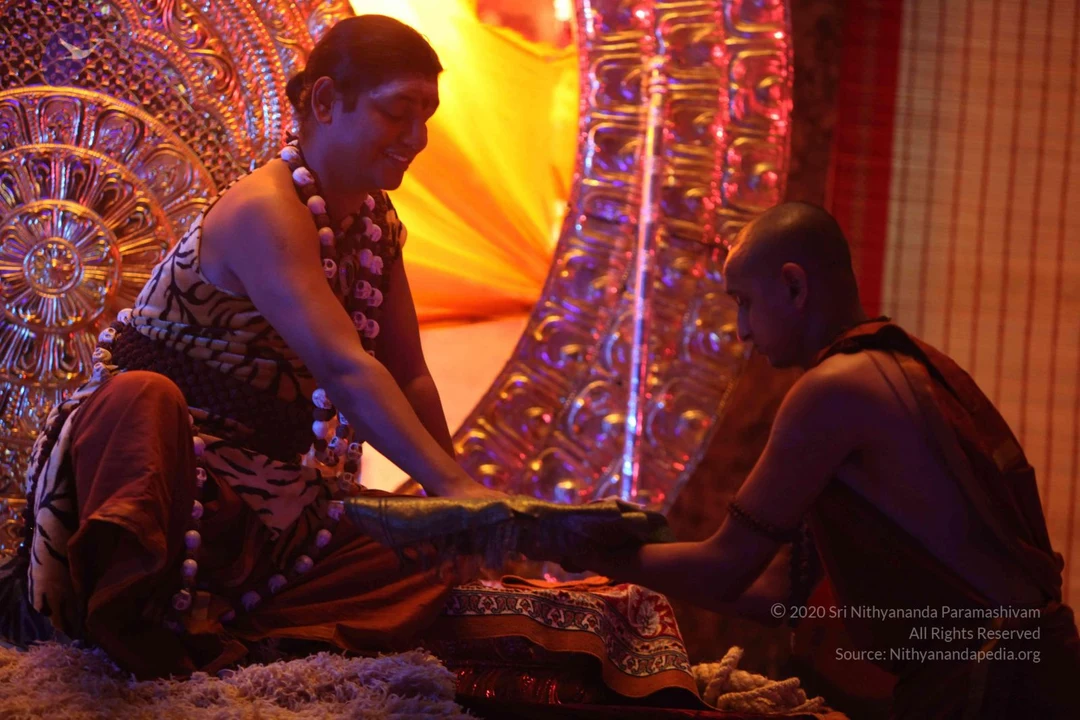
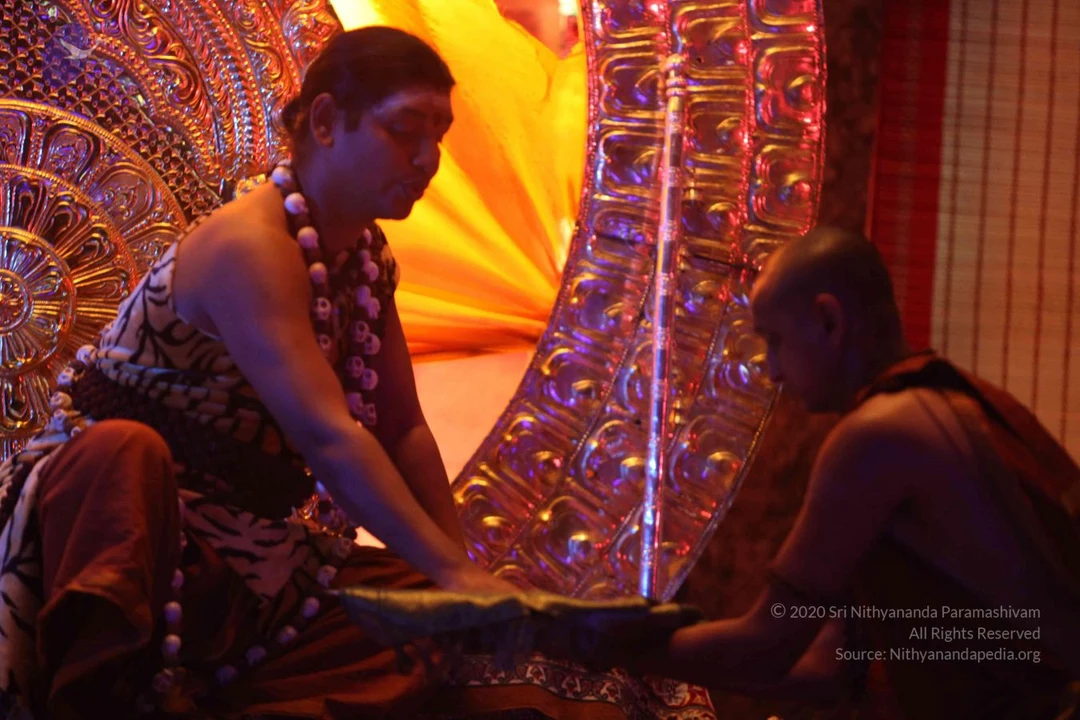
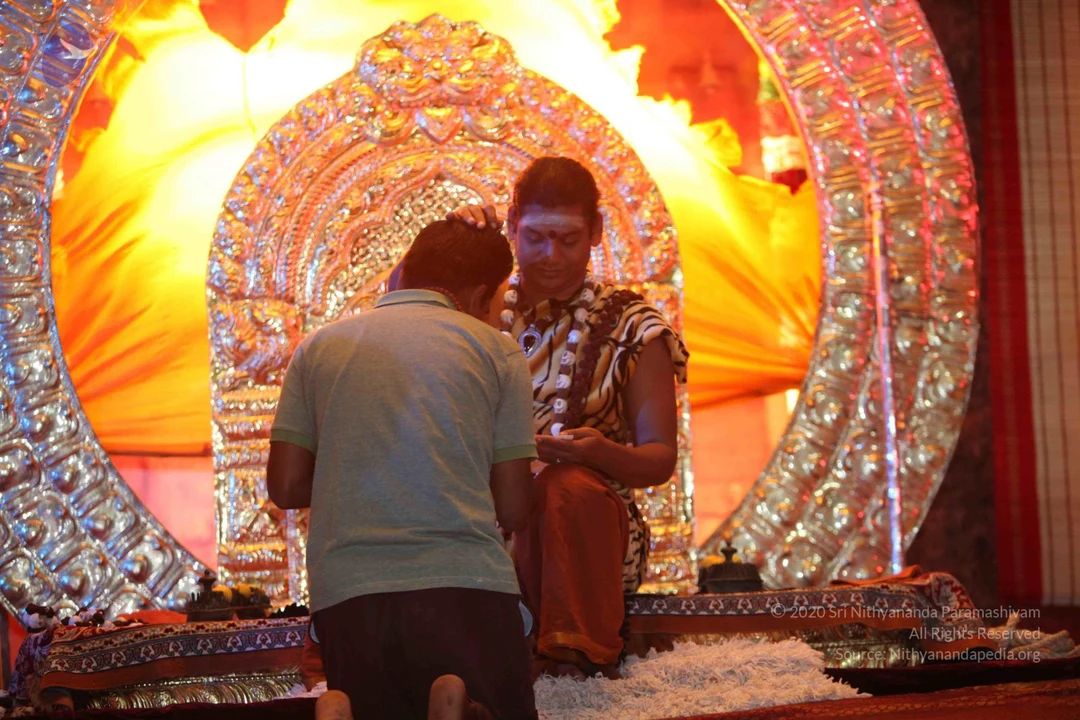
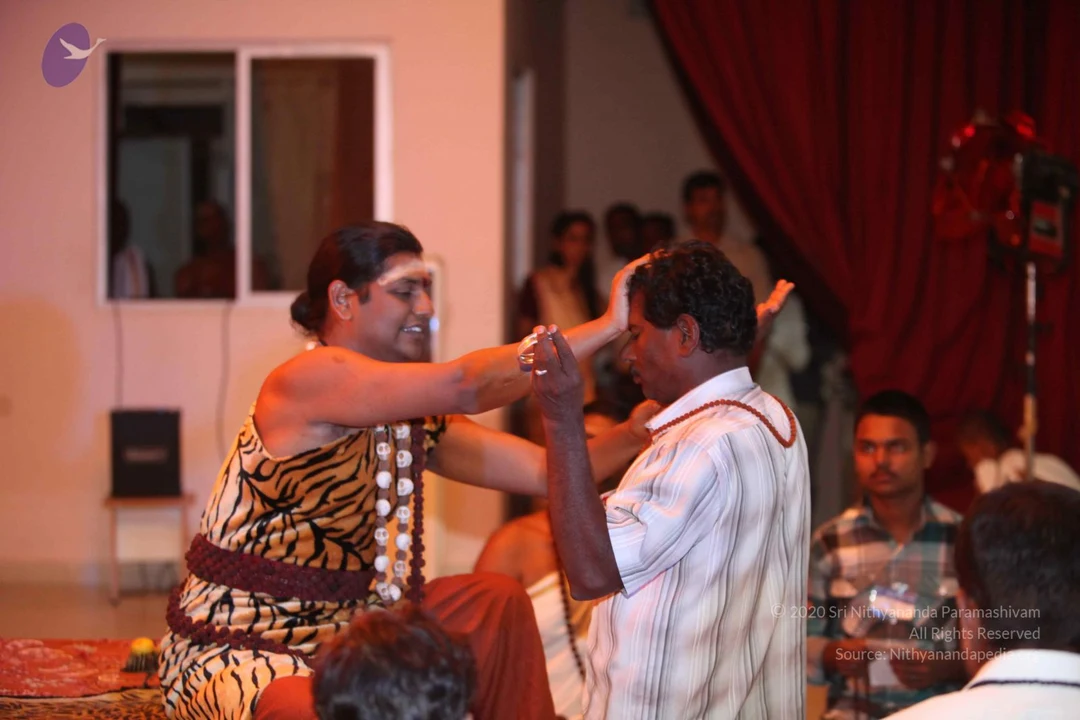
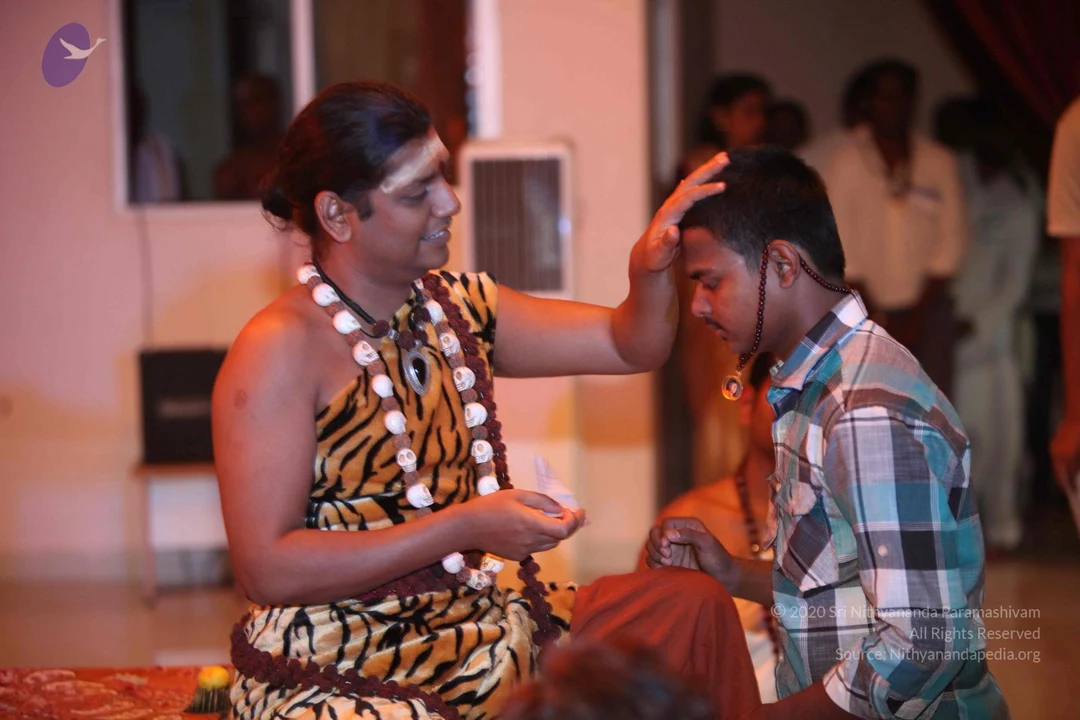
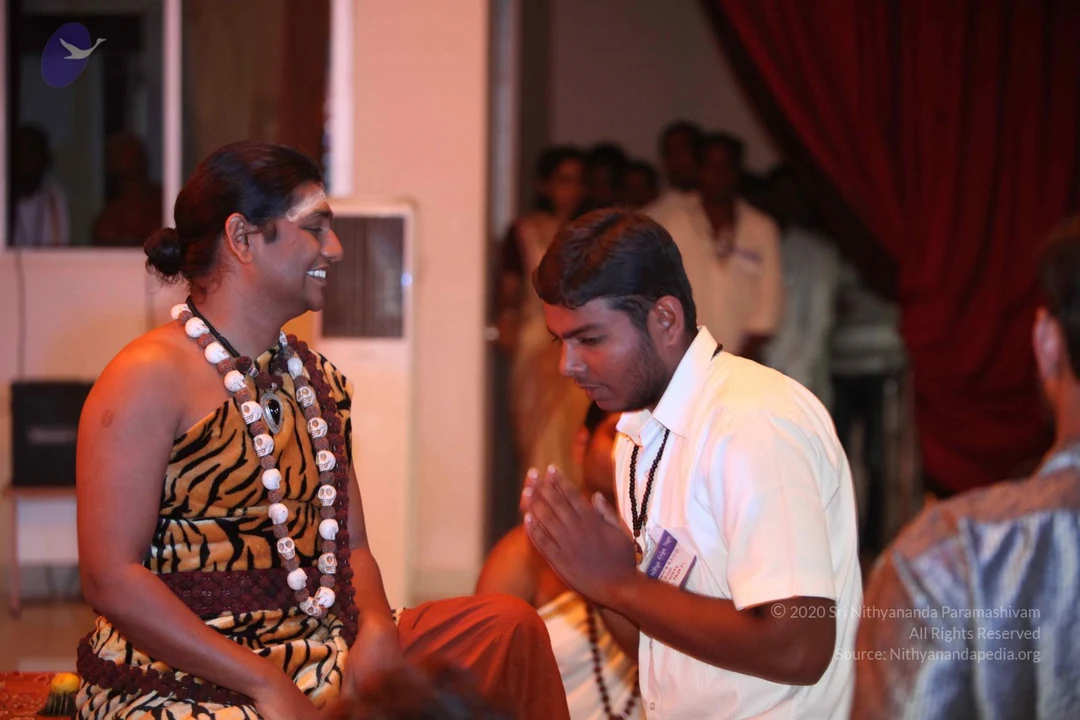
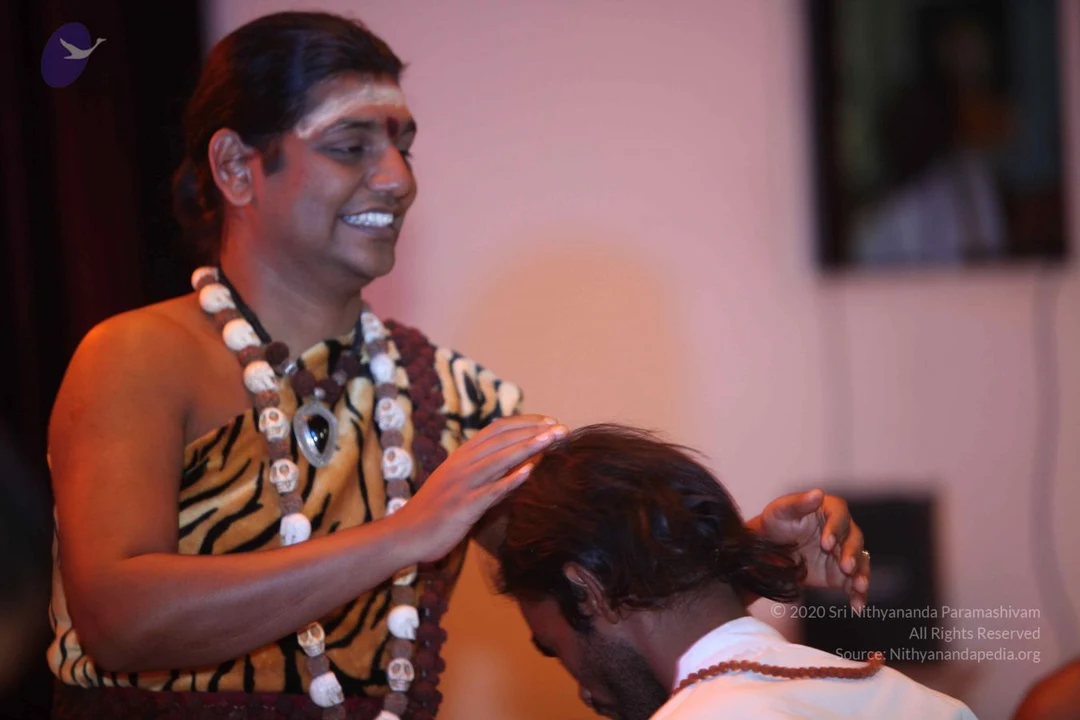
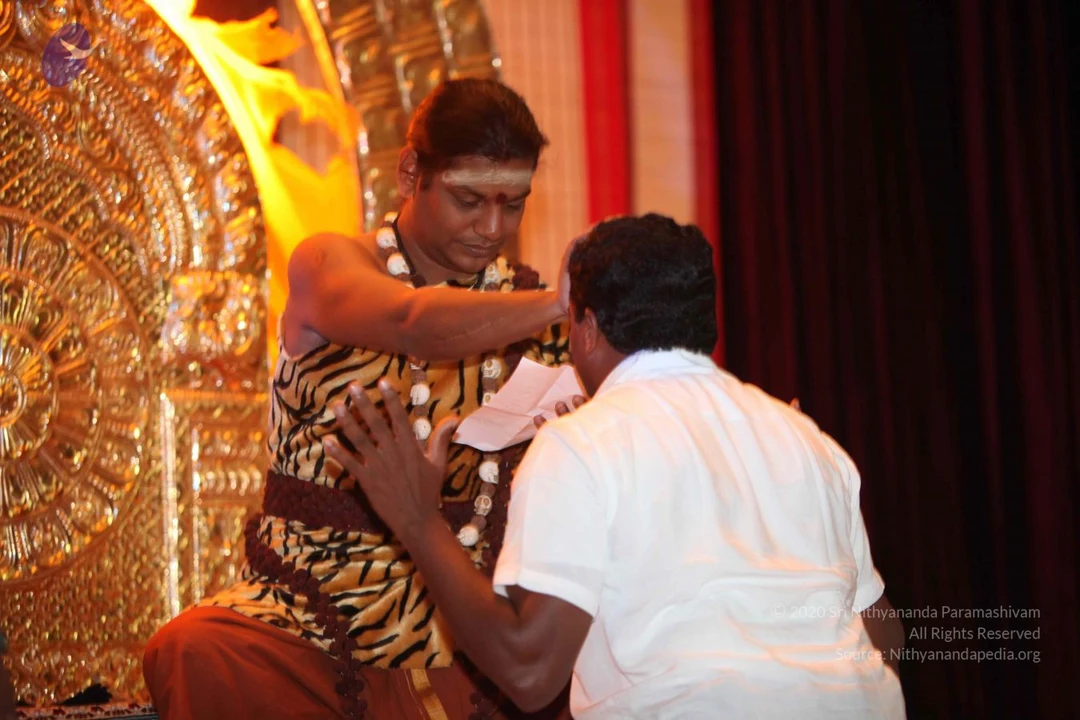
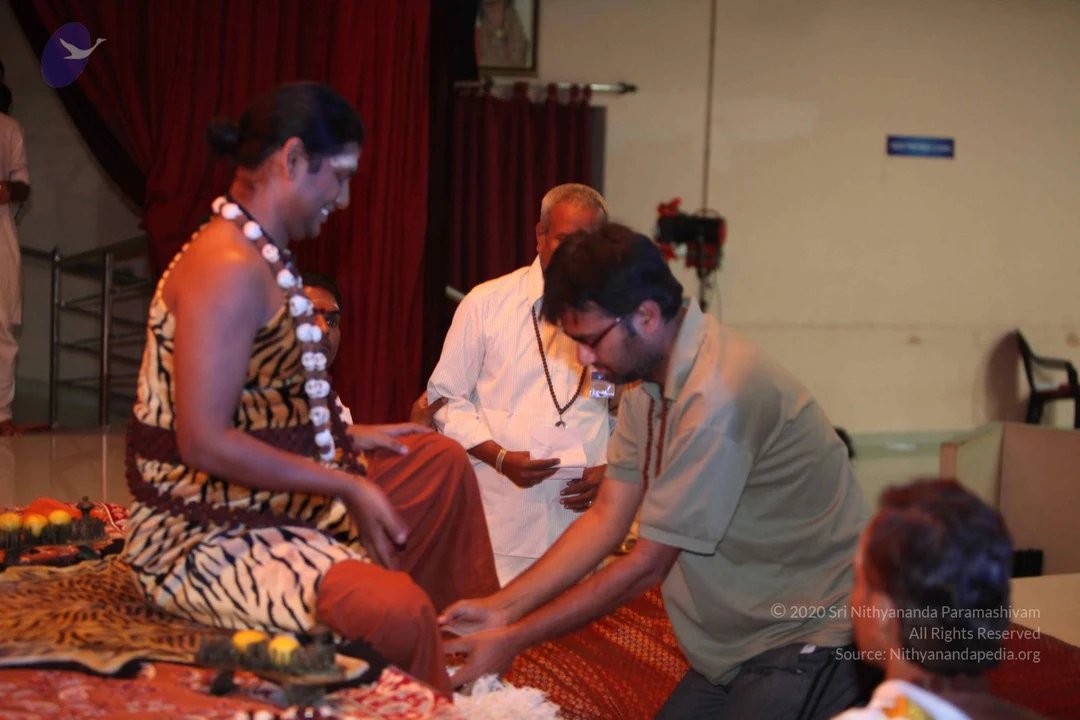
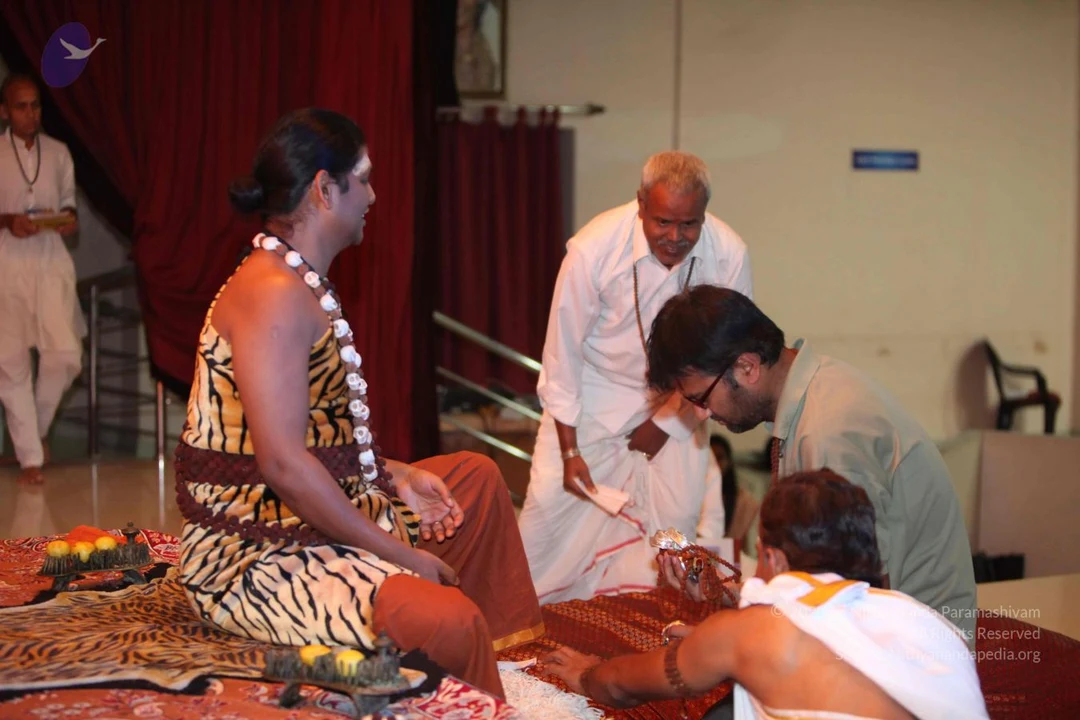
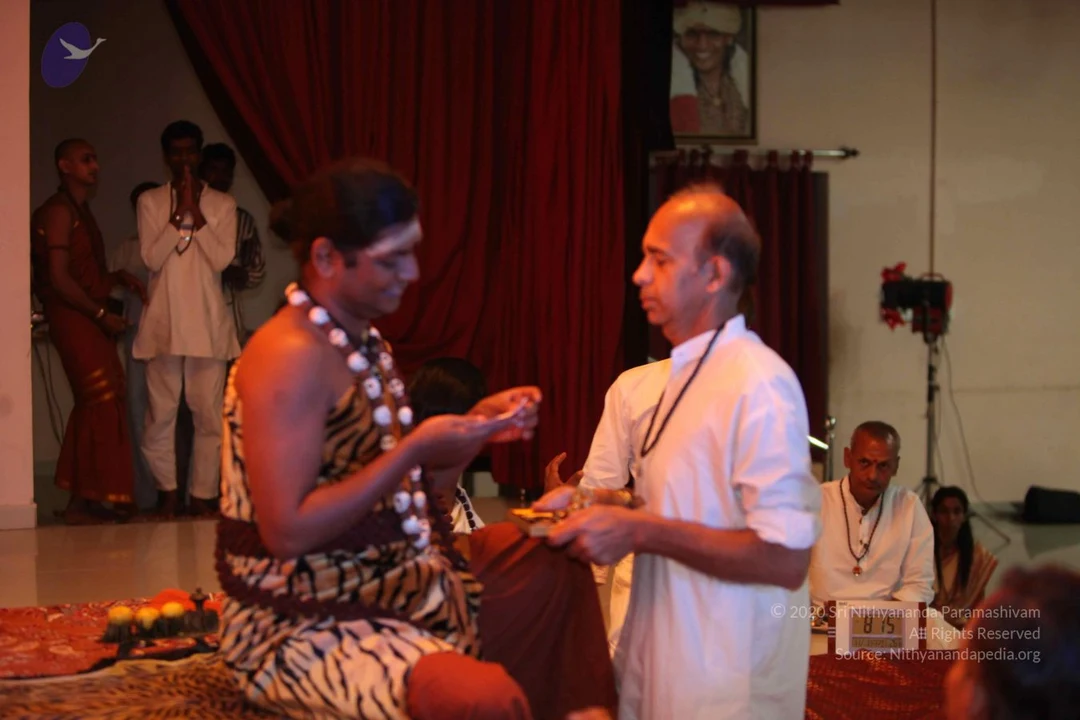
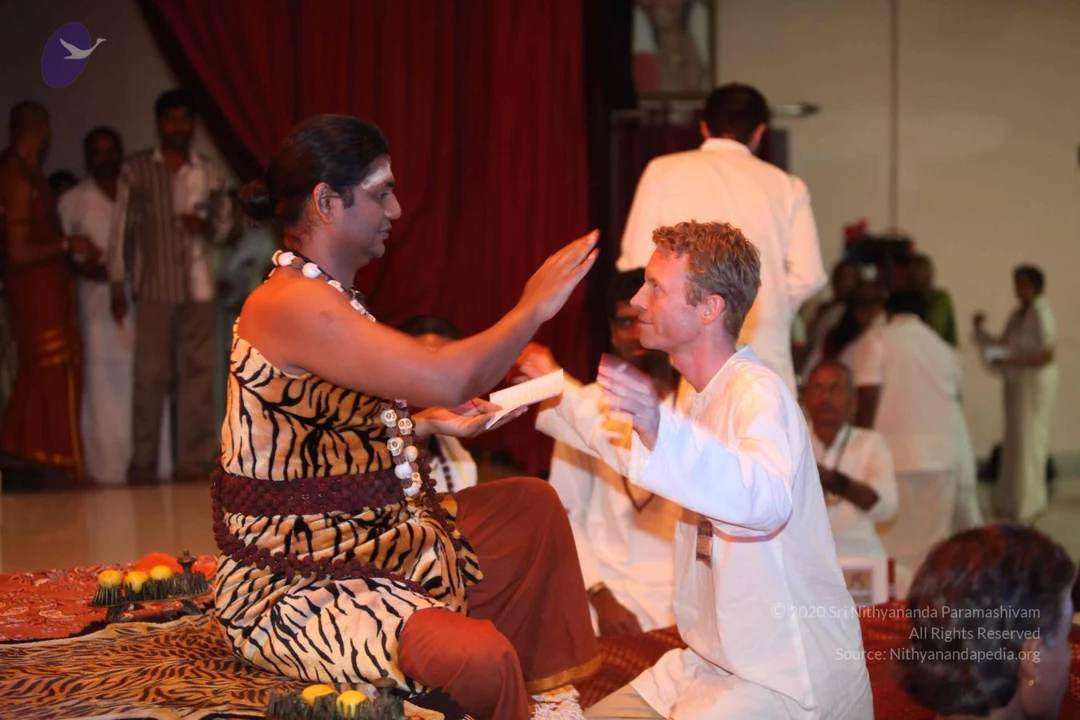
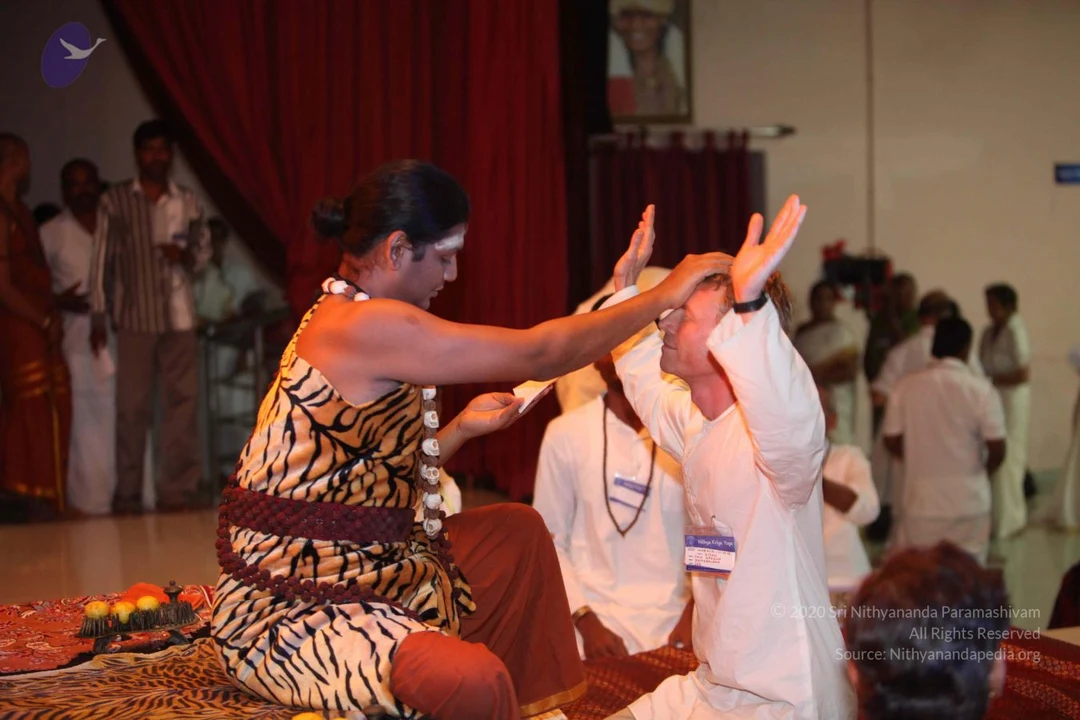
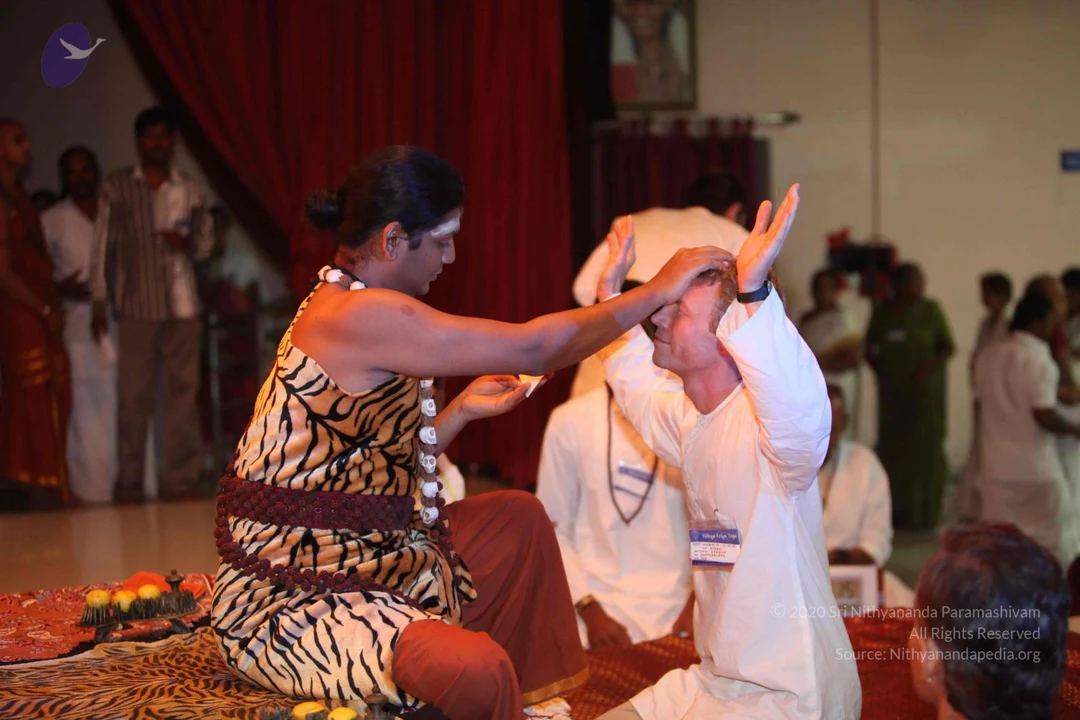
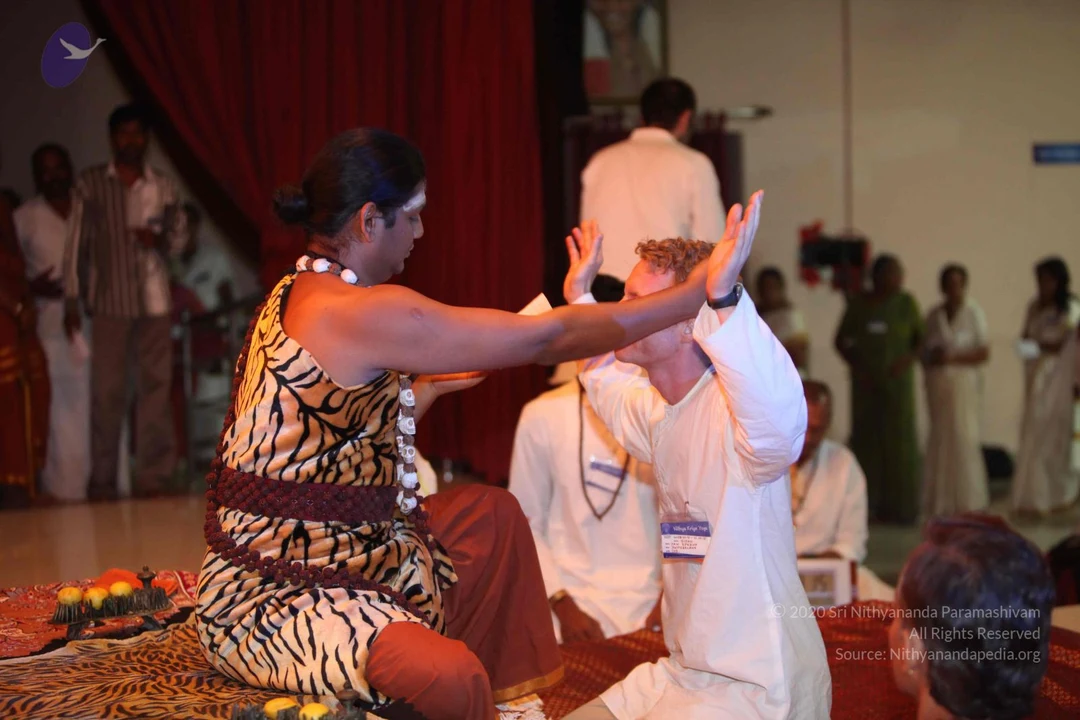
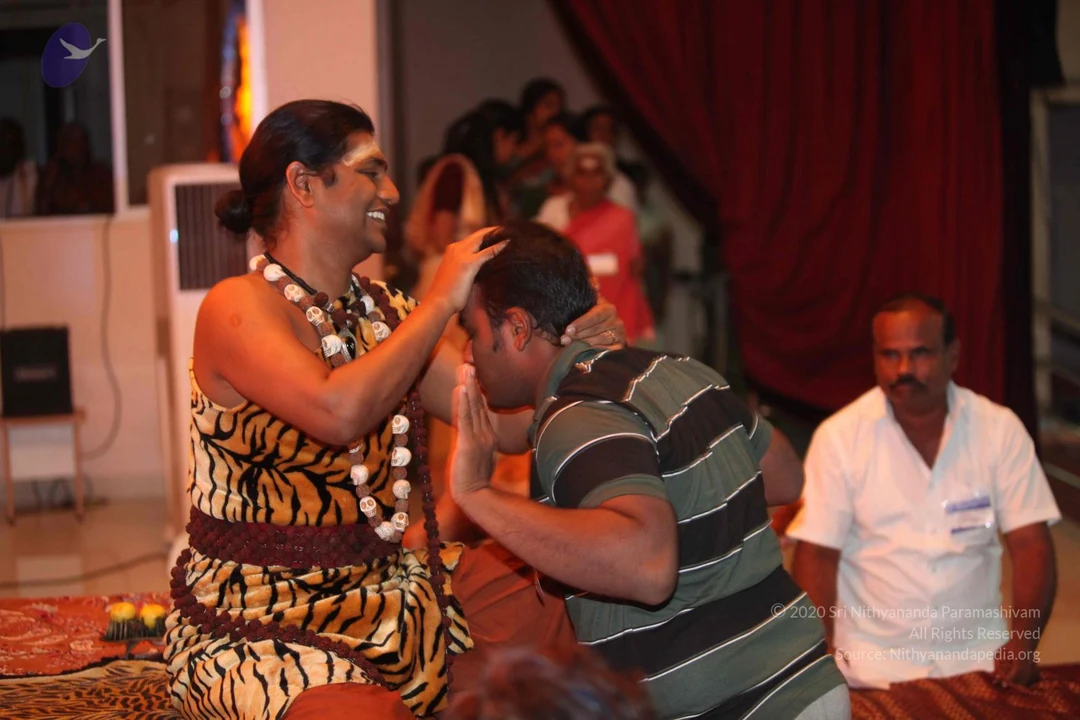
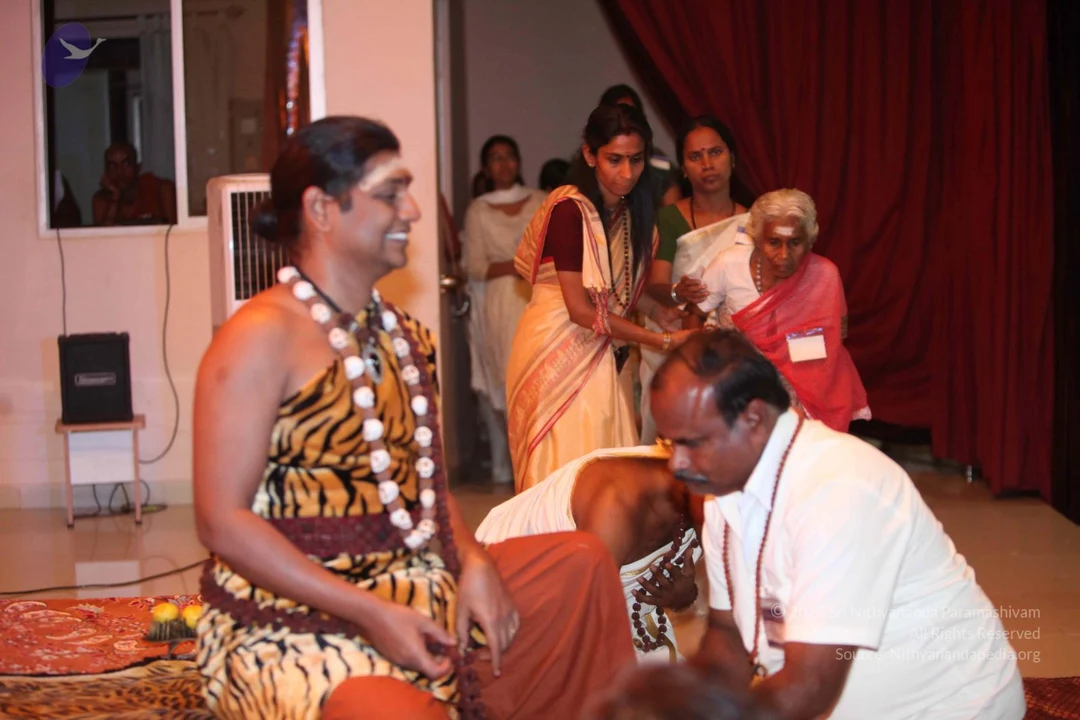
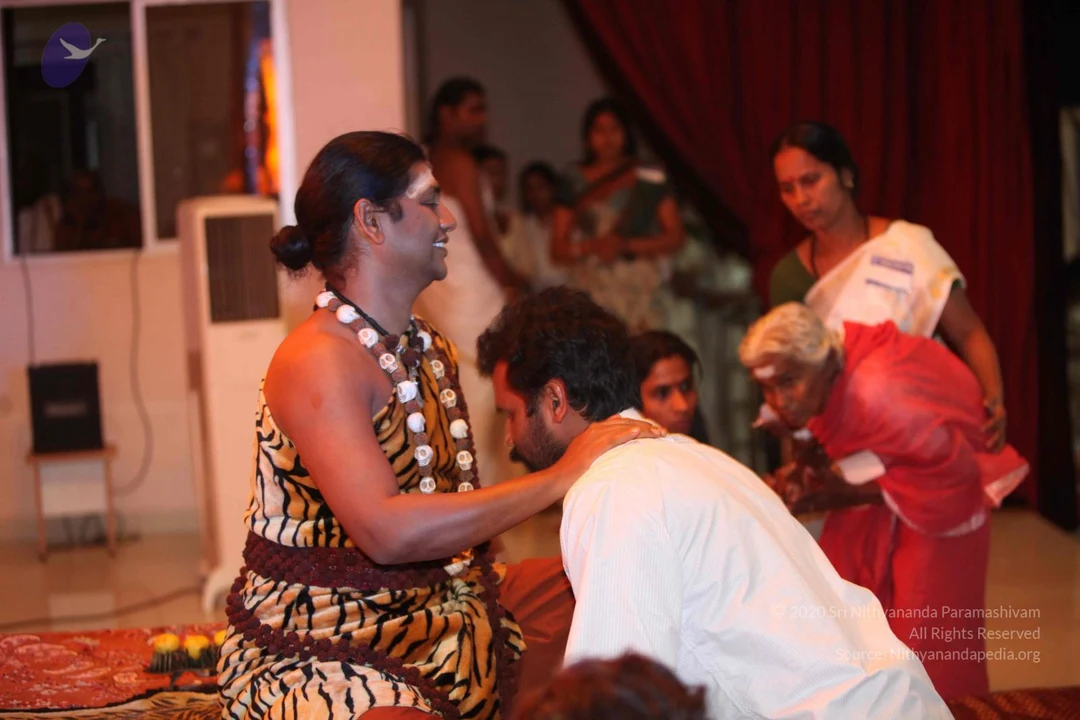
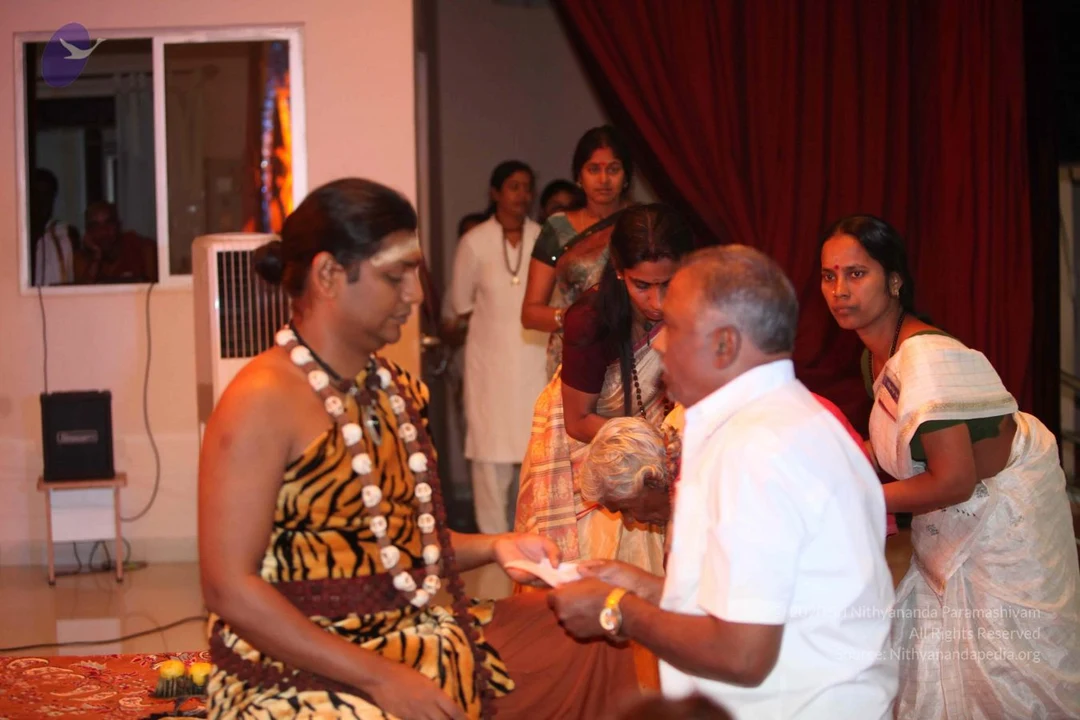
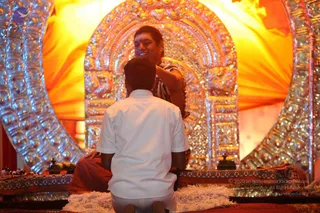
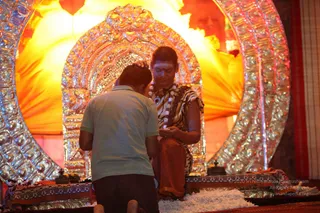
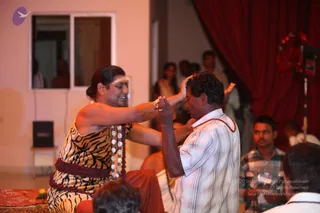
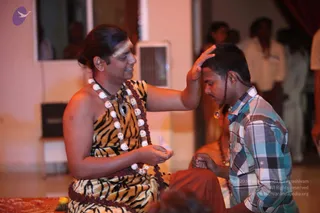
A photograph of a ceremonial scene in front of an ornate silver arched throne with a glowing orange backdrop. A seated man with a shaved head, wearing a brown and cream patterned shawl over a rust-coloured dhoti, sits on the throne smiling. Two attendants in plain white shirts and white dhotis kneel on the floor before him; one holds an object near his hands and the other, a woman in a white sari, kneels at the right holding a small item. Red cushions and white flower petals lie on the floor, with a garland at left. a person cues are insufficient here because the figure lacks distinctive adornments like long hair, crown, or rudraksha malas; he is shown as a seated presence with attendants, so identity is uncertain.A photograph of a seated man in a tiger-striped shawl over an orange-red dhoti, wearing multiple white and red flower garlands and a rudraksha mala, smiling and extending one hand toward a kneeling young man in a white shirt and white dhoti whose back is to the camera. The seated figure sits on a raised peetha/throne backed by an ornate silver-embossed arch with orange drapery behind it. a person: the seated man wears a tiger-striped shawl, orange-red dhoti, layered garlands and rudraksha mala, cues consistent with the page's reference to a person at this satsang. Small offerings and a flower arrangement sit on the platform at lower left.A photograph of a seated figure in a saffron-orange wrap and dark rudraksha-style neck adornment, bare-chested with a shawl draped over the shoulder, sits before an ornate silver-and-gold arched shrine with a glowing orange backdrop. In the foreground a kneeling devotee in a white short-sleeved shirt and white trousers, seen from behind, bows toward the seated figure, who leans forward and places a hand on the devotee's head. Small brass oil lamps and a floral arrangement sit on the silver-draped platform. The seated figure has distinctive ceremonial adornments and a shawl, consistent with a.A seated man in a striped golden-and-brown shawl over a rust-orange dhoti, wearing a rudraksha mala and a white garland, with a red tilak on his forehead, rests his hand on the head of a kneeling man in a light green polo shirt and dark shorts. The seated figure holds a small object in his hands while a large silver-framed arch glows behind him, lit by warm orange light. Decorative silver pillars frame the scene, with brass lamps and a white cloth on the floor.A photograph of an indoor satsang setting with a red curtain backdrop. A seated figure with swept-back dark hair, a horizontal white tilak on the forehead, and a tiger-striped wrap with a rudraksha mala and bead necklace places one hand on the head of a standing man in a white striped shirt with a red rudraksha mala, while holding his hand. Seated and standing onlookers watch in the background, some in plaid shirts. A small brass lamp sits on a cloth at lower left. a person is seated, giving a blessing to a devotee.A photo of a seated ceremony at an indoor satsang hall. A figure in a tiger-striped shawl wrapped over one shoulder, with a white vibhuti horizontal mark on the forehead and layered white shell beads and rudraksha malas, places a raised palm on the forehead of a young man in a teal and white checked shirt with a rudraksha mala and pendant. The giver holds a folded white cloth in the other hand. Behind them, other seated devotees and standing attendees in white shirts are blurred. Warm lamp light and a red cloth at the lower left.

satsang-and-nky

48 photosSource gallery
A seated man in a saffron-orange robe with a gold-embroidered border sits on an ornate gold throne with red cushions, wearing a rudraksha mala, multiple gold necklaces, and bangles, with a red bindi on his forehead. In front of him a man in white ritual clothes, with a white tilak on his forehead and a mala around his neck, kneels with palms pressed together in namaste. A woman in a white-and-maroon sari sits at the lower right edge of the frame. Behind them are a dark wood-panelled wall and a brass oil lamp, and gold offering trays with flowers sit at the base of the throne. The seated figure is a person by his saffron and ornate adornments; the kneeling man is a devotee.A seated figure on an ornate gold throne with red cushioned armrests is dressed in saffron-orange robes and a saffron shawl, wearing layered beaded necklaces, a rudraksha mala and a red bindi, with gold bangles on the arms. A man in white ritual clothes kneels on the dark floor at left, palms pressed together in namaste, with a white tilak on his forehead and a mala around his neck. Nearby stand a brass oil lamp and silver trays holding flowers and offerings. A woman in the lower right corner is partly visible. The wall behind is dark and studded, with a turquoise panel at left. a person: the seated figure wears saffron robes, a rudraksha mala and gold necklaces on a throne, and is.Photograph of a satsang-style ritual in an indoor hall. A man in an orange robe with a red tilak, layered gold and bead ornaments, and a bare chest is seated on an ornate gold throne with red cushions, his bare feet resting on a gold footstool. A man in white ritual clothes with a white forehead band and a rudraksha mala kneels before him with hands folded. A woman in a pink sari sits at the lower right, and a plate of flowers and offerings lies at the base of the throne. a person is the figure on the throne, identified by the page and the orange robe with rudraksha malas and gold necklaces.A seated figure in a saffron-orange robe with a gold-bordered shawl, wearing layered rudraksha malas and ceremonial gold necklaces, sits on an ornate gold throne with red velvet cushions against a dark wall. A kneeling devotee in white ritual clothes, with white forehead markings and a rudraksha mala, sits at the lower left before a gold tray holding flowers and offerings. A woman in a cream sari with long dark hair sits at the lower right. A brass oil lamp stands in the background. a person: the saffron-robed, mala-adorned figure on the throne has distinctive ceremonial cues, though the appearance is only partly clear.Photograph of an indoor satsang setting with a man seated on an ornate gold throne with red cushions, wearing orange saffron robes, a gold belt, layered gold and beaded necklaces, gold armbands and a red tilak on his forehead, eyes closed in meditation. A bald man in white clothes with a white tilak and rudraksha mala kneels on the floor before the throne with hands folded, and a woman in a white and pink sari sits in the foreground near a gold tray holding flower garlands and offerings. A brass oil lamp stands behind the throne and a gold-decorated stand is in the right corner. a person is seated on the throne with saffron robes, long-style gold and rudraksha necklaces and gold armbands; his identity is based on appearance cues only.A seated man in saffron-orange robes sits on an ornate gold throne with red velvet cushions, wearing a long rudraksha-style bead mala and a gold necklace, with a red tilak on his forehead and gold armbands. Before him, two women in white and cream saree-style clothing kneel on the floor beside a large gold tray holding brass dishes of flowers and offerings, and a tall brass oil lamp with a peacock-shaped top stands in front. The setting is a decorated hall with gold fittings, a dark stone wall and painted blue-and-pink panels. a person appearance-based label applies to the seated figure with saffron robes, bead mala and throne cues.

web-selected

2 photosSource gallery
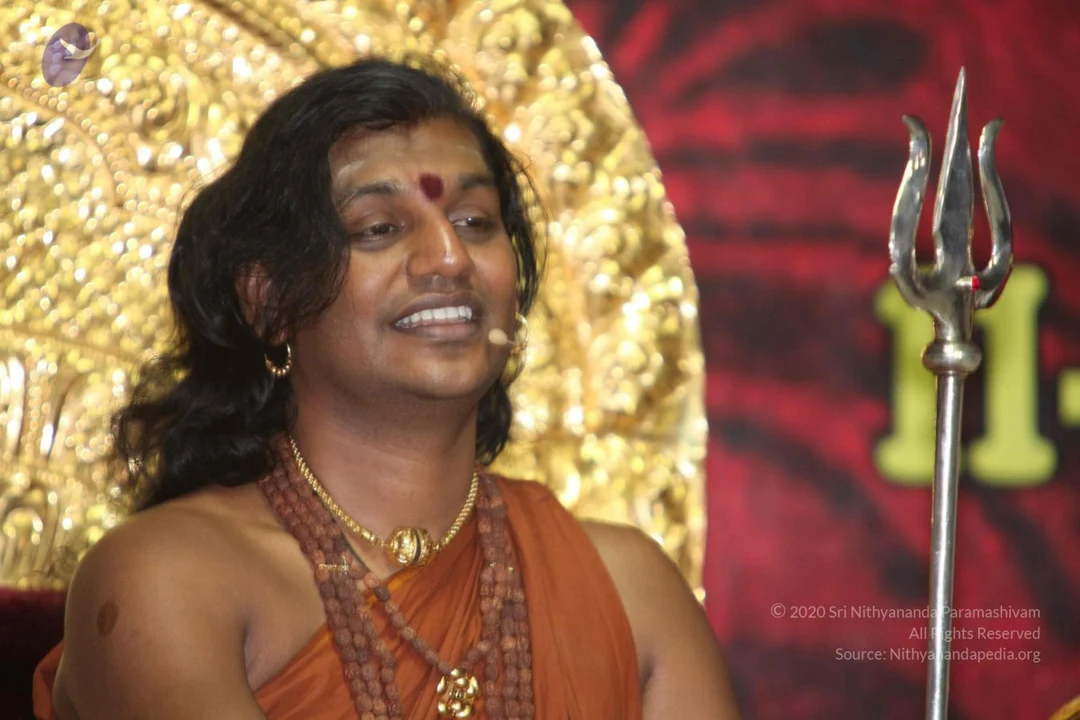
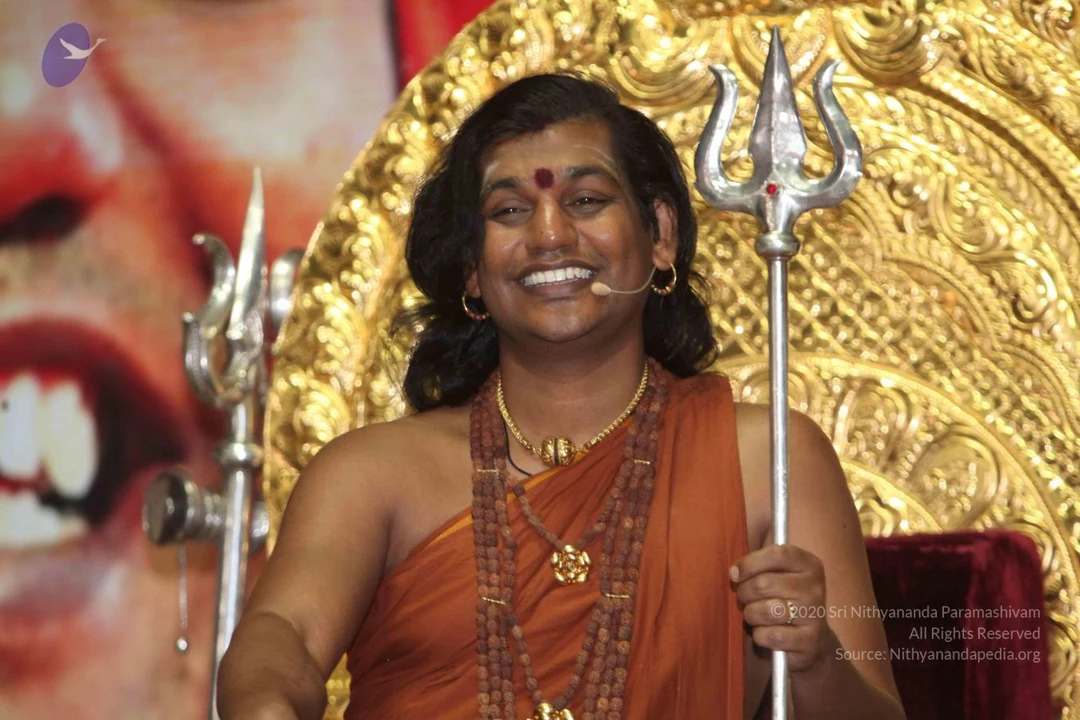
A seated figure on an ornate golden throne with lion-form armrests on a stage, holding a trident-like staff in one hand and a ritual object in the other. He wears orange-saffron robes, a rudraksha mala and a gold-toned necklace. Behind him is a large red backdrop with a painted portrait of a smiling man in an orange turban and red tilak, with Tamil lettering on the right. Two white fan units stand on either side of the stage and a carpet lies at the base of the throne. The seated figure's identity is uncertain from appearance, so only role and attire are described.A smiling man with long swept-back dark hair, a red bindi on his forehead, a small microphone at his cheek, wearing an orange-saffron shawl draped over bare shoulders, multiple rudraksha mala strands and a gold ceremonial necklace with a pendant. Beside him stands a polished silver trident with a red stone on its shaft, and behind is a gold-patterned backdrop with a red-and-black background showing large yellow numerals partly visible. Probable Swamiji's appearance cues: long hair, saffron clothing, rudraksha malas and gold necklace, seated in a speaking setting at a satsang-style event.

output

2 photosSource gallery
A smiling man with long dark hair, a red bindi and a small head microphone sits before a gold ornate throne-like backdrop, holding a silver trident upright in his right hand. He wears an orange-saffron shawl over his shoulders, multiple strands of rudraksha beads, and gold necklaces. A large enlarged image of a face with open mouth and teeth appears at left, with a second silver trident beside it. Swamiji (probable) appears in person, with the cues of long swept-back hair, saffron clothing, rudraksha malas and ceremonial gold jewellery.A photograph of a single seated man on a raised ornate silver throne, set before a large circular silver halo-frame with a glowing orange-yellow flame-like backdrop. He wears an orange-and-brown tiger-striped shawl over a bare upper body, orange-red dhoti, a white-and-red flower garland, and a red tilak on his forehead. Flower-decorated canopy elements and white flower petals sit on the platform, with small oil lamps at the base. The seated figure has short hair and a warm smile, appearing to be a person based on the seated, honoured position and the tiger-striped shawl and garland cues; the appearance is not strongly distinctive, so this is marked unsure.

energy-darshan

38 photosSource gallery
A seated man in a tiger-striped shawl and rust-red dhoti sits cross-legged on an ornate platform before a large gilded arched backdrop with embossed silver-and-gold tiles and an orange illuminated fabric canopy. He wears a dark rudraksha mala with white beads and smiles toward the camera with his hands clasped in his lap. Oil lamps and a small bundle of beads rest on the cushioned seat in front of him. a person is seated as the central figure of a satsang stage, identified by his tiger-print shawl, rudraksha mala and the ceremonial setting.A smiling man with short dark hair and a small red bindi stands before an ornate golden silver arch framed by orange and yellow flames of light. He wears a striped tiger-pattern cloth over one shoulder and a multi-strand mala of rudraksha and white beads with a large pendant around his neck. The arch is richly embossed with floral and scroll motifs. a person: the seated figure's appearance shows only a shaved-head-free short hairstyle and rudraksha mala, which is insufficient to confirm identity.A smiling man with a short dark hairstyle and a red bindi stands in front of an ornate golden silver arch-shaped throne back, lit by warm orange flames or fabric behind it. He wears a striped tiger-print wrap over his shoulder, a rudraksha mala with white beads, and a dark pendant. No other people are visible.A smiling man stands before an ornate silver-toned arched throne backdrop with repoussé floral and scroll carvings, lit by warm orange and yellow fabric behind him. He wears a black-and-white patterned wrap over one shoulder, a rudraksha mala with skull-like beads, and a red tilak on his forehead. One physical person is visible.A smiling man with short dark hair and a small tilak stands before an ornate gold-and-silver carved arch backdrop lit by warm orange light and draped with orange fabric. He wears a striped cream-and-black garment and several long rudraksha malas with pale beads hanging across his chest. a person: a man with a short head and rudraksha malas and a striped wrap; appearance cues are limited, so this identification is uncertain. The setting resembles a stage or throne-style decor.A seated man in a meditative pose sits on a white-fringed cushion before an ornate, gilded arched backdrop with glowing golden light. He wears a tiger-stripe patterned shawl over one shoulder, rust-orange cloth wrapped at the waist, and a long mala of rudraksha beads with white skull-shaped beads. A vertical tilak mark is on his forehead, and his hands rest together in his lap. Appearance-based candidate: a person, seated in a satsang setting with the distinctive tiger-print shawl and rudraksha-and-bead mala as cues. No other people are visible.

selected

2 photosSource gallery
A smiling man with long dark hair, a red bindi and a small head microphone sits before a gold ornate throne-like backdrop, holding a silver trident upright in his right hand. He wears an orange-saffron shawl over his shoulders, multiple strands of rudraksha beads, and gold necklaces. A large enlarged image of a face with open mouth and teeth appears at left, with a second silver trident beside it. Swamiji (probable) appears in person, with the cues of long swept-back hair, saffron clothing, rudraksha malas and ceremonial gold jewellery.A photograph of a single seated man on a raised ornate silver throne, set before a large circular silver halo-frame with a glowing orange-yellow flame-like backdrop. He wears an orange-and-brown tiger-striped shawl over a bare upper body, orange-red dhoti, a white-and-red flower garland, and a red tilak on his forehead. Flower-decorated canopy elements and white flower petals sit on the platform, with small oil lamps at the base. The seated figure has short hair and a warm smile, appearing to be a person based on the seated, honoured position and the tiger-striped shawl and garland cues; the appearance is not strongly distinctive, so this is marked unsure.

1-Akashic-Reading-And-Energy-Darshan
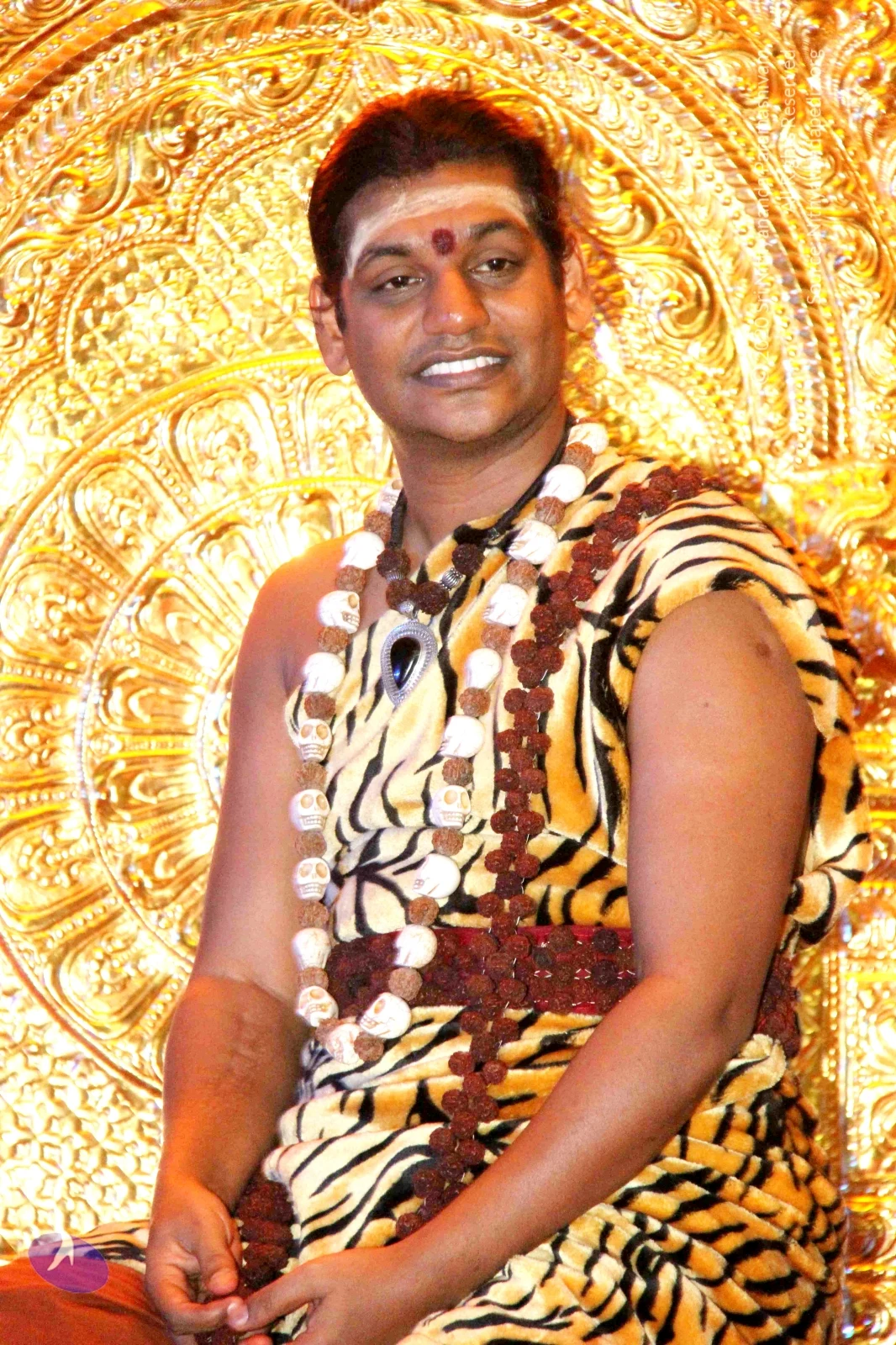
10 photosSource gallery
A smiling man with short dark hair sits before an ornate gold repoussé backdrop. He wears a tiger-striped shawl over bare shoulders, orange-red cloth around his lower body, and layered rudraksha malas with white skull beads, plus a dark stone pendant in silver. A red bindi and white forehead markings are visible. a person: the appearance cues are a sitting figure in saffron-orange cloth, tiger-striped shawl, and multiple rudraksha malas with skull beads, seated before an ornate golden throne-like backdrop.A smiling man with short dark hair and a white-and-red tilak on his forehead sits in front of an ornate gold-leaf backdrop. He wears a tiger-striped garment, a long necklace of white skull beads alternating with rudraksha beads, and a dark stone pendant. The appearance matches the a person candidate with several cues including rudraksha malas, skull-bead necklace and ornate gold setting, so this is a person in person. He is the only person visible.A smiling man sits before an ornate gold repoussé backdrop with floral and scroll patterns. He wears a tiger-striped fabric draped over one shoulder and wrapped at the waist, with a red sash. Around his neck are layered rudraksha beads, white skull beads and a dark stone pendant set in silver. White ash lines mark his forehead with a red dot at the centre. He sits with his hands resting together at his lap. The photo shows one physical person; the figure appears to be a presenter in a ceremonial setting, and the page indicates an in-person a person presence, but the appearance cues are only partly distinctive, so identity remains uncertain.Photograph of a seated man at the centre of an ornate gilded throne arch, with a glowing golden-yellow fabric backdrop behind him. He wears a tiger-striped wrap over his shoulder, orange-red cloth around his waist, a white flower garland and a rudraksha mala, with a red mark on his forehead. He sits cross-legged on a white cushion with his hands joined, and red and yellow flower garlands hang across the top of the frame. Visual cues including long swept-back hair are not clearly visible, so the identity is uncertain; the person is described by role as a seated figure on a throne.A man sits cross-legged on a raised orange-and-red cushioned dais in front of an ornate golden arch-shaped backdrop with yellow draping and a garland of red, white and yellow flowers hung across the top. He wears a tiger-striped patterned garment over the shoulder, an orange dhoti, a white flower garland and a red tilak on his forehead, and smiles toward the side. Brass lamps sit on either side of the seat. The setting resembles a formal satsang or darshan stage. a person is present as the central seated figure, identified only by appearance cues: a sannyasi-style saffron-orange dhoti, ceremonial garland and tiger-print wrap.A standing figure in a striped sleeveless blouse with a white and red floral garland and a dark bead necklace stands before an ornate gold-and-brass arched throne backdrop, smiling at a man in white kneeling in front of him on a red cloth with white flower petals. Two women sit on the left and right; one on the right wears a white sari with red border and a beaded mala. A bright golden fire glow sits behind the scene, with a dark red curtain to the right.

2-Energy-Darshan

8 photosSource gallery
A seated man in a tiger-striped, sleeveless wrap over maroon dhoti sits cross-legged on a raised cushioned platform in front of a large ornate silver prabhavali-style arch. Behind him, a bright flame-like glow fills the arch, and a golden inner arch frames the seat. He wears layered rudraksha and white bead malas and holds a mala in his hand. Red, yellow and white flower garlands hang across the top of the backdrop, and the platform is decorated with a patterned runner and white flower petals. The setting resembles a formal satsang or darshan hall.A seated man in a tiger-striped shawl over bare shoulders, wearing a rudraksha mala with ornamental bead necklaces, rust-orange dhoti and a red tilak on his forehead, sits on a white fleece-covered seat before an ornate gold-and-silver throne backed by a large circular silver prabhavali halo. Behind him a bright flame or fire burns against a yellow cloth, framed by a garland of red, white, yellow and green flowers. Small oil lamps or vessels sit on the platform beside him. The setting appears to be an energy darshan or satsang-style event. The man in the centre is a person by appearance, based on the rudraksha malas, saffron-orange clothing and throne setting, though the image is not conclusive.A seated man in a tiger-striped shawl over bare shoulders and rust-orange dhoti sits on a white cloth before an ornate gold throne with a large silver prabhavali arch behind him. He wears a red and white rudraksha-style mala and a red tilak on his forehead, and his hands rest together in his lap. Behind the throne a bright yellow flame or light glows, with marigold and red-yellow flower garlands draped along the top of the backdrop. Small brass vessels sit on a red cushion beside him.A seated man in a tiger-striped shawl over bare shoulders, wearing rust-orange dhoti, smiling in front of an ornate gilded silver arch with a bright flame-lit background. He wears long rudraksha mala strands with white skull-bead ornaments, a red tilak on his forehead, and holds mala beads in his lap. The scene looks like a ceremonial satsang setting. Ornate gold-and-silver peetha-style backdrop and a blazing fire behind him. a person seated as the central speaker in a ritual setting with rudraksha malas and tiger-skin shawl.A seated man in a tiger-striped sleeveless wrap and rust-orange dhoti sits cross-legged on a rug before an ornate silver-gilt arched throne backdrop with bright orange flames behind it. He wears a long rudraksha mala with white beads, a red tilak on his forehead, and holds a mala in his hands while smiling at the camera. A small ritual lamp sits on a carved wooden stand at right.A seated man in an ornate silver-embossed arched backdrop bathed in warm orange light, wearing a tiger-striped shawl over bare shoulders, orange-red trousers, and layered rudraksha and white bead malas with skull-shaped beads. He sits cross-legged on a fur-like mat with his hands resting together, a red tilak on his forehead. A bowl or lamp sits at the right edge, and the background glows with flame-like light.

3-Satsang-And-Nithya-Kriya-Yogam
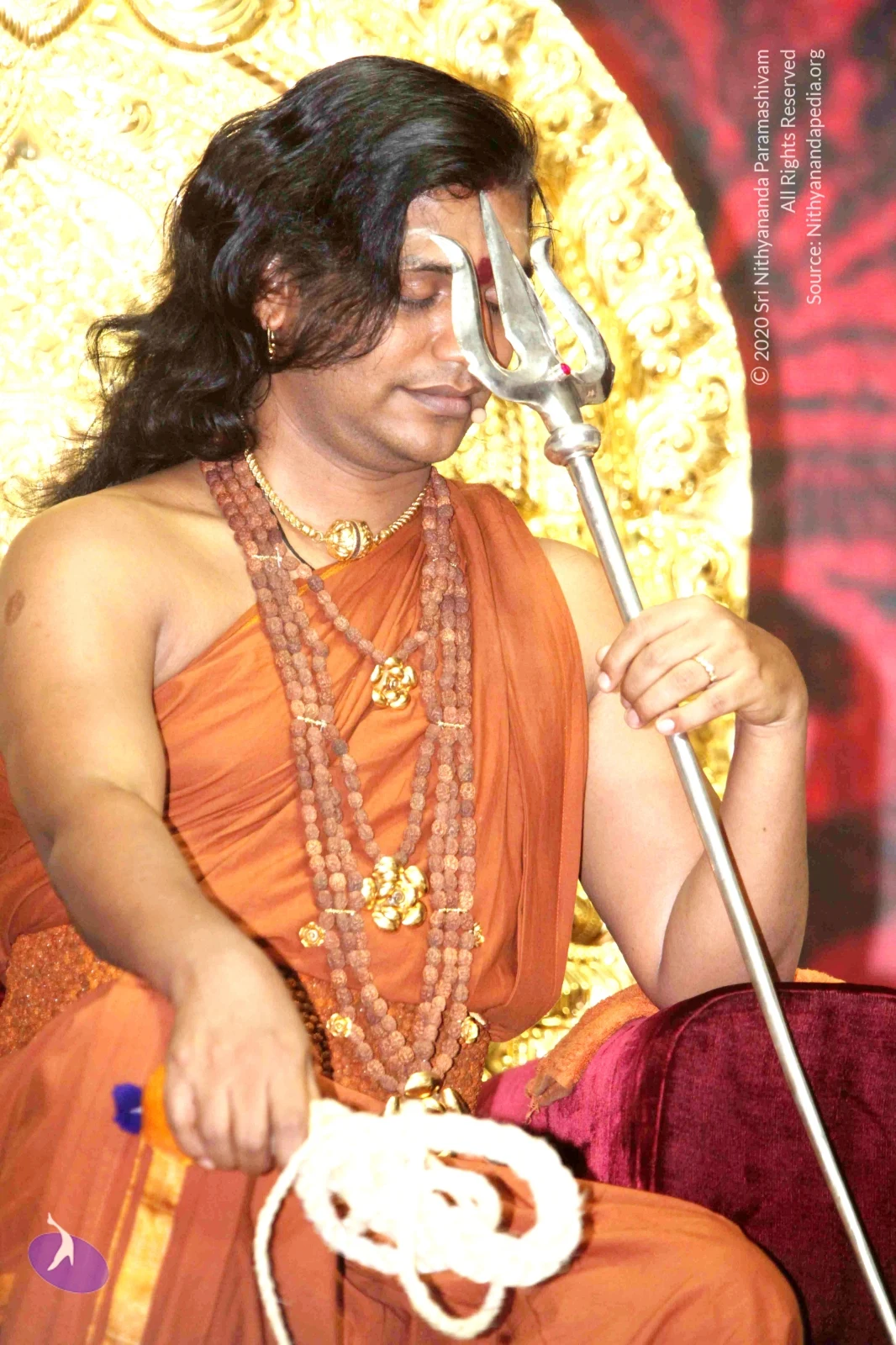
18 photosSource gallery
A man with long, swept-back dark hair sits with eyes closed, holding a silver trident upright in his right hand. He wears an orange saffron shawl over his shoulder, multiple strands of rudraksha mala beads, and a gold ceremonial necklace with gold floral pendants. A white sacred thread coil rests in his lap, and a deep red velvet cushion is beside him against a gold ornate backdrop. A horizontal white and red tilak marks his forehead. Appearance-based candidate: Swamiji (probable), seated in a ceremonial posture, with the cues of long hair, saffron clothing, rudraksha malas and gold necklace.A seated man with long, swept-back dark hair and a small gold earring holds a silver trident upright in his right hand, eyes closed in a calm, meditative expression. He wears saffron-orange draped cloth over one shoulder, layered brown rudraksha malas, and a gold necklace with a gold medallion. A red-and-gold embroidered band sits at his waist and a bell-tipped strand hangs near his lap. Behind him is an ornate gold-embossed backdrop, and a white cord coils in the foreground. Cues are consistent with a person, seated in a satsang setting.A smiling man seated on an ornate golden throne with a gold lion armrest, wearing saffron-orange robes, multiple strands of rudraksha beads, a gold pendant necklace and a red bindi. He holds a silver trident in his right hand and raises his left hand to his forehead while holding a white rope. Behind him a dark red backdrop displays large yellow Tamil lettering. Appearance-based label: a person, seated in person at a satsang stage, with the trident and rope as visible ritual objects.A smiling man with long dark hair and a red bindi sits on a golden lion-headed throne with a red velvet cushion, holding a silver trident and a white cloth or garland. He wears orange saffron robes with gold borders, multiple rudraksha malas and a gold pendant necklace. Behind him is a red backdrop with large white and yellow Tamil lettering and the letters LBP visible. A brass kalasha and fruits lie at the bottom of the frame. Swamiji (probable): the seated figure has long swept-back hair, saffron robes, rudraksha malas and ceremonial gold necklace on a throne, consistent with the page's reference to Swamiji at a satsang. Only one physical person is present.A seated man in an orange-saffron robe and multiple rudraksha malas sits on a gold ornate throne with a golden lion figure beside it, holding a silver trident upright in one hand while raising the other arm with a fingertip touching a vermilion-marked forehead. Behind him a large printed portrait shows a smiling face wrapped in a red-orange turban with a red tilak mark. The seated man wears gold ceremonial necklaces, earrings and a red bindi, and a small brass lamp with offerings sits at his feet. Swamiji (probable), seated at a satsang, appearance cues include long swept-back hair, saffron clothing and rudraksha malas.A seated man in orange-saffron robes sits on an ornate gold throne with a gold lion armrest at left, holding a silver trident in his right hand and raising a yellow object tied to a white cord with his left. He wears layered rudraksha malas, gold pendant necklaces, and a red bindi, and is smiling into a microphone. Behind him a large red-turbaned portrait of a smiling man is printed on the backdrop, and a gold-tasselled cushion covers the seat. Swamiji (probable): the seated figure has long swept-back dark hair, saffron robes, rudraksha malas and ceremonial gold necklaces, consistent with the satsang event. One physical person is present.