Skip to content
Tuesday

10 July 2012

How to connect with your guru

Dated photos
237
Source pages
1
Media
1
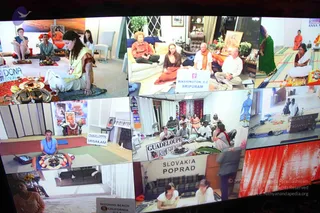
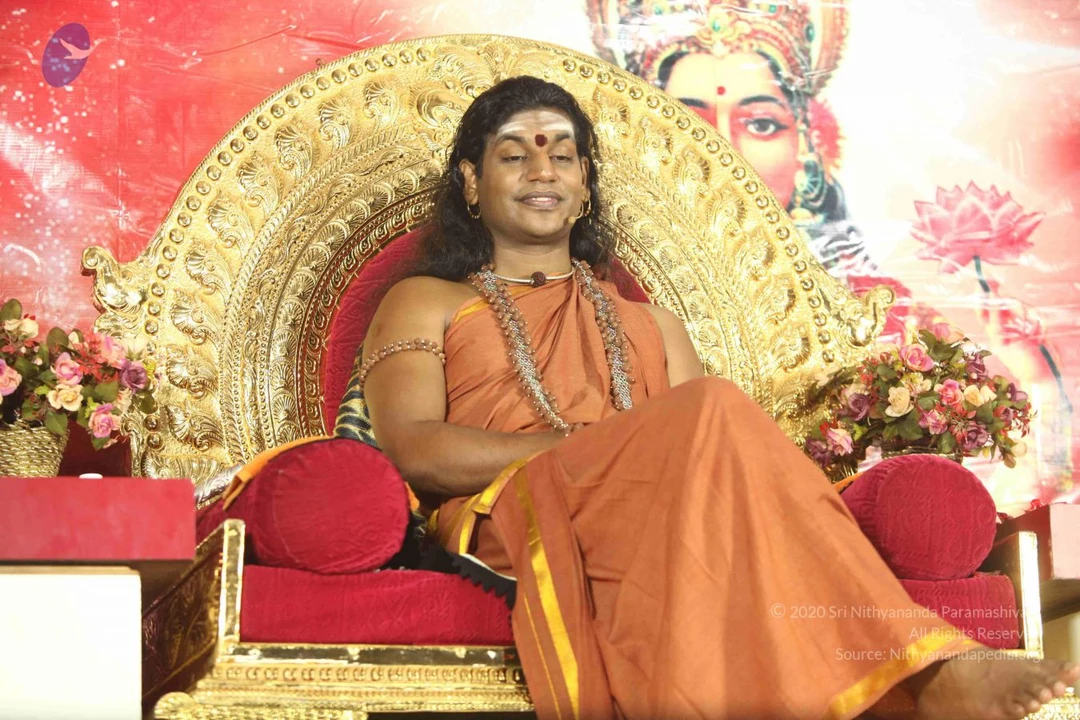
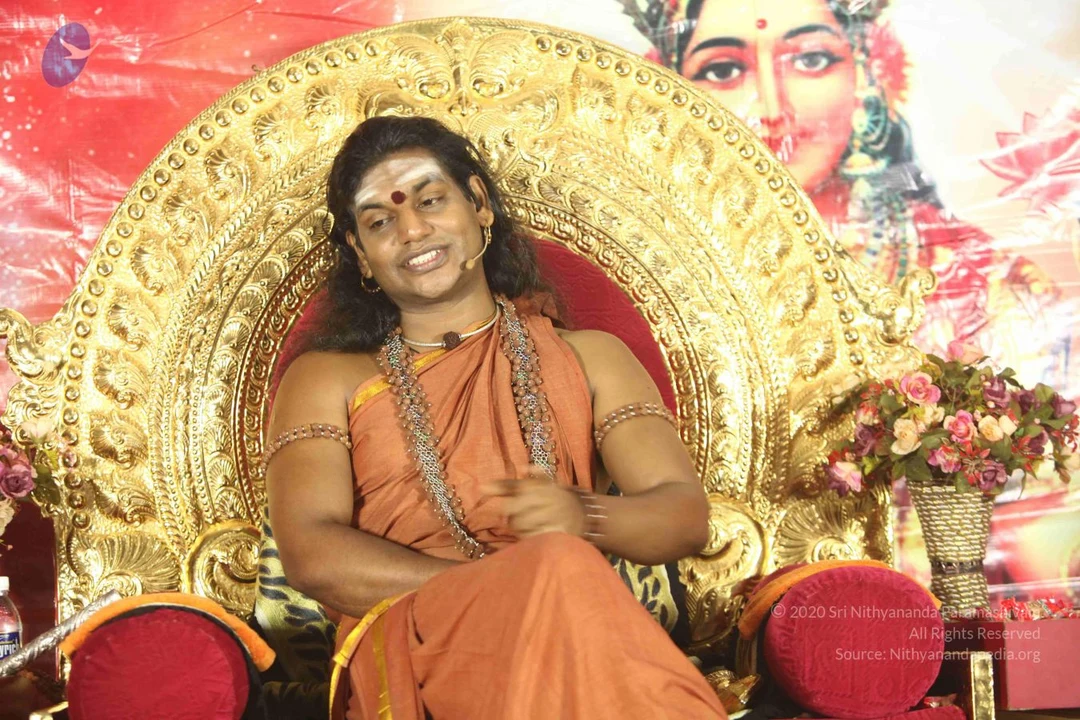
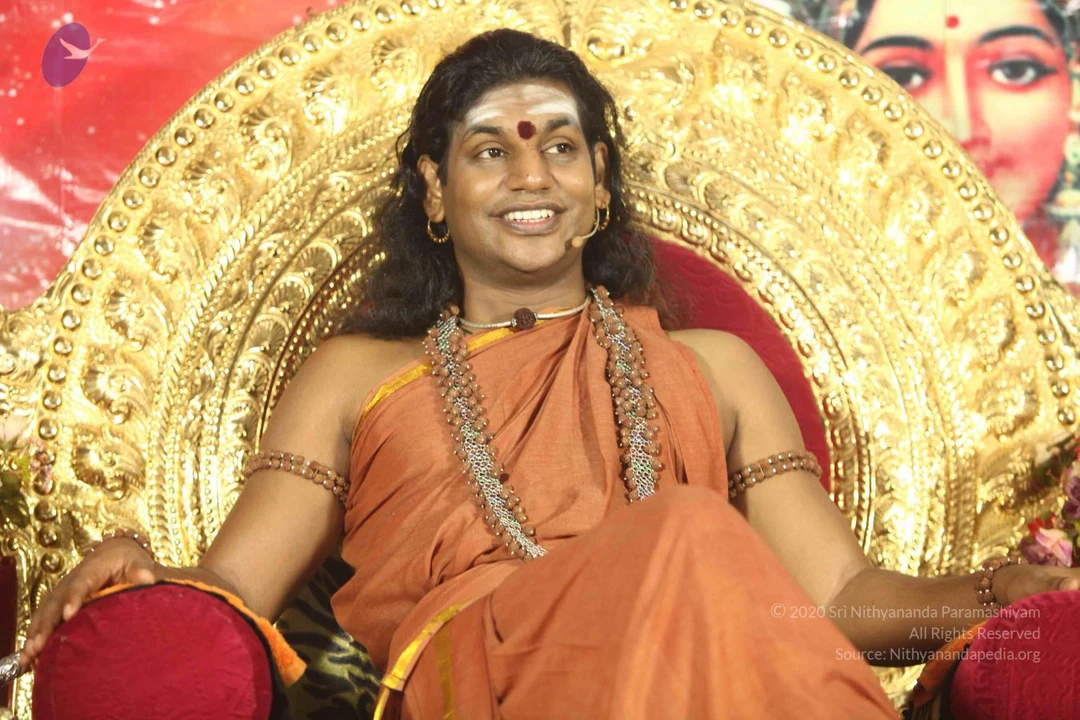
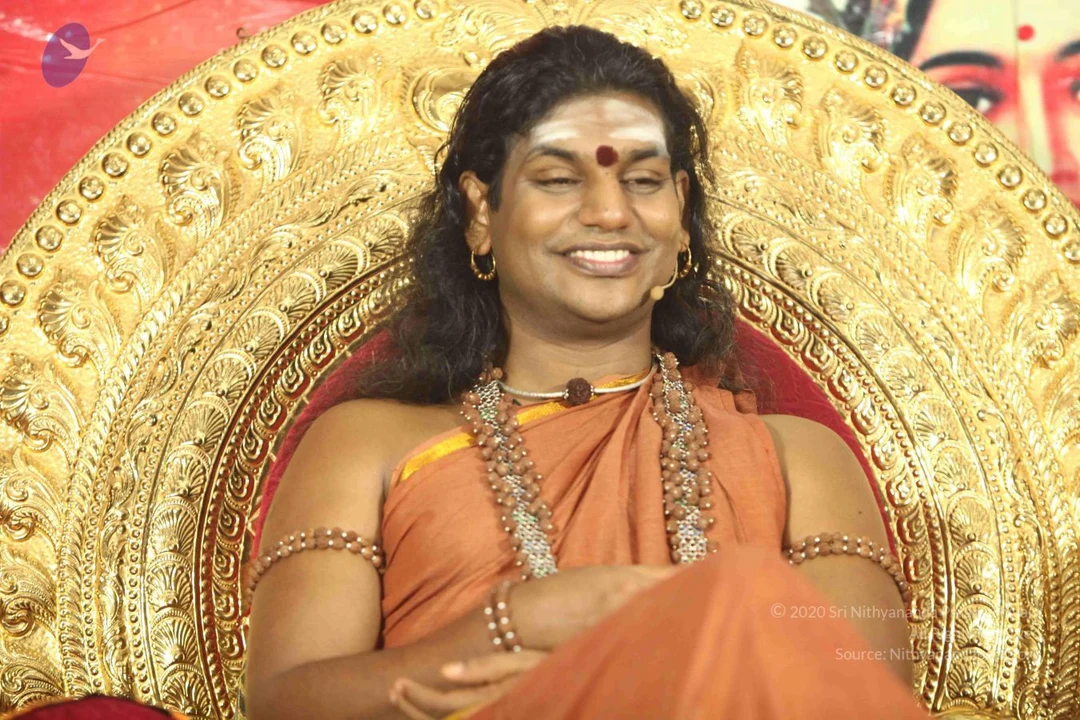
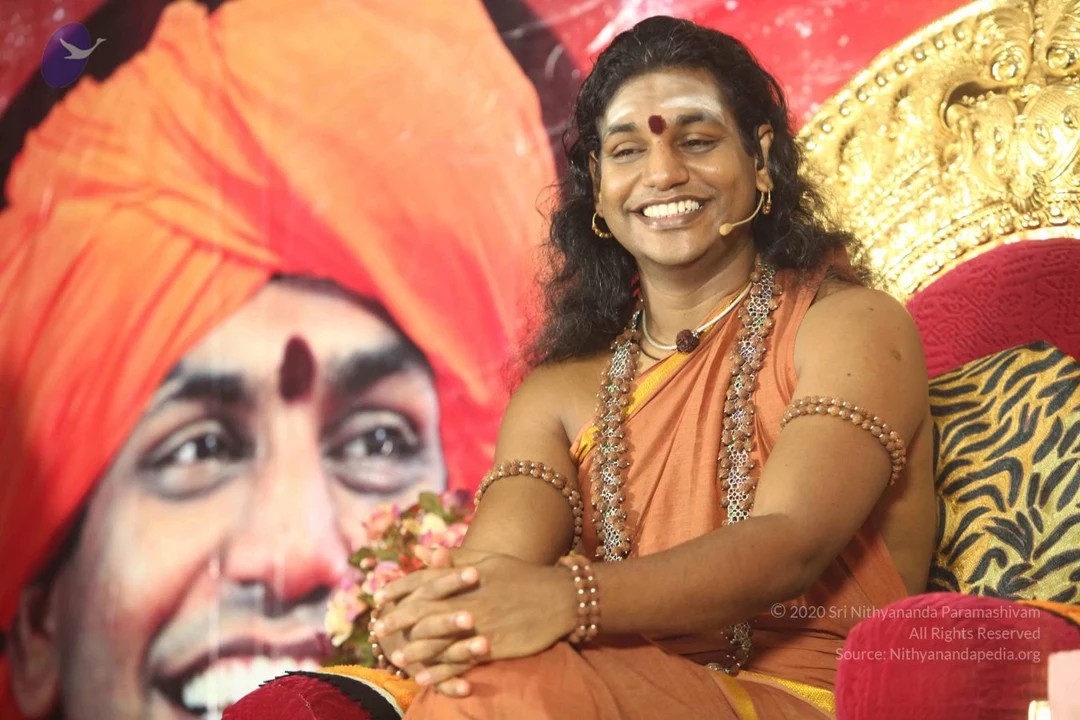
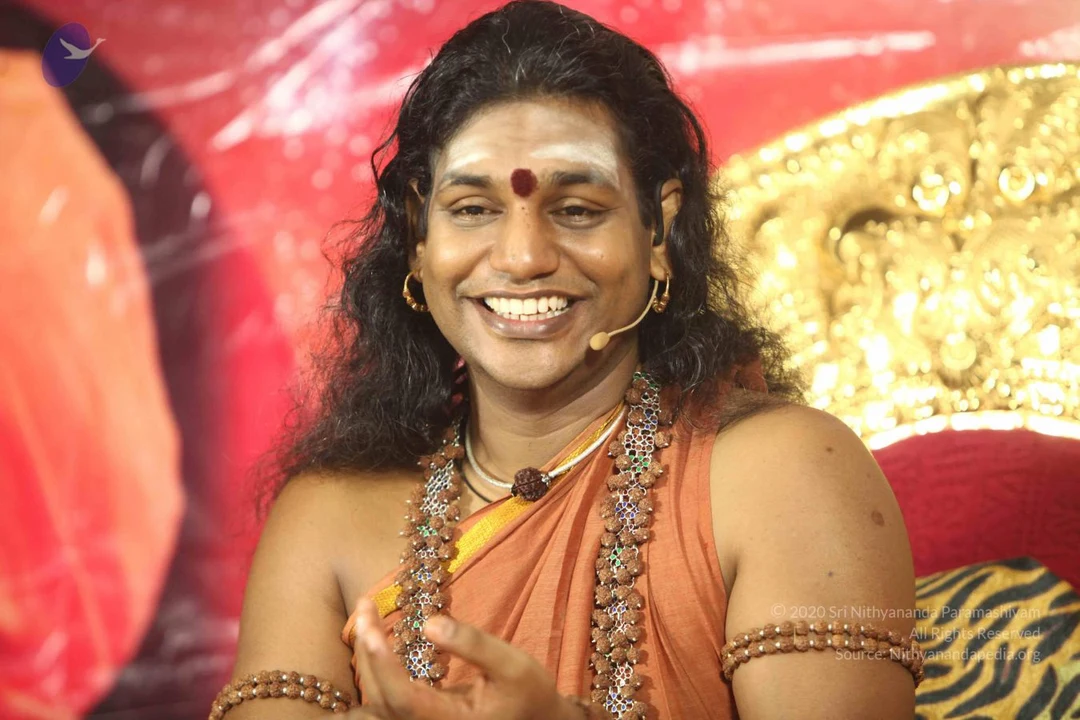
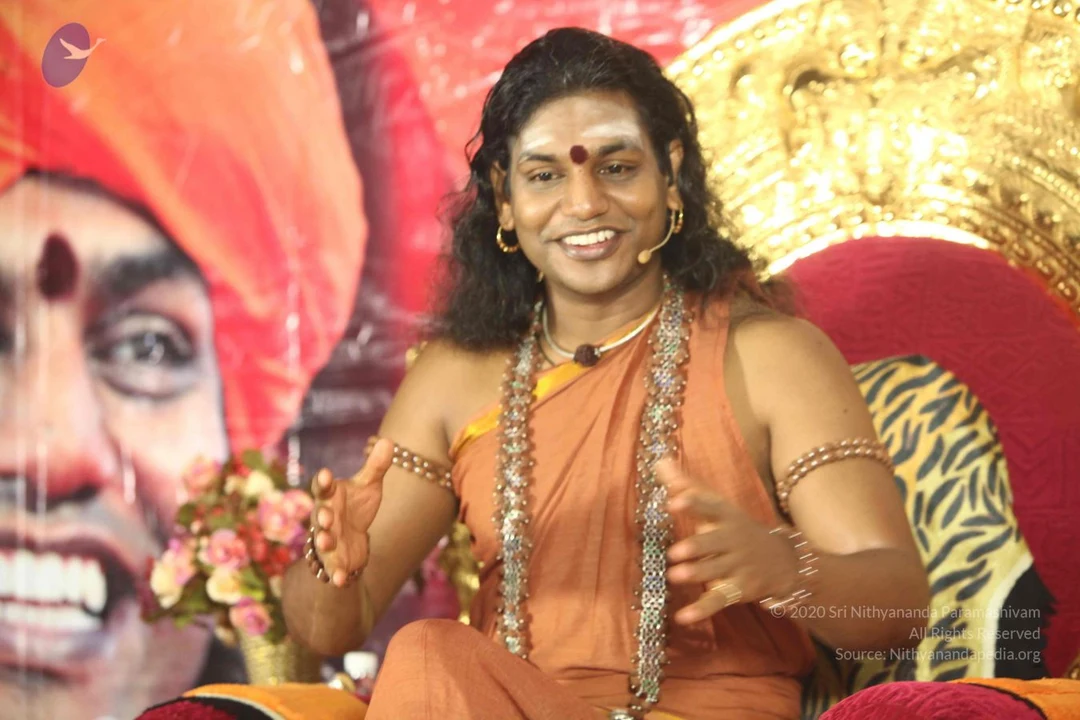
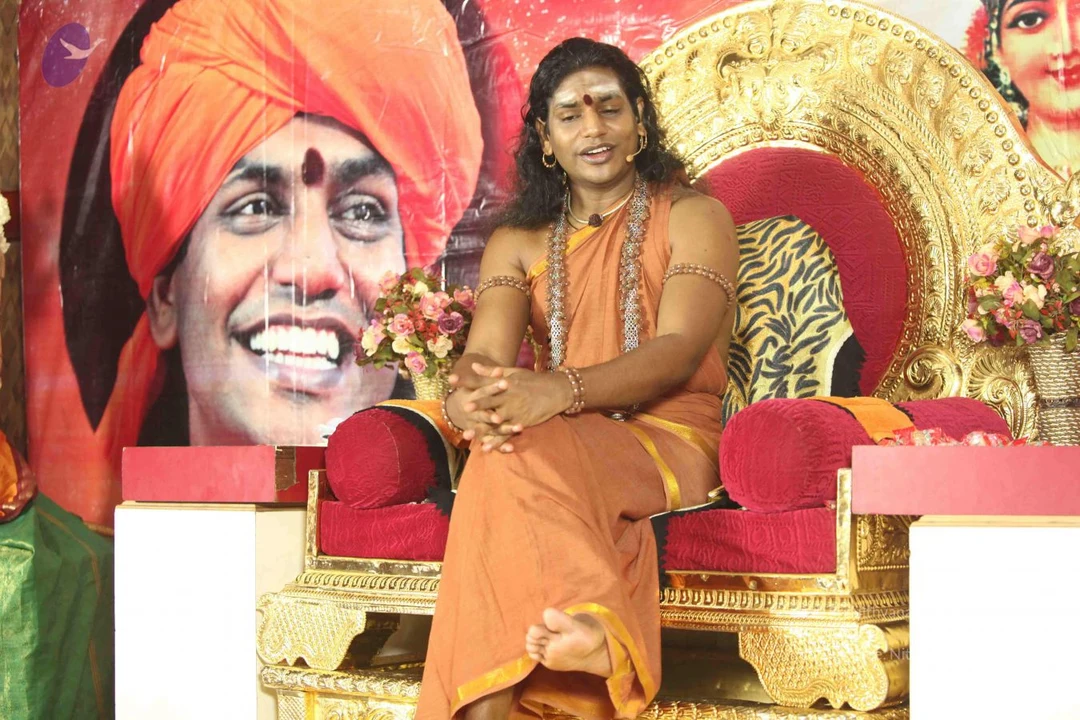
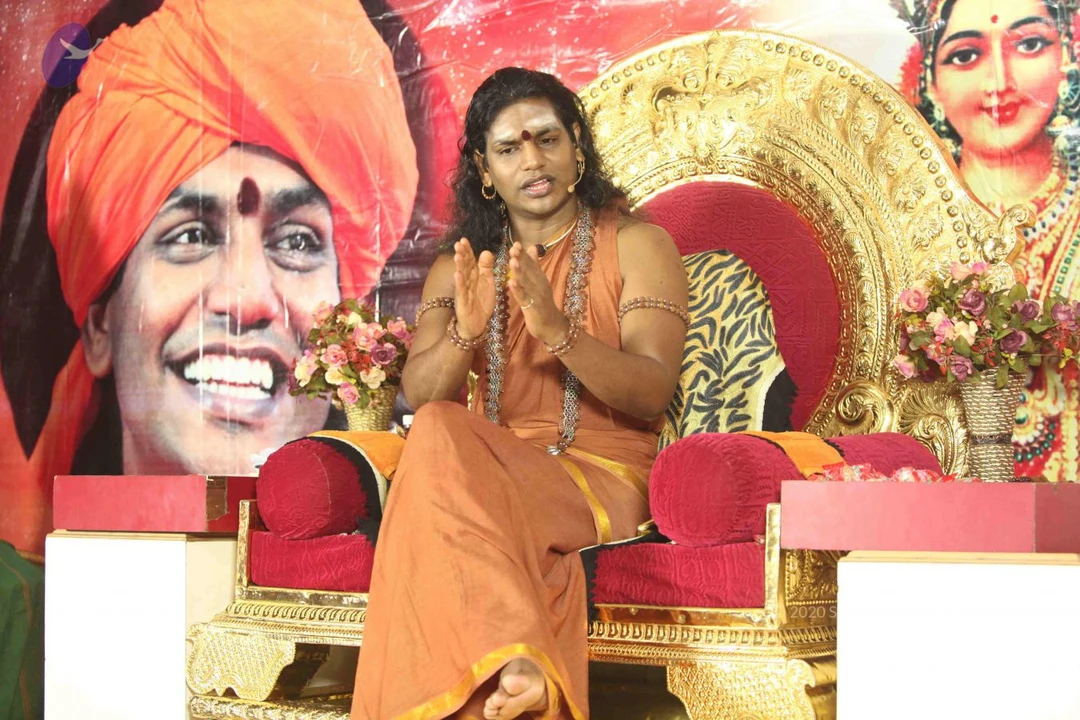
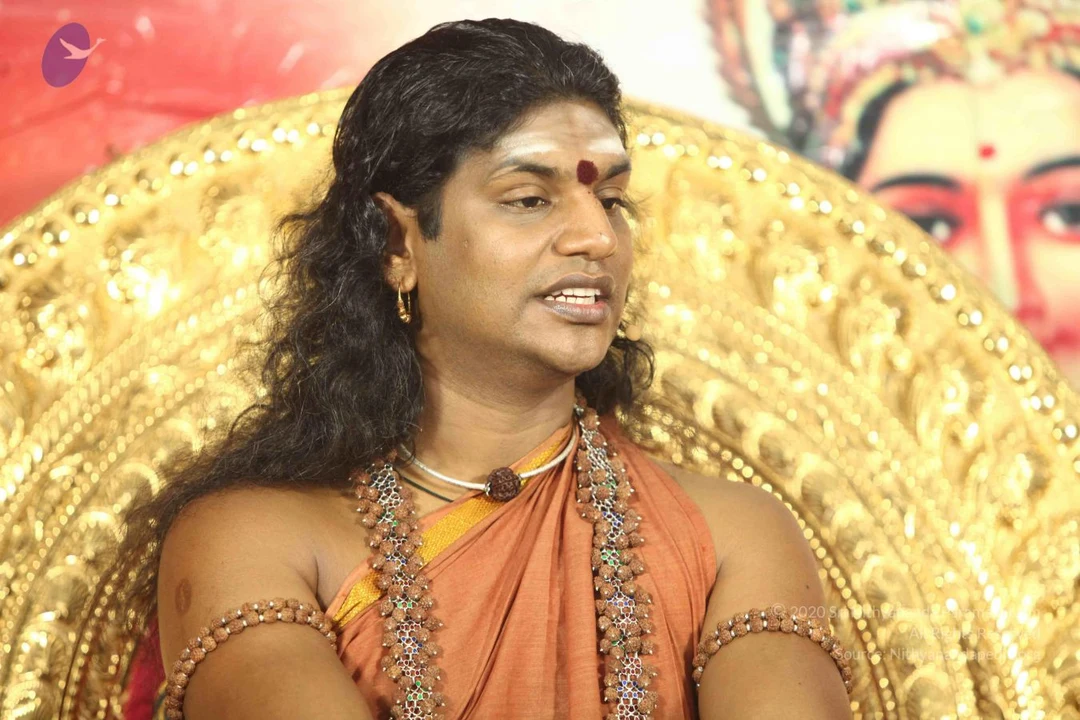
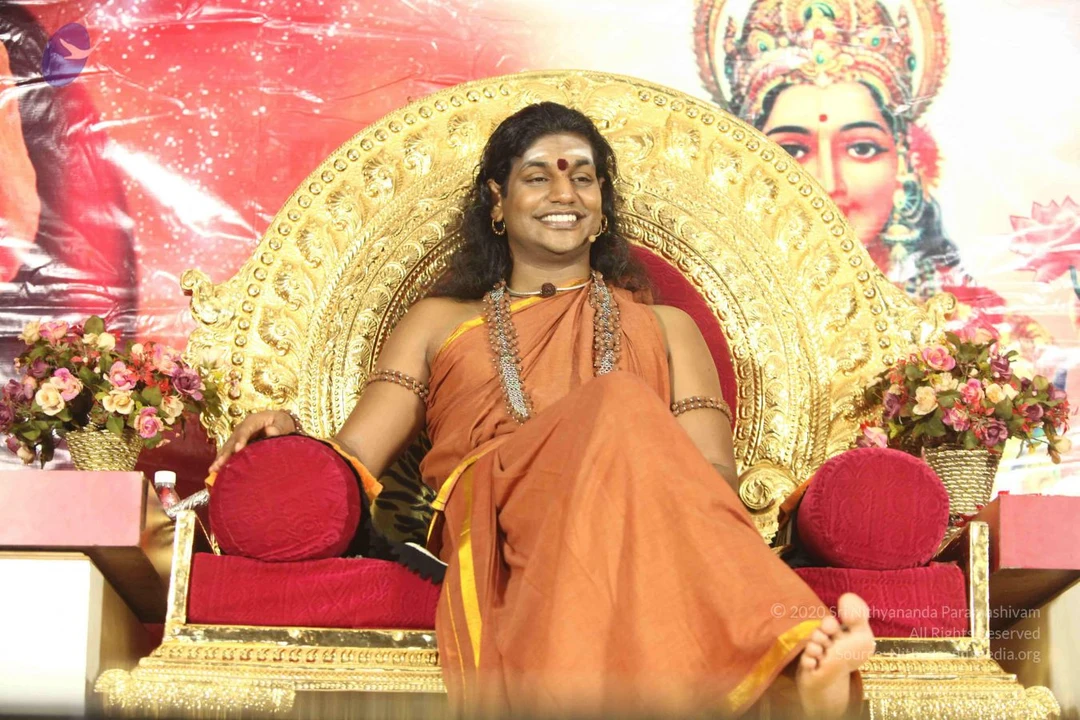
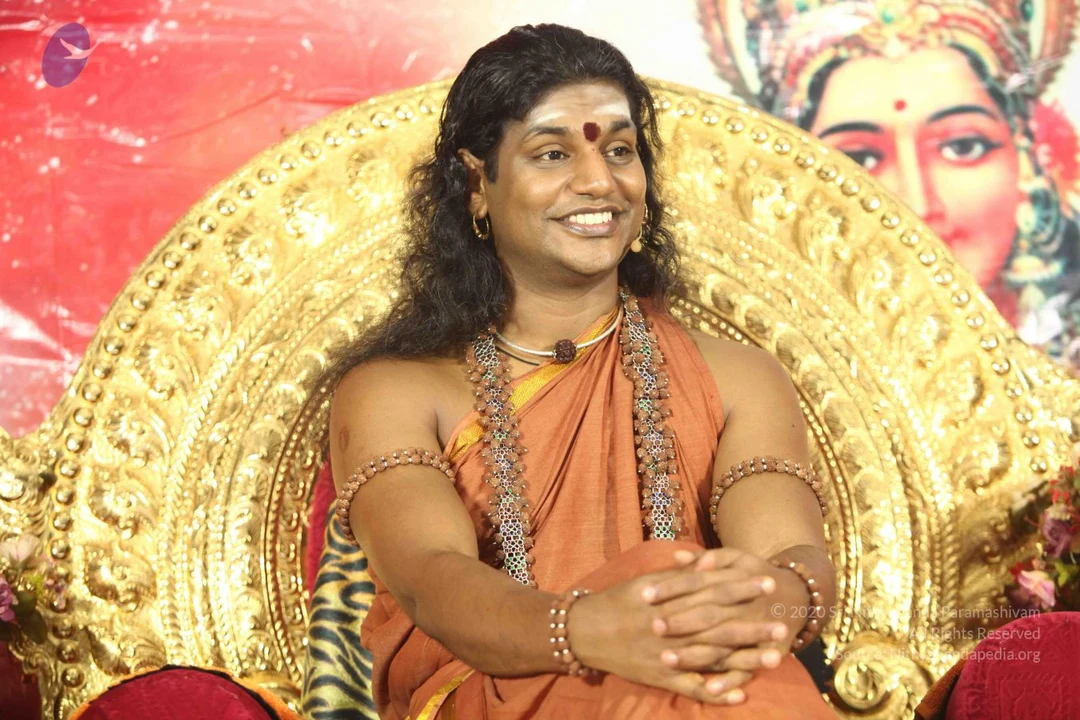
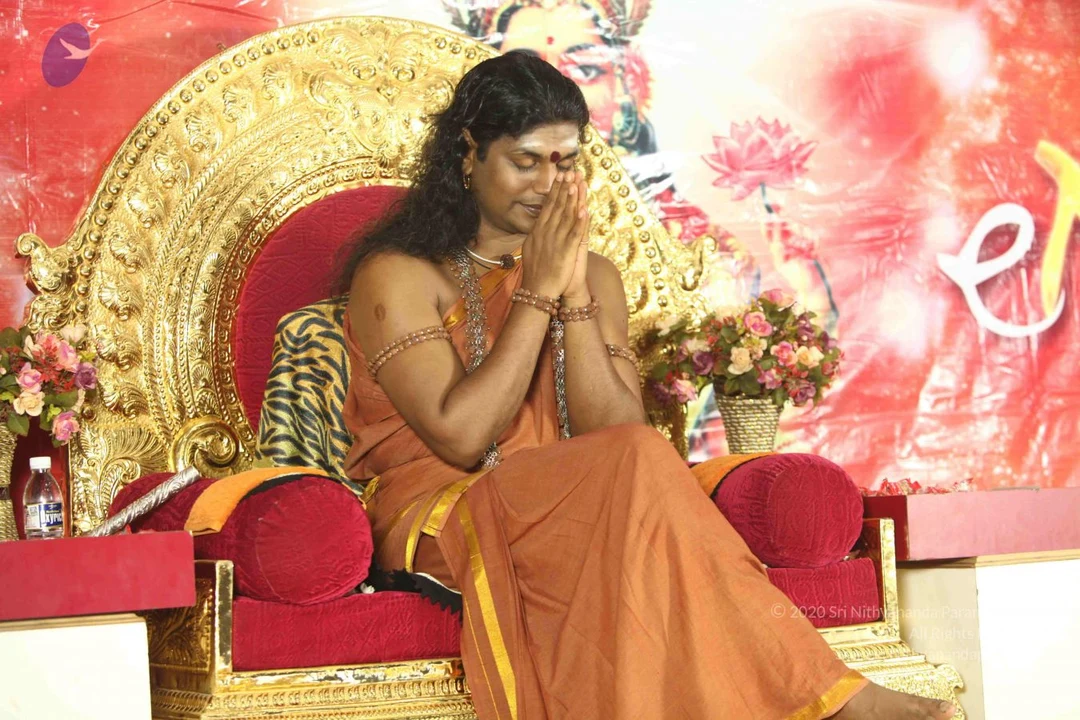
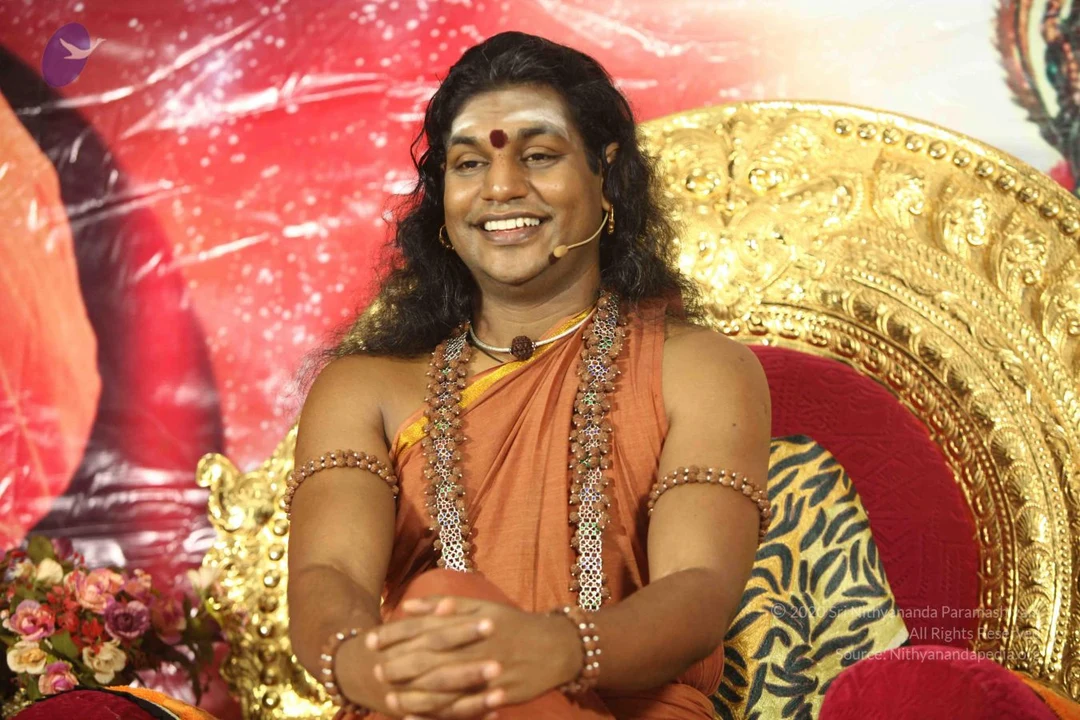
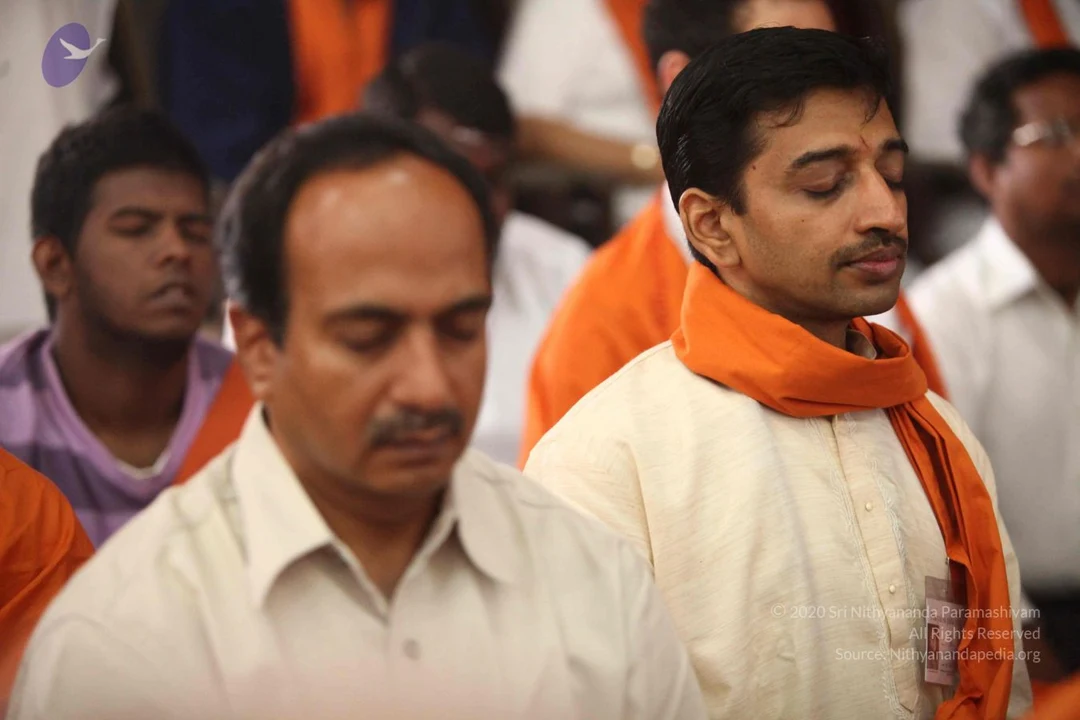
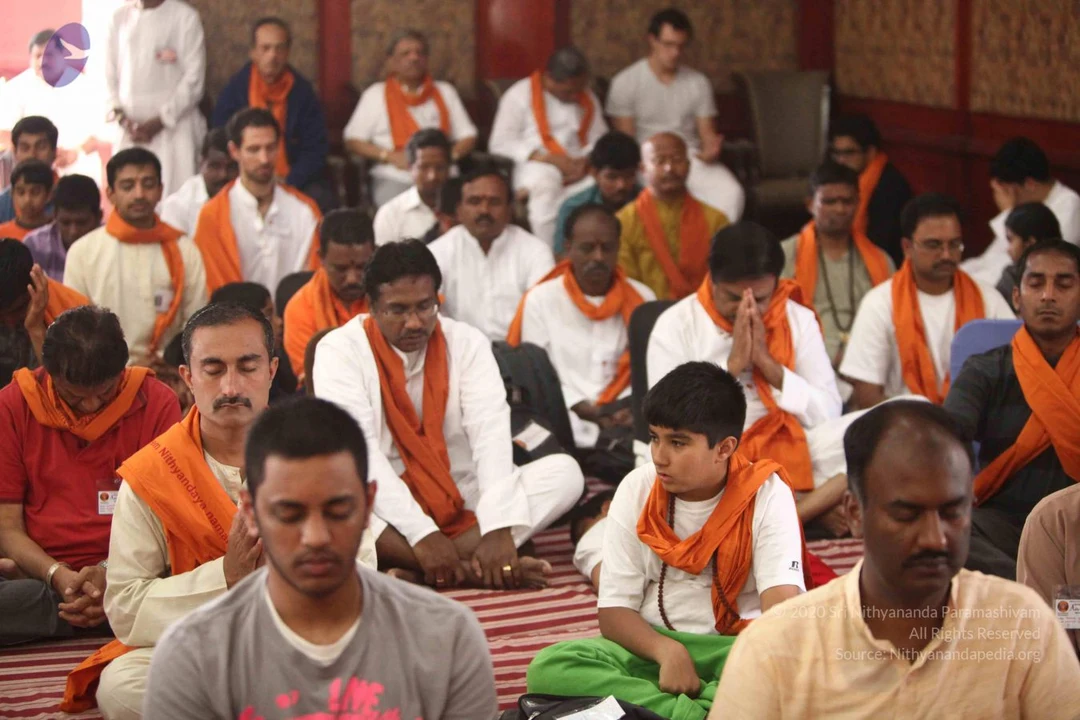
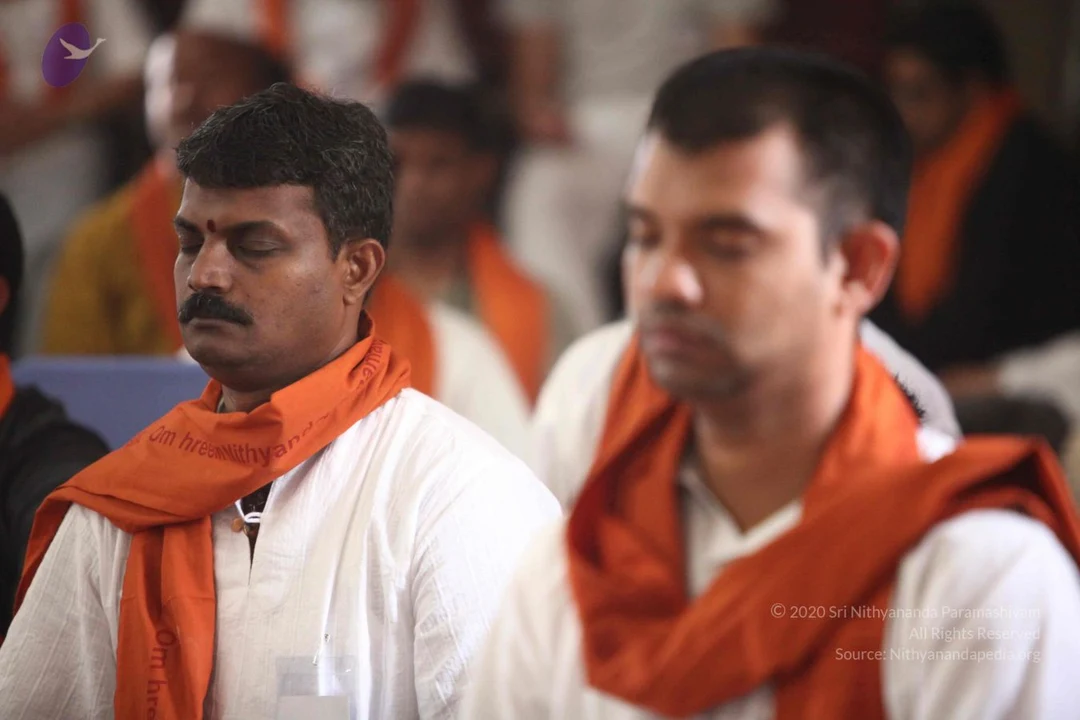
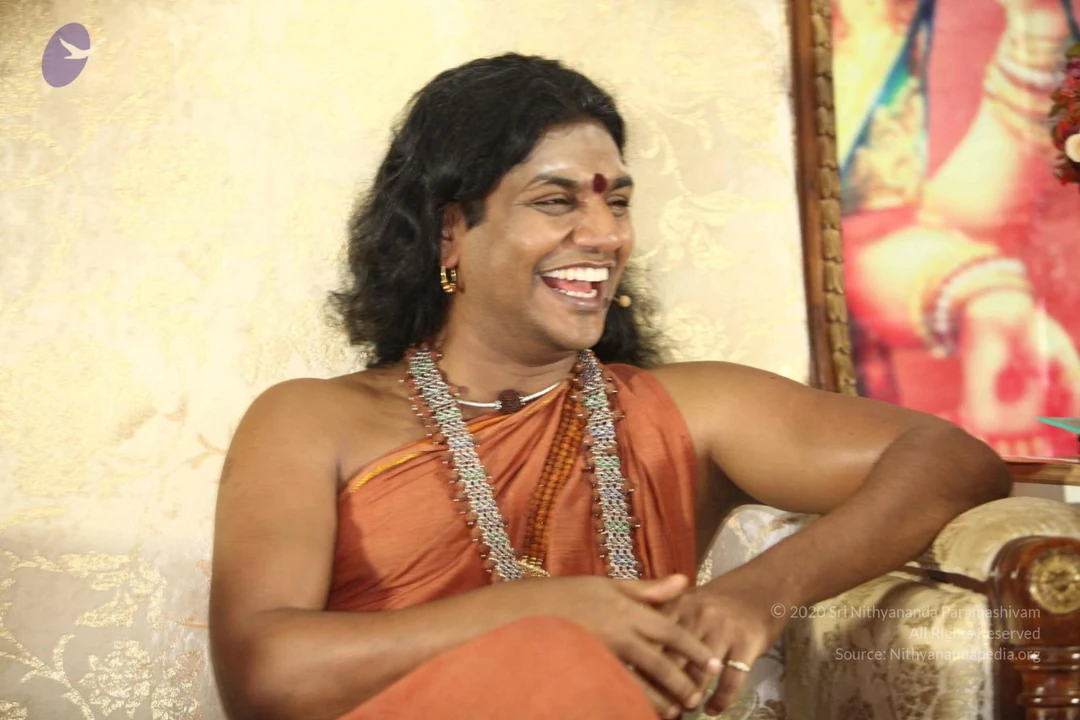
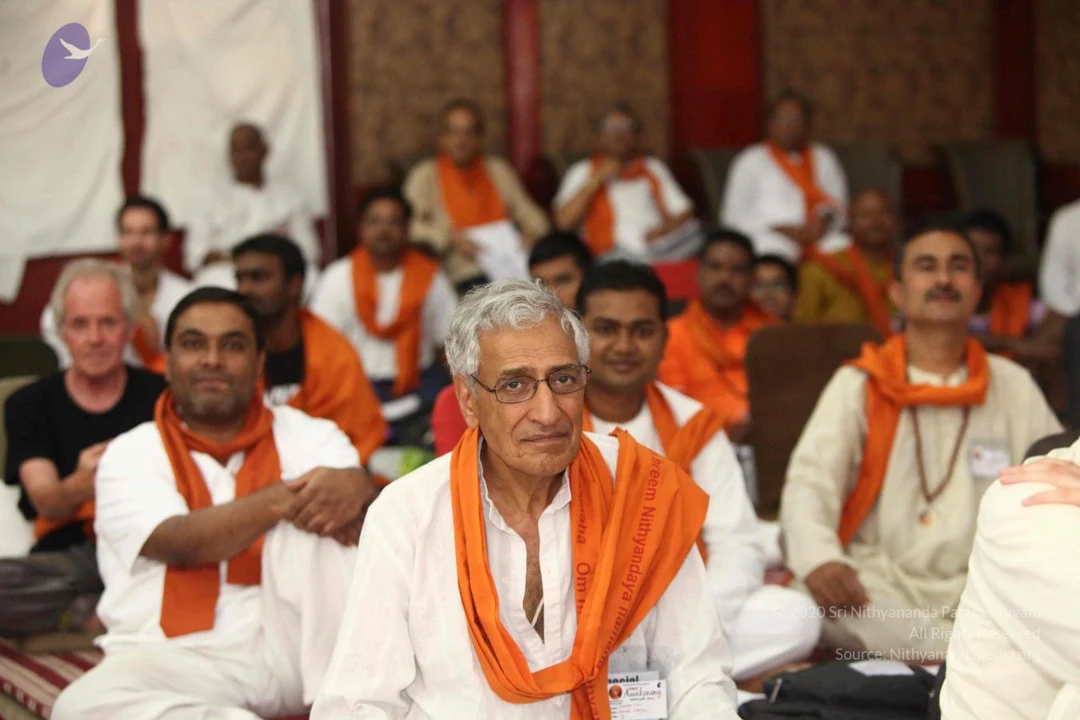
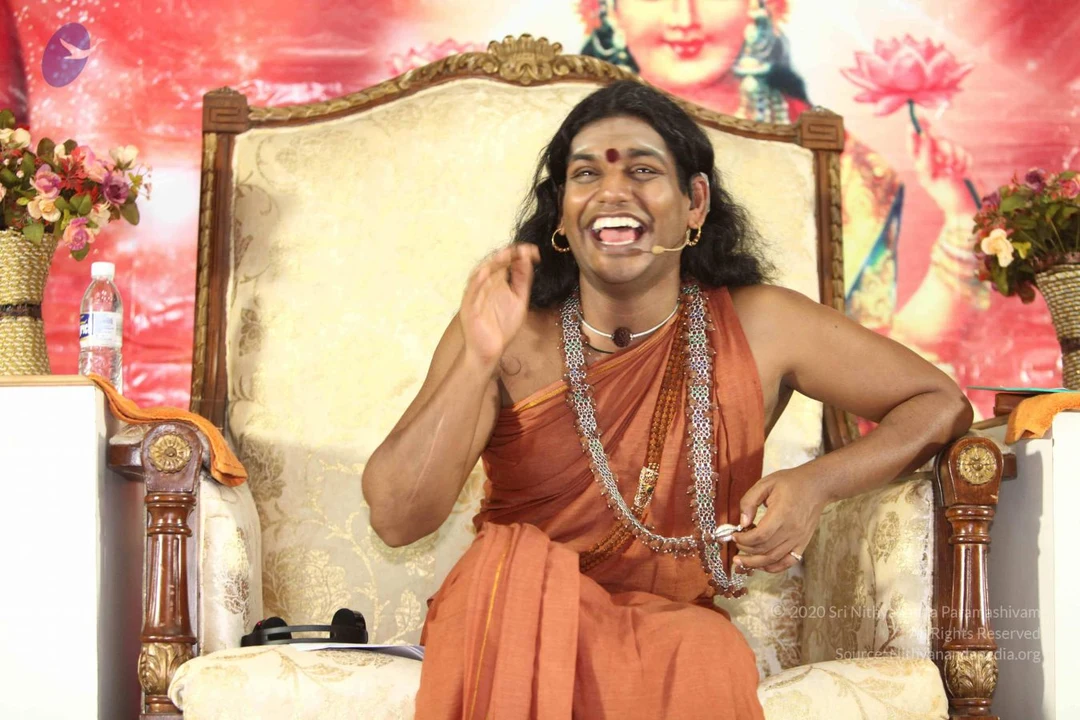
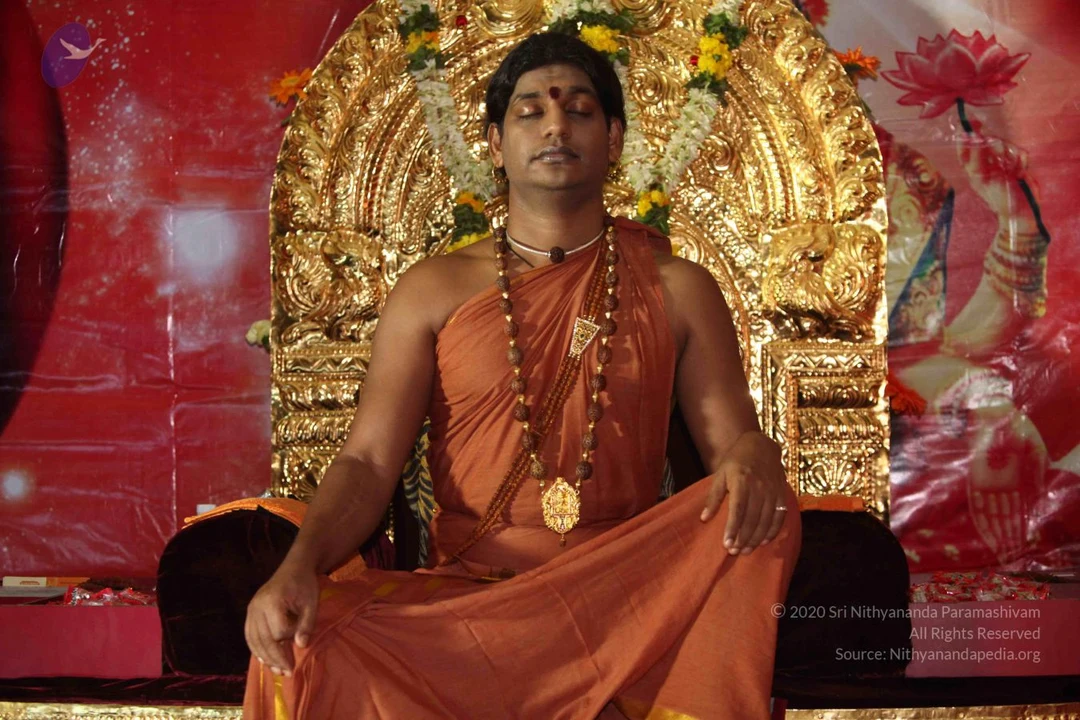
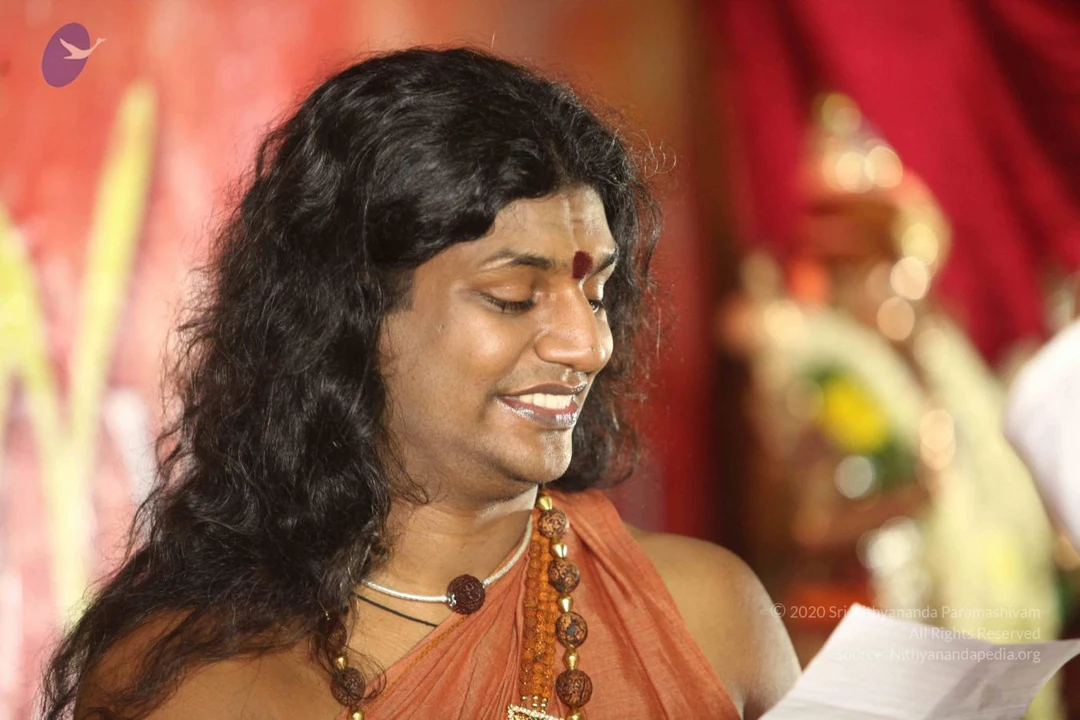
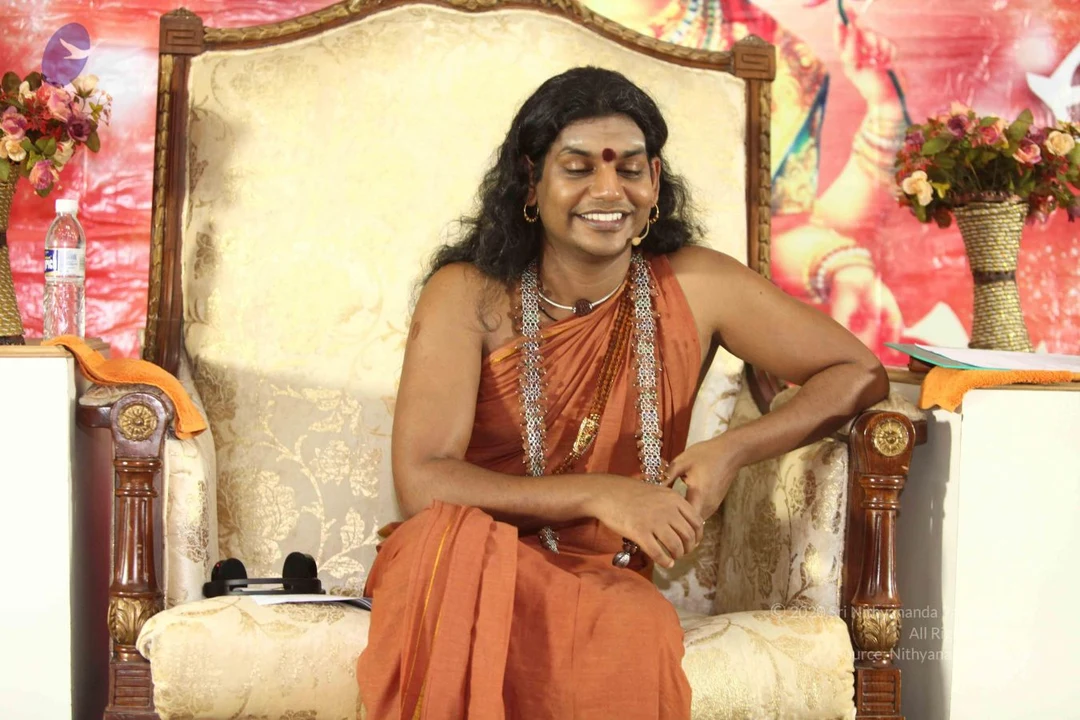
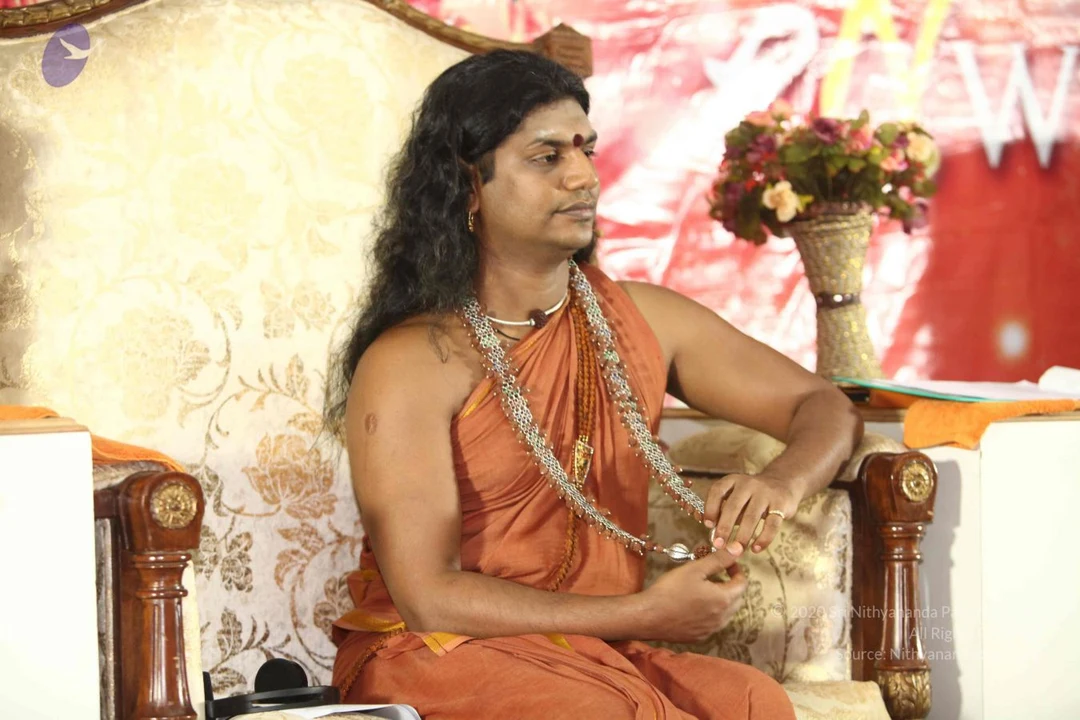
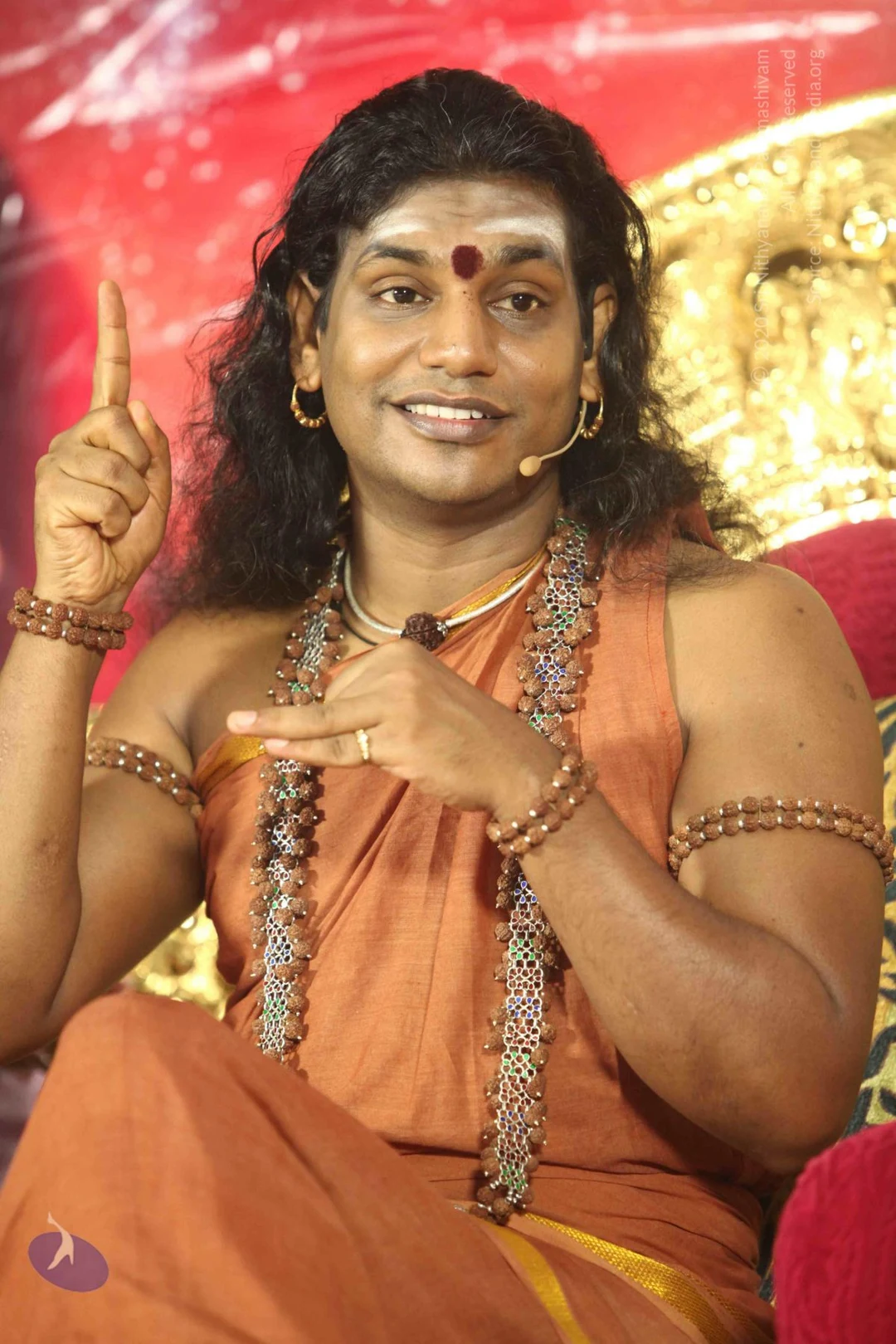
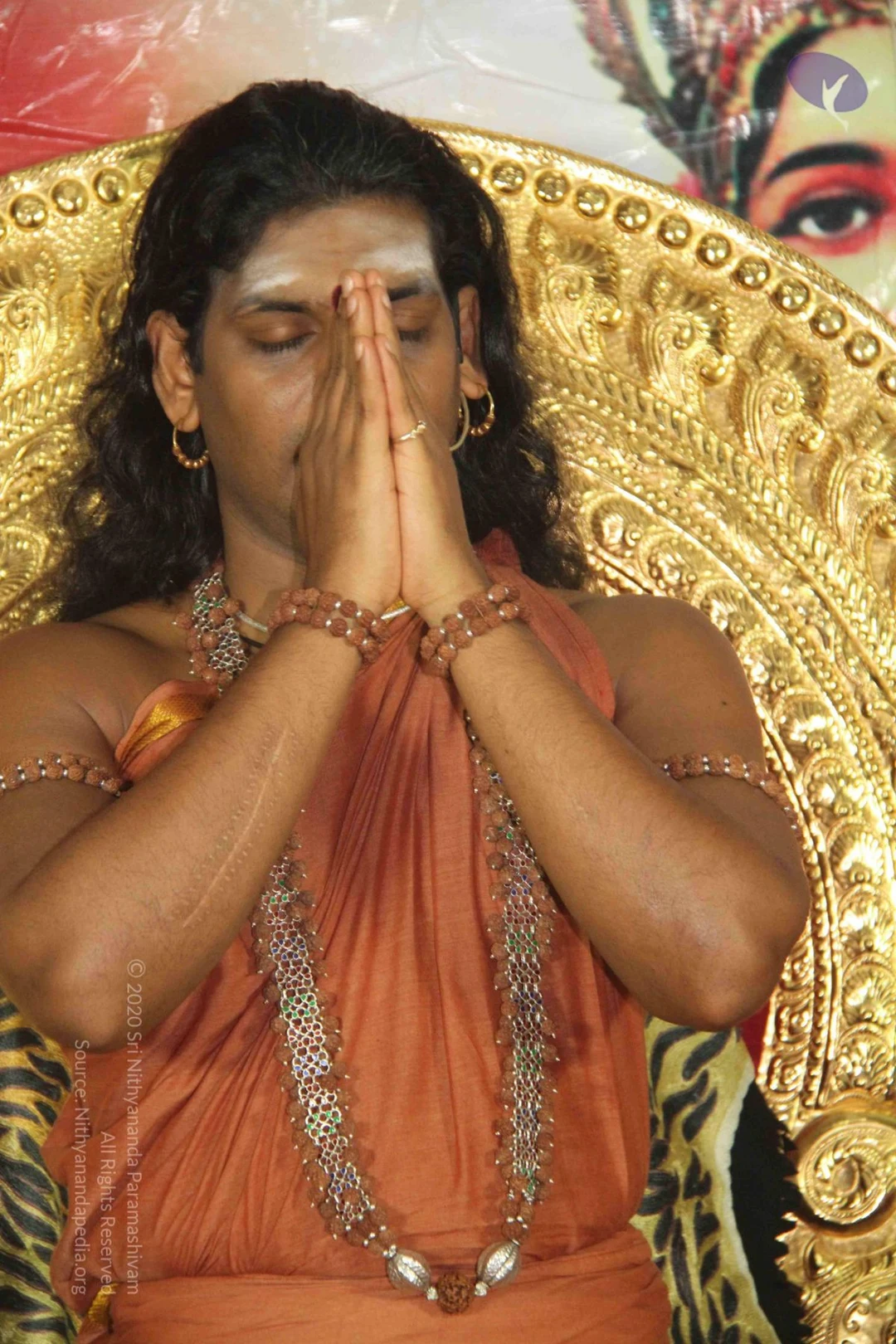
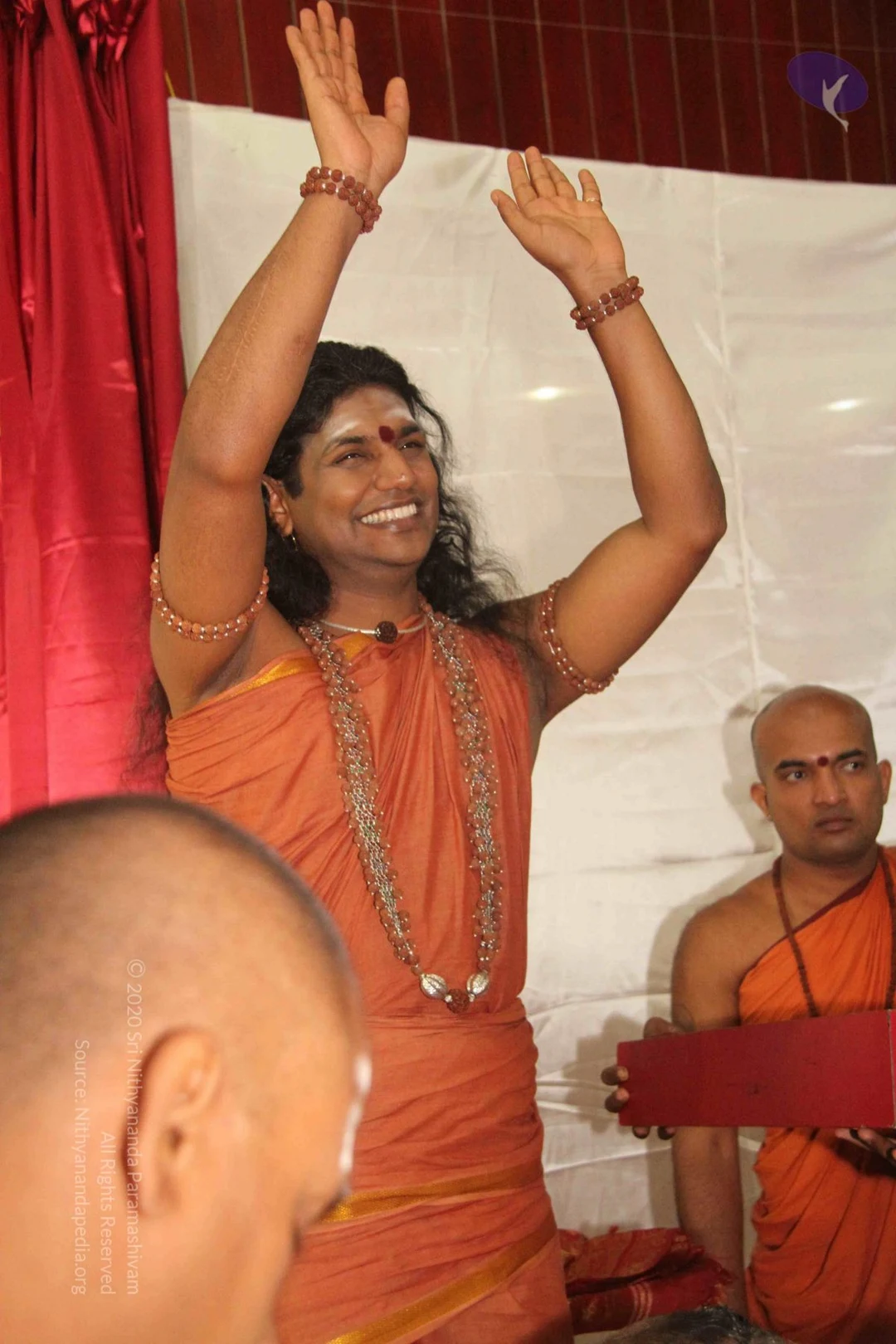
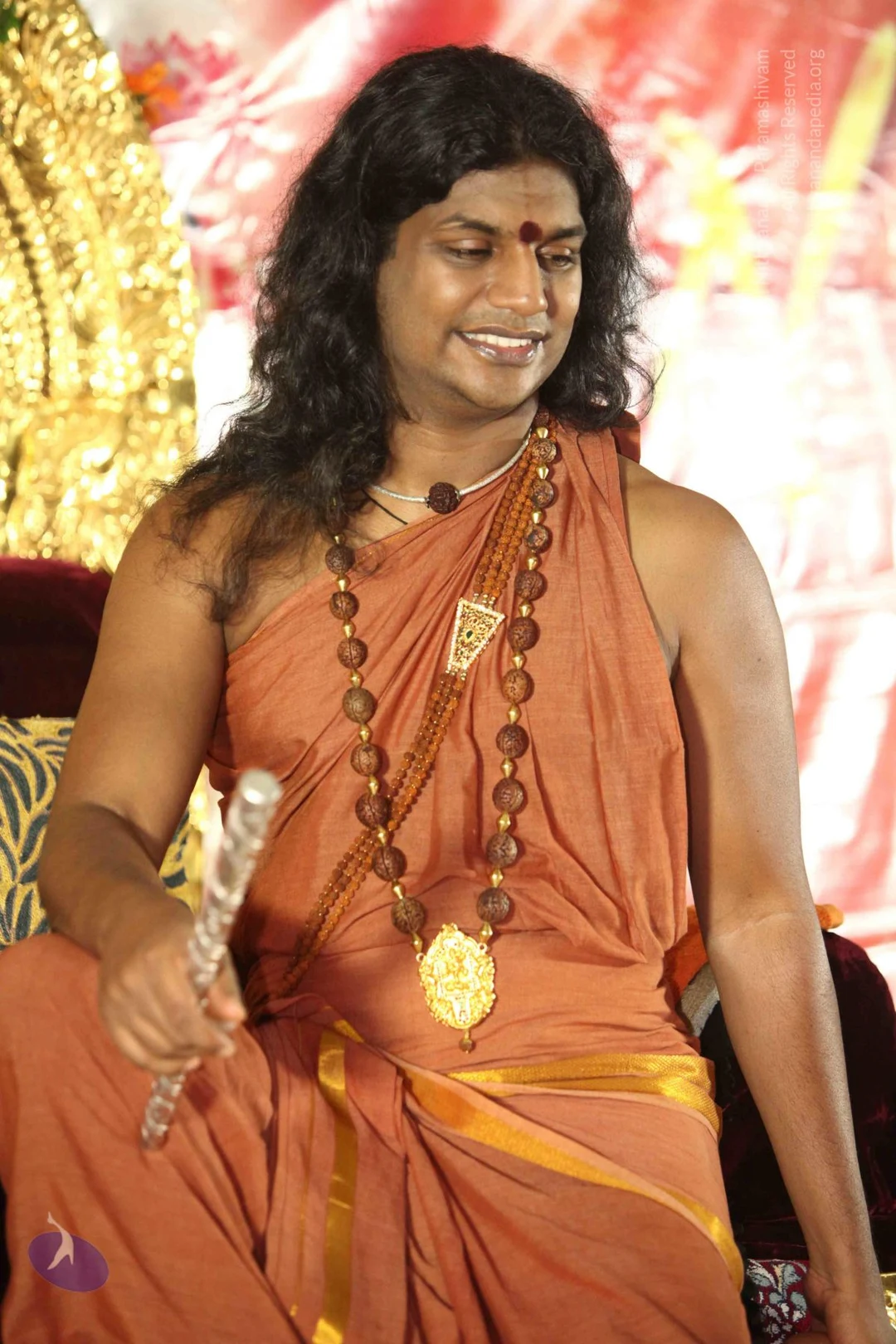
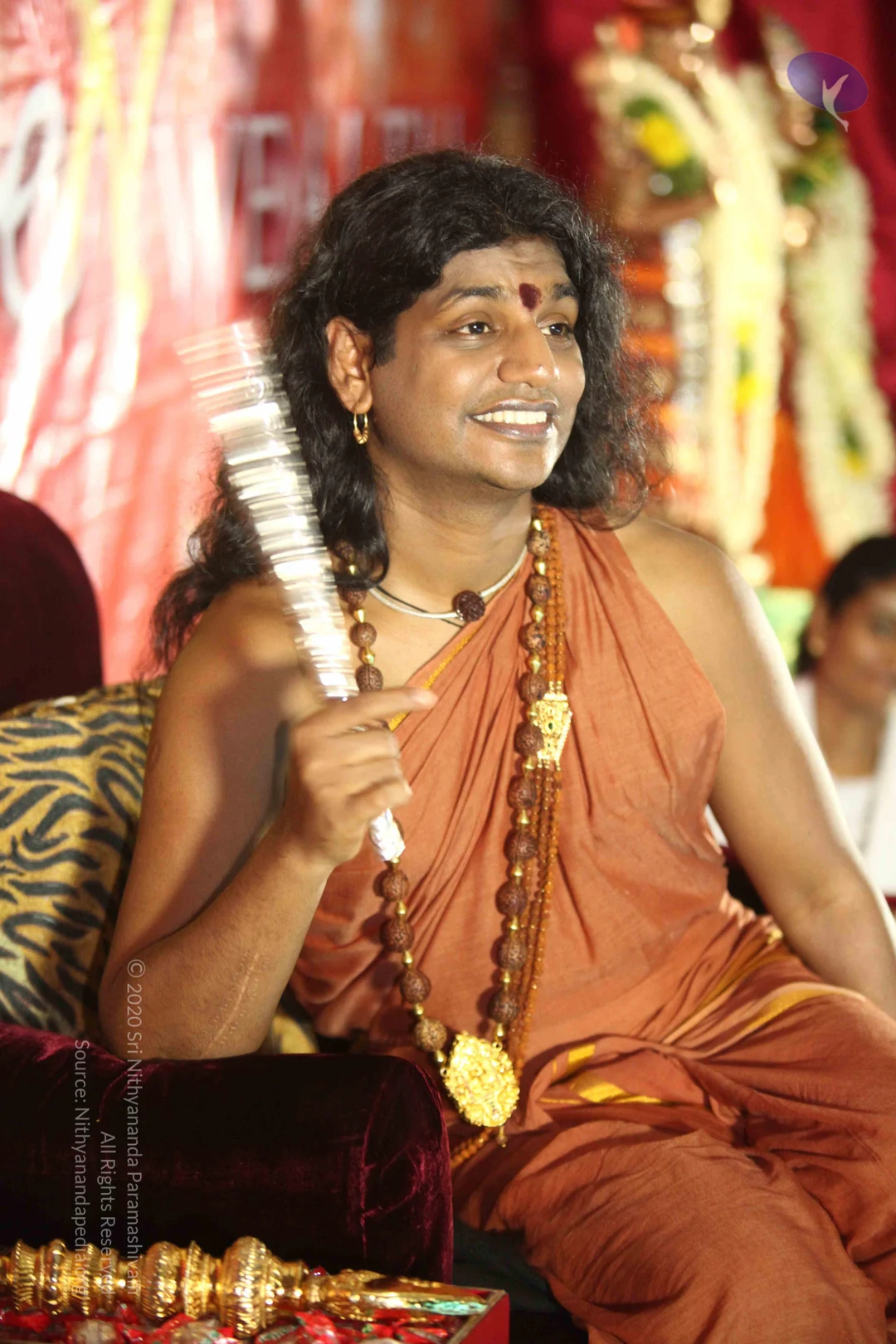
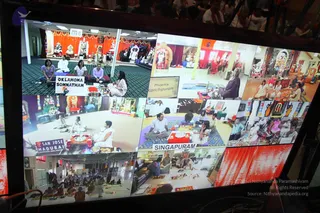
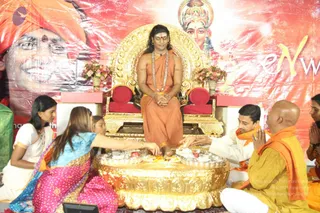
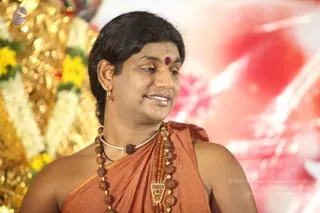
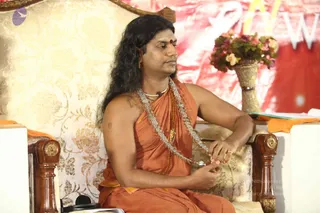
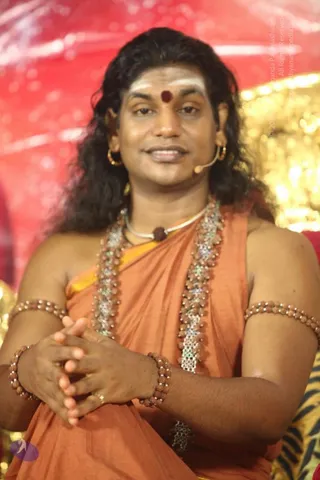
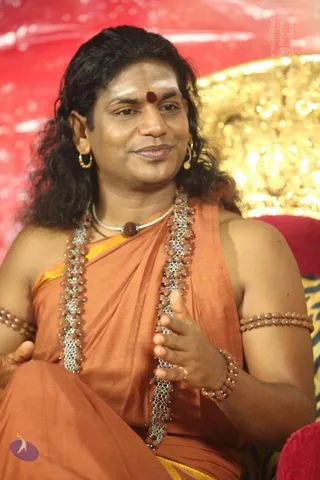
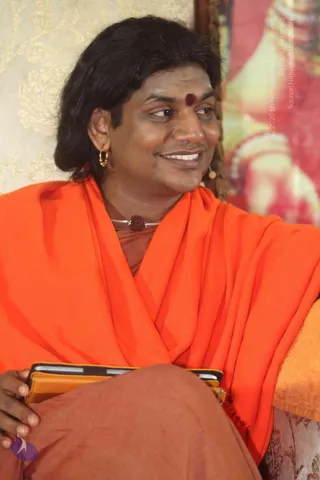
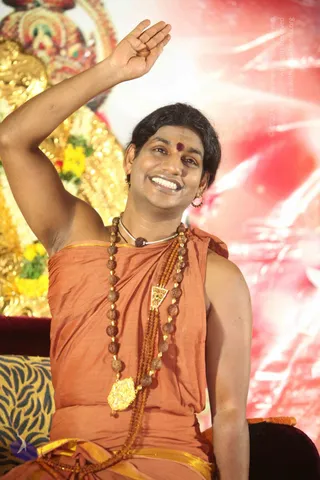
A large display screen shows a multi-panel video grid of satsang participants joined from different locations. Top-left, a woman in a yellow top and white pants sits before a brass plate of fruit, with a white bowl and other offerings. Top-centre, a seated figure in orange and a person in a brown top sit on a sofa in front of a framed portrait and flowers. Top-right, a woman in a green sari sits on a patterned mat beside an orange-clad figure. Middle-left, a man in a blue shirt sits before a plate of fruit and a blue-flowered garland. Centre, a group of seated devotees in white and red garments sit on a rug beneath a blue deity figure and a banner labelled "GUADELOUPE". Bottom-centre, two women in white sit before a sofa under a sign reading "SLOVAKIA POPRAD". The grid is framed by a red curtain at the lower right.Two men in white kurta-style clothes sit with eyes closed in meditation, each wearing an orange shawl printed with the words "Om hreem Nithyanand". The man on the left has a red tilak dot on his forehead and a moustache; the man on the right has short hair and a clean-shaven face. Behind them, more seated devotees in white and orange shawls are visible in soft focus.A close photograph of a man with long, dark, wavy hair and a red tilak on his forehead, wearing an orange-saffron shawl draped over one shoulder and layered rudraksha malas with a thin silver necklace. He is smiling and looking down while reading from a sheet of white paper held at the lower right. A blurred red backdrop and softly lit floral decorations appear behind him. Appearance cues are distinctive, but the page does not place a person at this event, so the identity is uncertain.

July 10 2012

Original wiki page
Contents

Title:

How to connect with your guru

Link to Video:

Transcript:

(00:23)

Let’s enter into today’s satsang. In Bhagavad Gita, 4th chapter - Jnana Karma Sannyasa Yoga, 3rd verse:

स एवायं मया तेऽद्य योगः प्रोक्तः पुरातनः | भक्तोऽसि मे सखा चेति रहस्यं ह्येतदुत्तमम् ||४- ३||

sa evāyaṃ mayā te'dya yogaḥ proktaḥ purātanaḥ | bhakto'si me sakhā ceti rahasyaṃ hyetad-uttamam ||4- 3||

Translation: That ancient science of intense action, which is the most elevated mystical doctrine has been prescribed to you now, because you are my loyal companion.

(01:20)

The third biggest problem a disciple faces. See first, he questions the Master, “Eh! If he tells, if the Master is talking the traditional truths, aah… the same thing he is repeating. He has not experienced anything new.” If he is telling something from his own experience - new, “Aah! He is telling something on his own, to make us do what he wants us to do, which is not traditional, authentic, time tested.” Bhagavan breaks both the questions at a time! He says, “Eh, it’s the most ancient sacred secrets, and told by me!” Once he is convinced, the next doubt comes to Arjuna, which comes to all disciples - “Why is all these great things being told to me? Am I qualified?” I have seen so many fellows running away with the name - “I am not fit,” “I am not qualified.” Some run away, feeling “For my calibre, I am not given the status and respect.” Some run away, “I am not fit.” But both are same. Both will always be together. Both mental setup is one and the same.

(02:57)

स एवायं मया तेऽद्य योगः प्रोक्तः पुरातनः | भक्तः असि मे सखा च इति रहस्यं ह्येतदुत्तमम् ||

sa evāyaṃ mayā te'dya yogaḥ proktaḥ purātanaḥ | bhaktaḥ asi me sakhā ca iti rahasyaḿ hyetad-uttamam ||

The Arjun’s doubt, “Why is all these great things be told to me?” Bhagavan is clearing that doubt, “Eh, I am telling all these great things not to exploit you.” That's a big doubt, “Oh, maybe he is telling all these things to brainwash me.” Not to brainwash you, but to wash your brain. Brainwashing is different. Washing your brain is different. I don’t do brainwashing. I just wash your brain. So this fellow gets into the doubt, “Maybe he is trying to brainwash me.” For that Bhagavan is answering, “Eh, this ancient science of intense action, which is the most elevated mystical doctrine, has been prescribed to you now because you are my loyal companion.”

(04:17)

Very beautifully Bhagavan says, “bhaktaḥ asi me sakhā ca iti.” Best thing can happen to you is when Bhagavan says, you are my royal companion… loyal companion. Please understand - bhaktaḥ and sakhā. When he is using both the word, “you are a loyal companion, and, royal companion.” I tell you, that’s the greatest thing can happen to you. It’s like all of you know the Prime Minister, whether he knows you or not 😃 is the main thing. You always say, “He’s my friend. He’s my friend.” But whether Prime Minister says you are his friend. That is where the whole thing boils down. Yesterday somebody was asking Me, “How much I have grown spiritually, tell me?” I tell you the scale to measure your spiritual growth is the honest feeling Master has about you. That’s all. Understand, the honest feeling. See if you pull out My archives, and pull out your file which I have inside, what is the conclusion of that file - that is your spiritual growth. That is your growth in life!

(06:04)

Cosmos feeling about you, is your spiritual growth. The ultimate blessing is Bhagavan saying, “bhaktaḥ asi me sakhā ca iti” - you are my devotee and companion. God! Even after this word, if this idiot is not breaking and falling at the feet of Krishna, and just picking up the gandiva (गाण्डीव, gāṇḍīva), and, sending the arrow to kill Bhishma and Drona and all these fellows, I tell you, immediately he needs a sangha meeting. Bhagavan is saying, “You are my loyal companion.” You can give life for this one word! Forget about one life, you can give lives for this one word! And still this fellow is sitting and asking doubts. Bhagavan is saying, “You are my loyal companion.” What more is required? “bhaktaḥ asi me sakhā ca iti.” Arey, even the word “loyal companion” is too small word, he’s saying “devotee companion.” “bhaktaḥ asi me sakhā ca iti”. Let Me give you word by word meaning. “sa evāyaḿ mayā te’dya” - he says, “You are my devotee and also friend. “bhaktaḥ” - devotee, “asi” - you are, “me” - my, “sakhā” - friend, “ca” - also.

(08:11)

I wanted to give you word by word meaning, only then you will understand. How beautifully Bhagavan says, he says, “You are my devotee and companion. That is the reason I am giving you this most mysterious sacred secret.” “uttamam rahasyaḿ” - he says supreme secret. Sacred secret - “rahasyaḿ hy etad uttamam.” “Because you are my friend and companion, I am giving you this great science.” The most funniest thing, happens around the Masters is, these fellows they can, they think by just holding on to the place or some status, they can achieve the ultimate. No! Real achievement happens by the understanding or the conclusion Master carries about you. I tell you, you can give up anything to rewrite that, create that properly and rewrite that properly. That is why I always tell people, with Master, before committing - think again and again. Because, nothing else matters in the planet earth.

(09:56)

Your spiritual growth, mental growth, physical growth, wealth, relationships, everything can happen just if the Master’s grace is there on you. Nothing will be useful if that grace is not there on you. So, build right file in Master’s heart. Your book of heart does not show your spiritual growth. It only shows your spiritual struggle. My book of heart shows your spiritual growth. Understand, in My book of heart if you see the index and see your name page, what that page says, what is the conclusion - updated this moment. My book of heart is electronic, Cosmic electronic. 😃 Constantly gets updated. What My book of heart says about you, that is your spiritual growth. Here, such a beautiful way Bhagavan is feeling about Arjuna, “You are my devotee.” That itself is enough!

(11:27)

See Bhagavan saying that “I accept you as my devotee. I feel you are my devotee.” That is enough! What more this fellow needs? I don’t know what for he is waiting, and what other ways he need to be convinced? Actually this should be climax! But this Arjuna’s dumbness it is not even a interval. After this, there are two-three songs, then stunt, one or two fight, then climax comes. Actually this should have been the climax. Bhagavan saying, “Eh, you are my devotee and friend.” “Sakhā,” he says friend. That’s the most sweet space. The relationship is so explicitly, clearly described by Bhagavan, after that, what else you need? Very beautifully he says, “Because you are my friend and companion, I give this great science to you. This great science, ancient science of intense action, I, I am giving it to you.”

(12:59)

I tell you, if I feel, you are honestly committed to Me, you will listen to Me, if I trust you will listen to Me - I will prescribe this same thing to you. Bhagavan says, he trusts Arjuna, “You are my devotee and companion. That is why I am sharing this most sacred secret with you.”

रहस्यं ह्येतदुत्तमम् rahasyaḿ hyetad-uttamam

रहस्यं ह्येतदुत्तमम् rahasyaḿ hyetad-uttamam

I can say this whole verse is with a lot of emotion. This cannot be interpreted intellectually. Tsk. The meaning Bhagavan says, “Hmm come on, you are my friend and companion, devotee, that’s why I am giving this science to you.” No. The context needs to be understood. Bhagavan is not giving this great Gita to Bhima. Bhima may not even need. Just one instruction from Krishna is enough. Yudhisthira (युधिष्ठिर, Yudhiṣṭhira), he’s not giving it to great Dharmaraja Yudhisthira.

(14:15)

I tell you too much of morality, you can’t receive the ultimate science. For the ultimate science, you need certain kind of a closeness - where you step outside morality, where morality is not the frame with which you relate to the Master. Of course, it’s very sensitive subtle subject where you need to understand it very intelligently, otherwise the whole thing can be, can become one more scandal.

Yudhisthira relates with Krishna with a clear moral frame - “Oh uncle.” And always Yudhisthira will get up, when Krishna comes. It was completely different relationship. But Arjuna’s is more romantic relationship. Krishna and Arjuna, it was more romantic. Otherwise, will a friend ask, “It’ll be nice if I can have the physical pleasure of your body also.” This fellow thought “What is this? So many women are falling for him? There must be something.” Anyhow.

(15:36)

The relationship between Krishna and Arjuna, you need to understand the whole context, only then you will catch this whole. It is such a sweet intimacy, where the boundaries of social morality, social lines are not the priorities. Of course Krishna never, Arjuna never disrespected Krishna. But the social moralities, social lines were not restrictions. They are not priorities. The closeness and the intimacy has become such, the social boundaries have become dull. They have become dim. It was such strong connection. Sahadeva was a disciple of Krishna. Sahadeva learnt many of the shastras from Krishna. He’s a disciple. Nakula is a great devotee. But none of them received this Bhagavad Gita. Because none of them had friendliness, where Bhagavan can speak the truth as it is. Bhagavan is very beautifully saying, “You are my devotee and friend. Because you are my devotee and friend, I am teaching you this supreme secret” - “rahasyaḿ hyetad-uttamam,” most sacred secret.

(17:27)

I tell you, the essence of this verse is evolve yourself where Master says you are… he really trusts you. He feels you are his devotee. He feels you are his companion. The most loyal companion. Nothing else matters in the life, if your Master can say, you are his friend and companion. Guru Paduka shloka very beautifully describes “worthlessness of everything, when you don’t fall at the feet of the Master. And you will have everything, when you are at the feet of the Master.” The context in which these words are uttered. That makes the meaning for this whole verse.

Bhagavan says, “Because you are my devotee and loyal friend, I am telling you the most sacred secrets, the ultimate truth, the ultimate secret to raise your life to my level.” It’s like… if I had a son or daughter to whom I want to give the best of My life, what I’ll give, I am giving the same thing to gurukul kids, to our gurukul kids.

(19:30)

The reason is, because I trust them they will receive, they will imbibe. When I was reading their vision-mission statement, I really felt jealous and I want to join the gurukul. Bhagavan is saying, “I have this trust on you. That is why I am teaching you the supreme sacred secret. So the essence of this verse is prepare yourself, and make yourself worthy of Master’s feeling connection. That’s the right word. You feeling connection with Master is not that important. He feeling connection to you is that important. That’s why I am telling you, you seeing him is not that important. He seeing you is really important. You seeing him, you will pick up only whatever is comfortable for you from his words, and do. When he sees you, he will pour his whole being into you!

(20:49)

“rahasyaḿ hyetad-uttamam” - Bhagavan says “The ultimate sacred secret, ultimate mystery, loyal companion.” I tell you, anything can be done in your life to catch in his heart the place - loyal companion. Having place at the feet of the Master is not that great, but having place at the heart of the Master is the real ultimate thing. See anybody comes to My feet, I give the place! My feet is the one thing which can never do the action of kicking. My feet can do all other movements, other than kicking. So anybody comes to the feet, get the place in the feet. Getting place in the feet is not that difficult or that great. That’s just the initial level. But getting place in the heart is the real achievement. Bhagavan is saying, “Because you already have a place in my heart, I am teaching this great science to you.”

(22:14)

Photos Of The Day:

MorningYoga
MorningSatsang
IA -Session1-Participants

Energy-Dharshan

IA-Session2

IA-Session1-kriya

IA-Yoga

Gurukul-eNGenius

Photos Of The Day:

MorningYoga

MorningSatsang
IA-Session2-Participants

Energy-Darshan

Photos from this day

View all 237 photos

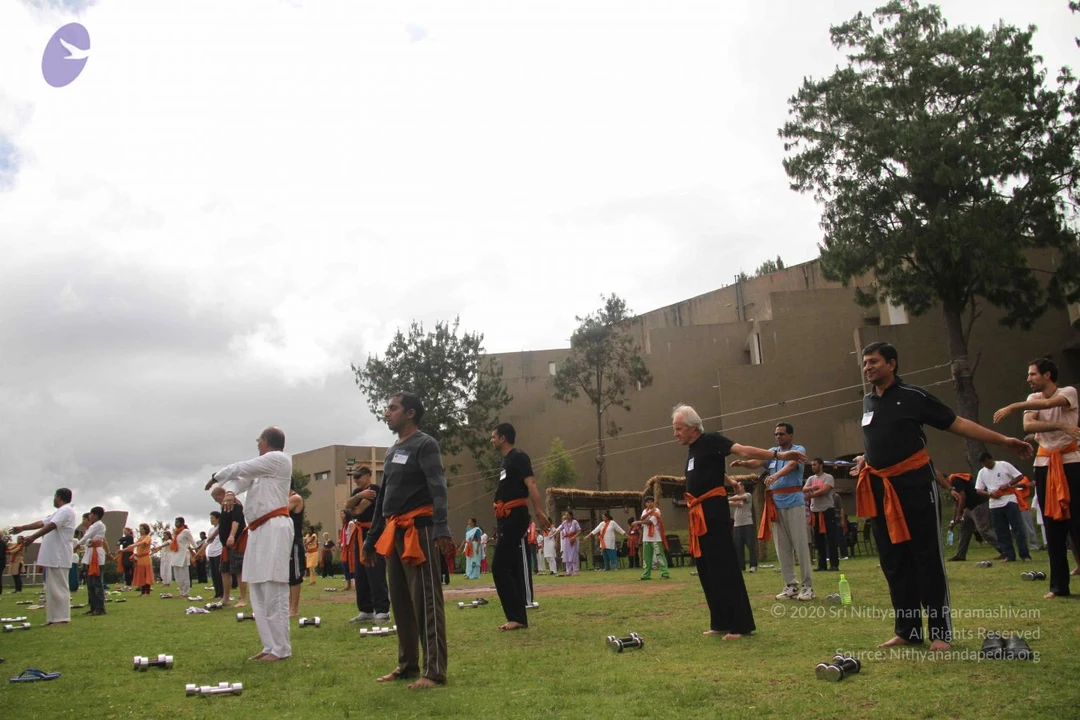
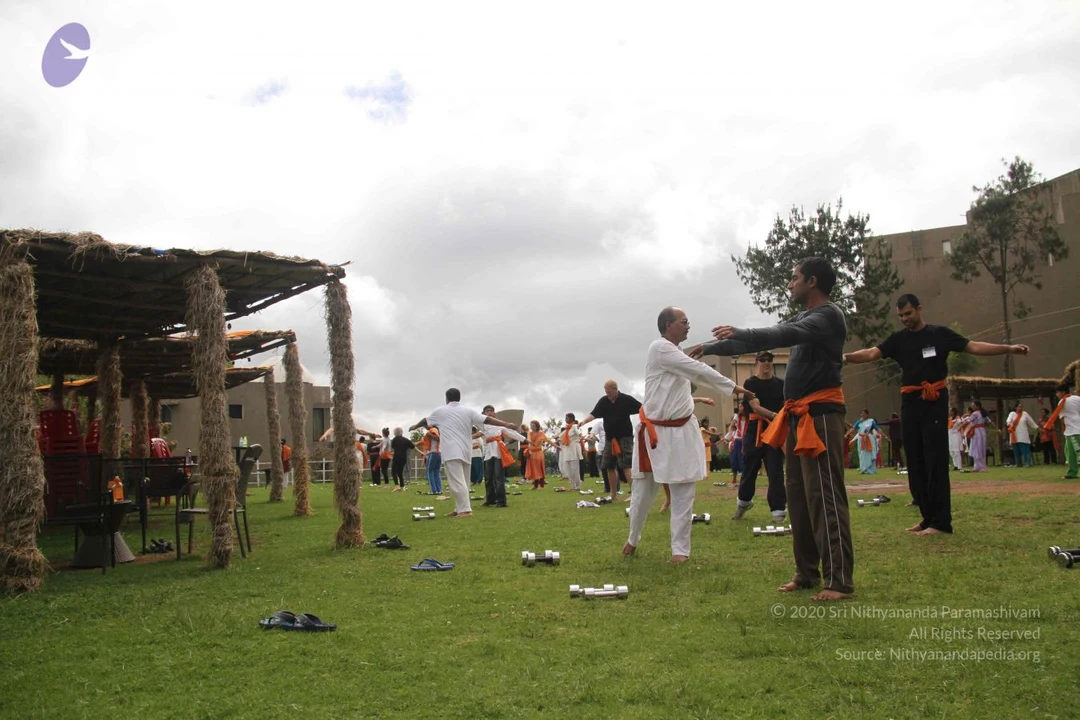
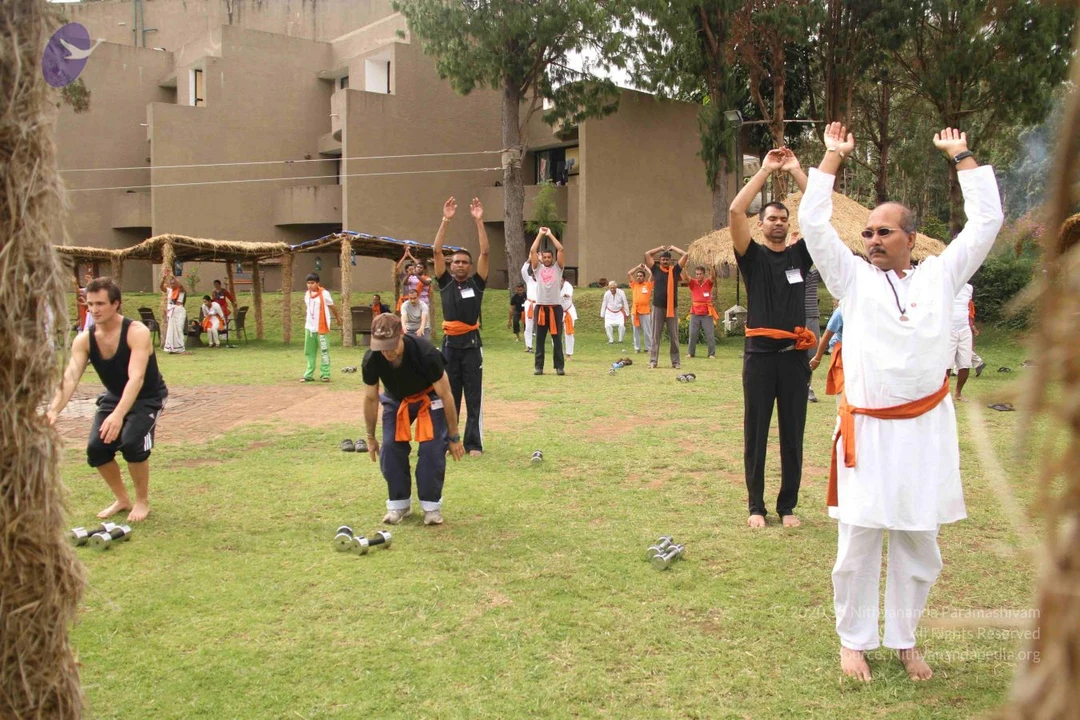
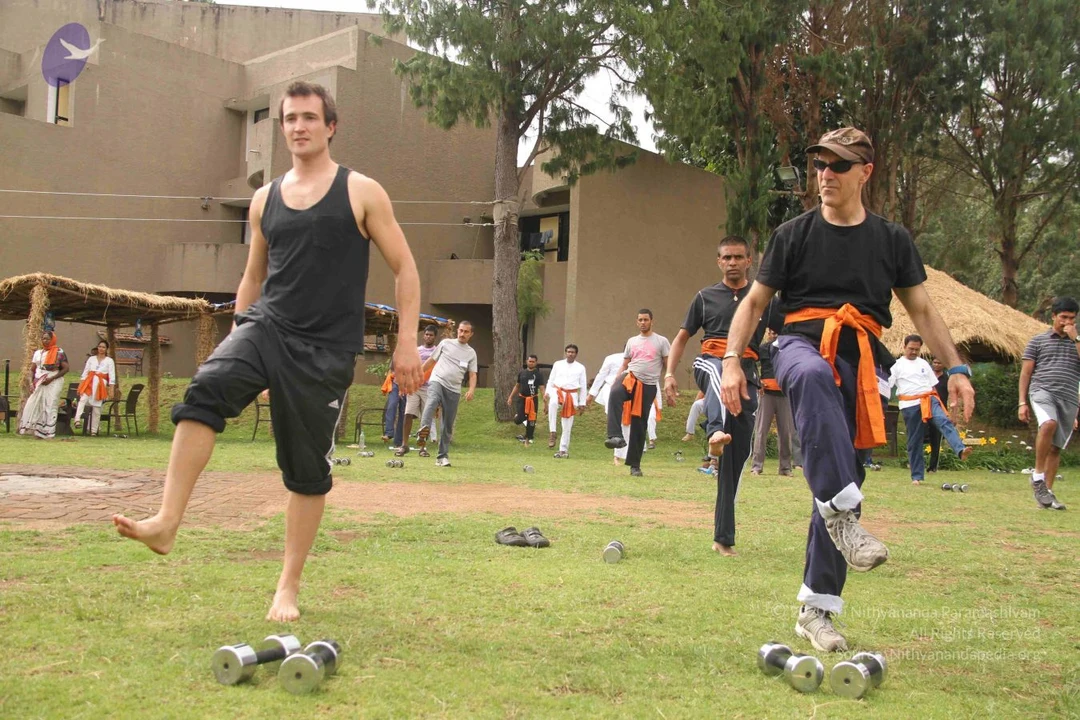
MorningYoga

6 photosSource gallery
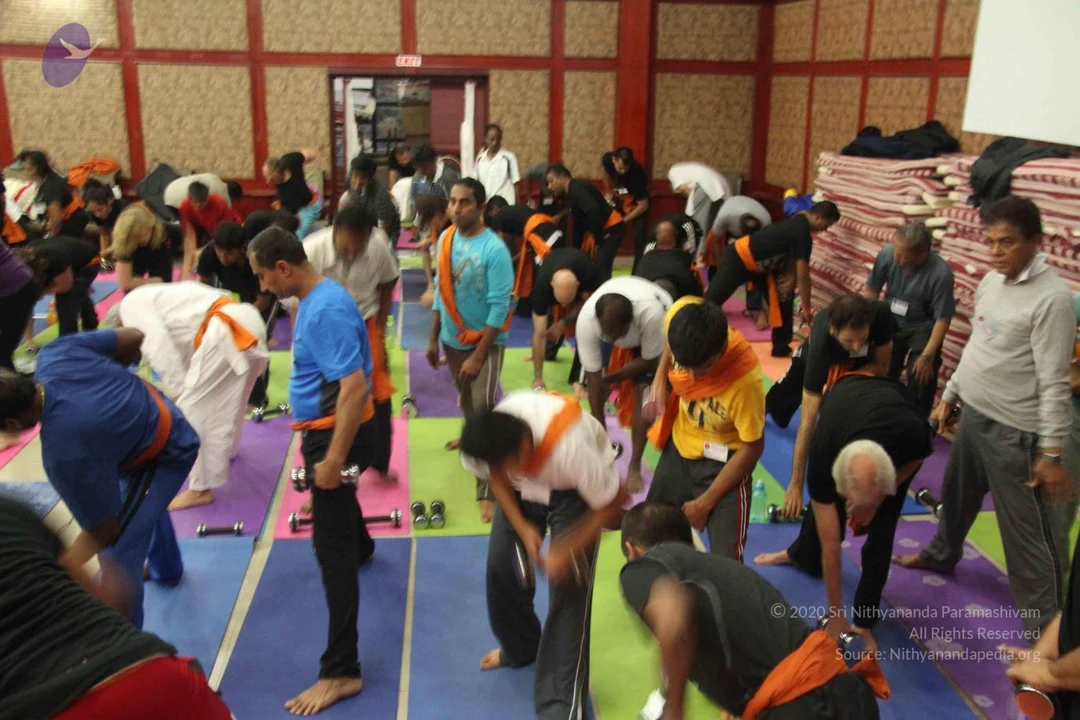
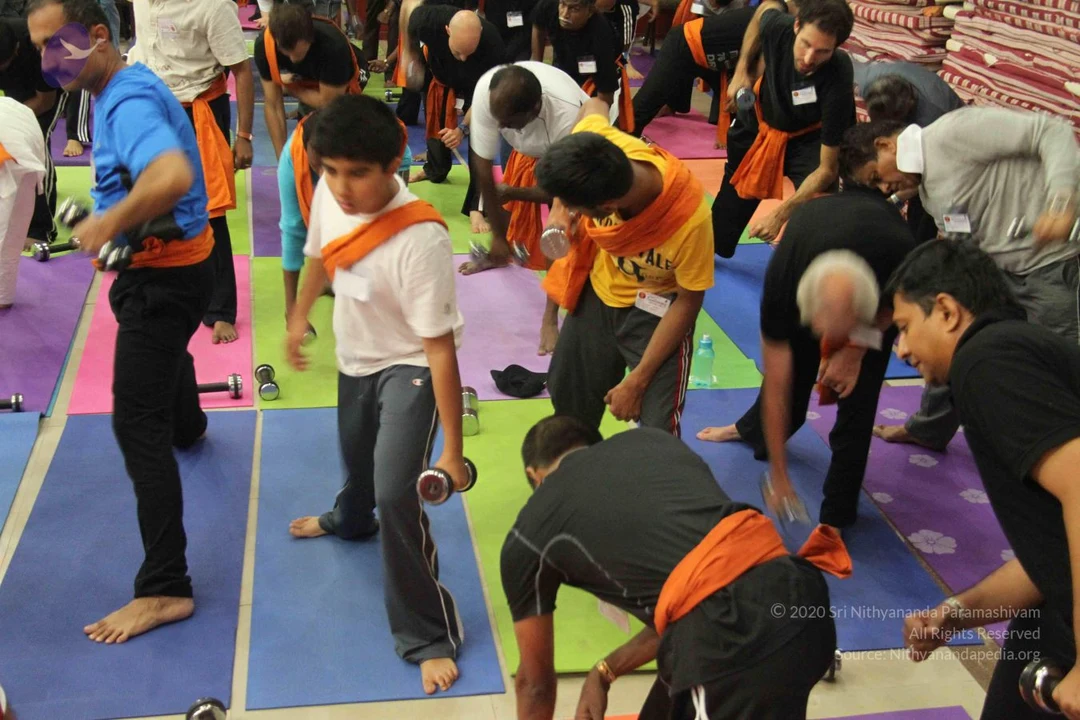
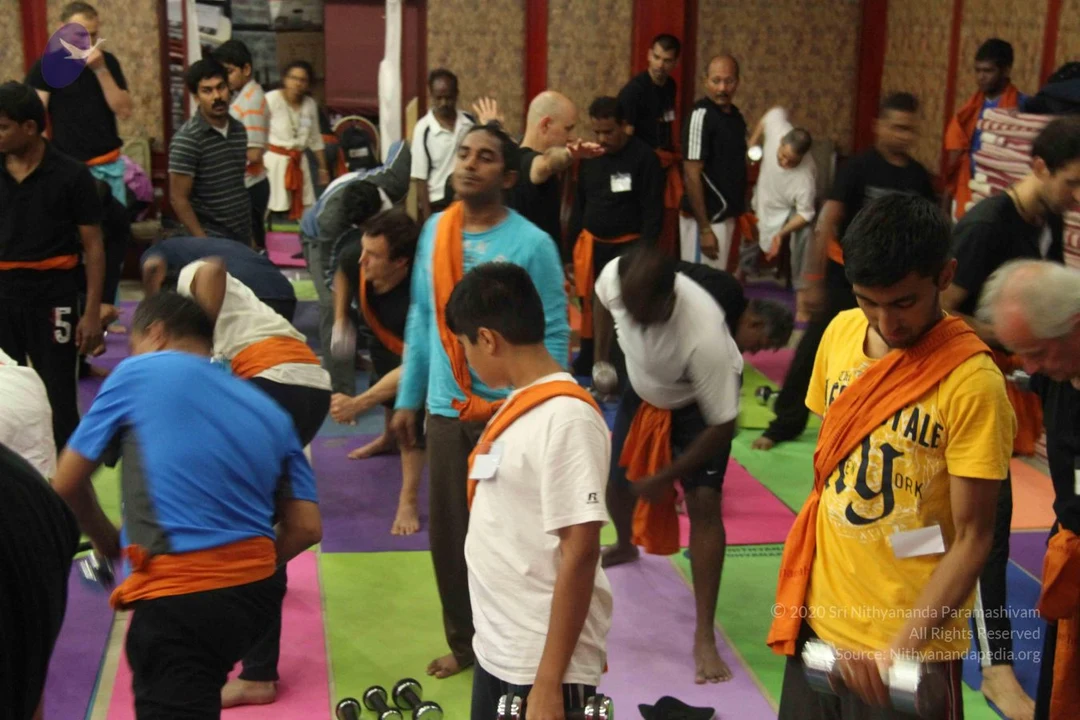
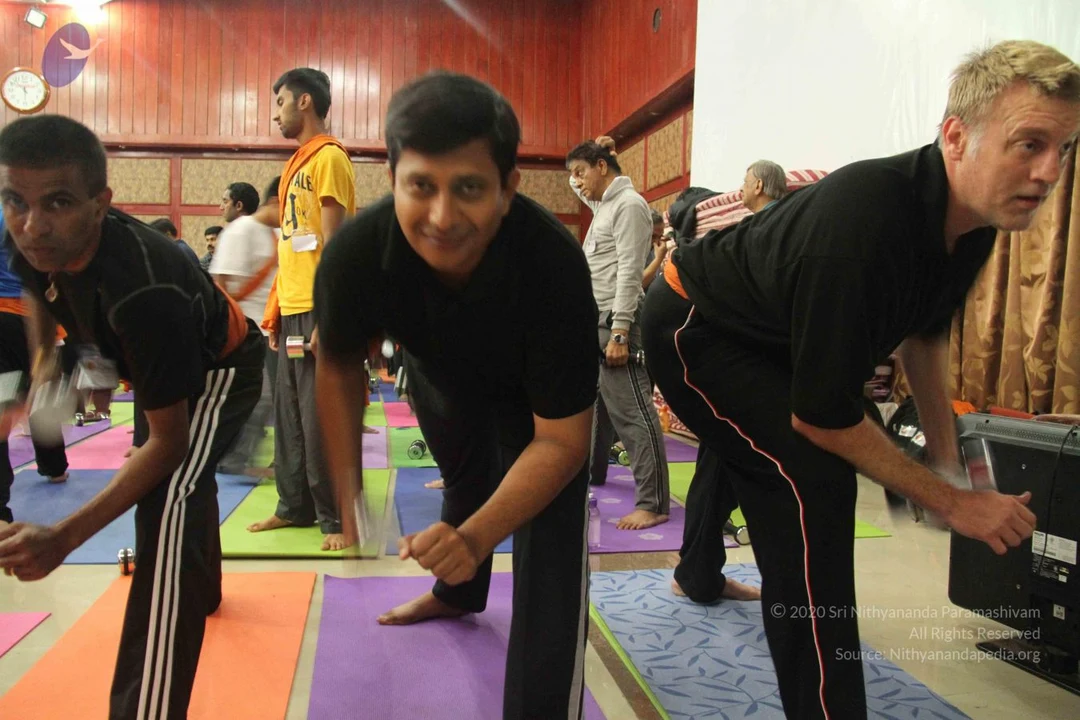
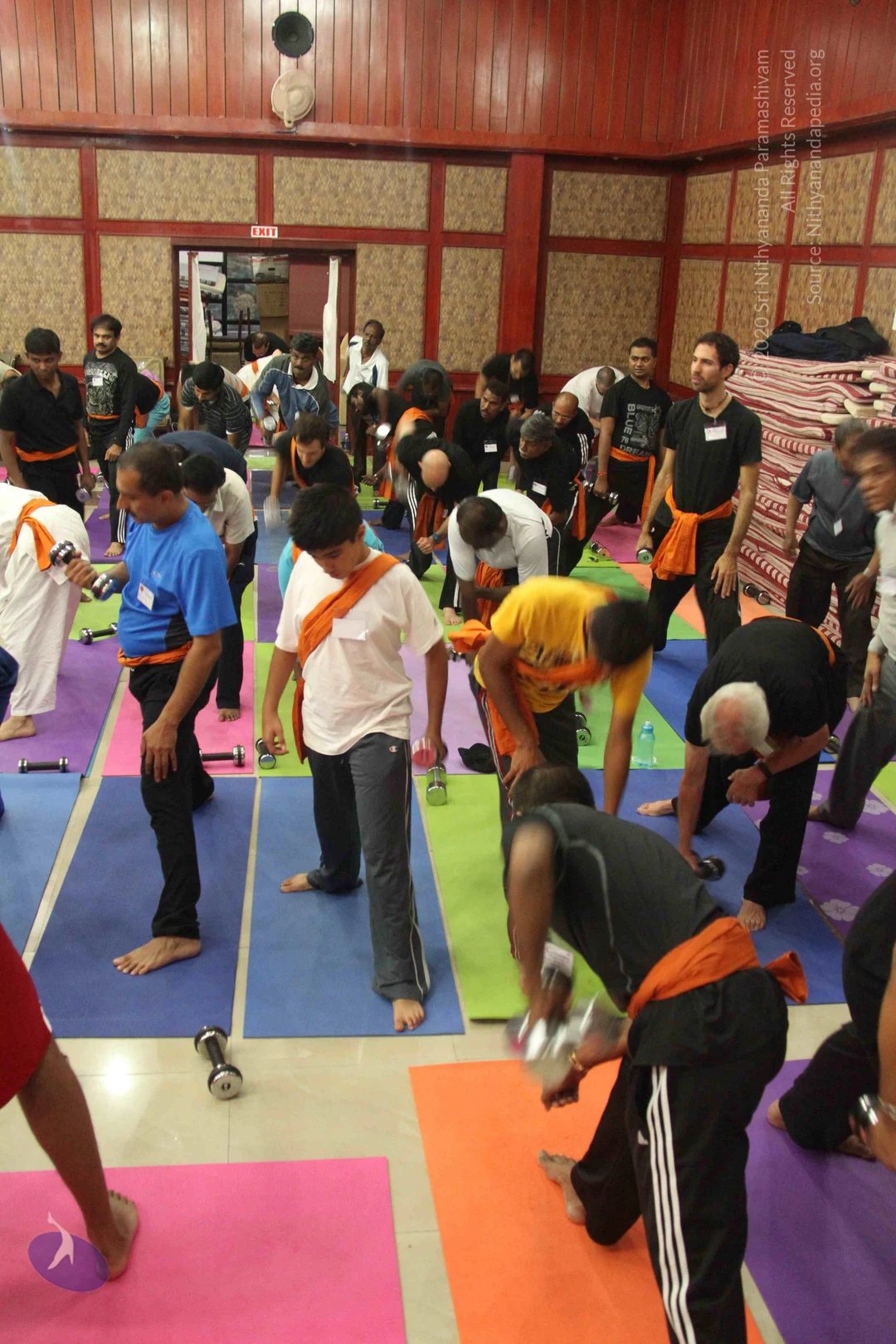
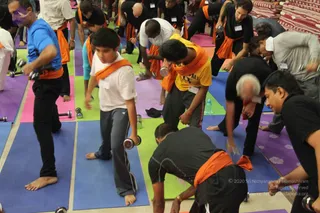
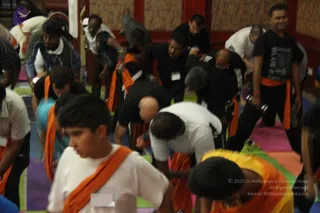
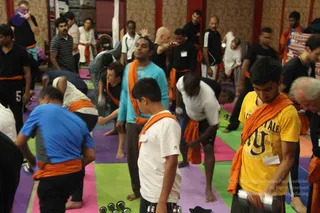
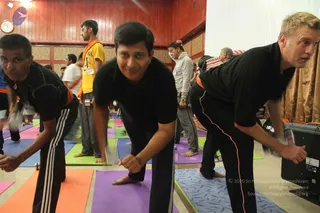
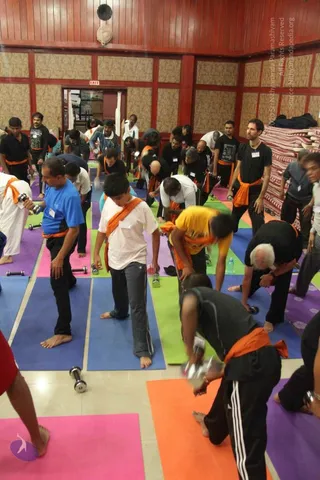
A photograph of a seated group of men in a yoga or meditation session on purple and green mats, many wearing orange sashes over black or white t-shirts. Several people in the front row are seated cross-legged or with legs extended, some holding small hand weights. A man in a grey sweatshirt in the lower right smiles, and a bald man in a black shirt sits near the centre. Behind them, rows of participants with name badges sit in a hall with red wooden panels. No one visible is a presentable candidate for the a person appearance cues, and no throne or raised seat is shown.Indoor group exercise session in a hall with red-framed walls and wood-panel accents. Many participants in dark, white and blue athletic clothing bend forward at the waist on colourful interlocking mats in blue, pink, green and purple. Several wear orange sashes or stoles and some hold small hand weights. Stacked folded blankets sit at the right edge. A few standing observers in grey and white watch. No a person candidate is clearly identifiable from appearance, so the figures are described by role and dress only.A photograph of a large group exercising on colourful yoga mats in an indoor hall. Many participants hold small silver dumbbells and bend forward, while some stand on one leg. Most wear orange sashes or scarves draped over black, white or grey clothing, and some wear white name badges. A boy in a white t-shirt and grey track pants and a boy in a yellow t-shirt are in the foreground. A stack of folded red and white mats sits at the upper right. No figure is clearly identifiable as a person from appearance, so no candidate is marked.A crowded indoor yoga or exercise session in a wood-panelled hall with pink, purple and green mats on the floor. Many participants bend forward at the waist, several with arms reaching down. Most wear black or white t-shirts and many wear orange sashes or shawls draped over the shoulders. A few people wear name badges on lanyards. The foreground shows a young boy in a white t-shirt with an orange sash, and a person in a yellow top with an orange sash. No a person figure is clearly identifiable here.A yoga or fitness session in an indoor hall with colourful mats in purple, pink, green and blue on the floor. Many participants wear orange sashes over black, white or blue tops. In the foreground a young man in a yellow shirt printed with New York lettering holds metal dumbbells, and a boy in a white shirt stands beside him. Several people bend forward or stretch on the mats, and one bald man in dark clothes gestures toward the group. Some attendees wear name badges on their shirts.A photo of a yoga session in a hall with wood-panelled walls and a wall clock. Several participants stand bent forward on coloured yoga mats in orange, green, purple and blue. In the foreground, a smiling man in a black tracksuit with white side stripes leans forward, while a man in black athletic wear with a red stripe bends at the right. Other people in yellow and grey clothing stand behind on the mats, and a curtain and a black monitor appear at the right edge.

MorningSatsang
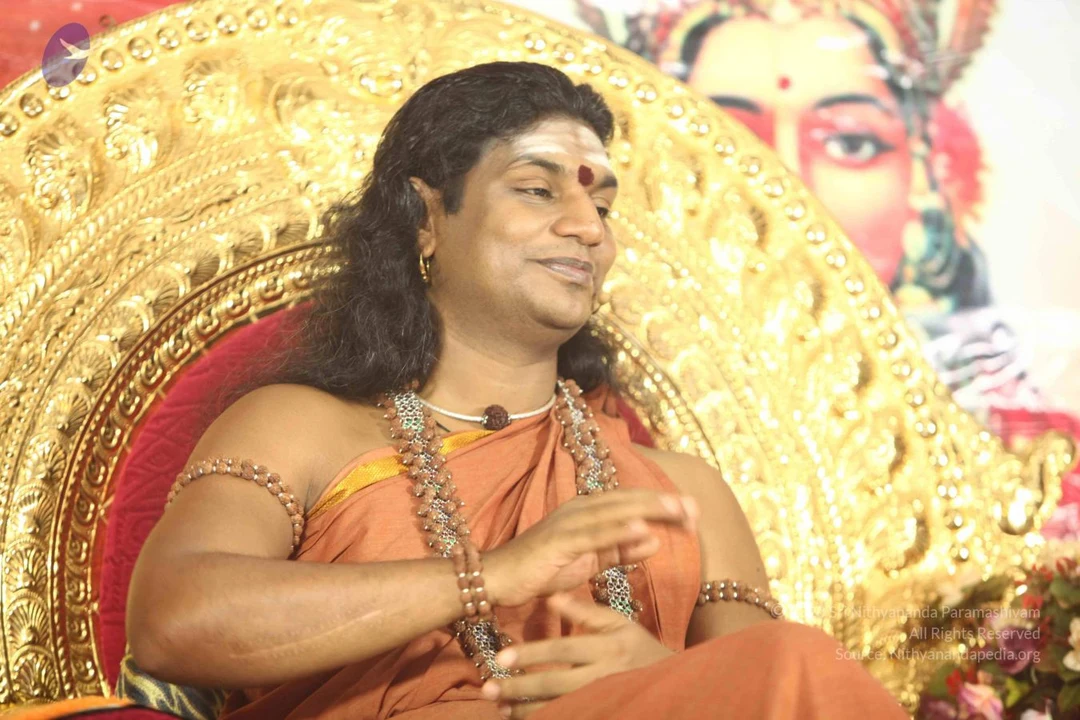
73 photosSource gallery
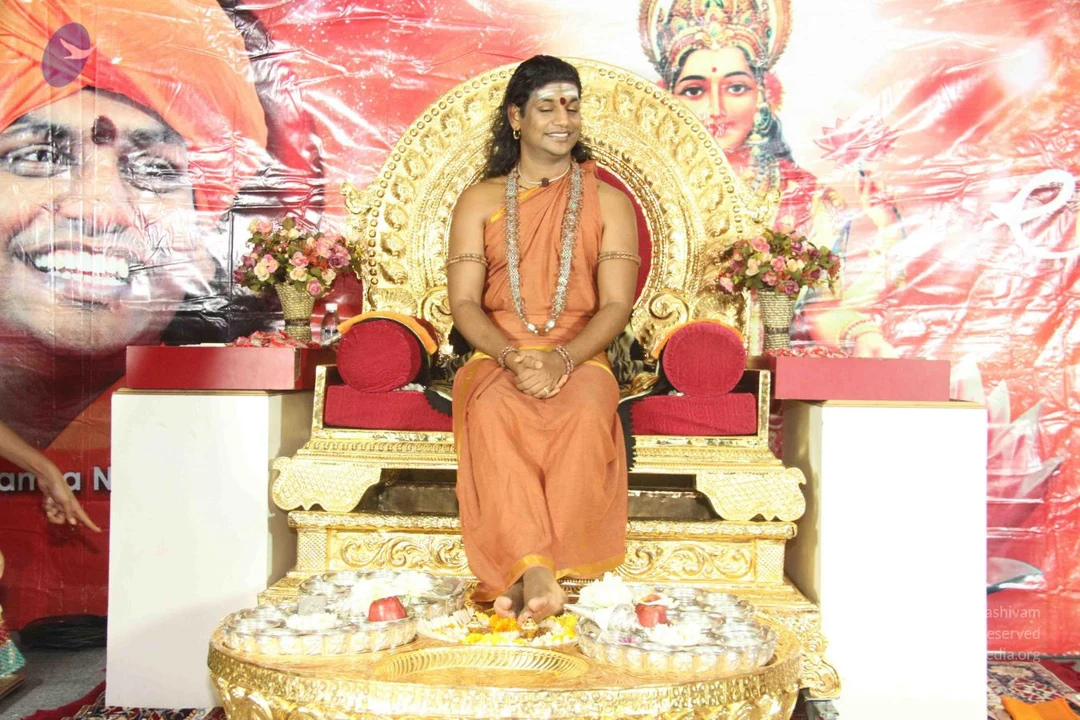
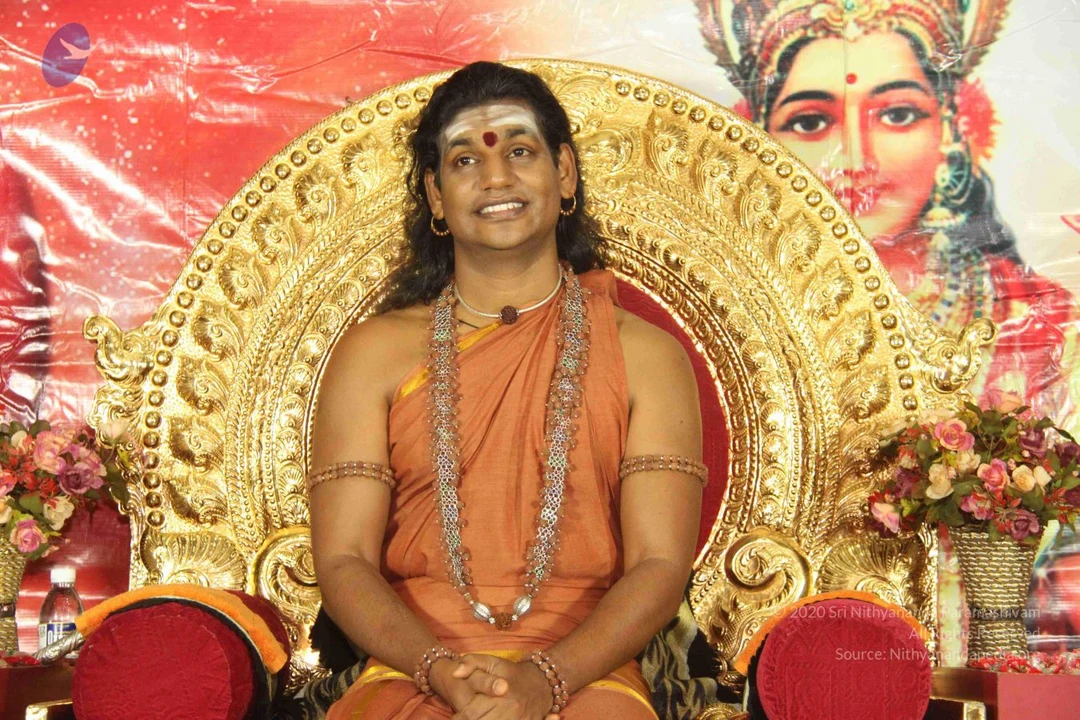
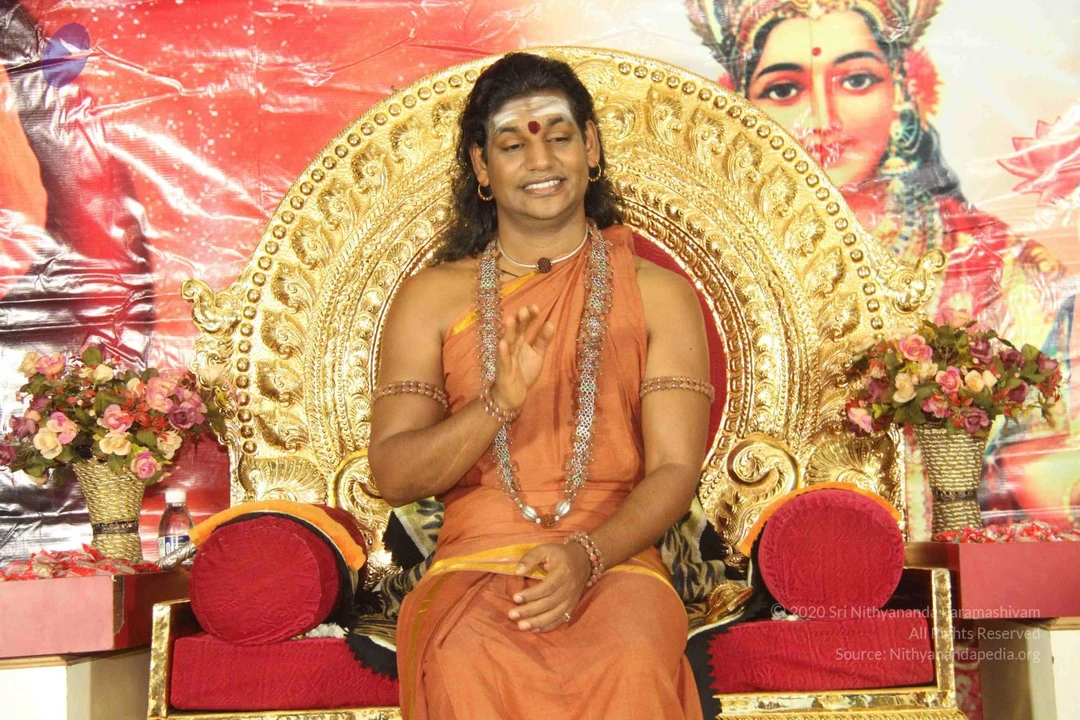
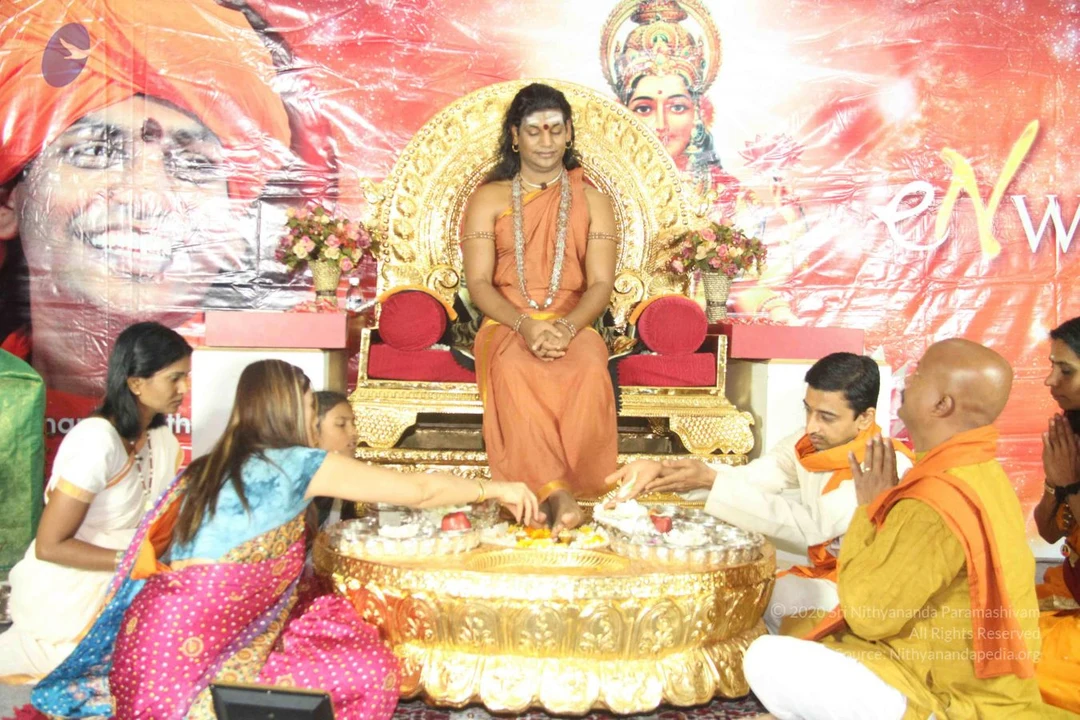
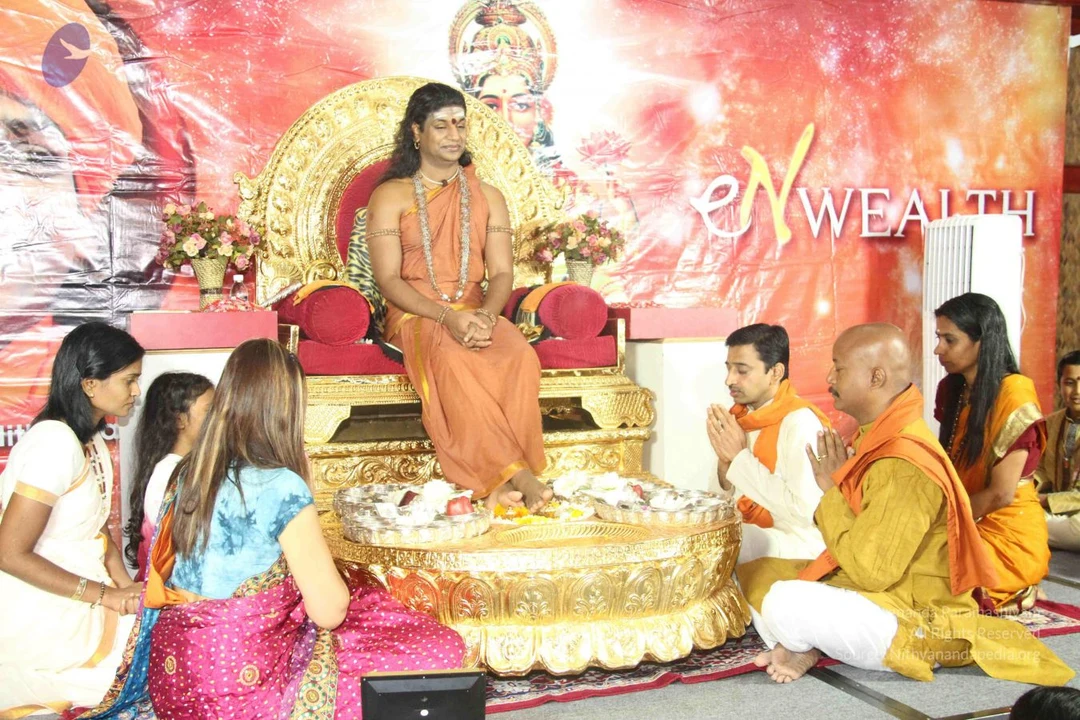
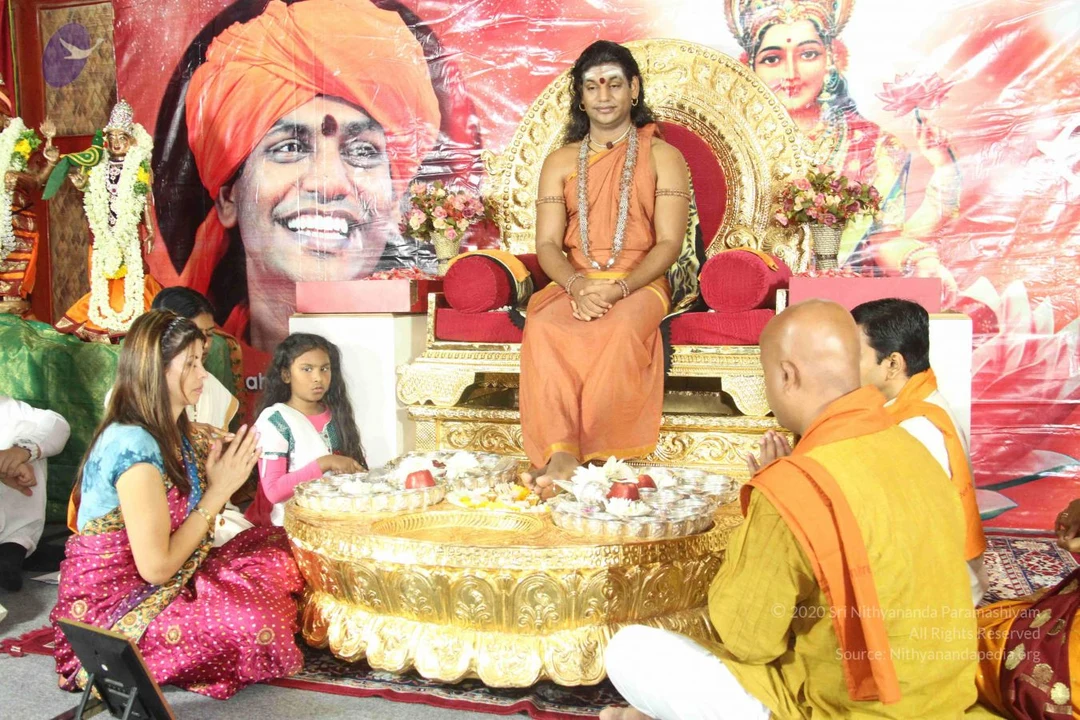
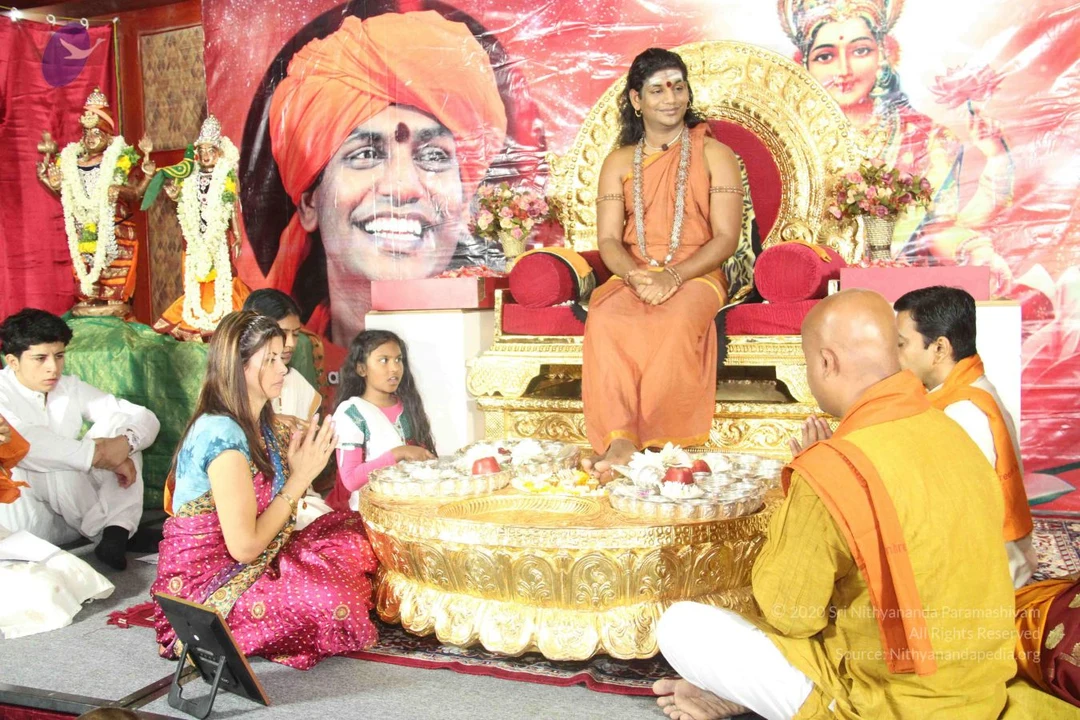
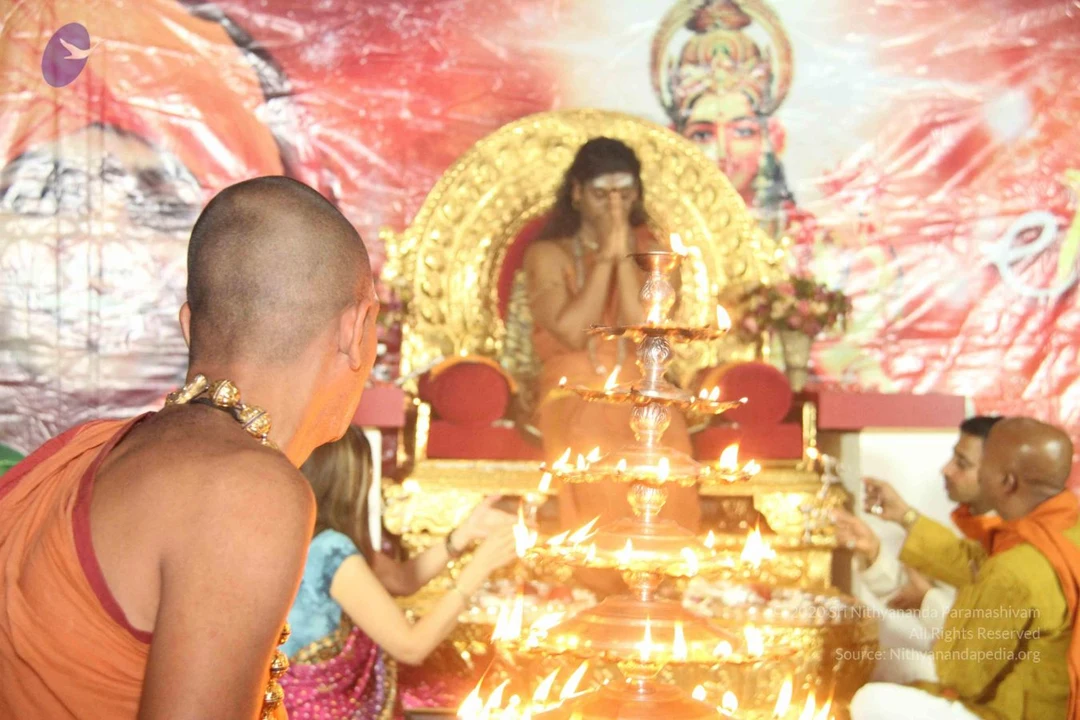
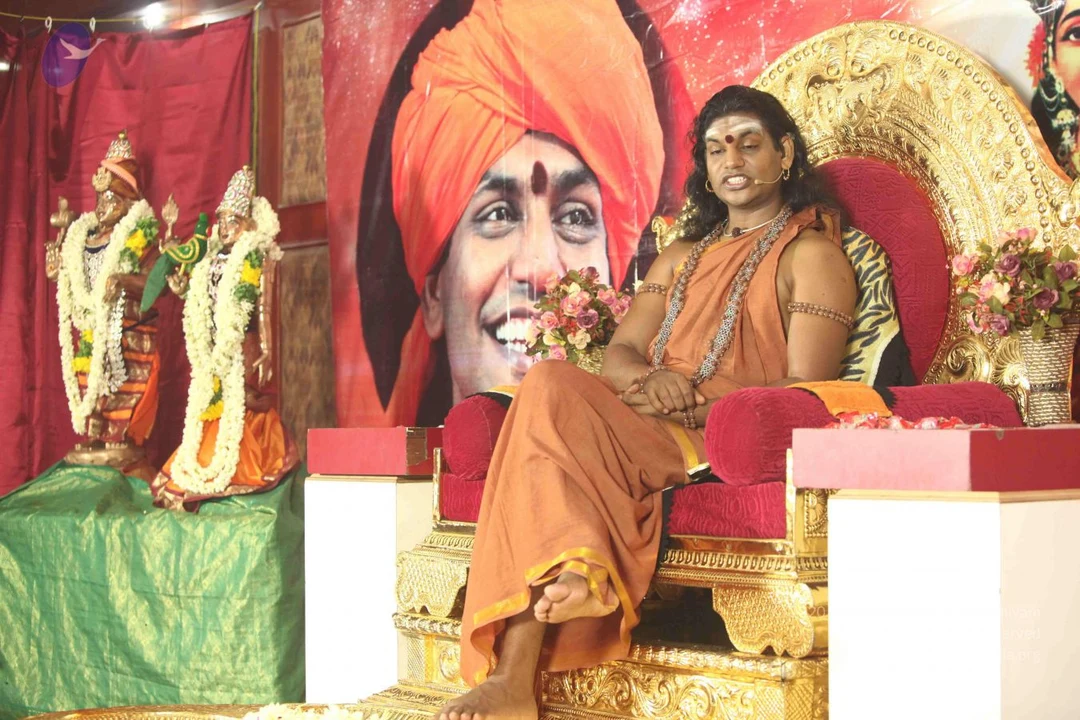
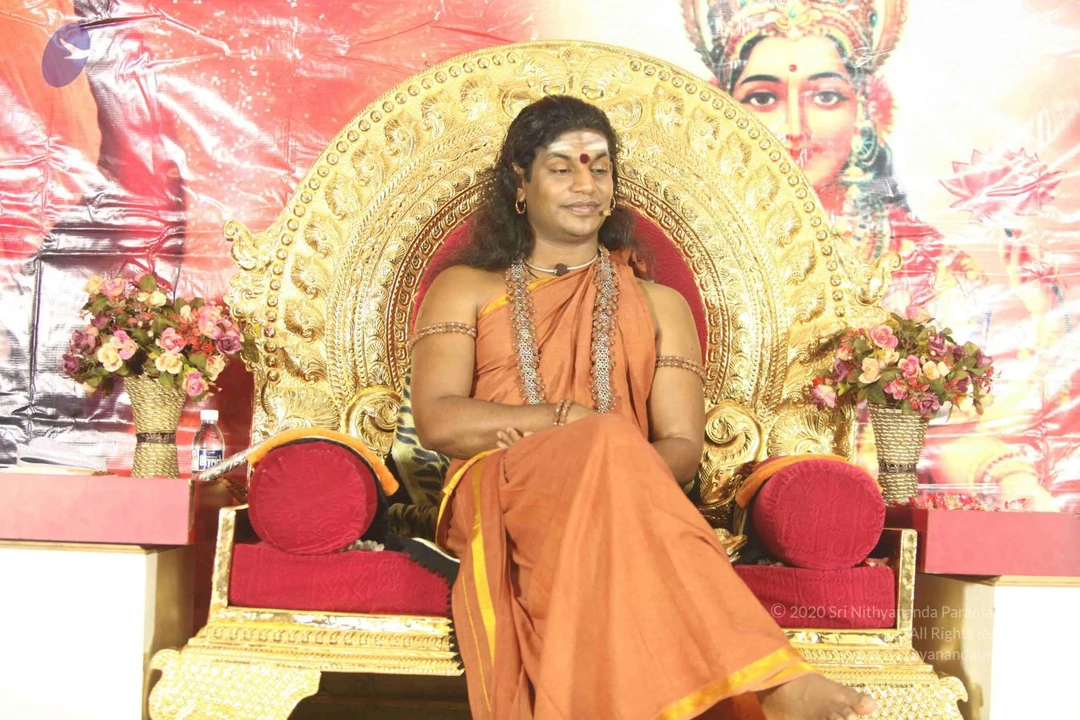
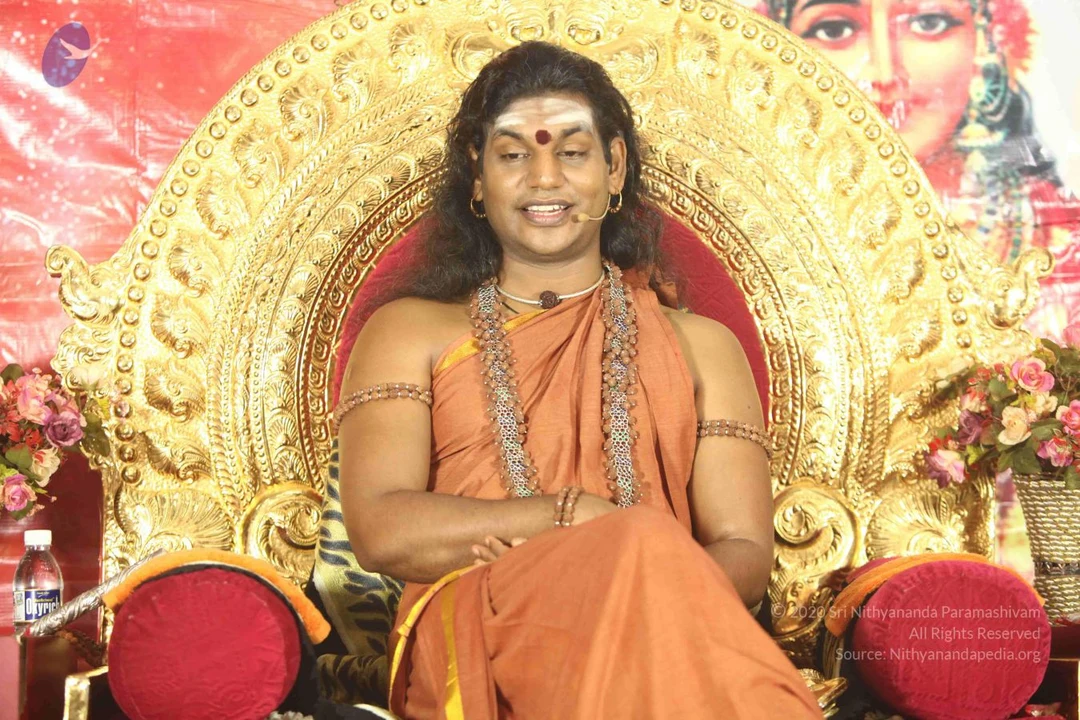
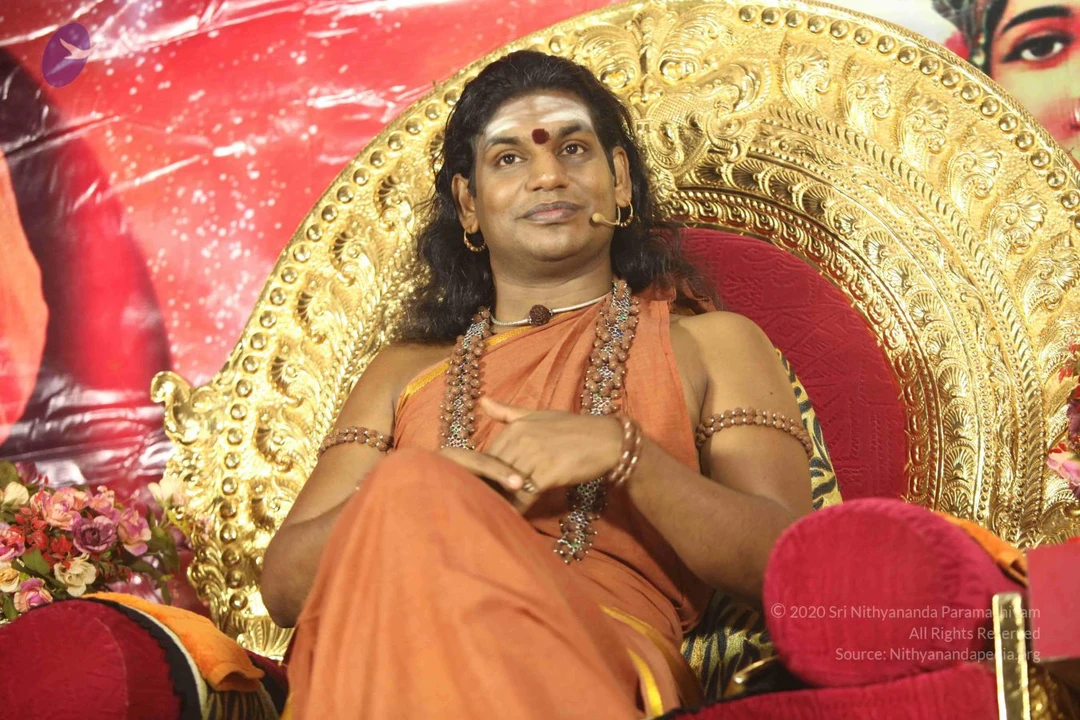
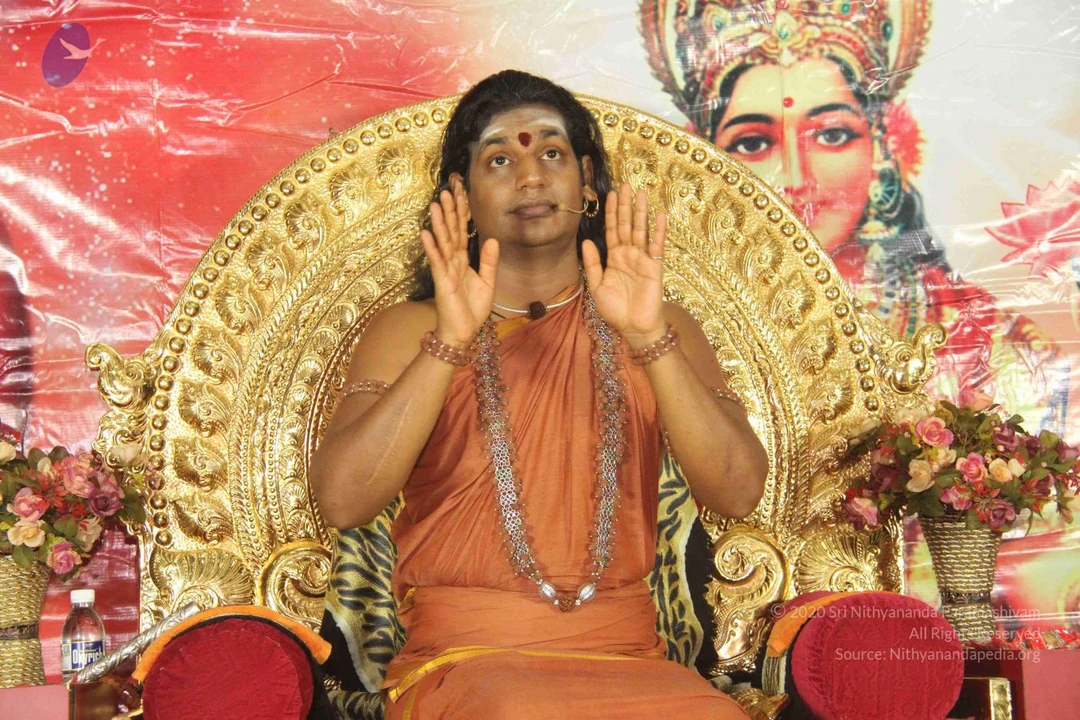
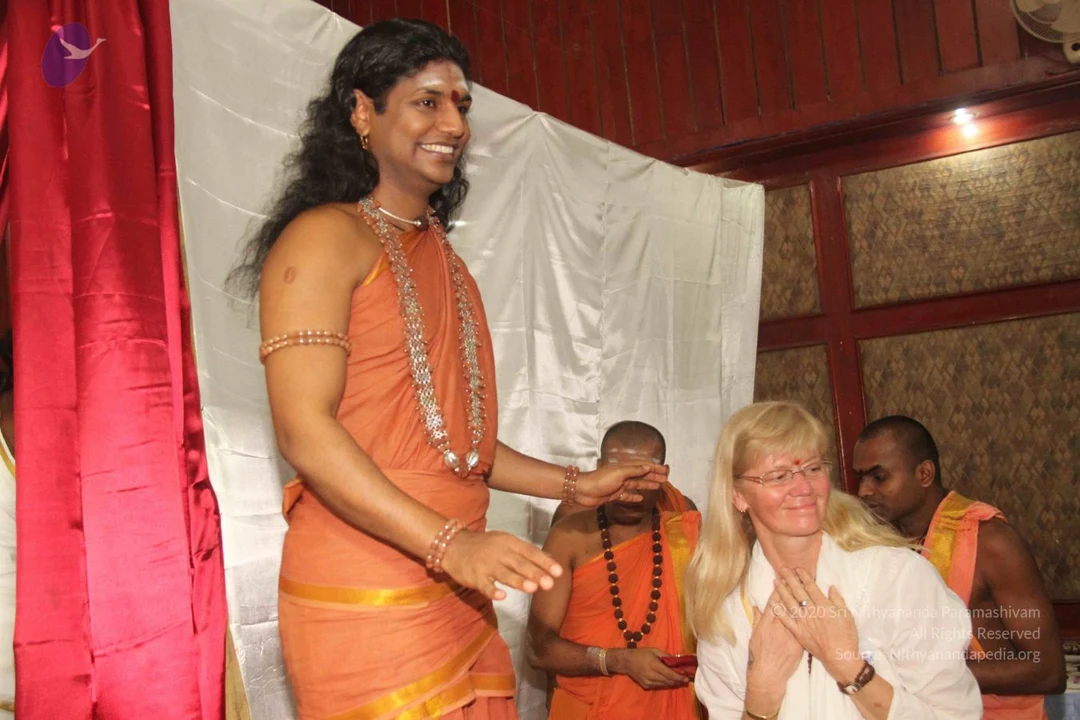
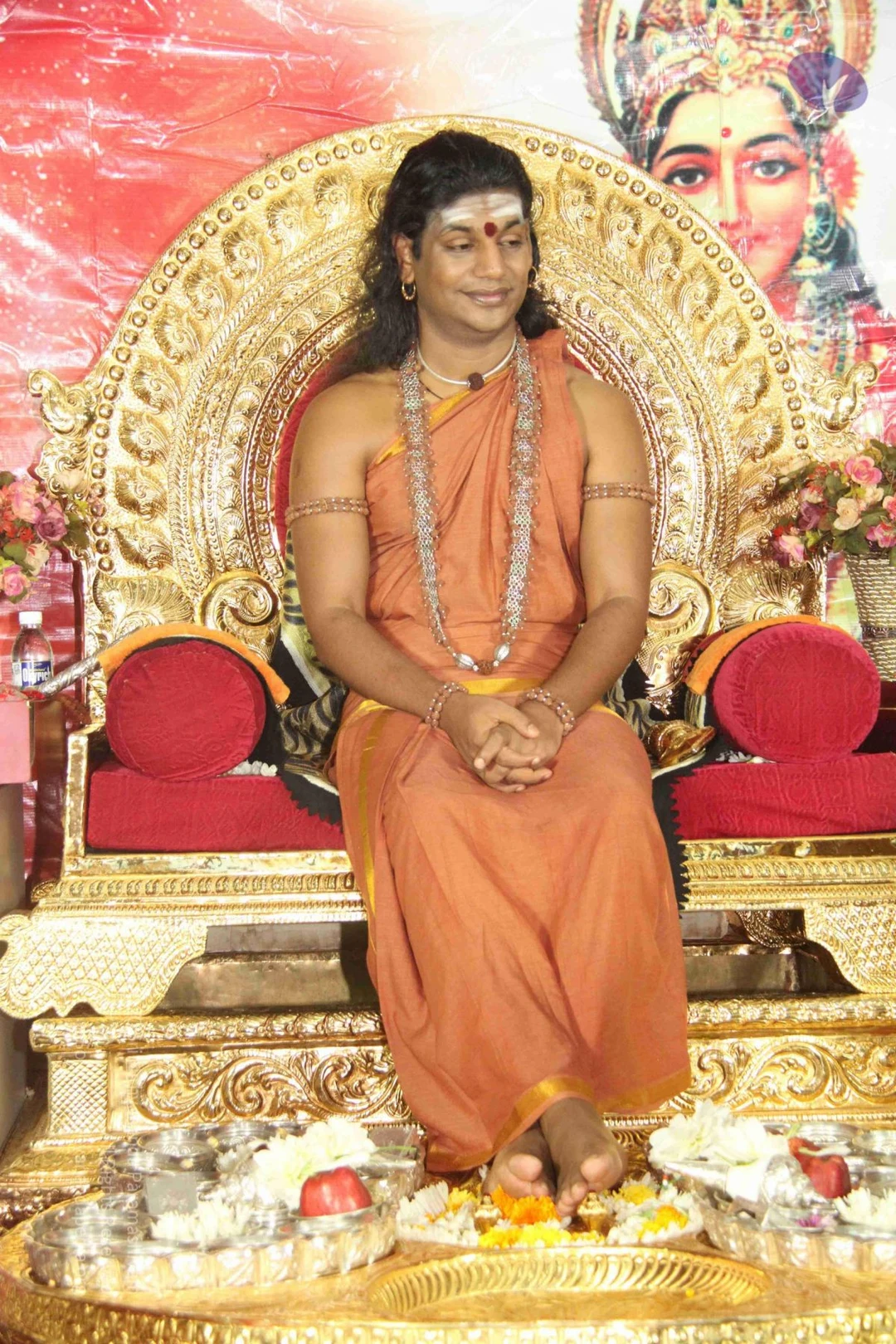
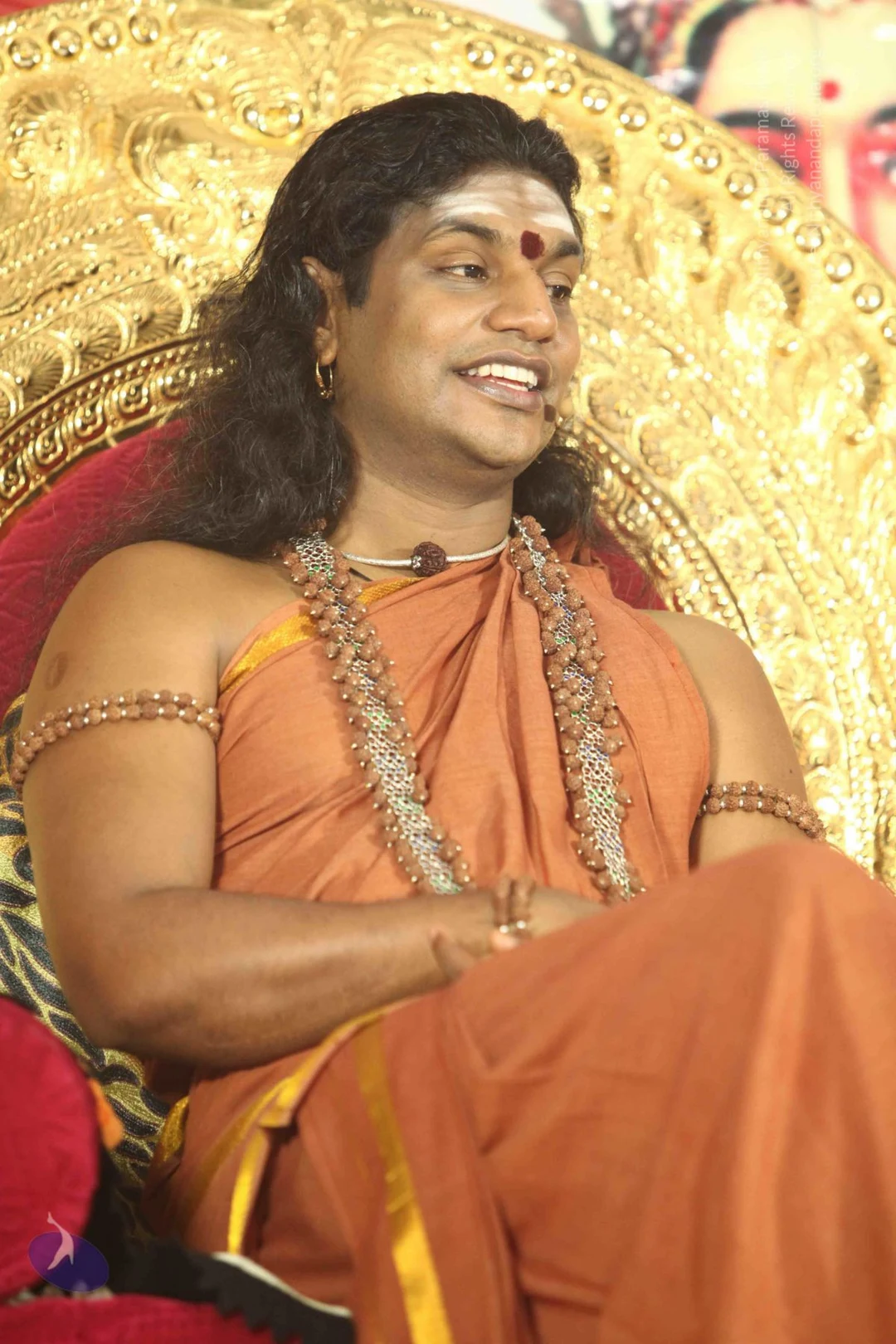
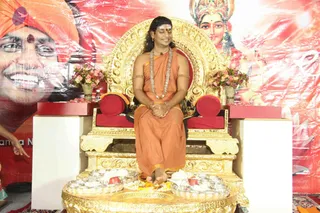
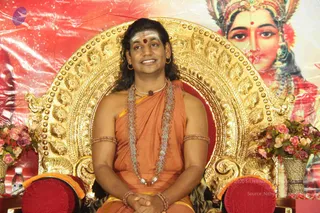
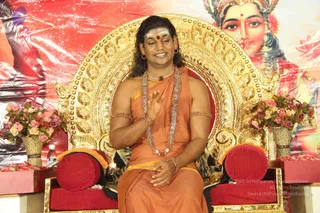
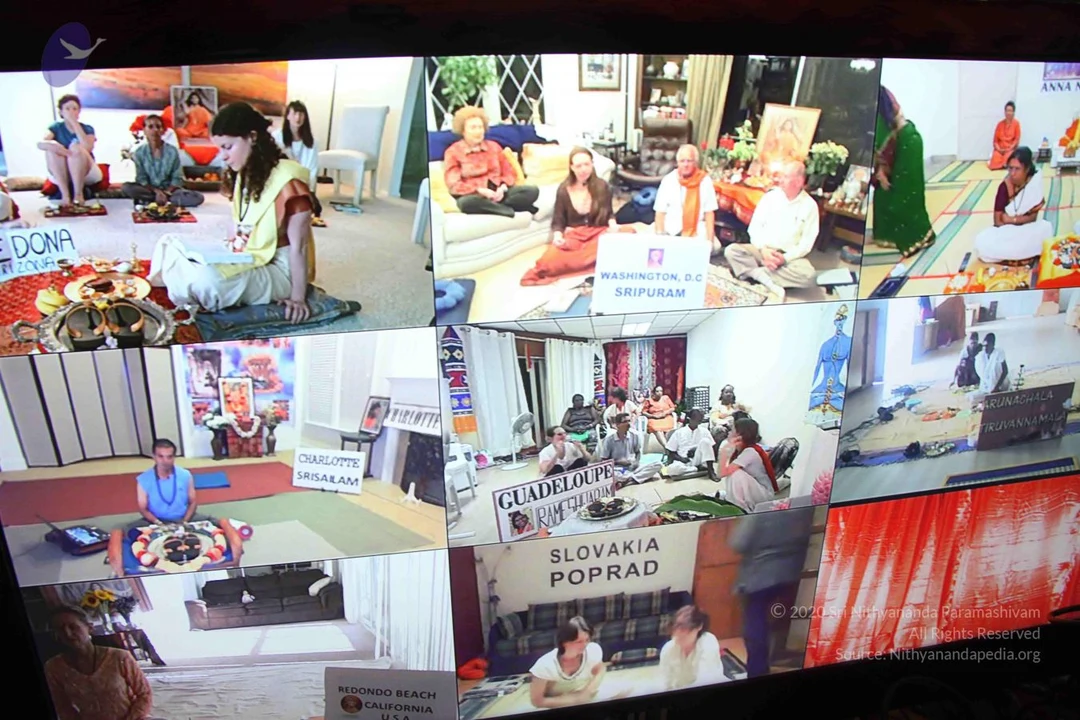
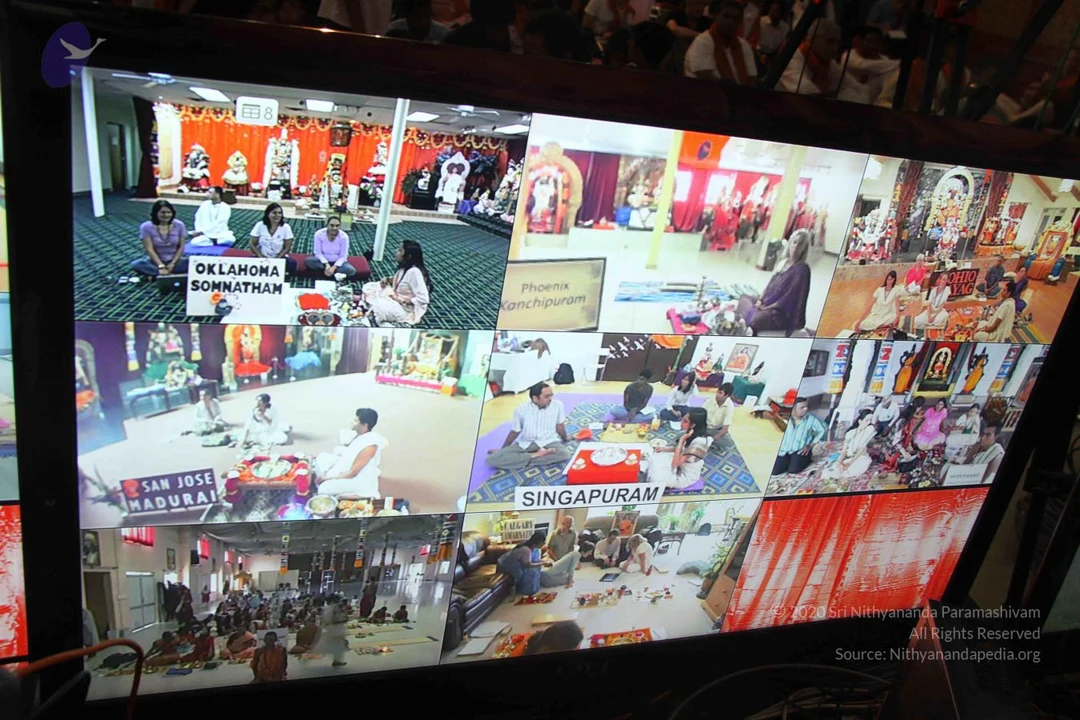
A large display screen shows a multi-panel video grid of satsang participants joined from different locations. Top-left, a woman in a yellow top and white pants sits before a brass plate of fruit, with a white bowl and other offerings. Top-centre, a seated figure in orange and a person in a brown top sit on a sofa in front of a framed portrait and flowers. Top-right, a woman in a green sari sits on a patterned mat beside an orange-clad figure. Middle-left, a man in a blue shirt sits before a plate of fruit and a blue-flowered garland. Centre, a group of seated devotees in white and red garments sit on a rug beneath a blue deity figure and a banner labelled "GUADELOUPE". Bottom-centre, two women in white sit before a sofa under a sign reading "SLOVAKIA POPRAD". The grid is framed by a red curtain at the lower right.A large screen displays a grid of live video feeds from multiple KAILASA centres, each panel labelled with a centre name such as "OKLAHOMA SOMNATHAM", "Phoenix Kanchipuram", "SAN JOSE MADURAI", "SINGAPURAM" and "OHIO YAG". Participants sit on the floor or on cushions in white and colourful clothing before altars with flowers, fruit, and garlanded deity murtis, and oil lamps. The camera is photographing the screen itself, with a seated audience visible above it. The panels show a satsang and homa-style ritual setting with offerings, rather than a single unified event.A man with long dark hair, a red bindi and a rudraksha mala sits cross-legged on an ornate gold throne with red cushions, wearing an orange saffron cloth draped over his body and a silver chain necklace, hands folded in his lap. Silver and steel trays of offerings, flowers, marigold garlands and a red fruit sit on a gold table in front. Behind him a red backdrop shows a large smiling portrait of a turbaned man and a goddess figure holding a lotus, with pink flower arrangements at both sides. Text on the backdrop reads partially as Nithyananda. Appearance-based a person with the rudraksha mala, saffron cloth and throne as cues, seated as a teacher giving satsang.A photograph of a man seated on an ornate gold throne with a red cushioned back, smiling and looking upward with hands clasped in his lap. He wears an orange saffron wrap, long multi-strand beaded necklaces, a rudraksha pendant, a red bindi and white forehead markings, and beaded armlets. A large painted deity portrait of a woman with a crown and red background sits behind him, with pink and purple flower arrangements at either side and a water bottle on the left. a person based on the saffron wrap, long swept-back hair, rudraksha and ceremonial beaded necklaces, and seated throne setting, though the page does not place him at this event.A man with long swept-back hair, a red bindi and white tripundra marks sits on an ornate gold throne with red cushions, smiling and gesturing with his right hand. He wears an orange-saffron dress, a rudraksha-style bead mala, ceremonial beaded necklaces and beaded armlets, with a small clip microphone at his collar. Behind him a large painting shows a goddess with a red bindi and gold jewellery. Pink and yellow roses sit in gold baskets on either side, with a water bottle at left.A seated long-haired man in saffron-orange robes, with rudraksha mala beads and gold bangles, sits on an ornate gold throne with red cushions in front of a red banner bearing a portrait and a deity image. Women in white and a woman in pink and blue sari bend forward to offer padapuja, washing or touching the feet of the seated figure, while a man in white and a bald man in orange-yellow robes sit with hands folded in namaste beside a gold tray holding flowers, red fruit and offerings. Pink flowers sit in vases beside the throne.

IA -Session1-Participants

26 photosSource gallery
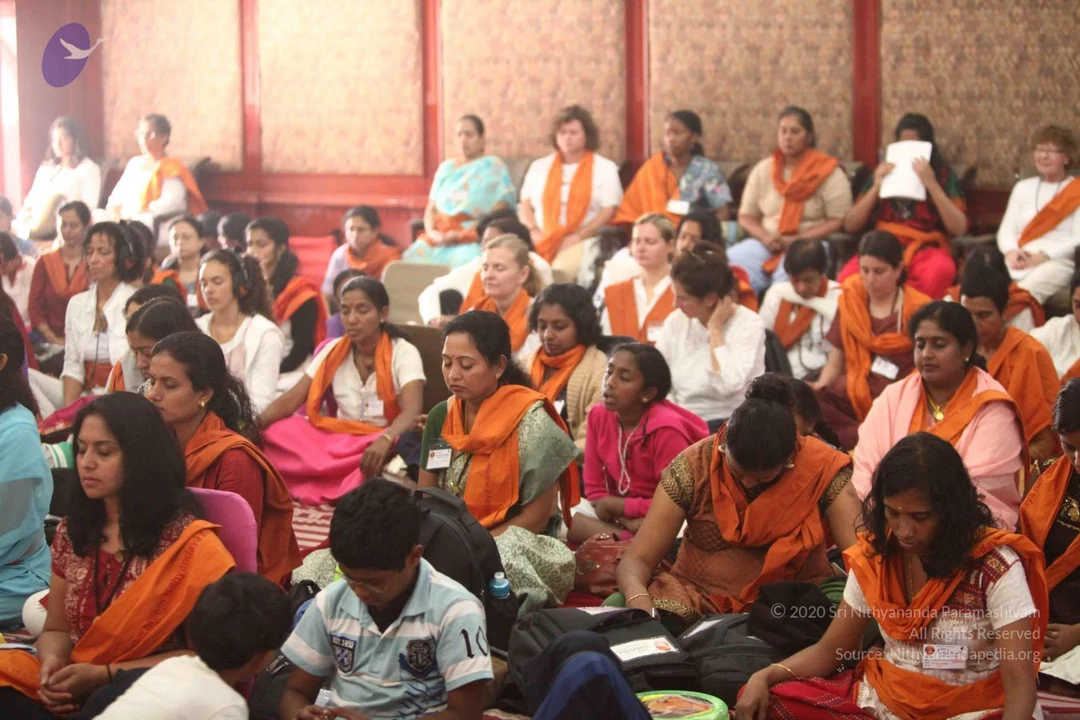
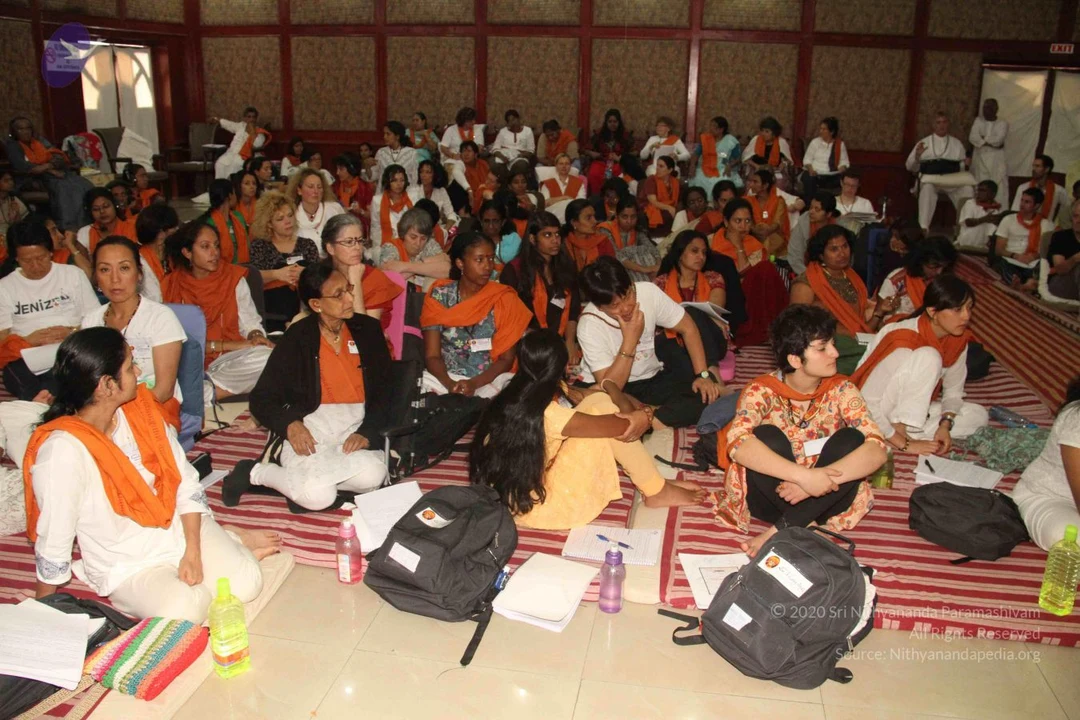
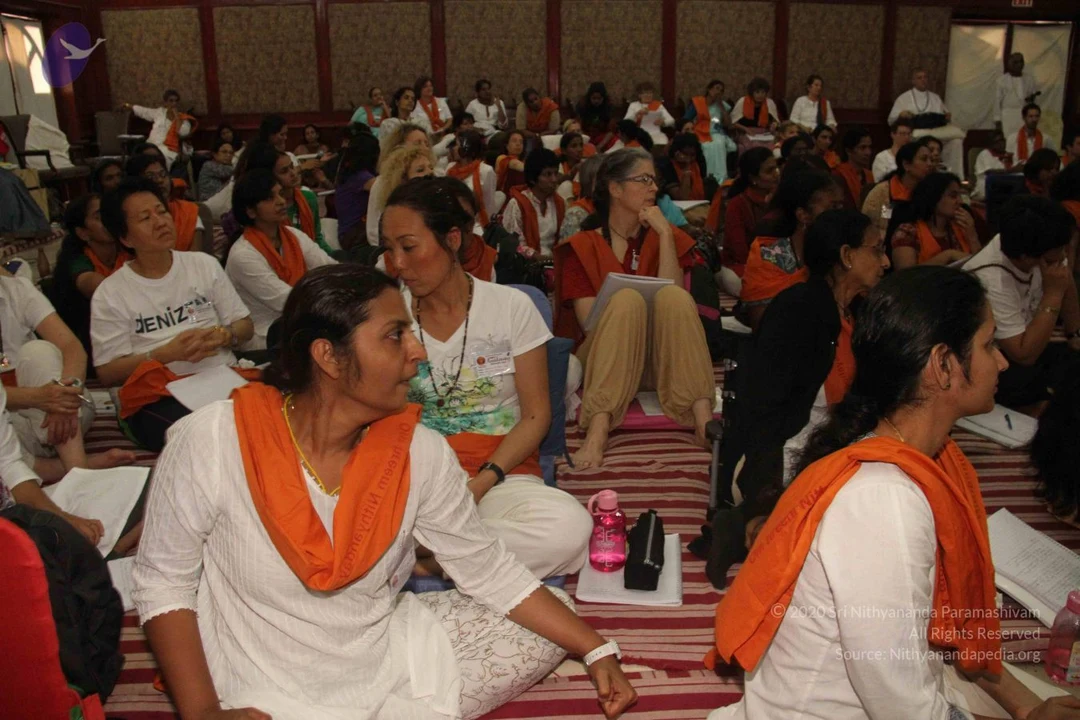
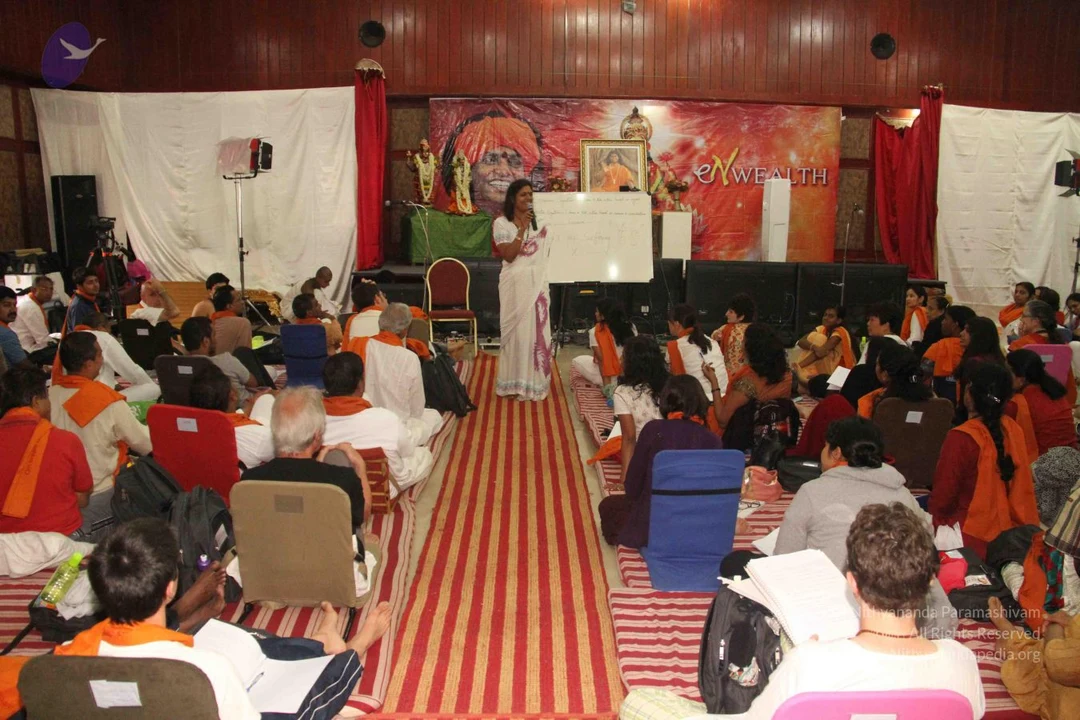
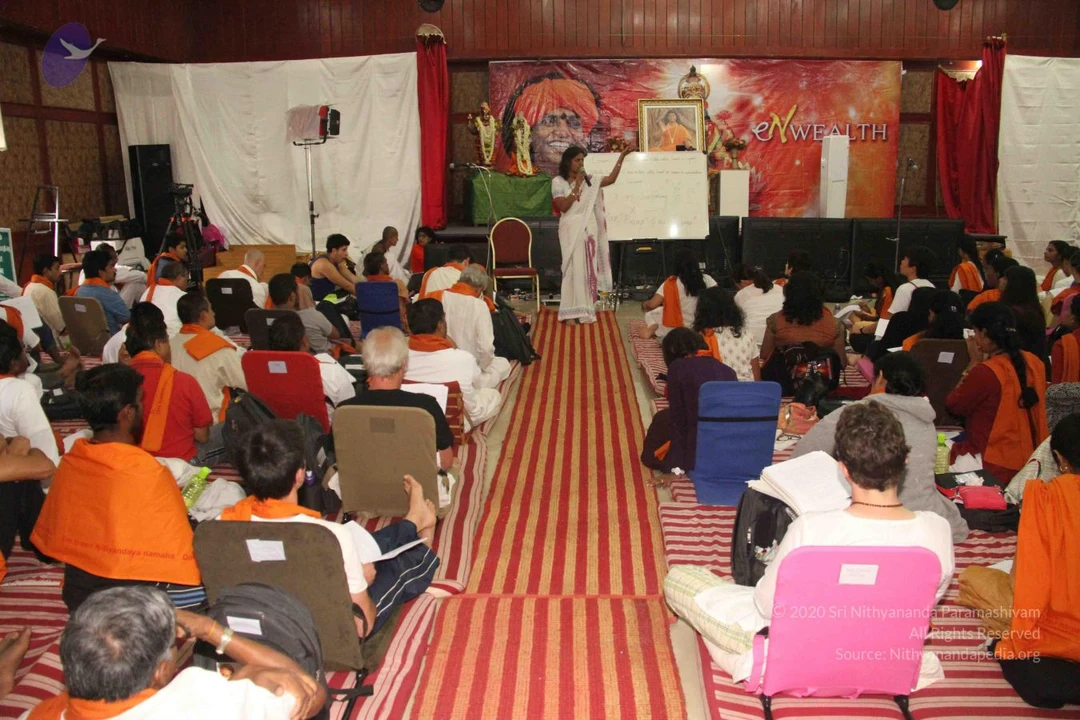
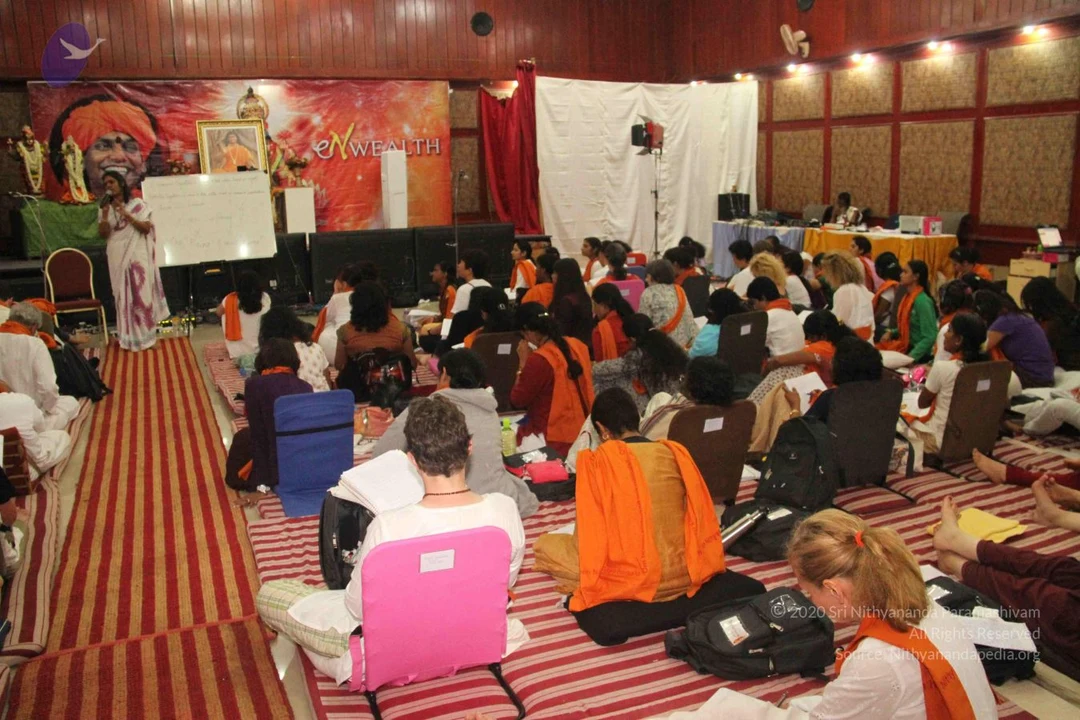
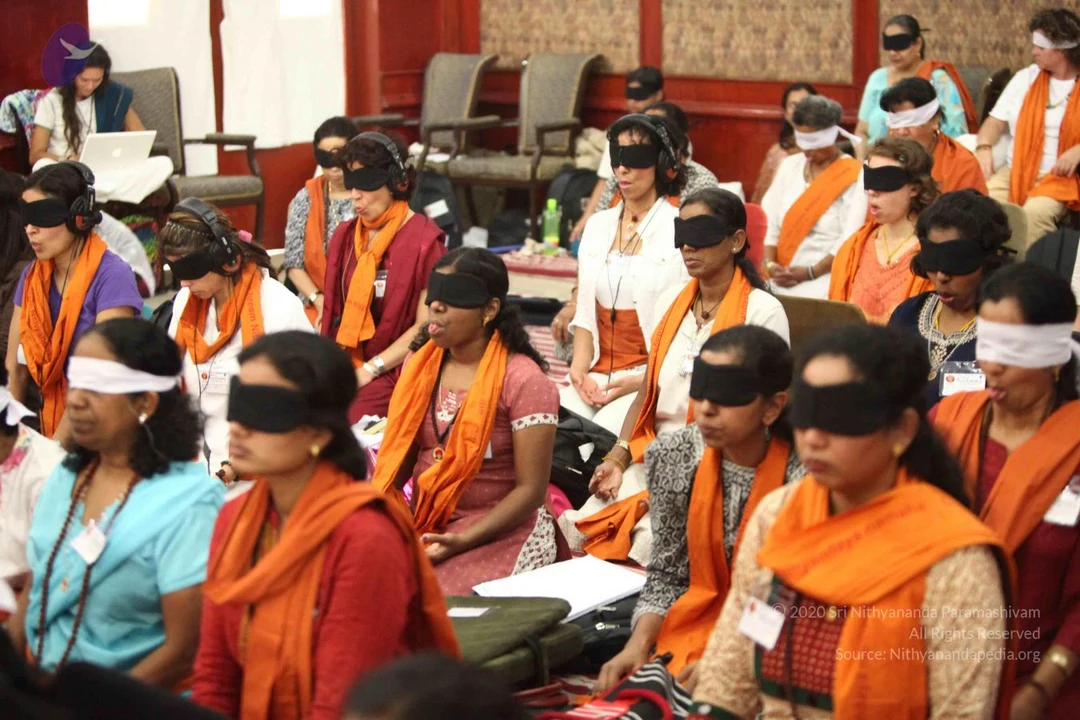
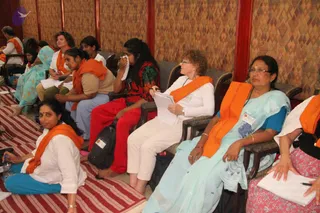
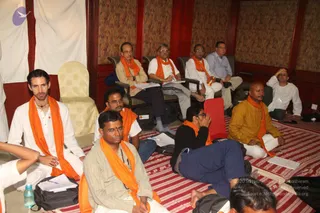
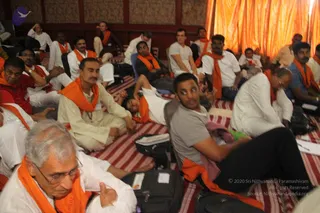
A seated satsang audience fills a hall with red-and-cream striped floor mats. Many attendees wear white clothing with orange-saffron shawls draped over their shoulders. Several sit cross-legged or with knees up, holding notebooks, papers and pens, while water bottles and black backpacks lie on the mats in the foreground. A woman in a black jacket over white clothes sits near the centre, and a woman in an orange and cream patterned top sits on the right. In the back, a man in white stands near the wall beside a red-and-gold patterned wall panel. The scene reads as a seminar or discourse audience with no visible Swamiji figure.A seated audience of women and some men fills a room with dark red patterned walls and a red-and-white striped floor covering. Most wear orange shawls or scarves over white or light clothing, and several hold notebooks or pens. In the foreground a woman in a white kurta and white trousers turns her head to the side, while a woman in a white t-shirt with a lanyard leans toward her neighbour. A pink water bottle and a small black bag sit on the floor. At the upper right, a figure in white stands near a white curtain, and a bald man in white is visible at the far right edge.A satsang hall with a woman in a white sari with a light border standing at a microphone before a seated audience, beside a whiteboard with handwritten notes. Behind her a large red backdrop shows a portrait of a smiling figure in an orange turban and an orange-robed figure, flanked by a framed photo and garlands. Around 40 seated attendees wear orange shawls and white clothes, sitting on red-striped mats and on chairs, many taking notes. A banner reads eWEALTH.Photograph of a seated audience at a satsang hall with wooden lattice-patterned walls and red pillars. Around a dozen women in orange saffron shawls sit in rows of armchairs and on red-and-white striped floor mats. A woman in a white top and blue pants sits cross-legged on the mat at lower left. A woman in a light blue sari with a red bindi and glasses holds a pen and listens attentively, and a woman in white trousers holds notepaper. Another woman in a red top wipes her face with a tissue, and a woman at lower right holds a notebook. No speaker is visible in the frame.A photograph of a satsang-style gathering in a wood-panelled room with a red and white striped floor covering. Seated in the foreground and middle rows are about a dozen men wearing orange shawls over white or light kurta clothing; one in a yellow kurta sits on the right and a man in a black top leans with his hand at his face. Some seated men hold notepads and pens, and a man in the back right wears a light blue shirt. Several cushioned chairs and a white banner with a small logo hang behind them. No one in the image is identifiable as a person, and the scene shows only seated attendees.A photograph of a seated satsang gathering indoors with many men sitting on red-and-white striped mats. Most wear orange shawls or saffron scarves over white kurtas, white shirts or casual clothes; one man in a grey t-shirt and black trousers sits in the foreground with a black bag, and a bald man in glasses in white sits lower left. Some attendees lean or lie down, and bags and papers lie on the floor. Orange drapes hang behind them and wooden panelling lines the wall. Roughly two dozen people are visible, some partially cut off.

Energy-Dharshan

28 photosSource gallery
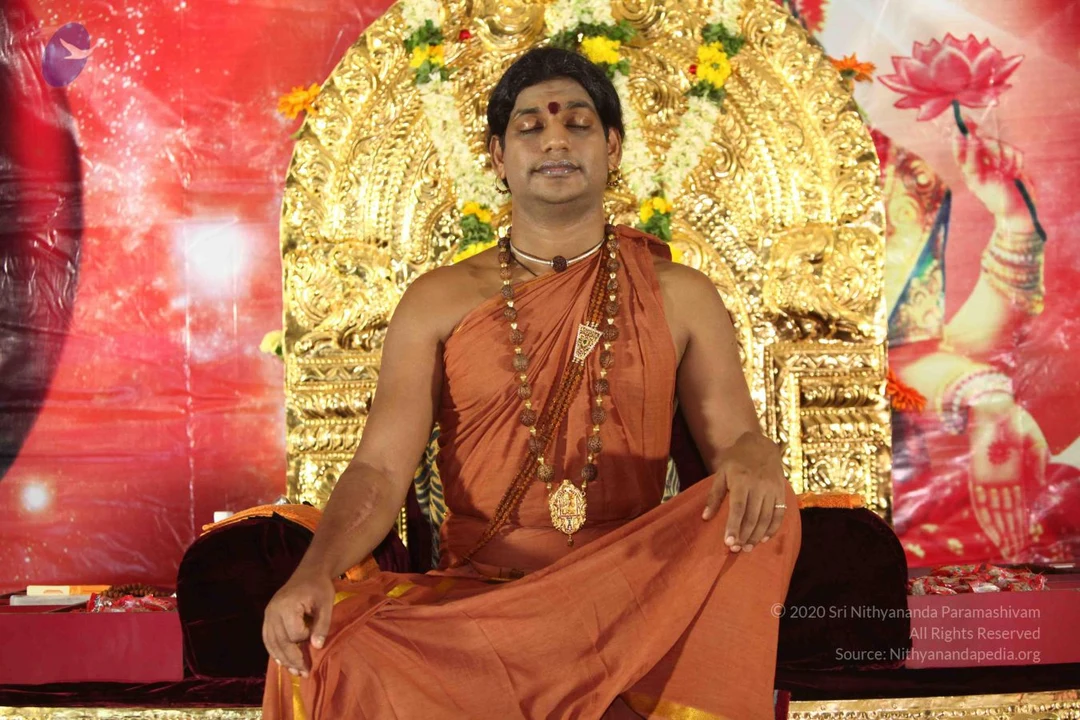
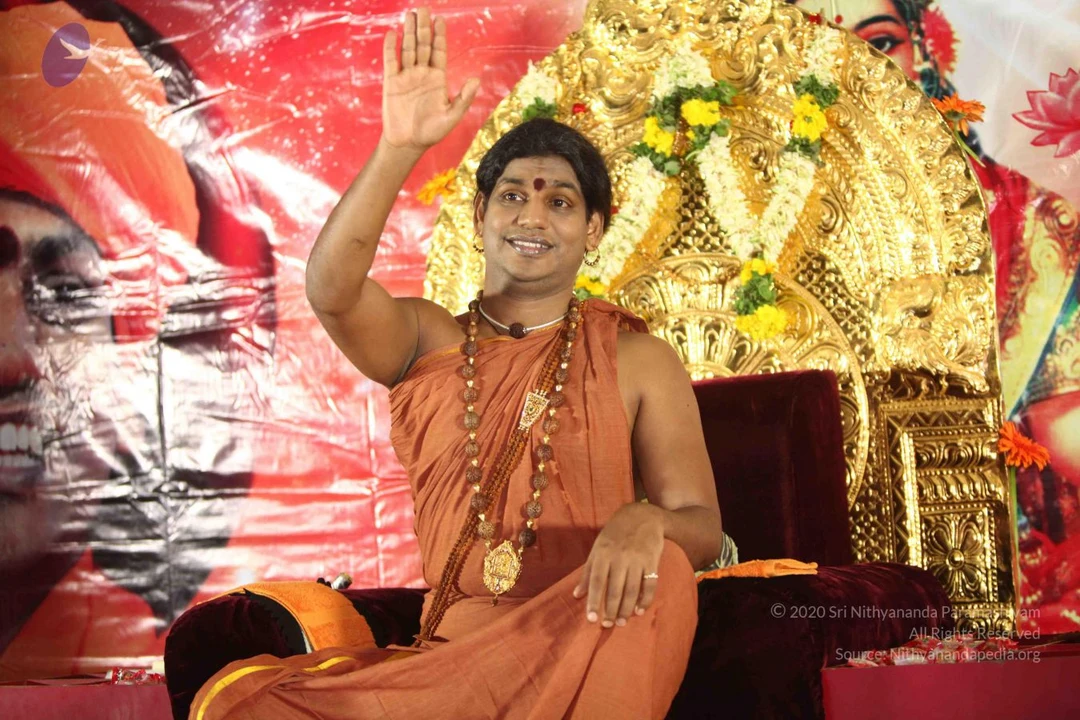
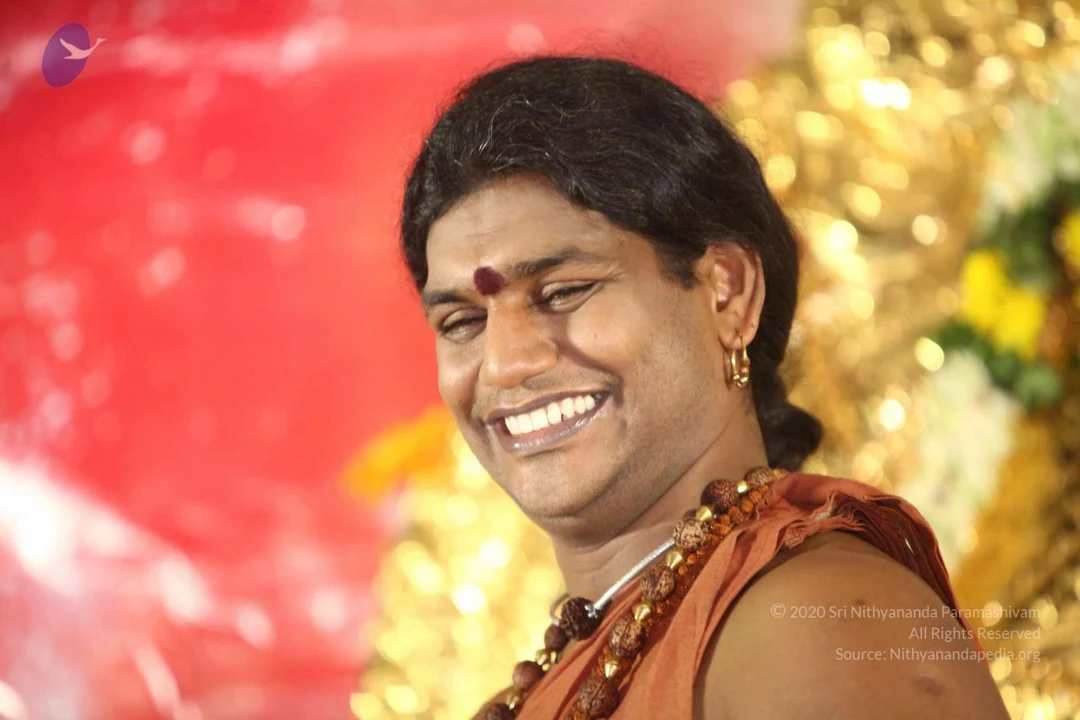
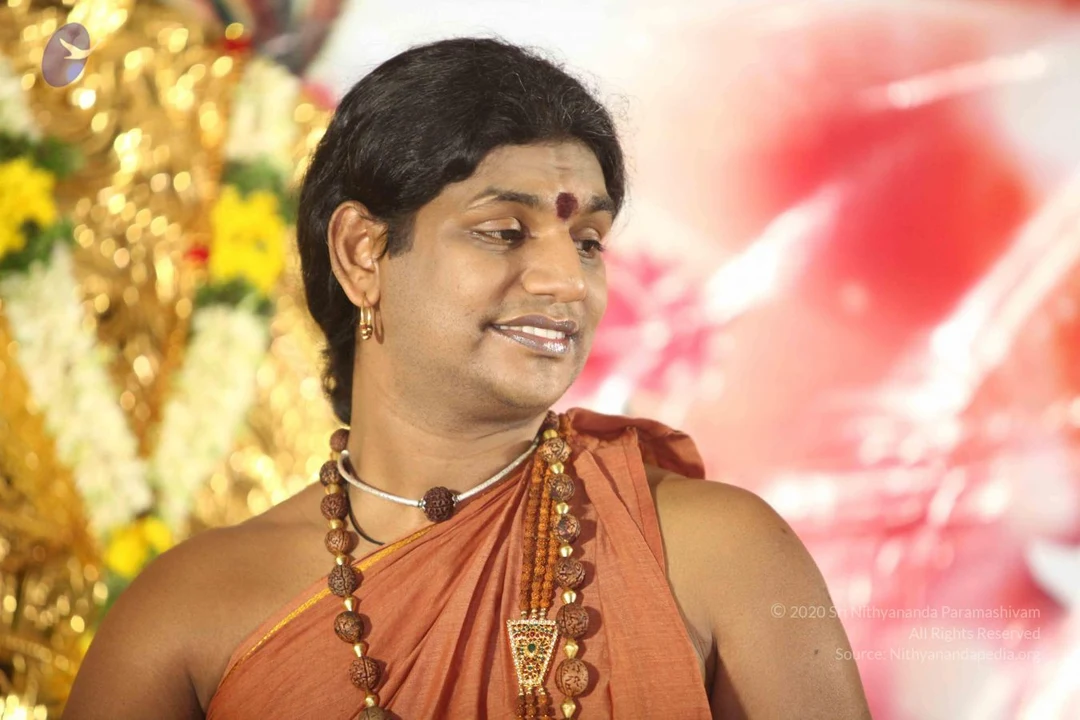
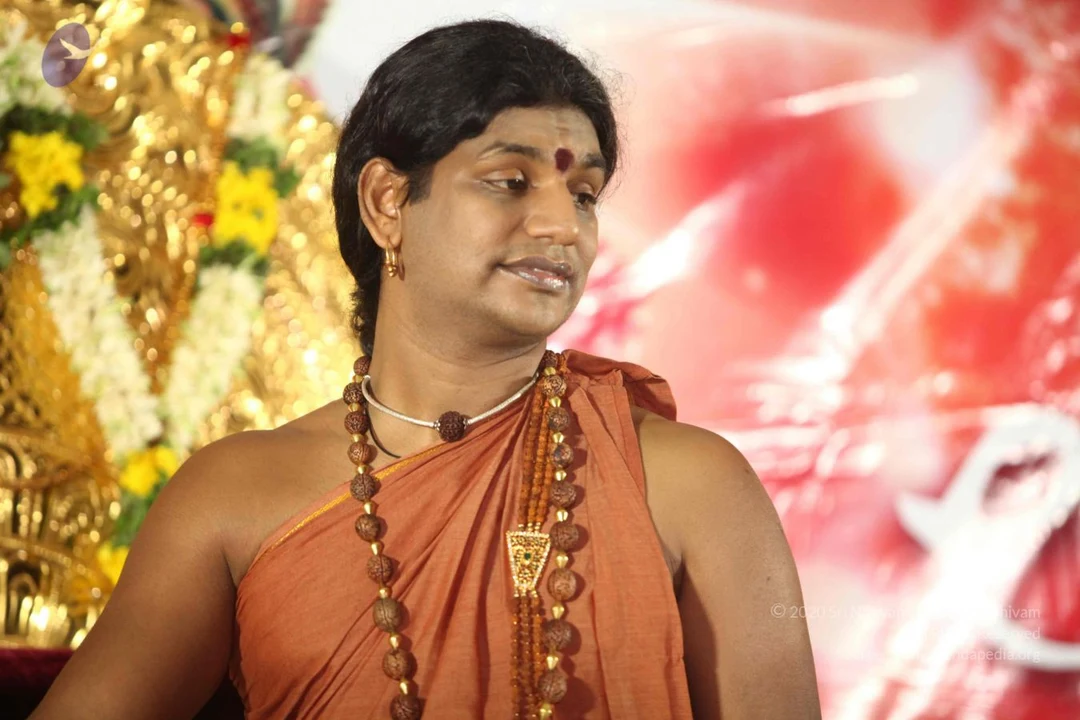
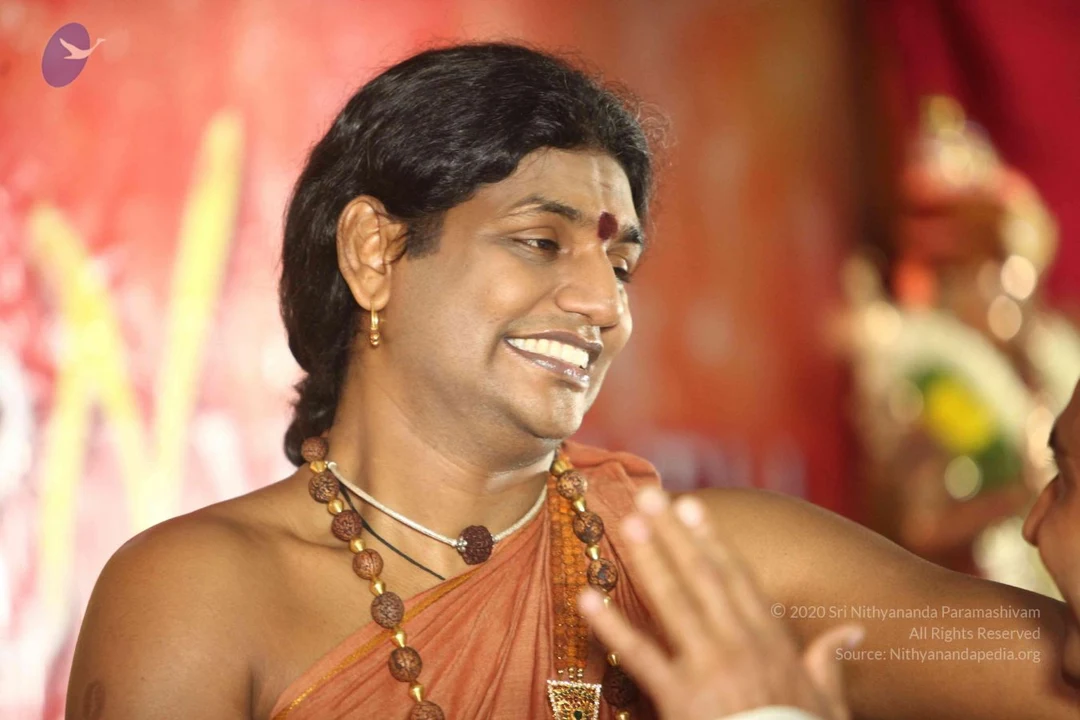
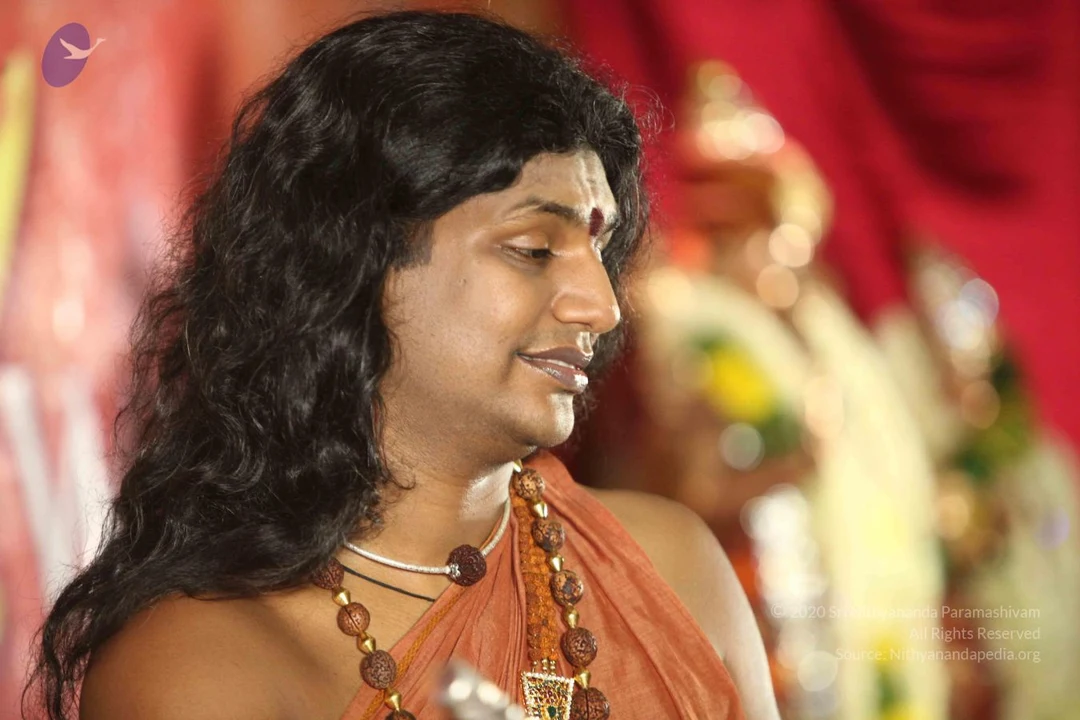
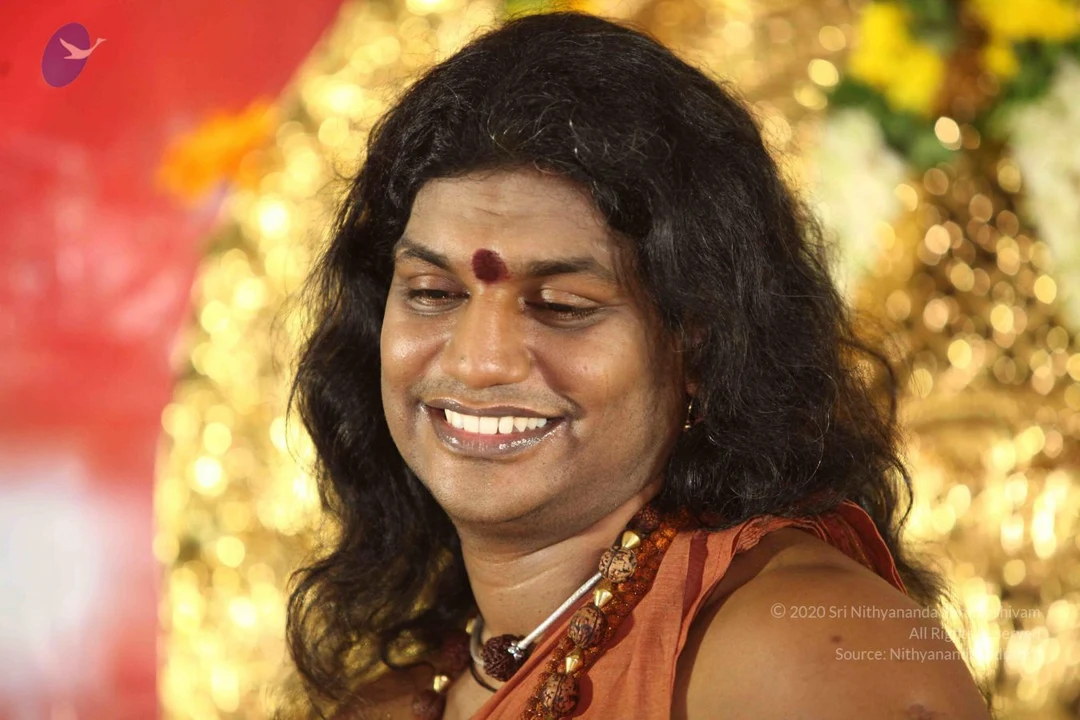
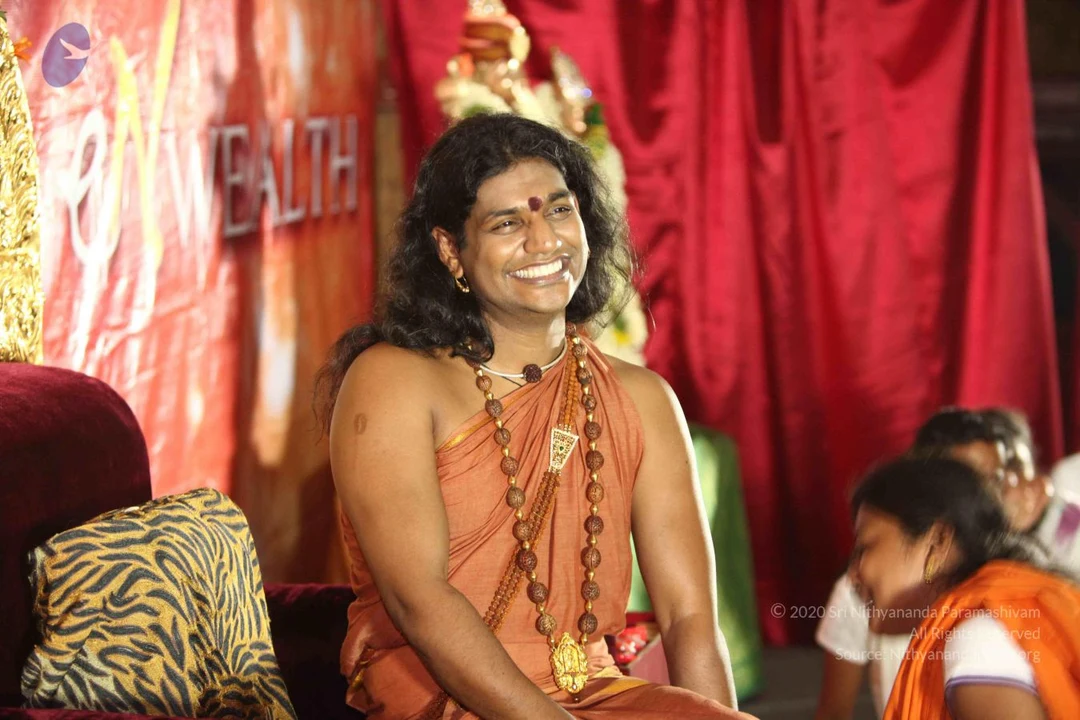
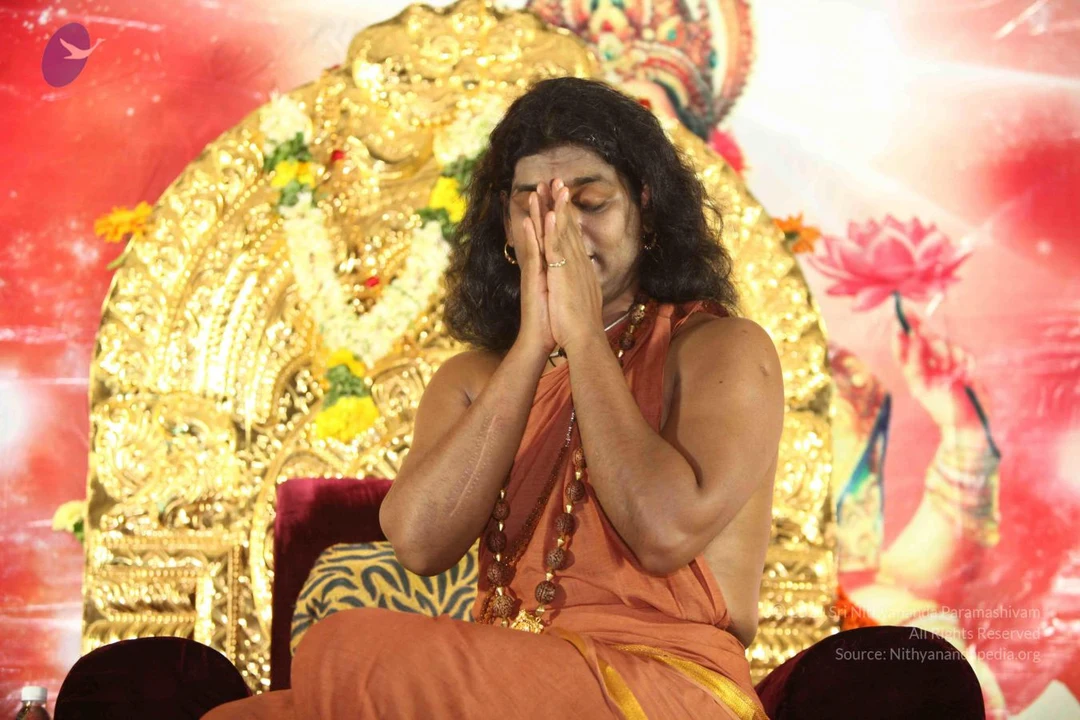
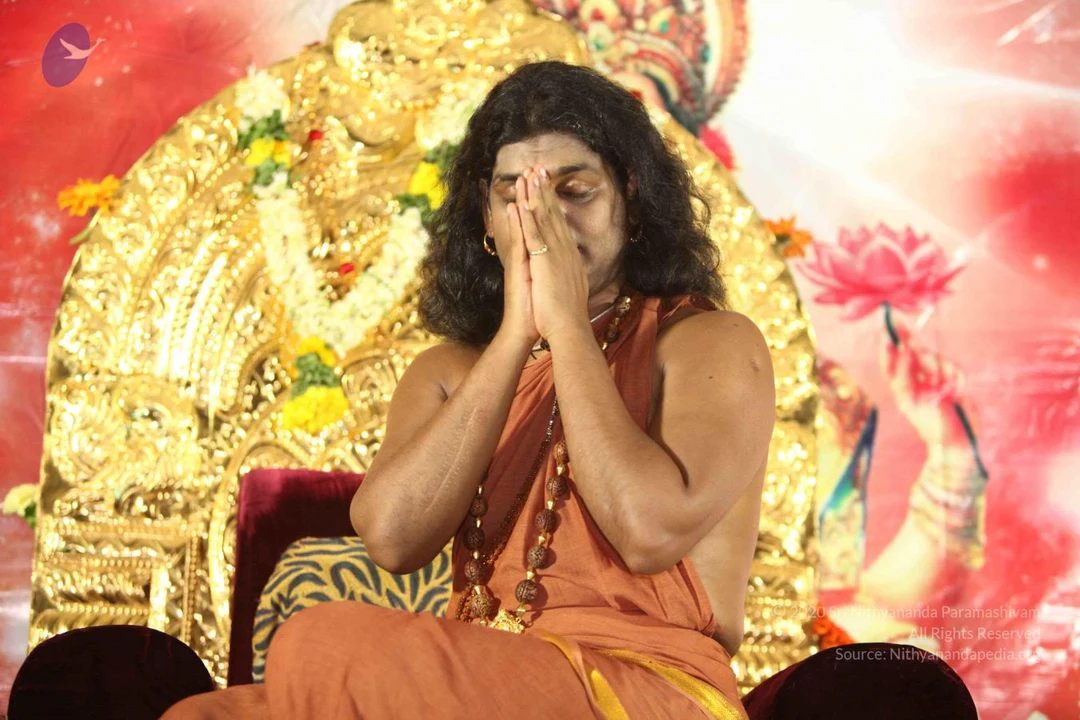
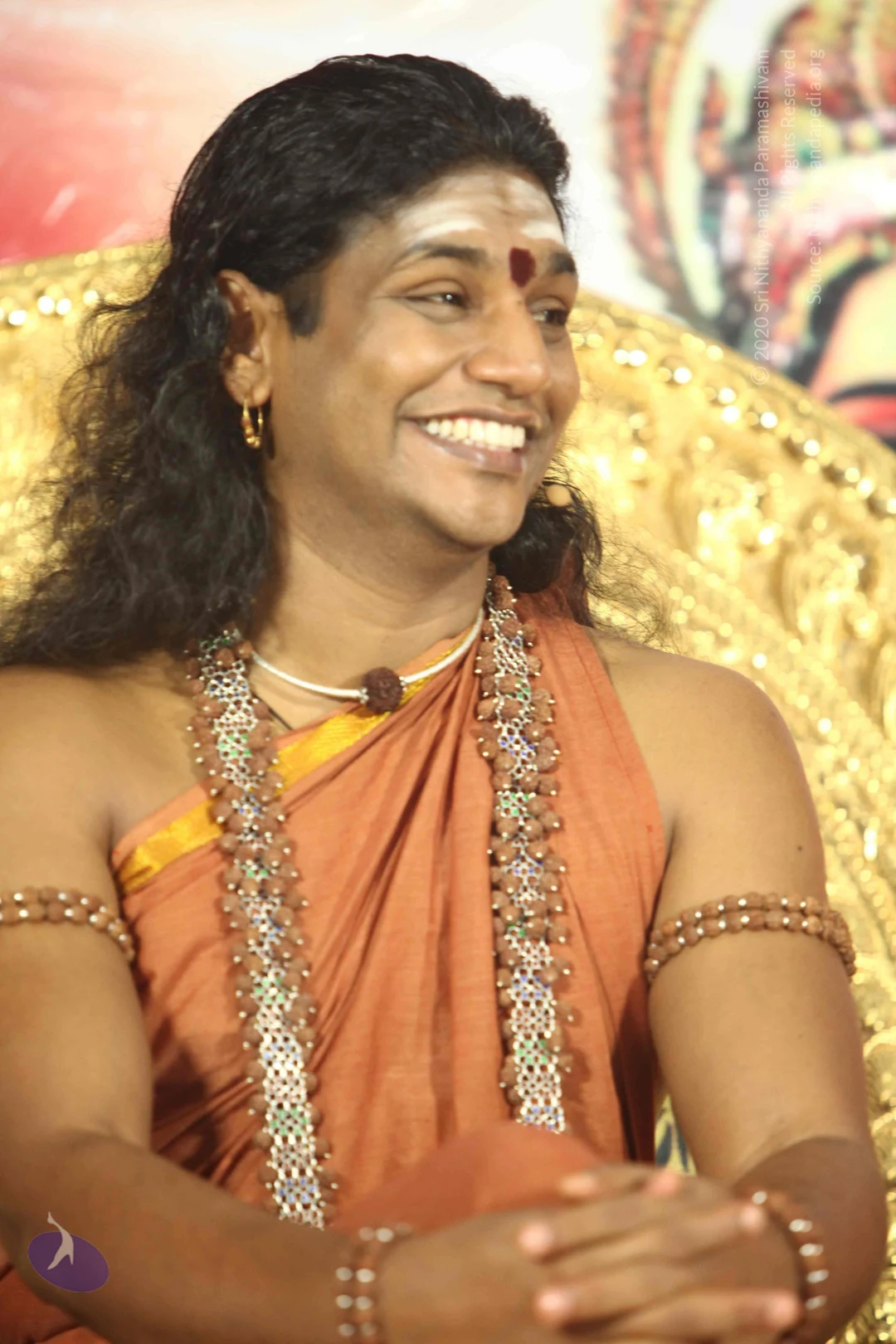
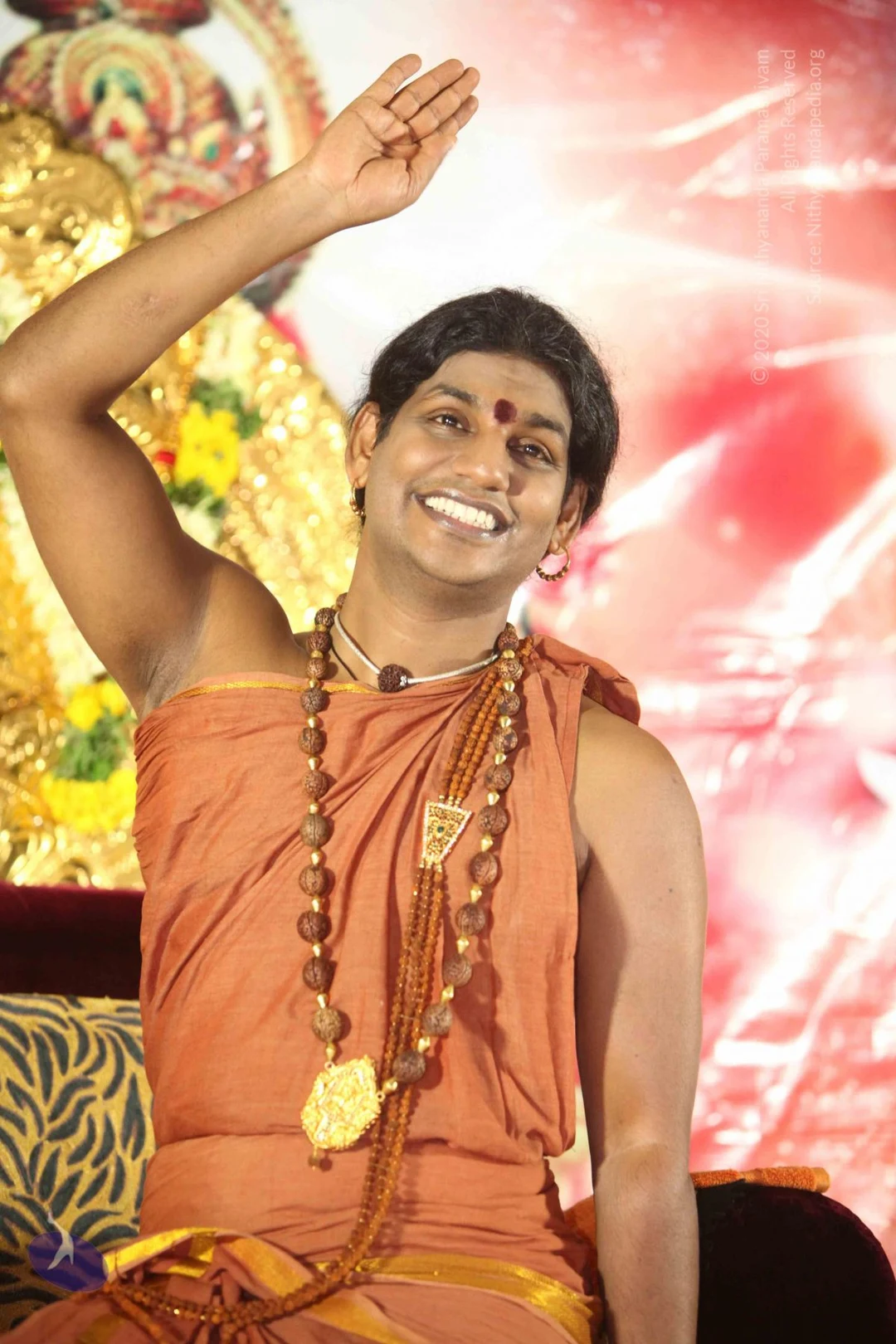
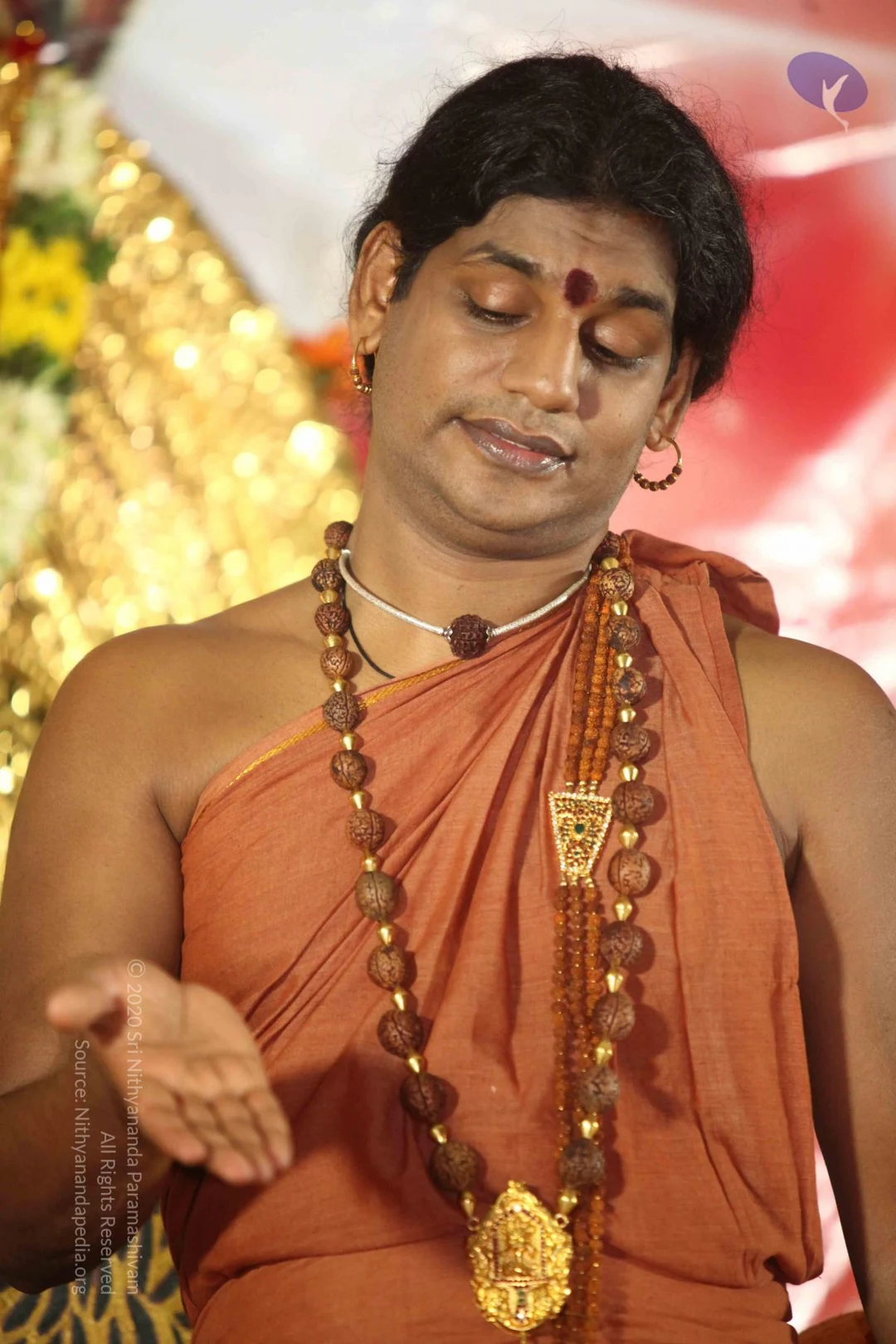
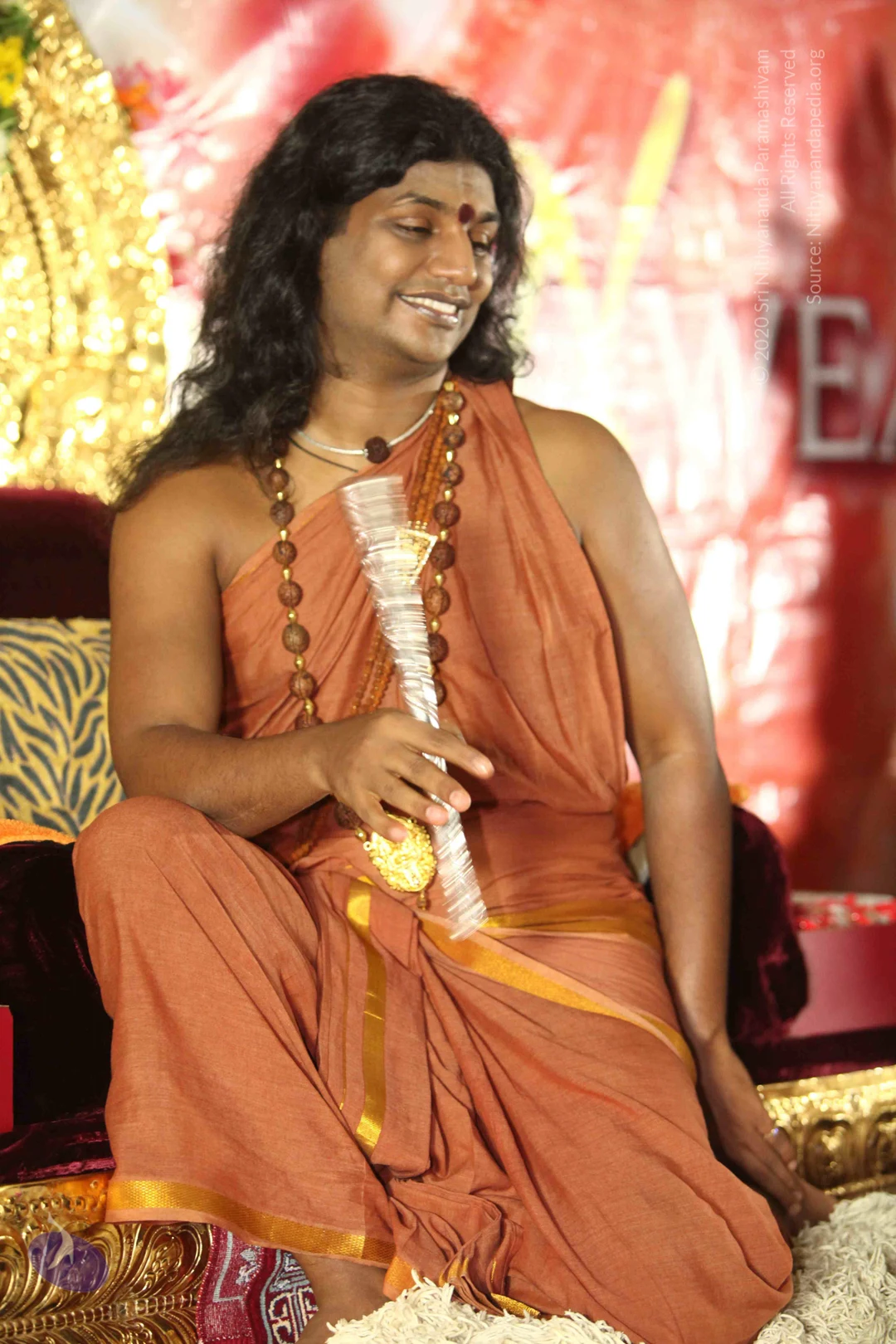
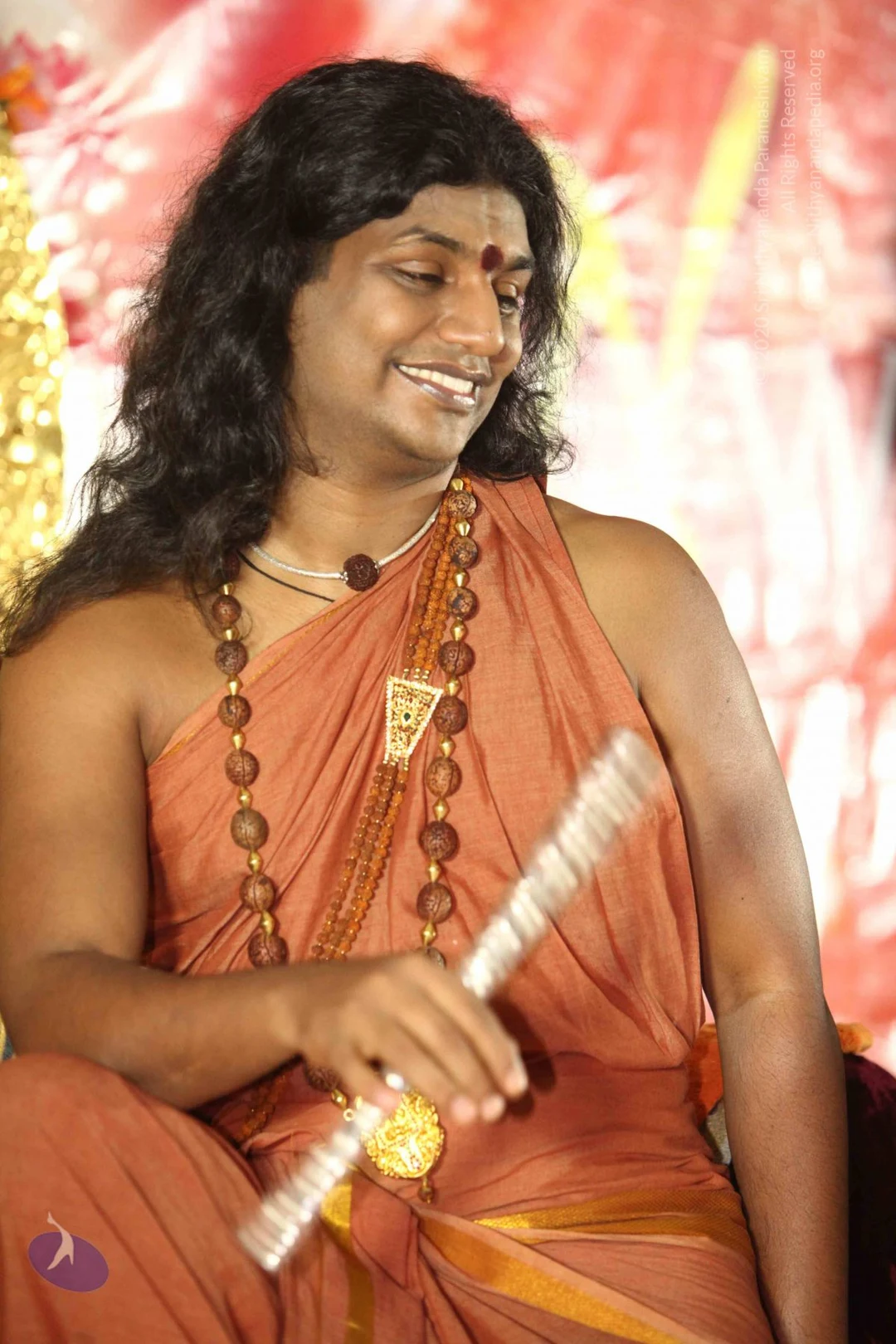
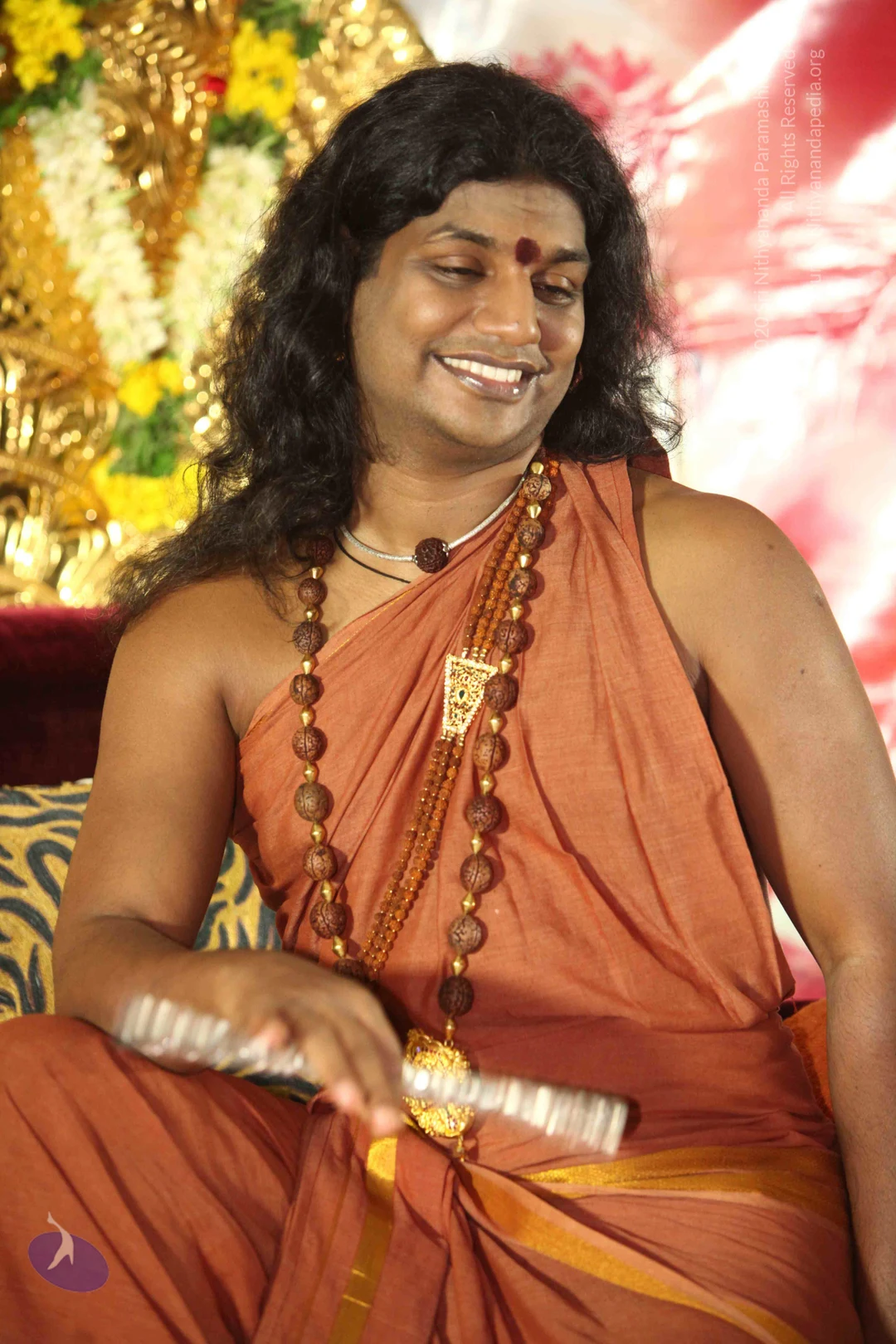
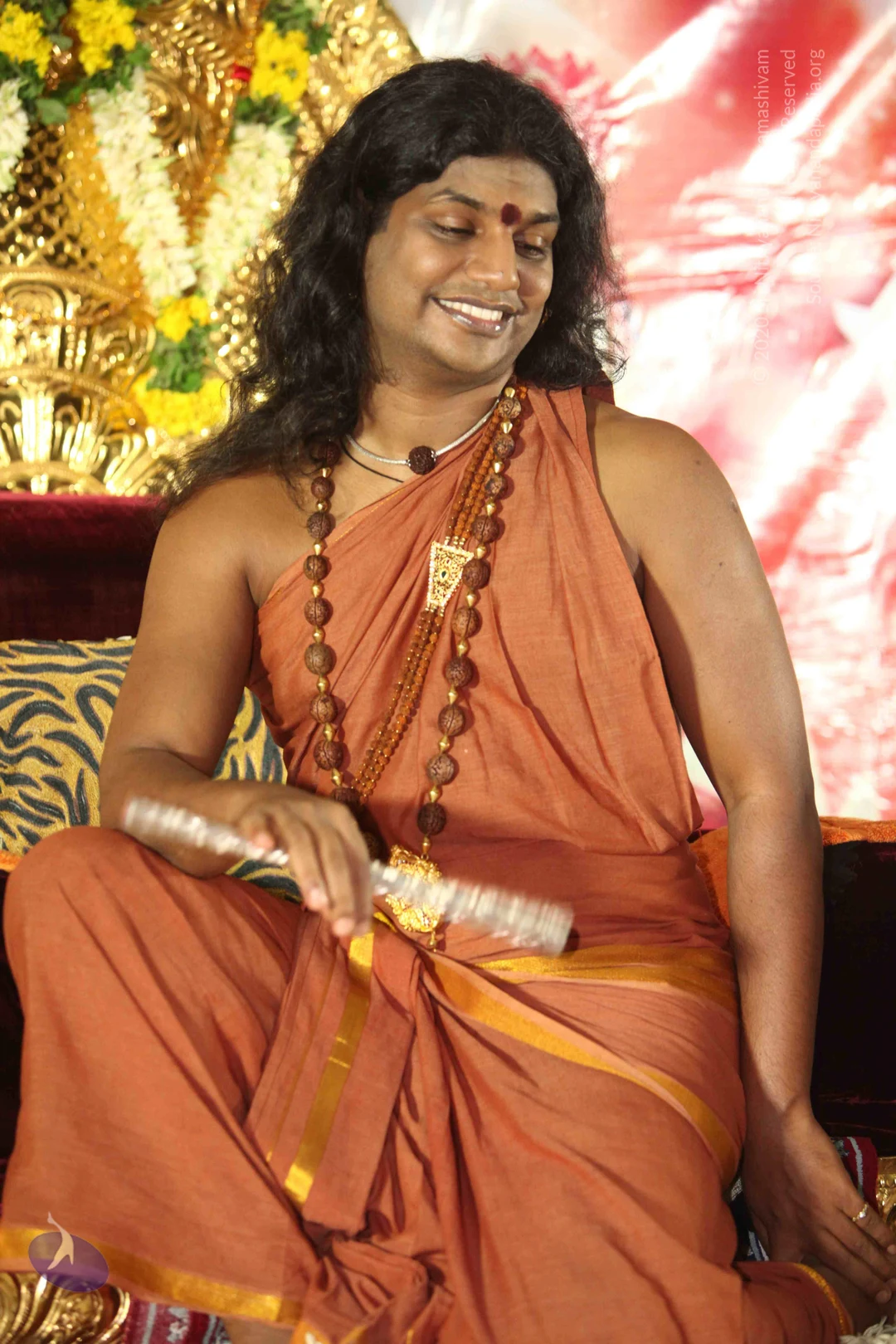
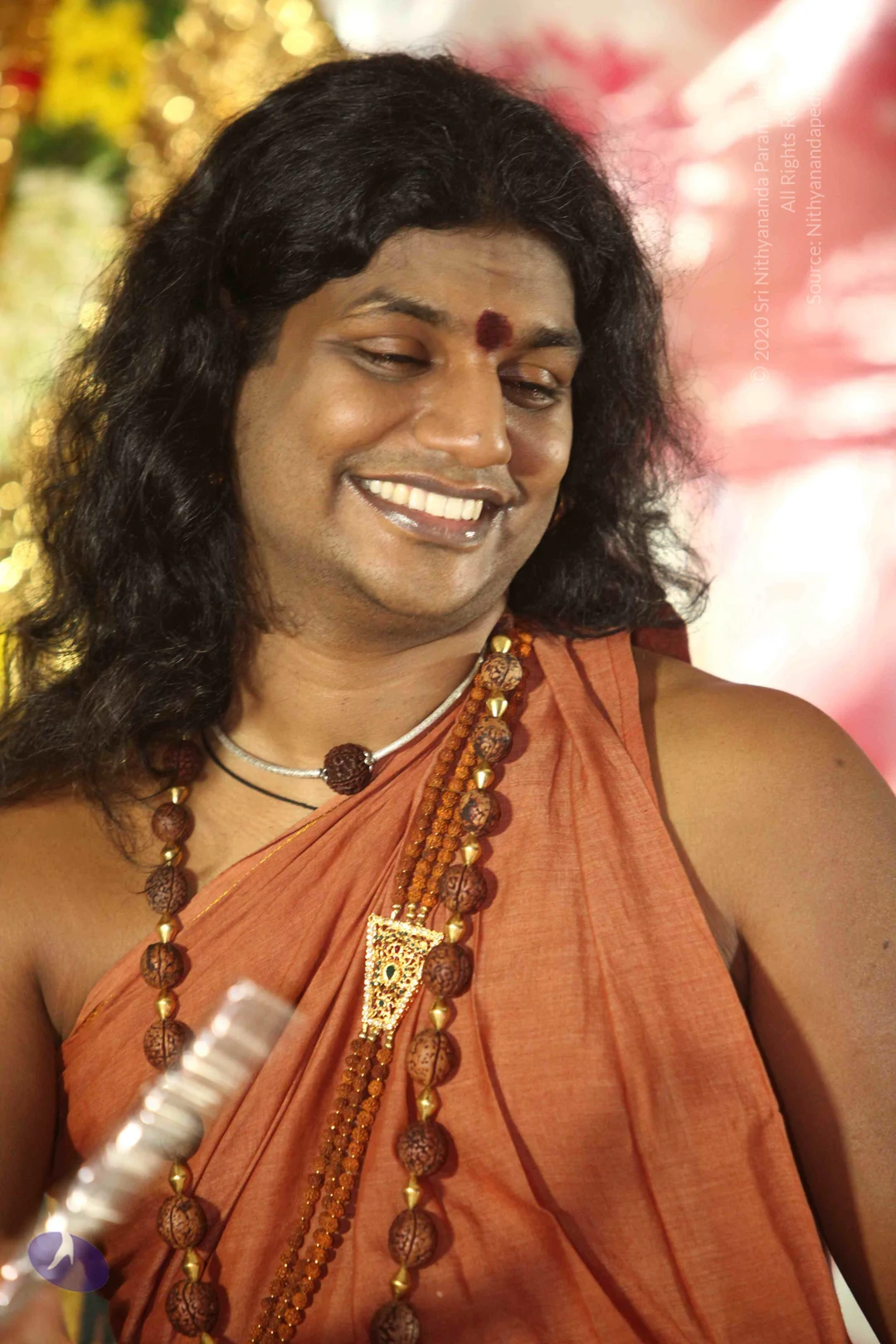
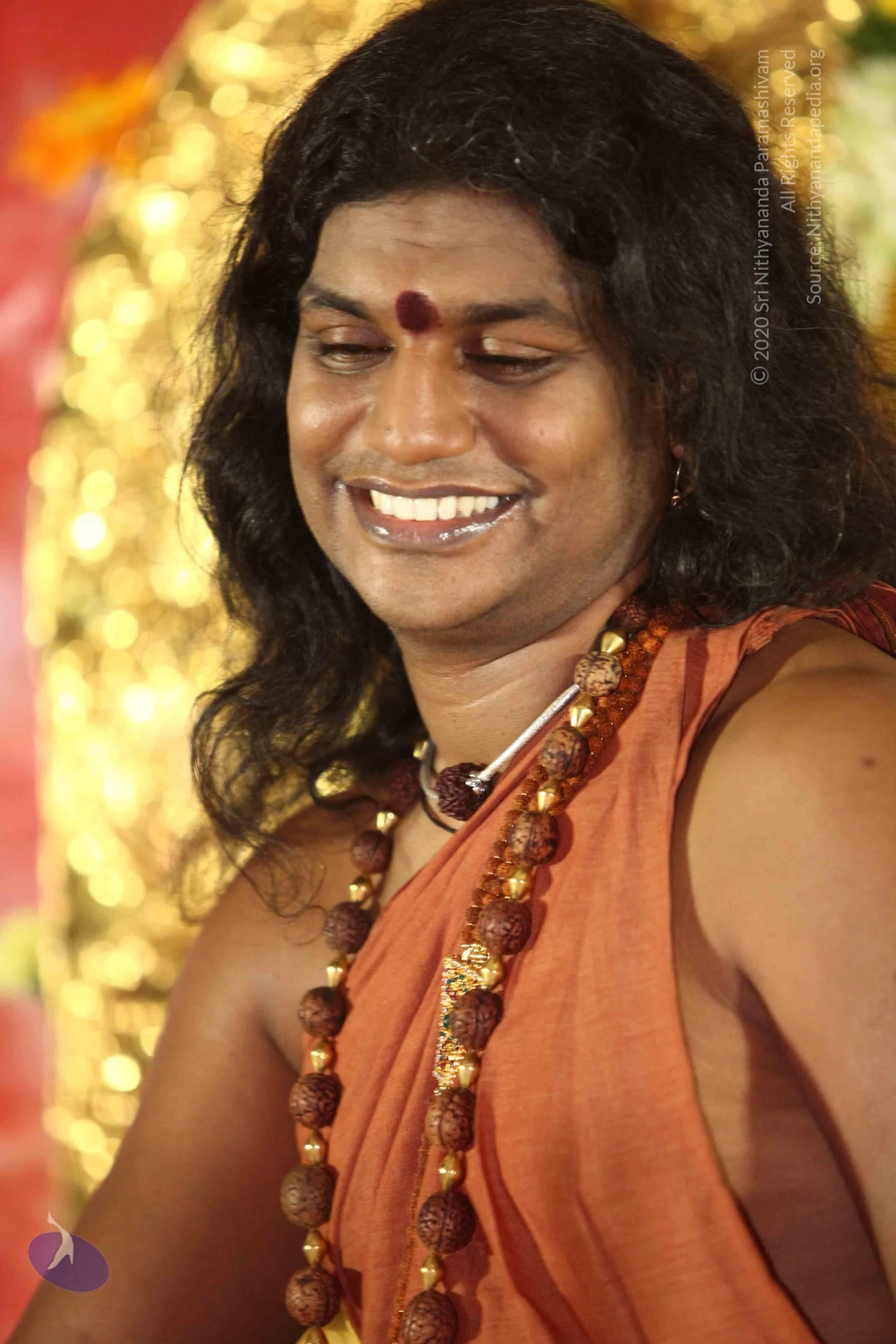
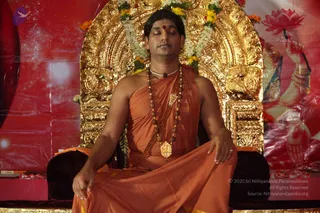
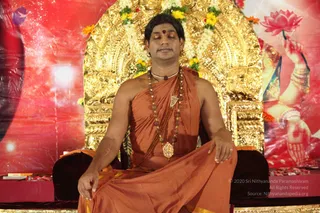
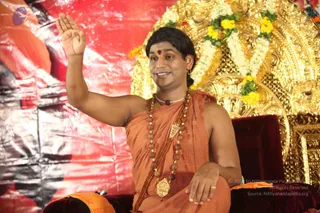
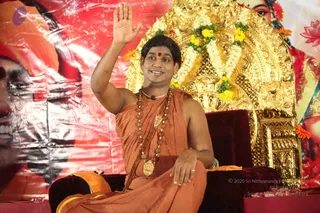
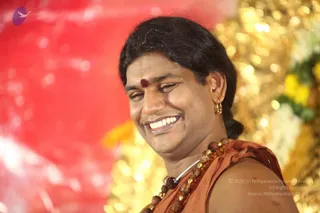
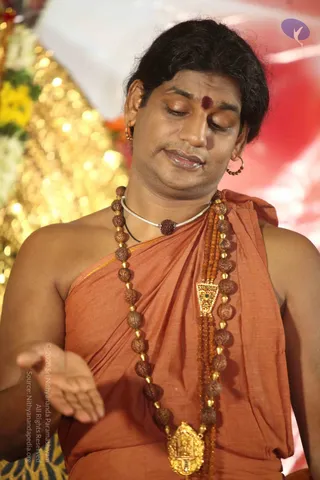
A man seated cross-legged on an ornate gilded throne with eyes closed, appearing to speak or chant. He wears an orange-saffron dhoti and shawl draped over his bare shoulders, a rudraksha mala of brown beads with a gold pendant, and a red bindi on his forehead. Marigold and white flower garlands decorate the golden backrest. Behind him a red backdrop shows a painted lotus and a female deity figure with raised arms. a person: long hair, saffron clothing, rudraksha mala and ceremonial gold pendant are visible on this seated teacher in a satsang setting.A photo of a seated man with eyes closed in a meditative posture at a satsang, wearing saffron-orange robes draped over one shoulder with a rudraksha mala and a large gold pendant necklace, plus a red bindi on his forehead. He sits before a large ornate gold throne with white and yellow flower garlands. Behind him on the right, a painted image shows a figure holding a pink lotus, on a red backdrop. A small gold dais and red cushions are visible in front.A man seated on a dark red cushioned throne before an ornate gold-toned backdrop decorated with white and yellow flower garlands. He wears an orange-saffron dhoti-style wrap draped over one shoulder, layered rudraksha malas, a gold pendant on a cord, and a small red bindi on his forehead. He raises one hand in a gesture while smiling, with his other hand resting on his knee. A red and silver reflective cloth hangs behind the throne on the left. The page indicates a satsang discourse, and the setting suggests a teaching session.A photograph of a man seated on a maroon velvet throne with an ornate gold back, decorated with white and yellow flower garlands. He wears an orange-saffron robe draped over his shoulders, a long rudraksha mala with a gold pendant, a gold necklace, and a red tilak on his forehead. He raises his right hand in a gesture while smiling. Behind him are large red and silver printed backdrops showing portraits and a lotus. a person is seated on the throne, identified by the saffron robe, rudraksha mala and ceremonial gold necklace. Orange flowers lie on the cushion beside him.Close-up photograph of a smiling man with shoulder-length black hair swept back, wearing a small red bindi on his forehead, a gold hoop earring, and an orange-saffron garment draped over the shoulder. He wears a necklace of rudraksha beads with gold spacer beads. Behind him are a red backdrop and blurred gold and yellow decorations with flowers.A man with shoulder-length dark hair and a small red bindi on his forehead stands in front of a gold and floral backdrop with yellow and white flowers, and a red-pink blurred background. He wears a saffron-orange shawl draped over bare shoulders, a silver necklace, a gold-and-red pendant, and multiple rudraksha and orange beaded malas, along with small gold earrings. He is looking to his side and smiling. Appearance-based label: a person, given the distinctive orange draping, rudraksha malas and ceremonial gold ornaments; the page indicates he is not at this event.

IA-Session2

6 photosSource gallery
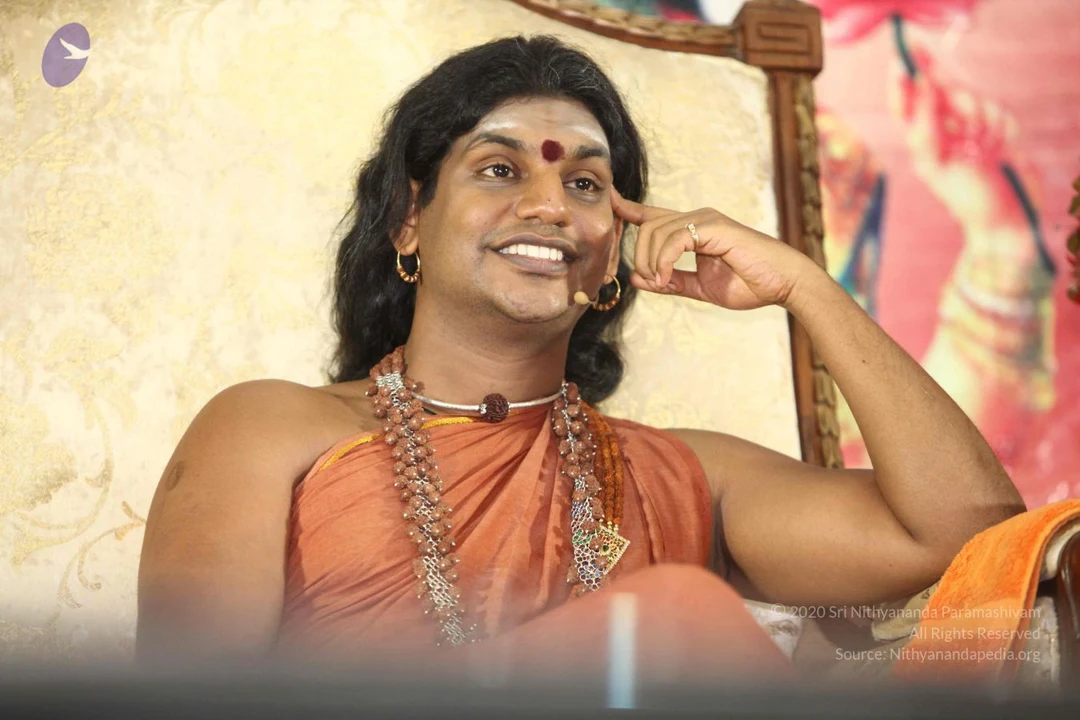
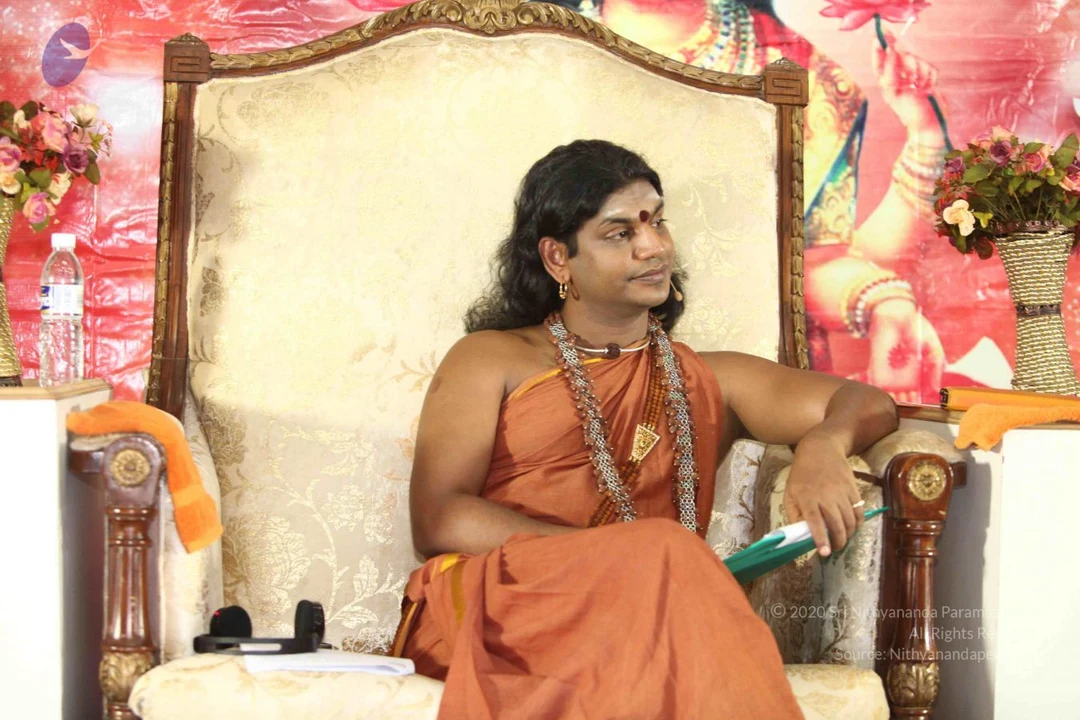
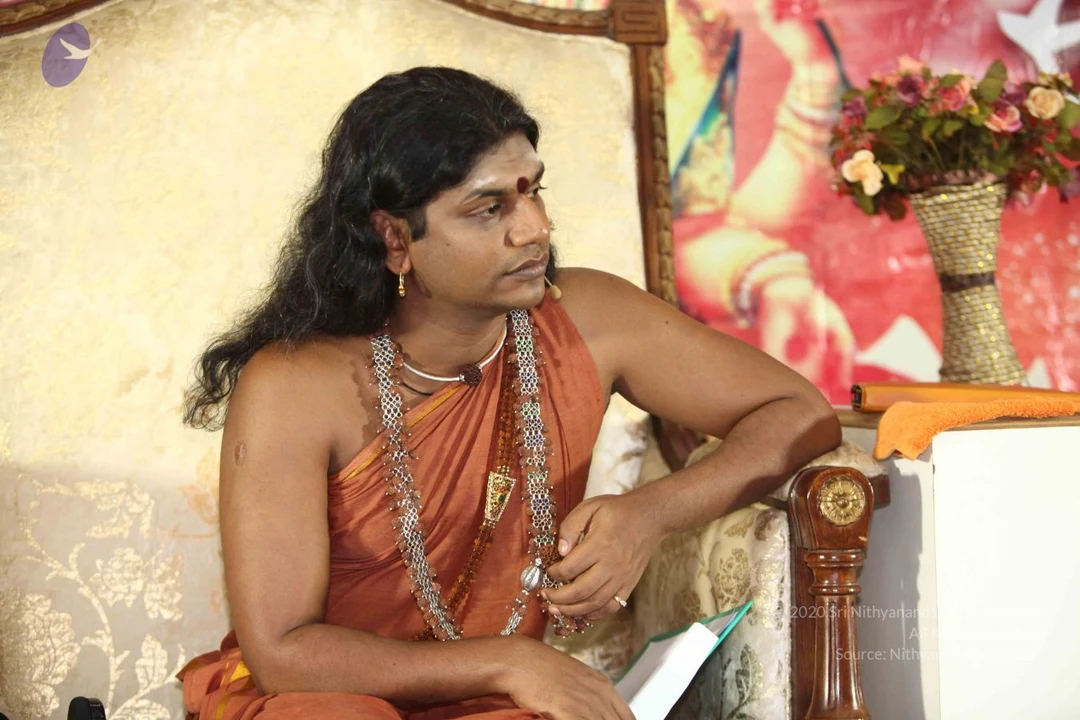
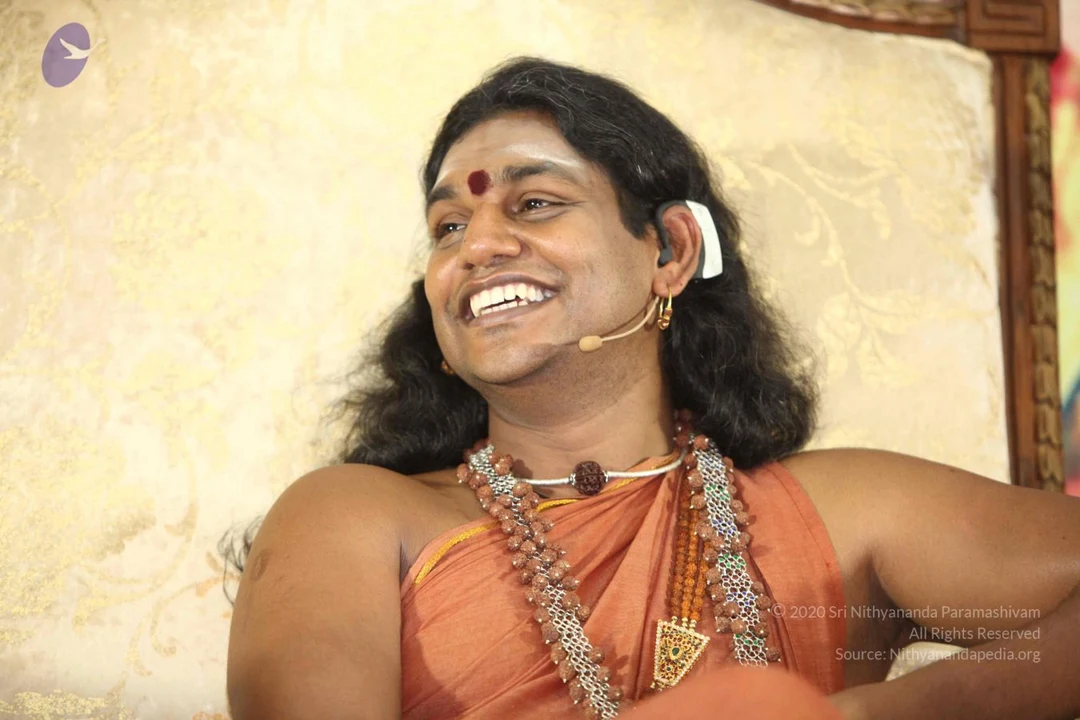
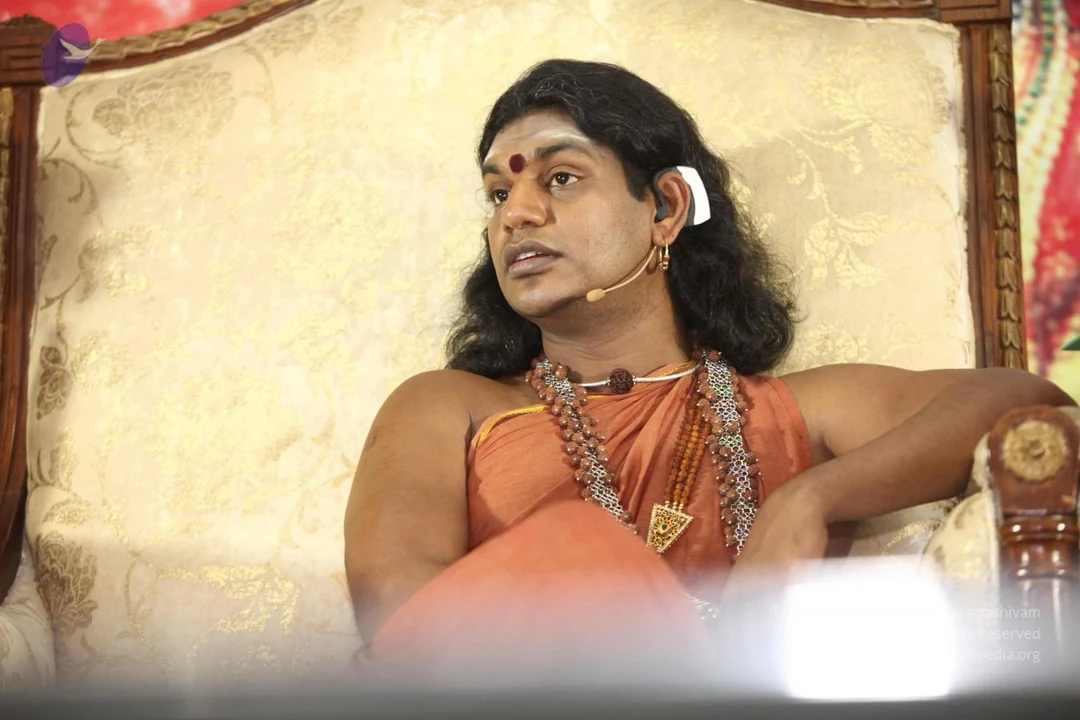
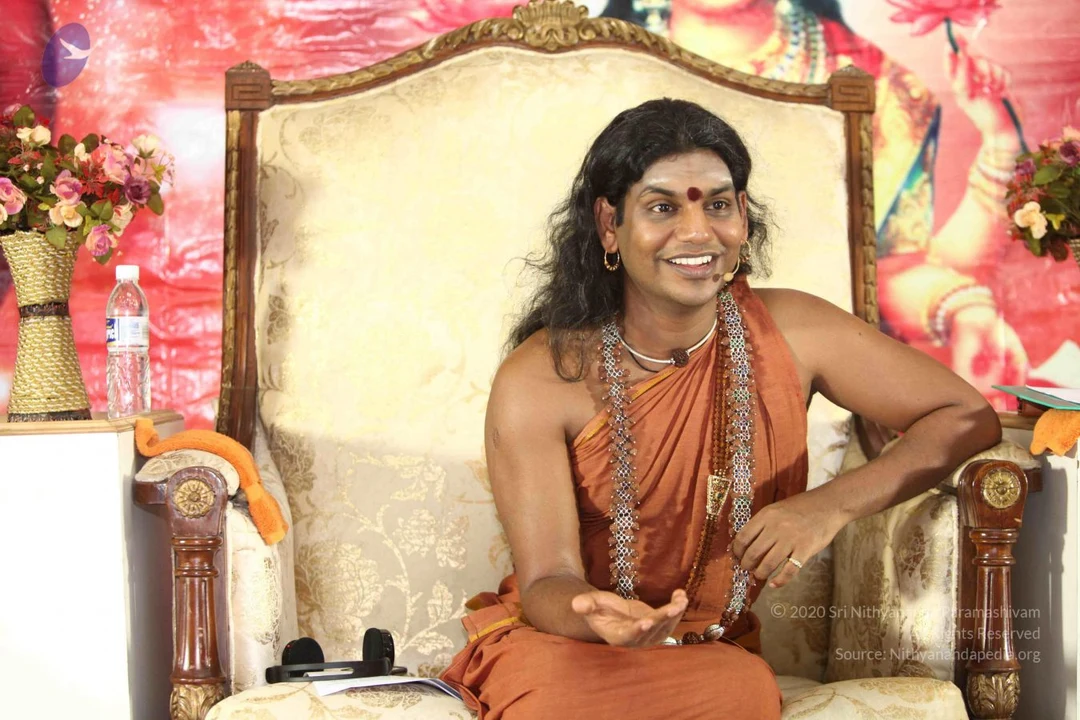
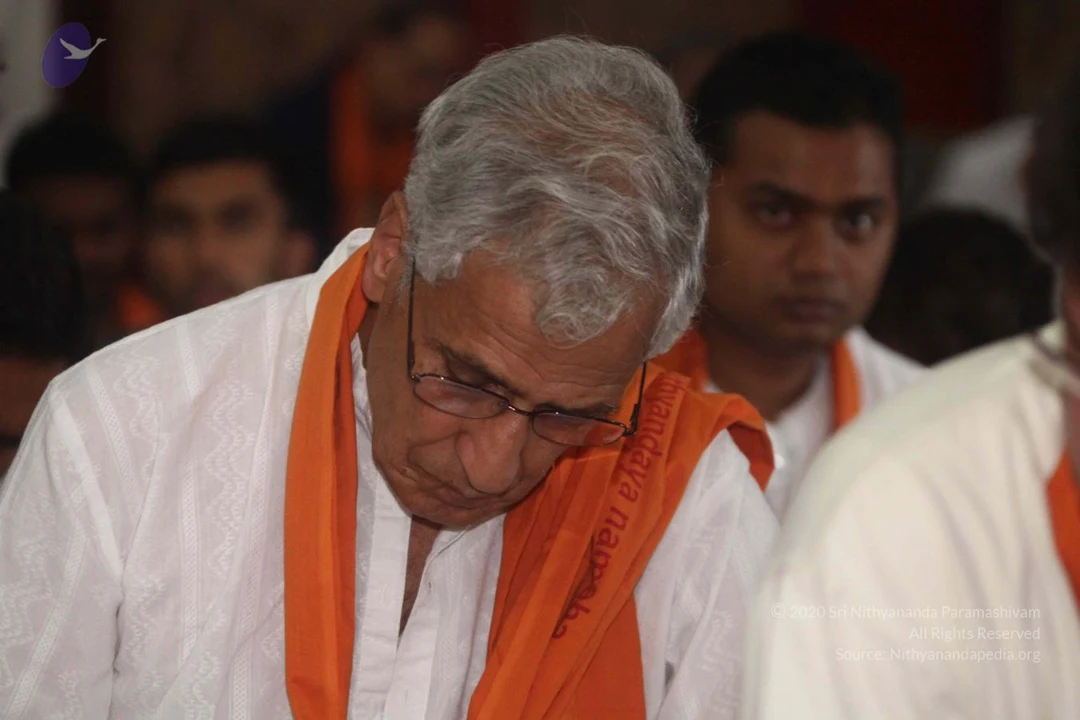
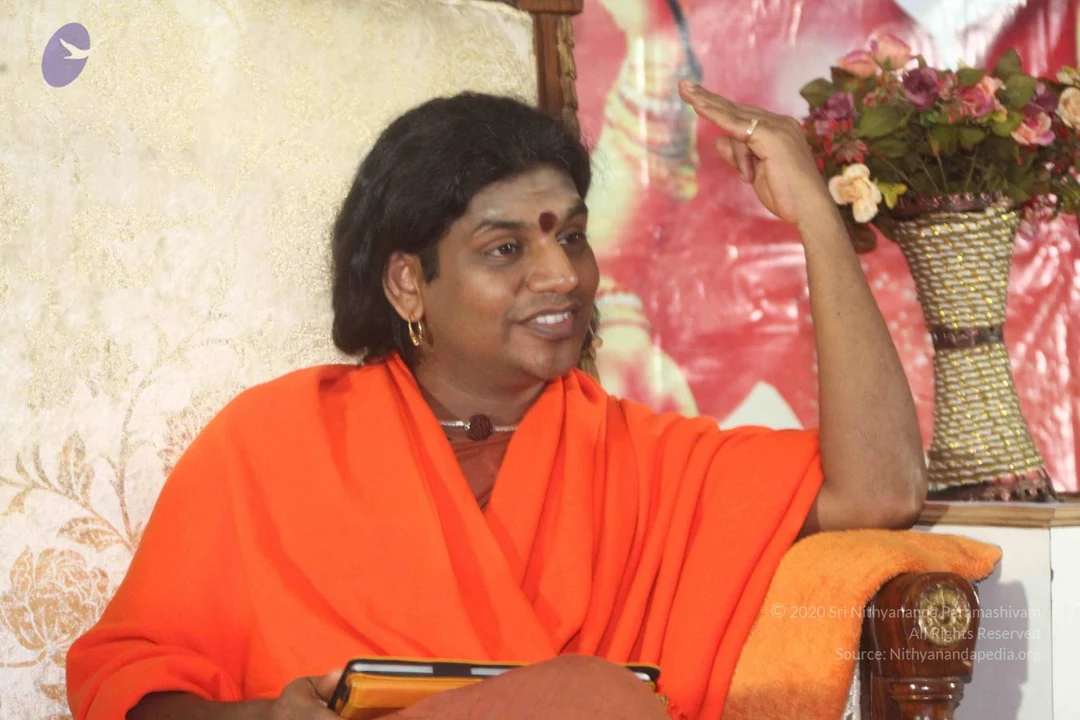
Photograph of an older man with grey, swept hair and rimless glasses, wearing a white kurta and an orange shawl printed with red Nithyananda Dhyanapeetam lettering, bowing his head with eyes lowered. Behind him, a younger man in a white kurta with an orange shawl stands and looks on, and other devotees in white and orange blur in the background. The man in front shows no distinctive a person cues such as a crown, malas or ornate saffron robes, so his identity is uncertain. Two people are clearly visible, with more partially seen at the edges.A seated man in an orange saffron shawl and orange garment sits on an ornate cream upholstered throne with gold-trimmed wooden armrests, one hand raised in a gesture while speaking, holding a small notebook or booklet on his lap. He has a red bindi, a rudraksha bead necklace, gold hoop earring and a ring on his raised hand. Behind him stands a glass vase of pink and cream roses and a pink-red backdrop. a person in saffron clothing with rudraksha and a seated discourse setting. The photo appears to be a satsang discourse.A man in a light blue crew-neck t-shirt and a dark brown wooden bead mala speaks into a silver microphone on a stand, wearing thin-framed glasses. Behind him, several people stand in soft, hazy light: a young man on the left with dark hair, a bald man in a beige top, and a man in a grey shirt on the right. The setting appears to be a satsang gathering with a microphone for the speaker.Photo of a smiling person in orange robes seated on a wooden chair with an ornate wooden armrest. They wear a small red bindi, gold hoop earrings, a rudraksha-style bead necklace, and hold a small orange cloth over the armrest while gesturing with one index finger. Behind them is a pink backdrop with a painted image and a vase of flowers, and a patterned gold-and-cream wall on the left. A small lapel microphone is visible on the robes.A photograph of a smiling, laughing man with long dark swept-back hair, a red bindi and gold earrings, wearing a saffron-orange shawl over a rust-brown garment and a beaded necklace with a small microphone clipped at the chest. He sits on an ornate gold-brocaded armchair holding a small orange-covered notebook on his lap. Beside him a wooden armrest has an orange towel draped over it, and a basket of pink and white flowers sits on the right. Behind him hangs a red banner with a painted figure wearing bangles and ornaments. a person: the long swept-back hair, saffron shawl and ornate seating are compatible cues for the speaker of a satsang, though the page does not confirm his presence at this event.A photo of a seated man in saffron-orange robes speaking at a satsang, raising his right hand with the index finger and thumb forming a mudra. He wears a small red bindi, a dark rudraksha mala at the neck, a gold earring, and a headset microphone. He sits in a gilded cream chair with floral upholstery before a red and pink backdrop, with a bouquet of pink and red flowers and a water bottle at left. Appearance-based label: a person, seated and teaching.

IA-Session1-kriya

5 photosSource gallery
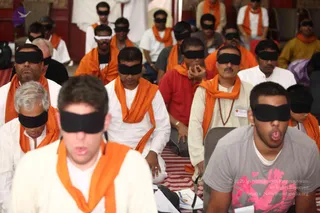
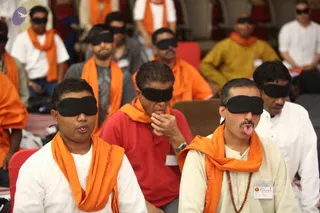
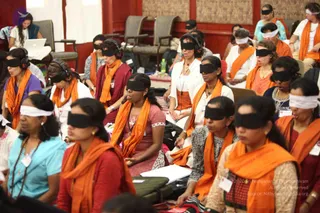
A smiling man with long dark hair sits in an ornate cream and gold upholstered armchair with carved wooden armrests against a pink and red floral backdrop. He wears an orange-saffron dhoti and shawl, a red bindi on his forehead, gold hoop earrings, a rudraksha pendant, and layered silver-beaded ceremonial necklaces. Flower arrangements in brass vases, a water bottle, orange cloths over the armrests and microphones are visible. The appearance of the seated man is consistent with the a person candidate; the page does not state he is present, so this is an uncertain appearance-based label.A photograph of a man seated on an ornate gold-and-cream upholstered throne-like chair with carved wooden armrests, speaking in a satsang setting. He wears a saffron-orange ochre robe draped over one shoulder, long swept-back dark hair, a red bindi on his forehead, a silver chain necklace and layered silver-chain malas, and a wooden rudraksha-style mala in his hands. A vase of mixed flowers stands to the right against a red and white backdrop.A photograph of a seated group of about twenty devotees in a hall, most wearing black blindfolds and orange shawls over white or light clothes. In the foreground, a young man in a grey t-shirt with pink graphics and a man in white with an orange shawl sit with mouths open, appearing to chant or breathe. Behind them, others wear white kurtas, a red shirt and a man with a rudraksha mala and a name badge. Red-and-white striped mats cover the floor and a white-draped stage area is visible at the back. This appears to be a blindfolded meditation or breathing exercise session.A group of people seated in a hall wear black blindfolds over their eyes and orange shawls labelled with the word Nithyananda over white and cream clothing. In the foreground, a man in white with a rudraksha mala sticks his tongue out, while another in a red polo shirt holds his hand near his mouth. A man in cream kurta with a rudraksha mala and orange shawl also sticks out his tongue. Several others sit behind them in white, gray and yellow garments, some wearing name badges on lanyards. The setting appears to be a satsang or meditation session.A photograph of a seated group of women in a hall with wooden panelling, most wearing black or white blindfolds and orange shawls. Several have headphones on and sit cross-legged or upright, appearing to meditate or follow guided instructions. One woman in the foreground wears a pink kurta with a orange shawl, and another in a blue top wears a rudraksha-style bead necklace. A laptop sits on a table at the back left, and chairs line the rear of the room.

IA-Yoga

48 photosSource gallery
A wide outdoor view at dawn or dusk of a hazy sun behind scattered clouds over a distant dark mountain ridge. In the foreground, the curved, dark roof edges of a building jut into frame on the left, and a leafy tree fills the right edge. No people are visible. Hazy light flares from the sun across the sky.A photograph of a bright sun glowing through layered grey and white clouds over a dark silhouetted hill or mountain peak in the lower left foreground. Soft light rays stream downward from the sun. No people or ritual activity are visible.A landscape photograph of a hazy sunrise or sunset over a distant mountain ridge. Bright sun glows through scattered clouds in a pale sky. In the foreground, dark sloped rooftops with curved green-tinted edges and a dense leafy tree on the right frame the view. No people are visible.A photograph of a dawn or dusk sky over misty hills. Soft, layered clouds stretch across a pale blue and golden sky, with the sun glowing behind clouds at upper left. A dark tree branch with leaves fills the right edge, and dark rooftop or wall edges sit in the foreground at lower left. No people, deities or ritual objects are visible.A cloudy sky with a bright diffused sun glowing through thin white and grey clouds. In the lower left corner, a dark silhouetted rooftop edge curves upward. A small dark shape sits at the bottom centre edge. No people or ritual activity are visible.A photograph of a green hillside under a blue sky with scattered white clouds. Terraced slopes and dense tree cover climb toward a crest where a few white buildings and a tall thin antenna mast stand out. Smaller white buildings and a lower-level settlement appear at the base of the hill at the bottom right, with a grassy foreground. No people are visible.

Gurukul-eNGenius

19 photosSource gallery
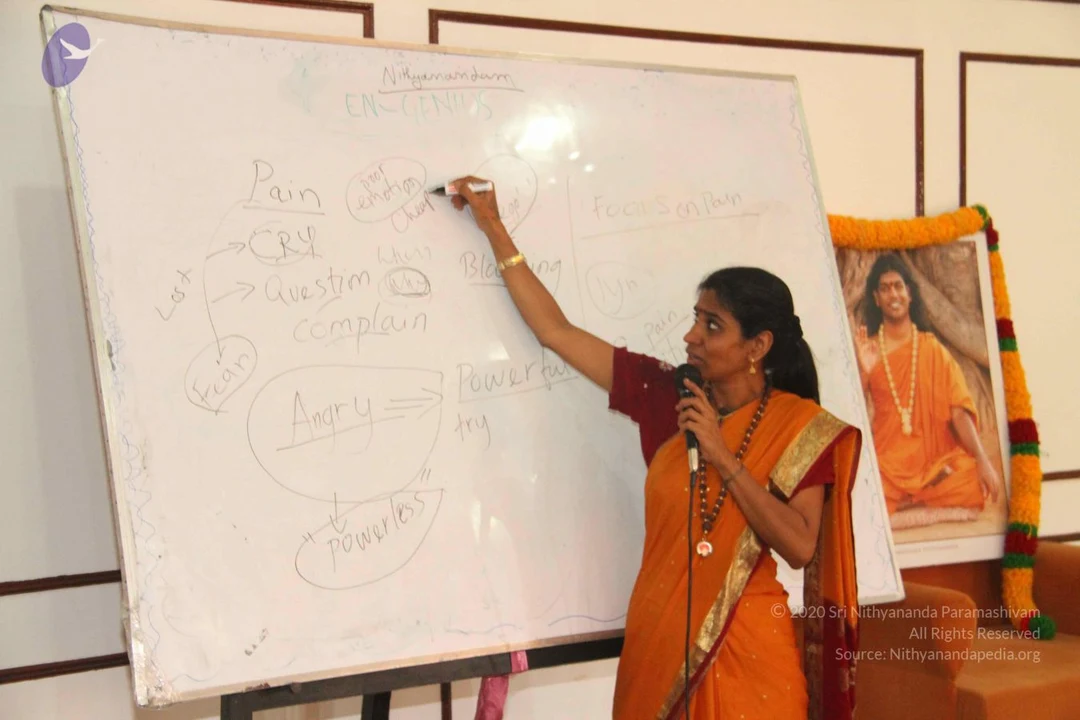
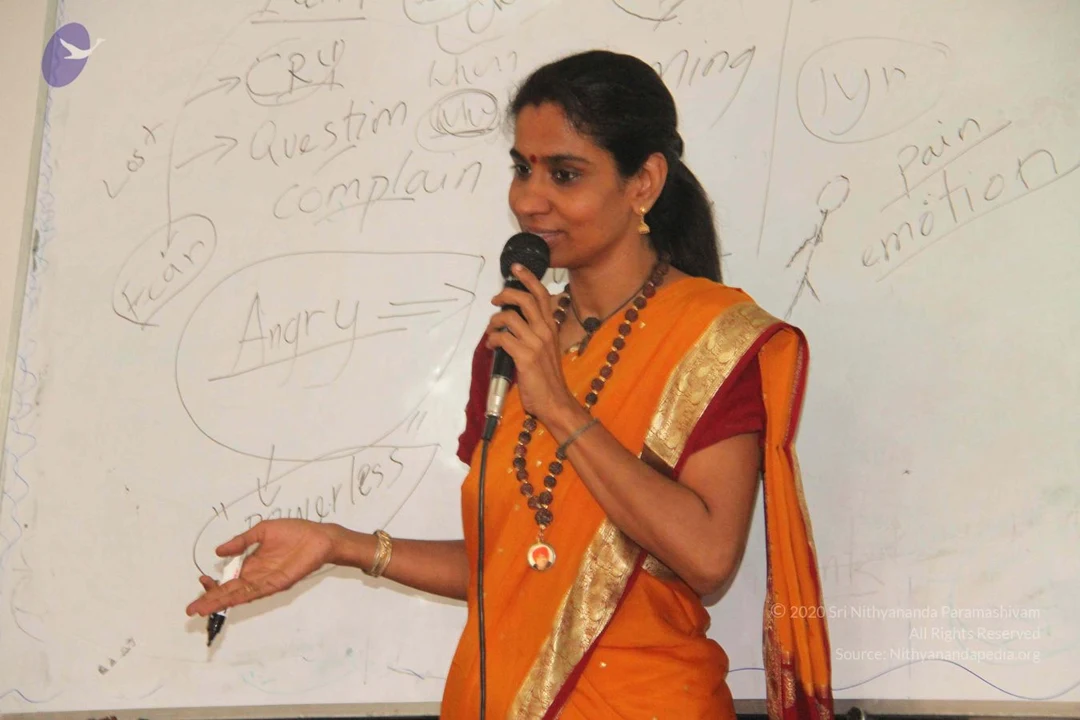
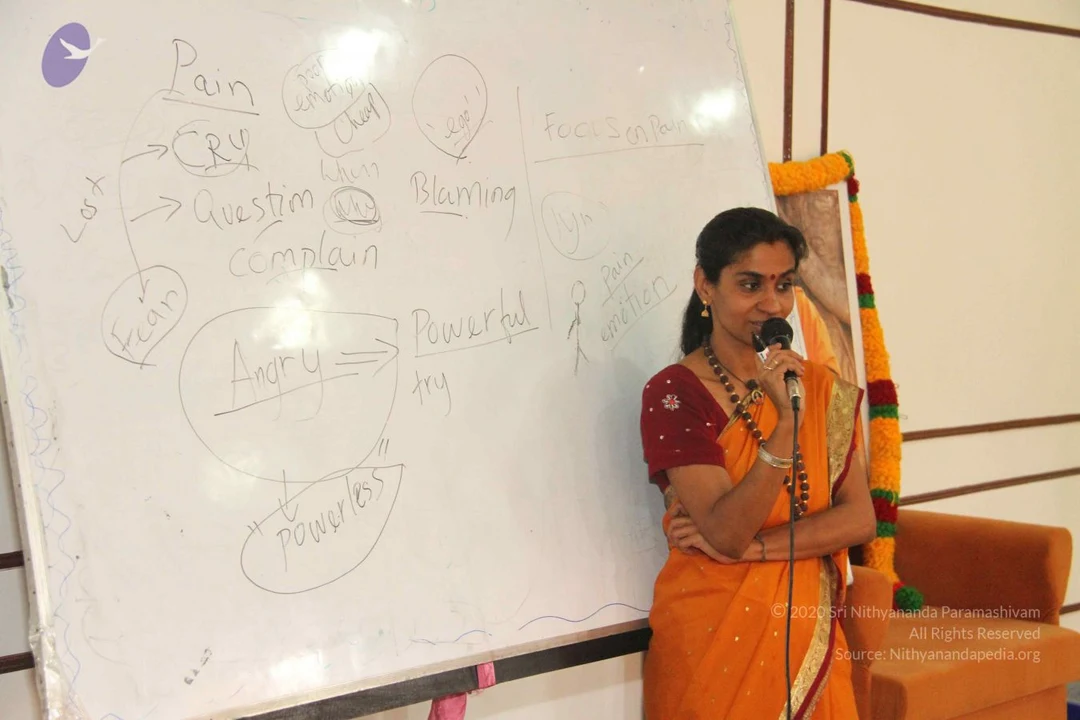
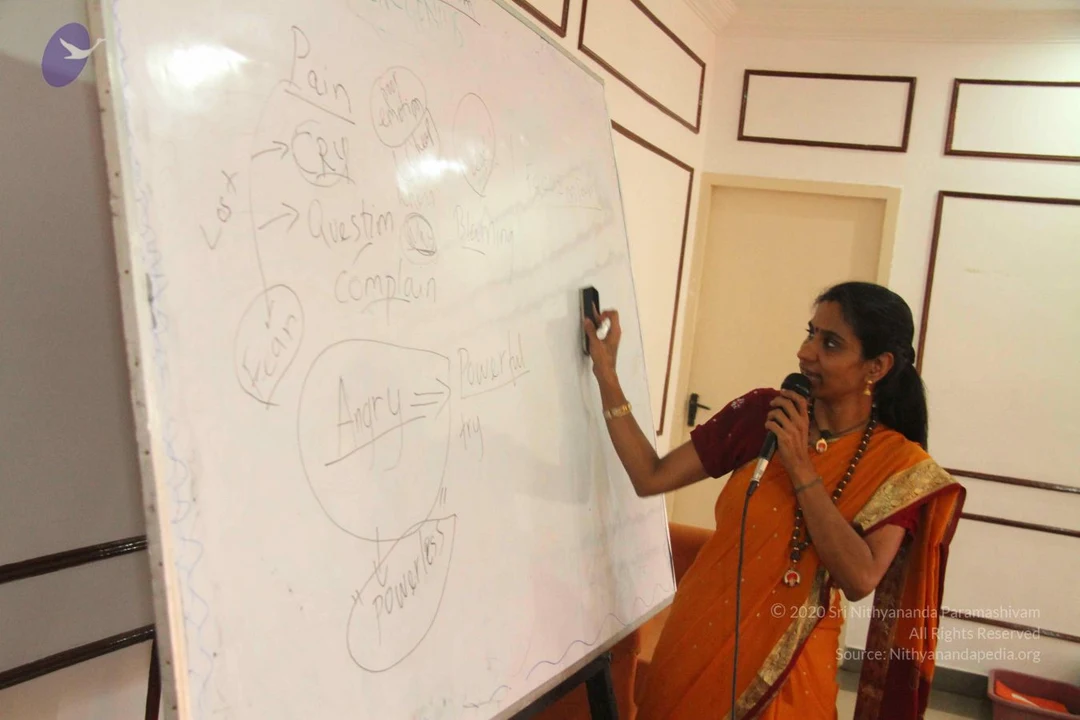
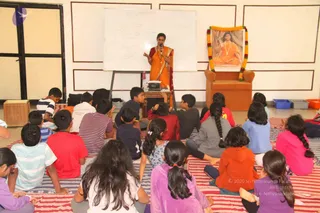
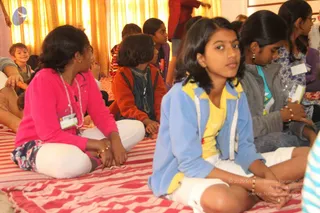
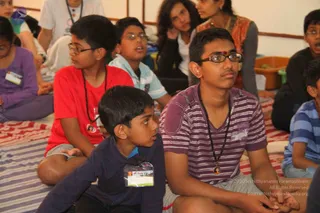
A woman in an orange saree with a gold border and a maroon blouse stands before a whiteboard, holding a marker raised toward diagrammed notes while speaking into a handheld microphone on a stand. She wears a beaded rudraksha-style mala and gold bangles. The whiteboard shows hand-drawn words and arrows, including Pain, CRY, Complain, Angry, Powerless, Fear and Focus on Pain, under a heading reading Nithyanandam EN-GENIUS. Beside the board, a framed portrait of a man in orange robes with a long gold-and-bead necklace, seated and raising a hand, is garlanded with orange and marigold flowers. A brown sofa is visible at right.A woman in an orange saree with a red blouse stands at left holding a microphone and speaking to a seated group of children on red-and-white striped mats in a bright room with yellow curtains. Many children sit cross-legged facing her, some in orange, grey and striped shirts, while a few teenagers sit further back. A speaker, a projector on a small table and a tripod-mounted camera are visible, and children's drawings are pinned on the white wall.A photograph of a group of children and some adults seated on red-and-white striped floor mats in a room with yellow curtains. Most children face forward toward an unseen speaker, several wearing lanyards. A boy in an orange t-shirt rests his chin on his hand in the foreground, while a boy in a red shirt and a girl in a purple top sit nearby. A projector and a wooden table are at the left edge. No one in the scene is identified as a person.A satsang session in a plain hall with cream walls and dark wooden trim. A woman in an orange sari with a red border stands at the front, holding a microphone and gesturing, beside a whiteboard covered with diagrams and writing. A framed portrait of a saffron-robed man with long hair and a beaded necklace, garlanded with orange and red flowers, hangs on the wall beside an empty orange armchair. About 25 children and young people sit cross-legged on red-and-white striped mats, listening; several wear striped shirts, red, purple, grey and blue tops, and one girl wears a bright orange hoodie. Plastic bins and a small wooden stool sit along the walls.A photograph of a group of children and young people seated cross-legged on red and white striped mats in a room with yellow curtains. In the foreground a girl in a blue and yellow zip jacket and white shorts looks toward the camera, while beside her a woman in a bright pink top and white pants wears a white pearl mala and an ID badge. Other girls in grey, orange and patterned tops sit nearby, some holding small booklets, and a toddler peeks out on the left. The setting suggests a satsang or group session.A photograph of a group of children and teenagers seated on striped mats in a bright hall, watching something intently. In the foreground a boy in a navy long-sleeved top with an event name badge looks to the side, while a teenager in a purple striped t-shirt with dark rudraksha-style beaded mala and a small pendant sits with a red tilak mark on his forehead. A boy in a red t-shirt wears a dark beaded mala, and behind them a woman in a grey top with an orange-and-green patterned shawl and a girl in white sit among others. Their attentive expressions suggest a satsang or discourse session. Approximately ten people are visible.

MorningYoga

1 photoSource gallery

MorningSatsang
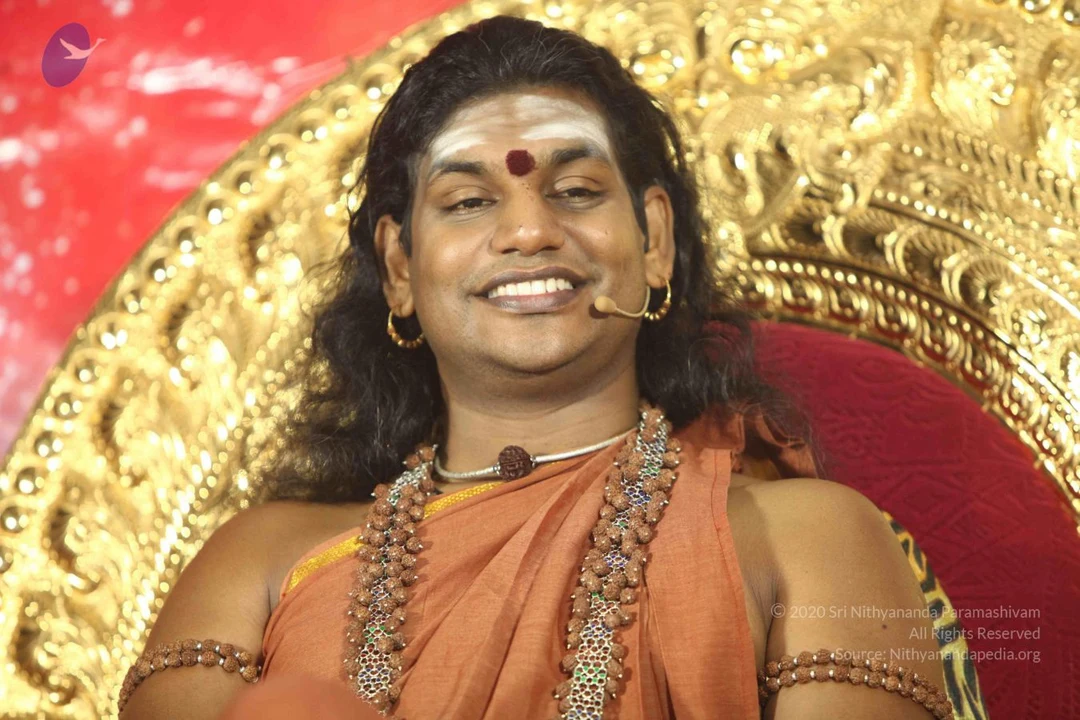
10 photosSource gallery
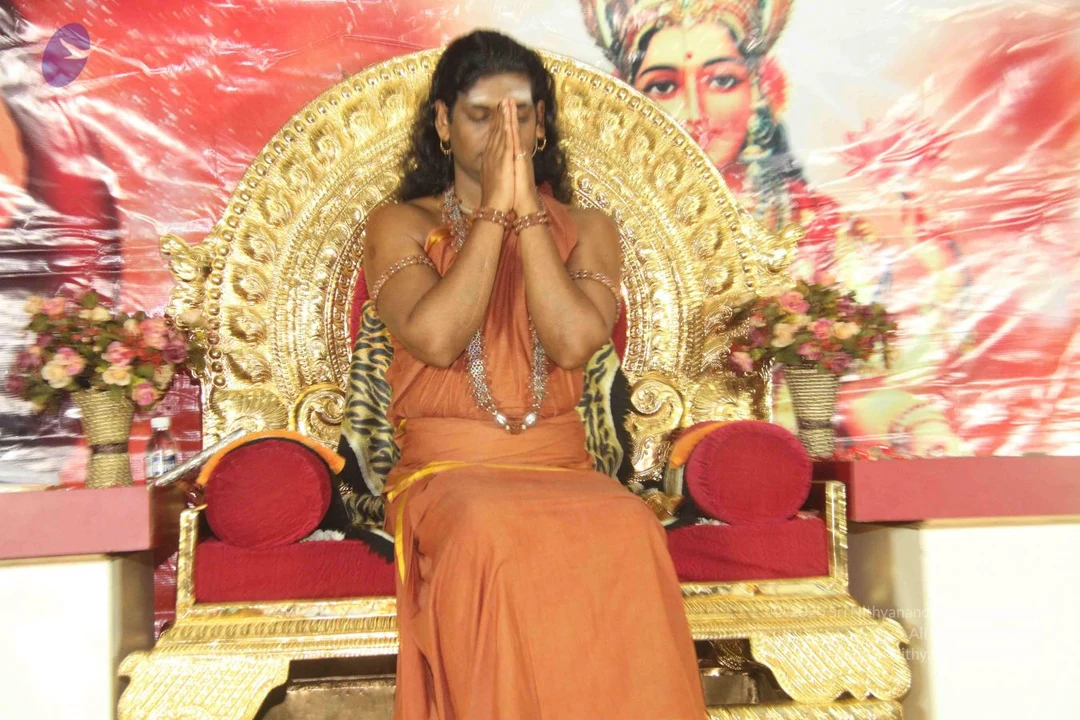
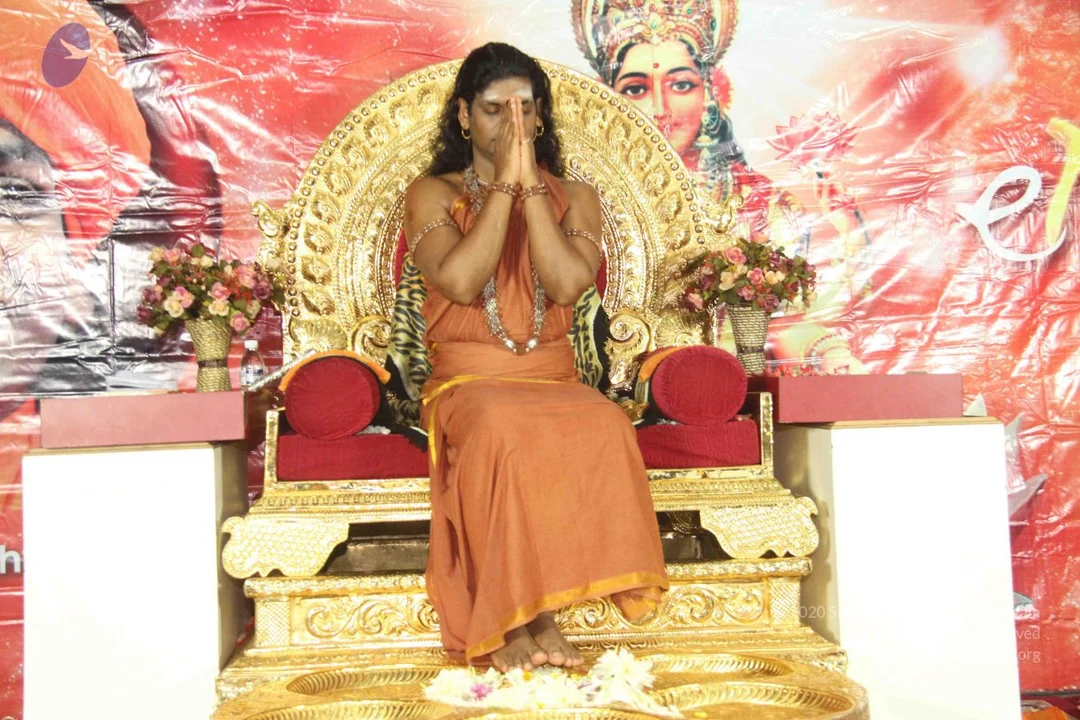
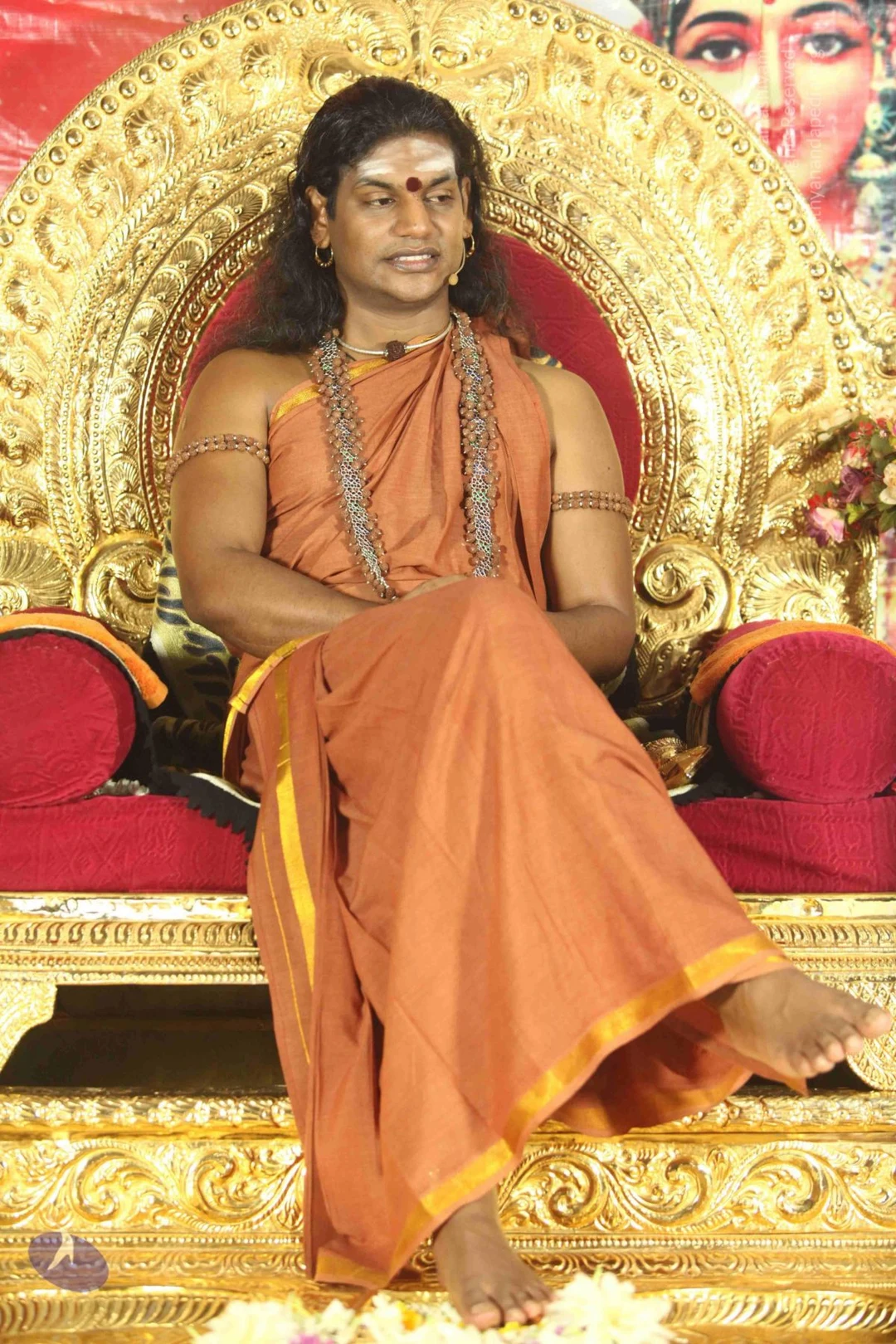
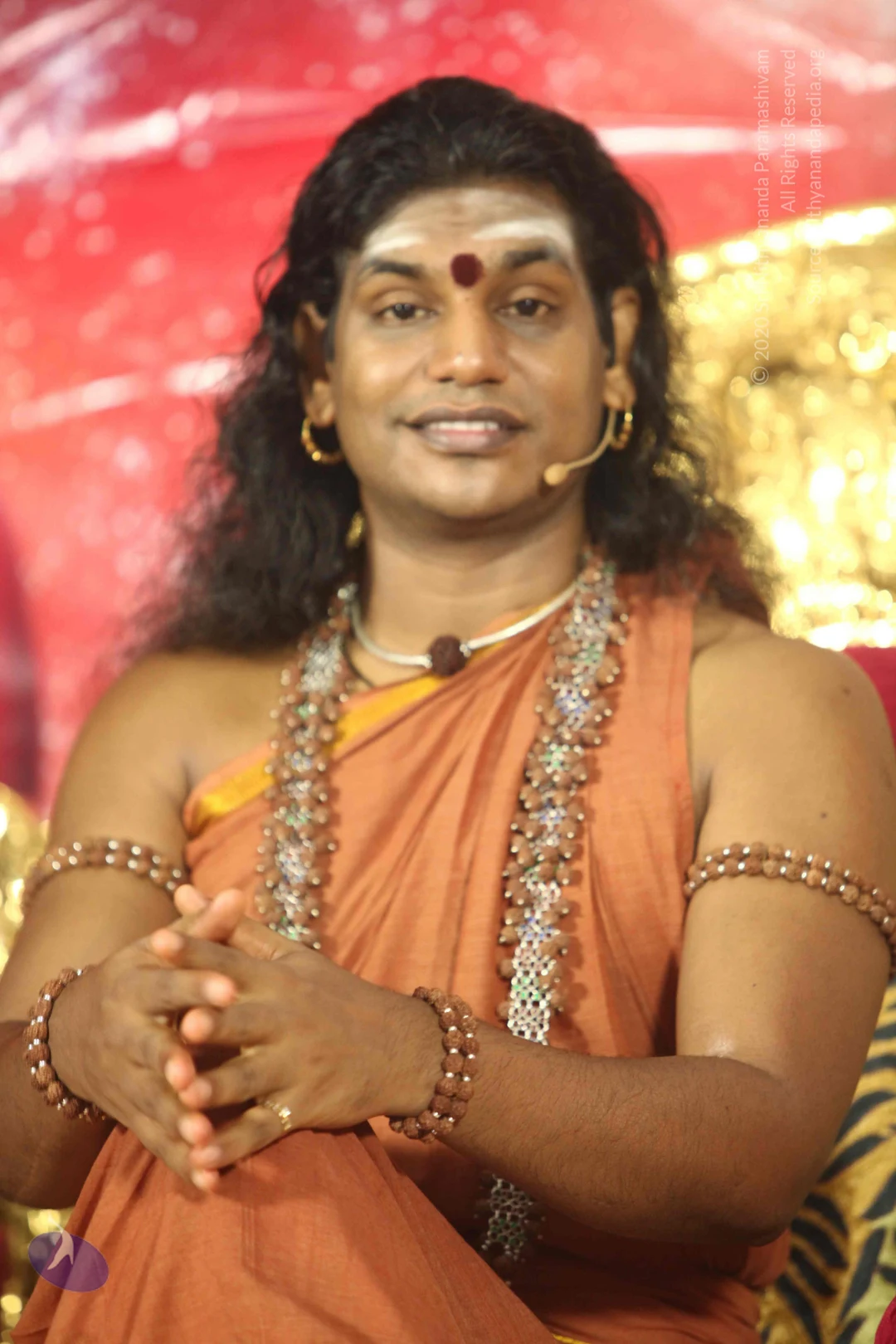
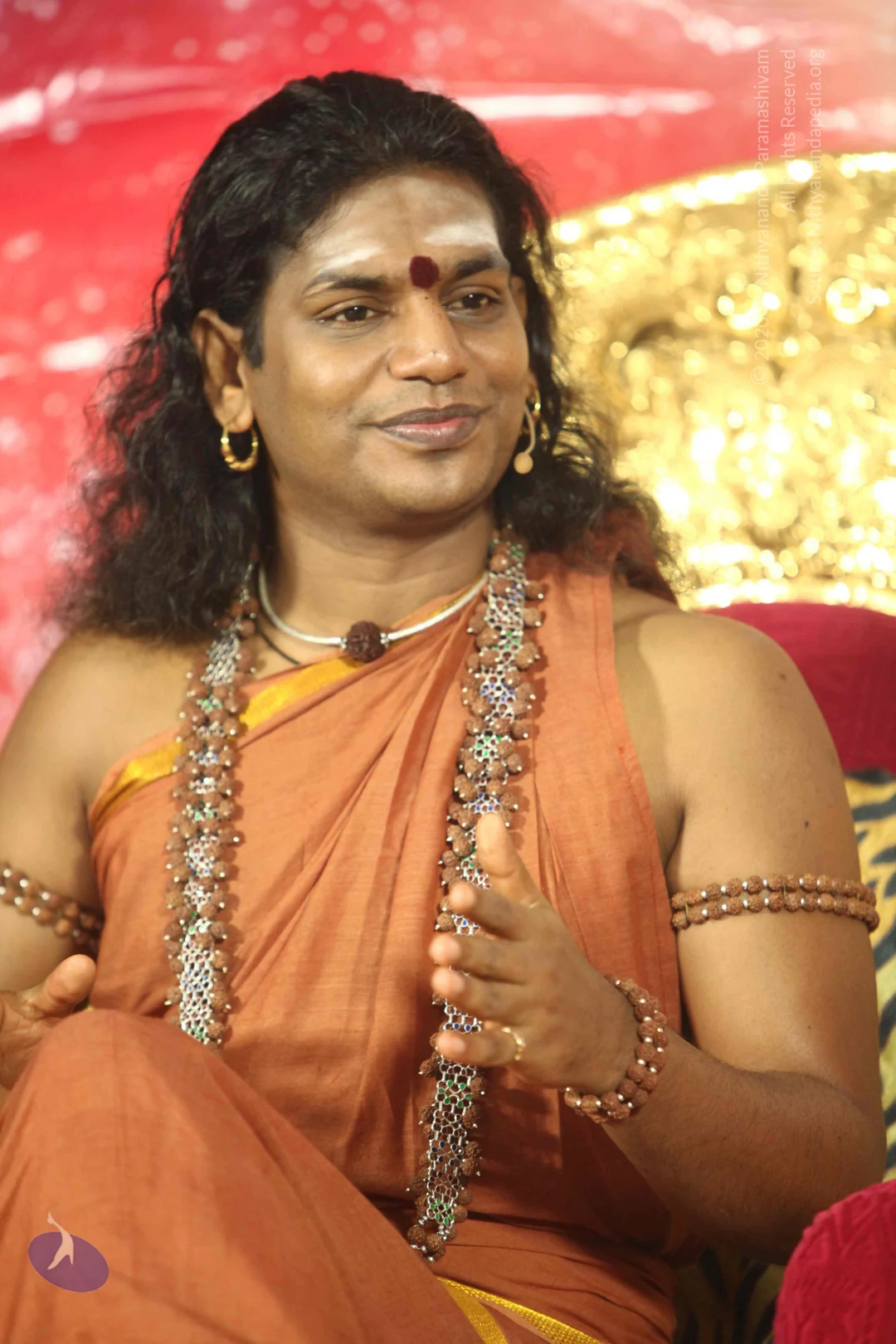
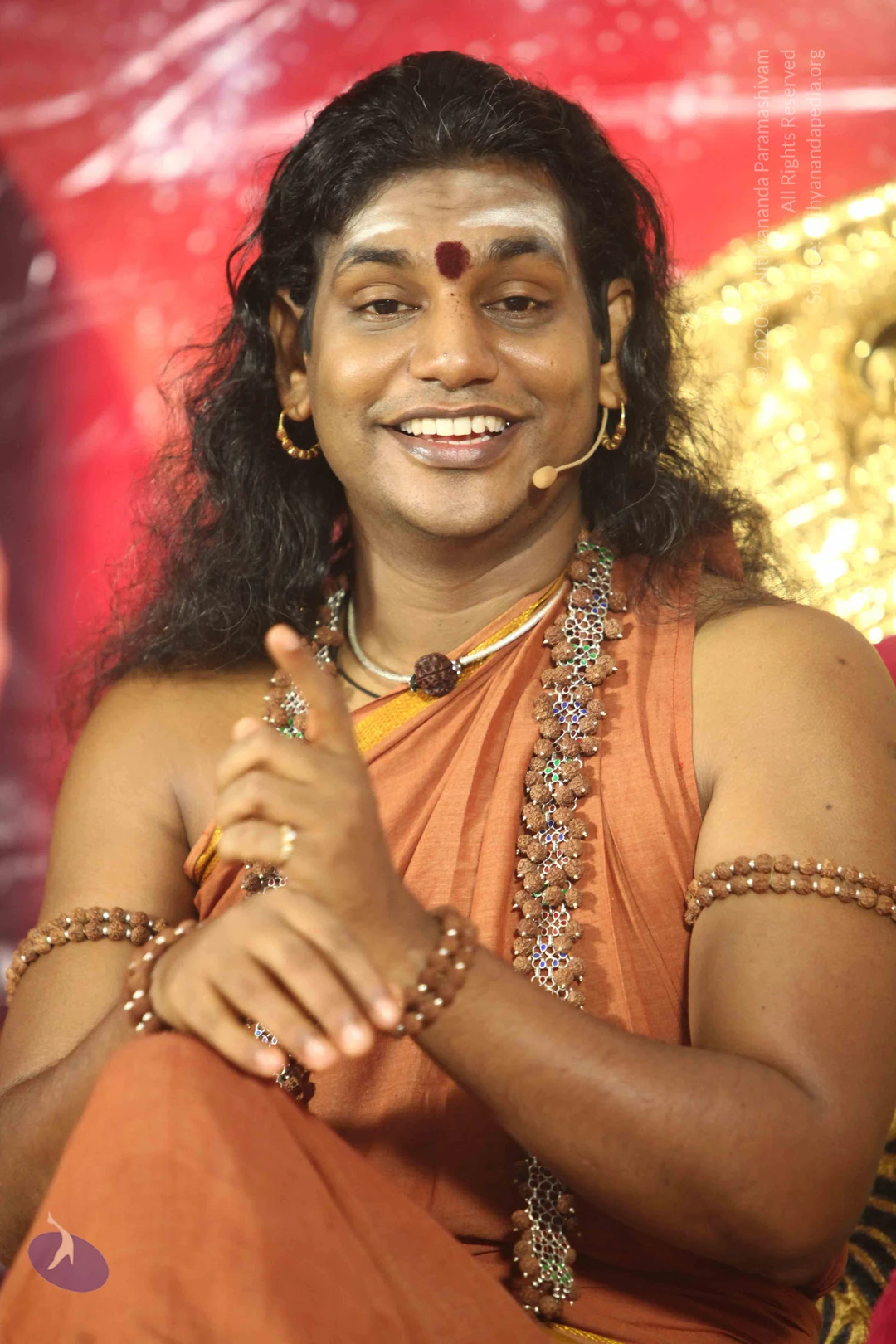
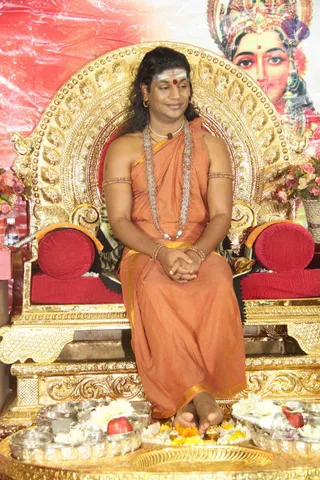
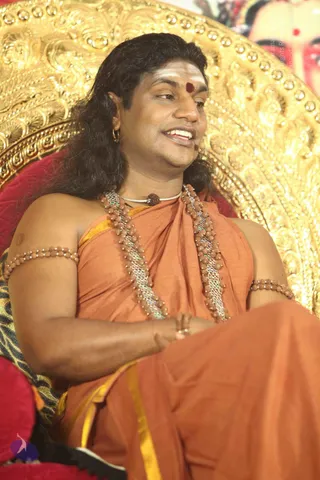
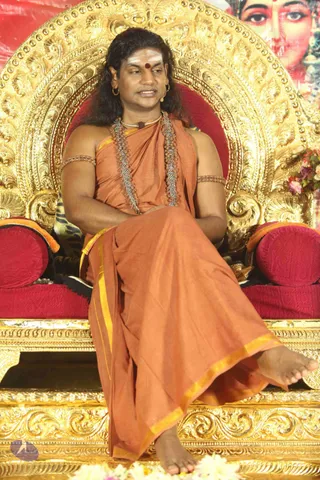
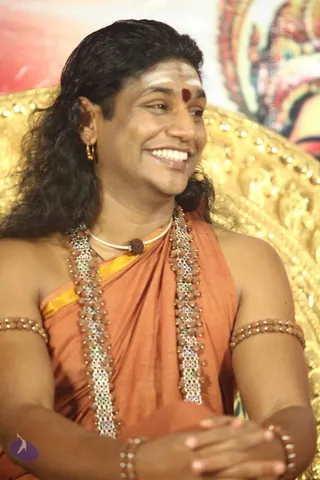
A man with long swept-back dark hair sits on an ornate gold throne with red cushions, hands clasped in his lap and feet resting on a gold platform. He wears an orange-saffron robe with a gold border, layered silver beaded necklaces, a rudraksha-style mala, beaded armbands and bracelets, and a white vertical tilak with a red bindi. Flower offerings, marigold petals, a red apple and silver bowls sit at his feet. Behind him a red backdrop shows a painted deity face with a crown and kumkum bindi. A water bottle is visible at the left edge. Appearance-based identification is probable: a person, seated in person and receiving a satsang setting.A man with long dark hair sits smiling on an ornate gold throne with a red cushion. He wears an orange-saffron cloth draped over his body, with gold-bordered edges, multiple rudraksha mala necklaces and rudraksha armlets, and a red bindi with white vertical markings on his forehead. He gestures with one hand while looking to the side. Only one physical person is visible.A man seated on an ornate gold throne with red cushions speaks during a satsang. He wears an orange-saffron dhoti and shawl with gold borders, multiple rudraksha malas across his chest and rudraksha bands on his upper arms, and a vertical tilak with a red bindi. He has long dark hair and gold hoop earrings, and his bare feet rest on a gold dais. Flowers lie at the bottom edge and a red backdrop with a painted deity face is behind the throne.A smiling man with long, swept-back dark hair sits on an ornate gold throne-like chair in front of a colourful backdrop. He wears an orange-saffron shawl draped over one shoulder with a yellow border, multiple rudraksha mala necklaces with silver and green beads, a rudraksha bead on a silver chain, rudraksha armlets, a small gold hoop earring, a white tilak and red kumkum bindi on his forehead, and his hands rest together in his lap. a person: long swept-back hair, saffron shawl, rudraksha malas and ceremonial adornments match the a person presentation.A man with long, swept-back dark hair sits in front of a red and gold backdrop, wearing an orange-saffron shawl draped over bare shoulders, multiple rudraksha malas with silver beads, a rudraksha bracelet and armlets, and a small silver chain with a rudraksha pendant. He has white vertical tilak lines and a red bindi on his forehead, gold hoop earrings, and a clip-on headset microphone, with his hands clasped in his lap. a person appears in person, sitting for a satsang-style talk. Only one person is visible.A seated man with long, swept-back dark hair wears an orange-saffron cloth draped over his shoulder, with a gold-bordered edge. He has a red bindi and white tilak marks on his forehead, gold hoop earrings, and a silver neck chain with a rudraksha bead. Multiple rudraksha malas with silver spacers hang across his chest and wrap his upper arms and wrist. He gestures with his right hand while speaking, against a red backdrop with a gold sparkling cushion behind him.
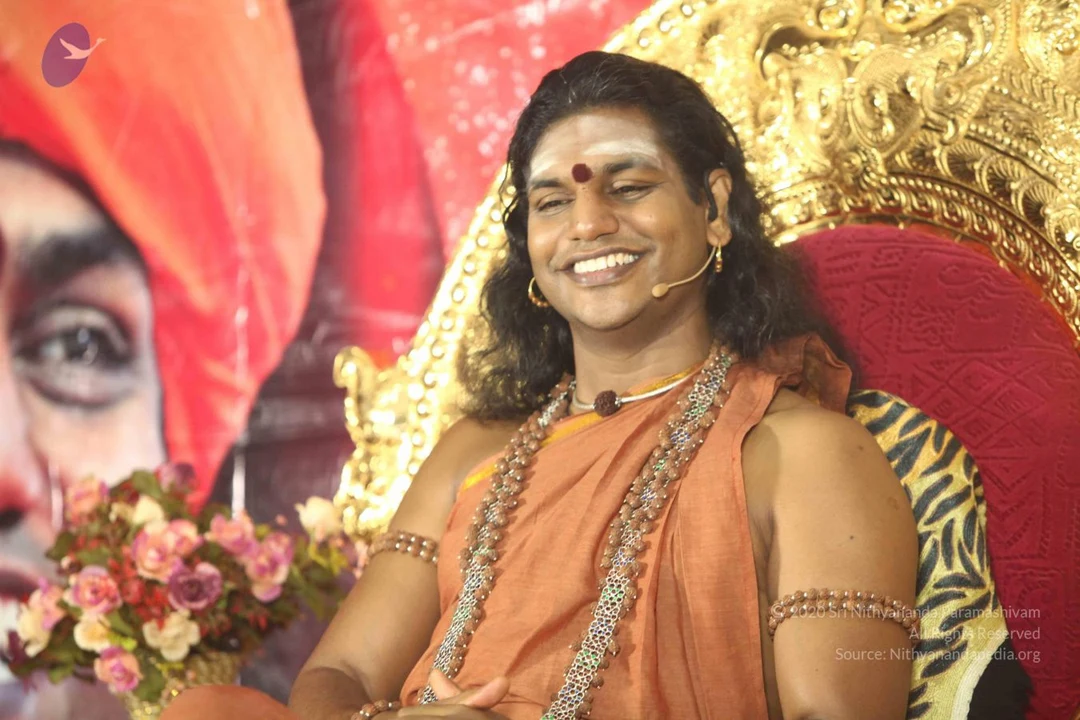
IA-Session2-Participants

1 photoSource gallery
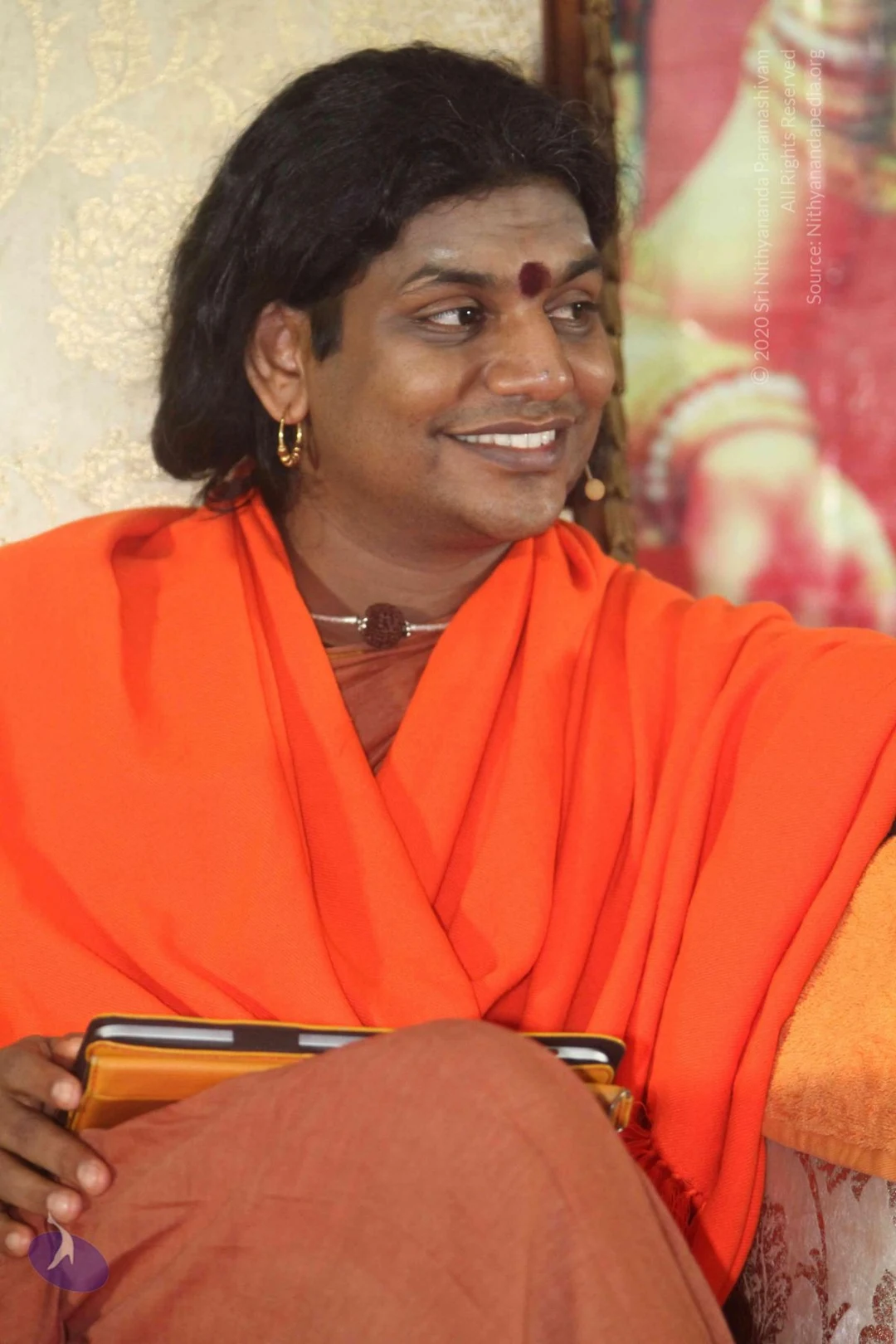
Close photo of a smiling man with long dark hair swept back, wearing an orange-saffron shawl draped over his shoulders and a rudraksha mala with a silver chain at his neck. A red bindi is on his forehead and gold hoop earrings are visible. He sits on a cushioned seat holding a tablet or notebook in his lap, looking off to the side. Behind him is a patterned cream wall and a red and pink painted or printed cloth. Appearance-based label: a person, seated in a sannyasi's saffron attire with rudraksha and long hair, in a satsang setting.
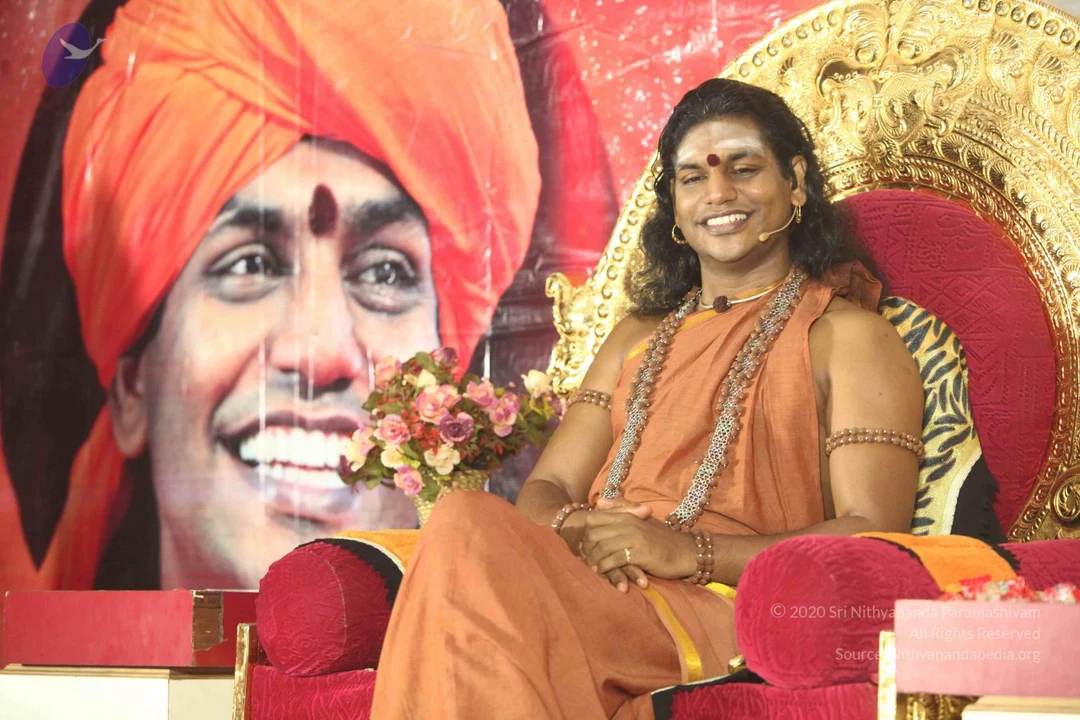
Energy-Darshan

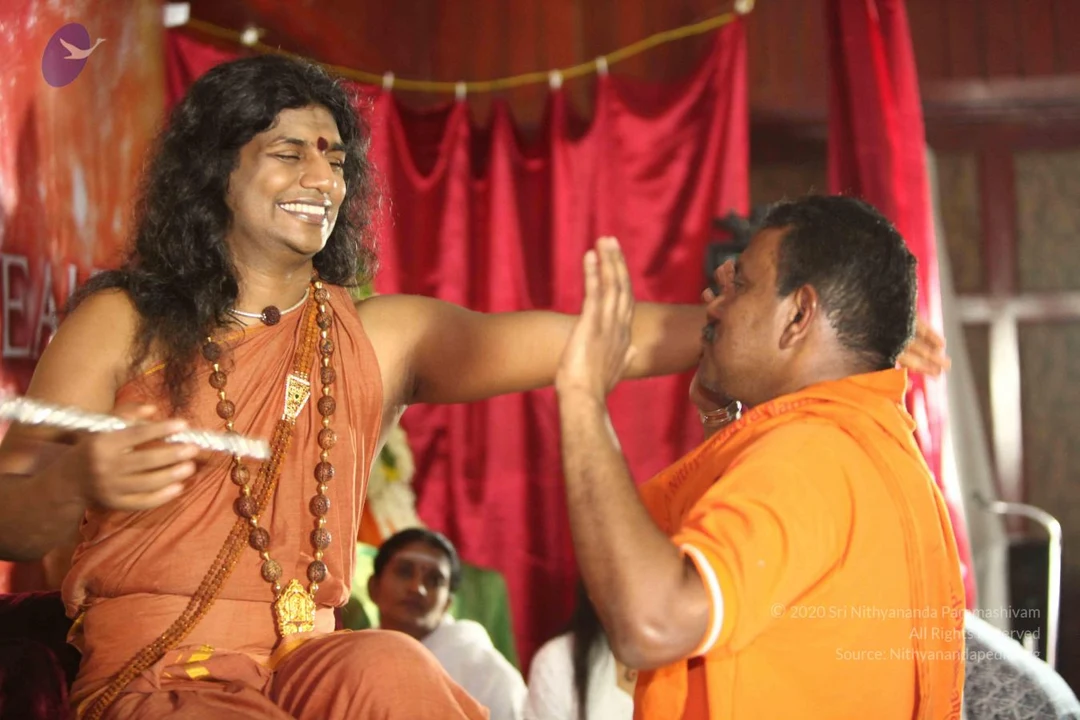
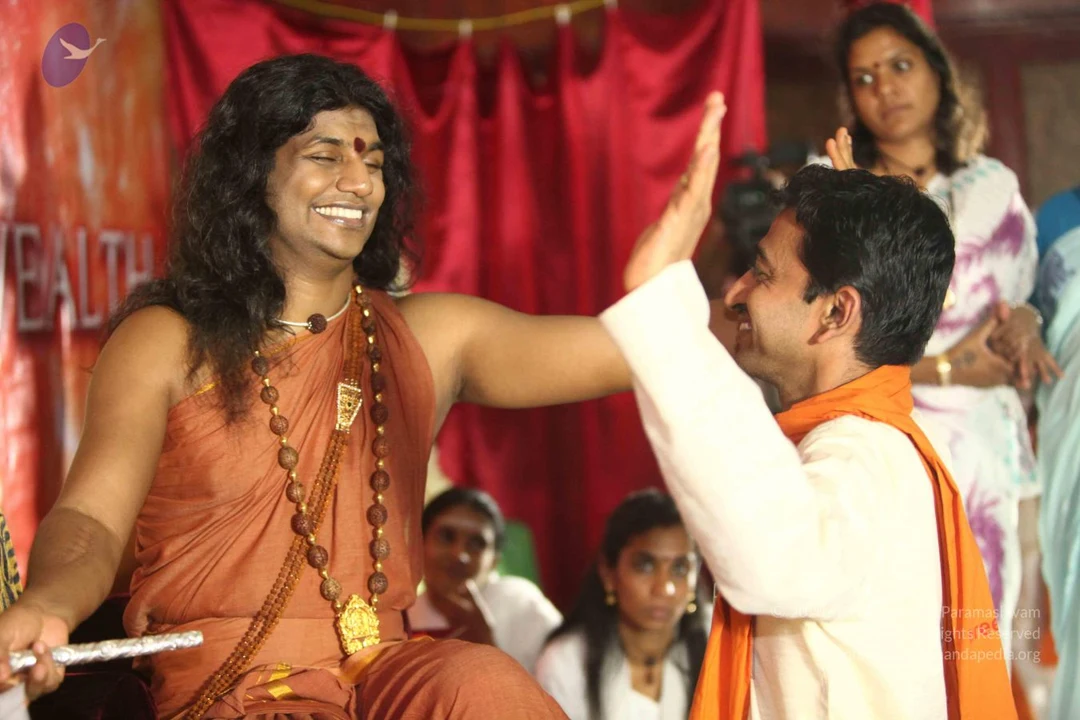
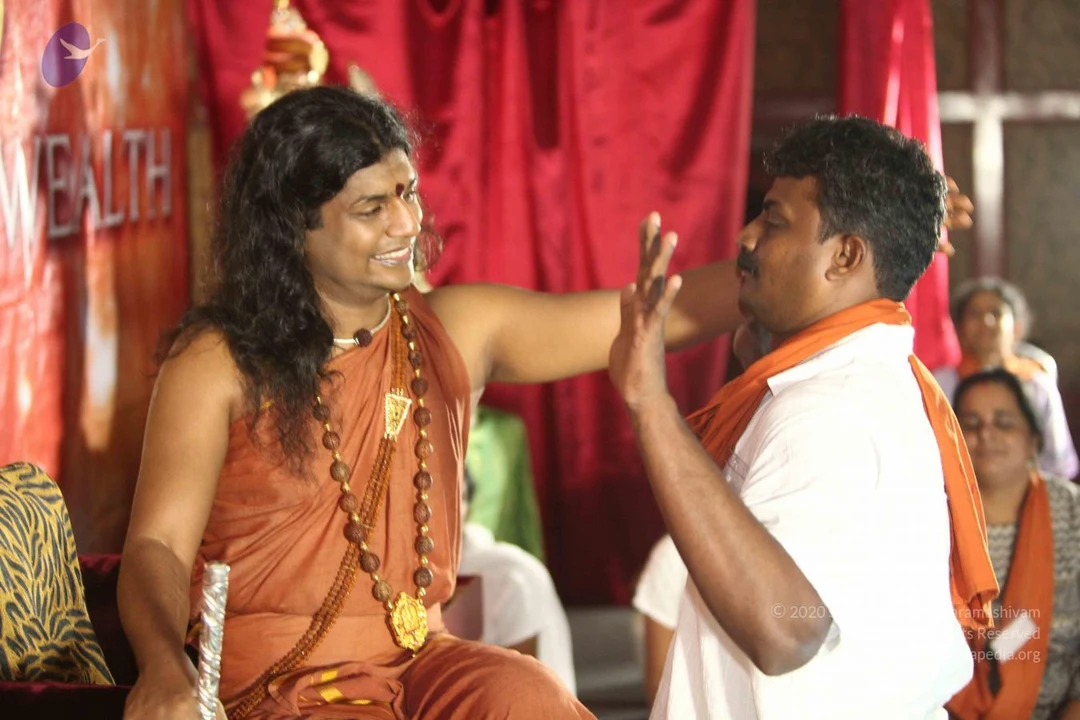
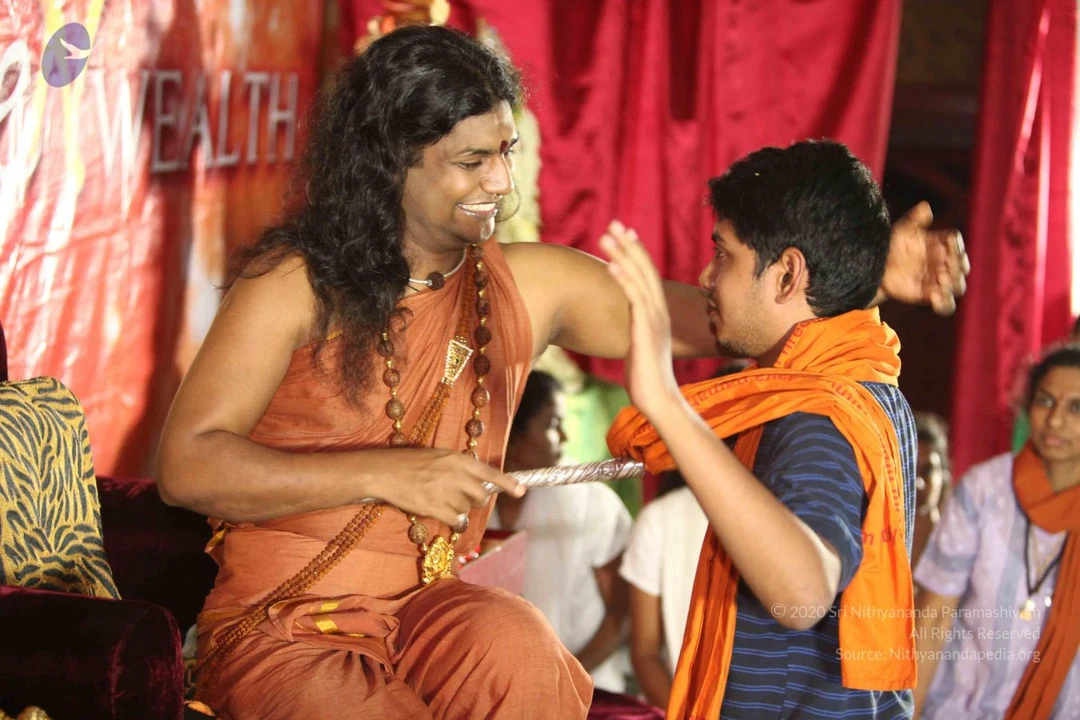
14 photosSource gallery
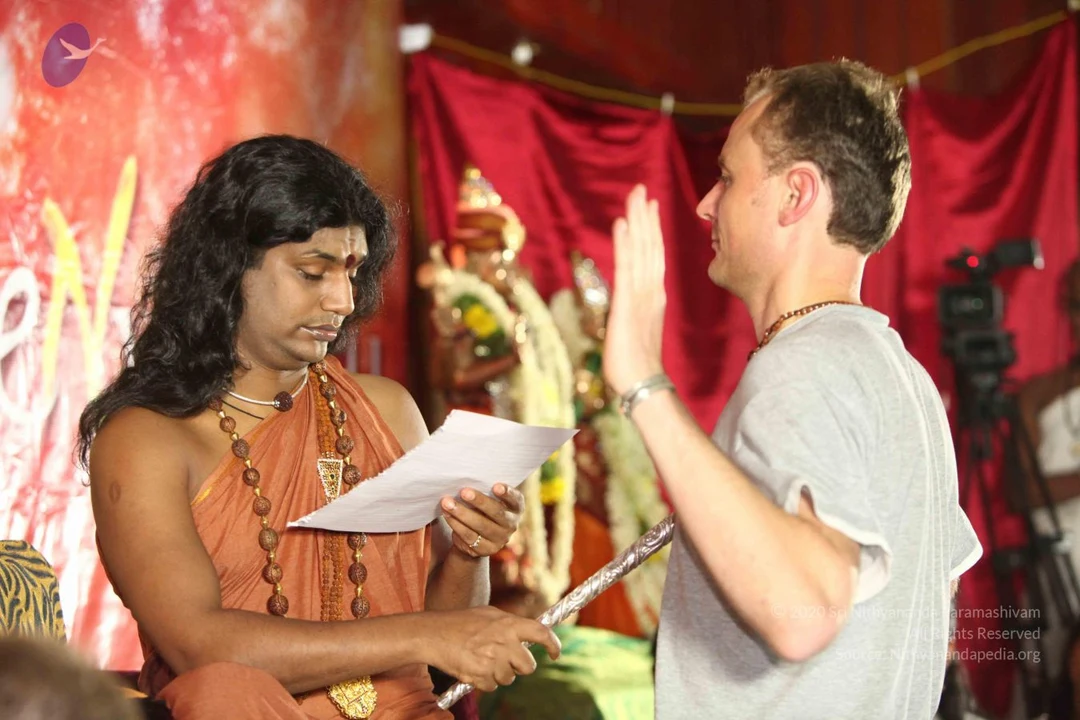
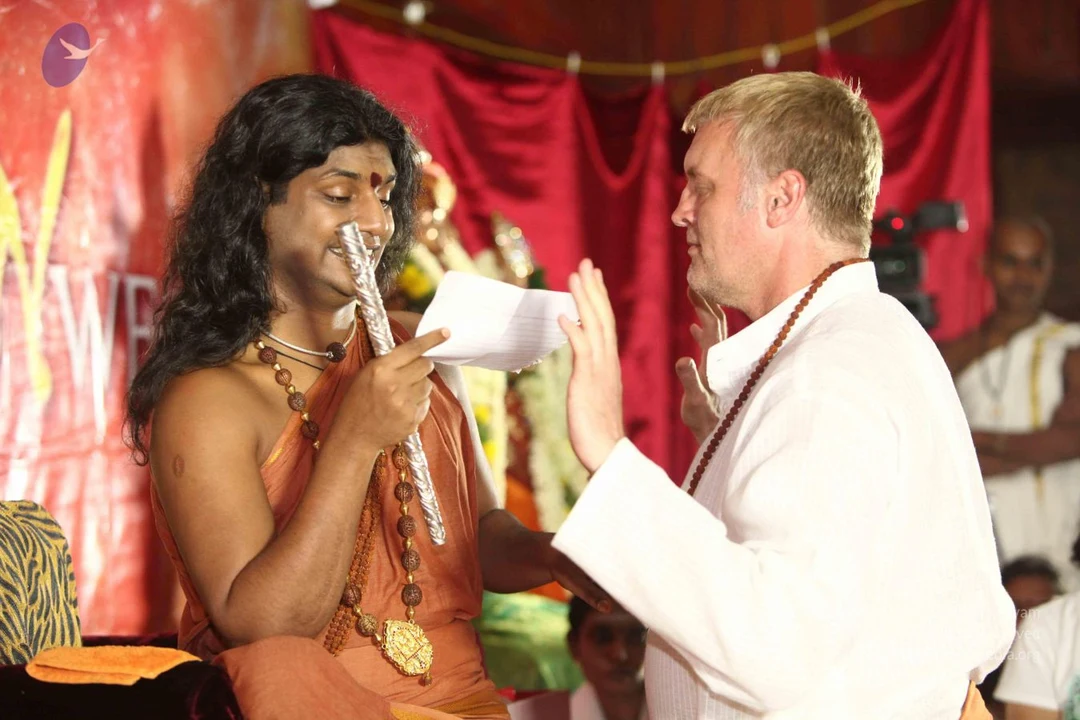
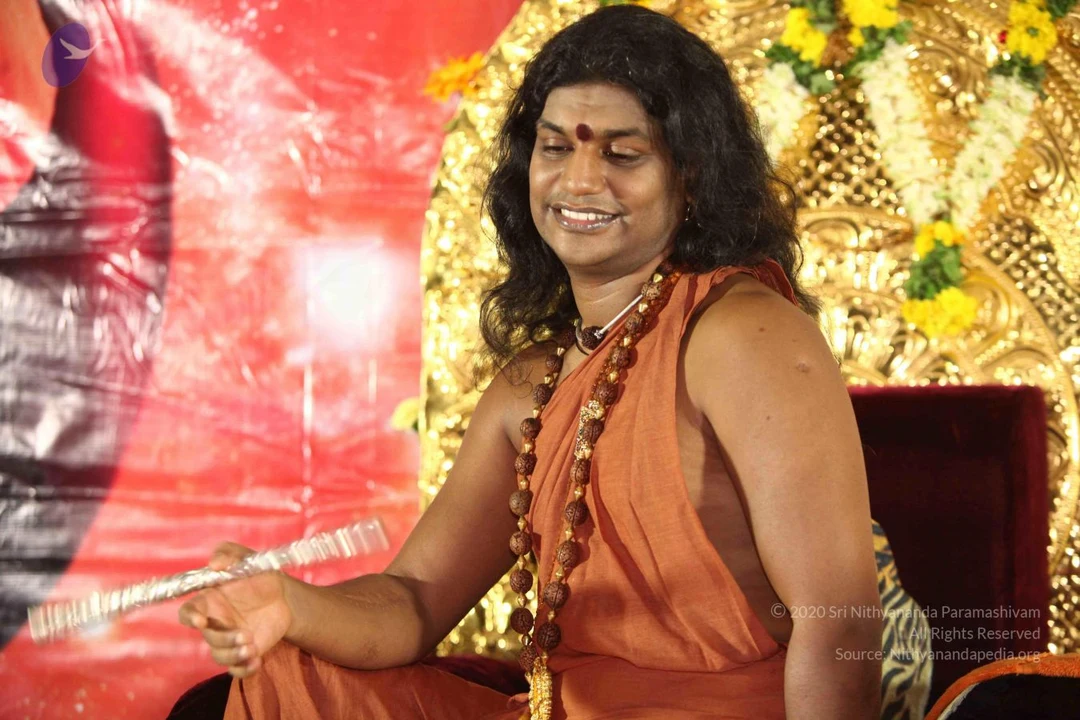
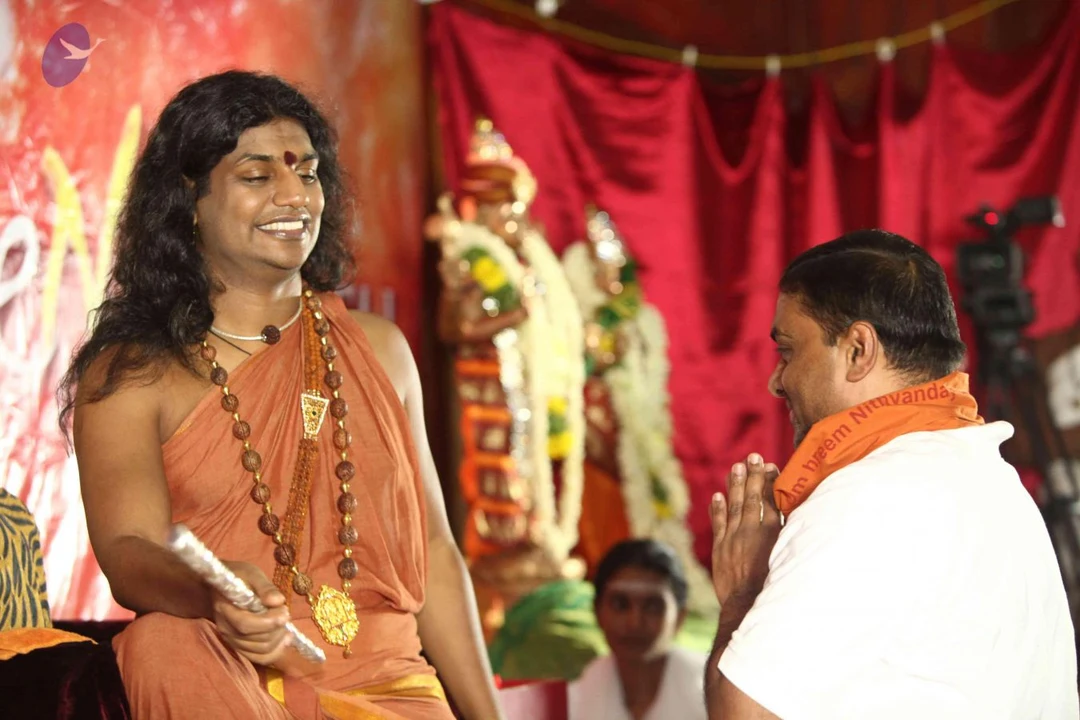
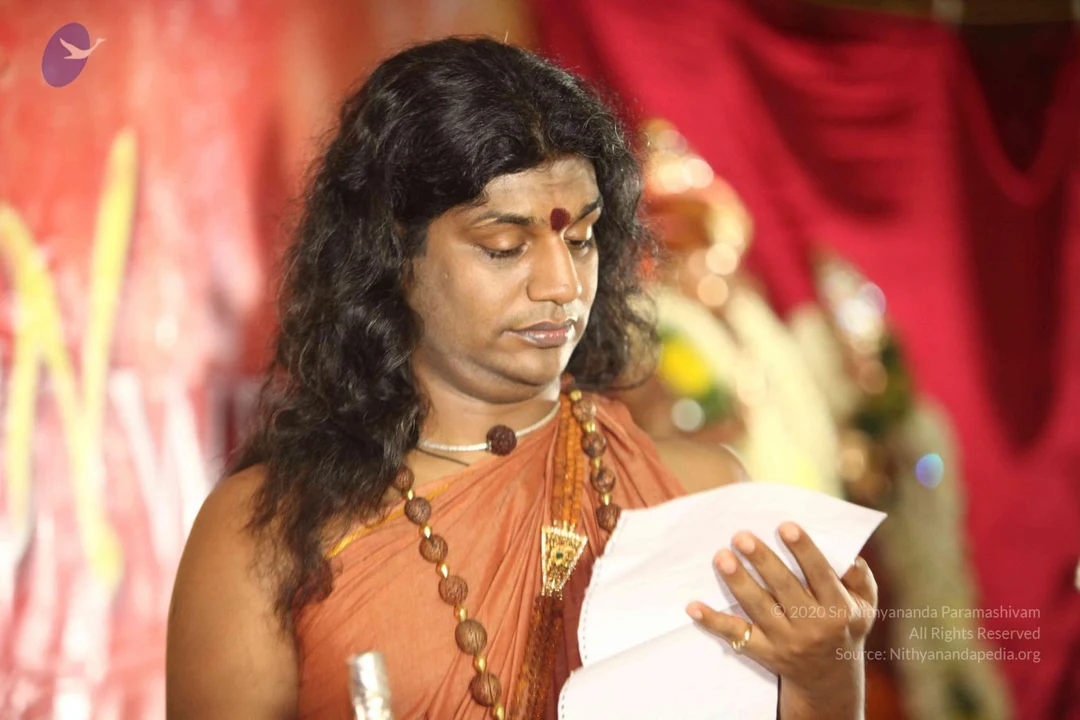
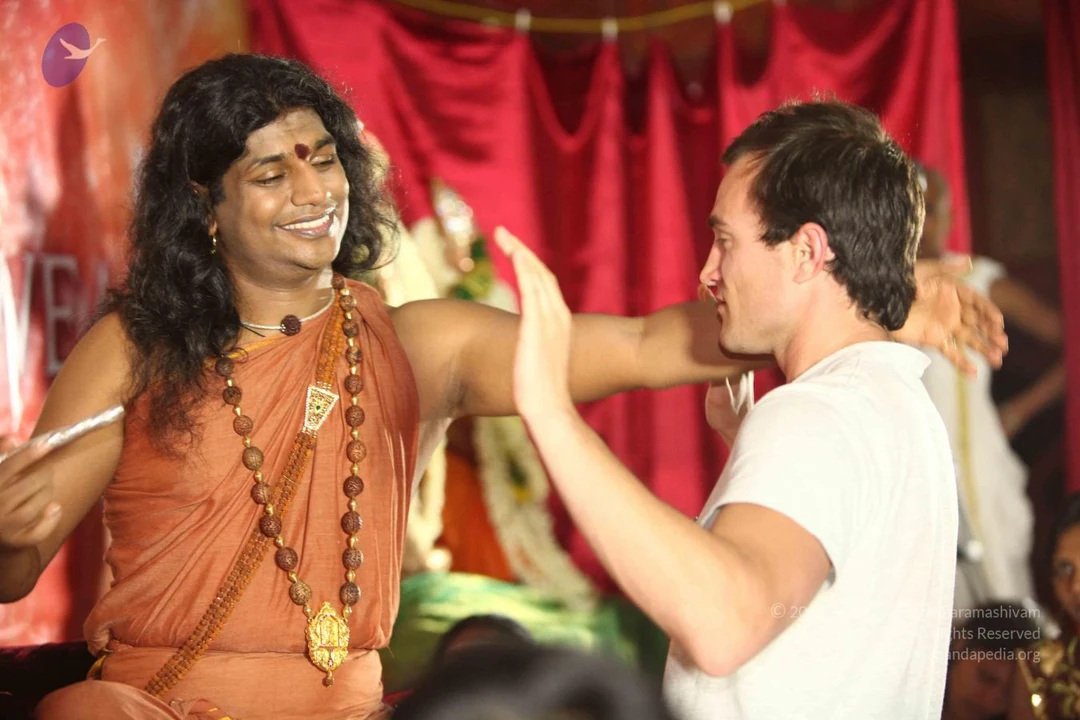
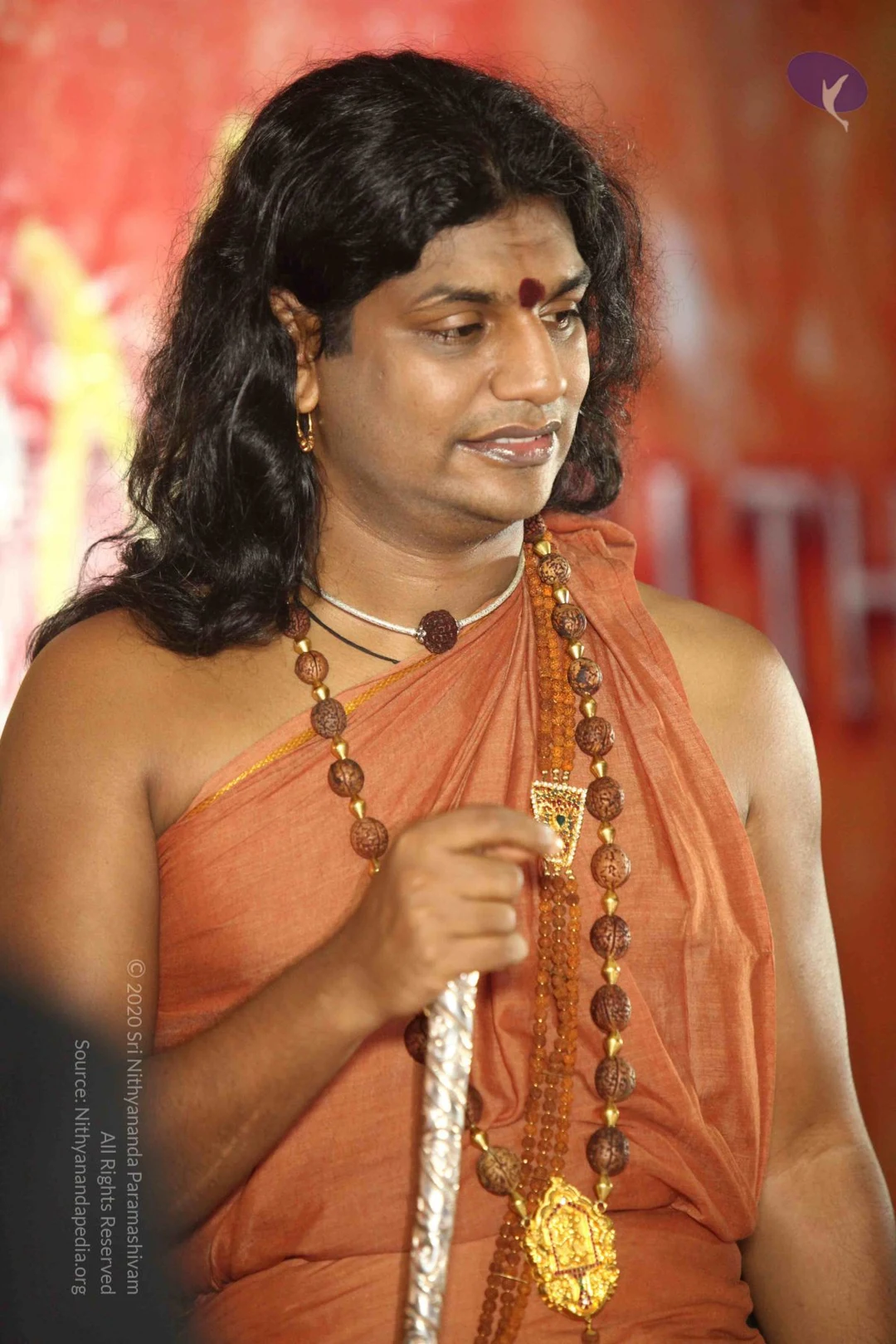
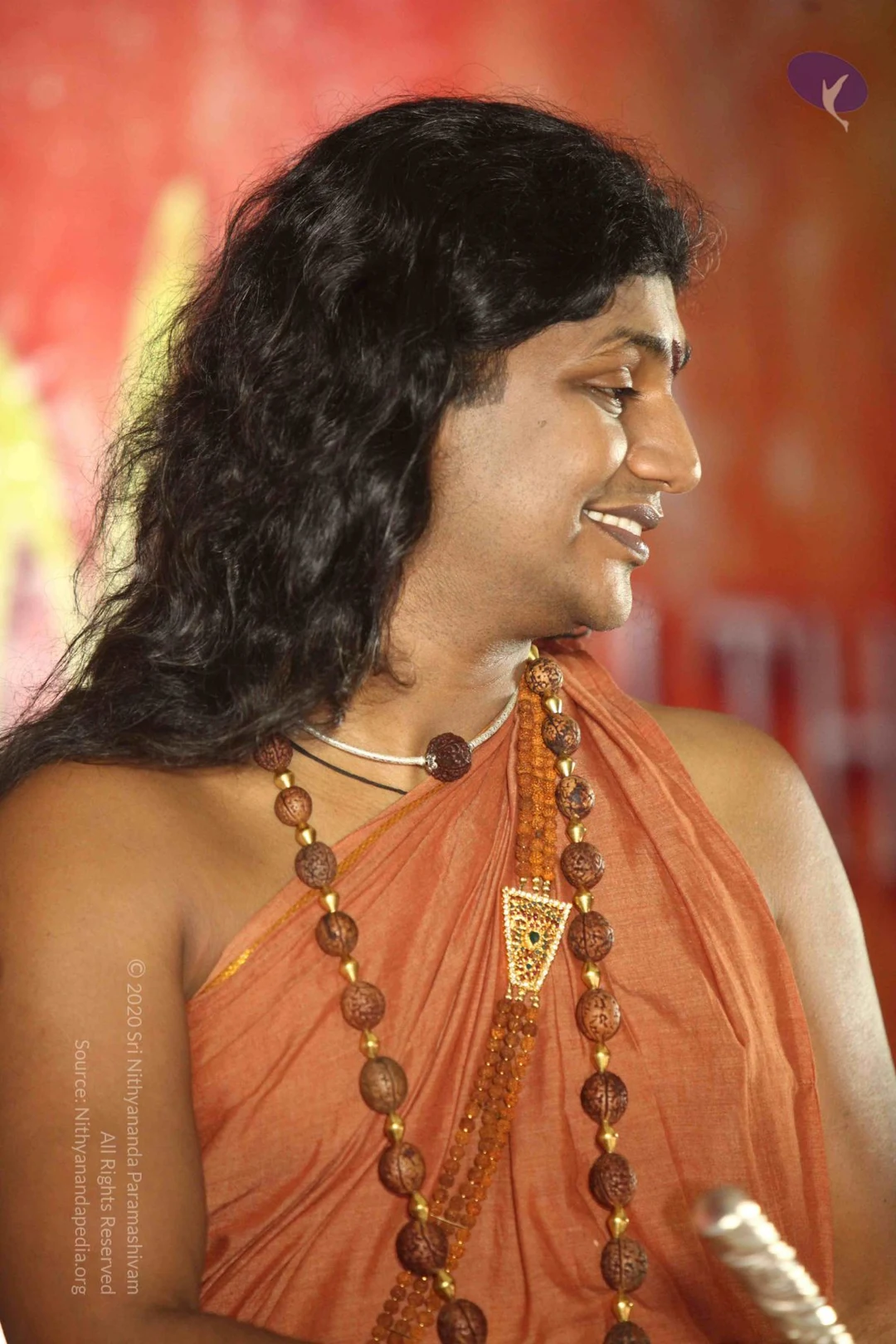
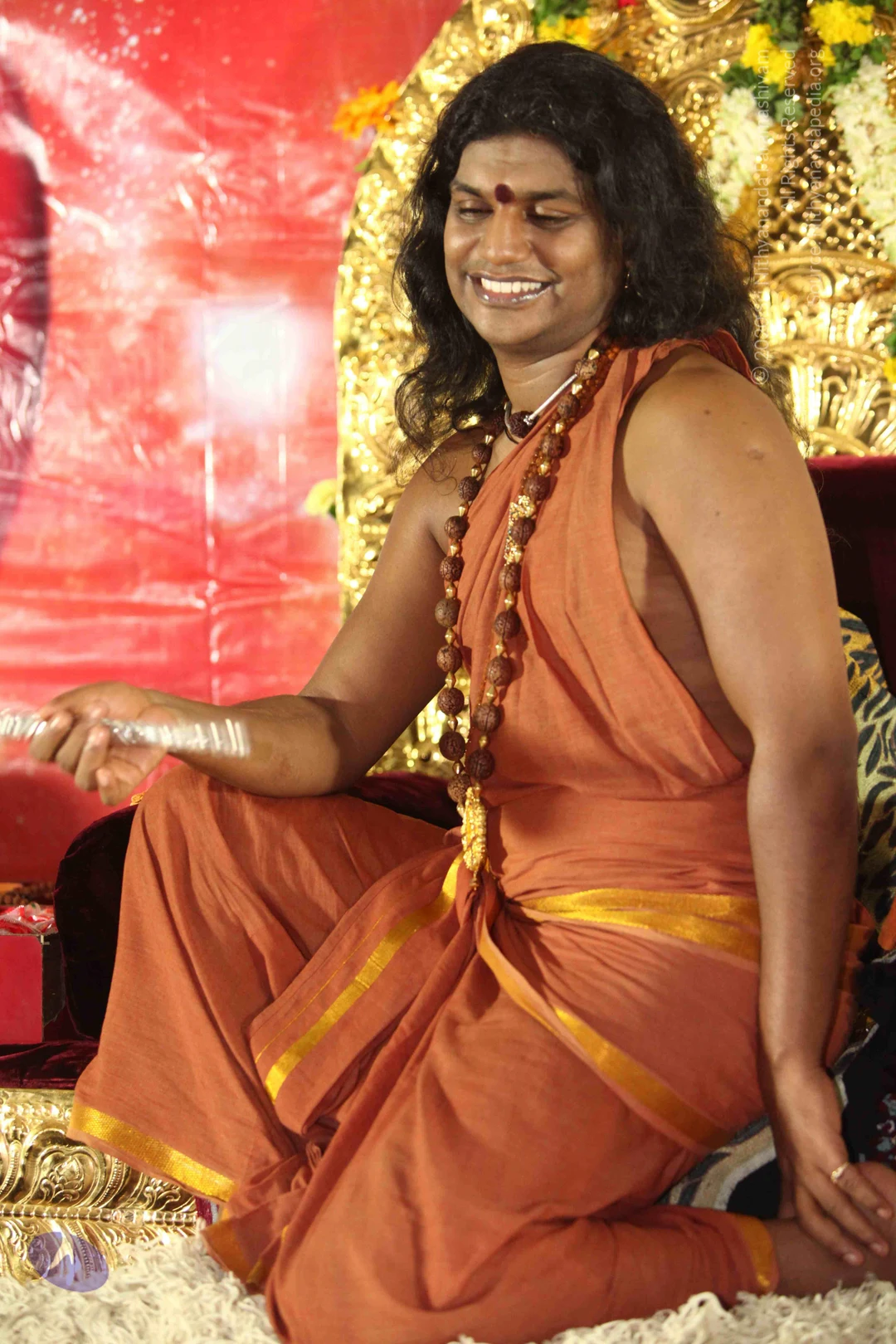
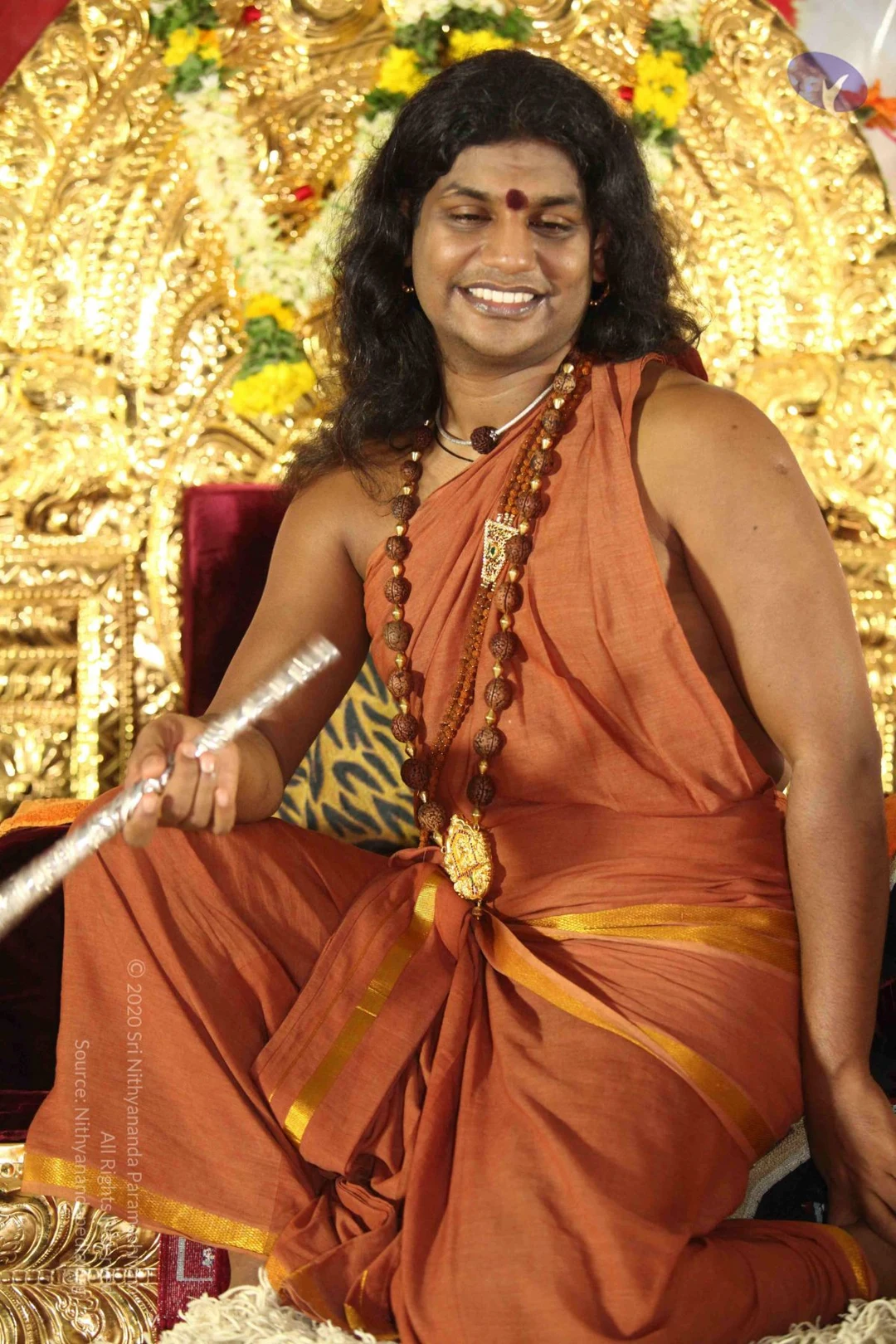
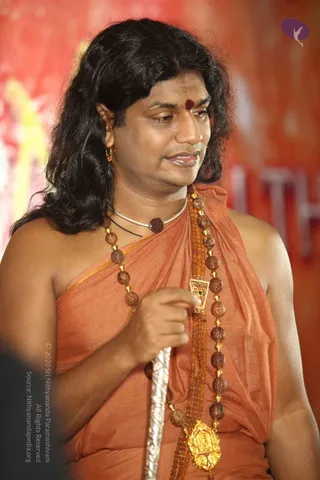
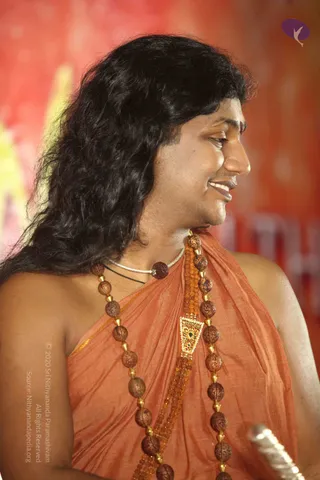
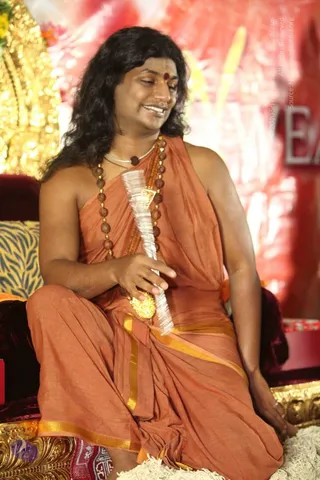
A smiling man in a saffron-orange sleeveless wrap and matching dhoti with gold border sits on a cushioned seat with one arm raised in a greeting gesture. He wears multiple strands of rudraksha beads, a gold pendant, a thin silver necklace, hoop earrings and a red bindi on his forehead. A gold deity murti with flower garlands and a bright red backdrop fill the background. a person cues: long swept-back hair, saffron clothing, rudraksha malas and ceremonial gold ornaments, shown in an appearance-based label only.Close-up photograph of a man seated in front of a gold-sequined backdrop with yellow flowers, speaking with eyes lowered and one open hand raised in a gesture of teaching. He wears a saffron-orange draped garment, a red bindi on his forehead, a silver necklace with a rudraksha bead, multiple rudraksha mala strands with gold spacer beads, and an ornate gold pendant with green stone inlay. Small hoop earrings are visible. The scene suggests a satsang discourse, though the person's identity is not established by appearance alone.A photograph of a long-haired man in an orange-saffron wrap draped over his left shoulder, leaving his right shoulder bare. He wears multiple rudraksha mala strands with gold spacers, a silver chain necklace, a red tilak on his forehead and small gold earrings. He holds a silver-coloured staff or rod in his right hand while looking downward and speaking. The background is a bright red-orange backdrop with partial letters. a person: long swept-back dark hair, saffron wrap, rudraksha malas and ceremonial gold pendant suggest a visible candidate for the a person depiction, but identity is uncertain from appearance alone.Close side-profile photograph of a man with long, wavy black hair swept back, smiling and looking to the right. He wears an orange-rust draped shawl over bare shoulders, multiple rudraksha mala strands with gold spacers, a gold ornamental pendant with green stone, and a silver necklace. A red tilak mark is on his forehead. Blurred red-orange background with a silver ceremonial object at the lower edge.A seated man with long, swept-back dark hair and a red bindi on his forehead sits on a gold-trimmed cushioned seat, smiling and looking down. He wears a saffron-orange draped garment with a gold border, and a cluster of rudraksha beads and a thin ceremonial chain hang at his neck. He holds a clear plastic cup-shaped object with a gold-coloured ornament in one hand. Behind him are gold ornamental hangings and a red-and-white backdrop. a person appears to be the person pictured, shown in a satsang-style seated setting.A smiling man with long, swept-back dark hair and a red bindi sits in an orange-saffron cloth draped over one shoulder and bare chest. He wears multiple rudraksha mala necklaces, a gold ornamental pendant, and holds a silver ribbed ceremonial staff with a gold-tipped end. The background is a blurred pink and white draped backdrop with a golden element at the left edge.