Skip to content
Saturday

27 August 2011

Arjuna: The ultimate possibility

Dated photos
151
Source pages
1
Media
4
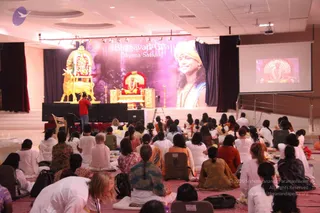
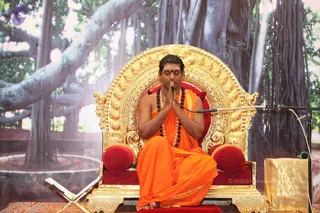
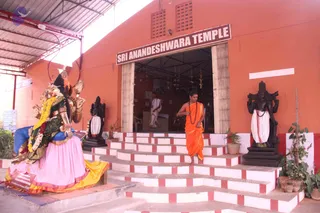
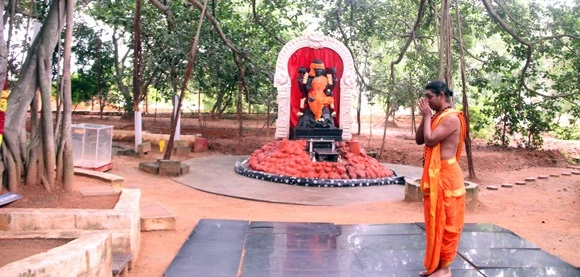
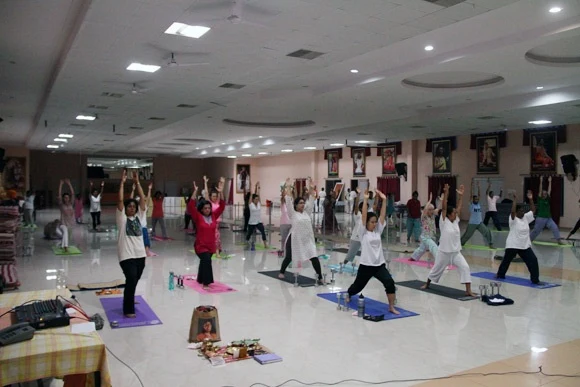
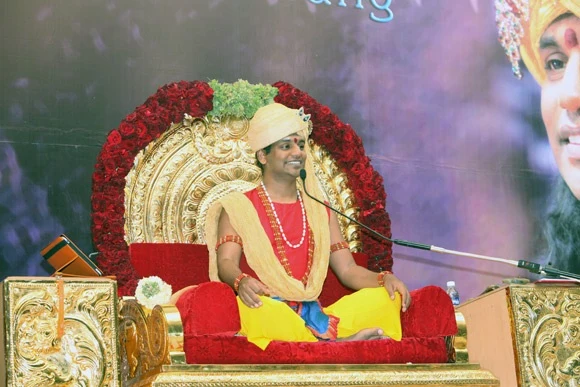
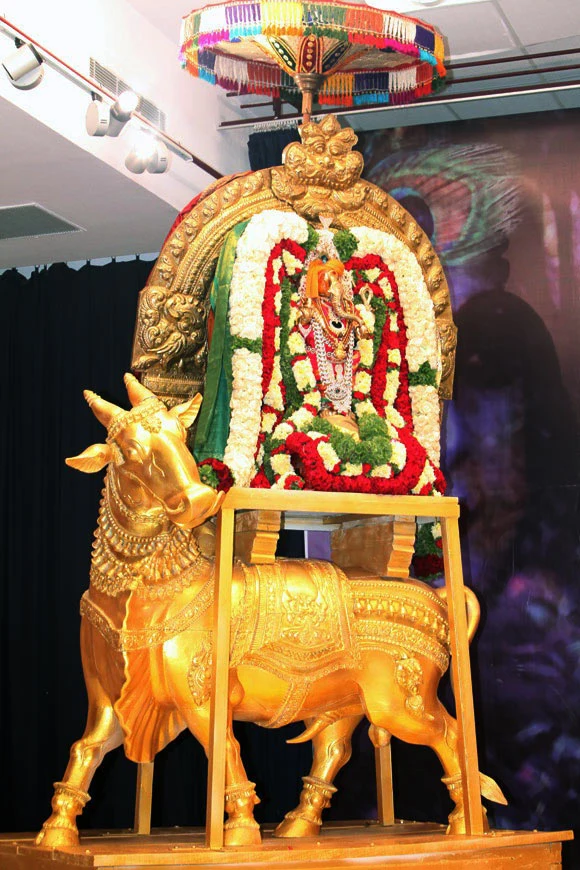
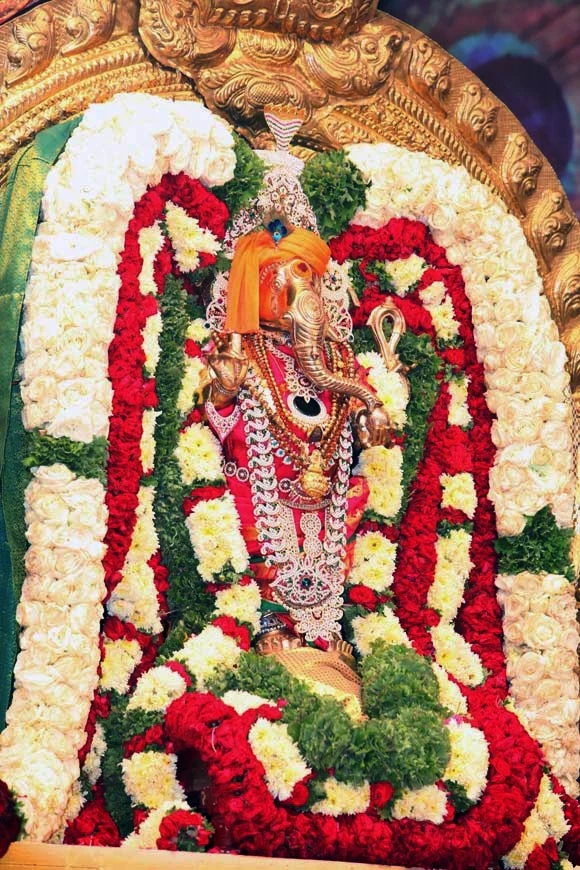
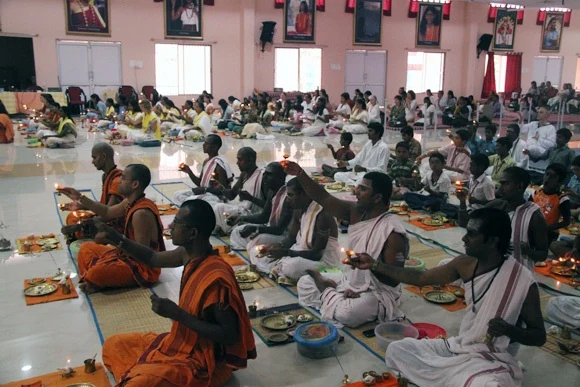
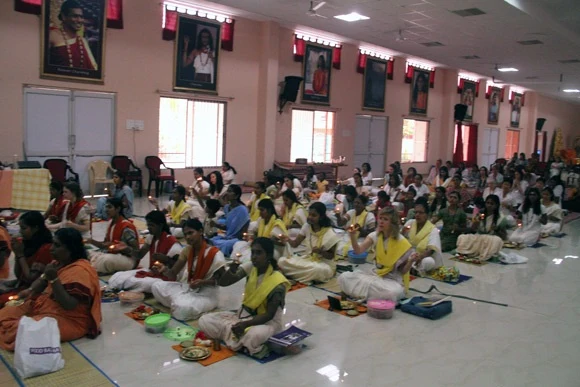
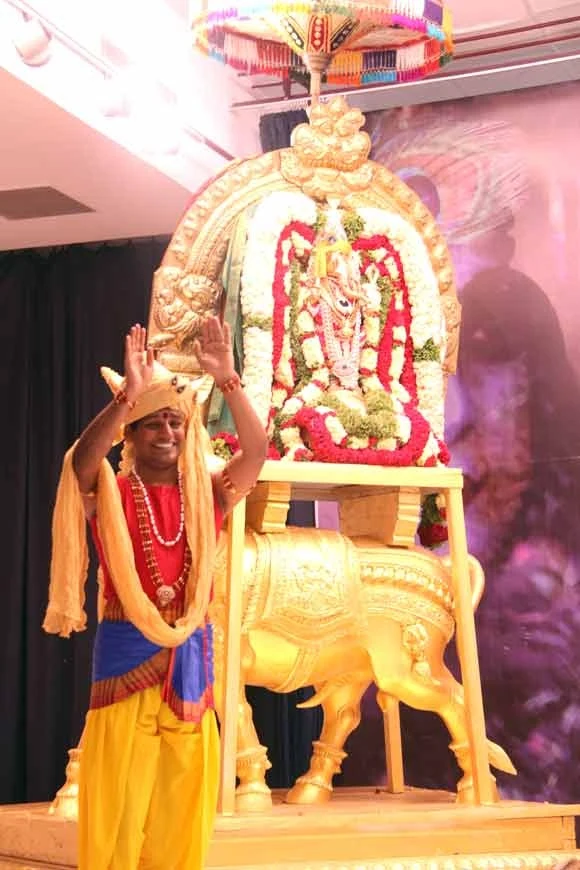
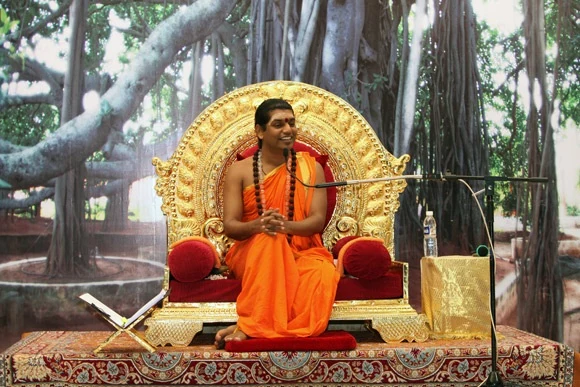
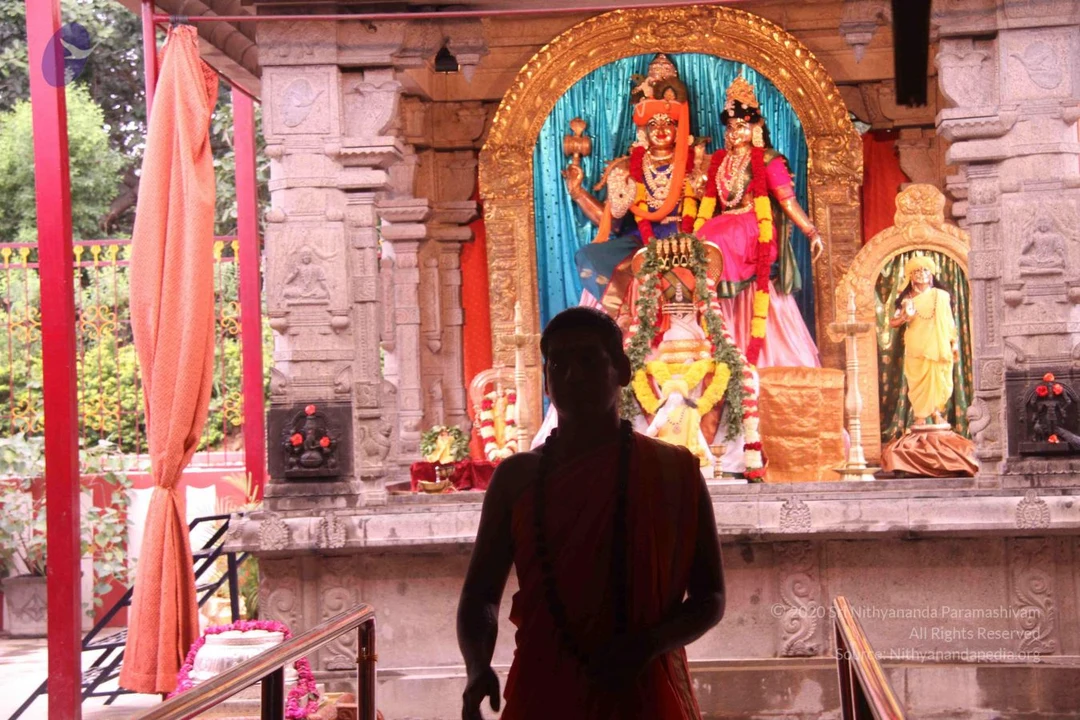
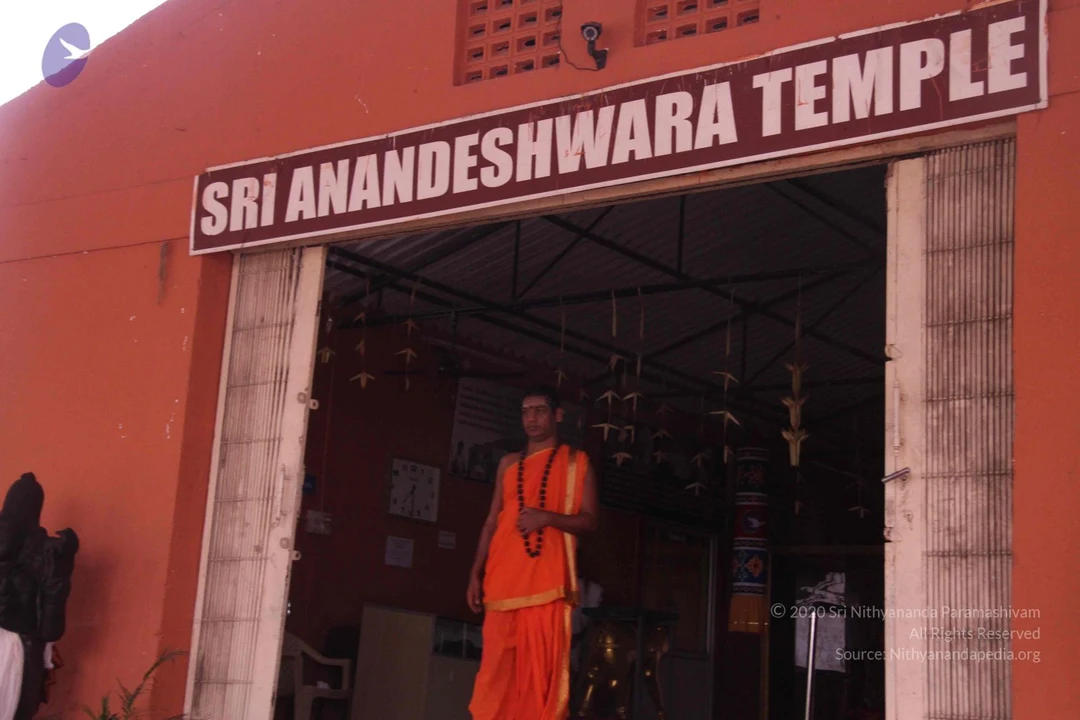
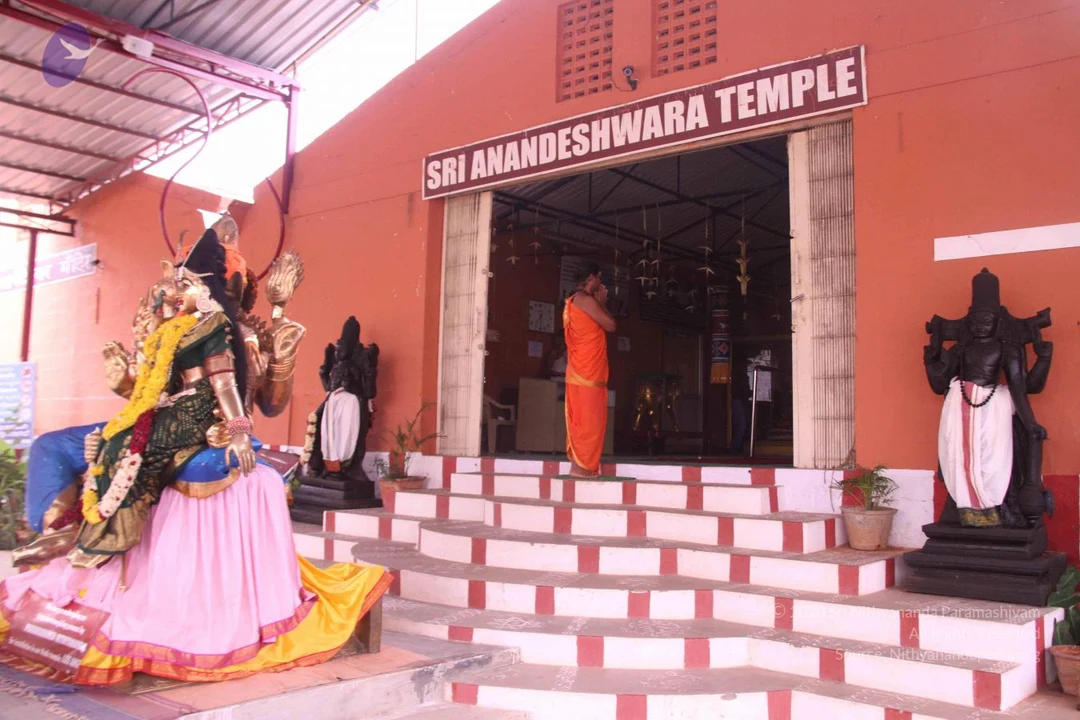
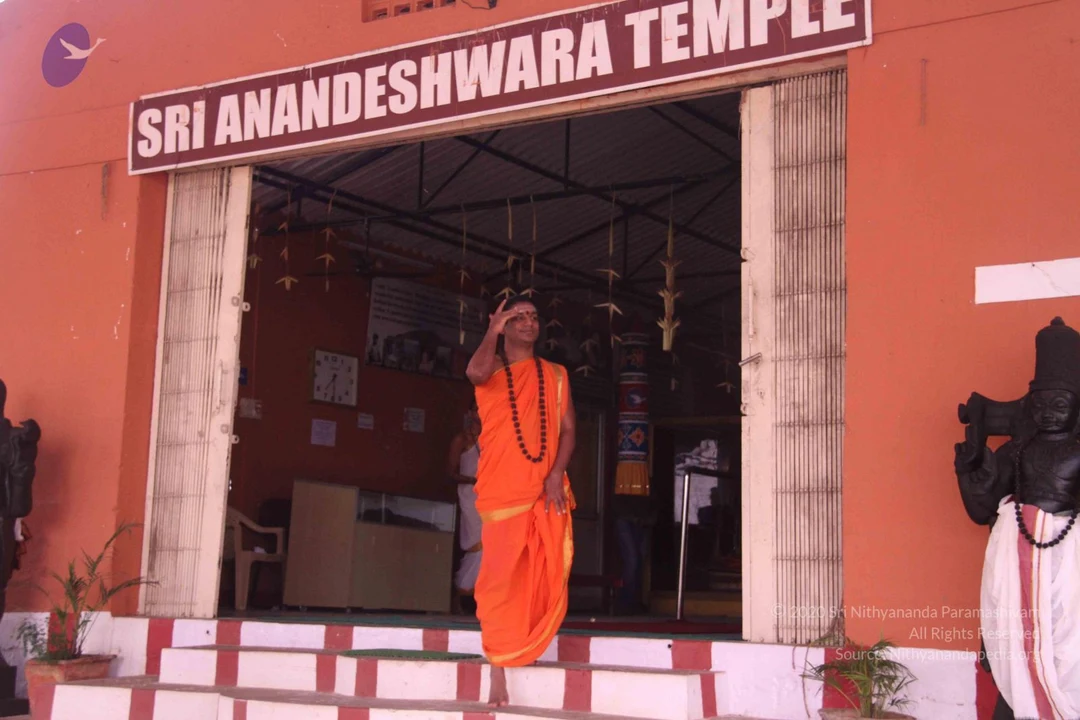
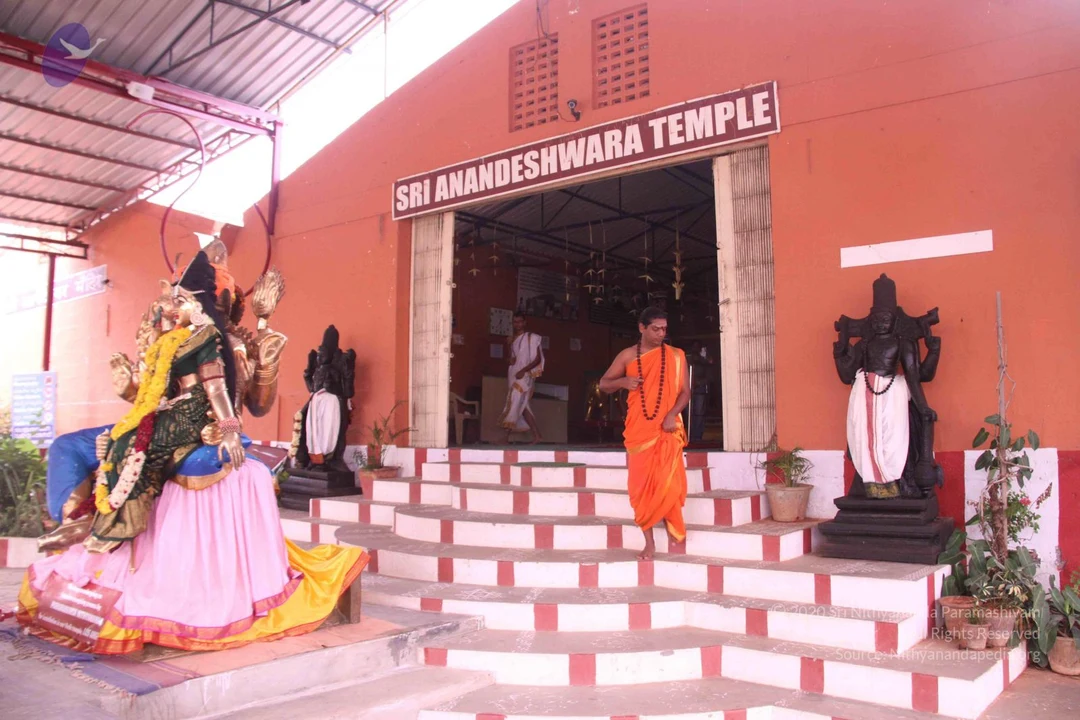
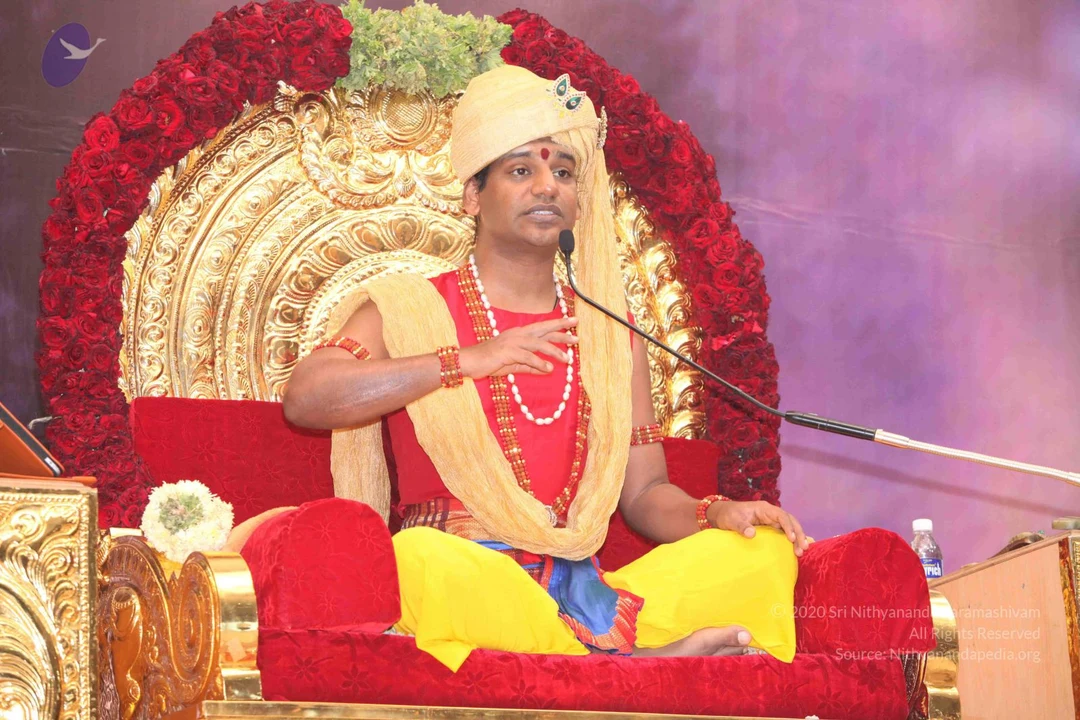
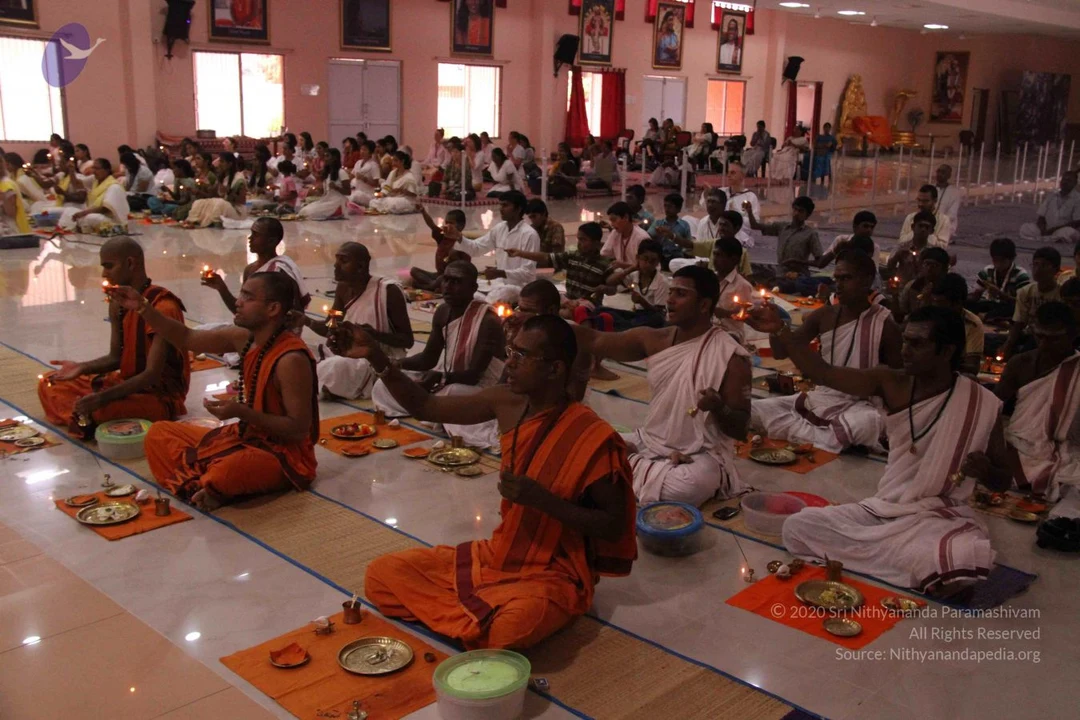
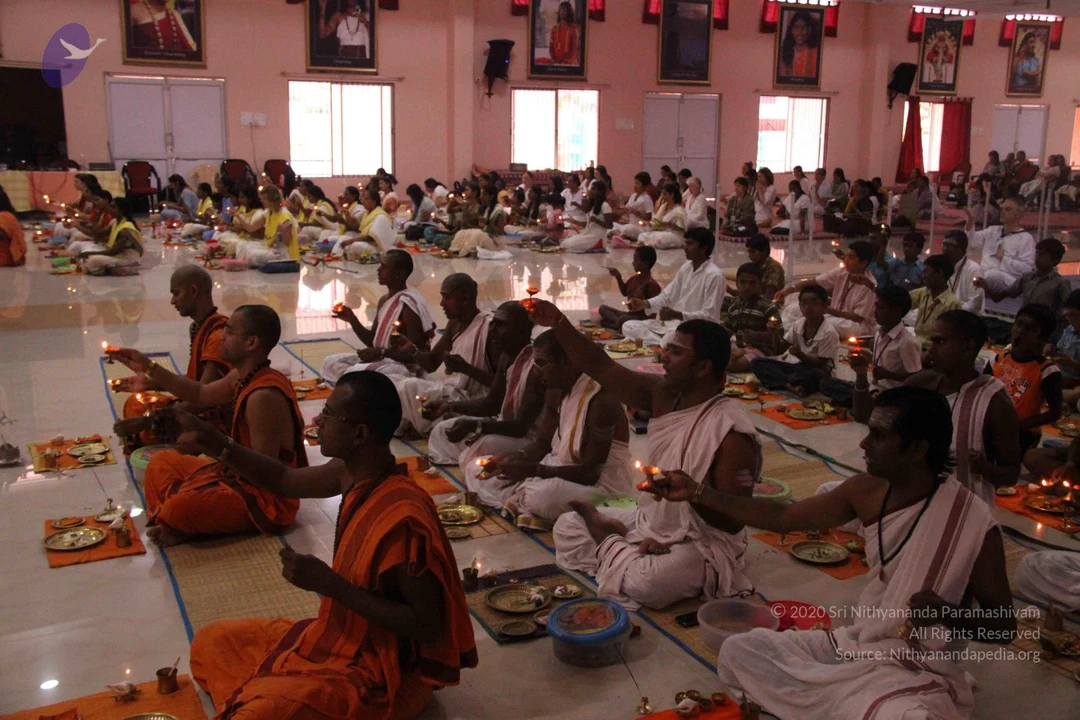
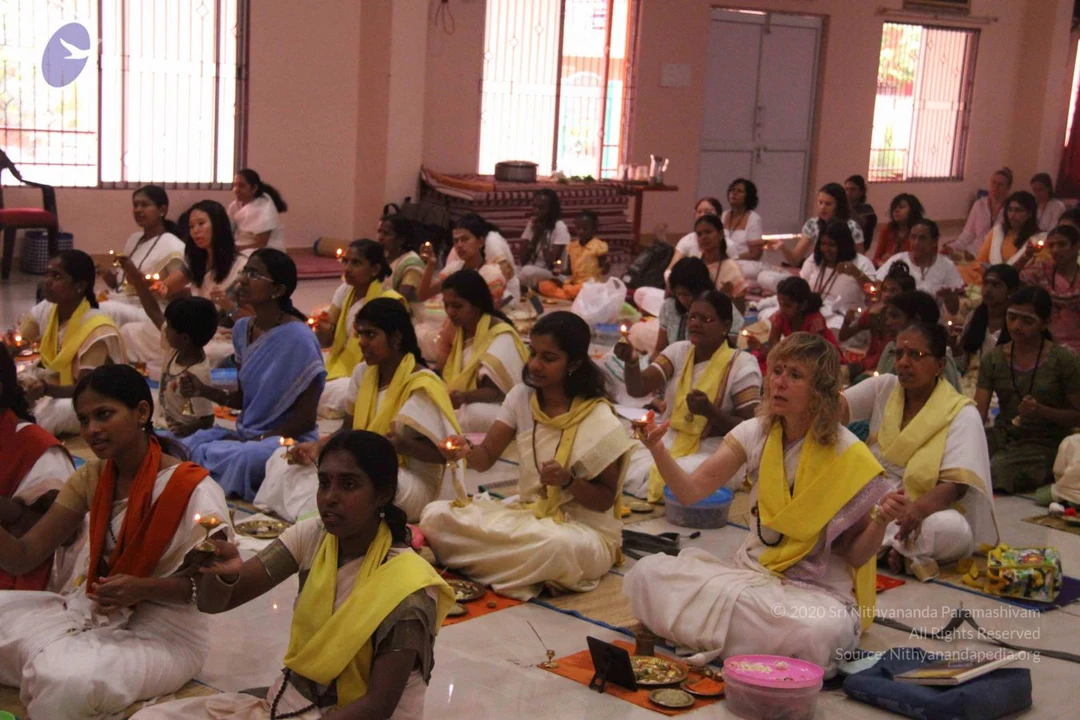
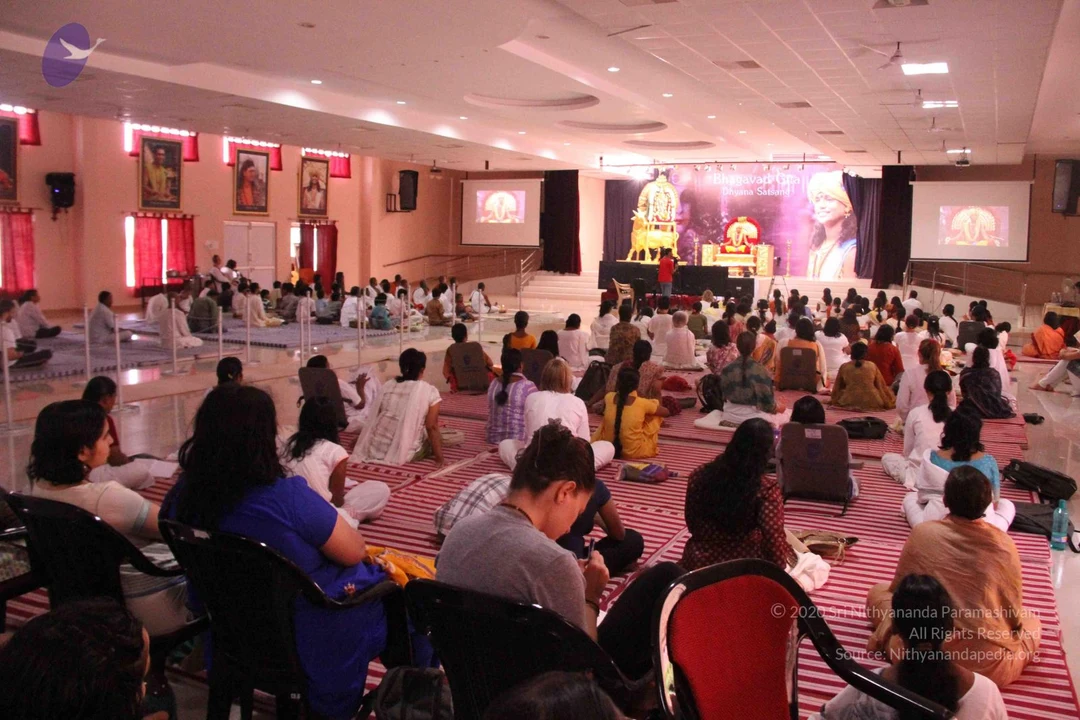
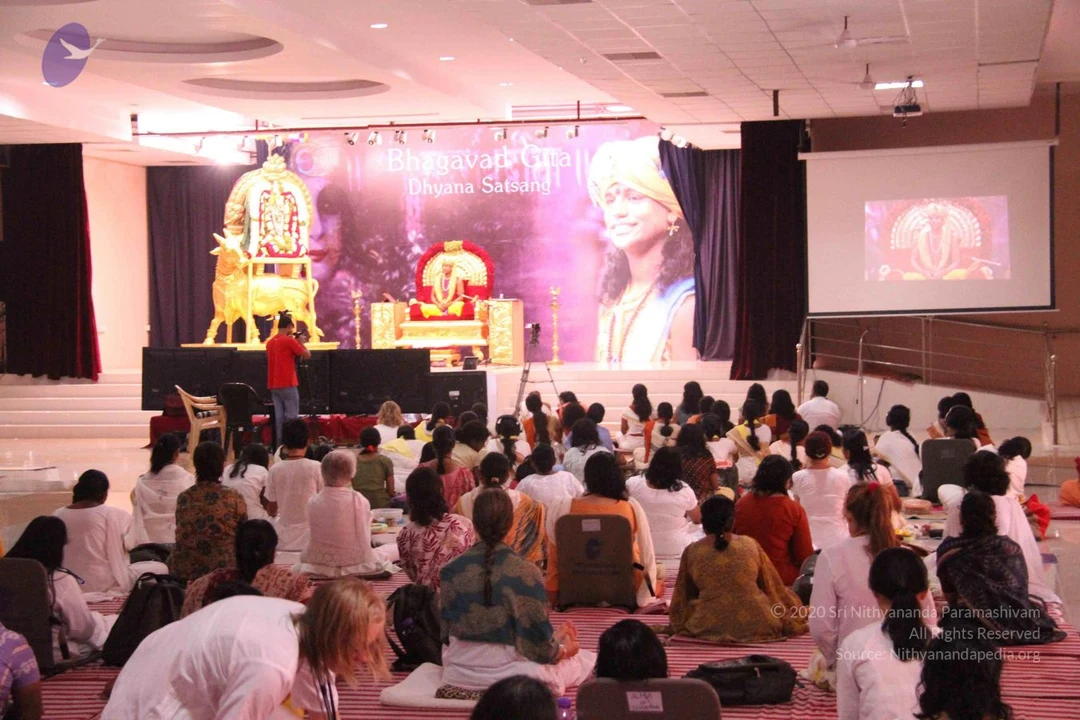
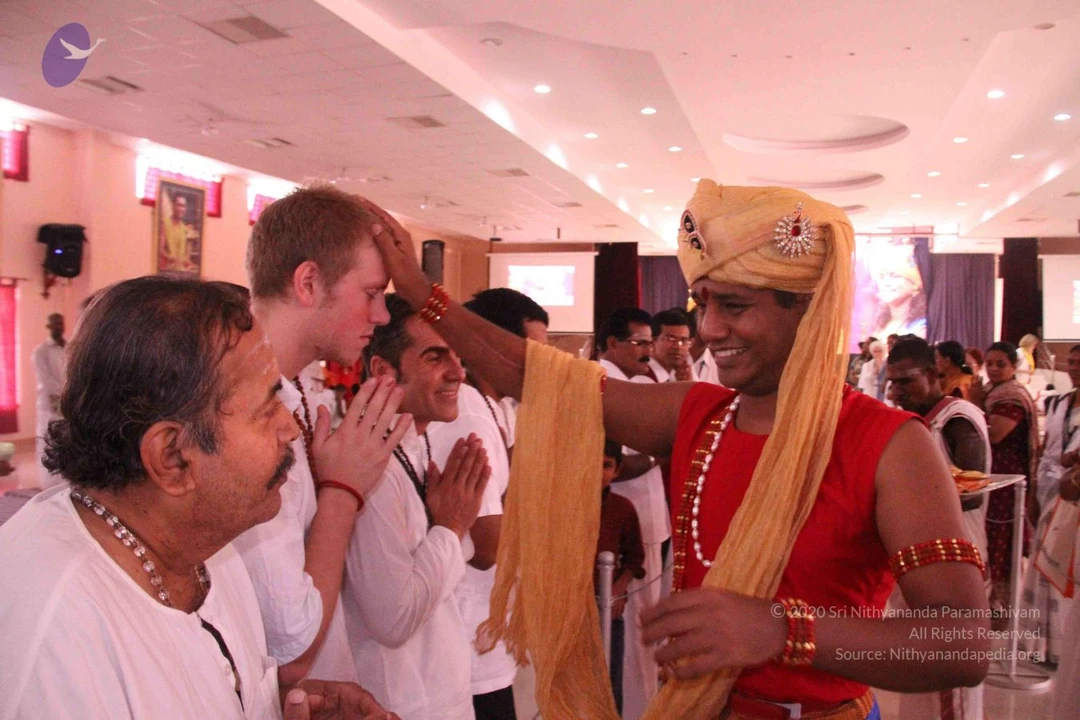
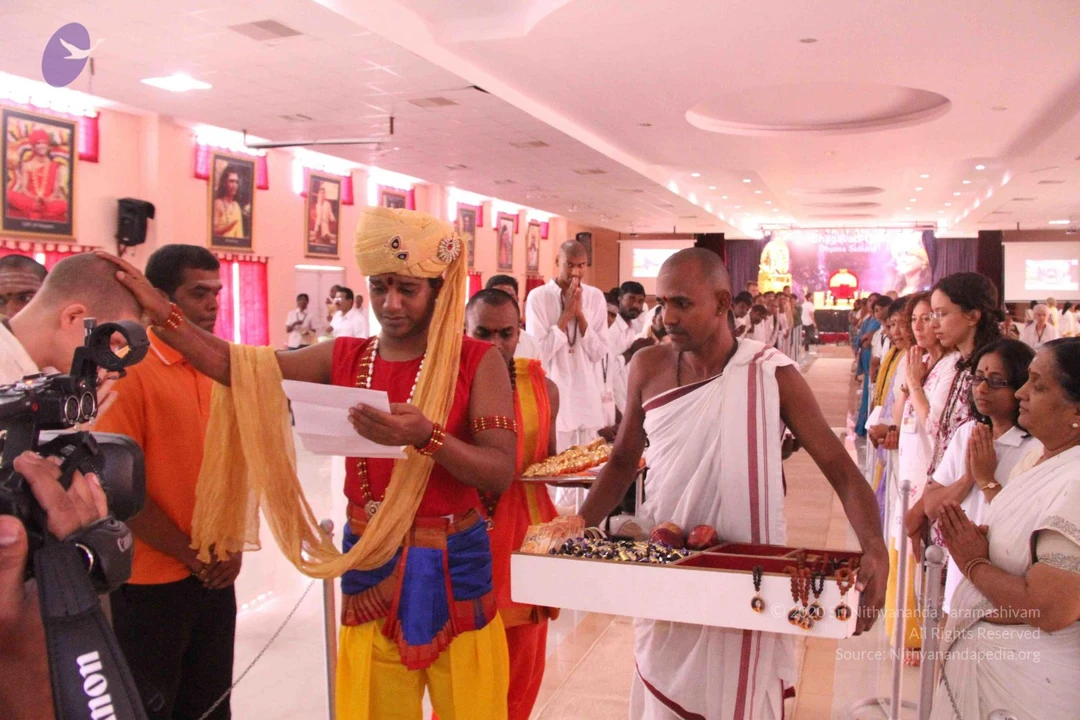
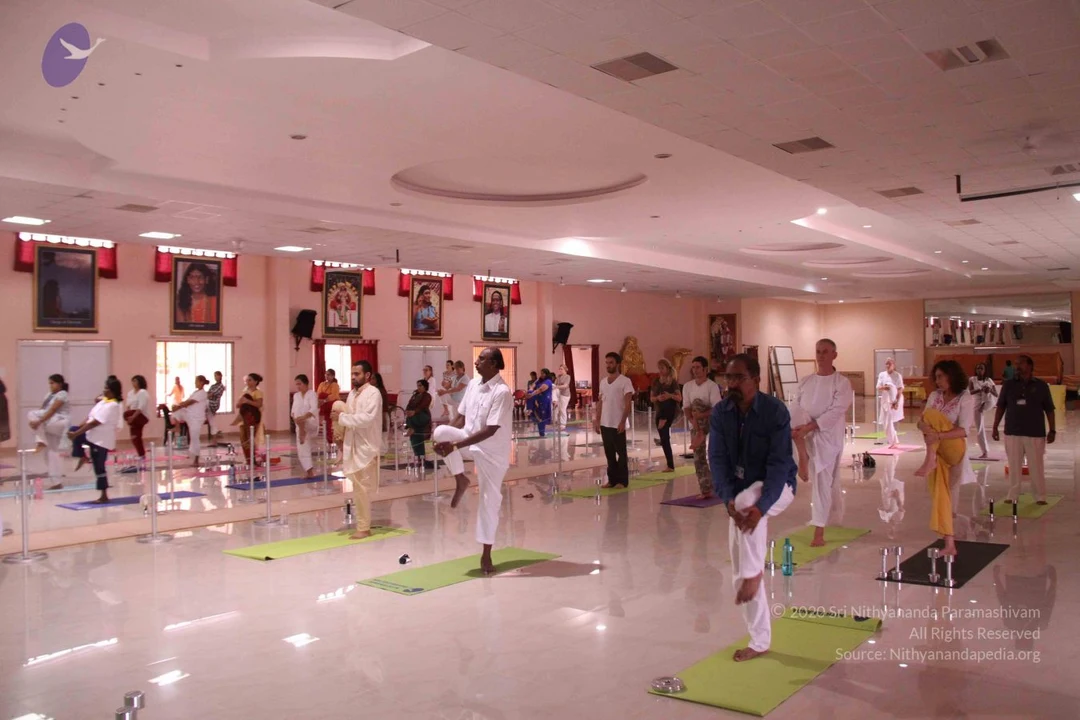
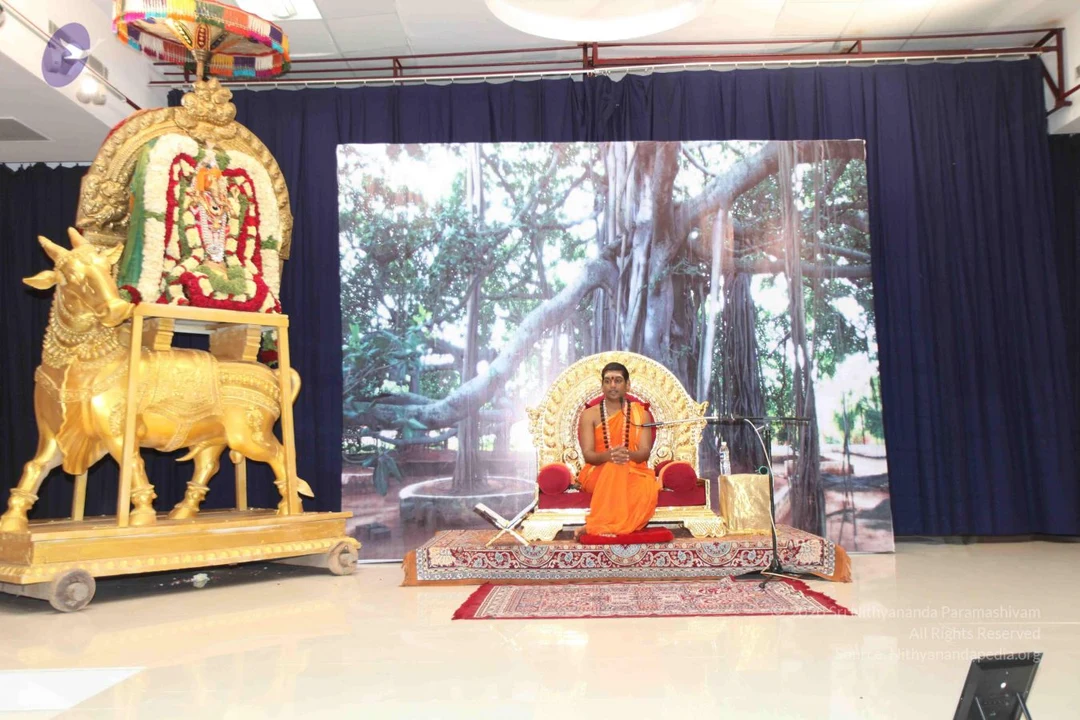
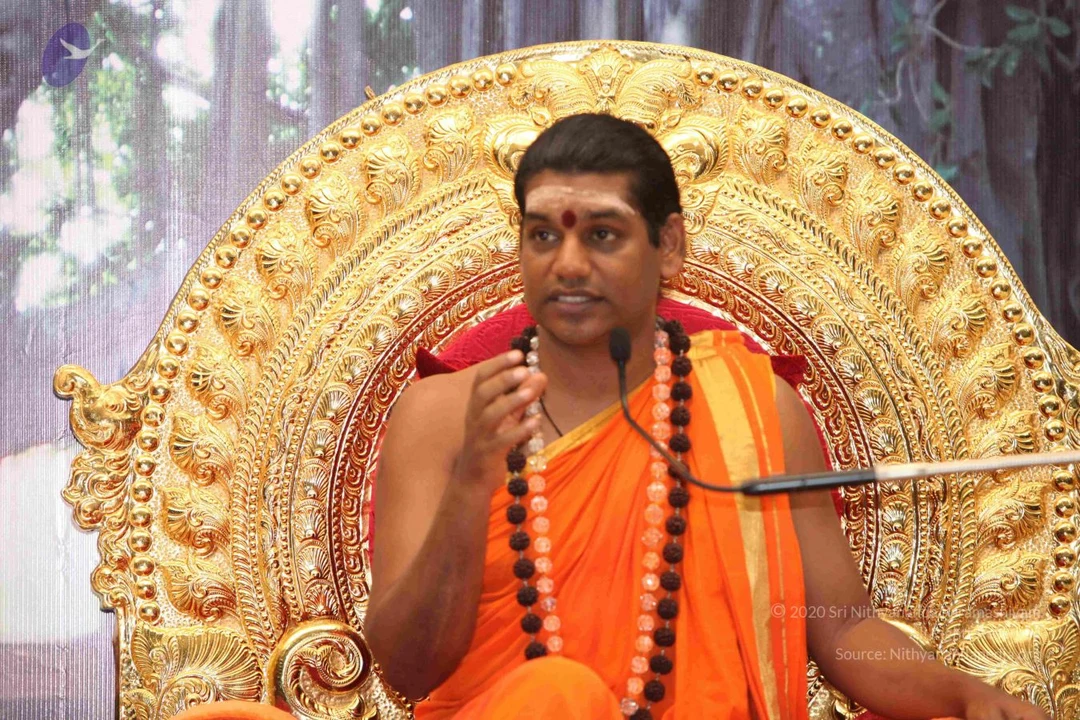
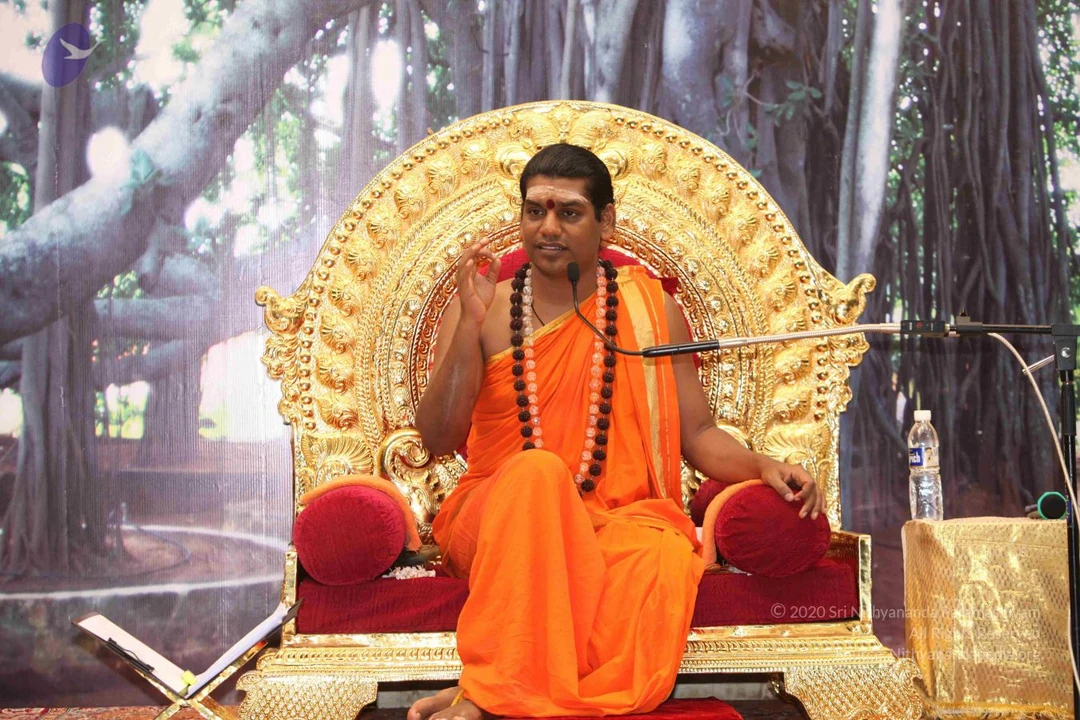
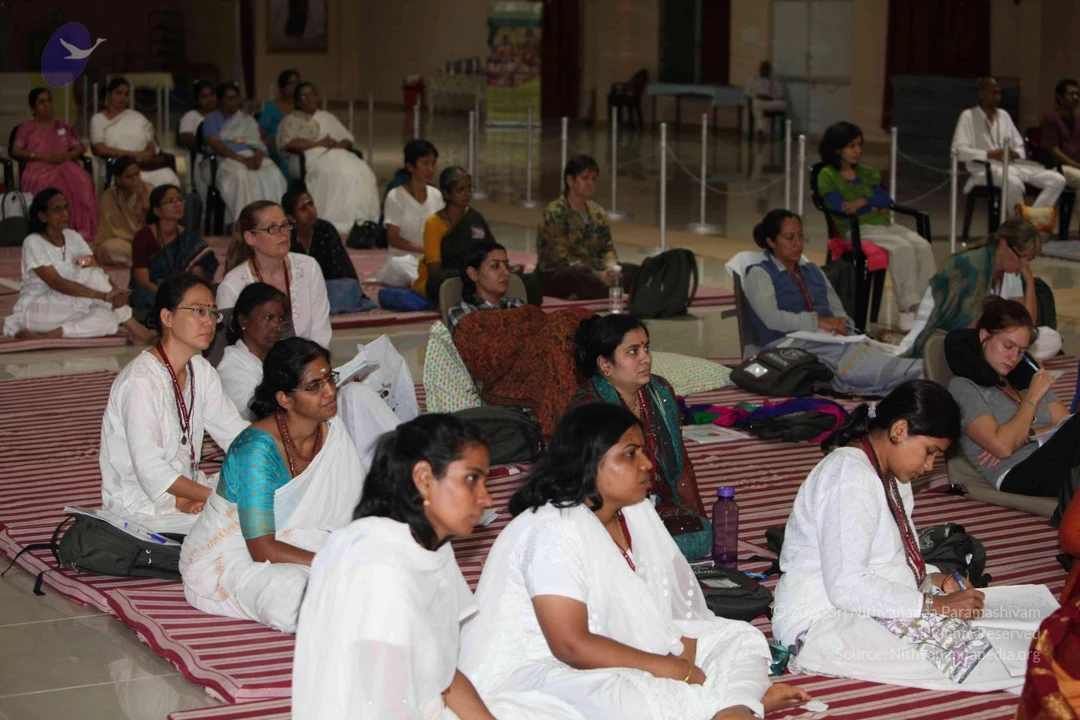
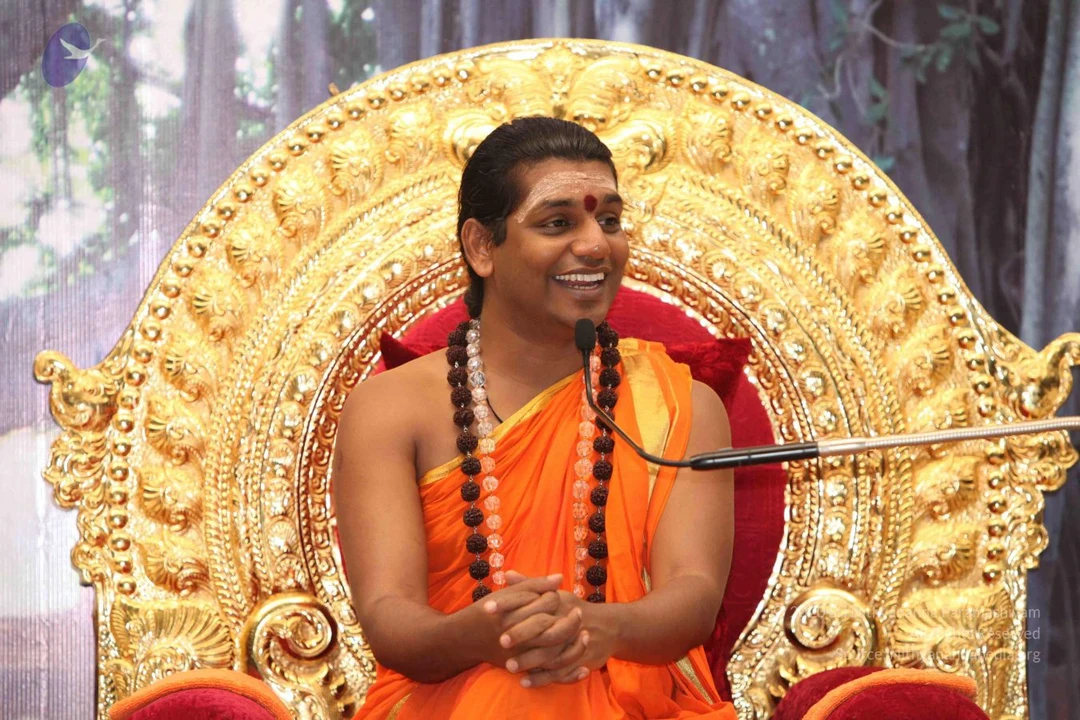
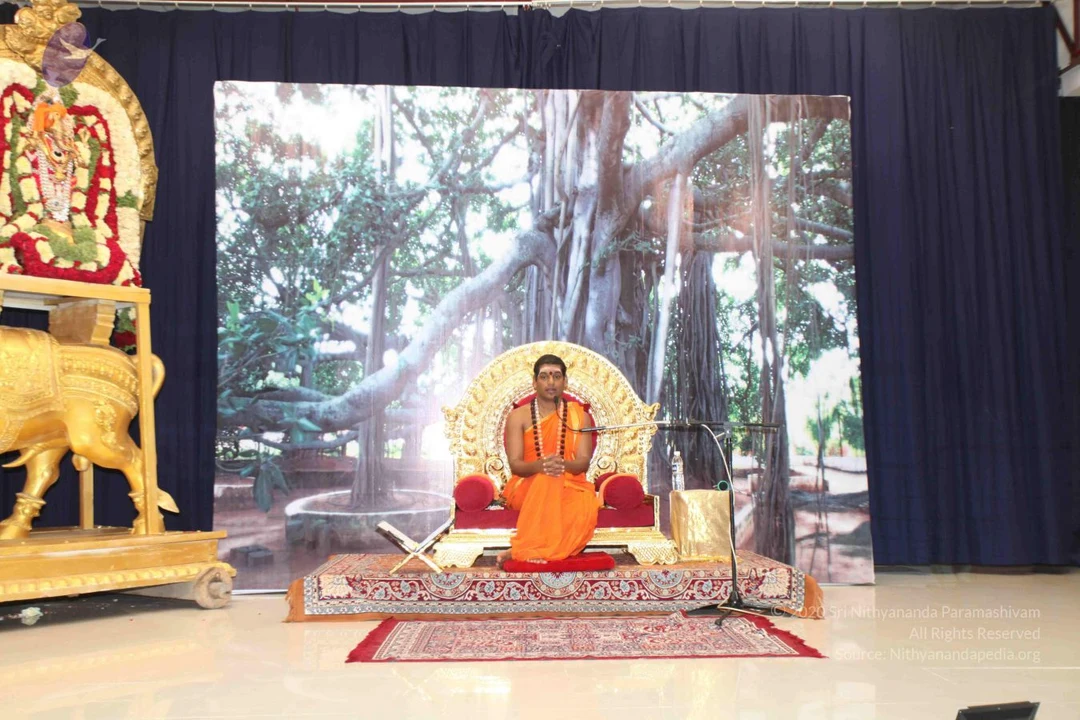
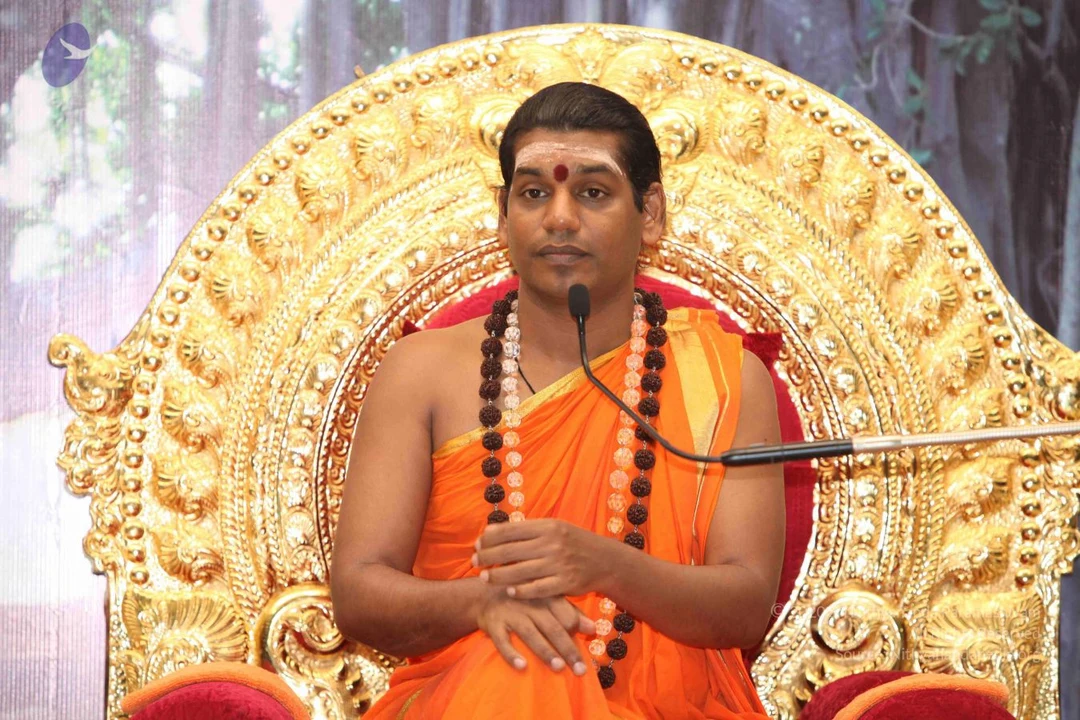
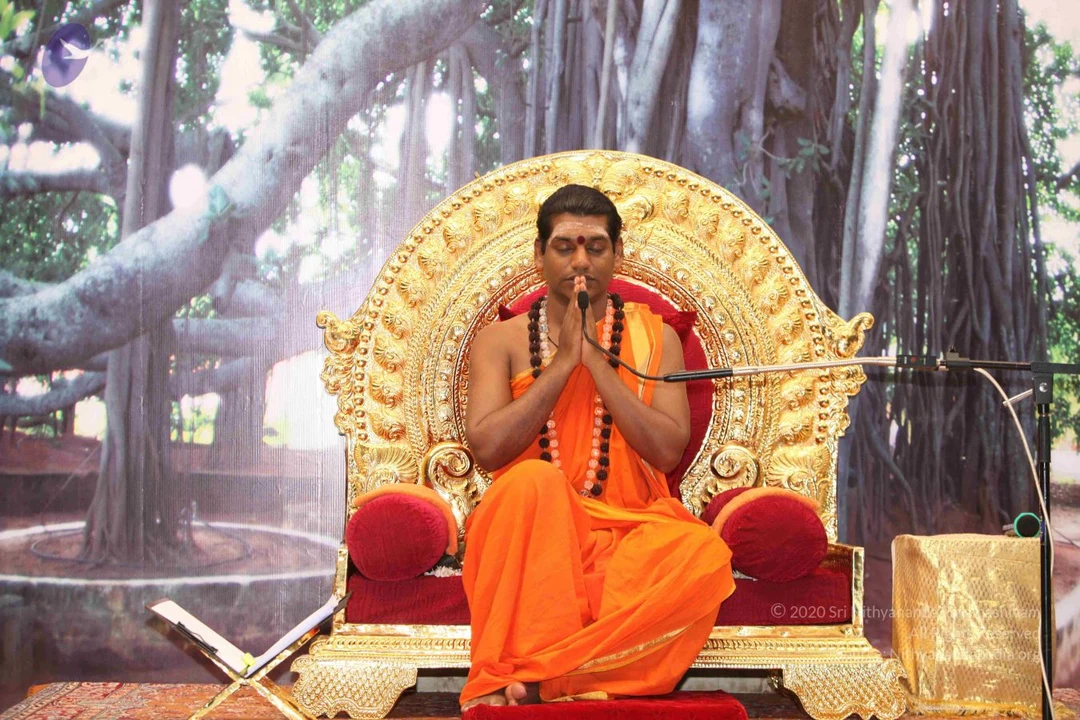
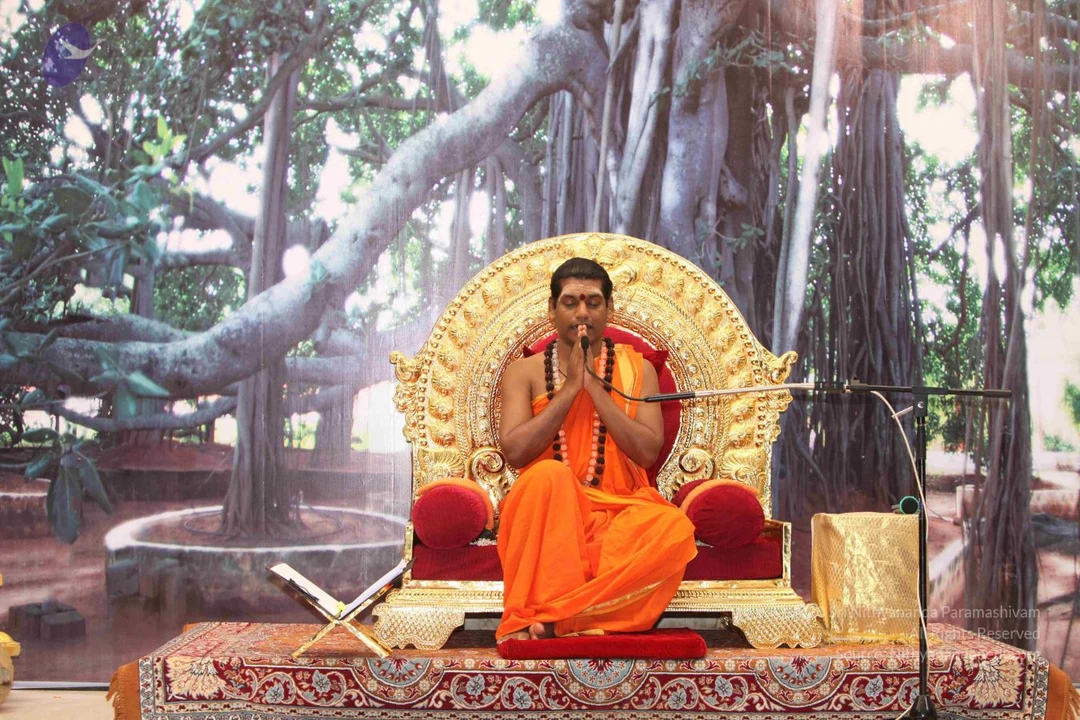
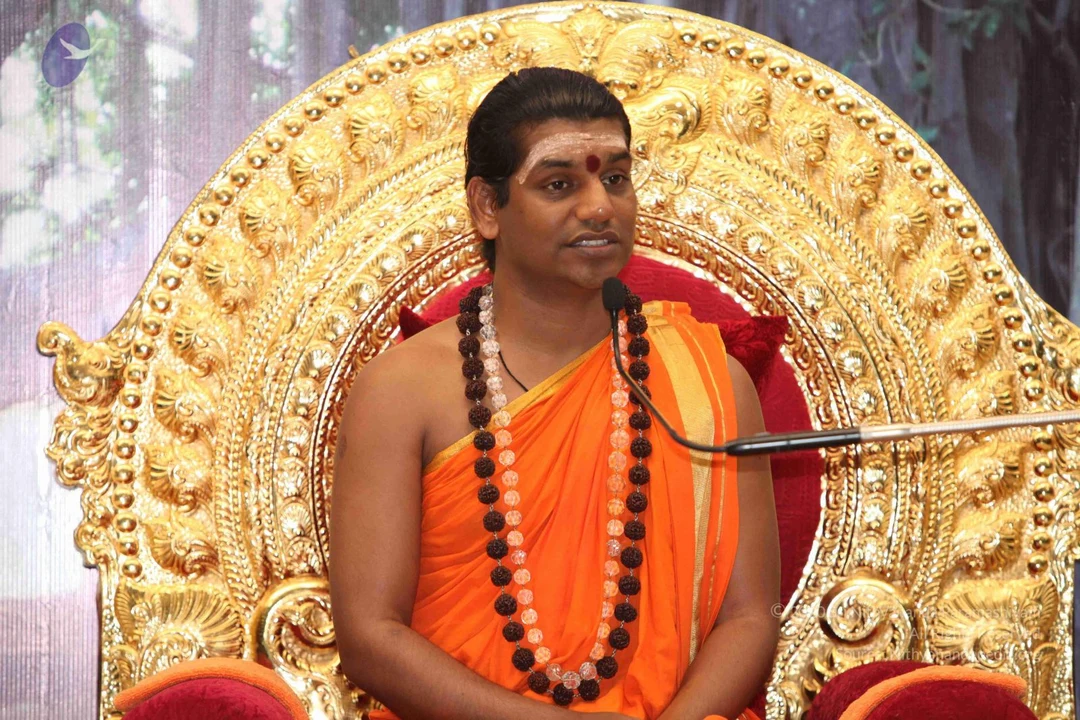
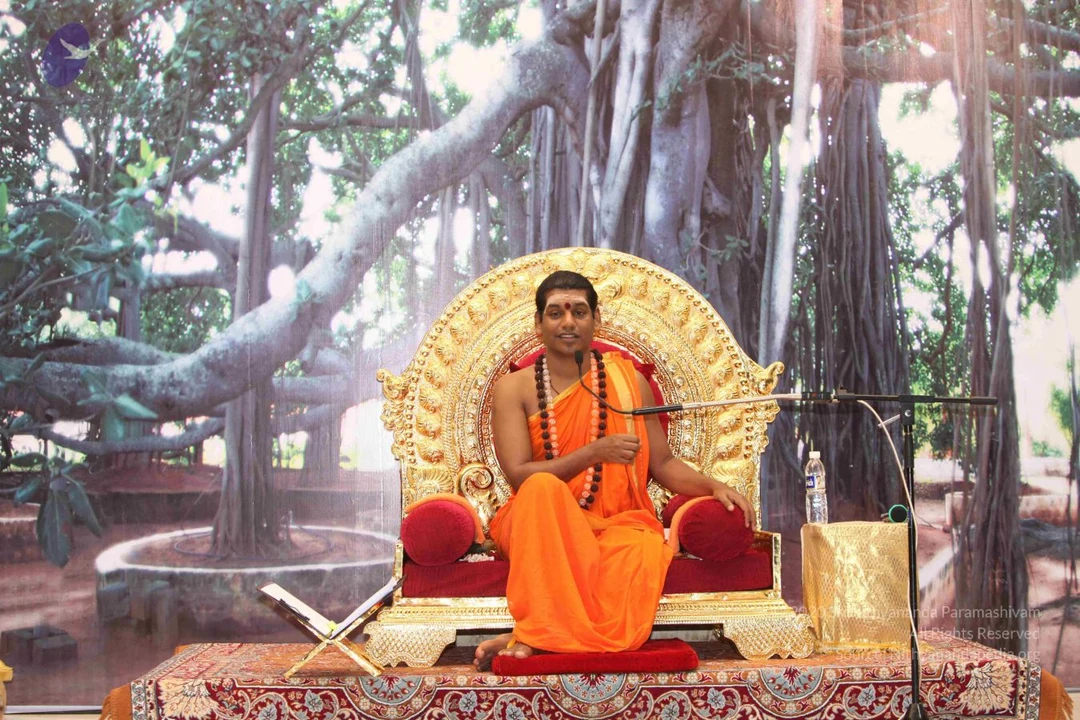
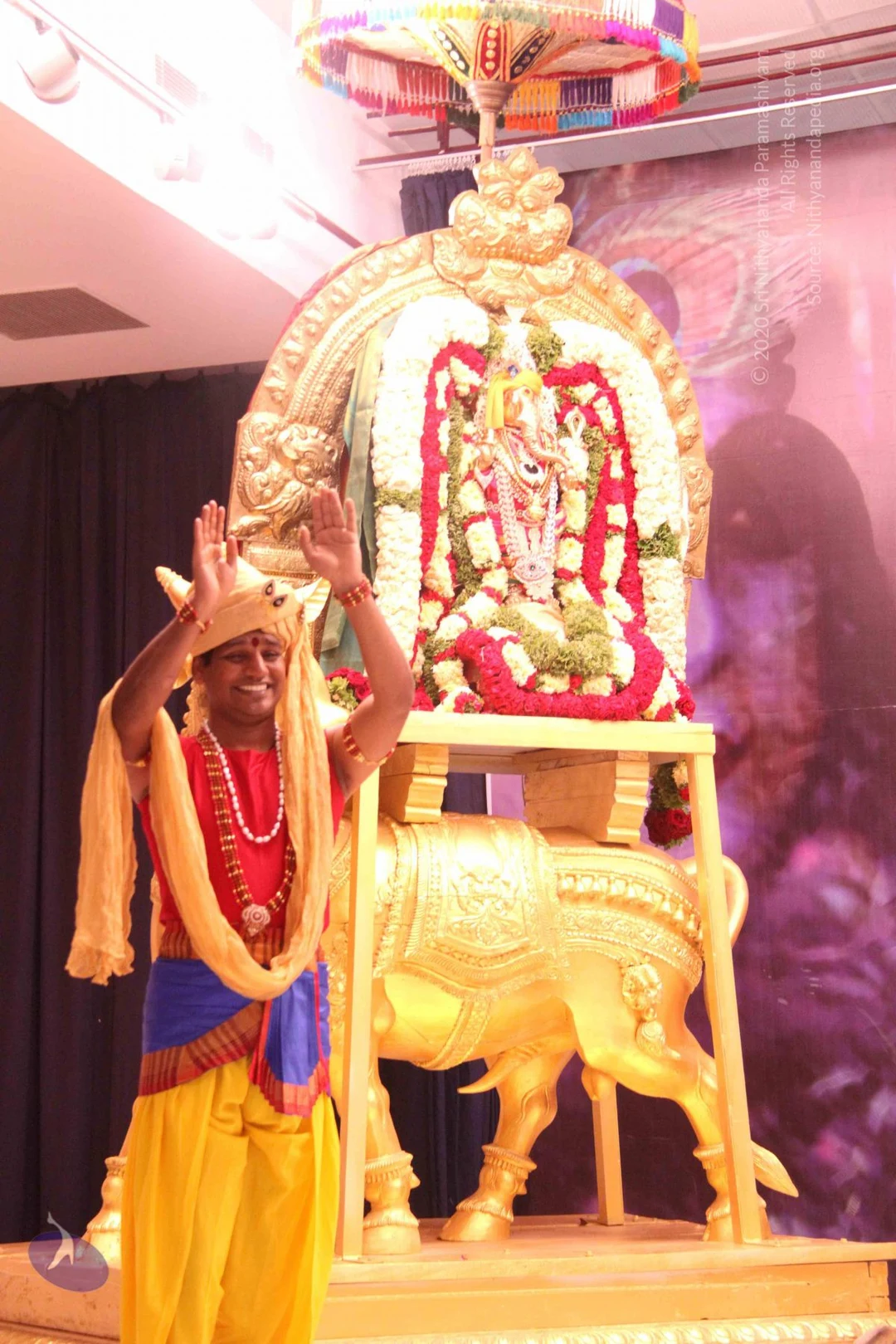
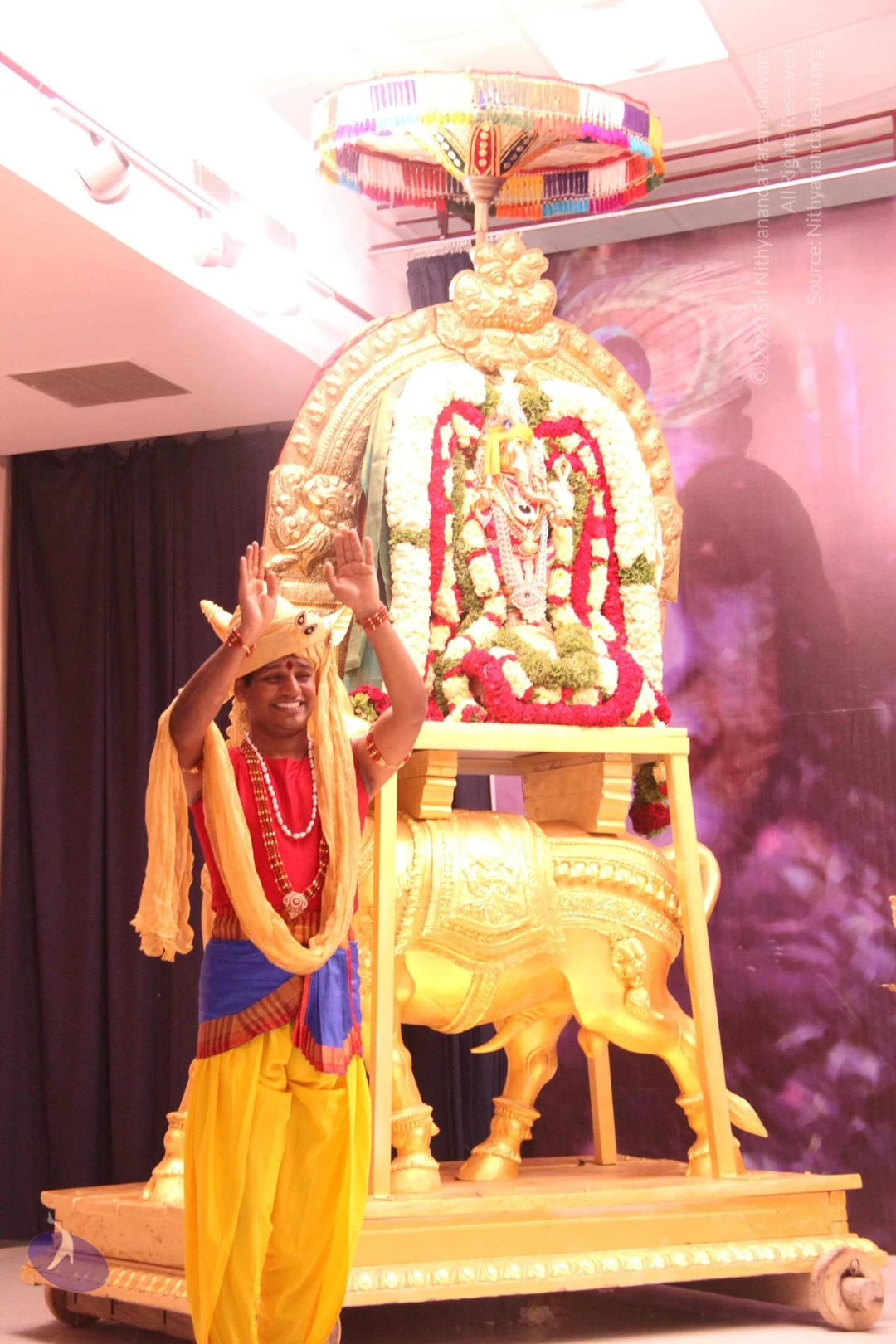
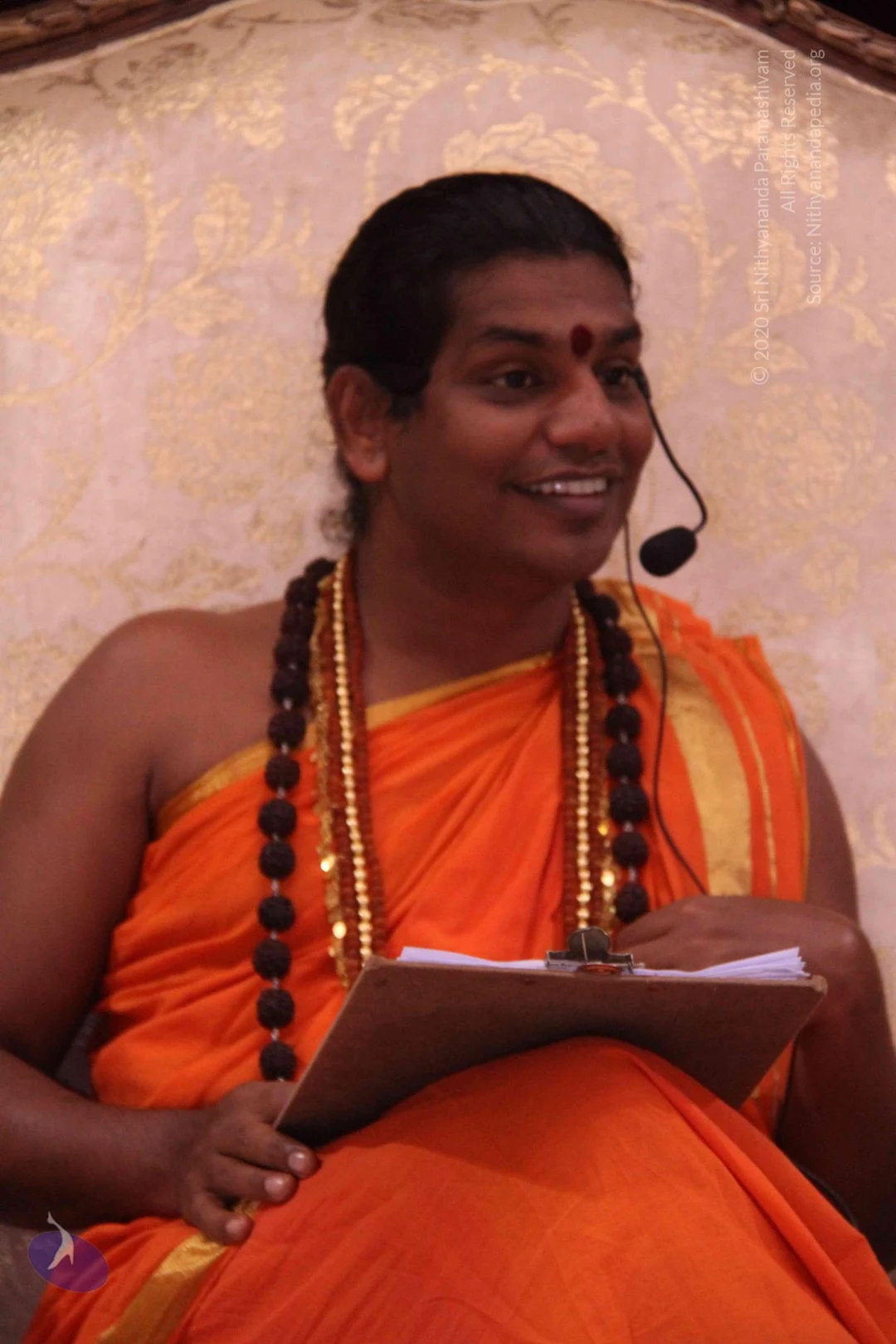
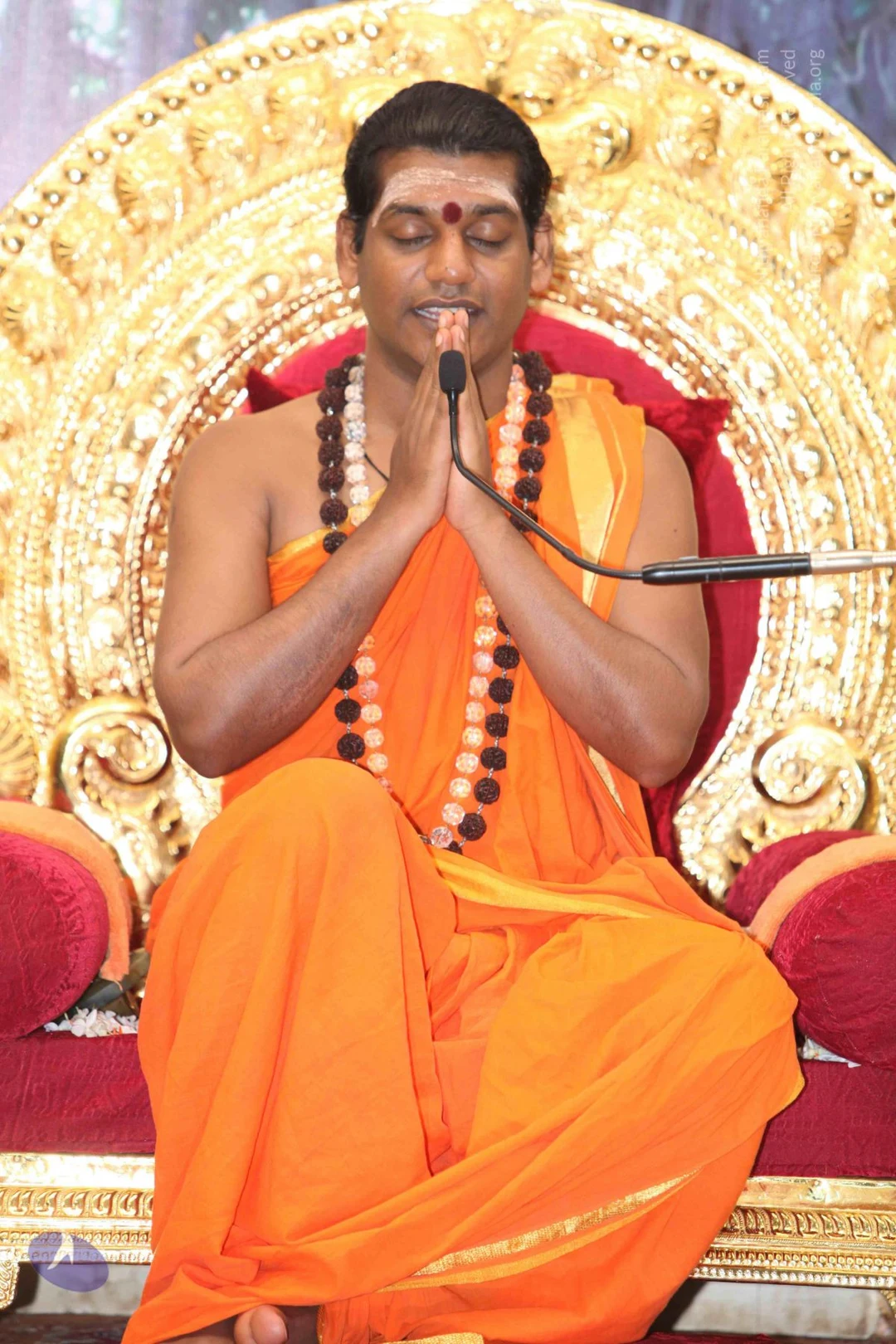
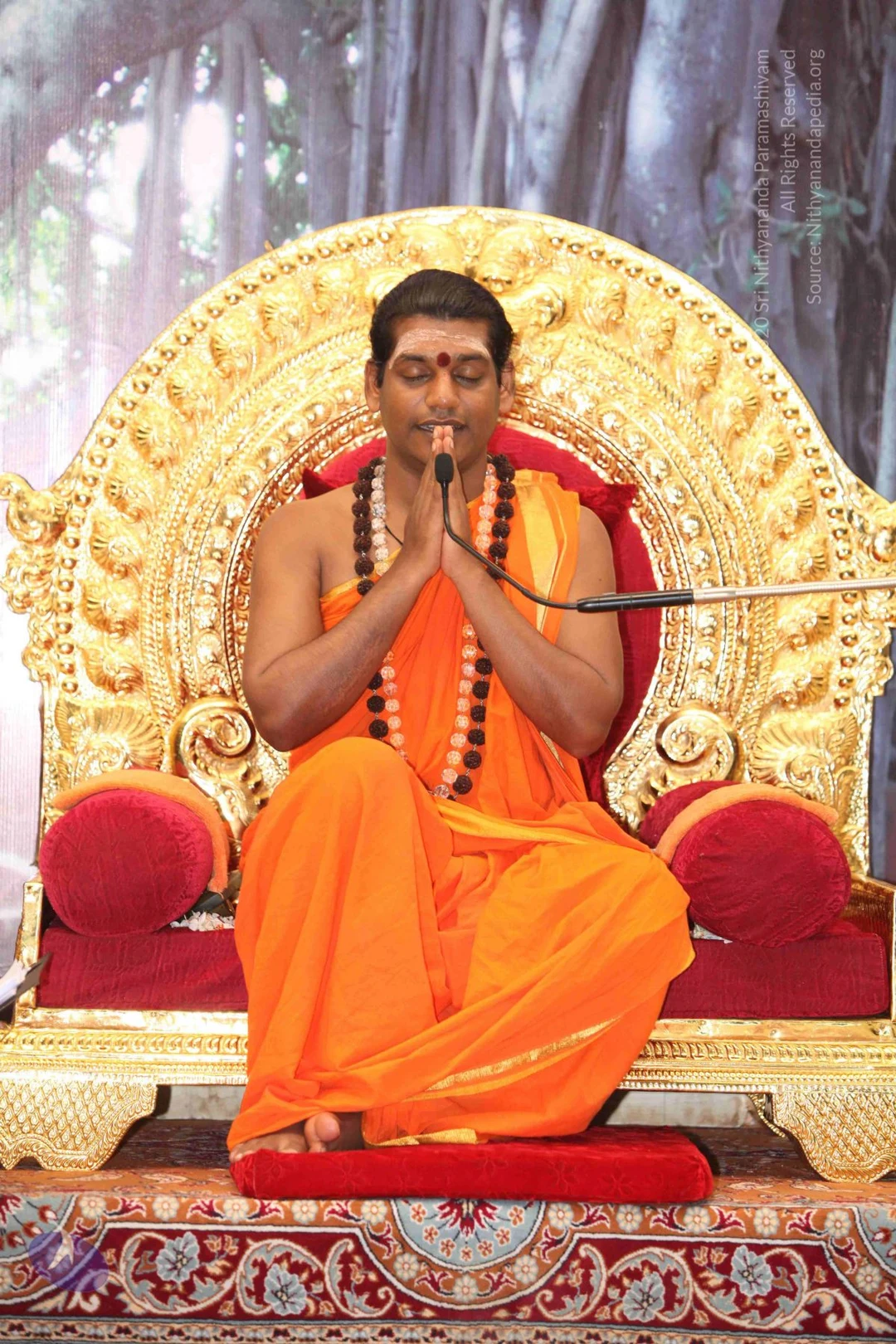
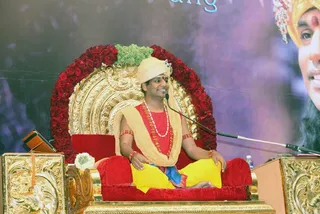
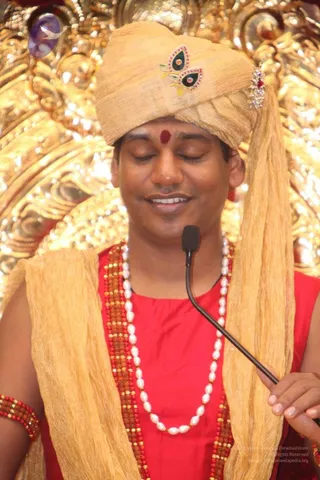
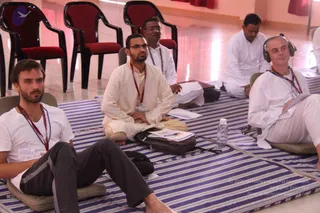
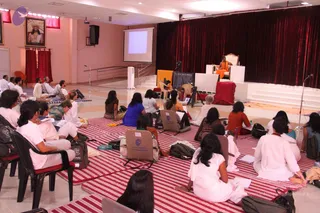
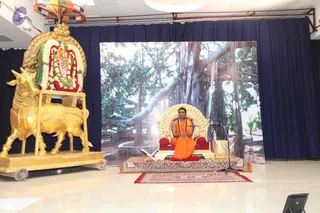
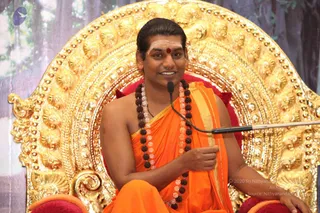
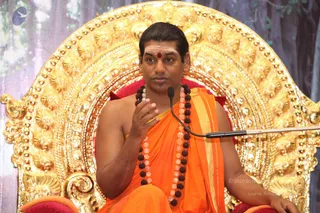
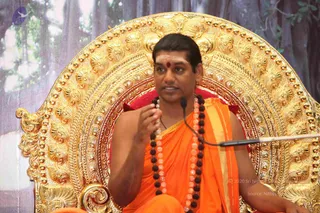
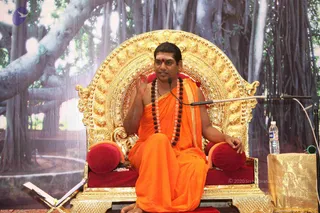
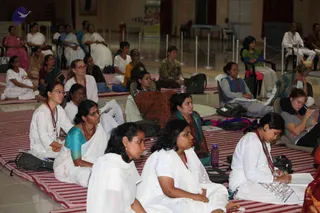
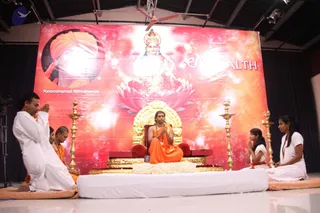
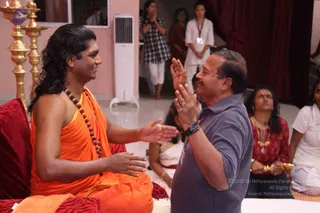
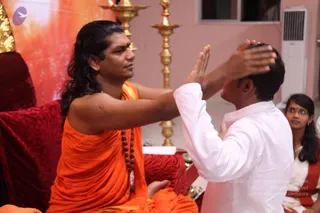
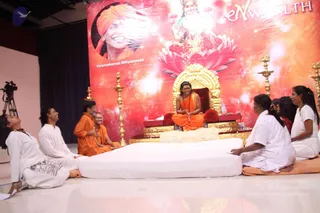
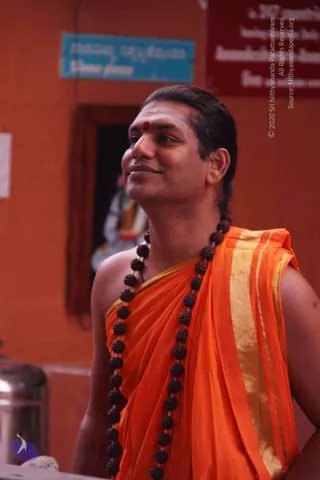
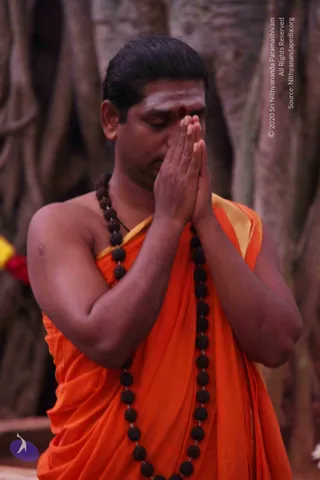
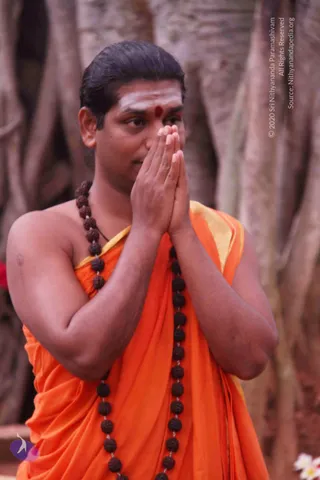
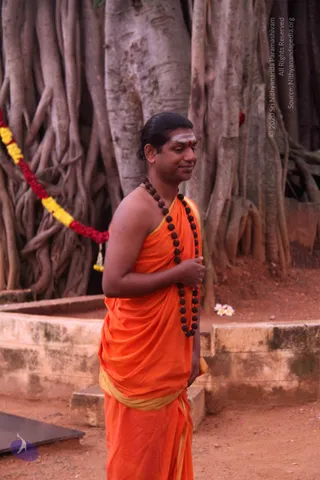
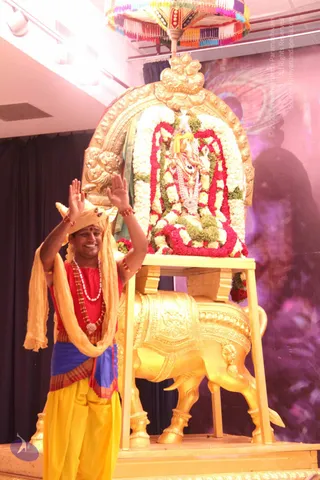
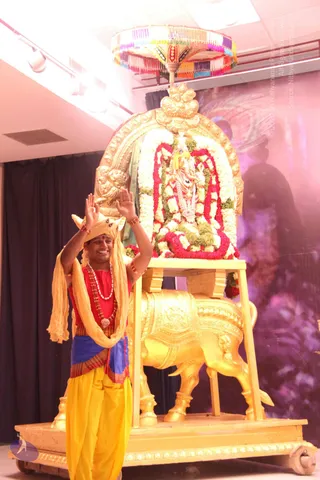
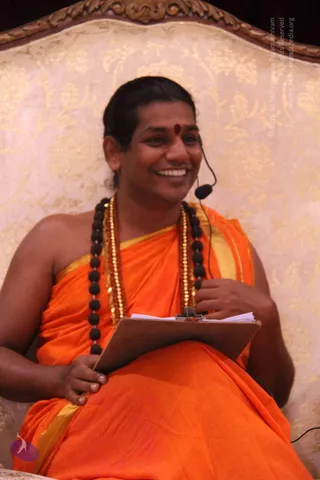
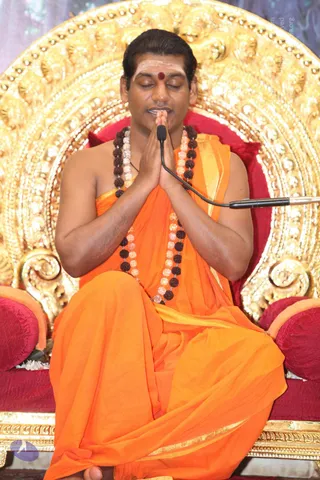
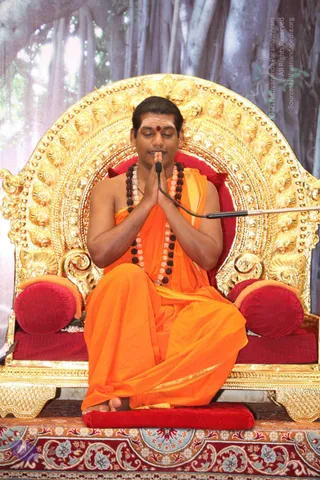
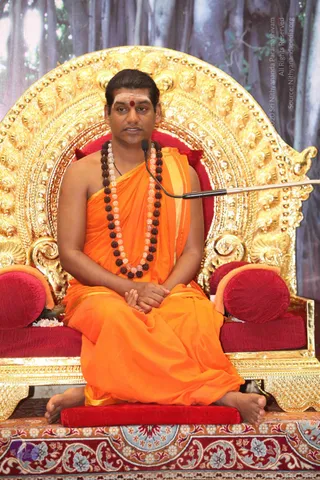
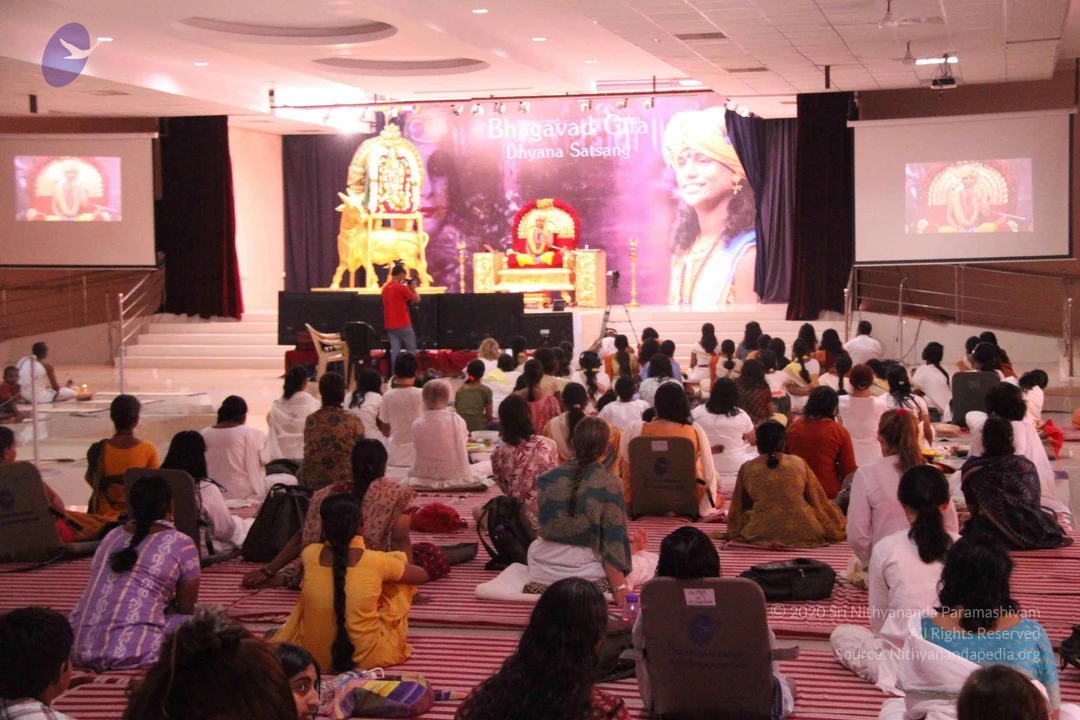
A large audience of mostly women sits on red and striped mats in a bright hall during a satsang. Many wear white garments, and others wear colourful saris and salwar kameez. A stage at the front has a gilded throne-like seat with a golden cow-and-chariot sculpture on the left, a red floral garland on the central seat, and an ornate deity murti on the platform. A standing man in a red shirt stands near the stage. A backdrop reads Bhagavad Gita Dhyana Satsang beside a large image of a figure with a turban and jewellery. A projection screen on the right shows a decorative deity image.A man seated cross-legged on an ornate gold throne with red cushions, eyes closed and palms pressed together in anjali mudra before a microphone stand. He wears an orange-saffron robe, a multi-strand rudraksha mala and a coral-and-bead necklace, with a red tilak mark on his forehead. Behind him a large painted backdrop shows banyan trees. A small open book on a stand sits to the left, and a gold-cloth covered object is at the right. a person is seated on the throne in saffron with rudraksha and coral malas, performing a greeting before a satsang discourse.A photograph of the entrance to a temple with a painted orange facade and a sign reading "SRI ANANDESHWARA TEMPLE" above the doorway. A man in a saffron-orange robe and a rudraksha mala descends white and red striped steps toward the viewer. Beside him is a bare-chested priest in white dhoti. To the left stands a large painted statue of a goddess in pink, yellow and green garments with marigold garlands and a gold crown. Two black stone deity murtis flank the doorway, and potted plants line the steps.

August 27 2011

Original wiki page
Contents

Title:

Arjuna: The ultimate possibility

Link to Video:

VideoAudio

Link to Video:

Just Drop Your Ideas About You
VideoAudio

Transcript:

(02:36) सदाशिव-समारम्भां शङ्कराचार्य-मध्यमाम्। अस्मदाचार्य-प्रयन्तां वन्दे गुरु परम्पराम् ॥ sadaashiva-samaarambhaaM sha~gkaraachaarya-madhyamaam| asmadaachaarya-prayantaaM vande guru paramparaam ||

I welcome you all, with my love and respects. Let’s enter into today’s Satsang. Yesterday, I ended the Satsang with the note saying, I’ll explain today why, Vyasa, is describing every name, every person’s name and their conch name, the name of their conch, in a very detailed way. Please understand, the whole Western science, from aircraft to weapons, everything functions based on electron – the light particles. But in the Eastern tradition, we used all energies, we did all the job the Western science is doing. Please understand, just today I was reading an article, I’ll talk about in a elaborate way in the next Shlokas, next Verses.

There is a solid proof, very clear recorded proof. We had aircrafts, and atomic weapons. Atomic weapons were used, in Mahabharata. In the Eastern tradition also, we had everything from the aircraft to the atomic weapons. But we handled, controlled did everything through sound particles. The western tradition all the equipment’s are getting operated, everything based on electricity, electron particles, light particles. The Eastern tradition, we were doing everything, based on sound, vibration. (05:39)

So each person, had his own signature sound. Each person, had his own way of creating certain sound waves. Please understand, I can tell you how, the aircraft which Ravana was using was functioning. He will sit in his pilot seat, and create certain sounds, very subtle sounds, and immediately, aircraft will take off. And same way, he will operate, divert the direction or increase the speed, reduce the speed everything just based on the sound waves.

(06:39)

Blowing the conch, is almost like a intensely releasing, all the possible sound waves this person can create. It’s like a preparation. Because, the sound, to blow the conch, to blow the conch you need to create from the source of the vaak. In Vedic tradition, the Eastern tradition, we were doing everything using sound. So each individual blowing their own conch, is like a signal they are sending, and the energy they are expressing. Actually, just by blowing the conch, Bhishma is able to raise somebody’s confidence, and destroy the opponent’s confident, opponent’s confidence.

Same way, when Krishna blows His conch, he is able to raise the confidence of Pandava army and destroy the confidence of Kaurava army, which is His own army. That is the reason, so much of detailed naming of every individual’s conch is done in Mahabharata. Vyasa, gives such details, actually, from last few days, morning evening both I am talking on Vyasa. Morning, the epic by Vyasa, evening the philosophy by Vyasa. It’s unimaginable, one brain can do both the job, such an extraordinary poet and a story writer, historian and such and extraordinary philosopher.

(09:18)

See whatever happened in the outer world during His time, He recorded as Mahabharata. Whatever was happening in the inner world; all thought trend, thought current, philosophies everything, he compiled and put it as Brahma Sutras. Whatever was happening in the outer world, he compiled everything and recorded as Mahabharata. Whatever was happening in a inner world, means all thought currents, thought trends, the philosophies everything he has recorded and presented as Brahma Sutras.

Impossible for a man, to have this breadth. See, Mahabharata needs breadth, what a breadth He is covering. See Mahabharata is not just a history book, He describes the geography of the 54 desas very clearly. The places, which were not under the control of any king, even those things, Vyasa describes very clearly. You can’t imagine a human brain, can do so much. That is why, we consider Vyasa as a incarnation of Vishnu. Vyasa is also considered as an incarnation. That’s why the stotra says

“शंकरं शंकराचार्यं केशवं बादरायणम् ।“ (shankaram shankarAchAryam keshavam bAdarAyaNam)

Vishnu comes as Bhadarayana – man who is able to educate, people in the outer world, in the breadth. Same way He is able to educate people in the inner world also, the depth. What a depth! Nobody after Vyasa can claim, any supernatural things, in the planet Earth. He is the ultimate supernatural, happened. Please understand, including me, whatever I am doing is natural, because you don’t understand you call it as supernatural. But Vyasa, is supernatural even for me.

(12:22)

See, calling something as supernatural because you don’t understand is not supernatural. Calling something as supernatural, because you understand but you are flabbergasted, you are just shaken; you understand the breadth and depth but you can’t grasp how can this happen, that is supernatural. Whatever is happening in my presence, because you don’t understand the science you call it as supernatural. Vyasa, is really something extraordinary, supernatural.

Let me enter into today’s verses. In Bhagavad Gita, first chapter, 19th verse:

स घोषो धार्तराष्ट्राणां हृदयानि व्यदारयत् | नभश्च पृथिवीं चैव तुमुलोऽभ्यनुनादयन् ||1-19||

sa ghoṣho dhārtarāṣhṭrāṇāṁ hṛidayāni vyadārayat nabhaśhcha pṛithivīṁ chaiva tumulo abhyanunādayan

(saḥ—that; ghoṣhaḥ—sound; dhārtarāṣhṭrāṇām—of Dhritarashtra’s sons; hṛidayāni—hearts; vyadārayat—shattered; nabhaḥ—the sky; cha—and; pṛithivīm—the earth; cha—and; eva—certainly; tumulaḥ—terrific sound; abhyanunādayan—thundering)

The translation goes, “The terrible sound echoing, through the sky, and the earth rent the hearts of the sons of Dhrutraashtra.”

Here Sanjaya, who is describing the whole thing, to Dhrutraashtra, is saying – understand, the sound, coming out of, all the sons of Pandava, the terrible sound, is entering into the hearts of the sons of Dhrutraashtra. Please understand, Sanjaya is not saying when Bhishma’s conch sound was heard, he is not saying all the Pandavas are shaken. See very subtle way, even Sanjaya is giving enough hints, what is going to be end of the story. He does not say, the conch of Bhishma, and the accompanying sound of trumps and trumpets of Kaurava army, caused any concern amongst the Pandava army.

(15:41}

But with the roar of the conches of Pandava warriors, Sanjaya says, that the hearts of the sons of Dhrutraashtra, were shattered. He says that the blowing of the conches, created vibrations in the sky, upon the earth. Actually, blowing of the conch is used, as a attack on the missiles. If there are missiles coming from opposite side, just by the blow of the conch they will destroy those missiles. The missiles will fall. Just by the blowing of the conches, created the vibration in the sky, and that very vibration, filled, the hearts of the Duryodhana’s army, the Kauravas, and they were shattered.

The next verse Vyasa describes:

अथ व्यवस्थितान्दृष्ट्वा धार्तराष्ट्रान् कपिध्वज: | प्रवृत्ते शस्त्रसम्पाते धनुरुद्यम्य पाण्डव: | हृषीकेशं तदा वाक्यमिदमाह महीपते ||1-20||

atha vyavasthitān dṛiṣhṭvā dhārtarāṣhṭrān kapi-dhwajaḥ pravṛitte śhastra-sampāte dhanurudyamya pāṇḍavaḥ hṛiṣhīkeśhaṁ tadā vākyam idam āha mahī-pate ||1-20||

atha—thereupon; vyavasthitān—arrayed; dṛiṣhṭvā—seeing; dhārtarāṣhṭrān—Dhritarashtra’s sons; kapi-dwajaḥ—the Monkey Bannered; pravṛitte—about to commence; śhastra-sampāte—to use the weapons; dhanuḥ—bow; udyamya—taking up; pāṇḍavaḥ—Arjun, the son of Pandu; hṛiṣhīkeśham—to Shree Krishna; tadā—at that time; vākyam—words; idam—these; āha—said; mahī-pate—King

Seeing the sons of Dhrutraashtra arrayed in the battlefield, Arjuna, the son of Pandu, who was seated in his chariot, bearing the flag marked with Hanuman, took up his bow.

(18:08)

Now the character Arjuna is introduced, first time in Bhagavad Gita, hero, of whole Bhagavad Gita. Understand, nobody else, other than Arjuna, can be a, receiver of a great book like Bhagavad Gita. Please understand, when a statue is created, it is not only the greatness of the metal poured, into it. The greatness of the mold also plays the role. Same way; see Krishna’s intelligence is like a metal, like a gold, melted gold, molten gold. It’s getting poured. It is Arjuna’s mental setup, which acts like a mold. How the gold is going to get stored, how the gold is going to get frozen, how the gold is going to become a statue, that is decided, only based on, the Arjuna’s mental setup.

All the great things, this book expresses, Arjuna is also responsible for it. Please understand, Arjuna is also responsible. Even, some boring things in this book, like a repetition. Please understand, when you read Bhagavad Gita first time you will feel, there are lot of repetition. Even I used to feel, ‘god... what kind of patience, Krishna is having, what a way! He is teaching.’ Arjuna, unique character, sometime he acts very dumb, so that the teachings received, is helped, is useful, even to the dumbest people on the planet earth. I can be sure, he can’t be so dumb, after-all a king.

He can’t be so dumb to ask the same questions again and again. Maybe he is asking so that even, ordinary people can understand the truths of Bhagavad Gita. The glorious expression, of Bhagavad Gita, not only Krishna is responsible, Arjuna also is responsible. Because the man who receives, his intelligence, plays a main role the way in which the teachings are given. One side Arjuna has to be highly intelligent, only then, the ultimate teaching, the Rajavidya can be given. Krishna gives Rajavidya here, Supreme knowledge. And Rajaguhya, the most secret.

(23:05)

Please understand, He gives the supreme knowledge, which is the supreme secret. So for that, Arjuna has to be, highly intelligent and trustworthy. Same way, he has to act dumb, to make Krishna repeat the truth again and again. I think Arjuna tests Krishna, if he puts the same question again and again, what kind of answers Krishna is giving. If Krishna is giving the same kind of answers, then the answer is true. If you tell a lie once, you won’t be able to remember that again and again and repeat the same lie.

So Arjuna, is recording, for posterity, for eternity, all the solutions in a proper way, in a unmistakable way, in all possible, directions. For example, when you ask me to define “Yoga” at different times, I’ll be giving different definitions. It is not that some definitions are high, some are lower. I’m giving the different definitions based on the different thought trend. So Arjuna, collects definition for all the key terms, like a Yoga, Tapa, Jnana, Aanma, Vairagya, knowledge – all the key terms.

Arjuna collects definitions, from Krishna, from all thought currents, from all thought trends, from different thought trends he gets the answers for all the different key terms. Seeing, the Arjuna’s innocence and interest, Krishna goes on and on and on. I tell you, only a person like Arjuna, can receive, great book like Gita. See sometime, when people ask you something, even you melt down. I have seen, in my experience, when people ask me something, very unique, I can see very clearly, my whole being melts and pours me, on them. In your life also you can see this kind of many experiences.

(26:46)

But I tell you, one example, recently happened during Kailash trip. One devotee, husband-wife both of them came to Kailash trip. He came and asked me, “Swamiji”. Actually both of them came, the husband asked me, “You should be the center of our relationship, means the, me and my wife both should be living, just based on you.” – Its… see, thousands of people ask me thousands of things, but it’s very rarely something very unique, very a detail, a depth boons. The moment he asked, I can remember, still now I can remember the whole scene.

I can see very clearly my whole Ananda-Gandha just exploded, “Wow!” This is what exactly, the definition of a Rishi in Vedic tradition. Two people, decide to live together, based on one ideology. Immediately, I blessed the both of them, “Yes, not only I will be the center, I will be the right-left-center of your life!” When some people ask you, something unique, how your heart feels, only if you experience you will understand. Very rarely I get this kind of unique requests, or boons. Otherwise usual, the knee pain, back pain, headache, very rarely people ask me the intelligent things.

See it is such a sweet boon. See, any boon people ask I am going to give, that is different. But when some people ask intelligent, sweet boons, I feel, “Wow, what a right thing this guy has asked!” It’s very rare people ask right things. People always ask for things, that is different, very rare people ask for right things. “Let You be the center of our whole relationship and life,” I thought, “oh God..” I don’t know, how did he think and where did he get this idea!

(30:01)

Maybe in the morning while taking shower he would have hit upon this idea. Usually, while you take shower only you get these ideas, where you are practically in “Nirvana” your mind is free, you are all alone, nobody is going to disturb you, there is no pressure that you should end, and the water also get; when water gets poured, on your body, a certain relief feeling. I think those moments only this kind of ideas comes out. Anyhow, when a person who asks, asks for the intelligent things the expression also becomes intelligent.

I know, I can see very clearly, how romantic the whole scene would have been, between Krishna and Arjuna. Maybe first, when Arjuna fell into the depression and dropped the bow and arrow, Krishna would have come down and held the hands of Arjuna and lifted him. Maybe, Arjuna did not even wanted to see the face of Krishna, I know for sure, beautifully, Krishna would have lifted, the Arjuna’s face, his chin, “look into My eyes, what are you doing!”

There are some records, I’ll give you later on the reference; at one point, Rukmini becomes jealous of Arjuna, this fellow all the time hanging around Krishna, I don’t get any time. It’s ‘time’ problem, attention problem. And, one day, late night, Arjuna and Krishna were walking and talking, finally Krishna retires to his bedroom. Rukmini was standing at the door of the bedroom. Anyhow, only Krishna can be with Arjuna with that limit. And Arjuna also can come only till the gate of the bedroom, door of the bedroom.

(33:10)

So, he comes to the door of the bedroom and just to see-off Krishna and to go back. So, Rukmini was standing there, she was very happy, this fellow can come only this much. She just want to show, that, her superiority. So she looks at Arjuna, ‘enough, go, go’ and just slams the door. You know how it will be, “pataar…” and Arjuna really becomes jealousy, jealous; and asks Krishna, that I should assume a woman body and enjoy you physically, and the record goes on to tell, Krishna blesses him, gives the boon, gives the science of gender change.

Understand, first time in the planet earth the gender change happened in Mahabharata times. Arjuna changes his gender. With this science only, he changed his gender once more, when he was, they were supposed to hide, during the vana-vaasa and ajnata-vaasa. See one year they were supposed to be in ajnata-vaasa. That time he goes through a gender change, and hides himself in Virata’s palace. So he goes through a gender change and enjoys Krishna’s physical presence.

I can understand, with this background, the amount of love and the feeling connection both of them would have had, the tradition says they are incarnations of Nara-Narayana. Means the same energy, which expresses as paramatma and jeevatma. See, in Vaishnava tradition, Vishnu expresses Himself as Narayana and Nara. In Shaiva tradition we call it Pashu-Pati. Pure soul and the soul which reflects on the body. The pure soul is Pati, and the reflection of the soul on the body is Pashu. Pure soul is Narayana, and the soul which reflects on the body is Nara. So they call it Nara-Narayana. So Arjuna is just, his own reflection.

(36:25)

Unless I describe, all the details of Krishna-Arjuna relationship, you won’t understand, the whole Bhagavad Gita. Because what a deep love and concern, was a basis, for this whole teaching. See, when a common man hears, he may be even feel offended – “wow, how can he say that there was a physical relationship between Arjuna and Krishna.” What can I do, there is a record. We can’t feel hurt for all these things because there are record for Shiva and Vishnu having physical relationship, then how did Aiyappa come?

So, these all you just need to listen and understand from the right perspective if you can. Otherwise just keep quiet. Understand, from the right perspective, to understand the depth of feeling connection. See, here is a man who is ready to go through a gender change to enjoy something, to experience something. And here is a man, who is ready to teach! The gender change. Give such a big boon. Almost, Arjuna was just Krishna’s reflection, Nara-Narayana.

That is why, the truth was expressed in such pure, crystal clear form, in Gita! Because it is almost like talking to himself. It is like convincing himself. When you talk to yourself internally and try to convince yourself, for something, naturally you will be honest. You will not be naturally telling lies about yourself to yourself. If you are in that level then you are in a big danger. See, for example, you have to convince yourself to do certain actions. So, you present the pros and cons to yourself, right and wrong to yourself. So naturally, you will be honest, to yourself about your capabilities, what you can and what you can’t. It will be honest analysis.

(39:44)

I can say, this Bhagavad Gita is more than a teaching, it is a honest analysis, of the possibilities of an incarnation. It is not just teaching, if it is just teaching, “why should Krishna show a Vishwaroopa?” By the time we reach the Vishwaroopa chapter, all you guys will be ready for ‘Vishwaroopa’. It should be given, otherwise the whole Gita will not be delivered. I don’t want to give the skeleton of Gita to you guys, I am going to give the Gita with flesh, bone and with all the full makeup!

Gita without Vishwaroopa Darshana, will be just skeleton of Gita. Arjuna is a unique character. As I said yesterday, he is the embodiment of Vega with Viveka, ‘Speed with discrimination”. Bhima is embodiment of just speed, no discrimination. Arjuna is embodiment of speed with discrimination. I tell you, Arjuna is the complete human being! Nara. And he is a great dancer, great poet, singer, nobody even Dhrona is not able to match him, the art of archery. Dhrona says, “my own student, but even I am not able to match him, I can’t match him.”

And a great tapasvi! By his penance, he got Shiva-Dhanush, Pashupataastram, from the Pashupati-Naatha, Mahadeva, Shiva! The great devotee! Krishna’s college mate. Both of them studied under the same Guru, Shandeepani. And, guy with all the great qualities of Krishna, without being an incarnation. Understand, when you are an incarnation you will have all the qualities but you have a responsibilities also; you can’t freak out. But here, Arjuna, with all the great qualities, but without the responsibility of being an incarnation.

(43:19)

That is why he enjoys life, and the strength, power; great father, who brought up Abhimanyu, in a very wonderful way; amazing brother, who is ready to give the whole life, his life for his brothers; Bhima and Yudhistra, Nakula, Sahadeva. Embodiment of power with discrimination and the feminine touch he has, means the ability to slip into the other gender and come back adds perfection. Please understand, when a man is beautiful, it is handsome. When a woman is handsome, it is beautiful.

The masculine touch on female body and feminine touch on masculine body gives a complete fulfillment. Arjuna, is embodiment of that. The feminine touch on the masculine body. Beauty and handsome put together, being handsome and beautiful at a time.

The description here – seeing the sons of Dhrutraashtra, arrayed in the battle field, Arjuna the son of Pandu, who was seated in his chariot, bearing the flag marked with Hanuman, took up his bow.

Actually in introduction scene, first shot, hero is presented. Vyasa would have made a great director, and camera man. See, he is just turning the camera showing the whole Dhrutraashtra army in the battle field and turns the whole camera slowly to Arjuna. Showing the huge chariot, with the Hanuman flag and just picking up the bow. See the Hanuman flag and the bow means something. When he is taking up the bow, means, he is ready to fight, he is now starting. Hanuman flag shows, he is going to be the winner. See the Hanuman is a great protection, for Arjuna. In a way Hanuman, is a step brother of Arjuna.

(46:44)

Please understand, you may think – “what step brother?” Hanuman’s father is Vayu, Bhima’s father is Vayu. So Arjuna is Bhima’s brother, so step-brother! No in Mahabharata, relationships are really too complicated. You need to understand, even I am very careful when I describe, because Bhishma and Vyasa are step-brothers. Different father same mother. Please understand, Bhisma goes and brings a girl by giving the promise that your son will be the king.

That girl is Vyasa’s mother! So in a way we can say step-brother. Of course, not even same mother, different mother different father. It’s like Shantanu and Vyasa’s mother both of them can talk, that your children and my children are playing with our children! Actually, Vyasa comes to visit Pandu, Dhrutraashtra, all of them, blesses all of them because his own family, gives them boons. It’s very complicated.

The Hanuman in the flag is a protection, Arjuna had, from all the negative elements and all the negative energies. I can say, Hanuman in the flag was responsible for Arjuna’s victory in the whole war. Let me tell you one more story. Then you will understand why, Vyasa is so particular about mentioning Hanuman’s name. Here, see usually, after the war is over, it is a protocol, the charioteer, driver will come down from the war, from the chariot and it’s like the opening the car’s door.

(50:06)

It is like how we have the protocol the driver comes out and he opens the door, for the owner to come down, for the passenger to come down. Same way the charioteer, the driver should come down and hold the hand of the king or the warrior to come down from the chariot. That’s a protocol. So after the war is over, now after all Arjuna won the game; he is in the elated glory that he is a hero. So he waits Krishna to come down and give this respect, maintain protocol.

So Krishna is sitting in the, in his place, and Arjuna is also just sitting silently waiting. Arjuna neither has the guts to tell Krishna to come down and hold my hand, nor he wants to give-up that pride. He is waiting. Krishna waited, waited for few minutes and then, “aai, get down!” Arjuna comes to his senses. Anyhow he gets down, but he felt Krishna should have done that, job of coming down and respecting him.

So after coming down, Arjuna looks at Krishna and in a very disappointed way – “you are after all, you gave me the boon you will be my driver and you did all the job of being a driver perfectly. You should have done this also. That would have been the perfect driver.” Then Krishna look looks at him, after all can’t Krishna understand what this fool can think, and he looks at Arjuna and, “What? You want me to get down and hold your hand? Would you like to see if I get down from the chariot first what will happen?”

(52:40)

So Krishna jumps out of the chariot. The moment He jumped out of the chariot, the Hanuman who was in the flag flew, he just went away. The moment Hanuman went away all the negative energies which were waiting to attack the chariot attacked and the whole chariot exploded, got burnt. Krishna says, “fool, understand! there were millions of Brahmastras, the atomic weapons waiting to bombard your chariot. The negative energies. Because Hanuman was there, in your flag, they were not able to touch your chariot.”

“But the Hanuman has given you the boon only for 18 days, 18 days is over. Now still he is sitting in the flag because I am sitting on the chariot. He can’t leave the flag before I step down. See the time is already over. Your commitment with the Hanuman is over. He said He will be there till the end of the war. War is over. Now he is still sitting and not leaving because I am here. He can’t leave before I leave. He is my servant. So if I come down from the chariot first he would have gone out. Your chariot would have exploded, you would have been dead by now.”

Understand, it is power of Hanuman, the Hanuman flag, power of Hanuman, which was responsible for Arjuna’s victory. Why, Arjuna did not die in the whole war? That is why, Hanuman is considered to be a great protection from all black magic, witchcraft and all negative energies. He is a Nama-Swaroopi, embodiment of the divine name, the highest divine vibration. Arjuna, naturally was shocked and surprised by the compassion of Krishna once more. Arjuna must have felt, “how many times I go on showing my foolishness and how many times he goes on showing his intelligence and compassion!”

(56:05)

Such a simple act, getting down and holding the hand of Arjuna. I don’t think Krishna would have been bothered about it. Because, see in the chariot, the driver has to sit lower, the front. When 18 days, this guy can sit lower than Arjuna, he wouldn’t have bothered to come down and hold his hand. And not only that, as a driver’s responsibility the Mahabharata very clearly records everyday Krishna was washing the horses, and wheels; preparing the chariot, understand.

See, you can’t tell somebody else to wash the horses because horses won’t listen to you. Only when you maintain them, you will have a personal relationship with them, they will listen to you. If somebody else is washing them, clothing them, giving them food and you just come and sit in the chariot, “aai.. run!” It is not car that anybody can put a fuel and wash the car, but you can drive. It’s a living beings, they need some love, care from you. Only then they will run when you say run.

Otherwise they will run in the direction they want to run. Like my horse, I got into that foolish horse without giving food or taking care of that fellow. Somebody else was taking care, I sat on it. See what happened. Nothing like this happened in that 18 days proves Krishna was taking care of those horses. I can tell you from my experience. Krishna was not hurt in any way, throughout the war. But in record there are two things, one, he had a neck pain, because he has to bend his neck for a such a long time to teach Bhagavad Gita.

(58:41)

And, the Bhishma’s arrows on his face, the Triplicane Parthasarathy, utsav moorthi has 11 points in his face. That’s a Bhishma’s arrows, Bhishma-baana. Still, in the Parthasarathy temple they apply medicine every year for some 11-12 days during certain festival, for the Bhishma-baana. Except Bhishma’s arrows no other arrows was even able to come in the breathing space of Krishna. Krishna also allowed the Bhishma’s arrows because he went to fight directly with Bhishma by picking up the wheel, picking up the chariot wheel, he went to fight directly with Bhishma.

Because of that he allowed Bhishma’s arrows to touch him – “Anyhow, I went to fight so let me allow the arrows.” 11 marks are there in his face. Bhishma-baana. I can go on expanding on Arjuna’s character, because the Arjuna and Krishna are going to be there throughout the Gita, I’ll expand, at different times and speak more about their characters, the personalities.

Next verse, अर्जुन उवाच | (Arjuna is speaking.)

सेनयोरुभयोर्मध्ये रथं स्थापय मेऽच्युत || 21|| यावदेतान्निरीक्षेऽहं योद्धुकामानवस्थितान् | कैर्मया सह योद्धव्यमस्मिन् रणसमुद्यमे || 22||

Arjuna uvācha senayor ubhayor madhye rathaṁ sthāpaya me ’chyuta yāvadetān nirīkṣhe ’haṁ yoddhu-kāmān avasthitān kairmayā saha yoddhavyam asmin raṇa-samudyame

(arjunaḥ uvācha—Arjun said; senayoḥ—armies; ubhayoḥ—both; madhye—in the middle; ratham—chariot; sthāpaya—place; me—my; achyuta—Shree Krishna, the infallible One; yāvat—as many as; etān—these; nirīkṣhe—look; aham—I; yoddhu-kāmān—for the battle; avasthitān—arrayed; kaiḥ—with whom; mayā—by me; saha—together; yoddhavyam—must fight; asmin—in this; raṇa-samudyame—great combat)

Two verses are together, Arjuna says, for the first time in the scripture Arjuna speaks. Arjuna said, “O infallible,” he starts, “O infallible one, please place my chariot between the two armies while I may observe these warriors arrayed, for battle and with whom I have to engage in fight.”

(01:02:01)

Let me read from last two verses, 19, 20 and 21, 22, you will understand more clearly.

स घोषो धार्तराष्ट्राणां हृदयानि व्यदारयत् | नभश्च पृथिवीं चैव तुमुलोऽभ्यनुनादयन् ||1-19|| sa ghoṣho dhārtarāṣhṭrāṇāṁ hṛidayāni vyadārayat nabhaśhcha pṛithivīṁ chaiva tumulo abhyanunādayan

अथ व्यवस्थितान्दृष्ट्वा धार्तराष्ट्रान् कपिध्वज: | प्रवृत्ते शस्त्रसम्पाते धनुरुद्यम्य पाण्डव: | हृषीकेशं तदा वाक्यमिदमाह महीपते ||1-20||

atha vyavasthitān dṛiṣhṭvā dhārtarāṣhṭrān kapi-dhwajaḥ pravṛitte śhastra-sampāte dhanurudyamya pāṇḍavaḥ hṛiṣhīkeśhaṁ tadā vākyam idam āha mahī-pate ||1-20||

Here, there is one more line. Seeing Krishna, Arjuna said these words. Understand, between the, last verse and this verse there is one more line, where Krishna’s name appears first time, in the Gita, as Hrishikesham. To Krishna, Arjuna says,

सेनयोरुभयोर्मध्ये रथं स्थापय मेऽच्युत ||1-21|| यावदेतान्निरीक्षेऽहं योद्धुकामानवस्थितान् | कैर्मया सह योद्धव्यमस्मिन् रणसमुद्यमे ||1-22||

arjuna uvācha senayor ubhayor madhye rathaṁ sthāpaya me ’chyuta yāvadetān nirīkṣhe ’haṁ yoddhu-kāmān avasthitān ||1-21|| kairmayā saha yoddhavyam asmin raṇa-samudyame ||1-22||

“O infallible one, please place my chariot between, the two armies, while I may observe these warriors arrayed for battle, with whom, I have to engage and fight.” Arjuna says to Krishna, “Please take me to the center from where I can see, the whole army.”

I’ll expand, on these verses, in the next Satsangs. Because, now I have to introduce Krishna. First time, Krishna is mentioned in these verses. First time the Krishna’s name is mentioned in the book. I need little time to expand, so I’ll introduce this first scene, the first conversation, tomorrow.

(01:05:50)

Because this conversation shows, the intimacy they have. The beautiful relationship they have. I’ll introduce this conversation, in next Satsang.

Let you all achieve, experience, live, express, radiate and share the eternal bliss. Nithyananda!

Thank you!

Photos:
Photos Of The Day:

Morning-Yoga
Temple-Visit
Pada-Pooja

IA-Session

Afternoon-Yoga

Brahmasutras

Darshan

eN-miracles

Photos Of The Day:

Temple-Visit

Pada-Pooja
IA-Session

Brahmasutras

eN-miracles

Photos from this day

View all 151 photos

Photos:

13 photosSource gallery
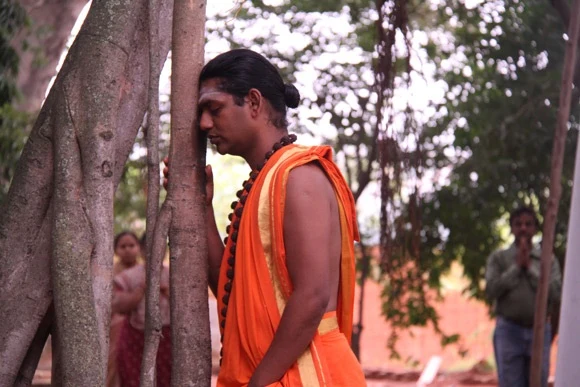
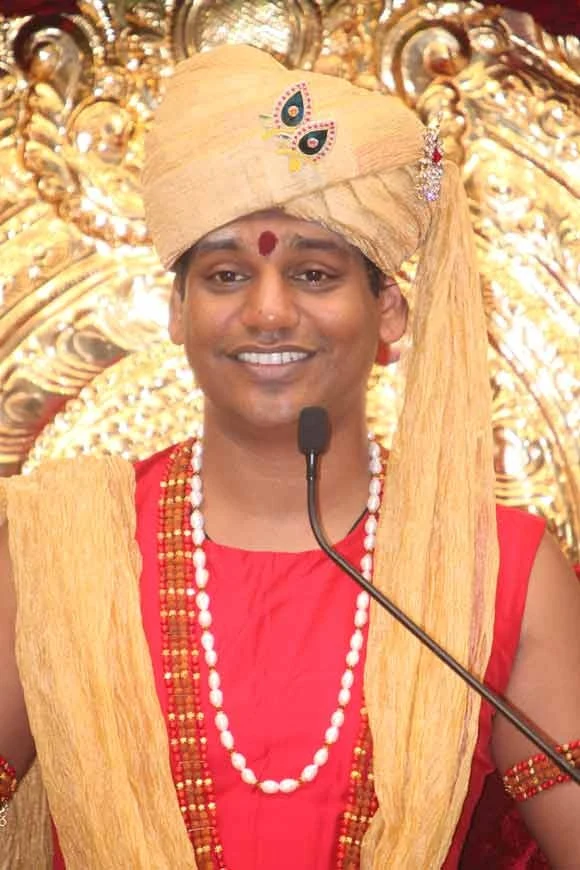
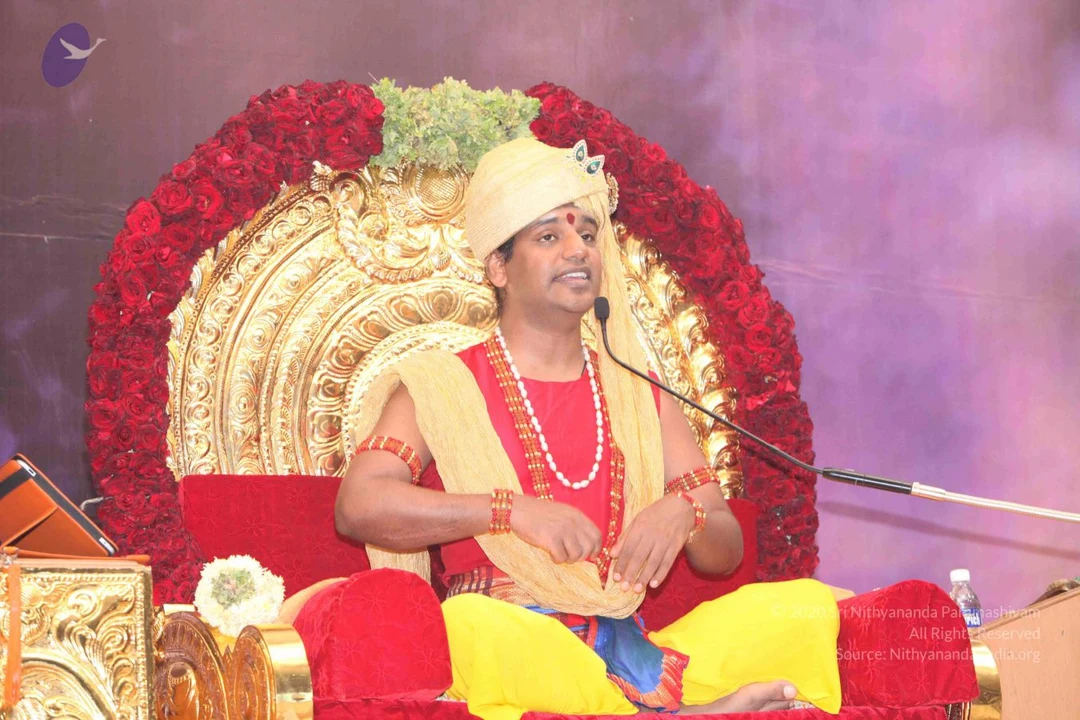
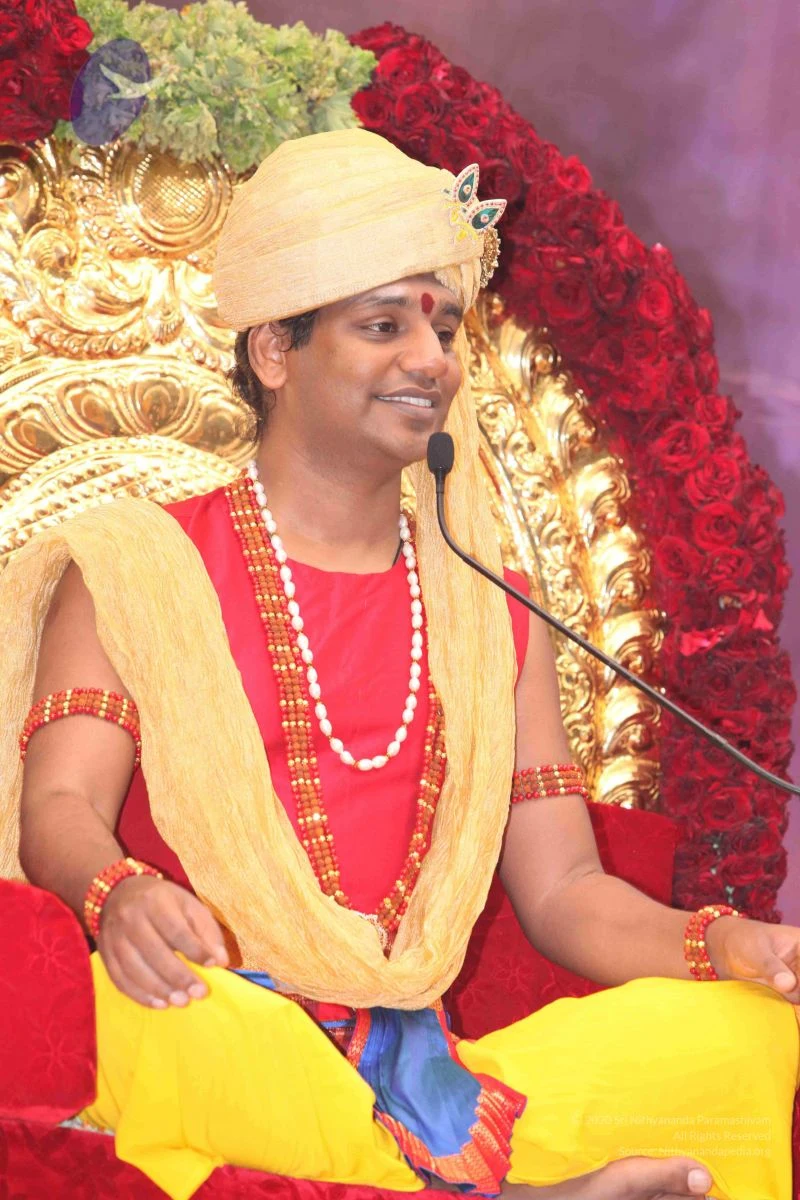
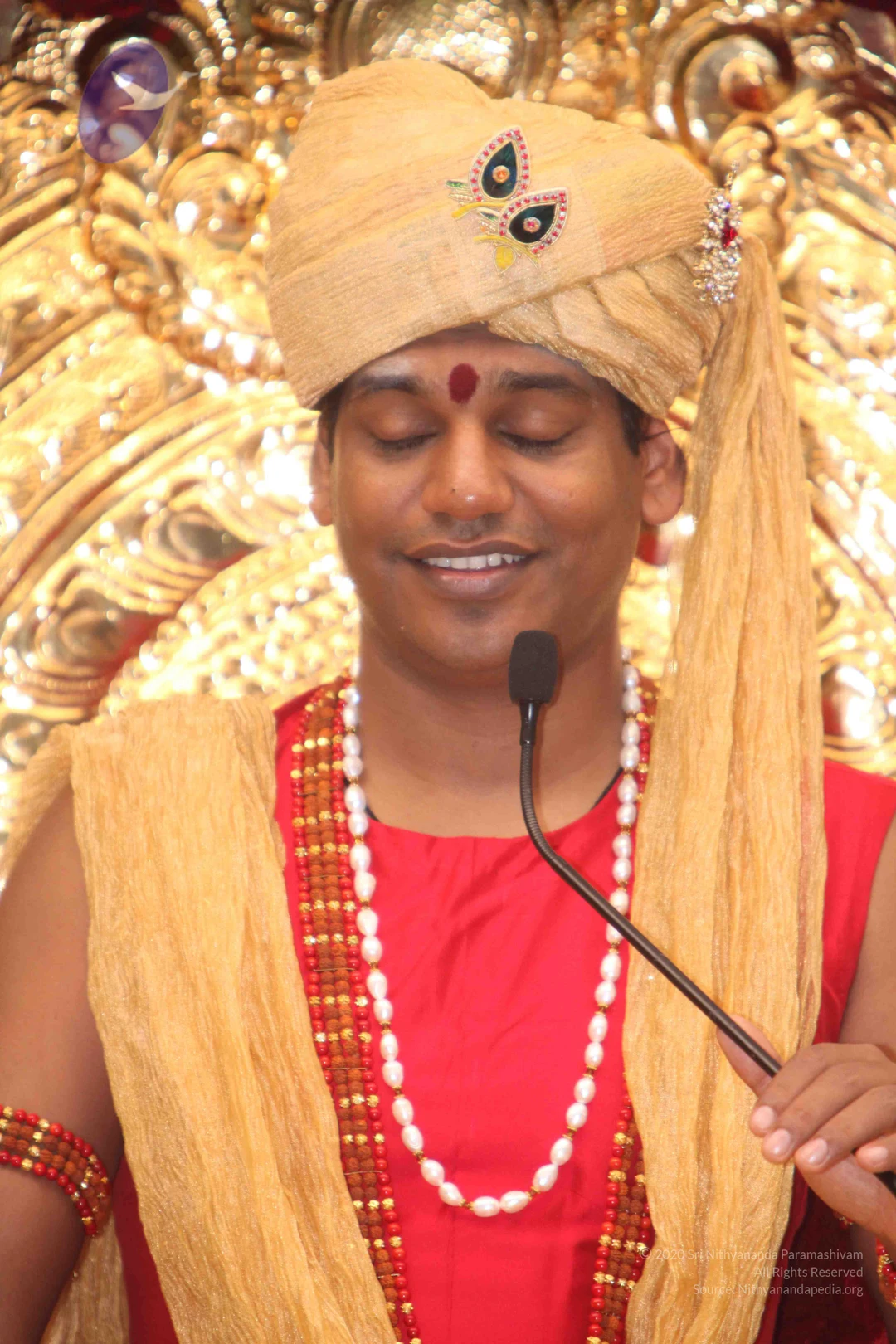
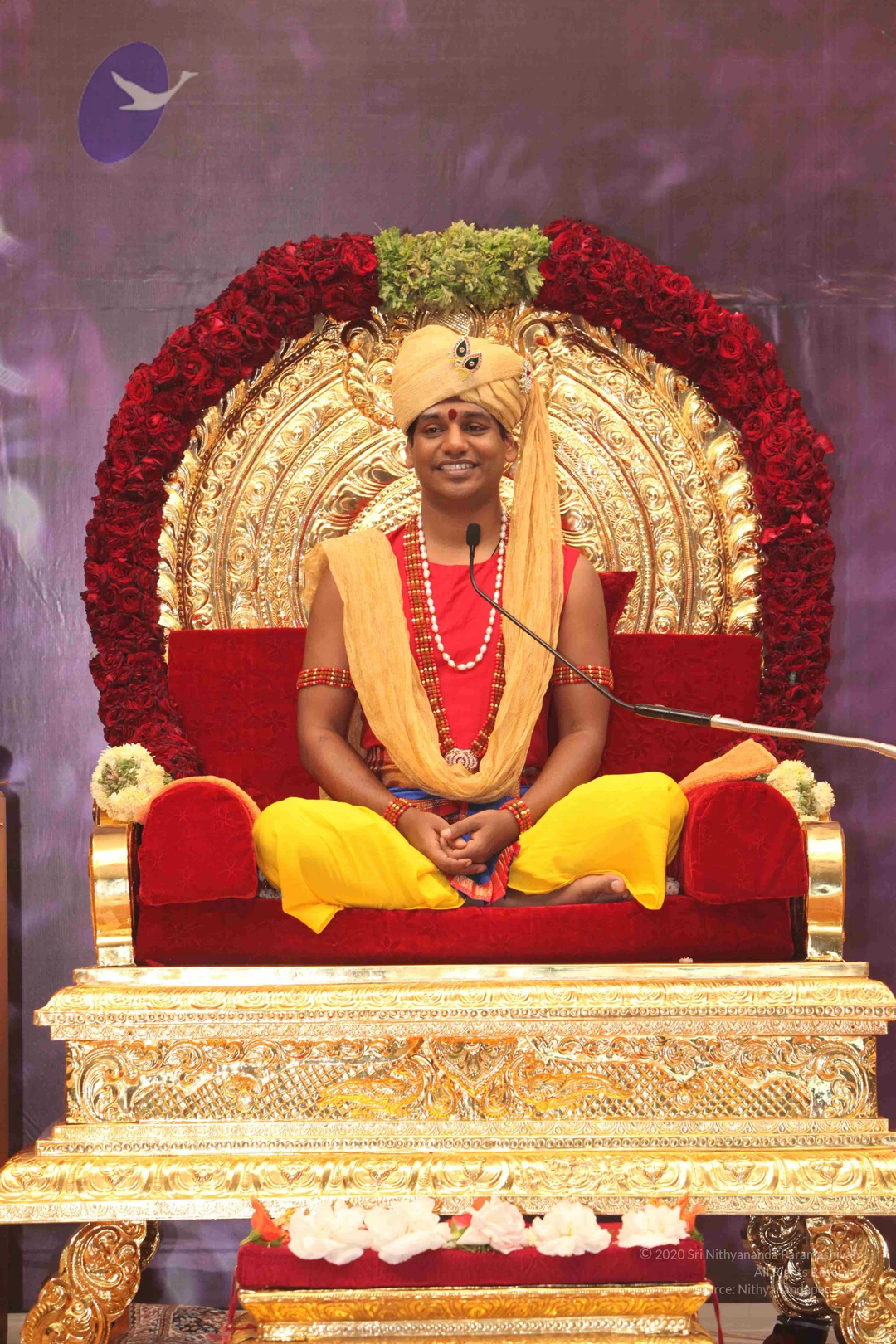
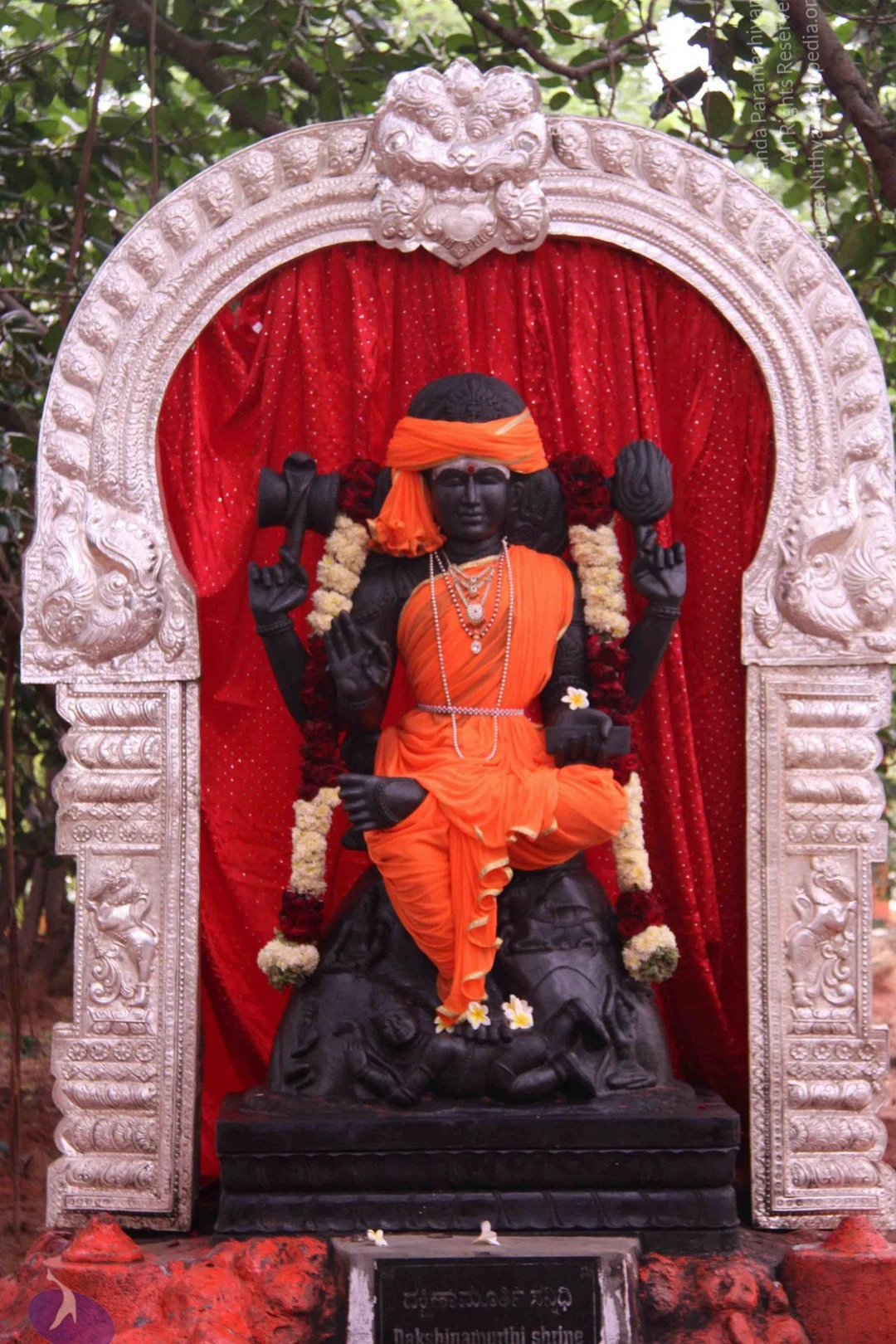
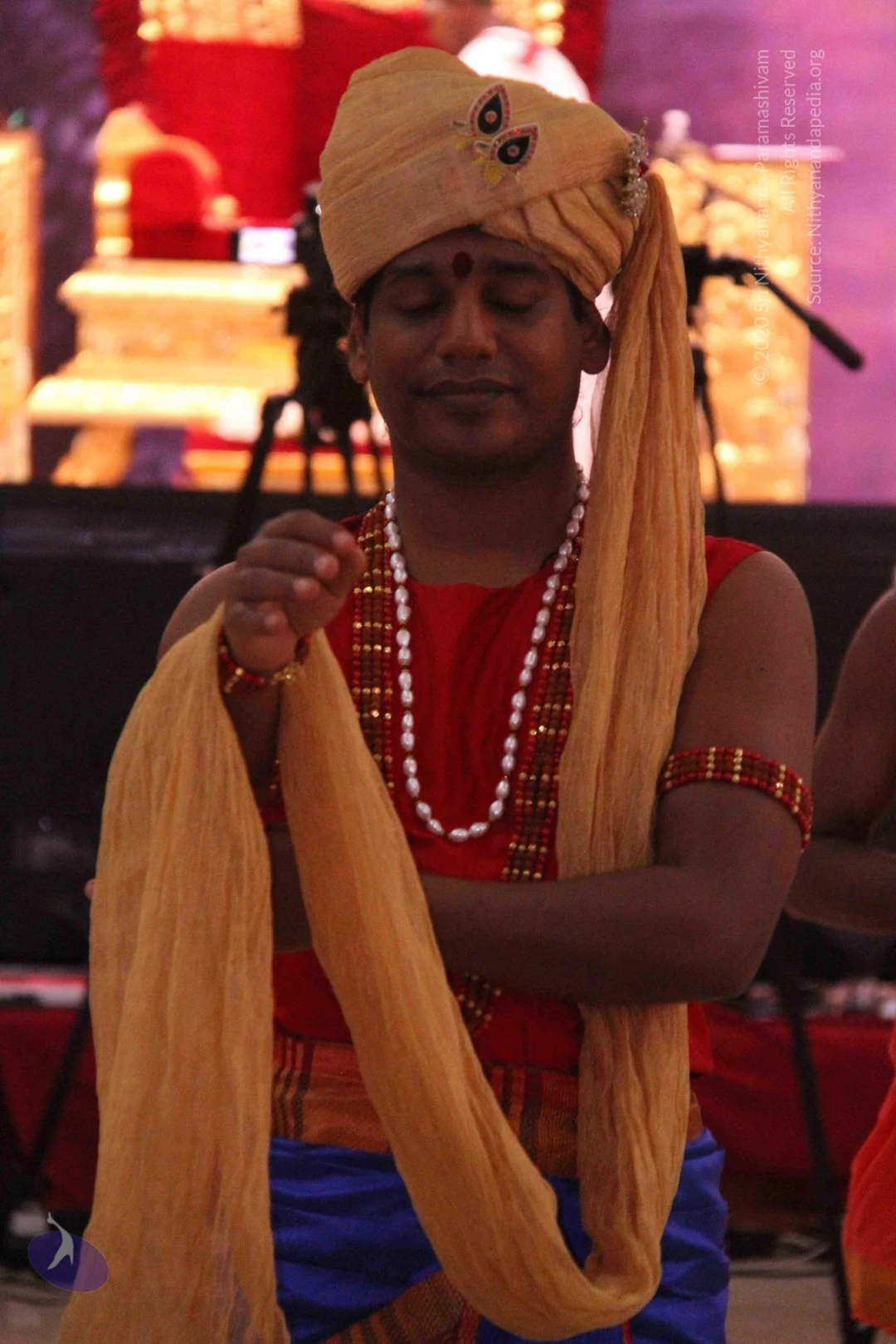
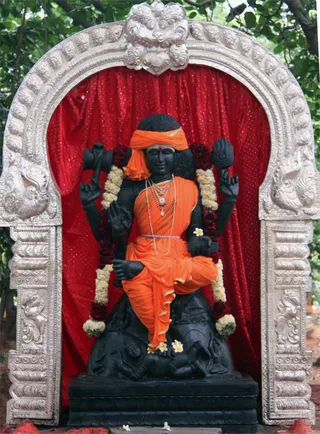
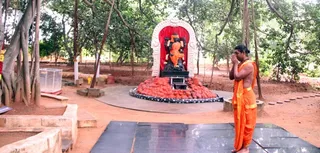
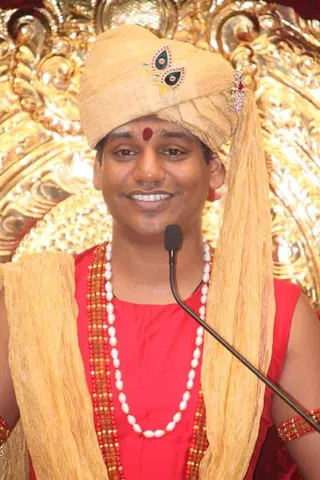
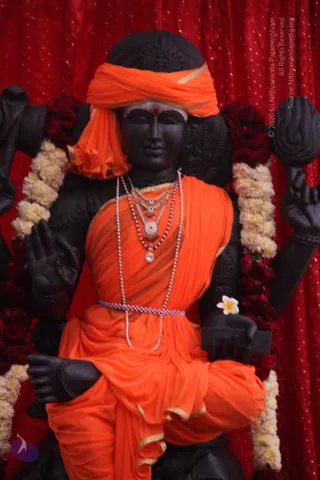
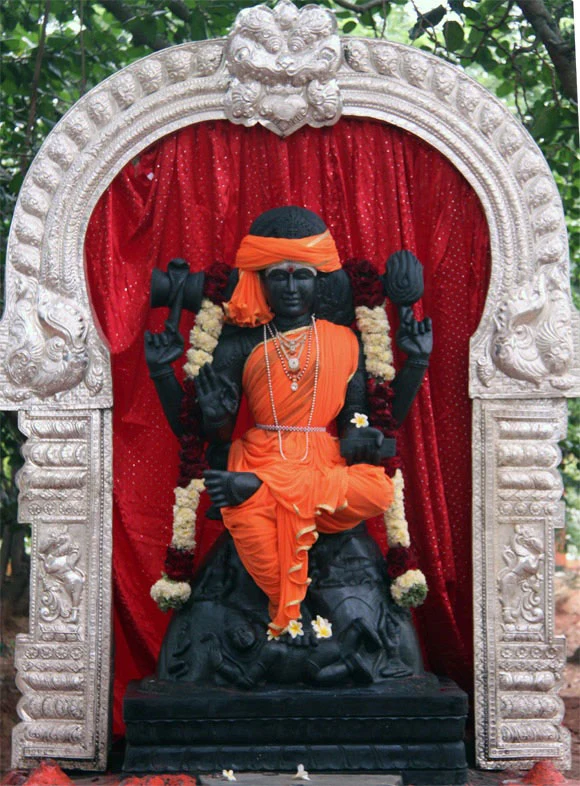
A black stone murti of a multi-armed deity seated on a dark pedestal inside a silver-coloured arched frame. The figure wears an orange saffron cloth draped over the body and an orange headwrap, with a red tilak on the forehead and a red-and-white beaded necklace. Its hands hold objects including a drum-like instrument and a lotus-like form. Garlands of white and red flowers hang from the arms, and a red sparkling curtain backs the shrine, with white flower petals scattered at the base. Foliage is visible above. No physical people are present.A photograph of a man in a saffron-orange shawl and orange dhoti stands barefoot beside a large banyan tree, leaning his forehead against the trunk with his eyes closed in devotion. He wears a long rudraksha mala with dark beads around his neck and has his dark hair tied in a bun at the back of his head. To the right, a man in a grey-green shirt stands with his palms pressed together in namaste. A woman in a red sari is partly visible at left, and the background shows green foliage and a reddish-brown wall. The scene suggests a moment of prayer or reverence at the tree.An outdoor photograph beneath large banyan-type trees with a sandy red earth ground. A man with a shaved head, bare-chested and wearing a saffron-orange wrap, stands barefoot on a dark stone slab with his palms pressed together in namaste before a shrine. The shrine is a red arched niche housing a bright orange-red deity murti, surrounded by a raised circular base piled with red-orange offerings. Dark stone steps and a small stone structure sit to the left.A photograph of a large indoor hall with a light tiled floor and a ceiling with recessed lights and fans. About two dozen people stand on colored yoga mats in a warrior-type pose, arms raised overhead, some in white and some in pink, purple or black clothing. Framed portraits hang along the back wall. In the foreground a table holds a laptop-style keyboard, a brass lamp, a small framed image and flower offerings. The room appears set up for a morning yoga session.A man sits cross-legged on an ornate golden throne upholstered in red, decorated with a garland of red roses and green foliage at its back. He wears a cream turban, a red top with a white beaded necklace and rudraksha-style mala, and yellow dhoti-style trousers, with a beige shawl draped over his shoulders and gold armbands. A microphone stands before him, a flower sits on a gold side table, and a large backdrop shows a painted image of a figure with ornate gold headwear. The appearance-based label is a person: he sits in the central position of a satsang, with long-style presentation cues and ornate dress consistent with a teacher on a throne, though the face and framing are not clearly distinctive enough to confirm identity.Close photo of a smiling man in a golden-beige turban with a small teal and red decorative emblem, a red bindi and a sheer golden shawl draped over his shoulders. He wears a sleeveless red garment with a white pearl necklace and a red-and-gold beaded mala, and red-and-gold bangles on his arm. He stands before a bright microphone on a stand, with an ornate golden backdrop behind him. The appearance is consistent with a person candidate: a turban, ornate clothing, and a beaded mala, though the identification is uncertain. Only one person is visible.

Morning-Yoga

3 photosSource gallery
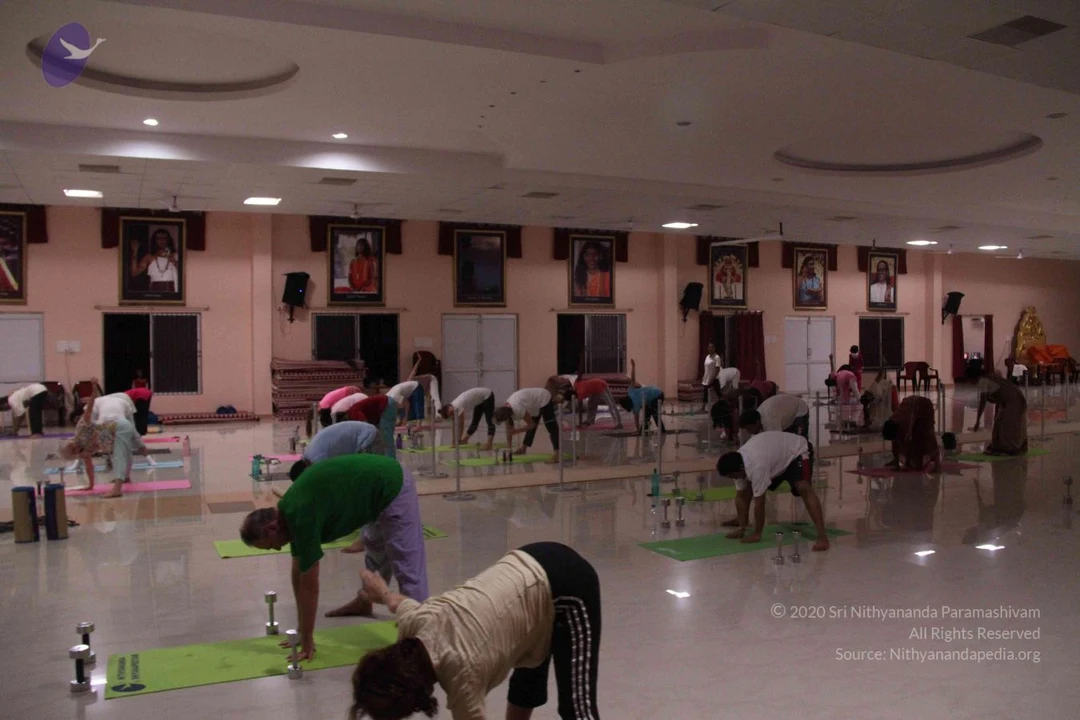
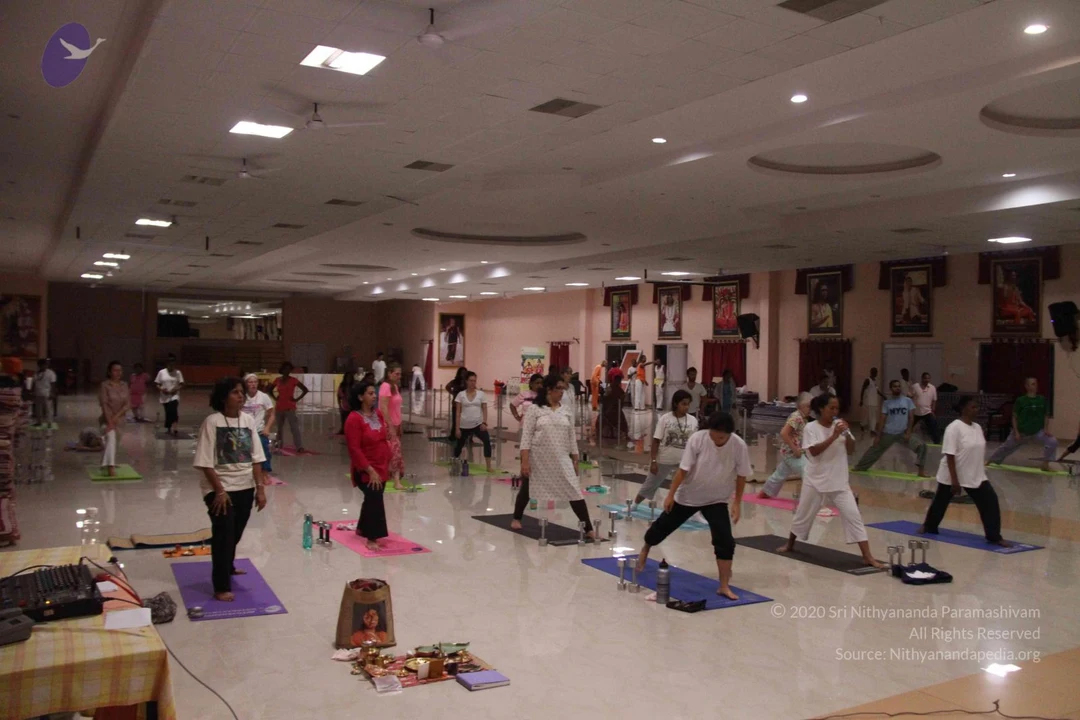
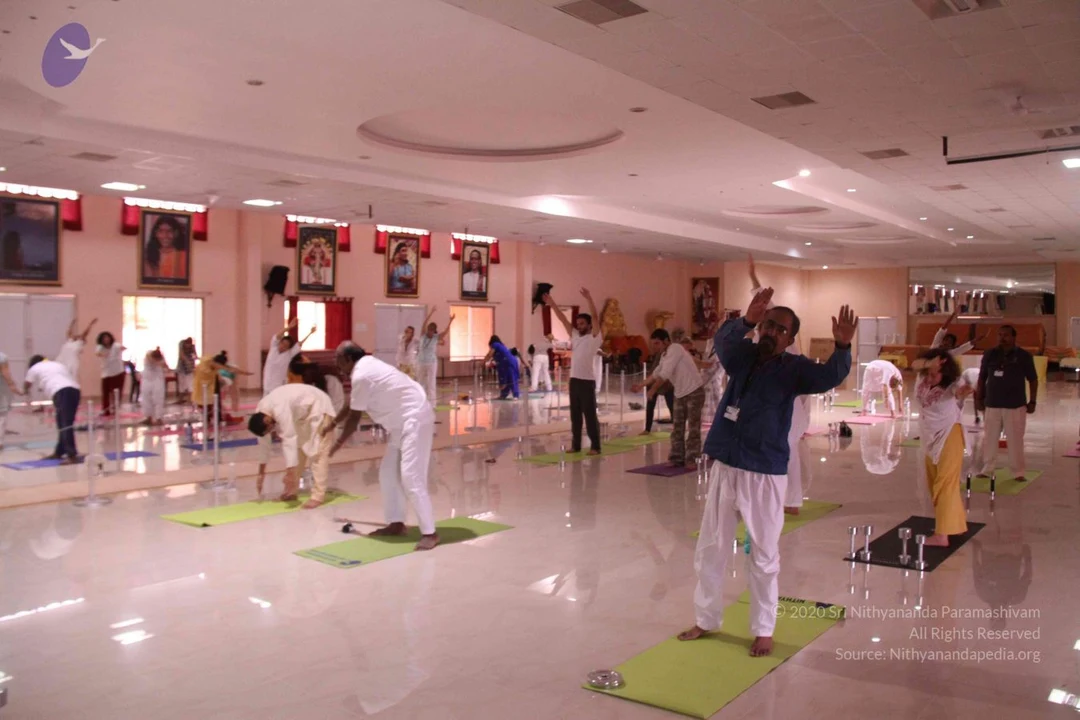
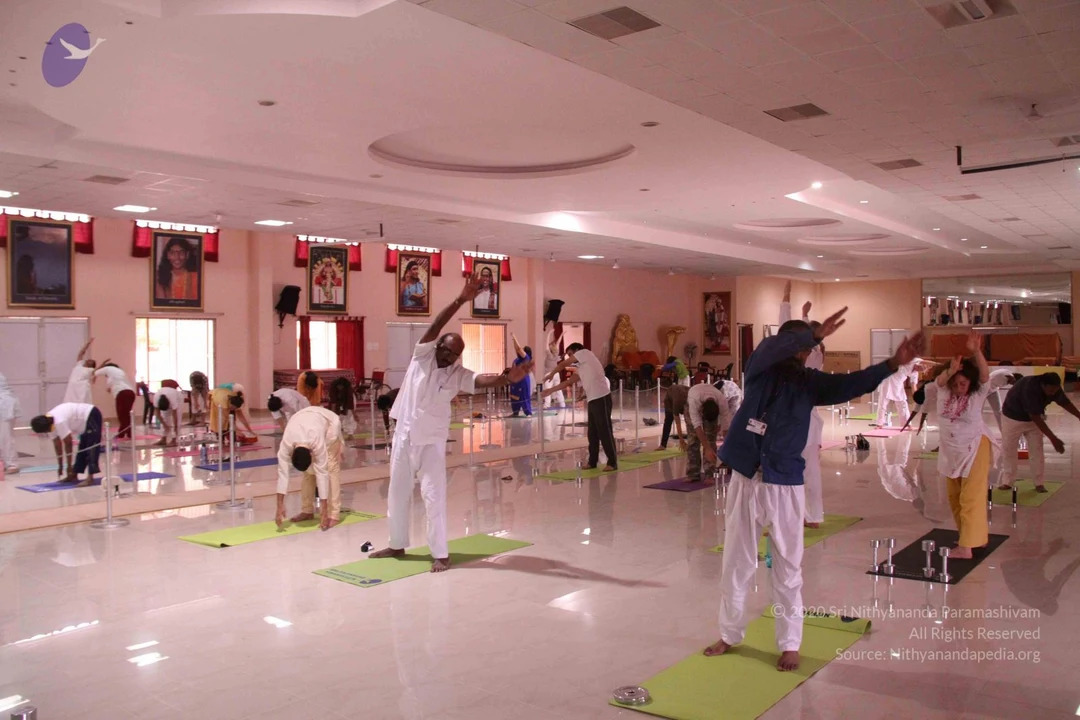
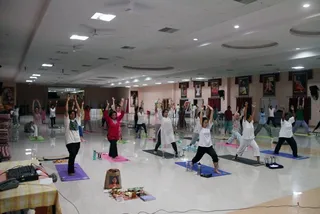
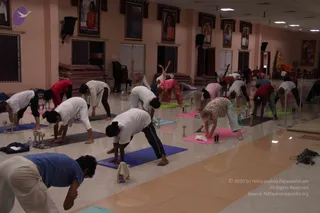
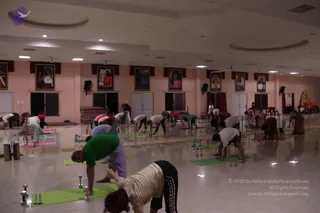
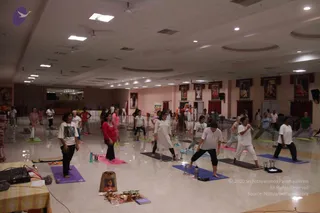
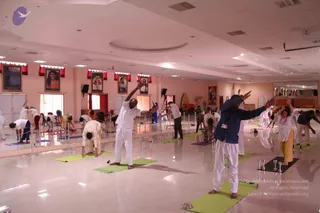
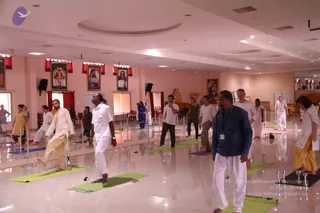
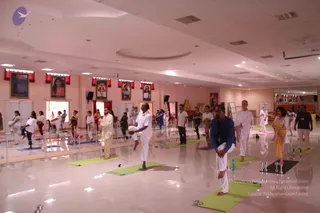
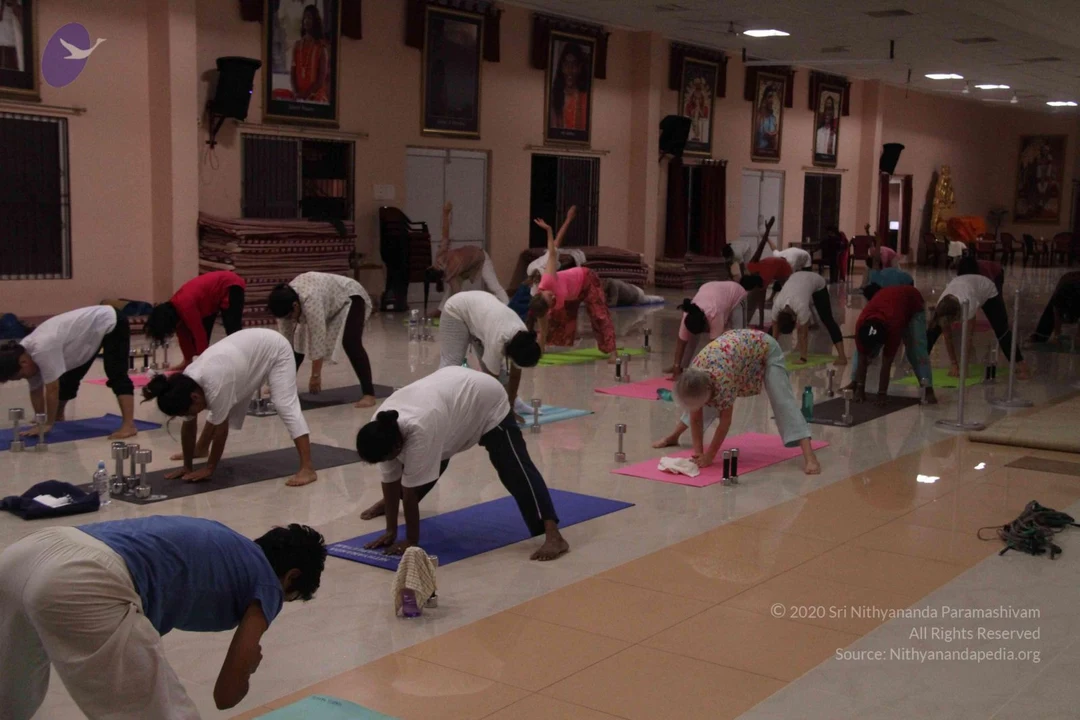
A group of people practise yoga in a large hall with pale pink walls and polished tiled floor. They stand bent forward in a standing forward fold on blue, pink, green and dark mats, many wearing white, red, pink and blue clothing. Small steel dumbbells sit beside several mats and water bottles are visible. Framed portraits hang on the walls, and a gold statue stands at the right near the back.A large bright hall with a polished white floor where a group of about 20 people are performing standing forward bends. Most wear white, grey, and pastel tops with dark or lavender trousers, and several are on green yoga mats with small silver dumbbells beside them. Along the pink-washed back wall hang framed portraits of robed figures in orange and white, and a golden figure sits at the far right near red cushions. The scene looks like a morning yoga session.A large, brightly lit hall with a polished floor and a ceiling of recessed lights and fans shows a yoga class in progress. Around thirty people, mostly women in white and pastel tops and dark trousers, stand on coloured yoga mats in a wide-legged lunge pose, arms outstretched. In the foreground a woman in a white T-shirt faces the camera beside a table with a sound mixer, a small altar with brass items and a framed photo, and a purple bag. Framed portraits hang along the back walls above maroon curtains.

Temple-Visit

12 photosSource gallery
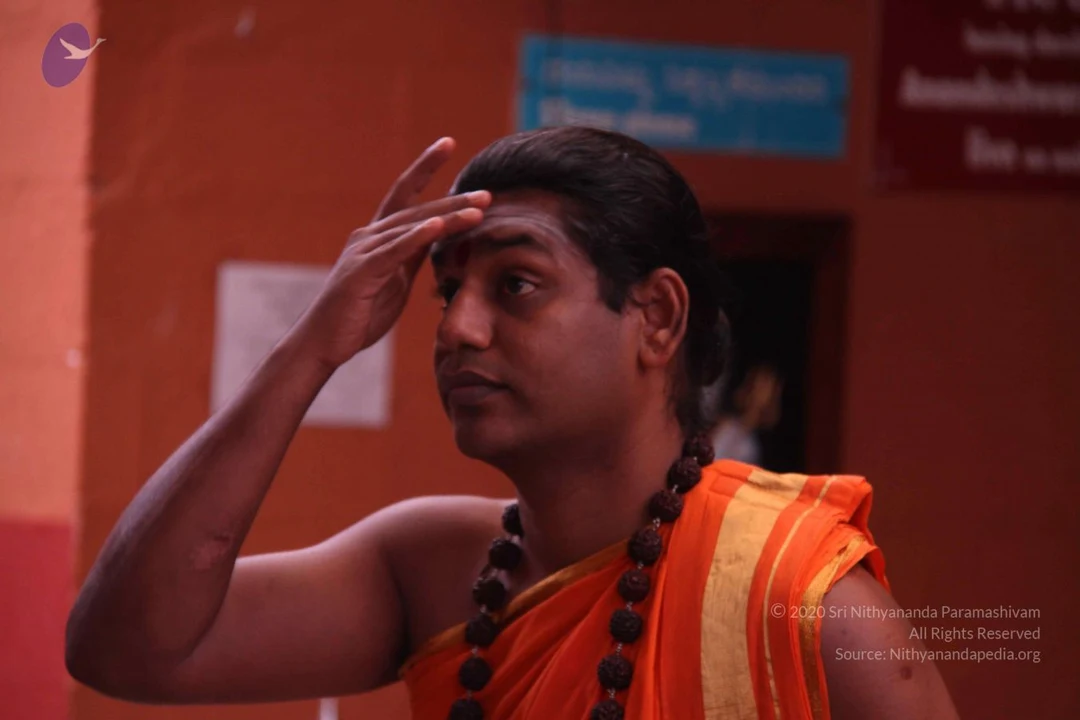
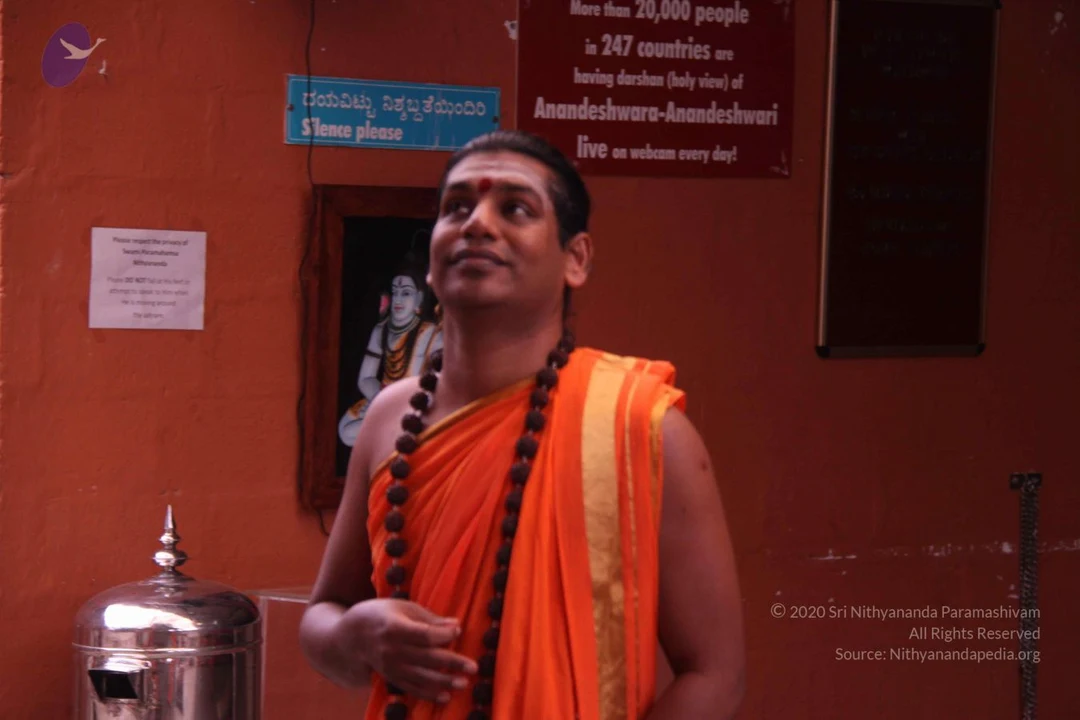
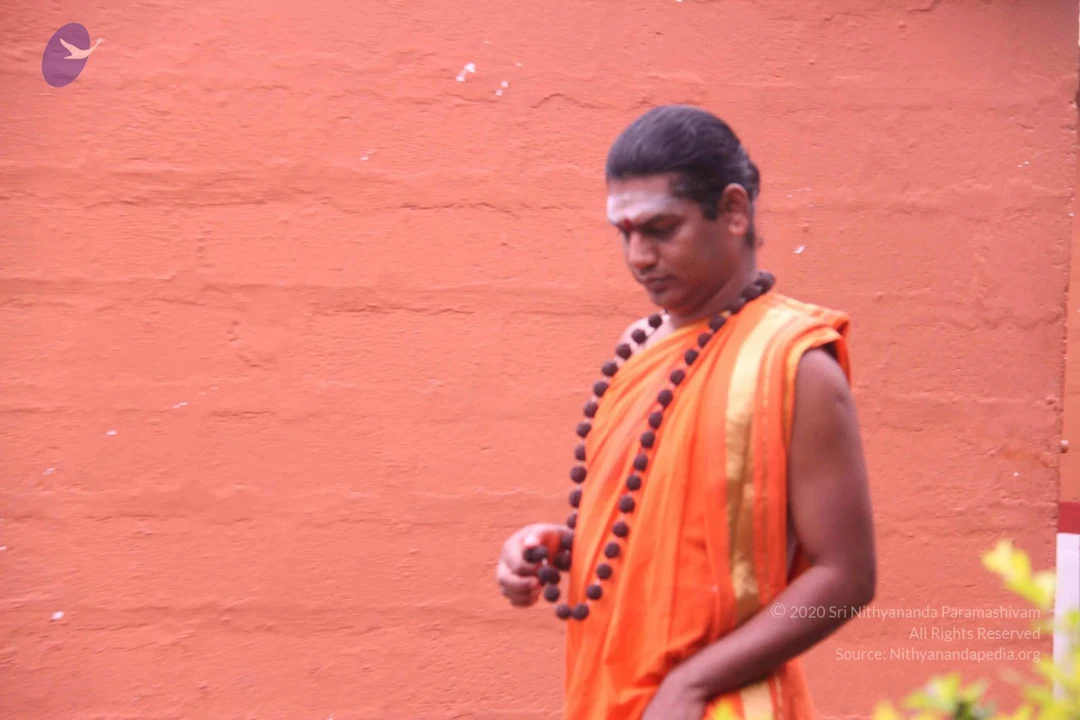
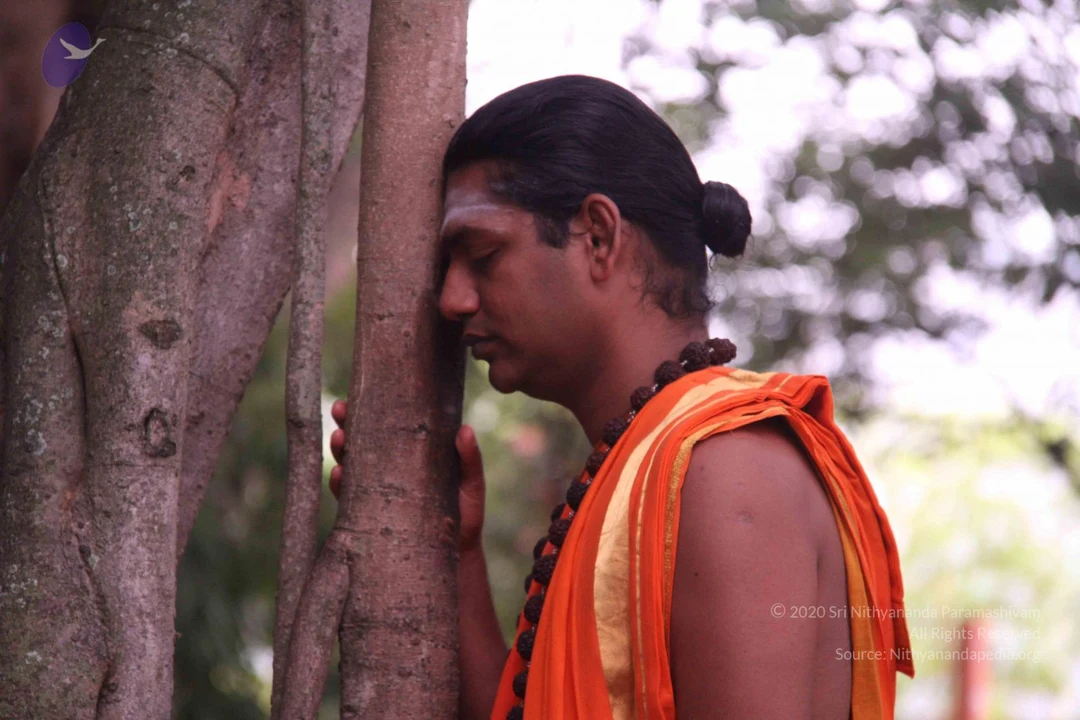
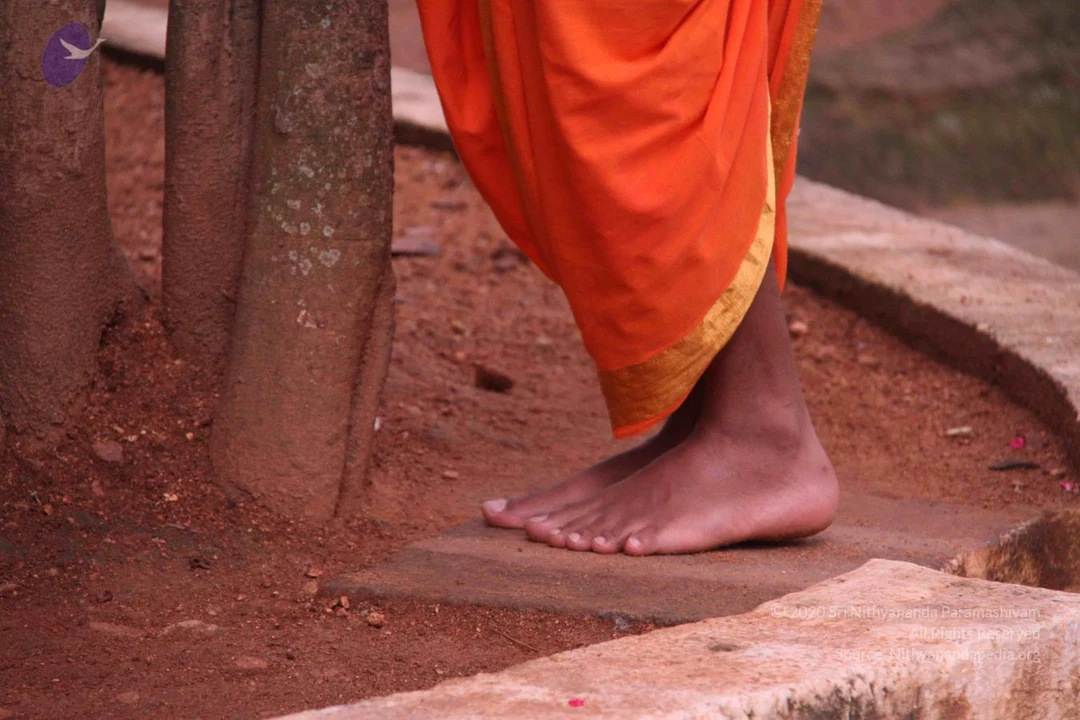
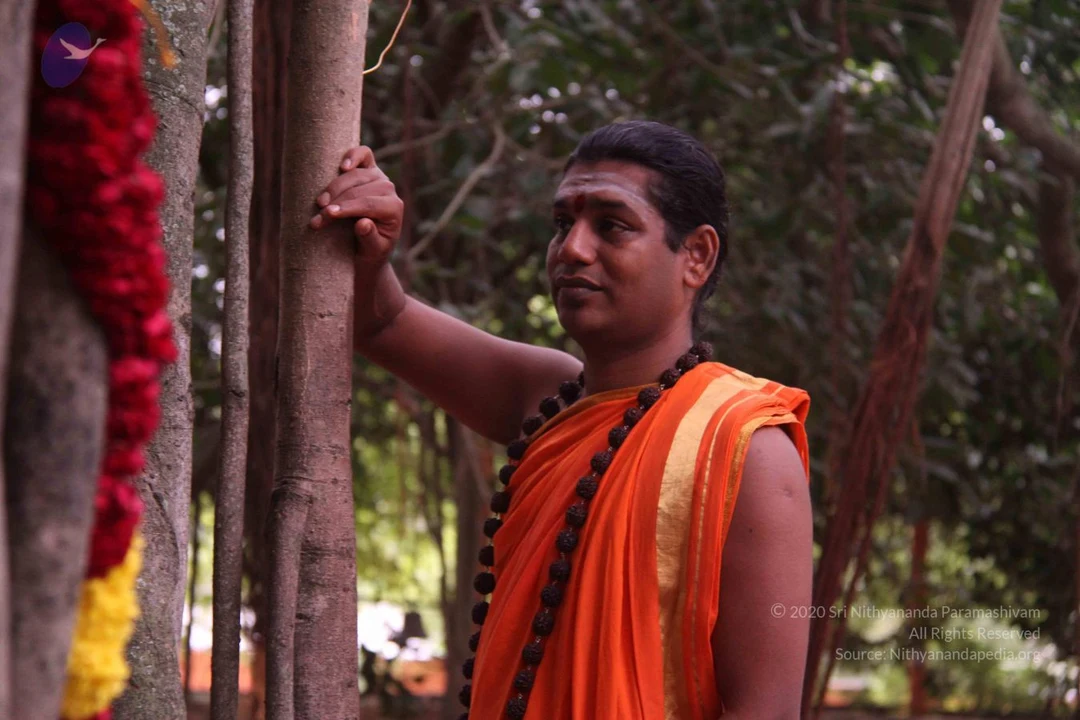
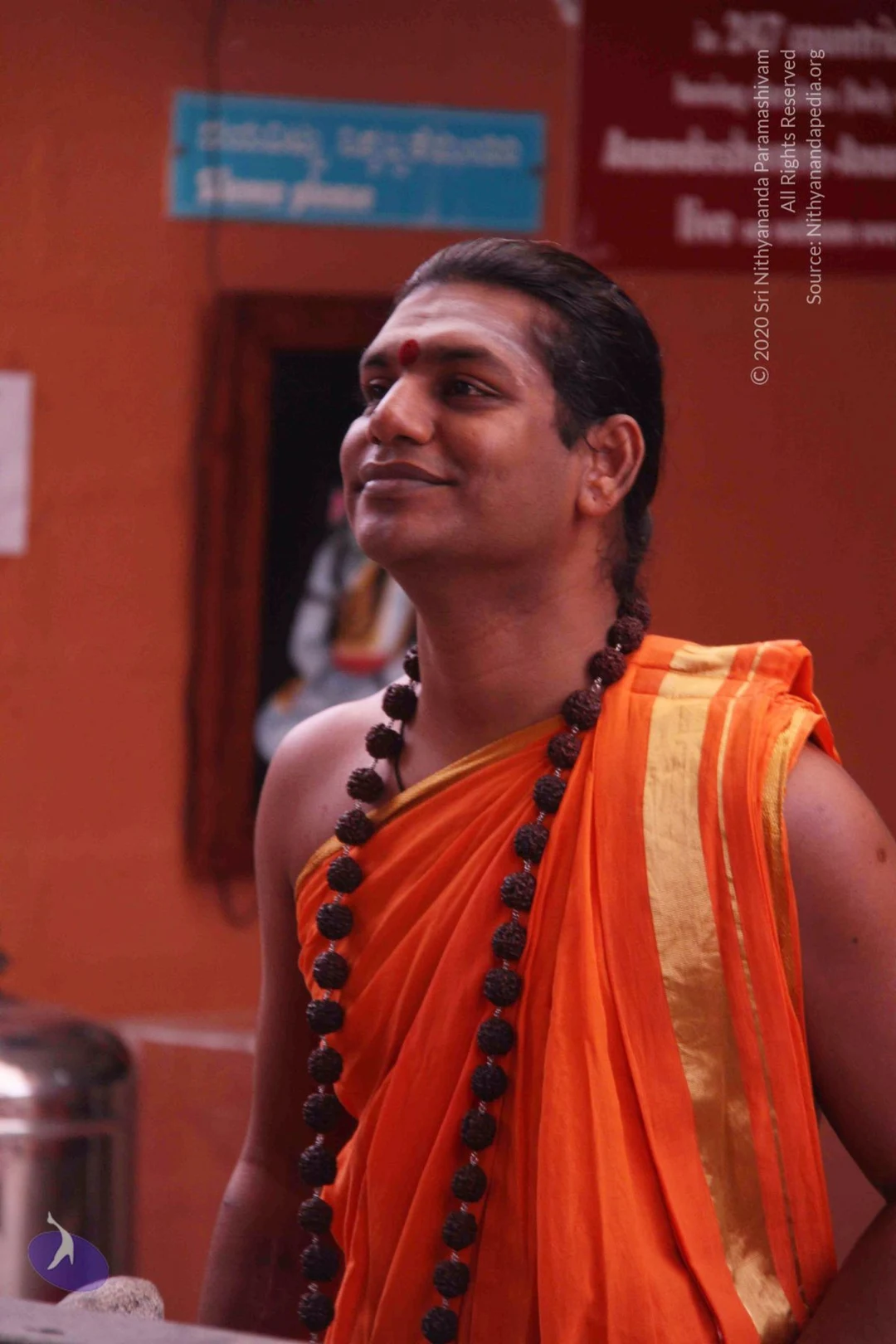
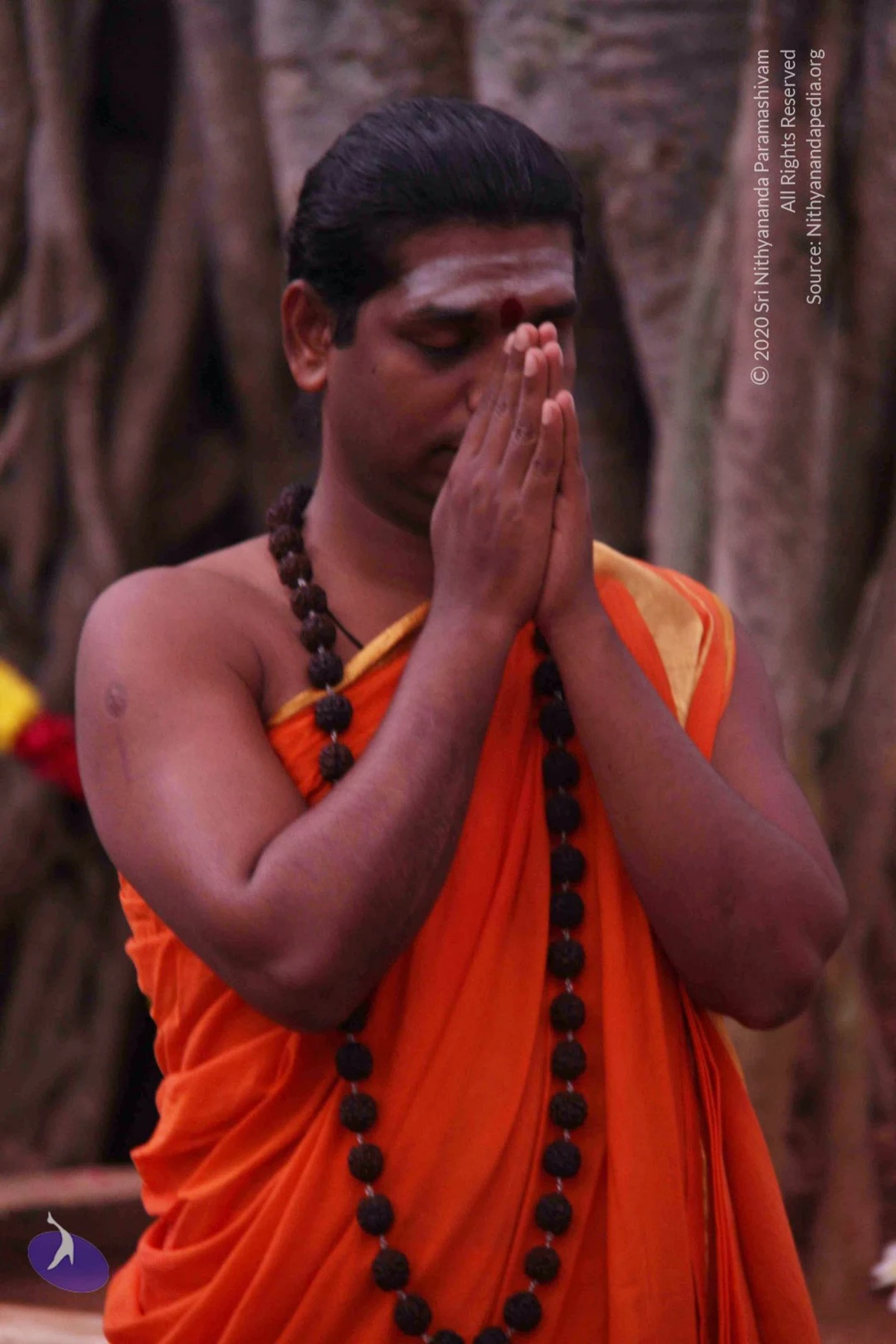
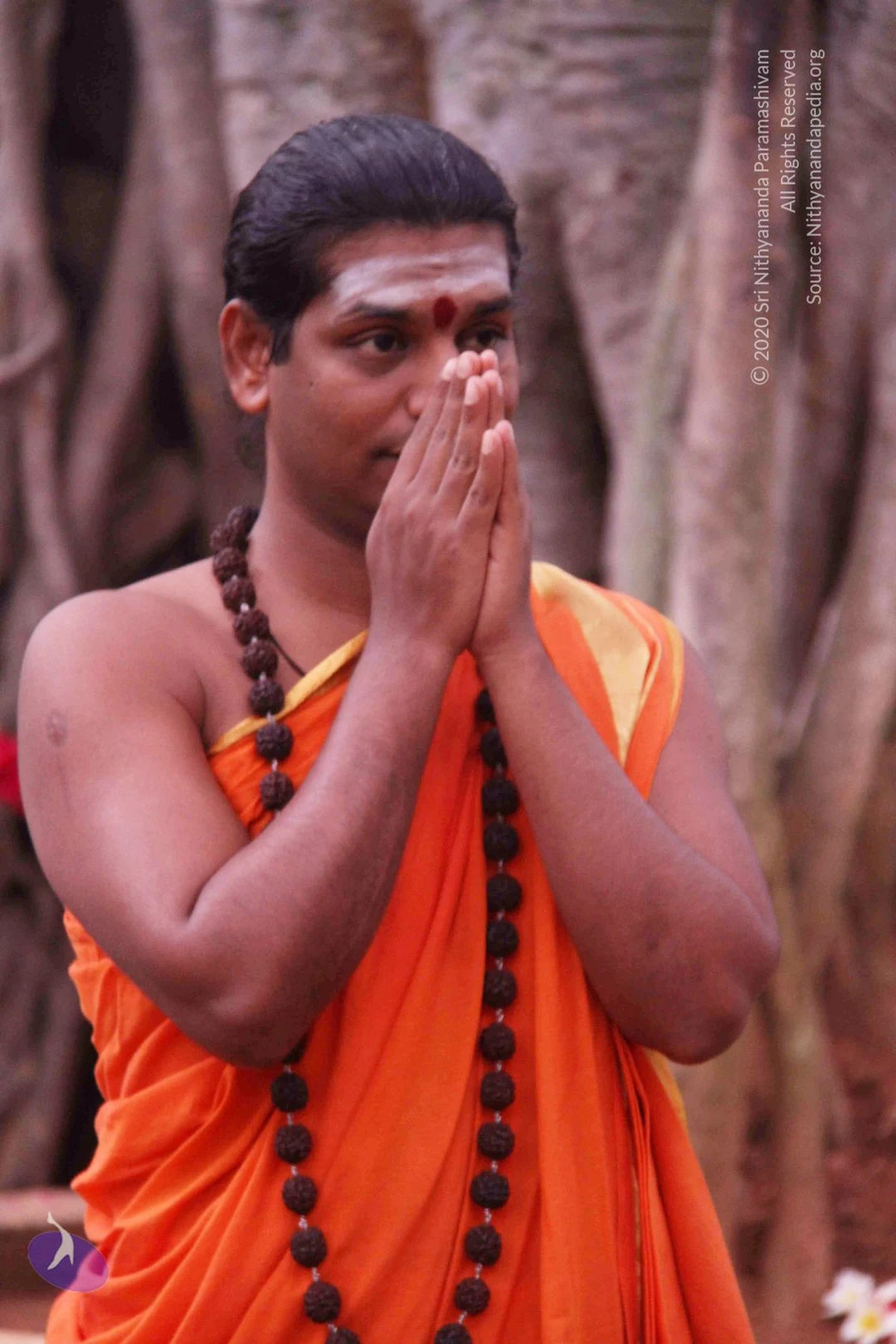
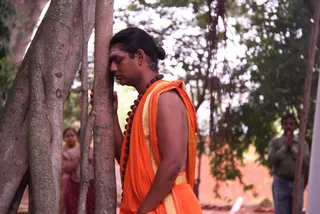
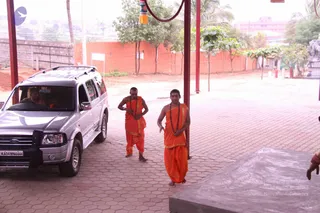
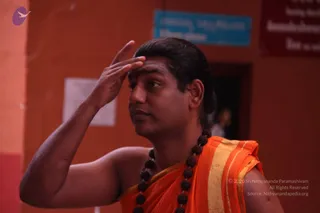
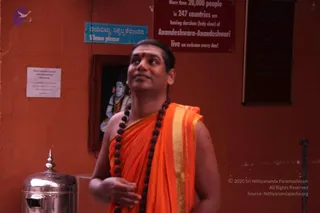
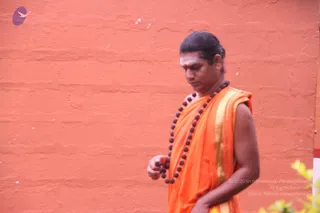
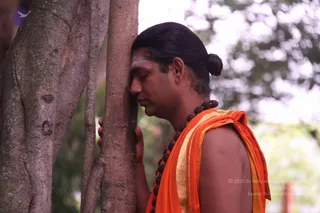
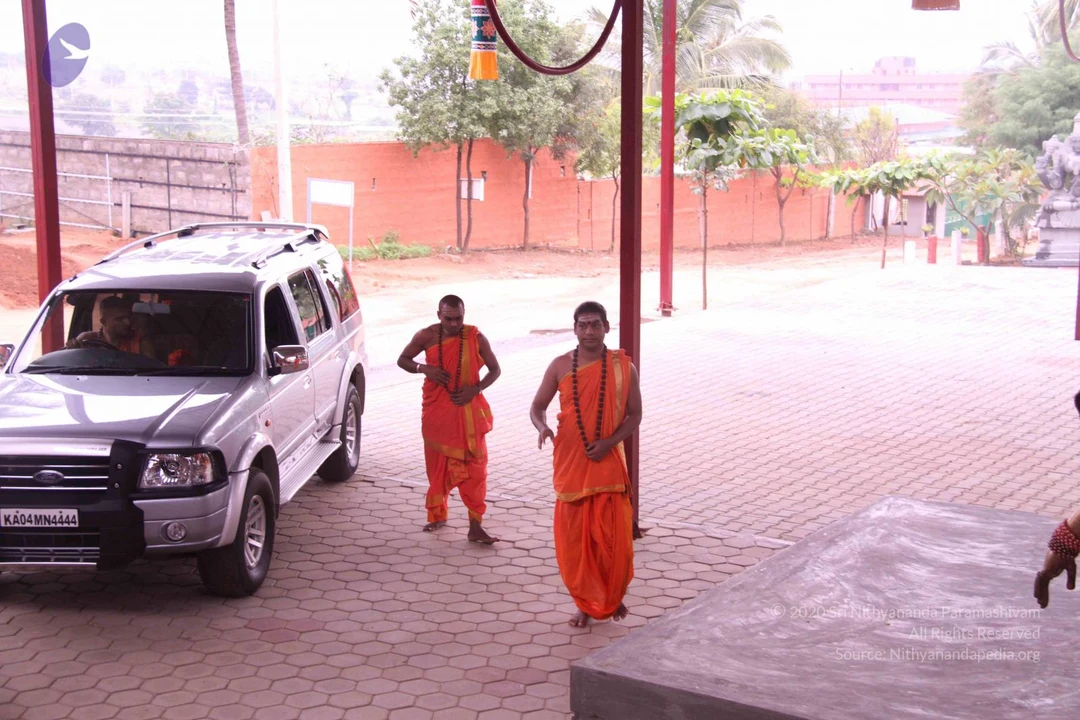
Outdoor photo at a temple-style compound: a silver Ford SUV with a black front bumper and registration KA04MN4444 is parked on paving beside a covered walkway with red columns. Two shaved-headed men in saffron-orange robes stand under the canopy, each wearing rudraksha malas; one on the left has his hands clasped at his waist, the other on the right gestures with one hand. A person is partly visible in the driver's seat of the SUV. Behind is an orange brick wall, green trees and a stone lion sculpture at the right edge.A man in an orange robe with a gold border and a thick rudraksha mala necklace stands in profile, raising his right hand to his forehead in a gesture of reverence. He wears a red tilak mark on his brow, and his hair is pulled back. Behind him are orange-red walls, a white paper notice, and a blue sign with Hindi text. No other people are clearly visible.A man stands in front of an orange-red wall beside a silver metal bin with a domed lid. He wears a saffron-orange garment draped over one shoulder with a gold border and a long rudraksha mala with dark beads around his neck. He has a red bindi on his forehead and gazes upward. Behind him a framed picture shows a deity with a crescent moon and a blue-throated figure. A blue sign reads Silence please, and a red sign above reads More than 20,000 people in 247 countries are having darshan of Anandeshwara-Anandeshwari live on webcam every day. The wall also holds a small notice asking visitors to respect the privacy. The man appears to be a sannyasi in ochre robes.A man in a saffron-orange dhoti-style wrap with a gold-bordered edge stands against a rust-orange wall, looking down at a long rudraksha mala he holds in his right hand while the beads drape over his shoulder. He has swept-back dark hair, a white and red tilak on his forehead, and bare shoulders. Yellow-green foliage appears in the lower right corner. The setting is outdoors beside a plain wall.A man with his hair tied in a topknot leans his forehead and right hand against the trunk of a large tree, eyes closed, in a quiet outdoor setting with blurred green foliage behind him. He wears an orange garment with a gold-bordered edge draped over his shoulder, bare-chested beneath it, and a long necklace of dark rudraksha beads. A light horizontal mark is visible on his forehead. The pose suggests prayer or meditative surrender at the tree.Close-up photograph of a person's bare feet standing on a flat stone slab beside a reddish-brown earth patch and a tree trunk at left. The person wears an orange-saffron cloth draped to the ankles, with a golden-yellow border along its lower edge. Only the legs and feet are visible; no face, head or full body appears. Small pebbles and scattered petals lie on the ground, and a curved stone edge runs along the right side.

Pada-Pooja
19 photosSource gallery
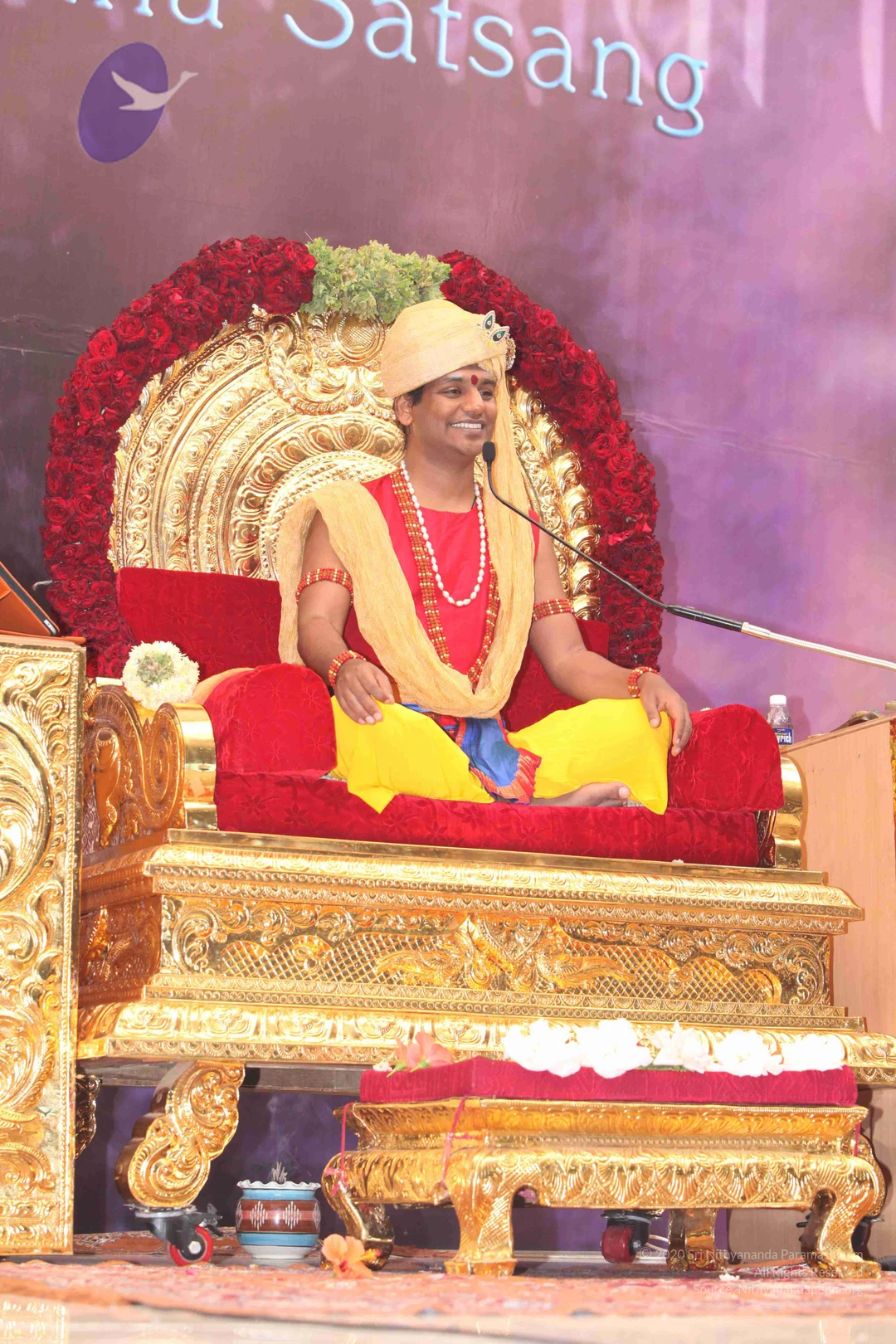
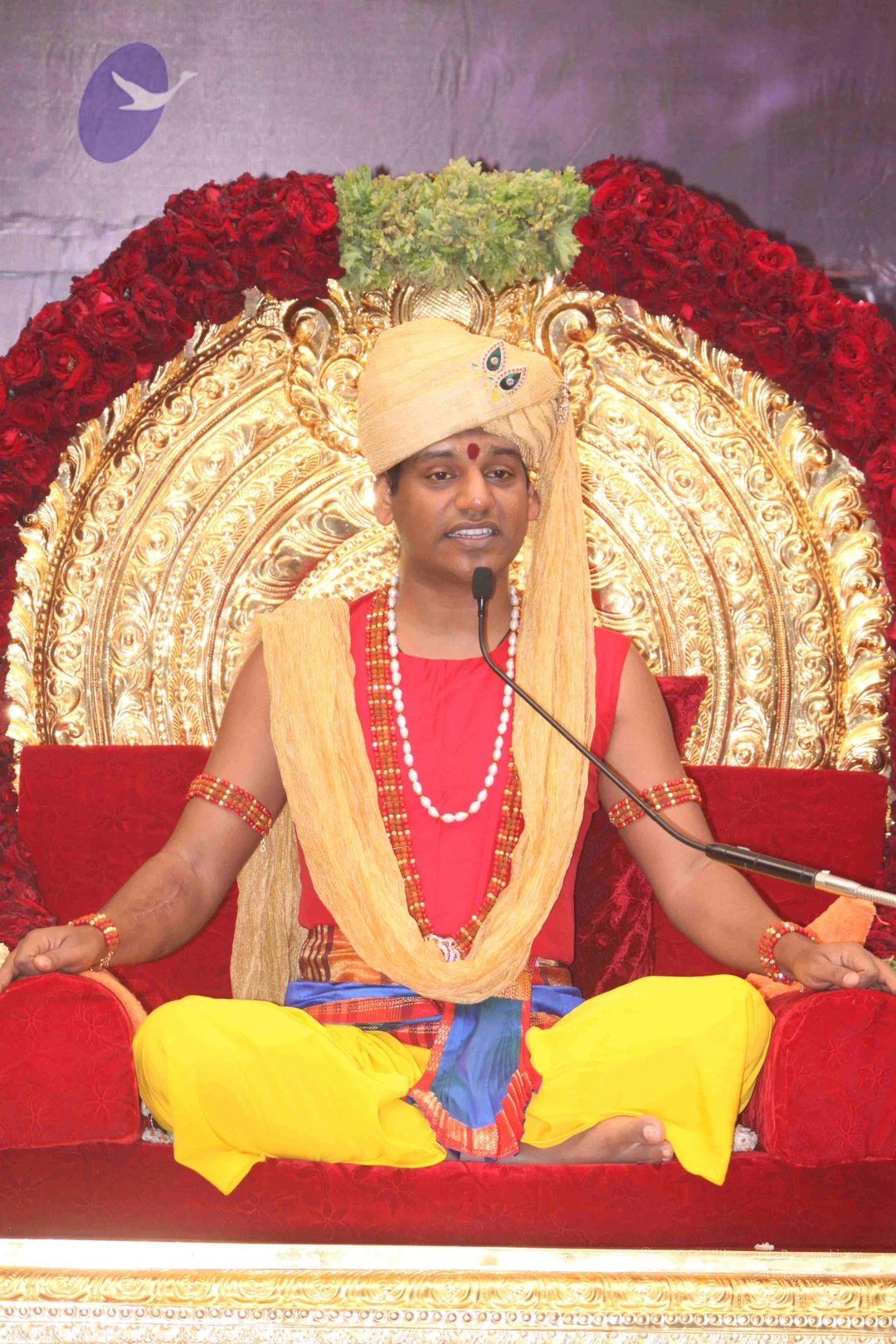
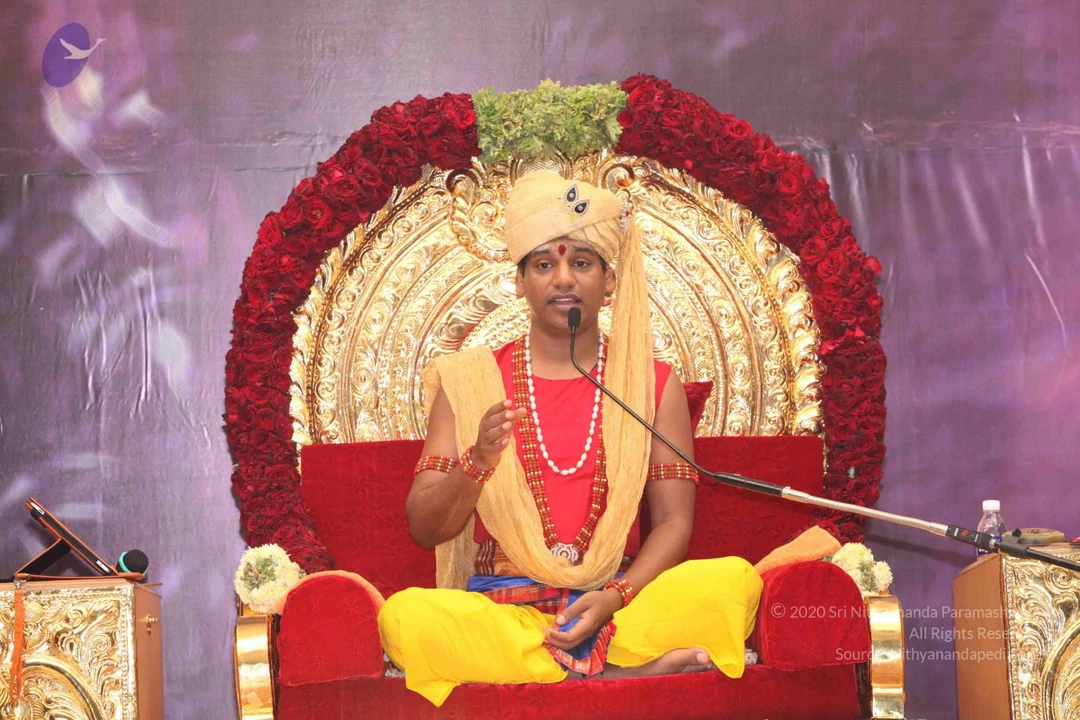
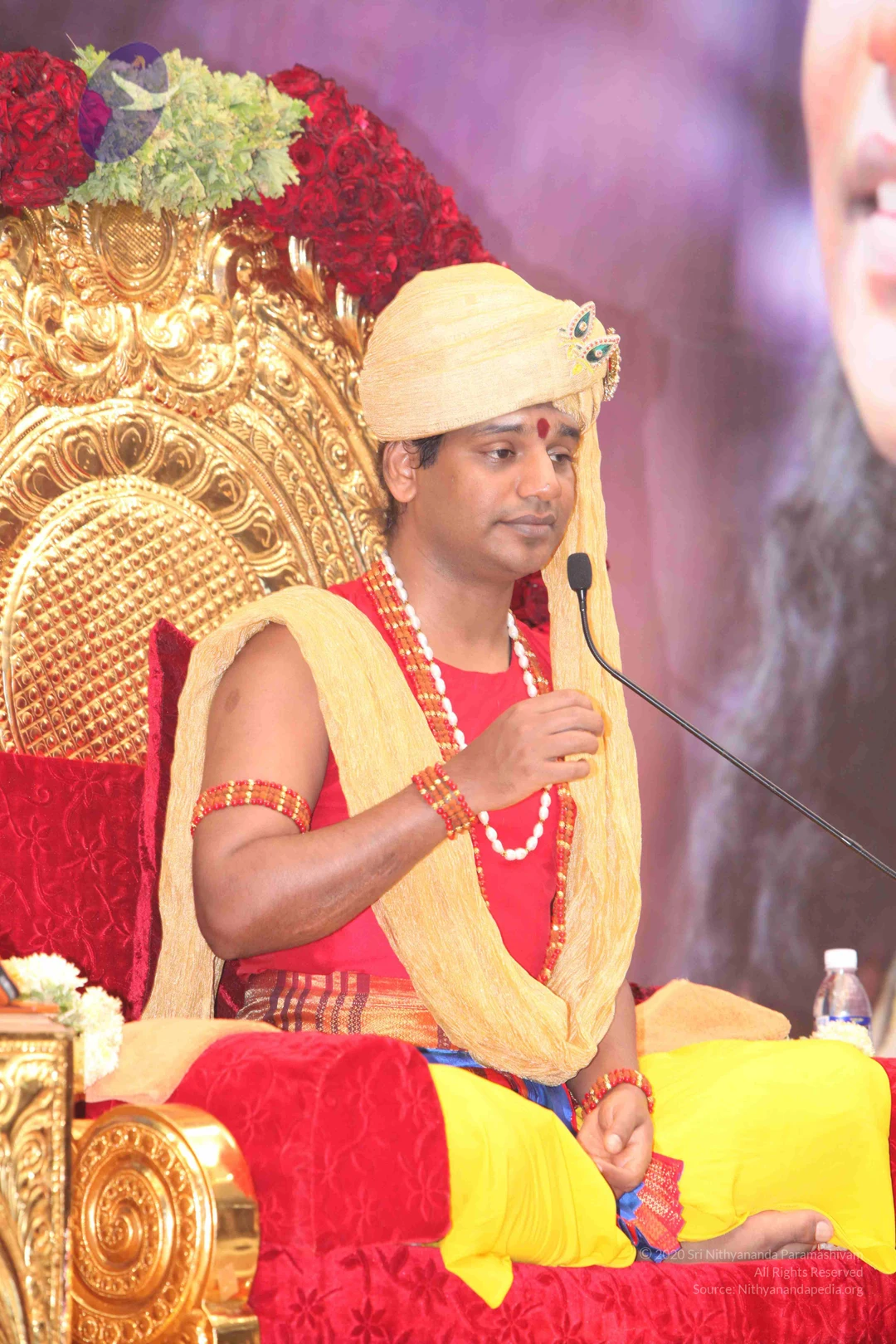
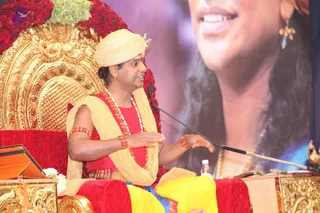
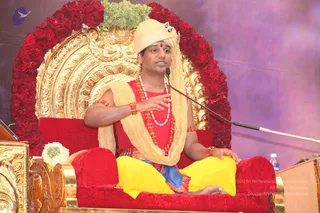
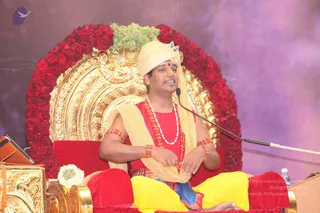
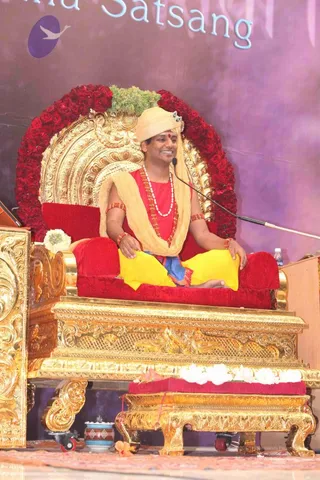
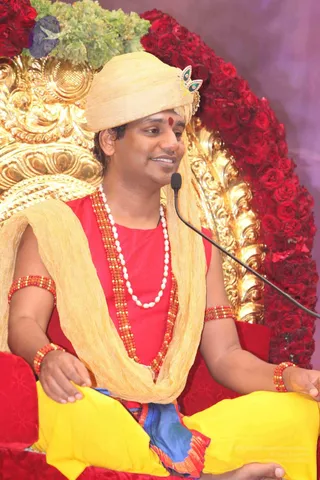
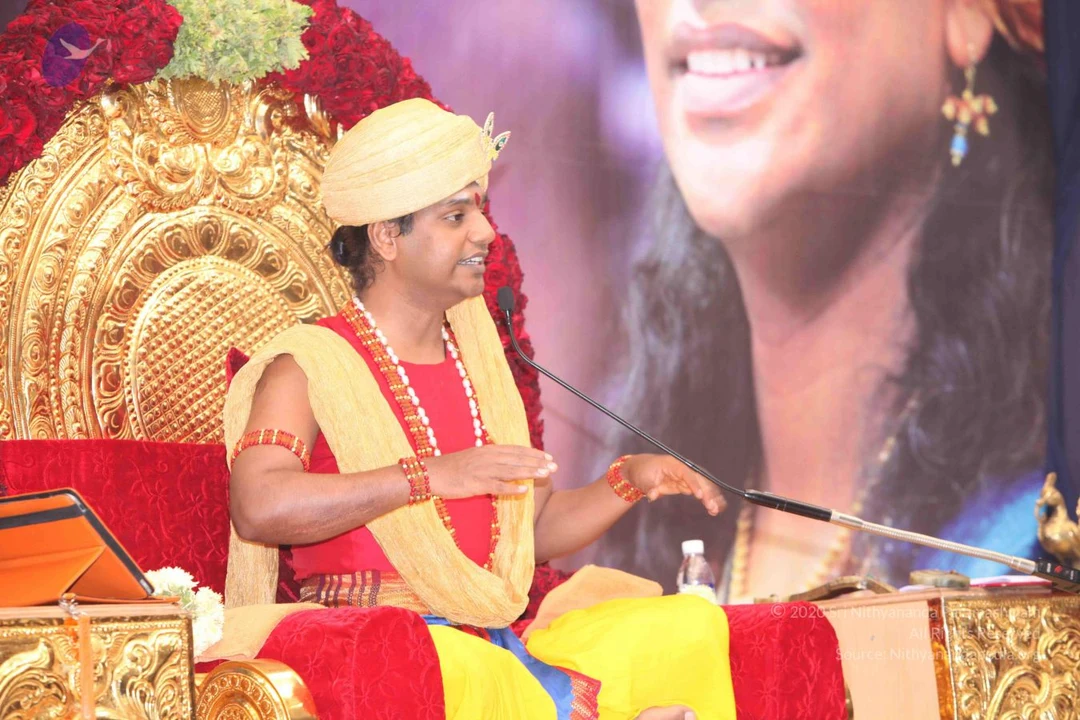
A seated man in a gold-trimmed throne with a large red velvet cushion and red floral garland above speaks into a microphone during a satsang. He wears a pale yellow turban, a red sleeveless top, layered white and red beaded necklaces, a yellow shawl draped over one shoulder, red beaded bangles, and yellow dhoti-style lower garments. His hands are open in an explanatory gesture. A large blown-up portrait of a smiling woman with dangling earrings fills the backdrop. A tablet, a water bottle and a small brass vessel sit on the stage.A man seated cross-legged on an ornate golden throne with a red velvet cushion, backed by a dense arch of red roses. He wears a pale cream turban with a small jewelled ornament, a red sleeveless top, layered red and white beaded malas, red bangles and yellow lower garments with a cream shawl draped over his shoulders. He has a red bindi and gestures with one hand while speaking into a microphone on a stand. A white flower arrangement sits on the throne's base, a water bottle is at the right edge, and a purple backdrop fills the background.A man seated cross-legged on a red and yellow cushioned dais speaks into a microphone during a satsang. He wears a cream turban with a green leafy ornament and a small red bindi, a red top with a rudraksha mala and white bead necklace, and red bangles. A large golden throne framed by a dense arch of red roses sits behind him against a purple backdrop. A water bottle and a small floral arrangement rest nearby.A seated man on a large gilded throne with red velvet cushions, framed by a red rose garland, addresses a satsang. He wears a cream turban with a jewelled ornament, a red sleeveless top, a white pearl necklace, red bangles and rudraksha-style beads, a cream shawl, and yellow dhoti, with a microphone at his side. A white flower garland rests on a gold footstool with a red cushion. A blue and white pot sits at the base of the throne. A backdrop reads Satsang with a bird logo.A seated man in a pale yellow turban with a jewelled ornament and a small red bindi sits on a red and gold throne decorated with red roses and gilded carved panels. He wears a red sleeveless top with a sheer yellow shawl draped over his shoulders, layered red and white beaded malas, red bangles on his arms, and yellow trousers with a blue and red cloth at the waist. A microphone on a stand is near his face as he speaks to an audience, smiling and looking to the side.

IA-Session

5 photosSource gallery
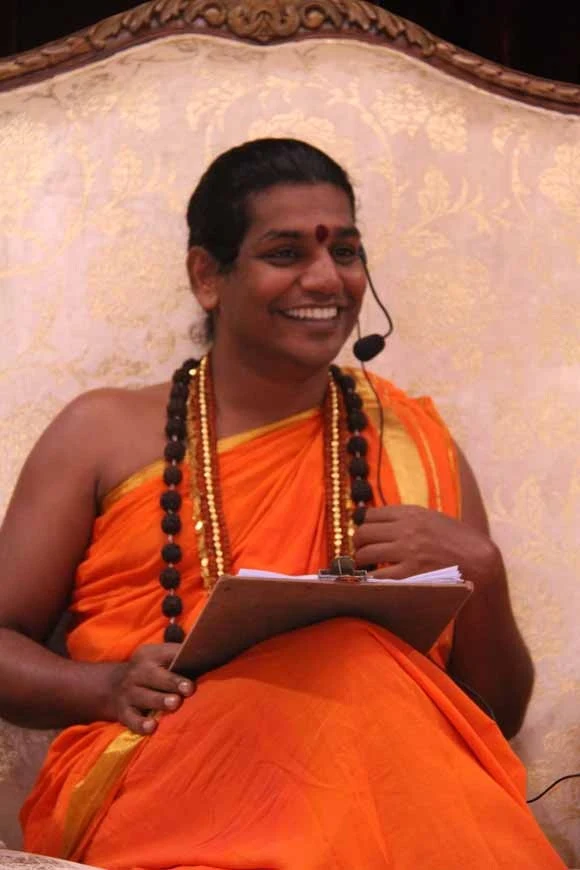
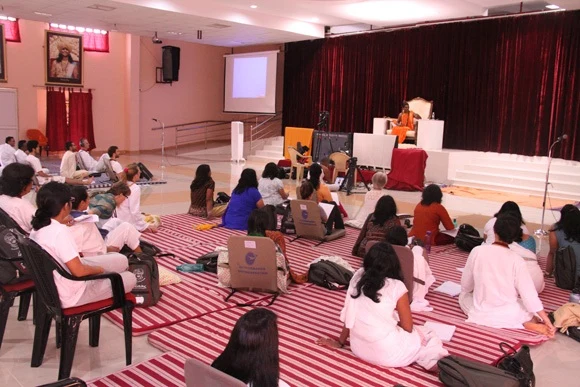
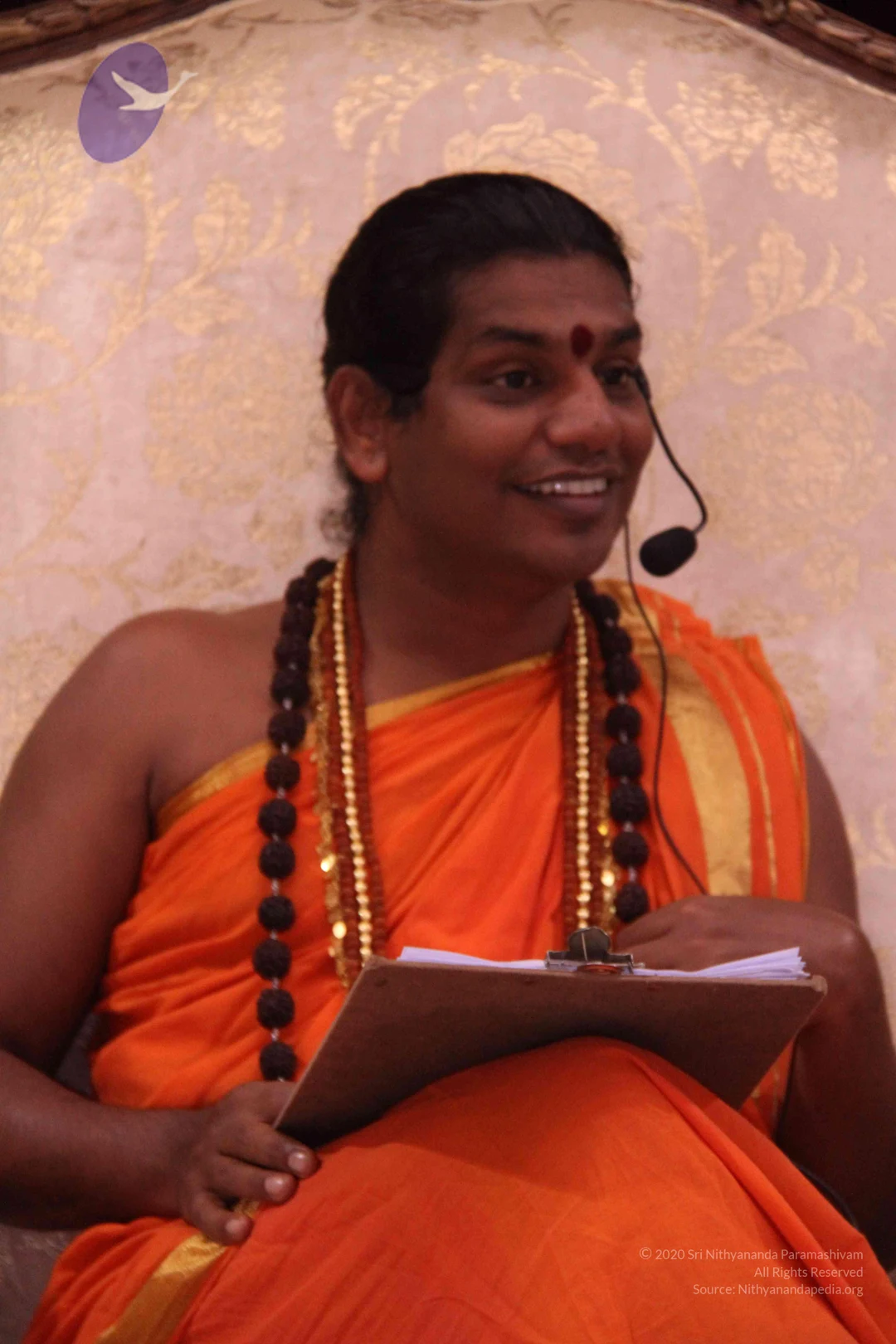
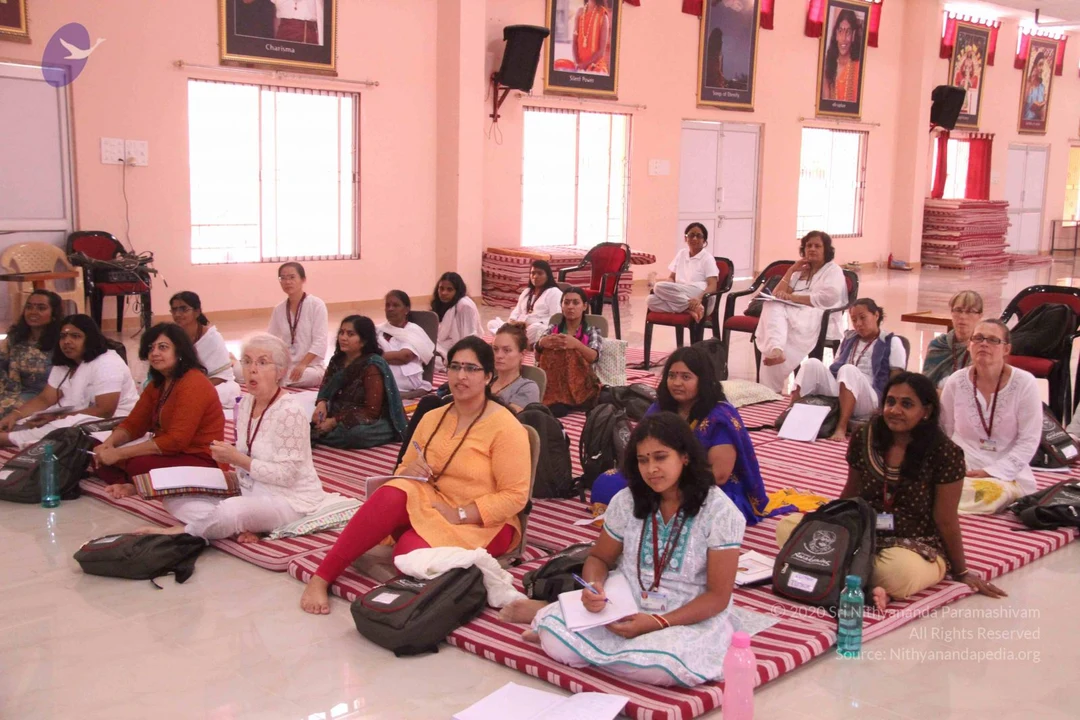
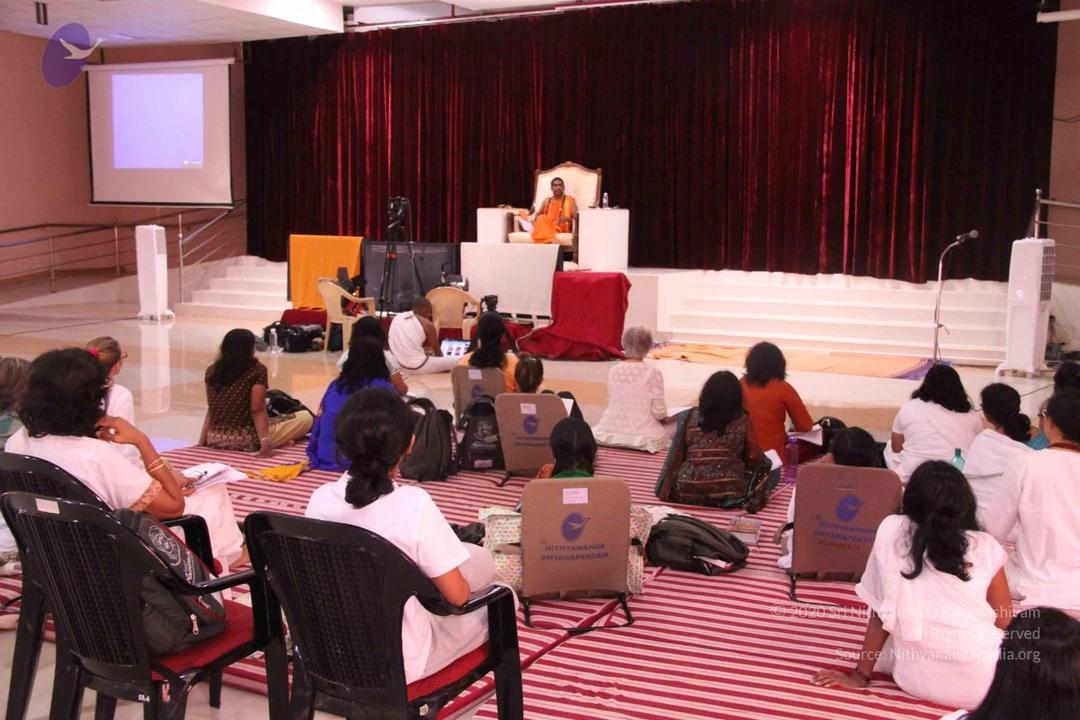
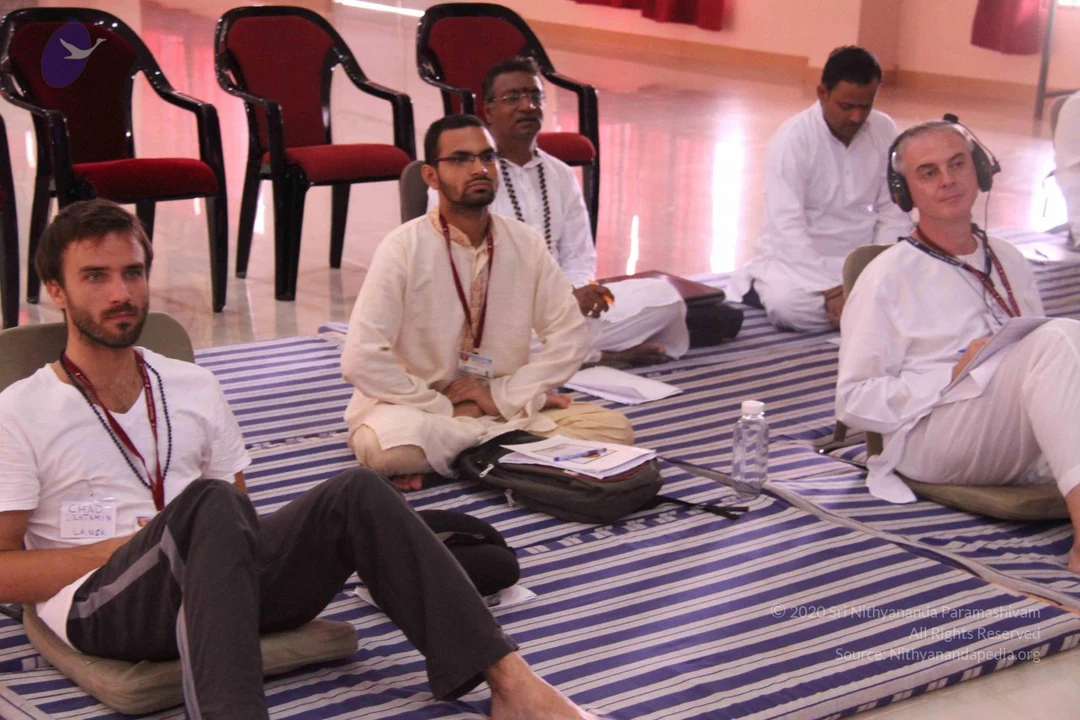
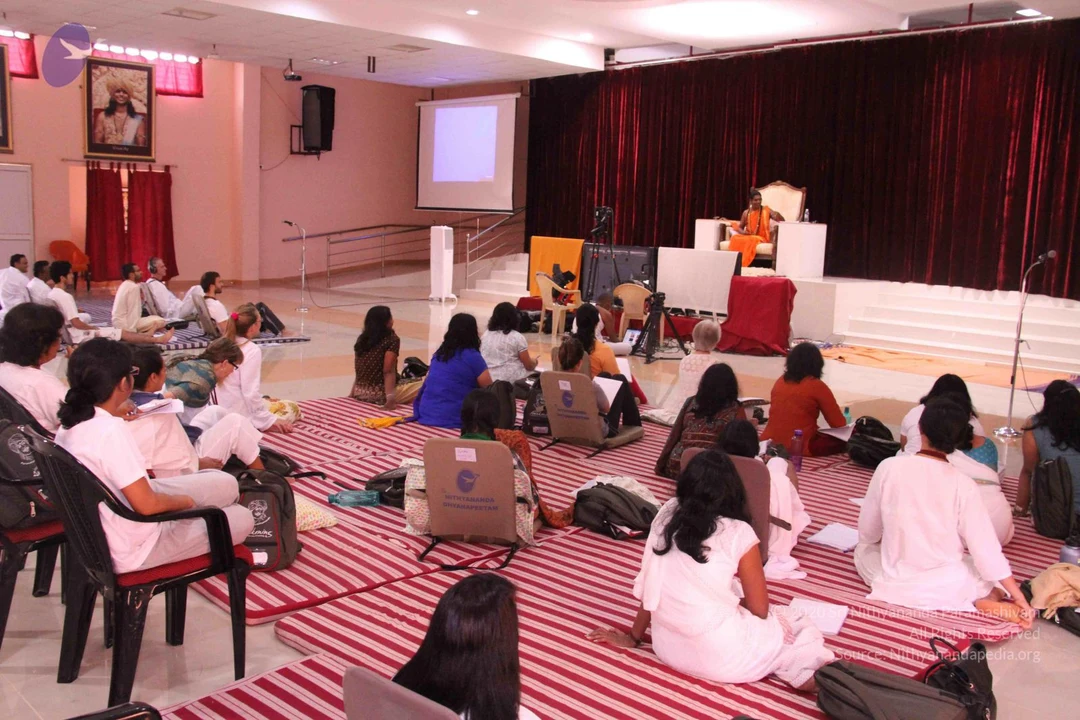
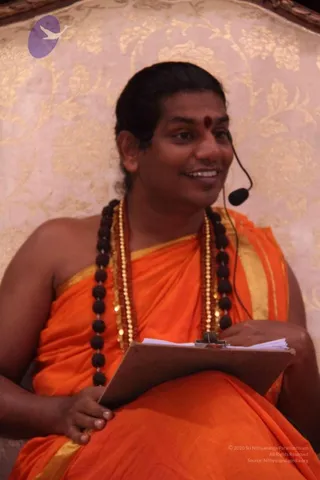
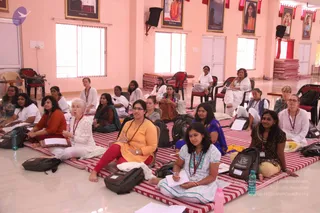
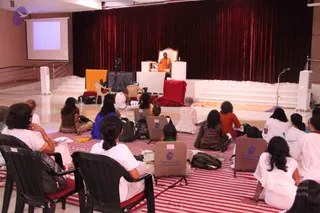
A smiling man sits on an ornate cream-and-gold floral upholstered chair, wearing a saffron-orange garment with a gold border draped over his shoulders. He wears long dark rudraksha malas and a gold-bead necklace, has a red bindi on his forehead, and a small headset microphone near his face. He holds a brown clipboard with loose white papers on his lap, appearing to speak to an audience. A purple bird logo sits in the top-left corner and a copyright notice in the lower right.A photo of a seated audience in a pale pink hall at a satsang session. Women sit on red-and-white striped floor mats, many in white kurtas or saffron, orange, blue and green outfits, with lanyards around their necks and notepads or pens in hand. Some attend chairs along the walls. Framed portraits hang high on the pink walls above them, one labelled with the word 'Charisma', and a few tall windows and red curtains frame the room. No a person figure is clearly visible.A satsang discourse in a hall with a deep red velvet curtain backdrop and a projection screen at left. A robed teacher in orange clothing sits on a gilded throne-style chair on a raised white stage, with a microphone and a small table beside him. In the foreground, a large audience of mostly women in white clothes sits cross-legged on red-and-white striped mats, many with backpacks and small wooden seat boards with the Nithyananda Dhyanapeetam logo. A camera on a tripod films from the stage, and a yellow cloth hangs on the stage edge.A photo of a seated satsang audience on a blue-and-white striped mat in a bright hall with red-cushioned chairs behind. In the foreground a bearded young man in a white t-shirt, dark trousers and a red lanyard sits with legs stretched out. Beside him a man in cream kurta with glasses and red lanyard sits cross-legged. On the right a man with headphones and a white kurta holds papers. Behind them a man in white kurta with a rudraksha-style mala sits, and another man in white sits further back. A water bottle and bag lie on the mat. No speaker is visible, and no figure is identified as a person.Photograph of a satsang hall with a seated audience on red-and-white striped mats and some chairs, facing a raised stage. Most attendees wear white clothing; some sit cross-legged, others on plastic chairs with laptops and bags nearby. On the stage, a figure in orange robes sits on an ornate cream-and-gold throne with a red cloth draped over a table beside it. Red curtains hang behind the stage, a projection screen is mounted above, and a framed portrait hangs on the left wall. Cameras and microphones are set up at the front. A figure in orange on the throne may be a person, seated as the speaker. Laptop covers and a printed label read Nithyananda Dhyanapeetam.

Afternoon-Yoga

5 photosSource gallery
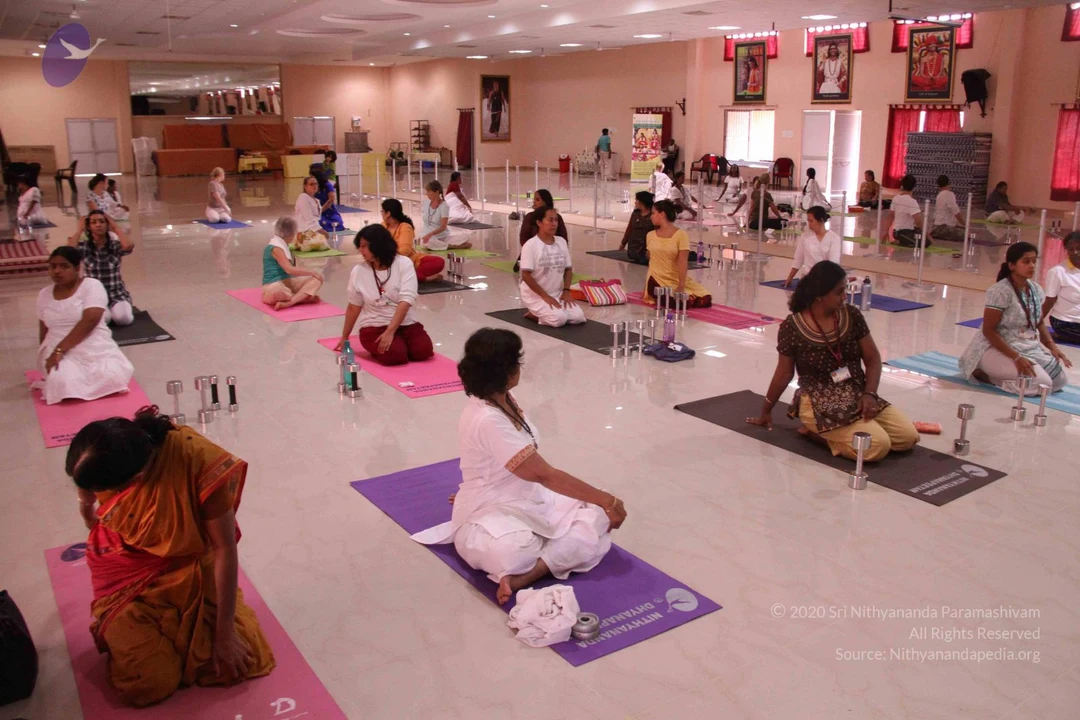
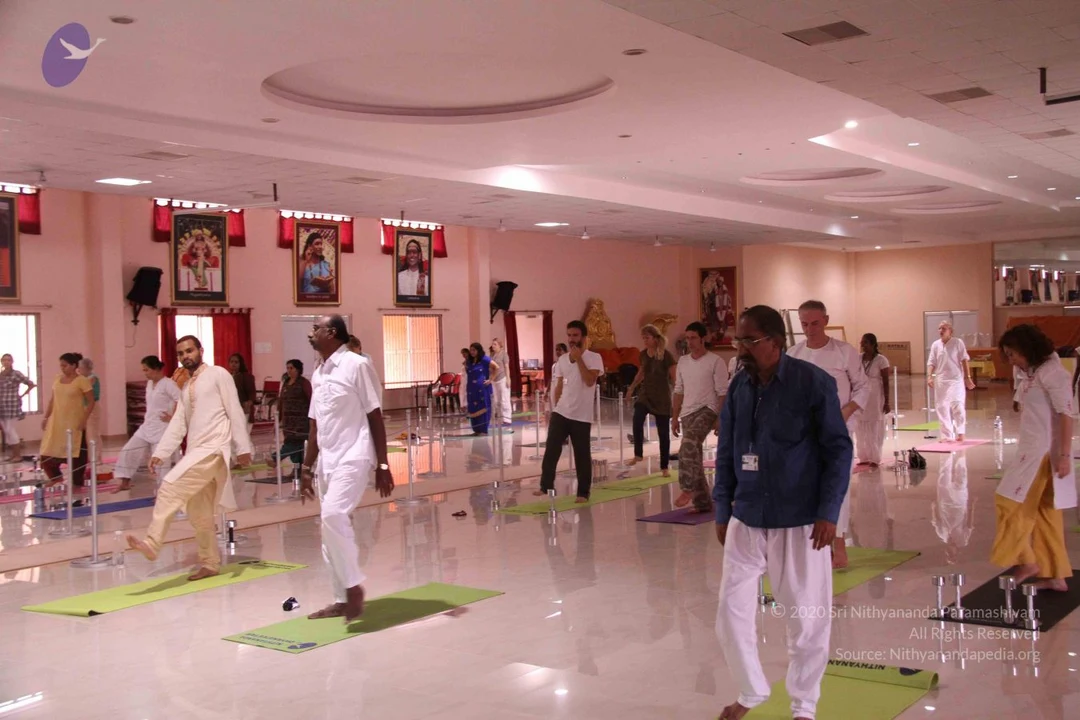
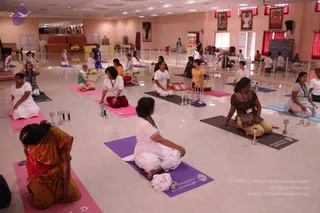
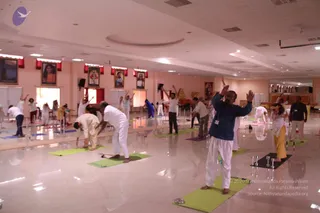
A large, bright hall with polished white floor where women sit on yoga mats in rows, most in white or colourful salwar and saris, some with dumbbells placed beside them, practicing seated exercises. Mats are pink, purple, black and blue, branded with a Nithyananda Dhyanapeetham logo. Framed portraits hang on the back wall, and red curtains line the windows. Several staff move about in the background.A photograph of a large, bright hall with polished pale floor and pink walls where a group of about 20 people practise yoga on coloured mats. Most stretch with arms raised overhead or bend forward. A man in a navy blue top and white trousers in the foreground raises both arms. Framed portraits hang on the back wall above red valances, and a deity murti stands near the far end. The mat and stretching class suggests an ashram yoga session.A photograph of a large, bright hall with polished white floor and pink walls, where many people in white clothes practise yoga on green and purple mats. In the foreground a man in white kurta-pyjama and a person in a dark blue jacket and white trousers raise their arms overhead in a stretch. Several others bend forward toward their toes. Framed portraits hang on the back wall above red valances, and a golden statue stands near the right side. Steel stanchions separate the mat rows.Indoor yoga session in a bright hall with polished pale floor and cream walls. Many people stand on green and purple yoga mats in rows, some in white kurtas and dhotis, others in white or blue shirts and casual clothes. A man in a blue shirt and white trousers stands in the foreground holding a balance pose. Framed portraits hang on the back wall above red curtains, and a gold statue stands at the side. Approximately 21-100 people are visible.A large bright hall with pale pink walls and a polished reflective floor, where a group of practitioners stand on green and black yoga mats in a yoga posture, one leg raised, arms at the sides. Most wear white or light clothing, while one man in the foreground wears a blue shirt and white pants and another woman wears a yellow garment. Framed portraits hang along the back wall between red valances, and a golden statue is visible at the far end. Many more people stand and sit in the background.

Brahmasutras

18 photosSource gallery
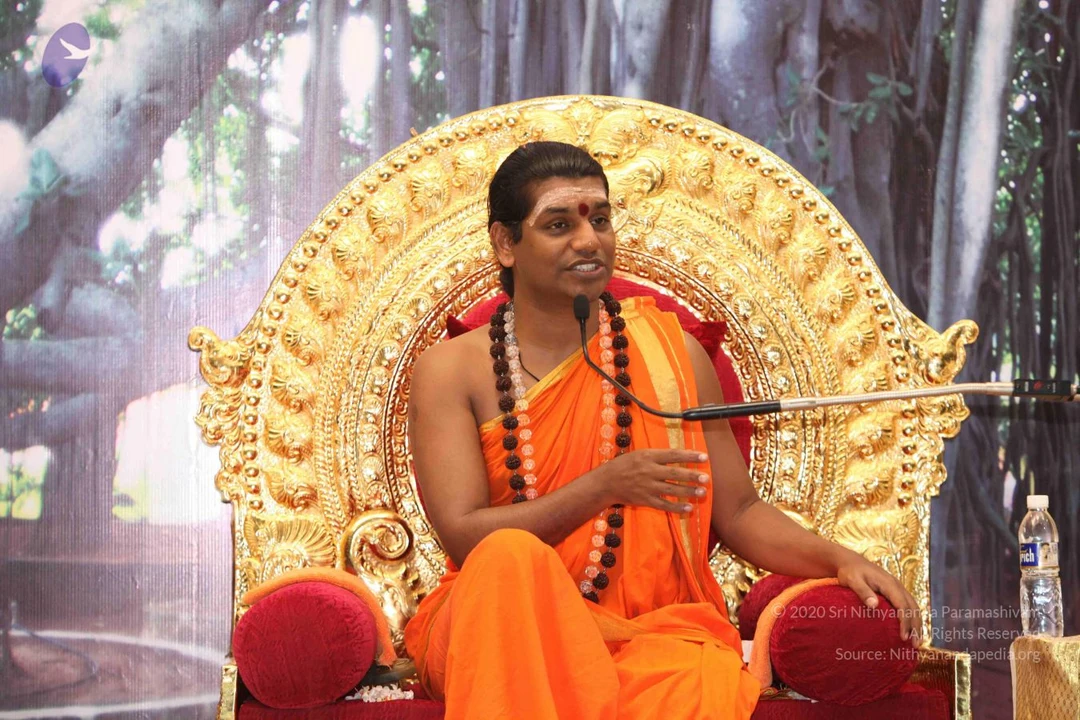
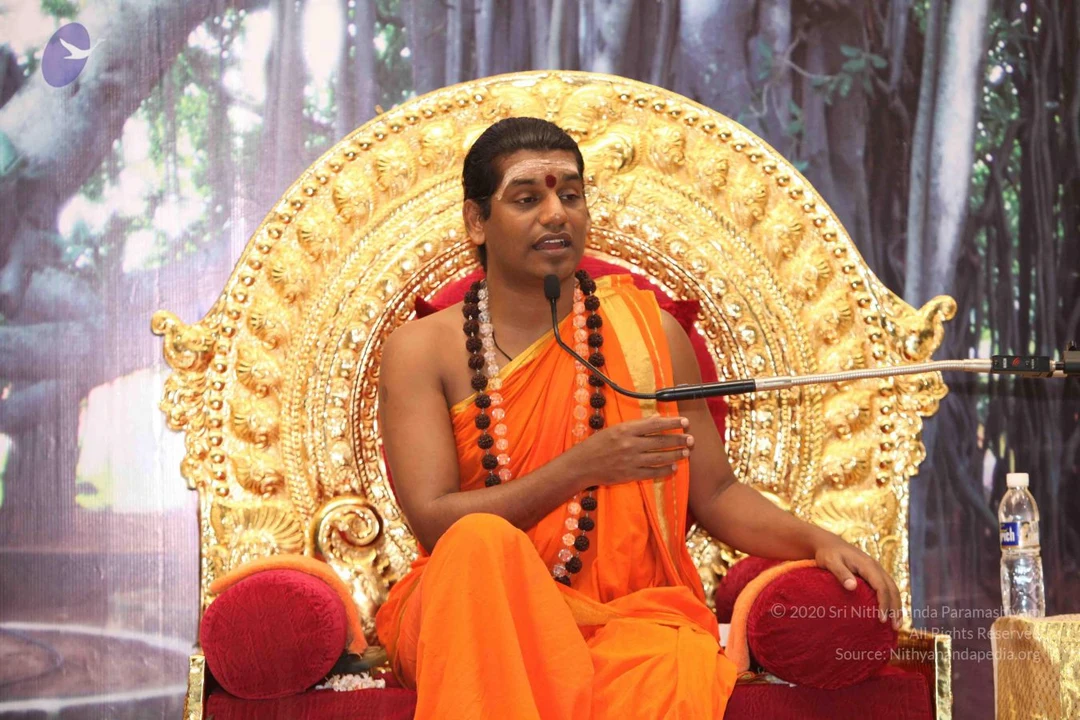
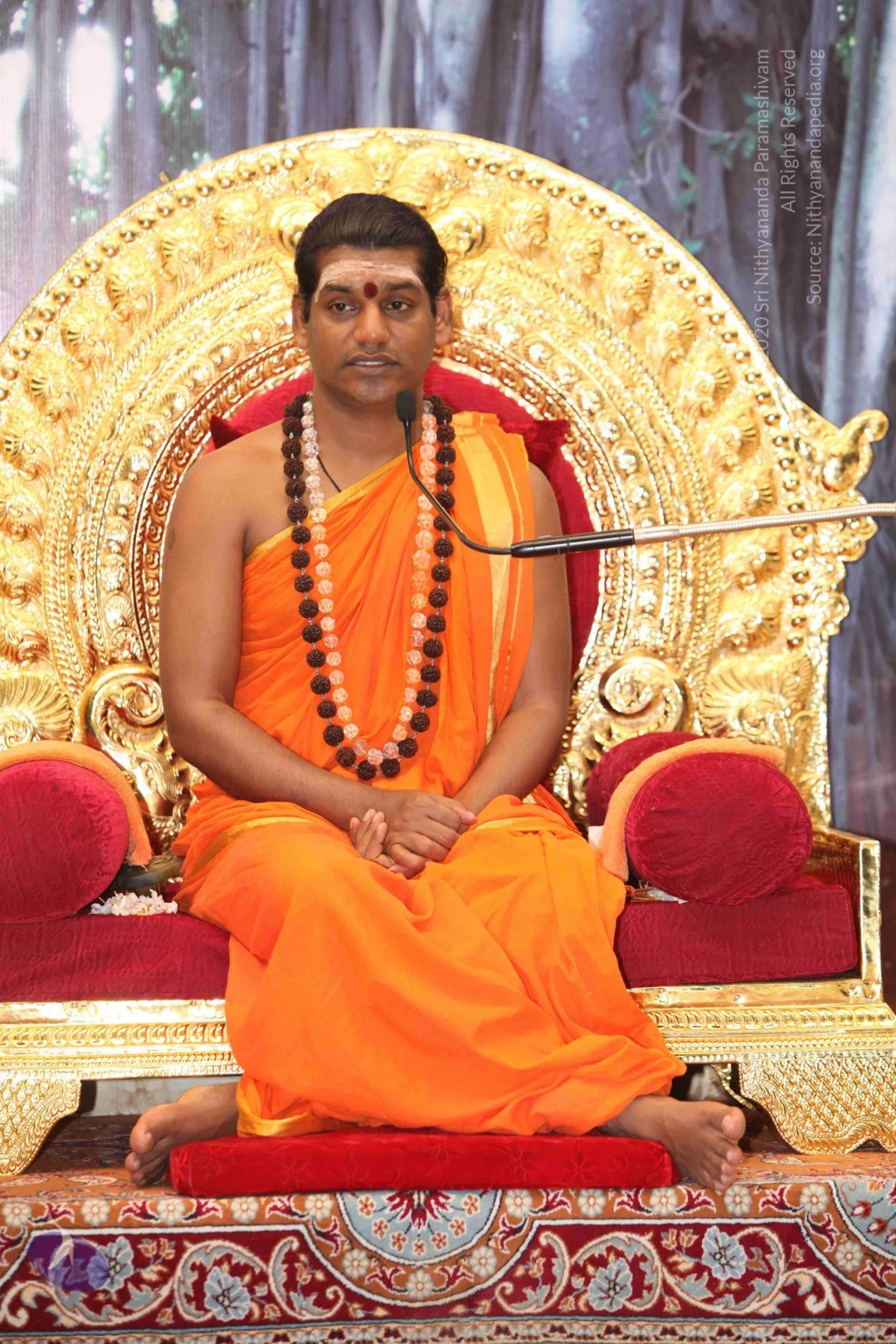
A seated man in saffron-orange robes with a rudraksha mala around his neck sits cross-legged on a gold, red-cushioned throne-style seat on a raised stage with a red-and-cream rug. His hands are folded in front of him as he sits in a discourse setting. A microphone stands beside him. To the left, a golden bull vehicle (nandi-style) on wheels carries a deity murti garlanded with white and red flowers under a decorated canopy. Behind is a large backdrop photograph of a banyan tree with hanging aerial roots, framed by navy curtains. The scene reads as a satsang with a deity murti in a chariot-style vehicle beside the speaker.A man with swept-back hair, a white and red tilak on his forehead, and an orange saffron robe with gold border sits smiling on an ornate gold throne with red cushions. He wears long rudraksha and clear crystal malas and holds a microphone on a stand. Behind him is a painted forest backdrop. A candidate match on appearance: a person, seated and speaking as a teacher at a satsang.A man seated on an ornate gold throne with a red cushion speaks into a microphone on a stand. He wears an orange-saffron cloth draped over his body, with bare shoulder and arm, multiple dark rudraksha malas and clear crystal beads around his neck, and white tilak marks with a red bindi on his forehead. He gestures with his right hand in a discourse setting, with a blurred forest-like backdrop behind the throne. Based on appearance and cues, this is a person in satsang, speaking as a teacher.A man seated on an ornate golden throne with carved scrollwork and gold beaded trim speaks into a microphone during a discourse. He wears saffron-orange robes with a gold border and a red-brown thread, a dark rudraksha mala and a pale beaded mala with pink and clear beads. He has a red bindi and horizontal white vertical tilak marks on his forehead, and raises one hand in an explanatory gesture. A blurred forest backdrop with light green tones fills the background. a person appears on the throne, with saffron/orange clothing, rudraksha malas and a throne cue, so the in-person candidate is marked as probable on appearance grounds.A man in saffron-orange robes sits on an ornate gold throne with red cushions in front of a large banyan tree backdrop. He wears rudraksha and pink bead malas, has a red tilak on his forehead, and gestures with one raised hand while speaking into a microphone on a stand. A water bottle and an open book stand nearby. The appearance is consistent with a person, based on the orange robes, multiple rudraksha malas and the throne seating, while he delivers a discourse.A seated audience of women fills a large marble-floored hall during a satsang, most sitting on striped red-and-white mats in rows. The foreground women wear white salwar-style and sari outfits with red beaded necklaces, one in a teal sari, and several hold notebooks and pens while listening attentively. Behind them, further attendees sit on chairs and mats, including a man in white kurta at the far right and a woman in a green top with a pink cushion. Stanchions with rope barriers divide the space, and a framed image hangs on the back wall.

Darshan

8 photosSource gallery
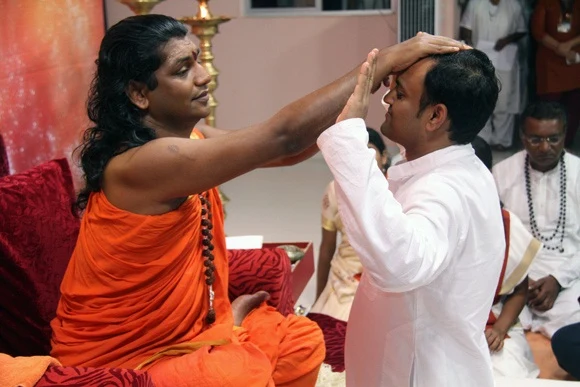
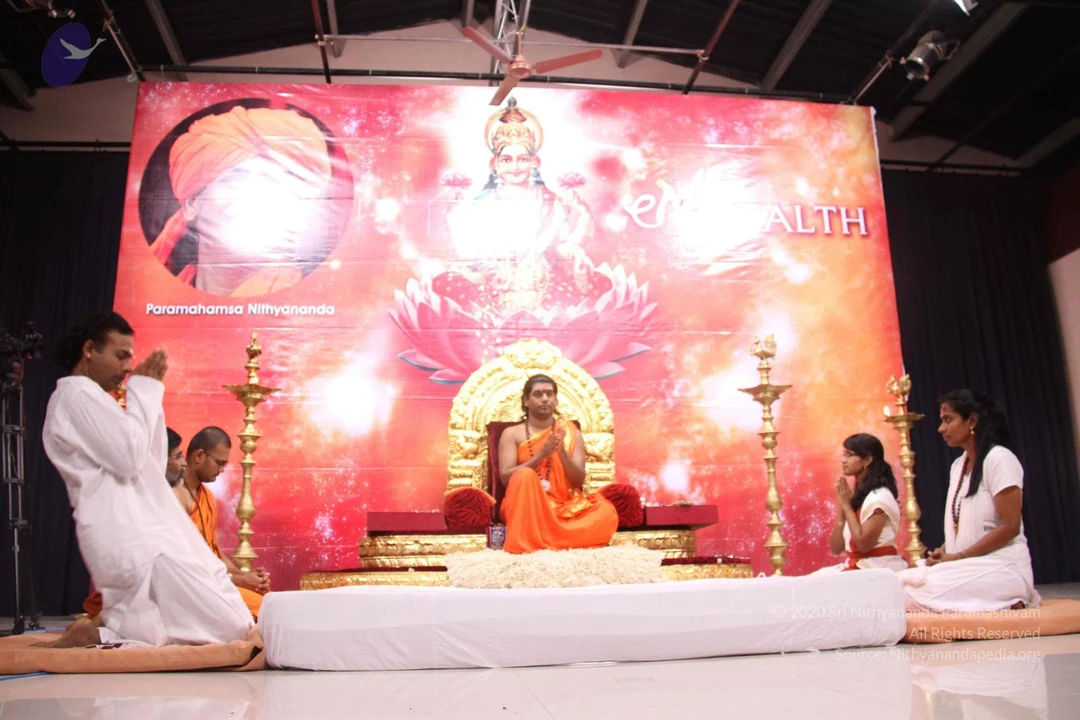
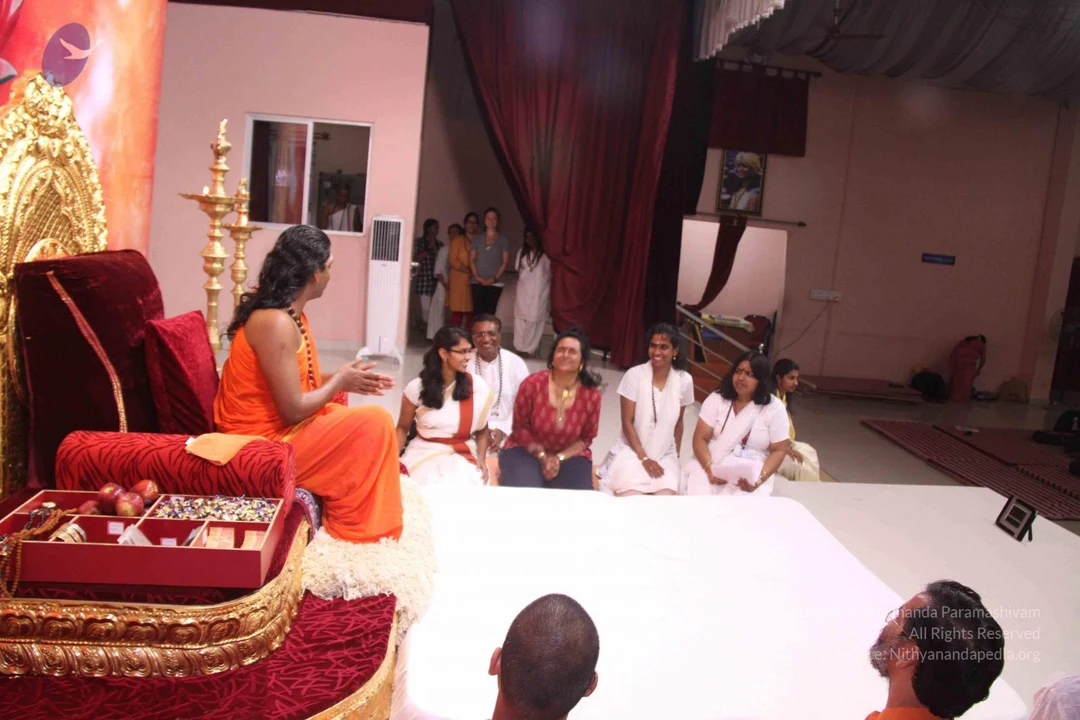
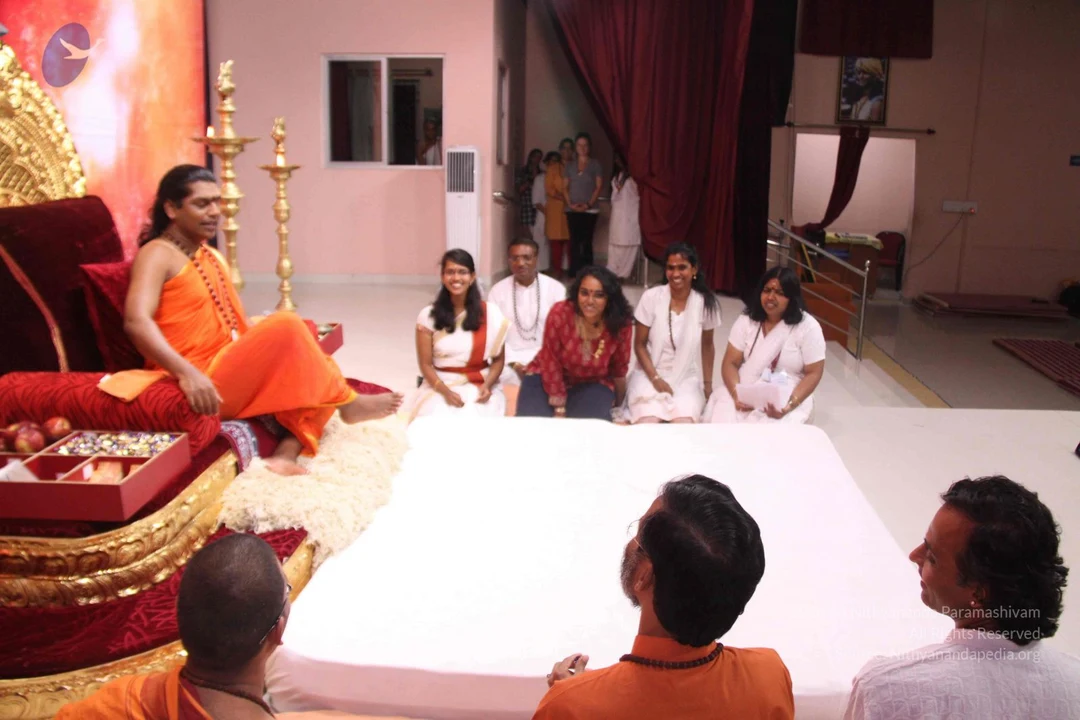
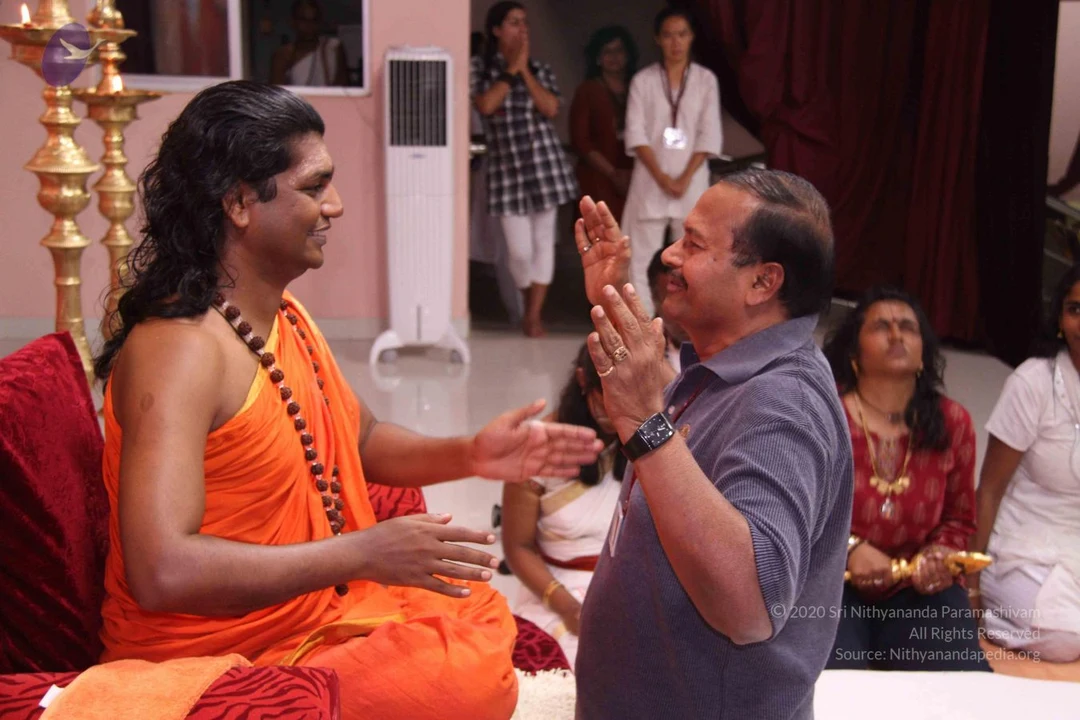
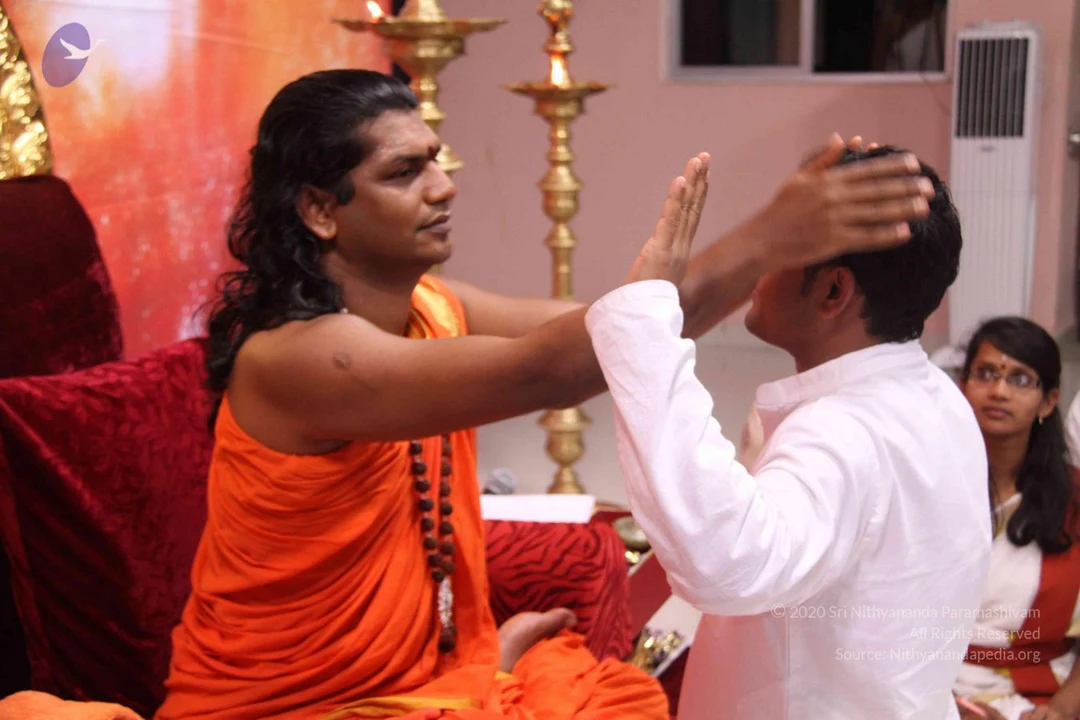
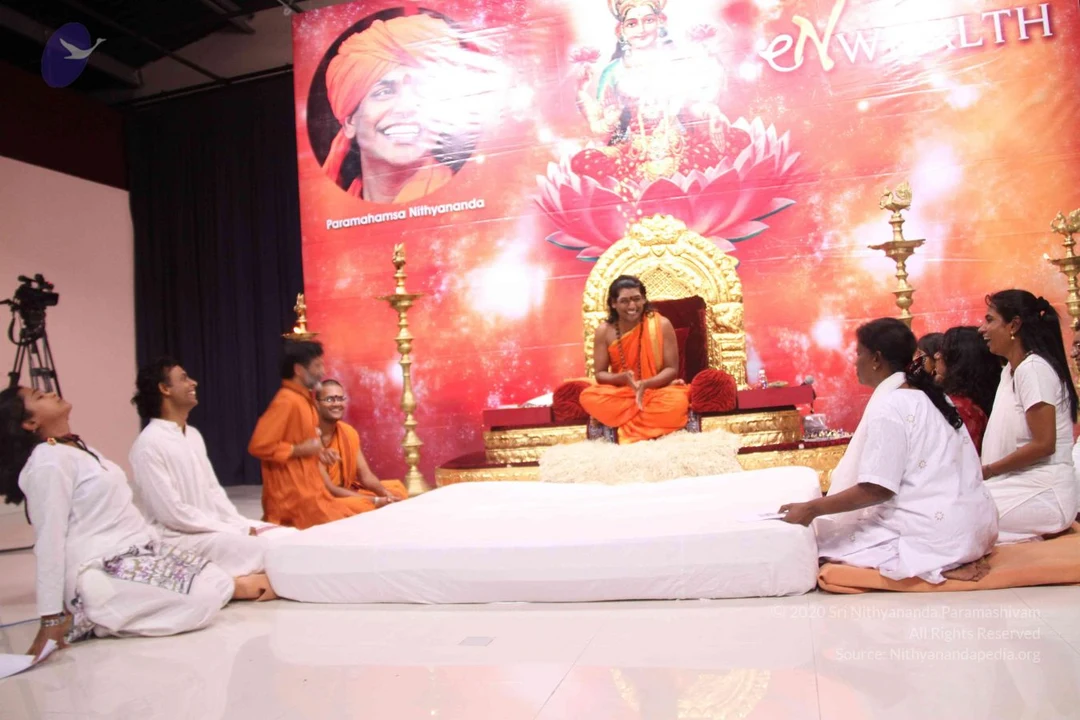
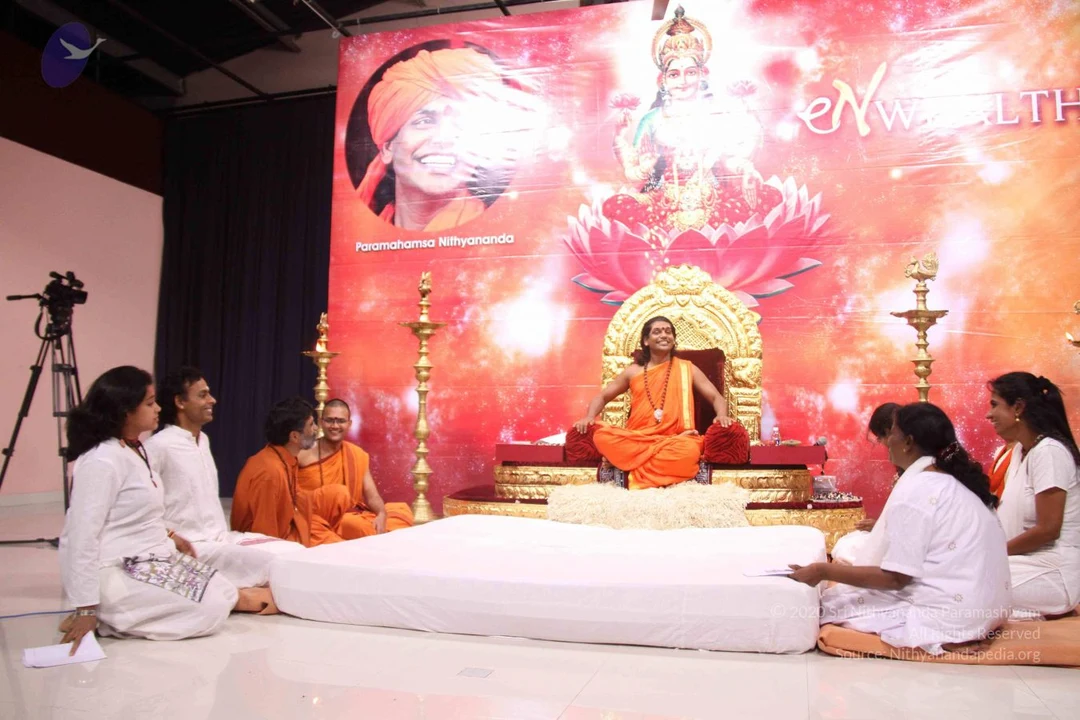
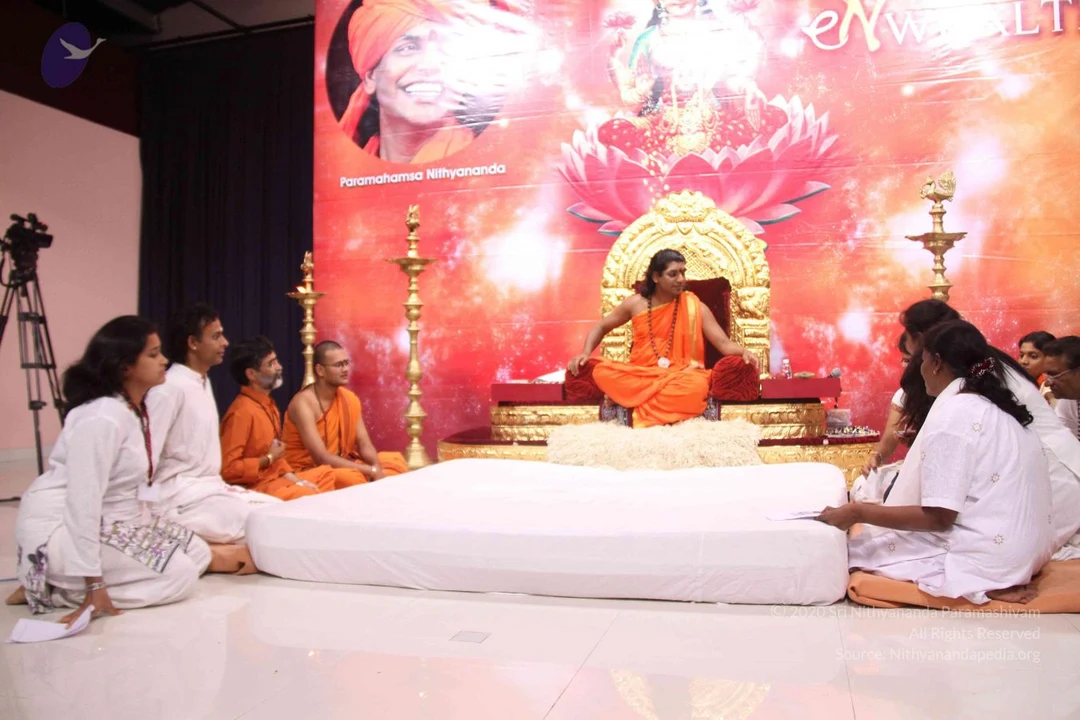
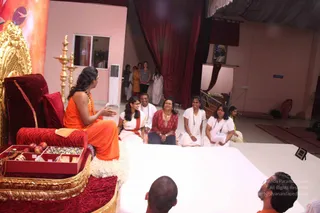
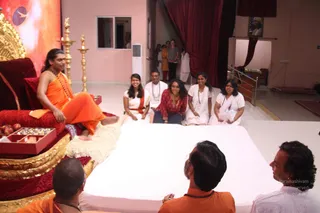
A seated man in saffron-orange robes and rudraksha beads sits on a golden throne at the centre of a stage, hands joined in greeting. A large red backdrop shows a goddess figure seated on a lotus, with a portrait labelled "Paramahamsa Nithyananda" in the upper left showing a man in an orange turban. Brass lamps flank the throne. At the lower left a man in white kneels with palms pressed together, and a man in orange sits nearby. On the right two women in white sit with hands folded in namaste. A white cloth covers the stage floor in front of the throne. Several people are visible in the scene.A satsang hall with a figure in orange robes and long dark hair seated on an ornate gold-and-red throne at left, gesturing as they speak. Beside the throne sit brass lamps and a red tray holding fruit and small objects. Seated on a white mat in front are several devotees: a woman in white with red trim, an older man with a white shawl and mala, a woman in a red blouse, two women in white, and a young woman in a grey top. Standing figures in white and orange are at the back near a curtain, and two heads are visible in the lower right foreground. A small framed portrait hangs on the far wall. The orange-robed figure cannot be confirmed as a person from appearance, so the role is described only as a seated speaker.A satsang in an ashram hall with pink walls and red curtains. A long-haired man in saffron-orange robes, with a rudraksha mala, sits cross-legged on a red and gold throne-like seat, speaking to the group. Brass lamps stand beside him and a tray of fruit and decorations sits at his side. Seated on a white cloth before him are several women in white and cream clothes, one in a red patterned top, and a man in white. In the foreground, two men in saffron and white sit with their backs to the camera, listening. A woman in white holds a notebook. Several more people stand in the background near a doorway.A seated man in an orange saffron robe with a rudraksha mala and long swept-back dark hair gestures with open hands toward a man in a grey-blue striped polo shirt and wristwatch who stands with palms pressed together in greeting. Behind them, a row of seated devotees, including a woman in a red top with gold jewellery, watch, and a standing woman in white. Brass lamps stand at left and a white cooling tower fan is behind them, with a maroon curtain at right.A photograph of a long-haired man in an orange saffron shawl and rudraksha mala seated on a red cushioned throne, placing his palm on the head of a man in white kurta who bends forward before him. Behind them a woman in a white sari with red border watches, and brass lamps stand against a red-orange backdrop.Photograph of a satsang discourse on a stage. A central figure with long dark hair wears orange robes and sits cross-legged on a gold ornate throne with a red cushion, gesturing with hands. Before him a white mattress-like platform stands with a white cloth on it. Seven people sit around: on the left a woman in white leans back laughing, a man in white sits, two men in orange robes sit near the centre, and on the right women in white and red sit on orange cushions, one touching the platform. Brass oil lamps flank the throne. Behind is a backdrop with a lotus, a deity figure and a framed portrait labelled "Paramahamsa Nithyananda". A video camera on a tripod stands at left.

eN-miracles

35 photosSource gallery
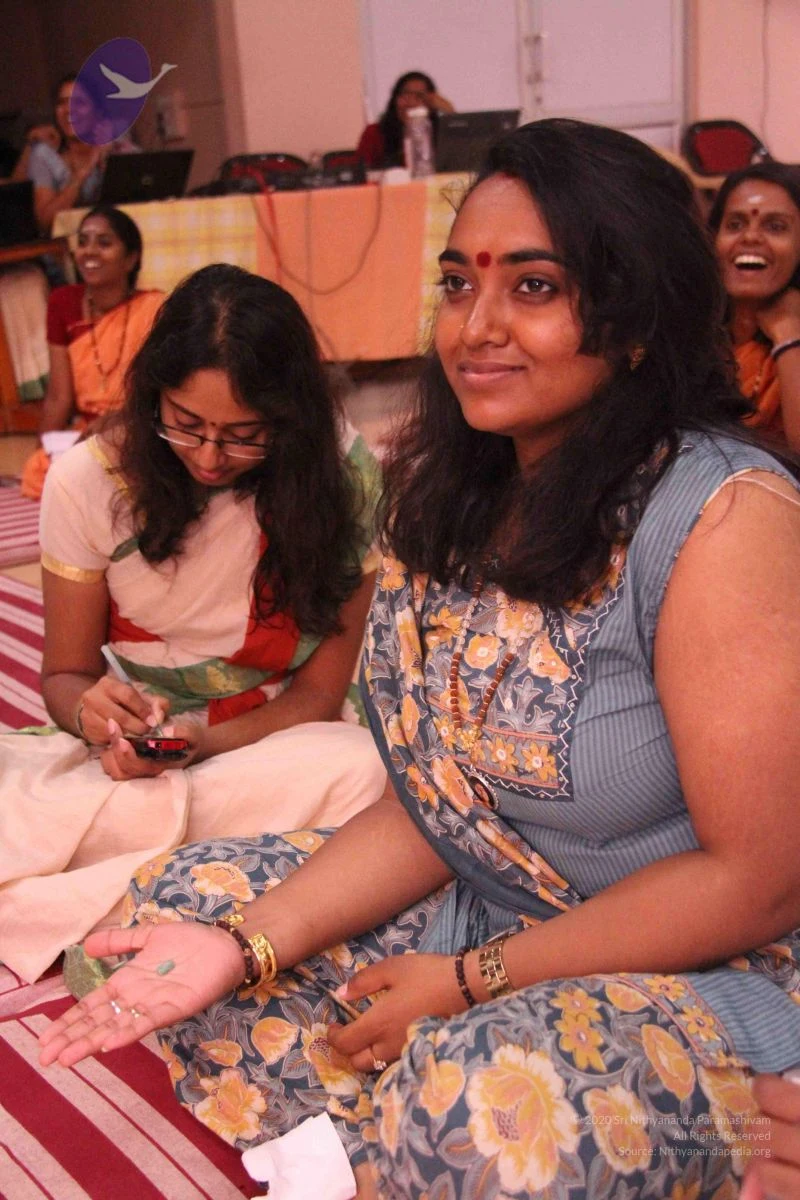
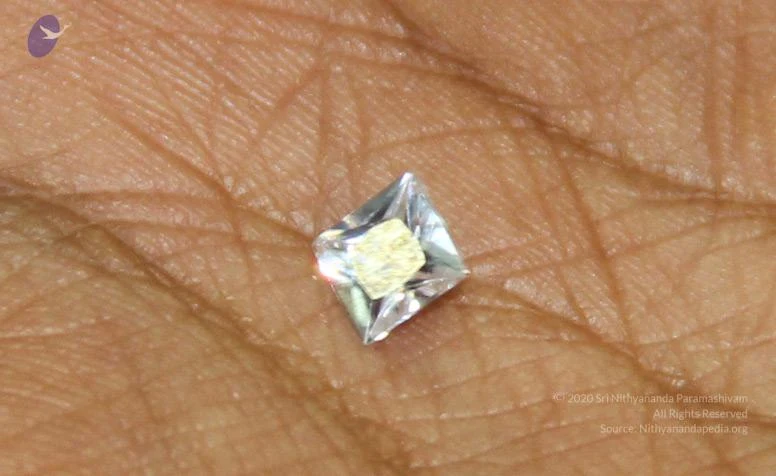
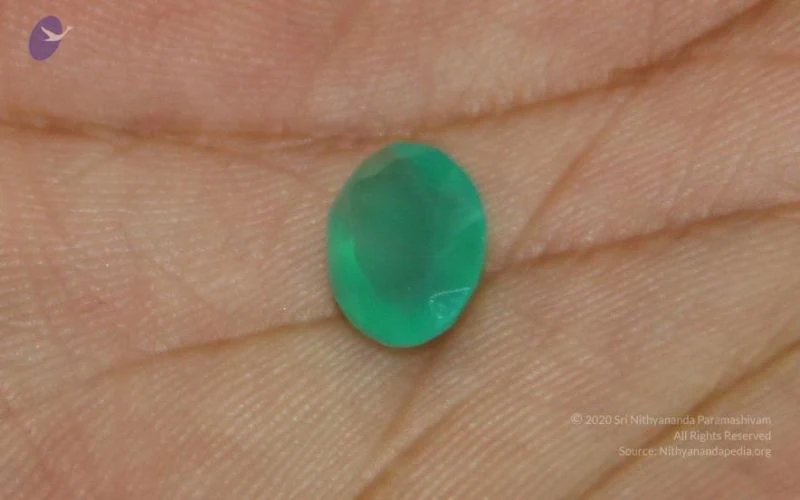
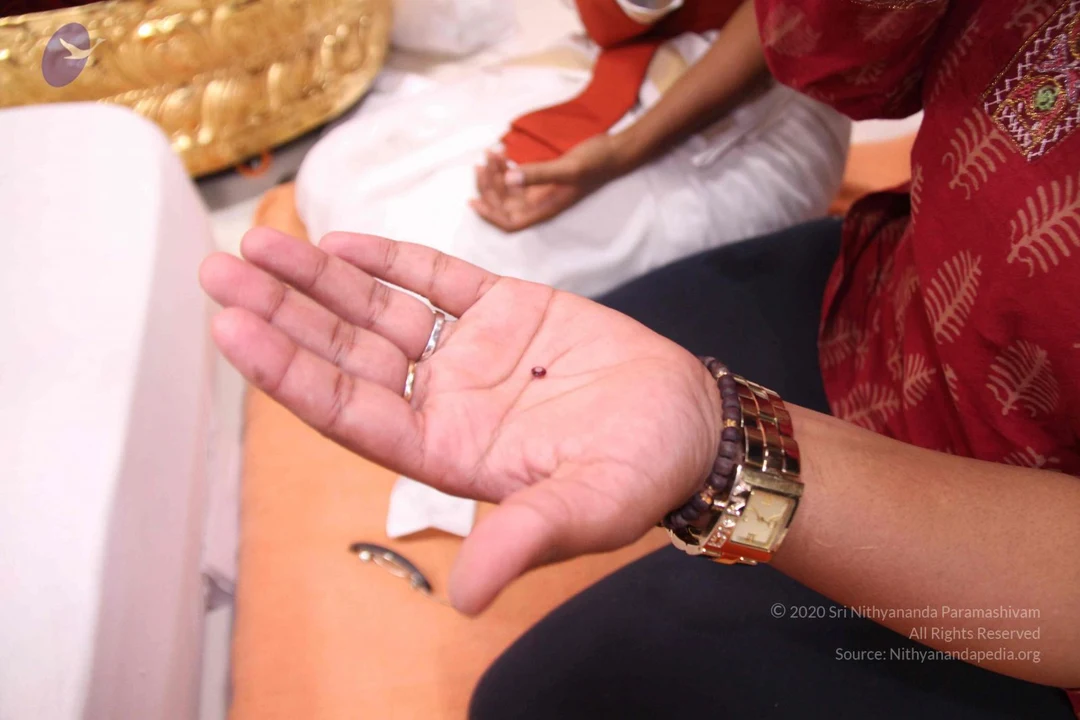
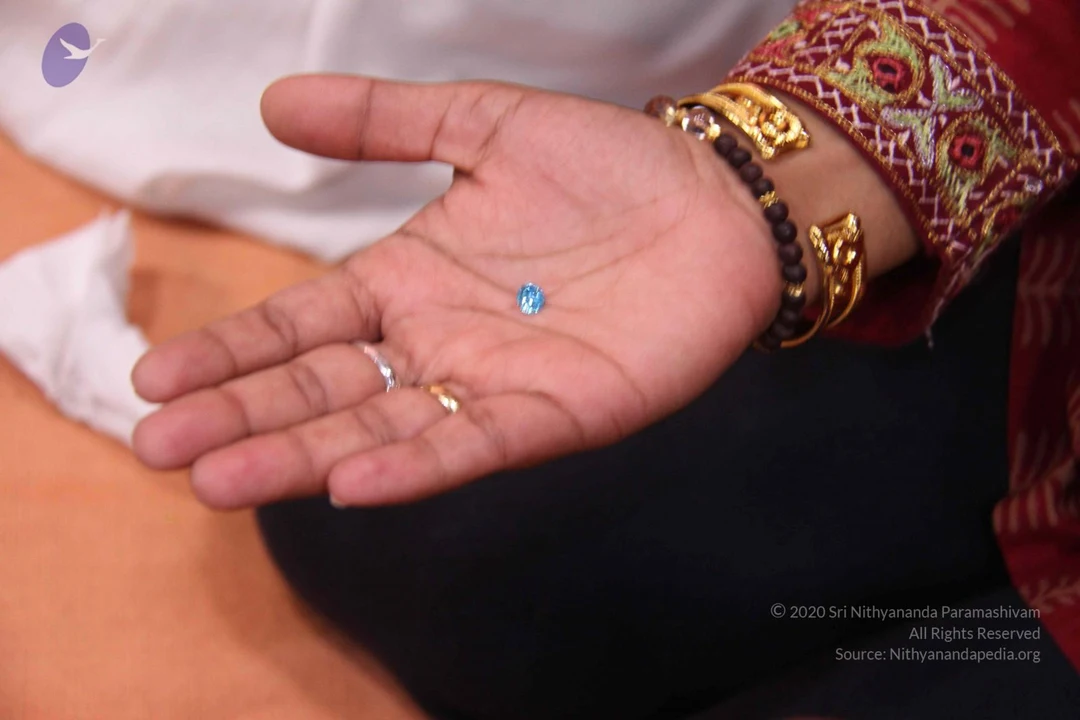
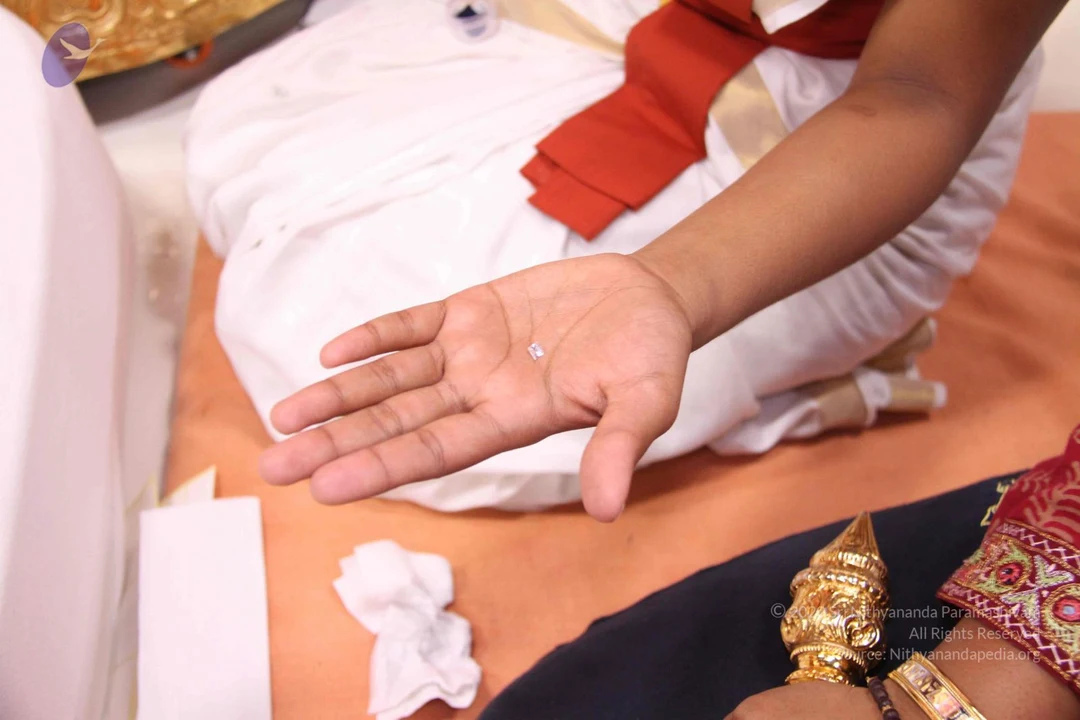
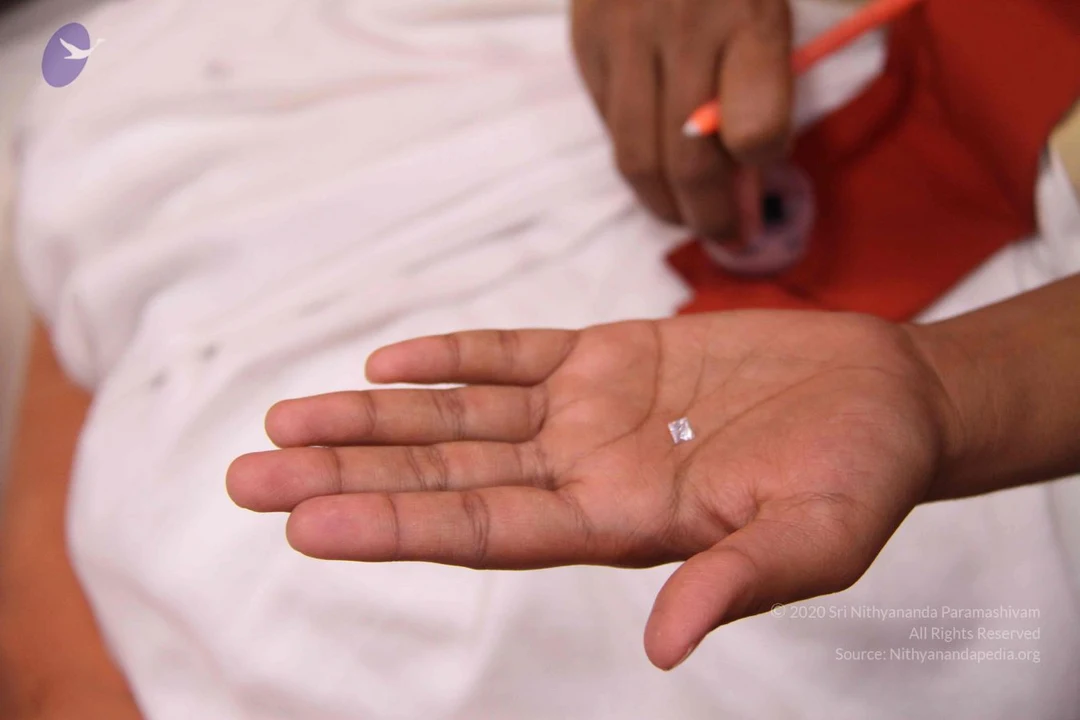
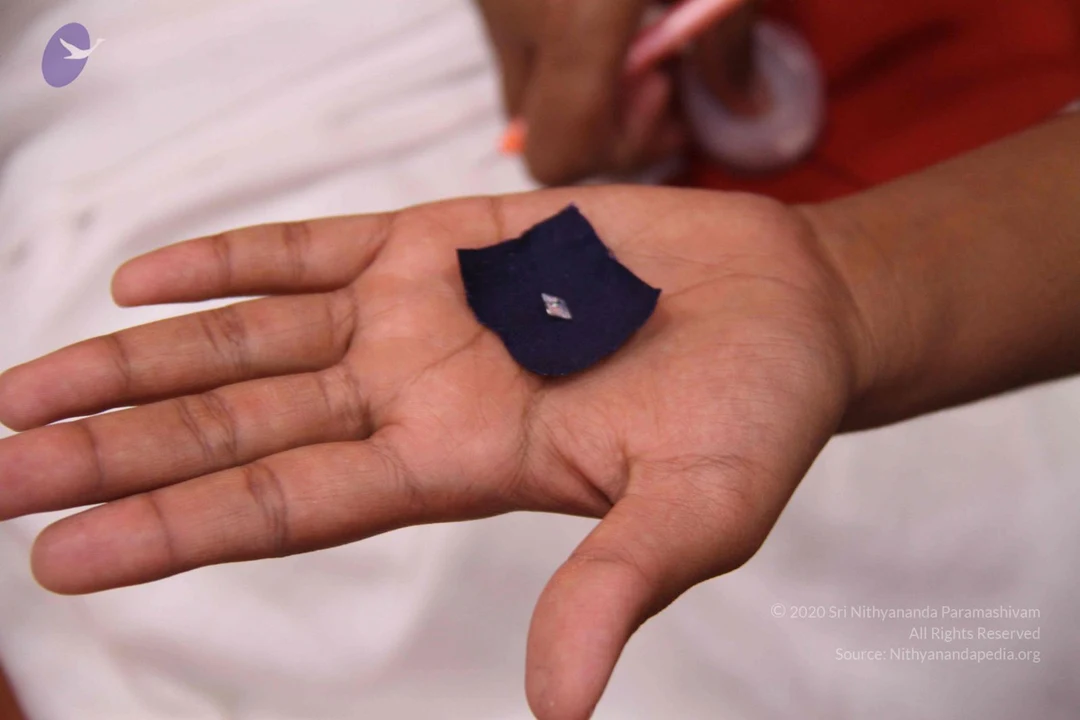
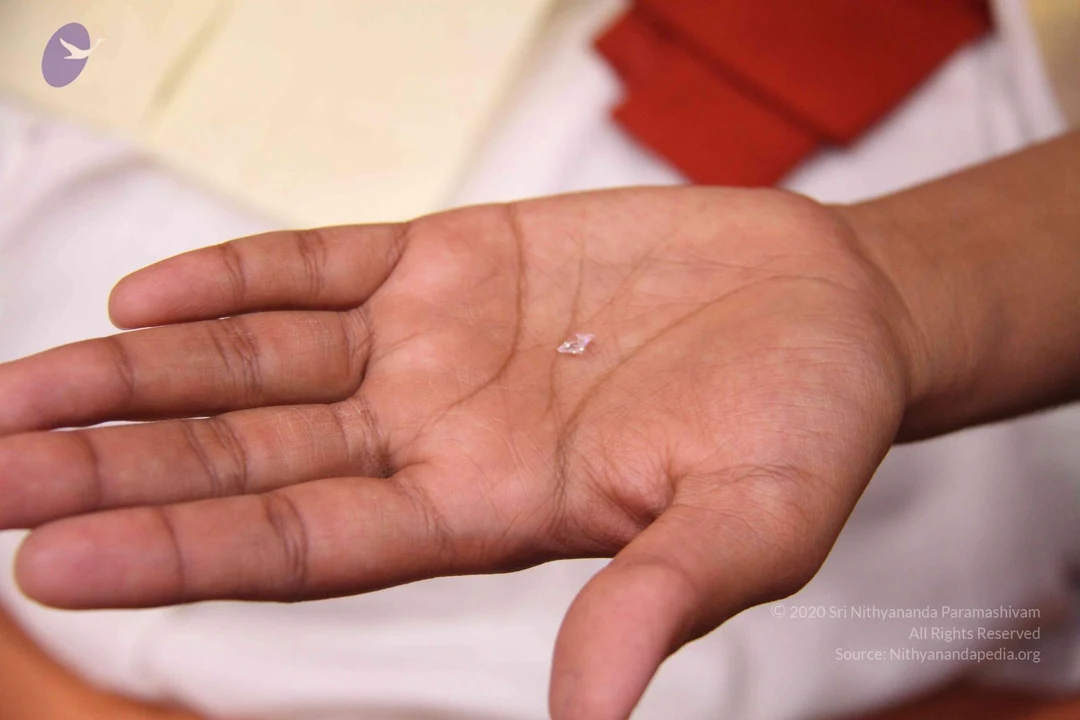
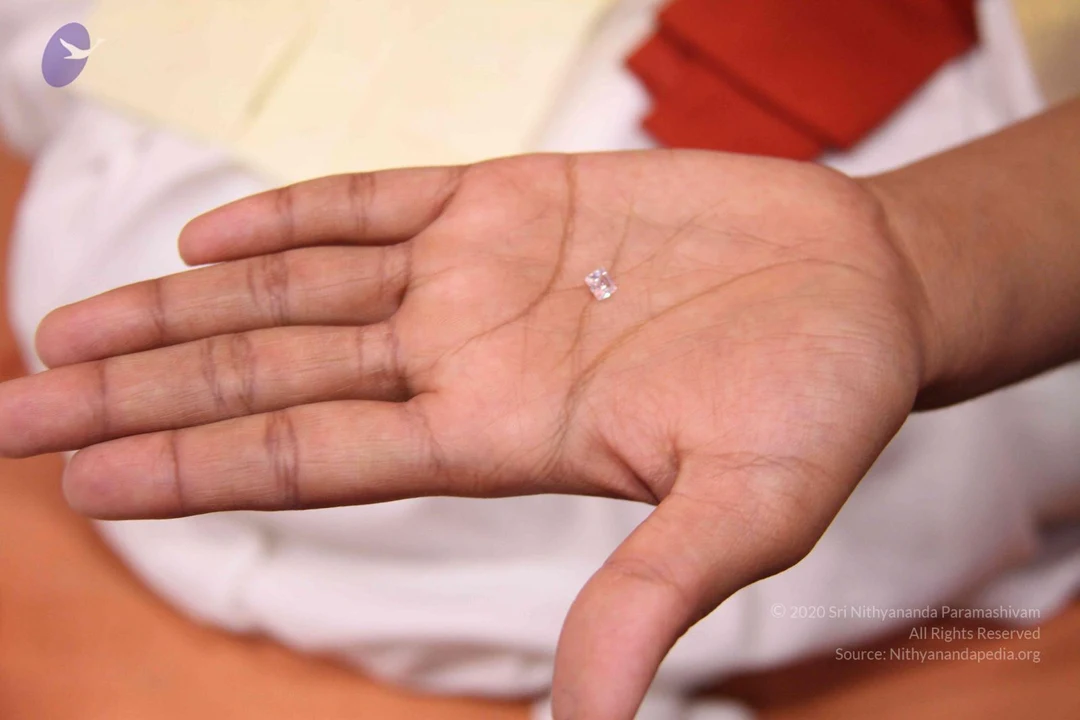
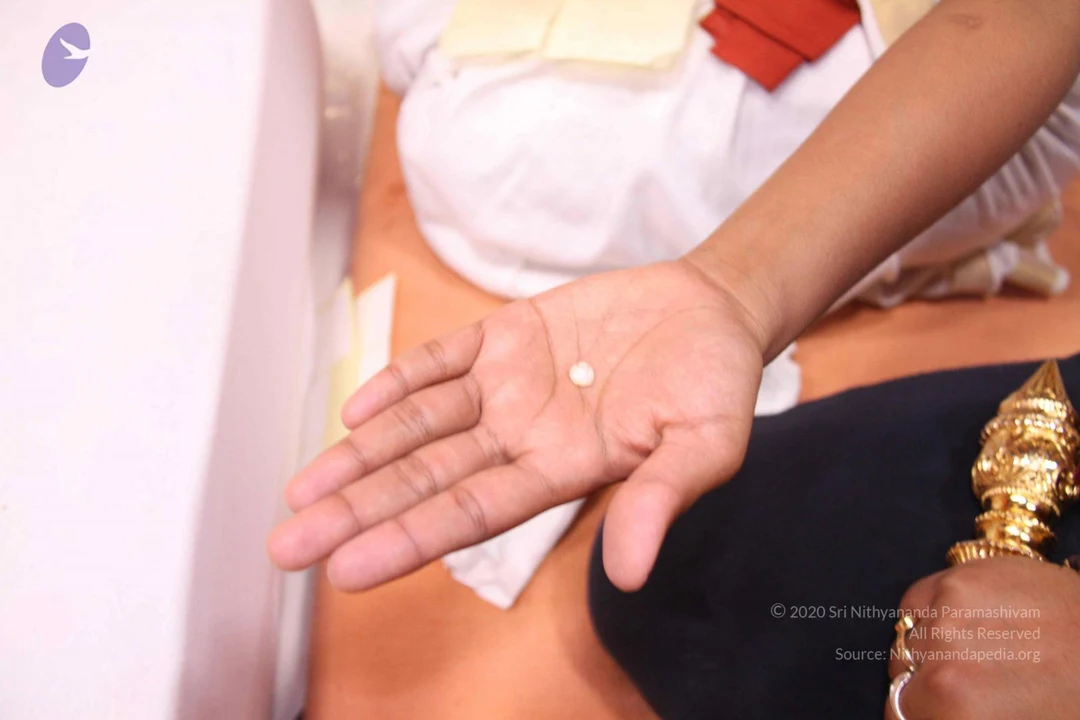
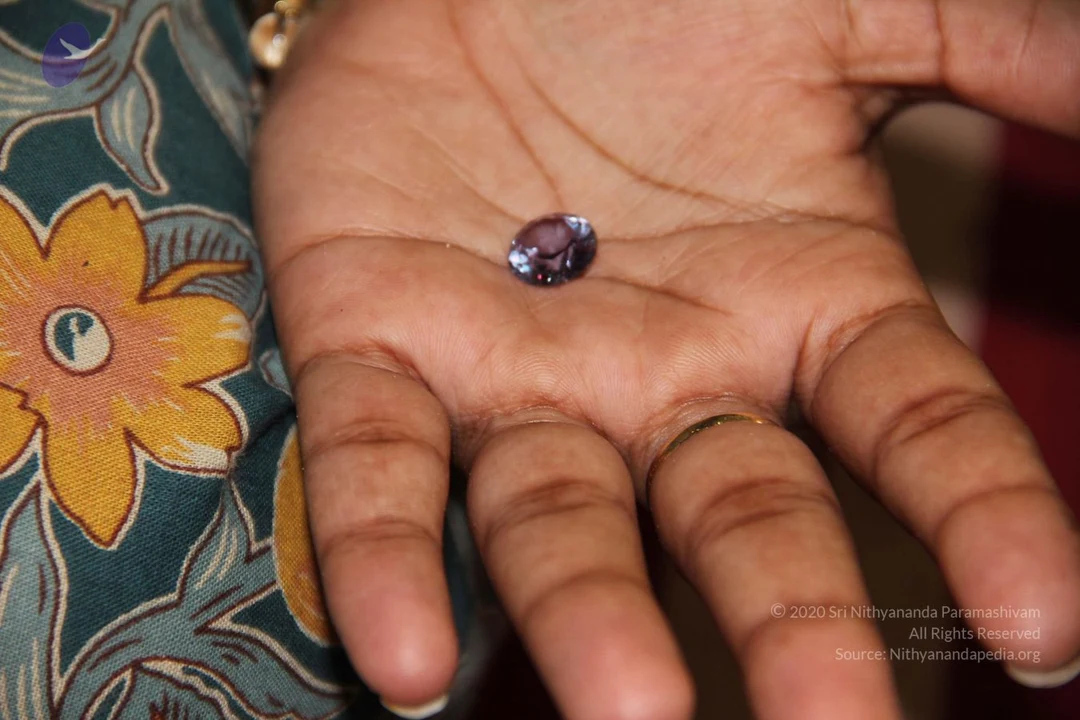
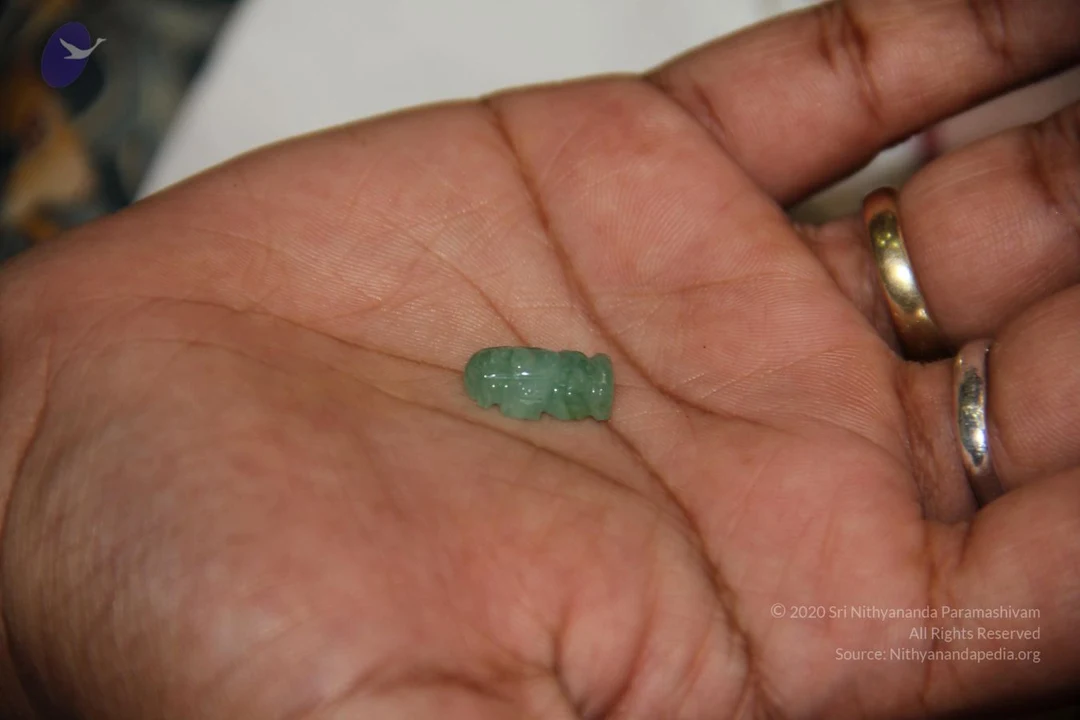
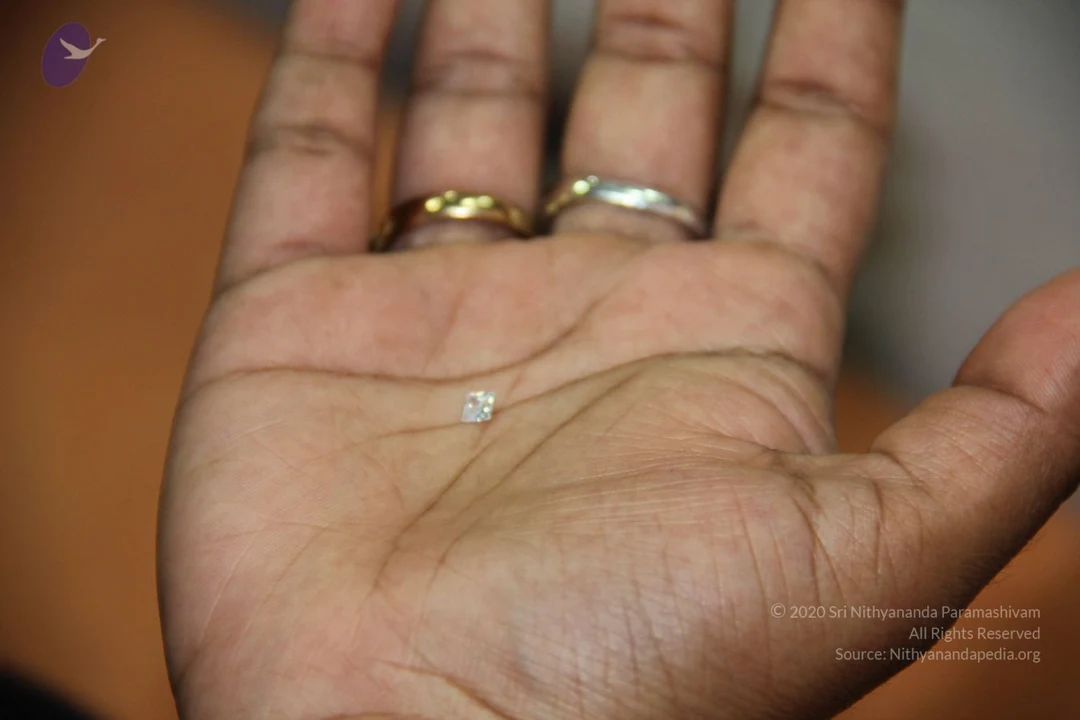
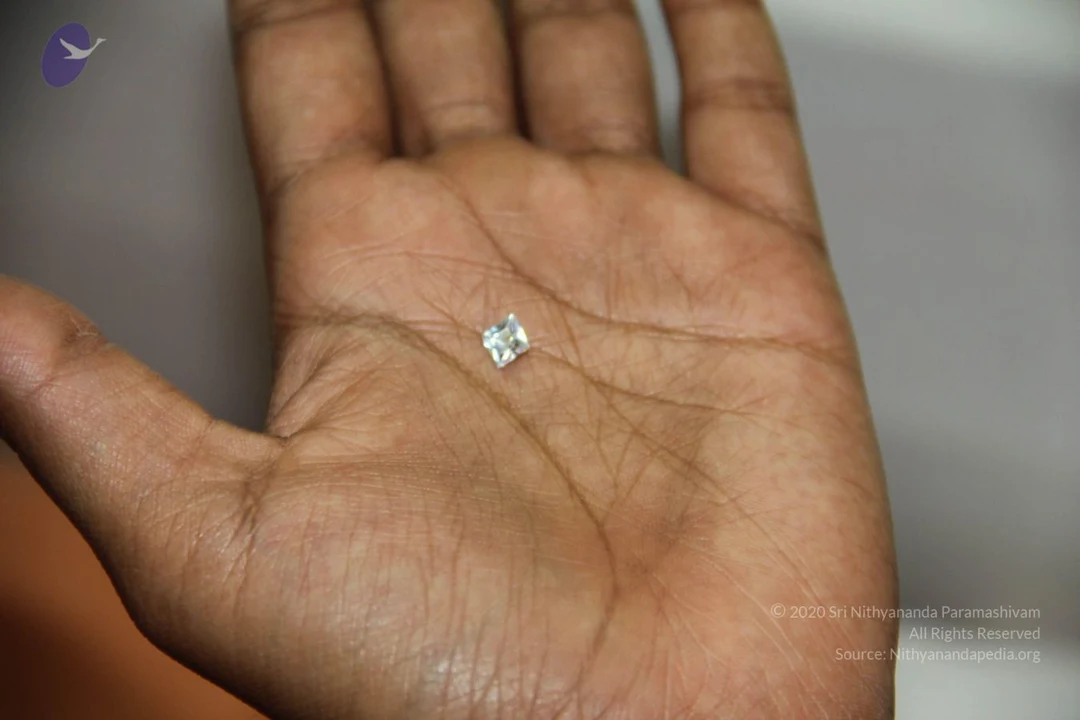
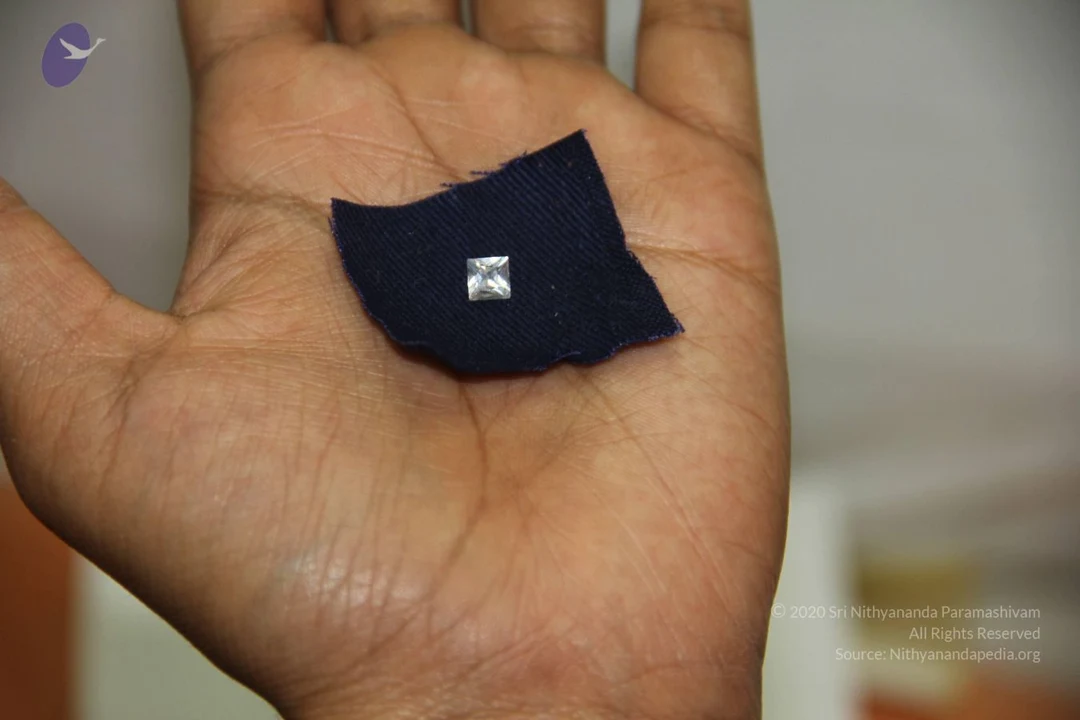
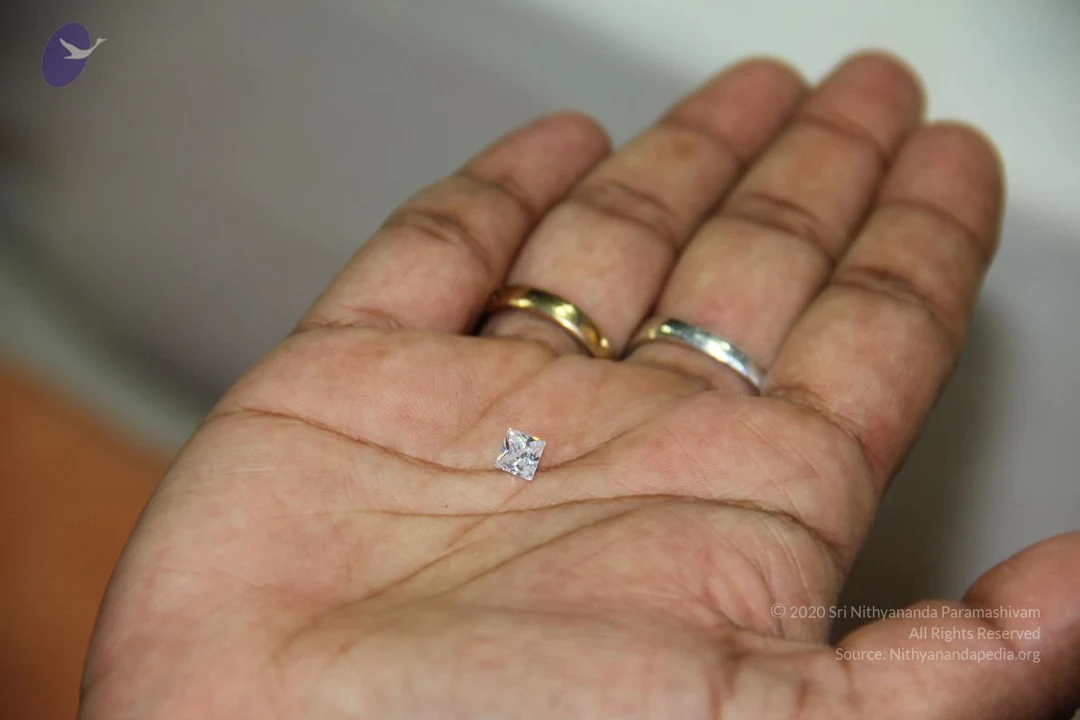
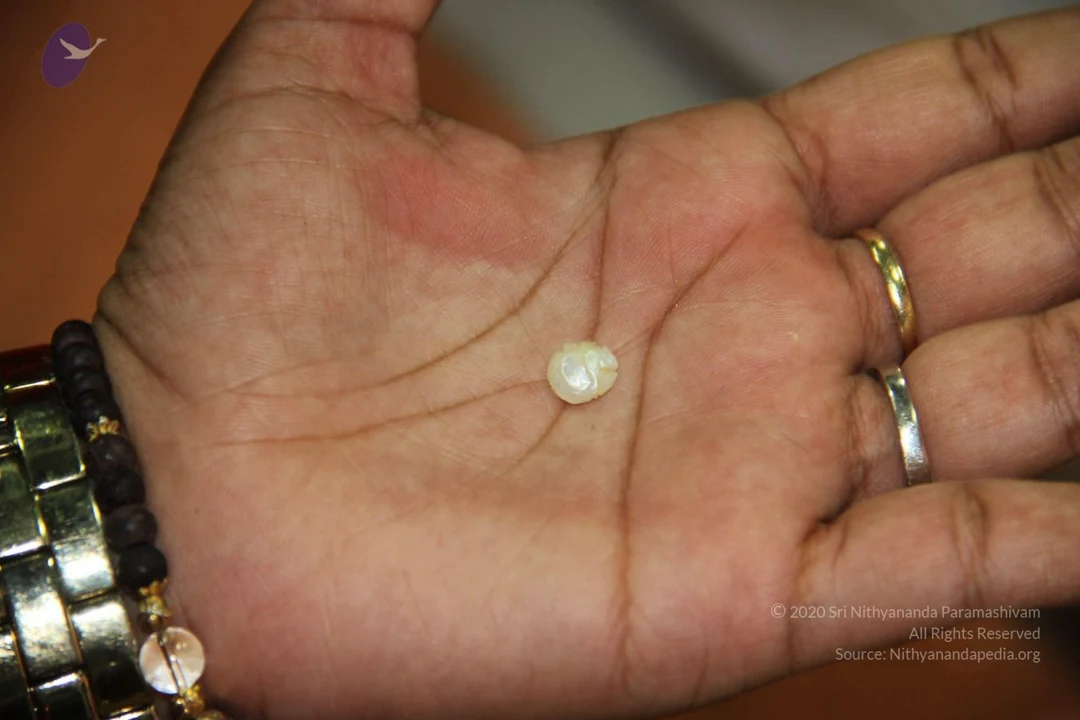
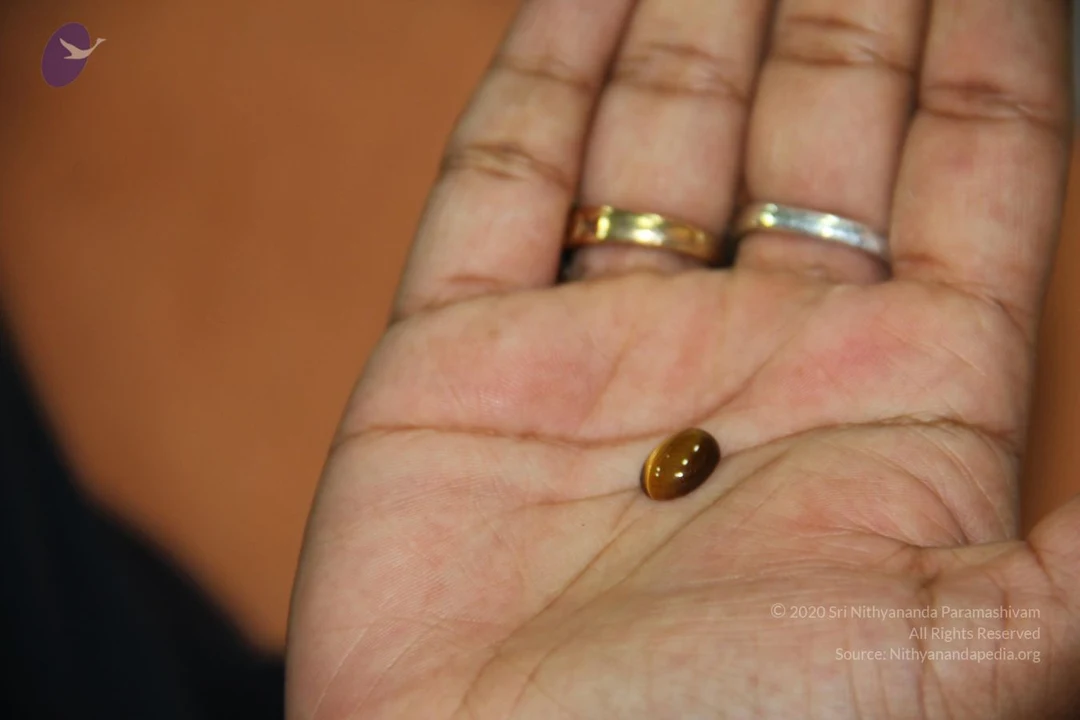
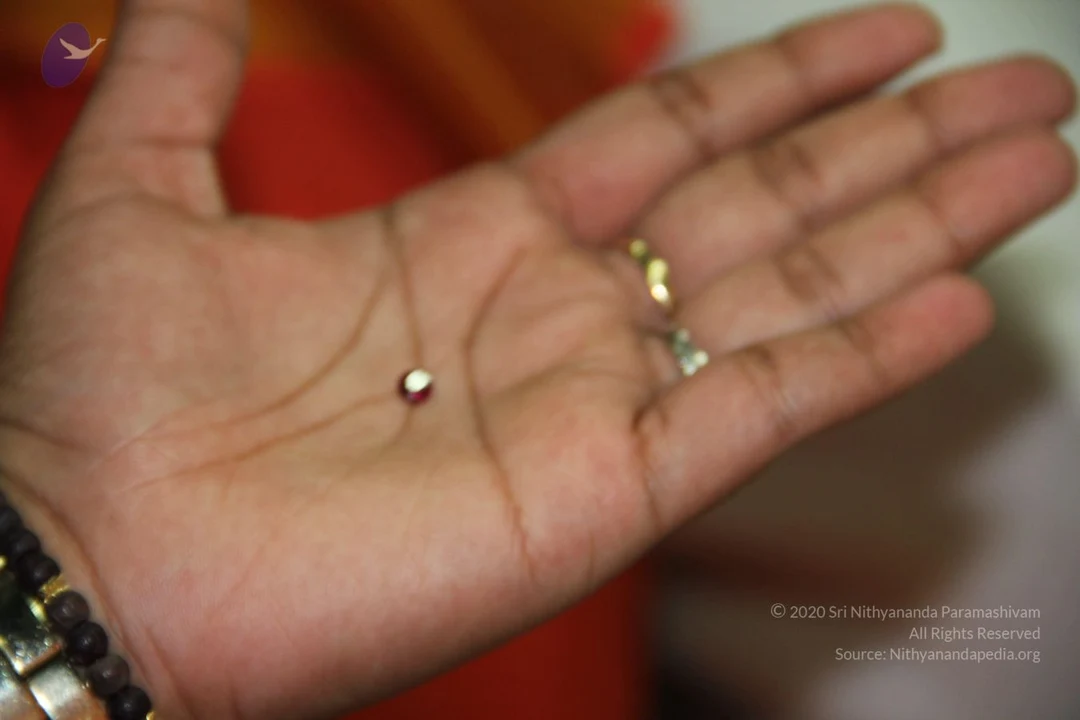
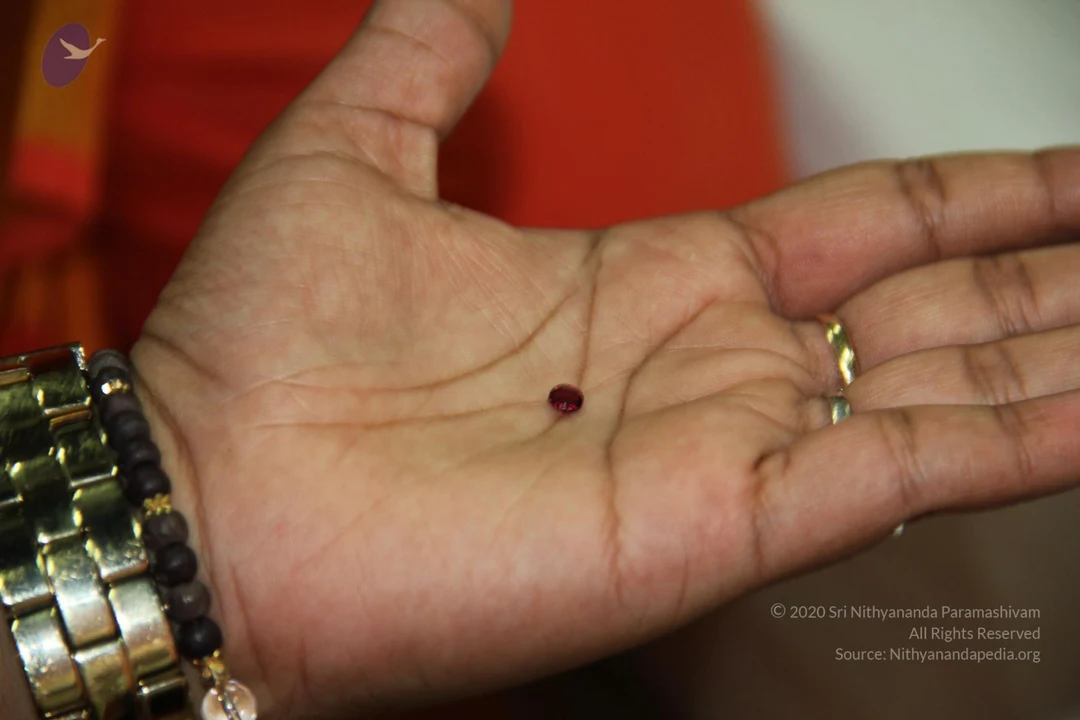
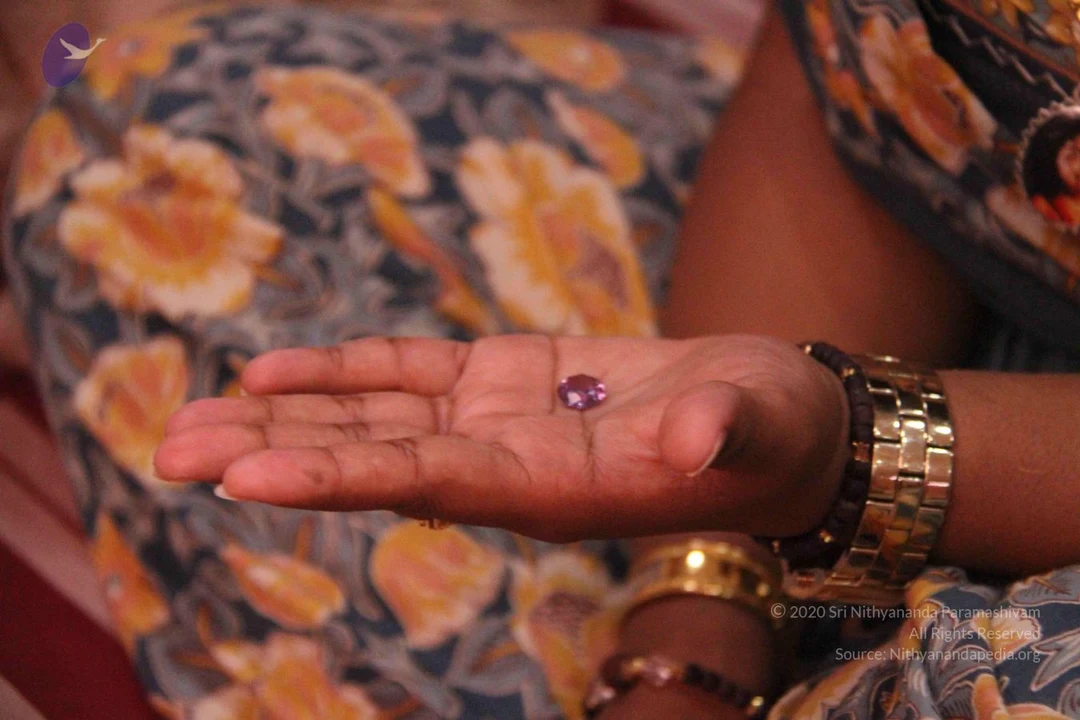
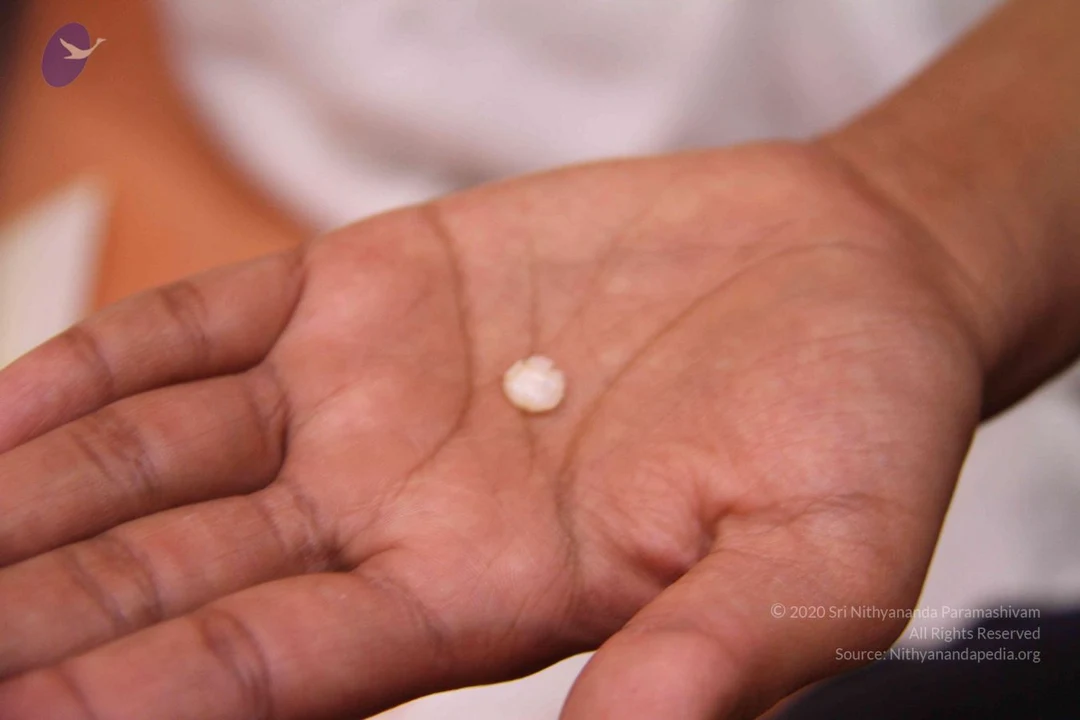
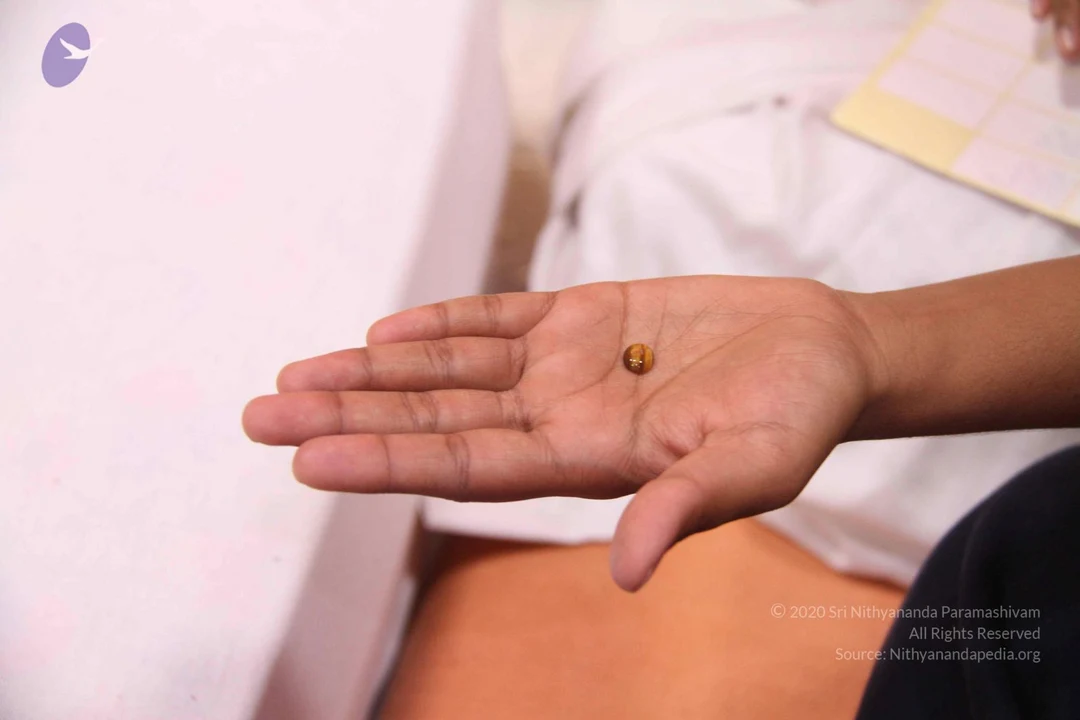
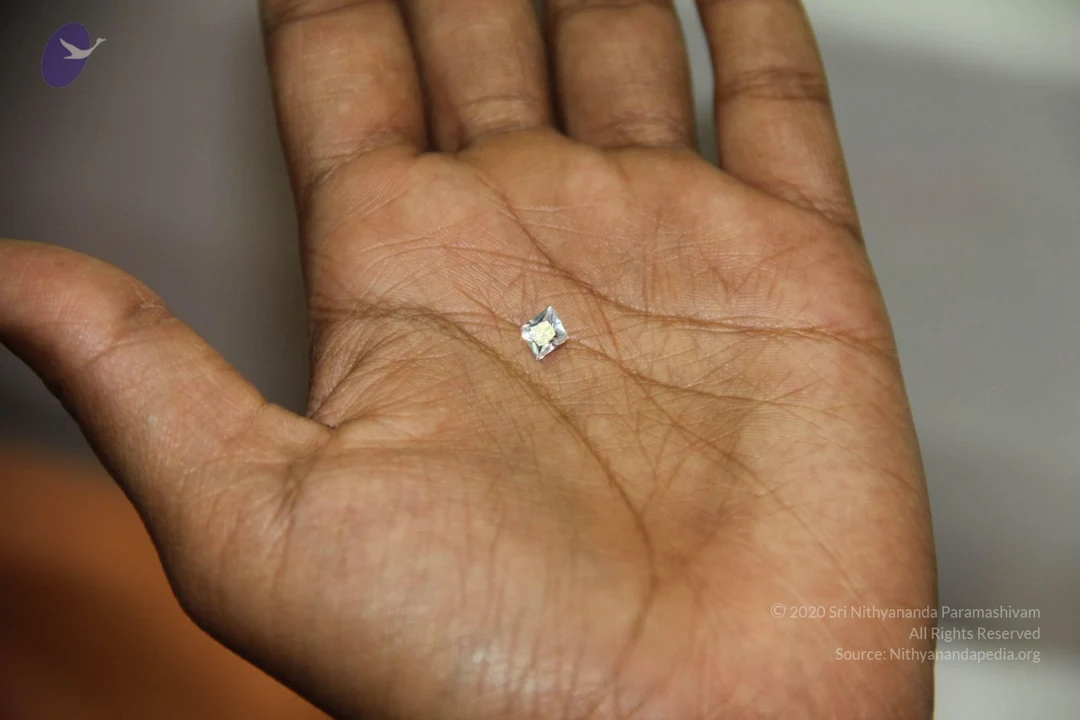
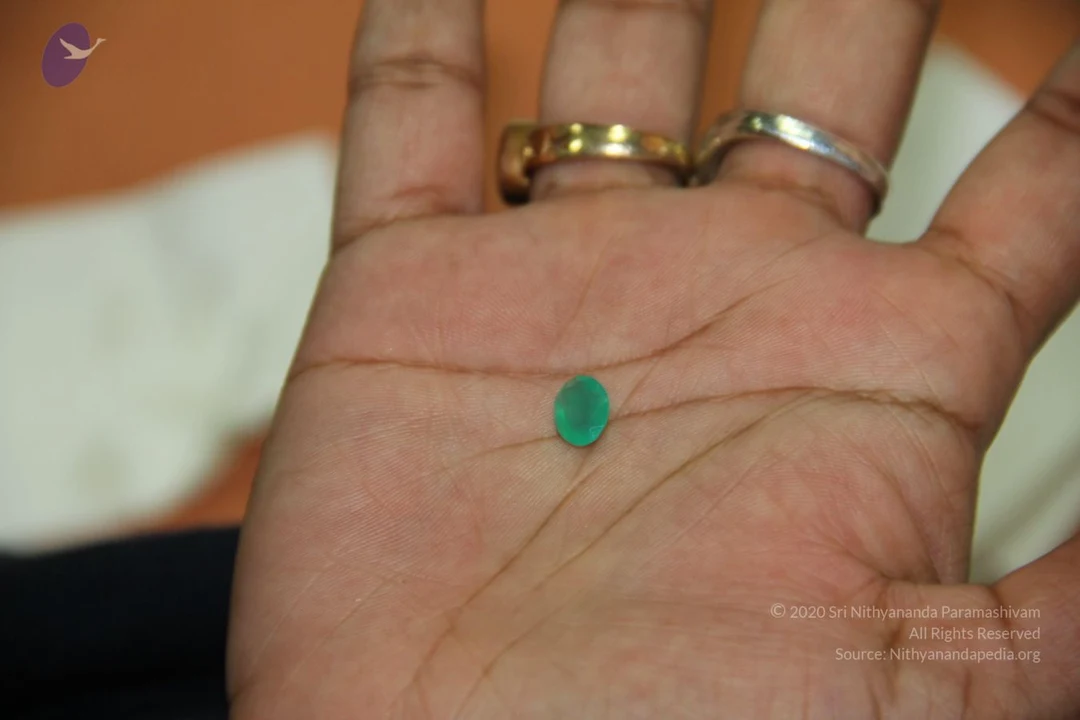
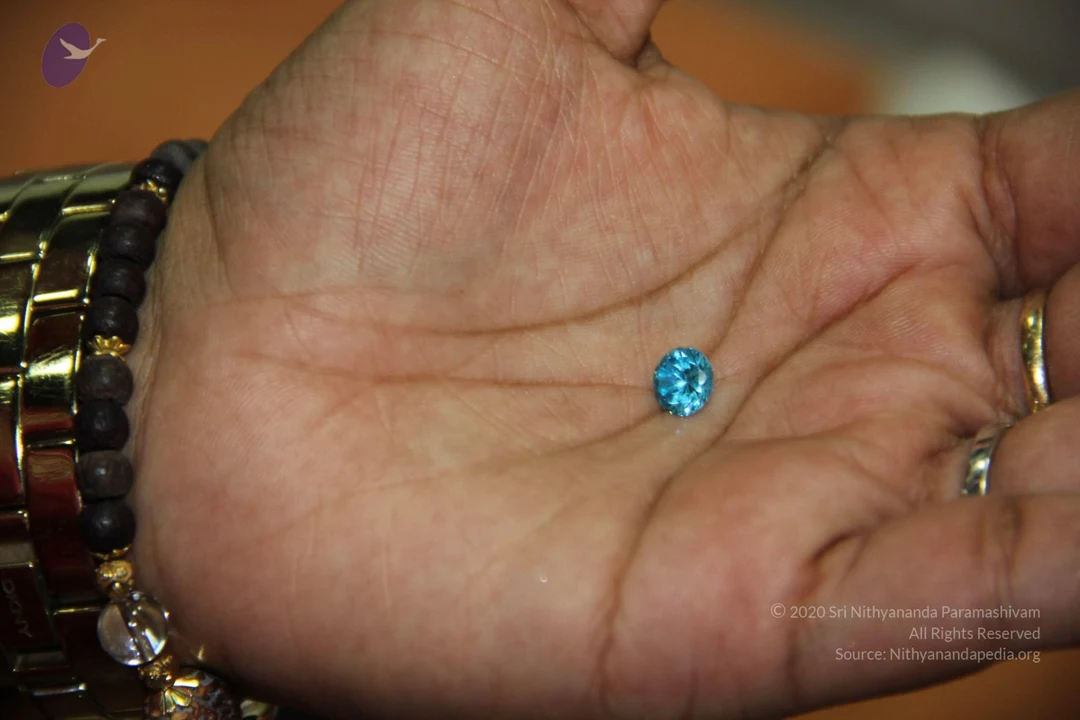
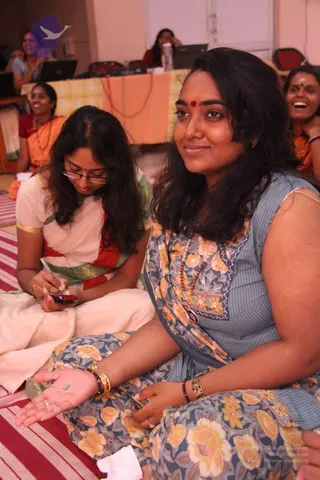
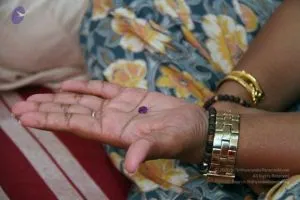
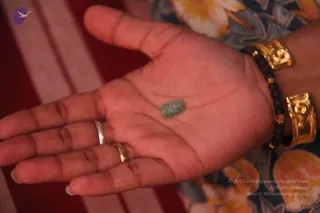
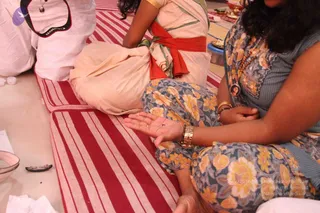
Close photo of a hand held palm-up, showing a small blue-green object resting on the palm. The hand wears a gold ring on the fourth finger and a gold bangle on the wrist, with a patterned fabric sleeve visible. Background is a blurred indoor setting with warm tones.Indoor satsang scene where a young woman in a blue and yellow floral kurta with a red bindi and wooden beaded necklace sits cross-legged on a striped mat, one palm open toward the lower left. Beside her, a woman in a cream and red sari with gold border looks down at a small phone. Behind them, women in orange and yellow saris sit near a draped table with laptops and cables, several smiling. No a person candidate is visible.A close-up photograph of a small, smooth, round brown-and-tan stone held in an open palm, against a plain light background. The stone has a glossy surface with a lighter streak across its face, and the palm's skin is visible around it. No other objects or people are shown.Close-up photograph of a small, polished red gemstone resting on an open palm, with the fingers and lines of the hand visible around it. The stone is faceted and glows deep red against the skin. A small logo is visible in the upper right corner of the frame. No people's faces are visible, only the hand.Close-up photograph of a faceted oval blue gemstone resting in an open palm, with light glinting off its cut surfaces in shades of turquoise and aqua. The palm lines are visible around the stone. No people's faces are shown and no ritual setting is visible.Close-up photograph of a small faceted clear gemstone resting on an open palm, showing lines of the skin. The stone is square-cut with a pale yellow inner core visible through its facets. No people beyond the hand are visible, and no ritual or event is shown.

Temple-Visit

7 photosSource gallery
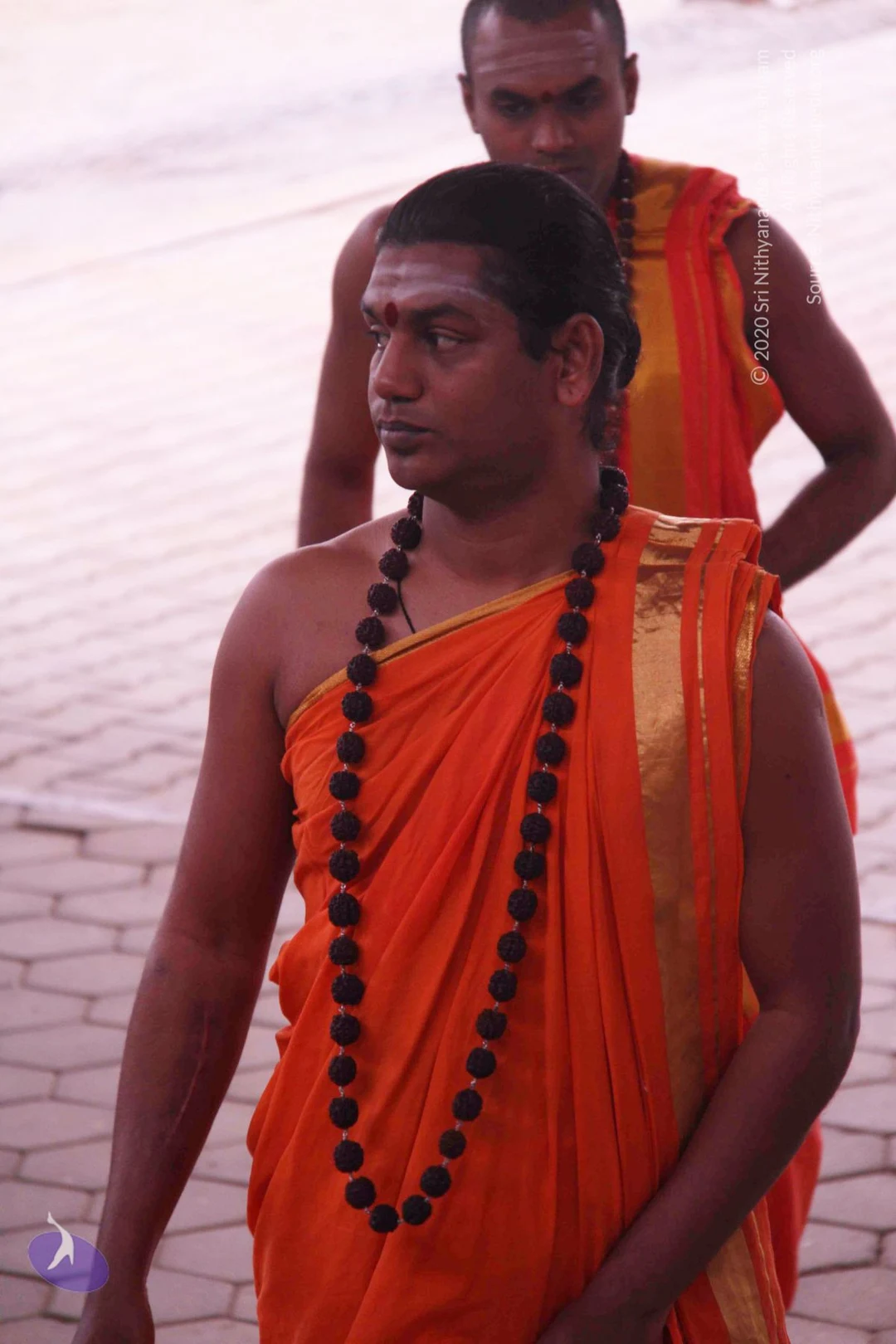
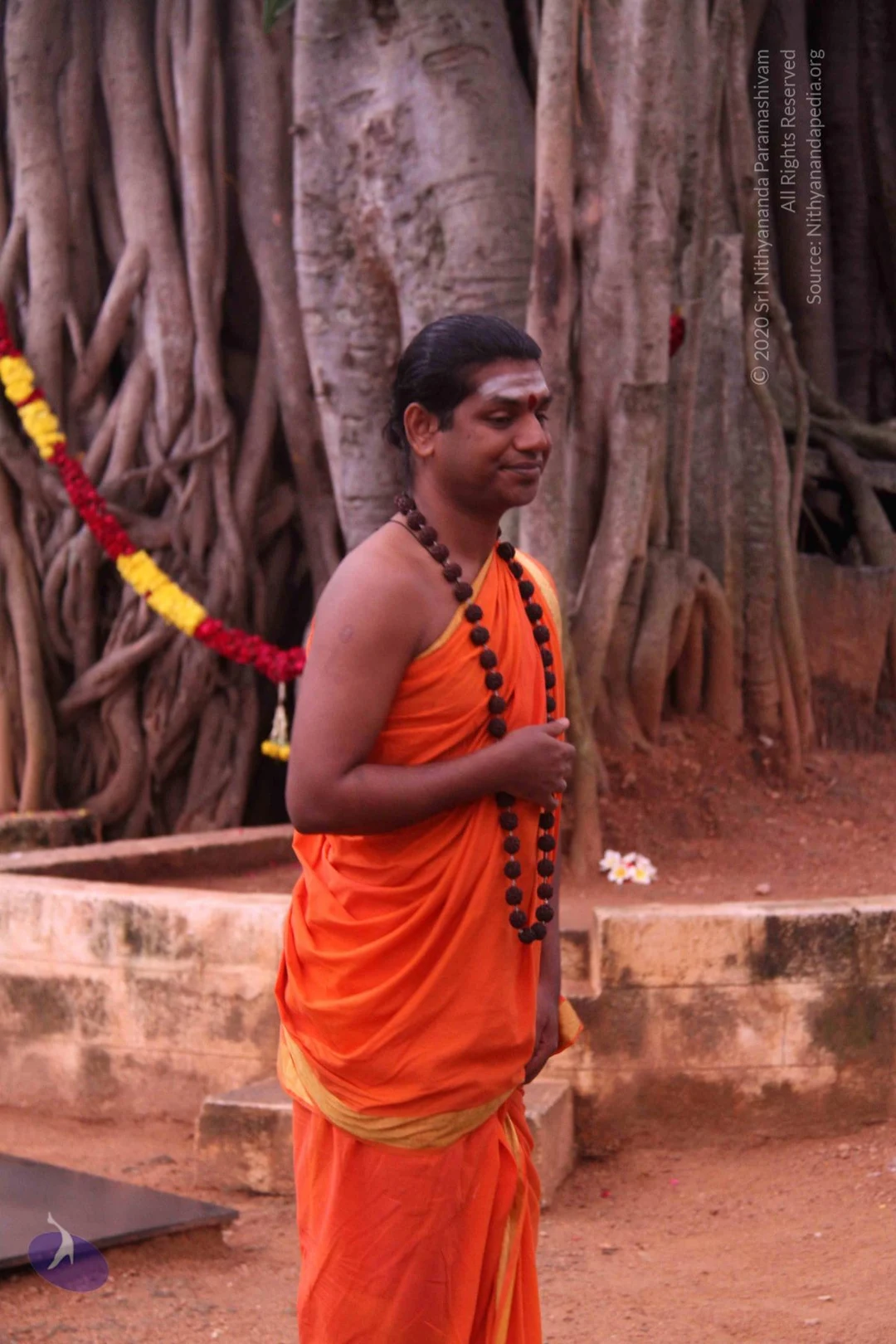
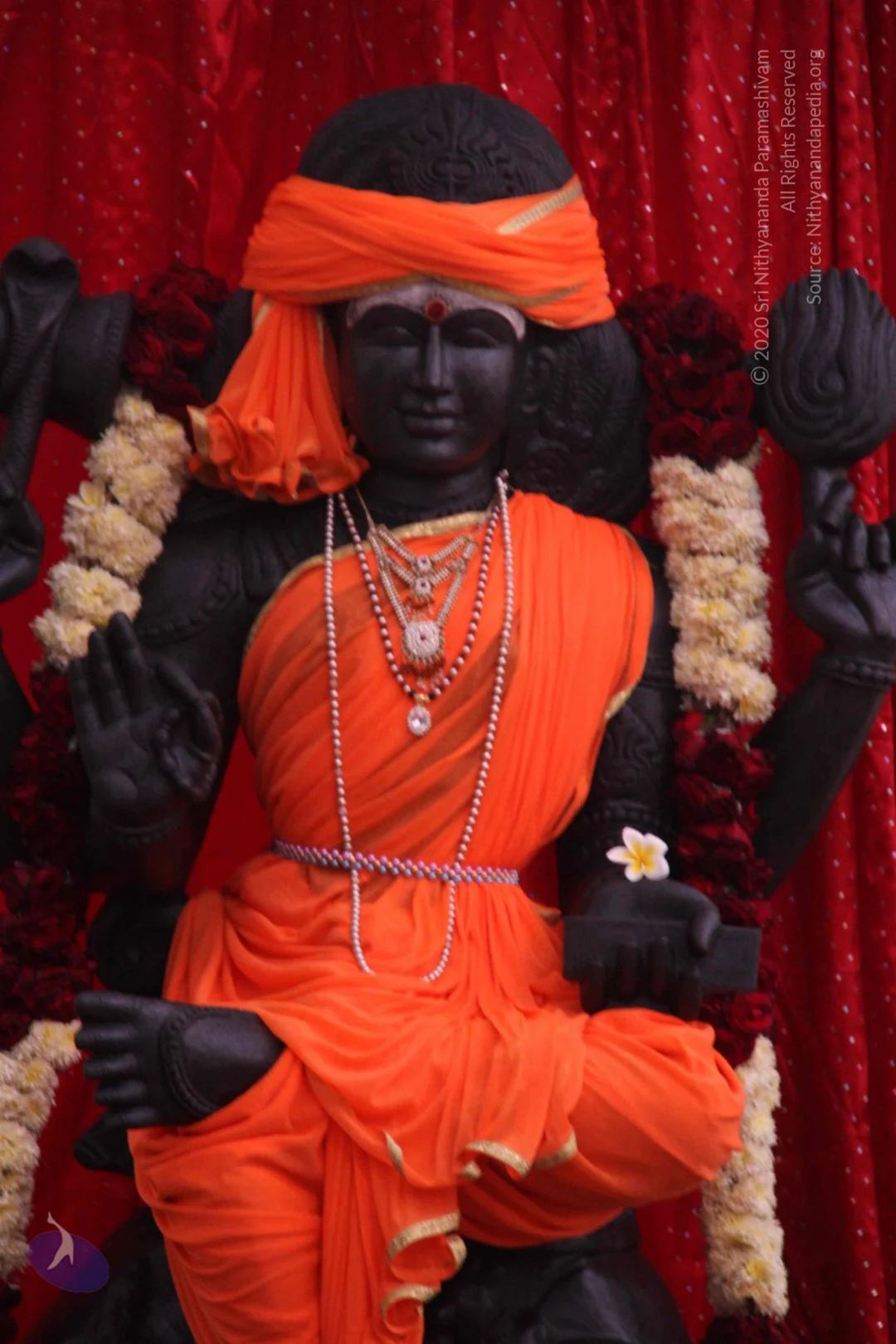
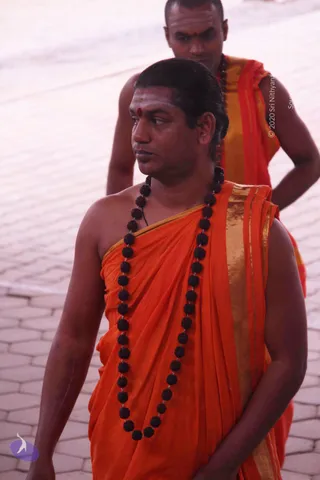
A man in an orange saffron shawl with a gold-bordered edge stands on a paved walkway, wearing a long black rudraksha mala that falls across his chest. He has swept-back dark hair and a red tilak on his forehead. Behind him, another man in an orange shawl with a sacred ash marking on his forehead walks in the same direction. The stone-tiled ground and plain background suggest an ashram or temple courtyard.A photograph of a man in profile smiling, wearing an orange saffron shawl with gold-striped borders draped over bare shoulders and a long dark rudraksha mala. He has a red bindi on his forehead and dark hair swept back. Behind him is an orange-painted wall with a doorway, a blue sign with Kannada script, and a red banner with white lettering.A man stands outdoors before large banyan tree trunks with aerial roots, his palms pressed together in namaste at chest level and eyes closed. He wears an orange saffron wrap with a gold-edged border and a long rudraksha mala of dark beads hanging to his waist. A white tripundra mark with a red dot is on his forehead. He is bare-shouldered on one arm. The figure's appearance is consistent with a sannyasi in saffron, but the page does not show him as a person, and his face is not clearly identifiable, so the identity is uncertain.A man in an orange saffron wrap with a yellow border stands outdoors with his palms pressed together in namaste near his face. He wears long rudraksha mala beads crossing his chest and a white forehead mark with a red bindi. Behind him are large, thick tree trunks with hanging aerial roots. White flowers appear at the lower right edge.A man in a saffron-orange dhoti and shawl stands outdoors before a large banyan tree with many aerial roots. He has a rudraksha mala draped across his chest, a white tilak with a red bindi on his forehead, and his hair is swept back. A garland of red and yellow flowers hangs from a branch to the left, and a low cement platform with scattered white flowers lies behind him.A dark stone or black-finished statue of a multi-armed deity murti dressed in an orange saffron sash and orange dhoti with gold trim, wearing an orange turban-style headwrap with a red bindi on the forehead, multiple strands of pearl and bead necklaces with a large central pendant, and a braided belt. A white plumeria flower rests near its hand. Garlands of cream and red flowers hang at both sides against a red sequined backdrop. The statue is not a person and no physical people are visible.

Pada-Pooja

5 photosSource gallery
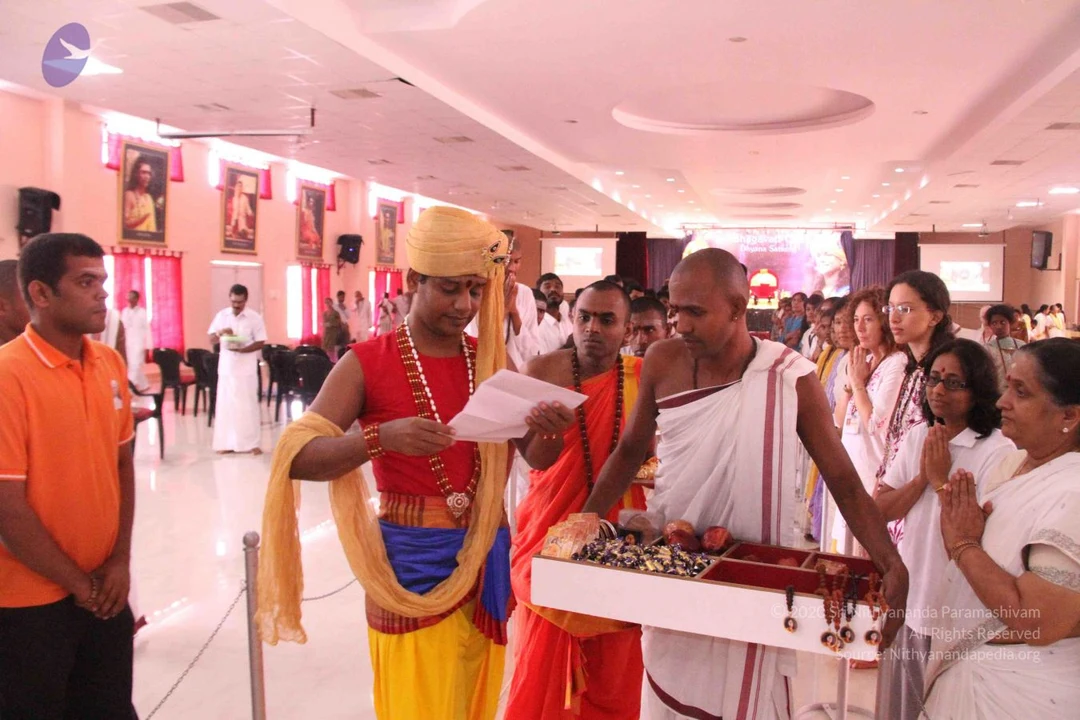
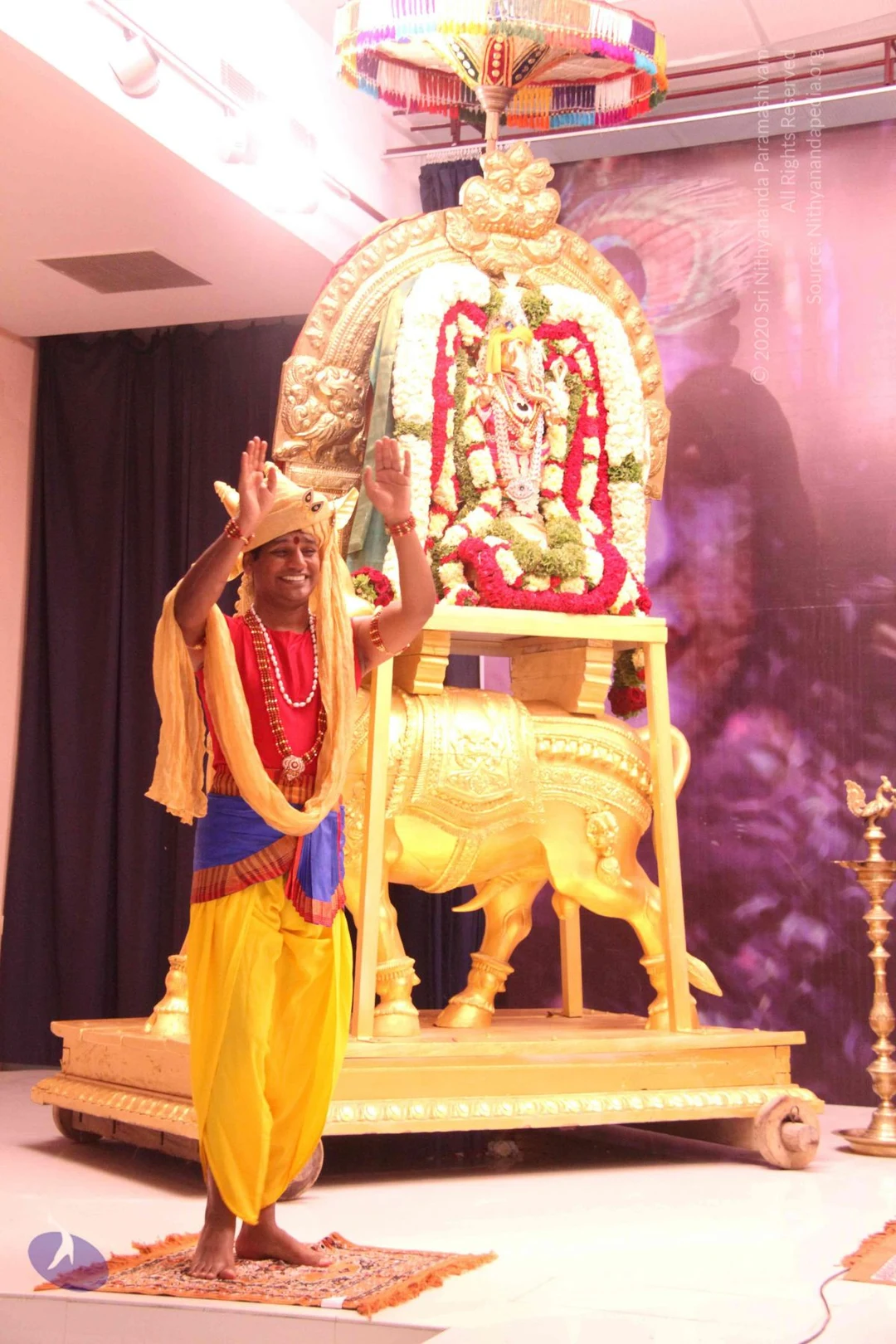
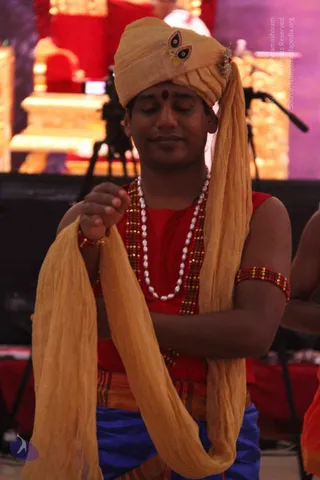
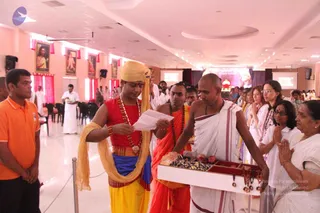
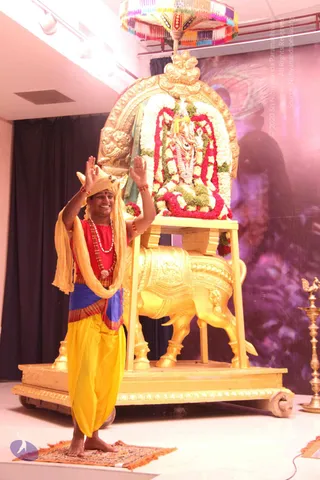
A man in a mustard-yellow turban decorated with a small red and black motif stands with eyes closed, holding the end of a long yellow shawl draped over his shoulders. He wears a red sleeveless top, layered red and gold beaded necklaces, a white pearl necklace, red beaded armband and wrist bands, and a blue lower garment with a striped border. A red tilak marks his forehead. Behind him a gilded red throne and stage decor are visible.A photograph of a ceremonial gathering in a bright hall with pink walls, framed portraits and a stage backdrop. In the centre, a man in a red sleeveless top, blue and yellow waist cloth and a saffron-yellow turban and shawl reads from a sheet of paper, while beside him a man in an orange-saffron robe with rudraksha beads holds a tray of offerings. A bare-chested man in a white dhoti holds a wooden tray of sweets, fruit and small packets. Behind them, people in white clothes stand with palms pressed together in namaste, and a man in an orange polo shirt stands at left.A smiling man stands barefoot on a woven rug on a stage, raising both hands in a greeting. He wears a red kurta-style top, a blue and red waist sash, bright yellow dhoti-style trousers, a yellow shawl draped over his shoulders, and a yellow headwrap, with red bangles and a beaded necklace with a pendant. Behind him, a golden bull-shaped vehicle carries a deity murti adorned with white and red flower garlands under a golden arched canopy. A tall brass oil lamp stands at the right edge, and a multicoloured fringed canopy hangs from the ceiling. A purple backdrop completes the stage setting.A smiling man in a red kurta with white and beaded necklaces, a yellow turban-like headwrap and a yellow shawl, wearing a blue and red sash over yellow dhoti, stands on a stage with both hands raised in greeting. Behind him a golden bull statue (nandi-like) stands on a wooden platform, draped with garlands of white flowers and red roses around a golden arch framing a deity murti. A large ornate hanging canopy with colourful tassels overhead and a purple backdrop complete the stage setting.A smiling man in a red sleeveless top and yellow dhoti with a blue and red waist cloth stands at left, raising both hands in greeting. He wears a yellow turban-like headwear, a red bindi, a white bead necklace and a rudraksha-style mala. Beside him stands a gilded wooden palanquin-style chariot shaped like a golden bull, holding an arched canopy garlanded with white and red flowers and a deity murti of Ganesha. A colorful fringed umbrella hangs above, and a blurred portrait backdrop sits behind.

IA-Session

1 photoSource gallery
A smiling man with swept-back dark hair and a red bindi sits on an ornate cream and gold floral upholstered throne-style chair. He wears orange saffron robes with gold borders, multiple rudraksha malas and a gold-bead necklace, and a small headset microphone on his cheek. He holds a clipboard with loose papers on his lap while looking off to the side mid-discourse.

Brahmasutras

3 photosSource gallery
A man seated cross-legged on an ornate golden throne with a red cushion, eyes closed, palms pressed together in namaste at a small microphone on a stand. He wears an orange saffron dhoti and a matching shawl draped over one shoulder, with multiple rudraksha and crystal malas around his neck, white tilak with a red bindi on his forehead. The golden throne back has elaborate repoussé scrollwork. a person with a saffron shawl, rudraksha malas and a golden throne indicating a satsang seat; appearance-based label only.Photograph of a man seated on an ornate gold throne with red velvet cushions, eyes closed and palms pressed together in namaste before a microphone. He wears an orange saffron shawl and orange dhoti, with a rudraksha and crystal mala draped across his chest and a red bindi and white tilak on his forehead. Behind the throne is a backdrop of large tree trunks. The throne and a patterned red rug fill the lower frame.A seated man in saffron-orange robes sits on an ornate gold throne with red velvet cushions and a red footstool, speaking into a microphone on a flexible stand. He wears layered rudraksha and crystal malas, a red bindi and white tilak on his forehead, and is barefoot. A carpet with floral patterns lies below, and a blurred forest-like backdrop with tree trunks fills the background. Given the page's Satsang context but no visible name cue, his identity is uncertain; he is described by role as a speaker giving a discourse on a throne.

eN-miracles
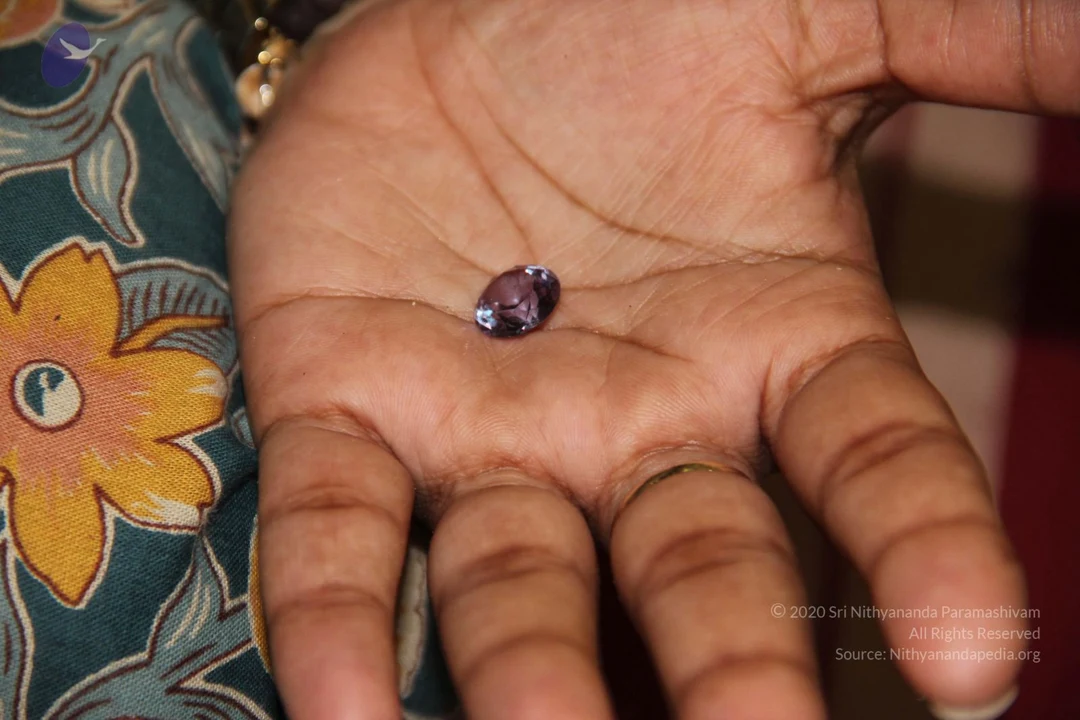
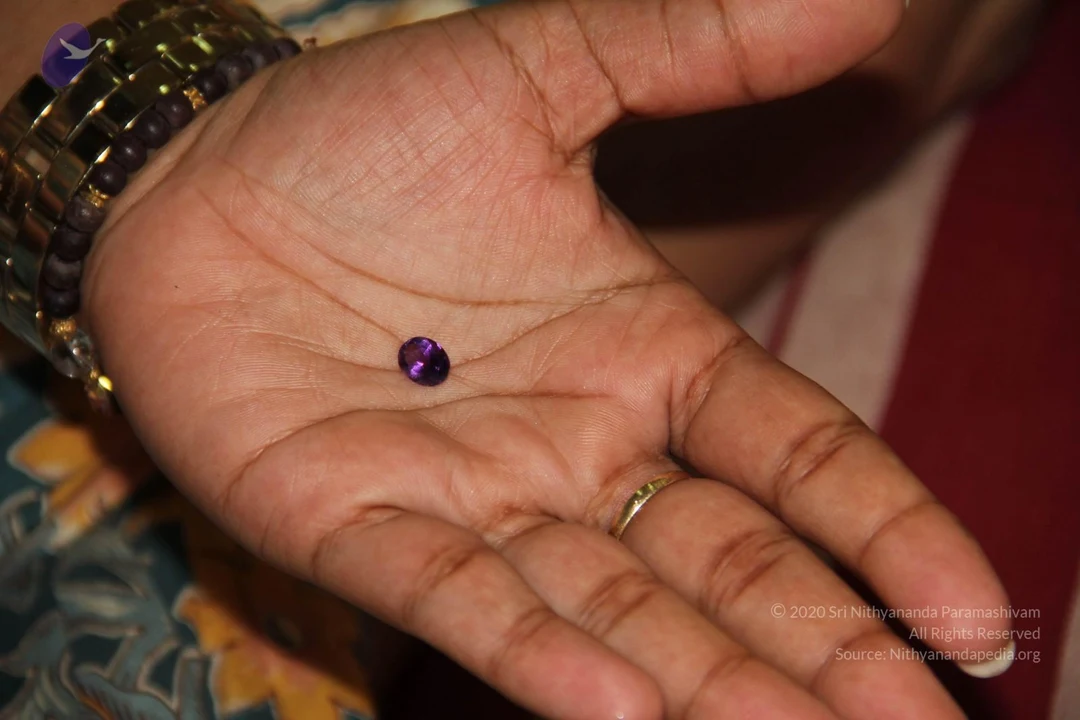
19 photosSource gallery
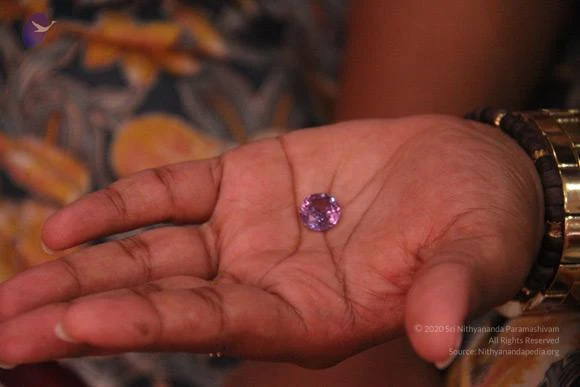
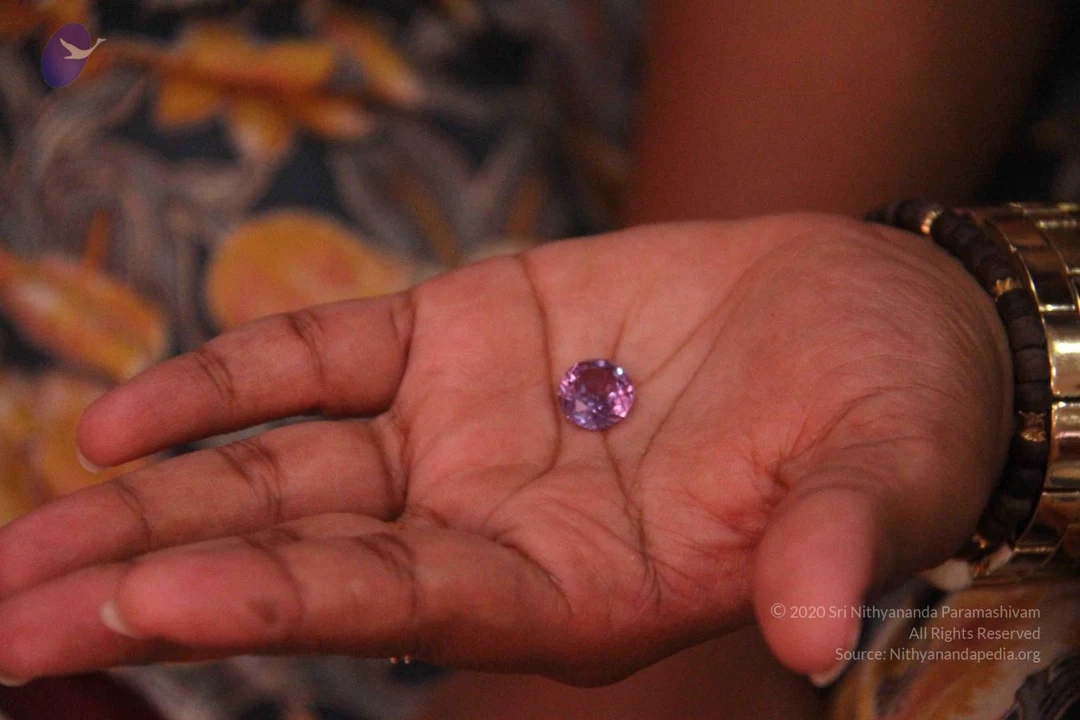
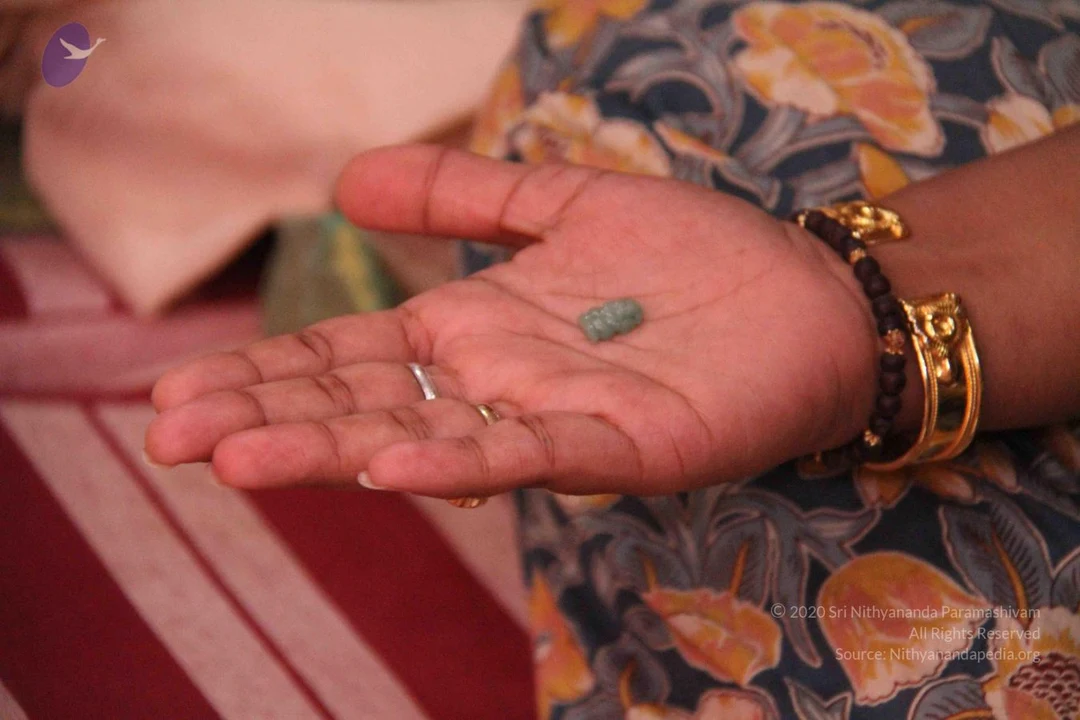
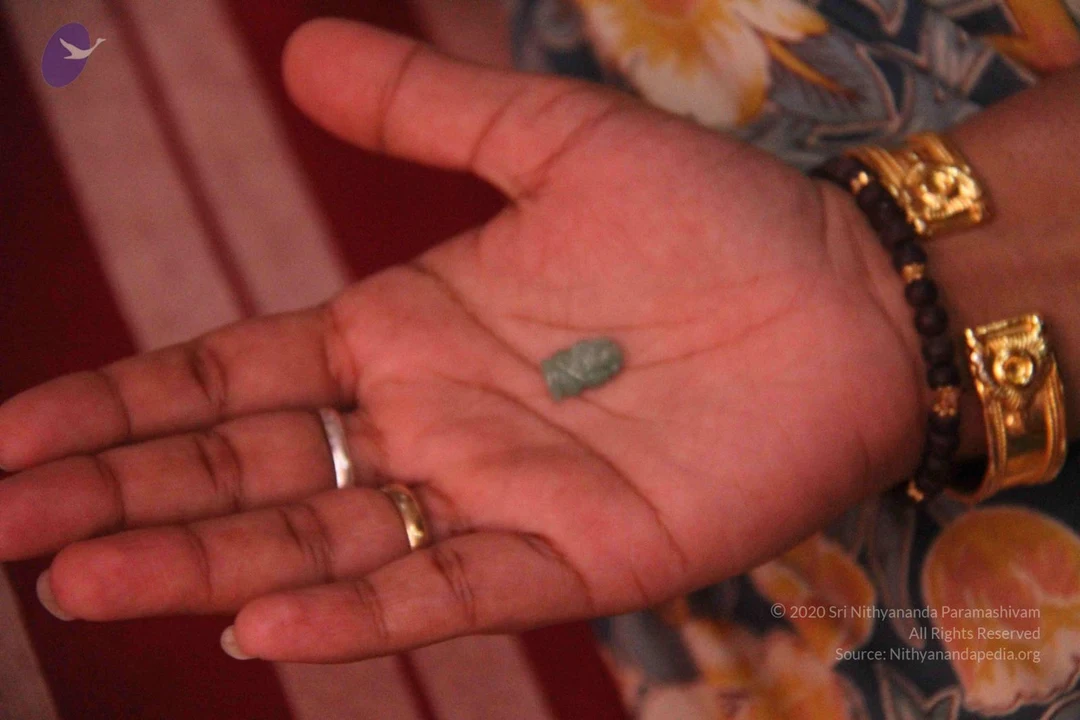
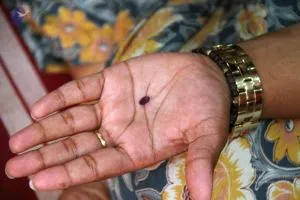
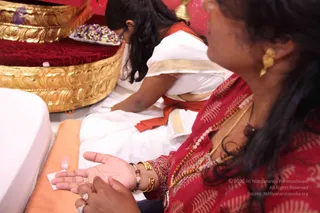
Close-up photograph of a woman's open right palm held out, with a small purple dot or bindi-like mark at its centre. She wears a gold bangle, a dark beaded bracelet and a silver wristwatch, and her patterned blue, yellow and orange sari sleeve is visible. Part of a light red-and-white striped cloth is at the left edge.Close photo of a person's open left palm held out toward the camera, with a small dark reddish-brown spot or mark on the skin near the centre of the palm. The wrist wears a gold-toned wristwatch with a metal link strap, and a thin gold ring is on a finger. The background is a blurred floral fabric in yellow, orange and blue tones. No ceremony, deity or other people are visible.Close-up photograph of a person's open right hand held palm-up, with a small faceted purple gemstone resting on the palm. The wrist wears a dark beaded bracelet and stacked gold metal bangles. The person sits in a patterned skirt with orange and yellow floral print on a blue-grey background. Only the hand, wrist and lap are visible; no face appears. Behind the hand, a red surface is partly visible.Close photograph of an open palm holding a small greenish-grey stone fragment near the centre of the hand. The wearer has gold ring bands on two fingers and a dark beaded bracelet with a gold clasp on the wrist, plus a wide gold cuff. A flowered blue and orange garment is visible at the right edge against a red and white striped background. No a person candidate is visible; only a hand and wrist appear.Close view of devotees seated on a red and cream striped floor mat during a satsang-style gathering. A woman in the foreground wears a blue-grey and yellow floral kurta with a rudraksha mala and a small framed pendant, extending her open right palm with a small object resting on it, and wears gold bangles. Beside her, a woman in a cream sari with a red and green border sits with her hands in her lap. At left, a person in white clothing is partly visible. Brass dishes, a small bowl and a folded tissue lie on the floor nearby.A photograph of a ritual setting. In the foreground a woman in a red saree with a gold-patterned border and gold bangles extends an open palm, with rings on her fingers and a beaded mala visible at her neck. Behind her, a second woman in a white saree with a gold border and an orange-red sash sits on the floor, bent forward over a gold-rimmed ornate base. A tray of wrapped sweets sits on the red-draped platform, and a gold-edged cushion lies nearby. No a person candidate is visible.