Skip to content
Tuesday

15 February 2011

One Pointedness Nithyananda Patanjali Yoga Sutra 15 Feb 2011

Dated photos
95
Source pages
1
Media
2
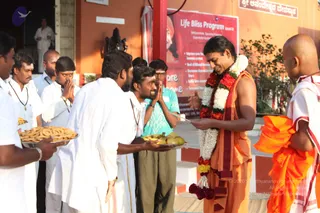
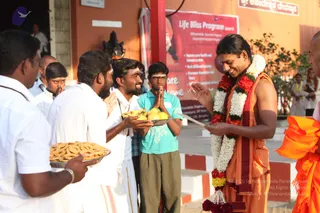
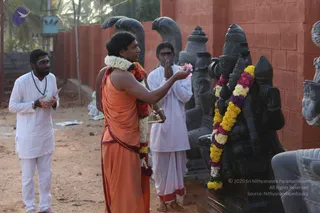
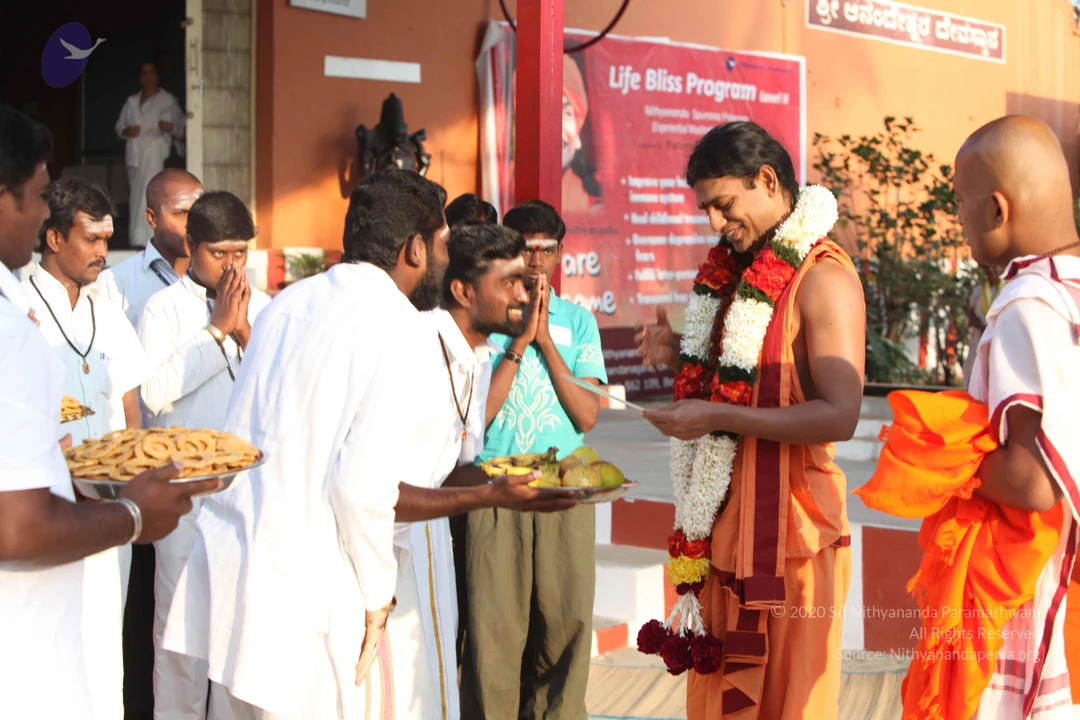
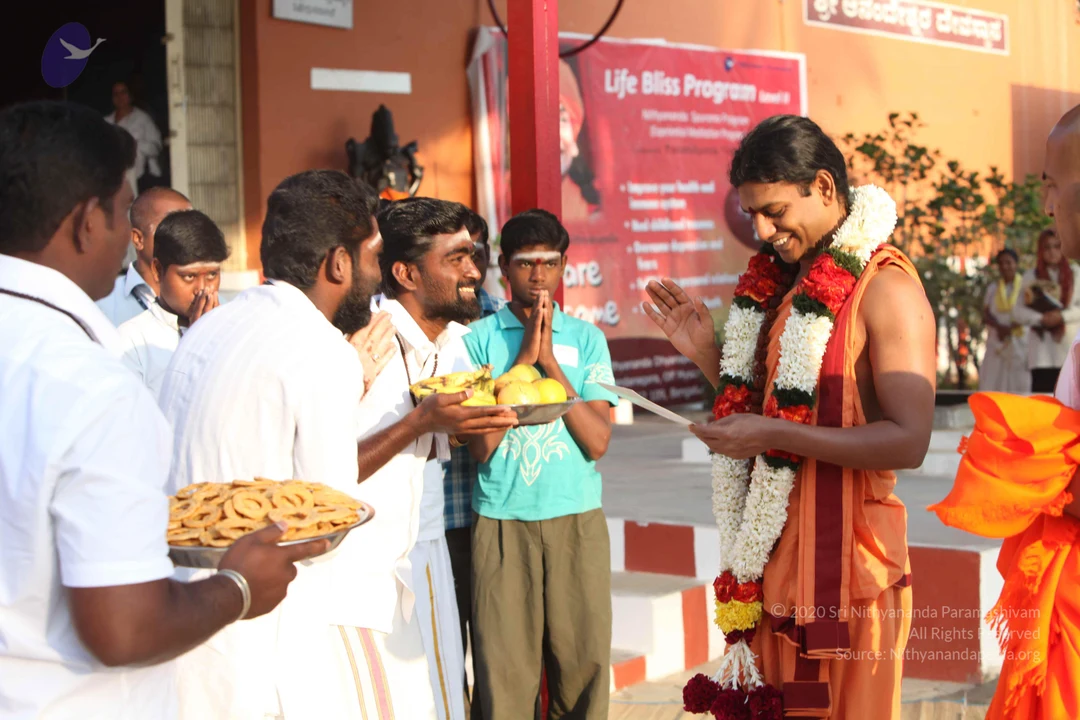
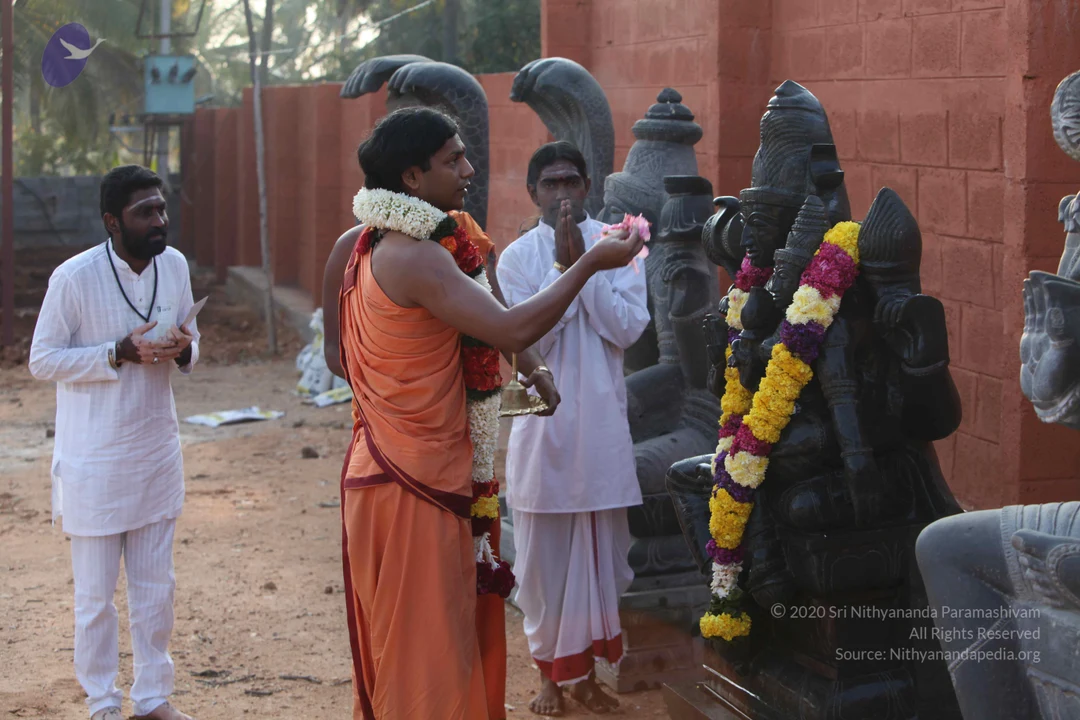
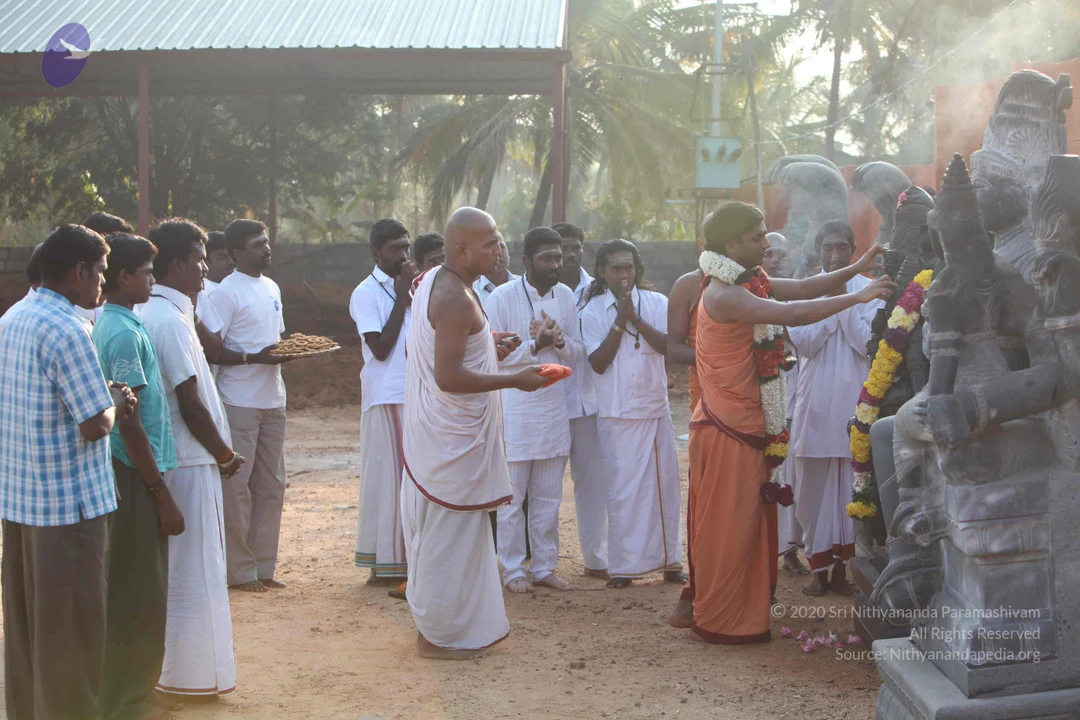
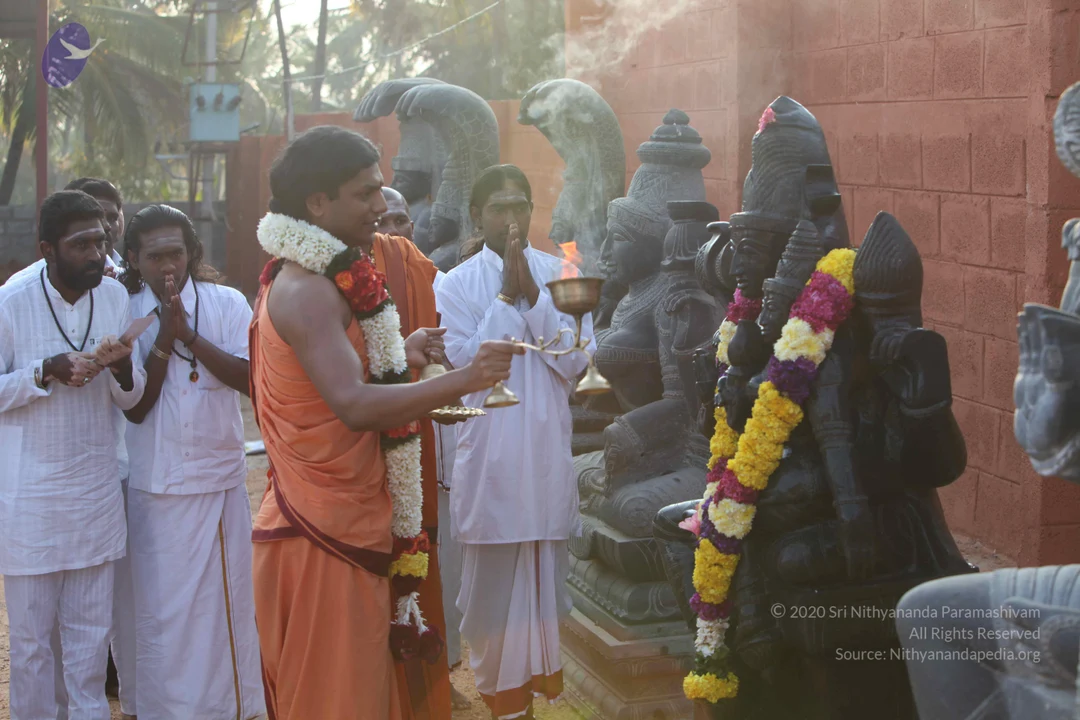
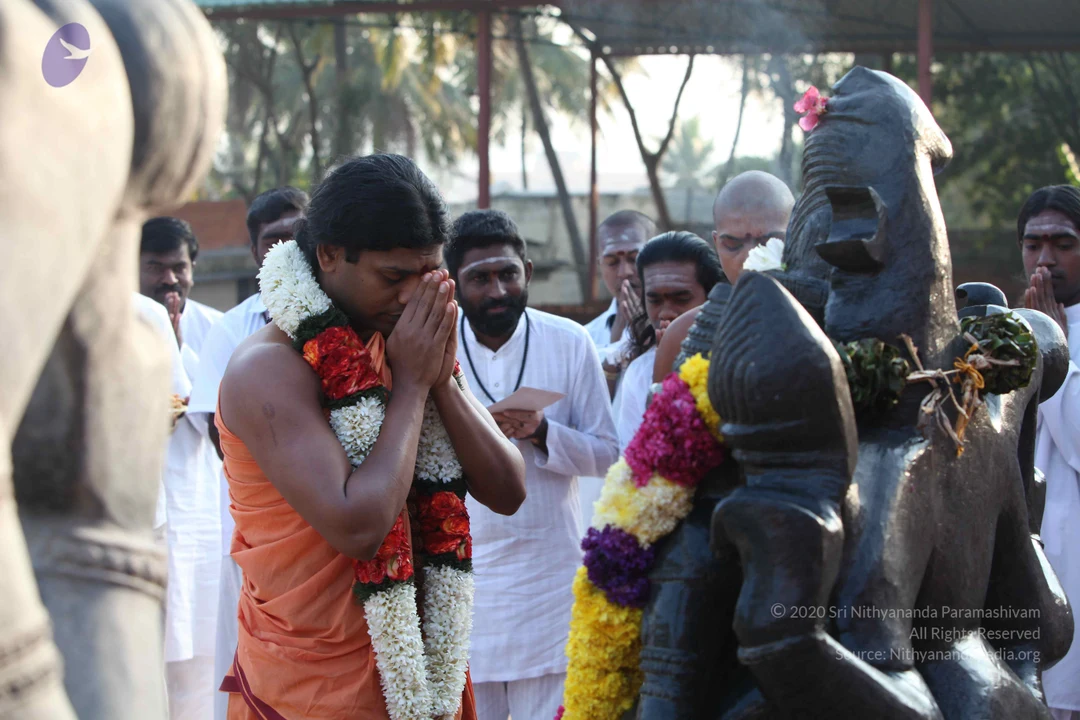
Outdoor photograph at an ashram entrance with orange-painted walls. A man in saffron-orange robes with long swept-back hair and a thick white and red flower garland stands at centre, hands together and receiving an offering. Around him devotees in white dhotis and shirts, some with white tripundra marks, press palms together or hold steel plates of food and fruit. A bald young monk in white and orange cloth stands at right. Behind them a red banner reads Life Bliss Program Level II, and a small dark deity murti is visible at upper left.A photograph of an outdoor ashram courtyard where a man in a saffron-orange dhoti and shawl, wearing a long garland of white jasmine and red roses, smiles and holds a folded paper in both hands while devotees greet him. Several men in white shirts and dhotis, one in a teal t-shirt with a tilak, bring offerings on steel plates: a tray of yellow fruit and a plate of orange sweets. Behind them a red-and-white painted pillar and a red banner reading Life Bliss Program and Nithyananda Dhyanapeetham stand in front of a building. A person in orange at the right edge is partially visible.Outdoor scene at a temple courtyard beside a red brick wall with dark stone sculptures, including a black stone deity murti garlanded with yellow, orange and magenta flowers, and a stone serpent hood above. A man in an orange saffron robe with a red-and-white flower garland holds a pink flower and a brass bell or lamp toward the murti. Beside him a man in white ritual clothes with a red-bordered dhoti stands with palms joined in prayer. On the left a bearded man in white kurta and pants holds a small booklet or paper. The setting is a dusty ground with scattered debris. The saffron-robed figure has long swept-back hair and a garland but no crown, turban or rudraksha malas visible, so identity is uncertain.

February 15 2011

Original wiki page
Contents

Title:

One Pointedness Nithyananda Patanjali Yoga Sutra 15 Feb 2011

Description:

A discourse by Paramahamsa Nithyananda on Patanjali Yoga Sutras.

Watch, share and like the videos and Subscribe to our channel to be notified of the next upload. click http://bit.ly/20j90wr to subscribe.

Link to Video:

VideoAudio

Transcription

Sadāshiva samārambām shankarācharya madhyamām Asmadācharya paryanthām vande guru paramparām.

[01:17]

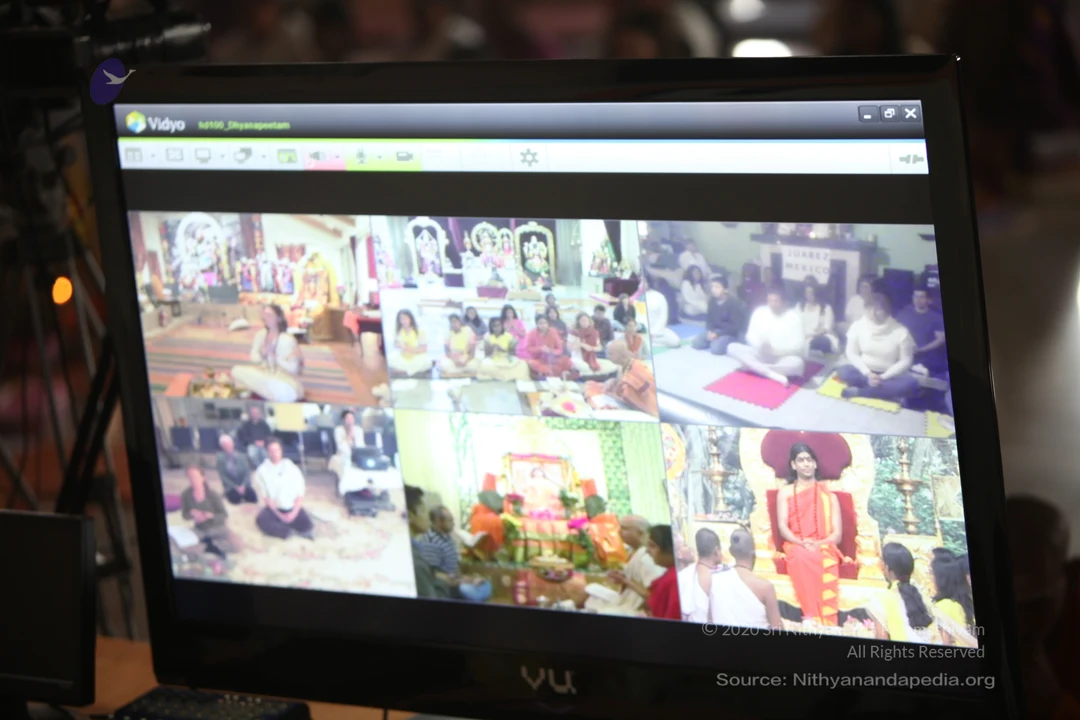
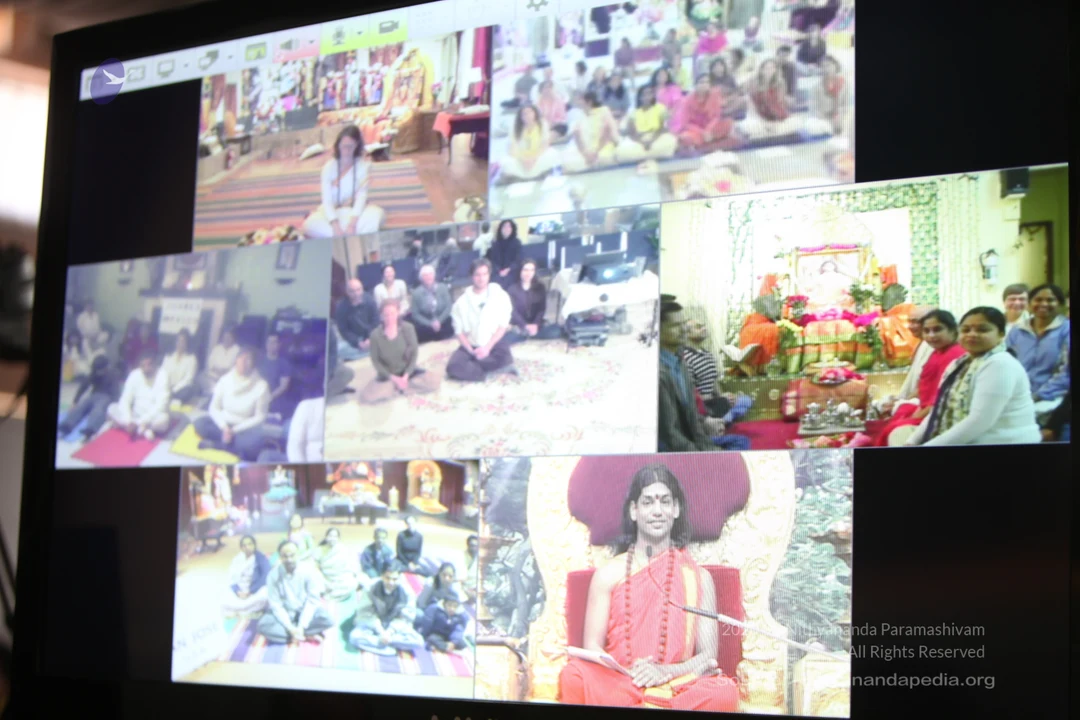
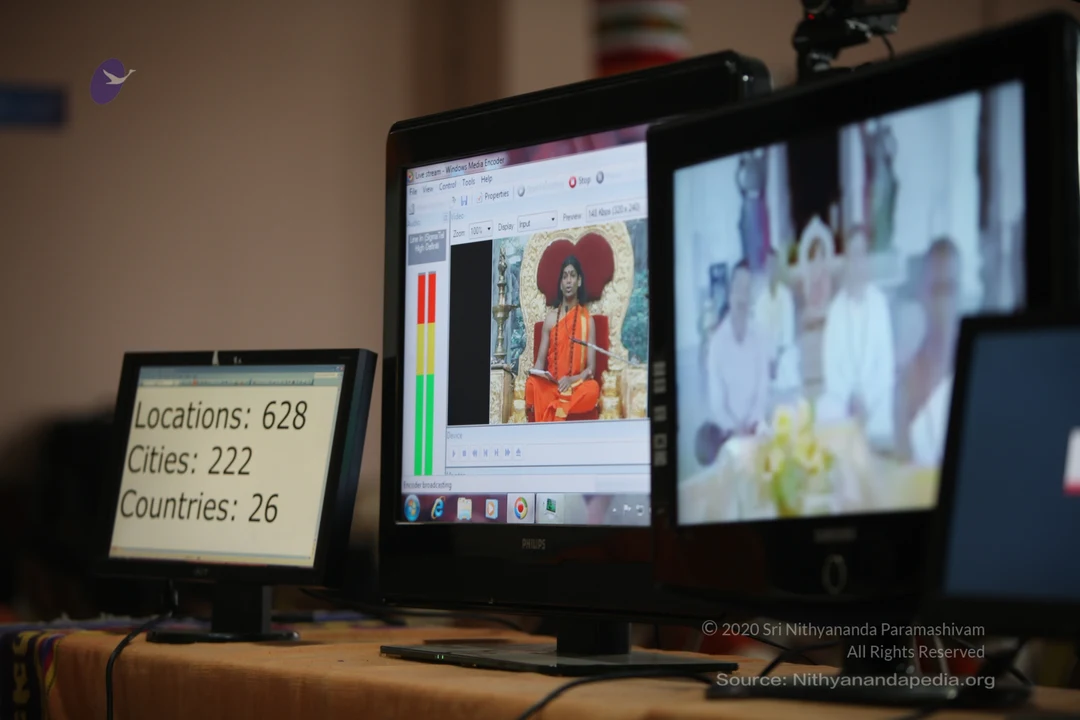
I welcome you all with My love and respects. I welcome all the devotees, disciples who are sitting with us at this moment around the world in 628 places, in 222 cities in 26 countries and we are on two way with Seattle, Los Angles, San Jose, Ohio, Vancouver, Mexico and Hyderabad. I am able to see all these cities. So before entering into the satsang, I would like to remind all of you to get back to Padmasana or Vajrasana or sukhasana and Samana Mudra. We will create the eN-effect. Sit in Padmasana or Vajrasana and Samana Mudra and in unclutched mood. We will create the intense eN-effect.

[03:40]

Today’s subject “The one-pointedness”, 118th Patanjali’s Yoga Sutra and in the 3rd chapter 12th verse. I will read the sutra and then translate. tatah punah shantoditau tulya-pratyayau chittasyaikagrataparinamah Swami Vivekananda translates this sutra as “the modification called one-pointedness of the chitta is acquired when the impression that which is past and that which is present are similar.” Swami Prabhavananada translates as "the mind becomes one pointed when similar thought waves arise in succession without any gaps between them”. Swami Sachidananada translates as "then again when the subsiding past and rising present images are identical, there is Ekagrata Parinamah".

[05:14]

Now let us enter into the sutra. I will give you My understanding and experience on this sutra. I welcome all the centers just now tuned in. This moment 654 locations in 232 cities in 26 countries people are sitting with us. In last few sutras Patanjali was explaining Nirodha Parinamah, Samadhi Parinamah. Now he is taking us to the next level, Ekagrata Parinamah. Please understand Patanjali is talking about an important truth.

[06:59]

'Ekagrata Parinama" one of the important subject analyzed, researched, again and again and again in the spiritual realm is Ekagrata Parinama, the one-pointedness. Thousands and thousands of techniques have been evolved. Thousands and thousands of methods have been discovered. Thousands and thousands of practices are created just for this one purpose, Ekagrata Parinama. This Ekagrata Parinama is responsible for your enlightenment and for your extraordinary experiences and the extraordinary powers. Please understand, it is Ekagrata Parinama which is responsible for awakening of your Kundalini Shakti, which is responsible for your extraordinary spiritual experiences, which is responsible for the extraordinary powers you experience and express.

[08:58]

Let Me exactly define what is Ekagrata Parinama “one-pointedness” And how it is misunderstood by many of the intellectual, a just intellectual translations? Please understand all the regular intellectual translation says Ekagrata Parinama is having a same thought in past and present also; same or similar. I wanted you to know you can never have a same or similar thought from the past and present. No. If you understand having a similar thought in the past and in the present continuously is one-pointedness, you will struggle, struggle, struggle finally to discover you are a failure.

[10:19]

Please understand, I am translating this one-pointedness in a clear way. One-pointedness, means raising your frequency to a level where the flow in you does not change because of the impact of time on you as past, present, future. Some understanding or some truth, some object, exists in you, in your inner space, without getting altered or disturbed by the time passing over it. Please understand. If you think one-pointedness is something like, having one thought in the past and again similar thought in the present this moment, again same kind of similar thought next moment also, you will miss the sacred secret embedded in this sutra. Please understand, one-pointedness is not having same or similar thought last moment, this moment, next moment. No. One-pointedness means, raising your frequency to such a extent, the object or the truth which is in your inner space does not get altered, modified, changed when the time passes over your mind.

[13:21]

Understand, even the same truth is understood with wrong words for wrong reason, it cannot lead you to the same right experience. No. Truth has to be understood with the right reasoning, with right words, only then it can lead you to the right experience to which it needs to lead you. Please understand, truth is the experience which is supposed to lead you to the ultimate space. Having a same thought last moment, this moment, next moment cannot be one-pointedness. It can be the side effect of one-pointedness, Ekagrata chitta. Ekagrata Parinama. The one-pointedness is actually a different frequency altogether. It has nothing to do with your mind. It is a different frequency altogether, where passing of the time does not affect or disturb, modify any of the experience of your inner space. So I will translate this word Ekagrata chitta, one-pointedness as "not being touched or disturbed by the time passing over your inner space'. So relax on a object or a subject which does not tire you, which does not bring boredom to you, which does not make you feel sad, which does not make you feel tired, which makes you excited for no reason.

[16:09]

Please understand, if the word one-pointedness, Ekagrata chitta, is properly understood you will see, very beautifully your very life can lead you to enlightenment; because every moment knowingly or unknowingly, consciously or unconsciously the Ekagrata chitta is happening in you. Ekagrata chitta is continuing in you. Unfortunately you always concentrate and experience the space where movements are happening. You do not remember or rest in a space where the one-pointedness is a constant experience. There is part of you in which the one-pointedness is a constant experience. I can say consistent experience; not only constant, consistent.

[18:02]

There is a space in you which does not change by the time passing. Time can go on passing over you but that space does not alter, modify, change its existence. It is there. Very beautifully Krishna puts in Gita apuryamanam acala-pratistham Established like a mountain. Your inner space which is consistent and constant does not go through any modification by the movement of the time is what I call… that space is what I call one-pointed dimension of you.

[19:39]

Please understand, in your inner space there is a part called ‘Nirodha Parinama’ restful awareness space. There is a dimension called ‘Samadhi parinama’ Enlightened space. There is a dimension called one ‘Ekagrata chitta’ one-pointed space or untouched space. I want you to know all these 3 space are 3 different names for the same experience. You try to work on any of these space or any of these dimension you will achieve what I call Nithyananda state, the Eternal Bliss.

[20:43]

This is one more technique Patanajli is giving. Ekagrata Parnamah is one more technique Patanajali is giving for the ultimate experience. Basically the truth Patanajali is trying to tell us, the sacred secret from this sutra is: catch the dimension which is in you, which does not alter, modify, change, which is constant and consistent even if any amount of time passes over you.

[21:49]

Breeze does not change the hills. Breeze does not move the mountains. Only the cyclones may be able to move little, but breeze does not move the mountains. Same way, time is a breeze on your inner space, understand. Time is a breeze on your inner space. There is a part of you which is consistent and constant and cannot be moved by the time passing over you. Experience that space, catch that space, be in that space. That is what Patanjali means by the word Ekagrata Parinama

[22:56]

Let’s now enter into the space of Ekagrata. Just sit in unclutched mood. Relax with this one truth: ‘What is in me that does not change by the time passing over?’ Just remember this one truth: ‘What is in me that does not change when time changes? Let me rest in that.’ With this one idea, rest in you. Close your eyes. Sit in Vajrasana or Padmasana, Samana mudra. Let your Kundalini awaken intensely and experience the Ekagrata Parinama, the one-pointed inner space, which does not change by time passing over. PROCESS

[24:34]

I initiate all the people who are sitting with us at this moment around the world into the experience of Ekagrata Parinama, one-pointed inner space, one-pointed dimension as explained by Patanjali. All the people who are sitting with us around the world at this moment in 694 places, in 240 cities, in 26 countries, let all of you be initiated into the Ekagrata parinama, one-pointed dimension of your inner space.

[25:27]

Om Shanti Shanti Shanti Relax. You can open your eyes. I bless all of you who are sitting with us at this moment in 741 places in 251 cities in 26 countries. Let you all achieve, experience, live, radiate, express and share the eternal bliss. Nithyananda. Thank you.

[26:22]

Photos

Temple-Visit-And-Paada-Pooja
Paadapooja

Nithyananda-Satsang

Sarvadarshan

Ztamil-Interview

Photos Of The Day:

01-Aadheenam-Rounds

Photos from this day

View all 95 photos

Temple-Visit-And-Paada-Pooja
16 photosSource gallery
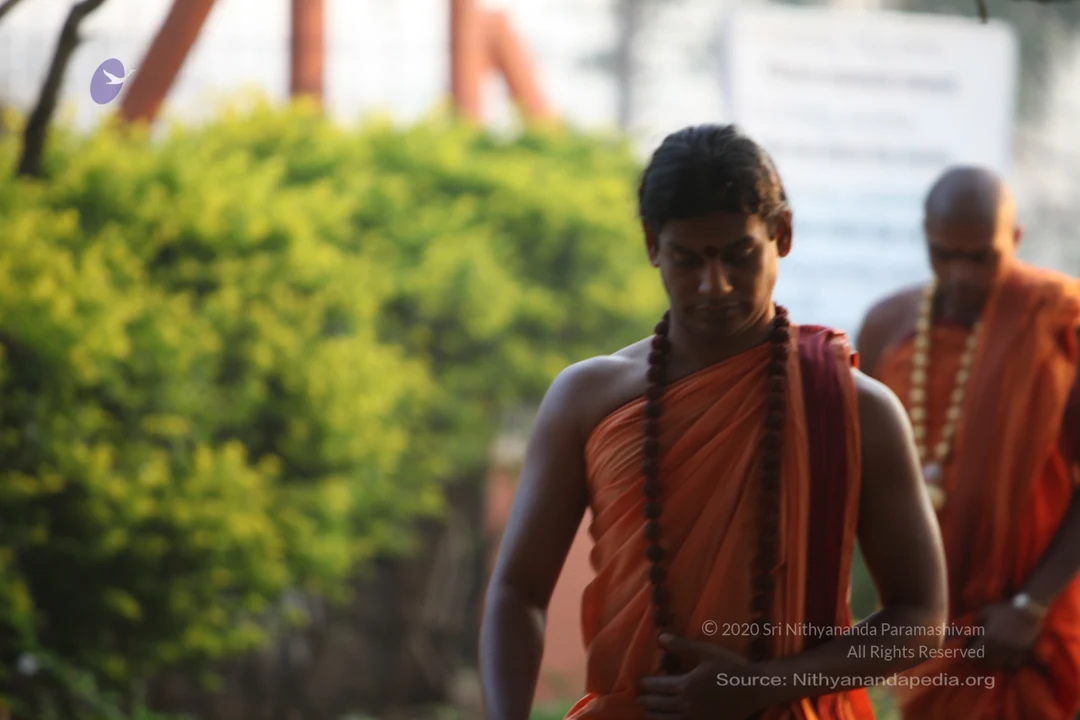
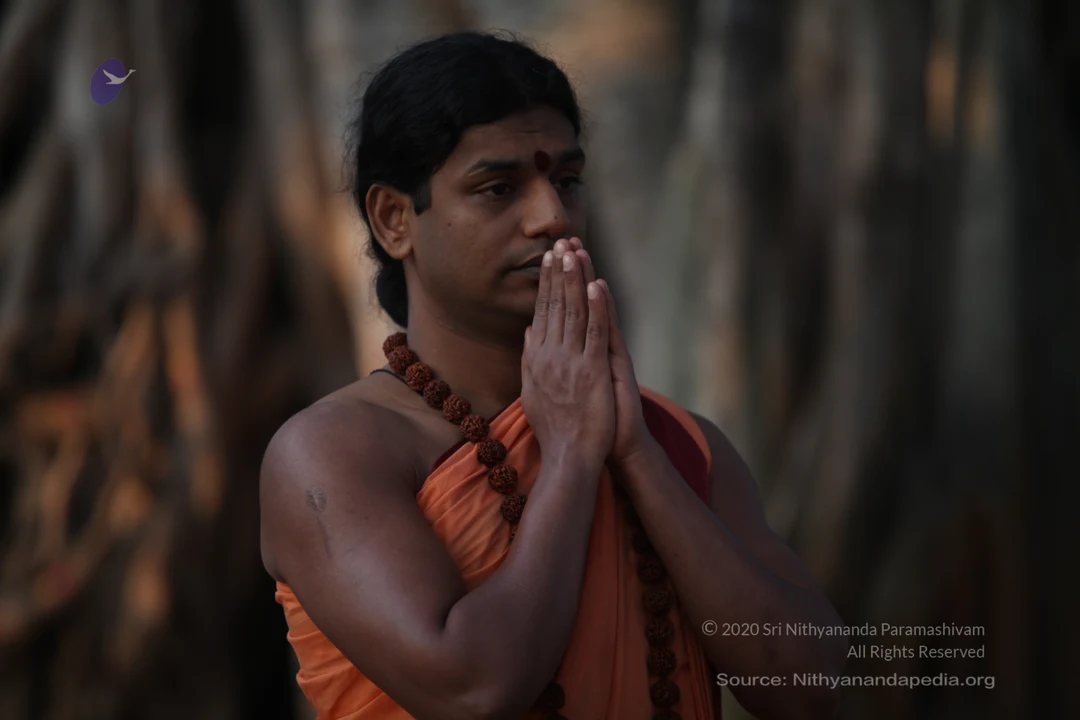
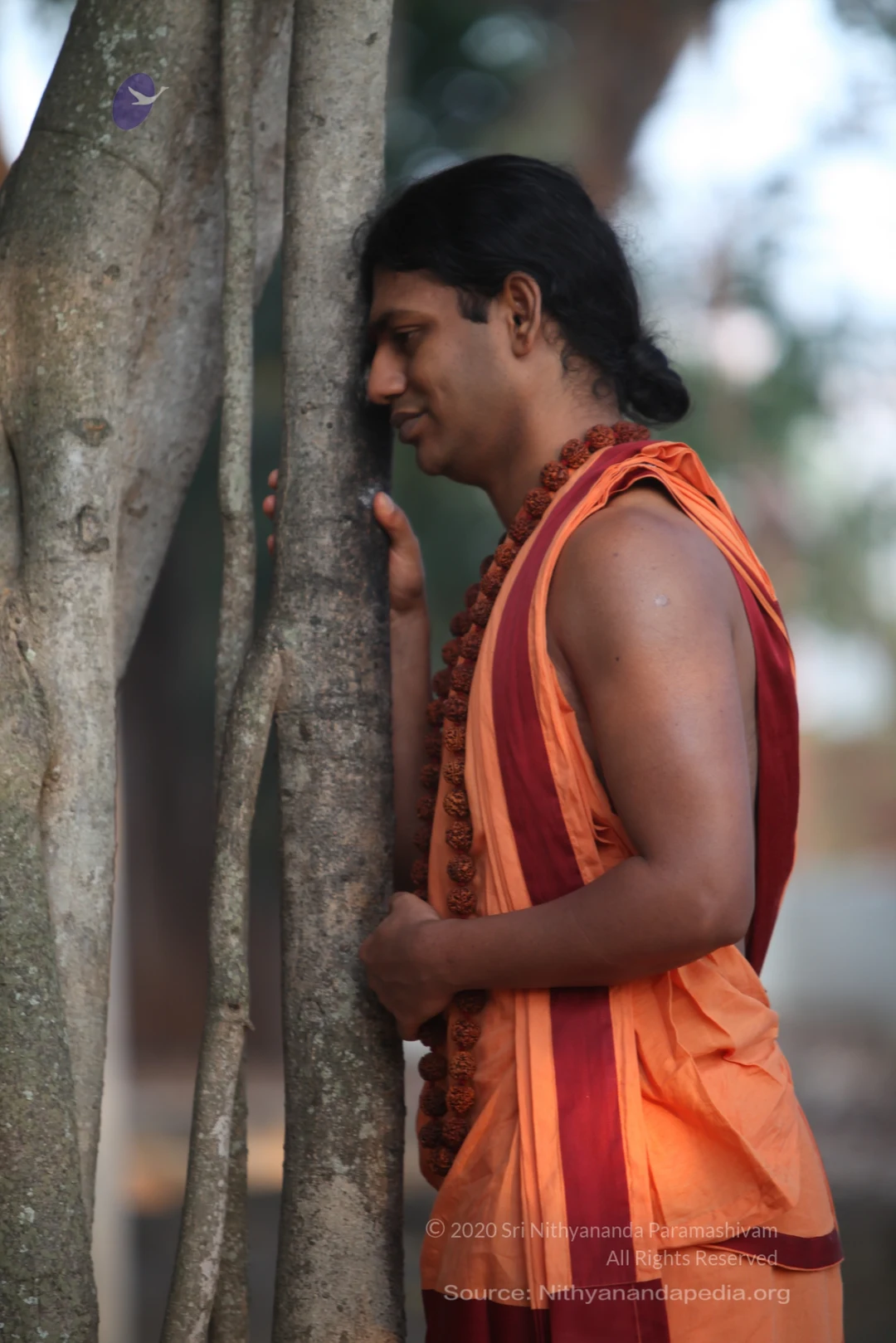
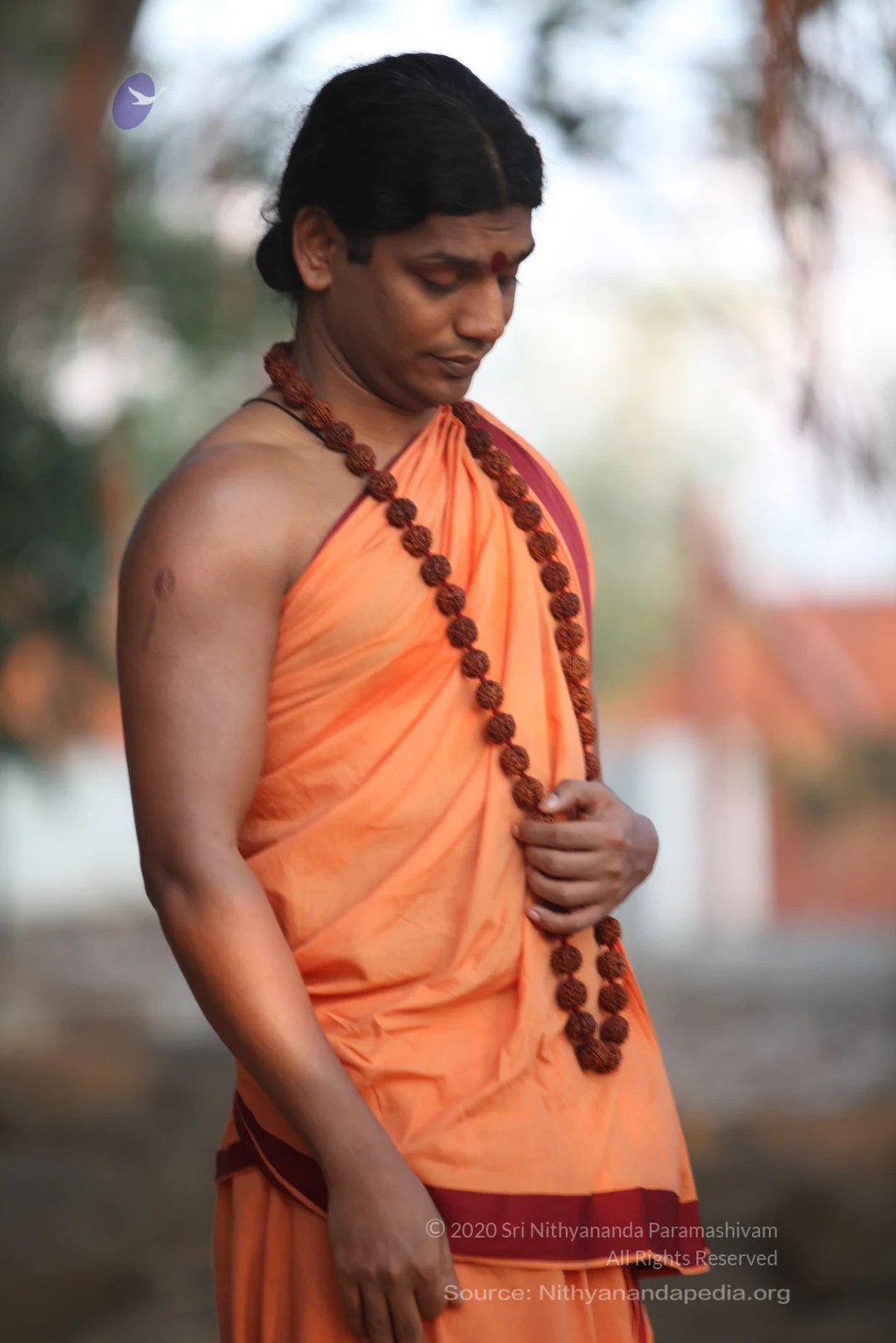
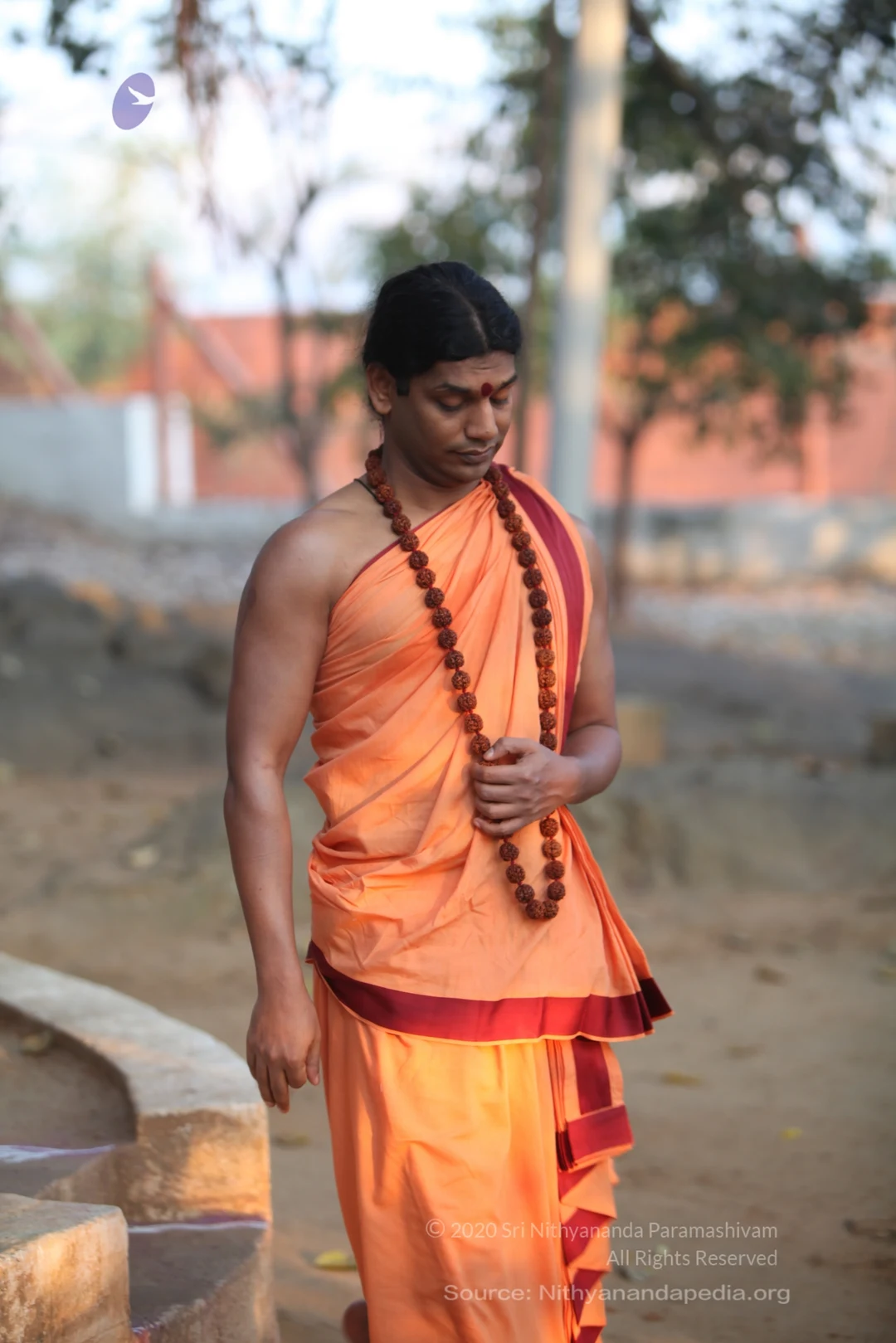
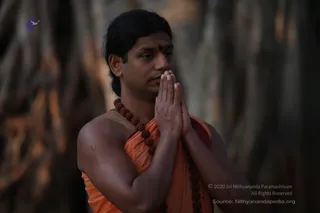
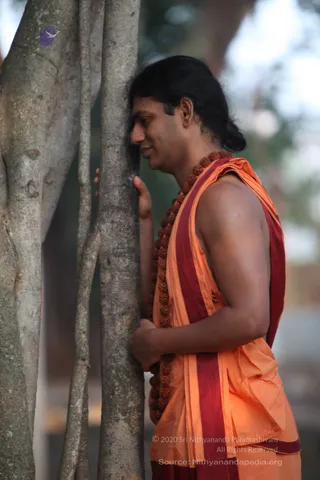
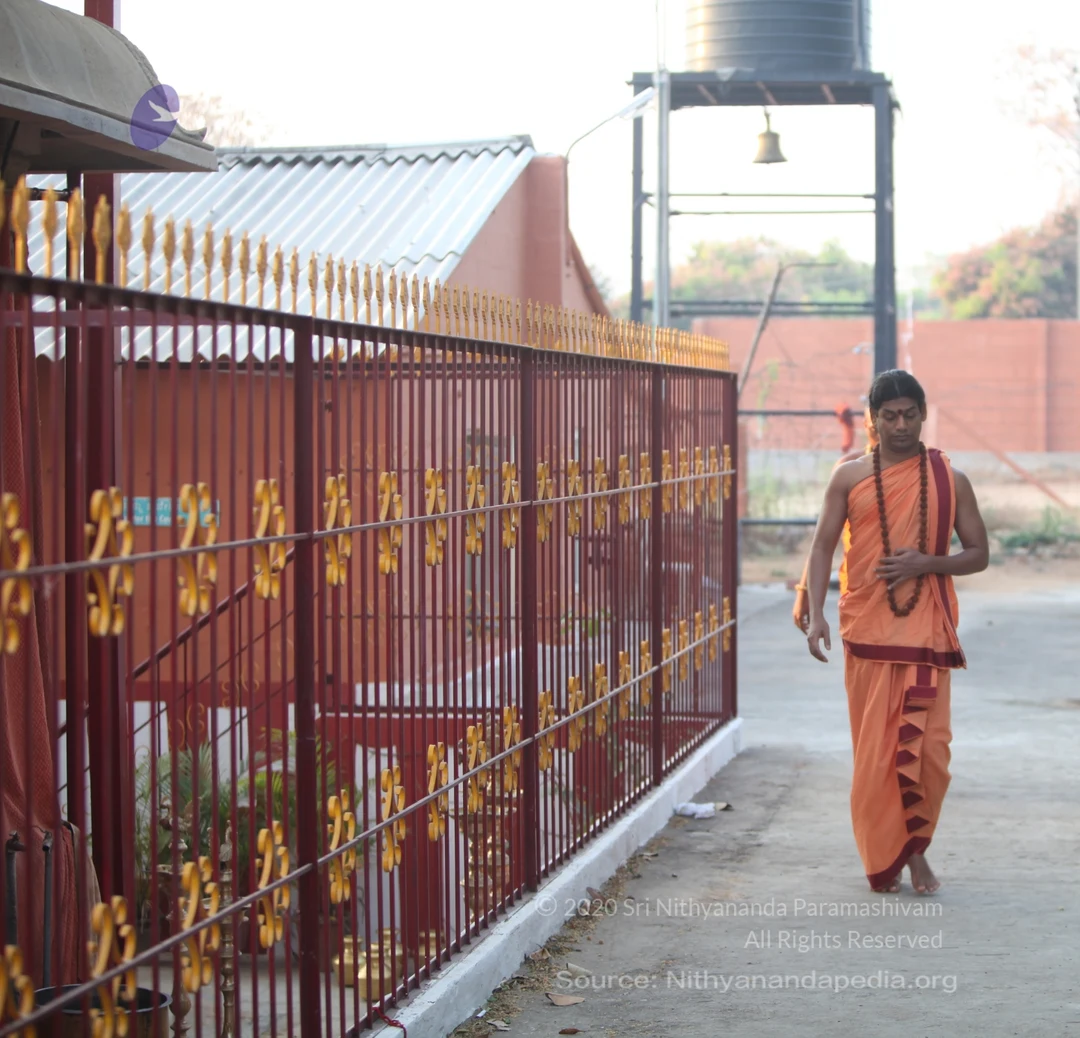
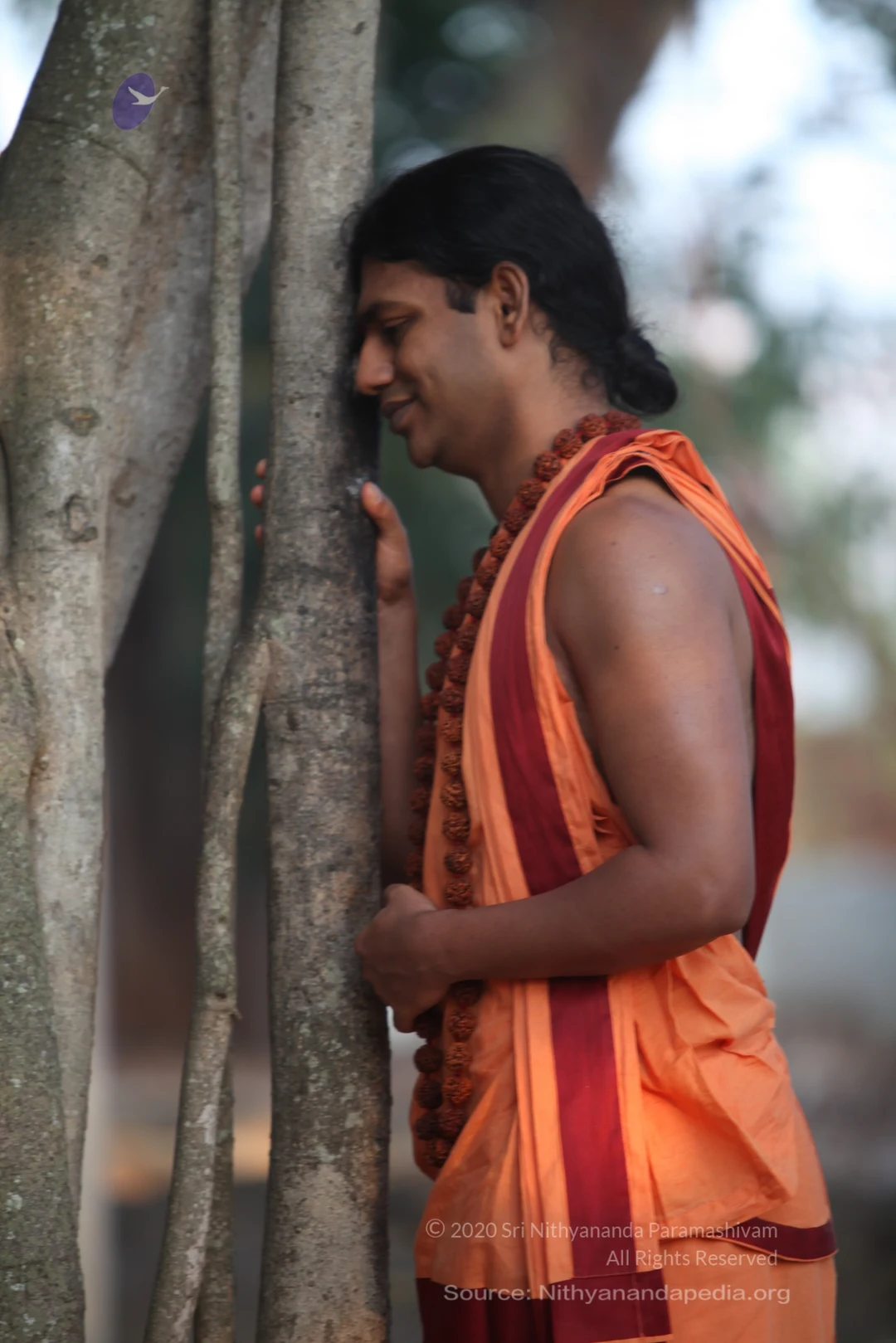
A barefoot man in orange-saffron robes walks along a concrete path beside a red iron fence decorated with gold finials. He wears a saffron dhoti and a saffron shawl with a maroon border, a long rudraksha mala hangs at his chest, and a red tilak marks his forehead. His hair is long and swept back. Behind the fence stand a red-brick wall, a corrugated metal roof and a water tank on a tall frame with a hanging bell. The scene is a plain outdoor ashram walkway in daylight.A photograph outdoors on a sunlit path beside green foliage and a white signboard. In the foreground a man with short dark hair and a red bindi walks with head lowered and hands clasped at his waist. He wears an orange-saffron cloth wrapped over one shoulder with a maroon edge and a long rudraksha mala of dark beads around his neck. Behind him at the right edge, a second figure in saffron robes with a wooden-bead necklace is partly visible, with a red metal frame structure in the background.Outdoor photo of a young man in saffron-orange robes walking with his head bowed and eyes lowered, wearing a long rudraksha mala across his chest and holding his hands together at his waist. Behind him, a second man in orange robes with a white beaded mala and a shaved head walks in soft focus. Green foliage fills the blurred left background, with a white signboard and red-brown structure behind. The scene suggests a sannyasi procession or ashram walk. No identifiable a person candidate with sufficient cues is established, so the identity is left unsure.A man stands outdoors before blurred large tree trunks and roots, with hands pressed together in anjali mudra at chest height. He wears an orange-saffron garment draped over the shoulders and a rudraksha mala of brown beads around his neck, with a red tilak on his forehead. His expression is calm and focused, eyes lowered.A man in profile leans his head and forearm against the trunk of a large tree, his hands clasped low against the bark. He wears an orange sleeveless wrap with a maroon border over his shoulders and an orange dhoti, and a long rudraksha mala of dark brown beads hangs around his neck. His long dark hair is gathered back. The background is a soft blur of greenery. Appearance-based candidate, a person, is visible in an outdoor setting with the rudraksha mala and saffron-orange clothing cues; identity remains uncertain from appearance alone.Photograph of a man in profile leaning his head and right hand against the trunk of a large tree, eyes closed and a faint smile. He wears an orange-saffron dhoti and shawl with a maroon border, bare-shouldered, and a long rudraksha mala around his neck. His long dark hair is tied back. Blurred green foliage and daylight fill the background. A purple bird logo sits at upper left and a copyright line is printed across the lower right.

Paadapooja
23 photosSource gallery
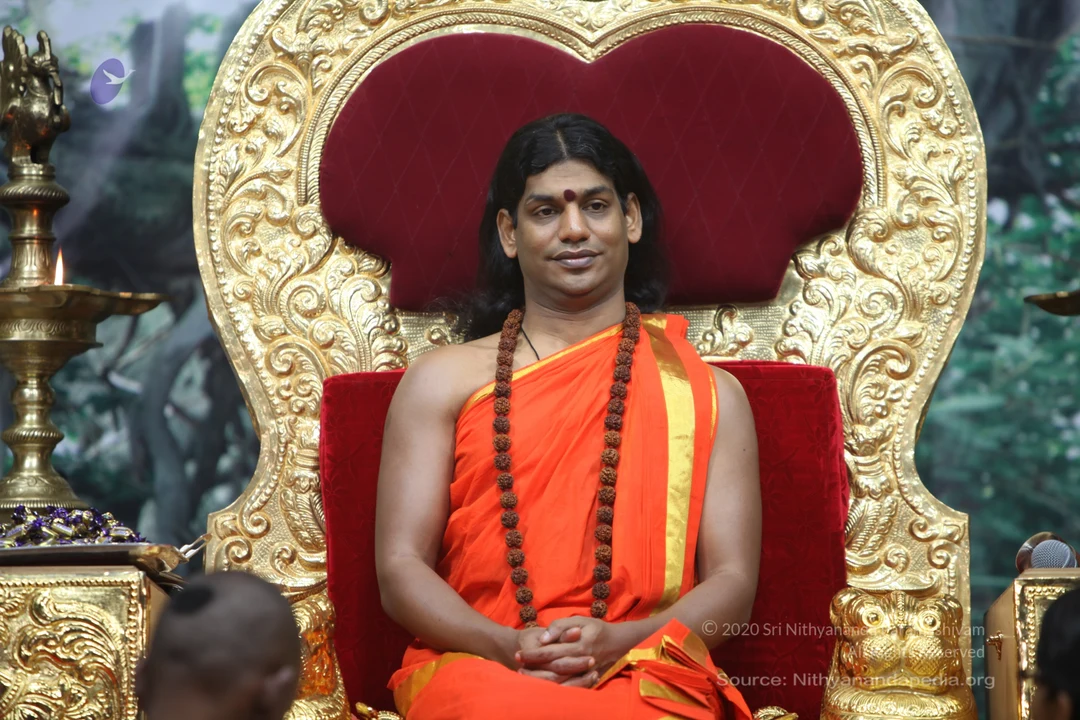
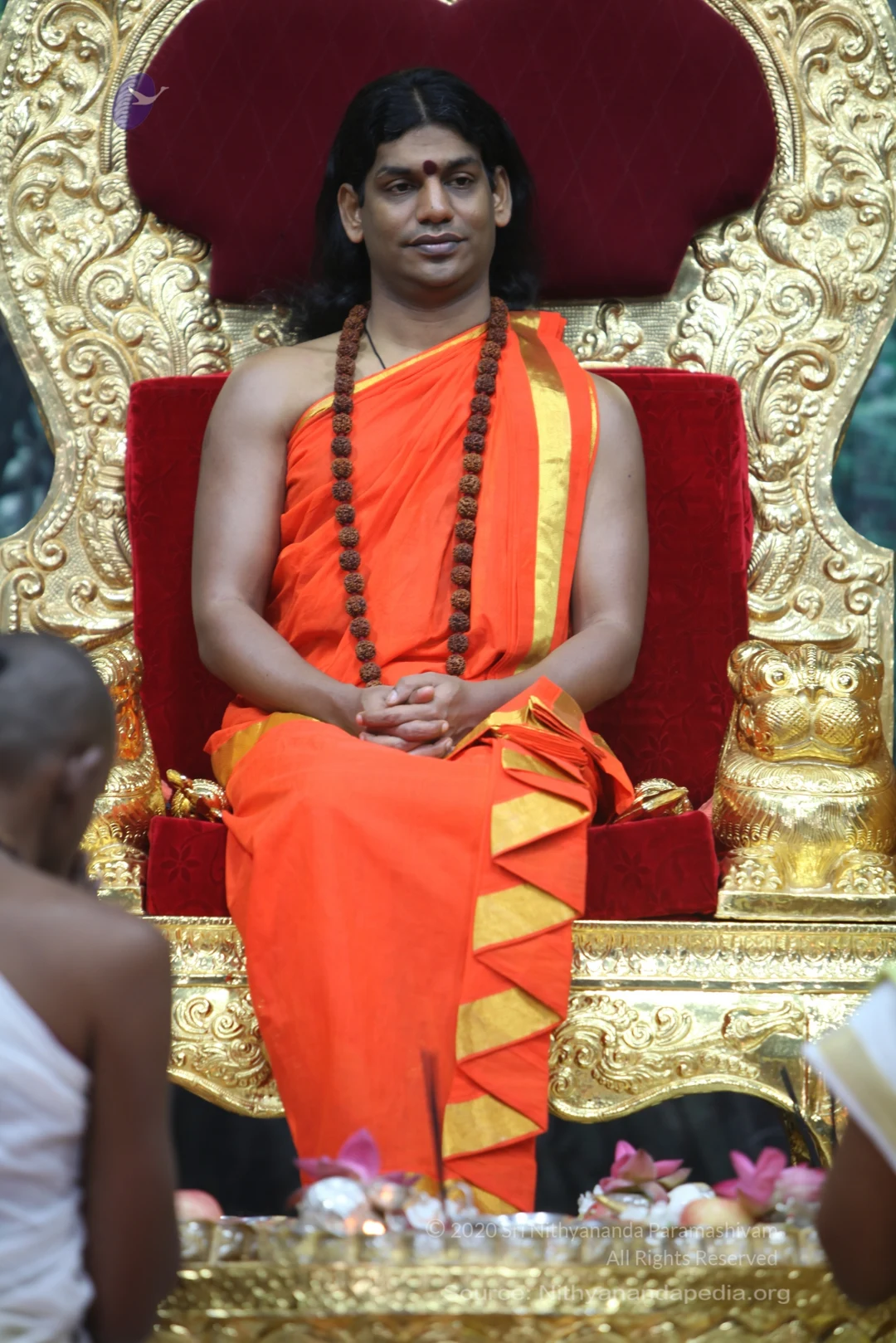
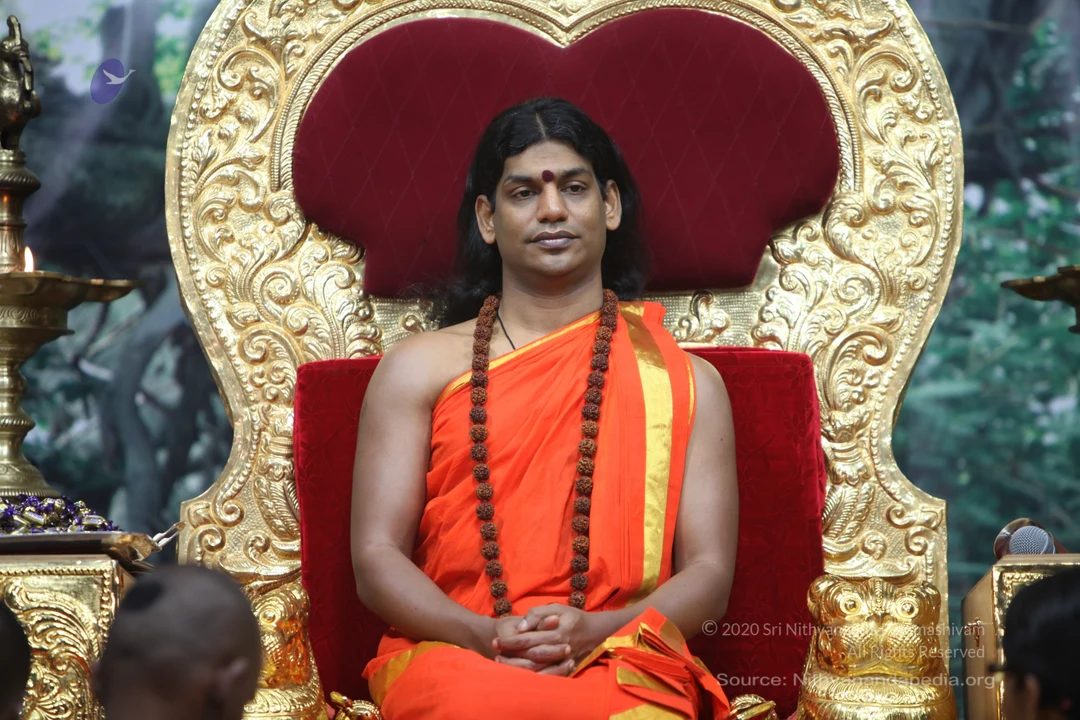
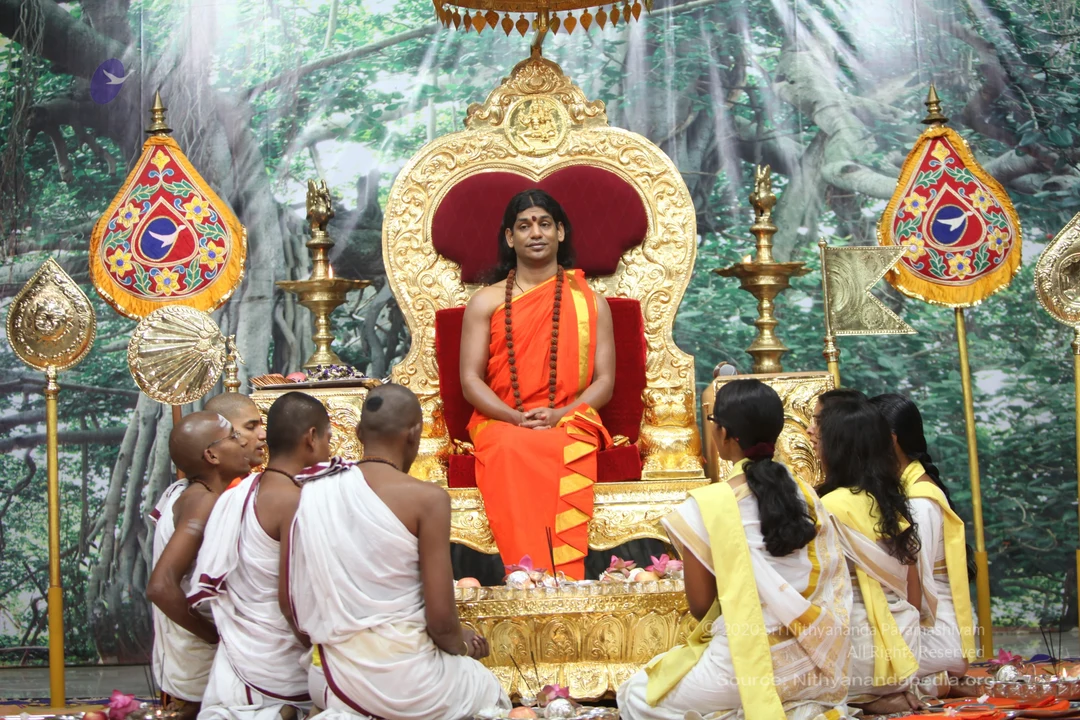
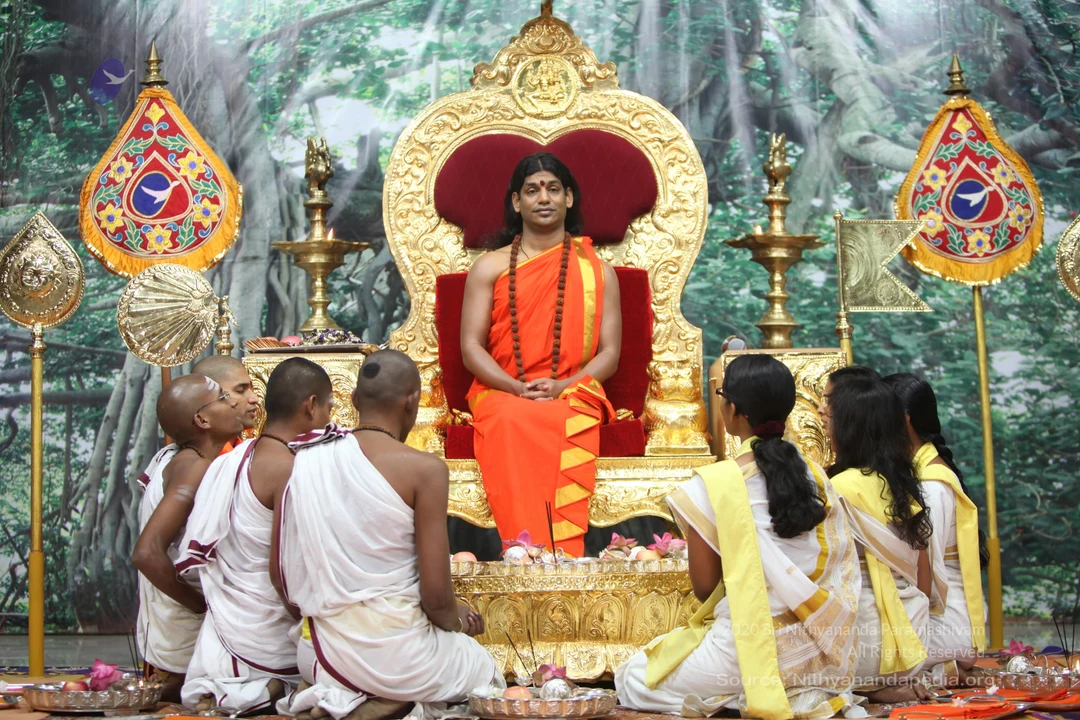
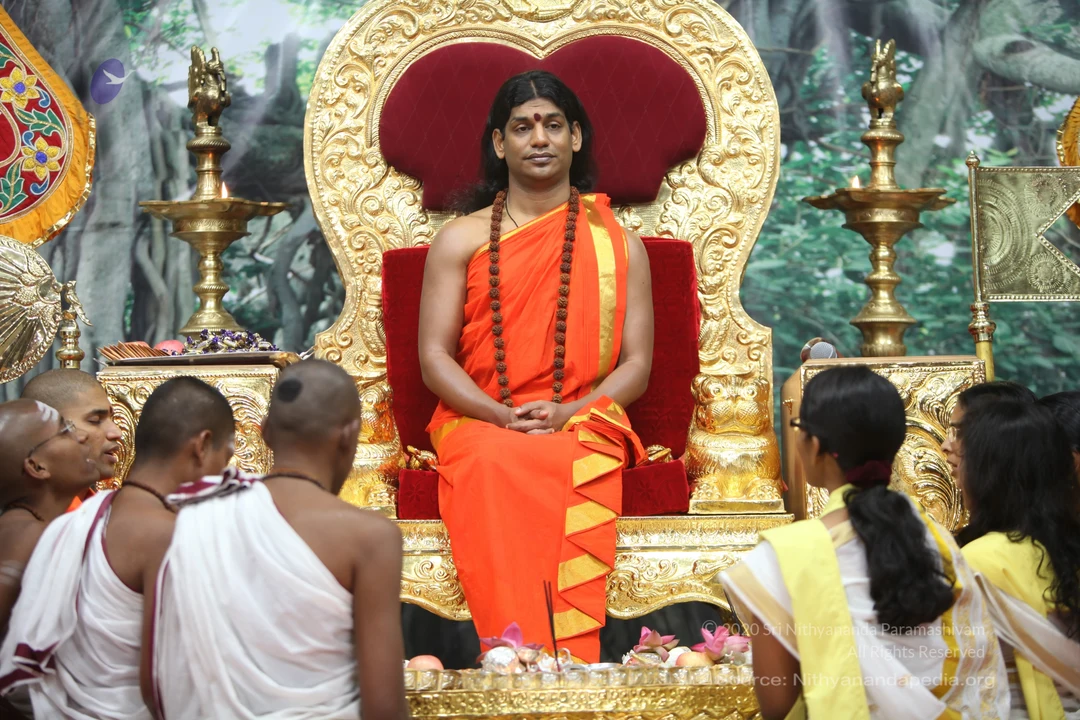
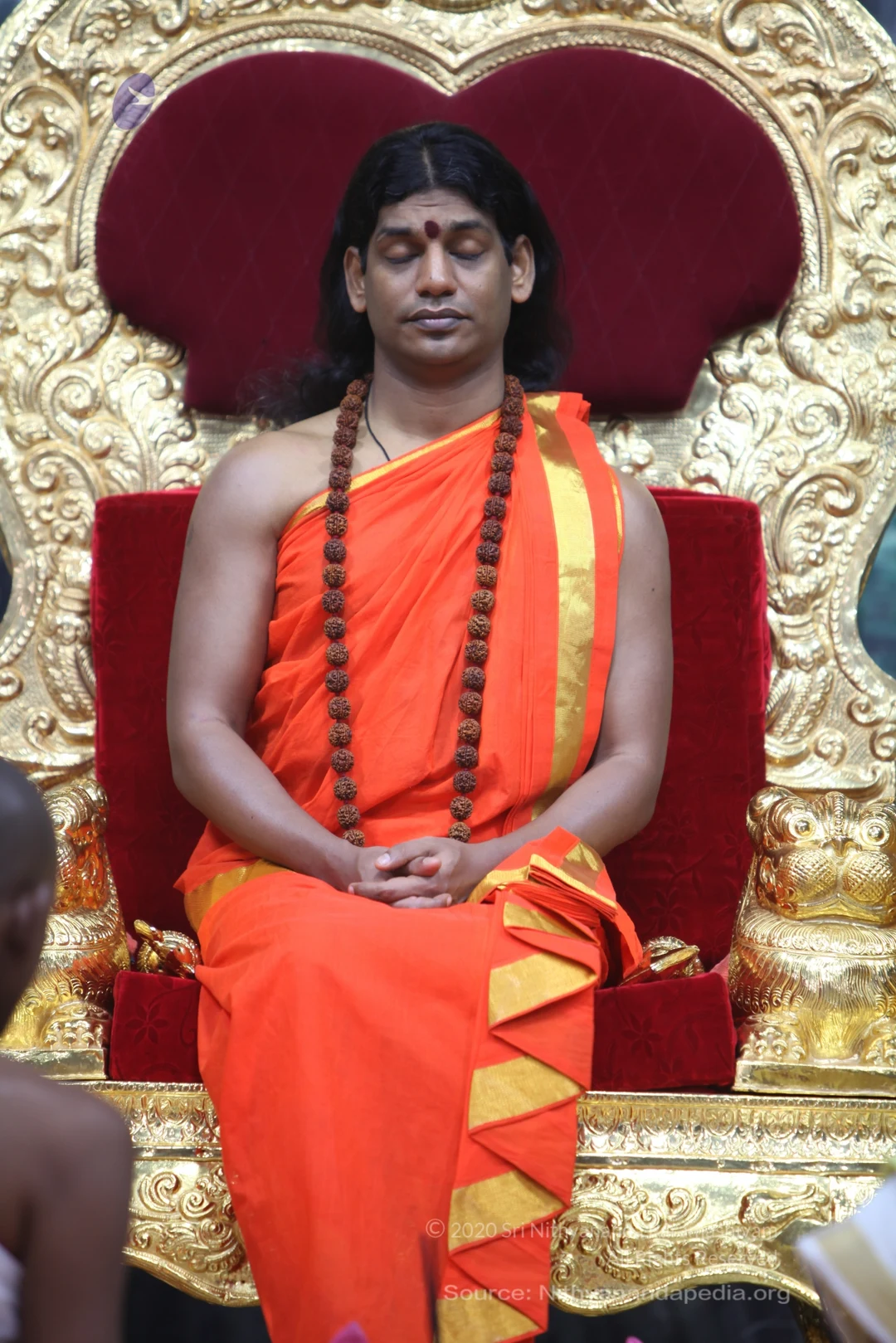
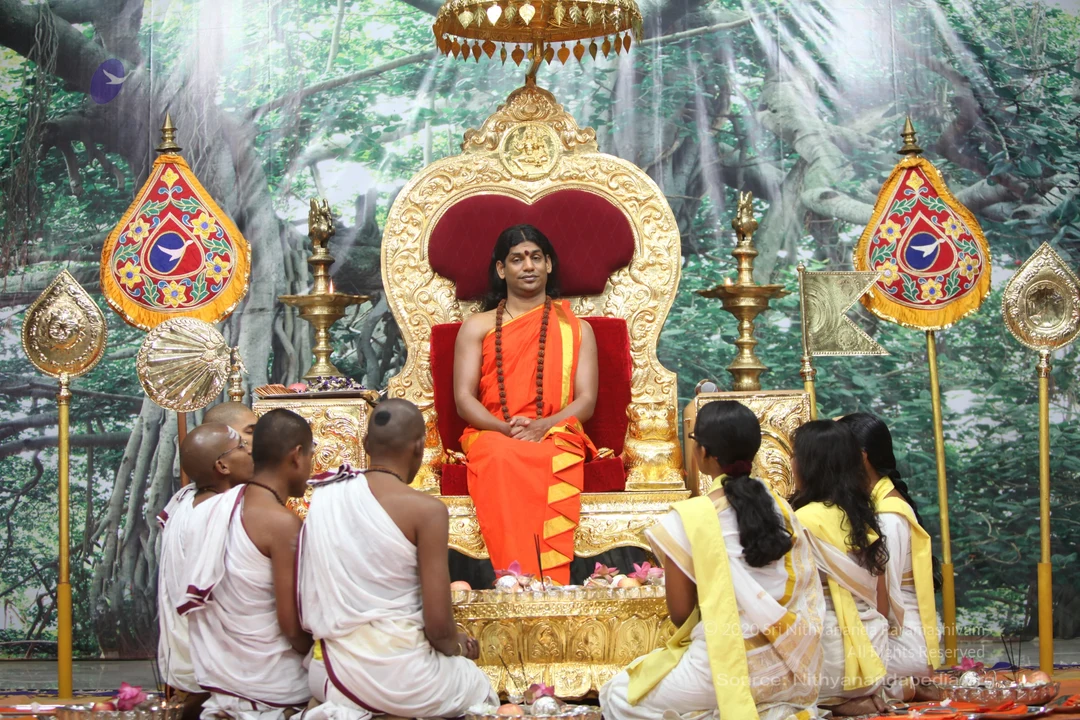
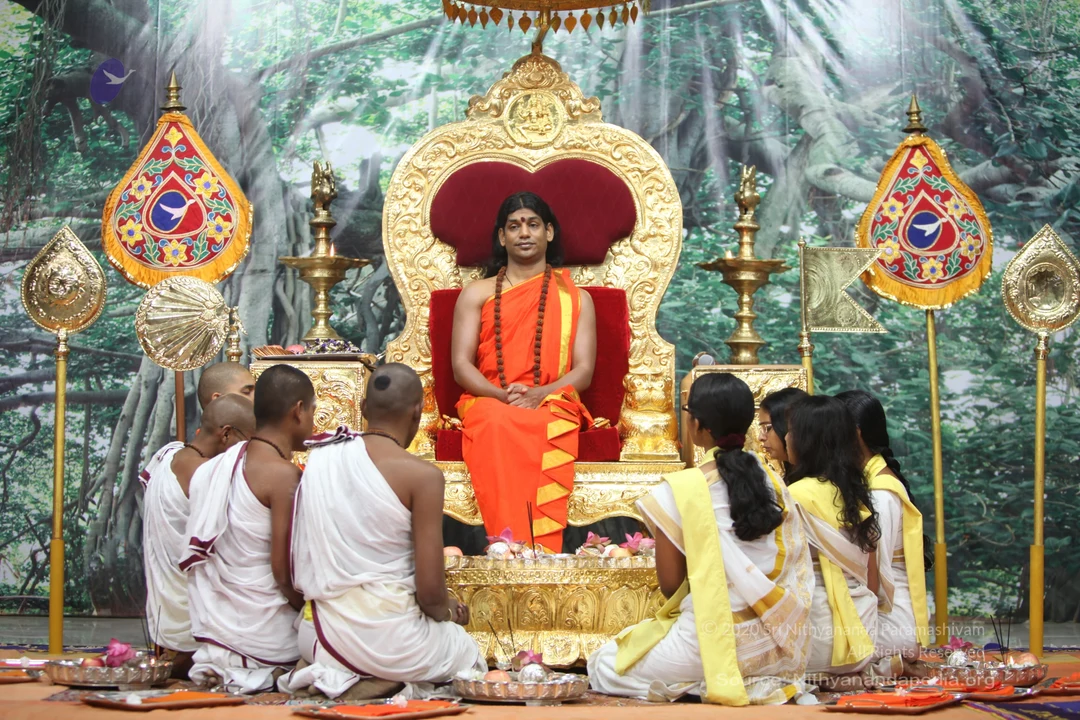
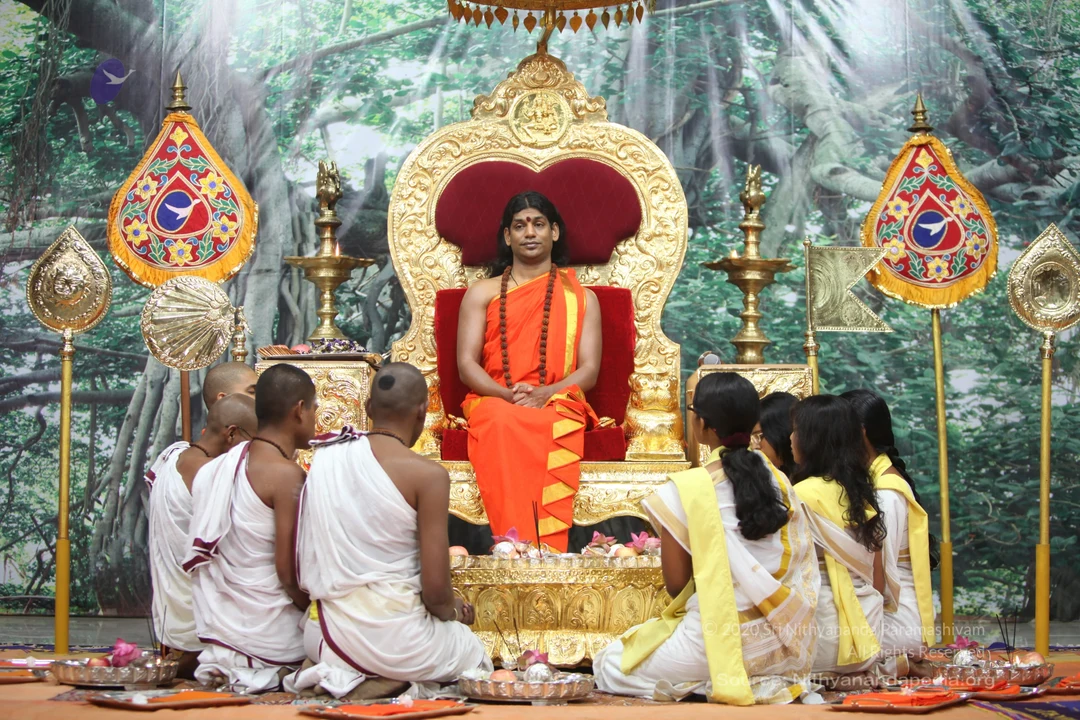
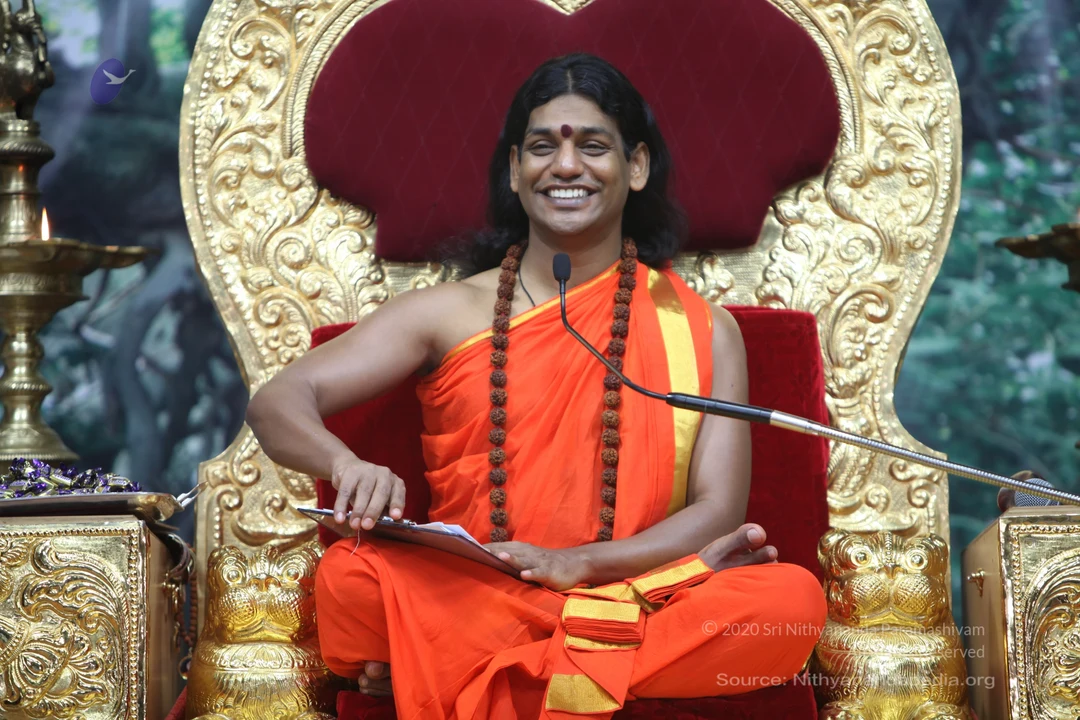
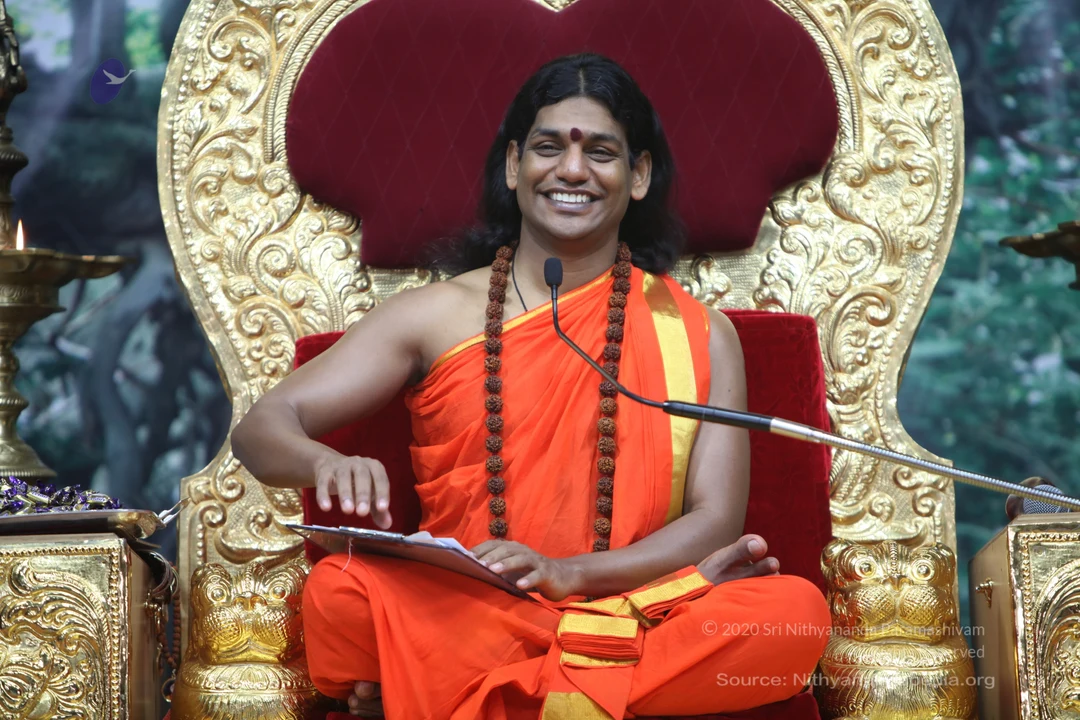
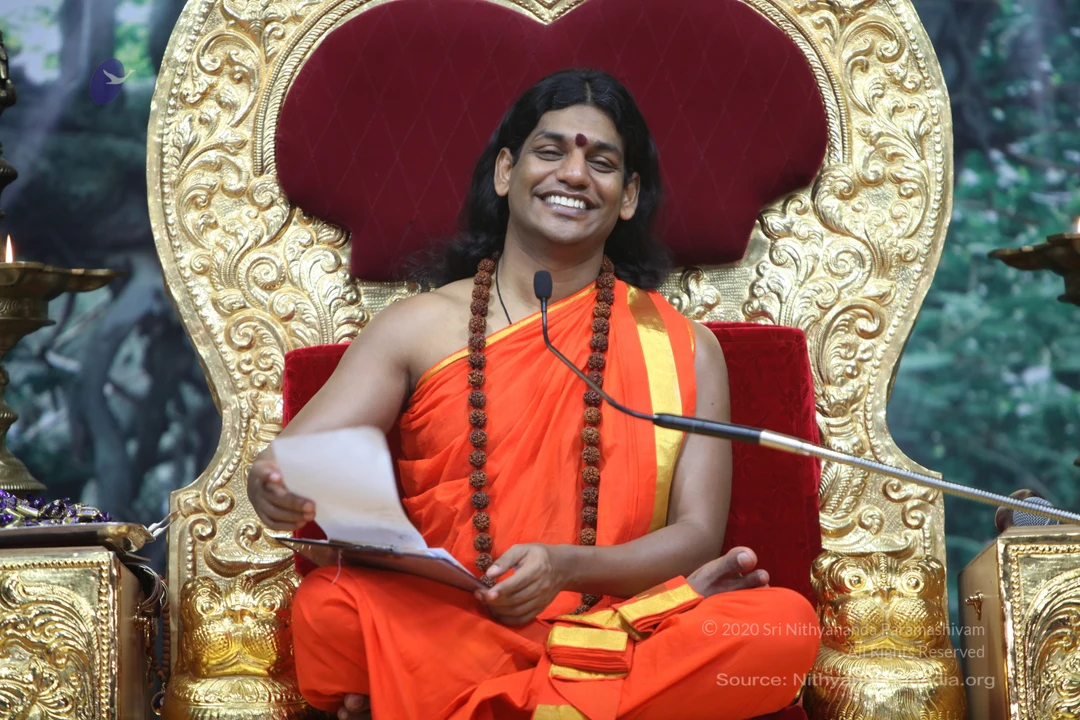
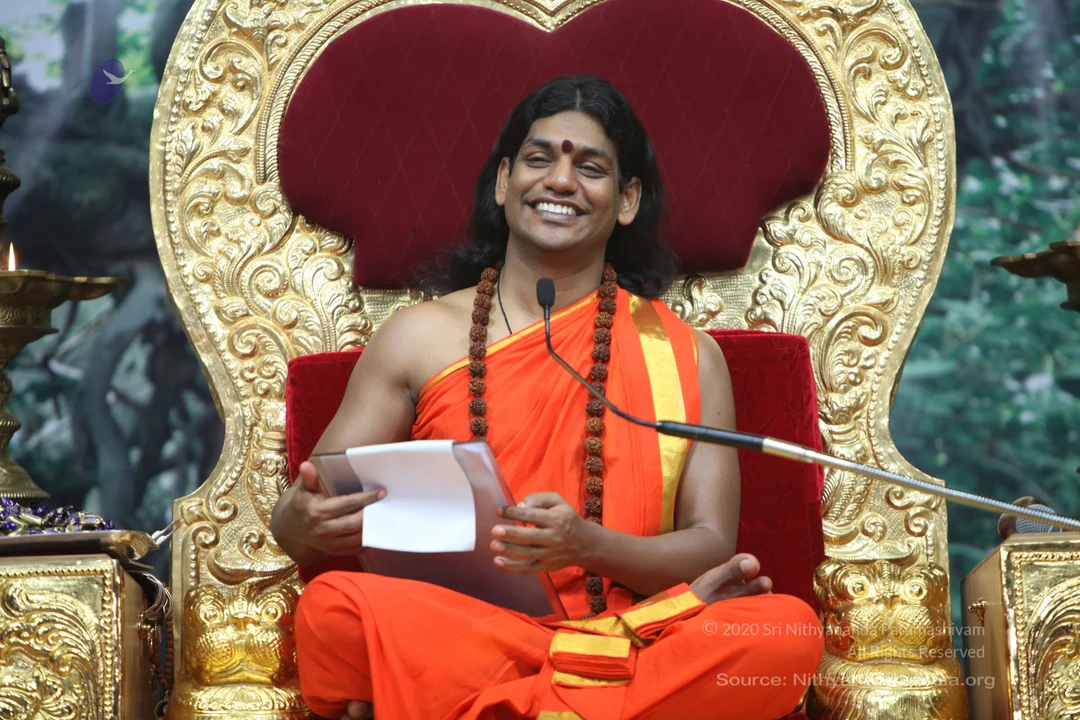
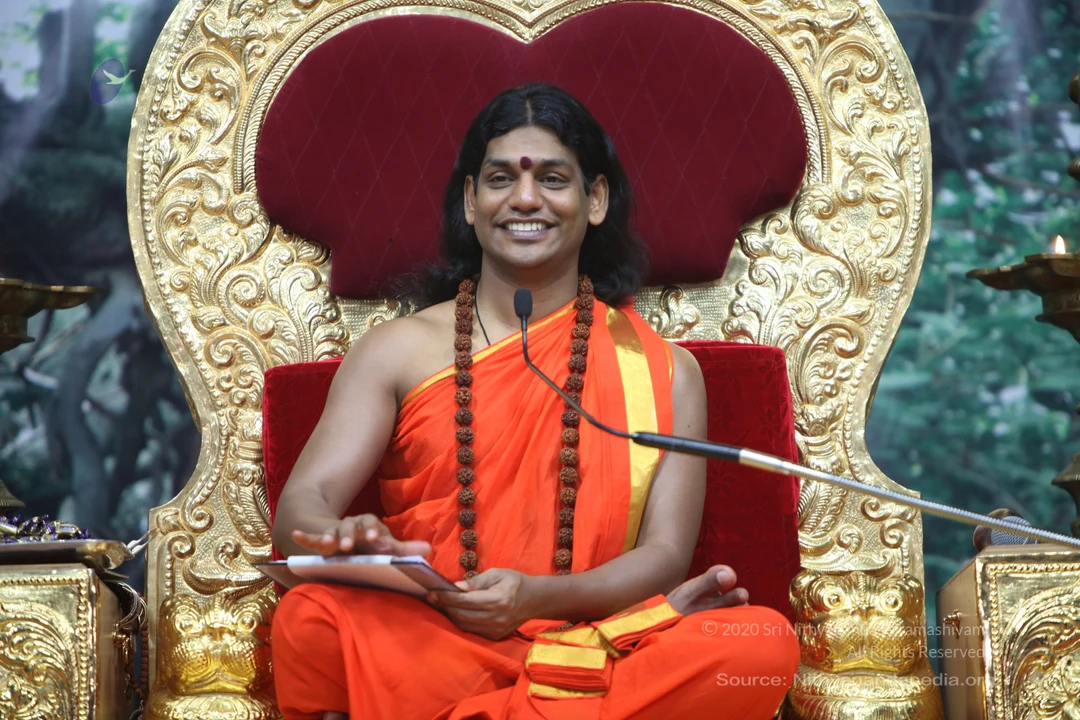
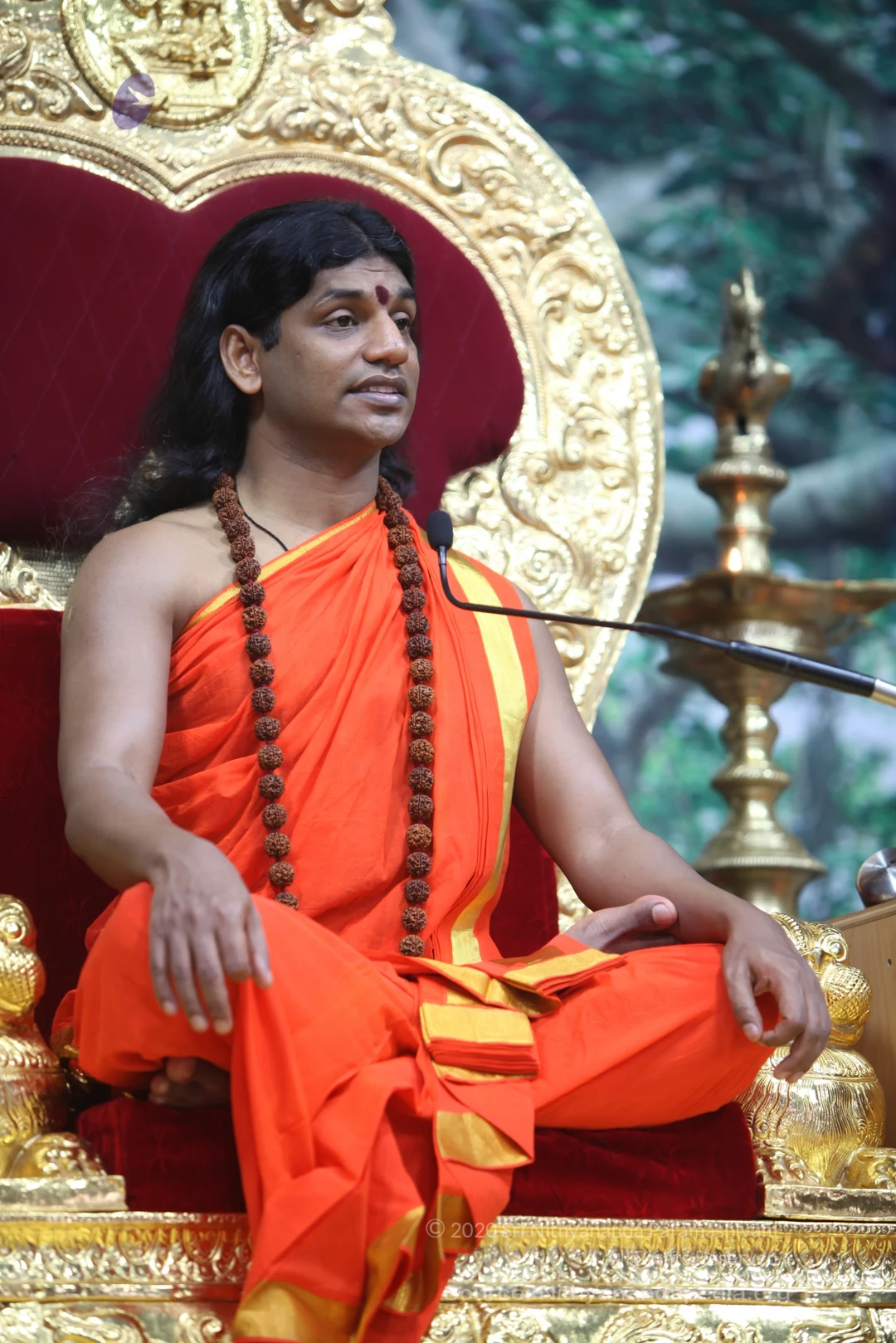
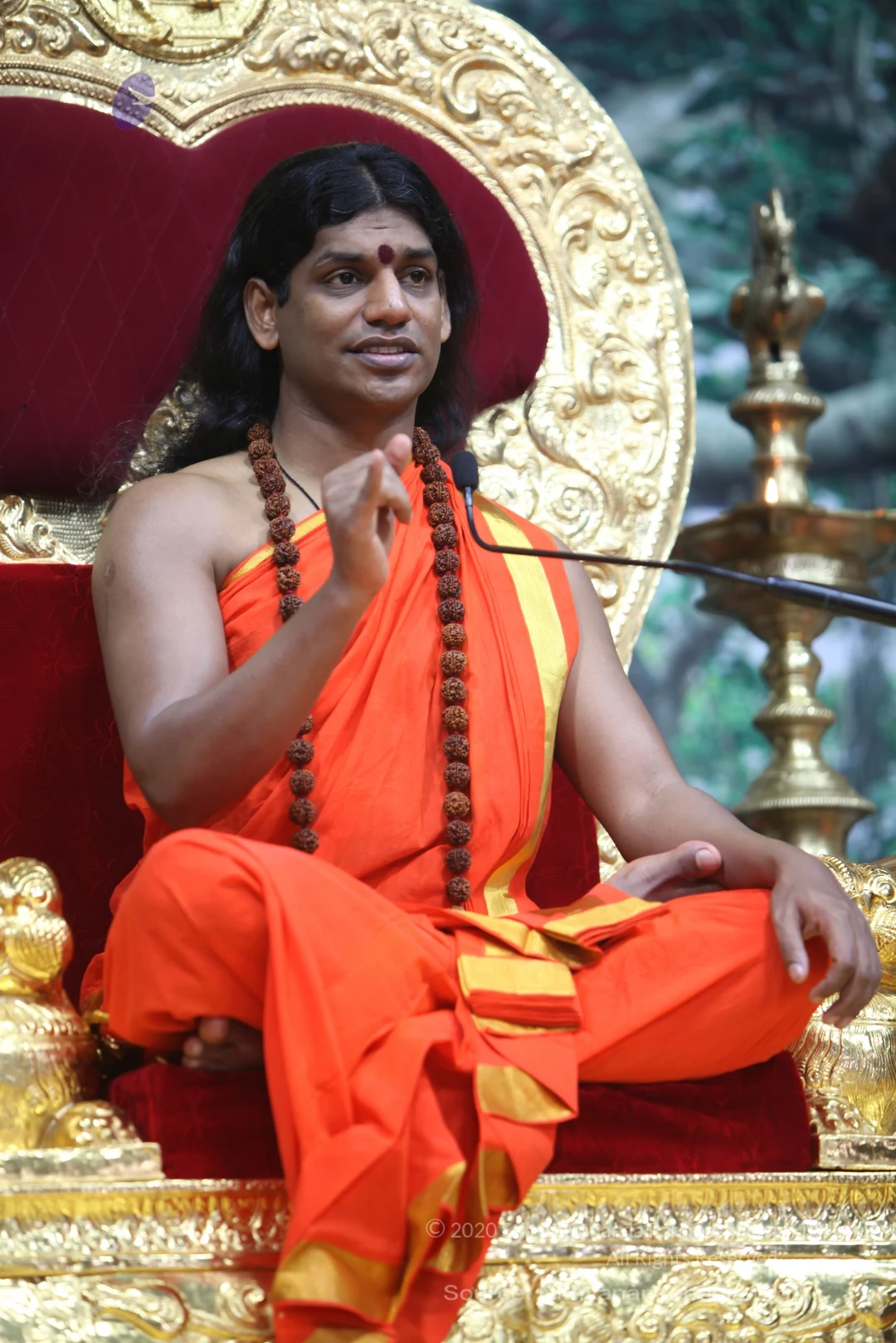
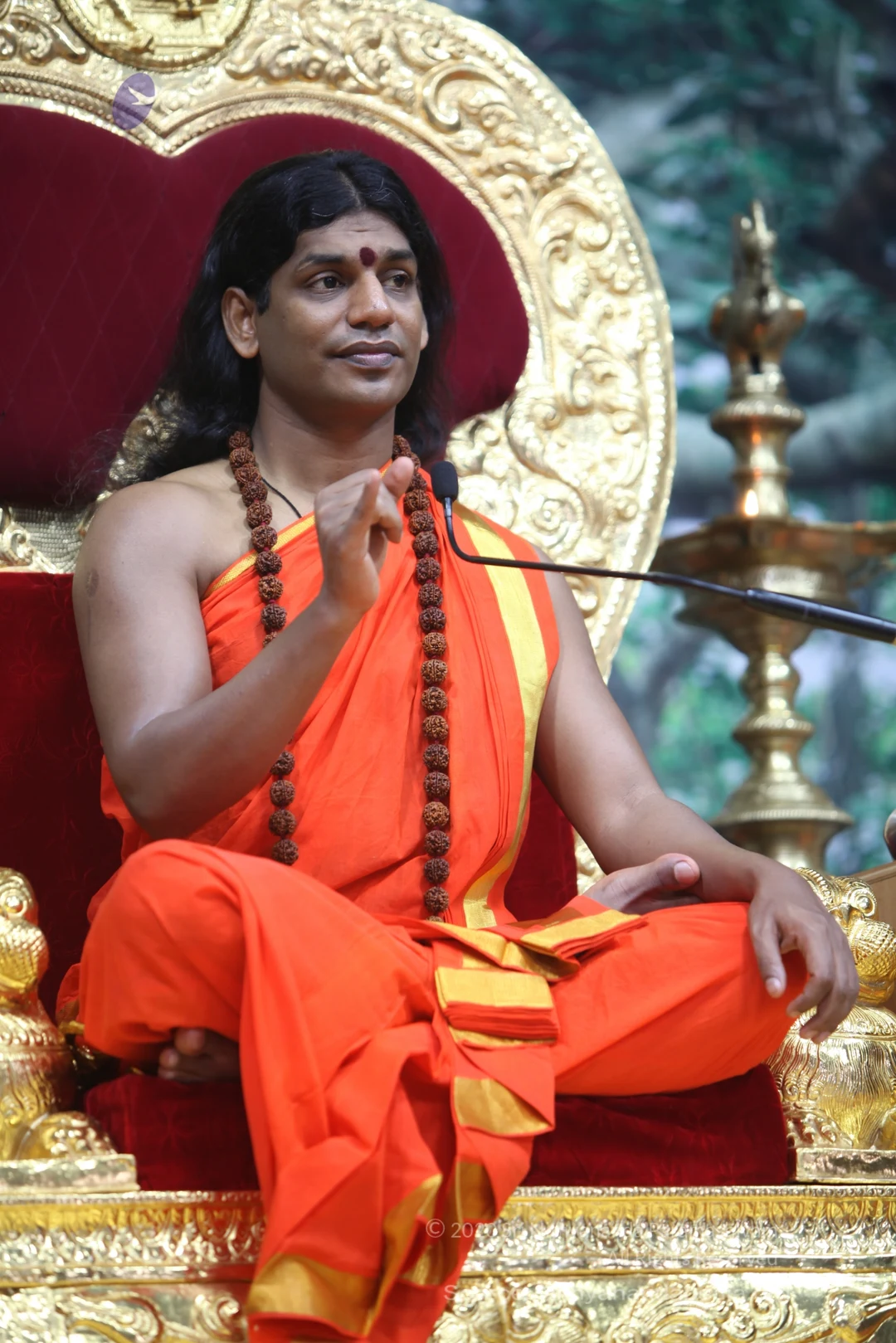
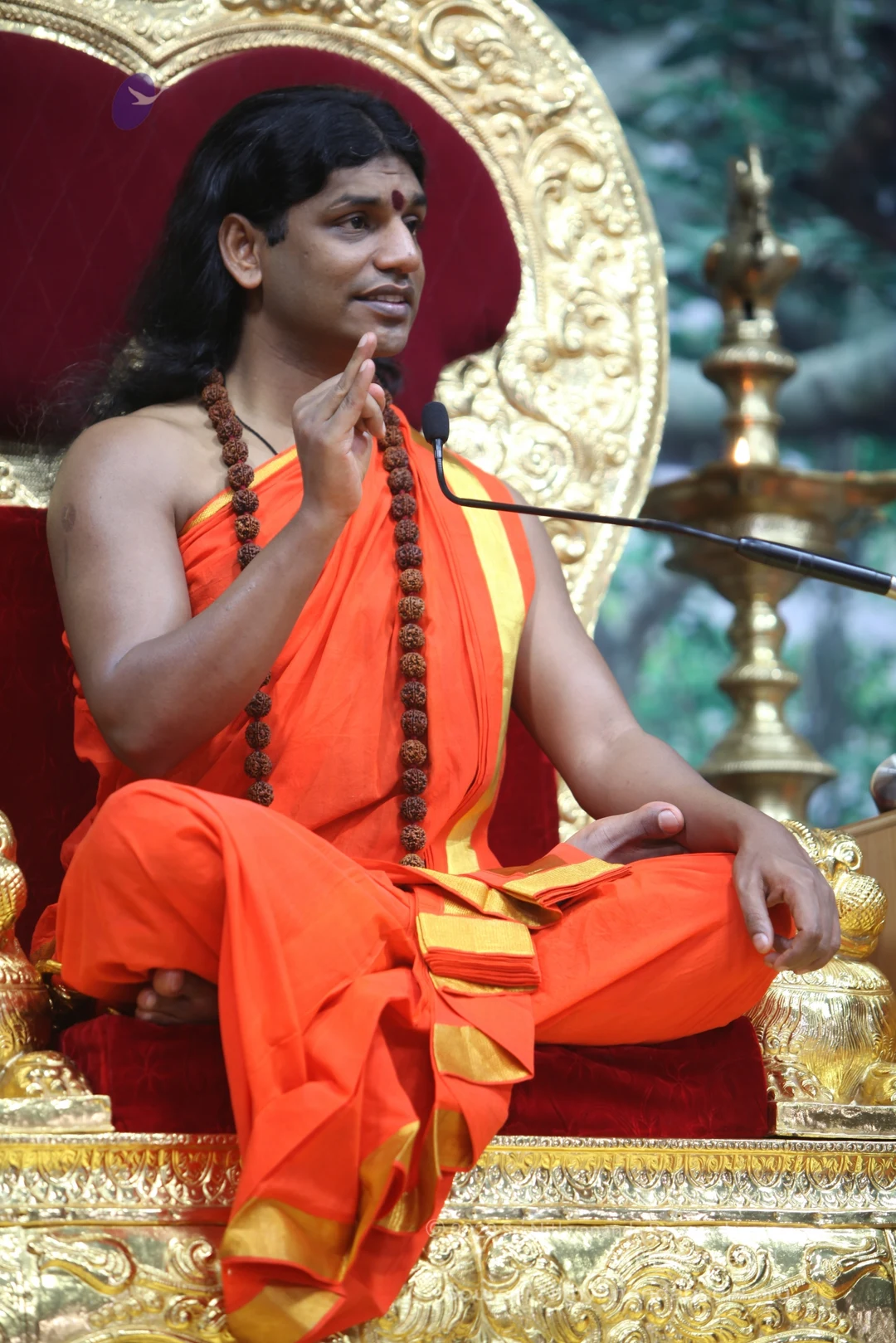
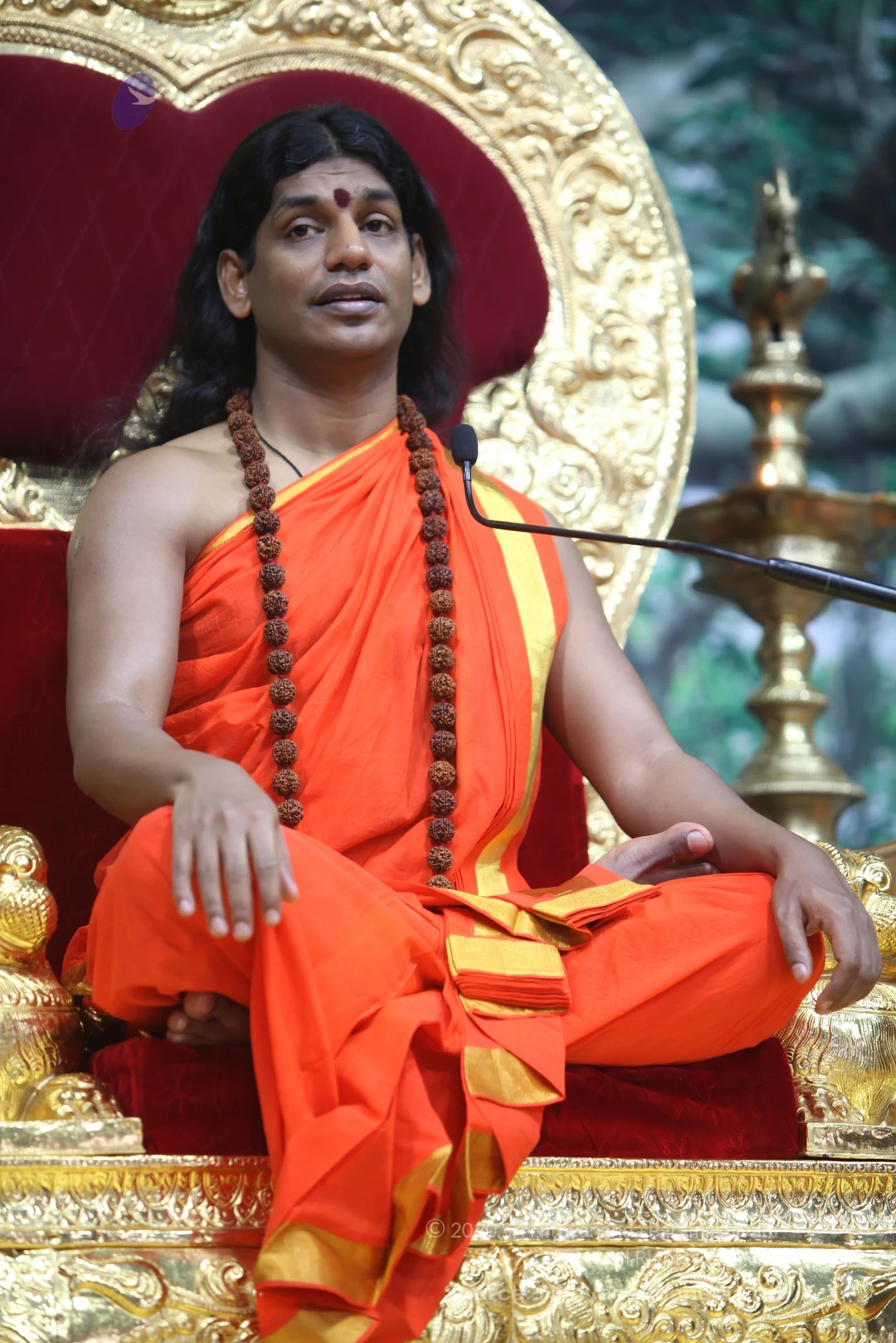
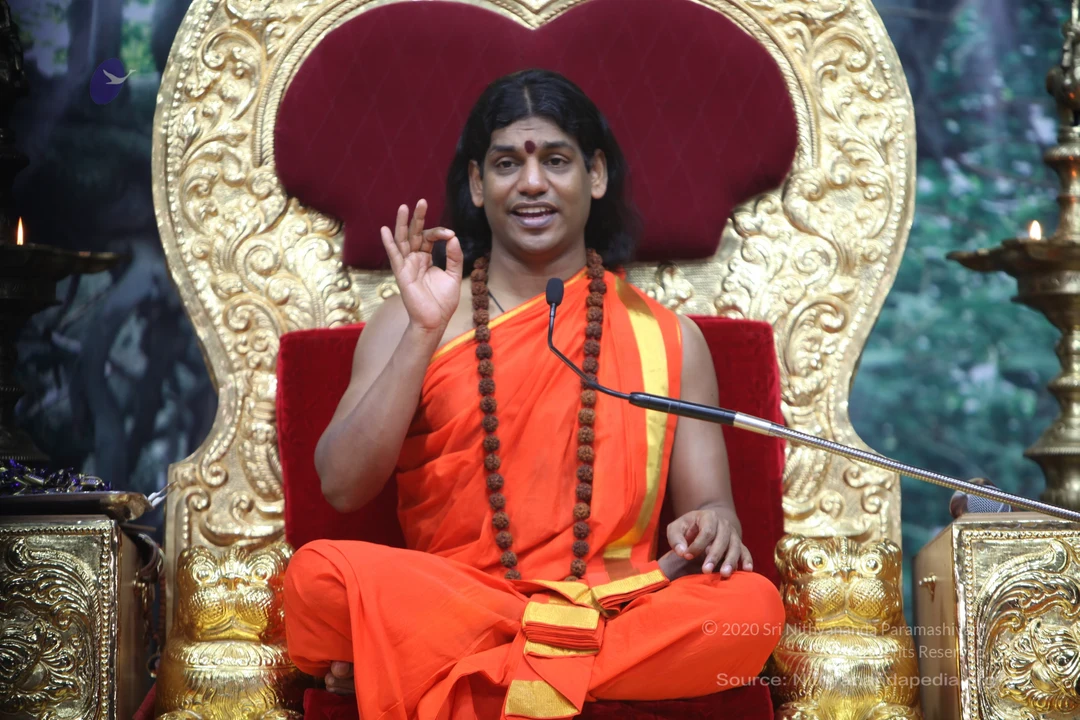
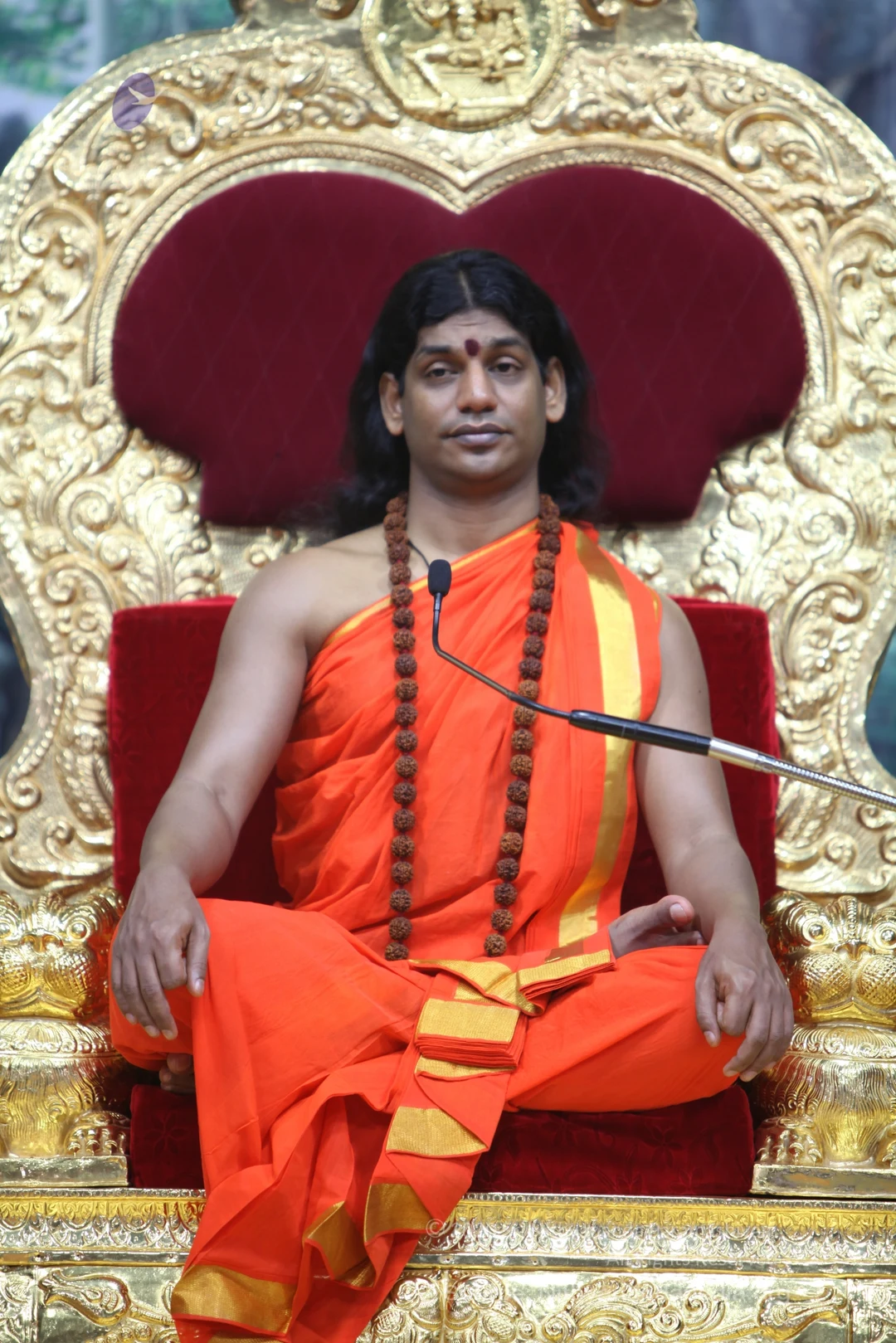
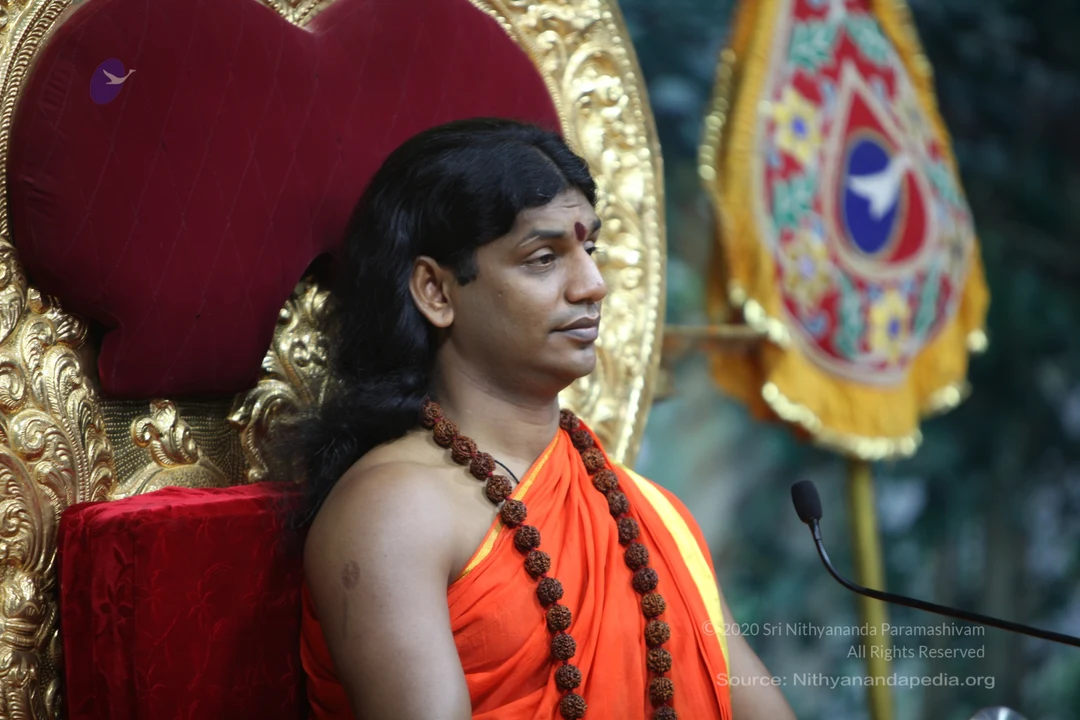
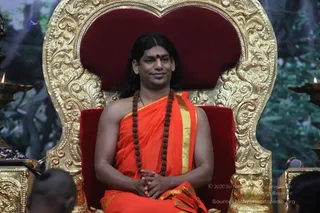
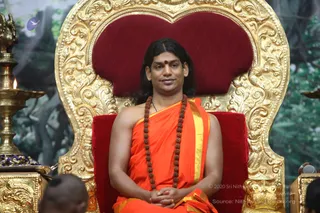
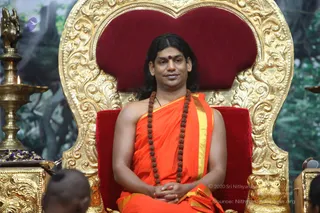
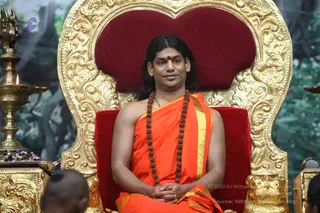
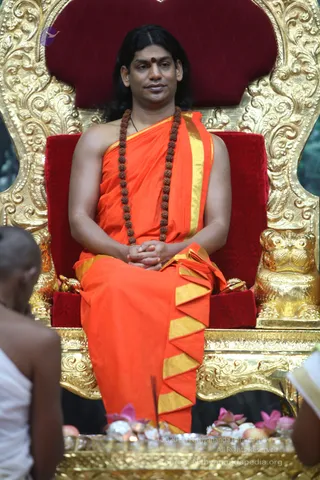
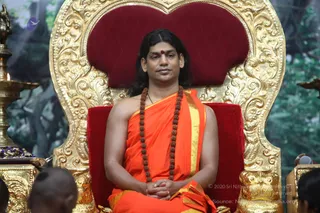
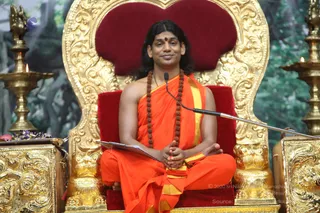
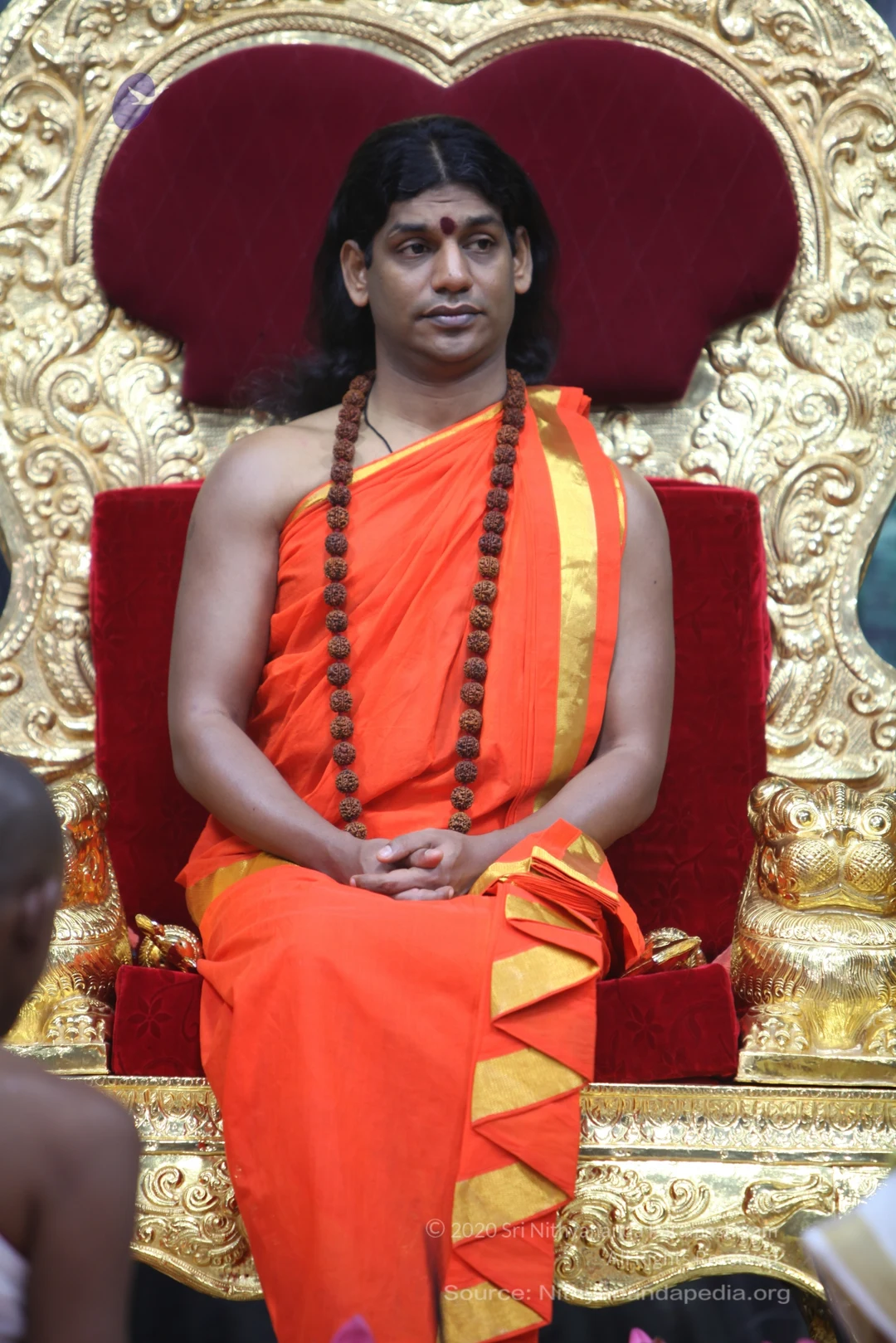
A man with long, swept-back dark hair sits on an ornate gold throne with a deep red velvet back and seat, hands folded in his lap. He wears an orange-red garment with a gold-bordered wrap, a long rudraksha mala with dark beads, and a red bindi on his forehead. Two oil lamps flank the throne at left and right. In the lower left corner, the back of a bald head is partly visible. A microphone stands at the right edge. The background shows a painted forest scene. Given the page's Swamiji flag and the visible long hair, saffron-orange clothing, rudraksha mala and throne, this is a probable Swamiji (Nithyananda Paramashivam) in person, seated for a discourse.A man with long dark swept-back hair sits on an ornate gold-and-red throne before a green forest backdrop. He wears an orange saffron robe with gold borders, a long rudraksha mala, and a red bindi, with hands clasped in his lap. A brass oil lamp with a lit flame stands at left, and a blurred head of a person appears in the lower left foreground. The image shows a discourse setting with one visible seated speaker and one partially visible person.A man with long dark hair sits cross-legged on an ornate gold throne with a deep red cushioned seat and back. He wears an orange-saffron robe with a gold border and a long rudraksha mala of dark beads draped to his waist, and has a red bindi on his forehead. His hands rest folded in his lap. A brass oil lamp with a lit flame stands at left on a gold pedestal beside a tray of purple flowers, and a microphone sits at right against a green forest backdrop. A small figure in the foreground at lower left is partly visible.A man with long swept-back dark hair sits on an ornate gold throne with a deep red velvet backrest and seat. He wears an orange saffron robe with gold-yellow borders and a long rudraksha mala with a ceremonial gold ornament. He has a red bindi on his forehead, hands folded in his lap, and a calm, slight smile. Behind him is a forest-like backdrop. To the left stands a brass oil lamp with a lit flame, and a small microphone is visible at the right. The lower left shows the blurred head of a seated listener. Appearance cues are consistent with the page's identification: a person, seated in person on the throne during a discourse.A man seated on an ornate gold-carved throne with red velvet cushioning, wearing an orange-saffron robe with gold borders draped over his shoulders and a long rudraksha mala of brown beads around his neck. He has long dark hair and a red bindi on his forehead, with hands folded in his lap. In the foreground at lower left, a partially visible person in white clothing sits facing him, and a gold tray with flowers, fruit and a lit oil lamp rests before the throne. Swamiji (probable): the seated figure's long hair, saffron robe, rudraksha mala and ornate throne match the page's identification of Nithyananda Paramashivam as present at this satsang.A man in orange saffron robes with a gold-edged sash sits cross-legged on an ornate golden throne with a red velvet cushion. He wears a long rudraksha mala of brown beads and has a red bindi on his forehead, with long dark hair swept back. His hands rest folded in his lap. A brass oil lamp with a lit flame stands at the left, a microphone is at the right, and a bouquet of purple flowers sits on a gold-trimmed table. Behind him is a green forest backdrop. A few heads of seated people are partly visible at the bottom edge. Swamiji (probable) by appearance cues: saffron clothing, long hair, rudraksha mala and throne seat, as the person presiding over the discourse.

Nithyananda-Satsang
28 photosSource gallery
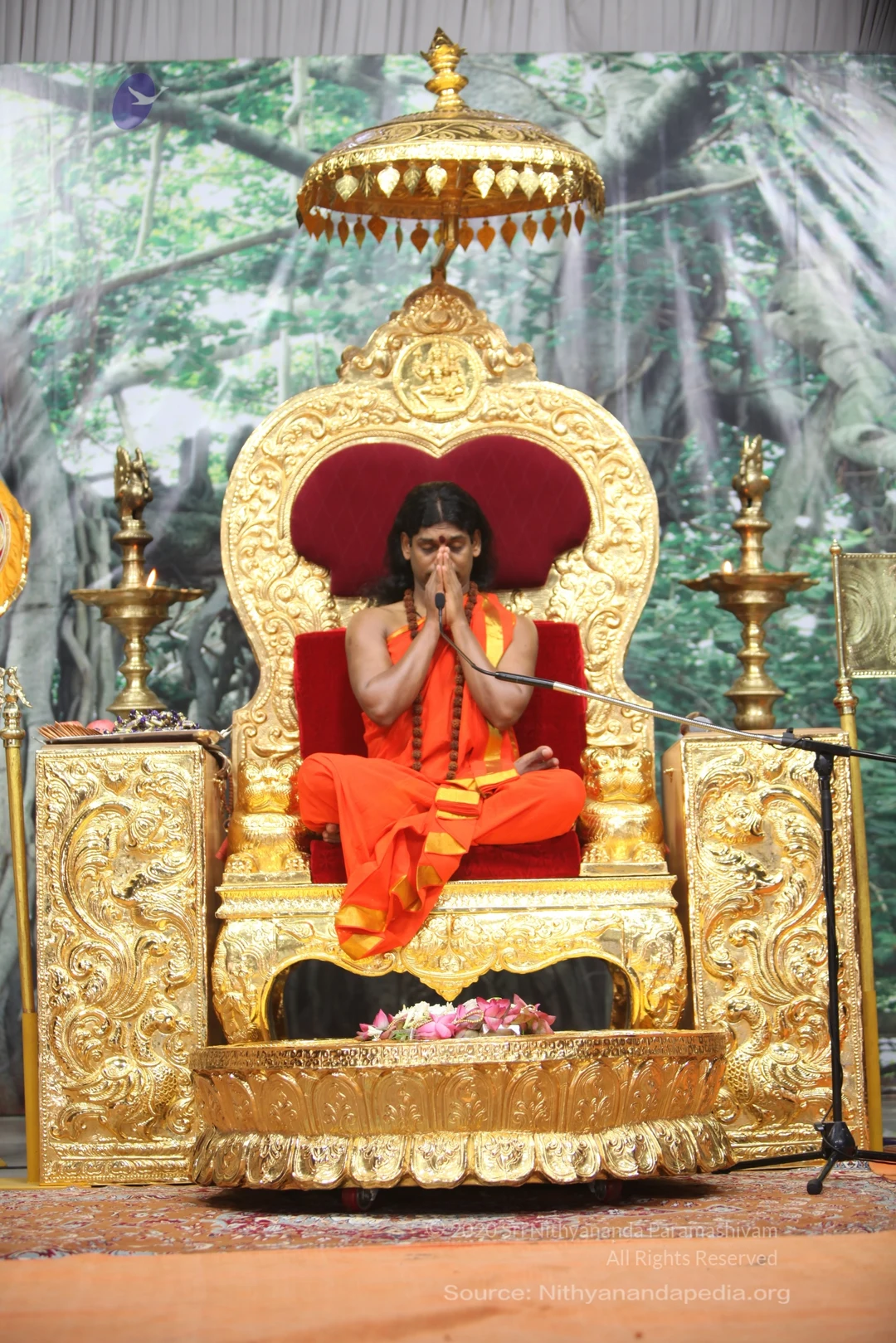
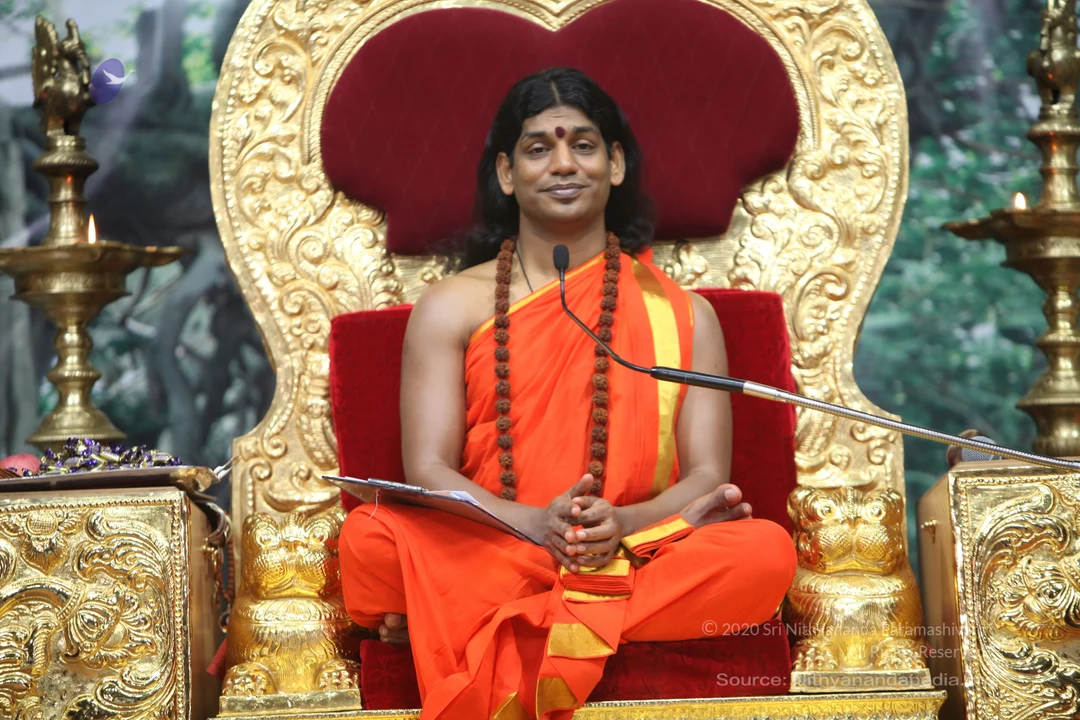
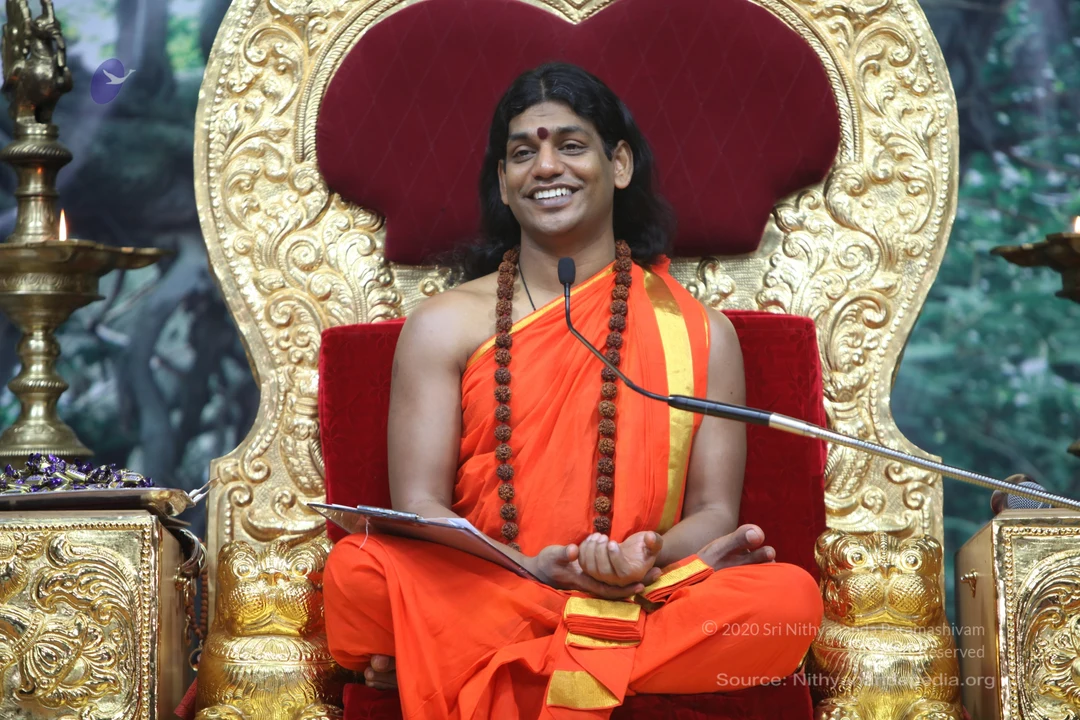
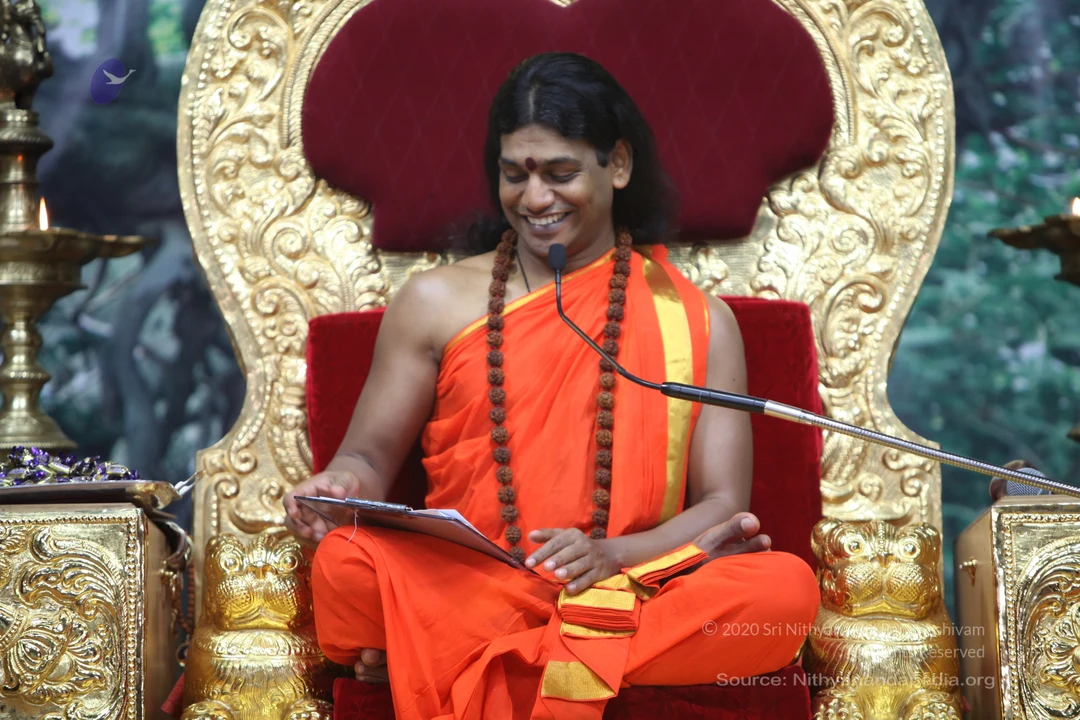
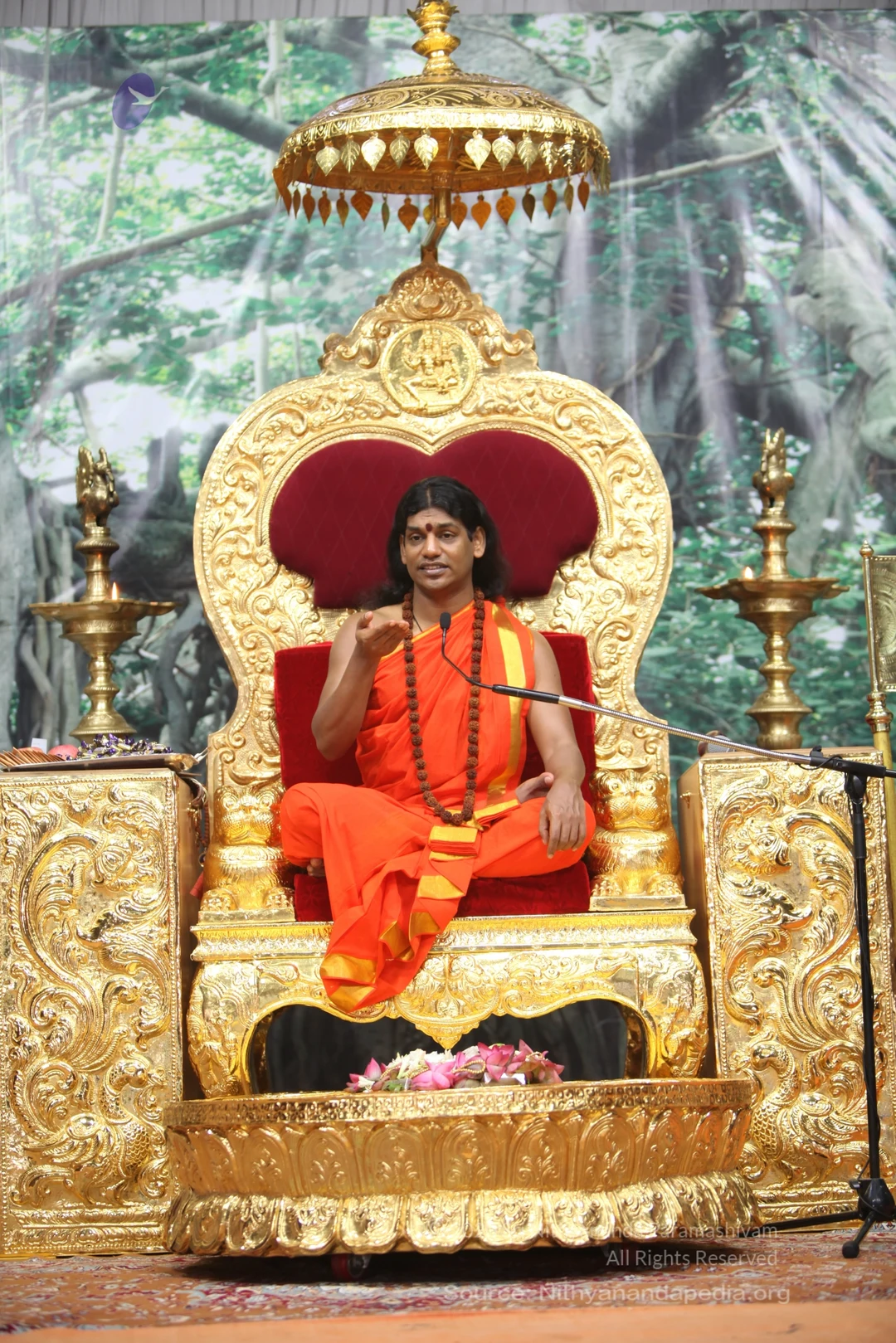
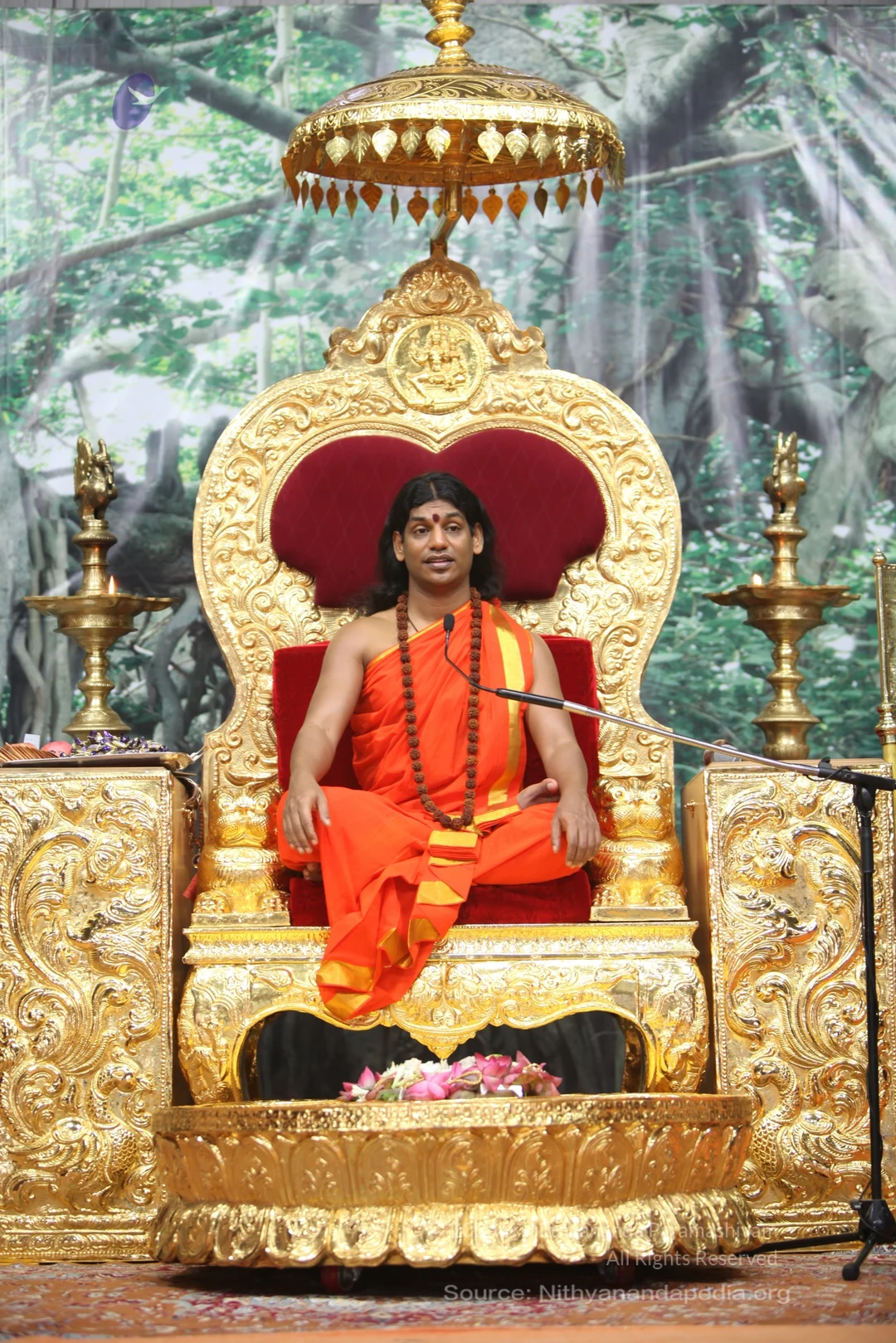
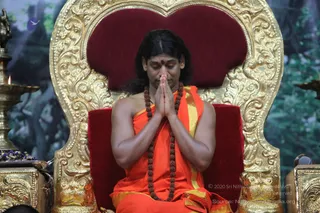
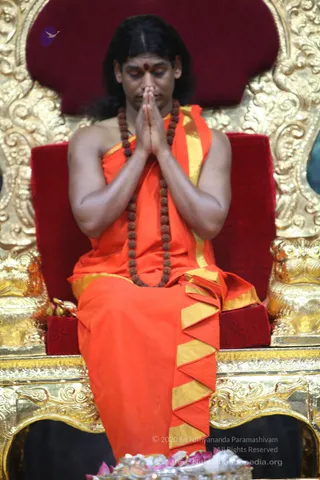
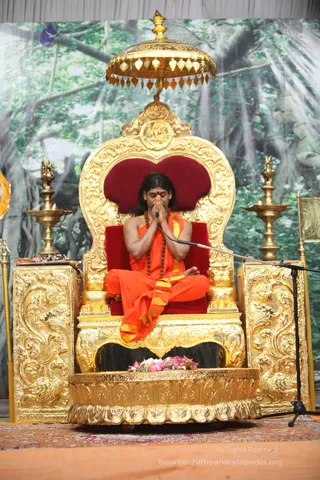
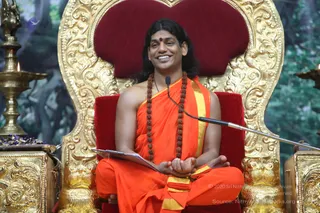
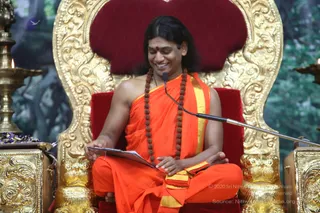
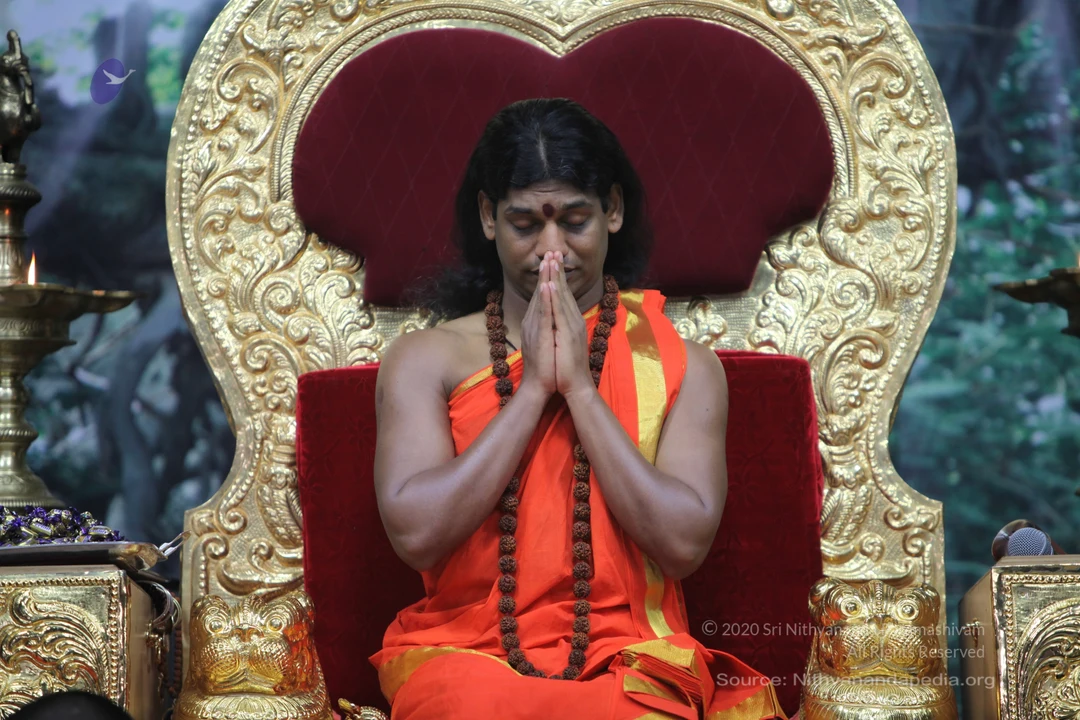
A man seated on an ornate gold-and-red throne with his palms pressed together in anjali mudra at his chest and eyes closed. He wears an orange-saffron robe with a gold-yellow border draped over his shoulders and bare chest, a long rudraksha mala hanging to his waist, and a red kumkum mark on his forehead. Lit brass oil lamps stand on both sides, and a blue-green forest backdrop fills the stage. A visible microphone sits at the right edge. Swamiji (probable): the seated figure has long swept-back hair, saffron clothing, a rudraksha mala and a gold-and-red throne, consistent with the page's claim of his presence at this event.A man seated on an ornate gold-and-red throne with carved gilded panels and a red velvet back, palms pressed together in anjali mudra at his chest, eyes closed. He wears a saffron-orange shawl over the shoulder and waist with gold borders, a rudraksha mala of brown beads around his neck, and a red bindi on his forehead, with long dark hair swept back. Marigold-type flowers and a silver offering tray with lamps sit at the bottom of the frame. Appearance-based a person with saffron clothing, rudraksha mala and throne seating; the page links him to this event, and the excerpt mentions a Patanjali Yoga Sutra discourse.A seated figure in orange robes sits cross-legged on an ornate gold-and-red throne with a golden canopy above, hands pressed together in namaste at the chest. A long-haired man with a red tilak wears a shawl-like orange wrap, orange dhoti and a long rudraksha mala. In front is a microphone on a stand, a gold lotus-shaped pedestal holding pink flowers, and two brass oil lamps (one lit) on either side. The backdrop shows a large painted banyan forest scene.A seated man in saffron-orange robes sits cross-legged on an ornate red and gold throne, hands clasped in his lap and a faint smile on his face. He wears a long rudraksha mala and a red bindi, with a yellow-edged orange cloth draped over his shoulder. A microphone stands before him, and a notebook rests on his knee. Flanking him are tall gold oil lamps with lit flames, a gilded carved throne frame with lion-form supports, and a painted forest backdrop. Swamiji (probable) is shown seated in discourse, identified by the orange saffron robes, long swept-back hair, rudraksha mala and ceremonial gold throne cues.A smiling man with long dark hair and a red bindi sits cross-legged on an ornate gold-carved red velvet throne. He wears an orange-saffron robe with a yellow-gold border and a long necklace of rudraksha beads. He holds a clipboard or notes in his lap with his hands in a mudra gesture, and a microphone stand is positioned at his side. Brass oil lamps with lit flames stand on either side, and a jar of purple flowers sits on a gold-carved stand at the left. The backdrop shows painted green foliage. Appearance-based label: a person, seated in a discourse setting.A seated man in saffron-orange robes with a gold-bordered sash sits cross-legged on an ornate gold-framed throne with a red velvet cushion. He wears a long rudraksha mala and a red tilak on his forehead, smiling while holding a clipboard-style sheet of notes in both hands. A microphone on a stand is in front of him, and brass oil lamps flank the throne. The background shows a painted forest scene. Swamiji (probable) is seated here with the cues of long swept-back hair, saffron clothing and rudraksha mala, reading from notes during a discourse.

Sarvadarshan
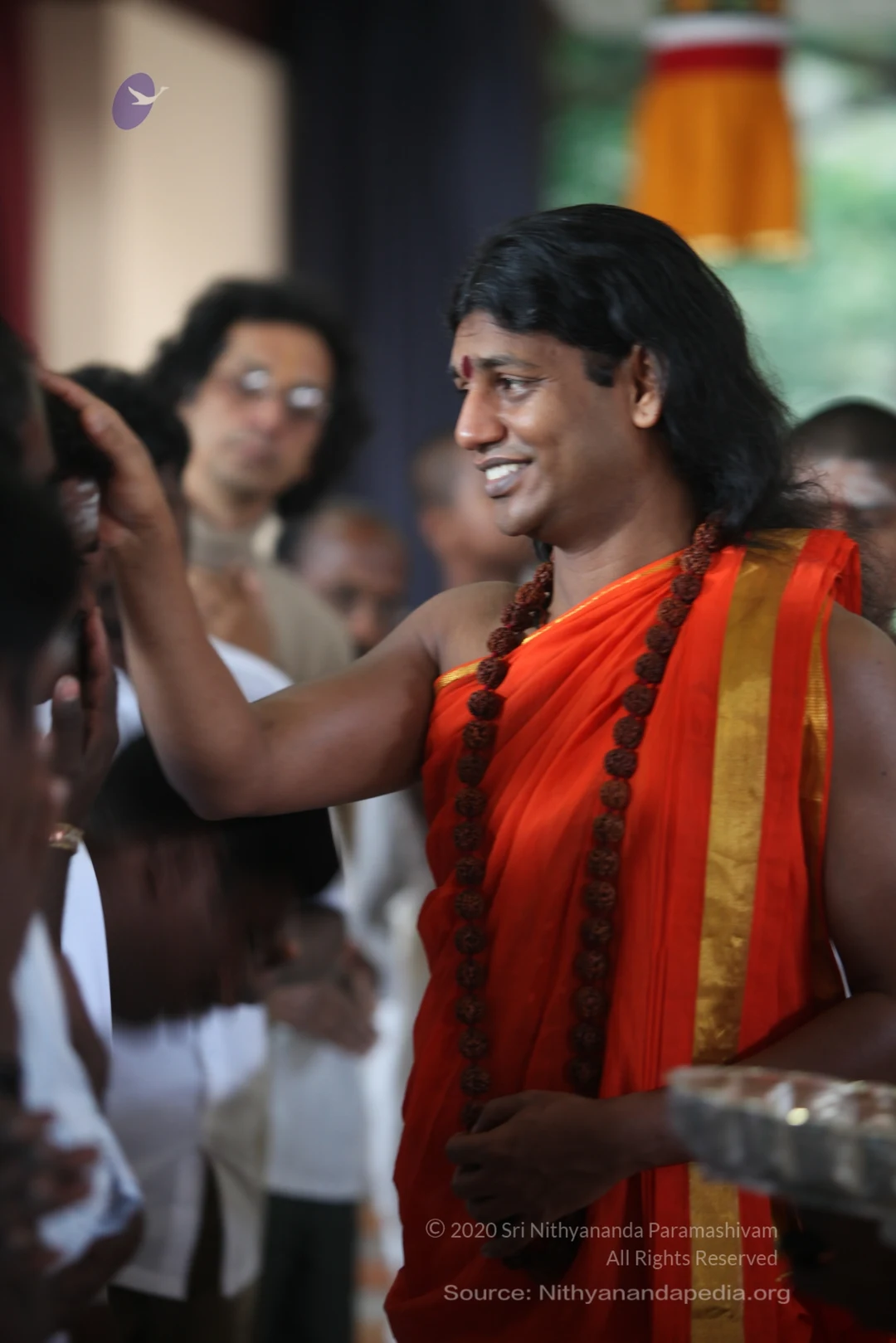
11 photosSource gallery
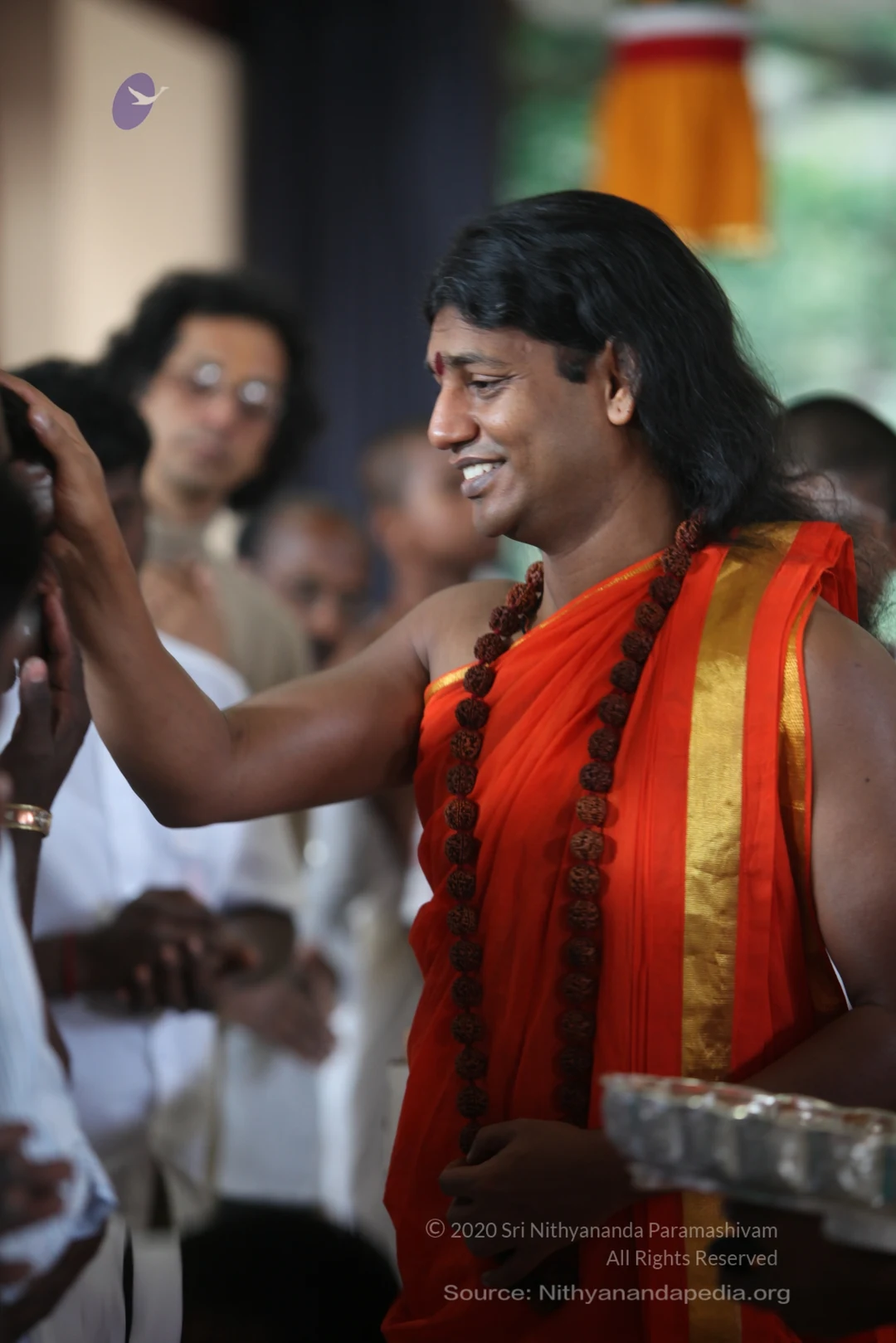
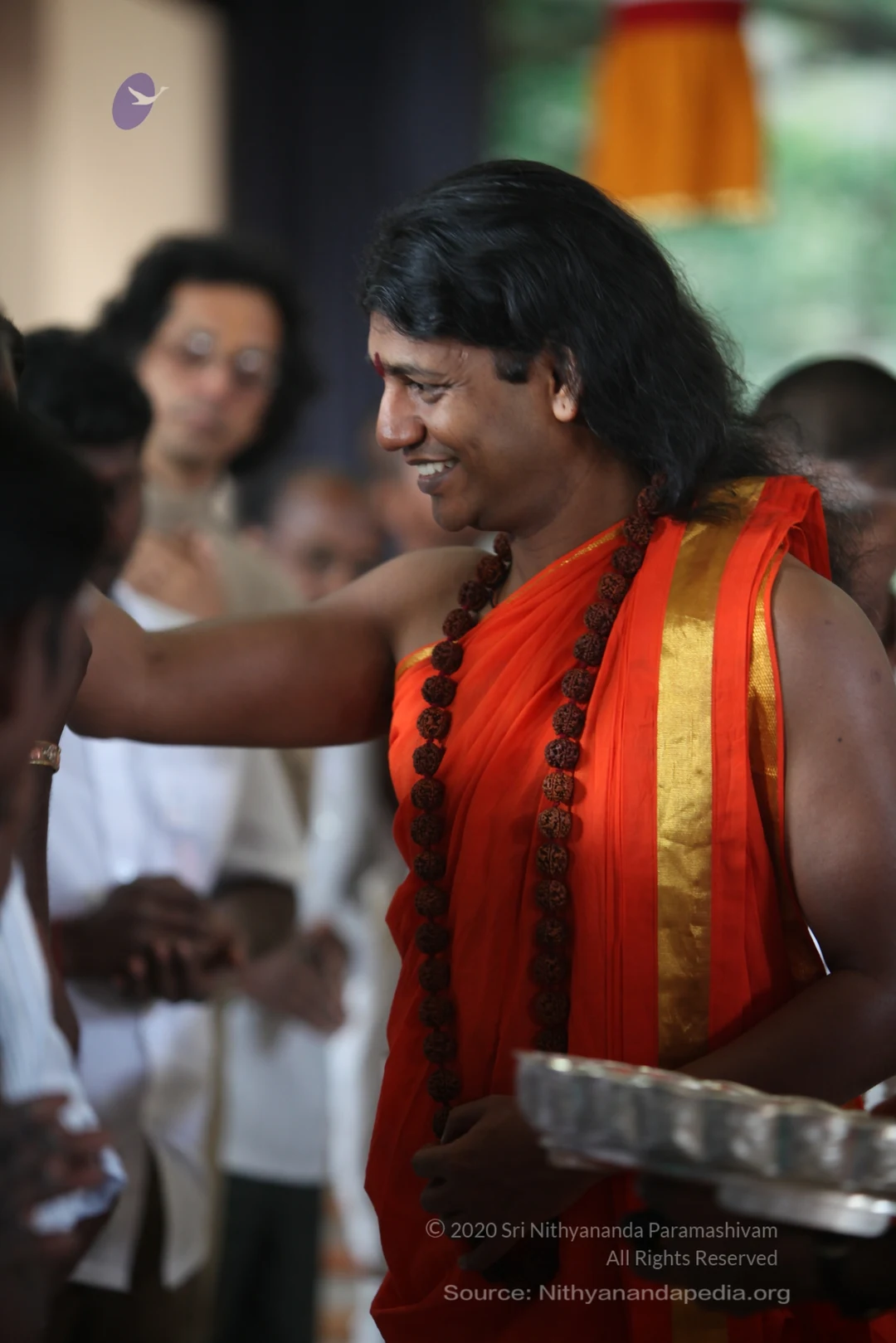
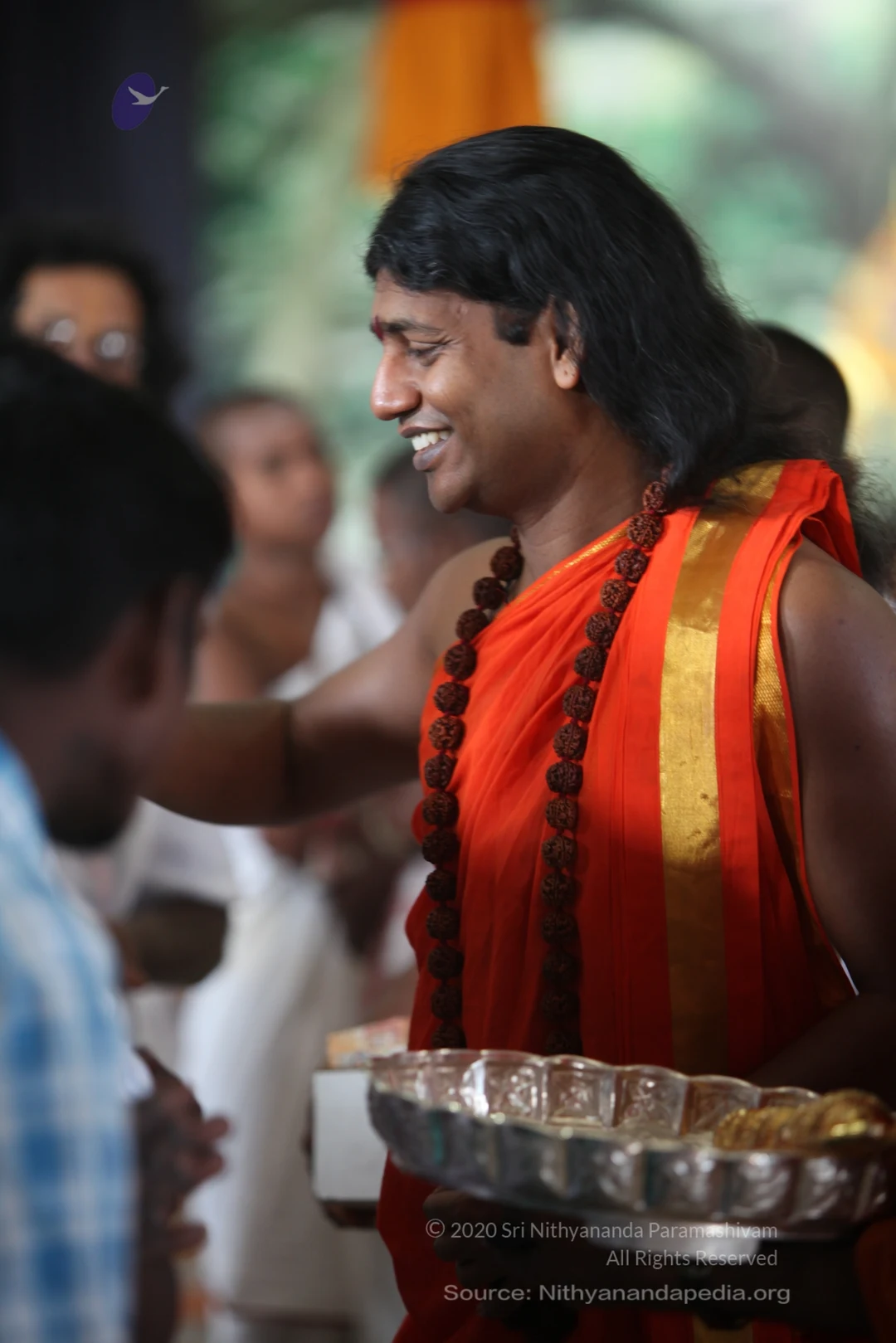
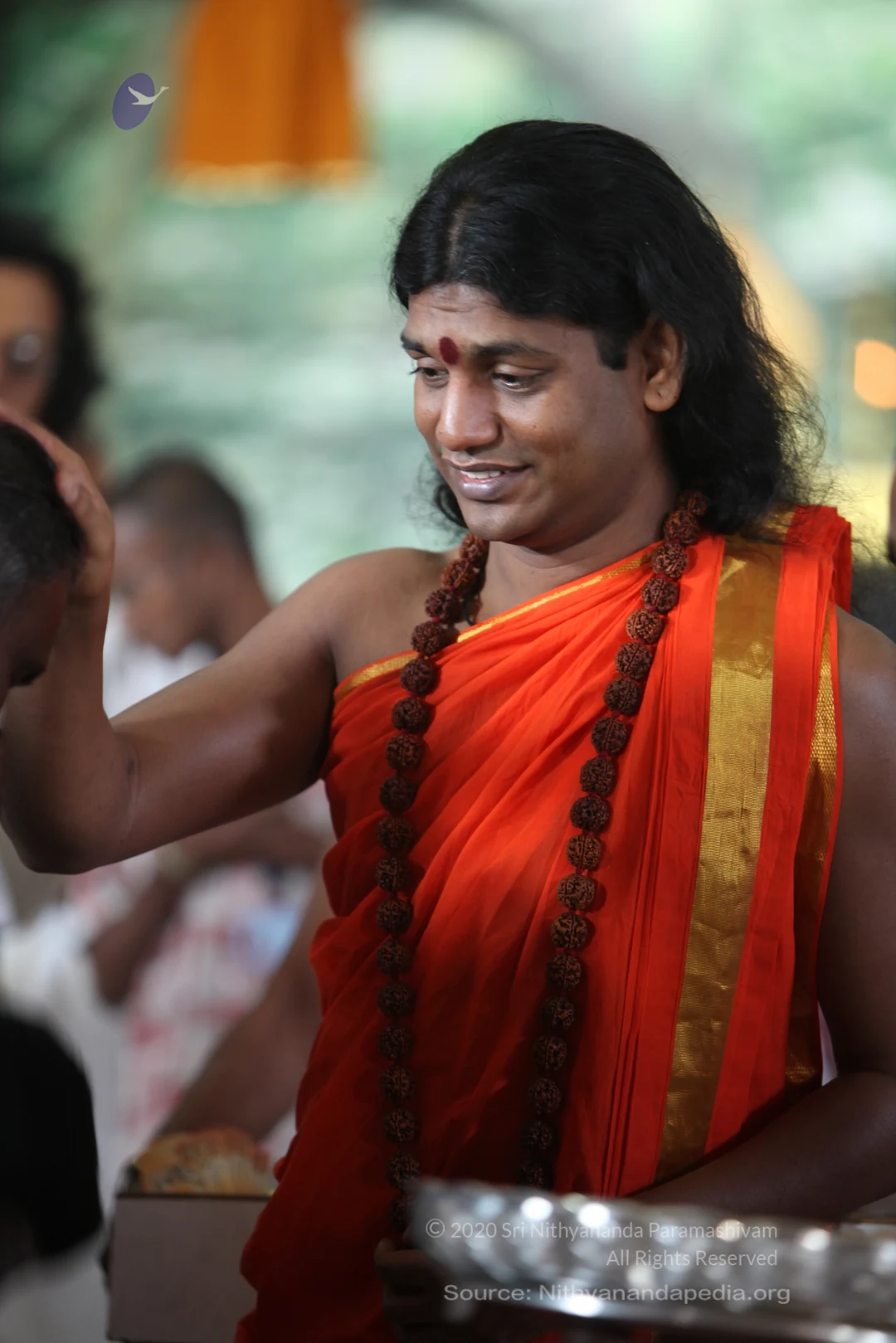
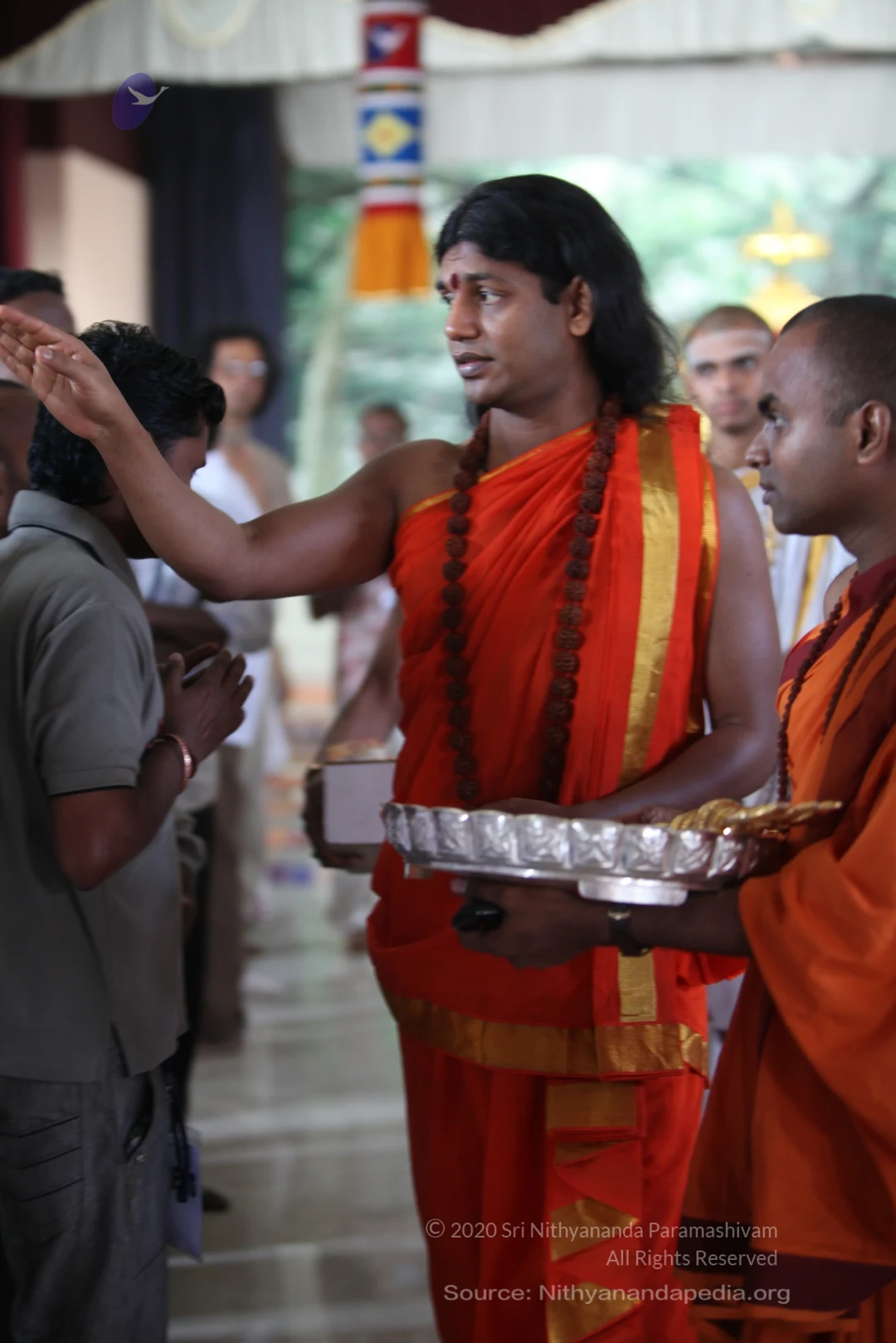
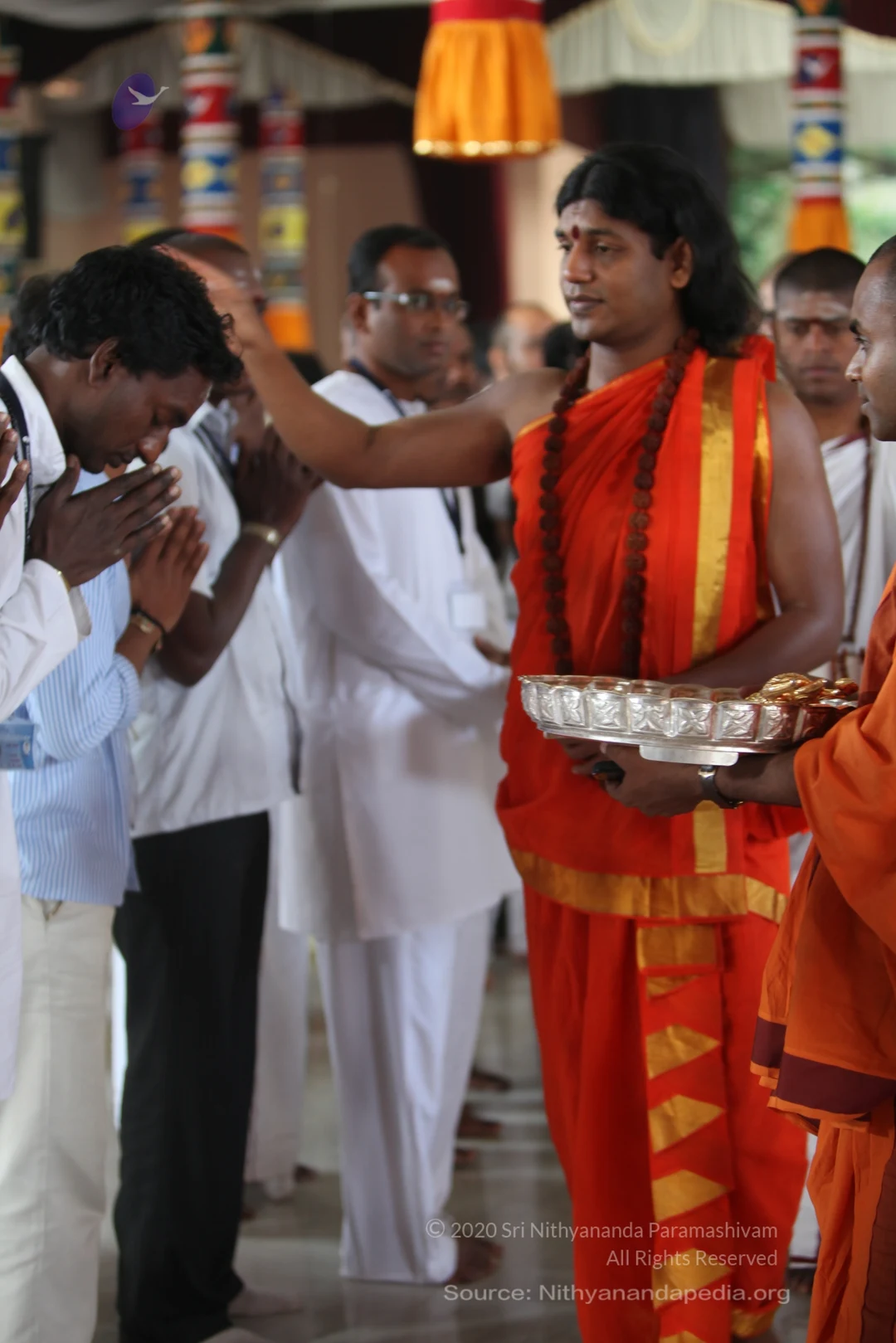
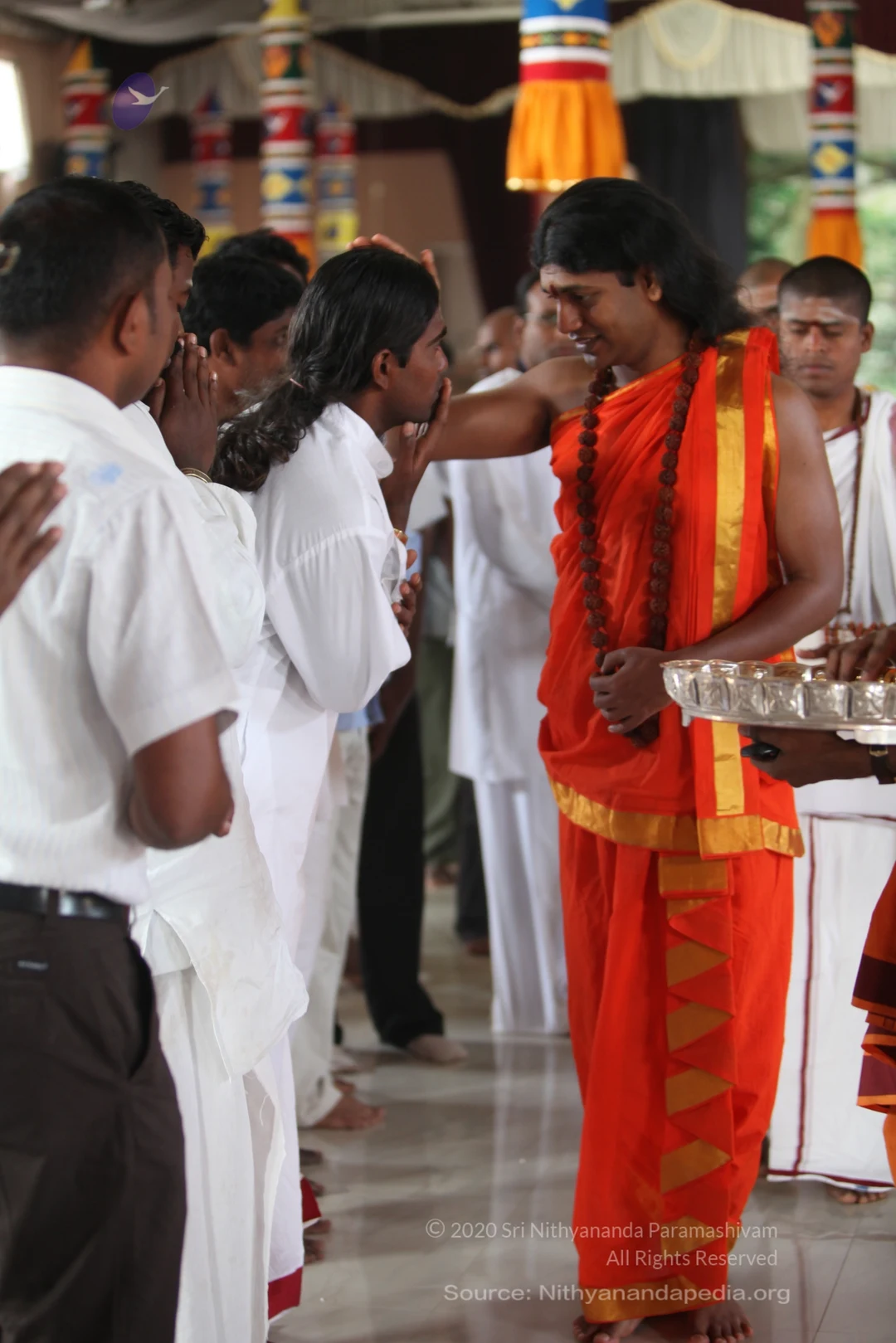
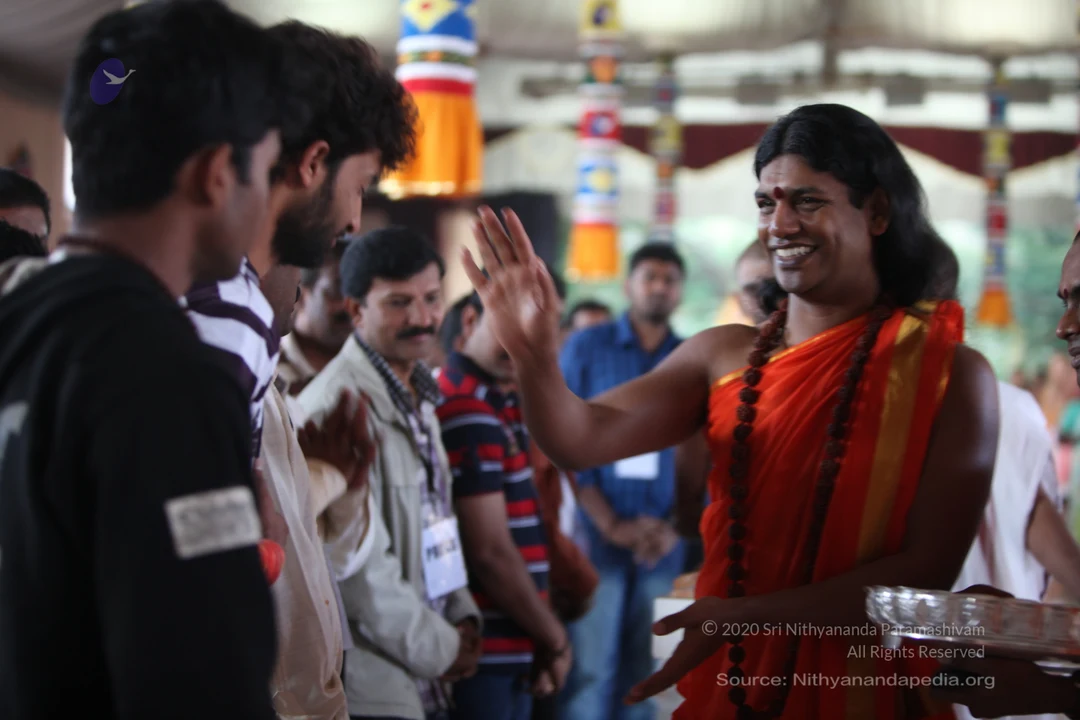
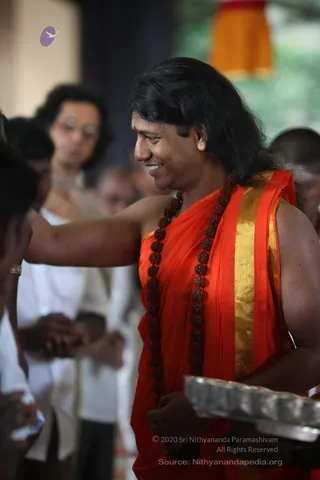
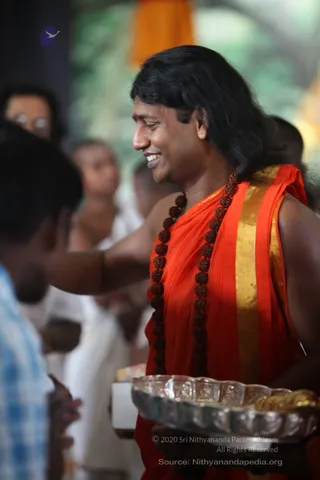
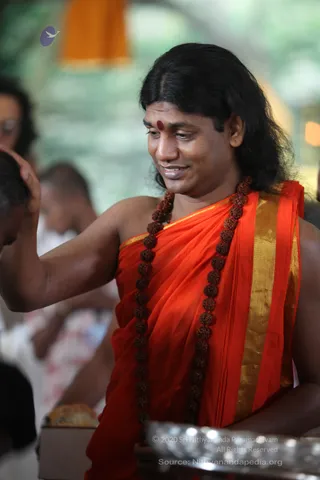
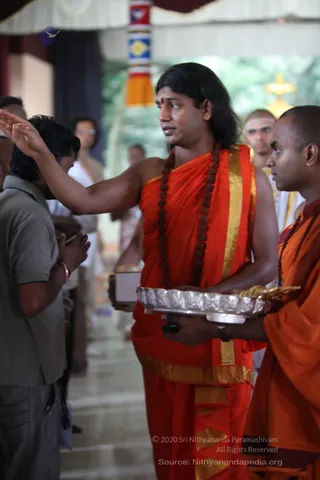
Photograph of a smiling man with long, swept-back black hair and a red bindi, wearing an orange-red garment with gold border and a long rudraksha mala draped over his shoulder and chest. He raises his right hand toward the head of a person at the left edge of the frame, while holding a metal tray in his left hand. Behind him, blurred people in white and light clothing stand in a room with orange hanging cloth. Probable Swamiji by appearance cues: long hair, saffron-orange clothing and rudraksha mala, performing a blessing gesture with a tray.Photograph of a smiling man with long dark hair and a small red tilak on his forehead, wearing an orange-red shawl with gold border and a long rudraksha mala. He extends his right hand toward the head of a person at left, who is dressed in white. Background shows other people in light and dark clothing and an orange hanging fabric.A smiling man with long, swept-back black hair and a red tilak on his forehead wears an orange-red garment with a wide gold border and a long rudraksha mala around his neck. He holds a silver tray in his hands and extends one arm toward a person at the left edge of the frame. Behind him, a man in white clothing and glasses stands among other people in a bright indoor setting with an orange cloth hanging in the background. Appearance-based cues (long swept-back hair, rudraksha mala, saffron-orange garment) match the candidate, so this is a probable Swamiji in person. Several people are visible in the scene.Photograph of a smiling man with long swept-back dark hair and a red tilak on his forehead, wearing an orange-red shawl with gold border and a long rudraksha mala. He holds a silver tray of sweets with his right hand while another person in a blue checked shirt stands at left, reaching toward him. Background shows blurred people in white and an orange cloth. Appearance-based a person cues: long swept-back hair, saffron-orange ornate shawl and rudraksha mala, performing a distribution of offerings to a devotee.A man with long, swept-back black hair and a red bindi on his forehead wears an orange-red saffron shawl with gold borders and multiple dark rudraksha mala necklaces. He smiles gently and raises his right hand toward the head of a seated person in the foreground. A blurred silver tray or vessel sits at the lower edge, and orange fabric and greenery fill the softly out-of-focus background. Another blurred figure appears at the left edge. Overall this is a photograph of a blessing or ritual moment.A man with long, swept-back dark hair and a red bindi wears a saffron-orange dhoti and shawl with gold borders and a dark rudraksha mala. He raises one hand in blessing toward a man in a grey shirt who has his palms pressed together. Beside him, a monastic in orange robes and rudraksha holds a silver tray with offerings. Behind them, people in white and orange stand under a white canopy with a striped pillar and gold finials. This appears to be a blessing moment during an event, with the central figure matching the Swamiji (probable) appearance cues of long hair, saffron clothing and rudraksha mala, shown in person.

Ztamil-Interview

7 photosSource gallery
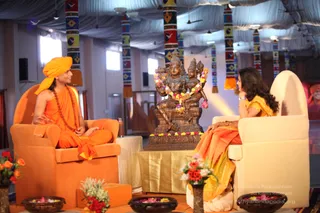
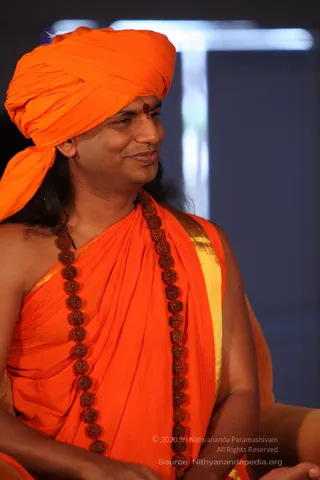
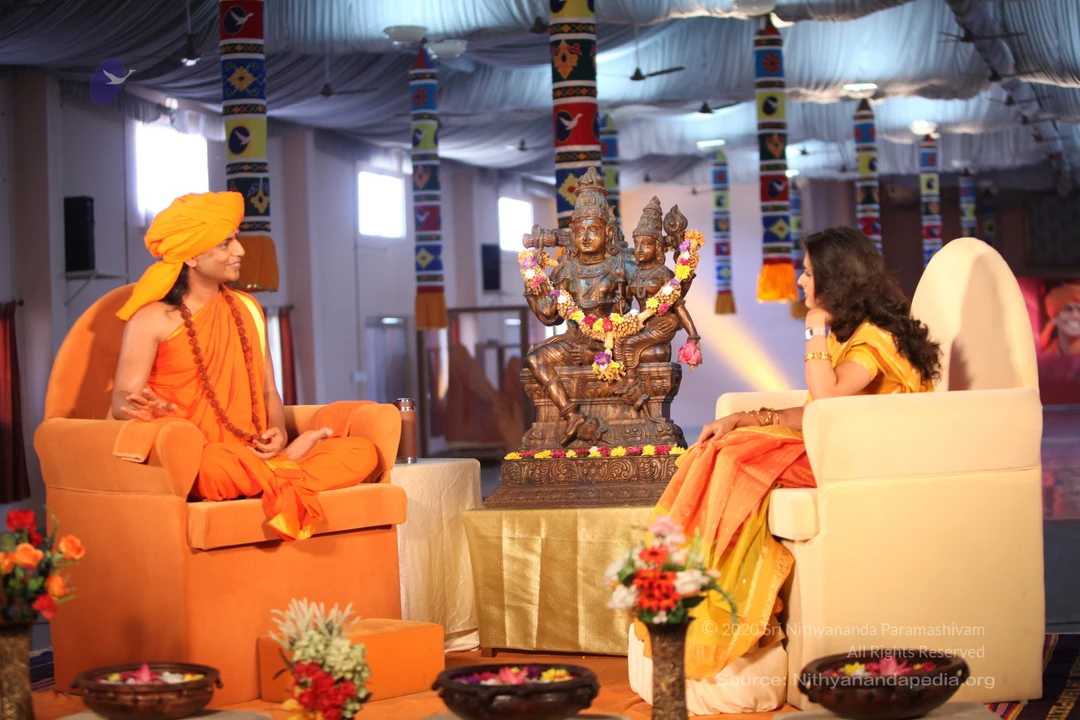
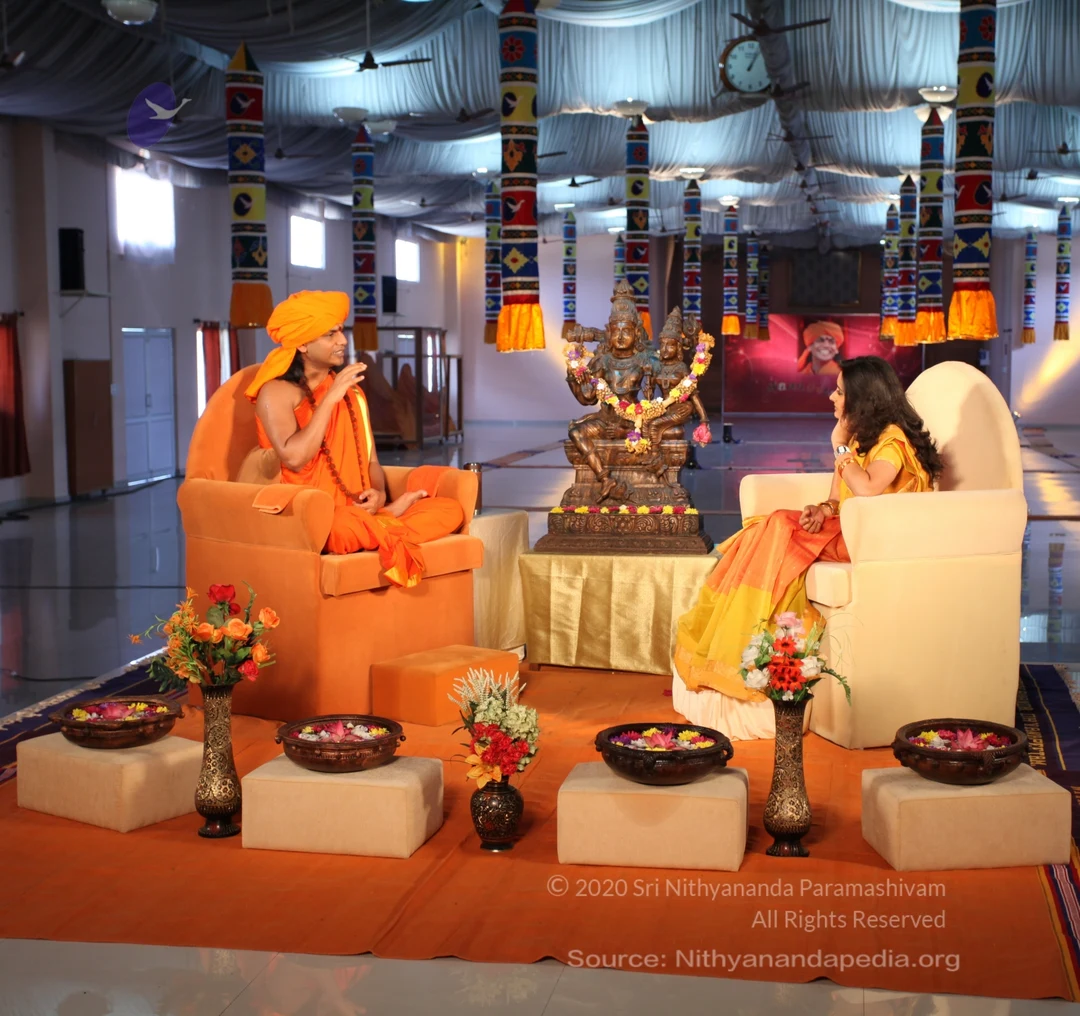
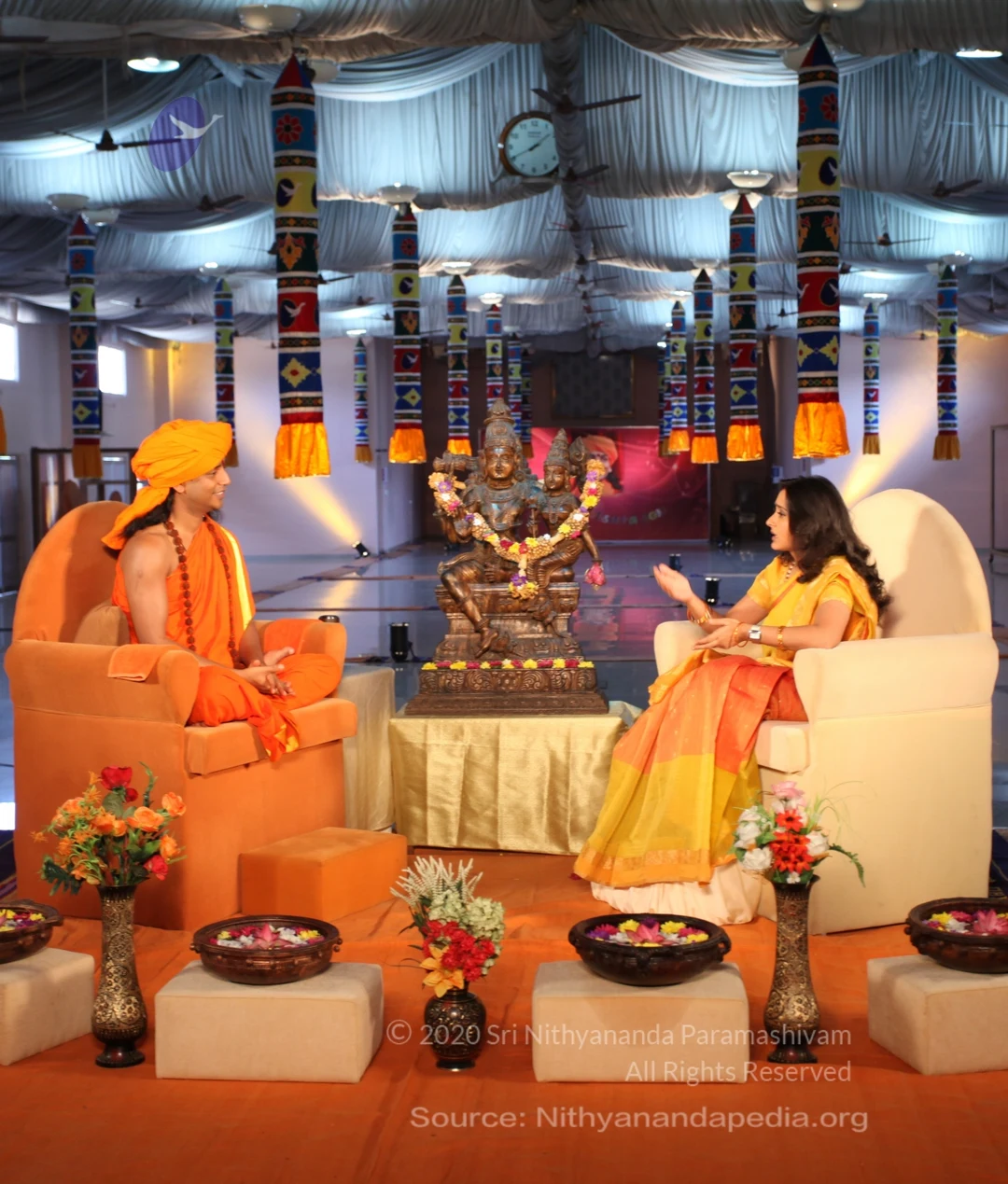
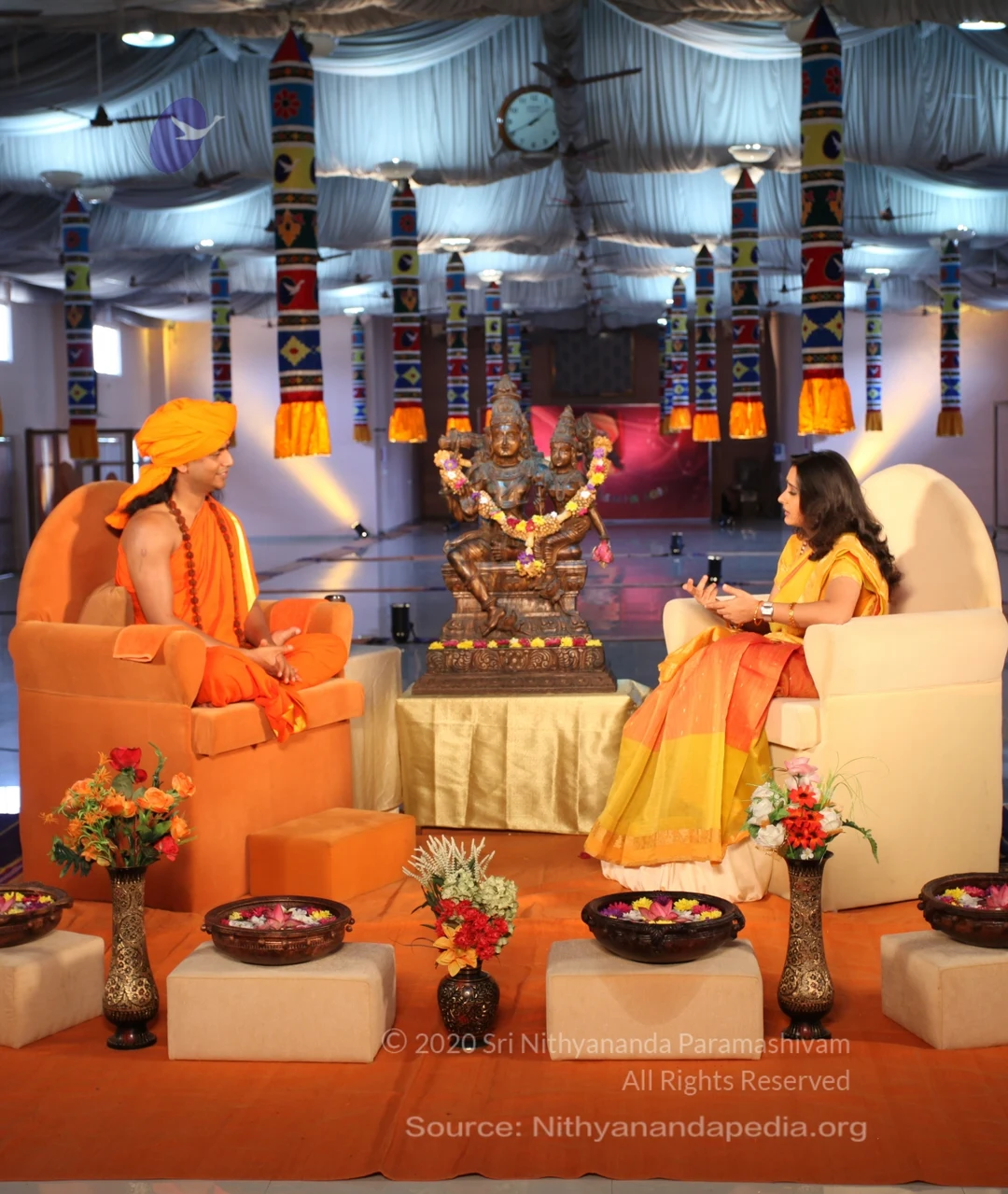
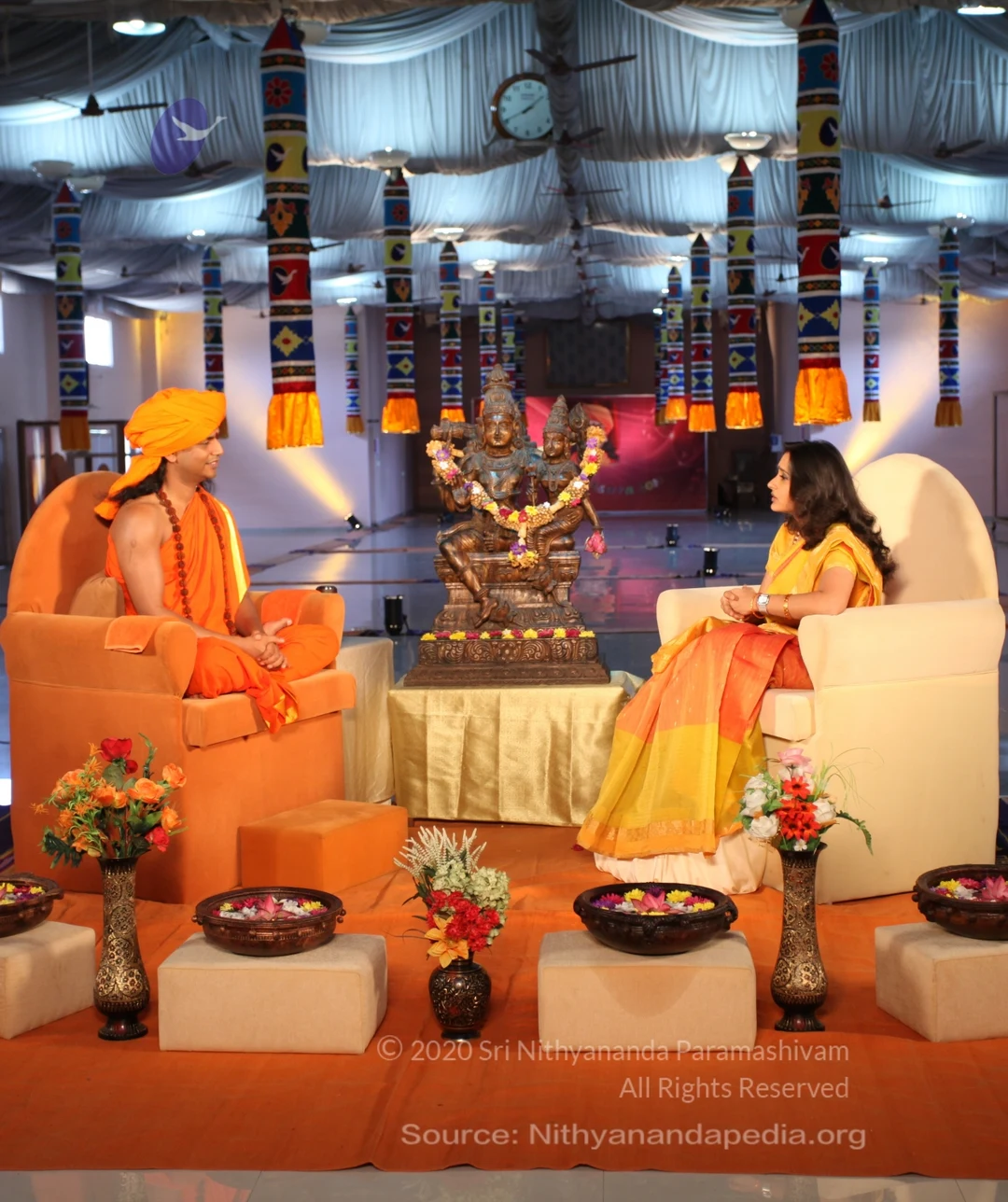
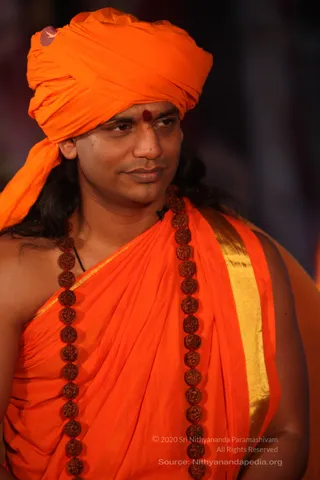
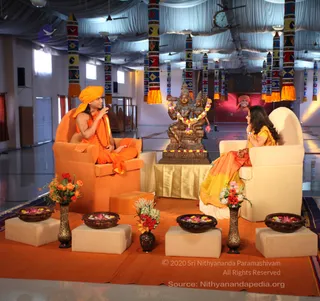
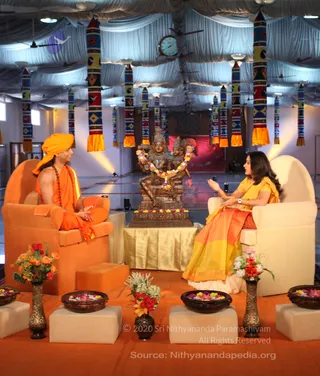
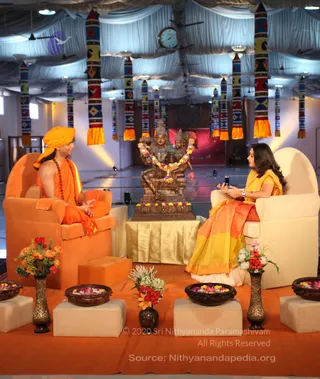
A satsang set with two people seated facing each other in cream and orange armchairs. On the left, a man in saffron-orange robes and a saffron turban, with a rudraksha mala around his neck, sits cross-legged with hands joined. Opposite him, a woman in a yellow and orange sari with dark curly hair and gold bangles sits attentively. Between them stands a bronze deity murti of a divine couple, adorned with a marigold garland and pink flowers, on a gold-draped table. Colourful striped pillars with bird motifs hang with white fabric overhead, and bowls of flower petals and floral arrangements sit at the corners. Two people are visible.Close photo of a smiling man seated in profile, wearing a bright orange turban with a red vertical mark on the forehead, and an orange wrap with a gold border draped over one shoulder. Long dark hair falls behind his neck, and a long mala of brown rudraksha beads hangs down his chest. Background is a blurred grey wall with a bright window-like light. Appearance matches the Swamiji (probable) cues: orange turban, orange and gold ornate clothing and rudraksha mala, seated as a speaker. No other people are visible.A close portrait photograph of a man in a bright saffron-orange turban with a red bindi on his forehead, wearing a saffron-orange wrap with a gold zari border over his shoulder and a long rudraksha mala of large brown beads hanging to his waist. Long dark hair falls past his shoulders and he looks off to the side with a calm expression. The background is dark and blurred.A satsang setting in a hall with draped white fabric ceiling and decorative hanging banners in red, blue and yellow. Two people sit facing each other in armchairs on an orange carpet: a man on the left in an orange-saffron turban and orange robes with a rudraksha mala, gesturing with one hand while speaking; a woman on the right in a yellow and orange sari listening attentively. Between them stands a bronze deity murti of Shiva and Parvati adorned with a floral garland, on a gold-draped table. Brass bowls of floating flowers and vases of flowers sit on the carpet. A red banner with a portrait is visible on the back wall. Swamiji (probable) is the man in orange, based on turban, saffron robes and rudraksha mala as presentation cues.Two people sit facing each other in cream and orange armchairs on an orange carpet, in a hall with draped white ceiling fabric and tall colourful decorative hangings. A man on the left wears an orange turban, orange robes and a rudraksha mala, with a shawl across his lap. A woman on the right wears a yellow and orange saree and gold bangles and gestures while speaking. Between them stands a bronze deity murti of a seated Shiva and Parvati garlanded with marigold and flower garlands, on a gold-draped table. Vases of flowers and bowls of floating petals surround the seating area.A seated discussion on a raised orange-draped stage beneath pale draped ceiling fabric hung with colourful woven tassel banners. A man in an orange turban, orange robes and a rudraksha mala sits cross-legged in an orange armchair, hands resting in his lap. Facing him, a woman in a yellow and orange saree gestures with her hands while seated in a cream armchair. Between them stands a bronze deity murti of Shiva and Parvati seated together, draped in a marigold garland. Low wooden bowls of floating flowers, vases of orange and red blooms and cushioned footstools surround the stage, with a backdrop behind.

01-Aadheenam-Rounds

10 photosSource gallery
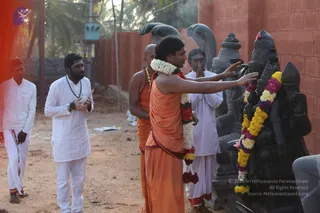
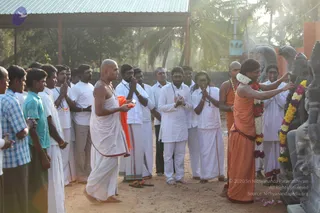
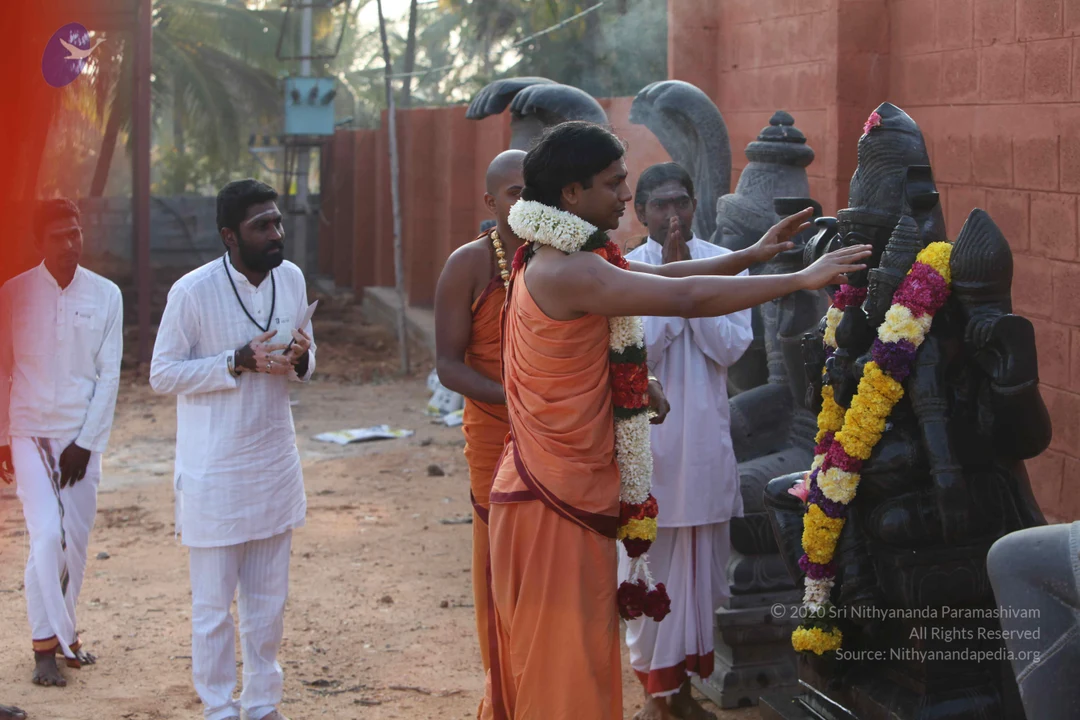
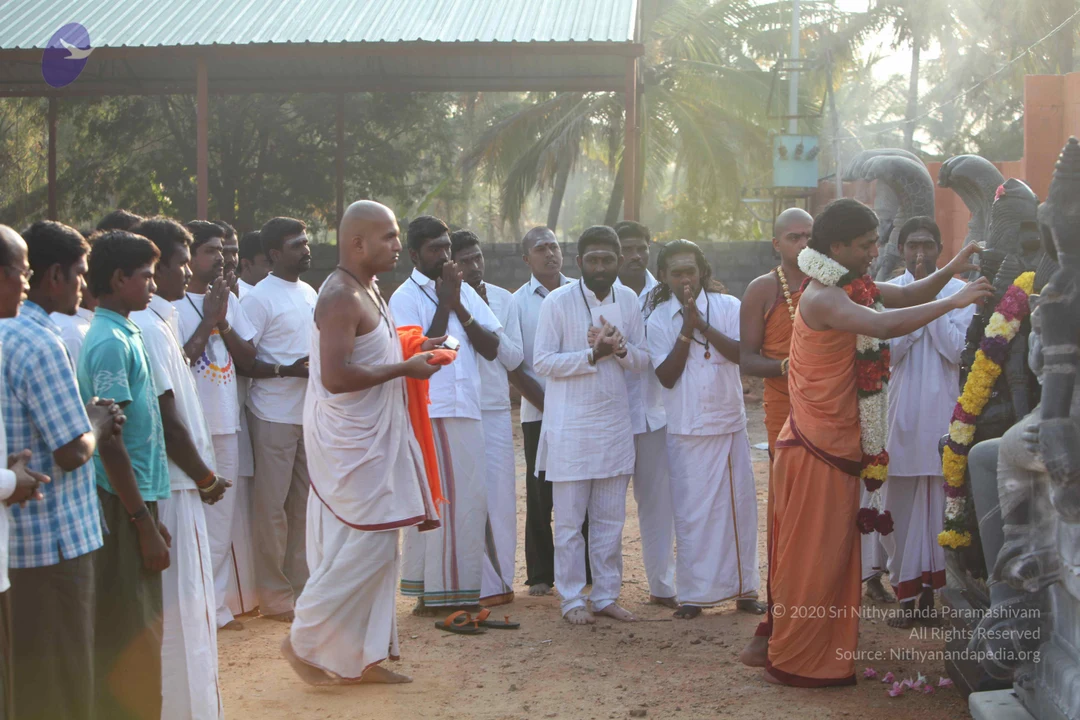
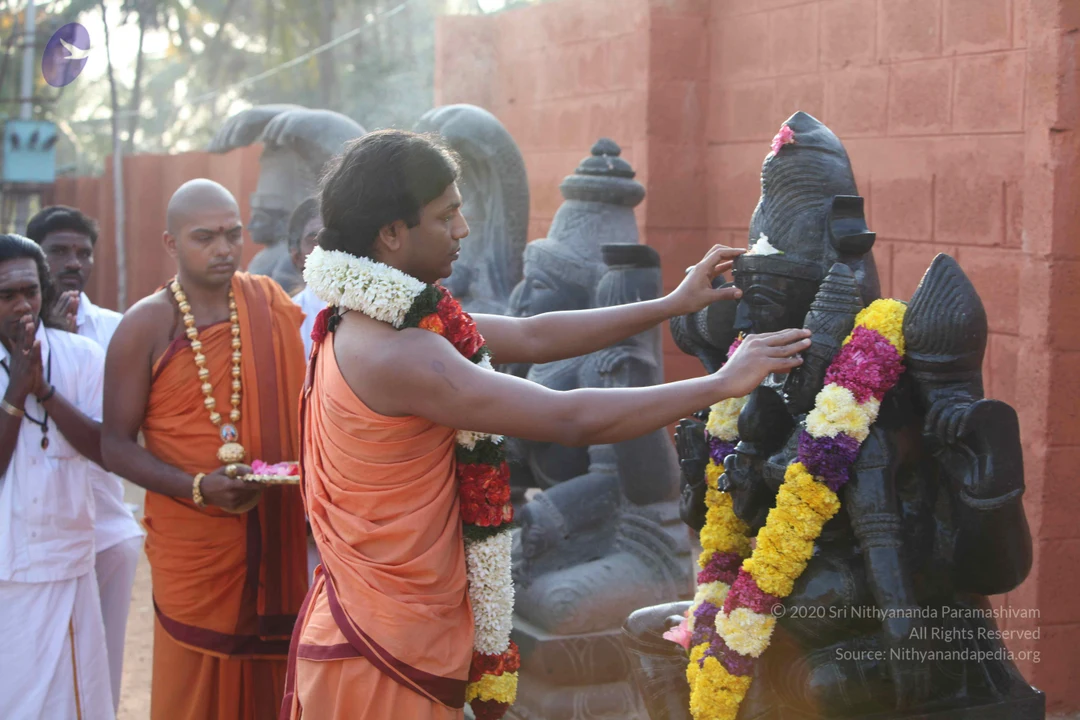
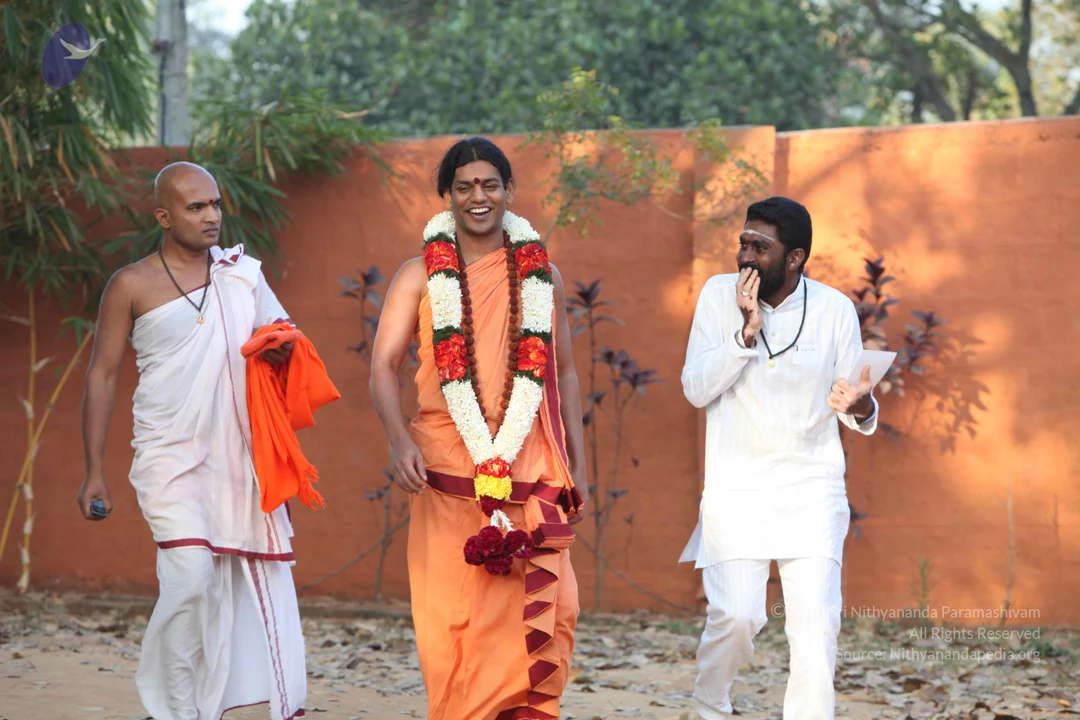
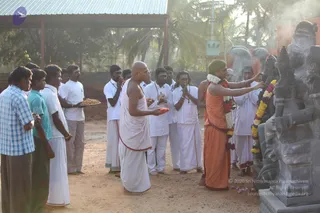
Outdoor photograph at an ashram entrance with orange-painted walls. A man in saffron-orange robes with long swept-back hair and a thick white and red flower garland stands at centre, hands together and receiving an offering. Around him devotees in white dhotis and shirts, some with white tripundra marks, press palms together or hold steel plates of food and fruit. A bald young monk in white and orange cloth stands at right. Behind them a red banner reads Life Bliss Program Level II, and a small dark deity murti is visible at upper left.A photograph of an outdoor ashram courtyard where a man in a saffron-orange dhoti and shawl, wearing a long garland of white jasmine and red roses, smiles and holds a folded paper in both hands while devotees greet him. Several men in white shirts and dhotis, one in a teal t-shirt with a tilak, bring offerings on steel plates: a tray of yellow fruit and a plate of orange sweets. Behind them a red-and-white painted pillar and a red banner reading Life Bliss Program and Nithyananda Dhyanapeetham stand in front of a building. A person in orange at the right edge is partially visible.Outdoor scene at a temple courtyard beside a red brick wall with dark stone sculptures, including a black stone deity murti garlanded with yellow, orange and magenta flowers, and a stone serpent hood above. A man in an orange saffron robe with a red-and-white flower garland holds a pink flower and a brass bell or lamp toward the murti. Beside him a man in white ritual clothes with a red-bordered dhoti stands with palms joined in prayer. On the left a bearded man in white kurta and pants holds a small booklet or paper. The setting is a dusty ground with scattered debris. The saffron-robed figure has long swept-back hair and a garland but no crown, turban or rudraksha malas visible, so identity is uncertain.Outdoors on a dirt ground beside a red brick wall, a man in an orange saffron dhoti and shawl, wearing a white and red flower garland with a green leaf strand, stretches both arms toward a black stone deity murti decorated with yellow, purple and white flower garlands. Behind him stands a monk in saffron with a shaved head and gold beads. To the right, a devotee in white with folded hands watches. On the left, two men in white kurta and dhoti stand with hands joined in reverence. Stone sculptures and a palm tree are visible in the background.Outdoor photo at a temple-like site under bright morning light with palm trees behind. A bald man in white dhoti and a white upper cloth stands on bare ground, holding a bundle of orange cloth, facing a younger man in a saffron/orange dhoti and orange upper cloth wearing a white flower garland and a red-and-white garland, who extends his hands toward a stone deity murti with a multi-hooded serpent carved above it. A row of standing men in white dhotis and white shirts, some in blue checked shirts, press their palms together in namaskar and watch. Marigold and multicoloured flower garlands hang on the carved stone figure, and petals lie on the ground. Haze drifts through the air near a grey sculpture on the right.A photograph of an outdoor ritual at a temple courtyard with a grey stone deity murti on the right, decorated with a flower garland and a yellow-and-pink flower strand. A man in an orange-saffron dhoti and shawl, wearing a red-and-white garland, lifts a hand toward the murti while smoke or incense rises behind him. Beside him, a bald man in white dhoti holds a small orange-red offering, and a line of men in white dhotis and shirts stand with hands folded or holding a tray of offerings. Palm trees and a tin-roofed shelter frame the scene.