Skip to content
Saturday

15 February 2025

LIVE SPH Darshan: Paramashiva's Direct Message on Moksha According To Agamas

Dated photos
49
Source pages
1
Media
1
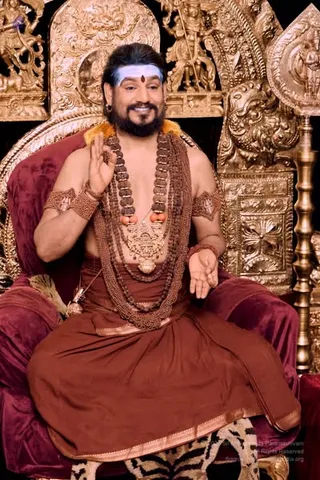
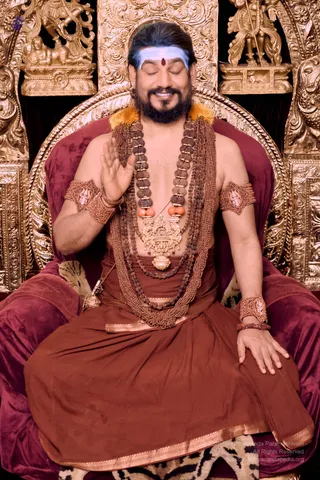
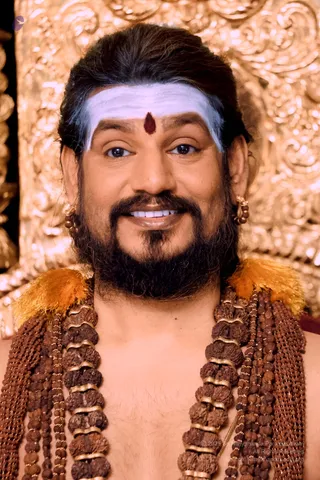
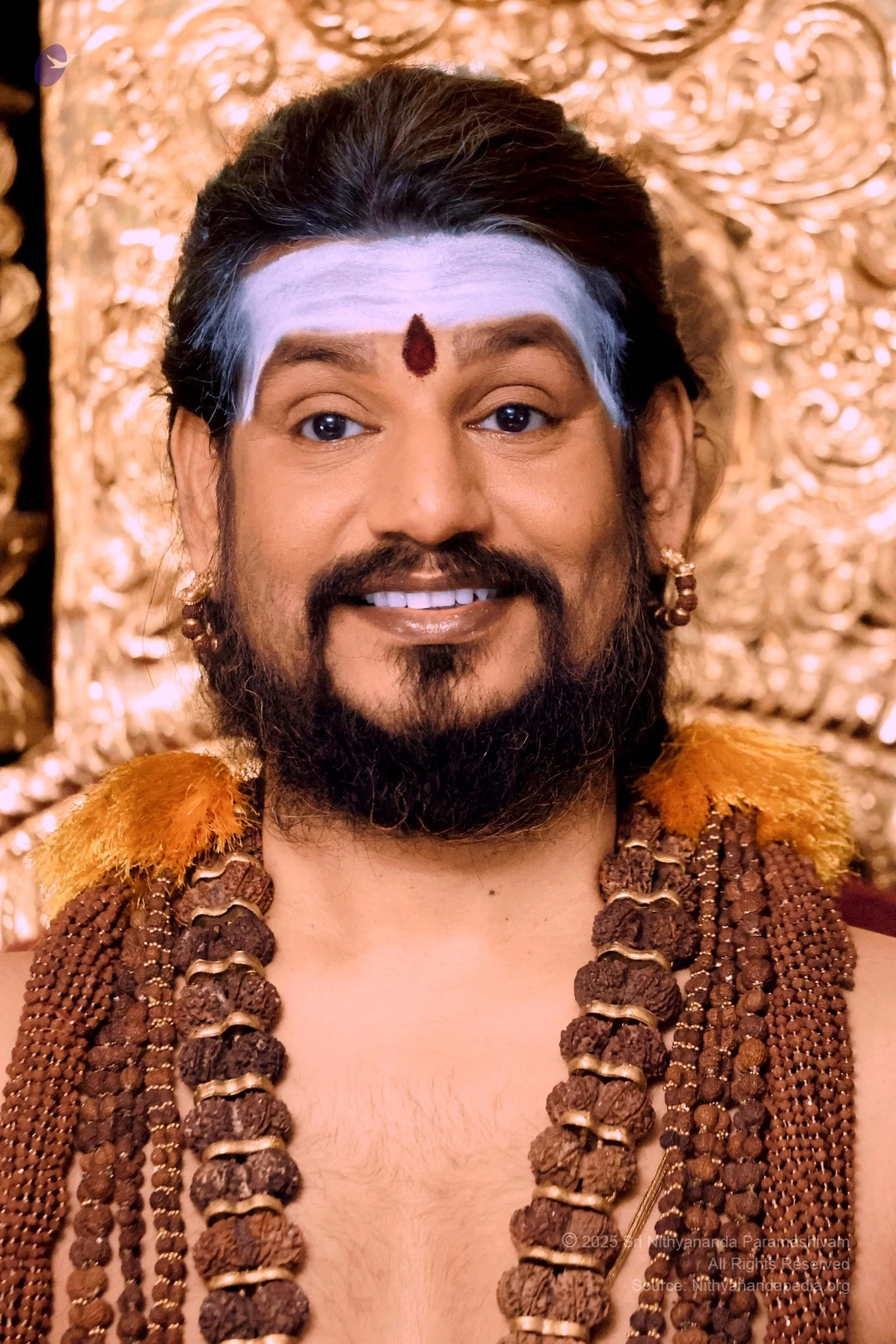
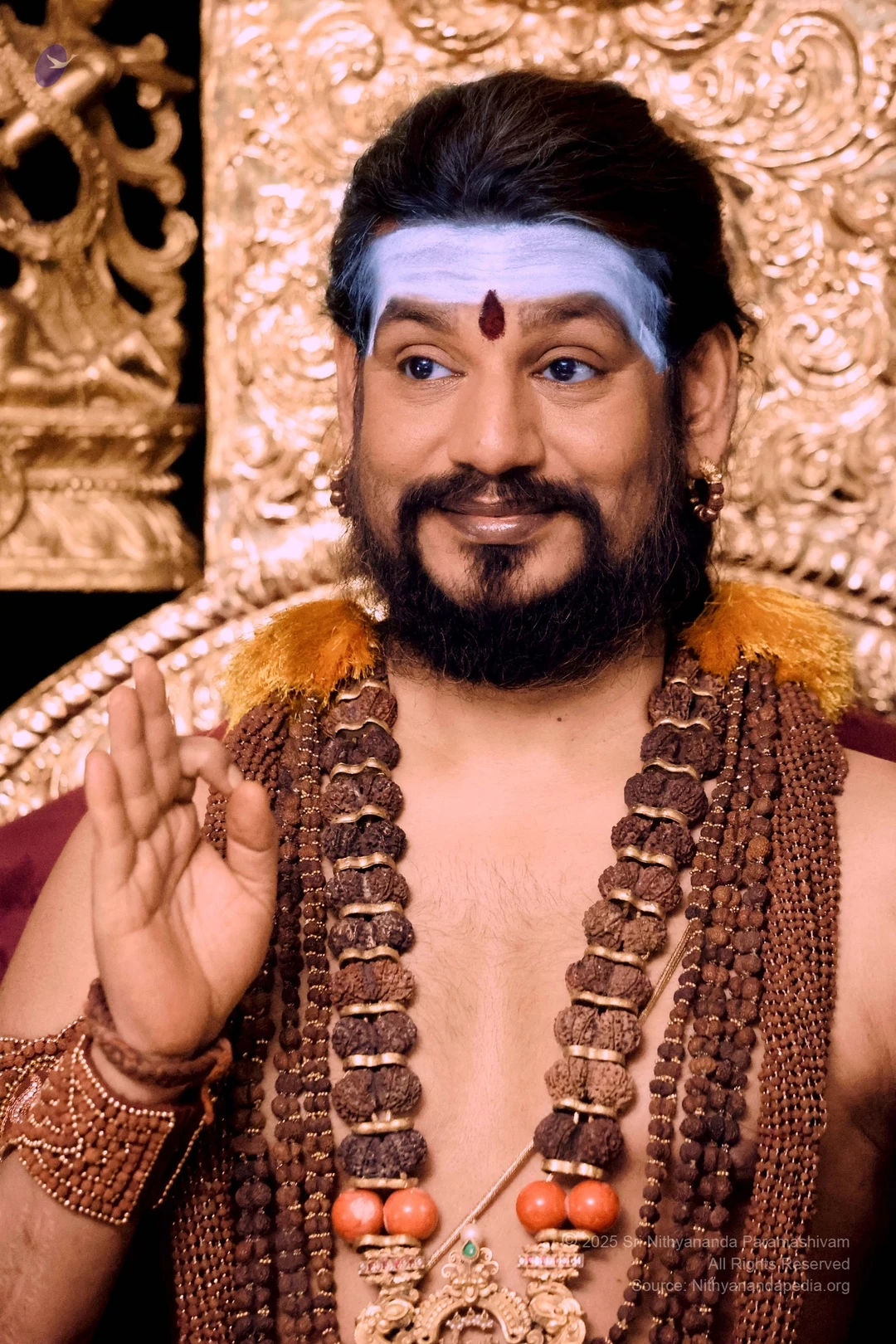
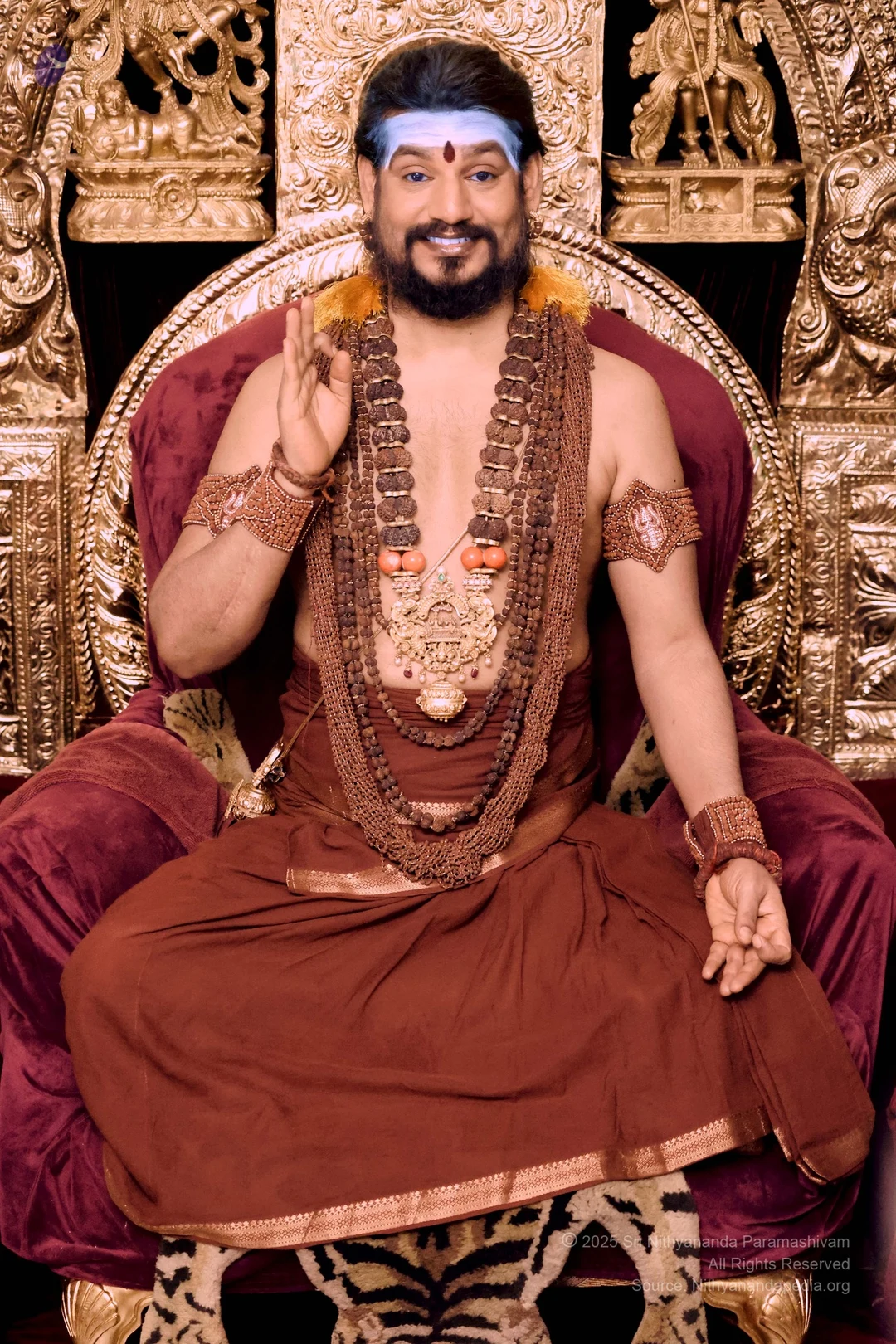
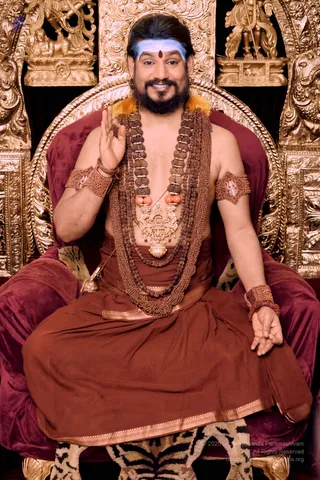
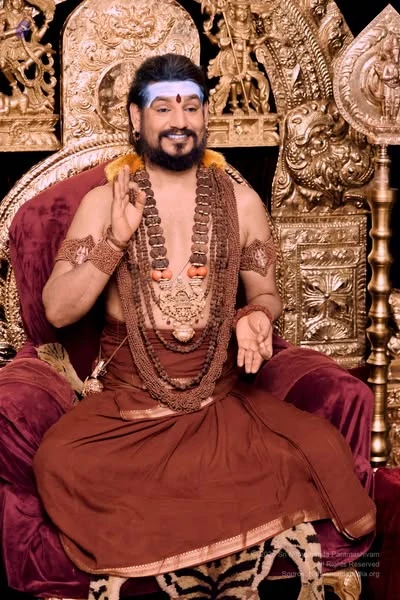
A bearded man with long dark hair sits on a plush maroon velvet throne with ornate gold carved panels behind him, the seat draped with a tiger-skin rug. He wears a rust-brown dhoti-style robe with a gold-edged border, a thick rudraksha mala and several layered bead necklaces, a large ornate gold pendant, gold armlets, and a blue-white vibhuti horizontal band with a red bindi on his forehead. His right hand is raised in a mudra with a small orange-yellow flower tucked at his shoulder area. Swamiji (probable): a long-haired figure in saffron-brown robes with rudraksha malas and ceremonial gold necklaces, seated on a throne, matching the page's identification.A seated man in a gold-ornate throne with deep red velvet cushions raises his right palm in blessing with eyes closed and a faint smile. He wears a rust-brown dhoti with a gold border, multiple strands of rudraksha malas, a large gold pendant with a deity relief, orange beads and gold armlets with embossed designs. A blue-white sacred ash band and a red bindi mark his forehead. Behind him stand gilded carved panels with figures. Appearance-based probable Swamiji (probable) seated on a throne in a blessing gesture, identifiable by swept-back hair, ornate gold jewellery and rudraksha malas. A shawl-like orange cloth rests on his shoulders.Close-up portrait photo of a bearded man with swept-back dark hair, a white vibhuti band across the forehead with a red kumkum dot, and a broad smile. He wears layered brown rudraksha malas with gold spacers and orange-yellow fringed shoulder cloths, and is bare-chested. Golden ornate relief carving forms the background. a person appearance-based label applies: a single figure with distinctive rudraksha malas, orange fringed shawl and tripundra-style white forehead marking, in an ornate golden setting.

February 15 2025

Original wiki page
Contents

Title

LIVE SPH Darshan: Paramashiva's Direct Message on Moksha According To Agamas

Link to Video:

Transcript:

OM. OM. PARAMASHIVASYA, TRIPURARI MURTEY, PARAMAVATAREYUSHMAN SARVAN PARAMADVAITENA AHAM ASHIRVADAMI. AS THE ULTIMATE MANIFESTATION OF PARAMASHIVA, TRIPURARI MURTI, I BLESS YOU ALL WITH PARAMADVAITA.

PARAMASHIVA's MESSAGE, DIRECTLY FROM MAHAKAILASA. PARAMASATYA about DHARMA, ARTHA, KAMA, MOKSHA.

Listen, as I told this whole year we will be imbibing the PARAMASATYAS from PARAMASHIVA. The beauty, the quality of PARAMASATYA is, just by SHRAVANA, MANANA will happen, NIDHIDHYASANA will happen. Just by SHRAVANA, listening, MANANA and NIDHIDHYASANA will happen. Just by simple listening, the internalizing will happen, manifesting will happen. So, listen with a simple listening.

I also want to tell all of you, I am not only talking, revealing this PARAMASATYAS for those who are listening right now live. I am revealing it to document it forever. So, this can continuously guide and enlighten people. When KRISHNA revealed BHAGAVAD GITA, only two heard live. One is ARJUNA, second VYASA and VIDURA heard delayed live. Like three-second delay. It is documented in MAHABHARATA. Just three-second delay, it is called delayed live. VIDURA heard. So, live ARJUNA and VYASA. Delayed live is VIDURA. Even BHISHMA did not hear. Right in front of KRISHNA, BHISHMA was standing. But he was so busy in organizing his SENA, his inner space was occupied with the war and strategies for war. Even BHISHMA did not hear. Only two heard live and few seconds later VIDURA heard. Because VIDURA saw through the power manifestation, third eye blessed by VYASA to describe it to DHRITARASHTRA. So, the verbalization needs to be heard, internalized and repeated. That took three-second gap. Sorry, SANJAYA, not VIDURA, SANJAYA. So, SANJAYA heard three-second gap. Listen, anyhow. But now, because VYASA documented it, millions are enjoying it. Same way. Now, how many of you are hearing live? I don't know. But I am revealing it not just for you all but for everyone, for the future to be guided.

Listen, PARAMASHIVA was revealing PARAMASATYA about DHARMA, ARTHA, KAMA, MOKSHA. So, I was revealing some of the great truths, PARAMASATYA about DHARMA. Actually, I thought PARAMASHIVA will reveal next more truths about ARTHA and KAMA. But I was surprised when he started revealing about MOKSHA directly. Then, I realized, in all major applied science scriptures, see, in pure science scriptures only, it is chronicled as DHARMA, ARTHA, KAMA, MOKSHA. But all applied science, the first chapter of PATANJALI YOGA SUTRA is SAMADHI PADA. Listen, PATANJALI talks about SADHANA PADA later, but he talks about SAMADHI PADA first. Then, same way, KRISHNA, when he gives BHAGAVAD GITA, the first chapter, SANKHYA YOGA is, he talks about the immortality of the ATMAN. NAINAṀ CHINDANTI ŚASTRĀṆI NAINAṀ DAHATI PĀVAKAḤ He talks about the immortality of the ATMAN in the first chapter. I can give you so many evidences, even in the SANKHYA, the MOKSHA is presented first. For various reasons. One of the reasons is, many times, especially in the KALI YUGA, people stop their spiritual education in between due to various reasons. If you studied only DHARMA and ARTHA and suddenly stopped, you may never restart. But if you know about the MOKSHA first, even if you stop that deep desire for MOKSHA, seeking for MOKSHA will be inside, it will wake up at one point and it will pull you, force you to study further, to know about DHARMA, ARTHA, KAMA, as that three is methodology towards MOKSHA. So, I tell you, even in my life, when my GURUS started teaching, they put the MOKSHA and SAMADHI PADA first. So, I will also go as my GURUS taught me and as PARAMASHIVA is revealing now, some of the truths about MOKSHA, PARAMASHATYA about MOKSHA.

MUKTI has multiple levels and multiple definitions. Listen. MUKTI has multiple levels and multiple definitions. MOKSHA means the ultimate MUKTI. Each SAMPRADAYA defines MUKTI in different ways. But MOKSHA is defined in all SAMPRADAYAS as same. So, I'll reveal PARAMASATYAS about various MUKTIS and MOKSHA, both. First, PARAMASATYAS about various MUKTIS as per PARAMASHIVA, how he reveals in various AGAMAS and how he is revealing it to me, through me, to all of you. Listen. I'll now describe all those technical terms, original verses, then give the deeper truths. You do not worry that you are not able to remember all these words. Don't worry. When you go to KAILASA, they are not going to have any theory examination, asking you to write exam - 'Hey! Describe this MUKTI. Describe that MUKTI.' And based on that, they are going to give you the MUKTI. No! Now, I am detailed way revealing for it to be documented. If you just do what needs to be done for MUKTI, that's enough. So, if you are not able to remember, don't worry about it. Actually, I am talking not only for all of you, for the people who are going to come in future and my SANNYASIS, KAILASAVASI, even to make a clear presentation through AI. So, if I present it now, then we will put this in AI and the clear table. The whole thing will be presented visually. So, all of you can easily grasp, the future can learn these PARAMASATYAS. So, I am describing. You just simply sit with a simple listening and try to imbibe as much as you can. For example, now when I started this SATSANG, instead of SANJAYA, I uttered the word VIDURA. That does not mean I did not know the BHAGAVAD GITA or I will not be allowed to enter into KAILASA. Just some one or two words, it's okay. Don't worry about it. And listen and imbibe the truths. One or two names missing is not a big thing. Especially in HINDU scriptures, only in MAHABHARATA, the heroic characters are more than hundred. More than hundred heroes and clear defined characters are more than thousand. If we have to study MAHABHARATA, minimum you need to remember thousand names. So, if you miss one or two names, it's not a problem. Now listen, I am describing the various levels of MUKTI.

  • PADA MUKTI
  • APARA MUKTI
  • JEEVAN MUKTI
  • PARA MUKTI

Listen. And there is four more words:

  • SALOKYA MUKTI
  • SAMIPYA MUKTI
  • SARUPYA MUKTI
  • SAYUJYA MUKTI

So now, these eight words you need to understand. I will describe it one by one. PADA MUKTI means, in KAILASA, MAHA KAILASA is the space where PARAMASHIVA is manifesting. PARAMASHIVA's space where he resides and his space is MAHA KAILASA. But, within the KAILASA, there are many universes, BRAHMĀNDAS. VIDYA TATTVAS like SRIKANTHA RUDRA, GUNA RUDRA, the various RUDRAS. Reaching their LOKA is PADA MUKTI. Listen. In this PADA MUKTI, you become SRIKANTHA RUDRA. You become GUNA RUDRA. You become any one of that SATAKODI RUDRAS. You achieve the PADA of that RUDRA. That RUDRA PADA is given to you. You become that. That is what is PADA MUKTI. And during the MAHAPRALAYA, you become one with PARAMASHIVA. You don't come down. Once you enter KAILASA, there is no coming down. KAILASA PADA means, you are there forever. Unless PARAMASHIVA directly wants you to come down to do some LEELA, or you ask PARAMASHIVA as a boon to come down to do some LEELA, to do his work, there is no coming down. So, this PADA MUKTI is like you become SRIKANTHA RUDRA or GUNA RUDRA, any one of the RUDRAS, the SATAKODI RUDRAS. This is the PADA MUKTI. Then, next is APARA MUKTI. Listen. The APARA MUKTI means, like a SHUDDHA TATTVA, ANUSADASHIVA, MANTRA MAHESHWARA, ANANTA DEVA, all these manifestations of PARAMASHIVA, you become part of their LOKAS. In this, there are four levels. Listen. When you enter into these, that SHUDDHA TATTVAS, like ANUSADA SHIVA, MANTRA MAHESHWARA, ANANTA DEVA, all their BRAHMĀNDAS, all their universes, there are four states: SALOKYAM, SAMIPYAM, SARUPYAM, SAYUJYAM. SALOKYAM means, you will have access to their LOKA completely. Like how a sincere servant, trusted servant in your home, he will be able to go into any parts of your home, he will have access. Same way, you will have access to the SALOKA, his LOKA completely. Like ANUSADA SHIVA's LOKA, if you get the APARA MUKTI of SALOKYA MUKTI with ANUSADA SHIVA, that ANUSADA SHIVA's KAILASA, you will be able to go everywhere, you will have a free access. Usually, those who do CHARIYAPADA and DASA MARGA, sincere SEVA, while you are in this planet Earth, if you do a sincere SHIVA SEVA, you achieve this state. Once you leave the body, YAMA has no right to take you, SHIVA GANAS come and take you, and you achieve this SALOKYA MUKTI. Then, there is a next level, SAMIPYA MUKTI. SAMIPYA MUKTI is, you get to stand near ANUSADA SHIVA or the MANTRA MAHESHWARA, those SHUDDHA TATTVA, manifestations of PARAMASHIVA, you get to be near them and directly attend to them. Just like SHIVACHARYAS in the temple, how they get SAMIPYA MUKTI of the deity. If you are sincerely doing KRIYAPADA and serve the deity of PARAMASHIVA, when you reach KAILASA, you get the SAMIPYA MUKTI. You attend to that very manifestation's all needs, all PUJA, SEVA, service, you get to be in SAMIPYA, in their very presence, that is SAMIPYA MUKTI. Then, third variety is SARUPYA MUKTI. Listen, SARUPYA means, not only you will be near the ANUSADA SHIVA or MANTRA MAHESHWARA, ANANTADEVA, you will literally have their very form and their very powers, you will be in oneness with them, you will radiate them. Wherever they need to go and attend to some things, they will take your form or they will send you as their very manifestation, you will go and attend and do their very manifestation's job, that is SARUPYA MUKTI. SAYUJYA MUKTI means, the fourth, you become one with them, you become one with ANUSADA SHIVA or MANTRA MAHESHWARA or those SHUDDHA TATTVA, SHUDDHA TATTVA manifestation of PARAMASHIVA. These are the four MUKTIS, but still it is APARA MUKTI. Listen, because only during the MAHAPRALAYA, when these ANUSADA SHIVA, MANTRA MAHESHWARA, all of them merge into PARAMASHIVA, you become one with PARAMASHIVA. For example, you are sincerely doing CHARYAPADA to ANUSADA SHIVA's manifestation on the planet Earth. CHARYAPADA means serving. So when you leave the body and reach KAILASA, you will have SALOKYA MUKTI with ANUSADA SHIVA. Like, you will have access to his whole LOKA. If you do KRIYAPADA and do sincere worship, like being near him, always serving him, so when you leave the body, you will get the same status in KAILASA. You become, you get SAMIPYA MUKTI of ANUSADA SHIVA. Then, if you practice YOGA, oneness with ANUSADA SHIVA through proper methods, when you leave the body and reach KAILASA, you get SAROOPYA MUKTI with ANUSADA SHIVA. You manifest oneness with ANUSADA SHIVA. Literally, he manifests through you. That is SAROOPYA MUKTI. Then, if you practice JNANAPADA, absolute union, oneness with ANUSADA SHIVA, when you leave the body and reach KAILASA, you become one with him. You become, you achieve SAYUJYA MUKTI. See, SAMIPYA MUKTI is YOGA. If you live in oneness, JNANA with him, you get SAYUJYA MUKTI with ANUSADA SHIVA. And even if you achieve SAYUJYA MUKTI with ANUSADA SHIVA, only after MAHAPRALAYA, you become, when he ANUSADA SHIVA merges into PARAMASHIVA, you get the ultimate PARAMUKTI. Till then, it is APARAMUKTI. Understand, step by step, PADA MUKTI. You get the status of like SRIKANTHA RUDRA, ANANTA RUDRA, all these RUDRAS. That is called PADA MUKTI. APARAMUKTI means the SHUDDHA TATTVAS like ANUSADA SHIVA, MANTRA MAHESHWARA, ANANTA DEVA, their LOKAS, their universes you reach and you get any one of these four: SALOKYA or SAMEEPYA or SARUPYA or SAYUJYA. This is the APARAMUKTI. Then comes third. JEEVAN MUKTI means you achieve oneness, the ultimate union with PARAMASHIVA right now, through CHARYA, KRIYA, YOGA, JNANA, all the four together. You practice all the four together intensely, you achieve oneness with PARAMASHIVA right now, even while you are in the body. This is JEEVAN MUKTI. All these years, 40 years of my public speaking, I should say little more than 40 because at the age of 5, I started my first public speaking. From the age of 5 till now, what I am teaching is JEEVAN MUKTI. Listen. My whole teaching is JEEVAN MUKTI. There is a next level. That is, after you leave the body, you become one with PARAMASHIVA. From JEEVAN MUKTI, you straight become one with PARAMASHIVA. Actually, even during JEEVAN MUKTI, you are one with PARAMASHIVA. Only thing, you have the body. When the body is dropped, you just become one with PARAMASHIVA. This is PARAMUKTI. Understand, these four different MUKTIS, PADAMUKTI, APARAMUKTI. In APARAMUKTI, four category - SALOKYA, SAMIPYA, SARUPYA, SAYUJYA. And the next level MUKTI is JEEVAN MUKTI, and then the ultimate MUKTI is PARAMUKTI. Listen. You become one with PARAMASHIVA. There is no difference between you and PARAMASHIVA. You have crossed SALOKYA MUKTI, SAMIPYA MUKTI, SARUPYA MUKTI and achieved SAYUJYA MUKTI with PARAMASHIVA, the ultimate. But still you are carrying the body. Means, actually HE is carrying the body. HE is carrying the body. That is JEEVAN MUKTI. All my teachings is for towards JEEVAN MUKTI. From the beginning till now, all I am teaching is JEEVAN MUKTI. Being a JEEVAN MUKTA, when your body drops, you just be in the space of PARAMUKTI, oneness with PARAMASHIVA. This PARAMUKTI is MOKSHA. This PARAMUKTI, MOKSHA does not have different definitions in different SAMPRADAYAS. Listen. In PADA MUKTI, there is a difference. In SHAIVA tradition, if you get the PADA MUKTI, you become SRIKANTHA RUDRA or GUNA RUDRA. But in VAISHNAVA tradition, if you get the PADA MUKTI, you become NITHYASOORI. So, the different definitions are different. Same way, in VAISHNAVA tradition, APARA MUKTI definitions are different. In SHAKTA tradition, APARA MUKTI definitions are different. But, about PARAMUKTI, the ultimate MOKSHA, there is no difference in definition in any SAMPRADAYA - SHAIVA or VAISHNAVA or SHAKTA or GAUMARA, GANAPATHYA, even BOUDHA. And, the words may differ, but the state they are describing ultimately is same. Different time to different people. That is why, VEDAS say, "EKAM SAT VIPRA BAHUDA VADANTI". The PARAMASATYA is one. I should say oneness. And, in various situations to various people, various words have been used by various MASTERS to make people do their SADHANA, spiritual SADHANA at various levels. The methodology PARAMASHIVA is revealing through me is the science of JEEVAN MUKTI using CHARYA, KRIYA, YOGA, JNANA, all four. Using CHARYA, KRIYA, YOGA, JNANA, all four. So, understand, when you use all four intensely, JEEVAN MUKTI is easily achievable. JEEVAN MUKTI is the ultimate you can experience with the body. See, JEEVAN MUKTI and PARAMUKTI, there is no difference other than you still carry the body. The body is still active because PARAMASHIVA is carrying. That's all. Nothing else. You don't even carry your body. The body is carried by PARAMASHIVA. So, understanding each of this MOKSHA, understanding each of this MUKTIS, internalizing will help you inspire you to work intensely towards JEEVAN MUKTI, towards the ultimate oneness with PARAMASHIVA. One of the most powerful, most beautiful truth PARAMASHIVA reveals in the AGAMA - in PINDANDA, when you are in the body, what you cultivate, you manifest the same in BRAHMANDA. If you practice CHARYA PADA and DASA MARGA, like humbly serving, you get SALOKYA MUKTI there. If you practice KRIYA PADA intensely, sincerely and serve, being near the deity, you get there also same SAMIPYA MUKTI. If you practice YOGA PADA and experience union with the deity, when you leave the body, you experience same YOGA PADA, the same SARUPYA MUKTI. When you leave the body, when you reach there, you get the same SARUPYA MUKTI. And if you practice JNANA PADA, manifest oneness with that deity, with that manifestation of PARAMASHIVA, when you leave the body, you get SAYUJYA MUKTI. Means, you get, you become one with that deity or that manifestation of PARAMASHIVA. So listen, if you practice all these four intensely with PARAMASHIVA directly, CHARYA, KRIYA, YOGA, JNANA, all the four intensely with PARAMASHIVA, to PARAMASHIVA directly, then you achieve JEEVAN MUKTI, right now, while you are in the body, you become one with PARAMASHIVA. He starts carrying the body you have. So, this is JEEVAN MUKTI. So, when you leave the body, you naturally become one with PARAMASHIVA. Because you are already one with PARAMASHIVA, you just merge with him and PARAMUKTI happens.

Essence of today's SATSANG: Some of the PARAMASHIVAS about MUKTI and MOKSHA. So, internalize this. PARAMASHIVA will continue to manifest, reveal PARAMASATYAS about DHARMA ARTHA KAAMA MOKSHA in further SATSANGHS. Blessings to all of you. Be blissful.

Event Photos
Link to Facebook Posts

https://www.facebook.com/srinithyananda/posts/pfbid0vRocir9ypU3HHMxDZQYyJWS6JgEqGQcN9SNMGerkkQPNeKKL5bxXA4ghcC86mwjFl

Photos from this day

View all 49 photos

Event Photos

5 photosSource gallery
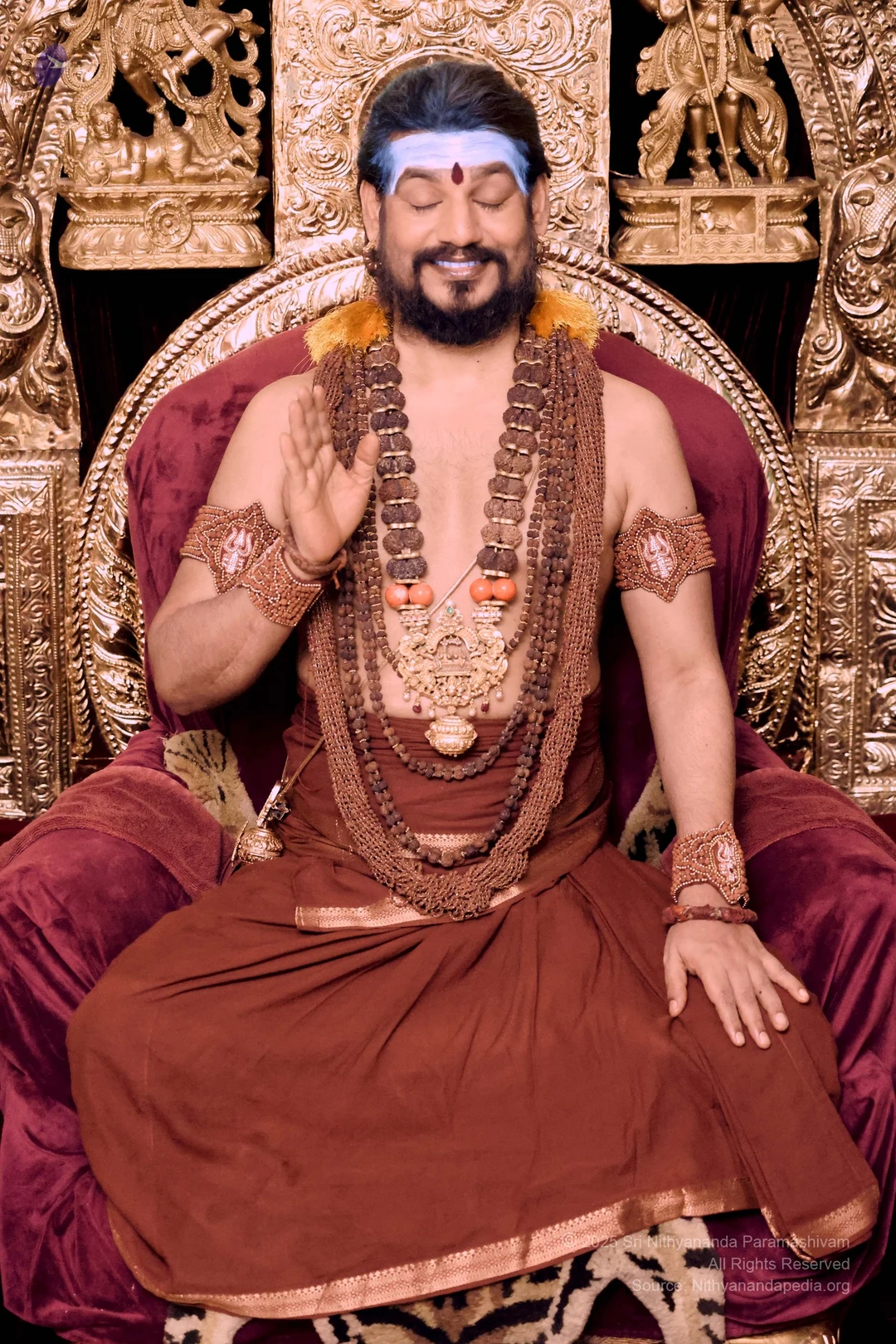
A bearded man with long dark hair sits on a plush maroon velvet throne with ornate gold carved panels behind him, the seat draped with a tiger-skin rug. He wears a rust-brown dhoti-style robe with a gold-edged border, a thick rudraksha mala and several layered bead necklaces, a large ornate gold pendant, gold armlets, and a blue-white vibhuti horizontal band with a red bindi on his forehead. His right hand is raised in a mudra with a small orange-yellow flower tucked at his shoulder area. Swamiji (probable): a long-haired figure in saffron-brown robes with rudraksha malas and ceremonial gold necklaces, seated on a throne, matching the page's identification.A seated man in a gold-ornate throne with deep red velvet cushions raises his right palm in blessing with eyes closed and a faint smile. He wears a rust-brown dhoti with a gold border, multiple strands of rudraksha malas, a large gold pendant with a deity relief, orange beads and gold armlets with embossed designs. A blue-white sacred ash band and a red bindi mark his forehead. Behind him stand gilded carved panels with figures. Appearance-based probable Swamiji (probable) seated on a throne in a blessing gesture, identifiable by swept-back hair, ornate gold jewellery and rudraksha malas. A shawl-like orange cloth rests on his shoulders.Close-up portrait photo of a bearded man with swept-back dark hair, a white vibhuti band across the forehead with a red kumkum dot, and a broad smile. He wears layered brown rudraksha malas with gold spacers and orange-yellow fringed shoulder cloths, and is bare-chested. Golden ornate relief carving forms the background. a person appearance-based label applies: a single figure with distinctive rudraksha malas, orange fringed shawl and tripundra-style white forehead marking, in an ornate golden setting.Close-up portrait photo of a bearded man seated before an ornate gilded backdrop with repoussé scrollwork. He wears a white horizontal forehead band with a red dot at the centre, dark swept-back hair, and small wooden or rudraksha earrings. He has an orange-yellow fringed shawl draped over his shoulders and layered brown rudraksha malas with gold spacers, orange coral beads and a gold pendant, plus beaded bracelets on his raised right hand, which is held in a mudra. Swamiji (probable): long swept-back hair, rudraksha malas, ornate gold backdrop and a shawl; appearance-based label only.A seated man is the main subject, posed on an ornate gold-carved throne with a deep maroon velvet cushioned seat and a striped tiger-skin cloth beneath his feet. He wears a rust-brown dhoti with gold border, layered rudraksha malas, a gold ceremonial pendant, orange bead ornaments, gold-beaded armlets and wristbands, and an orange-gold shawl over his shoulders. He has a white horizontal forehead band with a red dot and raises one hand in a blessing gesture while the other rests in his lap. Gold carved deity figures flank the throne behind him. Printed copyright text overlays the lower right corner of the image.

KAILASA AVADI CHENNAI On 14/2/2025

10 photosView all
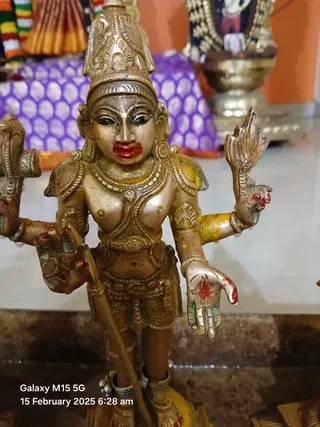
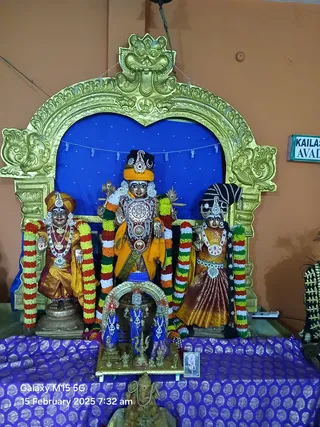
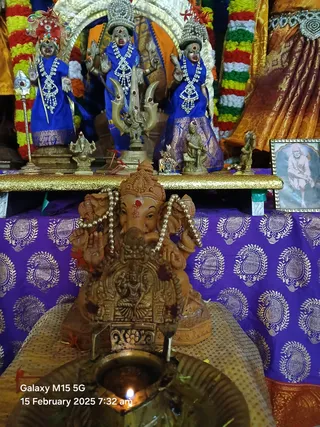
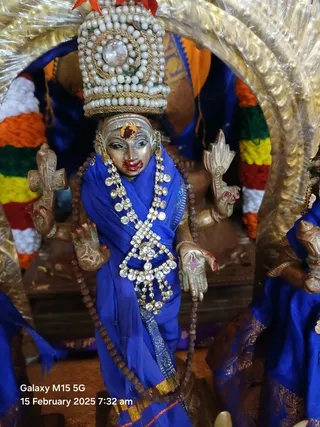
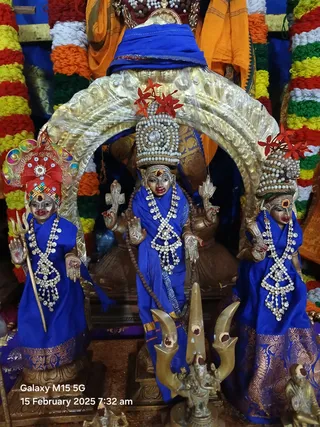
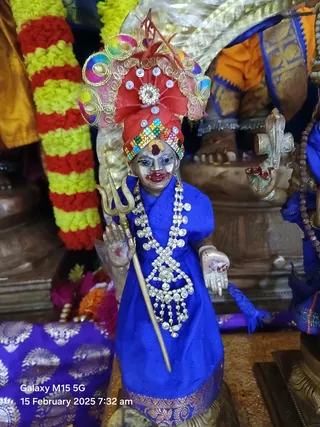
Close photograph of a small metal murti of a multi-armed deity standing on a base, with a tall crown, elaborate necklaces and armour-like ornaments, and red and green paint on the face, hands and lips. One hand holds a long staff or trident-like rod. Behind it sit a purple brocade cloth, a brass kalasha-style vessel and colourful fabric. A phone timestamp reads 15 February 2025 6:28 am in the lower left. No people are visible.A photograph of a temple shrine with three deity murti under an ornate gold arch against a blue backdrop. The central murti wears an orange and white headdress, a silver-patterned chest covering and an orange dhoti, holding ritual objects. The murti on the left wears a red-and-gold turban and dhoti, and the one on the right wears a dark headdress and a reddish-gold sari. All are draped in garlands of red, yellow, green and white flowers. Below sits a small shrine with a trident and a deity figure in blue, and a small framed photograph is placed on the purple brocade altar cloth. A Ganesha murti is at the bottom edge. A signboard reading KAILASA AVADI is at the upper right. The photo carries a Galaxy M15 5G timestamp of 15 February 2025.A photograph of a home shrine on a purple brocade cloth with gold paisley motifs. In the foreground a terracotta Ganesha figure with a red tilak and beaded silver garlands sits before a small oil lamp burning with a flame. Behind, three standing deity figures in blue garments with silver necklaces and crowns stand on a gold-edged ledge, flanked by colourful floral garlands. Small brass figurines and a framed picture of Shirdi Sai Baba in white robes sit to the right. No people are visible.A photograph of a standing wooden deity murti in a shrine niche, dressed in a blue sari and draped with a large silver-white rhinestone necklace and a rudraksha-style bead mala. The figure wears a tall crown decorated with white pearl-like beads and a central gem, has a red tilak on the forehead, and holds ritual attributes in its raised hands. Behind it are blue cloth hangings, strings of orange, yellow, green and white flower garlands, and a clear plastic-covered gilded arch. A partially visible second deity in blue cloth stands at the right edge. No living people are visible.Three deity murtis are dressed in royal blue cloth and rhinestone necklaces inside a golden arch in a temple shrine. The central figure wears a pearl-studded crown with red flowers and holds a rudraksha mala, while flanking figures wear red-and-gold headdresses and hold a trident. Brass trishul and a small brass figure sit in the foreground, with orange and red-yellow-green garlands hanging on both sides. Ritual decoration suggests alankaram. Figures are statues, not people.Close photo of a small figurine-style deity statue in a temple shrine. The figure has a painted face with a red bindi, wears a red and multicolour jeweled turban with a sunburst ornament, and a royal blue garment with a gold border. It holds a golden trident in one hand and has a large sparkling rhinestone necklace. Behind it are a golden kalasha-like canopy, a brass lamp stand, marigold and red-yellow garlands, and a purple brocade cloth. A timestamp overlay reads Galaxy M15 5G, 15 February 2025 7:32 am.

KAILASA KANCHIPURAM On 14/2/2025

7 photosView all
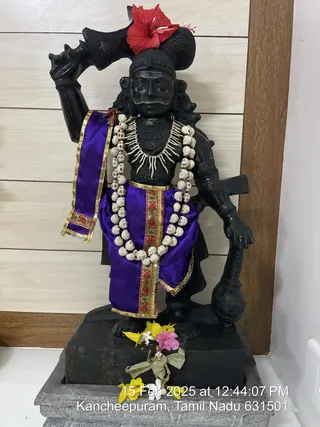
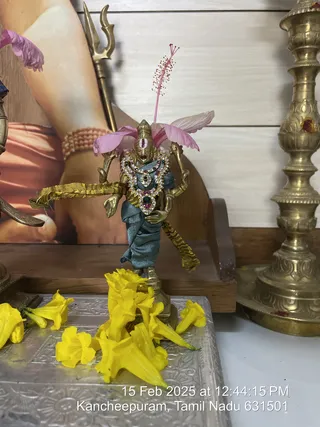
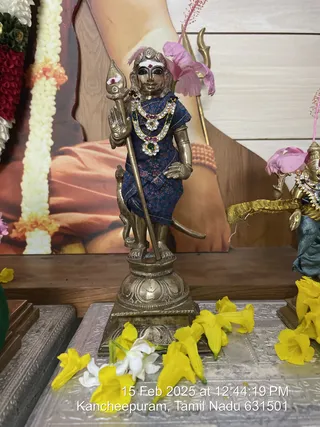
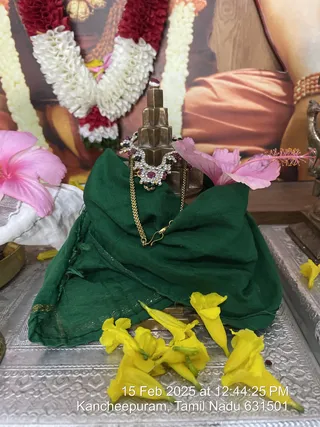
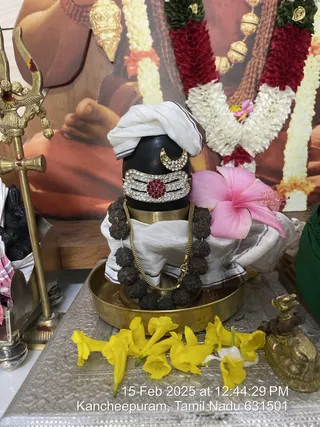
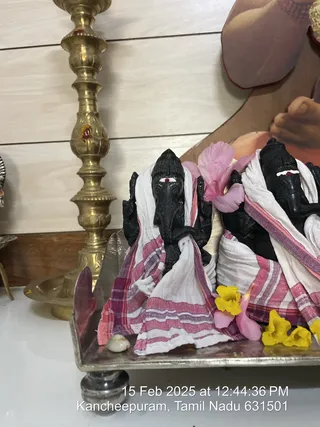
A photograph of a black stone deity murti standing on a grey stone pedestal in front of a light wooden panel. The figure holds a raised trident-like weapon with a red hibiscus flower tucked above its head and carries a staff in the other hand. It wears a purple cloth with gold and red border around the waist and a purple shawl with gold trim draped over one shoulder, a long necklace of white skull beads, and a gold spiked collar. Yellow and pink flowers and a small offering lie at its feet. A timestamp reads 15 Feb 2025 at 12:44:07 PM, with a location line for Kancheepuram, Tamil Nadu. No physical people are visible.A small brass deity murti stands on a silver tray scattered with yellow trumpet flowers. The figure wears a teal-blue silk dhoti, a gold-and-jewelled necklace with red and green stones, a gold sash, and a white vertical tilak on the forehead. Pink hibiscus flowers with protruding stamens are tucked behind its head. A brass trishula stands in the background, and a tall brass lamp stand rises on the right. A pink-clad arm of a larger painted figure appears at the left edge. A timestamp reads 15 Feb 2025 in the lower right.A small brass deity murti stands on a footed pedestal, holding a long trident-like staff in one hand, dressed in a blue and copper-threaded cloth with layered jewelled necklaces with green, red and white stones. Pink hibiscus flowers are tucked behind its head, and scattered yellow and white flowers lie on a silver tray in front. A second brass murti in a teal garment with gold sash is partly visible at the right edge. Behind them is a printed backdrop showing a seated figure in orange robes and a bare foot, with a garland of white and orange flowers at the left. A trident hangs on the wall at upper right. A timestamp reads 15 Feb 2025 and Kancheepuram, Tamil Nadu.Close-up photo of a ritual object on a silver tray: a brass kalasha-like or pillar-shaped object draped with a deep green cloth, adorned with a gold chain and a jewelled pendant set with white stones, red and dark stones. Pink hibiscus flowers and scattered yellow flowers lie around it, with white and red jasmine-style garlands above. Behind is a large framed painting of a seated figure in orange-saffron garments. No physical people are visible. A timestamp reads 15 Feb 2025 at 12:44:25 PM with the location Kancheepuram, Tamil Nadu 631501.Photograph of a black Shivalingam dressed as a deity murti on a brass tray. It wears a white cloth wrapped over its top like a turban, a silver and rhinestone crescent moon on its crown, a rhinestone band with a central red stone, a gold chain and a multi-strand rudraksha mala. A pink hibiscus flower sits at its side and yellow flowers are scattered in front. A brass trident stands to the left and a brass kalasha-style vessel lies to the right. Behind it hang red and white flower garlands and a printed backdrop of a saffron-clad figure. A timestamp reads 15 Feb 2025 and Kancheepuram, Tamil Nadu. No people are visible.Close photo of two small black stone deity figures, each with an elephant-like head and a white tilak on the forehead, draped in white cloth with pink and maroon striped borders, seated on a polished silver tray. Pink and yellow flowers and a small white shell lie on the tray. Behind them is a large brass lamp stand with ornate engraved body, and a partly visible printed picture of a seated figure on the right. A timestamp reads 15 Feb 2025 at 12:44:36 PM, Kancheepuram, Tamil Nadu 631501. No people are visible.

KAILASA KORATTUR CHENNAI On 14/2/2025

1 photoView all
A man in a white dhoti and white head wrap performs a puja at a home shrine, holding a bell and a small lamp flame in his right hand. On a tray before him sit oranges, a white egg, flowers, small brass cups and a bottle. Behind him a gilded deity murti with an ornate arched backdrop stands on a leopard-print cloth, decorated with garlands. To the left, framed portraits show a figure seated on a throne, with a pink and white garment and a red and gold backdrop. A brass kalasha stands at right. The room has turquoise walls and a wooden floor.

KAILASA MADURAI On 15/2/2025

1 photoView all
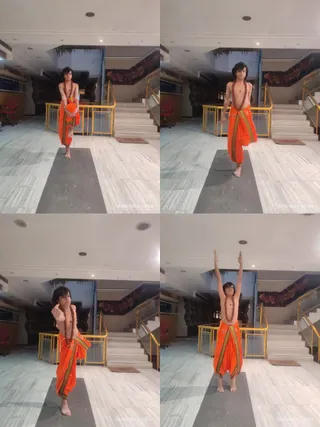
Four-panel collage of photographs showing one man in a lobby performing yoga postures on a grey mat. He is bare-chested with long dark hair and wears an orange dhoti with a green-and-gold border, a rudraksha mala around his neck and a long beaded necklace. In the panels he balances on one leg, raises an arm with the palm forward, and stretches both arms straight overhead. Behind him are marble floors, a yellow metal railing, a staircase and a dark carved wall panel. Timestamps in the corners read 15/02/2025, 19:03 and 19:04.

KAILASA PATTABIRAM On 14/2/2025

1 photoView all
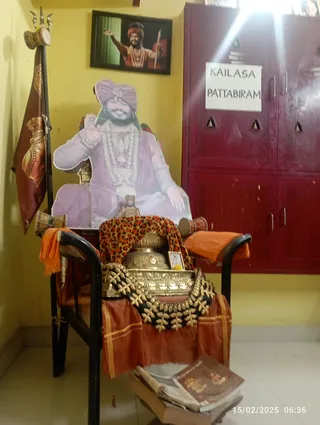
Indoor shrine corner in a yellow-walled room. A life-size cutout standing figure of a smiling man with a red-and-gold turban, pink robe, and layered white beaded garlands is seated on a black metal chair in the centre, with a hand raised in blessing. A framed photo above shows a man in a red turban and red robe pointing. A brass pot with a leopard-print cloth sits on the chair seat, with a gold-embroidered black garland and orange cloths draped over the armrests. A red-and-brown flag on a pole with a trident-topped finial stands at left, and small drums sit beside the chair. A red cabinet at right bears a white sign reading KAILASA PATTABIRAM. No people are present.

KAILASA RAJAPALAYAM On 15/2/2025

1 photoView all
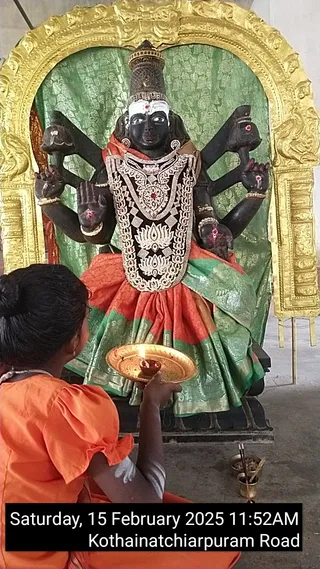
A photograph of a temple shrine with a black stone deity murti seated before a green patterned cloth and gold arch. The murti has multiple arms holding ritual objects, a tall crown, a white vertical tilak, and is adorned with a large ornate silver-and-gold necklace, orange-red and green silk garment. A person in an orange robe with a white-and-beaded neck cord stands at lower left holding a brass plate with a lit oil lamp toward the deity. Brass vessels sit on the floor at lower right. A date and location caption is overlaid at the bottom.

KAILASA SEATTLE USA On 15/2/2025

10 photosView all
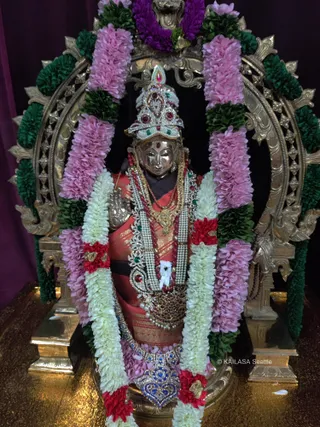
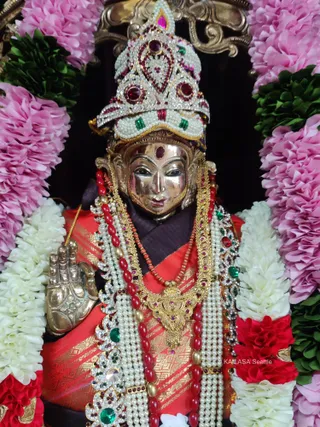
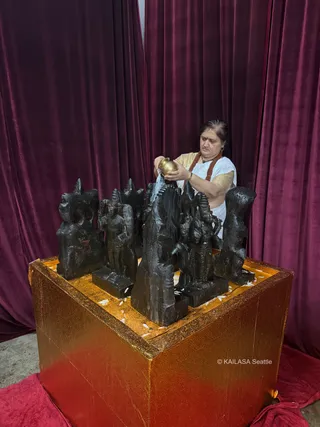
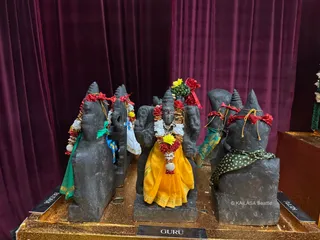
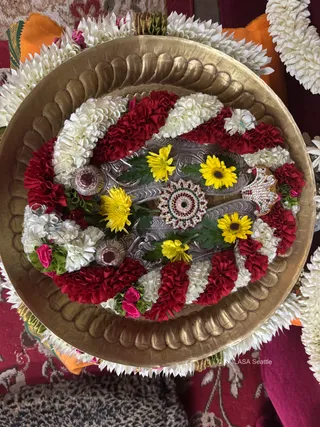
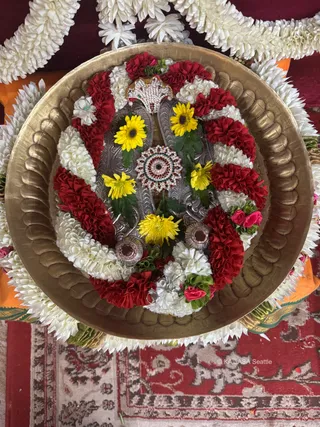
A metal deity murti stands in a golden arched prabhavali frame decorated with pink, green, white and red flower garlands. The murti wears a jeweled crown set with red and green stones, a red and gold silk sari, layered pearl and red bead necklaces, a gold chest pendant and an ornate jeweled waist ornament with blue and red stones. A white ribbon is tied at the chest. The image stands on a polished golden surface, with a purple curtain behind. No people are visible.A metal murti of a deity, polished to a golden-bronze sheen, dressed in a red and gold brocade garment with a dark maroon shawl. It wears an ornate jeweled crown set with red and green stones, multiple strands of pearls and red beads, and a heavy gold necklace with a central pendant. Its right hand is raised in abhaya mudra. Pink, white, green and red flower garlands frame the figure against a dark background. A forehead tilak is visible. The image is a temple-style display of a deity murti, with no people present.A woman in a white sari with a gold border and a red beaded necklace pours water from a brass vessel over a group of dark black stone murti sculptures arranged on a gold-wrapped platform. The sculptures include a standing deity figure with a trident-like staff and a tall stele-like form, surrounded by rice grains scattered on the platform. The scene shows an abhishekam ritual being performed on the murtis.A photograph of a display of dark stone Navagraha deity figures on a gold-trimmed stand before maroon velvet drapes. The central figure is a seated stone deity murti draped in a yellow silk cloth, with a white and red flower garland, a yellow flower and red ribbon at the top. Flanking figures wear red ribbons, flower garlands, and green, blue and white cloths.Overhead view of a brass tray holding a silver deity murti or ceremonial metal object decorated with alternating garlands of white jasmine and deep red flowers. Yellow chrysanthemum blossoms, green leaves and pink rosebuds are scattered over it, along with a jewelled round ornament set with red and green stones and a silver crown-like adornment with white stones. Two small silver bowls with red powder sit on either side. The tray rests on red and orange cloth with a patterned rug beneath. No people are visible.Overhead photo of a large round brass tray decorated for worship. At the centre sits a silver-toned deity murti with a jewelled crown and a circular jewelled ornament, surrounded by yellow marigold-type flowers and green leaves. Red and white flower garlands wrap the tray's rim and run across the red patterned carpet below. Two small brass oil lamps flank the murti. No people are visible; the scene shows a flower-decorated puja arrangement.

KAILASA Salem On 14/2/2025

10 photosView all
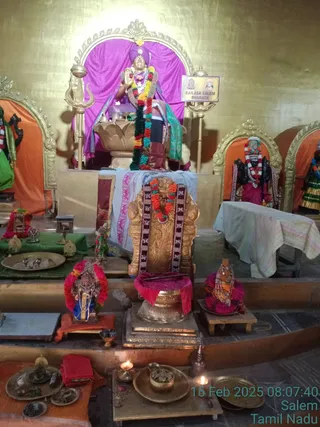
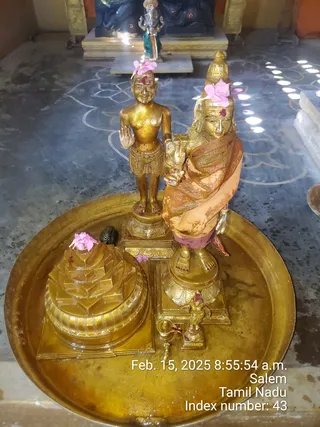
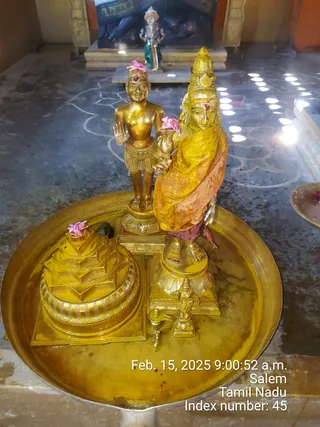
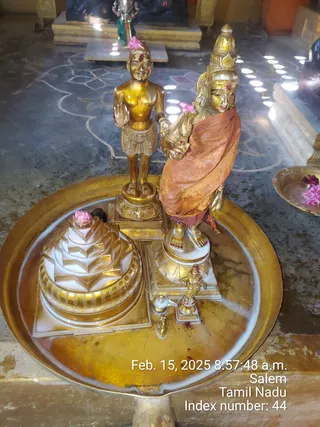
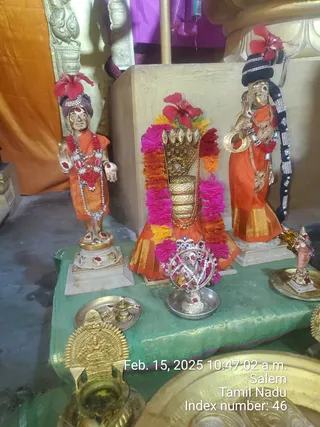
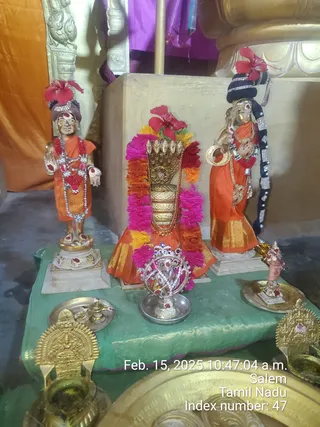
Photograph of a gilded shrine room at KAILASA Salem with a large central statue seated in a gold-arched niche draped in magenta cloth, wearing a purple turban, multi-coloured flower garlands and a teal shawl, hands raised in greeting. A signboard reading KAILASA SALEM BHARATH hangs beside it, flanked by brass trishula staffs. Foreground shows an ornate gold throne with a red-velvet seat and garland, brass plates, a small kalasha-like vessel, oil lamps and offerings; additional deity murtis with flower garlands sit in side niches. No living people are visible. A timestamp reads 15 Feb 2025 08:07:40, Salem, Tamil Nadu.Photograph of a golden metal deity group on a round brass tray inside a temple hall, with a polished marble floor showing a faint lotus pattern. A standing golden figure of a bare-chested male devotee-saint in a short waist cloth raises one hand in blessing, beside a taller golden standing deity form in an orange and pink draped garment with a crown, pink flowers on its head and red kumkum marks. Beside them is a golden crystal-like sri yantra style meru or shivalinga-type stepped base topped with a pink flower and a black stone. Pink petals are scattered on the tray. In the background a dark blue deity murti in a green garment sits on a raised platform. Stamped at the lower right is a timestamp reading Feb. 15, 2025 8:55:54 a.m., Salem, Tamil Nadu, with index number 43.A photograph of a gilded metal murti group on a large brass tray, set on a marble floor with a white and pale-pink floral kolam pattern and rows of small lamps. The central pair are Shiva and Parvati figures: the standing male figure has bare upper body, a short dhoti, raised right hand and a pink flower on his head, while the female figure wears a yellow-orange sari and holds a small pot. Beside them is a gilded Sri Chakra meru-shaped stepped yantra with a pink flower on top, and a small Nandi figure at the base. Pink flowers and kumkum marks are visible. In the background, a deity image stands on a raised dais in front of a dark painted backdrop. A timestamp reads Feb. 15, 2025 9:00:52 a.m., Salem, Tamil Nadu, Index number 45.Close-up photo of a gilded metal murti group on a large brass tray in a temple hall, with pink flower petals scattered on the figures and a small brass dish of petals at the right edge. A standing deity murti in gold with an orange-red shawl and tall crown is paired with a standing gold figure with raised hand, beside a white-and-gold Sri Yantra-style base or meru. A small brass vessel and a tiny figure sit at the base. The floor behind shows a white floral inlay pattern and sunlight spots. A timestamp overlay reads Feb. 15, 2025 8:57:48 a.m., Salem, Tamil Nadu, Index number: 44. No physical people are visible.A photograph of a shrine arrangement showing three standing statues dressed in orange garments and garlands. The two outer statues wear orange cloth with gold borders, red and white garlands, pearl necklaces, and turbans topped with red hibiscus flowers; one holds a hand near its chest. The central object is a gold-toned Shiva lingam with a hooded metal cover, draped in pink, orange and yellow marigold garlands and a hibiscus. Gold plates with oil lamps, a small gold crown-shaped image and a green silk cloth lie in front. A photographic timestamp reads Feb. 15, 2025 10:47:02 a.m. Salem, Tamil Nadu, Index number 46. No living people are visible.Photograph of a shrine arrangement with three figures on a green cloth. Two standing gold-and-white statues in orange robes flank a central golden cobra-hooded deity murti or lingam-form with a garland of marigolds and pink flowers and red hibiscus on top. The left statue wears a purple turban with a red hibiscus and a garland; the right statue wears a black embellished headdress with a red hibiscus and a long jewelled sash. Brass oil lamps and a silver ritual vessel with a small silver deity figure sit in front. A timestamp reads Feb. 15, 2025 10:47:04 a.m. Salem, Tamil Nadu, with index number 47.

KAILASA Selayang Malaysia On 14/2/2025

1 photoView all

A screenshot of a video call with two side-by-side panels. On the left, a woman with short dark hair and glasses, wearing a dark top, sits with palms pressed together in a namaste gesture in front of a plain wall with framed pictures and a curtain. On the right, a blurred-background panel shows a smiling woman with dark hair in a dark top. Name captions appear at the bottom left and bottom right of each panel.

KAILASA TANJAVUR On 13/2/2025

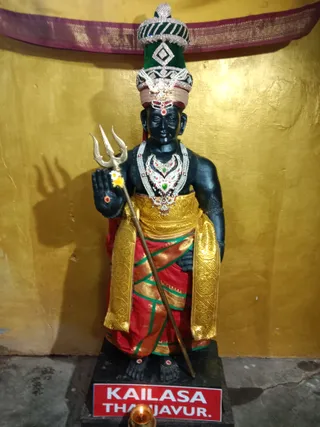
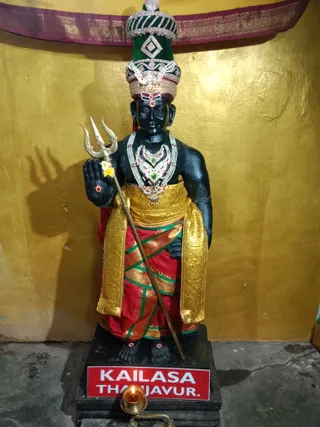
2 photosView all
A black stone statue of a deity stands against a golden wall draped with a maroon and gold-bordered cloth. The murti wears a tall green and pink jeweled crown, layered pearl and red-stone necklaces, a gold embroidered waist cloth over red and green fabric, and holds a gold trident adorned with yellow flowers in one raised hand. A red tilak mark is on its palm and forehead area. A small brass oil lamp sits in front on a black pedestal bearing a red plaque.A photograph of a dark black standing statue of a deity murti in a temple-style setting against a gold-painted wall with a maroon and gold cloth canopy above. The murti wears a tall green and white jewelled crown, pearl and gem necklaces, a gold and red garment with gold brocade sash, and holds a trident adorned with small yellow flowers. Red bindu marks are visible on the palm and feet. A brass oil lamp burns in front on a black pedestal bearing a red sign reading KAILASA THANJAVUR. No living people are visible.