Skip to content
Sunday

29 August 2010

Practicing Conflict-Free Living

Dated photos
21
Source pages
1
Media
10
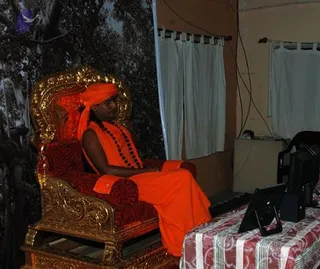
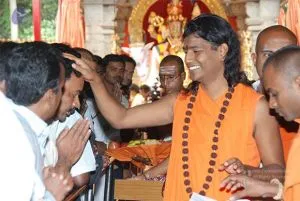
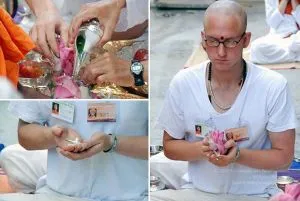
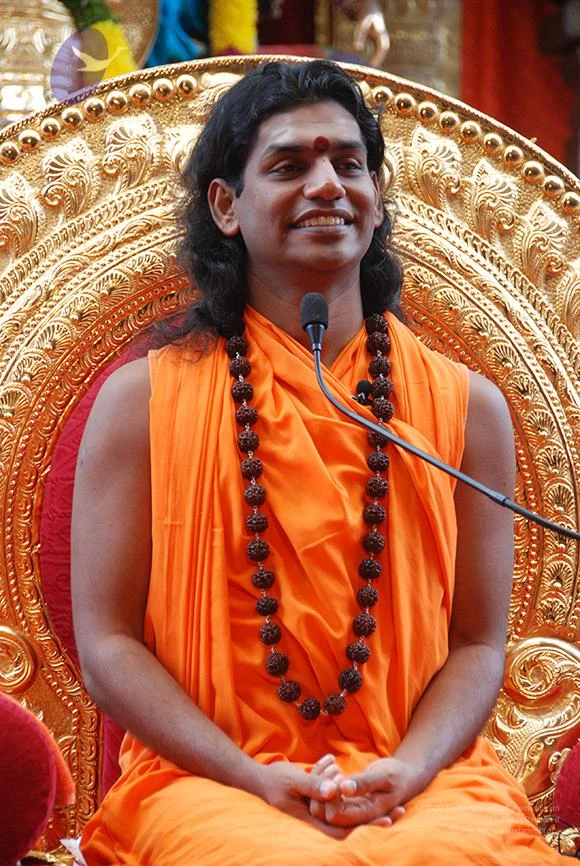
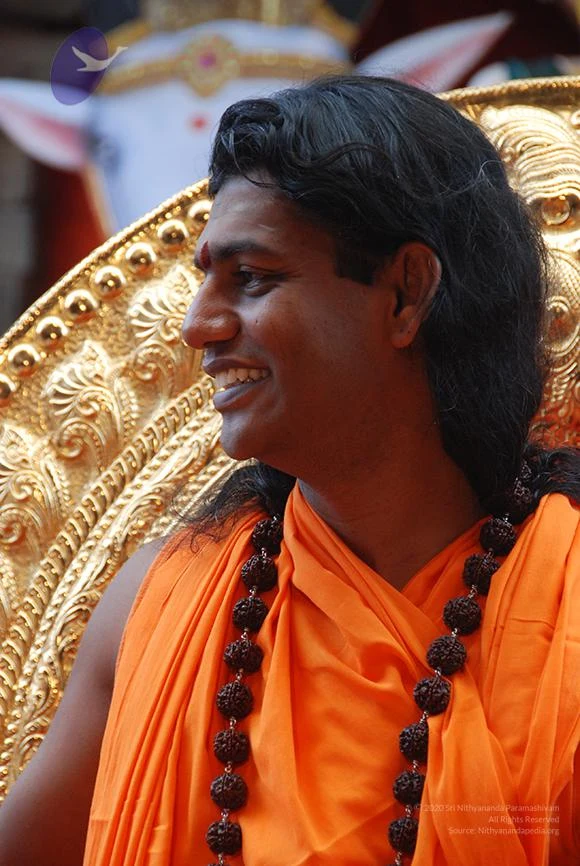
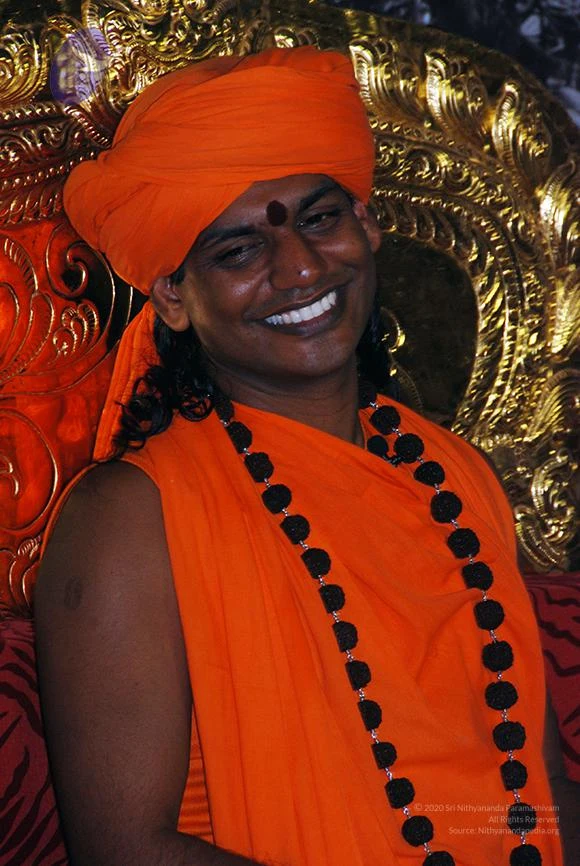
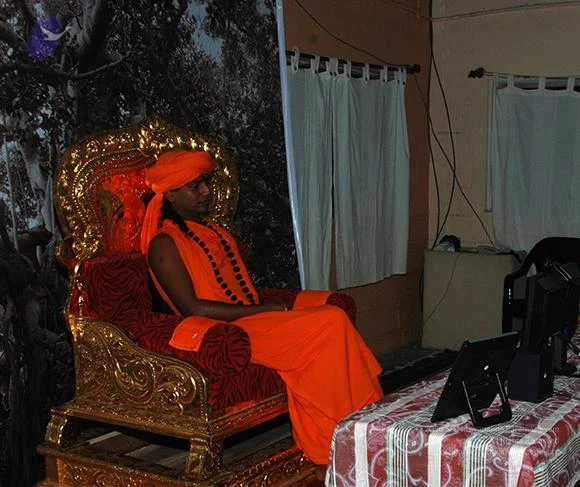
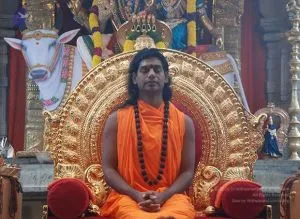
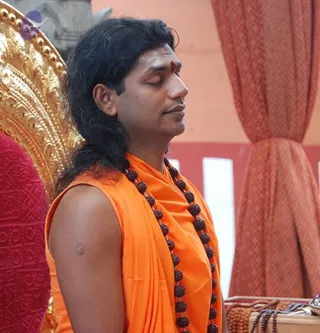
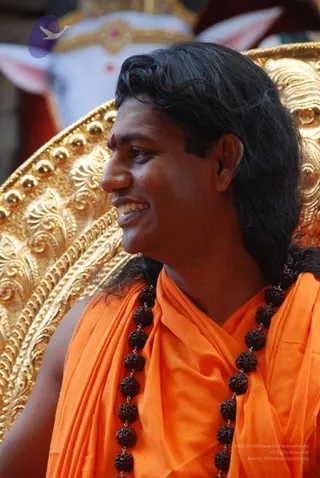
A seated man in saffron-orange robes and an orange head wrap sits on an ornate gold throne with red zebra-patterned upholstery, in front of a painted backdrop of a large tree. He wears dark rudraksha malas around his neck and orange sleeve cuffs. A draped table with a red and white striped cloth holds a laptop and a tablet on a stand, and white curtains hang in the background.A man with long dark hair wearing saffron-orange robes and a rudraksha mala smiles as he places his right hand on the head of a kneeling devotee. Devotees in white and light clothing have their hands pressed together in añjali, and a man in orange stands behind them. Behind the central figure is an ornate temple shrine with gilded decorations and a deity murti in the background, with a wooden offering table or stand in front. The scene suggests a blessing or darshan at a temple. a person is identified by long swept hair, saffron robes and a rudraksha mala as the figure giving the blessing.Four-panel collage of a ritual abhishekam or puja. Top-left: hands in white sleeves pour liquid from a brass vessel over a deity murti or sacred object, with pink flower petals around it. Bottom-left: a hand in white sleeve holds a small pink flower bloom above a palm, beside a photo ID card on a lanyard. Right: a shaved-headed man in white clothing and round glasses holds pink petals in cupped hands, with a rudraksha mala around his neck. Bottom-middle: a hand holds an offering on a tray. The panels show ritual handling of flowers and liquid offerings.

August 29 2010

Original wiki page
Contents

Title

Practicing Conflict-Free Living

Video and Audio

Practicing Conflict-Free Living

VideoAudio

Transcript

(00:21) Sadāshiva samārambhām Shankarāchārya madhyamām | asmat āchārya paryantām vande guru paramparām ||

I welcome you all with My love and respects. Today’s subject is, ‘Practicing conflict free life’. I want to share a technique with the whole world. Because many important things which I shared with you all yesterday will not reach the whole world. At least the essence I wanted to share in the morning message so that it reaches the whole world. Whatever process you all are going through, the essence of those videos are being sent to all satsang centers but the whole world will really be benefited with this process, with this technique. (02:11) Conflict is as long as you think there is something other than you... Conflict has no life, life has no conflict. As long as you think there is something other than you exists, the fear or conflict continues to be alive in your system. All you need is tuning your system. Tuning your body and mind to understand that there is nothing other than you exists or there is nothing other than you exists. Please understand, either there is nothing like you other than the other exists, or nothing like other exists other than you. (03:26) Very powerful process in hatha yoga called Ajapa japa means chanting beyond chanting. Even the chanting word is not exact translation of japa. Japa means more like a flowing; flowing without flowing, chanting without chanting - Ajapa Japa. Constantly, knowingly or unknowingly, consciously or unconsciously, your being goes on chanting this hamsa mantra. When you inhale the tone hammmmmm. When you exhale sammmmmmm. When we verbalize even this ‘ham’ and ‘sam’ gets shape. But if you don’t verbalize and just observe, the subtle version of ‘ham’ and ‘sam’ will be happening. It will not be complete defined ‘ham’ or defined ‘sam’. It’s like a (swamiji utters a sound). (05:04) See physically when you see, you have a defined body. When you close your eyes and try to visualize you, you will have a undefined version of you. It’ll not be a defined version, an undefined kind of a line drawing, caricature, cartoon, line sketch. Same way, when you sit and listen to this ajapa japa, flowing of non-flowing or beyond flowing, chanting of beyond chanting, if you observe that happening, you will see the line drawing or caricatured version, cartoon version of this hamsa mantra will be happening. Please do not add that ‘ham’ or ‘sam’ sound with will, no! I am not asking you to add with will. When you add with will, it becomes japa means ‘chanting’. No, I am not teaching you that. I am telling you to sit and try to find out the mantra. (6:30) In the beginning, it will be the dull version or undefined version of ‘ham’ and ‘sam’. Slowly, slowly, either ‘ham’ or ‘sam’ will disappear. Understand, ‘ham’ means the idea, me, I. ‘Sam’ means the whole. You can call it cosmos, God or anything other than you, anything beyond you. When the strong, defining, difference between this ‘ham’ and ‘sam’ disappears, you become Paramahamsa. As long as this ‘ham’ and ‘sam’ happens in you, you are hamsa. When the gap between the sound difference, between this ‘ham’ and ‘sam’ disappears, means merges into one, that you and He merges into one, the ‘I’ and ‘you’ merges into one, you become Paramahamsa. You are beyond the hamsa. Anybody who is beyond the hamsa mantra is Paramahamsa. Constantly the hamsa mantra is happening in you. First thing you need to do is become aware of it. Second thing, constantly try to be with it. Third, automatically the gap between the two will disappear. You are Paramahamsa. Understand, very powerful technique for practicing conflict free life. It’s a very powerful way of balancing or elevating your internal consciousness, beyond the conflict. (08:43) The teaching which I was sharing yesterday, life has no conflict, conflict has no life will become reality in you when your hamsa mantra gets in-tune. Because any verbalization goes on inside adds its smell to your breathing. Any verbalization goes on inside adds its smell to your breathing. Means adds its vibration to your breathing. So when you sit with hamsa, first thing is verbalization, inner verbalization settles down. Only the physiological movements will be happening, means the physiological conflict of going in and coming out. When you sit with that also, even the physiological conflict will disappear. Please understand, as on now, you will not even be having pure ‘ham’ or pure ‘sam’. Along with that ‘ham’ sound, all the garbage which is going on in the head will be going. Along with the ‘sam’, all the garbage, chaos happening in the mind will be happening. So when I ask you to sit with hamsa mantra, the psychological mutation will happen. When you are having only the ‘ham’ and ‘sam’, the psychological mutation will happen. (10:26) Second step, when you continue to be just with ‘ham’ and ‘sam’, the purified ‘ham’ and ‘sam’ will start getting settled with itself. So the difference between the ‘ham’ and ‘sam’ will start melting down. That is what I call physiological mutation. When the psychological mutation and the physiological mutation happens, its conflict free life; living enlightenment. So the straight process, please understand, sitting with ‘ham’ and ‘sam’, psychological mutation. Second, getting into the space where the ‘ham’ and ‘sam’ meets and merges. That is physiological mutation. When you work on this process, you will understand how directly it leads to conflict free life. So I request all of you to practice conflict free life. Let you all experience conflict free life, live and radiate the eternal bliss, Nithyananda. Thank You. (12:00)

Title

Levitation Process For Balancing Samana , LEP 29 Aug 2010

Narration

In this video, Swamiji talks about experiencing physical levitation through soham internal chanting, a visible gift given by the master. Swamiji beautifully guides the participants into meditation technique of levitation process with the understanding of Soham.

Watch, share and like the videos and Subscribe to our channel to be notified of the next upload.

Click http://bit.ly/20j90wr to subscribe.

Support the World's Only Hindu Nation: www.kailaasa.org/join-kailaasa

Website and Social Media:

http://www.kailaasa.org

http://www.nithyananda.org

http://www.nithyananda.tv

http://www.innerawakening.org

https://twitter.com/SriNithyananda

https://www.facebook.com/ParamahamsaNithyananda

Video and Audio

Levitation Process For Balancing Samana , LEP 29 Aug 2010

VideoAudio

Title:

LIFE HAS NO CONFLICT - Patanjali Yoga Sutras-56 by Nithyananda

Narration:

In this 56 Patanjali Yoga Sutra, Paramahamsa Nithyananda describes a part of 5 Sutra in Chapter 2 of Patanjali Yoga Sutras. He describes conflict-free living.

Video:

LIFE HAS NO CONFLICT - Patanjali Yoga Sutras-56 by Nithyananda

VideoAudio

Title

La compassion: French discourse by Nithyananda

Narration

Paramahamsa Nithyananda parle de la compassion, en tant que force ultime pour faire face à toutes les difficultés de la vie...

Video and Audio:

La compassion: French discourse by Nithyananda

VideoAudio

Title:

29 Aug 2010 Nithyananda World Family News

Video and Audio:

29 Aug 2010 Nithyananda World Family News

VideoAudio

Photos Of The Day:

Photos Of The Day:

Pancha-Tapas
Darshan
LBE-Sessions
Photos from this day

View all 21 photos

Photos Of The Day:

5 photosSource gallery
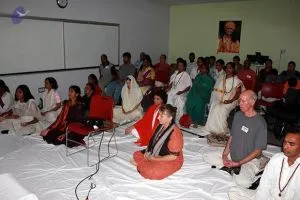
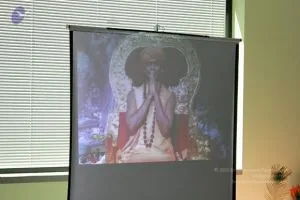
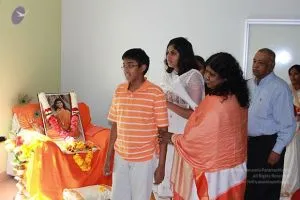
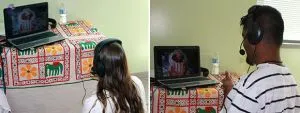
A framed portrait of a long-haired man in saffron-orange robes, garlanded with pink and white flowers, sits at the centre of a draped orange cloth on a raised platform. Yellow and orange marigolds are arranged around the frame and scattered on the cloth, with peacock feathers standing in brass vases on either side. Brass oil lamps and a flower-decorated vessel sit at the base, with a small lit lamp on the platform. Plain light walls frame the setting, as in a shrine display. No living people are visible.A seated audience fills a white-floored hall during a satsang-style gathering. In the foreground, a woman in an orange-red outfit sits cross-legged, and a man in a grey t-shirt with a lanyard sits beside her. Behind them, rows of devotees wear white, cream and red clothing, some with sashes. A framed portrait hangs on the wall at upper right, showing a figure in orange. Several people in the back row are standing. A white board and wall fixtures are visible on the left. The room is lit by overhead fluorescent lights.A projection screen on a stand shows a figure in a white robe and long dark hair with palms pressed together in namaste, a rudraksha-style bead mala visible at the chest, set against a stylised purple and white halo background. The screen sits in a bright room with white horizontal window blinds and a green wall. A small floral arrangement is visible at the lower right. No people are physically present in the room; the figure appears only on the projection.Indoor scene in a bright white room with a small shrine-style setup at left. A framed portrait of a long-haired figure in an orange garment sits on an orange cloth draped over a chair, surrounded by marigold and orange flowers. In front stands a boy in an orange-and-white striped shirt and white pants, with a young woman in white salwar kameez beside him. To the right, a woman in an orange sari with a shawl and an older man in a light shirt stand close together, and another person is partly visible at the far right edge. A portrait labelled with a printed credit line appears on the wall corner. Five people are visible in total.Two side-by-side photographs of people wearing headsets at laptops on a table draped with a colourful patterned cloth. On the left, a young woman with long dark hair, seen from behind, faces a laptop screen showing a figure. On the right, a young man in a white-and-black striped shirt with a headset and microphone faces a laptop screen. Water bottles and a small plant sit on the table. The setting looks like a home or office room with light walls.

Pancha-Tapas

2 photosSource gallery
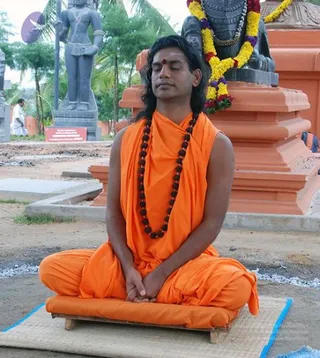
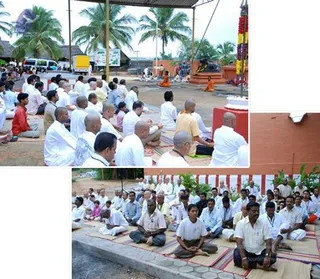
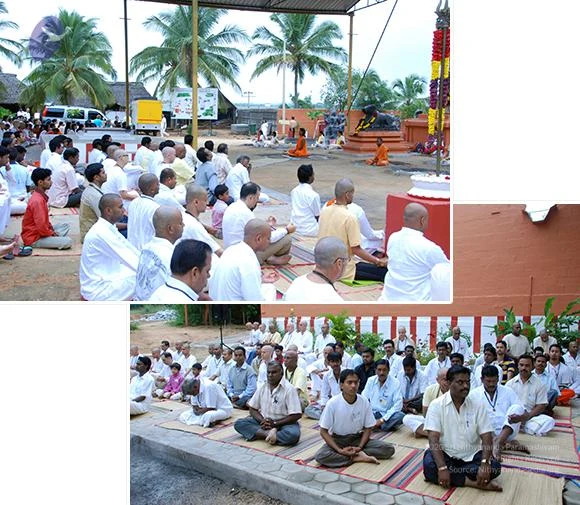
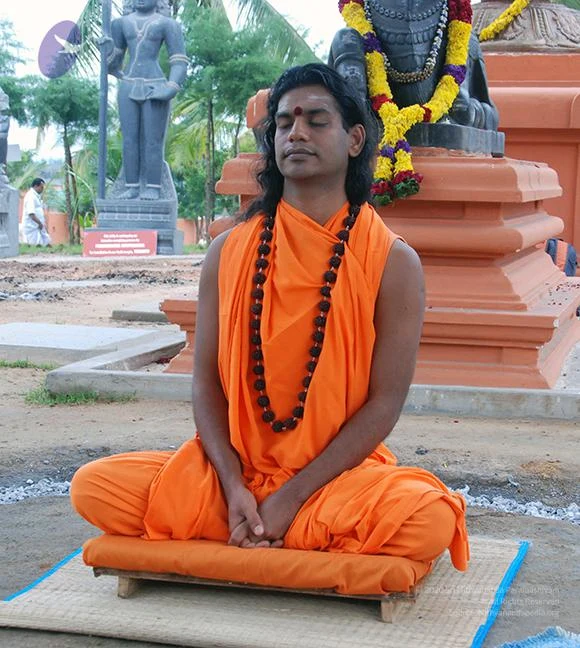
A man with long swept-back dark hair sits cross-legged in meditation on an orange cushion placed on a low wooden platform over a blue-edged mat. He wears a sleeveless saffron-orange wrap, orange dhoti-style cloth and a long dark rudraksha mala, with a red bindi on his forehead, eyes closed and hands folded in his lap. Behind him are a grey stone statue and an orange plinth draped with a garland of yellow and purple flowers, with palm trees and a blurred figure in white in the background. Several cues are distinctive: long hair, saffron clothing and rudraksha beads, so this is a probable Swamiji seated in meditation. The page links the image to a talk on conflict-free living. Swamiji (probable) is shown in meditation outdoors beside temple sculpture and a flower garland.Outdoor photo of a large assembly seated on mats in an open courtyard beneath palm trees. Many people in white dhotis and shirts sit in rows facing a red-draped platform in the upper right, where a figure in saffron/orange robes sits near ornate red and gold decorations and garlands. Several other saffron-robed figures sit nearby, and bronze or stone animal statues stand by the temple-style structure. A white van and a yellow vehicle are parked at left. Inset collage panel with a seated group in white clothes, some with shaved heads, and a red wall behind.

Darshan

9 photosSource gallery
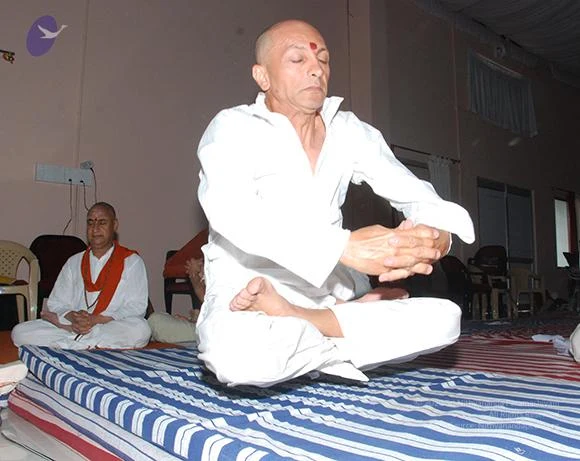
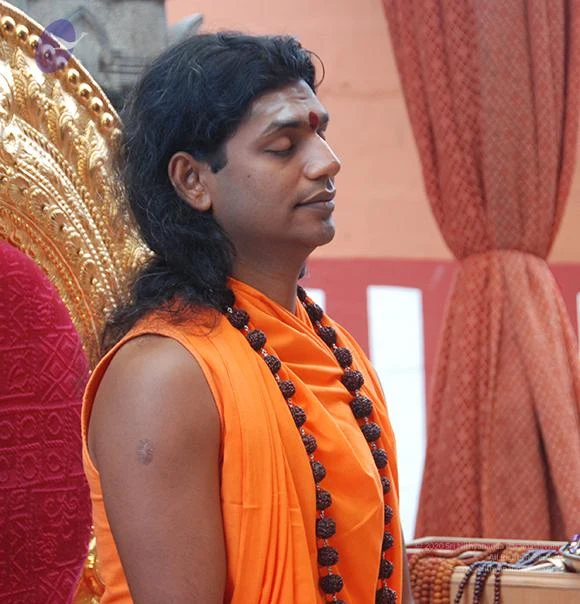
A man with long dark hair and a neatly trimmed beard sits upright on an ornate golden throne with a large halo-like back, hands resting in his lap. He wears a saffron-orange robe and a long rudraksha mala of dark beads around his neck. Behind him stands a richly decorated temple shrine with colourful painted deity figures, a white elephant-headed deity form, and a gilded backdrop. Red velvet cushions rest on the throne's base. The setting appears to be a temple or ashram hall.Four-panel collage of a ritual abhishekam or puja. Top-left: hands in white sleeves pour liquid from a brass vessel over a deity murti or sacred object, with pink flower petals around it. Bottom-left: a hand in white sleeve holds a small pink flower bloom above a palm, beside a photo ID card on a lanyard. Right: a shaved-headed man in white clothing and round glasses holds pink petals in cupped hands, with a rudraksha mala around his neck. Bottom-middle: a hand holds an offering on a tray. The panels show ritual handling of flowers and liquid offerings.A two-panel photograph of a bald man in white ritual clothing, seated on a red-and-gold throne, receiving a forehead mark from a woman in orange robes and rudraksha beads, with a brass puja plate and offerings nearby. In the right panel a standing man in white receives a similar mark on his forehead from a woman in orange, with a red-pillared temple setting behind them.

LBE-Sessions

5 photosSource gallery
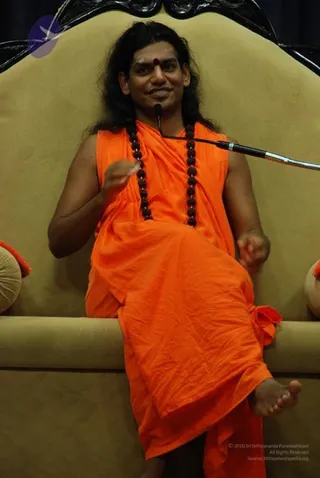
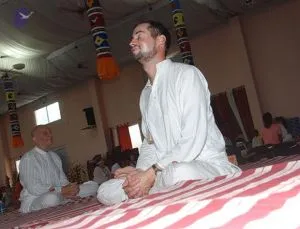
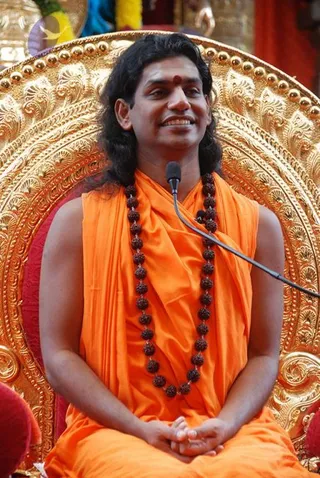
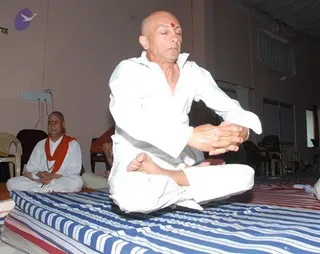
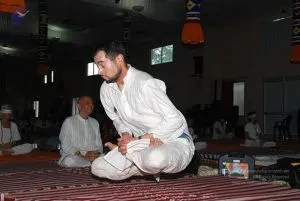
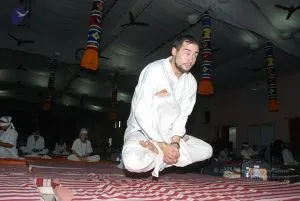
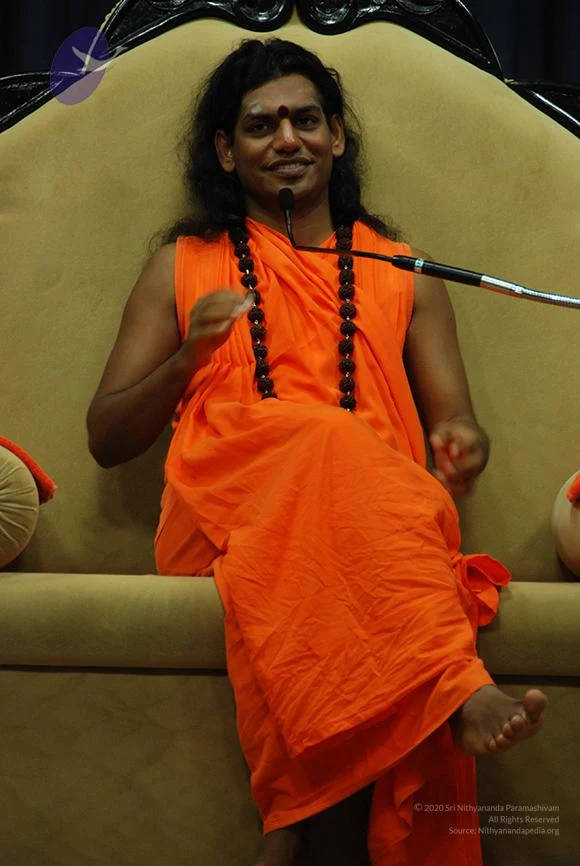
A man seated on a cushioned gold-upholstered throne with a carved dark wooden crest speaks into a black gooseneck microphone during a discourse. He has long dark hair and wears a saffron-orange sleeveless robe draped over one shoulder, with a dark rudraksha mala hanging on his chest and a red-and-white tilak on his forehead. He gestures with his right hand while smiling, and his bare feet rest on the cushion. a person is identified from long swept hair, saffron robe and rudraksha mala cues; the seated speaker is shown in a satsang-style setting with a dark blue backdrop.A photograph of a satsang hall with a striped red-and-white cloth spread on the floor. In the foreground a man with short hair and a white kurta and dhoti sits cross-legged, hands folded in his lap, eyes closed and face tilted upward in devotion. To the left a bald man in white sits on the cloth beside him. Behind them, other seated devotees in white and a few in lighter clothes are visible, and colourful hanging paper lanterns decorate the ceiling and wall. The scene suggests an ashram satsang gathering. Roughly six to twenty people are visible, though only partly in frame at the edges.A bald man in white clothes sits cross-legged on a striped blue-and-white mattress, eyes closed, hands clasped in his lap with a red bindi on his forehead, appearing to meditate. Beside him to the left, a second seated man in white with an orange-red shawl sits with hands folded, also with eyes lowered. The figure in white cannot be identified from appearance alone, so no a person identity is asserted.A photograph inside a hall with orange hanging lanterns and red-and-white patterned mats on the floor. In the foreground a young man with short dark hair and a neat beard kneels upright on a mat, wearing a white kurta-style outfit, with his hands held at his chest and his head turned to the side. Behind him an older man with a white beard and white clothing sits cross-legged, and further back several more people in white sit on the mats in rows. A small framed picture sits on the mat near the foreground figure. The setting suggests a group satsang or meditation session.A man with short dark hair and a stubbly beard sits cross-legged on a red-and-white striped mat in a hall with a low ceiling hung with colourful banners. He wears a plain white kurta and white trousers, and his hands rest together in his lap. Behind and to the sides, several other men in white clothing sit on the mats, and paper lanterns in red, yellow and blue hang from the ceiling. The setting looks like a satsang or meditation session.