Skip to content
Sunday

8 August 2021

LIVE SPECIAL MAHESHWARA PUJA || 08 AUGUST 2021

Dated photos
82
Source pages
7
Media
2
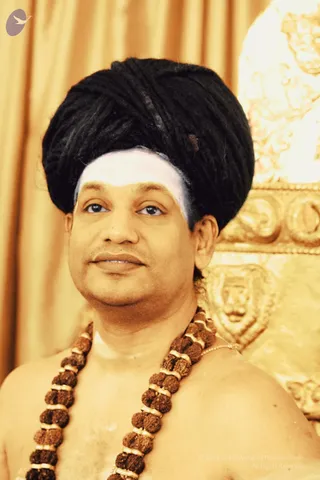
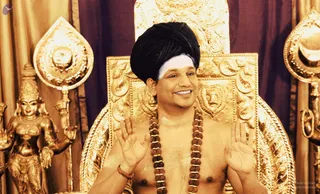
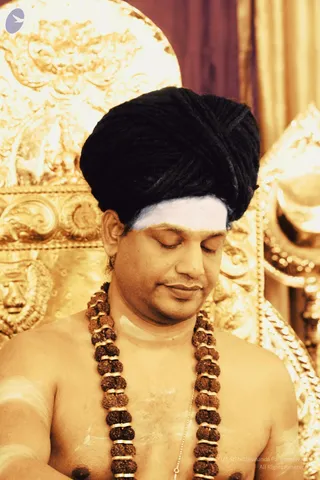
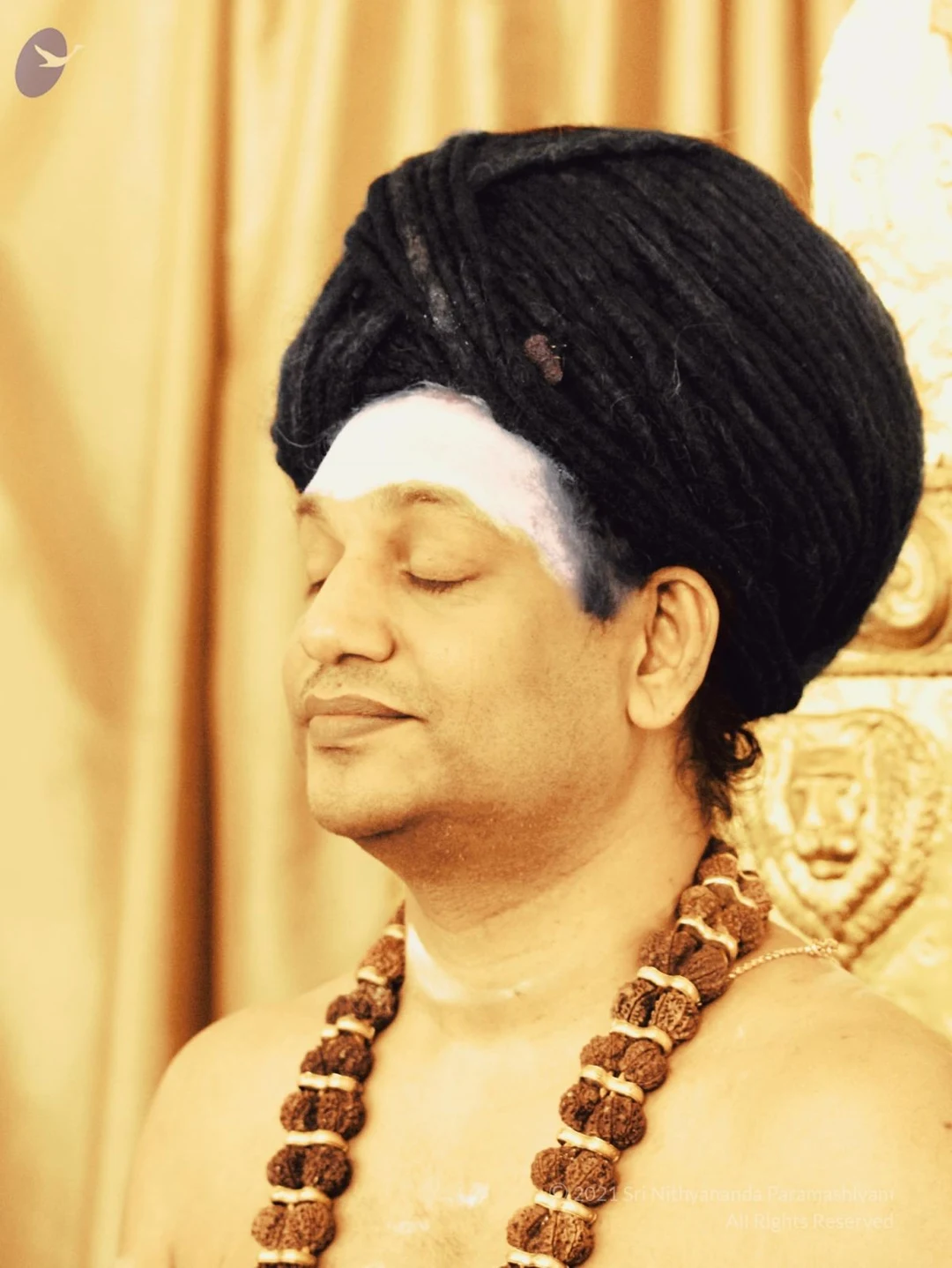
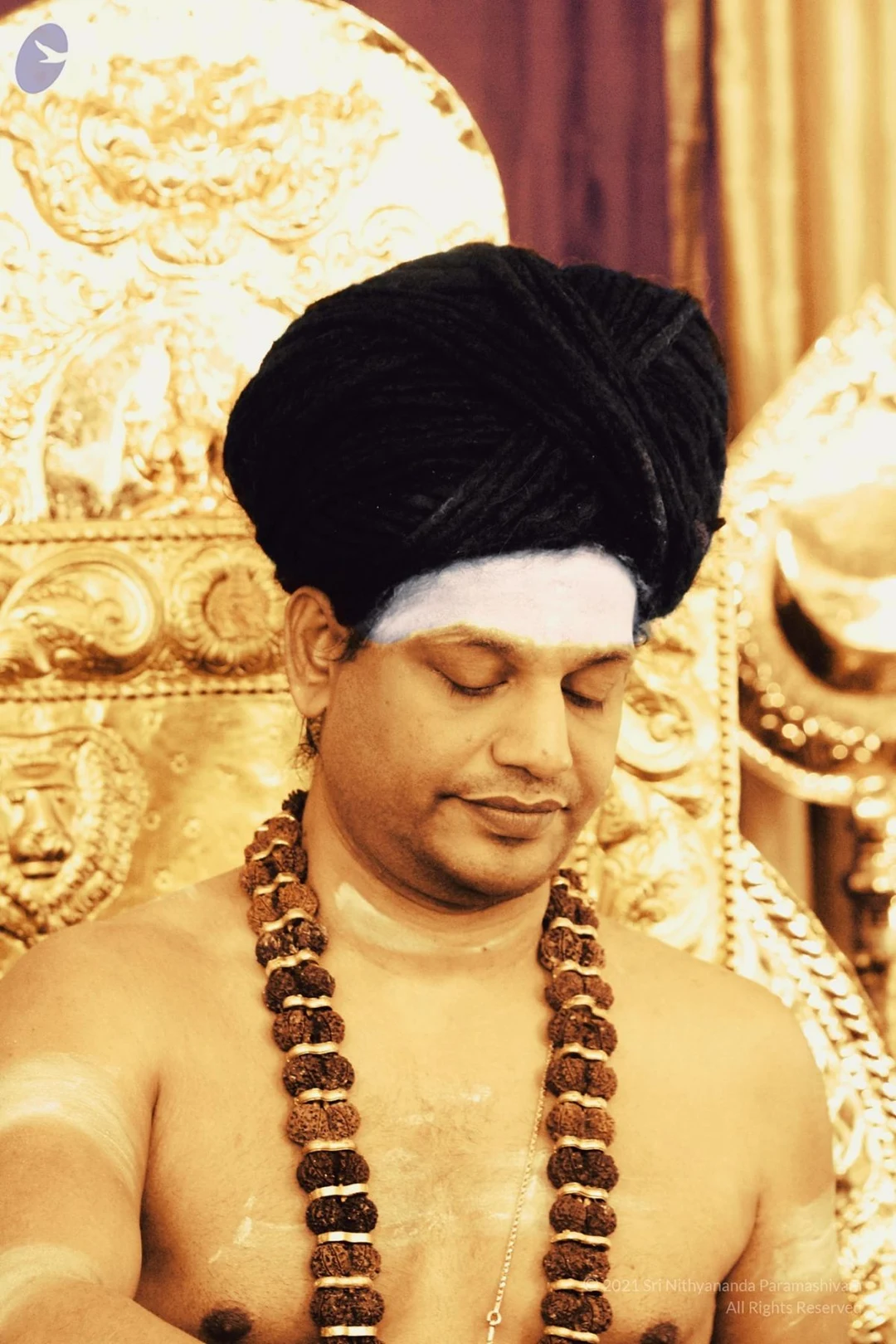
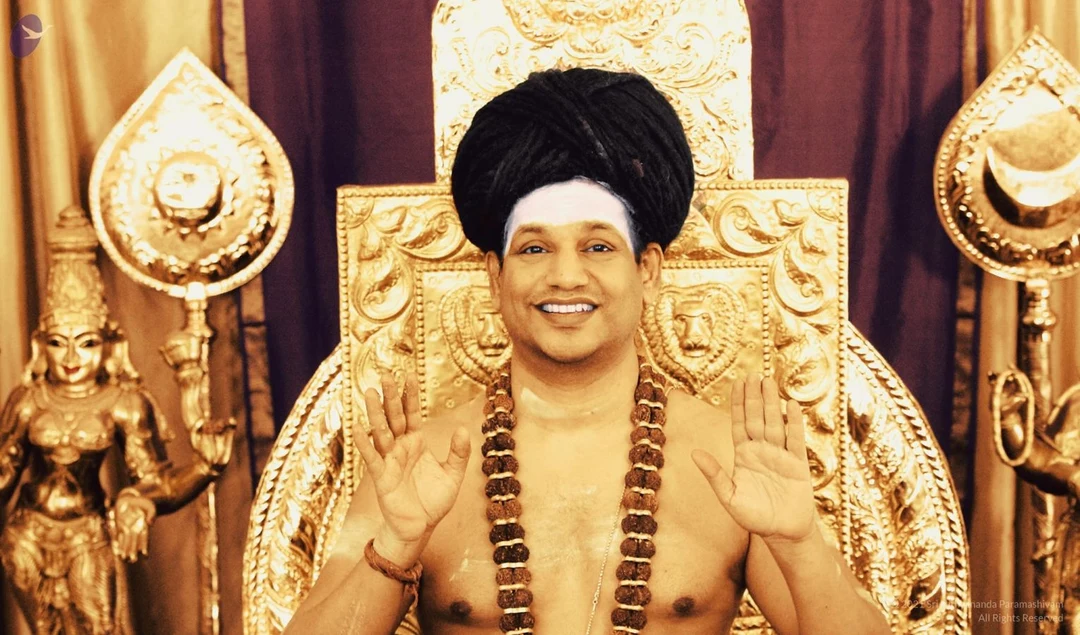
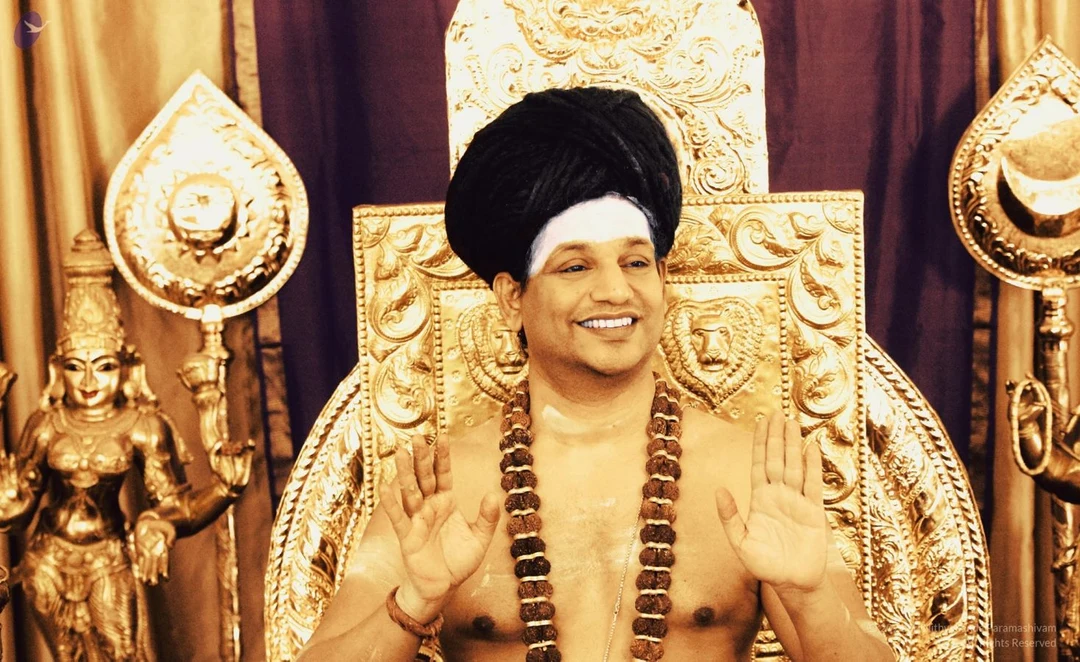
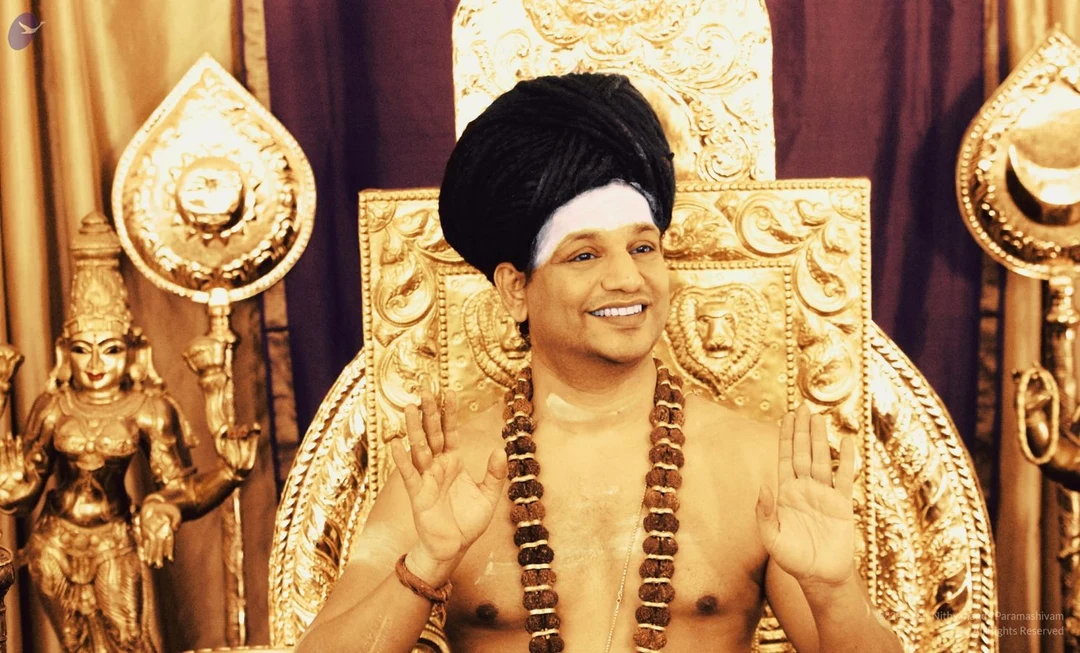
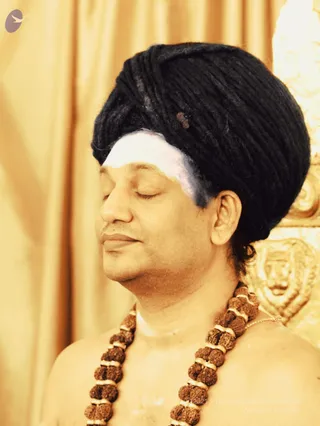
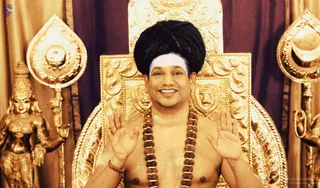
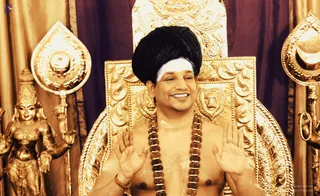
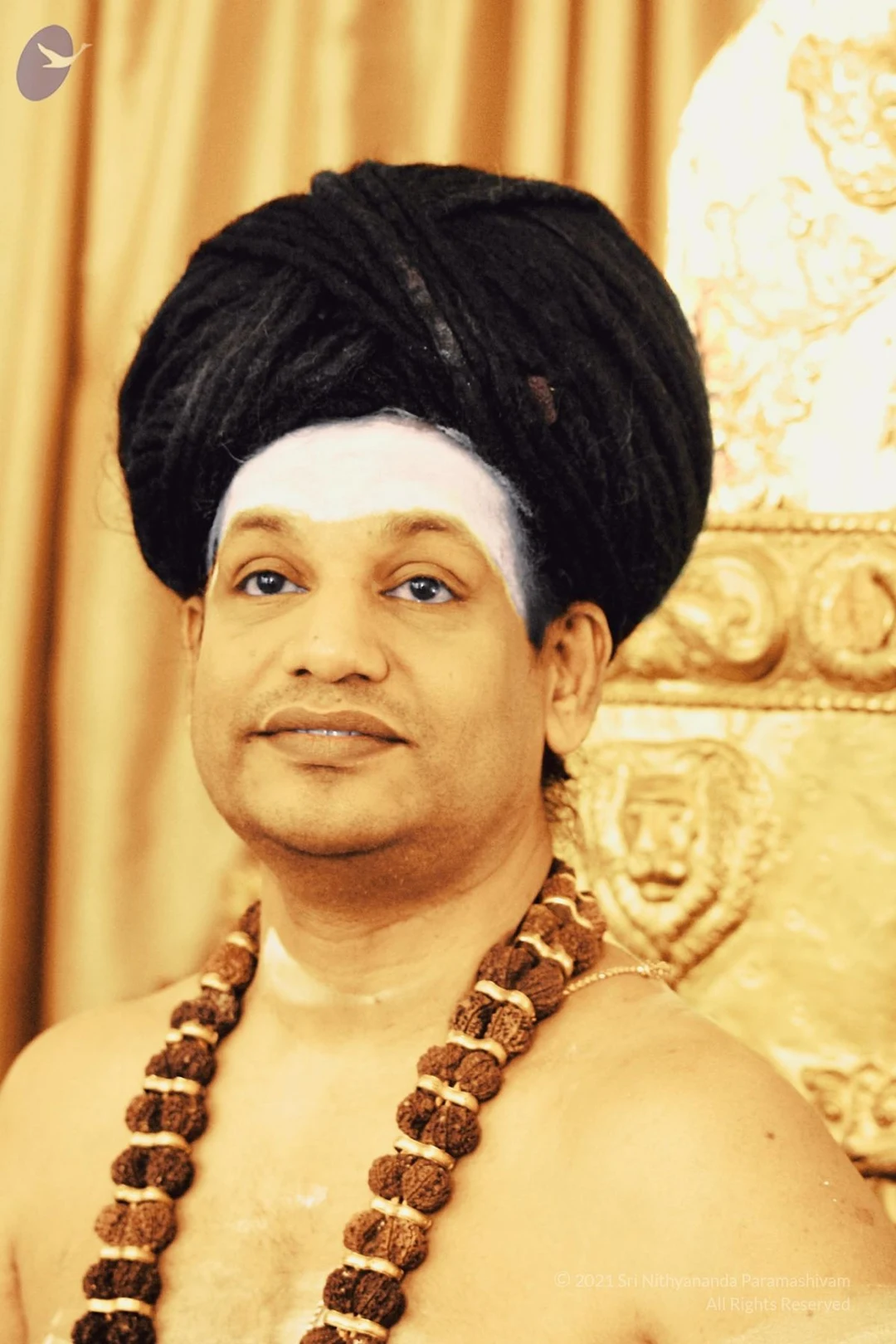
Close-up photograph of a man seated before an ornate golden throne with carved lion-face motifs and gold drapery behind him. He wears a large black turban wrapped high on his head, white vertical forehead markings, and multiple strands of brown rudraksha beads with gold spacers draped over bare shoulders. A probable Swamiji depiction: the black turban, bare-chested ceremonial look and rudraksha malas are present, but the visible cues are limited to this single frame, so the identification is an appearance-based candidate only.A seated man in a golden throne raises both open palms in blessing, smiling. He wears a tall black turban, white sandalwood marks on his forehead and chest, a long necklace of rudraksha beads with white spacers, and a red-brown wrist cord, and is bare-chested. Behind him a gilded throne with lion-face carvings and a maroon curtain frames the scene. To the left stands a golden deity murti holding a ceremonial fan-shaped umbrella, and to the right a second gold parasol-type ornament. The man appears to be the probable Swamiji, identified only by his rudraksha mala, turban and throne setting, with the throne and rudraksha as key cues.Close photograph of a bare-chested man with eyes closed and a faint smile, seated before an ornate gold-embossed throne. He wears a large black turban, a white vertical mark on his forehead, and multiple strands of rudraksha beads with gold spacers draped over his chest, with a thin gold chain visible. The white ash-like marking also appears on his neck and upper arm. A small white copyright-style credit appears at the lower right corner. Appearance cues (turban, rudraksha malas, ornate gold setting) are consistent with Swamiji (probable) seated in a ceremonial role during a Maheshwara Puja livestream.

AUGUST 08 2021

Original wiki page
Contents

Title

LIVE SPECIAL MAHESHWARA PUJA || 08 AUGUST 2021

Video

Transcript

GLIMPSES OF MAHESHWARA PUJA

GLIMPSES OF MAHESHWARA PUJA || 8TH AUG 2021

MAHESHWARA PUJA IS HINDUISM'S PRESCRIPTION IN LIBERATION OF THE DEPARTED SOUL.

KARMA, AS DEFINED BY THE SPH IS THE CYCLE OF CHOOSING IMPOSSIBILITY OVER POSSIBILITY. KARMA , AS SUCH CARRIED BY ANCESTORS FOR GENERATIONS DOES INFLUENCE THE SOFTWARE AND HARDWARE OF ONE'S LIFE. MAHESHWARA PUJA IS HINDUISM IN ITS FINEST TO LIBERATE YOUR ANCESTORS FROM THEIR KARMAS AND FREE YOURSELF ONCE FOR ALL FROM THE EFFECTS OF THEIR KARMA ON YOU. OFFERING MAHESHWARA PUJA FOR YOURSELF WHILE LIVING ASSURES MUKTHI FOR YOU, AND IMMENSELY SUPPORTS YOU IN LIVING ENLIGHTENMENT (JEEVAN MUKTHI).

CONSIDERING THESE COUPLE YEARS HAVE BEEN THE TIPPING POINT FOR A NEW WORLD ORDER, WHEREIN MANKIND AT LARGE ARE FORCED INTO TERROR PHYSICALLY, MENTALLY, PSYCHOLOGICALLY AND CONSCIOUSLY, WHEREIN LOSING LIVES DUE TO PANDEMIC AND ITS EFFECTS, LOSING LIVELIHOOD, THREATENED WITH BIO WAR, ETC - SPIRITUAL HEALING IS A DIRE NEED!

HINDUISM PRESCRIBES VARIOUS METHODS FOR GLOBAL HEALING - ONE SUCH IS MAHESHWARA PUJA. NULLIFYING COLLECTIVE NEGATIVITY SIMPLY THROUGH THE PRESENCE OF THE AVATAR AND HIS ORDER OF MONKS.

THE SOMASAMBHU PATATI SAYS, IT IS THOUSAND TIMES MORE GREATER THAN OFFERING ANY “SHRAADDHA”, ANY “PINDA”, IN ANY RIVER, ANY WATER-BODY, ANY LAKE, ANY HOLY LAND, ANY HOLY PLACE. OFFERING IT IN THE STOMACH OF THE LIVING INCARNATION OF PARAMASHIVA IS THE BEST FORM OF “PINDA THARPANA” AND 'SHRAADDHA'. IN HINDUISM, SHRAADHHA WHEREIN FOOD IS OFFERED TO SANYASIS FOR THE COMPLETION WITH THE DEPARTED SOULS, IS CALLED MAHESHWARA PUJA.

IN THE SOMASHAMBHU PADDHATI, SHRAADHHA VIDHI,SLOKA 3
लिङ्गिनो ब्राह्मणाद्याश्च श्राद्धीयाः शिवदीक्षिताः ।
LIṄGINO BRĀHMAṆĀDYĀŚCA ŚRĀDDHĪYĀḤ ŚIVADĪKṢITĀḤ ।

THE TRANSLATION GOES “THE SANNYASIS AND BRAHMANAS WHO HAVE BEEN INITIATED INTO THE SHIVA DEEKSHA ARE ELIGIBLE TO BE APPOINTED AS THE REPRESENTATIVES OF PITRUS IN THE SHRAADHHA.”

REGARDLESS OF THE NUMBER OF BIRTHS THE SOUL WOULD HAVE TAKEN, REGARDLESS OF THE SOUL, WHILE EMBODIED HAVING BEEN INITIATED BY THE MASTER OR NOT IN HIS LIFETIME - THE MASTER CAN INTERVENE AND MAKE HIS PRESENCE AVAILABLE IN THE DEPARTED SOUL’S LIFE AND LEAD IT TO ENLIGHTENMENT! THIS IS POSSIBLE ONLY THROUGH MAHESHWARA PUJA!

LIVE ON: HTTPS://WWW.YOUTUBE.COM/LIFEBLISSFOUNDATION
WWW.NITHYANANDA.TV
HTTPS://TWITTER.COM/SRINITHYANANDA
HTTPS://WWW.FACEBOOK.COM/PARAMAHAMSANITHYANANDA

Photos

FB-Photos-of-the-Day
Link to Facebook Page

https://www.facebook.com/ParamahamsaNithyananda/videos/365837534896803
https://www.facebook.com/ParamahamsaNithyananda/videos/193333586028334
https://www.facebook.com/ParamahamsaNithyananda/posts/376322377193933

KAILASA BELGIUM on 8/8/2021

Original wiki page
Contents

Daily Update - PDB + Daily pictures-Abhishekam Offering

Event Details
Participants Count0
Event TypeIn-Person
Was Food Served in Event?No
Count of Meals Served
Volunteers Count2
Event Duration

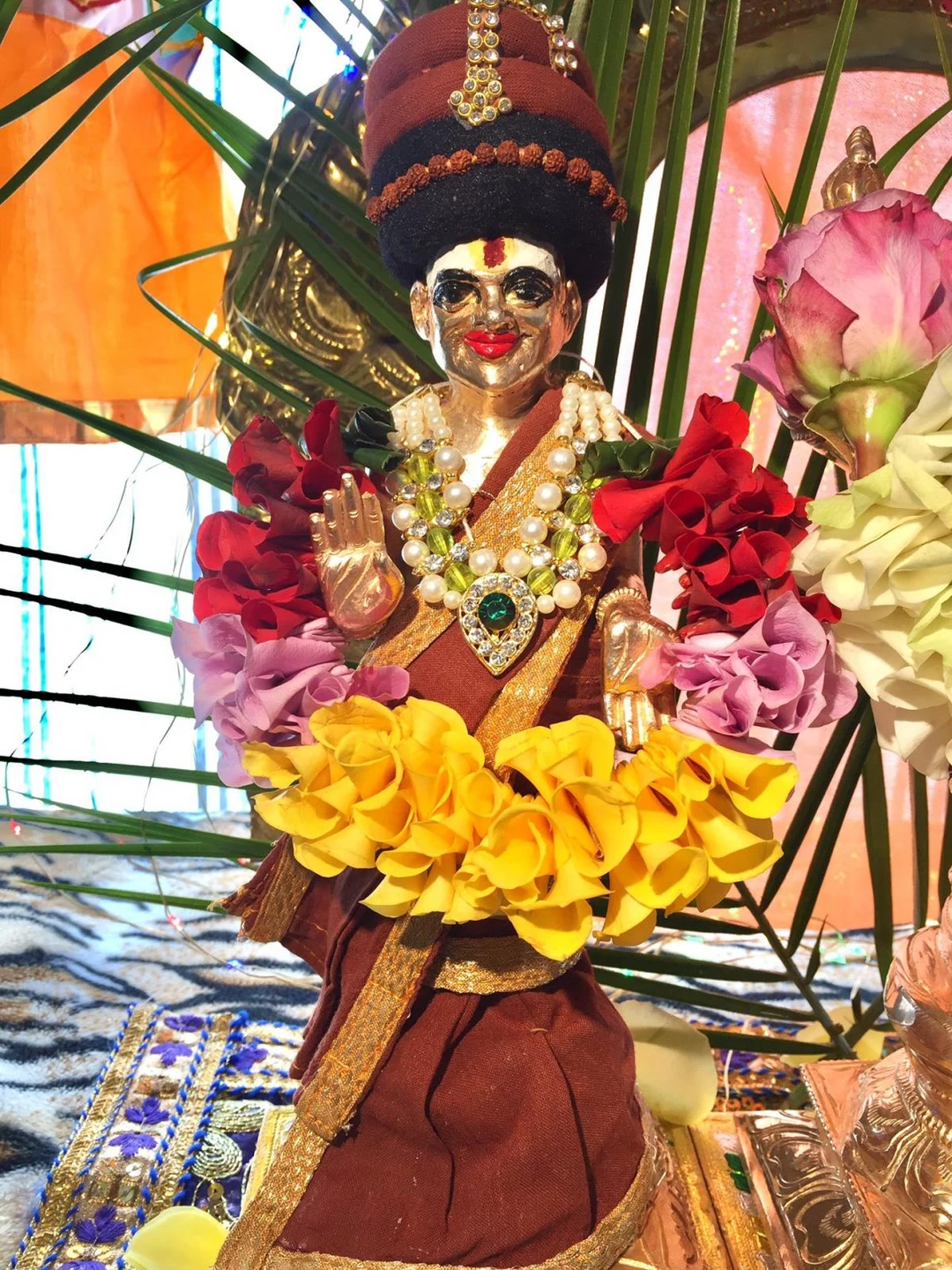
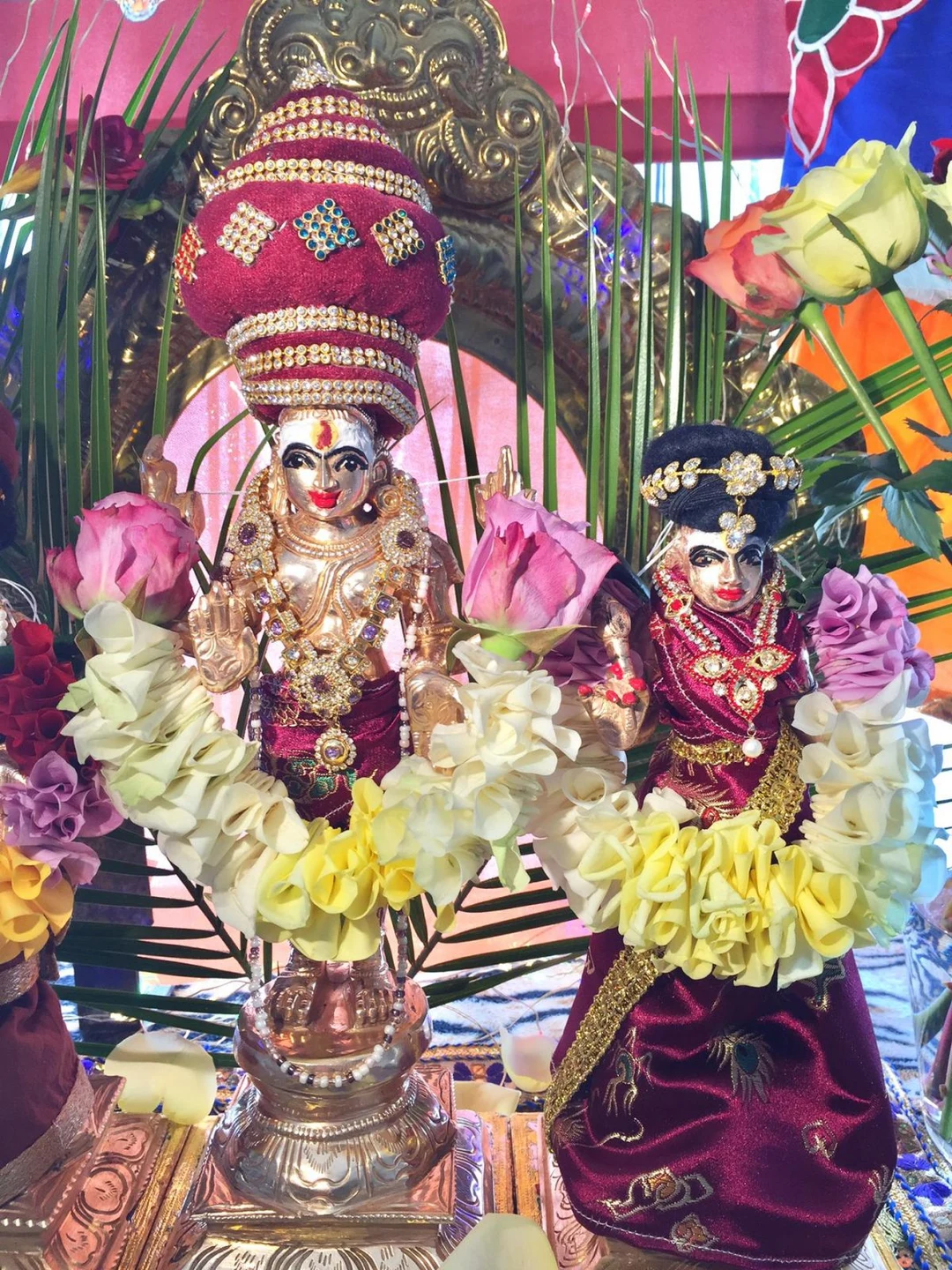
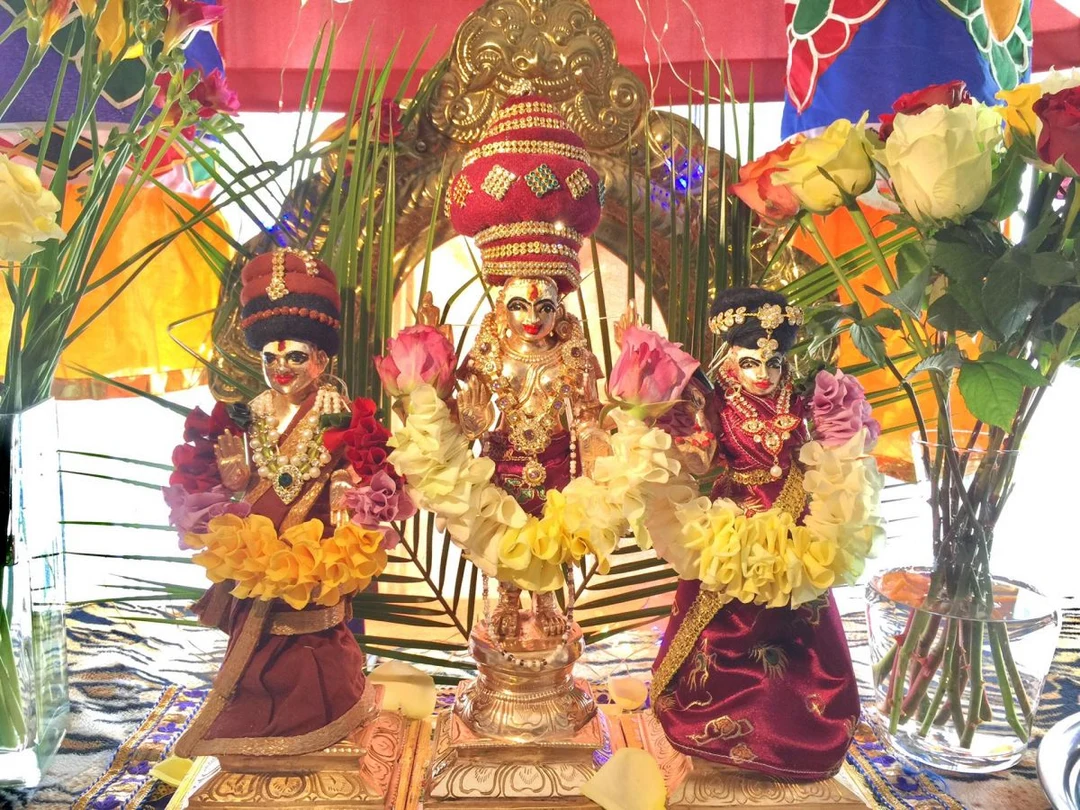
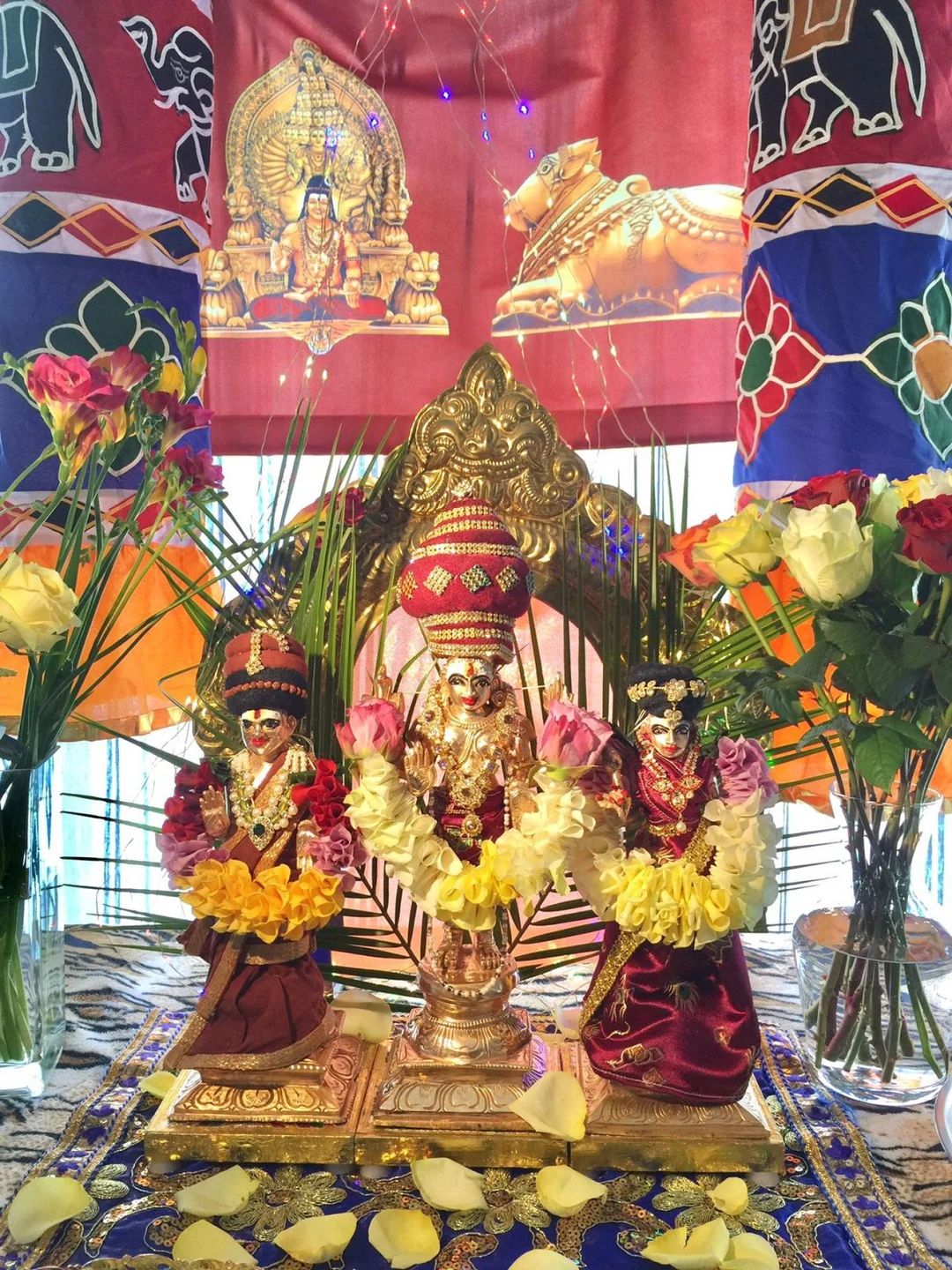
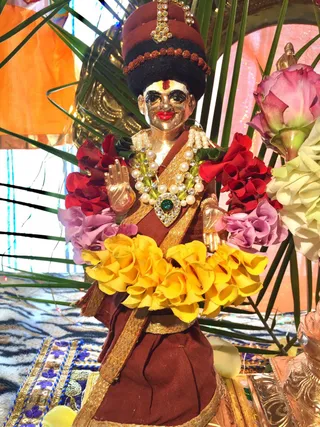
Abhishekam&Alankaram Of Bhoga Murthies - 08 Aug 2021

Pictures from the day
KAILASA LATIN AMERICA on 8/8/2021

Original wiki page
Contents

Daily Update - PDB + Daily pictures

Event Details
Participants Count88
Event TypeOnline
Was Food Served in Event?No
Count of Meals Served
Volunteers Count14
Event Duration

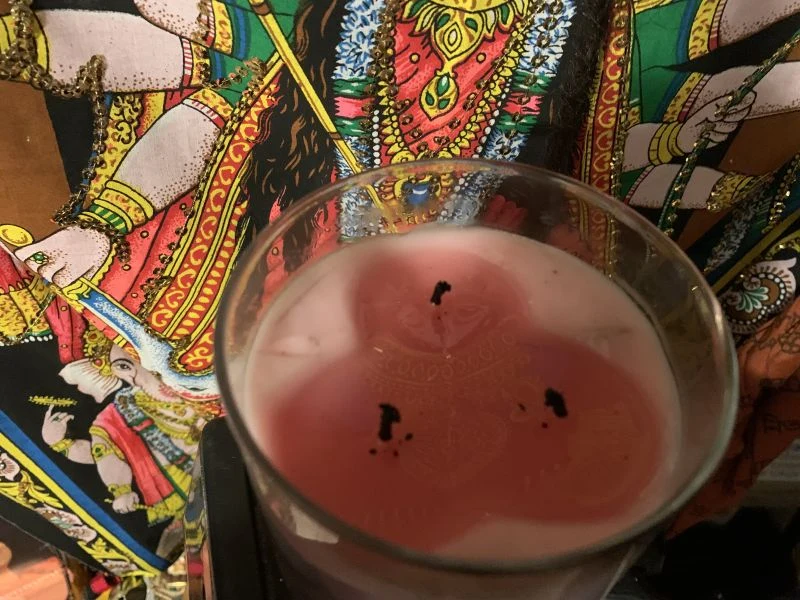
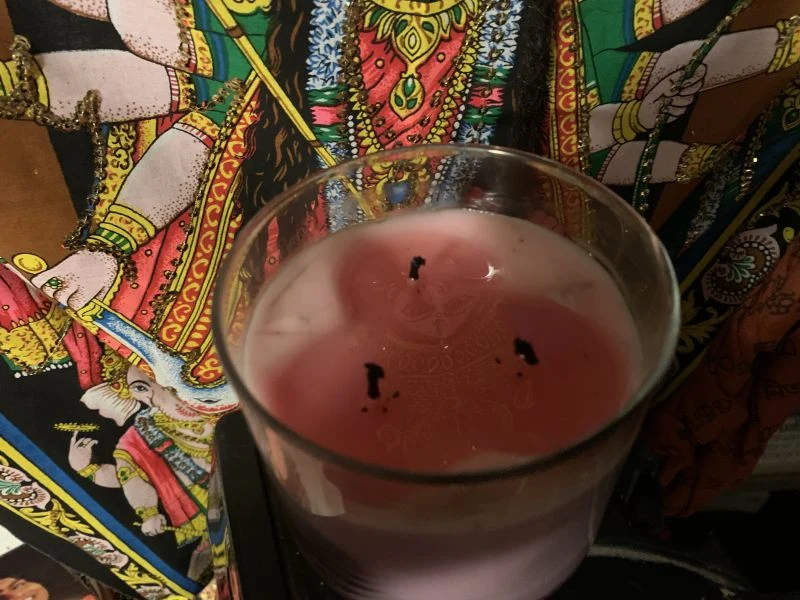
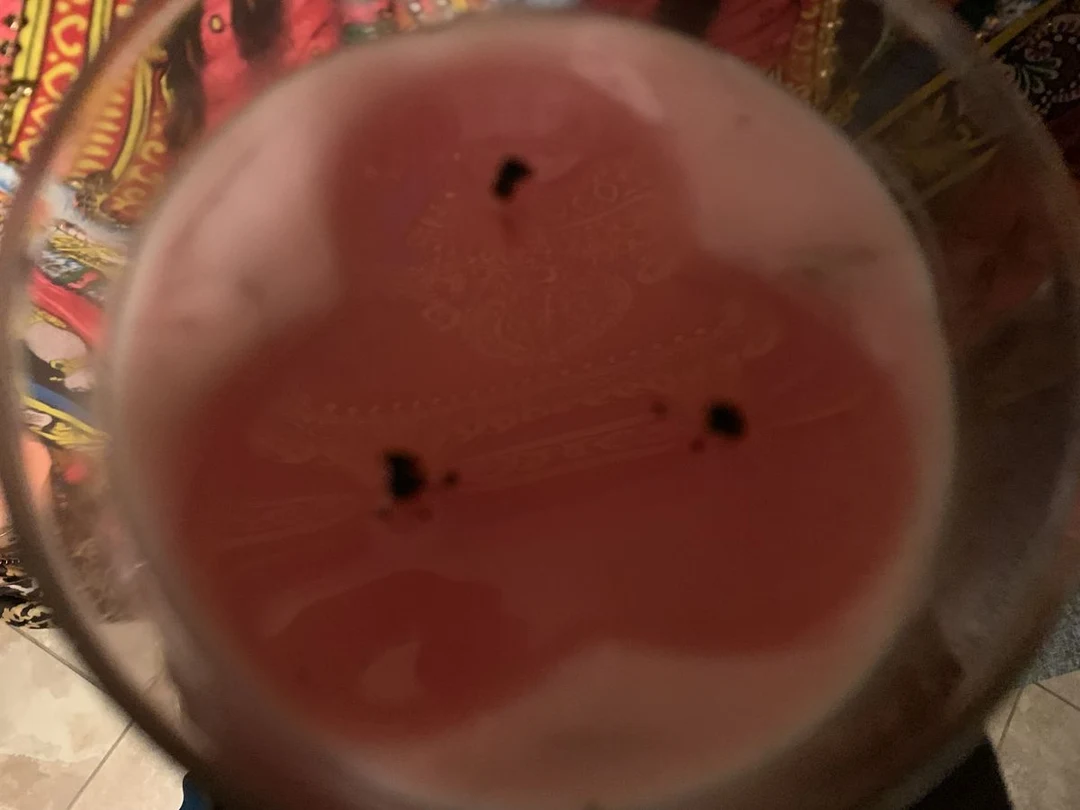
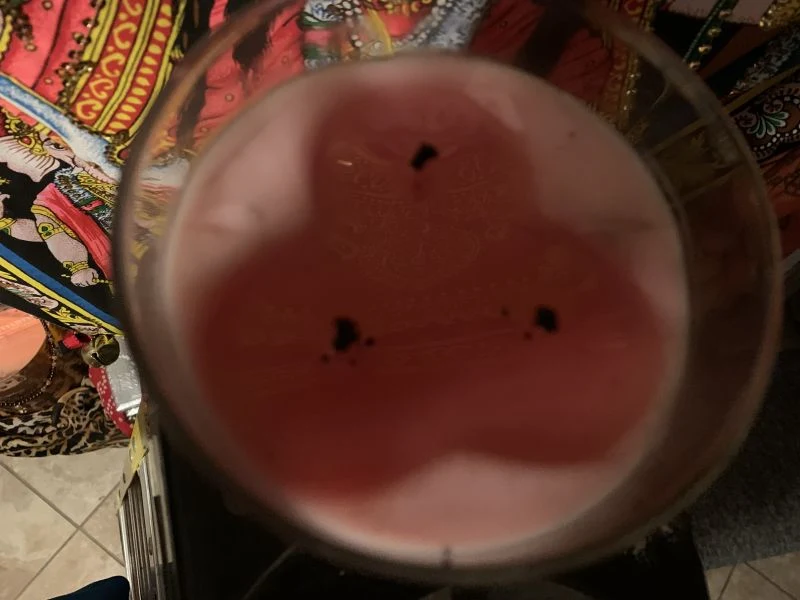
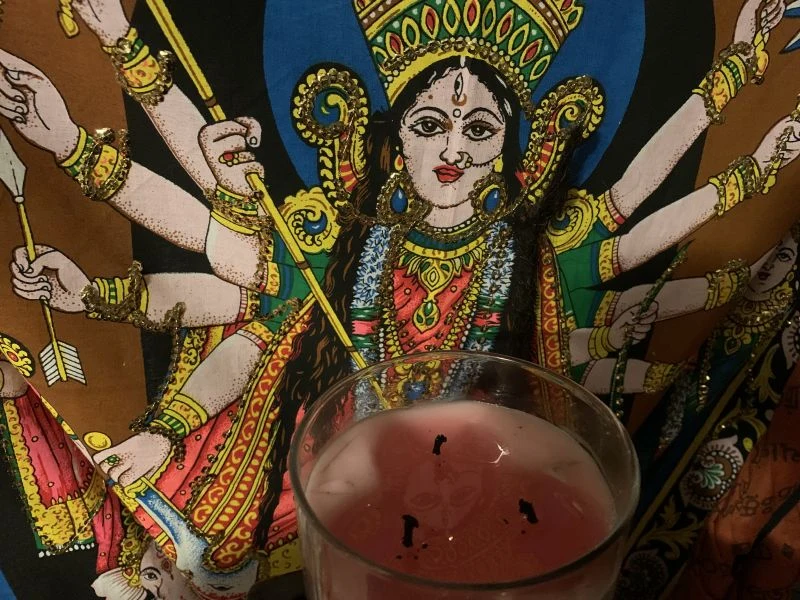
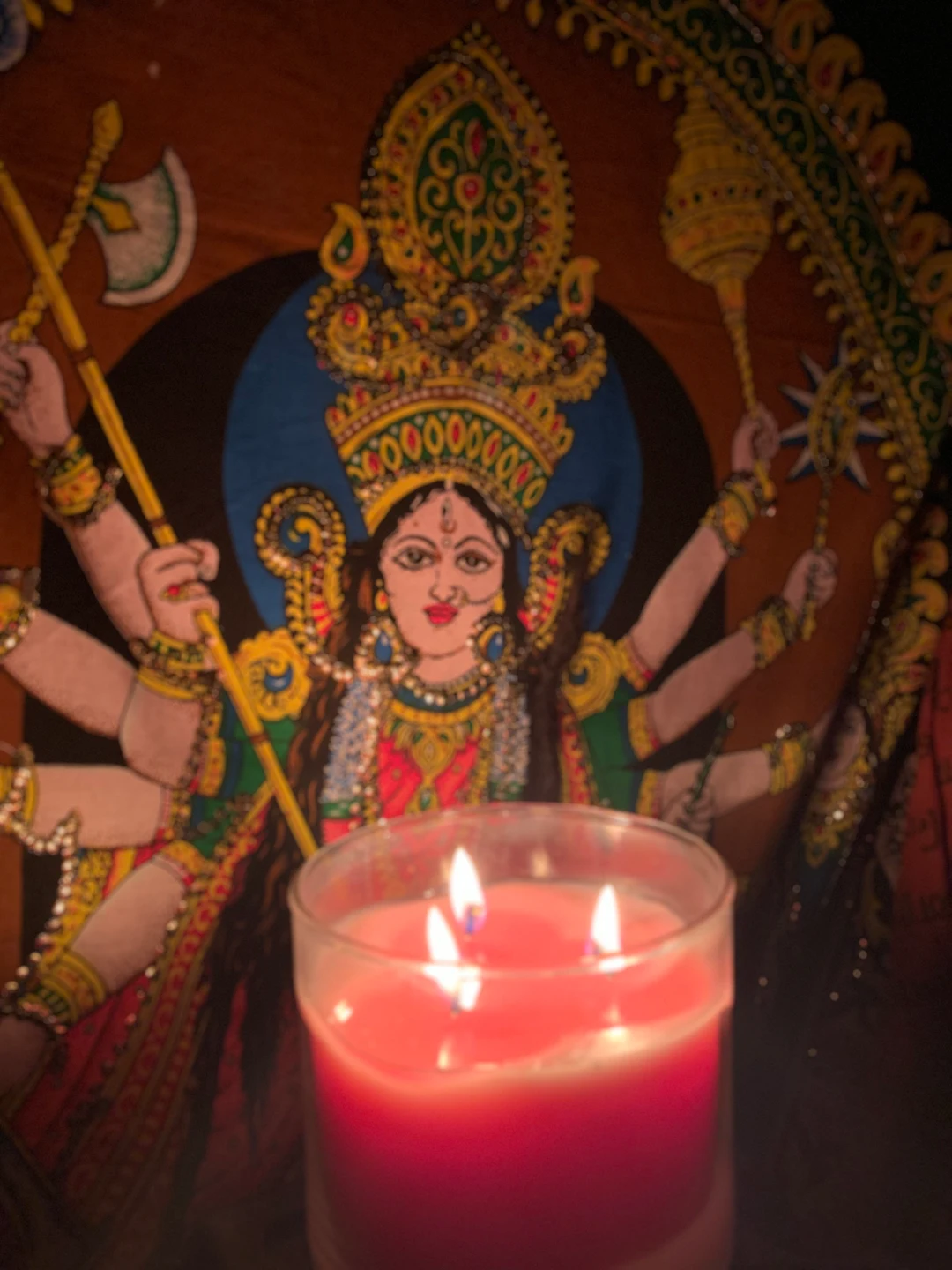
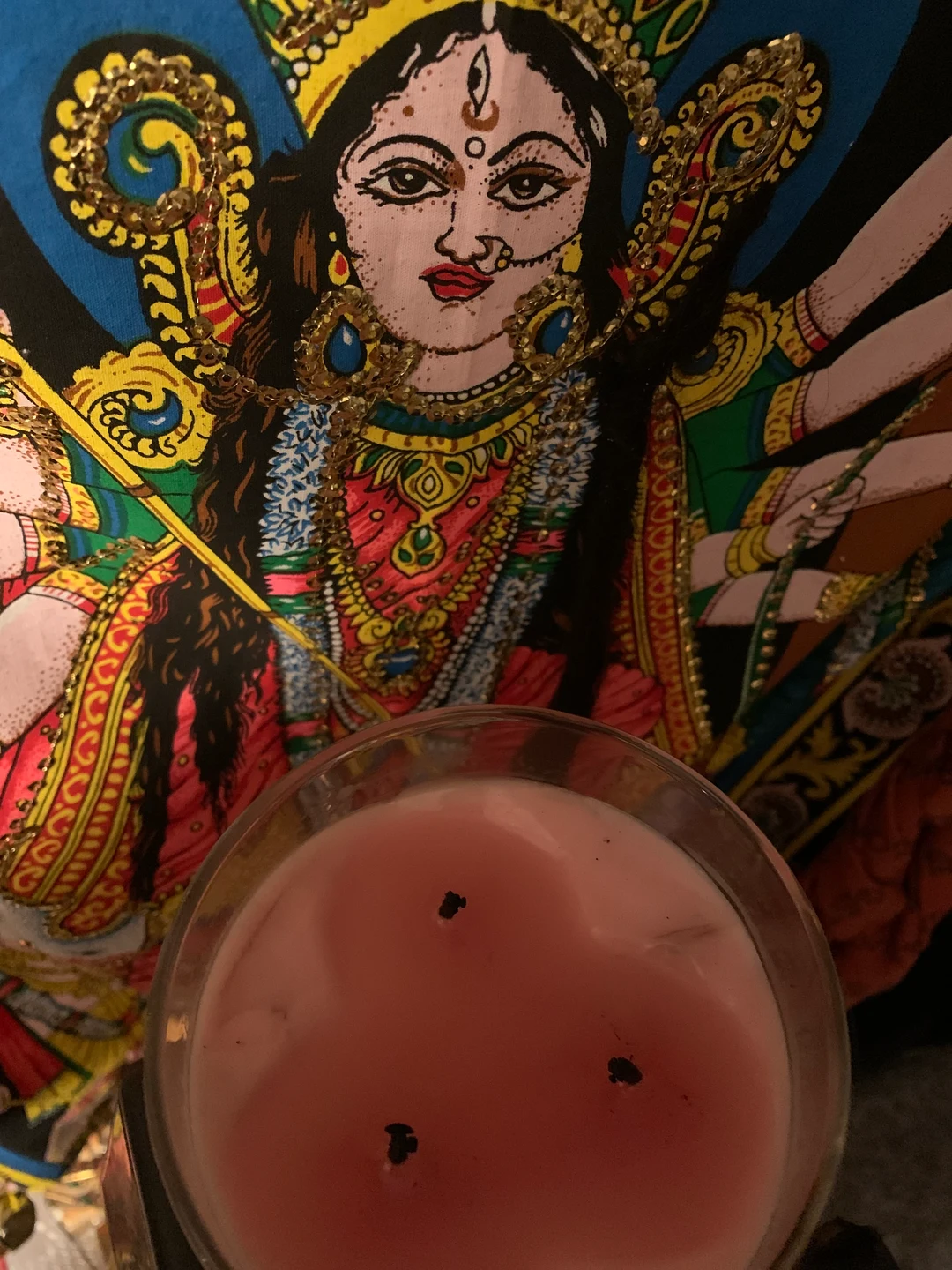
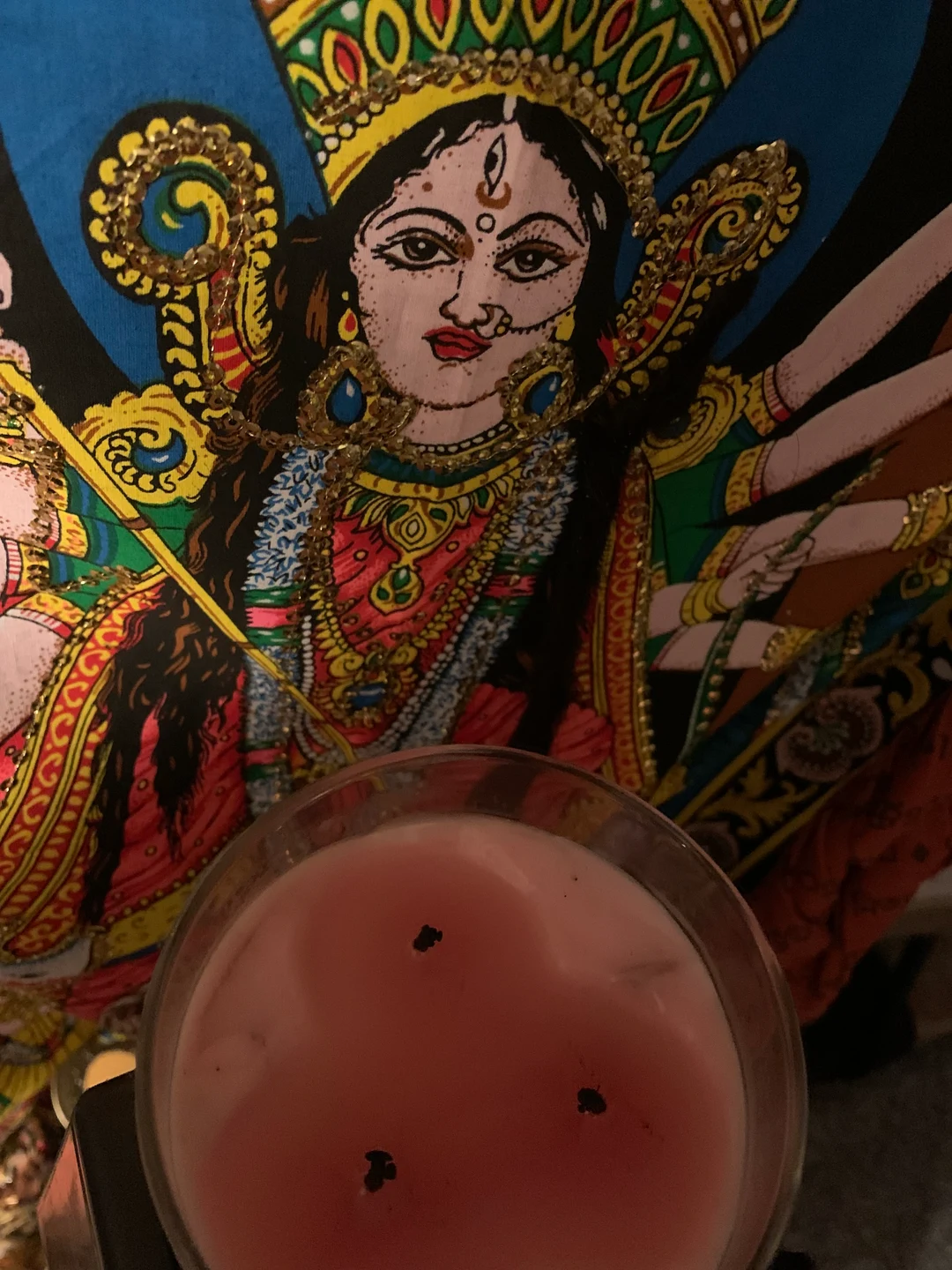
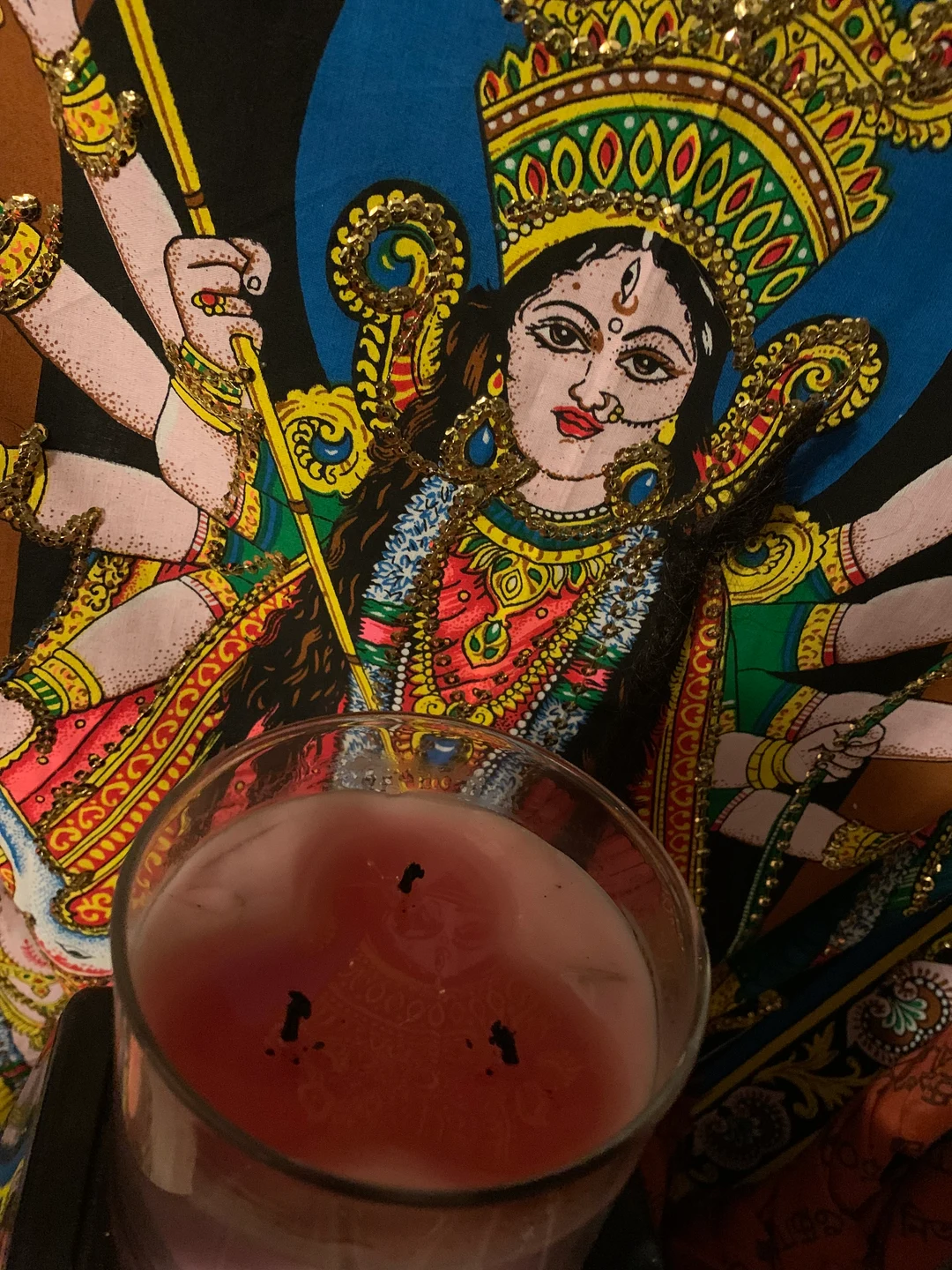
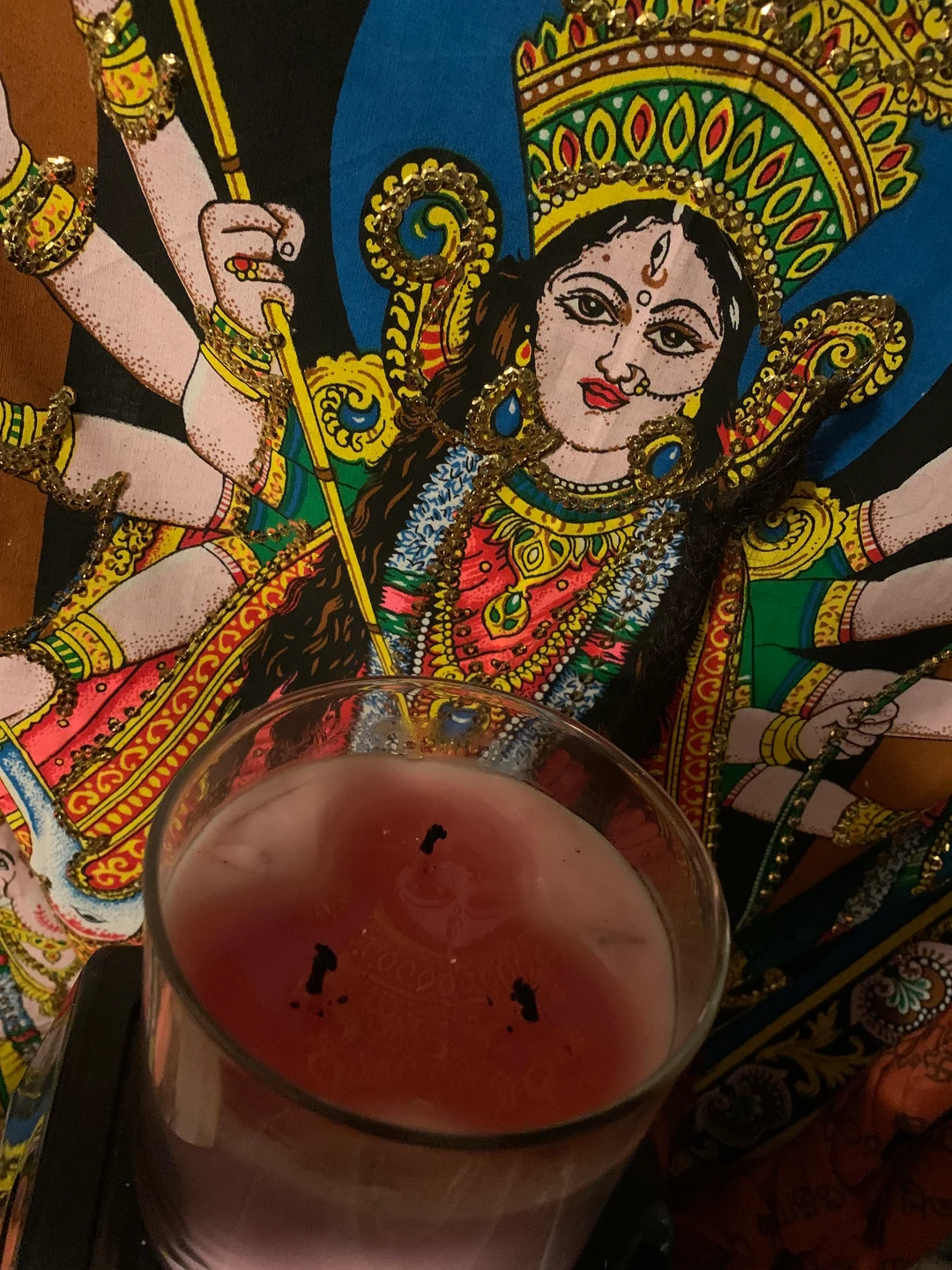
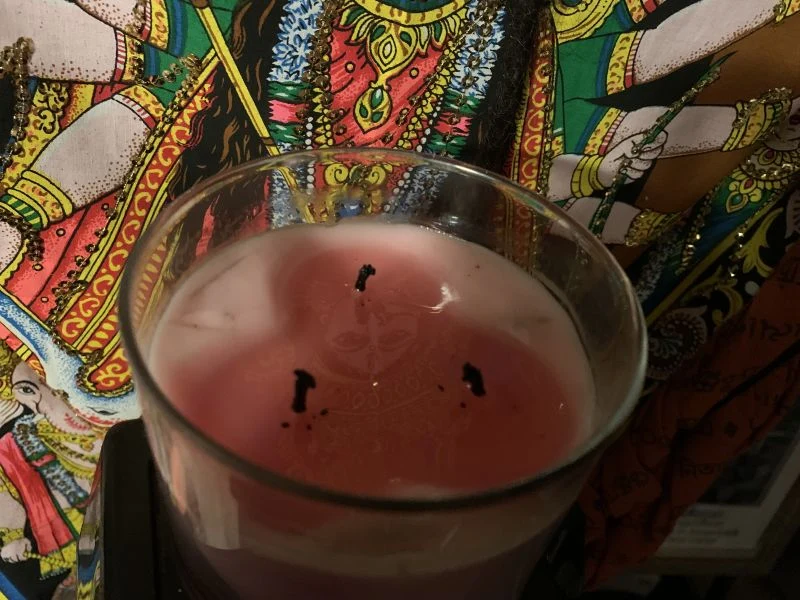
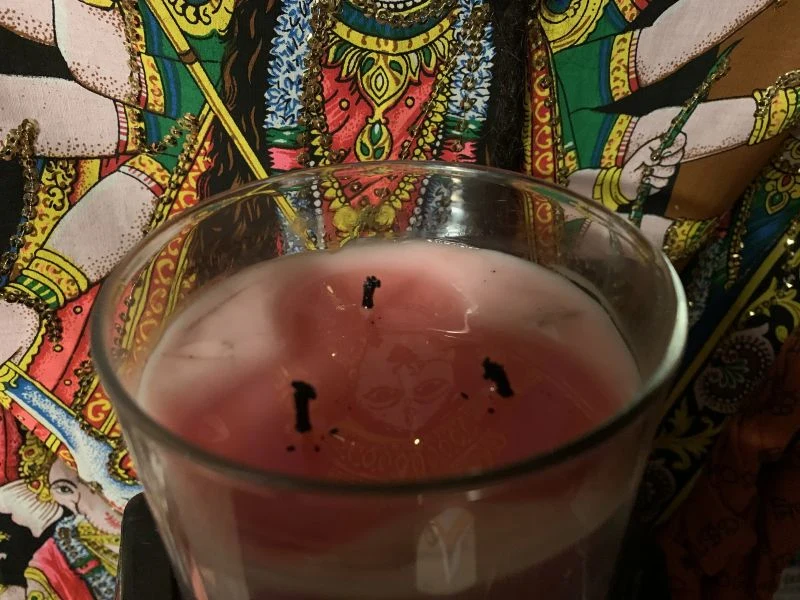
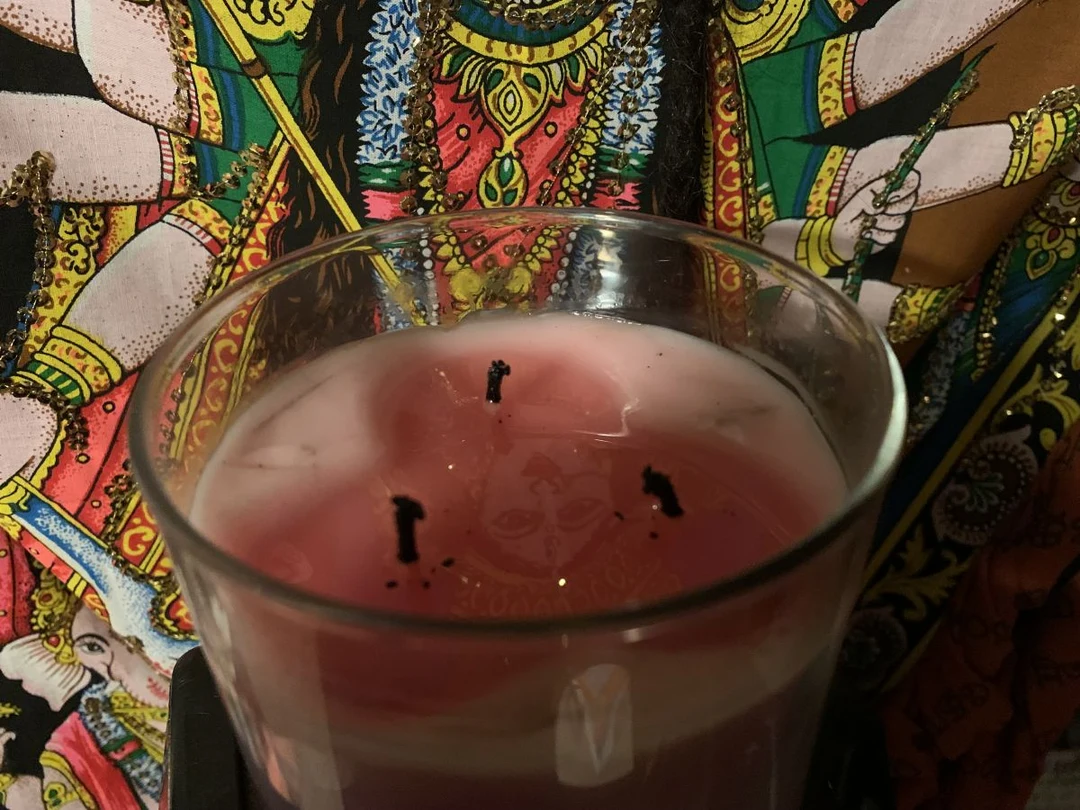
El dia de hoy ocho, ocho que es simbolo de infinidad; se aparecio la diosa madre Durga Ma en la lampara de aceite; este mundo maravilloso donde via las ciencias sagradas de los seres de LUZ tambien a nosotros los seres humanos se nos aparece dios.

Palabras Sagradas del libro Sagrado Vivir la Illuminacion - Cánticos Dichosos Recitar los mantras dichosos o purashcharanam Mantras, son recitadas en el lenguaje védico, Sánscrito. Lo bello del Sánscrito, es que todos los sonidos posibles se describen en sus cincuenta y un sílabas. El lenguaje Sánscrito, no solo trasmite el significado; su sonido fonético, también trasmite una vibración especial junto con ellas. Aún si no entiendes el significado de los mantras, las vibraciones trabajarán sobre ti. Pagina 419

En el Este los mantras en Sánscrito, son usados para las iniciaciones. El maestro emitirá un mantra y el mantra mismo le proporcionará la iniciación que despertará al discípulo. Las vibraciones irán directamente a compenetrar su ser y empezará a trabajar. El Guru mantra es: Om hreem Nithyanandaya namaha En la opinión Hindú, cada acto simple, está implicado, múltiples capas de entendimiento. Este entendimiento sucede, dependiendo sobre el nivel de consciencia de cada individuo. La palabra o sonido ‘Om’ significa, muchas cosas a muchos grados o niveles. Om es el sonido elemental. Toda la Creación, se cree, desprende de el. Se compone de tres sonidos –A, U y M. Las sílabas A (aah) representa a Brama, el Dios Hindú, quien creó el universo; U (uuu) representa a Vishnu, el Dios Hindú, el que sostiene y mantiene el universo, y M (mmm) for Shiva, el Dios Hindú, aquel que destruye y crea espacio para que suceda la siguiente creación, (transforma). La combinación Om, es por lo tanto, la manifestación de todo el universo.

En un nivel más profundo, los dioses están representados en las energías de la creación, sostenimiento y rejuvenecimiento, que sucede al nivel celular en nuestro universo personal, nuestra entidad cuerpo-mente. La vibración del Om, cuando se recita, nos da la respuesta de la madre Tierra. Disuelve el coraje, deseo y las enfermedades psicosomáticas en nosotros. Nos llena con la expansión ilimitada de la madre Tierra. Libera la mente de los pensamientos negativos, despide tremenda energía y rejuvenece el cerebro. Nos trae paz en la mente y gran poder de concentración. Es un trampolín para aquietar la mente y entrar dentro de nuestro Ser.

Hreem es el bija mantra (mantra-semilla) de Devi, el principio sagrado femenino. Los sabios de la antigua India practicaban el recitar de estos sonidos primordiales y experimentaron profundamente a niveles de mente, cuerpo y del ser. Ellos presentaron la ciencia y método de su práctica a la humanidad, de modo que pudiesen experimentar, lo que ellos mismos, los sabios, experimentaron.

Cánticos de los tiempos de los Vedas, son estudios realizados por tales sabios, aquellos que amaron la experiencia máxima, lo que les inspiró compartirlo con toda la humanidad.

Recitar el Om y Hreem juntos, despierta las energías masculinas y femeninas que residen en nosotros. Nithyananda, se recita para invocar el nombre del maestro como la expresión de la verdad máxima. Es el poorna moola mantra (el canto, completo y ‘fuente de todo’), porque es el camino más directo a ambos Shakti o triunfo en el mundo material y Shiva, o triunfo en el mundo cósmico o de la iluminación.

La palabra Nithyananda también significa Dicha Eterna. Atreves de cantar esto, damos una clara intención a nuestro ser y al universo acerca del deseo máximo para la dicha eterna o iluminación.

Namaha, significa, Yo no soy. Al decirlo: Yo no soy, rendimos nuestro ego a la Existencia o al maestro quien es la forma pura de la Existencia. La palabra Namaha, cuando se repite, fortalece la experiencia del rendirse. Trae humildad y obediencia dentro de nosotros.

Pictures from the day
Videos from the day

KAILASA LOETEN, NORWAY on 8/8/2021

Original wiki page
Contents

Daily Update - PDB + Daily pictures

Event Details
Participants Count3
Event TypeOnline
Was Food Served in Event?No
Count of Meals Served
Volunteers Count0
Event Duration3 hrs

Daily routine

Pictures from the day

KAILASA OHIO, USA on 8/8/2021

Original wiki page
Contents

Daily Update - PDB + Daily pictures

Event Details
Participants Count4 for Yoga and 4 for Puja
Event TypeOnline
Was Food Served in Event?No
Count of Meals Served
Volunteers Count0
Event Duration100 min

BrahmaMuhurta Yoga and Puja

Pictures from the day

KAILASA SEATTLE, USA on 8/8/2021

Original wiki page
Contents

Daily Update - PDB + Daily pictures

Event Details
Participants Count10
Event TypeOnline
Was Food Served in Event?No
Count of Meals Served
Volunteers Count5
Event Duration

"We start the day with performing the Suprabatham seva. It is the sacred process of waking up the deities. Morning Naivedhyam was offered to Moolavar.

Evening PPP was offered to SPH JGM HDH Bhagawan Nithyananda Paramashivam. Morning naivedhyam was offered to Moolavar. Evening naivedyam was offered to moolavar & HDH Nithyananda Paramashivam. We concluded the day with Palliarai Seva - The sacred process of putting the deities to sleep.

We continuously enrich the local community by conducting Vaakyartha Sadas session, Paramashiva Dhyana Mantra session and by creating posts across various social media platforms with the sacred truths revealed by HDH, darshan pictures of the deities and by going live during Bhava Samadhi Darshans & satsangs."

Presidential Daily Briefing

KAILASA-SEATTLE--USA-2021-08-08-1lGMmaxpQdW6HtbLyvi6z0dSArZ1BHLNR.pdf

Pictures from the day

KAILASA SINGAPORE on 8/8/2021

Original wiki page
Contents

Daily Update - PDB + Daily pictures-Temple Seva & enriching activities

Event Details
Participants Count31
Event TypeBoth
Was Food Served in Event?No
Count of Meals Served
Volunteers Count3
Event Duration3.5 hrs

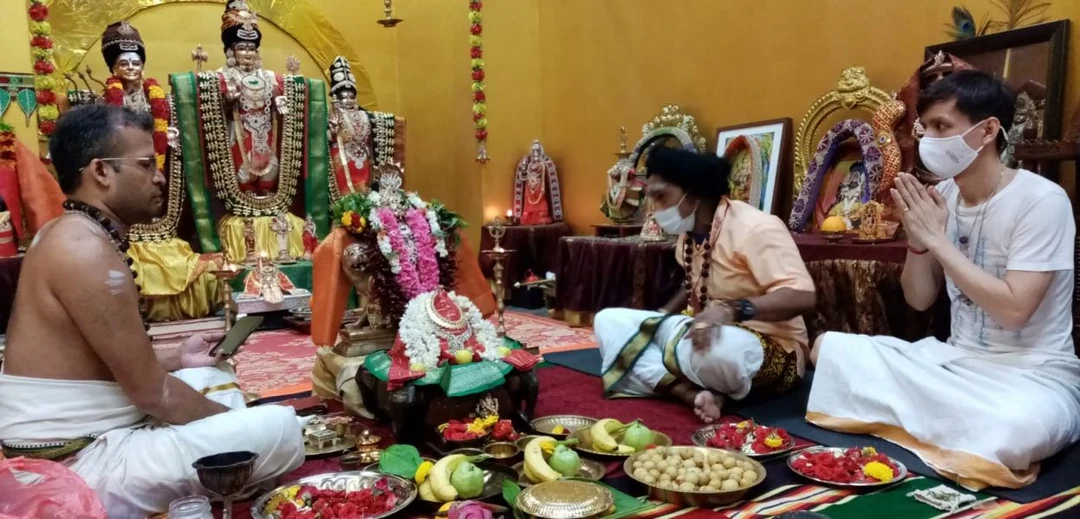
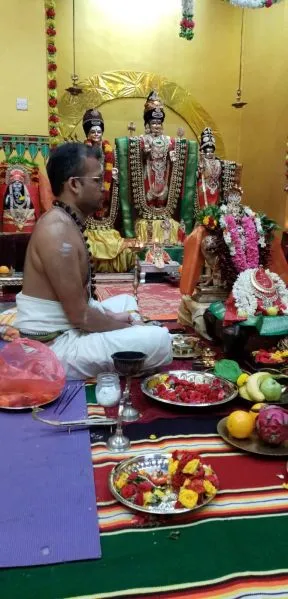
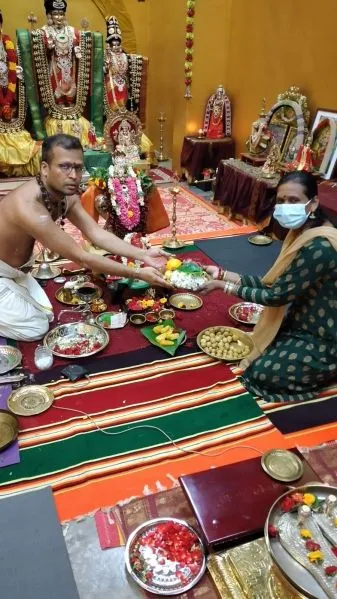
Sunday, 8th Aug 2021 - Today's temple sevas and enriching activity included:

1) Online Nithyananda Yoga - At 5 am, 4 lives were enriched for the daily Yoga spiritual routine of Prathama Vinyasa krama conducted by our yoga acharya, Sri Yogajnanananda.

2) Temple sevas - Today's morning seva was offered by Ma Kher Jia which began with Suprabatham - waking up the deities, offering Paduka puja to Swamiji, Naivedyam puja - offering sacred food to deities , Jnanalaya puja - offering puja to Devi Saraswathi. Finally, palliyarai - putting the deities to sleep - was offered by Sri Yogajnanananda.

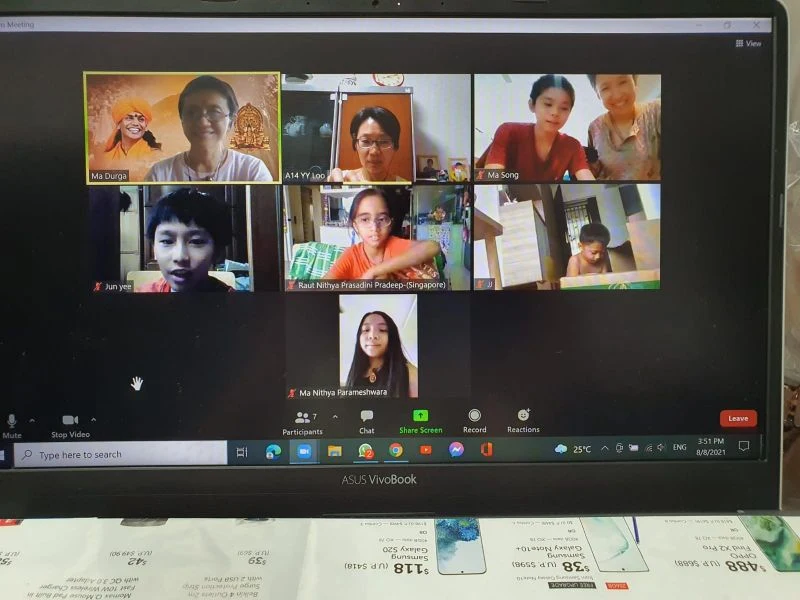
3) Vedic Puranas of 63 Nayanmars - Today 5 kids and64 parents attended the online story-telling of Cheraman Perumal nayanmars. The kids learned from this saint who accepted the divine's will to be a king out of his devotion. When he didn't hear the anklets sounds of Lord Nataraja, he thought he had committed a sin and wanted to end his life. Paramashiva stopped him and told him the reason. He ruled justly and wisely and attained devotion at Paramashiva's abode.

4) Amavasya Prathyangira Devi Puja @7pm - We offered puaj to Devi Prathyangira, the divine feminine energy that breaks all negative energy, effects of evil eye and dark energy which stops us from following our spiritual path and prosperity. Prathyangira Devi is worshipped on the night of Amavasya when negative energies are more active, by terrorising and destroying them completel A total of 15 participants attended online to receive Her blessings.

  1. templeseva
  2. Kailasa
  3. yoga
  4. 63nayanmars

Presidential Daily Briefing

KAILASA-SINGAPORE-2021-08-08-1ukSVhZYy24iazKTLjhrxTljNe4aybawC.pdf

Pictures from the day

Photos from this day

View all 82 photos

FB-Photos-of-the-Day

6 photosSource gallery
Close-up photograph of a man seated before an ornate golden throne with carved lion-face motifs and gold drapery behind him. He wears a large black turban wrapped high on his head, white vertical forehead markings, and multiple strands of brown rudraksha beads with gold spacers draped over bare shoulders. A probable Swamiji depiction: the black turban, bare-chested ceremonial look and rudraksha malas are present, but the visible cues are limited to this single frame, so the identification is an appearance-based candidate only.Close profile photograph of a bare-chested man with eyes closed in meditative stillness, wearing a tall black wound turban and a broad white band of sacred ash across the forehead. He wears multiple strands of brown rudraksha beads spaced with gold-toned separators, and the background is gold draped fabric with an ornate gilded carved element at right. The composition is warm and golden-toned.Close photograph of a bare-chested man with eyes closed and a faint smile, seated before an ornate gold-embossed throne. He wears a large black turban, a white vertical mark on his forehead, and multiple strands of rudraksha beads with gold spacers draped over his chest, with a thin gold chain visible. The white ash-like marking also appears on his neck and upper arm. A small white copyright-style credit appears at the lower right corner. Appearance cues (turban, rudraksha malas, ornate gold setting) are consistent with Swamiji (probable) seated in a ceremonial role during a Maheshwara Puja livestream.A photograph of a smiling bare-chested man seated on an ornate gilded throne with lion-face carvings, raising both open palms toward the viewer. He wears a large black turban-style hair bun, a white vertical tilak on his forehead, a long rudraksha mala with ceremonial beads, and a thin ochre bracelet. Flanking him are gilded deity statues holding ornate golden fans or umbrella-like standards, with a maroon curtain behind.A bare-chested man with a large black turban and white vertical tilak sits smiling on an ornate gold throne with lion-head carvings, raising both open palms toward the viewer in blessing. Multiple rudraksha malas hang on his chest, and a gold-colored deity figure with multiple arms stands at the left beside a gold ceremonial fan-shaped staff with a decorative top at the right. Burgundy and gold drapes form the backdrop.A seated man in a golden throne raises both open palms in blessing, smiling. He wears a tall black turban, white sandalwood marks on his forehead and chest, a long necklace of rudraksha beads with white spacers, and a red-brown wrist cord, and is bare-chested. Behind him a gilded throne with lion-face carvings and a maroon curtain frames the scene. To the left stands a golden deity murti holding a ceremonial fan-shaped umbrella, and to the right a second gold parasol-type ornament. The man appears to be the probable Swamiji, identified only by his rudraksha mala, turban and throne setting, with the throne and rudraksha as key cues.

Pictures from the day
10 photosSource gallery
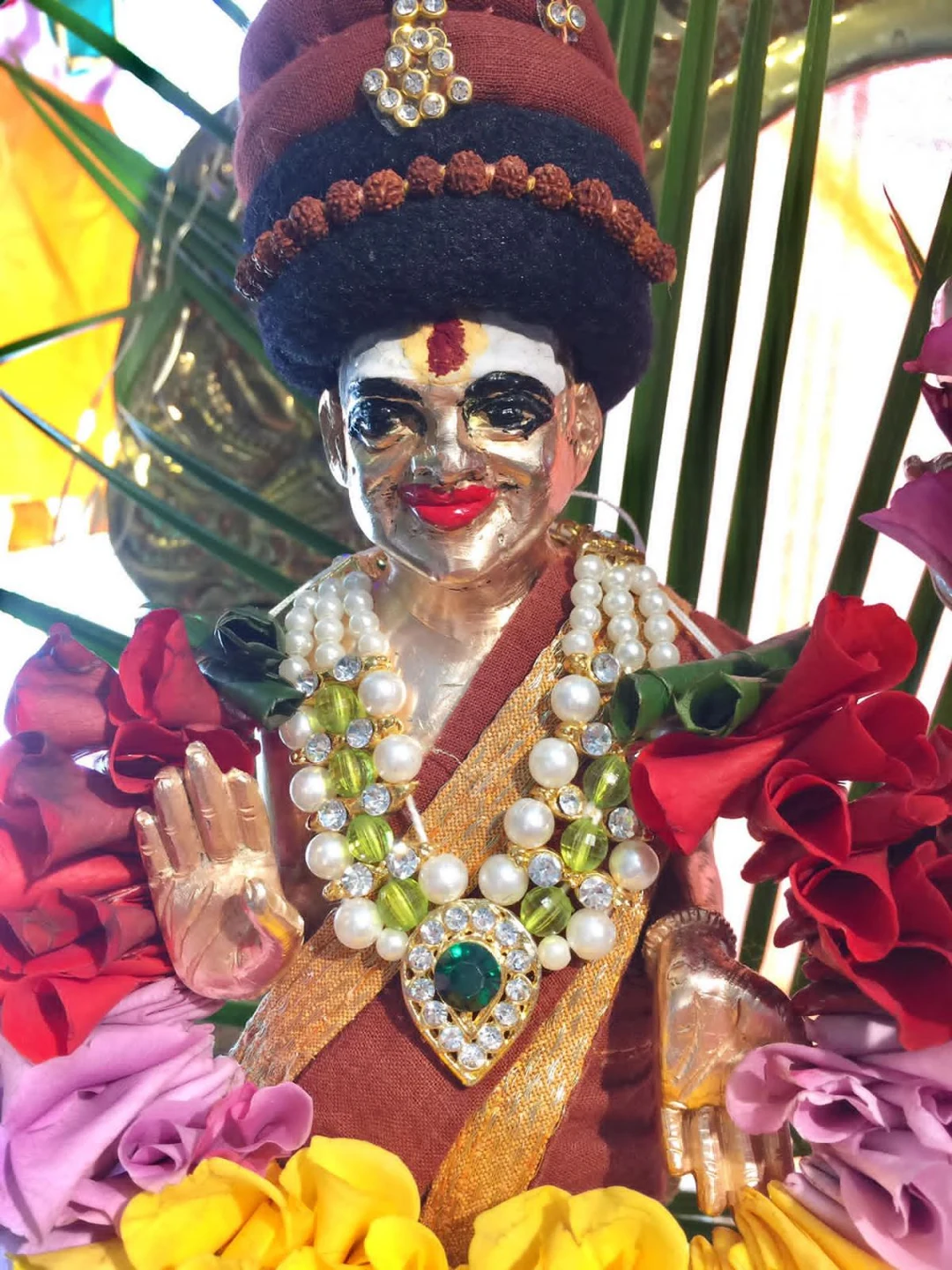
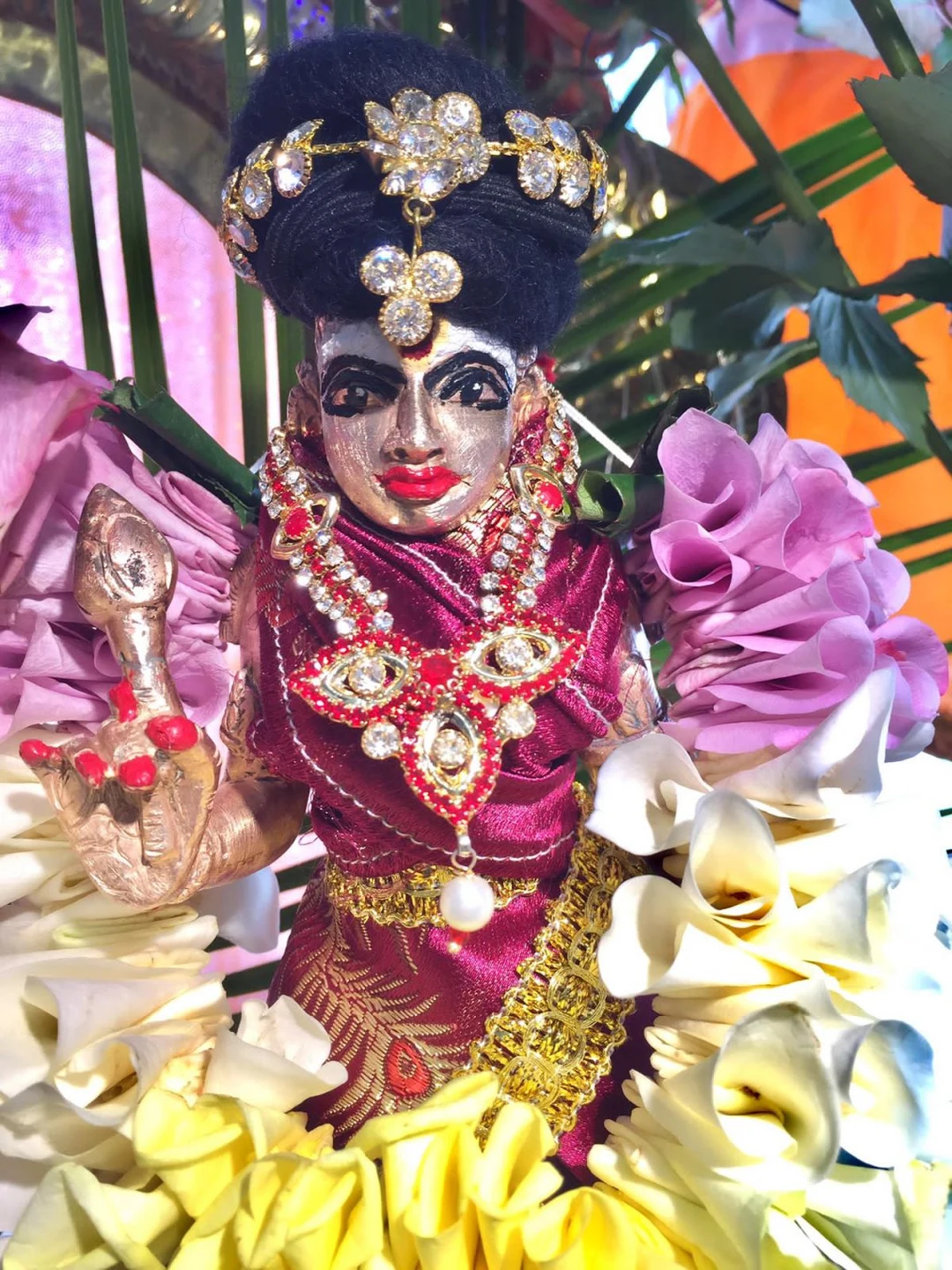
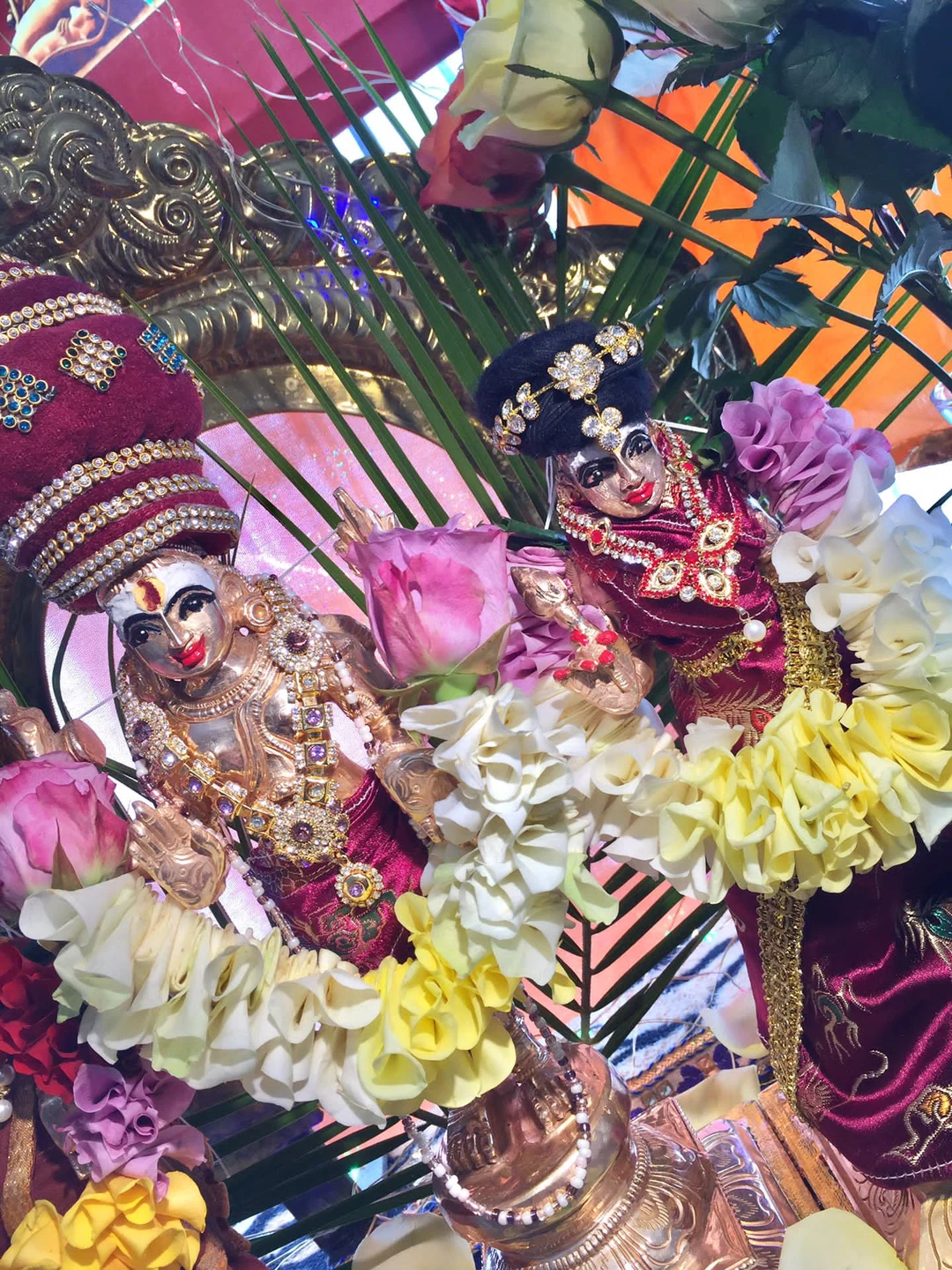
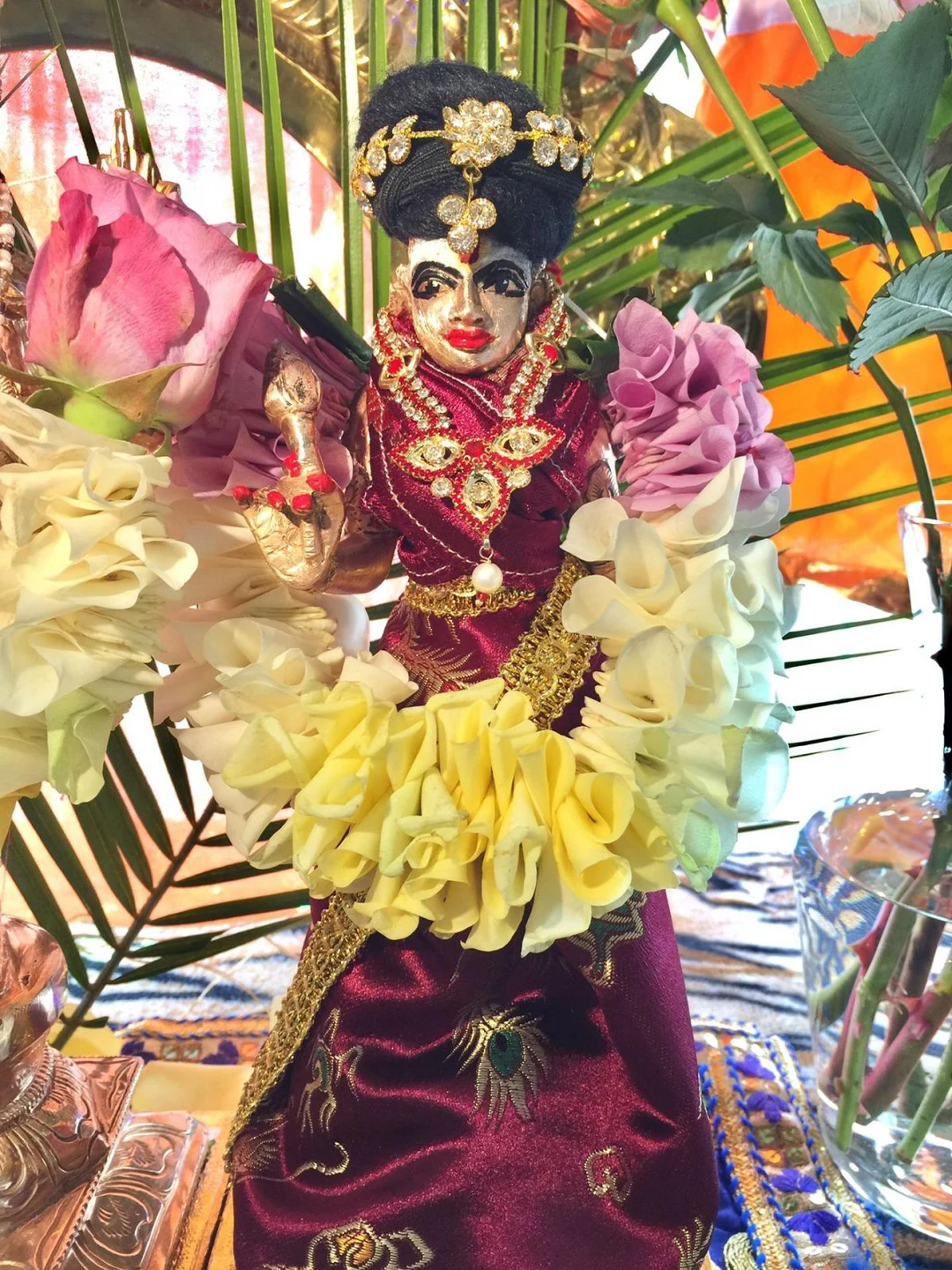
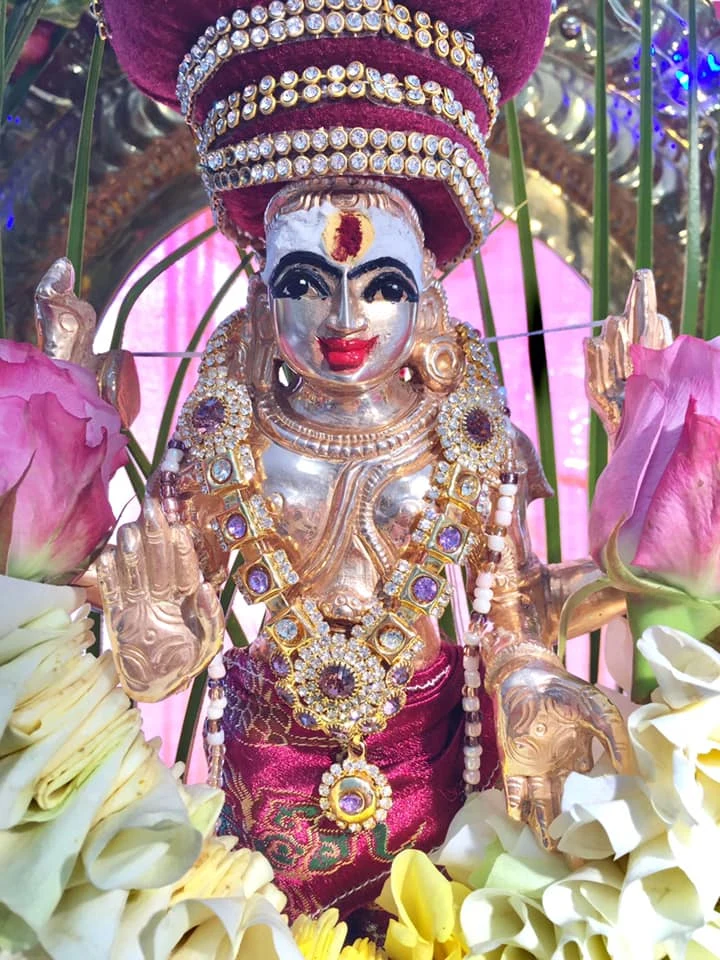
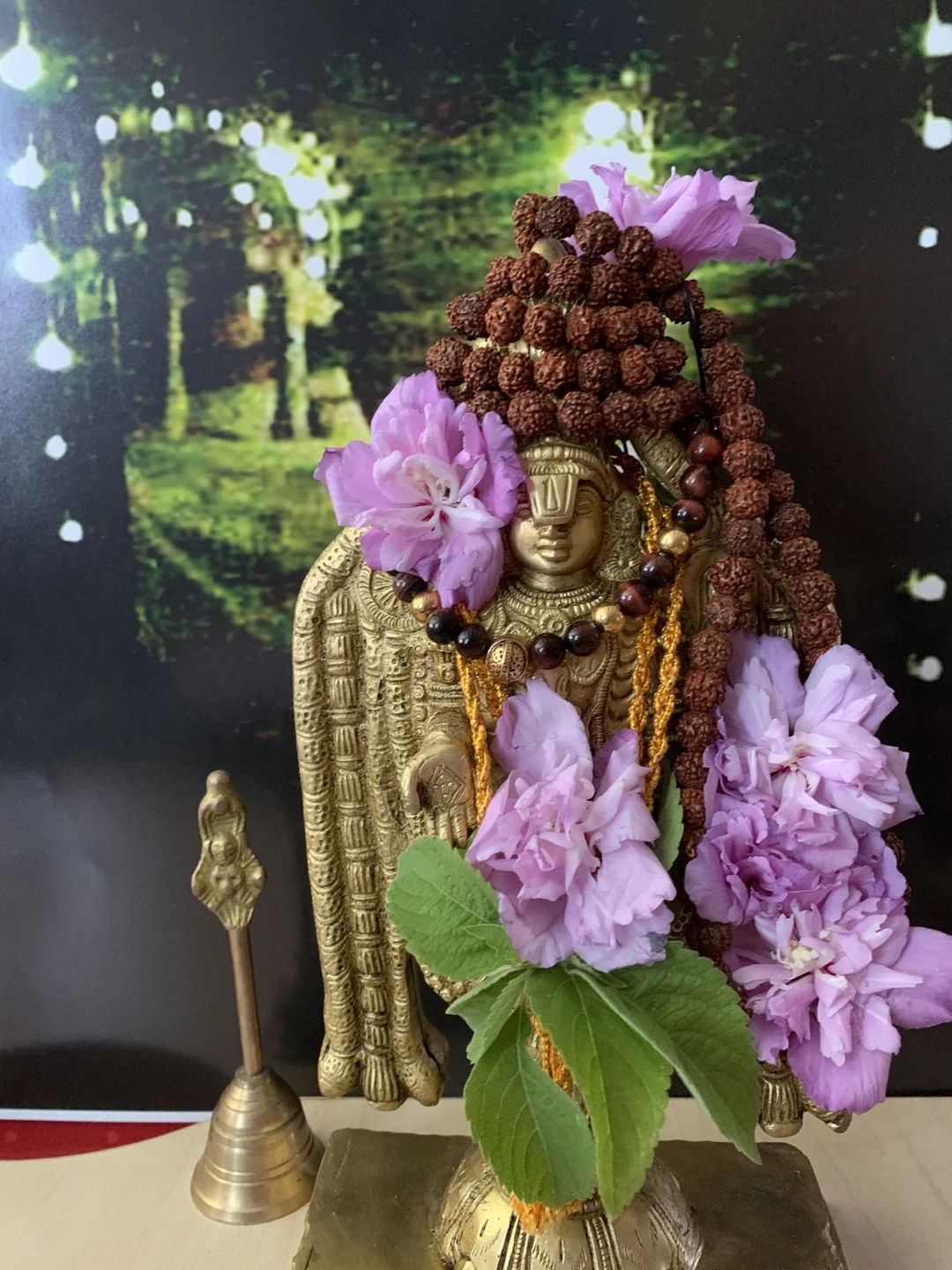
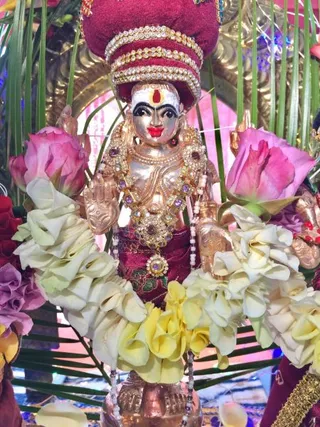
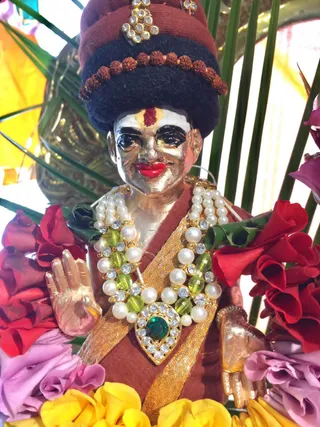
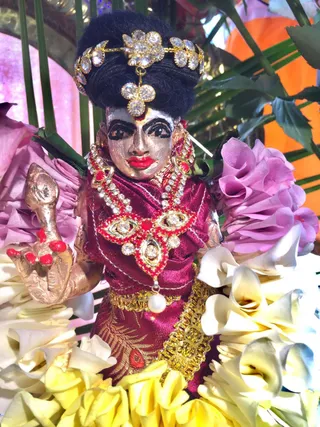
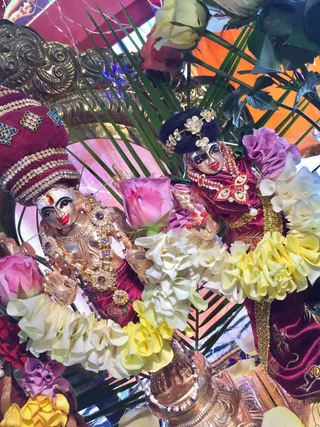
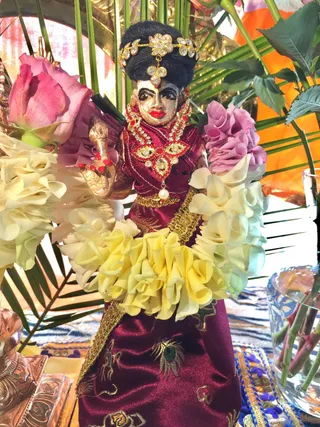
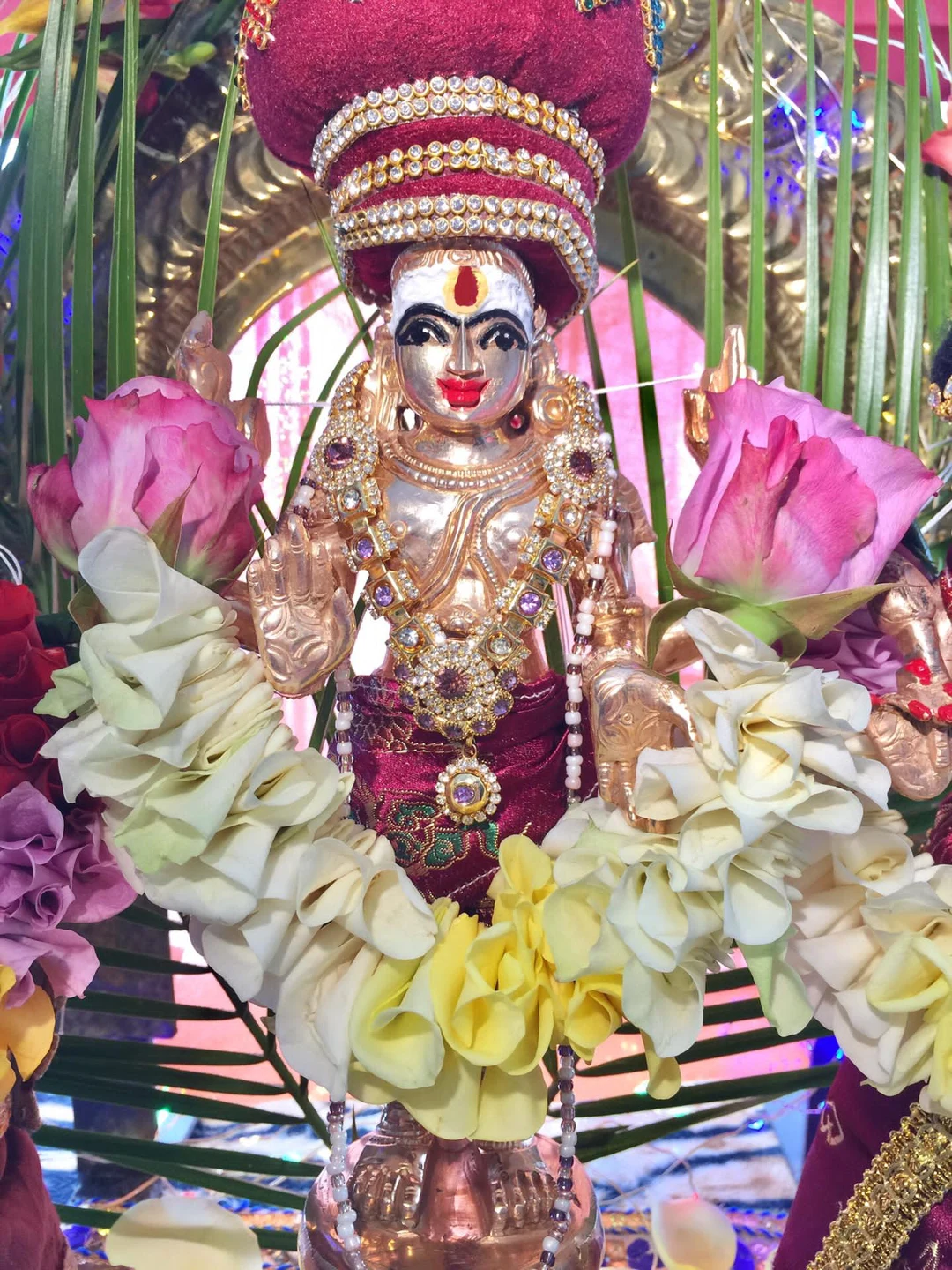
A decorated metal murti of a deity stands at centre, adorned for alankaram. The figure wears a tall maroon velvet crown edged with rows of white stones, a red tilak on the forehead, and jewelled gold necklaces set with purple and clear stones. Its hands are raised in blessing and holding a sceptre-like object. Cream and yellow flower garlands drape the figure, with pink roses and green palm fronds framing it behind, and a maroon silk dhoti is visible at the waist. Petals are scattered at the base. No physical people are present.A small gilded murti of a saint figure is the main subject, decorated for alankaram. It wears a tall dark brown-and-black turban wrapped with rudraksha beads and a jeweled ornament, a rust-brown garment with a gold-bordered sash, and a layered necklace of white pearls, green beads and crystal stones with a green central pendant. The raised right hand shows abhaya mudra. The figure is surrounded by red, pink and yellow flowers and green palm fronds.Close view of a small metal deity murti decorated for alankaram. The murti has a painted silver-toned face with red lips and kohl-lined eyes, and wears a tall black hair bun crowned with a jewelled headpiece. It is draped in a magenta satin garment with gold brocade borders, layered with red and crystal-studded necklaces and a pearl pendant. One hand is raised in a gesture with red-painted fingertips. The murti is surrounded by white and yellow flowers, pink roses and green palm leaves, with an orange and pink backdrop behind.Close photograph of two ornately dressed deity murti figures on an altar, decorated for abhishekam and alankaram. The figure on the left wears a maroon velvet crown studded with white stones and green and blue gems, a gold and jewelled necklace, and holds a flute. The figure on the right has dark hair with a jewelled headpiece and wears a maroon velvet garment with a red and white jewelled collar. Both are surrounded by white, yellow and lilac rose garlands, pink roses, green palm leaves and a gilded kalasha-like base, with an orange backdrop behind.A small deity murti, a female figure with a dark upswept bun crowned by a jewelled headpiece, is dressed in a deep maroon satin sari with gold brocade borders and peacock-like motifs. She wears layered jewelled necklaces, a red and gold pendant, and holds a golden lotus-like object tipped with red. She is framed by pink roses, lilac flowers, cream and yellow ruffled petal garlands, palm fronds and a glass vase of rose stems, with a copper vessel and embroidered cloth at the base.A small golden-faced deity murti dressed in a brown sari-like garment with gold border, decorated with layered red, pink and yellow flower garlands, a pearl and green stone necklace, and a tall black and brown headdress with rudraksha beads. The murti stands among green palm leaves and large pink and cream roses, with an orange cloth behind and a blue-and-gold patterned cloth below. No physical people are visible.

Pictures from the day
45 photosSource gallery
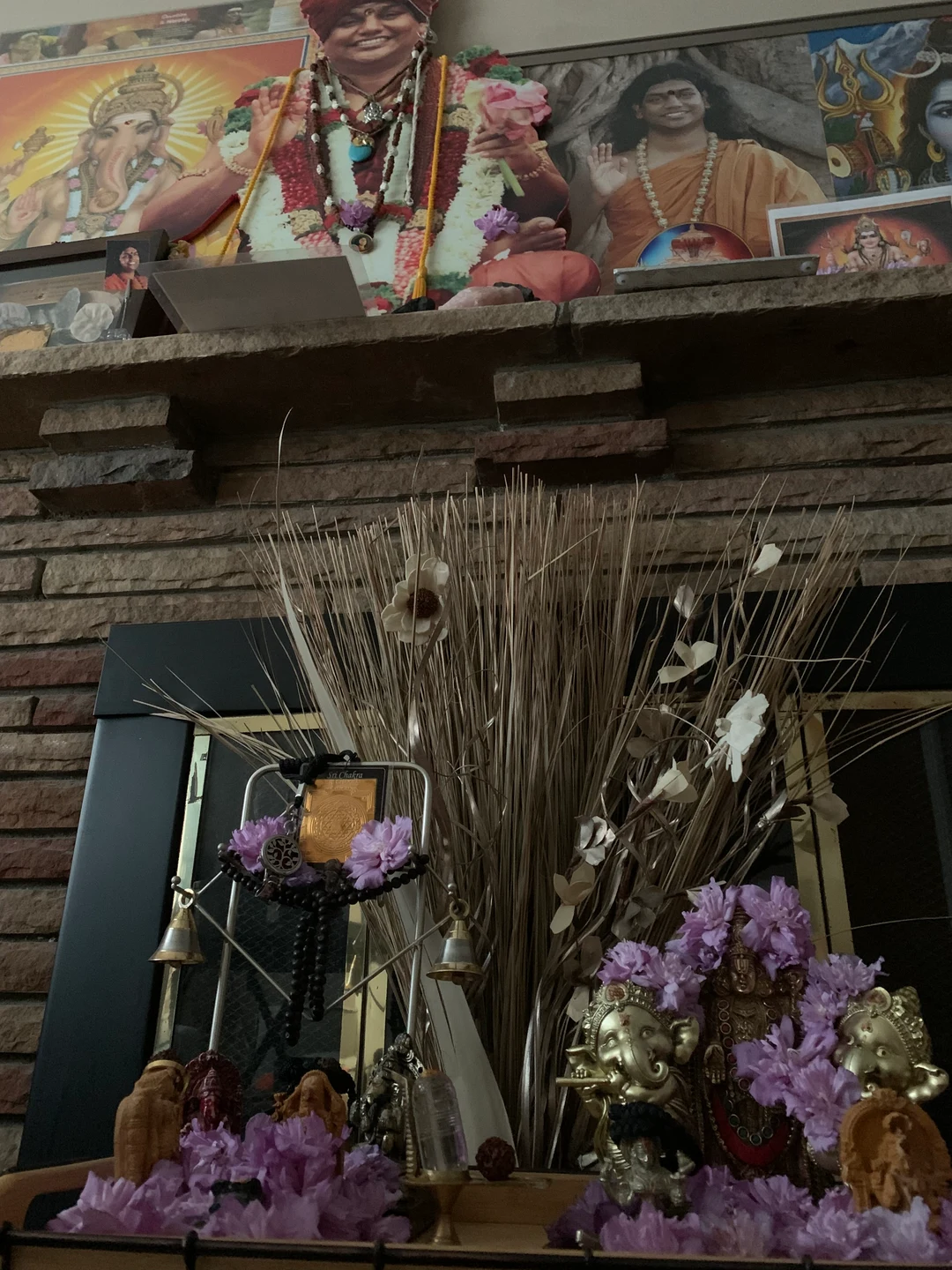
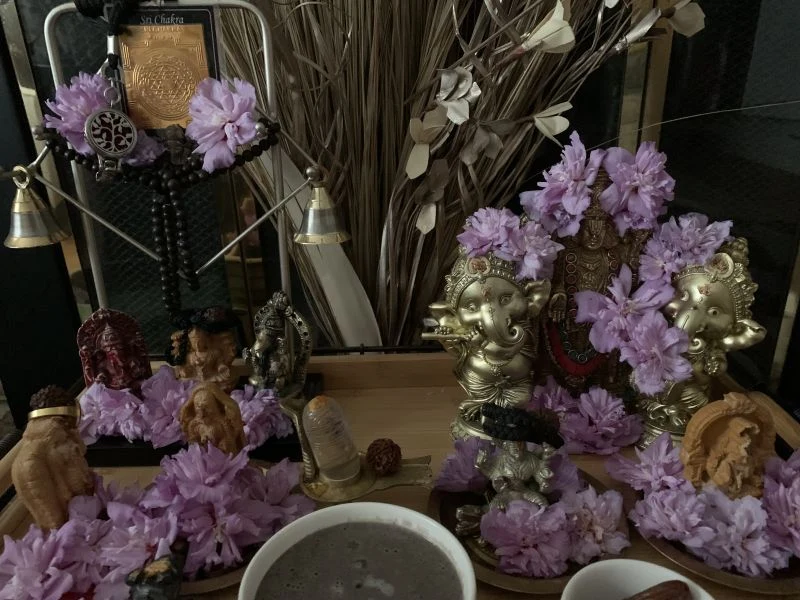
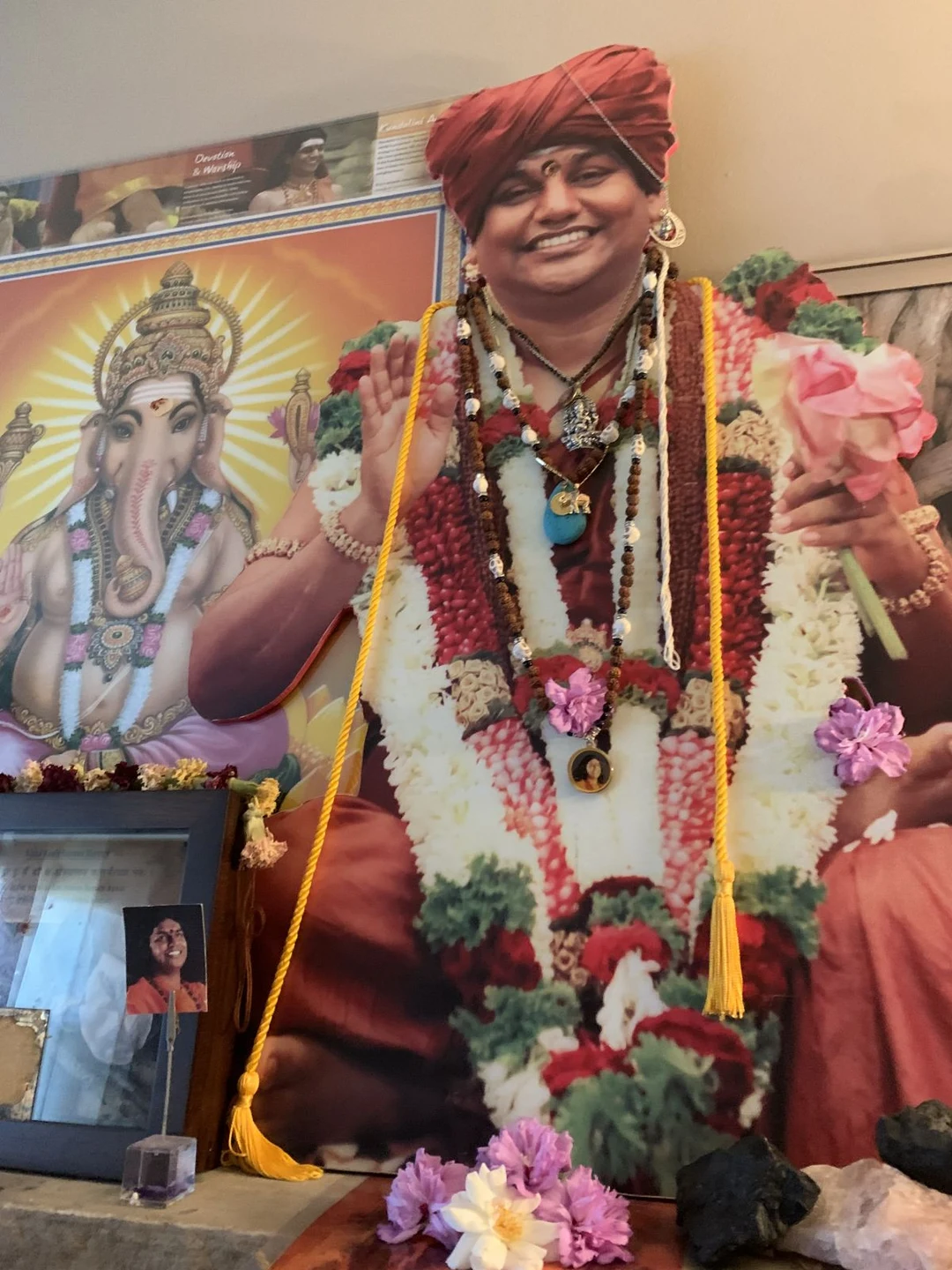
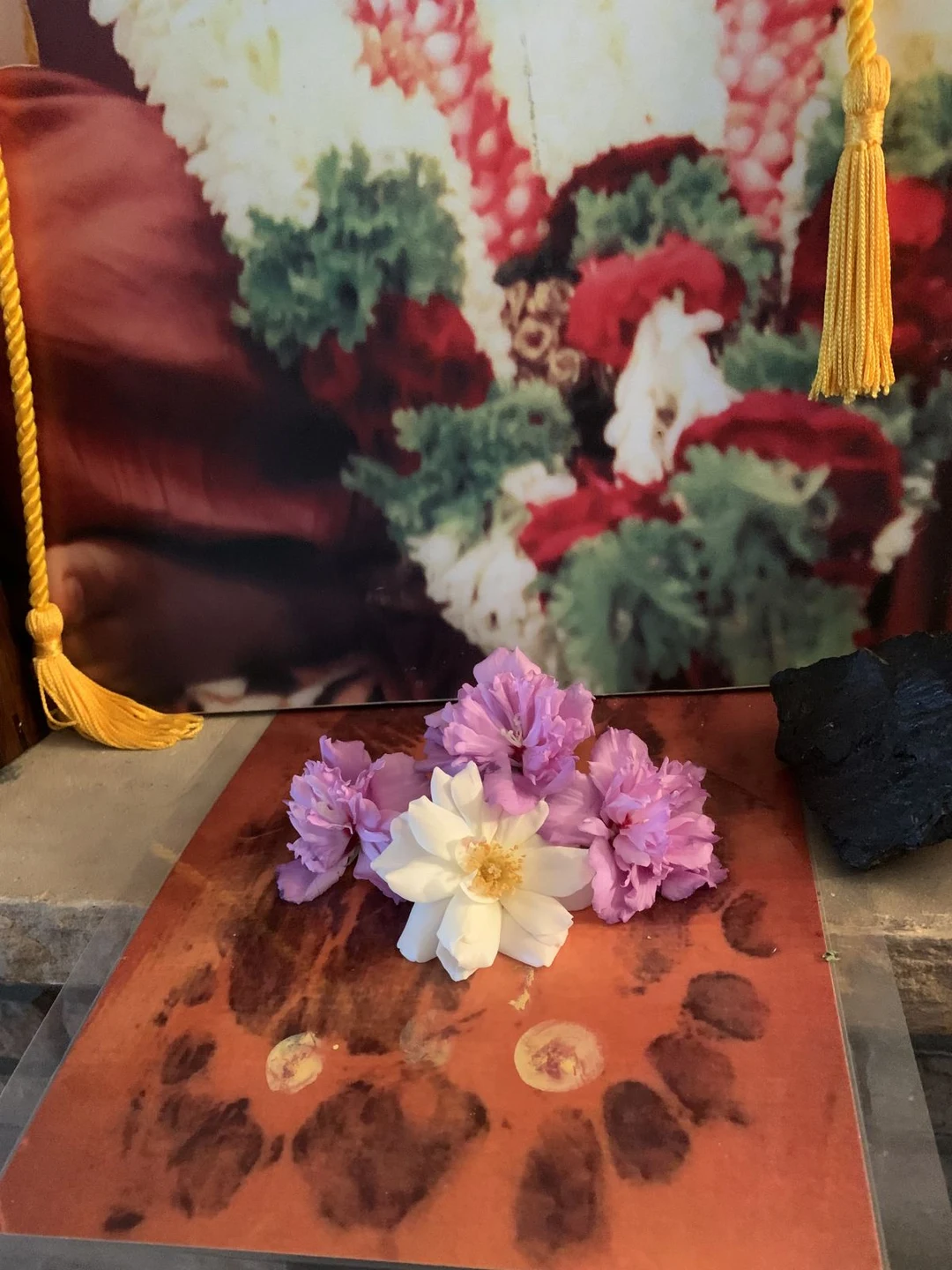
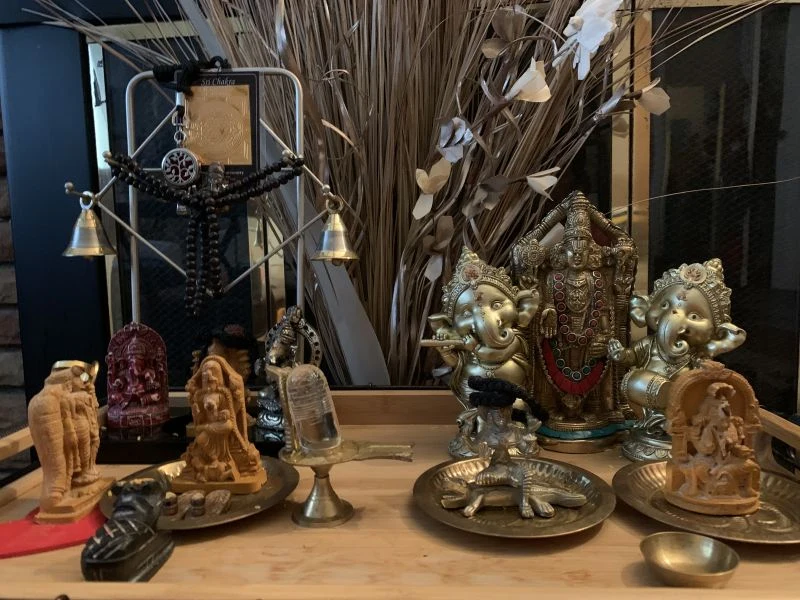
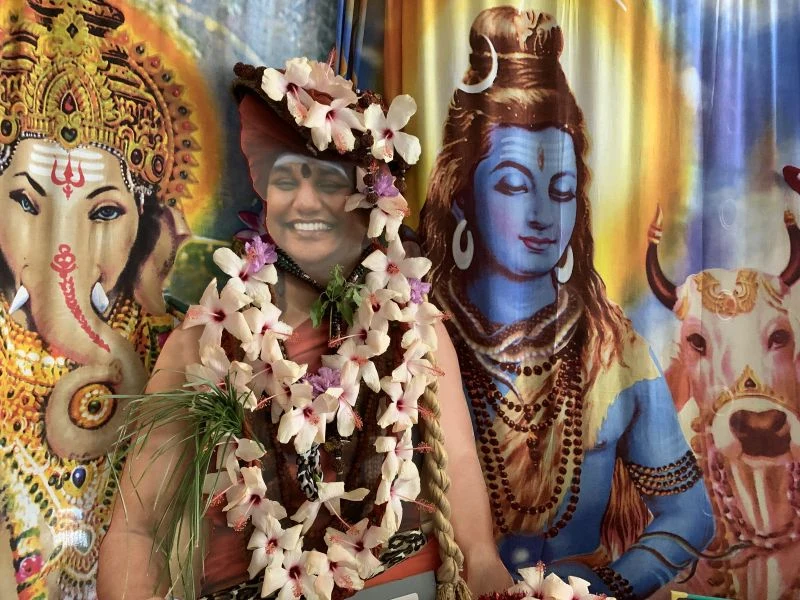
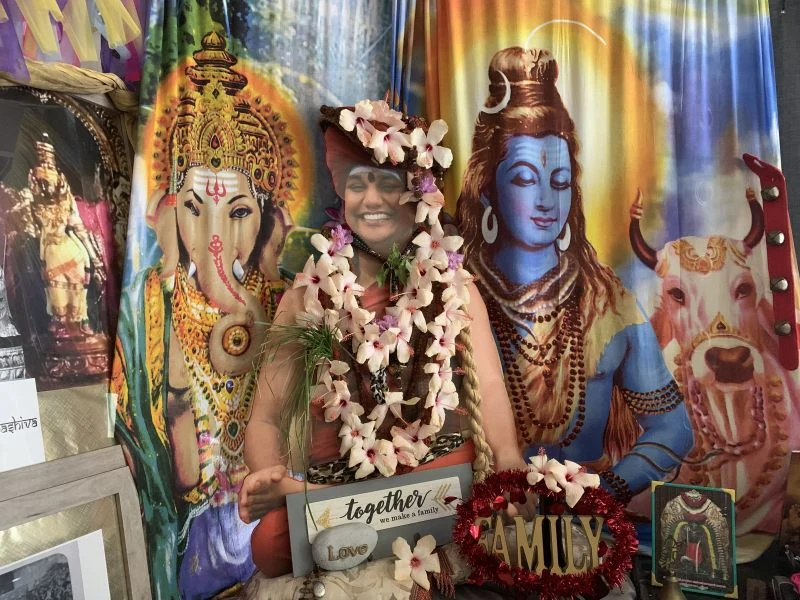
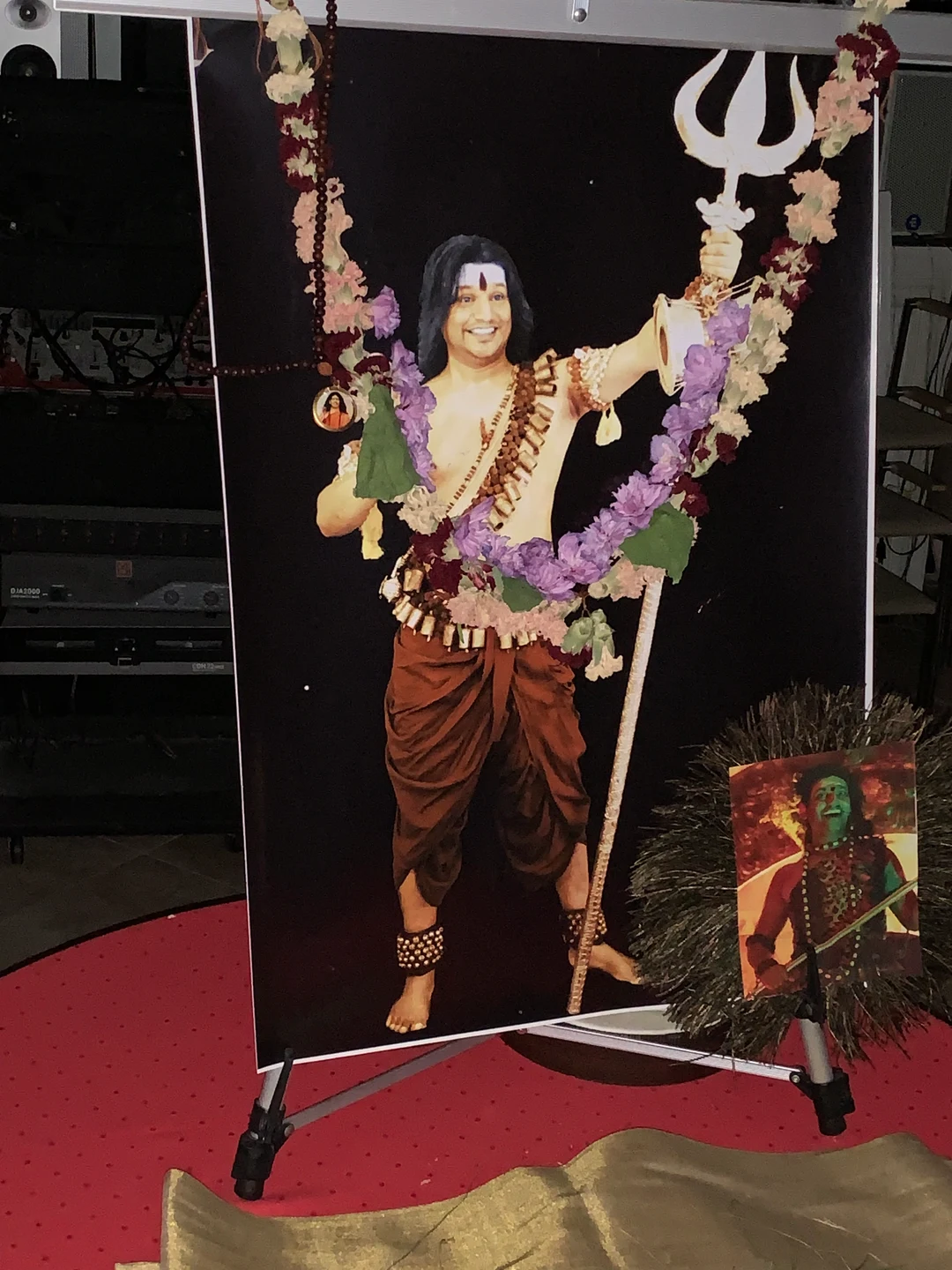
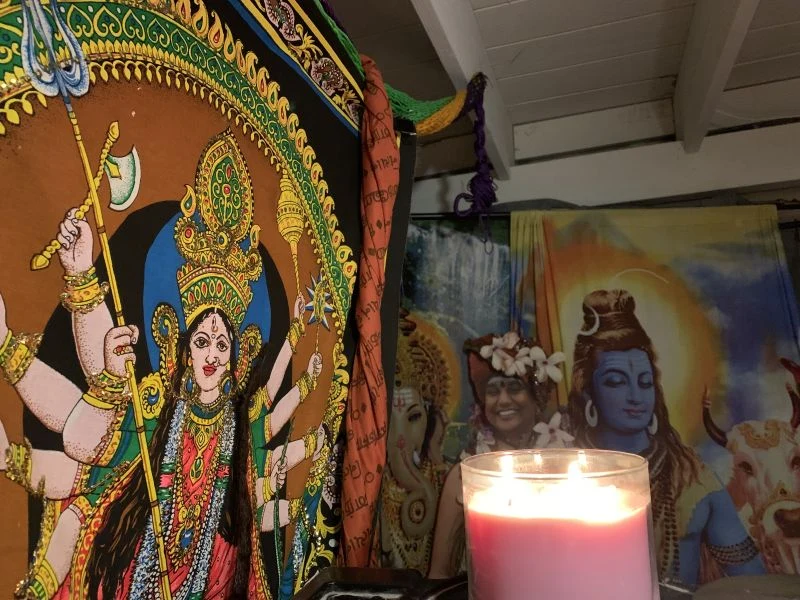
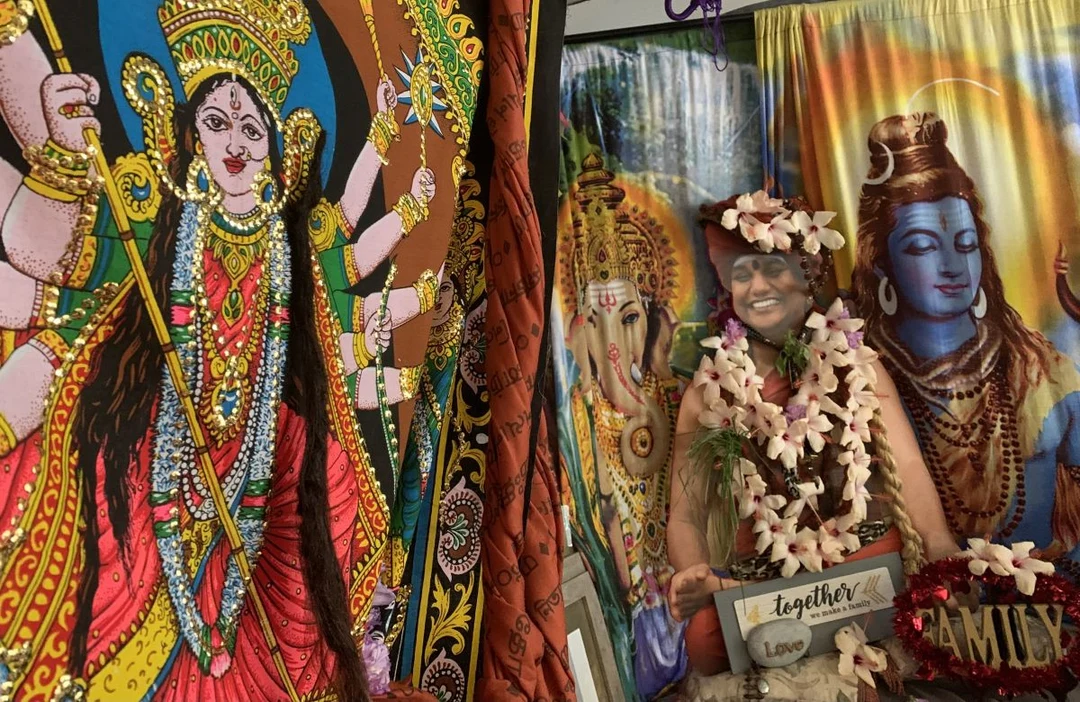
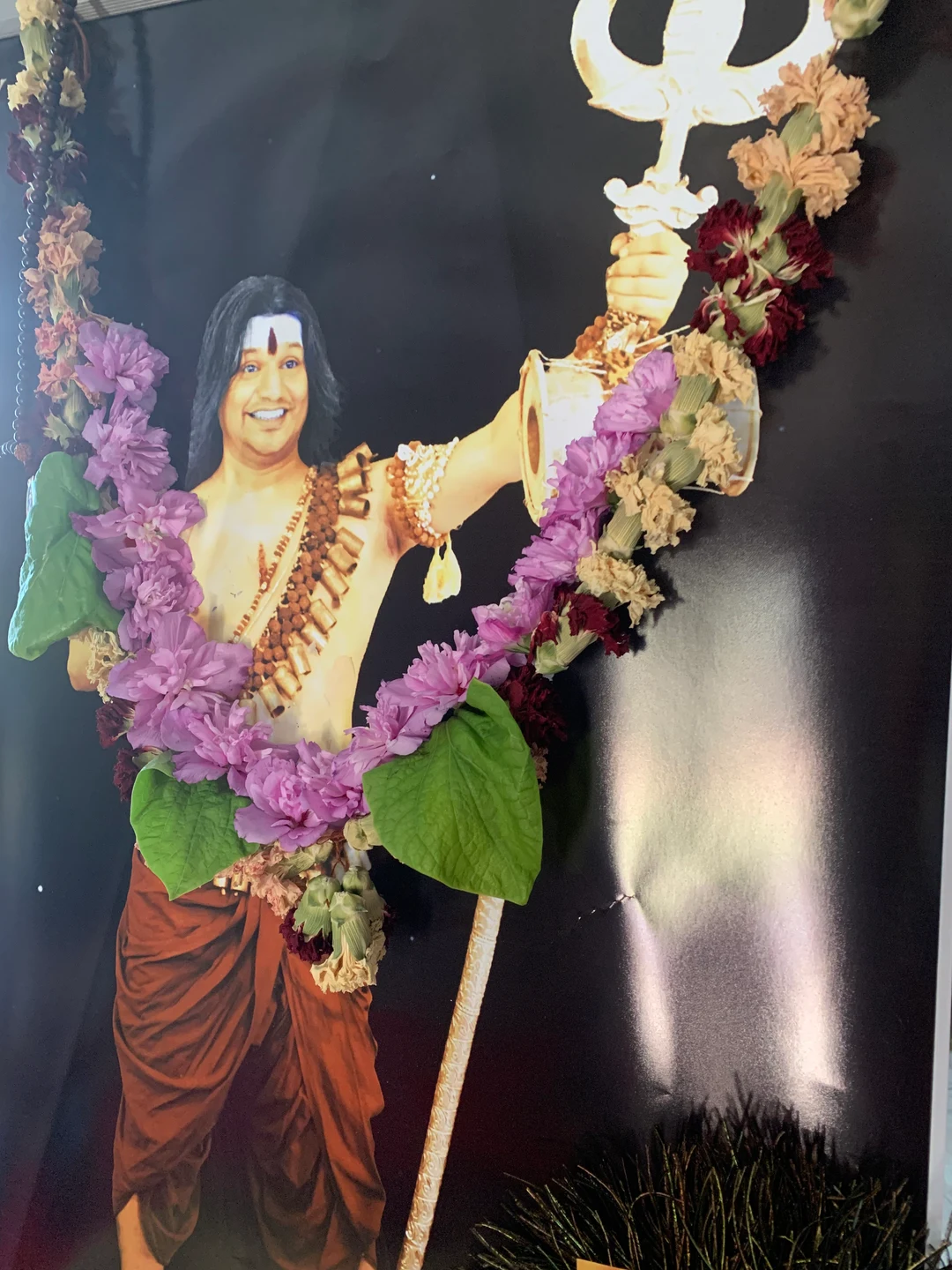
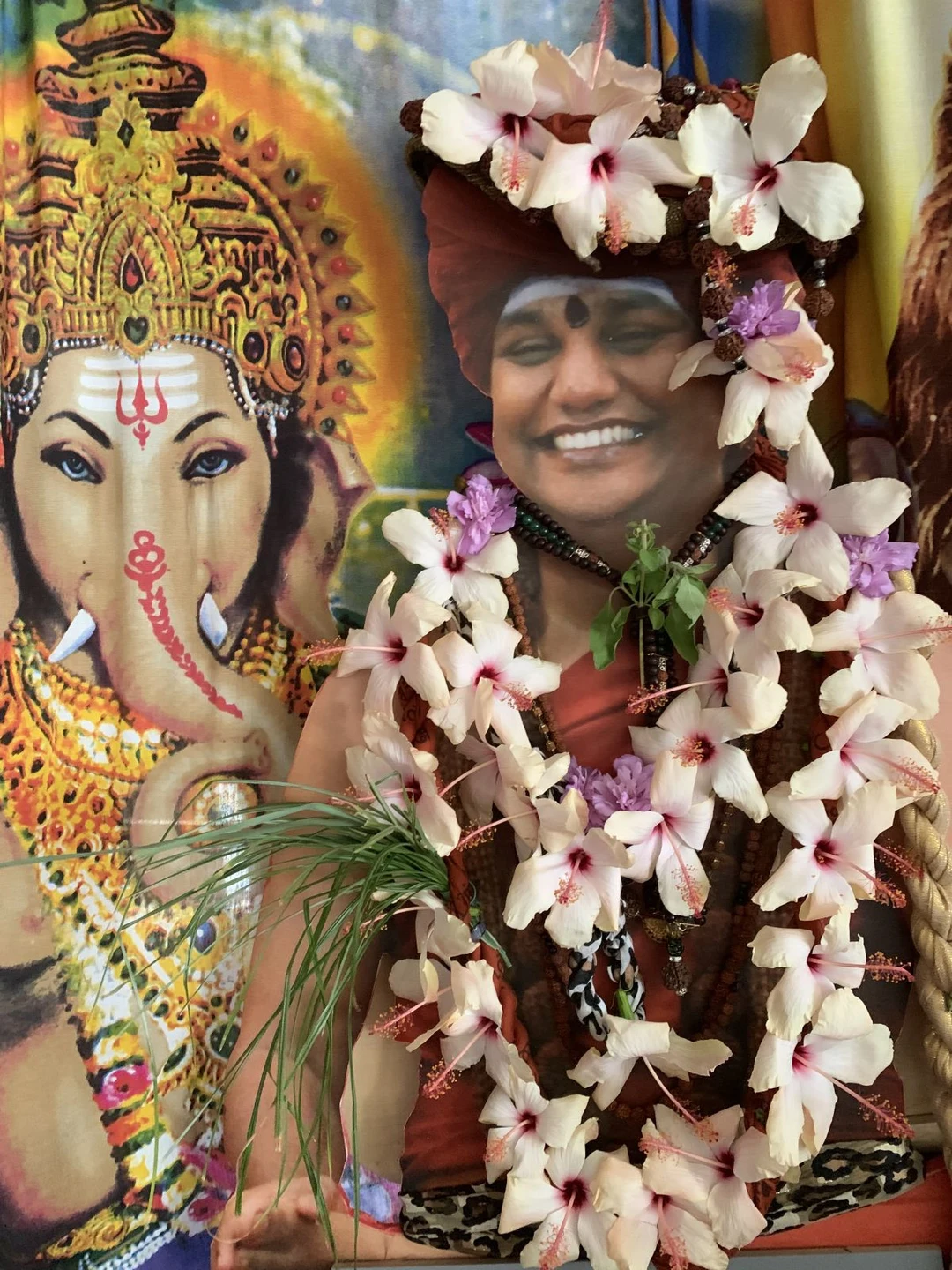
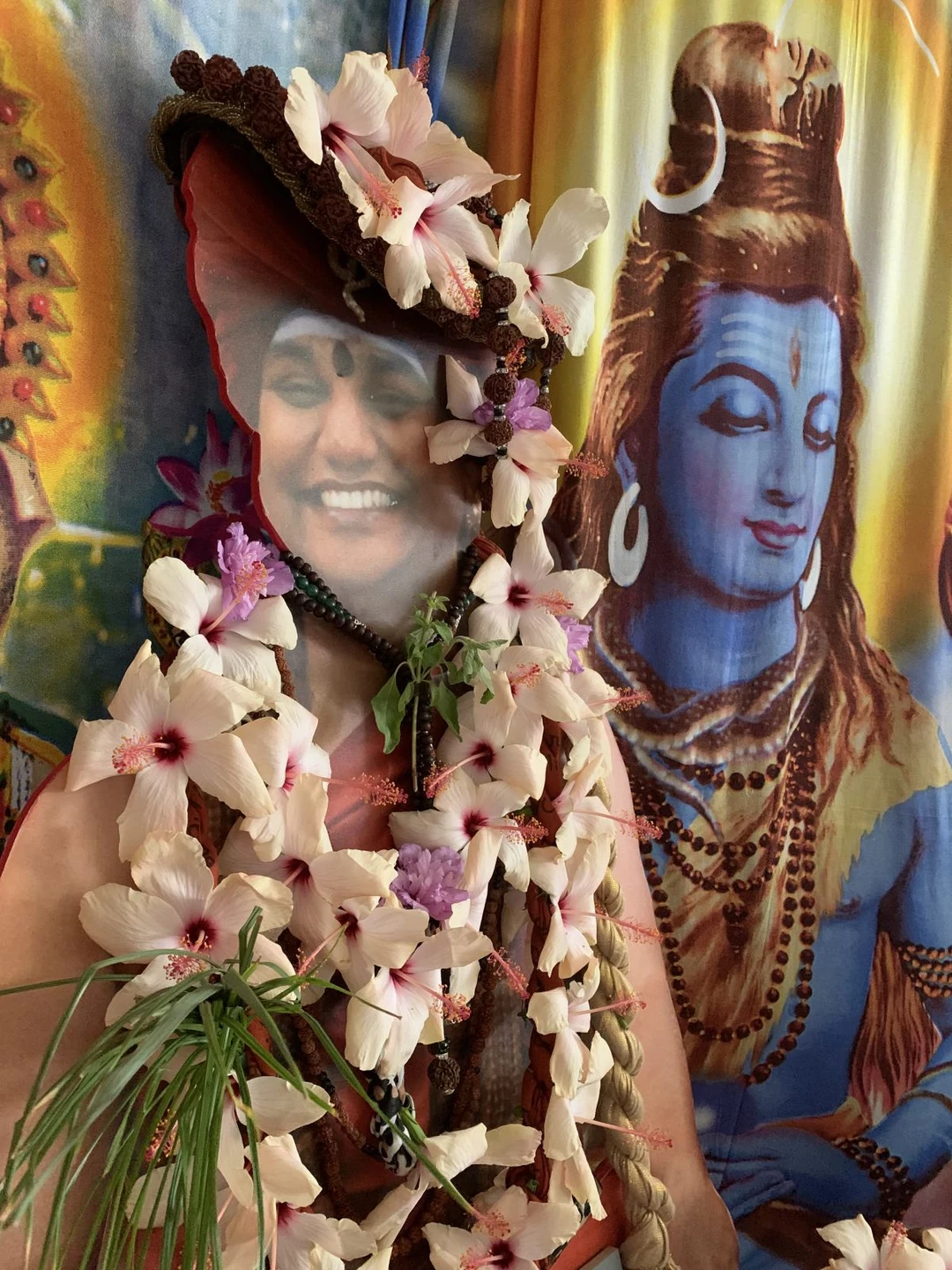
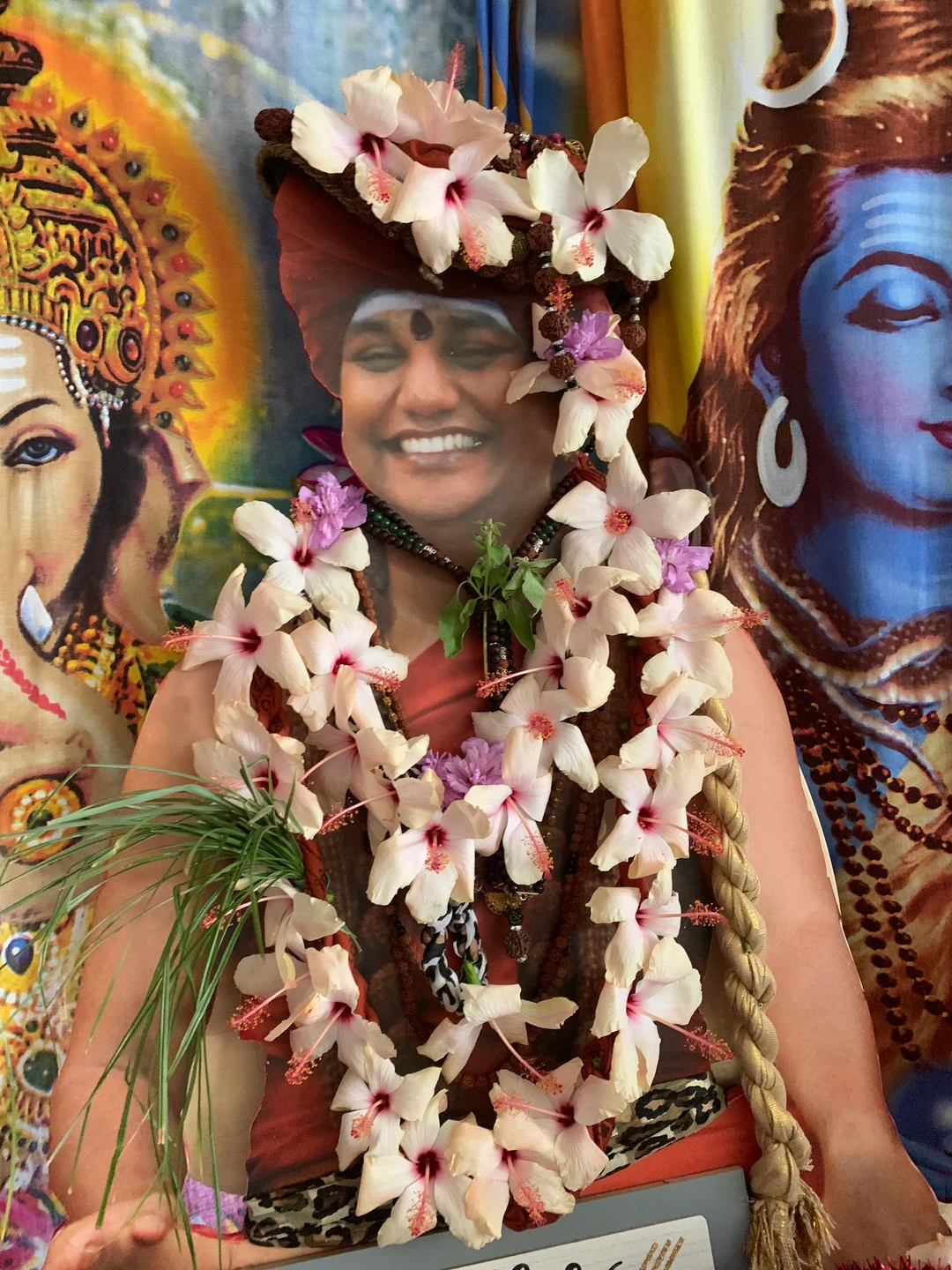
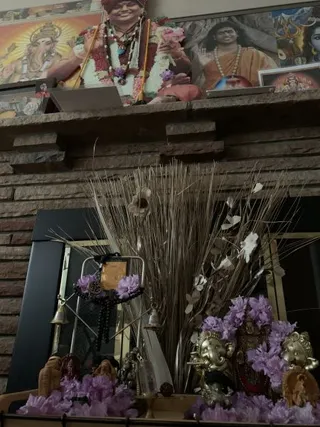
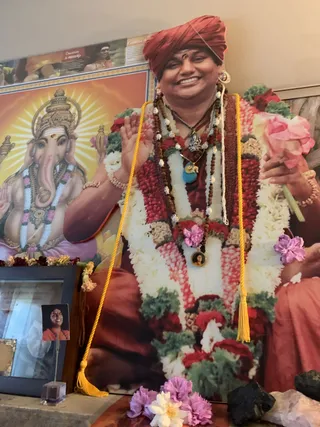
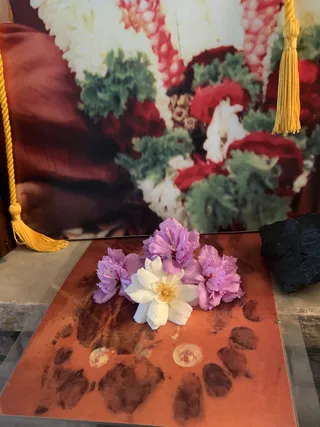
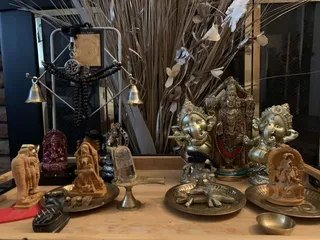
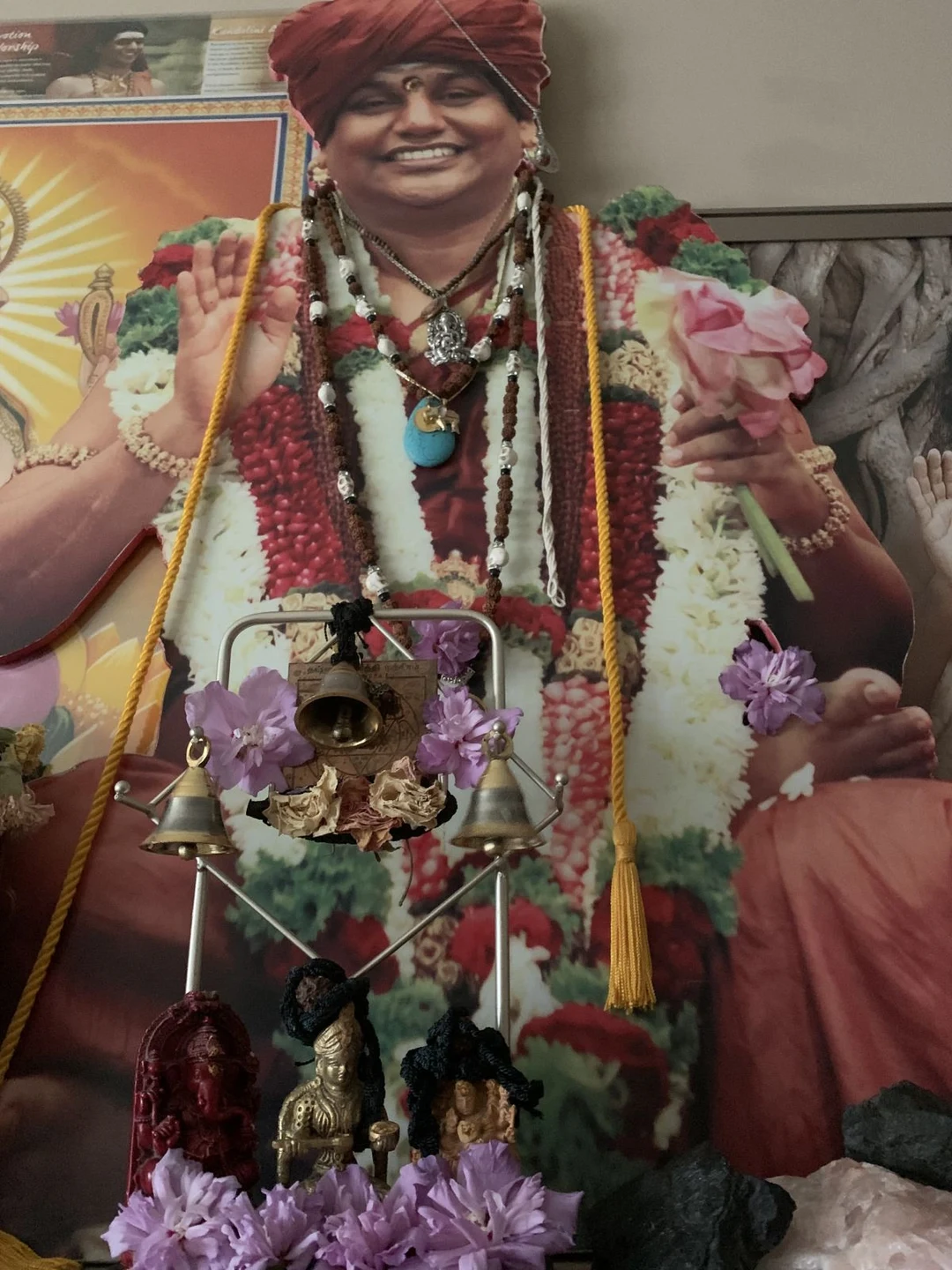
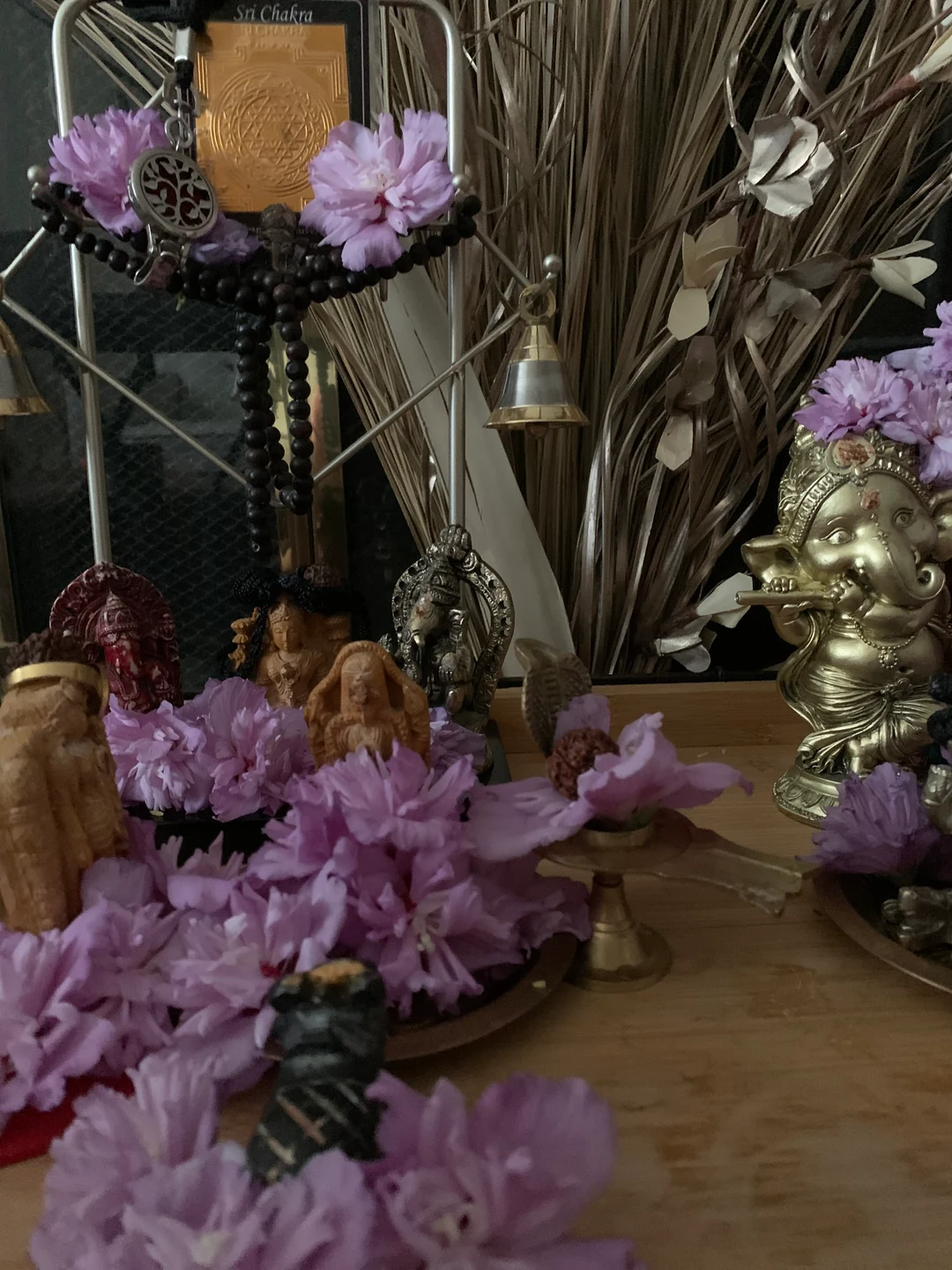
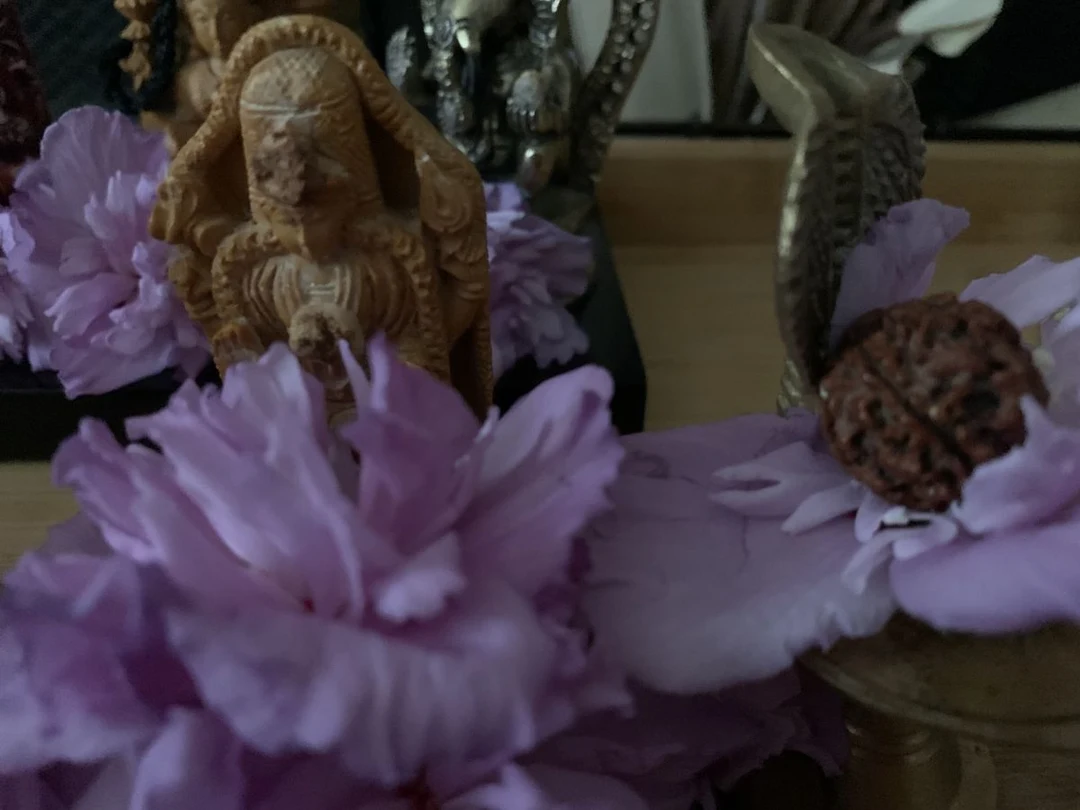
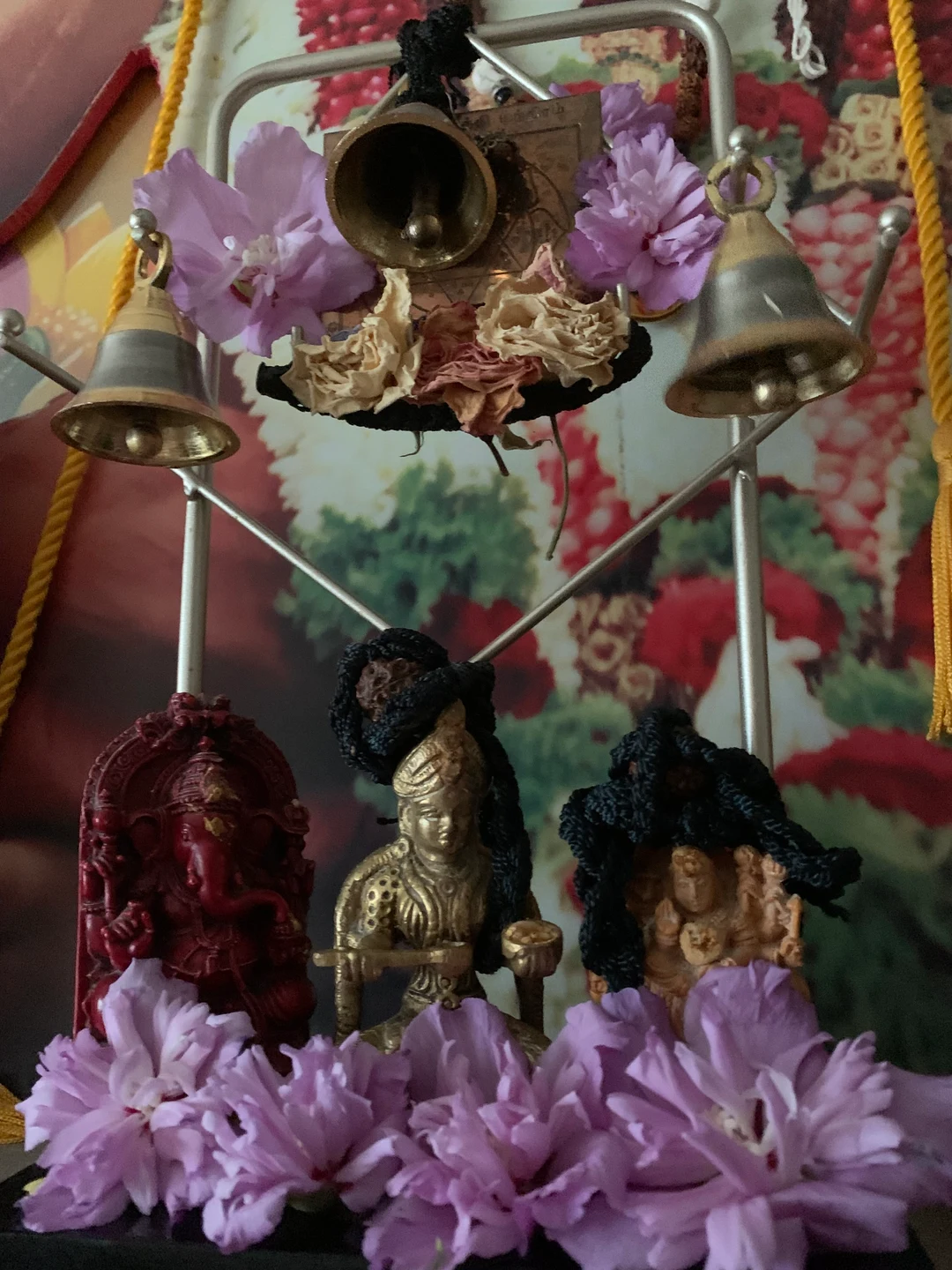
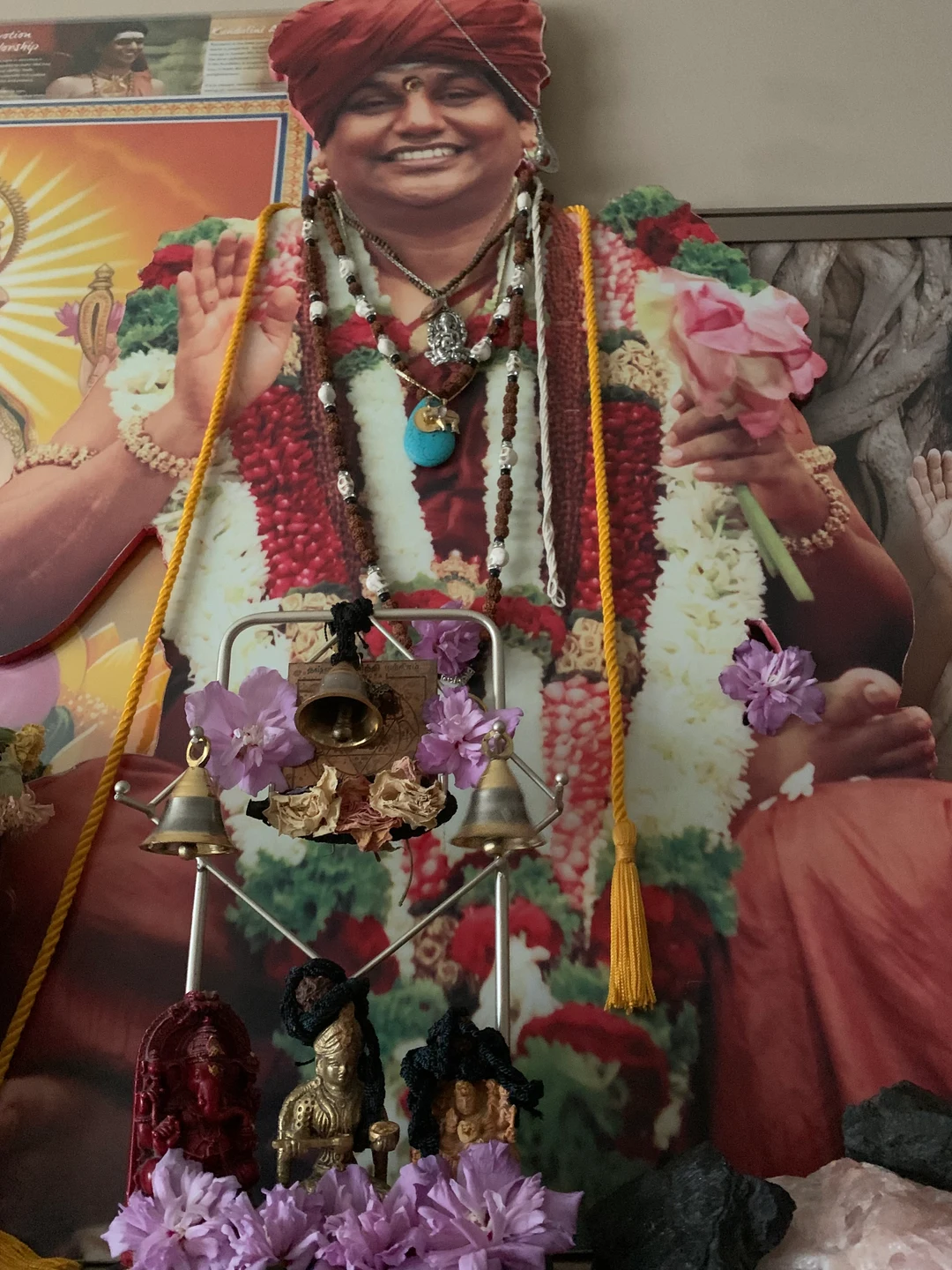
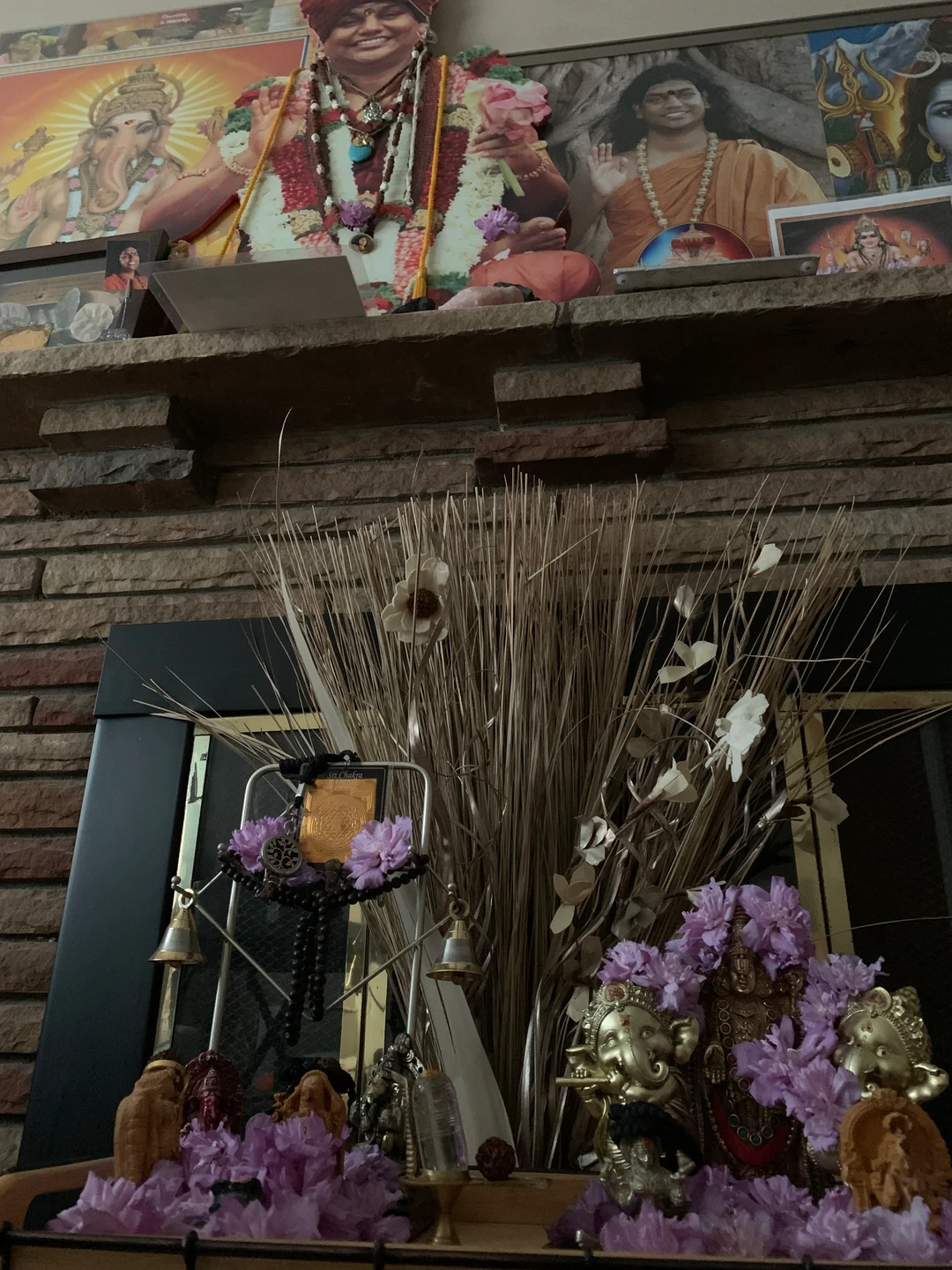
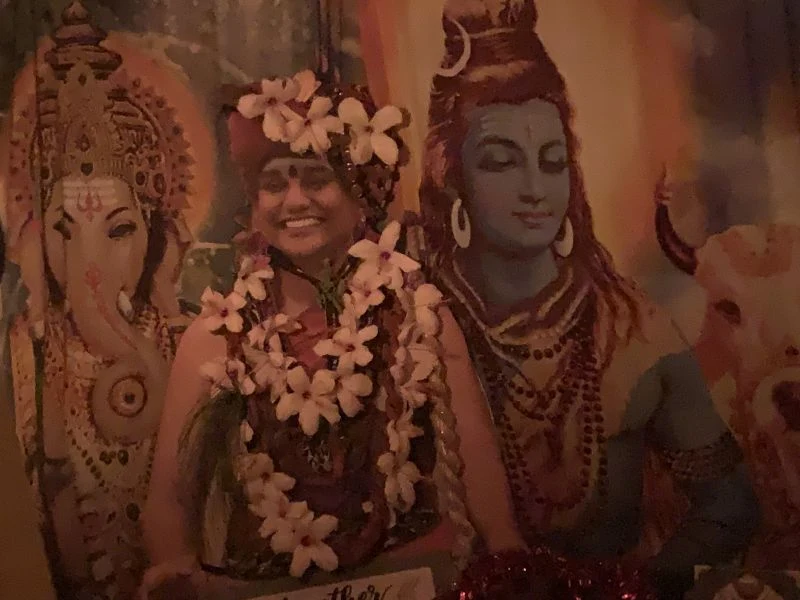
Home shrine photographed from below on a stone mantel with a tall dried grass arrangement and purple flowers. Above the mantel are framed printed images: a portrait of a smiling man in a red-orange turban and white-and-red flower garland holding pink flowers, labelled as a printed portrait, beside a painting of Ganesha and another of Shiva. A second printed portrait shows a smiling man in an orange robe with a white flower garland and hand raised in blessing, and a small framed picture of a deity in red. On the altar below are brass Ganesha figures, a deity murti, bells, wooden figurines, a rudraksha mala with a metal pendant, purple flowers and a brass lamp with a Sri Chakra yantra placard behind. The portraits are printed depictions, not physical people in the room.A home shrine photographed from the front, with two golden Ganesha statues flanking a central deity murti in brown and red tones, all garlanded with lavender-pink flowers. Small bronze bells hang on either side of the shrine, and a black rudraksha-style mala and a gold-framed Sri Chakra yantra sit at the top left. Clay or stone figures with pink petals scattered at their bases appear in the foreground, and a white bowl of grey liquid and a rudraksha bead rest on the wooden tray. Dried grass arrangements fill the background. No people are visible.A heavily motion-blurred indoor photograph of a wooden altar or ledge with a dark wood front. Above it, blurred colourful fabrics and possibly small figures or offerings are visible against a pale wall; the details cannot be distinguished. In the lower foreground, blurred dark objects and white items resemble shoes or small items on the floor. No clearly identifiable person, deity murti or ritual action can be made out.A large life-size cutout portrait of a smiling man in a red-orange turban, wrapped in layered white, red and green flower garlands, rudraksha and bead malas, a pendant and a yellow cord, raising one hand and holding a pink rose. The cutout stands in a room beside a framed photo of a smiling woman in orange, a small glass lamp, dark stones and pink and white flowers at its base. Behind it a poster shows a four-armed Ganesha deity murti with a crown and garland, and a banner above reads Devotion & Worship. The cutout is a depiction, not a person present.A photograph of a small altar display with flowers placed on a reddish-orange cloth or mat with brown markings. Three pale purple-pink blossoms surround one white flower with a yellow centre, arranged in front of a large framed photograph showing a figure in a maroon or red garment with a yellow tassel hanging on the left and right edges. The framed image is covered in red, white and green floral garlands. A dark rough stone rests at the right edge of the platform. No people are visible in the image.A home altar arrangement on a wooden shelf showing several small deity figures and ritual objects. Centre-right stands a brass Venkateswara-style standing deity with a tall crown and a red and green garment, flanked by two brass Ganesha figures, one playing a flute. In front sits a brass plate holding a small brass figure of a crouching animal. Left foreground has carved wooden and stone figures, including a reddish Ganesha and a carved image of a seated deity. A brass shivalinga stands on a small brass base, with a brass bell hanging at upper left above a dark mala and a golden yantra plaque. Dried branches with pale flowers fill the background. No people are visible.

Pictures from the day
3 photosSource gallery
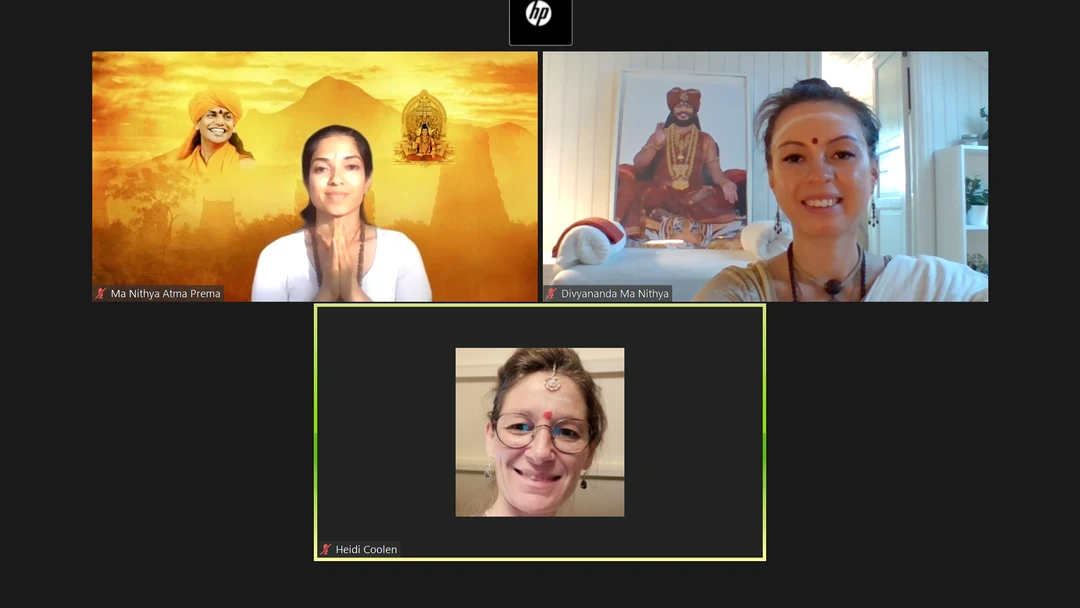
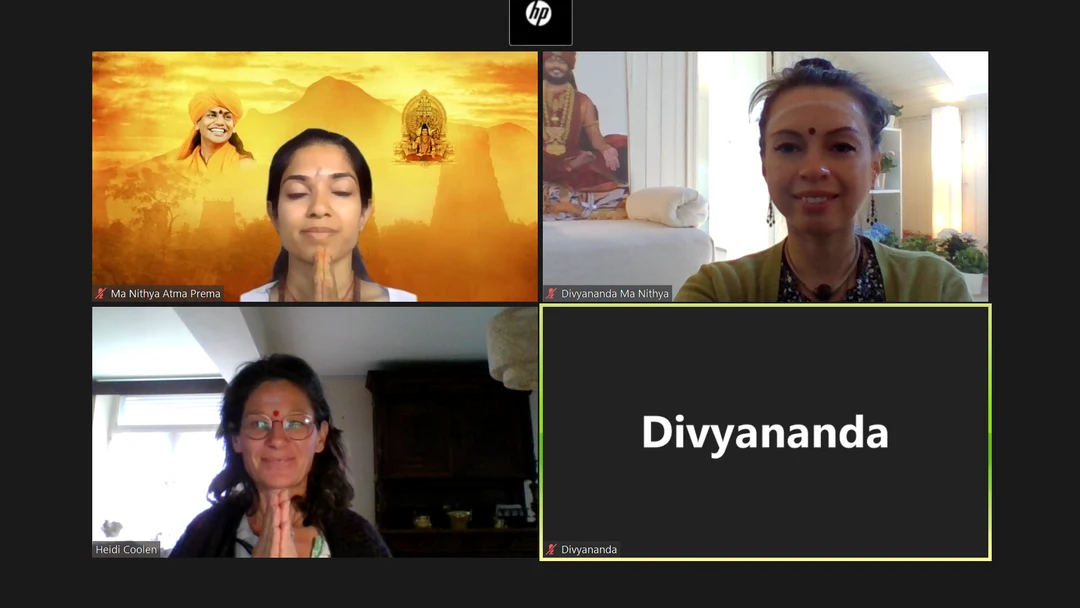
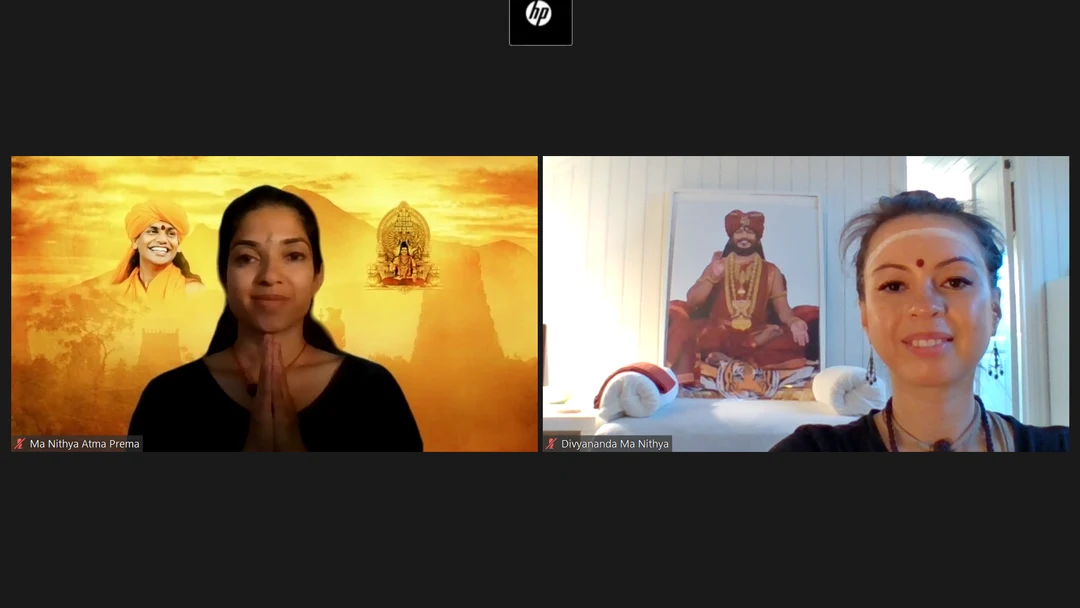
A screenshot of an online video call grid with three participant tiles. Top left, a woman in a white top with hands in anjali mudra is shown against a golden-orange background of a temple and a smiling figure in saffron turban. Top right, a woman with a red bindi and white garment sits before a framed portrait of a seated figure in saffron robes and turban with garlands. Bottom centre, a smiling woman with glasses and a red bindi is shown in a small square tile. Names appear on each tile.A screenshot of a four-tile video call grid. Top left, a woman with hands in anjali mudra and eyes closed stands before a golden-orange graphic showing a smiling saffron-turbaned figure, a temple tower and a mountain; labelled Ma Nithya Atma Prema. Top right, a smiling woman with a red bindi and dark beaded necklace sits before a framed image of a seated figure in saffron and gold on a white sofa, labelled Divyananda Ma Nithya. Bottom left, a woman with glasses, a red bindi and hands in anjali mudra sits in a room with a wooden cabinet, labelled Heidi Coolen. Bottom right is a dark tile reading Divyananda with no video. Four participants are visible in the call.A video-call screenshot with two side-by-side participant tiles on a dark interface. The left tile shows Ma Nithya Atma Prema, a woman in a black top with palms pressed together in namaste, against a golden virtual background with a smiling figure in an orange turban, a temple tower and a deity murti. The right tile shows Divyananda Ma Nithya, a smiling woman with a white forehead mark and red bindi and a rudraksha-style necklace, seated in a room with a framed portrait of a seated figure in red and gold robes and rudraksha malas, flanked by rolled white and red cushions. An HP logo sits at the top centre.

Pictures from the day
4 photosSource gallery
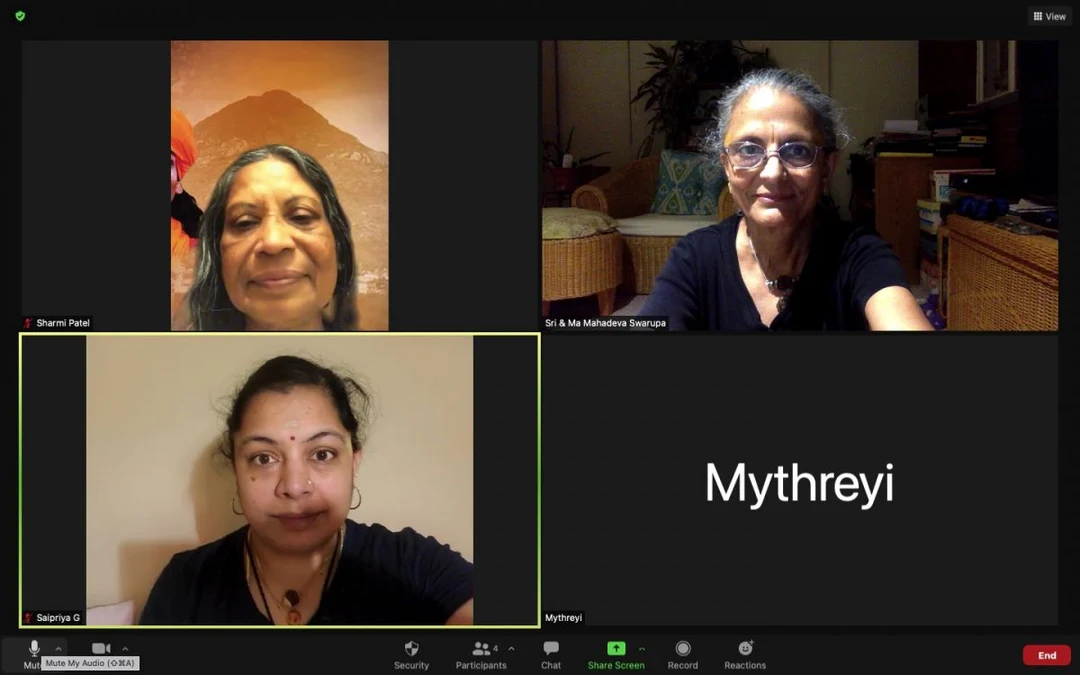
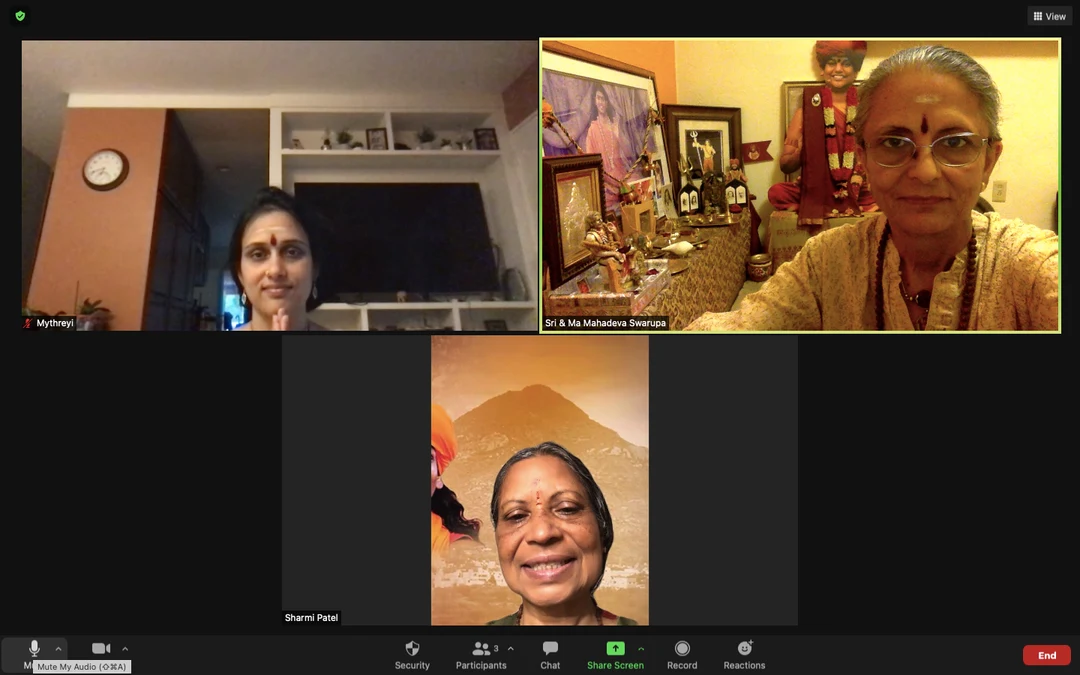
A Zoom video call screenshot showing four participant tiles in a grid. Top left, a woman with long dark hair smiles in front of a mountain backdrop, with a partial orange-clothed figure at the edge. Top right, an older woman with grey hair and glasses wears a dark top in a living room with wicker furniture and shelves. Bottom left, a woman with dark hair, a red bindi and a dark top wears a pendant necklace, outlined as the active speaker. Bottom right is a blank tile labelled Mythreyi. Zoom controls appear along the bottom bar, including Mute, Security, Participants 4, Chat, Share Screen, Record and End.A screenshot of a Zoom video call with four panels showing participants from their homes. Top left, a woman with a red bindi stands in a living room with a wall clock and shelves. Top right, an older woman with grey hair, glasses, a red bindi and a rudraksha mala wears a yellow-gold outfit in a room with a framed portrait and an altar; behind her, a framed image shows a smiling man in a red turban garlanded with orange flowers, with a trident-marked flag beside it. Bottom centre, a smiling woman with a red bindi sits before a backdrop of a mountain and an orange-robed figure. The Zoom toolbar labelled Mute, Security, Participants, Chat, Share Screen, Record, Reactions and End is visible along the bottom. The participant label reads Sri & Ma Mahadeva Swarupa.A man with short dark hair and a bare chest, wearing a rudraksha mala, poses in front of a large screen or printed image of a bearded figure with tall black hair, a white headband with a red bindi, and a golden ornate background. The man in the foreground is a physical person; the figure behind him appears on a screen or print, not in person. Warm gold and red tones dominate the frame.

Pictures from the day
6 photosSource gallery
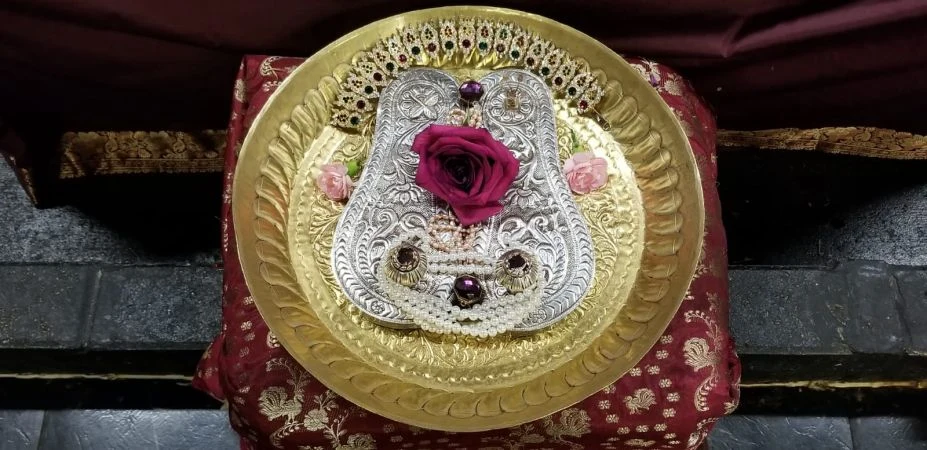
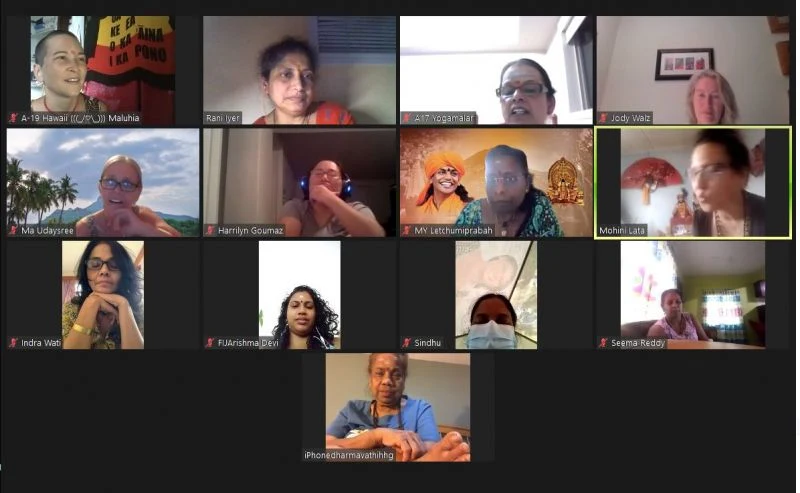
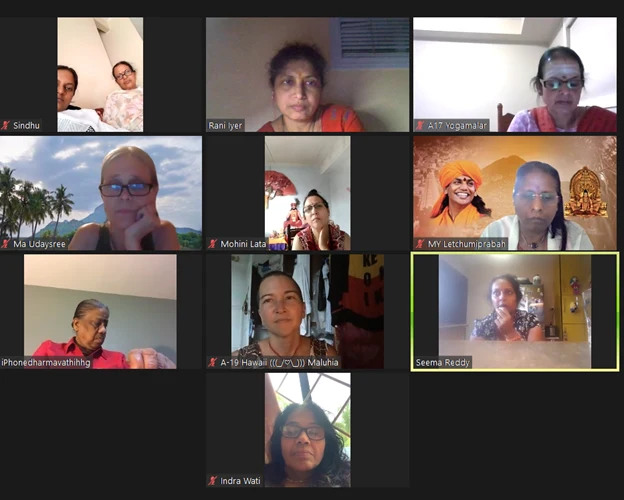
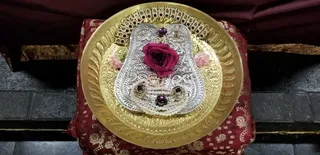
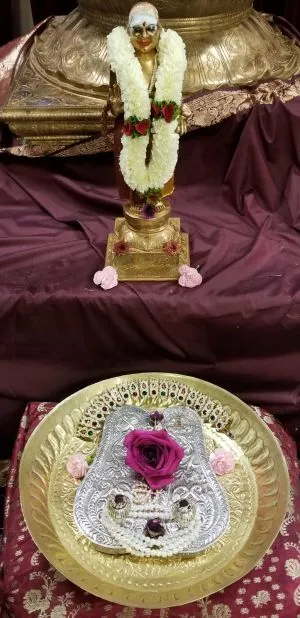
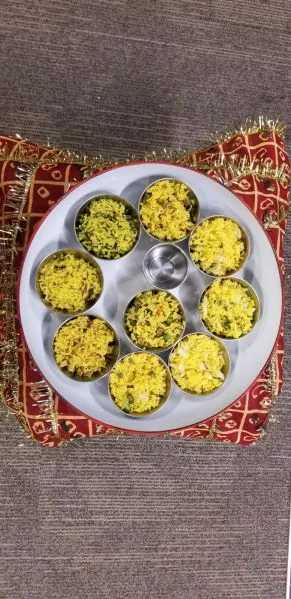
A photograph of a silver and gold ritual vessel placed on a maroon brocade cushion with gold motifs. A silver embossed plate with floral engraving sits in a gold tray, decorated with a crown-like jeweled band of red and green stones, a deep magenta rose, pink flowers, pearl strands and purple and gold stone ornaments. No people are visible; this appears to be a deity murti or sacred object displayed for worship.A small gold-coloured deity murti stands on a maroon draped cloth beneath a larger gilded pedestal at the top of the frame. The murti wears a long white jasmine garland with red floral accents and a white tilak mark on its forehead, with pink rose petals scattered at its base. In the foreground, a large brass plate holds a silver ornamental vessel with a fresh magenta rose placed on top, surrounded by pink petals and small white pearl-like beads. The setting suggests a puja or abhishekam arrangement in a temple shrine.Overhead photo of a round silver offering tray on a red and gold patterned cloth with gold tinsel edging, set on a grey carpet. Nine small steel bowls surround a central steel cup, holding yellow rice dishes with green vegetable pieces. No people are visible.A small golden statue. It wears a long white flower garland with red rose accents draped over its shoulders and torso, with a white tilak mark on the forehead. Three pink roses lie at the base of the statue. The background shows an ornate gold-coloured vessel edge.A screenshot of a video conference gallery grid showing about 13 participant tiles, most with visible faces, several in front of home backgrounds. Top-left, a woman wears a red and yellow shirt with printed text; a woman in an orange-red top sits centrally in a tile labelled MY Letchumiprabah. One tile shows an orange-robed figure beside a small golden deity figure and a lit background, and a tile labelled Mohini Lata shows a woman before a red floral wall hanging. Names appear beneath each tile. Bottom row includes a woman wearing a face mask and a woman in a dark top and bracelets. The layout suggests an online satsang gathering, not a physical event.A screenshot of a Zoom video call grid showing about ten participants in separate tiles. Most tiles show women in home settings: one in a pink top, one in a red-and-white outfit, a woman in a grey top before a plant, and a woman in glasses in a pale blue top. In the upper-right area of the grid, a participant in a saffron-orange robe and head covering sits beside a woman in white, with a framed deity image and a lit lamp in the background. Name labels such as Sindhu, Rani Iyer, Mohini Lata, MY Letchumiprabah and Seema Reddy appear at the bottom of tiles. The display is a gallery of online participants rather than an in-person gathering.

Pictures from the day
8 photosSource gallery
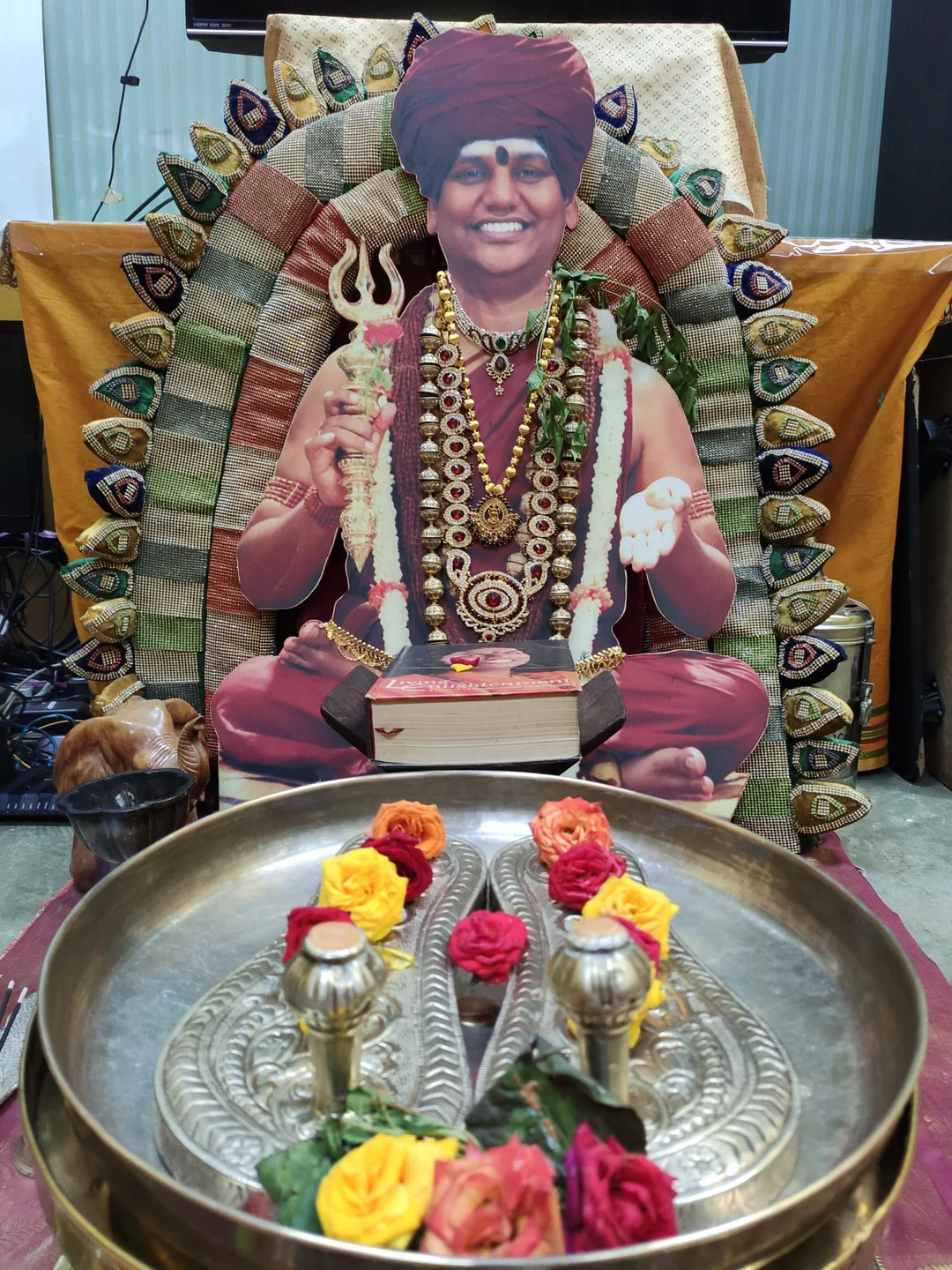
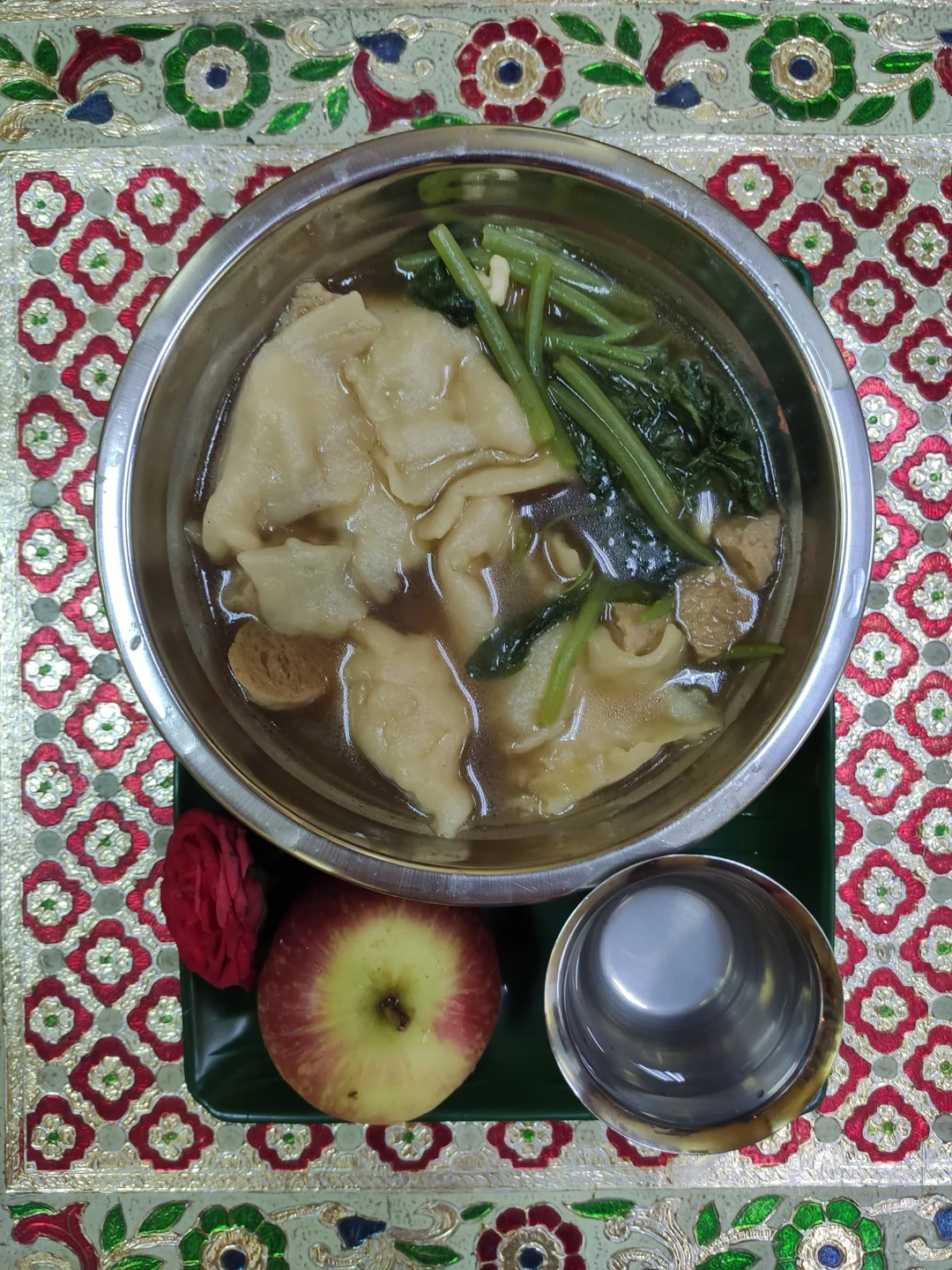
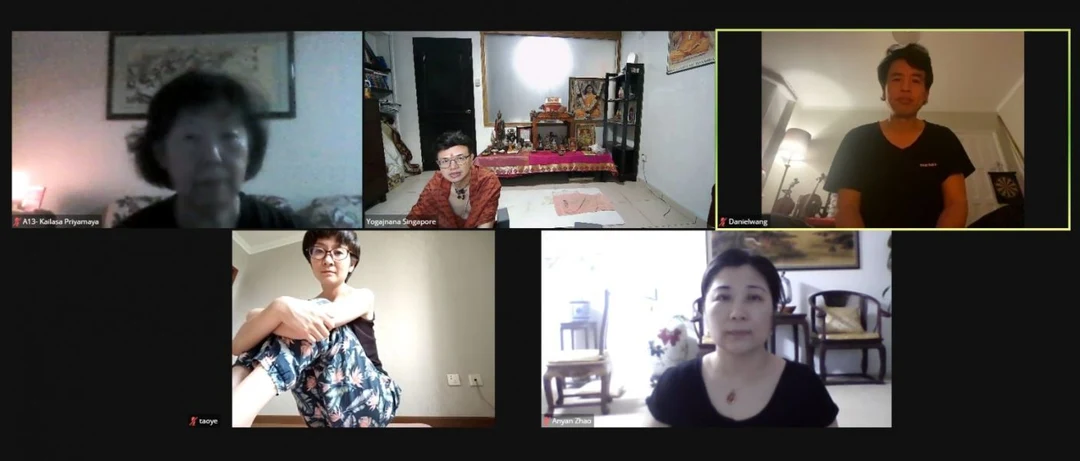
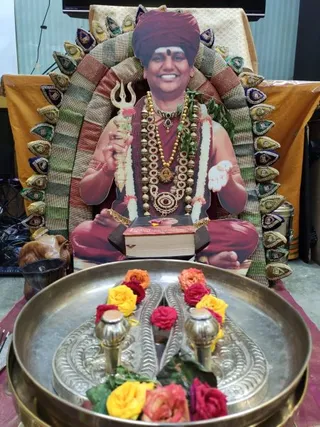
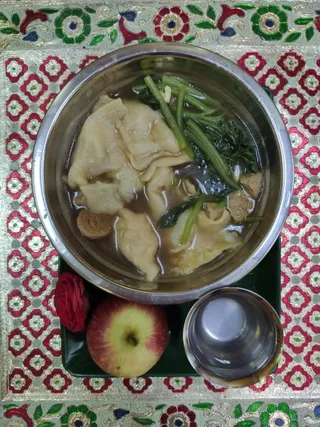
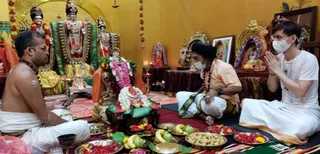
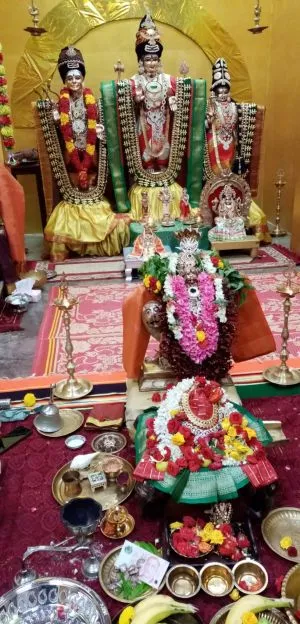
Photograph of a ceremonial padapuja setup in front of a cutout portrait of a smiling man in a maroon turban and maroon robe, holding a trident and seated cross-legged on a book labelled "Nithyananda Dhyanapeetam" with a decorated seat behind him. The portrait wears layered gold and red-stone necklaces, rudraksha-style gold beads and a garland; the tall ornate chair is backed by a fan of jewelled green and gold panels. In the foreground a large brass tray holds silver padukas (sandals) decorated with orange, yellow and red roses and green leaves, with two brass kalasha-style vessels. Only the printed portrait is present; no physical people are visible.Overhead photo of a food offering on an ornate red, green and gold patterned cloth. A large stainless steel bowl holds a brown broth with flat pale dumplings or noodles, green leafy vegetables and chunks of tofu-like pieces. Beside it sit a whole red-and-yellow apple, a red flower and a small steel cup of water on a dark green tray, the arrangement typical of a naivedyam food offering to deities.A five-panel video call grid of online participants. Top left, an older woman with short hair sits in a room with a framed painting and a lit candle. Top centre, a man in an orange patterned shirt kneels before a home shrine with a deity murti, pink cloth, red offerings and a framed picture. Top right, a man in a dark t-shirt sits before a lamp and wall decor. Bottom left, a woman in a floral top sits cross-legged. Bottom right, a woman in a dark top sits beside a wooden chair and vase of flowers. Panel labels read Kailasa Priyamaya, Yogajnana Singapore, Danielwang, taoye and Anyan Zhao.A photograph of a laptop screen showing a Zoom video call with a grid of seven participant tiles. The top-left tile shows a woman beside a framed image of a smiling saffron-robed figure with a crown-like headdress, labelled Ma Durga. Other tiles show women and children in home settings, labelled A14 YY Loo, Ma Song, Jun yee and Raut Nithya Prasadini Pradeep (Singapore). A centre tile shows a young girl with long dark hair labelled Ma Nithya Parameshwara. The laptop sits on a desk covered with printed phone advertisements. No a person candidate is clearly visible in person; the framed image is an unsure depiction.A temple puja in a yellow-walled shrine room. A man on the left in white dhoti and shirtless, with white sacred ash marks on his chest, sits before the deities and holds a small plate. A central figure in an orange-peach shirt and white dhoti with gold border bends forward in prostration with his forehead to the floor, wearing a rudraksha mala and a face mask. On the right, a man in white shirt and white dhoti sits with palms joined in anjali. Before them stand a kalasha-like brass vessel with a green cloth, garlanded with pink and white flowers, and trays of bananas, apples, sweets, red fruit and flowers. Behind them are garlanded deity murtis, a framed picture and ornate shrine décor.A temple shrine with three deity murti seated on a green-draped platform, each adorned with gold jewellery, flower garlands and ornate crowns; the central figure wears a red and gold garment. In front, a red and white flower garland and a padapuja-style display of flowers, fruit, brass bowls, plates and a kalasha-like pot rest on a red cloth. Brass oil lamps and bananas are arranged on the floor. No people are visible in the scene.