Skip to content
Saturday

21 February 2015

What is Good? What is Bad?

Dated photos
135
Source pages
1
Media
3
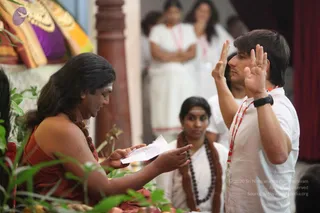
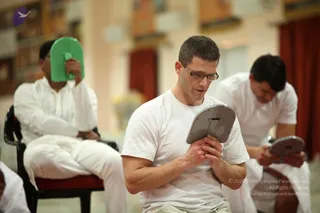
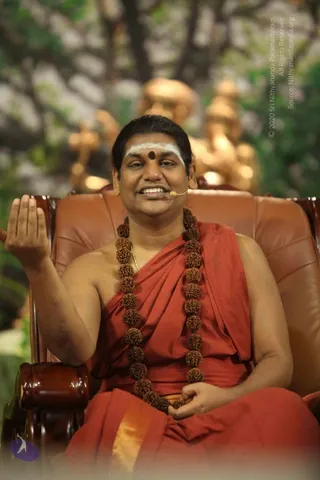
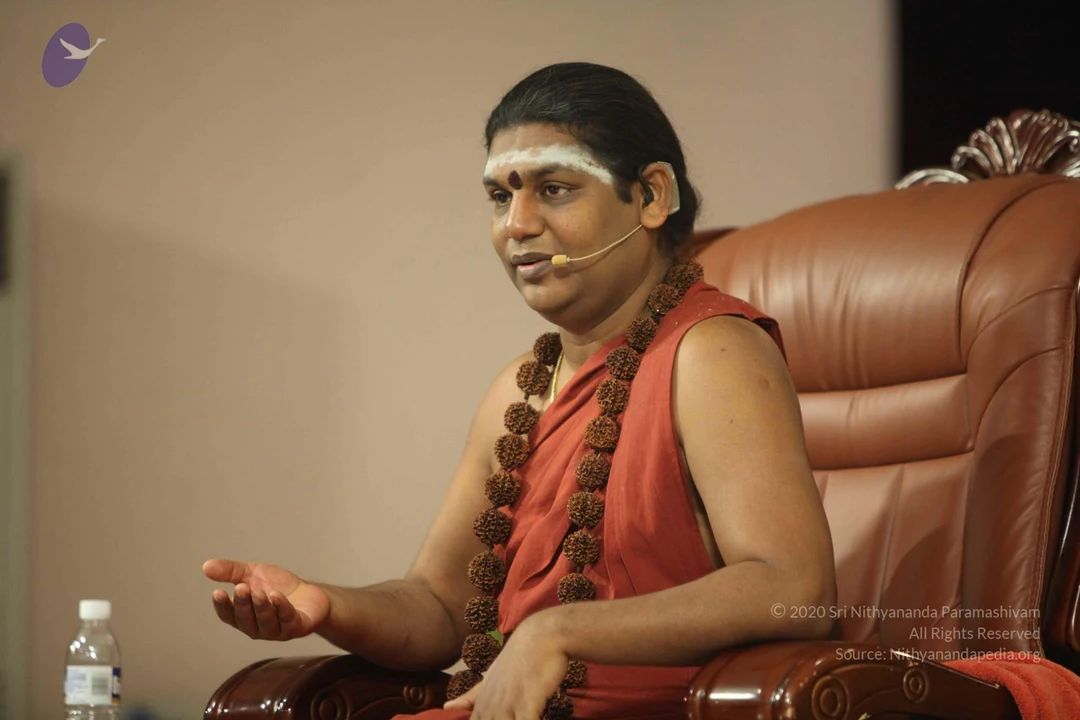
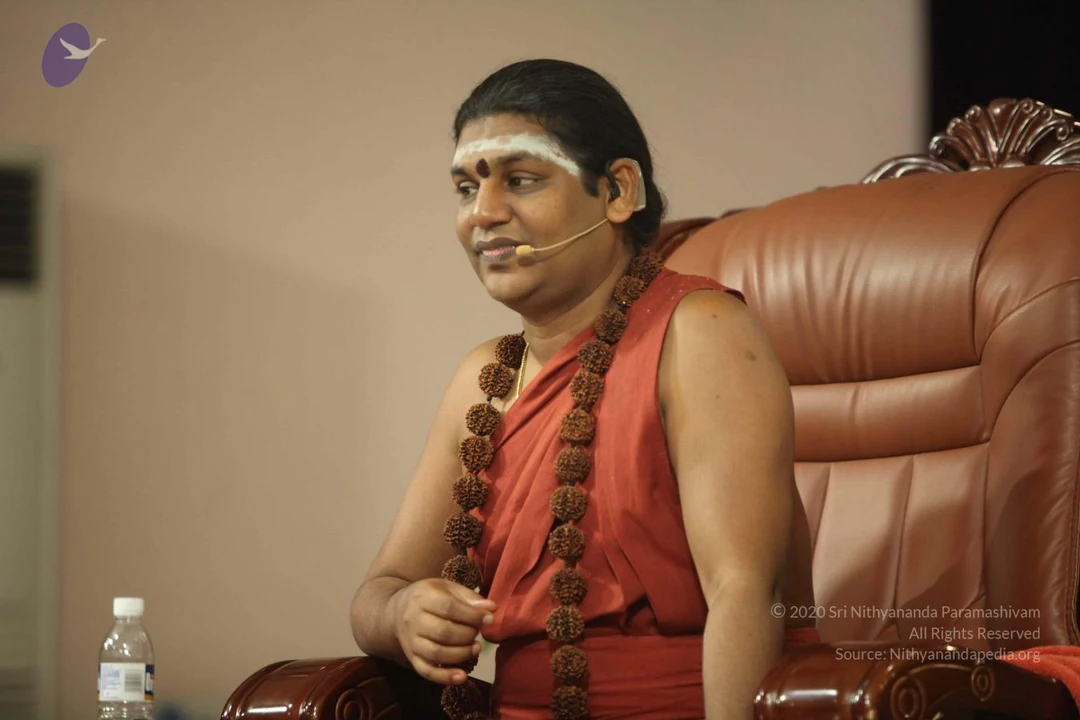
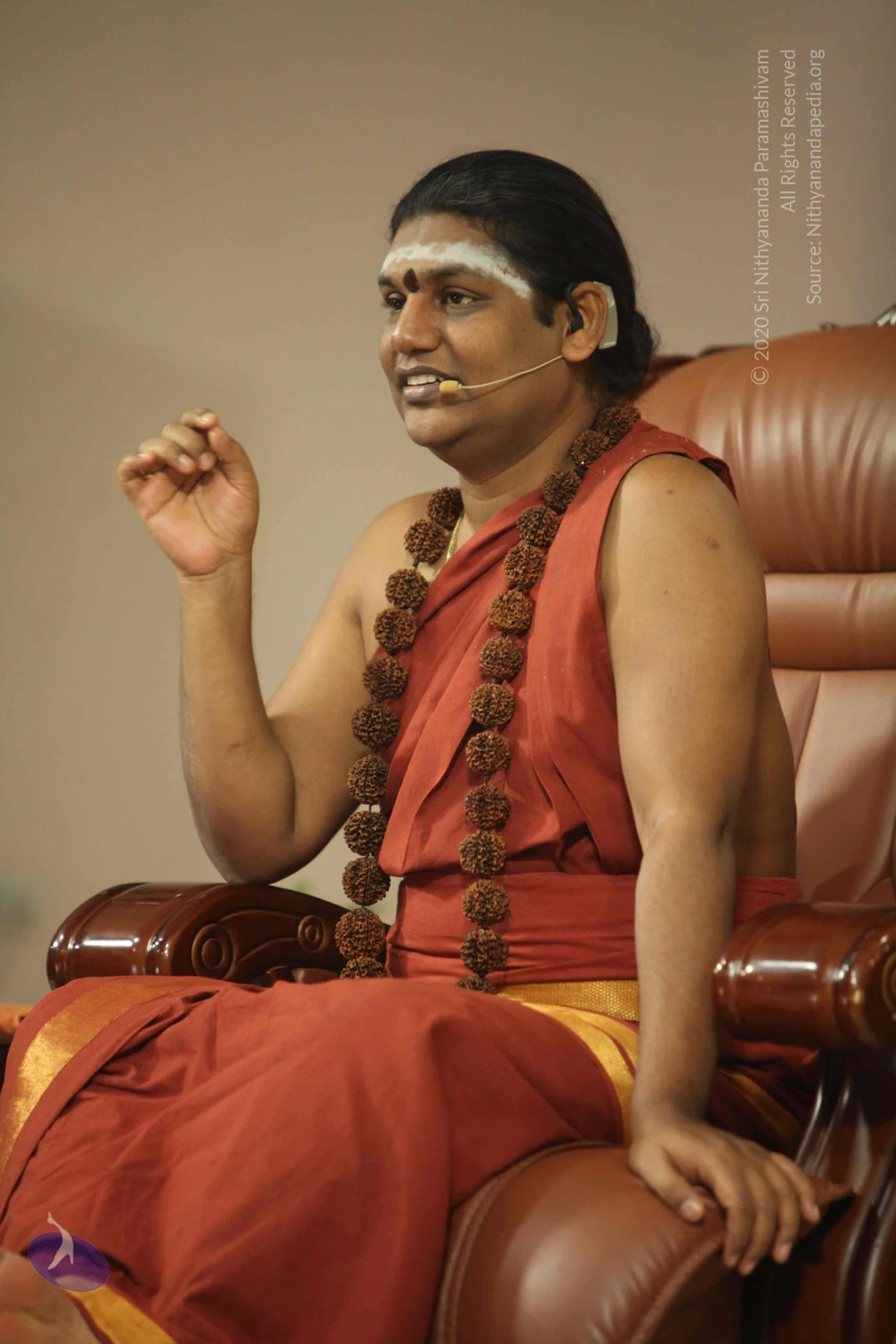
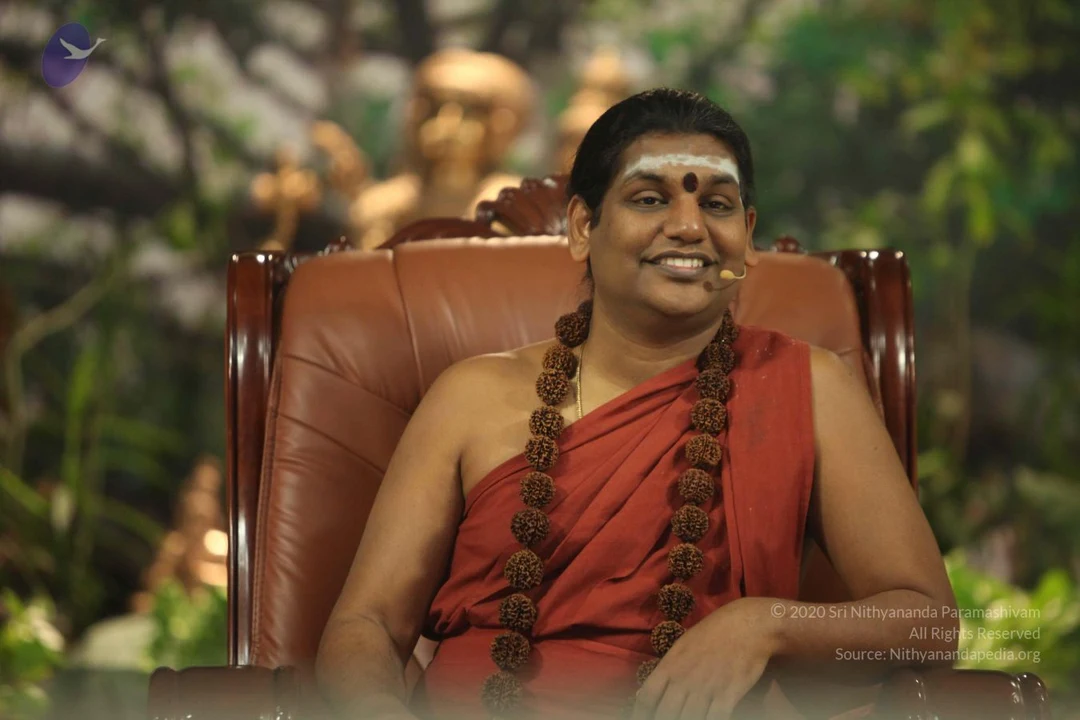
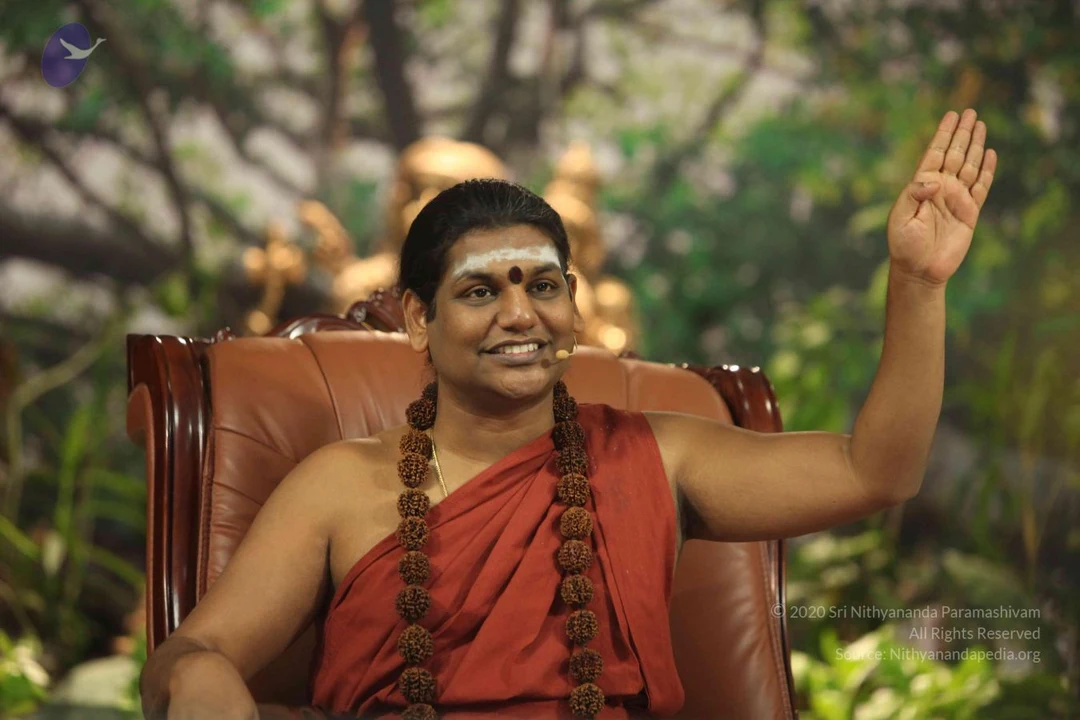
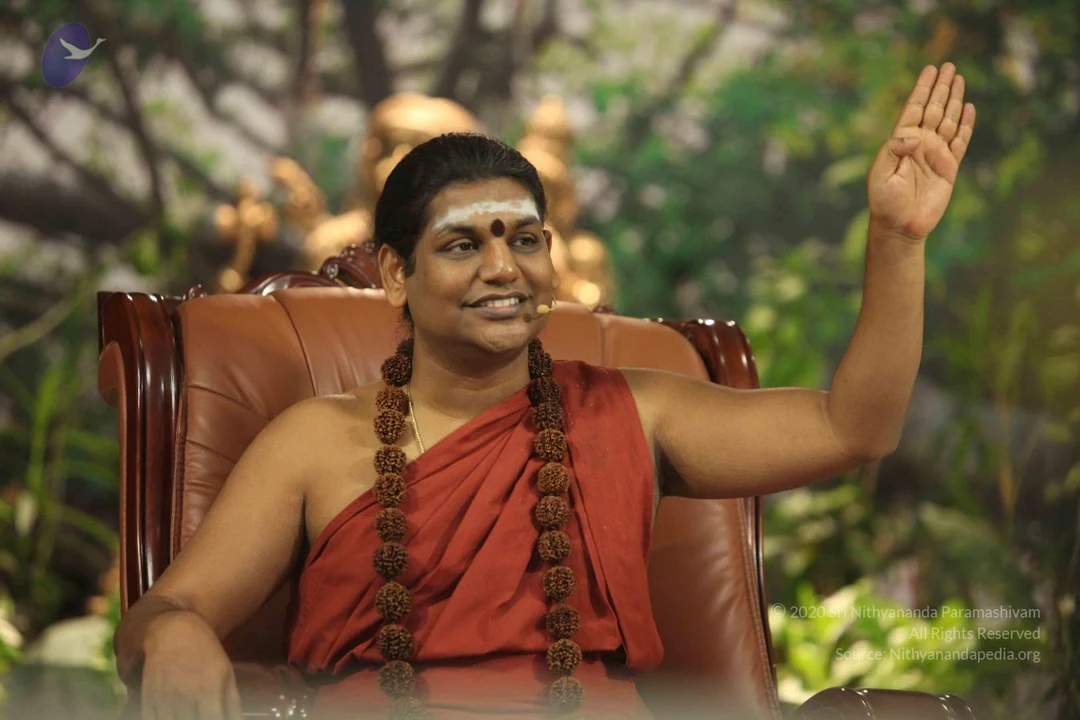
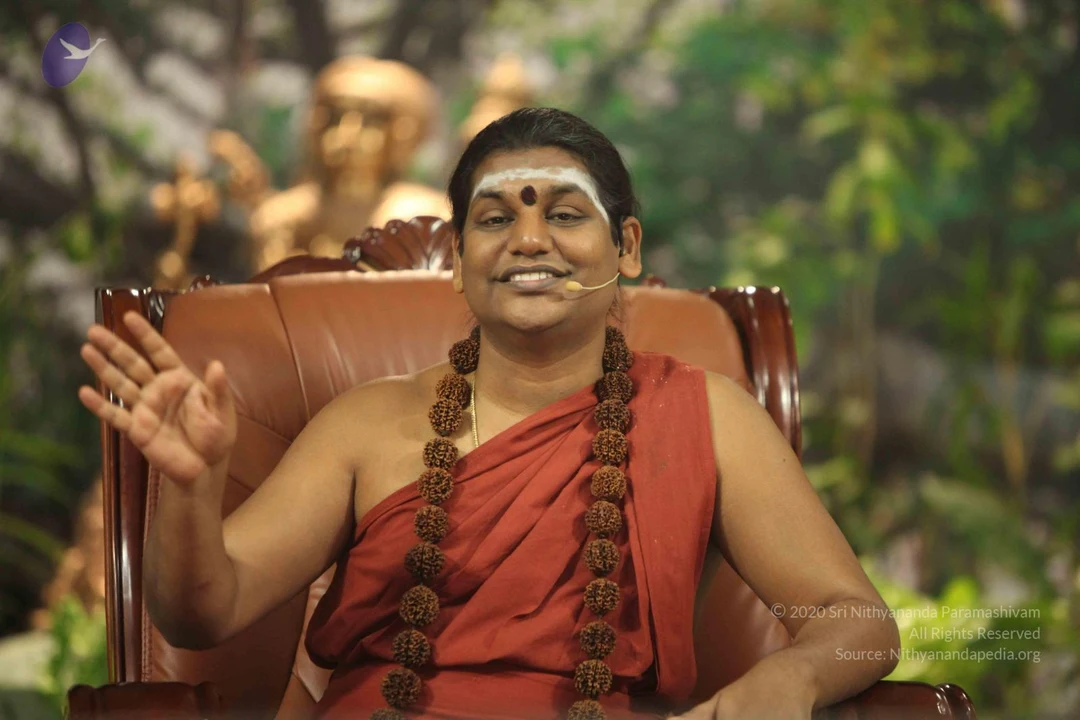
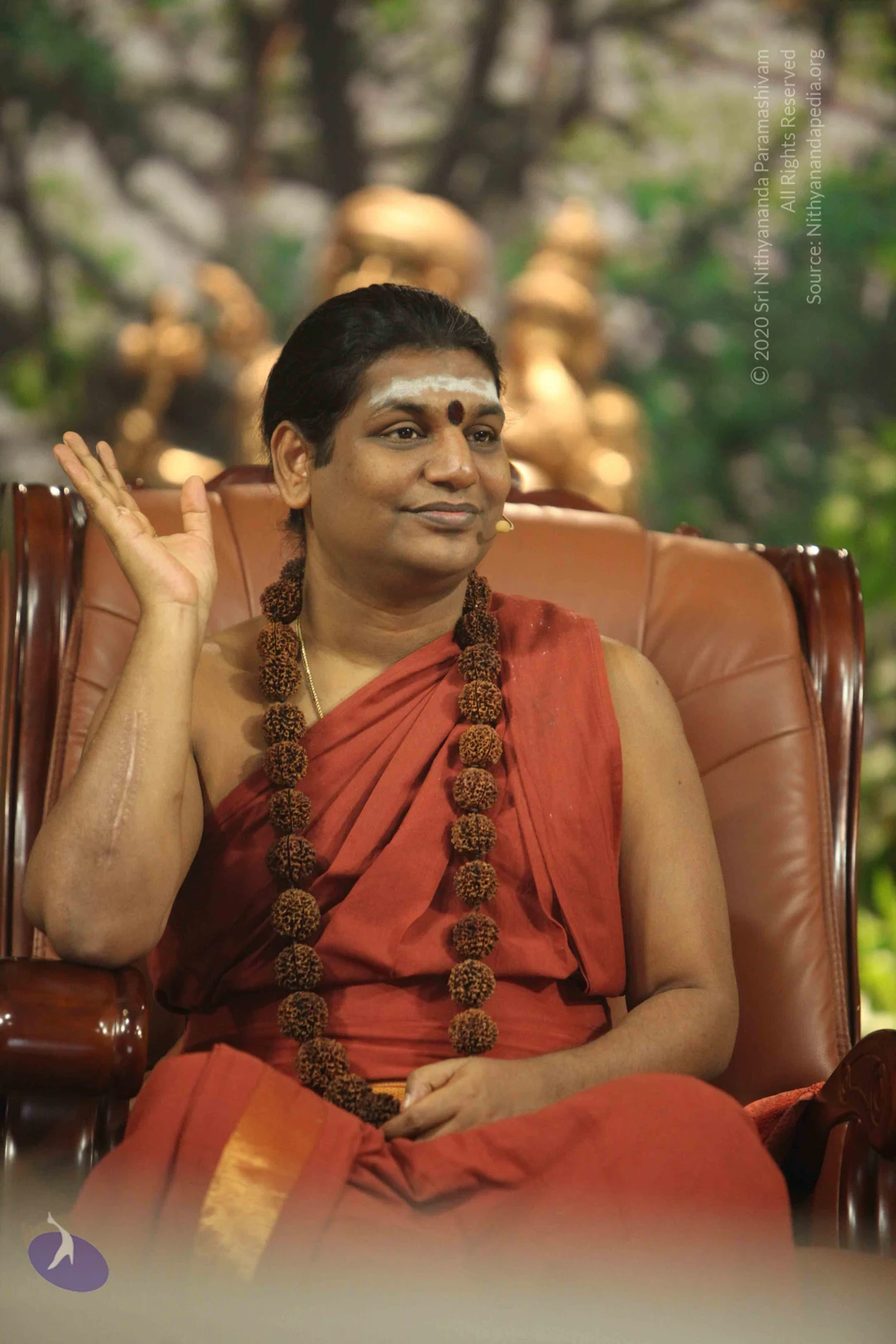
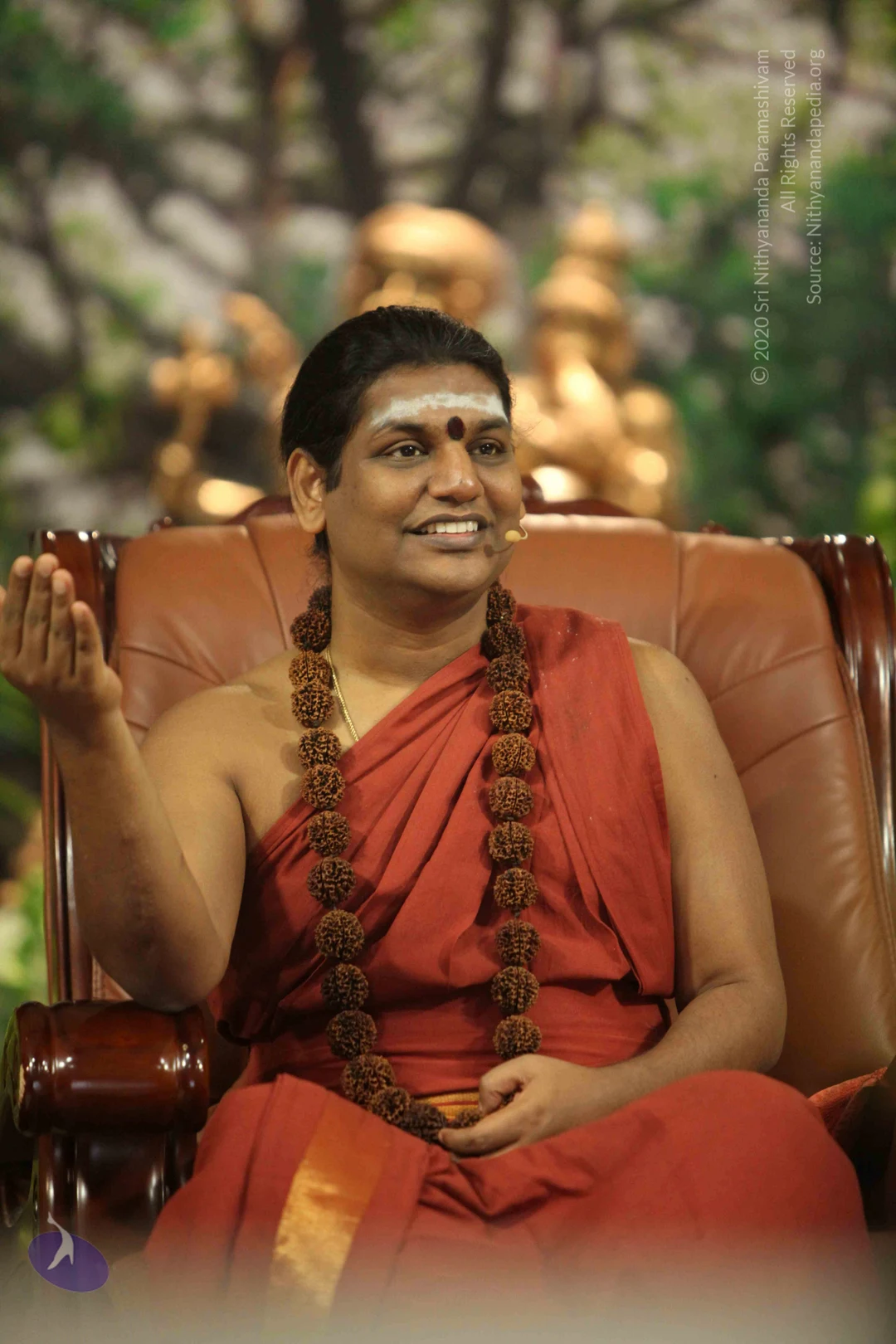
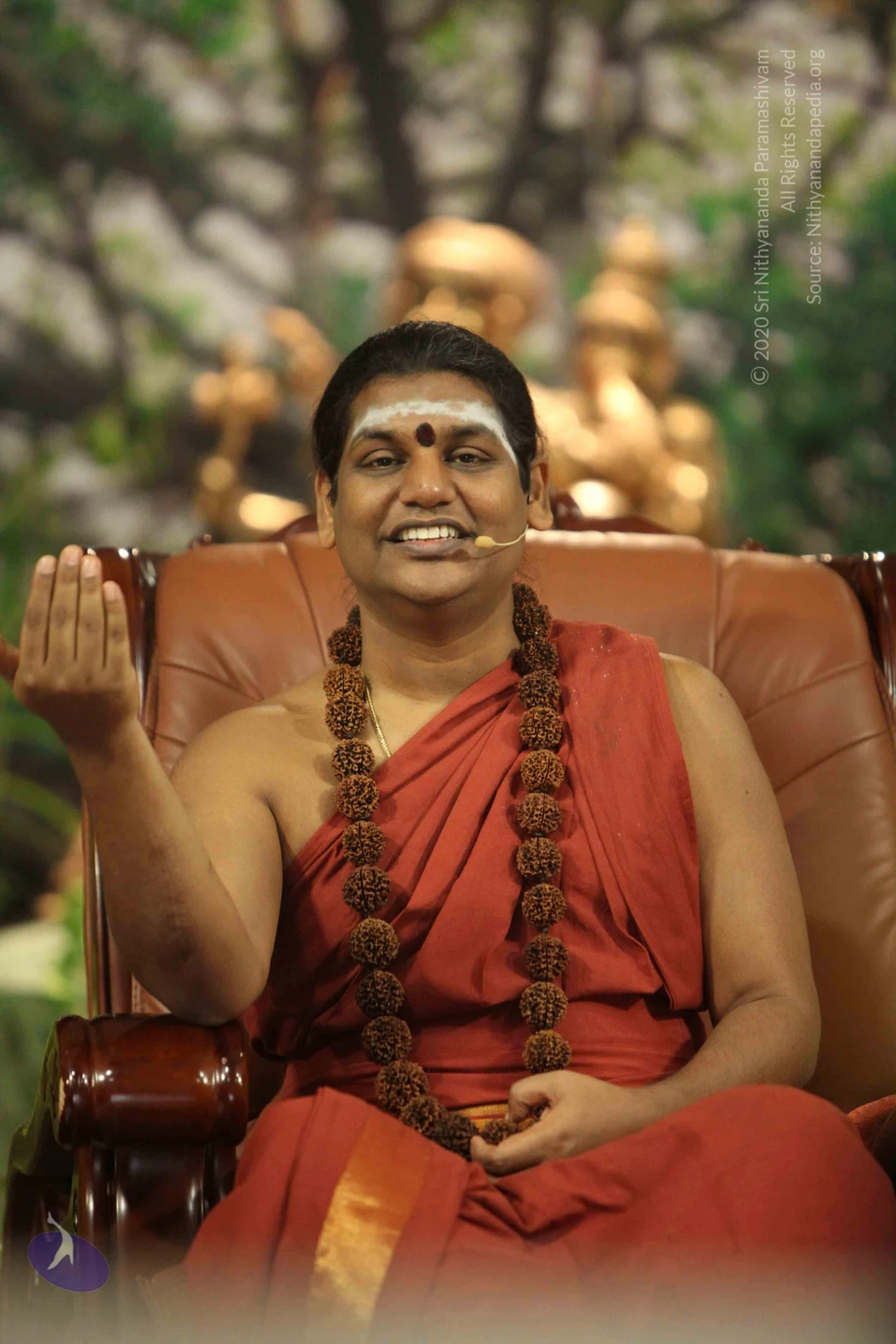
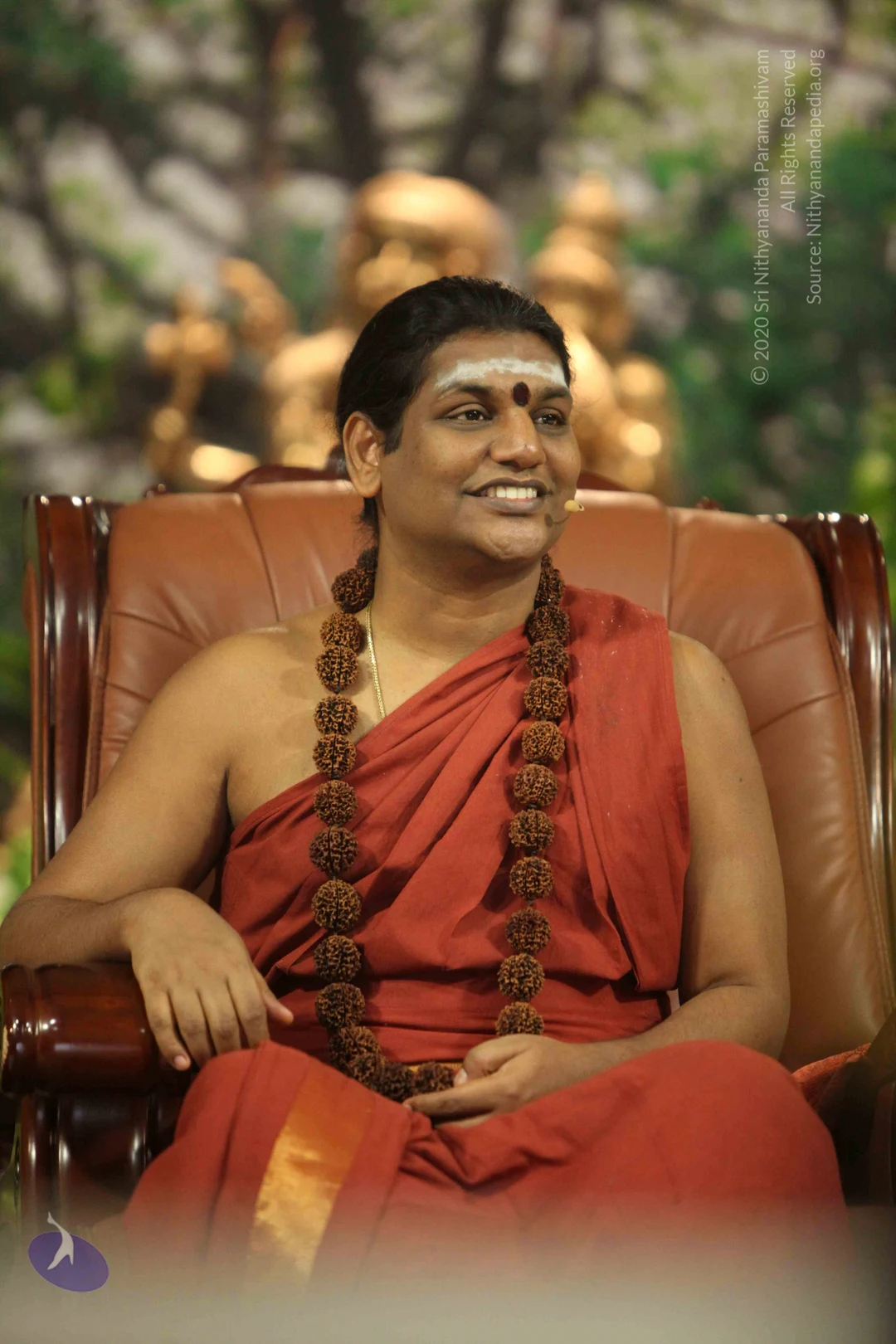
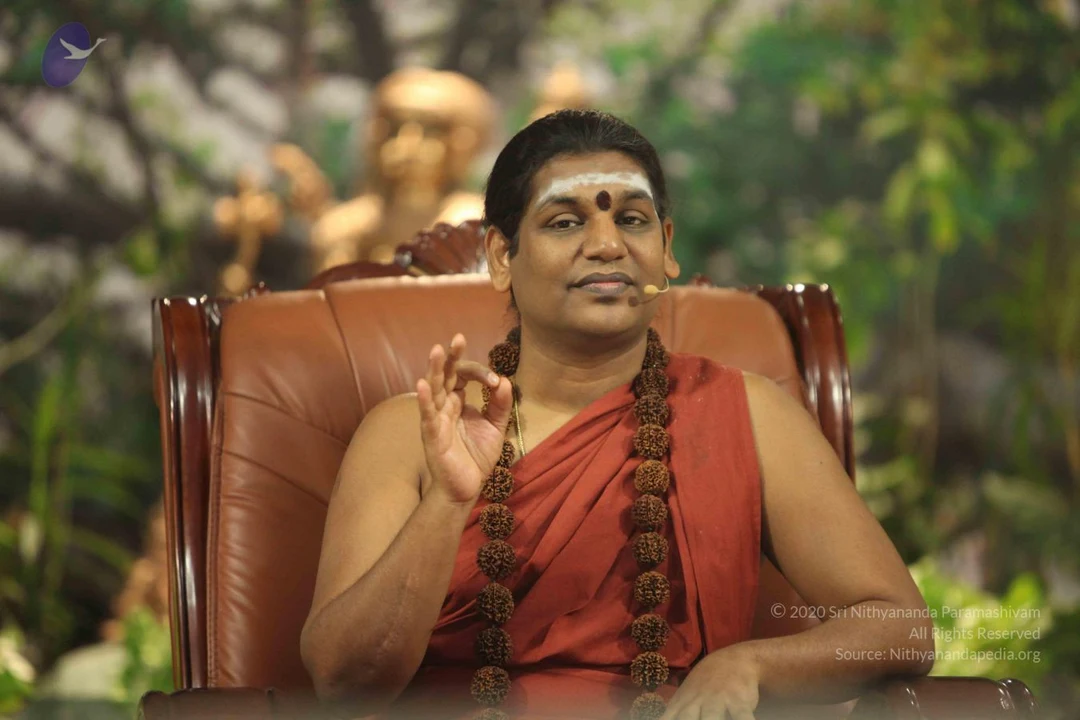
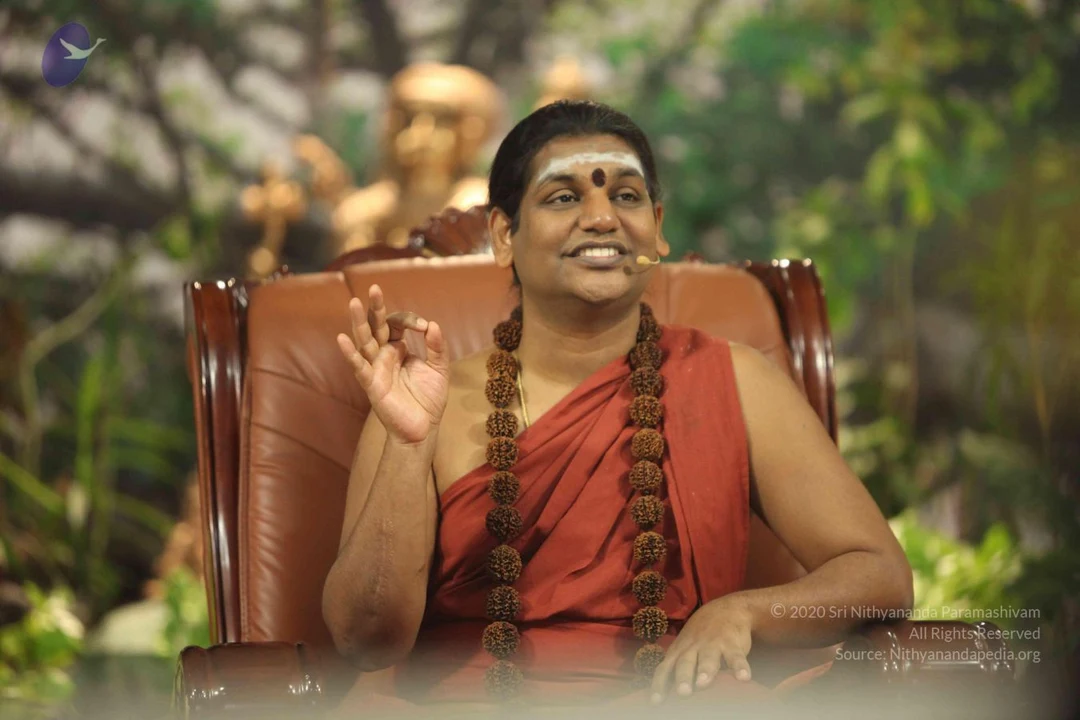
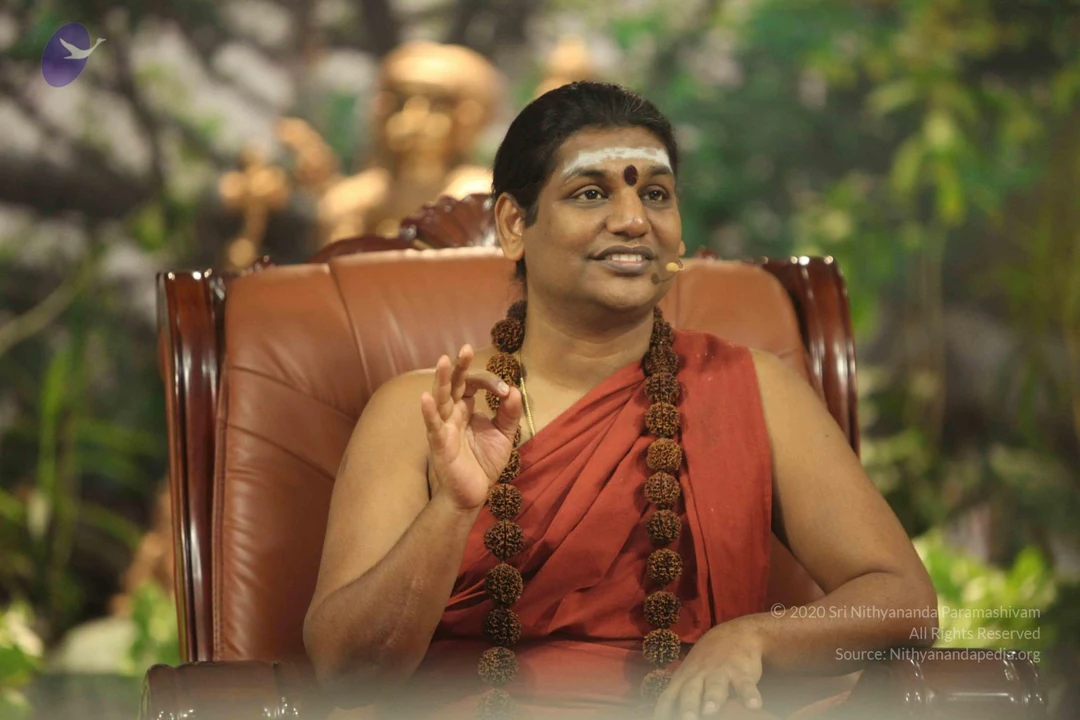
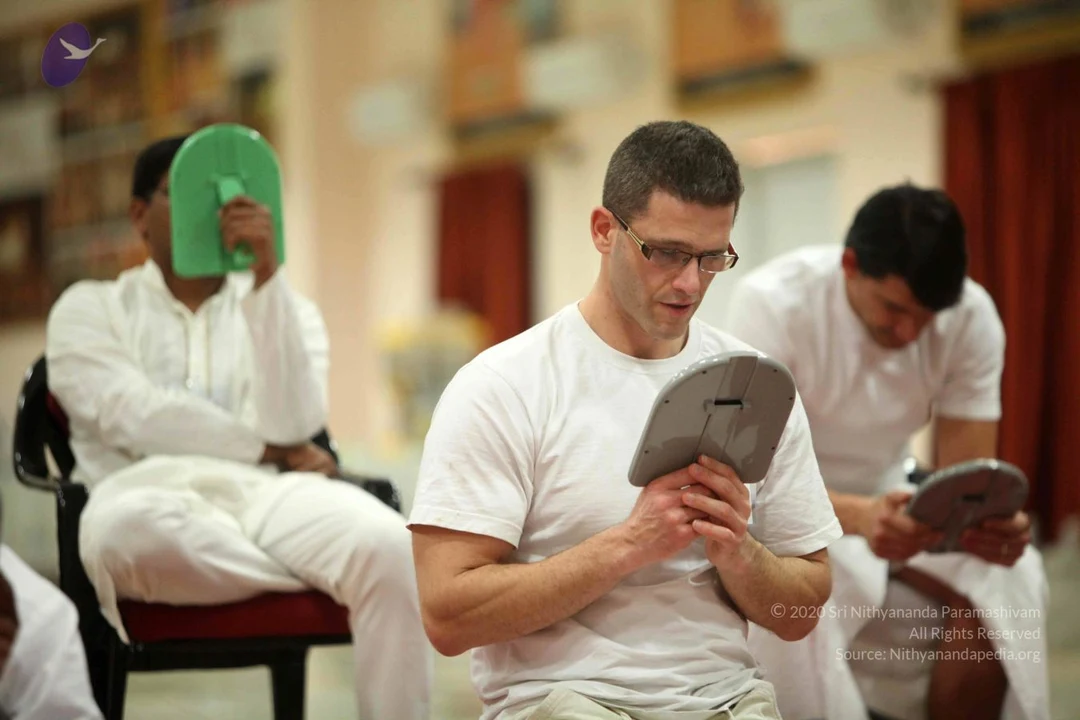
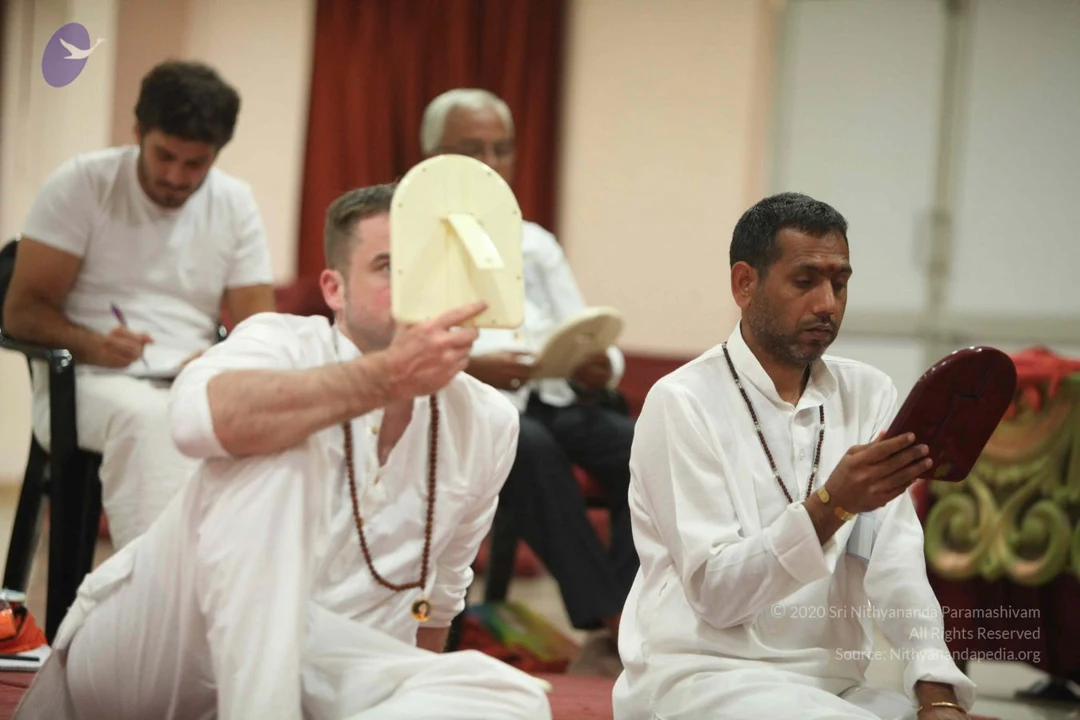
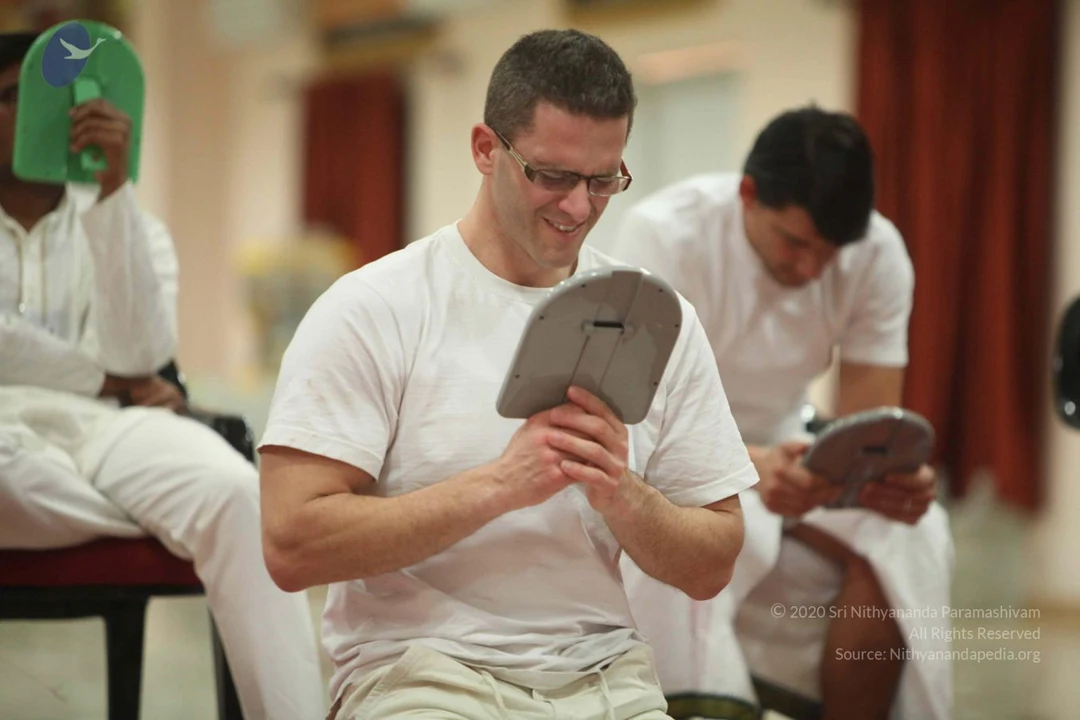
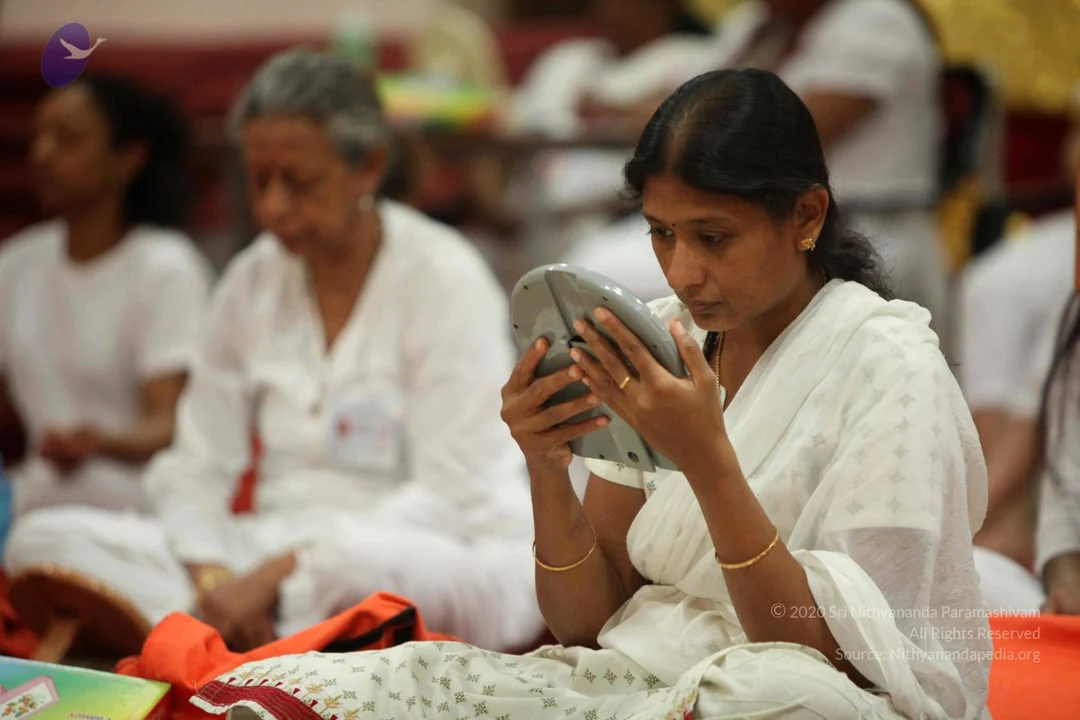
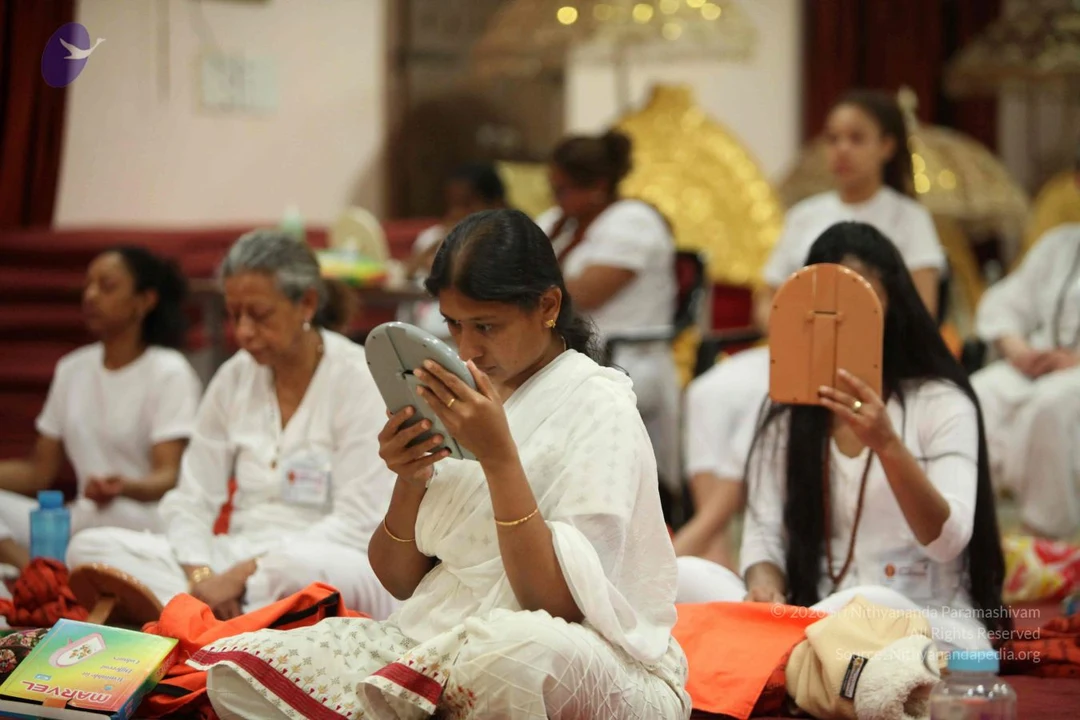
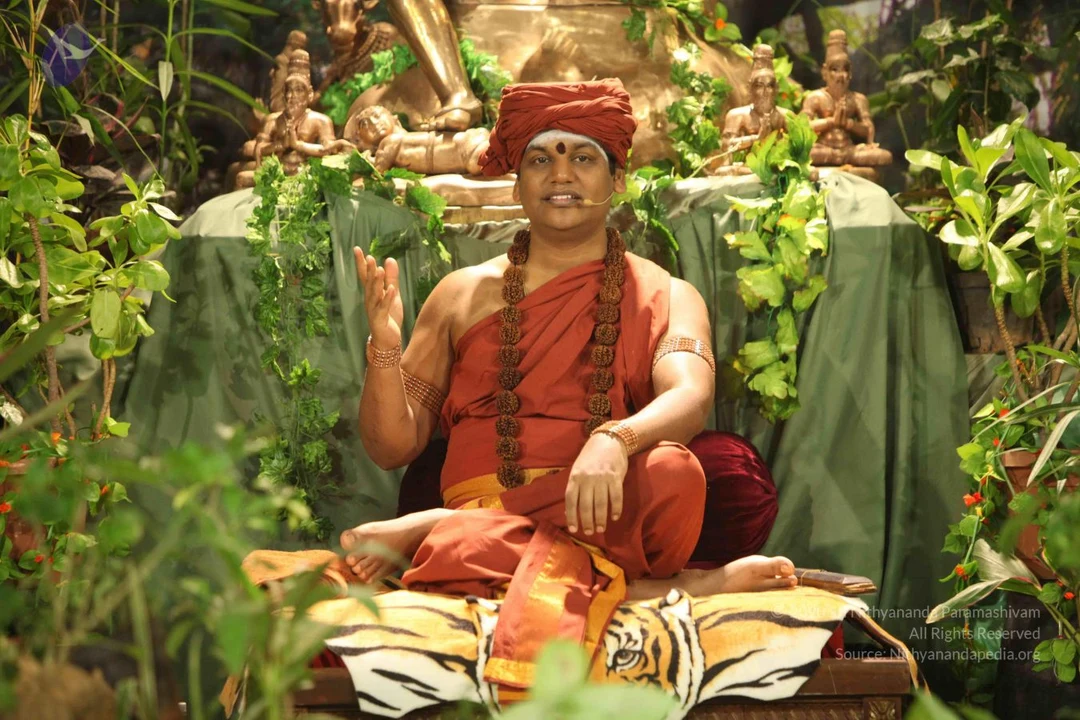
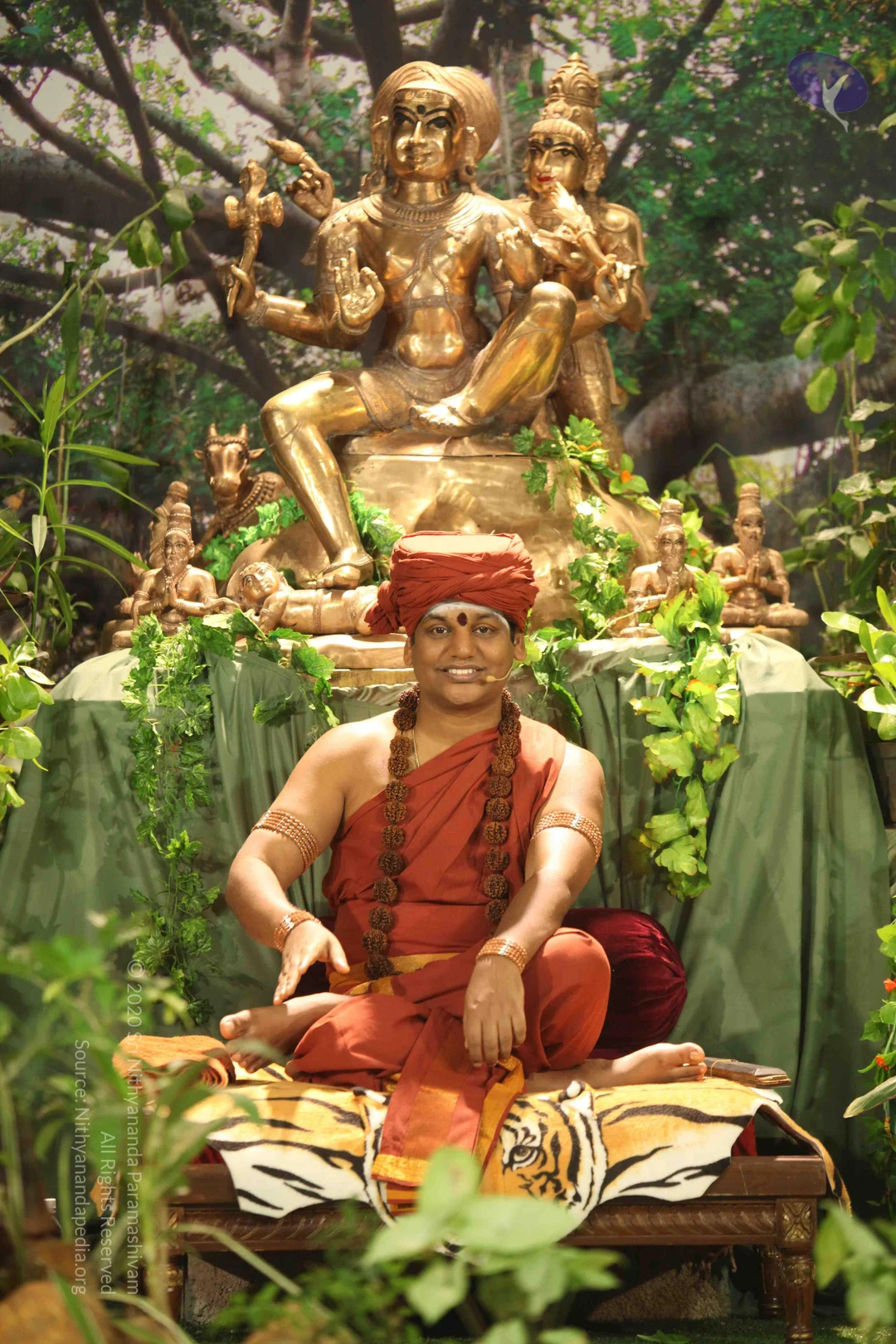
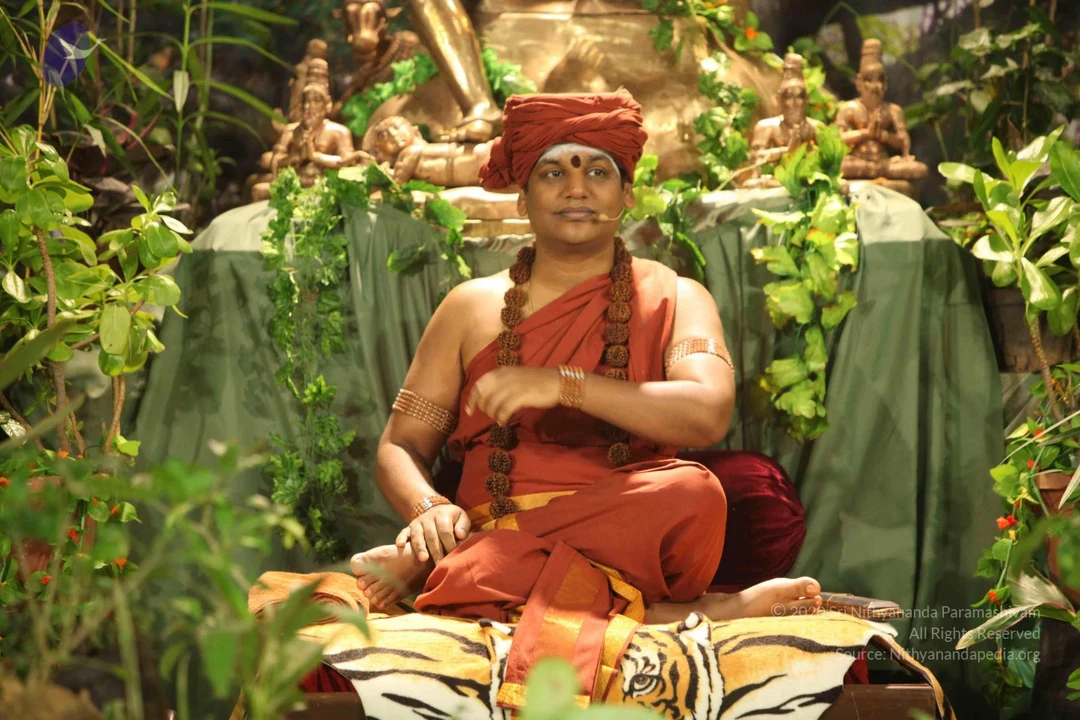
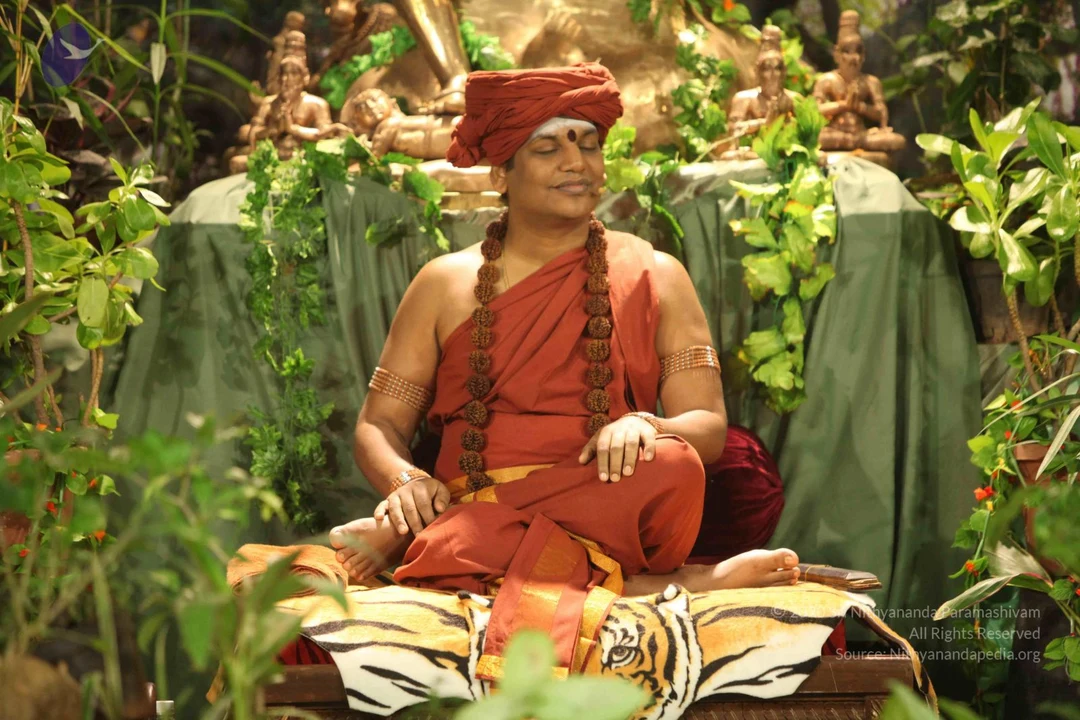
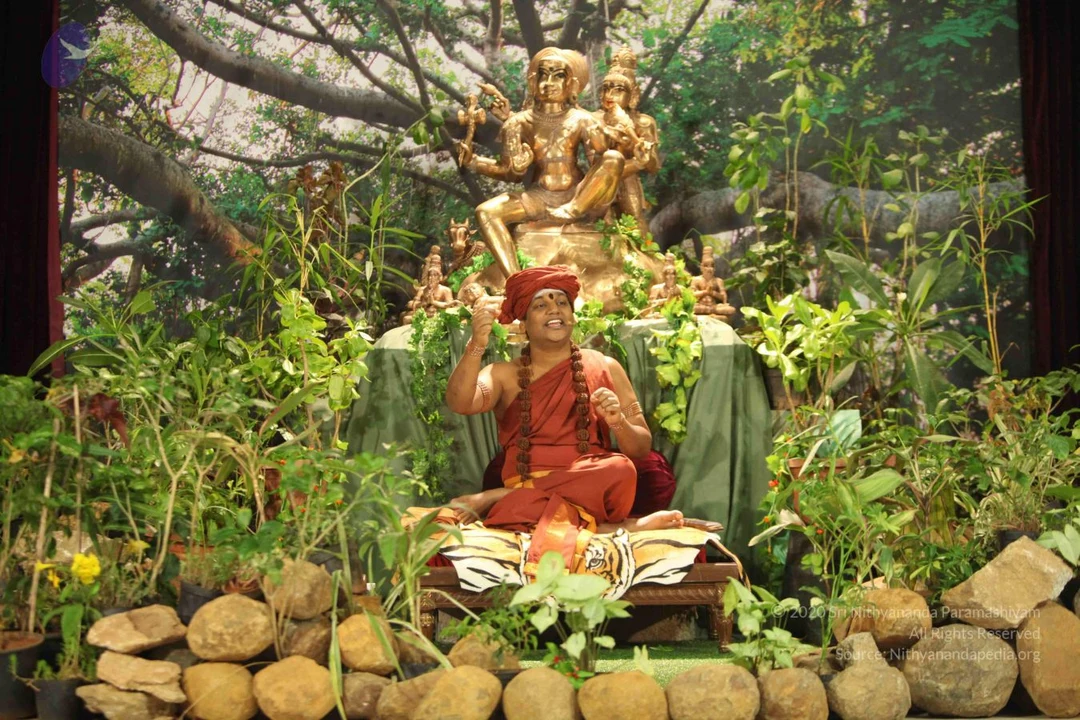
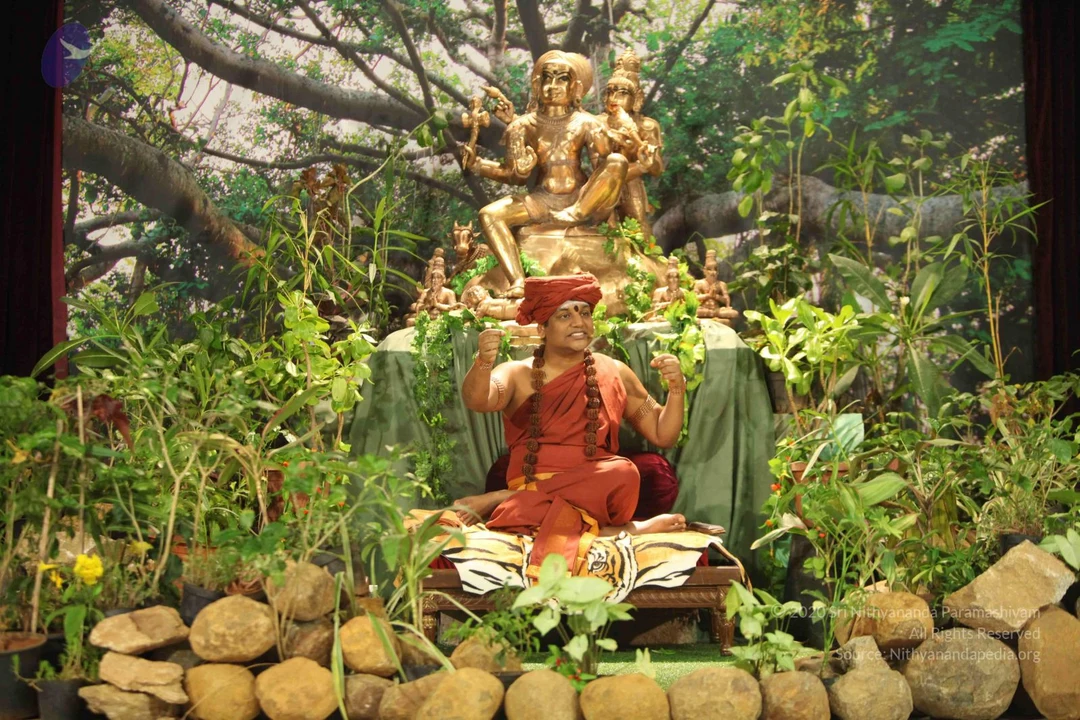
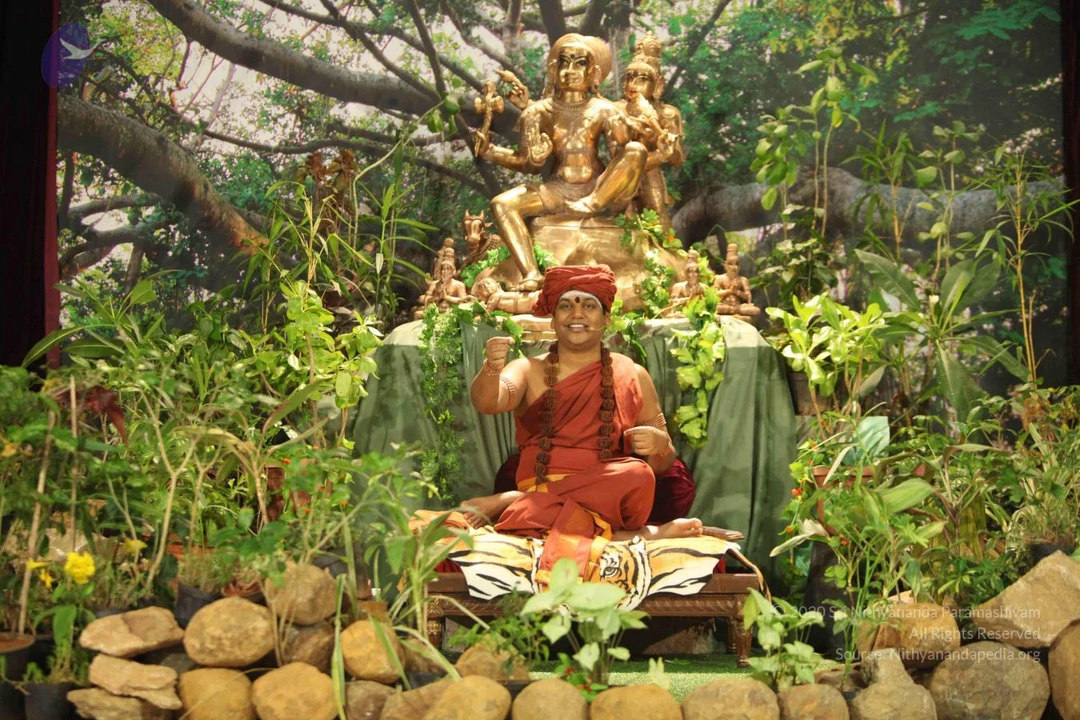
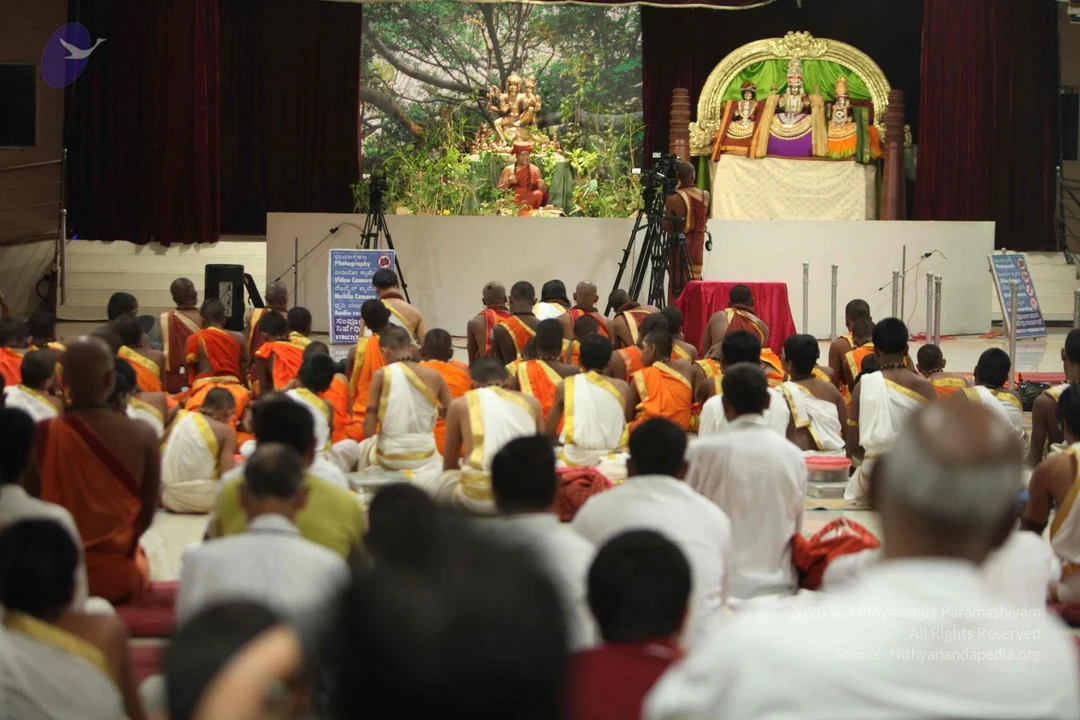
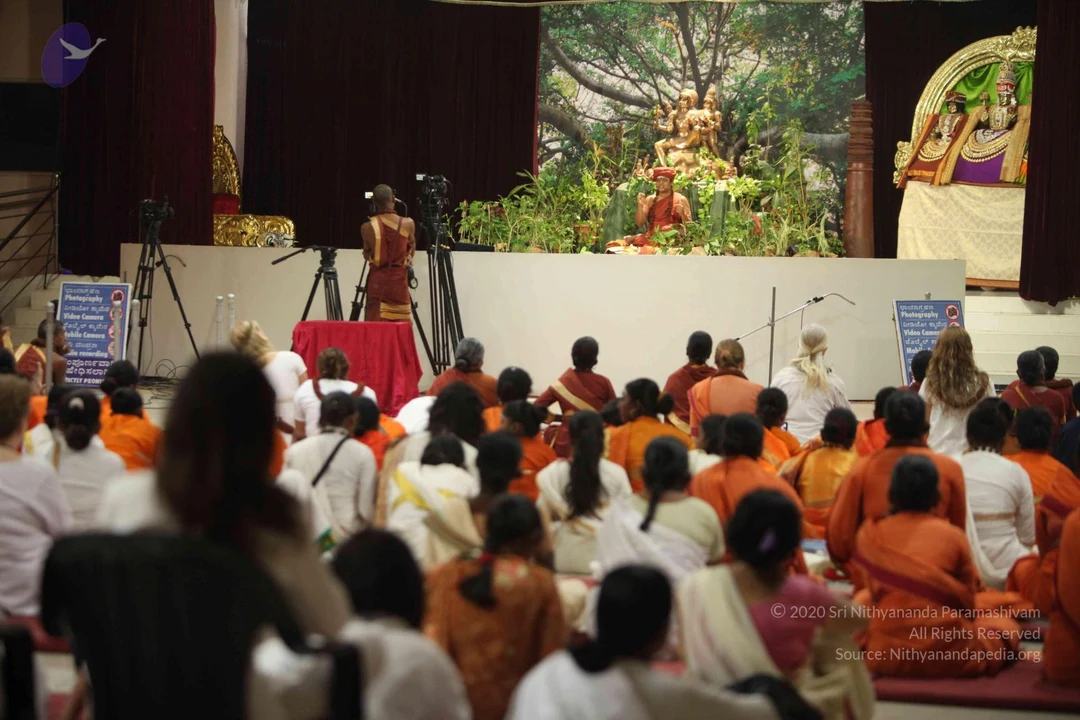
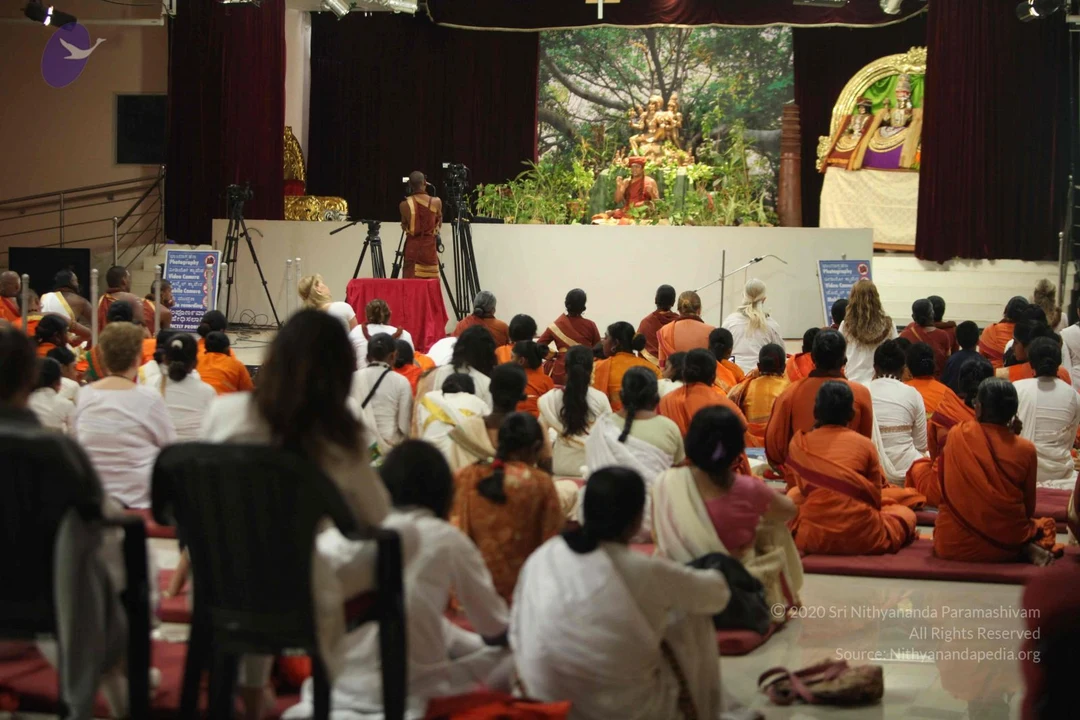
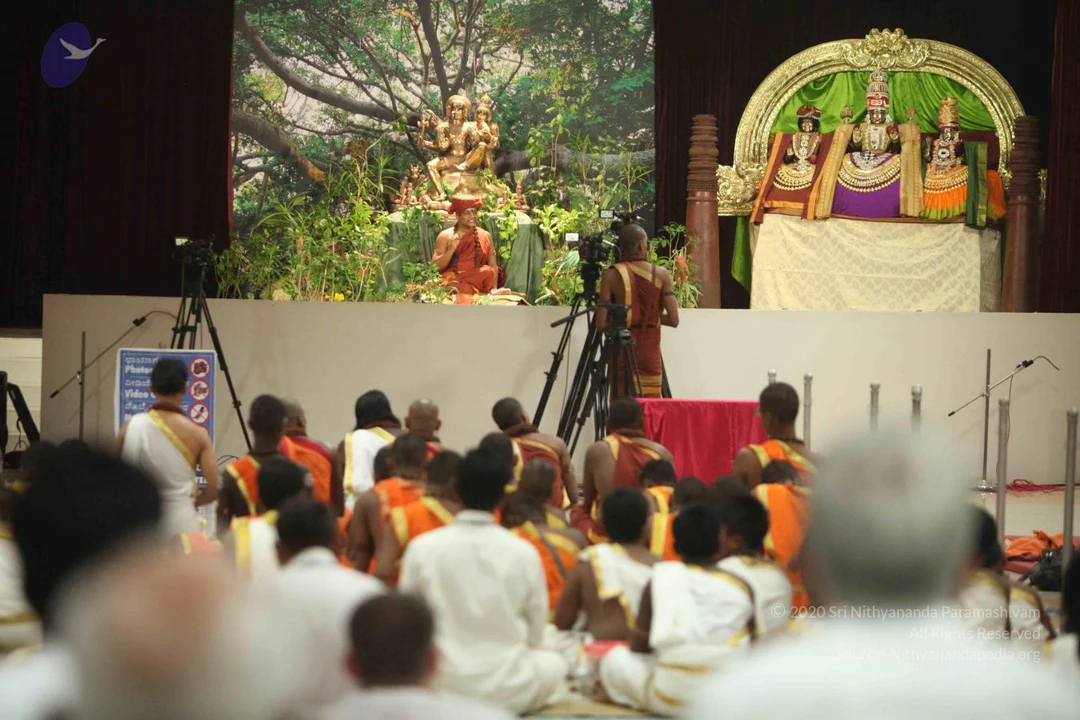
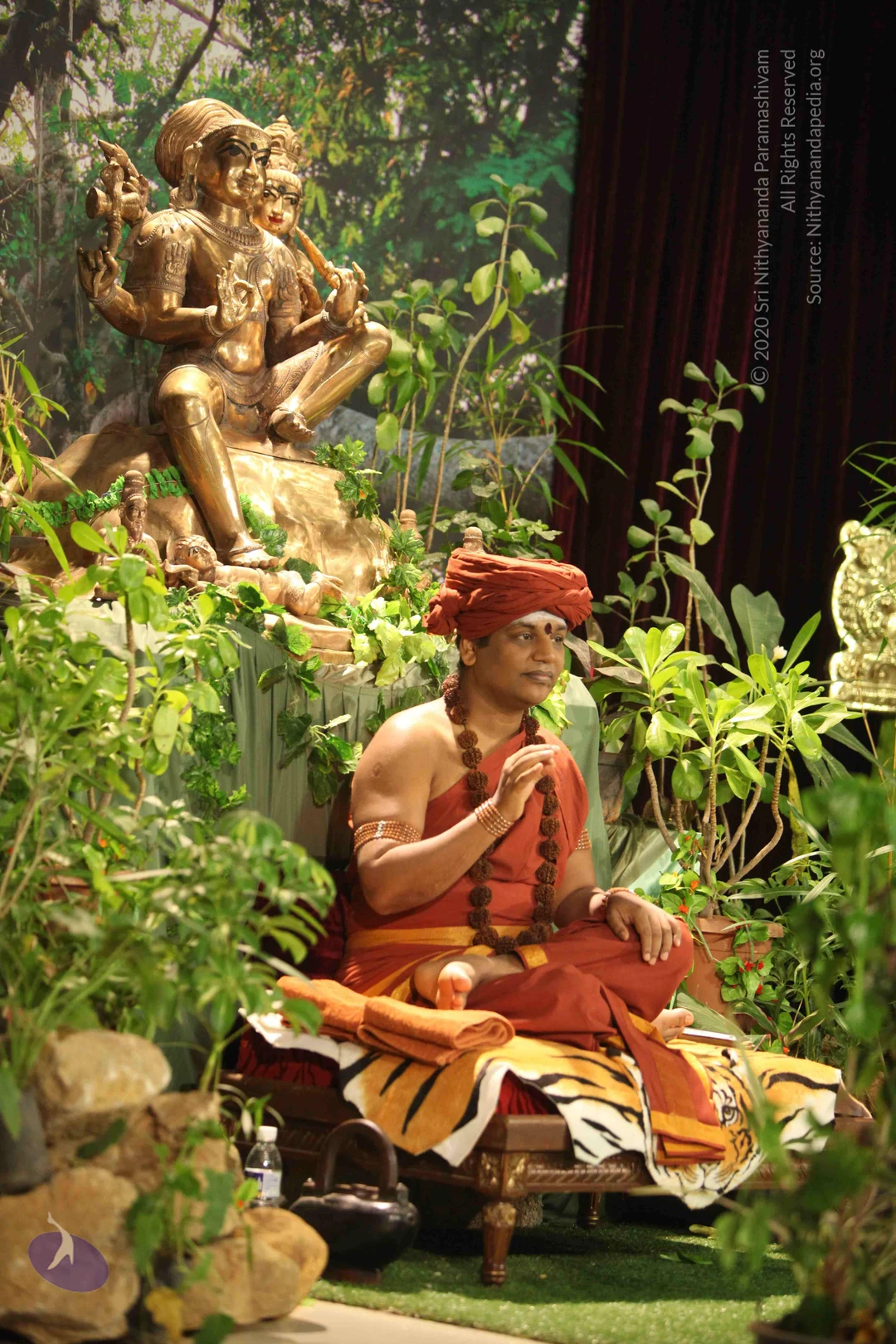
A photograph of a satsang inside a temple-like hall. On the left, a figure with long dark hair and a white forehead mark, wearing an orange-red cloth and a rudraksha mala, sits holding a small white paper and gesturing with one hand; Swamiji (probable) by appearance cues: long swept-back hair, saffron clothing and rudraksha beads. On the right, a man in a white shirt with a red lanyard and a black wristwatch raises both hands palms-forward, apparently responding to or greeting the speaker. Behind them, a woman in white with a red lanyard stands with arms folded, and another woman in white with a brown shawl and beaded necklace sits in the middle.A photograph of seated devotees in white clothing at a satsang in a hall with red curtains and framed pictures on the walls. In the centre, a man in a white t-shirt and glasses holds a grey hand-held device and reads it. To the left, a man in white kurta and trousers holds a green device up to his face while seated on a chair with a red cushion. At right, a man in white clothes looks down at a grey device in his hands. Other people are partially visible at the edges. No one present is identifiable as a person from appearance.A seated man in a brown leather armchair speaks during a satsang, smiling and raising his right hand with an open palm. He wears a deep red-orange robe draped over one shoulder with a gold-edged border, a long rudraksha mala with a ceremonial gold chain, a white tripundra on the forehead with a red bindi, and a small headset microphone. Blurred golden figures and green foliage fill the background. The person appears to be a person in the presentation cues of saffron-red robes, rudraksha malas and a seated teaching posture.

February 21 2015

Original wiki page
Contents

Title

What is Good? What is Bad?

Description:

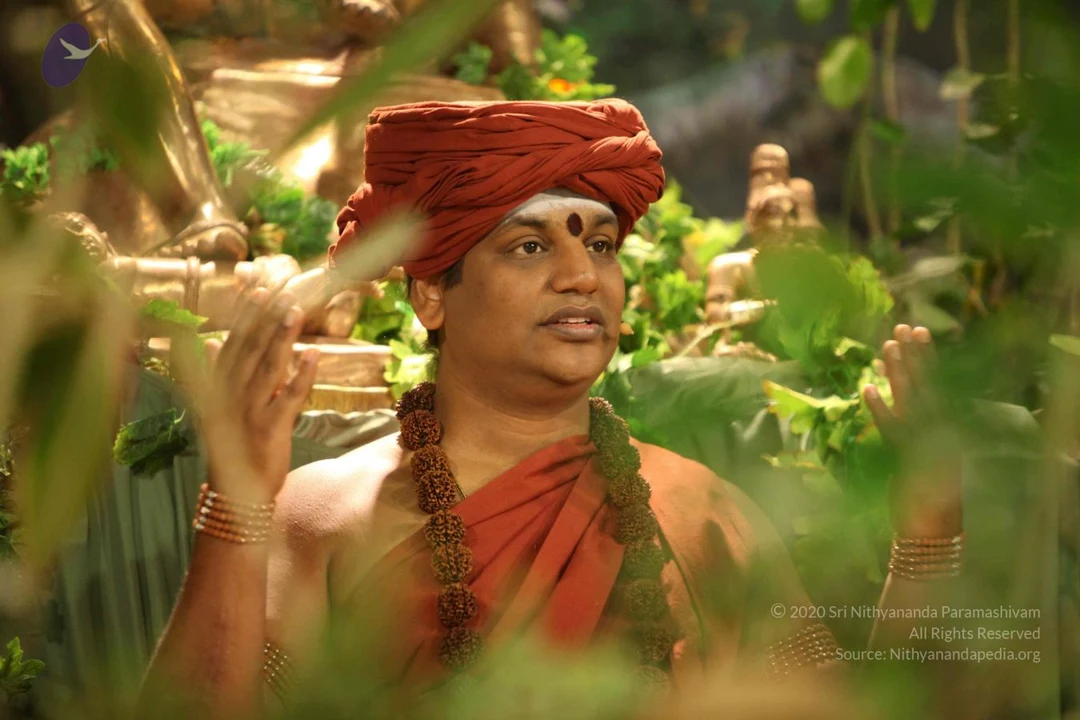
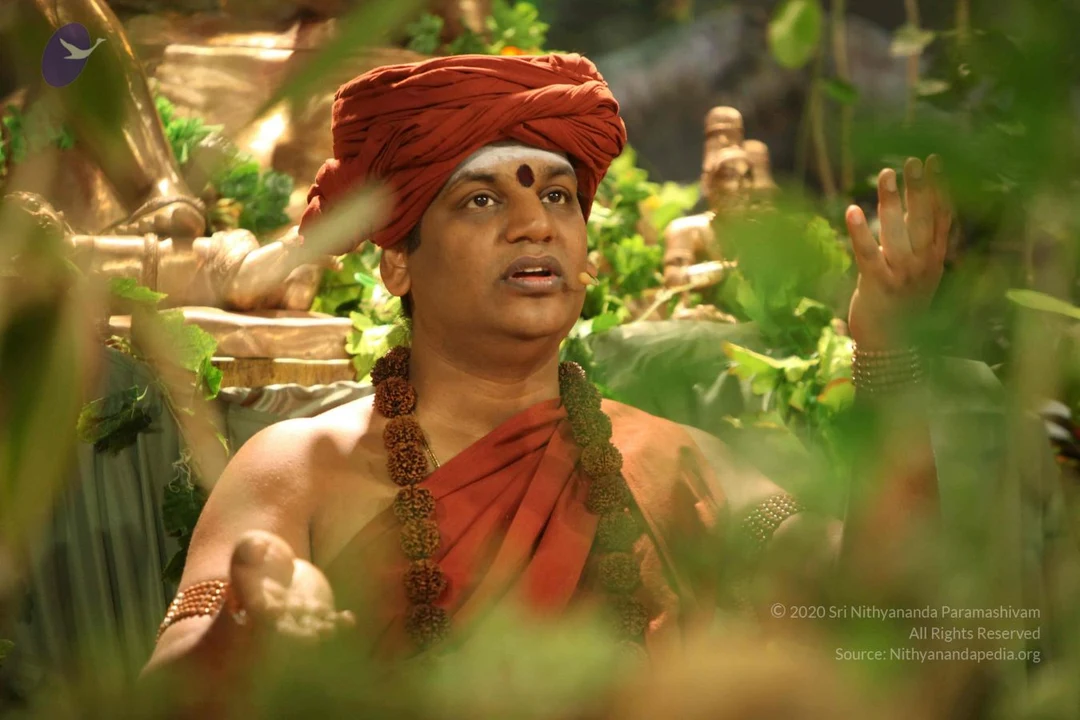
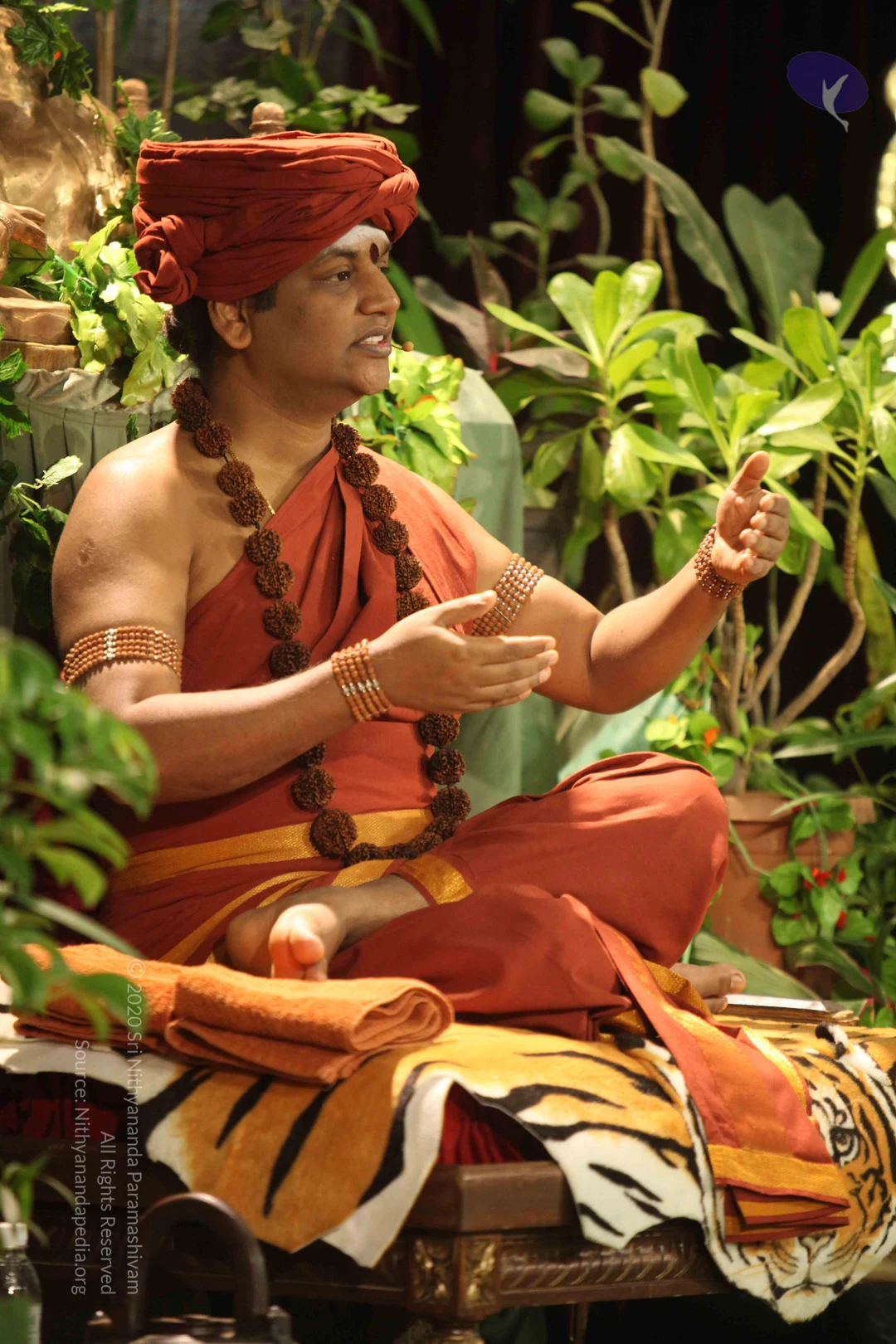
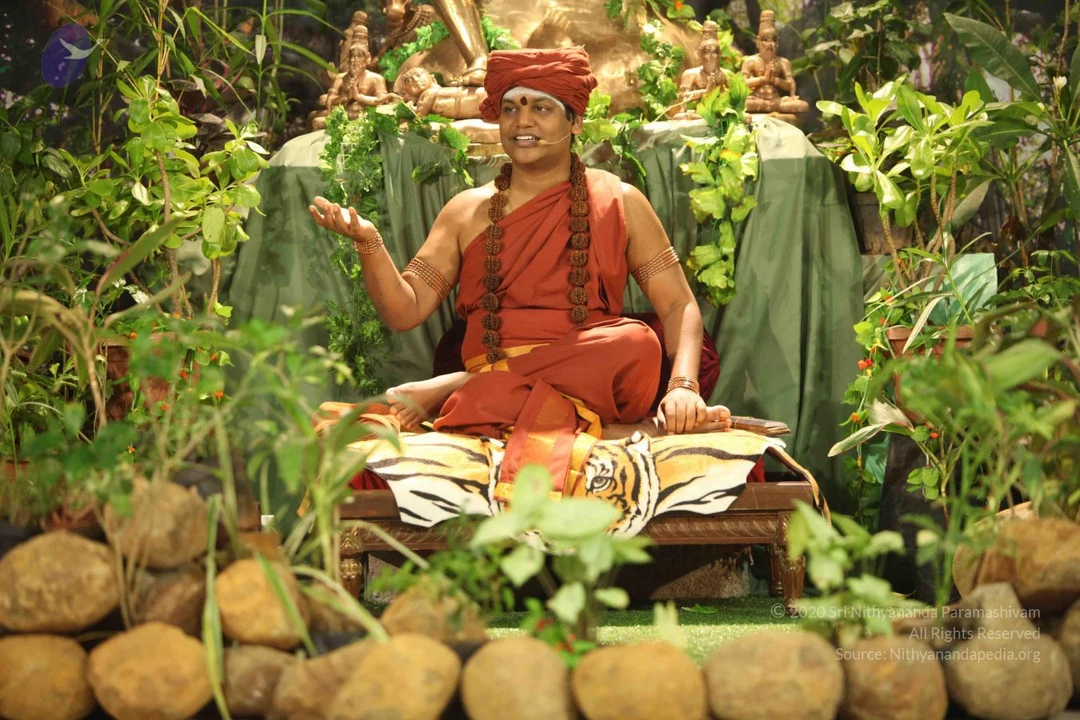
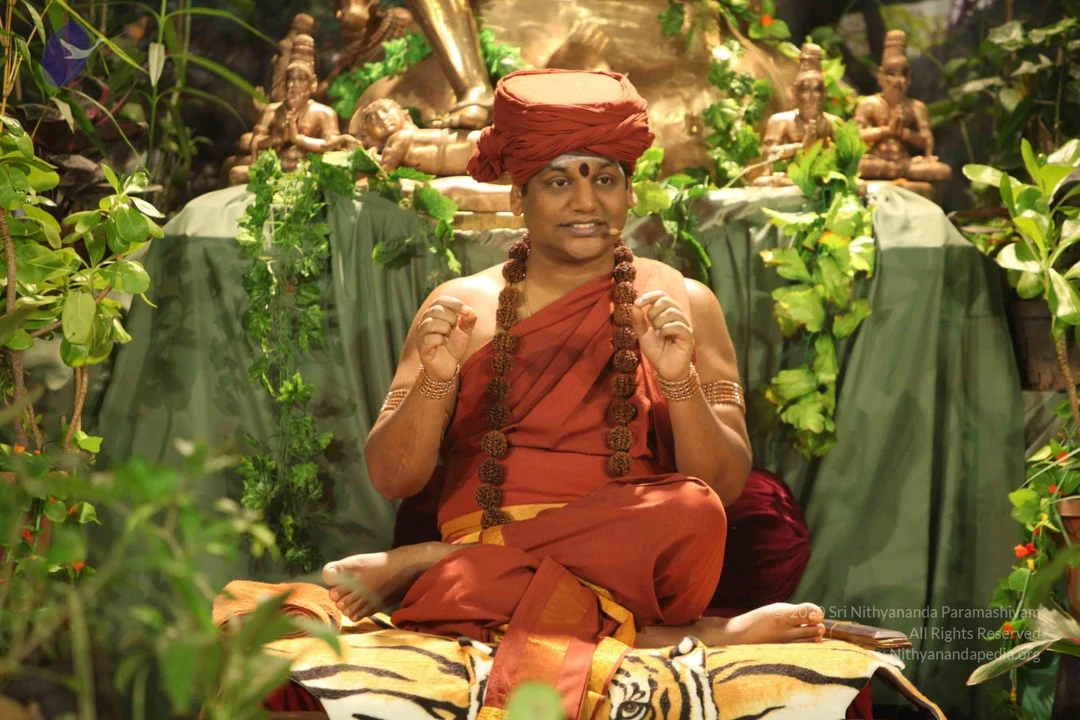
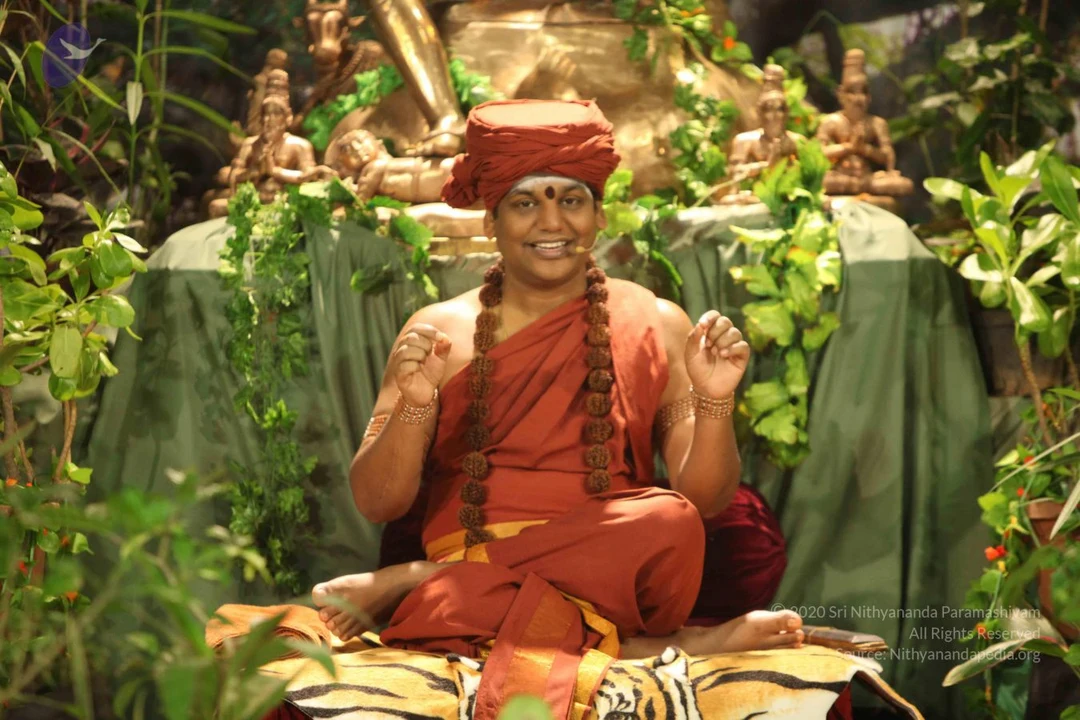
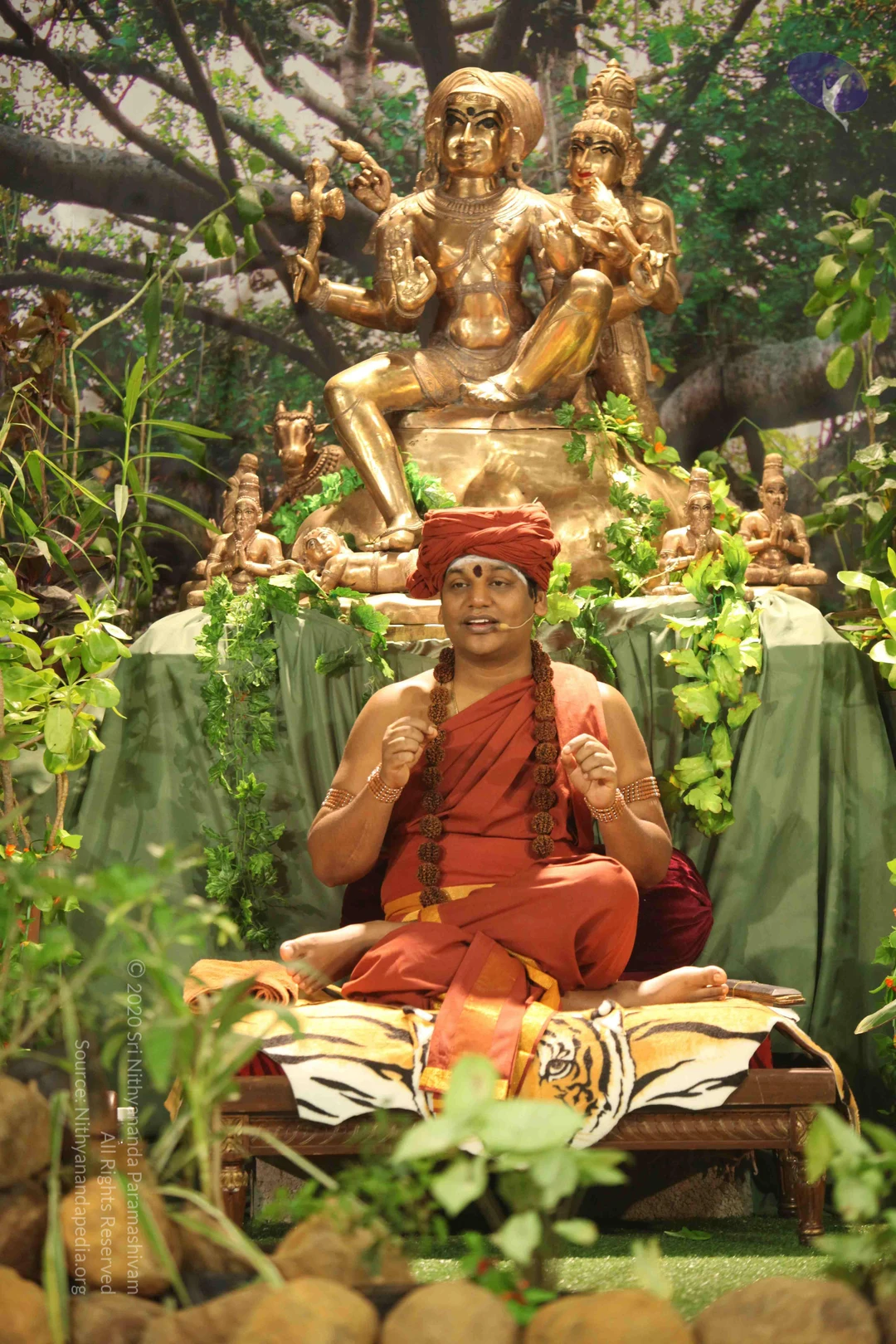
Today’s (21st February, 2015) Morning Satsang continues with the Upanishads Series - Living Advaita. Isha Upanishad–Verse 3 continues asuryā nāme te lokā andhena tamasā’vṛtāḥ | tāṁs te pretyābhigacchanti ye ke cātma-hano janāḥ || 3 || In this profound delivery of the Isha Upanishad, Paramahamsa Nithyananda reveals the simple Truths from the Cosmos of what is good or bad, right or wrong, high or low, and so on. The answer revealed can be used to answer all our questions in life. When life or our own inner self teaches us new lessons and our aspirations get mature, using our powerfulness will expand and move us to even higher aspirations.

VideoAudio

Transcript:

(00:17)

Nithyānandeśvara samārambhām Nithyānandeśvari madhyamām | asmat āchārya paryantām vande guru paramparām ||

(00:56)

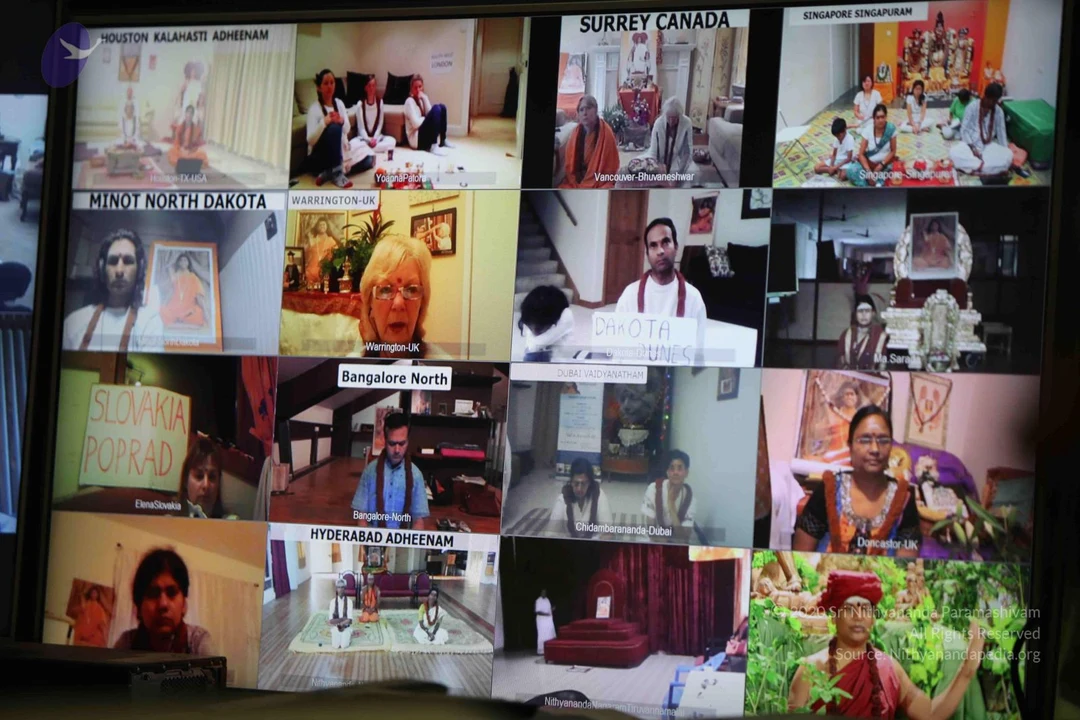
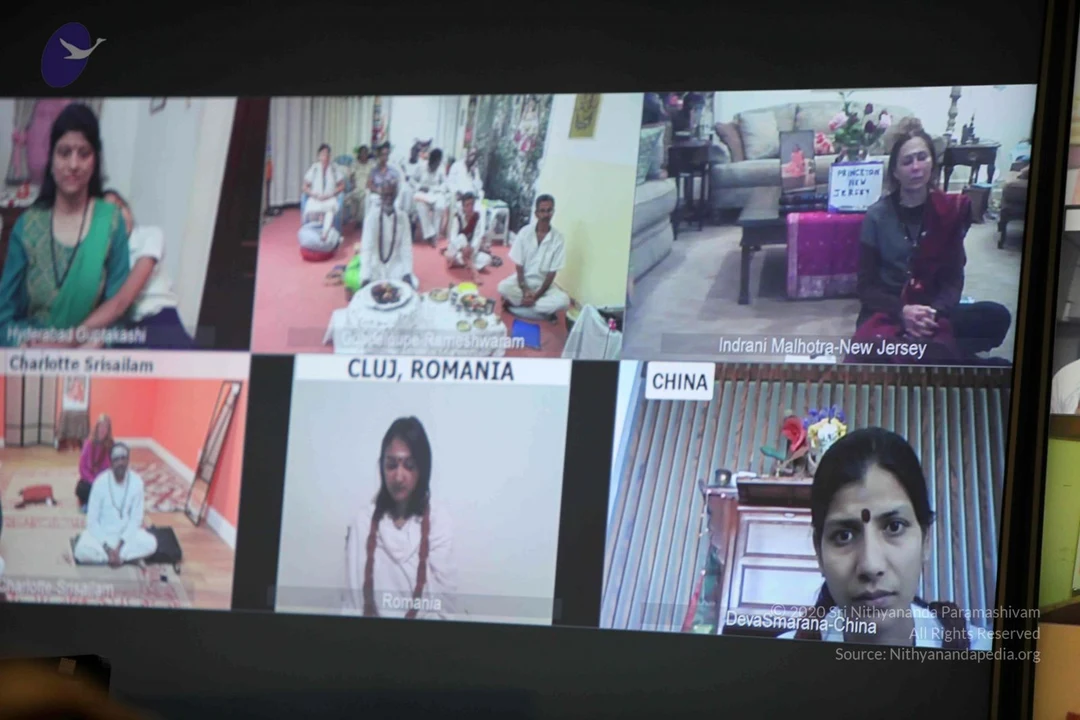
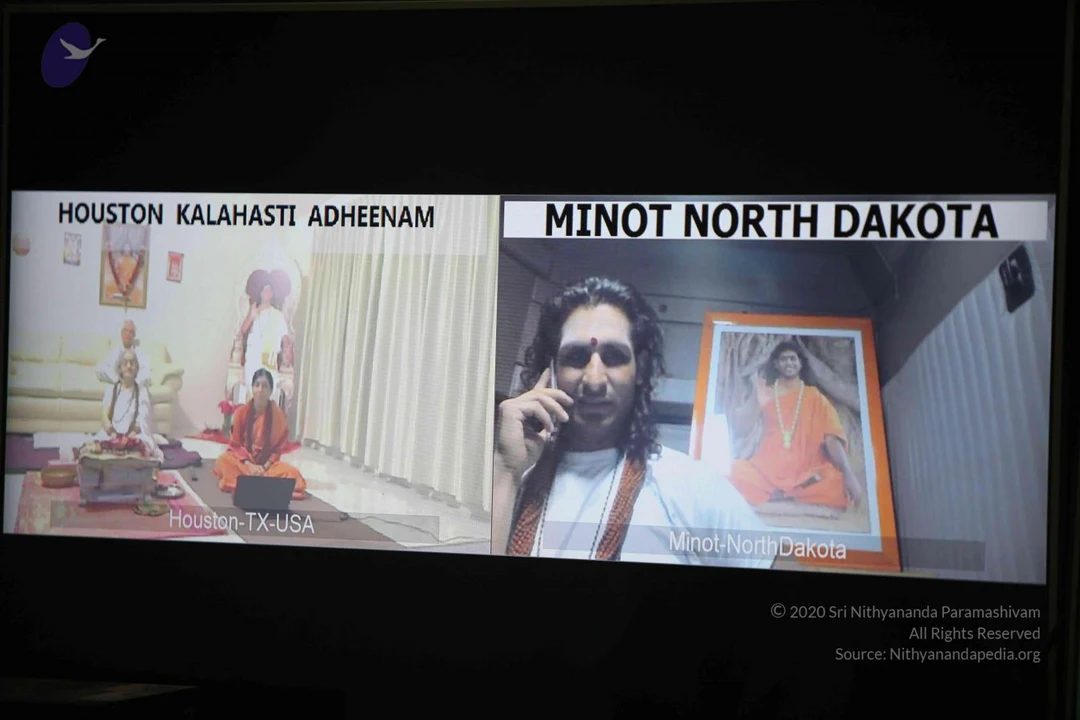
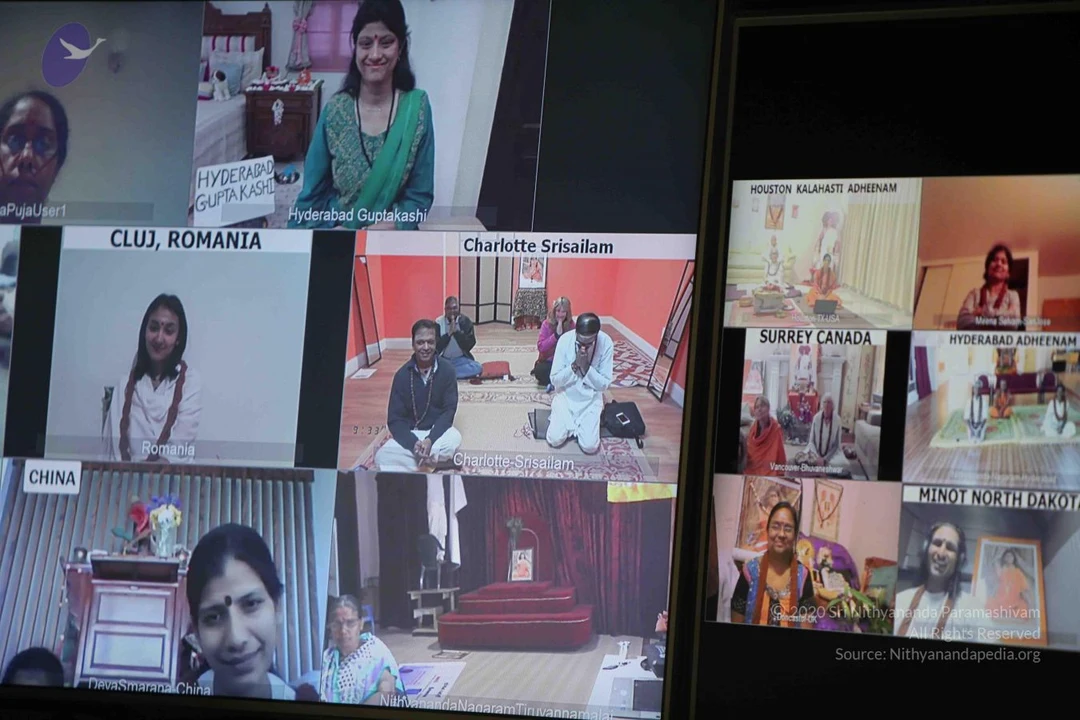
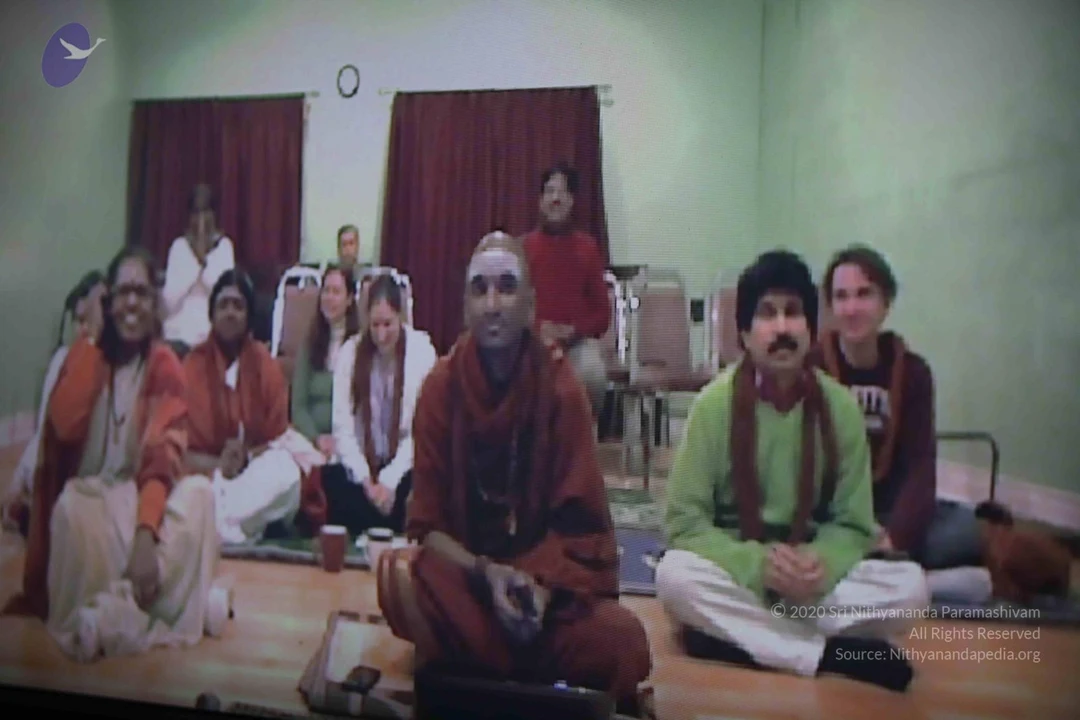
I welcome all of you with My love and respects. I welcome all the devotees, disciples, samajis, satsangis, Shrimahants, Mahants, Thanedars, Kotharis, sitting with us all over the world through Nithyananda TV, Sadhna TV, and Arra TV, and two-way video conferencing having Nayana Deeksha all over the world. Cities sitting with us all over the world: Canberra Health and Harmony Festival, Los Angeles-Arunachalam, Ohio-Prayag, Oman-Sivagangai, St. Louis-Tirumala, Toronto-Thiru Kailayam and lot more cities.....Charlotte, Hyderabad-Gupta Kashi, Cluj-Romania, Guadeloupe, Indrani- New Jersey, China, Houston and everywhere it is.....I Am having too many cities. I will enter into the satsang directly. So, I welcome all of you with My love and respects. Too much is waiting to come out. So.....

(02:26)

Let us start on the third verse of Ishavasya Upanishad: असुर्या नाम ते लोका अन्धेन तमसाऽऽवृताः । ताँस्ते प्रेत्याभिगच्छन्ति ये के चात्महनो जनाः ॥ Asurya naama they lokaa andhena thamasaavruthaah | Thaagumsthey prethyabhigachchanthi ye ke chaathmahano janaah || Listen. Please listen. No one is good, no one is bad. If somebody does the actions which fulfils your ambitions, you call them as GOOD. If somebody does actions which is not fulfilling your ambitions, you call them BAD. No one is right, no one is wrong. No one is good, no one is bad. Deciding somebody is good or bad, right or wrong, is purely dependent on how much they are supporting your ambition…. So, what Cosmos…. answers, what is the answer of Cosmos for this issue?

(04:49)

The Upanishads, please understand, Upanishads are dharma declaring its authority and authenticity by itself. No human-being is involved in it. No human vested interests are involved in it. No. Here, no Prophet, no Messenger, no Son of God, not even God, is involved. Understand. Hindu tradition is so bold, God has only second place. The dharma, Upanishads, stand taller than the concept of God. Understand. It stands taller than the concept of God. What is the opinion of Cosmos? What is the opinion of Universe? How does the universal intelligence address this problem of high and low, right-wrong, good-bad? Because, our perceptions of good and bad, right and wrong, is far away from the fact or the truth or forget about reality. What is the Cosmos’ opinion who is good, who is bad, who is becoming more and more good, who is becoming more and more bad, who is doing more and more right, who is doing more and more wrong, what is right, what is wrong, who is right, who is wrong, who is good, who is bad?

(08:08)

Because, Upanishads have to declare this to the universe, they have to declare, they have to reveal this to the universe. We have not even attributed Upanishads to Gods, or even ‘THE God’. No. We wanted to retain the authority and authenticity as it is. We left it as ‘apaurusheya’, as it was done, revealed. Understand. Our Rishis don’t even want to attribute these Upanishads to any gods, goddesses, THE God. No. They said, “It is the Cosmos declaring its authenticity and authority to itself.” So, what Upanishads want to say about good and bad, right and wrong, high and low, in these last three verses Upanishads are declaring beautifully the whole science of life, almost all the questions of good and bad, right, wrong, who is higher, who is lower, why somebody is enjoying, somebody is suffering. Everything is clarified. Understand. Upanishads don’t answer question by question. They just bombard the questioner. Upanishads, if they answer hundred of your questions, they will make you question millions of your answers. You questioning many of your answers using these sutras is what I call internalizing - manana; means, you questioning many of your answers using the truths of Upanishads, revelations of Upanishads.

(11:30)

I wanted the Bidadi Nithyanandeshwara Temple to be a golden temple mainly to engrave this whole Upanishads in golden letters. And, all the 108 Upanishads will be engraved in stone in golden letters in Bidadi. It is the Cosmos declaring its authority, Cosmos revealing its authority and authenticity. Here, Upanishads declare right and wrong, good and bad, reveal the sacred truths about right, wrong, good, bad, to the universe. Listen. Saying, “YES” to life is always right and brings all good things. Saying, “NO” to life is always wrong, brings all negative things. All your questions, “Why somebody who is so good is suffering? Why somebody who is so bad is enjoying”? All your questions are answered just by this one sacred truth. Now, your questions have thousands of answers in it. When you say, “Why such a good man is suffering”? You already come to the conclusion that he is a good man. Now question that answer with this truth. You may say he is a good person. You have come to the conclusion. You already have the answer: he is a good person and why is he suffering? Use this sacred truth and question that answer: Has he said and.. or saying, “YES” to life? Wherever he is suffering, is he saying, “YES” to life? Understand. Sameway if you say, “Why is this bad person enjoying”? Look in question your conclusion that he is a bad person. Is he saying, “NO” to life?

(15:05)

Please understand. Dharma is revealing itself. So, internalize, catch it and internalize it. Listen. Question all your standards of morals. Question all your concepts of right. Question all your concepts of wrong. If somebody strongly believes sensual pleasures are life and that is the way he expands, he is saying, “YES” to those pleasures, he is saying, “YES” to life. Understand. I Am almost on the edge of getting misunderstood. But I Am taking the risk to reveal the Cosmic truth as it is. Wait. Don’t come to conclusion. Listen, Listen a little more. But, when life or your own inner self teaches you, when your aspirations get matured, “Maybe, it is not all about sense pleasures. I think good name and fame is the real life.” When your aspirations get matured, have the strength and powerfulness to move towards it leaving the sensory pleasures as a second priority. So, retain powerfulness when you say, “YES” to senses, or “YES” to name and fame, “YES” to mental pleasures; name and fame is the mental pleasure, psychological pleasure or when your aspirations get matured and life raises you to experience the conscious pleasures; Understand initiation, bliss, all these are conscious pleasures. What you experience during the Kundalini awakening, or during Completion, when you feel complete, Kundalini awakening time, during the initiation, during the Energy Darshan, without any support from senses or mind, those pleasures are pleasures of Consciousness. Pleasures of senses, pleasures of mind, pleasures of Consciousness…. Saying, “YES” even to your pleasures of senses as long as you feel they are your life, is saying, “YES” to life.

(19:28)

And, the next statement I Am going to make is important: As long as you perceive and believe sensory pleasures are your priority and they expand you and they bring you tremendous joy, fulfillment, contentment, pleasure, saying, “NO” to sensory pleasures is saying, “NO” to life. It is self-denial, killing the Atma - Atmahana. Spend lot of intelligence, energy, time in introspection, intranalyzing, internalizing, and take decisions in life.

Ability to retain your powerfulness to say, “YES” to the maturity of your aspirations is Vairagya. Ability to retain your powerfulness and say, “YES” to the maturity of your aspirations is Vairagya. Whenever your aspirations are matured, they may mature from the pleasures of senses to pleasures of mind, and pleasures of mind to pleasures of Consciousness, and to the bliss of Consciousness itself - Tanmayananda the bliss in the very existence of you. Advaitha Anubhava, Advaitic happening saying, “YES” to the maturity of your aspirations, when your aspirations are getting matured, when you say, “YES” to them, you also get matured. When you are not able to say, “YES” to your matured aspirations, you may be getting aged, not matured.

(22:40)

The next statement I Am making. Listen. Whenever your aspirations are matured, but due to powerlessness and inability to say, “YES” to the matured aspirations, if you continue to say, “YES” to your lower aspirations, and denying, saying, “NO” to the matured aspirations, is again Atmahana…. Now, if you feel, there is a certain level of confusion, conflict, contradiction in me, till I grasp and come to certain clarity what should I do? To what should I say, “Yes” or “No”? For this question, the Upanishads, the answer for these questions, we introduce God and Kamika Agama…. Now comes the personal form appearance, not before. Till now, the context is set. Only now the hero entering. Understand. In Vedic tradition, context is higher than hero…. Context is higher than hero. You always think hero is higher than everything, because, you are in the form, anything presented in the form impacts you, impresses you. That is why context assumes human form is God. Context assuming human form is God. If He is still moving the hands and legs and doing actions as you do, He is Guru. The context assuming the form as per your perception is God. Context assuming the form to be perceived by you is Guru. Context assuming the form of perception by you, context assuming the forms as per your perceptions is God. Context assuming the form for your perceiving, happening is Guru.

(26:35)

Listen. Whenever you have a doubt, question, conflict, controversy, incompletion, unable to internalize these sacred truths and take a decision in the immediacy of your life, all you need is Kamika Agama, where the whole truths of Upanishads is transmitted into a user friendly, day to day manual. User friendly, day to day manual.

Yesterday, on the auspicious day of Shri Ramakrishna’s birthday..... Yesterday was Ramakrishna’s janma thithi. For last so many days, all of us are searching for the complete English translation of Kamika Agama. Yesterday, the auspicious day Please understand, after the Amavasya, it is the third day, the new energy gets infused into the world through the reflection of the moon. That is when Ramakrishna happened. And, exactly the same way, so many of our sanyasis, suddenly, all of them simultaneously discovered Kamika Agama English translation. We were all praying, if we have to sit and do the translation, it will take so much time, but we wanted to follow, start imbibing as early as possible. And Mahadeva literally revealed and blessed our Sangha with a simultaneous revelation of Kamika Agama English translation to multiple sanyasis at the same time, exactly evening.

(29:52)

So, now we have the complete translation of Poorva Kamika Agama, Poorva Paadha and Uttara Paadha, both. Poorva and Uttara, both. It is available freely in the Internet. We can flash the link. Please see the link. Now it will be flashed and all the SMKT will get email of that link. It is done by some Shiv Acharya and yes.. Shiv Acharyas name. – Dr. S.P. Sabharathnam Shivacharya and uploaded by the Himalayan Academy. The Kauai Hindu Monastery, in their website it is there. So, I wanted all My followers – it is available as free download – all My followers, to download the Poorva and Uttara, and read the relevant parts for your life. You may not, you may not need the how to build the temples all those parts. You may need how to take bath every day, brush yourself, apply vibhooti, do your simple puja. So, whatever is your relevant part, please read and start aligning yourself. And, all the Mahants, Kotharis, Thanedars who are part of the Sangha, you may have to read more parts, because, if you are going to start a temple, or start an ashram, start a center, you may need to read all those parts also. It is, I think, around two thousand page.

(32:21)

And, I also wanted to tell every one of you, the Himalayan Academy, out of grace, and respecting the tradition of knowledge is free, they have uploaded the whole thing freely. But, I request and recommend all our centers and ashrams to collect some donation, as much as you can, and contribute it to them directly, thanking them for this great service to Hindu tradition and Hinduism…. After all, they are doing so much of service to Hinduism by bringing all these to the world and revealing these great truths by translating them and uploading it for free download they are serving. So, I recommend all our centers, ashrams, when you download and use these, contribute to them, so that they can continue to do their good work. Let the Dharma Chakra roll. Let the Wheel of Dharma roll. It will roll only when everyone who is benefited also stands by it and supports it.

And I also wanted to sincerely thank, on My behalf and on behalf of the Nithyananda Sangha, the Himalayan Academy and the Kauai Hindu Monastery for uploading this English translation for free download in the Internet. And, I personally want to thank Dr. S.P. Sabharathnam Shivacharya for doing this great service to humanity.

(34:37)

So, all of you download and start aligning your life as much as possible to Kamika Agama, because, here your doubts, your questions, everything gets answered by the immediacy, user friendly, direct, straightforward, intimate, personal instruction level. Mahadeva is revealing these great truths and directly instructing. So, all the Shrimahants, Mahants, Kotharis, Thanedars, email has already been sent to you with the link of Kamika Agama, Poorva and Uttara, both the parts…. The Science of Enlightenment, context for life, should be from 108 Upanishads. Lifestyle should be based on Kamika Agama. Administration, running the Sangha, all the right, wrong, prayaschitta, enrolment, adding, deletion, administration, should be done as per Manu Smrithi.

I Am clearly defining the Vision of Nithyananda Sangha: Upanishads are the ultimate superior authoritative scriptures for our Sangha. The 108 Upanishads described, named in Mukthikopanishad. Please understand. Among the Upanishads there are some confusions, controversies, which should be accepted as Upanishads? and which should not be? So, I Am clearing it. 108 Upanishads named in Mukthikopanishad by Shri Ramachandra Prabhu to Hanuman, that 108 Upanishads forms the most authoritative, ultimate, superior, supreme scriptures for our Sangha. And, Kamika Agama is the authoritative book for our lifestyle, day to day lifestyle. And, Manu Smrithi forms the book based on which we will be doing administration of our Sangha and living our life. So, anywhere if Manu Smrithi is attacked, we will stand up to defend Manu Smrithi. Anybody attacking Upanishads or Agamas or Manu Smrithi, they are attacking us directly. We will stand and defend.

(38:45)

And I also wanted to mention one more important truth. Agama.. Kamika Agama as revealed by Mahadeva, nowhere Mahadeva says, “These Agamas should be practiced and taught only by a particular community people.” No. He says very clearly, “Shiva Vipraihi”. Shiva Viprah means, followers of Shiva. So, understand, the authority to read, practice, preach, share Agamas belongs to anybody who decides to follow Shiva. That’s all. The word ‘Shiva Viprah’ cannot be translated as particular community. See, Aamnaaya Pathathi, Adi Shankara very clearly declares, “The person who occupies this Peetha should be Yoni Brahmana” means, born in Brahmana Yoni, born to a Brahmin mother. Oh, He does not say, “Brahmin father” exactly. Anyhow, let us not get into the controversy. It says, “born to Brahmin mother.” He makes it very clear, “Who is a born Brahmin, he only has to sit in that seat.” He does not say, “practicing Brahmin”. Here, if Mahadeva wants to restrict this knowledge of Agama to a certain community which comes by birth, He would have described it very clearly, because, He goes to the extent of describing the measurement of your tooth stick. When He is in the mood of giving such elaborate, clear description, not just the kind of a stick you should use for brushing, but the length and even thickness, thickness He describes, when He goes to that extent, He not saying, “This belongs to certain community by birth, the right or authority goes by birth’, He does not say, He does not say anywhere. He says very clearly ‘Shiva Viprah’ - followers of Shiva. So, anybody who decides to practice devotion to Shiva, who decides to follow Shiva, you have the right and authority to follow, read, practice, preach Shaiva Agamas.

(42:31)

So, please understand, please understand, by revealing this to all of you and requesting all of you to align your life, I Am not doing anything against the instruction or will of Mahadeva. I Am only doing exactly as per his instruction. So, I Am very clearly telling you, all of you have adhikara, right to read, practice, live, preach Shaiva Agamas. Let Me come back to the Upanishads. Asurya naama they lokaa andhena thamasaavruthaah | Thaagumsthey prethyabhigachchanthi ye ke chaathmahano janaah || Understand. Right and wrong, right and wrong, good and bad, evolution or involution, expanding or shrinking, all these questions – what is sadhana? and what is vedhana? what is yoga? What is roga? – all these questions are answered in this one verse, with this one word – Athmahana. Asurya naama they lokaa andhen thamasaavruthaah| Thaagumsthey prethyabhigachchanthi ye ke chaathmahano janaah || Today’s subject for the Vakyartha Sadas is just the word Athmahana – what is Athmahana and what is not Athmahana.

(45:40)

I wanted to read all the three sutras of Upanishads. Please listen.

ईशावास्यमिदं सर्वं यत्किञ्च जगत्यां जगत् । तेन त्यक्तेन भुञ्जीथा मा गृधः कस्यस्विद्धनम् ॥ Eeshaavaasyamidham Sarvam Yathkincha Jagathyaam Jagath | Thena Thyakthena Bhunjeethaa Maa Gridhah Kasyasviddhanam || कुर्वन्नेवेह कर्माणि जिजीविषेच्छत्ग्ण् समाः | एवं त्वयि नान्यथेतोऽस्ति न कर्म लिप्यते नरे ॥ kurvanneveha karmaaNi jijeeviShechChathgN^ samaaH | evam thvayi naanyaThethoaAsthi na karma lipyathe nare || Listen. Listen. In this verse, Decide to live - jijeeviShe, kurvanneveha karmaaNi jijeeviShechChathgN^ samaaH, this is the key word. In the next verse, Athmahana is the key word. There, what it means to say, “YES” to life, what it means to say, “NO” to life, what is saying YES to life? What is saying NO to life? is clearly explained.

(47:04)

Now, today, the subject for vakyartha sadas in the evening is Atmahana, Atmahana. I have a happy announcement: We have got our own property in Madurai…. It is just two kilometers from the Main Bus Stand, Madurai, Madurai Bus Stand. It means, inside the city limit, we have our own property now to start the Nithyananda Dhyanapeetam in Madurai. We already have City Center, and now we have ashram too. So, now the Sangha will start functioning in a full fledged way in Madurai. I Am declaring, we are going to have a beautiful school, gurukul, and temple in Madurai…. Blessings to Madurai Sangha. So, with this, I bless you all! Let you all radiate with Integrity, Authenticity, Responsibility, Enriching, Causing Living Advaita, eternal bliss, Nithyananda. Thank you. Be Blissful!

(49:19)

Description

The Daily Video Magazine of the Nithyananda Sangha. Nithyananda Times - 21st February, 2015

Link to Video:

Photos Of The Day:

IA-Darshan
IA DARSHAN
NITHYA KIRTANS

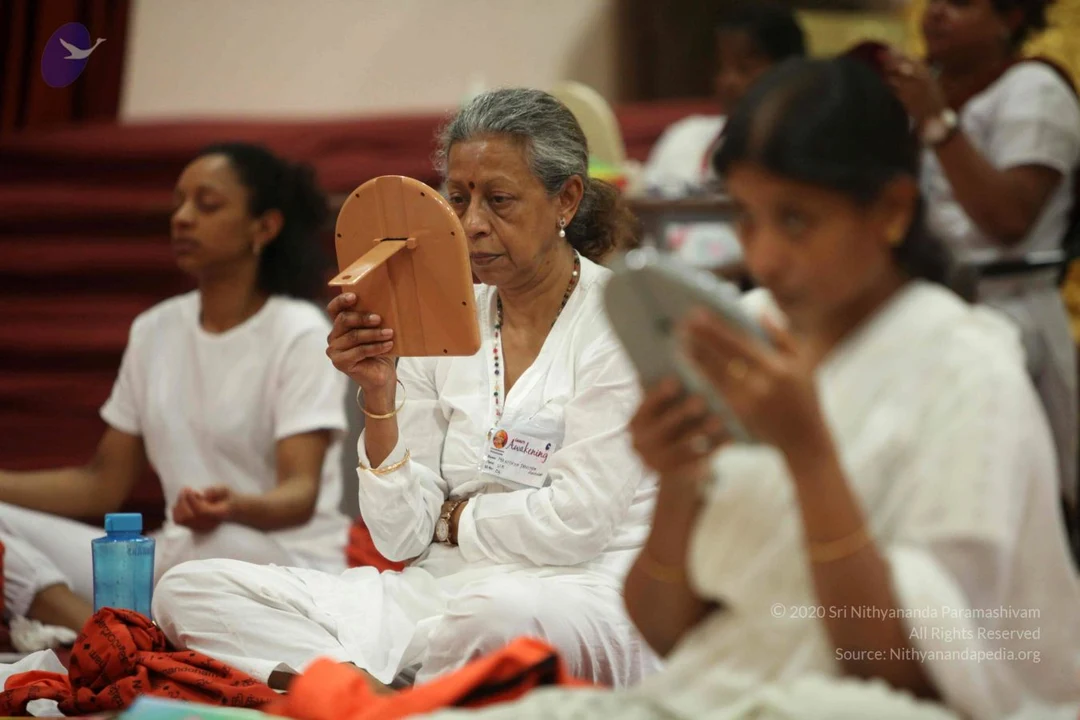
IA-Mirror-Completion-Session

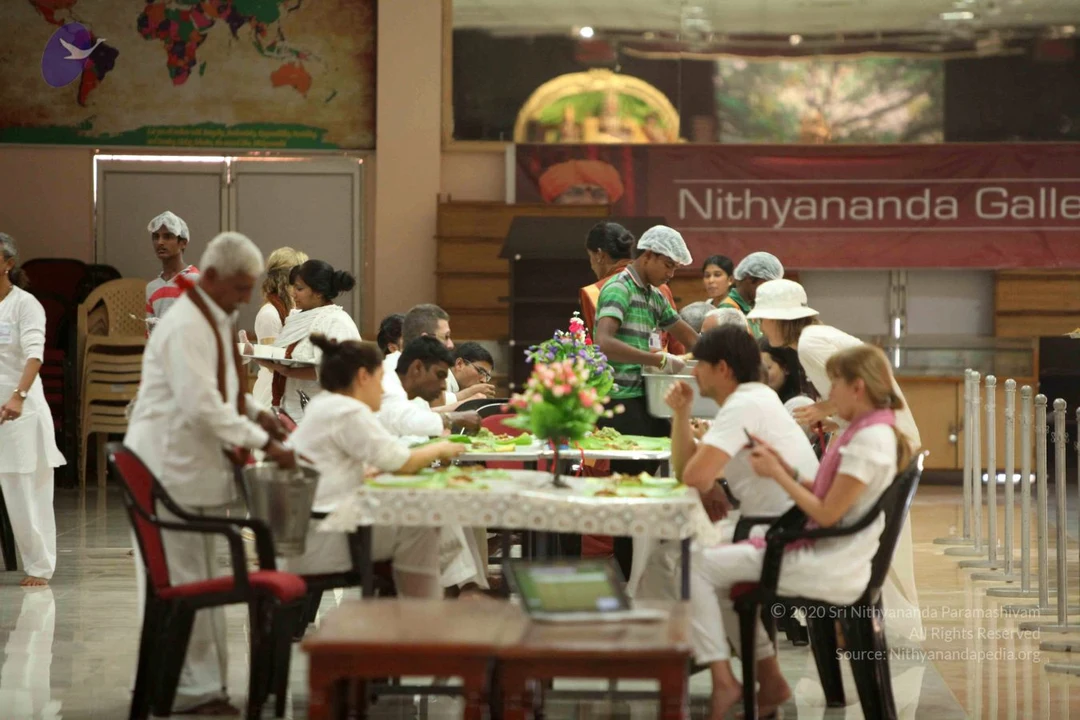
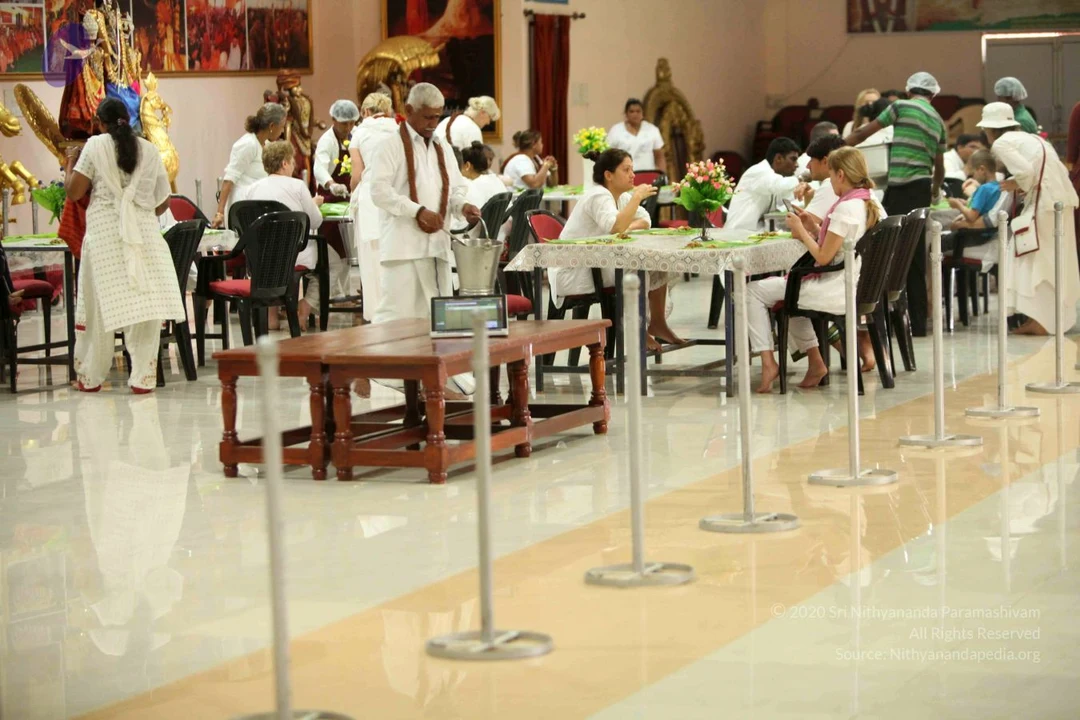
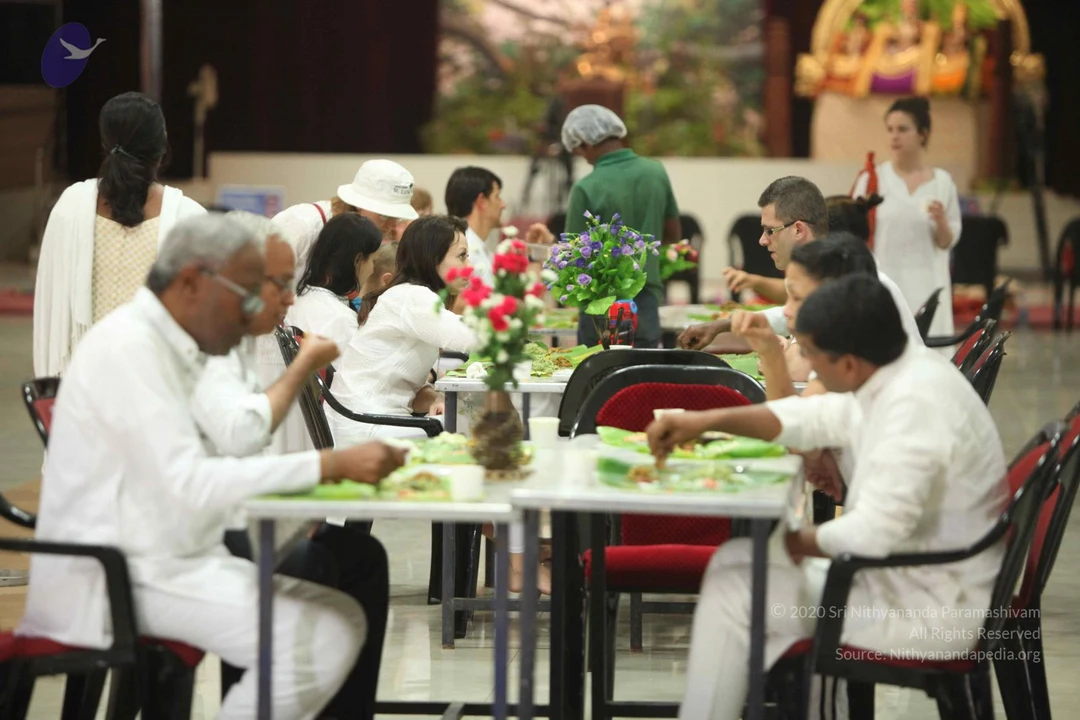
IA-Lunch

IA-Afternoon-Session

Nithya-Satsang

Link to Facebook Page

https://www.facebook.com/ParamahamsaNithyananda/photos/a.321615927926264/792598290828023 https://www.facebook.com/ParamahamsaNithyananda/photos/a.321615927926264/792601944160991

Tags:

Upanishads,Advaita,Isha Upanishad,Isha Upanishad Verse 3,Paramahamsa Nithyananda,Isha,Satsang,bood,bad,right,wrong

Photos from this day

View all 135 photos

IA-Darshan

16 photosSource gallery
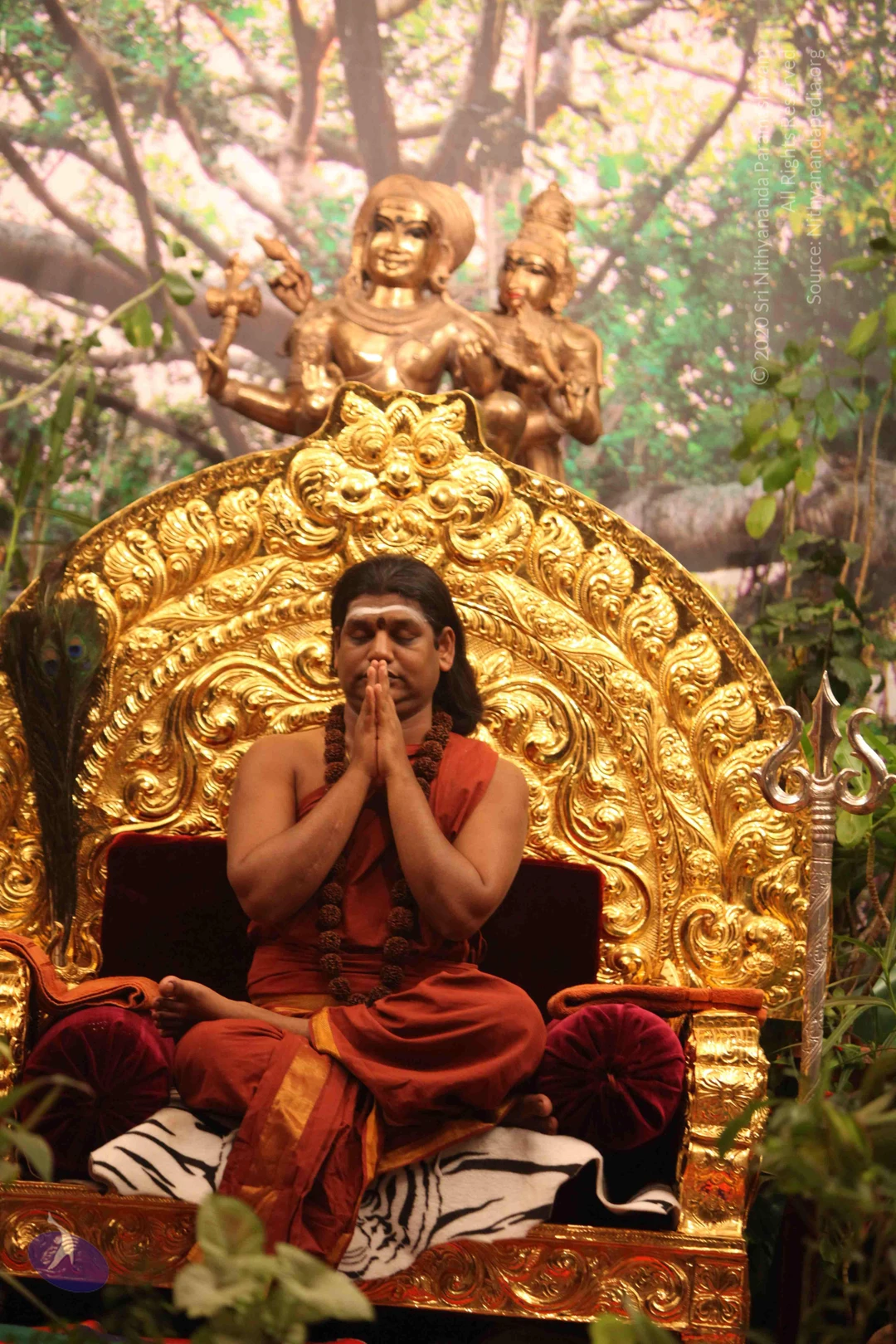
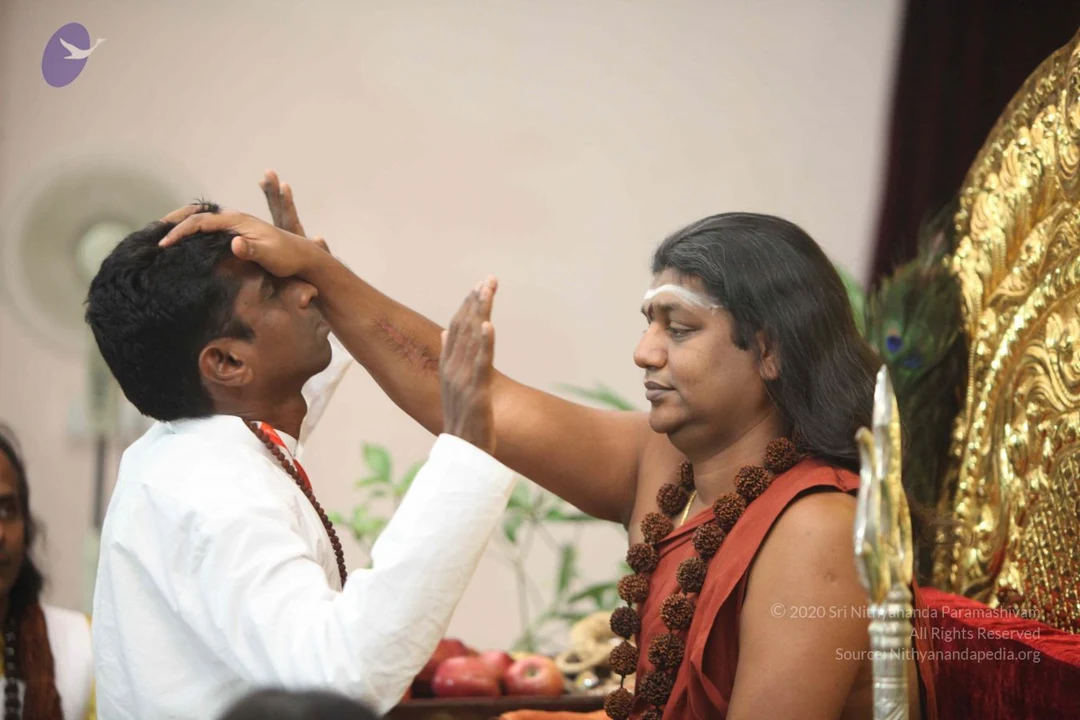
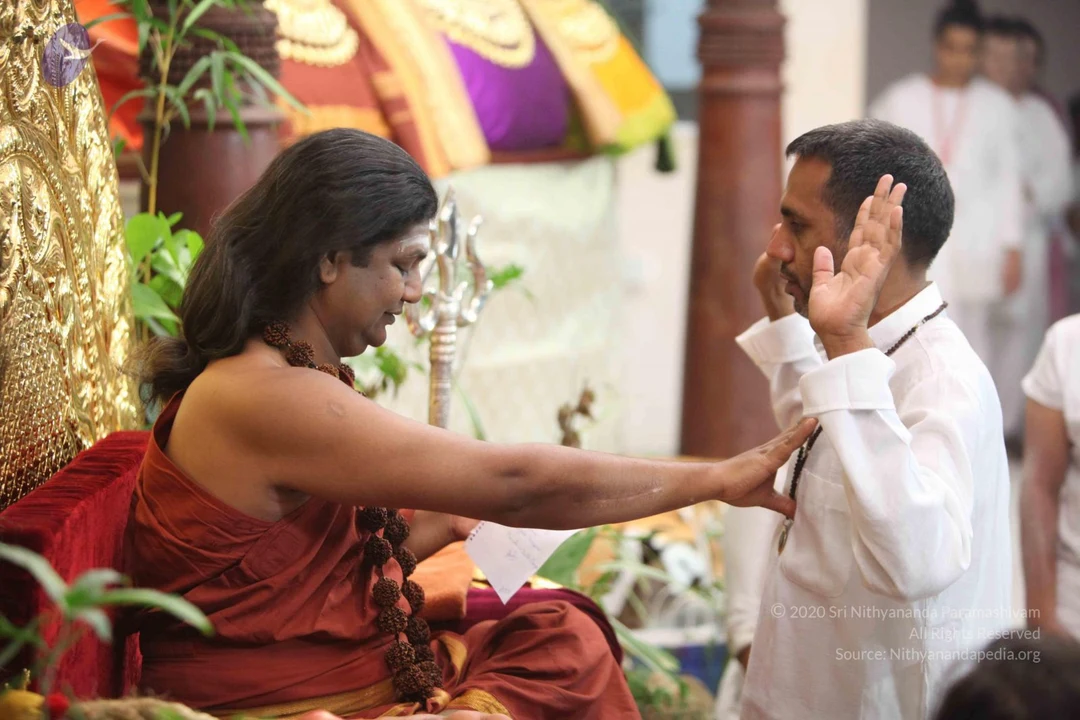
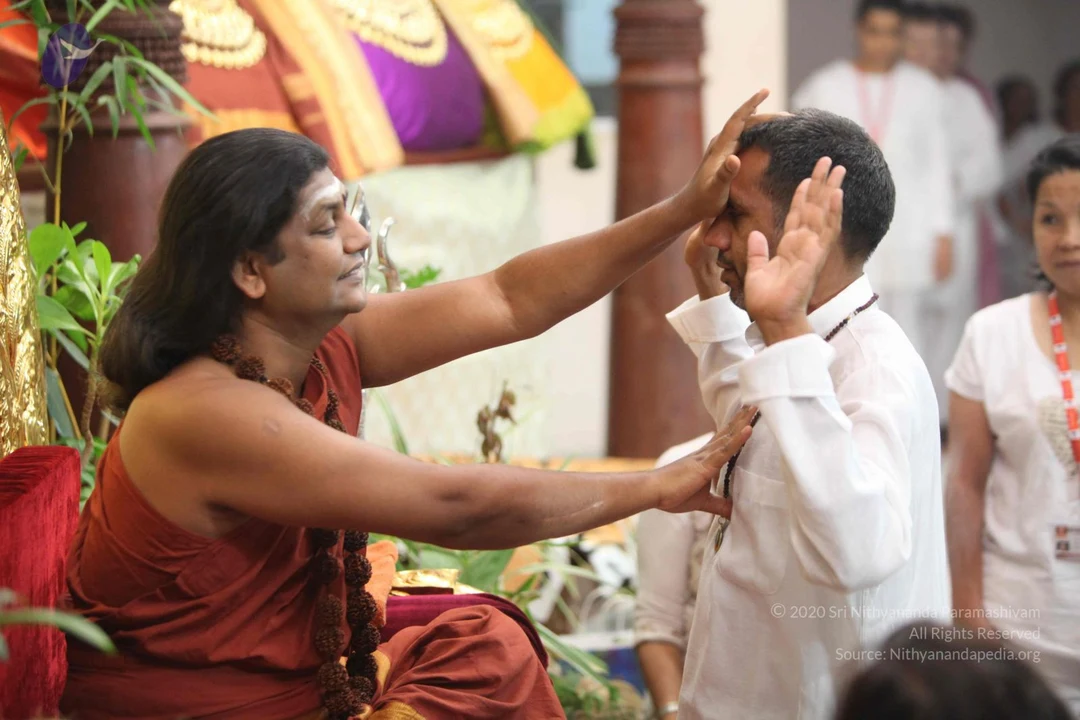
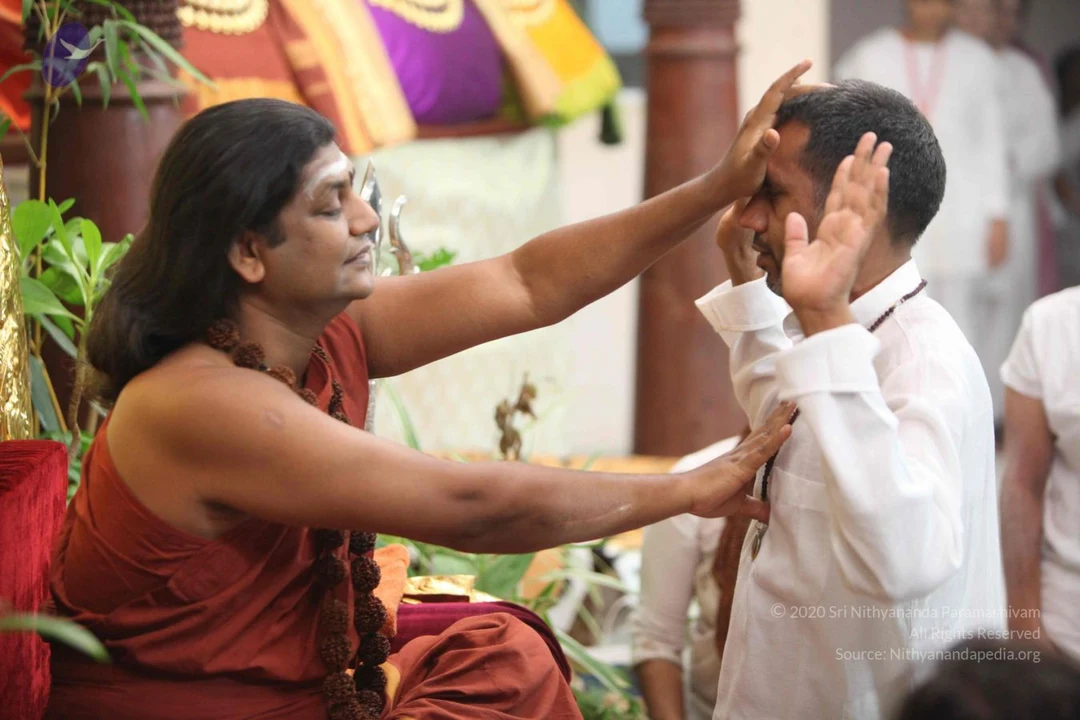
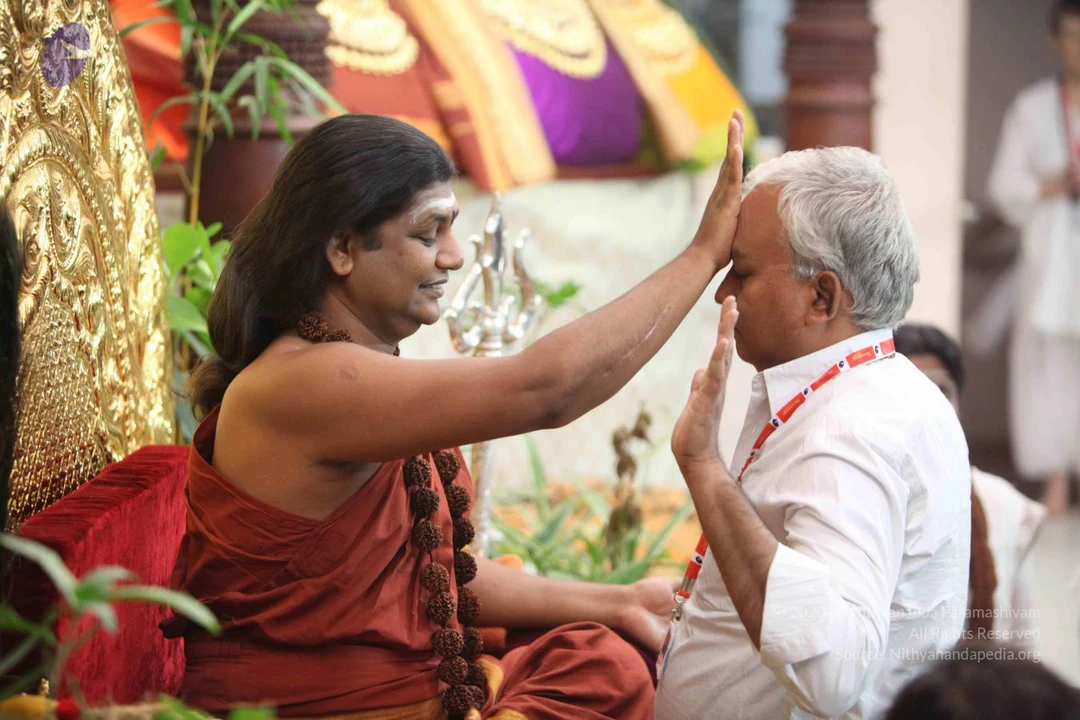
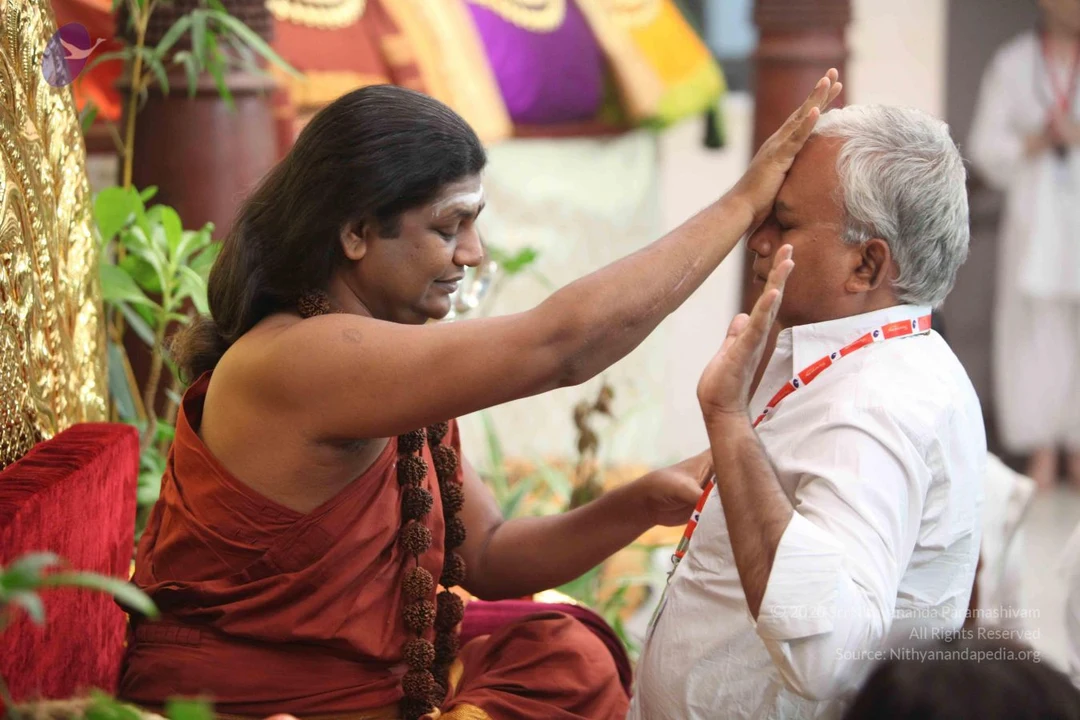
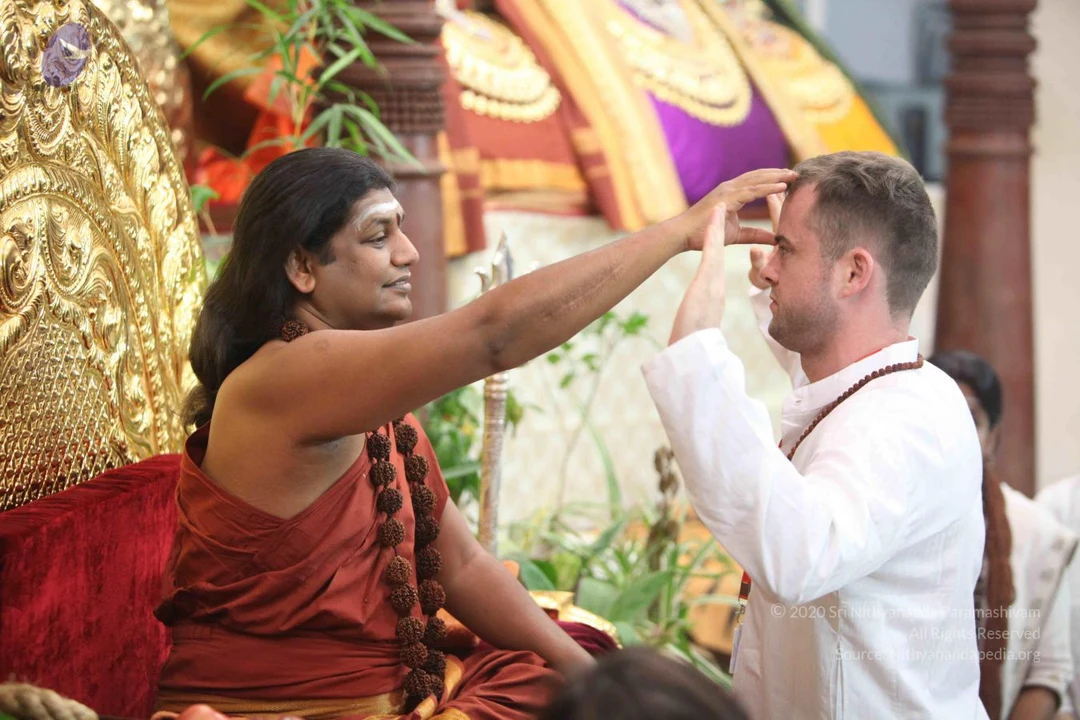
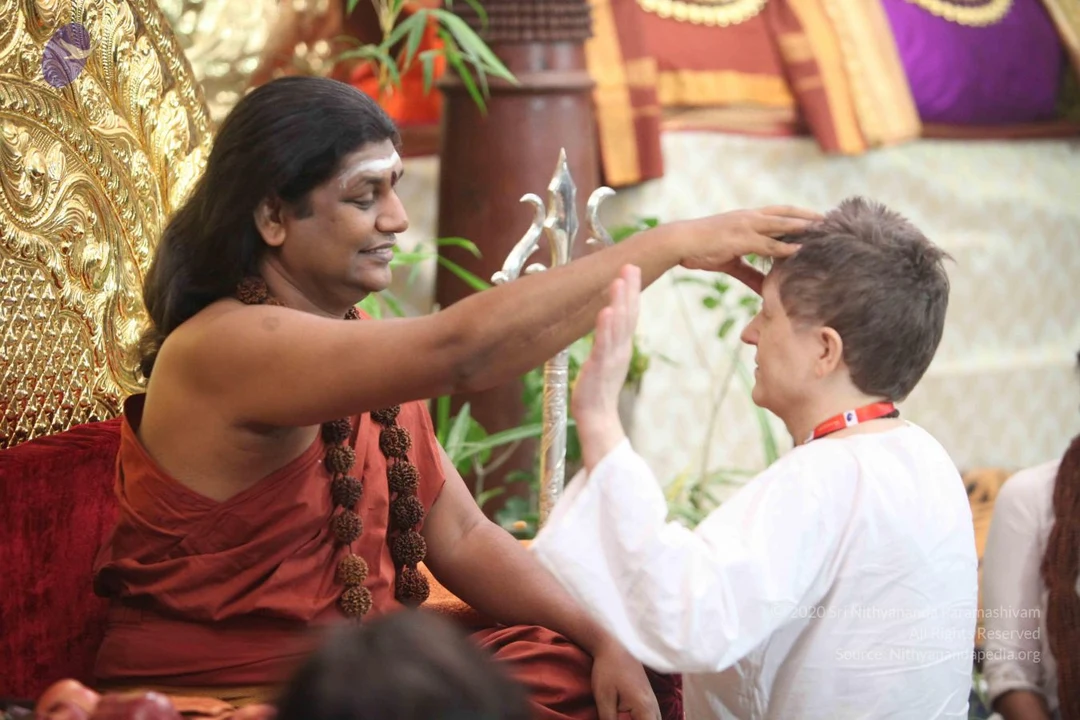
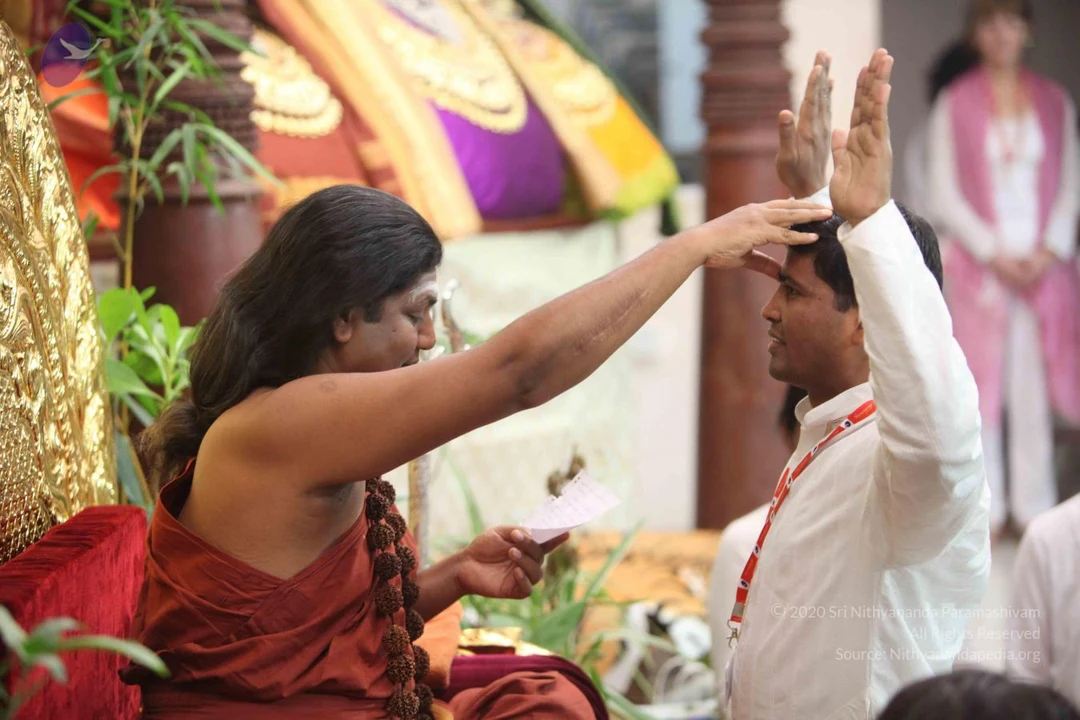
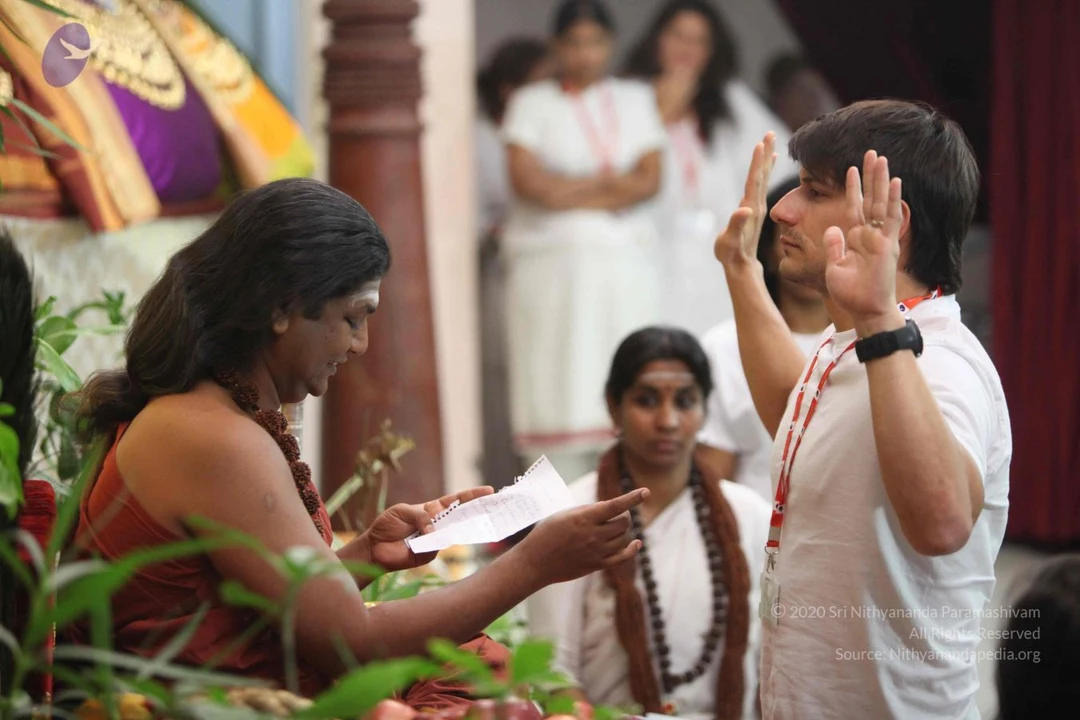
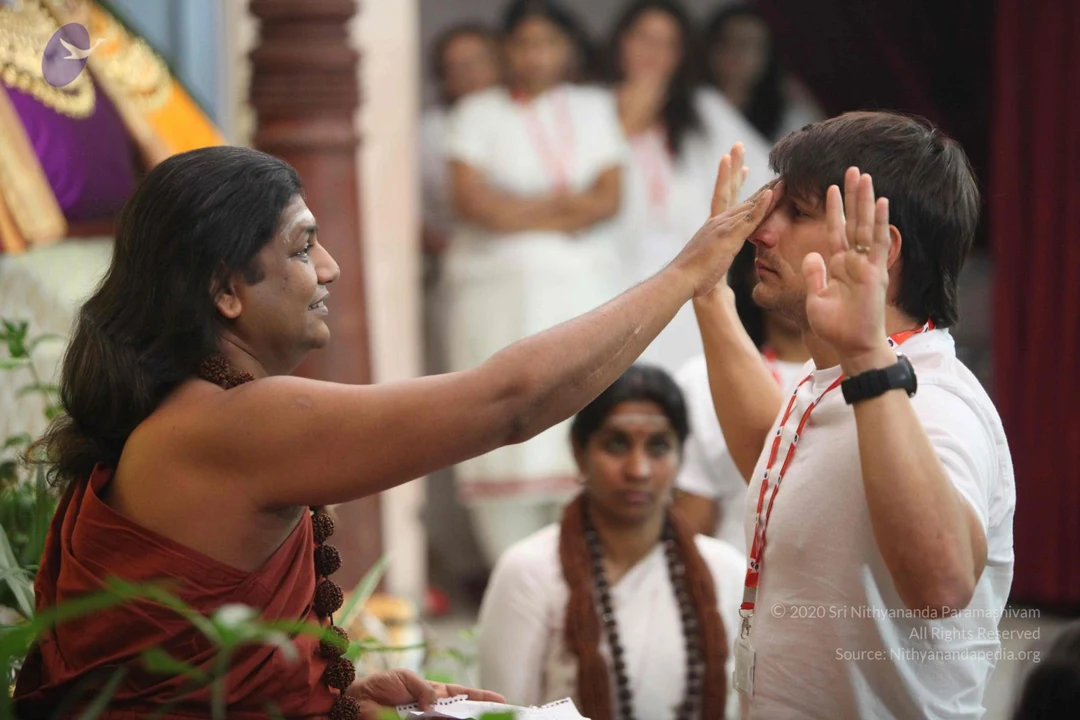
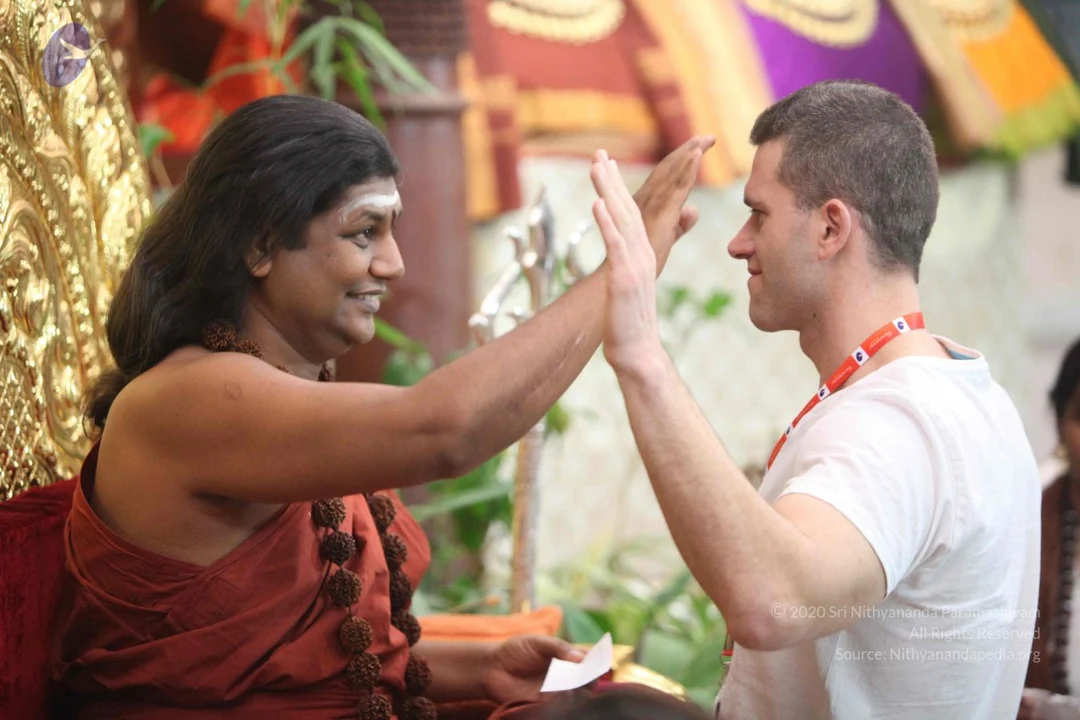
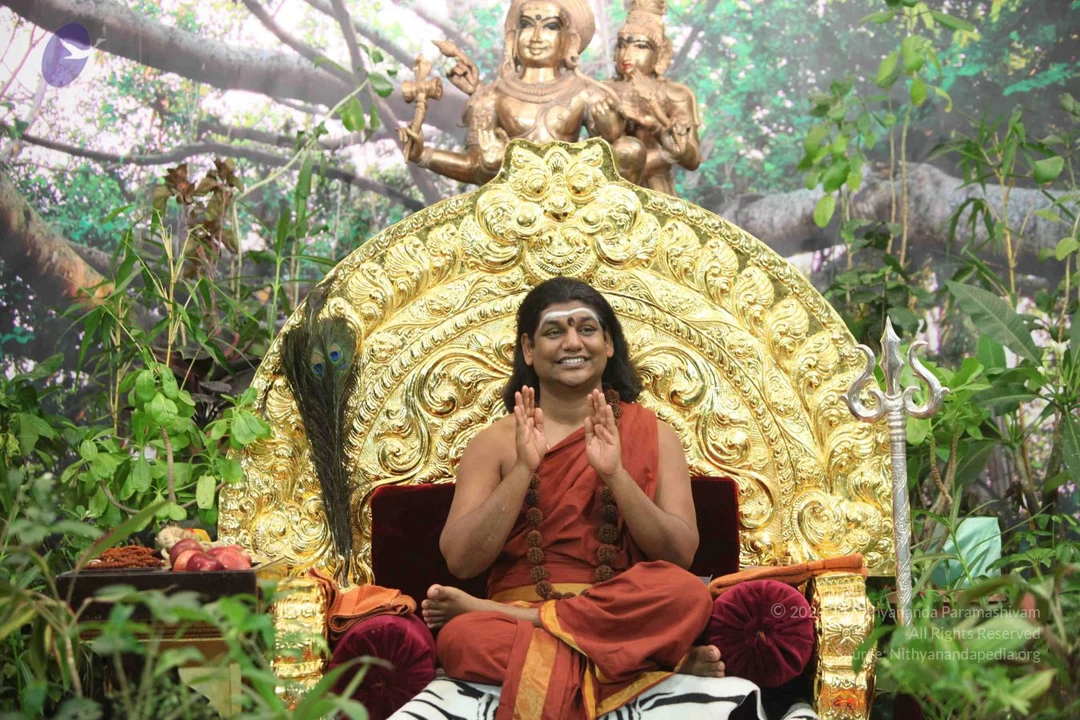
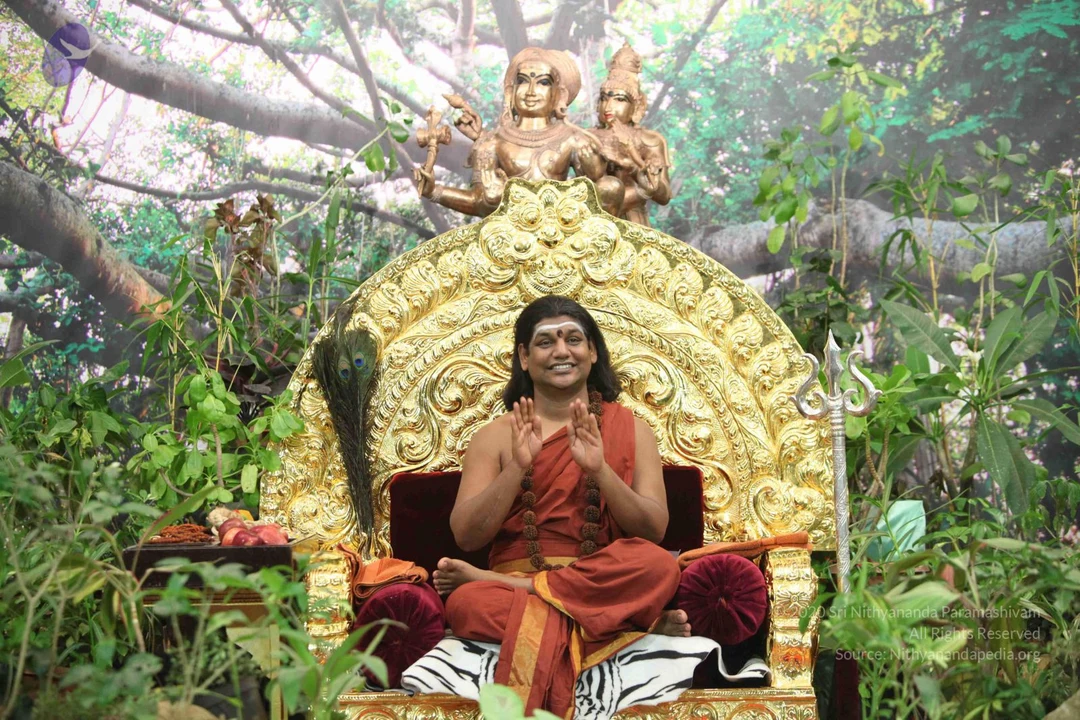
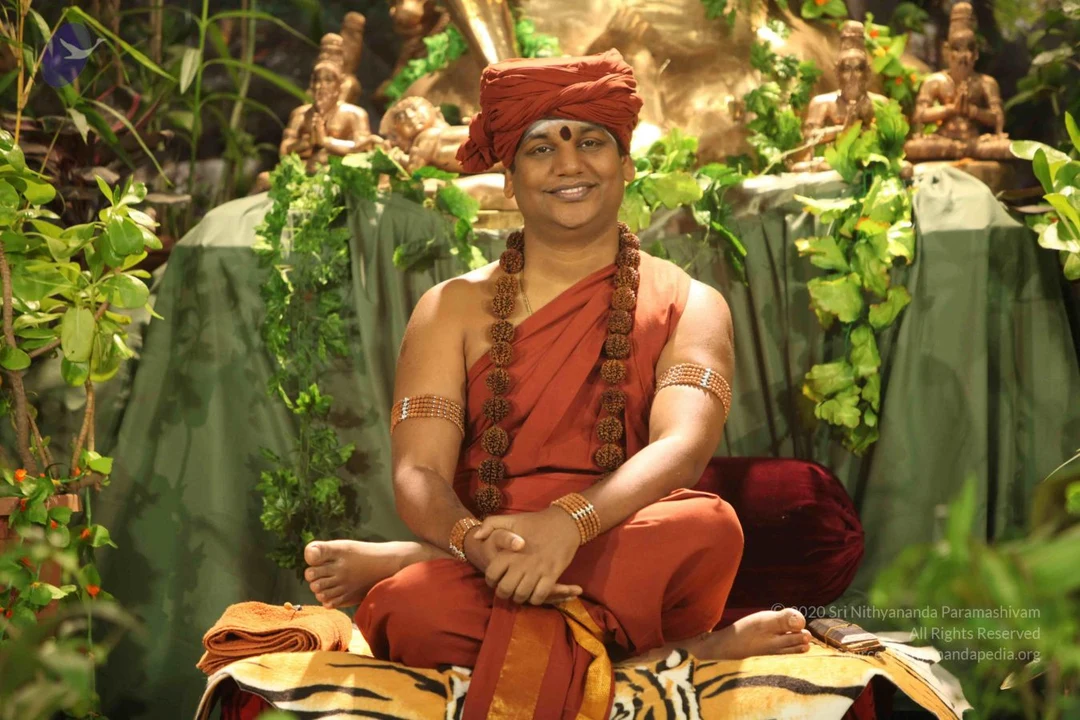
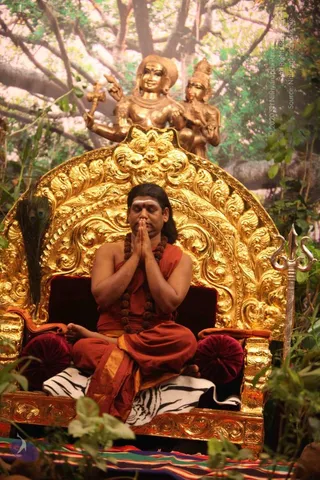
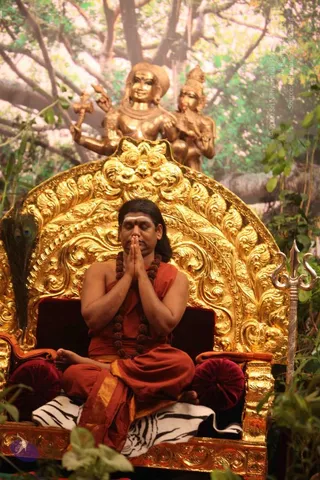
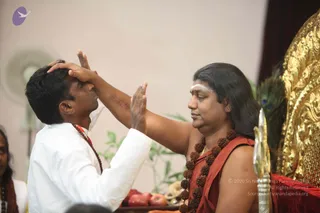
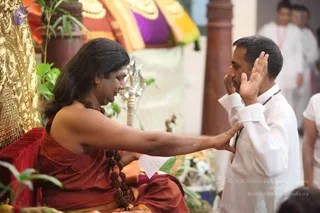
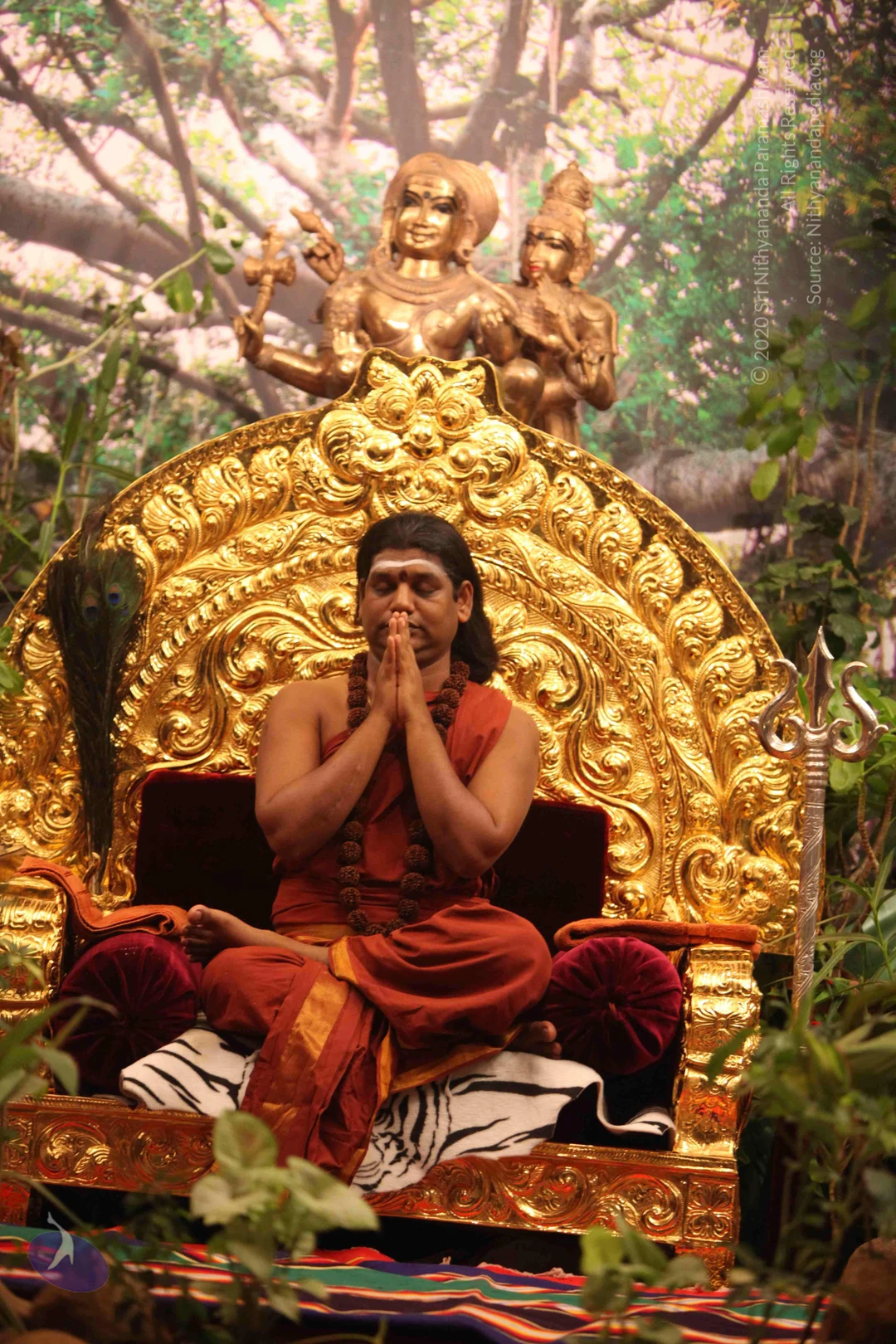
A seated man with palms pressed together in namaste sits cross-legged on an ornate gold throne with carved scrollwork and a zebra-striped cloth on the seat. He wears a rust-orange dhoti with gold border and a matching shawl, a rudraksha mala with a second bead strand at his chest, and a white vibhuti mark on his forehead. Behind him stands a golden statue of a deity with multiple arms and a crown, beside a second golden figure, set against a painted banyan tree backdrop. A peacock feather fan and a silver trident lean on the throne, with greenery and a colourful striped mat in the foreground.A seated man in an ornate gilded throne with a red velvet cushion and a tiger-striped cloth beneath him, hands pressed together in anjali mudra with eyes closed. He wears a red-orange saffron-toned garment with a gold-bordered sash, a long rudraksha mala draped across his chest, and a white tripundra forehead marking. Behind him stands a golden deity murti with multiple arms and a smaller golden figure beside it, against a painted backdrop of a large tree. A silver trident leans against the throne at right, and a peacock feather decorates the left side. Swamiji (probable) — the figure shows long swept-back hair, saffron-orange clothing, rudraksha mala and a ceremonial setting on the throne.A photo of a seated man in a saffron-orange robe and a multi-row rudraksha mala with a white vertical tilak on his forehead, long dark hair swept back, sitting on a gold ornate throne with a peacock-feather fan behind him. He places his right hand on the forehead of a man in a white shirt and white trousers wearing a red-and-rudraksha mala, who stands close with his eyes lowered. A bowl of red apples and a small brass kalasha-like object sit on a cloth in front, with potted plants and a partly visible person at the left edge. The scene appears to be a blessing or darshan moment in a room with cream walls.A seated figure in an orange-red saffron shawl and a dark rudraksha mala sits on a red-cushioned throne beside a gold-embossed panel and a silver trident. The seated figure extends a hand toward a standing man in white kurta with a rudraksha mala, who raises his right palm in greeting. Other people in white clothing stand in the background near orange and purple drapes, and a green plant and white flowers are at the left. The seated person has long hair and a shawl, with distinctive ceremonial adornments, which is a person appearance cue; the standing man is a devotee receiving blessing.A photograph of a seated man in a rust-orange shawl and a rudraksha mala with long swept-back hair, placing one hand on the forehead of a standing devotee in a white shirt and white trousers. The devotee's hands are raised in front of his face and a rudraksha mala hangs at his chest. Behind them, a gold and purple textile hangs, a red pillar stands at right, and a woman in white with an orange lanyard watches. The seated figure has distinctive long hair, a rudraksha mala and orange robes, consistent with the Swamiji (probable) appearance cues; he is giving a blessing or initiation touch. Several other people in white are visible in the background.A seated man in a rust-orange robe and a long rudraksha mala with a white forehead mark places his right hand on the crown of a standing devotee in a white kurta and white dhoti, while his left hand rests on the devotee's chest. The devotee holds his palms raised in front of his face with eyes closed, receiving the blessing. Purple and yellow draped fabrics and green plants stand in the background, with a few other people in white visible at the edges. The seated figure shows long swept-back hair and rudraksha beads, matching the Swamiji (probable) appearance cues, while the standing devotee is a devotee. The scene is an in-person blessing.

IA DARSHAN
16 photosSource gallery
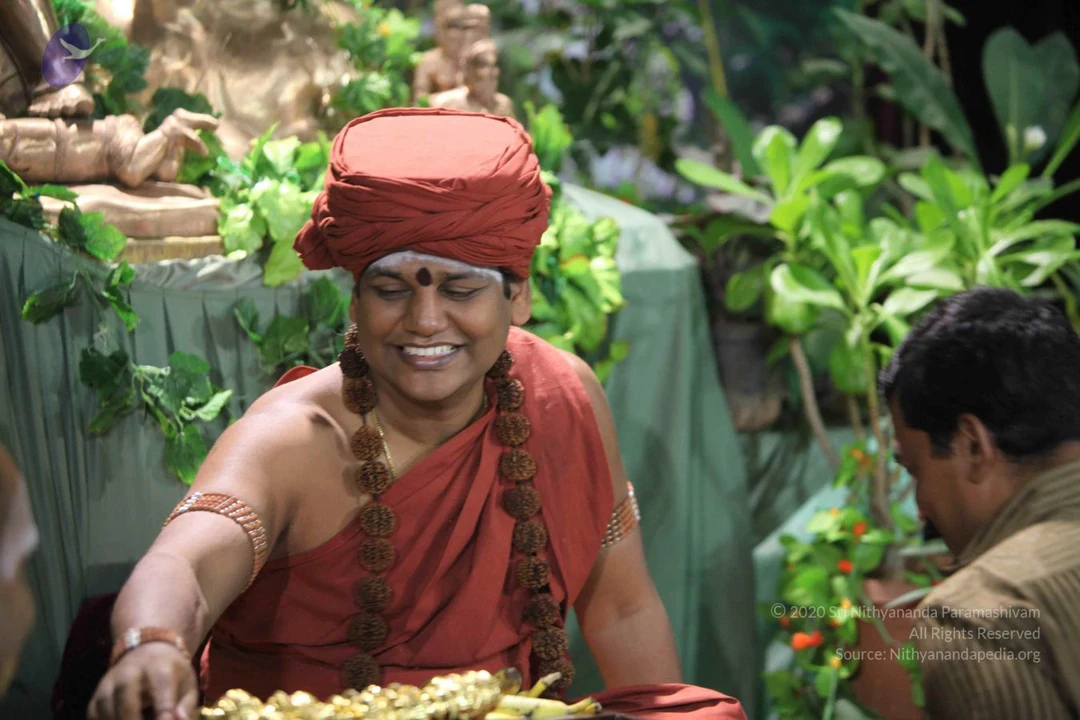
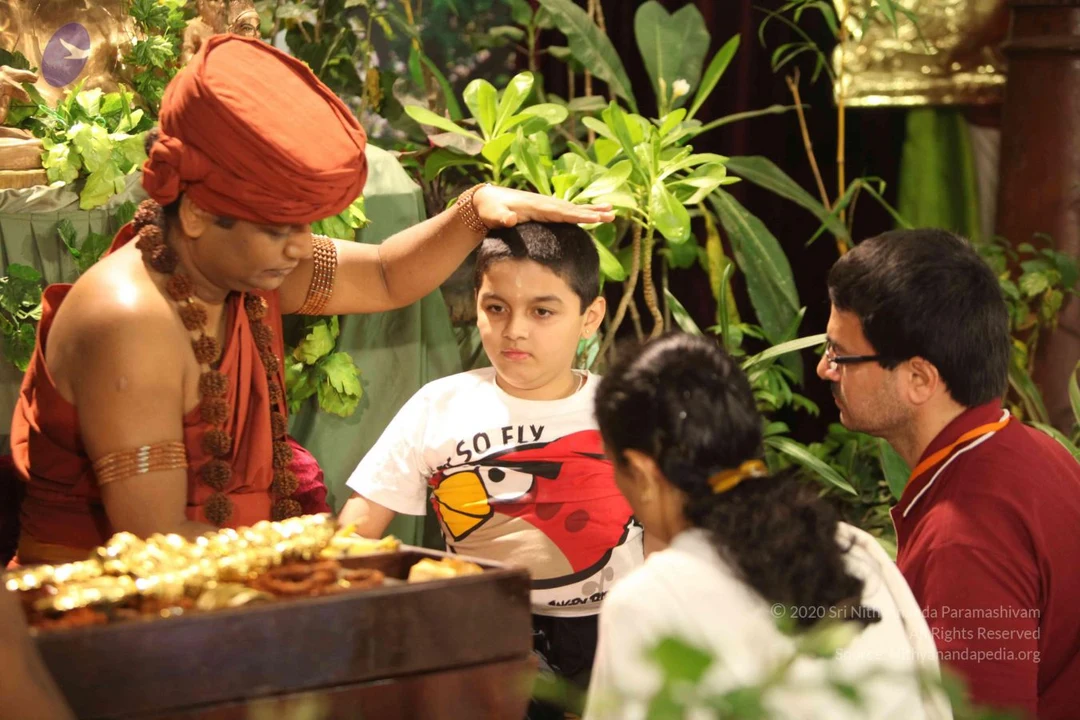
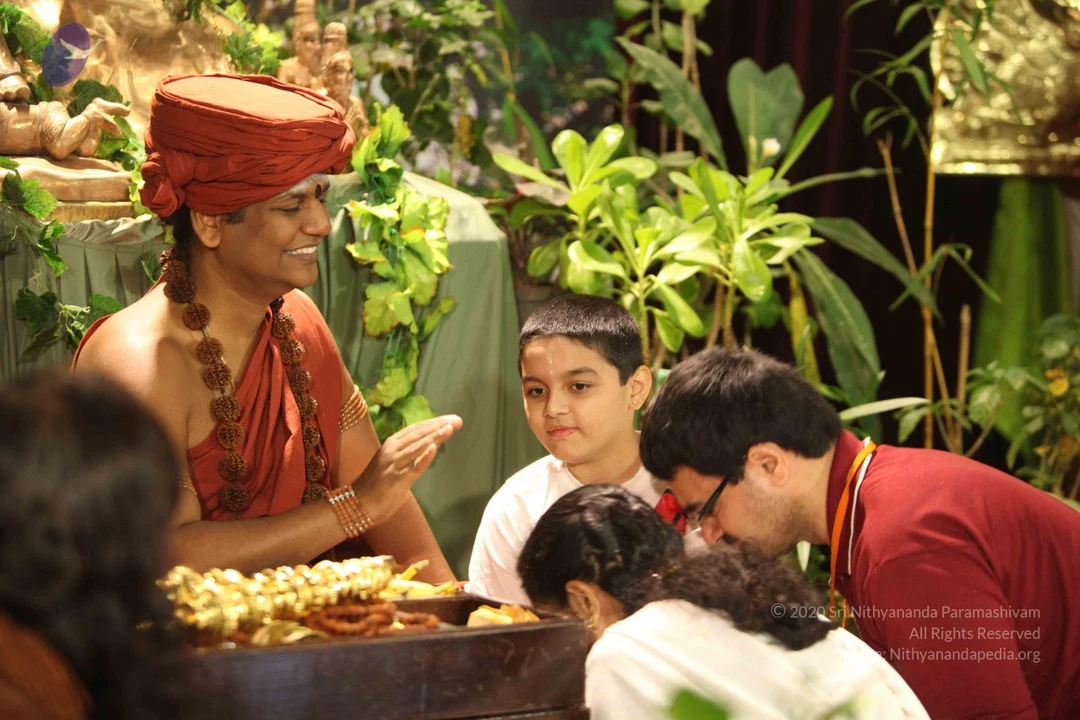
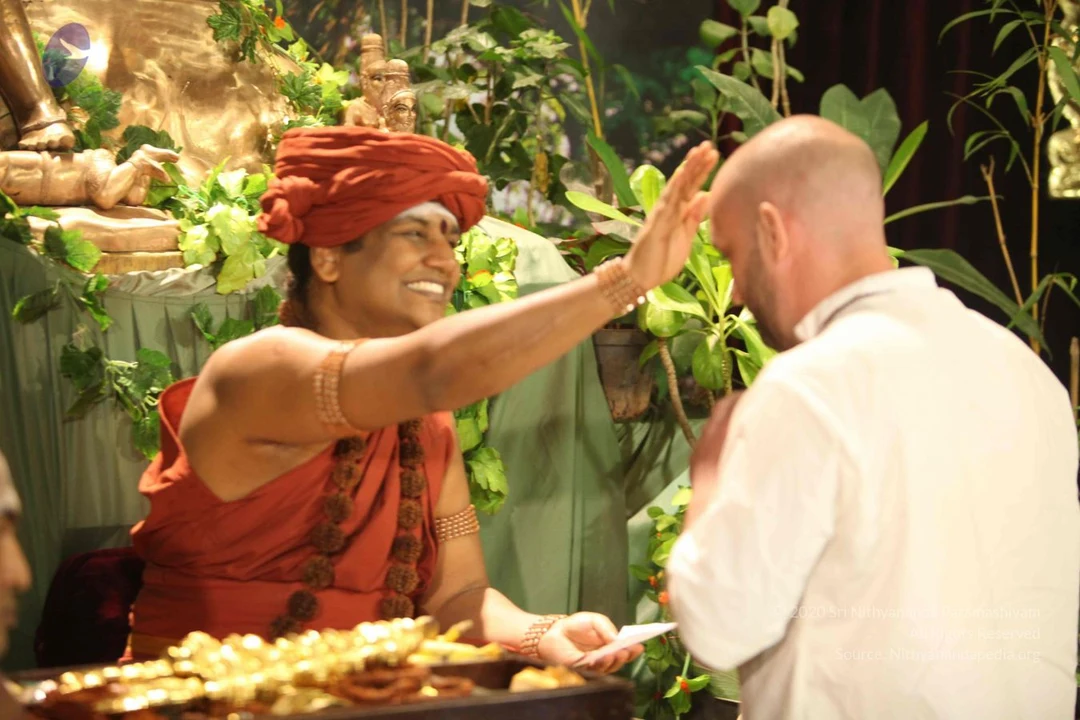
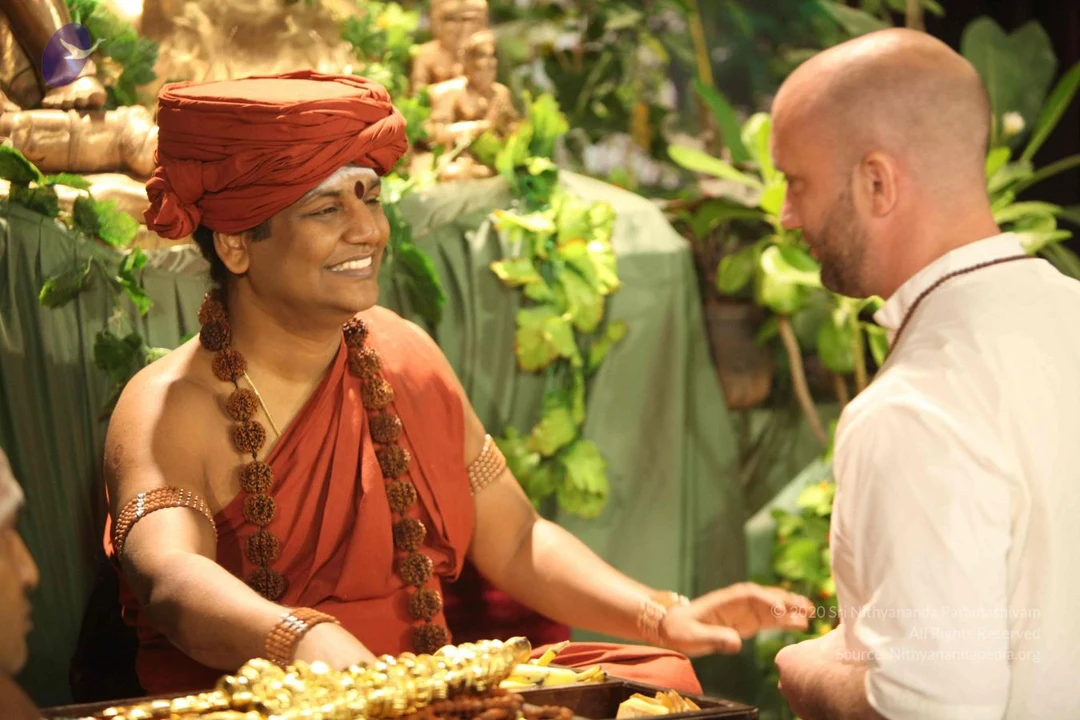
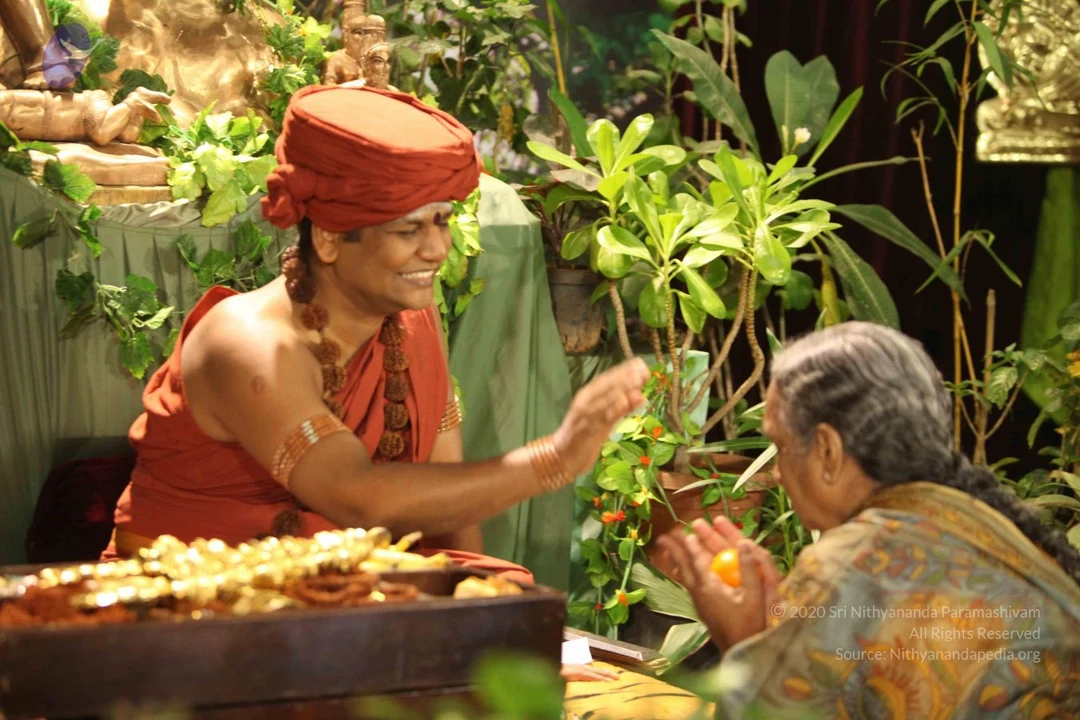
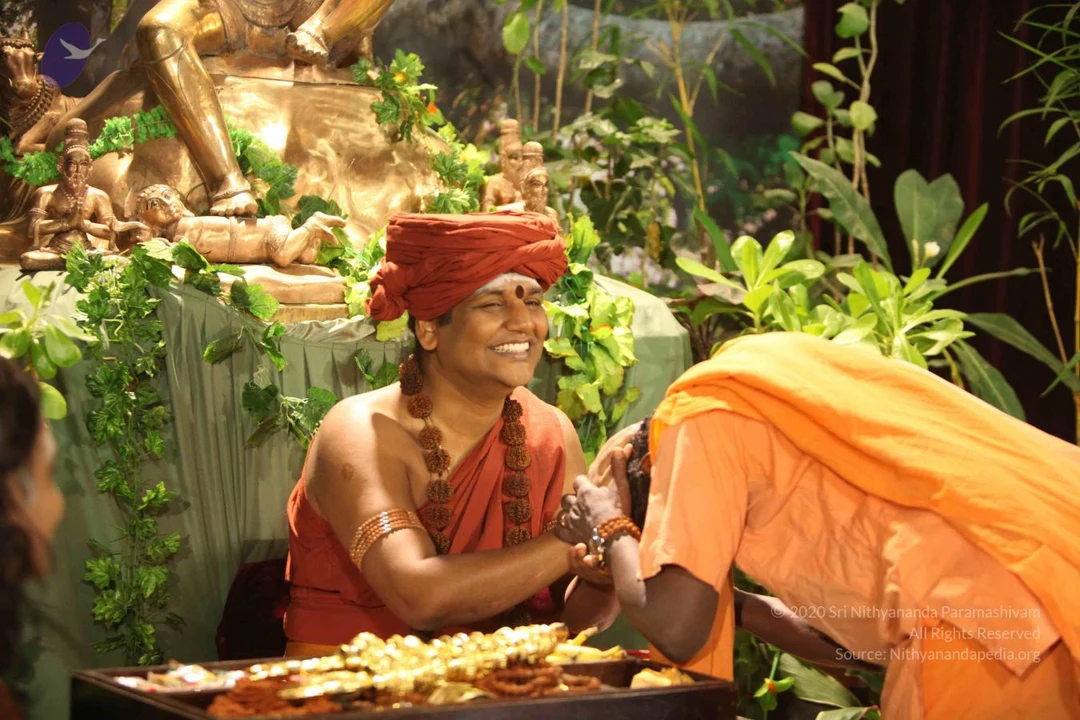
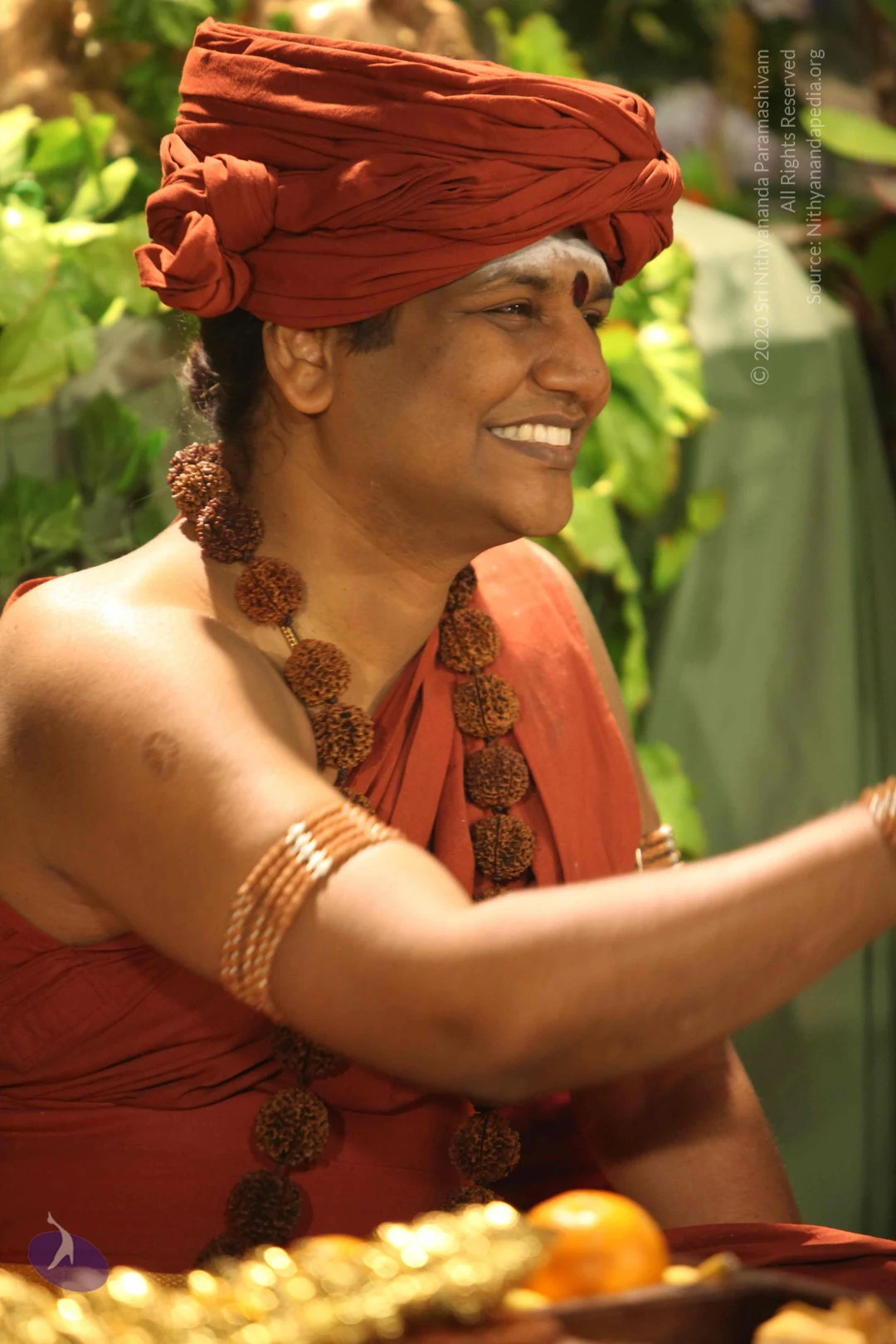
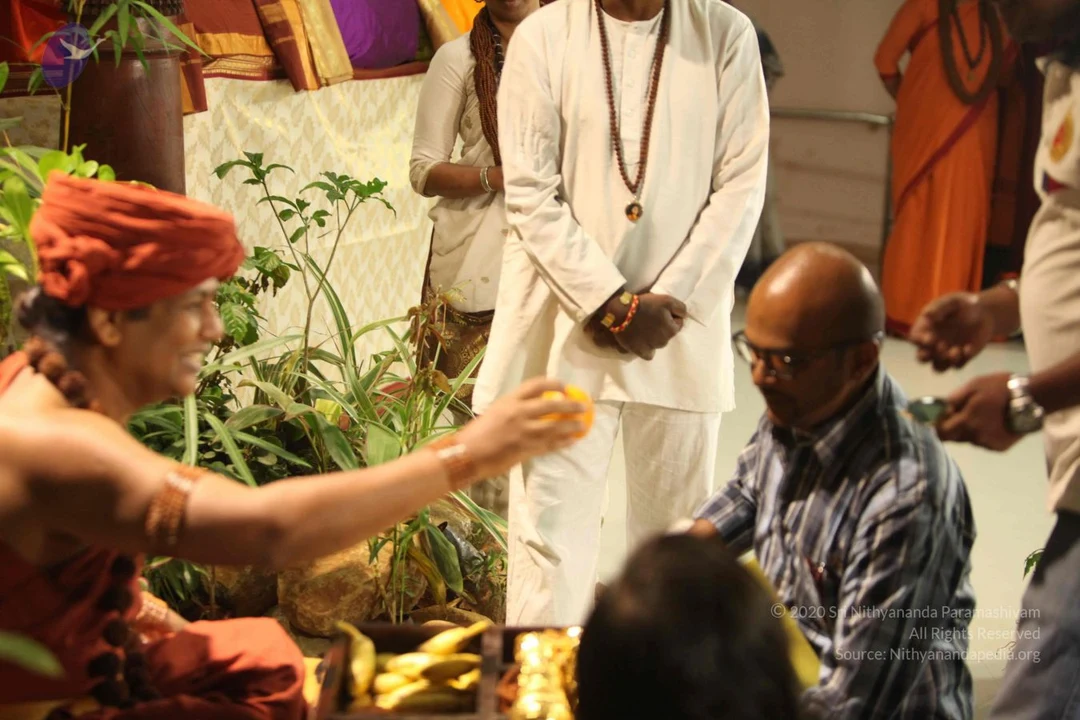
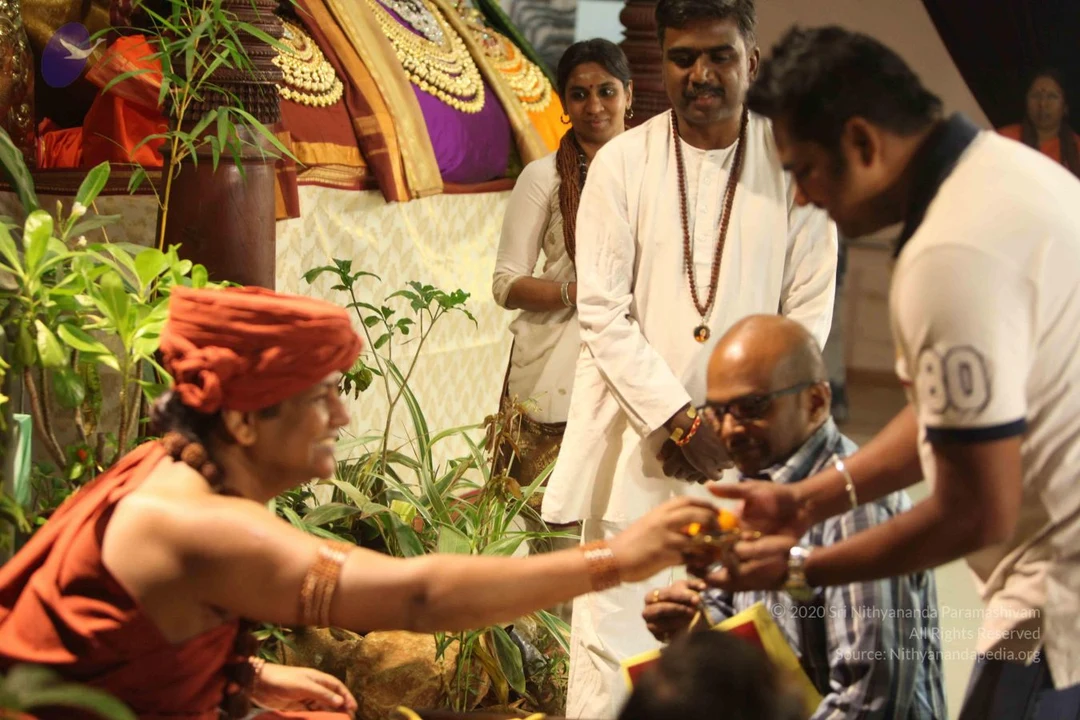
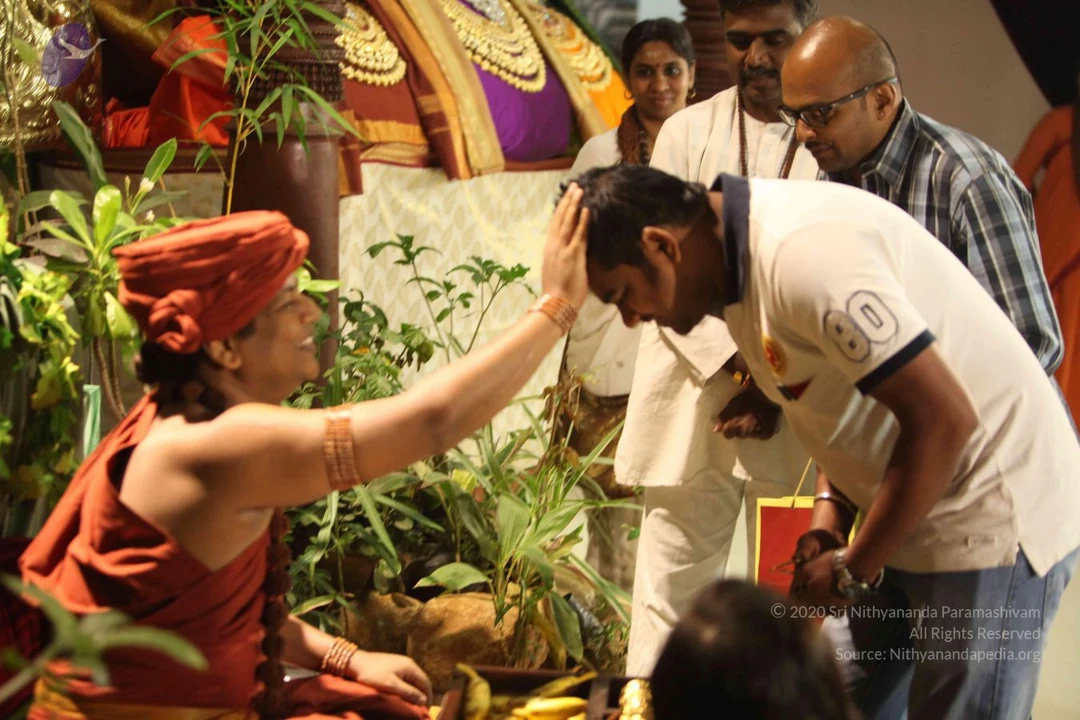
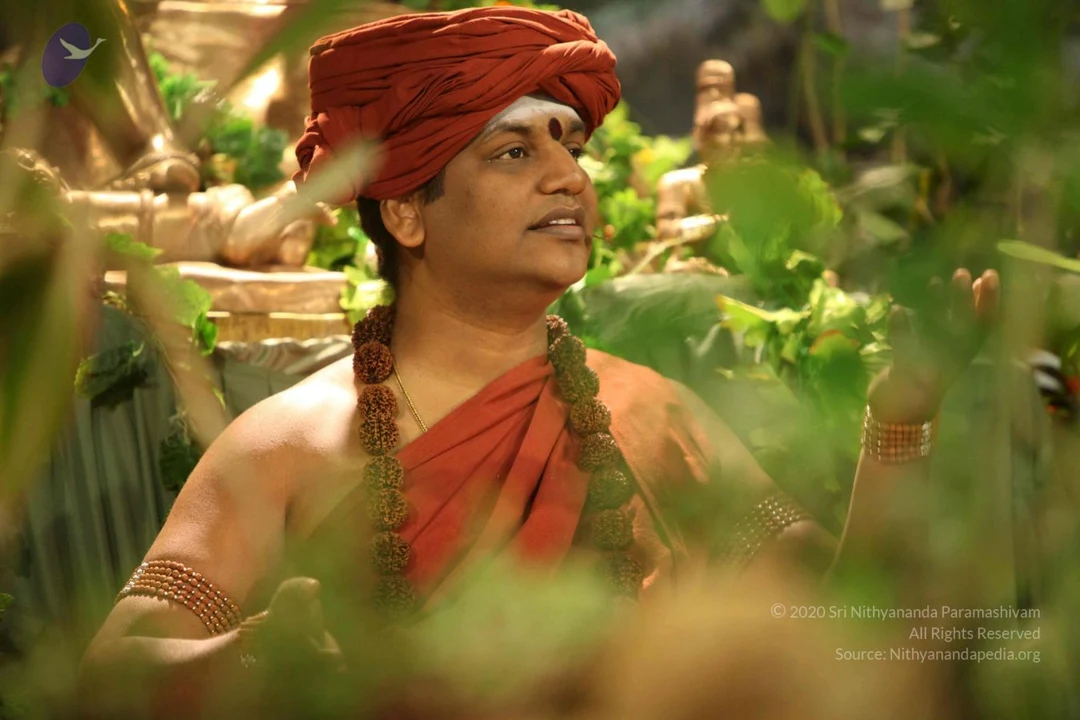
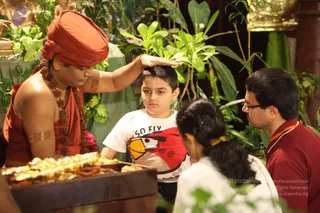
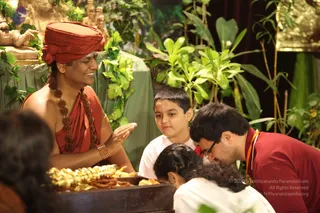
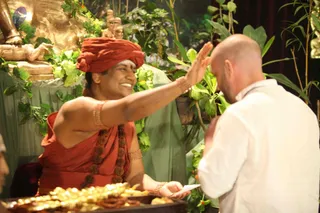
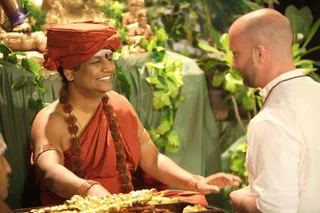
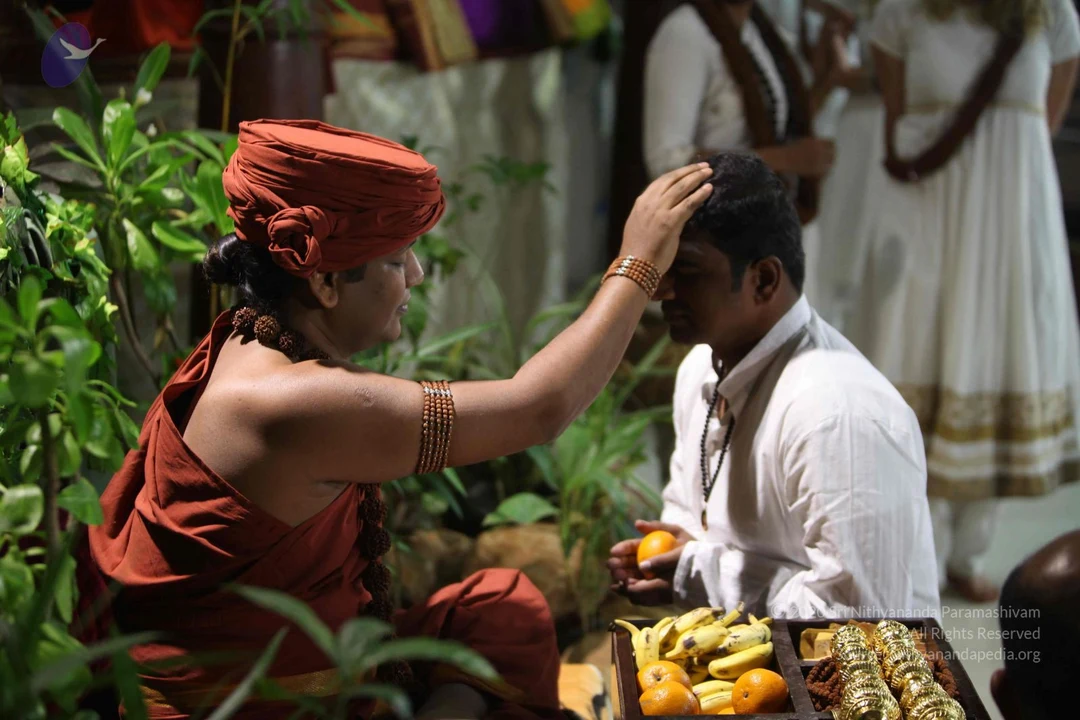
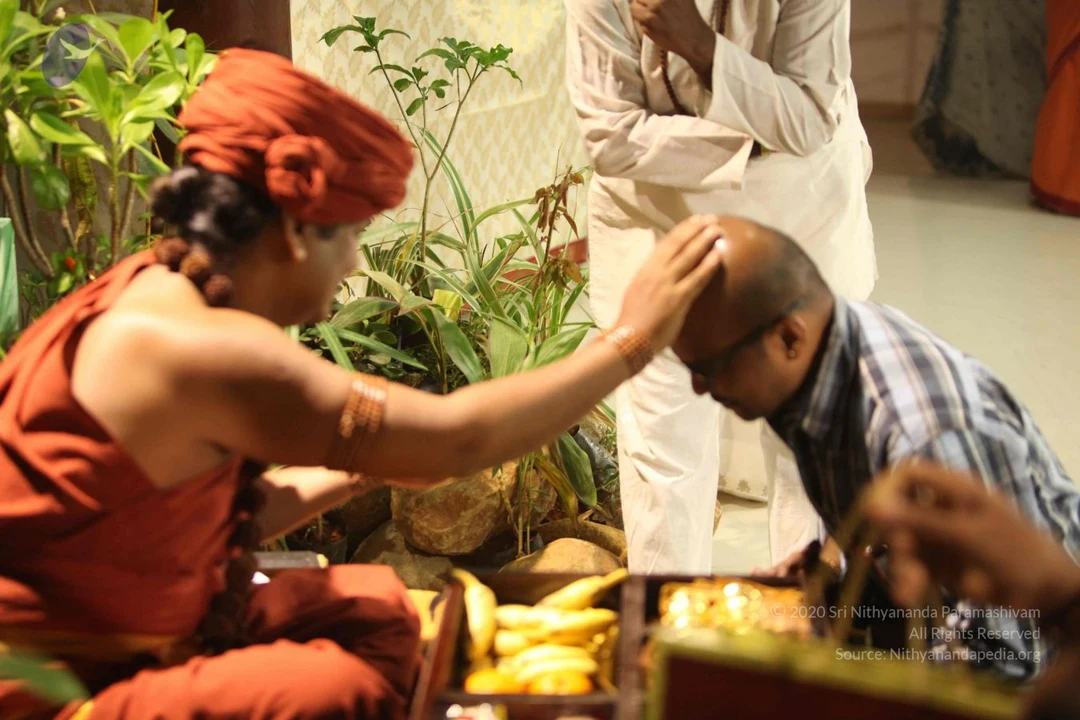
A photograph of a ritual blessing outdoors among green leafy plants. A figure in orange-red robes and an orange-red turban, with a rudraksha mala around the neck and copper-coloured bangles on the arm, sits on the left and places a hand on the forehead of a seated man in a white shirt holding an orange. A wooden tray in the foreground holds bananas, oranges, rudraksha beads and golden figurines. Two people in white garments stand in the background.A smiling man in a saffron-orange turban and saffron-orange wrap sits before a leafy green backdrop with a small gilded deity statue and figures behind him. He wears a red tilak on his forehead, layered rudraksha malas around his neck and ears, and copper-coloured armlets. He extends his arm over a brass tray of yellow flowers or offerings. A second man in a striped brown shirt is partly visible at the right edge, leaning in with his head bowed.A photograph of a blessing moment in an indoor setting decorated with green leafy plants and a gold ornament at top. A man in an orange-red turban, bare-chested with an orange-red shawl draped over his shoulders, rudraksha mala beads and a gold armlet, places his right hand on the head of a young boy in a white Angry Birds t-shirt. Beside the boy, a man in a maroon polo shirt with glasses and a woman with hair tied back in a white garment look on. In the foreground, a wooden tray holds gold-coloured items and sweets. The turbaned figure's appearance and blessing gesture match the page's reference to a person, but the cues are not distinctive enough to confirm identity.A photograph of a satsang setting with lush green plants and gold-coloured sculptures behind. A man in an orange-red turban and orange-red draped garment, wearing a long mala of rudraksha beads and gold bangles, smiles and gestures with his right hand toward a tray holding gold ornaments and rudraksha malas. A young boy in white clothes with a tilak looks on, and a man in a maroon shirt with an orange lanyard bends forward over the tray. A woman in white with her head lowered is partly visible in the foreground, along with another partly visible person at the left edge. a person is the central figure, identified by the turban, rudraksha mala and orange-red draped clothing, presented as the teacher in the scene.A photograph of a seated man in an orange-red turban and orange-red robe, with a rudraksha mala and gold bangles on his wrist, raising his right hand in blessing toward a bald man in a white shirt who bows his head toward him. The seated man holds a small white card in his left hand and smiles. In front is a tray with gold-coloured items and offerings, and behind them are green leaves, potted plants, a gilded deity murti and a green draped backdrop.A smiling man in a saffron-orange turban and matching saffron wrap sits on a low seat in front of green foliage and a green draped backdrop, with a gold deity murti and a small figure visible behind him. He wears a long rudraksha mala with a gold necklace, rudraksha armlets and gold bangles, and has a red tilak on his forehead. He reaches toward a tray of gold ornaments and rudraksha beads while speaking to a bald man in a white shirt with a rudraksha mala. The swami-like presentation with rudraksha, saffron clothing and turban matches the probable Swamiji cues, so the appearance is treated as probable Swamiji seated in a satsang or darshan setting.

NITHYA KIRTANS

4 photosSource gallery
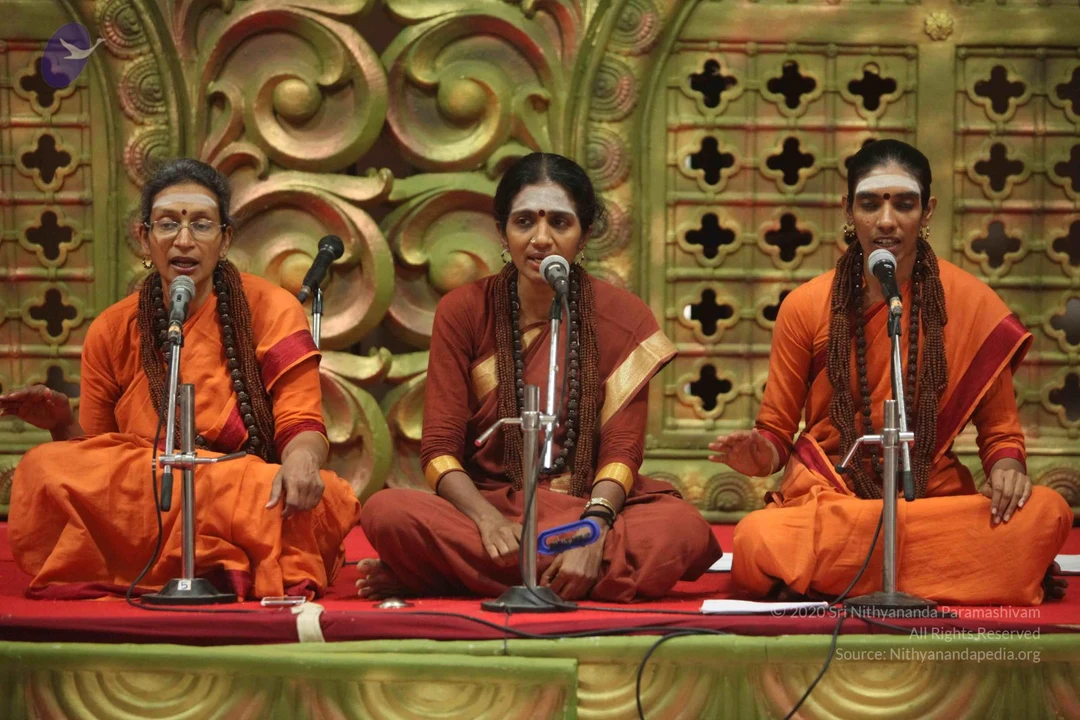
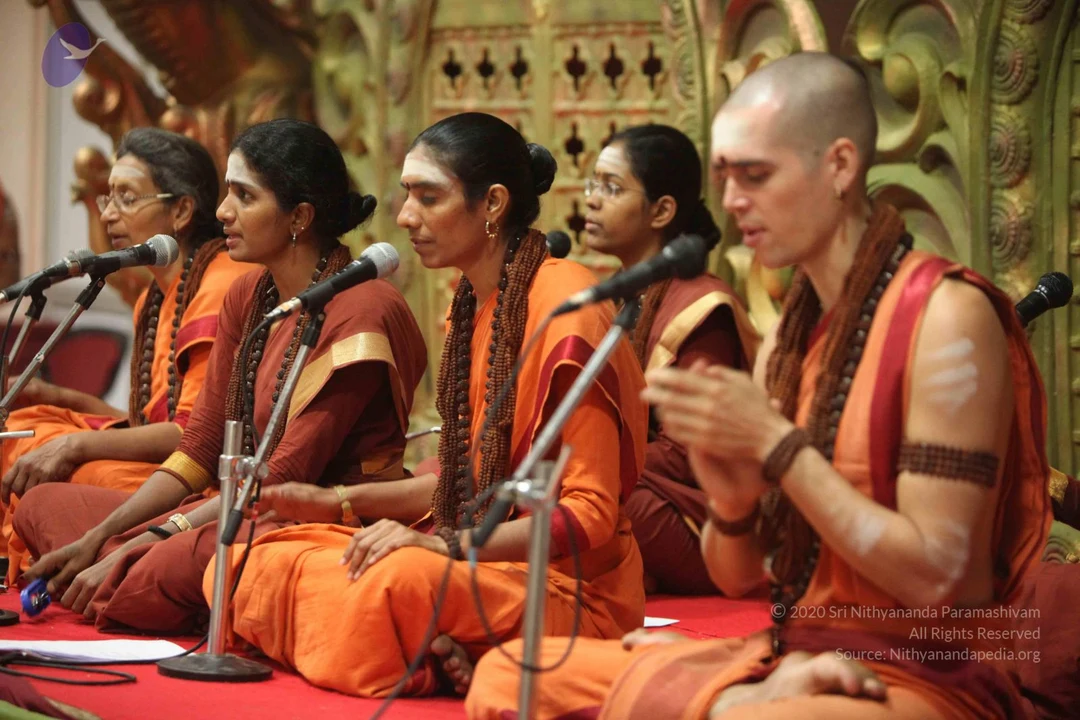
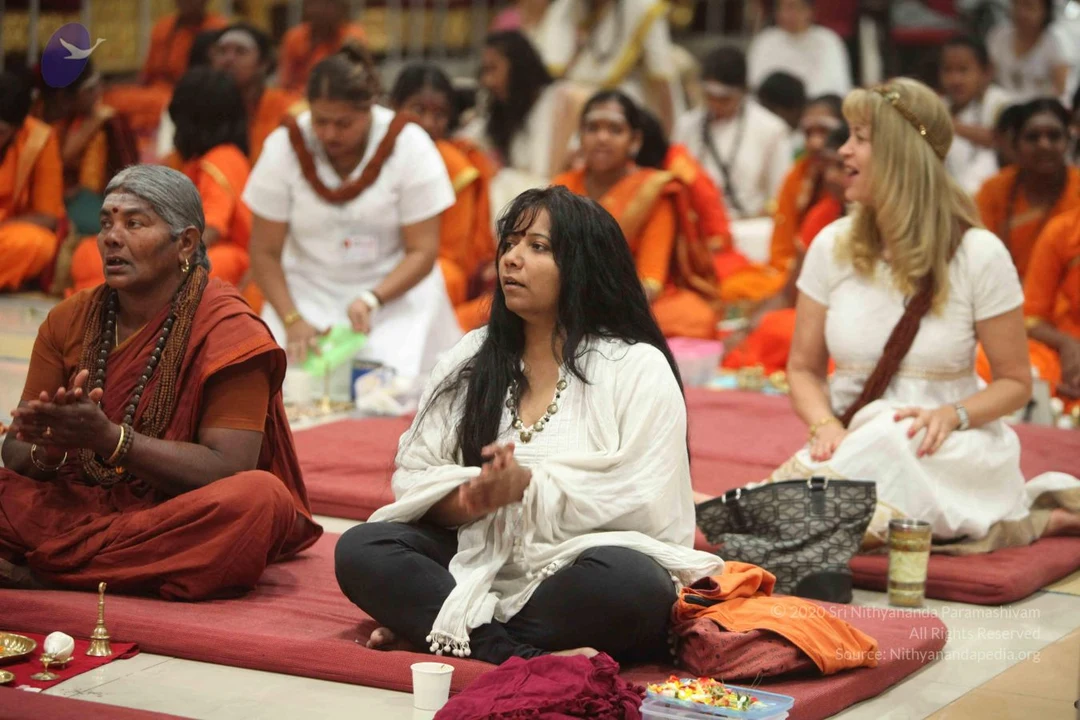
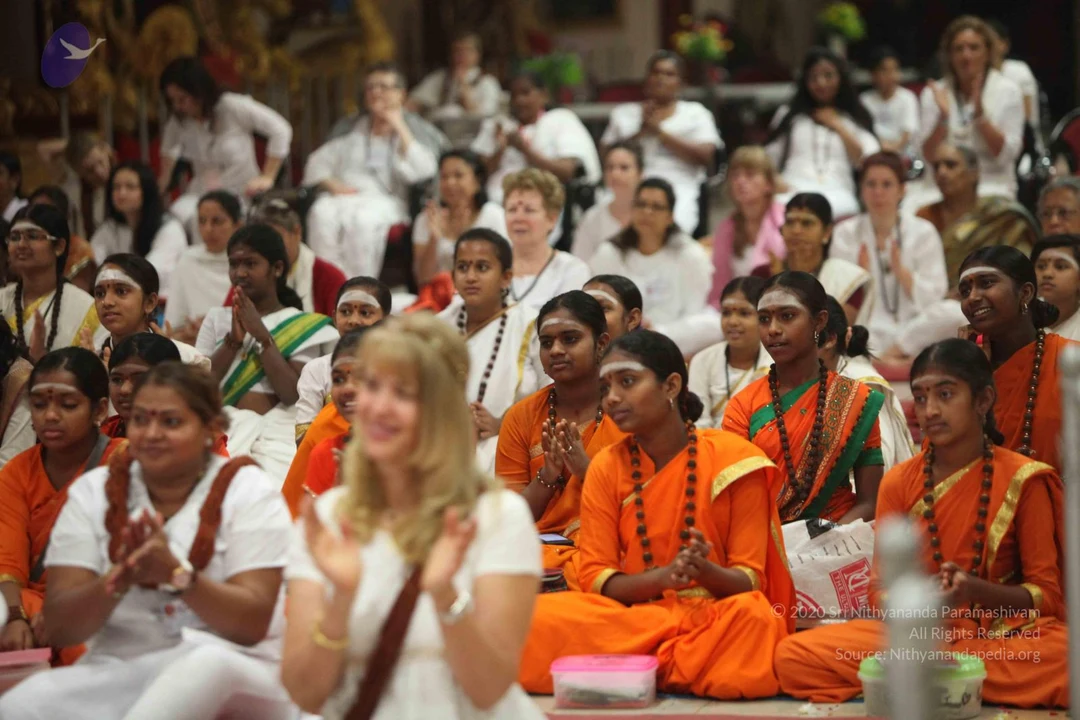
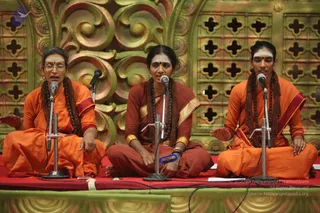
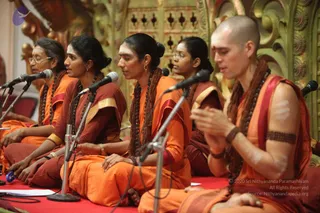
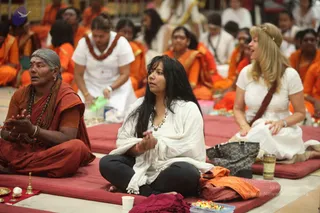
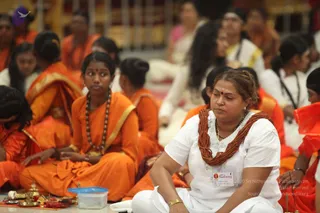
Three women seated cross-legged on a red stage cloth before microphones, chanting or singing. The two on either side wear orange saris with maroon borders and rudraksha malas, and the centre woman wears a deep maroon sari with a gold border and rudraksha mala, all with white forehead markings. Their hands are open in gesture. Behind them is an ornate gold and green carved wooden screen with lattice panels. The image carries a copyright overlay.Five people sit cross-legged on red floor coverings before microphone stands, chanting or reciting. Four women and one shaven-headed man wear orange and maroon robes with gold borders and rudraksha malas. The women have hair in buns and tilaka marks; the man has a bare chest, sacred ash markings on his arms and a rudraksha bracelet. Behind them is an ornate golden carved wooden screen.A photograph of a seated satsang gathering on red floor mats. In the foreground, an older woman with grey hair wears a rust-orange sari with a rudraksha mala and sits with palms pressed together. Beside her, a woman with long dark hair wears a white shawl and black trousers and sits cross-legged with her hands in front of her. On the right, a blonde woman in a white dress sits with her hands clasped. Behind them, many devotees in orange and white clothing sit on the floor. Small brass oil lamps, a brass bell, a small plate of offerings and a steel cup rest on the floor in front.A seated group of devotees in a large hall during a satsang gathering. In the foreground a woman in a white kurta sits cross-legged, wearing a thick rudraksha mala draped over her shoulders, a long chain necklace, gold bangles and a red bindi, with a name badge clipped to her shirt. Beside her, young women in saffron-orange robes and rudraksha malas sit on the floor, some with hands resting on their laps. Behind them, more devotees in white and orange clothing are seated among ritual items, including a brass puja lamp, a small kalasha-style vessel and a tray of offerings on the floor. The background is softly blurred with more participants.

IA-Mirror-Completion-Session
28 photosSource gallery
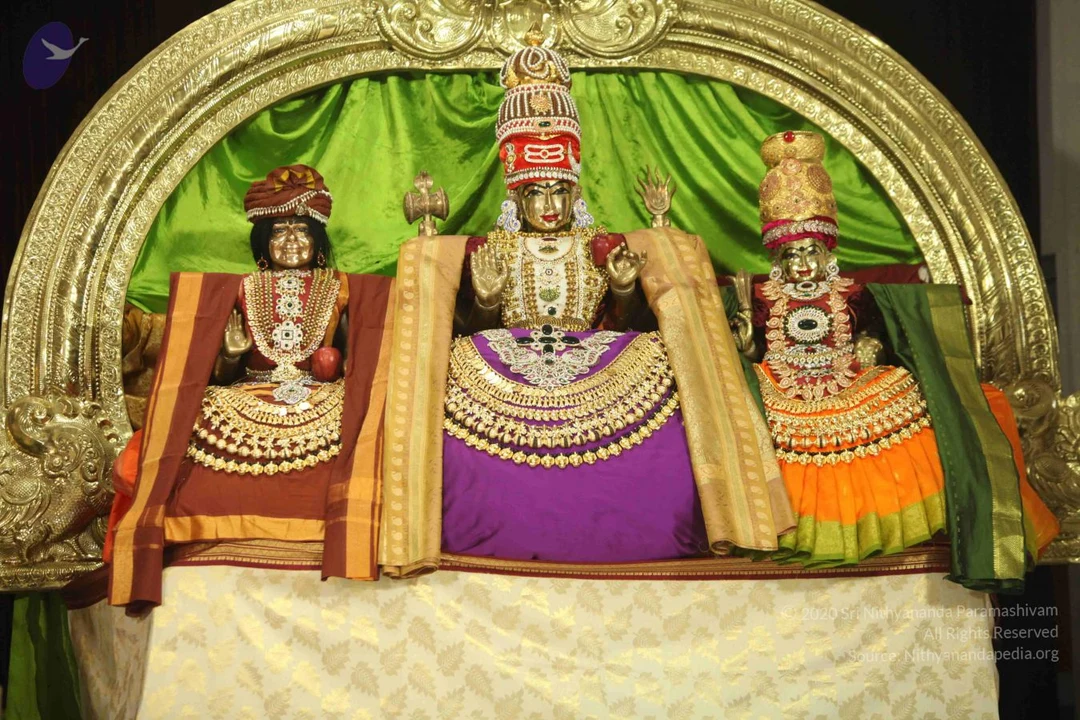
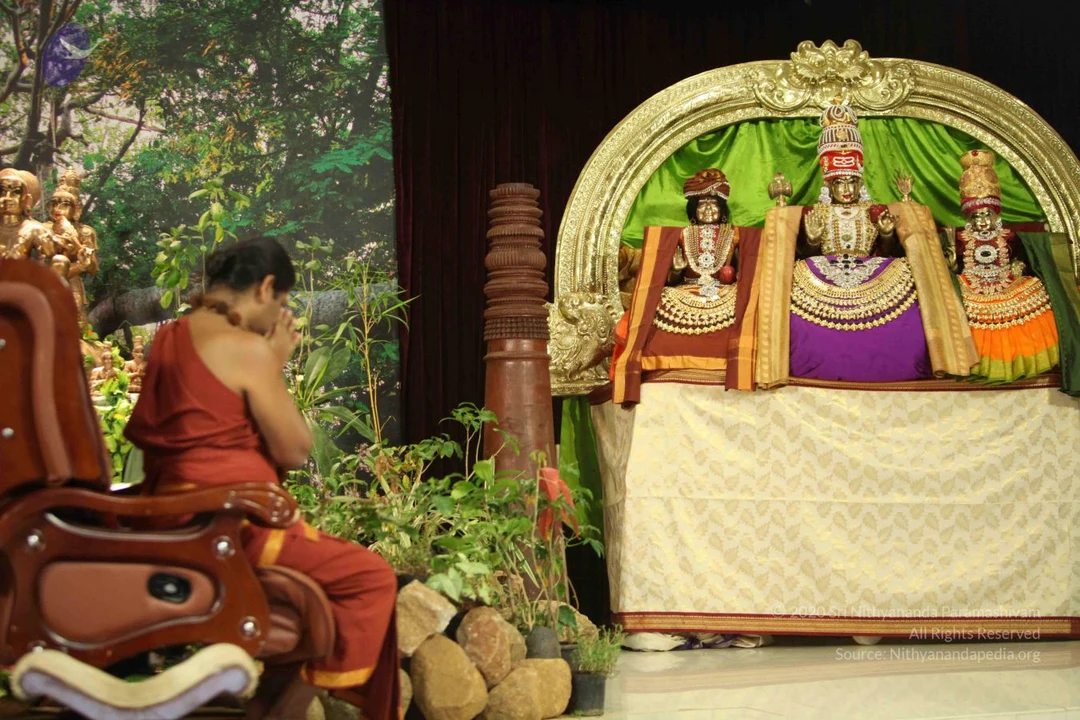
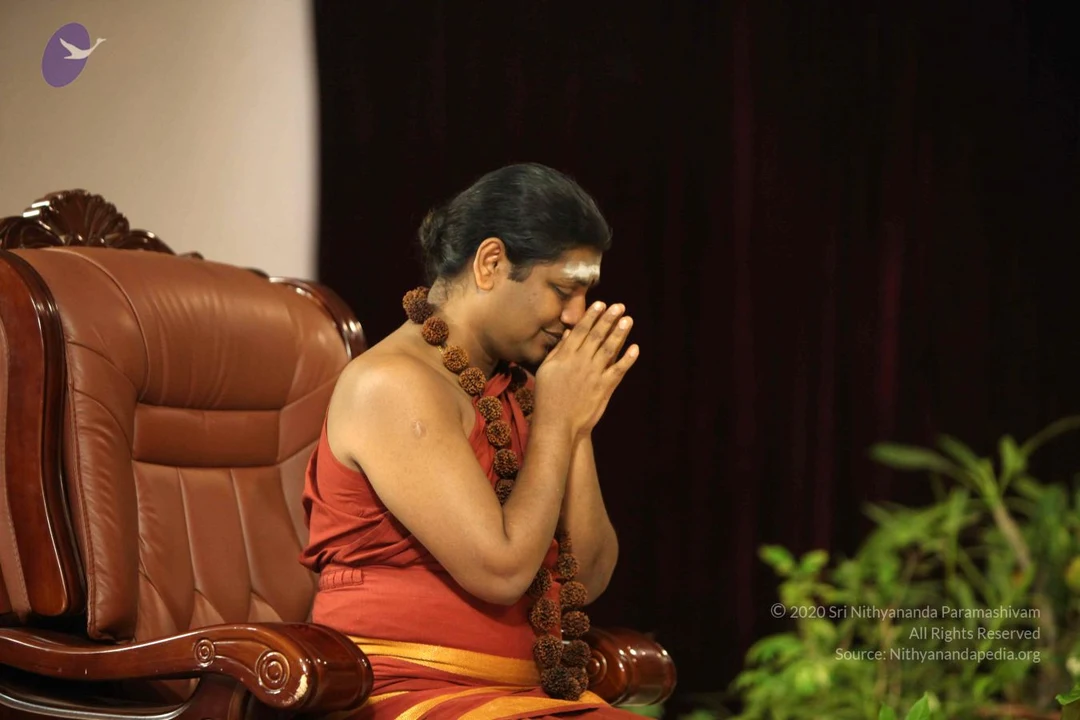
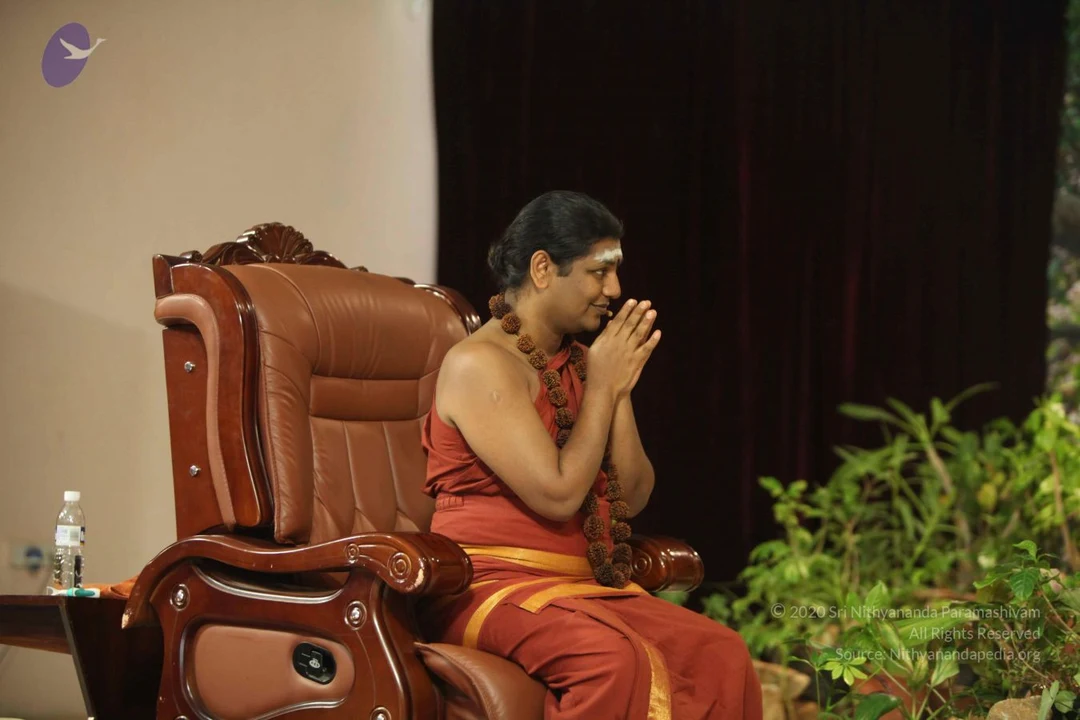
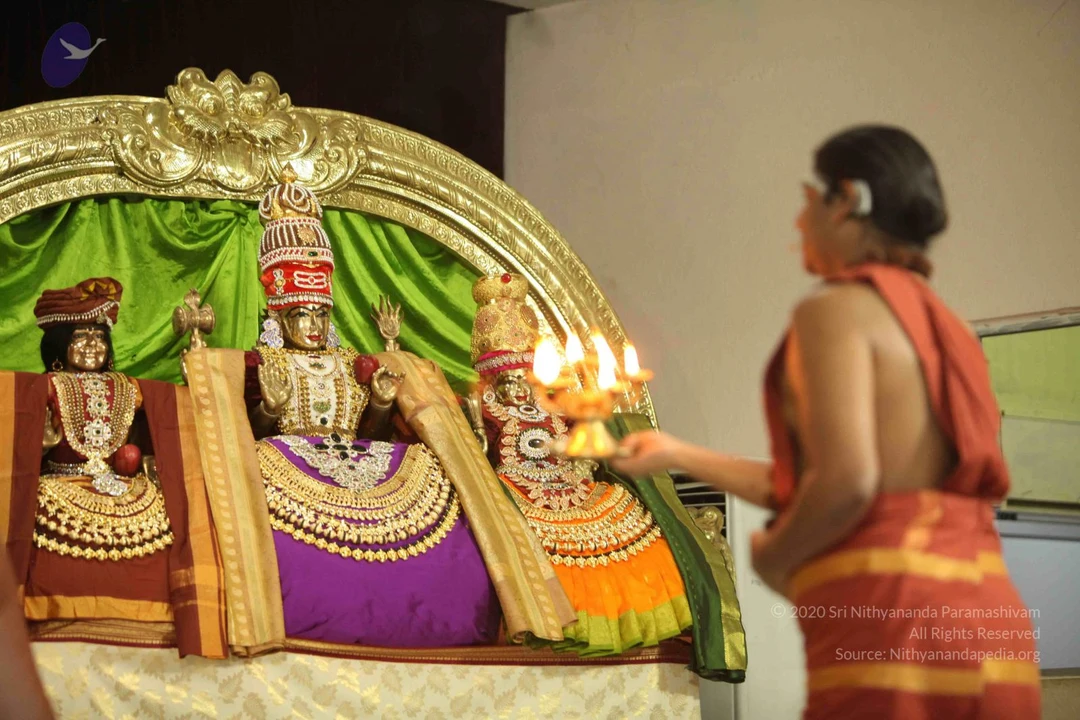
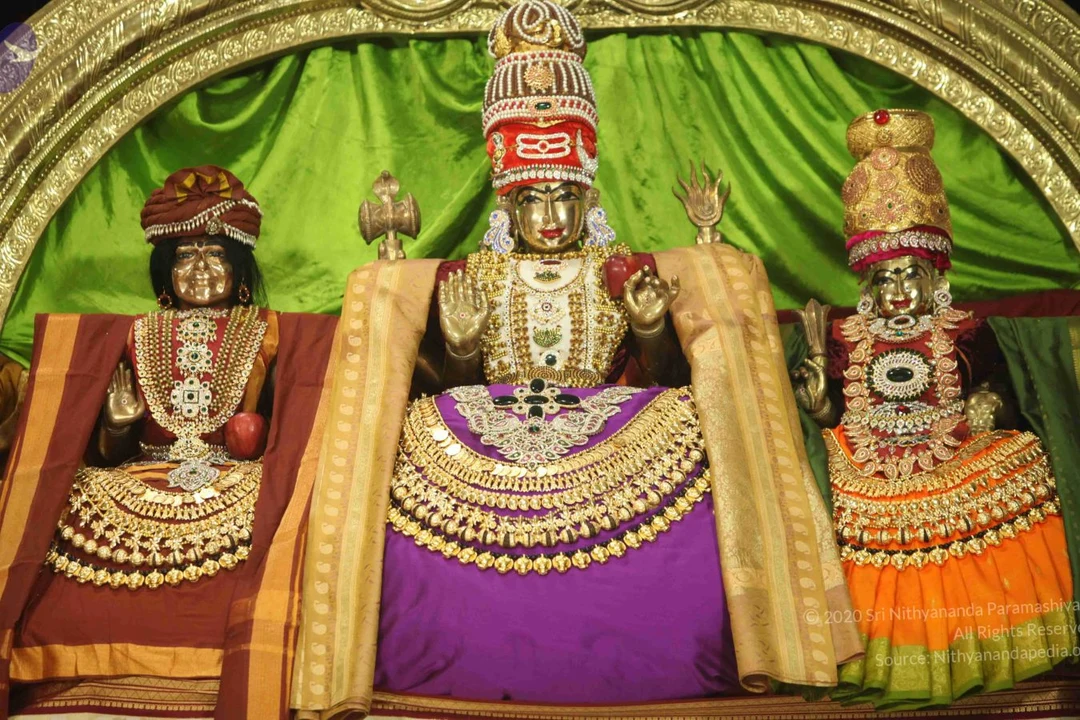
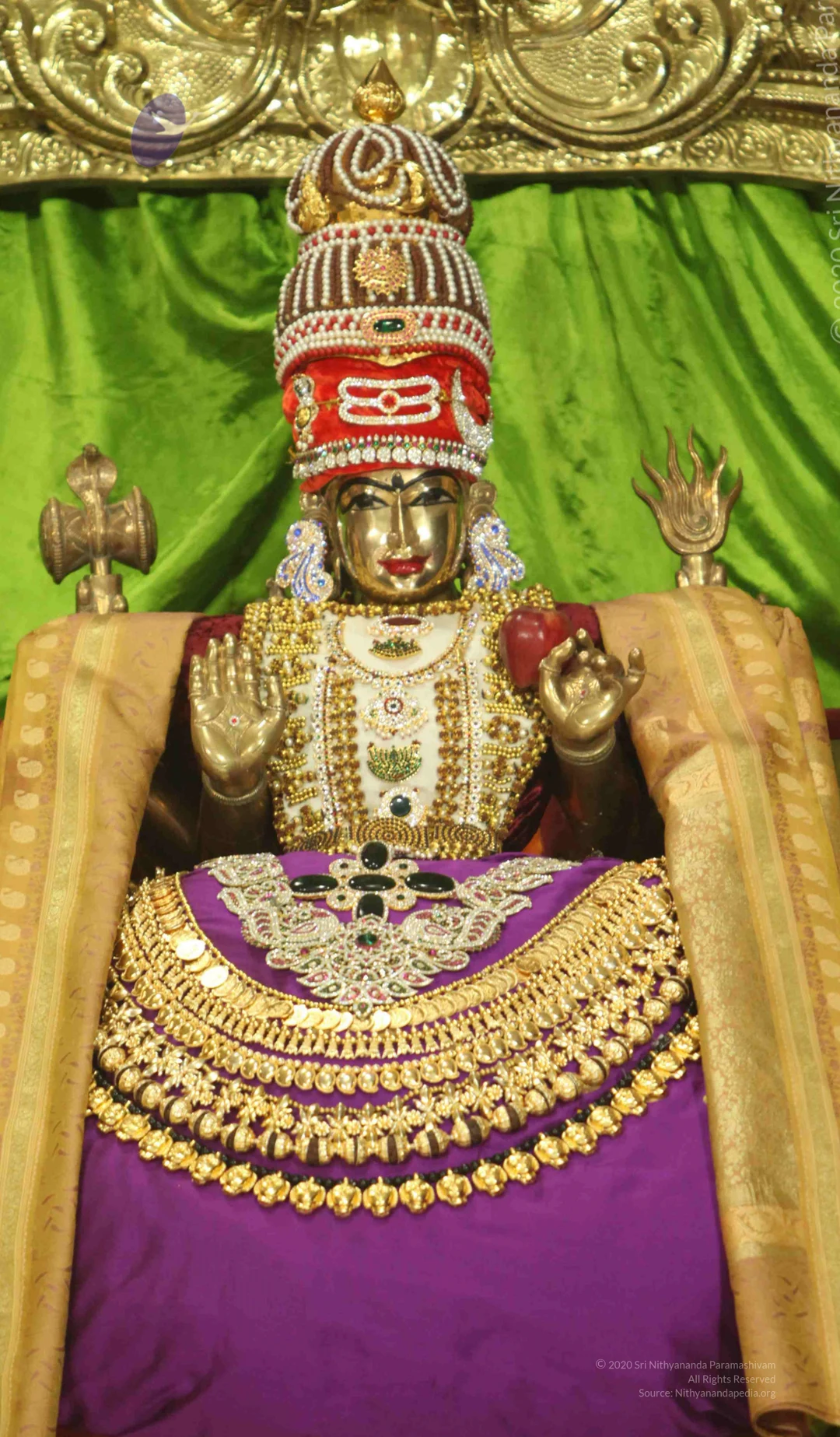
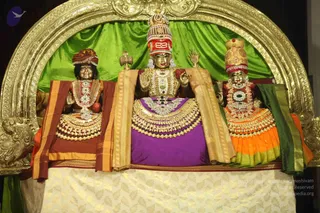
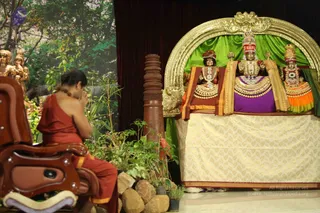
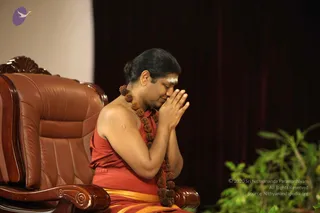
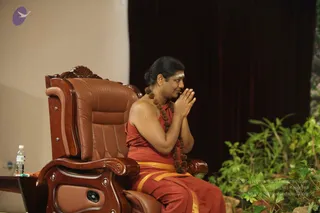
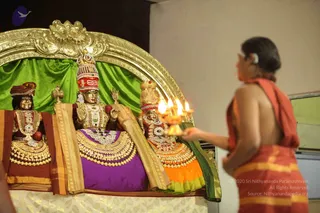
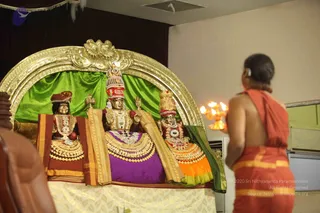
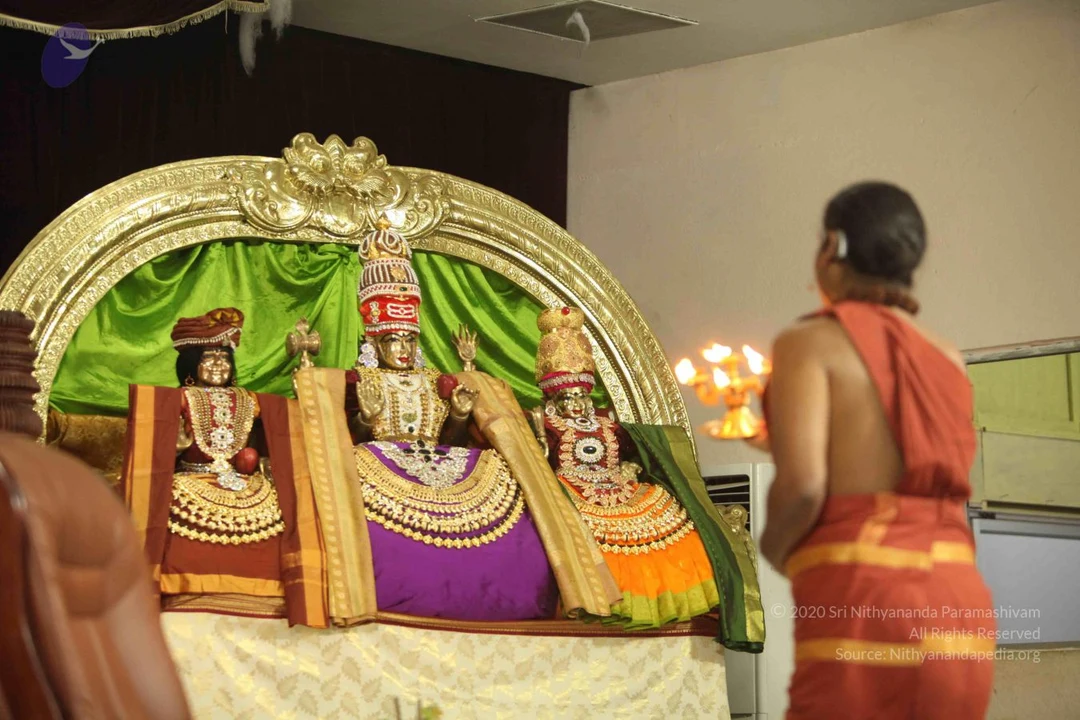
Three deity murtis are seated together on a raised golden throne-like platform framed by an ornate gold arch against a green silk backdrop. The central figure wears a tall red and gold crown, a gold-embroidered purple skirt, layered gold necklaces and holds a trident-like staff and a ritual hand gesture. The figure to the left wears a brown-and-gold turban, a red-and-brown shawl and gold ornaments, while the figure to the right wears a gold crown with a red band, a green-and-orange skirt with a green sash and jewelled necklaces. Gold brocade cloth covers the platform front. No people are visible.A seated figure in rust-red robes with an orange-edged dhoti sits in a carved wooden chair at left, head bowed and palms pressed together in prayer, shown from behind. Beside the chair, a potted garden of green plants and rocks sits in front of a painted forest backdrop with carved wooden figures. At right, three deity murtis stand on a white draped platform within an ornate gold arch framed by green cloth: the central figure wears a tall crown with red trim, a gold necklace and a purple skirt, flanked by two figures in gold jewellery with orange and green garments. A wooden pillar stands between them.A photo of a man seated in a large brown leather chair against a dark maroon curtain, with a green potted plant at right. He sits with palms pressed together in anjali and eyes lowered. He wears a red-orange unstitched robe with a yellow-gold border, a long rudraksha mala of brown beads draped around his neck, and a white vertical tilak mark on his forehead.A seated man in a red-maroon sleeveless robe with a gold-yellow waist sash sits in a large brown leather armchair with carved wooden armrests, hands pressed together in anjali namaskar. He wears a long rudraksha mala with multiple beads draped over his shoulders and a white vertical forehead mark, and his hair is pulled back. Behind him hang dark maroon velvet curtains, and green potted plants stand at the right. A water bottle sits on a small table at left.A woman with her hair pulled back and wearing a rust-orange sari draped over her bare back faces three seated deity murti on a gold-framed altar with a green curtain. The central murti wears a red and gold crown, gold jewellery and a purple skirt, flanked by smaller figures in gold and maroon garments. She holds a lit multi-wick oil lamp toward them, its flames glowing. The scene suggests an aarti offering in a temple or ashram setting.A photograph of a temple shrine with three deity murtis seated beneath an ornate gold arch against a green cloth backdrop. The central murti wears a red and gold crown, a purple garment, layered gold jewellery and a gold waist sash; the flanking murtis wear gold and red or orange garments and jewellery. In the right foreground a person with hair tied back, wearing a bare-backed orange-red cloth, faces the shrine holding a lit multi-flame oil lamp. A brown chair edge is visible at the left. The scene shows a puja or aarti in progress.

IA-Lunch
7 photosSource gallery
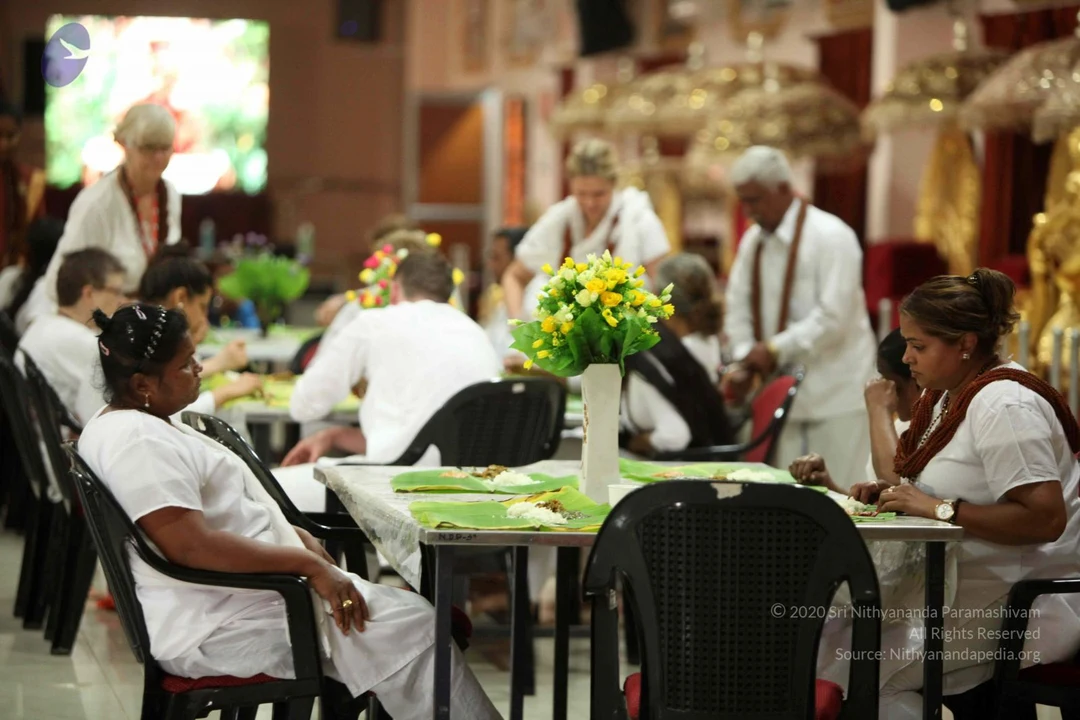
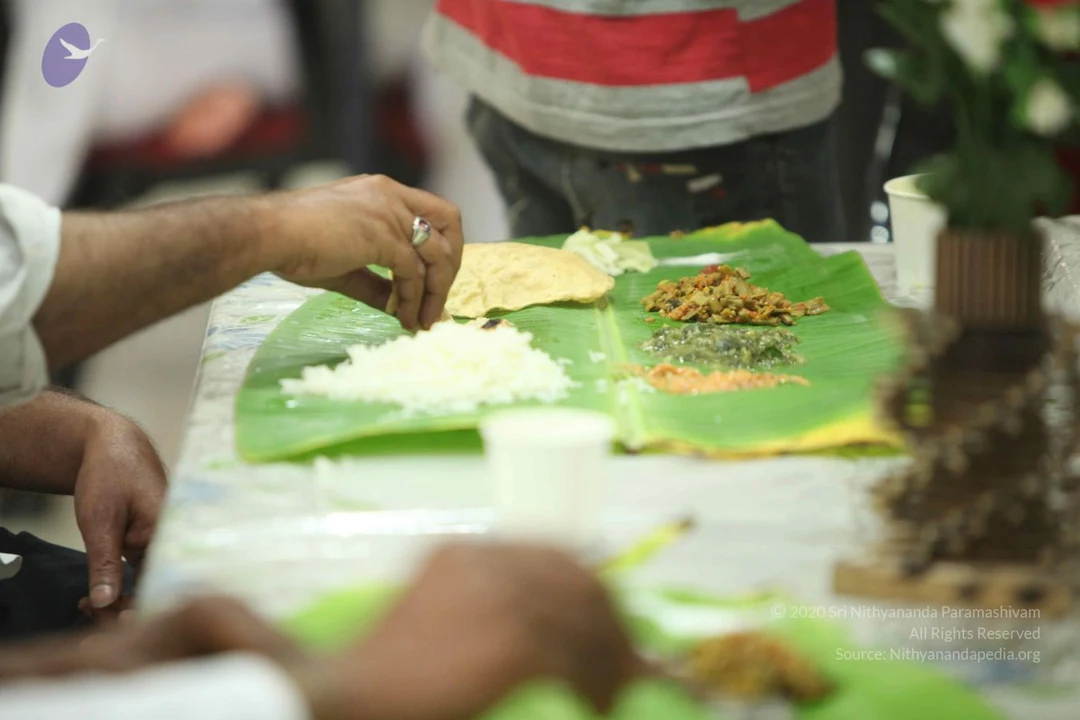
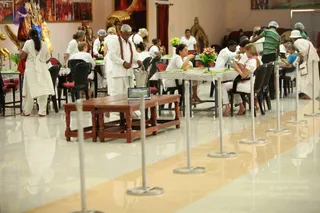
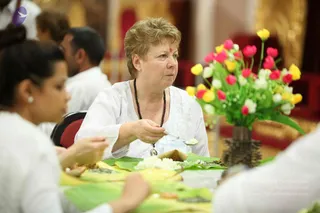
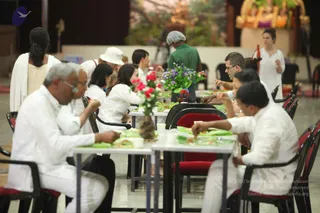
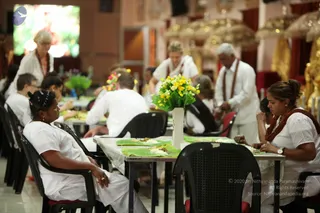
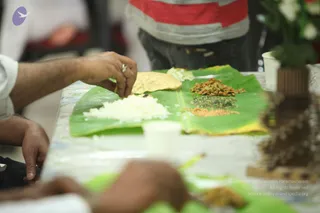
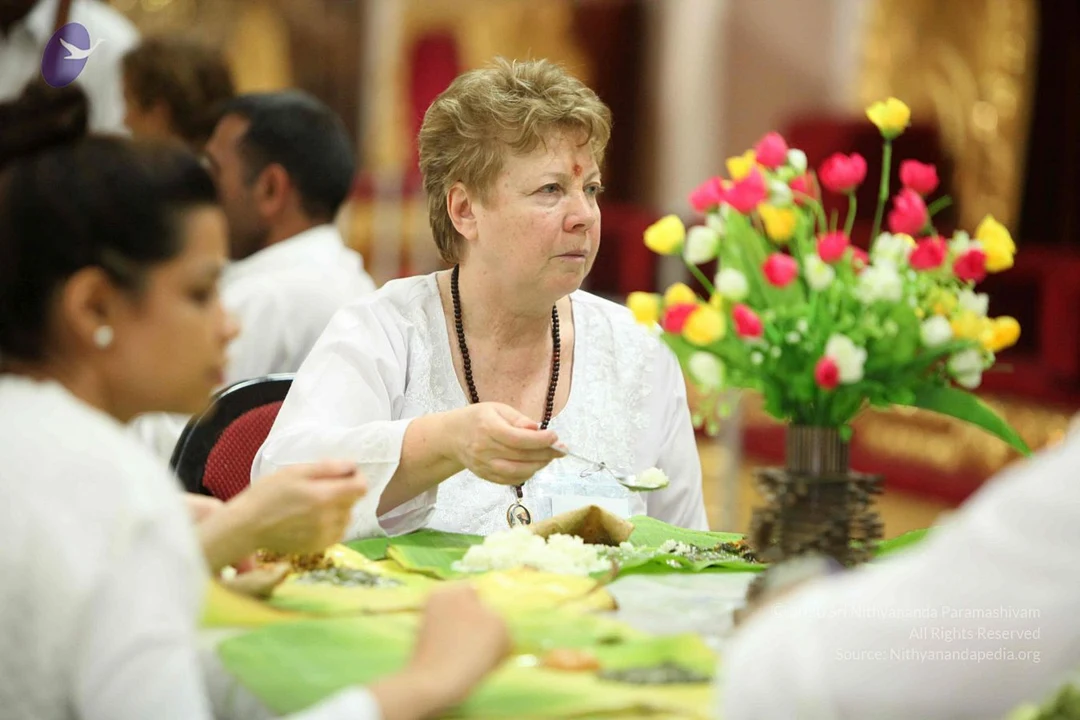
A photograph of a communal dining hall with devotees seated at long tables covered in white cloths and banana-leaf plates, being served food. Staff in white hairnets and white kurtas carry trays and steel pots, while a man in a striped green shirt serves from a bucket. Several diners in white clothing sit at the tables, and a woman in a white sari with a pink shawl sits at the right. A vase of pink and purple flowers stands on a table. Behind them, a wall map of the world and a red banner reading Nithyananda Gallery frame the hall. a person is not clearly visible in this scene.A dining hall at a Nithyananda Dhyanapeetam-style ashram where devotees dressed in white are seated at long tables with green-and-white tablecloths and small flower vases, eating from plates. Several white-clad volunteers, some wearing hair nets and surgical caps, serve food and carry buckets, while a man in a white dhoti and a rudraksha mala at the centre holds a bucket. Behind them a golden deity murti and a red-and-gold painted backdrop of a deity stand against the wall, and a laptop sits on a wooden bench in the foreground. Steel rope barriers guide the flow along a glossy floor.A short-haired woman in a white top with a red bindi and a dark red-brown bead mala necklace sits at a long table covered with green banana leaves, holding a spoon of white rice. Beside her a woman in white with hair pulled back and another person in white sit along the table, with a vase of red, yellow and white tulips at right. The background shows red and gold ornate decor.A photograph of a communal dining hall with people seated at rows of white-clad tables, eating from banana-leaf plates. Most diners wear white kurtas, shirts and trousers; a woman in a white top is seated in the middle, and a man in a green shirt with a white cap stands among the tables, while a woman in white stands at the upper right. Tables hold red and purple flowers in vases, red-cushioned chairs line the room, and an ornate golden shrine with a deity murti and floral decoration stands in the background. This is annadan-style communal feeding in an ashram hall. The page is not visible in the image, and no a person candidate is clearly identifiable by appearance.A dining hall at an ashram where devotees in white clothes are seated at rows of plastic-chaired tables eating from banana leaves. A woman in the foreground with dark hair in a bun wears a white garment, and a woman on the right wears white with a rust-coloured shawl, both eating. Behind them, a woman in white with a red shawl and a grey-haired man in white with brown suspenders move between tables, serving. Tables hold yellow flower arrangements and green leaf plates. Golden decorative umbrellas and a large screen with green imagery appear in the background.A close photograph of a meal being served on a green banana leaf on a white table. A man's hand with a silver ring places a yellow flatbread beside a mound of white rice, with small portions of vegetable curry, coloured chutney and a bowl-like dish nearby. Blurred figures in white and a striped red-and-white shirt stand around the table, and a potted white-flowered plant with a brown vase sits at the right edge.

IA-Afternoon-Session

1 photoSource gallery
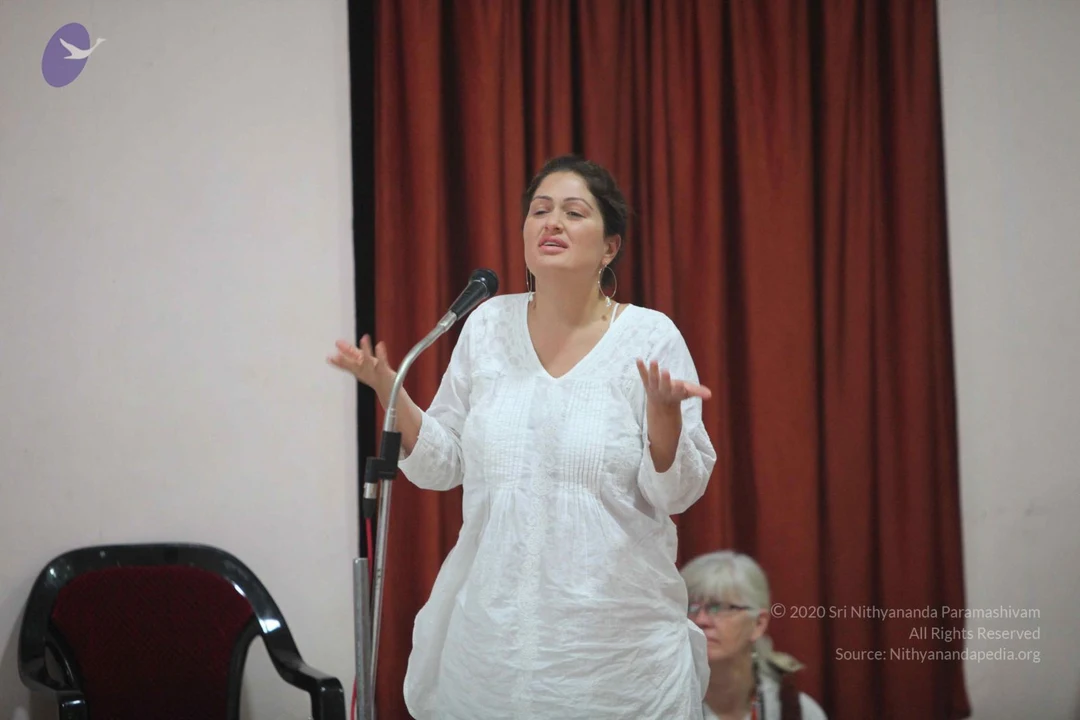
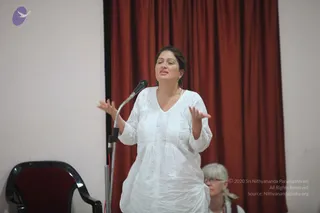
A woman in a white embroidered tunic with a V-neck and gathered waist stands at a silver microphone stand, gesturing with both open hands while speaking. Behind her hangs a deep red curtain against a pale wall. Beside her, an older woman with grey hair and glasses sits in a dark chair, wearing a white top and a red lanyard. The setting appears to be a satsang hall during a discourse. No person is identified as a person in this image.

Nithya-Satsang
63 photosSource gallery
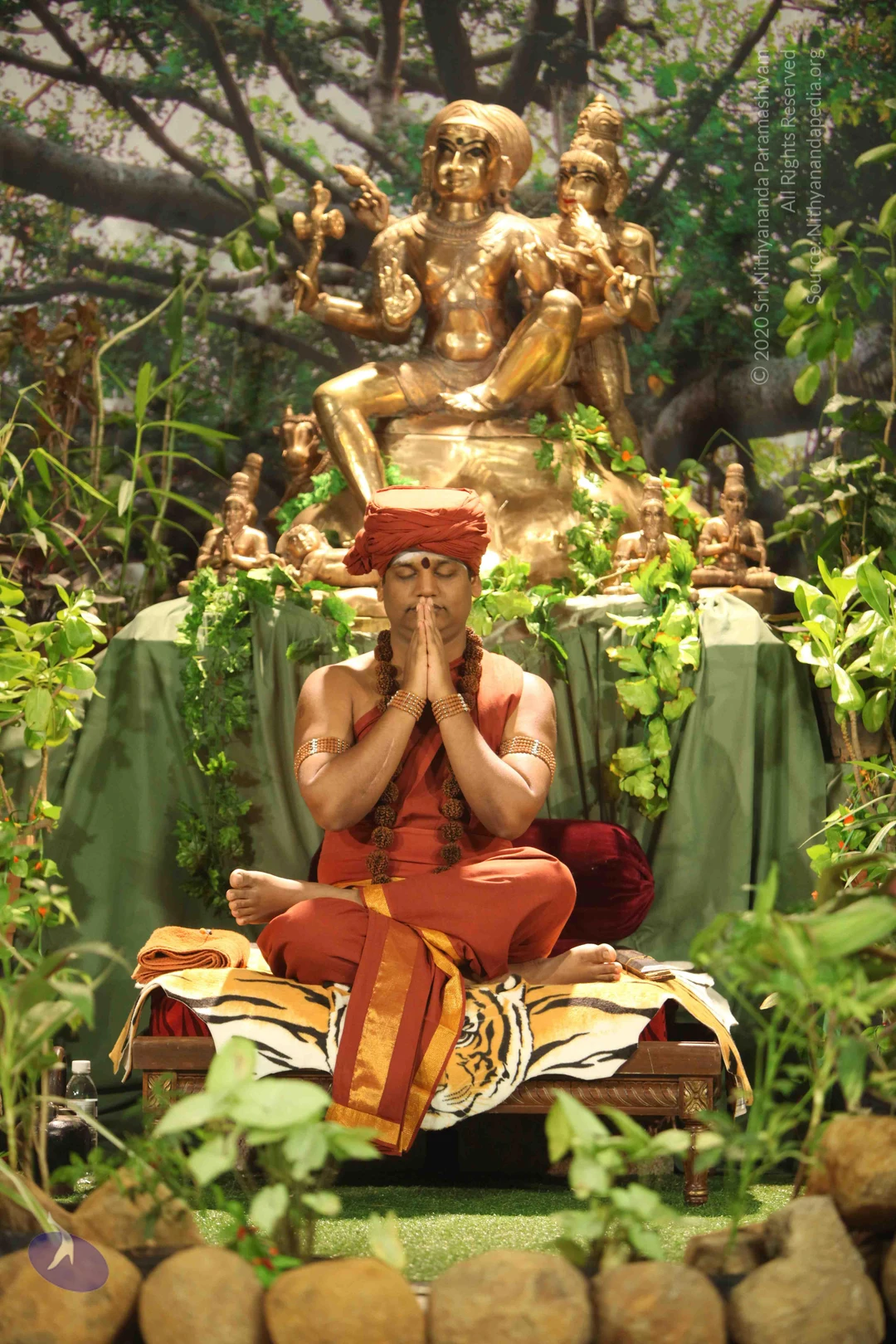
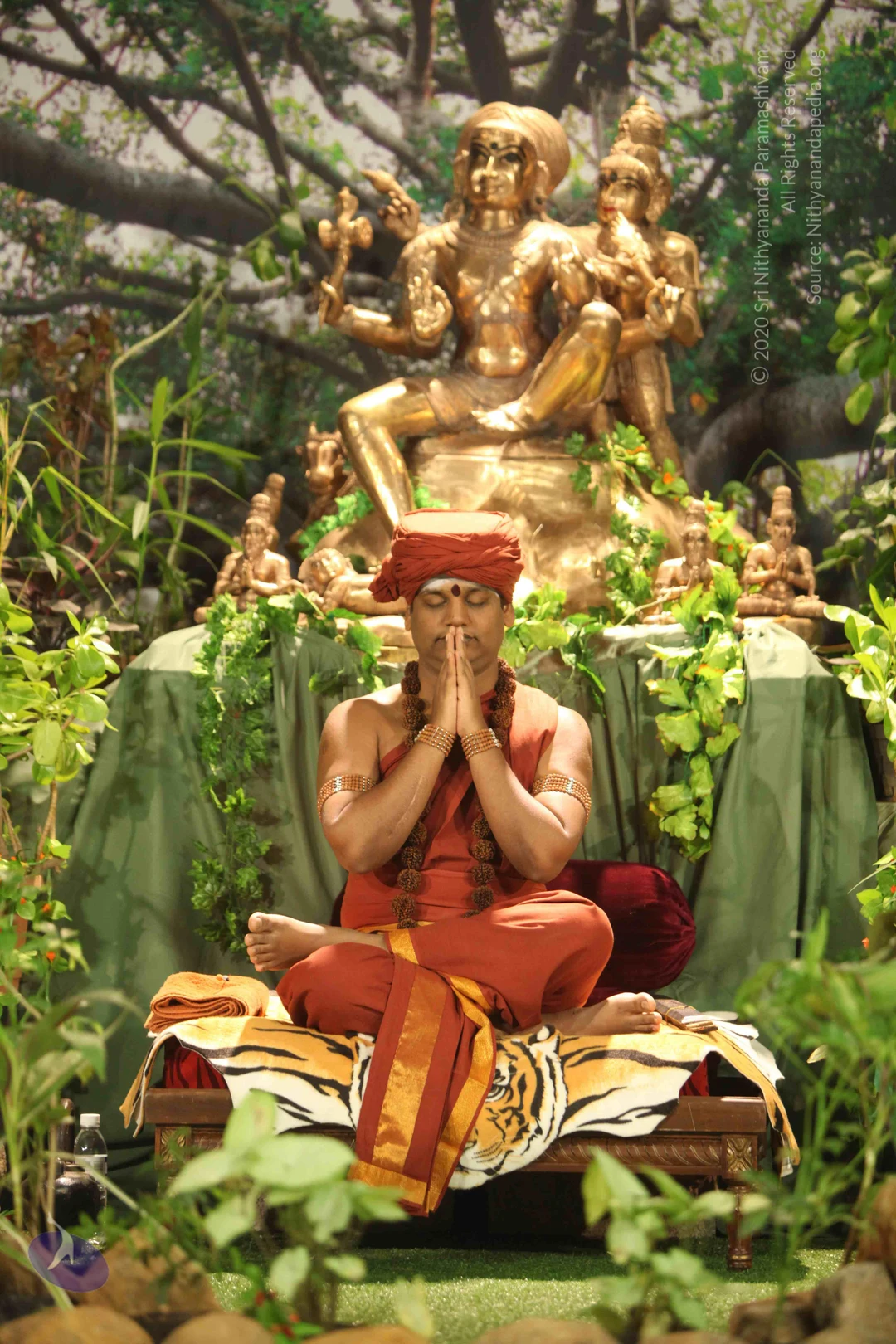
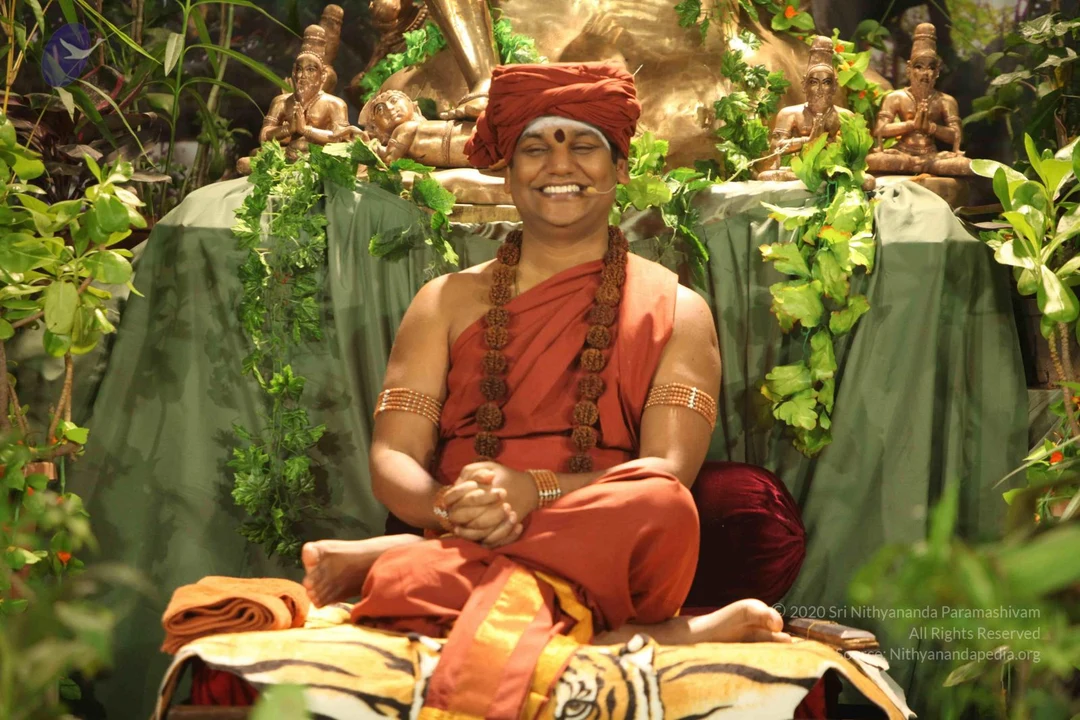
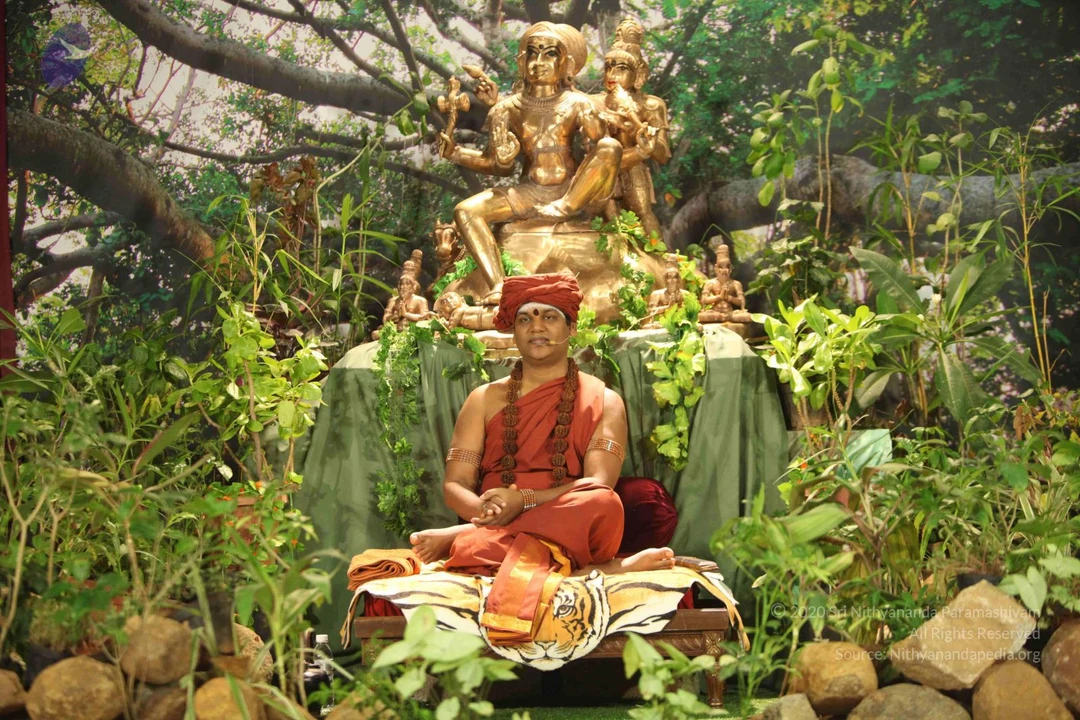
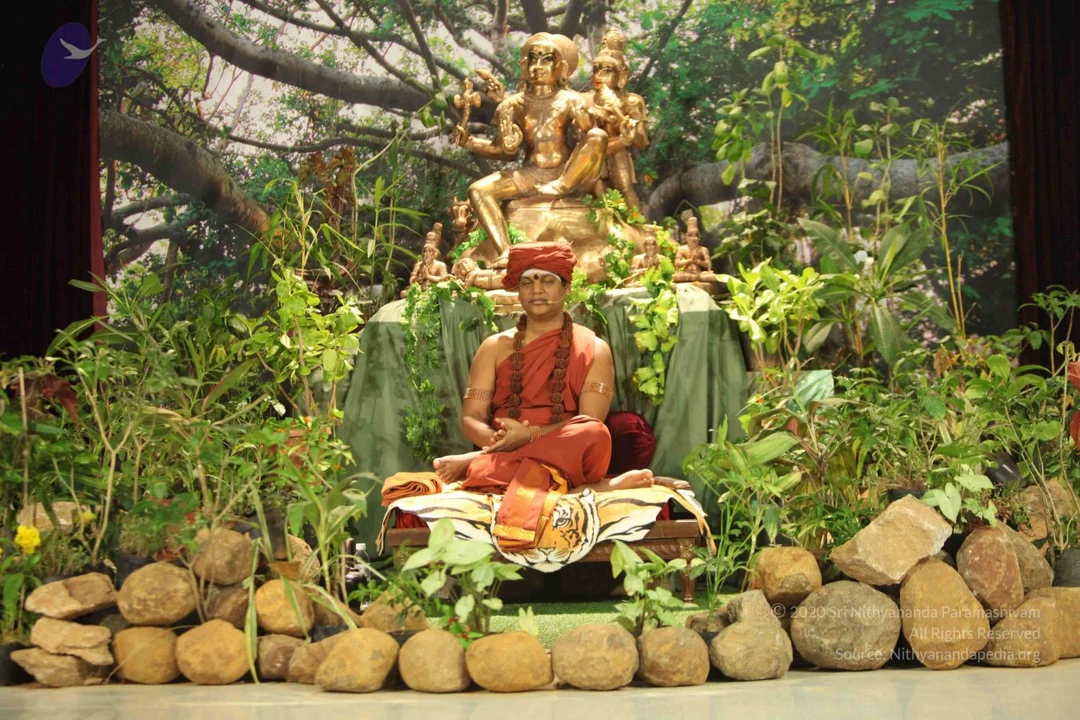
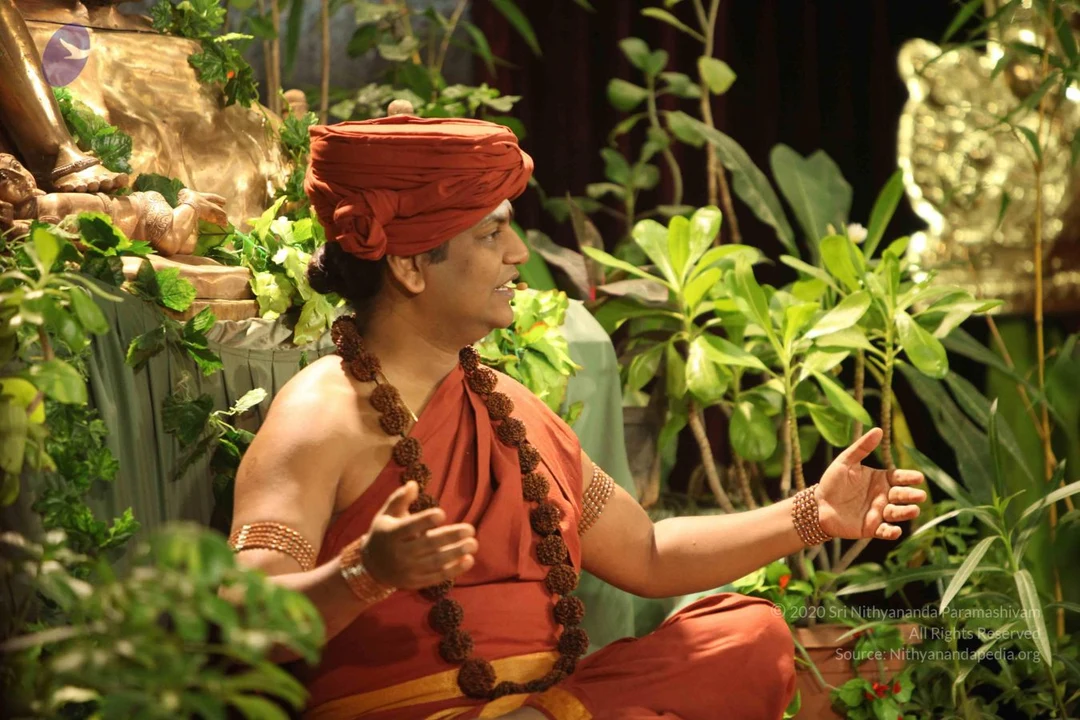
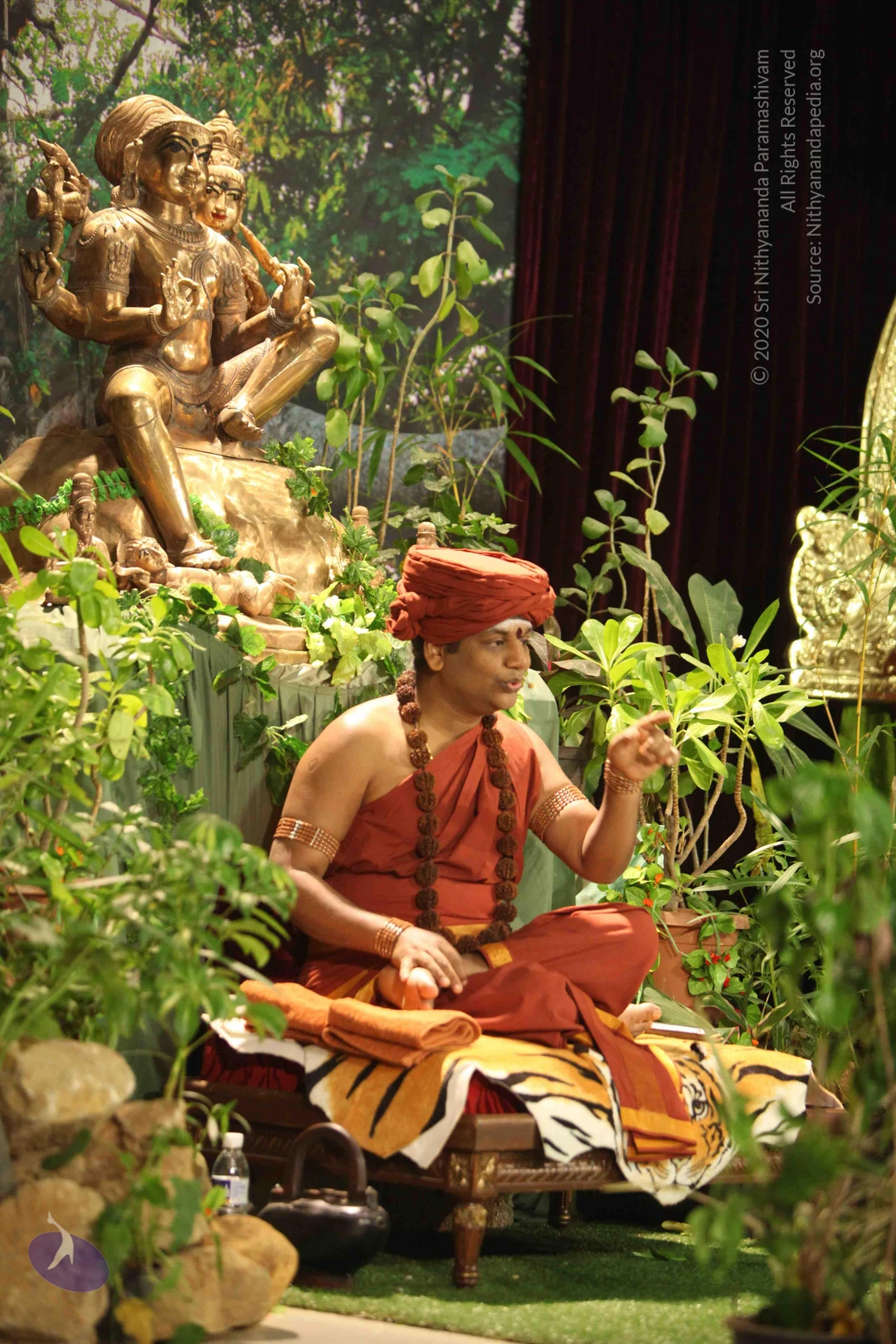
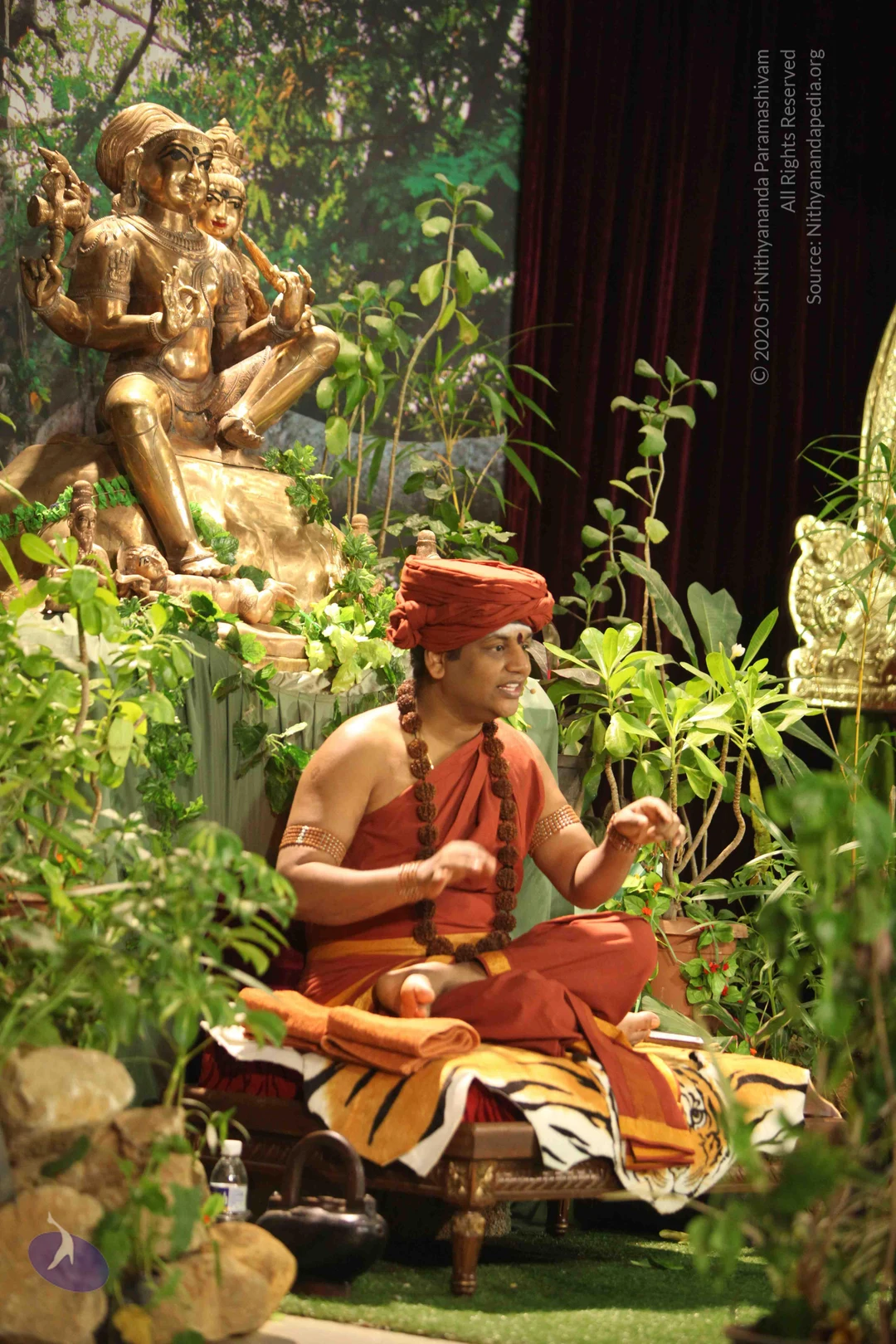
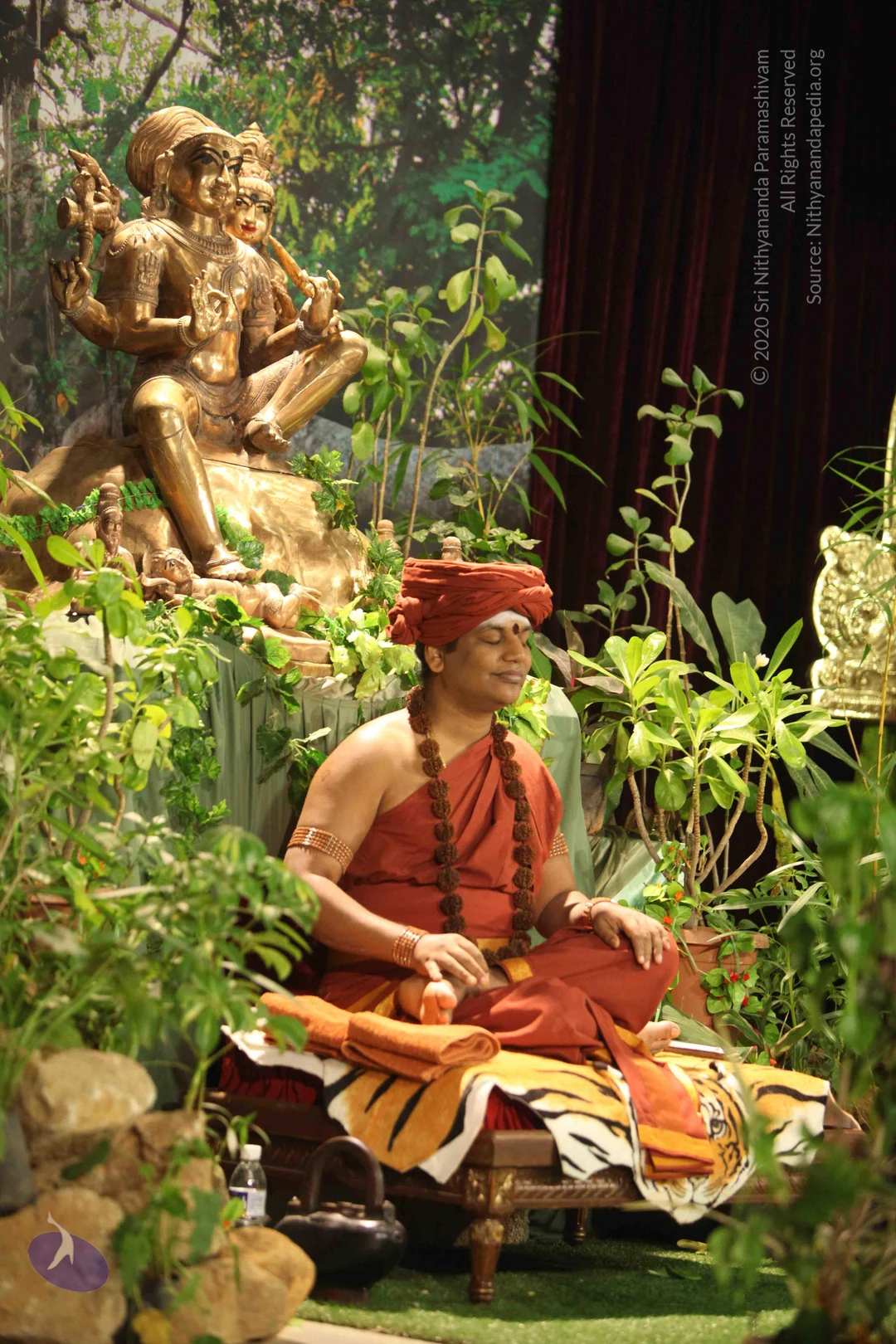
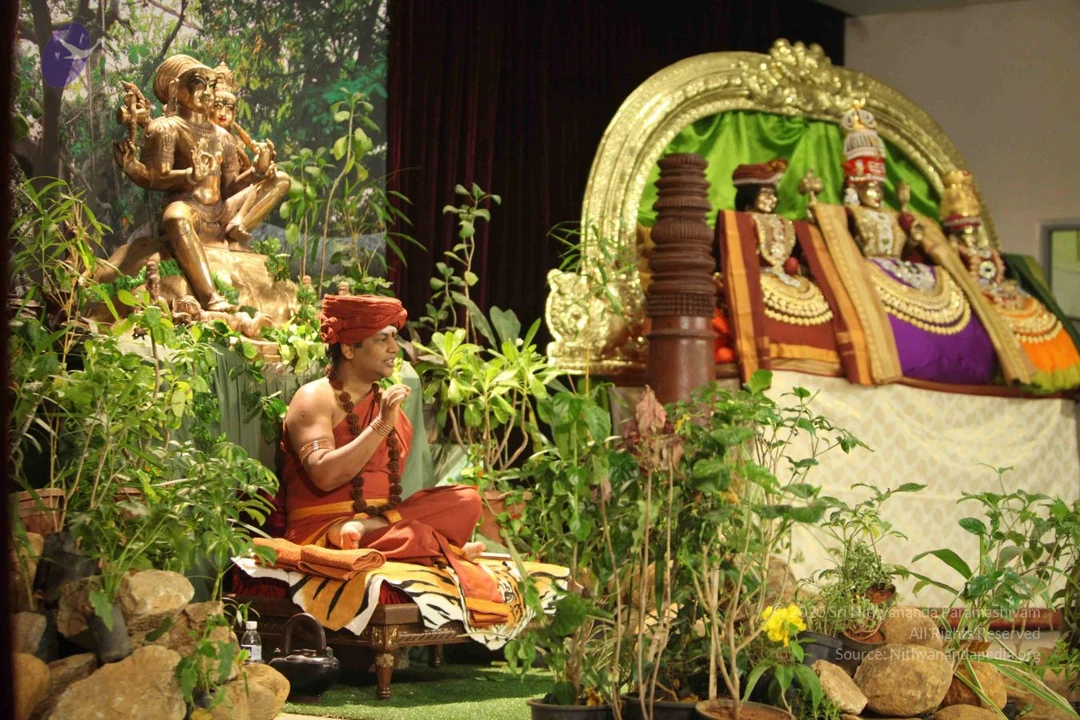
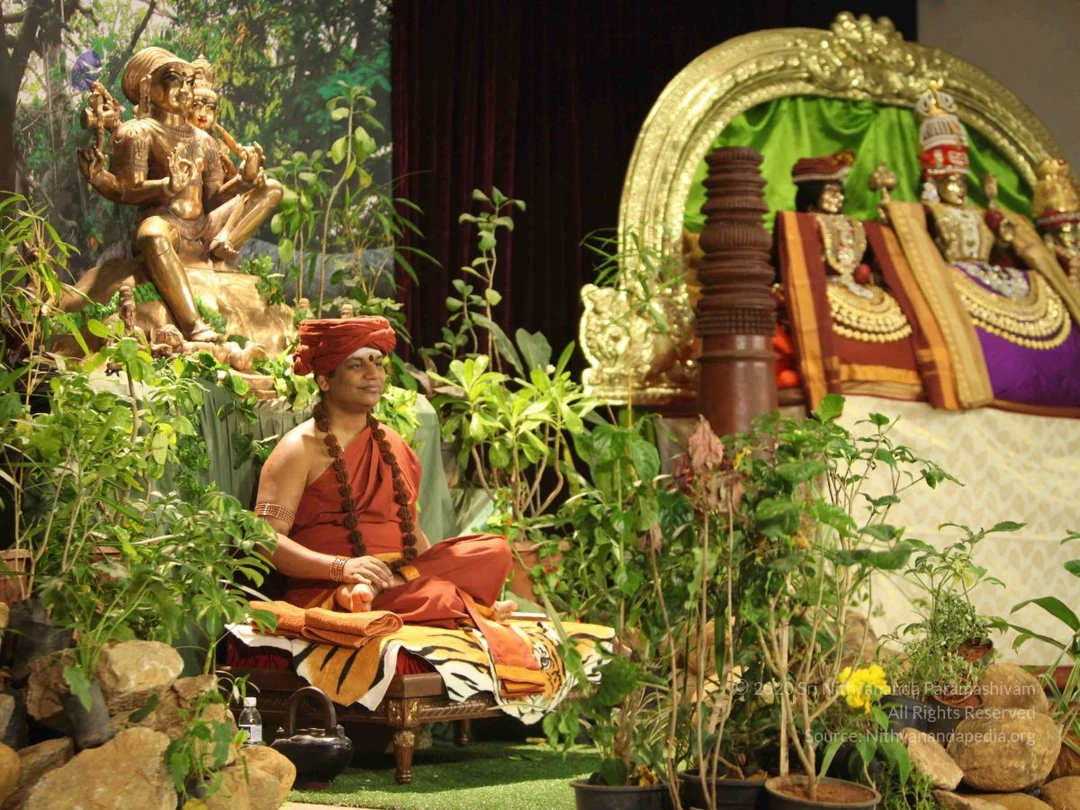
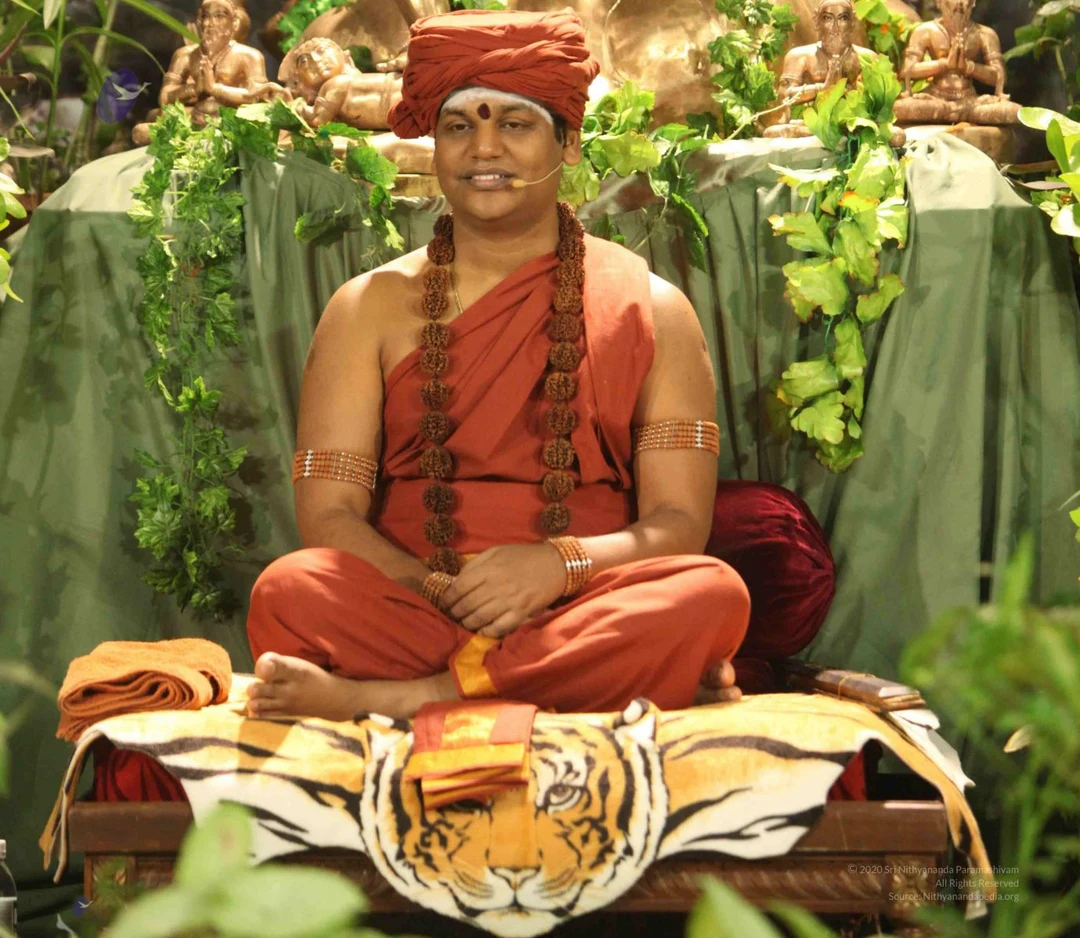
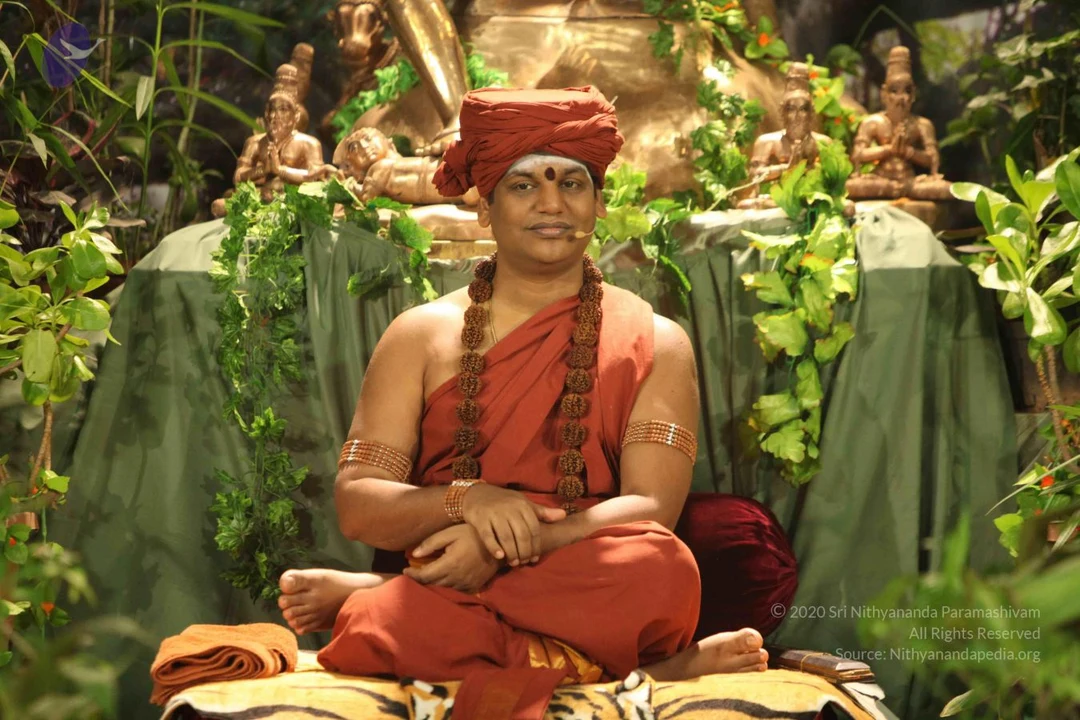
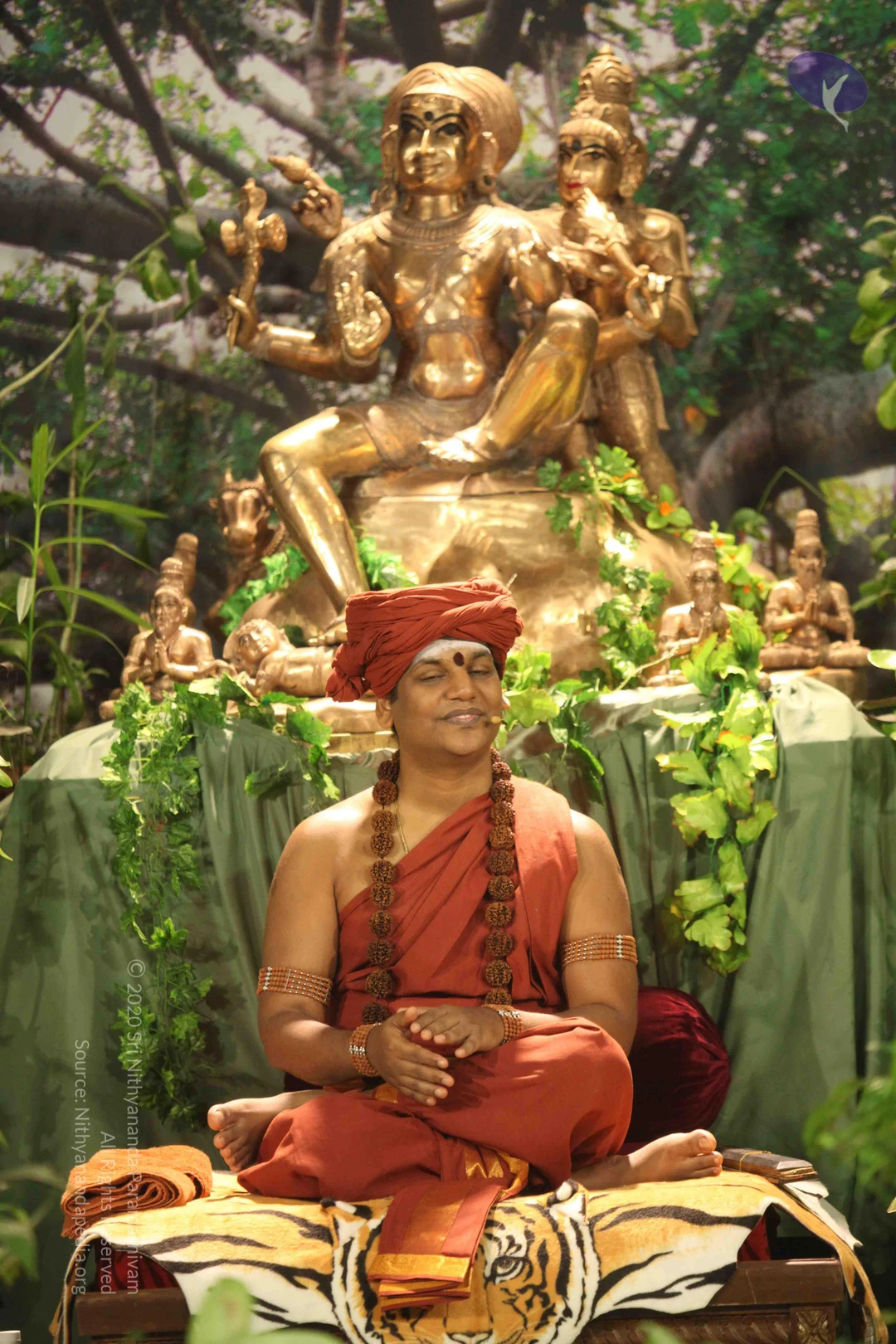
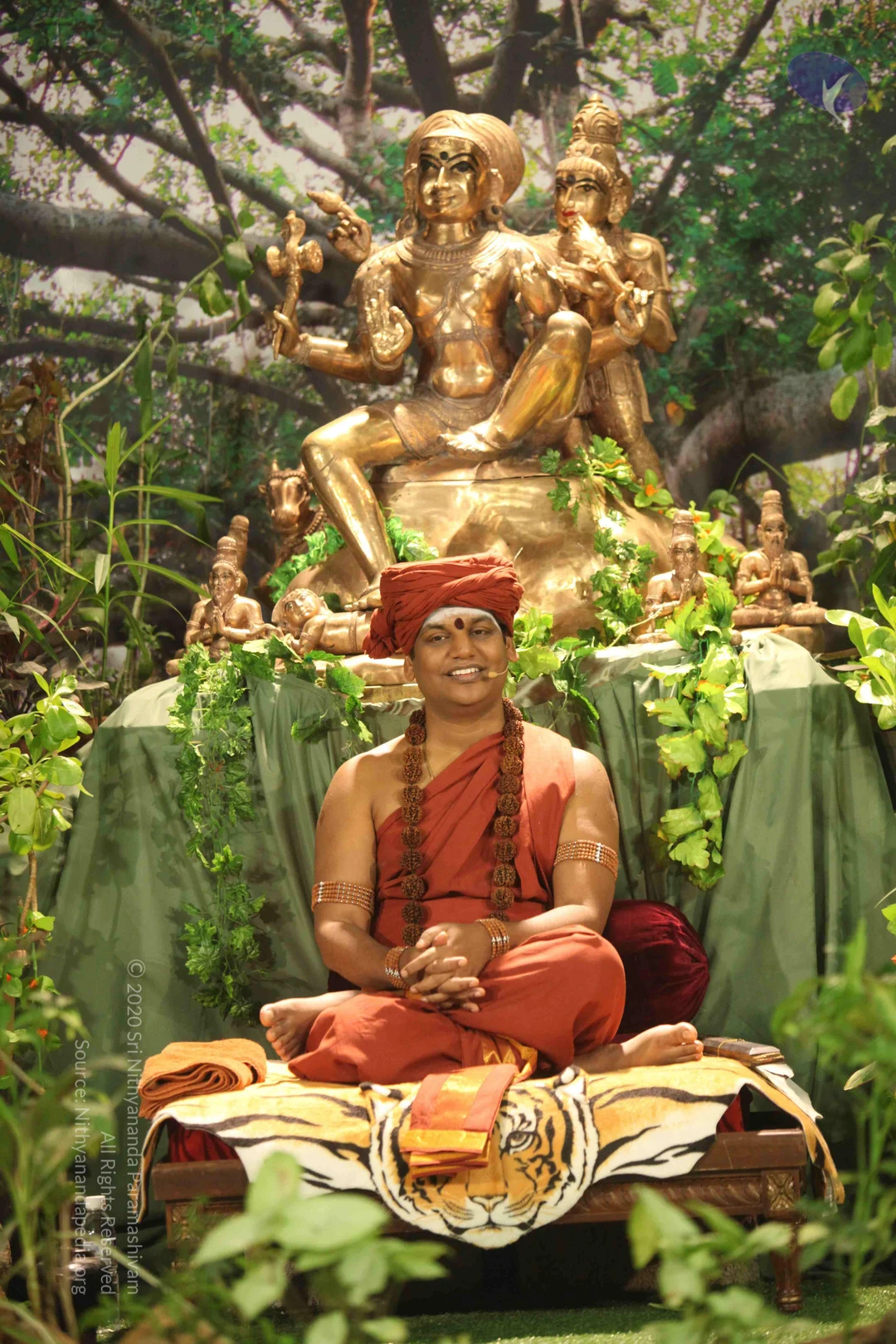
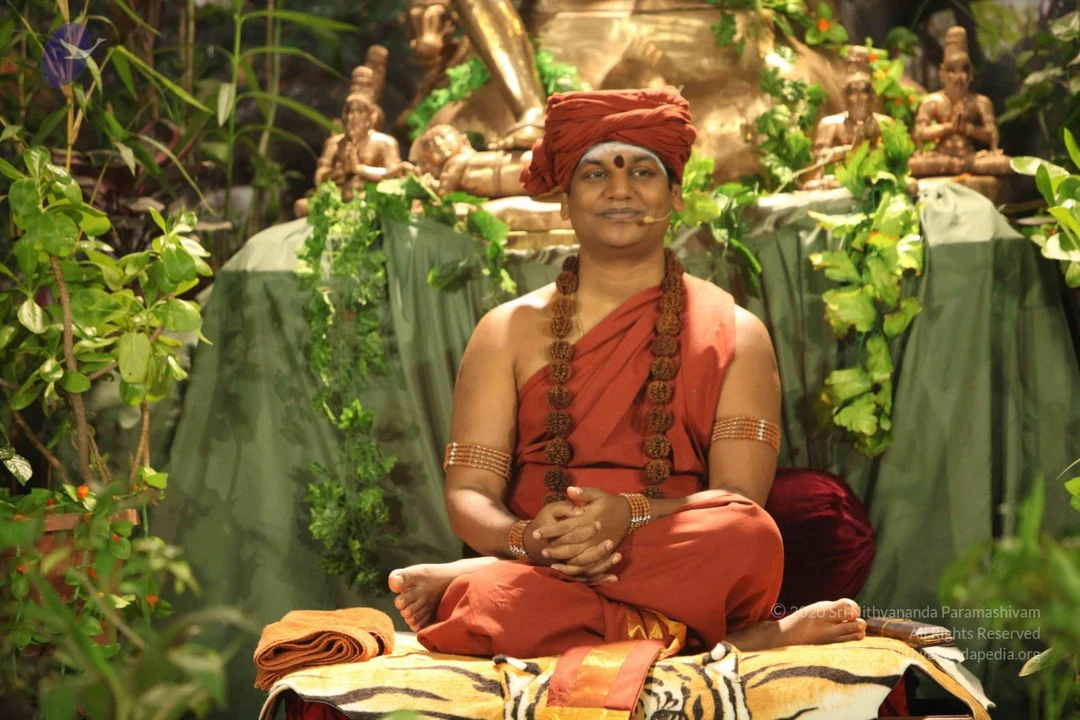
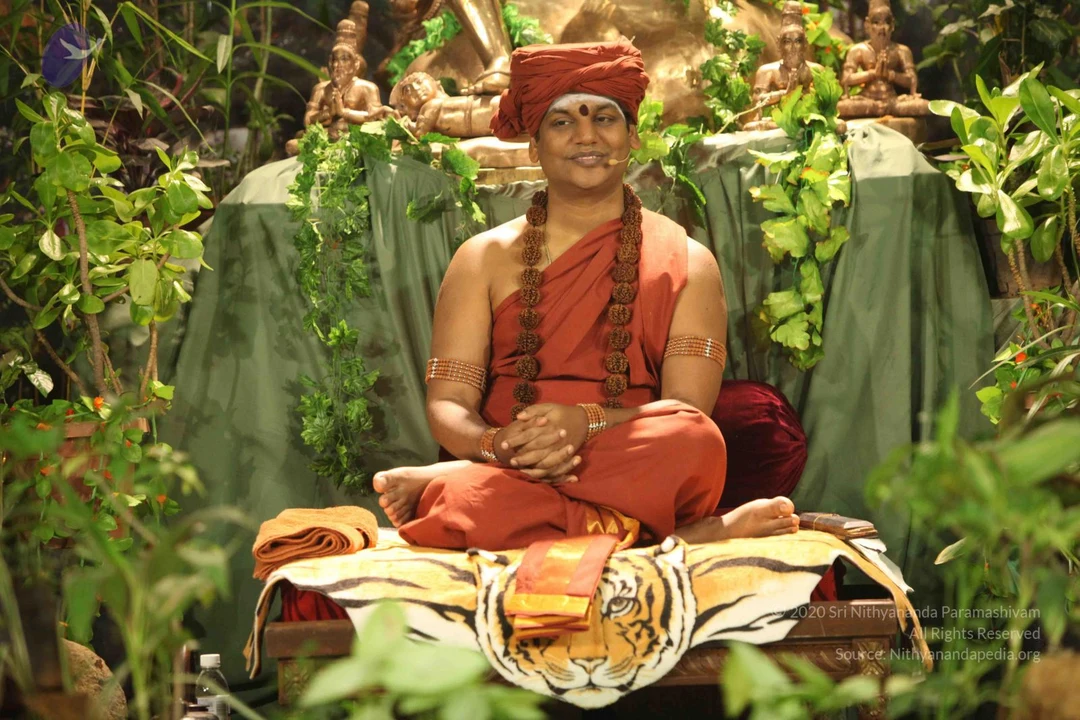
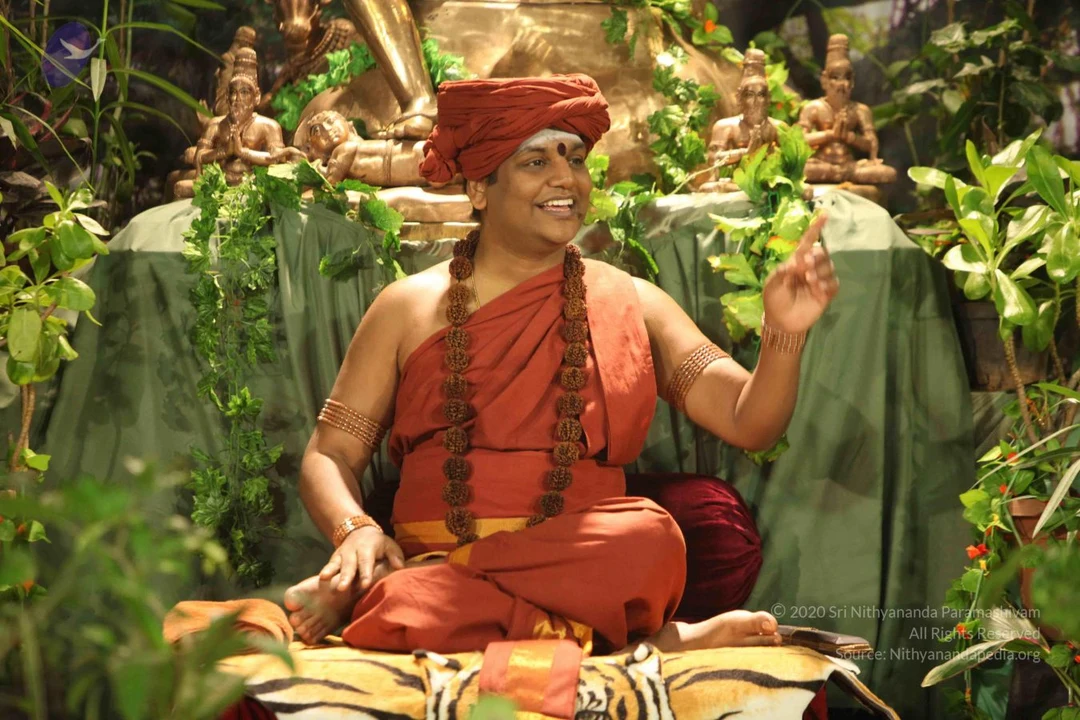
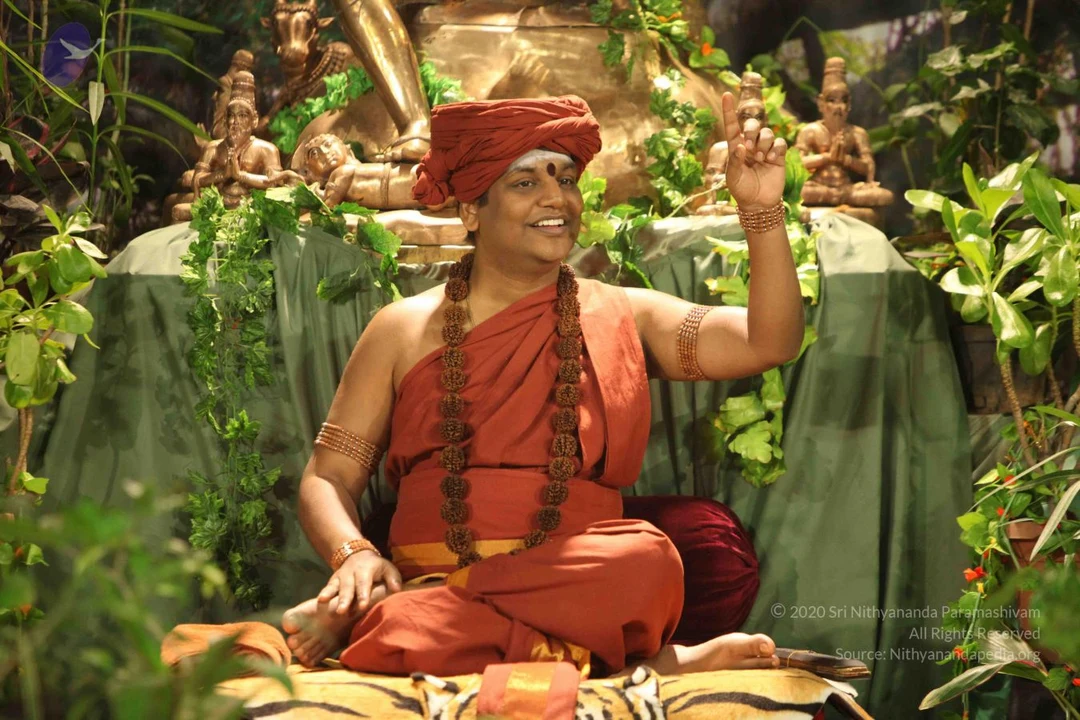
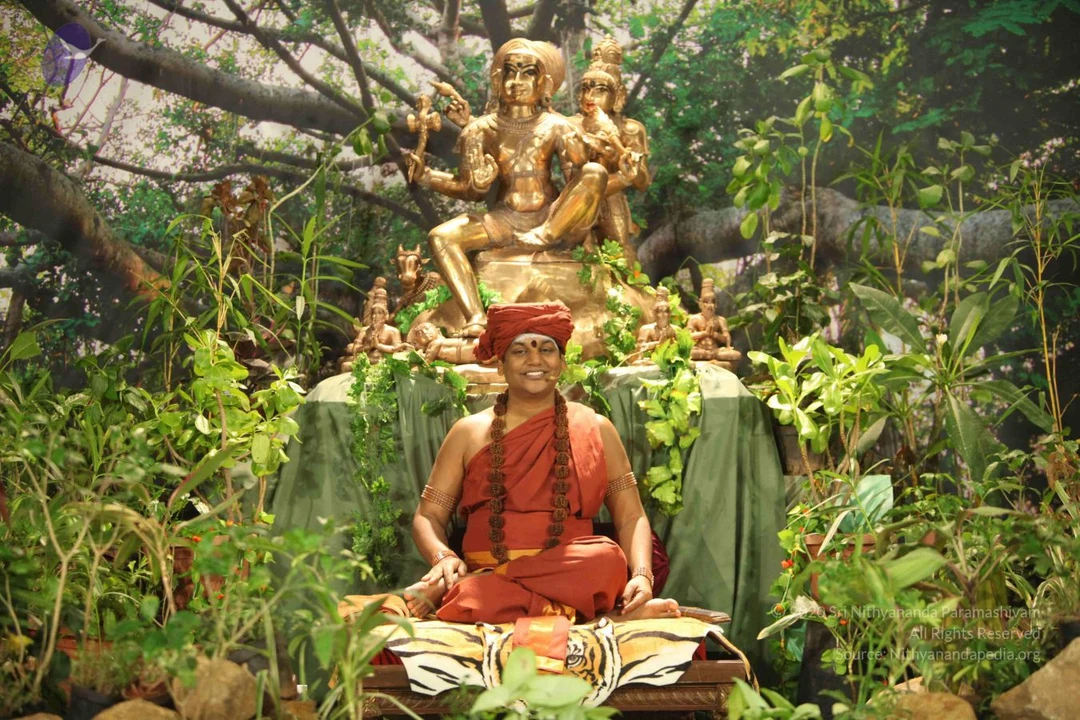
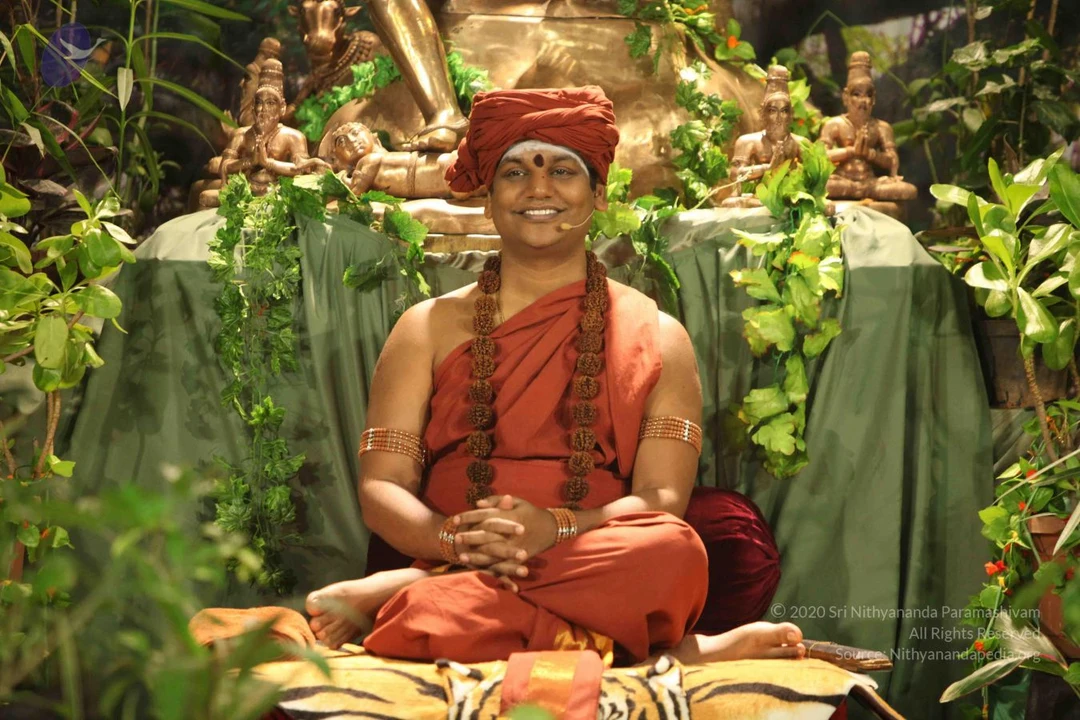
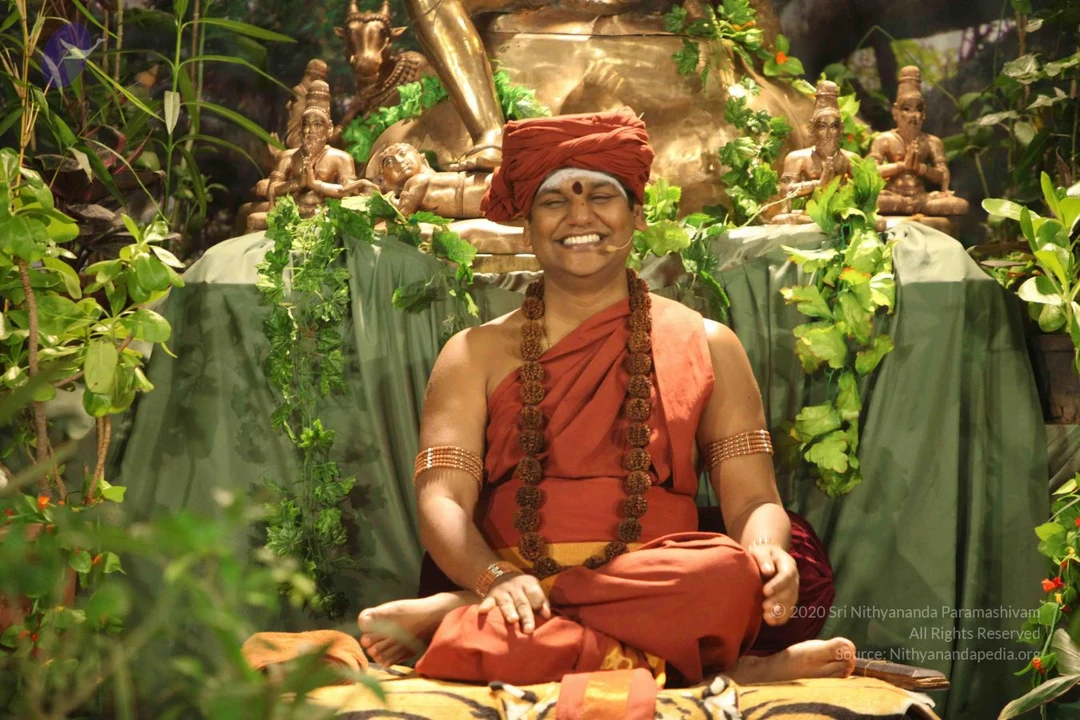
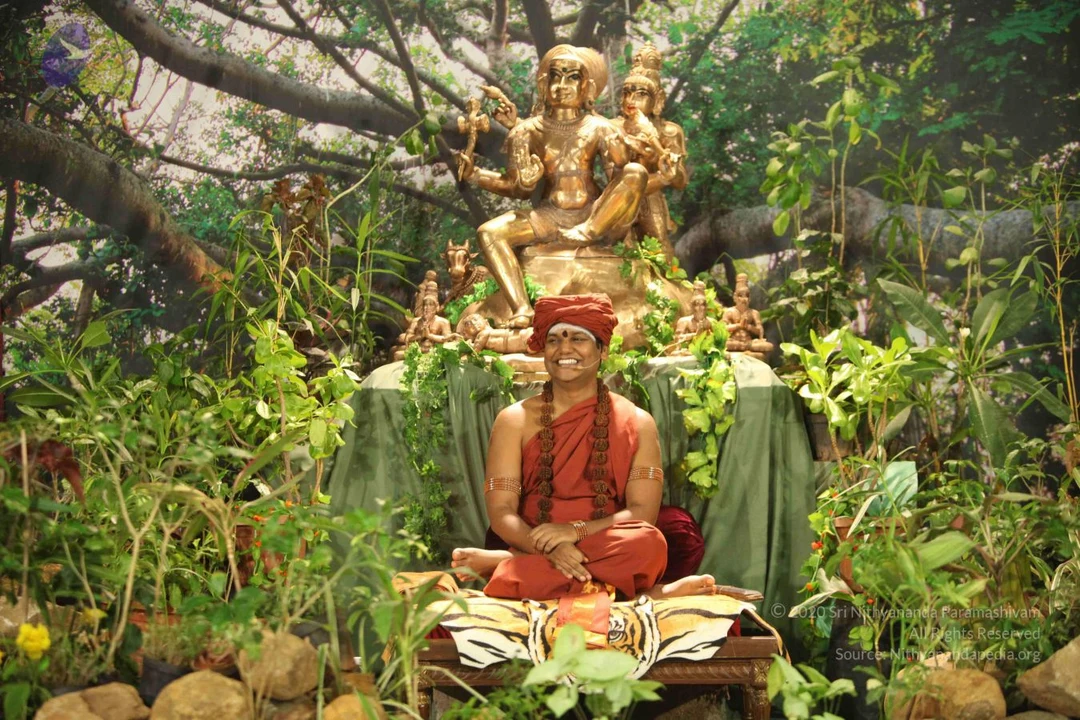
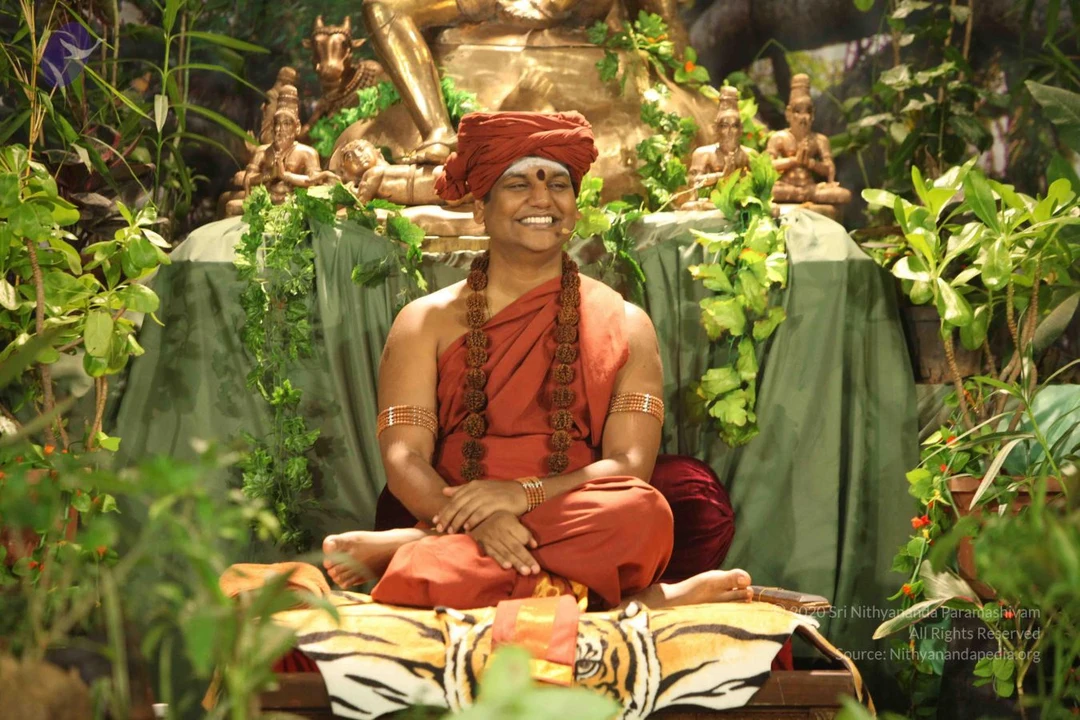
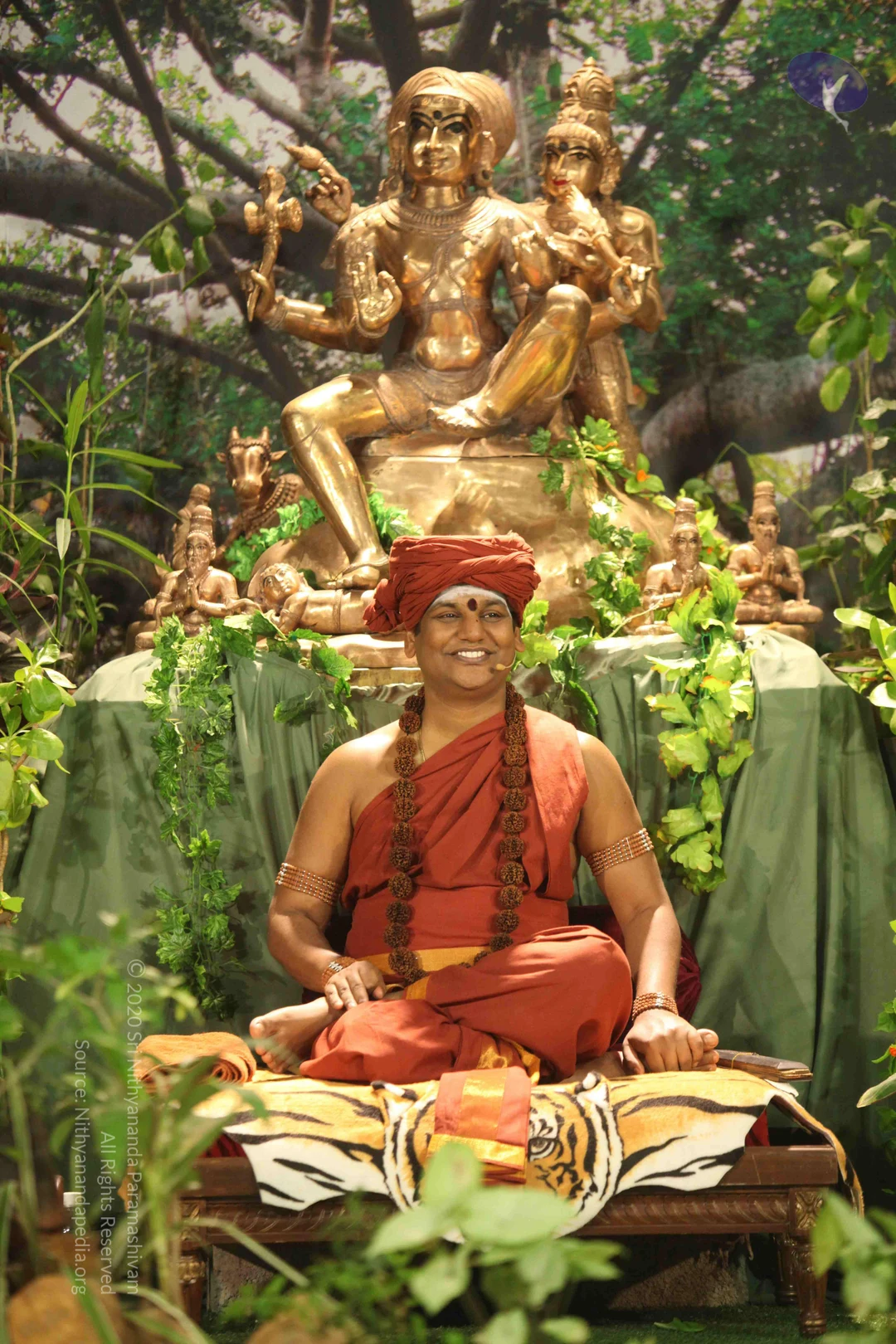
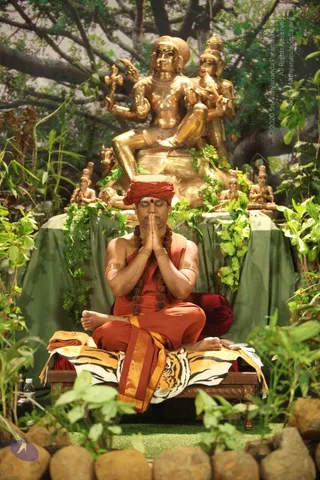
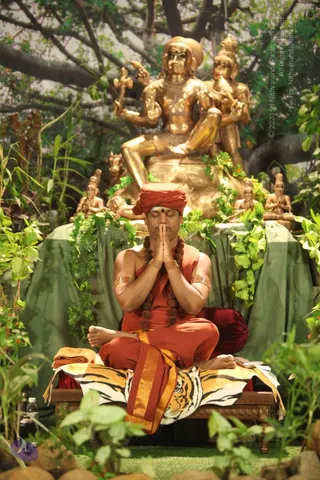
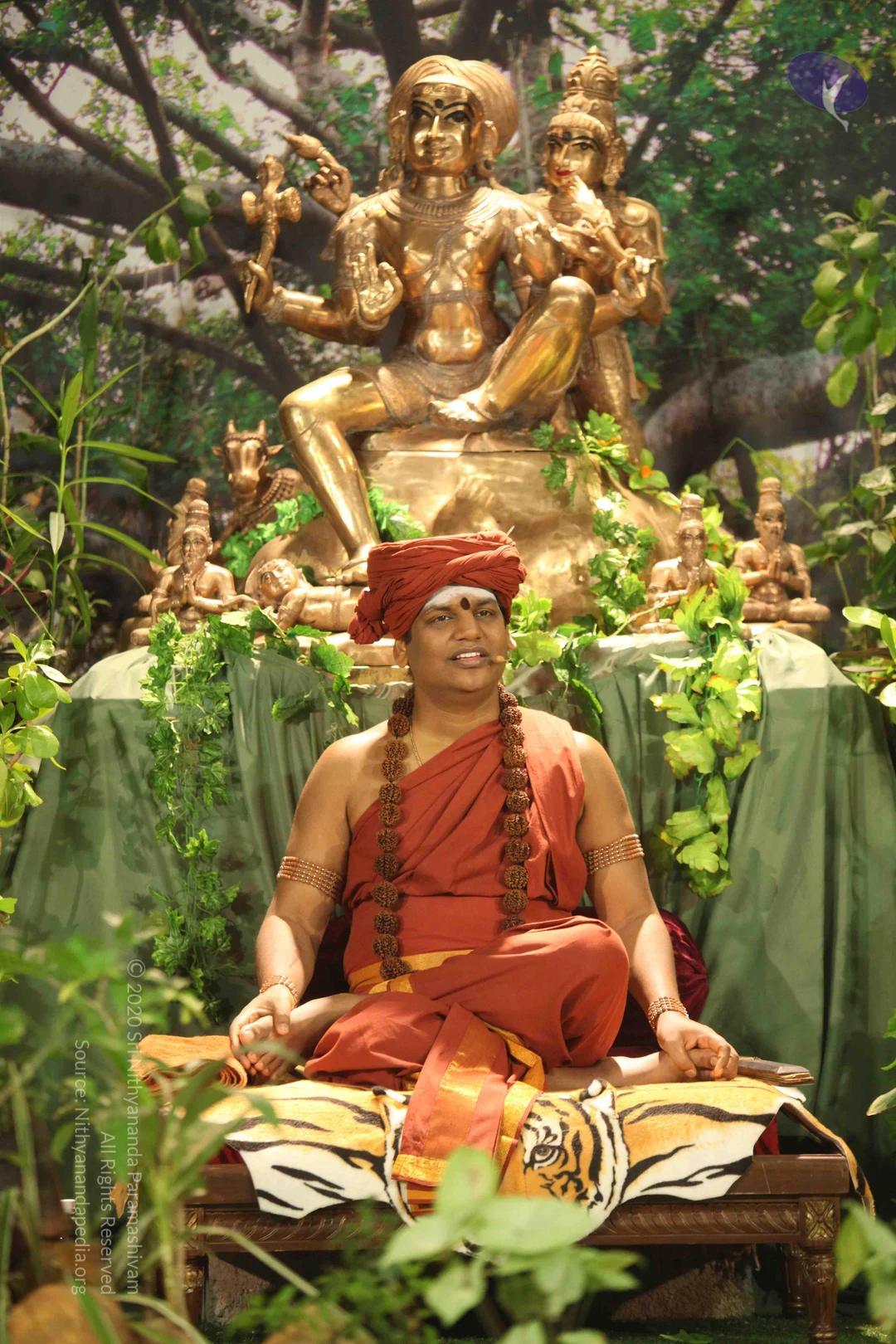
A seated man in red-orange sannyasi robes and a red turban sits cross-legged with palms pressed together in anjali mudra and eyes closed, on a wooden peetha draped with a tiger-striped cloth. He wears a rudraksha mala, gold armlets and bangles, and a tilak on his forehead. Behind him a large golden deity murti shows a multi-armed seated figure with a companion beside it, set among green foliage, banyan branches and smaller golden devotee figures in prayer. The setting resembles a staged garden shrine.A man seated in lotus-style posture on a tiger-skin-covered wooden seat, eyes closed, palms pressed together at chest in anjali mudra. He wears a red-orange turban, red-orange robes with a gold-bordered dhoti, a red-orange shawl, rudraksha mala necklaces, gold bangles and gold armlets, with a red bindi on his forehead. Behind him stands a large gold-coloured deity murti of a multi-armed figure with a trident-like staff, flanked by smaller golden figures in prayer poses, all set among green foliage, banana-leaf-like plants and a painted tree backdrop. A red velvet cushion and green draped cloth frame the seat, with a bottle and a folded orange cloth at his side.A man seated cross-legged in padmasana on a red cushion, palms pressed together in anjali mudra, eyes closed. He wears an orange-red turban, an orange-red dhoti-style garment with a gold border, a rudraksha mala of large beads across his chest, gold armlets, and a red bindu with white vibhuti on his forehead. Behind him stands a golden seated figure and several small golden devotional murtis with hands joined, set among green leaves and vines with a dark green draped backdrop. Orange cloth and a folded item sit at his feet. One person is physically present; the appearance is consistent with a person candidate in saffron clothing with rudraksha malas, seated in a devotional setting.A man seated cross-legged on a tiger-striped cloth in a garden-like setting of green leafy vines and potted plants, with his eyes closed and palms pressed together in anjali mudra. He wears a red-orange turban, an orange-red robe with a gold-bordered dhoti, rudraksha malas, and gold armlets on both upper arms. Behind him are golden deity murtis and seated figures, including a golden statue, and a dark green draped backdrop. An orange cloth folded on the platform sits beside him. The scene suggests a satsang or meditation session.A seated man in saffron-orange robes and an orange turban sits cross-legged on a tiger-striped cloth with a deep red cushion behind him. He wears a long rudraksha mala with bead rows, arm bands and a red tilak on his forehead, smiling with hands folded in his lap. Behind him stand golden statues of seated figures and a golden deity murti, framed by green foliage and draped green cloth. The pale green leaves and orange flowers fill the edges. a person appears in person, seated as the central figure.A man sits cross-legged on a tiger-striped cloth in front of a lush green backdrop of hanging foliage and leafy plants. He wears a rust-orange turban, an orange-red robe draped over his shoulders with a gold-bordered cloth, a long necklace of rudraksha beads, and gold bangles on his wrists and upper arms, with a red bindi on his forehead. His hands rest together in his lap and he smiles at the camera. Behind him are golden deity statues, one with raised hands in a praying posture, and a red velvet cushion sits to his side. A small orange towel lies beside him. The a person appearance is marked by the rudraksha mala, saffron robes, ornate gold bangles and turban, though the image is a seated portrait with no event context visible.