Skip to content
Wednesday

11 September 2013

Understand yourself through Enriching

Dated photos
271
Source pages
1
Media
2
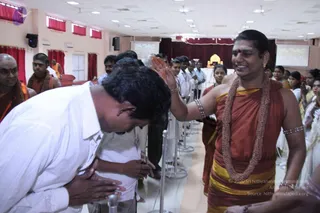
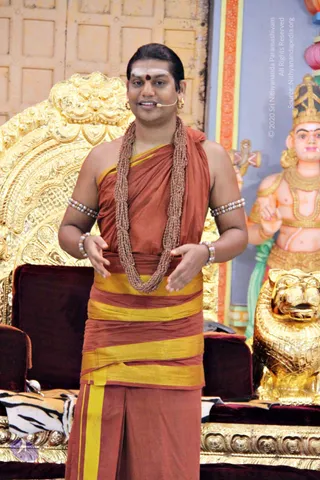
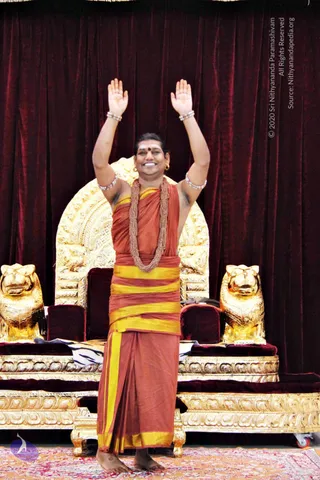
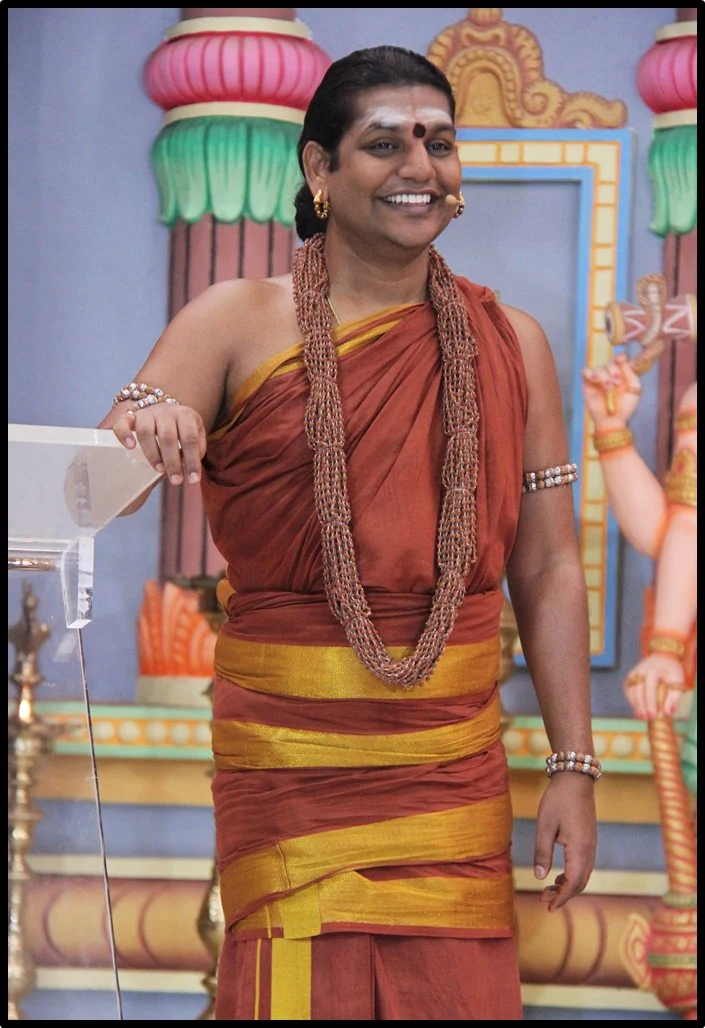
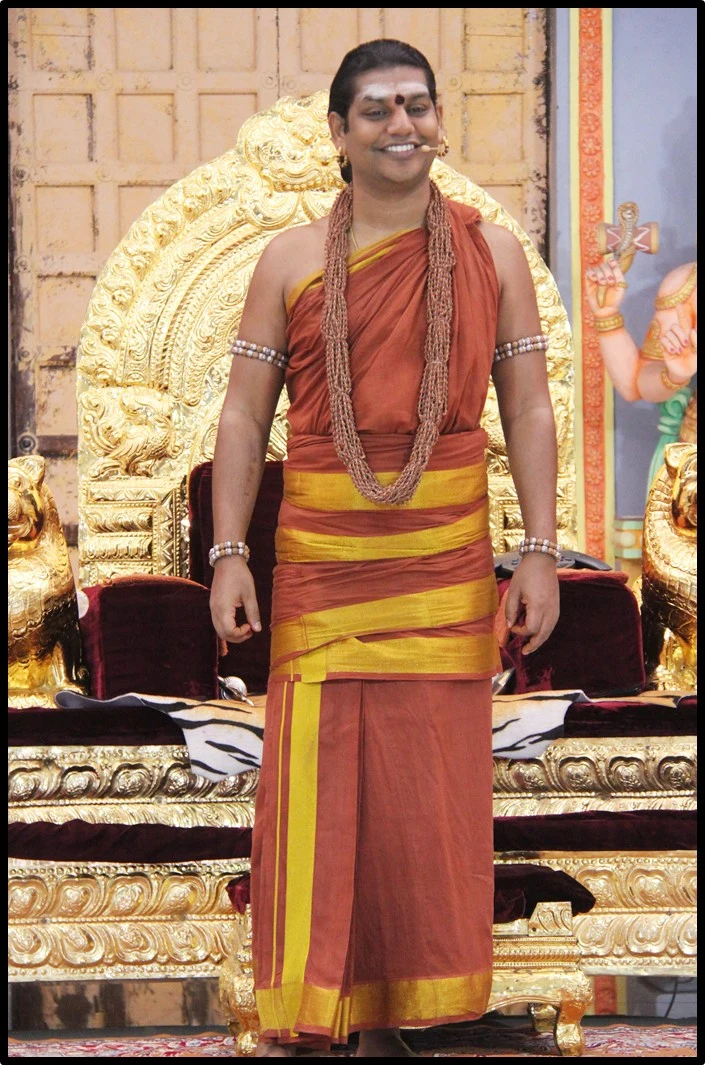
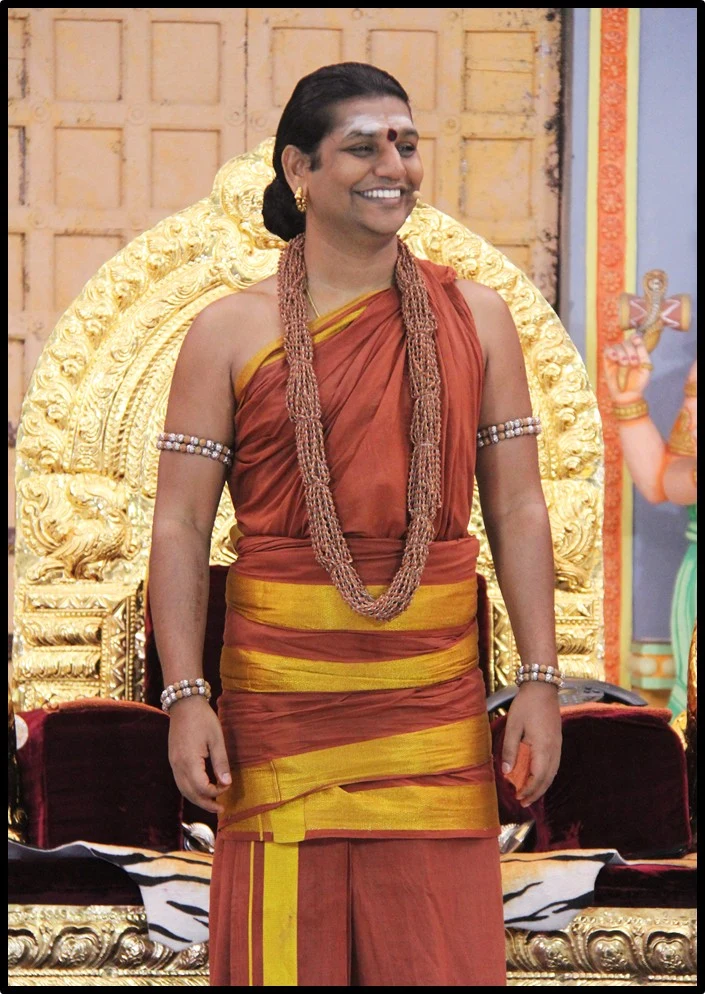
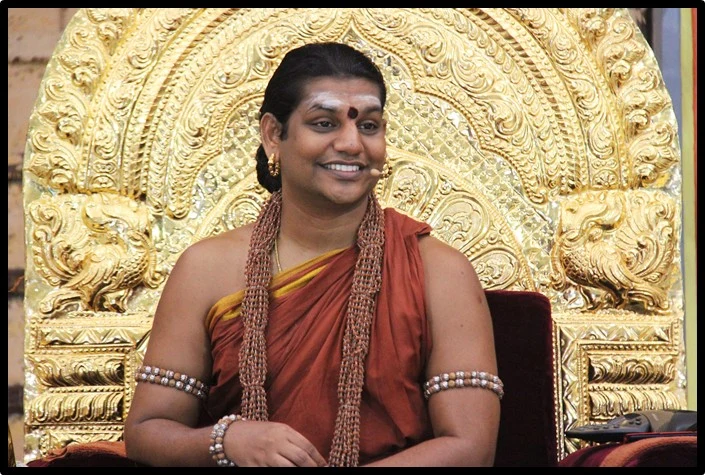
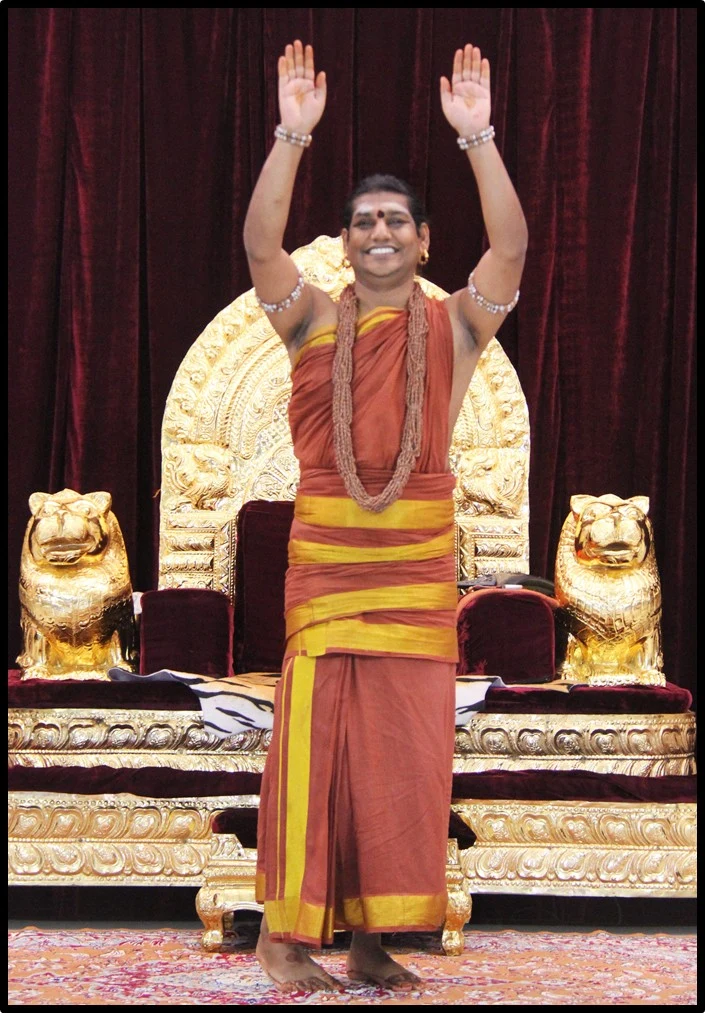
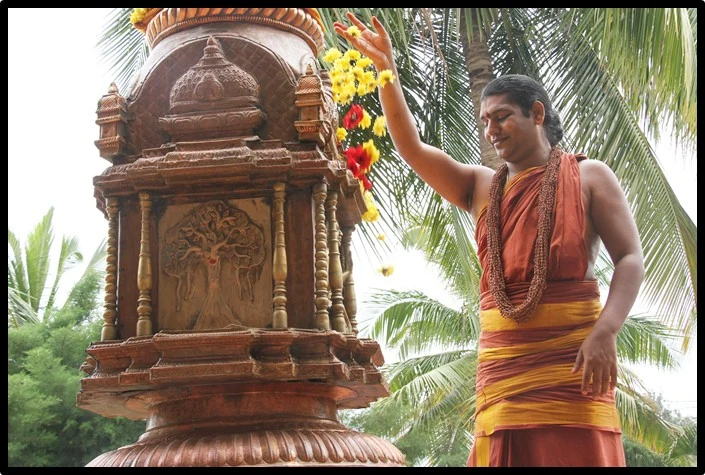
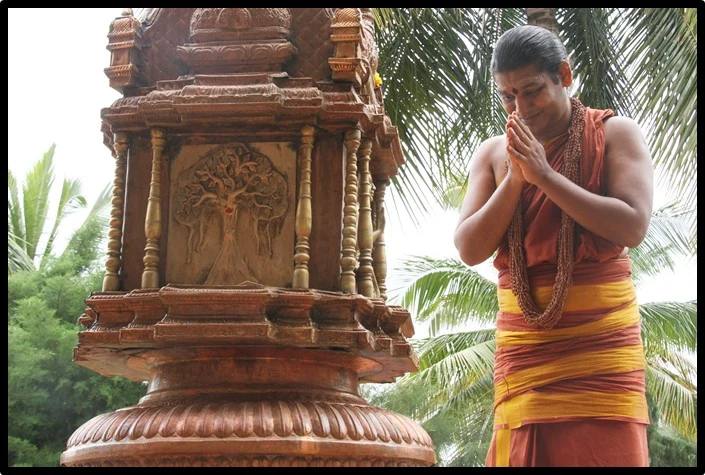
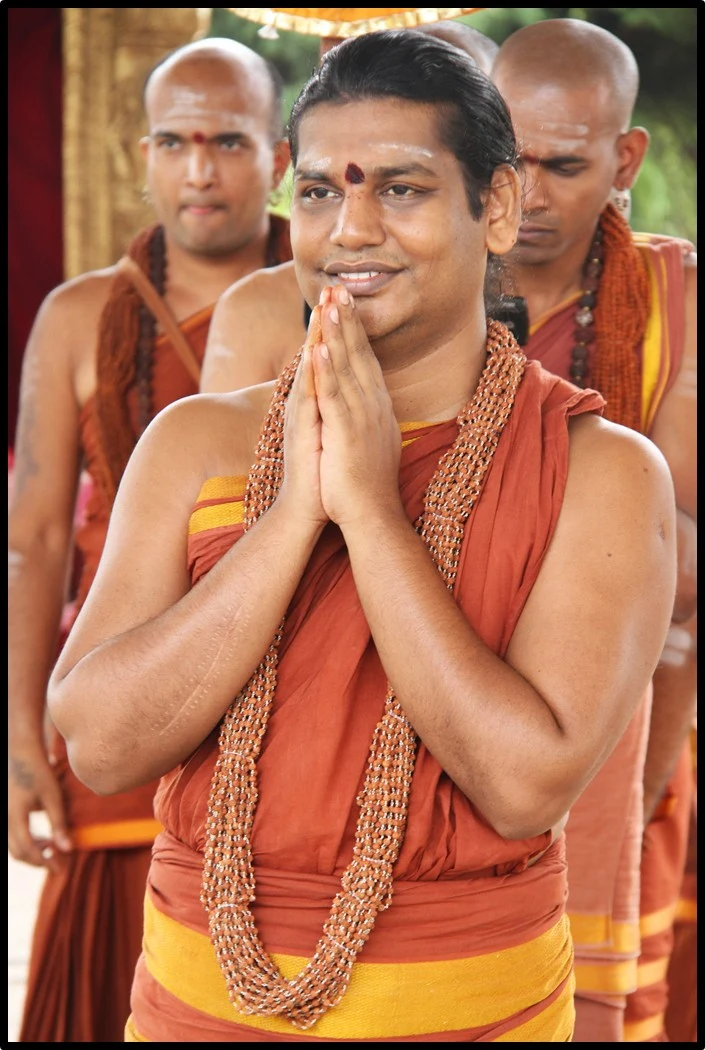
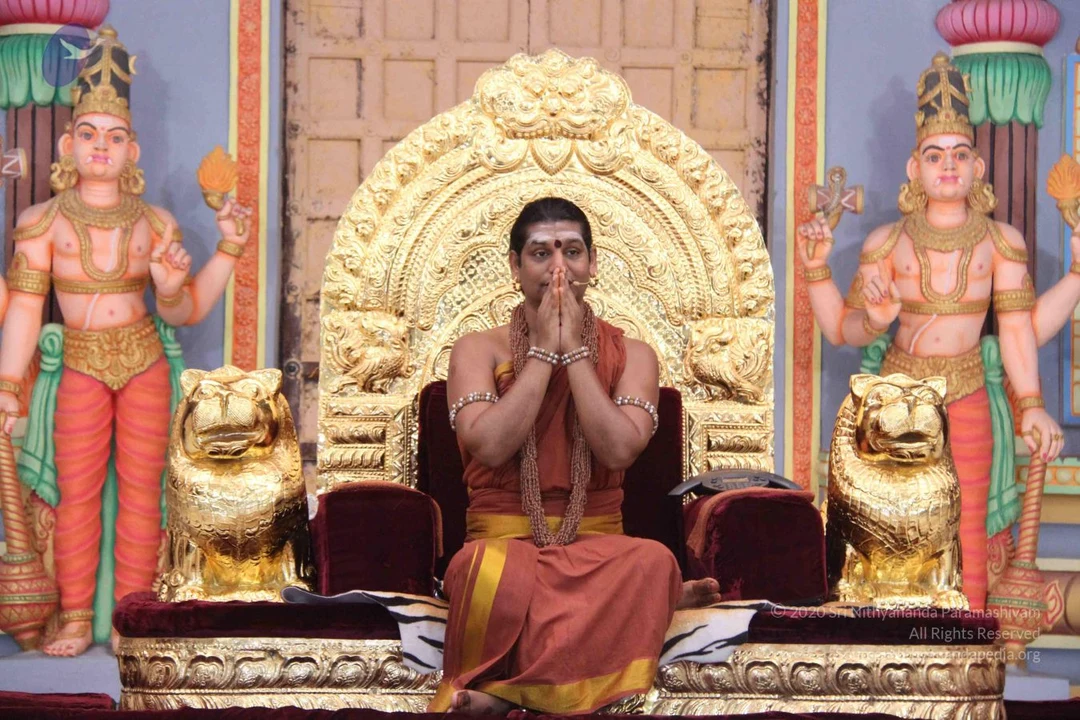
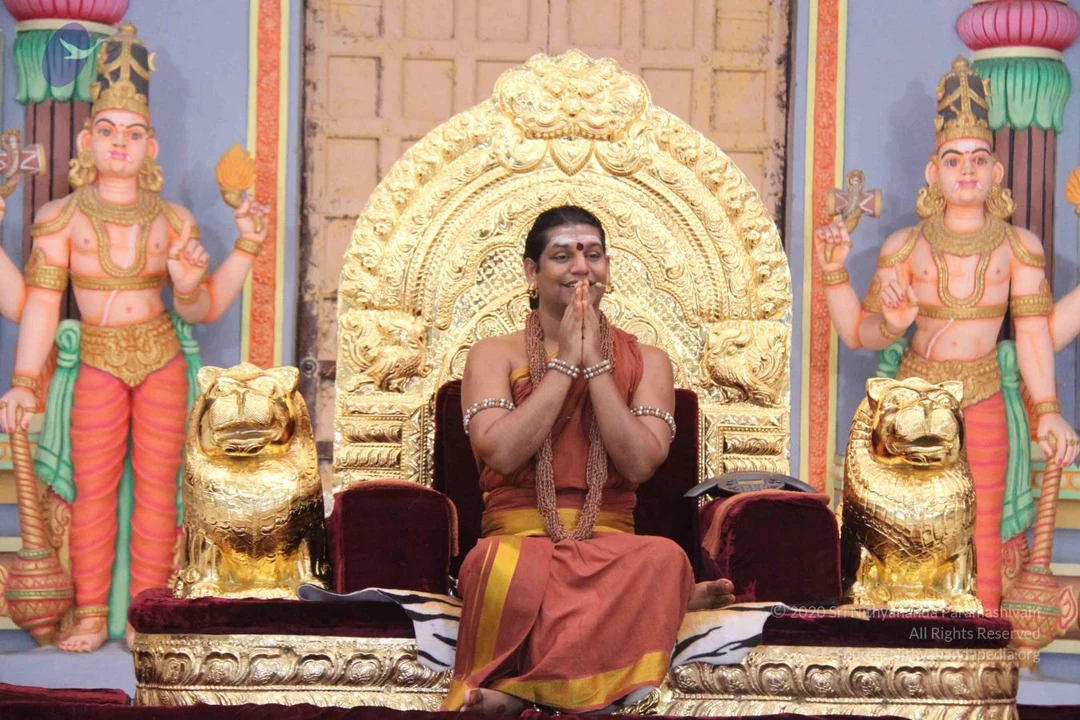
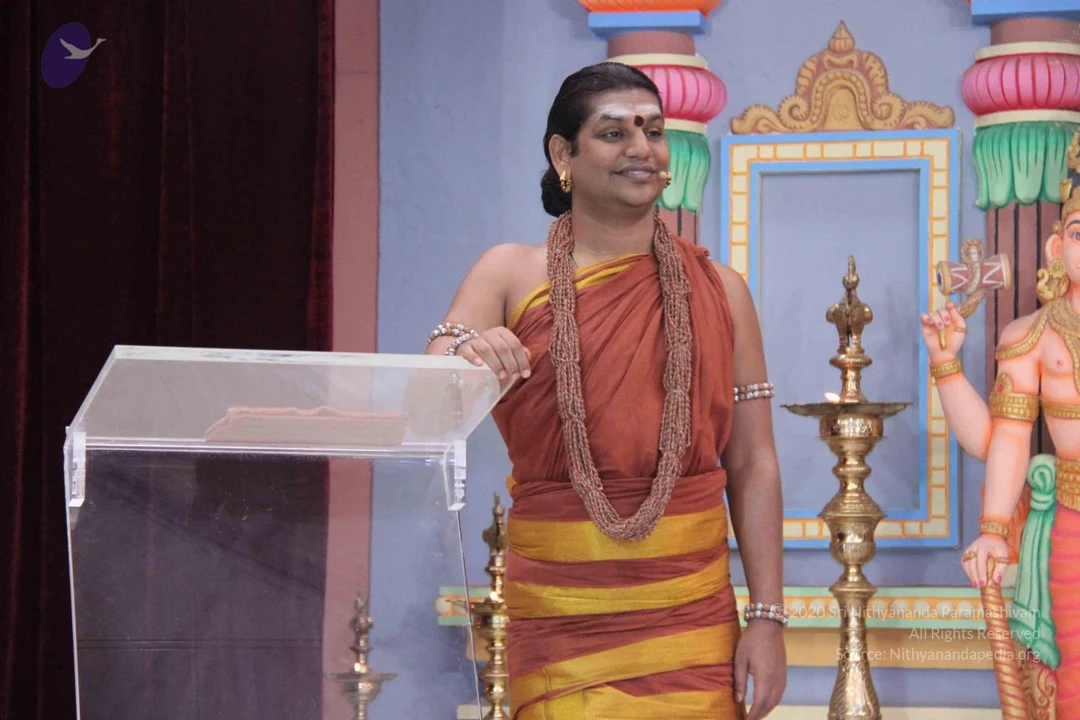
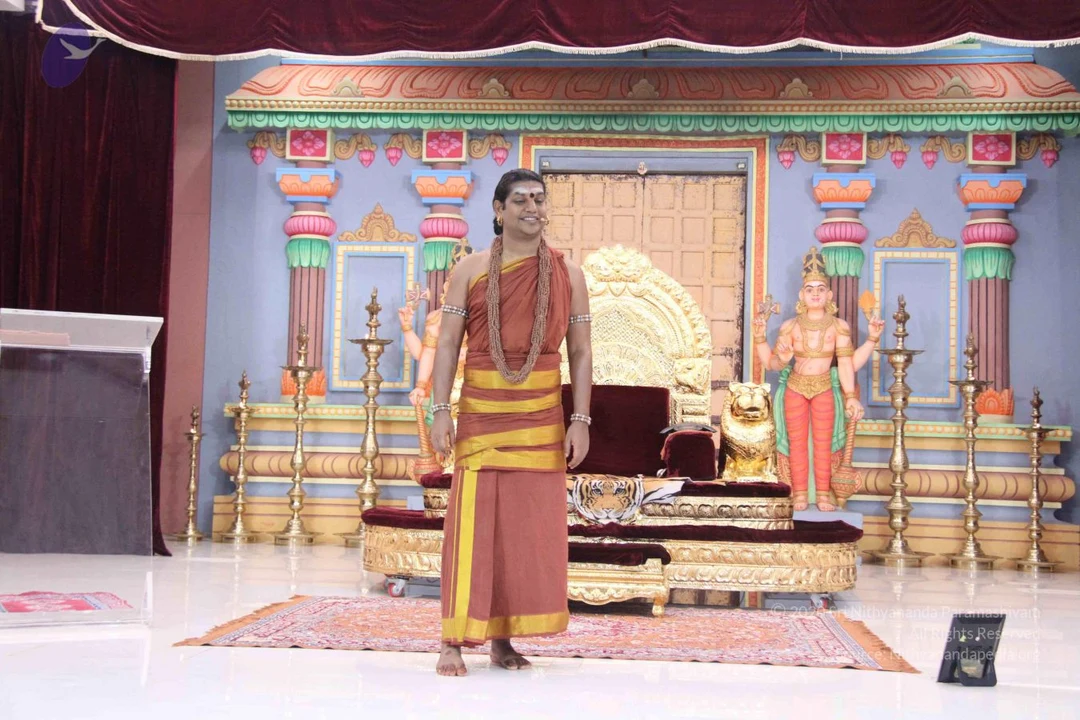
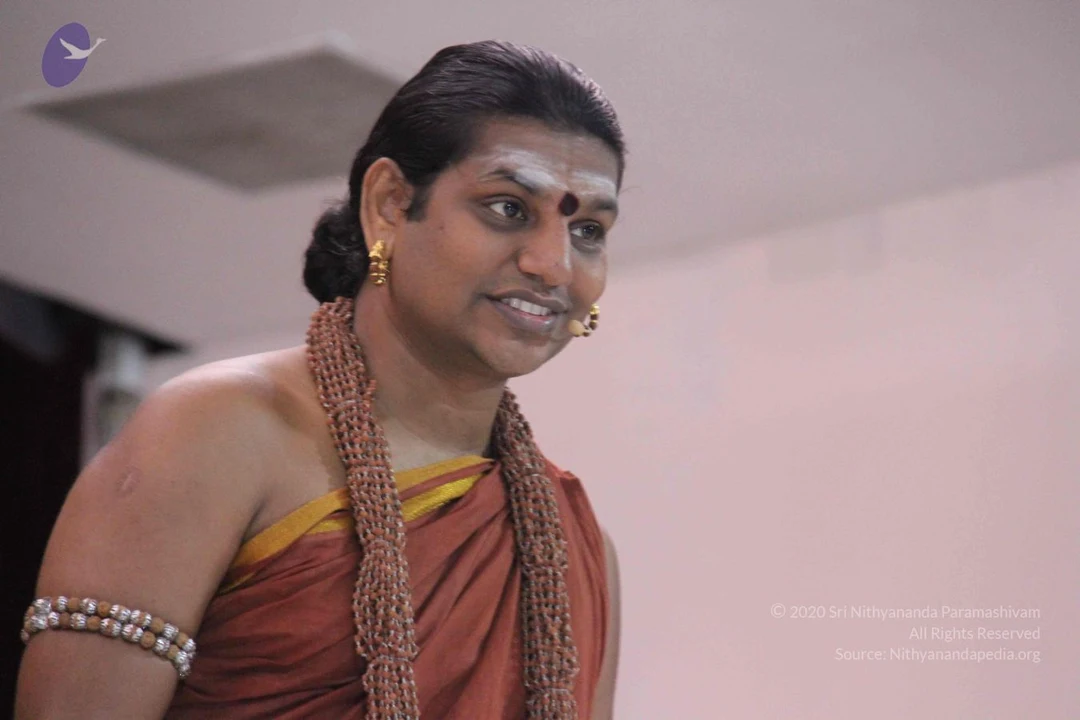
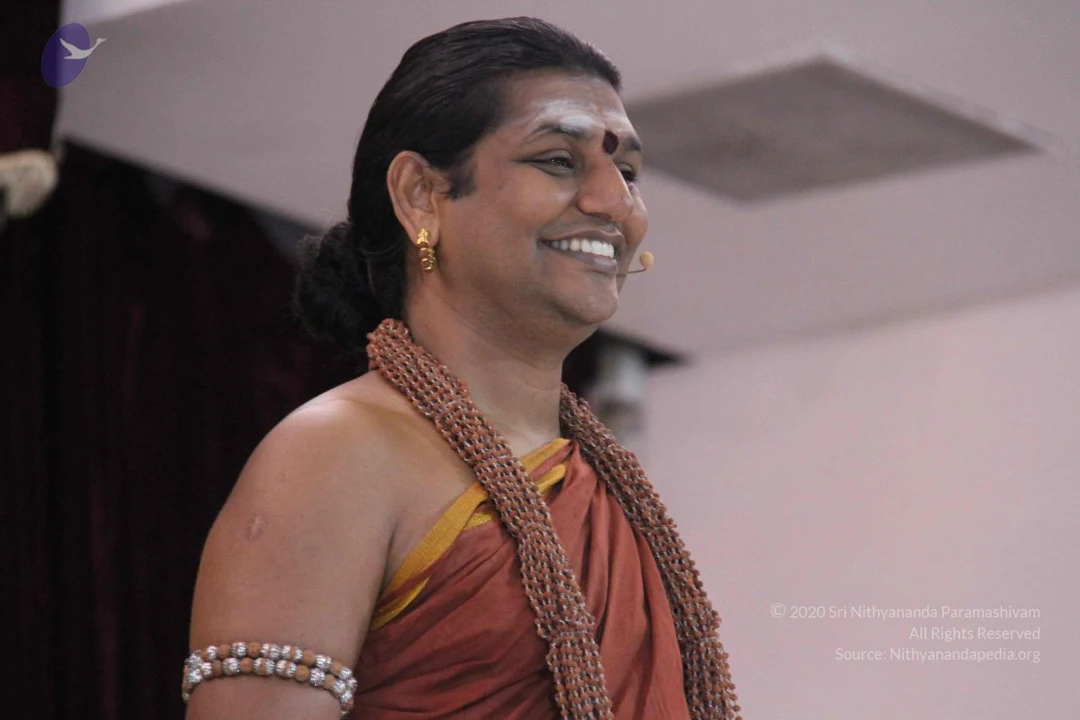
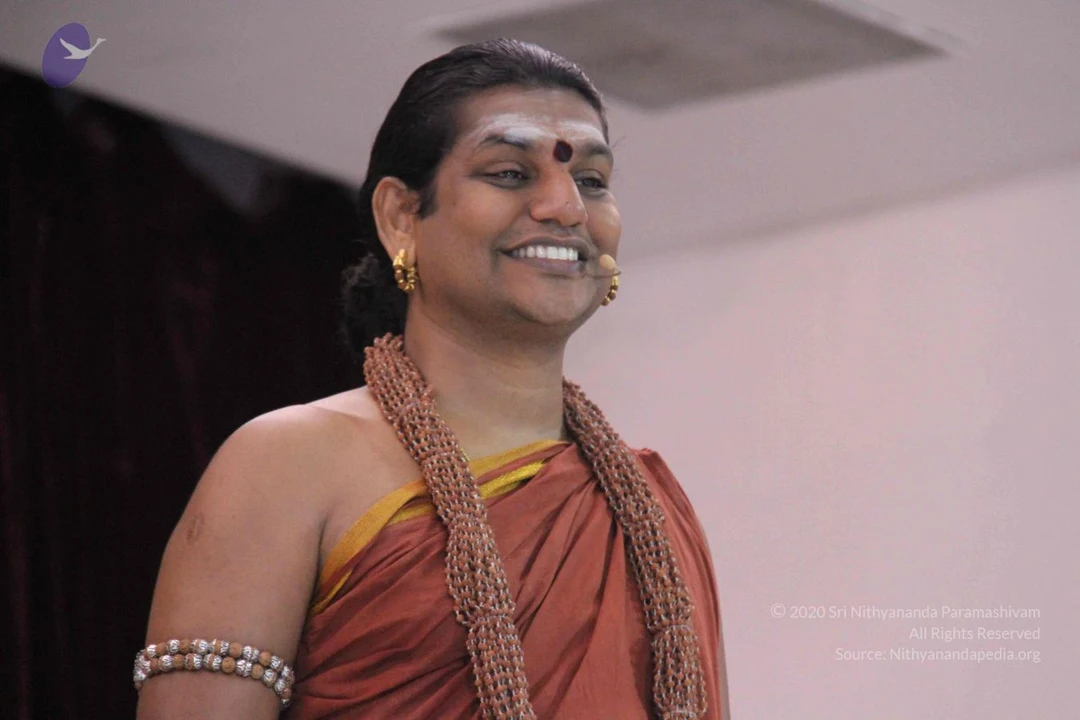
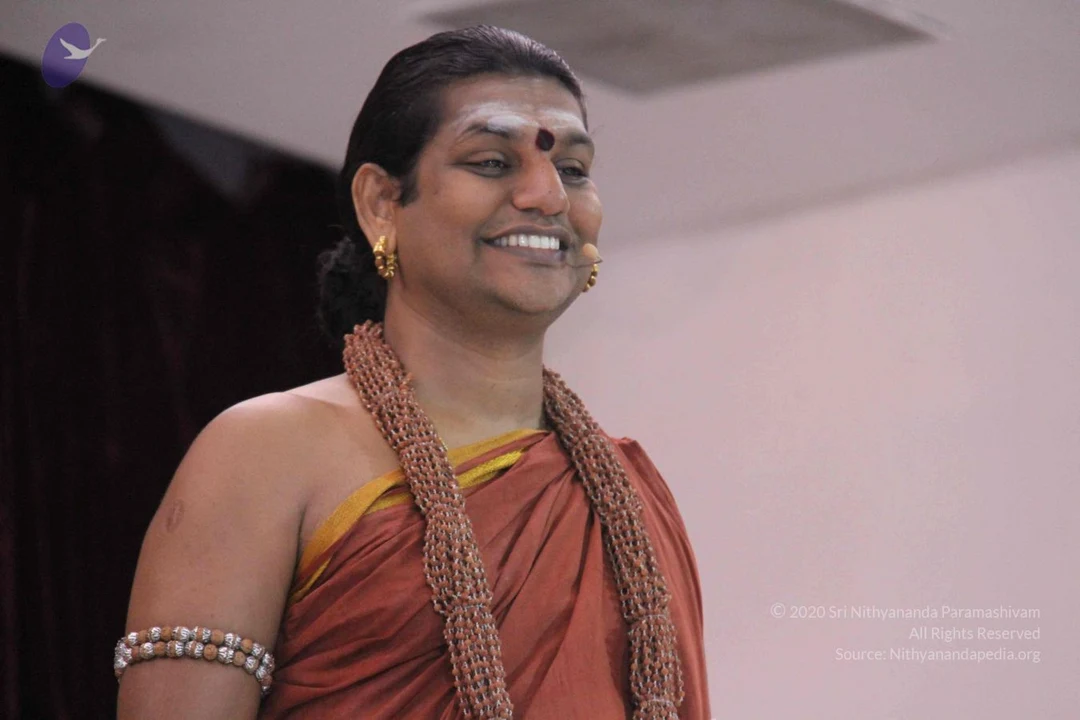
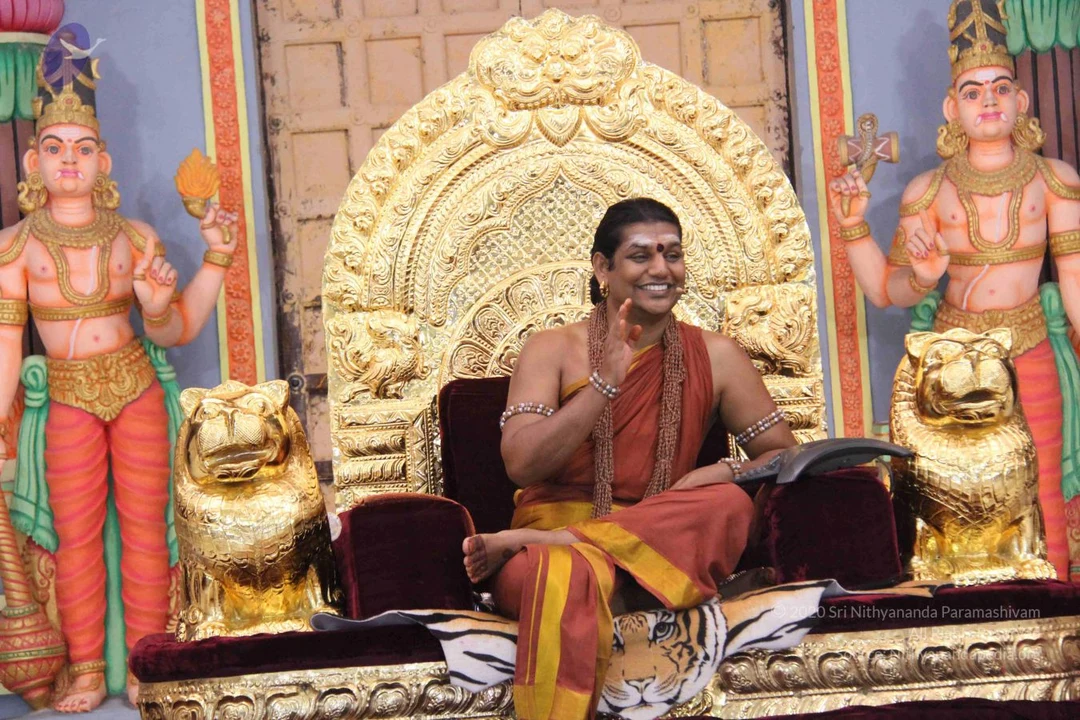
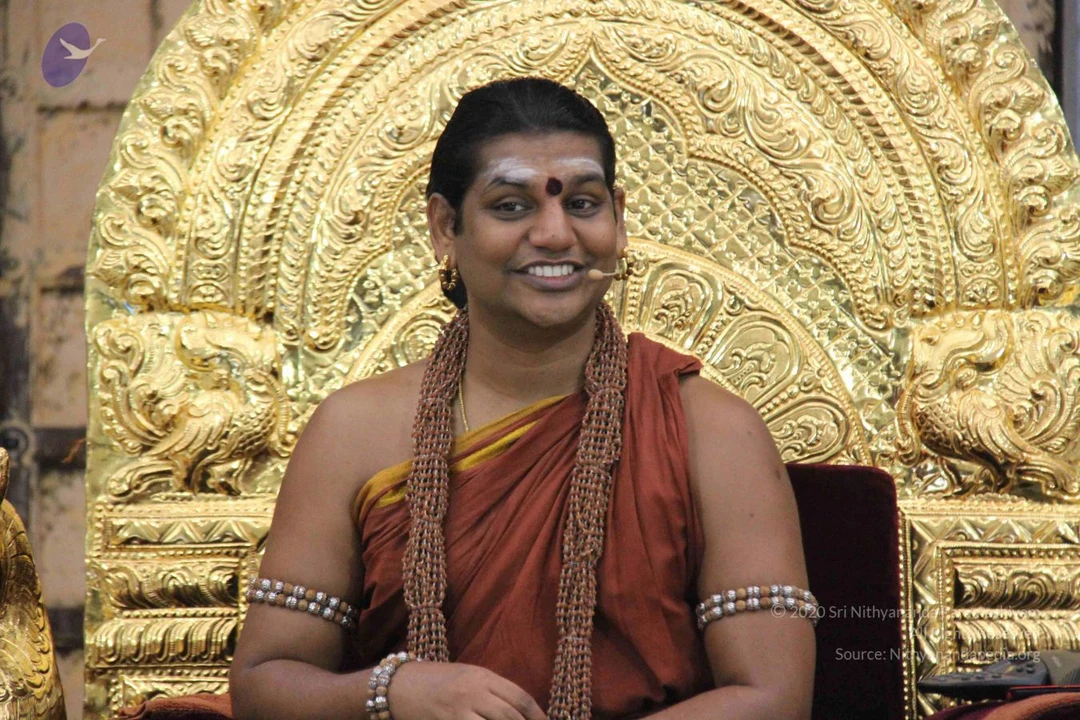
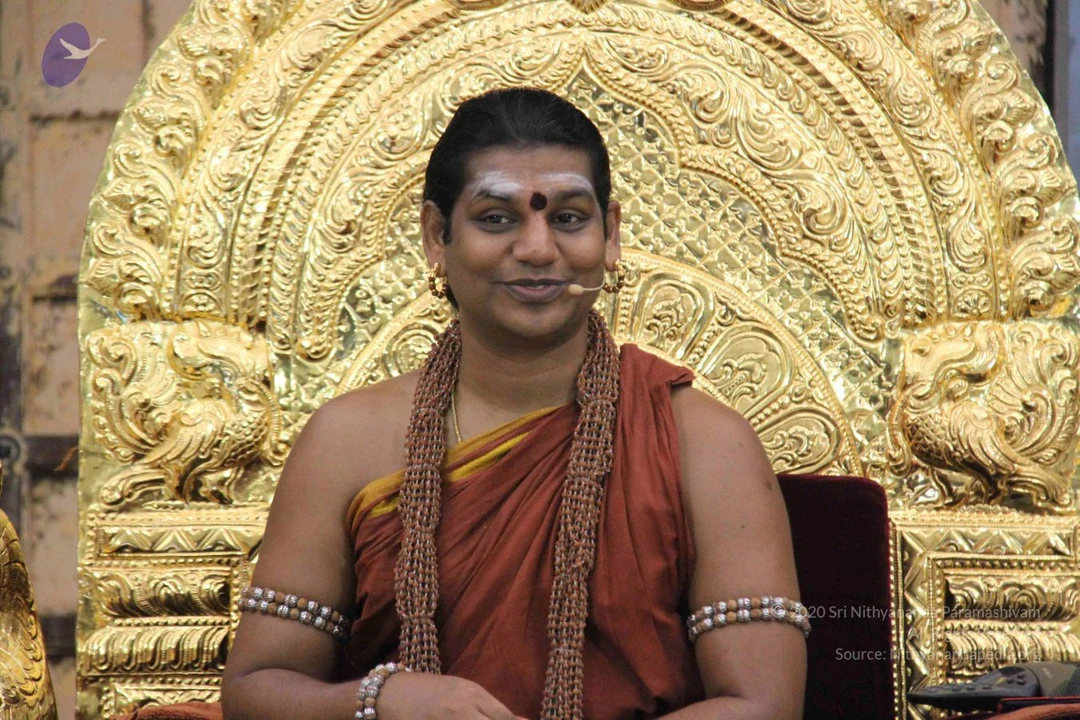
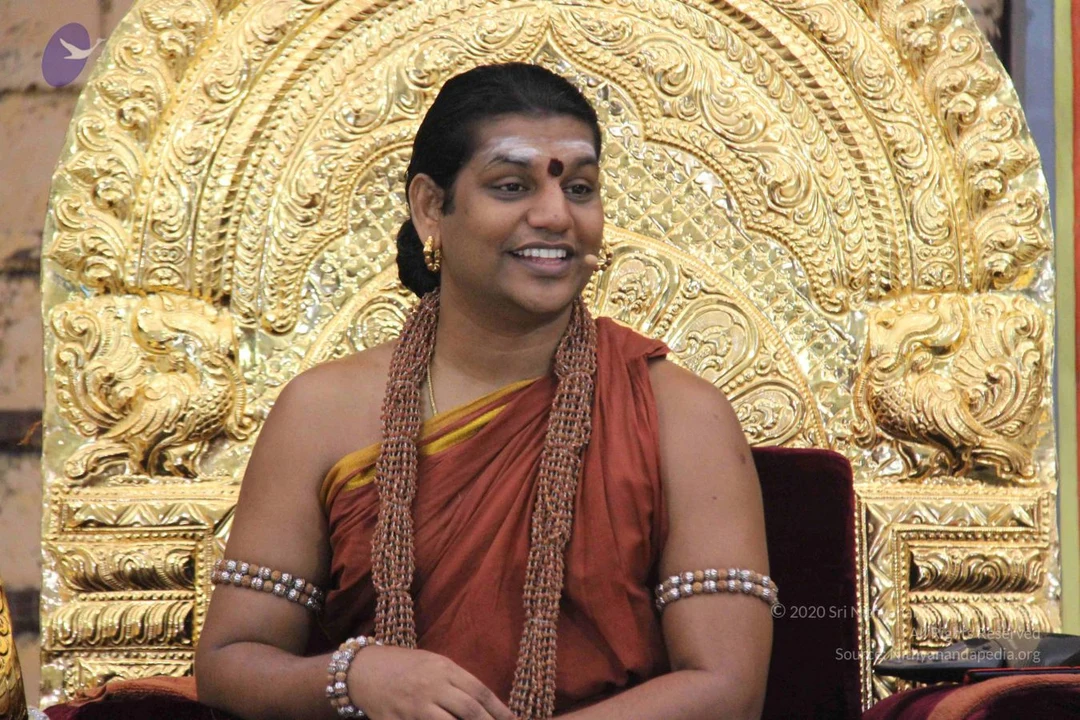
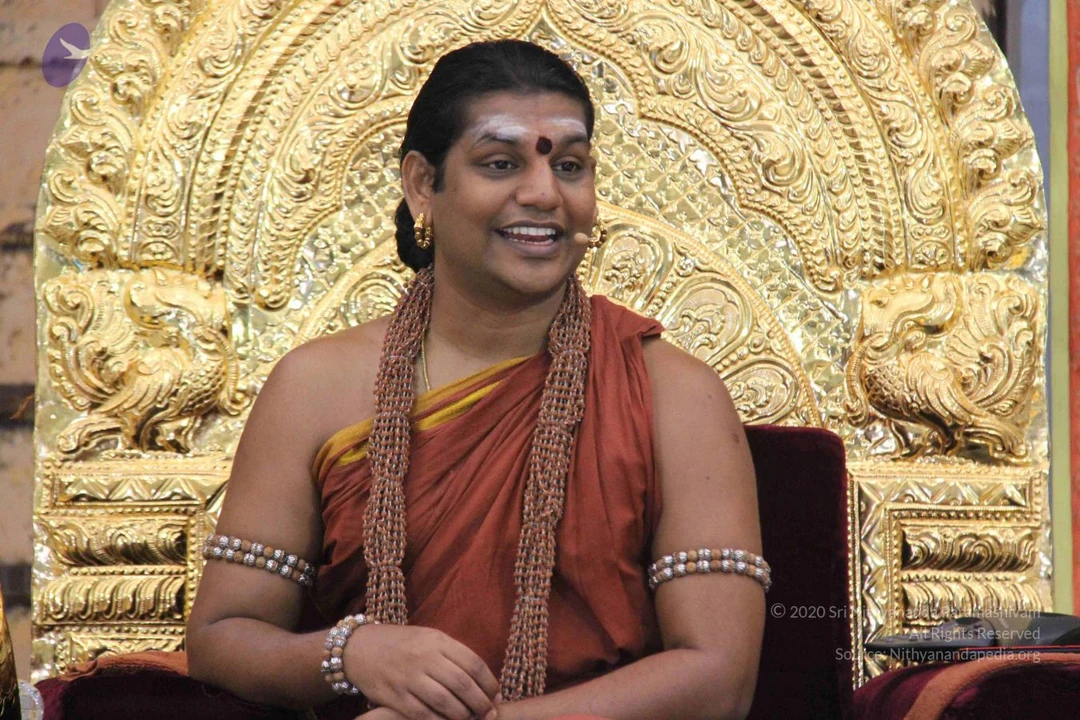
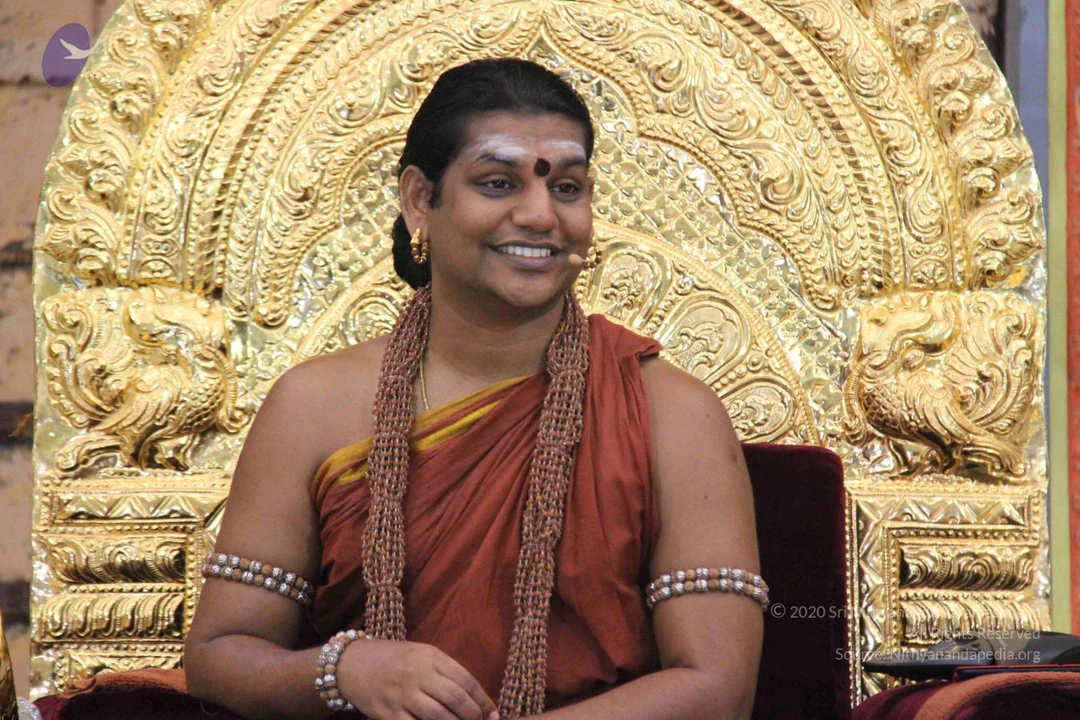
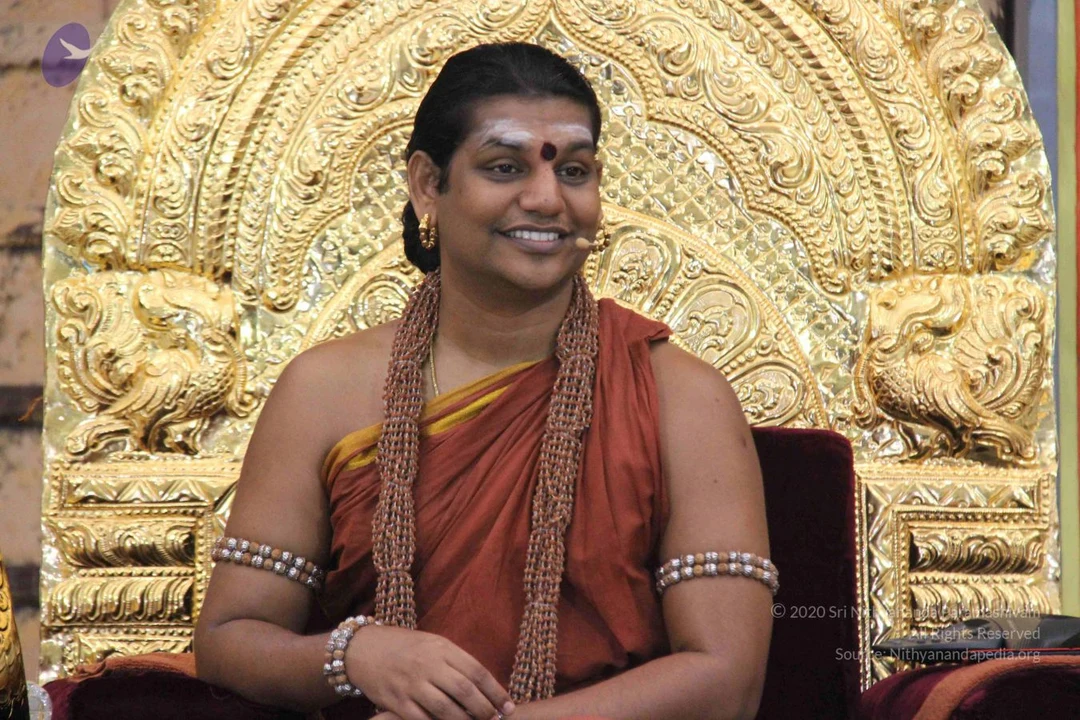
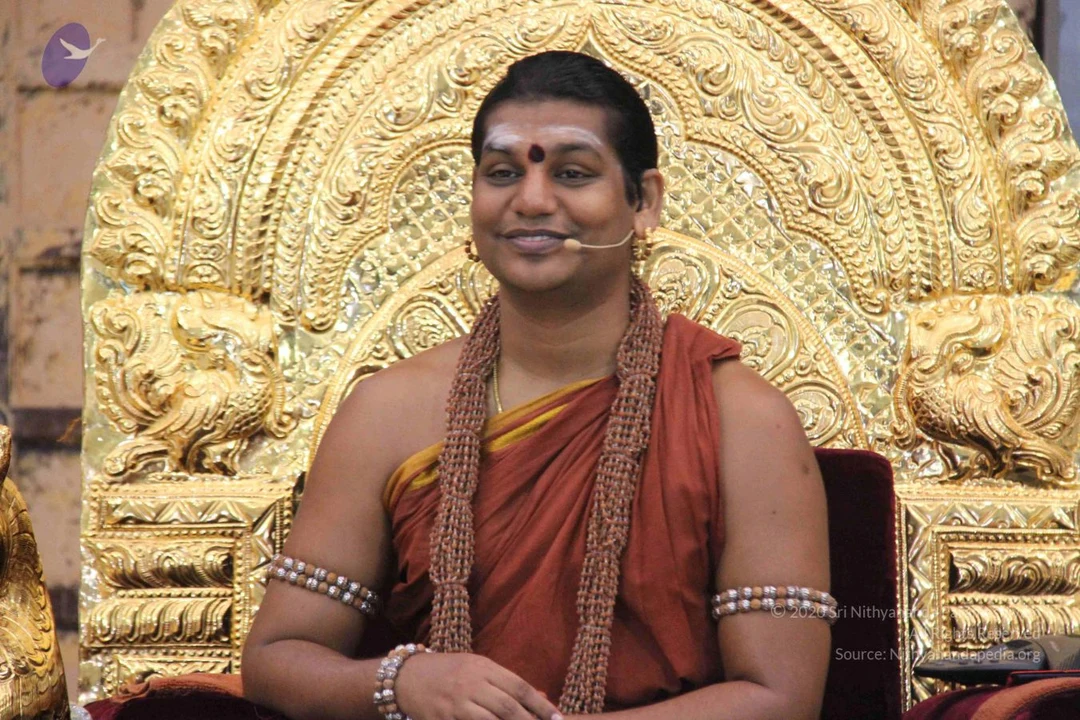
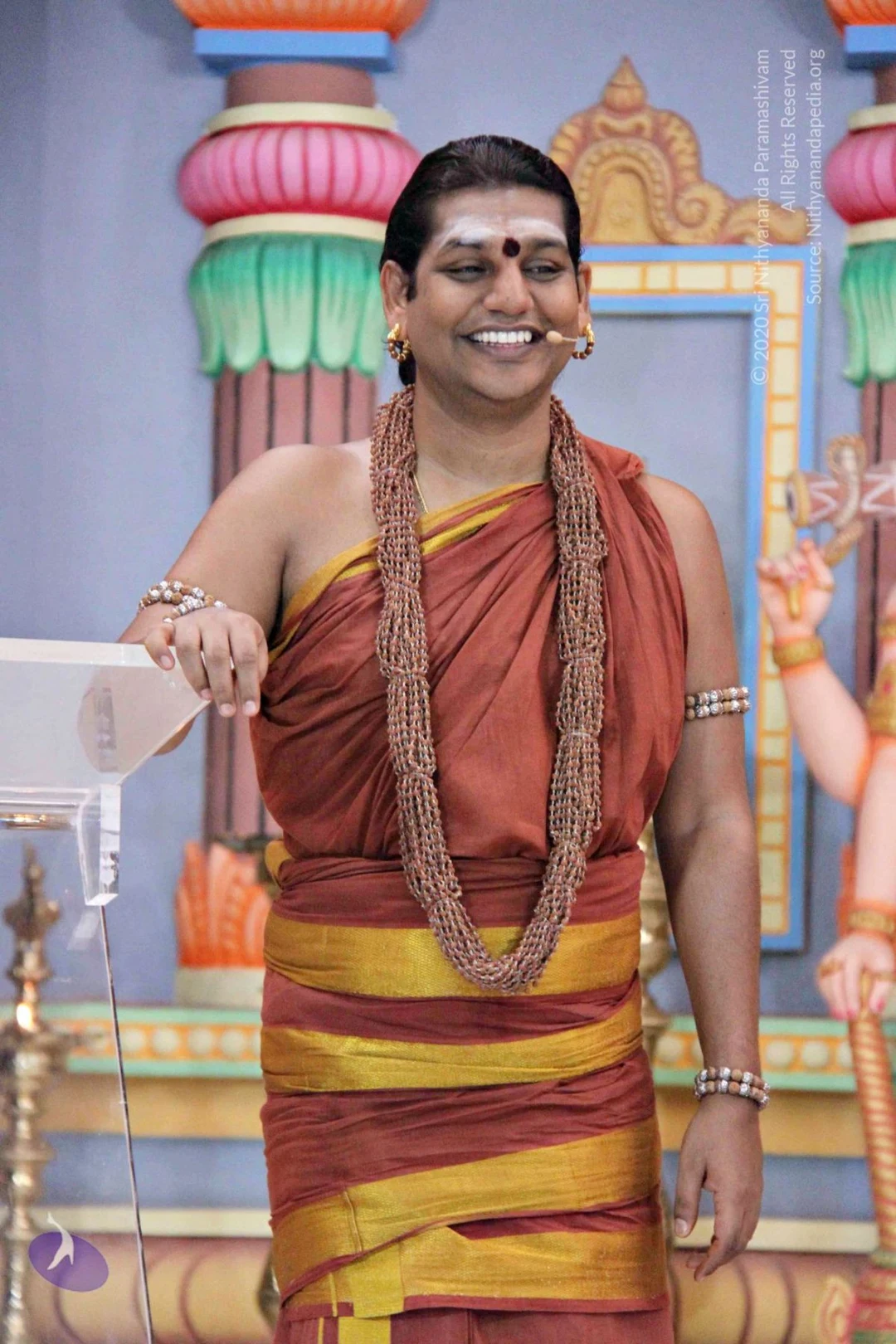
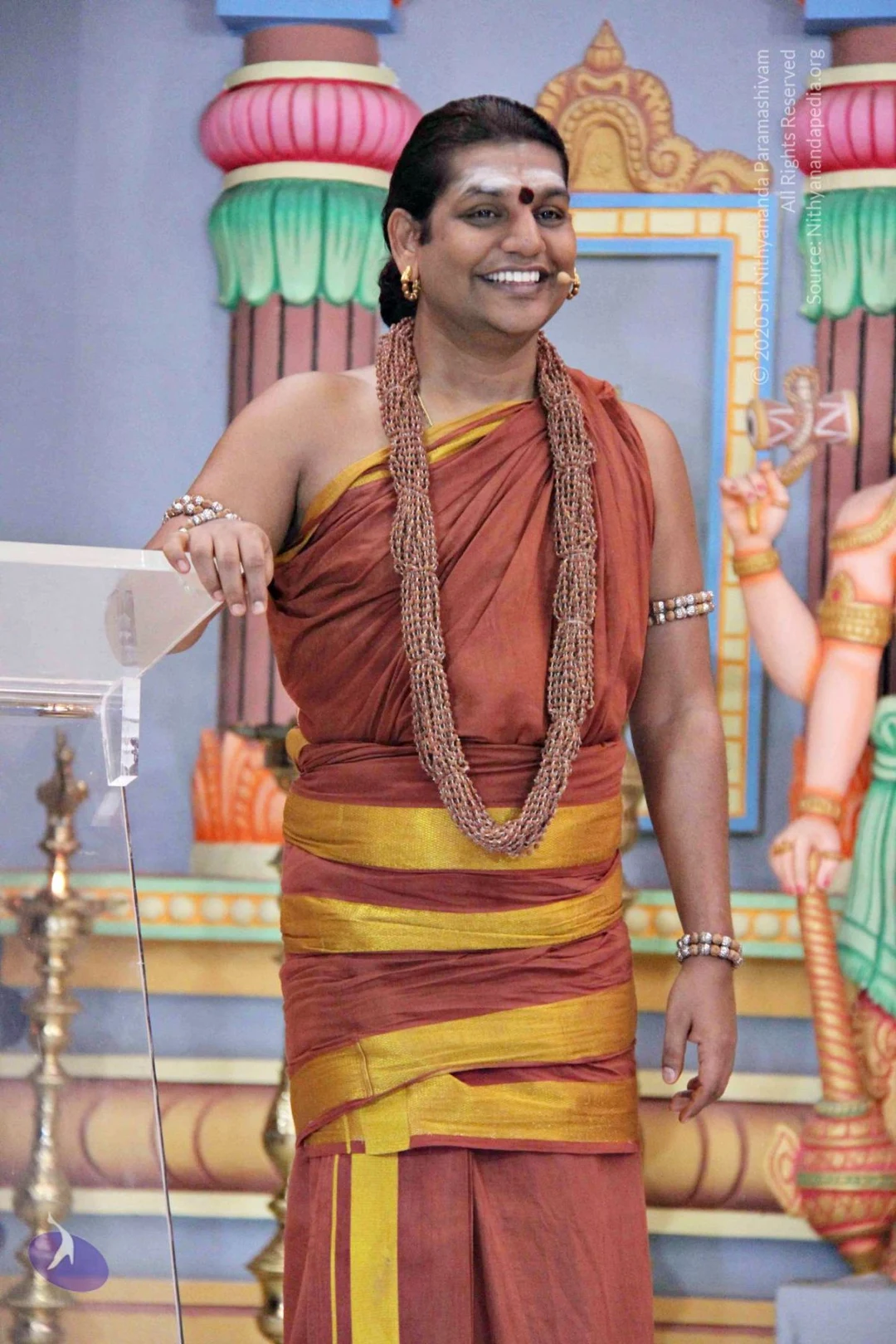
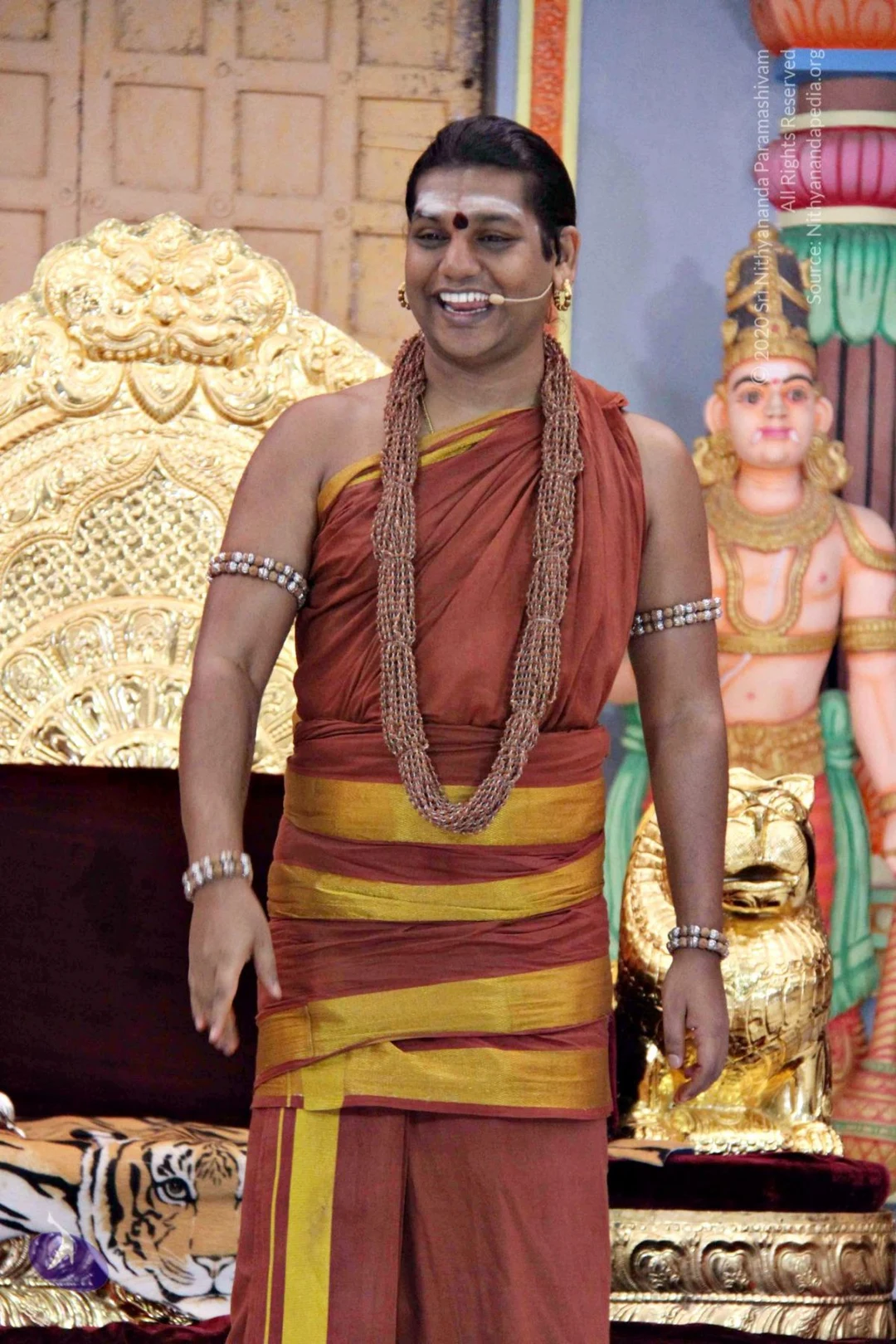
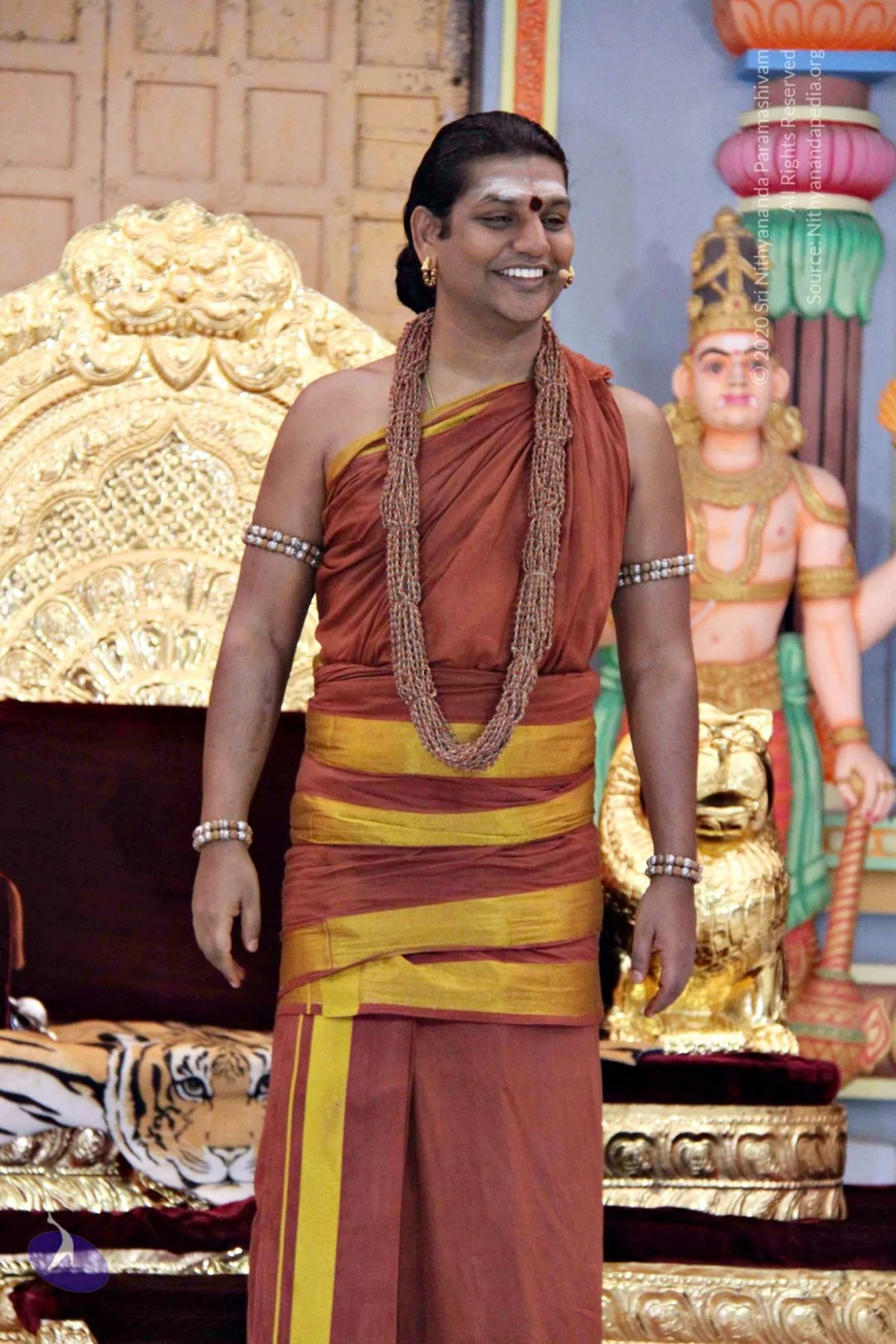
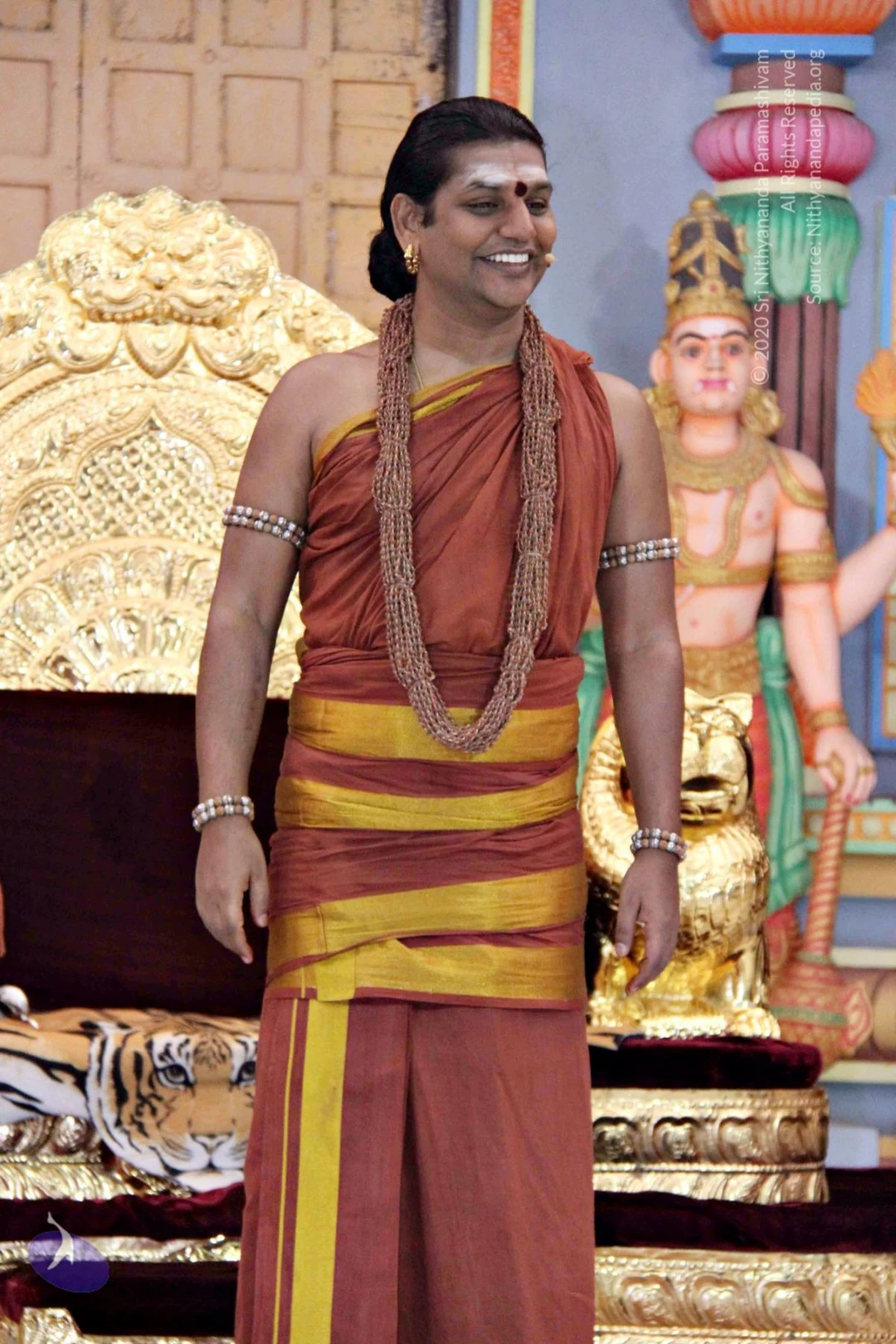
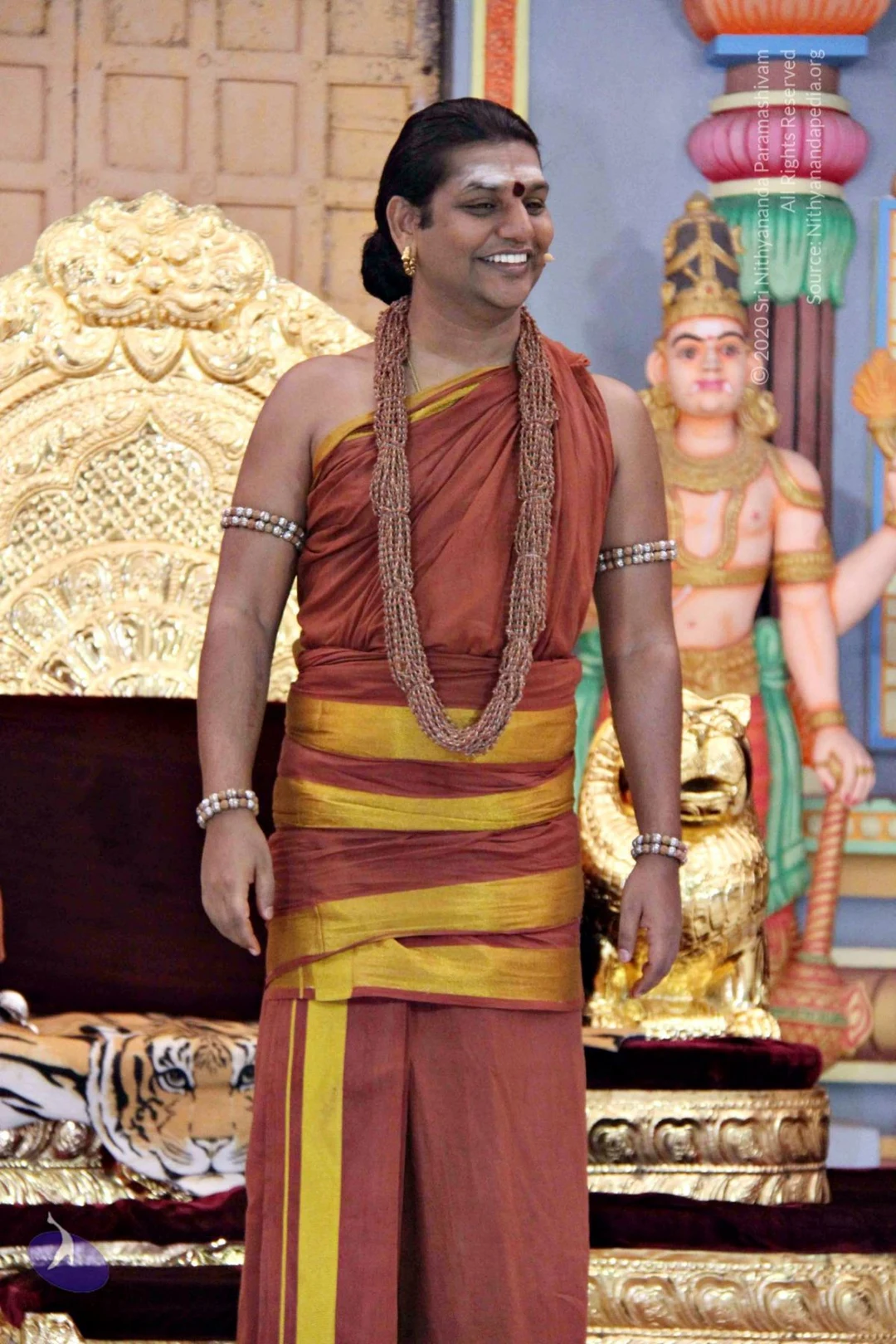
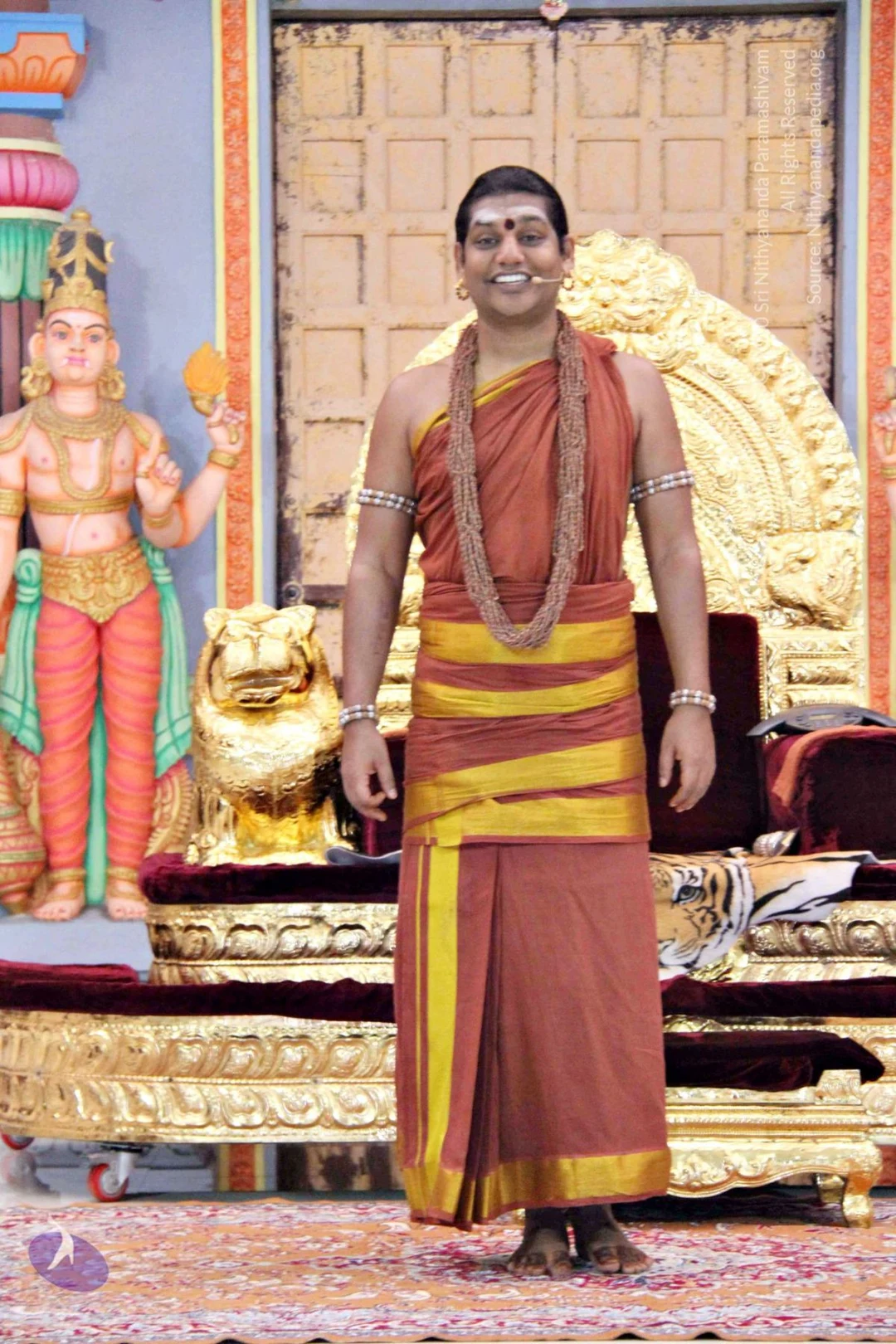
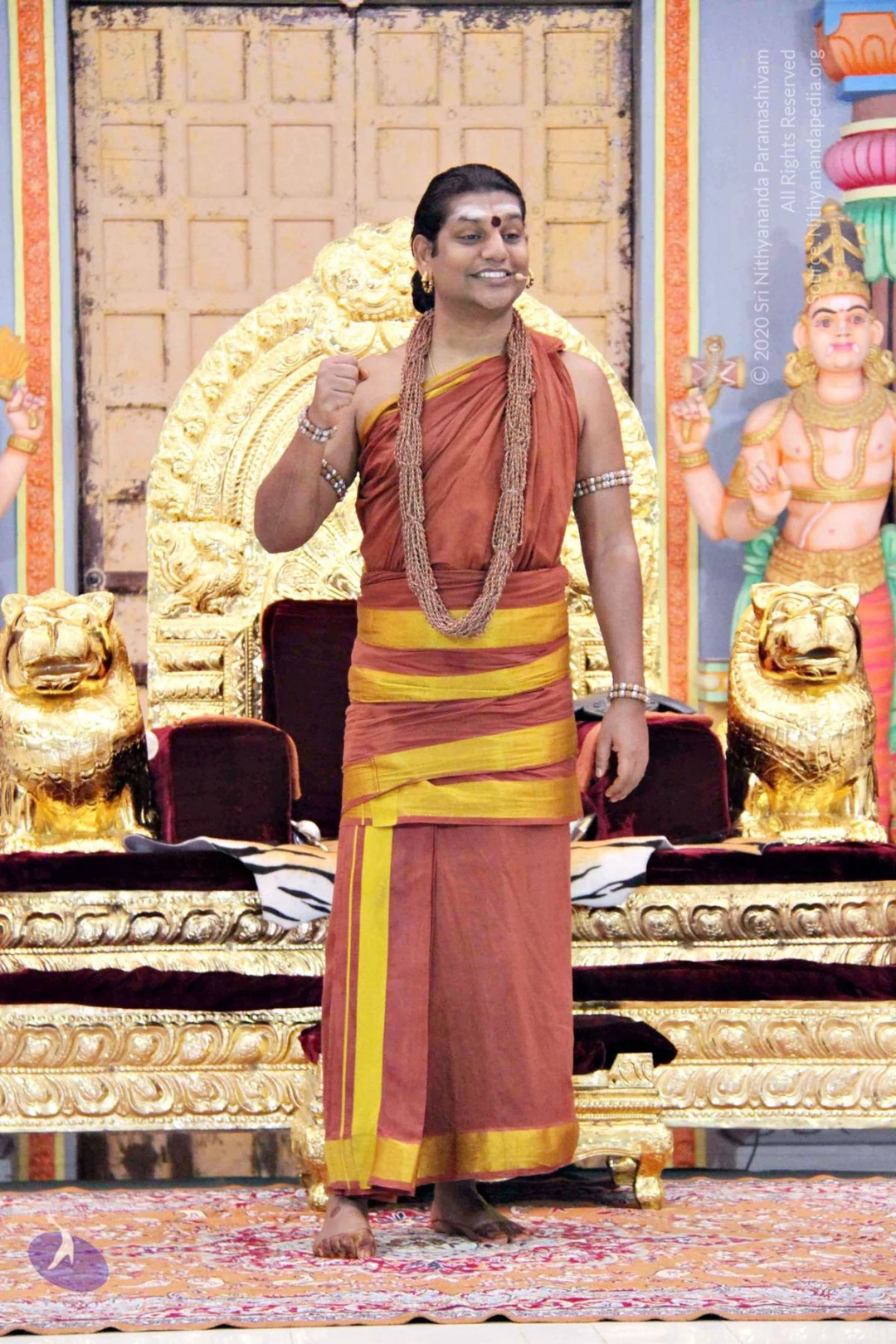
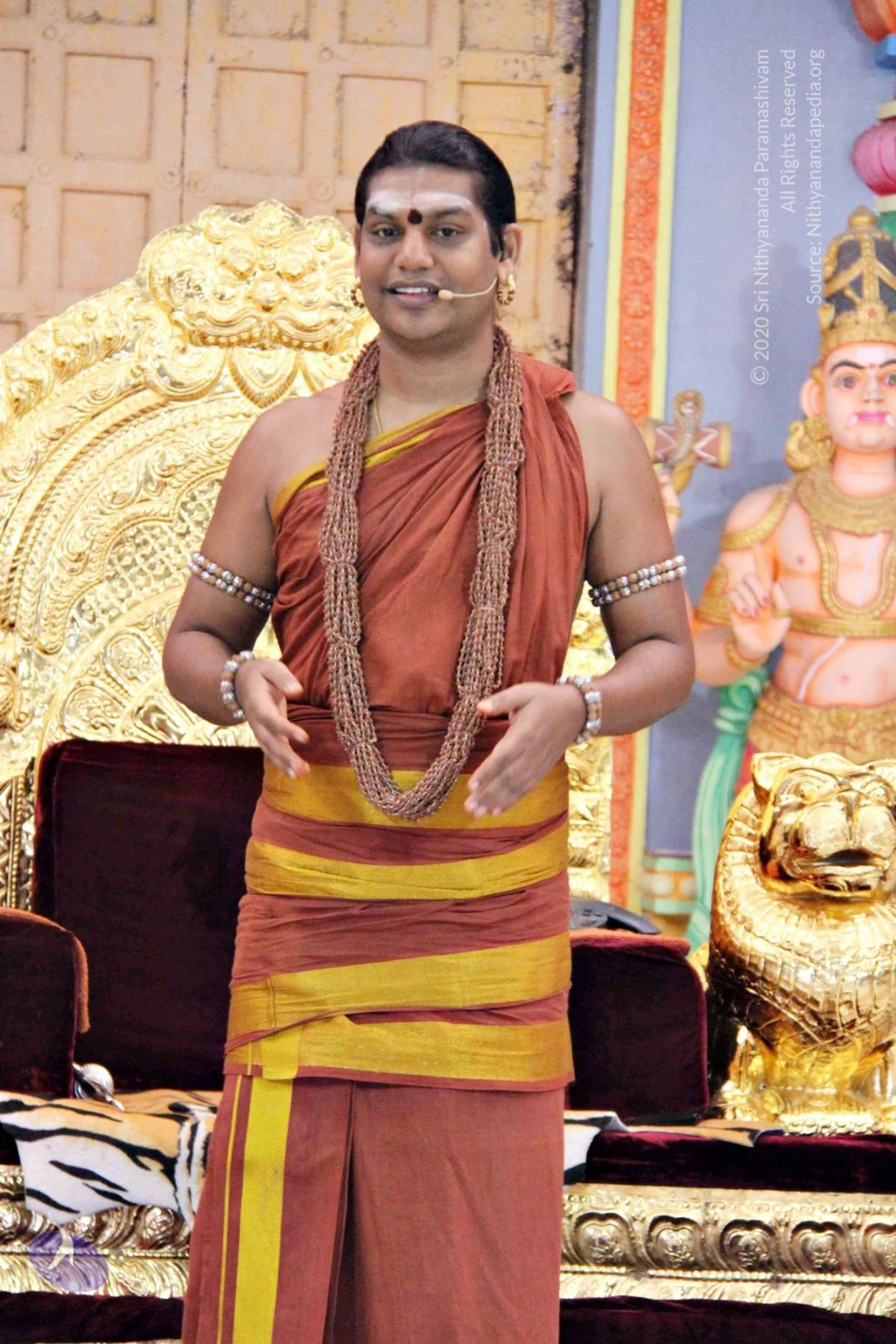
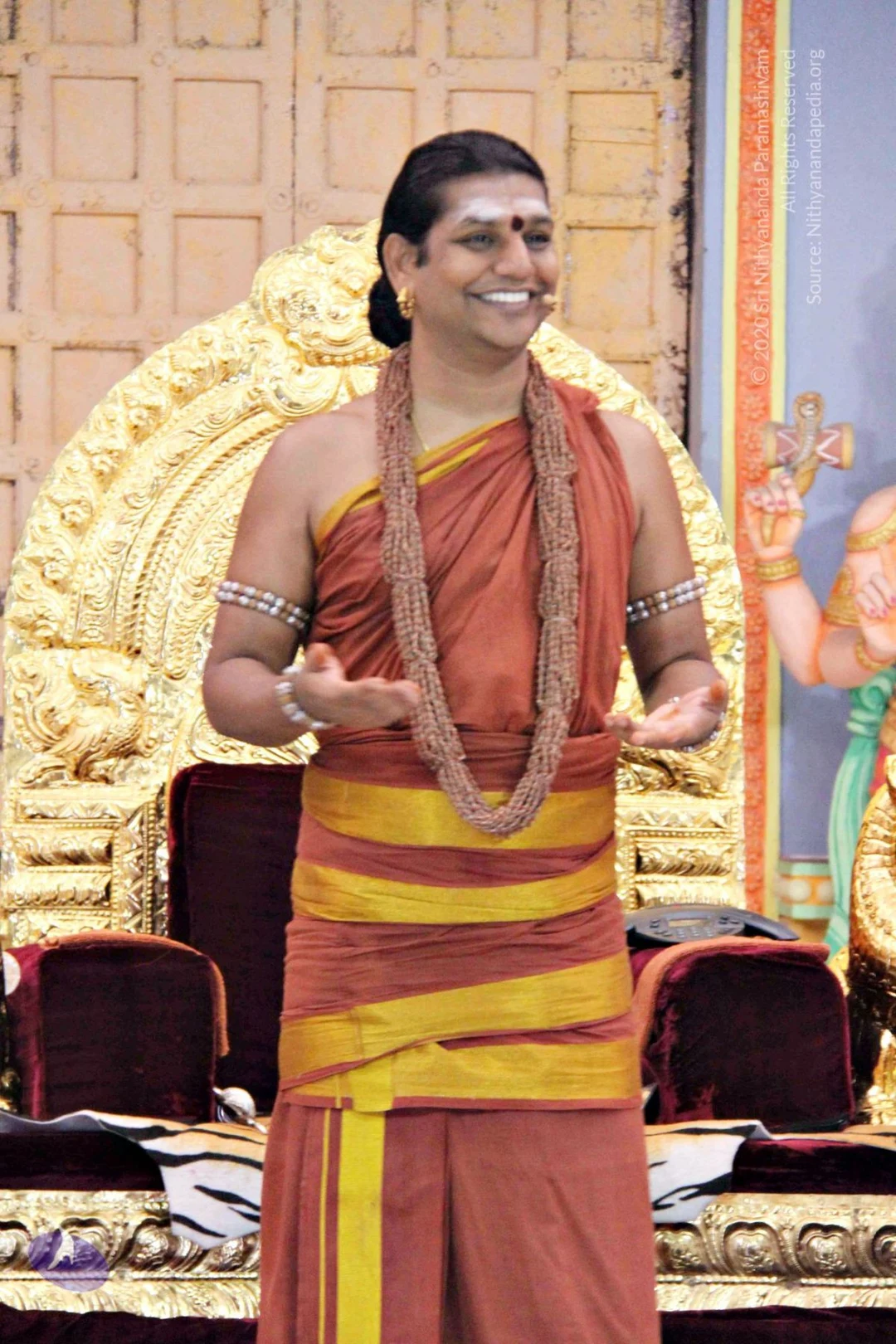
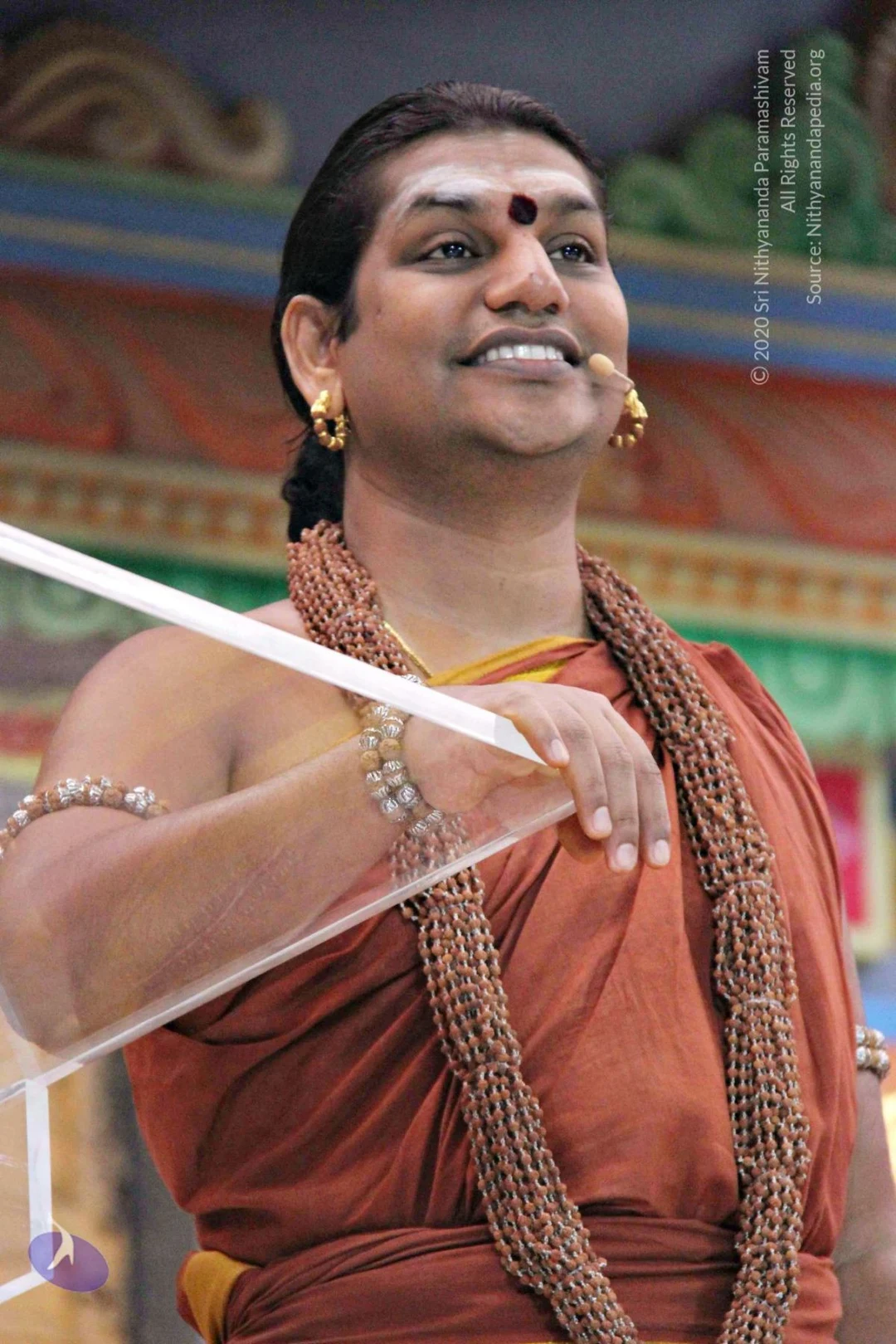
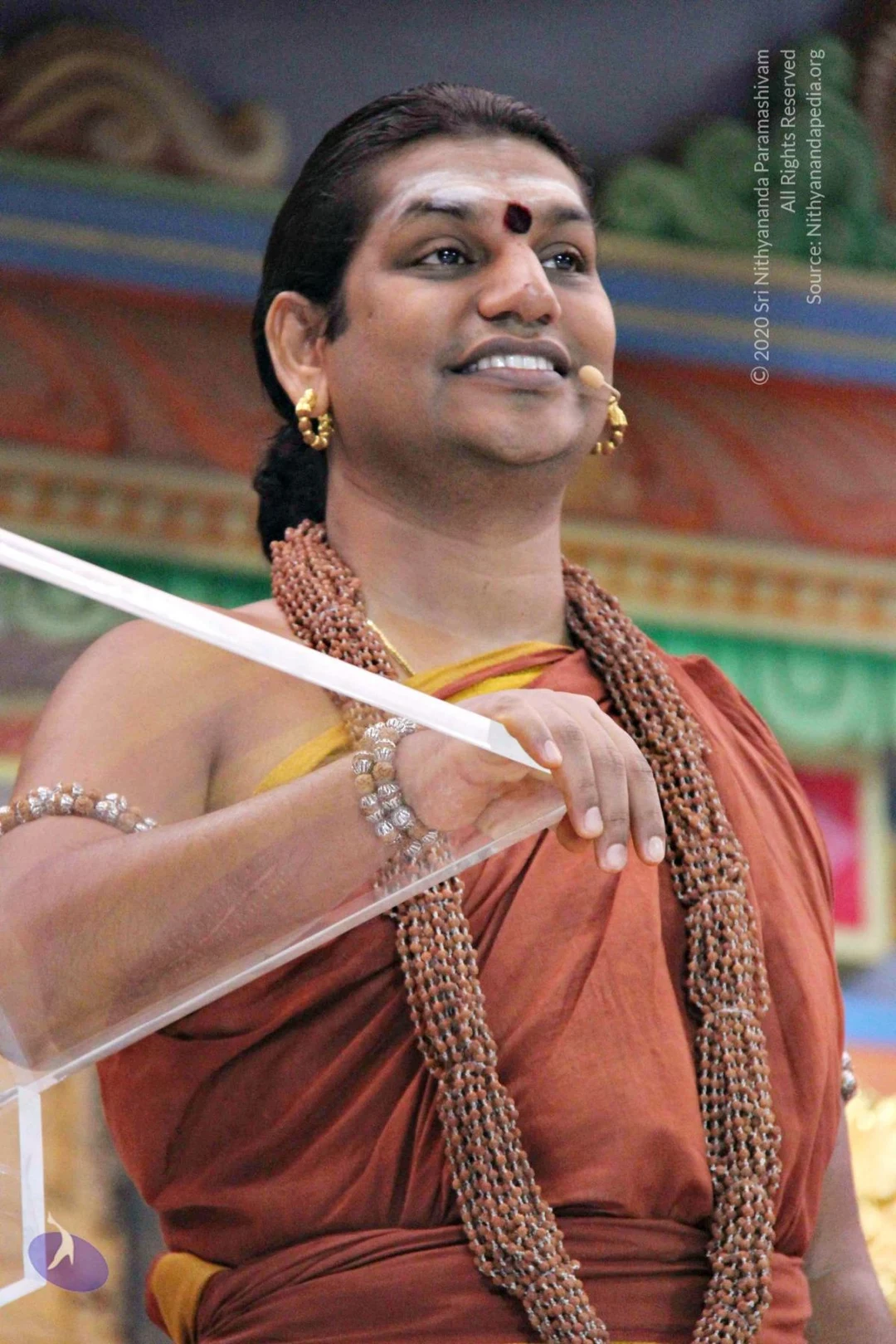
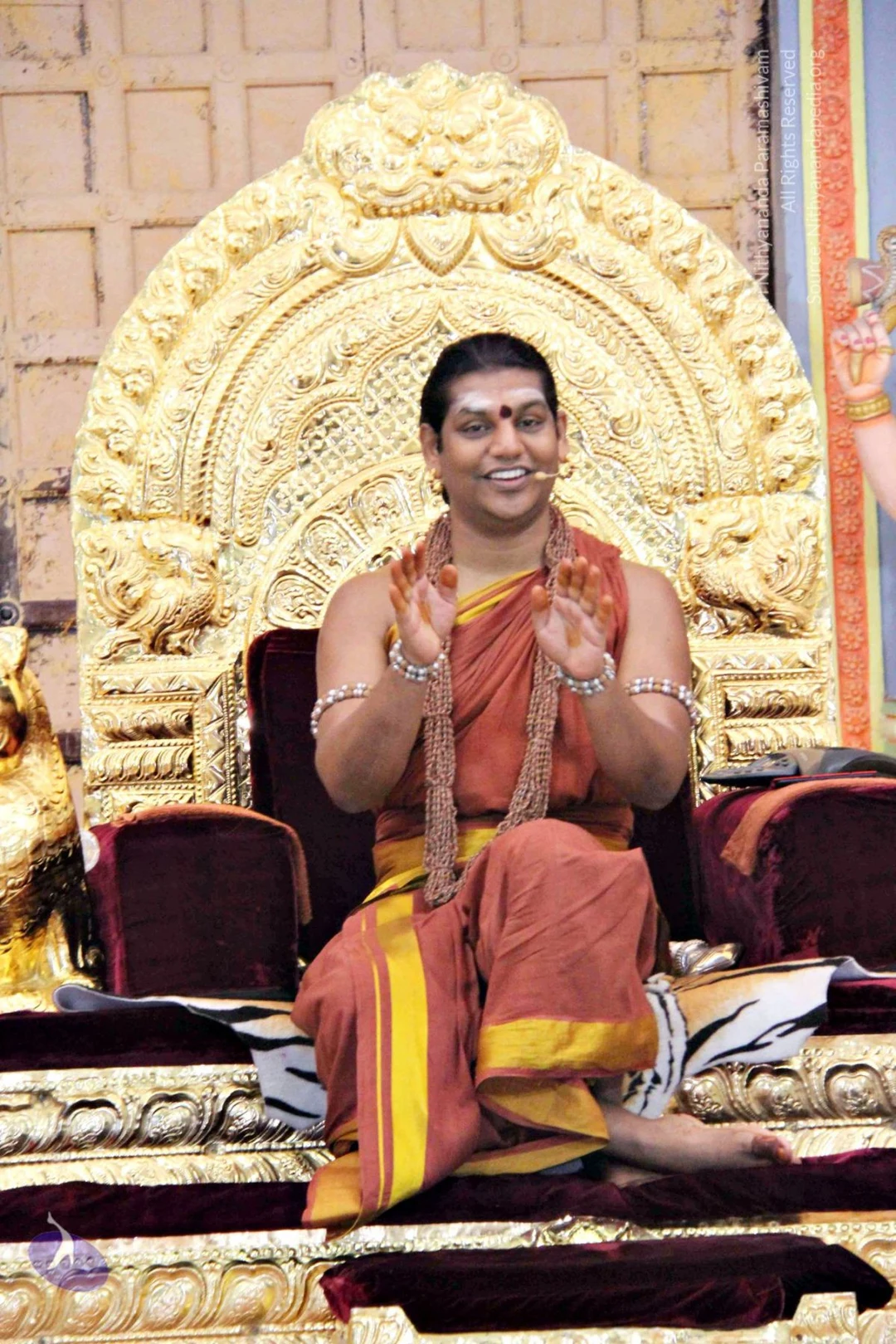
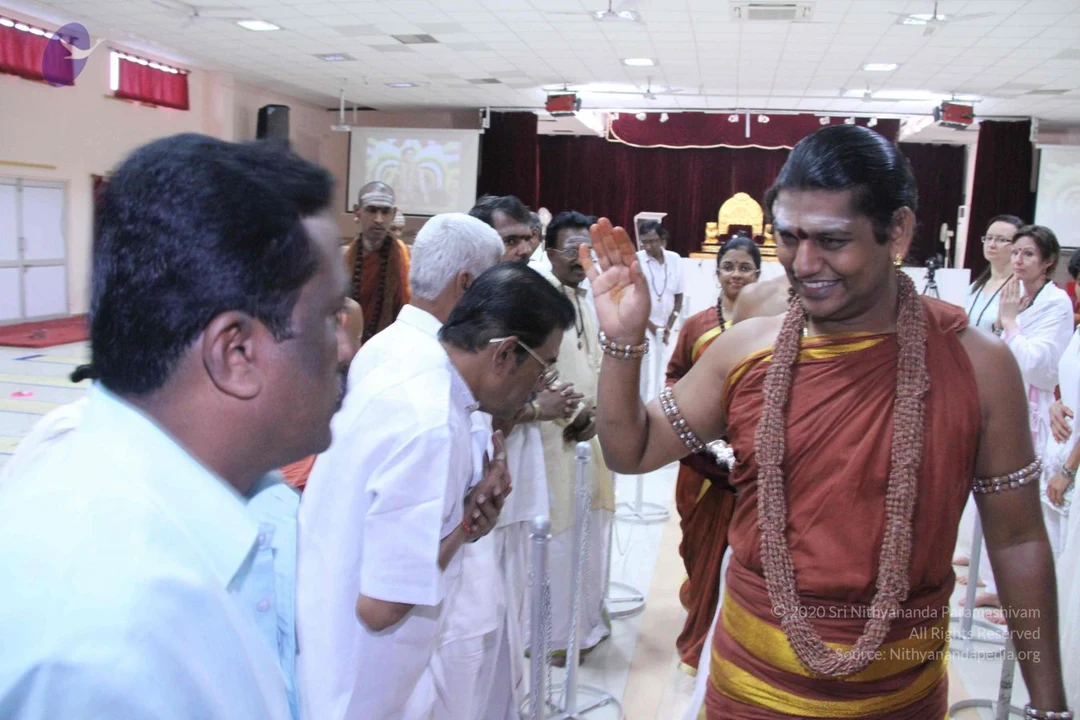
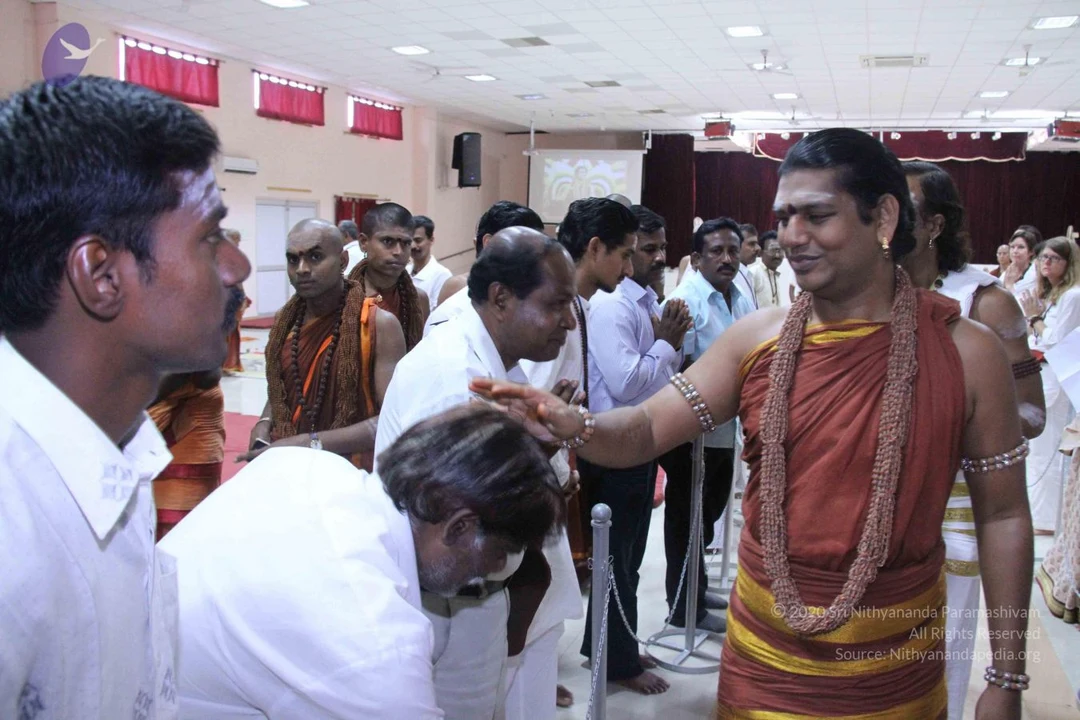
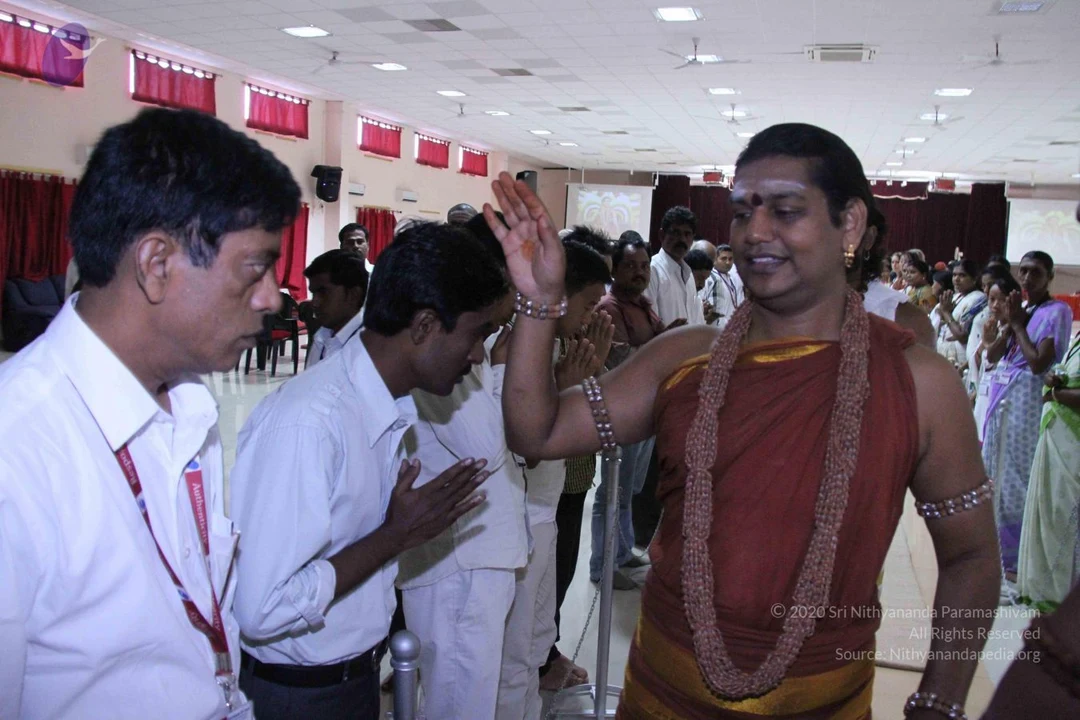
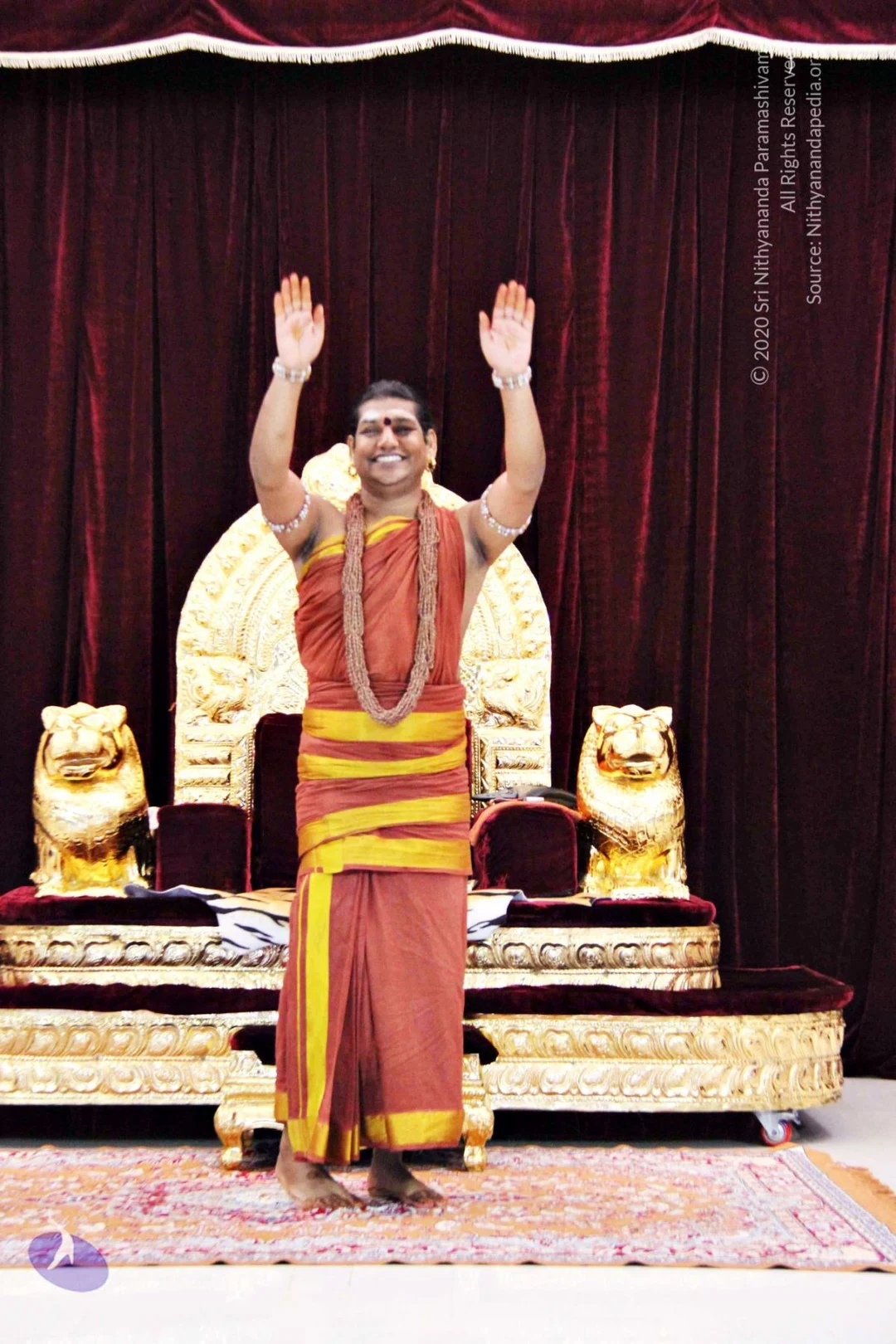
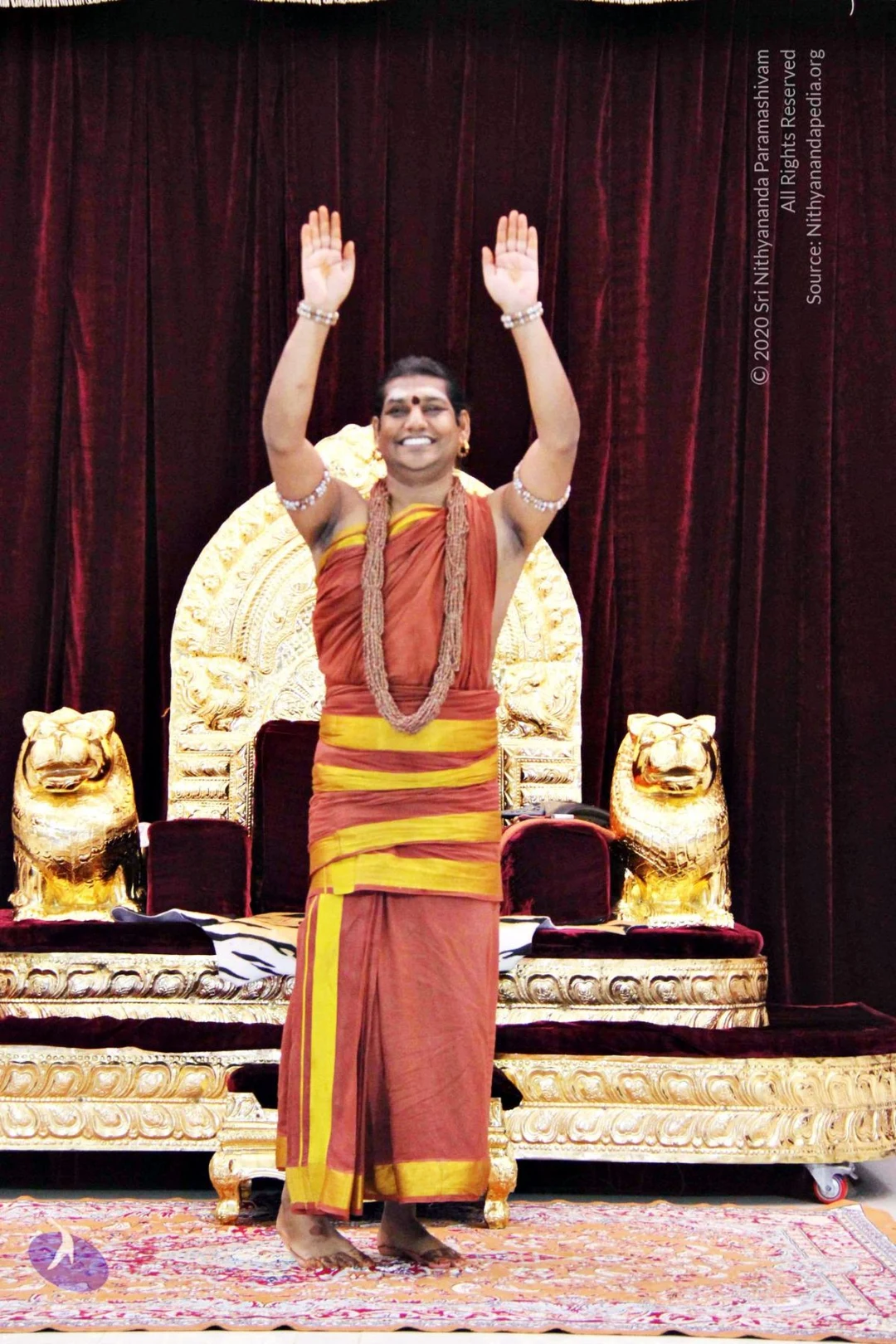
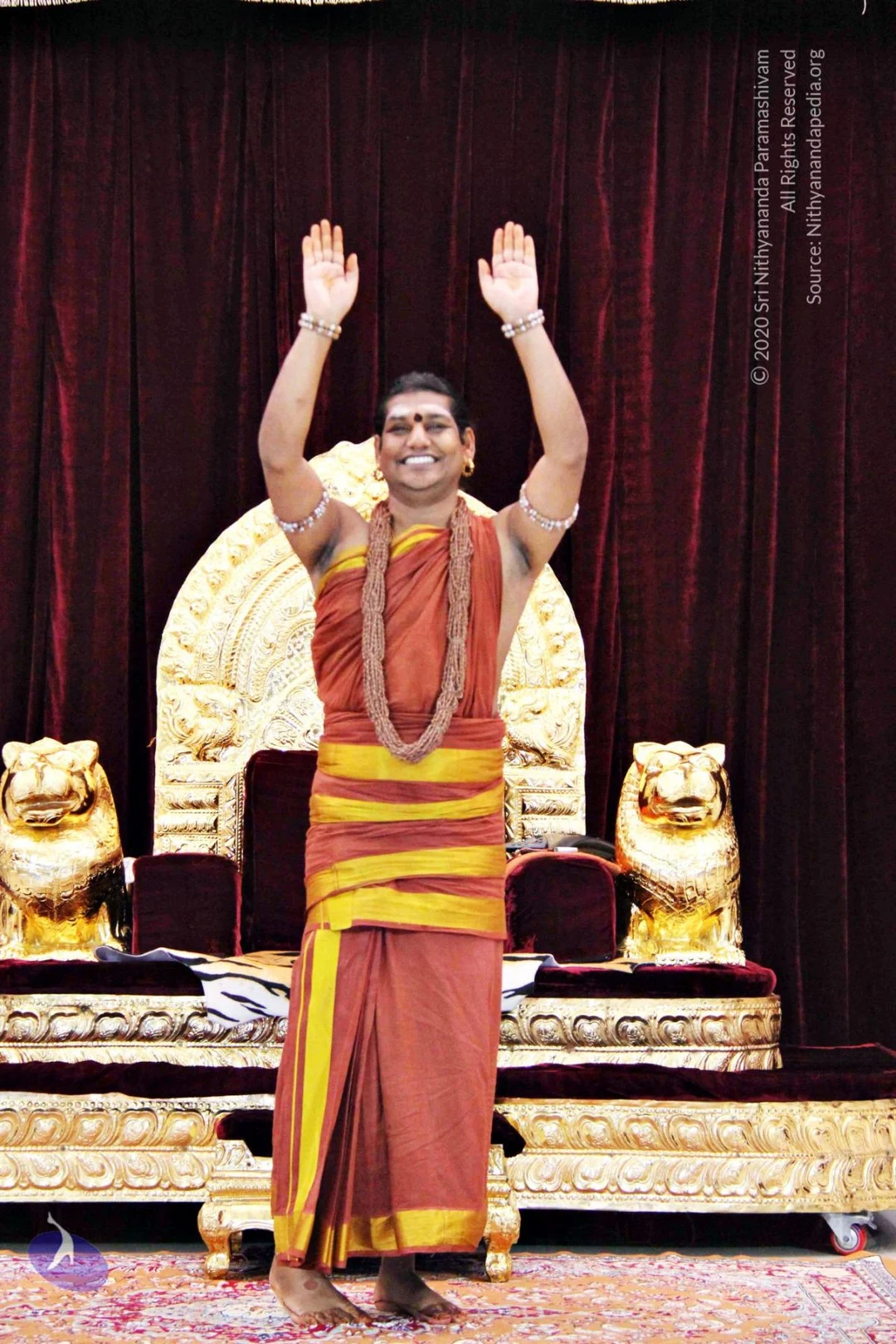
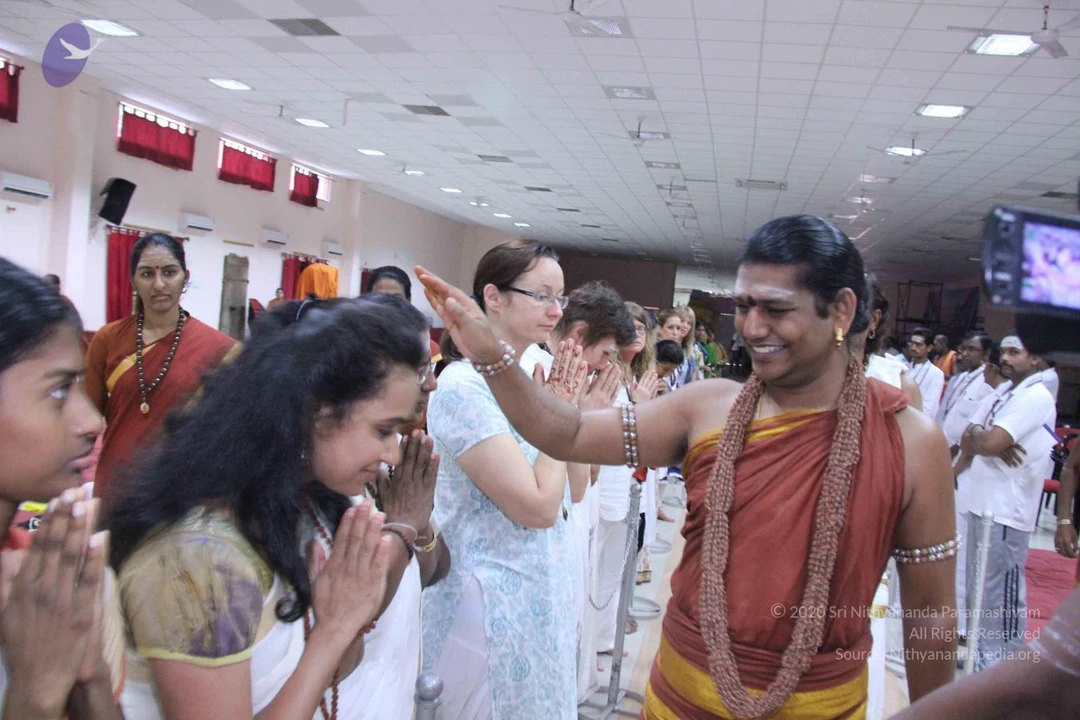
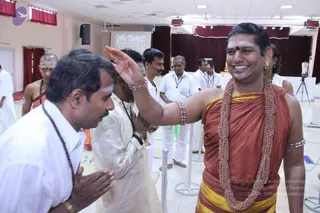
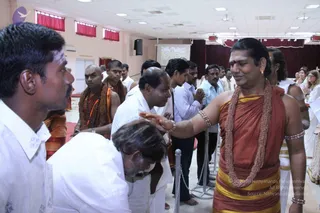
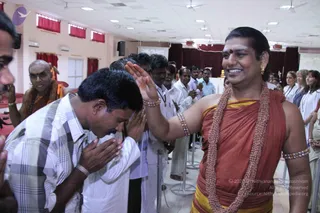
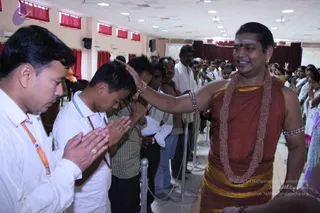
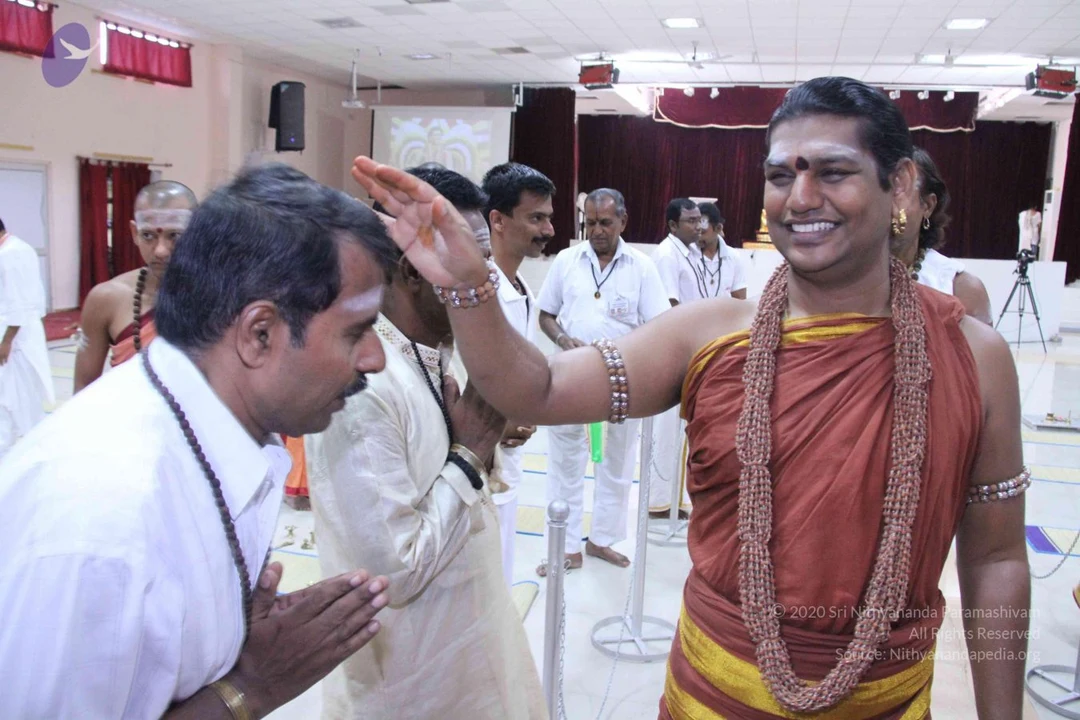
A photograph inside a hall with red curtains, white ceiling fans and a line of metal stanchions. On the right, a smiling man with a shaved head and a light-coloured forehead mark wears an orange-red sannyasi wrap, a long reddish-brown beaded mala and a gold-and-yellow border cloth, with a bangle-style armlet on his upper arm. He raises his open right palm toward a man in a white shirt who bows deeply with his hands folded in front of him, receiving blessing. Other men in white shirts and saffron-clad devotees stand behind the rail, and a golden throne-like seat with a gold canopy appears at the far end. a person: the orange sannyasi attire, rudraksha-style mala and ornate armlet match the page's a person cues, while the person's role is a blessing giver.A man stands on a stage in front of an ornate golden throne with dark red velvet cushions and a tiger-skin cloth. He wears a rust-red sleeveless wrap with a broad gold border, a matching dhoti-style lower garment with gold stripes, a multi-strand gold-toned chain necklace, beaded silver armbands and bracelets, and a white-and-red forehead mark. He holds his hands together at waist level while speaking into a headset microphone. Beside him stands a golden lion sculpture and a painted deity statue wearing a gold crown with a red forehead mark.A photograph of a smiling man standing barefoot on a patterned rug before a deep maroon velvet backdrop and an ornate gold throne flanked by two golden lion figures draped with a striped cloth. He raises both hands overhead, wearing a red-orange dhoti and shawl with gold borders, a rudraksha mala around his neck, beaded bracelets on his wrists and upper arms, and a red bindi on his forehead. a person: the man's appearance shows a red-orange robe, rudraksha mala and ceremonial ornaments in a throne setting, and the page names a person for this event.

September 11 2013

Original wiki page
Contents

Title

Understand yourself through Enriching

Link to Video

VideoAudio

Transcription

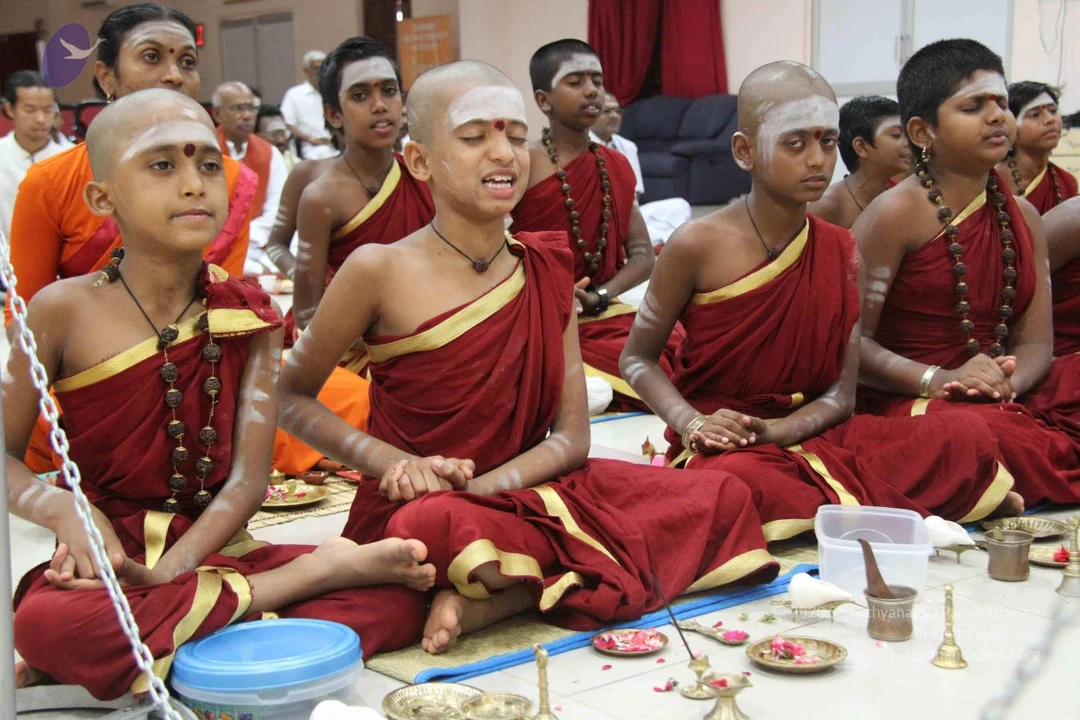
I welcome all of you with my love and respects. I welcome all the devotees, disciples, samajis, satsanghis, sitting with us all over the world through Nithyananda TV, Lotus News Channel, Sadhna TV and Eshwar TV, and two-way video-conferencing. all over the world, cities sitting with us through two-way video-conferencing are: Guadeloupe, Vancouver, Kuala Lumpur, Seattle, Toronto, Ohio, Oklahoma, Houston, Hyderabad, Los Angeles, Charlotte, Hong Kong, San Jose, Singapore, Devon, Los Angeles, Bangalore North, East London, San Diego Pacific Beach, New Zealand-Adi Arunachalam, Hyderabad-Gupta Kashi, Oman-Sivagangai. I welcome all of you with my love and blessings. Today I will expand on “REAL ENRICHING”. Please understand, only when you reproduce the intense experience of you in others, the enriching happens. And I tell you, only when you enrich, the dark corners of your mind, unconscious parts of your mind get solidified. Many times, just in the face I can see a person going through confusion and suffering. Unfortunately, the solution is enriching, which nobody wants to listen. When you enrich other human-beings, all the struggle you face in them is all the struggle your own unconsciousness carries. Please understand, when you enrich somebody and made them sannyasi, only then you are a real sannyasi; because all the problems they face is nothing but the problems of your unconsciousness. If you can answer all their problems and questions, only then you answered all your unconscious problems and questions. Same way, why do you think our gurukul kids are so solid and so alive? I am getting a few of the doctors, researchers who find the IQs, who study the brain power of the kids, to demonstrate to the world the power of our gurukul kids – their IQ, their EQ, their SQ. SQ is the new concept I am launching – Spiritual Quotient. Like Intellectual Quotient (IQ), Emotional Quotient (EQ)-Spiritual Quotient! Because they have answered all parts of themselves! That is why I could see the gurukul kids are very successful in enriching others. And same way, because they are enriching continuously, they are able to answer all their unconscious questions, face their unconsciousness. “Hindi Translation” First of all, you need to understand why we should be able to answer, why we should answer all our unconscious queries. Please understand, unconsciousness is the enemy you carry in your backpack. Enriching is the friend you carry in your backpack. Unconsciousness is the enemy you carry in your backpack. Any moment he may attack you. Any moment he may put you in depression. Any moment, he may destabilize you. Unless you destroy your unconsciousness, unless, you will create hell for yourself and nobody else. You can’t create hell for anybody else. You will create hell for yourself. Unconsciousness, understand, attacks you when you least expect. Better go around enriching everyone, so that all your unconscious questions are answered now itself. It is like voluntarily facing your unconsciousness. When you face your unconsciousness voluntarily, you go with enough of equipments, power, and handle it. When you face your unconsciousness suddenly, you will unfortunately, associate yourself with it. Please listen! Come to the space of listening! This is a very important statement. When your unconsciousness erupts out on its own, unfortunately you associate yourself with it. Then you are gone! You lost the game! When you face your unconsciousness voluntarily, you will not associate yourself with it. I tell you, the difference between you associating yourself with your unconsciousness and you not associating yourself with your unconsciousness is a small difference…..like whether Krishna is in your side or not! See, there was a situation where Krishna has to decide whether he should be on the side of the Pandavas or Kauravas in the Mahabharata. That one second, that one decision would have changed the whole history of the Mahabharata and Bharat. If he had sided with the Kauravas, I tell you…..! It is not that the Kauravas are worse people than Arjuna. After listening to the whole Gita, I can say very clearly, Arjuna was only socially moralistic; consciously he was equal to the Duryodhanas. If the whole Gita had been delivered to all the Duryodhanas, all hundred of them would have with Arjunas, enlightened! The whole story will be different! Understand, there is nothing special about Arjuna, I can boldly tell you! He may be socially good, but based on the questions of Arjuna, I can say, he was equally unconscious like Duryodhana. The situation making you as a good person may be accident, but you making the situation good is incident! Understand, the situation making you as a good person is an accident; you making the situation good is incident! The one decision – whether Arjuna is going to have Krishna or not, whether Krishna is going to side with Arjuna or Duryodhana – that one decision, that makes the whole difference! Understand, your whole life is nothing but Mahabharata. In your life of Mahabharata, the victory or failure is going to be decided, who is going to win, whether you or your unconsciousness, is going to be decided only based on which side you are going to side. Listen, whichever side Krishna sided would have won the game. If he sides with Duryodhana, he would have won the game. He knows what to do. I have gone through the Mahabharata, I tell you, and won the game! And, I tell you, you need Krishna to win the game! You really need Krishna to win the game! Almost every situation you feel like, ‘No, no, today over’! Now what will happen? Because Duryodhana vomes to Sahadeva and asks, ‘Give me the time when I should start the war to win the war.’ Sahadeva, being an integrated person, he cannot….. See, an astrologer needs Integrity. A gemologist and Vaastu person needs Authenticity. These are the unique qualities, an astrologer has to have Integrity. You cannot compromise. See, for an astrologer, Integrity is a more powerful quality than Responsibility, Enriching and Authenticity. You can’t compromise on Integrity. The guy has to be integrated. So he (Sahadeva) gives the answer. ‘Start on Amavasya. You will win.’ Over! Now the whole thing is over! Because that fellow (Duryodhana) is going to start on Amavasya, he is going to win the war. Who is responsible for their losing? Nobody can take the responsibility. Now, nobody is interested in responsibility. Each one is interested only in their quality. Krishna comes and takes the responsibility to their sin and plays with Authenticity. His ability, power of Authenticity is so strong, he is so authentic, he starts giving tarpana, starts giving the shraaddha, the ritual supposed to be done on Amavasya day. His Authenticity was so strong, the Sun and the Moon are frightened! ‘What happened? Did Krishna miss the date? Did Krishna forget today is not Amavasya?’ They both rush to Krishna and ask, ‘O, Bhagawan, why are you doing shraddha today? Tomorrow is Amavasya!’ Krishna just looks at both of them and asks, ‘What is the meaning of “Amavasya”? They say, ‘The day Chandra and Surya meet each other.’ Krishna says, ‘They both met already. You both have met. That’s it, so, Amavasya!’ Understand, astrologer need to have Integrity. Each person need to have one, one special qualities but an enlightened being who can lead you to success needs to have all the four and something more and ability to play with each quality, when, where. Only Krishna can do that drama. I tell you, whichever side Krishna sides, that side would have won the game. Same way, whichever side, whether your unconsciousness or your consciousness, whichever side you side with, that side wins the game. You siding your conscious side and leading yourself to Completion is life. Day before yesterday, during the Vinayaka Chaturthi, Ganesha Chaturthi festival, I was telling, ‘The most blissful life on Planet Earth is our gurukul kids’ life.’ No, whether you know it or not, some of our kids may not know, because they have not seen the world; they may not know. Whether you know it or not, I tell you, the most blissful life, the most fortunate life. Kathopanishad says: ‘If you are given the option of ‘right’ and ‘pleasure’. Right thing, good thing and very pleasure, convenient, happy thing, choose always the right thing, not the pleasure one, not the convenient one. In this age, they may not know, but they have chosen the right one not the pleasure one, not the convenient one. I tell you, in this age, choosing the right one. Sometimes the kids themselves chose and inspire the parents. Sometimes the parents chose and inspire the kids but whatever; finally you are doing the right thing. Shreyascha Preyascha Manushyamethasthou Sampareethya Vivinaththi Dheeraha | Shreyo He Dheerobhi Preyaso Vruneethey Preyo Mandho Yogakshemaadh Vruneethey ||

‘The good and the pleasant approach man. The wise examines both and discriminates between them. The wise prefers the good to the pleasant but the foolish man chooses the pleasant through love of bodily pleasures.’ Understand, when you choose the pleasant, when you side the pleasant, your destruction is inevitable. Of course, Masters merge both together, the good and the pleasant. Even when they merge both together you always only look for the good because you do not know how to merge. You do not know how to merge. Till you become the Master always look for good, not for pleasant. Look for the right not for light. Your whole life is nothing but the Mahabharata. I tell you, the Kauravas’s birth, what is it? One child is born which is unconscious, dead, abort. So, that was broken to hundred pieces. Means what? When you are born you are unconscious and you are broken into hundreds of root-patterns and all hundred grow like demons. Means all your root-patterns growing as demons. When you are tired of being demon, you also encourage some good qualities in you just for the change. Please understand, there’s nobody who is hundred percent demon because being hundred percent demon makes you feel bored. Otherwise, why should Ravana do Shiva Puja? People have just mix of things. You can’t be hundred percent demon or hundred percent saint till you become enlightened. Till you become an enlightened soul, an enlightened being, both side will be there, this side, that side because you need choice. Life is all about just jumping from one side to another. Choice, choice, choice, choice, choice. The few good patterns which you develop in you just as a choice, as alternative for time-pass, that few good patterns are the Pandavas and the space of Completion which you have inside, which can’t be destroyed by any root-pattern is Krishna. Once in a while he comes out and says, ‘Hey, hey, hey. All you root-patterns, you guys are doing wrong things, don’t do.’ Then all hundred of your patterns stand and laugh at Krishna ‘Ha, ha, ha, ha, you can stop us or what? Do what you want.’ Every time, every day, every moment, the struggle between Pandavas and the Kauravas goes on. Krishna also comes to the scene once in a while but he comes for such a short time you forget his existence. He goes back to Dwaraka. He goes back to his place, the space where you push your Completion. All of us have the space of Completion, but we push it under the ocean like Dwaraka. 25:00 We don’t want to interact with that space every day, because that takes away many of our vested interests. Many things which you imagine, forcibly imagine are joyful, tasty, doesn’t look tasty with the space of Completion. Your whole life is a Mahabharata, then when your weight becomes too much for your own body, when your incompletions are too much for your own body, please understand, when Bhu Devi, the Earth Goddess, is not able to hold the weight, Krishna comes and reduces the Bhu bhaara, the weight of the Earth. It means when your incompletions become too much even for yourself, Krishna comes and destroys all incompletions. How to know whether my incompletions have become already too much even for me? If you are not able to sleep in the night be very clear, sleep is the scale. After lying down, if you are not able to sleep, if you are rolling on the bed without getting sleep, then your incompletions are already become too much for you. Now it is time Krishna should happen. Now it is time for Krishna to happen. Bhu bhaara has become too much. You become too heavy even for you. Then comes Krishna giving the Gita to Arjuna. Means some of your good patterns are infused with the intelligence to do Completion. It is your good patterns which starts the Completion. When you do Completion finally the goodness in you wins and you create and you create, you create the goodness, you create the reality you want. Please understand after the Mahabharata War they have to completely rebuild everything, create everything. Same way, after your Completion you will create everything, you will create life, you will create everything. xxxx 28:22 Hindi -29:40 xxxxx Somehow listening, learning the science of Completion should be the first step in your life. Learn Completion. I request all the viewers, listeners, you have so many opportunities. We have so many programs coming up to teach you the science of Completion, one of the important teaching of Mahadeva, Shiva. Listen to the science of Completion. Learn the science of Completion. Live the science of Completion. I tell you, nothing else is that important in your life other than learning the science of Completion and complete all the unconscious parts of you. This is the most powerful, effective, spiritual science, immediate spiritual science and give energy, courage, support to the Completion space of you. That will really cause miracles in you. That’ll really, really, really cause miracles in you. xxxx31:46 Hindi -32:56 xxxx Please sit straight, close your eyes, cognise you become Bidadi Kalpavriksha, inhale through both the nostrils and the mouth, hold as long as you can comfortably, exhale through both the nostrils. Do this for next twenty one minutes with the cognition you have become Bidadi Kalpavriksha I bless you all, let you all experience kundalini awakening. Let you all create energy directly from space and live health, bliss and enlightenment. Namah Shivaya! Let you all achieve, experience, live, express, radiate, share and explode in eternal bliss, Nithyananda.

Photos
Photos Of The Day:

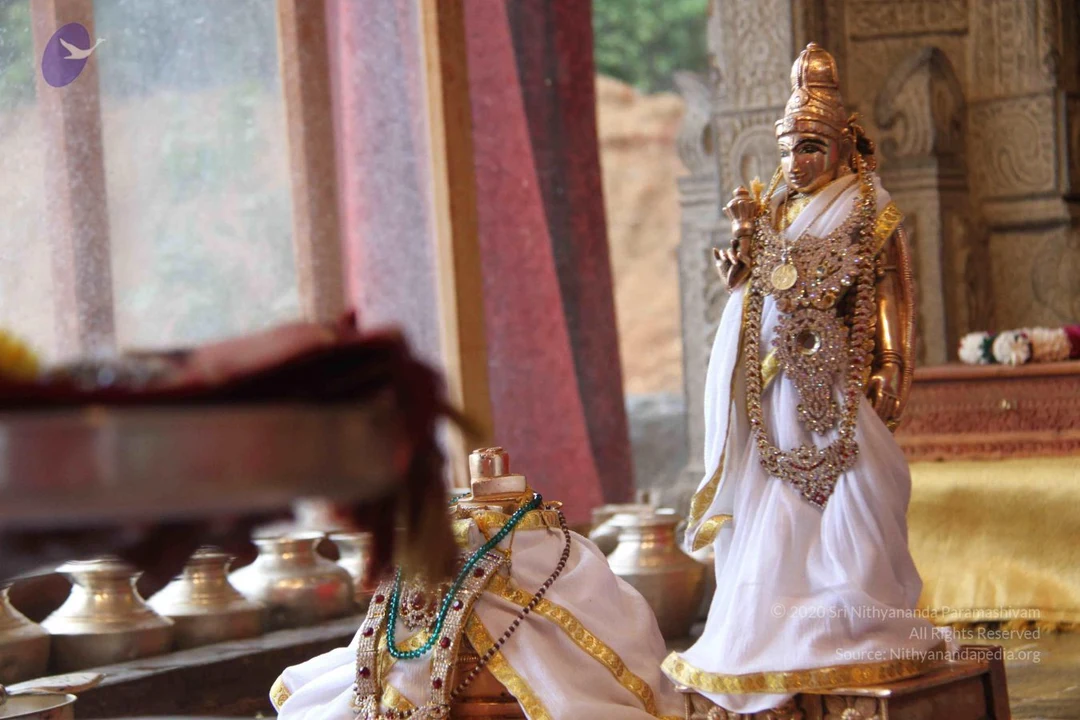
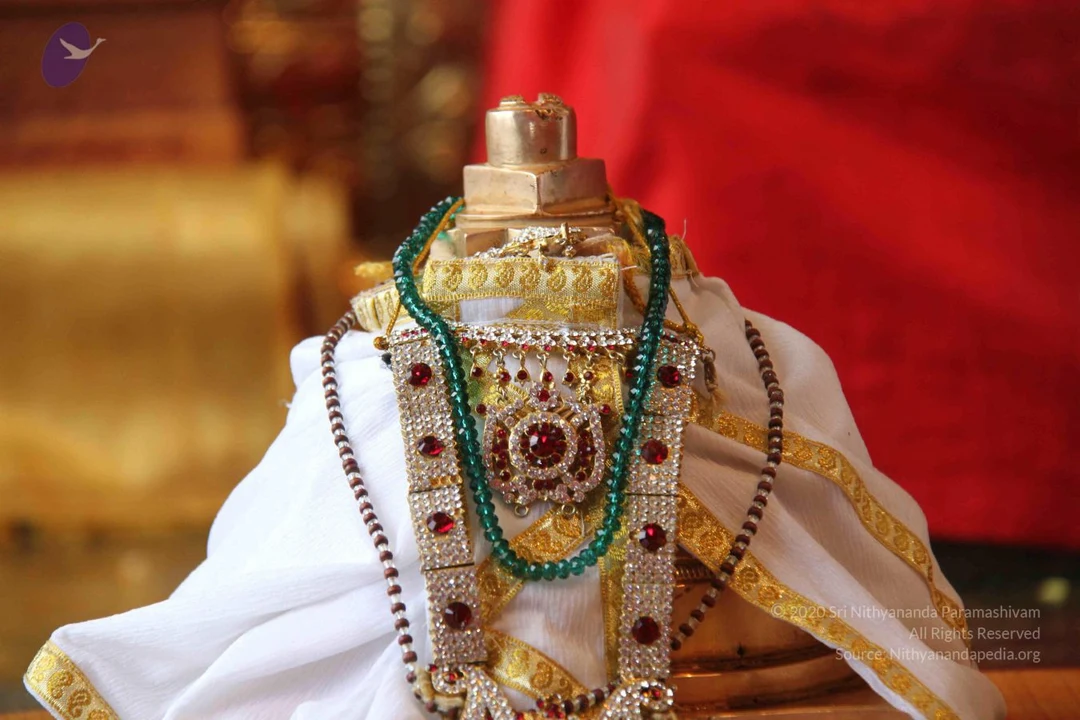
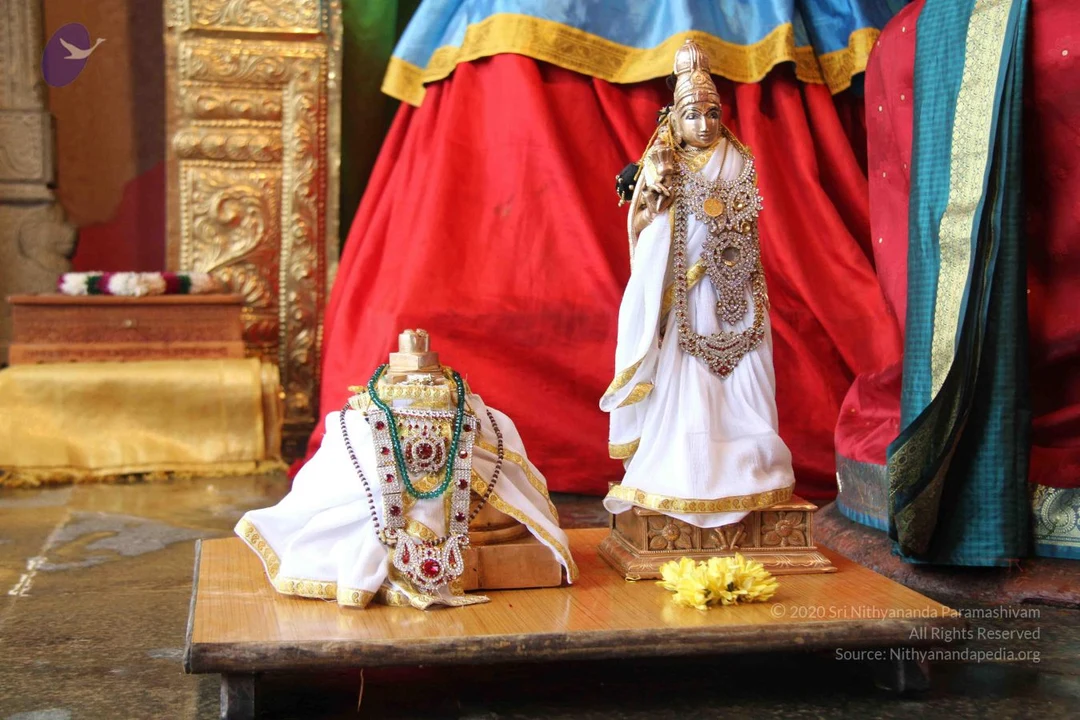
PADUKAPUJA
TEMPLE
Nithya Satsang

SARVADHARSHAN

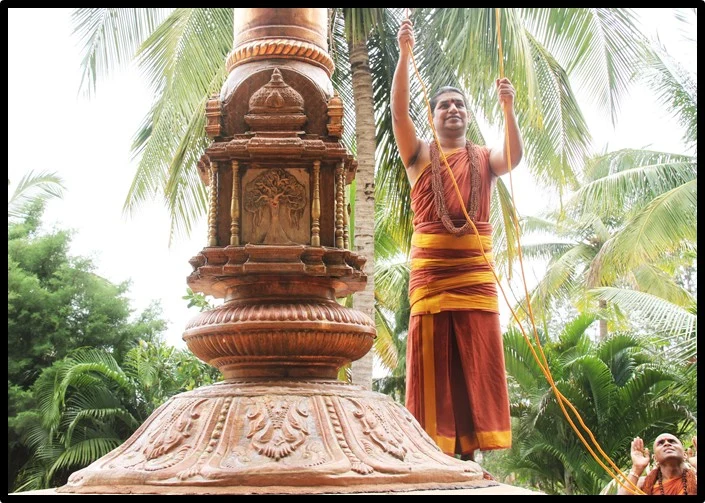
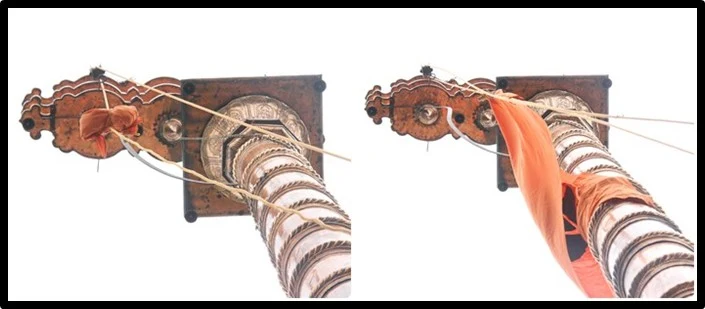
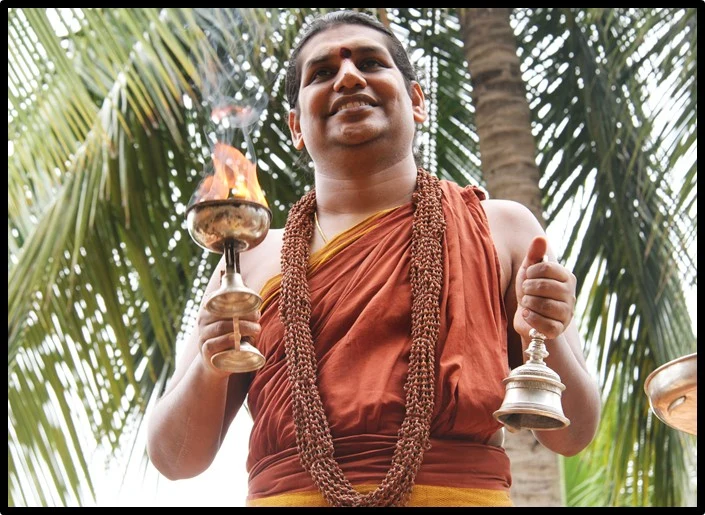
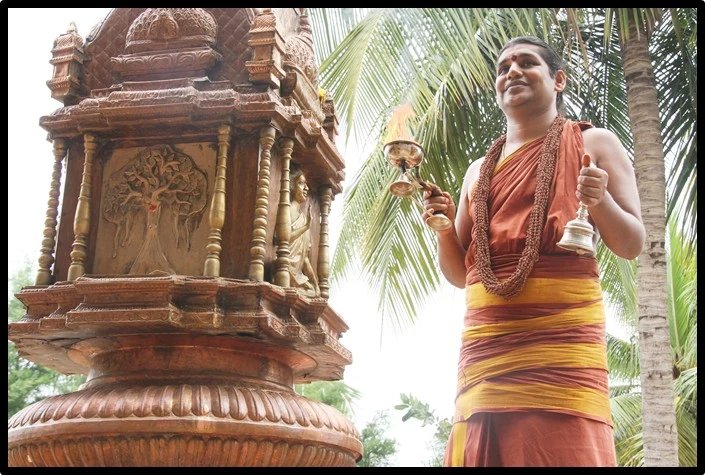
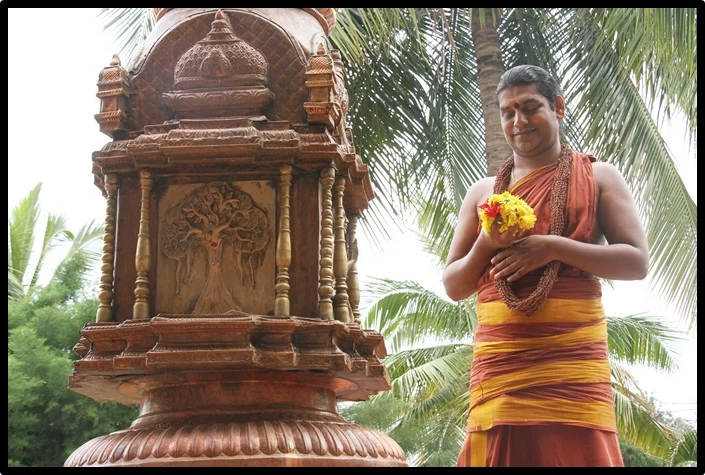
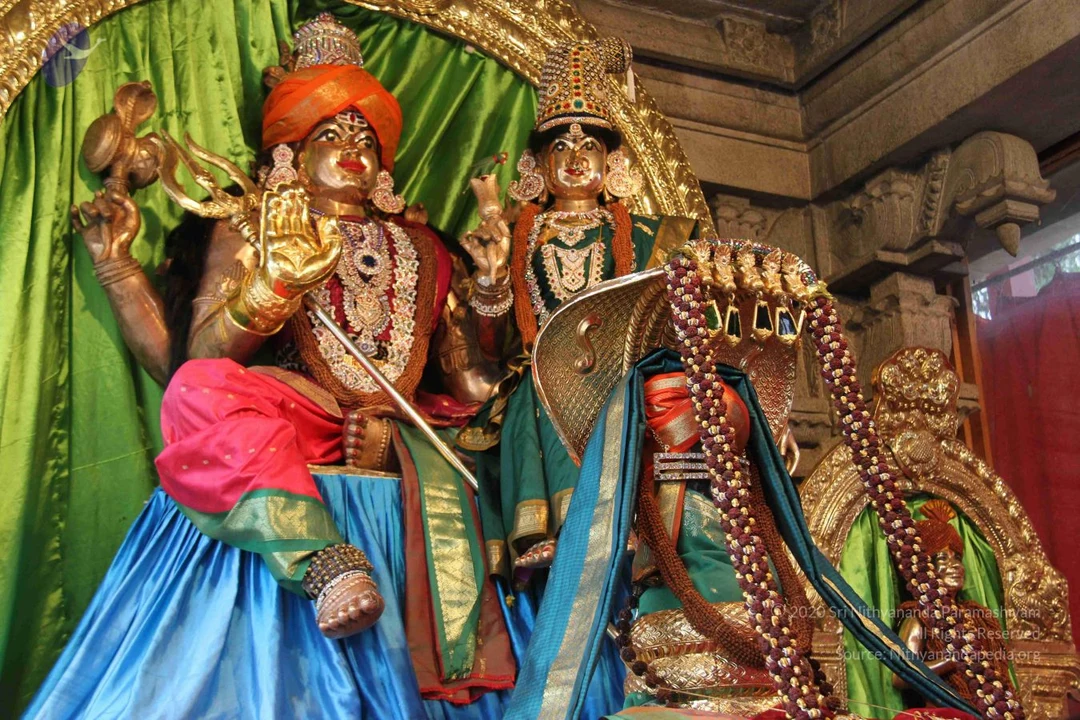
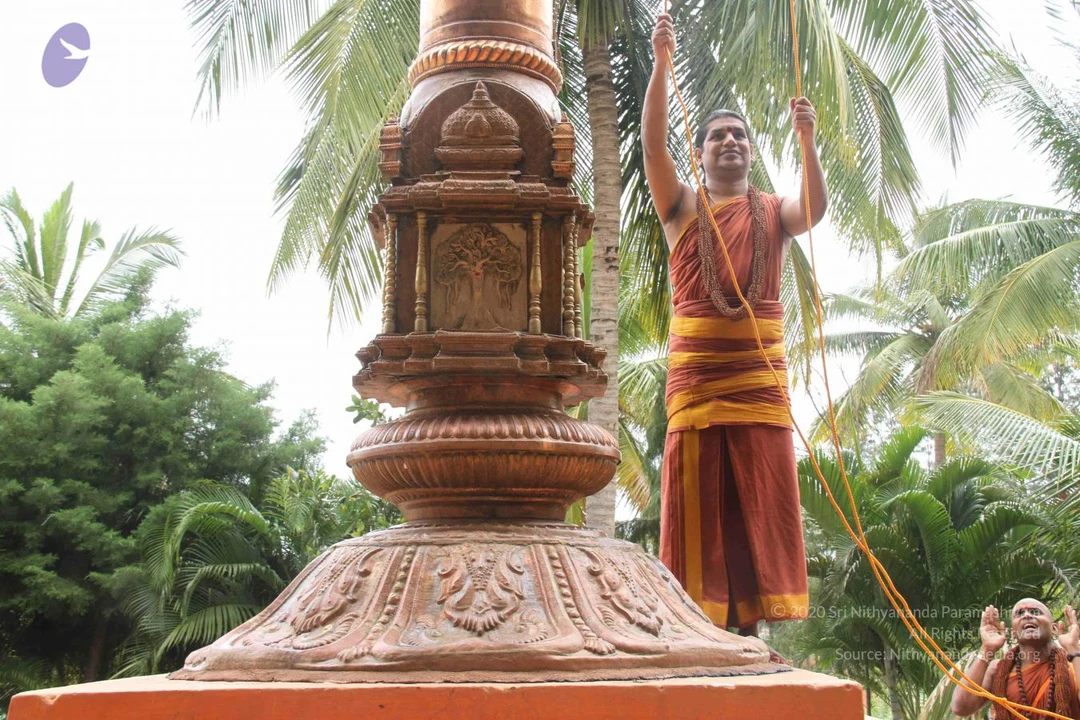
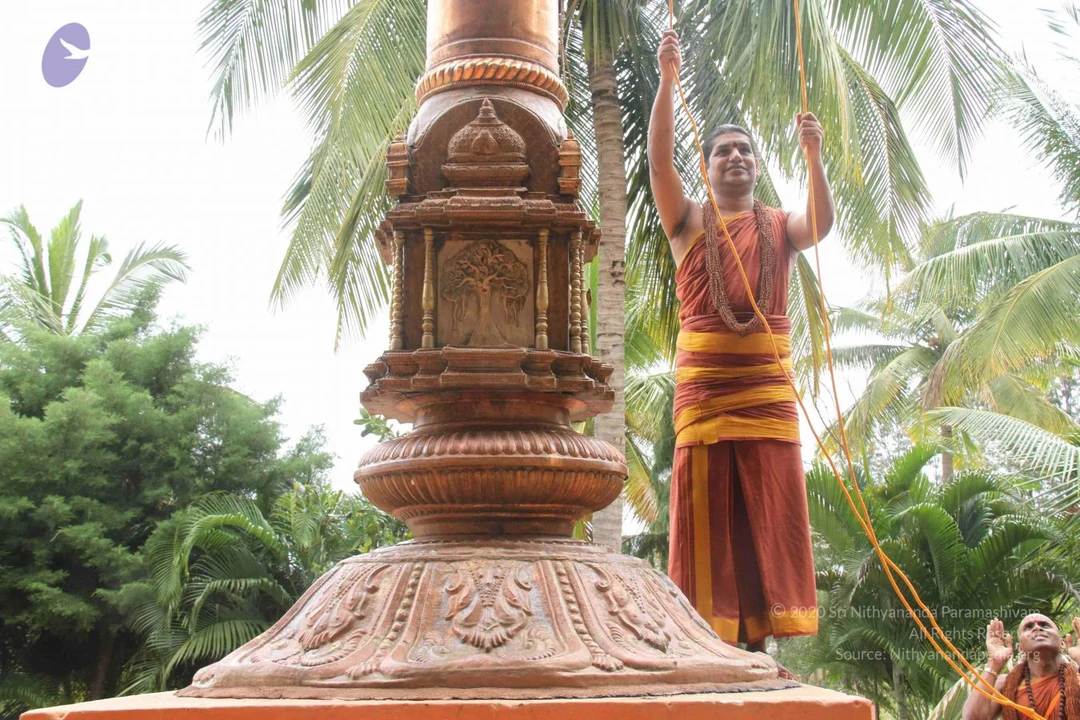
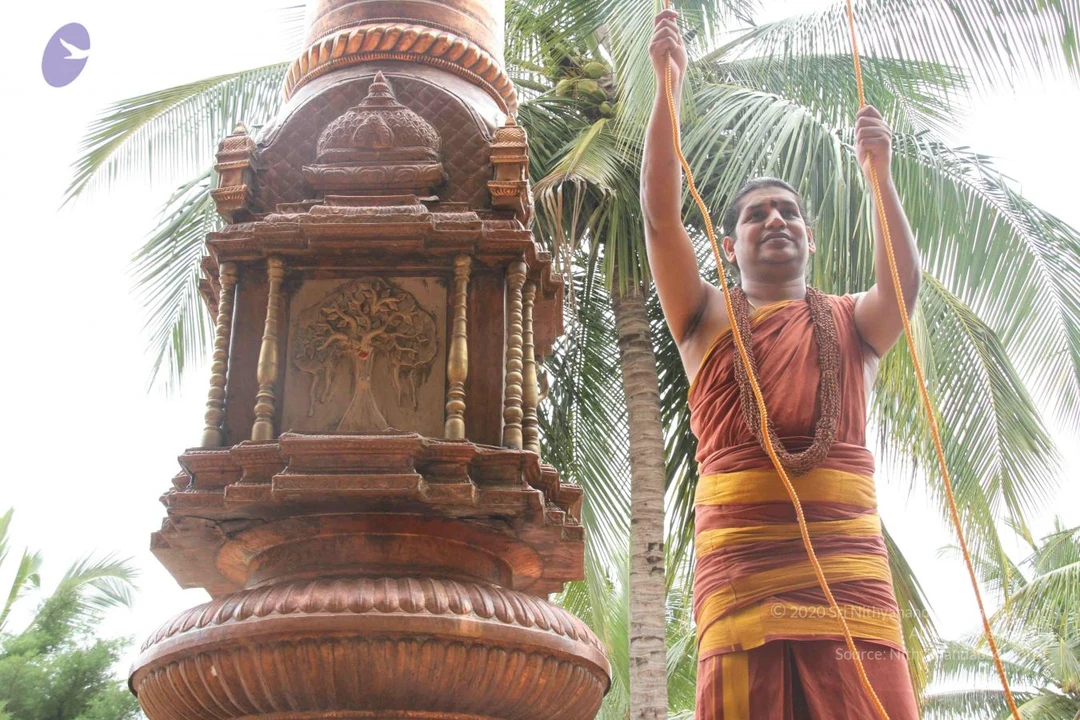
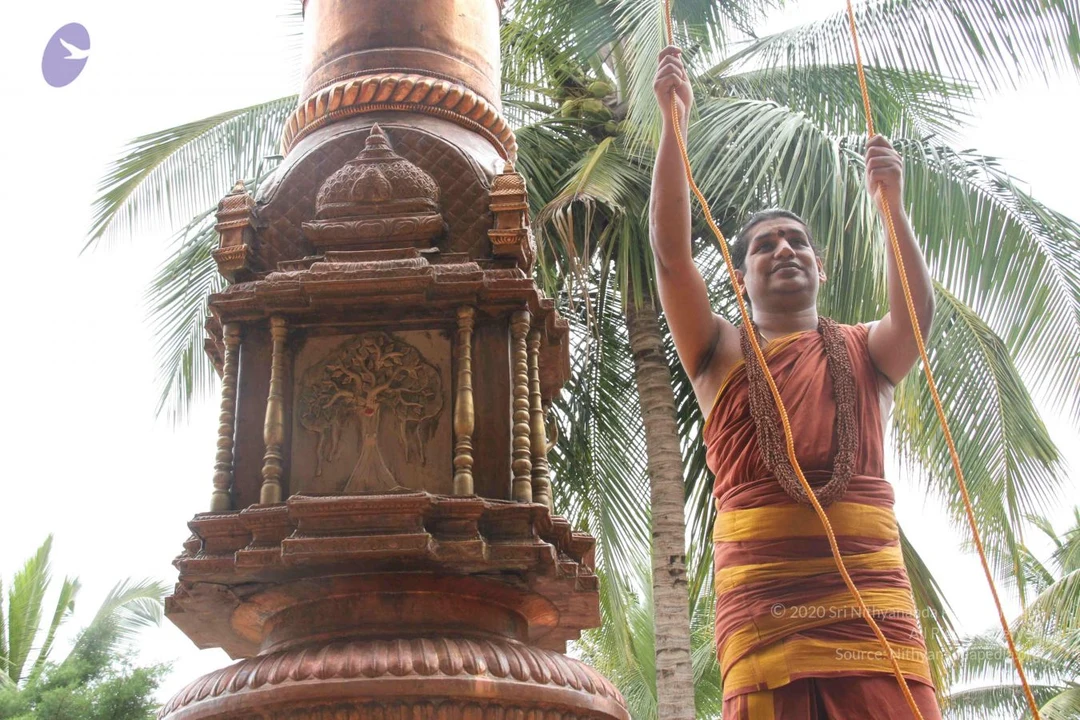
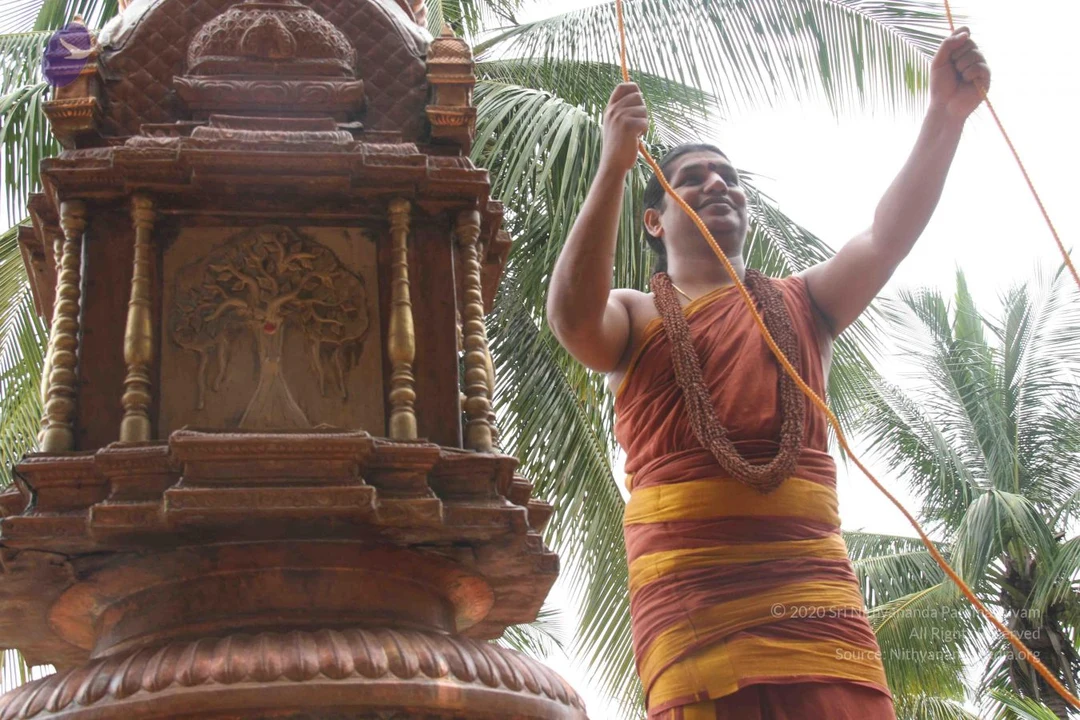
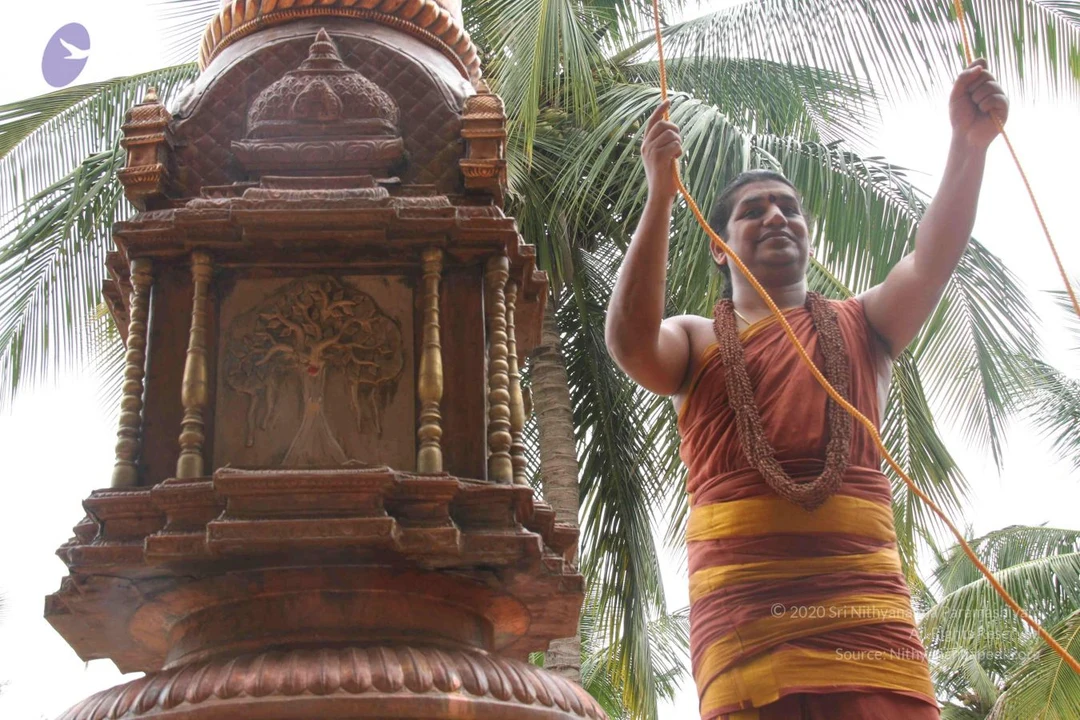
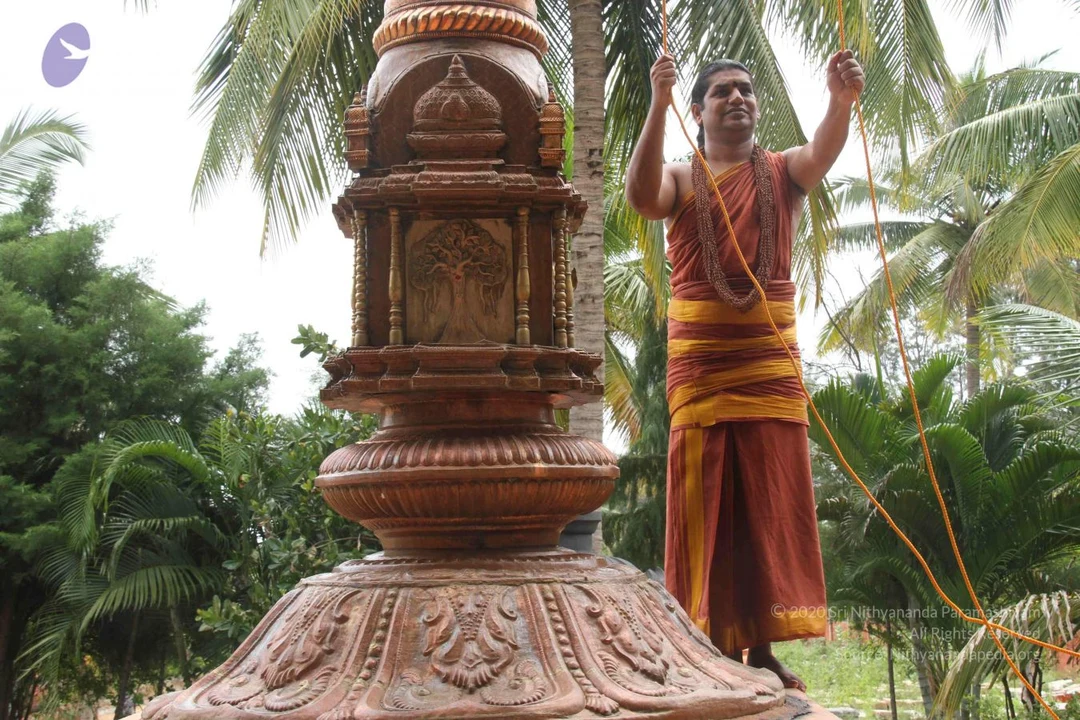
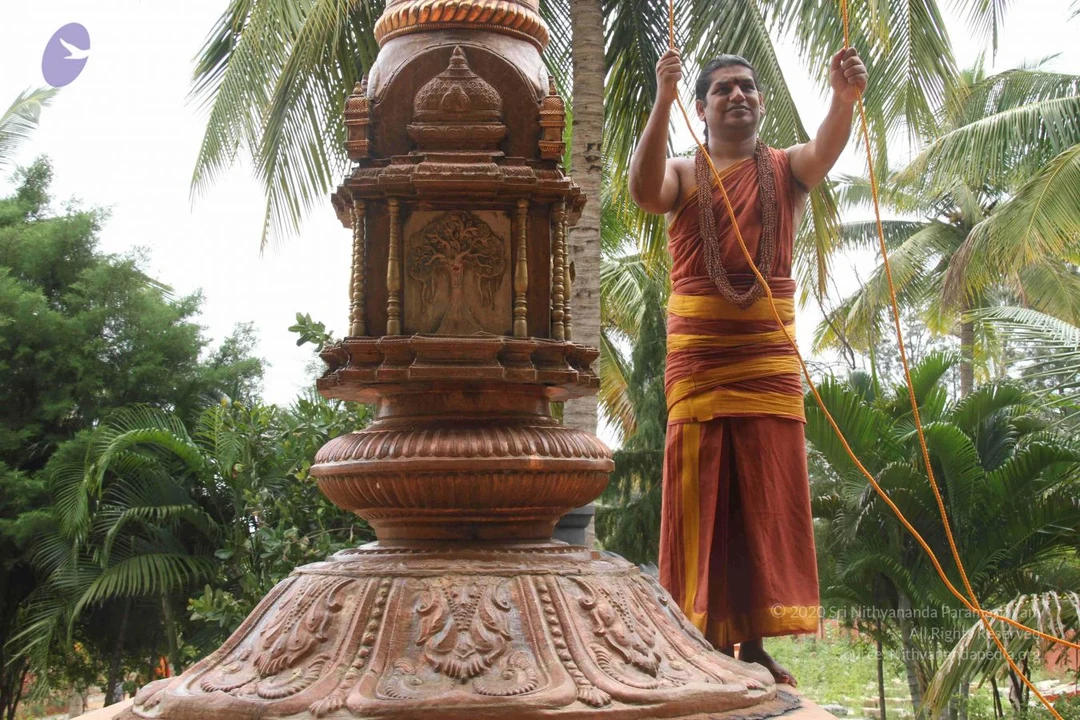
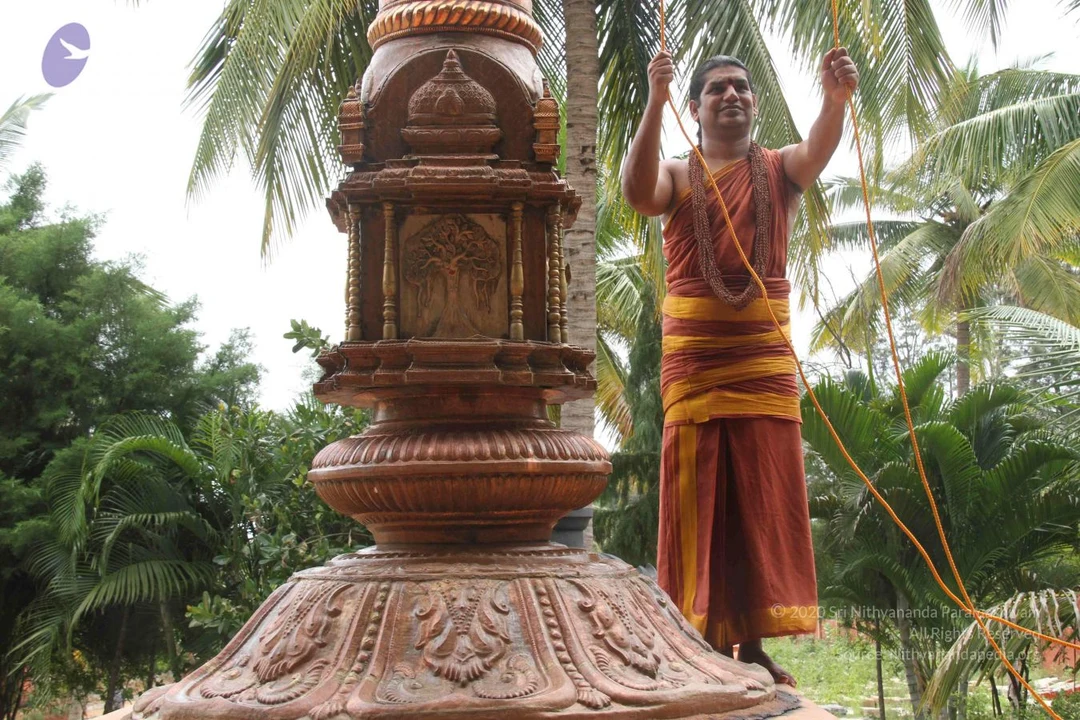
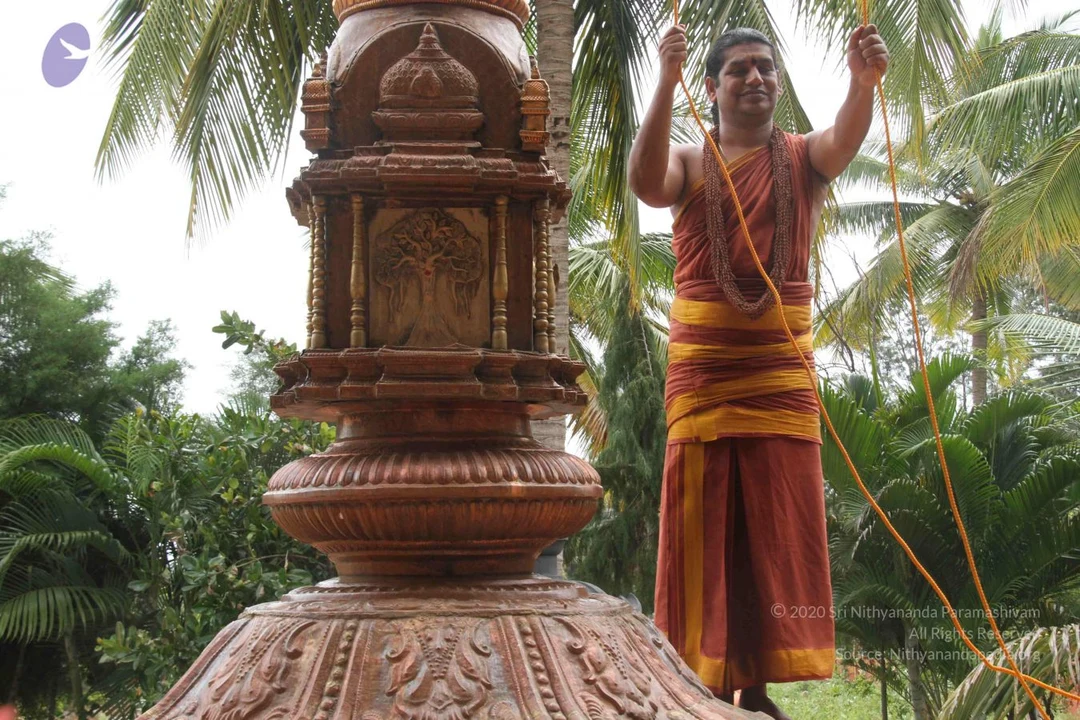
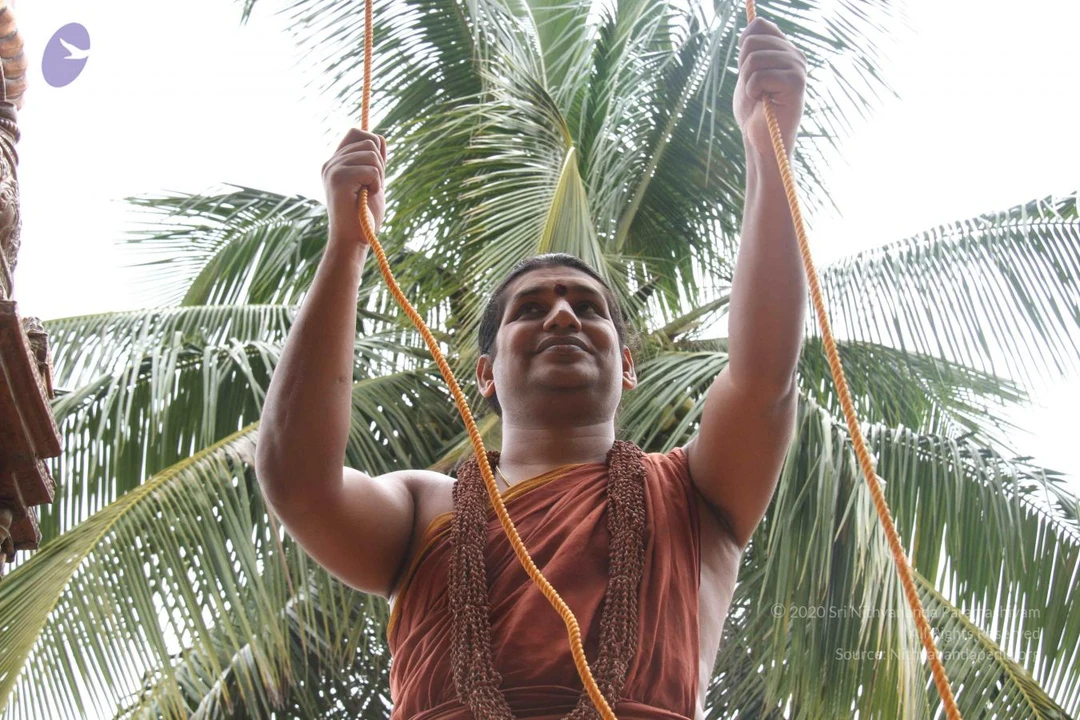
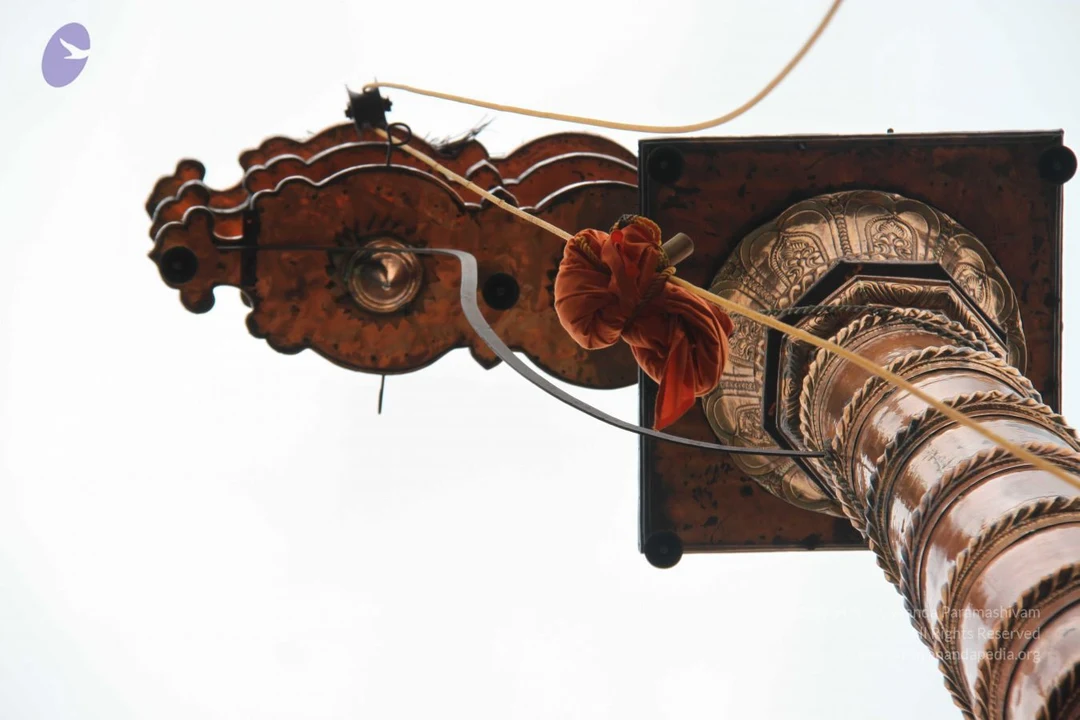
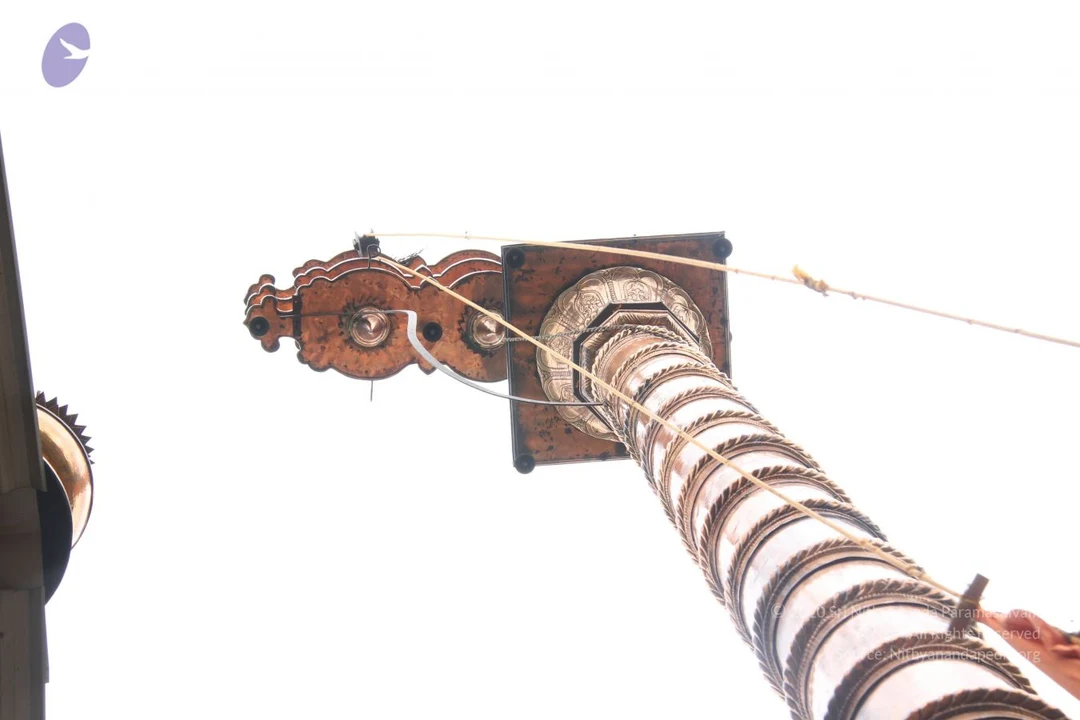
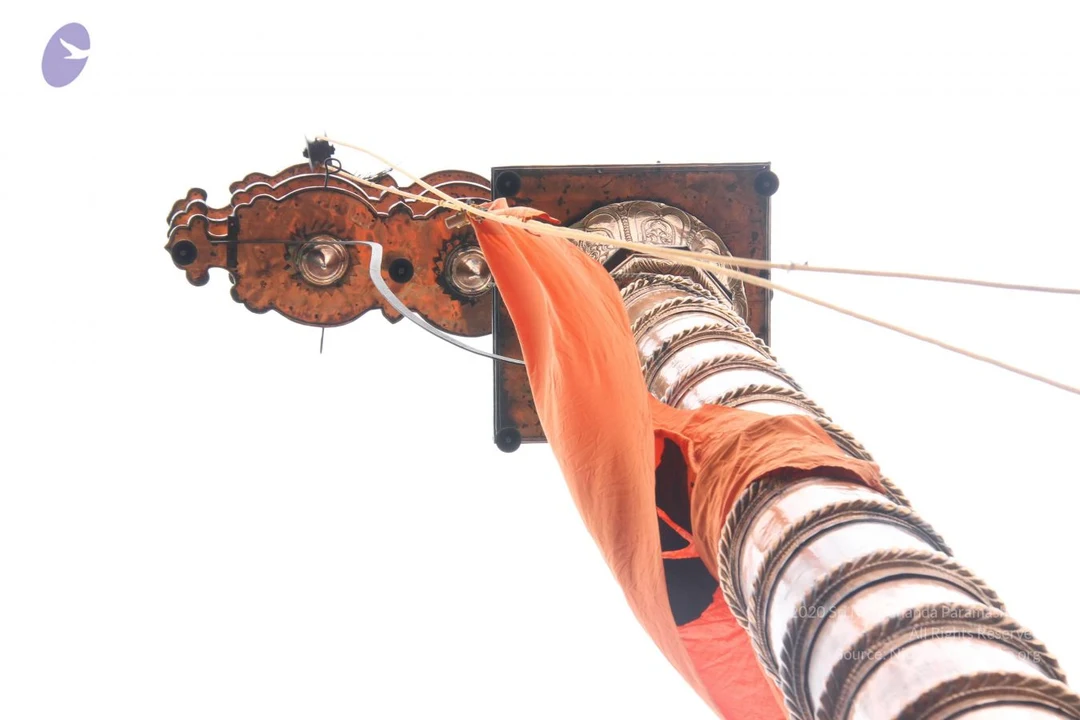
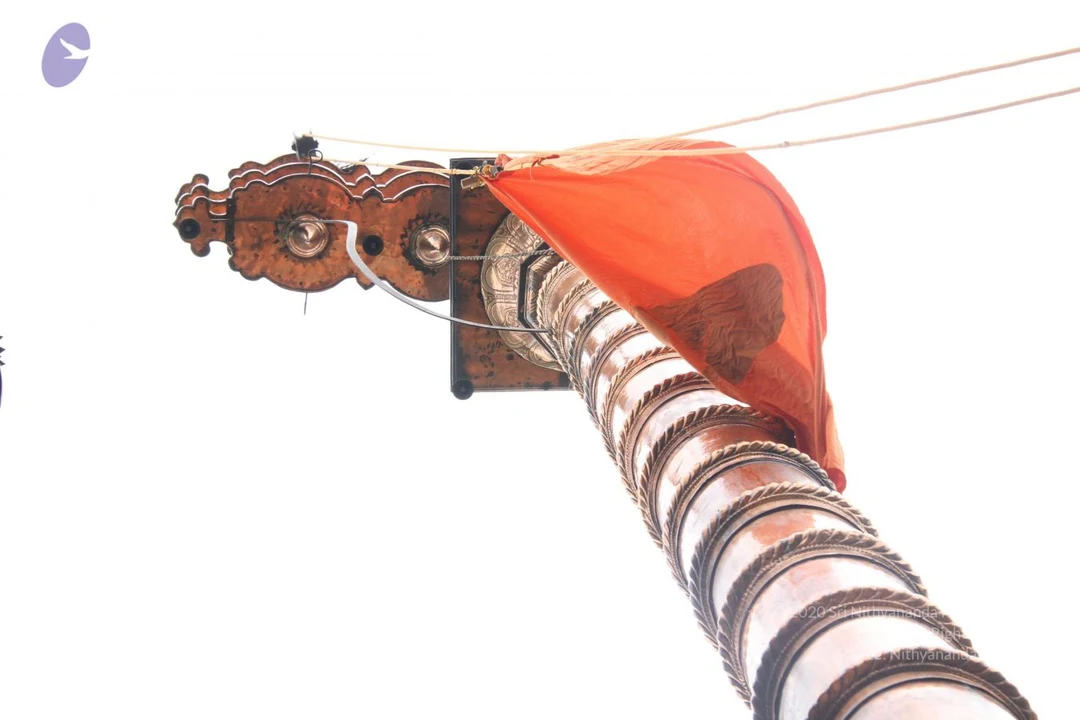
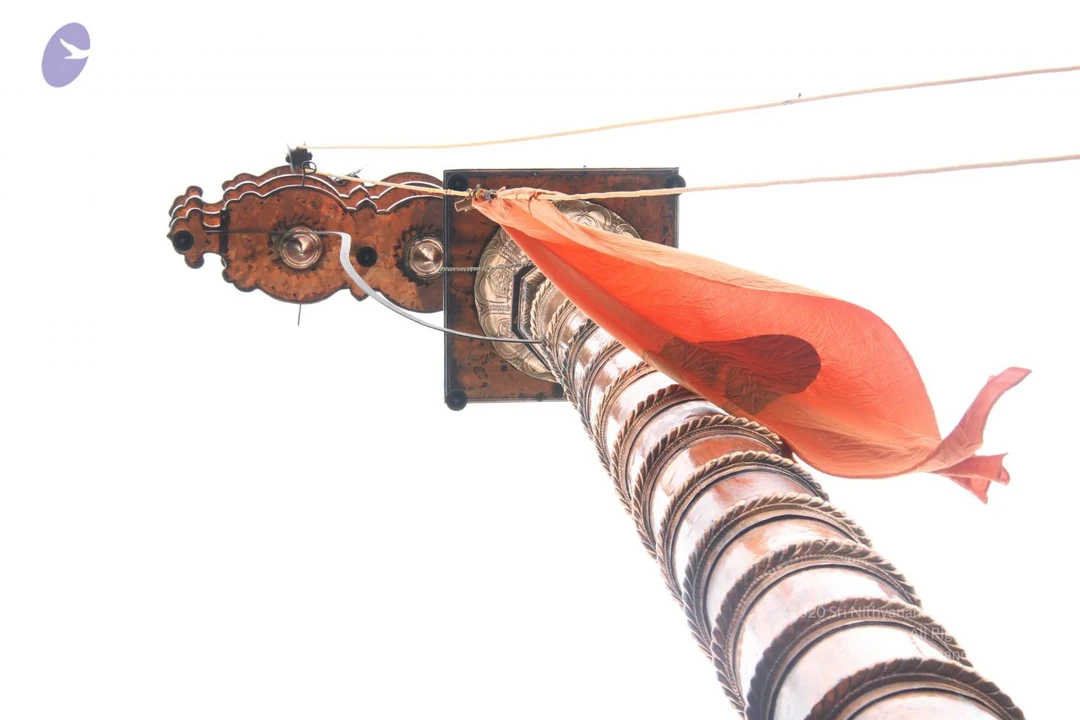
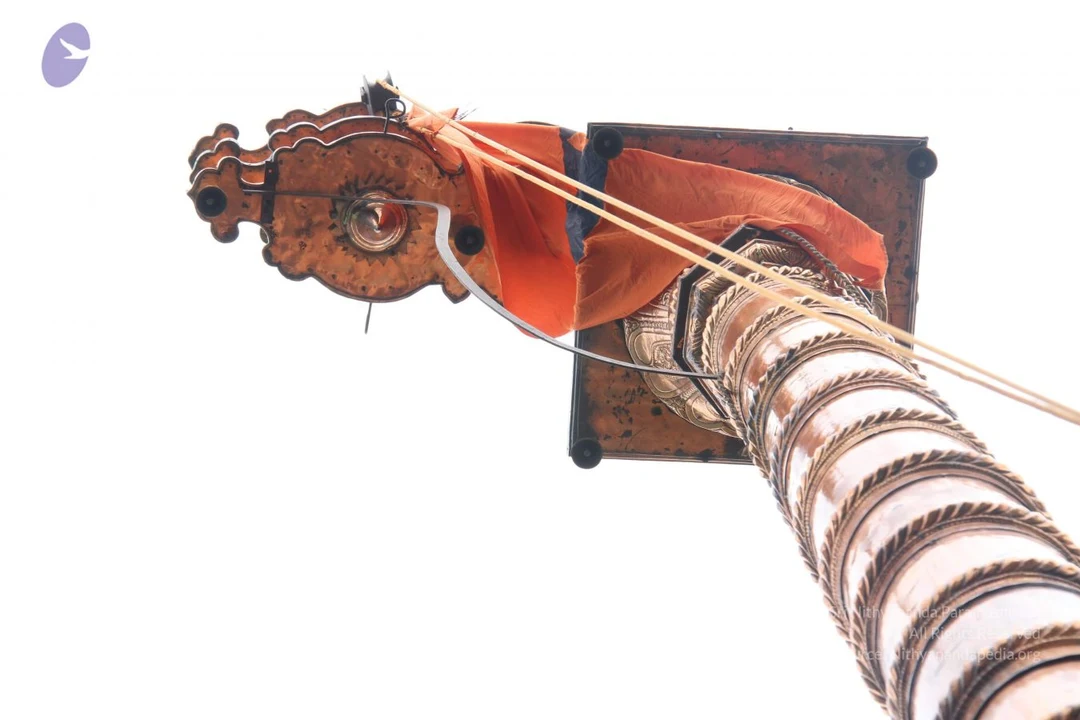
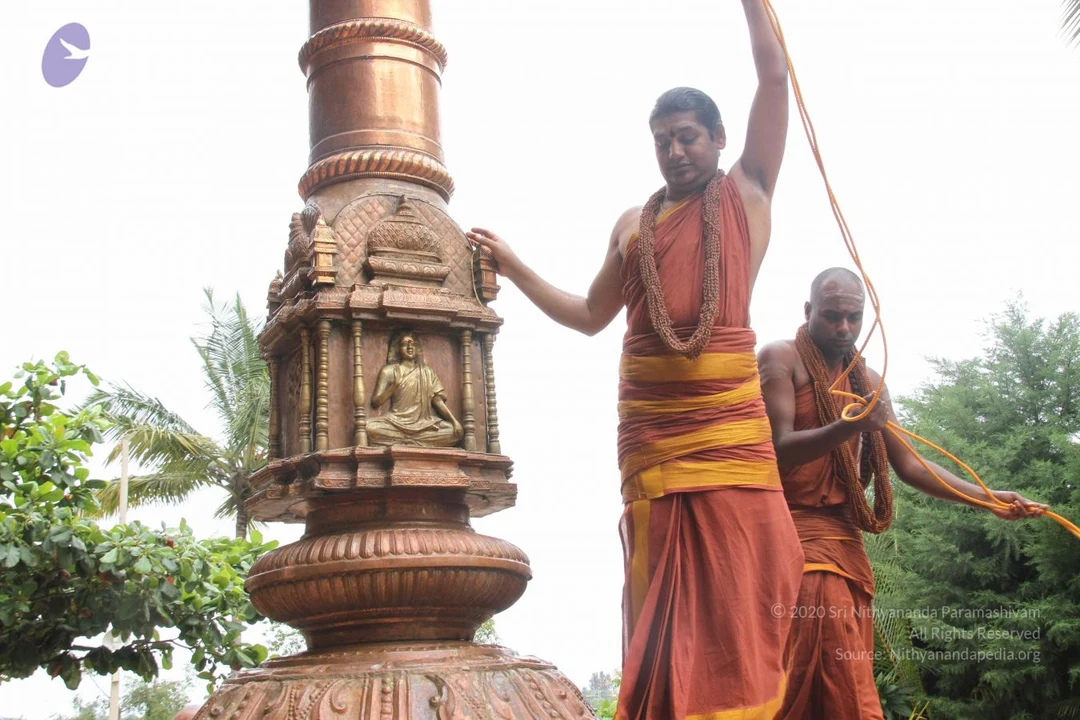
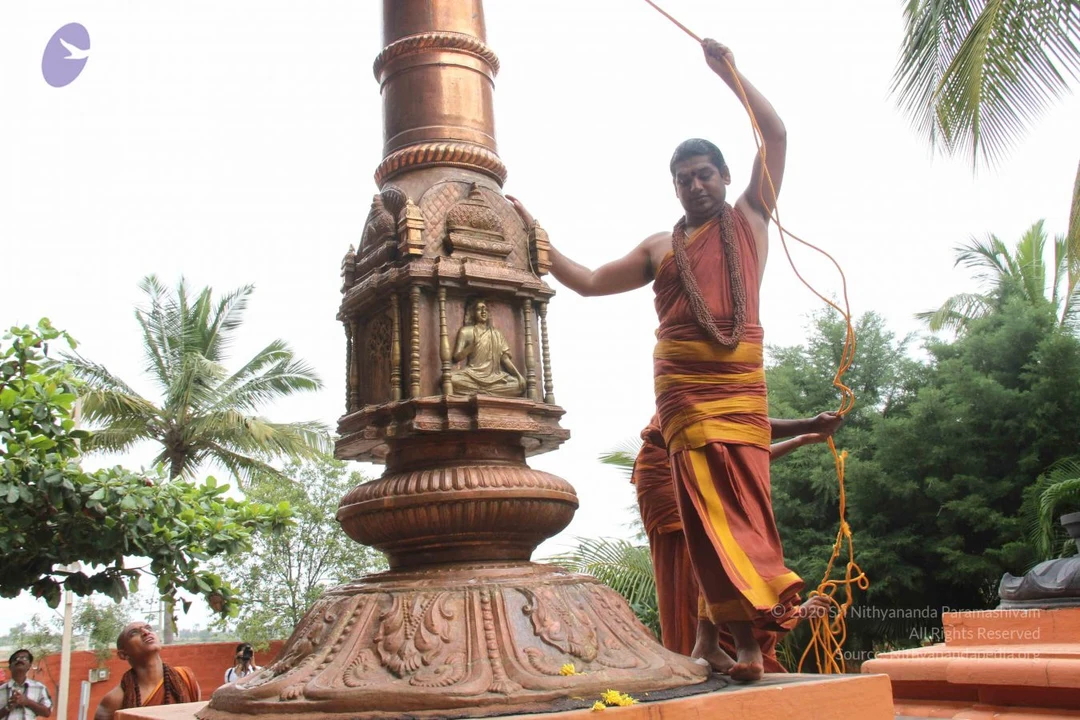
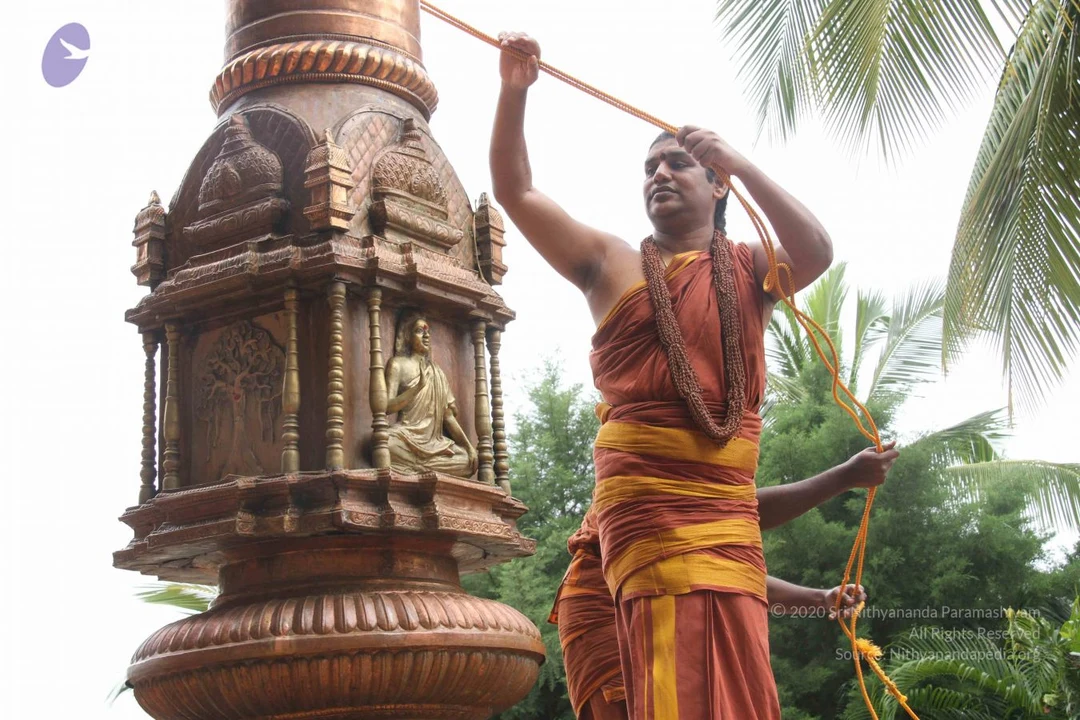
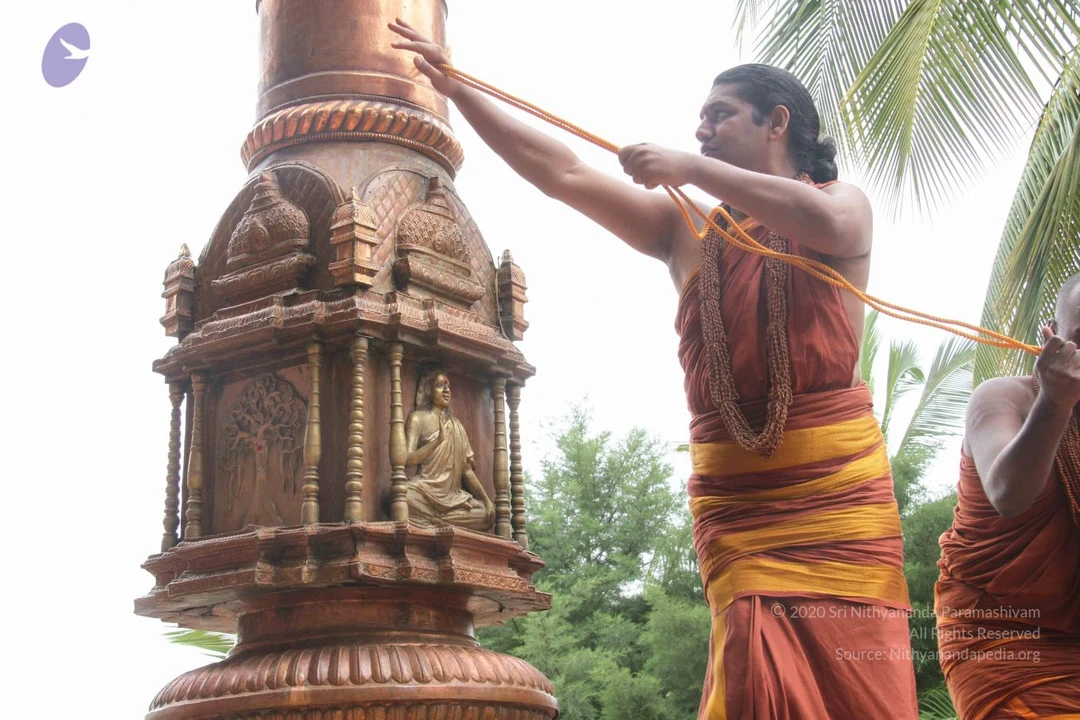
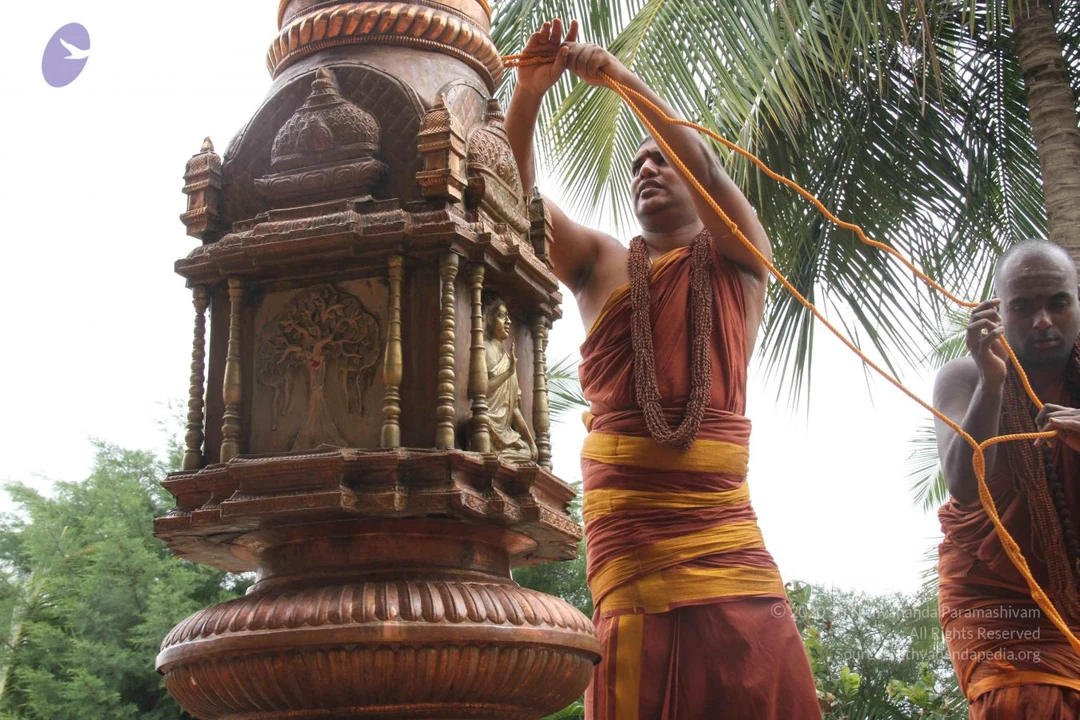
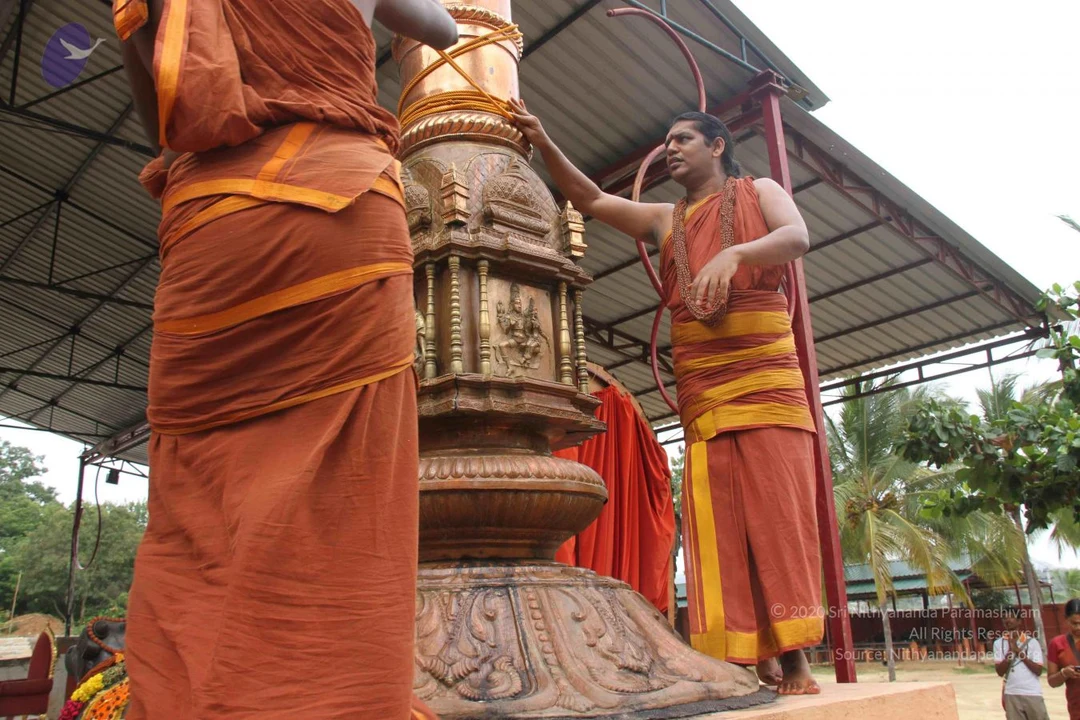
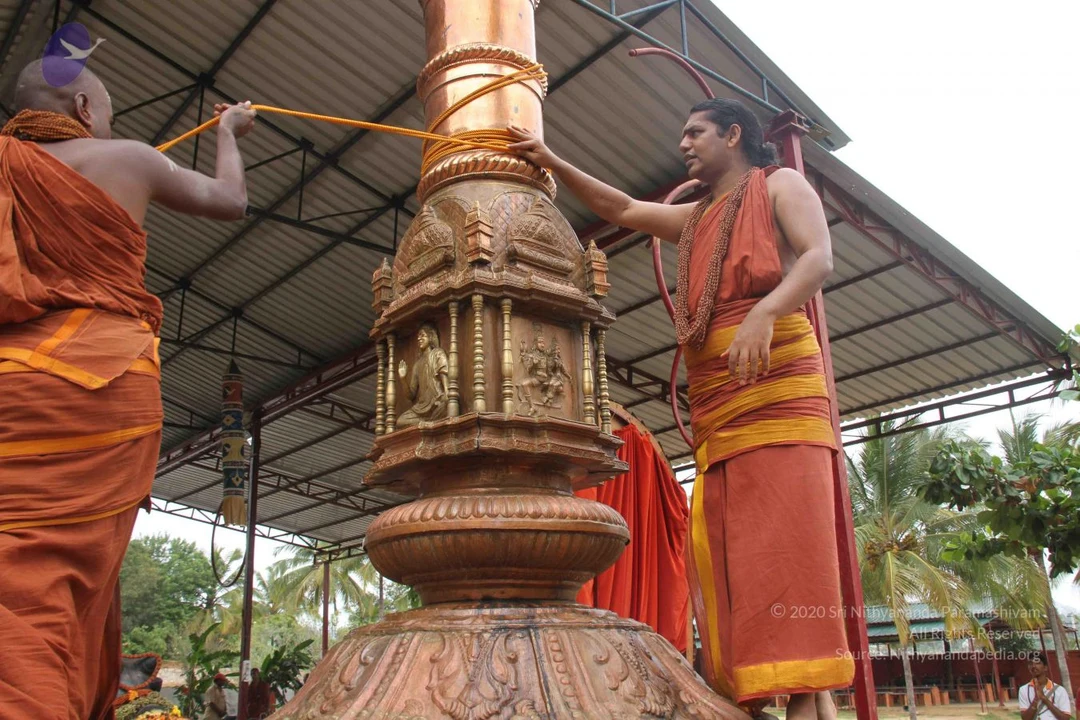
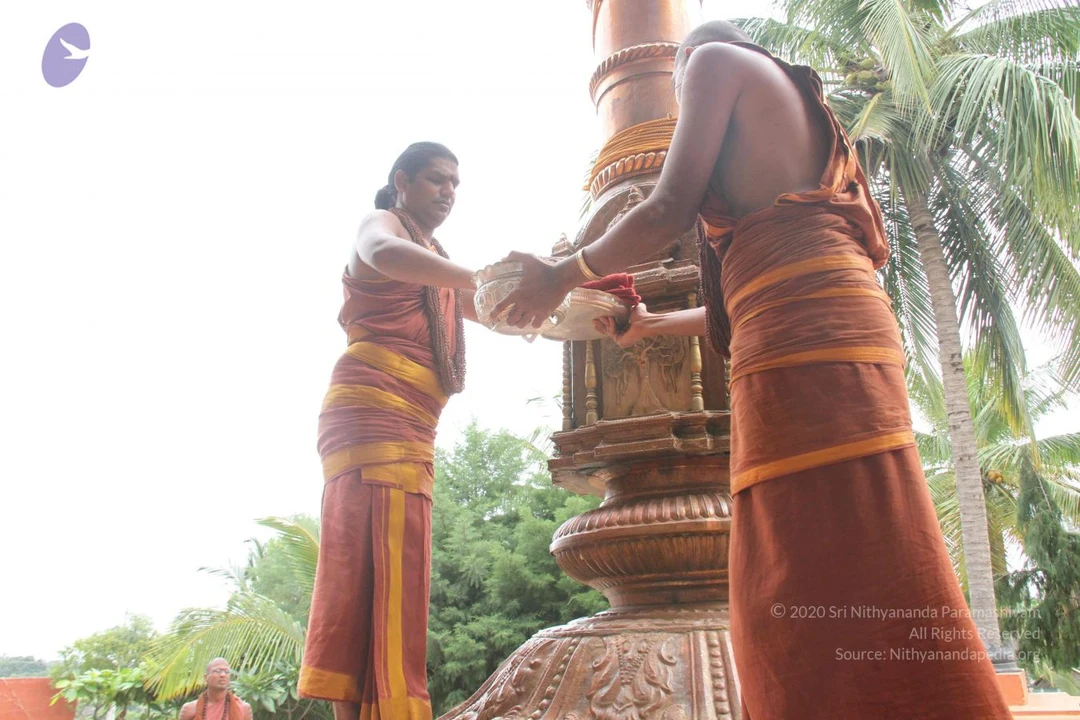
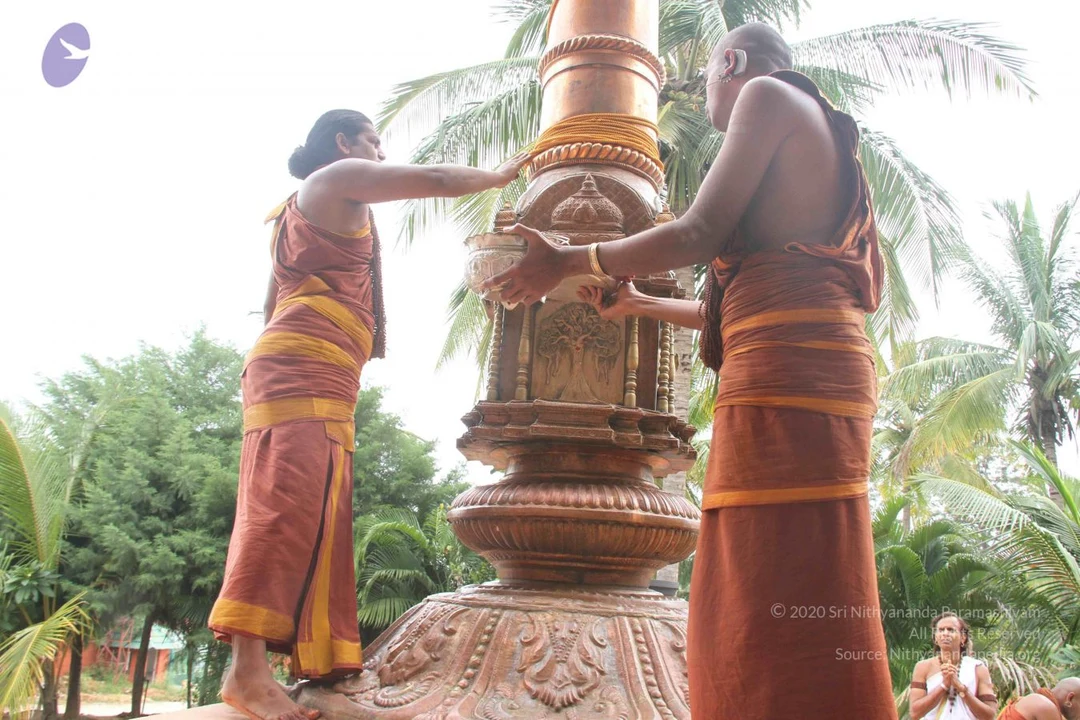
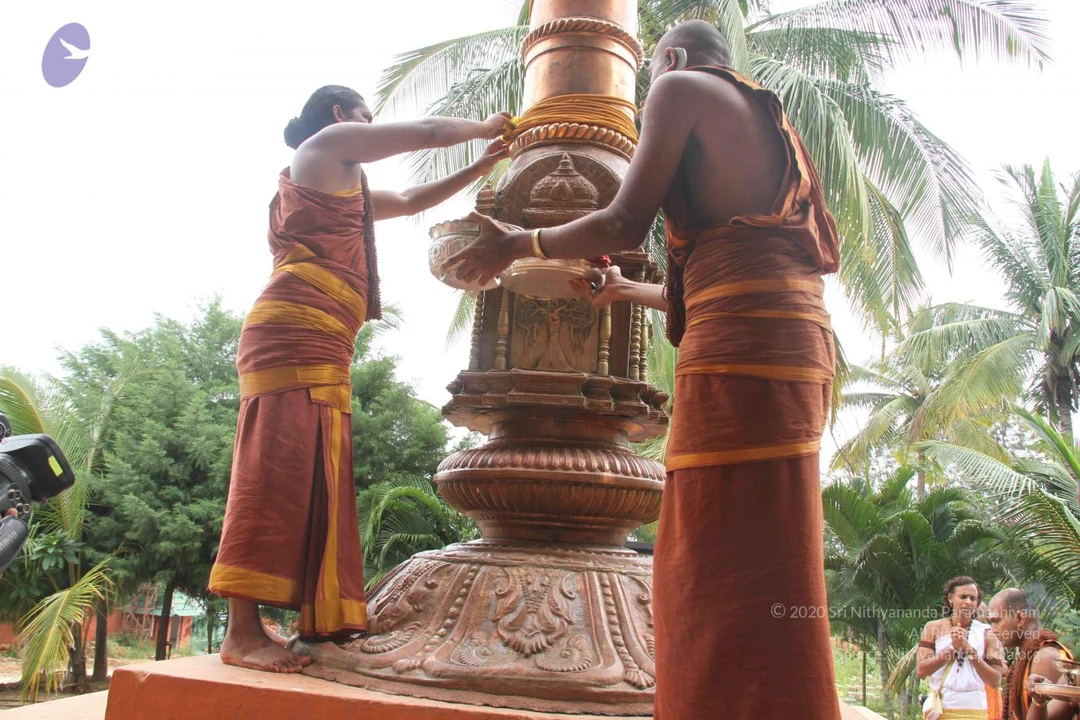
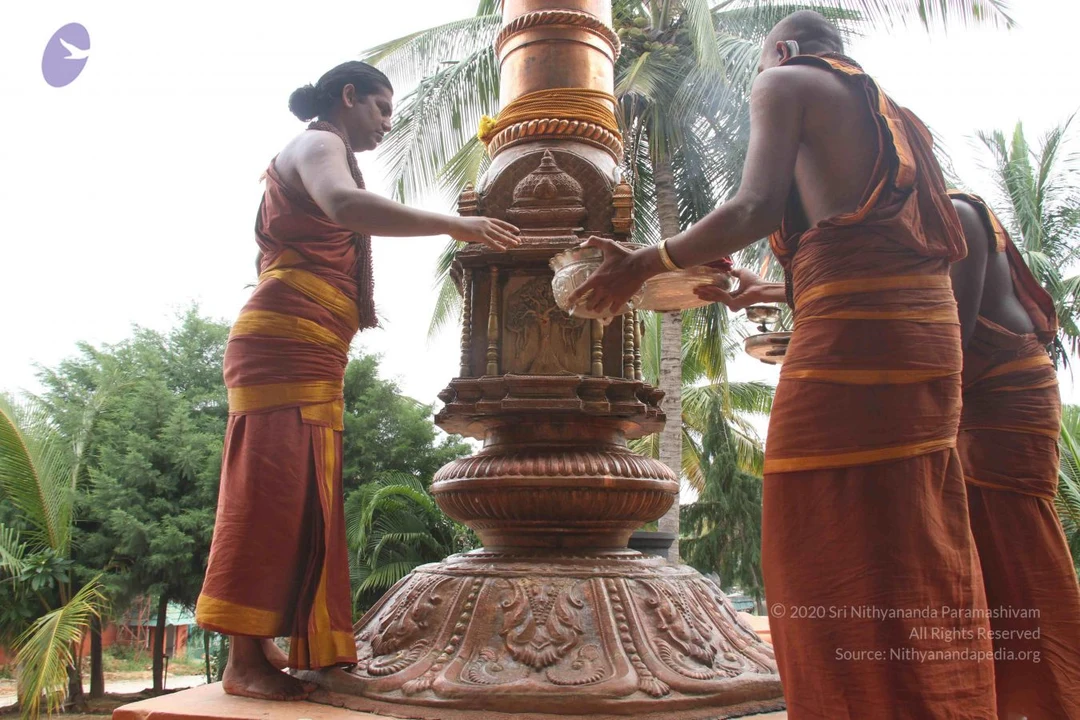
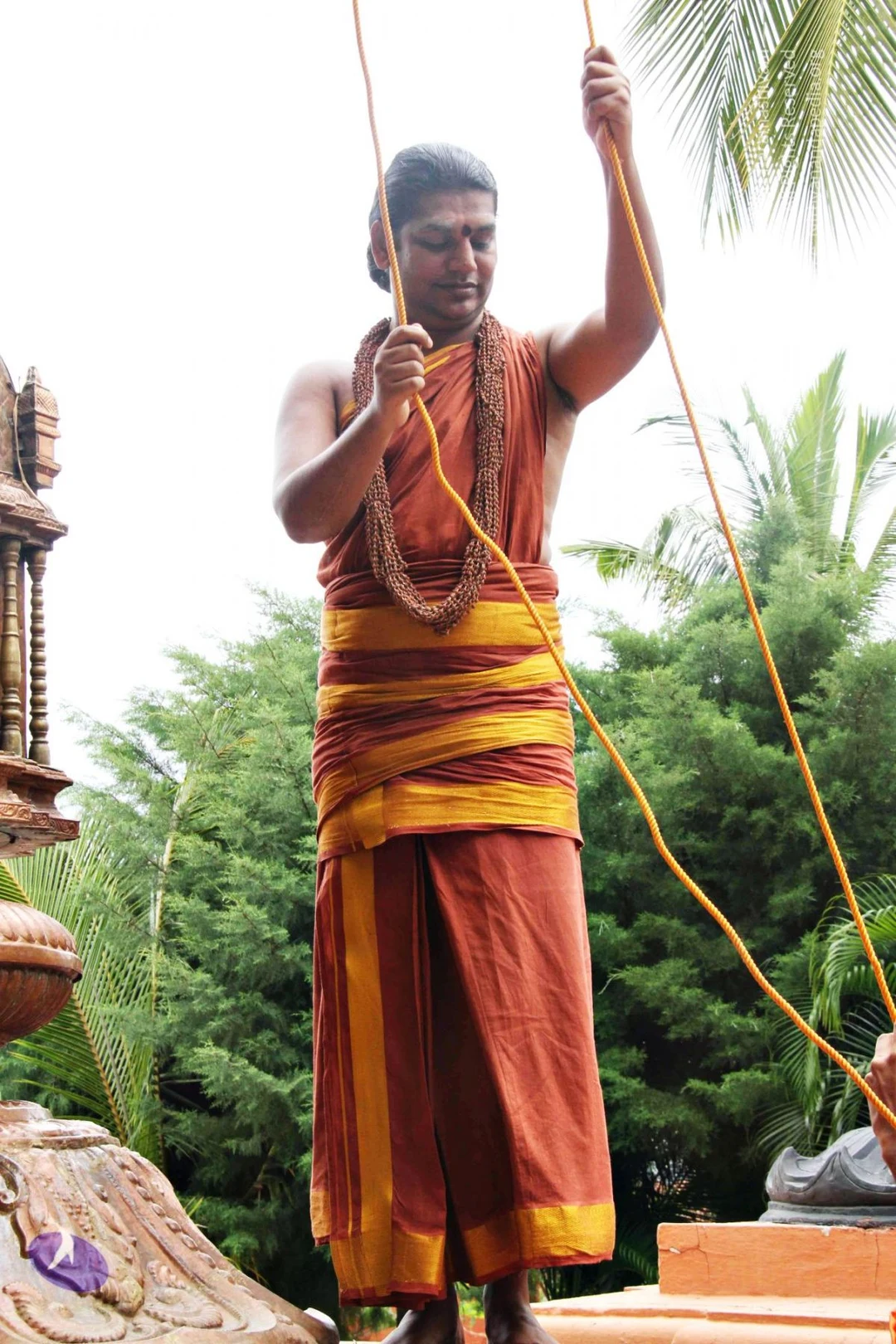
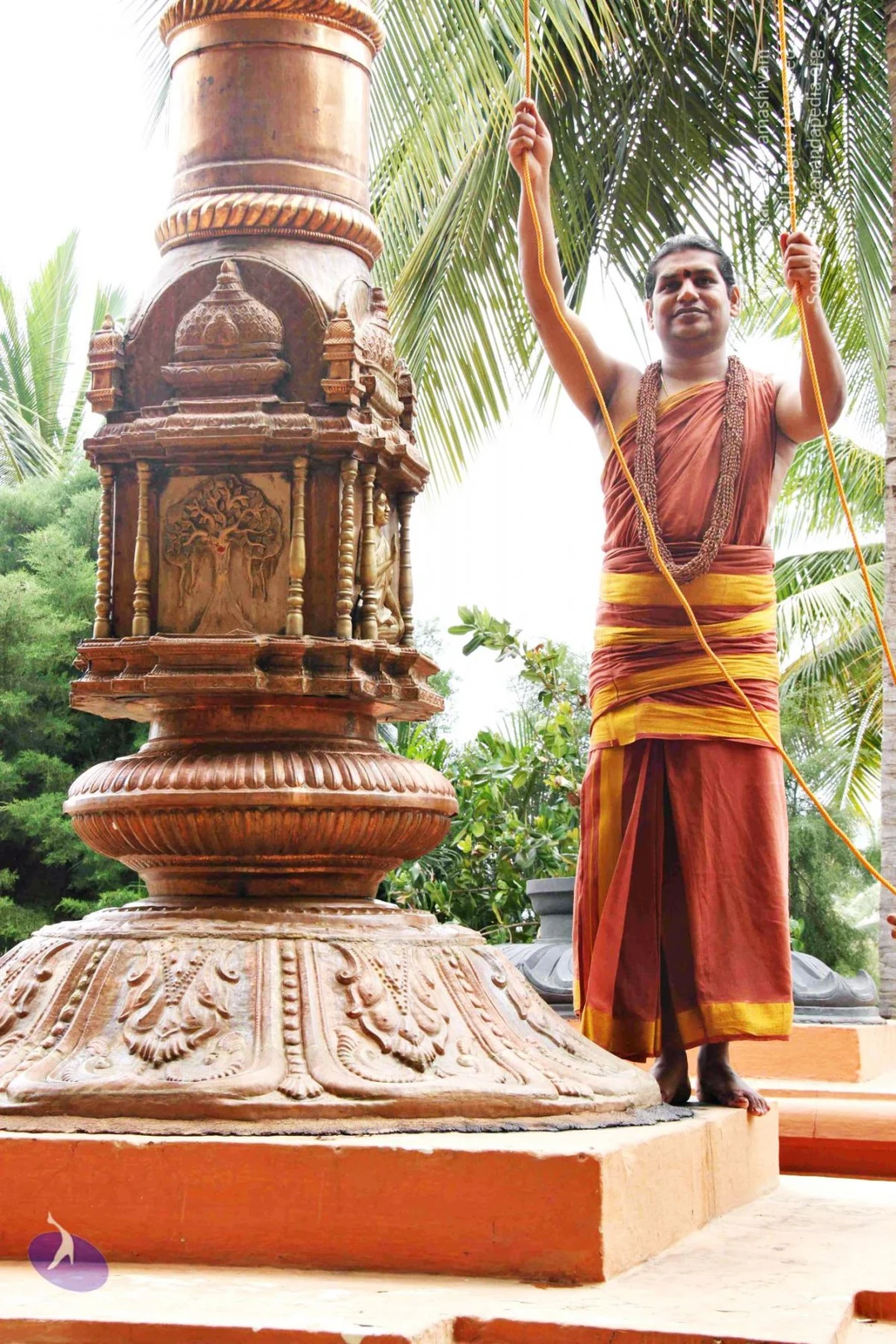
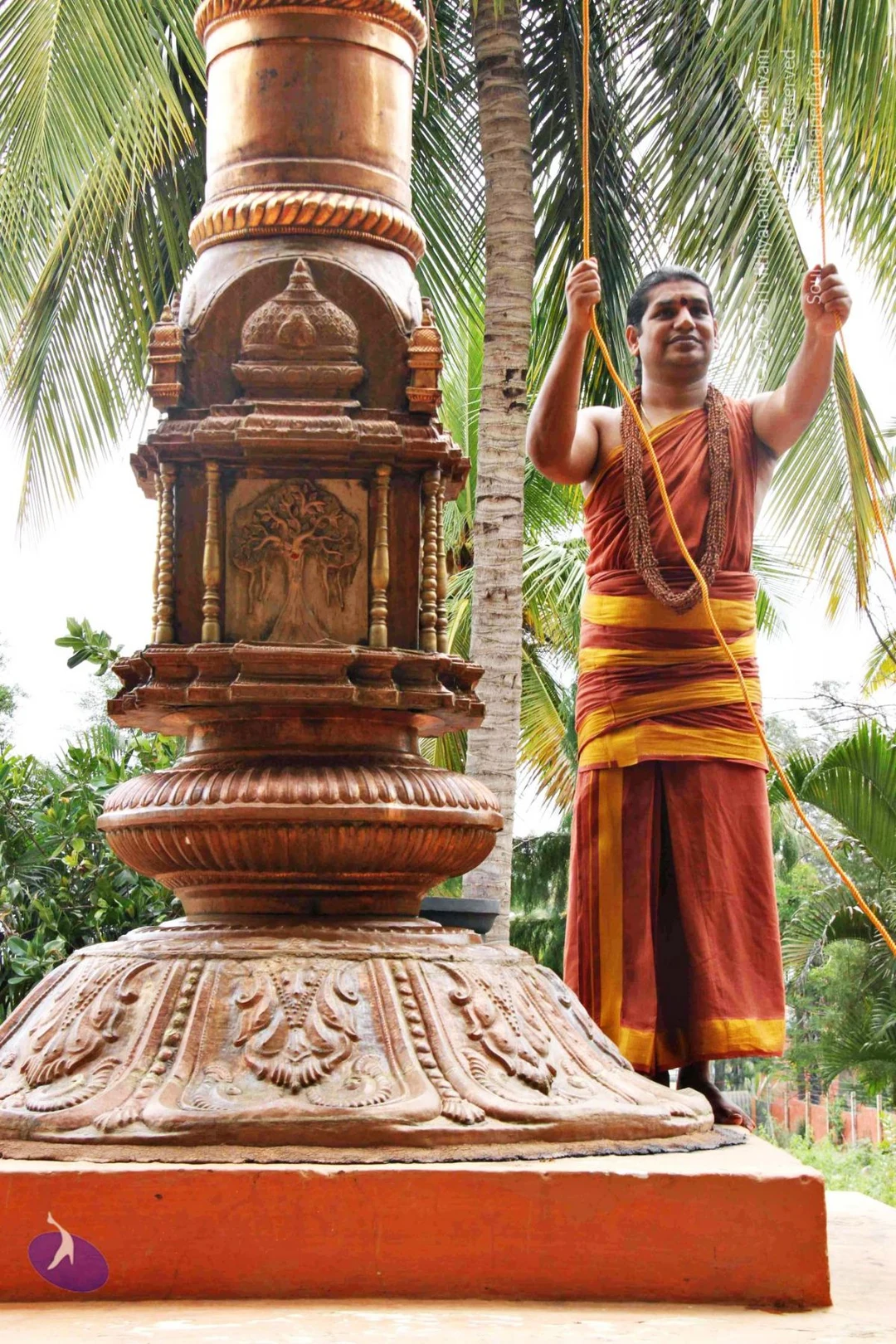
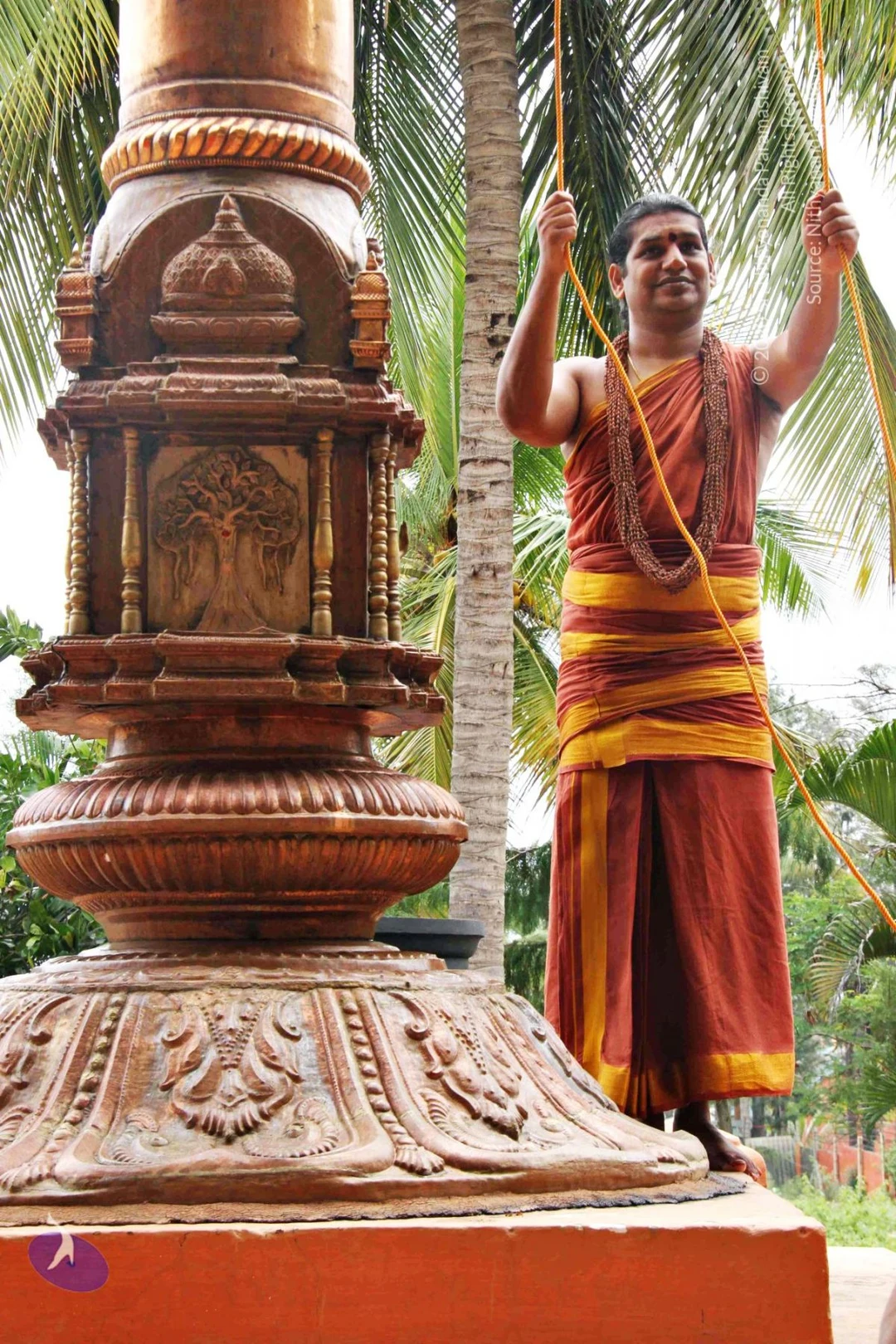
DWAJAROHANAM

Photos Of The Day:

Padapooja

Temple

Nithya-Satsang-Swamiji

SarvaDarshan-Pics

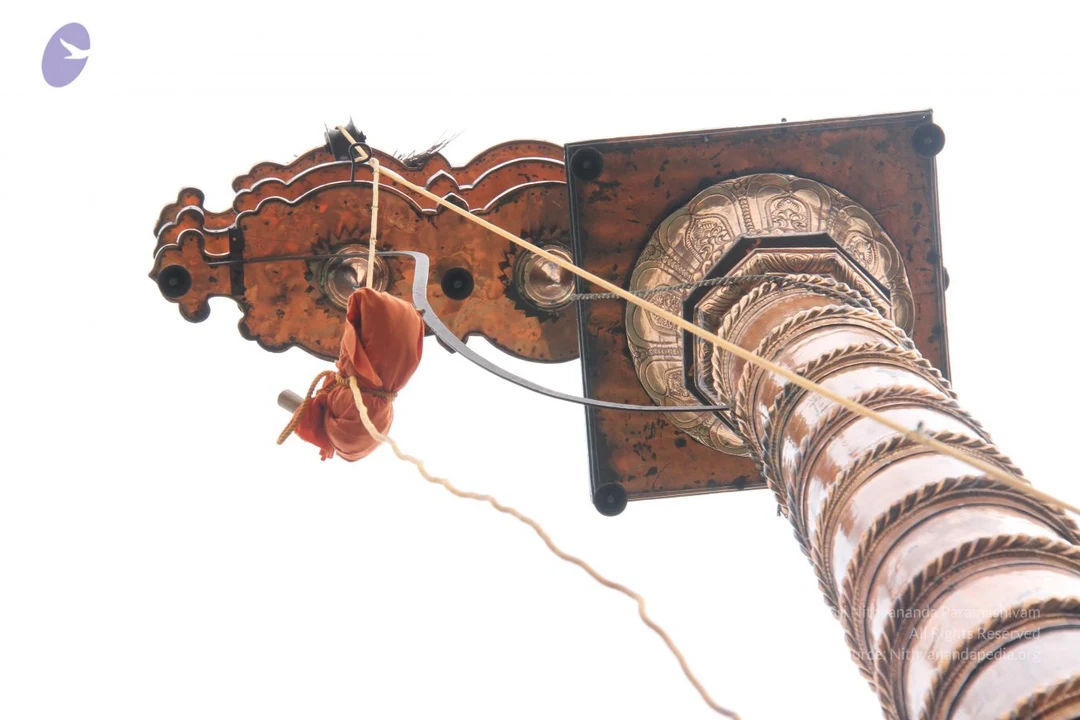
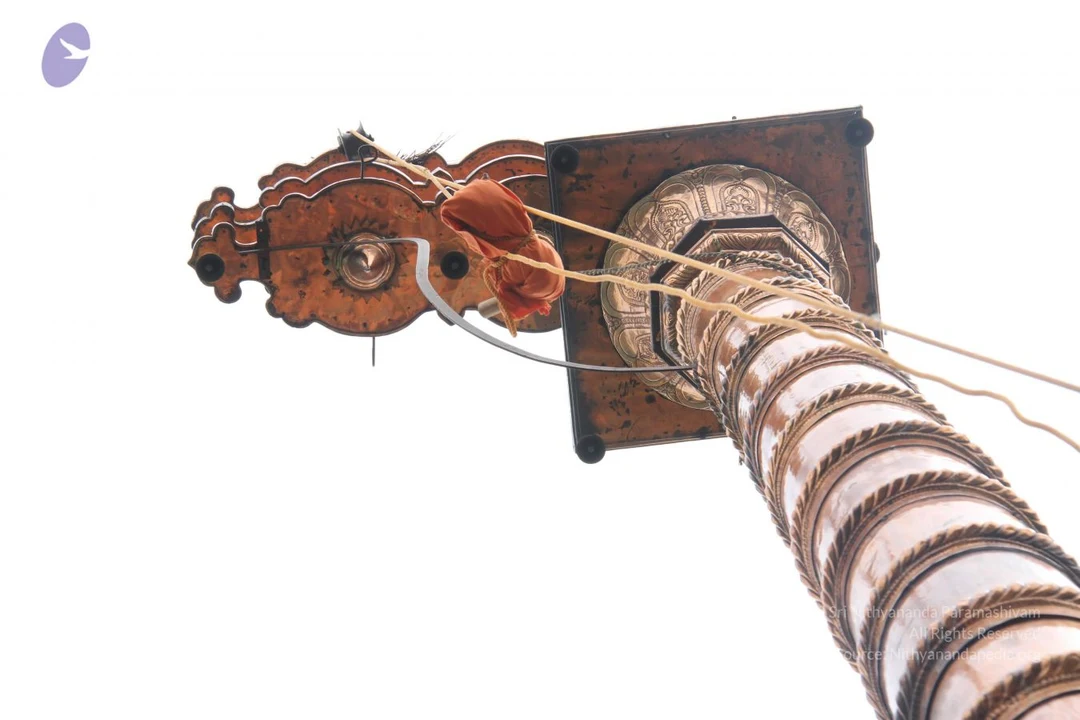
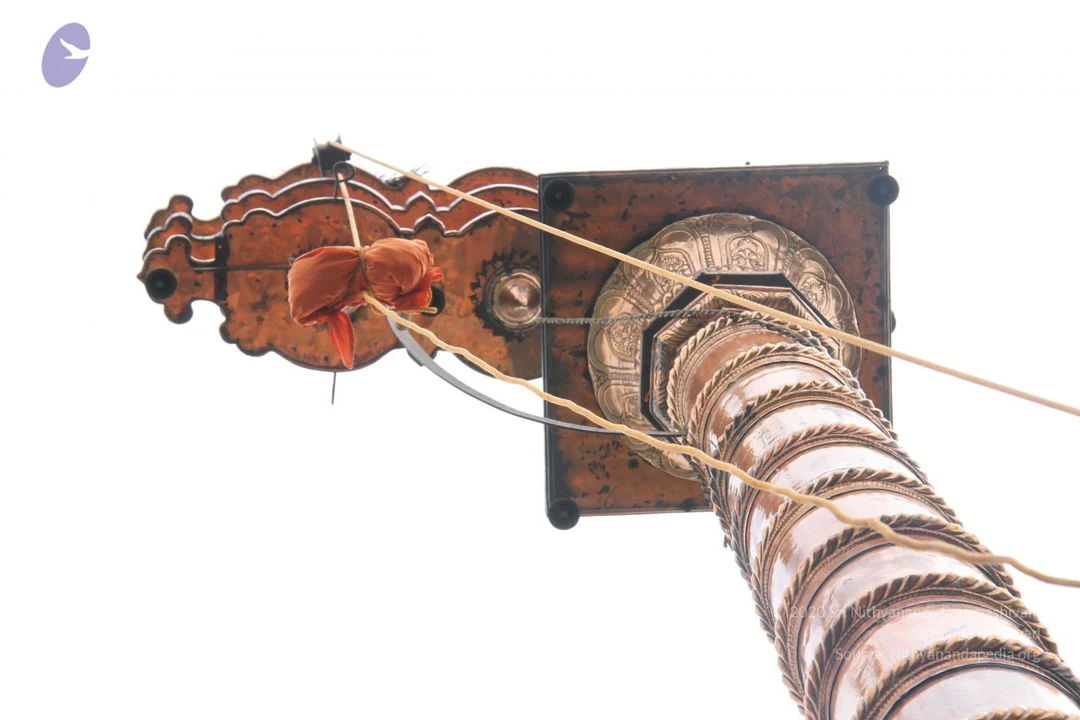
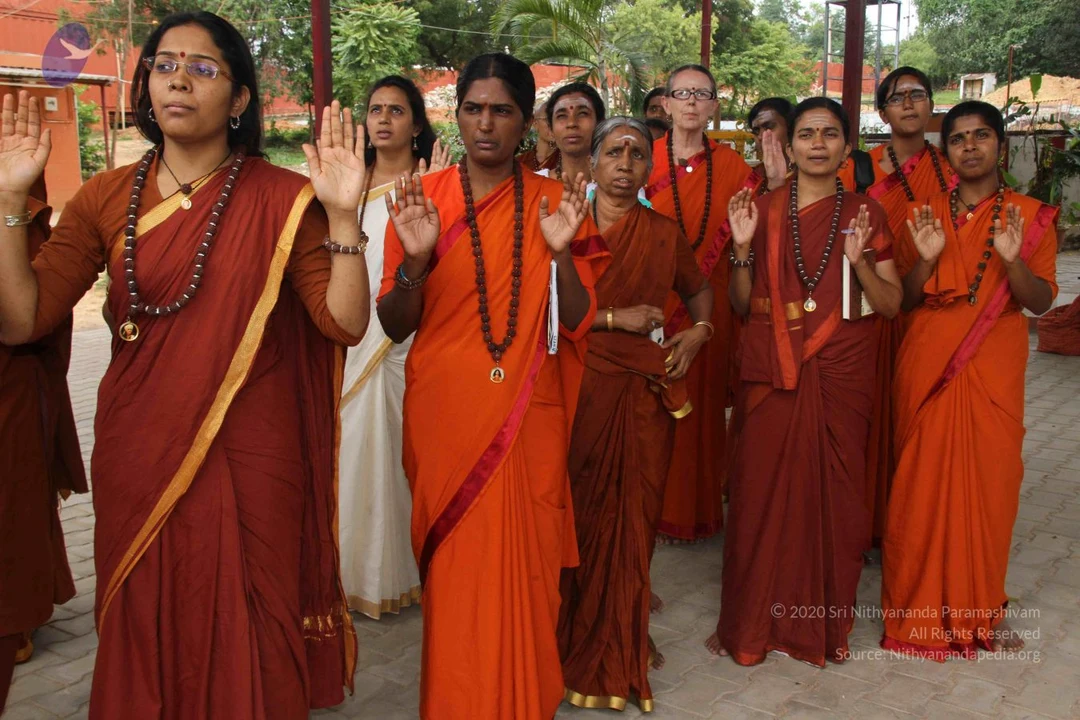
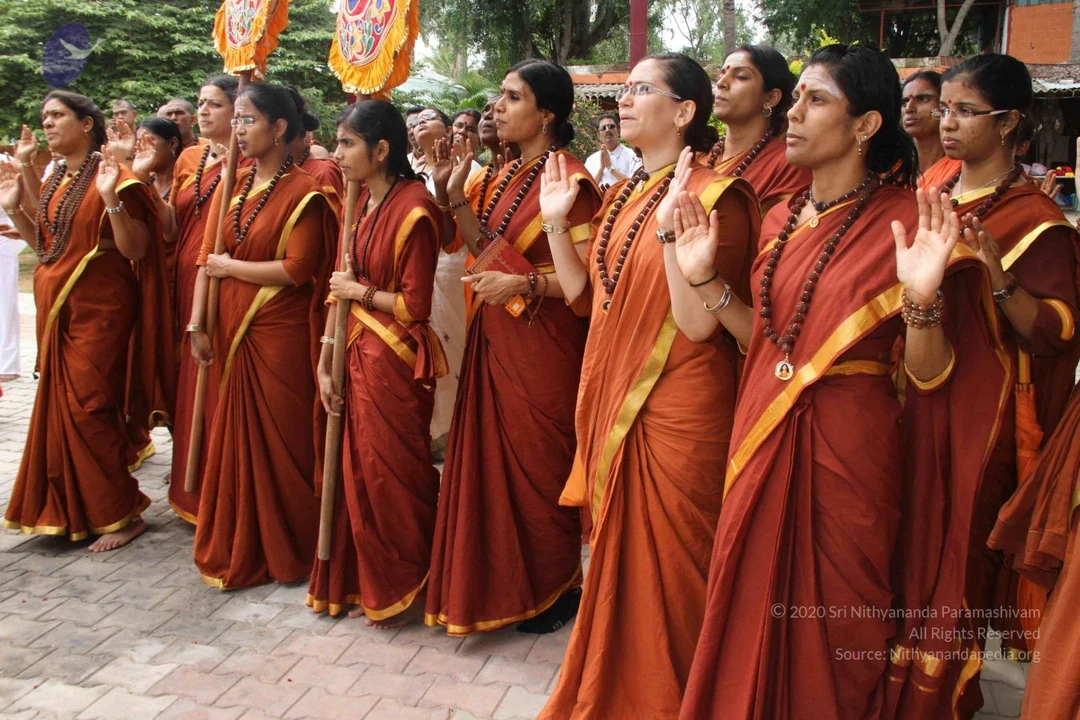
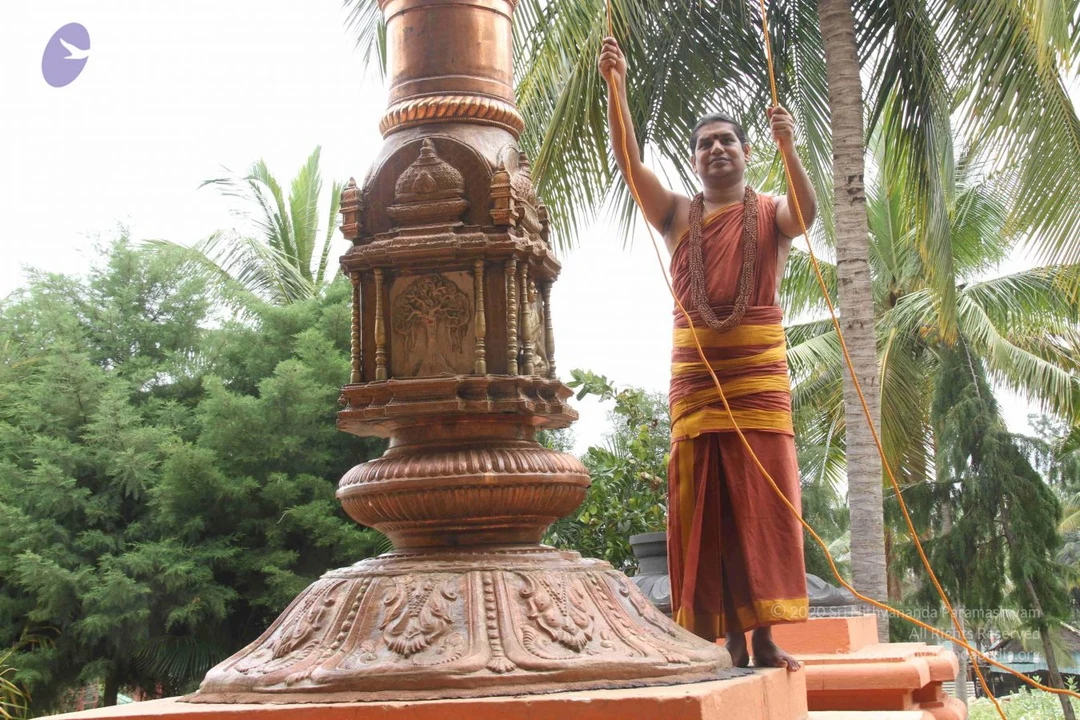
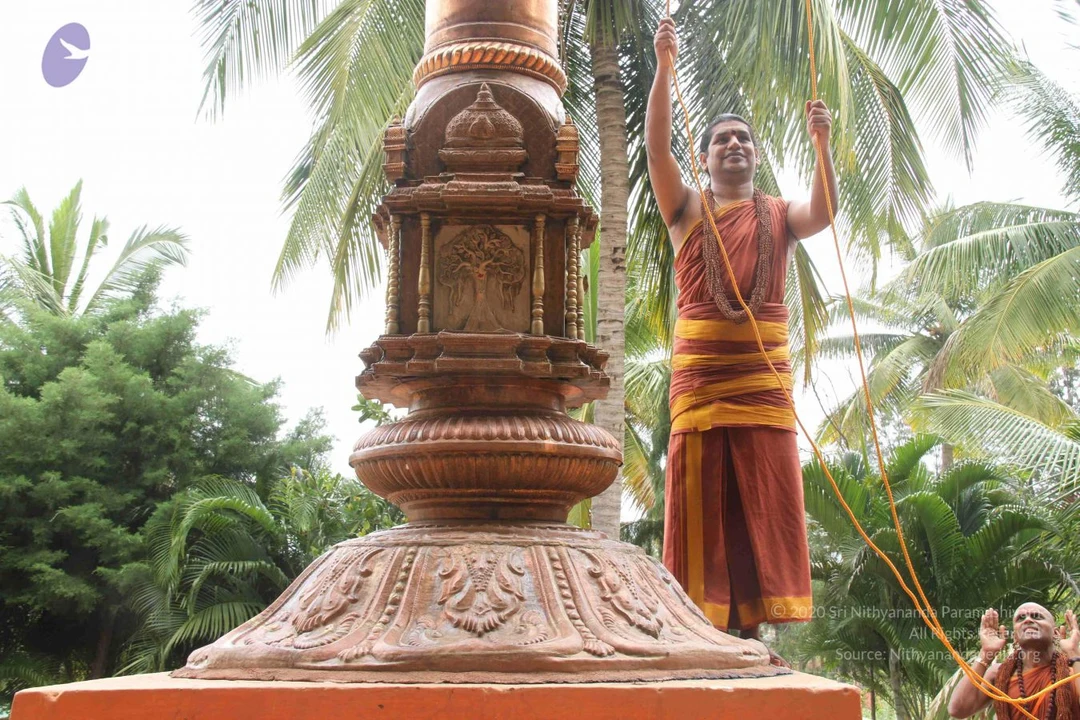
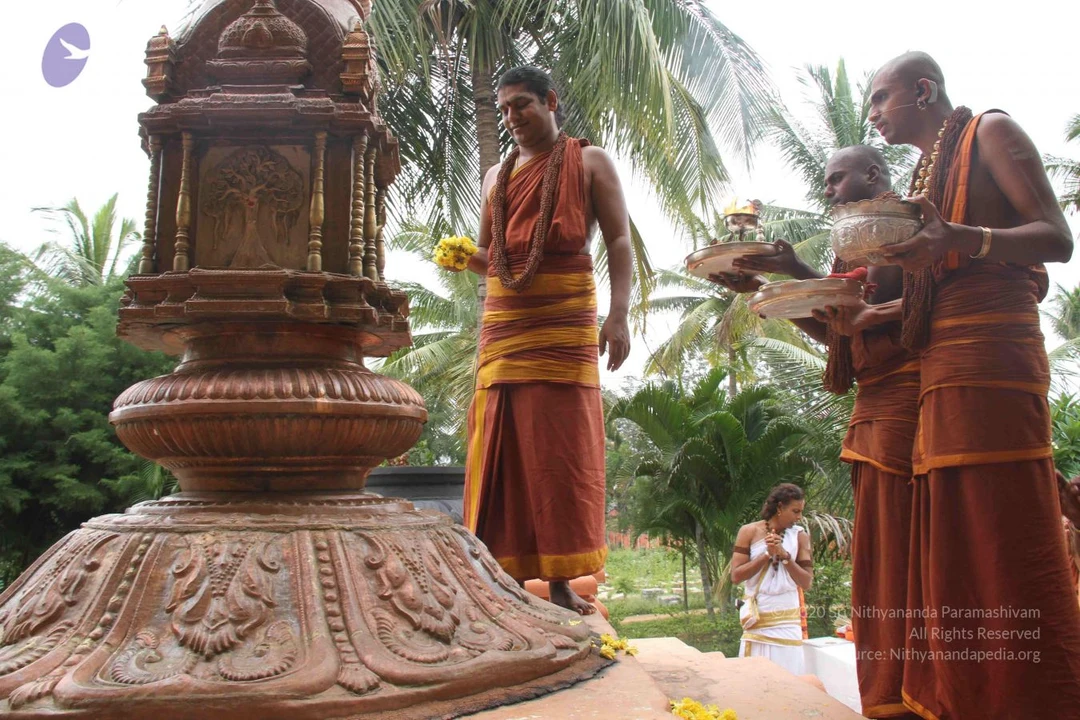
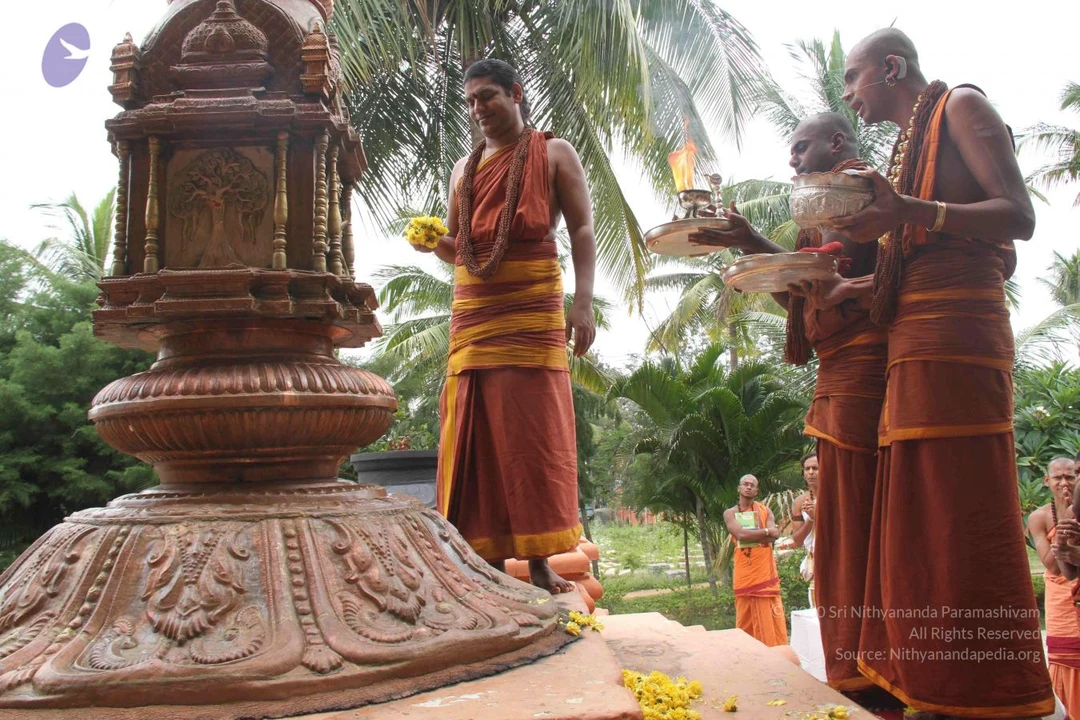
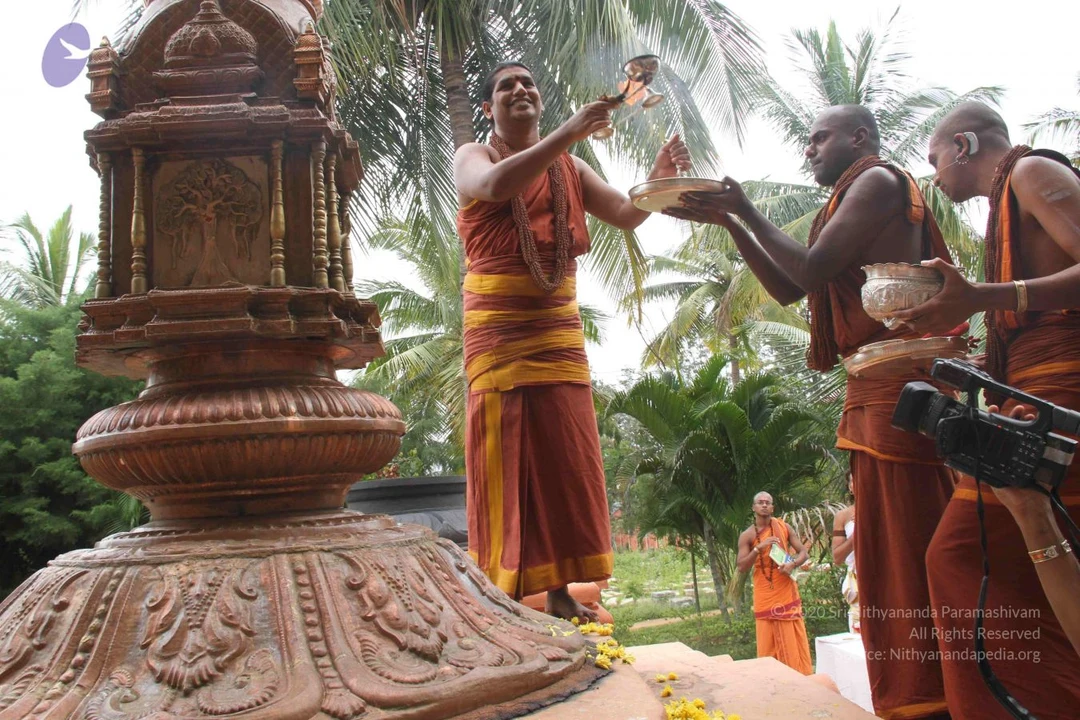
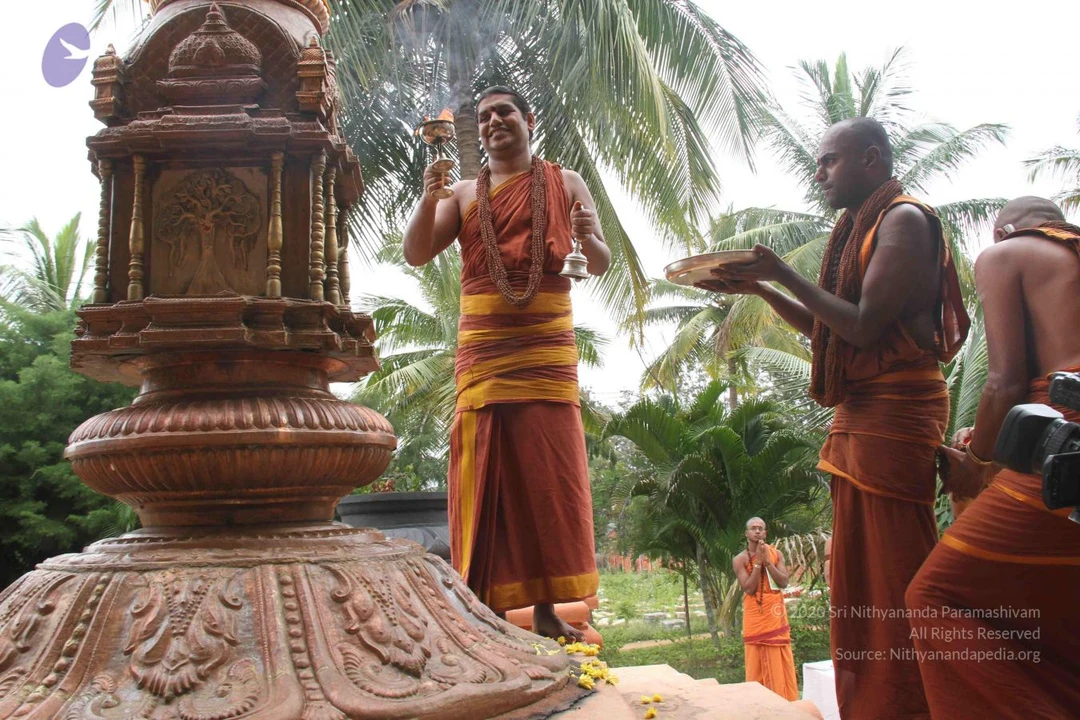
Divajarohanam-Swamiji-FlagHoisting

Photos from this day

View all 271 photos

Photos

25 photosSource gallery
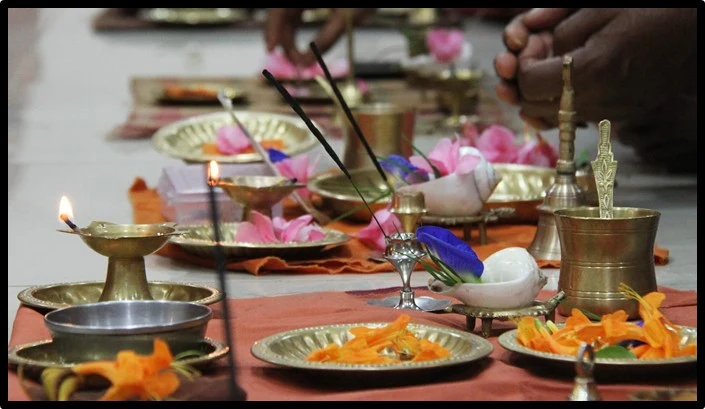
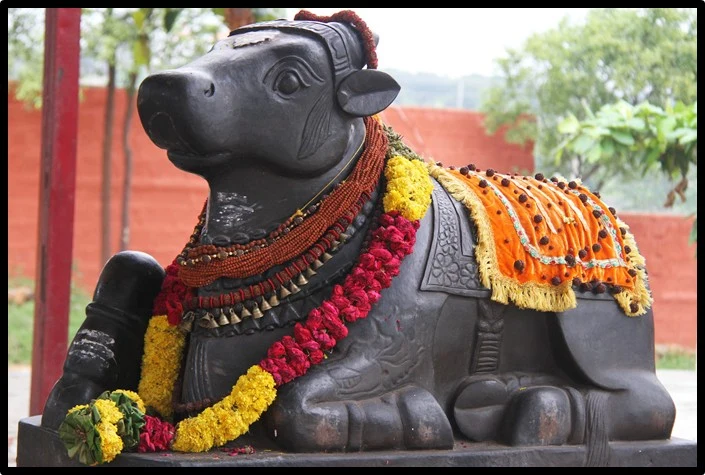
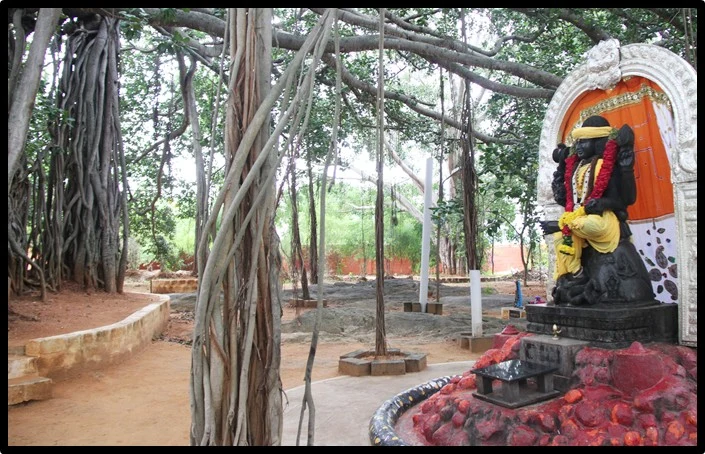
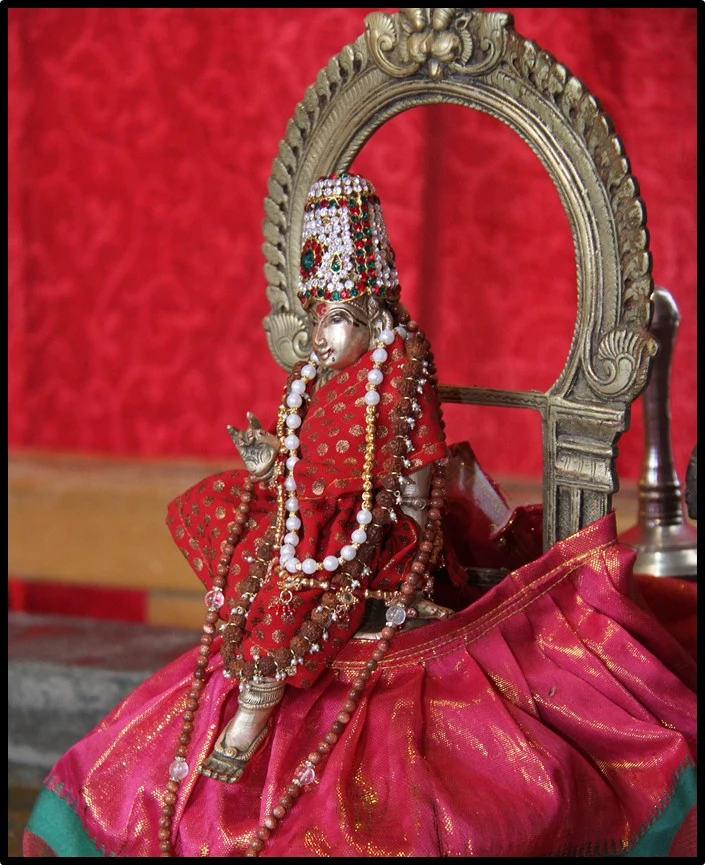
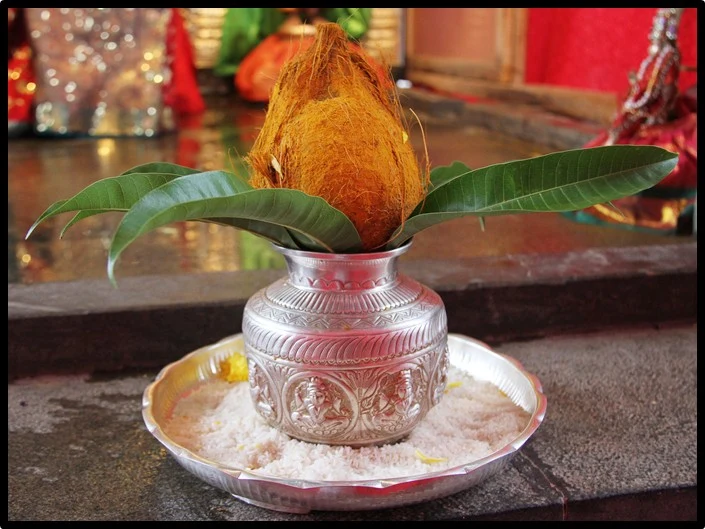
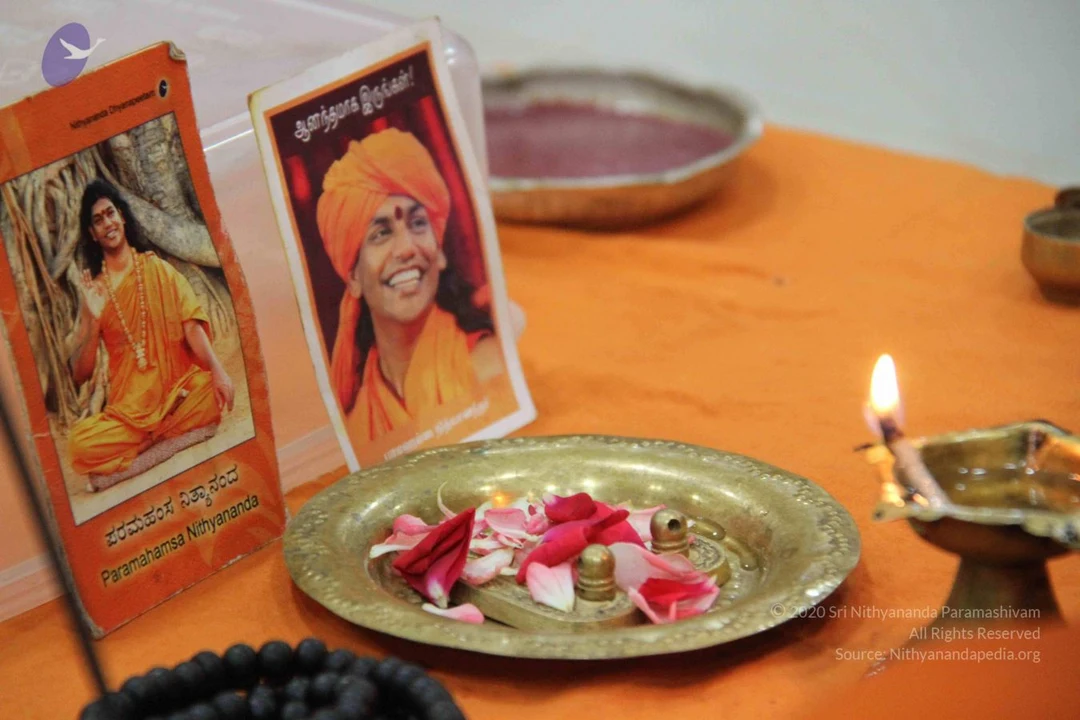
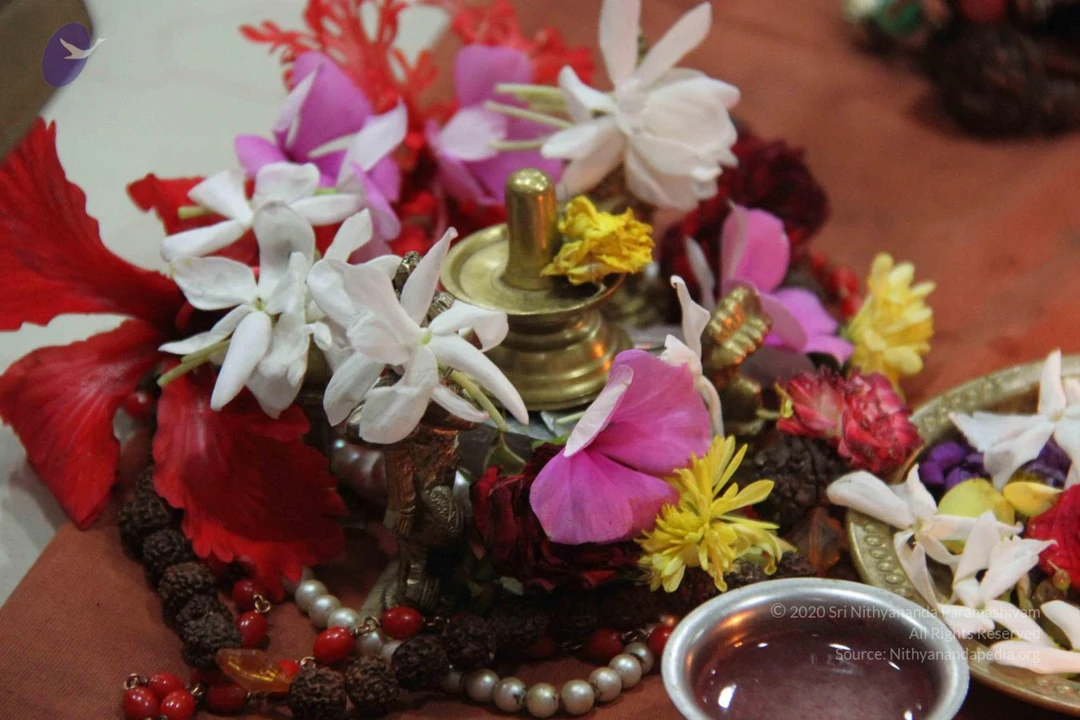
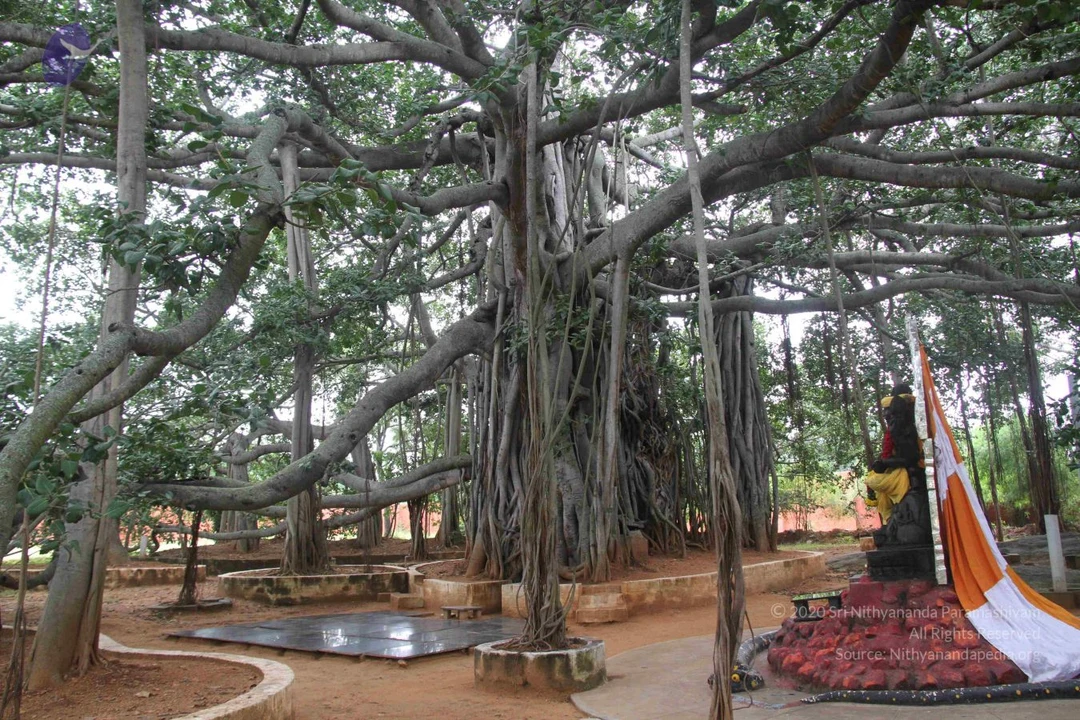
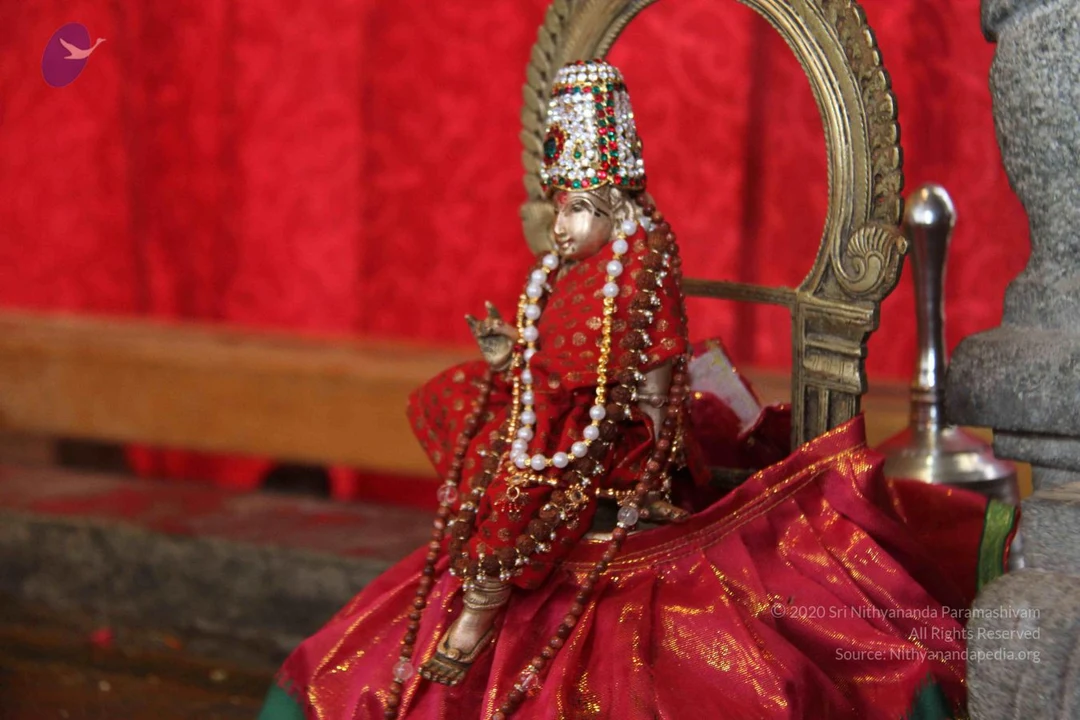
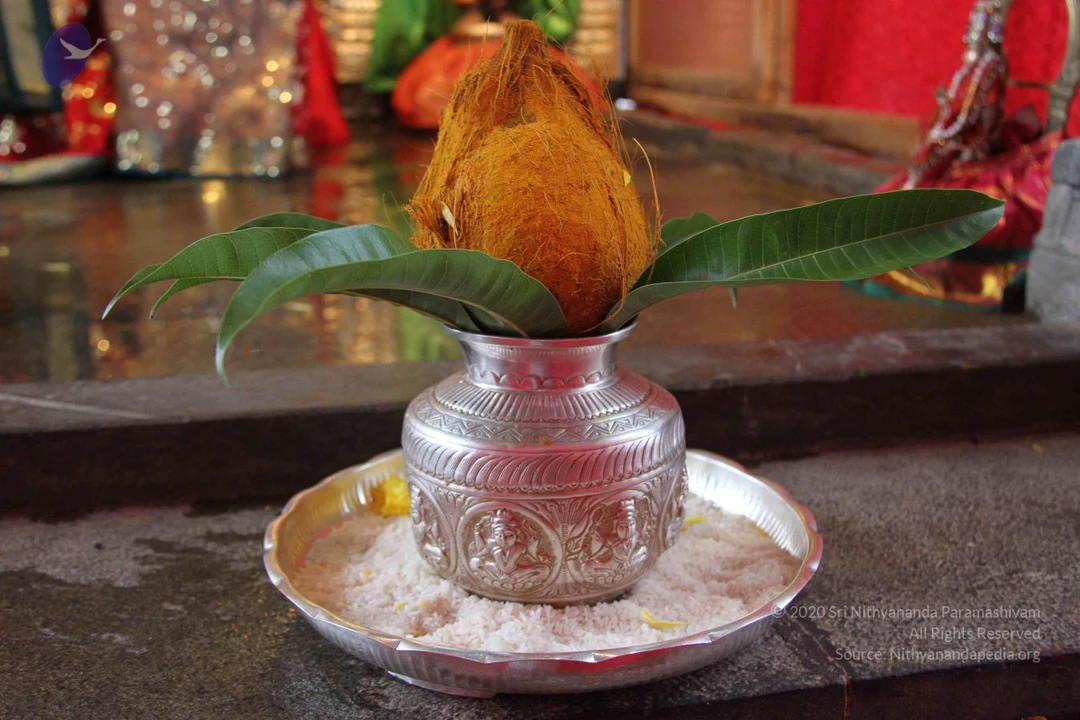
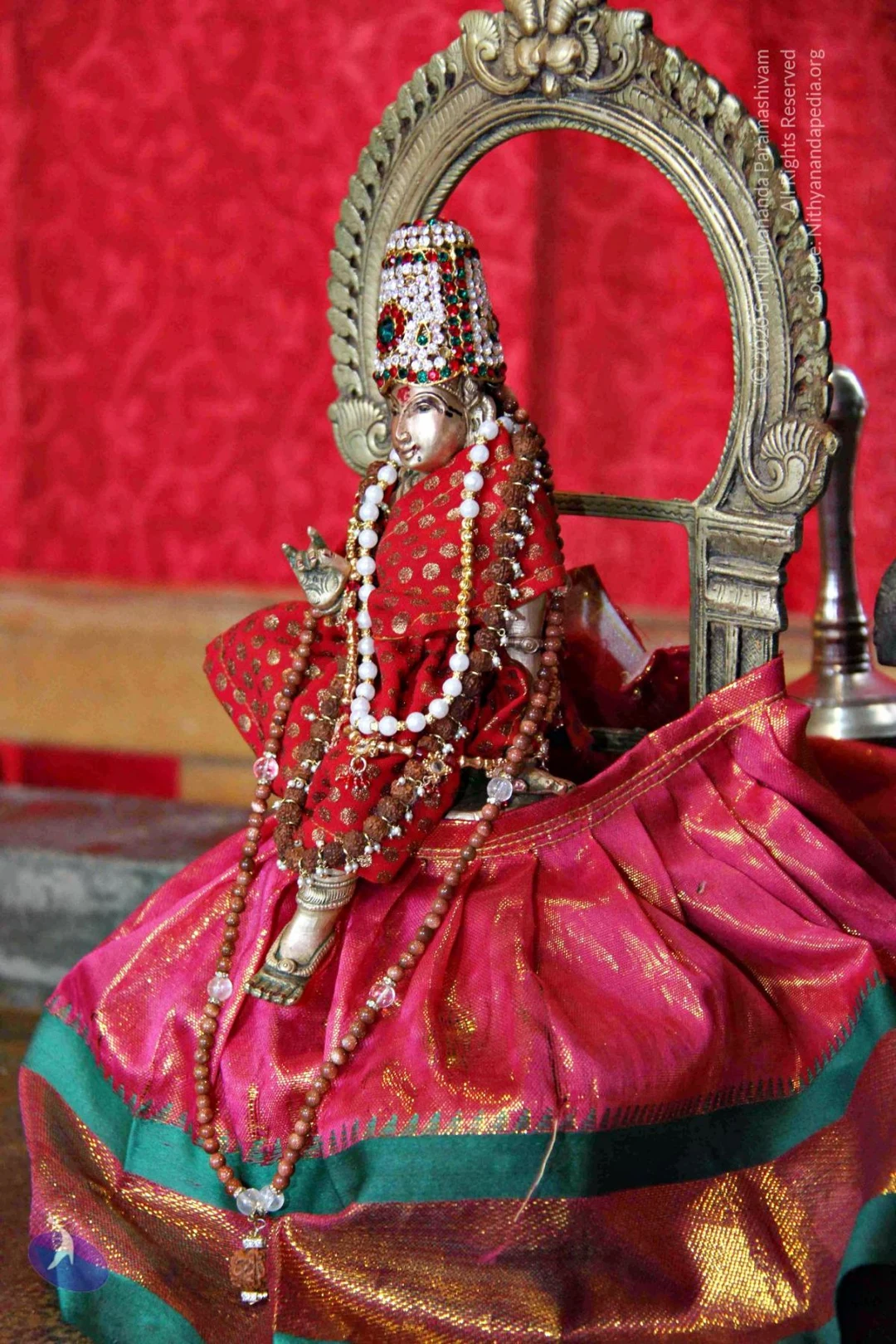
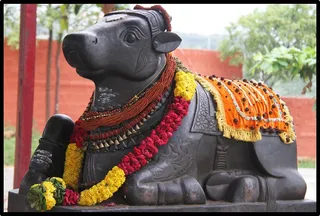
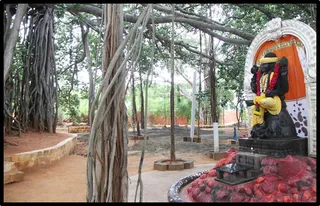
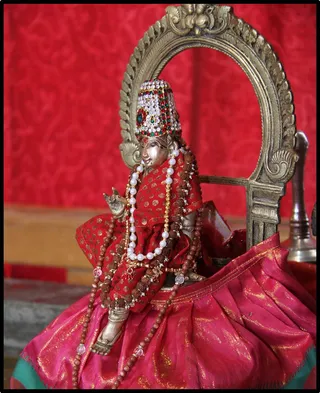
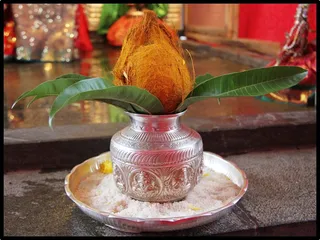
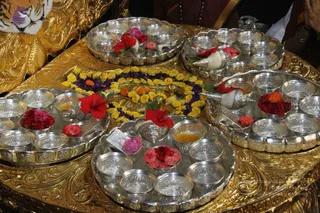
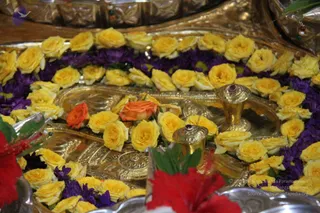
Close-up of a gold-toned ritual tray filled with yellow roses, purple flowers and red hibiscus blossoms. Two small gold cups with red-jewelled rims stand among the petals, and an orange rose sits on the tray. No people are visible; the image shows a decorated altar arrangement.A photograph of a puja table laid with brass plates and bowls, pink and orange flowers, blue flowers, incense sticks, and a lit oil lamp on the left. A brass bell and a brass vessel stand at right, with a conch-shaped offering vessel in the centre. Orange-and-red cloth covers the table. Only partial hands of a person appear at the top edge, so the scene shows ritual items rather than a clear ceremony with a visible presenter.A large black stone Nandi bull statue sits on a pedestal in an outdoor setting with a red brick wall and green foliage behind it. The bull is draped with an orange and gold cloth edged with fringe and studded with dark beads, and wears a red and brown beaded necklace. Garlands of yellow marigolds and red flowers hang around its neck and body, and a small bundle of flowers rests at its front leg. No people are visible in the scene.A photograph of an outdoor grove beneath a large banyan tree with many hanging aerial roots and supporting trunks. At right, a black stone murti of a deity sits in front of an orange arched niche, wearing a yellow dhoti-like cloth, a red and white flower garland, and a yellow garland with gold-coloured ornaments. The murti rests on a raised platform covered in red-orange powder. Sandy ground, low stone benches and small stone bases lie among the trees, with no people visible.A small silver-toned murti of a seated goddess sits in an ornate brass arched throne against a red patterned cloth backdrop. The figure wears a jewelled crown set with red, green and white stones, a red and gold-patterned sari, and long strands of pearl and red bead necklaces. One hand is raised in a blessing gesture. A brass bell and lamp stand at the right edge. No physical people are visible.A close view of a ceremonial kalasha: an ornately embossed silver pot topped with a whole brown coconut wrapped with fresh green mango leaves, set on a silver tray dusted with white rice grains and scattered yellow flower petals. The background shows a blurred temple interior with red and gold decorations and a stone floor. No people are visible, and no a person candidate appears in the image.

PADUKAPUJA

26 photosSource gallery
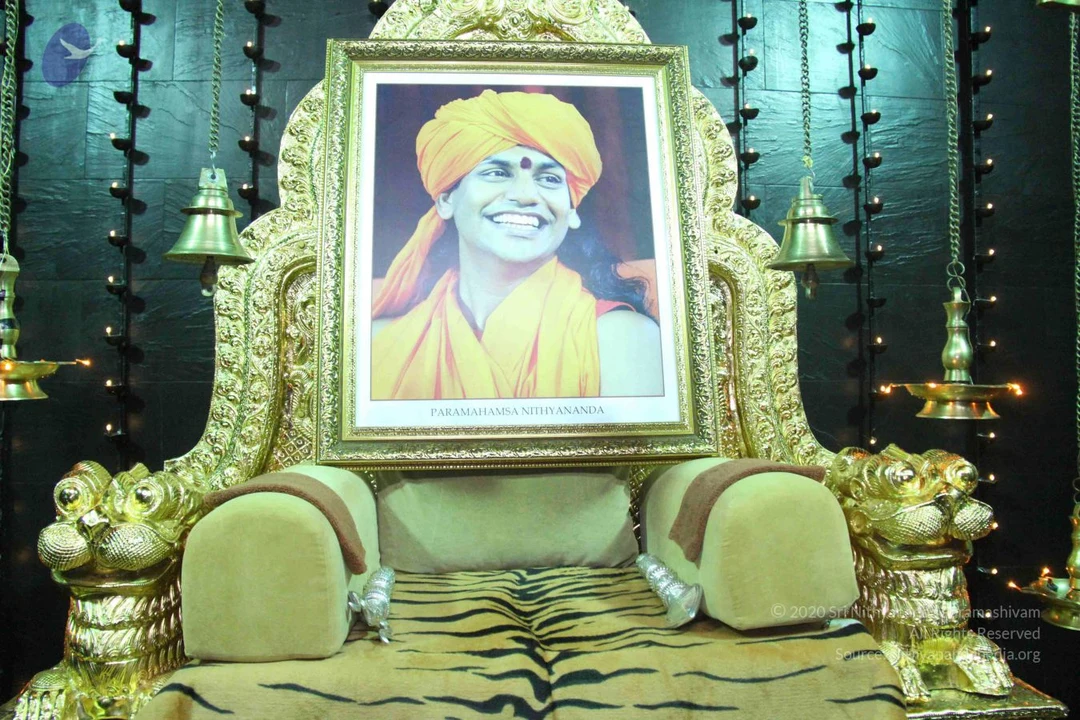
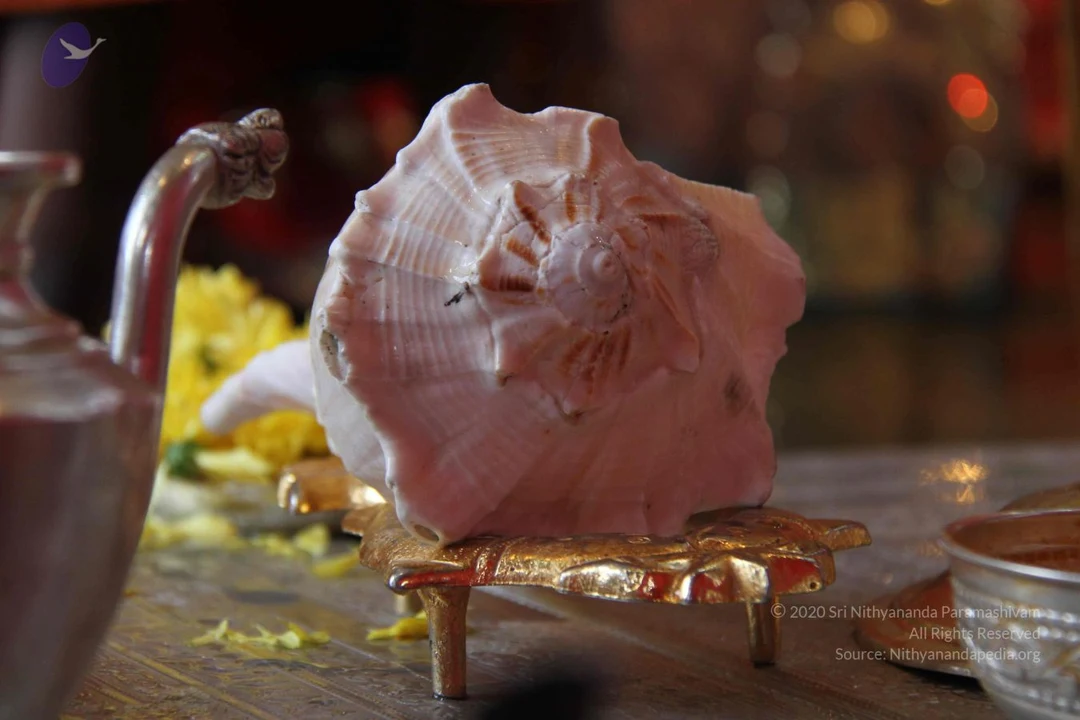
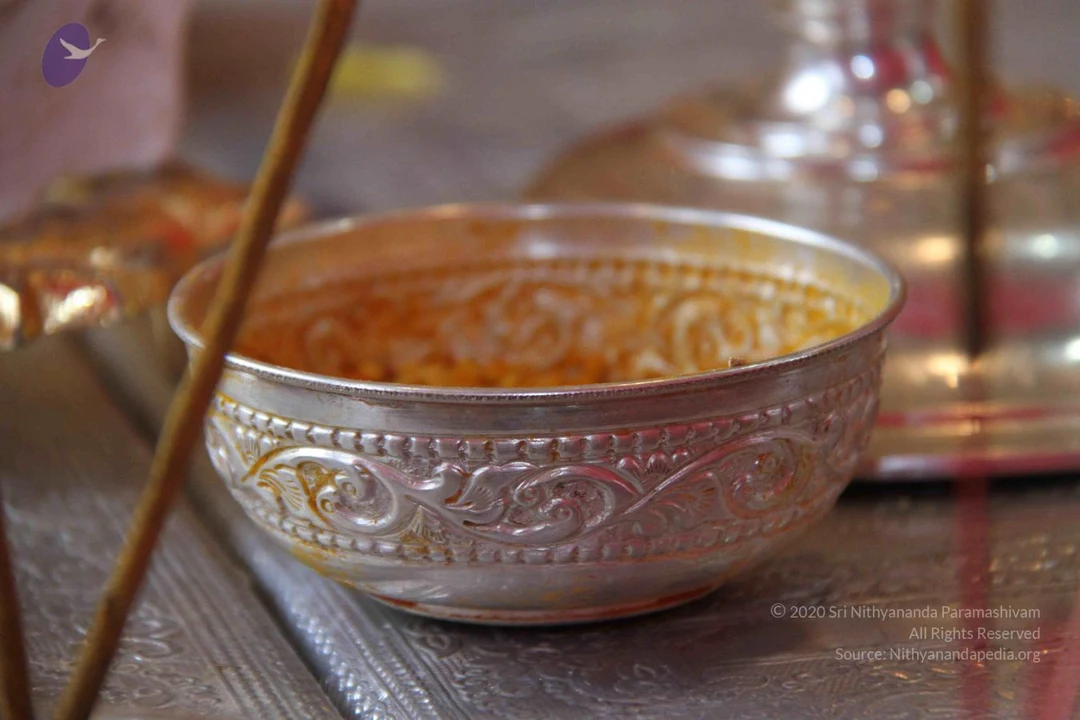
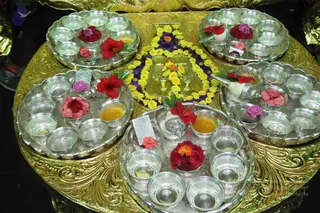
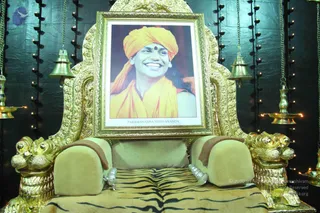
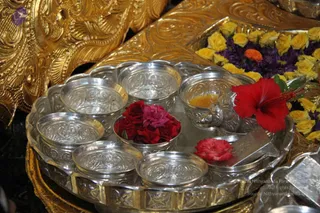
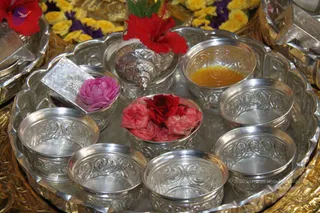
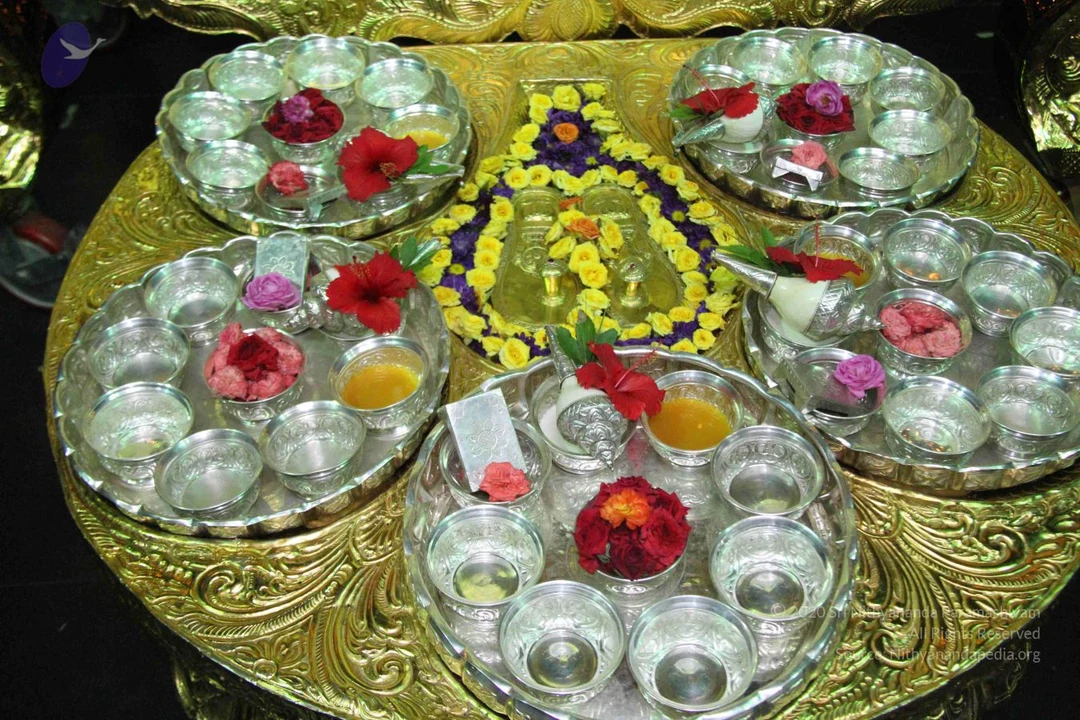
Top-down view of an ornate gold-embossed ritual tray arrangement for abhishekam offerings. Five silver-rimmed trays hold clear glass cups filled with water, yellow turmeric paste, and pink kumkum. Red hibiscus flowers, pink and purple blossoms, and green leaves decorate the trays, and silver spouted vessels hold liquid. At the centre, a yellow and purple flower garland surrounds a small golden peetha-style object with a golden bell or lamp. No people are visible.A photograph of an empty ornate gold throne (peetha) with carved lion-head armrests, draped with a tiger-striped cloth and cream cushions. Behind it is a large framed portrait labelled "PARAMAHAMSA NITHYANANDA" showing a smiling man in an orange-saffron turban and orange robe with a red bindi. Brass hanging bells and brass oil lamps (lamps) flank the throne against a dark textured wall. No physical people are visible.Close photograph of a silver ritual tray with engraved bowls holding red and pink flower petals, a small silver lamp-like cup with yellow liquid, and a red hibiscus and red flower on the tray. Behind it, gilded carved wooden panels and a garland-style arrangement of yellow roses and purple flowers. No people are visible; the setting suggests puja offerings on a silver tray.A close-up photograph of a silver ritual tray with ornately embossed bowls holding offerings for worship. A silver conch-shaped vessel topped with a red hibiscus flower sits at the centre, with a bowl of yellow turmeric or saffron paste beside it. Pink and red rose petals fill a bowl, and a pink rose rests on a small silver box. Yellow marigolds and purple flowers appear in the background, with gold-toned metalware at the edges. No people are visible.Close photo of a ceremonial worship arrangement on an ornate gold-embossed table. Silver thali trays hold small silver bowls filled with red hibiscus and pink and orange flowers, and a golden-brown liquid in one bowl. Yellow marigold petals and purple flowers form a circle around a central golden object. Two white conical vessels with silver tops sit among the trays. A tiger-striped cloth edge appears at the upper left. A blurred figure in dark red and gold robes with folded hands appears at the top right edge.Close-up photograph of a brass ritual tray decorated with a ring of yellow roses and purple flowers. Two small brass cups with red jewel-like knobs sit on the tray, with orange roses placed among them. Red hibiscus blossoms and green leaves appear at the lower edges, and ornate brass metalwork surrounds the arrangement. No people are visible.

TEMPLE
47 photosSource gallery
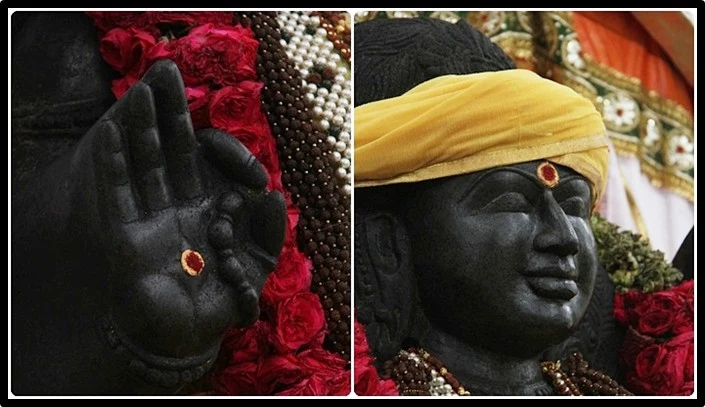
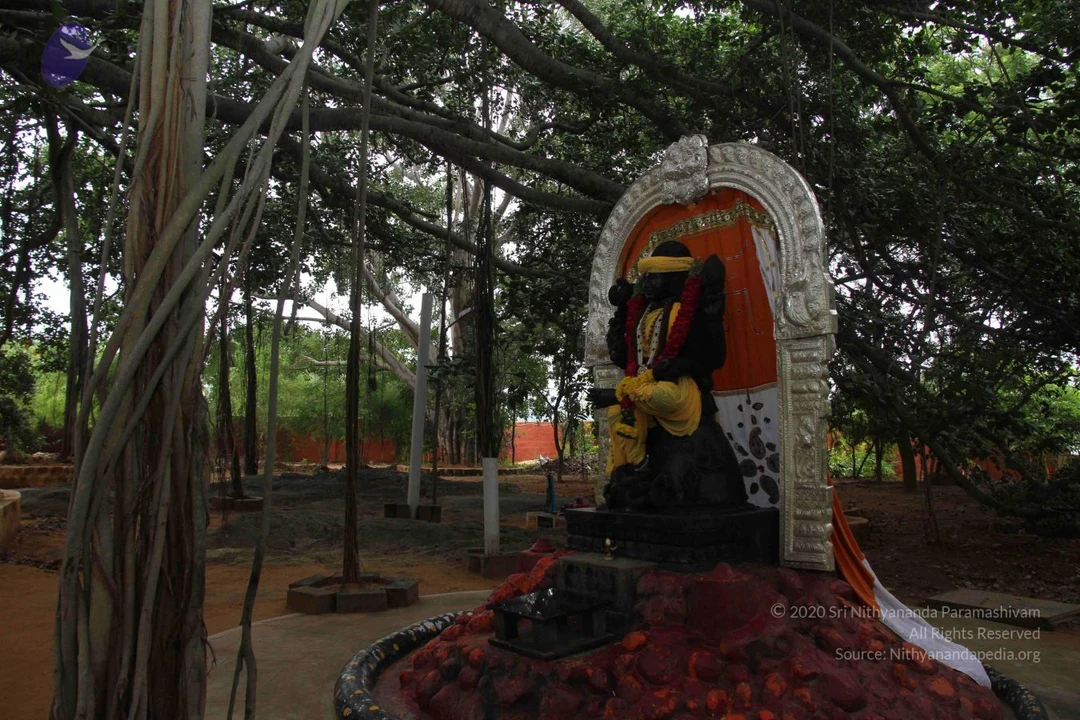
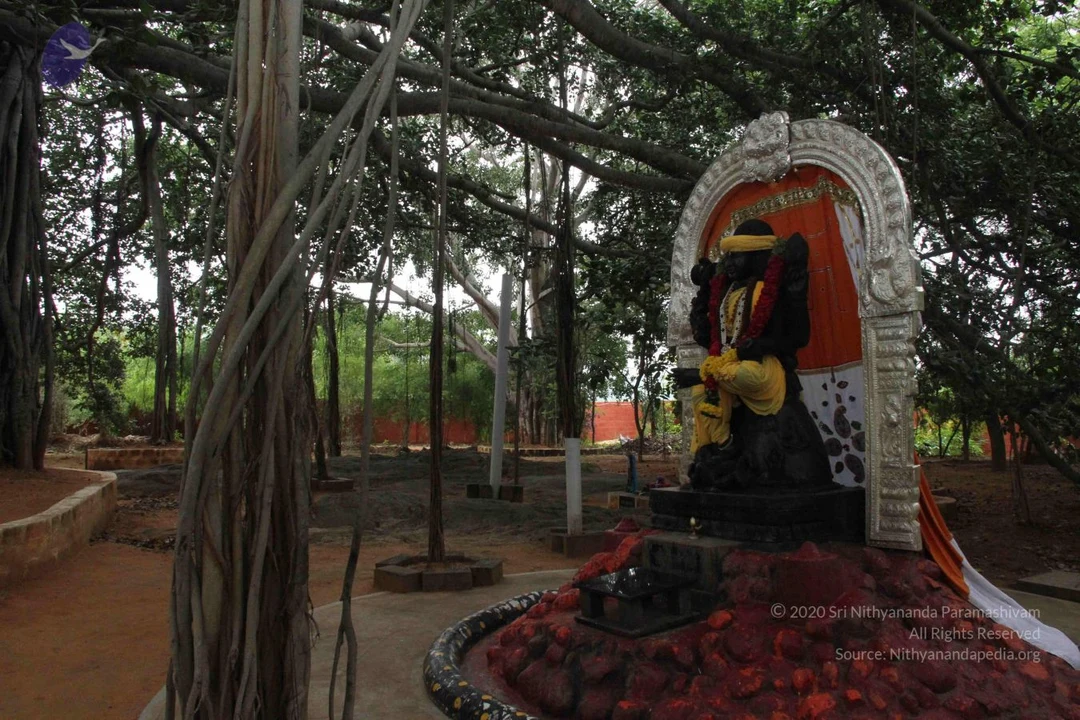
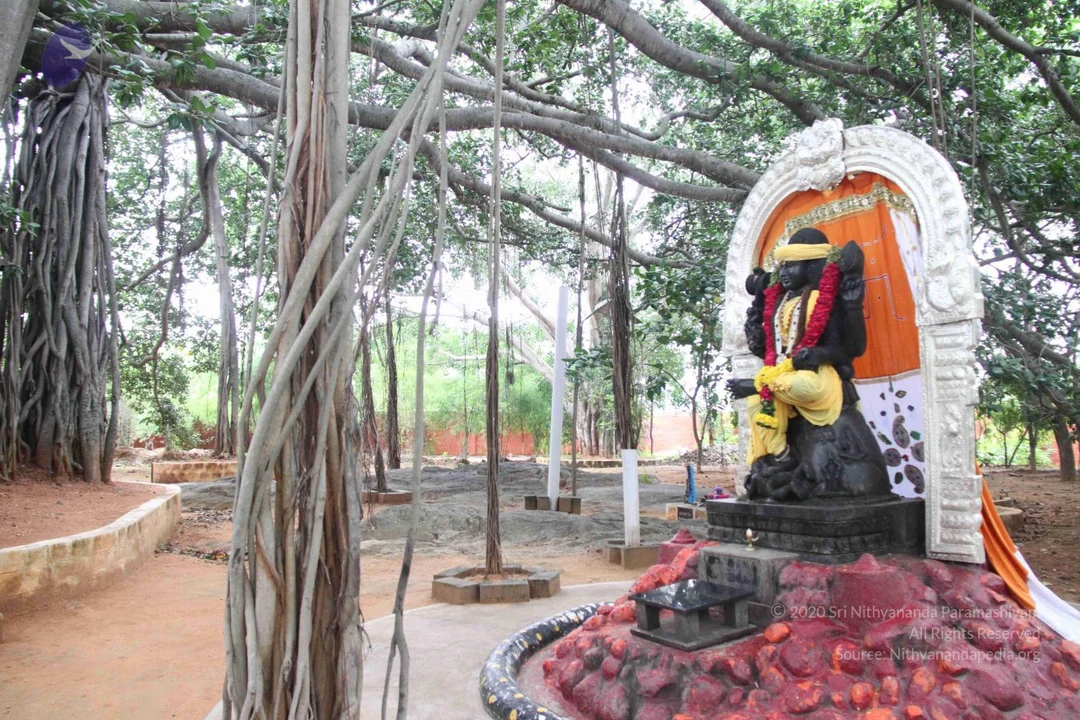
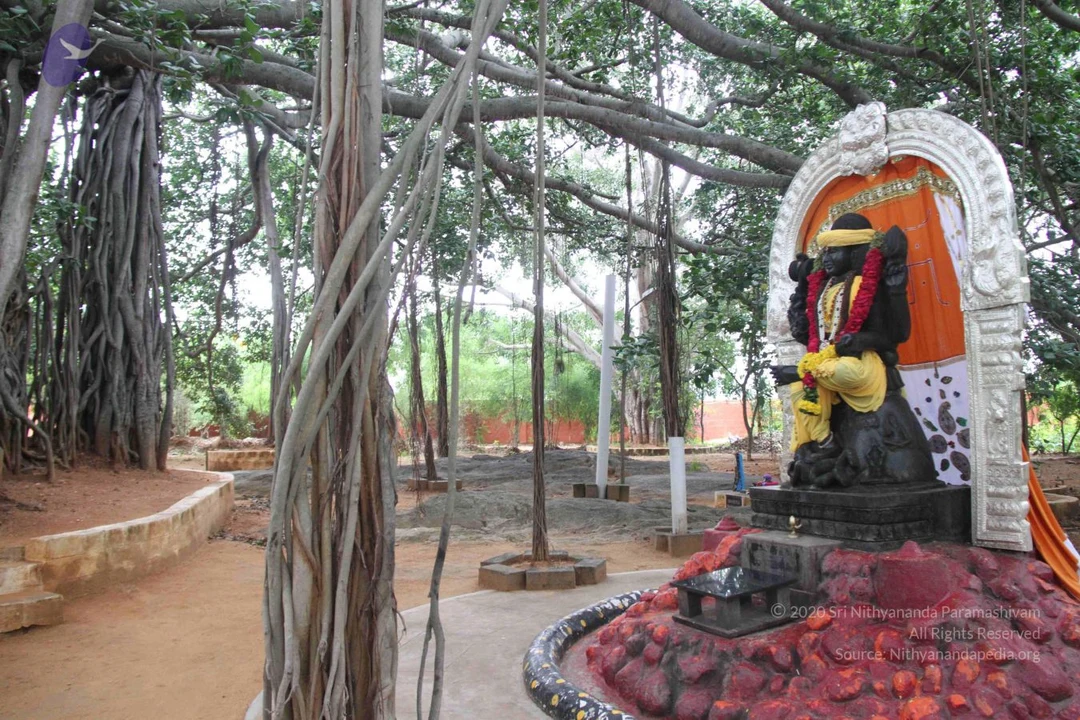
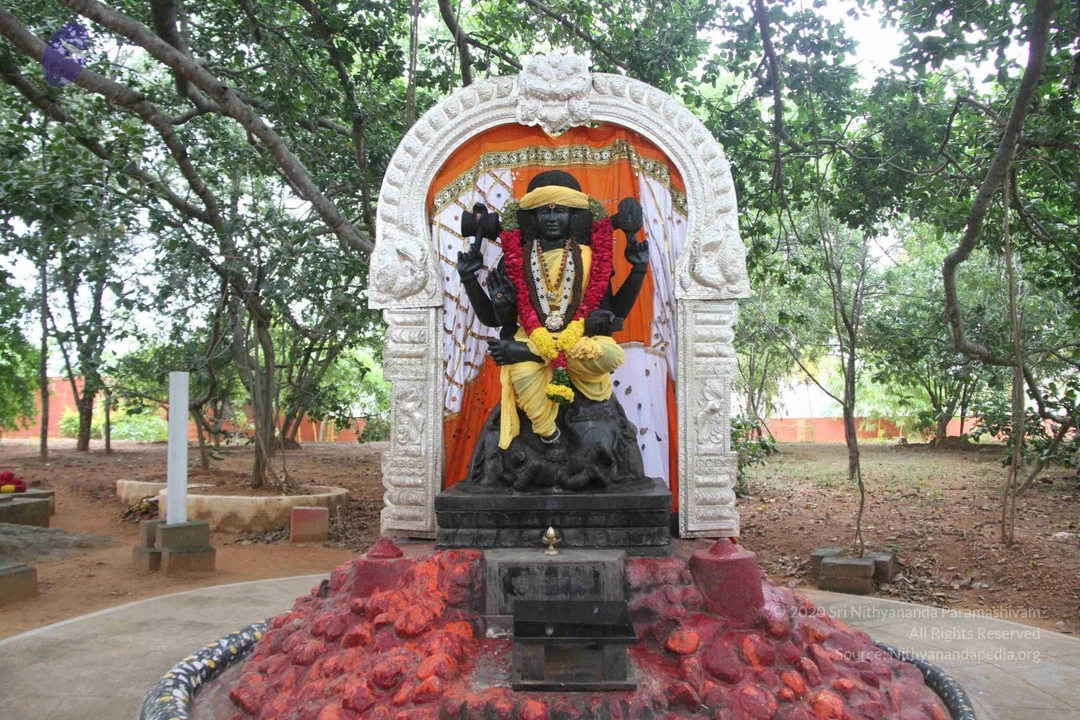
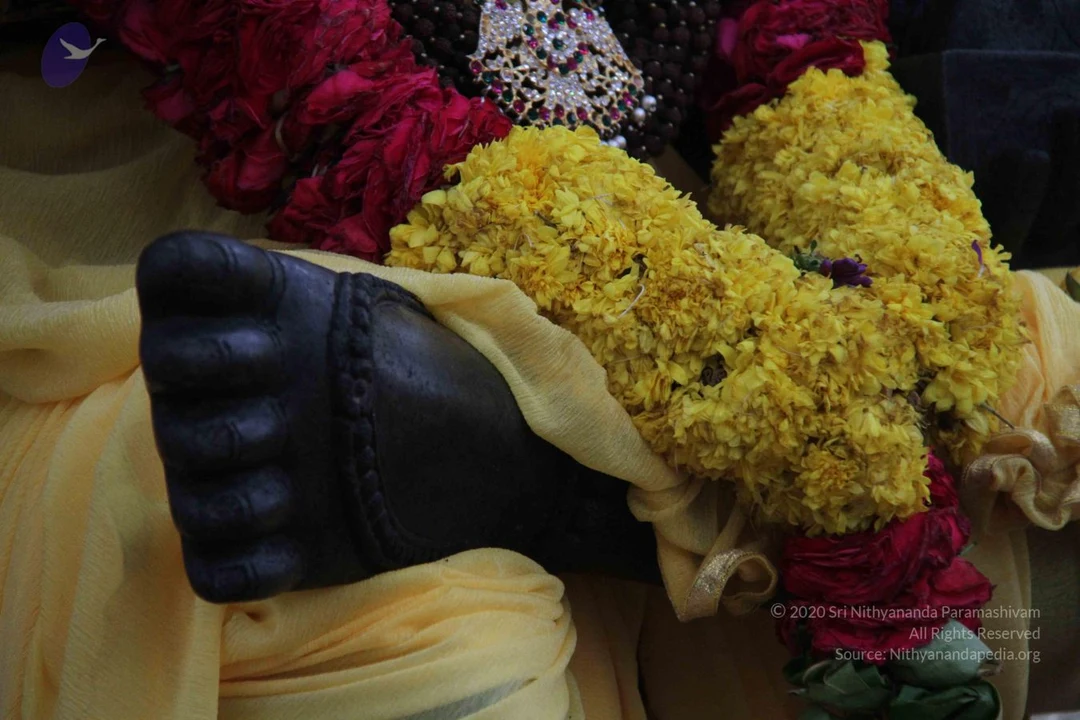
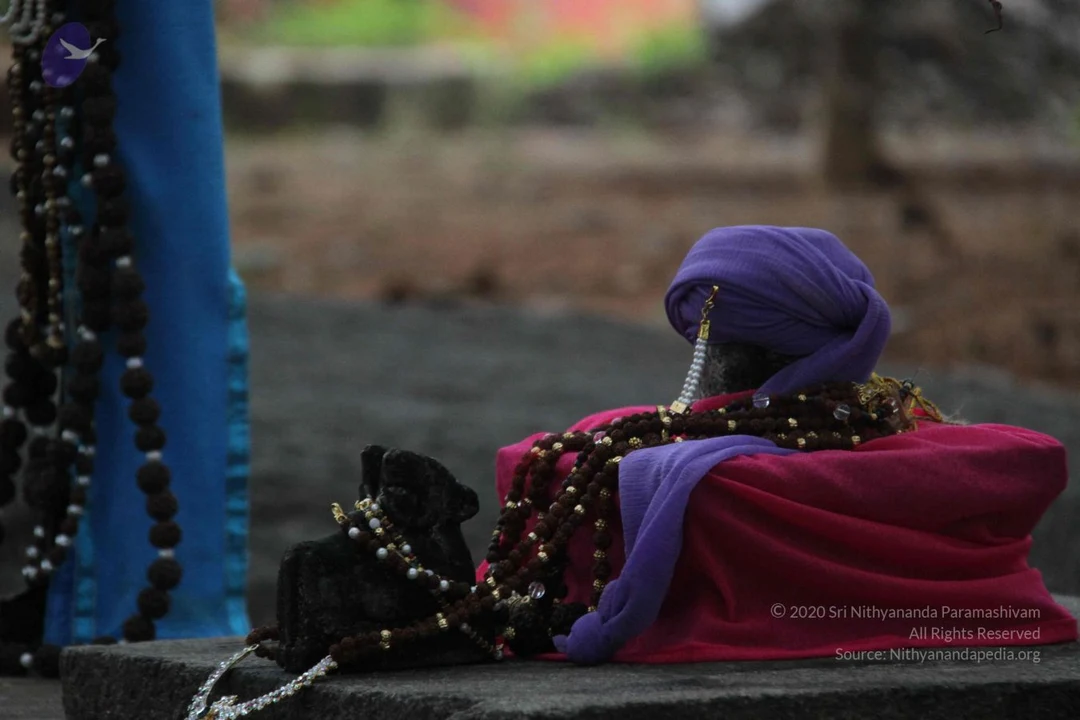
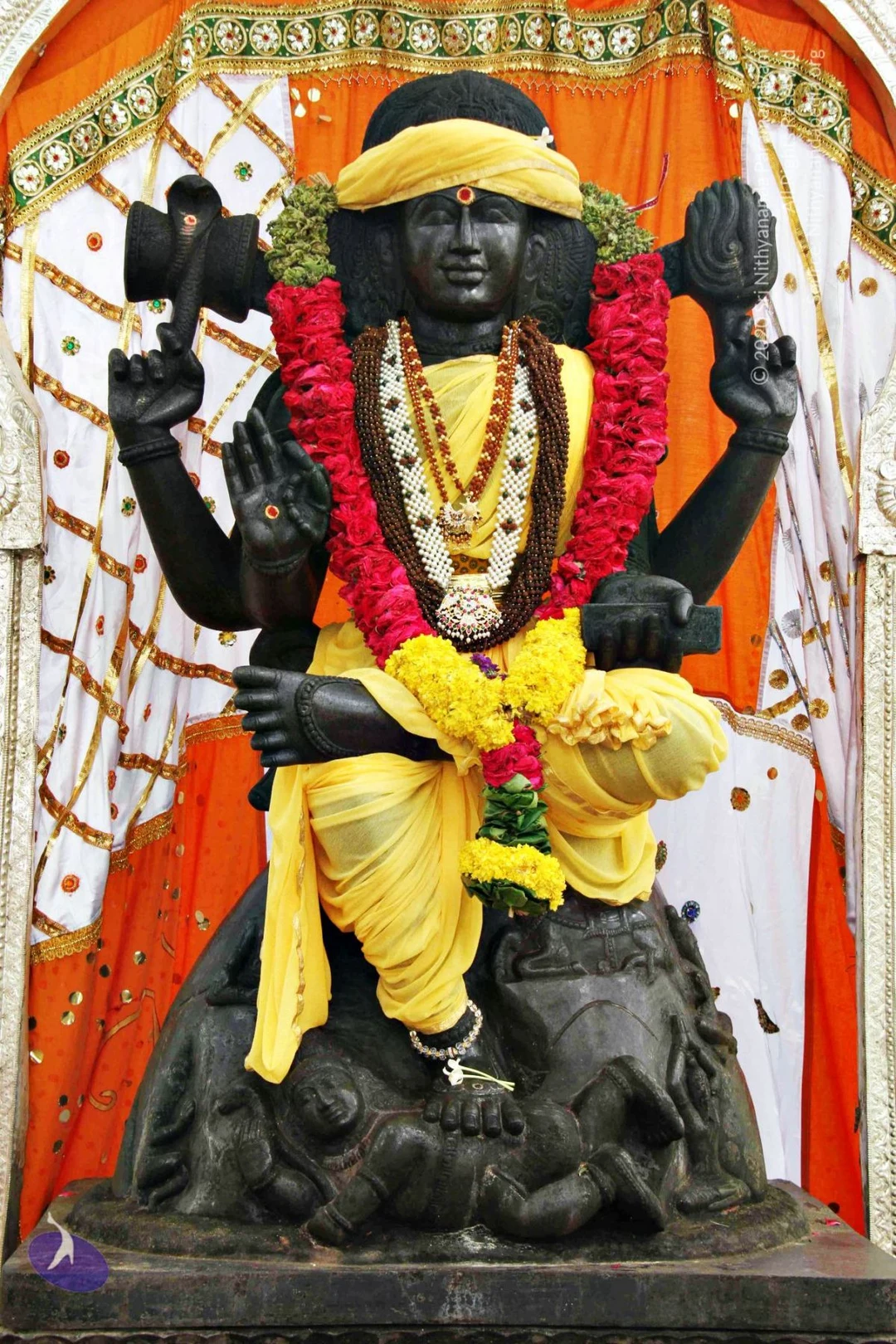
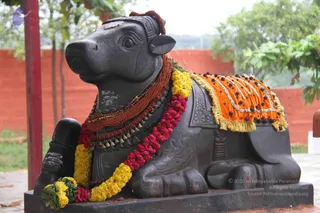
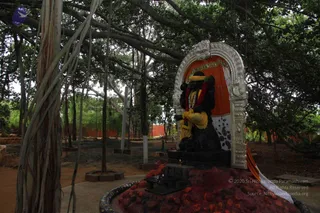
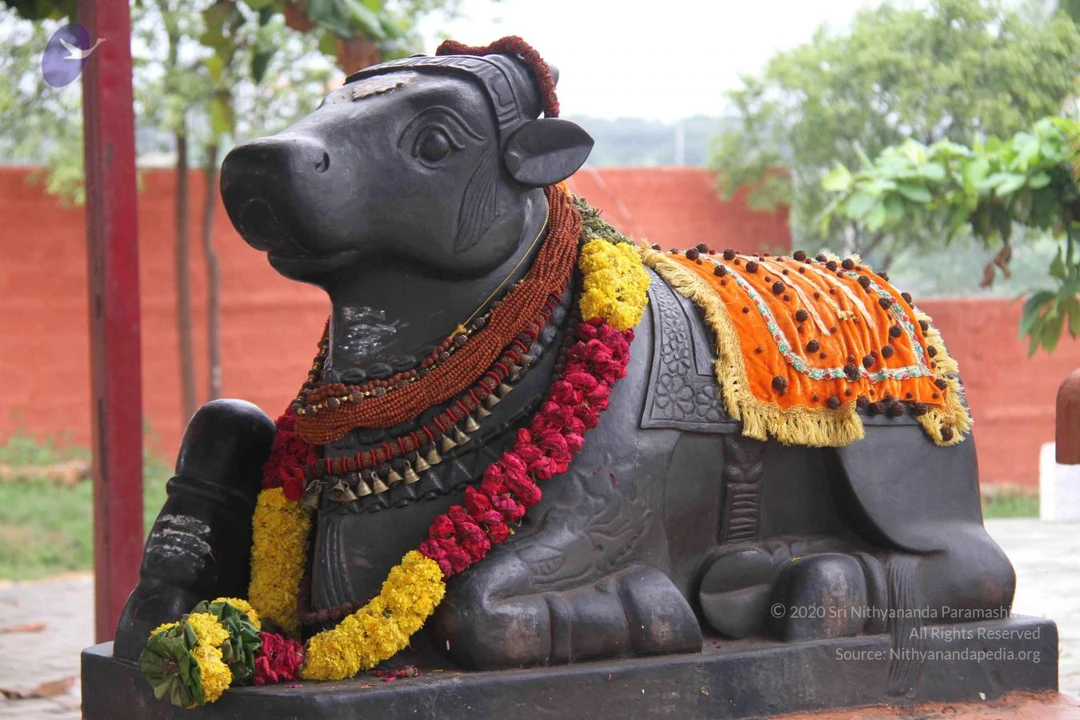
A black stone Nandi bull statue sits on a raised dark platform outdoors, facing left. It wears a rust-orange velvet cloth with gold fringe and dark dotted studs, multiple strands of rudraksha-style beads across its chest, and bright yellow and red marigold and rose garlands draped over its neck and foreleg. A red brick wall and green trees stand behind it.Outdoor photo of a dark stone deity murti seated in an ornate white-and-silver arched niche set against an orange backdrop, beneath a large banyan tree with hanging aerial roots. The murti wears a yellow cloth, a yellow headband, and a red flower garland. The base is covered in red-orange powder and offerings, with a small black altar and an oil lamp in front. Red brick walls and bare earth are visible in the background. No people are present.A photograph of an outdoor shrine beneath a large banyan tree with many hanging aerial roots. A black stone statue of a seated deity or sage is set within a silver-framed arched niche backed by orange fabric. The figure wears a yellow cloth wrap, a yellow turban-like headpiece and red flower garlands, and holds a small yellow item. A dark serpent-patterned border and a reddish-painted mound surround the base, with a small altar stone in front. Red-earth paths, a red boundary wall and green foliage are visible. No living people are present.A photograph of an outdoor shrine beneath a large banyan tree with many hanging aerial roots. A black stone deity murti sits in a white arched niche backed by orange fabric, wearing a yellow dhoti, a red flower garland and yellow flower garlands, seated with one hand raised. The shrine base is a rough red-painted mound with a small black offering stand and a diagonal black-and-yellow snake-like border. Open dirt ground, low stone walls and a white post stand in the background. No people are visible.A black stone deity murti sits within a white carved arched niche backed by orange fabric, under a large banyan tree with hanging aerial roots. The murti wears a yellow cloth, a yellow headpiece, and red flower garlands, with gold ornaments on its chest. Its pedestal is ringed with dark stone and a mound of red-painted stones and marigold-yellow offerings. A small black stone altar stands in front, with a stone path leading through an open grassy area with more trees beyond. No people are visible.A dark stone deity murti stands in a white ornate arched niche set against an orange and white draped backdrop, outdoors among leafy trees. The figure wears a yellow cloth, a gold necklace and a large red and yellow marigold garland, with raised arms holding ritual implements. The statue rests on a black pedestal atop a mound of red-painted stones, with a small brass lamp in front and a clean paved circular path surrounding the shrine. No people are visible.

Nithya Satsang
49 photosSource gallery
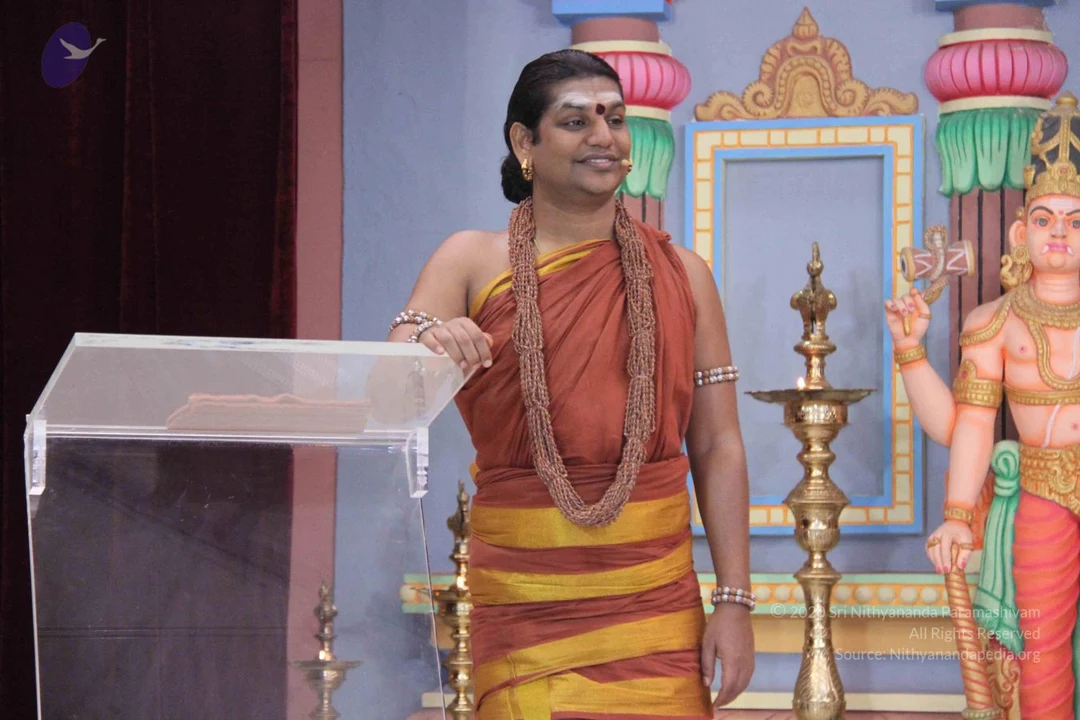
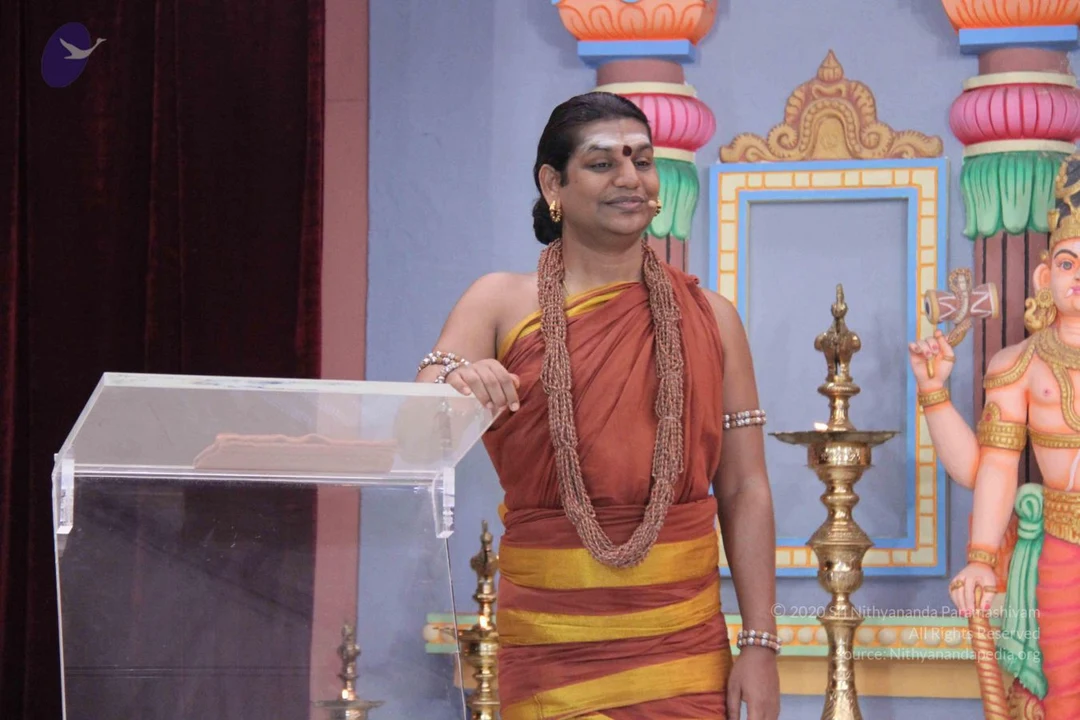
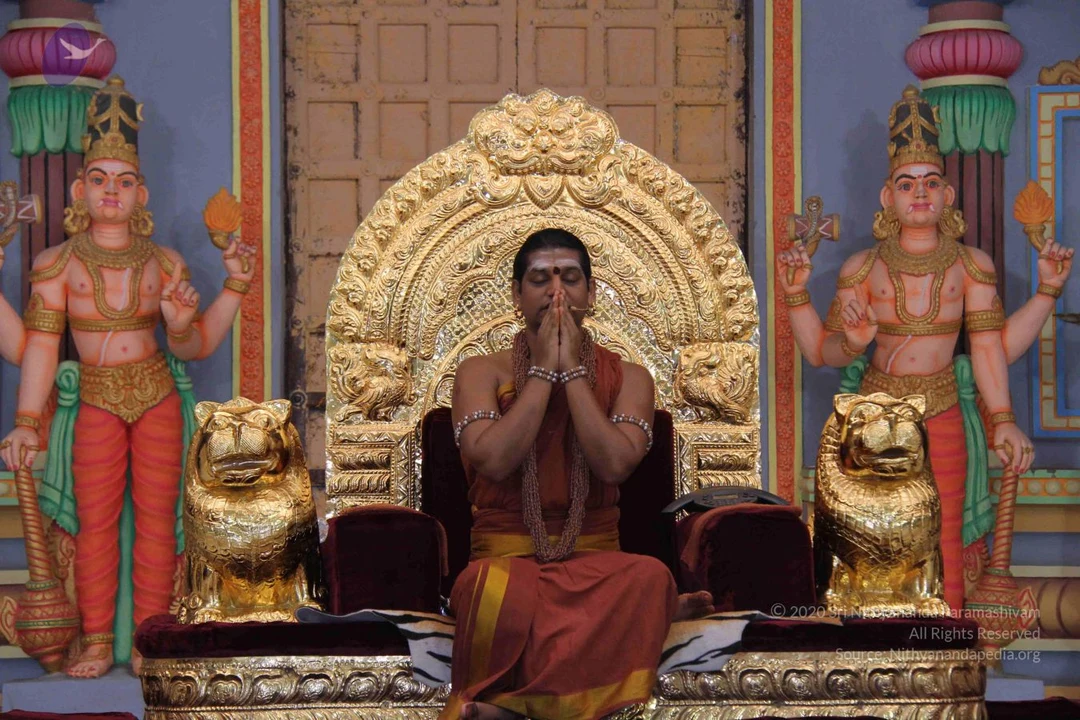
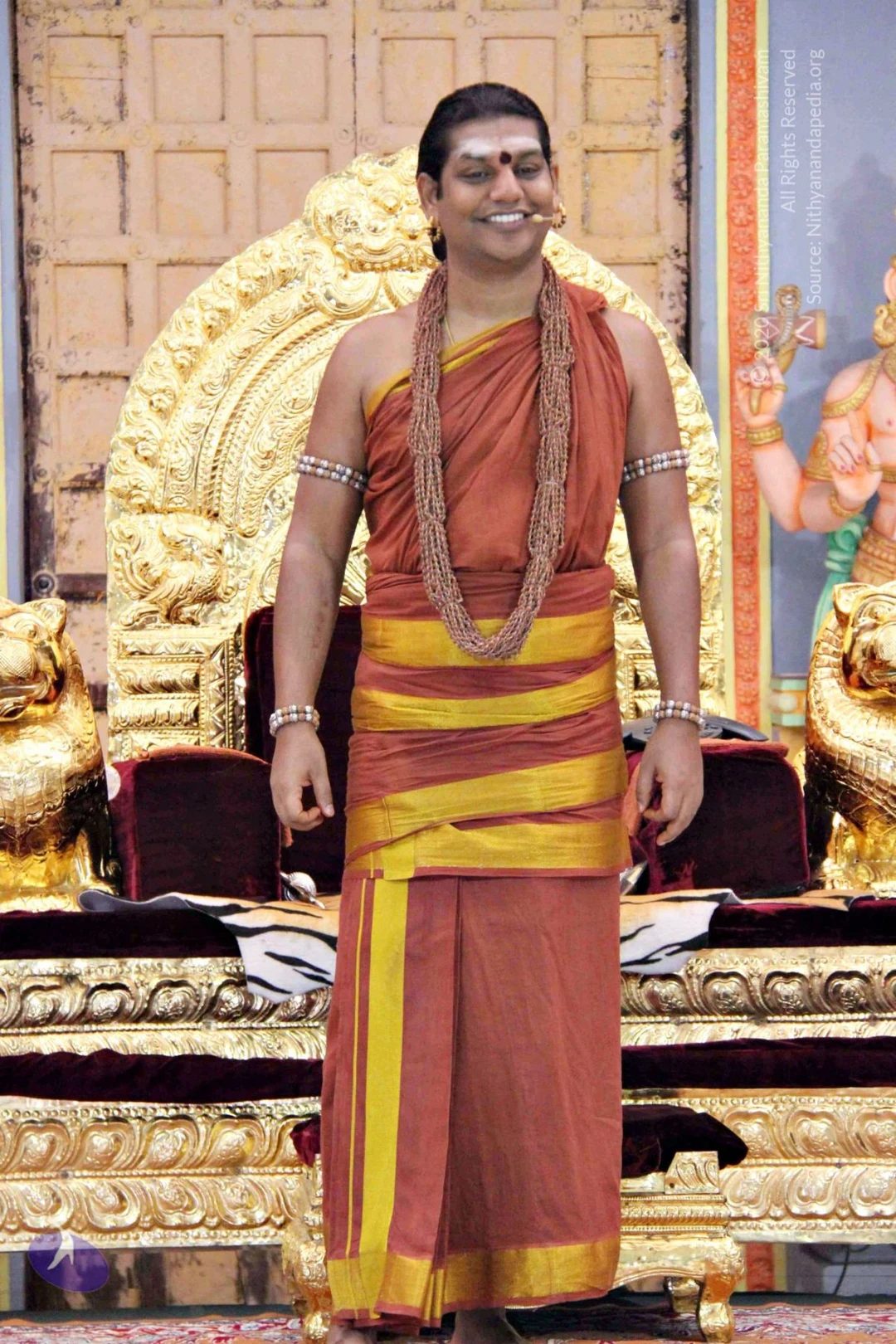
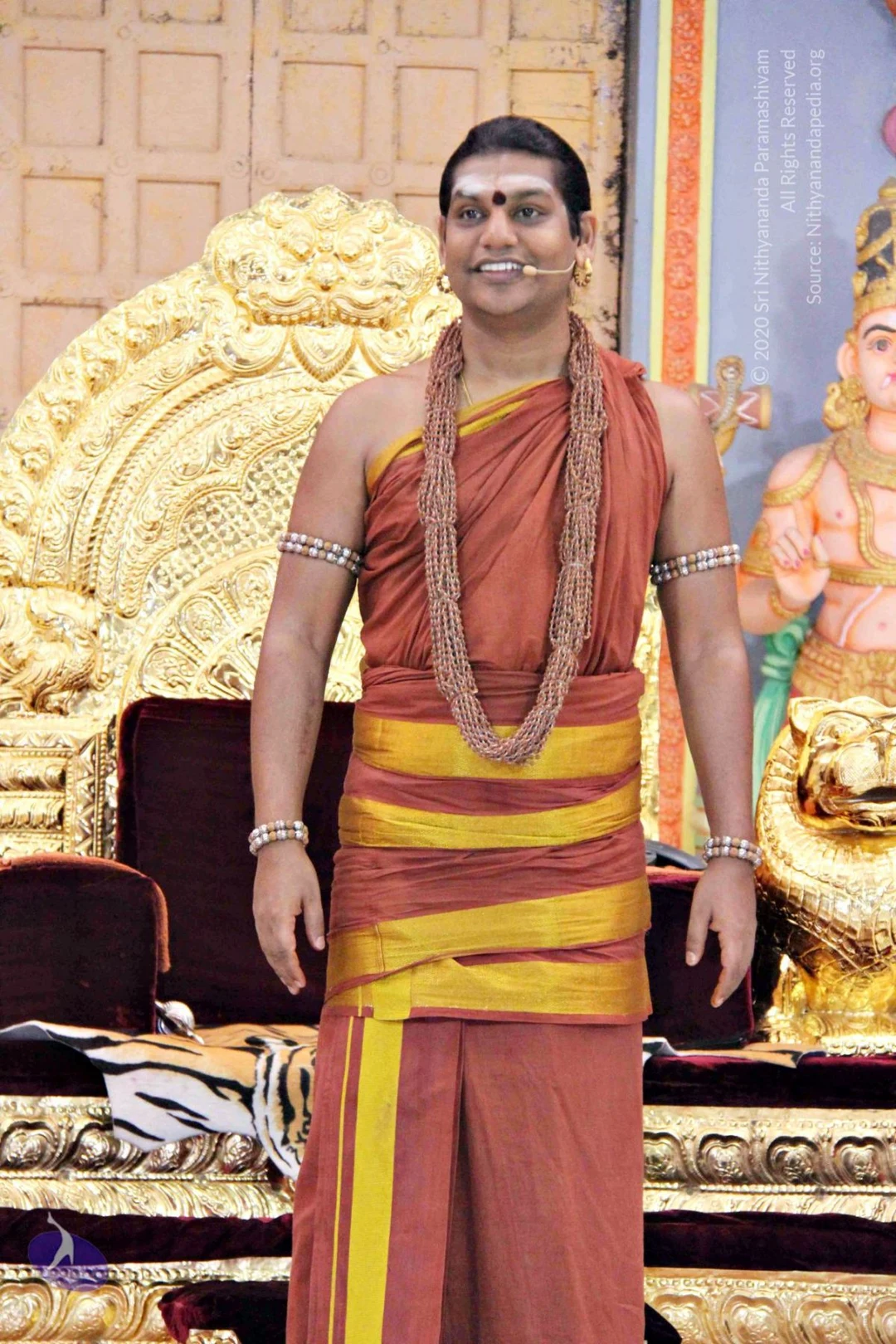
A seated man in saffron-orange robes sits on an ornate gold throne with a carved arched back and gold lion heads at its base, his palms pressed together at chest level in a namaskar gesture. He wears a rudraksha mala and bangles, with a red tilak on his forehead. Flanking the throne are two large painted deity murti figures with multiple arms, crowns, gold jewellery and green sashes, each holding ritual objects. The background is a blue-grey wall with a carved wooden door.A seated man in a saffron-orange dhoti and shawl with a yellow border sits cross-legged on a large ornate gold throne with carved backrest and lion-headed armrests, palms pressed together in namaste. He wears a rudraksha mala with a second beaded necklace, bangles and armlets, and a red bindi. Flanking the throne are two painted deity murti figures in gold crowns and jewellery, one holding a lamp. Behind him stands a carved wooden door. A tiger-striped cloth covers the platform. The setting suggests a discourse or darshan hall. a person: the seated man has the saffron clothing, rudraksha malas and throne-seating cues matching the page's claim, though the appearance is only partly distinctive.A seated man in an ornate golden throne with a large arched backrest, flanked by two golden lion-shaped seat supports on a maroon-cushioned dais. He wears a rust-orange shawl over a saffron-and-gold dhoti, a multi-strand rudraksha mala with ceremonial beaded necklaces, silver armbands and bangles, and a red bindi. His palms are pressed together in namaste and he smiles. Behind him stand two painted deity murti figures with gold crowns, gold ornaments and raised ceremonial implements, against a blue-grey wall with a wooden door. Probable Swamiji by cues: long swept-back hair, ornate throne, saffron attire, rudraksha mala and gold ornaments, seated as a teacher giving satsang.A man in a rust-orange and gold-bordered dhoti and shawl stands beside a clear acrylic lectern at a discourse hall. He wears a long rudraksha mala, gold-tone bangles, a gold earring, and a white tripundra with a red bindi, and smiles while resting one hand on the lectern. Behind him stands a painted deity murti with a trident-like staff, and two brass oil lamps on stands flank the stage. a person: the rudraksha mala, orange and gold attire and speaking position are the qualifying cues for a teacher at a discourse.A man in saffron-orange and gold-striped robes stands beside a clear acrylic lectern on a stage, smiling and resting one hand on the lectern. He wears a long rudraksha-style bead mala, beaded bracelets, a gold armlet, gold earrings and a red bindi, with his hair swept back. Behind him stands a painted deity murti with a crown, gold ornaments and a trident-like staff, beside a brass oil lamp on a pedestal and blue and pink decorative pillars. The scene reads as a discourse setting.A man in a rust-orange dhoti-style wrap with gold-yellow borders stands at a clear acrylic lectern on a stage, one hand resting on the lectern. He wears a multi-strand rudraksha-style bead mala around his neck, beaded bracelets on his wrist and upper arm, gold earrings, and a white vibhuti mark with a red dot on his forehead. A lapel microphone is clipped near his chin. Behind him stand brass oil lamps (lamps with flame-shaped tops) and a painted backdrop with pink and green lotus-style pillars. At the right edge, a painted deity murti with a crown, gold jewellery, a trident-like staff and a green sash stands beside the scene. Probable Swamiji (appearance cues: long swept-back hair, rudraksha mala, orange ceremonial clothing); presented in a discourse setting.
SARVADHARSHAN
13 photosSource gallery
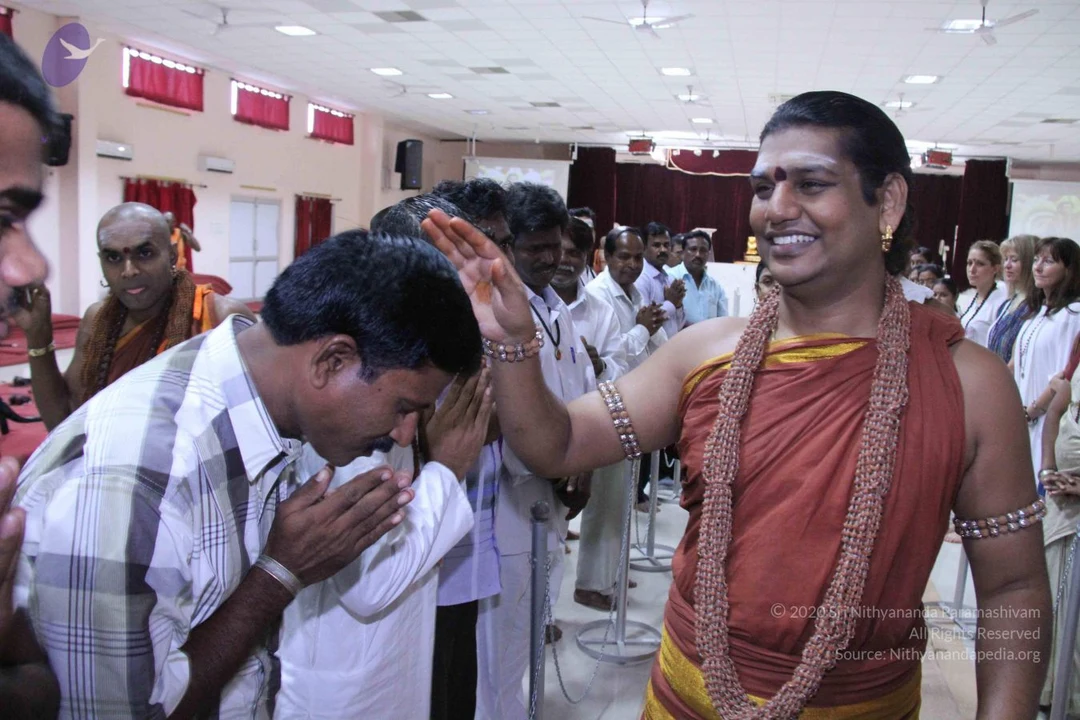
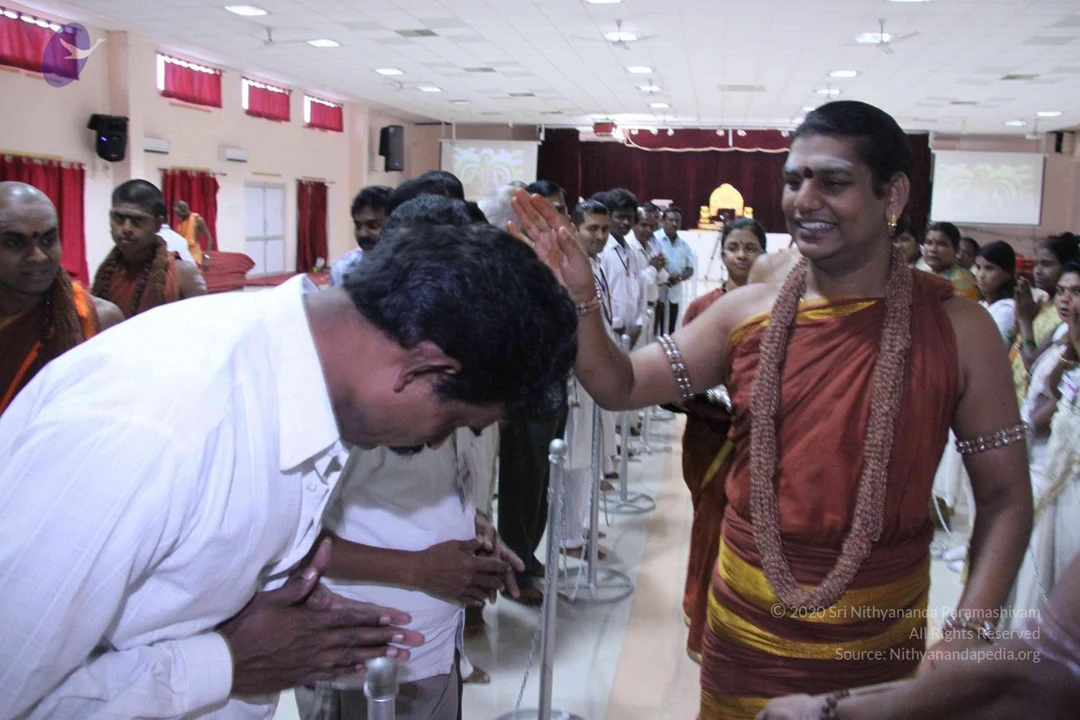
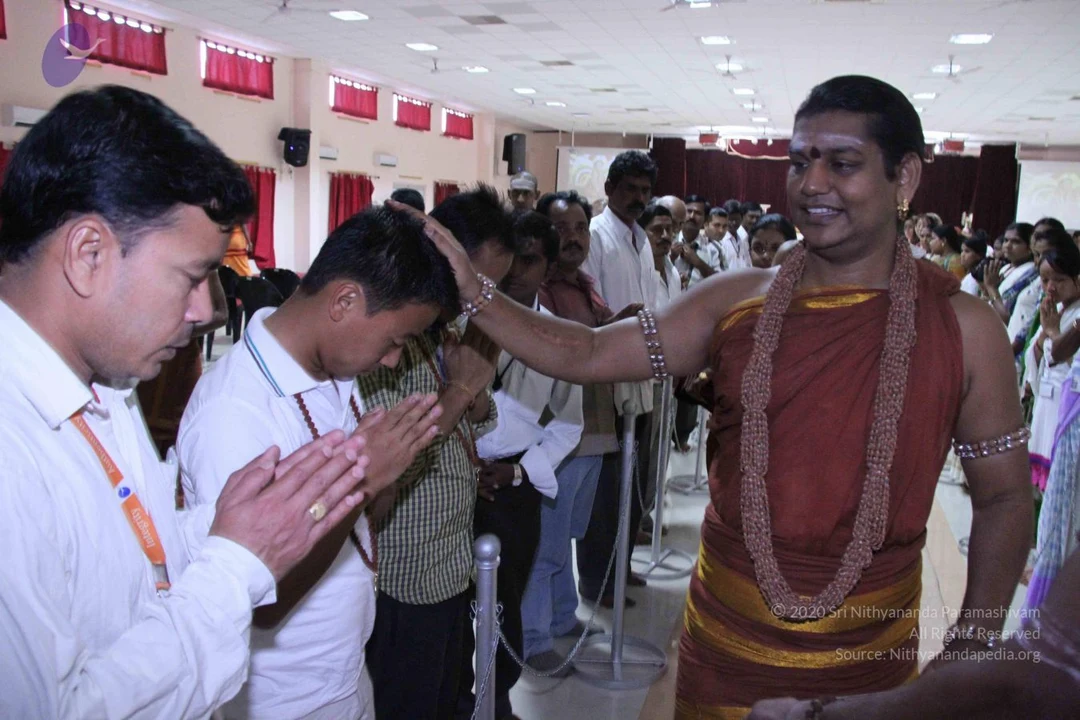
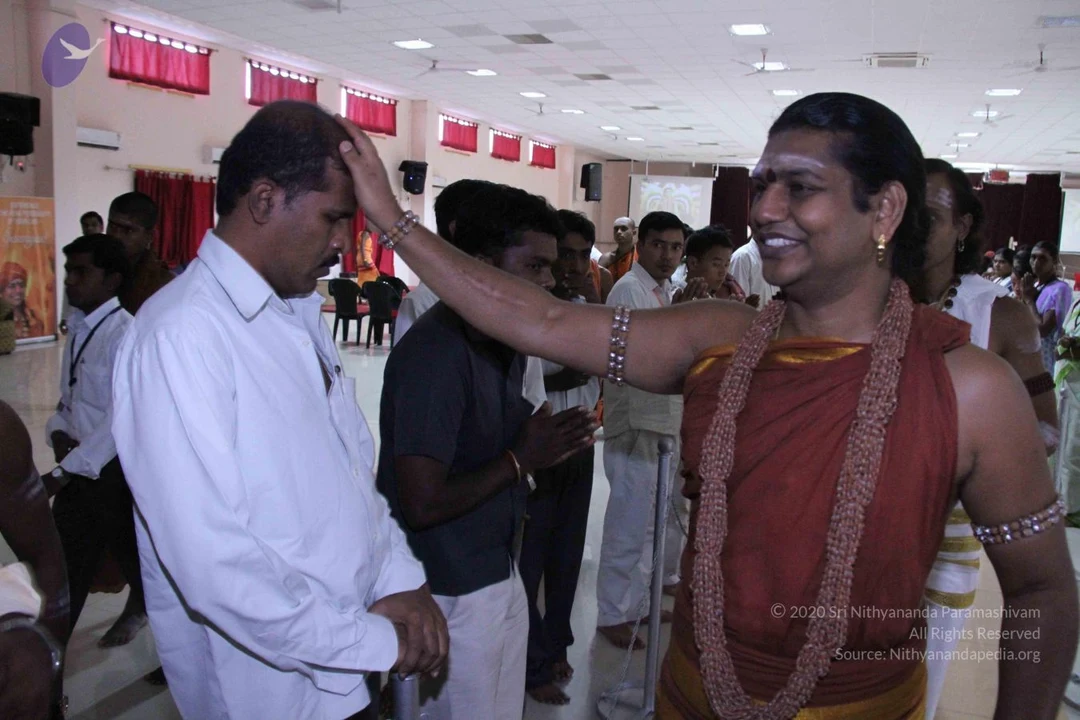
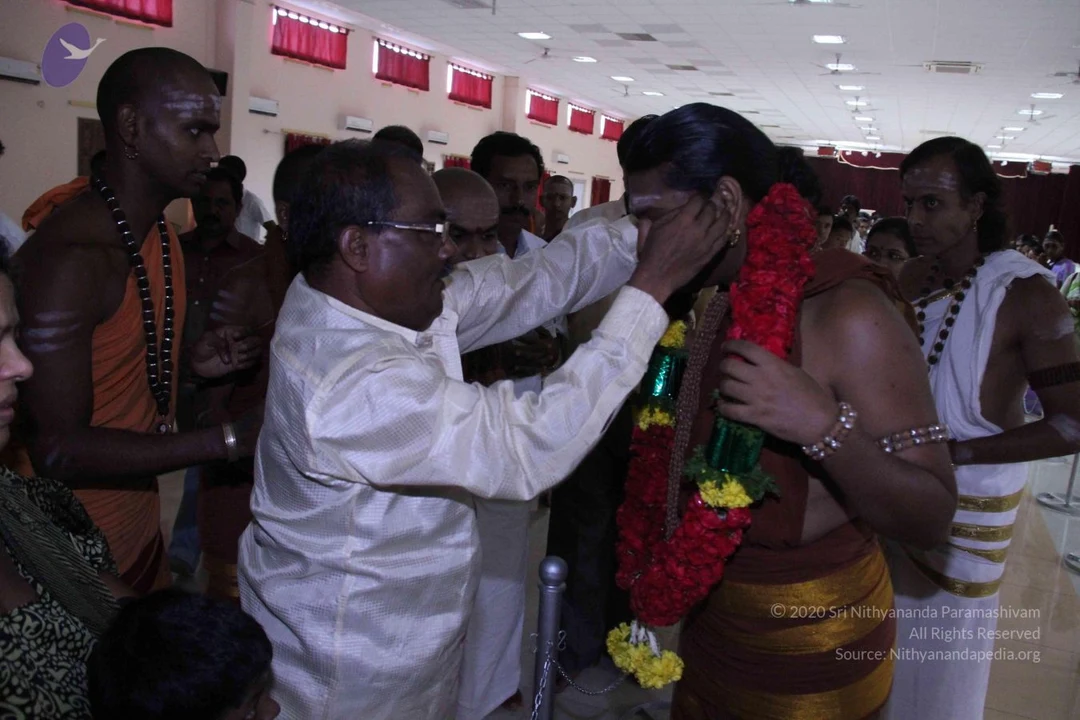
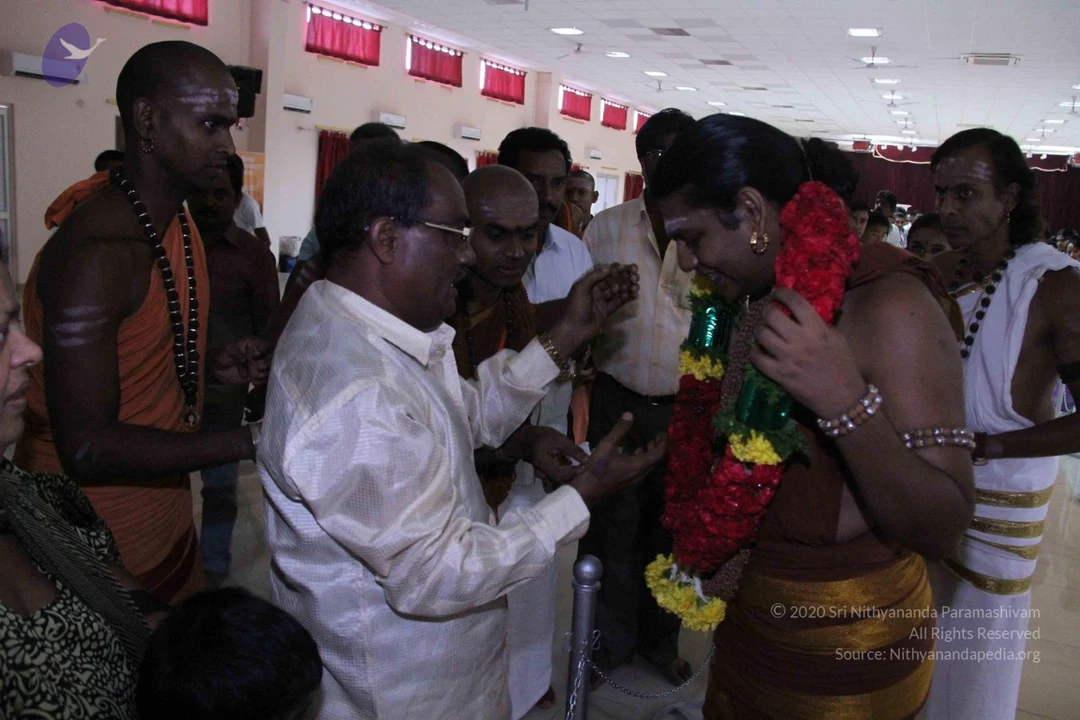
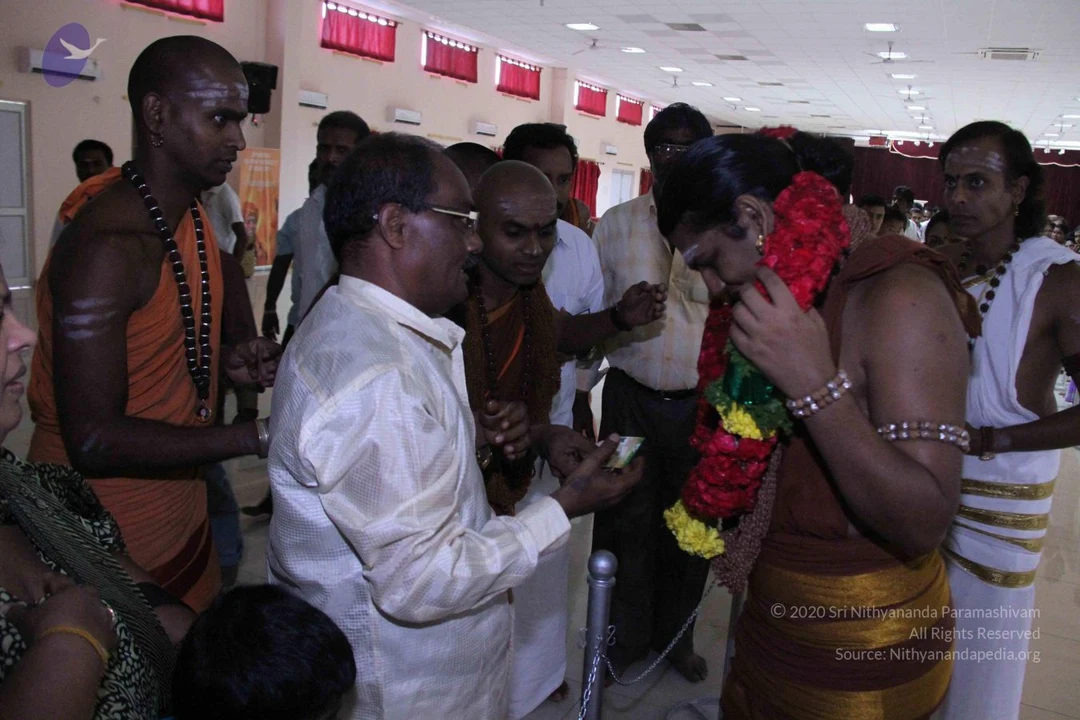
A photograph in a large hall with red curtains and a white tiled floor. A man with long swept-back dark hair, a red bindi, rudraksha beaded necklaces and a saffron-red shawl with gold border raises one hand in blessing and smiles broadly; Swamiji (probable) based on the long hair, saffron clothing and rudraksha malas. A devotee in a white shirt and rudraksha mala stands bowing with palms pressed together and receives the blessing, while another man in cream kurta has a hand on his shoulder. Behind them, men in white dhotis and shirts stand near a metal barrier, a deity photo appears on a stage backdrop, and a camera is on a tripod at right.Indoor photo of a hall with red curtains, a golden throne-like seat at the back, a projection screen and a white ceiling with fans. A man in an orange-red garment with a gold-bordered dhoti and a long rudraksha-style bead garland raises his palm in greeting, smiling. He has swept-back dark hair and multiple beaded bracelets. Several people in white clothes bow with folded hands in a line behind metal stanchions, and a man in a light blue shirt stands at the left edge. Other devotees in white and orange stand along the back, and a figure in an orange shawl appears near the screen.A photograph inside a hall with cream walls, red curtains and a projector screen showing a small emblem. On the right, a man in a rust-red and gold-bordered dhoti and shawl, with a rudraksha mala and a gold necklace, bears bangles on his arm and extends his hand toward a bowed man in white shirt and white dhoti who leans forward to receive his blessing. Behind them, saffron-clad sannyasis wearing rudraksha malas stand in a line, and a row of devotees in white and light shirts waits behind a metal stanchion barrier. A chandelier and ceiling lights are visible above. The robed man on the right is a person by appearance: a long swept-back hairstyle, ornate gold-accented red attire and rudraksha mala, though his identity cannot be confirmed from the image alone.A photograph of a hall with red curtains and white walls. A man with a long swept-back hairstyle, red-orange saffron robe with a gold border, a long rudraksha mala and gold armbands stands smiling and raising his palm in blessing toward a bowed man in a white checked shirt who presses his palms together in greeting. Behind them, devotees in white shirts and dhotis stand, and a bald man in orange robes with a rudraksha mala is visible at left. a person cues: long swept hair, saffron robe, rudraksha mala and ornate gold jewellery, shown giving blessing to a devotee.A photograph inside a hall with red curtains, white ceiling fans and a line of metal stanchions. On the right, a smiling man with a shaved head and a light-coloured forehead mark wears an orange-red sannyasi wrap, a long reddish-brown beaded mala and a gold-and-yellow border cloth, with a bangle-style armlet on his upper arm. He raises his open right palm toward a man in a white shirt who bows deeply with his hands folded in front of him, receiving blessing. Other men in white shirts and saffron-clad devotees stand behind the rail, and a golden throne-like seat with a gold canopy appears at the far end. a person: the orange sannyasi attire, rudraksha-style mala and ornate armlet match the page's a person cues, while the person's role is a blessing giver.A man in an orange-red sleeveless robe with a golden-yellow border and a long rudraksha mala around his neck stands at right, smiling as he places his hand on the head of a young man with bowed head. The young man wears a white collared shirt and rudraksha beads. To the left, a man in white shirt with folded hands and an orange lanyard bows his head in reverence. Behind them, a row of people in white and checked shirts and saris stands in a hall with red curtains, with more devotees visible at the right edge.

DWAJAROHANAM

97 photosSource gallery
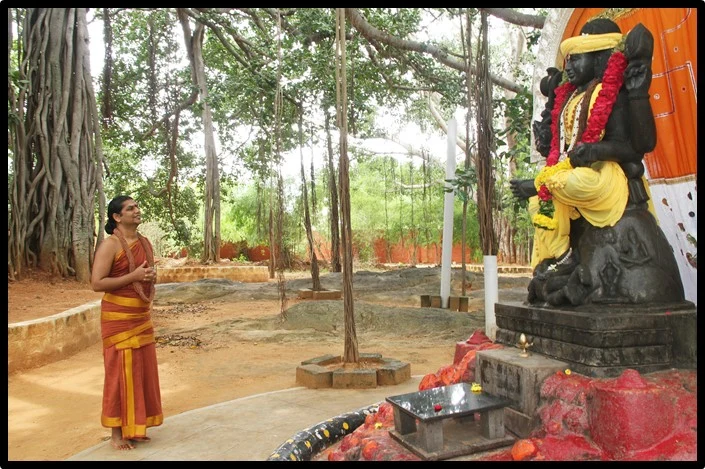
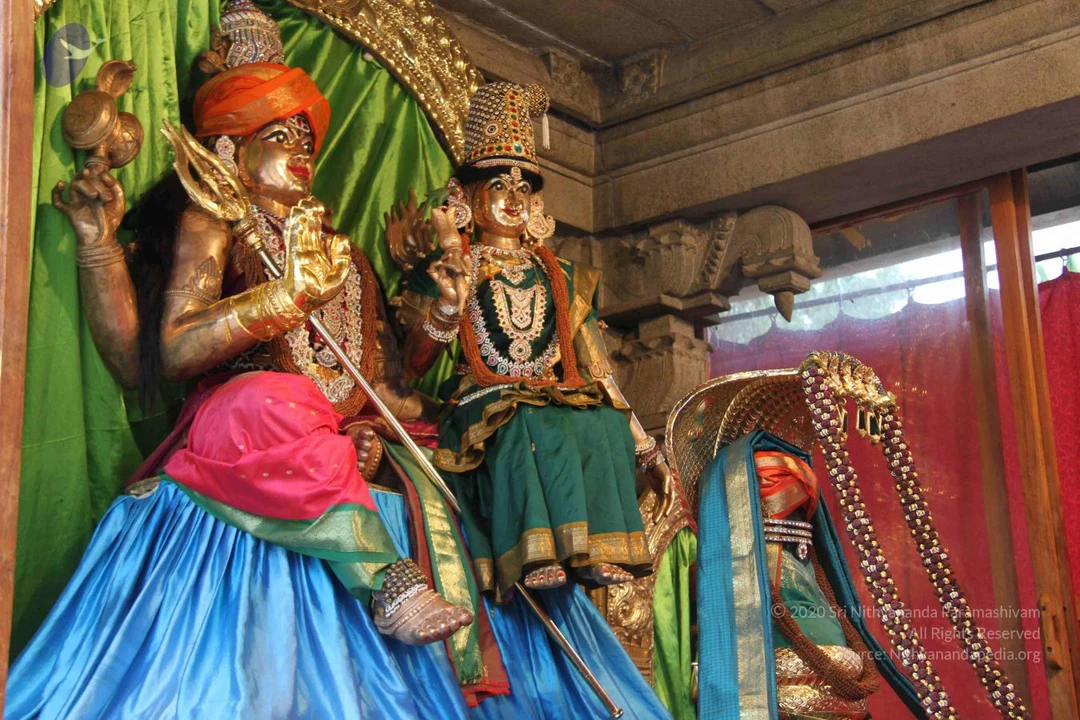
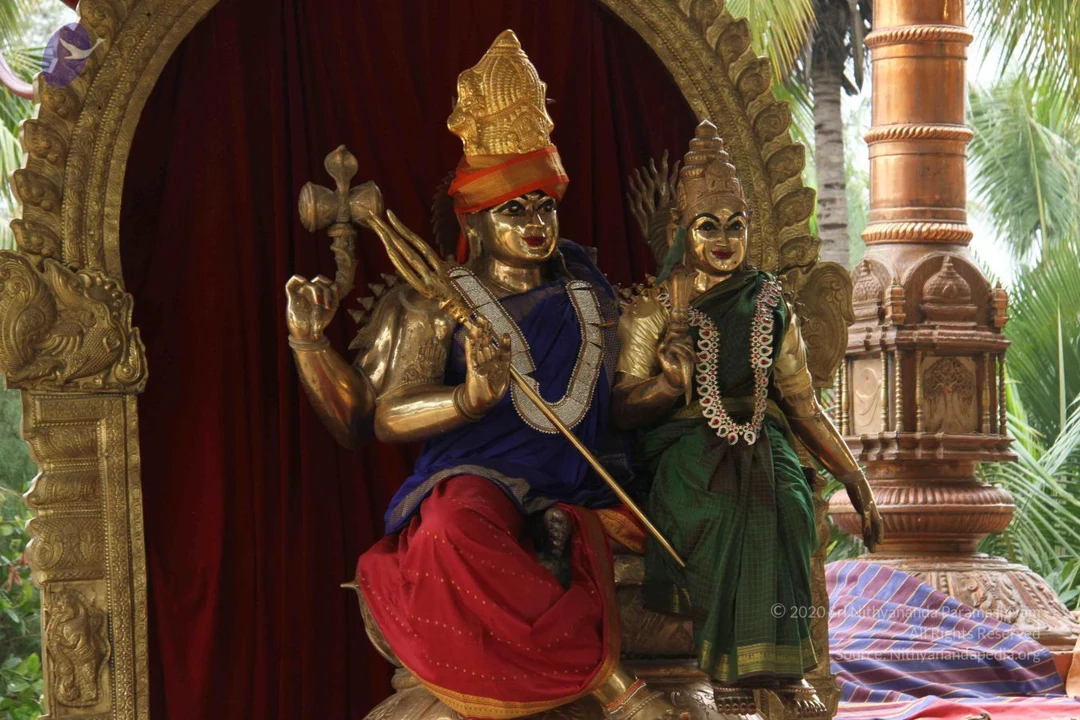
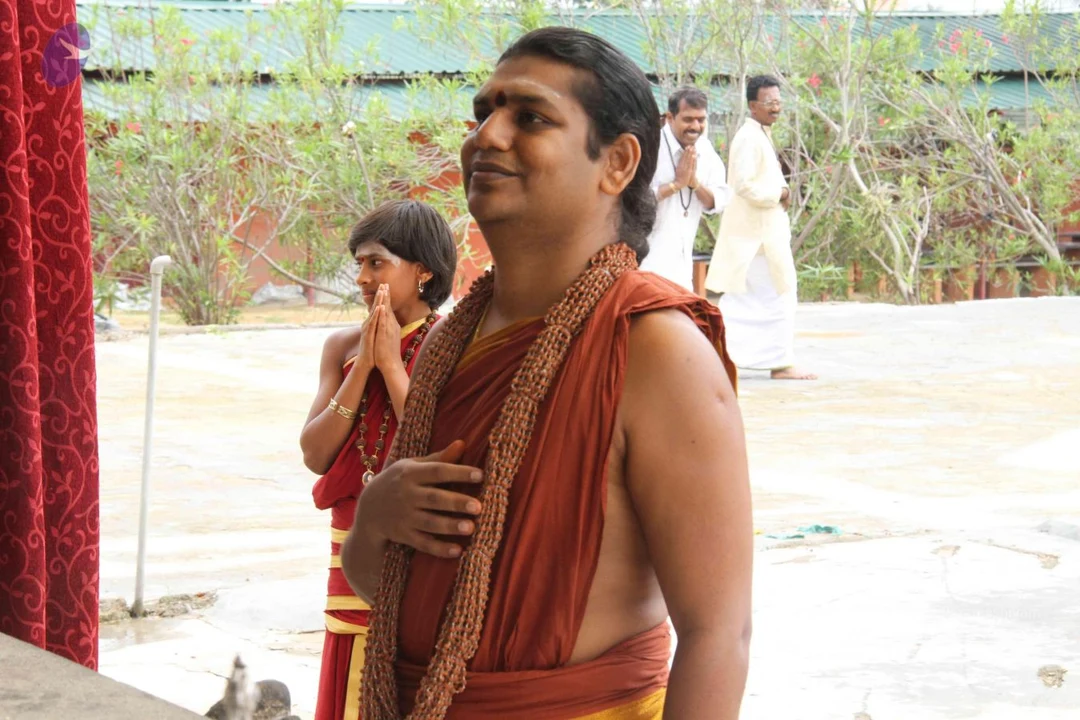
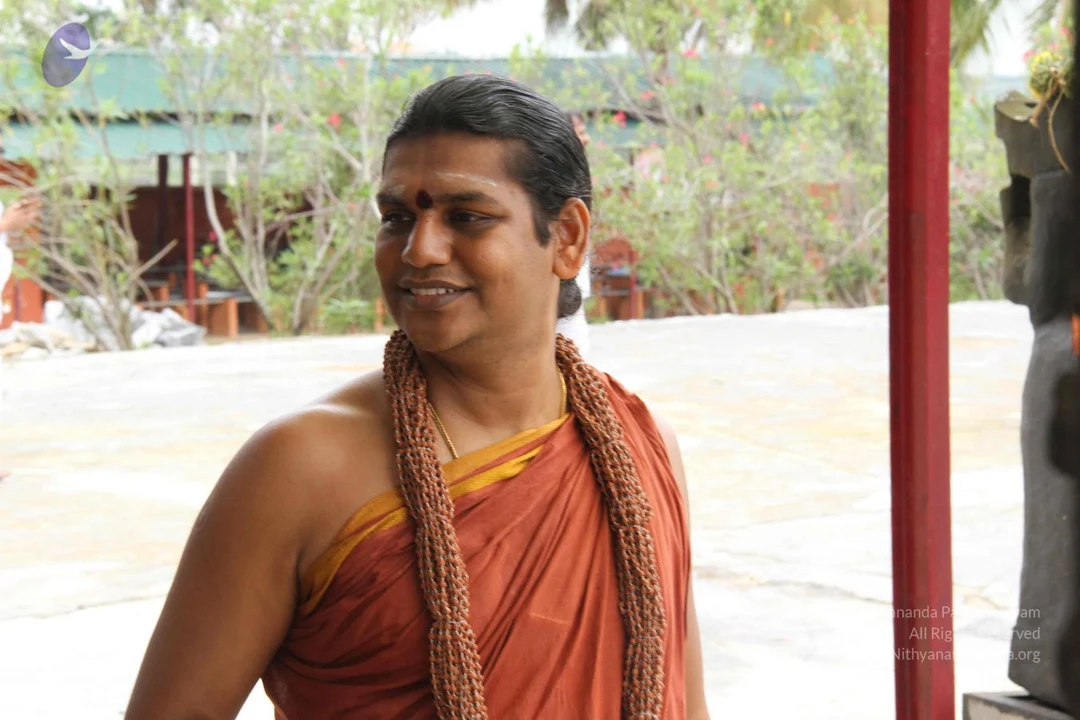
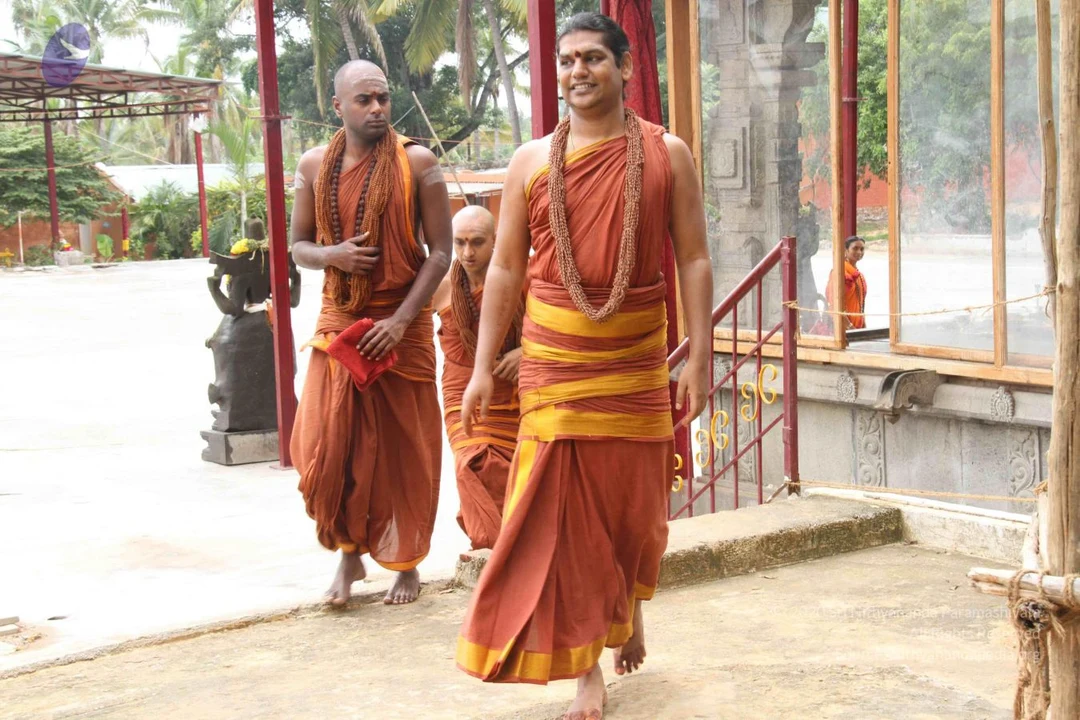
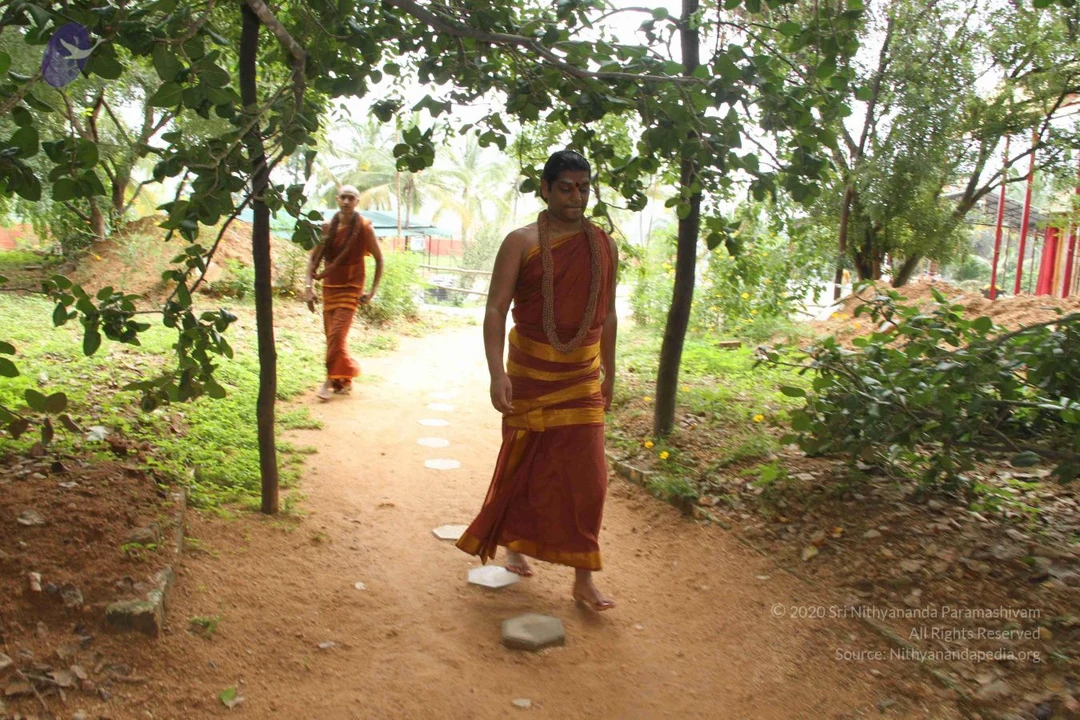
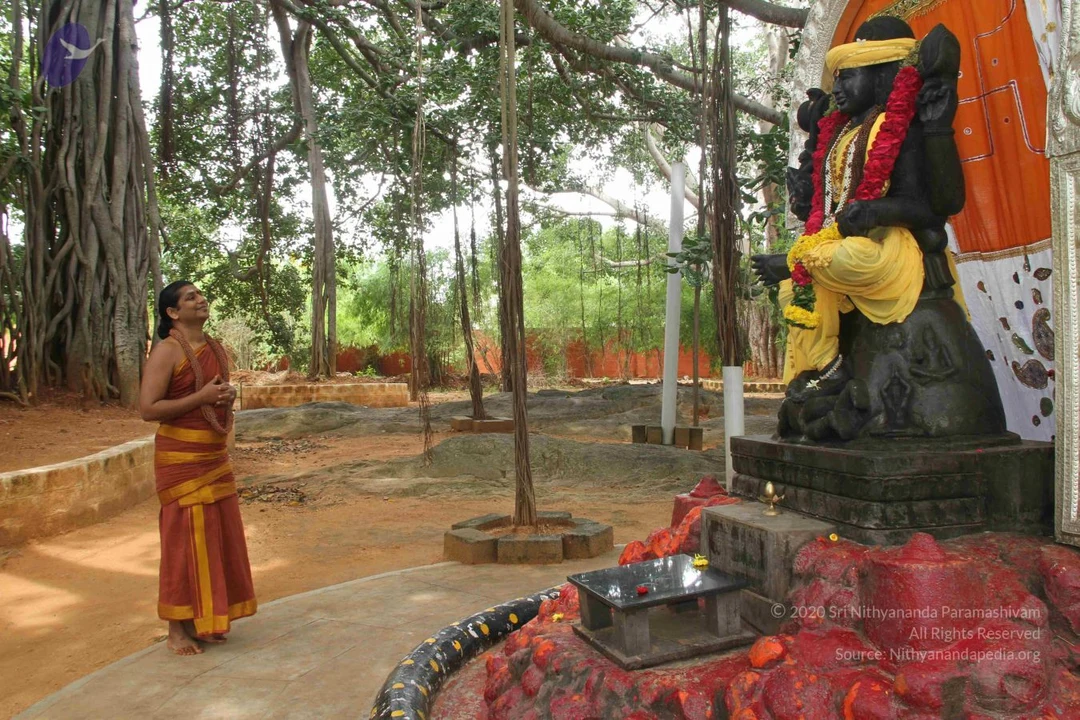
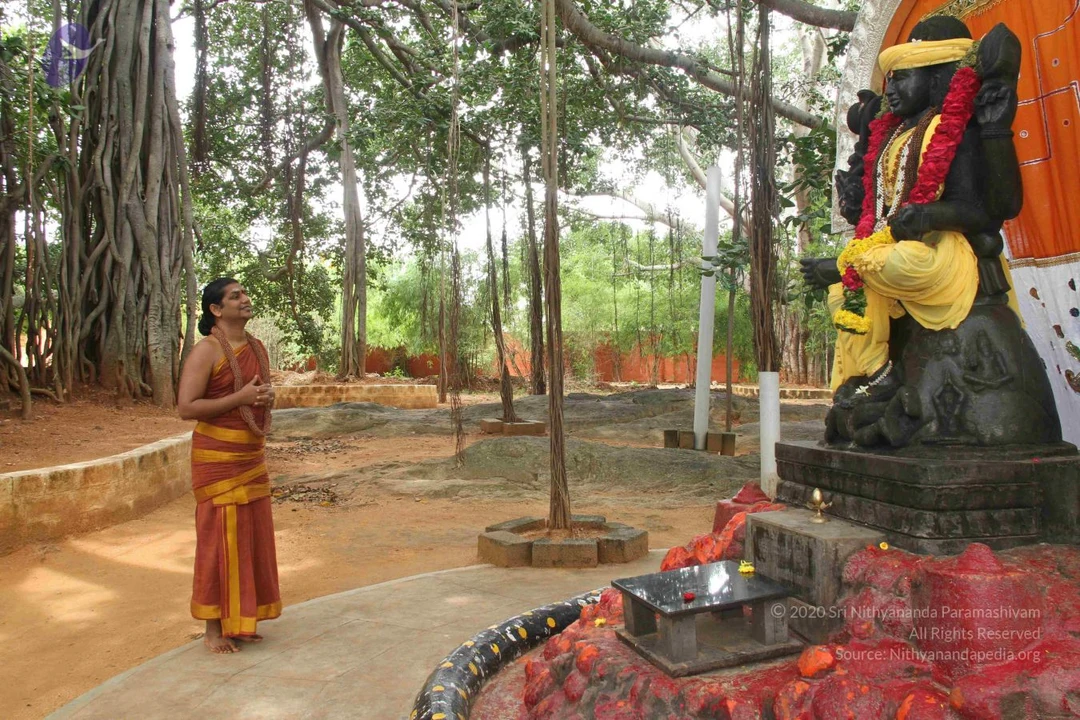
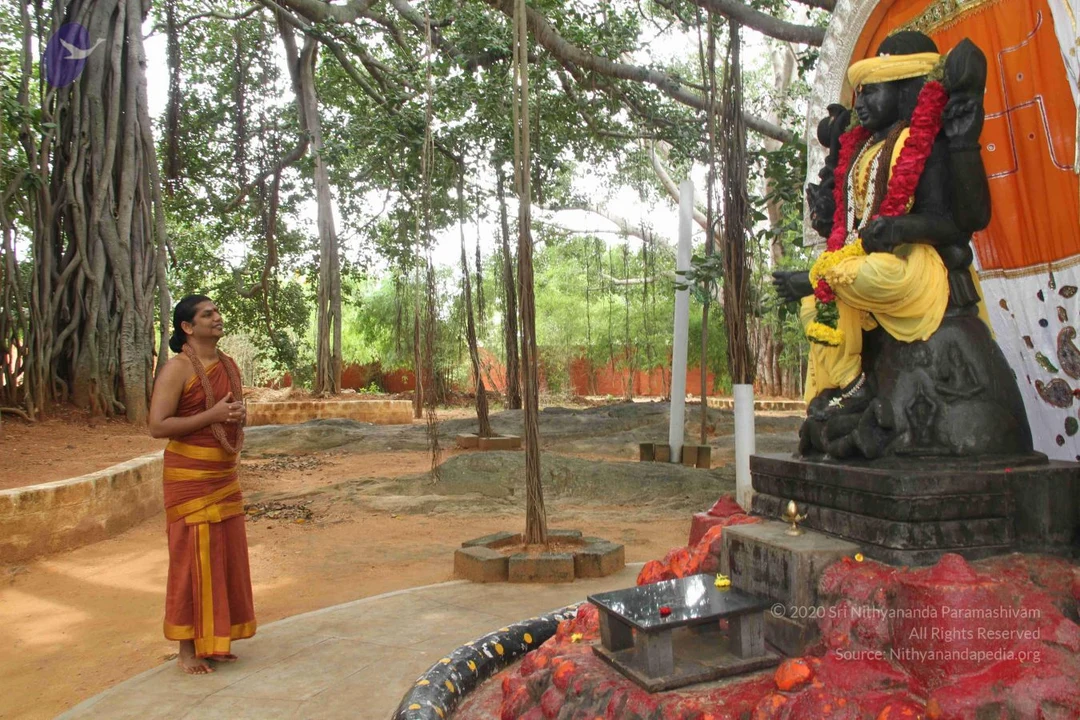
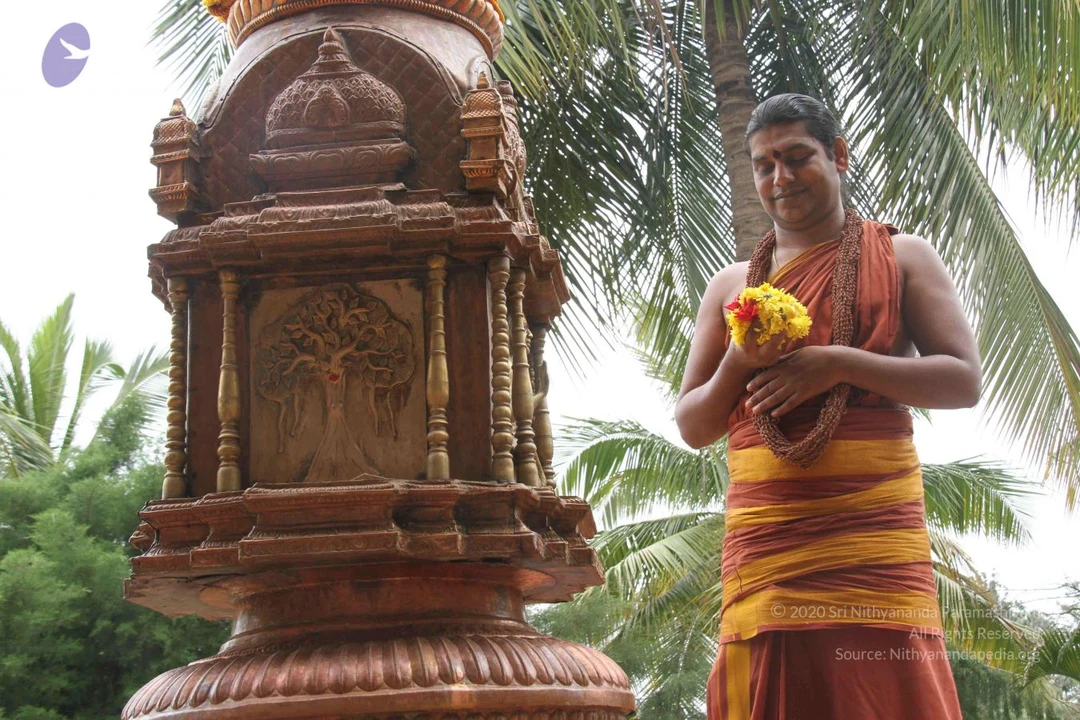
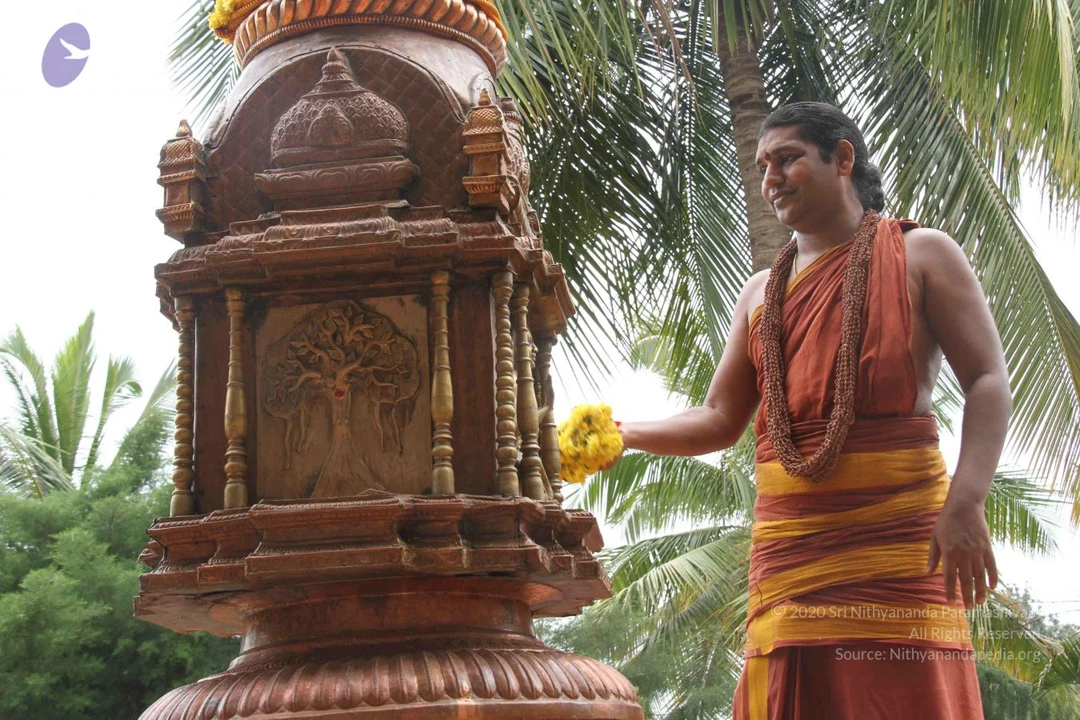
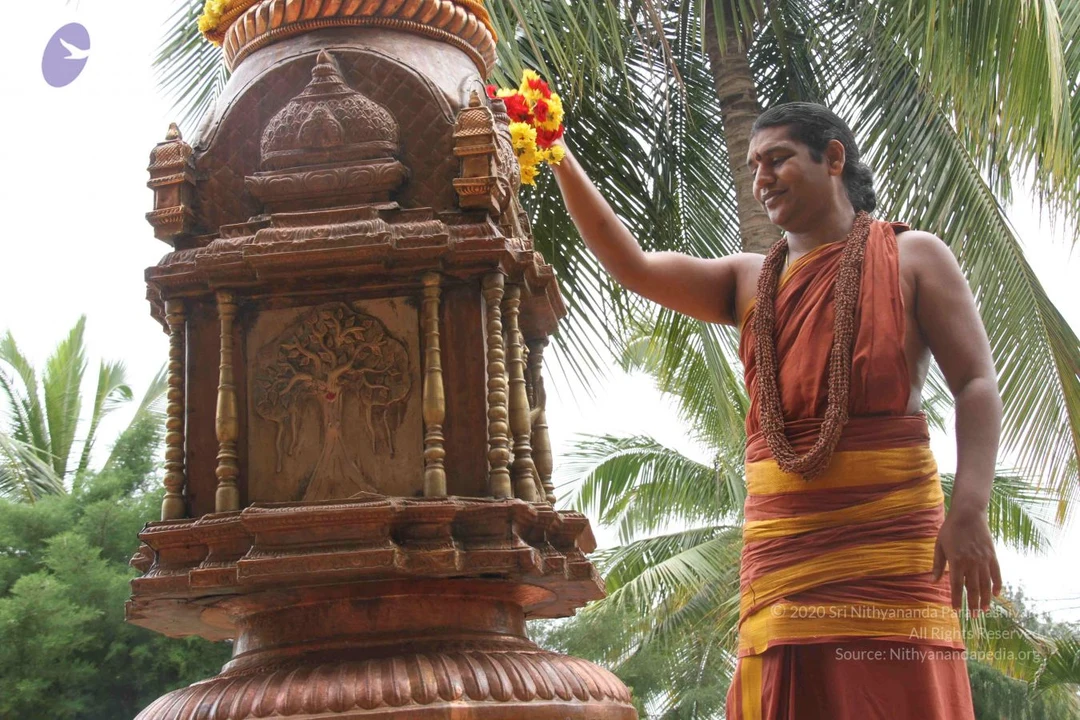
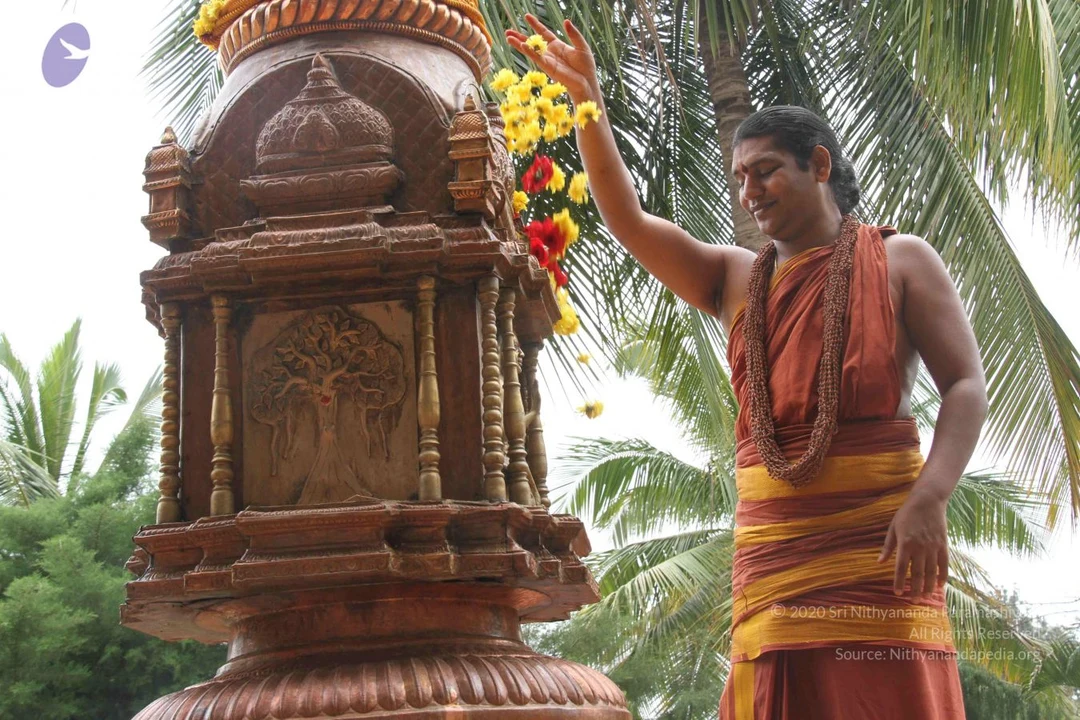
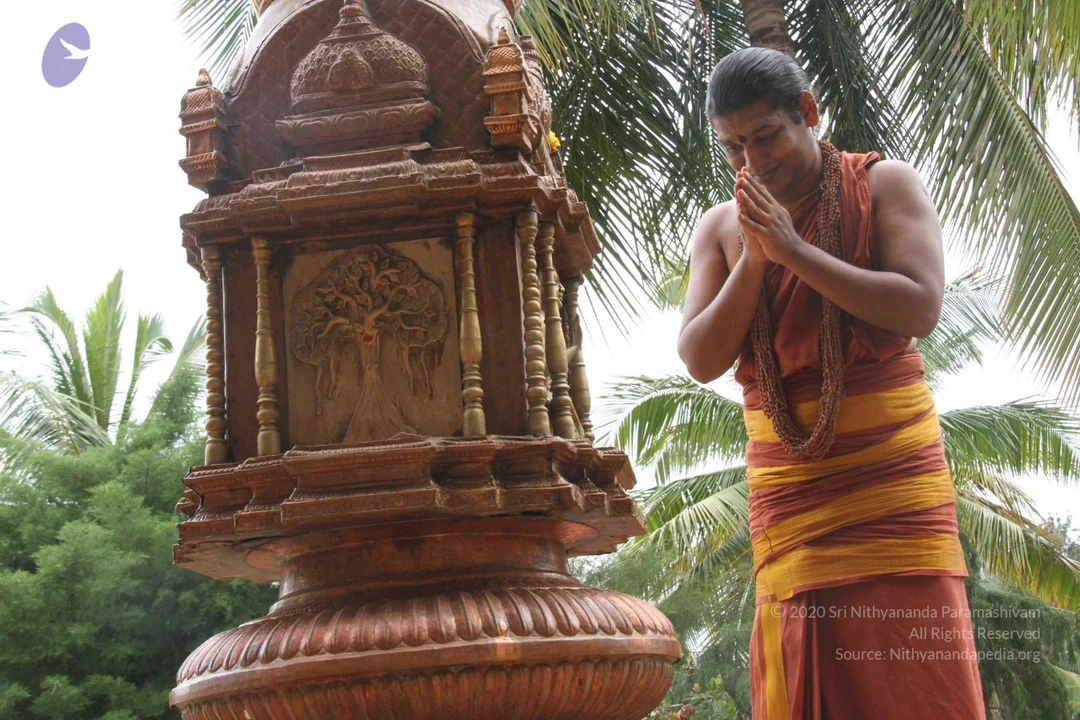
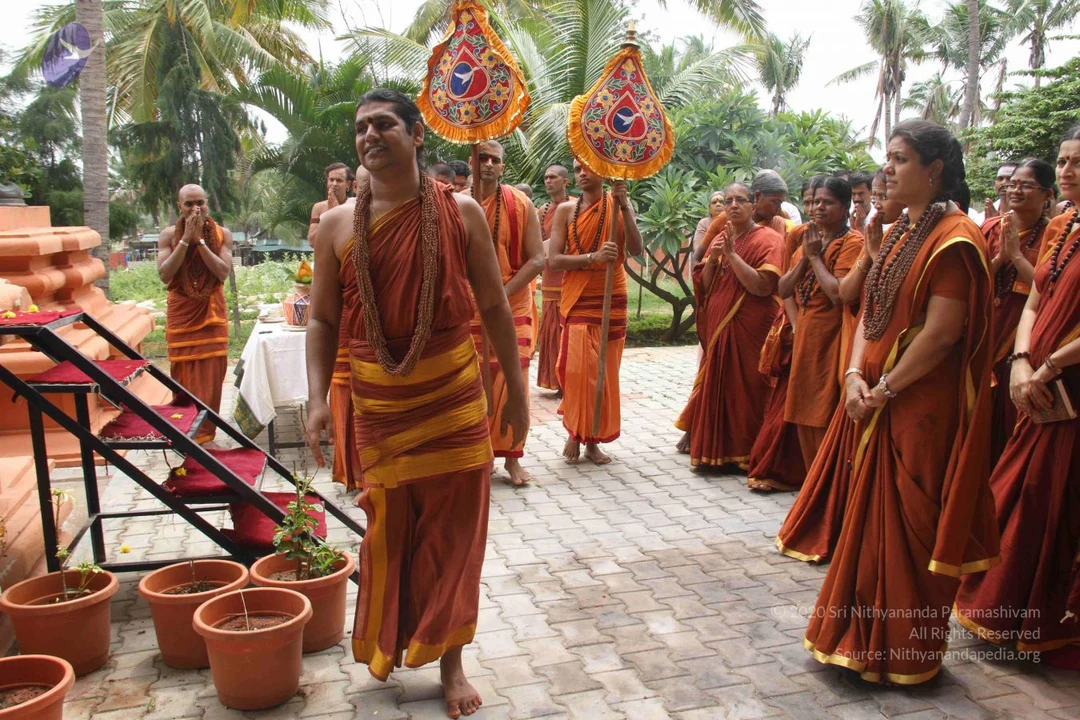
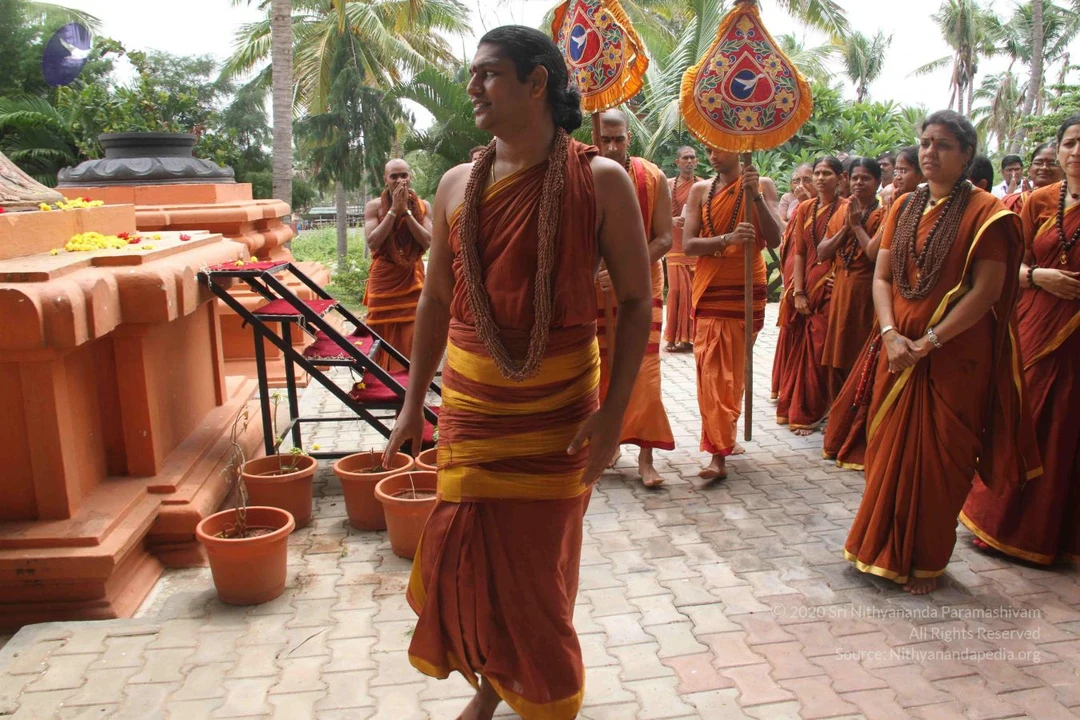
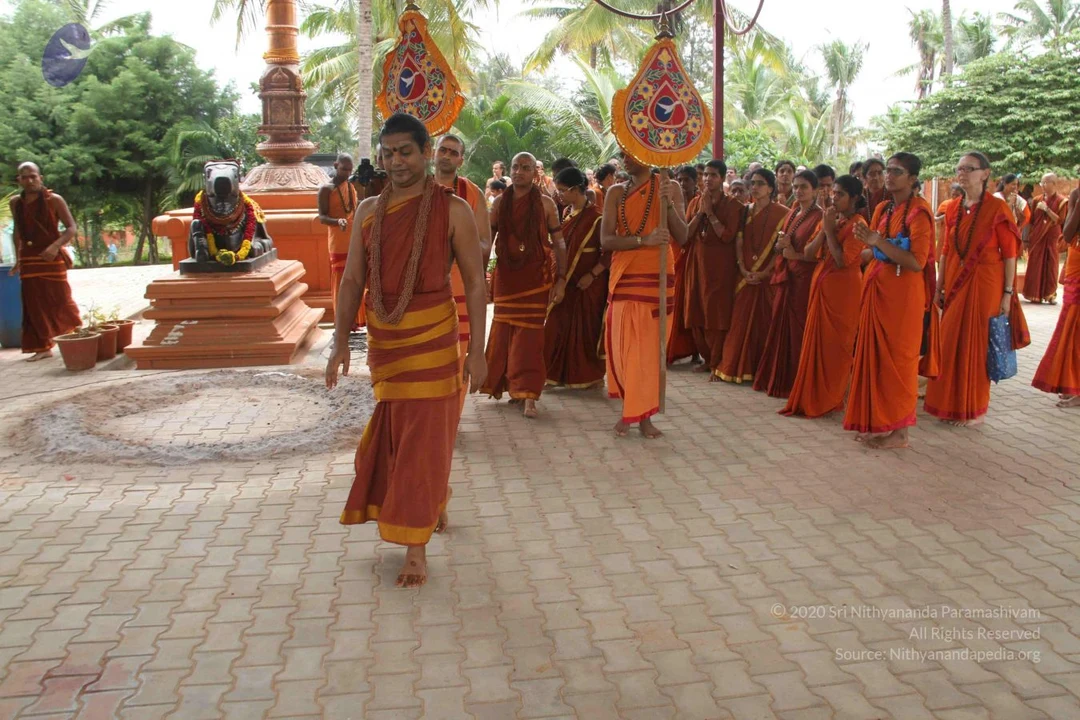
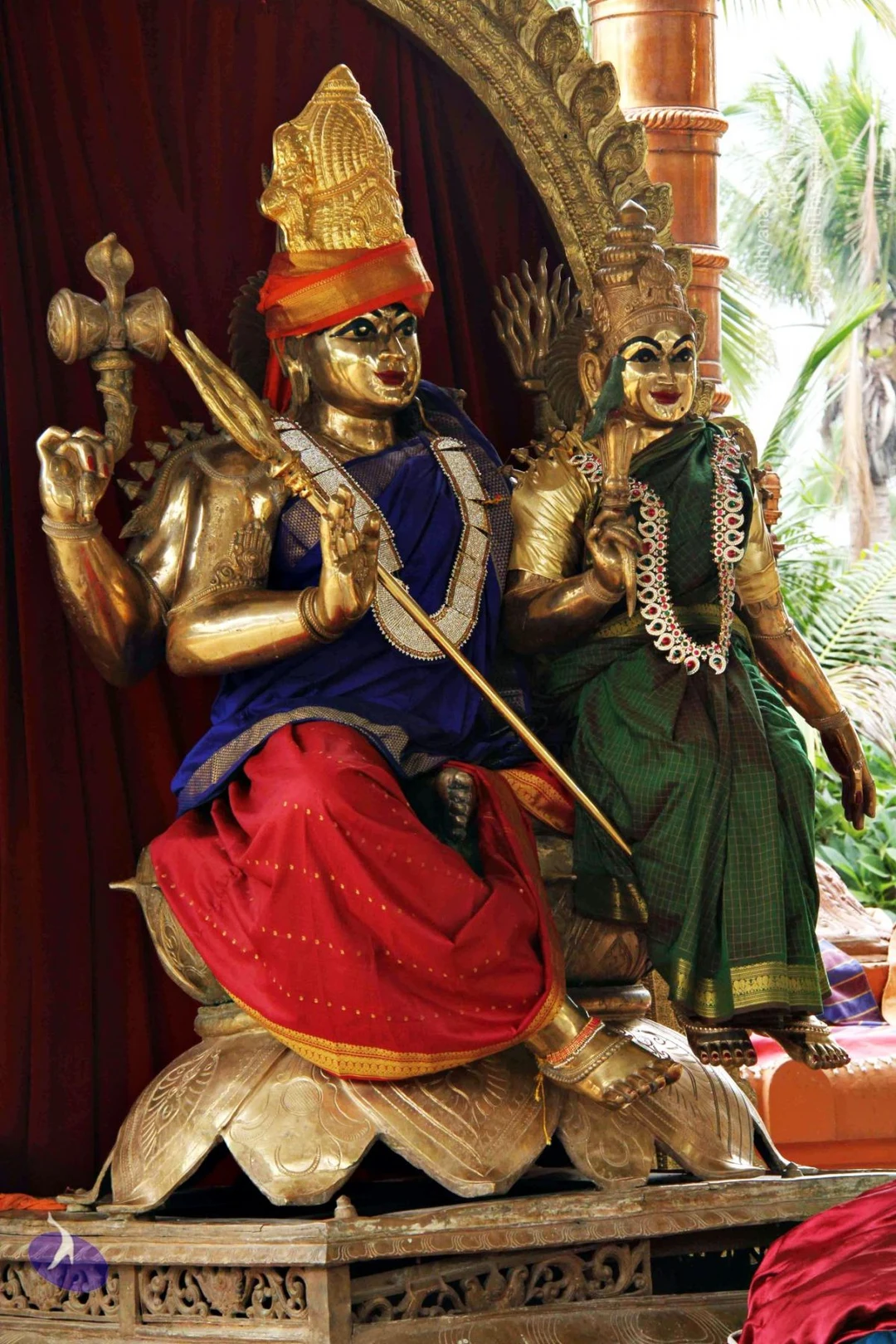
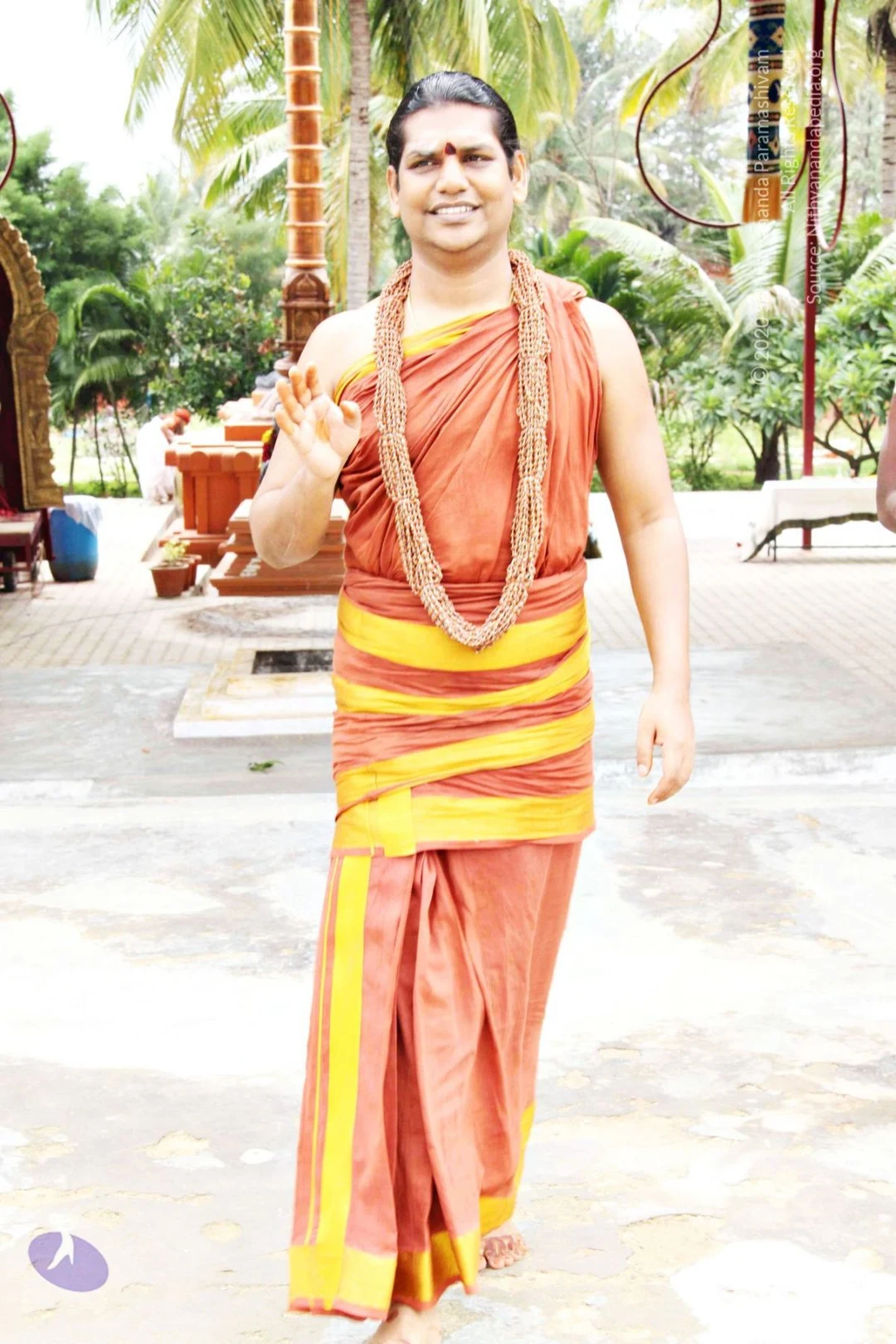
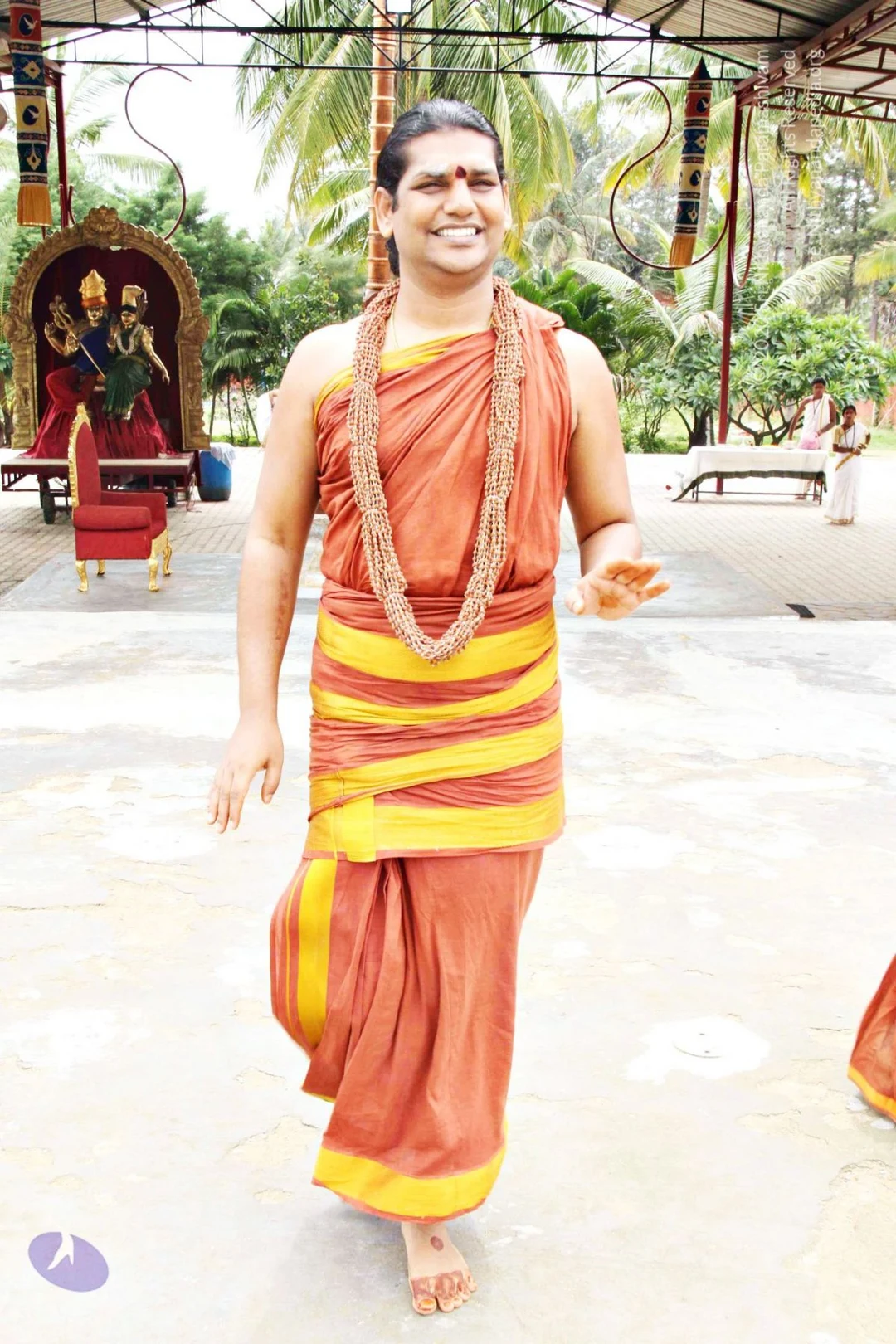
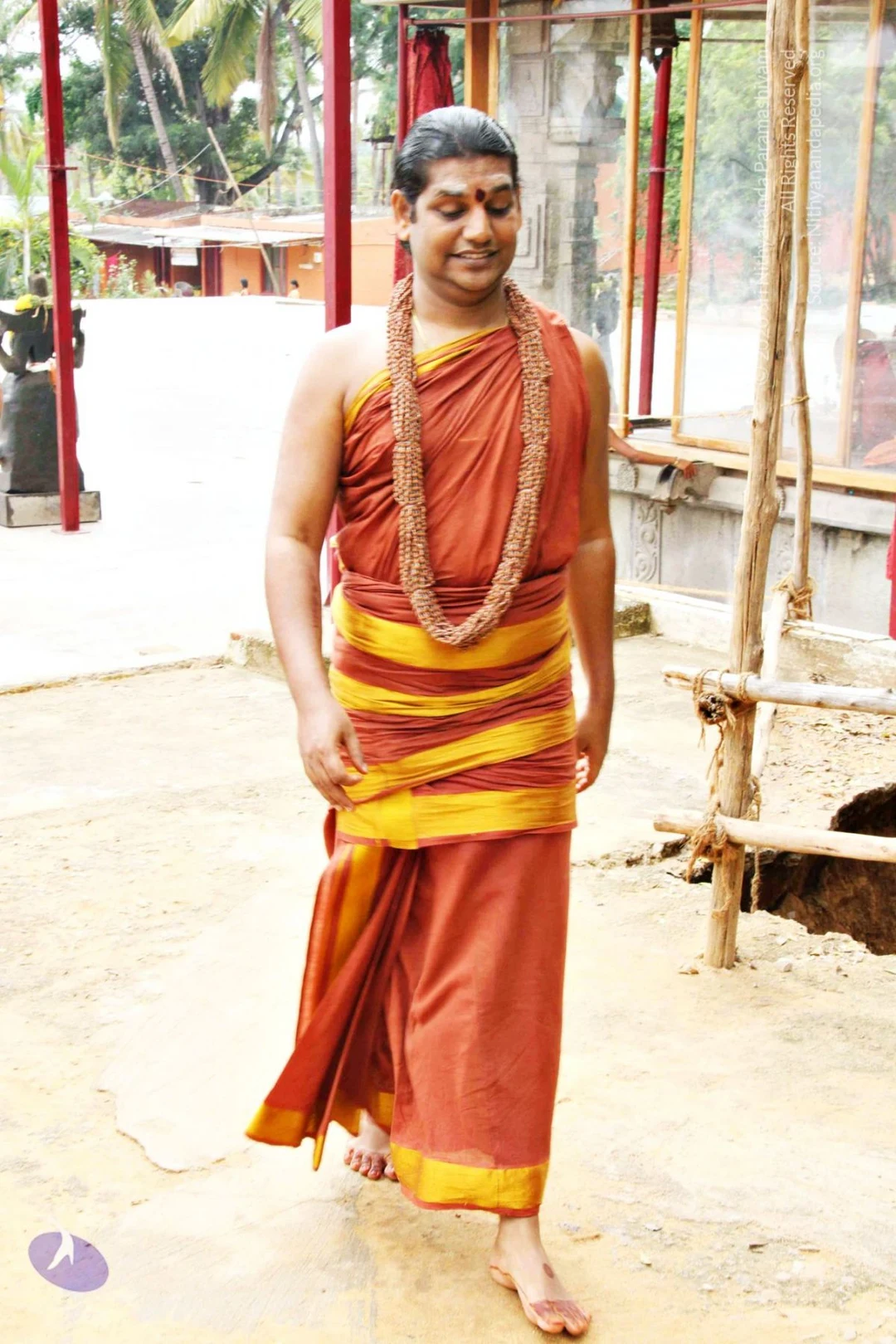
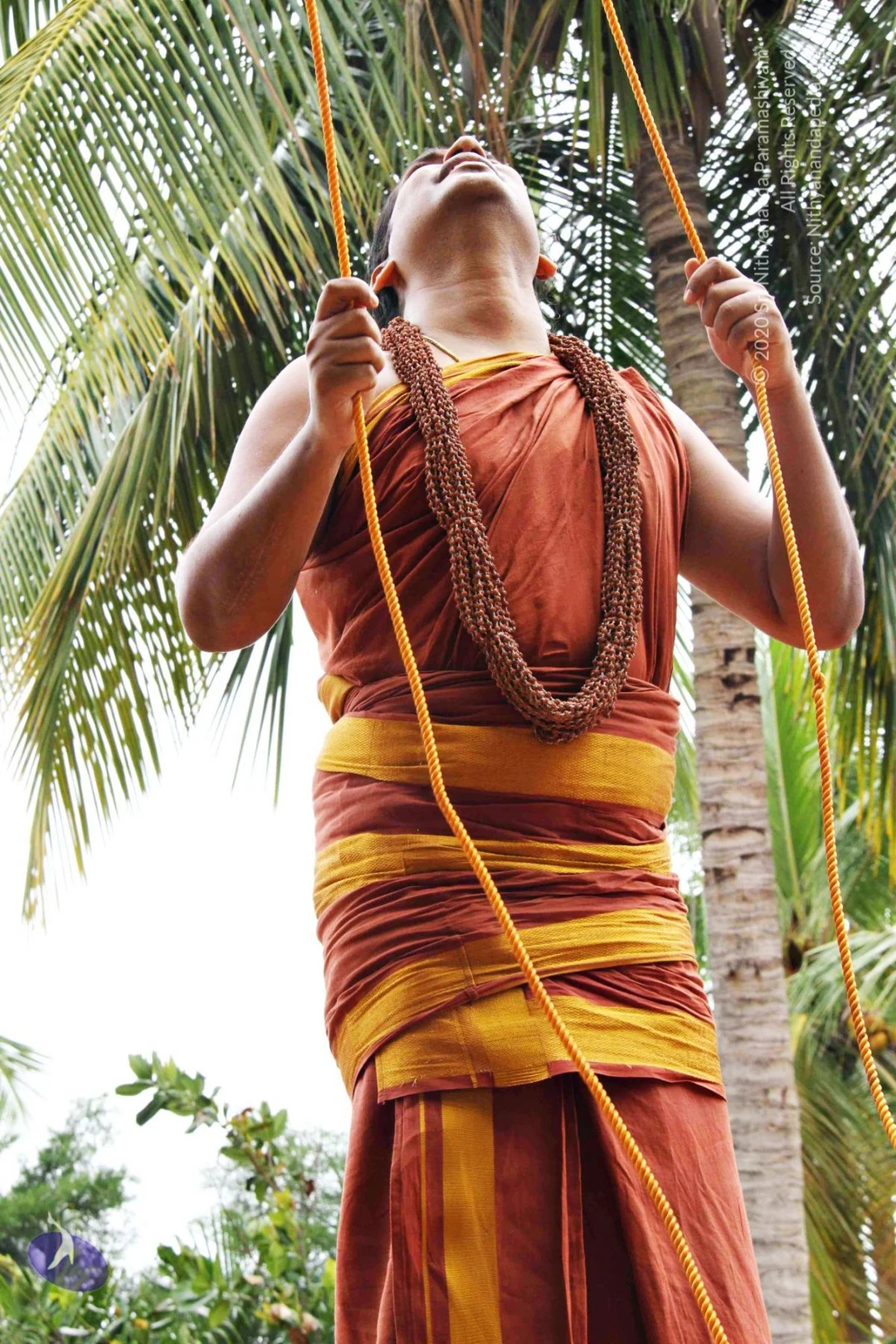
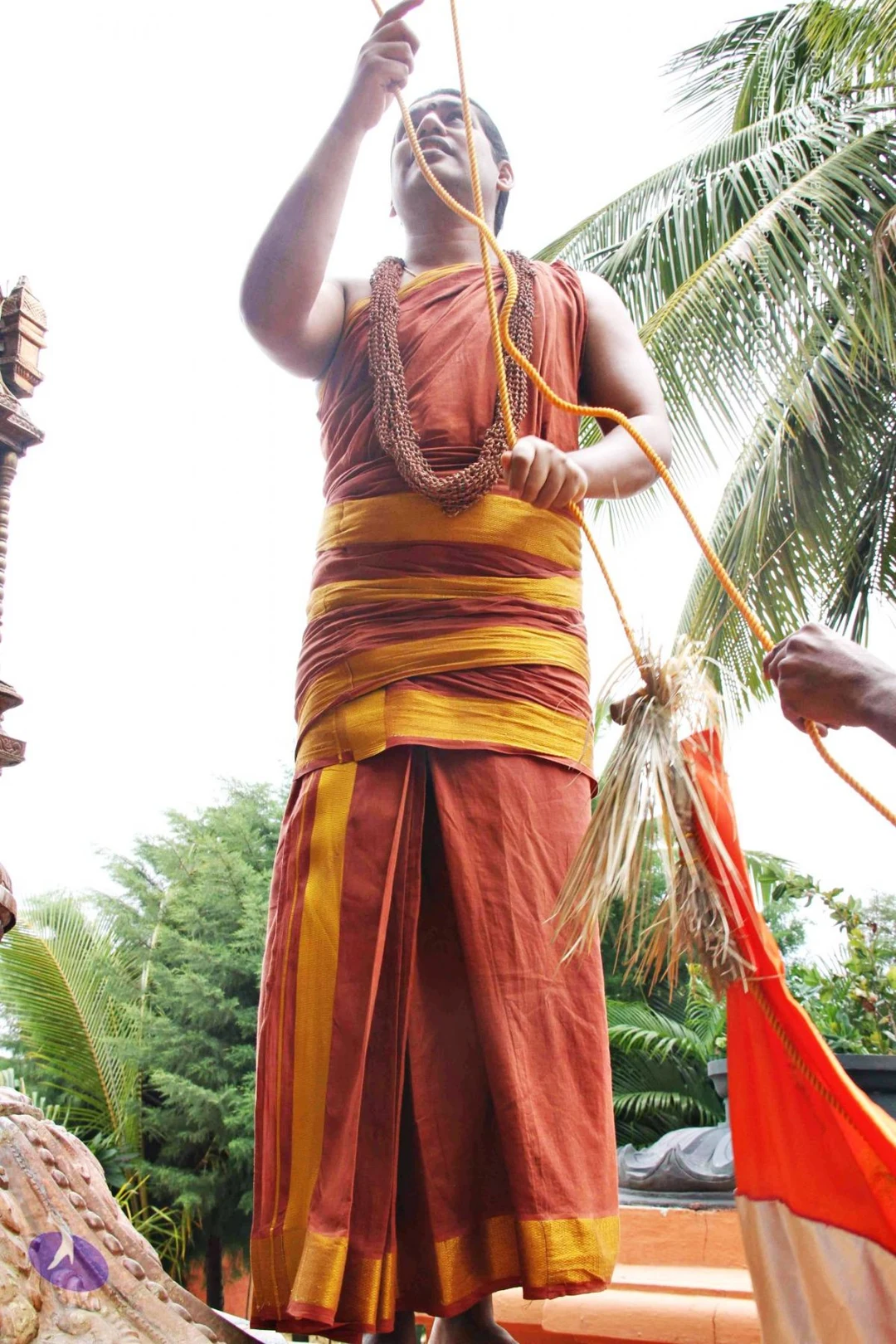
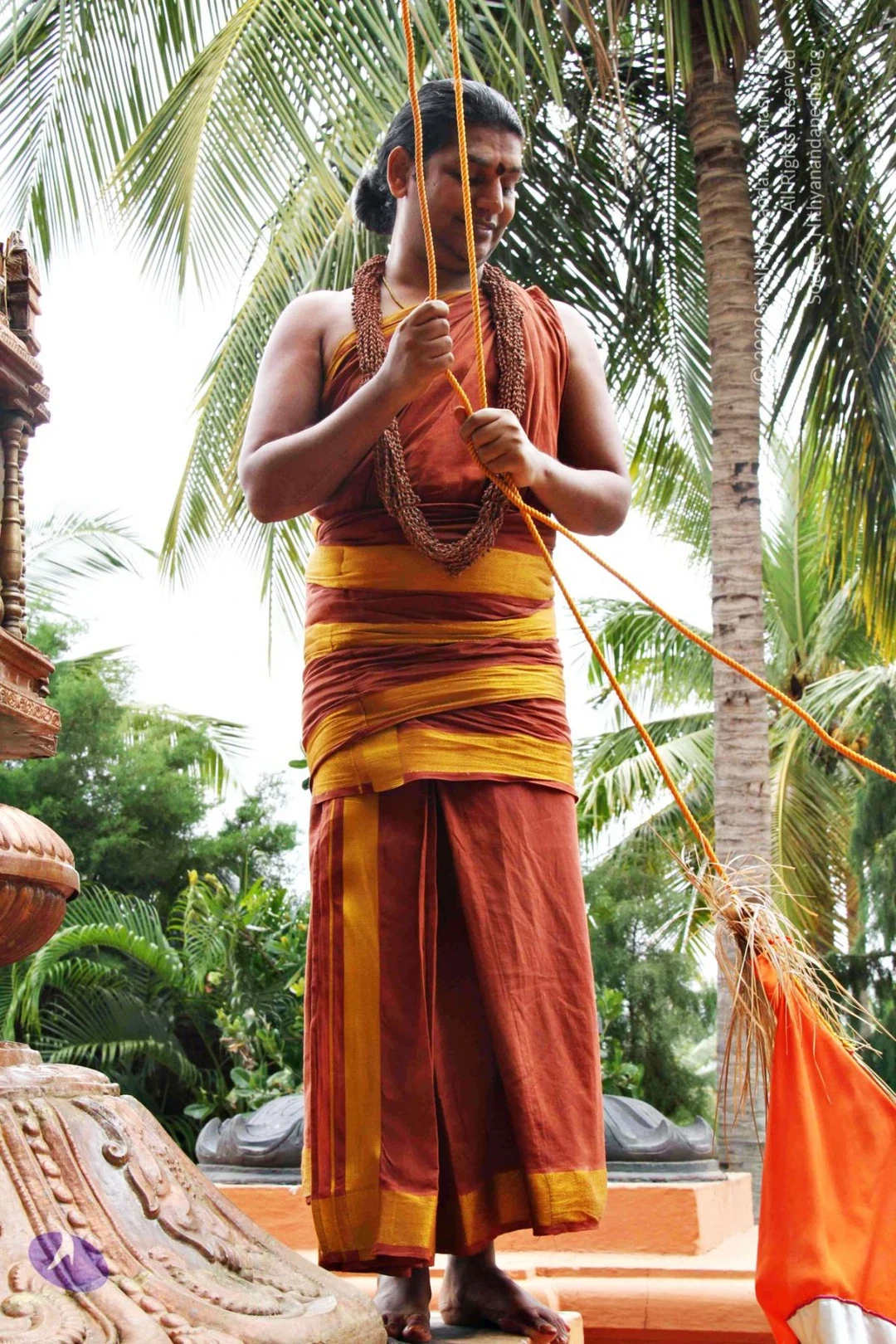
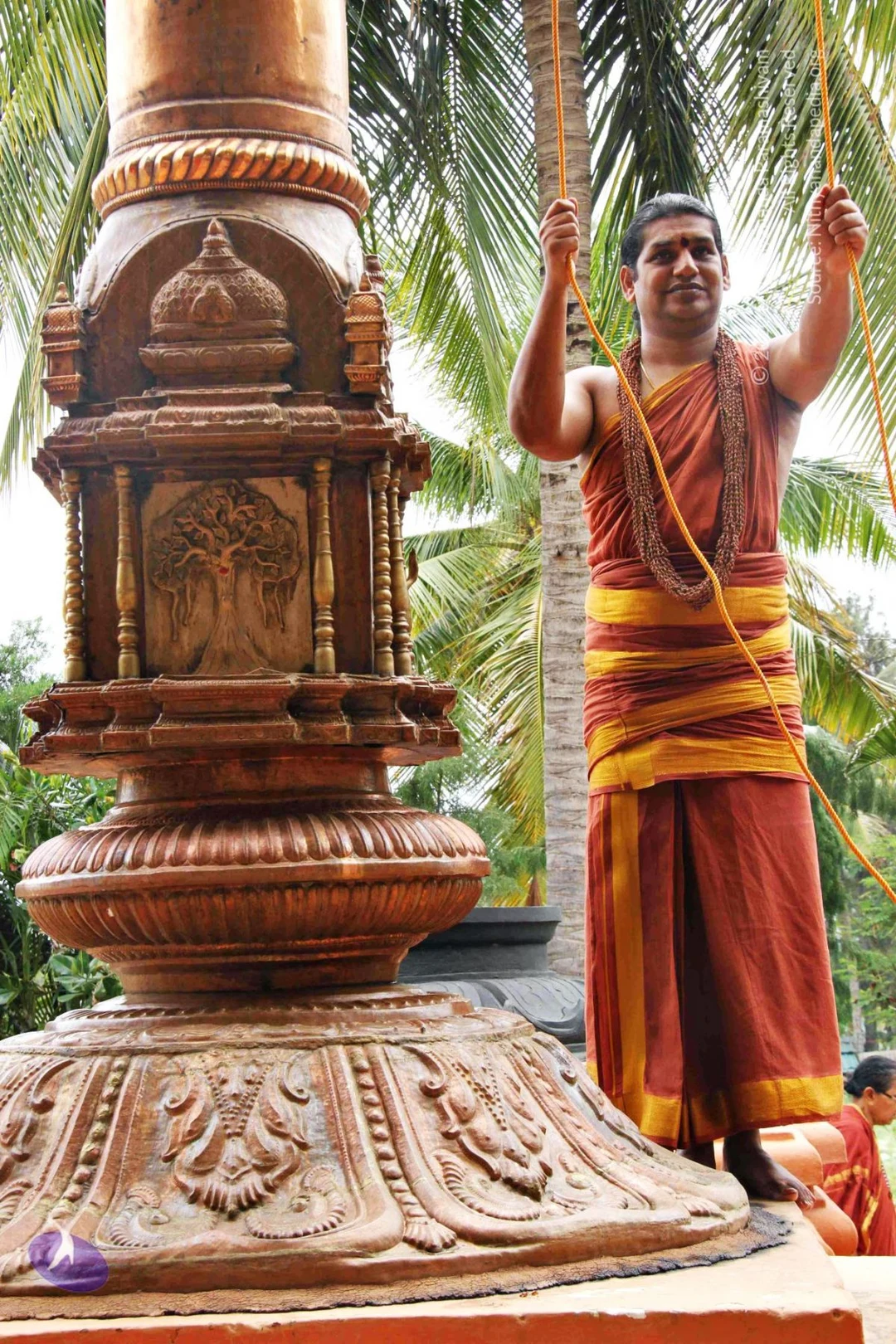
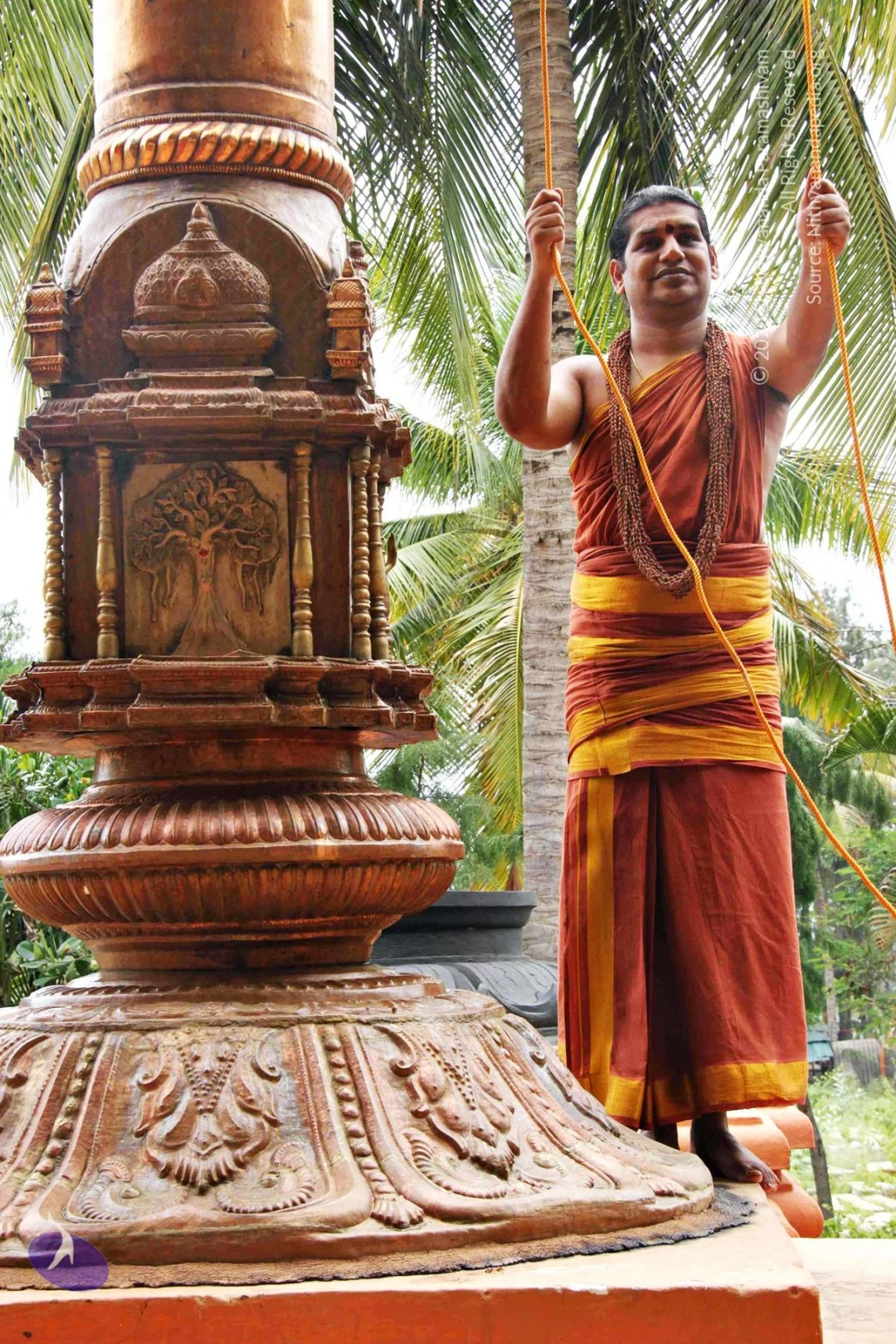
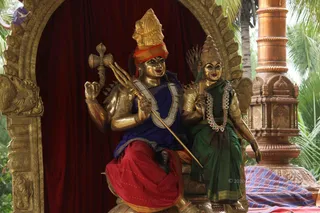
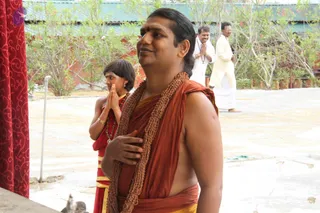
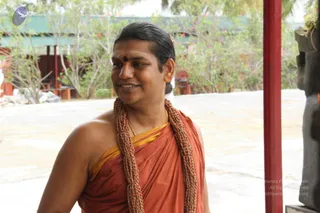
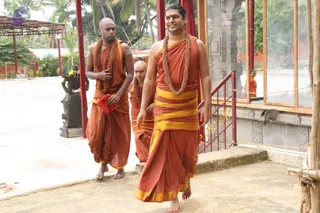
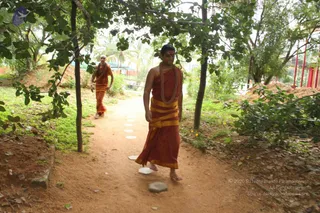
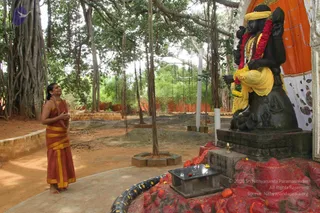
Two golden metal statues of a deity couple sit on an ornate golden throne against a deep red curtain, with palm trees and a copper pillar behind them. The figure on the left has a tall golden crown with a red and orange band, a blue upper garment, a red lower cloth, and a long trident-like staff held in one of its hands, with a ritual mace raised above. The seated figure on the right wears a green sari, a multi-strand garland of white and red beads, and a smaller crown, its hands in a blessing gesture. A deity murti display; no living people are visible.A photograph of a man in an ashram courtyard standing with his right hand placed on his chest, wearing a rust-orange dhoti and shawl draped over the shoulder with a long rudraksha mala hanging to his waist. A child in red and yellow clothing with a red bead necklace stands behind him with palms pressed together in namaste. In the background, two men in white kurtas and dhotis walk and greet with folded hands near flowering oleander shrubs, beside a red wall and a green roof. A red patterned curtain hangs at the left edge.A smiling man stands outdoors on a pale stone courtyard beside a red pillar, with flowering shrubs and a green-roofed building behind him. He wears an ochre-orange saffron-coloured wrap over one shoulder with a yellow border, and a long rudraksha mala of brown beads hangs around his neck, with a thin gold chain visible beneath. He has a red bindi and white forehead markings, and his hair is swept back. A stone carved figure is partly visible at the right edge.Three barefoot men in saffron-orange sannyasi robes walk along a paved courtyard path past a black stone sculpture and a red-railed staircase. The man in front on the right, with short dark hair and a red bindi, wears a large rudraksha-style mala, a wide yellow waist sash, and carries nothing. Behind him, a shaved-headed man in orange wears a mala and a red cloth, and a third shaved-headed man in orange follows further back. A small figure in orange appears inside a glass-walled hall to the right. Palm trees and a red-walled building stand in the background.A photograph of two men in saffron-orange monastic robes walking barefoot along a dirt path lined with white stepping stones, through a shaded garden with trees, green shrubs and palms. The foreground man, bare-chested with a gold-bordered orange cloth wrapped around his waist and shoulders, wears a long beaded mala around his neck and looks down at his steps. A second man in orange follows farther back. Red-painted posts and a small structure appear at the right edge.Outdoor photo beneath large banyan trees with hanging aerial roots at a temple-like grove. A person in saffron-orange and red robes with a red-and-gold shawl stands at left on a concrete path, hands joined at the chest, gazing upward toward a large black stone deity murti at right. The murti wears a yellow cloth, red flower garland and gold necklaces, and sits on a dark stone plinth ringed with red-painted stones and scattered flowers. A small brass oil lamp sits before it. Red earth and a low stone bench complete the setting. The person's appearance is not clearly established as a person, so the a person field is unsure.

Padapooja

29 photosSource gallery
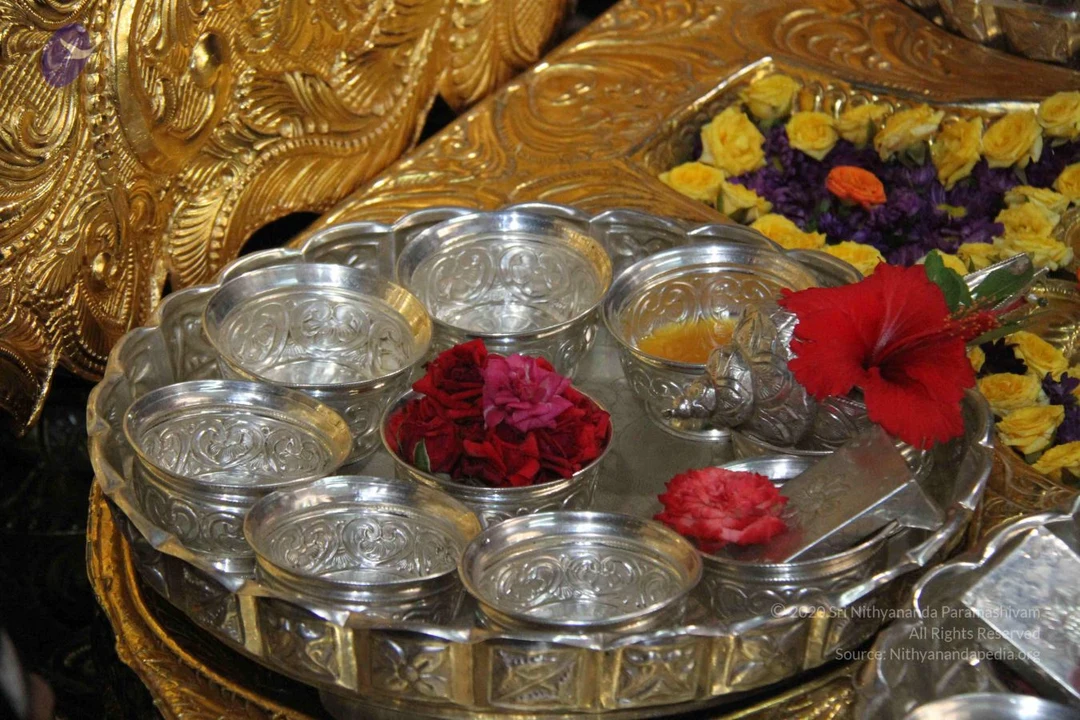
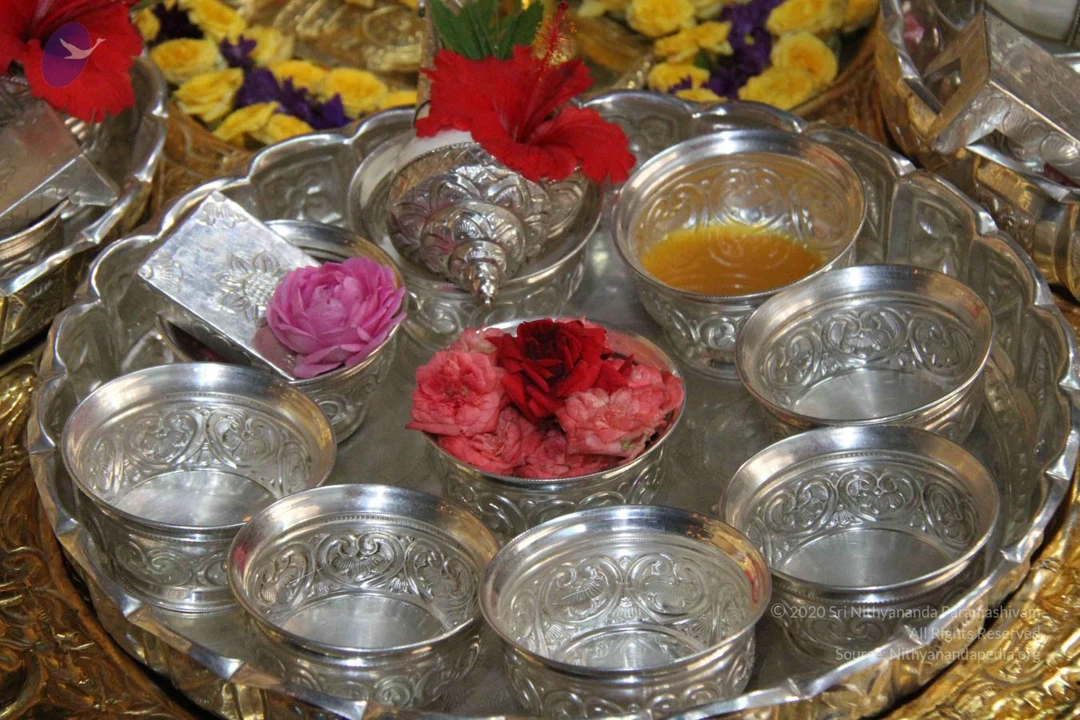
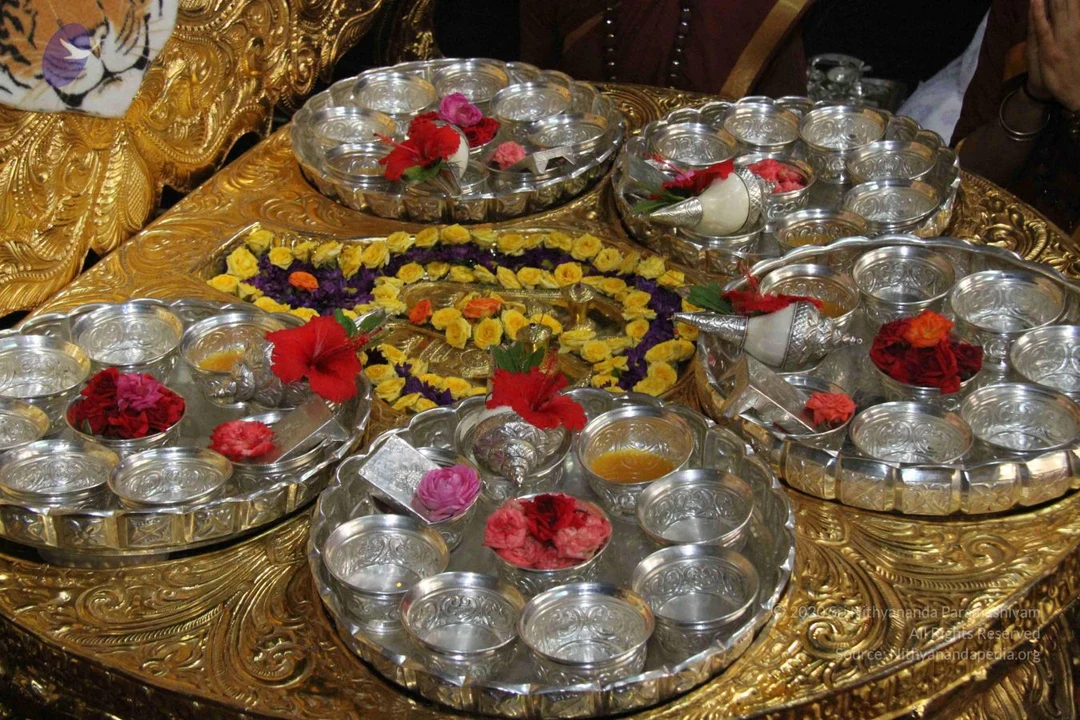
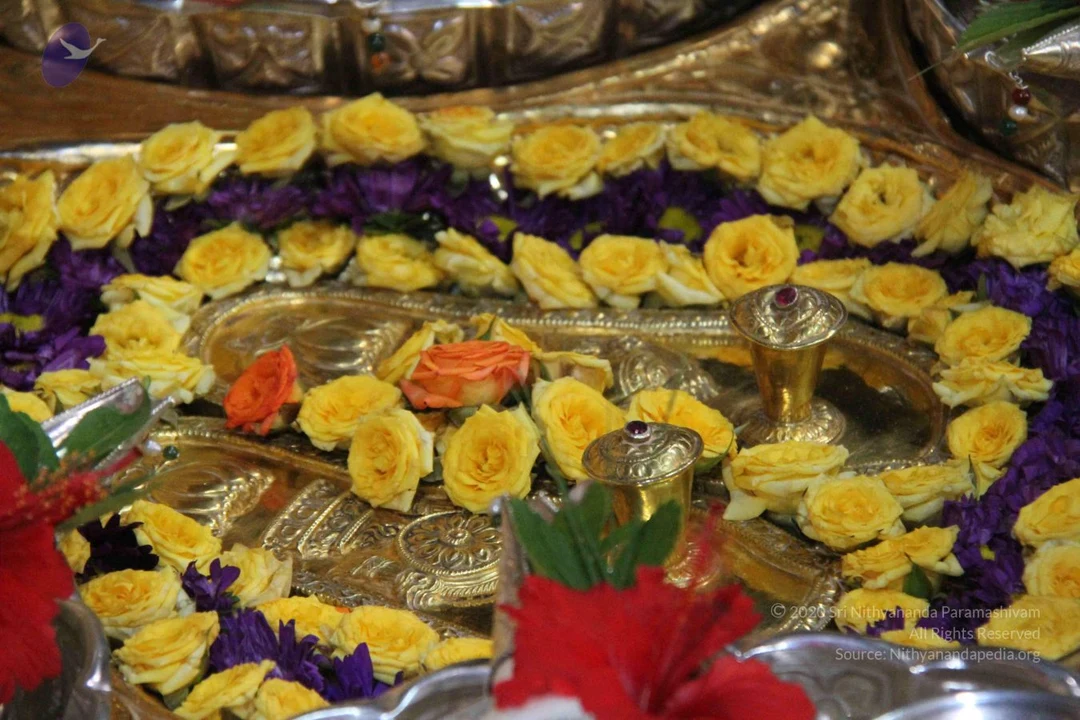
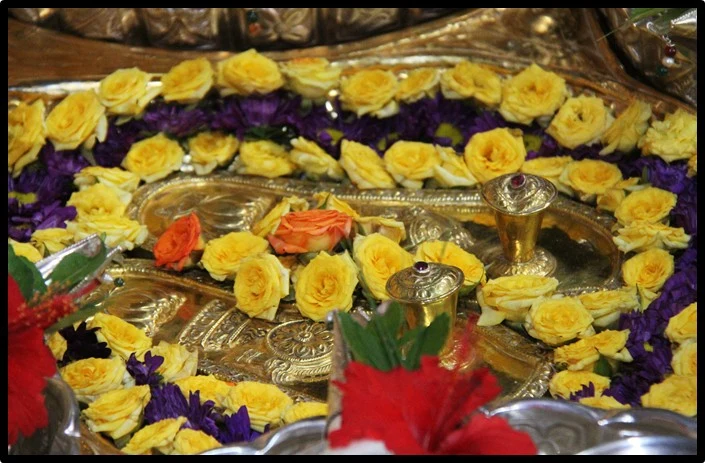
Top-down view of an ornate gold-embossed ritual tray arrangement for abhishekam offerings. Five silver-rimmed trays hold clear glass cups filled with water, yellow turmeric paste, and pink kumkum. Red hibiscus flowers, pink and purple blossoms, and green leaves decorate the trays, and silver spouted vessels hold liquid. At the centre, a yellow and purple flower garland surrounds a small golden peetha-style object with a golden bell or lamp. No people are visible.A photograph of an empty ornate gold throne (peetha) with carved lion-head armrests, draped with a tiger-striped cloth and cream cushions. Behind it is a large framed portrait labelled "PARAMAHAMSA NITHYANANDA" showing a smiling man in an orange-saffron turban and orange robe with a red bindi. Brass hanging bells and brass oil lamps (lamps) flank the throne against a dark textured wall. No physical people are visible.Close photograph of a silver ritual tray with engraved bowls holding red and pink flower petals, a small silver lamp-like cup with yellow liquid, and a red hibiscus and red flower on the tray. Behind it, gilded carved wooden panels and a garland-style arrangement of yellow roses and purple flowers. No people are visible; the setting suggests puja offerings on a silver tray.A close-up photograph of a silver ritual tray with ornately embossed bowls holding offerings for worship. A silver conch-shaped vessel topped with a red hibiscus flower sits at the centre, with a bowl of yellow turmeric or saffron paste beside it. Pink and red rose petals fill a bowl, and a pink rose rests on a small silver box. Yellow marigolds and purple flowers appear in the background, with gold-toned metalware at the edges. No people are visible.Close photo of a ceremonial worship arrangement on an ornate gold-embossed table. Silver thali trays hold small silver bowls filled with red hibiscus and pink and orange flowers, and a golden-brown liquid in one bowl. Yellow marigold petals and purple flowers form a circle around a central golden object. Two white conical vessels with silver tops sit among the trays. A tiger-striped cloth edge appears at the upper left. A blurred figure in dark red and gold robes with folded hands appears at the top right edge.Close-up photograph of a brass ritual tray decorated with a ring of yellow roses and purple flowers. Two small brass cups with red jewel-like knobs sit on the tray, with orange roses placed among them. Red hibiscus blossoms and green leaves appear at the lower edges, and ornate brass metalwork surrounds the arrangement. No people are visible.

Temple

33 photosSource gallery
A black stone Nandi bull statue sits on a raised dark platform outdoors, facing left. It wears a rust-orange velvet cloth with gold fringe and dark dotted studs, multiple strands of rudraksha-style beads across its chest, and bright yellow and red marigold and rose garlands draped over its neck and foreleg. A red brick wall and green trees stand behind it.Outdoor photo of a dark stone deity murti seated in an ornate white-and-silver arched niche set against an orange backdrop, beneath a large banyan tree with hanging aerial roots. The murti wears a yellow cloth, a yellow headband, and a red flower garland. The base is covered in red-orange powder and offerings, with a small black altar and an oil lamp in front. Red brick walls and bare earth are visible in the background. No people are present.A photograph of an outdoor shrine beneath a large banyan tree with many hanging aerial roots. A black stone statue of a seated deity or sage is set within a silver-framed arched niche backed by orange fabric. The figure wears a yellow cloth wrap, a yellow turban-like headpiece and red flower garlands, and holds a small yellow item. A dark serpent-patterned border and a reddish-painted mound surround the base, with a small altar stone in front. Red-earth paths, a red boundary wall and green foliage are visible. No living people are present.A photograph of an outdoor shrine beneath a large banyan tree with many hanging aerial roots. A black stone deity murti sits in a white arched niche backed by orange fabric, wearing a yellow dhoti, a red flower garland and yellow flower garlands, seated with one hand raised. The shrine base is a rough red-painted mound with a small black offering stand and a diagonal black-and-yellow snake-like border. Open dirt ground, low stone walls and a white post stand in the background. No people are visible.A black stone deity murti sits within a white carved arched niche backed by orange fabric, under a large banyan tree with hanging aerial roots. The murti wears a yellow cloth, a yellow headpiece, and red flower garlands, with gold ornaments on its chest. Its pedestal is ringed with dark stone and a mound of red-painted stones and marigold-yellow offerings. A small black stone altar stands in front, with a stone path leading through an open grassy area with more trees beyond. No people are visible.A dark stone deity murti stands in a white ornate arched niche set against an orange and white draped backdrop, outdoors among leafy trees. The figure wears a yellow cloth, a gold necklace and a large red and yellow marigold garland, with raised arms holding ritual implements. The statue rests on a black pedestal atop a mound of red-painted stones, with a small brass lamp in front and a clean paved circular path surrounding the shrine. No people are visible.

Nithya-Satsang-Swamiji

28 photosSource gallery
A seated man in saffron-orange robes sits on an ornate gold throne with a carved arched back and gold lion heads at its base, his palms pressed together at chest level in a namaskar gesture. He wears a rudraksha mala and bangles, with a red tilak on his forehead. Flanking the throne are two large painted deity murti figures with multiple arms, crowns, gold jewellery and green sashes, each holding ritual objects. The background is a blue-grey wall with a carved wooden door.A seated man in a saffron-orange dhoti and shawl with a yellow border sits cross-legged on a large ornate gold throne with carved backrest and lion-headed armrests, palms pressed together in namaste. He wears a rudraksha mala with a second beaded necklace, bangles and armlets, and a red bindi. Flanking the throne are two painted deity murti figures in gold crowns and jewellery, one holding a lamp. Behind him stands a carved wooden door. A tiger-striped cloth covers the platform. The setting suggests a discourse or darshan hall. a person: the seated man has the saffron clothing, rudraksha malas and throne-seating cues matching the page's claim, though the appearance is only partly distinctive.A seated man in an ornate golden throne with a large arched backrest, flanked by two golden lion-shaped seat supports on a maroon-cushioned dais. He wears a rust-orange shawl over a saffron-and-gold dhoti, a multi-strand rudraksha mala with ceremonial beaded necklaces, silver armbands and bangles, and a red bindi. His palms are pressed together in namaste and he smiles. Behind him stand two painted deity murti figures with gold crowns, gold ornaments and raised ceremonial implements, against a blue-grey wall with a wooden door. Probable Swamiji by cues: long swept-back hair, ornate throne, saffron attire, rudraksha mala and gold ornaments, seated as a teacher giving satsang.A man in a rust-orange and gold-bordered dhoti and shawl stands beside a clear acrylic lectern at a discourse hall. He wears a long rudraksha mala, gold-tone bangles, a gold earring, and a white tripundra with a red bindi, and smiles while resting one hand on the lectern. Behind him stands a painted deity murti with a trident-like staff, and two brass oil lamps on stands flank the stage. a person: the rudraksha mala, orange and gold attire and speaking position are the qualifying cues for a teacher at a discourse.A man in saffron-orange and gold-striped robes stands beside a clear acrylic lectern on a stage, smiling and resting one hand on the lectern. He wears a long rudraksha-style bead mala, beaded bracelets, a gold armlet, gold earrings and a red bindi, with his hair swept back. Behind him stands a painted deity murti with a crown, gold ornaments and a trident-like staff, beside a brass oil lamp on a pedestal and blue and pink decorative pillars. The scene reads as a discourse setting.A man in a rust-orange dhoti-style wrap with gold-yellow borders stands at a clear acrylic lectern on a stage, one hand resting on the lectern. He wears a multi-strand rudraksha-style bead mala around his neck, beaded bracelets on his wrist and upper arm, gold earrings, and a white vibhuti mark with a red dot on his forehead. A lapel microphone is clipped near his chin. Behind him stand brass oil lamps (lamps with flame-shaped tops) and a painted backdrop with pink and green lotus-style pillars. At the right edge, a painted deity murti with a crown, gold jewellery, a trident-like staff and a green sash stands beside the scene. Probable Swamiji (appearance cues: long swept-back hair, rudraksha mala, orange ceremonial clothing); presented in a discourse setting.

SarvaDarshan-Pics

14 photosSource gallery
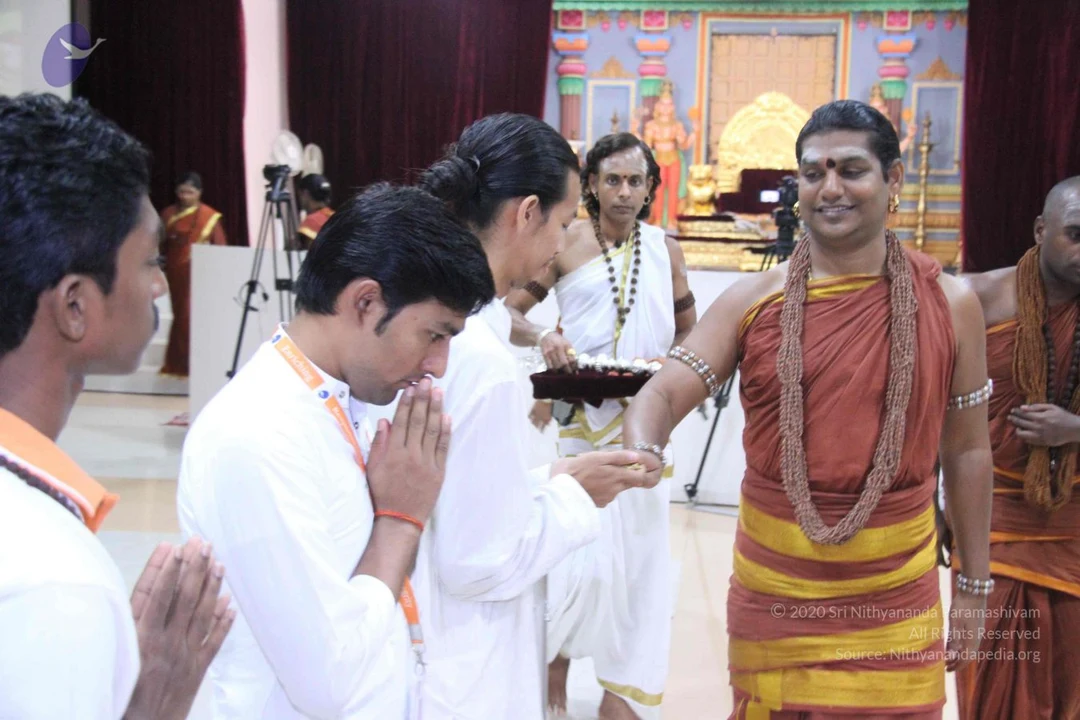
A photograph of a temple-style hall with a gilded deity murti and golden throne-like seat in the background. In the foreground, a smiling man in an orange-red saffron dhoti and shawl with a rudraksha mala and gold bangles stands at right, with a tilak on his forehead; he extends his arm as a devotee in white clothes with an orange lanyard presses palms together and bows toward him. Another man in white dhoti with a rudraksha mala holds a dark tray of white flowers. Several other people in orange and white clothing are visible, including a man with palms joined at left and a bald man in saffron at far right. Red curtains and camera tripods stand nearby. a person (saffron robes, rudraksha mala, long swept-back hair) is seated centrally at right, receiving devotees.A photograph in a large hall with red curtains and a white tiled floor. A man with long swept-back dark hair, a red bindi, rudraksha beaded necklaces and a saffron-red shawl with gold border raises one hand in blessing and smiles broadly; Swamiji (probable) based on the long hair, saffron clothing and rudraksha malas. A devotee in a white shirt and rudraksha mala stands bowing with palms pressed together and receives the blessing, while another man in cream kurta has a hand on his shoulder. Behind them, men in white dhotis and shirts stand near a metal barrier, a deity photo appears on a stage backdrop, and a camera is on a tripod at right.Indoor photo of a hall with red curtains, a golden throne-like seat at the back, a projection screen and a white ceiling with fans. A man in an orange-red garment with a gold-bordered dhoti and a long rudraksha-style bead garland raises his palm in greeting, smiling. He has swept-back dark hair and multiple beaded bracelets. Several people in white clothes bow with folded hands in a line behind metal stanchions, and a man in a light blue shirt stands at the left edge. Other devotees in white and orange stand along the back, and a figure in an orange shawl appears near the screen.A photograph inside a hall with cream walls, red curtains and a projector screen showing a small emblem. On the right, a man in a rust-red and gold-bordered dhoti and shawl, with a rudraksha mala and a gold necklace, bears bangles on his arm and extends his hand toward a bowed man in white shirt and white dhoti who leans forward to receive his blessing. Behind them, saffron-clad sannyasis wearing rudraksha malas stand in a line, and a row of devotees in white and light shirts waits behind a metal stanchion barrier. A chandelier and ceiling lights are visible above. The robed man on the right is a person by appearance: a long swept-back hairstyle, ornate gold-accented red attire and rudraksha mala, though his identity cannot be confirmed from the image alone.A photograph of a hall with red curtains and white walls. A man with a long swept-back hairstyle, red-orange saffron robe with a gold border, a long rudraksha mala and gold armbands stands smiling and raising his palm in blessing toward a bowed man in a white checked shirt who presses his palms together in greeting. Behind them, devotees in white shirts and dhotis stand, and a bald man in orange robes with a rudraksha mala is visible at left. a person cues: long swept hair, saffron robe, rudraksha mala and ornate gold jewellery, shown giving blessing to a devotee.A photograph inside a hall with red curtains, white ceiling fans and a line of metal stanchions. On the right, a smiling man with a shaved head and a light-coloured forehead mark wears an orange-red sannyasi wrap, a long reddish-brown beaded mala and a gold-and-yellow border cloth, with a bangle-style armlet on his upper arm. He raises his open right palm toward a man in a white shirt who bows deeply with his hands folded in front of him, receiving blessing. Other men in white shirts and saffron-clad devotees stand behind the rail, and a golden throne-like seat with a gold canopy appears at the far end. a person: the orange sannyasi attire, rudraksha-style mala and ornate armlet match the page's a person cues, while the person's role is a blessing giver.

Divajarohanam-Swamiji-FlagHoisting

69 photosSource gallery
Two golden metal statues of a deity couple sit on an ornate golden throne against a deep red curtain, with palm trees and a copper pillar behind them. The figure on the left has a tall golden crown with a red and orange band, a blue upper garment, a red lower cloth, and a long trident-like staff held in one of its hands, with a ritual mace raised above. The seated figure on the right wears a green sari, a multi-strand garland of white and red beads, and a smaller crown, its hands in a blessing gesture. A deity murti display; no living people are visible.A photograph of a man in an ashram courtyard standing with his right hand placed on his chest, wearing a rust-orange dhoti and shawl draped over the shoulder with a long rudraksha mala hanging to his waist. A child in red and yellow clothing with a red bead necklace stands behind him with palms pressed together in namaste. In the background, two men in white kurtas and dhotis walk and greet with folded hands near flowering oleander shrubs, beside a red wall and a green roof. A red patterned curtain hangs at the left edge.A smiling man stands outdoors on a pale stone courtyard beside a red pillar, with flowering shrubs and a green-roofed building behind him. He wears an ochre-orange saffron-coloured wrap over one shoulder with a yellow border, and a long rudraksha mala of brown beads hangs around his neck, with a thin gold chain visible beneath. He has a red bindi and white forehead markings, and his hair is swept back. A stone carved figure is partly visible at the right edge.Three barefoot men in saffron-orange sannyasi robes walk along a paved courtyard path past a black stone sculpture and a red-railed staircase. The man in front on the right, with short dark hair and a red bindi, wears a large rudraksha-style mala, a wide yellow waist sash, and carries nothing. Behind him, a shaved-headed man in orange wears a mala and a red cloth, and a third shaved-headed man in orange follows further back. A small figure in orange appears inside a glass-walled hall to the right. Palm trees and a red-walled building stand in the background.A photograph of two men in saffron-orange monastic robes walking barefoot along a dirt path lined with white stepping stones, through a shaded garden with trees, green shrubs and palms. The foreground man, bare-chested with a gold-bordered orange cloth wrapped around his waist and shoulders, wears a long beaded mala around his neck and looks down at his steps. A second man in orange follows farther back. Red-painted posts and a small structure appear at the right edge.Outdoor photo beneath large banyan trees with hanging aerial roots at a temple-like grove. A person in saffron-orange and red robes with a red-and-gold shawl stands at left on a concrete path, hands joined at the chest, gazing upward toward a large black stone deity murti at right. The murti wears a yellow cloth, red flower garland and gold necklaces, and sits on a dark stone plinth ringed with red-painted stones and scattered flowers. A small brass oil lamp sits before it. Red earth and a low stone bench complete the setting. The person's appearance is not clearly established as a person, so the a person field is unsure.