Skip to content
Friday

31 May 2013

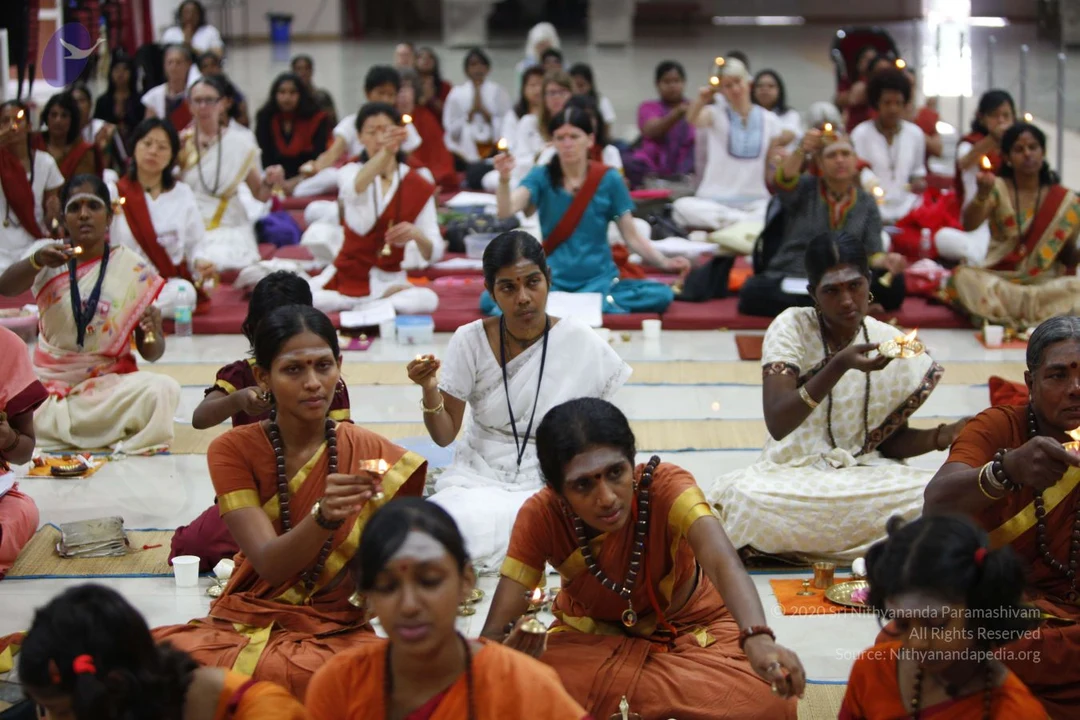
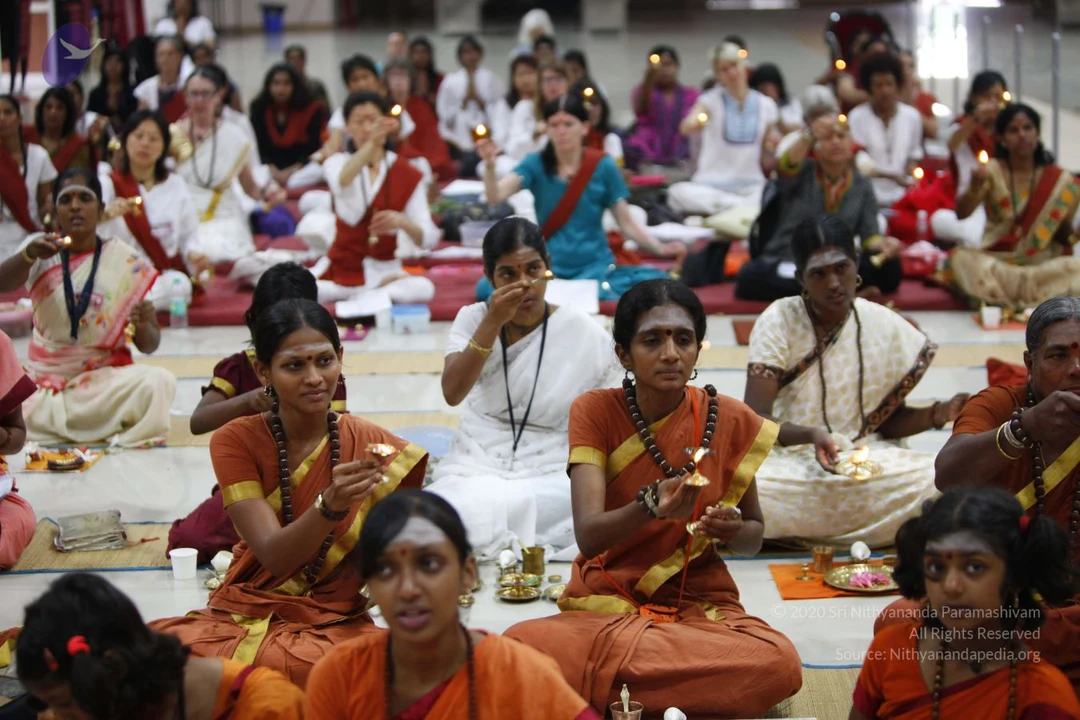
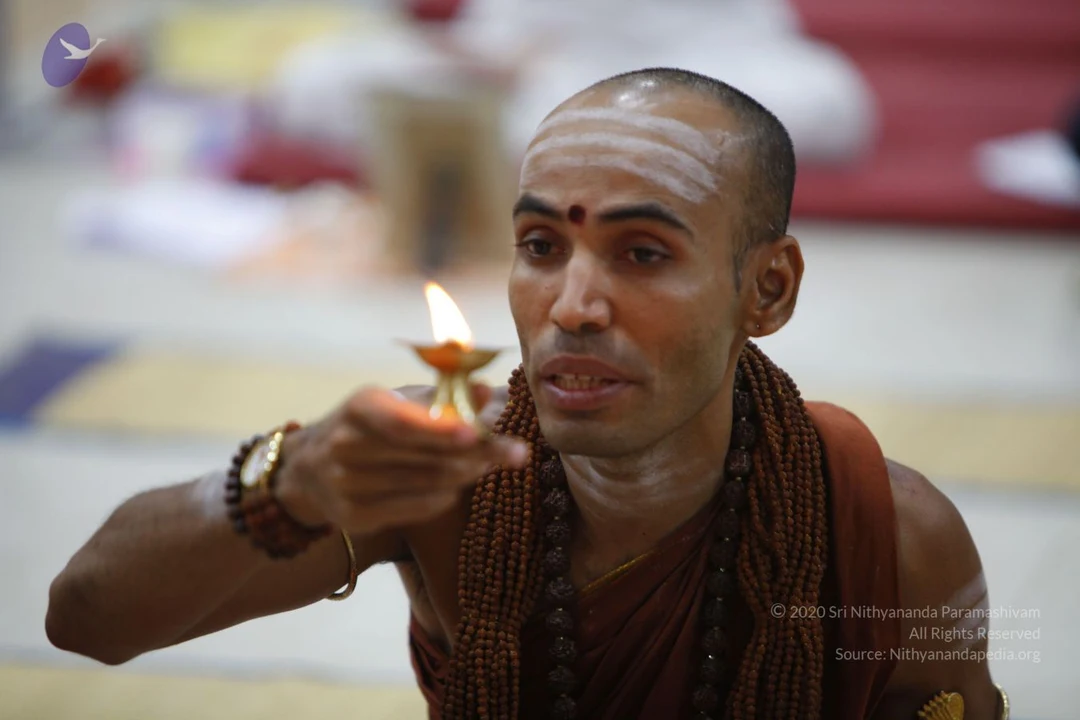
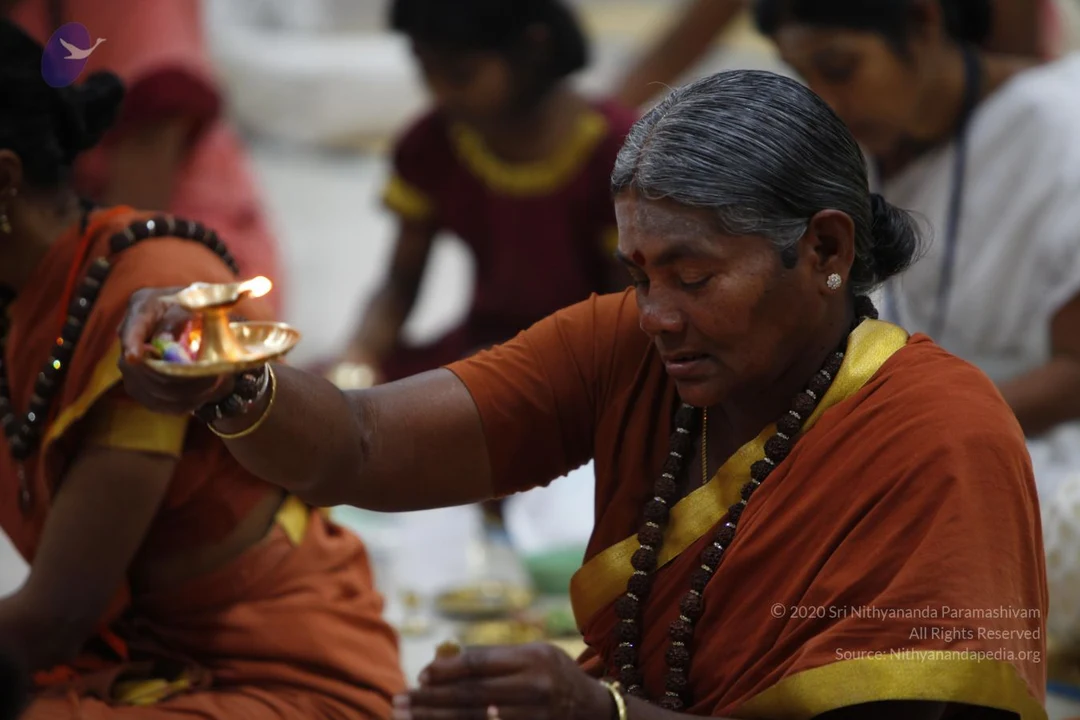
Satsang on Responsibility the greatest Possibility| Padukapuja |

Dated photos
100
Source pages
1
Media
3
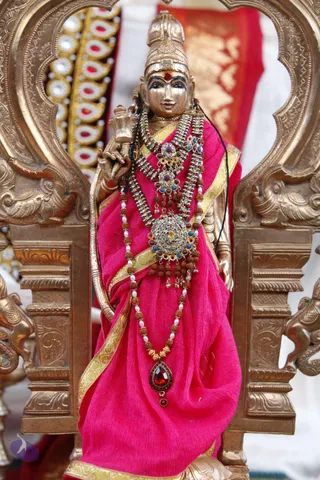
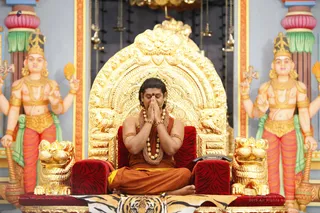
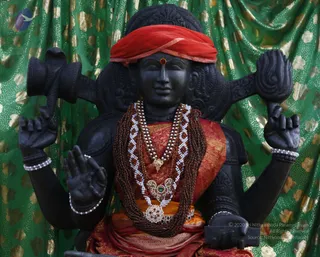
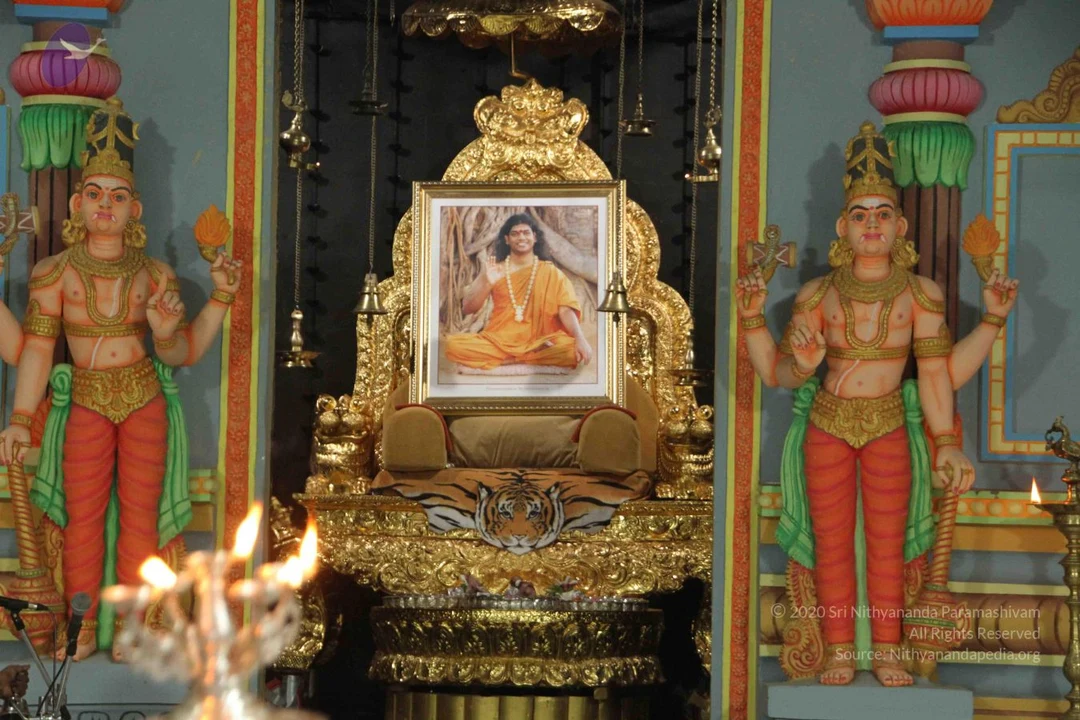
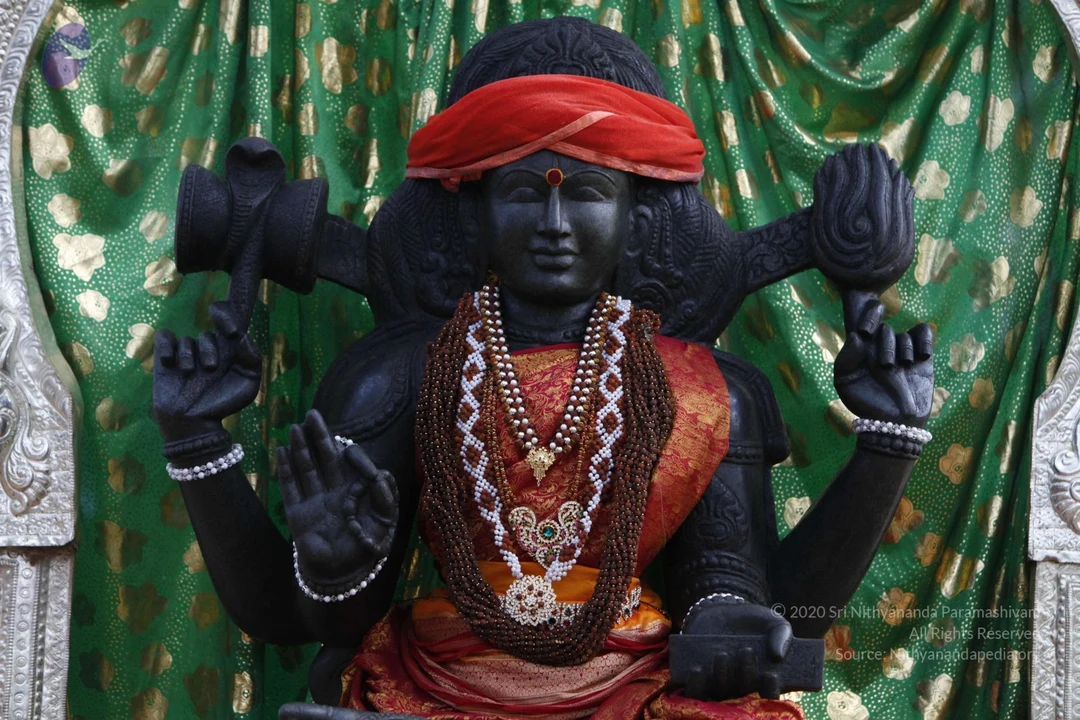
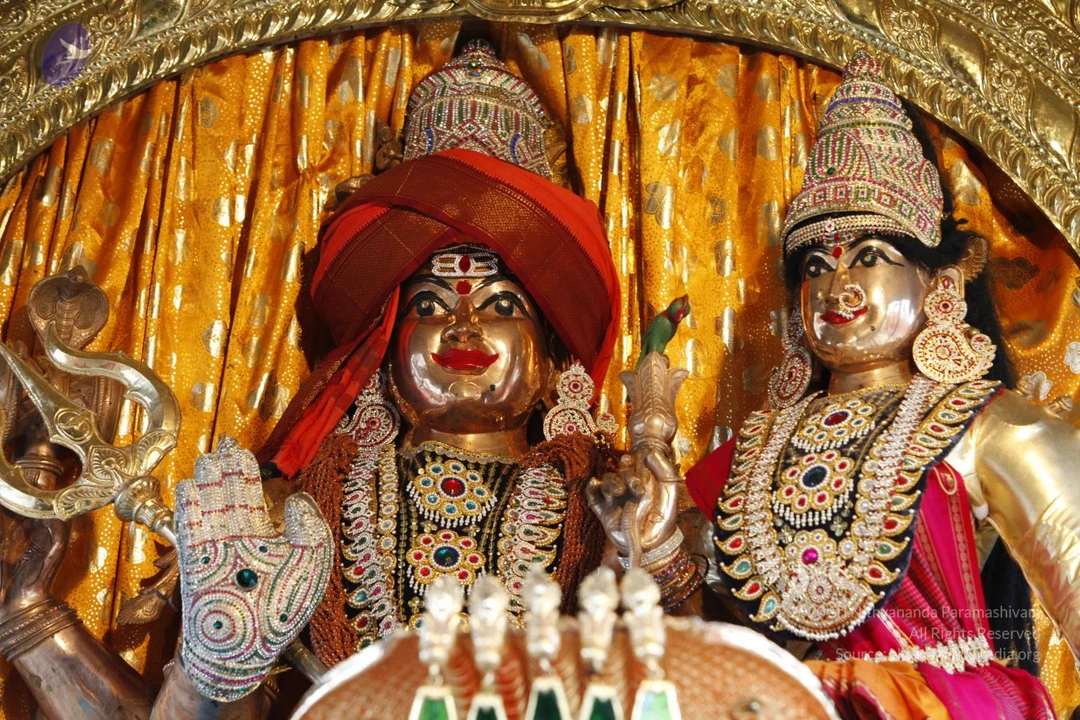
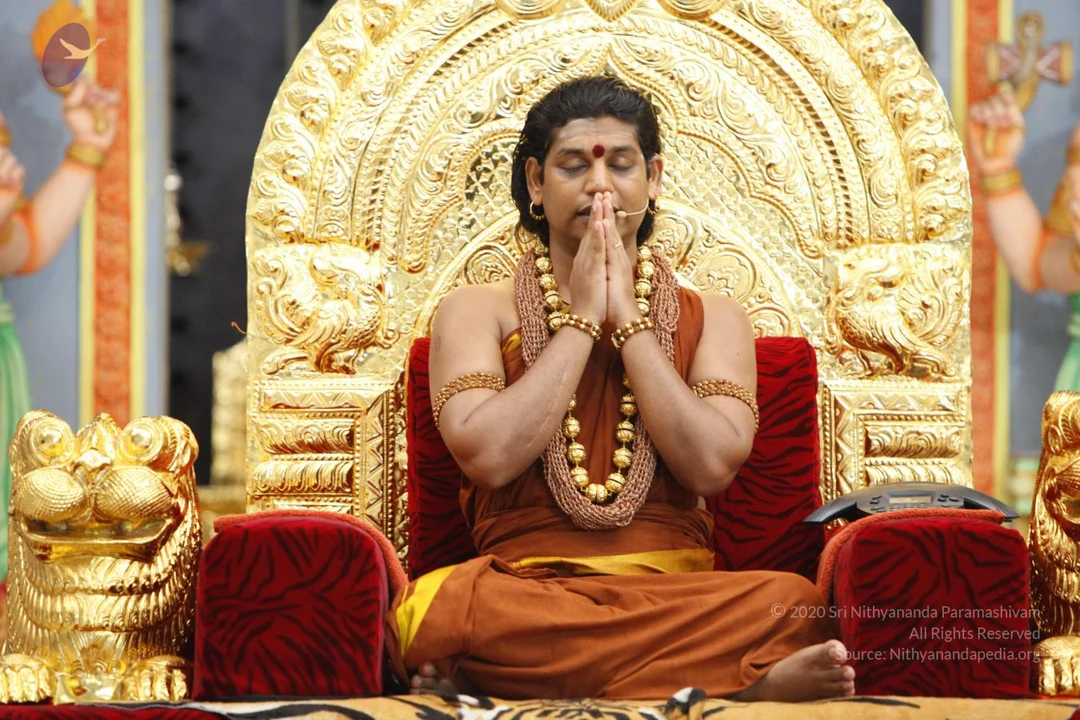
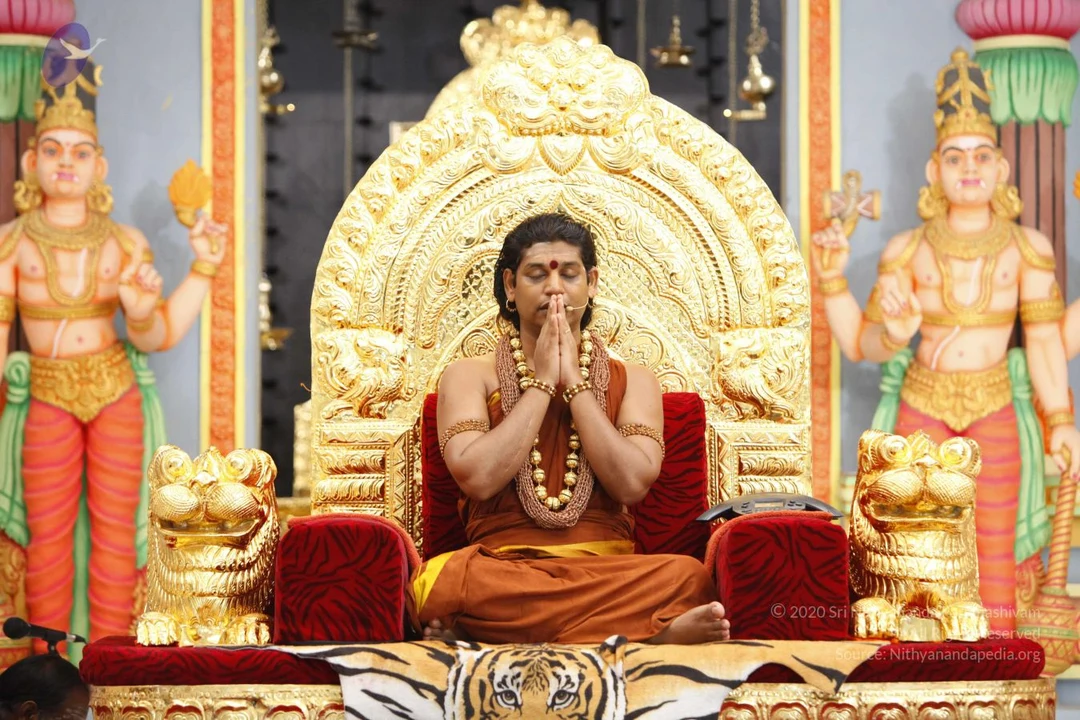
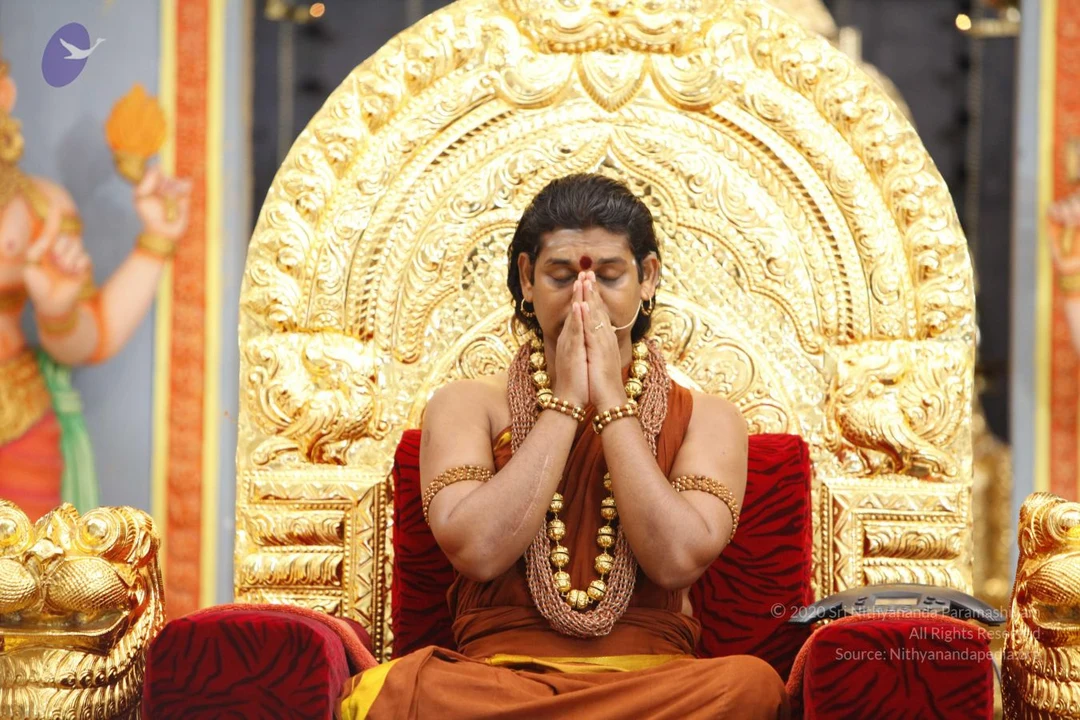
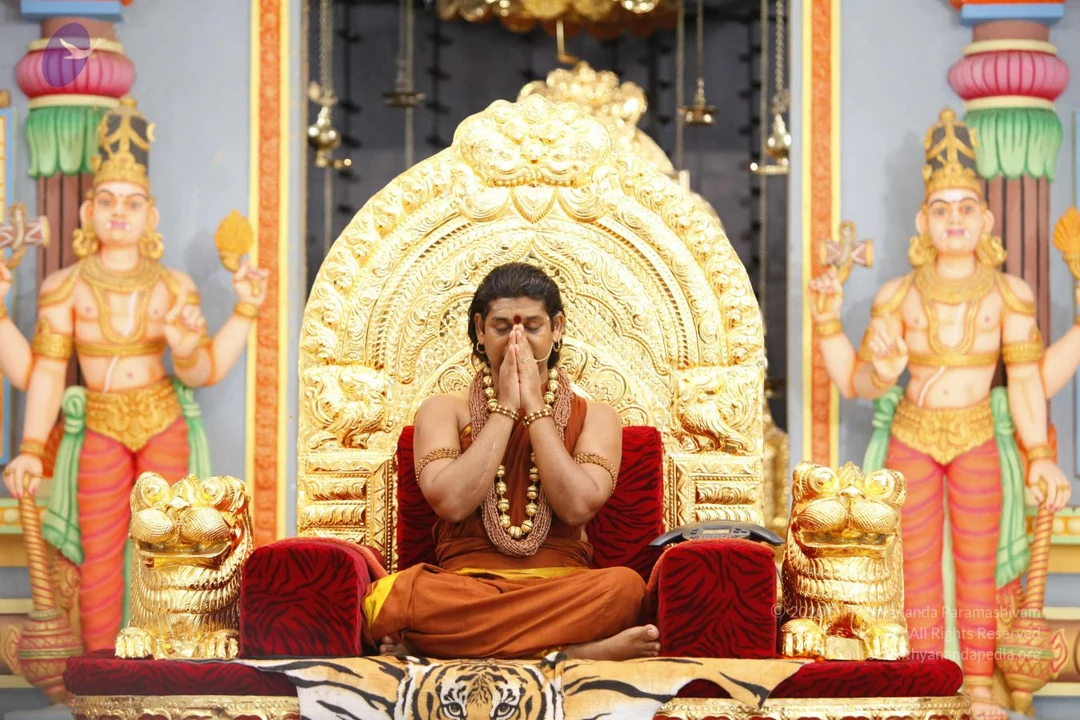
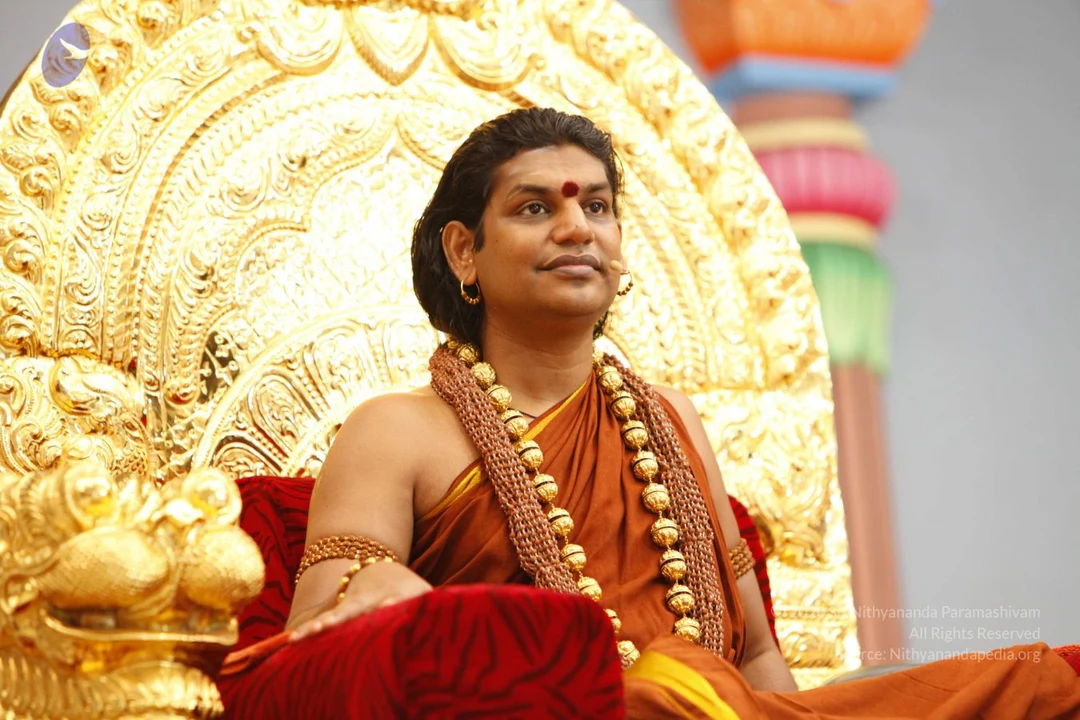
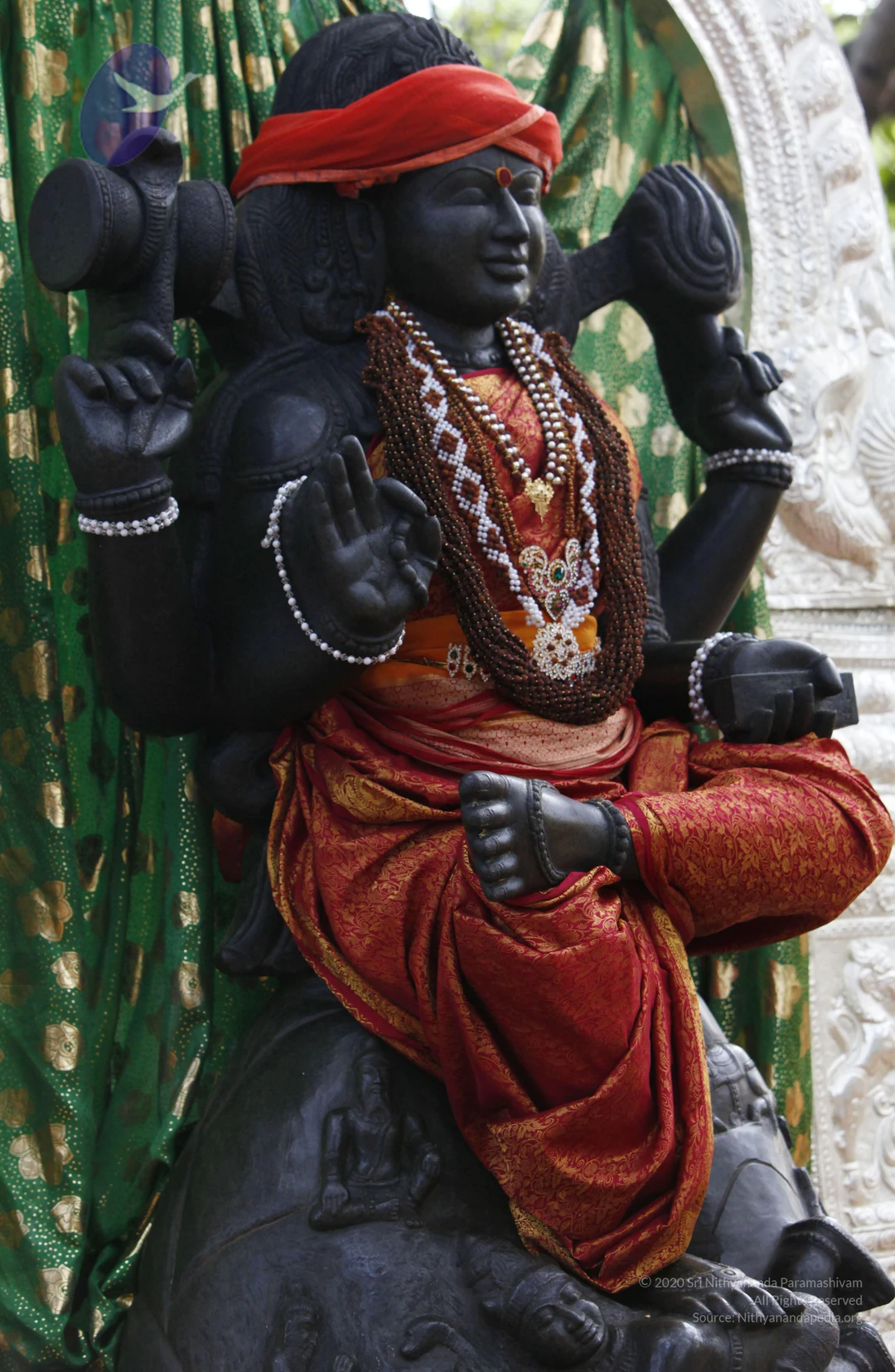
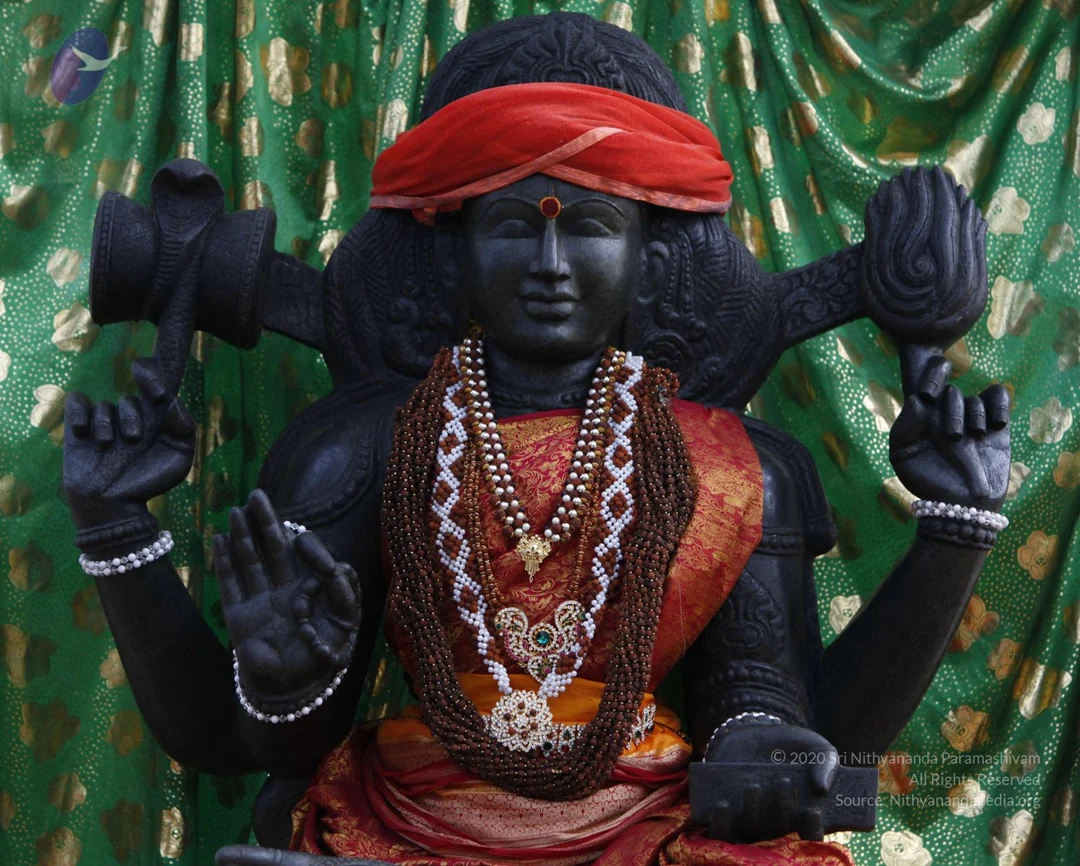
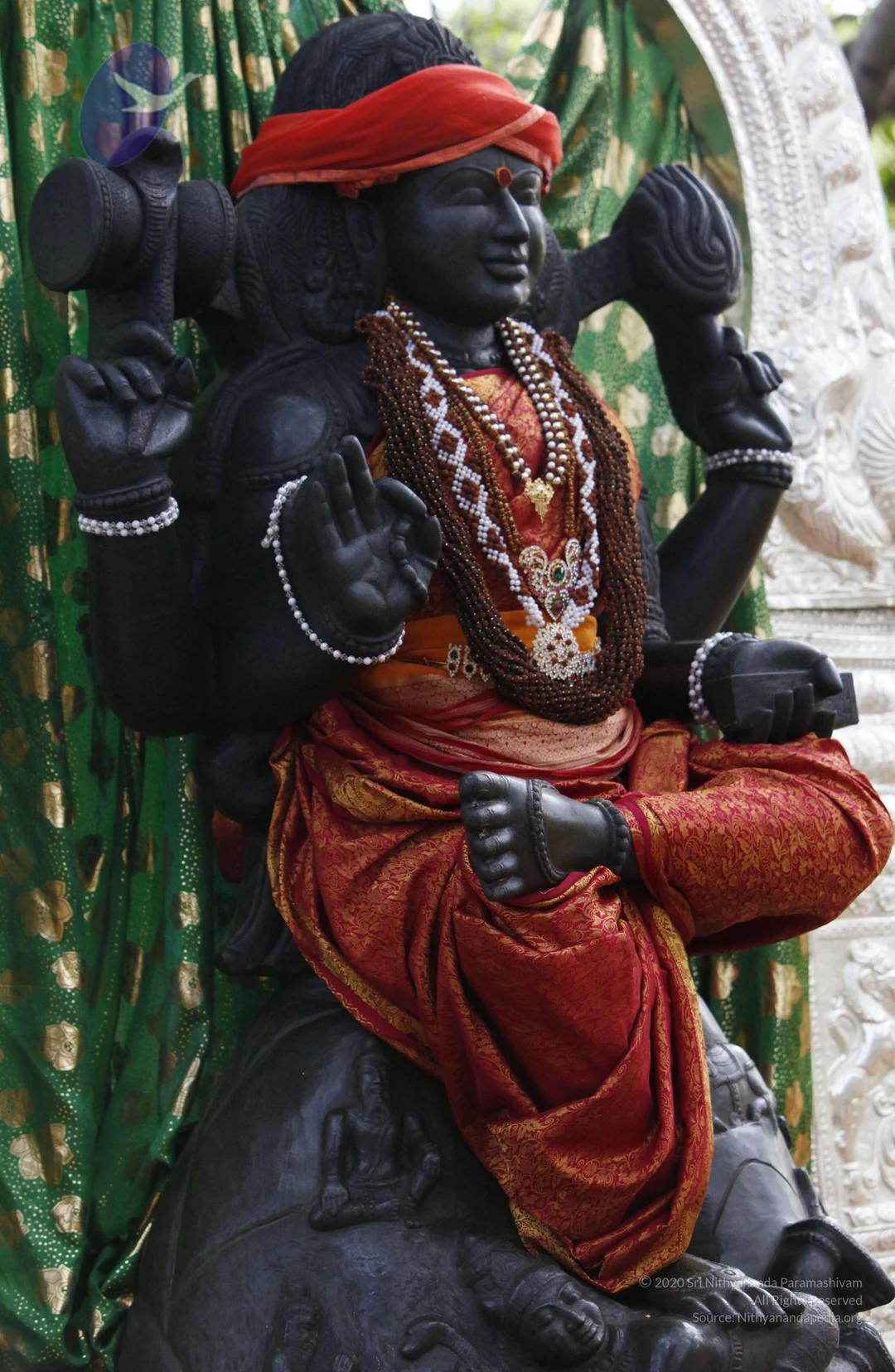
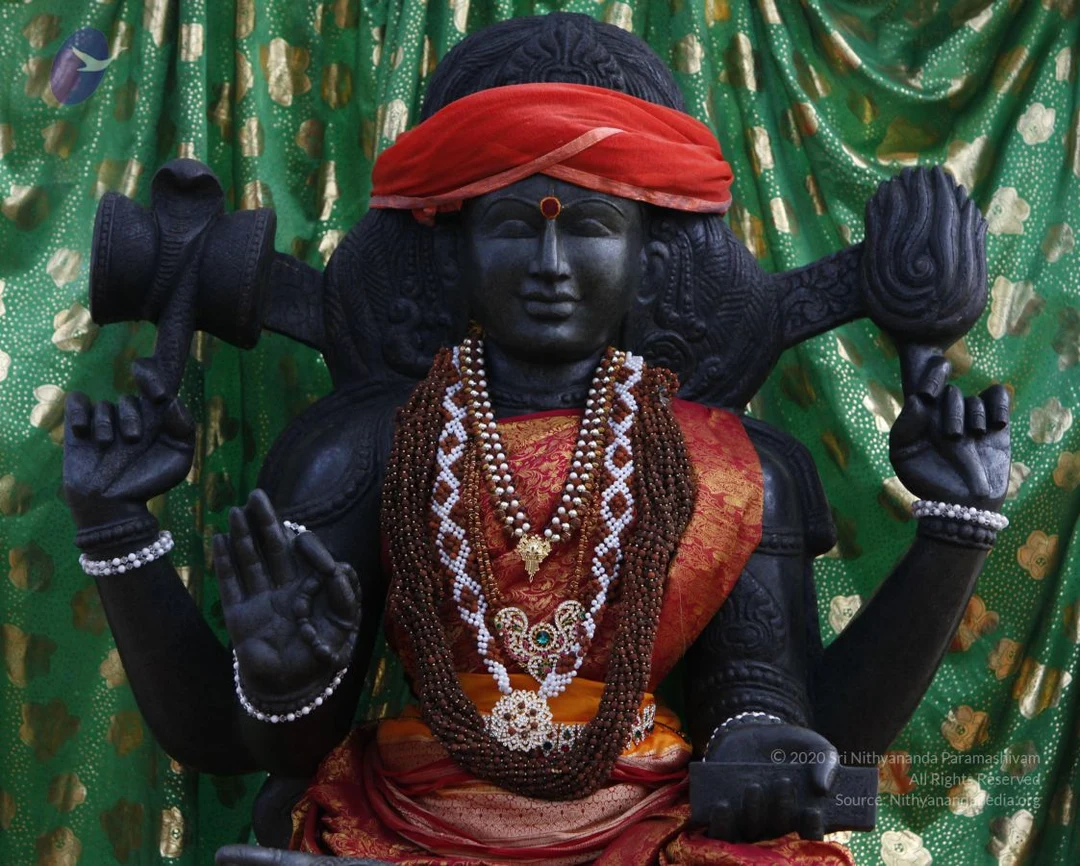
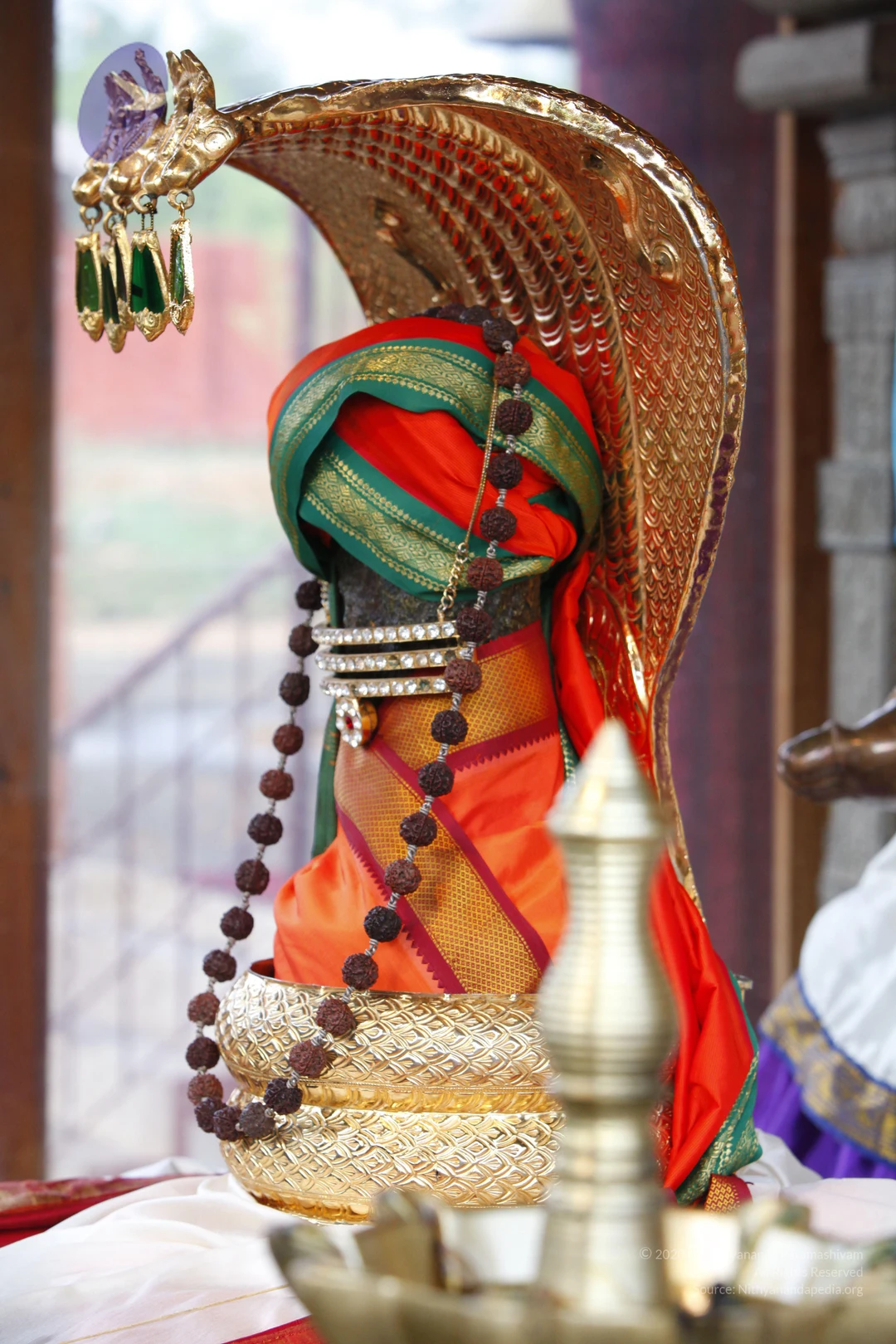
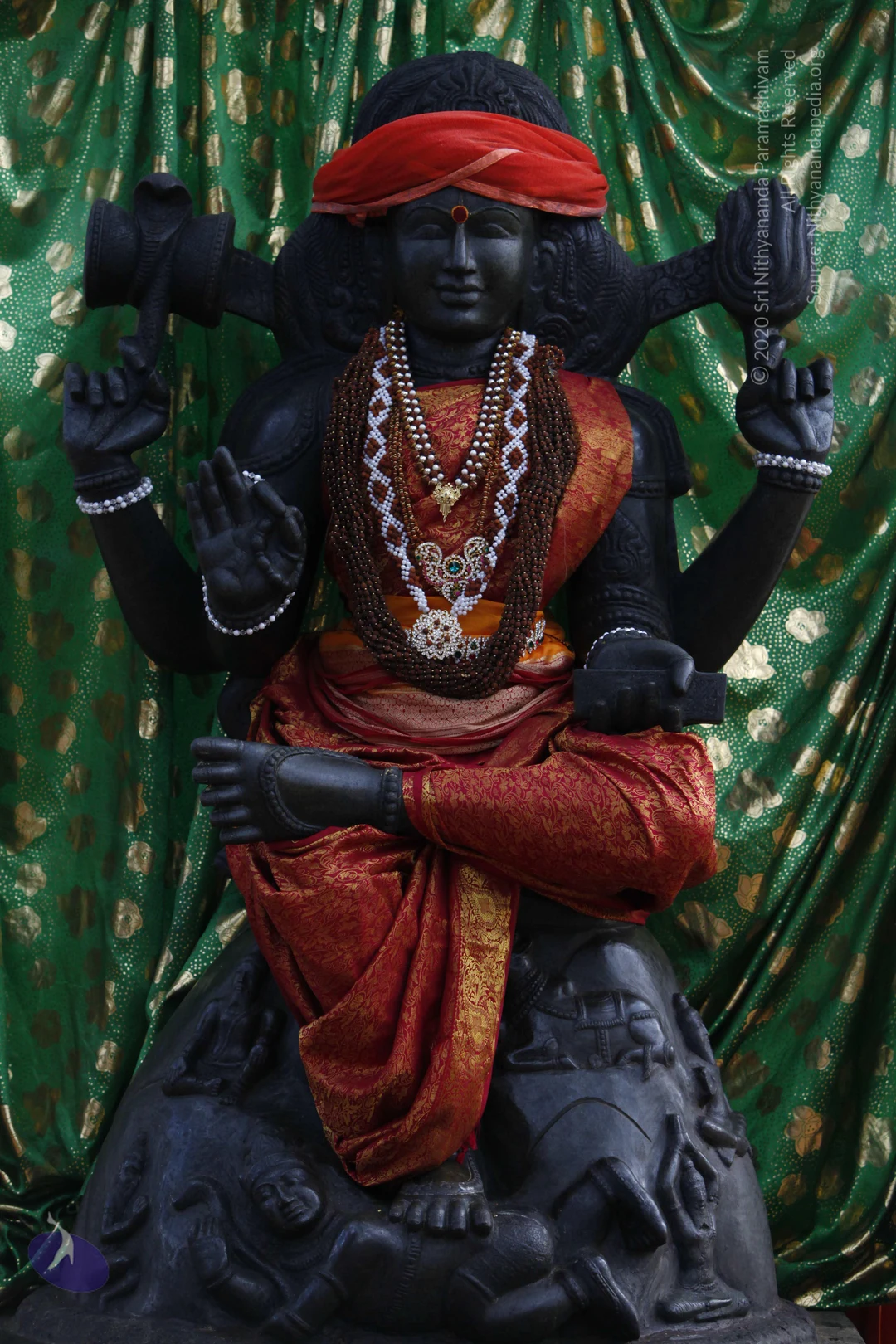
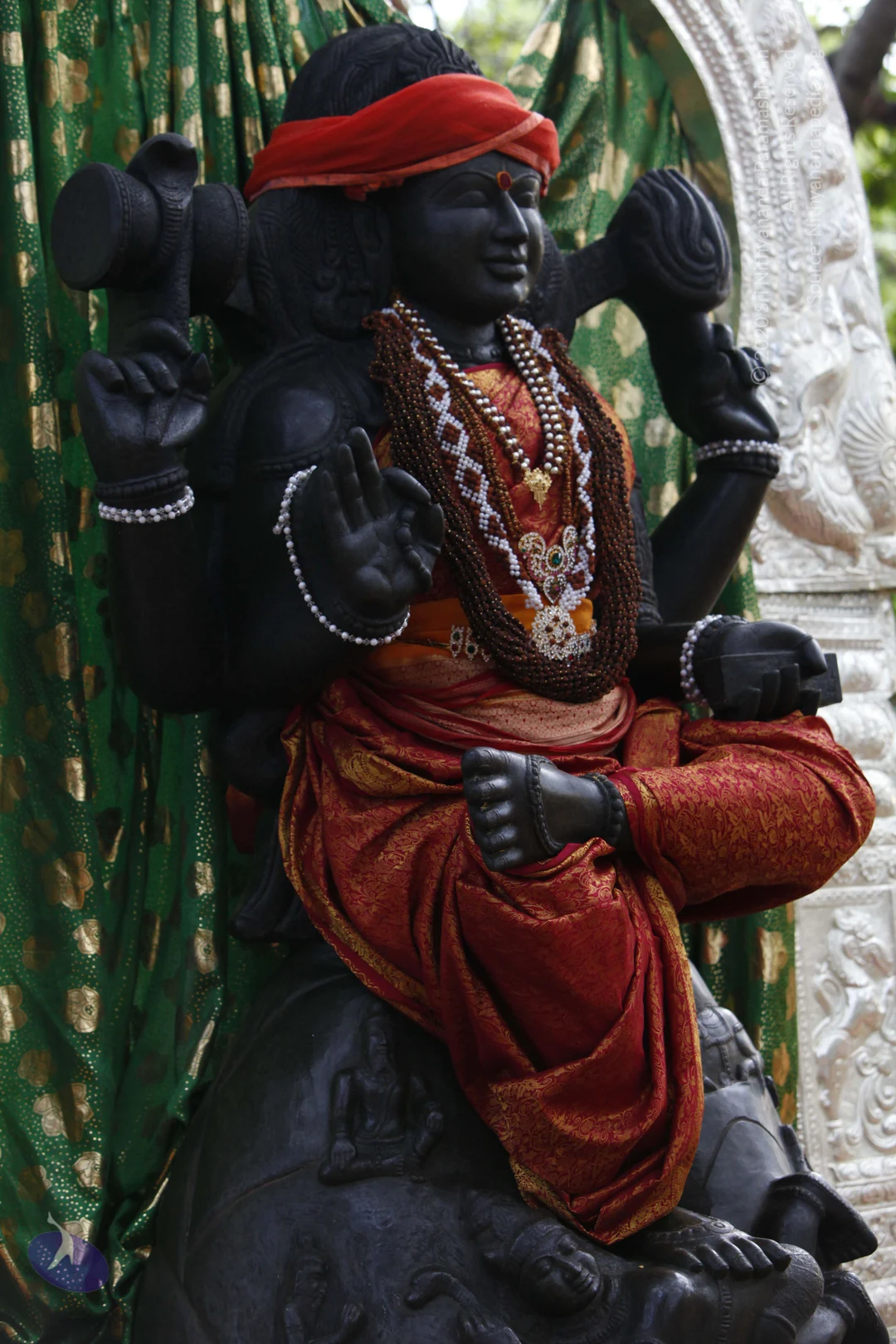
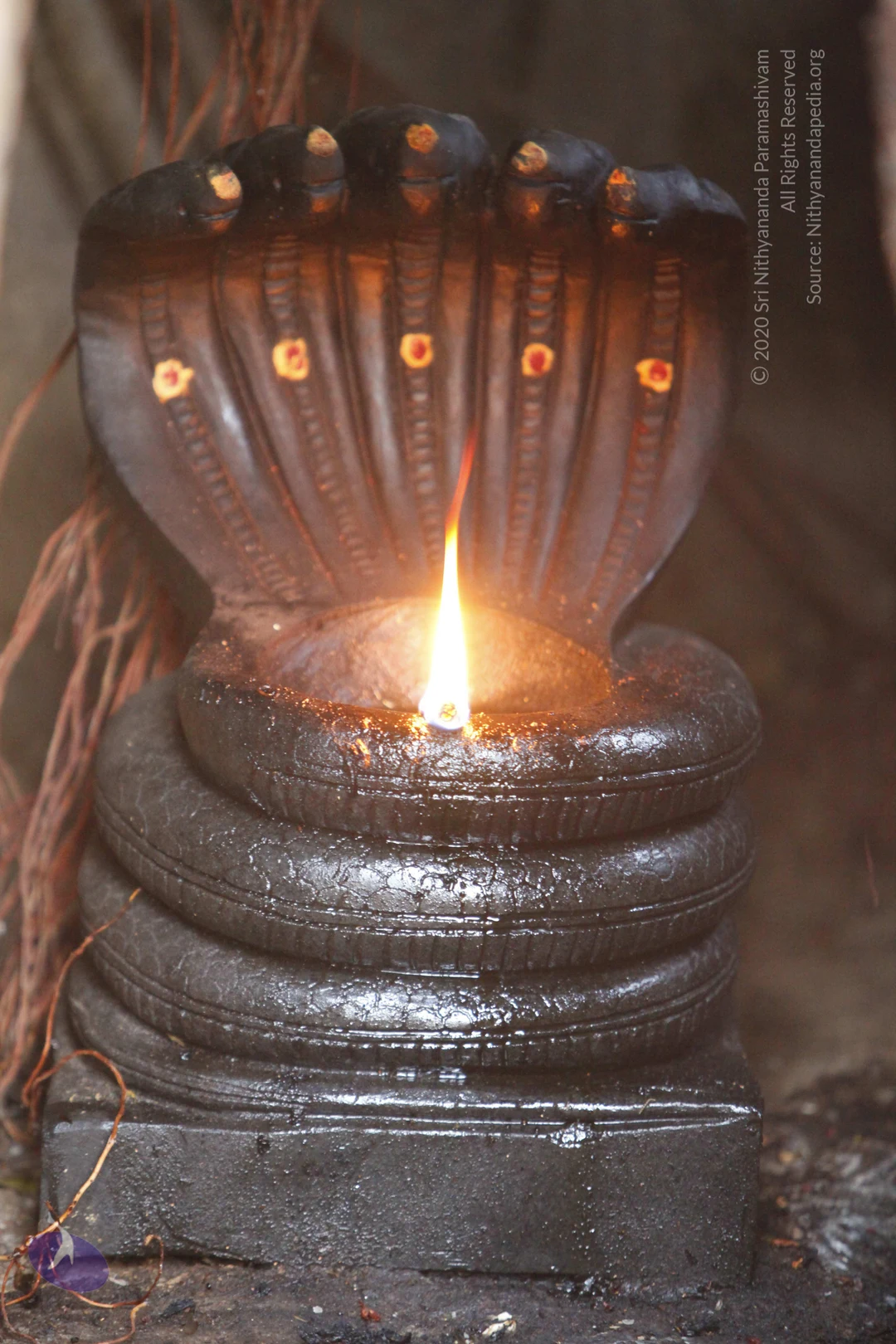
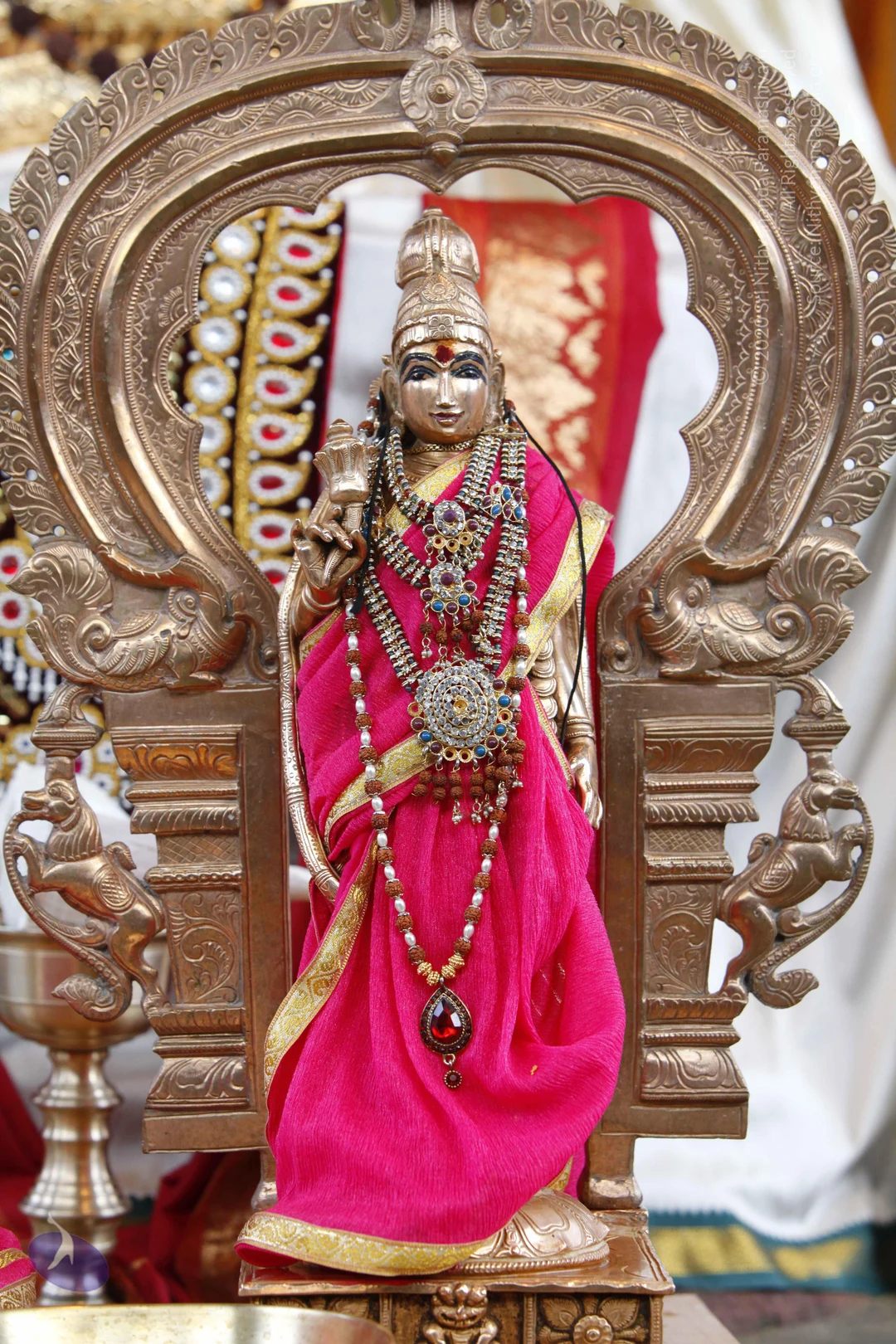
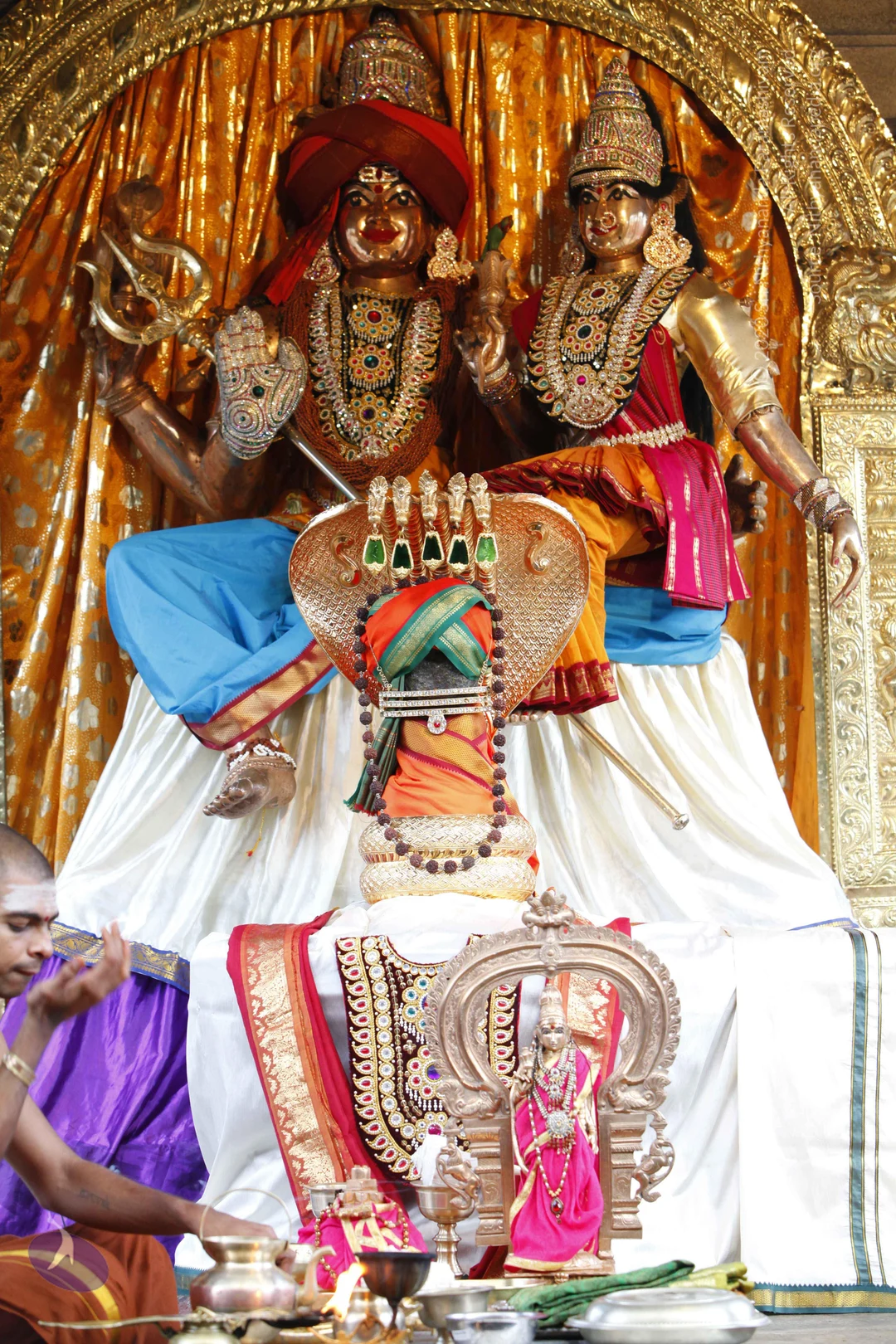
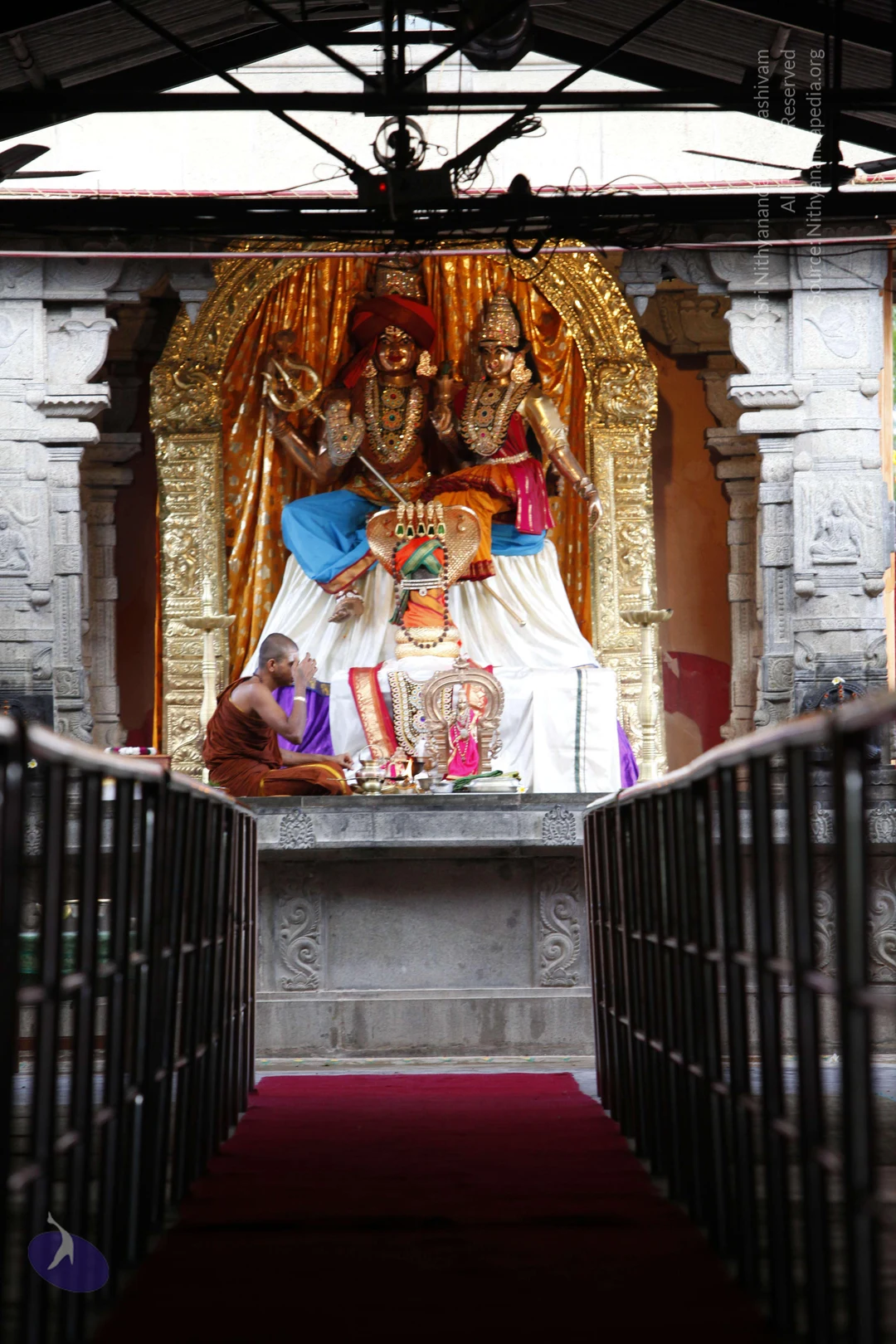
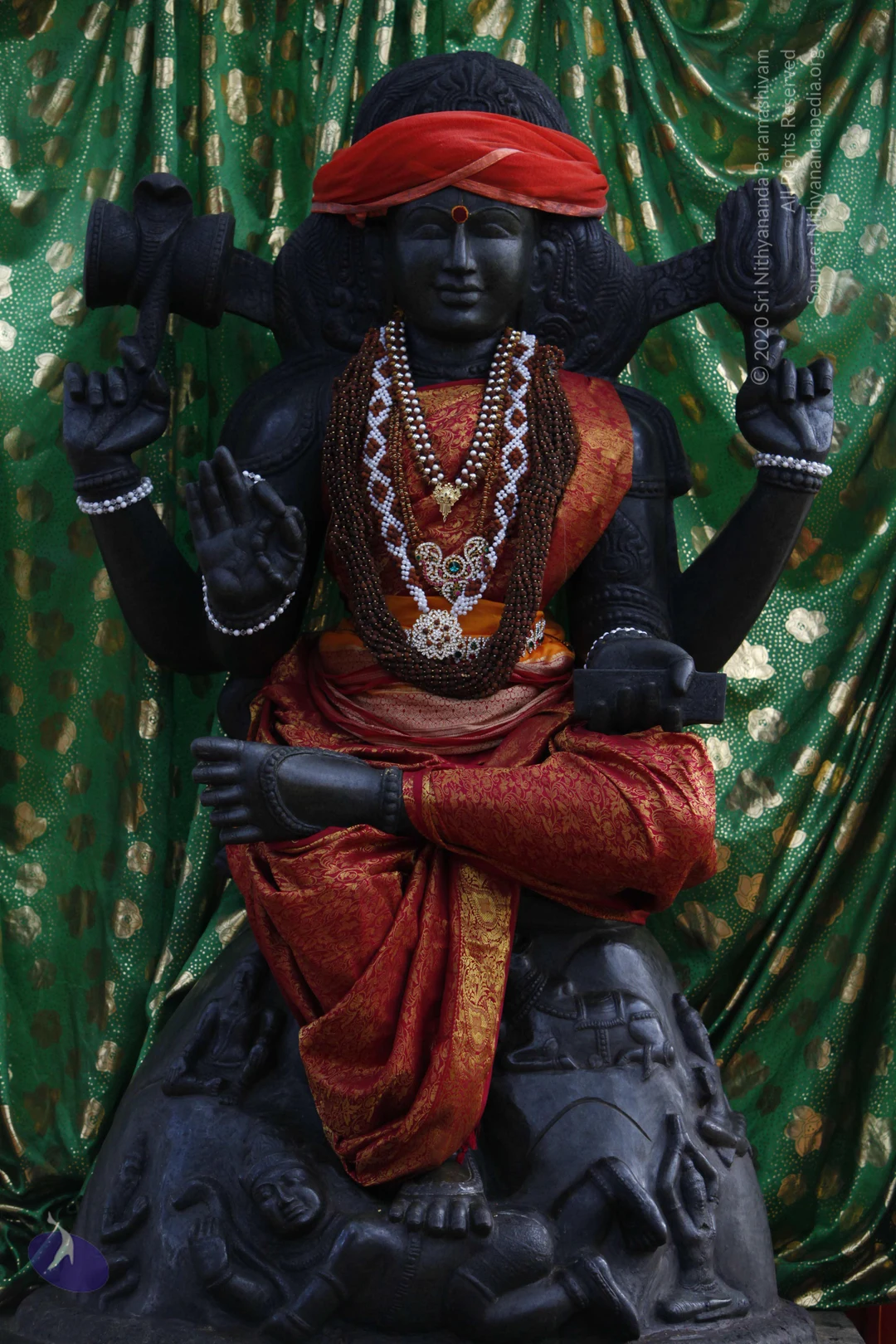
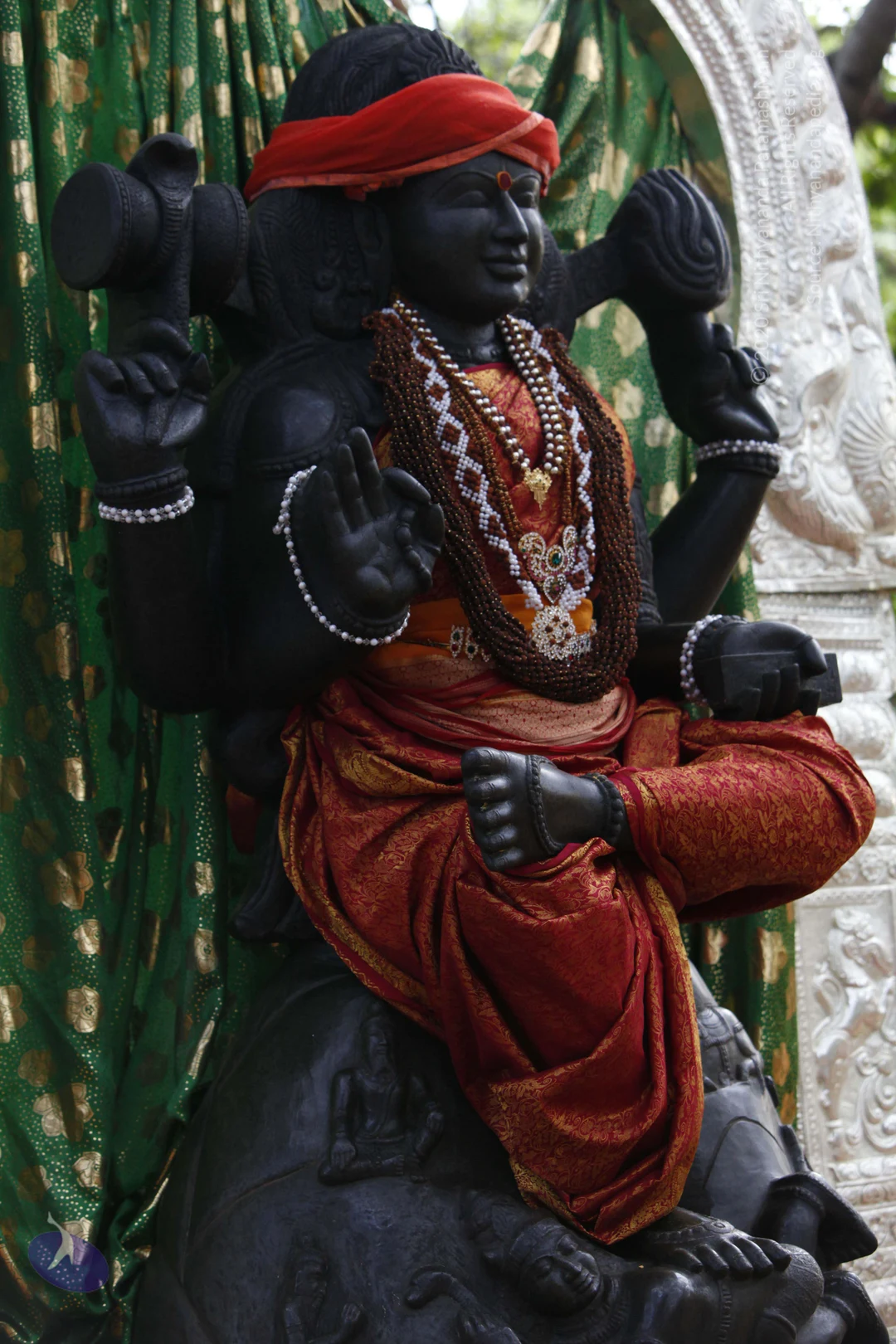
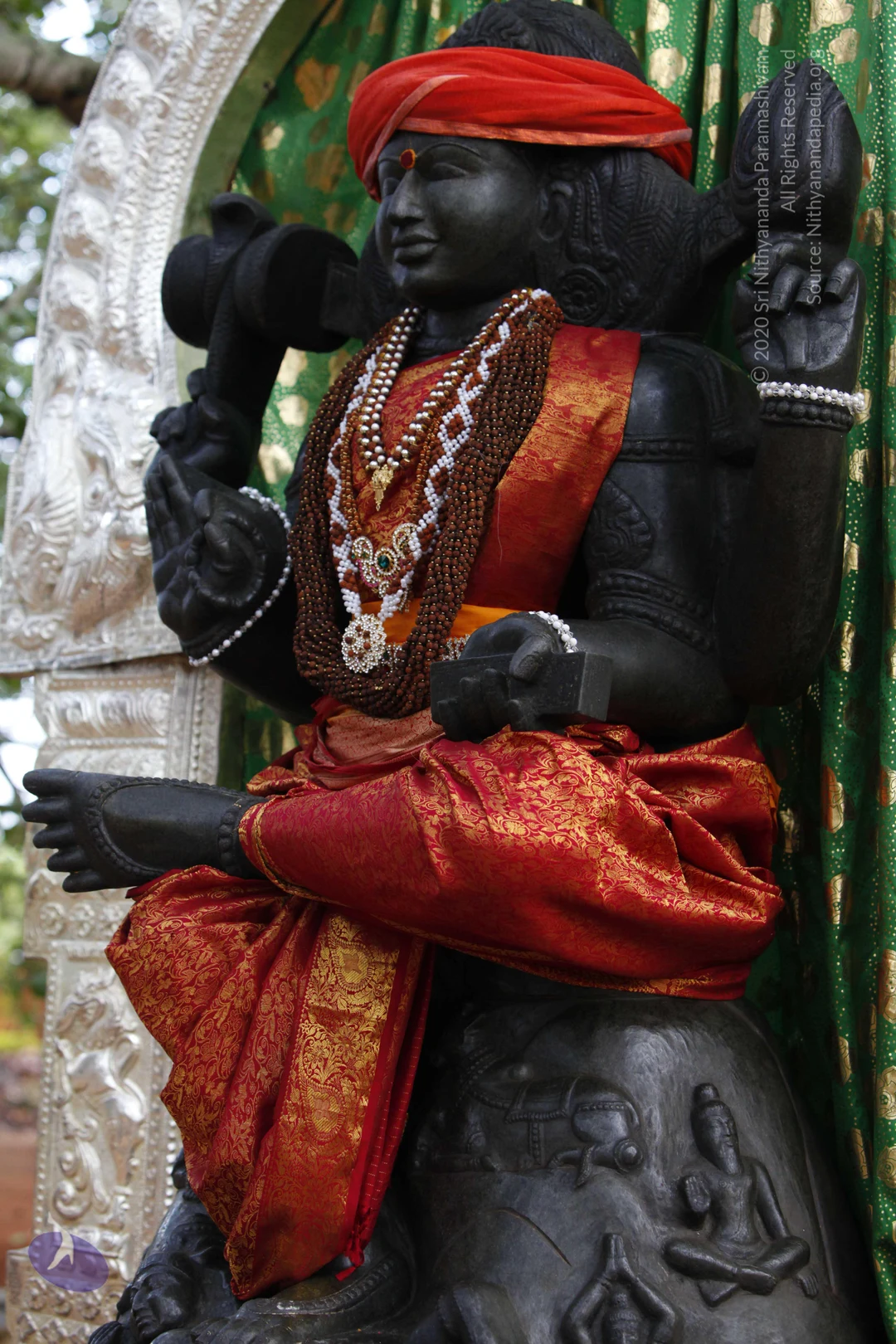
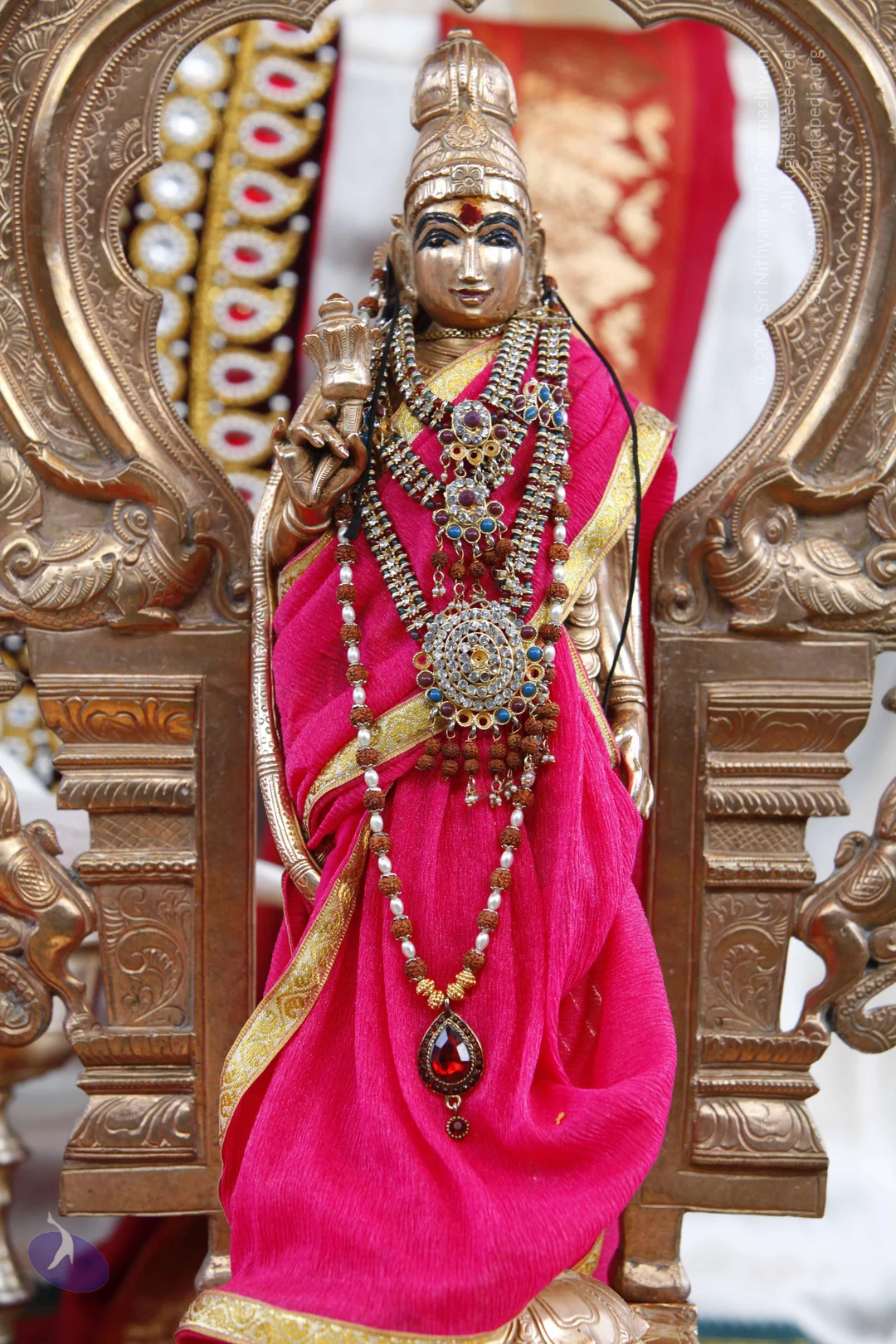
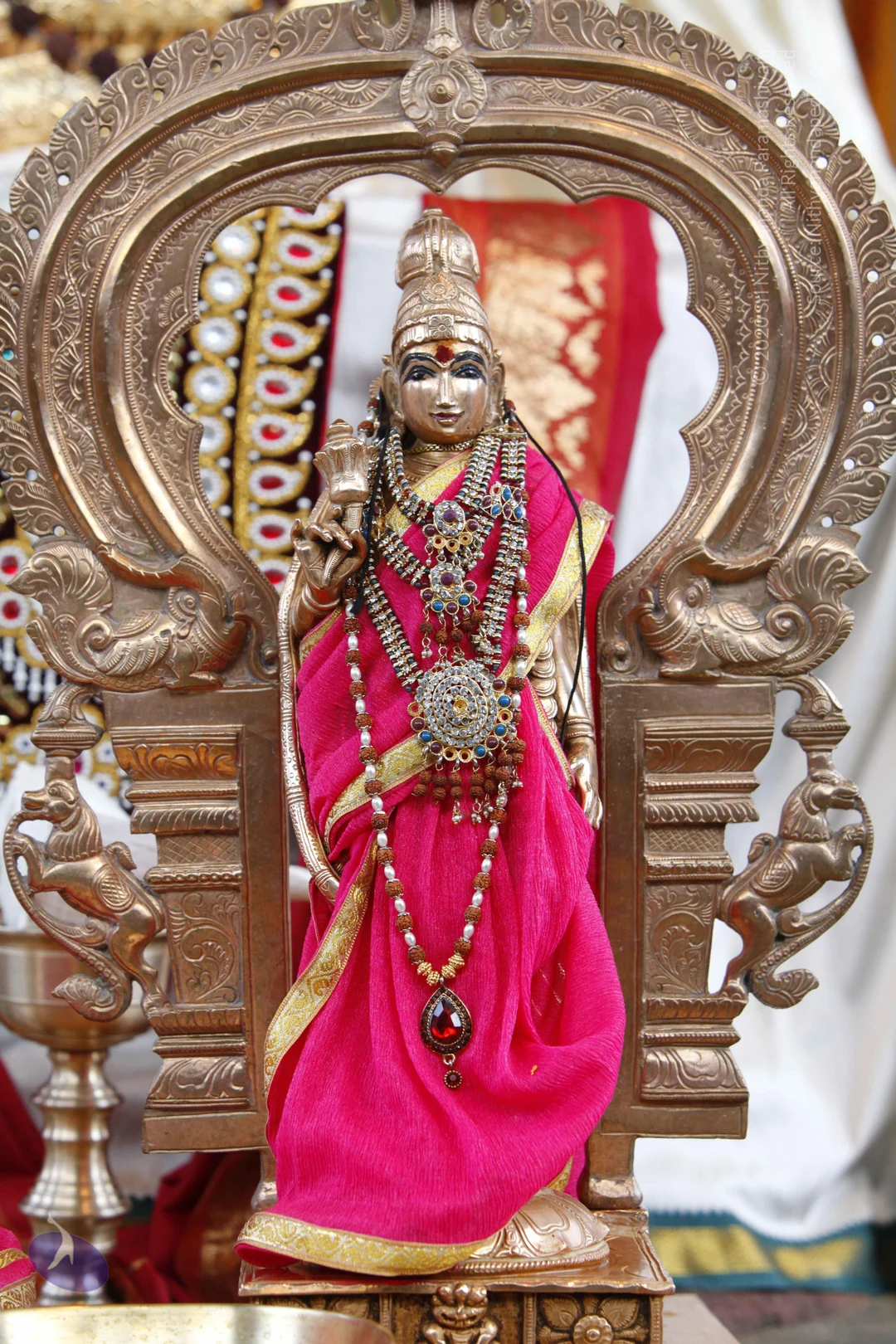
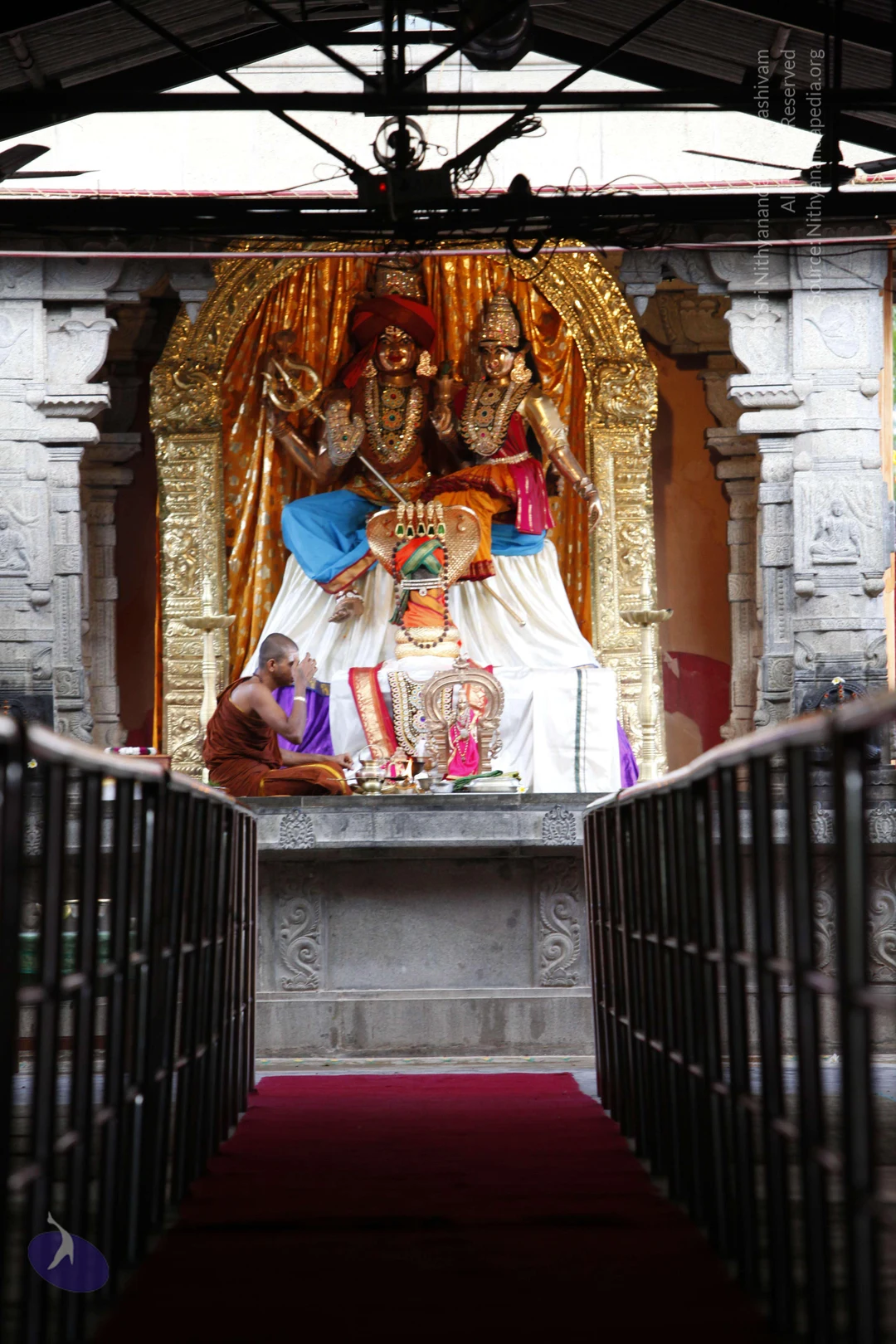
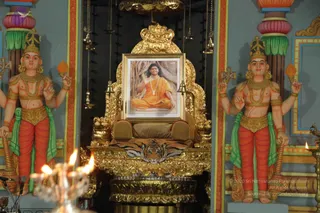
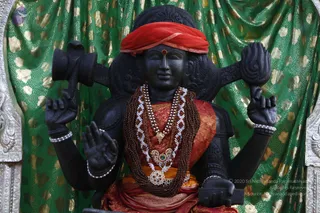
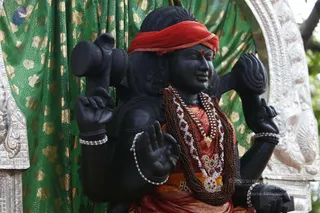
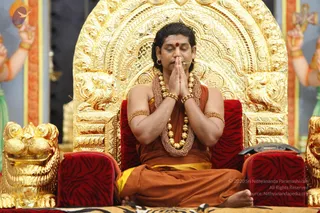
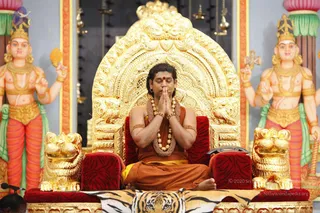
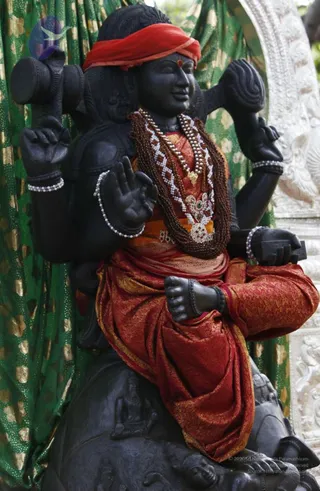
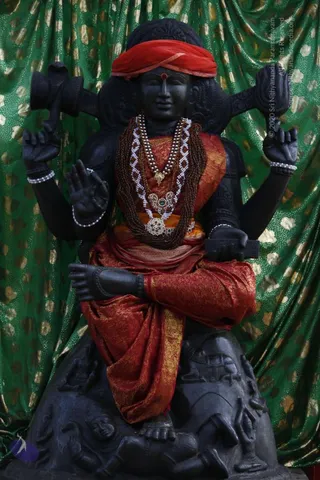
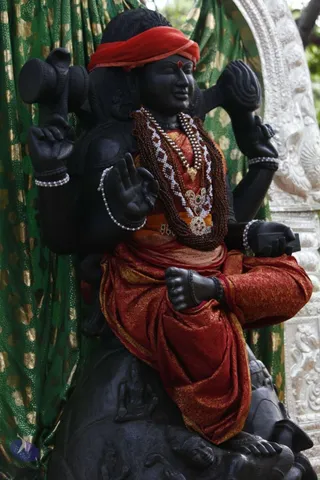
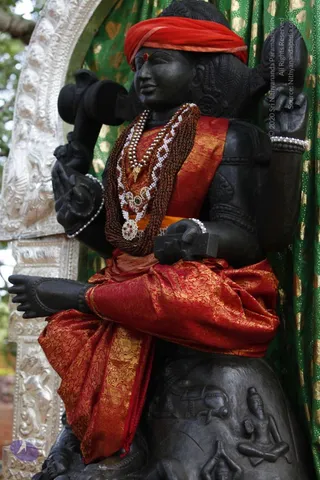
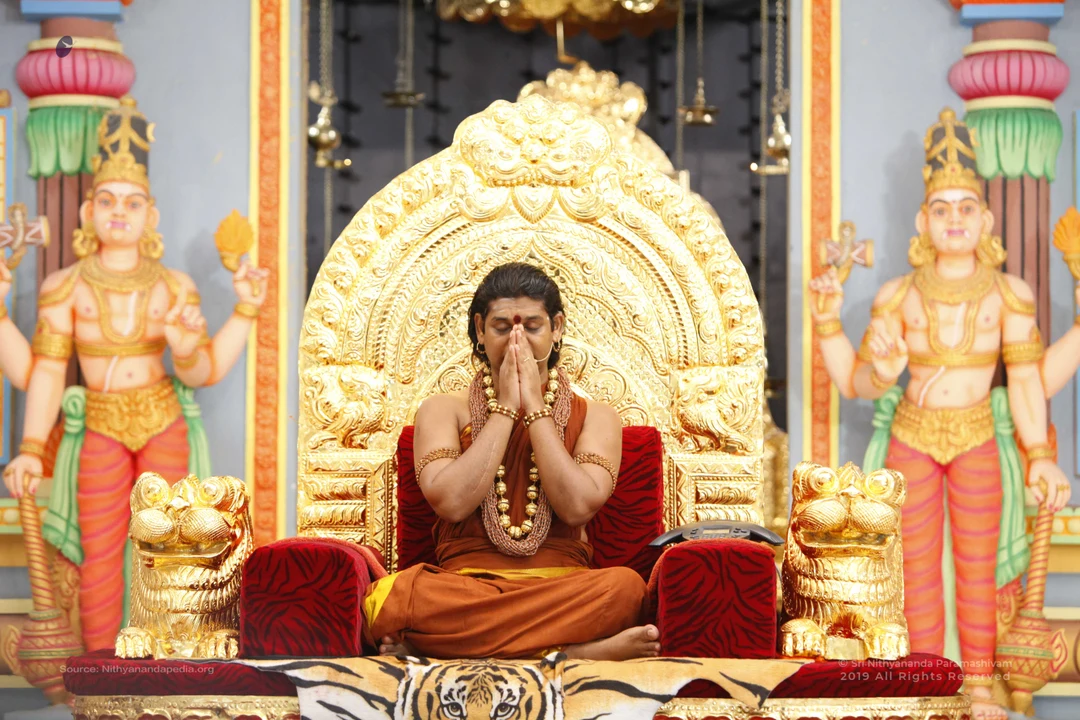
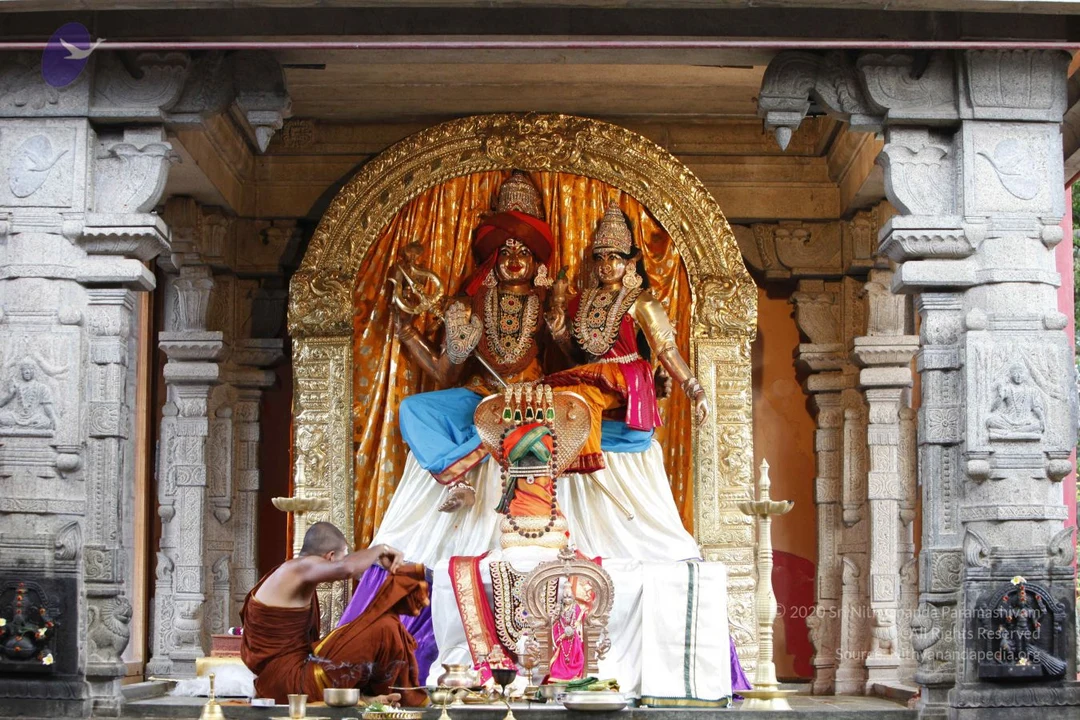
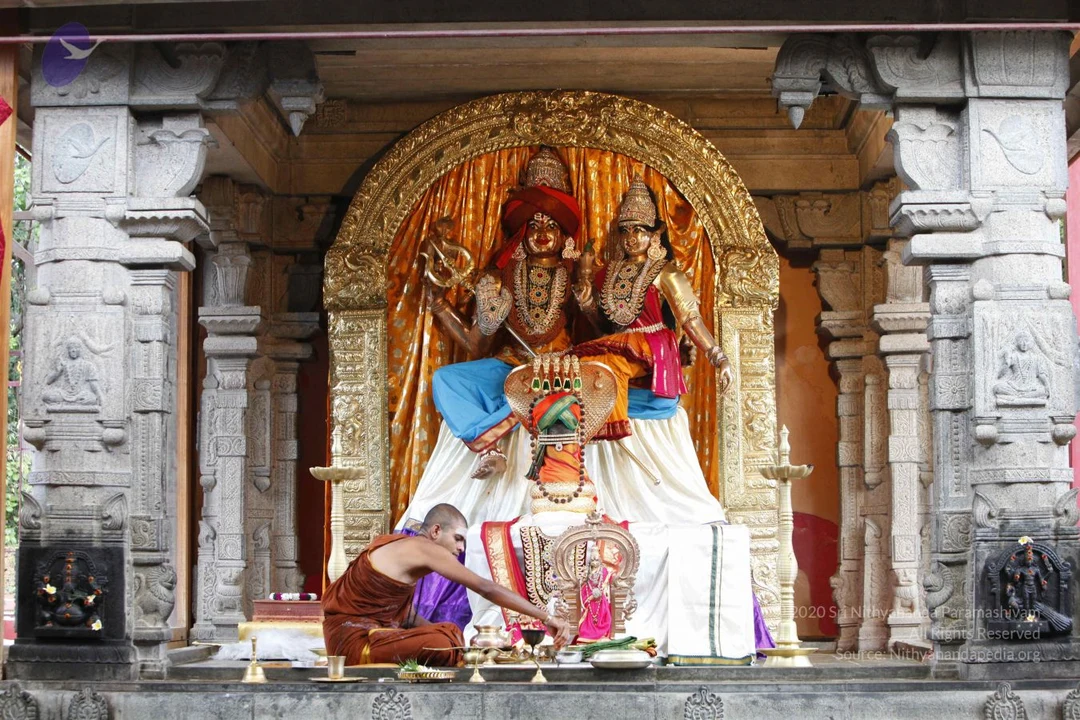
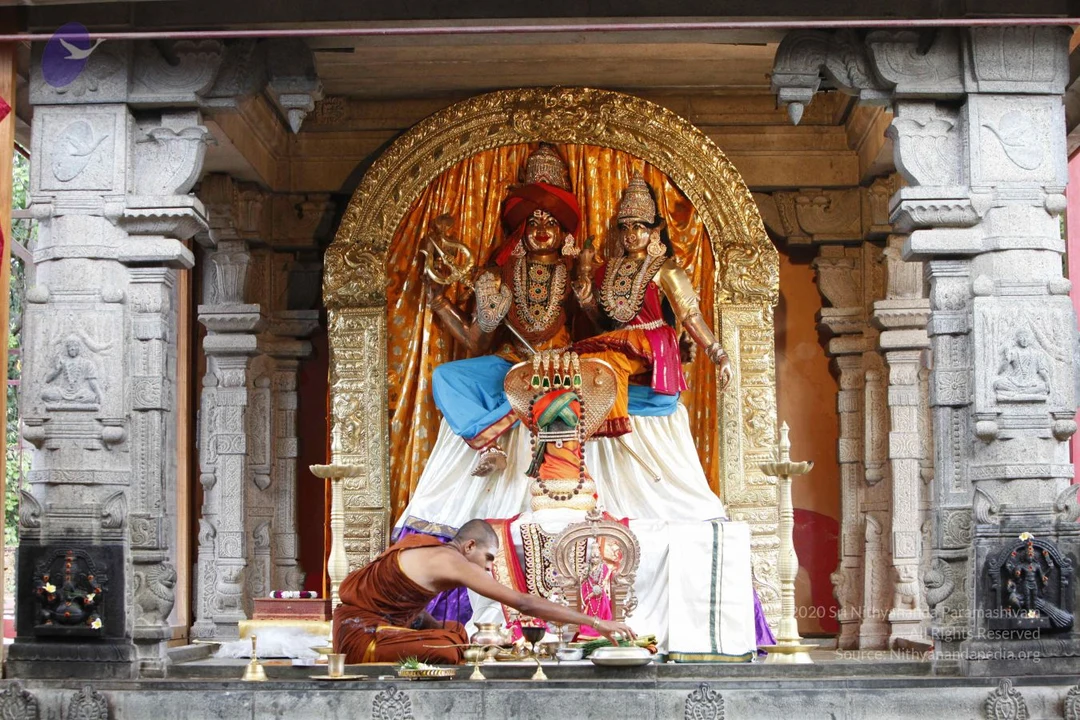
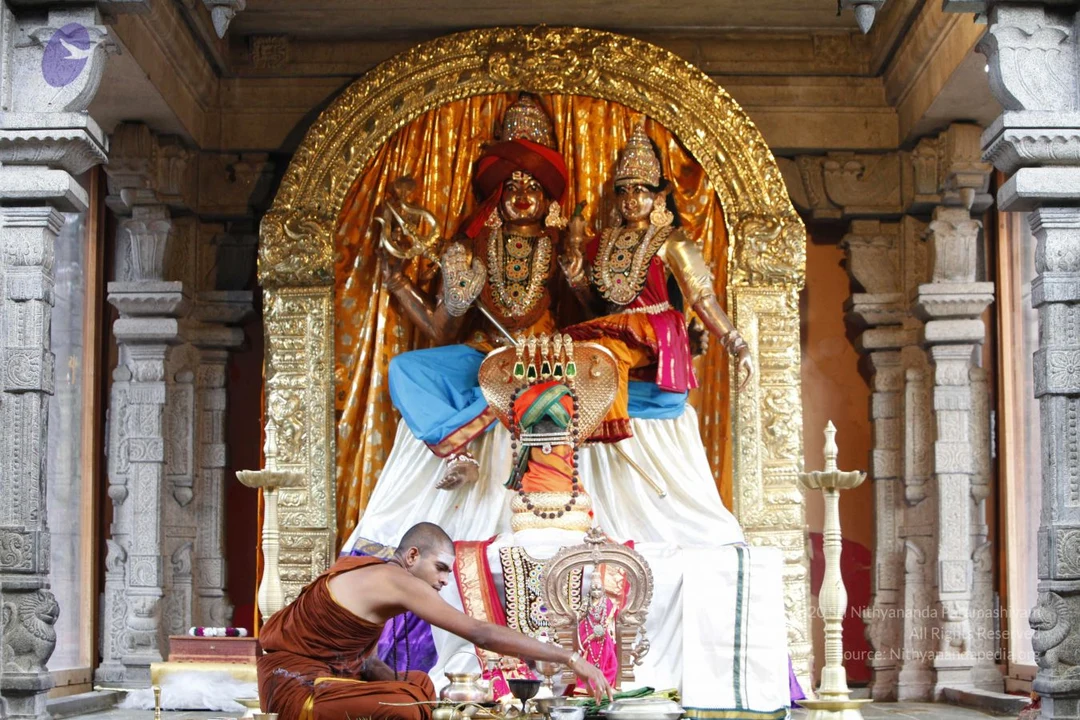
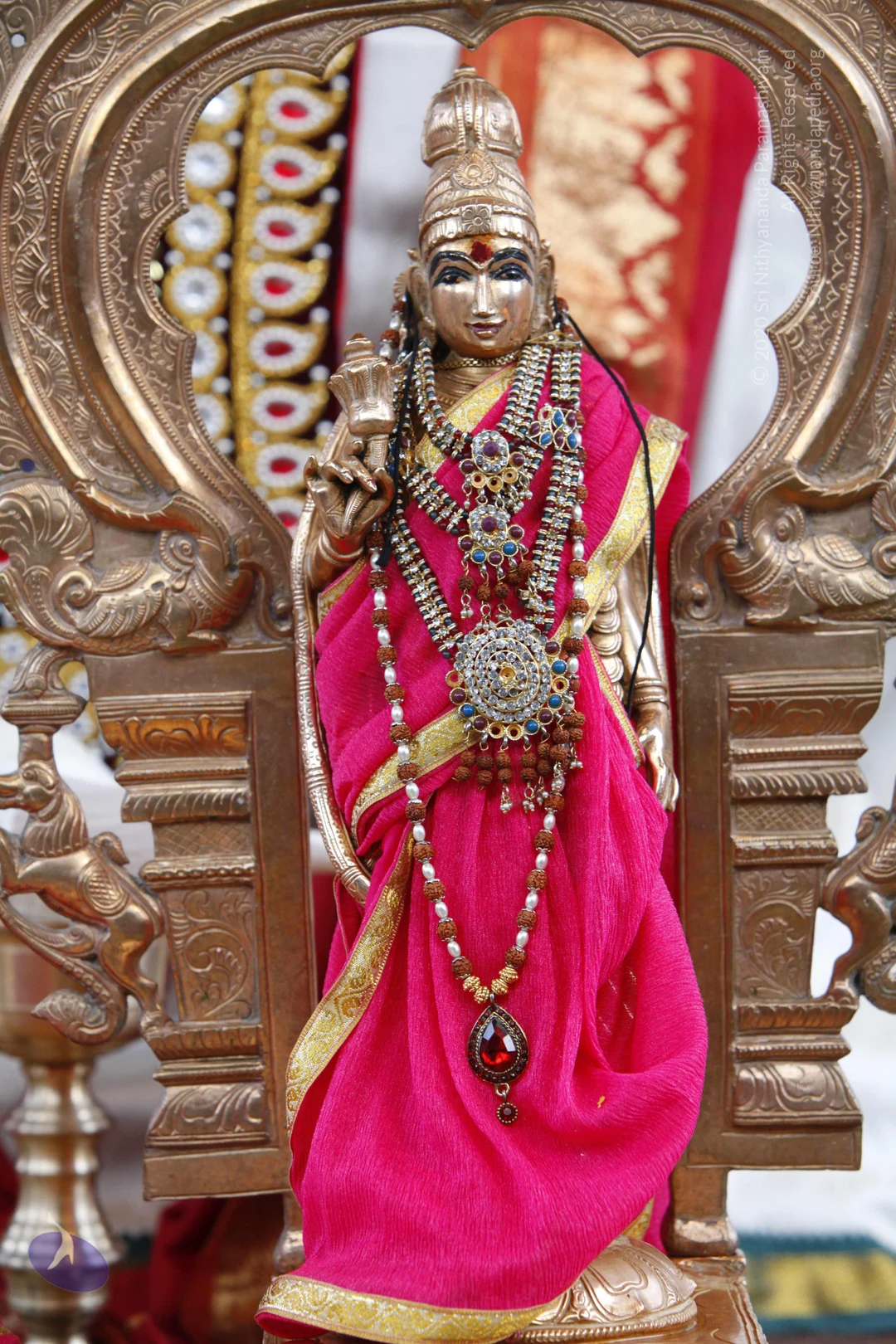
A bronze-gold metal deity murti stands in an ornate golden arched niche with carved peacock-like motifs. The figure wears a tall crown, a red tilak, and is draped in a hot pink sari with a gold woven border. Layered necklaces of gemstone-set gold pendants, rudraksha beads and pearls hang on the chest, with a red teardrop stone pendant at the bottom. The murti raises one hand holding a small ceremonial object, and the background shows red and gold embroidered fabric with white and red jewel-like trim.A seated man in orange and saffron robes sits cross-legged on an ornate gold throne with a red tiger-striped cushion and a tiger-skin rug, palms pressed together in namaskar with eyes closed. He wears a red tilak mark, a rudraksha mala and gold beaded necklaces, with bangles and armbands. Golden lion figures flank the throne. Two tall painted deity murti stand on either side with multiple arms, golden crowns and ornaments, and hanging brass bells and lamps hang above. The setting resembles a temple hall.A black stone statue of a four-armed deity seated against a green fabric backdrop with gold floral pattern. The murti wears a red turban, a red dot on the forehead, layered rudraksha and white bead malas, a gold pendant, and a red and gold silk garment. Its hands hold a drum-like object and other ritual items while one hand is raised in blessing. This is a statue, not a living person.

May 31 2013

Original wiki page
Contents

Title

Satsang on Responsibility the greatest Possibility| Padukapuja |

Description

Swamiji talks on Manu, should be a syllabus for Gurukul.

Link to Video:

VideoAudio

Transcript

Nithyanandeshwara Samaarambhaam Nithyanandeshwari Madhyamaam | Asmath Aachaarya Paryanthaam Vandhey Guru Paramparaam ||

0:32 I welcome everyone who is sitting with us at this moment. I welcome all the Sadhna TV viewers and Lotus TV viewers and Eshwar, Disha other channel viewers who are sitting with us live now.

Today, I will expand on ‘RESPONSIBILITY, THE GREATEST POSSIBILITY’

Listen. Please come to the space of listening.

The very word ‘Responsibility’ creates kind of a feeling - that load, ‘Oh, God!’, as if something is put on your shoulder. But I tell you, thinking or feeling Responsibility as a weight, heavy, is a basic, one of the basic root-patterns of human-beings. Human-beings program themself with the root-pattern of shrinking, death-oriented. Most of our life is death-oriented, and the pattern of death-oriented is the reason for why you feel the very word Responsibility looks like load for you.

I tell you, Responsibility is the word of Consciousness, conscious expansion. The more Responsibility you take on your shoulders, more life oozes in your being. When you take more Responsibility, sugar is more sweet in your tongue. Listen, please listen. Responsibility is actually the great possibility, the way of expansion towards life! You see this is the touch stone with which you can find out whether you are living death oriented life or life oriented life. If you feel, the moment word responsibility is uttered if you feel load, suffocation, heaviness, weight, then your whole pattern is functioning towards death oriented life; your root pattern is death oriented, shrinking, suffocation. You have neither trust over the life nor passion over the life or interest over the life. If you are conscious of life, if you are interested in living the life, if you are living the life, more responsibility means just you know it’s a more sweet in front of you. Because if you have tasted responsibility consciously, you will know responsibility opens so many different possibilities and even brings extraordinary powers inside you from inside you. 5:11 The power of healing has happened in me just because I took the responsibility for all the sickness of the world. Anybody is sick; in my consciousness I felt I am responsible. Simply the power of healing came. Anybody is ignorant; I felt in my space I am responsible - the power to initiate came. Understand, take responsibility not as a pain or suffocation but as a great possibility. Whenever you take more and more responsibility even your muscles start responding to world in a different way. Your being starts responding to the world in a different way. The people you attract around you will be a different quality. The life you create around you will have a different quality. Feeling responsible in your inner space - just Buddha’s example. All of us have seen enough of sick, old, dead fellows in our life in the young age. But when Buddha saw a sick fellow, a old man, a dead body he decided to take responsibility for it. When he took the Responsibility, he had the power. He naturally experienced the power of healing! Body which was never tired, even it was getting aged, it may be getting aged but it never got old! Buddha got aged, but never got old! And, of course, the Consciousness which became immortal! Responsibility, continuously taking more and more and more responsibility, it is actually you realizing your different possibility. The door for you realizing your different possibilities happens when you take Responsibility. I tell you, if I have not taken the Responsibility of all the sick people in the world, I would have never realized the possibility I can heal. If I would not have taken the Responsibility of all the ignorant people, I would have never realized that possibility I can initiate people. If I have not taken the Responsibility for all the lack of energy and lack of power, I would not have had the power; I would not have expressed the power to awaken the Kundalini.

I tell you, when you take more and more Responsibility, your bio-memory, your bio-memory’s capability to enjoy increases, your muscle-memory’s capability for life expands, your brain’s possibility expands! I tell you, take Responsibility for all the communication; you will simply express Telepathy power. 9:34 What stops you taking Responsibility? Constantly calculating, ‘What will I gain if I take the Responsibility?’ puts you off taking Responsibility. Understand, when you take Responsibility, your very possibility expands, who you are expands. Unfortunately, you never know how to measure your expansion other than your cars and houses and the bank balance zeros. If you measure yourself based on your net worth, you are in the ‘unworthy net’; you are caught in ‘unworthy net’! If you measure yourself with the expansion of your possibilities, every time, I tell you, every time when somebody makes me take more Responsibility, I bless them, because they are making me expand more. They are making me expand more. (HINDI) 14:13 I tell you, please listen, whenever you take more and more Responsibility, you find ways to handle more and more Responsibility, your whole nervous system becomes such a possibility for life, joy. I tell you – I am speaking in the national channel; with that responsibility I can tell you – decide to take more and more Responsibilities in your life, you will walk out of even cancer. Taking more Responsibility can be a powerful method to heal yourself from cancer. Cancer is nothing but death-oriented thinking, death-oriented thinking.

When you decide to take any Responsibility which comes in your breathing space, decide to take any Responsibility which comes in your breathing space, it is only huge possibility, possibility, possibility. (HINDI) Your possibility of health, mental wellness, above all psychic powers, spiritual strength, everything expands more and more responsibility, with more and more responsibility. I have seen, I have seen in my life. Leader is a man who completes the last 10% of any task. Follower is a guy who will do 90%, will not take Responsibility for that last 10%! Always that last 10% is completed by a man who takes Responsibility. The guy who does not take the Responsibility, he makes all the spare parts, but, finally, will not assemble them. Without screwing it he will screw it!

Listen. It is the being who takes Responsibility, who is a Leader, completes it.

17:45 I have seen in my own sangha, I have seen some of my brahmacharis who are responsible of, who are supposed to be responsible for the department which makes deities, clothes for the deities, garlands, to build temples. I have seen they will only be making the deity and that seat and the backside arch and the clothes, and the vehicle on which the deity has to kept; everything they will only be making. But nothing will fit with each other end of the day! Means, so much of irresponsibility! Nothing will match with the other! So much of irresponsibility! All I have to do is, I have to go and plan it and match it. That’s it! Means, there is no responsibility to deliver! There is no responsibility to maintain! It is only a irresponsible time-pass! Same way, I have seen, when somebody responsible come to that seat, he thinks through from the whole and finally delivers the exact needed outcome. Leader is a man who does that last 10% job. Only if you feel responsible, it can be done, not otherwise. (HINDI) Whenever certain revolution happens in the country, all the other guys are destroyed. For example, when the Communist Revolution happens, all the fellows who are not associated with Communism, other theories philosophies; they are all destroyed by Communist Heads. Same way, when there is a Naxalite Revolution, they destroy everyone else. When there is a Capitalist Revolution, they destroy everyone else by putting them into poverty. Whenever there is a Christian Revolution, they destroy all Muslims. Whenever there is a Muslim Revolution, they destroy all Christians. Whenever Cosmos does Revolution, it destroys all the irresponsible fellows. It is a law of life. It is a law of life. There is no sympathy, compassion, can be shown for irresponsible fellows. Irresponsible fellows are not even human-beings; they are sub-human. They are lower than animals. 22:48 Whenever the Cosmos does a Revolution, it destroys irresponsible fellows! I tell you, just yesterday, I was reading Uttara Kaamika Aagamam. I was spending little time. Then I spent little time on Manu Smriti. Simply, I could see, the whole Manu Smriti is written on one truth – RESPONSIBILISM. That’s all. Just Responsibilism; Responsibilism - that is all Manu Smriti. What a powerful Cosmic Law! Only a sage like Manu, a visionary like Manu can think in that language. All the fellows who abused Manu, only made wealth for their family and they created their own community, who are elite, rich. Manu is neither caste-based nor community-based or communal-based. He is Responsibility-based. Manu is the solution. Manu is the solution. I tell you, Manu is the solution, a powerful solution. It is time, it is time people realize Manu’s possibility. I feel at least our sangha should respect Manu and read Manu as a syllabus. In our Gurukul, we should have Manu as syllabus. At least essence of Manu can be syllabus, so that kids will have answer for all the questions of life: Why is somebody poor, somebody rich? Why is somebody sick, somebody healthy? Why is somebody bright, somebody dull? Why is somebody alive, somebody dead? All the ‘Whys’ you have towards God and the world and the Nature will be simply answered if you read Manu, internalize Manu. Manu means, the being who took the Responsibility and grown. (HINDI) 27:32 Understand. Catch it. It’s Manu. Law of life is Responsibilism. From the young age, the Responsibilities you take decides even the growth of your bone, growth of your bone structure. Recently I was studying the physical growth ratio in different parts of India and all over the world and the lifestyles of that areas. I can directly see, the civilizations, societies where people have the lifestyle of Responsibility, they have a freedom, if they take Responsible, they can cross the sky and they take the Responsibility. All that kind of communities, their bone structure has grown, evolved to the 100% possibility. Some places, even 120% possibility; means, much better growth than your parents, elders. But the societies where Responsibility is not going to be directly supporting you or Responsibility is not taught to you or you are not taking the Responsibility, that kind of societies, even bone structure of the body does not grow more than 40%. The growth of even physical body happens only 40%. In Indian rural villages, people don’t take Responsibility, they don’t even take Responsibility for their agriculture. I can see very clearly, their bone structure never grows! In the Western civilizations where people take Responsibility, their whole bone structure grows to its peak possibility! So, why somebody is healthy, somebody lives long, somebody is rich - everything can be explained if you just internalize Manu Smriti. It is ability to take the Responsibility! (HINDI) Feeling responsible for everything, whether it is your blood pressure or diabetes or cough, when you feel responsible, it becomes alright. I tell you from my experience. Only when I felt responsible, body healed itself. (HINDI) It is so irresponsible; society does not teach people to be Responsible! I tell you, Responsibility is the greatest key; how the kings are made, saints are made, leaders are made, stars are made, celebrities are made; Responsibility is the material out of which the elite society is made. (HINDI) It is Responsibility that is the greatest lesson. I tell you, it is with Responsibility life is learnt, lived, enjoyed, expanded, eternalized. I am using a new word for Videha Mukthi – Eternalizing. Eternalization of life. Each one of us are Responsible for eternalization of life. 34:24 Look into your life in every level. Sit with yourself. Are you having health issues? Are you having conflicts internally? Are you having mental depression? Are you having incompletions? Are you feeling suffocated? Are you experiencing the moments of powerlessness? Are you experiencing like a slave? Are you feeling unfulfilled? Are you feeling suffocated with relationships? Are you having poverty? Are you in spiritual poverty? Sit. Pen down everything one by one and meditate on every item individually, deciding ‘I am responsible. Now how can I transform it?’ One part of your mind will tell ‘Oh, you are responsible. If you take Responsibility now and start altering, after ten years, you may alter!’ That is okay. ‘Just because it is going to take ten years I can’t just be keeping quiet without taking Responsibility. I have to take the Responsibility.’ Or, if you feel you are not looking beautiful, handsome, take Responsibility even for that! Whenever you take Responsibility for anything, you have solution! You have solution! You can complete with it. You can complete with it. Even I am learning this lesson. I am learning. I can see, I am learning. Wherever you feel powerless, take Responsibility in each of those zones. You will simply feel solution in front of you! You can solve it and life can be full of power. Life should not have even one moment of powerlessness. Sit, one by one, draft, expand. How you are feeling powerless? What are the moments of powerlessness you feel in your life? And decide to take the Responsibility for it. When you take Responsibility for it, you will see you are powerful. Solution is there in front of you. (HINDI) 39:33 Responsibility, Responsibility first enriches you, expands you, adds so much life to you, adds so much life to you. It just adds life to you. (HINDI) Every moment, when you take Responsibility, your muscles expand, become energetic, alive, living!

(HINDI)

Photos
Photos Of The Day:

Paduka Pooja
Temple
Swasthi Mantra

Nithya Satsang

Samyama Meditation

Sarva Darshan- Solo

Final Blessings - Solo

Forweb- Solo

Link to Video:

Photos Of The Day:

Temple
Pada-Puja

Swasthi-Mantra

Nithya-Satsang

Samyama-Meditation

Sarva-Darshan

Photos Of The Day:

Temple
1-Temple

2-Paduka-Puja

IMG_3069_CMP_WM

Photos from this day

View all 100 photos

Photos

1 photoSource gallery
A seated man in orange and saffron robes sits cross-legged on an ornate gold throne with a red tiger-striped cushion and a tiger-skin rug, palms pressed together in namaskar with eyes closed. He wears a red tilak mark, a rudraksha mala and gold beaded necklaces, with bangles and armbands. Golden lion figures flank the throne. Two tall painted deity murti stand on either side with multiple arms, golden crowns and ornaments, and hanging brass bells and lamps hang above. The setting resembles a temple hall.

Paduka Pooja

21 photosSource gallery
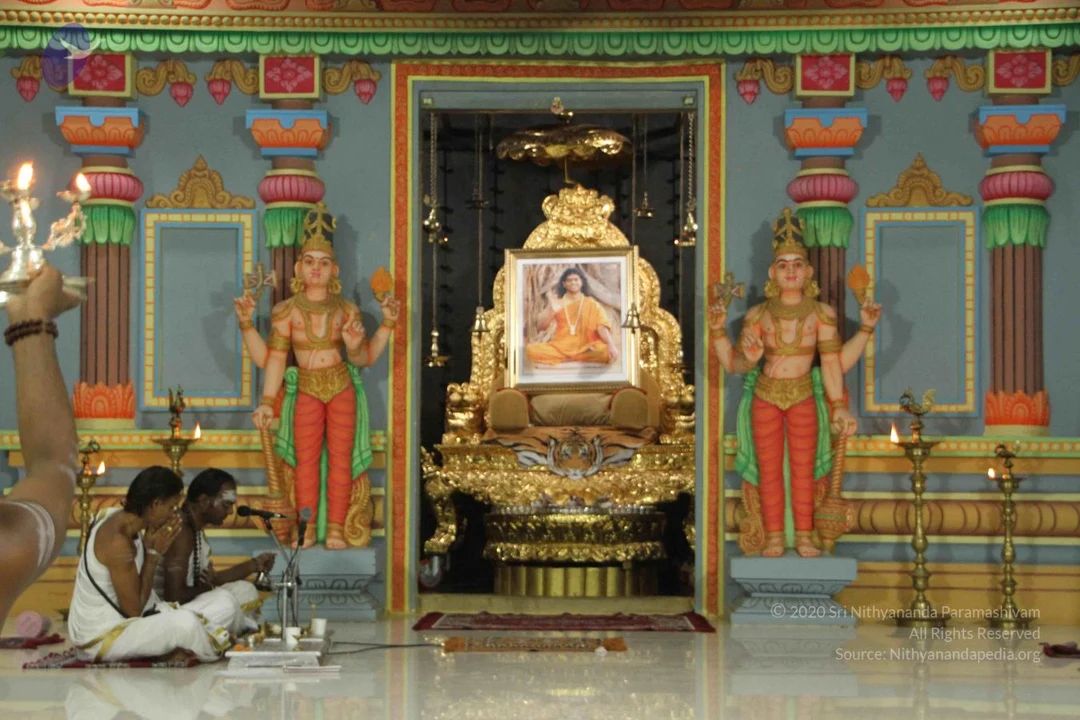
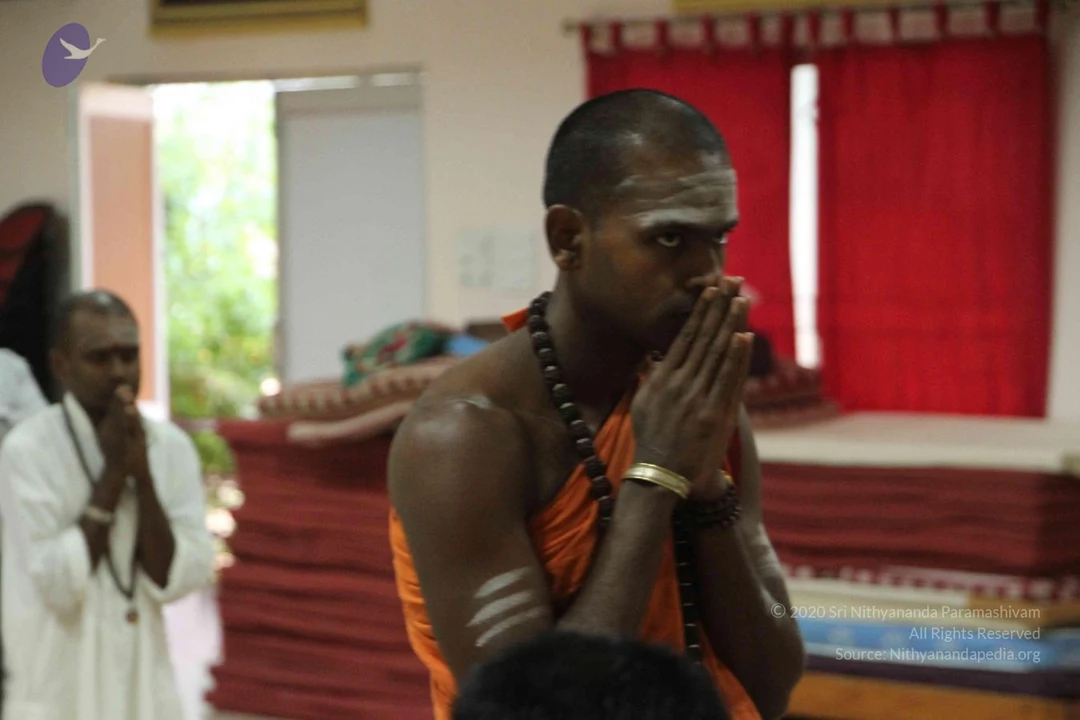
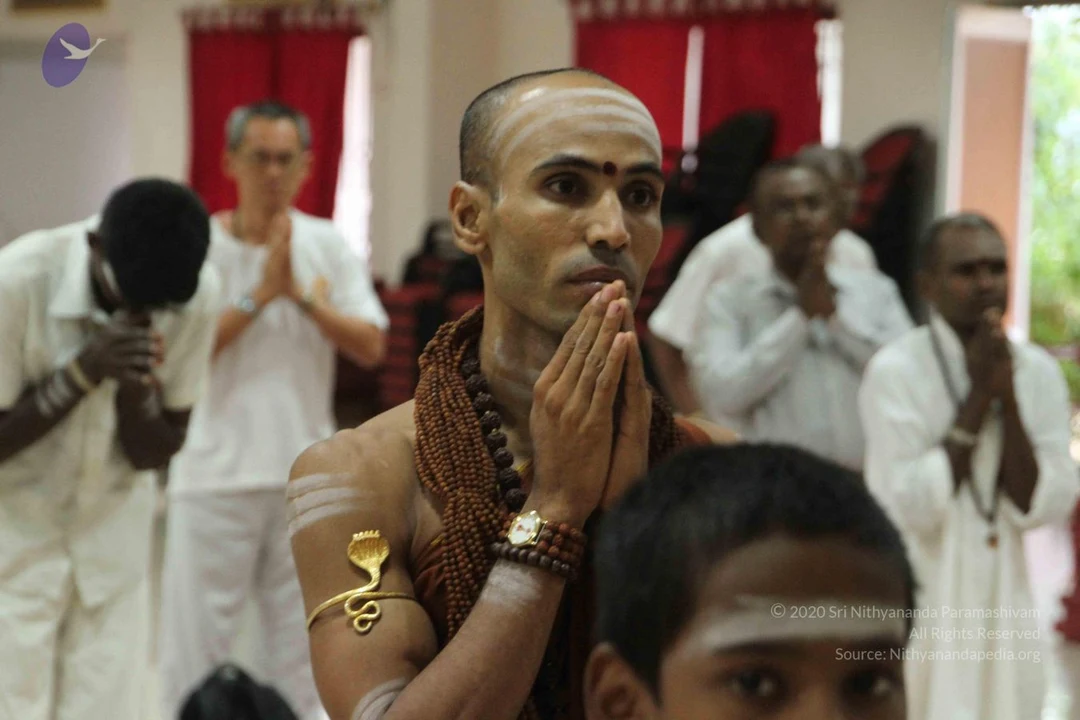
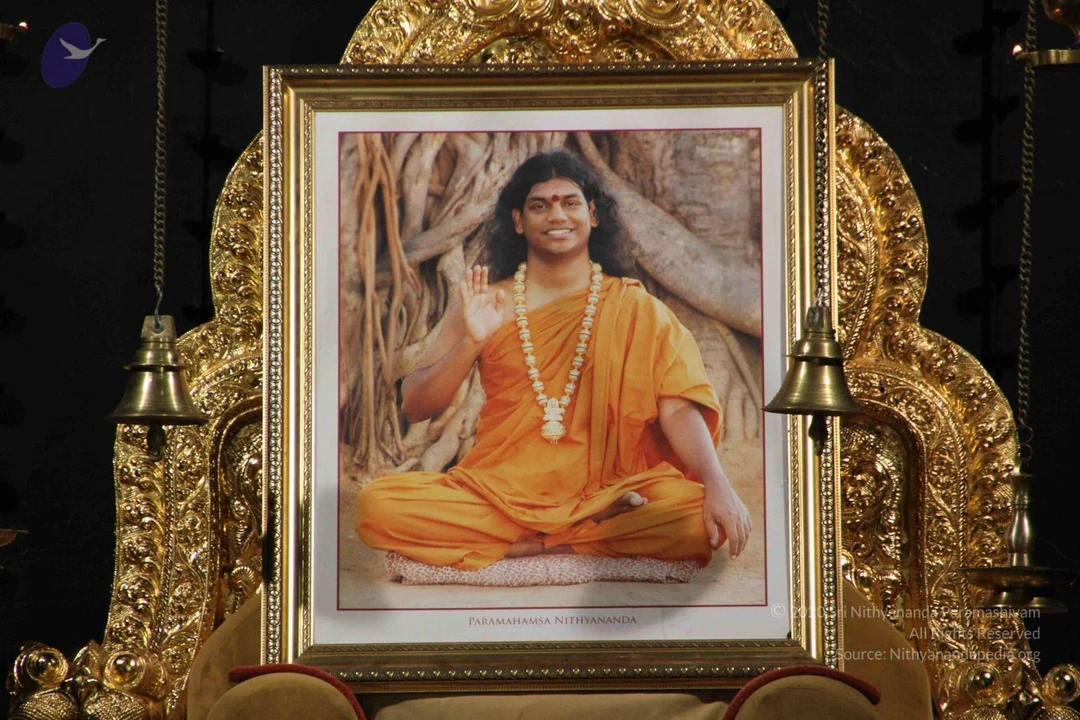
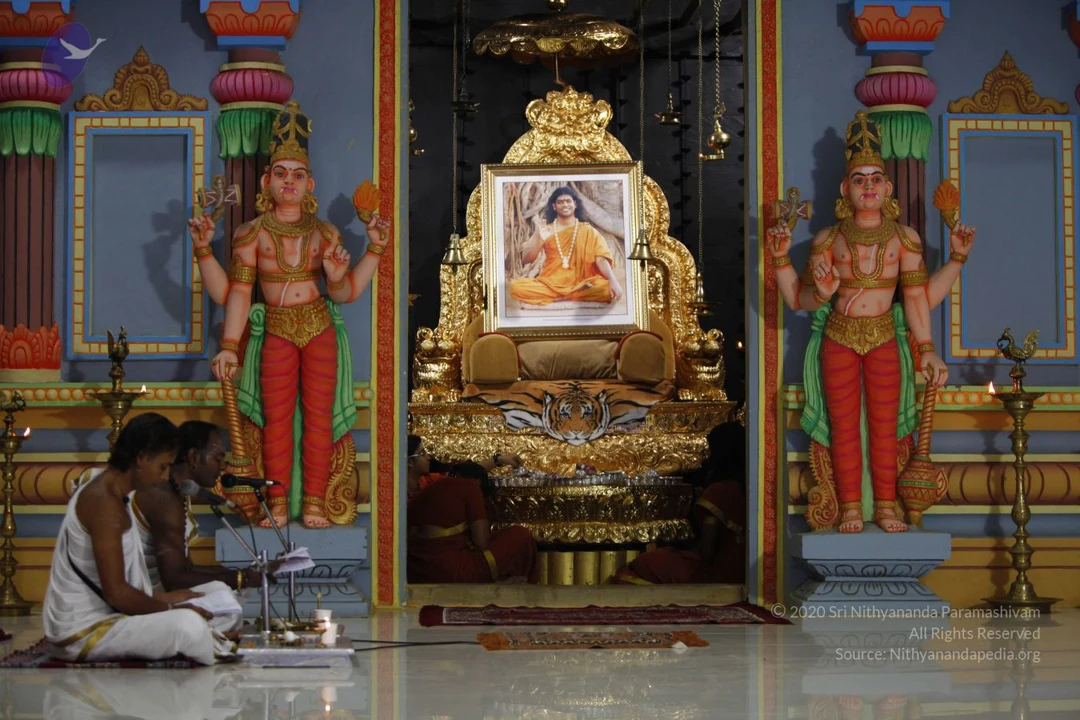
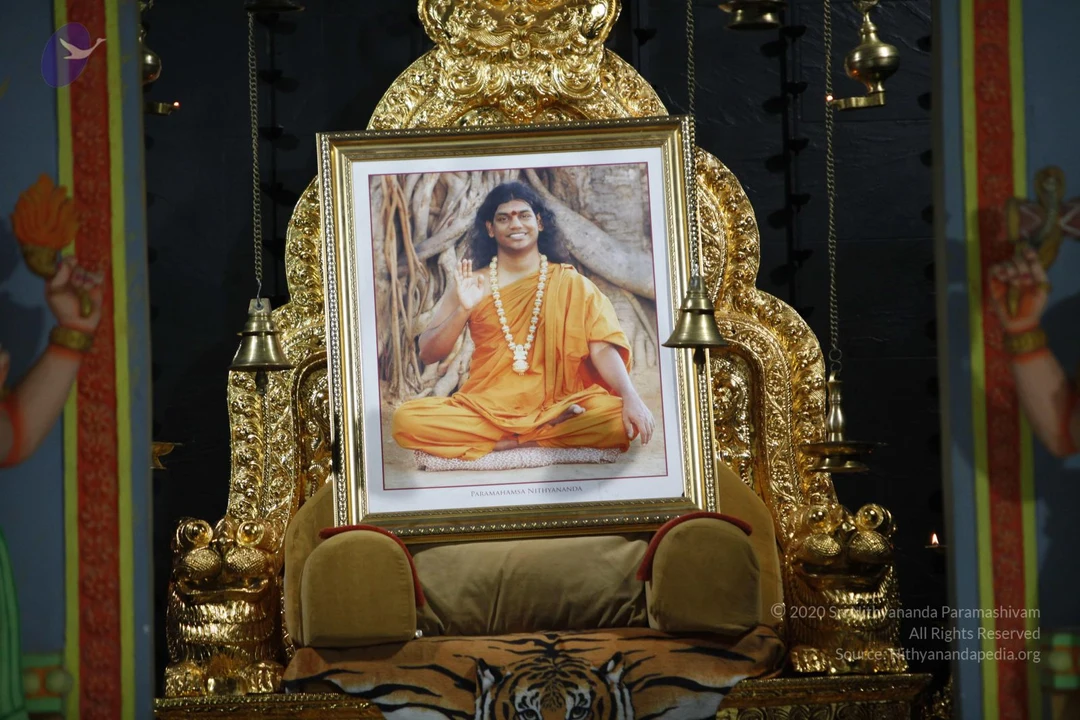
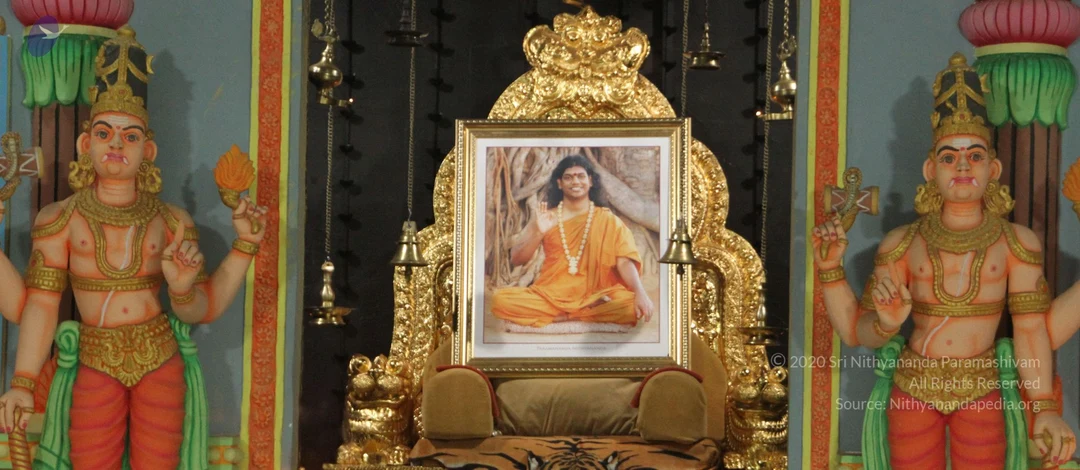
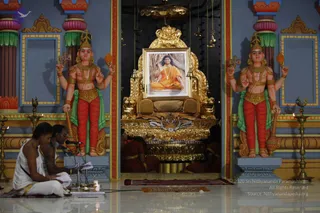
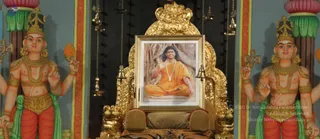
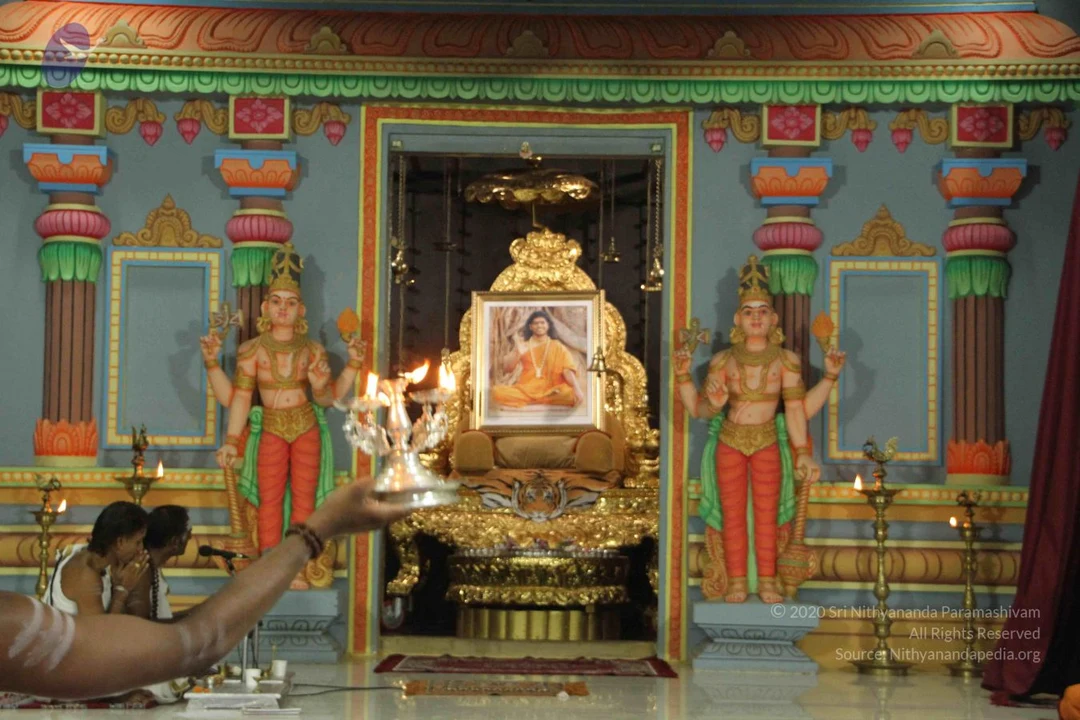
Photo of a temple shrine with painted blue and multicolour walls and gilded columns. At centre sits a gold throne holding a framed portrait of a saffron-robed figure seated in meditation with a rudraksha mala. Two painted deity murti stand on either side, each with four arms and crowns. A priest in white dhoti holds a silver lamp with flames toward the throne, while two seated assistants in white attend nearby. Brass oil lamps line the floor and a red curtain hangs at right. The portrait is a depiction, not a physical person, and no appearance-based candidate is physically present.Inside a temple shrine, an empty golden ornate throne with a tiger-skin seat stands in a central niche, with a framed photograph on its back showing a smiling figure in orange robes and rudraksha beads seated in a rocky setting, labelled as a depiction on the frame. Two painted guardian figures with gold crowns, green sashes and red dhotis flank the niche. In the foreground, two seated priests in white dhotis and vibhuti marks perform a puja, one holding a microphone, while a brass lamp and oil lamps line the floor and a standing figure's arm holds a lamp at the left edge. The photograph is a depiction, not a physical person, and no physical person is clearly identifiable as a person.A photograph of an ornate golden throne (peetha) in a temple-style shrine, with a tiger-skin cushion on the seat. Framed on the throne is a printed portrait of a man with long dark hair in saffron-orange robes and a white beaded mala, seated before a banyan-like tree and gesturing with one hand. Flanking the throne are two painted deity murti figures with multiple arms, gold crowns and ornaments, and red and green garments. Hanging bells and brass oil lamps are in front, with lit flames at the lower left and right edges. No physical people are visible.A photograph of a shaven-headed man in an orange sannyasi-style garment wrapped over the upper body, with a dark rudraksha mala around his neck and a gold bangle on his wrist, standing with palms pressed together in anjali mudra near his chest. White horizontal tilak marks are visible on his forehead and white stripes on his upper arm. Behind him, a man in a white dhoti-style garment with a mala also stands with hands folded. The room has red curtains, stacked red and maroon cushions or mats, and a window with green foliage outside.A shaved-headed man with white tilak stripes on his forehead and arms, a red bindi, and a red-brown rudraksha mala draped over bare shoulders stands with palms pressed together in anjali mudra. He wears an ornate gold cobra-shaped armlet and a wristwatch. Behind him, several men in white ritual clothes stand with hands folded in prayer, and a boy with white tilak in the foreground is partly visible. Red curtains and a bright doorway frame the room.A framed portrait of a man in saffron-orange robes sits on a gold-carved throne-like seat in front of a dark background. The man sits cross-legged on a cushion before a banyan tree trunk, holds one hand raised in a blessing gesture, and wears a white flower garland and a red bindi on his forehead. Two brass hanging bells flank the frame, with a brass lamp visible on the right. The portrait is a printed photograph and is labelled "Paramahamsa Nithyananda" on the print. Swamiji (probable): the portrait shows a long-haired figure in saffron robes with a garland, a depiction on a printed portrait.

Temple
17 photosSource gallery
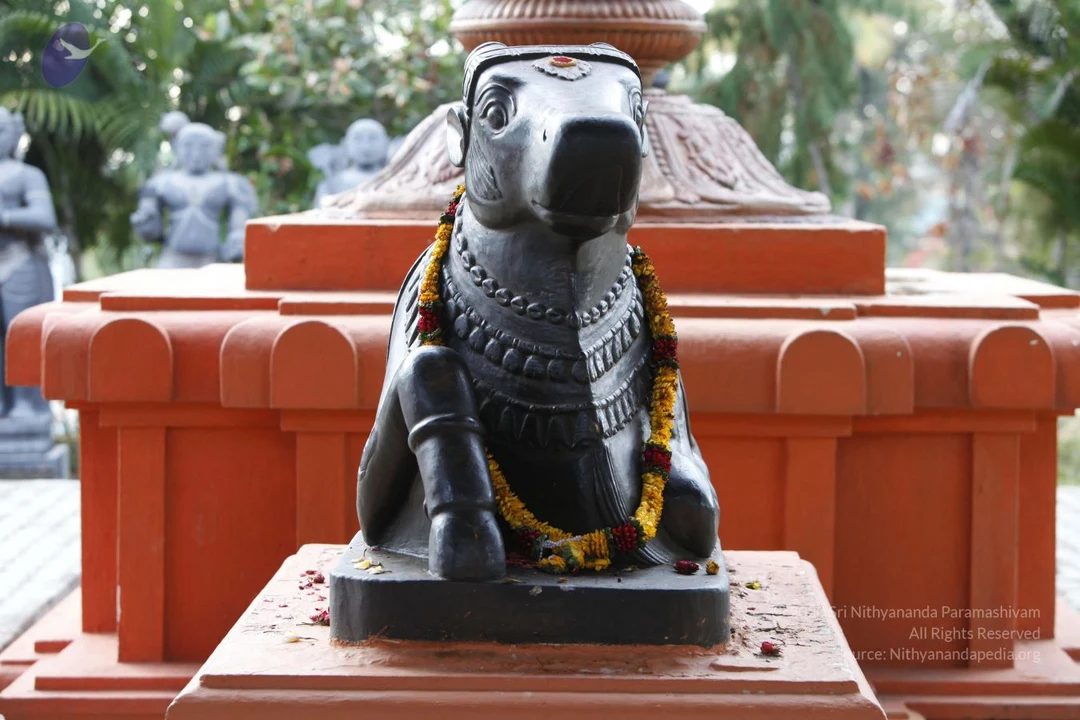
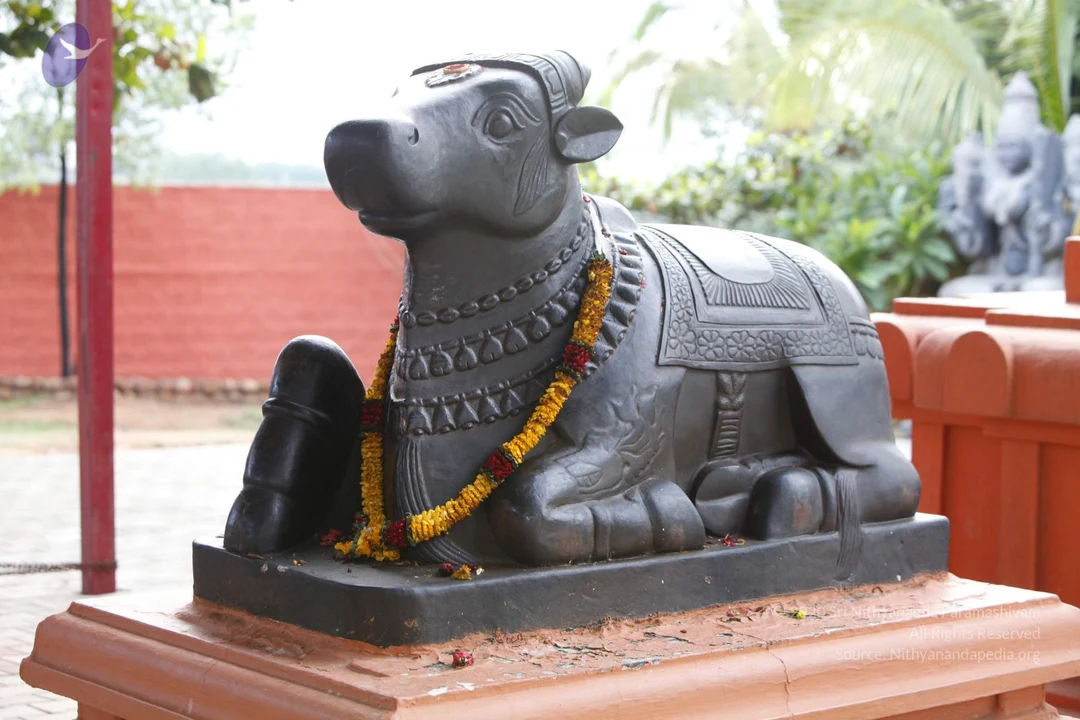
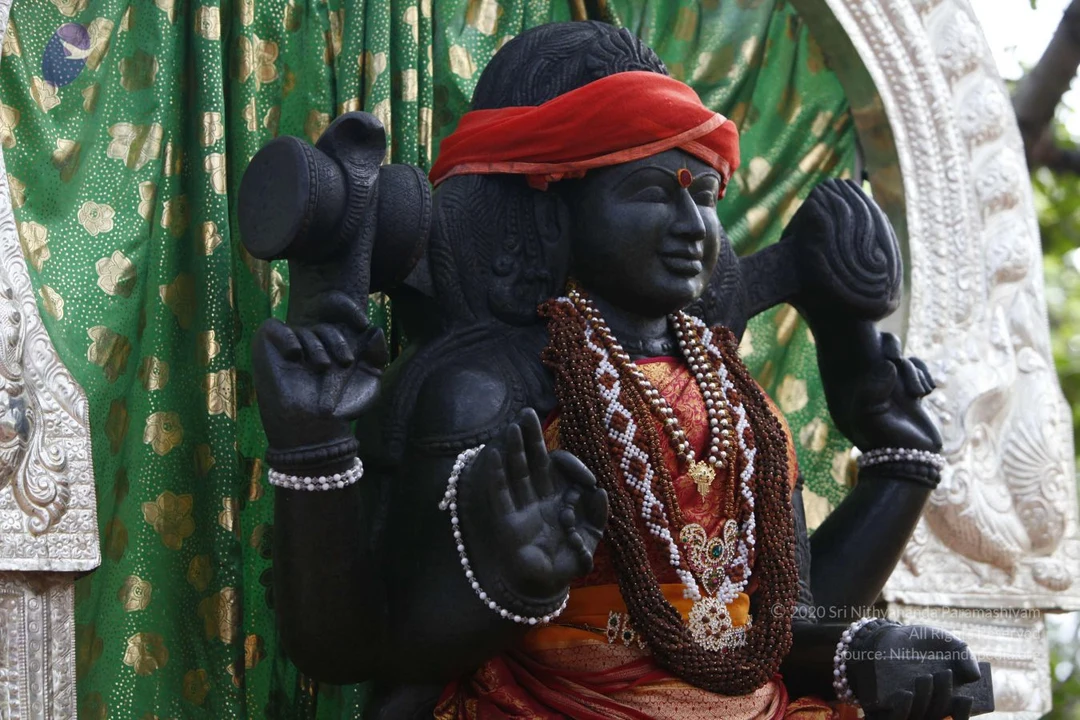
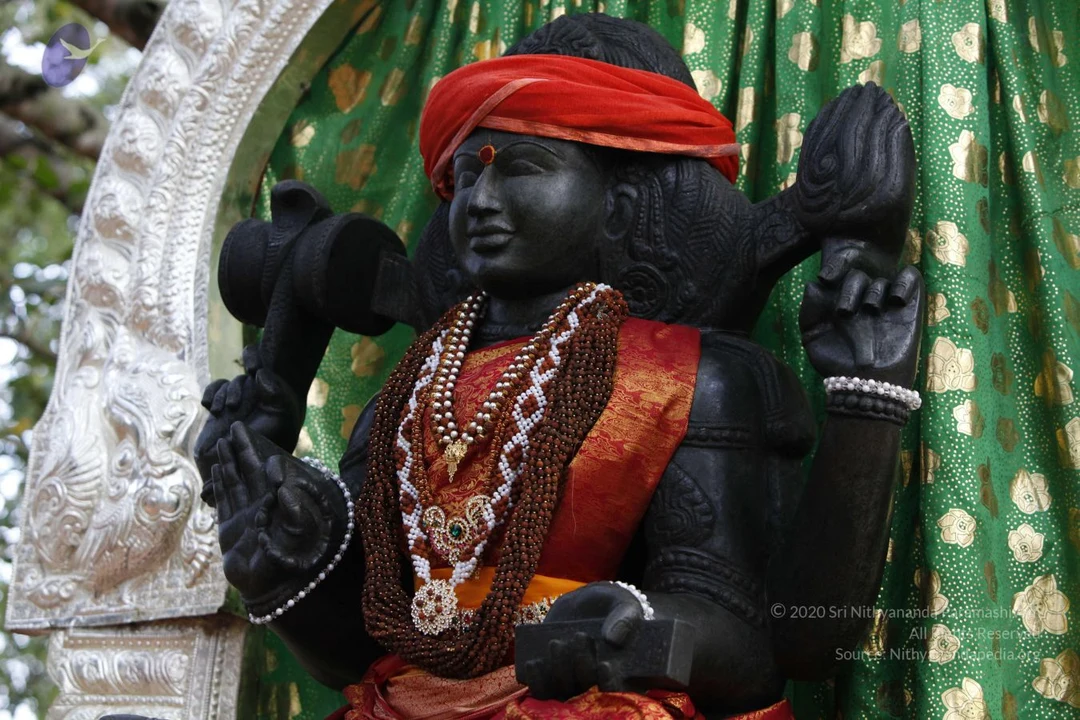
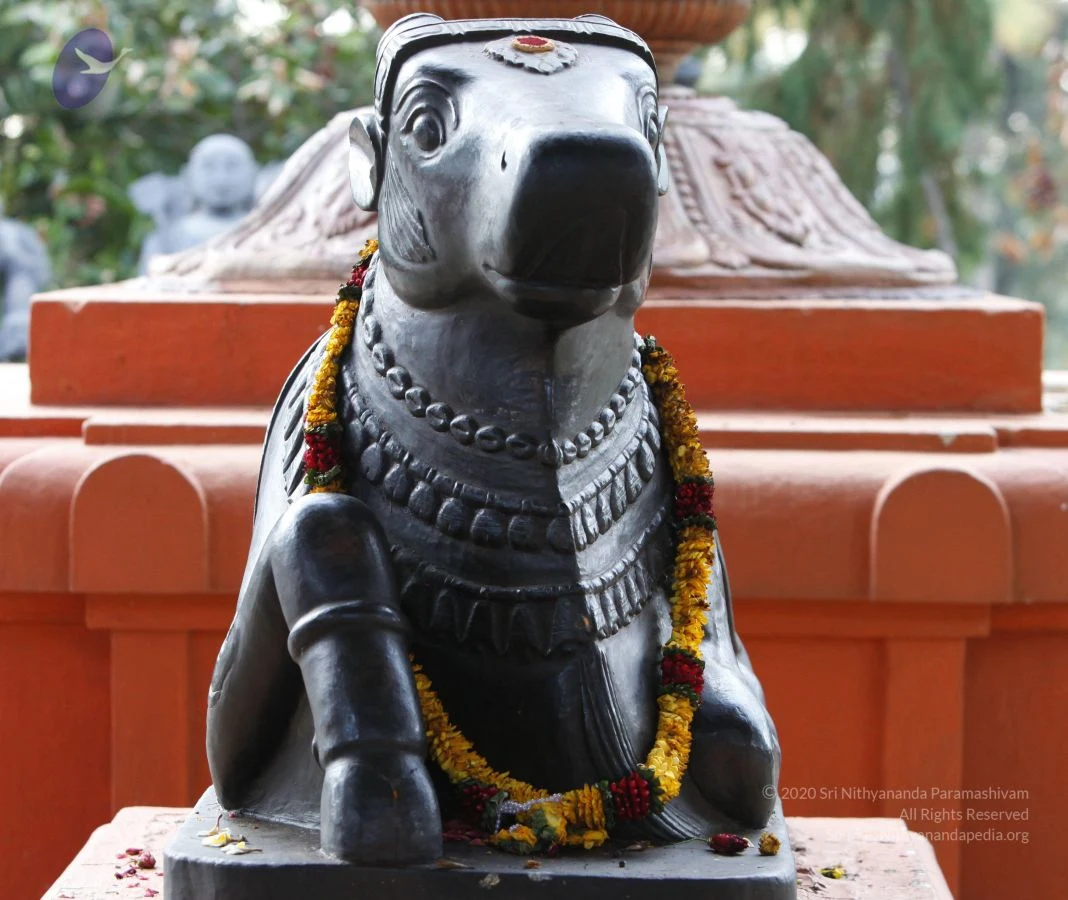
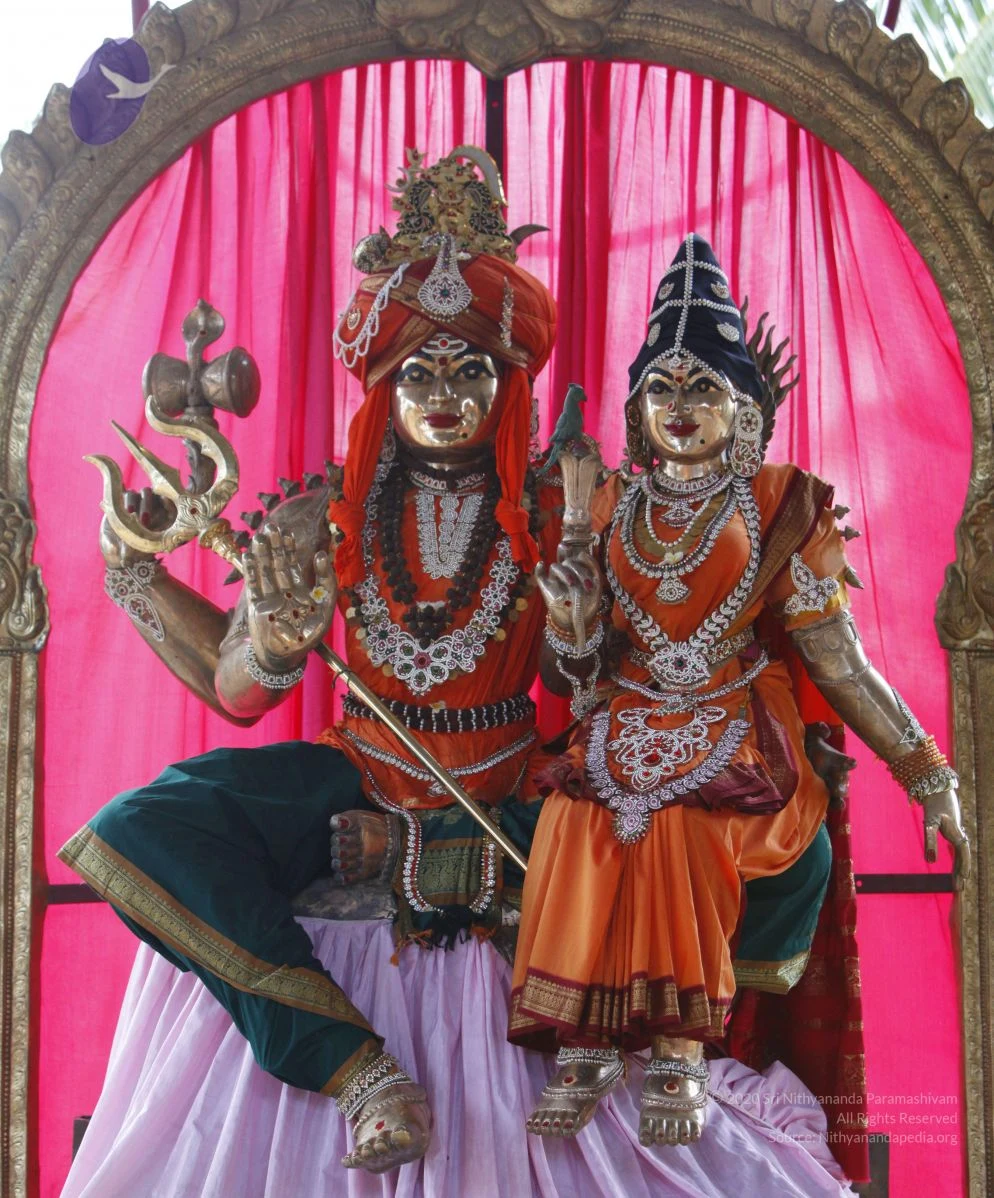
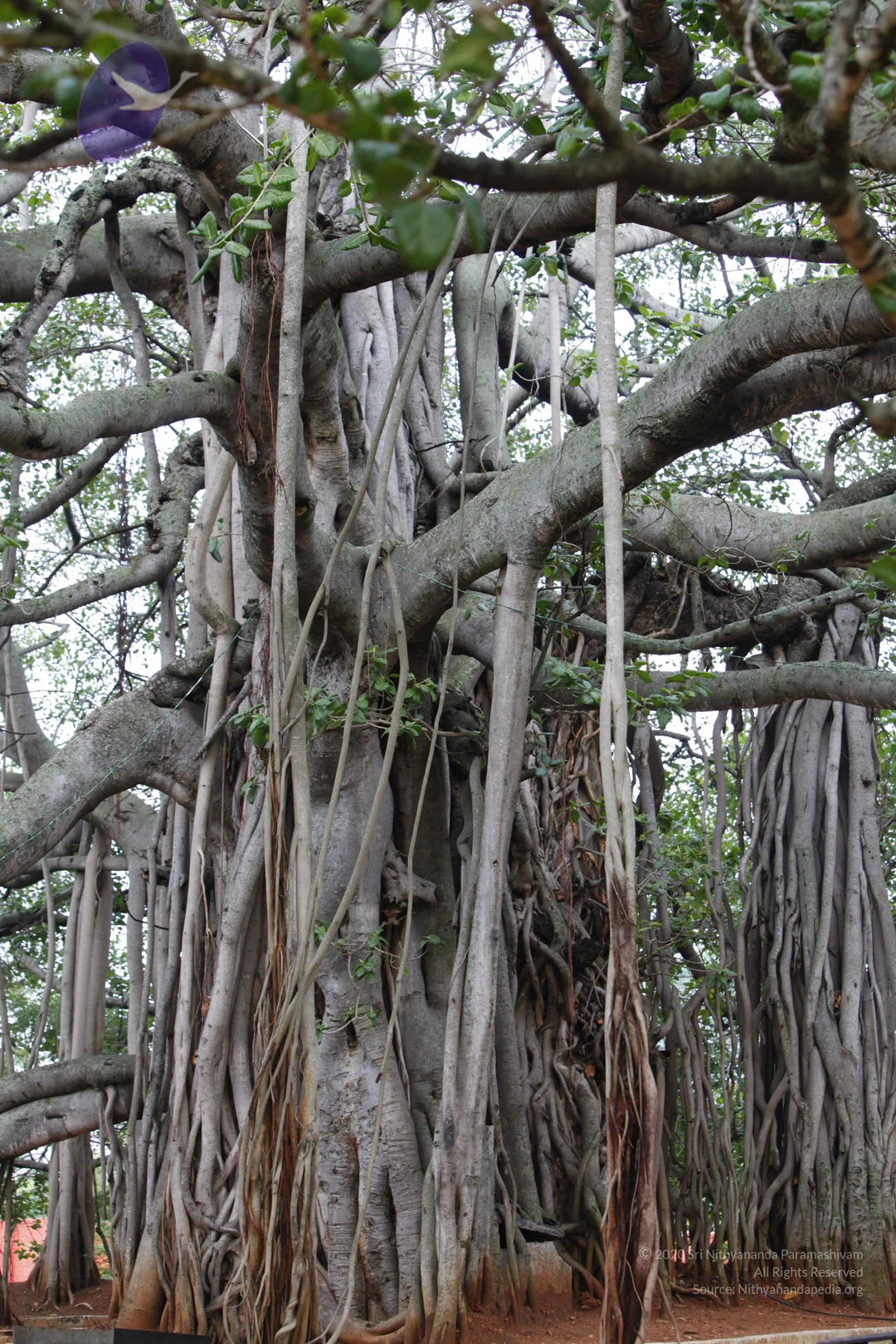
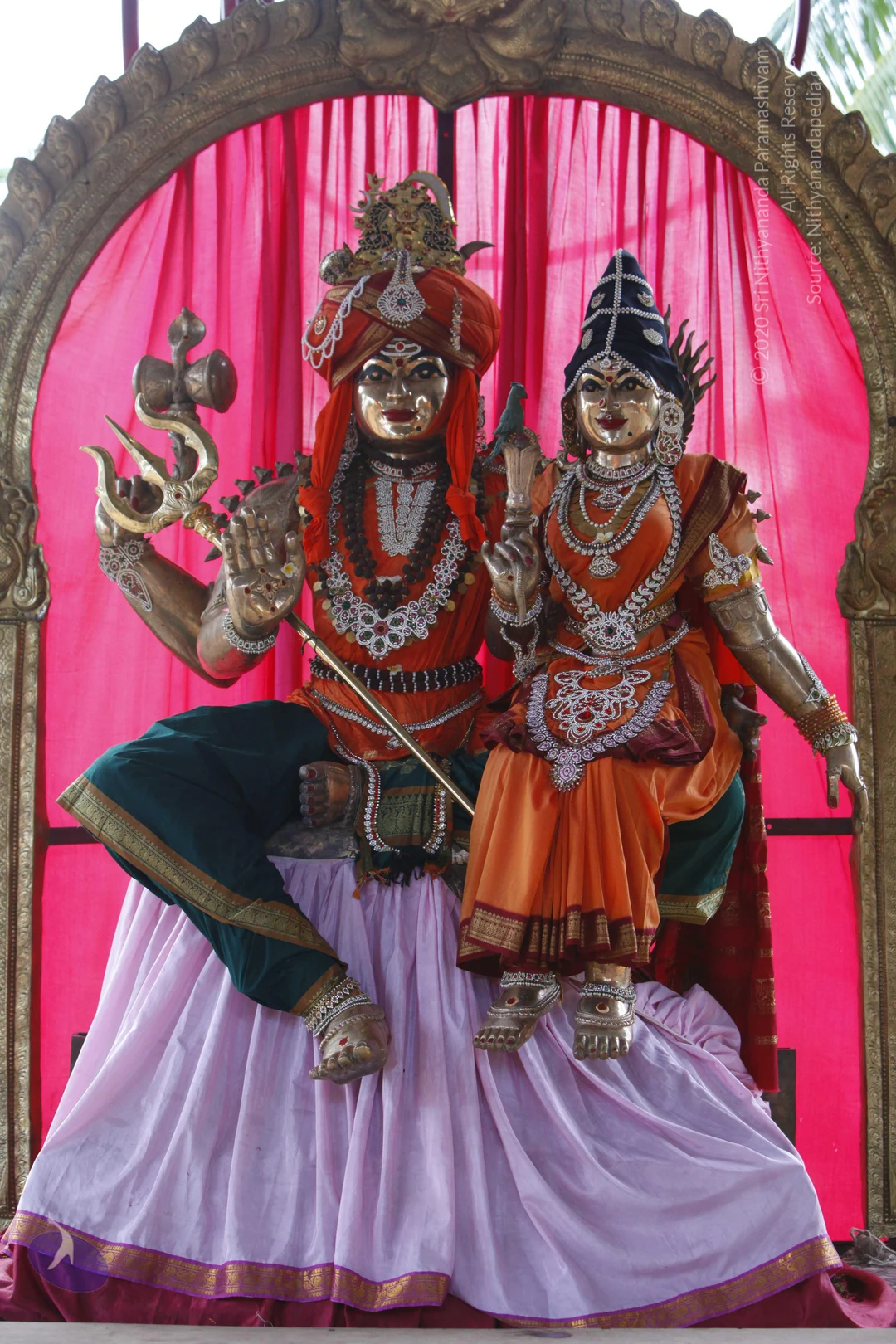
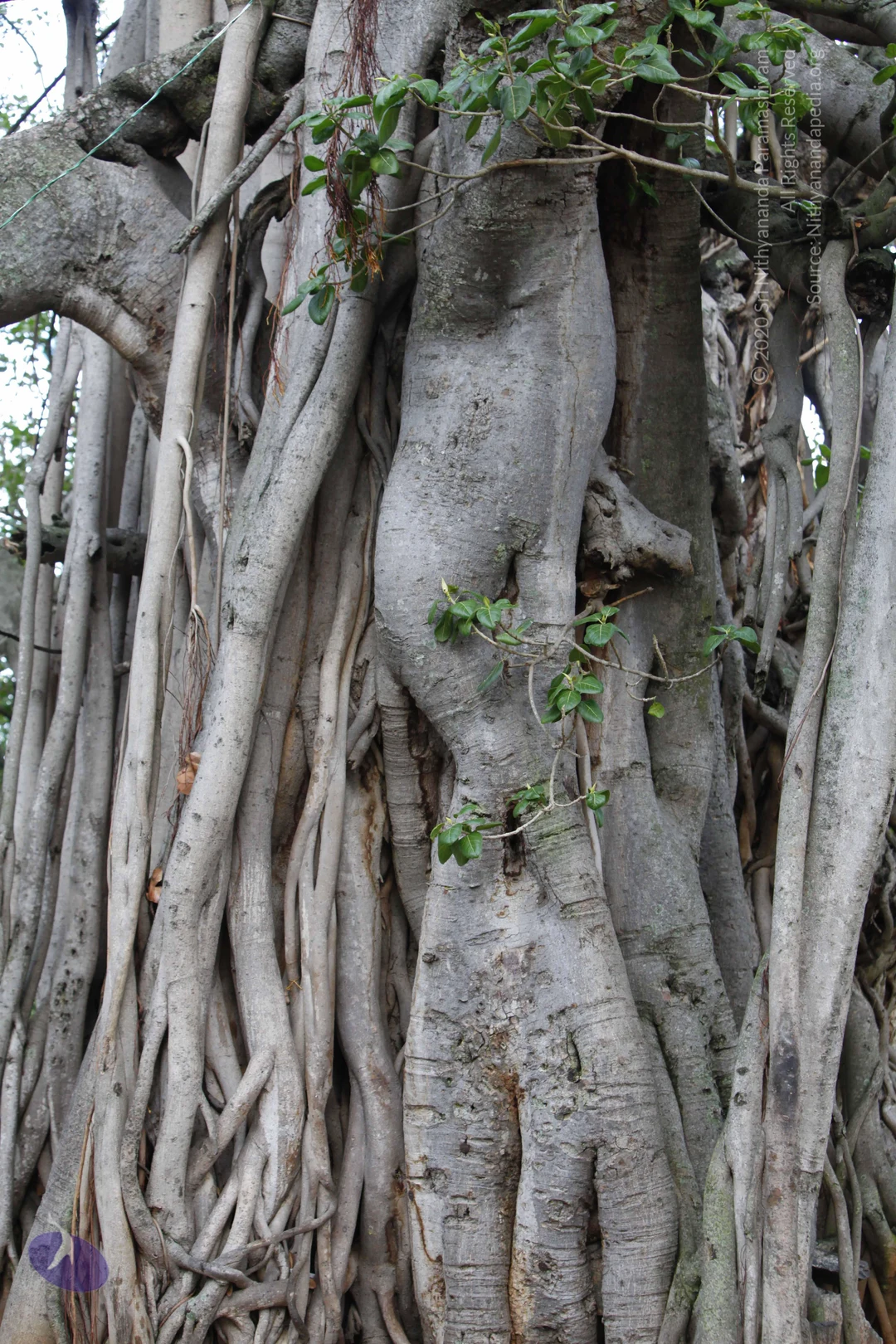
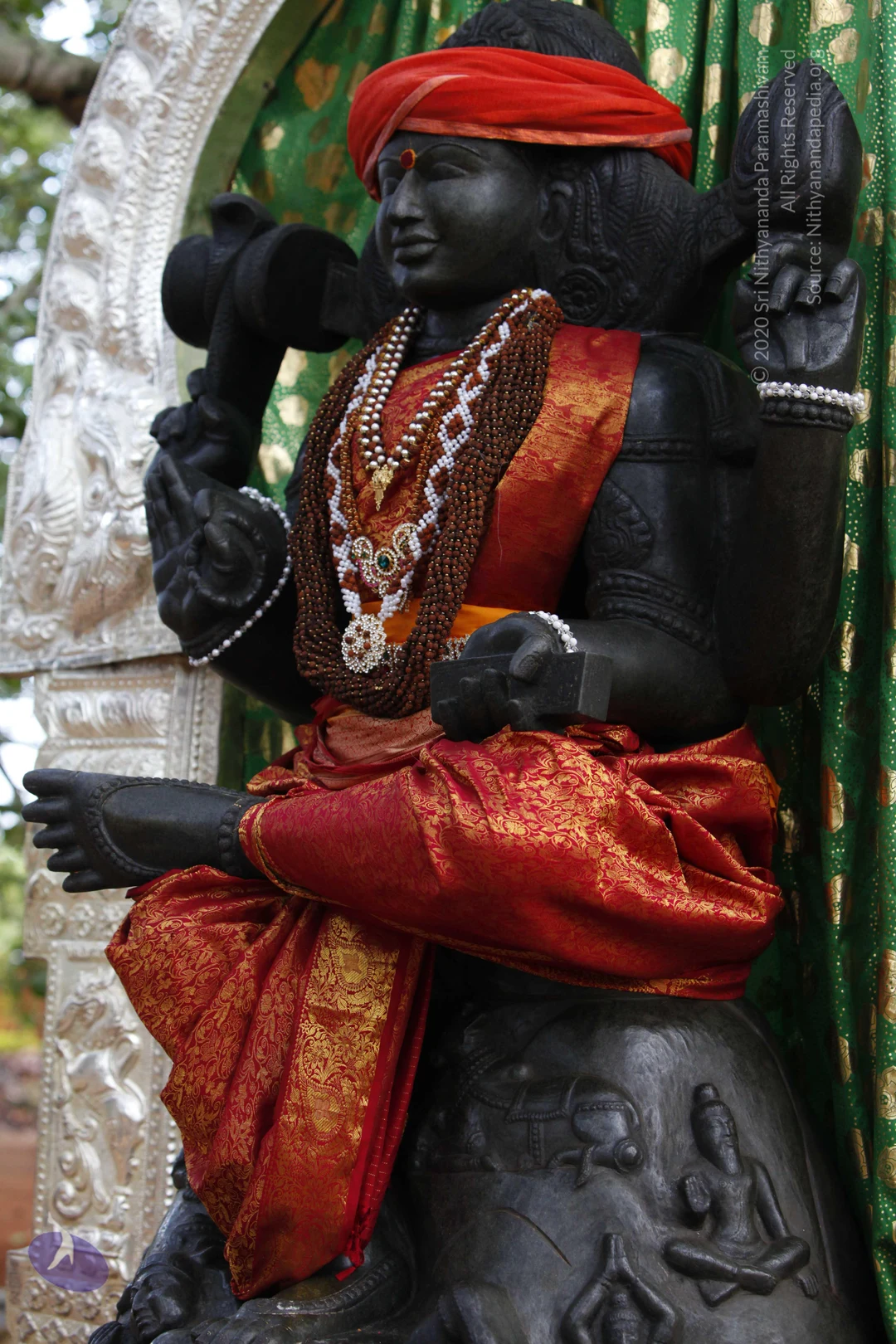
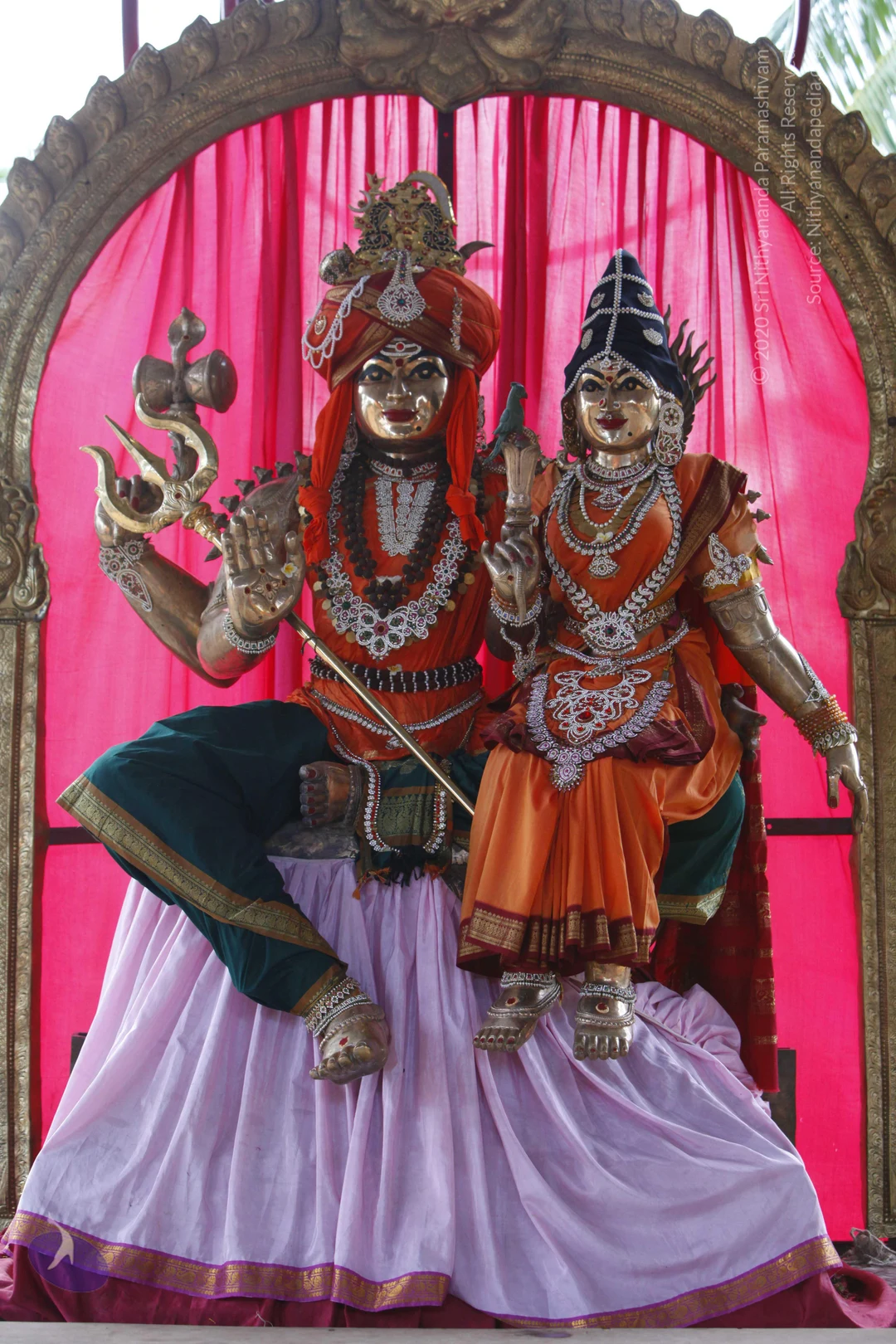
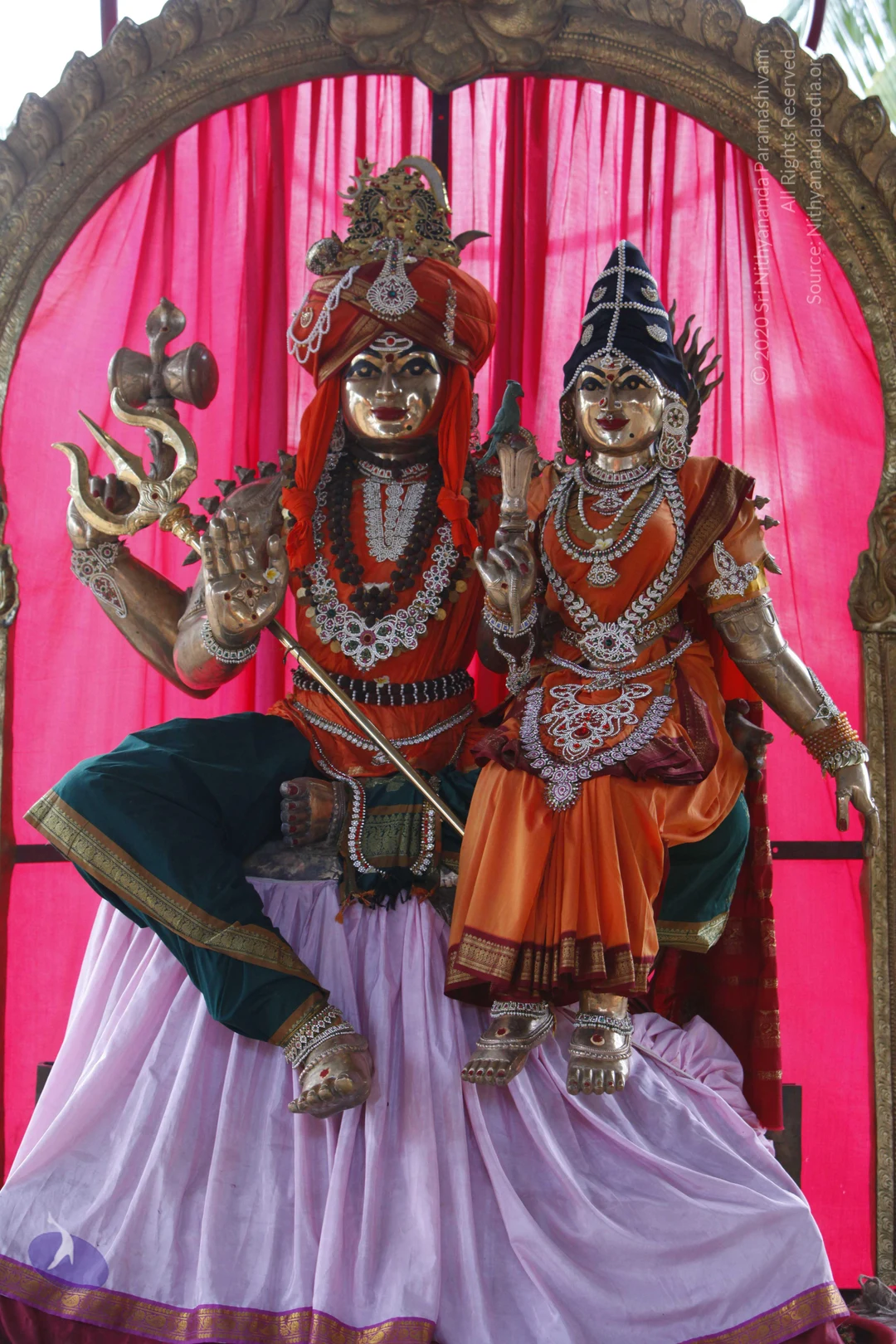
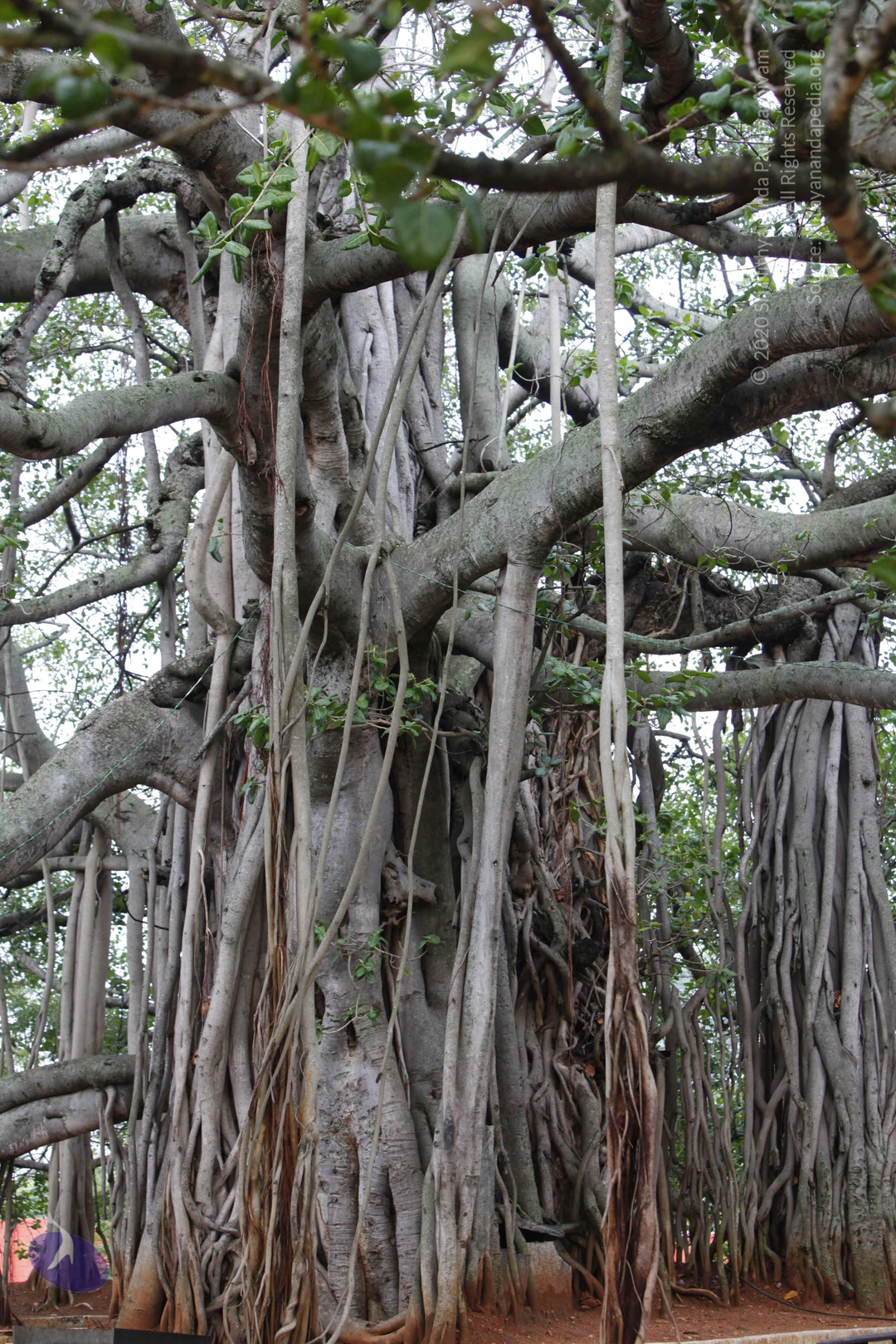
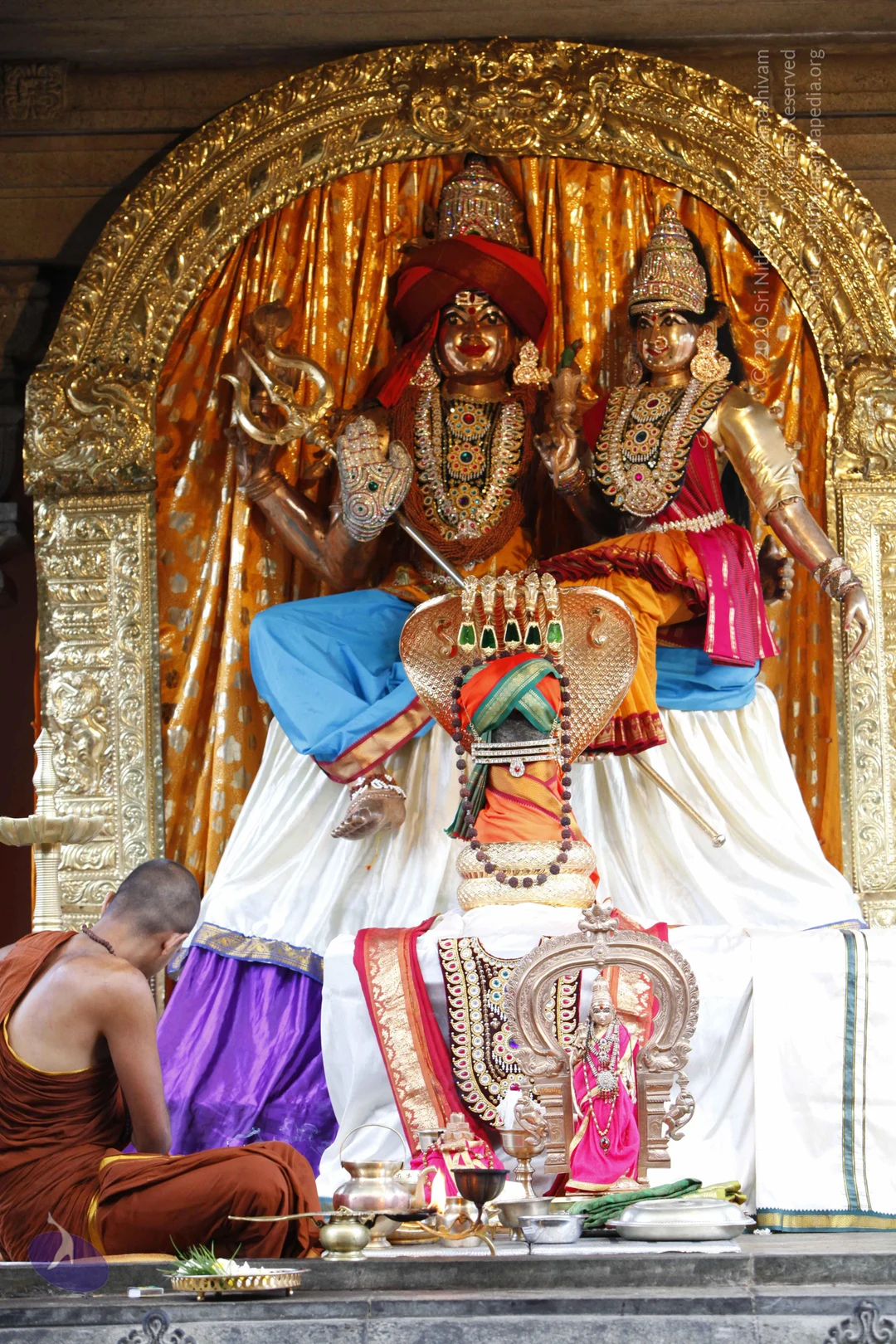
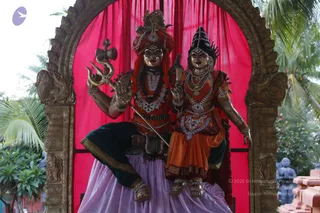
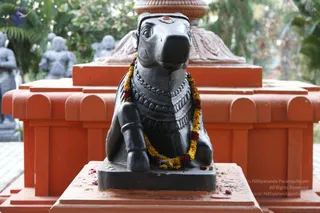
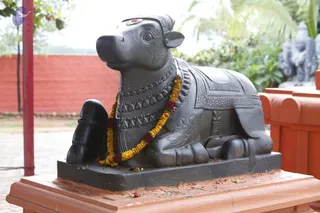
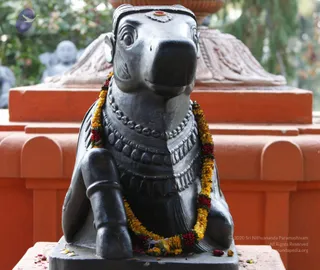
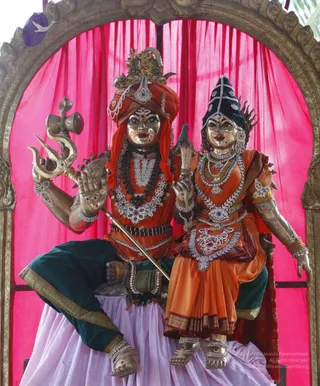
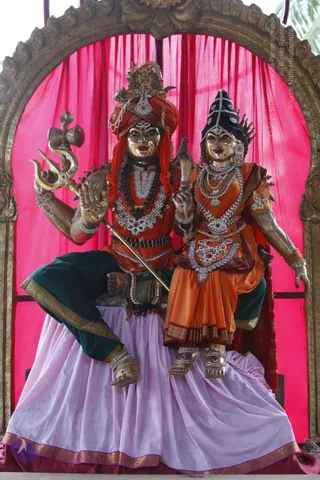
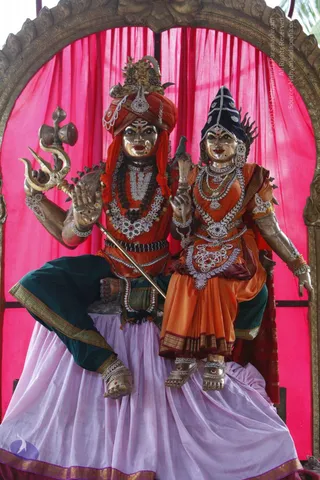
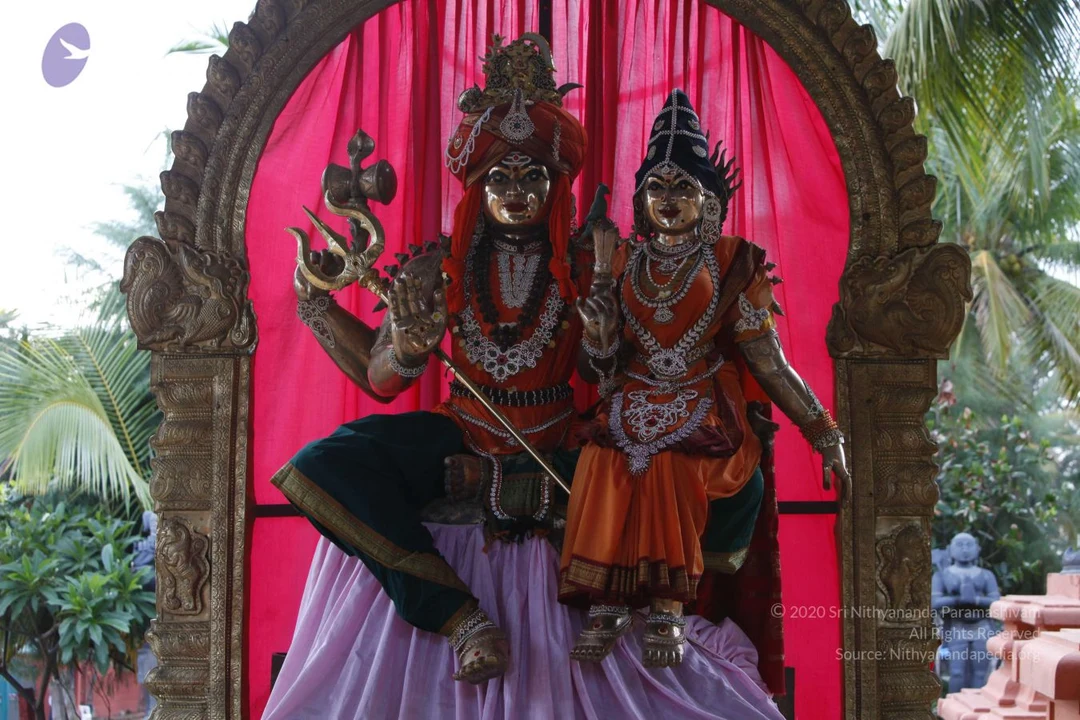
Outdoor photograph of two life-sized metal murti statues seated together on a lavender draped pedestal in front of a deep pink curtain, framed by an ornate gilded arch with carved floral and lion motifs. The male figure wears an orange-red turban and orange garment with dark green trousers, holding a trident and a rudraksha mala, with layered silver necklaces. The female figure wears an orange sari with silver jewellery, a dark crown-like headdress, and holds a small object in one hand. Palm trees and greenery surround the setting. These are statues, not living people, and no person is physically present in the scene.A black stone statue of a seated Nandi, the bull mount of Shiva, facing forward on a dark square pedestal. It wears a multi-strand necklace of beads, a red-and-gold forehead ornament, and a garland of yellow and red flowers draped around its neck. Petals are scattered on the pedestal. Behind it stand an orange-red tiered stone structure and grey statues of figures among green foliage. No people are visible.A dark grey stone statue of Nandi, the bull mount of Shiva, sits in a seated pose on a red-brown plinth outdoors. It wears a flower garland of yellow and red blossoms around its neck, a carved chain-and-bead collar and a patterned saddle cloth, with a small red-and-white tilak mark on its forehead. Red brick walls, green foliage and a grey figurative sculpture appear in the background. No people are visible.A black stone murti of a multi-armed deity seated against a green curtain with gold floral motifs. The figure wears a red cloth band across the forehead, a red-gold silk garment, layered rudraksha and white bead malas, a jewelled gold pendant, and bracelets on the wrists. Its upper hands hold a conch-like object and a flame-shaped emblem while the lower hands are raised in mudras. A small red mark sits on the forehead. Silver ornamental panels frame the shrine. No people are visible.A black stone statue of a multi-armed deity murti stands before a green curtain decorated with gold floral motifs and a white ornate arch. The figure wears a red-orange turban with a red tilak on the forehead, layered strands of white pearls, beaded brown rudraksha-style malas, and a gold pendant with green stones. An orange-red garment is wrapped at the waist. Several hands are raised, one holding a small drum-like object and others in mudras, with white beaded bracelets on the wrists. The statue is a depiction only, with no physical people present.A photograph of a large spreading tree with dense branches and green oval leaves, with thick grey limbs and hanging aerial roots. Behind the foliage a pale red wall and a green metal pole are faintly visible. No people are present in the scene.

Swasthi Mantra

7 photosSource gallery
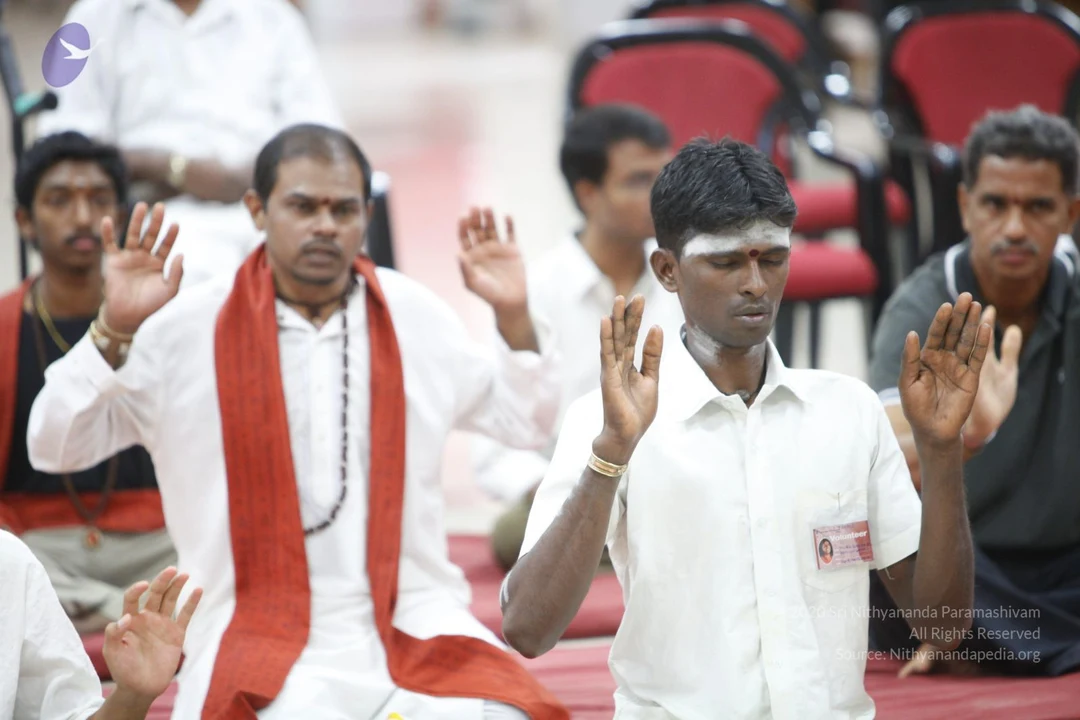
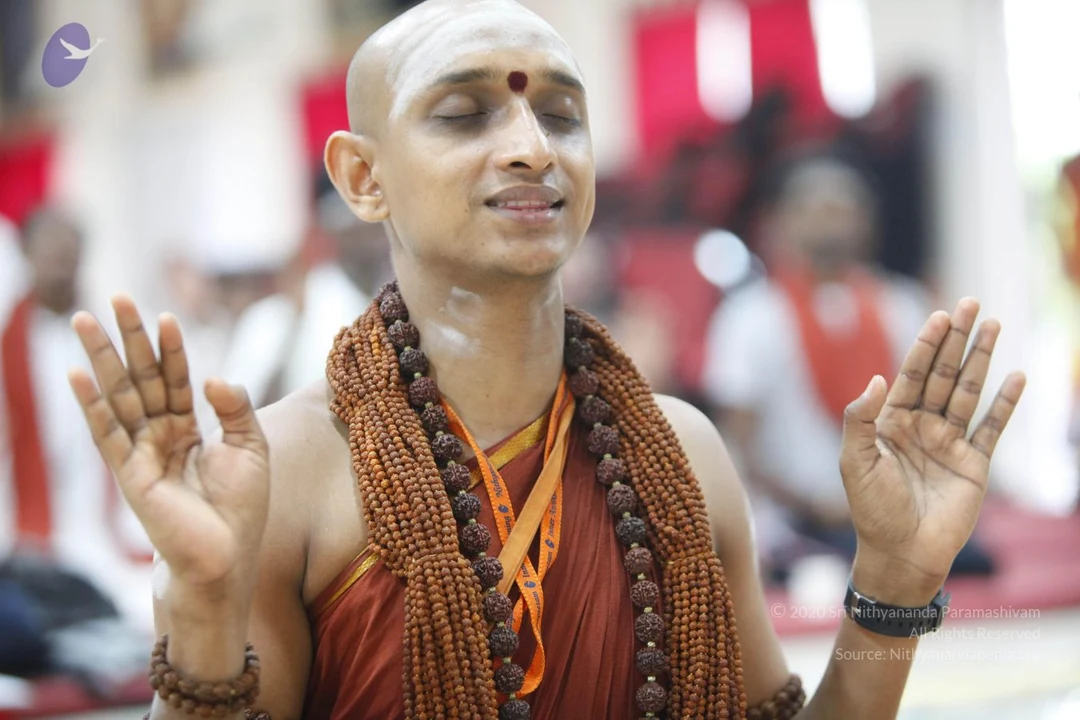
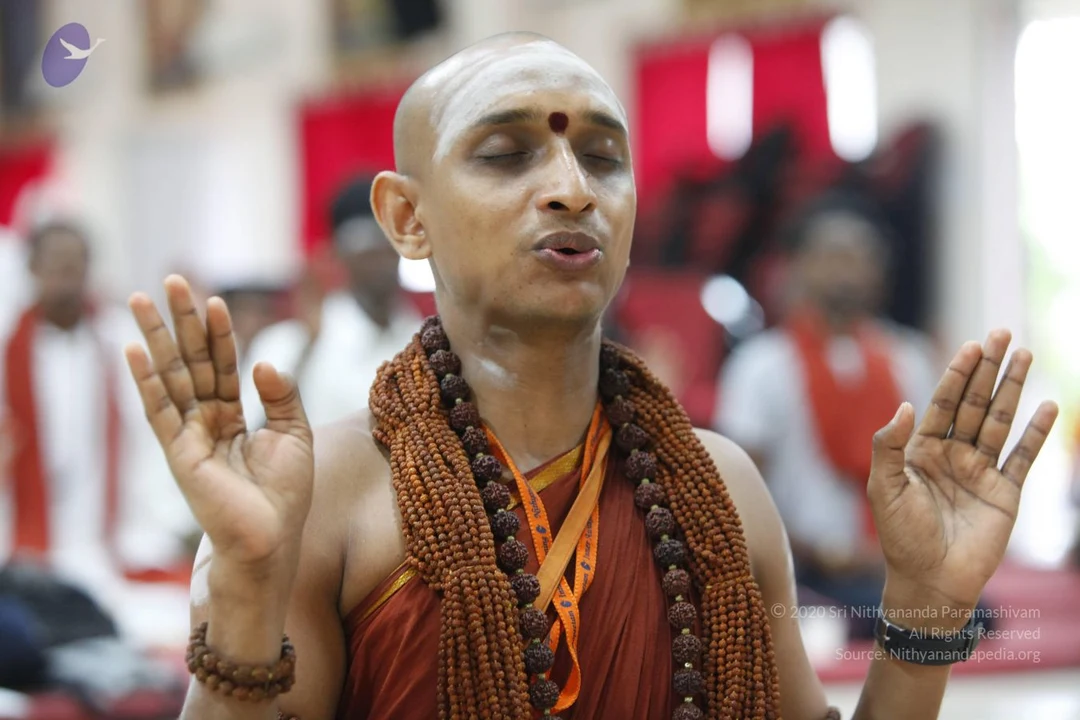
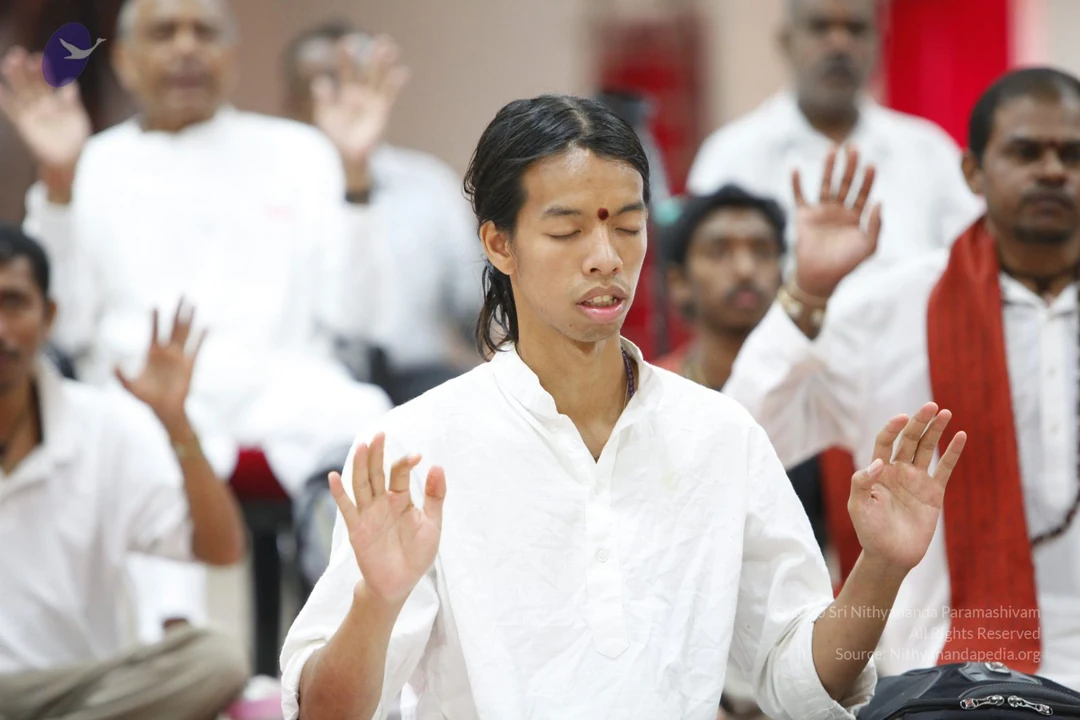
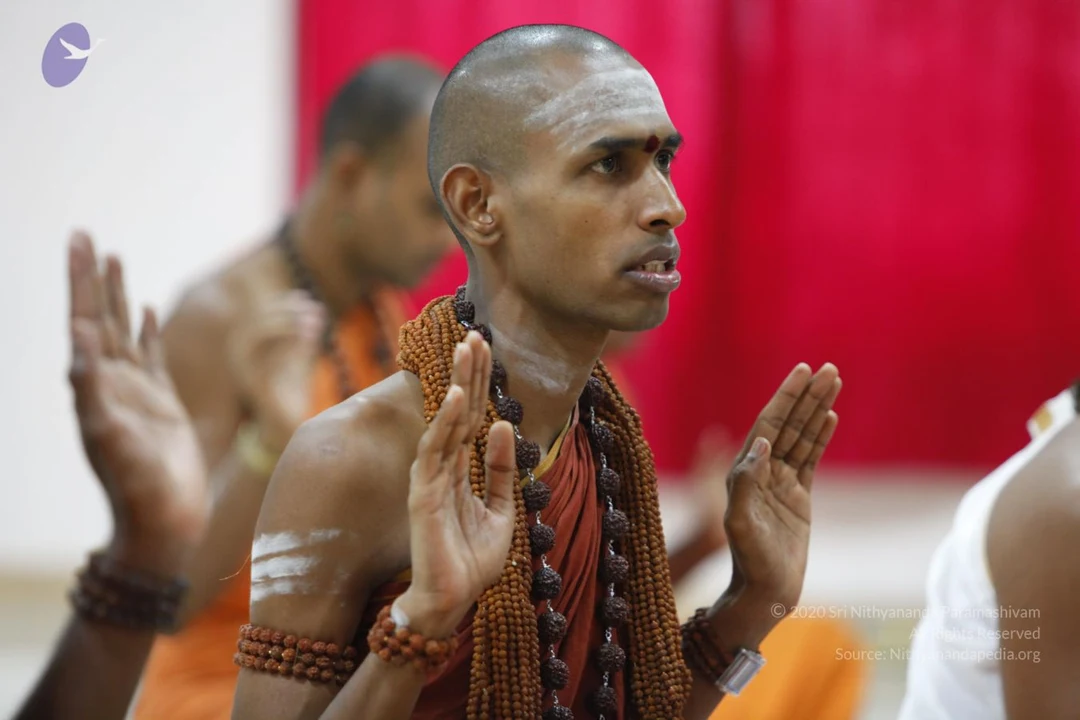
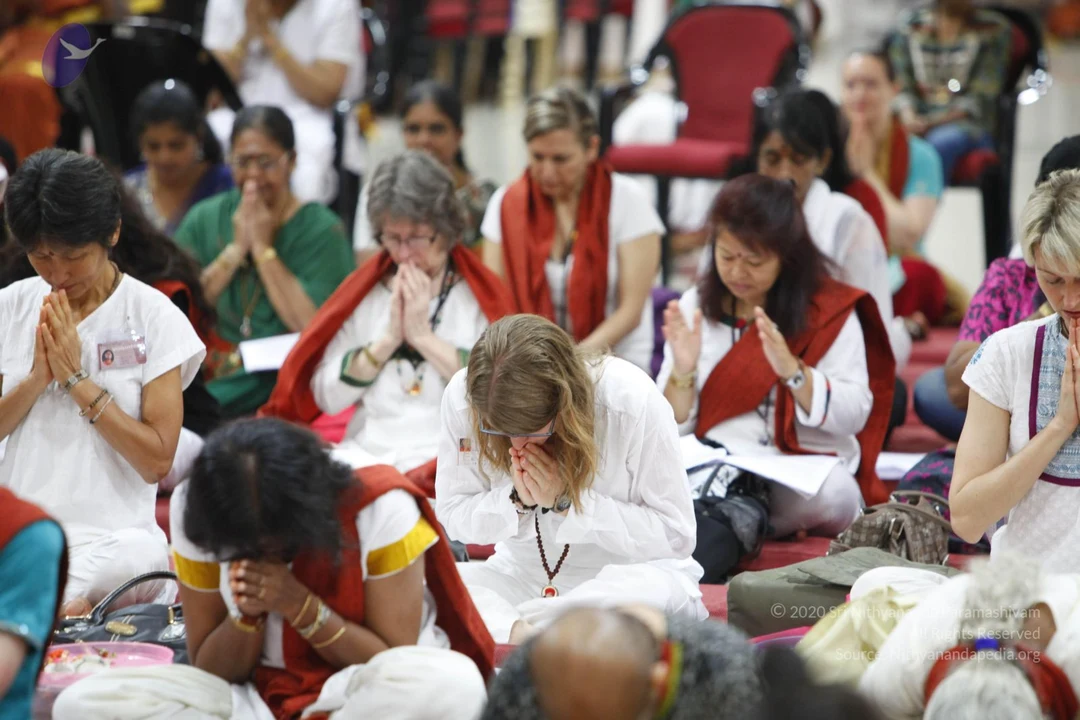
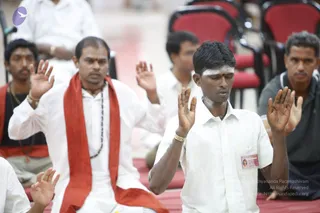
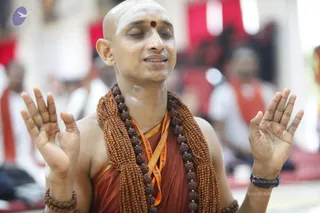
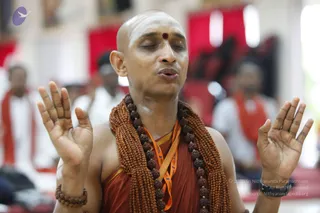
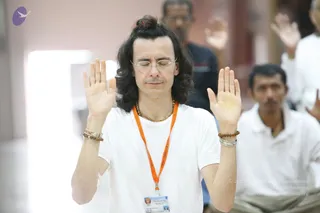
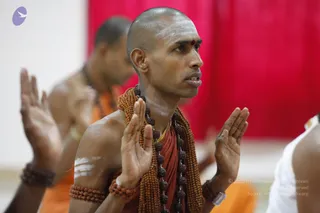
A photograph of seated devotees at a satsang hall with red chairs behind them. In the foreground, a man in white kurta with a red-and-orange shawl and rudraksha mala raises his palms in devotion, eyes lowered. Beside him, a younger man in a white shirt with white forehead markings, a red bindi and a gold bracelet also raises his palms with eyes closed; he wears a visitor or volunteer identity badge on his chest. Other seated devotees in white and grey clothing are visible behind them, and the floor is covered with red mats.A photograph of a shaven-headed man in a rust-red robe with eyes closed and palms raised outward, seated in a satsang hall. He wears long strands of rudraksha beads over his shoulders, orange-and-gold ribbon cords, a red tilak on his forehead, and beaded wrist bands and a black wristwatch. Behind him, blurred figures in white and orange sit on a red-carpeted floor under a red backdrop.A shaved-headed man in a saffron-orange garment sits with eyes closed and palms raised outward, mouth open as if chanting. He wears a long multi-strand rudraksha mala with large brown beads and an orange sash over one shoulder, a red bindi on his forehead, and a rudraksha bracelet on his wrist. Someone in the background wears an orange-red shawl. The man appears to be a person given the saffron clothing, long rudraksha mala and orange sash, but this is an appearance-based label only.A man with long dark hair tied in a topknot, wearing round wire-rimmed glasses and a white t-shirt, sits with eyes closed and both palms raised in front of him in a meditative gesture. He wears an orange lanyard with an ID badge, a beaded brown necklace and several bracelets. Behind him, other seated people in white and dark clothing also raise their hands in a group meditation in a pale pink hall.A seated satsang gathering with a young man in the foreground wearing a white collarless kurta, eyes closed, a small red bindi on his forehead, long dark hair tied back, and both palms raised outward in a devotional gesture. Behind him, several men in white shirts and white dhotis sit with their hands raised, and a man at right wears a red shawl over a white shirt with a beaded mala. The setting is an indoor hall with red and cream walls. Audience members appear blurred in the background.A shaved-headed man in saffron-red robes wears long rudraksha mala strands across his chest and multiple rudraksha bracelets on his wrists, with a red bindi and white ash markings on his forehead and arm. He sits with palms pressed together in anjali mudra, gazing forward, while blurred figures in orange robes and a seated person in white are visible at the edges. A red curtain forms the backdrop. Appearance is consistent with a sannyasi in an ashram satsang setting, but the page does not establish that this man is a person, so no identification is made.

Nithya Satsang

12 photosSource gallery
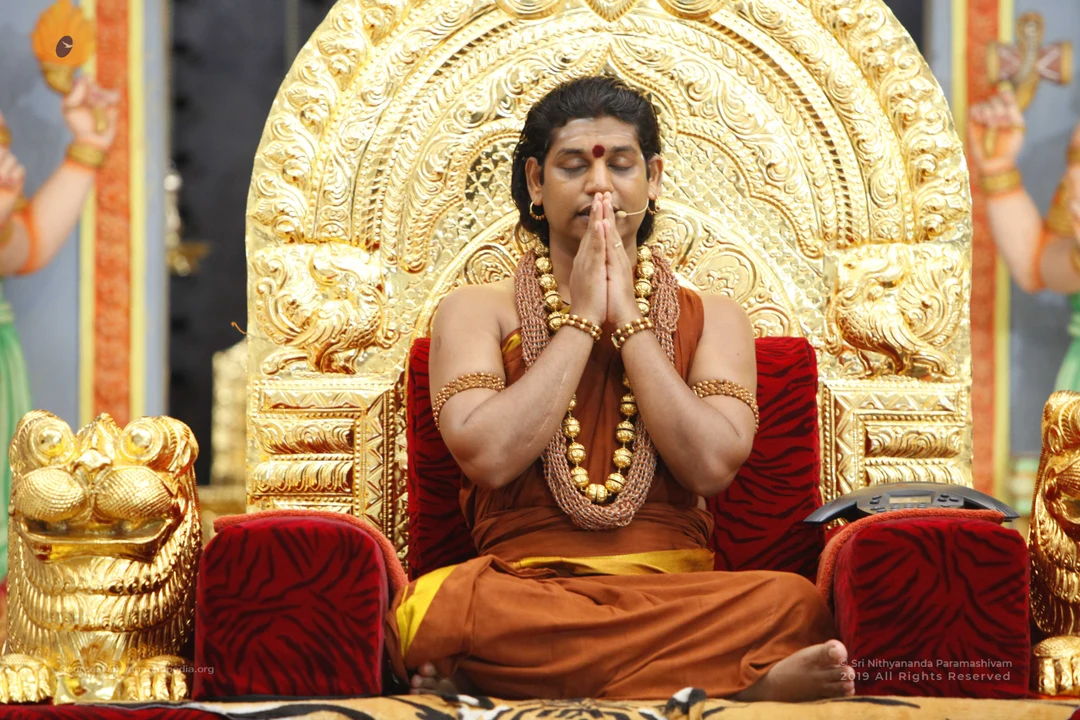
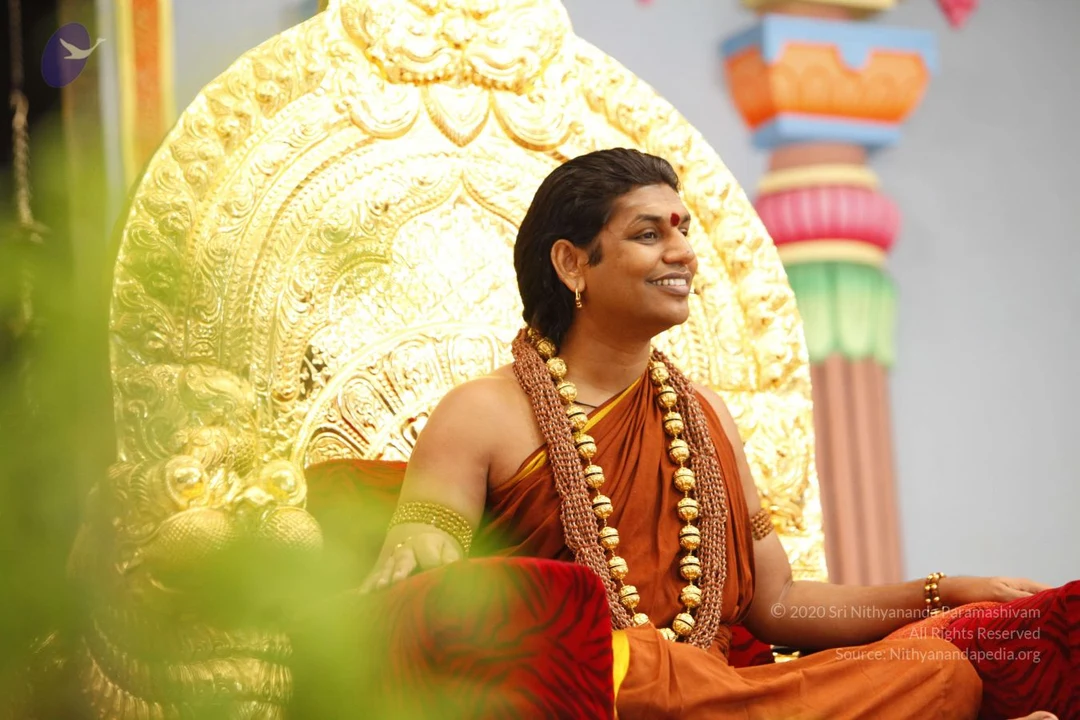
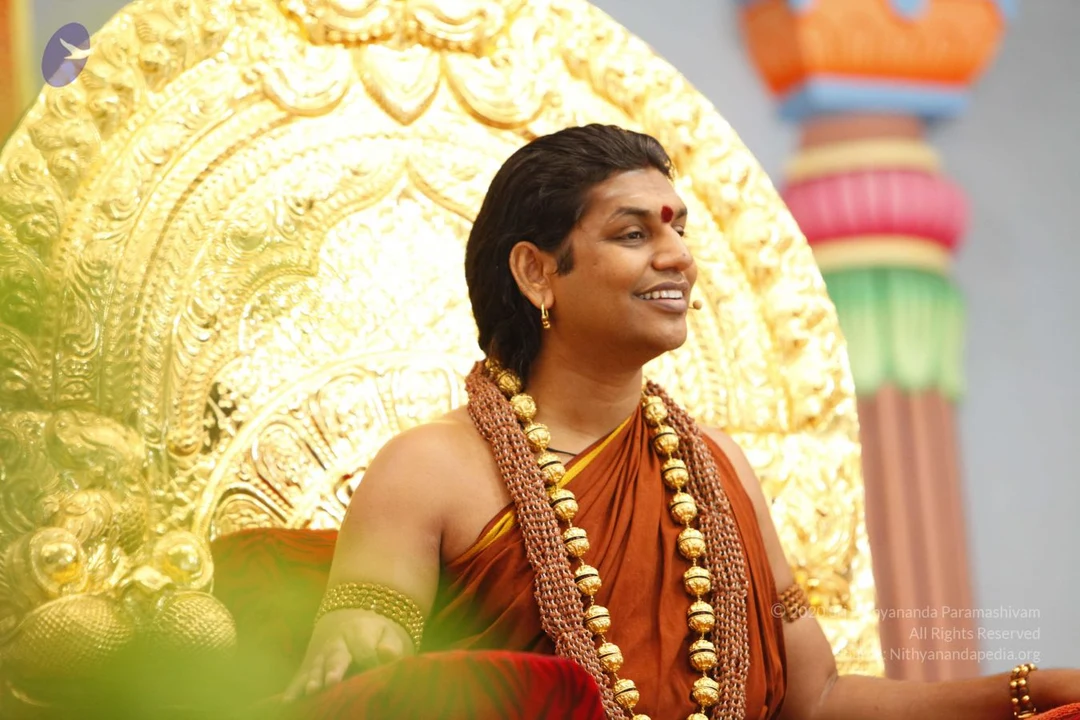
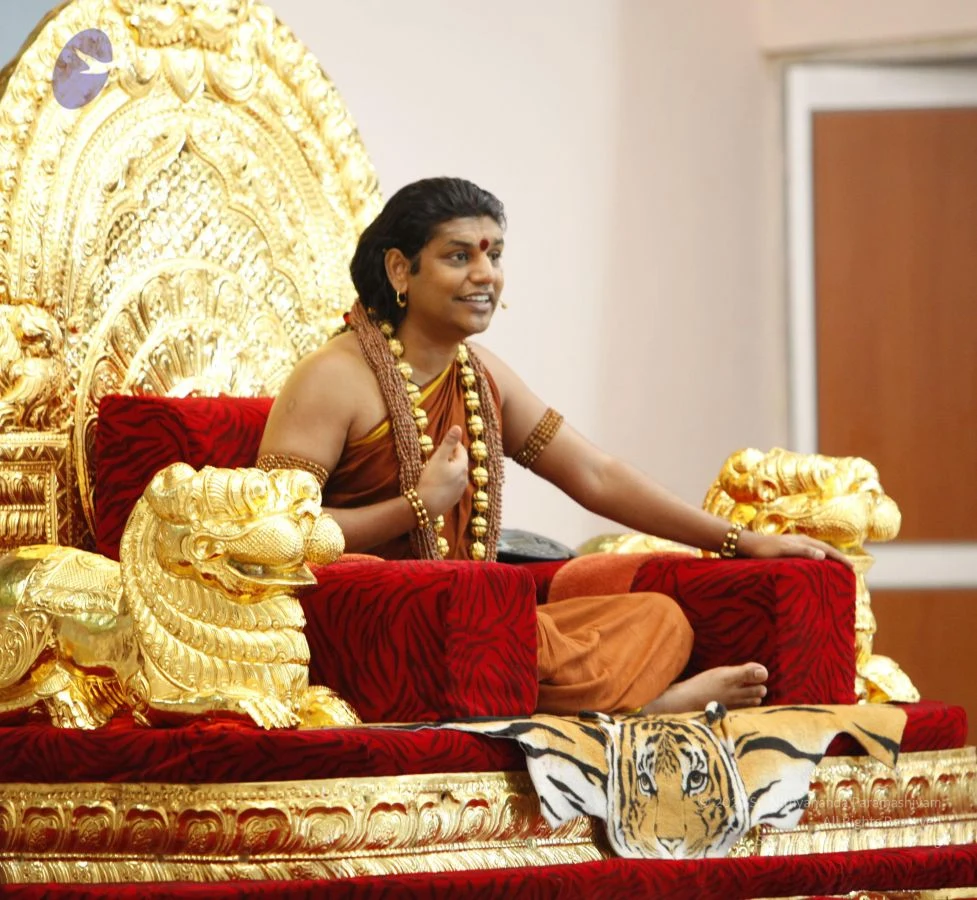
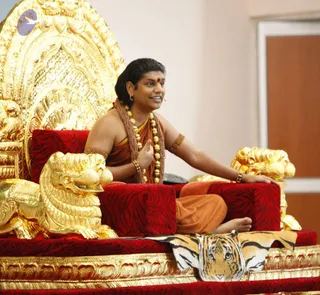
A man seated cross-legged on a red-and-black tiger-striped cushion on an ornate gold throne with carved lion heads, palms pressed together in namaste with eyes closed. He wears an orange-saffron dhoti and a saffron shawl, a red bindi on his forehead, a gold-bead and rudraksha-style mala around his neck, and gold armlets and bangles. A small headset microphone is clipped near his ear. Golden lion-faced armrests flank the throne, and painted deity figures with raised hands appear at the left and right edges.A seated man in saffron-orange robes sits on an ornate gilded throne with red-and-black striped cushions and golden lion-head armrests, his palms pressed together in namaste and eyes closed. He wears a rudraksha mala and a large ceremonial gold-bead necklace, gold armlets and bangles, and a red bindi on his forehead. A tiger-striped cloth covers the dais in front of him. Flanking the throne are two large painted and gilded deity murti figures with multiple arms, holding ceremonial objects. A brass lamp and hanging bells appear in the background. a person: the seated man is shown in a throne-and-satsang setting with the distinctive saffron robes, rudraksha mala and ceremonial gold necklace cues.A seated man with short dark hair, a red bindi and closed eyes sits with palms pressed together in namaste on an ornate gold throne with carved lions and a red-and-black striped cushion. He wears an orange-saffron robe, a rudraksha-style mala and a heavy gold beaded necklace, with gold bangles and armlets. Behind him, a painted deity figure holding a lotus and a flame stands beside gold and red decorative panels. The scene suggests a satsang or formal sitting, with no other people visible.Photograph of a seated congregation at a satsang hall with red mats and metal stanchions and chains dividing the floor. In the foreground a man with shoulder-length wavy dark hair and an orange lanyard over a white shirt writes on a clipboard with a pen, while a young man with long hair tied in a bun, in a white shirt, sits beside him with his mouth open as if speaking. Behind them many devotees in white clothes and red or orange shawls sit on mats, some holding red bags, and a figure in orange and red stands near a stage at the top right. The scene is blurred in the background with a bright white and red interior.A photograph of a single person seated on an ornate gilded throne with a red velvet cushion and golden lion-head armrests, in front of a plain pale wall and a glass door. The seated person wears an orange-saffron wrap over the shoulder, a tan-orange garment, multiple beaded rudraksha-style necklaces, gold bangles, and a red bindi, with long dark hair swept back. The person's right hand is raised in a gesture while speaking, and a striped tiger-skin cloth lies on the platform below. The lighting is bright and the scene appears to be a satsang or discourse setting.A man seated on an ornate golden throne with a large gilded arched backrest, smiling and looking to the side. He wears saffron-orange robes draped over one shoulder with a red-and-gold lower cloth, a double strand of rudraksha beads with large gold bead ornaments, a gold armlet and bangles, a gold earring, and a red bindi on his forehead. He has long dark hair swept back. Blurred green foliage in the foreground and a pink, green and orange decorated pillar behind him. Swamiji (probable): the saffron robes, long swept-back hair, rudraksha mala with gold beads and ornate gold jewellery match the appearance claimed for Swamiji, seated in a throne-like setting during an event.

Samyama Meditation

1 photoSource gallery
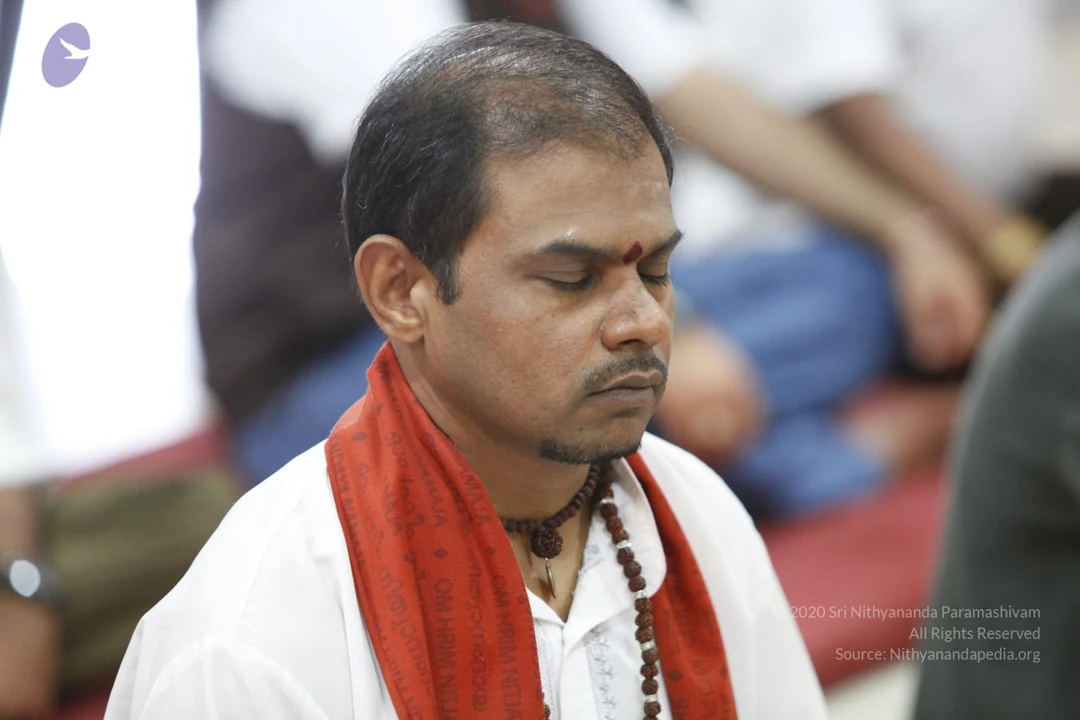
A man with short dark hair and a small red tilak on his forehead sits with eyes closed in meditation, wearing a white collared shirt, a red shawl printed with mantra text in white, and rudraksha malas around his neck. Blurred seated devotees in white and blue clothing fill the background. a person cues are not clearly distinctive here, so the identity is uncertain and he is described by role as a meditating devotee.

Sarva Darshan- Solo

6 photosSource gallery
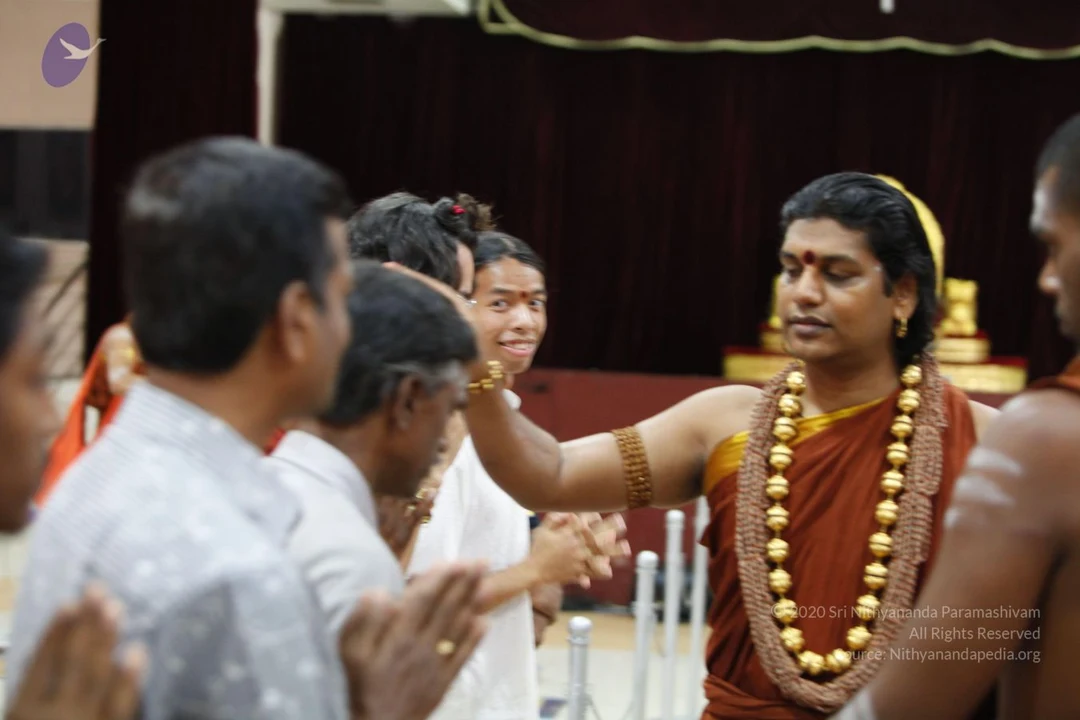
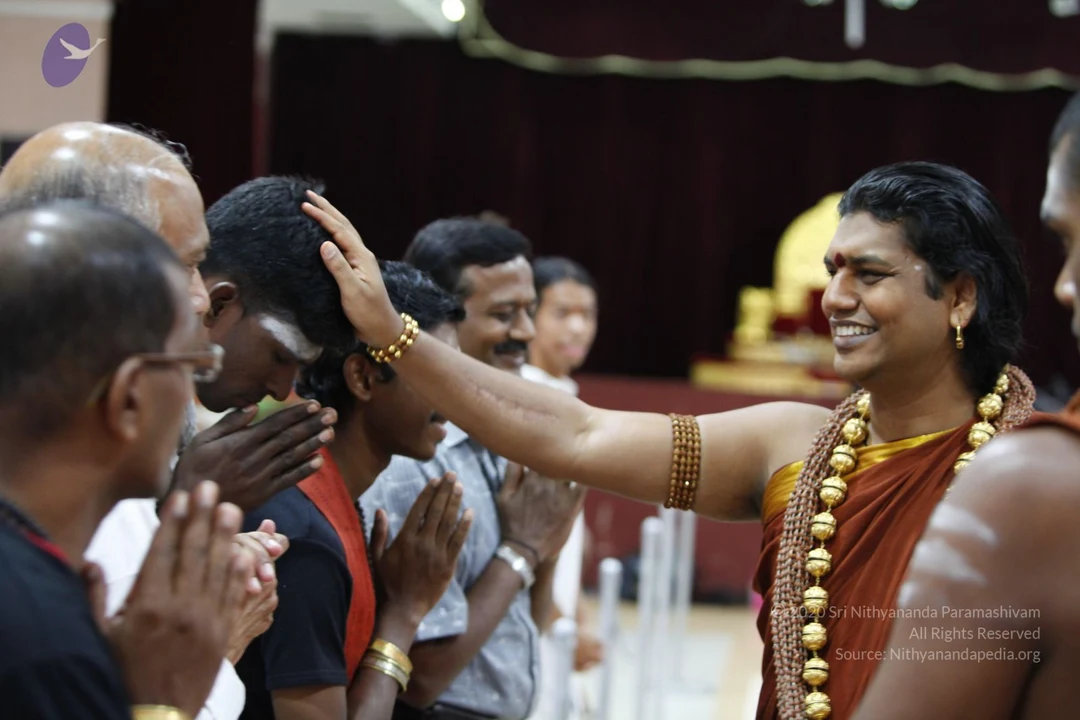
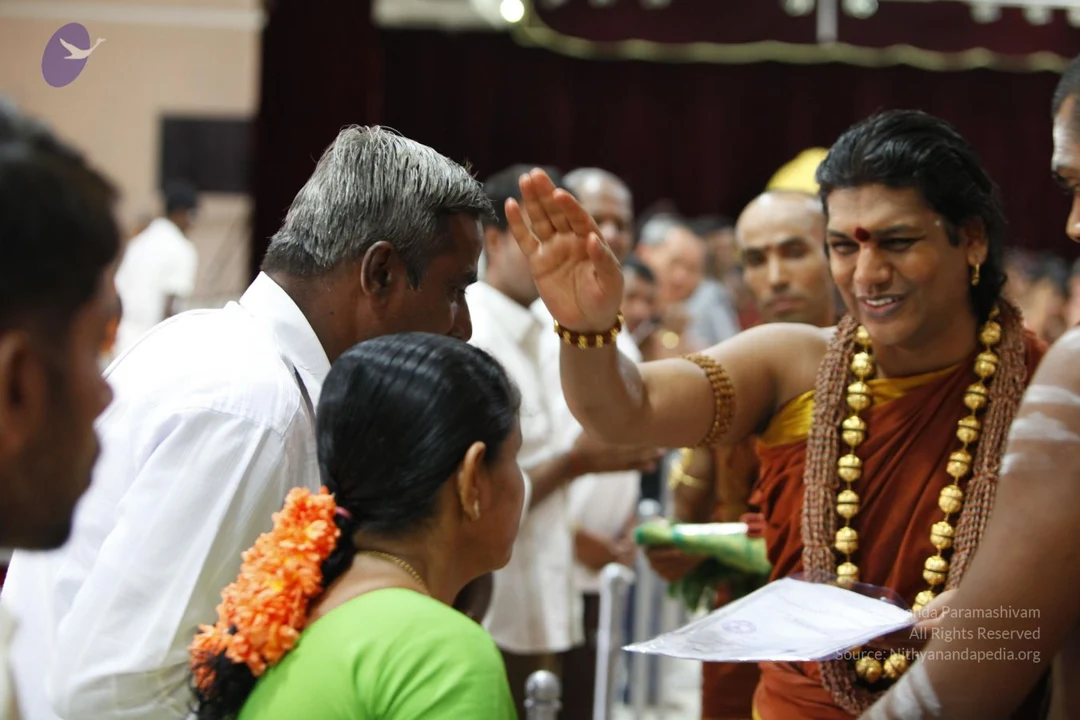
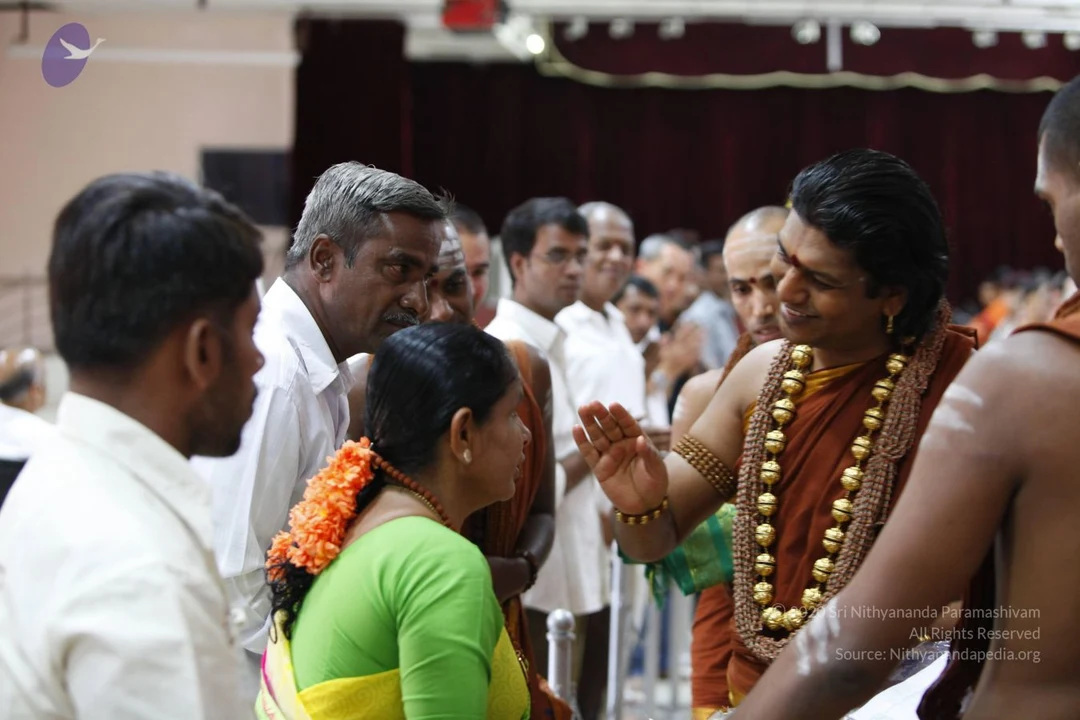
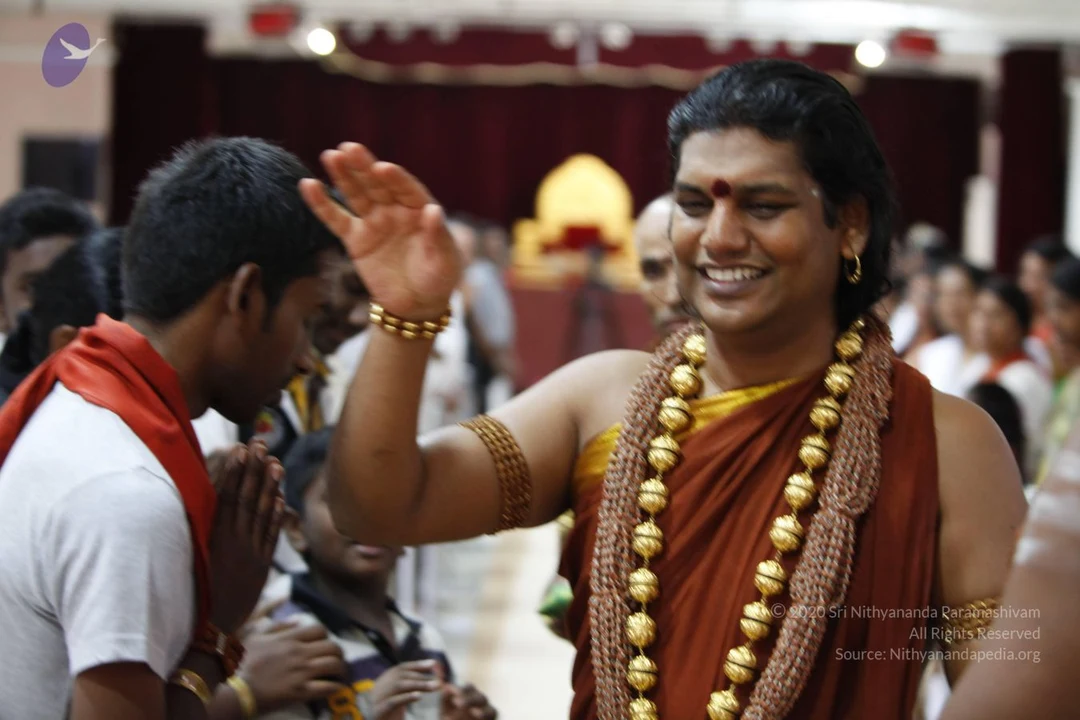
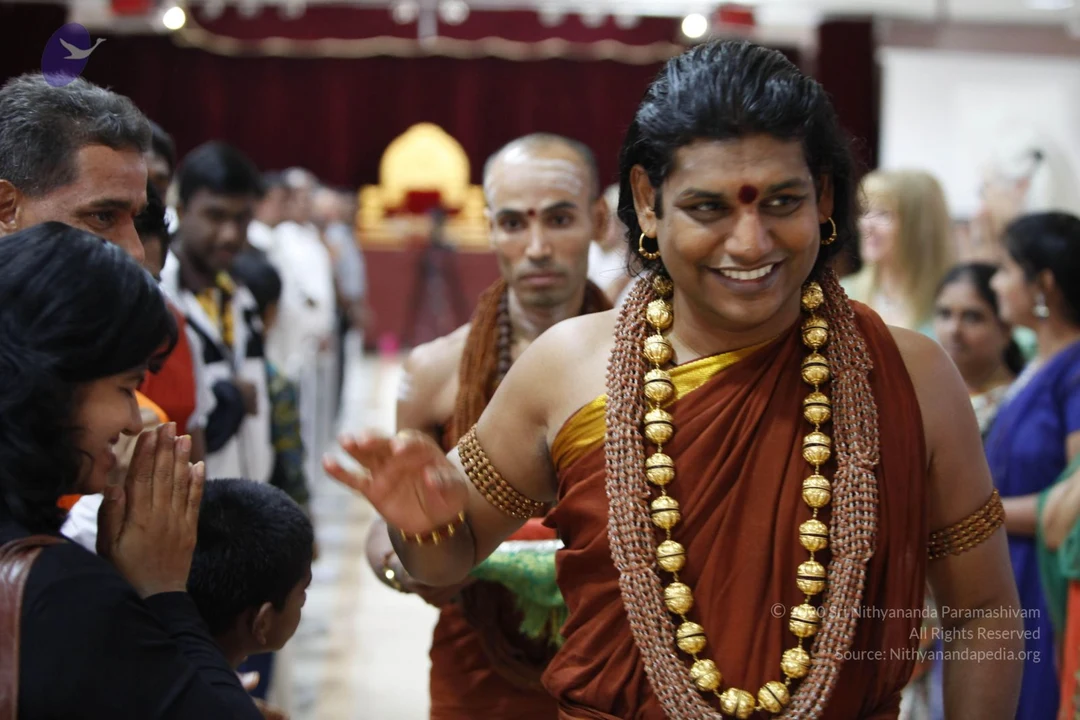
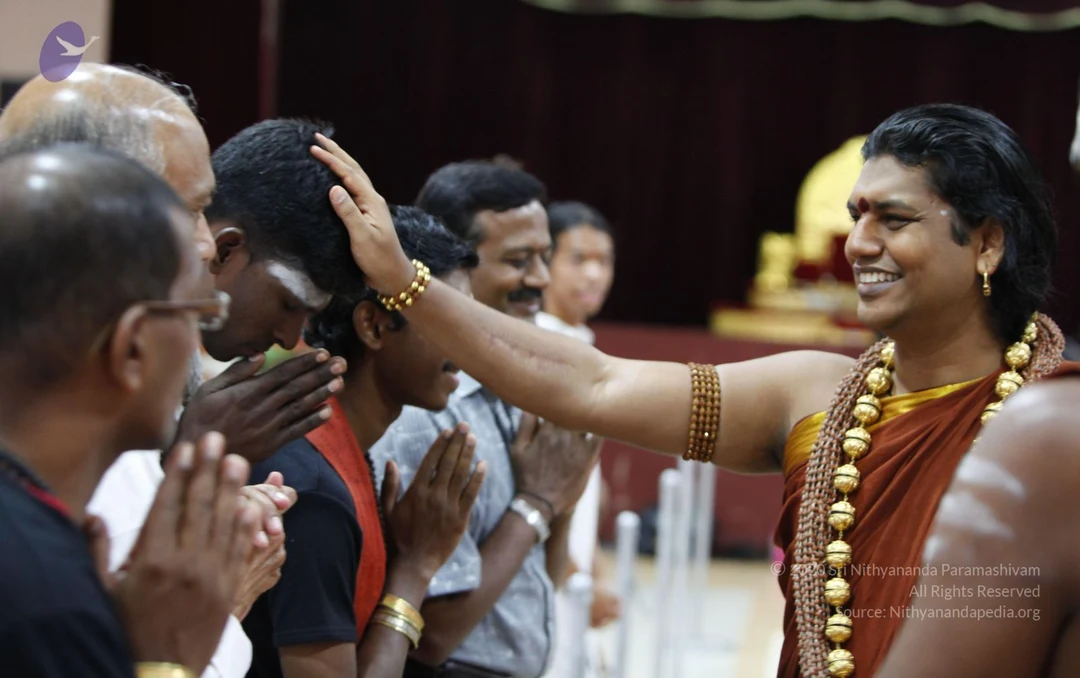
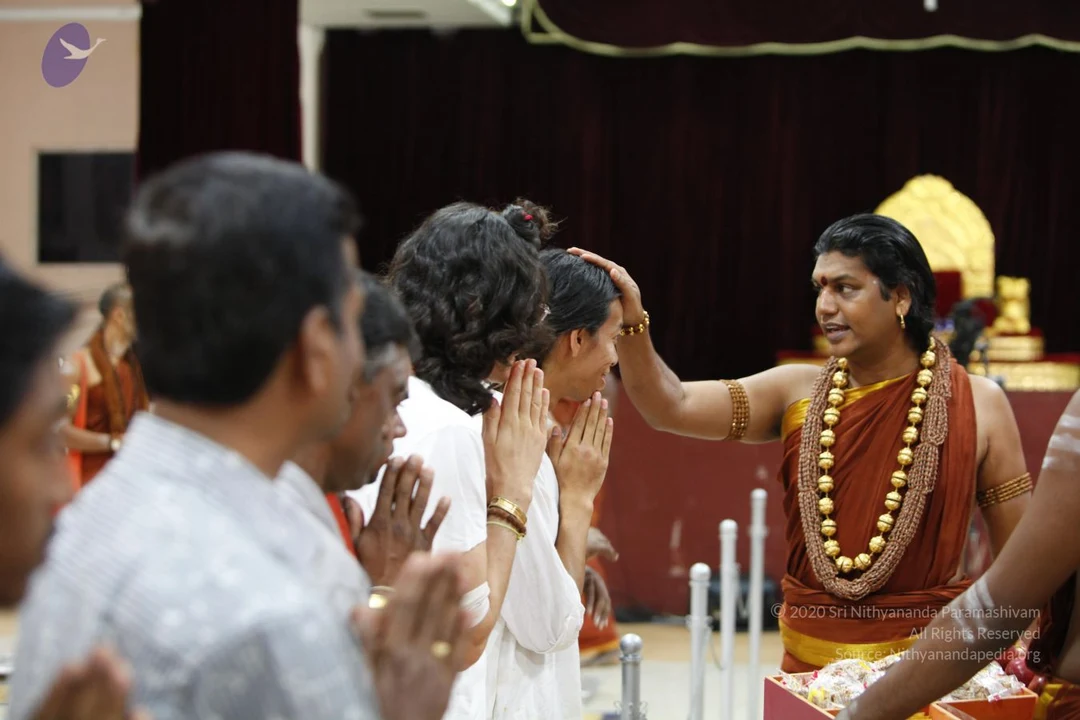
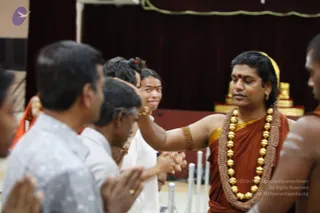
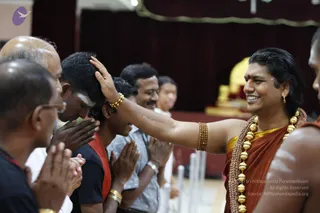
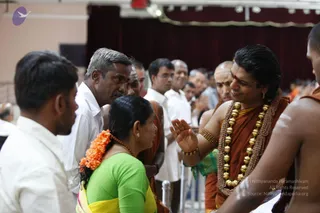
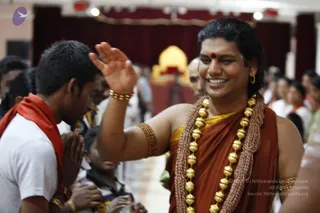
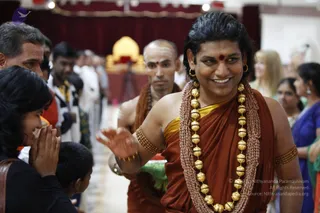
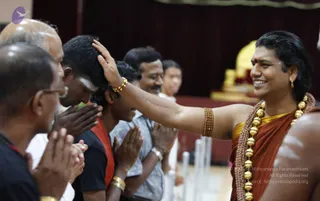
A photograph of a satsang hall with a dark maroon curtain and gold trim behind. A man with long swept-back dark hair, a red bindi, gold earrings, an orange-saffron shawl and a thick gold bead necklace with rudraksha-style brown beads stands at right, extending his arm toward a smiling young person in white. Several men and a woman in light shirts and white clothes stand in the foreground with palms pressed together in greeting. A gold-trimmed ceremonial setting with a golden seat or throne sits in the background. The man is a probable Swamiji candidate based on the long hair, saffron shawl and ornate gold necklace cues.A photograph of a satsang setting where a man in a rust-orange wrap and a thick gold bead necklace with a rudraksha-style strand stands on the right, smiling and placing his right hand on the head of a kneeling young man in a black shirt with a red sash. Several devotees with their palms pressed together stand in a line on the left, including an older bald man in white and a man in a grey shirt with a wristwatch. A gold-and-red throne is visible in the blurred background behind a dark red curtain. The bead-necklaced man, with long swept-back hair, a crown-like adornment, gold bangles and an orange garment, has distinctive ceremonial cues, so he is presented as a probable Swamiji. The people on the left and the young man are devotees receiving blessing. Visible white ash marks appear on several foreheads and arms.A photograph of a devotional gathering in a hall with a dark red curtain backdrop. A man in saffron-orange robes with a red bindi and a rudraksha mala with large gold beads raises his right hand in blessing toward a seated man in a white shirt and a woman in a green blouse with an orange flower garland in her braid. A bald man in white stands behind them and a crowd of devotees in white is visible. The orange-robed man is wearing a gold bracelet and a gold-threaded wrap and is smiling while holding a document.Photograph of a satsang event with a man in an orange-saffron robe and a rudraksha mala with ornate gold beaded necklaces, a gold bangle, and a tilak on his forehead, raising one hand in blessing toward a woman in a green blouse and yellow sari with an orange flower garland, who is seated and looking up at him. Behind them, devotees in white shirts and dhotis watch, and a shaved-headed man in an orange cloth stands nearby. A bare-shouldered priest with white ash markings is at the right edge. A dark red curtain hangs in the background. Probable Swamiji cues: long swept-back hair, saffron robe, rudraksha mala and ceremonial gold necklaces, shown in the blessing role.A smiling man in an orange-saffron robe with a yellow inner garment and a red bindi on his forehead raises his right hand in greeting while people nearby press palms together in namaste. He wears long swept-back dark hair, layered gold bead necklaces with a brown rudraksha-style mala, gold bangles and a small gold earring. Behind him a red curtain and a golden throne-like seat stand in a hall where a crowd of devotees, some in white, watch. A man on the left wears a white shirt and an orange shawl. The distinctive saffron robe, long hair and ornate gold beads are appearance cues consistent with Swamiji (probable), shown in person greeting devotees at a satsang hall.Photograph of a smiling man in a rust-orange saffron wrap with a yellow inner garment, wearing a heavy gold bead necklace of large round beads over a rudraksha-style mala, gold armlets and bangles, gold hoop earrings, long swept-back black hair and a red bindi. He raises a hand in greeting toward people at left, one woman with palms pressed together in namaste. Behind him a bald man in orange garments with a red tilak stands in a hall with a gold throne-like seat and red curtains; other attendees in white, blue and green saris and shirts line the aisle. Probable Swamiji by visible cues of swept-back hair, ornate gold beads and rudraksha mala worn over saffron clothing, shown in person as an appearance-based candidate.

Final Blessings - Solo

1 photoSource gallery
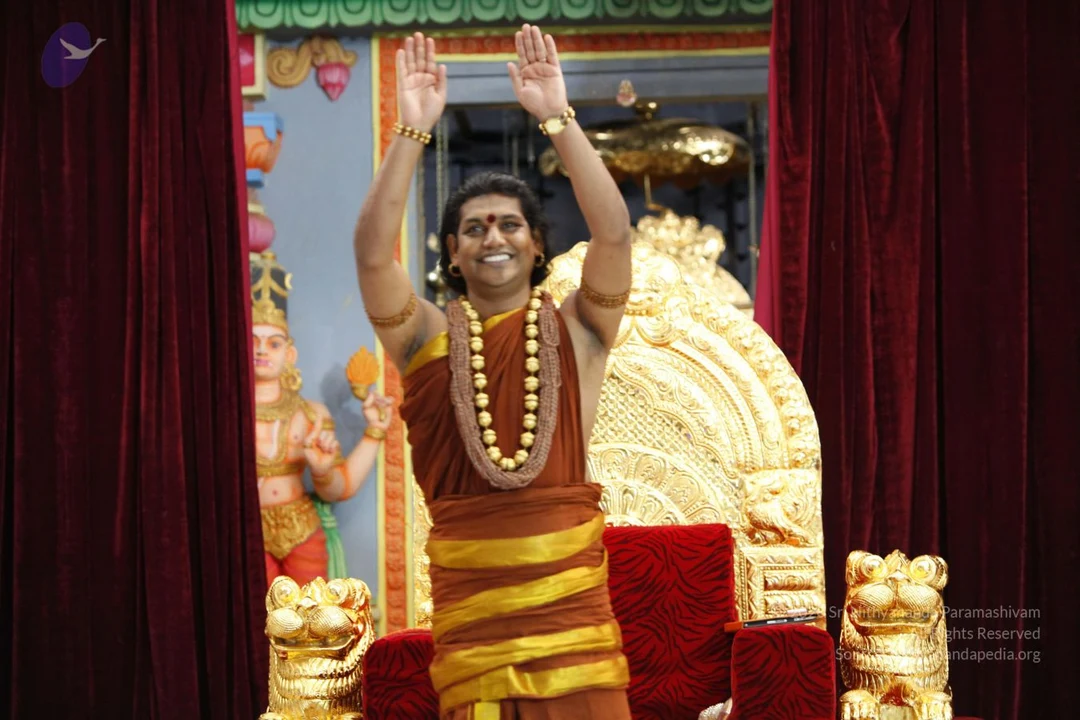
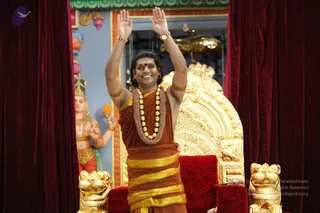
A photograph of a smiling man standing on a red velvet-upholstered dais in front of an ornate gold throne with lion-head armrests, raising both hands in greeting. He wears an orange-brown robe with a gold-yellow sash, a gold bead mala and a rudraksha-style necklace, gold bangles and a wristwatch, and a red bindi on his forehead. Behind him stands a painted deity murti with a gold crown and a kalasha-like object, flanked by deep red velvet curtains and a gilded canopy. a person is the sole physical person visible. Watermarked archive image.

Forweb- Solo

8 photosSource gallery
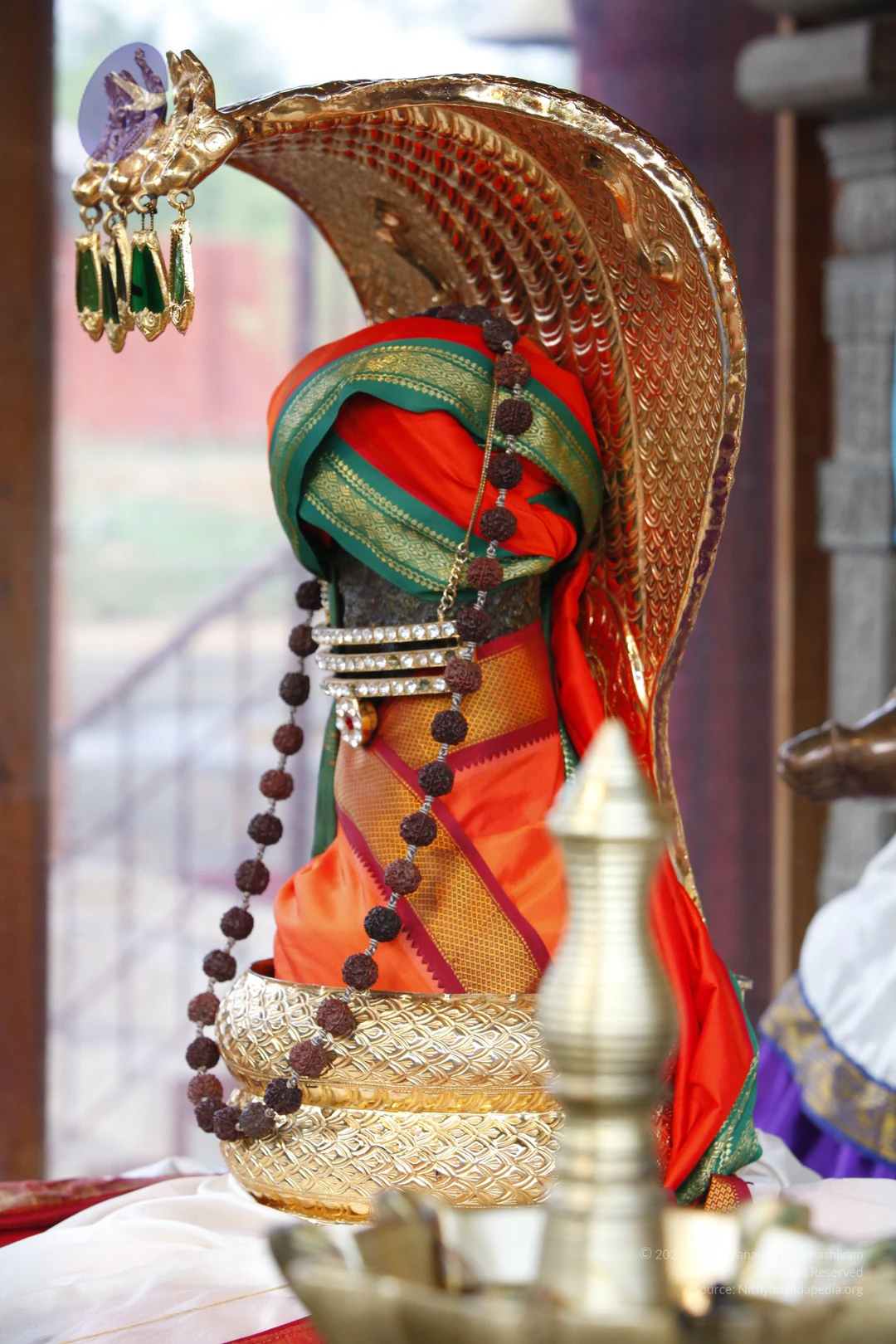
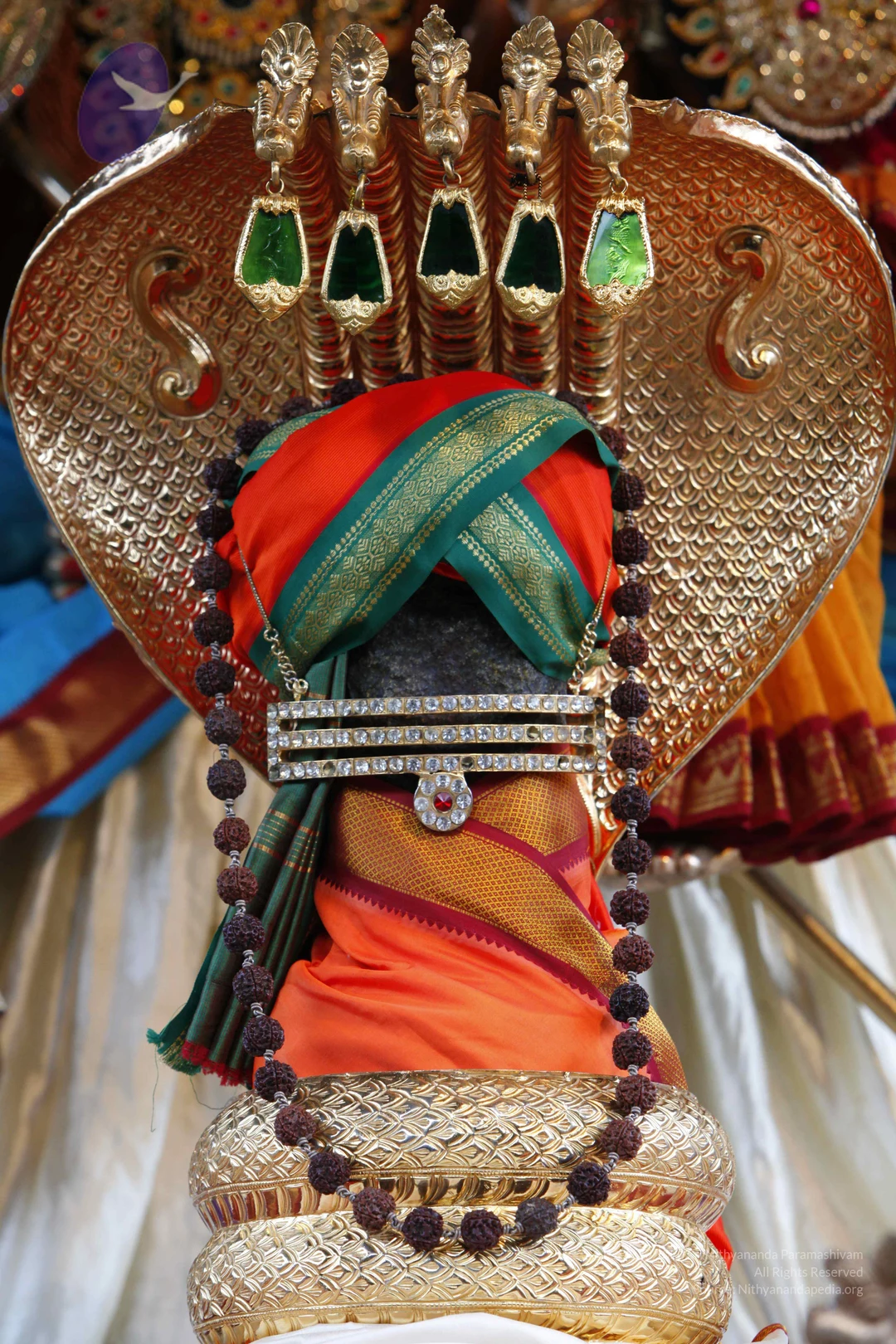
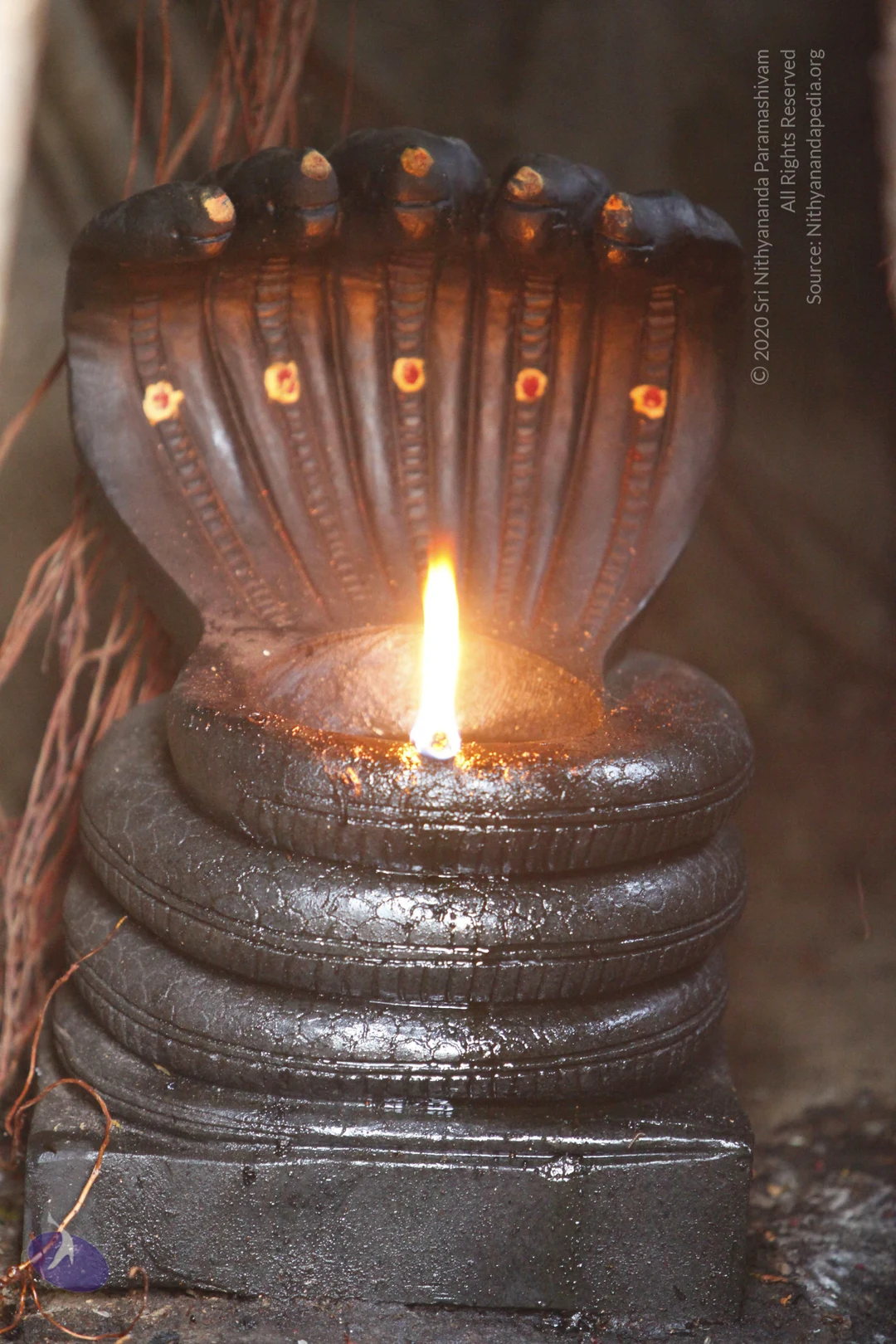
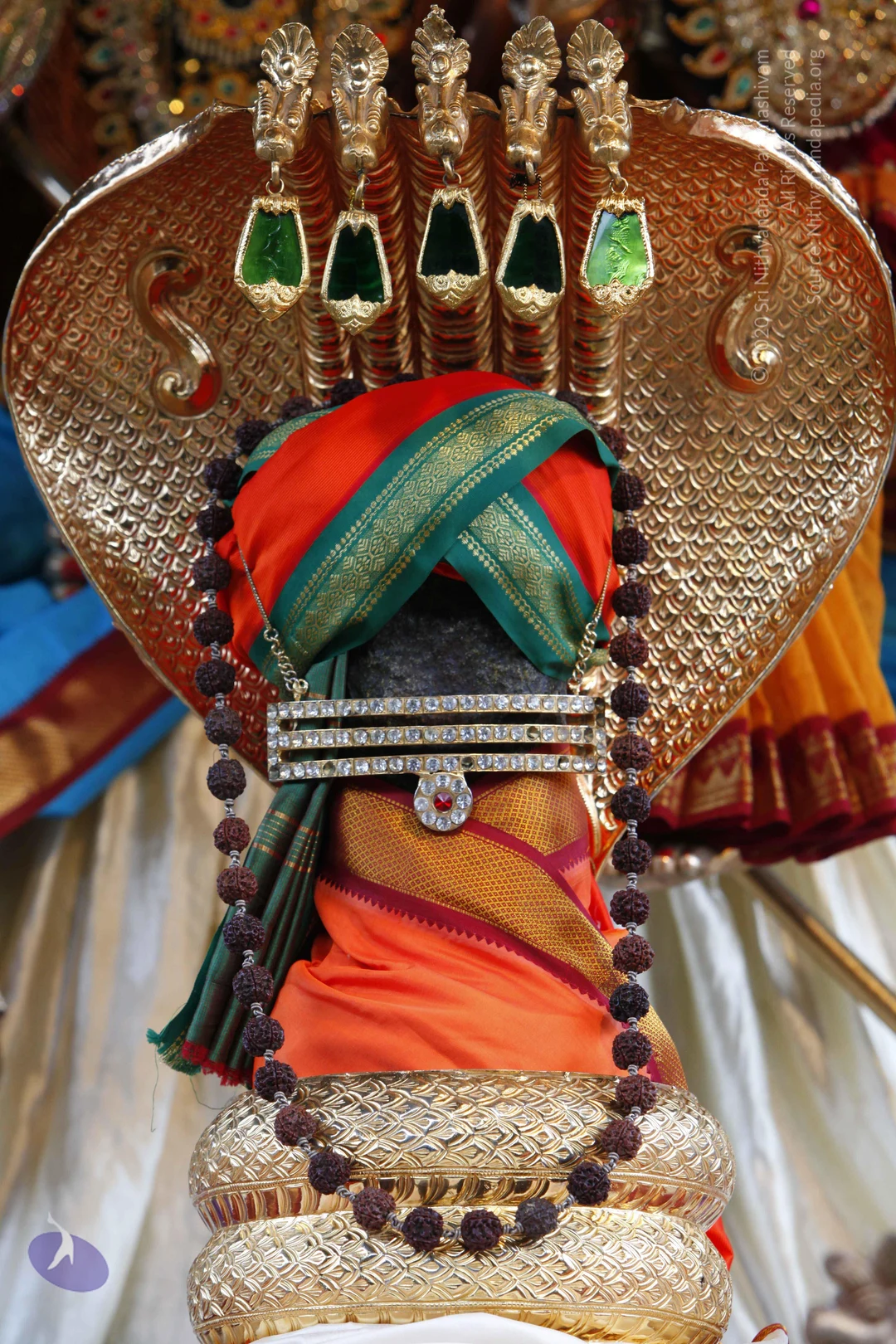
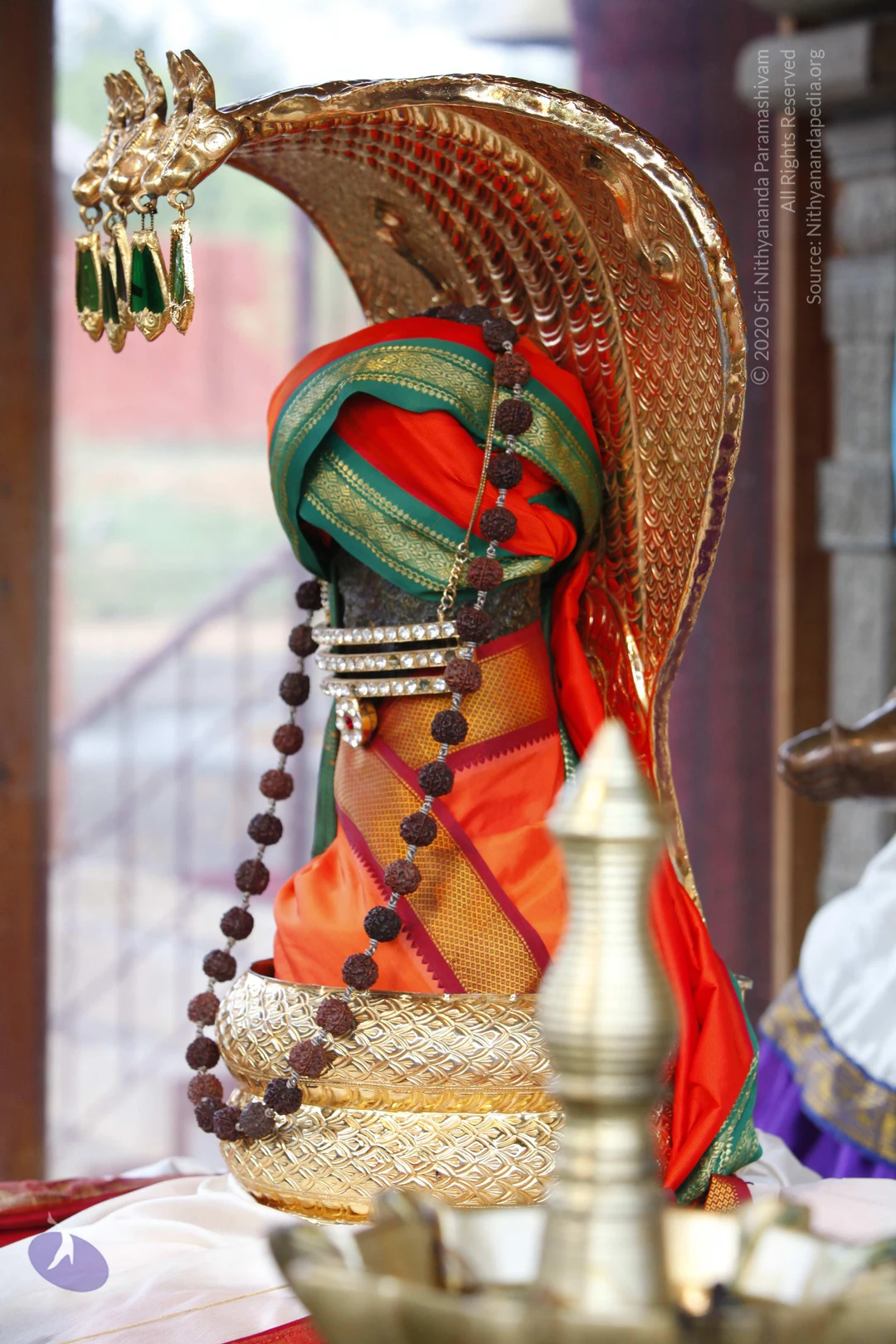
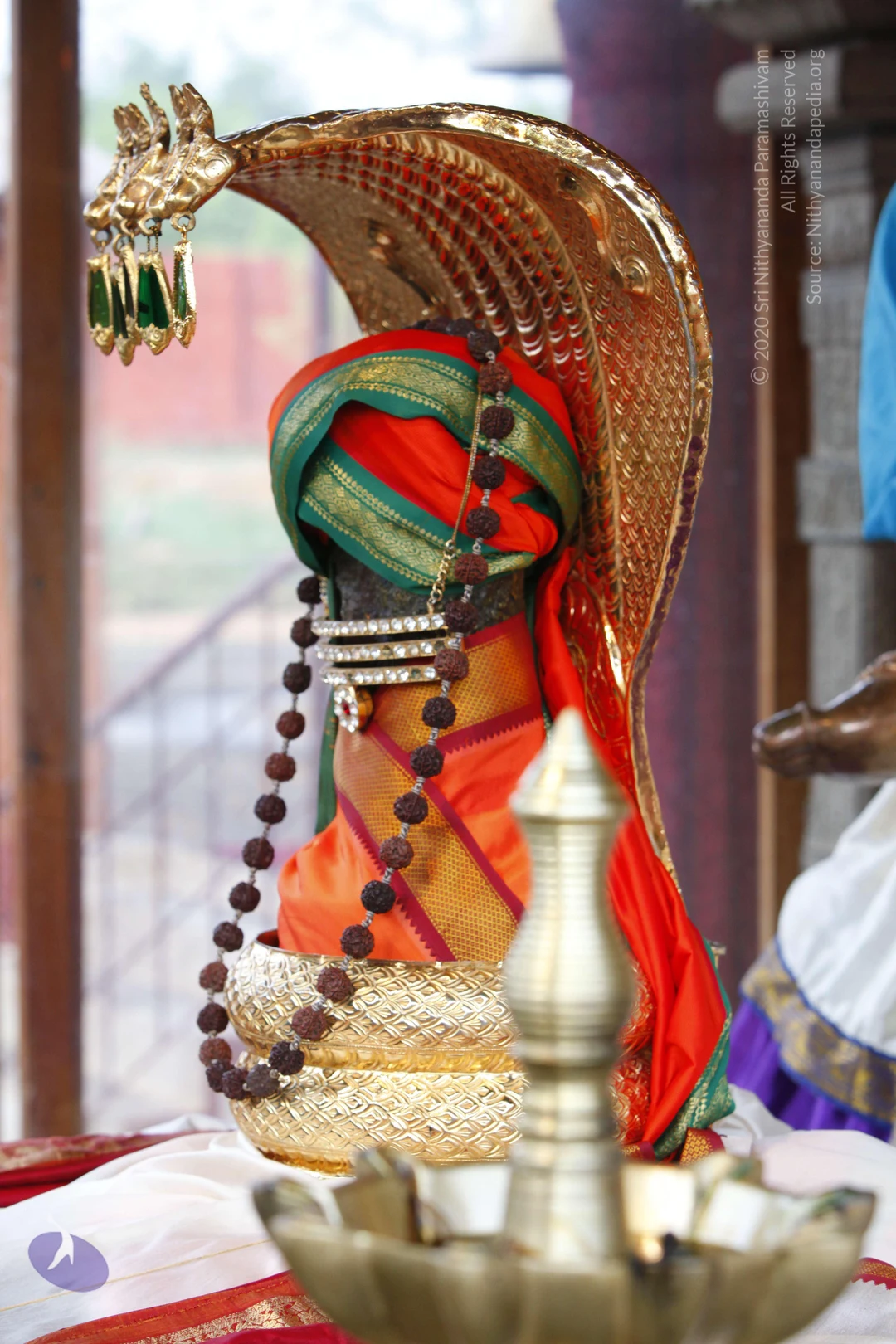
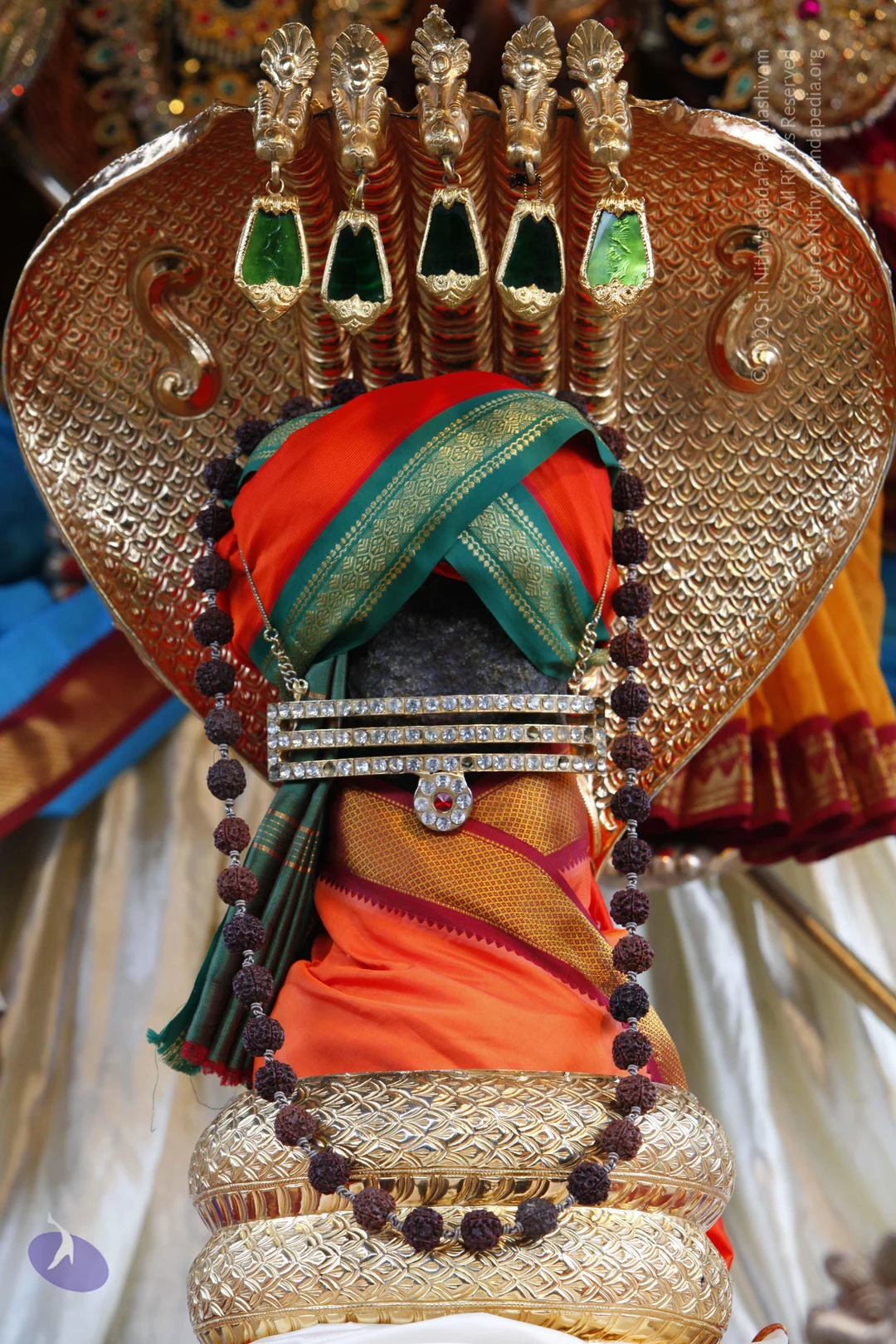
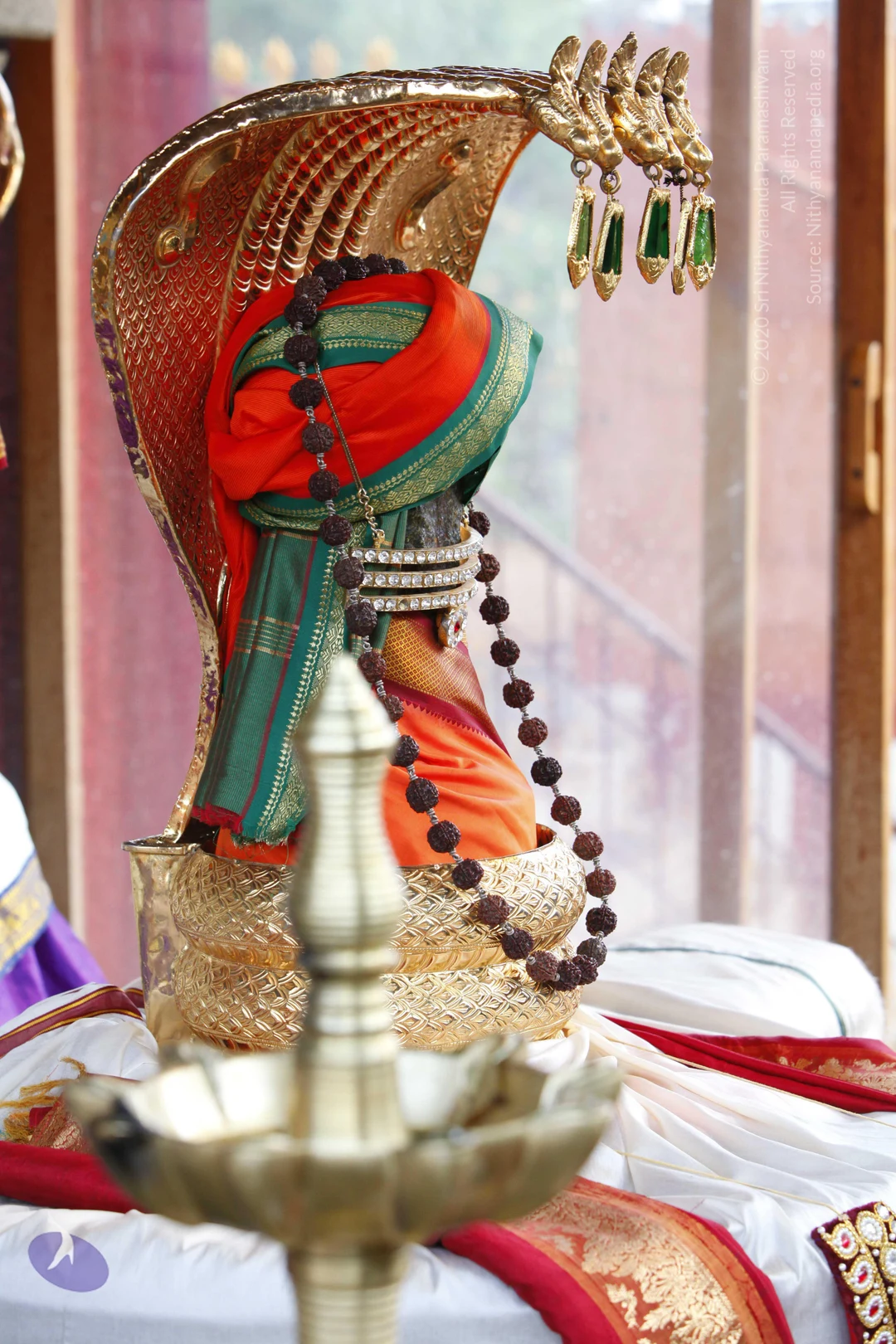
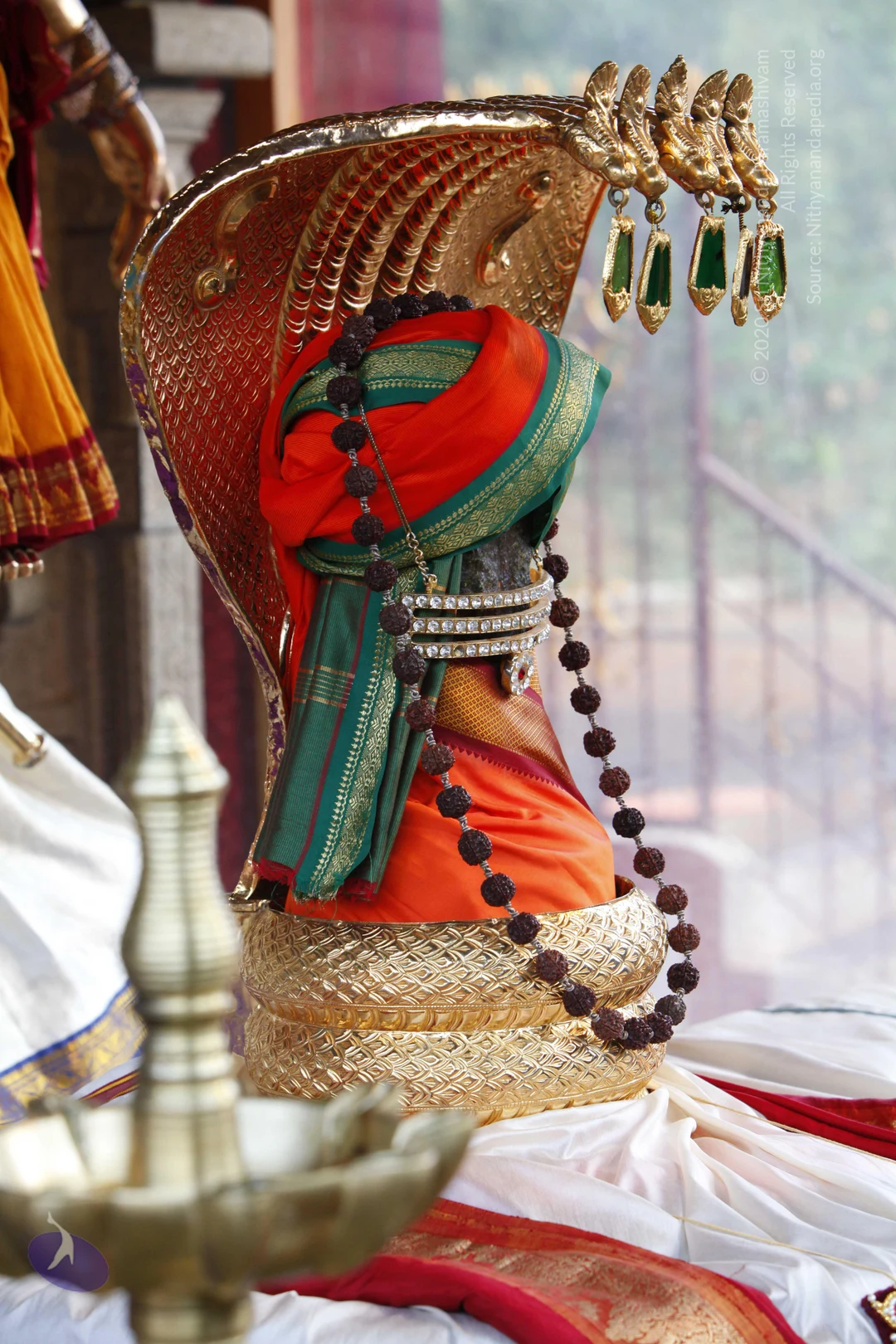
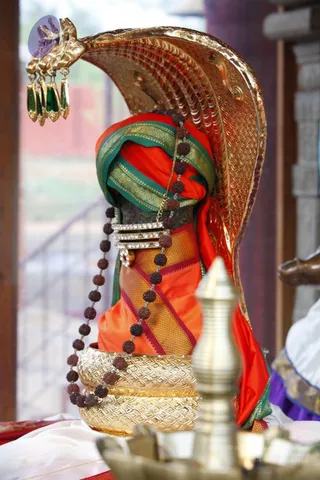
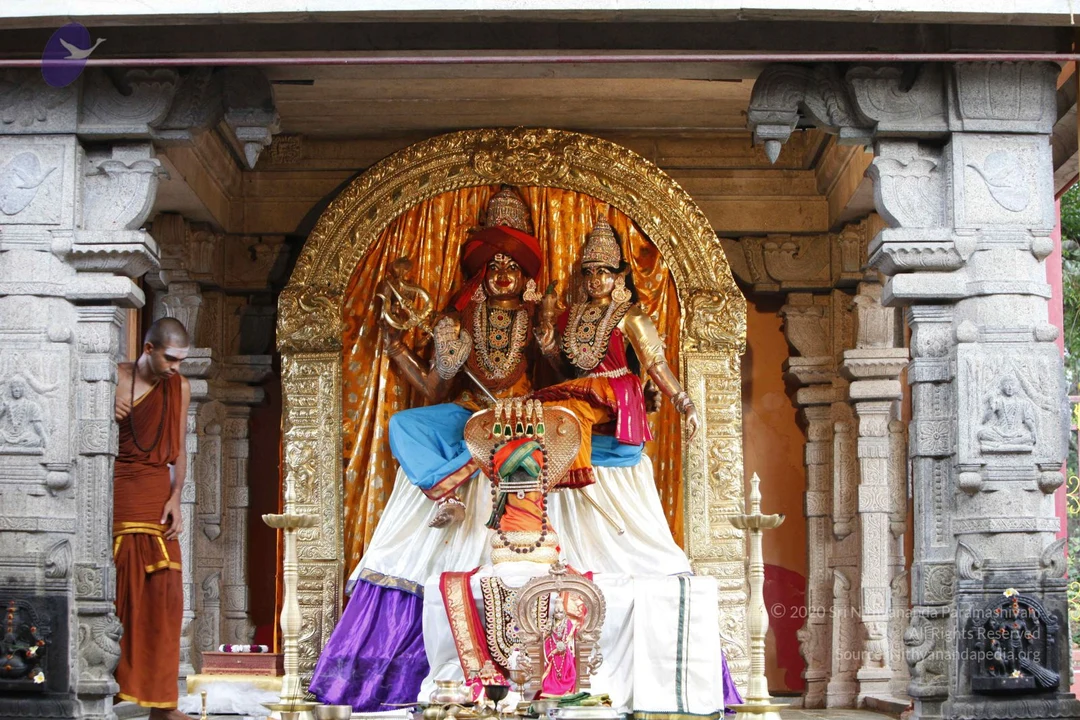
A framed portrait of a man in saffron-orange robes sits on a gold-carved throne-like seat in front of a dark background. The man sits cross-legged on a cushion before a banyan tree trunk, holds one hand raised in a blessing gesture, and wears a white flower garland and a red bindi on his forehead. Two brass hanging bells flank the frame, with a brass lamp visible on the right. The portrait is a printed photograph and is labelled "Paramahamsa Nithyananda" on the print. Swamiji (probable): the portrait shows a long-haired figure in saffron robes with a garland, a depiction on a printed portrait.A dark stone Nandi bull statue sits on a square pedestal in front of an orange-red temple structure, with foliage behind. The Nandi wears a yellow and red marigold garland around its neck and chest, a beaded necklace, and a red-and-gold tilak mark on its forehead. Scattered rose petals lie on the pedestal. No people are visible in the scene.Photograph of a satsang-style blessing in an indoor hall with a dark maroon backdrop. On the right, a smiling man with long swept-back dark hair, rudraksha-style gold beaded necklace, gold bangles, earring and a red bindi wears an orange-red saffron wrap over a yellow garment; he places his palm on the head of a young man with bowed head. Around them several devotees stand with palms pressed together in anjali, including a bald older man in glasses on the left, a man in a grey shirt, and a person in white behind. A gold-accented throne is visible in the background. Approximately six people are visible. Probable Swamiji (probable) is the central figure giving the blessing, identified by the saffron wrap, long hair, and ceremonial gold necklace.A man seated on an ornate golden throne with a large gilded arched backrest, smiling and looking to the side. He wears saffron-orange robes draped over one shoulder with a red-and-gold lower cloth, a double strand of rudraksha beads with large gold bead ornaments, a gold armlet and bangles, a gold earring, and a red bindi on his forehead. He has long dark hair swept back. Blurred green foliage in the foreground and a pink, green and orange decorated pillar behind him. Swamiji (probable): the saffron robes, long swept-back hair, rudraksha mala with gold beads and ornate gold jewellery match the appearance claimed for Swamiji, seated in a throne-like setting during an event.Photograph inside a temple hall with a golden throne shrine at centre. A framed portrait of a saffron-robed man with long hair, seated and holding a rudraksha mala, rests on a gilded throne draped with a tiger-skin cushion, with lamps and hanging bells above. Two painted guardian figures with multiple arms, red dhoti and green sashes flank the entrance. In the foreground, a woman in white and a man in white dhoti sit before a microphone and a small lamp, appearing to chant or read from a book, while figures in saffron garments sit near the shrine. Brass oil lamps stand on the marble floor.Close photo of a ceremonial deity figure or Nagaraja-style statue seen from the front, with a large golden serpent hood arching behind it and green gem-studded jewellery hanging from the top. It wears an orange and green silk drape with gold zari borders, a rudraksha mala with multiple beads, and a broad gold bangle-like band with white stones at the waist. In the foreground, a blurred brass lamp and a white cloth sit near the bottom edge. Background shows a wooden pillar and a grey stone pillar.

Temple
23 photosSource gallery
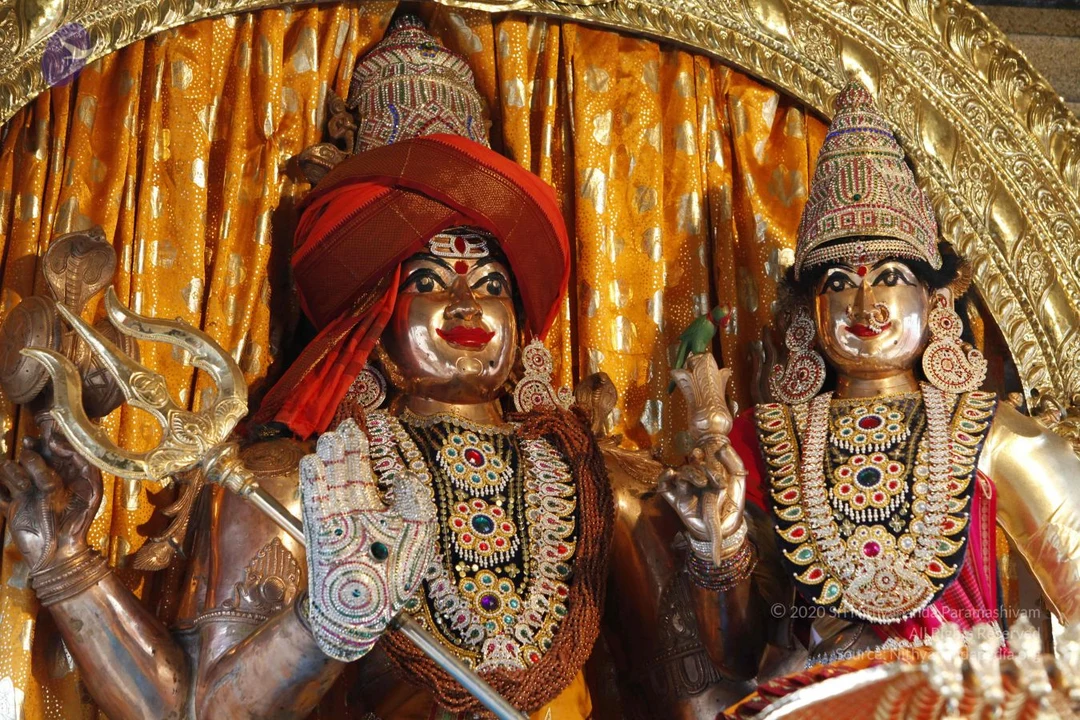
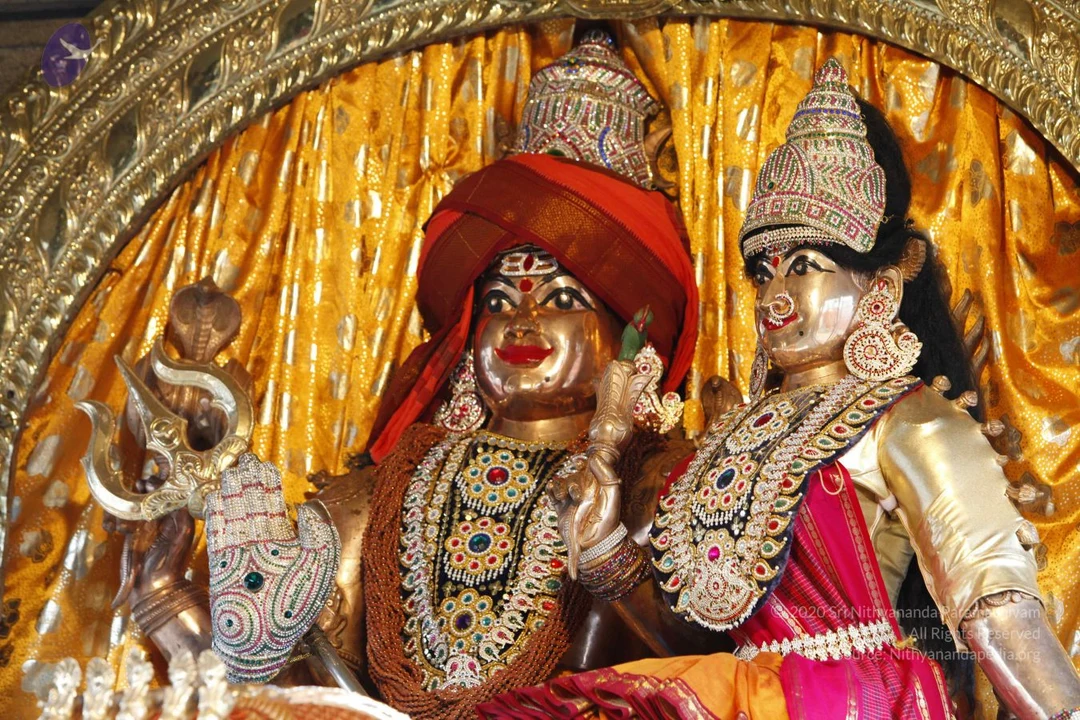
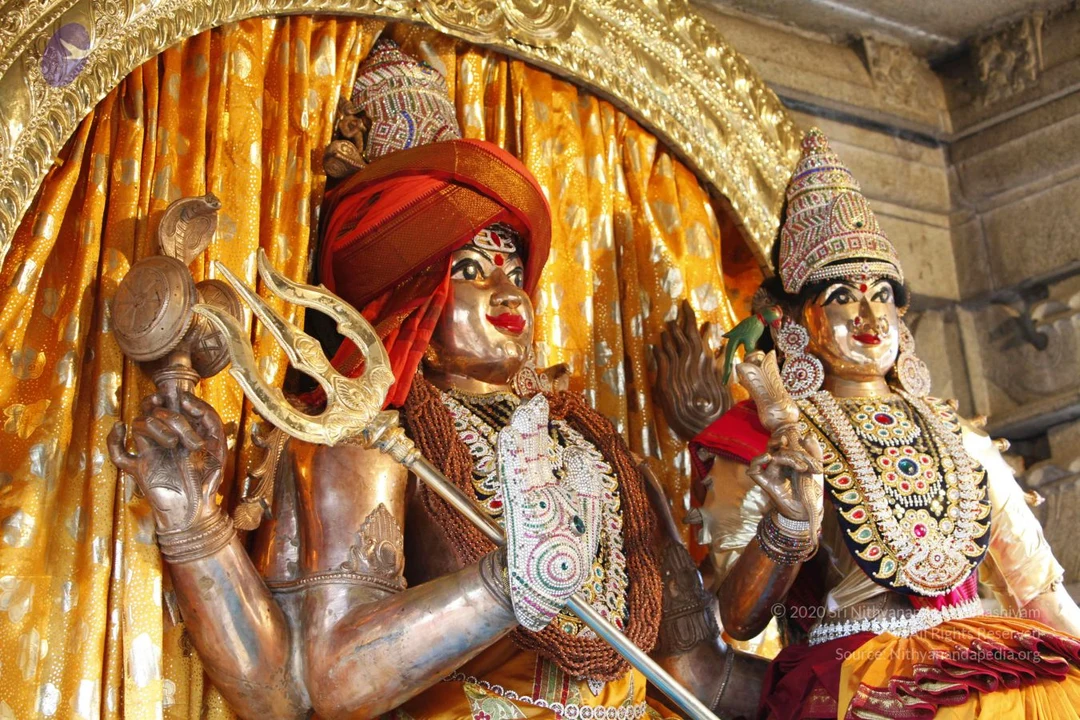
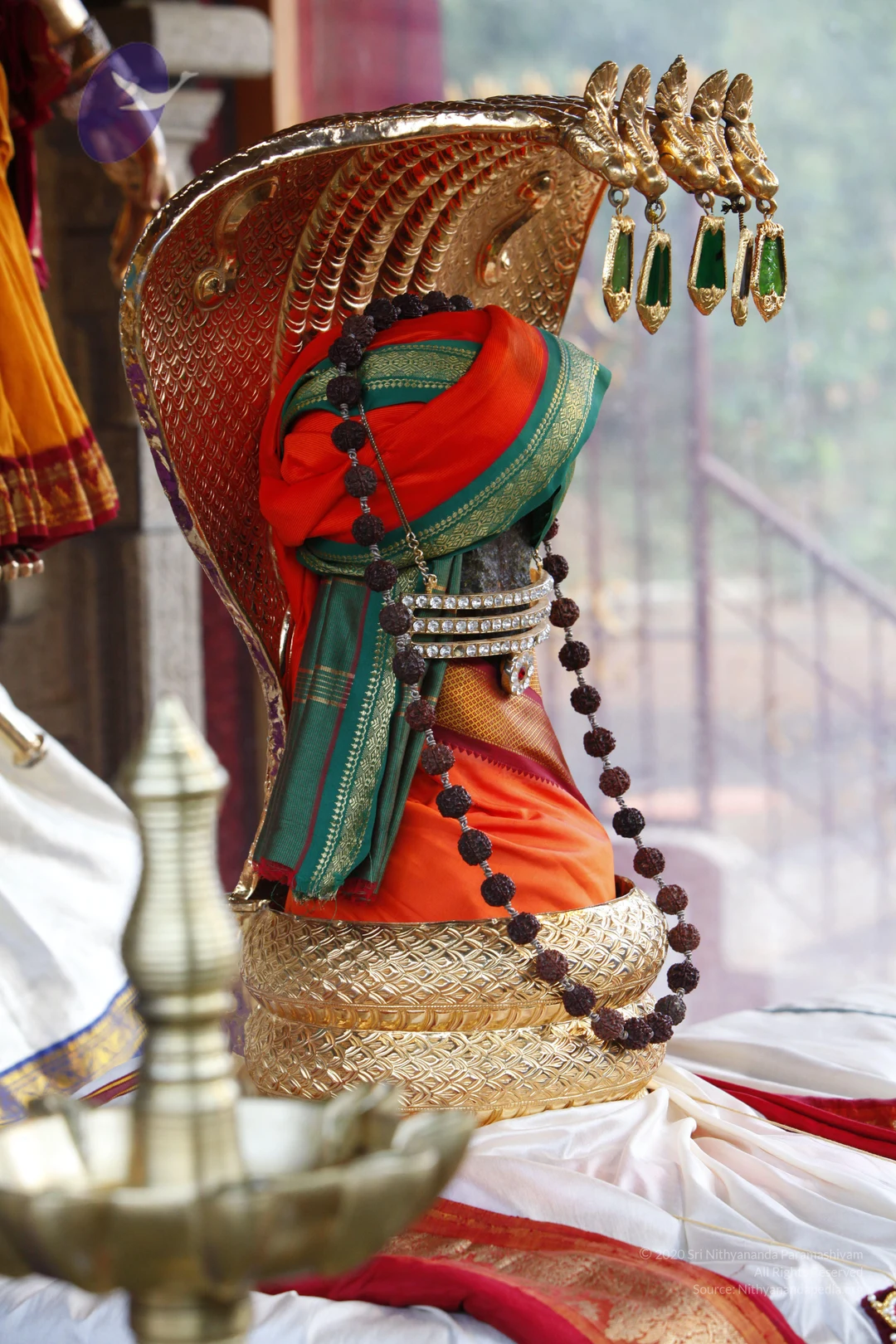
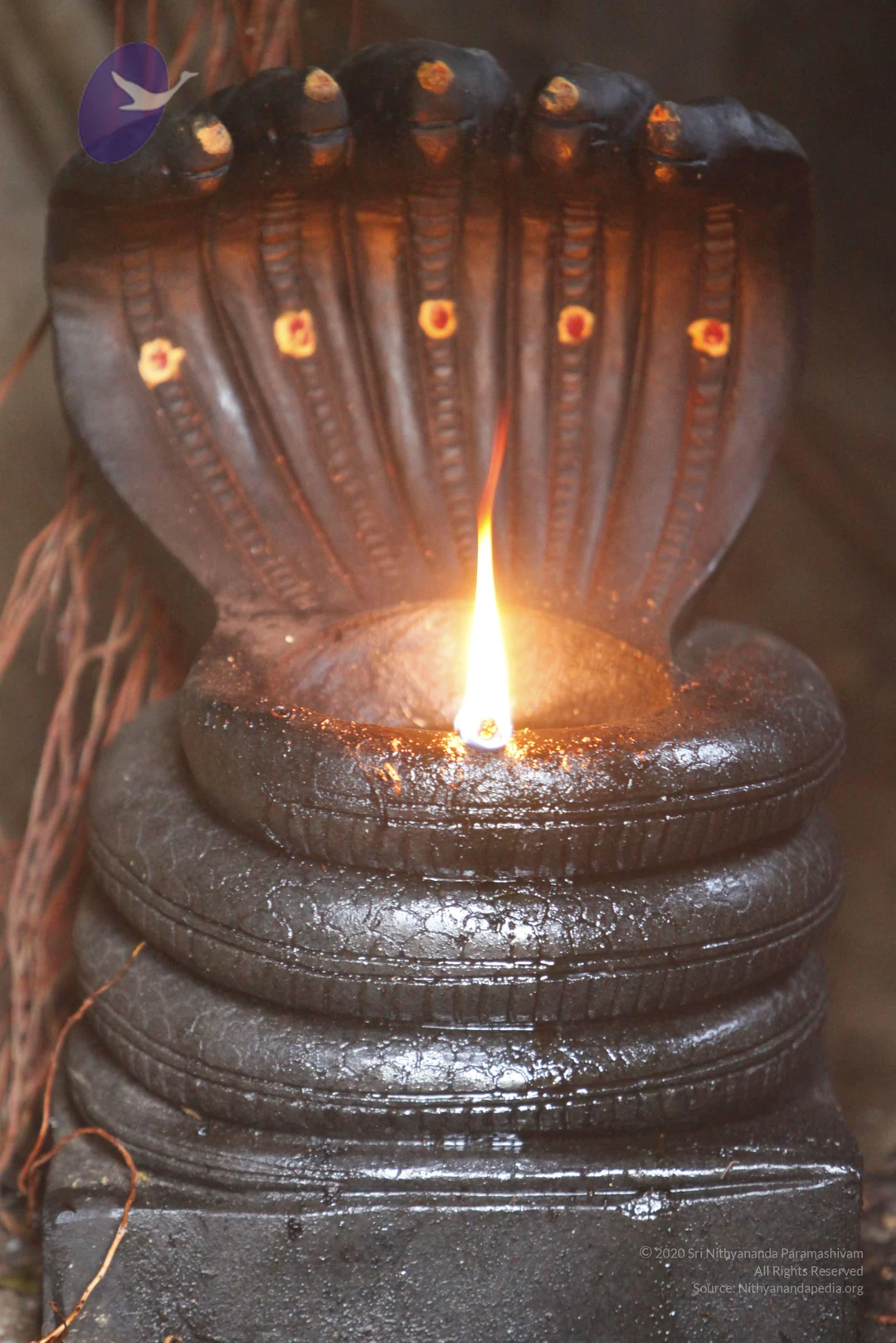
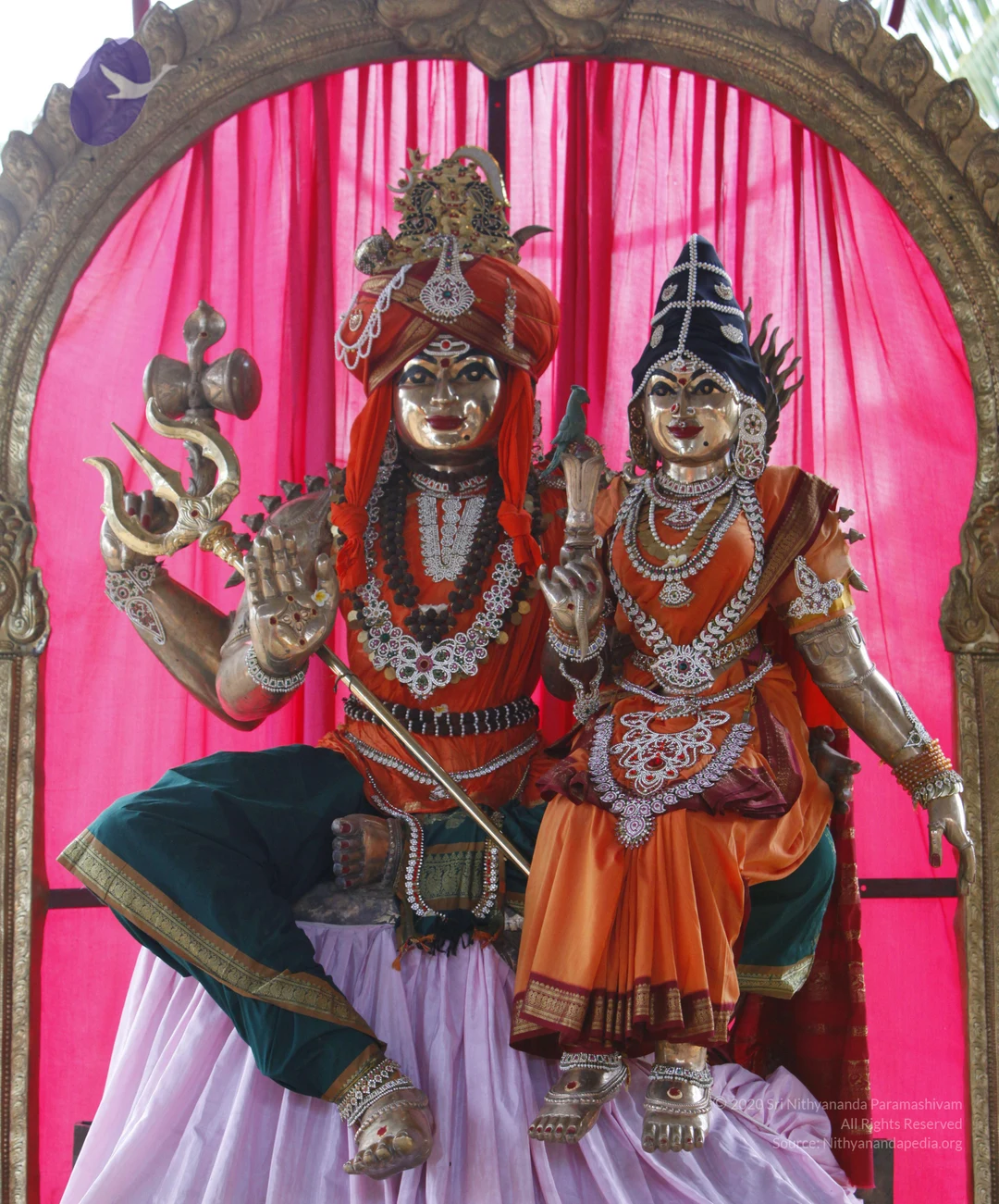
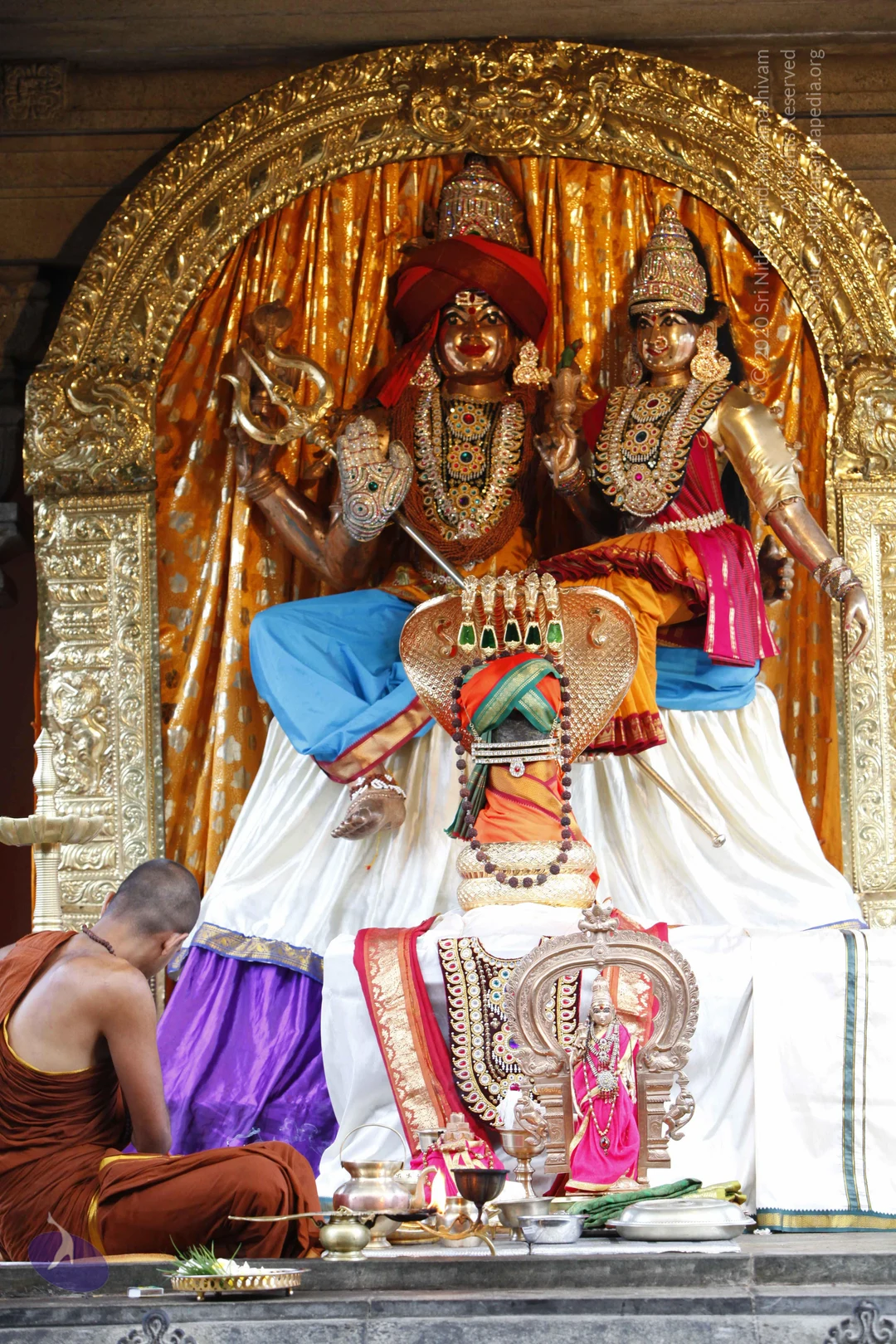
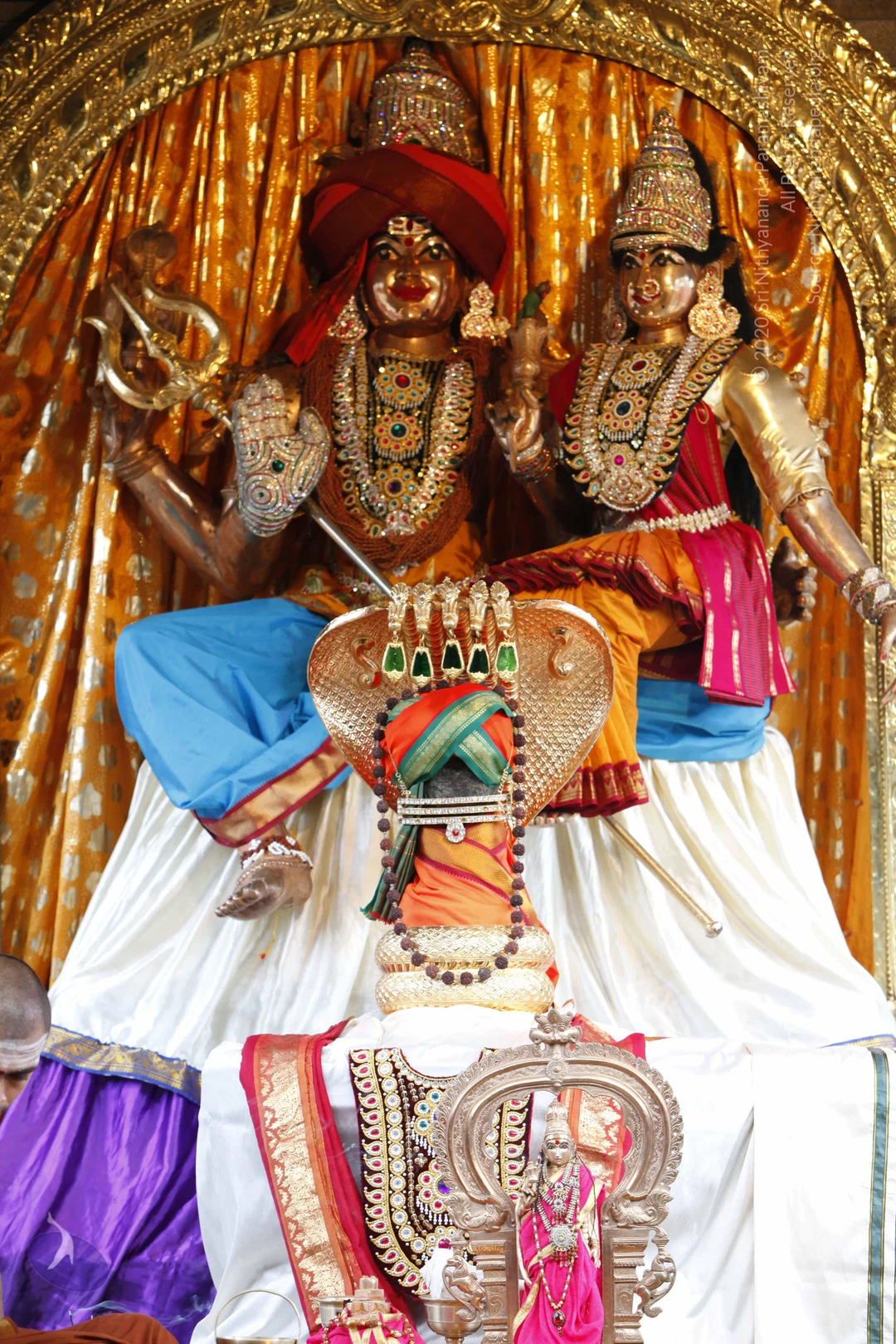
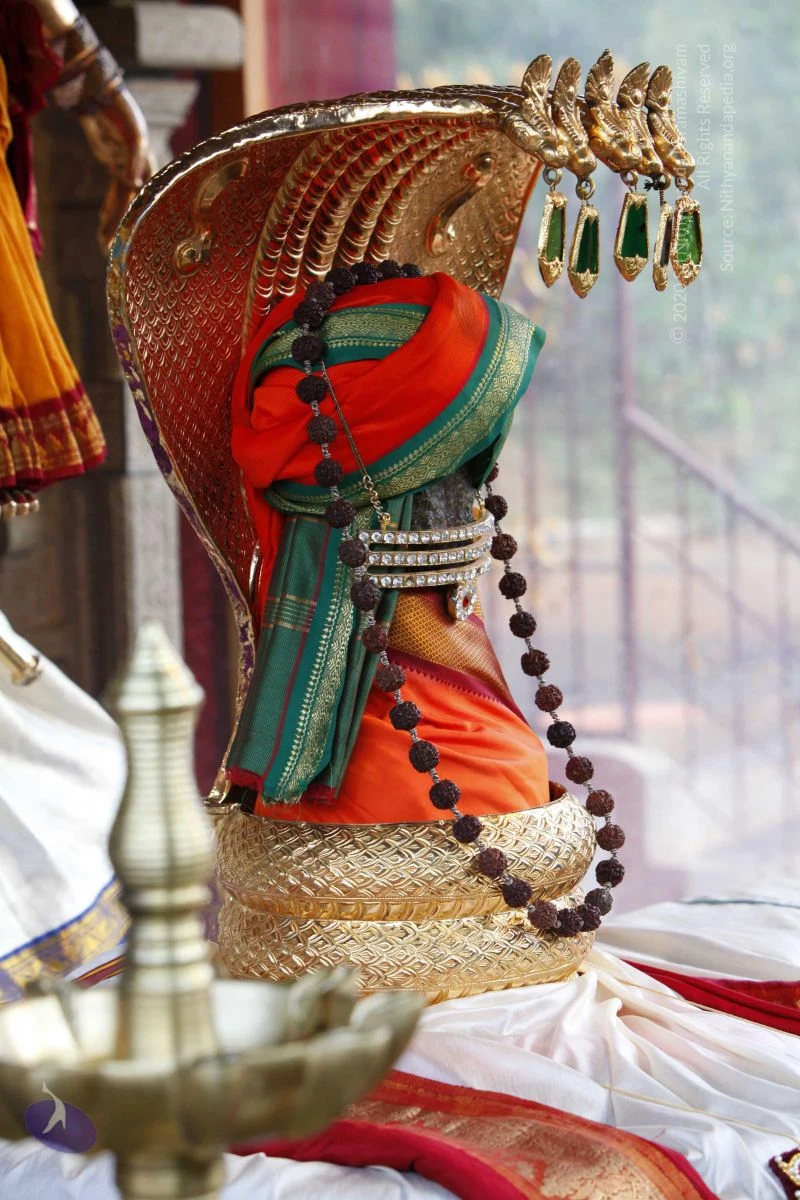
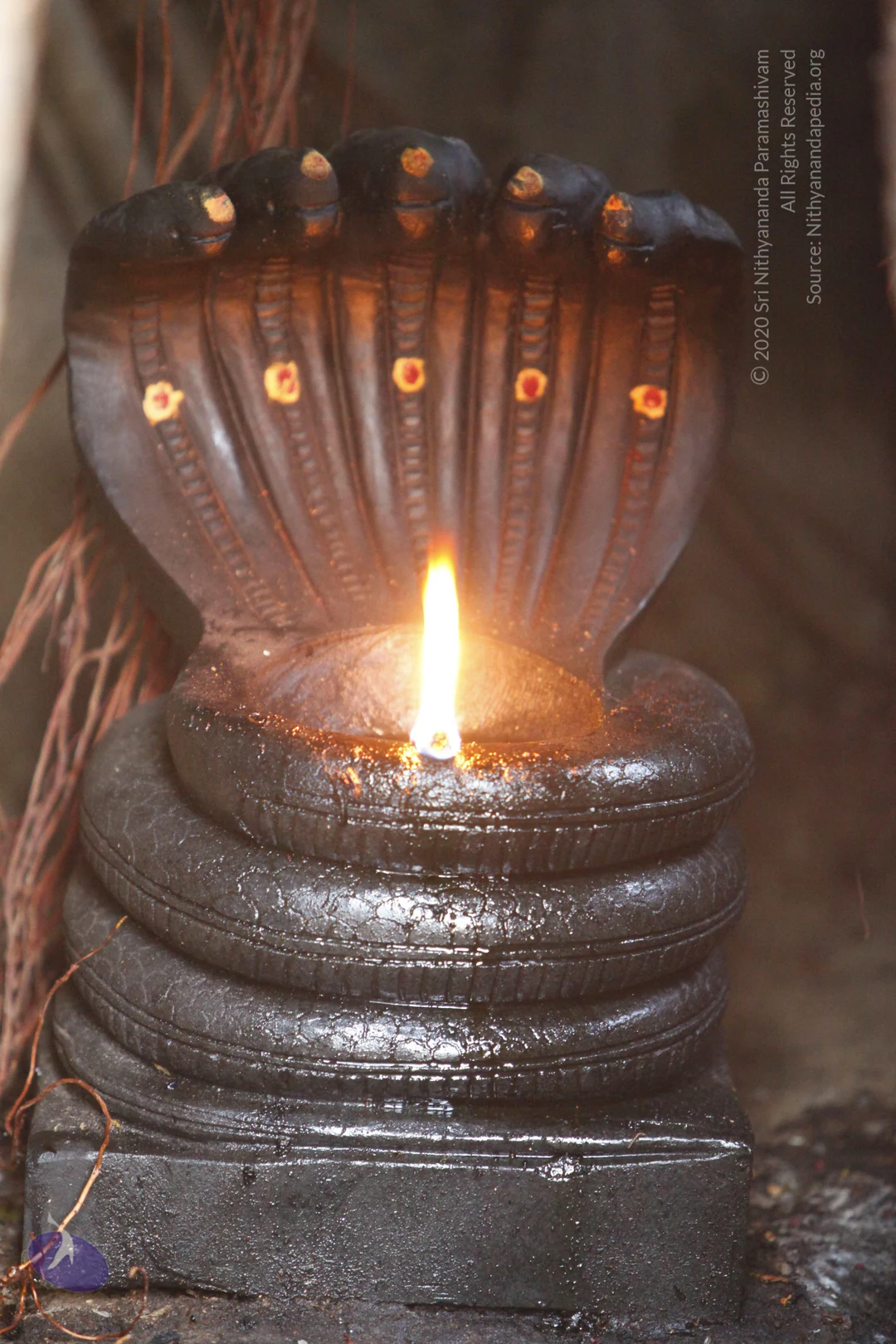
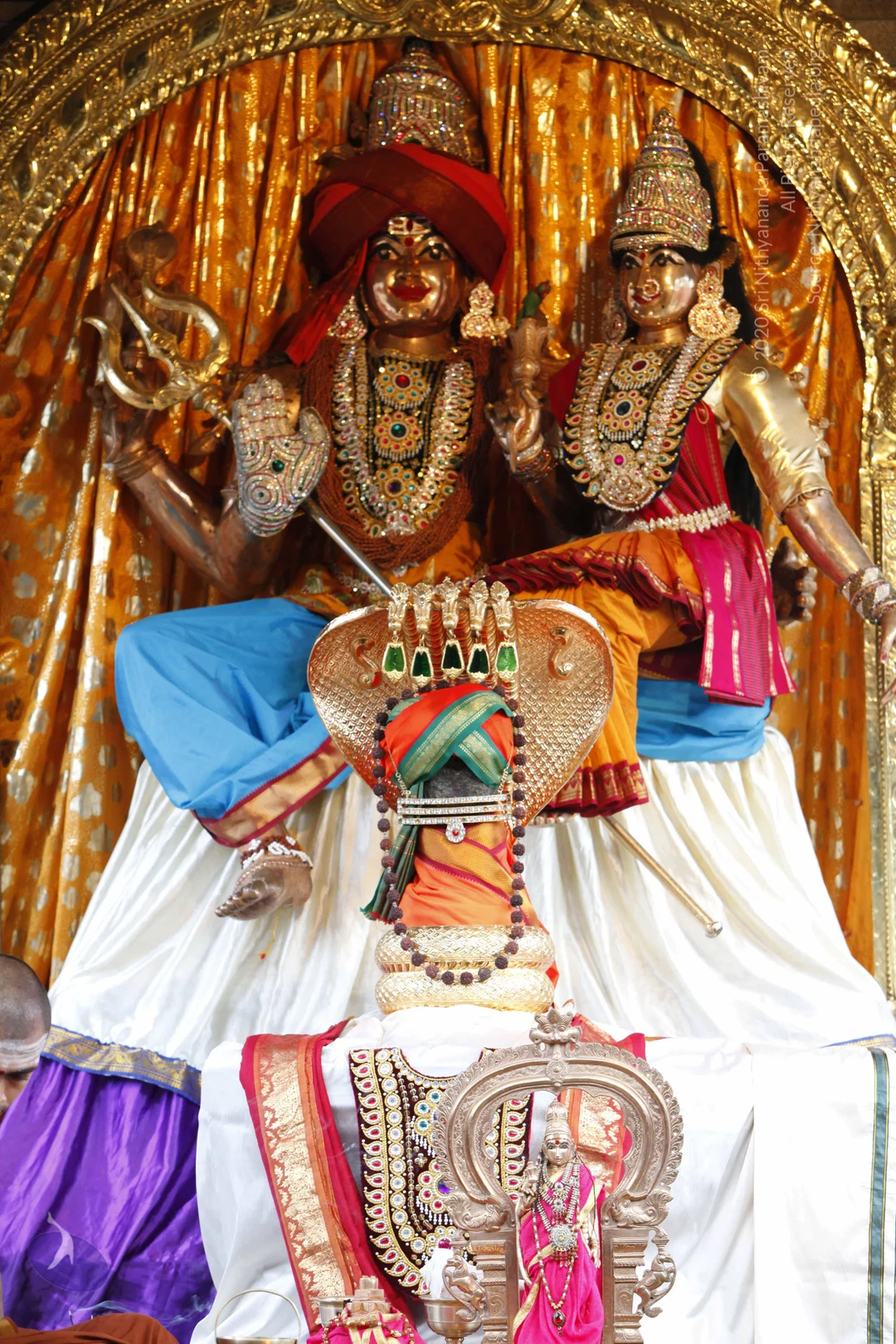
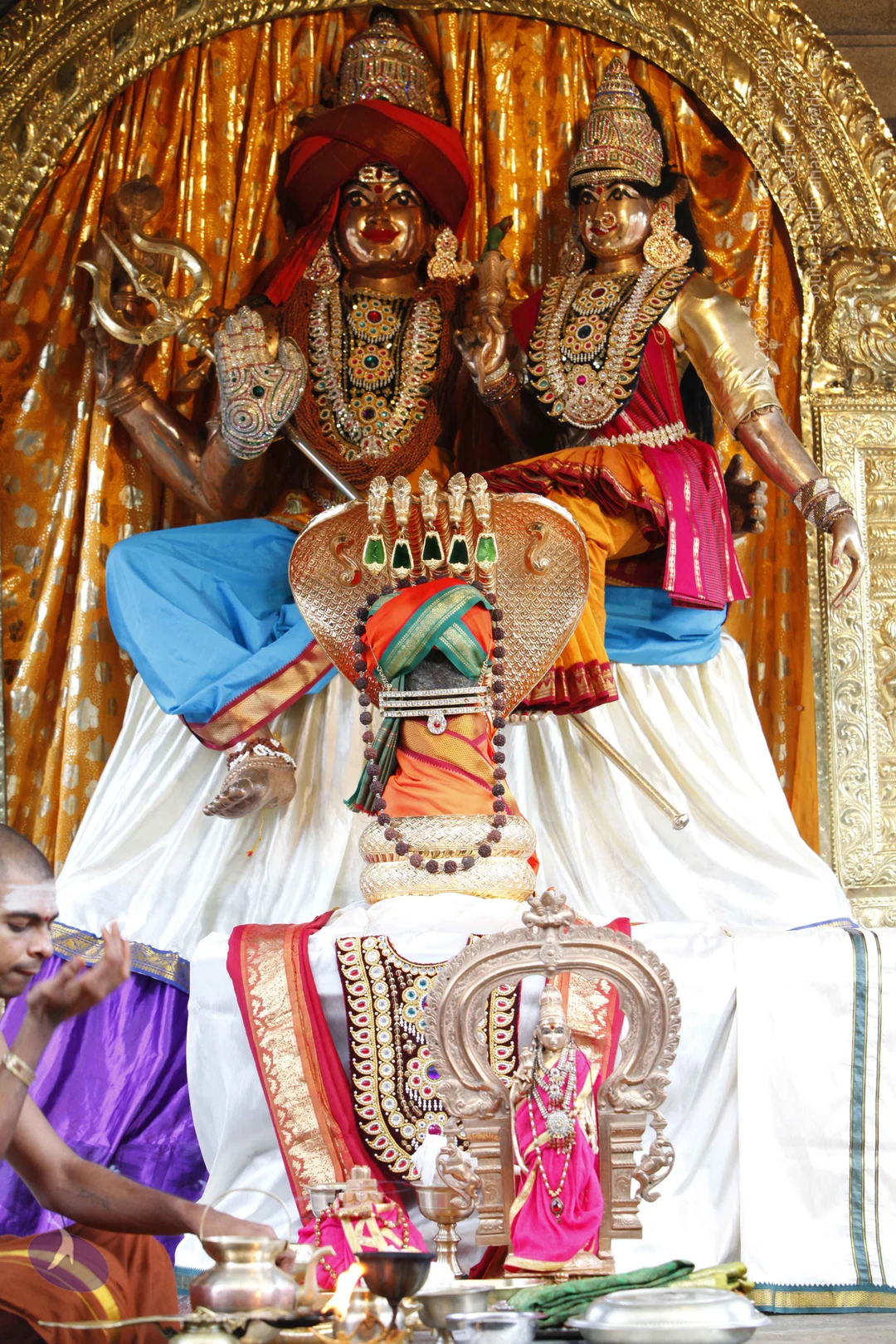
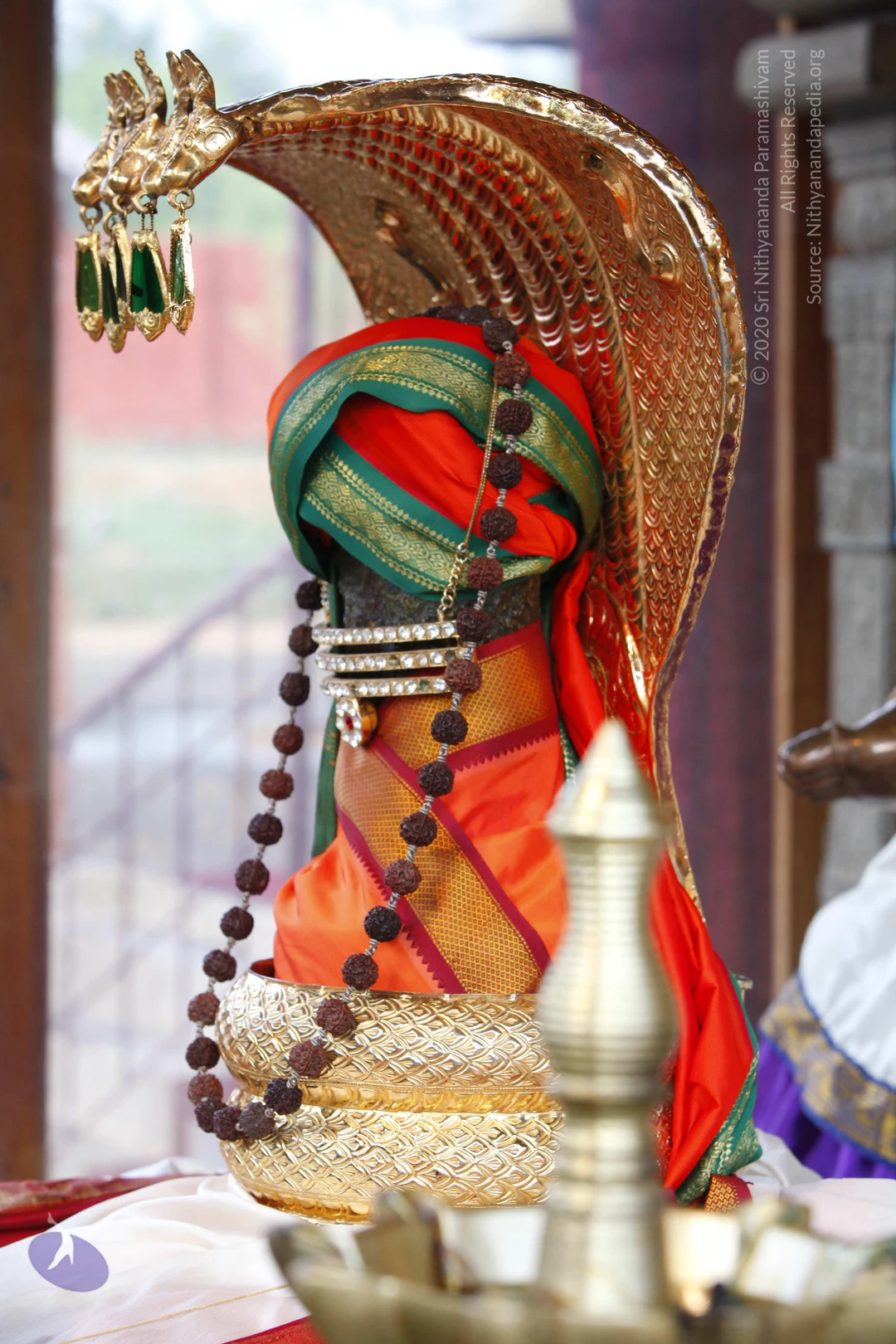
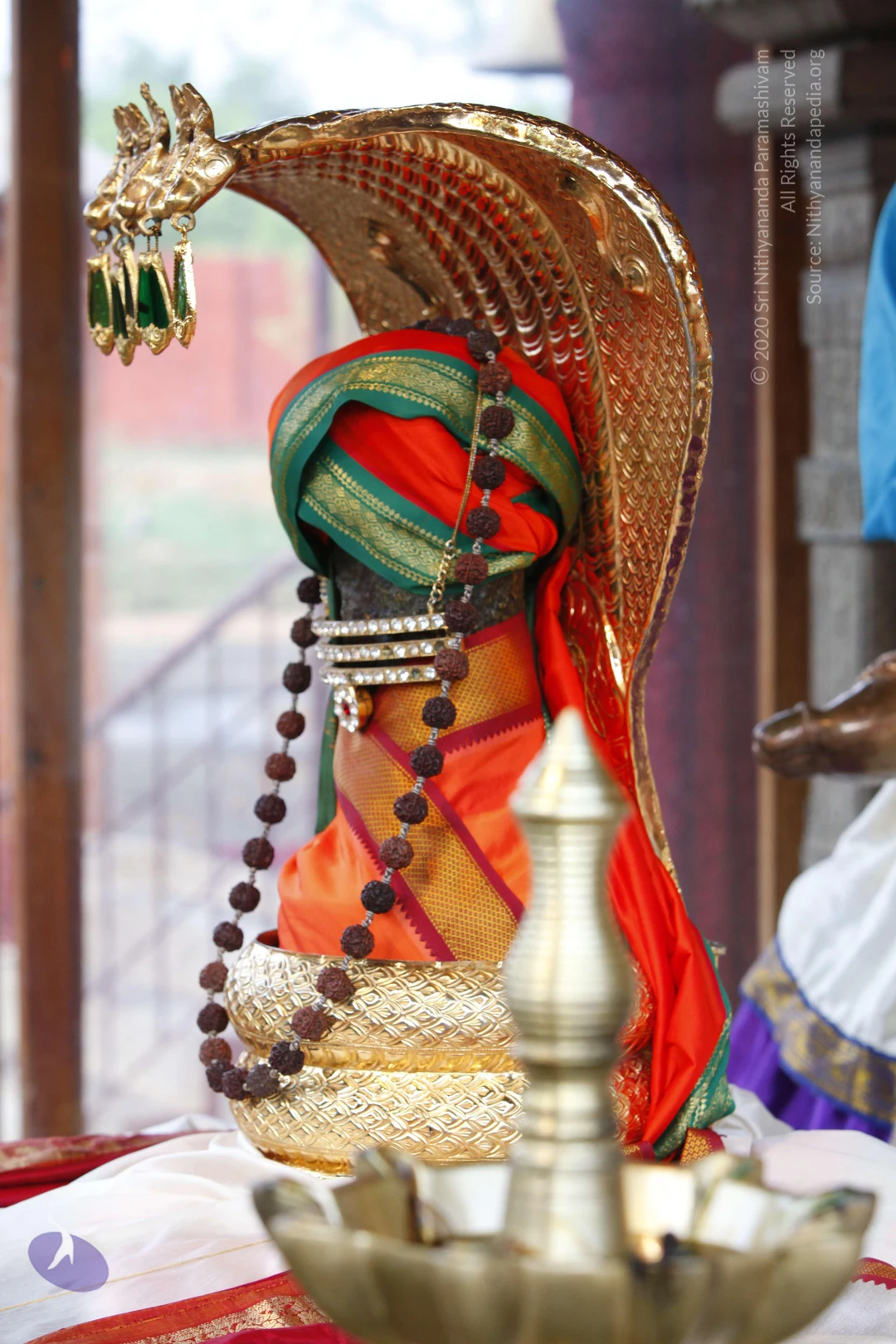
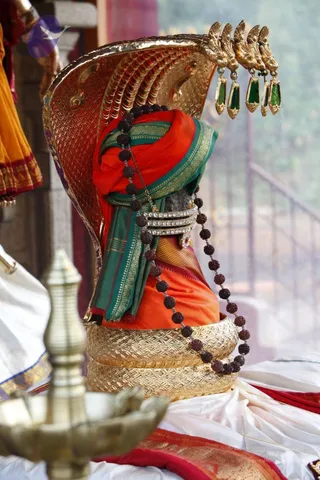
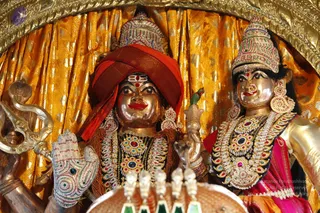
A large black stone statue of a multi-armed deity figure seated in a meditative cross-legged pose against a green cloth backdrop with gold floral motifs. The statue wears a red turban, a red and gold brocade dhoti, a red and orange sash, layered brown rudraksha-style beads, white pearl and bead malas, a gold pendant and a jeweled ornamental necklace with red and green stones. Its arms are adorned with white beaded bangles. One hand is raised in a mudra and another holds a ritual object, with a carved white ornate arch behind. A small red dot marks the forehead. The statue sits on a carved black base depicting small figures. This is a photograph of a statue, not a living person.A black stone statue of a four-armed deity seated against a green fabric backdrop with gold floral pattern. The murti wears a red turban, a red dot on the forehead, layered rudraksha and white bead malas, a gold pendant, and a red and gold silk garment. Its hands hold a drum-like object and other ritual items while one hand is raised in blessing. This is a statue, not a living person.A dark stone Nandi bull statue sits on a square pedestal in front of an orange-red temple structure, with foliage behind. The Nandi wears a yellow and red marigold garland around its neck and chest, a beaded necklace, and a red-and-gold tilak mark on its forehead. Scattered rose petals lie on the pedestal. No people are visible in the scene.Two life-size metallic statues of a deity couple sit on a pale lavender draped platform in front of a pink curtain within an ornate gold arched frame. The male figure wears an orange-red turban with a crescent ornament, orange garments, dark green trousers, a dark rudraksha mala and layered white and silver jewelled necklaces; he holds a trident and raises one hand. The female figure wears a navy headdress with white beaded patterns, an orange sari with gold border, layered silver necklaces, bangles and anklets, and holds a small green parrot on a perch. These are statues, not living people.A close-up photograph of a ceremonial deity murti or shrine figure with no visible head, shown from the side. It wears an orange and green silk drape with gold zari borders, a rudraksha mala with large brown beads, and a jeweled white-stone armlet. A gilded cobra hood with five hood-tips and green stone drops rises behind it, and the base is wrapped in gold ornamental bands. A brass oil lamp with a tall stem sits in the foreground on a white cloth with red border. No people are visible.A photograph of two gilded metal murti statues of deities standing before a golden brocade backdrop under an ornate gold arch. The figure on the left has a red and maroon turban, a red tilak, a sparkling jewelled hand raised in abhaya mudra, and holds a trident. The figure on the right wears a tall jewelled crown, large earrings, layered jewelled necklaces, and a magenta sari, and holds a lotus-like emblem. A small green parrot perches near the central figure's shoulder. In the foreground, rows of small white figurines and a decorated silver-and-green platform are visible.

Pada-Puja

16 photosSource gallery
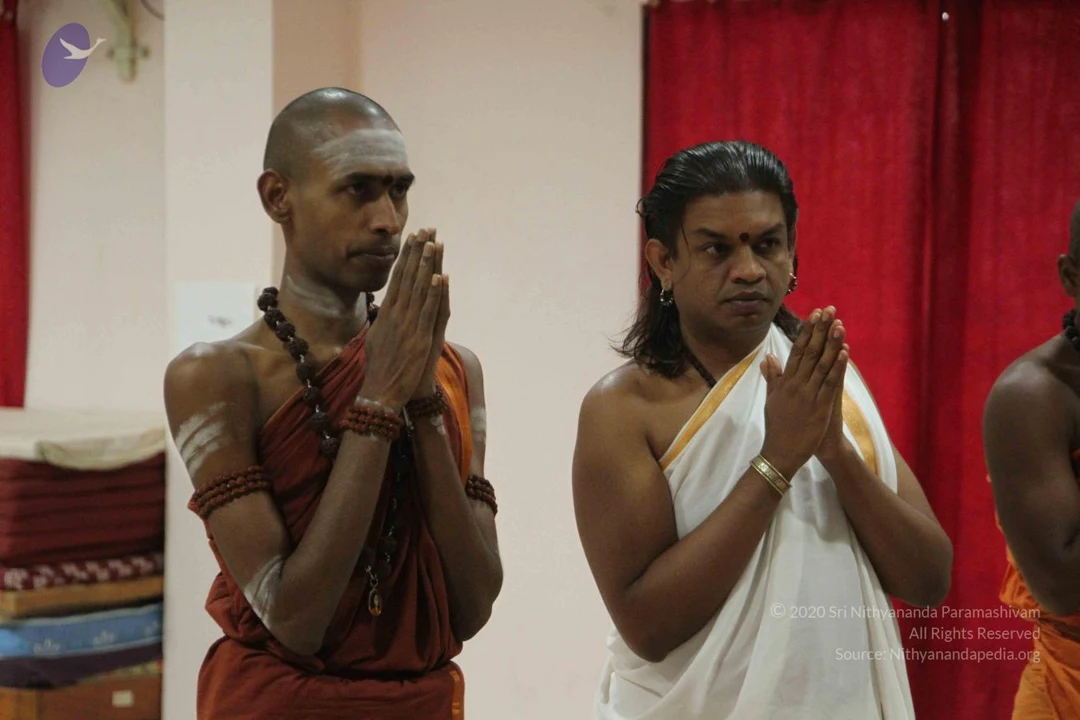
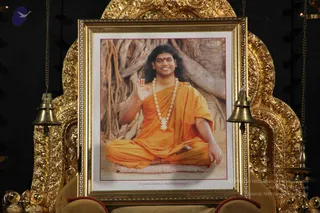
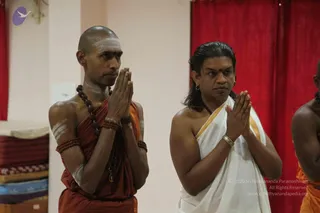
Inside a temple shrine, an empty golden ornate throne with a tiger-skin seat stands in a central niche, with a framed photograph on its back showing a smiling figure in orange robes and rudraksha beads seated in a rocky setting, labelled as a depiction on the frame. Two painted guardian figures with gold crowns, green sashes and red dhotis flank the niche. In the foreground, two seated priests in white dhotis and vibhuti marks perform a puja, one holding a microphone, while a brass lamp and oil lamps line the floor and a standing figure's arm holds a lamp at the left edge. The photograph is a depiction, not a physical person, and no physical person is clearly identifiable as a person.A photograph of a golden ornate throne framed by two painted guardian figures with multi-armed forms, red-and-orange dhotis, gold necklaces and crowns, flanking a shrine niche. On the golden throne sits a framed photograph of a man in orange robes with a white bead mala, seated before a large tree trunk, raising one hand in blessing. Hanging brass bells and oil lamps hang above, and a tiger-skin cloth covers the seat. No physical people are visible in the scene; the framed portrait is a printed depiction.A photograph of an ornate golden throne (peetha) in a temple-style shrine, with a tiger-skin cushion on the seat. Framed on the throne is a printed portrait of a man with long dark hair in saffron-orange robes and a white beaded mala, seated before a banyan-like tree and gesturing with one hand. Flanking the throne are two painted deity murti figures with multiple arms, gold crowns and ornaments, and red and green garments. Hanging bells and brass oil lamps are in front, with lit flames at the lower left and right edges. No physical people are visible.Photograph of two men standing with palms pressed together in anjali mudra before a red curtain in an indoor hall. The man on the left is shaved-headed, wears a rust-red sannyasi cloth, a rudraksha mala with a pendant, rudraksha bracelets, and white ash markings on his forehead and arms. The man on the right has long swept-back hair, a small red bindi, earrings, a gold bangle and a white dhoti-style wrap with an orange border. A partially visible person in orange clothing stands at the right edge, and folded bedding sits at the left.A shaved-headed man with white tilak stripes on his forehead and arms, a red bindi, and a red-brown rudraksha mala draped over bare shoulders stands with palms pressed together in anjali mudra. He wears an ornate gold cobra-shaped armlet and a wristwatch. Behind him, several men in white ritual clothes stand with hands folded in prayer, and a boy with white tilak in the foreground is partly visible. Red curtains and a bright doorway frame the room.A framed portrait of a man in saffron-orange robes sits on a gold-carved throne-like seat in front of a dark background. The man sits cross-legged on a cushion before a banyan tree trunk, holds one hand raised in a blessing gesture, and wears a white flower garland and a red bindi on his forehead. Two brass hanging bells flank the frame, with a brass lamp visible on the right. The portrait is a printed photograph and is labelled "Paramahamsa Nithyananda" on the print. Swamiji (probable): the portrait shows a long-haired figure in saffron robes with a garland, a depiction on a printed portrait.

Swasthi-Mantra

7 photosSource gallery
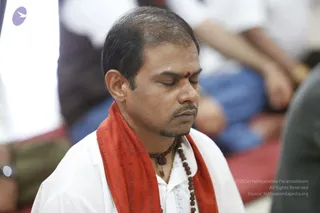
A photograph of seated devotees at a satsang hall with red chairs behind them. In the foreground, a man in white kurta with a red-and-orange shawl and rudraksha mala raises his palms in devotion, eyes lowered. Beside him, a younger man in a white shirt with white forehead markings, a red bindi and a gold bracelet also raises his palms with eyes closed; he wears a visitor or volunteer identity badge on his chest. Other seated devotees in white and grey clothing are visible behind them, and the floor is covered with red mats.A photograph of a shaven-headed man in a rust-red robe with eyes closed and palms raised outward, seated in a satsang hall. He wears long strands of rudraksha beads over his shoulders, orange-and-gold ribbon cords, a red tilak on his forehead, and beaded wrist bands and a black wristwatch. Behind him, blurred figures in white and orange sit on a red-carpeted floor under a red backdrop.A shaved-headed man in a saffron-orange garment sits with eyes closed and palms raised outward, mouth open as if chanting. He wears a long multi-strand rudraksha mala with large brown beads and an orange sash over one shoulder, a red bindi on his forehead, and a rudraksha bracelet on his wrist. Someone in the background wears an orange-red shawl. The man appears to be a person given the saffron clothing, long rudraksha mala and orange sash, but this is an appearance-based label only.A man with long dark hair tied in a topknot, wearing round wire-rimmed glasses and a white t-shirt, sits with eyes closed and both palms raised in front of him in a meditative gesture. He wears an orange lanyard with an ID badge, a beaded brown necklace and several bracelets. Behind him, other seated people in white and dark clothing also raise their hands in a group meditation in a pale pink hall.A seated satsang gathering with a young man in the foreground wearing a white collarless kurta, eyes closed, a small red bindi on his forehead, long dark hair tied back, and both palms raised outward in a devotional gesture. Behind him, several men in white shirts and white dhotis sit with their hands raised, and a man at right wears a red shawl over a white shirt with a beaded mala. The setting is an indoor hall with red and cream walls. Audience members appear blurred in the background.A shaved-headed man in saffron-red robes wears long rudraksha mala strands across his chest and multiple rudraksha bracelets on his wrists, with a red bindi and white ash markings on his forehead and arm. He sits with palms pressed together in anjali mudra, gazing forward, while blurred figures in orange robes and a seated person in white are visible at the edges. A red curtain forms the backdrop. Appearance is consistent with a sannyasi in an ashram satsang setting, but the page does not establish that this man is a person, so no identification is made.

Nithya-Satsang

12 photosSource gallery
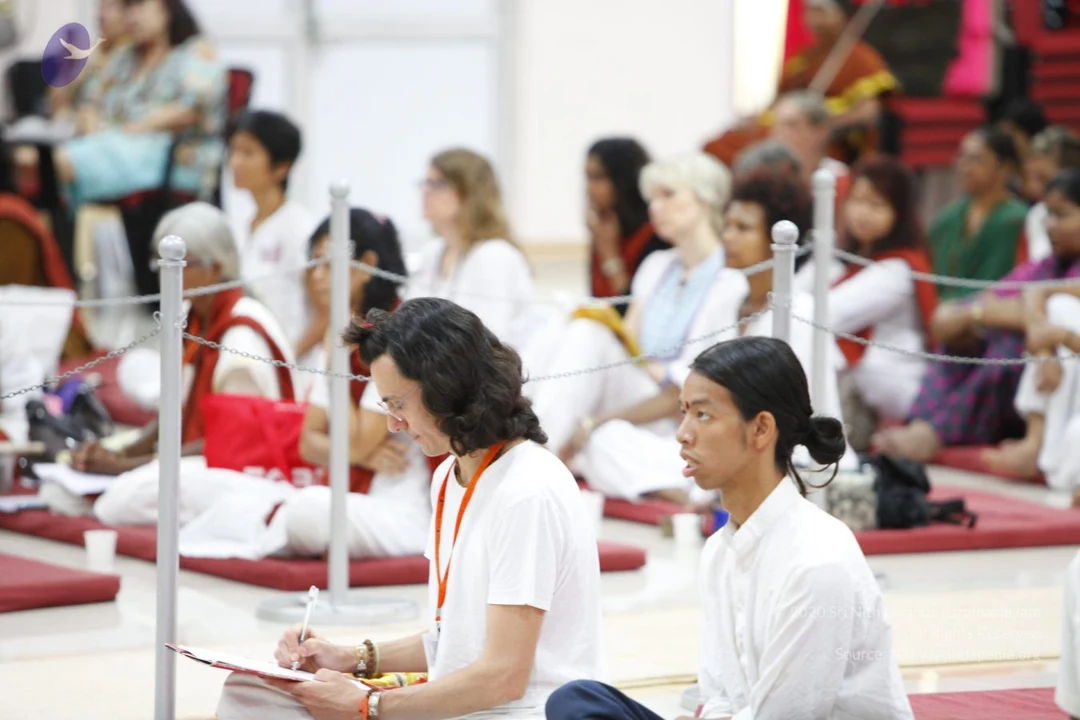
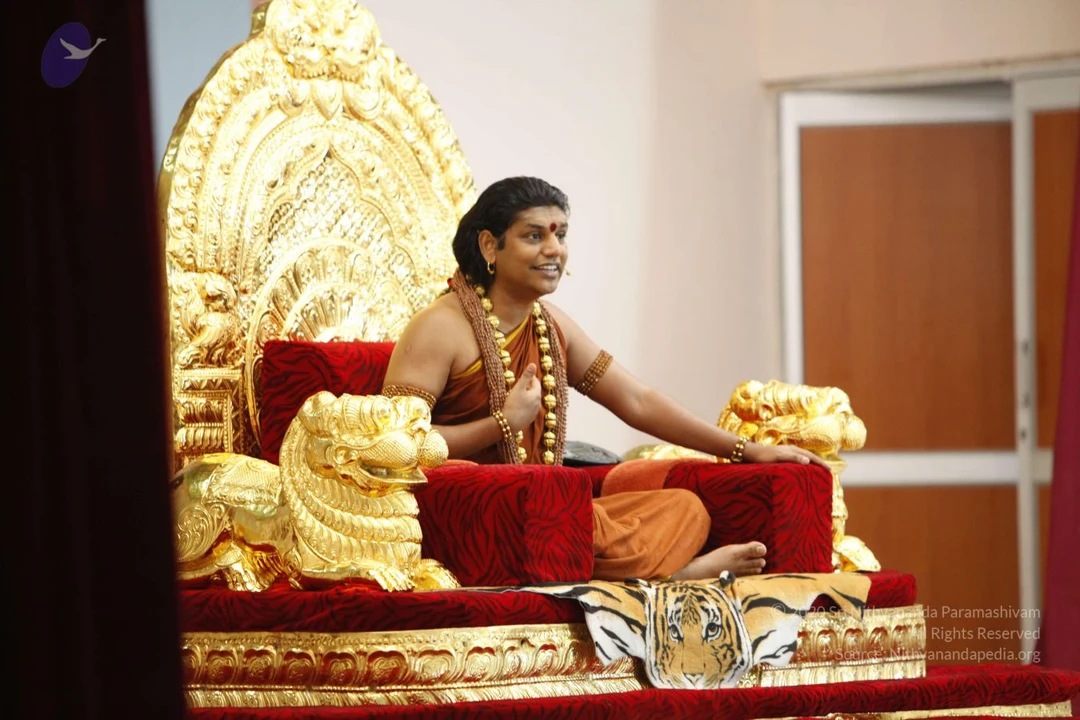
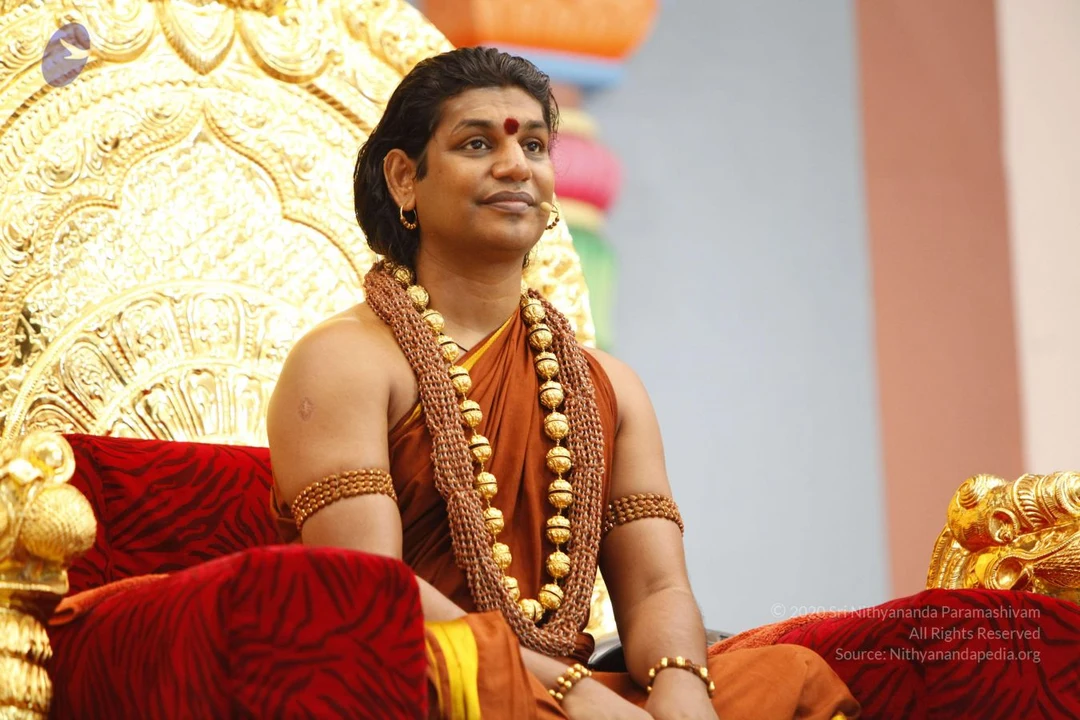
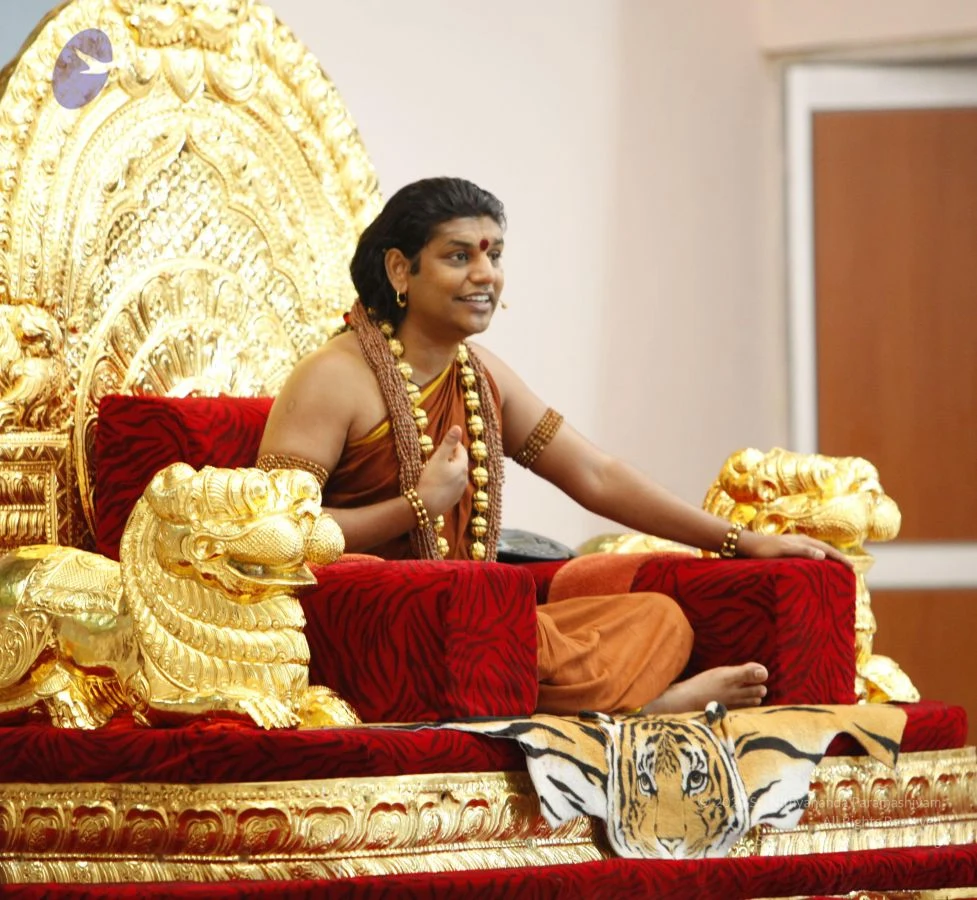
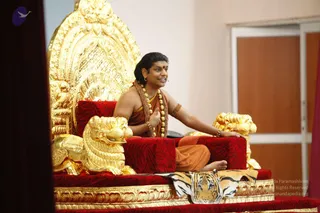
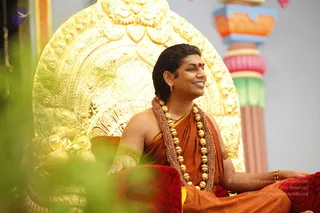
A man seated on an ornate golden throne with a large gilded arched backrest, smiling and looking to the side. He wears saffron-orange robes draped over one shoulder with a red-and-gold lower cloth, a double strand of rudraksha beads with large gold bead ornaments, a gold armlet and bangles, a gold earring, and a red bindi on his forehead. He has long dark hair swept back. Blurred green foliage in the foreground and a pink, green and orange decorated pillar behind him. Swamiji (probable): the saffron robes, long swept-back hair, rudraksha mala with gold beads and ornate gold jewellery match the appearance claimed for Swamiji, seated in a throne-like setting during an event.A man seated on an ornate gold-and-red throne with carved golden lion heads at the arms and a gilded backrest, speaking as he gestures with one hand. He has long dark hair swept back, a red bindi, and wears an orange-saffron cloth draped over the shoulder, a brown rudraksha mala and a ceremonial gold bead necklace, plus gold bangles on his arms. A tiger-striped cloth lies across the lower throne platform. Behind him are plain pale walls and a wooden door panel.A man seated cross-legged on a red-and-black tiger-striped cushion on an ornate gold throne with carved lion heads, palms pressed together in namaste with eyes closed. He wears an orange-saffron dhoti and a saffron shawl, a red bindi on his forehead, a gold-bead and rudraksha-style mala around his neck, and gold armlets and bangles. A small headset microphone is clipped near his ear. Golden lion-faced armrests flank the throne, and painted deity figures with raised hands appear at the left and right edges.A seated man in saffron-orange robes sits on an ornate gilded throne with red-and-black striped cushions and golden lion-head armrests, his palms pressed together in namaste and eyes closed. He wears a rudraksha mala and a large ceremonial gold-bead necklace, gold armlets and bangles, and a red bindi on his forehead. A tiger-striped cloth covers the dais in front of him. Flanking the throne are two large painted and gilded deity murti figures with multiple arms, holding ceremonial objects. A brass lamp and hanging bells appear in the background. a person: the seated man is shown in a throne-and-satsang setting with the distinctive saffron robes, rudraksha mala and ceremonial gold necklace cues.A seated man with short dark hair, a red bindi and closed eyes sits with palms pressed together in namaste on an ornate gold throne with carved lions and a red-and-black striped cushion. He wears an orange-saffron robe, a rudraksha-style mala and a heavy gold beaded necklace, with gold bangles and armlets. Behind him, a painted deity figure holding a lotus and a flame stands beside gold and red decorative panels. The scene suggests a satsang or formal sitting, with no other people visible.Photograph of a seated congregation at a satsang hall with red mats and metal stanchions and chains dividing the floor. In the foreground a man with shoulder-length wavy dark hair and an orange lanyard over a white shirt writes on a clipboard with a pen, while a young man with long hair tied in a bun, in a white shirt, sits beside him with his mouth open as if speaking. Behind them many devotees in white clothes and red or orange shawls sit on mats, some holding red bags, and a figure in orange and red stands near a stage at the top right. The scene is blurred in the background with a bright white and red interior.

Samyama-Meditation

2 photosSource gallery
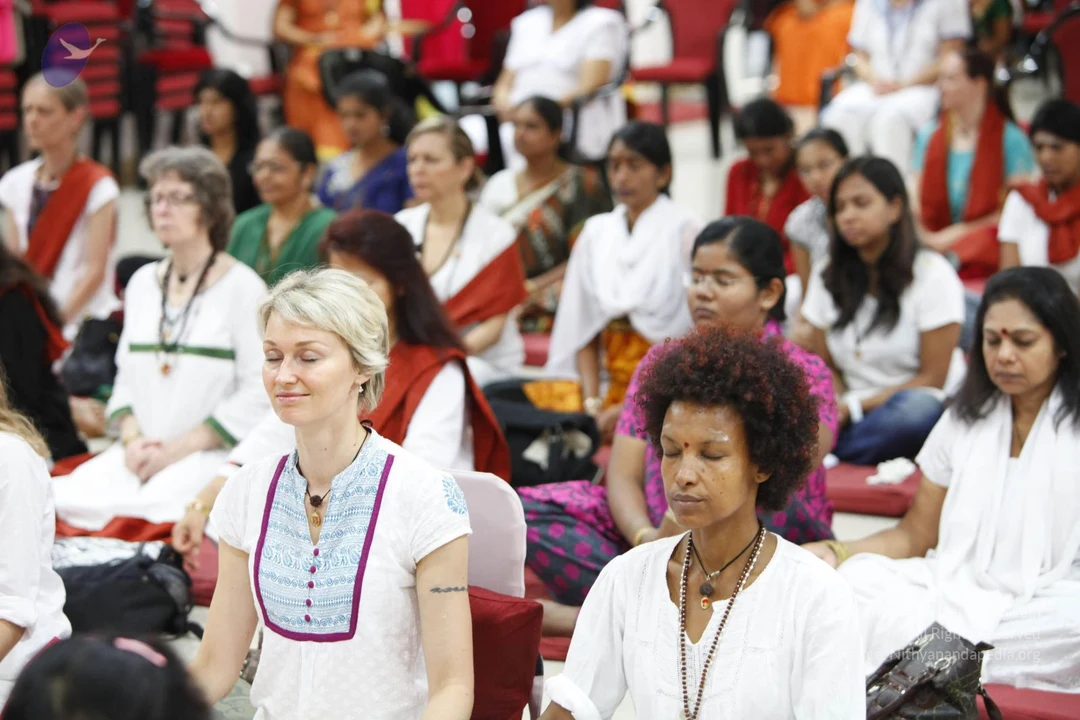
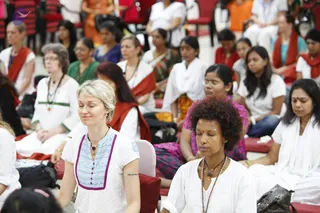
Photograph of a seated congregation at a satsang in a bright hall, many attendees in white clothes with red or orange shawls. In the foreground, a woman with short blonde hair in a white embroidered top with purple trim sits with eyes closed, beside a woman with curly red-brown hair in white with a rudraksha mala and pendant, eyes closed in meditation. Behind them, women in saris and white shawls, a woman in a pink outfit, and rows of red cushions. No visible speaker or a person candidate is shown in this frame.A man with short dark hair and a small red tilak on his forehead sits with eyes closed in meditation, wearing a white collared shirt, a red shawl printed with mantra text in white, and rudraksha malas around his neck. Blurred seated devotees in white and blue clothing fill the background. a person cues are not clearly distinctive here, so the identity is uncertain and he is described by role as a meditating devotee.

Sarva-Darshan

2 photosSource gallery
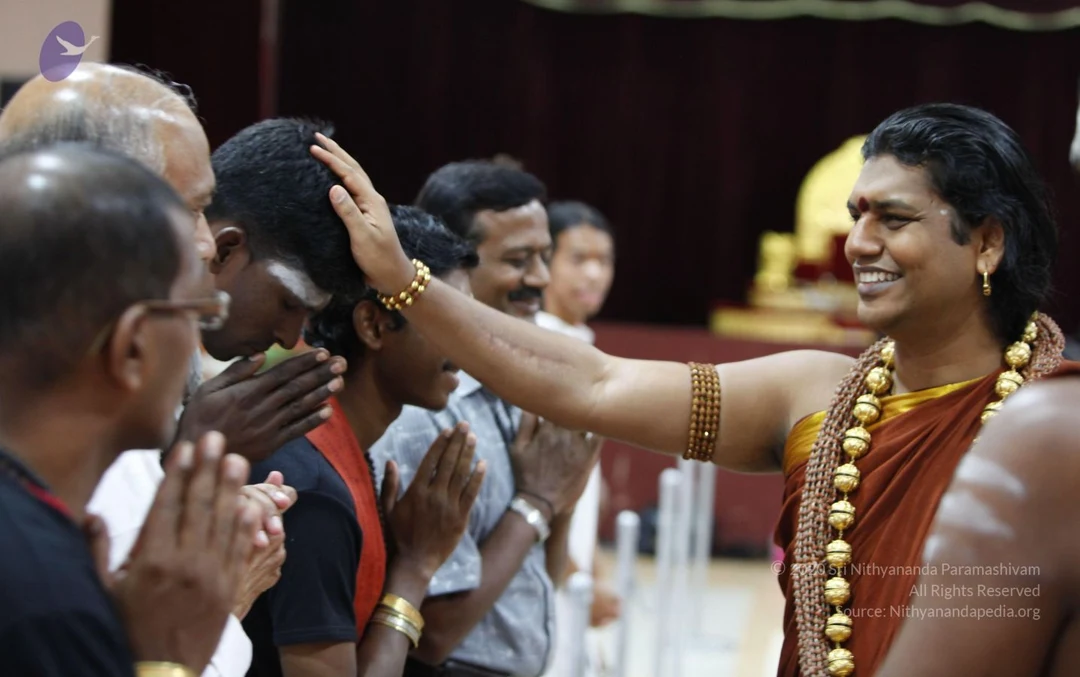
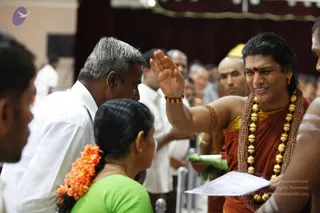
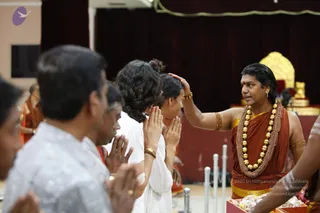
A photograph of a padukapuja-style ritual in a hall with maroon curtains and a golden throne in the background. A man in saffron-orange robes, a thick gold bead necklace with rudraksha-style beads, and gold armlets stands at right, placing his right palm on the forehead of a young woman in white with her hands pressed together in namaste. Her dark hair is tied up in a bun. Several devotees in white and pale clothing stand with palms joined at left, and a tray of offerings and small brass items sits in the lower right. The man is shown with distinctive long, swept-back hair and ceremonial gold adornments, consistent with a person, giving blessing to a devotee.A photograph of a satsang setting where a man in a rust-orange wrap and a thick gold bead necklace with a rudraksha-style strand stands on the right, smiling and placing his right hand on the head of a kneeling young man in a black shirt with a red sash. Several devotees with their palms pressed together stand in a line on the left, including an older bald man in white and a man in a grey shirt with a wristwatch. A gold-and-red throne is visible in the blurred background behind a dark red curtain. The bead-necklaced man, with long swept-back hair, a crown-like adornment, gold bangles and an orange garment, has distinctive ceremonial cues, so he is presented as a probable Swamiji. The people on the left and the young man are devotees receiving blessing. Visible white ash marks appear on several foreheads and arms.

Temple
19 photosSource gallery
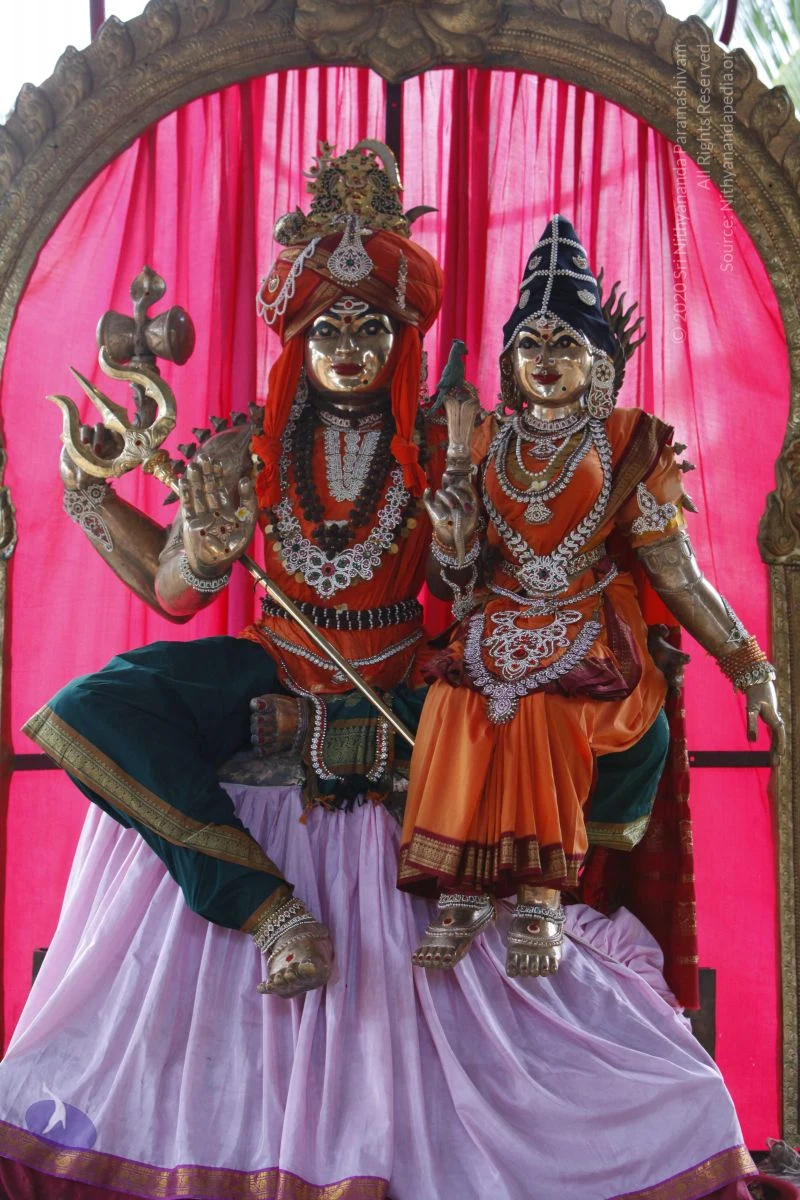
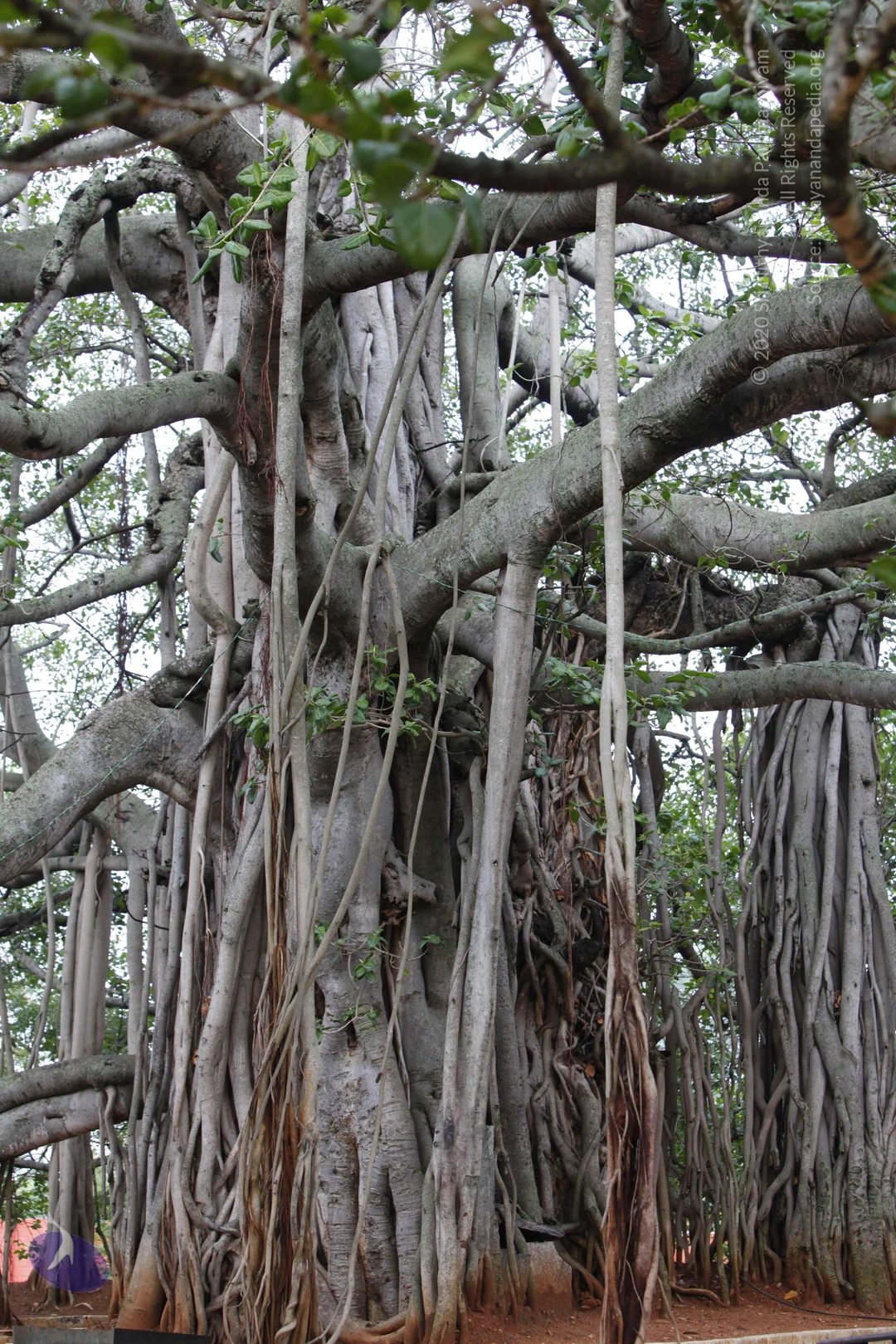
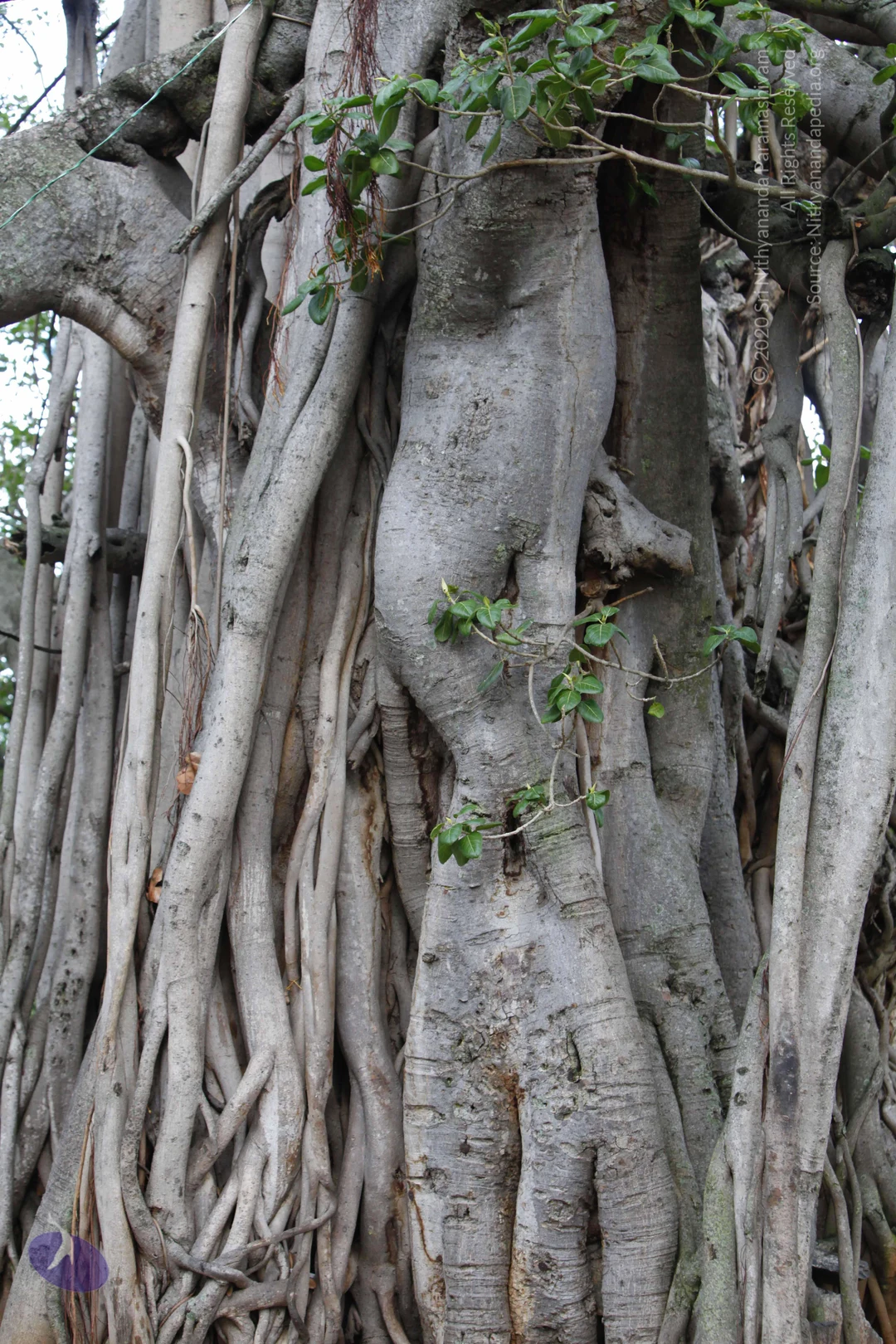
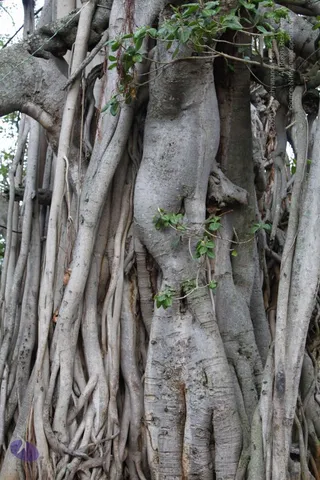
Two large metallic deity murtis sit side by side on a pale lilac draped platform before a bright pink curtain set within an ornate golden arched frame. The male figure wears an orange-red turban with a crown-like ornament, an orange-red garment, dark green trousers, a dense rudraksha mala and layered silver necklaces, and holds a trident in one raised hand. The female figure wears a dark blue crown-like head covering with silver pearl strands, an orange saree with gold border, layered silver necklaces and bangles, and holds a small green parrot-like bird perched on a rod. Both figures have silver-toned faces with painted features and elaborate silver jewellery. The murtis are statues, not living people.Two life-sized metal murti statues of a seated deity couple sit side by side within a gold arched frame against a bright pink drape. The figure on the left holds a trident in one hand and wears a red-orange turban, rudraksha mala, white garland and dark green trousers. The figure on the right wears an orange sari, a dark blue-black crown-like headdress, silver necklaces and bangles. Both sit on a pale lilac cloth-draped seat. The statues are adorned with silver ornaments and garlands. No living people are visible.A black stone statue of a multi-armed deity seated in a cross-legged pose on a rocky pedestal carved with small figures. The murti wears a red turban with a red-and-gold brocade garment, layered rudraksha malas and white pearl necklaces, and has a red tilak on its forehead. Its upper hands hold a trident-like weapon and a drum or ritual object, while lower hands rest in front of the body. Behind it hangs green fabric printed with gold motifs.A black stone statue of a multi-armed deity seated in a meditative pose on a carved stone base, against a green cloth backdrop with gold floral motifs and an ornate white carved arch. The figure wears a red headwrap with a red bindi, a red and gold brocade dhoti, layered rudraksha and white pearl malas, a gold pendant with green and red stones, and pearl bracelets. One hand is raised in abhaya mudra and another rests on the lap. Carved figures and a seated figure decorate the base. This is a statue, not a living person, so no physical people are visible.Close-up photograph of a large banyan-type tree trunk with many grey, smooth aerial roots and prop roots intertwining and descending around a thicker central trunk. Small green leaves sprout from a fork in the bark, and a few dry brown strands hang from the upper branches. No people, statues or ritual objects are visible; the scene is purely arboreal, with a faint purple circular logo at the lower left.A dark stone statue of a seated deity murti with a red turban and a small red tilak on the forehead. The figure wears layered beaded necklaces of brown and white beads, a large ornate pendant, a red and gold brocade dhoti and an orange sash. Its raised hand holds a trident-like staff and it rests on a carved stone base with reliefs of seated figures beside a green and gold cloth backdrop and a silver-toned carved arch. The statue is shown outdoors among trees.

1-Temple
1 photoSource gallery
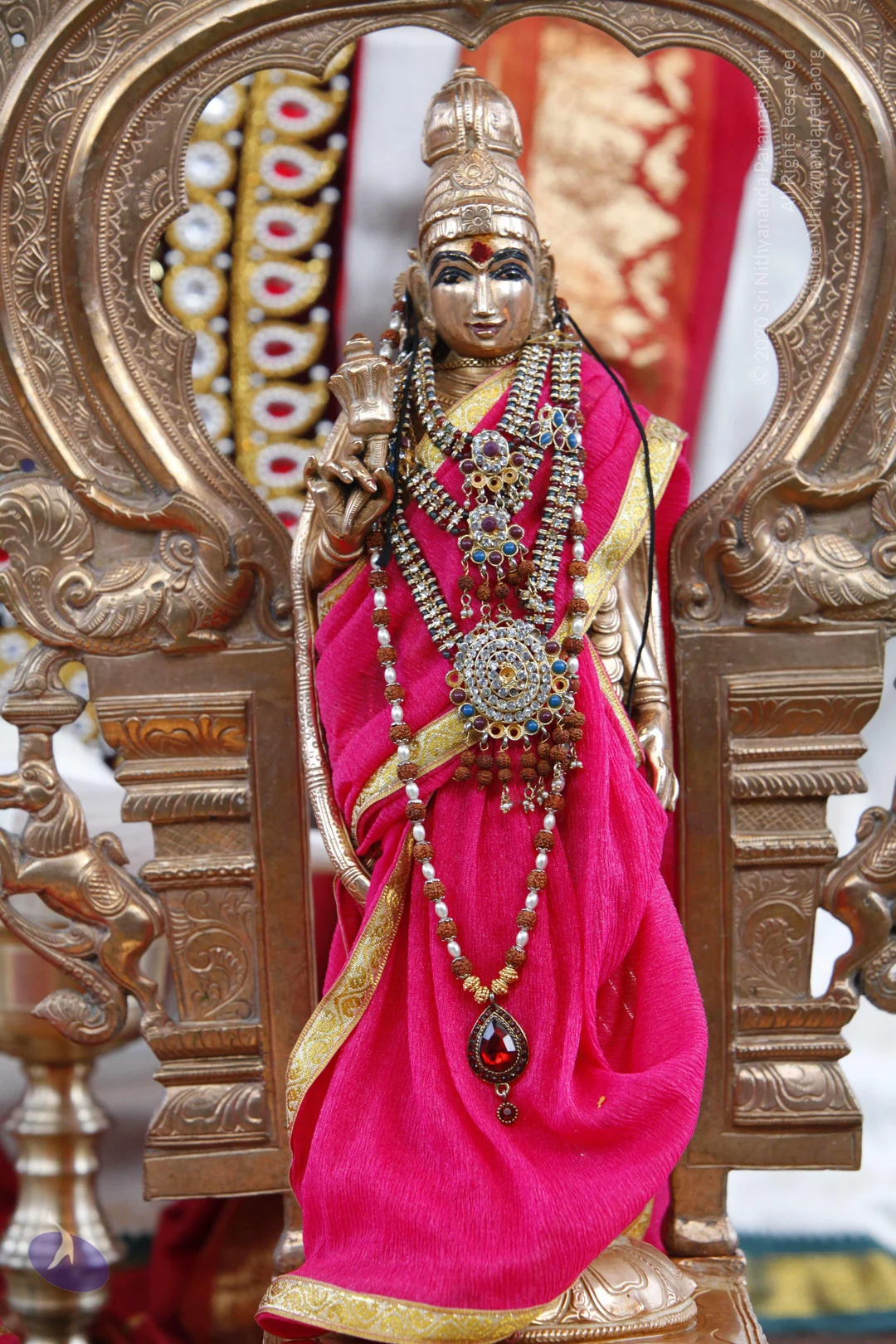
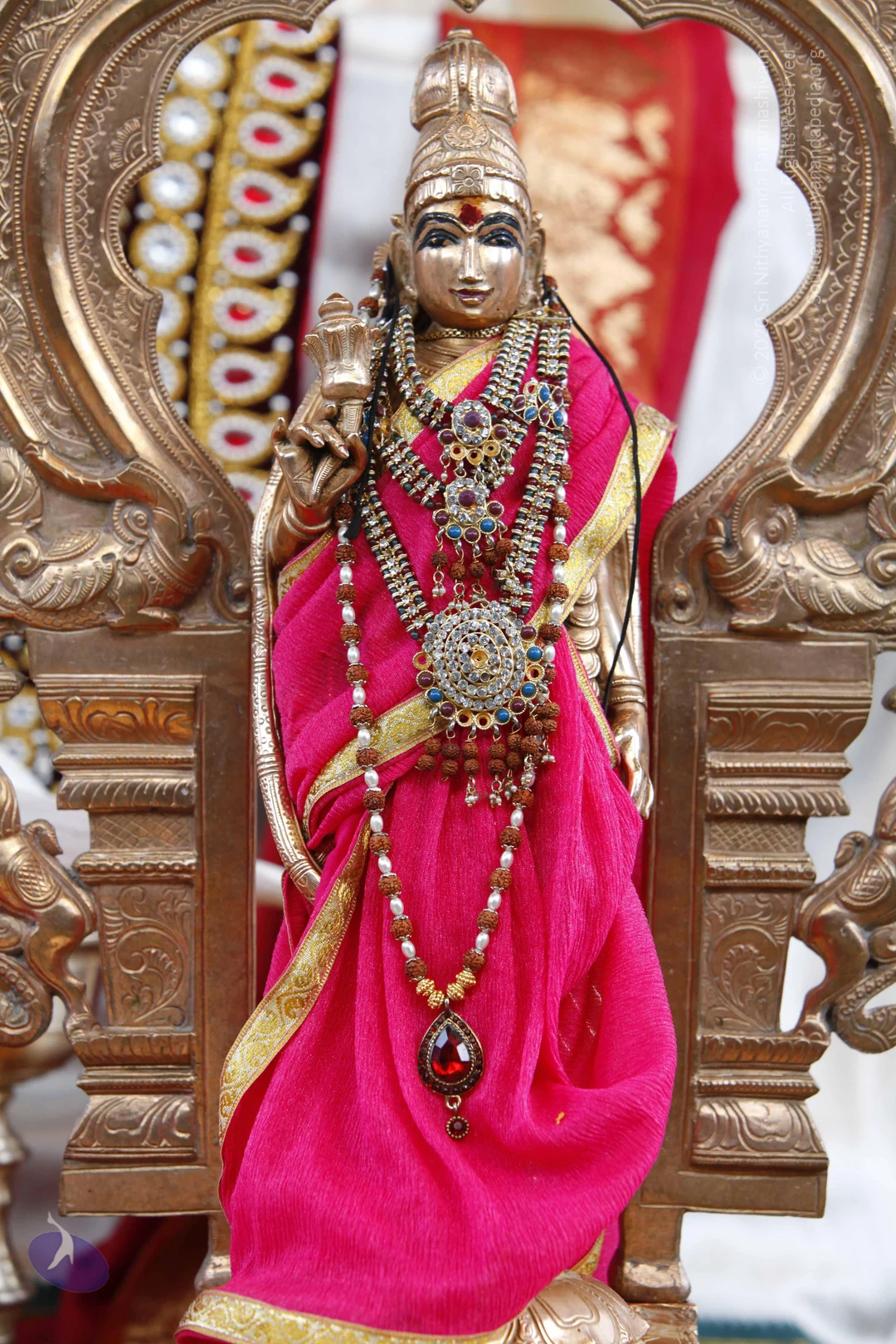
A bronze-gold metal deity murti stands in an ornate golden arched niche with carved peacock-like motifs. The figure wears a tall crown, a red tilak, and is draped in a hot pink sari with a gold woven border. Layered necklaces of gemstone-set gold pendants, rudraksha beads and pearls hang on the chest, with a red teardrop stone pendant at the bottom. The murti raises one hand holding a small ceremonial object, and the background shows red and gold embroidered fabric with white and red jewel-like trim.

May 31 2013

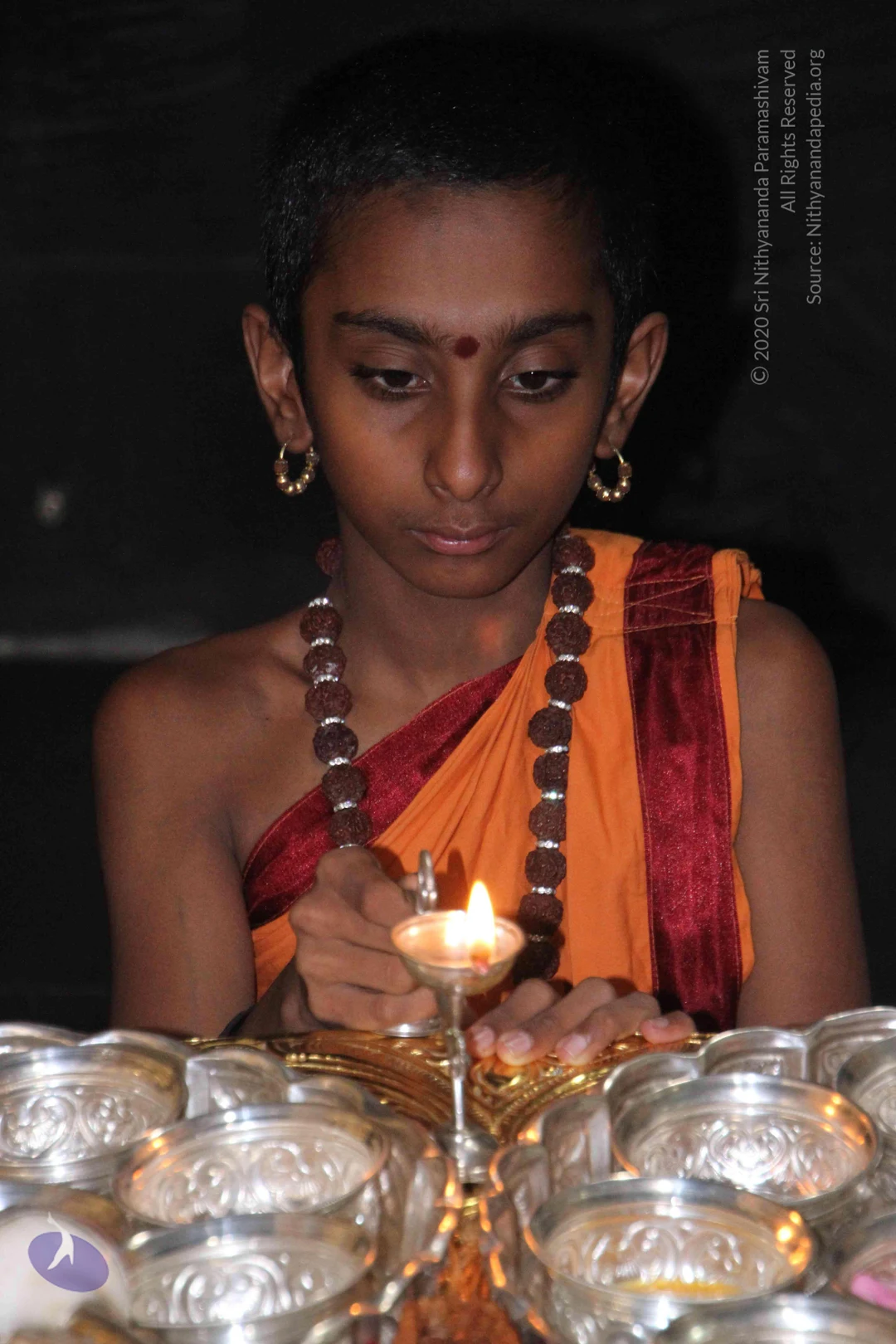
1 photoView all
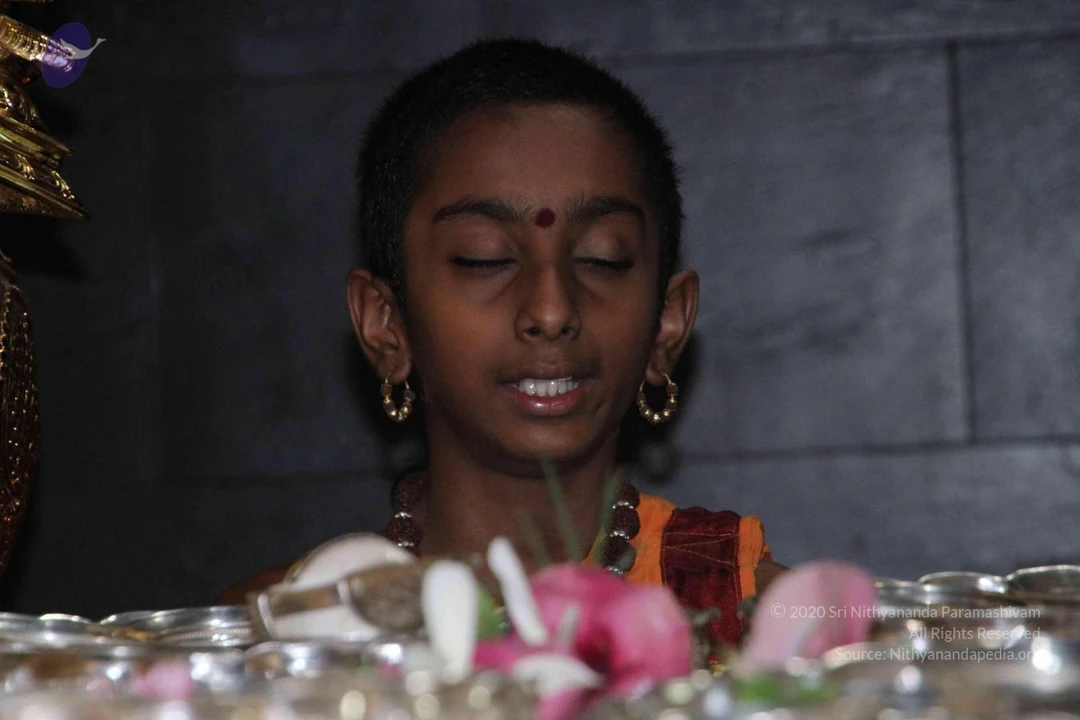
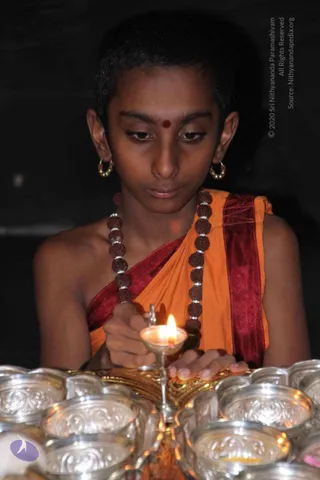
A young boy with short dark hair, a red bindi and gold hoop earrings sits at a metal tray lit with a single oil lamp he holds in his right hand. He wears an orange garment with a deep red border and a long rudraksha mala with silver spacers. Around him, several ornate silver bowls with floral engraving hold offerings in a dim setting.