Skip to content
Saturday

23 March 2013

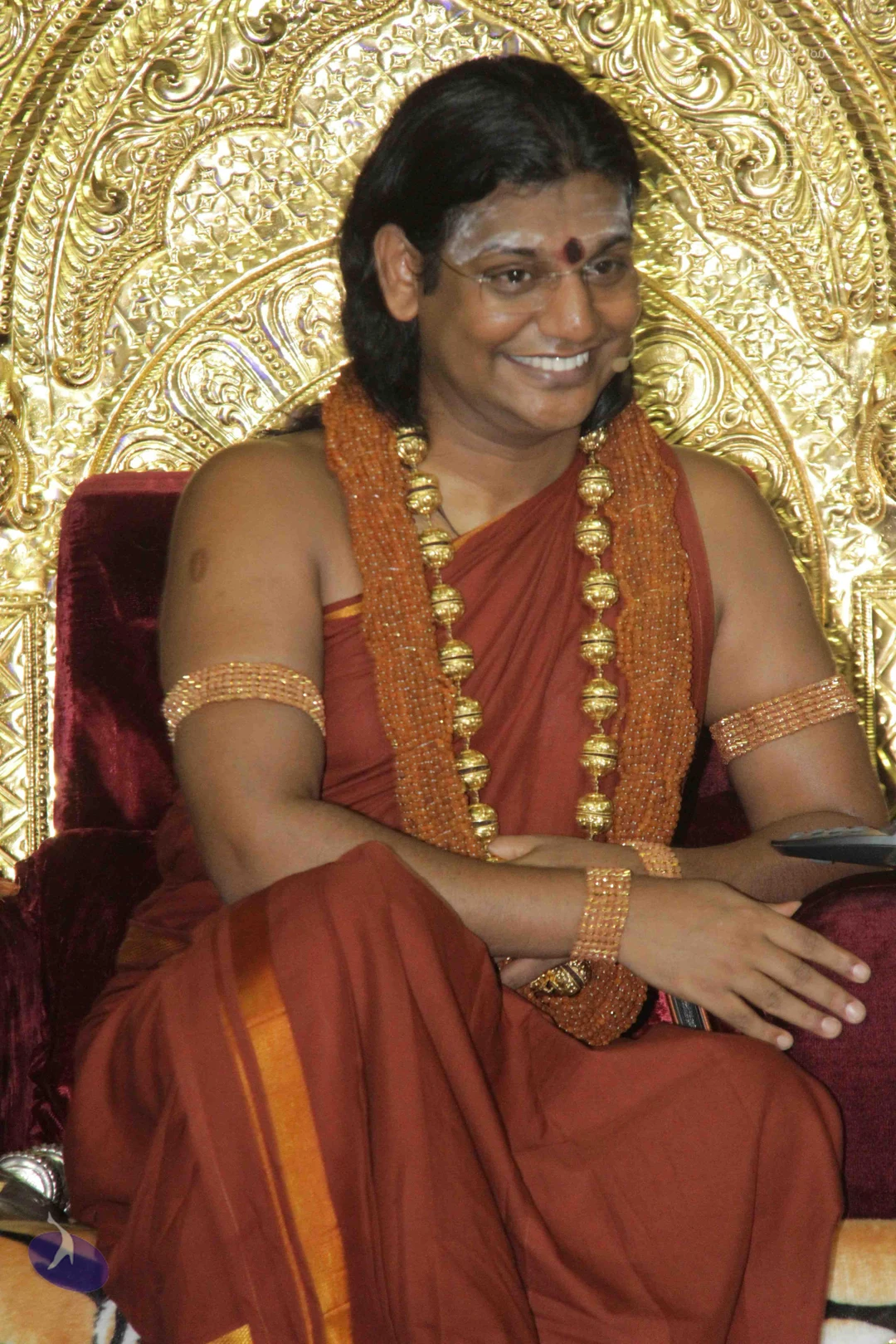
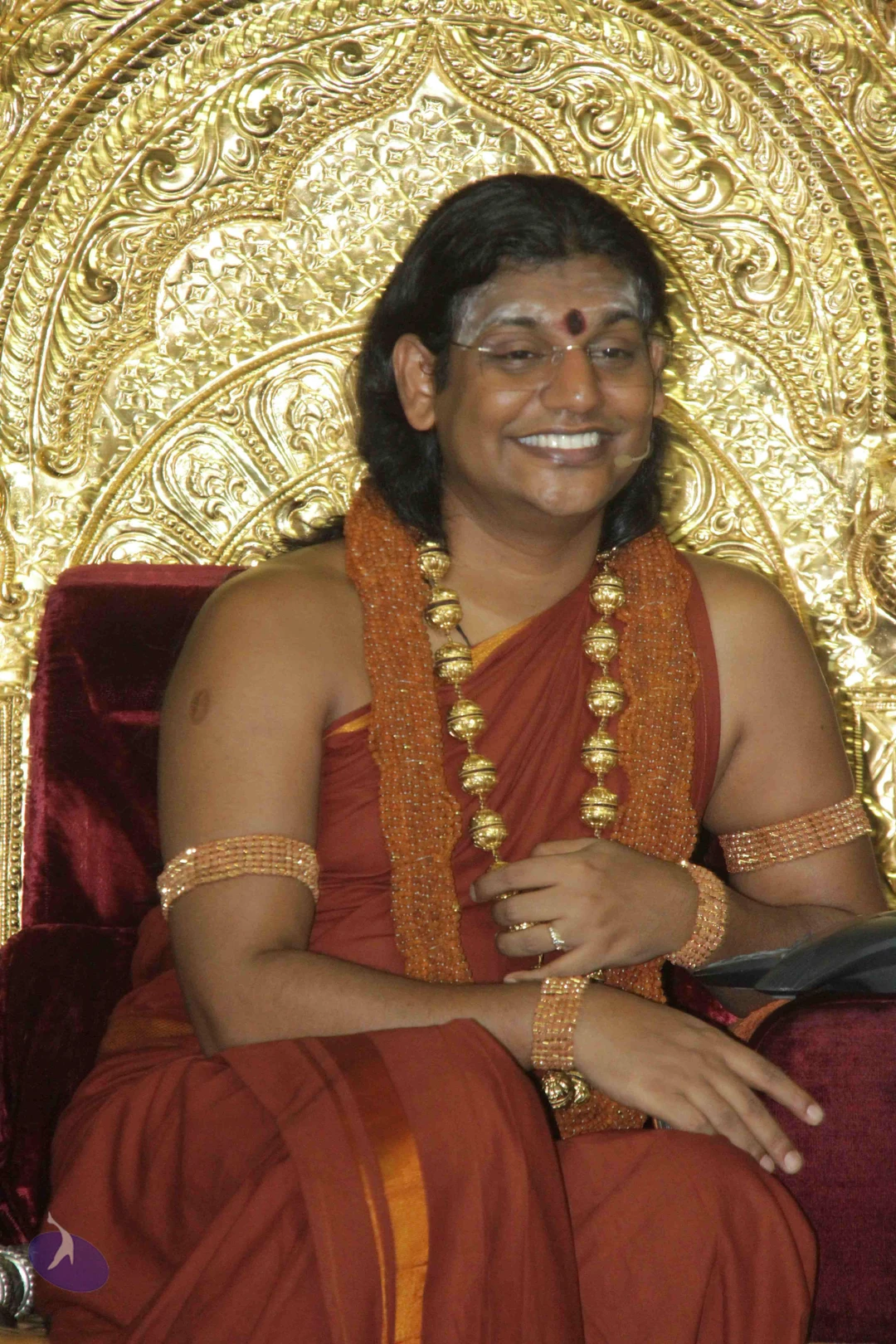
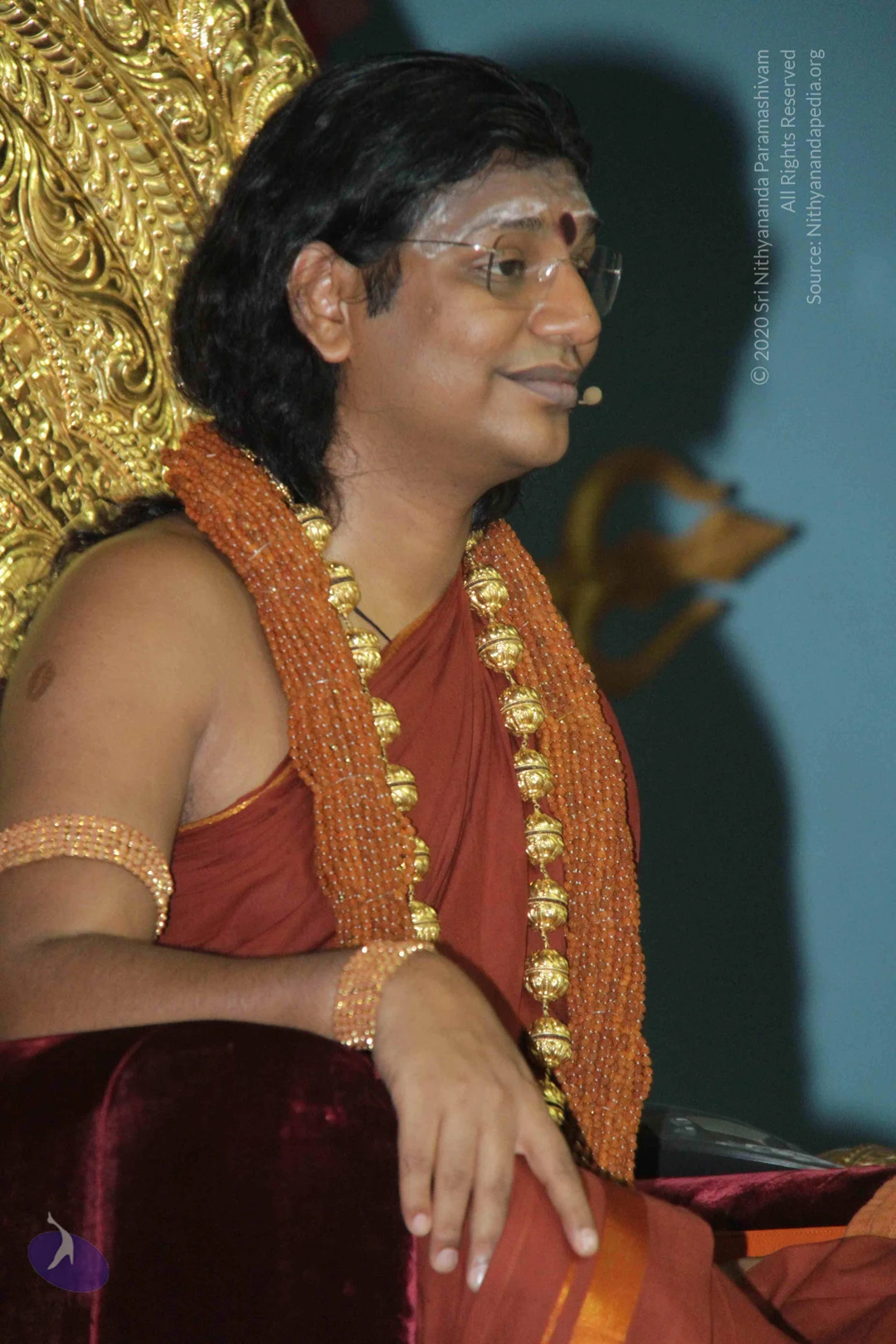
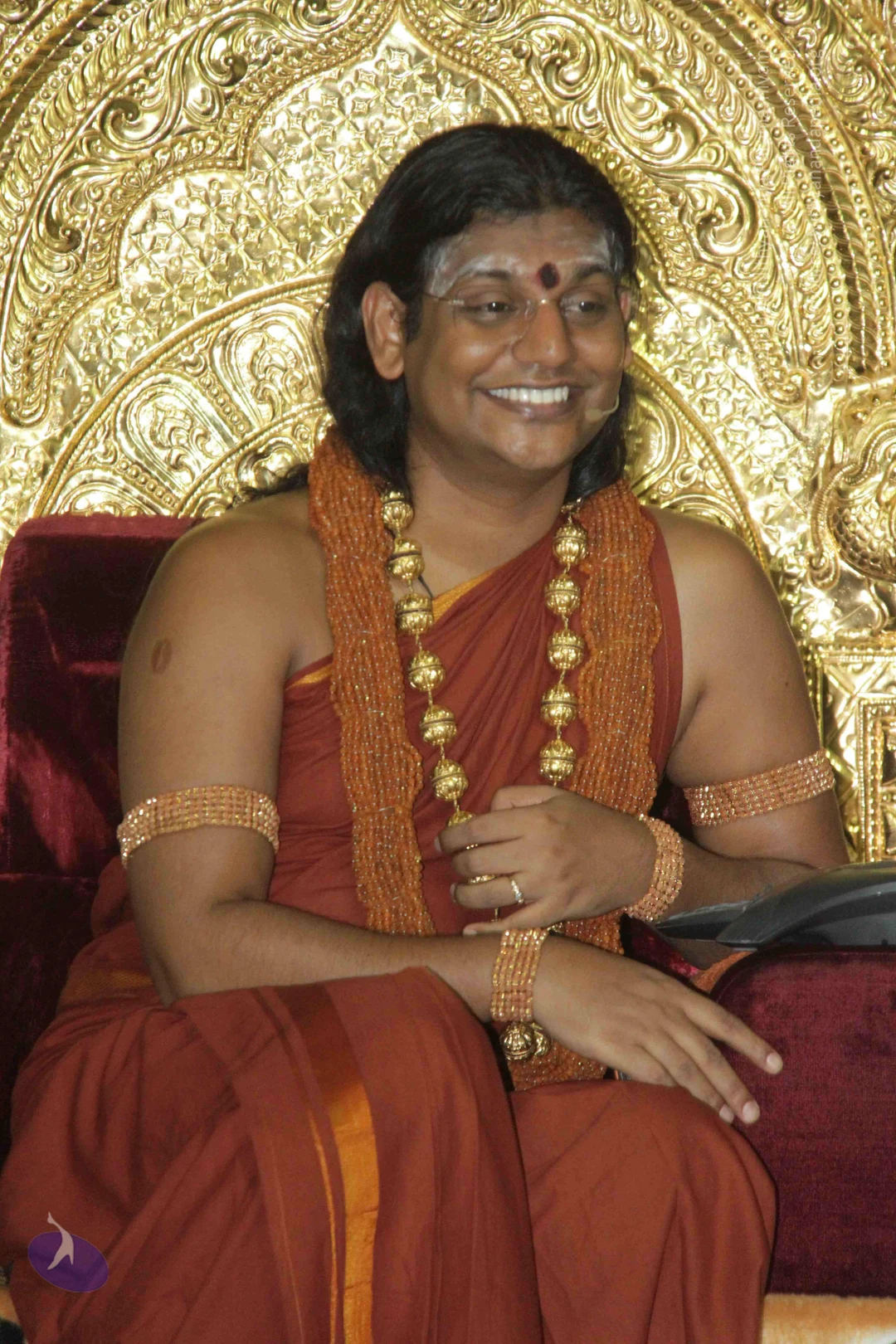
THE SUPREME PONTIFF OF HINDUISM, BHAGAVAN NITHYANANDA PARAMASHIVAM

Dated photos
187
Source pages
1
Media
4
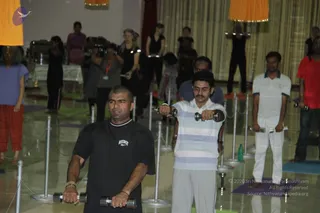
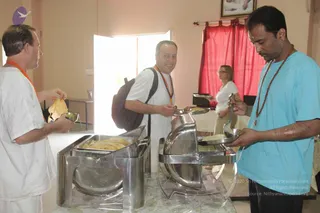
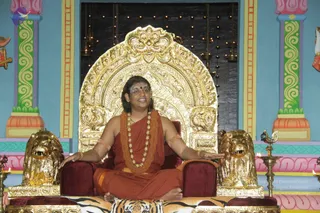
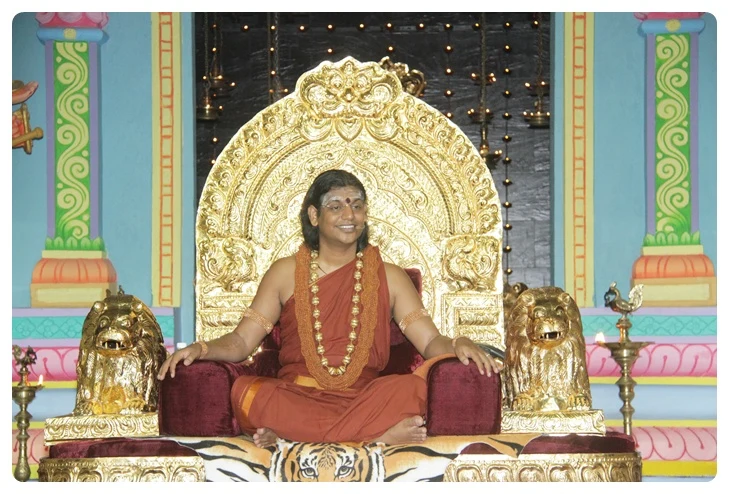
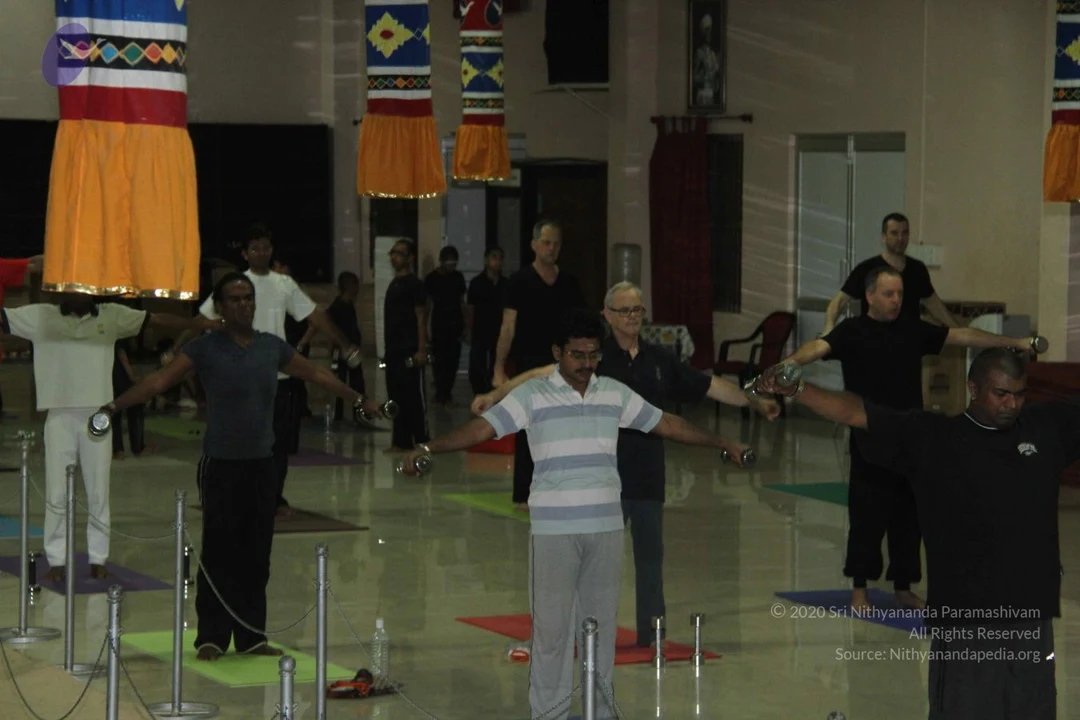
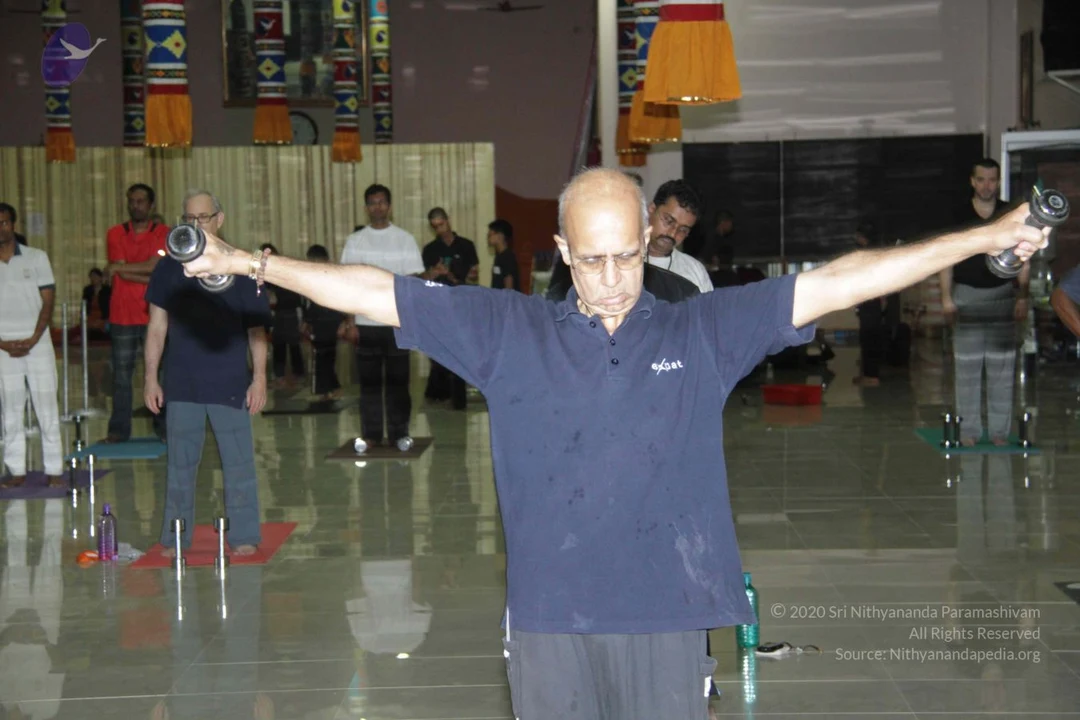
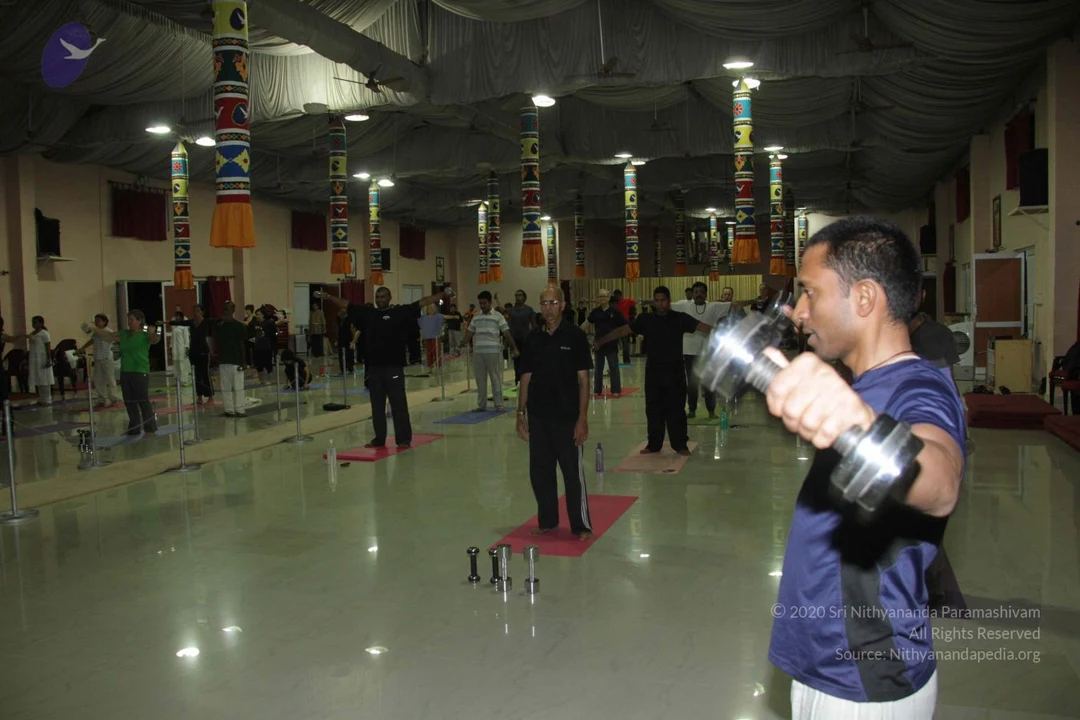
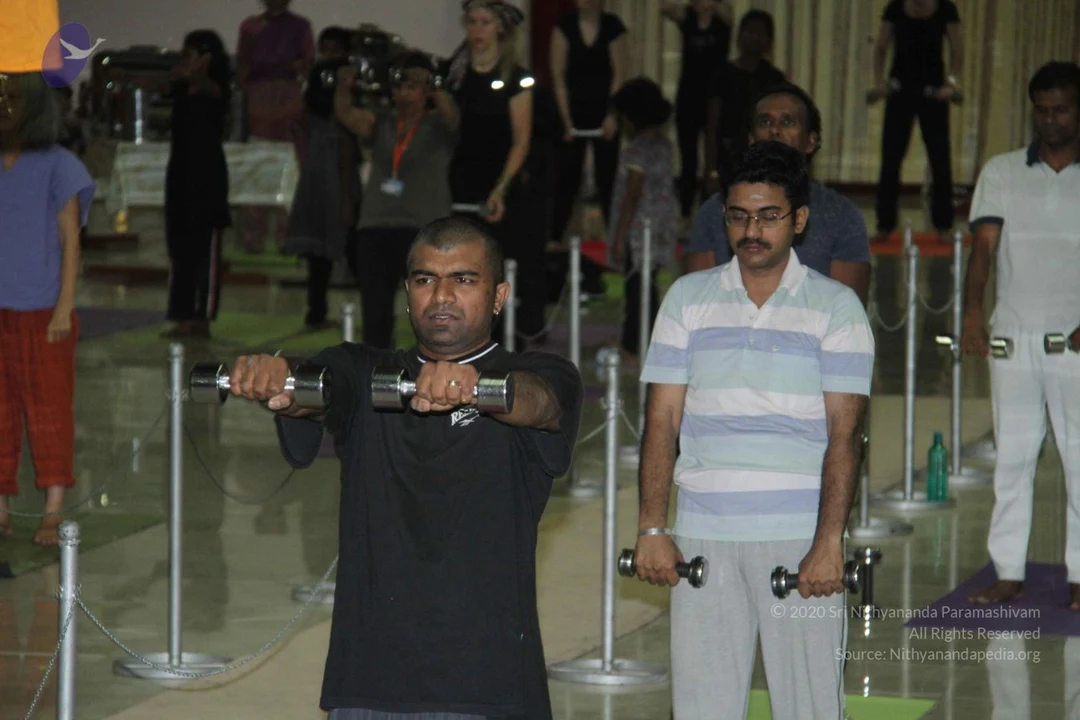
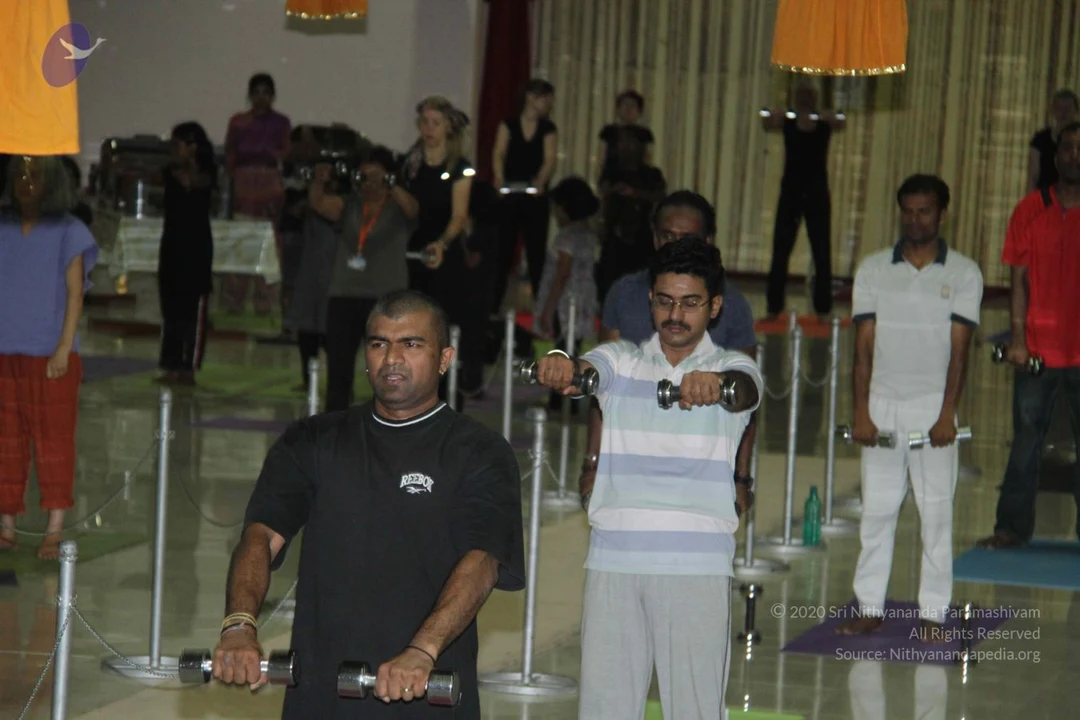
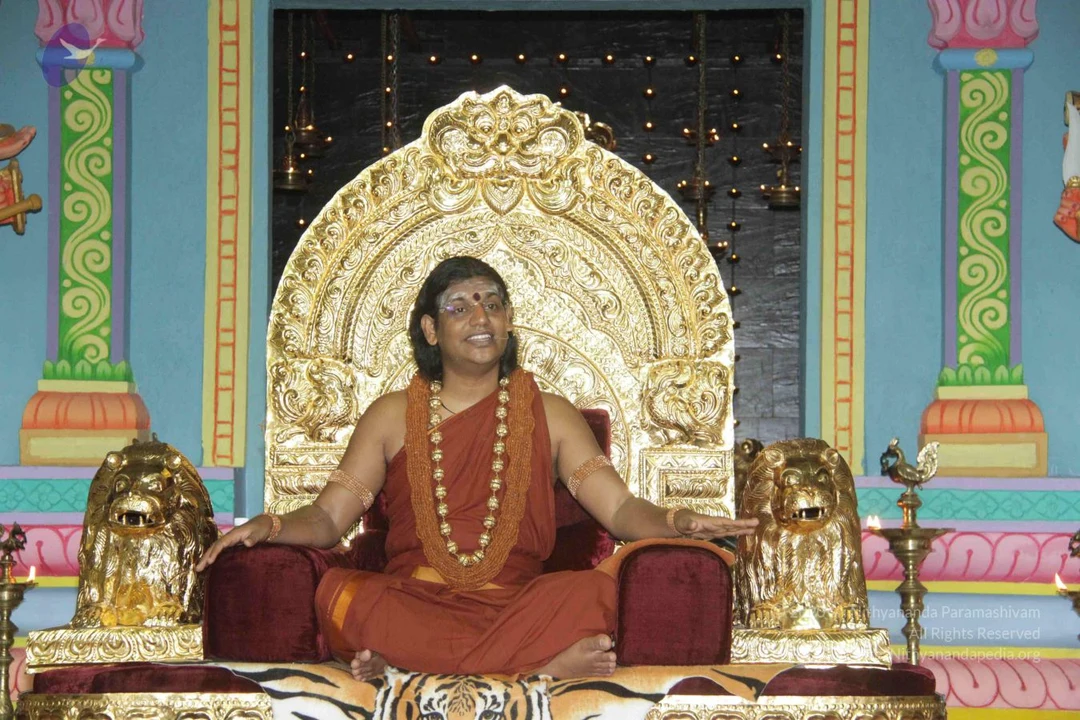
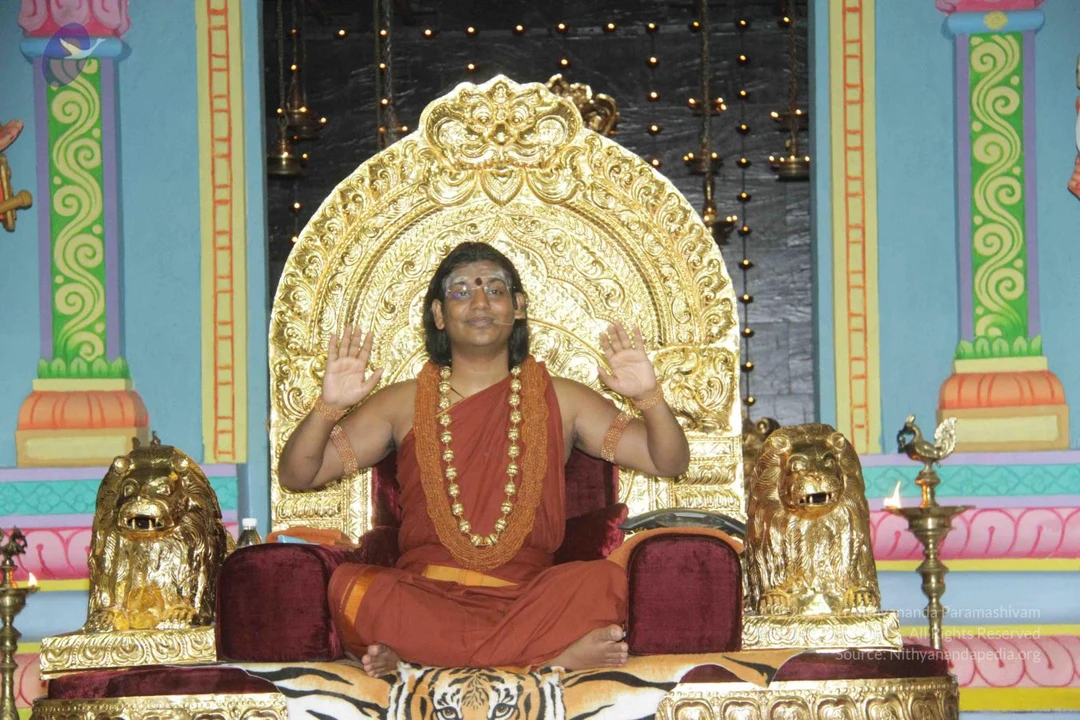
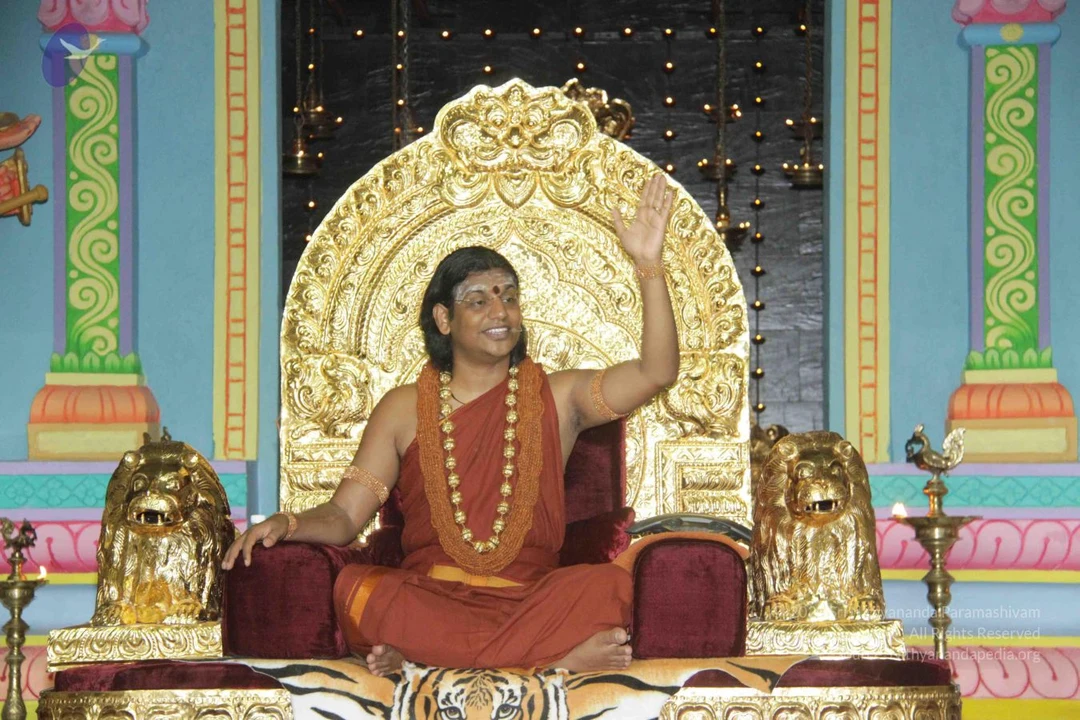
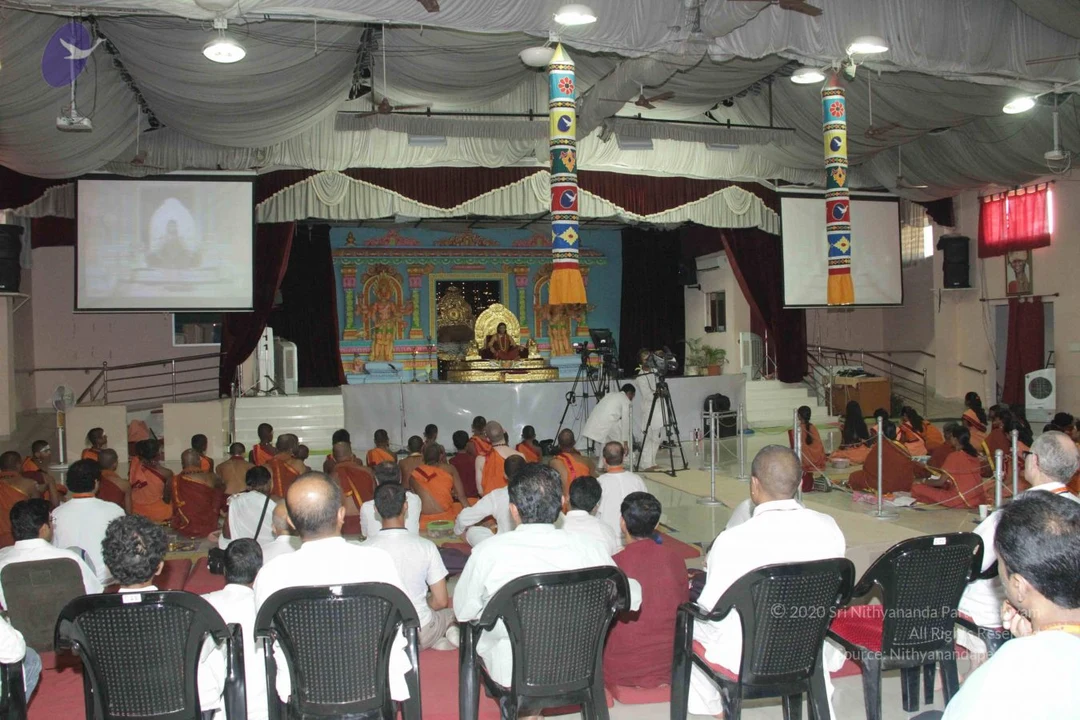
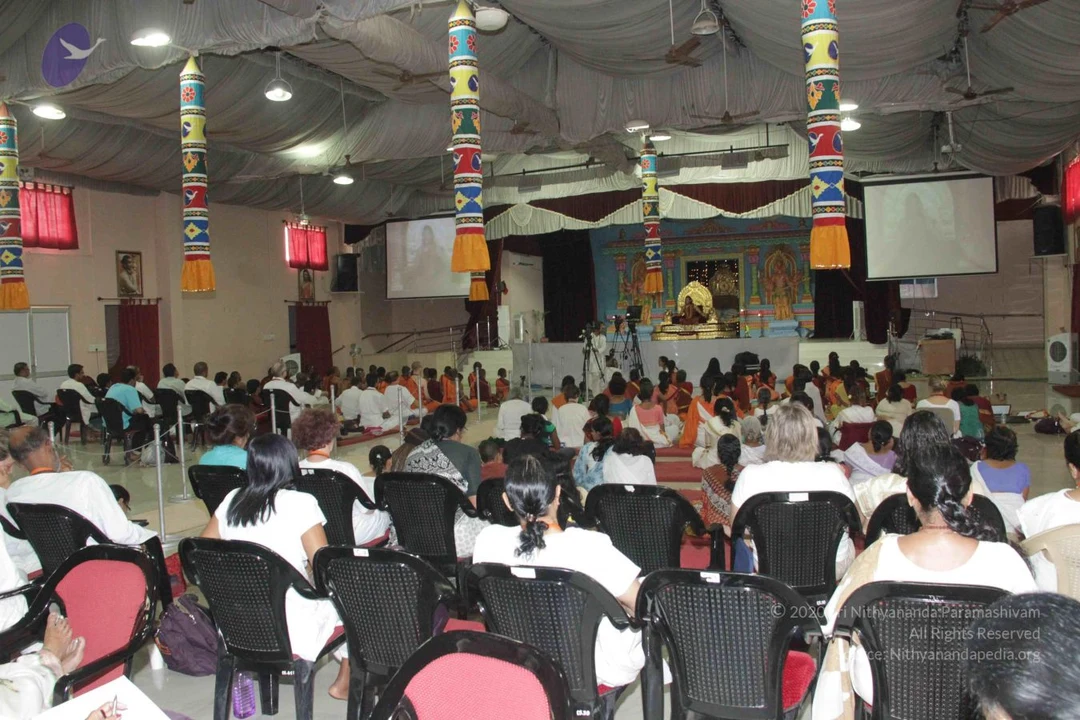
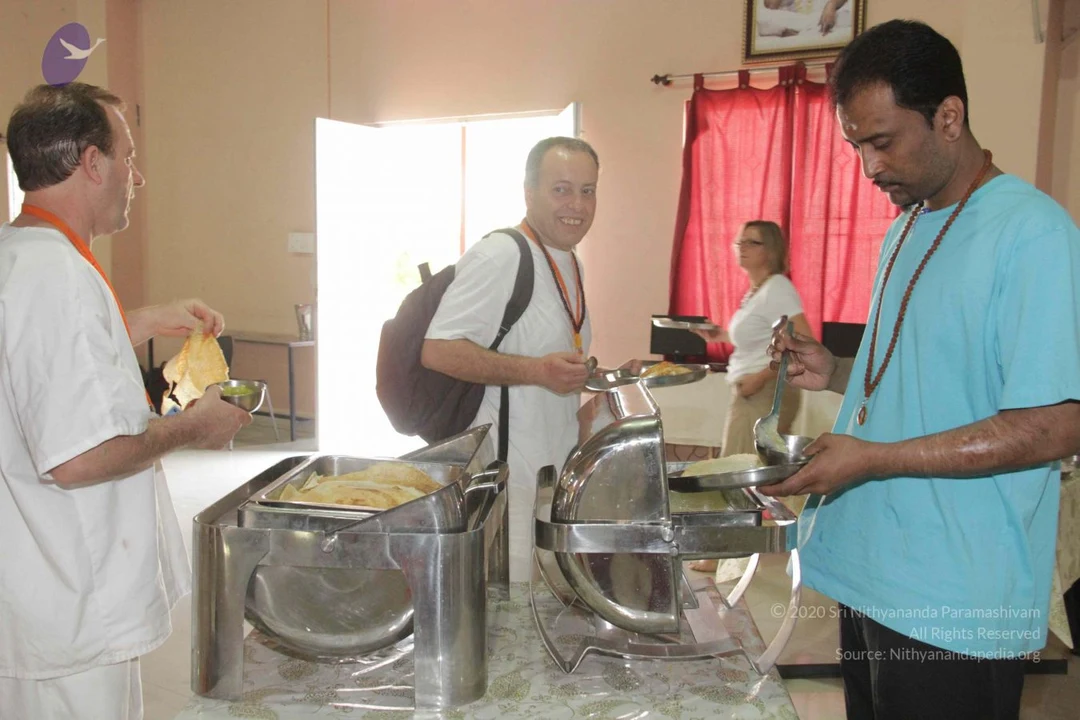
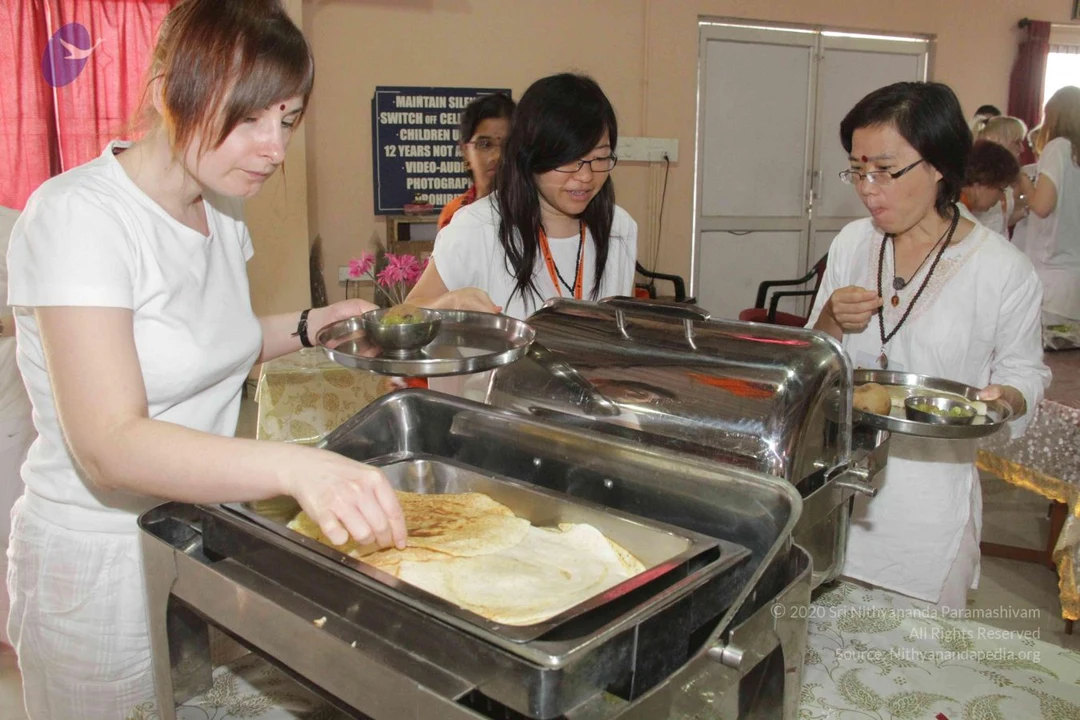
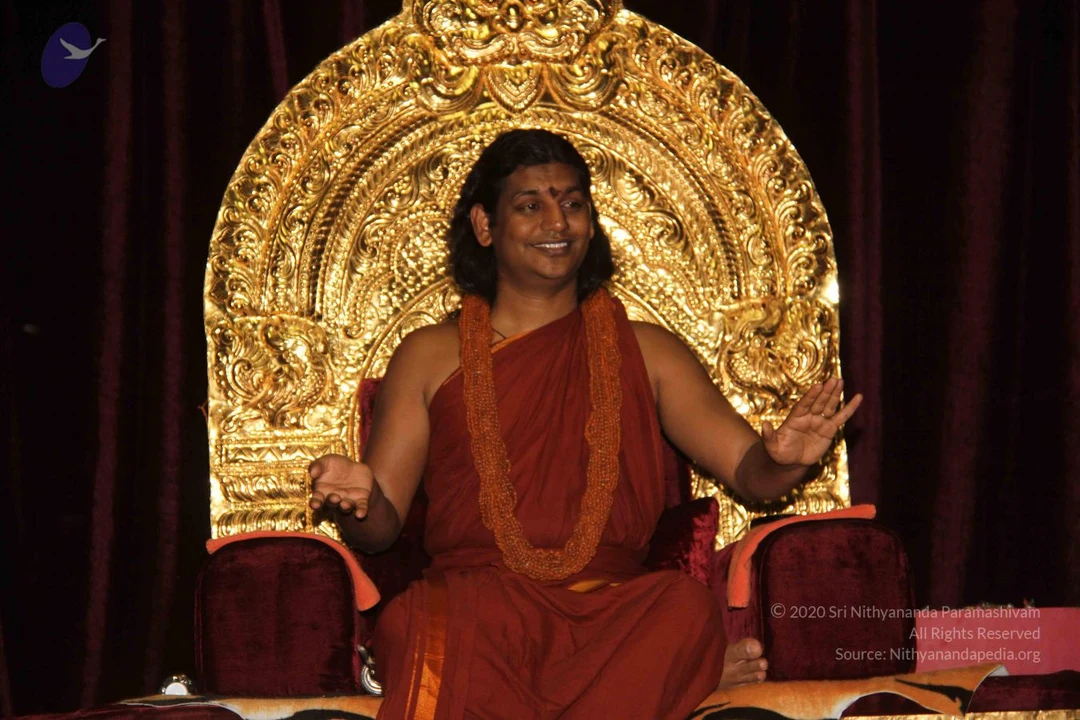
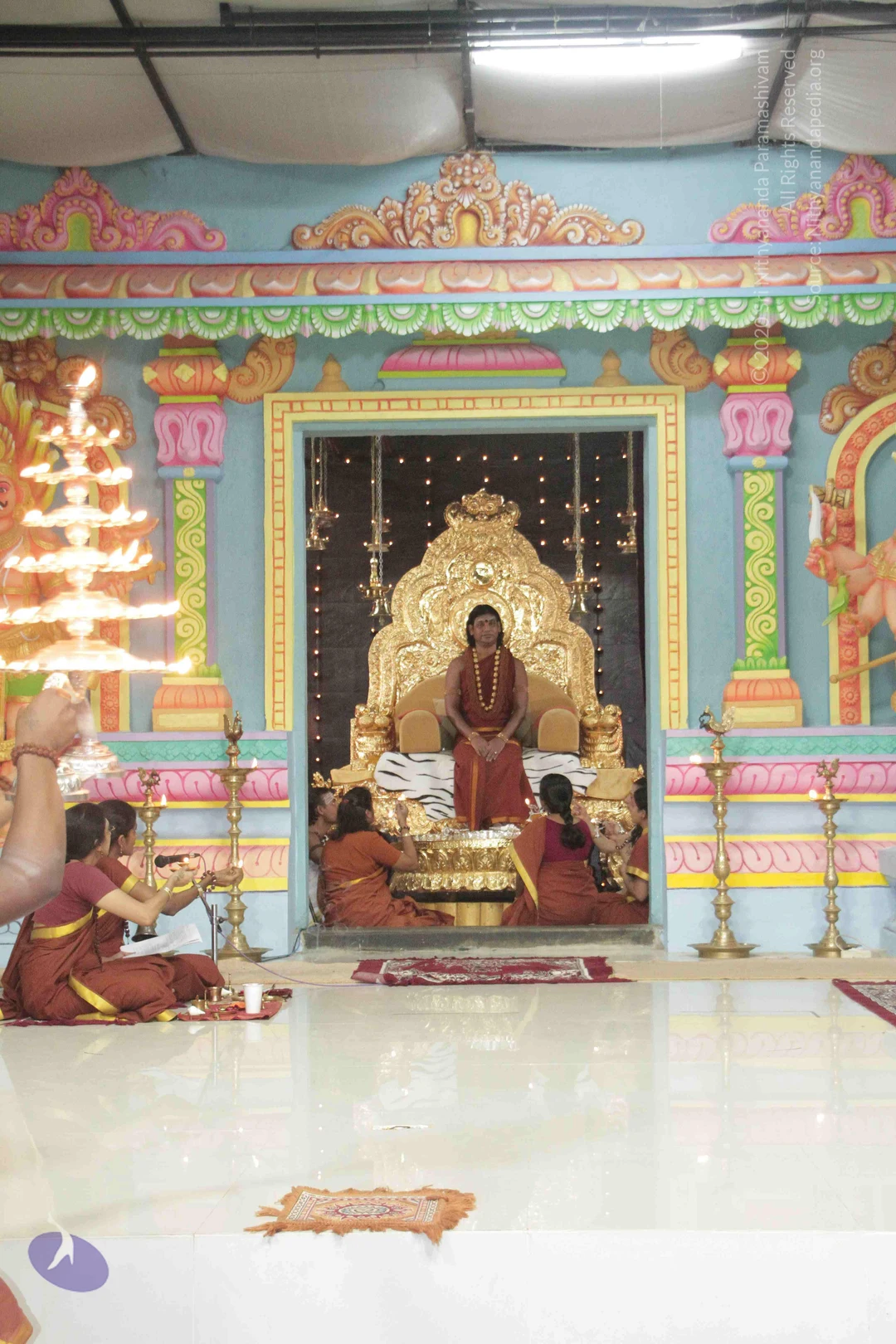
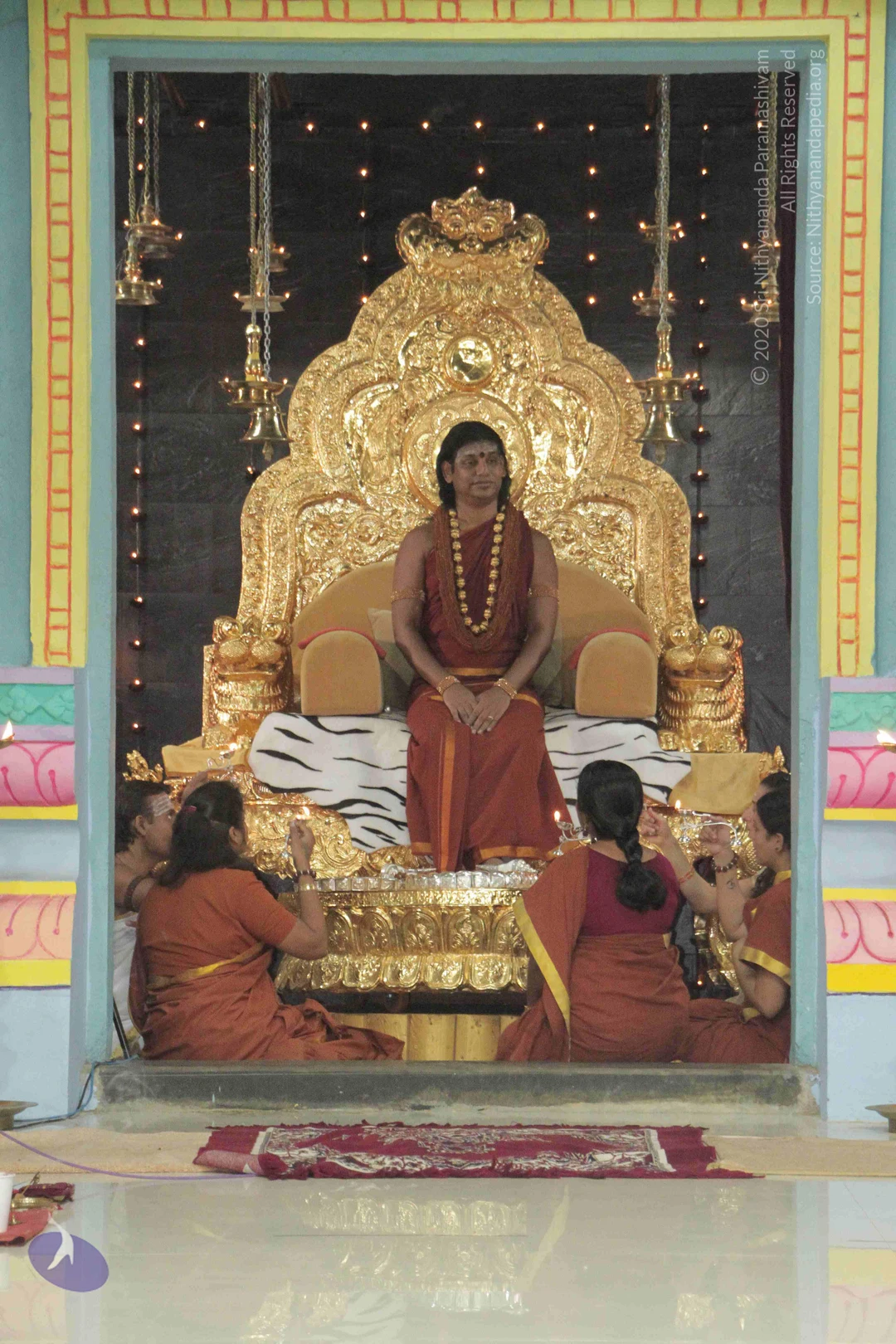
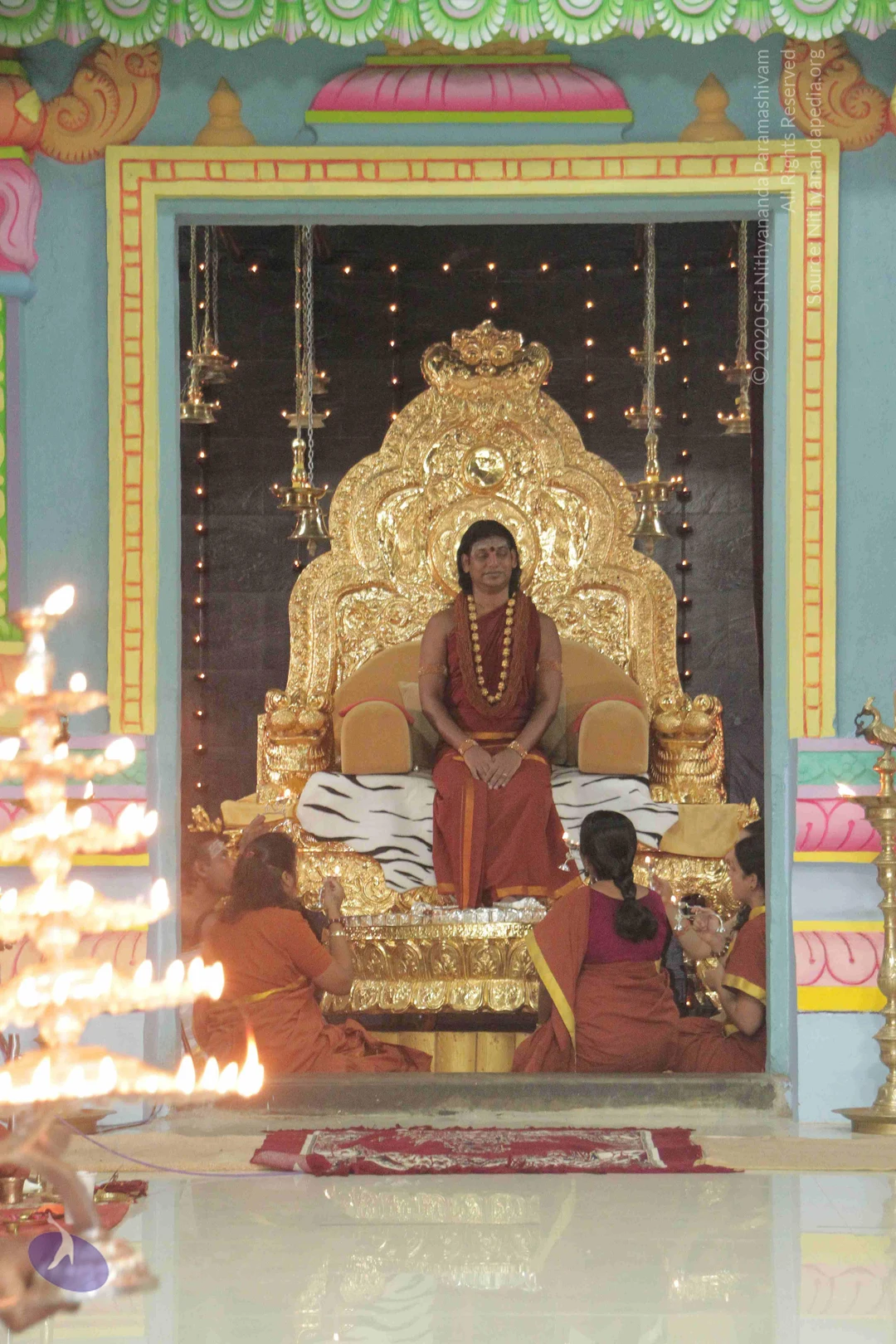
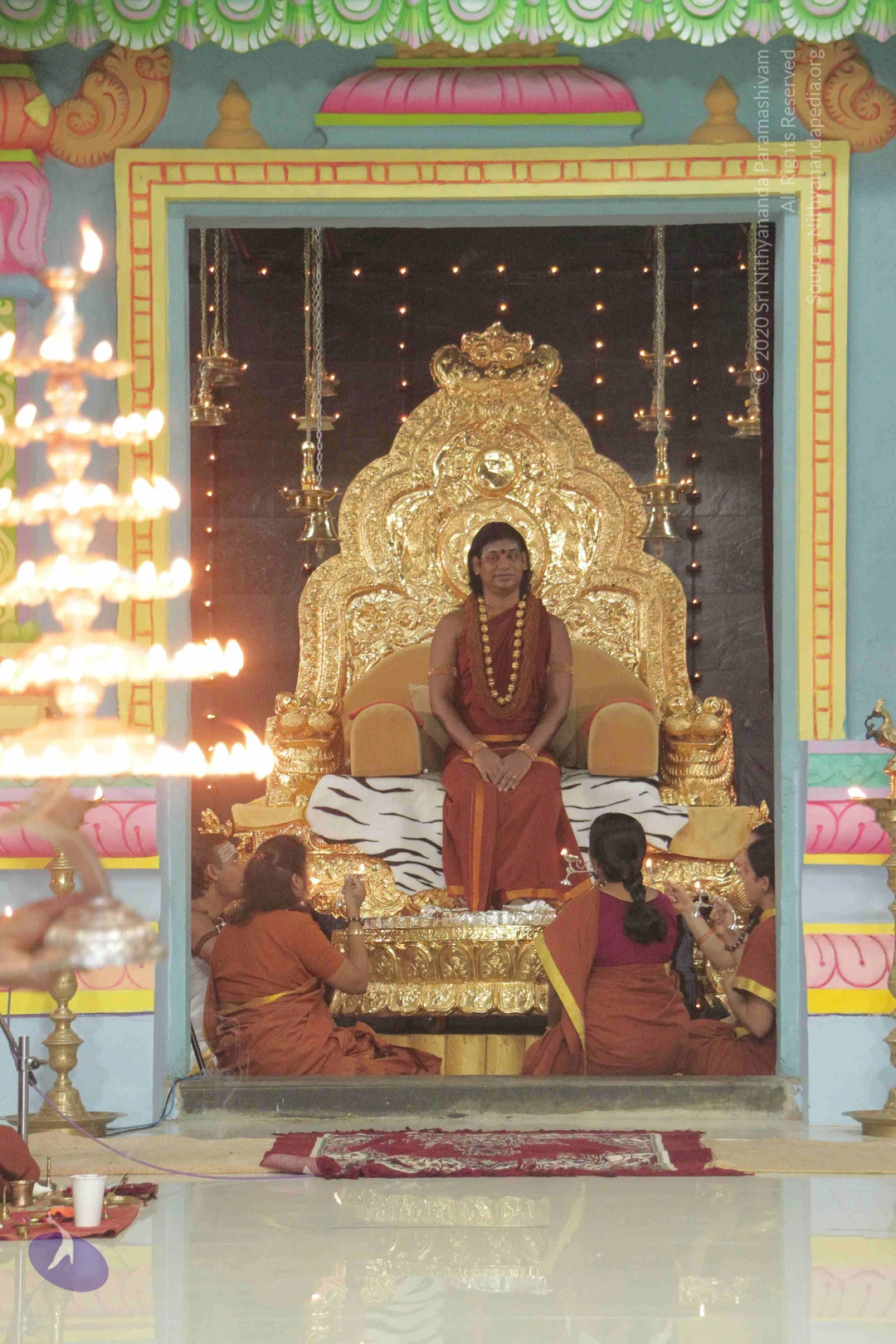
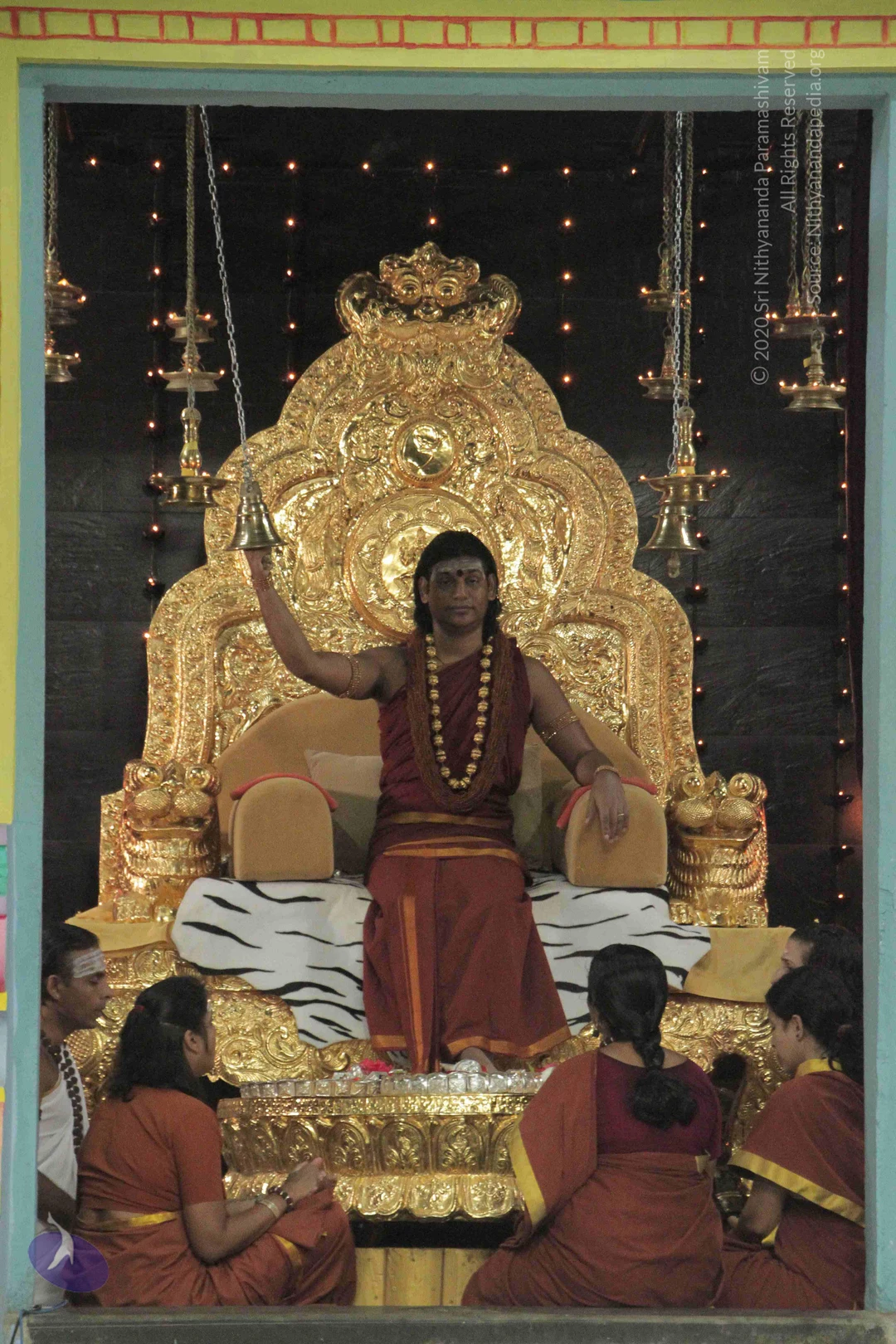
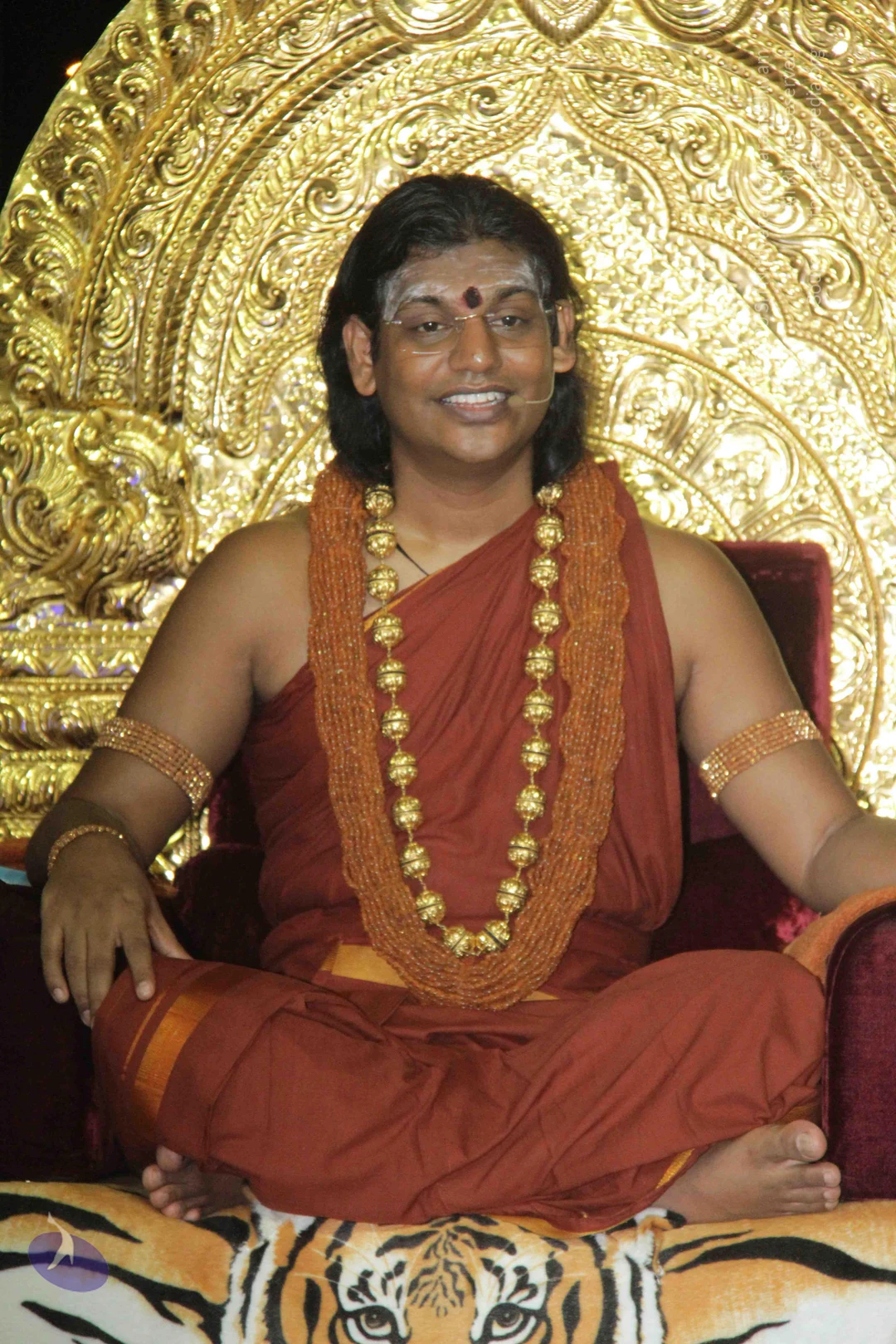
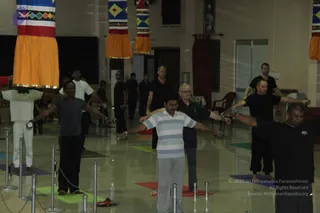
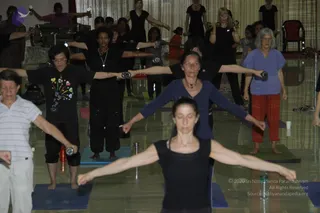
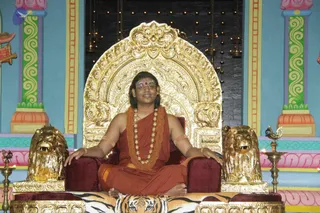
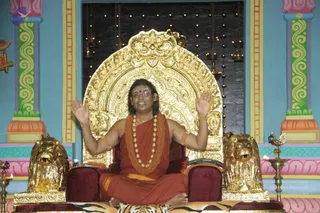
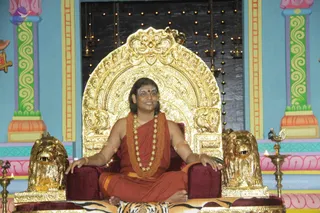
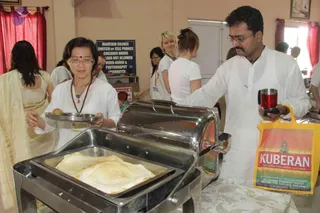
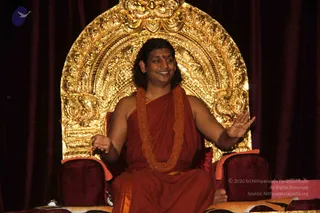
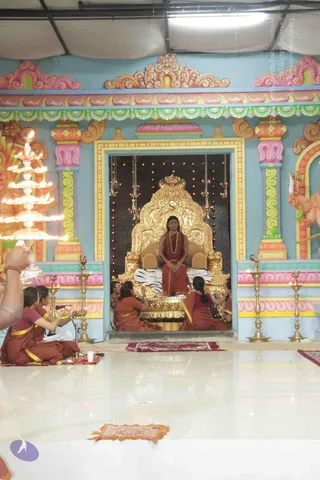
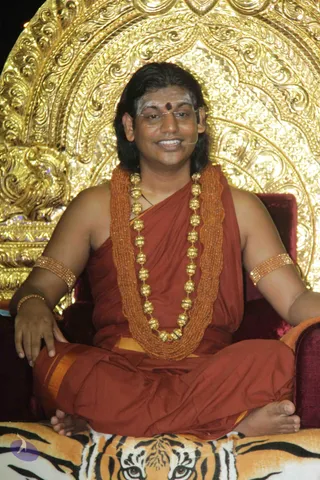
A photograph of a hall where participants stand in a row lifting small hand weights in front of them. In the foreground a man in a black Reebok t-shirt with a shaved head holds dumbbells, beside a man in a blue and white striped polo and grey trousers with glasses and a moustache. Further right a man in a white shirt and white trousers and another in a red shirt also lift weights. Behind them a woman in a black top and a woman in a purple top stand, and a cameraman in a grey jacket films. Orange drapes hang from the ceiling and a mat lines the glossy floor.A photograph of a buffet serving line in a plain room with peach walls and red curtains. Three men help themselves from stainless steel chafing dishes holding flatbreads and food. On the left, a man in white clothes and an orange cord holds a piece of bread. In the centre, a smiling man in a white t-shirt with a dark backpack and an orange lanyard holds a plate. On the right, a man in a turquoise t-shirt and rudraksha mala spoons food onto his plate. A woman in white stands in the background near the curtains.A seated man in saffron-orange robes sits cross-legged on a tiger-skin-covered platform before an ornate golden throne with a large arched backrest. Two gilded lion sculptures flank the seat, and he wears a long beaded gold necklace and a rudraksha-style orange mala, with gold armlets and a red tilak on his forehead. He extends both arms outward while speaking. Hanging brass lamps and small oil lamps stand in the background against a painted blue, green and pink temple-style wall.

March 23 2013

Original wiki page
Contents

Title

THE SUPREME PONTIFF OF HINDUISM, BHAGAVAN NITHYANANDA PARAMASHIVAM

Narration

On this day, the Supreme Pontiff of Hinduism (SPH), Bhagavan Nithyananda Paramashivam conducted the Day 11 of the Inner Awakening Convention. During that day’s Presidential Address-Nithyananda Satsang SPH expanded on the Katopanishad Chapter 2, 6th verse: "the blind leading the blind". He observed that when disciples comment to each other about Him they are only discussing their projections of Him, not conscious perceptions. Disciples should learn to think and speak with authenticity and integrity: then they will be using the language of God -- Devabhasha. Linguistically, this language is Sanskrit. As we transform our consciousness, our language also changes to reflect our inner awareness. This spiritual evolution creates the right understanding for renunciation -- sannyas, the monastic lifestyle. SPH shared that one conscious renunciate can neutralize the negative effects of millions of unconscious people. The Kailasa Nation breaks new ground by offering the Sanskrit attitude in English, propounding the Vedic tradition through global communication.

That day’s Presidential Address-Nithyananda Satsang and Inner Awakening Convention were conducted by the Supreme Pontiff of Hinduism Bhagavan Nithyananda Paramashivam on 23 March 2013 in Adi Kailasa, Bengaluru, Karnataka, India.

Description:

In today's morning satsang, Paramahamsa Nithyananda expounds on Katopanishad Chapter 2, 6th verse: "the blind leading the blind". He observes that when disciples comment to each other about Him they are only discussing their projections of Him, not conscious perceptions. Disciples should learn to think and speak with authenticity and integrity: then they are using the language of God -- Devabhasha. Linguistically, this language is Sanskrit. As we transform our consciousness, our language also changes to reflect our inner awareness. This spiritual evolution creates the right understanding for renunciation -- sannyas, the monastic lifestyle. One conscious renunciate can neutralize the negative effects of millions of unconscious people. Nithyananda Dhyanapeetam breaks new ground by offering the Sanskrit attitude in English, propounding the Vedic tradition through global communication.

Link to Video:

VideoAudio

Link to Video:

VideoAudio

Transcript:

0:20

I welcome you all with my love and respects.

Sadhana TV ke sabhi darshakon aur bhakthon ko main prem evam aashirvaad sahith swagath kartha hoon.aaj ham jeevan ka pehla tattva sampoorthi aapke dhan evam sampaththi ko kaise visthaarith karthe hain iske bare mein baath karenge.

Listen! I will expand on how the principle of Integrity expands your wealth, ability to create and celebrate. First, let me define Sampoorthi, Integrity.

Integrity means, you fulfilling the word and thought you give it to yourself and to others and experiencing a state of poornathva, completion with yourself and with life.

Listen! dhyaan se suniye! pehle, sampoorthi ki paribhaasha suniye! jeevan ka pehla tattwa hai sampoorthi. sampoorthi ka arth hai, aap swayam ko, aur anya logon ko diye huve vichaar evam vaakya ko poorn kare aur swayam evam jeevan ke saath poornathwa sthithi ka anubhav kare.

2:23

Let me define Wealth. Now I defined Integrity. Let me define Wealth.

Wealth means, having the resources in the inner world and outer world available for you to fulfill what you feel as your life’s purpose.

Listen! Having the resources in the inner world and the outer world under your disposal to achieve what you decide as your life’s purpose.

Wealth needs to be understood. If you have crores of rupees and do not have a health to even stand up, then it is not going to be useful. Having the resources in the inner world and outer world to fulfill your life’s purpose is Wealth.

dhan ka arth hai, aapke andar evam baahar sansaar mein, aap ki jeevan ki uddheshya ko poorn karne ke saadhan aapke paas poorntharah se hona | Let me define. dhan ka arth hai, sampaththi evam dhan ka arth hai, aapke andar evam baahar sansaar mein aapke jeevan ki uddheshya ko poorn karneke sabhi saadhan aapke paas poorn tarah se hona. poorn tarah se hona.

4:57

Listen! I am not restricting Wealth to the zeros added in your bank balance. I am not restricting the Wealth to the infrastructure available to you. Wealth is having the resources in the inner and outer world to fulfill your life’s purpose. How Integrity expand it. Listen,

yadi aapke paas karoD rupaye hain, paranthu aap khaDe hone ke liye bhi swasth nahin hai tho, us dhan ka koi upayog nahin hai. sampoorthi kaise aapke sampaththi ka visthaarith karthi hai suniye,

What is Integrity? The words you give it to you and to others, honoring them as life.

First look in. Do you really want wealth consistently in your inner space? If you look in, you have greed for wealth, but you are not ready to take the responsibility which comes with wealth. To acquire, you need to take up responsibility. To possess, you need to take up certain responsibility. To celebrate it, to celebrate its existence, you need to take up some responsibility. To spend, you need to take up some responsibility. Look inside. You have so much of hatred towards all those responsibility. Then, how do you say you want wealth?

7:48

With Integrity if you analyze what your mind, what your inner space’s attitude towards wealth, you will understand you are afraid of wealth, you hate wealth. That is the truth. Many time, you sit and calculate, ‘If I take responsibility and make few years, then few years I will possess, then few years I will spend and…’ by the time you complete the calculation, you understand when you start spending, you are old, life is gone. So you think, ‘Oh God! My whole life will be gone if I take the responsibility for wealth and start accumulating! So better let me just fantasize about wealth and go on blaming myself I don’t have, and just retain the greed. Somewhere some lottery will come or Nithyananda Swami will bless!’ No! I will at the most bless you to have wealth to do some meditation program and have right mental set-up; that’s all! Not more than that. Have the right mental set-up; that will bring wealth.For that I will always bless.

Fear of responsibility and greed for wealth always goes hand-in-hand. If you look in, you have greed for wealth, but you are not ready to take the responsibility that comes with wealth.

9:38

yadi aap apne bheethar dekhe aap dekhenge ki aapko dhan ka laalach hai, kinthu aap dhan ke saath aanewale uttardayithva ko nahi uThana chahthe hai dethe unko aapka jeevan samajh kar nibhana.

sampoorthi kyahai ? jo shabd evam vachan aap swayam ko aur doosron ko dethe hai unko aapka jeevan samajhkar nibhana. aapke andar jhaank ke dekhe aapko apni uttardaayithva se bahut grihnn hai. tho kaise aap sampoorthi mein reh paayenge? jab aap sampoorthi main nahi rehthe tab aapka sampaththi visthaar nahi hoga|

We keep our greed, thinking one day this egg will hatch. Understand, if the egg is broken from outside, a life is destroyed. Life is killed! Possibility is over! If the egg is broken from inside, life happens! Life comes out!If you take up the responsibility inside, for your greed, you break the egg from inside; life happens; wealth happens; expansion happens. If you are just keeping the greed, you have not taken the responsibility, then fear will attack from outside and break the egg. Possibility is over.

12:00

Are you going to keep your life a fight between fear and greed, or victory of responsibility? Responsibility continuously declares Eshwarathwa, Victory, Leadership! Look in. Spend little time with yourself. Do the manana, intranalizing. Is all your thoughts about wealth are in integrity with your desires? Are they in integrity with your desire, with your responsibility?

Just yesterday or day before yesterday, I found a dangerous pattern with one of my sanyasini. For some reason I was telling her, ‘You be healthy. You have to take class. Because you are taking the class only, I am able to rest. If not, the load will fall on me. Be healthy.’

With all the humbleness and gratitude and the great dedication and sacrifice, she melted down. ‘Swamiji, I will work, work, work, work and fall at your feet and die! You don’t worry! You take rest!’

I said, ‘This is the exact pattern with which I was suffering. So you don’t suffer.’

14:09

We always have the idea, like ParamahamsaYogananda. Till the end he gave the discourses, last discourse he gave and just dropped the body gracefully and became, achieved Mahasamadhi. Or many other yogis, ‘We will work, work, work, work, work and leave the body.’ Please understand, I am not disrespecting any of those great yogis or any of them. All I am trying to tell my sanyasini is, why should you have that wrong visualization? Visualize ‘I will work, work, work; with that become more and more and healthy, healthy, healthy, live at least 150 or 200 years, then leave the body at my will as I want!’ Have the right integrity, because your integrity creates the body. Even these few imbalances which I am, which my body is going through is my wrong programming in the young age. Fortunately, I have corrected it. It is now correcting itself, aligning.

15:40

Work does not need to make you tired. It is a wrong idea taught by Society to you. And, only two enemies human-beings have is: boredom and tiredness. When you entertain both of them, you build wrong patterns. When you are bored of doing some work, working something, then you invoke tiredness: ‘Om Tiredness Swaaha! Ihagachcha! Ihagachcha! Please come here! Come here! Reside here! Reside here!’ You invoke tiredness. You invoke depression. ‘Oh Depression Devathaya! Ihagachcha! Ihagachcha! IhatishTa ihatishTa, I will do pooja for you. Please come here and settle down!’

With integrity, scrutinize your inner space. Intranalize your inner space. You will be seeing, whenever you don’t want to take the responsibility, you invoke boredom, tiredness and fear. Sometime, even greed is used as a substitute for enjoyment. Listen! Pornography, how the porno is used as a substitute for the real love, same way greed is used as substitute for the real wealth. You know, to enjoy the wealth really you need to take the responsibility. But now, you don’t want to take the responsibility. So, what to do? You just fantasize you have a wealth, huge palace- the center of the city. In India, these crazy fellows always love to live in the downtown; the western countries only you would like to live in suburb. You fantasize the big property in suburbs. This country, these fellows are crazy. So they always fantasize in downtown! You fantasize a huge bungalow in the downtown with hundreds of cars, workers! Many time, by the time you finish your fantasy, you are tired and fall asleep; about which you are very comfortable.

18:47

Greed and fantasy is used as a substitute for alcohol and drugs. Listen, when you have the pattern of alcohol and drugs you go for it. If you are afraid of that it may spoil your health, you use fantasizing and greed as a substitute for alcohol. Fantasizing and greed is also a powerful substitute for alcohol! Now whatever I shared, I will give you the essence in Hindi.

dhyan se suniye, main sampaththi ko keval aapke bank balance mein kitne shoonya hain usthak hee seemith nahi kar raha hoon, aur naahi buniyaadi daanche ka upalabd hone tak sampaththi ko seemith kartha hoon. Sampaththi yaani aapke jeevan ke aantarik aur baahari duniya ke uddeshya ko poora karne ke liye sansaadhanon ka praapth hona.

jab ek anDe ko aap baahar se thoDthe hai tab uska jeevan vinaash ho jaatha hai.jab wahi anDa andar se TooTthi hai tab vah jeevan kaa roop dhaaraN karthi hain. isi tarah aap apne andar kee laalach ko andar se thod deejiye aur sampoorthi ko layiye. tabhi aap apne jeevan mein sampaththi ko visthaarith hothe huve dekhenge.

yadi aap apne laalach ka uttardaayithva apne bheethar uThathe hain aapme jeevan hotha hai, apme visthaar hotha hai. yadi aap apne laalach ka uttardaayithva nahi uThathe hain tho bhay aap par baahar se hamla karega aapme sambhaavana ka anth ho jayega

22:07

Intranalize yourself with Integrity. You will understand most of the time, what most, hundred percent, your relationship with Wealth is not taking responsibility to make it reality. It is more like, ‘Let me just have fantasy about you and live in it!’ It is like, when you break from your first love, puppy love in the school; later on, even if you see her, you don’t want to live with her, but you just want to live with the fantasy about her. Wealth also remains the same way for you. It is not that you want to take the responsibility of making it as a reality in your life.You just want to keep the wealth as a fantasy of your life. Once in a while, when the reality is too harsh, you just want to have the fantasy as a lubrication to make you run.

I tell you, Wealth as the reality is Lakshmi, fulfilling. Wealth as the reality was never renounced in Vedic tradition. Before taking sannyas, you declare,

“Lakshmischa Pushtischa Keerthim cha Aanrunyathaam |
Brahmanyam Bahuputhrathaam |”

If the Vedic tradition is against wealth, why will you ask for wealth before taking sannyas? It is a VirajaHoma Mantra, sannyasa Mantra. In the Vedic tradition, it says,

“Shreescha Lakshmischa Pushtischa Keerthim cha Aanrunyathaam |
Brahmanyam Bahuputhrathaam |”

24:35

Listen! Vedic tradition was never against wealth. It is against the fantasy about wealth; you not taking the responsibility with wealth; responsibility of the wealth. Have right relationship with wealth. It should be the stable marriage relationship. Your relationship with wealth should be stable, responsible relationship; not just fantasy flirting. If you want a woman in your life, you should be able to take responsibility for her and the relationship. Same way, if you want wealth in your life, you should be able to take the responsibility for the wealth. You should be able to take the responsibility to make it, live it and celebrate it.

sampoorthi ke baare mein agar aap baareeki se dekhthe hain aapko samajh mein aayega ki dhan evam sampaththi aapme keval ek kalpana ki tharah nivas karthi hain. dhyan se suniye sahi dhan evam sampaththi aapme Lakshmi ke roop mein nivaas karni chahiye. aap dhan kaa uttardaayithva nahi uThana chahthe hain. isliye aap dhan ko ek kalpana ke roop mein hi rakhthe hain. dhan vaasthav mein Lakshmi hain poornathva hain.

26:57

One of the important lessons you need to learn. You always think people without integrity get wealth. ‘I am with integrity; that is why I don’t get wealth.’ No! You are wrong! You are wrong! Only people with integrity will be able to get and live, celebrate it. People without integrity, even if they have, it will be in Swiss bank. They know only the shoonyas, zeros. That also they forget once in a while. I know, one guy came to me and asked me in the Kalabhairava darshan, Akashic Reading: ‘I forgot my Swiss bank account number. Can you read it in Akashic Readings and tell me?’ I said, ‘No! I don’t want to do this!’

Poor fellow! That is the right word I will use for him. Because I do not know how much money he has in his account, and he never came back again. I don’t even know whether he has account or he is trying to get somebody else’s accounts number! Anyhow, I don’t know how much of money he put in that bank. Now whole thing is gone. He forgot the number.

28:47

When you make money without integrity, I tell you, you will never be able to live it. When the integrity brings you live and celebrate it.

ek mukhya sabak jo hame seekhnee chahiye vah hai - ham sochthe ki agar ham sampoorthi me rehthe hai tab hamaari paas dhan nahi hogi. Yeh poori tharah se galath hai. keval sampoorthi mein rehne se hi aap sahi maaine mein dhan kaa poorna anubhav kar sakthe hain.

I tell you, only with integrity earned wealth is lived and celebrated.

keval jo log sampoorthi se jeethe hain wahi log dhan ko praapth kar sakthe hai, dhan ke saath jeethe hain, dhan kaa anand le sakthe hain.

Wealth created with integrity brings fulfillment to you and your life’s purpose. I can see, in my own organization, the Swamis and Swaminis who have taken the responsibility, when you hand over some property or wealth to them, they enrich the world using that wealth properly. When people don’t have responsibility, even if you hand over to them, they destroy it in few months. In few months, they are again standing with a begging bowl as beggars.

31:22

With integrity, you will first build the right relationship with Wealth. You will not have fear. Sometime, if you intranalize, you will find, if some wealthy person behaves egoistically or arrogantly, you think, ‘If I have wealth, I will also become like that!Let me not have wealth.’ You start hating wealth. You start living without wealth because you are afraid you may become egoistic or arrogant if the wealth comes to you. I tell you, if somebody wants to be arrogant, even if he doesn’t have wealth he is going to be arrogant with some other reason.May be his youth or his poverty;poverty is equally capable of making you arrogant like wealth.

Listen, I have seen in my experience, the so-called poor people are the most arrogant people. At least wealthy people, because they have to have lot of experience in the society, they are beaten by the society, they become polite, polished, humble, processed. But this so-called poor fellows are so arrogant, they demand hundred times more than what they can take responsibility or they are worth, and then they say, ‘Because I am poor, you are not ready to give me this.’ So, I tell you, if somebody decides to become arrogant, wealth is only a reason. Even without wealth, the person can be arrogant. But inside your heart if you start thinking, ‘Because of wealth, these fellows have become arrogant; if I become wealthy, I also may become arrogant!’, your hatred towards arrogance turn towards wealth.

34:04

apne aap me sahi sampoorthi laayiye. sahi sampoorthi hi aapka sharer banaathi hain. kaarya se thakaan ya boriyath ka anubhav nahi hona chahiye. ye samaaj ke dwara sikhaya gaya galath vichaar hai. manushyon ke doh hi shaatru hain – ek boriyath aur doosra thakaan.

I am giving the essence in Hindi.

main mere swayam ki sanstha mein dekh raha hoon, jo sanyasi uttardaayithva ko uThathe hain keval vahi dhan ka sadupayog karthe hain aur jo sanyasi uttardaayithva ko nahin uThathe hain ve dhan ka durupayog karke bhikaari ban jaathe hain, bhikaari ban jaathe hain.

meri sanstha mein bhi joh swami aur swaminine uttardayithva uThaya hain unhe jab sampaththi ya dhan diya jaatha hain, voh poore vishwa ko laabhaanvith karthe hain. jin logon ne uttardaayithva nahin uThaya hain, voh us sampaththi ya dhan ka vinash kar dethe hain.

36:03

Only if you intranalize, you will understand. When you are thinking about wealth whole day, see what is the relationship you are building with wealth. Analyze, again and again, what is the words you are uttering towards wealth. I have seen, many time you start enjoying poverty because of the self-sympathy it brings for you.

Somehow from the young age, you always started believing, ‘Poverty means you are right. If you are in poverty, you have not done anything wrong. People with wealth do fraudulence, wrong things, tell lies, cheat others and accumulate wealth’, which is a complete wrong pattern. Have-Nots have a deep hatred towards Haves. And Have-Nots spread constantly, rumors and stories about Haves.

Go to any Indian middle-class town, any middle-level town of India, if there is a rich guy in that middle town, there will be rumors floating about him in the village, in that town: ‘He printed currency!’ Go to any town of India, any town, I tell you, whether it is Tamil Nadu, Andhra, U.P., Maharashtra, Himachal Pradesh, any town!Any town, there will be two three rich people. The richest man of the town, there will be rumors floating around him, especially if he is self-made, in one generation: ‘ehh, he printed currency!’ In Tamil Nadu, there is a standard statement: ‘All is Sivakasi Rupee, Sivakasi currency playing!’

38:35

The have-Nots have a deep hatred towards Haves and they spread;even if the richest man is your close friend and you know he has not done anything illegal, you just want to enjoy that rumor to justify why you don’t have and he has. You do not want to accept he took the responsibility for life and you did not take the responsibility for life. Because I walked length and breadth of India, I have seen India in its deep roots. I tell you, in Indian psyche, we carry a deep hatred for those who have. That is why media is always successful when it attacks people who have, when they go behind the blood of the people who have.

They will neither take the responsibility to have, nor allow the people who have taken the responsibility, to have peacefully. This is what I call “Poverty Consciousness”, beggar mentality. India need to wake up and come out. Whole India needs the practice of Integrity.

40:16

Listen! We need Integrity as a lesson in our schools. I will expand on this subject continuously in further satsangs.

aaj ki satsang kaa saaraansh hai –apne soch dhaara mein evam har kaarya mein sampoorthi ko laayiye aur dhan evam sampaththi ke prathi aapke sambandh ko visthaarith keejiye.

Photos From The Day:
Tags:

Paramahamsa Nithyananda, wealth, integrity, completion, fulfill, relationship, fantasy

Photos Of The Day:

YOGA

TEMPLE

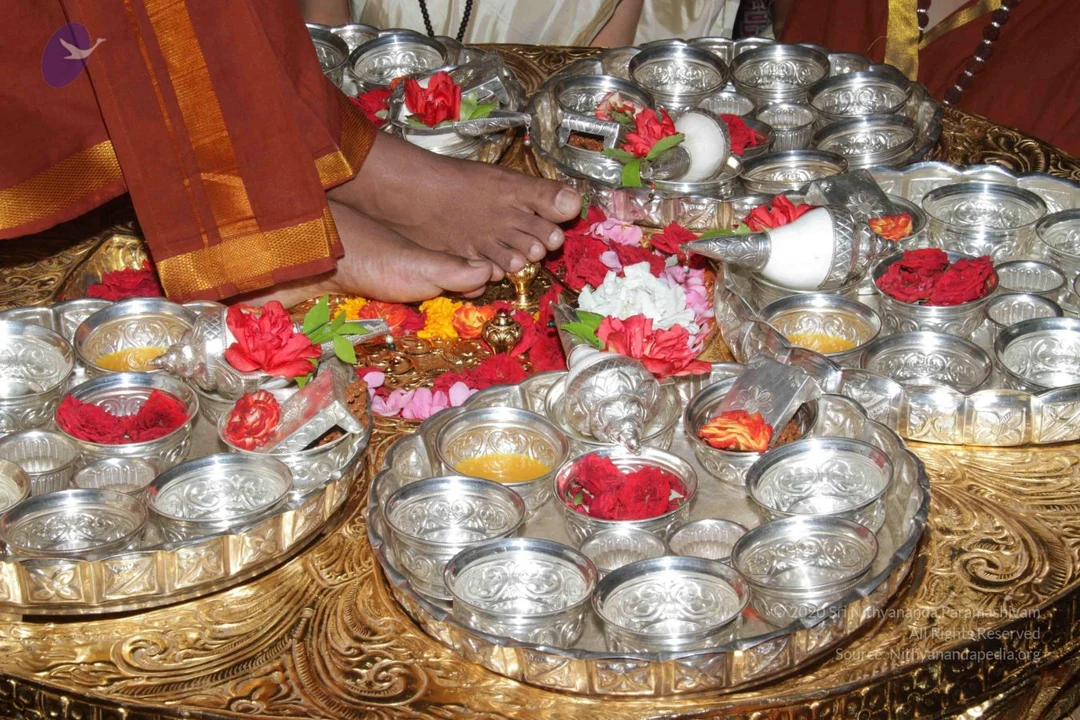
PADA-POOJA

NITHYA-SATSANG

SARVA-DARSHAN

BREAKFAST-SPREAD-FOR-IA-PARTICIPANTS

IA-SESSION

IA-DARSHAN

1-Adikailash-Temple

2-Pada-Puja

3-Morning-Message

Photos from this day

View all 187 photos

Photos From The Day:
20 photosSource gallery
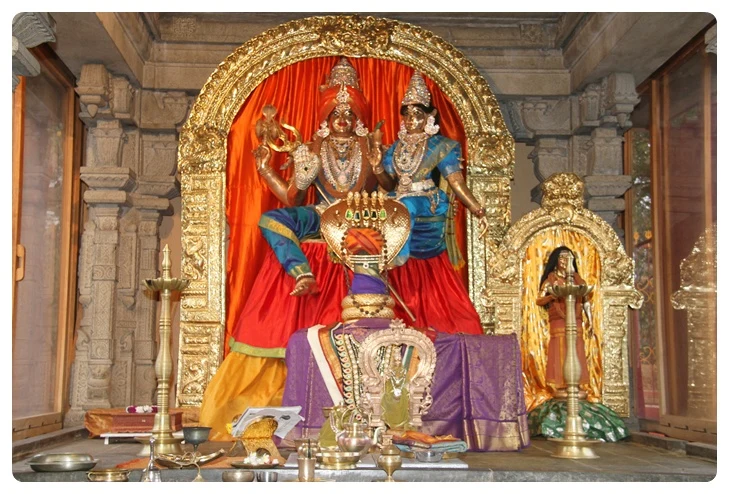
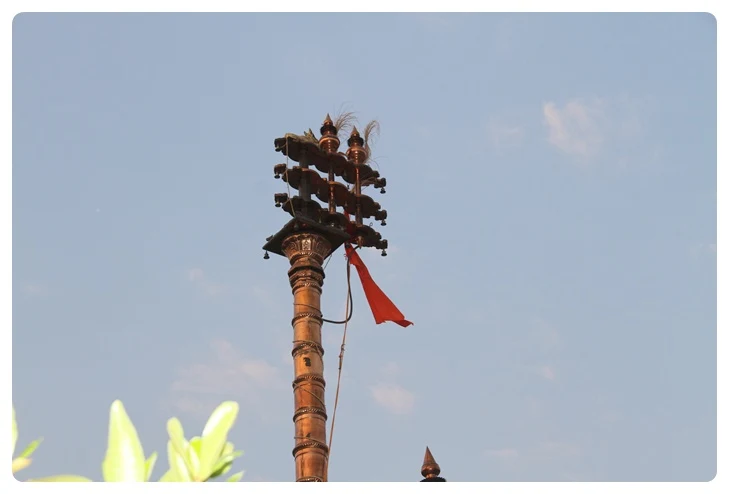
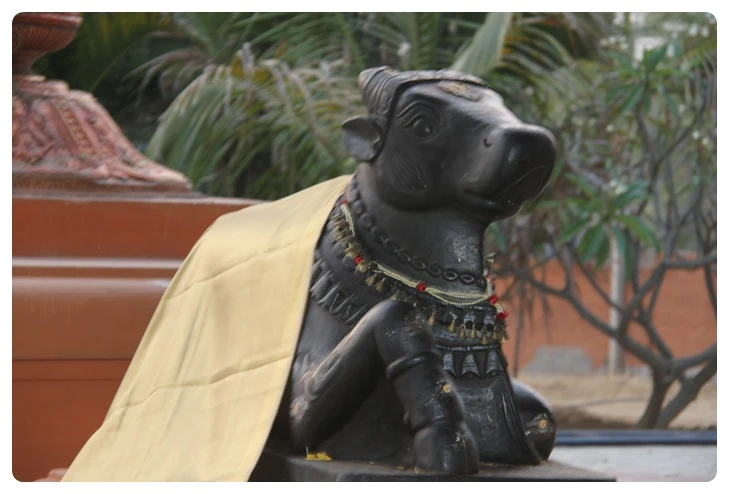
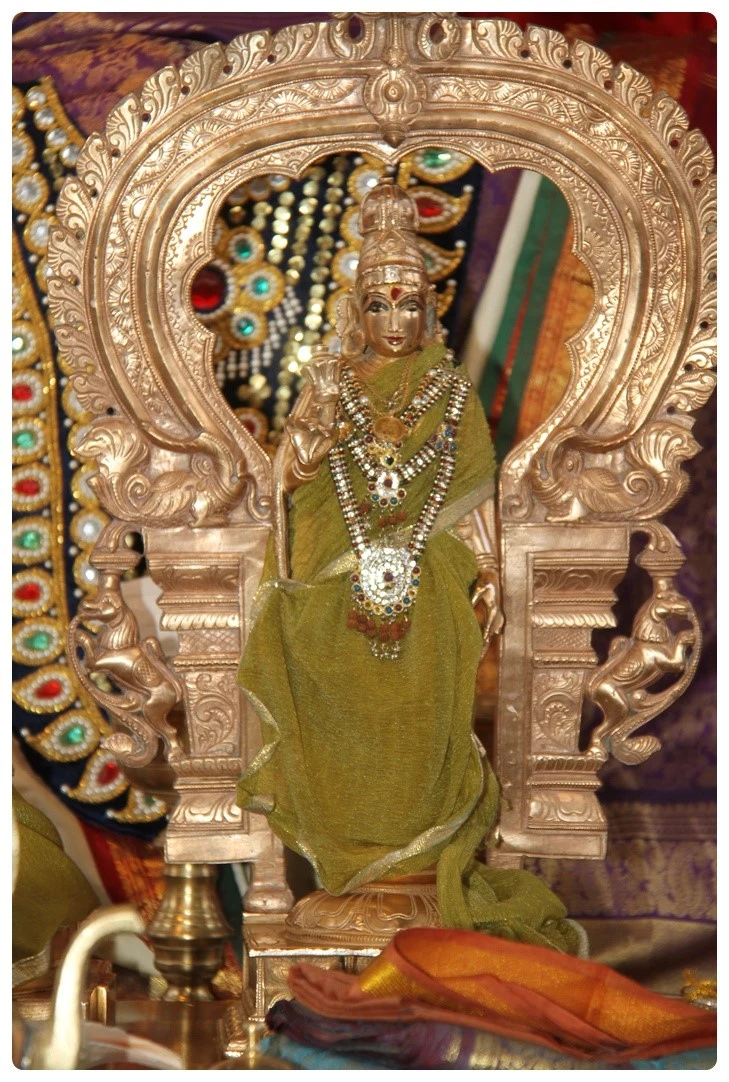
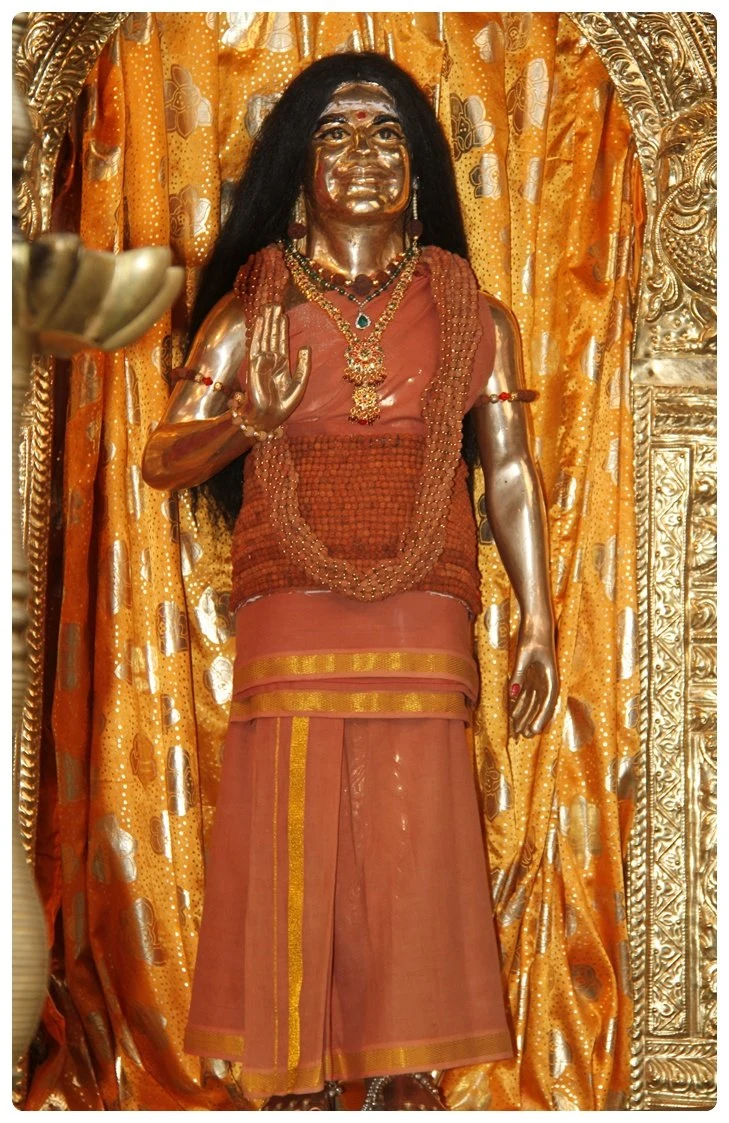
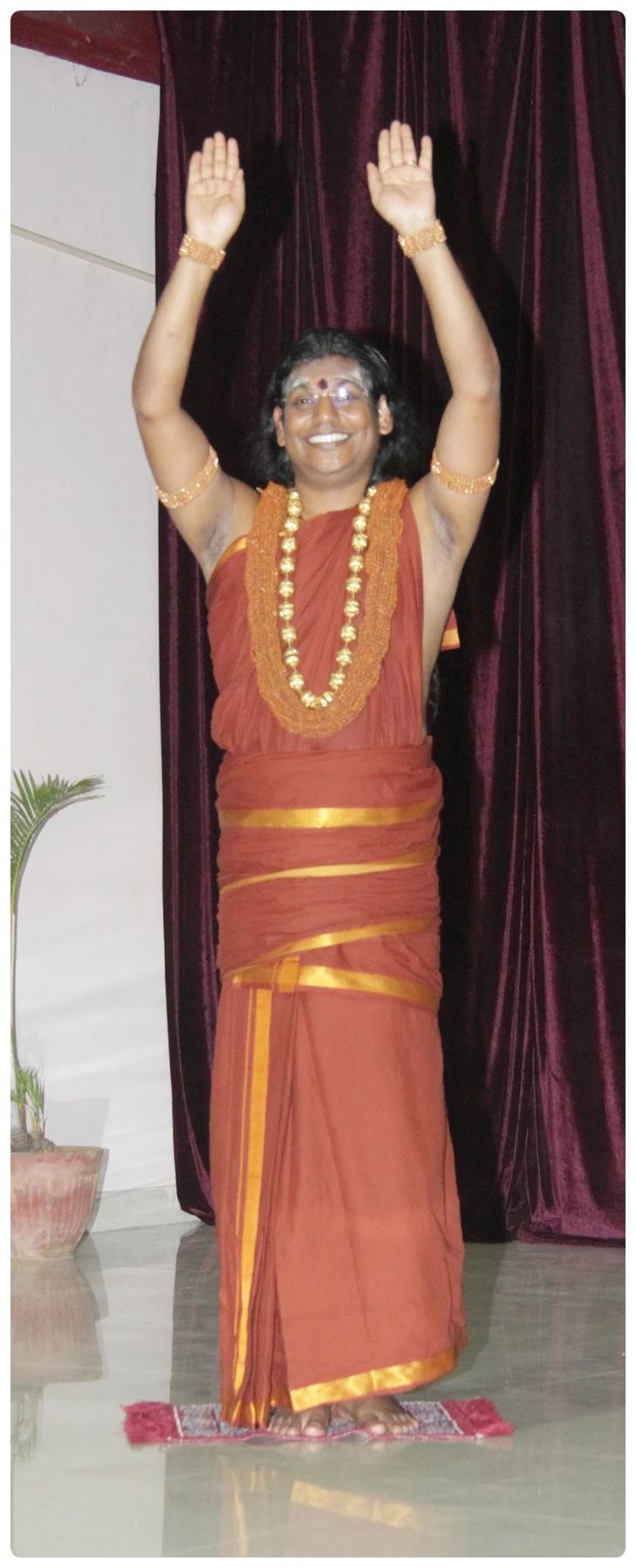
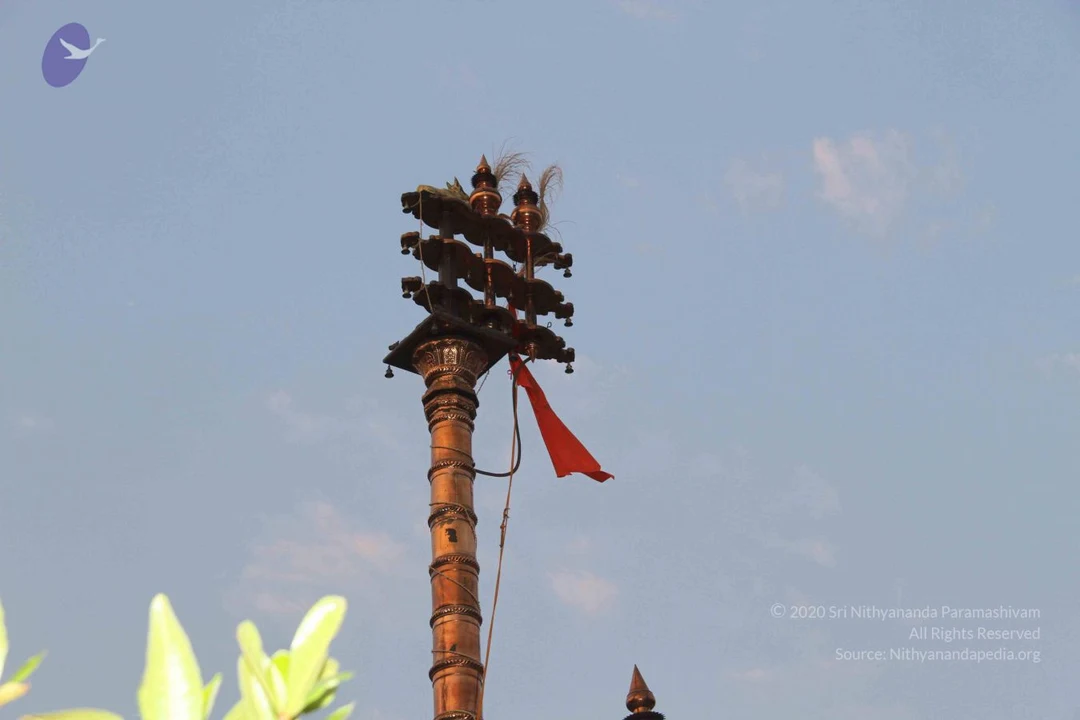
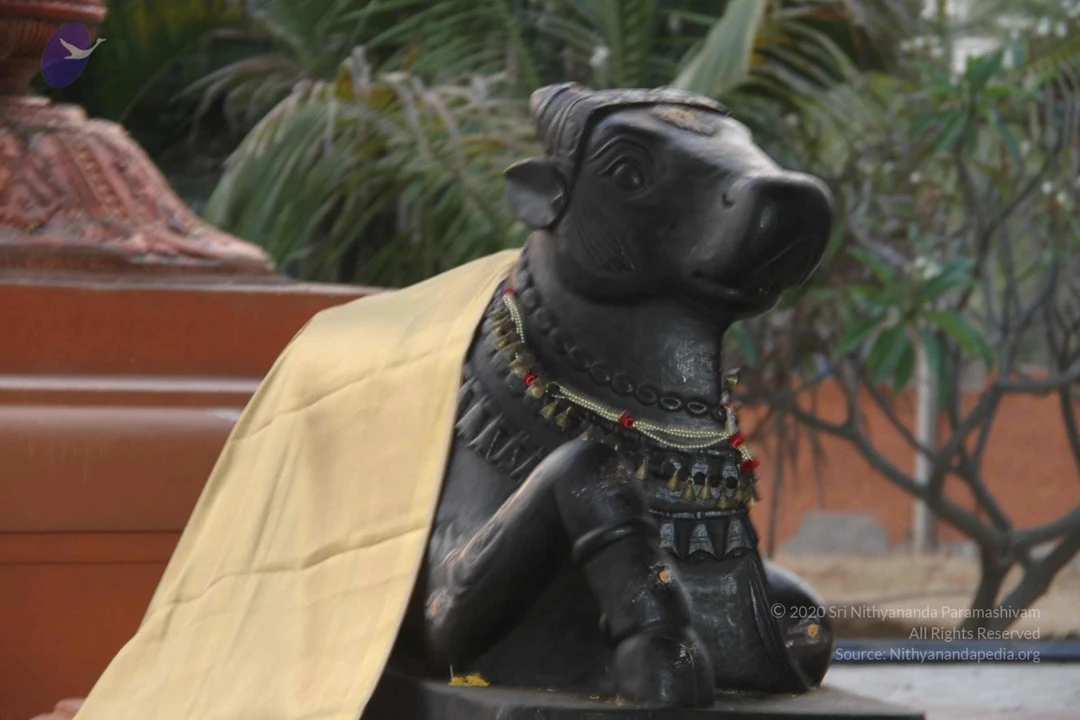
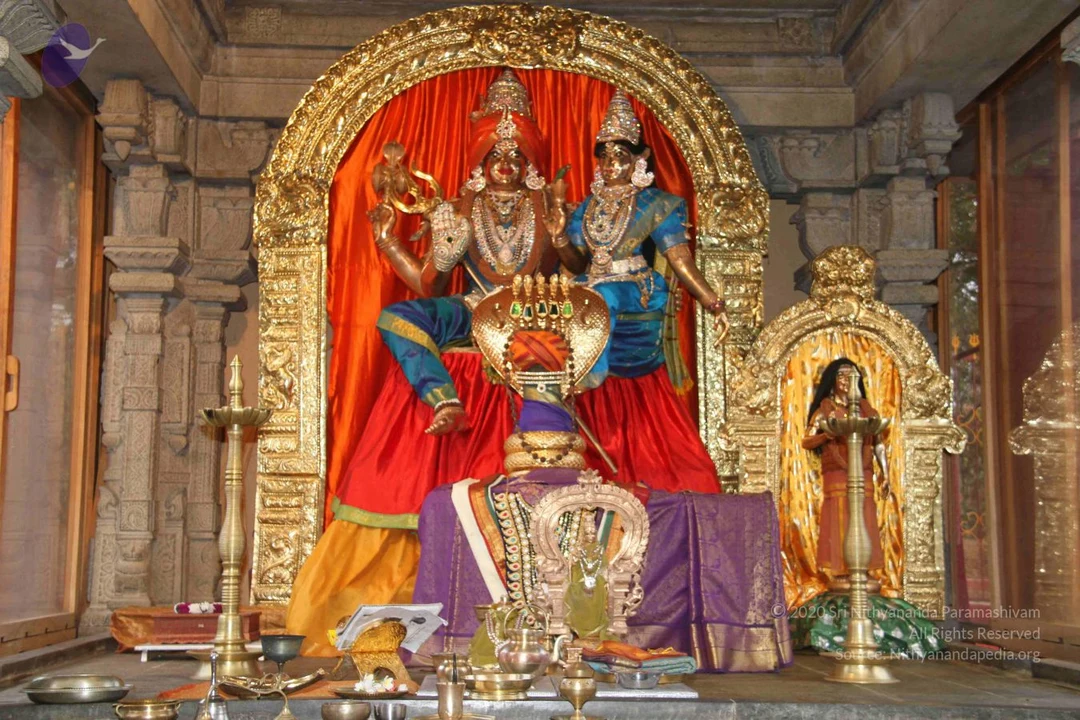
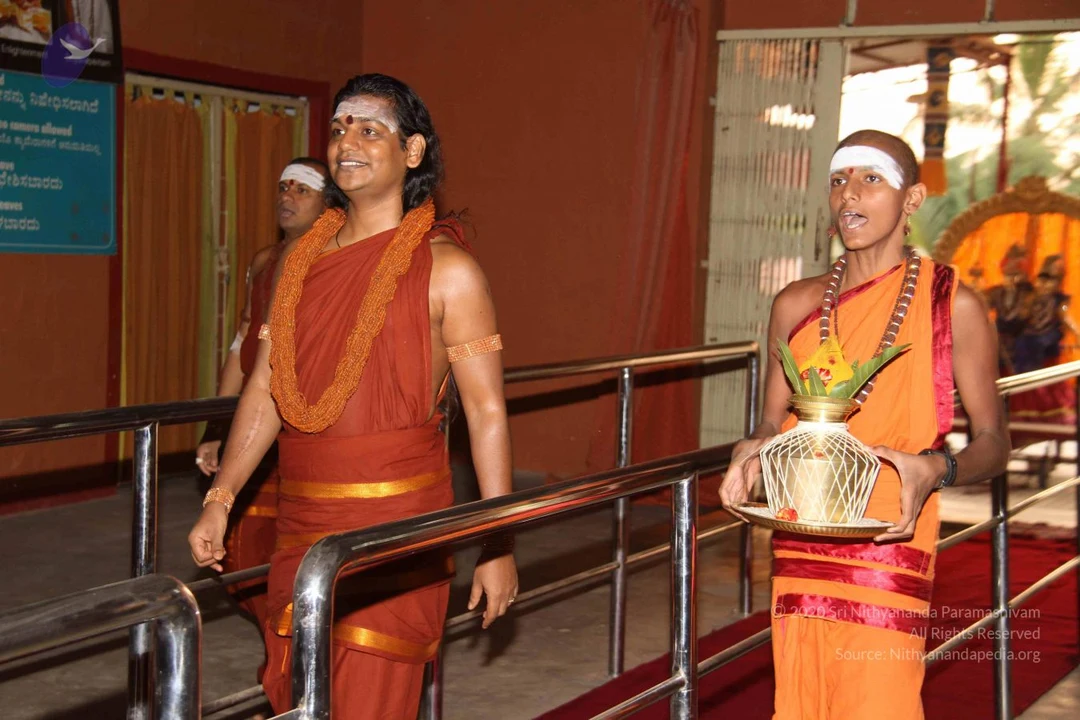
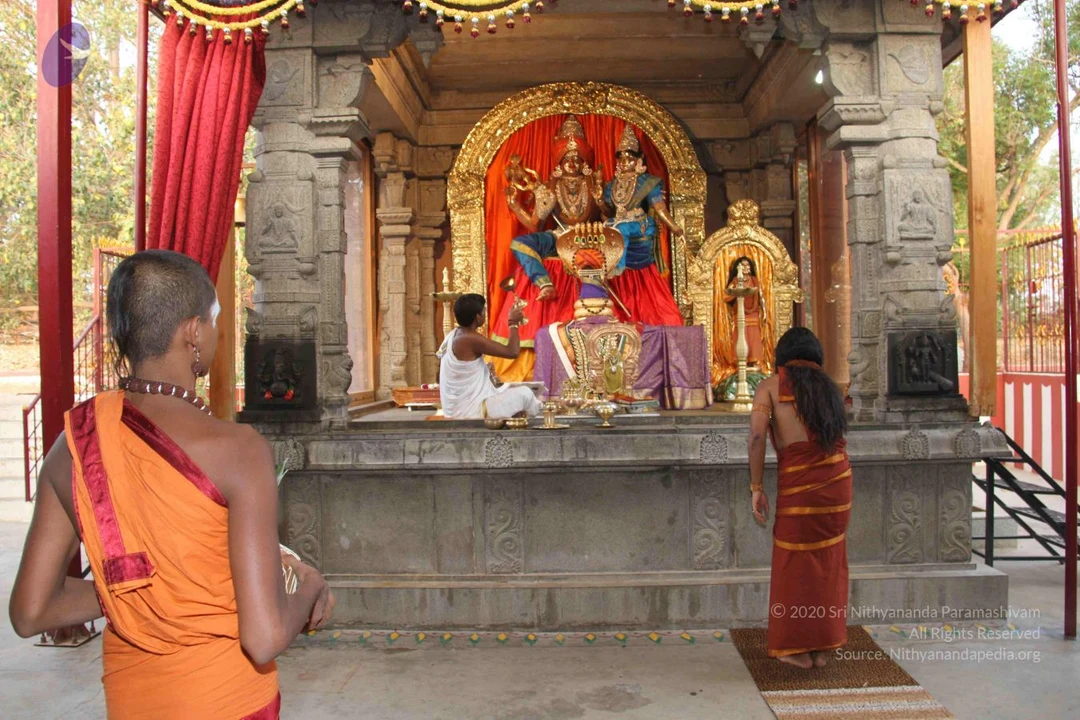
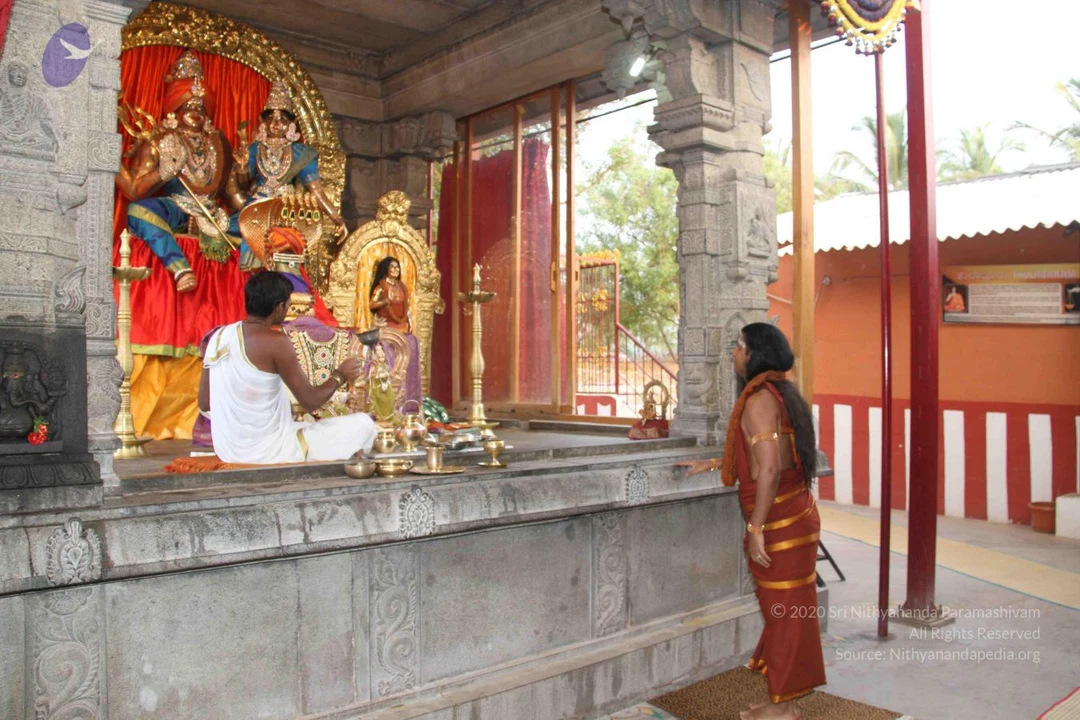
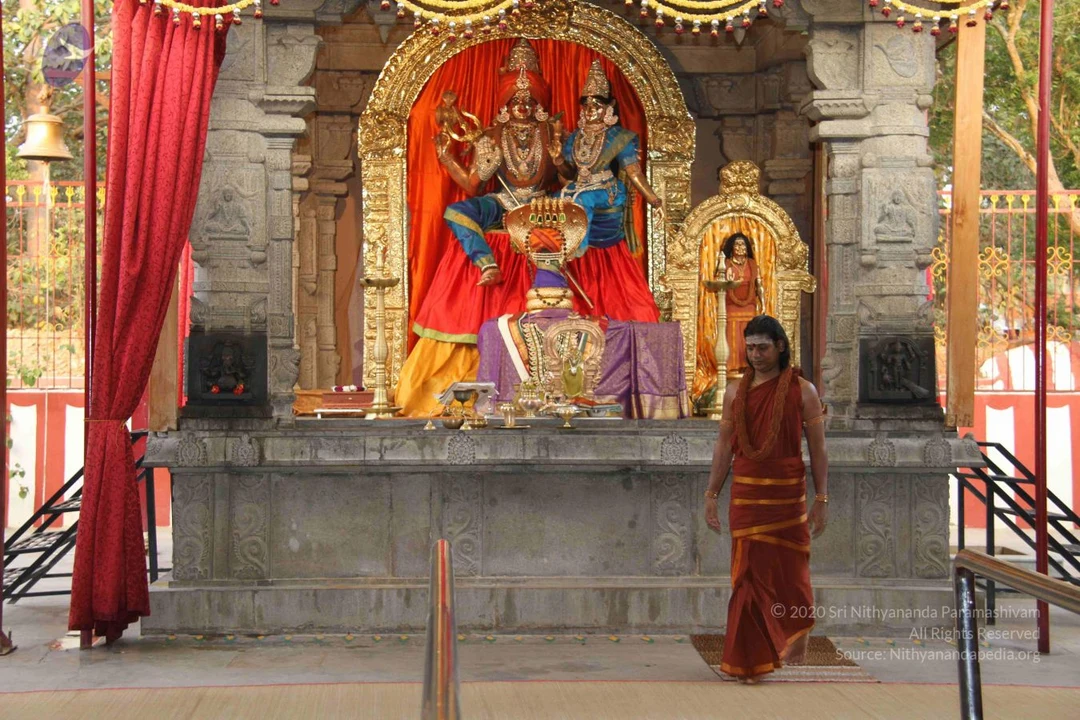
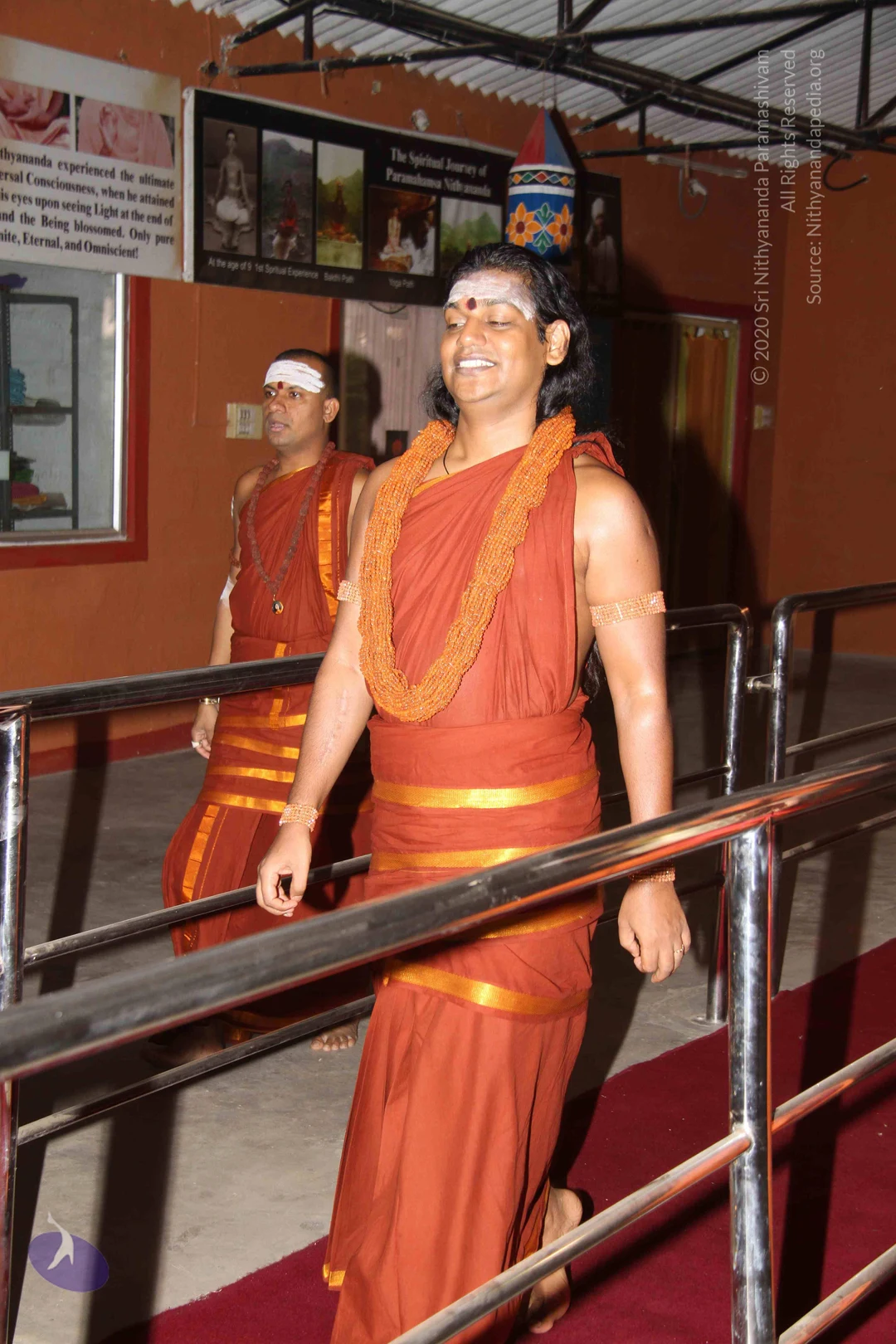
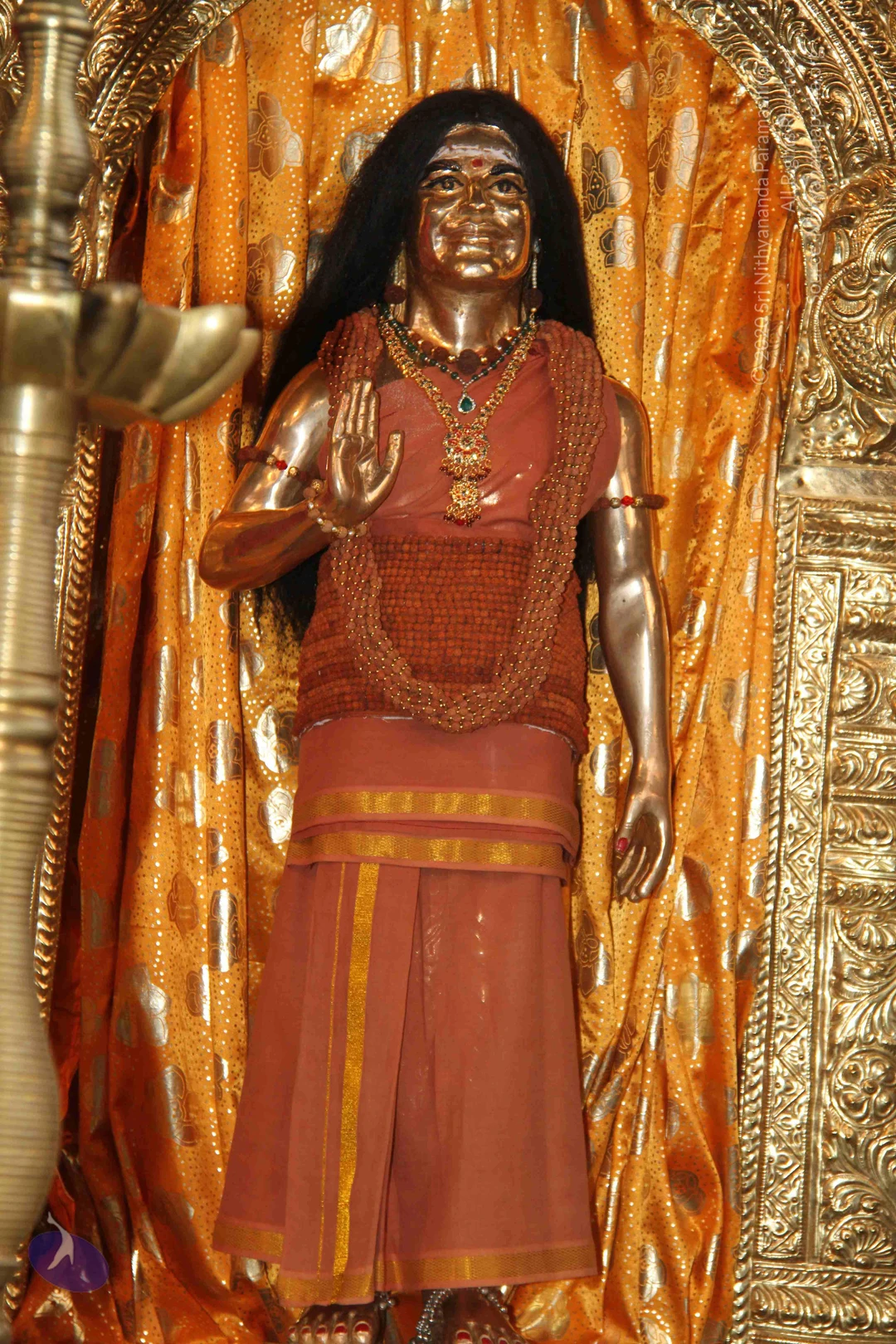
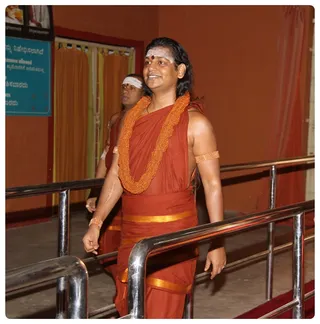
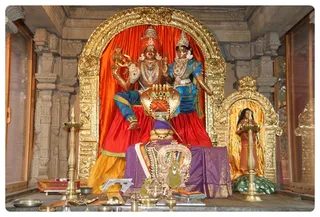
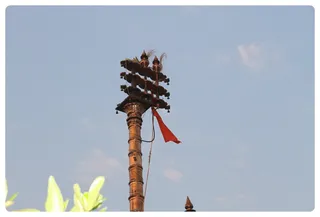
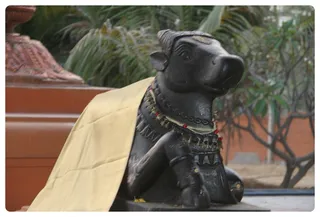
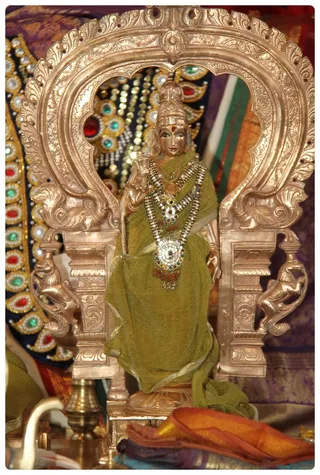
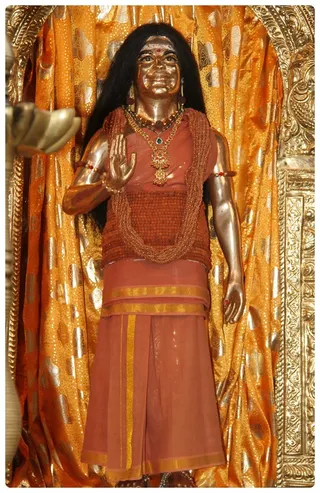
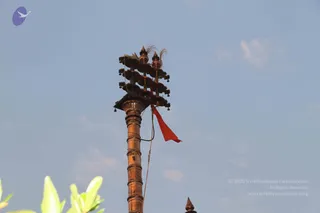
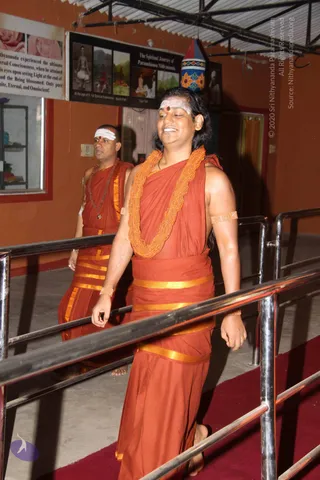
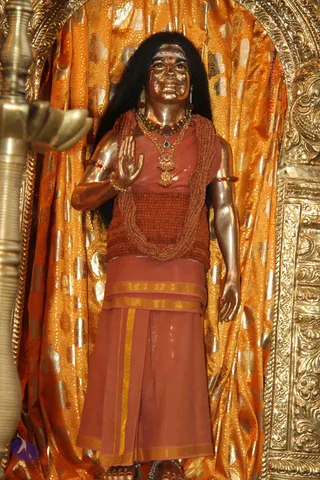
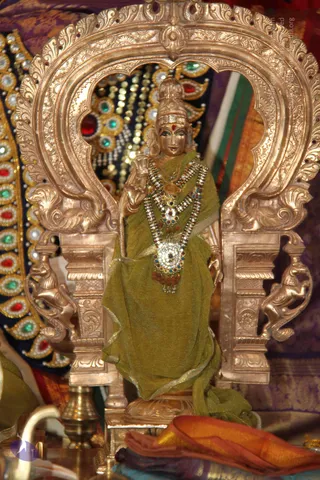
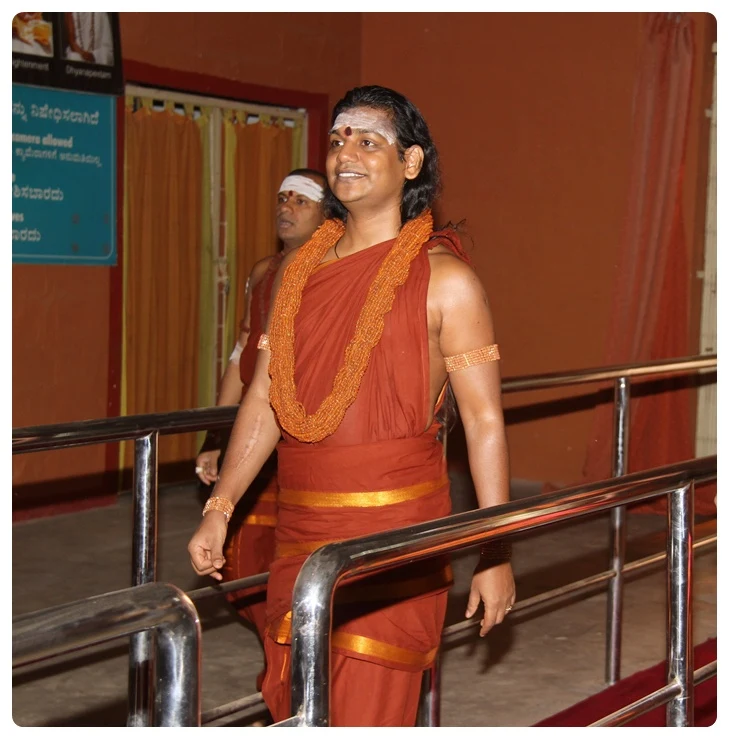
A photograph of a smiling man with long dark hair walking down a metal-railed ramp inside a building with orange-brown walls. He wears a rust-orange dhoti-style cloth with a gold waistband, a thick orange-beaded mala around his neck, a gold armlet and bangles, and a white forehead band with a red dot. Behind him, a second man in matching orange robes and a white headband follows. A teal sign with Kannada text is on the wall, and orange and yellow curtains hang in the background. Probable Swamiji is visible, with long swept-back hair, an orange beaded mala, and a gold-banded saffron garment.A photograph of a temple shrine with a large deity murti of a seated couple under an ornate gold arch with orange and red drapery. The seated male figure is blue-skinned with a trident and a cobra canopy overhead, and the female figure in a blue and gold sari sits beside him, both adorned with garlands and jewelry. Brass oil lamps, kalasha vessels, puja utensils and purple brocade cloth fill the altar in front, with a smaller female figure in green and gold to the right. No living people are visible.A photograph of a tall ornate wooden ritual pole topped with a multi-tiered structure of carved wooden tiers, small bells, and tufts of feathers or fibre. A red triangular flag hangs from the pole. The pole shaft is decorated with carved bands and rings, set against a pale blue sky with leafy foliage at the lower left. No people are visible.A dark stone or metal Nandi bull statue sits on a pedestal outdoors, draped with a pale yellow cloth. It wears a necklace of beads and tassels with red accents and a bell-hung collar. Behind it are frangipani or plumeria trees and a terracotta-coloured wall with a decorative urn at left. No people are visible; the statue is the only subject.A small golden metal deity murti stands within an ornate golden arch-shaped frame carved with foliage and lion figures. The figure wears a green sari-like draped garment, layered jewelled necklaces with red and green stones, and a crown. The murti is surrounded by gold and jewel-embroidered textiles in red, green and gold, with brass oil lamps and a folded orange-gold cloth in the foreground. No people are visible.A gilded statue of a standing figure in front of a shimmering orange and gold silk backdrop with a gold-framed arch. The statue has long dark hair, a tilak on the forehead, layered gold and red necklaces, and a rudraksha-bead mala draped over rust-coloured robes with gold borders. The right hand is raised in a blessing gesture while the left arm hangs at the side. A brass lamp edge is visible at the left edge of the frame.

YOGA

23 photosSource gallery
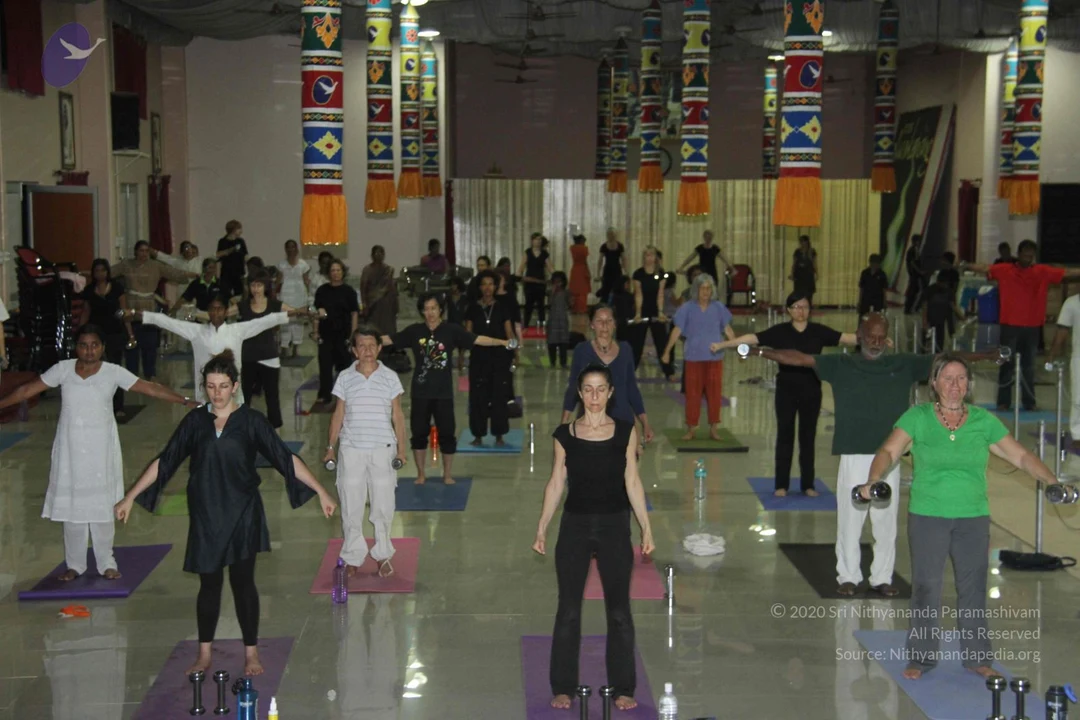
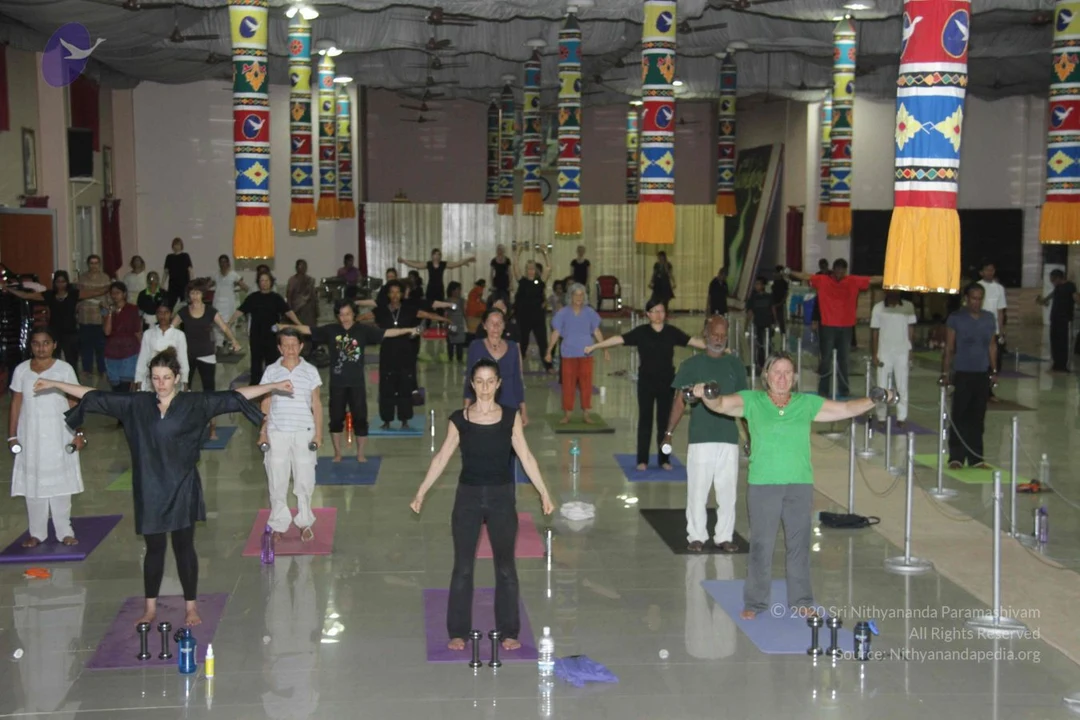
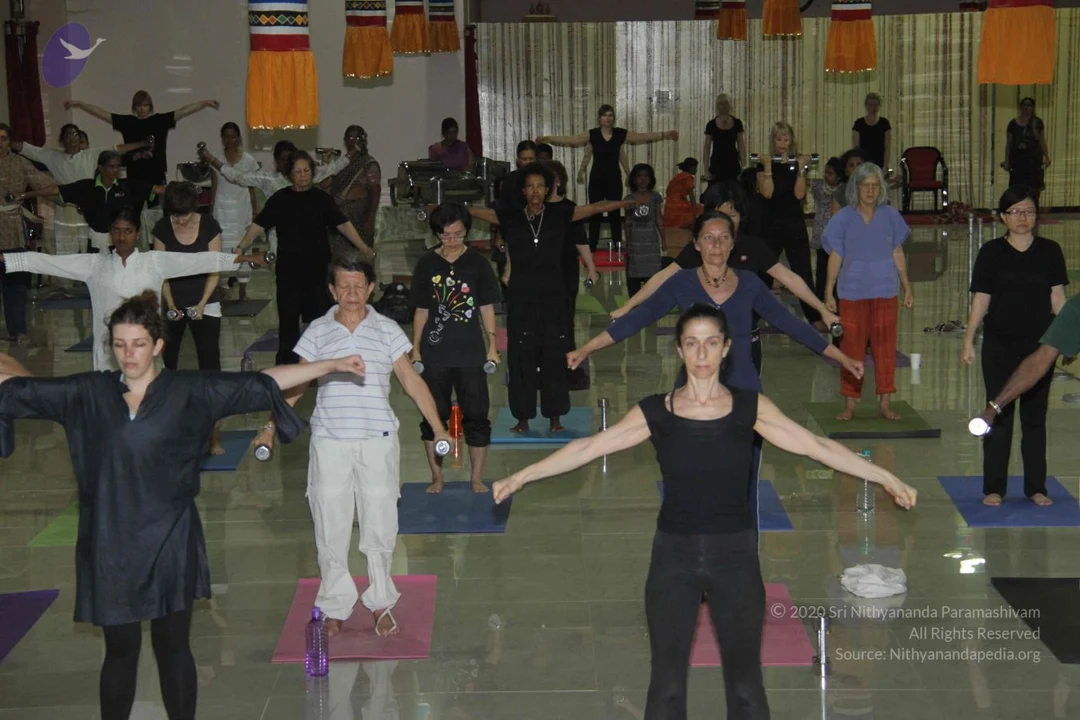
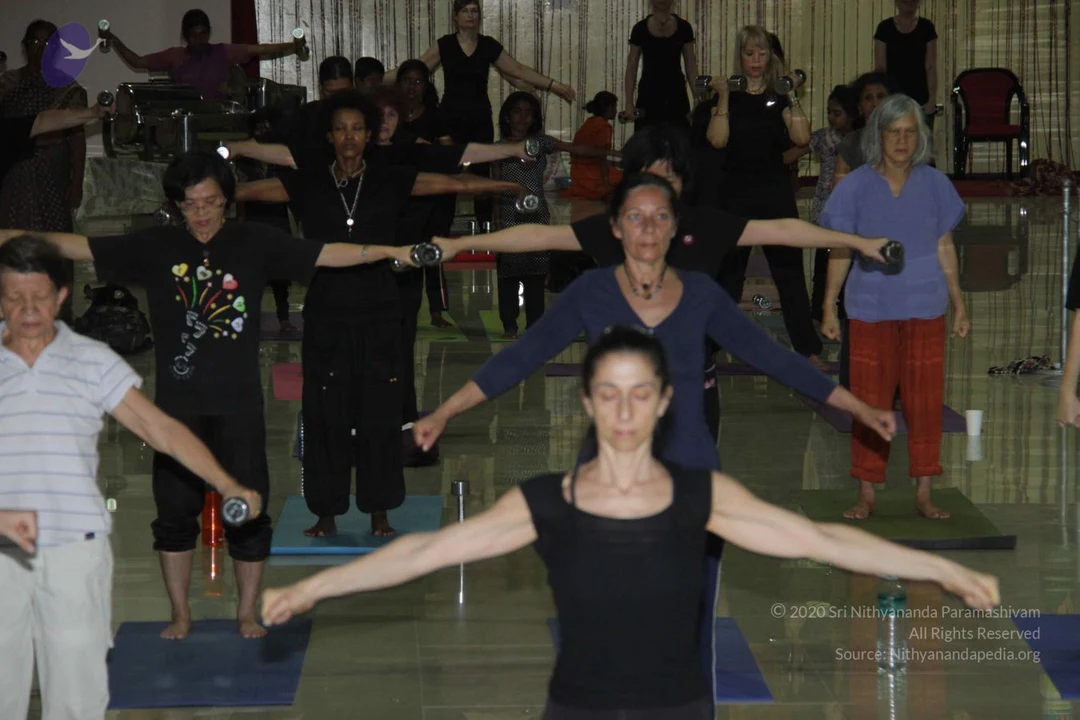
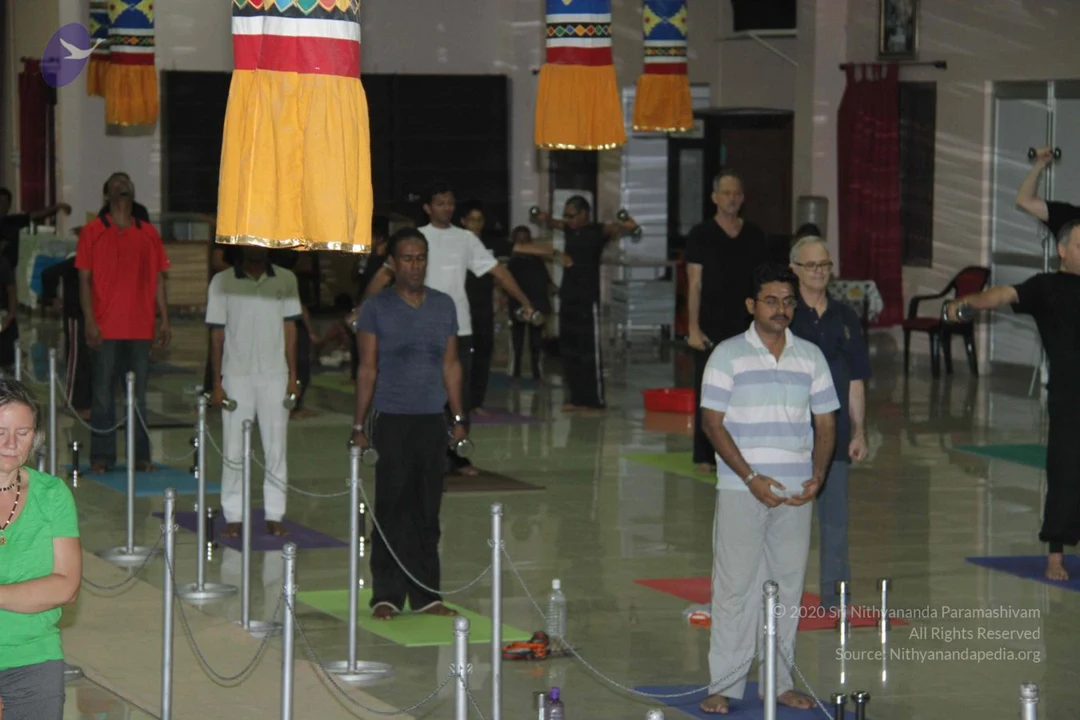
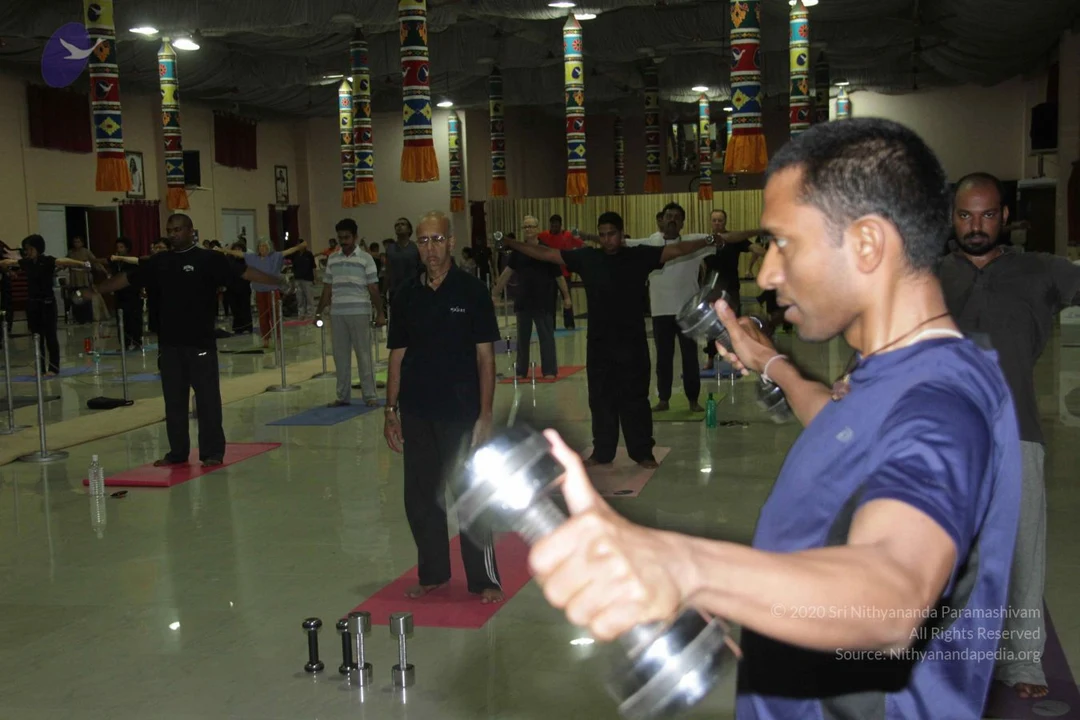
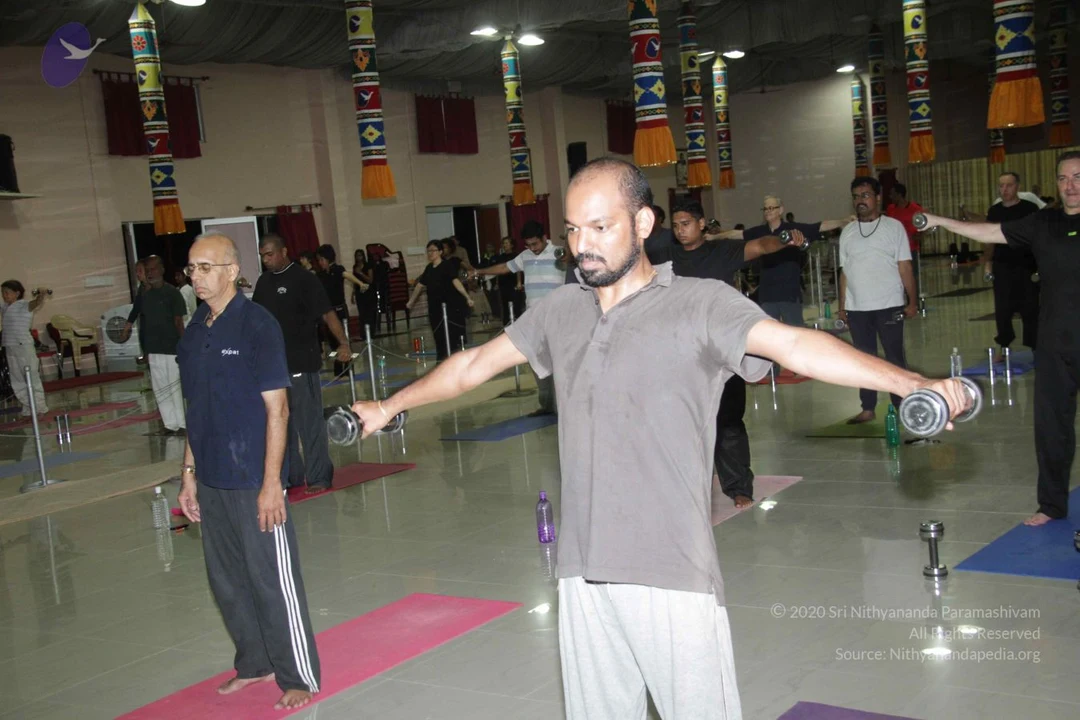
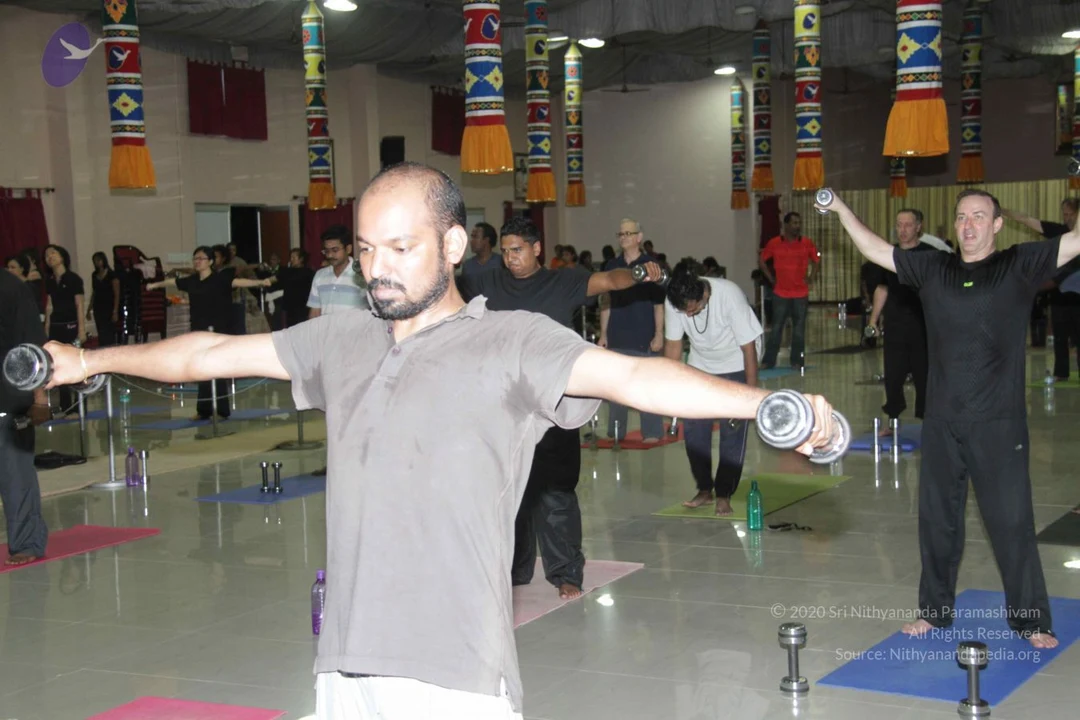
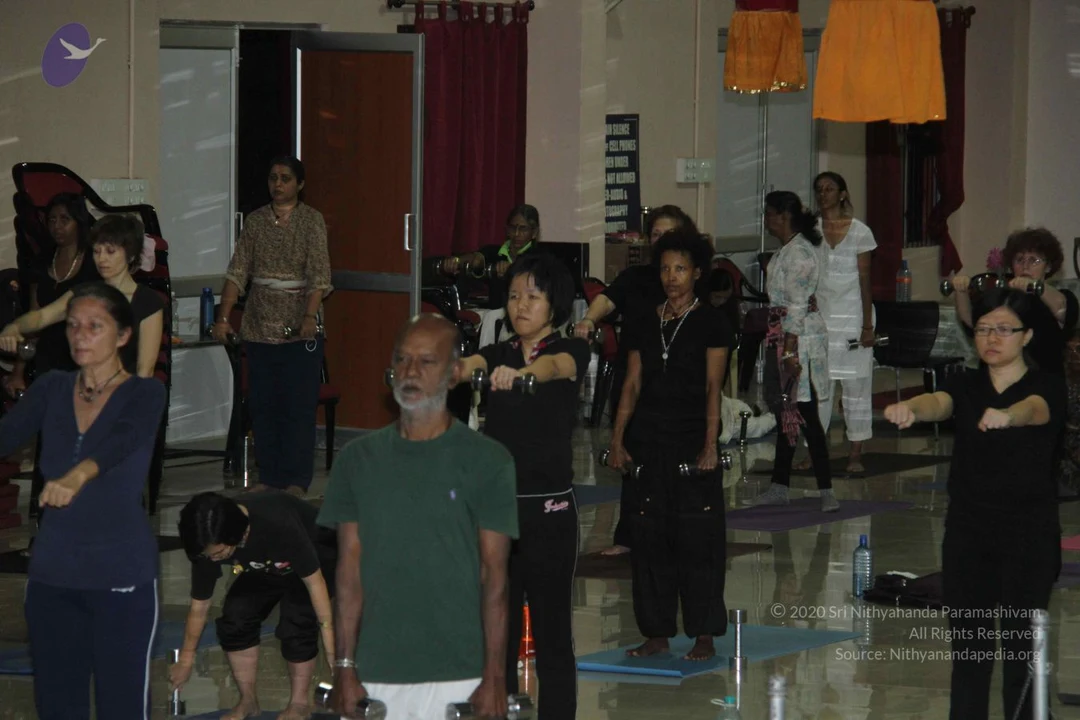
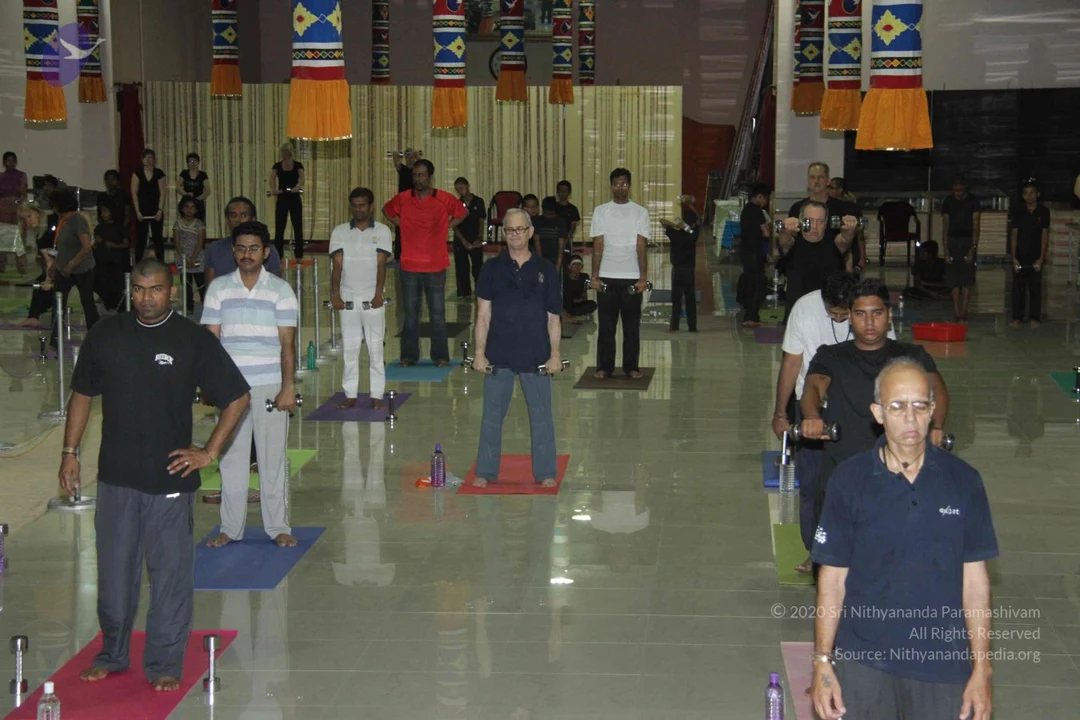
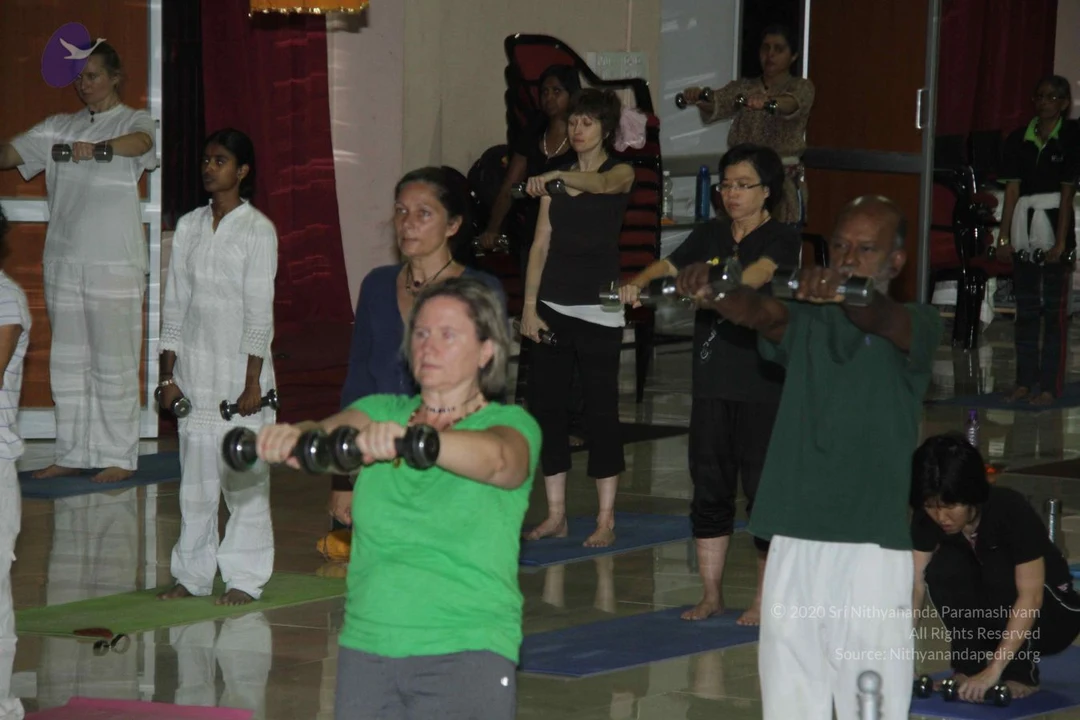
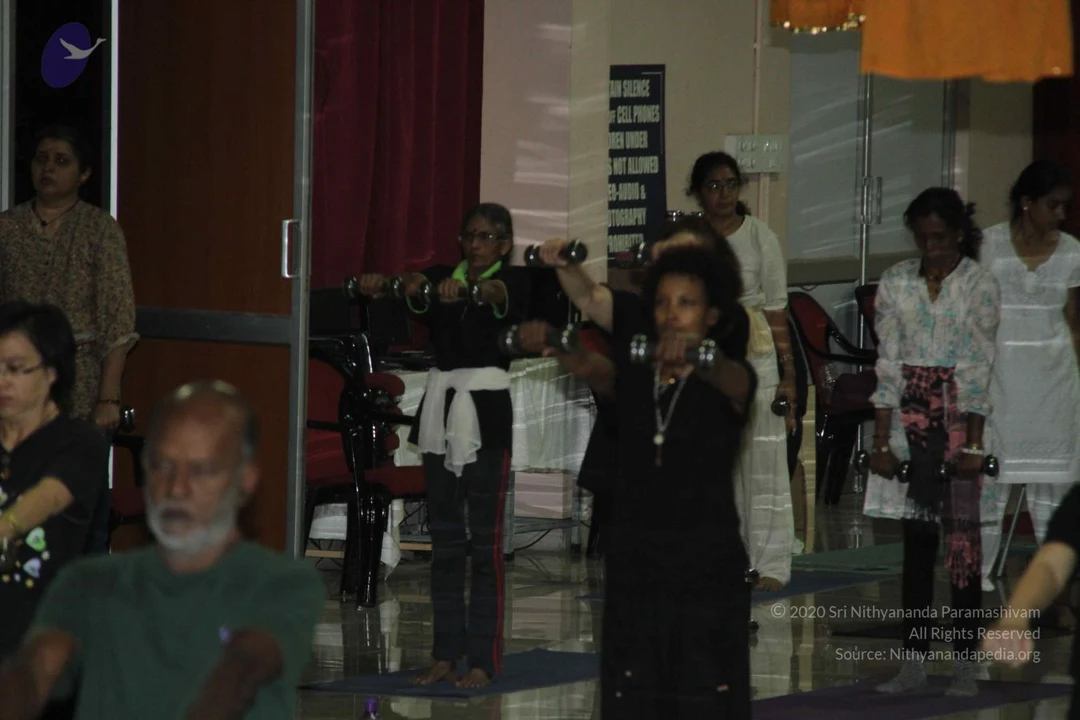
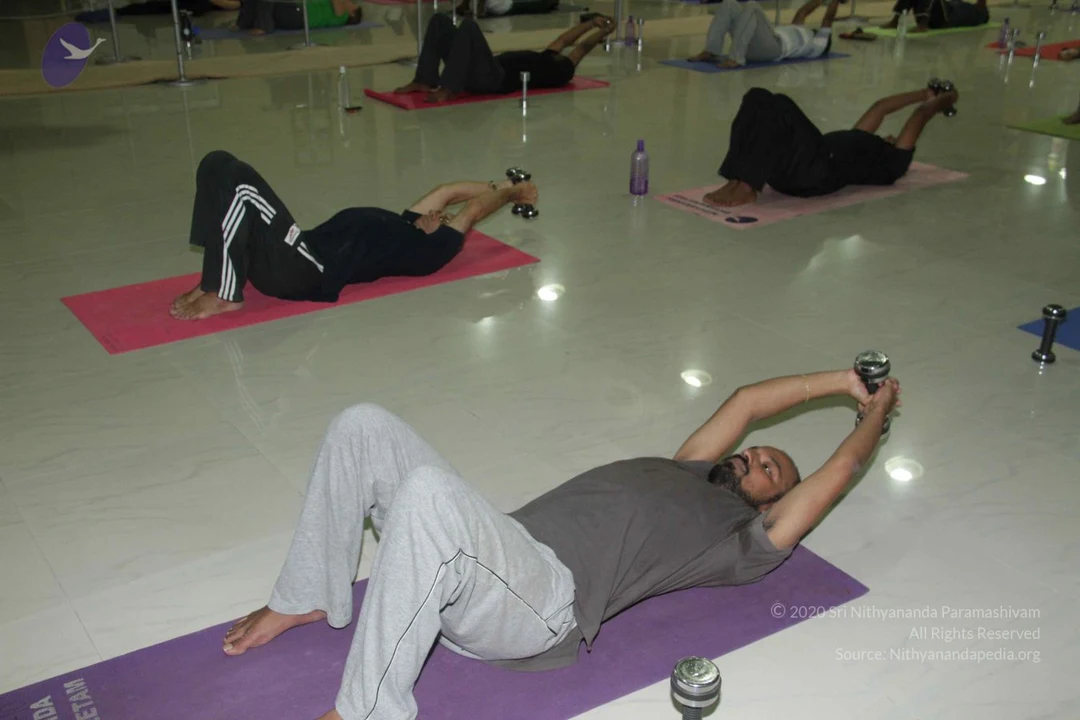
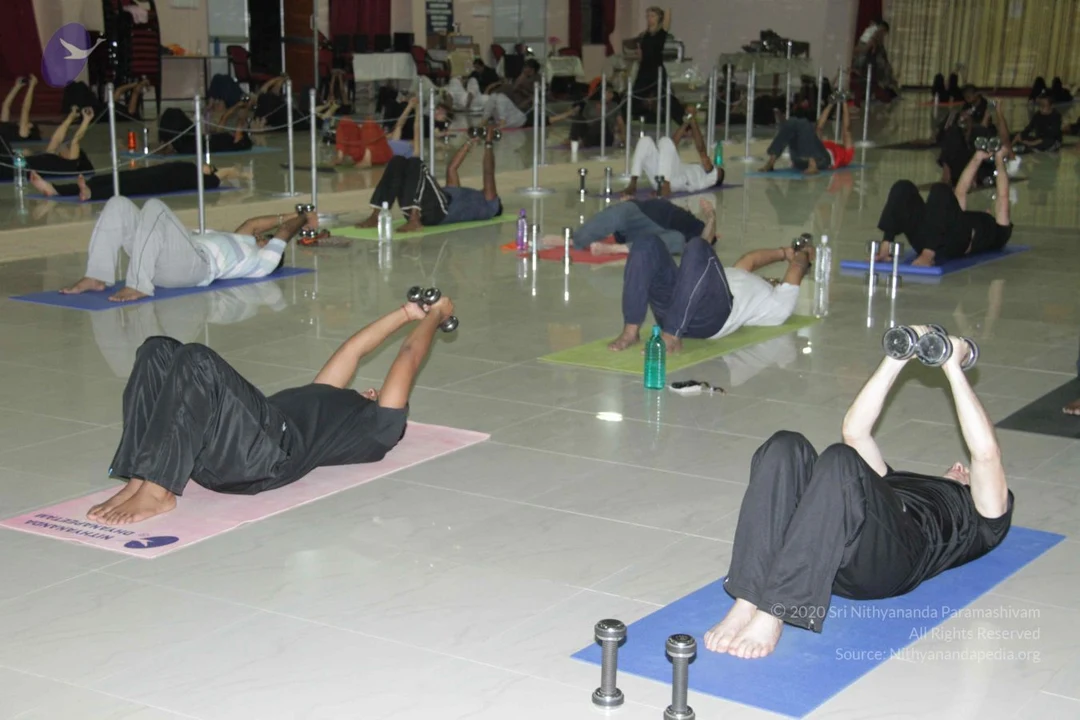
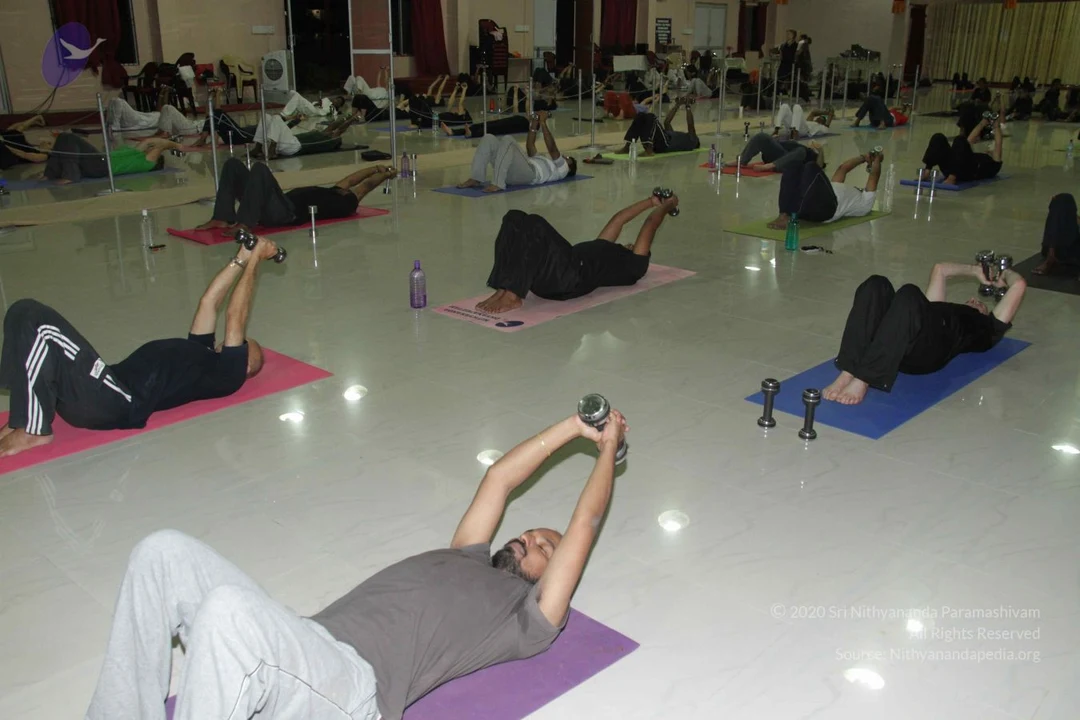
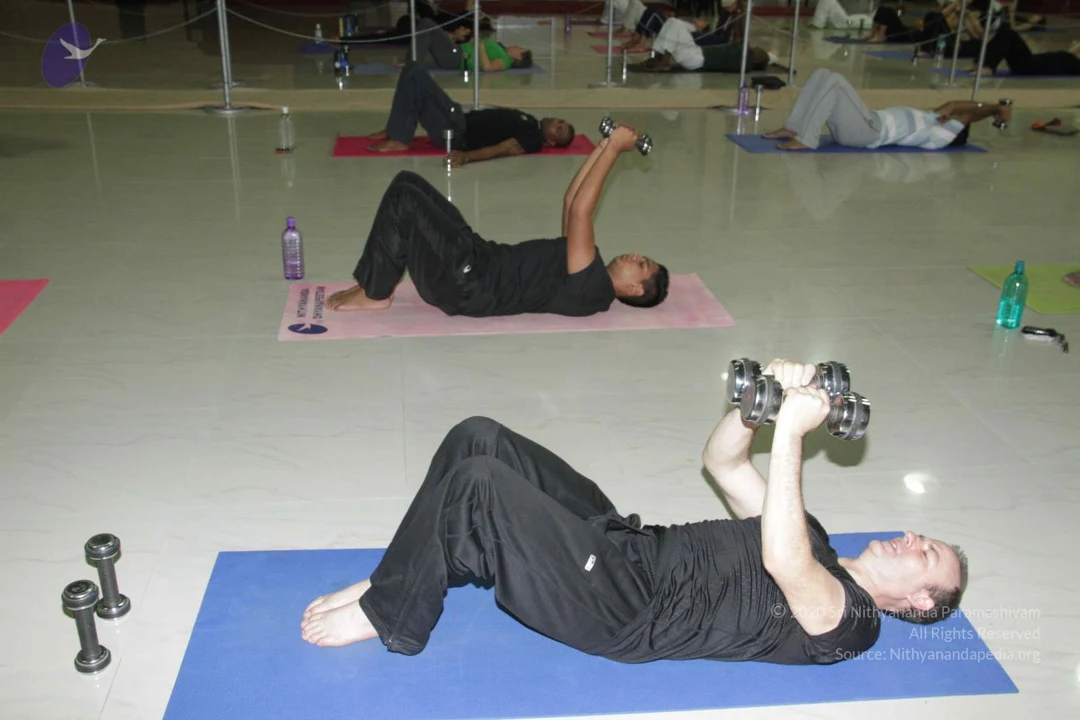
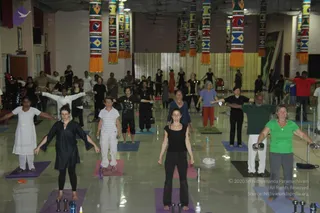
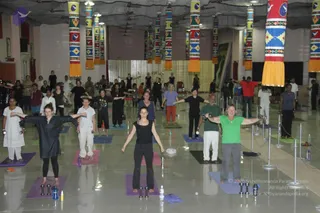
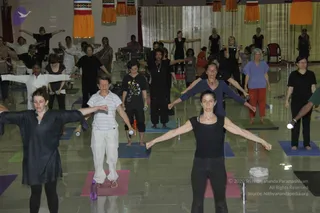
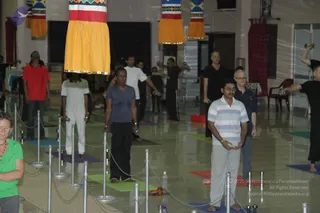
A photograph of a large hall with a glossy tiled floor where many people stand on purple, blue and pink exercise mats, arms extended sideways and holding small metal hand weights. Several people in front wear black, one in a white kurta and white trousers, and a man in a green shirt and white trousers stands at right. Tall decorative banners with geometric patterns and orange tassels hang along the walls, and a curtain backdrop is behind them. The scene looks like a group yoga or exercise session in an ashram-style hall.A group of men stands on colored yoga mats in a large hall with a polished floor, arms extended horizontally while holding small weights. Foreground men wear black and gray shirts and trousers; a man in a striped polo and grey trousers stands centrally with a grey-haired man in a black shirt beside him. Hanging orange and multicolored striped banners decorate the upper space, and metal stanchions with chains divide the floor. No identifiable a person figure is clearly visible among the participants.A large hall with a polished floor and tall decorative pillars wrapped in colourful geometric patterns with yellow fringe. Around forty people stand on purple, pink and green exercise mats performing arm-raising exercises while holding small dumbbells. In the foreground, a woman in a black top and black trousers stands with arms outstretched, beside a woman in a black dress and a man in a white and blue striped shirt. A woman in a green top and grey trousers holds dumbbells at the front right, and a man in a green shirt and white trousers stands nearby. Metal stanchions with ropes line the aisle, and water bottles rest on the floor. No identifiable a person appears in the scene.A photograph of a large indoor hall with a polished floor where a group of about two dozen adults stand barefoot on colourful yoga mats, arms outstretched at shoulder height, holding small handheld weights in a guided exercise session. Participants wear mostly black, navy, white and blue clothing; a woman in the front left wears a dark dress, and a woman in the front centre wears a black top and black trousers. Behind them hang orange and multicoloured decorative banners and a row of curtains. No figure in the scene is clearly identifiable as a person, and the people visible are participants rather than a presenter.Photograph of an indoor yoga or exercise session in a polished-floor hall with a curtain backdrop. Roughly a dozen participants stand on blue and green mats with arms stretched out to the sides, many holding small silver hand weights. Clothing is mostly black tops and trousers, with a woman in a navy top and an older woman in a blue top and red patterned trousers at right. A man in a striped white shirt stands at far left, and a purple-shirted person is visible at the top left. No a person candidate is visible; the scene shows participants in a group exercise session.A group of people stand on colored yoga mats in a bright hall with polished floors, holding light hand weights and extending their arms, apparently during a guided exercise session. Hanging yellow and red banded fabric panels with gold trim descend from the ceiling, and metal stanchions with chains divide the mats. A woman in a green top on the left and a man in a striped polo shirt in the foreground stand among others in white, grey and black clothing. No one is clearly identifiable as a person in this image, and no ceremonial figure is visible.

TEMPLE
35 photosSource gallery
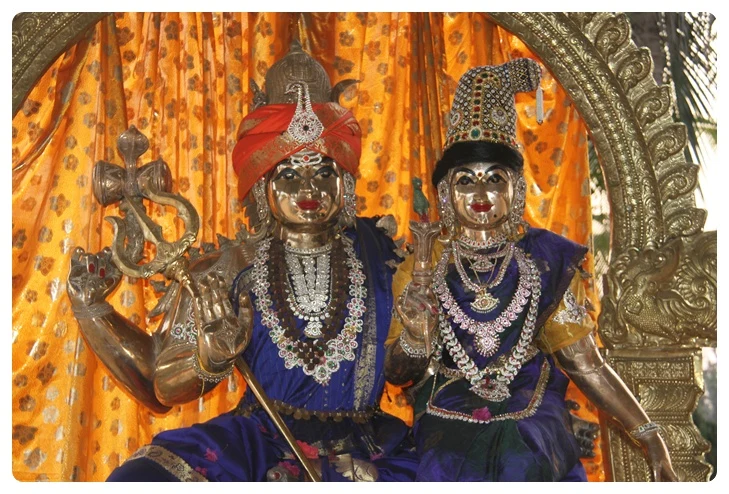
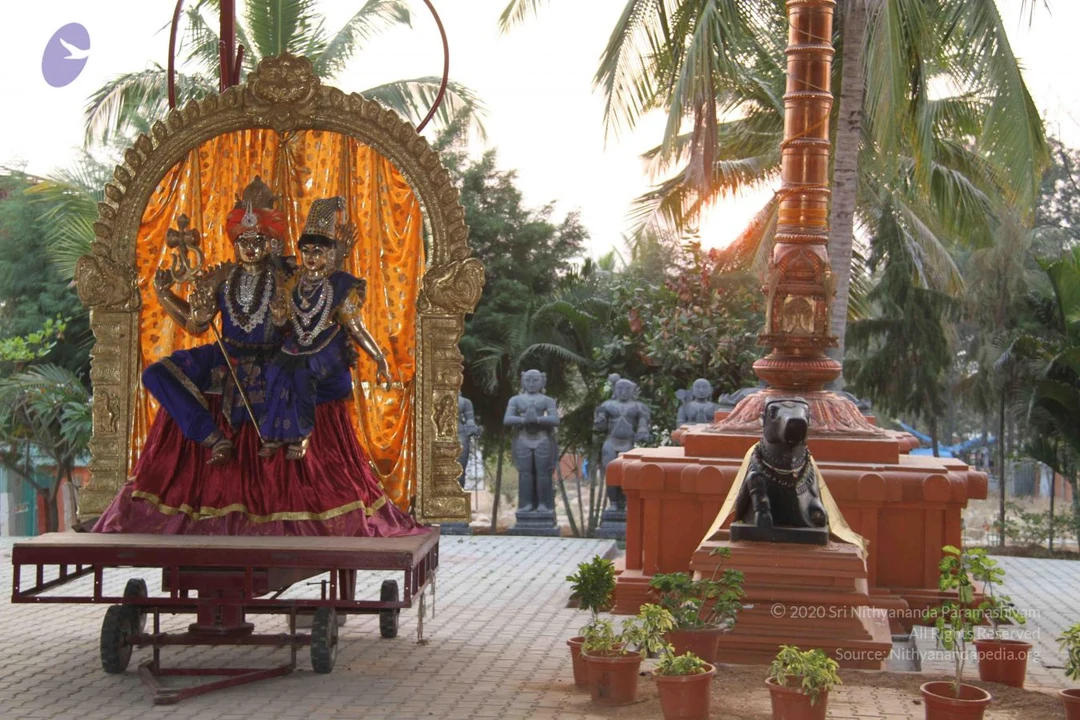
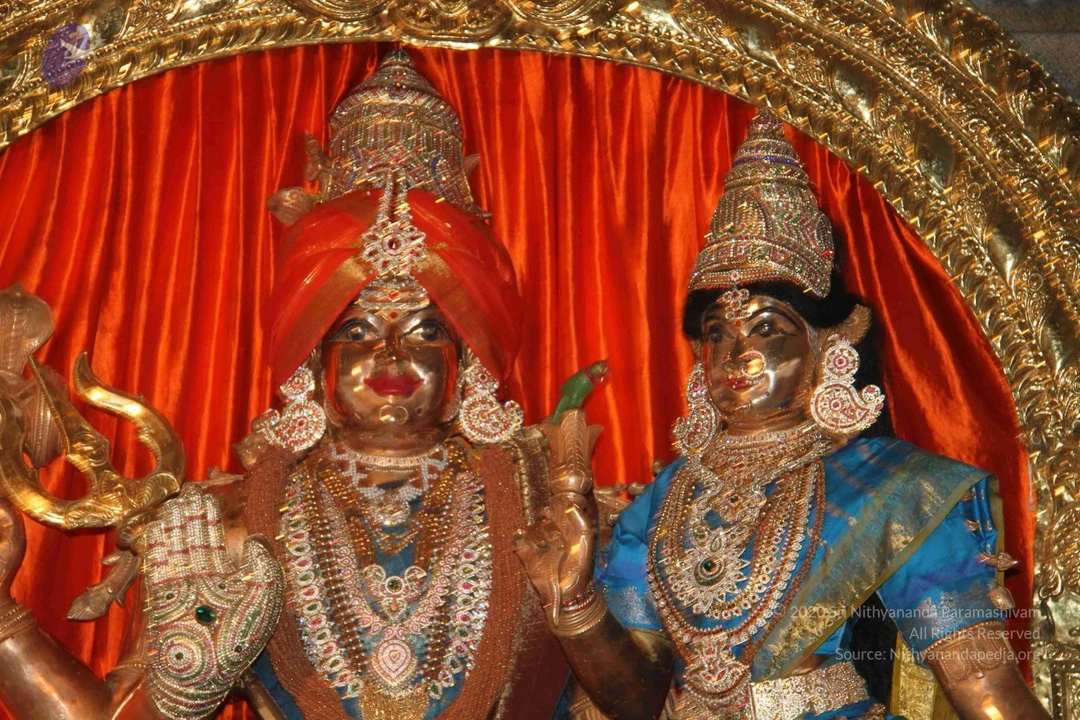
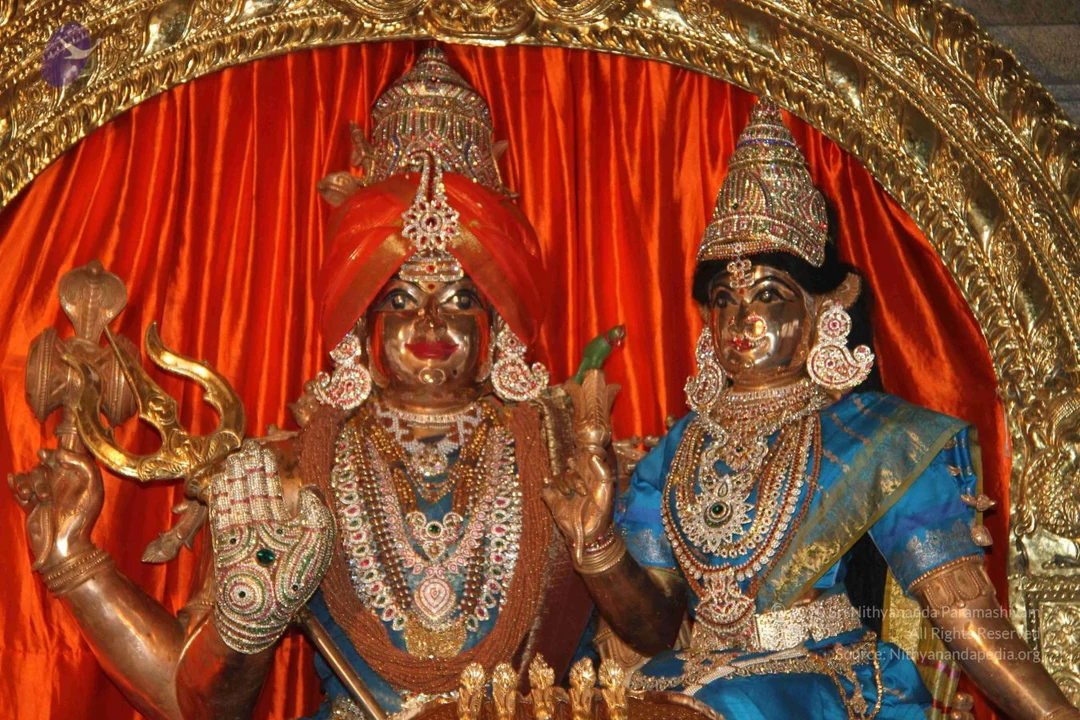
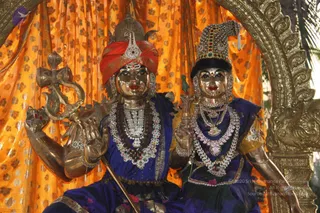
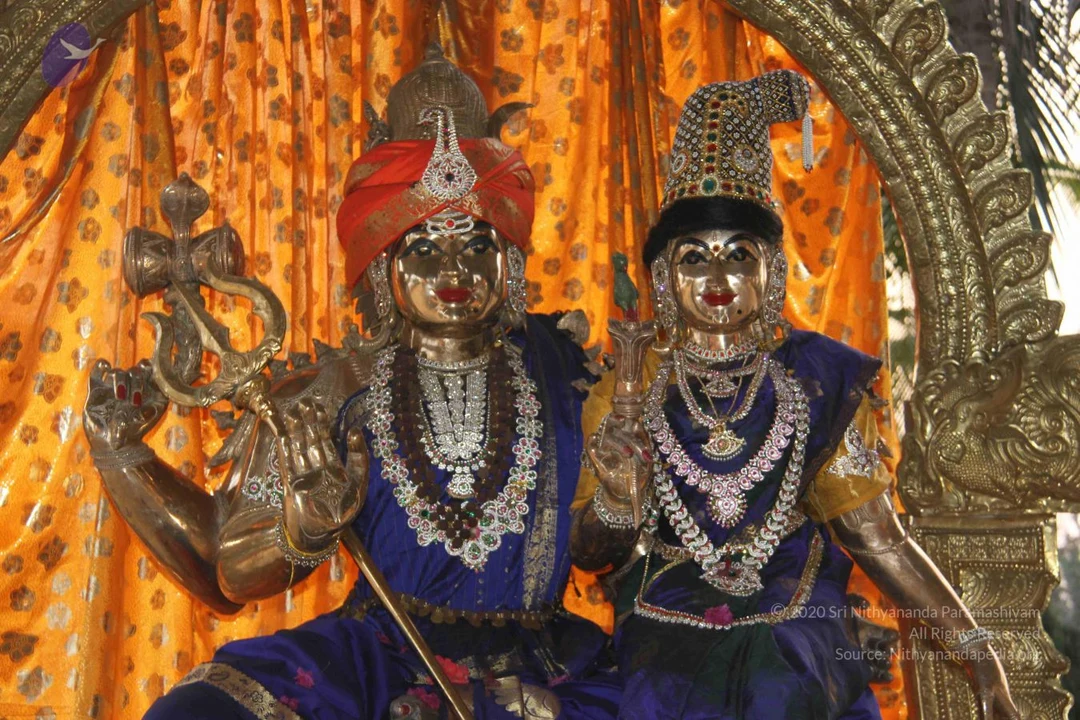
A dim, hazy dusk or dawn sky with a half-visible orange sun low on the horizon. Dark silhouetted tree foliage frames the upper left and lower left corners, and thin power lines cross the sky diagonally. Faint utility poles sit along the distant treeline. No people or ritual activity are visible in the scene.A photograph of a single tall silver flagpole against a pale grey-blue sky with faint clouds. A limp saffron-orange cloth flag hangs from the top of the pole, folded and draping down its length. No people are visible in the scene. The lower right corner has a faint copyright overlay, which is not part of the scene.Close-up photograph of a cluster of young yellow bamboo culms growing from reddish-brown soil strewn with dry leaves and straw. The stalks show green striping and pale, whitish patches near the nodes, with tied bands around several joints. No people are visible in the scene, and no ritual, discourse or ashram activity appears in the frame.A photograph of a dusk sky with a dim orange-red sun low on the horizon, partly obscured by haze. Dark silhouettes of tall trees, bamboo stalks and a utility pole frame the scene. Below, a low building with an orange-brown wall and a sloping roof sits in deep shadow. No people are visible.A tall copper-coloured ceremonial pole or flagstaff rises against a pale blue sky with wispy clouds. Its top holds a tiered wooden-looking structure with small hanging bells and a pair of tall pointed finials, with dark feathery plumes at the upper corners, and a red cloth streamer flutters from the shaft. Green leaves appear at the lower left and a small spire top is visible at the bottom edge. No people are visible.Two gilded metal murti figures seated side by side against a gold and orange brocade backdrop with an ornate gold carved arch. The left figure wears a red turban and dark blue garment, holding a trident-like staff and a ritual implement, with layered rudraksha-style beads and jeweled necklaces. The right figure wears a jeweled crown-like headdress, a dark blue garment and multiple ornate necklaces and garlands. These are statues, not living people; no physical people are present.

PADA-POOJA
14 photosSource gallery
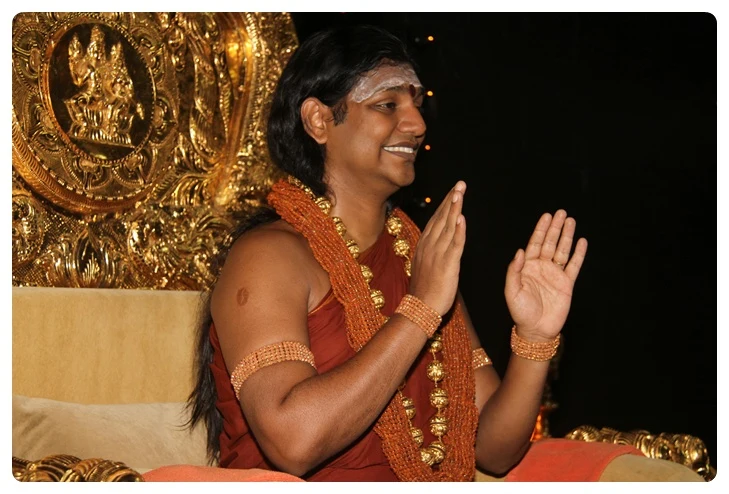
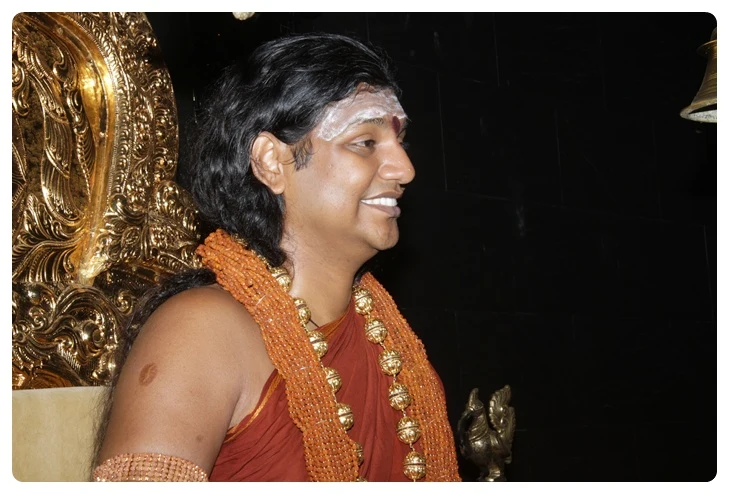
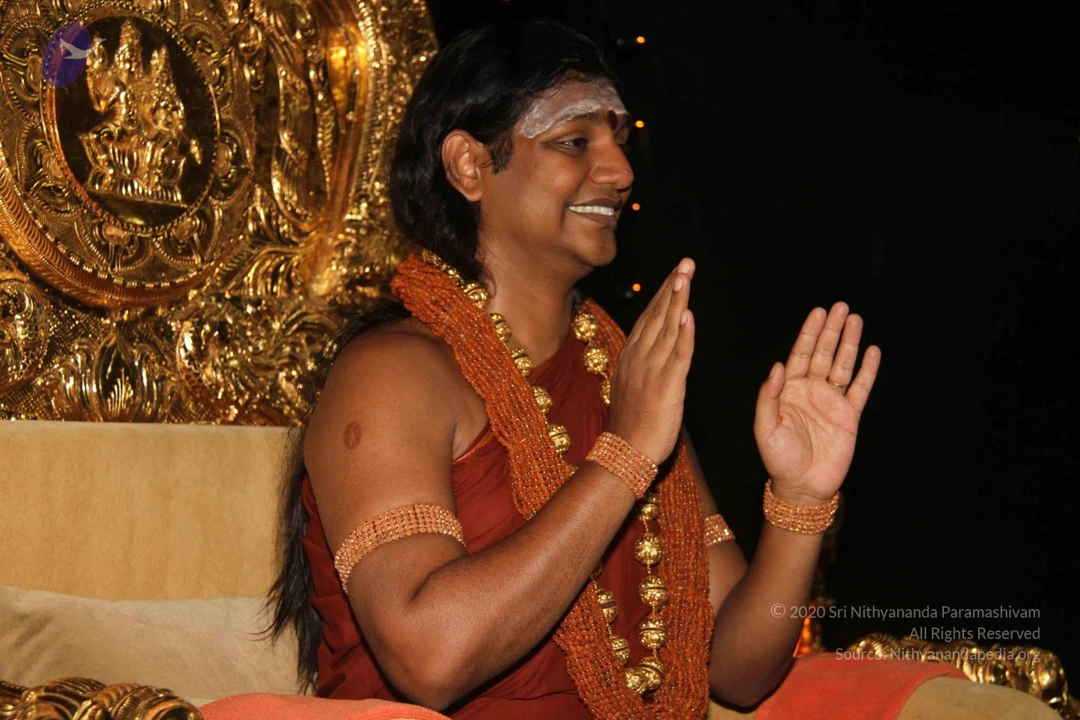
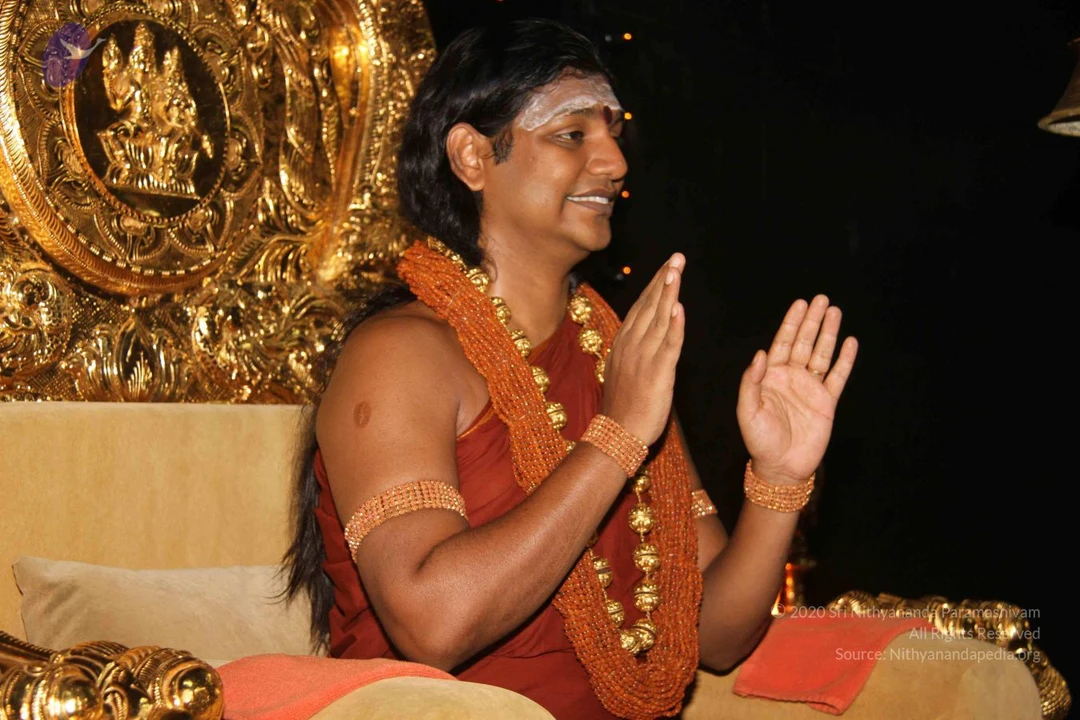
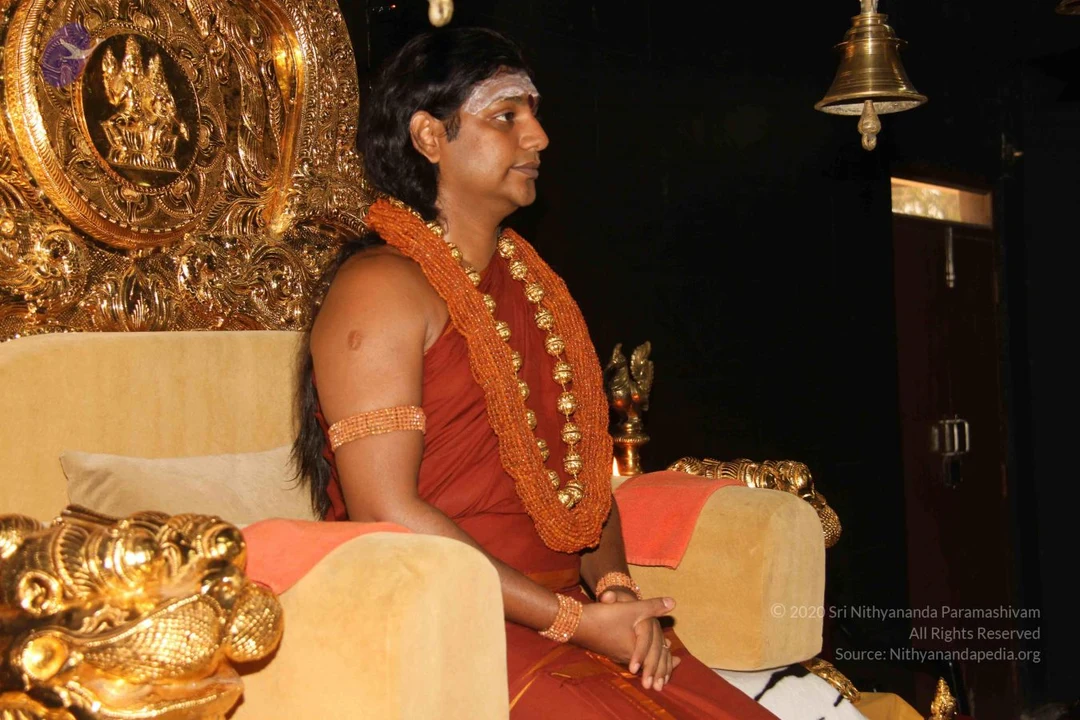
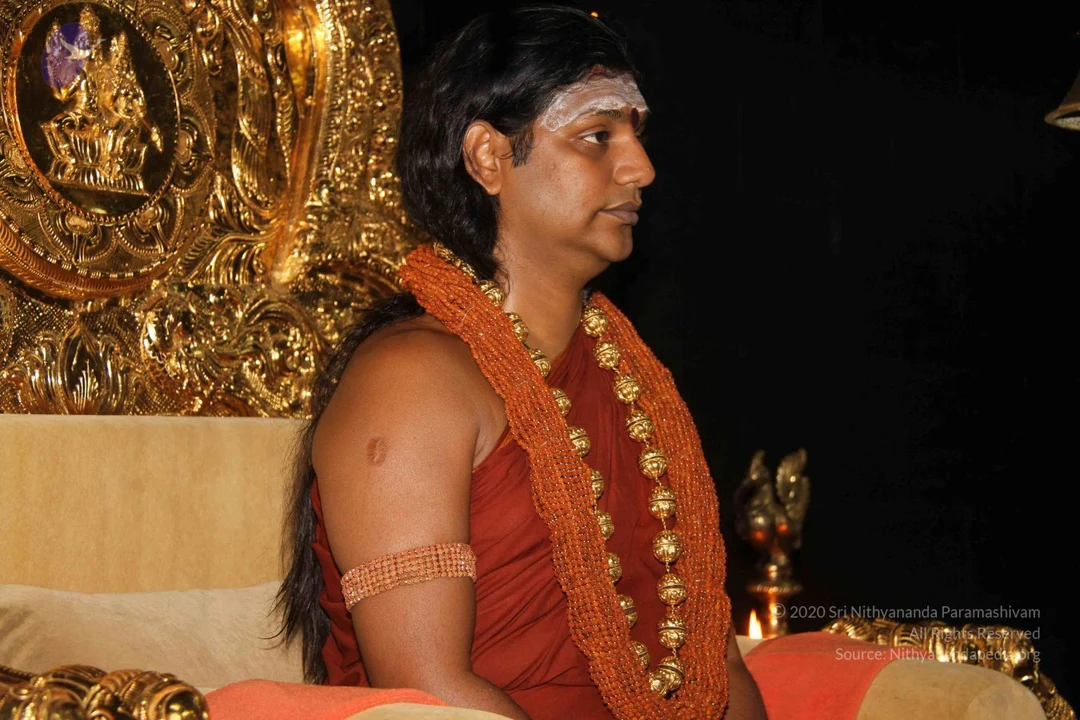
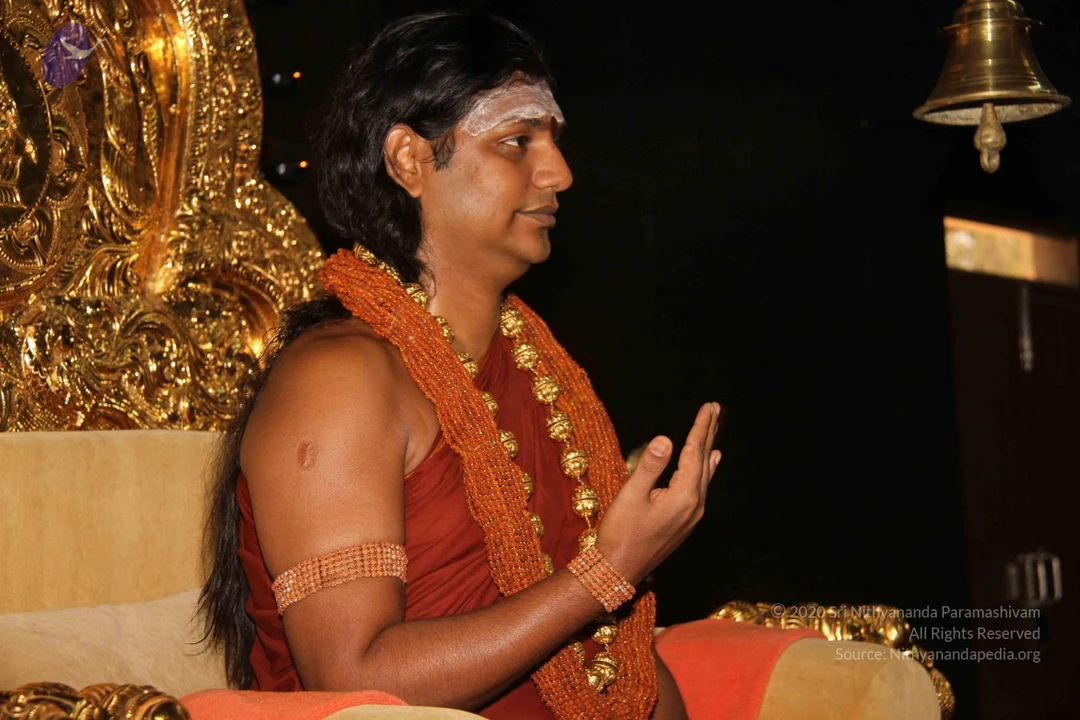
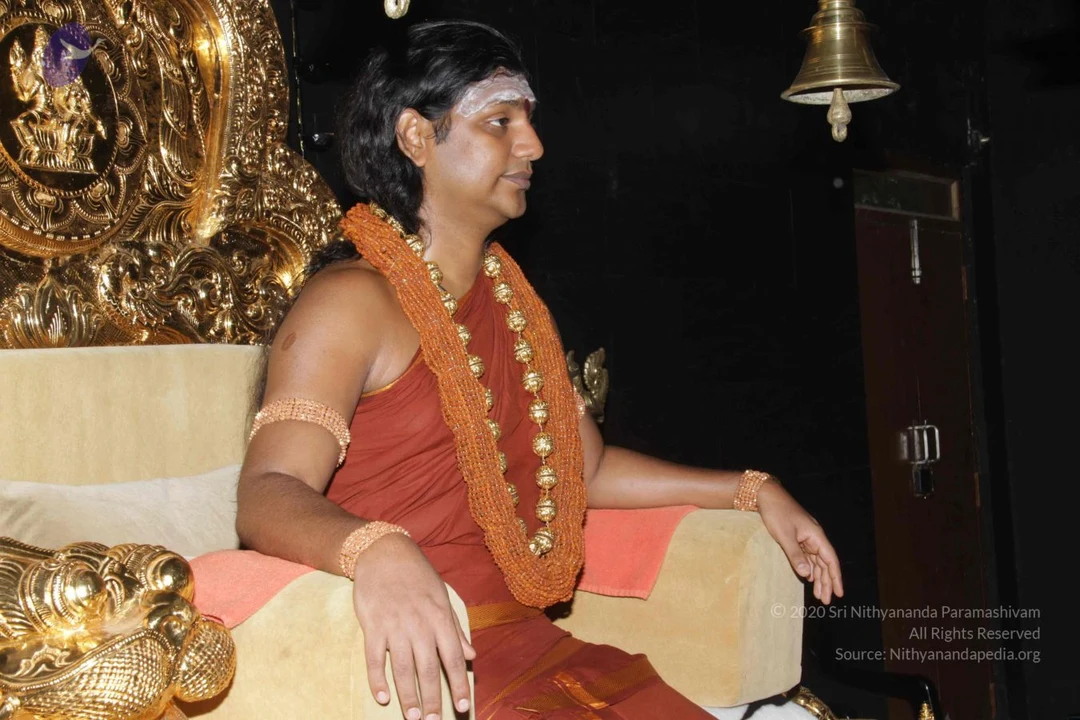
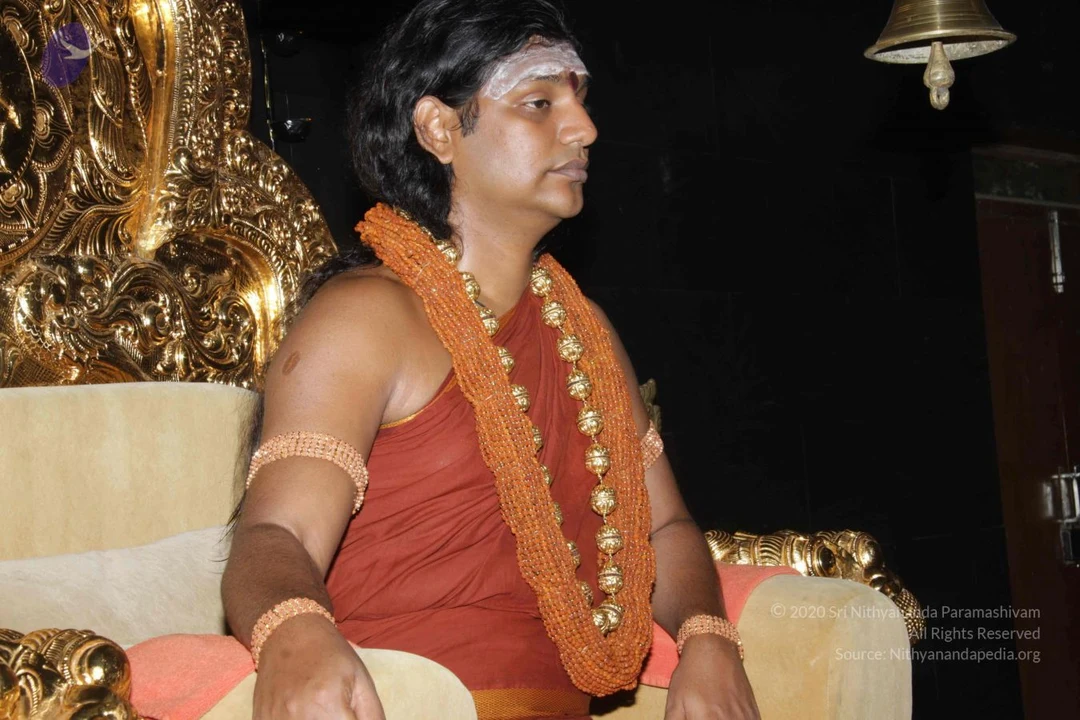
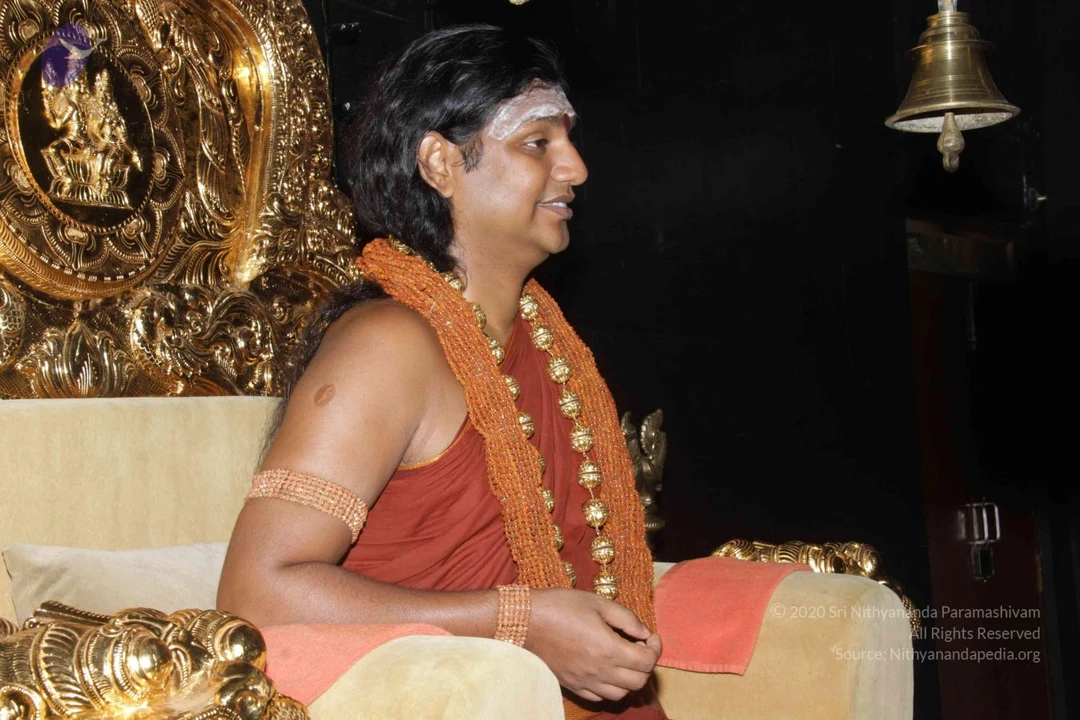
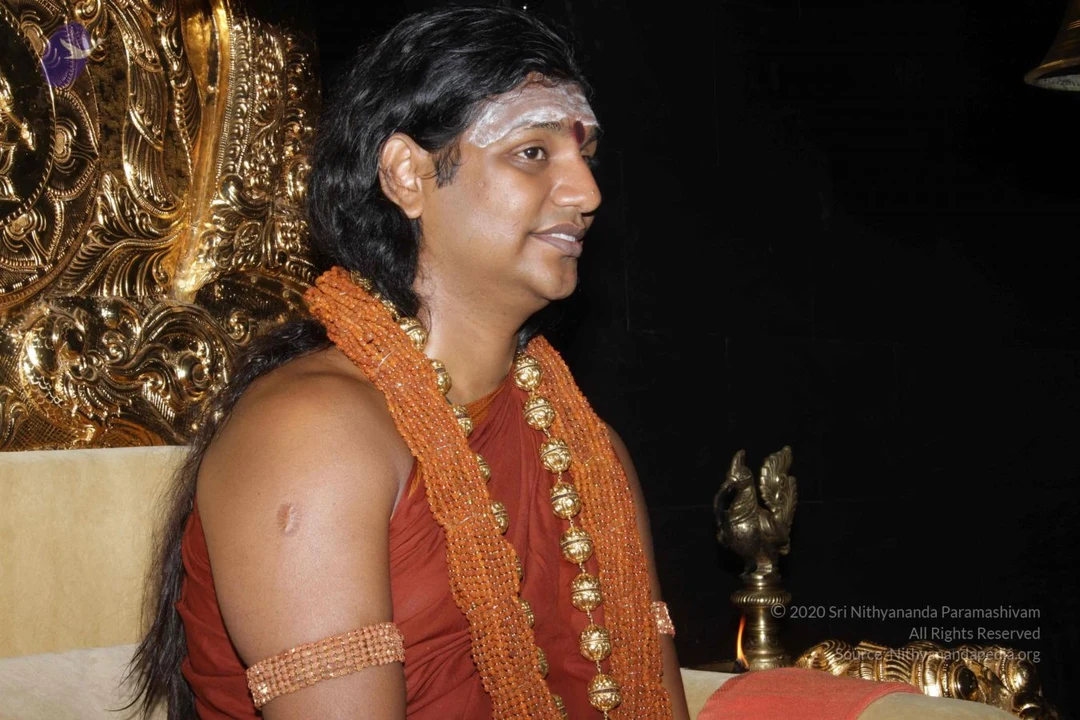
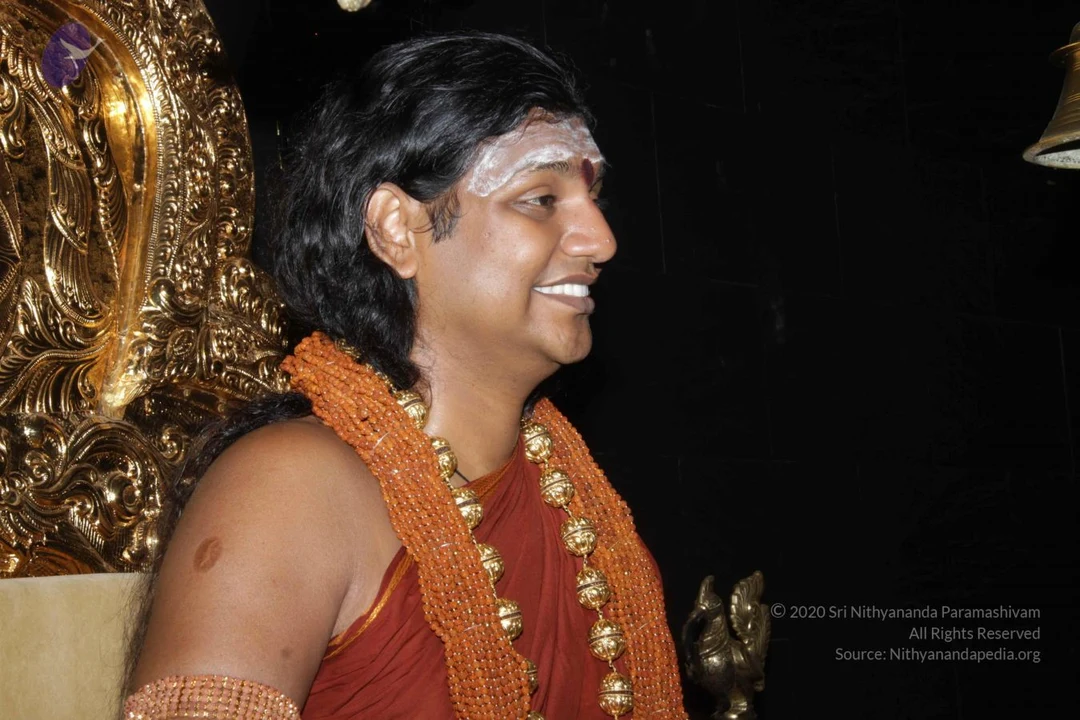
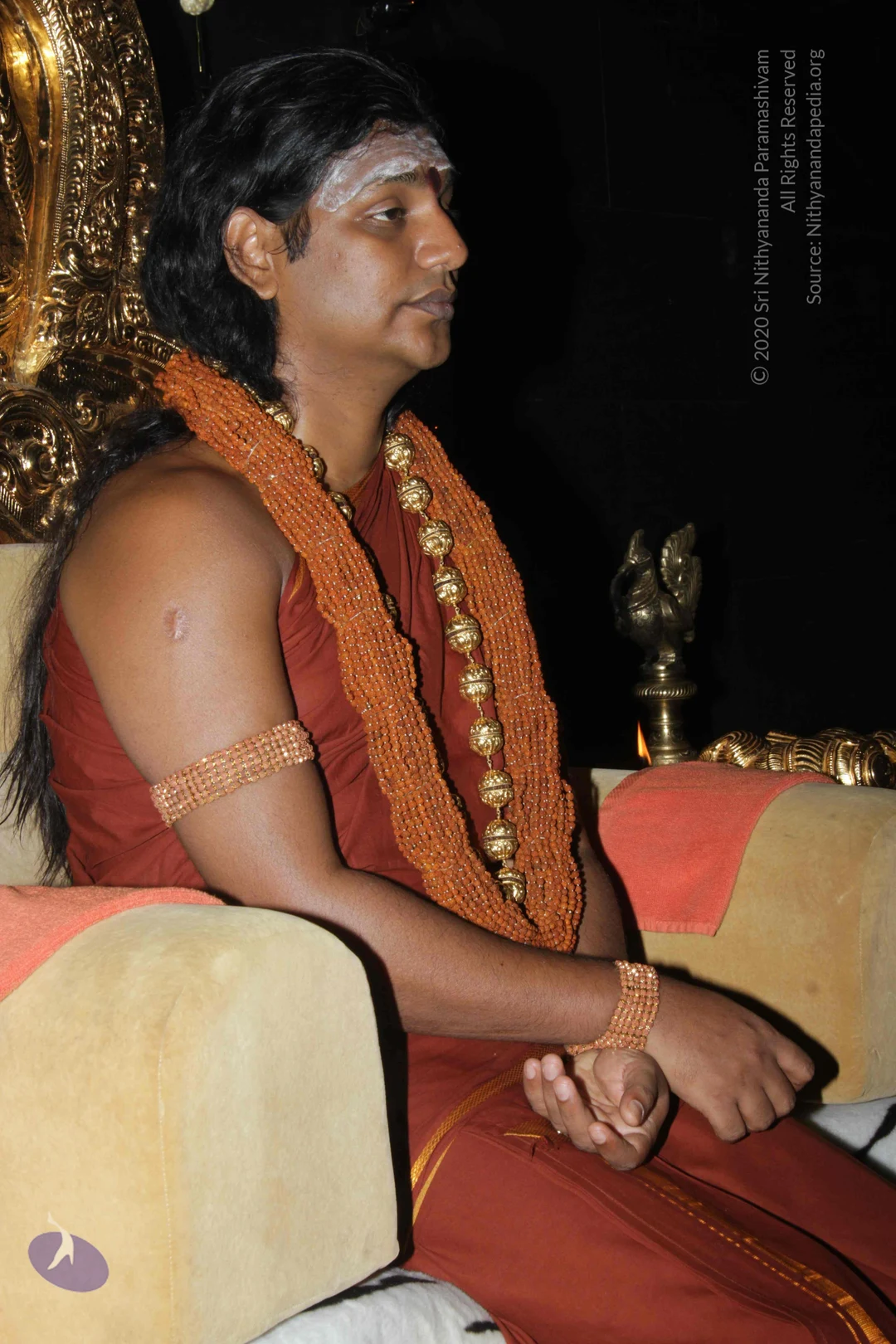
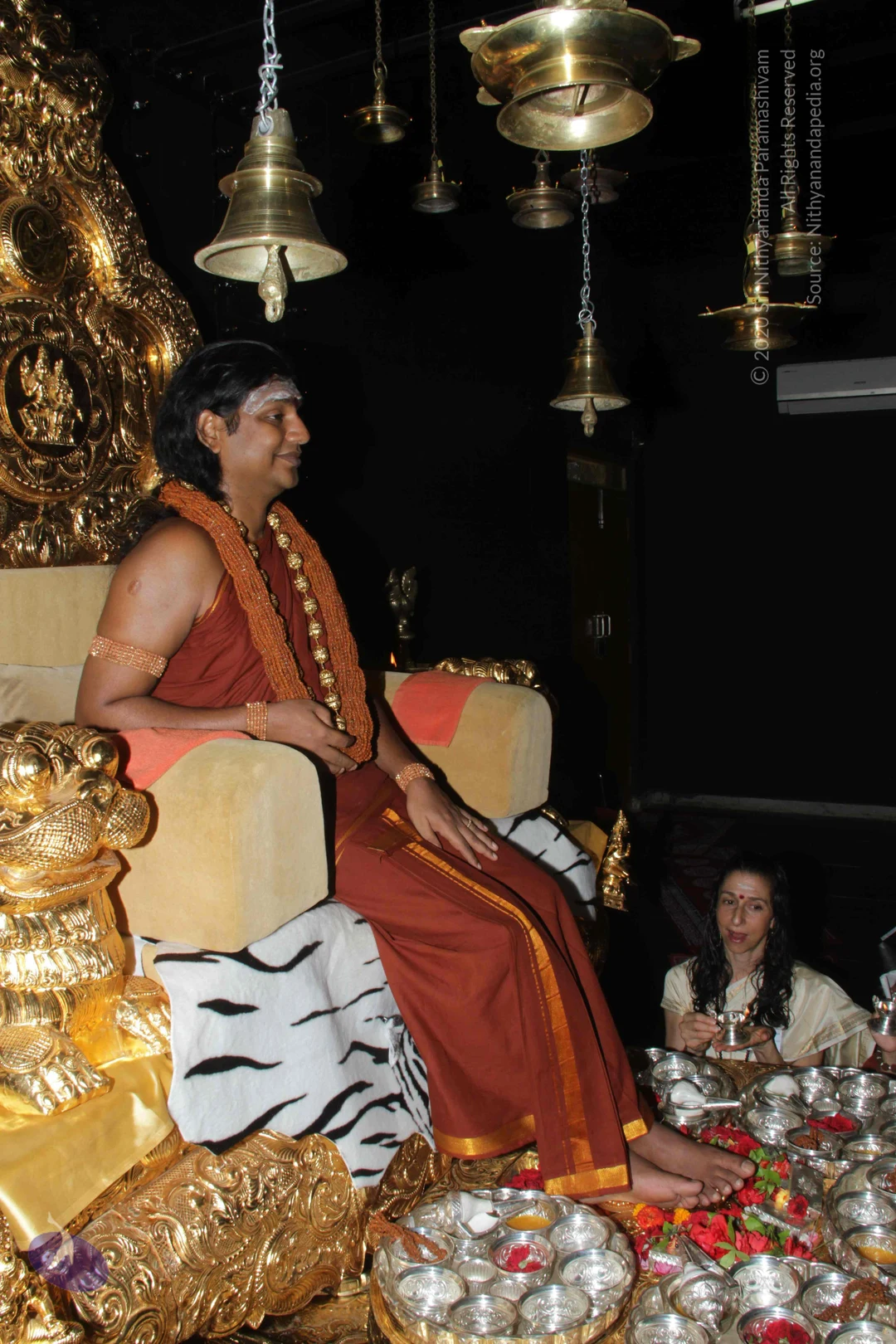
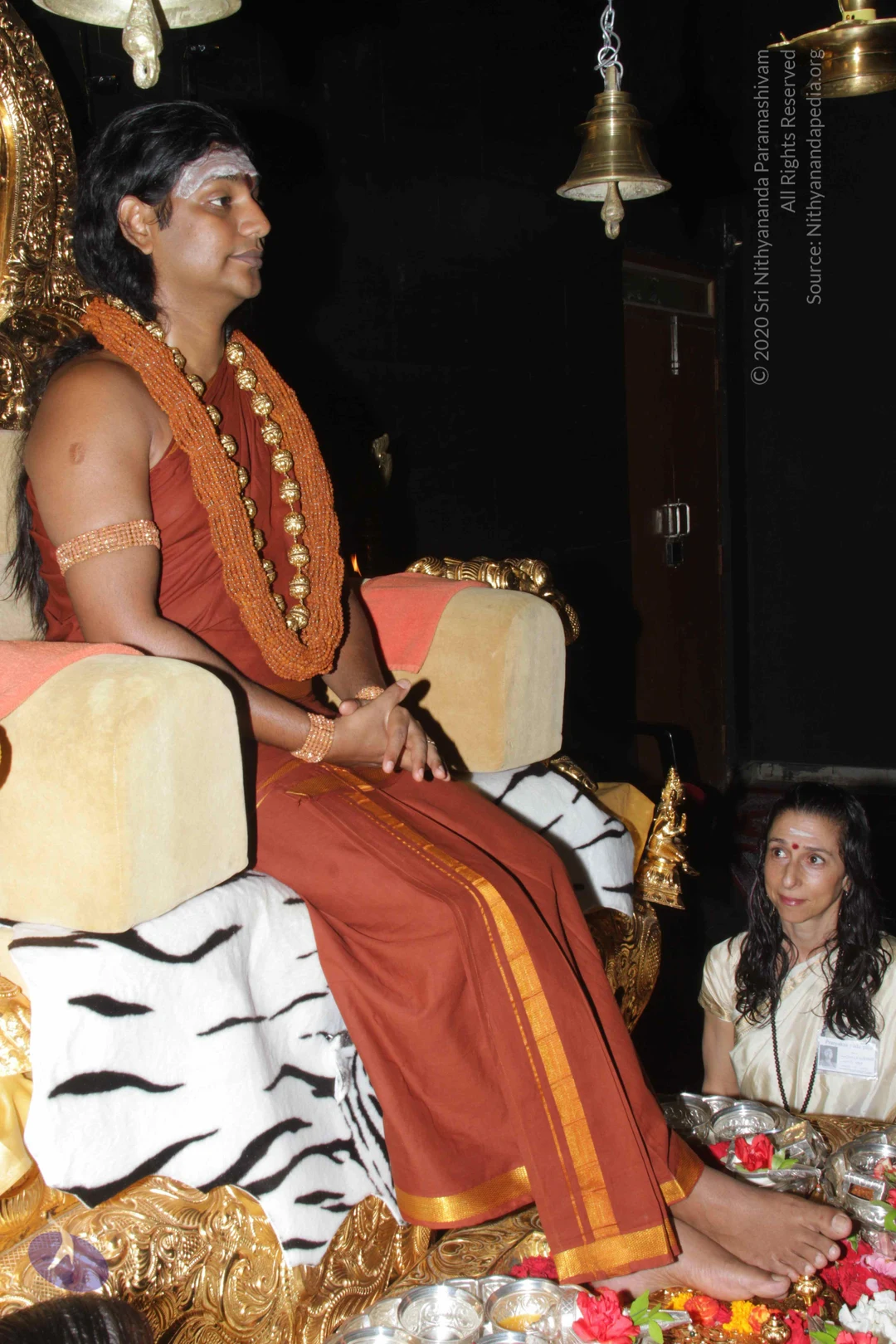
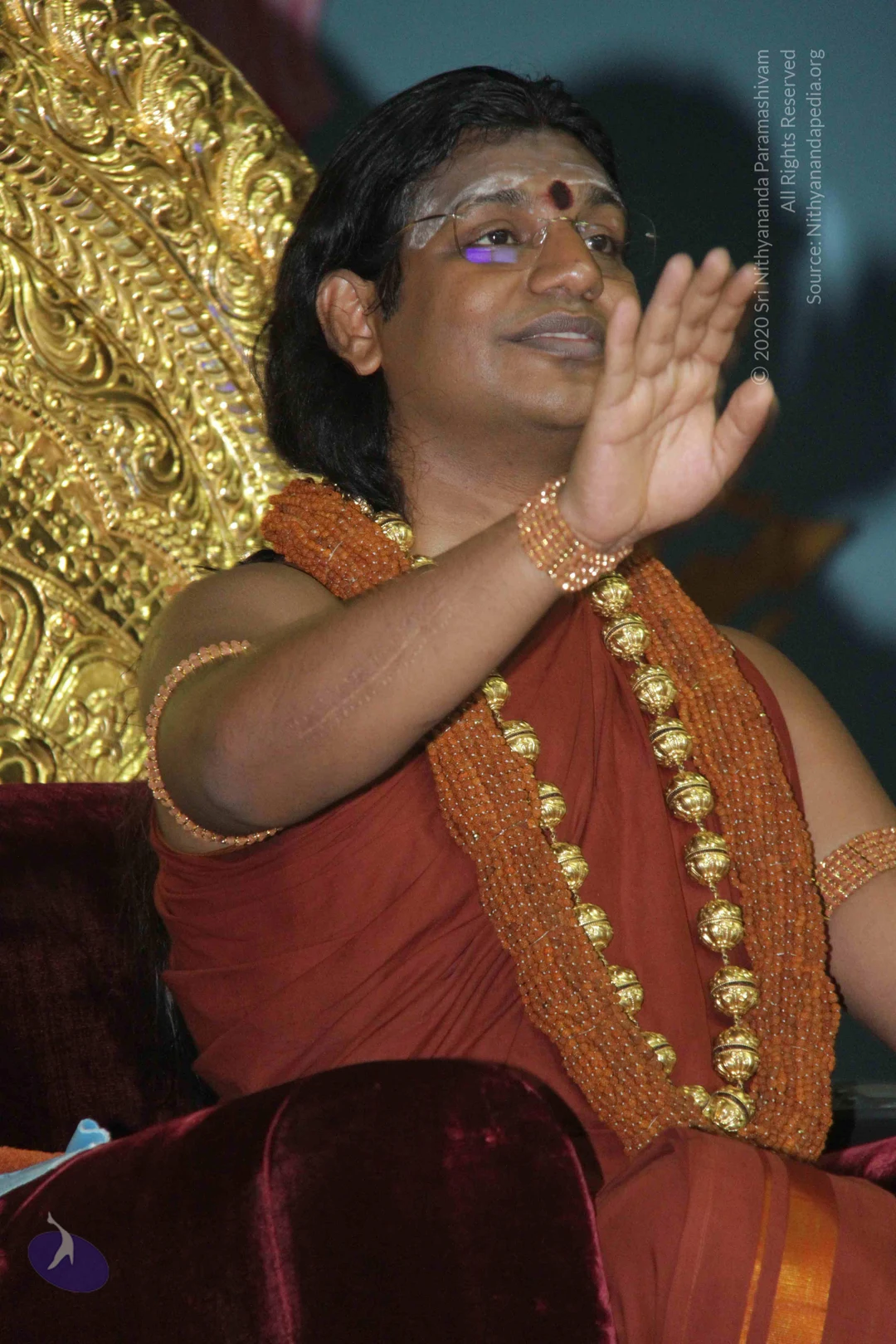
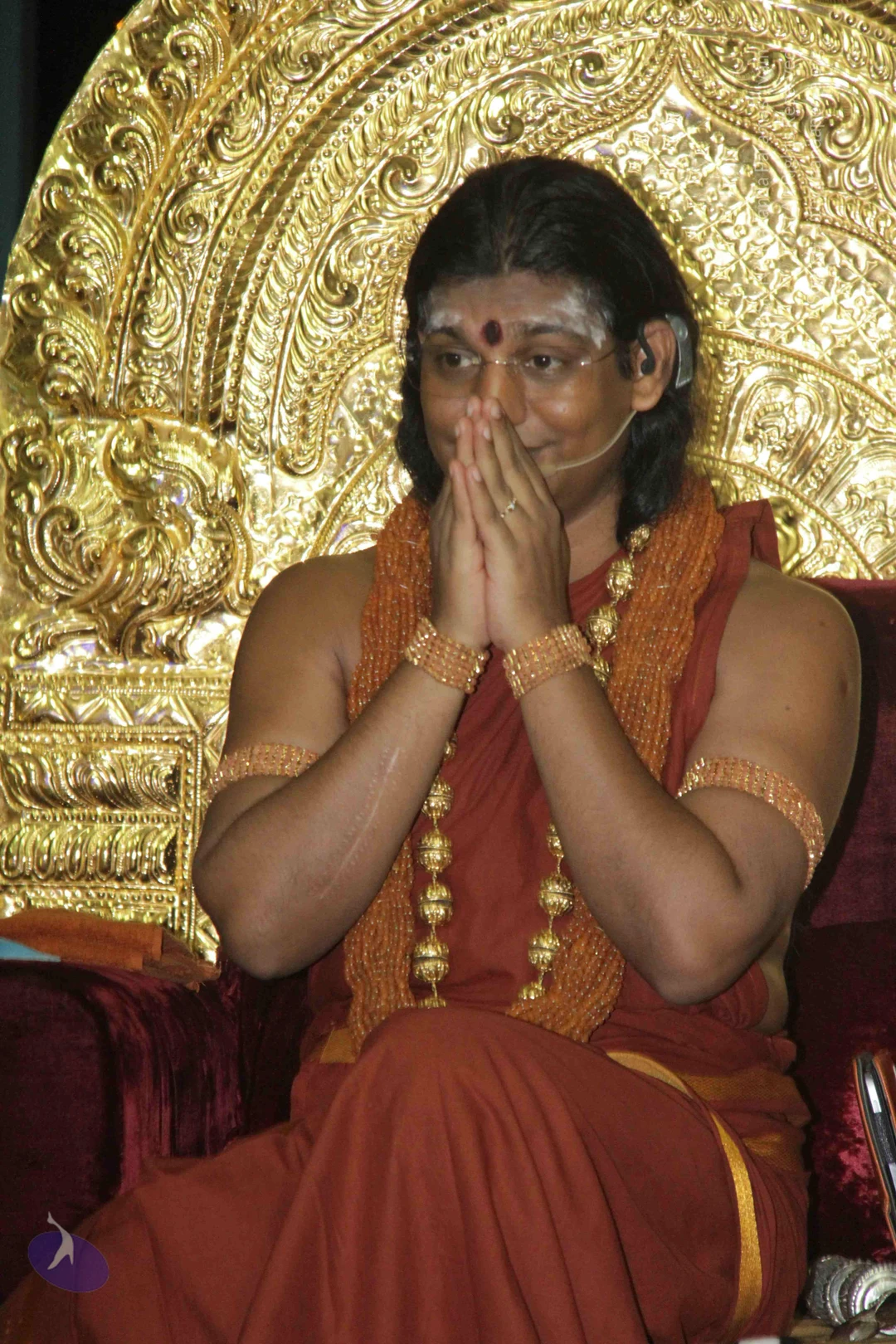
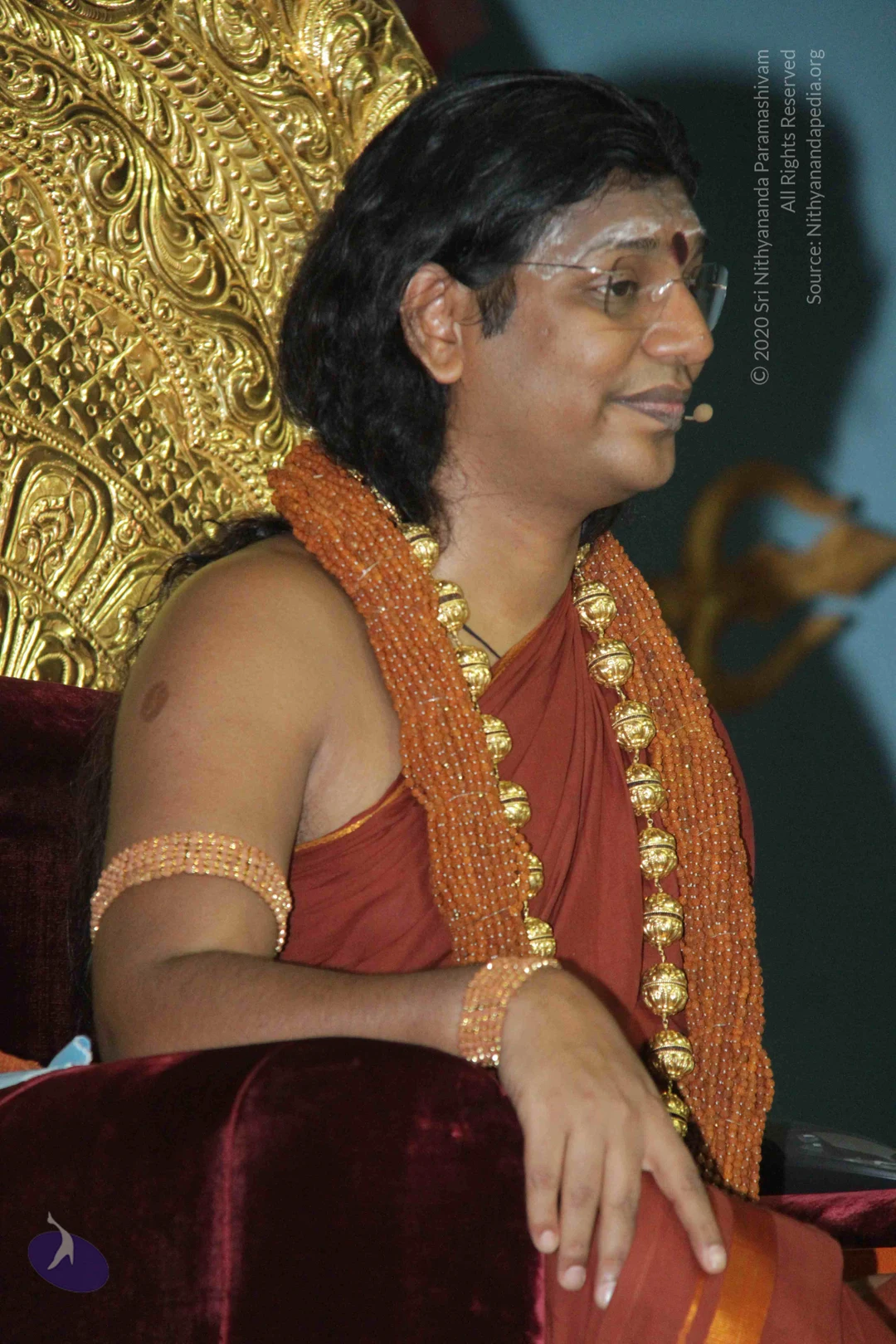
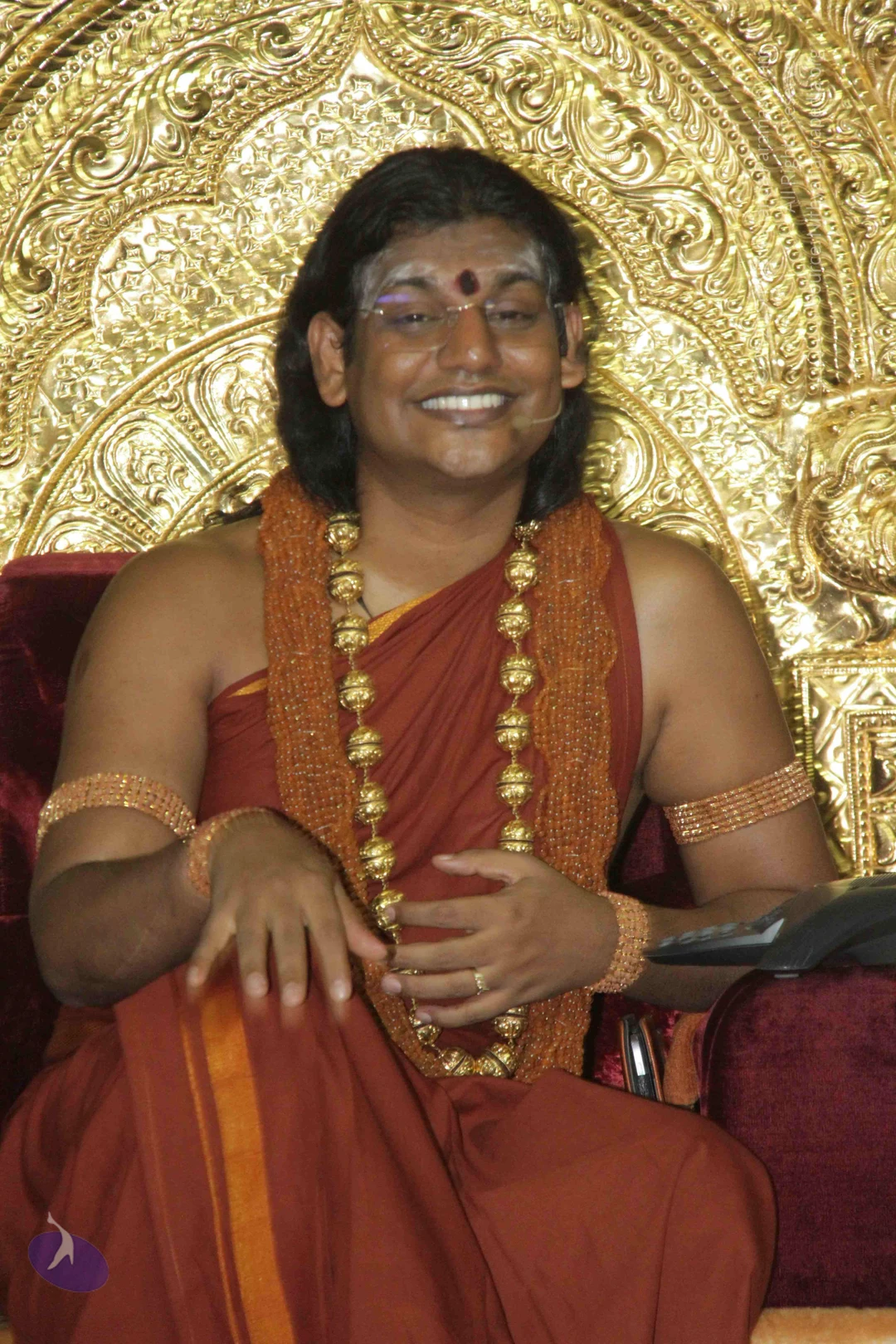
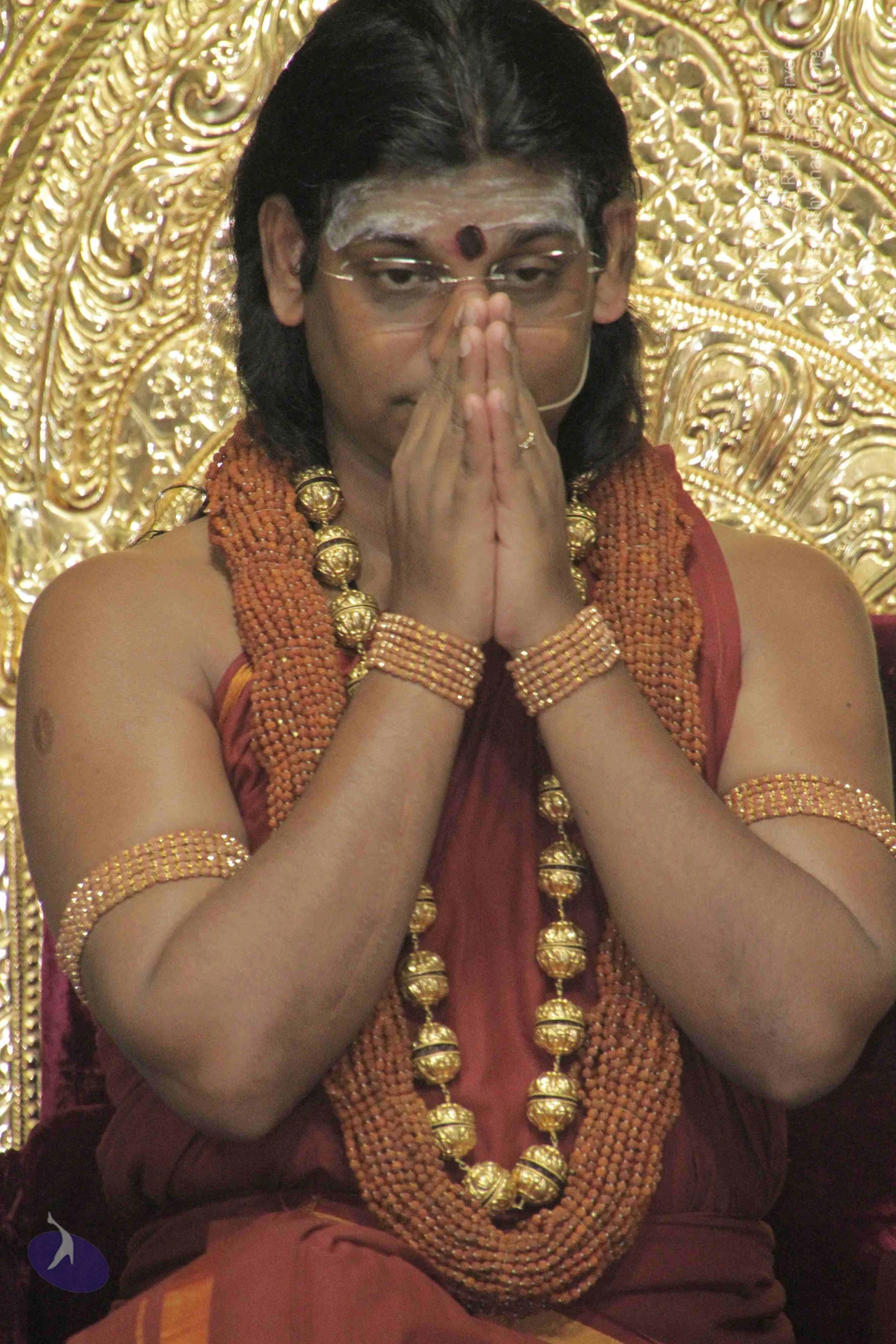
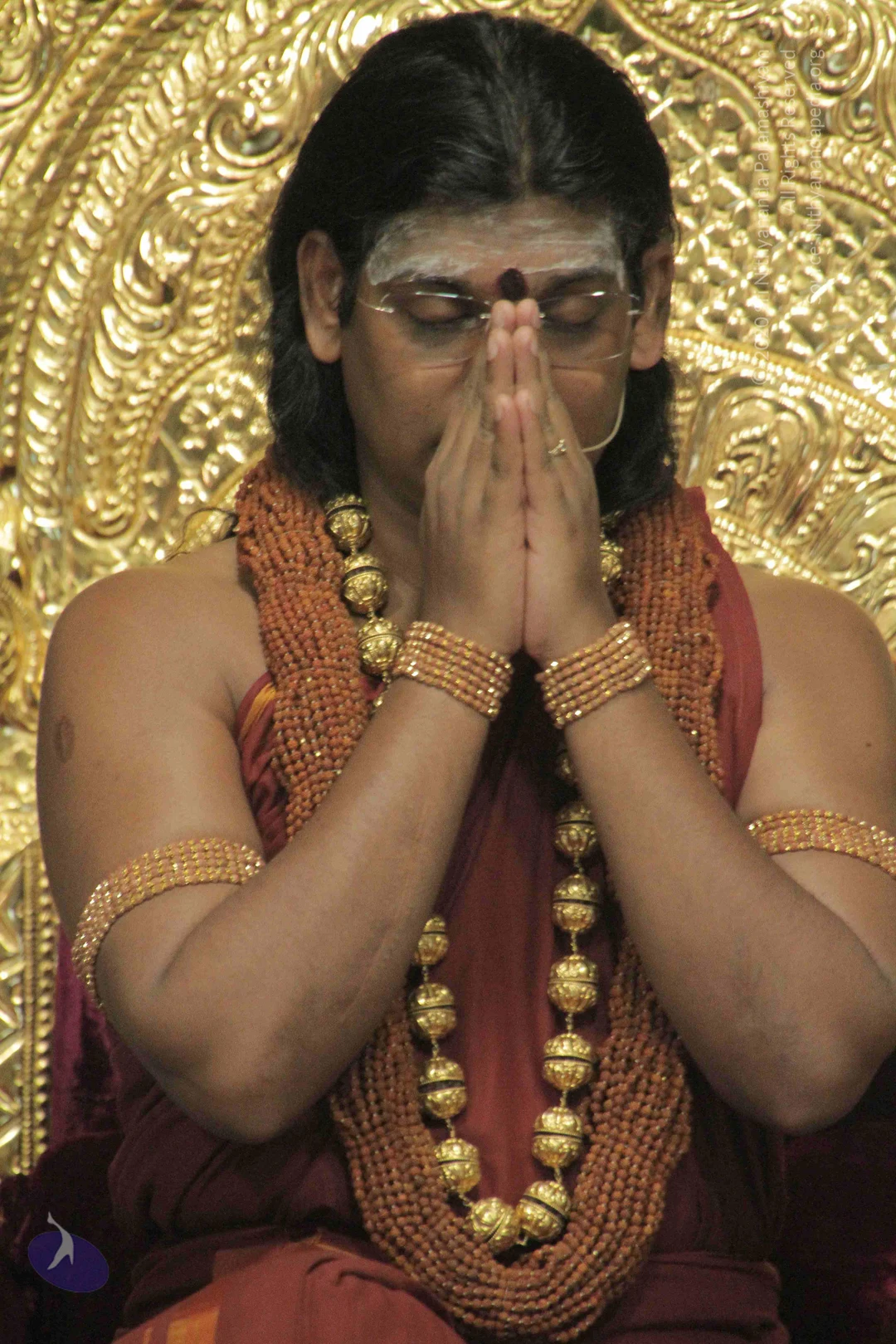
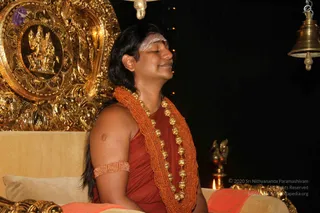
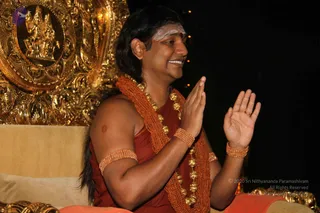
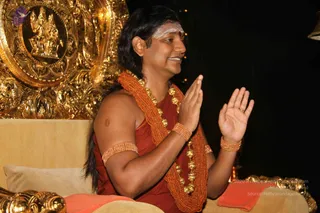
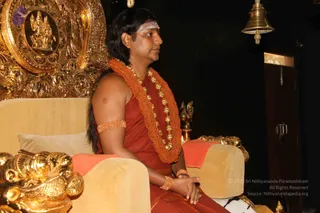
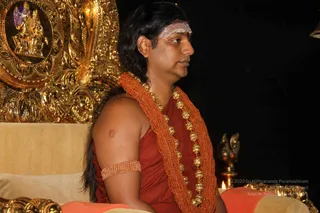
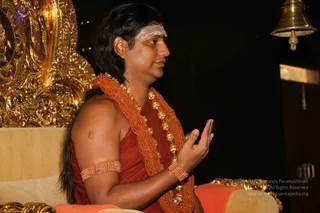
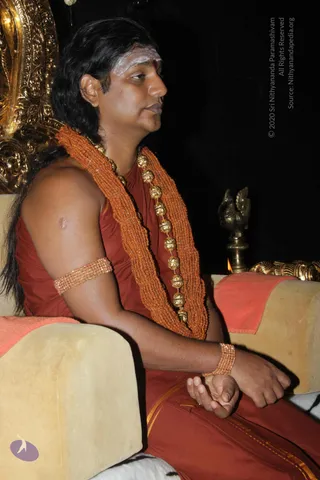
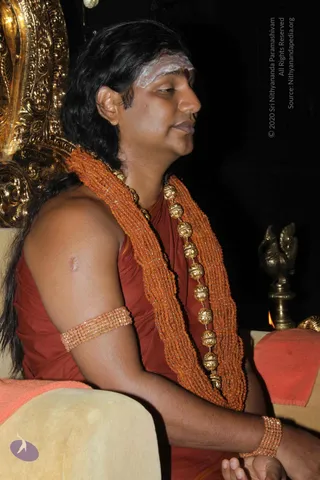
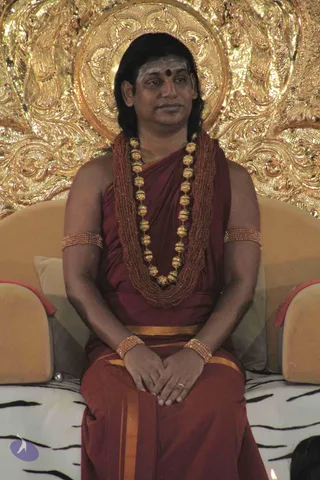
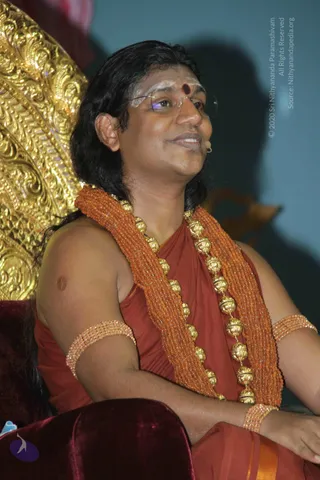
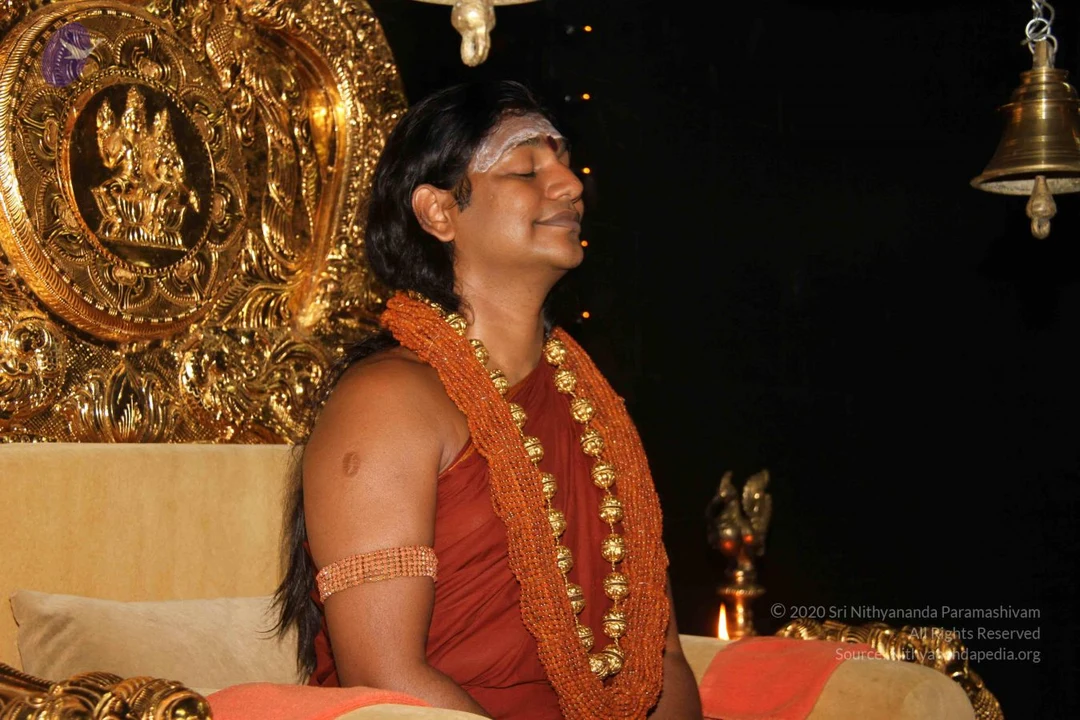
A man seated in profile with eyes closed and a faint smile, sitting on a cream cushioned seat in front of an ornate gold-embossed throne backrest carved with a deity figure. He wears a rust-red garment, a long orange-beaded mala with gold bead accents, a white vibhuti marking on his forehead, and a beaded armband. A brass bell hangs at right and a small lit oil lamp glows near the seat, against a dark background. Swamiji (probable), seated in meditation during satsang, shows long swept-back hair, an orange-red robe and an ornate beaded necklace.A photograph of a smiling man seated on a cushioned golden-upholstered seat in front of an ornate gold repoussé backdrop showing a deity murti. He wears a rust-orange garment over one shoulder, layered orange beaded mala necklaces with gold beads, orange beaded armlets and bracelets, and a white vibhuti marking on his forehead. His palms are pressed together in namaste while his other hand is raised in greeting. Appearance cues include long swept-back dark hair and ceremonial orange and gold adornments, consistent with the page's reference to a person. The setting is dark with a few small warm lights visible behind him.A seated man in a rust-red robe and long orange beaded malas with gold beads sits on a cream cushioned seat with his palms pressed together in namaste, smiling. A white vibhuti mark is on his forehead and he wears gold bangles on his upper arms and wrists. Behind him stands an ornate gold repoussé deity murti panel on a dark background. Swamiji (probable): long swept-back hair, saffron-orange ornate clothing and malas match the appearance cues, shown in person. Only one physical person is visible.A photograph of a seated man in a rust-orange robe with a long orange-and-gold beaded necklace and matching orange and gold wrist beads, wearing a white vertical forehead mark and long dark hair swept back. He sits on an ornate cream-upholstered golden throne with a richly carved gold backrest bearing a deity relief, hands folded in his lap. A brass bell hangs in the upper right against a dark wall, with a small golden bird figure beside the chair. Candidate appearance is consistent with the page's a person reference, showing long swept hair, orange robe, and ornate beaded necklace, so the label is probable. Read as a probable depiction of Swamiji in person at a satsang setting.A seated man in a saffron-orange robe sits on a cushioned golden throne in profile facing right. He wears a long orange-red beaded necklace with large gold-toned beads, an orange beaded armband, and a white vertical-streaked tilak on his forehead with a red dot. His long dark hair falls past his shoulders. Behind him, an ornate gold-embossed panel with a deity relief stands against a black background, and a small lit oil lamp sits at right. The body is partly bare on one arm, and he sits in a calm, upright posture. Appearance-based candidate for Swamiji (probable): long swept-back hair, saffron robe, rudraksha-style orange beads and ceremonial gold ornaments.A seated man in profile in an ornate golden throne setting, wearing a rust-red shawl over his bare shoulder, a long orange-beaded necklace with large gold bead ornaments, orange bangles on his wrists and a white vertical mark with a red dot on his forehead. He raises one hand in a gesture of address while sitting in front of a dark background with a brass bell at the upper right. Probable Swamiji: long swept-back hair, rudraksha-style orange beads and gold ceremonial necklace with a golden throne, consistent with the page's reference to a presidential satsang discourse.

NITHYA-SATSANG
14 photosSource gallery
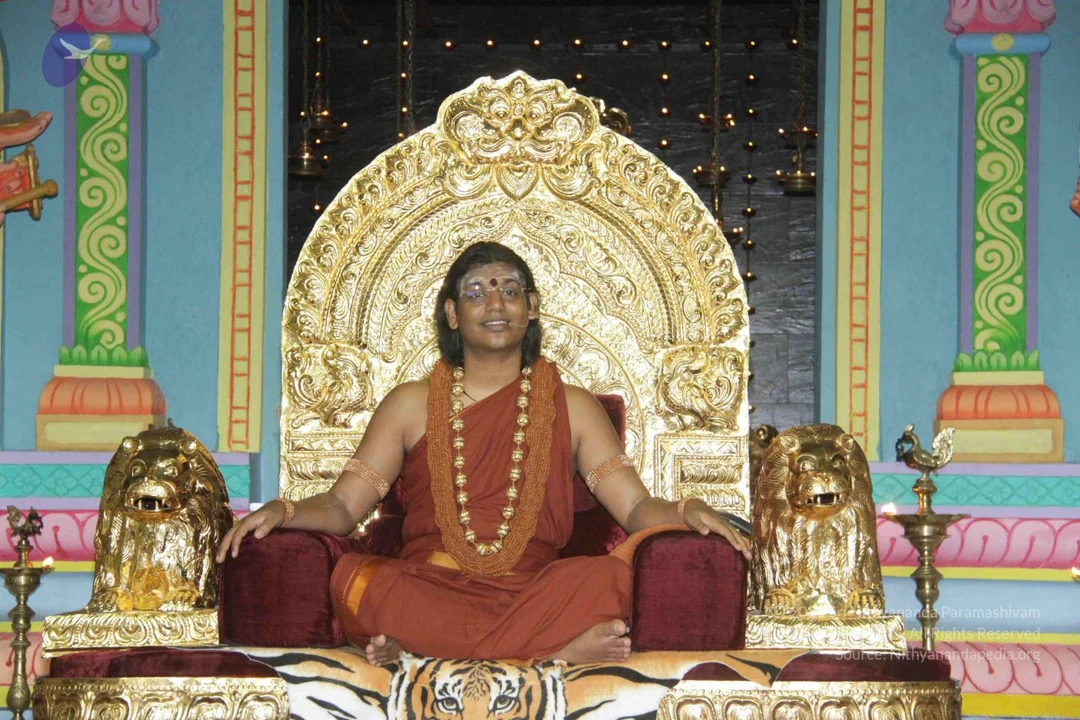
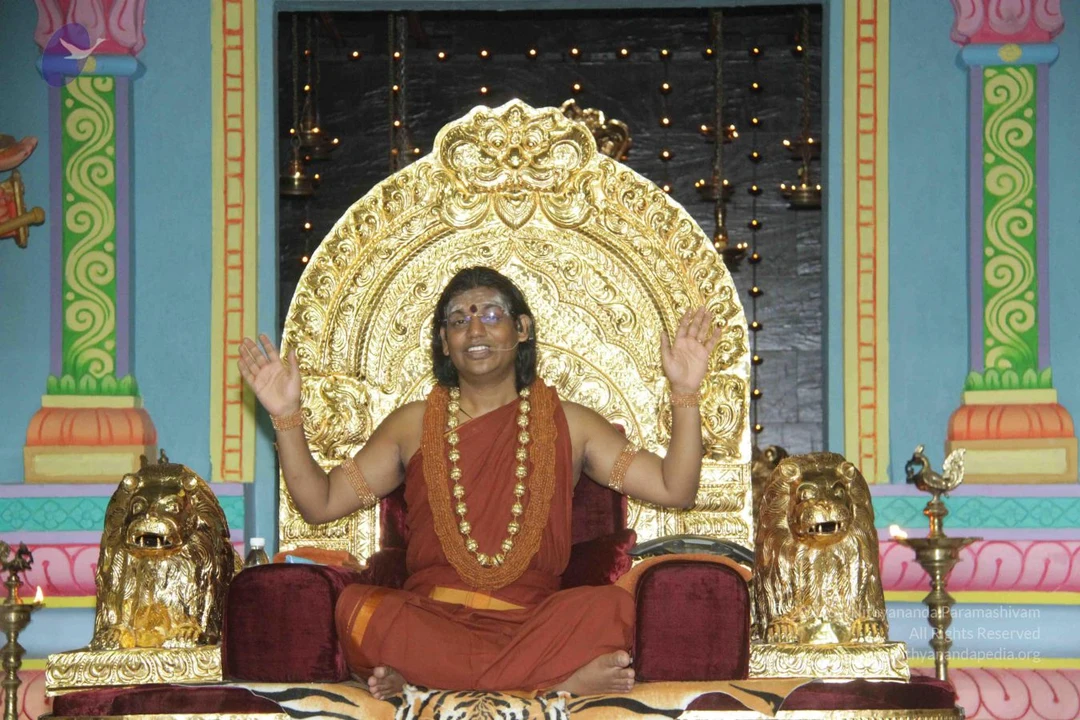
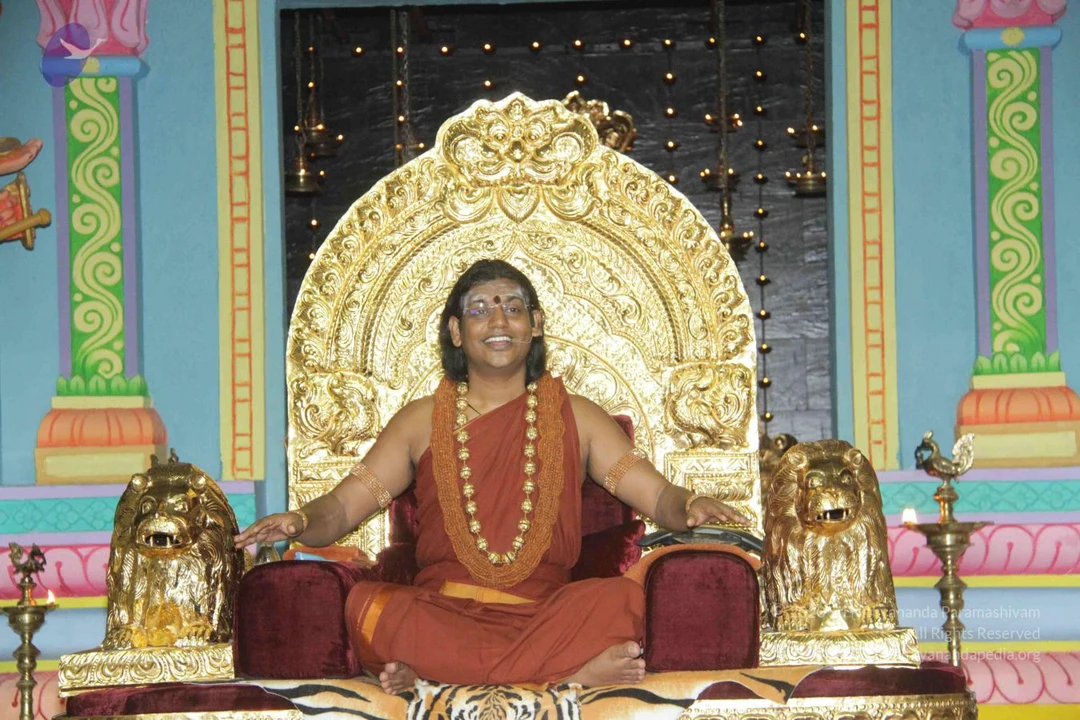
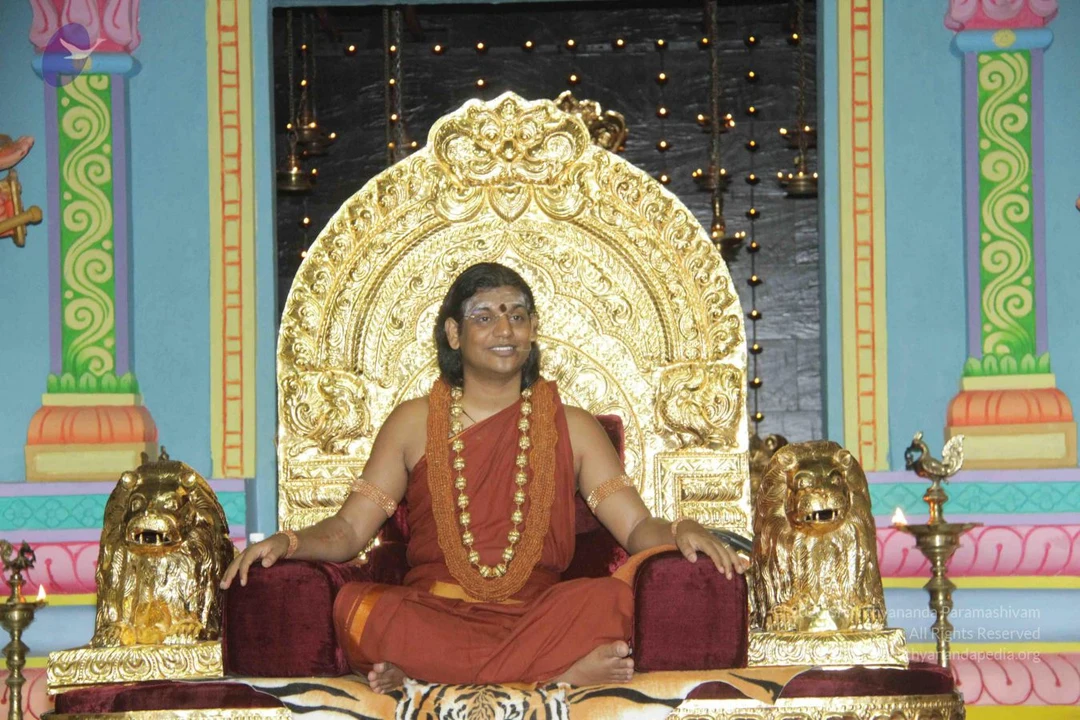
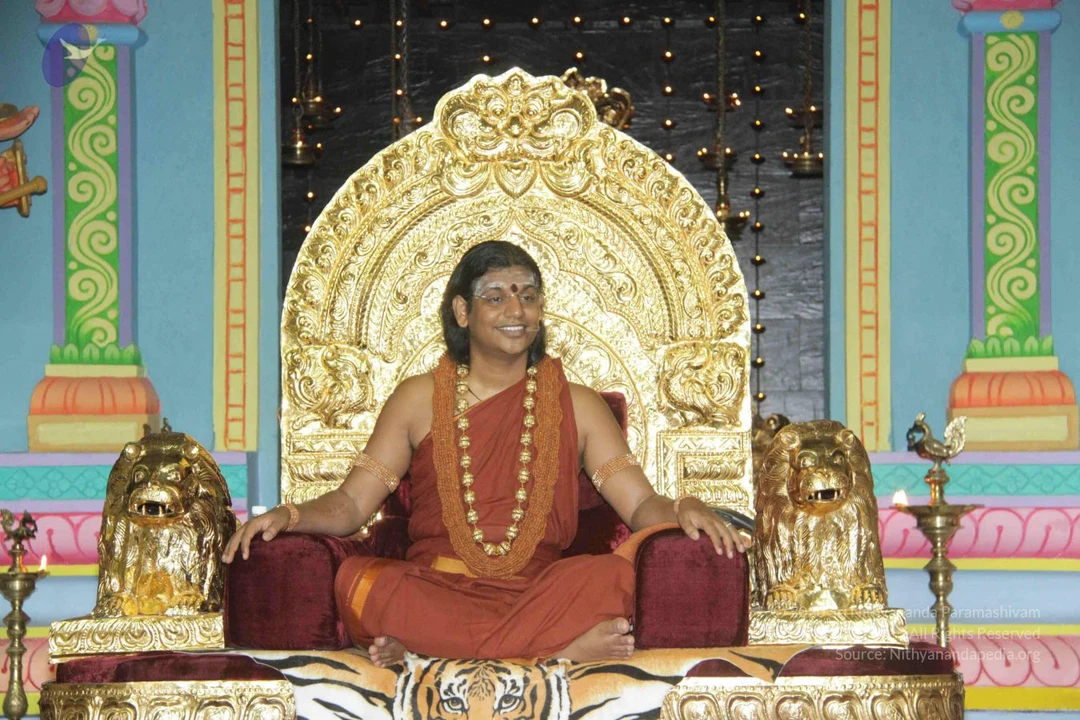
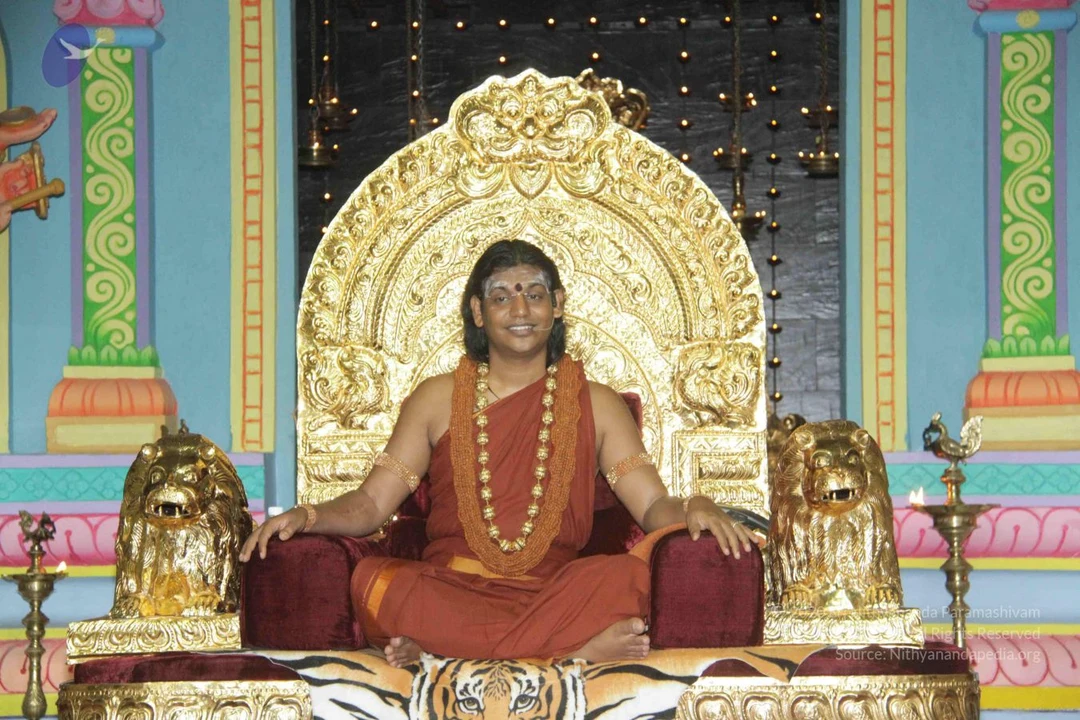
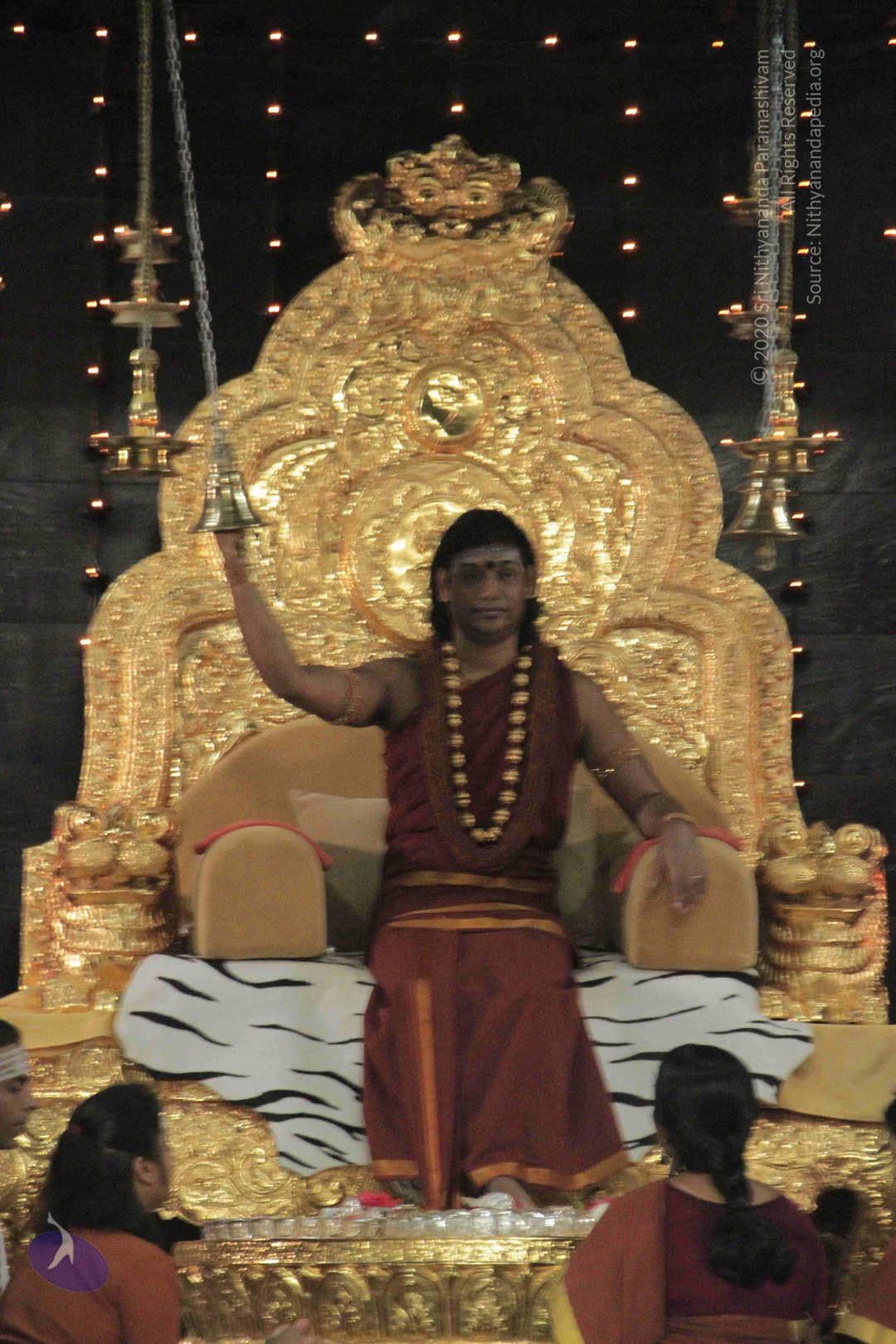
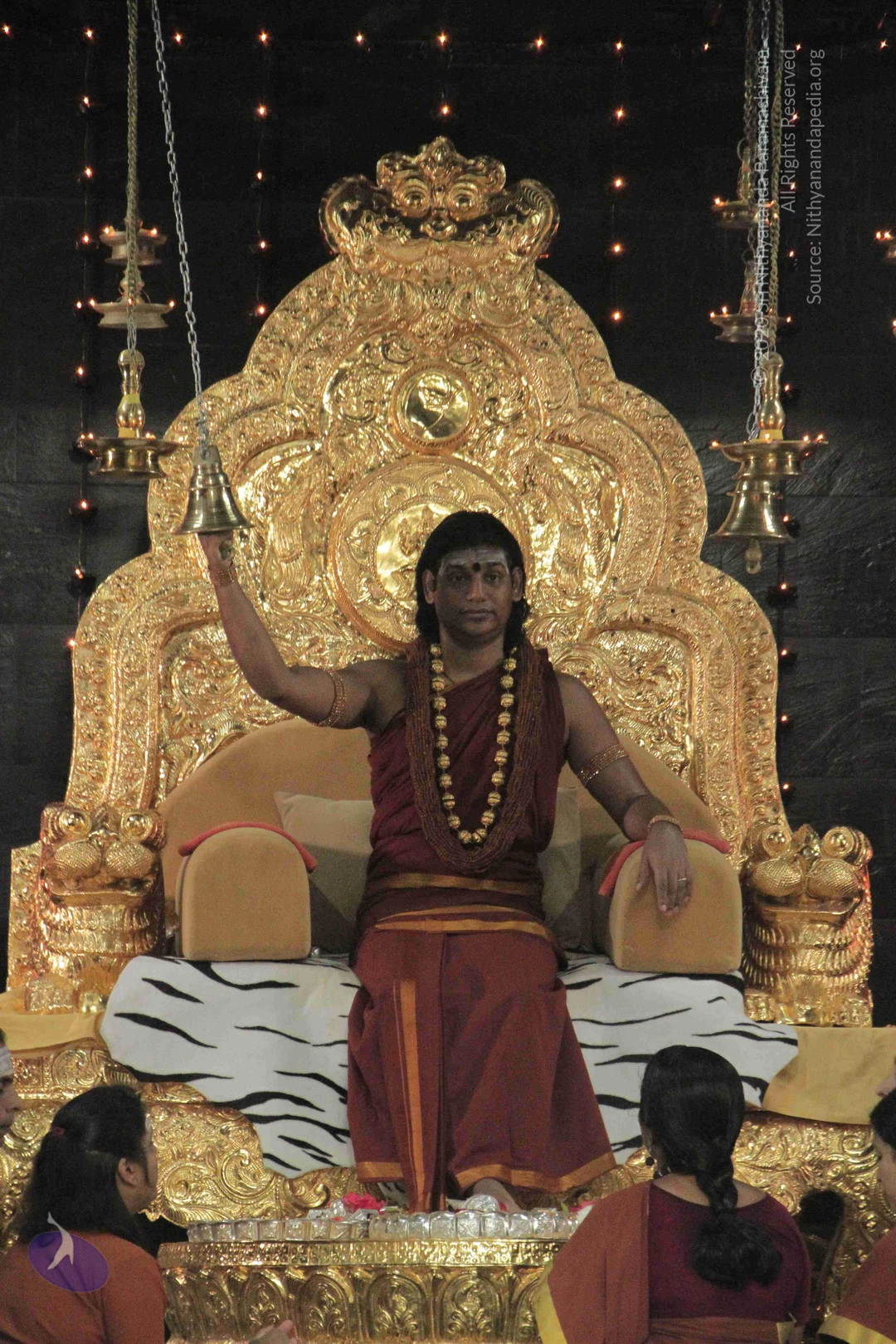
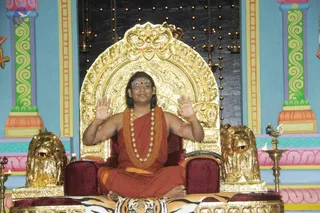
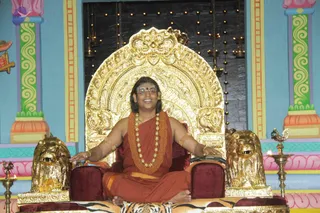
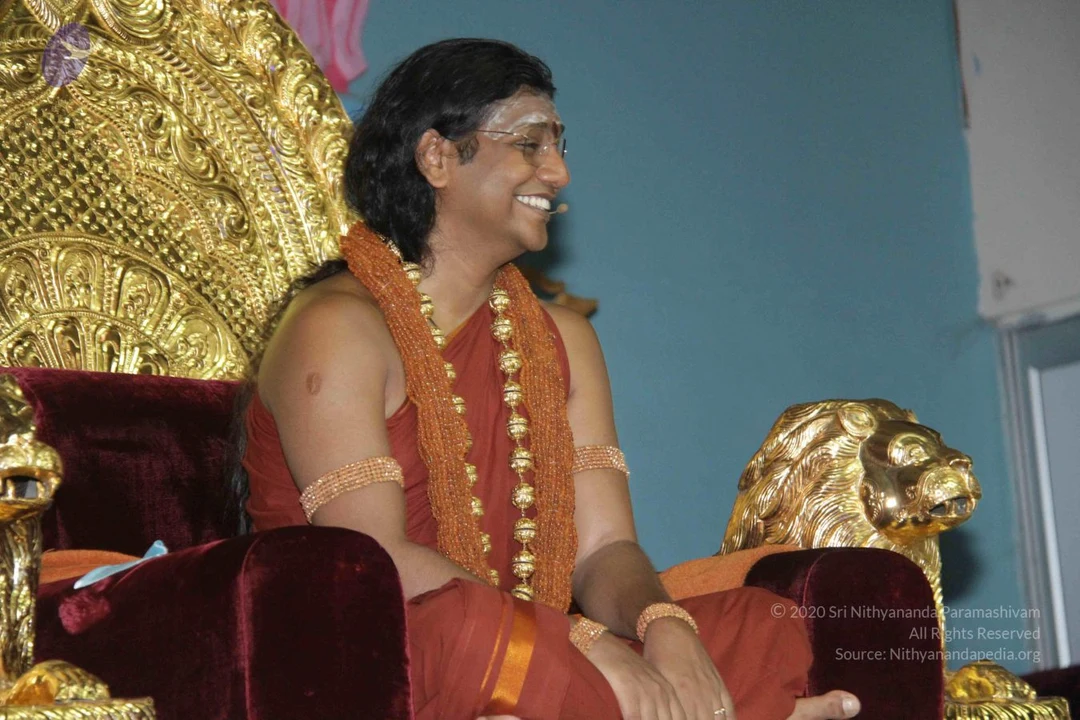
A seated man in saffron-orange robes sits cross-legged on a tiger-skin-covered platform before an ornate golden throne with a large arched backrest. Two gilded lion sculptures flank the seat, and he wears a long beaded gold necklace and a rudraksha-style orange mala, with gold armlets and a red tilak on his forehead. He extends both arms outward while speaking. Hanging brass lamps and small oil lamps stand in the background against a painted blue, green and pink temple-style wall.A seated man in saffron-orange robes sits on an ornate gold throne with a large arched backrest, flanked by two golden lion figures and a tiger-skin cloth beneath. He wears a long rudraksha mala, a gold chain and bangles, with a red bindi and a sacred ash mark on his forehead. Behind him are blue and pink painted pillars with green scrollwork and hanging brass lamps. Brass oil lamps stand at the sides. A printed caption on the image reads a name, and this is a Swamiji (probable) figure given the swept-back long hair, saffron robes, rudraksha mala and gold ornaments, seated in a throne setting.A photograph of a seated figure on an ornate gold throne flanked by two gold lion sculptures, with a tiger-striped cloth draped on the dais. The seated person wears a saffron-orange robe with a matching shawl, a long rudraksha mala and a gold-toned necklace, bangles on both wrists, and glasses, with a red bindi on the forehead. Both arms are raised with palms open in an expressive gesture while the person speaks. Behind the throne are a gold arched backdrop, hanging beads, and decorated columns in green, pink and turquoise. Brass oil lamps stand at the sides and a small brass rooster ornament sits on the right.A photograph of a seated man in a saffron-orange robe with a matching shawl and a long gold-bead necklace, sitting cross-legged on an ornate gilded throne with a large arched golden backrest and two gold lion figures flanking him. His hands are raised palms-out in a blessing gesture, and his hair is long and swept back, with a red bindi on his forehead and eyeglasses. The throne rests on a tiger-striped cloth, and a brass oil lamp stands at the right edge. Behind him, painted pillars in green, yellow and pink frame a blue wall with hanging brass lamps.A seated man in saffron-orange robes and a long rudraksha mala sits cross-legged on an ornate golden throne flanked by two golden lion heads, with his arms spread wide on the armrests and a red tilak on his forehead. Long, swept-back hair and the saffron garments and ornate gold throne fit the Swamiji (probable) presentation, shown seated and smiling in a colourful temple hall with a dark backdrop, hanging bells, brass oil lamps and a tiger-striped cloth beneath the throne.A seated man in a saffron-orange robe sits on an ornate golden throne with a large gilded arched backrest, flanked by two golden lion figures on the armrests, and a tiger-striped cloth covers the platform. He wears a rudraksha mala with a ceremonial gold necklace, gold armbands, a red bindi, and has long swept-back dark hair. Behind him hang brass oil lamps and a dark backdrop, with painted teal and pink pillars framing the stage. Small brass lamps and a brass rooster-topped stand sit at the sides. The figure's appearance matches Swamiji (probable) through the long hair, saffron clothing, rudraksha mala and gold necklace, and he is seated in the central throne position.

SARVA-DARSHAN

11 photosSource gallery
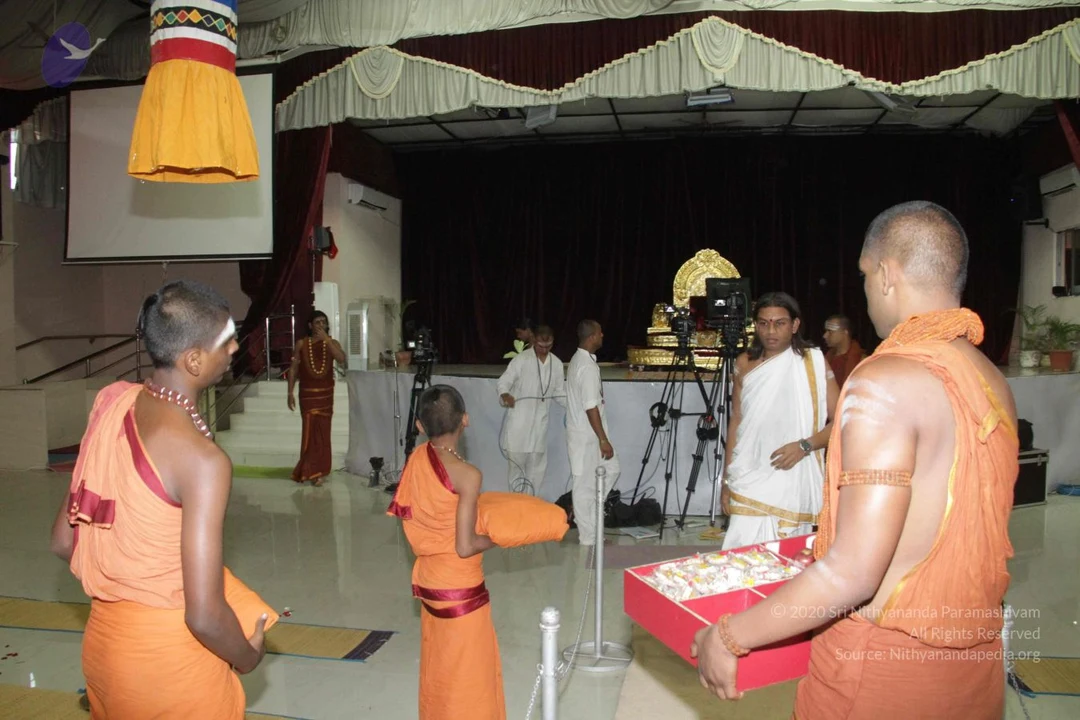
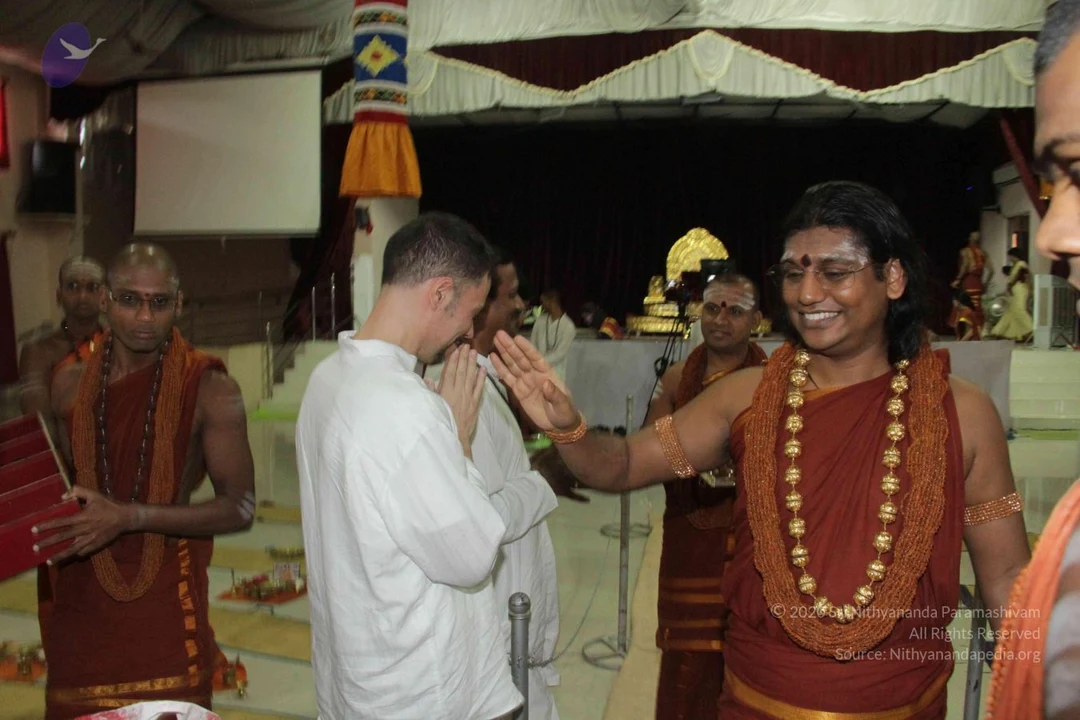
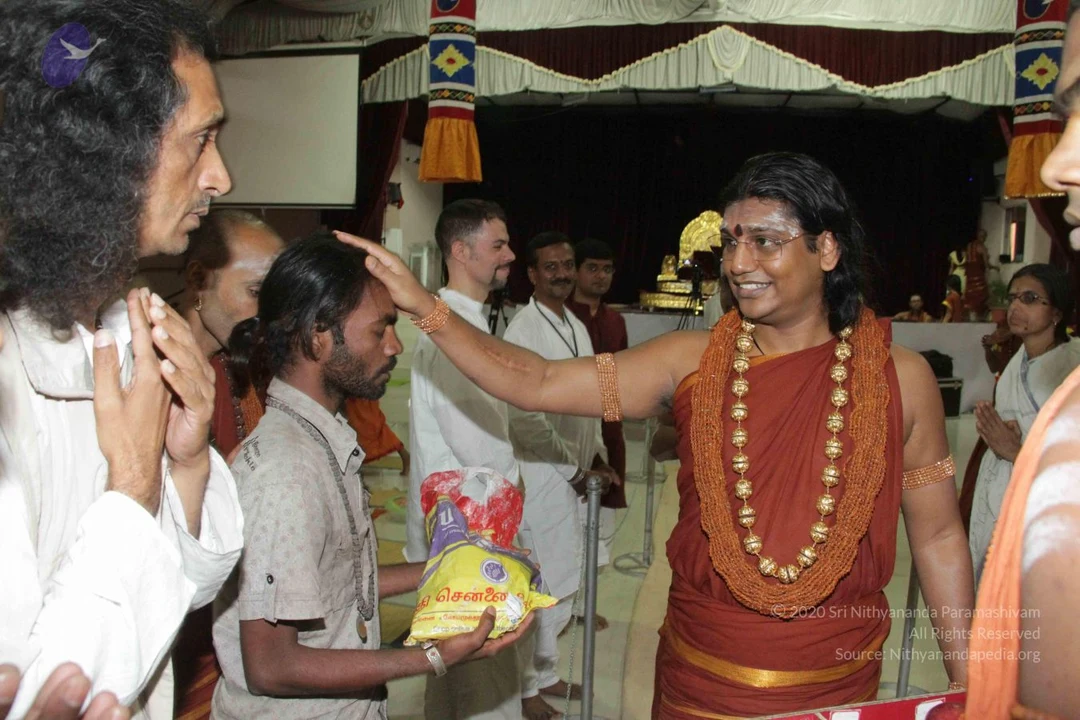
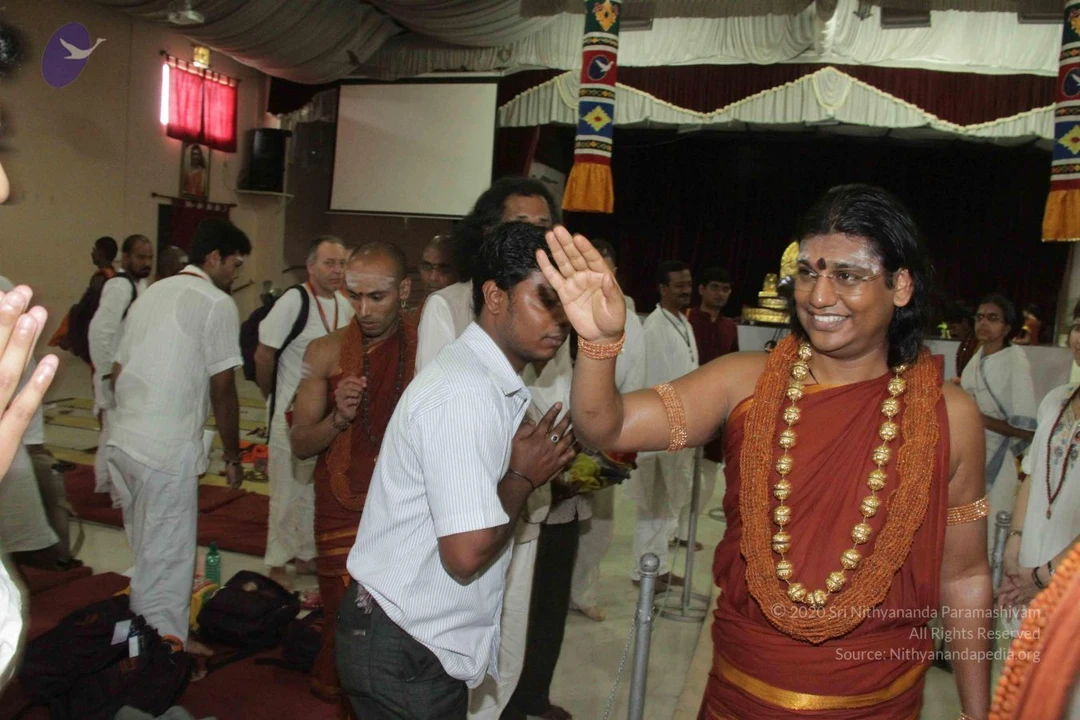
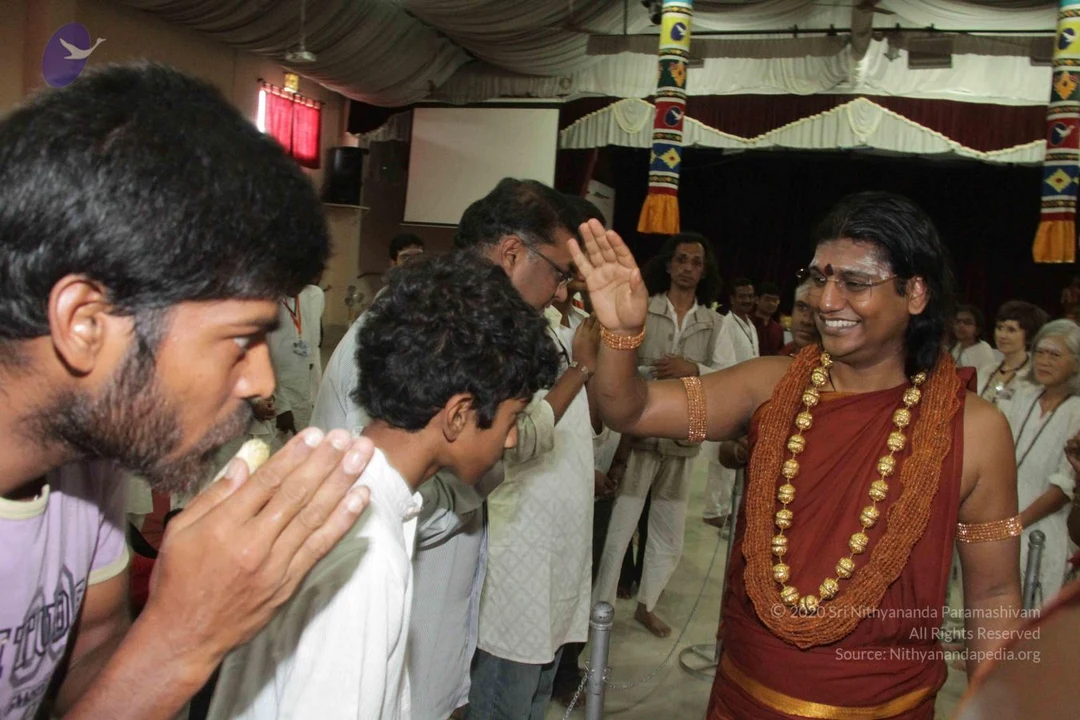
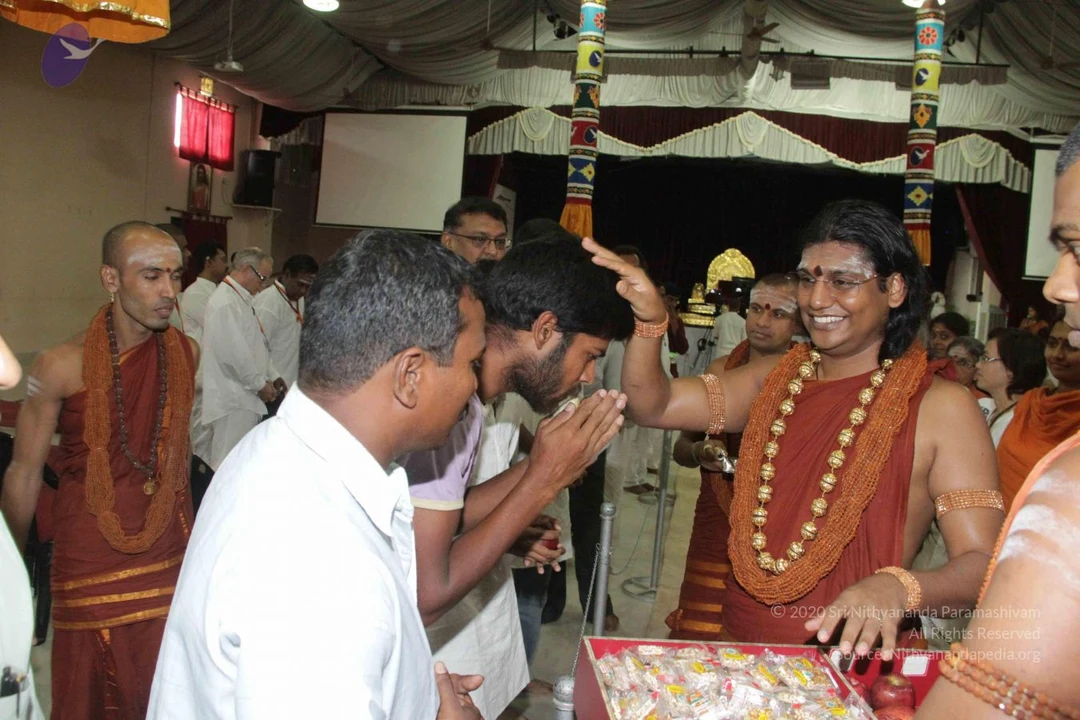
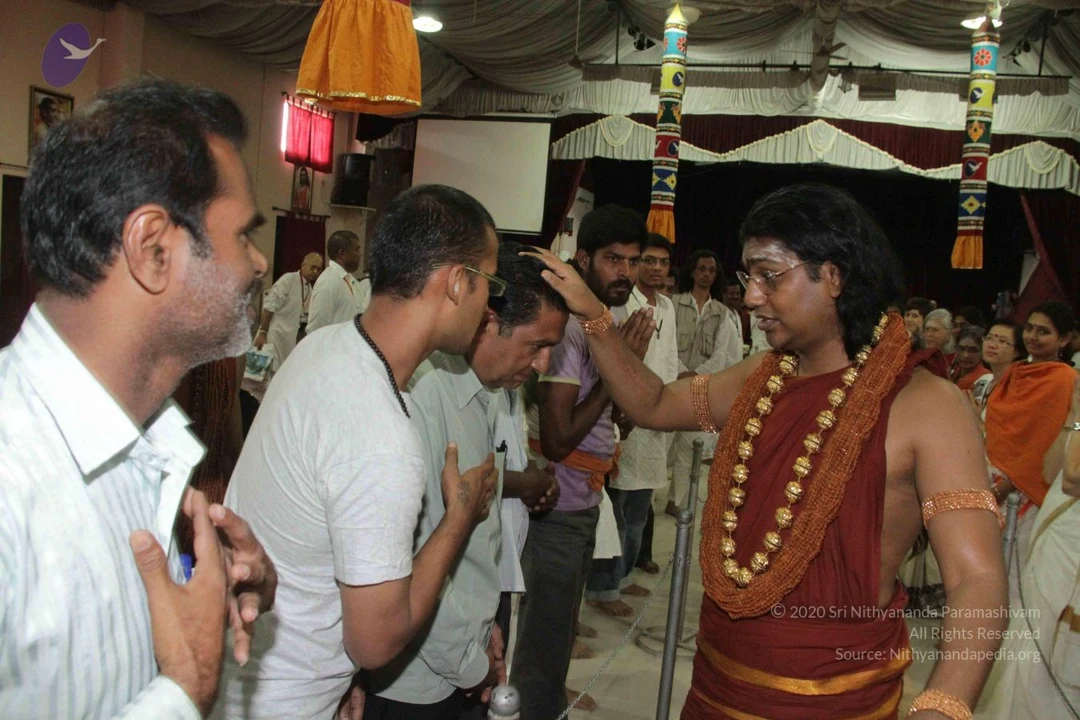
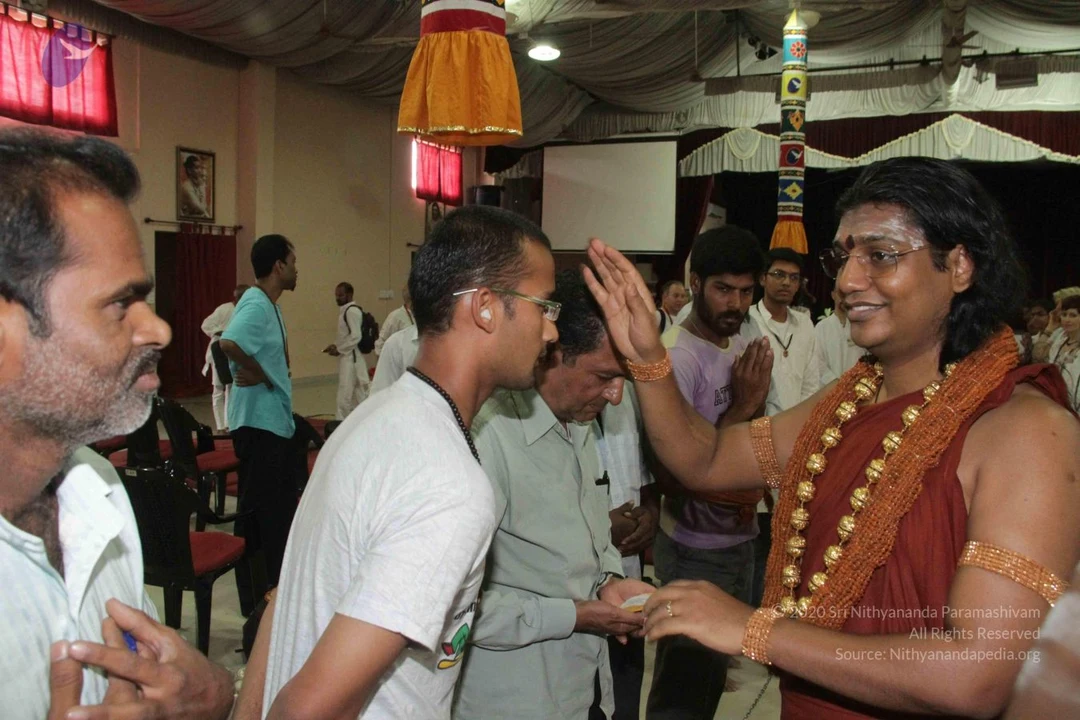
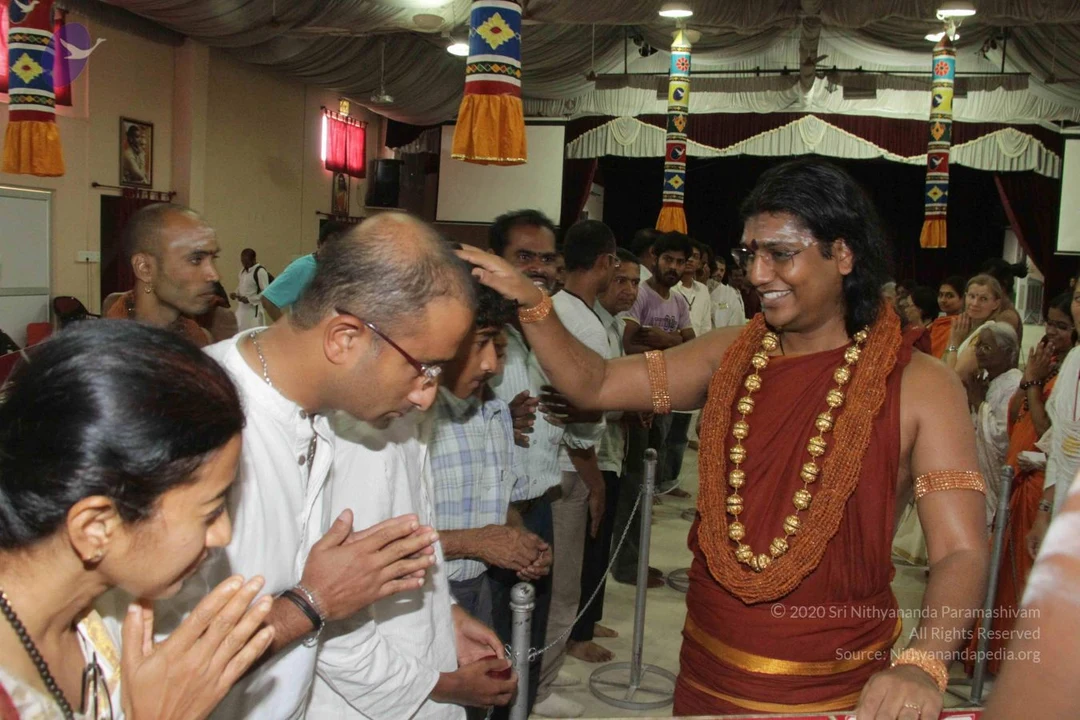
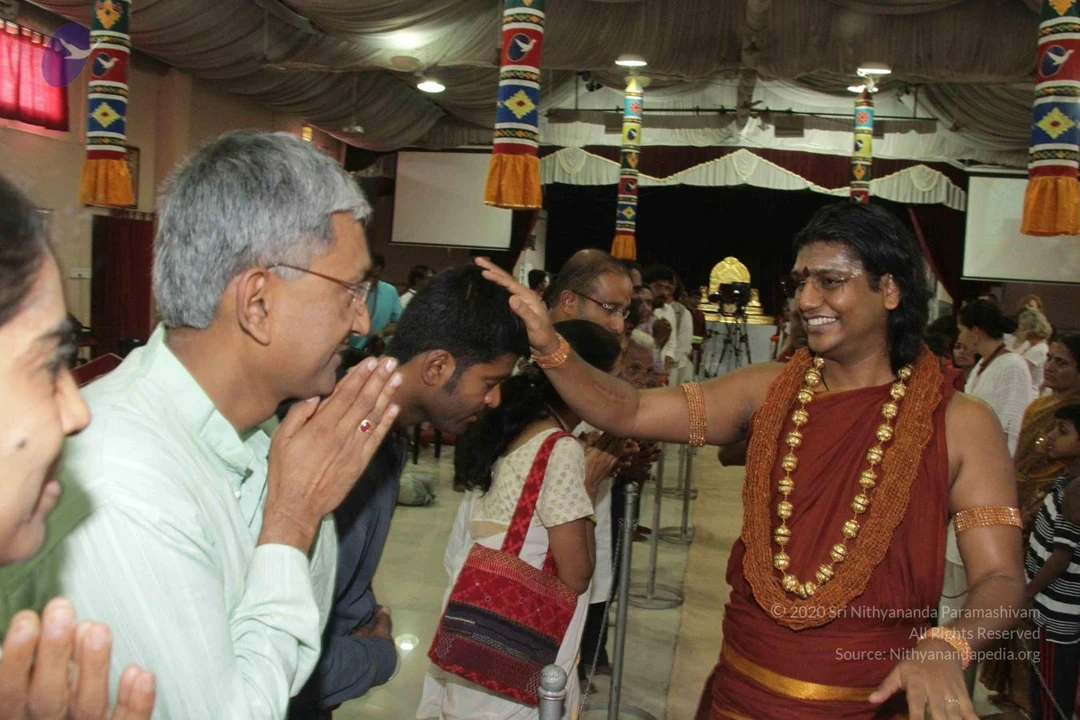
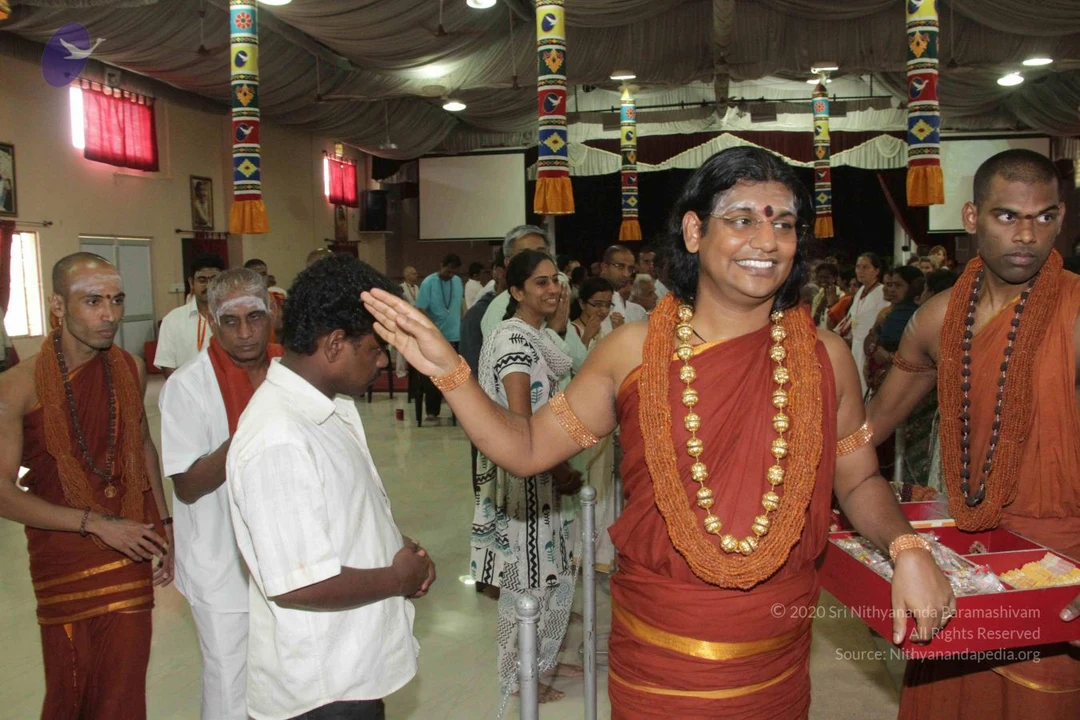
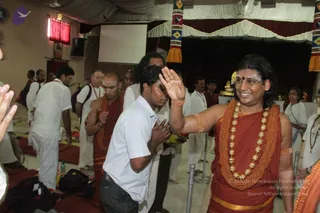
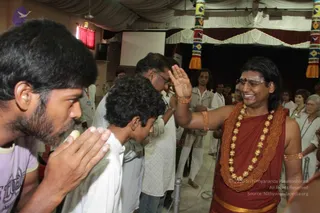
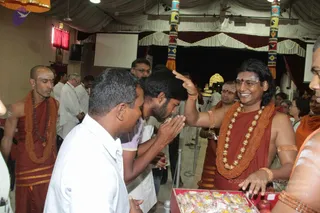
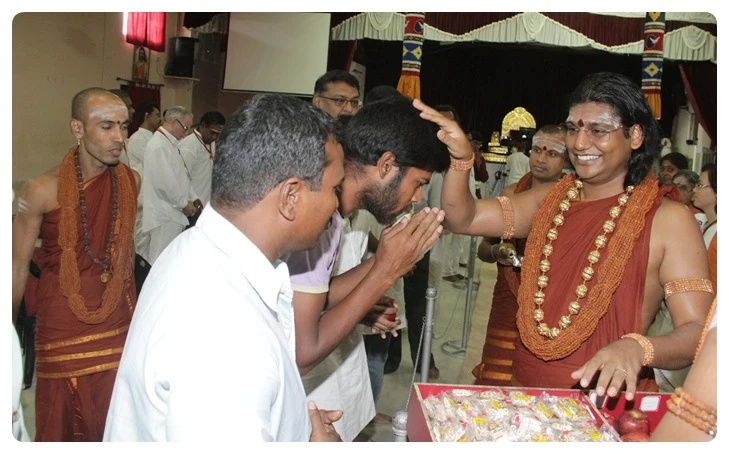
Indoor hall with a stage draped in dark red curtains and a golden throne-like seat with a golden canopy behind a small table. A projector screen hangs at left and a yellow-and-red banner hangs from the ceiling. Video cameras on tripods face the stage. In the foreground, two young monks in orange robes with white forehead markings stand at left, and a monk in orange with a red sash and a monk with a shaved head in orange robes stand at right holding a red tray with offerings. A man in white dhoti and white shirt stands center-right near the stage, while a monk in orange robes and a person in white kurta move in the background. Potted plants line the right side.A photograph in an indoor hall with a stage backdrop, a projection screen and a golden deity murti in the background. A smiling man with long dark hair, rectangular glasses, a red-and-gold tilak, rudraksha beads and a heavy gold bead necklace wears a rust-red robe and gold armbands, extending his hand in greeting. Across from him, a man in a white kurta stands with palms pressed together in namaste. Two shaven-headed men in rust-red robes and rudraksha malas stand nearby, one holding a red object, and another figure is partly visible at right. a person candidate is the smiling man with long hair, rudraksha and gold necklace; appearance cues are present but identity remains uncertain.A photograph of an indoor hall with a draped stage backdrop of red, cream and yellow banners. A man in red-orange robes with a gold-bead necklace, long swept-back hair, spectacles and a forehead mark reaches out to touch the head of a bearded man in a grey shirt who holds a yellow and purple plastic packet. A man on the left in white with curly hair presses his palms together. Other people in white and orange clothing stand behind, and a golden deity murti sits on an altar in the background. Swamiji (probable) in red-orange robes with rudraksha-style gold beads and long hair.Indoor hall with white tent-style draping and red curtains. A long-haired man in saffron-orange robe and a heavy gold-bead necklace with orange rudraksha-style beads raises one hand in blessing, smiling, with a red tilak on his forehead and an orange bangle on his wrist; swamiji (probable) based on the distinctive long swept-back hair, saffron robe and ornate gold necklace, and the page names him as present. Around him, devotees in white and a saffron-robed man with bald head stand with hands folded in namaskar. A young man in a white striped shirt bows with palms joined. A screen and a golden deity murti are visible in the background.A photograph of an indoor satsang hall with a white draped ceiling, red and gold banners, and a projector screen behind. On the right, a smiling man in a rust-red robe and rudraksha-style gold bead necklaces raises his right hand in blessing, with a red tilak on his forehead and gold armlets. Devotees in white kurtas and dhotis approach him. A young boy in a white shirt bows his head toward him, and a bearded man in a lavender shirt on the left presses his palms together in namaste. Other attendees in white stand in the background. The appearance-based label is probable Swamiji, identified by the swept-back long hair, saffron-red robe, rudraksha and gold bead malas and ornamental armlets while giving blessing.A photograph inside a decorated hall with a white and red tent canopy and striped pillars. A long-haired man in a rust-orange robe with a rudraksha-style gold bead necklace and gold armbands smiles and raises his right hand over a younger man in a white shirt and lavender top who bends forward with palms pressed together. Beside them, a red tray holds wrapped sweets and fruit. Other people in saffron and white clothing stand around, including a shaved-headed man in orange with a sacred thread and a man in white. Probable Swamiji appearance cues: long swept-back hair, saffron robe and ornate gold beads, giving blessing to a devotee.

BREAKFAST-SPREAD-FOR-IA-PARTICIPANTS
7 photosSource gallery
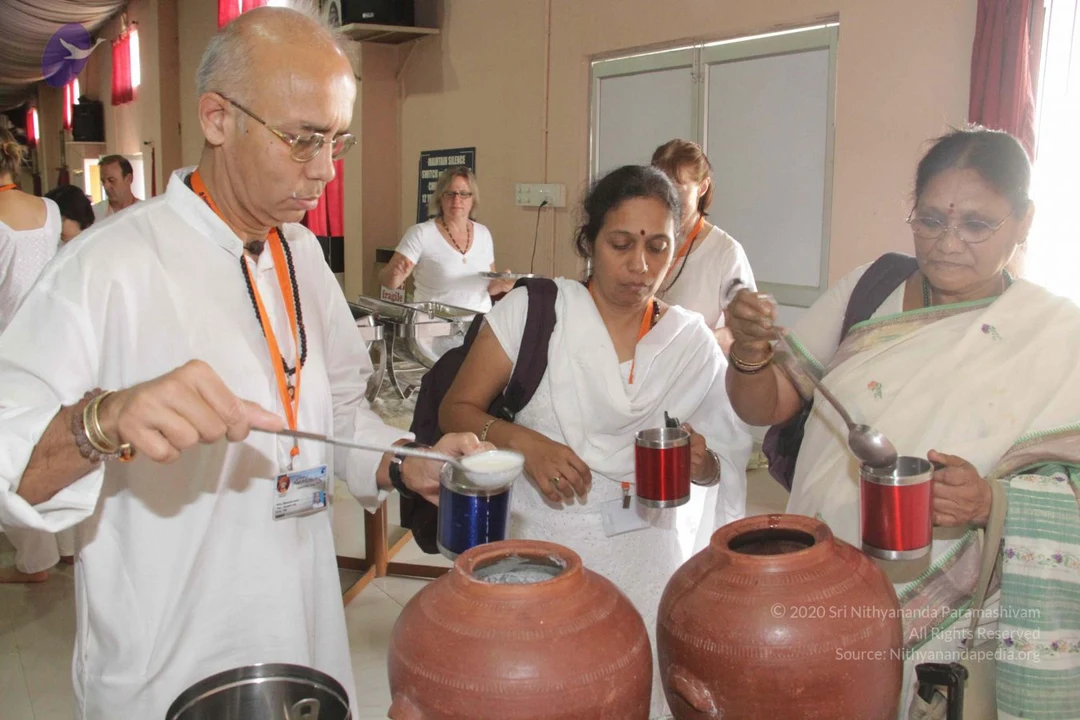
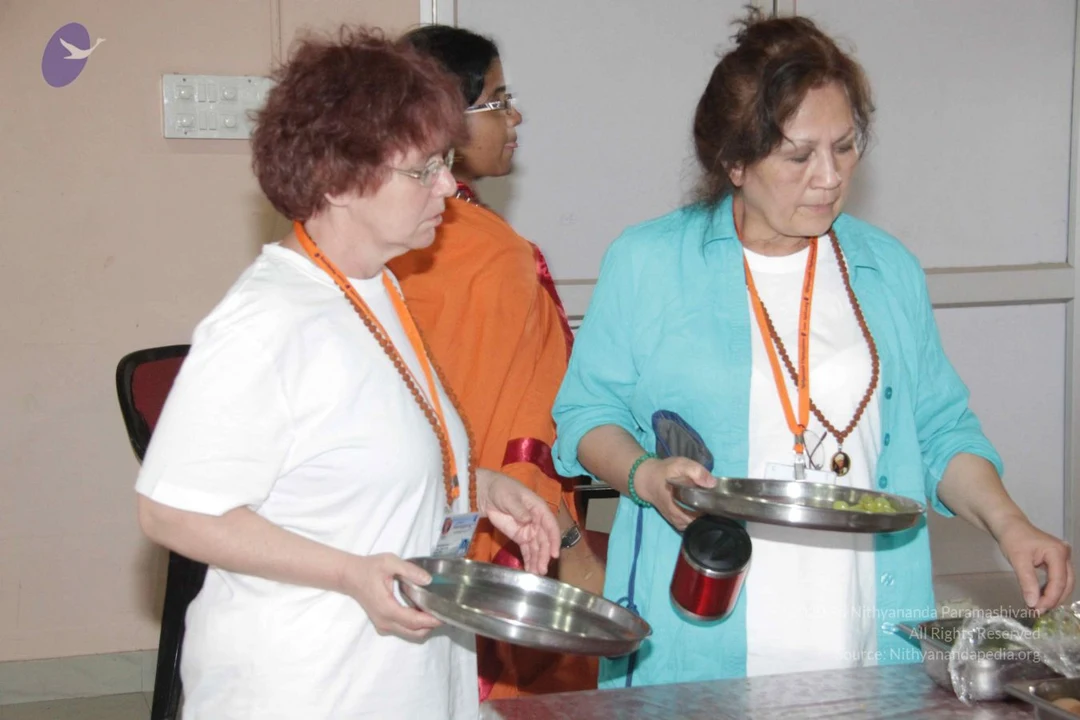
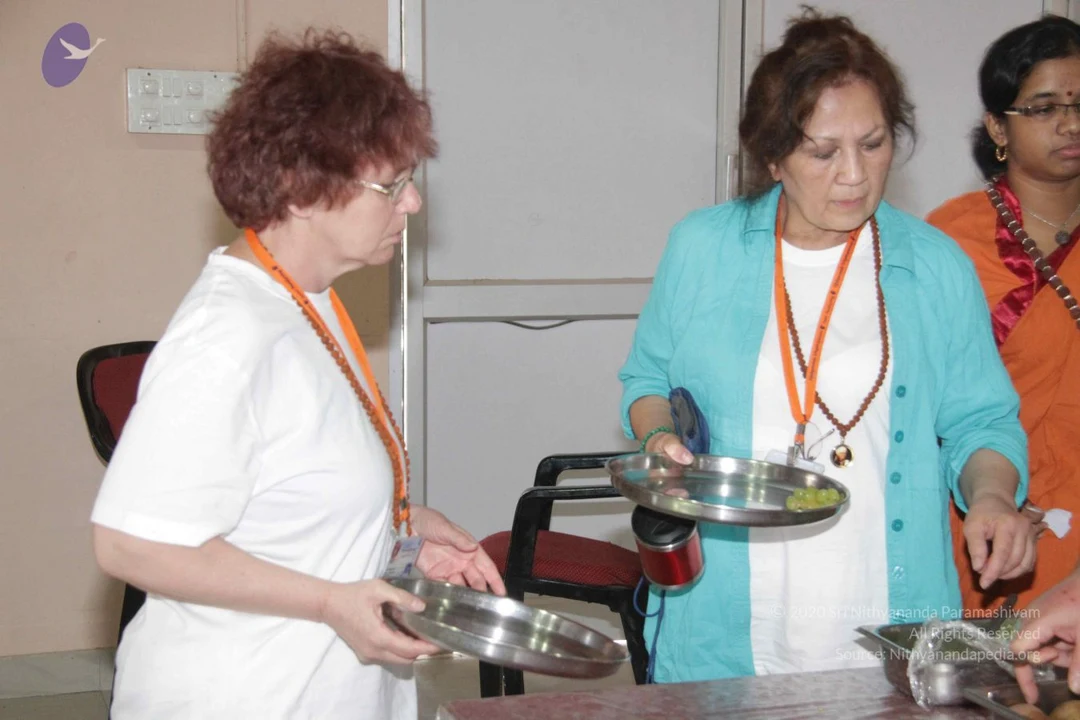
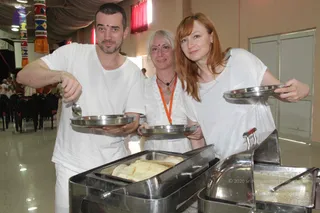
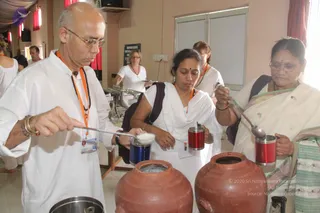
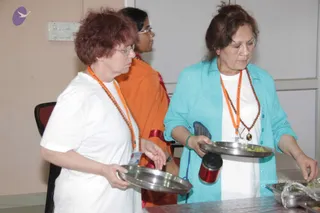
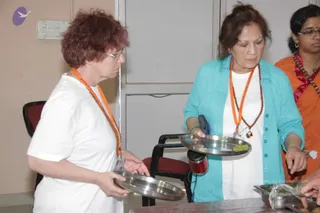
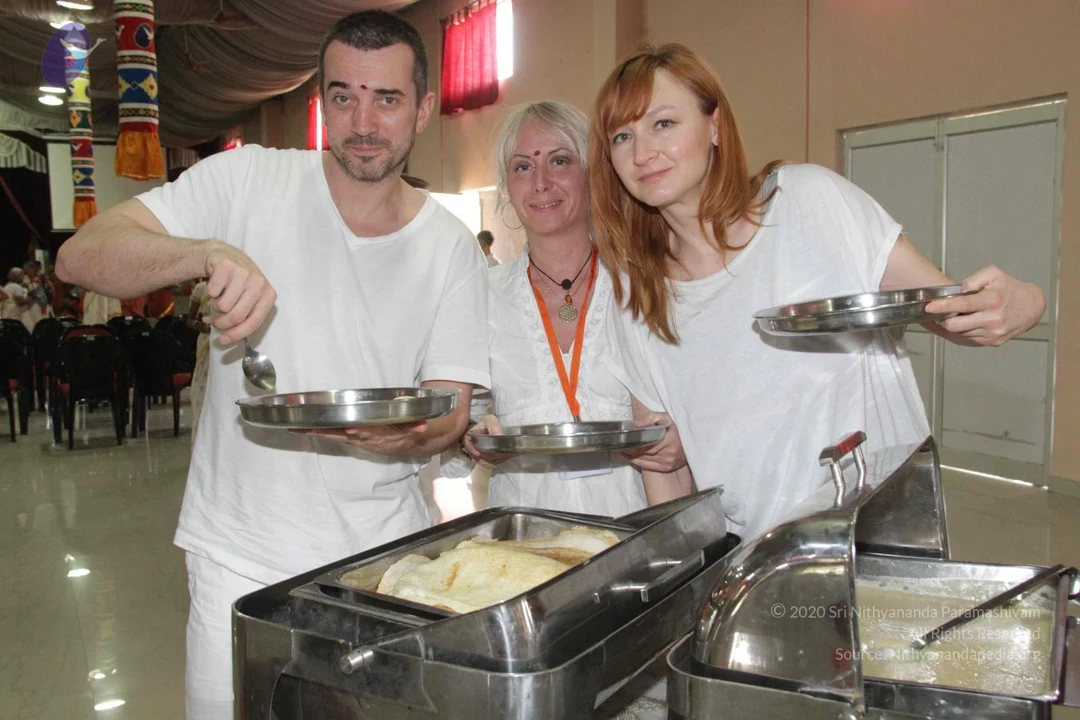
Three people in white clothing stand behind a steel buffet counter serving food. A man on the left with short hair and stubble holds a steel plate and a serving spoon over a chafing dish of pale dosa-style flatbread. A blonde woman in the middle wears a white top, an orange lanyard and a red bindi, holding a steel plate. A woman on the right with long auburn hair in a white t-shirt holds an empty steel plate. Behind them are rows of black chairs, a cream-coloured hall, and a red and gold hanging decoration. The scene looks like a communal meal service at an event.Indoor photo of a serving area at a convention hall, with three people ladling drinks from large terracotta pots. In the foreground, a bald older man in white kurta with orange lanyard and rudraksha mala uses a steel ladle over a blue container. A woman in white with an orange lanyard stands beside him holding a red steel tumbler, and an older woman in a white and green sari with a red bindi and glasses holds a red tumbler and ladle. Background shows more people in white, steel serving containers and a wall display.A dining or serving area at an ashram-style hall with red curtains and a wall sign reading "MAINTAIN SILENCE SWITCH OFF CELL PHONES CHILDREN UNDER 12 YEARS NOT ALLOWED VIDEO-AUDIO & PHOTOGRAPHY PROHIBITED". A woman in white with a red bindi and beaded necklace holds a steel plate near a steel food warmer holding thin dosas. A man in white kurta holds a red steel tumbler and reaches toward the buffet, carrying a yellow Kuberan shopping bag. Other attendees in white and cream clothing move about in the background, and a woman in a cream saree stands at left.A photograph of a buffet serving line in a plain room with peach walls and red curtains. Three men help themselves from stainless steel chafing dishes holding flatbreads and food. On the left, a man in white clothes and an orange cord holds a piece of bread. In the centre, a smiling man in a white t-shirt with a dark backpack and an orange lanyard holds a plate. On the right, a man in a turquoise t-shirt and rudraksha mala spoons food onto his plate. A woman in white stands in the background near the curtains.Photograph of two women holding stainless steel plates at a serving counter, collecting food. The woman on the left wears a white t-shirt, orange lanyard and a rudraksha mala, with short reddish curly hair and glasses. The woman on the right wears a turquoise cardigan over a white top, an orange lanyard and a long rudraksha mala, and holds a plate with green food beside a red thermos. Behind them a third woman in an orange sari with a red border stands partly visible, wearing glasses. Grey wall panels and a light switch plate form the background.Indoor photo of women serving food at a community kitchen counter. On the left, a woman with short curly reddish-brown hair and glasses, wearing a white t-shirt and an orange lanyard with a rudraksha mala, holds a stainless steel plate. In the centre, a woman with reddish-brown hair, a turquoise cardigan over a white top, an orange lanyard and a rudraksha mala holds a steel plate with grapes. On the right, a woman in an orange sari with a red blouse and glasses stands behind the counter. Steel trays and a thermos sit on a table in a plain room with cream walls.

IA-SESSION

8 photosSource gallery
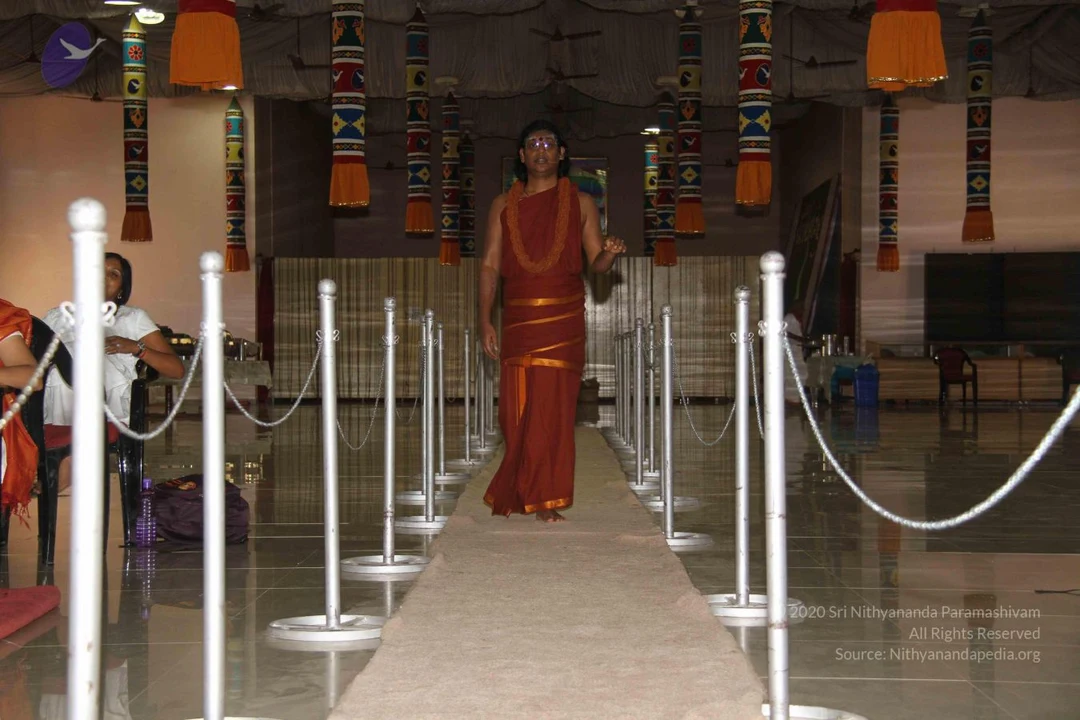
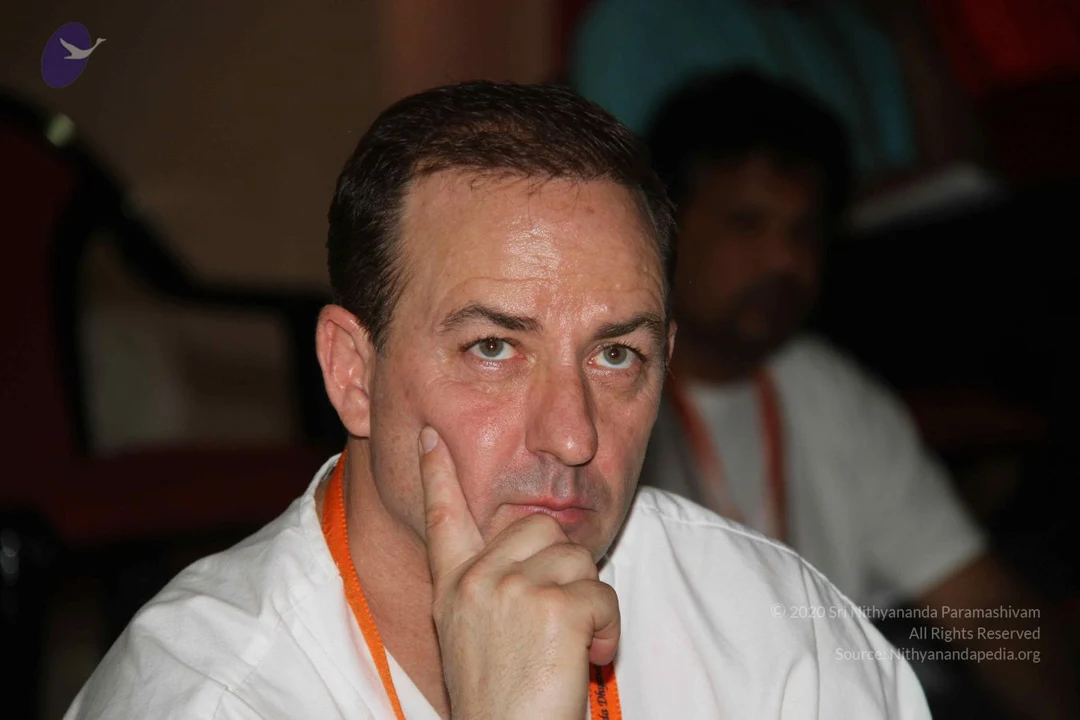
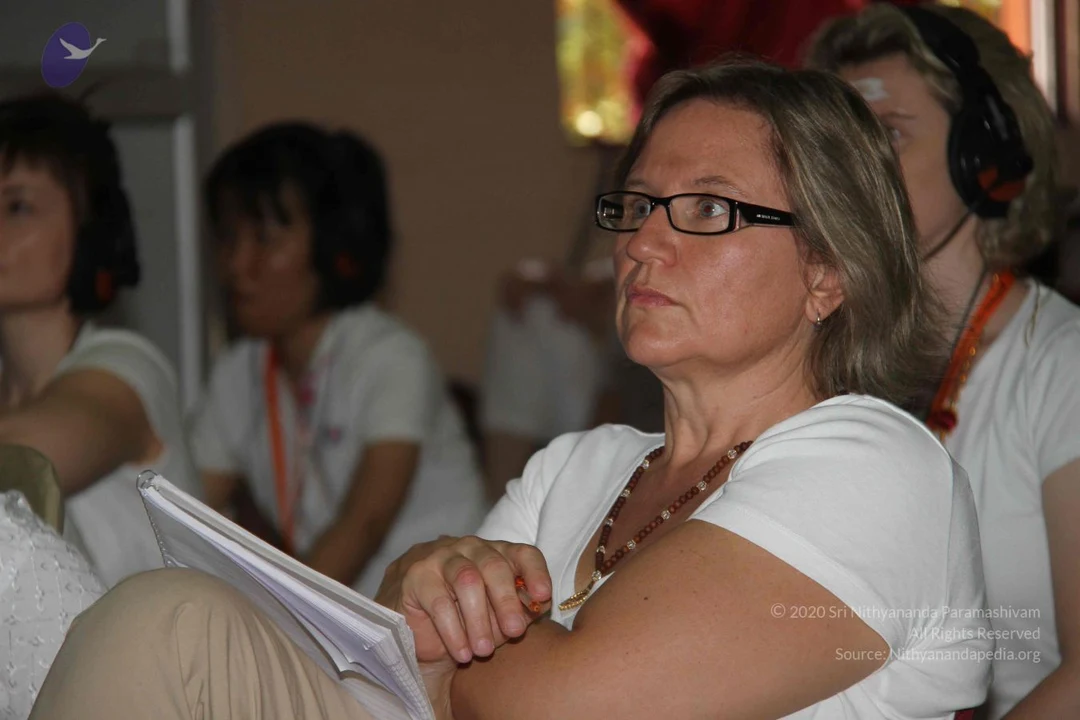
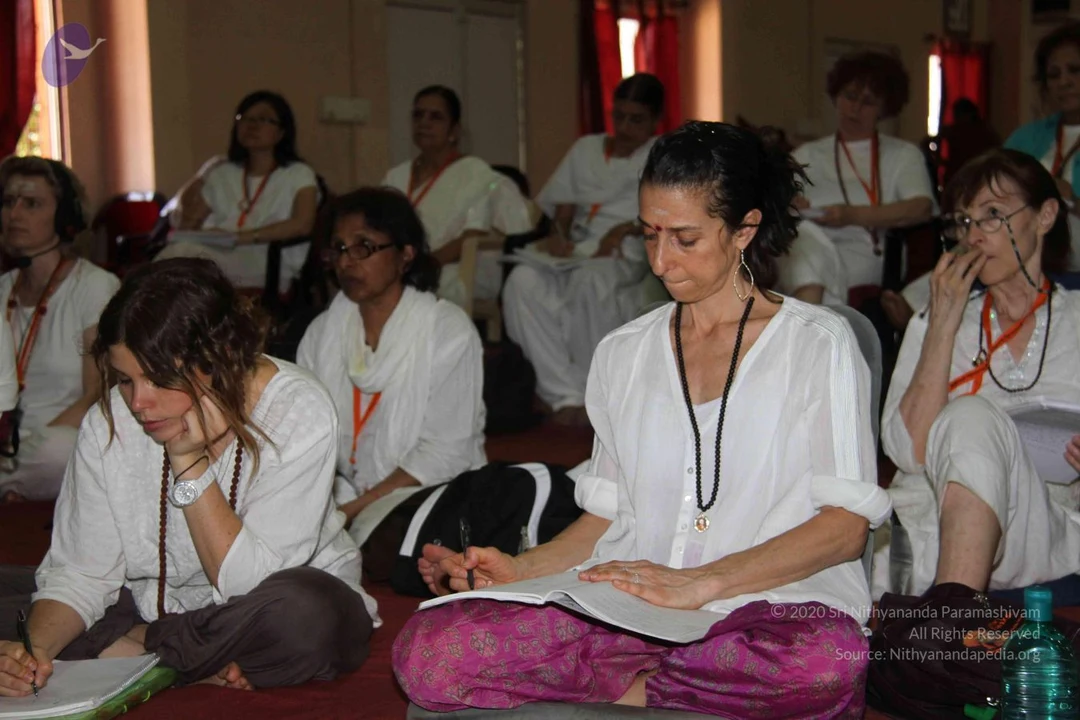
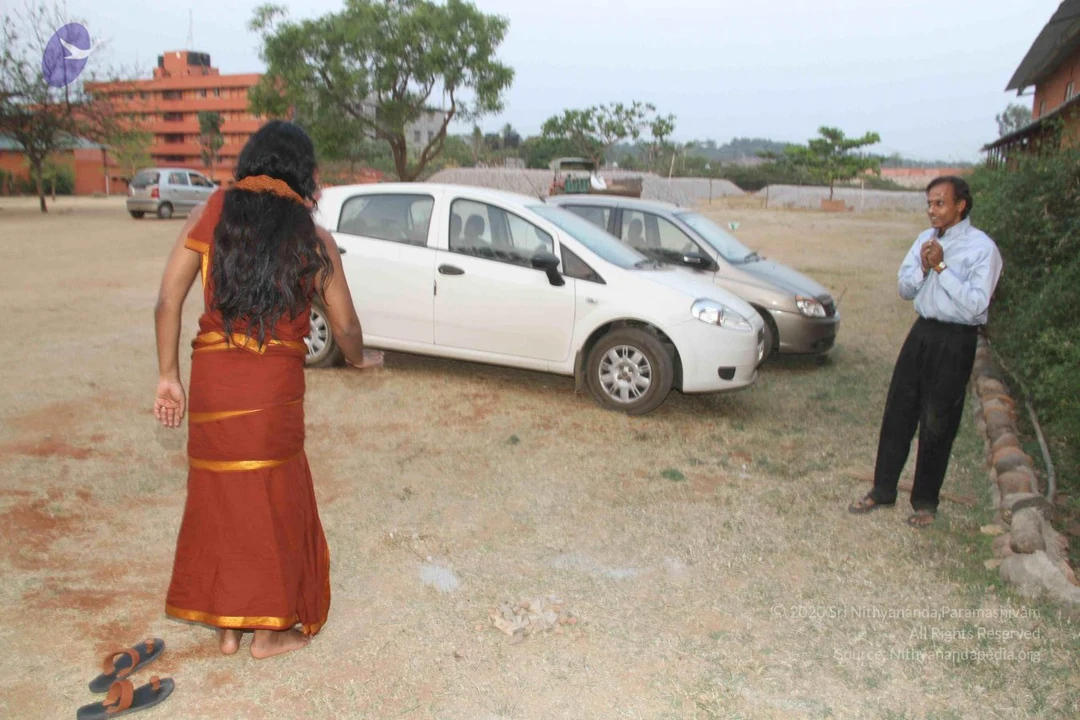
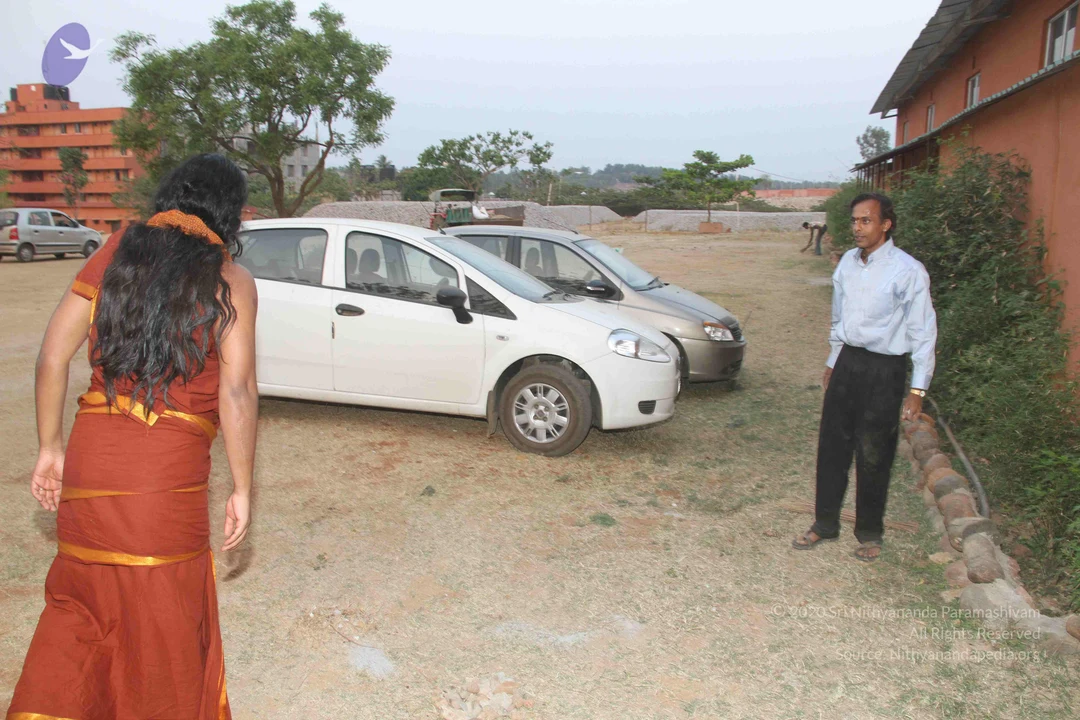
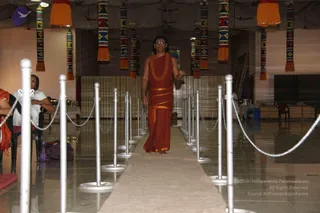
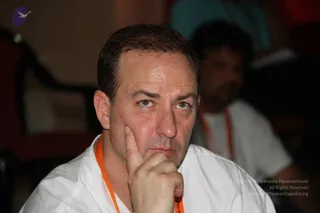
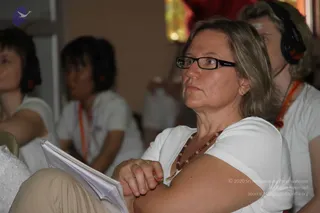
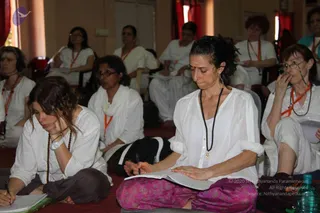
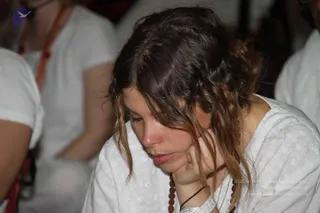
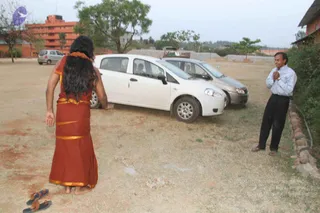
Photograph of a man in a saffron-orange robe walking down a carpeted aisle between white stanchions and rope barriers in a hall. He wears a saffron-orange floral garland, orange sash and dark-rimmed glasses, and gestures with one hand. Colourful woven hanging tassels decorate the ceiling and a seated woman in white sits to the left, with a purple bag on a chair. A figure matching the a person candidate appearance may be present, but the image is too small to confirm reliably.Close-up photo of a short-haired man in a white shirt with an orange lanyard, resting his index finger against his cheek and looking intently toward the camera in a dim indoor hall. A second man in a white shirt with an orange lanyard sits blurred in the background. No saffron robes, crown, rudraksha mala or other distinctive presentation cues are visible on the foreground man, so no a person identification is made.A photograph of a seated audience at a satsang session. In the foreground a middle-aged woman with shoulder-length light brown hair and black-rimmed glasses wears a white t-shirt and a rudraksha-style brown bead necklace, holding an open notebook and a pen. Behind her, several people wear white t-shirts and over-ear black headphones for translation, with orange lanyards visible on some. A red and gold cloth hangs in the upper background. No speaker or a person candidate is visible in the frame.A seated group of women in white and cream clothing sits on red floor mats in a hall with red curtains, taking notes in notebooks at a convention session. Several wear orange lanyards and rudraksha-style beaded necklaces. In the foreground, a woman in a white shirt and pink patterned trousers writes in a notebook while a younger woman with a beaded mala rests her chin on her hand. Water bottles and bags sit at the edge of the frame, and no a person candidate is visible.Close photo of a young woman with wavy brown hair, head tilted down and resting her cheek on her hand, eyes lowered as if listening or meditating. She wears a white embroidered top and a rudraksha mala with a silver necklace. Blurred white-clad figures sit around her in a seated gathering.Outdoor photo on a dry, patchy lawn beside parked cars, with a red-brick building and trees behind. In the foreground, a woman with long dark hair and an orange-marigold garland wears a rust-red sari with gold borders, her back to the camera, facing a man in a light blue collared shirt and dark trousers standing at the right with his palms pressed together in greeting. Two pairs of sandals lie on the grass near the woman. A white hatchback and a silver-beige car are parked nearby.

IA-DARSHAN

16 photosSource gallery
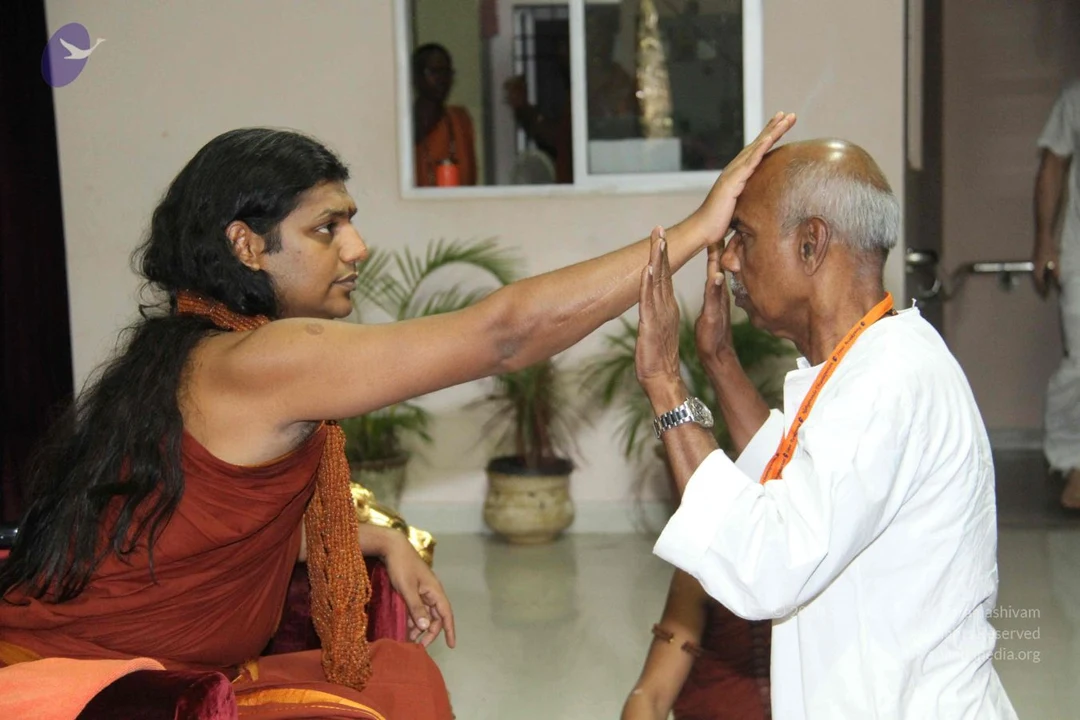
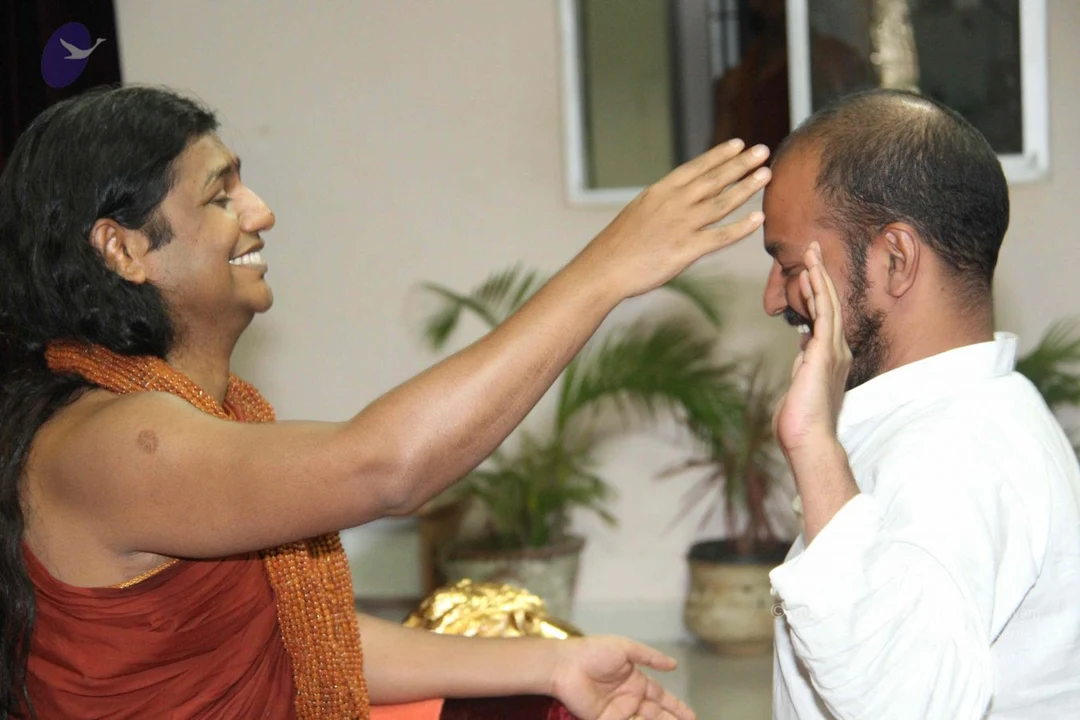
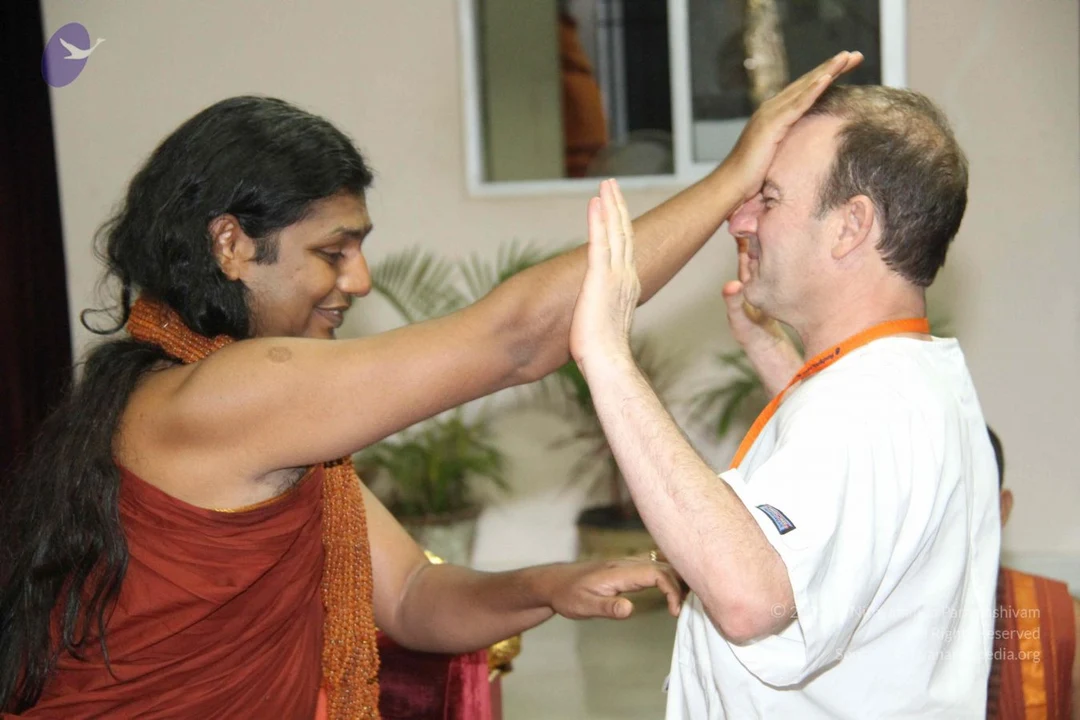
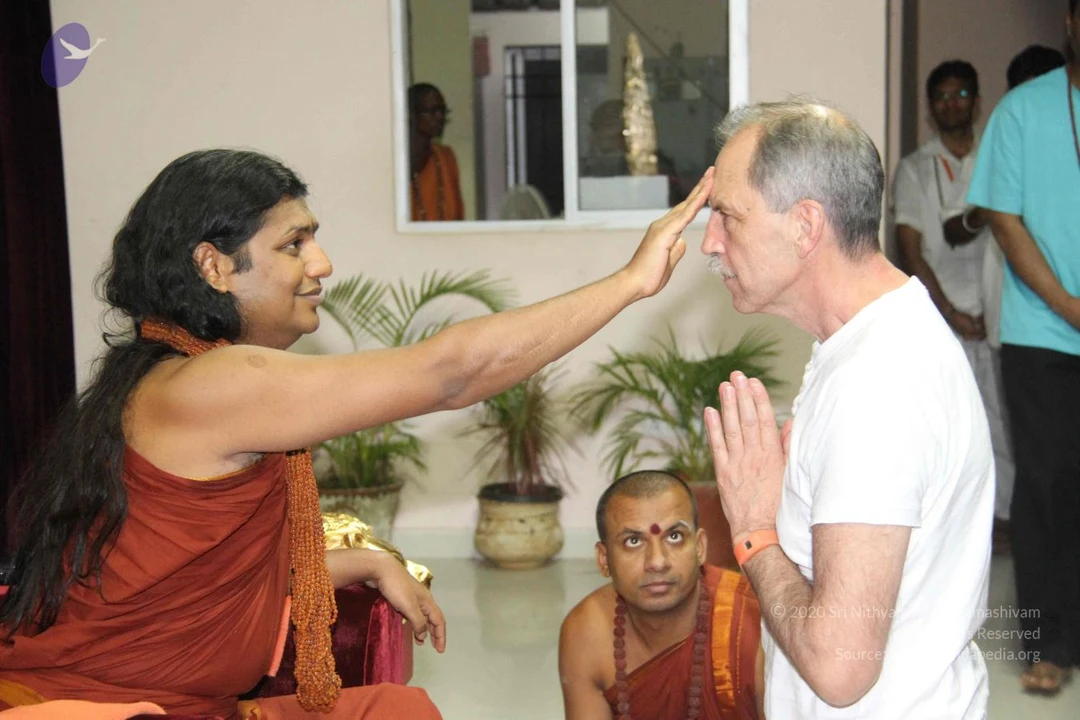
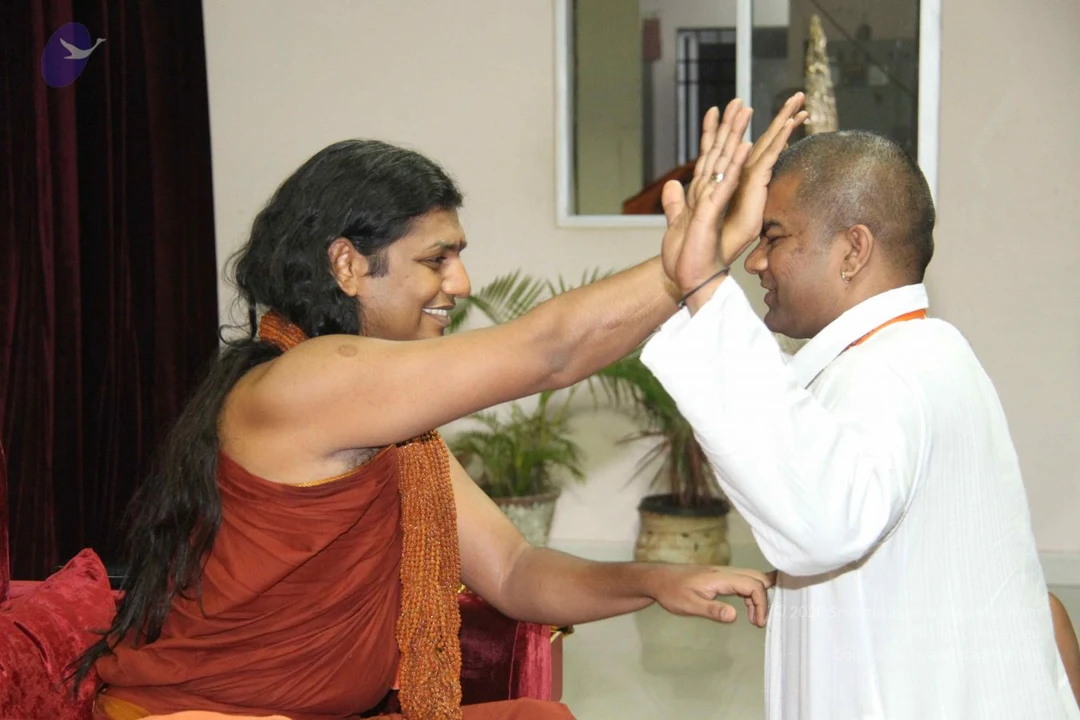
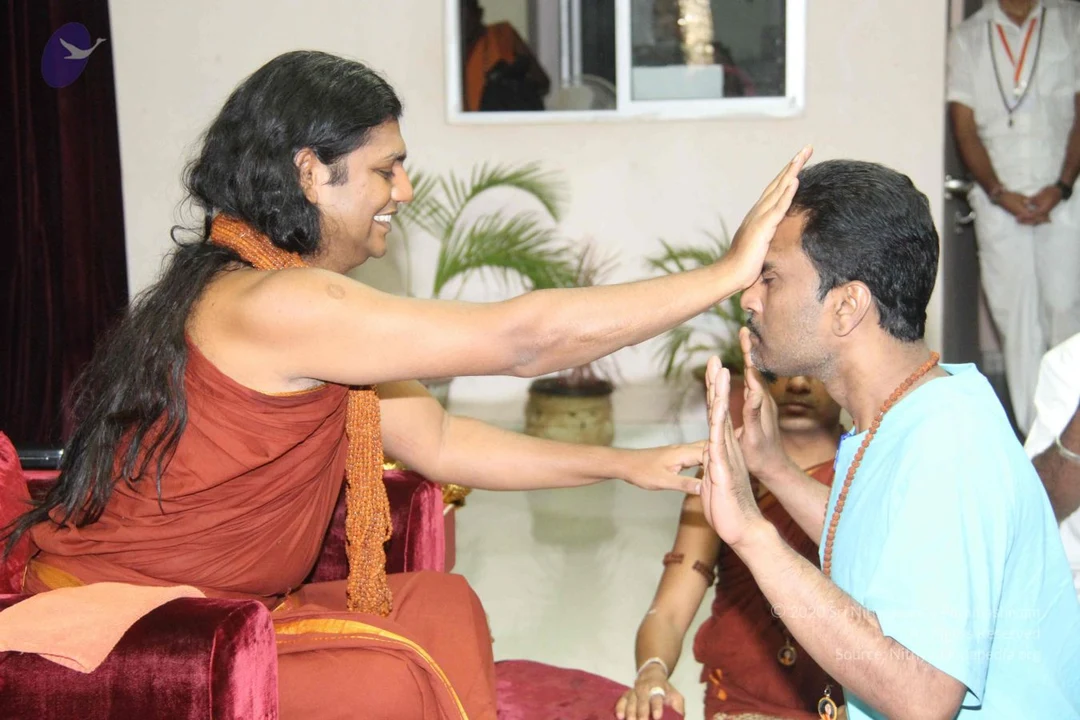
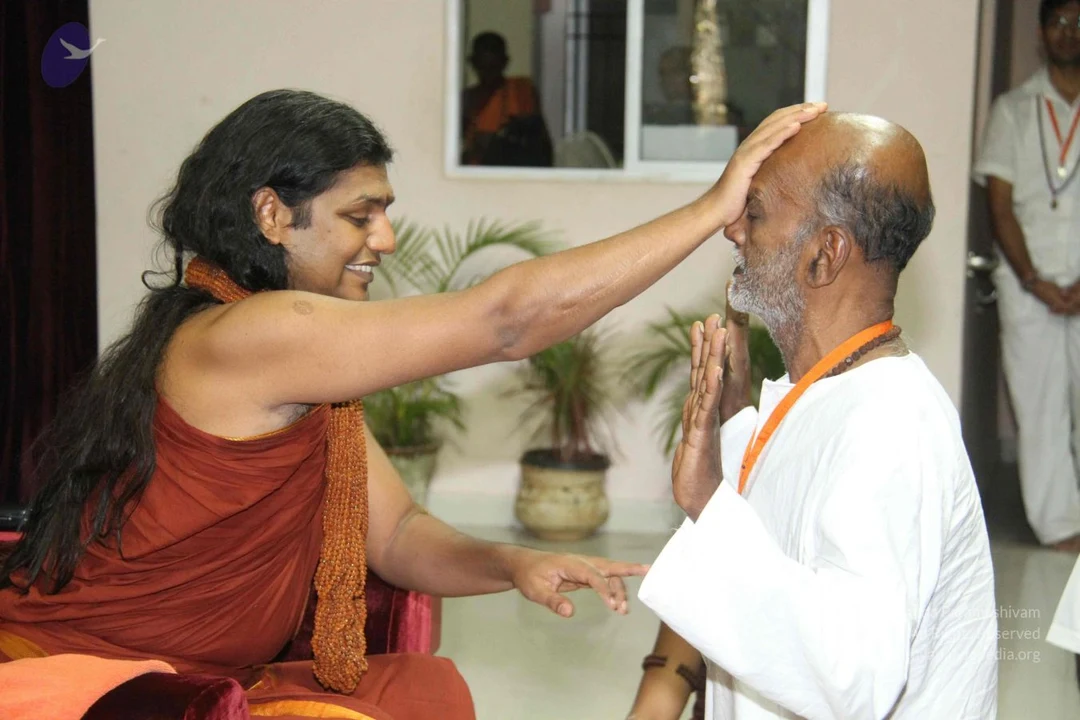
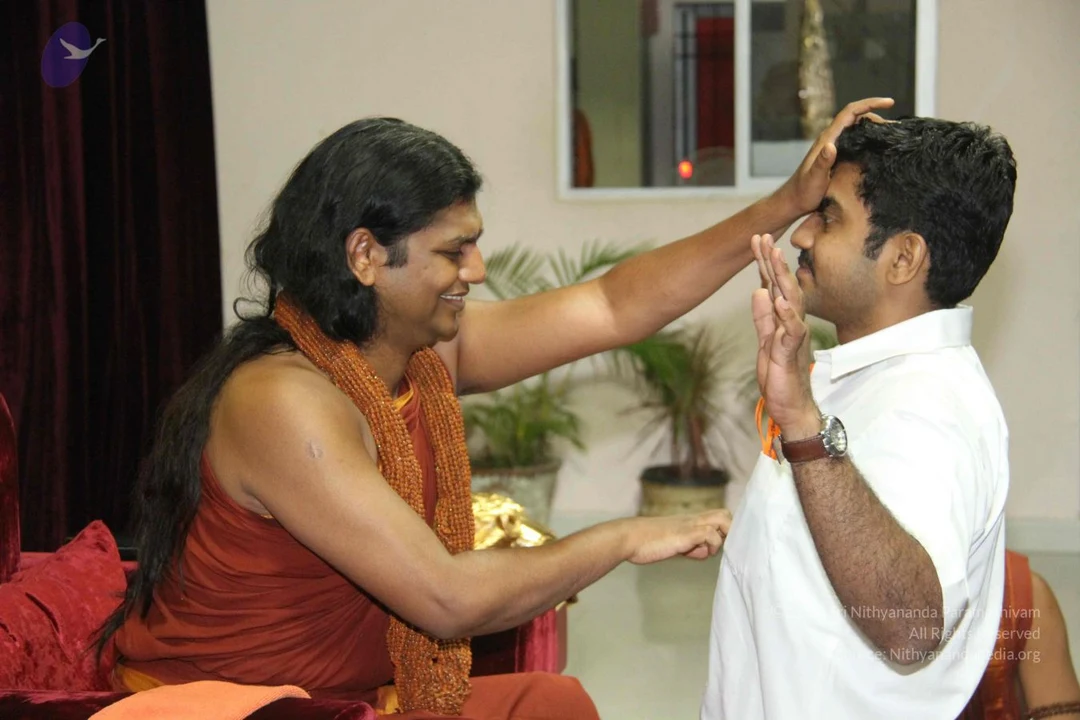
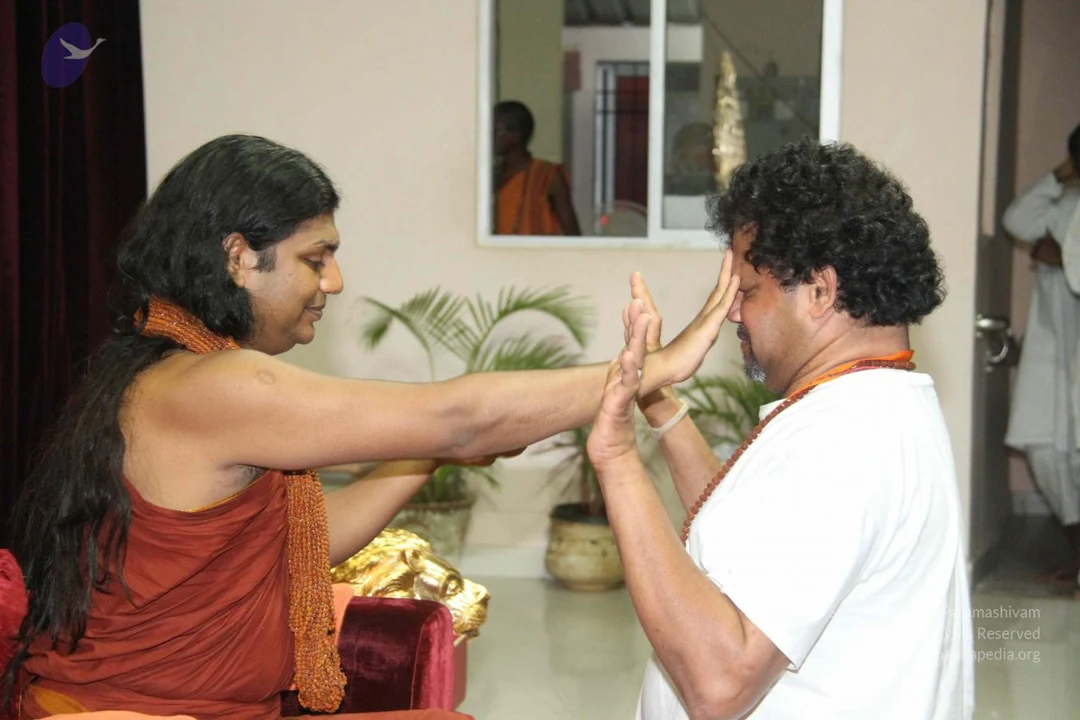
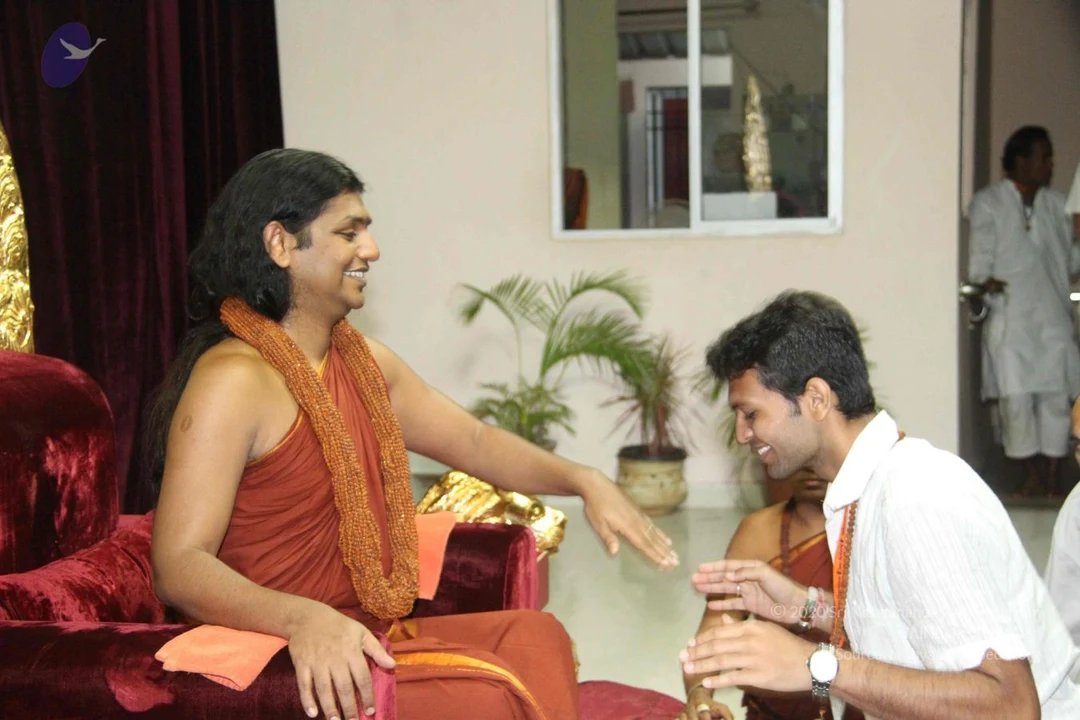
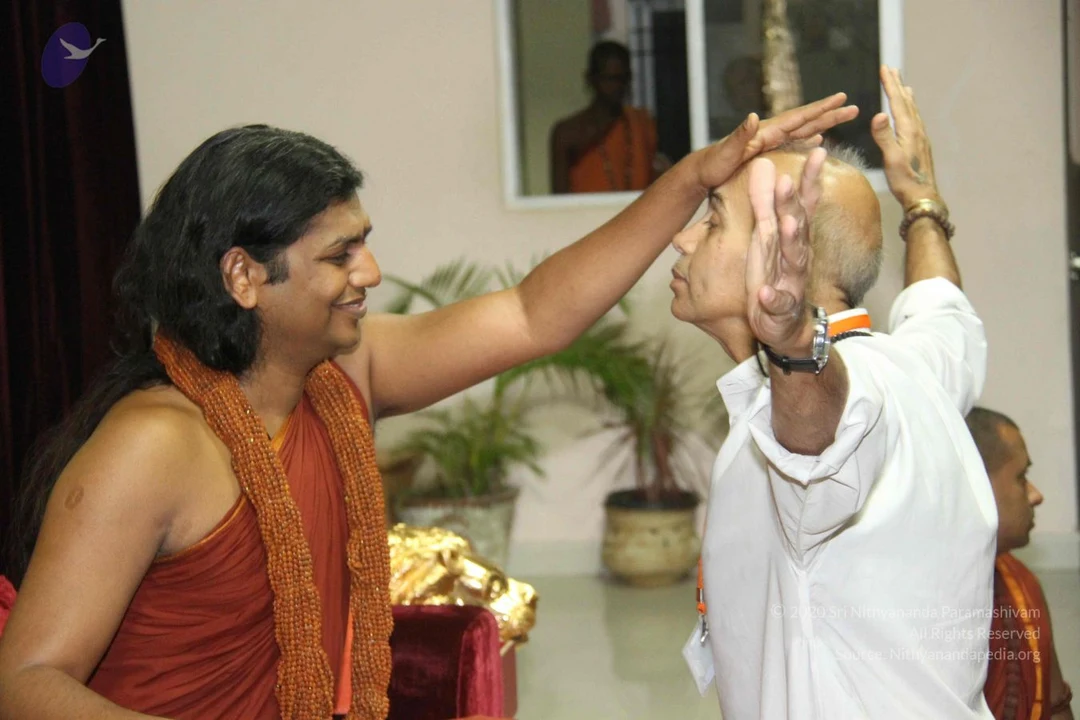
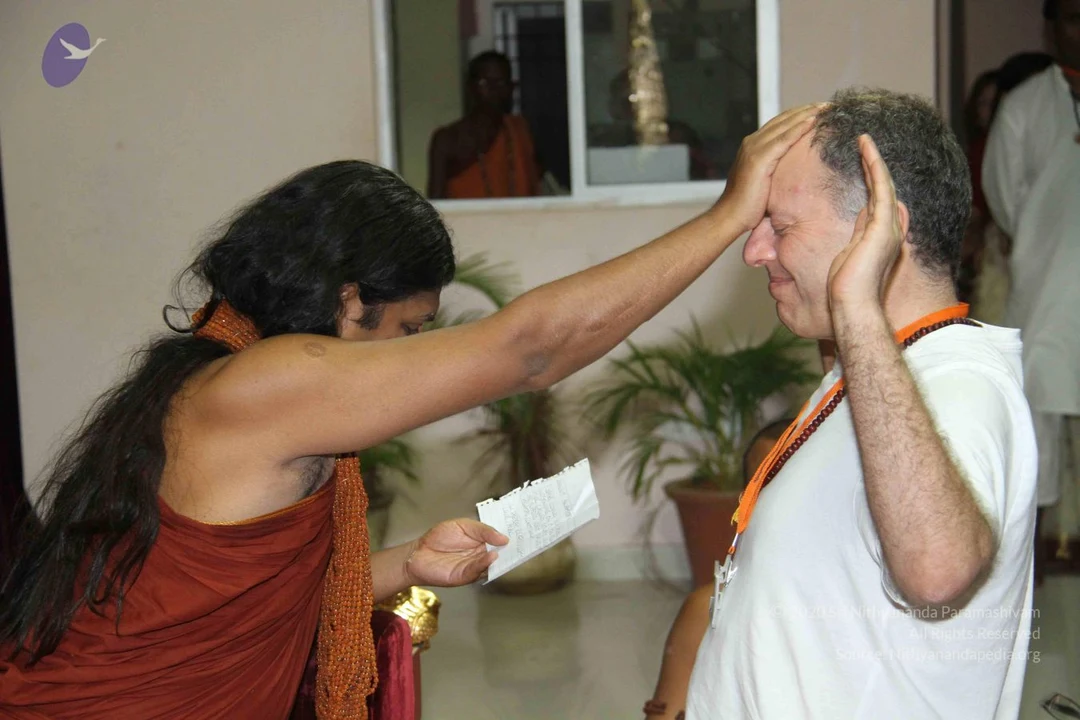
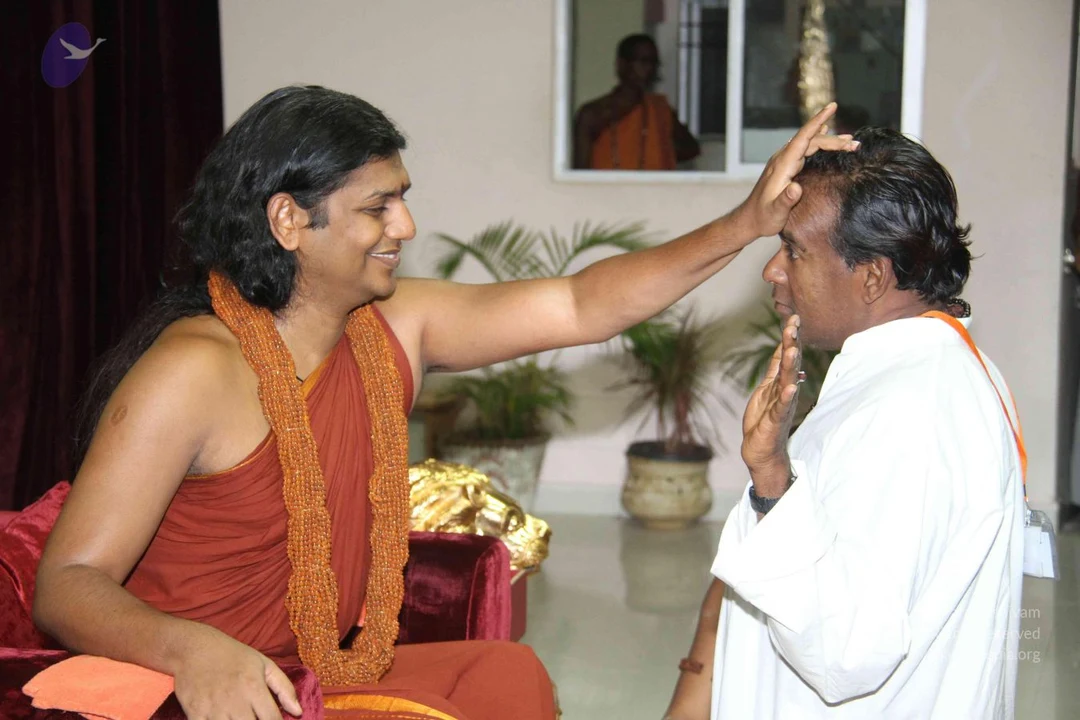
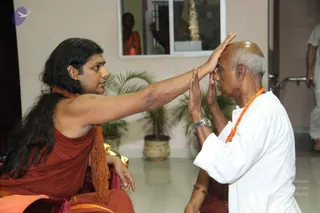
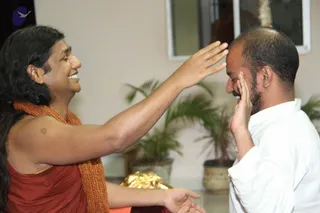
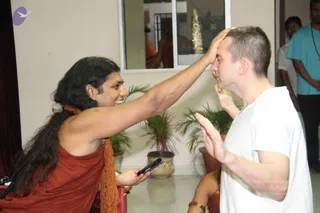
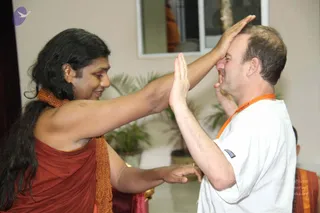
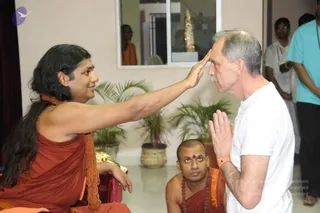
A photograph of a single seated figure on a stage in front of an ornate gilded throne backdrop with dark red velvet curtains. The person wears a saffron-orange robe draped over the shoulders, an orange beaded mala necklace, and a red bindi, with long swept-back hair. Both hands are raised in an expressive gesture while the figure smiles, seated on a red velvet throne with orange-trimmed armrests.A seated man with long dark hair wears a saffron-orange cloth and a long orange-beaded mala around his neck, and extends his right arm to press his palm onto the forehead of an older bald man in a white kurta with an orange shawl. The older man stands bent forward with palms pressed together in reverent greeting. A potted plant and a wall mirror reflecting another orange-clad figure are visible in an indoor room. a person: the seated man's long hair, orange-saffron cloth and beaded mala fit the presentation of the a person, and the page states he was present.A photograph of two men in close interaction indoors. On the left, a long-haired man in a rust-orange wrap and an orange-beaded mala necklace smiles broadly while extending his right hand toward the forehead of a bald, bearded man on the right, who wears a plain white shirt and touches his own cheek with his hand. Behind them are potted plants and a white wall with a framed mirror, and a golden cloth-covered object sits at the lower edge. The second man is a devotee in white. Two people are visible.Indoor photo of a long-haired man in a rust-orange garment with an orange rudraksha-style bead mala across his shoulder, reaching forward to press his palm onto the forehead of a short-haired man in a plain white T-shirt, whose eyes are closed. A third person in orange clothing stands partly visible near the bottom edge, and a man in a teal shirt and a standing person appear at the right. Potted plants, a white wall and a window with a golden object behind it complete the room. The long-haired man is a probable Swamiji by appearance: long swept-back hair, orange garment and bead mala, performing a blessing.A photograph of a long-haired man in a red-orange shawl and orange-beaded necklace placing his palm on the forehead of a balding, smiling man in a white shirt with an orange lanyard, in an indoor room with plants and a window behind them. Another person in orange stands at the right edge. The gesture appears to be a blessing given to a devotee at a satsang gathering. The long-haired man with the orange beaded mala and shawl is a probable Swamiji in appearance.Indoor photograph of a seated long-haired man in a rust-orange robe and wooden rudraksha mala, reaching out to touch the forehead of an older clean-shaven man in a white t-shirt who stands with palms pressed together in namaste. A shaved-headed man in orange with a red bindi and mala sits below, looking up. Potted palms, a white wall, a mirror and a small golden statue are in the background, with several people in white and teal clothing.

1-Adikailash-Temple
4 photosSource gallery
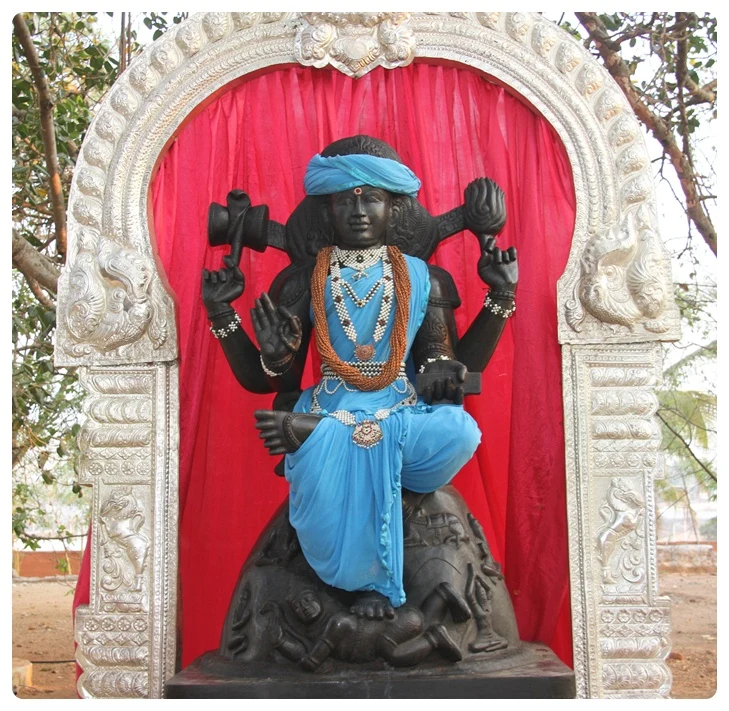
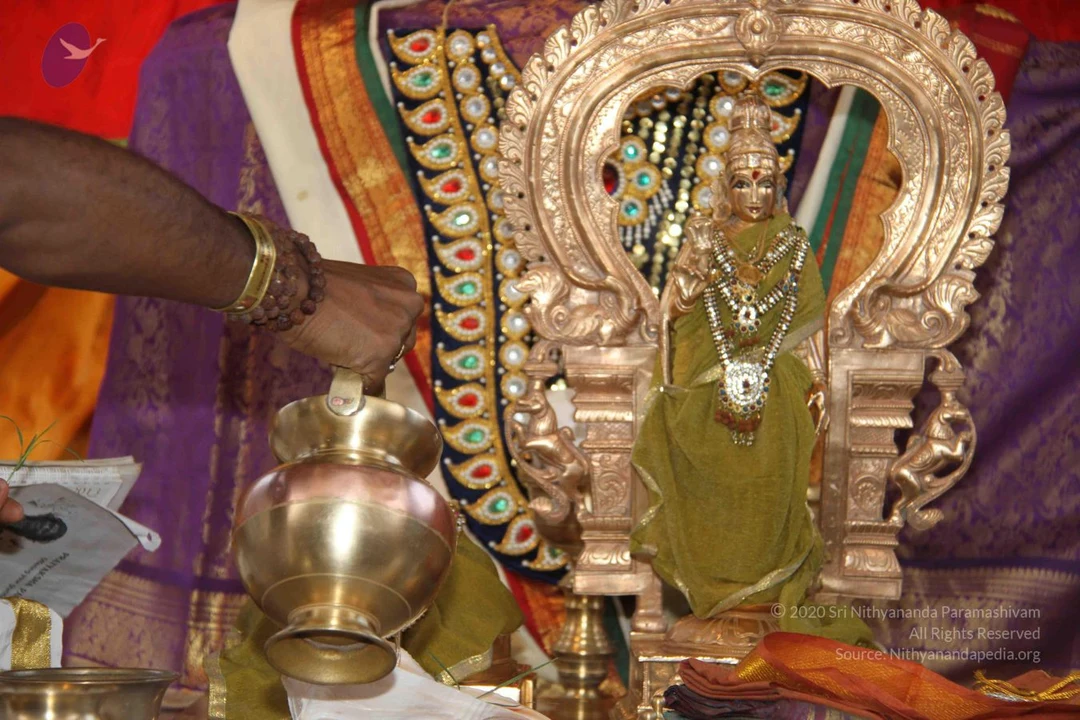
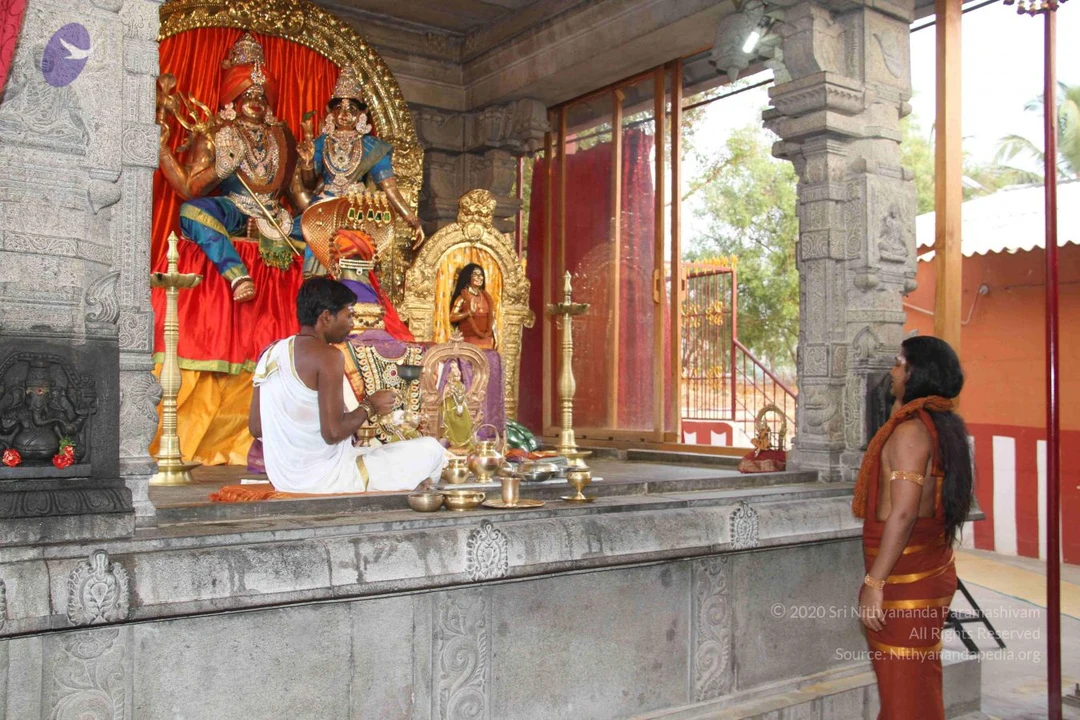
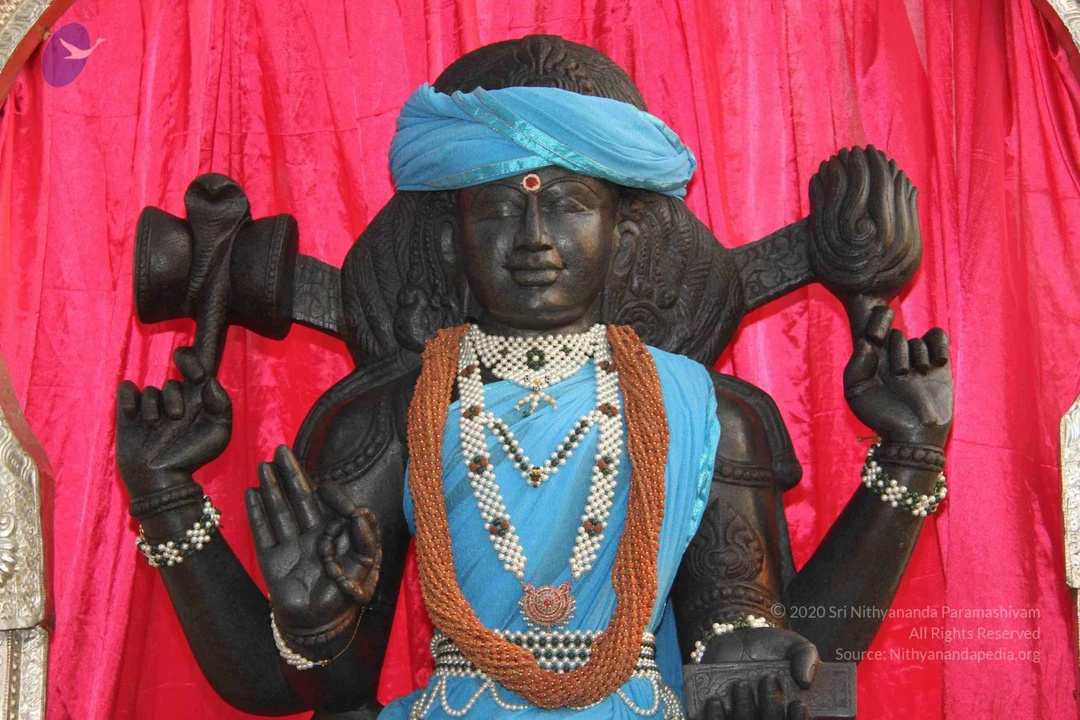
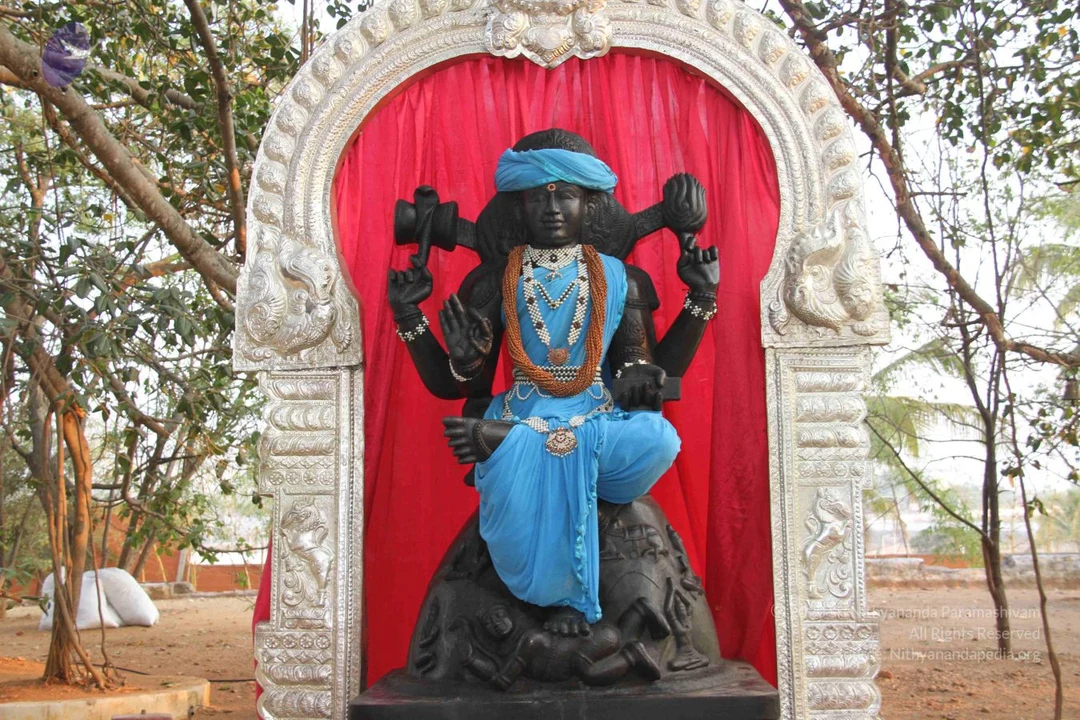
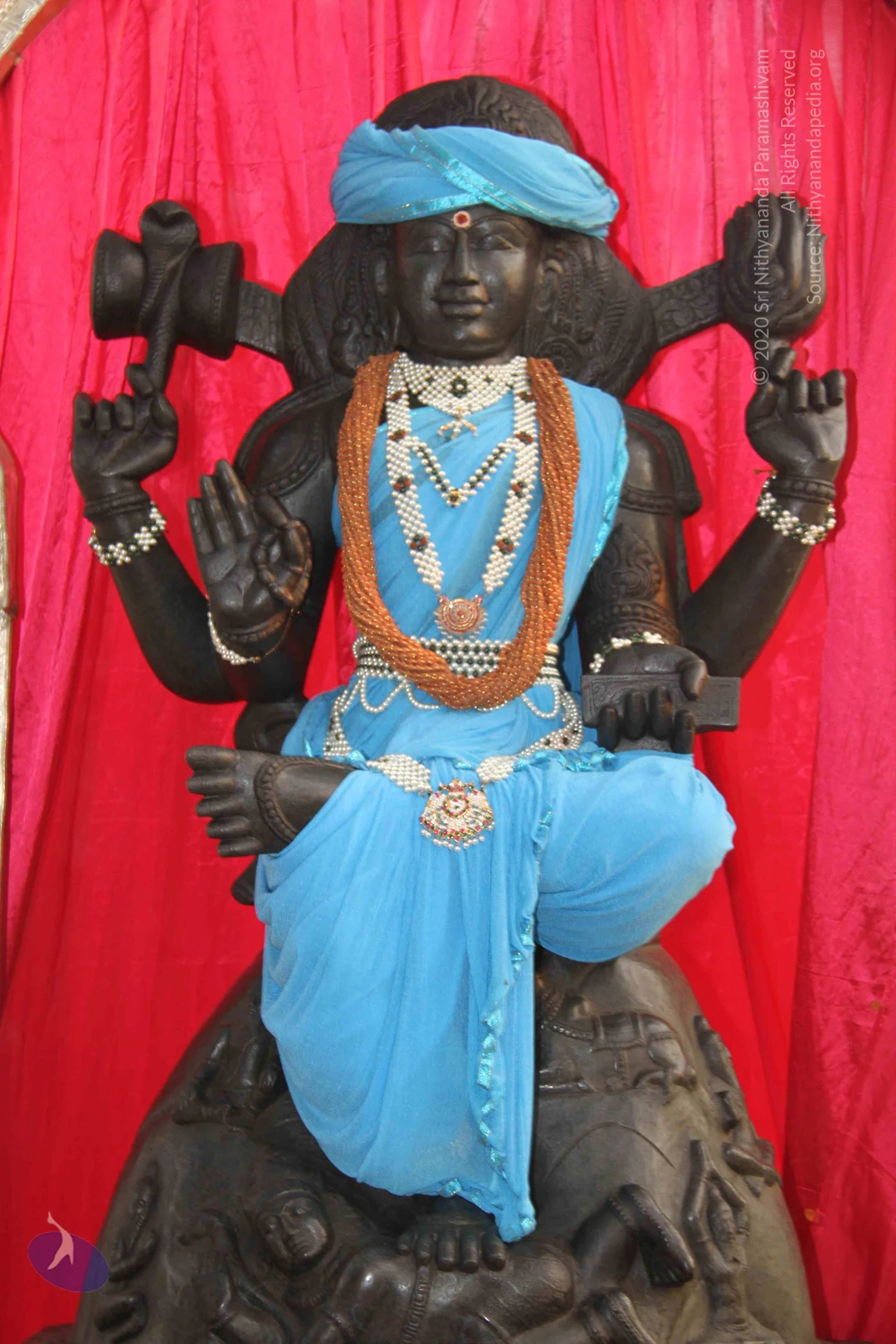
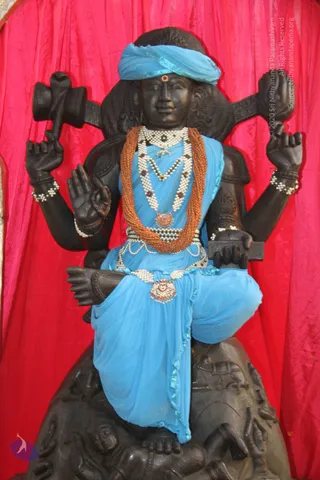
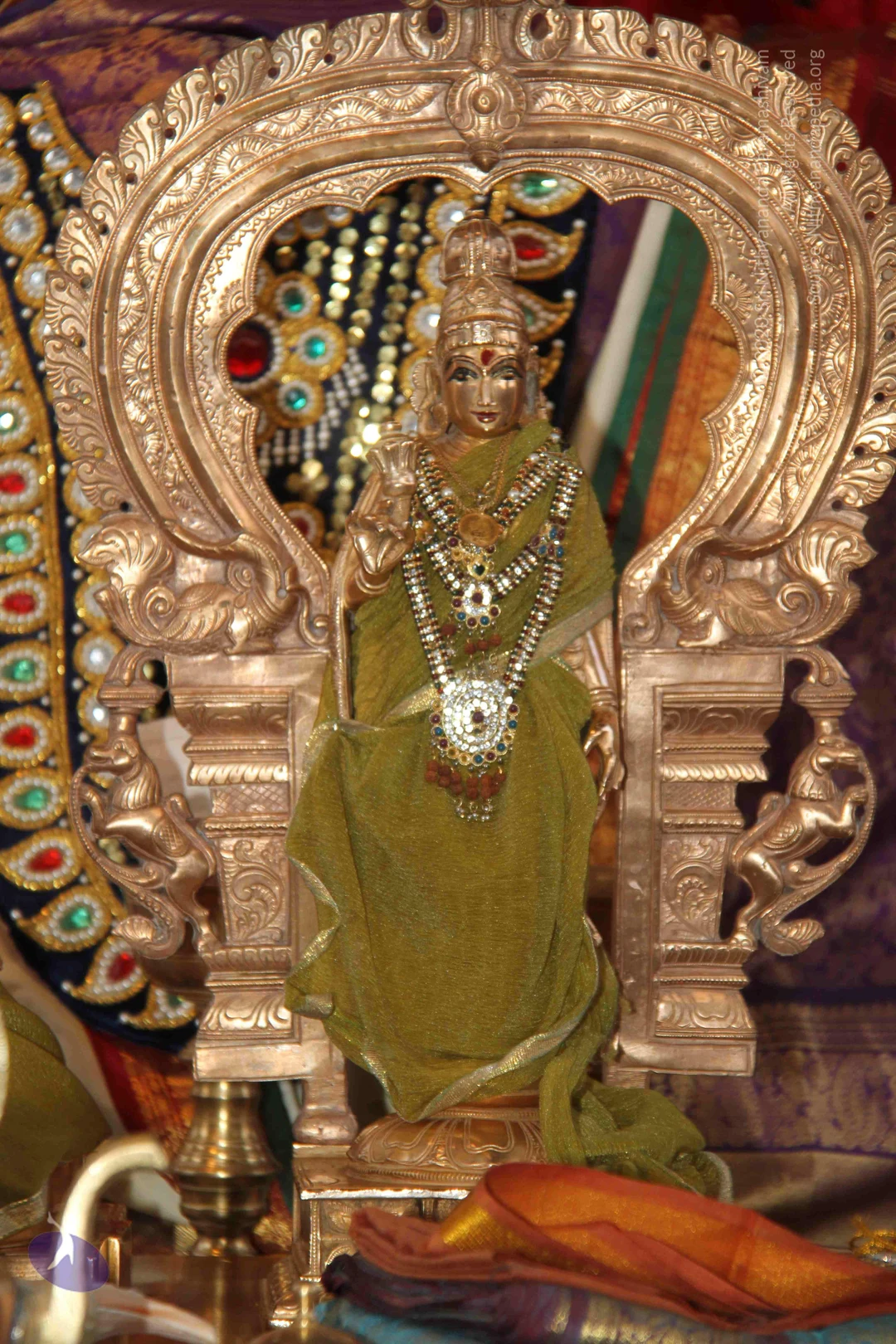
A dark stone statue of a multi-armed deity murti seated on a carved black rock base in front of a bright red draped backdrop. The figure wears a turquoise blue turban with a red bindi, a turquoise blue dhoti-style cloth, and layered white pearl and multicoloured bead necklaces with an orange-brown beaded garland across the chest. Pearl bracelets adorn the wrists, and a jewelled pearl waist ornament hangs at the hips. Its hands hold a trident-like staff, a small drum and other objects, while one hand is raised in abhaya-style gesture. No physical people are visible; the figure is a statue, so this is not a depiction of a living person.A photograph of two men walking barefoot along a red carpet between metal handrails inside a hall with orange walls. The foreground man, smiling with eyes lowered, wears a rust-orange sleeveless robe with gold borders, an orange beaded garland, gold-bangled arms, and a white horizontal forehead mark with a red dot; long dark hair falls to his shoulders. Behind him, a second man in a matching orange robe with gold borders wears a rudraksha mala and a white forehead band with a red dot. On the wall, a board titled "The Spiritual Journey of Paramahamsa Nithyananda" shows photographs, and a framed panel on the left reads text about experiencing ultimate universal consciousness.A golden statue of a long-haired male figure stands in an ornate gilded niche draped with orange and gold brocade cloth. The statue wears a rust-orange upper garment, a dense rudraksha mala across the chest, a gold necklace with green and red stones, and a red bindi on the forehead. Its right palm is raised in abhaya mudra, and a brass lamp stand with a lotus-shaped bowl stands at left.A gilded copper deity murti of a female figure stands within an ornate copper arch with carved makara-style sides and lion or horse supports. The figure wears a green sari with a gold border, layered jewelled necklaces with red and green stones, and holds a small object in one raised hand. Behind the arch hang embroidered gold and jewelled textiles with red and green gems. Brass vessels and an orange and gold cloth sit in the foreground. No people are visible in the scene; this is a statue on an altar setting.

2-Pada-Puja

12 photosSource gallery
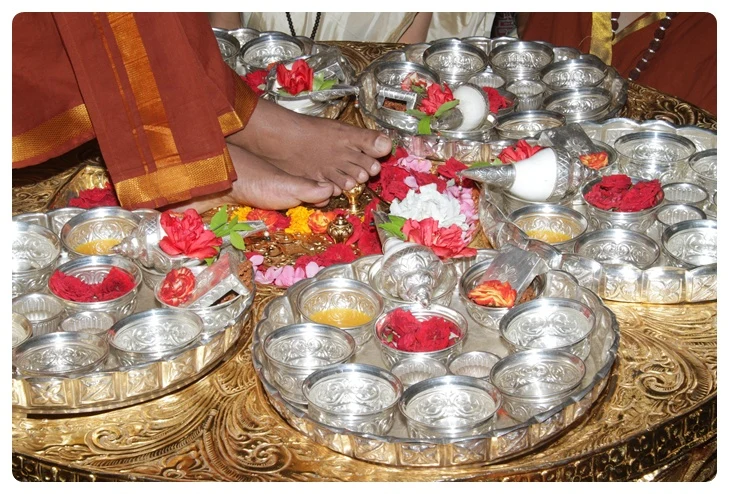
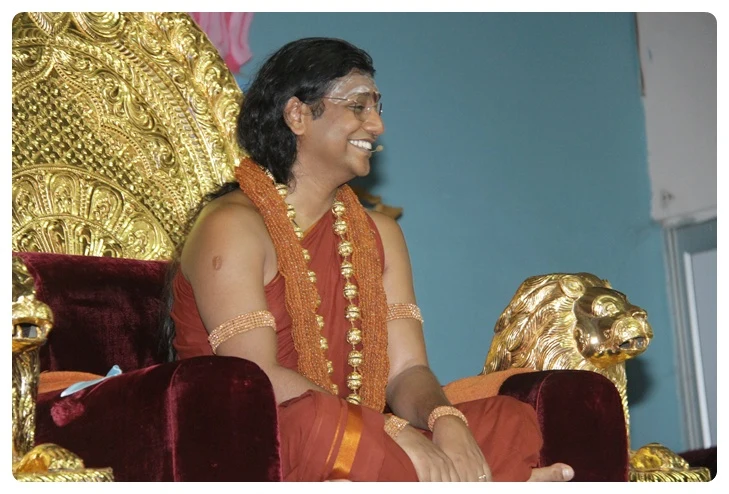
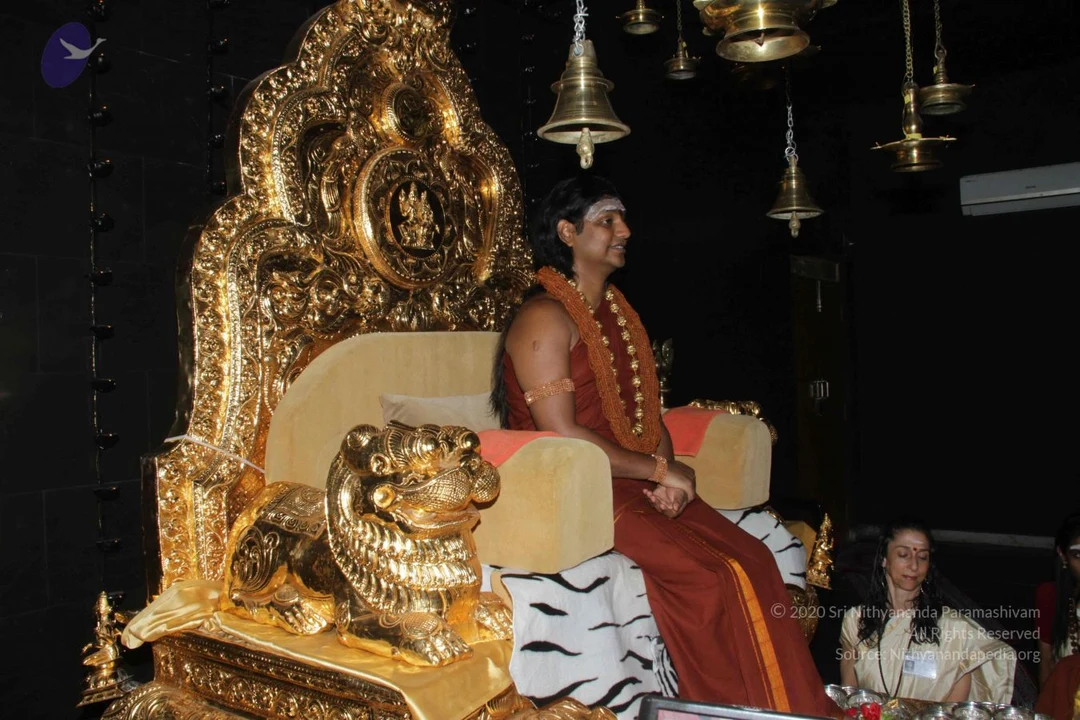
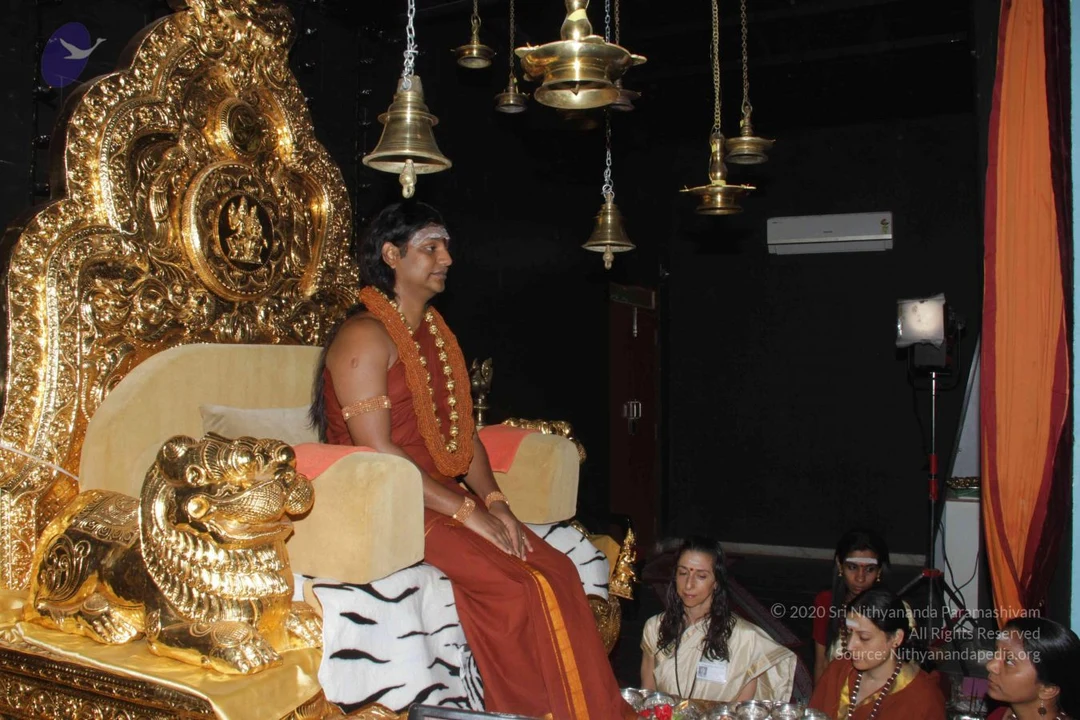
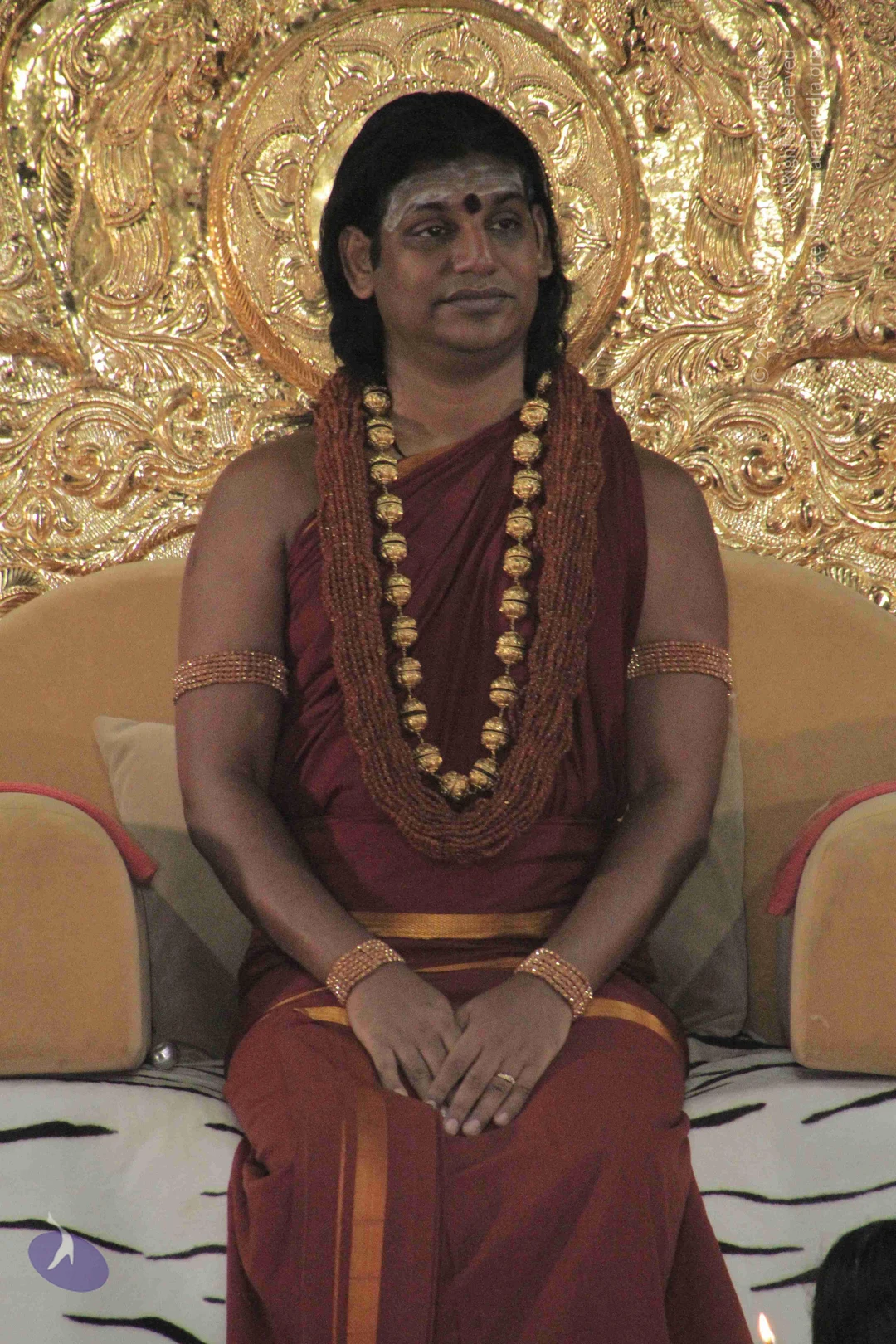
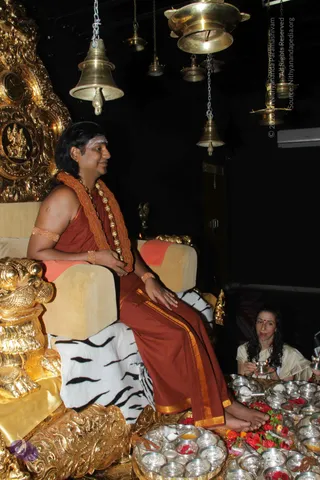
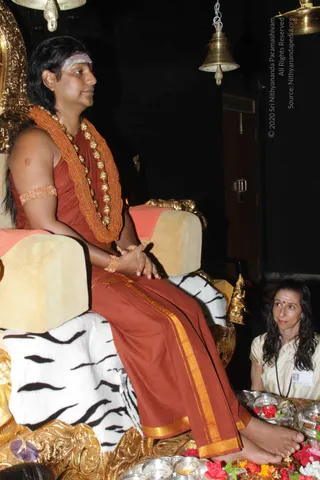
A seated man in profile on a cream upholstered seat with orange cloth draped over the arm, wearing a rust-orange unstitched wrap over his torso, matching rust-orange dhoti, long orange-red rudraksha mala with gold bead spacers, and a beaded copper-coloured armlet and wrist band. He has long swept-back dark hair and white ash marks with a red bindi on his forehead. His hands rest together in his lap. Behind him a golden ornate carved throne back and a brass lamp with a flame stand against a black background. Probable Swamiji: long hair, saffron-orange ornate clothing and rudraksha mala cues.Close side-profile photograph of a seated man with long dark hair swept back, a white-and-red forehead marking, and eyes closed in meditation. He wears a rust-red wrap, a thick orange rudraksha mala with ornate gold beads across the chest, and an orange rudraksha armband and bracelet. He sits on a cream cushioned seat with orange fabric draped over the armrest, in front of an ornately carved gold throne and a bronze lamp with a small flame.A photograph of a seated man on an ornate gold-and-cream throne, dressed in a maroon-red dhoti and wrap with a saffron-orange shawl, a rudraksha-style mala with gold beads, gold armlets and bangles, and a white vibhuti marking on his forehead. He sits beside a leopard-print cloth on the throne. At his feet, a woman in a white sari with a red bindi kneels beside silver thalis and bowls holding red and orange flowers, kumkum and offerings. Brass bells and a hanging brass lamp hang from the dark ceiling, and an ornate gold carved backdrop frames the scene.A photograph of a seated man on a gold-and-cream throne draped with a zebra-striped cloth. He wears a rust-orange dhoti with gold border, an orange beaded mala with gold bead necklaces, gold bangles, and white vertical tilak marks on his forehead; his long dark hair is swept back. Beside him a woman in cream clothing with a red bindi and a name badge sits on the floor near silver trays of red flowers and offering bowls. A brass bell hangs above and a gold deity murti stands nearby.A photograph of a pada puja scene in a richly painted hall with pink, green and blue ornamental walls. A seated man in a golden throne, wearing a reddish-orange robe, a rudraksha mala and a bangle-like wrist band, sits centrally on a tiger-striped cloth in front of a gold-framed doorway. Several women in orange saris with yellow borders sit on the floor at the throne's base, some holding objects and a microphone. A tall multi-tiered brass oil lamp burns at left, with brass lamps standing nearby and a plate of offerings in front of the throne. The seated figure matches the page's a person reference only through the saffron robe, rudraksha mala and enthroned position, so the identity is probable rather than confirmed. Visible people: the seated central figure and about six seated women and attendants.A seated man in maroon and rust-red robes sits on an ornate gold-and-tan throne with a gilded repoussé backrest and a zebra-striped cloth on the seat. He wears a long multi-strand rudraksha mala with large gold beads, gold armlets and gold bangles, and has a white tripundra with a red bindi on his forehead. a person is shown in front of the golden backdrop, a satsang-style seated presentation with a small oil lamp visible at the lower right corner. Long dark hair falls past his shoulders, and he sits with hands folded in his lap.

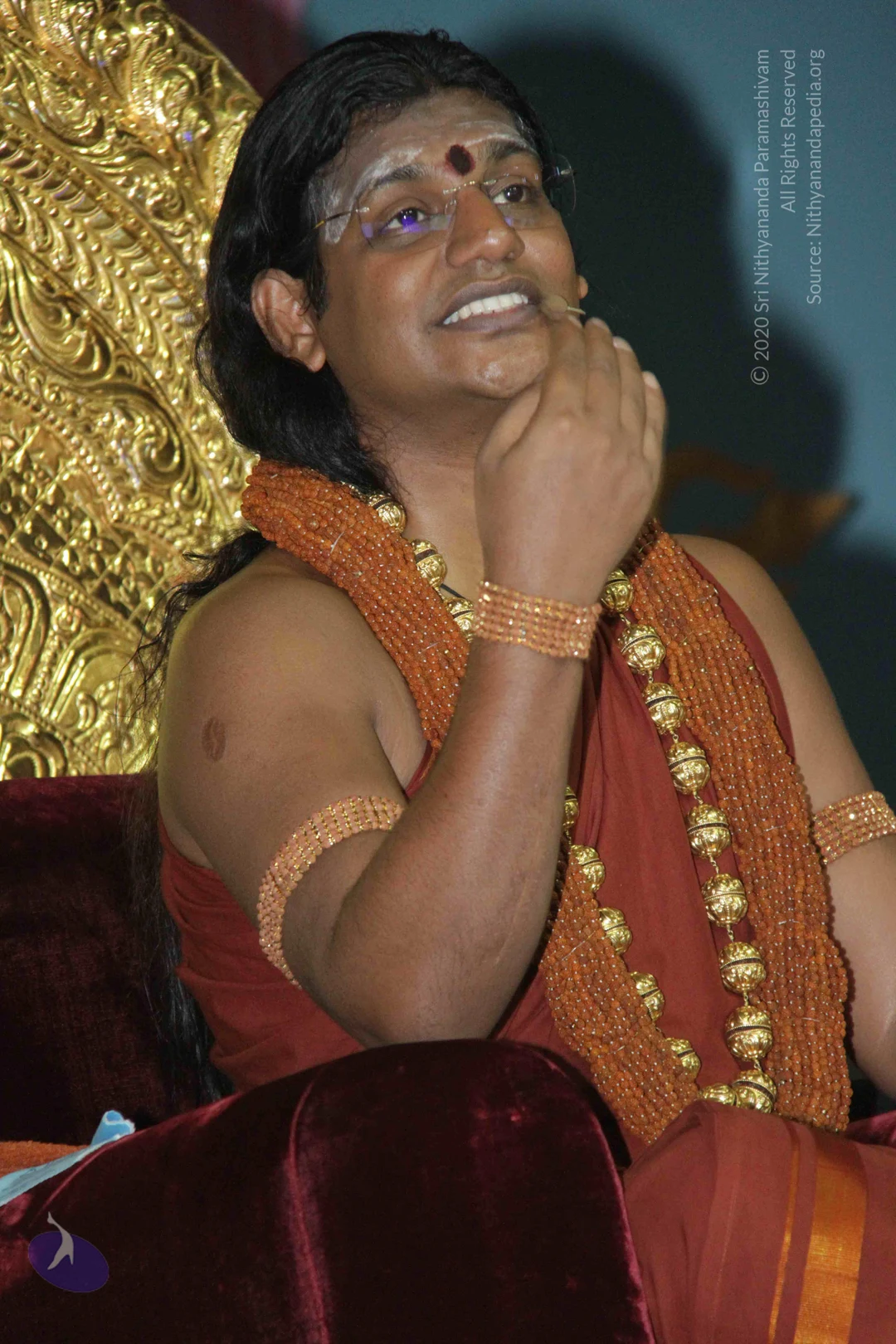
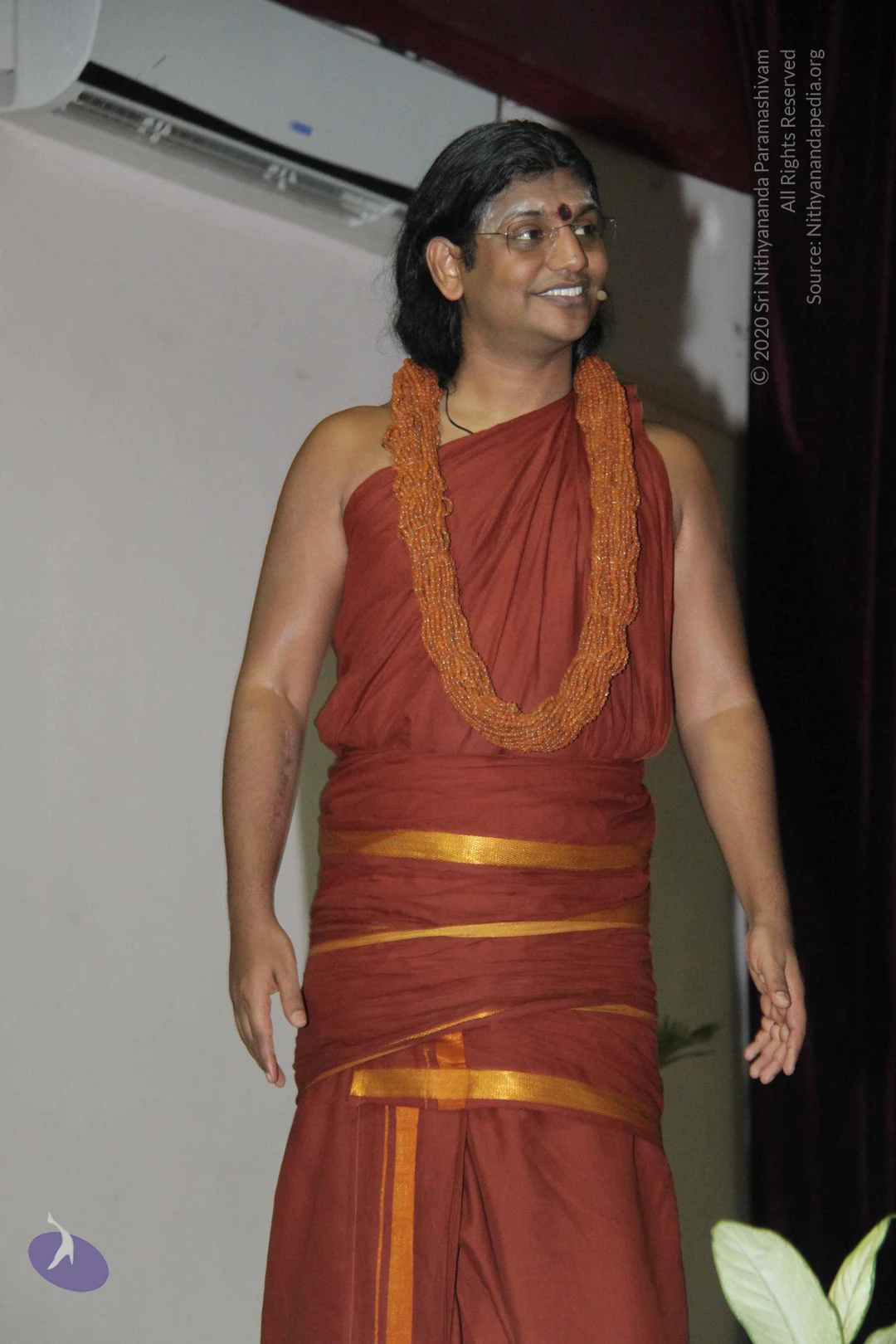
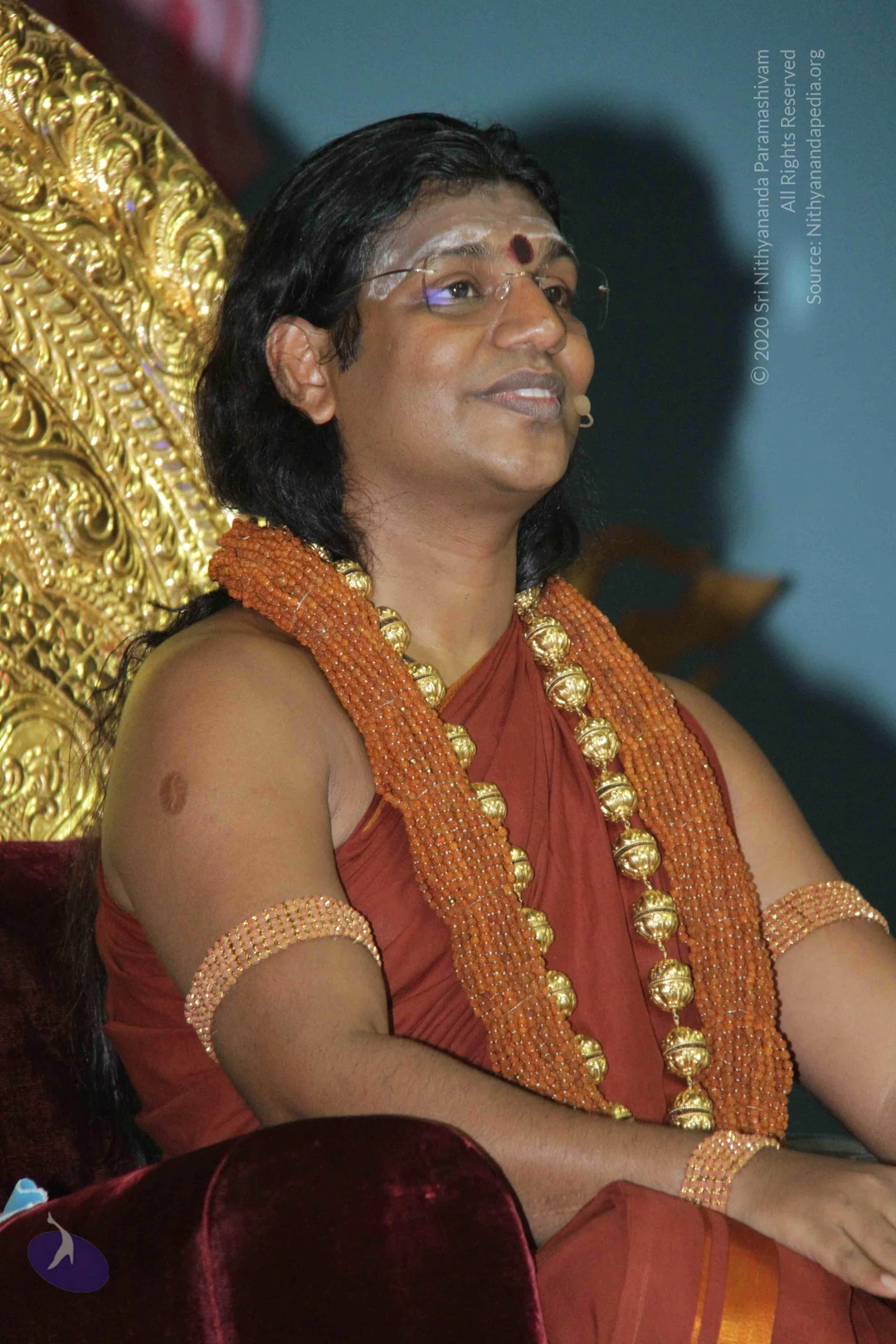
3-Morning-Message
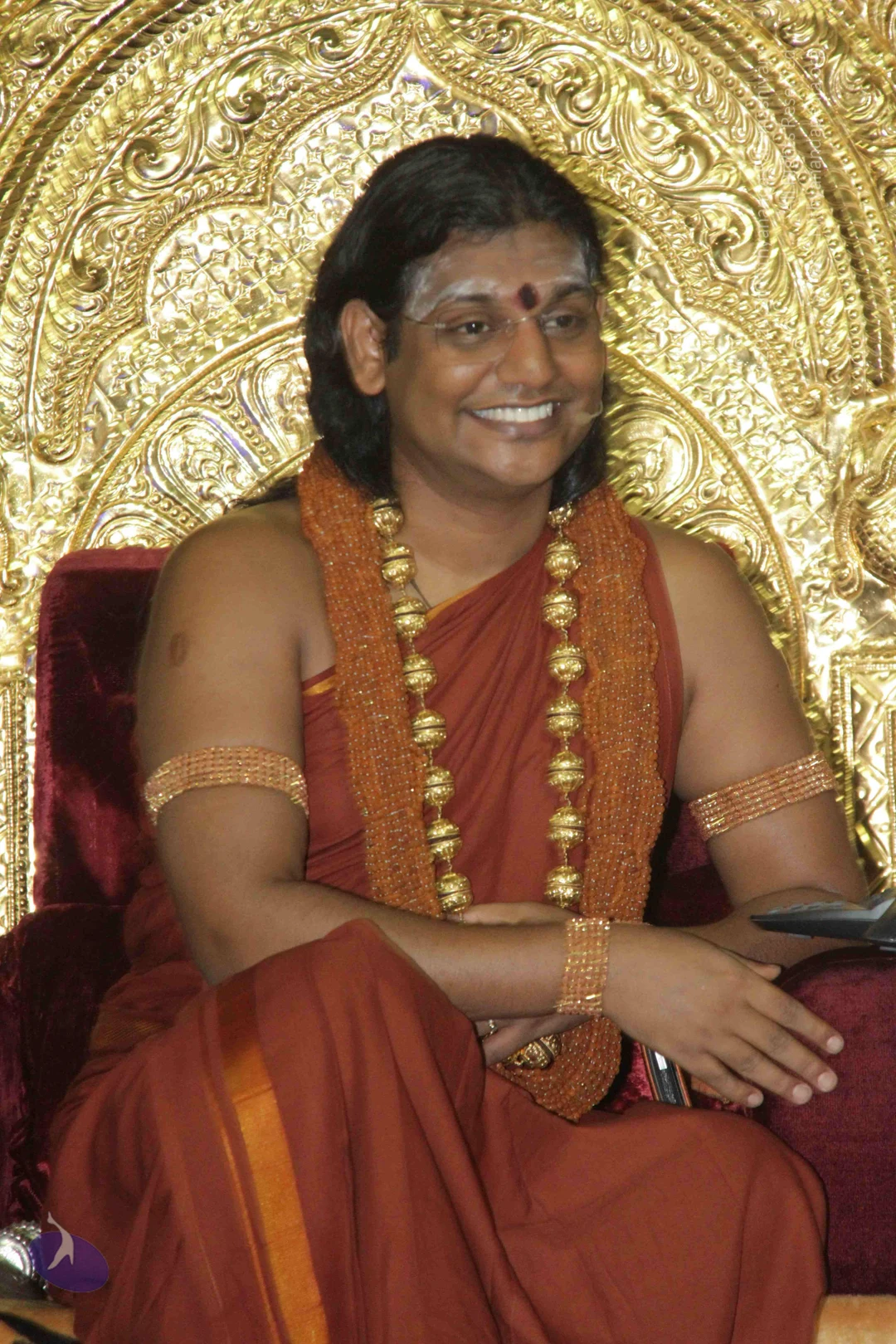
23 photosSource gallery
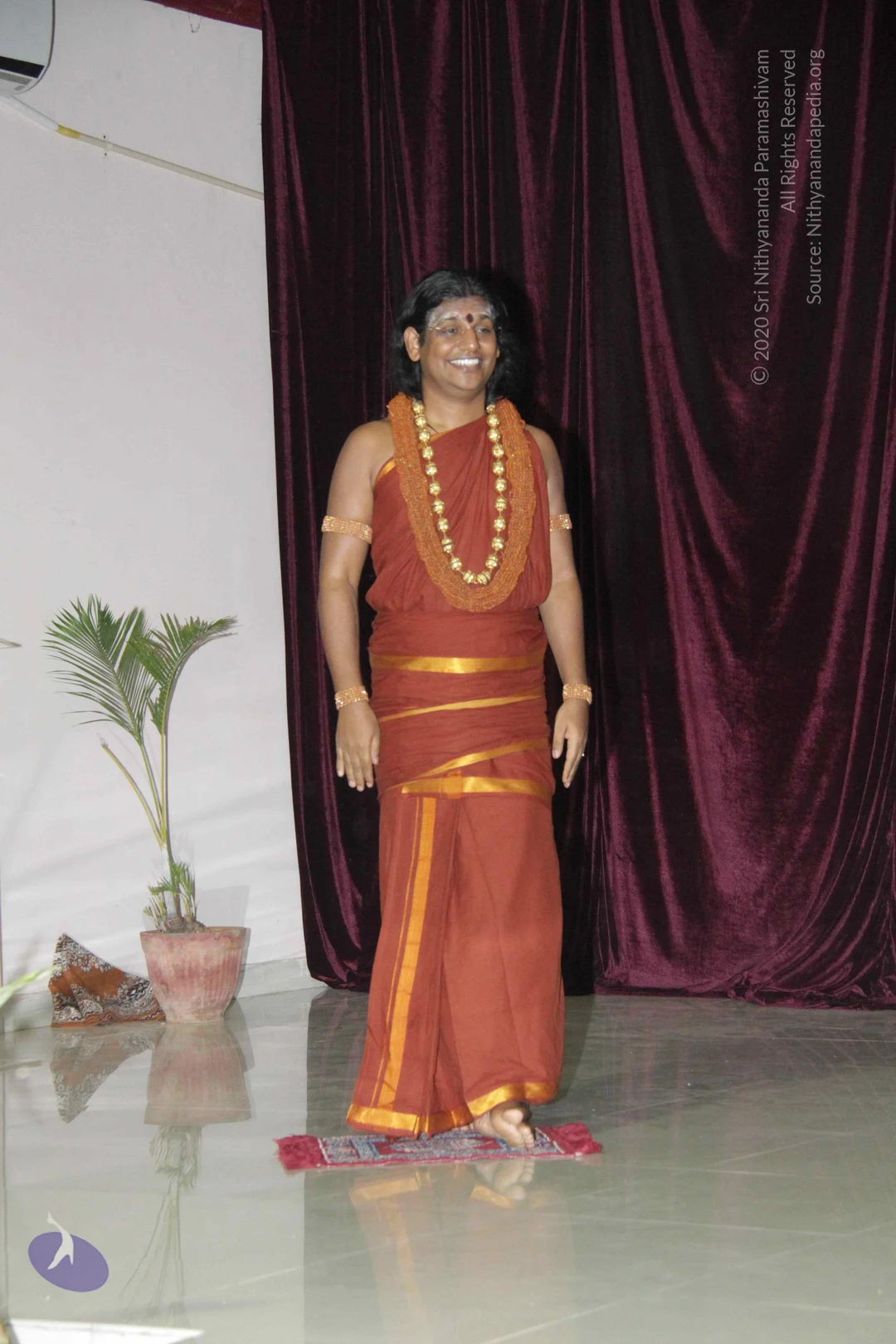
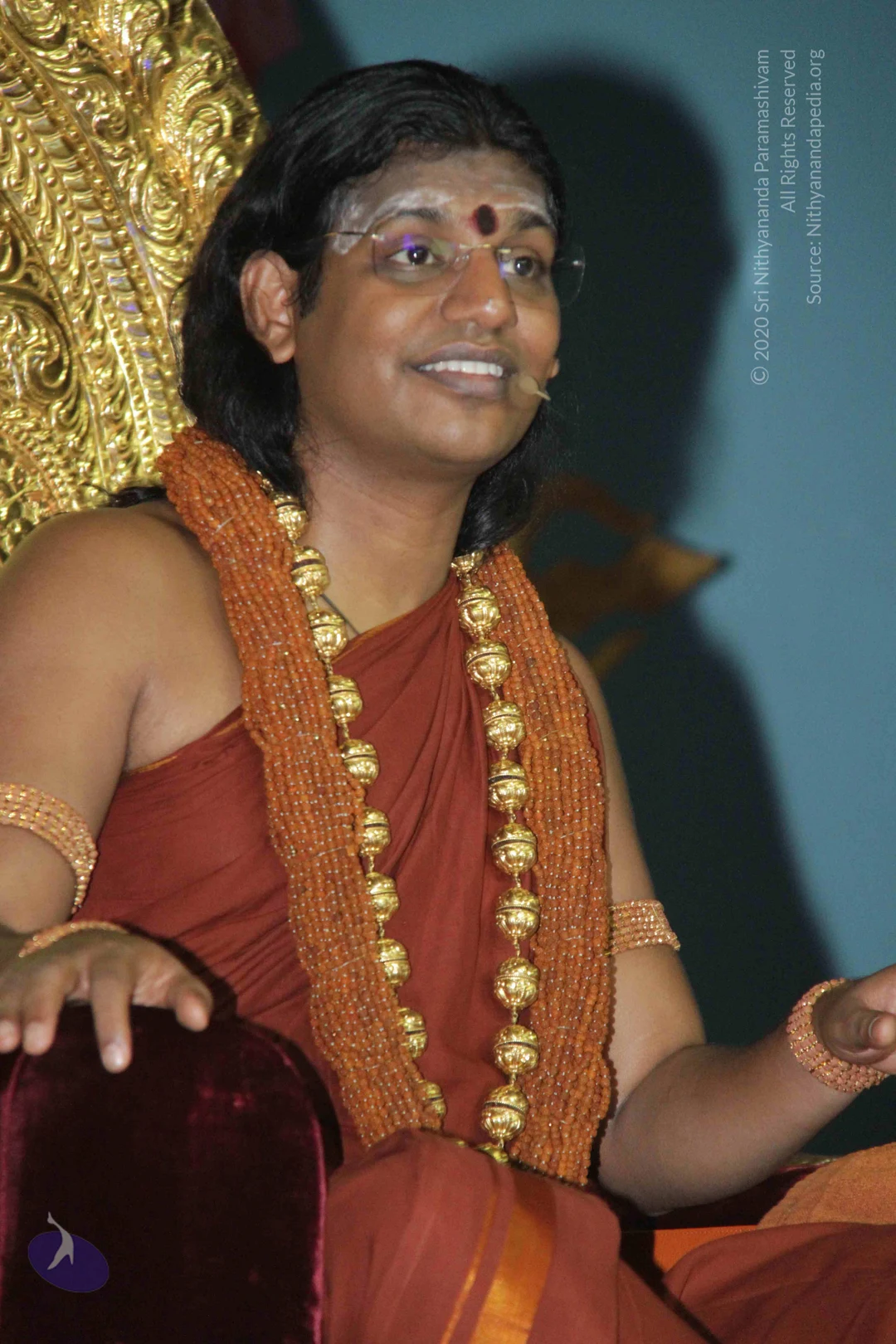
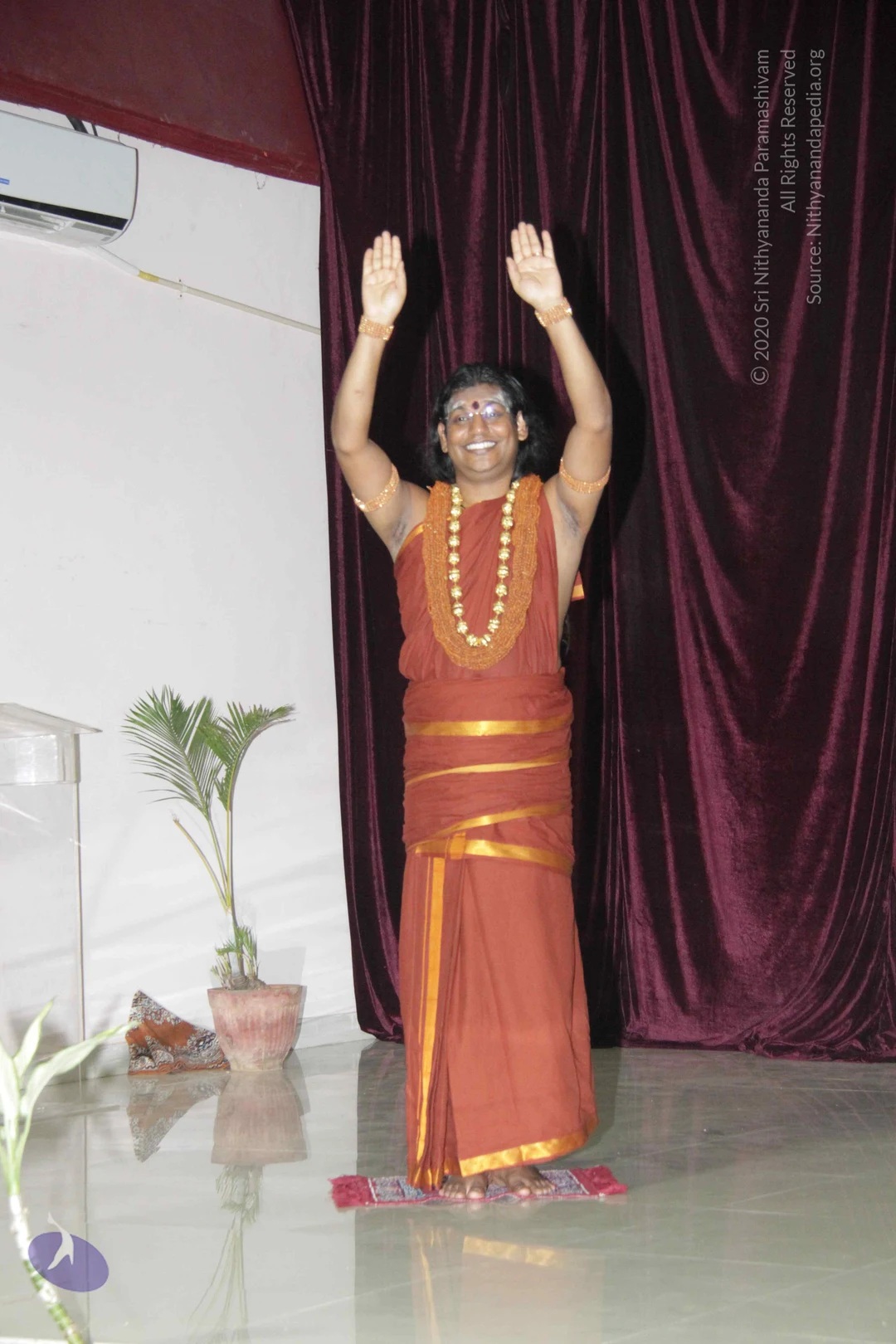
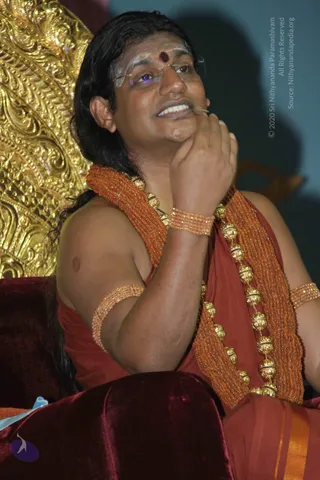
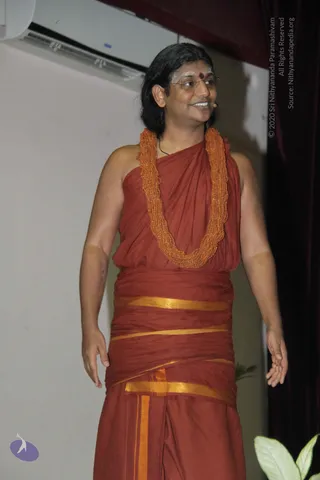
Outdoor photo of a dusty parking area beside a red-brick building. Two cars are parked: a white hatchback and a silver-beige sedan. A woman with long dark hair and an orange headband, wearing a rust-red sari with orange border, stands at left with her back to the camera. At right, a man in a light blue shirt and dark trousers stands near a low wall of stones and plants. Trees and a hazy skyline appear in the background.A single standing man on a glossy grey floor stands on a small patterned red rug before a deep maroon velvet drape, with a potted palm and a folded patterned cloth at left. He wears a rust-red unstitched robe wrapped with gold-bordered band at the waist, a rust-orange beaded shawl, a long gold bead necklace, gold armlets and bangles, and a red bindi on his forehead; he has long dark hair and is smiling. Swamiji (probable): long swept-back hair, ornate gold necklace and armlets, and saffron-red monastic robes, shown as a speaker on stage at a satsang-style event.A seated man with long dark hair speaks into a headset microphone, one hand raised to his chin with a smile. He wears a red-maroon garment draped over his shoulder, orange rudraksha-style beaded malas with gold beads around his neck and matching beaded bracelets on his wrists and upper arm, a red bindi and white forehead markings, and rimless glasses. Behind him is an ornate gold-embossed throne backrest and a maroon velvet cushion.Photo of a man standing on a stage in a rust-red draped sannyasi garment with gold-bordered wrap at the waist and a long orange beaded mala around his neck. He has long dark hair swept back, a red bindi on his forehead and clear-framed glasses, and he is smiling and looking to his left. A wall-mounted air conditioner and dark maroon curtain are behind him, with a leafy plant at the lower right.A smiling man sits cross-legged on an ornate gold throne with a large embossed gold backrest, wearing rust-red unstitched robes with a gold-bordered dhoti, a long orange-beaded mala with gold bead ornaments, gold armlets, and a red kumkum bindi with white vibhuti on his forehead. He wears wire-rimmed glasses and a small clip microphone, and his bare feet rest on a tiger-striped cloth. Appearance-based label: a person, the seated speaker with long swept hair, saffron-toned sannyasi robes, rudraksha-style mala and ceremonial gold ornaments, shown in person during a satsang setting.A seated man with long, swept-back black hair and a red bindi on a white-marked forehead, wearing rimless glasses and a small headset microphone. He wears a rust-red wrap over bare shoulders, multiple strands of orange rudraksha-style beads with large gold ceremonial beads, and gold bangles on his upper arms and wrists. Behind him is an ornate gold-carved chair against a teal wall.