Skip to content
Saturday

16 March 2013

THE SUPREME PONTIFF OF HINDUISM HDH BHAGAVAN NITHYANANDA PARAMASHIVAM

Dated photos
343
Source pages
1
Media
3
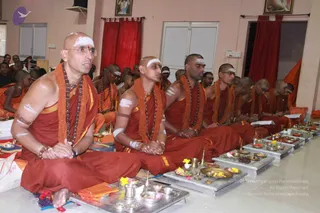
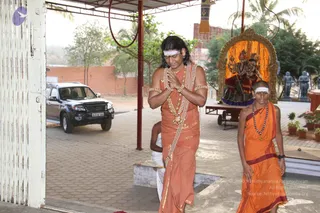
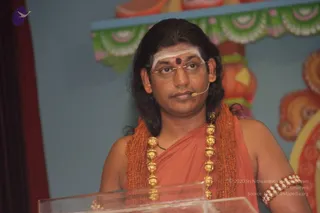
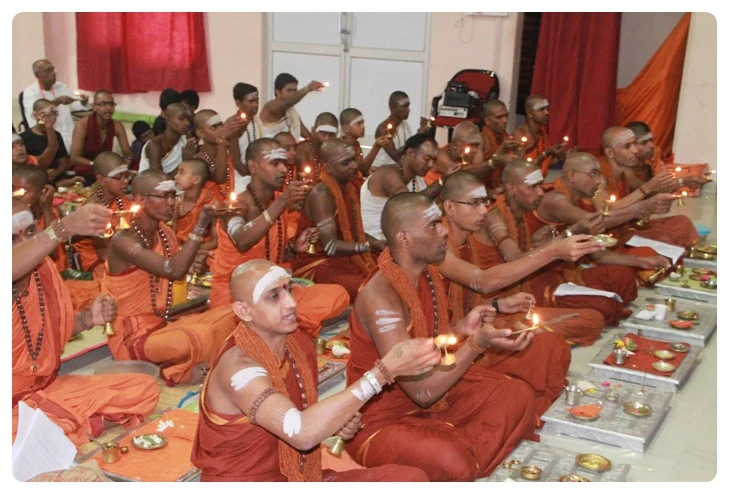
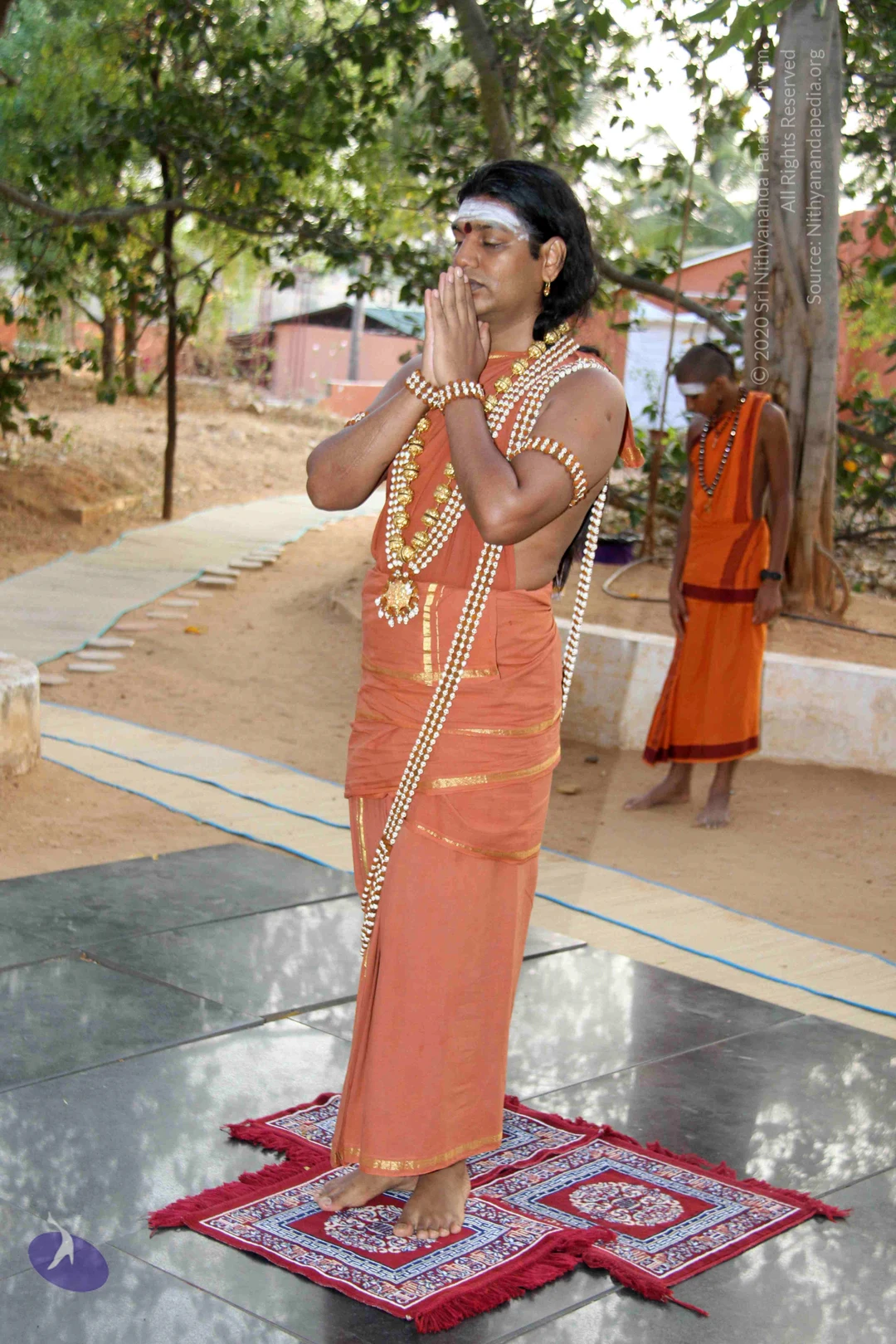
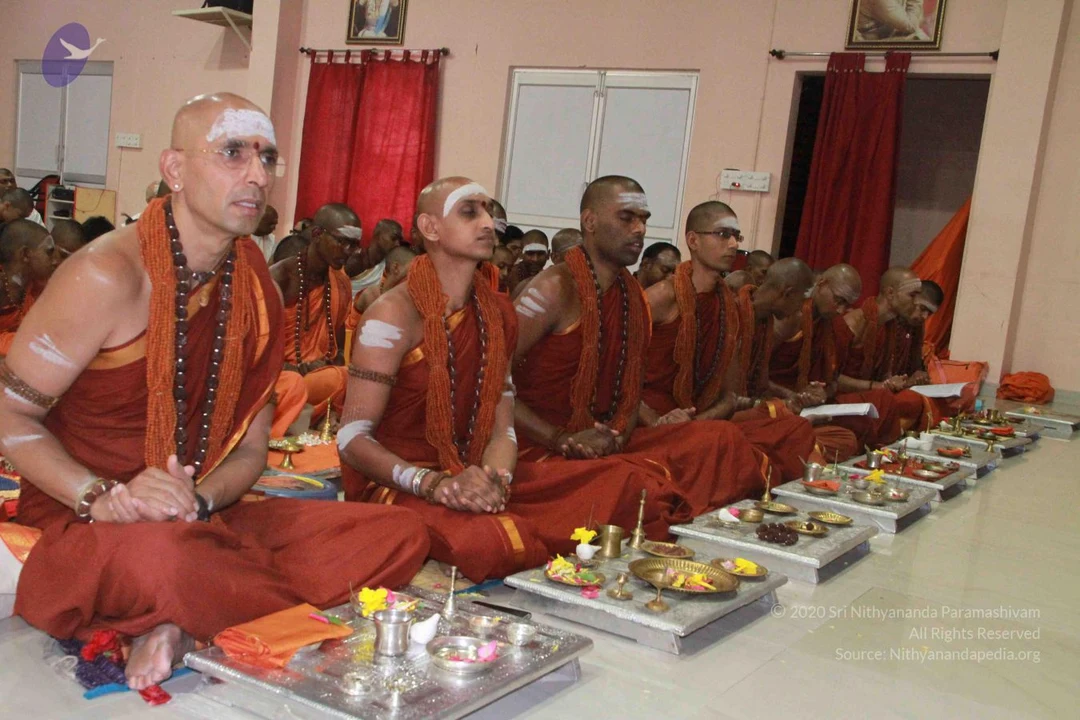
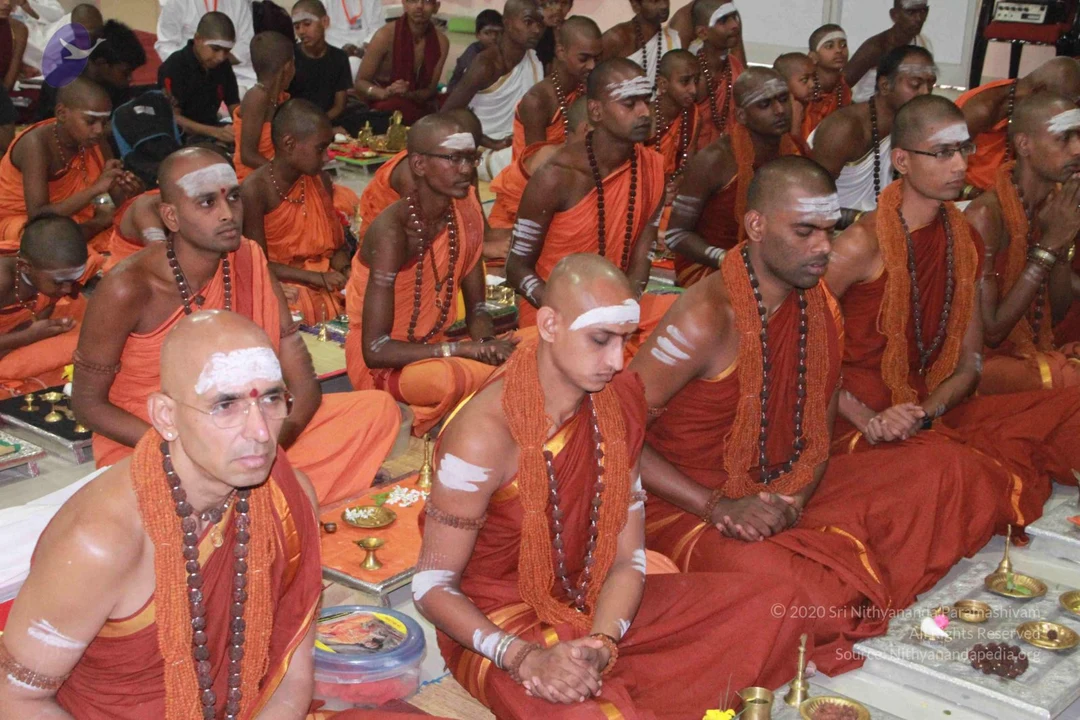
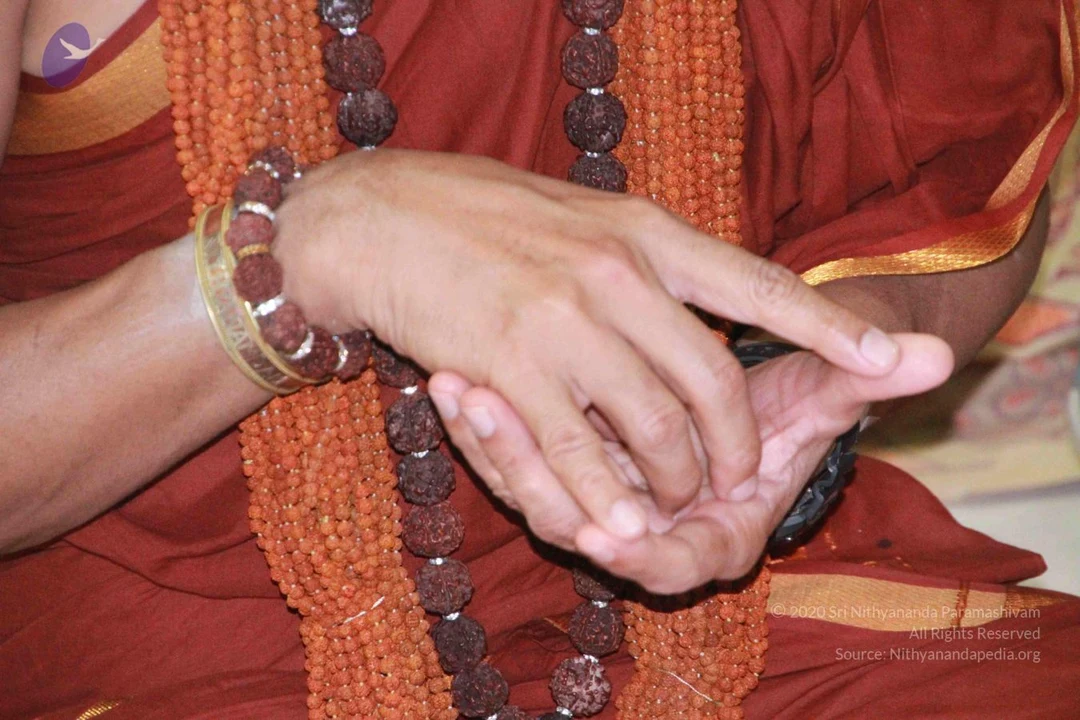
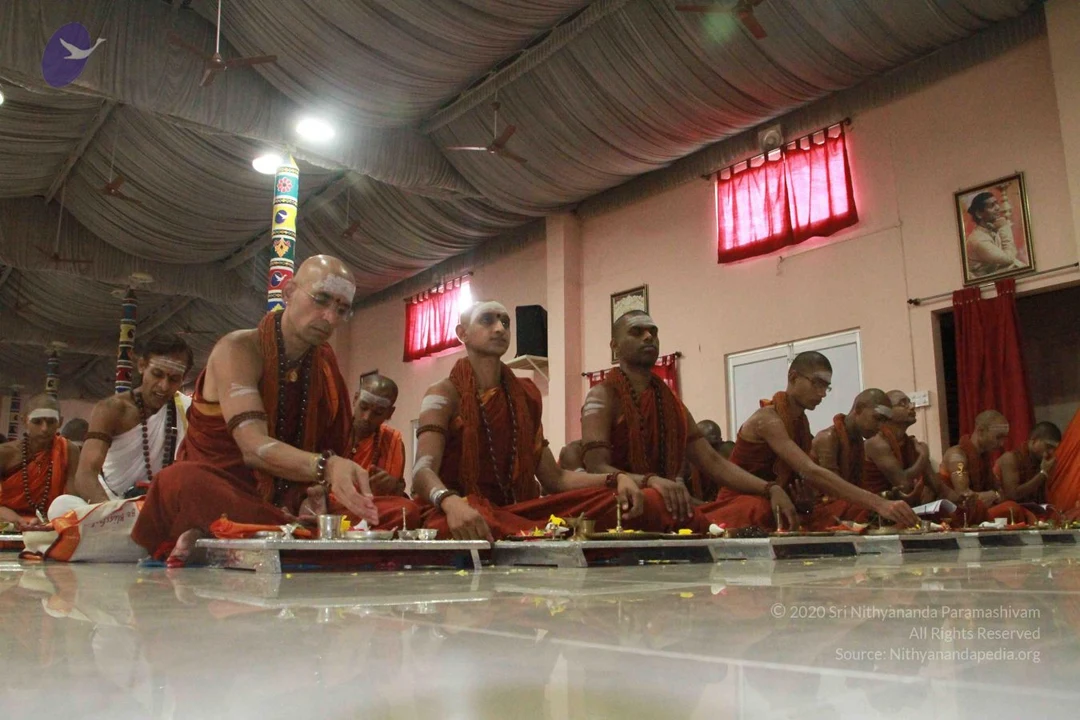
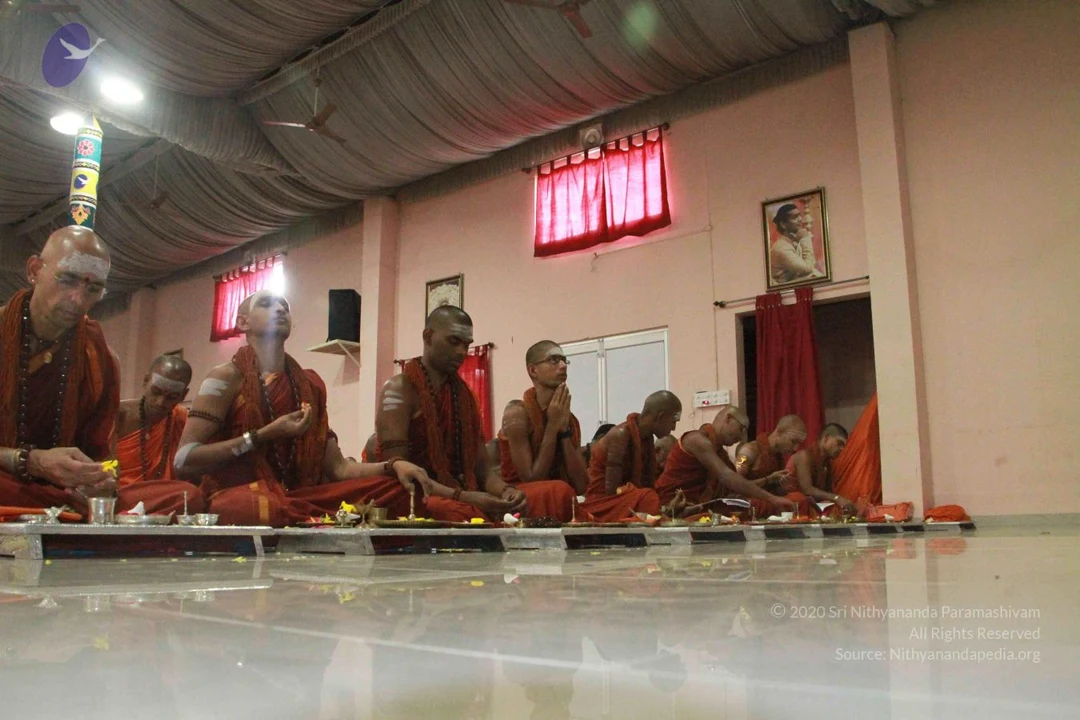
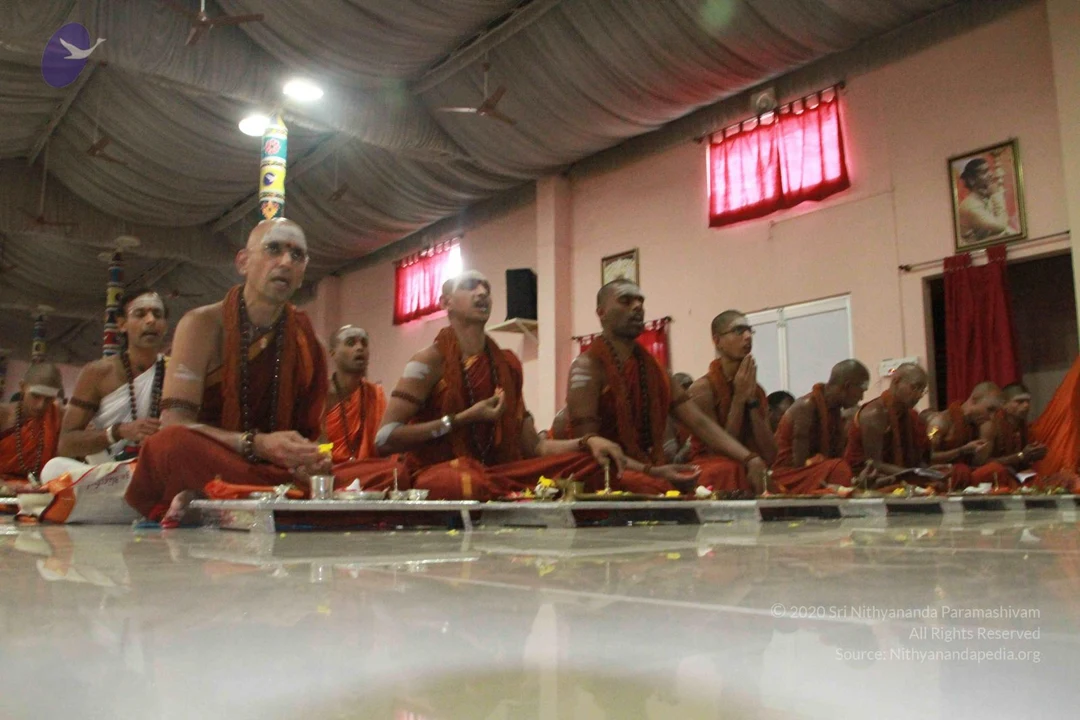
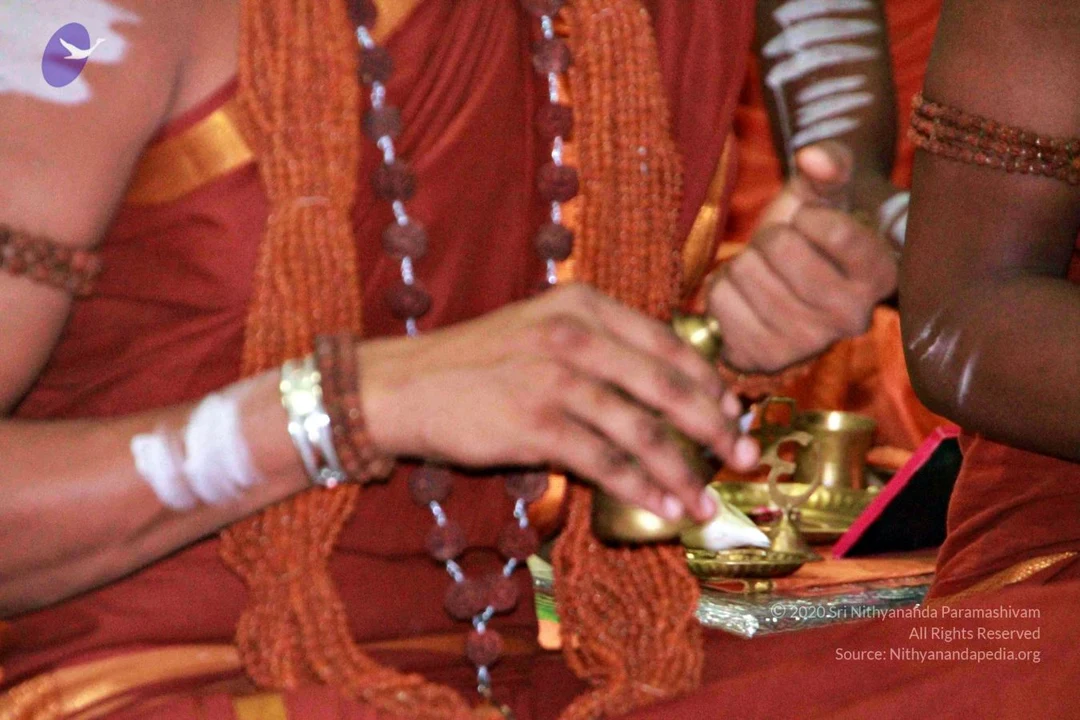
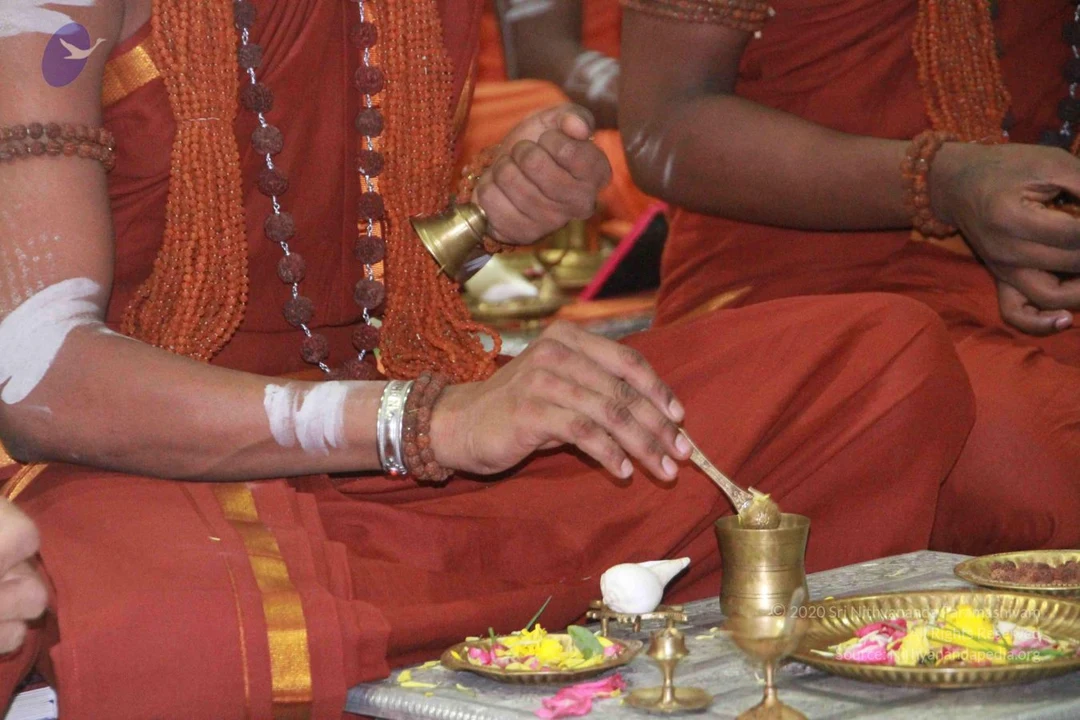
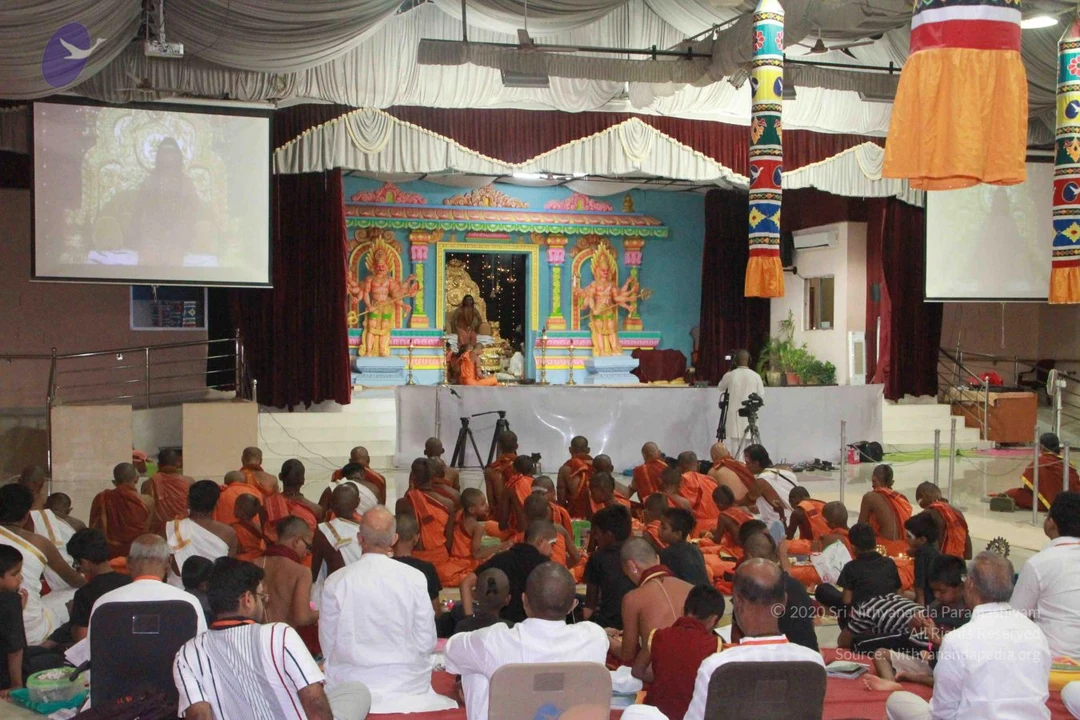
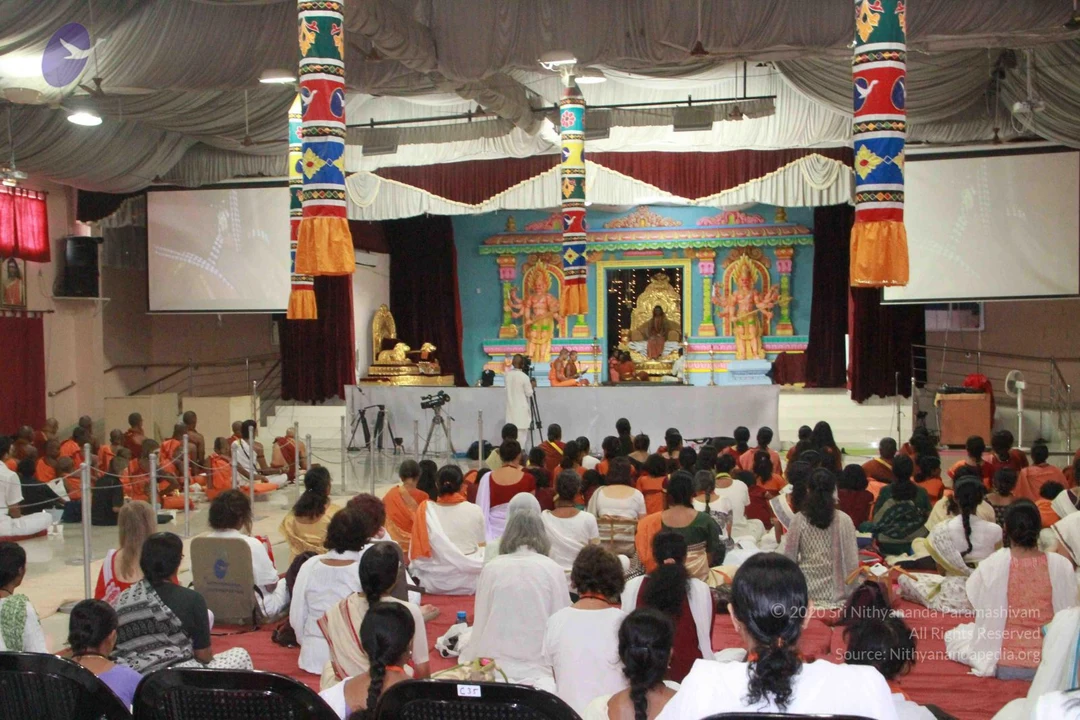
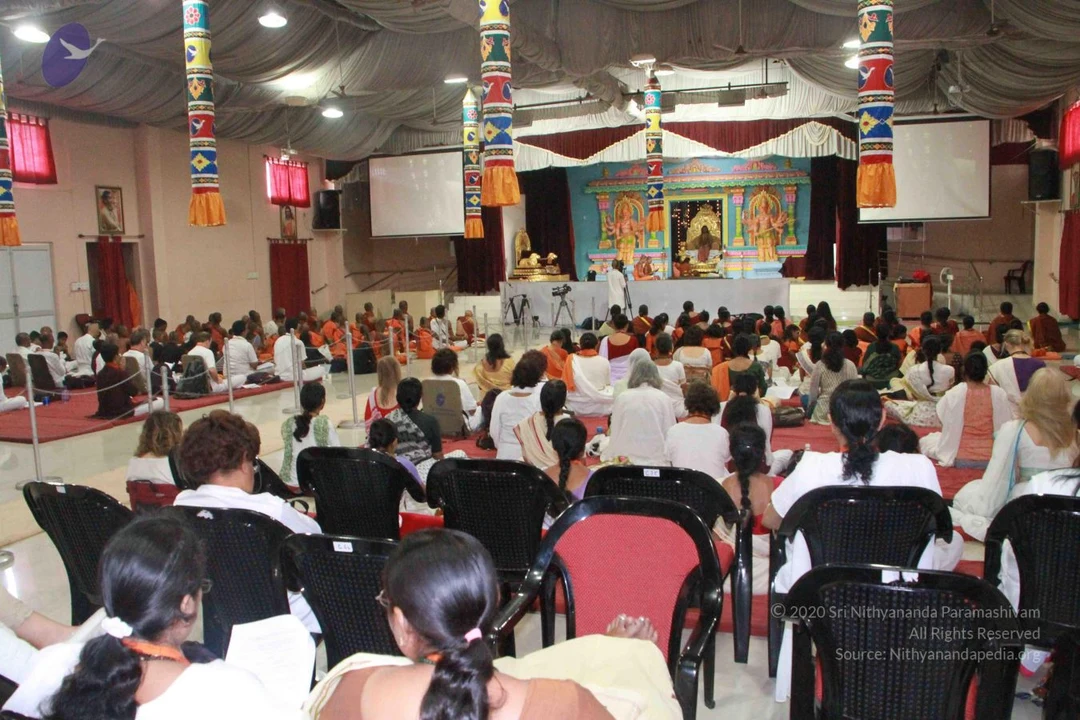
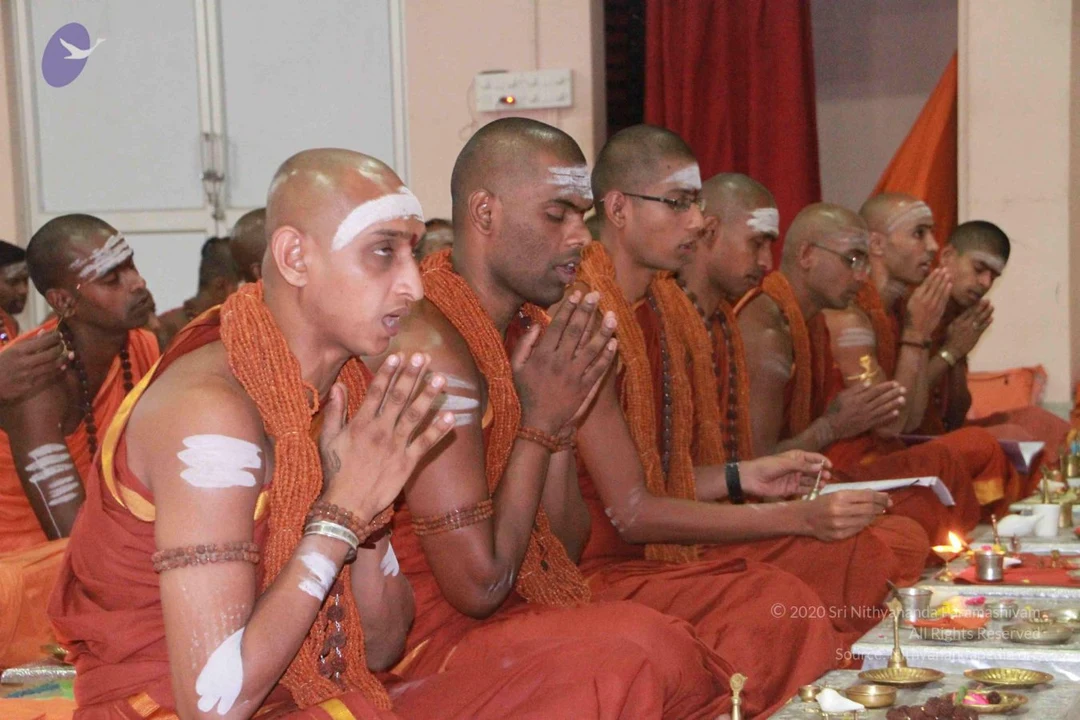
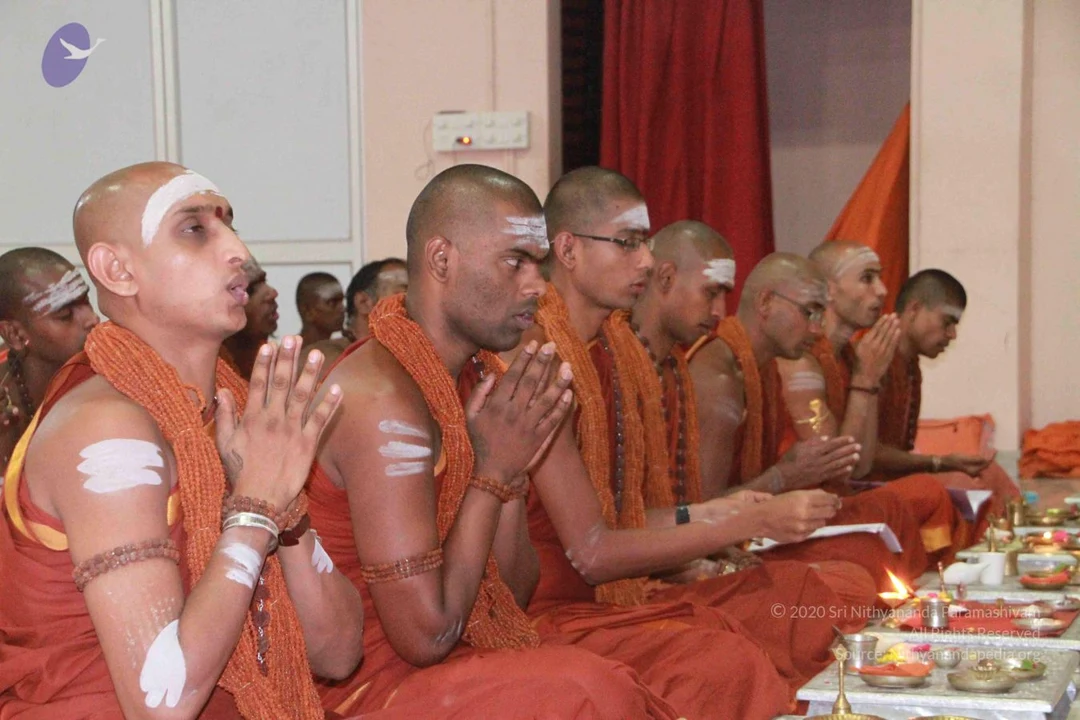
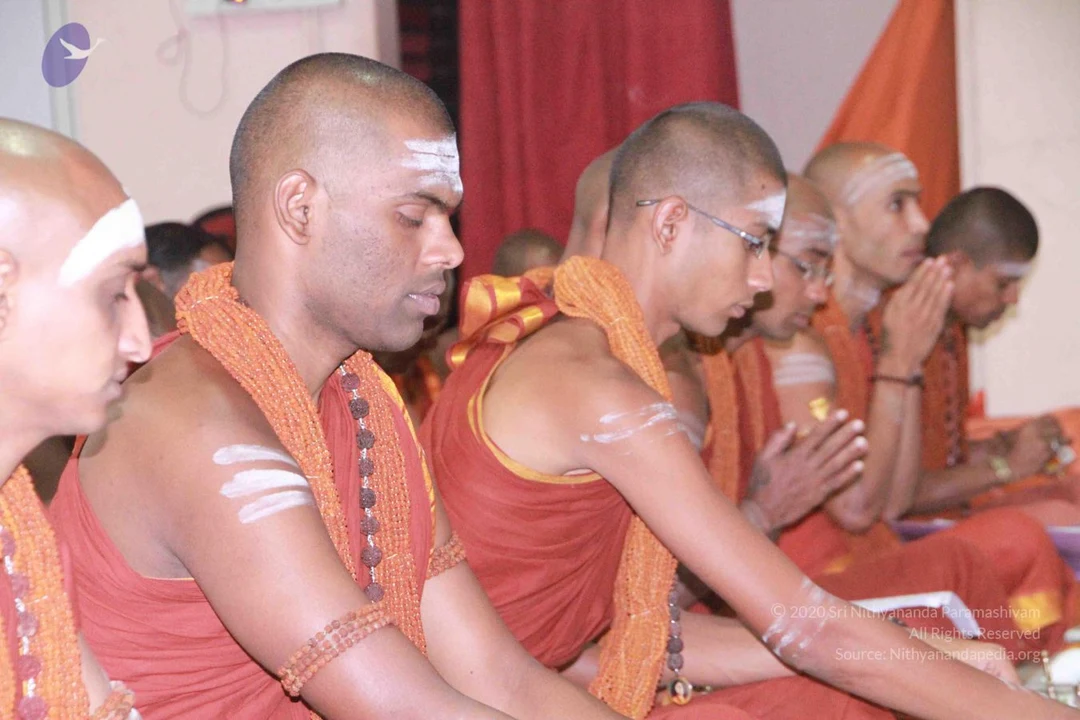
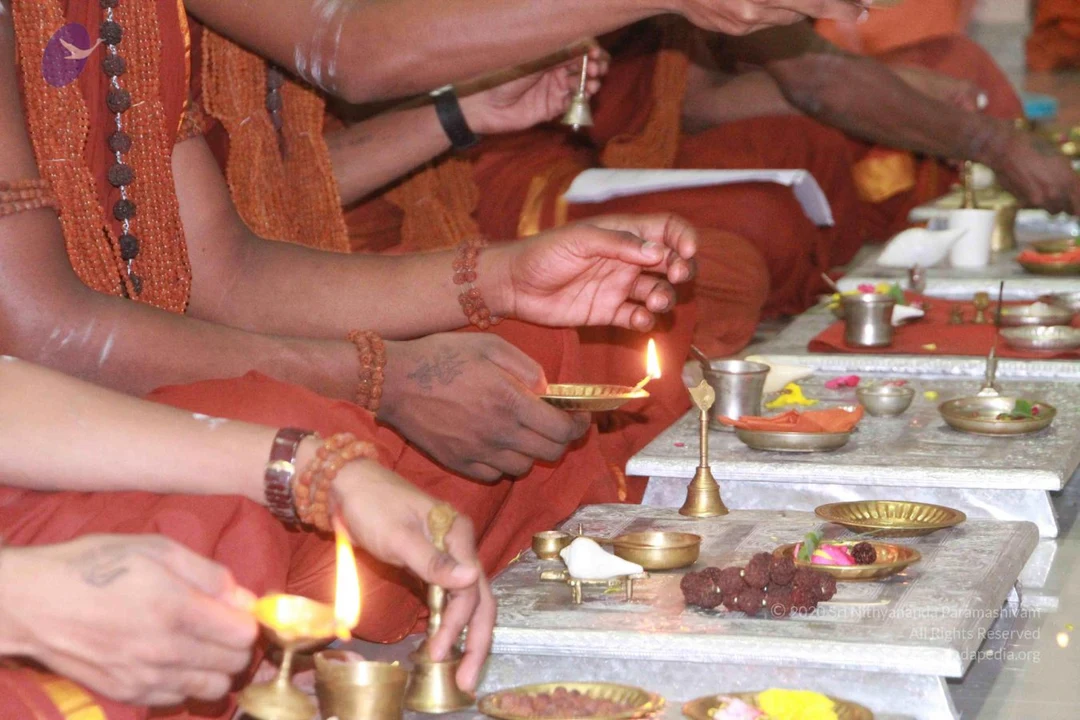
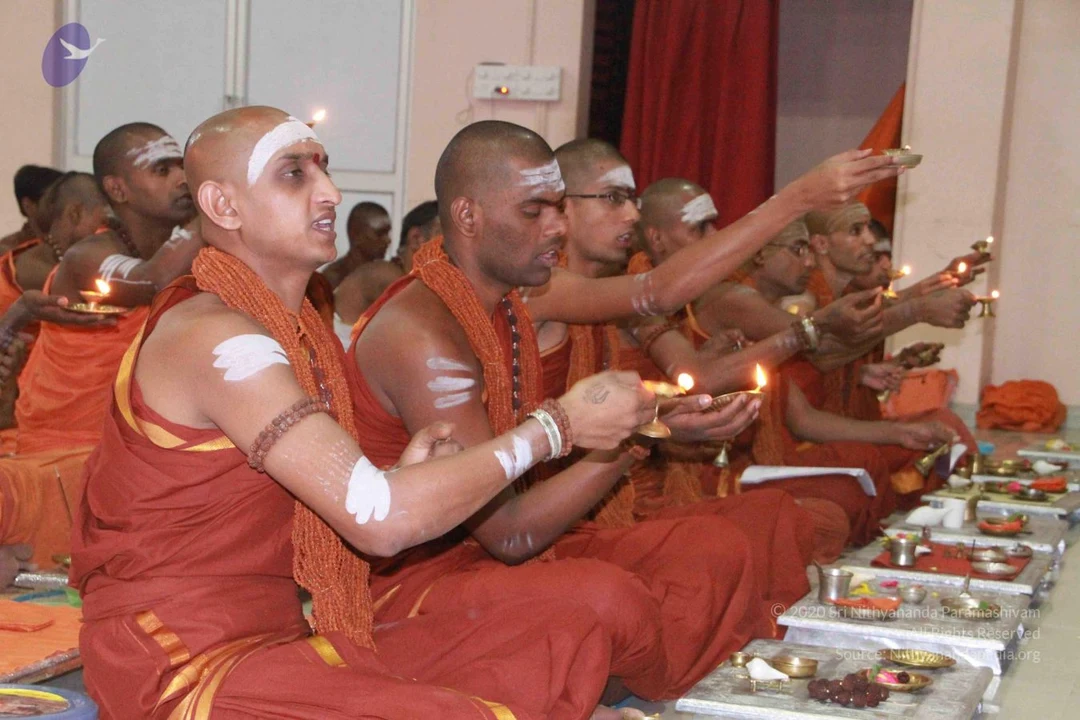
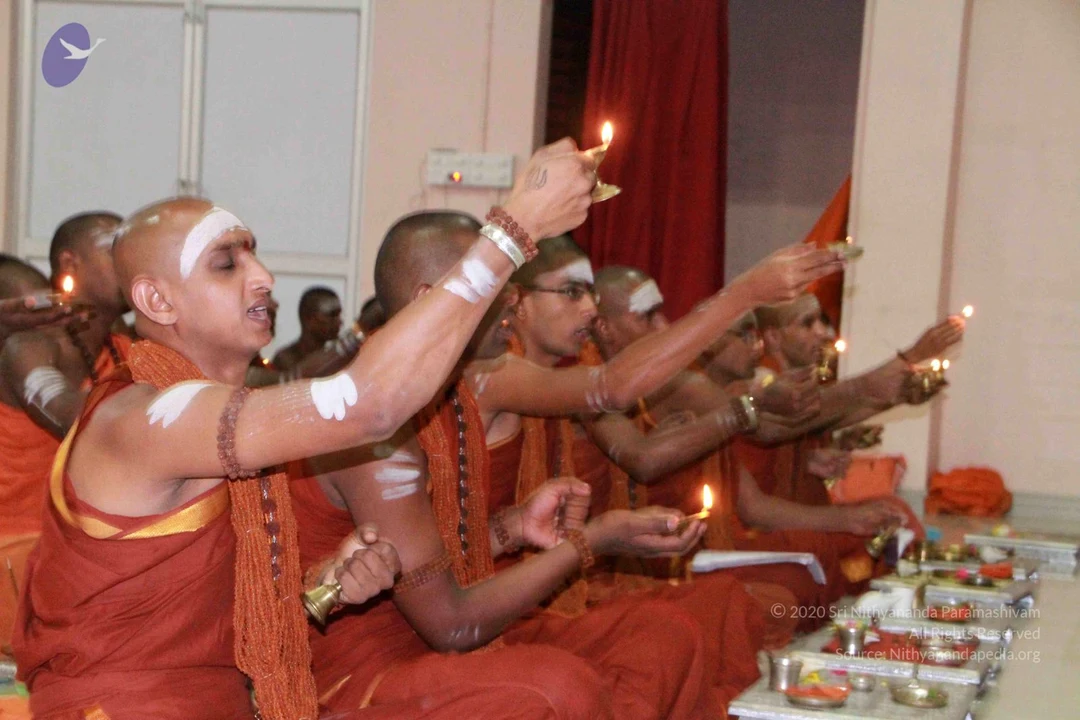
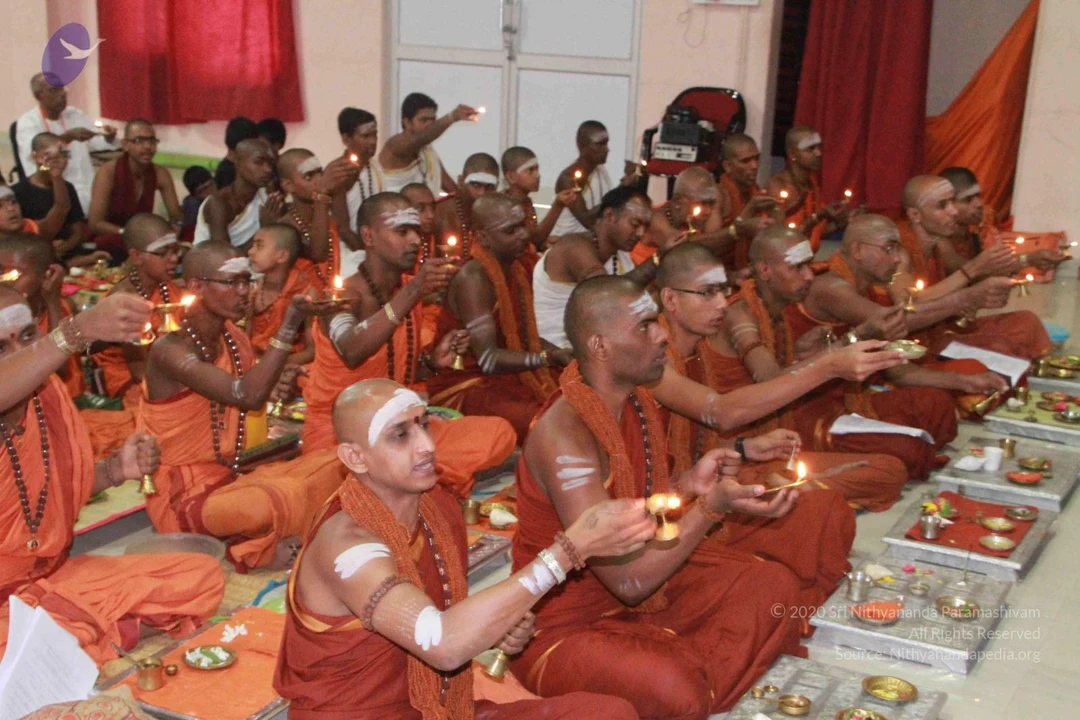
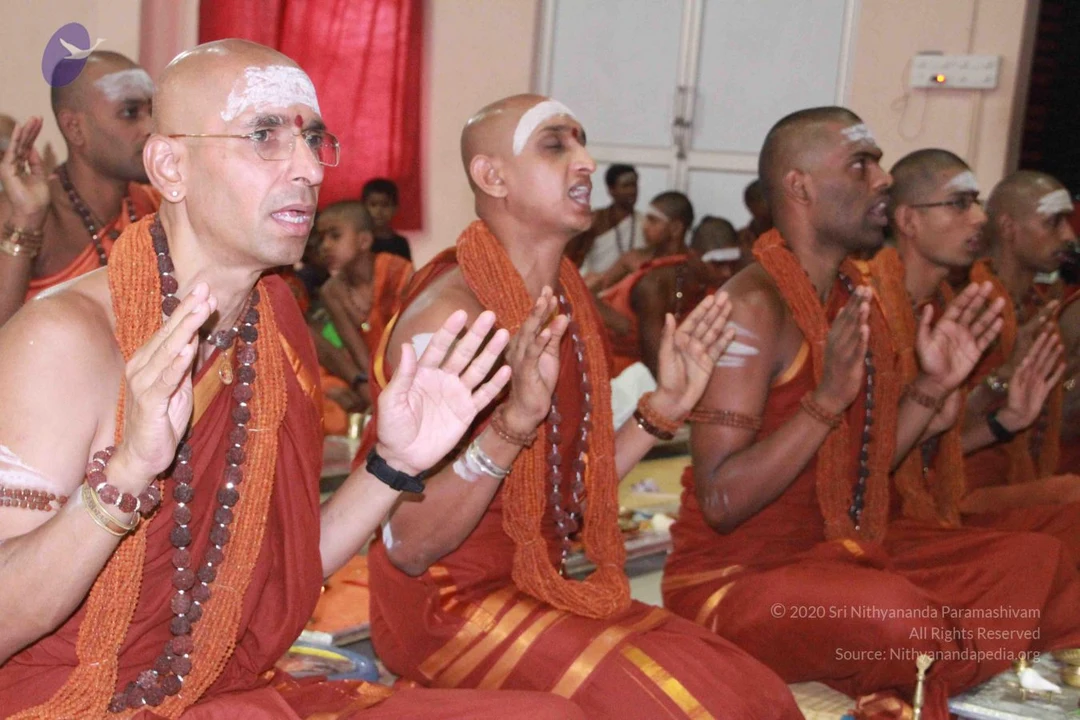
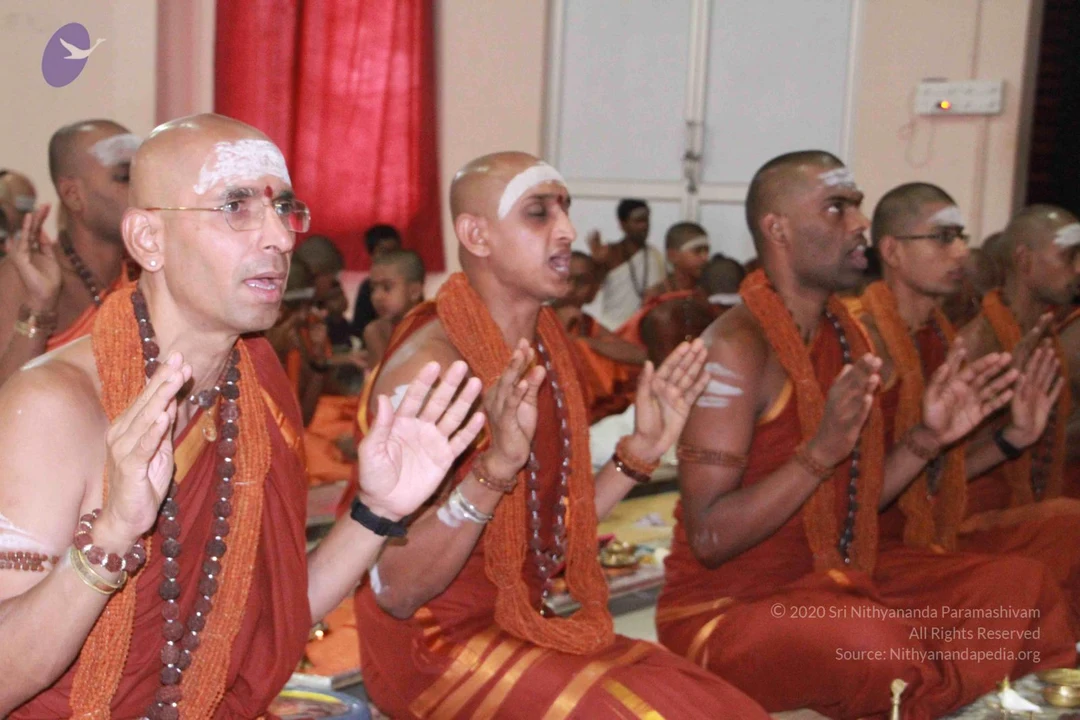
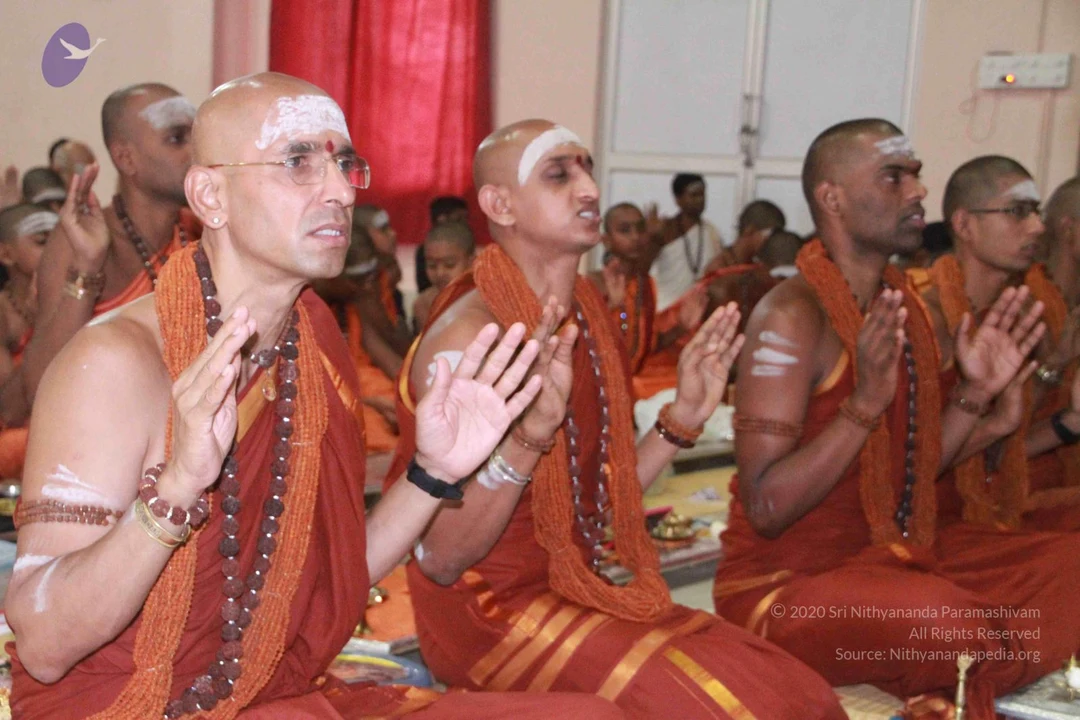
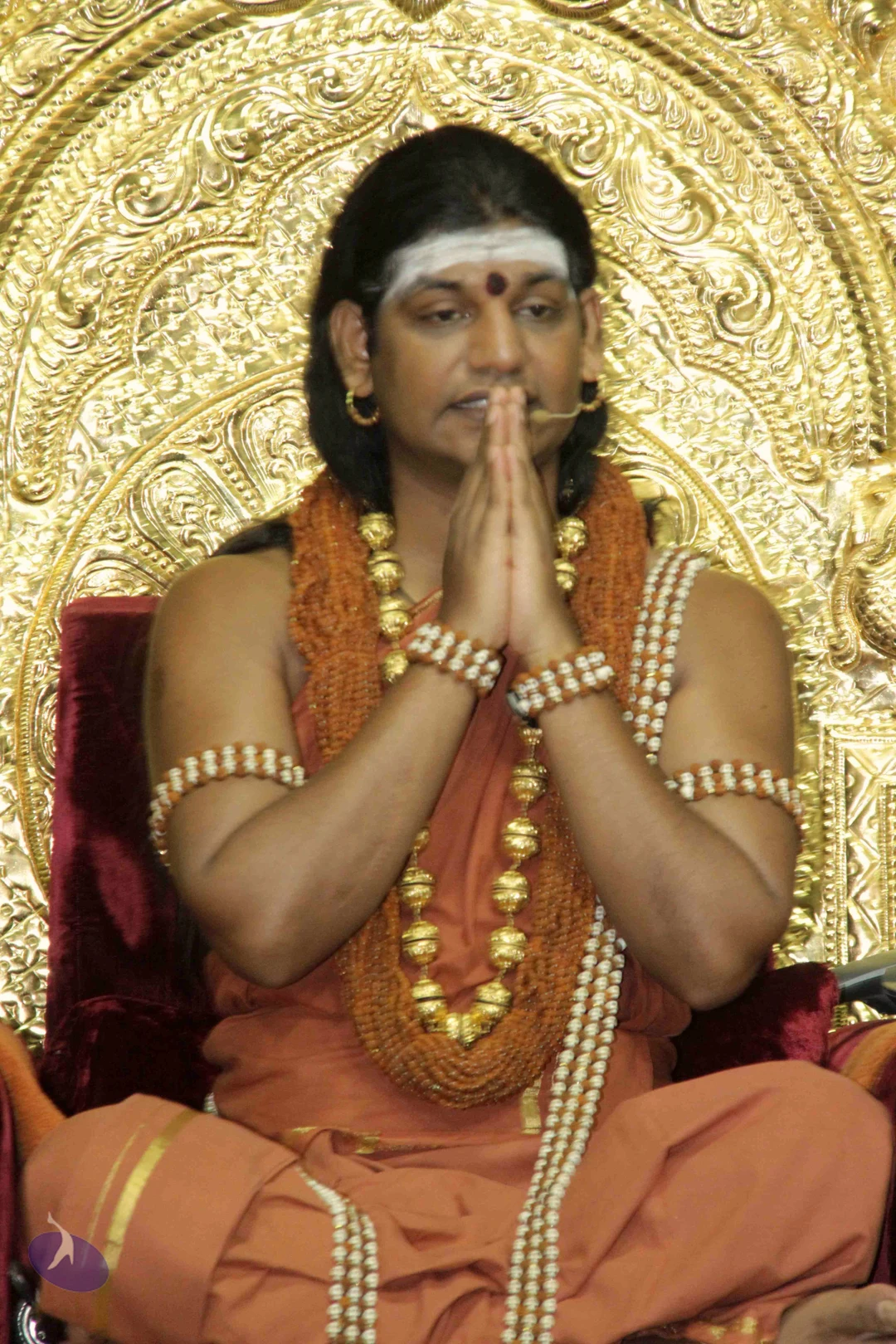
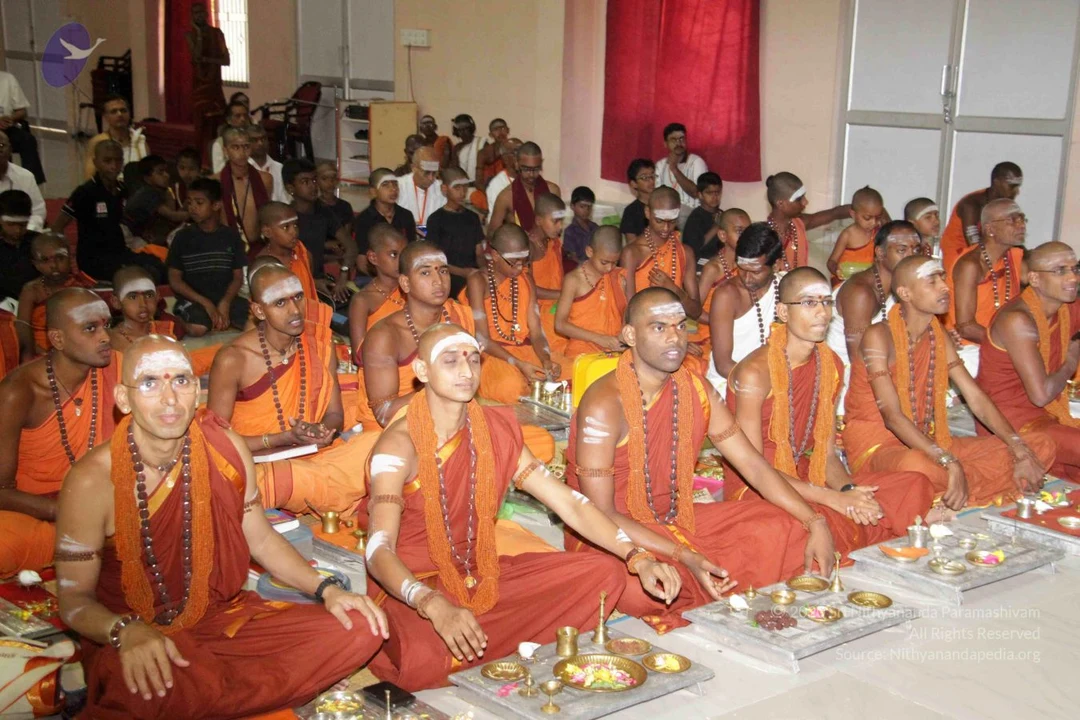
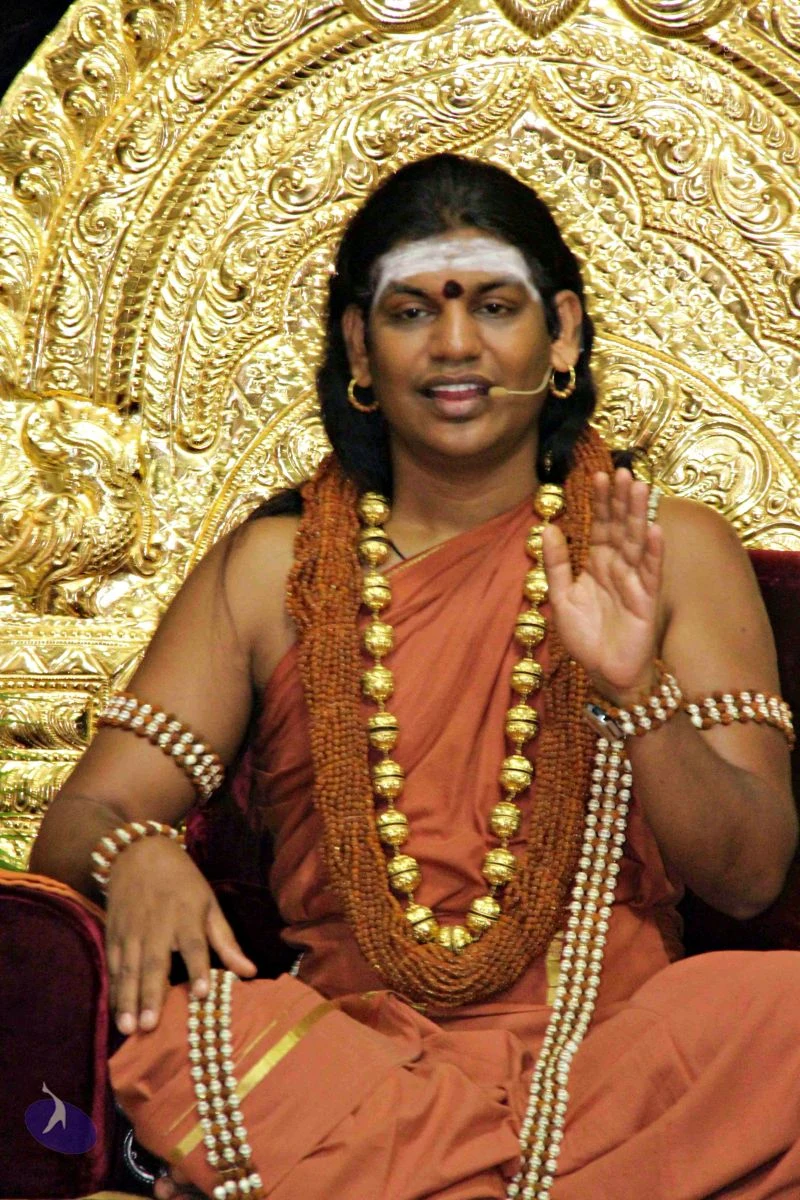
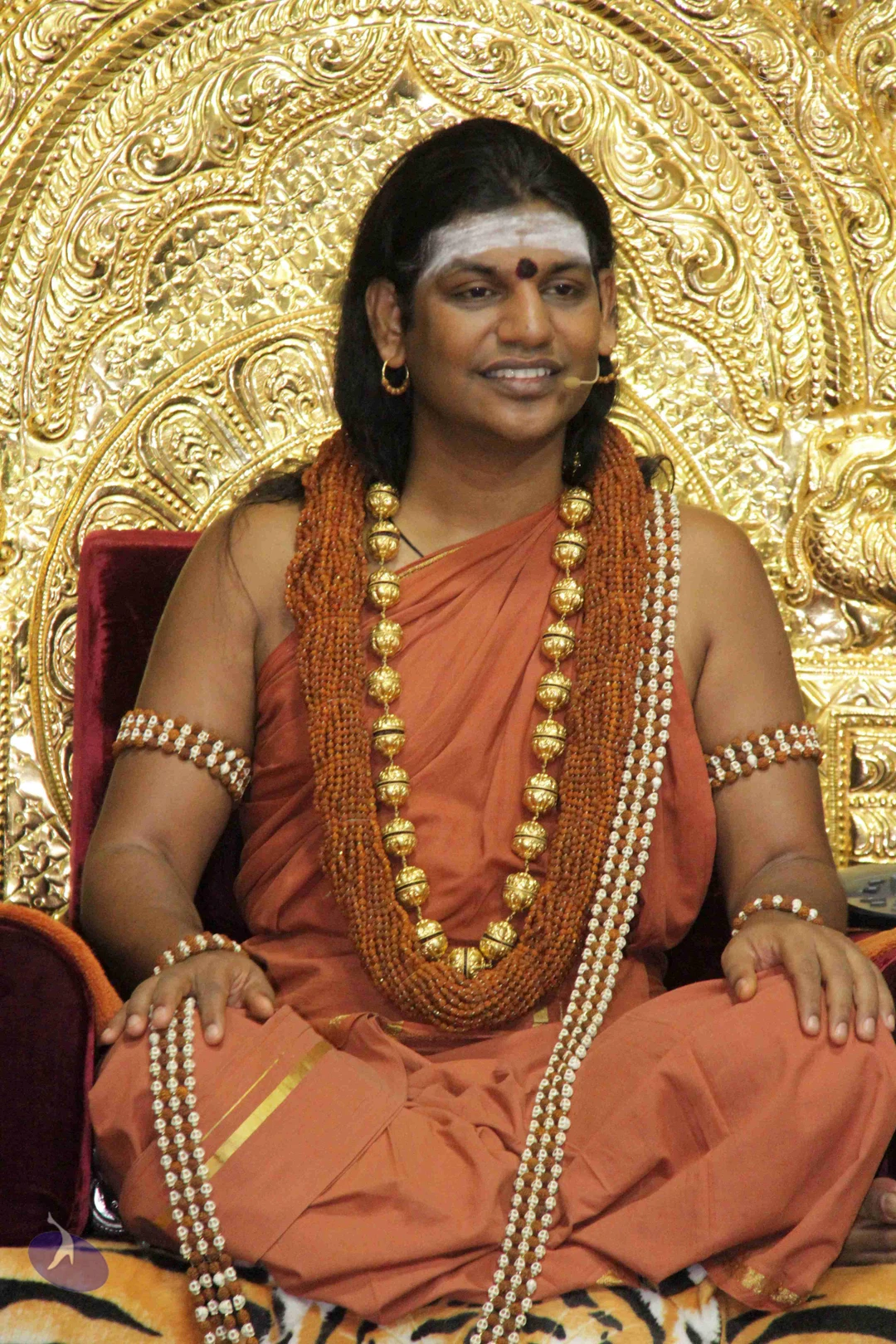
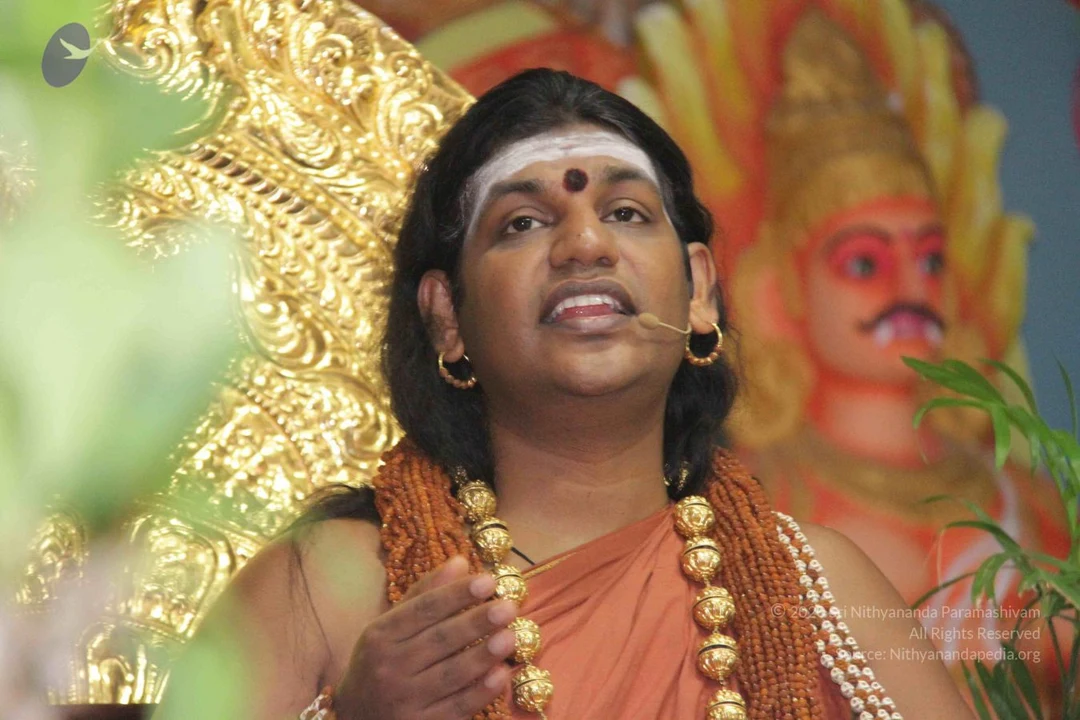
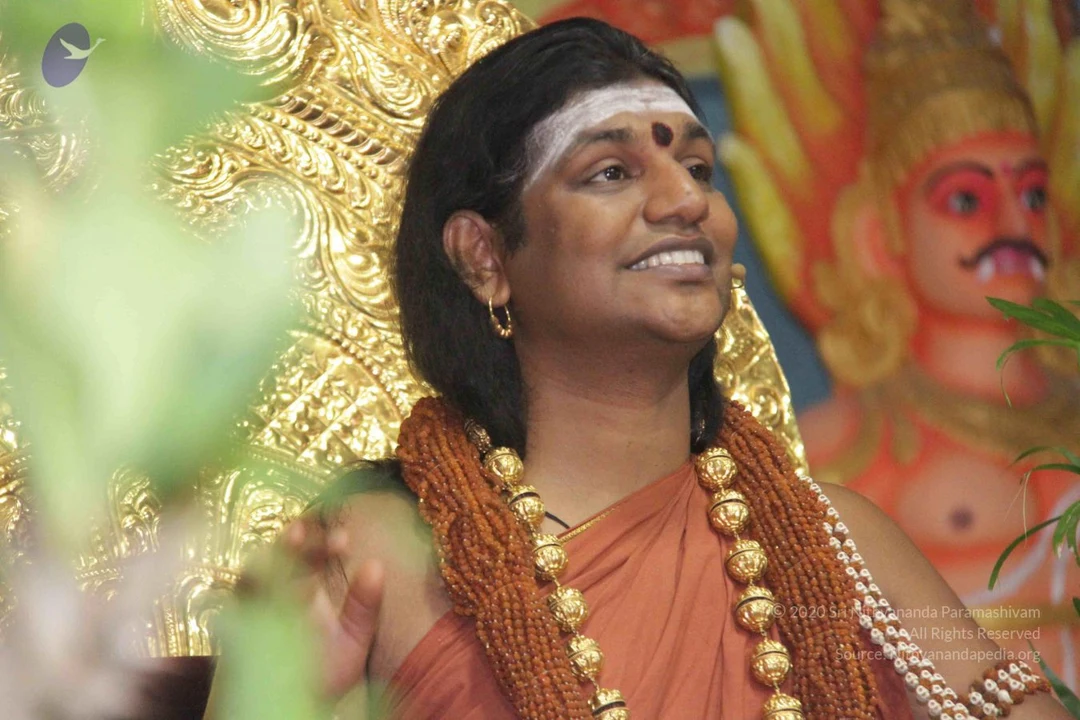
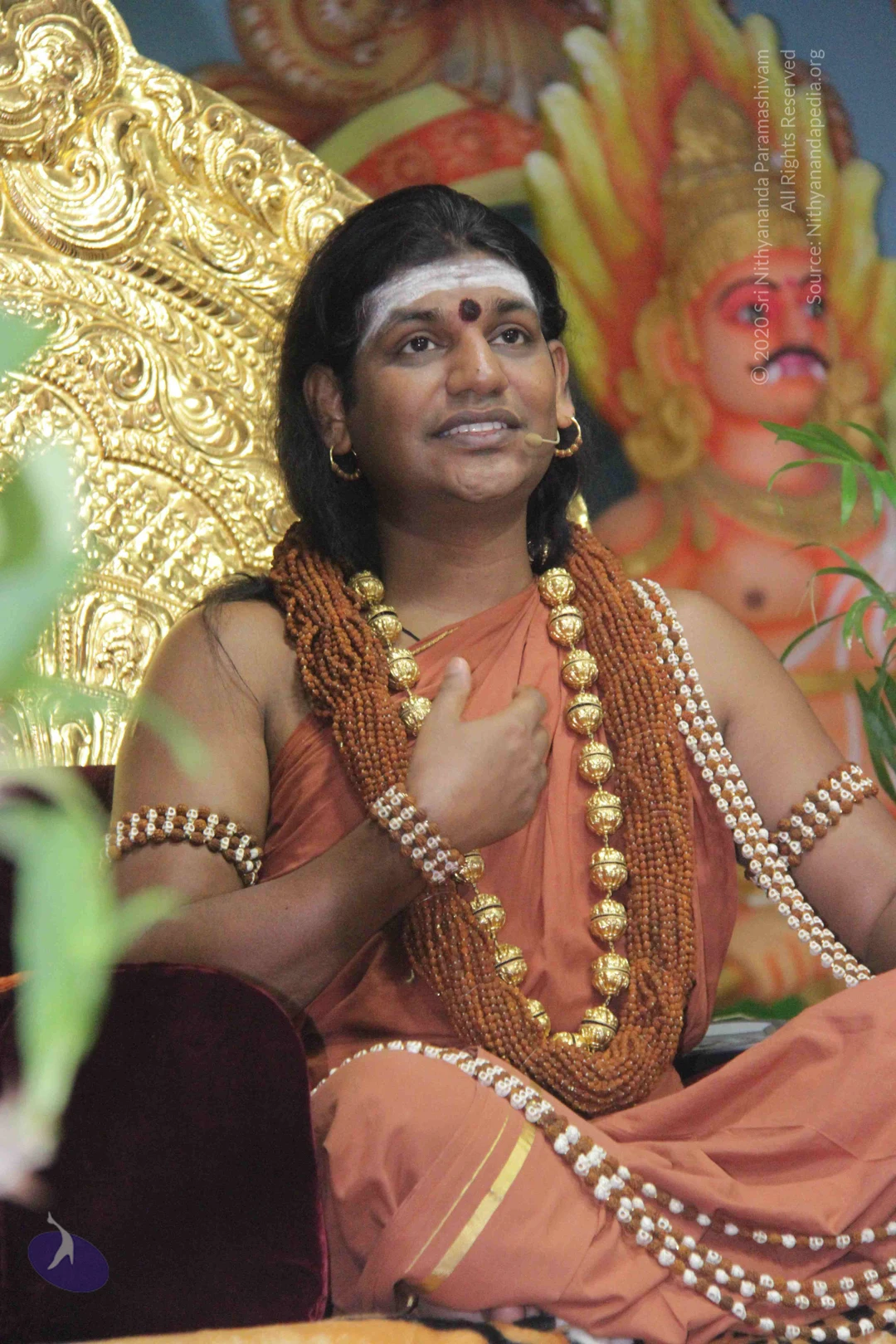
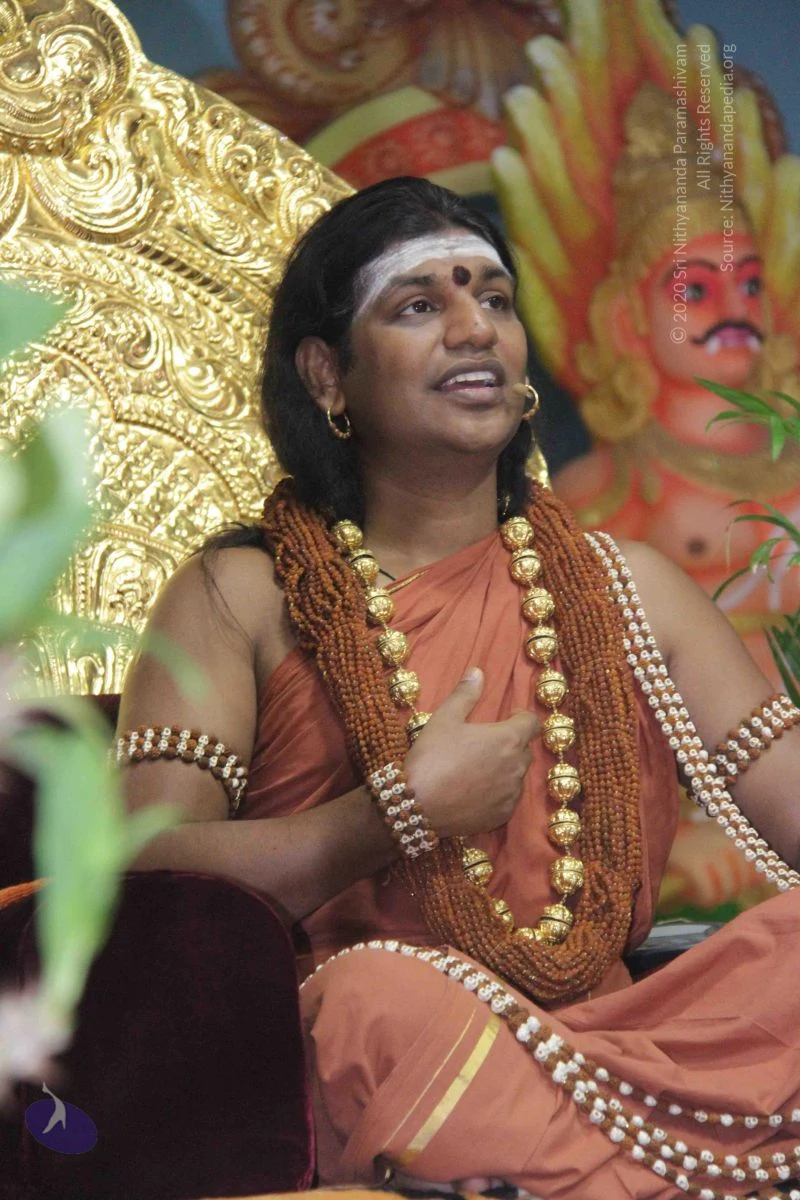
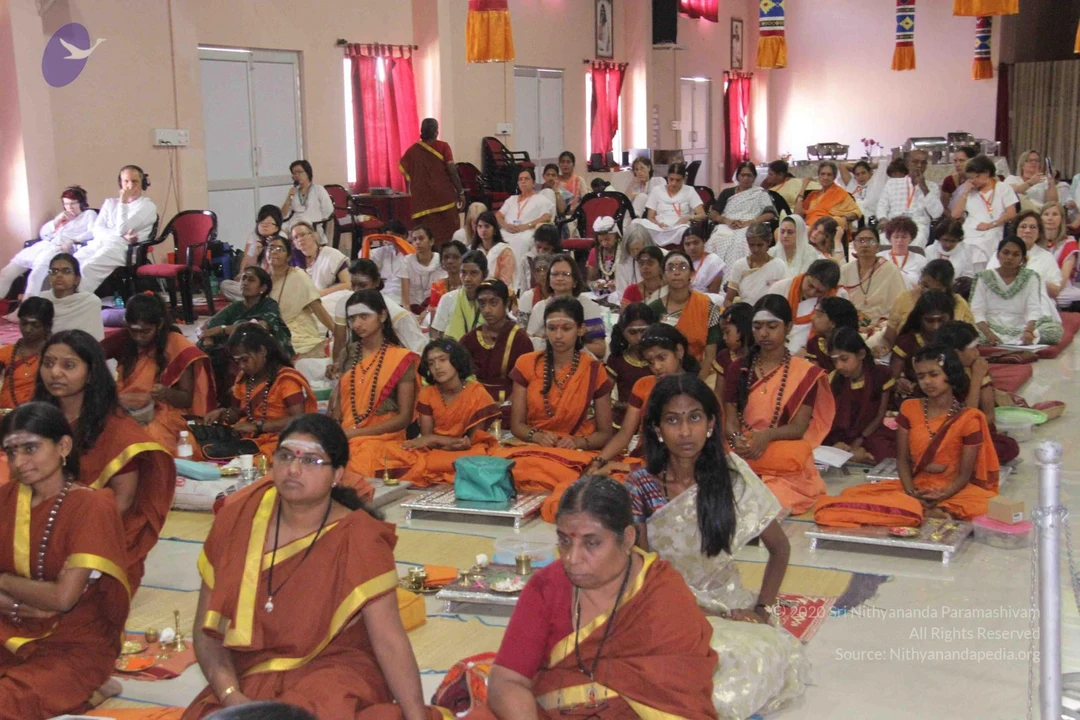
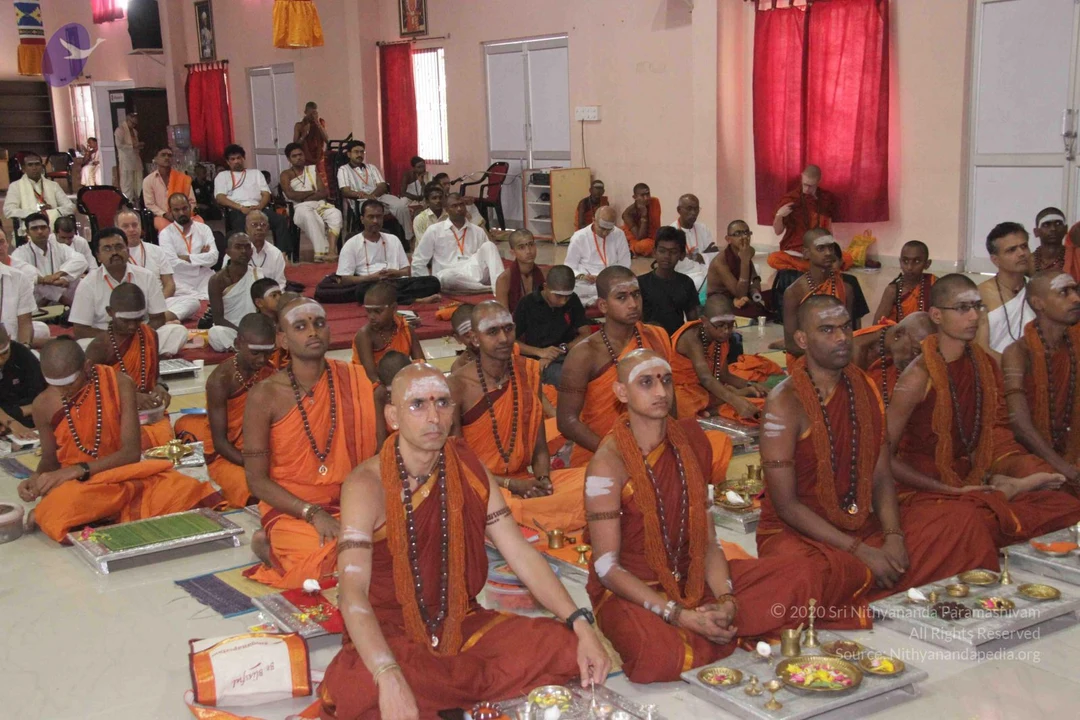
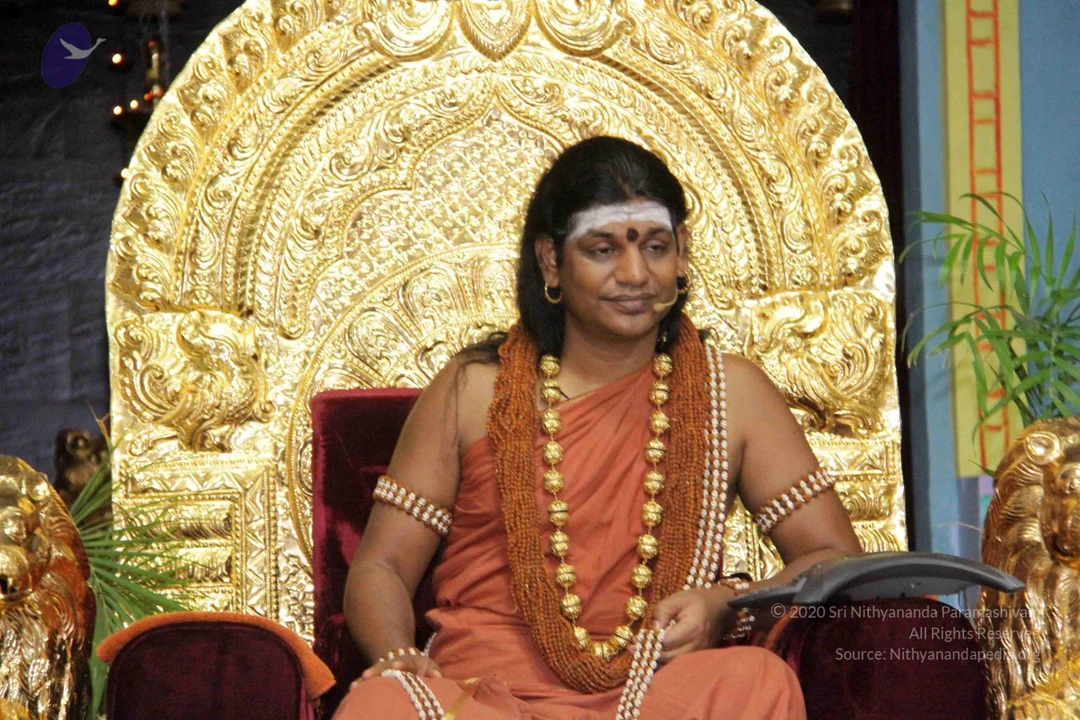
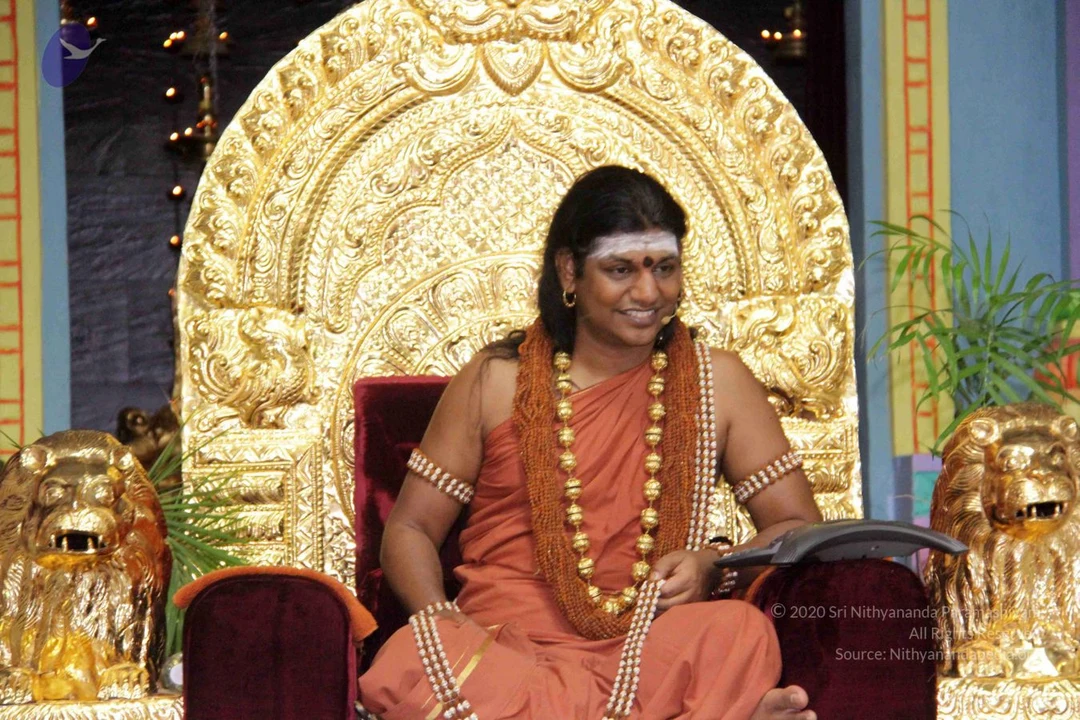
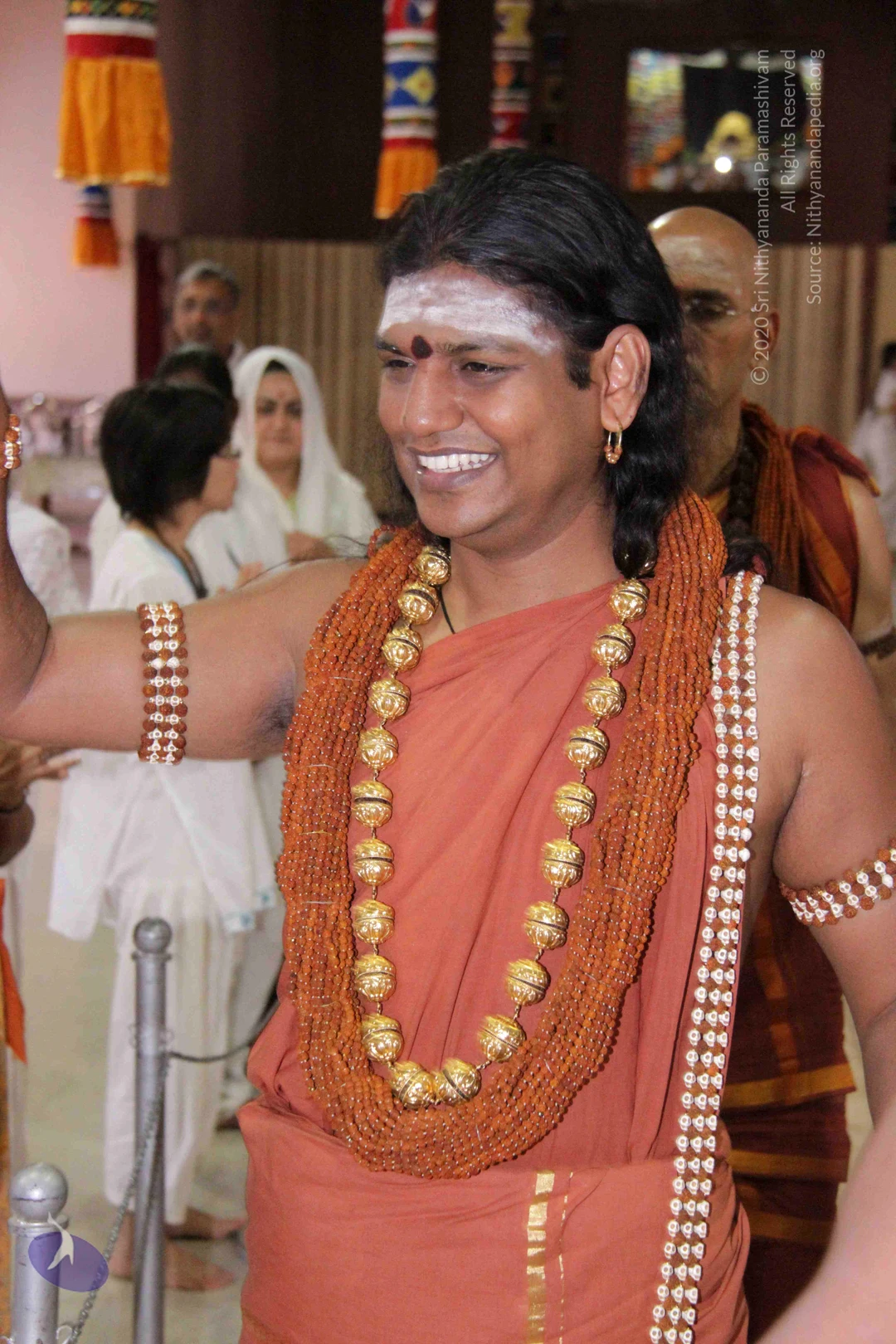
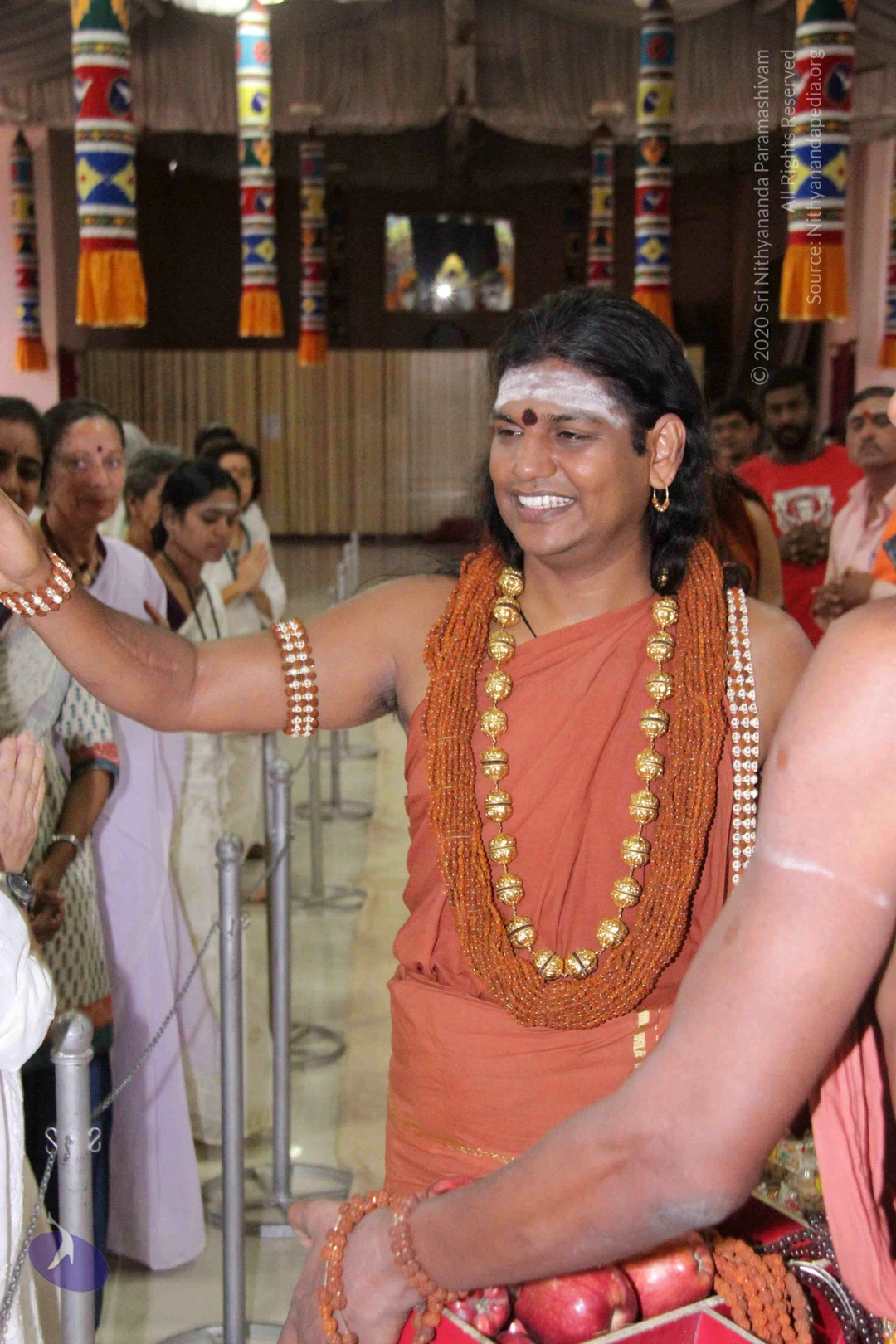
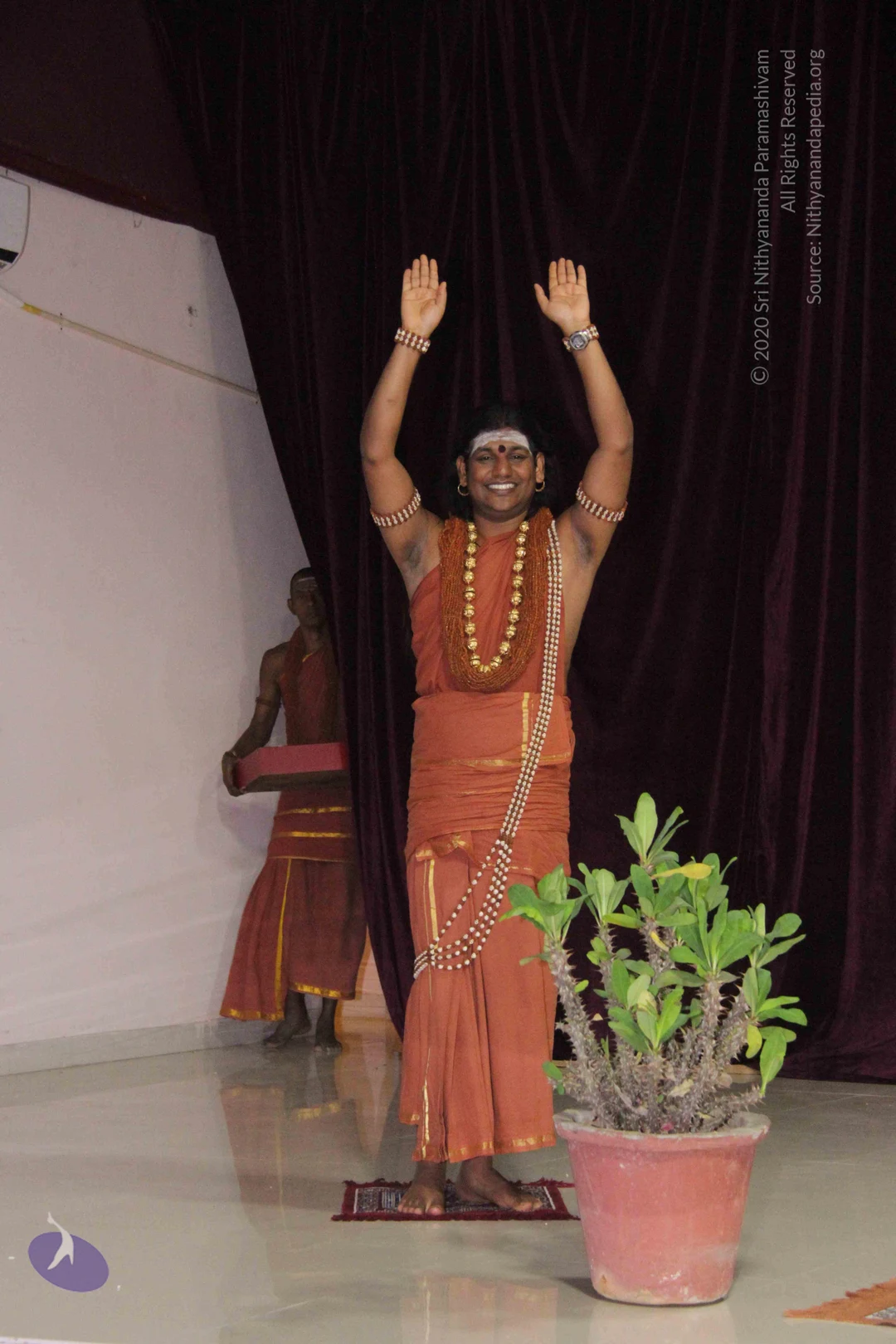
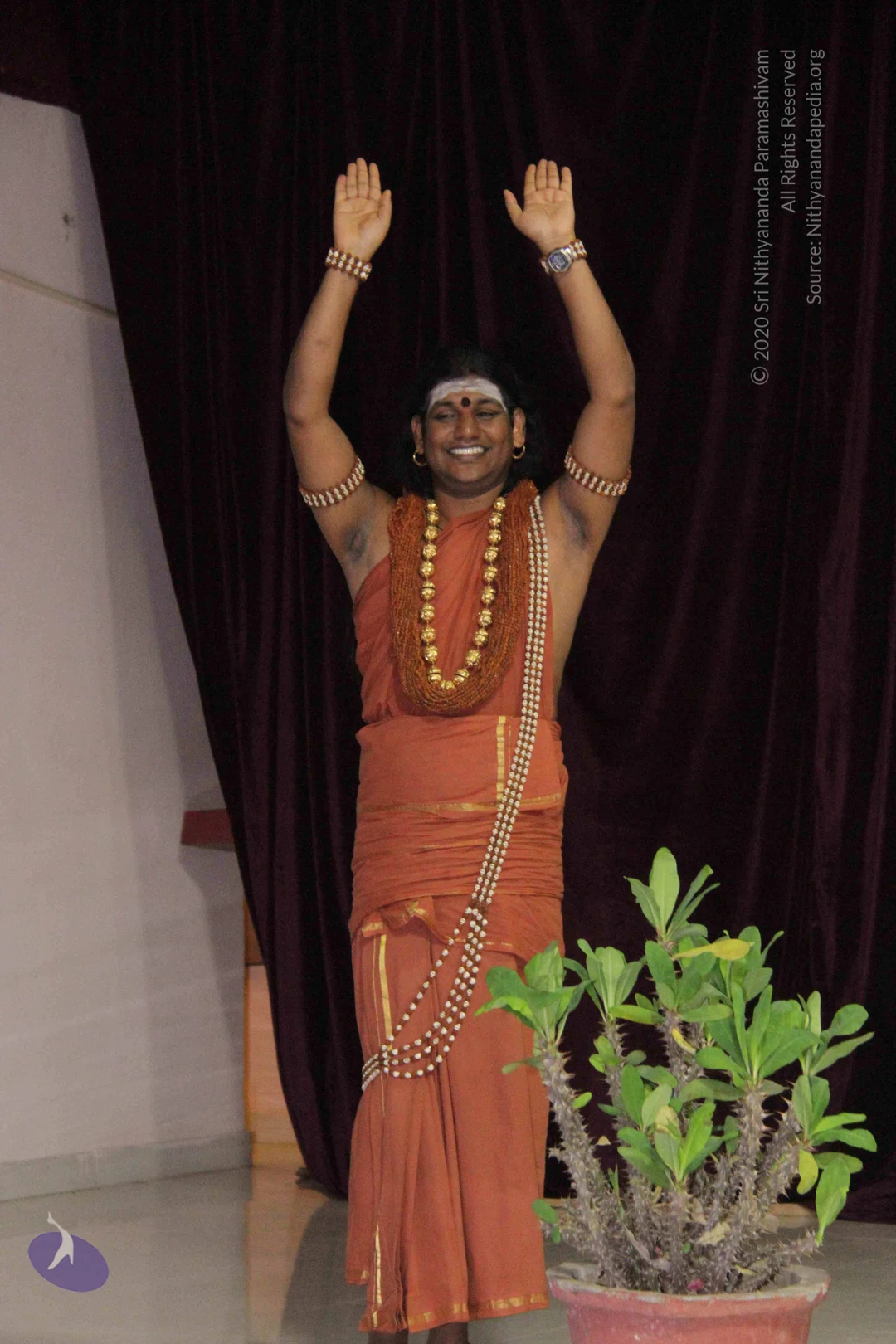
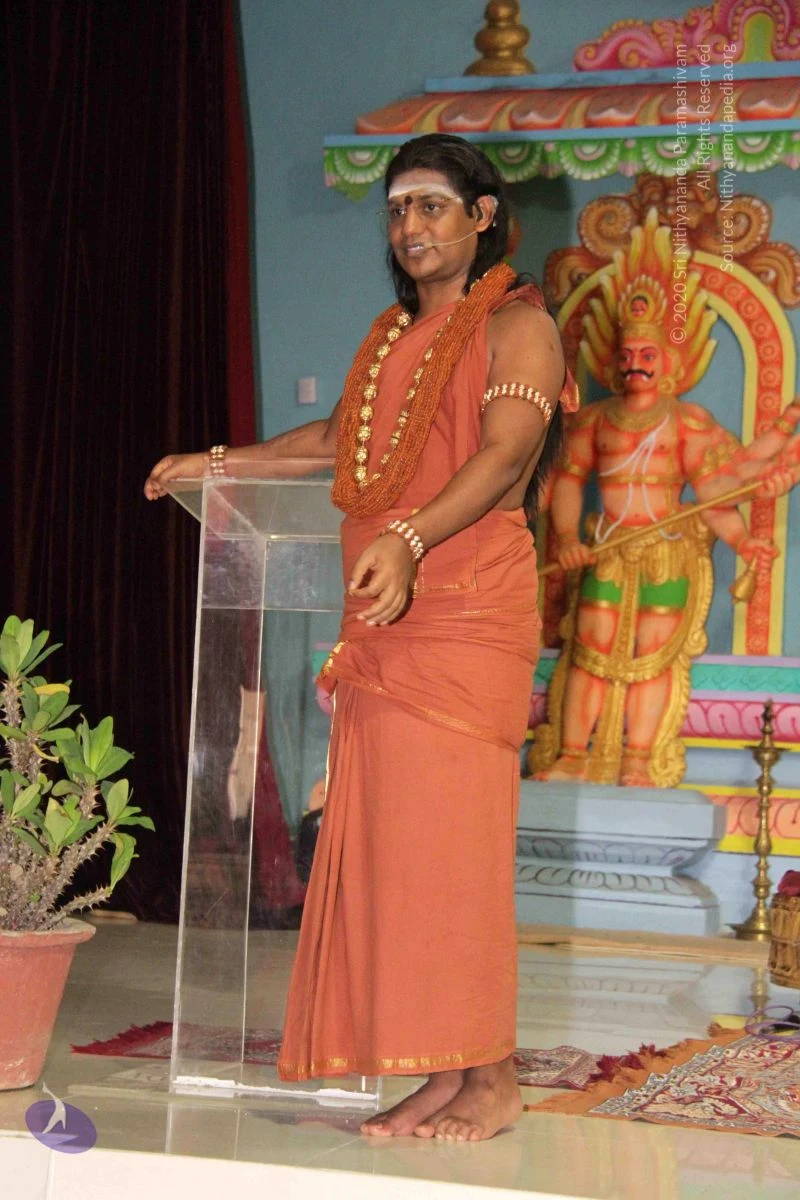
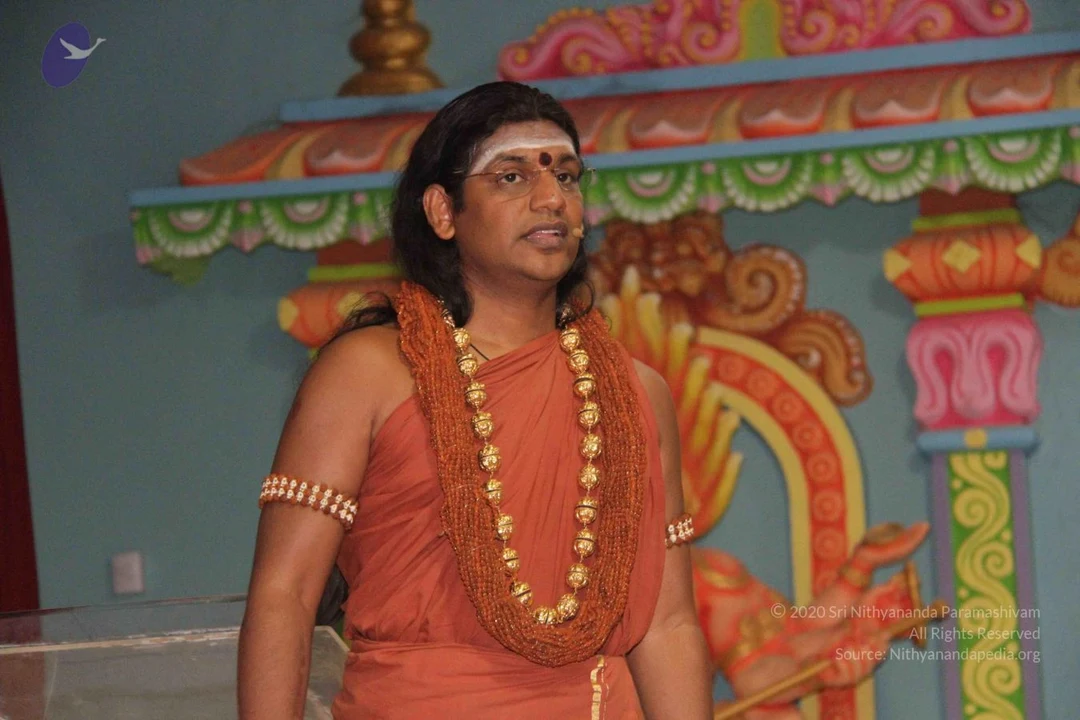
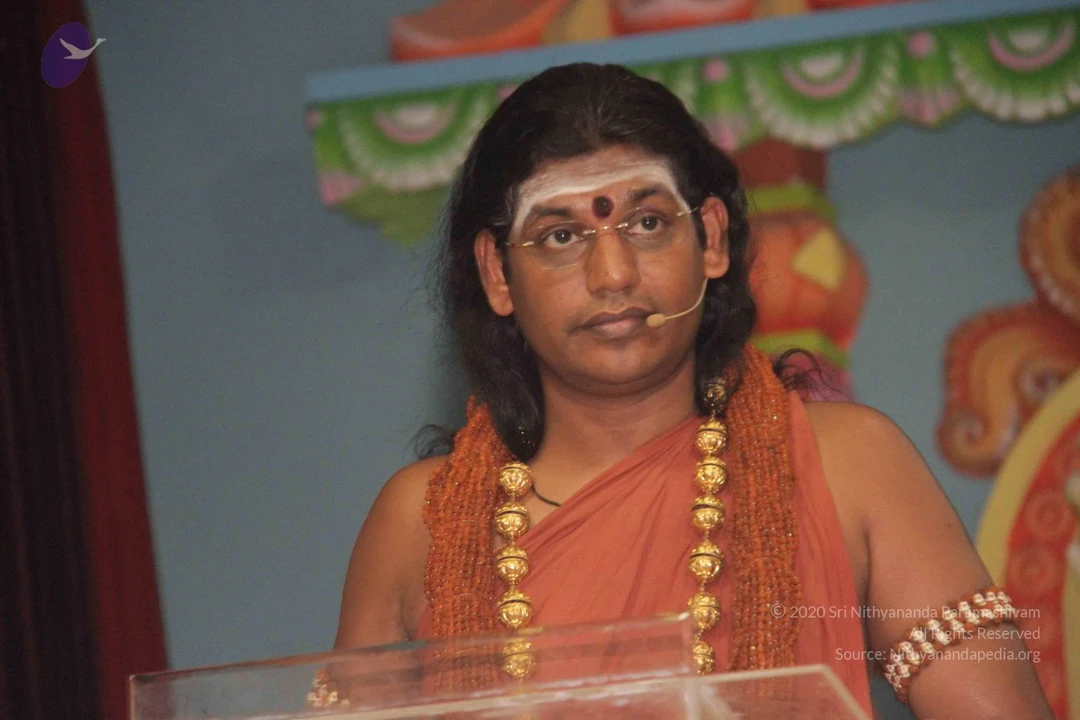
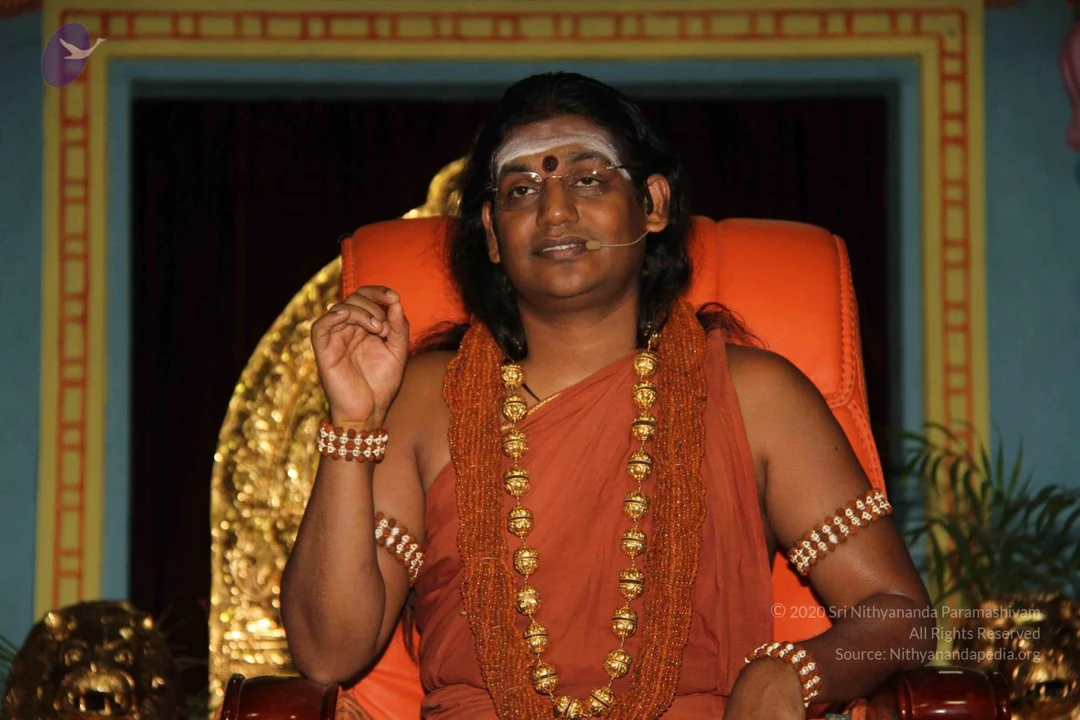
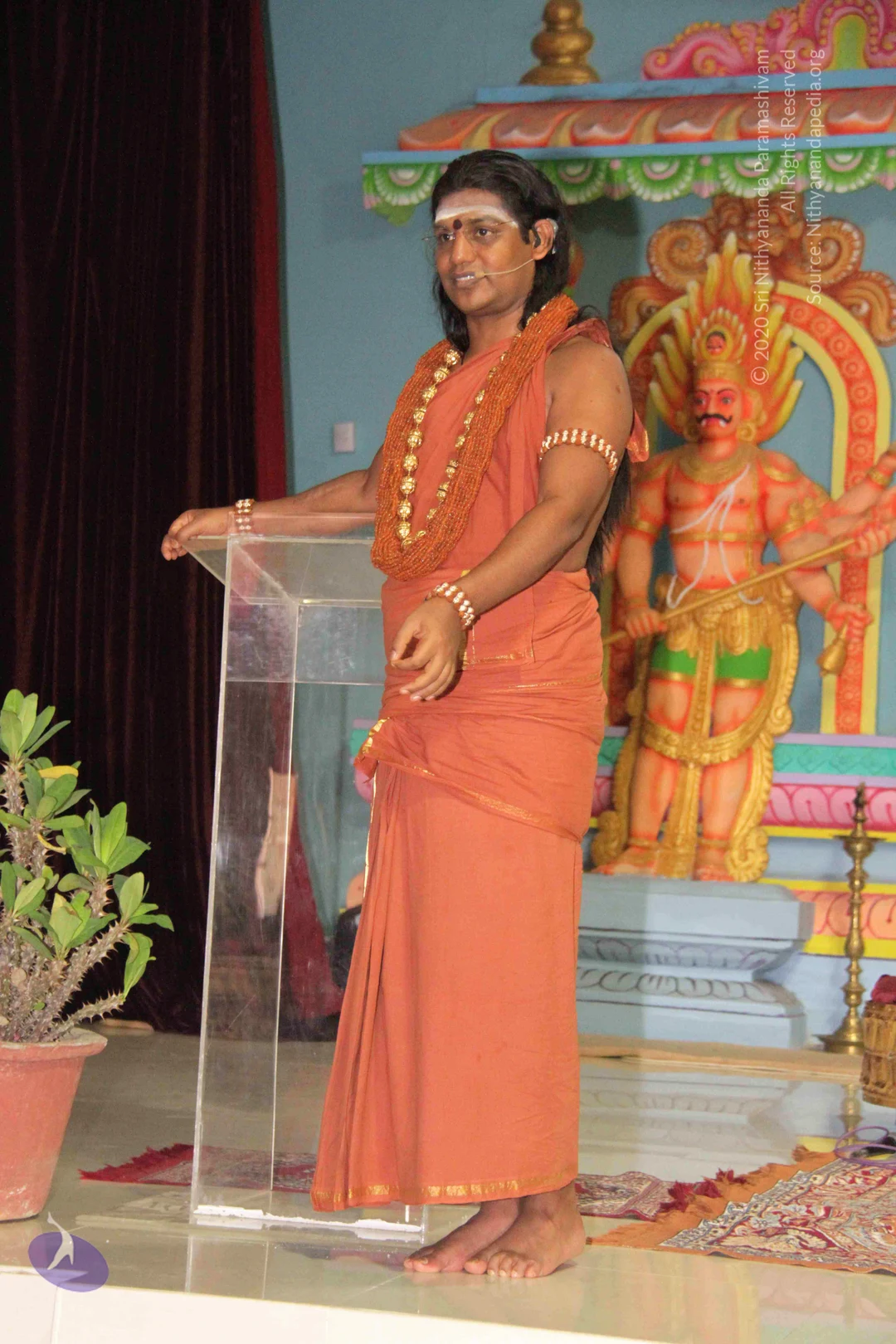
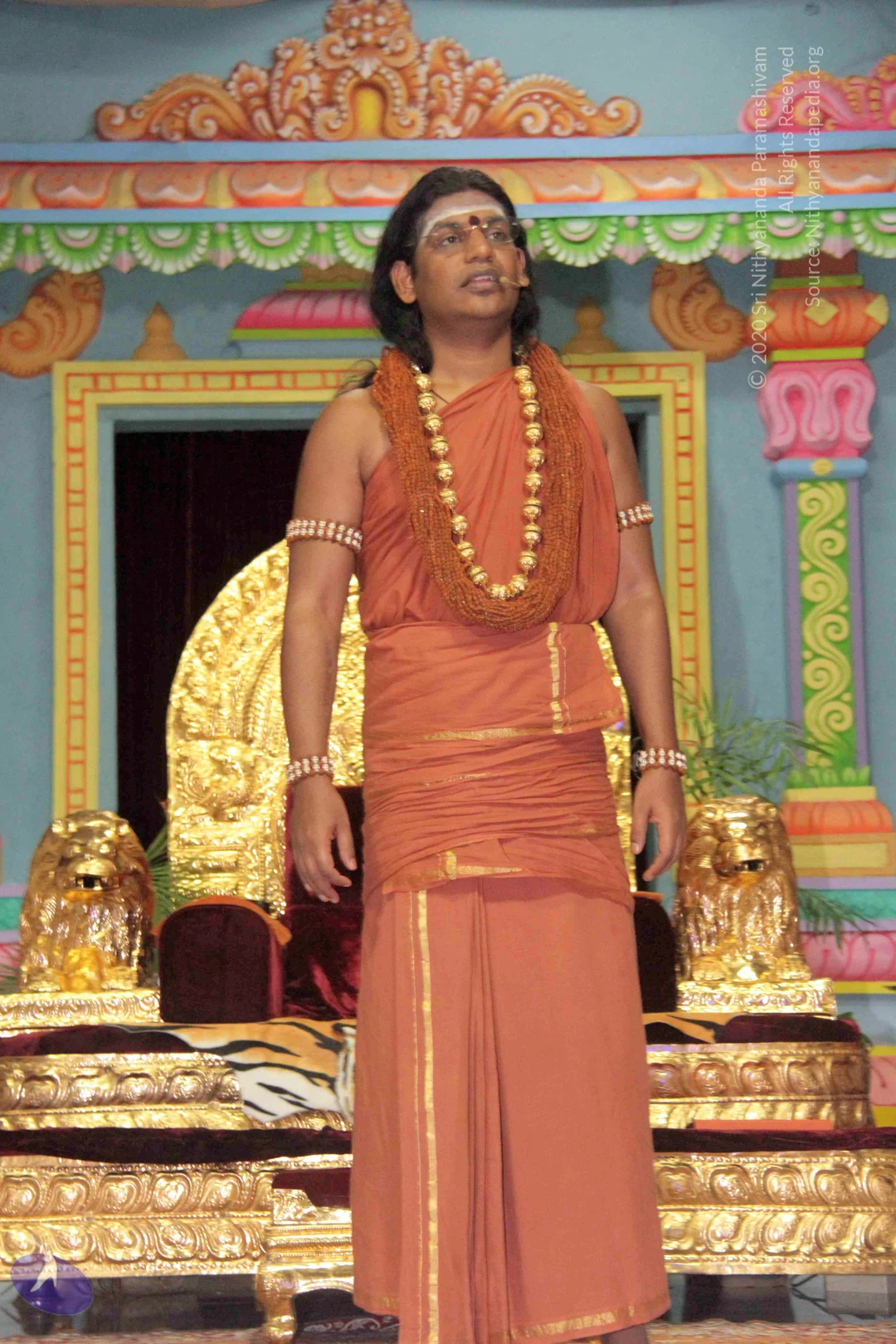
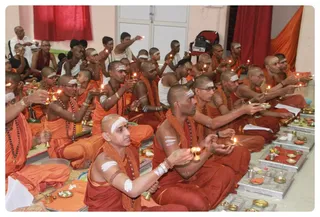
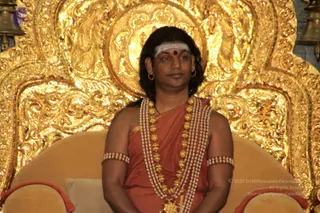
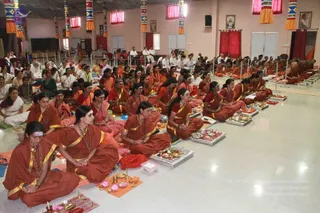
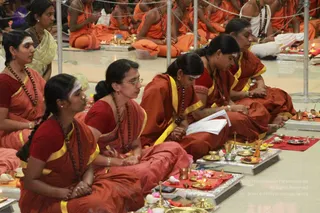
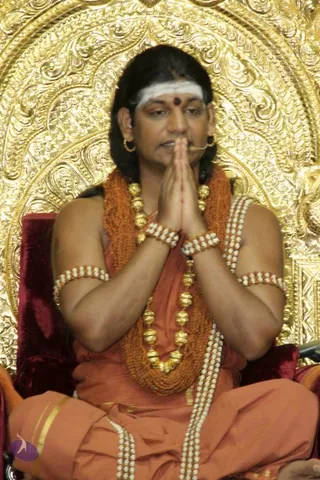
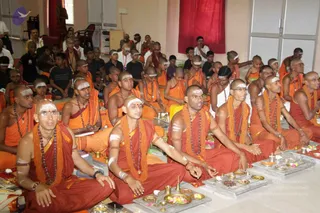
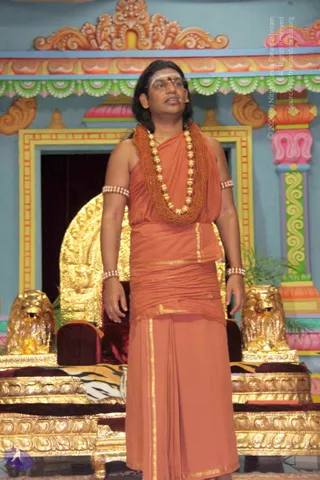
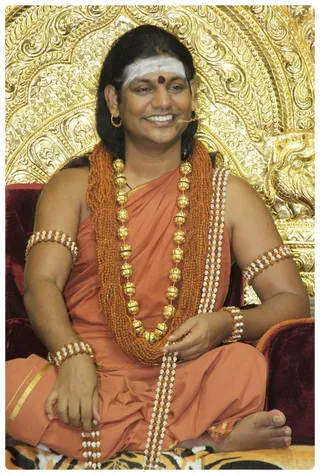
A photograph of a seated group of saffron-robed sannyasis performing a puja in a plain hall with red curtains. In the foreground a bald man with a white forehead band, rudraksha mala and orange shawl sits with palms joined, while beside him other men in orange and maroon robes with orange shawls and rudraksha malas sit cross-legged before silver trays holding brass lamps, kalasha-style vessels, flowers and bowls. White sacred ash marks their arms and foreheads. Framed deity pictures hang on the wall behind them, and a few onlookers sit at the back.A photograph of an open-air courtyard at an ashram with brick paving and a corrugated roof. In the centre a man with long swept-back dark hair, a white forehead band, a rudraksha mala, a ceremonial gold and white beaded necklace, bangles and an orange saffron dhoti stands with palms pressed together in namaste, eyes lowered. Beside him a young boy with a shaved head and white headband, wearing an orange robe and a rudraksha mala, walks past. Behind them an ornate gold-framed shrine holds a deity murti decorated with orange drapery, and stone sculptures stand to the right. A dark SUV is parked outside a white gate, with palm trees behind.A man in orange-saffron clothing stands behind a clear acrylic lectern, speaking into a headset microphone. He has long dark hair swept back, a white vibhuti marking with a red kumkum dot on his forehead, and wears thick gold beaded necklaces over an orange shawl draped across his chest, with a beaded bracelet on his wrist. He wears rimless glasses and looks ahead. Behind him is a blue wall decorated with green and pink scalloped bunting and a large orange and yellow decorative panel. Swamiji (probable): the appearance cues include the long swept-back hair, saffron clothing, rudraksha-style beads and ceremonial gold necklaces, and the page identifies this event as featuring him.

March 16 2013

Original wiki page
Contents

Title

THE SUPREME PONTIFF OF HINDUISM HDH BHAGAVAN NITHYANANDA PARAMASHIVAM

Transcription

Nithyanandeshwara Samaarambham Nithyanandeshwari Madhyamam Asmadacharya Paryantaam Vande Guru Paramparam

Sadahana TV ke sabhi darshakon aur bhakto ko mera prem evam ashirvaad sahith swagath. Today I will expand on how these 4 principles of life can enrich you in your relationships. Aap apne sambandh ko kis prakar poorn aur drudh kare, is vishay mein in 4 tattvon ko kaise upayog kiya jaa sakta hai, iske bare mein main aaj baath karoonga. First, the principle of life – integrity; Dhyan se suniye - Just take few minutes and visualize if everyone around you talk to you with integrity and speaks to you only the truth and relates with you with integrity, how nice your life will be; just take few seconds and visualize. How many of you suffered in your life because relationships around you, people around you lied to you or did not have integrity towards you; raise your hand. Then when you have suffered why do you want to give the same suffering to others. We expect same sympathy, integrity from others. But unfortunately we our self don’t live. We think I will expect integrity from others but I do not need to use integrity as my life. 3:58 Listen, I wanted all of you to know integrity is not being promoted by me as a morality or ethic. I am not promoting integrity as a morality or ethics. Integrity is much more than morality and ethics. Listen, I am offering integrity to you as a cosmic principle, cosmic law. Please listen when you are integrated suddenly so much of resources which are there only in you as a potential becomes reality in you. dhyan se suniye. Jeevan ka pehla tattva hain sampoorthi. Agar har koi aapse jooth na bole aur keval satya hi bole tab kalpana kijiye tab aapka jeevan kaise hoga. How your life will be when everybody around you is integrated. Sampoorthi dwara main naitikata ya aachar ke roop mein upasthith nahi kar raha hoon Sampoorthi dwara main naitikata ya aachar ke roop mein upasthith nahi kar raha hoon

6:47 Integrity is more than morality or ethics. Please listen with integrity first time you will experience relationship with yourself. Till you align yourself to integrity even you do not know what you really want in your life. Till you align yourself to integrity even you do not know what you want in your life. You want something and you are doing something else. Yesterday one of my ananda yogam students sent me a Facebook message, question about freedom; Nagaditya, I will explain now. He sent me a message and it’s my request also whoever is sending me question in the Facebook please do not expect that I should be able to reply there itself. Especially when it is philosophical question I will not be able to type and expand so much in the Facebook but I will answer in the satsang. 8:27 He was asking the question Swamiji you said freedom means aligning your the possibilities you are creating and your free will is freedom. So he had a doubt about, is it like future, futures possibility and your free will being aligned. You are right and your question needs to have little more integrity. If you start living integrity you will have the question itself from the deeper angle. Let me define. Please listen when you give a word to you and if you are honoring it your bio memory will first be aware while you give words to you, second it will decide to remember whenever you give words to you, third it will have tremendous self confidence about the words you give it to you. 9:52 Sometime people come and tell me Swamiji I forget the words I give it to me. It is like when your kids give you words you don’t take it them seriously. Why? Because you know they don’t fulfill. They will say from tomorrow I will wake up morning and study but they will not do - you know; because many time they failed. So you don’t take them seriously. Same way when you have not honored the words you gave it to you many time, not only you don’t take them seriously, you don’t even bother to remember them. How many of you cognize what I am saying. Sampoorthi ke dwara hi aap swayam se bhi joot sakthe hai. Jabtak aap apne aapko sampoorthi ke saath sanrekith na kare, tab tak aap nahi jaante hai ke aap apne jeevan mein kya chahthe hain. 11:26 Many time, many time because you built the pattern of not honoring the words you give it to you, not only you don’t bother to fulfill them, you don’t even bother to remember them. Every word you talk to yourself is a commitment you are giving it to you. With this understanding you should think. Means so much of awareness needs to be infused while you think, while you give words to you. Listen it is unfortunate society constantly reminds you to fulfill the words you give it to the society but it does not teach you the basic truth you need to fulfill honor the word you give it to you. Many time because you built the pattern of not honoring the words you give it to you not only you don’t honor you don’t even bother to remember.

13:56 Again and again Mahadeva, Bhairava, in Spandakarika and vignana bhairava tantra when he teaches to Bhairavi, again and again he brings this point; almost 20 meditation techniques he says by self remembrance enlightenment is achieved. Please listen the first step towards the self remembrance is being integrated with yourself; being integrated with yourself. Every word you give it to you, you should be honoring it, you should be remembering it. Only then you will have a beautiful relationship with yourself. Person who can’t have a complete relationship with yourself, if you are not complete with yourself, I tell you, you can never have vacation in your life. You may go to any beach and lie down, you may go to any resort and lie down, you may go to any tourism space, you may go to any spa and try to have a vacation, I guarantee you, if you are not complete with you, you cannot have a vacation; you cannot have vacation if you are not complete with you. Even if you lie down in a beach or sitting in a park trying to enjoy the evening sunset, you are carrying incomplete being; so constantly you will be haunted by you, harassed by you. You are carrying the incomplete part of you in you. You cannot leave that guy anywhere, wherever you try to escape. Escaping from you is the race you will always lose. 16:41 So the first step you need to do to have vacation is not booking your resort or flight ticket or golf course. No. Do completion with you. Do completion with you. That is the first step you need to do if you want vacation in your life. It is so unfortunate human beings don’t do first things first. Jeevan mukti ka pehle kadam hai apne aap me sampoorthi. Let you first have beautiful relationship with you. Relationships; best relationships starts you having great relationship with you. How many of you cognize this truth. Listen, listen, listen, Still I have not put the question. Listen you prepared yourself for a great vacation, you booked your tickets, resort hotel and the whole family everything is ready. You go there for vacation but because your incompletions are haunting you, you are only more depressed more disturbed; come back to your work more tired. How many of you have experienced this cognize, raise your hand. Kitne logon ke ye baath samajh mein aa rahi hai? 19:34 Listen first make a list of all the commitments you gave it to you and did not fulfill them. Sit and write them down. Compete them first; either commit to honor, if you have already honored, great, no problem. If you are going to honor commit to honor within a clear time frame. If you are not able to honor, if you feel you won’t be able to honor even by giving your life, then at least complete with yourself. Relieve yourself from that commitment; consciously fulfill it. It is so unfortunate you care so much about the words you give it to others due to your fear or greed but you don’t care for the words you give it to you. Only if you compete with you, only if you are complete with you, you will be able to even be in the space of self remembrance, restful awareness, atma smarana.

21:31 When I teach them, when I teach people techniques about self remembrance they come back and complain to me ‘Swamiji I am not able to be constantly in remembrance of myself my atman. I get drifted, moved away in different ideas, subjects, why?’ Listen because of your incompletions you are not in restful awareness when you are remembering yourself. First thing you need to do is completing with you, building a restful awareness relationship with you, relationship of completion with you. Pehle aap swayam ko aur doosron ko diye huve pratibadhhatayon ka shuchi banayiye Pehle aap swayam ko aur doosron ko diye huve pratibadhhatayon ka shuchi banayiye The words you give it to you and to others have to be integrated. You need to bring integrity with you. Only then the techniques of atma vichara, techniques of self remembrance; the techniques given by Vedanta - atma vichara, techniques given by Buddha - self remembrance, techniques given by mahadeva in vignana bhairava tantra on self remembrance, everything will produce the result of atma gnana in you, enlightenment in you. If you are not having completion with you how can you remember yourself beyond the incomplete identities? Your incomplete identities are responsible for constant inauthentic lack of integrity, irresponsible thoughts happening in you. 24:33 In the young age when I sit in Samadhi for hours together my classmates in the beginning they used to make fun of me. After few years they started asking me, ‘we do not know what you think when you are sitting quietly but we are really shocked you are able to sit for hours together silently.’ I said ‘what is there in this? My body - my mind, I just tell myself to sit I sit that’s all.’ Only when my classmates expressed their inability to sit with themselves I realized you able to sit with yourself silently is one of the great gift you can have. First you have to build relationship with you. pehle aapme aapko sampoorthi ka nirman karna hoga. Tabhi Vedanta shastra evam koi bhi shastra mein diye huve takneek aapko upayogi honge. Dhyan se suniye pehle aapme aapko sampoorthi ka nirman karna hoga. Tabhi Vedanta shastra evam koi bhi shastra mein diye huve yantra tantra aapko upayogi honge; Yantra tantra mantra aapko upayogi honge. Yahi aajka satsang ka saaransh hai - pehle aapme aapko sampoorthi ka nirman karna hoga. Yahi aajka satsang ka saaransh hai. 27:21 Today the truth I wanted all of you to experience is unless you complete with you, you will not be having restful awareness. Restful awareness with you is very important. I tell you restful awareness with yourself is not just a wealth it is a basic right for you. In the cosmic constitution restful awareness is your basic right. Enlightened beings land on the planet

earth to ensure your basic right is restored to you. I am defending the cosmic constitution continuously to ensure your basic rights are restored to you. You reclaim your basic right. Restful awareness with you is your basic right and I proclaim it is possible for you to reclaim your basic right. Self completion, swapurnatva is the direct method to reclaim your self- completion space of restful awareness. How many of you, please cognize with integrity and authenticity, by the self completion experience restful awareness with you. Raise your hand. I tell you this is your basic right. Reclaim it and live it. 29:48

Title:

Know Secrets of Death || Inner Awakening || 16 March 2013

Link to Video:

Transcript:

(0:15)

I was living near place called Varanasi, one of the sacred pilgrimage centre of Hinduism, place called Ghazipur. I was serving a sadhu, old monk who was very sick. It’s a small town. A small hospital, a small ward, some two-three steel cot and bed and few old steth and BP machine, and a green screen. You can visualise an Indian village hospital. You can imagine. This sadhu whom I was taking care, next bed, the patient was about to die…. This old doctor and that old nurse, both of them are trying to revive him, support him. He was the guy, the patient who was dying must be less than fifty. So they were trying to help him but I already, I could see he is already started dying.

(01:30)

Please listen, first time I saw death in four dimension. I will describe as much as I can. You have seven parts in you. Your body with flesh, blood. This is the first part. Second is your breathing. Your breathing, that is the second part. Third, your thinking. Fourth, your feeling. Fifth, the area you experience during deep sleep - from where you are experiencing feeling…. Understand, first: this flesh, blood; Second: breathing, prana; Third: thinking, mind; Fourth: feeling, emotions; Fifth: the deep sleep state which is called causal layer from which all these feeling, thinking, everything happens; Sixth: the soul, your individual soul, Consciousness; Seventh is the cosmic soul - Paramatma, Nirvana, Enlightenment. All these seven put together is YOU.

(03:10)

Please listen, if the cosmic soul is the ocean, your private beach is individual soul. Clear? If cosmic soul is ocean, your private beach is individual soul. So you can’t say individual soul does not belong to cosmic soul. Your private beach is also ocean. You can't say you are having ocean. It’s your private beach…. How many of you understand? So all these seven put together is you.

(03:54)

I could see this guy moving from one to another. First in his body, the heavy pain chemicals were released. Have you….how many of you experienced scorpion bite in your life? Scorpion bite. Scorpion bite. Usually if the scorpion bites, in that area, for you not to feel the pain, your body will release the painkillers, anti-pain chemicals. That will only make that whole area swell…. Any doctors here? Your body has a natural anesthetic methods. Do you know that? If the pain goes beyond certain limit, your body itself will release automatically painkiller inside, the anesthesia and you will fall into unconscious state - coma.

(05:01)

First exactly that is what has happened to that guy. There was so much of pain in the body as if his skin is being peeled. So much painkiller was released inside the system, he fell into coma automatically. The moment he fell into coma, all his patterns became alive and vital. It is like a twenty five kids are in the house and parents are not there. What will happen to that house? Twenty five violent, wild kids and parents are not there in the house! That is the way if your Consciousness is missing and that is the way your patterns behave. Even while the patterns behave, you know.

(06:00)

Your Consciousness is like a father. Your patterns are all kids. When your Consciousness is not there, when you become unconscious, coma stage, patterns just make ruckus. I could see, his unconscious soul was kicked like a football. Imagine in this house, in this room, one football is there and twenty five football players are there. If all of them kick at that ball, what happens? So all his desire patterns are kicking at him. The ball is flying from one corner to another corner, his soul, unconscious soul which is in coma. All your patterns have a deep vengeance on your soul, your Consciousness.

(07:00)

Please listen, please listen. I could see in that person, all the desire patterns are kicking him asking, “I told you fellow, I want to live, I want to live, I want to live. You did not fulfill me, complete me.” Desire is nothing but the commitments you gave it to you. Understand, the commitments you gave it to you, all stands there and questions you, “Why you did not fulfill me, honour me?” Then somehow that soul jumps to the next level. Next level, all the guilt- inauthenticity comes up and say, “I told you, we should have lived like that, like that. Why did you do this, do this?”

(08:07)

First, the lack of integrity patterns are kicking you - desire. Next, inauthenticity - the guilt patterns. I can say, this is the space when the individual soul feels hell, individual soul experiences hell. Getting it? Hell is not actually separate, geographical; it is psychological…. And then soul moves to next. All the pains you experienced in your life, your irresponsibility patterns that comes up and shatters, beats the soul which is already unconscious. Then it finally goes and falls into that deep sleep layer.

(09:15)

From there, it doesn’t move further. It immediately goes and takes next body in that unconsciousness itself. So that is why you do not know what kind of a house, parents you are choosing. You just close your eyes and walk. After entering only you open your eyes and see, “O God! I thought I am coming to the cinema theatre. Now only I understood I came to the garbage tank…. O, you are a garbage can. I thought you are a pizza hut.” After you enter into the garbage tank, garbage lorry, you say, “I thought I am in the pizza hut.” But now you cannot change. You have taken already one more body. Exactly this is what happens while you die.

(10:09)

Please understand, I Am giving you the visual description of what happens. You do not touch your individual soul or cosmic soul, your individuality. Without even touching your individual soul or the cosmic soul consciously takes another one birth. It is like a you are dreaming. Without even waking up, you fall asleep and again dream. Again fall asleep, again dream. You never come to waking state. How many of you understand? That’s the way body is assumed. This is the third death I saw in My life.

(11:04)

And fourth death is My own death…. One funny thing you need to know. When this guy died, when this patient died, this swami became alright. That’s very strange thing I have seen in My life. In your street if four-five people are about to die, if one old man dies, all others will recover. How many of you have observed this? Even in the hospital. I also don’t understand why but I know this happens. So this swami whom I was taking care, I thought this swami will die and that guy will revive, recover. And that fellow died and this swami recovered.

(11:51)

So I continued My journey. In…. 1999, when I was twenty, in Varanasi, Manikarnika Ghat, I was sitting in a place seeing the dead bodies being burnt. Manikarnika Ghat is old….largest, oldest crematorium in the world. That’s the world’s oldest and largest crematorium. I was sitting there and seeing the bodies burning. I realized , ‘One day My body is also going to be burnt like this. So I should learn the secret of death.’ I sat there in meditation. After two and half days, I realized , ‘My own body is just a matter. It is dead but I Am alive as a Consciousness.’ That unclutching between My body and Me happened. It was a powerful realization. What happened I will explain later. When I answer your questions, I will explain. So this is experience of My own death - fourth death. Fifth death is in Bangalore…. See, after My own death experience I came to central India. In the central India, I realized My Incarnation hood in 2000.

(14:02)

Then 2001, I came and settled down in Tamilnadu. And 2002, I came to Karnataka. Three I started this Sangha, organization. In 2002 end or I can say, 2003 beginning I think, in Bangalore I was attending a patient, one of our devotee. To heal I went to hospital. In the hospital, next bed patient was dying. That time I watched. The patient was dying without any pain like a knife in the butter. He was very smoothly leaving the body and disappeared into the ocean, enlightened. I was shocked when I investigated. I did not see any special reason why this guy became enlightened because he was not a meditator, he was not a religious guy, no guru. I was wondering how come he became enlightened.

(15:09)

When I contemplated, I realized he was dying in the presence of an Incarnation! So naturally My presence has contributed for his peaceful passing away. Then I meditated how can I give this help to people. If there is any way I can help people to have this peaceful death and Enlightenment while you leave the body, that will be the greatest service. For My contemplation or meditation, the answer I received is the program you are going to do for next three days. The process of death - going through all your patterns and experiencing the ultimate restful awareness, ultimate peace inside you, the best preparation for your death. We are not quickening the process of death but we are preparing for the process of death.

(16:24)

Title:

Q&A about Death || Part 2 || Inner Awakening || 16 March 2013

Link to Video:

Transcript:

(0:14)

Q: People that channel or the people who left the body or people that are channelling Gurus and say you know come, we speak through the death…

(0:24)

Swamiji: See, any, any type of channeling, please avoid. Any type of channeling other than being a channel to the Gods like a Shiva, Kalabhairava- those gods or Buddha. You can be channel for Buddha, Shiva, Kalabhairava who have become the Enlightened Beings’ Gods. They are okay. Other than that, don’t be channel for anybody. Don’t go to people who are channels for anybody else. See, Buddha is okay, Mahavir is okay. Rama, Krishna, Shiva, Devi, Mahavatar Baba, these kind of souls- okay, not otherwise. Don’t go. Better don’t encourage or go there. Please go ahead.

(01:18)

Q: You mentioned about killing the animals and stuff like that. What if you… Swamiji: Just….Ma…yes, please you go ahead. She will type and I will answer.

(01:29)

Q: Okay. What if I have done in the past out of naive or in ignorance not known any better… Swamiji: No, what you have done in the past is okay. Now I will….in this whole program, we will be completing it. We will be completing and re-building your bio-memory. See, basically, when a cow dies, when a bull is killed for meat, he is not going to bless you and die. All his suffering, his fear, anger, anxiety, all that is going to stay in his muscle as a curse especially the chemical he releases in the body, very toxic, poisonous chemicals. It is going to stay in his muscle-memory, in his bio-memory. When we are consuming that, we prepare our muscle-memory for depression, anxiety, fear and suffering. So we will complete now all the pattern and we will rebuild our new bio-memory. From now, I sincerely request you avoid non-veg food.

(02:33)

Q: Thank you. Swamiji: Yes, come on. And I am not giving you this as a morality. Please understand. I am not giving you this as a morality. I am giving you this as a best science for building your body, best body. Please go ahead. Can you hold the mike closer? Ma, can you do one thing? Let him talk to your ears. You talk in the mike.

(03:14)

Q: Okay, he is saying You are talking about death but he is curious to what happens to Enlightened people like if he gets enlightened….. Swamiji: Enlightened people when they die, they don’t disappear. They just become the Whole - Consciousness.

(03:32)

Q: Is there an existence in a different universe and planets or…. Swamiji: Yes, there are existence in different universe and planets. Different space. Yes, go ahead, please.

(03:46)

Q: Swamiji, I want to know about the shahedi, those sacrificed for others. Where they stand? Swamiji: Ma, can you repeat?

(03:58)

Q: People suppose for somebody sick, they die you know, to save them. Other people like…they are called shahedi. So where they stand?

(04:12)

Swamiji: Oh, when you save others and die in that process? They are given immediately transition body. They don’t suffer because it is not suicide and it is not murder. So, because you are saving somebody’s life, in that course, you are dying. Immediately you move to the next level of life but you don’t become enlightened.

(04:33)

Q: Like the army, you know. They don’t die for themselves.

(04:38)

Swamiji: No, no, no, no, no. The country army is a organised crime. See, this where it will know? Somebody is fallen in the river. You jump to save. You saved that person but you died. Only that is the veera swarga.

(04:55)

Q: But the soldier they don't kill for themself, you know. They… Swamiji: No, even if you are not dying for yourself, it is a country’s organisation. You die for some organisation with which you feel affiliated. See, I am not saying patriotism is wrong and all that. I am giving you cosmic legal opinion. This is what is there in the record. That’s all.

(05:22)

Q: Okay Swami, the great people like, they done meditation and all. They gone high position but they don’t ….what is it called? They are not liberated. They again come to the earth….sometimes they are lower level…. Swamiji: Yes, they come down to help the humanity. That is possible. Q: Yeah, okay, thank You. Swamiji: They are not lower but they come down. Go ahead.

(05:53)

Q: Swamiji, she has a question. If killing a mosquito is really considered a murder? And why? Swamiji: Yes, because… Q: Because he is biting she is saying. Swamiji: Because it is a life. No, if he is biting, drive him out. It’s a life.

(06:10)

Q: She says I can’t make it because he is biting. Swamiji: But what to do? No, you drive him out. See, I am not saying, I am not trying to tell it’s right or wrong. This is what is there in the Cosmos. So I am giving you, just what is there, I am reading it out and telling you.

(06:33)

Q: Another question she had is if animals suffer….. Swamiji: Why god made like that, if you ask Me, I will ask him and tell you, that’s all I can say.

(06:41)

Q: If animals suffer, can they be…like Swamiji: Put to rest? It should not be done. Q: Thank You.

(06:51)

Swamiji: And even the human beings, when you guys write a will, make sure that you are kept alive with all possible, available scientific methods as long as possible because last few days only you will be exhausting the remaining bit of karmas. Mercy killing should not be done. It will make you come back again because the last few days, the little karma will be left out. Just to exhaust that, you will come down. Don’t allow mercy killing for you in your will. It is My sincere request. Even it is few days, be in this body and finish it off and go. Understand?

(07:39)

How many of you are in the countries where these kind of wills are written? If you are unconscious, brain dead, what to do and all that. Yes, I know, I know. In US and all, you have to write a will what to do in those moments. Who will take decisions and all there are things. Many of My US devotees and ashramites, they have put My name, that My decision should be executed. No, what I am saying, you need somebody who will take the right decision for you or now itself write it in the will but you should be kept alive as much as possible, as long as possible using all the available resources. Doctors will tell, “No,no, no. Brain dead. Only heart is functioning. If we remove the ventilator, heart will stop.” No! As long as the heart is functioning. If we remove the ventilator, heart will stop. No, as long as the heart is functioning, keep the ventilator…. Even if it is for years because the remaining karmas will be getting exhausted. Understand? So do not quicken the death even for one second. Even two desire, two karma which is not completed can bring you back to the body and then after coming back, you may get caught with this whole nonsense. Understand? Yes, please go ahead.

(09:07)

Q: She would like to know what You understand with kahama. Swamiji: Karma? Karma is incompletion you carry inside.

(09:19)

Q: Also she would like to know what is God then. Swamiji: God is a independent intelligence which is constantly making everything to function as a independent intelligence. Please come. Go ahead.

(09:46)

Q: One question about, his question about life in the universe, elsewhere. Is there human life inside the earth? Swamiji: No, there is no inside the earth. It is inside completely solid. Q: Thank You. Swamiji: Come on

(10:04)

Q: Swamiji, I would like to know if for example if there is in a family somebody who died because he was born dead and nobody will remember about that person, nobody keeps his memory, is that possible that that soul somehow he reclaim of that and he can create disorders in such a family? Swamiji: No, no, no. Don’t worry. Q: No? Impossible? Thank You.

(10:31)

Q: Swamiji, the question I have is I have a brother who passed on and he said he wasn't ready to go. What happens to …. Swamiji: Can you, can you slowly repeat?….ha yes, now, now

(10:41)

Q: I have a brother who passed on and as he was passing on, he said he wasn’t ready to go but he did pass on. What happens to him? Swamiji: So forcefully he will be pushed into other body. He can’t do any harm to you guys. Don’t worry.

(10:57)

Q: And the next question is, I have a few friends who passed on. They come to my mind often, what does that mean? Swamiji: Maybe you are not yet complete with them. Tomorrow, day after tomorrow we will be having completion sessions. When you complete with them, they will stop coming. I don’t have anybody coming to My dream. First of all, of course, I don’t have a dream. I want all of you to know. Fourteen days in Houston, US they kept Me in…. fourteen nights they kept Me in the sleep study lab. They put that 32 QEEG on My head. Fourteen full nights they tested. Not even one second, they could see a dream wave. Forget about… even daytime when they fixed up, nothing is showing in the brain. Then what will they get in the night time? So if you are complete, you will not have dreams. Dreams are nothing but incompletions. Come on.

(12:02)

Q: Swamiji, what is Your view on sacrificing animals for like Kali Ma puja? Swamiji: Oh, sacrificing animals? Mahakala, Kalabhairava only has the right to have animal sacrifice. Nobody else has right. Q: Okay, so Kali Ma prayers no. Swamiji: Kali is okay. Kali and Kalabhairava is one and the same.

(12:22)

Q: It is it. Mariyamman? Because in South Africa when they do the… Swamiji: (speaks in tamil) You don’t understand tamil? Q: No, no, no. I don’t understand. Sorry, I don’t understand tamil. Swamiji: You don’t understand tamil? Q: No, I am from South Africa. We only speak english. Swamiji: I know, I know ey, My family deity. Q: Mariyamman prayers

(12:45)

Swamiji: I know. I know. No, Mariyamman is My family deity. I think you should not give because other than Kali who are Lord of time, no other Deity ask for… even Mariyamman doesn’t ask for this. As a tradition, it became a tradition. Even in My family Deity I have, same, Mariyamman is My family Deity and that temple is there in My native place. I only stopped animal sacrifice. Earlier they were giving. I said stop it and now they stopped. I think if you guys are involved in the temple, you should stop the animal sacrifice.

(13:21)

Q: I will just call him up and tell sacrifice I don’t do. I am a vegetarian. Swamiji: You will see, when Mahakala lands on Me, he himself will tell for somebody to give animal sacrifice but My family Deity I stopped the animal sacrifice. Q: Okay, and in that case, it is okay. Swamiji: Only the Mahakala because he is Lord of time. He has right over life. Other than nobody has right over life. Go ahead.

(13:53)

Q: Swamiji, see, my brother who has bipolar disease and he stays with my younger brother who is also having another mental disease and my mother. What he does is, he doesn’t allow the cockroaches to begin in the house. He goes on breeding cockroaches. “How, you can’t live with cockroaches. You are creating diseases in your own house.” “No, no. We should not kill. They are life.” Swamiji: No, you don’t have to kill but you can drive them out.

(14:14)

Q: He doesn’t want to drive them out. Swamiji: And that is wrong. That is wrong.

(14:17)

Q: He says, “No, let them be.” He feeds them. I said, “You cannot feed. You are living in dirt.” Swamiji: No, that is something wrong. That is wrong. See, I am not saying breed mosquitoes or cockroaches. Don’t kill them. Just drive them out. You see, now a days there are special sprays cockroaches and all. They will not come there, that’s all. They don’t get….. they don’t die but they will not come there. I have some special sprays. For My room I use. Cockroach, lizard and all don’t die but they don’t come there. Q: Okay. Thank You, Swamiji.

(14:50)

Q: Hi Swamiji, how is it determined the time, when a person dies, when they come back into another body? Swamiji: Three second. That’s all. Q: For everybody? Swamiji: Everybody.

(15:03)

Q: And is there a difference between when someone dies in a plane crash, from a terminal illness or…. Swamiji: You see, when he dies in the plane crash….so, it is a murder. In the Cosmos, it is a murder, that’s all. Cosmos has only two catergory: murder and suicide, that’s all. Because he has killed….he got killed without his involvement, he will be immediately given a kind of VIP lounge. Without suffering he will move to the next body when time comes. Q: Okay, thank You. Swamiji: When they were dying, they were constantly holding on to that house. So that is the reason.

(15:58)

Q: And an other question is why do they…. Swamiji: In your house, you see some spirit? Q: Yes, I do see them. Swamiji: Just put a Kalabhairava’s photo. You will see that they will not be disturbing anymore.

(16:08)

Q: Why do they, like once in my home, they bother me but they don’t bother my pets or my husband or…. Swamiji: That’s what. Put the Kalabhairava’s photo. Maybe somewhere you are connected. Q: Oh, okay. Thank You.

(16:23)

Title:

Q&A about Death || Part 3 || Inner Awakening || 16 March 2013

Link to Video:

Transcript:

(0:14)

Swamiji: Come on.

(0:15)

Q: Swamiji, my mom passed two years ago and You helped me heal her. So she never comes to me. She is happy and everything but when I go and visit my dad and have lunch with him, he tells me that my mom comes to him all the time. How can I help him?

(0:27)

Swamiji: No, no,no, no, no. It is your dad’s incompletion. You should help him to complete with her. Now you will learn the completion process. Teach this same process to him and then make him help….help him to complete with her. Q: Thank you.

(0:45)

Swamiji: And one more thing I want to tell you. Please listen. You have a complete freedom to teach any process you learn from here to anybody. Only request: don’t twist them. Teach them as it is…. Teach them as it is, that’s all. You have a full freedom. As I said, knowledge is free in our vedic tradition. You have a full freedom to teach. One more request: You will not talk about anybody’s personal information they are sharing here outside. See, I wanted all of you to take a oath, you will not reveal any information you collect about others’ life outside. Like what happens in Las Vegas stays in Las Vegas. Same way, what happens here stays here. Nothing wrong happens here but I don’t want any of you guys going out and talking anything. Yes, go ahead.

(01:51)

Q: So You said that the soul is entering a baby’s body only at birth. Swamiji: Yes. Q: So her question is why is the baby then moving in the womb?

(02:01)

Swamiji: That is because of extension of mother’s life. See, the baby is connected through umbilical cord. Umbilical cord supplies the energy of all the movements but baby can’t think independently. Understand? It can only move mechanically. It cannot think independently. Can it say, “No, I don’t like this mother. I want different mother?” Only the mechanical decisions are done. Nothing else. Soul has a right to do even non-mechanical decisions.

(02:41)

Q: Then she is asking there are some people who are constantly praying to God and they are exhausted. They receive God's blessing, grace and the other people don’t. Why is that? Swamiji: See, when you sometime out of incompletion, fear, if you pray to god, the fear pattern only is becoming stronger and stronger. God will never be able to grace you. If you are praying out of completion, immediately attends to you. When you are praying in completion, you relate with God. When you are praying in incompletion you are relating with your incompletion. Please come, next.

(03:33)

Q: I don’t know, may be You will help me understand my wife, her dad met suicide September of this year and it was pretty hard for Kris to take. We were doing a project and I was in an equipment running it ….and her dad came to me and told me that he came to me because he knew that she wanted be willing to accept him because she had conflict with him but he did. So he came to me to relay the message to her and explain to…..

(04:12)

Swamiji: After death or before death? Q: After it was like two or three days after… Swamiji: Suicide? Q: Yes Swamiji: Oh! Q: Is that, why is that in my head?

(04:24)

Swamiji: No, what I am saying, after suicide two-three days means… suicide means he can come. Still he would not have got the body. He will be waiting till the natural death. Q: Yes, I mean he came to me and he let me know to tell her that it has got nothing to do with her. He was all him. He knew the moment that he did it, that was wrong and he made a mistake but he couldn’t change it. He wanted me to make the bridge to make the means for her. Okay, okay Swamiji: I understand but he can’t do anything now.

(04:55)

Q: No, no. I just want to know I wasn’t crazy. He did come to me. Swamiji: It is not….it happened, really happened. Q: O yes, it happened. The same thing with other people. They come to me and I just want to know I wasn’t just like hallucinating or …okay

(05:16)

Swamiji: Come on, please come. Q: The baby inside the mother womb that is, there is only one soul which is the mother. Then how could the knowledge transfer happen inside the… Swamiji: It is possible. How you know? The knowledge is after all bio-memory. Whatever Narada did to Prahlada is preparing the bio-memory. Whatever Abhimanyu….Krishna did to Abhimanyu is preparing bio-memory, not the soul. When that kind of bio-memory comes out, that level soul only lands in that body and uses it.

(05:45)

Q: So it will enrich only the body, not the mother’s…? But only mother hears the information. Swamiji: Anything mother hears can get recorded into that. Q: But it won’t register in mother’s bio-memory?

(05:58)

Swamiji: You see, chakravyuha for example, Abhimanyu’s case, Abhimanyu’s mother did not have the knowledge. Only Abhimanyu had. Q: Just opening the… Swamiji: Come on.

(06:14)

Q: How does an Incarnation choose the body? Swamiji: Hmmm, business secret. It’s a looooong story. Do one thing. I will talk about it but I don’t think now we have time to talk about it. When we will have you know? Without forgetting, put this as a question in the slip. At some time, I will talk about it. Please go ahead, go ahead.

(06:49)

Q: I have actually killed a mosquito. Swamiji: Oh, that is okay. Now in the further sessions we will help you to complete but in future, just make sure that you avoid killing as much as possible. Q: Okay, I also going to ask You if I could complete. Thank you. Swamiji: Thank you. Yes.

(07:12)

Q: So I have four children. Two are adopted and two are biological. So my question is for the two children who are adopted, if they soul came in…. coming into the birth mother and then suddenly I am their mother, is the… Swamiji: No, there is no conflict in the soul. Q: Okay. Swamiji: No conflict. Please come on.

(07:41)

Q: I am going to ask this for him. He wants to know how can You make sure that this is his last birth? Swamiji: Ah yes. Now this process is all about that only. Making sure this is your last birth. See, just like a pacemaker, I put a peacemaker in you now. I am going to be doing the surgery and put a peacemaker inside you now. Yes.

(08:08)

Q: Swamiji, these are all individual lives as You said. Be trees or animals or human beings. Now the total number remain the same Swamiji? Swamiji: No, no, no, no. No. Many beings who were in the fish, they came as a human beings and life is expansive, goes on expanding. There is no total number.

(08:31)

Q: So there may be one life today, may become ten lives the next day Swamiji: Yes Q: And be reduced to two? Swamiji: Yes please.

(08:40)

Q: I think I just realized my…maybe why I came here. It is like a …..I had a lady help me way back I had some problems. She took me back and I remember before I was born and when I was in the space deciding to descend back into the womb and I was having a hard time making the decision because I didn’t want to do it and either God or the source came to me and said, “If you decide to make this choice, make sure this is your last time.” And then I decided to take the birth. And then, by then I forgot and this lady helped me remember. Swamiji: You are right. It is right experience. This happens.

(09:34)

Q: Swamiji, there is a past life regression therapist who has after research… Swamiji: Better, better not to use any of them because they will be able to guide you into some level and then further they will not be able to take you. They may leave you in a mess.

(09:51)

Q: No, the theory that he has been propagating is that people who live in a group or who know each other whatever, in consequent lives or subsequent lives, they all born somewhere on the same….no? It is okay. Swamiji: No, you just run away from the known people I tell you. Anybody else? Any other question? Q: Swamiji Swamiji: Go ahead.

(10:26)

Q: In some cultures, they have something called as the halal meat where they kill the animal without it experiencing the suffering. Is that… Swamiji: They kill the animal without suffering? Q: That’s what they claim. Swamiji: No, if the animal naturally dies by aging, that meat has no problem but even if you kill it by any way, you are reducing his longevity, his lifespan. Then it is suffering.

(10:59)

Q: Then what is the cosmic law state about divorce and you know…. Swamiji: No, divorce has no problem in the Cosmos. Cosmos does not recognize even marriage. Where is the question of divorce? You understand? The whole marriage system has no record or reference to…Cosmic law has no reference.

(11:22)

Q: Only one more, I promise. If we are not going to take another body, what do we do? Where do we go? Swamiji: No, you become the space of the Cosmos. Independent intelligence. And if you want to take, you can take. There is no such thing you should not take. You are given freedom. Q: Alright, thank You. Swamiji: Shall we start the process then? So now, you all of you have your…that nose cleaning thing? And I wanted you to clean once the nostril. You will not sleep if you clean. If you pour water in the nostril and clean it, then you will not sleep because we are going go to the process now, move to the process because before many pranayamas we will be doing the cleaning of the nostril.

(12:10)

Photos From The Day:

Temple Glimpses =
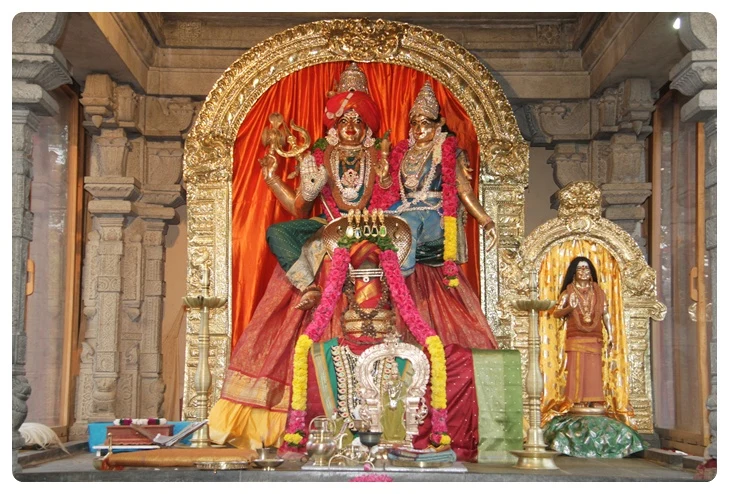
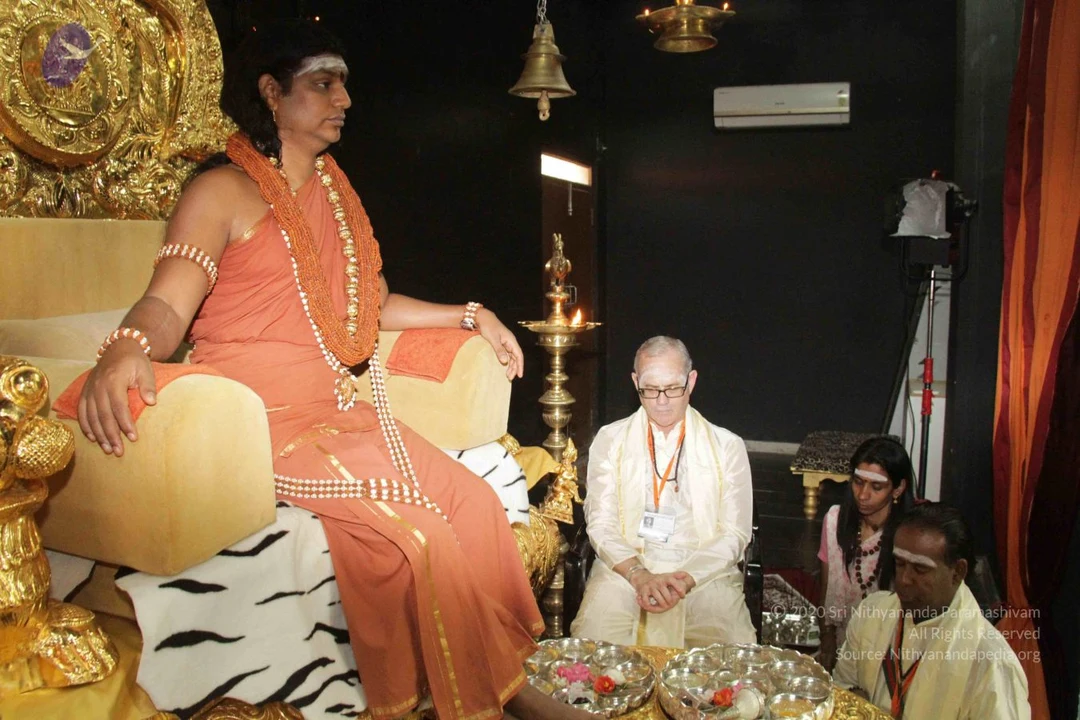
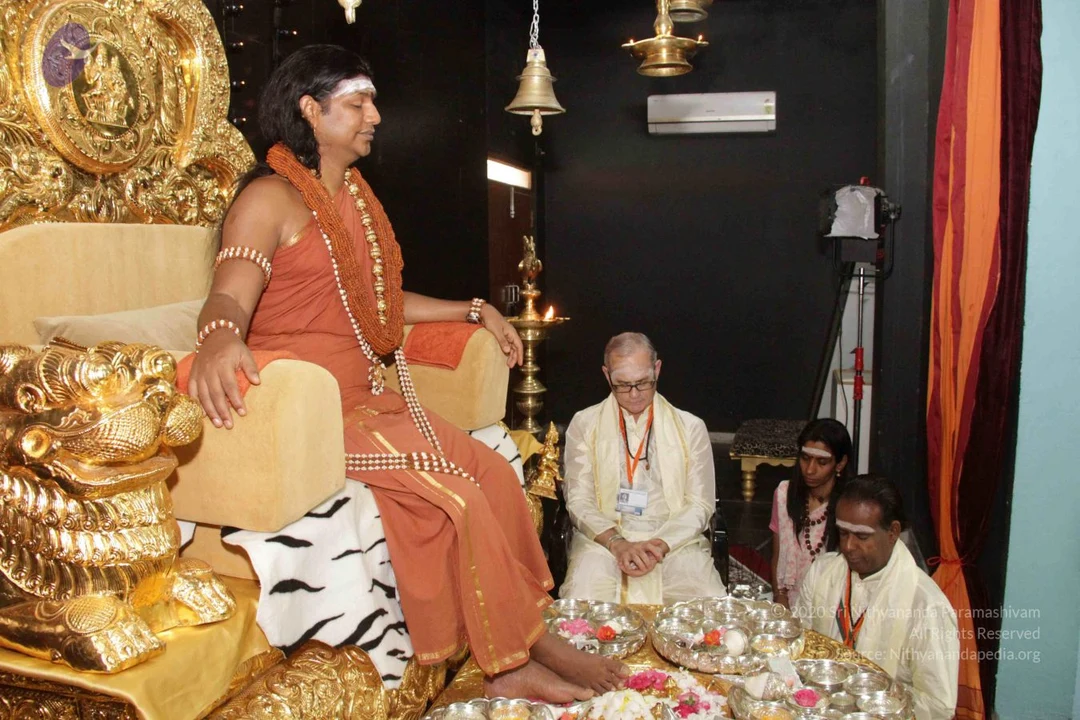
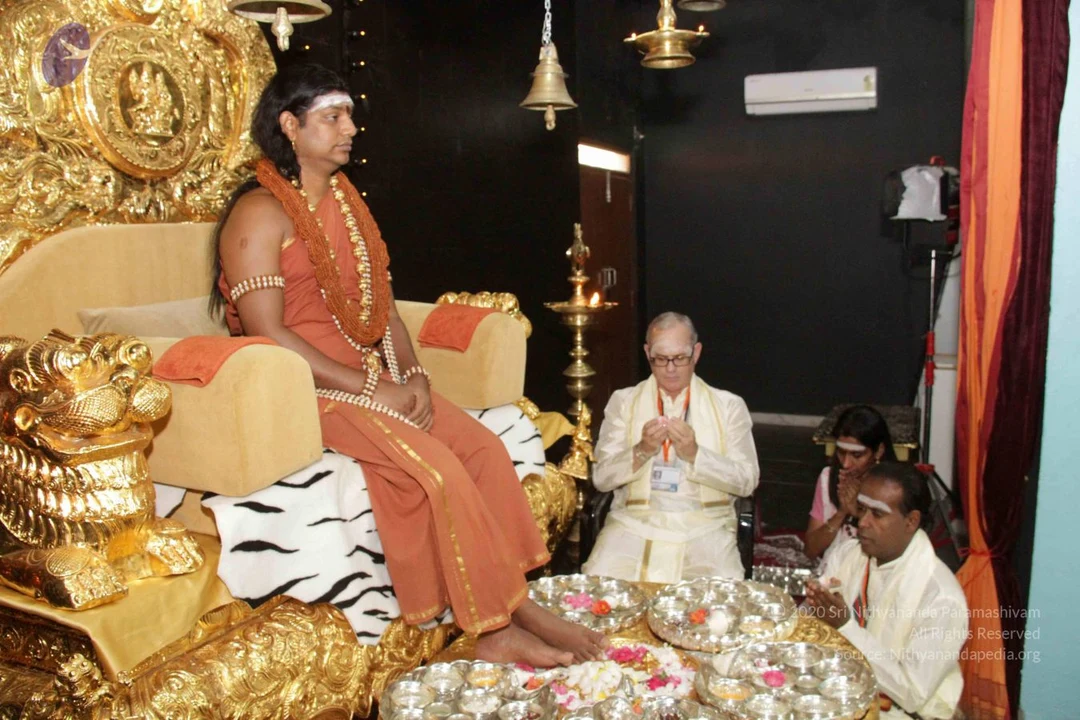
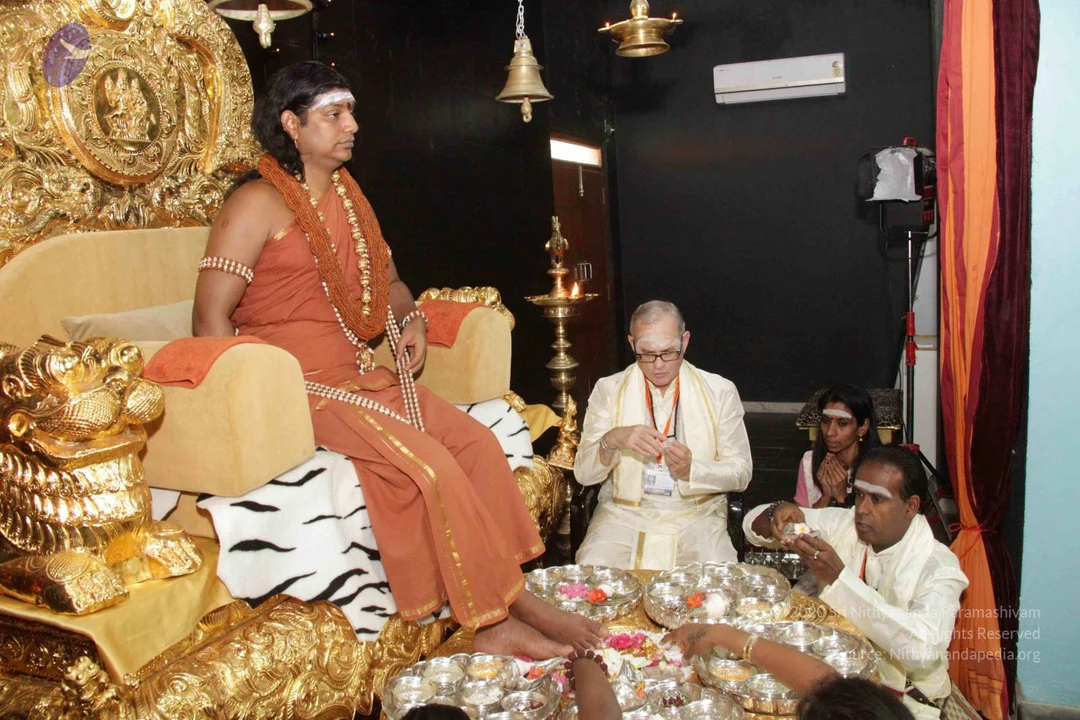
Morning Paada Puja
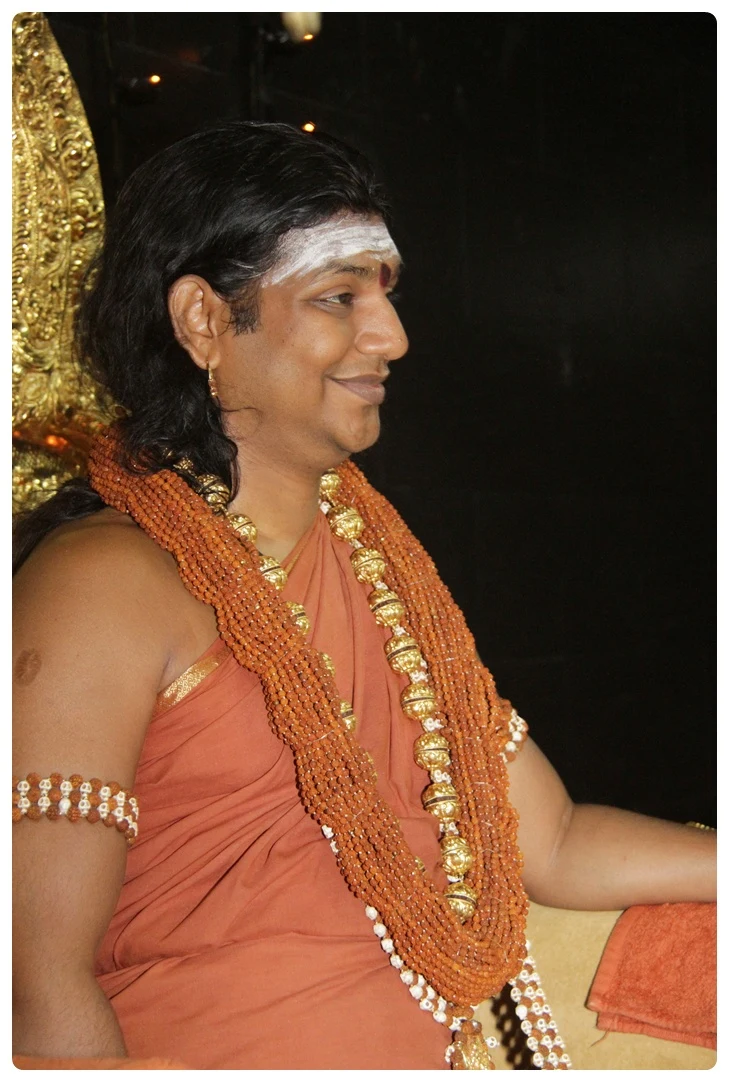
Morning Satsang
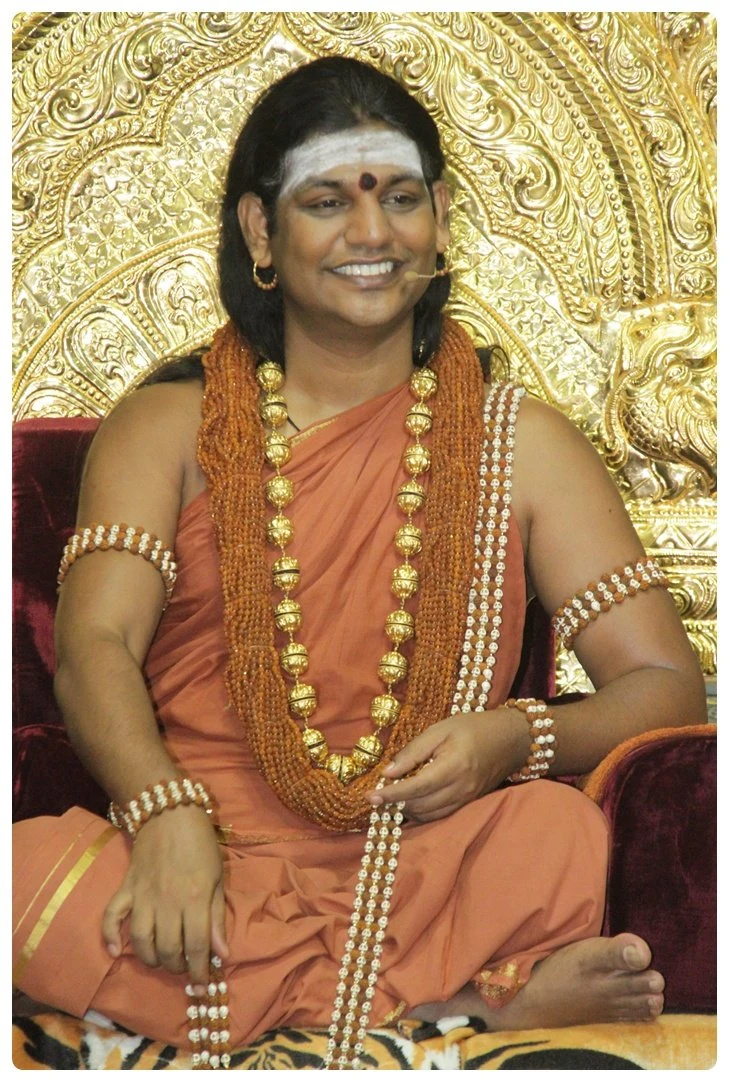
Morning Satsang

Morning Satsangh Live in Sadhna TV
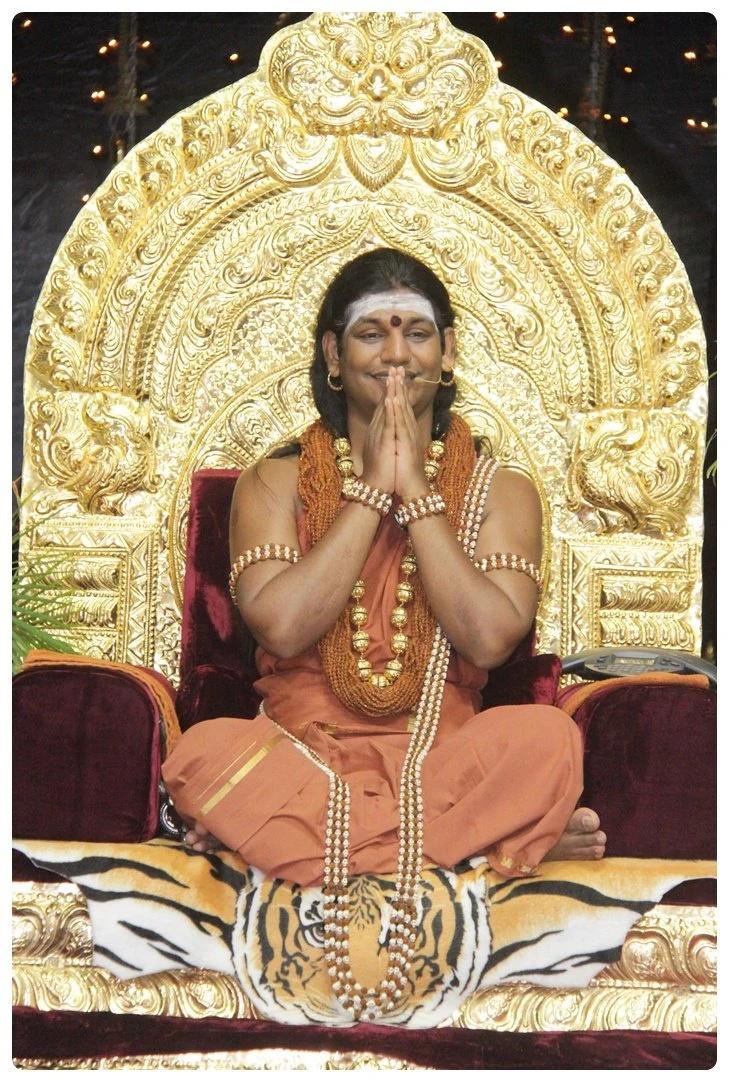
2 way Video Conferencing
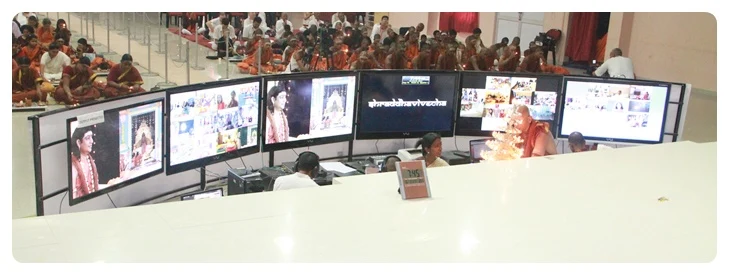
Techpit For 2 way Video Conferencing

Photos Of The Day:

Yoga
Temple-Swamiji
Pada-Puja

Arati

Nithya-Satsang

IA-Lunch

Sarvadarshan-Gurukul

Kalabairava-Darshan

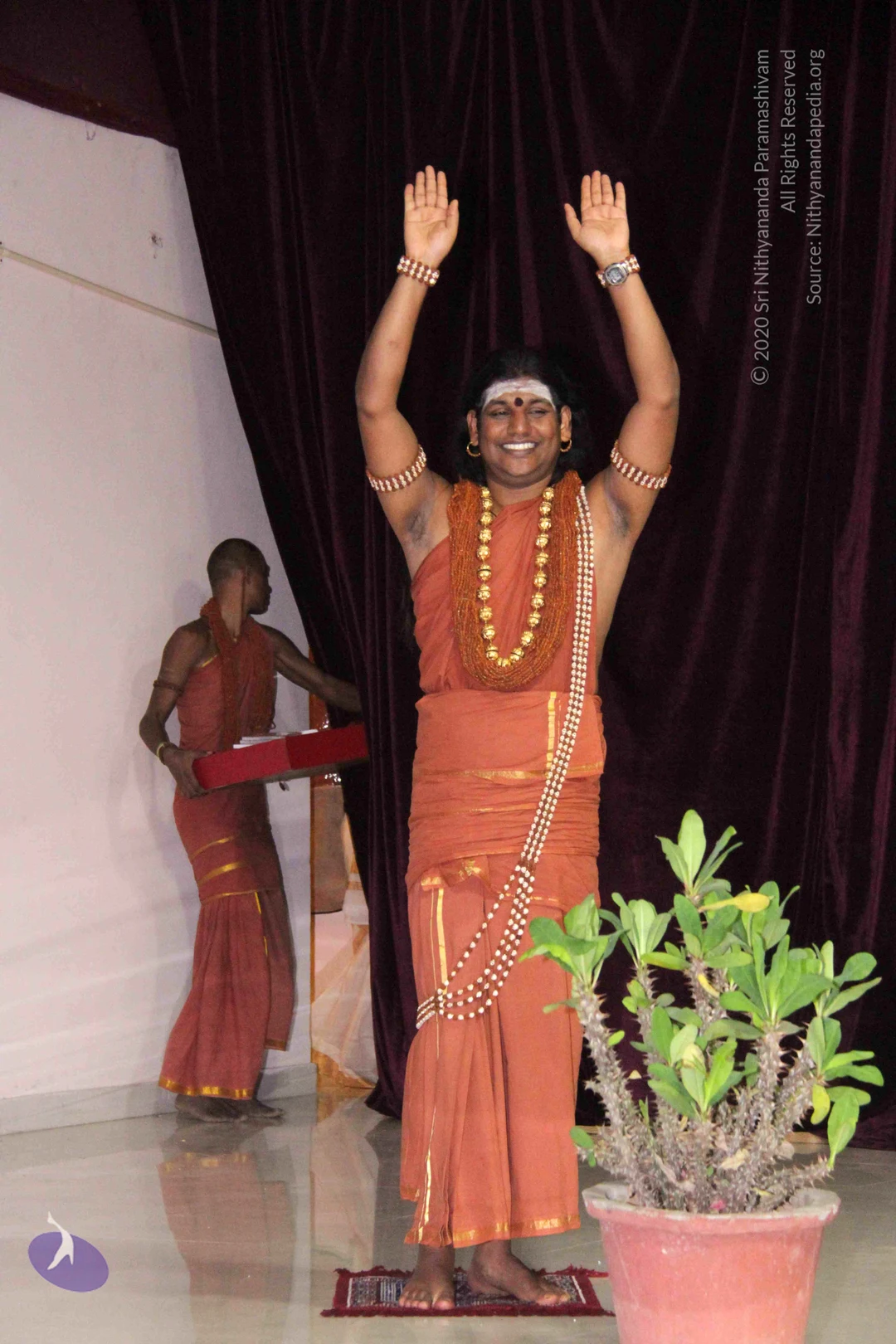
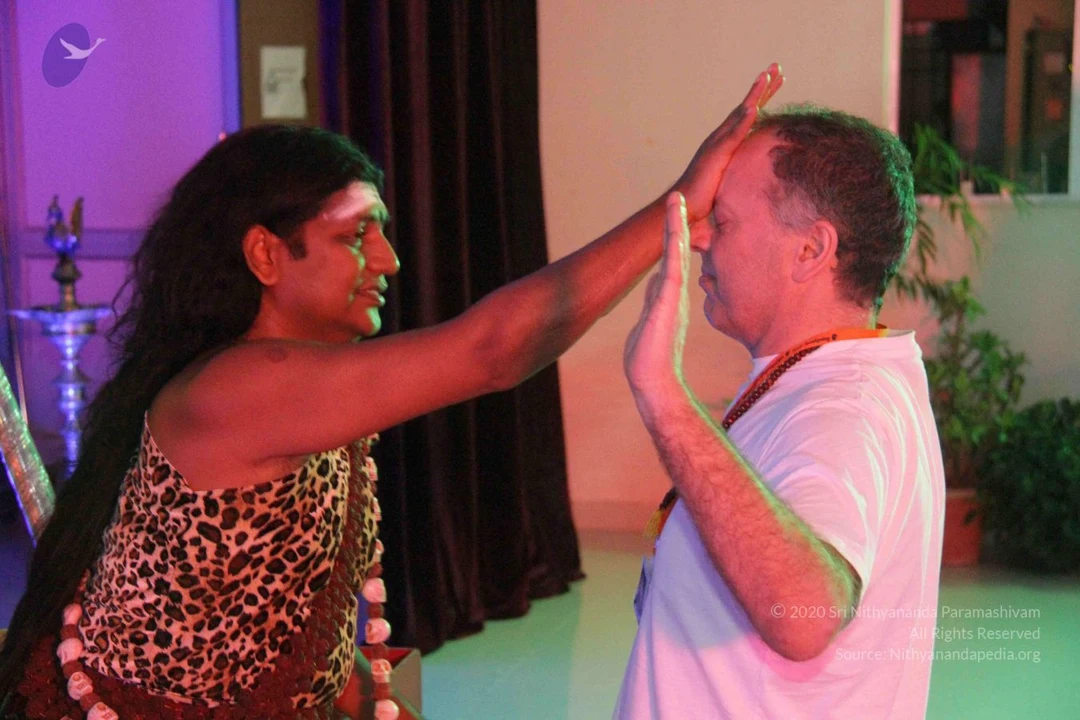
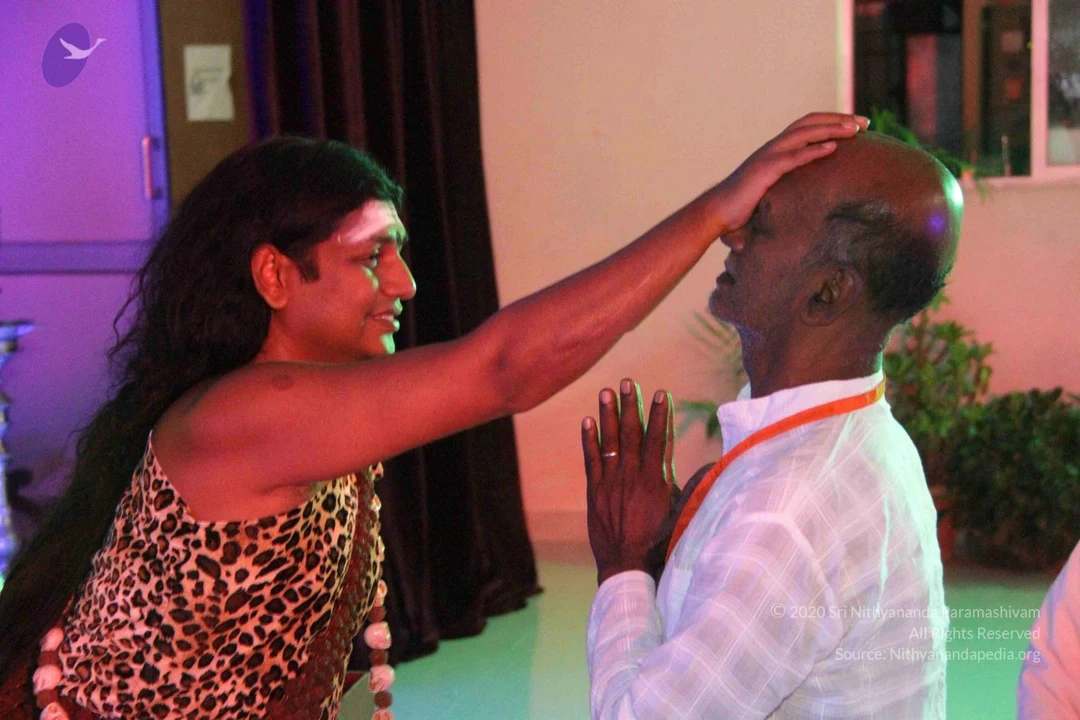
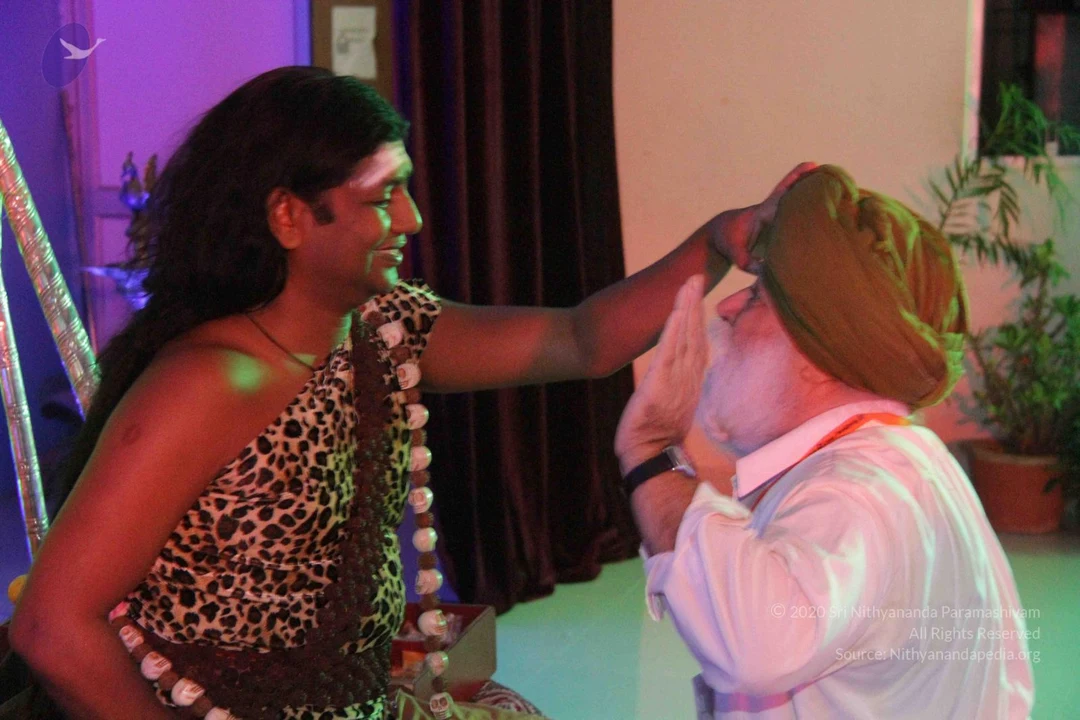
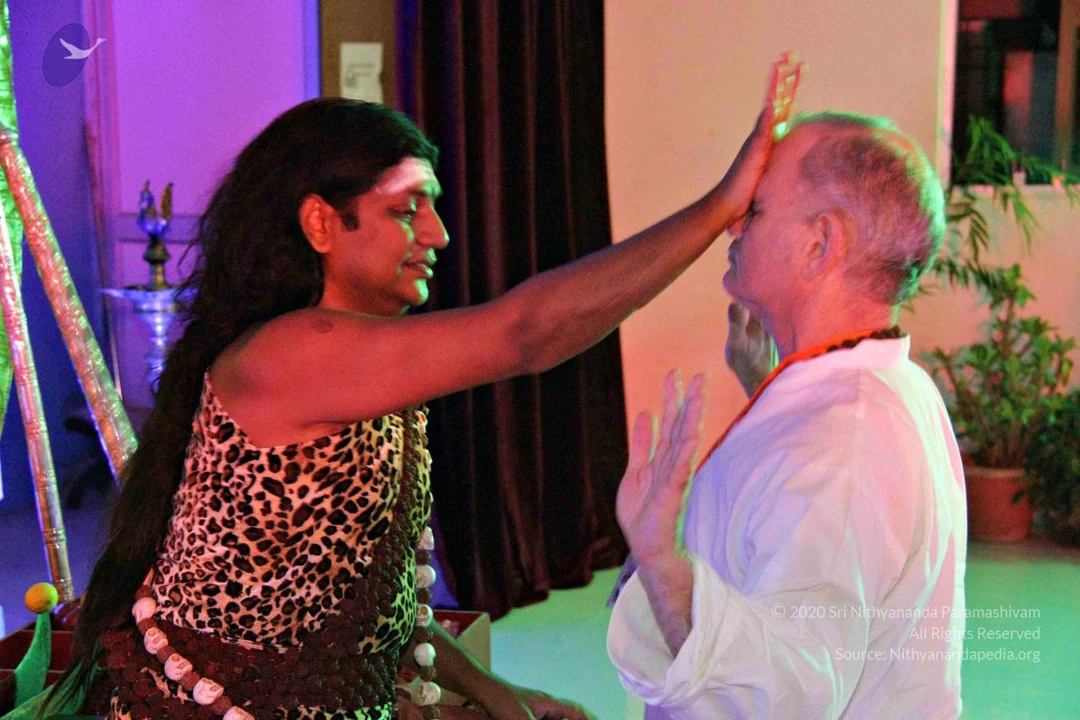
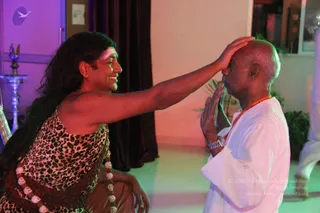
Swamiji-Blessings-Namaskar

Photos Of The Day:

Yoga

Temple-Swamiji
Pada-Puja

Arati

Nithya-Satsang

IA-Lunch

Sarvadarshan-Gurukul

Kalabairava-Darshan

Swamiji-Blessings-Namaskar

Photos Of The Day:

Yoga

Temple-Swamiji
Pada-Puja

Arati

Nithya-Satsang

IA-Lunch

Sarvadarshan-Gurukul

Kalabairava-Darshan

Swamiji-Blessings-Namaskar

Photos Of The Day:

Yoga

Temple-Swamiji
Pada-Puja

Arati

Nithya-Satsang

IA-Lunch

Sarvadarshan-Gurukul

Kalabairava-Darshan

Swamiji-Blessings-Namaskar

Photos Of The Day:

Yoga

Temple-Swamiji
Pada-Puja

Arati

Nithya-Satsang

IA-Lunch

Sarvadarshan-Gurukul

Kalabairava-Darshan

Swamiji-Blessings-Namaskar

Photos Of The Day:

Yoga

Temple-Swamiji
Pada-Puja

Arati

Nithya-Satsang

IA-Lunch

Sarvadarshan-Gurukul

Kalabairava-Darshan

Swamiji-Blessings-Namaskar

Photos Of The Day:

Yoga

Temple-Swamiji
Pada-Puja

Arati

Nithya-Satsang

IA-Lunch

Sarvadarshan-Gurukul

Kalabairava-Darshan

Swamiji-Blessings-Namaskar

Photos Of The Day:

Yoga

Temple-Swamiji
Pada-Puja

Arati

Nithya-Satsang

IA-Lunch

Sarvadarshan-Gurukul

Kalabairava-Darshan

Swamiji-Blessings-Namaskar

Photos Of The Day:

Yoga

Temple-Swamiji
Pada-Puja

Arati

Nithya-Satsang

IA-Lunch

Sarvadarshan-Gurukul

Kalabairava-Darshan

Swamiji-Blessings-Namaskar

01-KALABHAIRAVAR-DARSHAN

02-SATSANG

Photos from this day

View all 343 photos

Temple Glimpses =

6 photosSource gallery
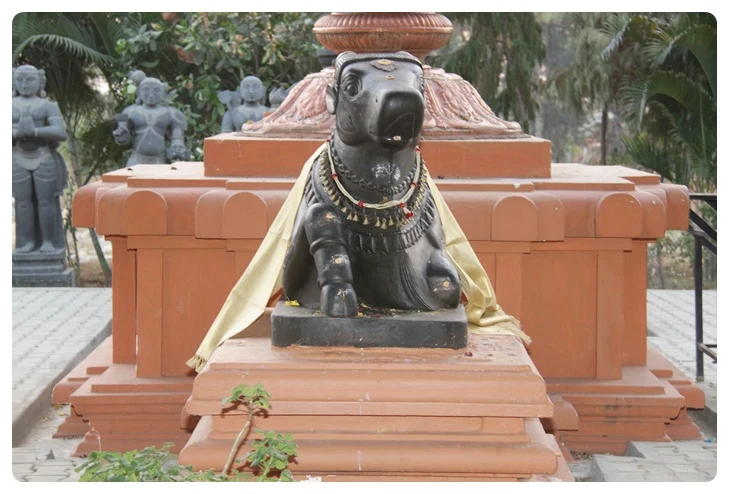
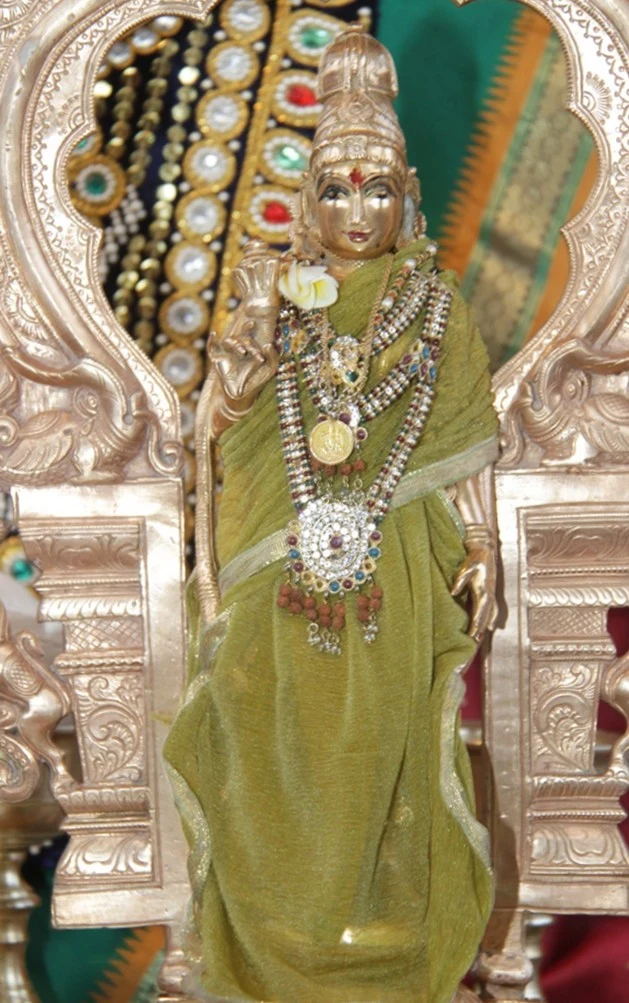
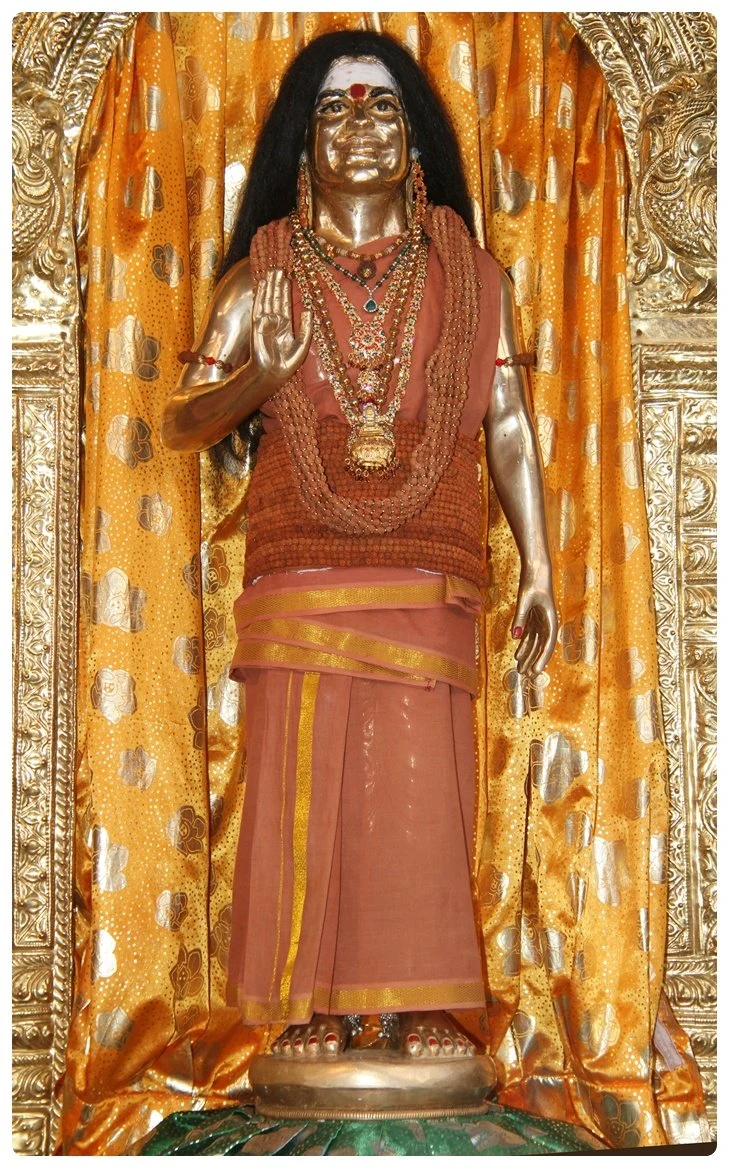
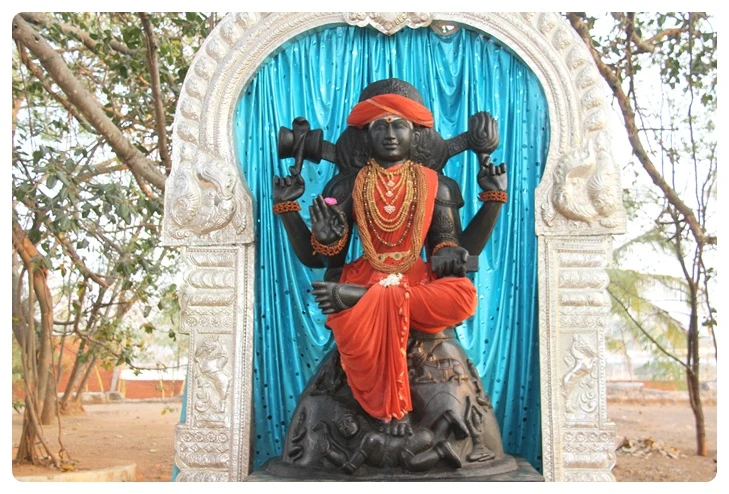
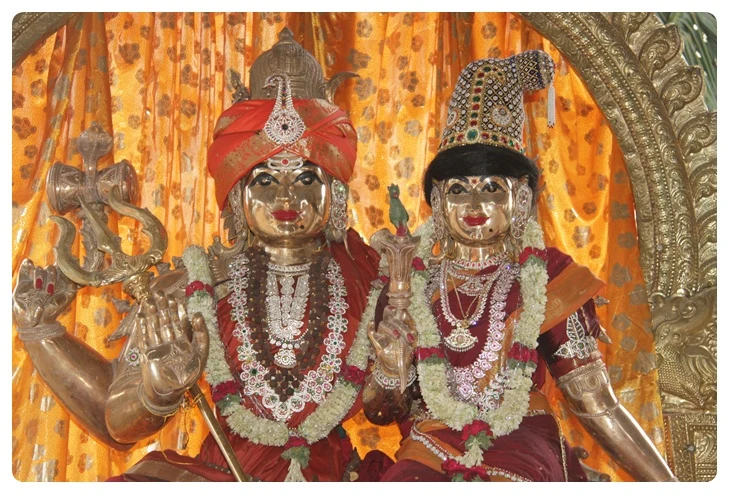
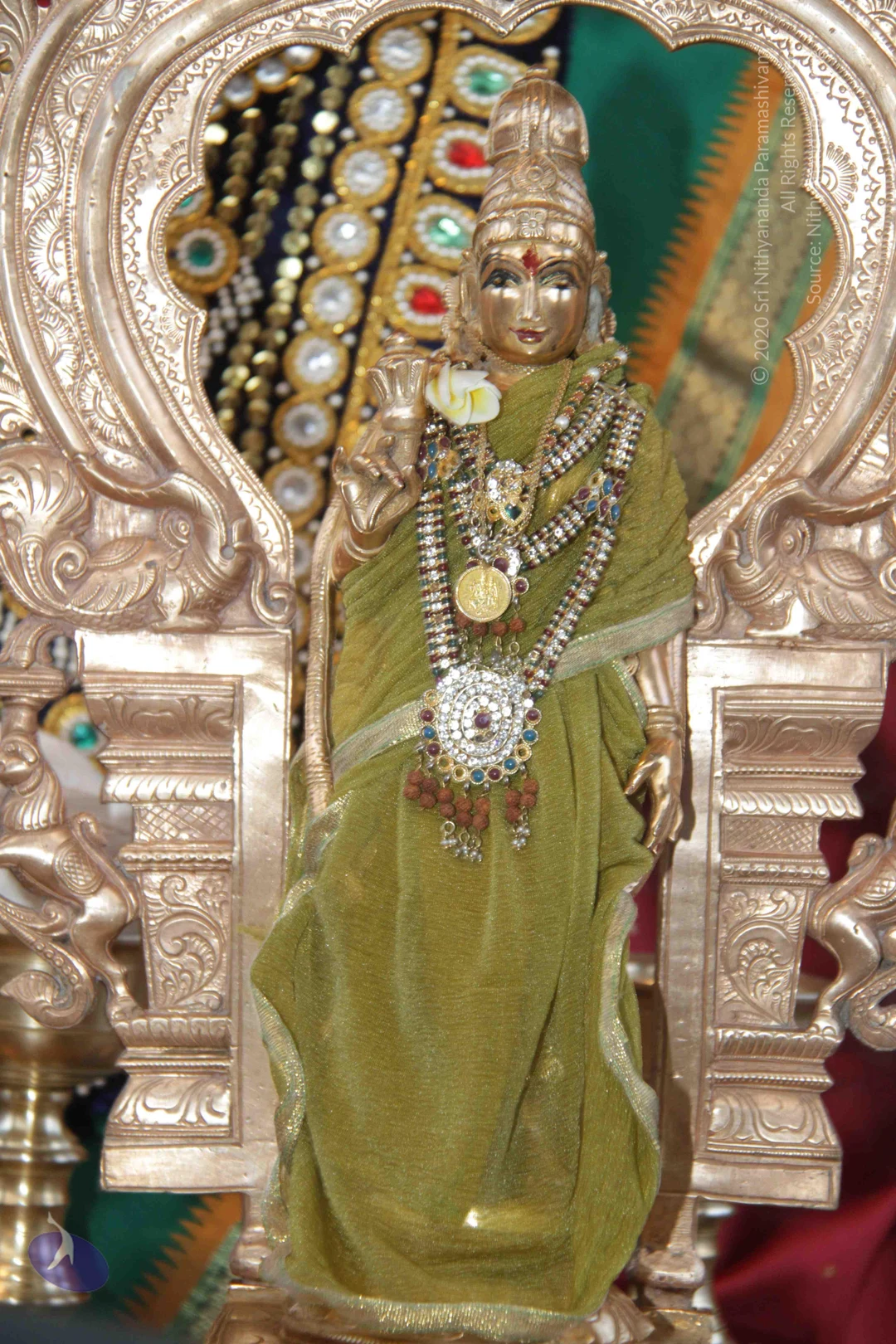
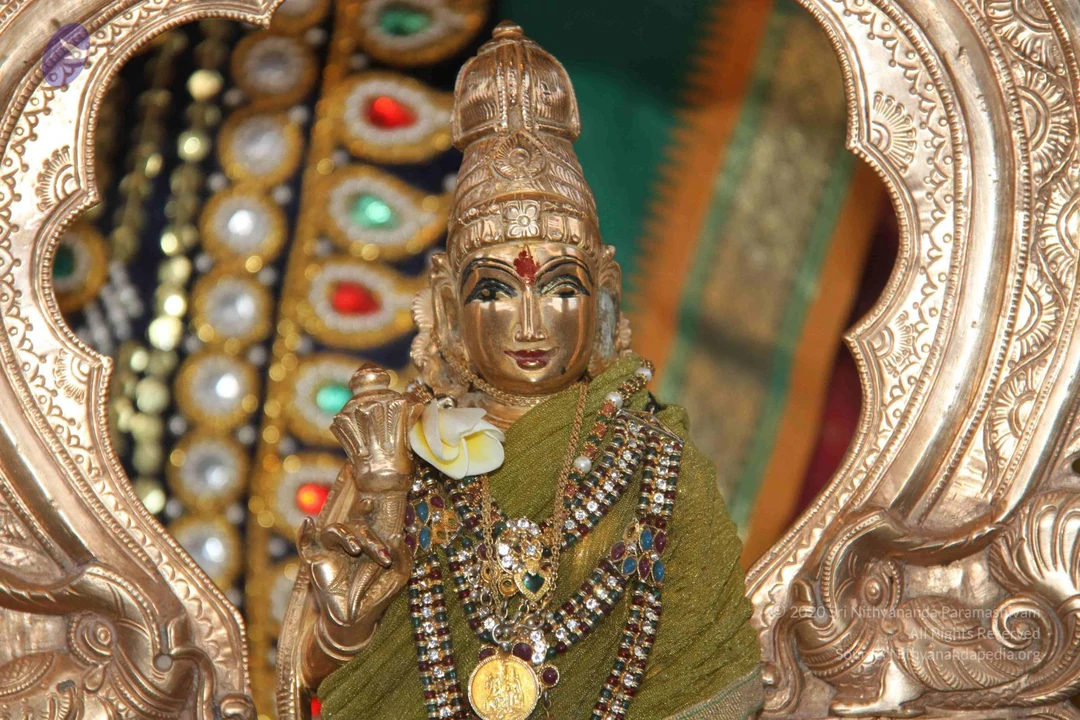
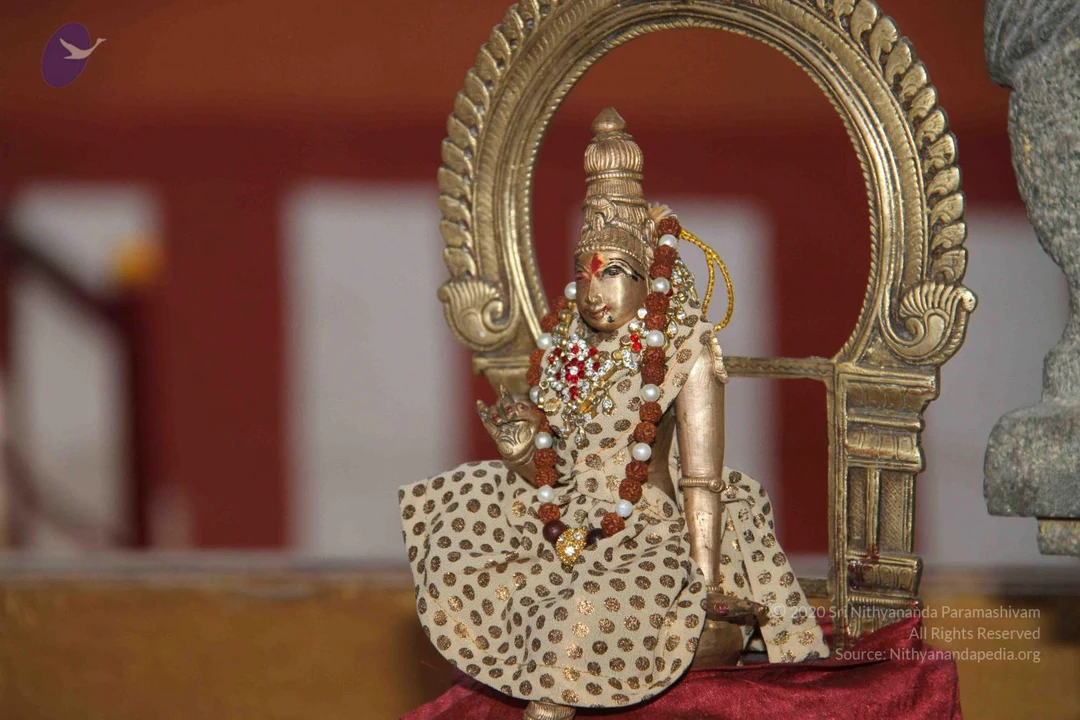
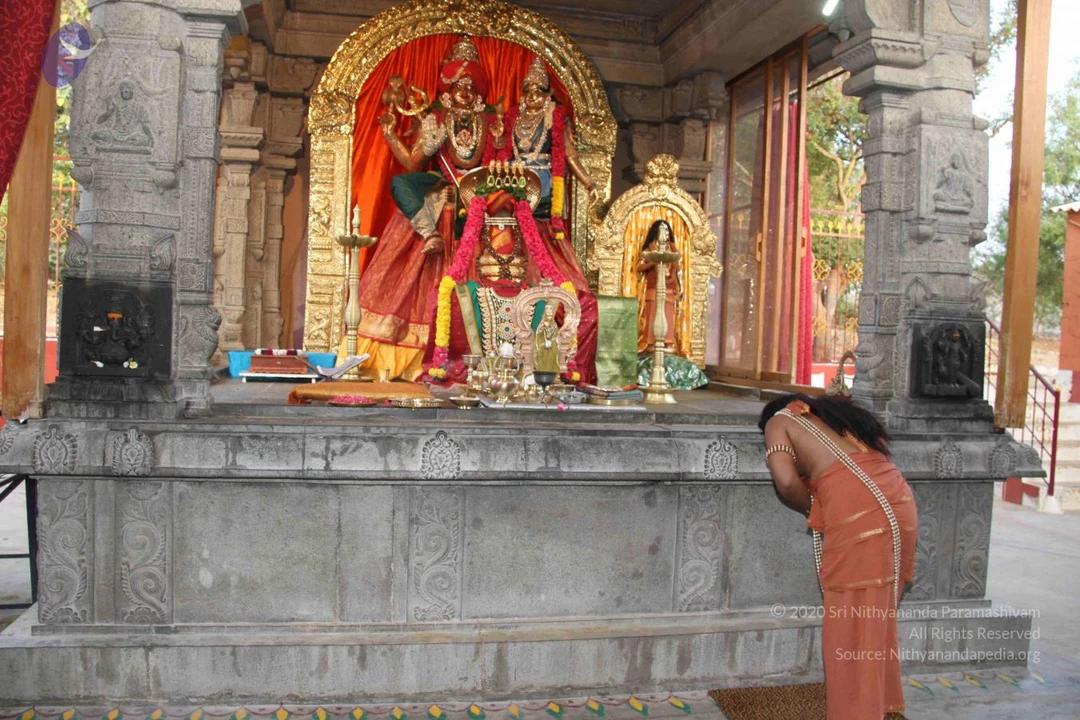
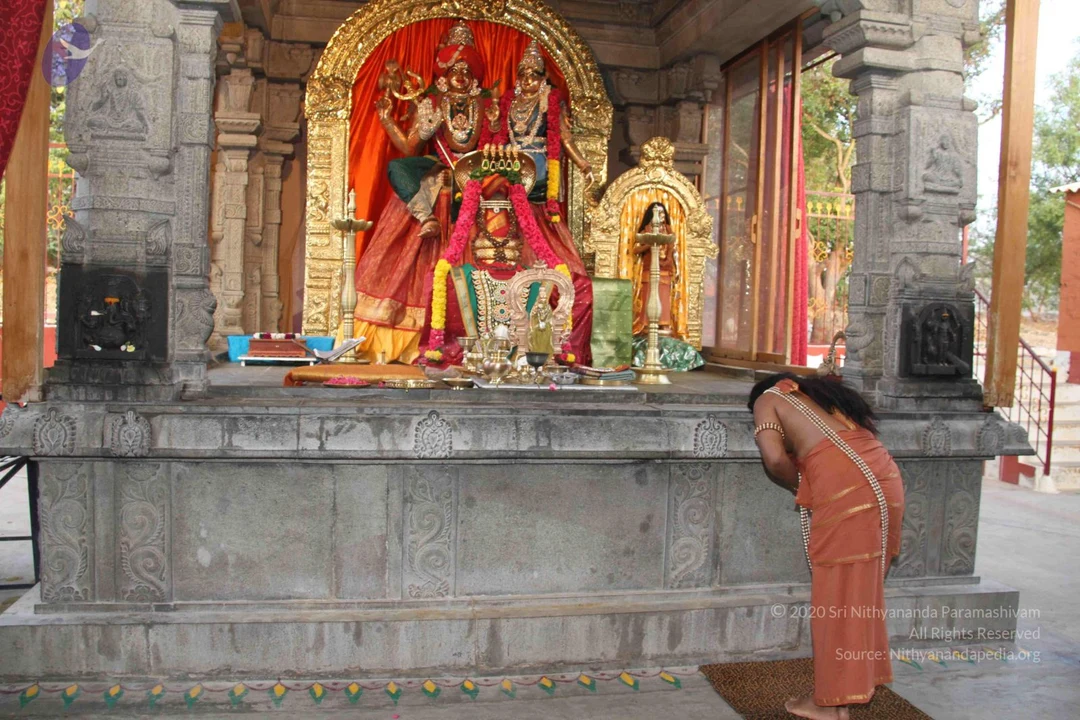
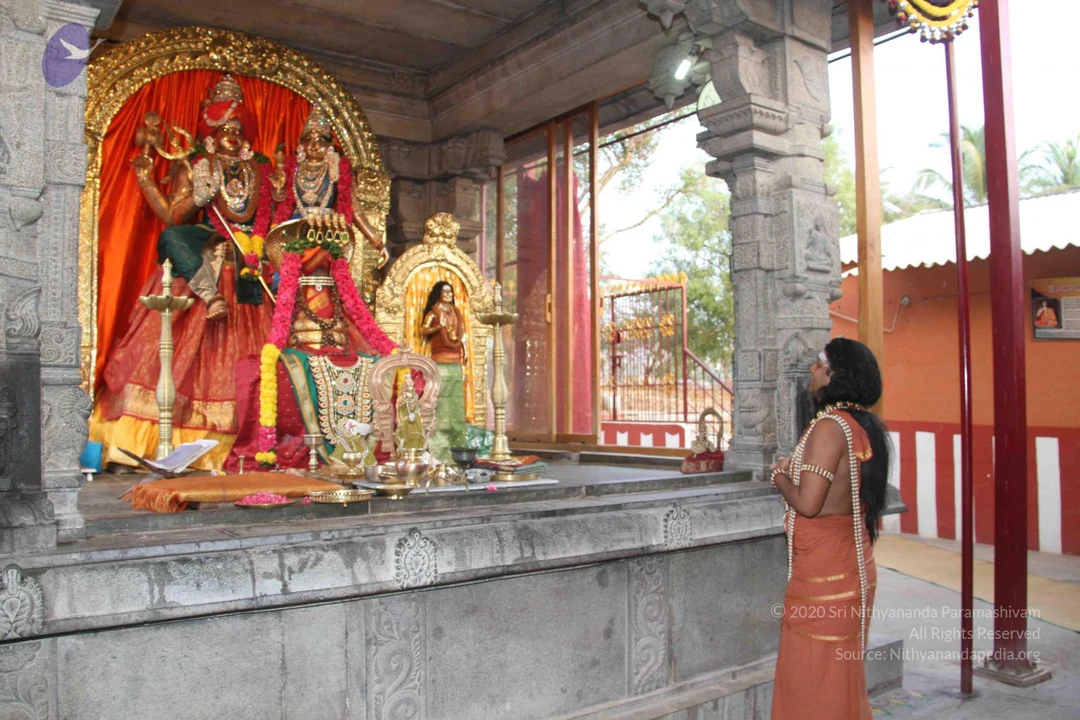
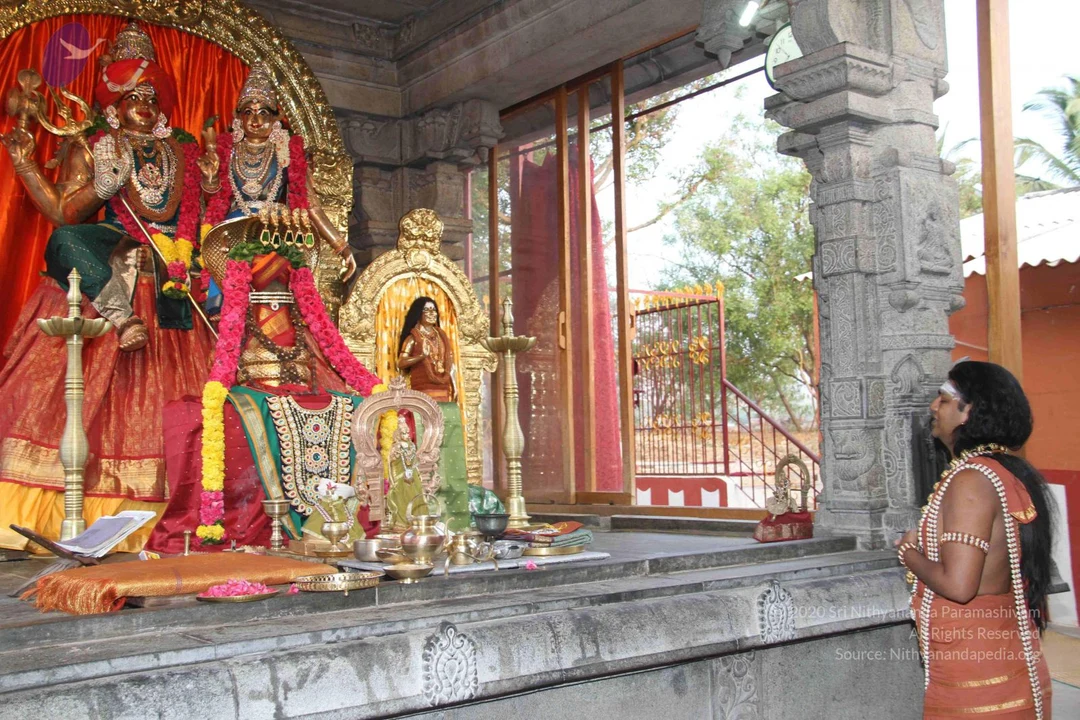
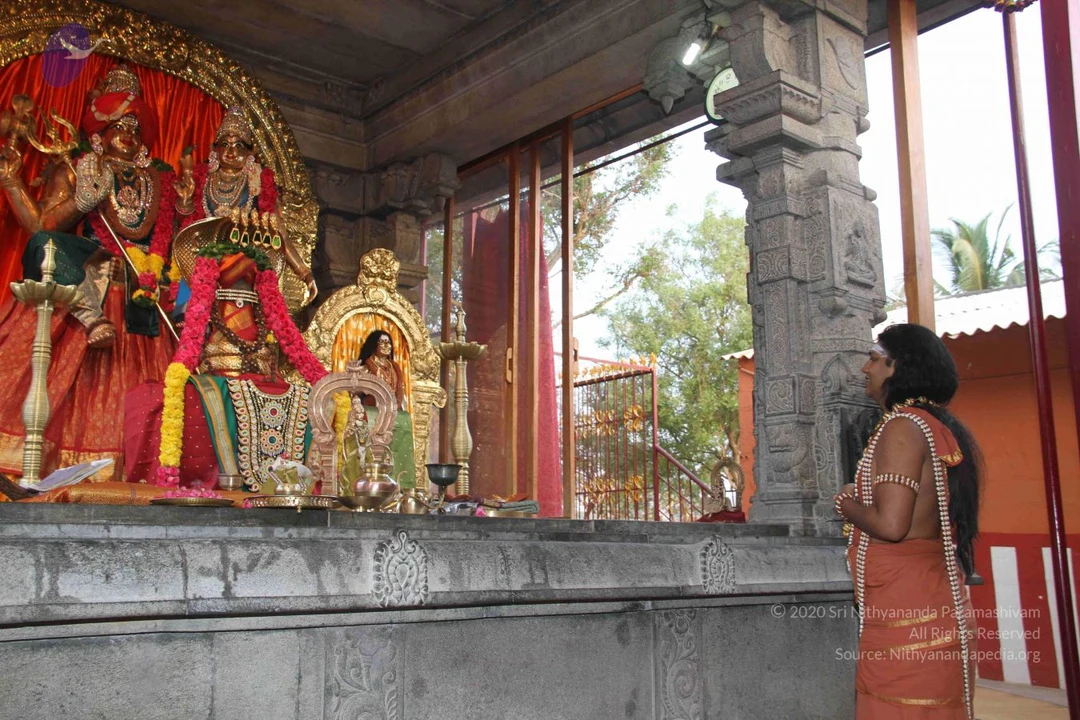
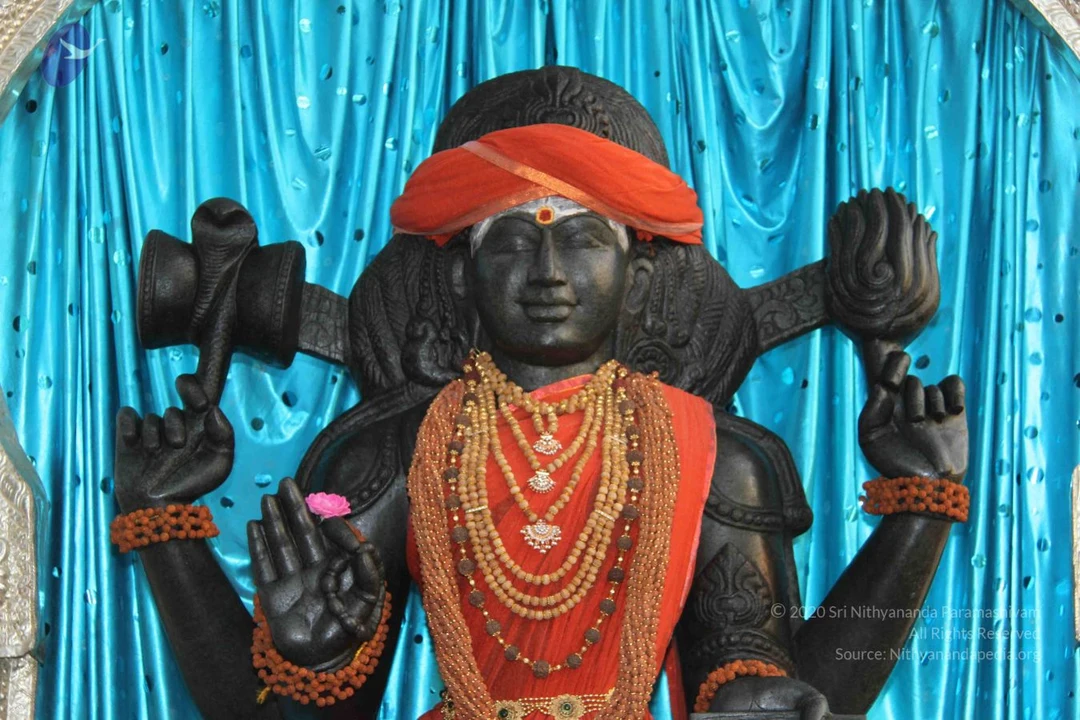
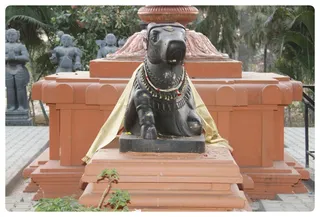
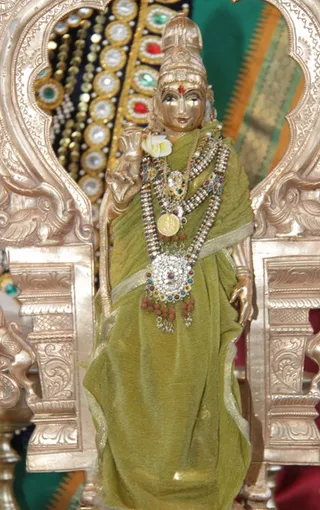
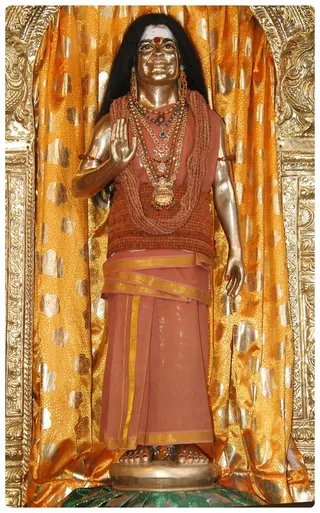
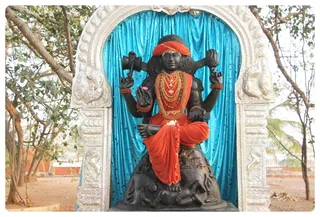
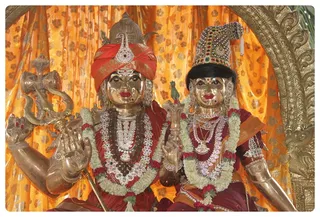
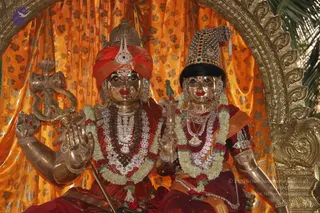
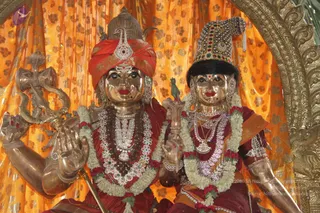
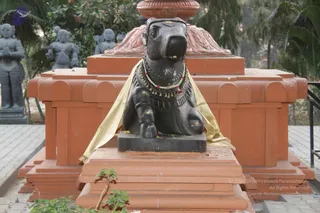
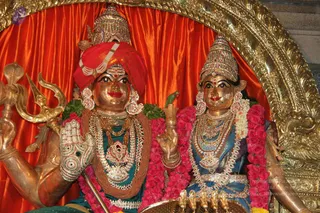
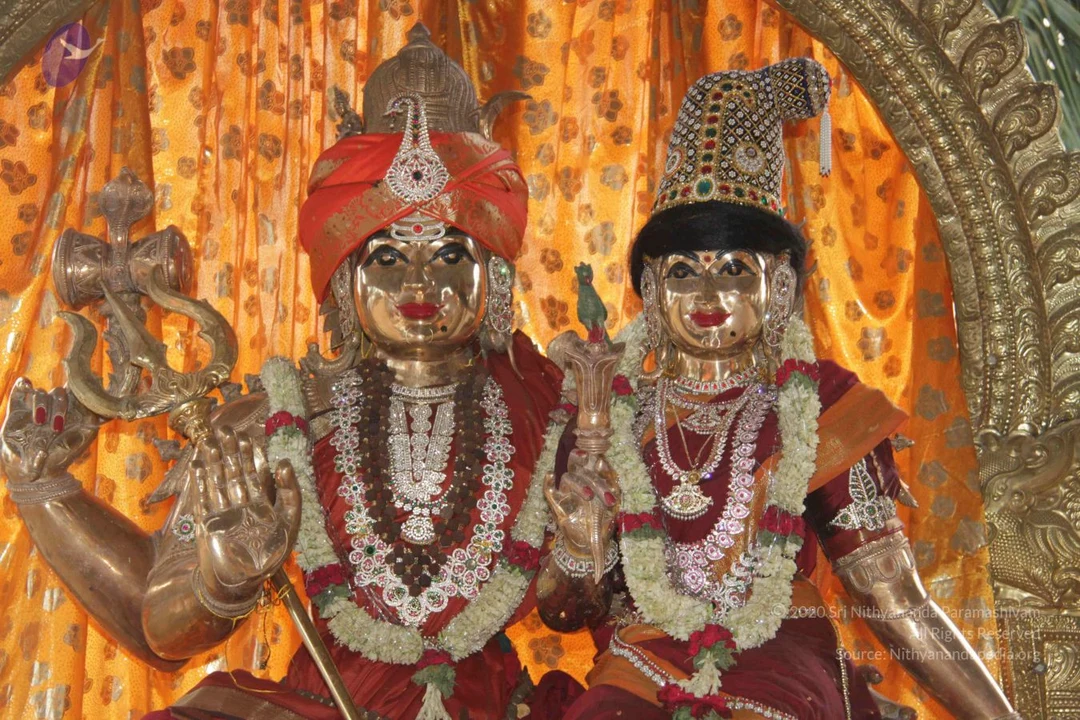
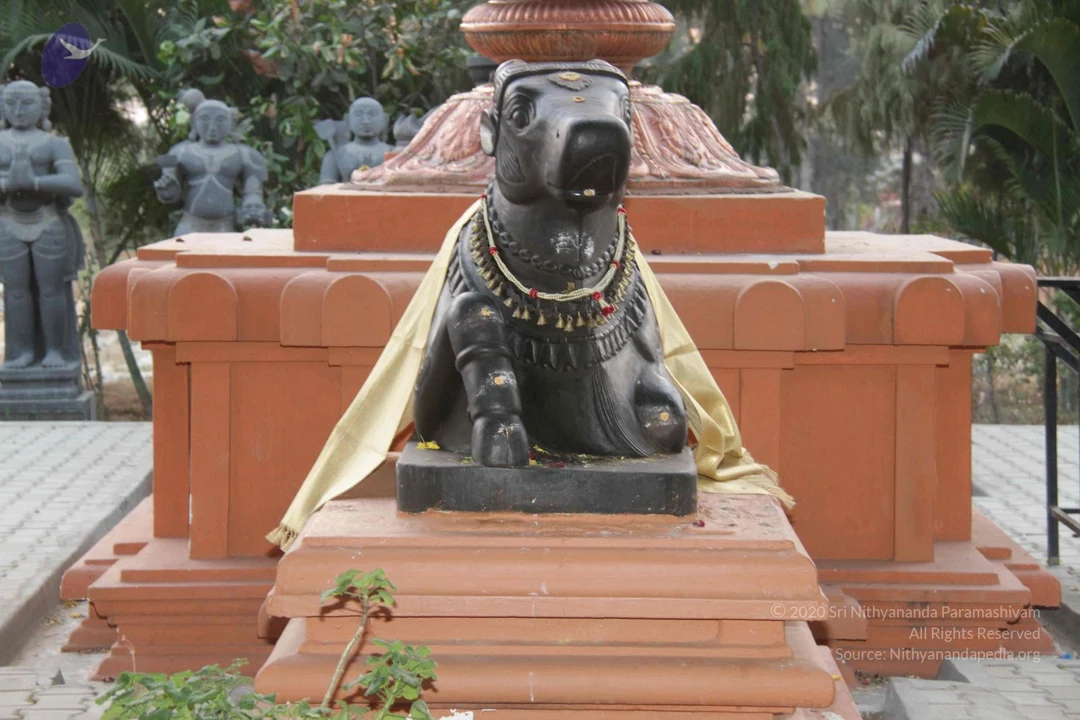
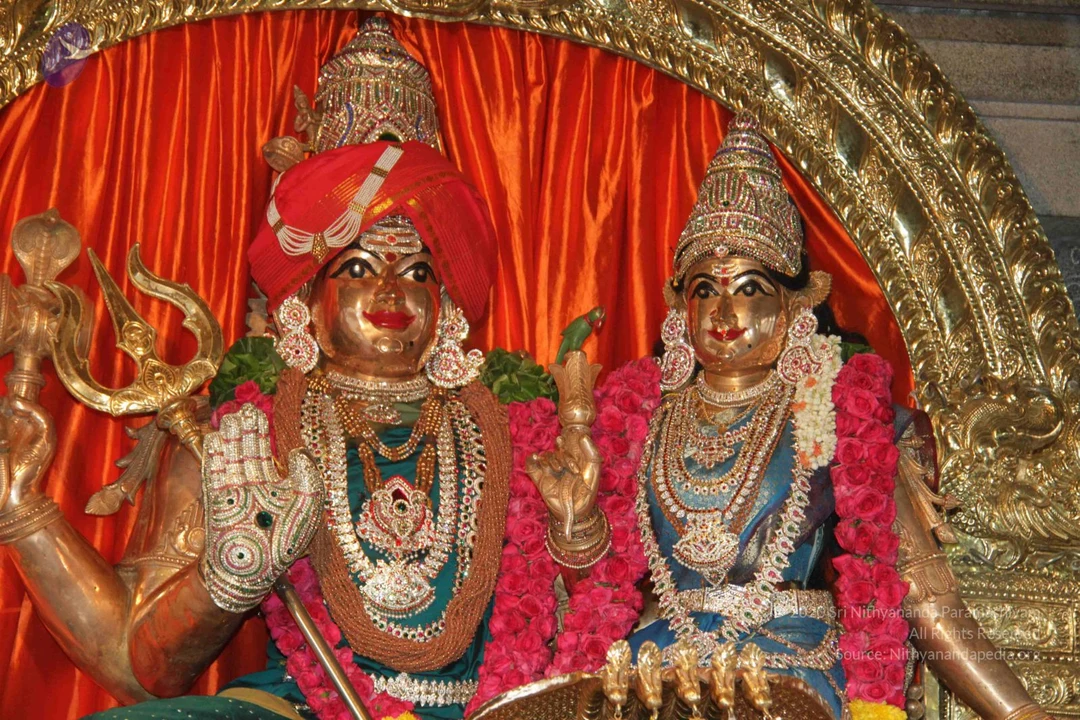
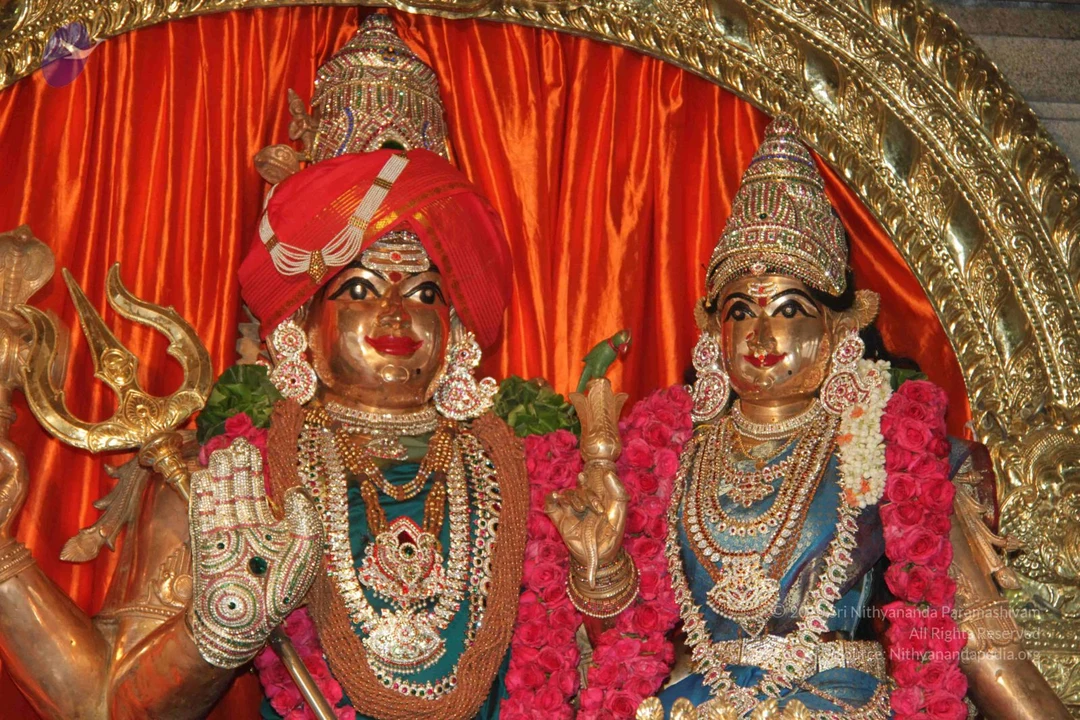
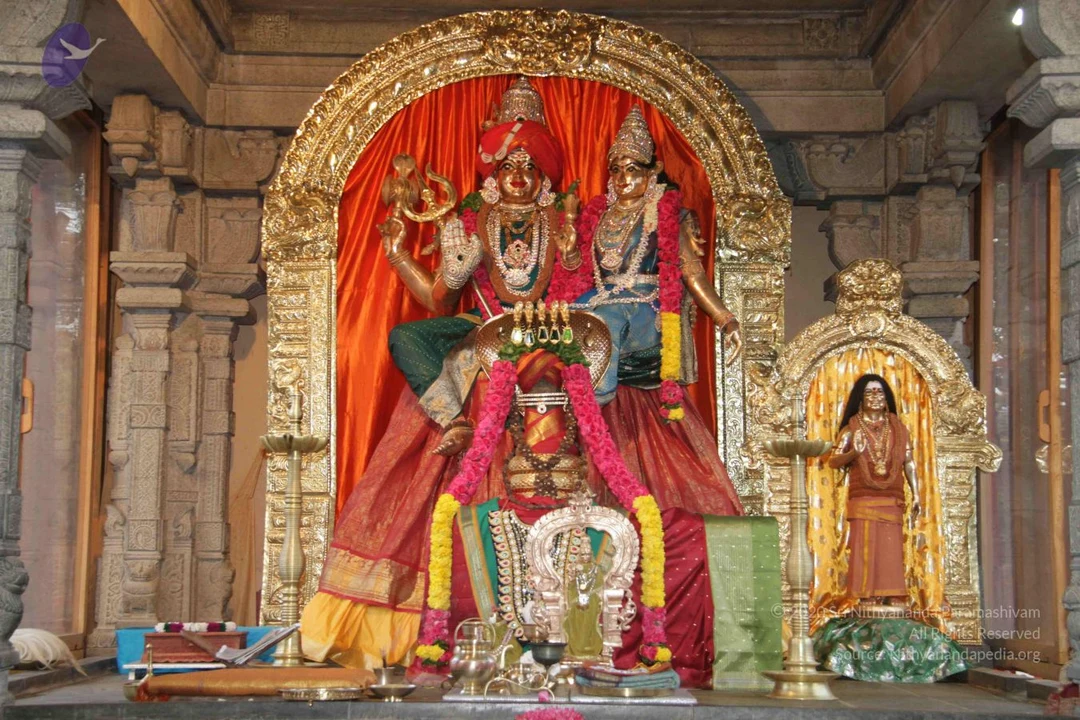
A temple shrine photograph showing a gilded arched niche framed by an orange-red curtain. Two large deity murti stand side by side: the left figure wears a red crown and holds a trident, the right figure wears a tall crown and a blue-green garment, both draped with pink and yellow marigold garlands and ornaments. In front, a silver-rimmed kalasha and a silver pedestal sit on a red cloth with brass oil lamps and offerings. At the right, a smaller carved niche holds a standing figure in saffron and orange robes, a devotional figure rather than a living person, with a brass lamp beside it. No people are visible in the scene.A photograph of a dark stone Nandi bull statue seated on a square orange-red brick plinth in an outdoor garden. The bull wears a beaded necklace with red and yellow tassels, a pale yellow cloth draped over its back, and a small mark on its forehead. Behind it, grey stone deity figures stand on the left, and palm trees and green foliage fill the background. No people are visible.A metal murti of a goddess stands in a gilded arched shrine niche. She wears a green sari with a gold border, layered pearl and stone necklaces, a large jewelled pendant with a rudraksha-style bead drop, and holds a white flower in one raised hand. Behind her is a backdrop of gold and red-and-green jewelled ornaments on dark fabric, with patterned gold silk draped at the side. This is a photograph of a statue, not a living person.A golden statue of a standing male figure with long black hair, a red bindi and white forehead marks, wearing multiple strands of rudraksha beads and gold necklaces with pendants, plus gold earrings. The statue wears a rust-coloured dhoti with gold borders and a rust-coloured upper wrap, raises its right hand in blessing, and stands on a green lotus-shaped base in front of an ornate gilded frame and gold-patterned orange silk drapery. No living people are visible.A black stone statue of a multi-armed deity seated in a shrine niche framed by a white ornate arch with carved animal motifs. The figure wears an orange-red dhoti and shawl, a red headband, layered rudraksha-style and gold beaded necklaces, and bangles, and holds implements in several hands, including a raised trident-like object. Blue draped curtains line the back of the niche, and bare trees and a palm stand in an outdoor courtyard setting.Photograph of two metal murti statues seated side by side against a backdrop of gold and orange draped fabric with an ornate gilded frame. The figure on the left wears a red turban with a jewelled ornament, a silver ornamental necklace, a rudraksha-style mala and a white flower garland, and holds a trident. The figure on the right wears a jewelled headdress, multiple silver and gold necklaces and a red garment, with a white flower garland and a small bird figure on a staff. The deity murti are the only figures present, and the statues are the central subject.

Morning Paada Puja

5 photosSource gallery
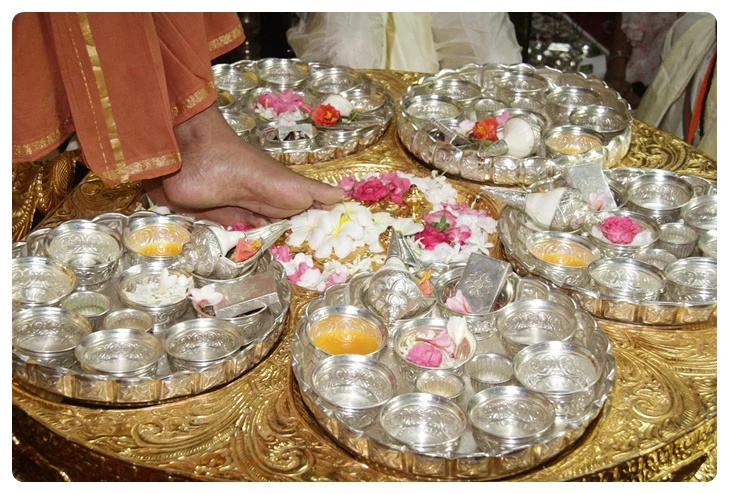
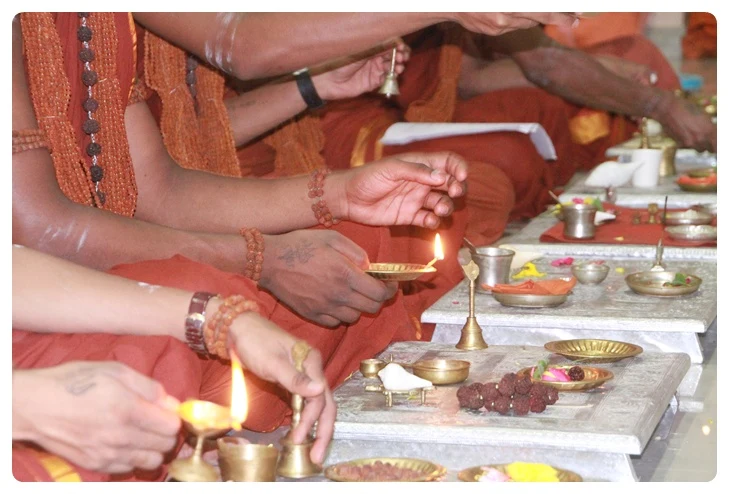
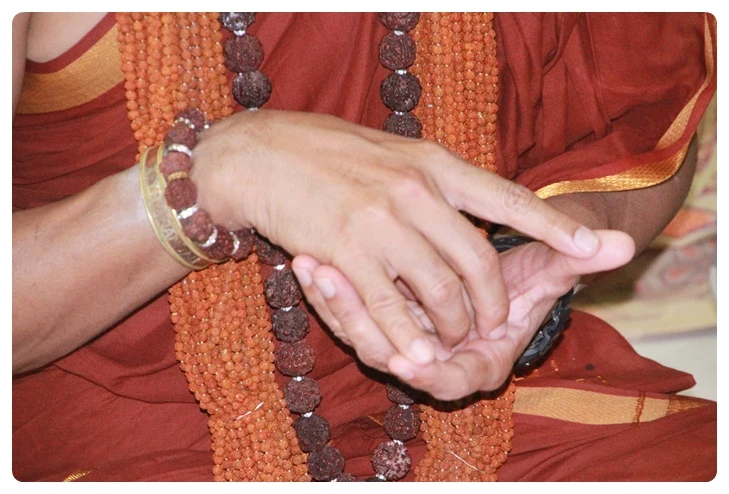
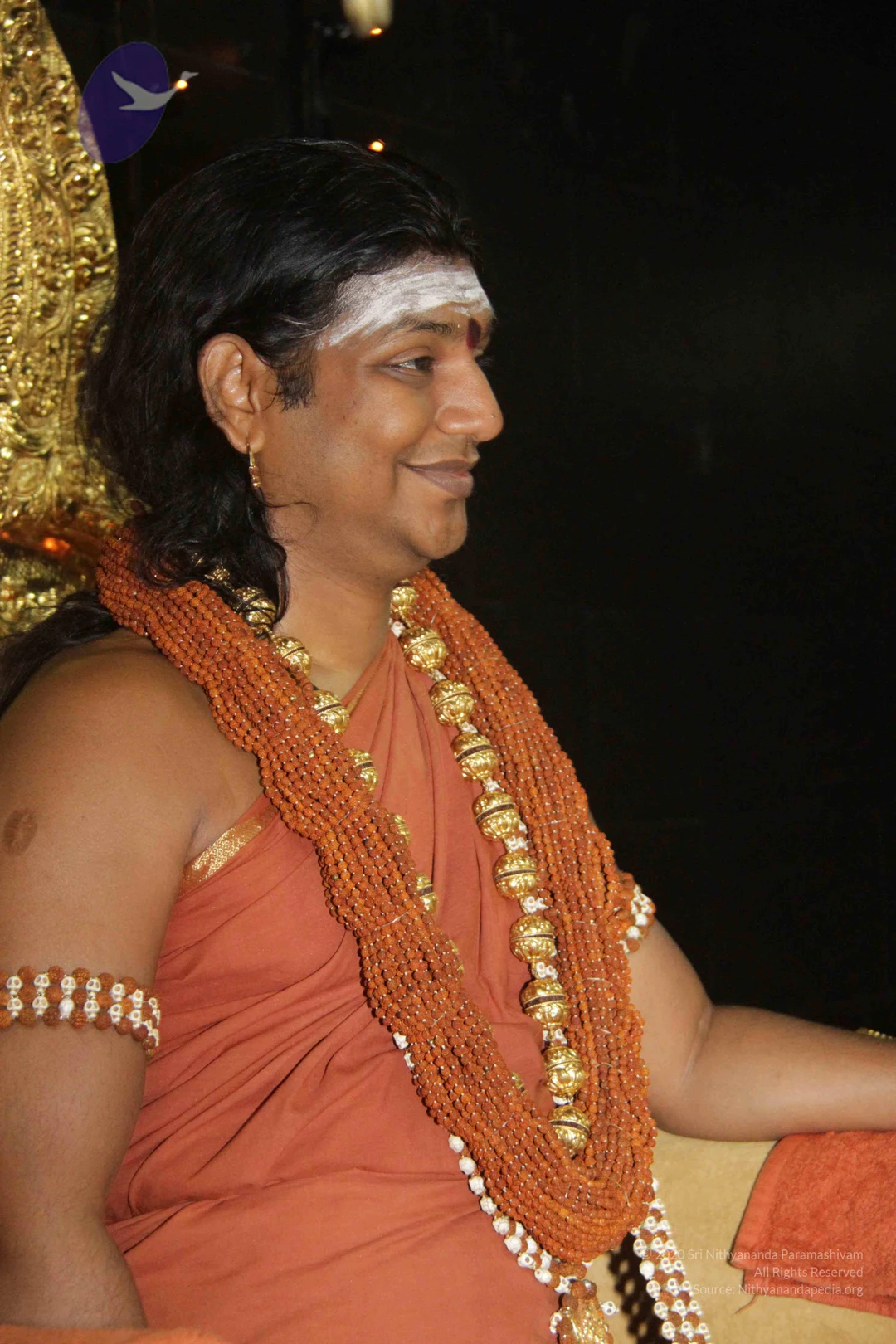
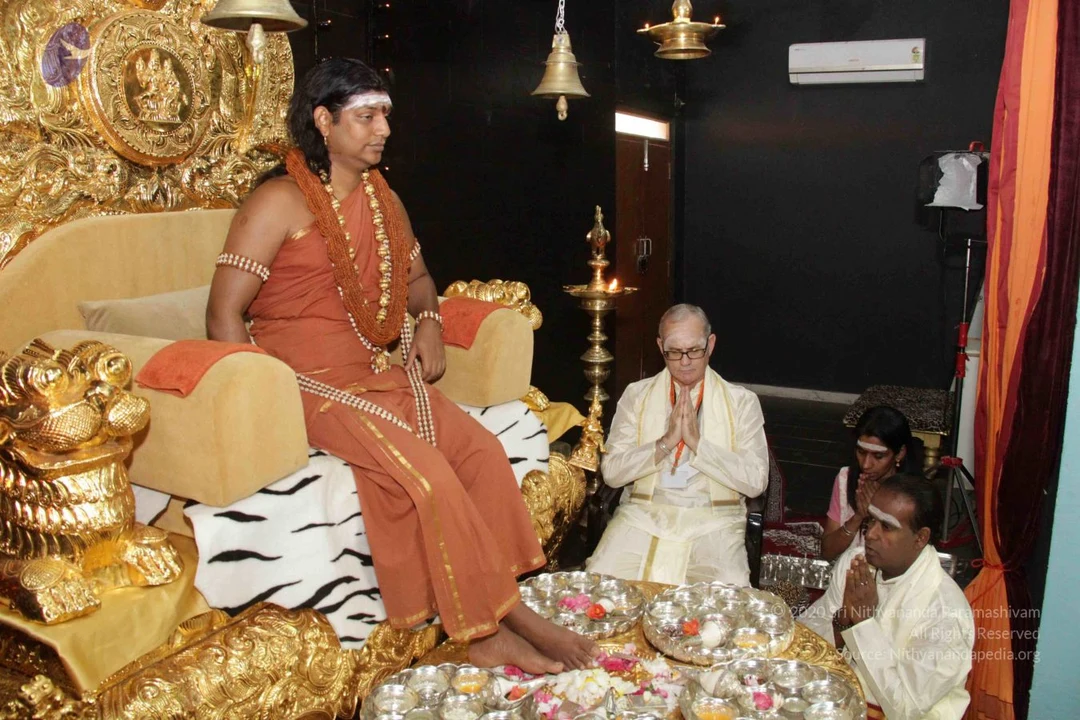
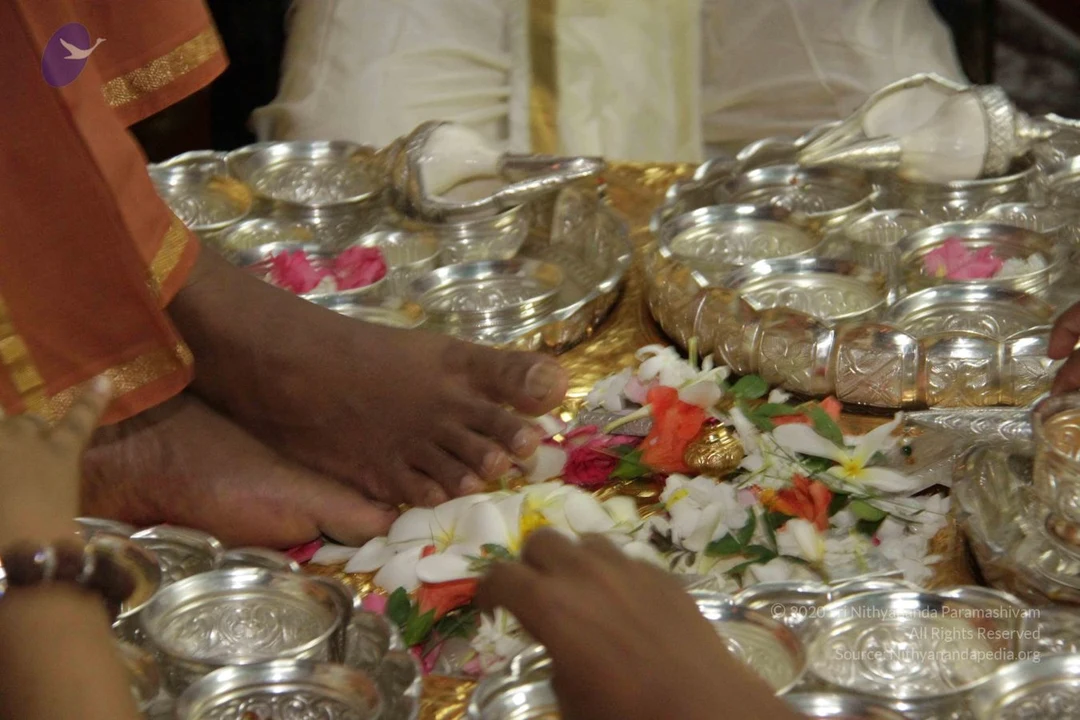
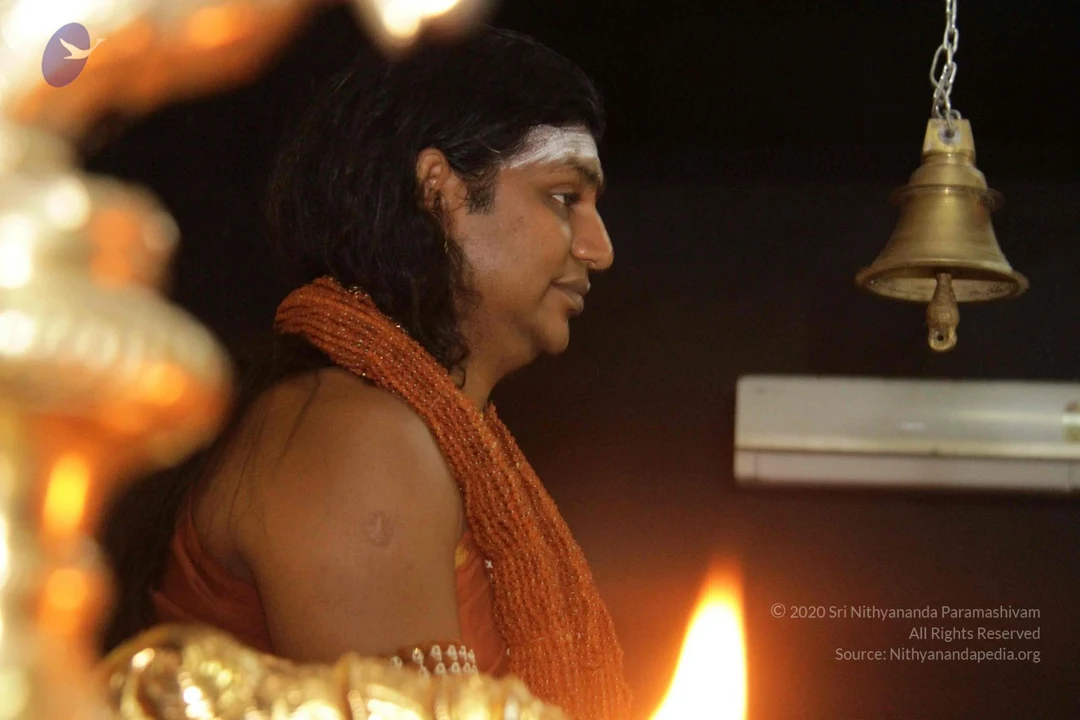
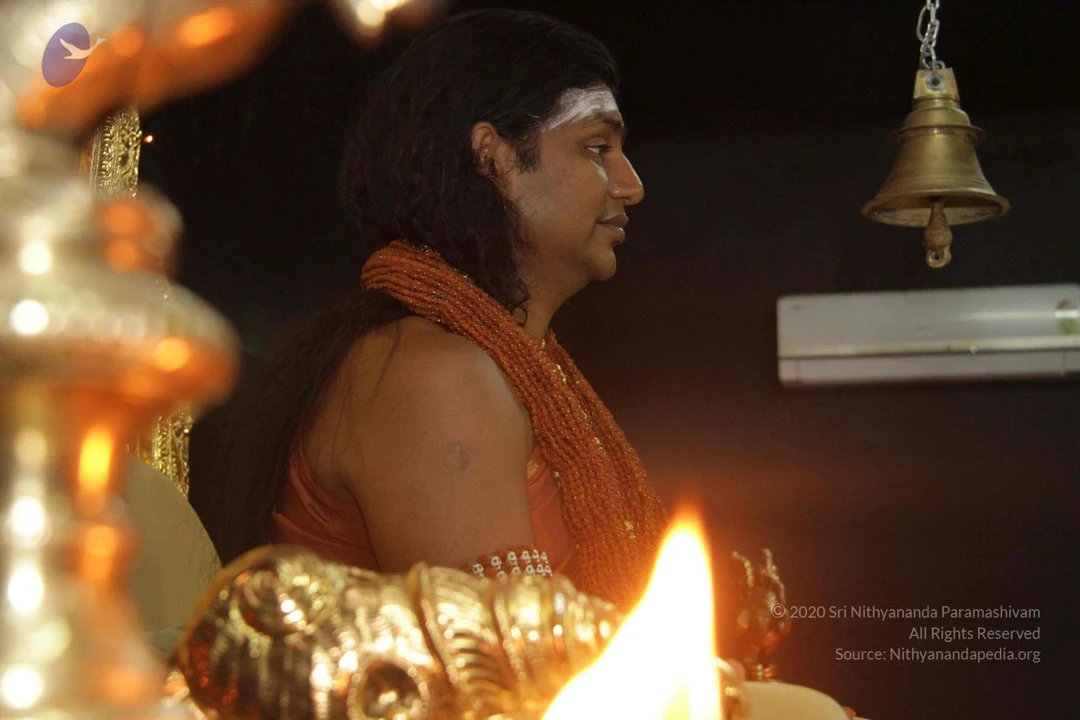
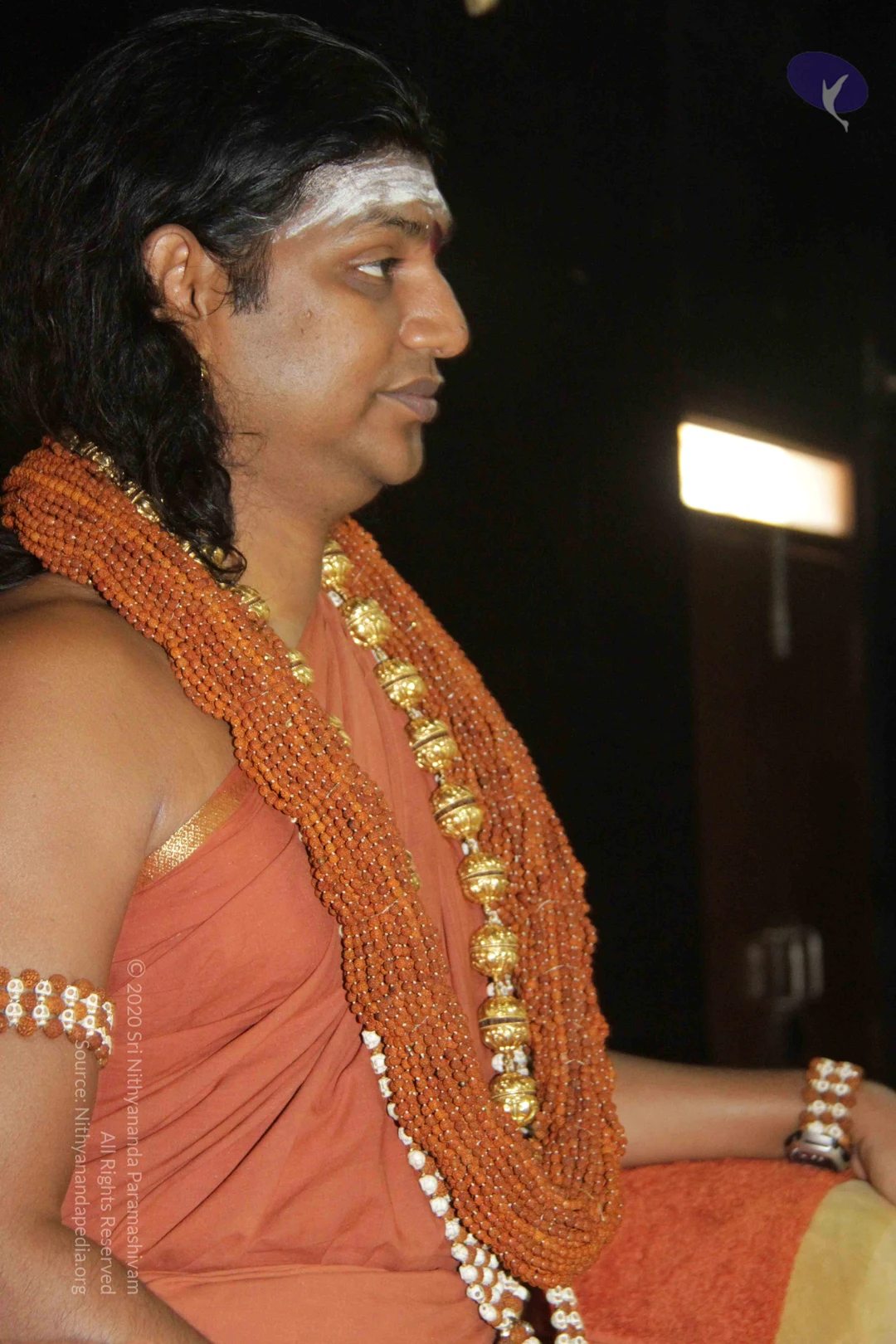
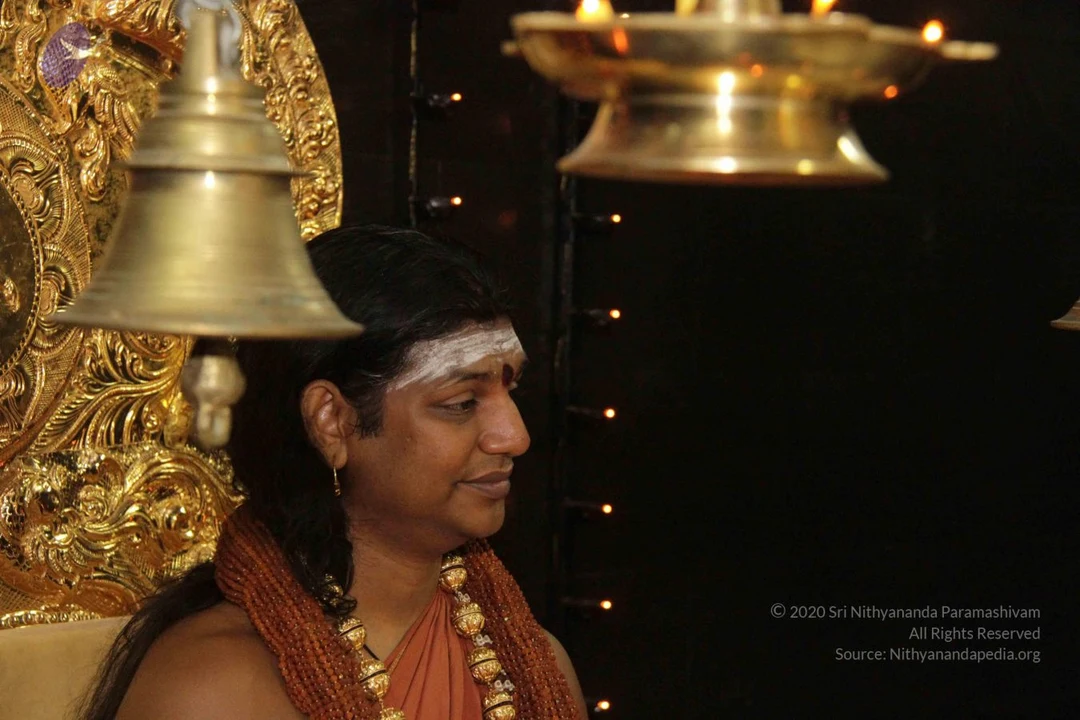
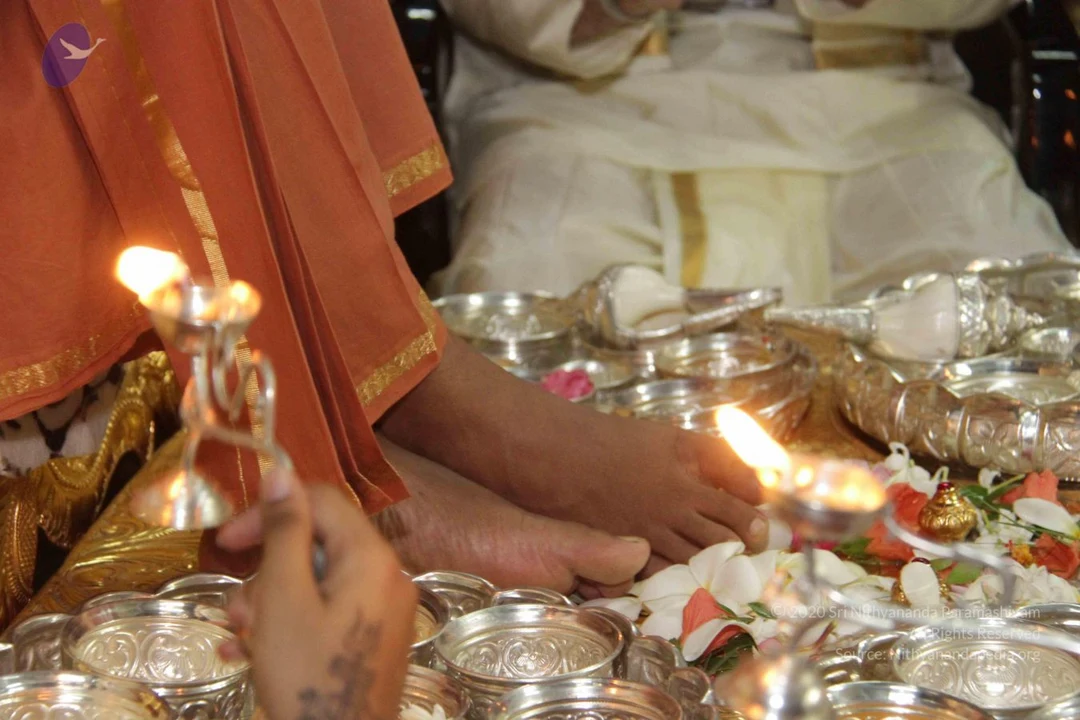
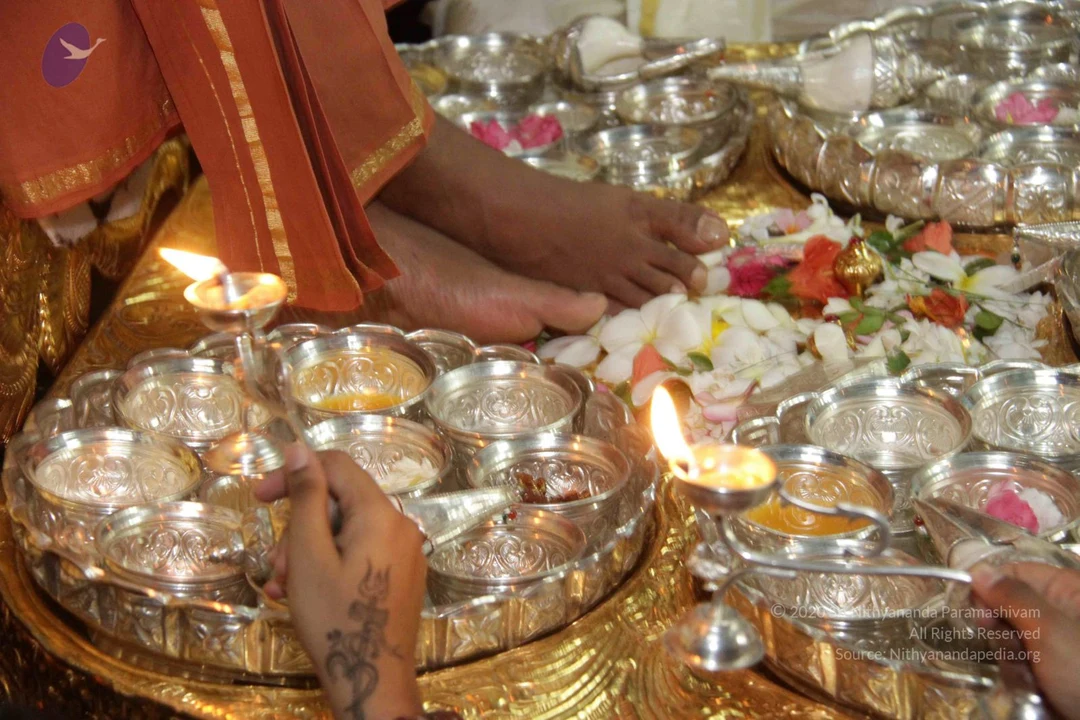
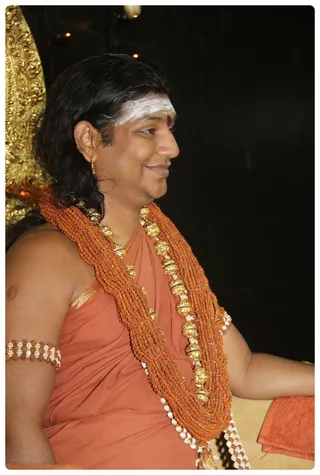
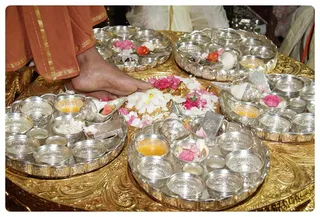
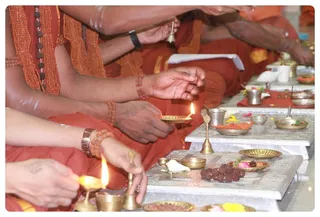
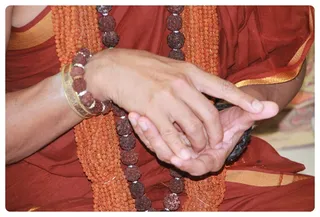
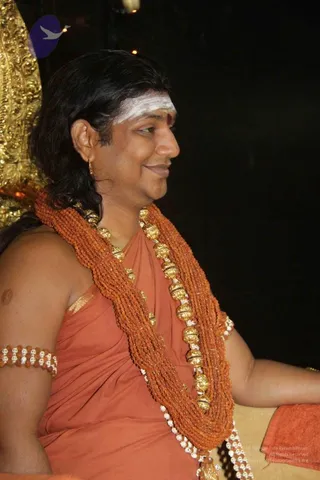
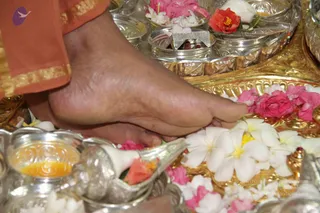
A man seated in profile against a black backdrop beside an ornate gold carved throne. He wears a saffron-orange robe draped over his shoulder, long swept-back black hair, a white vertical forehead marking with a red dot, a small gold earring, and multiple strands of orange rudraksha beads with gold bead ornaments. A white and orange beaded armband is on his upper arm, and an orange cloth rests on the armrest at right. The appearance and ornaments are consistent with the a person (a person) in a seated ceremonial setting.A photograph of a padapuja ritual: a pair of bare feet in orange-red clothing rests on a bed of white and pink flowers placed on a gold tray. Around the feet are multiple ornate silver bowls and plates holding yellow turmeric paste, pink and red petals, rice-like grains and other offerings, arranged on a gold-patterned ceremonial table. Only the feet and lower legs of the person are visible, with a glimpse of white cloth behind.Close view of several people in saffron-orange robes seated in a row at a puja, lighting oil lamps. A person's hand holds a small brass diya with a lit flame at center, and another hand holds a lit lamp at lower left. Each wears rudraksha malas and beaded bracelets. Brass pots, bowls with fruit, flowers and rudraksha beads sit on white stone-topped altar tables along the right side.Close-up photograph of a seated person's hands clasped in a mudra-like gesture over the lap, wearing a rust-red robe with gold border and several strands of orange rudraksha-style beads and dark rudraksha beads worn across the chest. A gold bangle and a dark rudraksha bracelet are visible on the wrist. The body is cropped out of frame, so no face is shown. Only hands and garments are visible.A large group of saffron-robed sannyasis sits on the floor in rows, many with shaved heads and white tilak marks on their foreheads, and rudraksha malas around their necks. They hold lit oil lamps and small brass dishes of offerings, performing a lamp-lighting ritual. Brass puja plates and kalasha-style vessels with flowers sit on low trays in front of them, and a red curtain hangs on the left wall. Several seated men in orange and white ritual clothes and a few standing figures in the background complete the scene, indicating an ashram ritual gathering.

Morning Satsangh Live in Sadhna TV

3 photosSource gallery
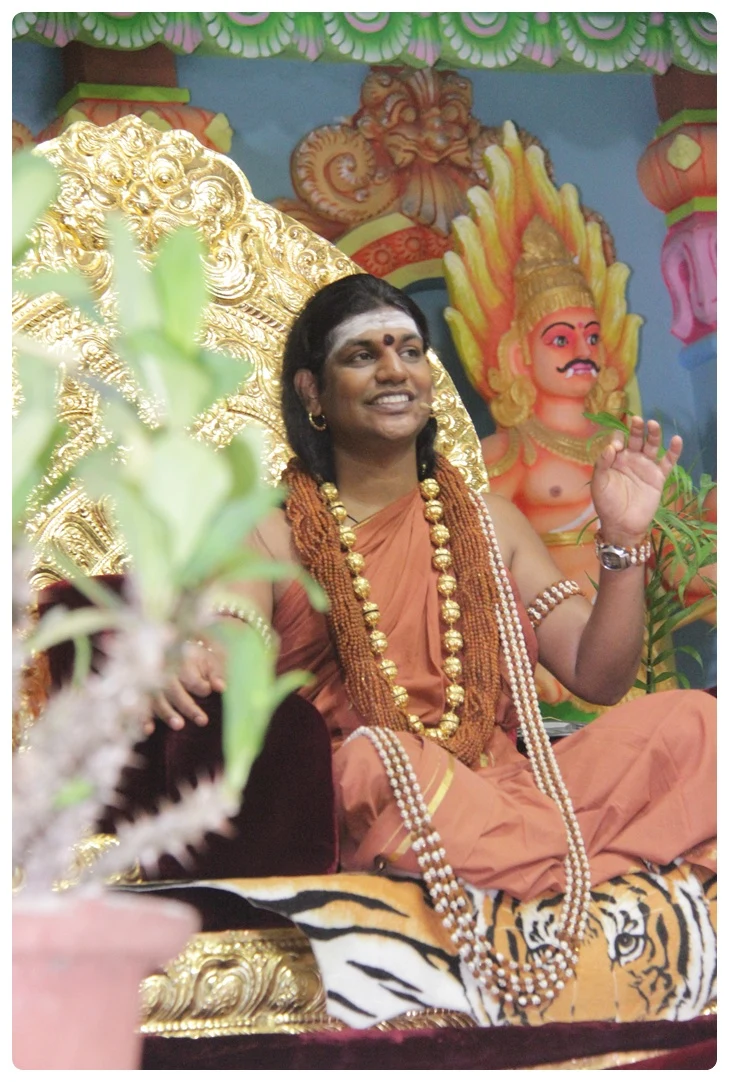
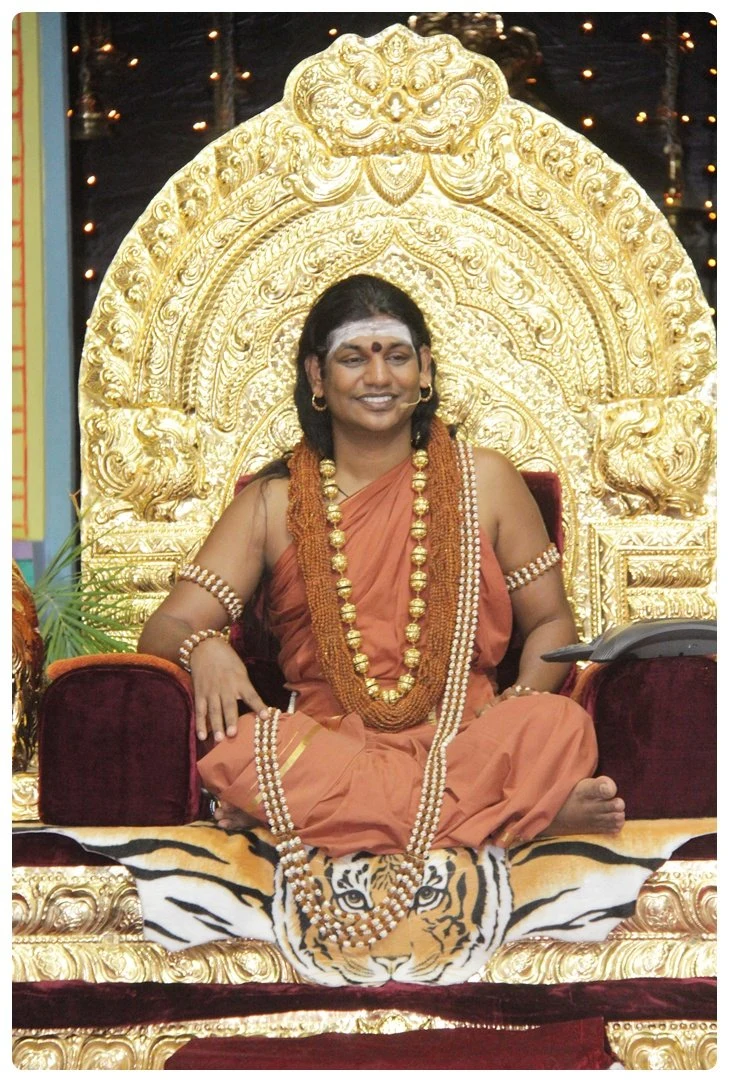
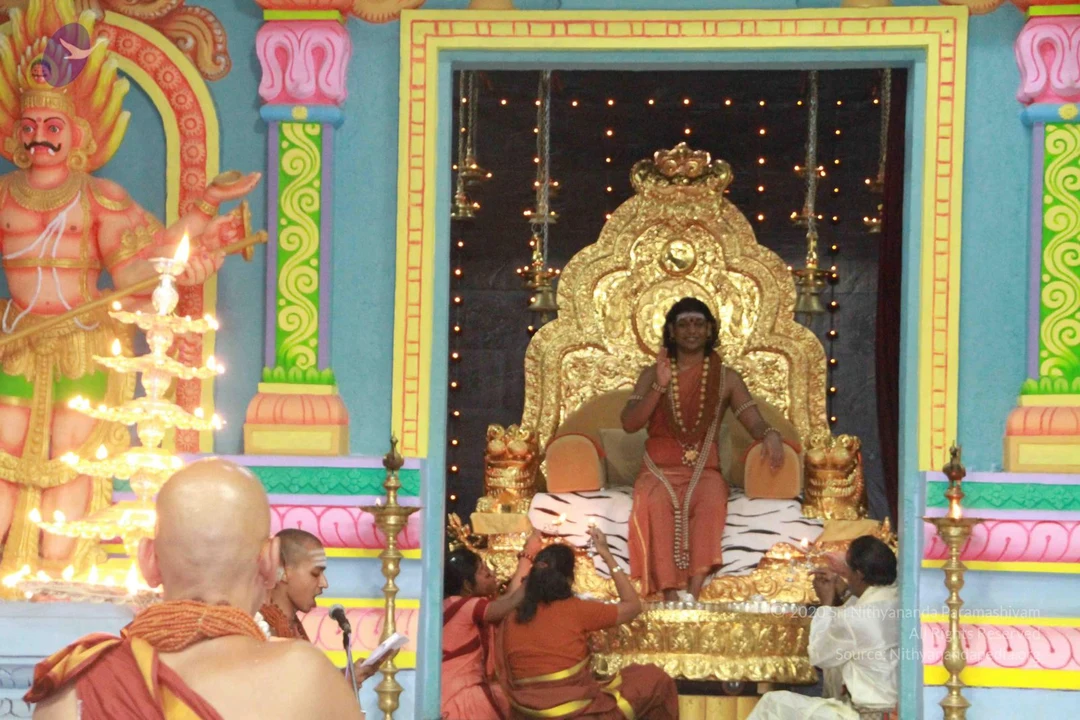
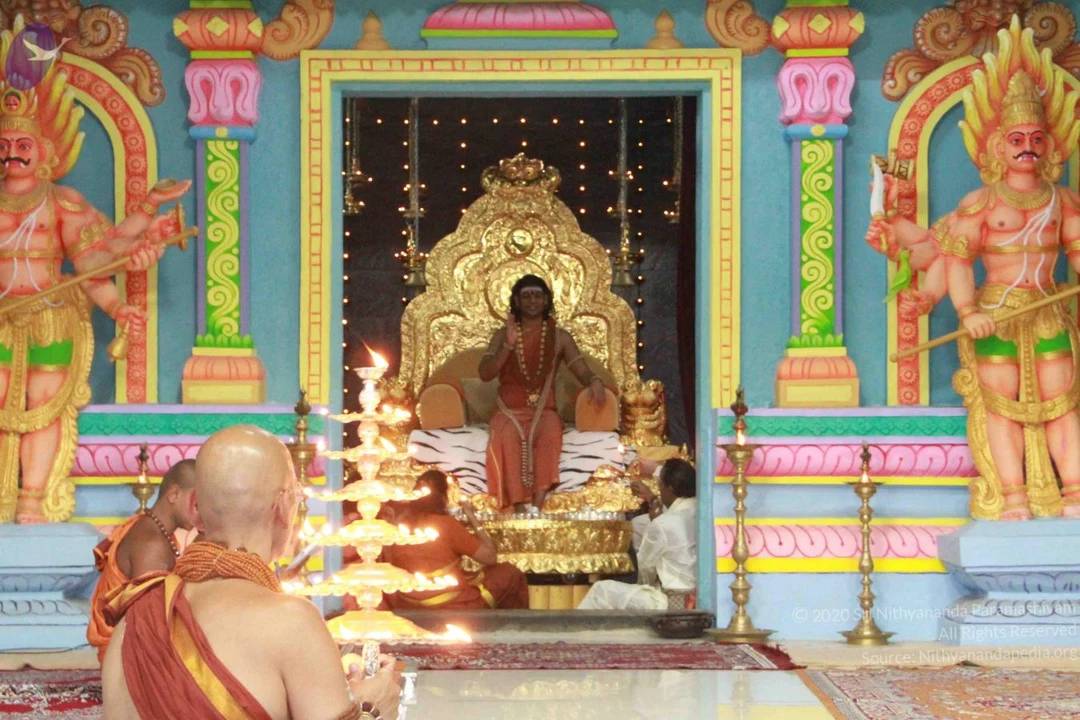
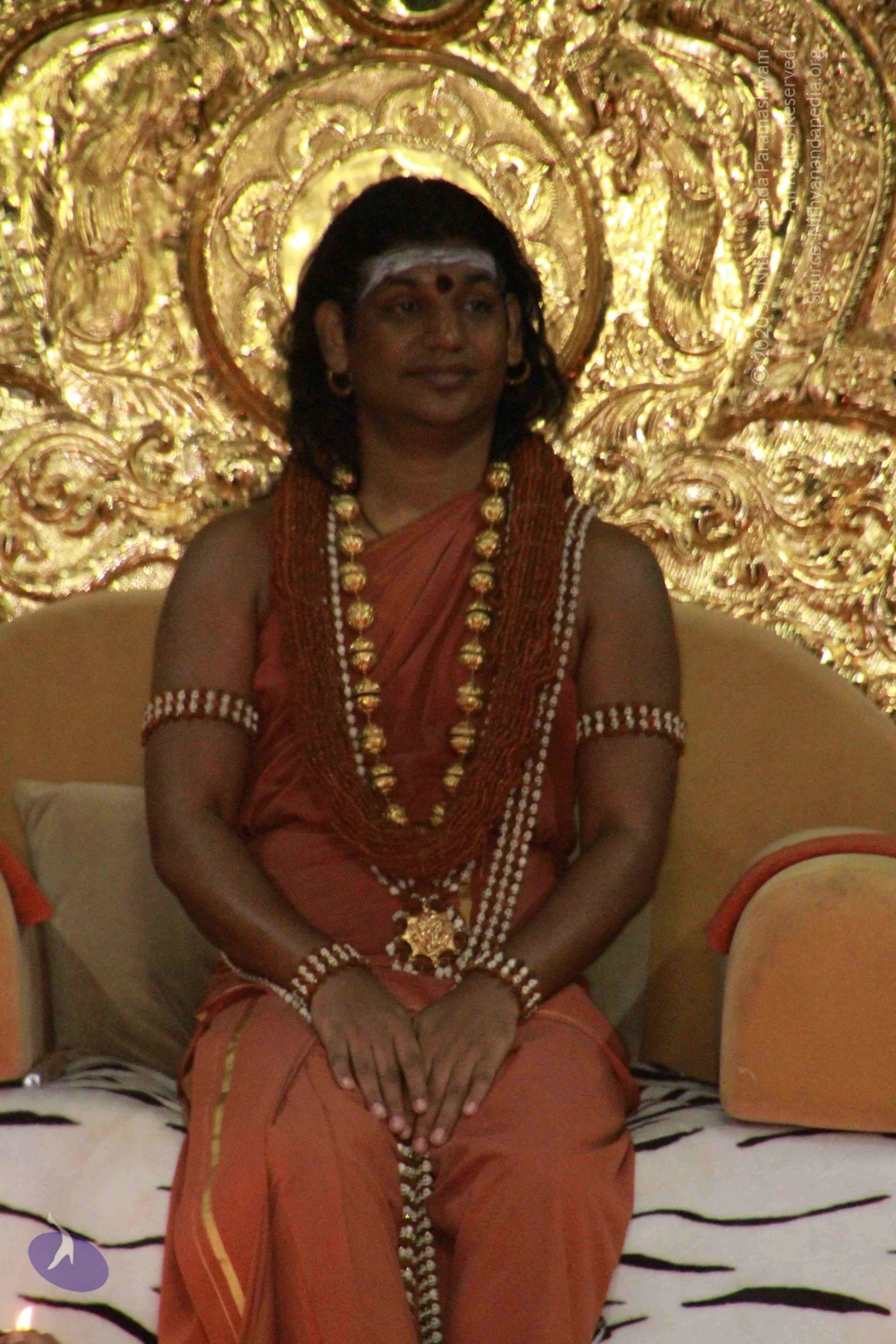
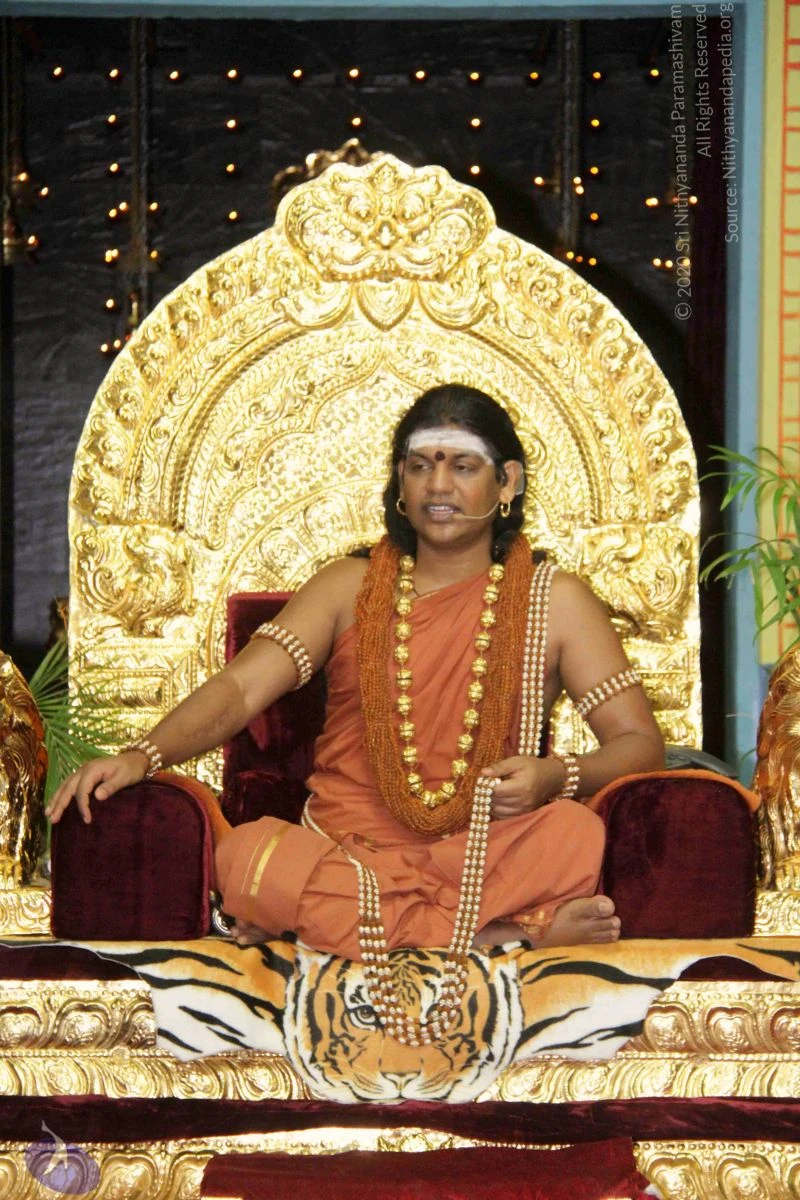
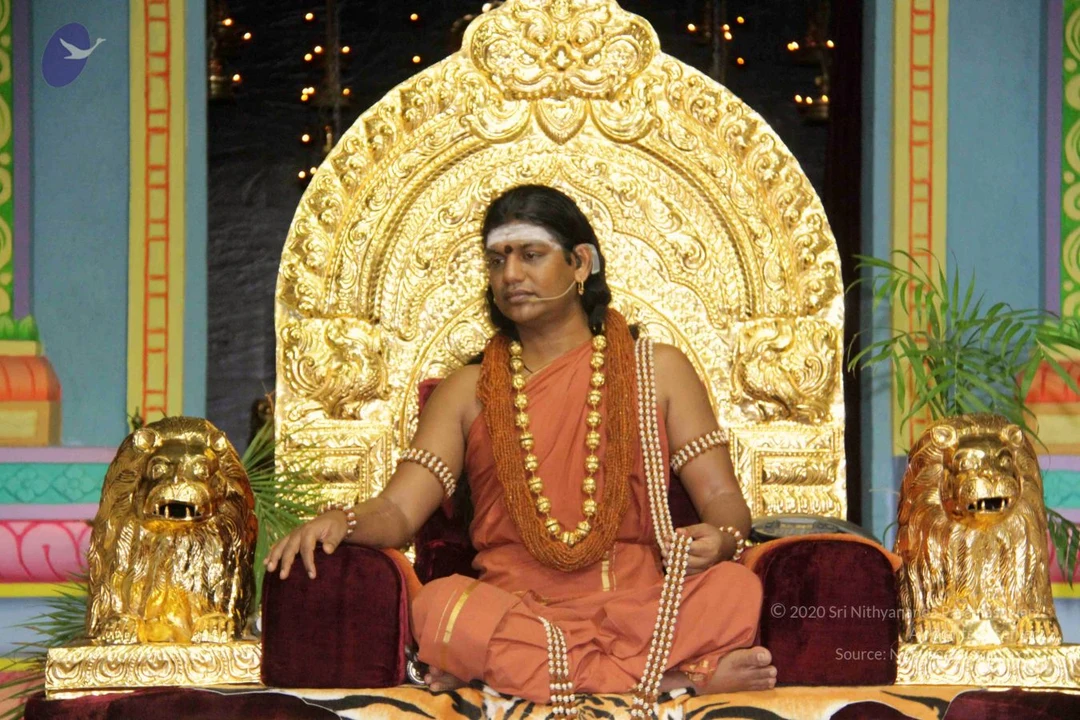
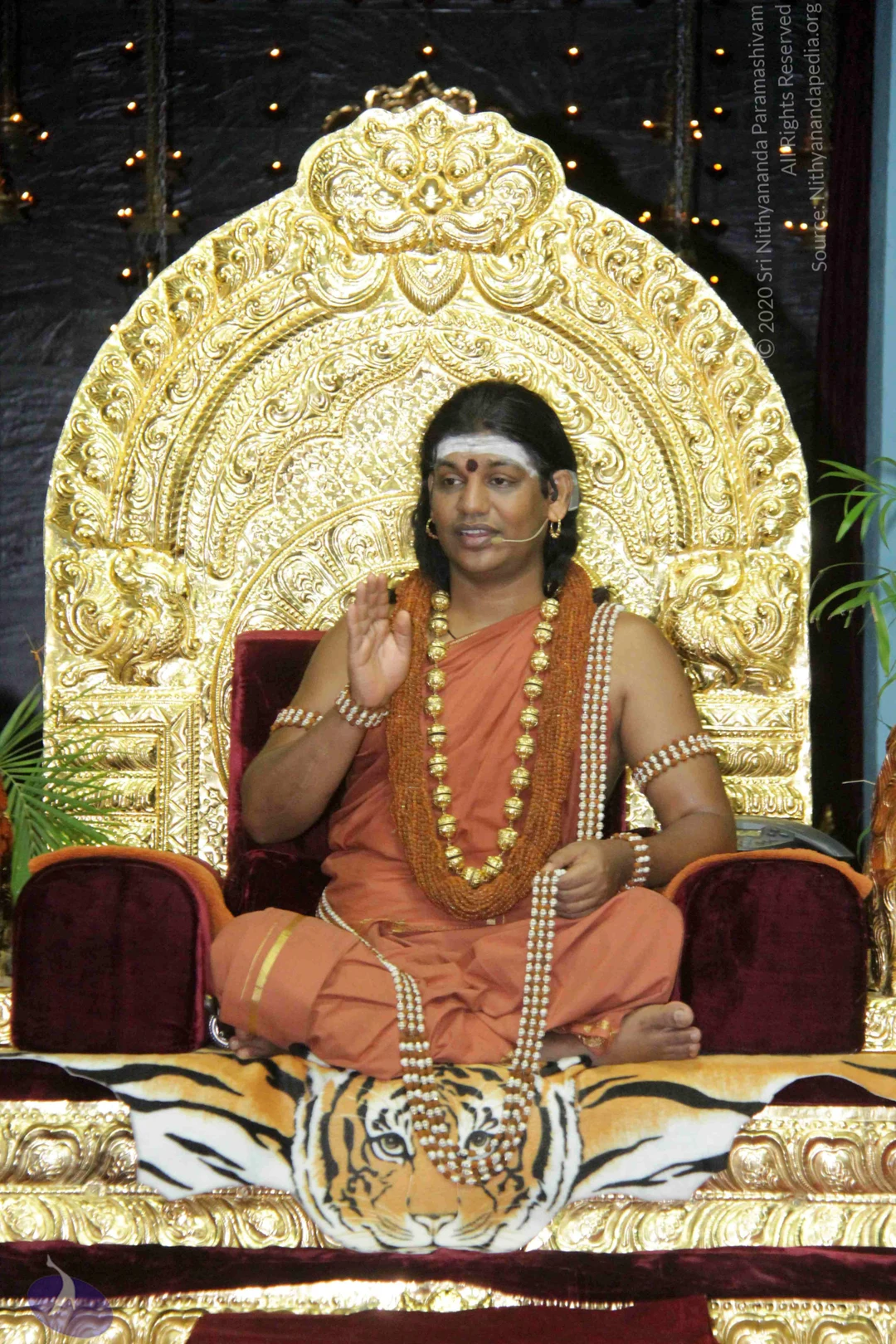
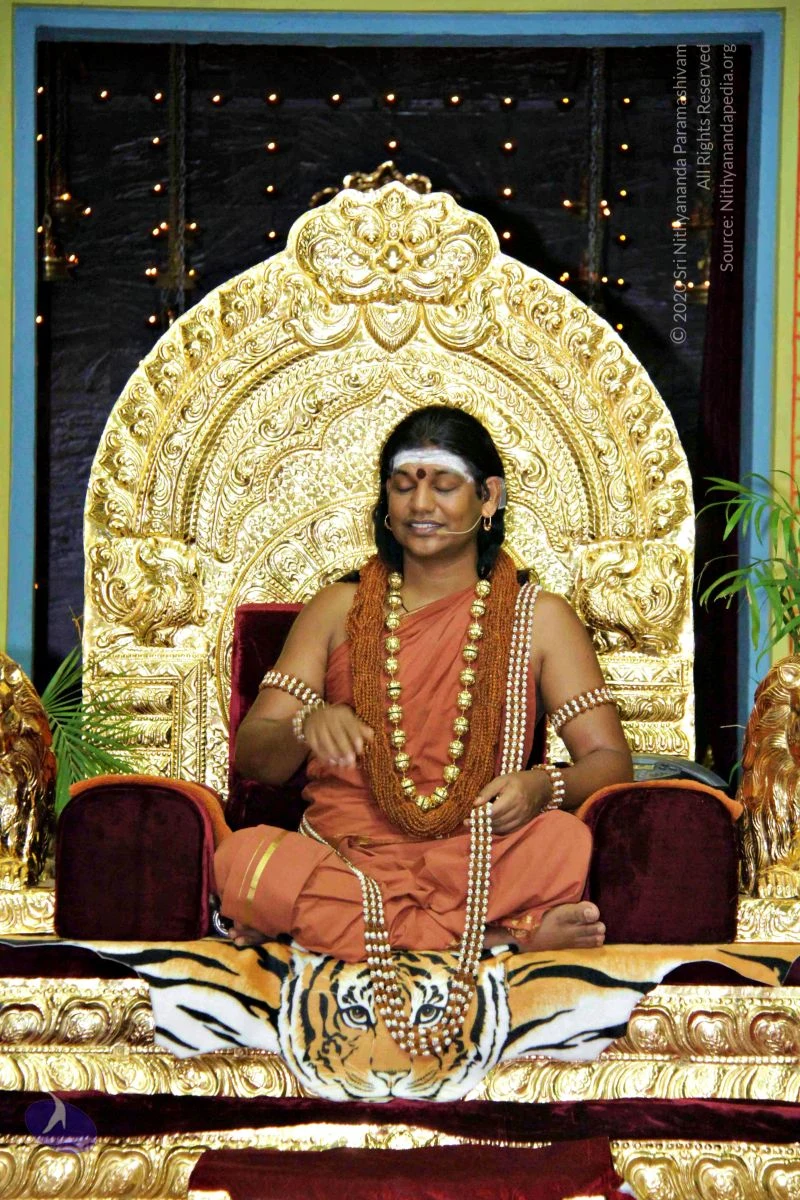
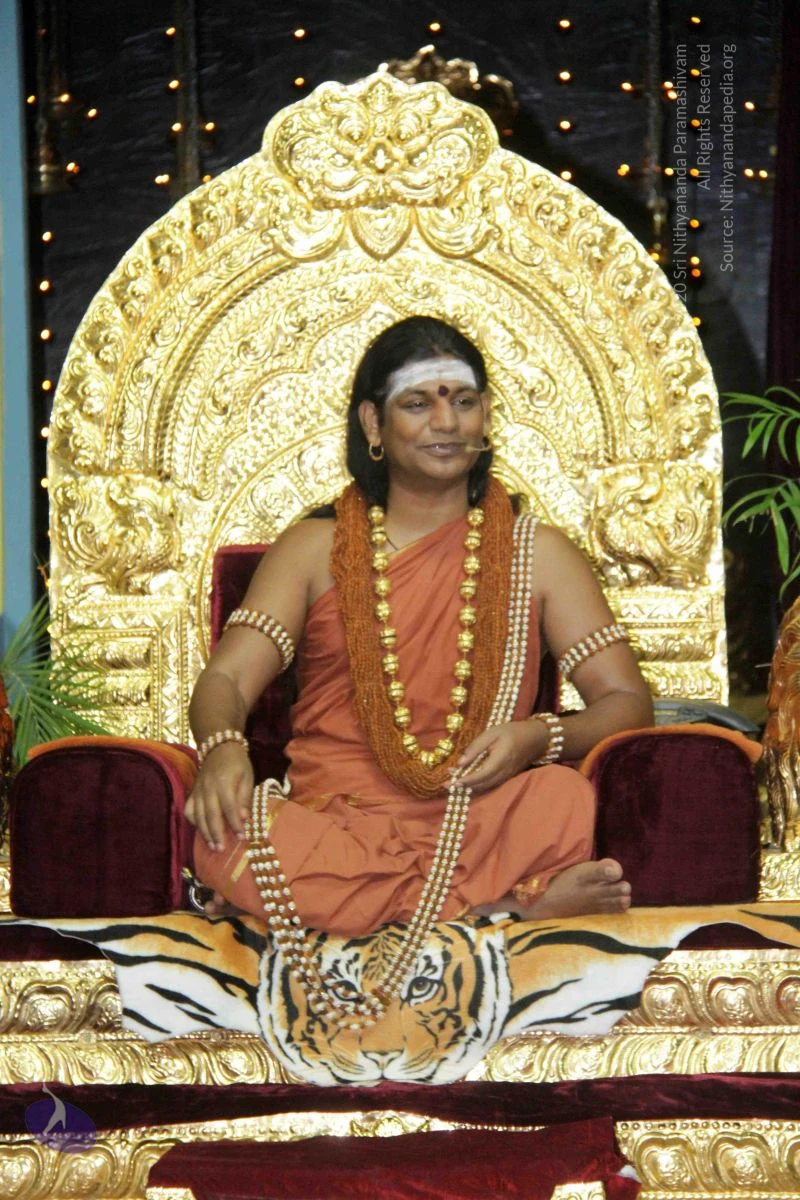
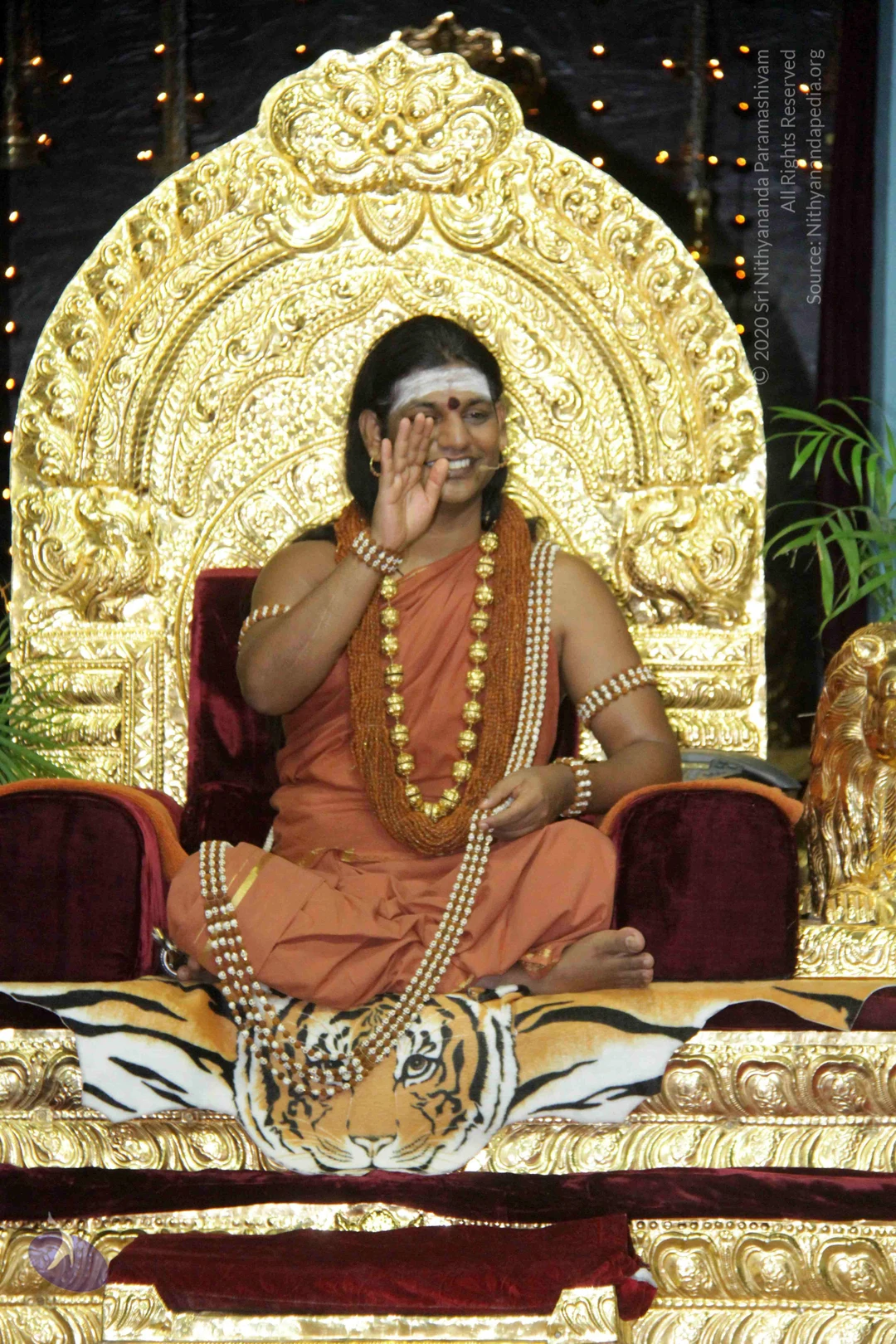
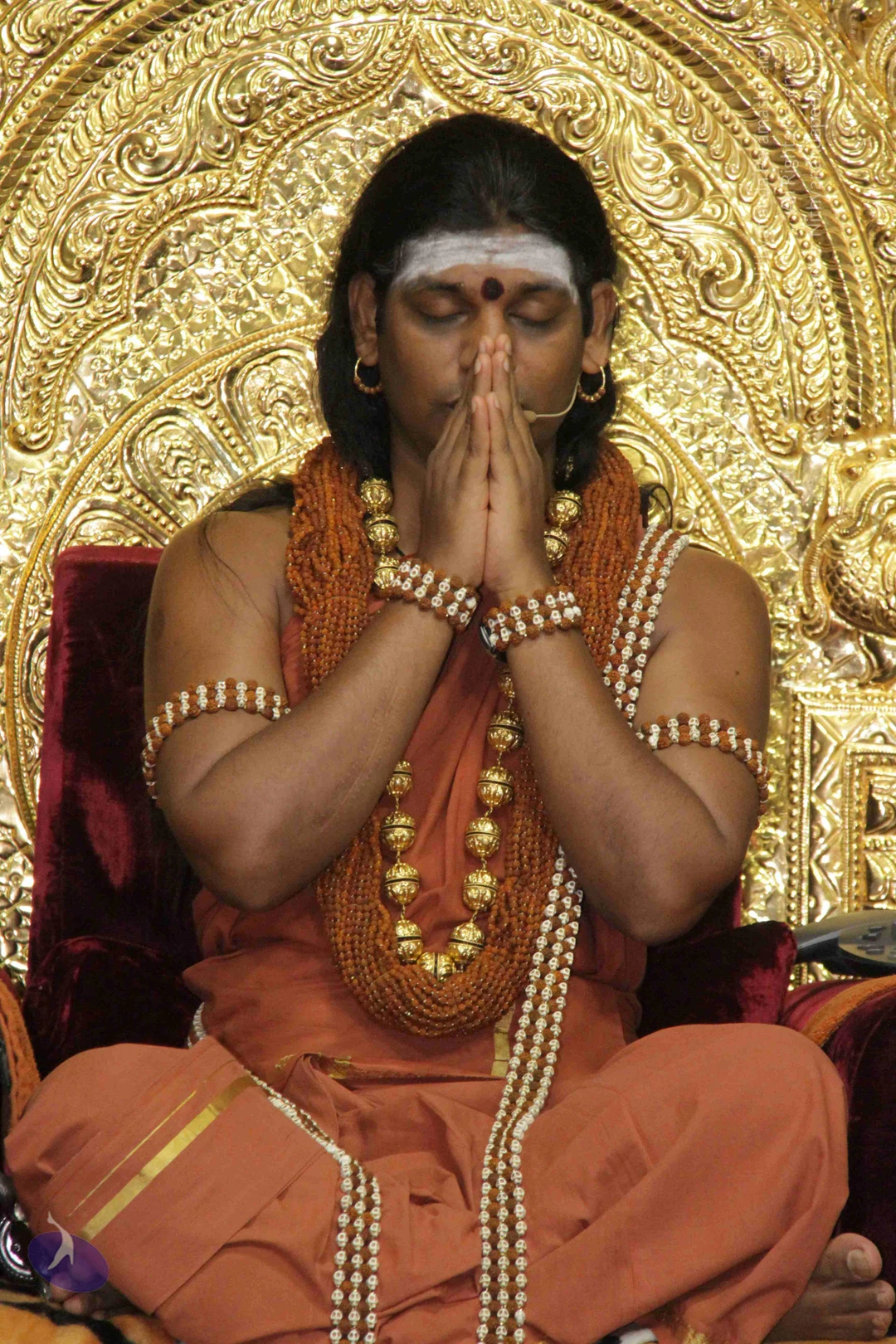
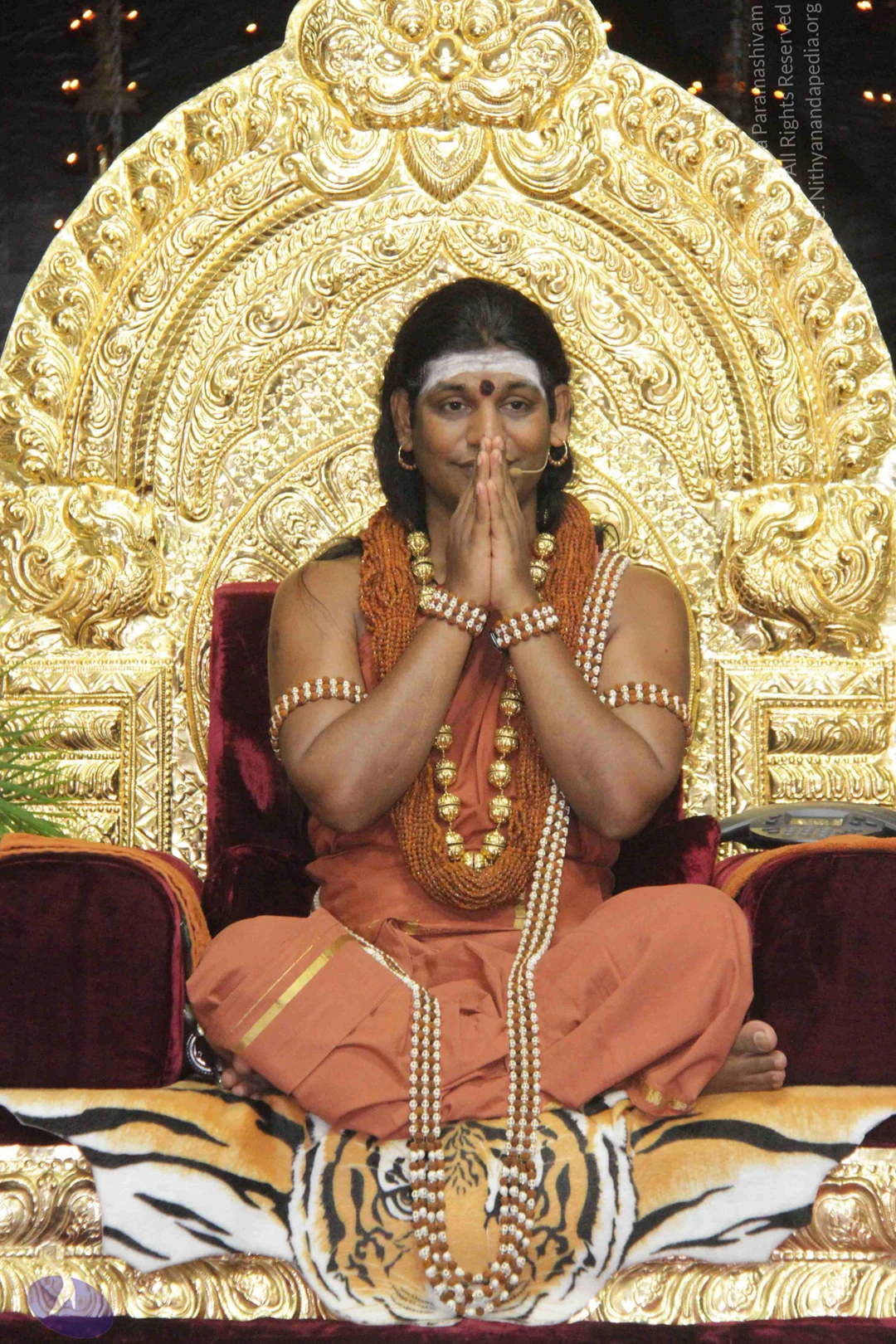
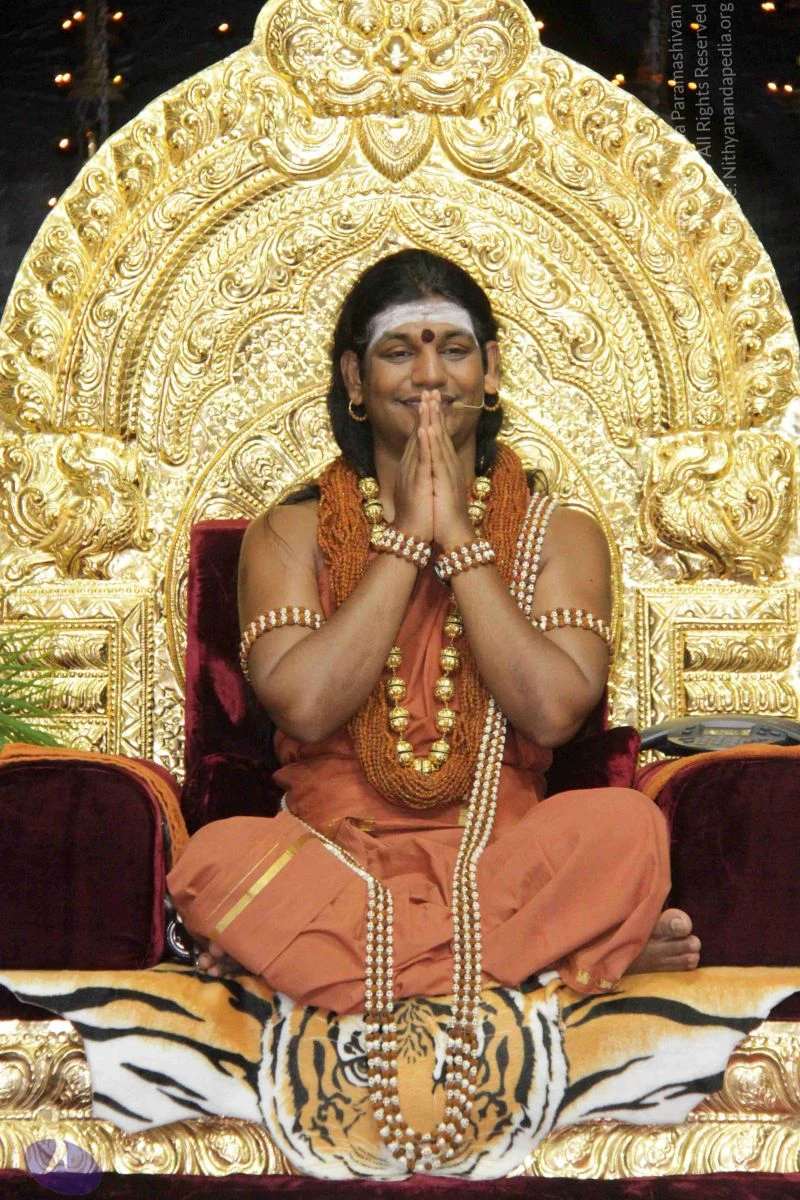
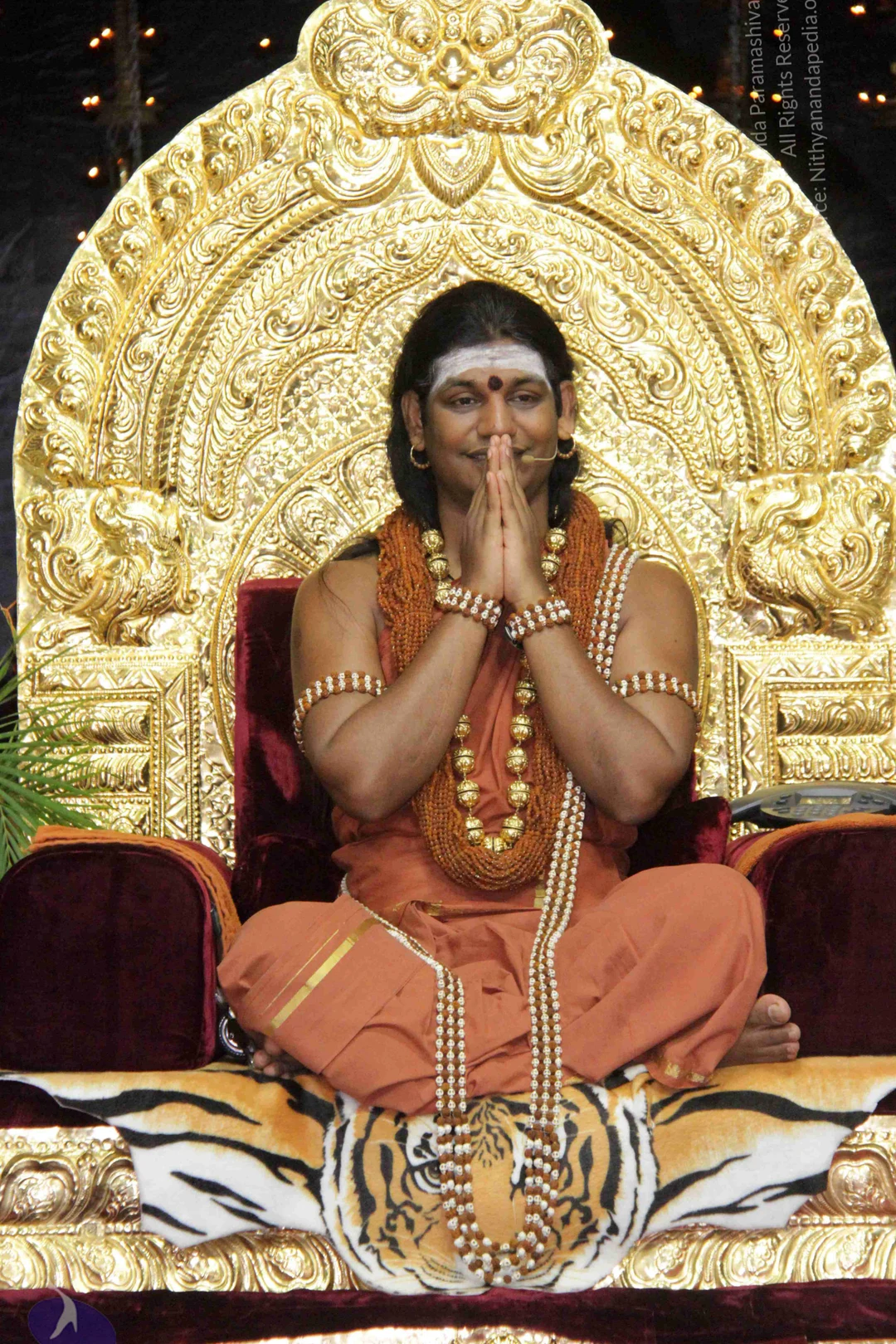
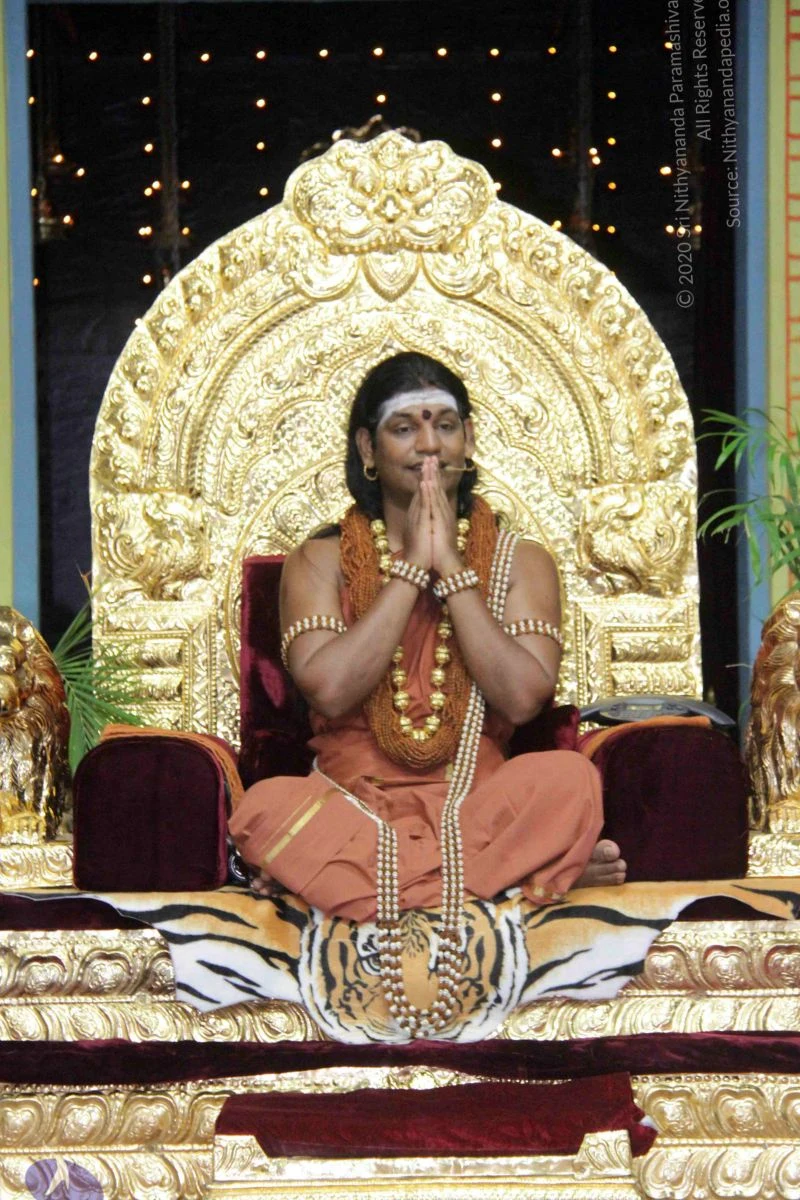
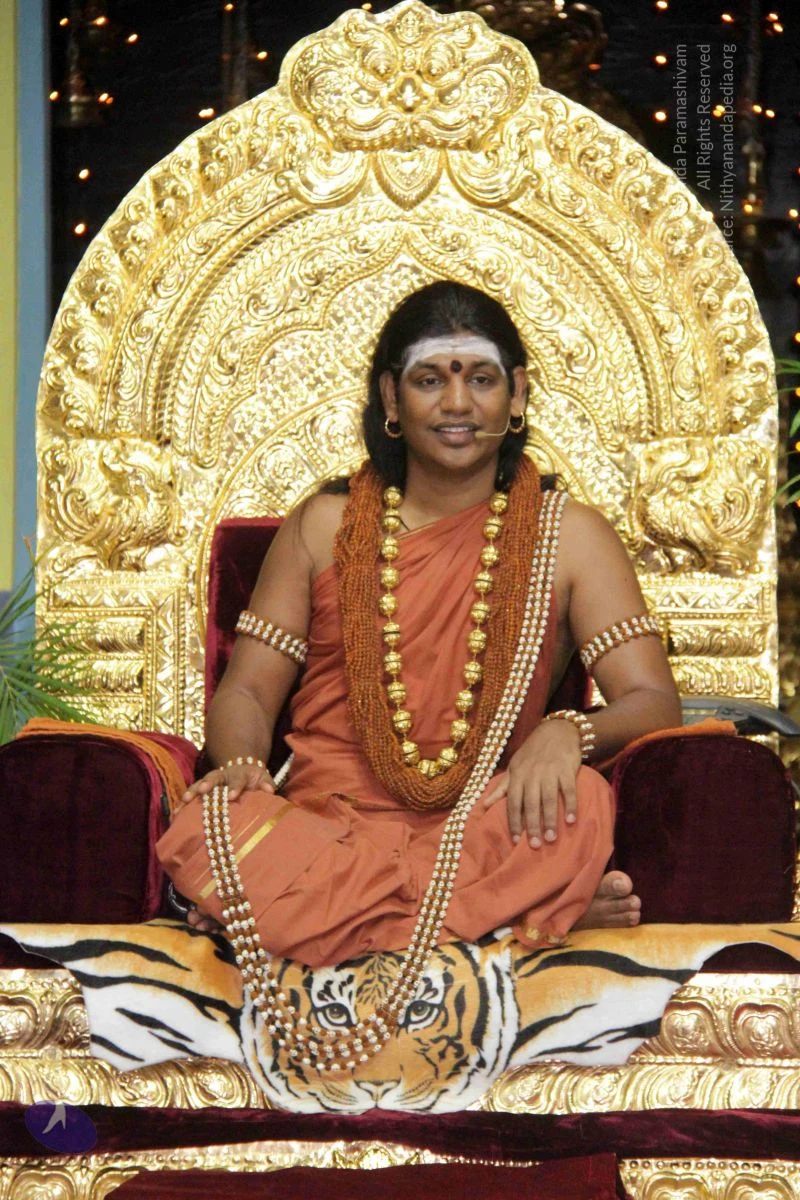
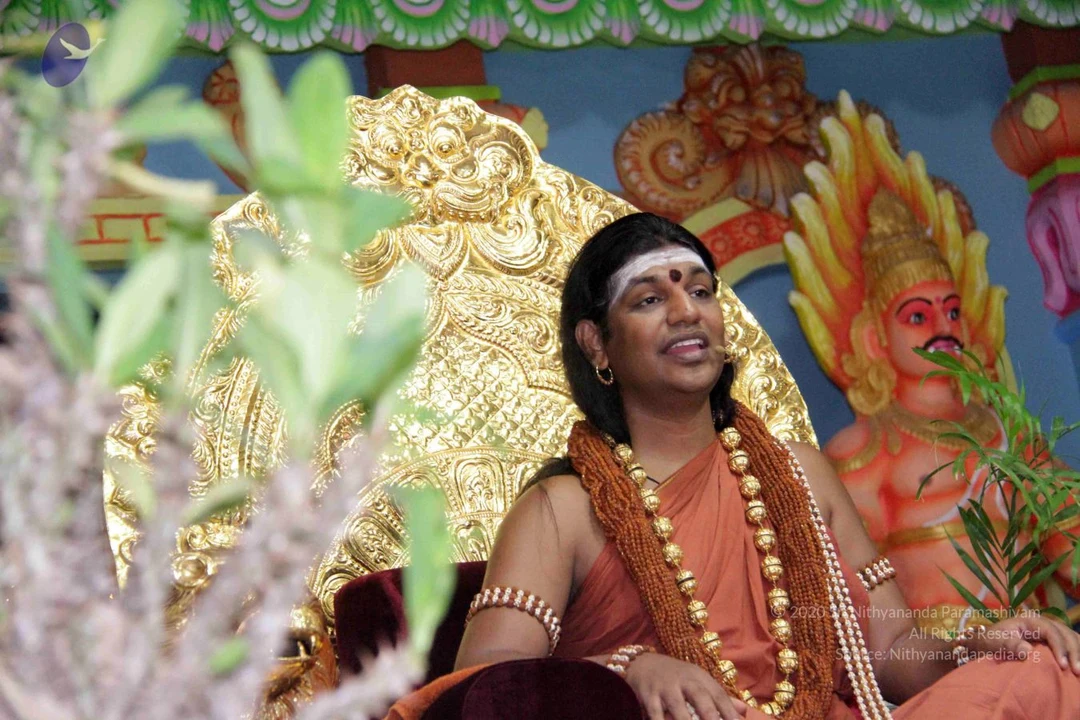
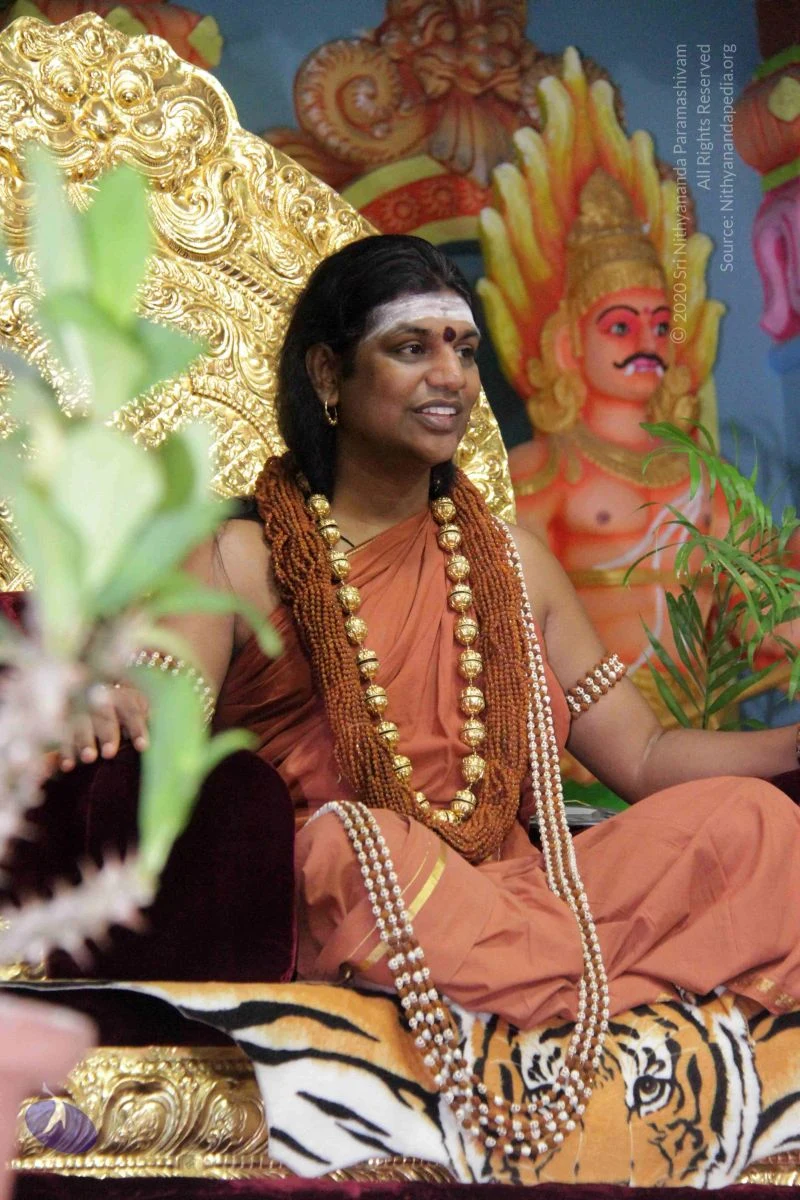
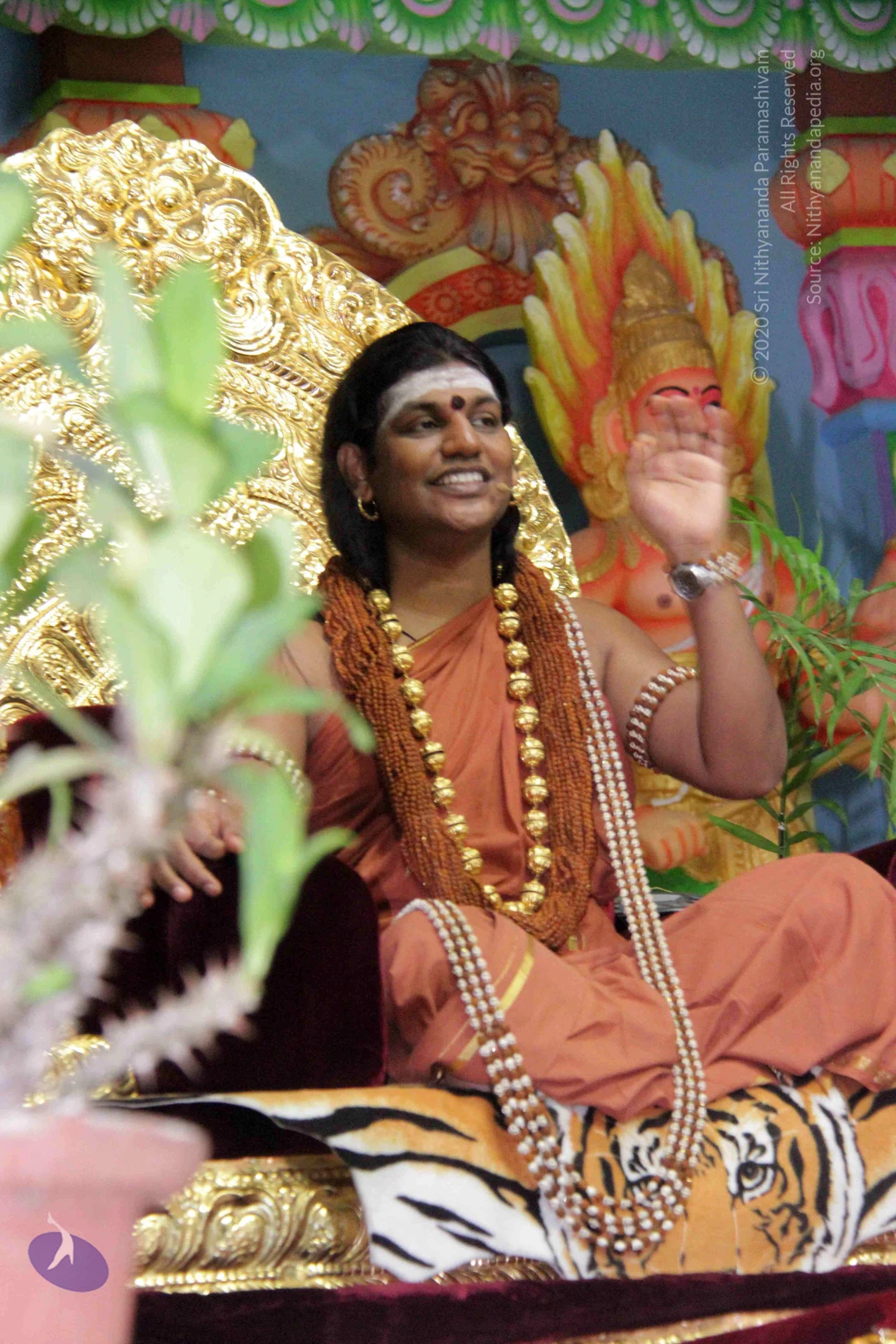
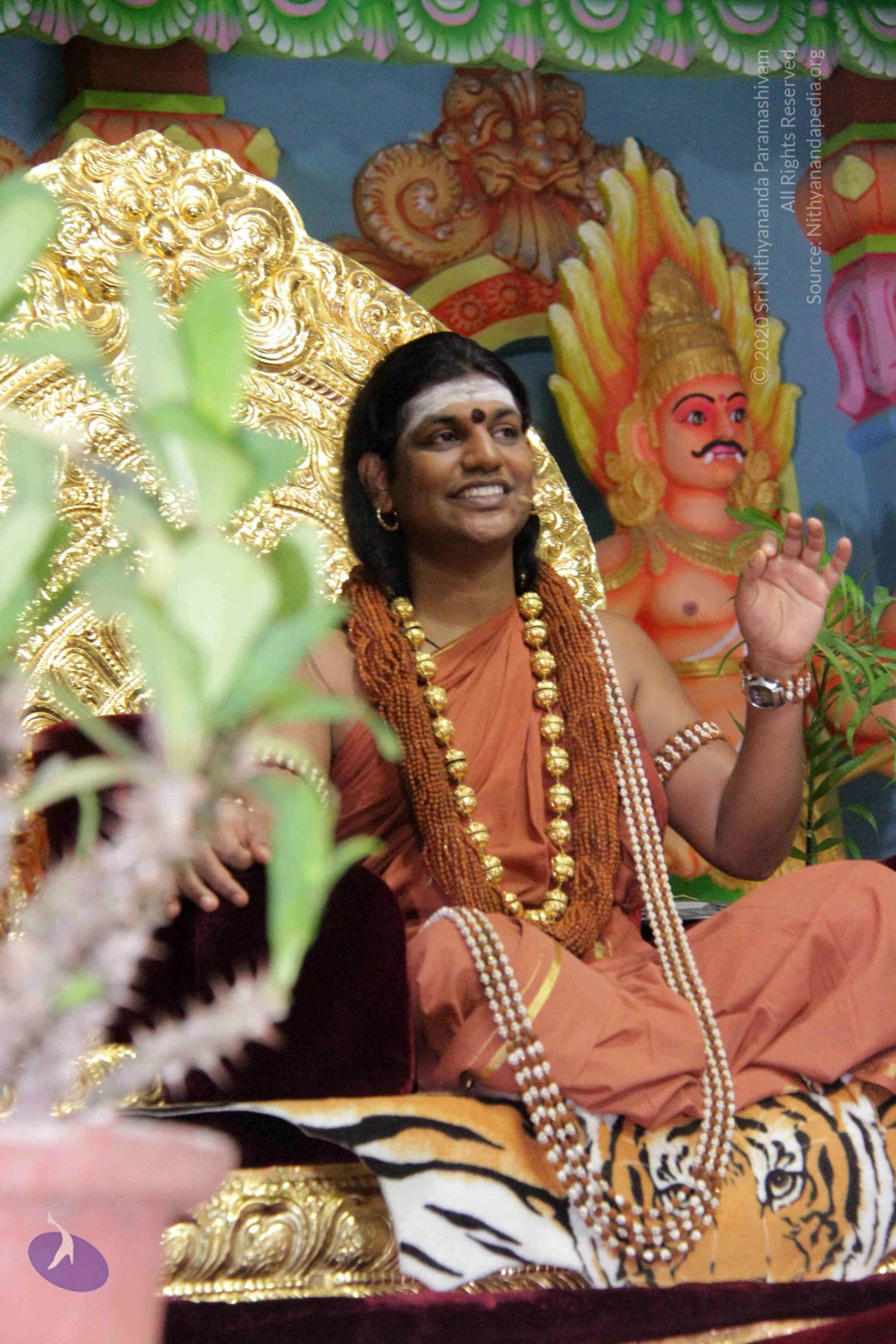
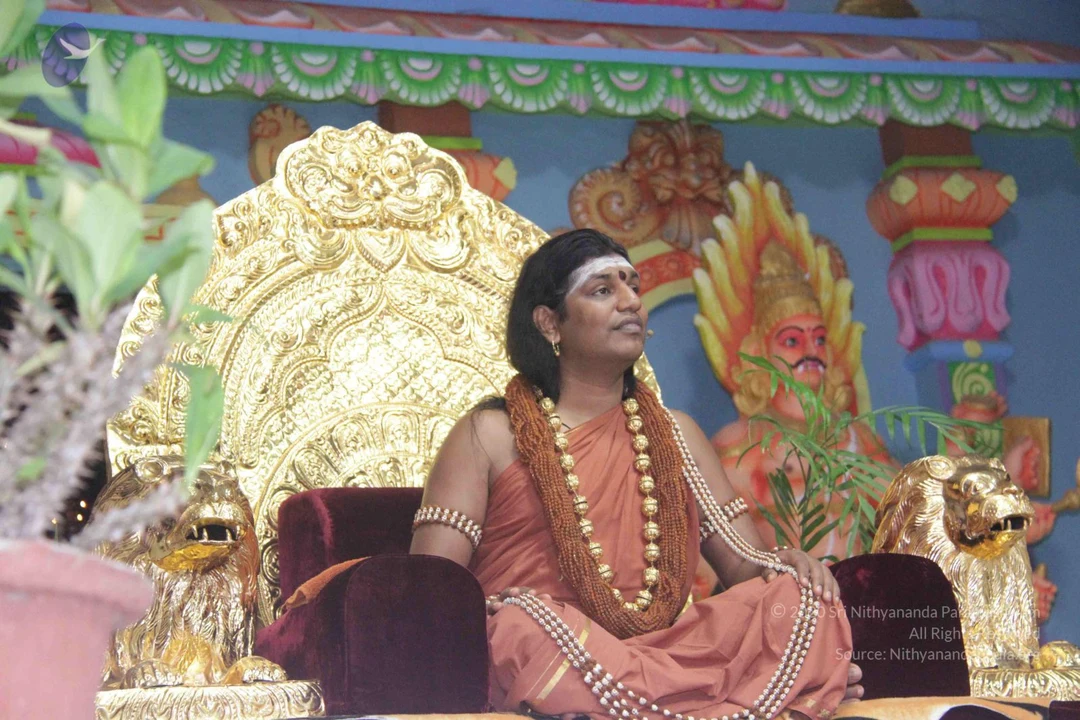
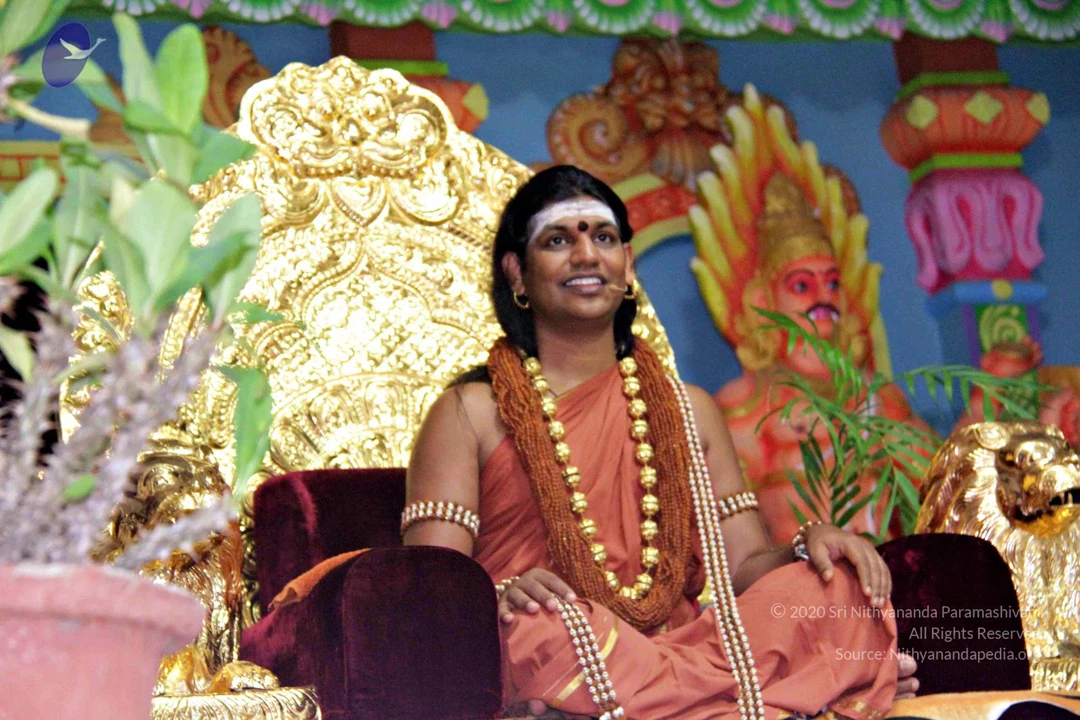
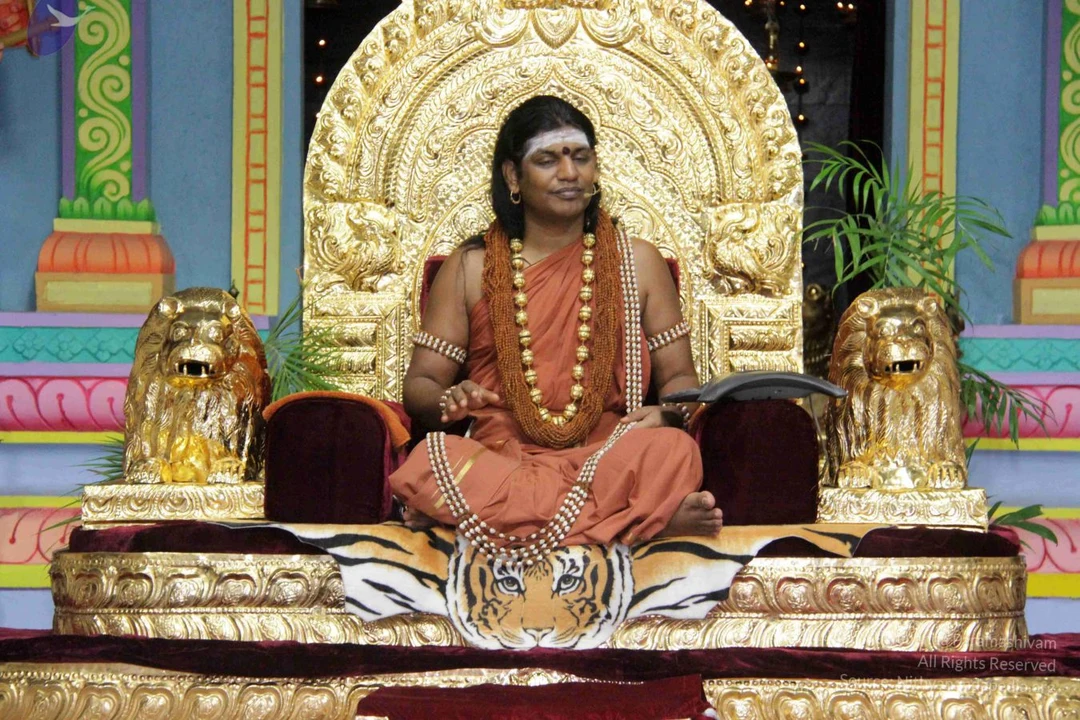
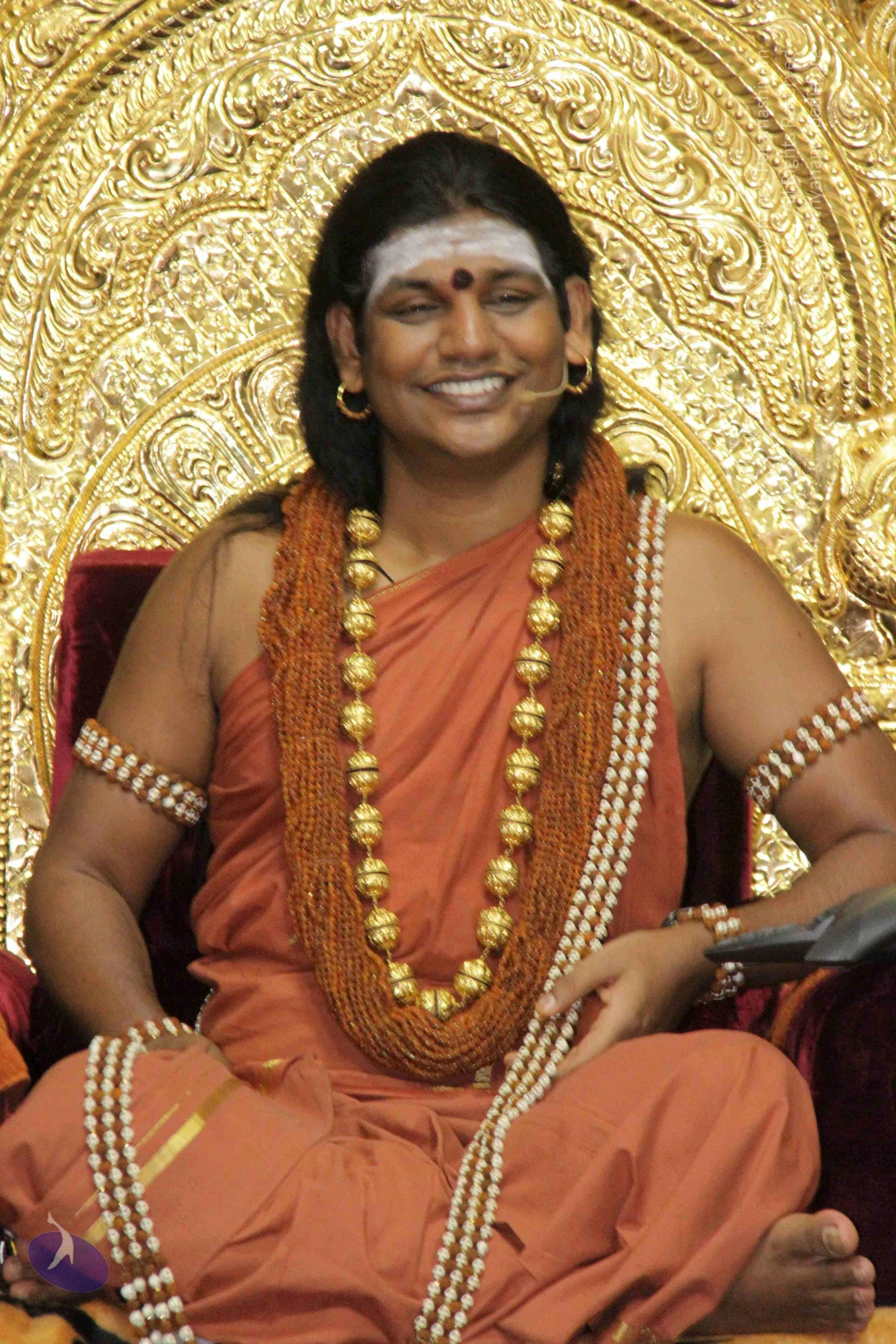
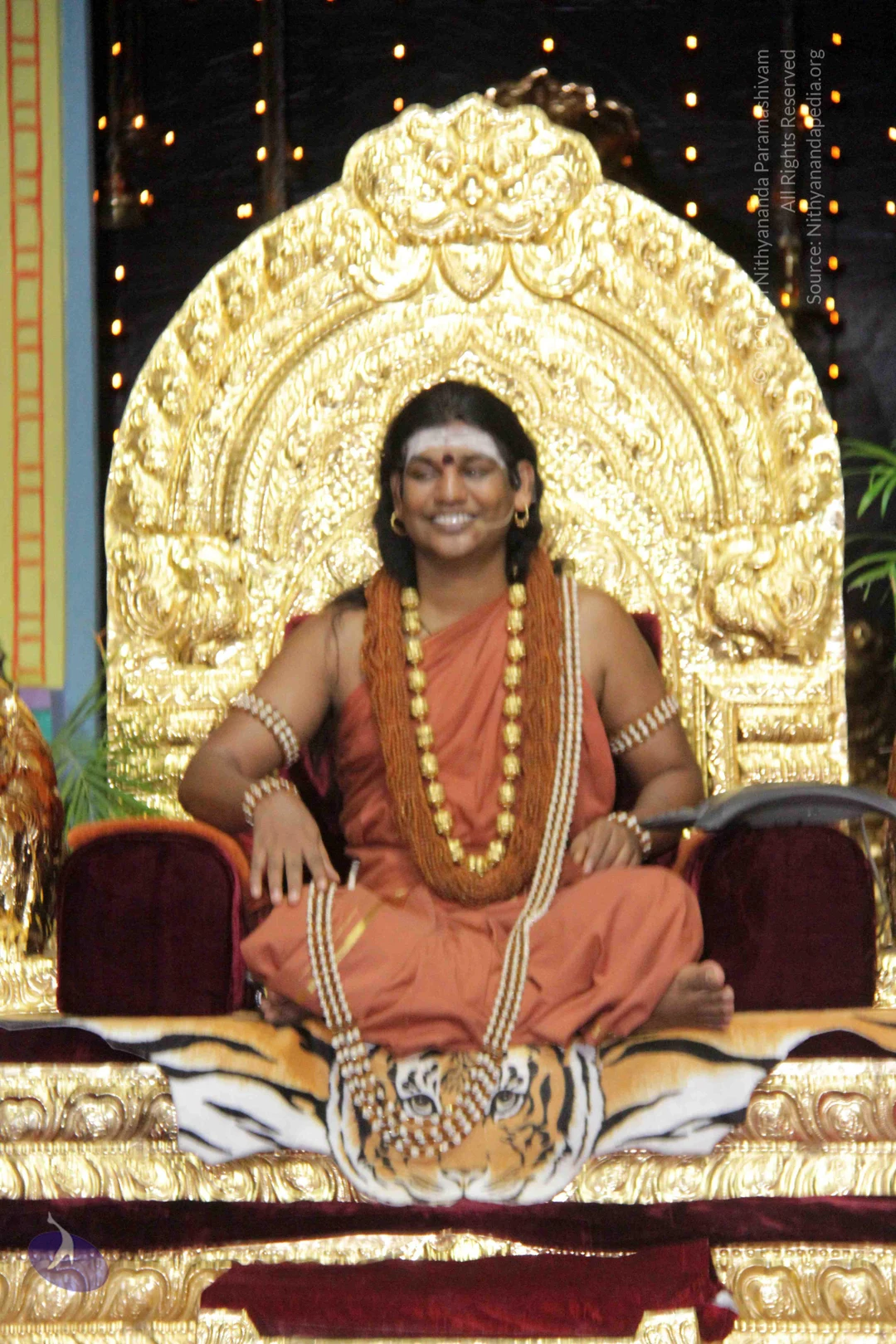
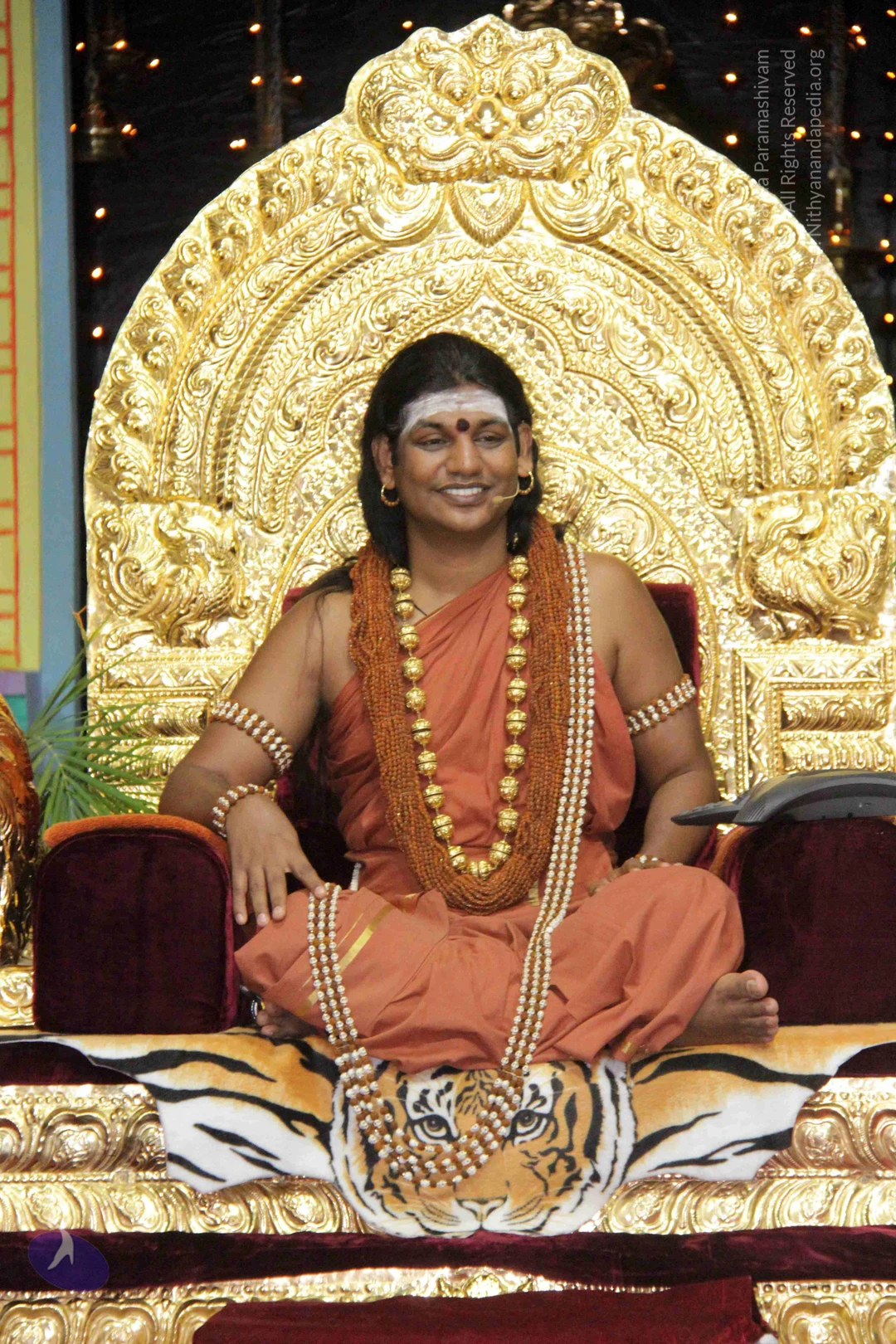
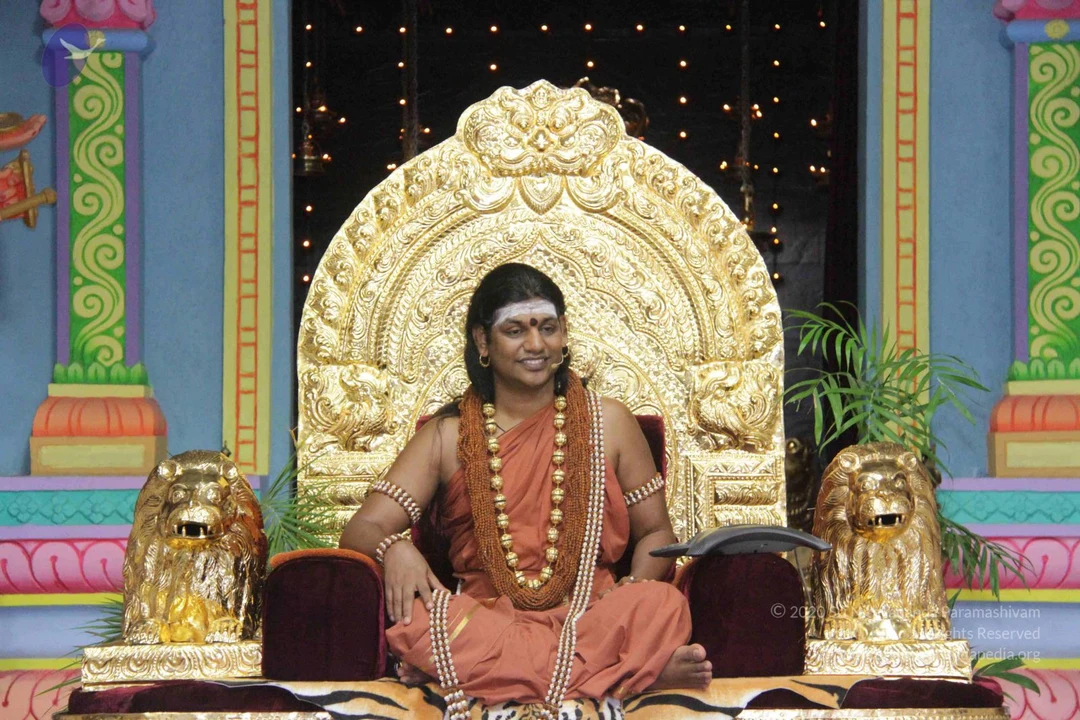
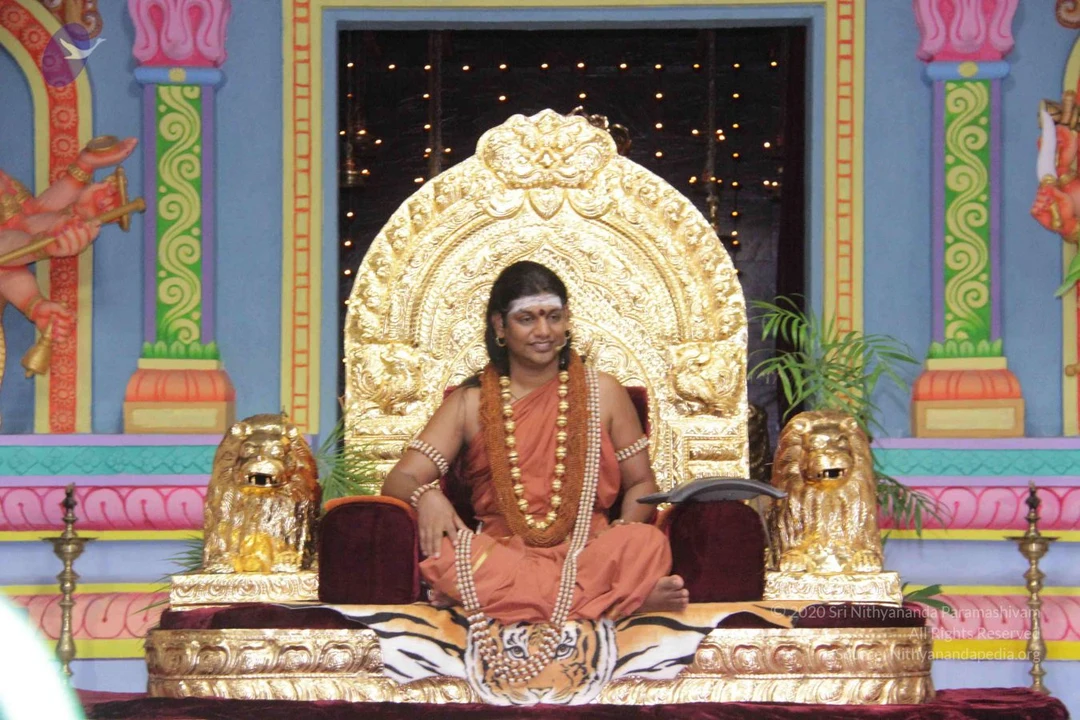
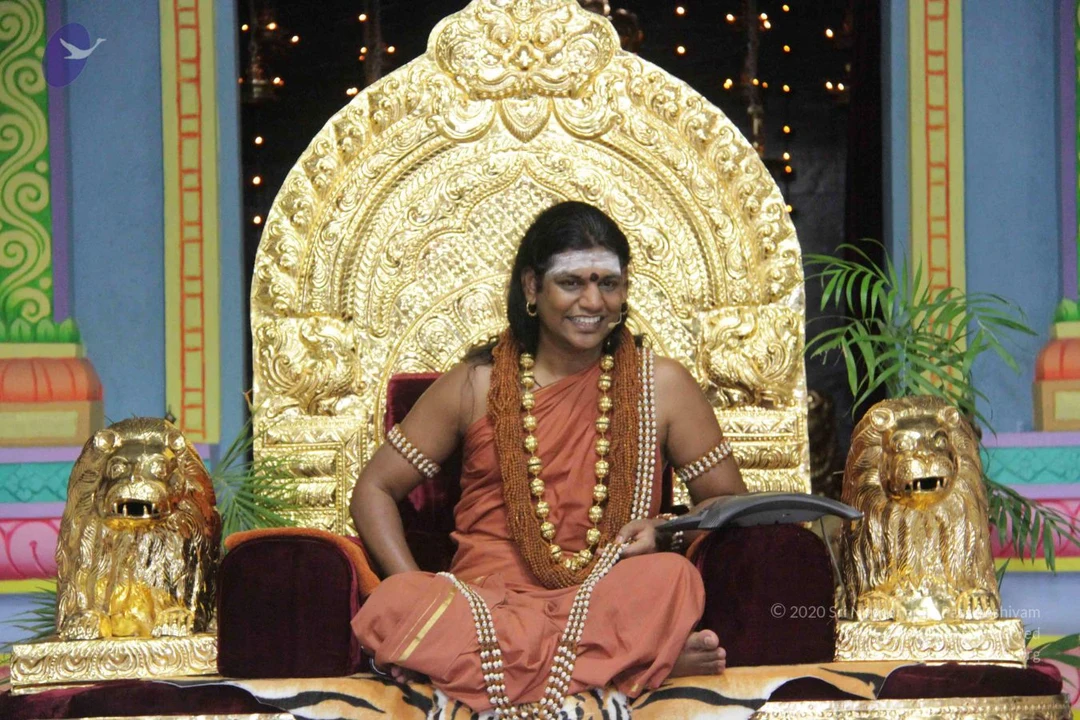
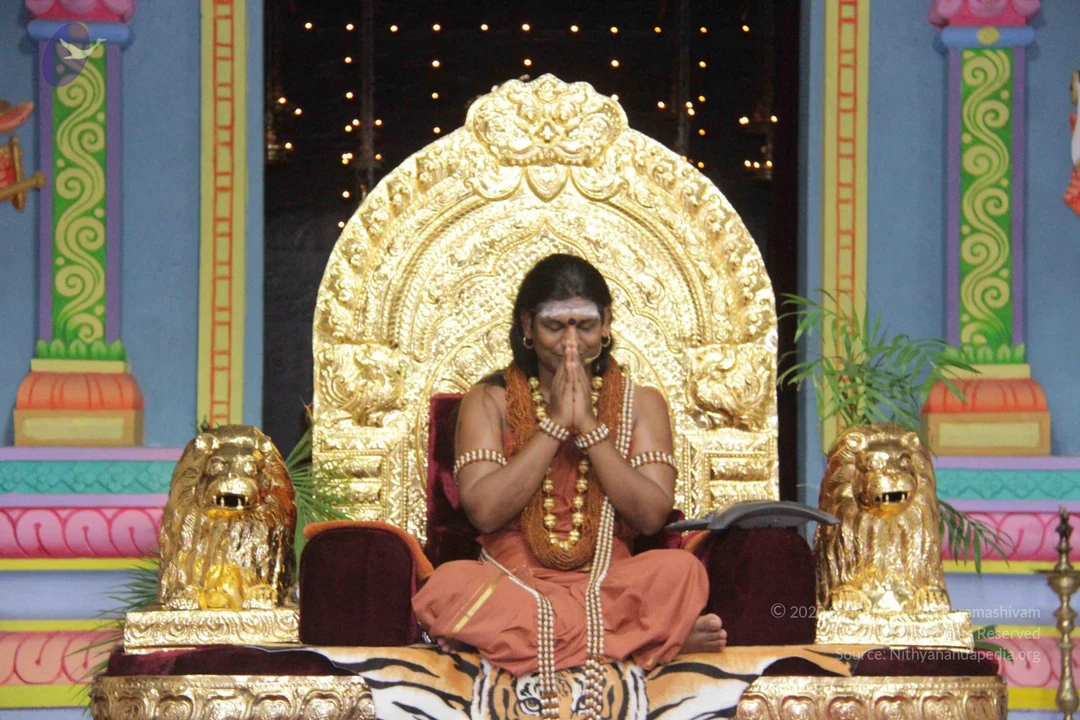
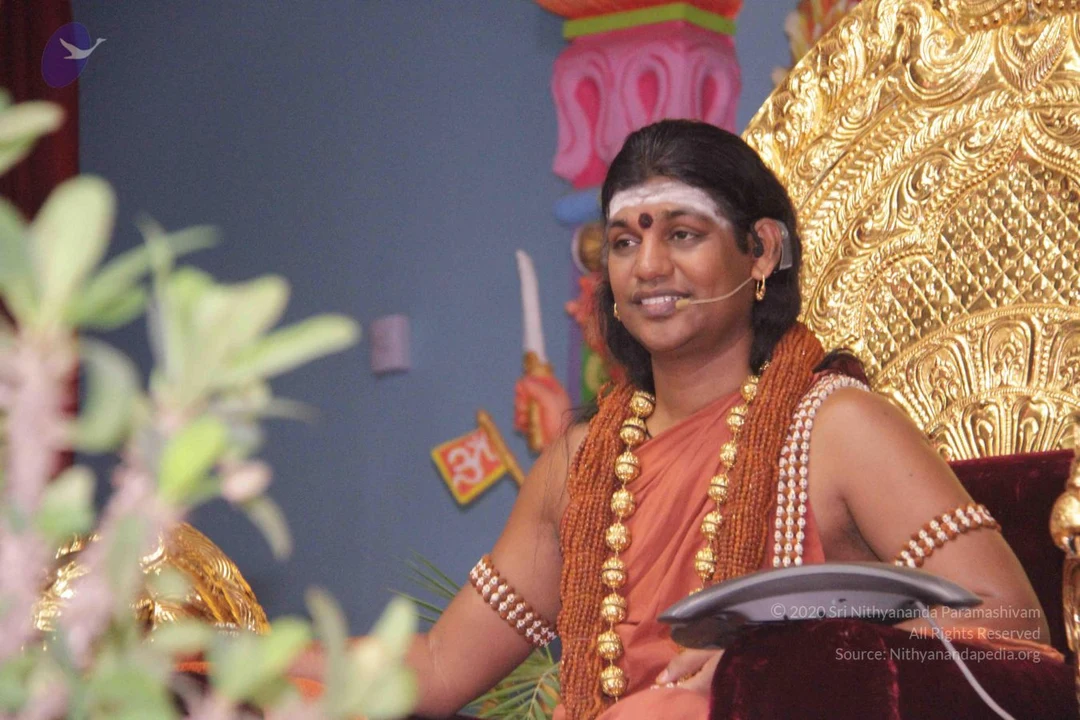
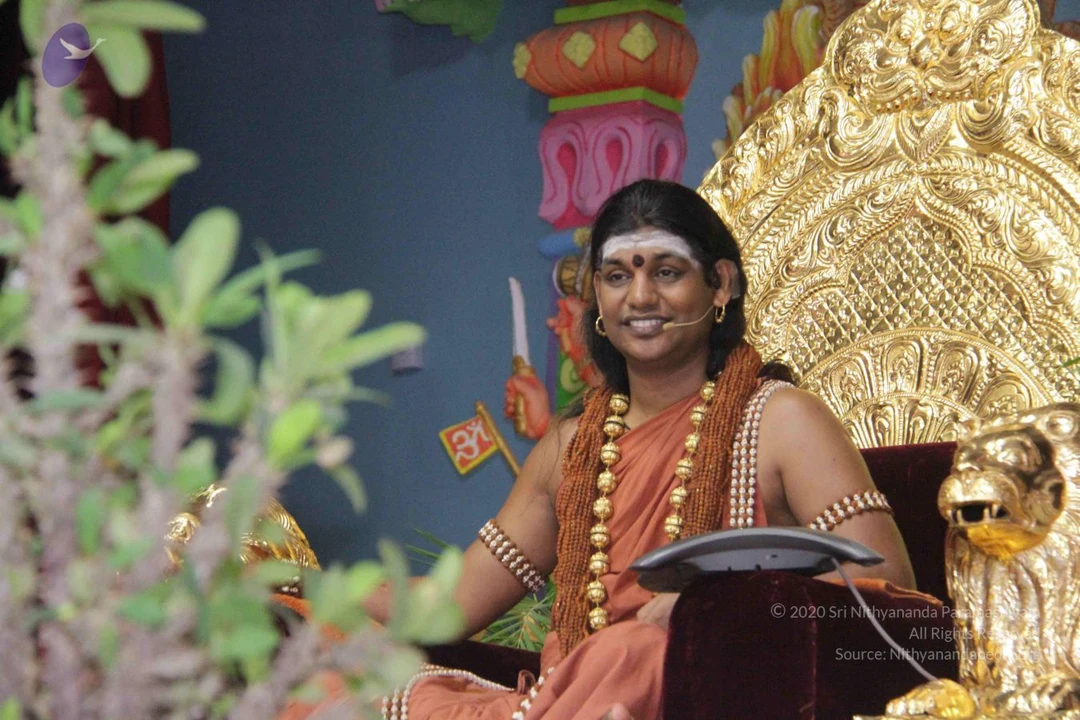
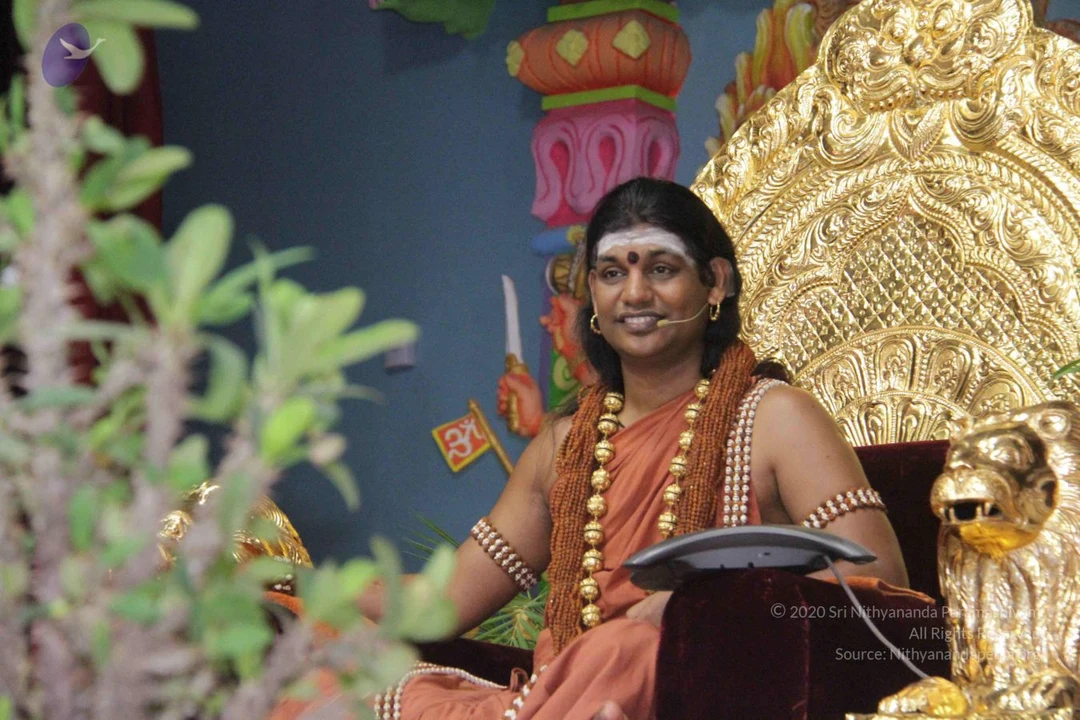
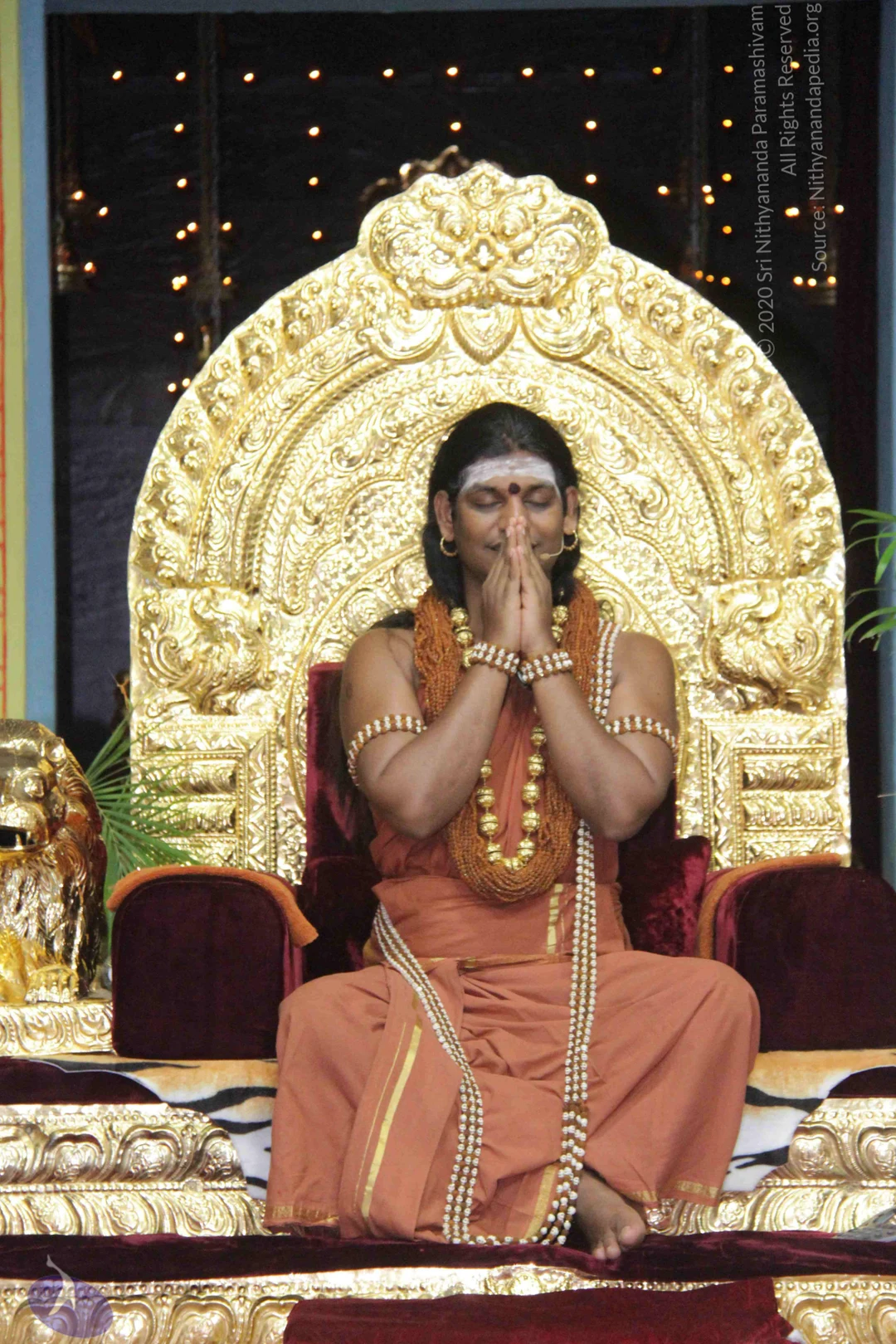
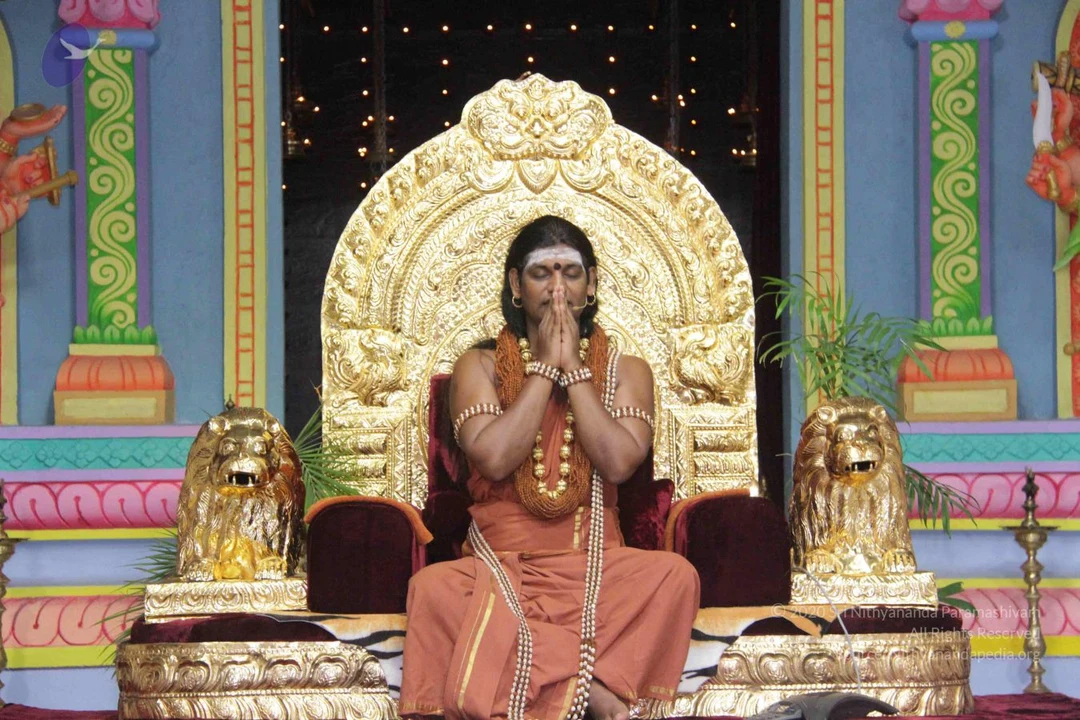
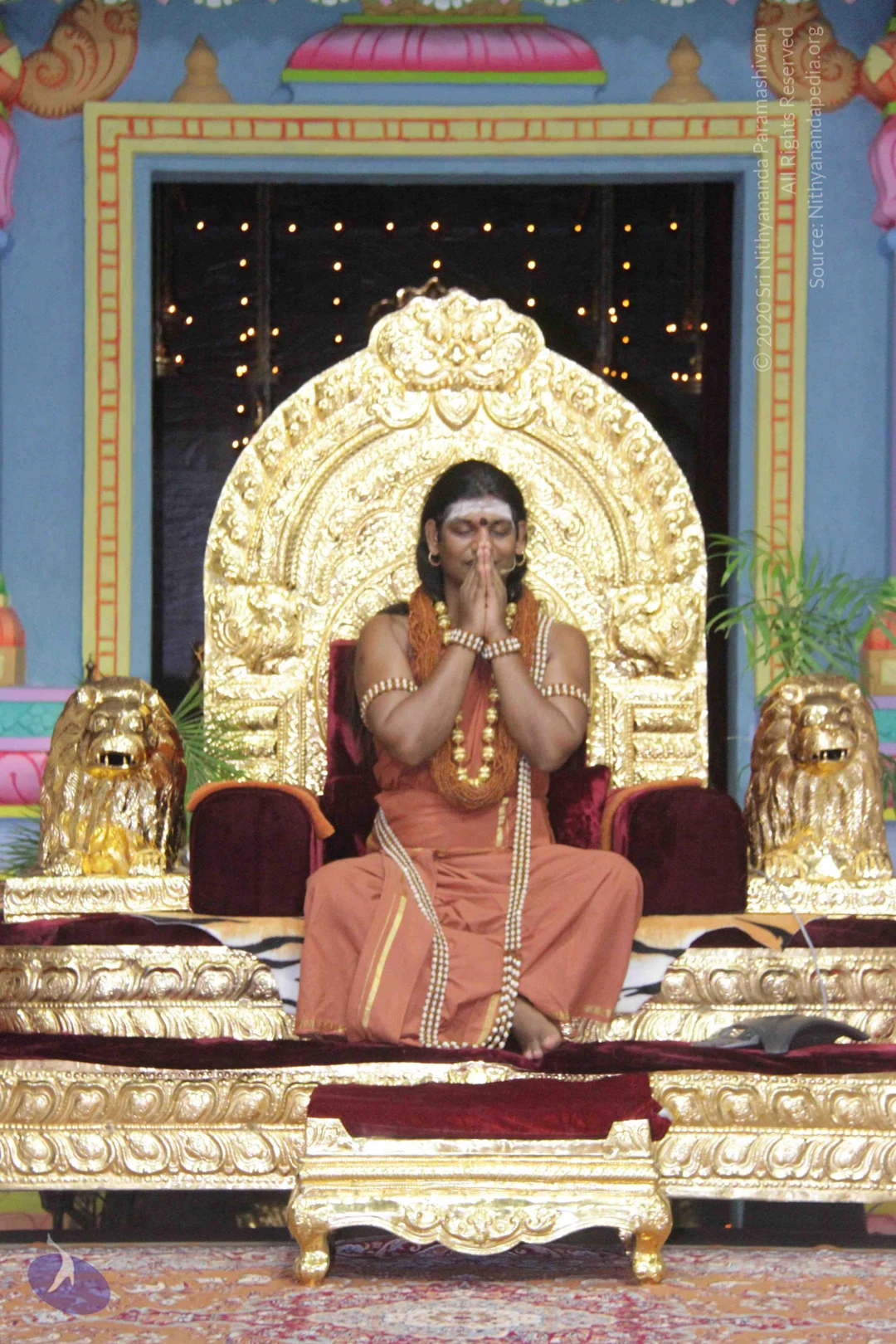
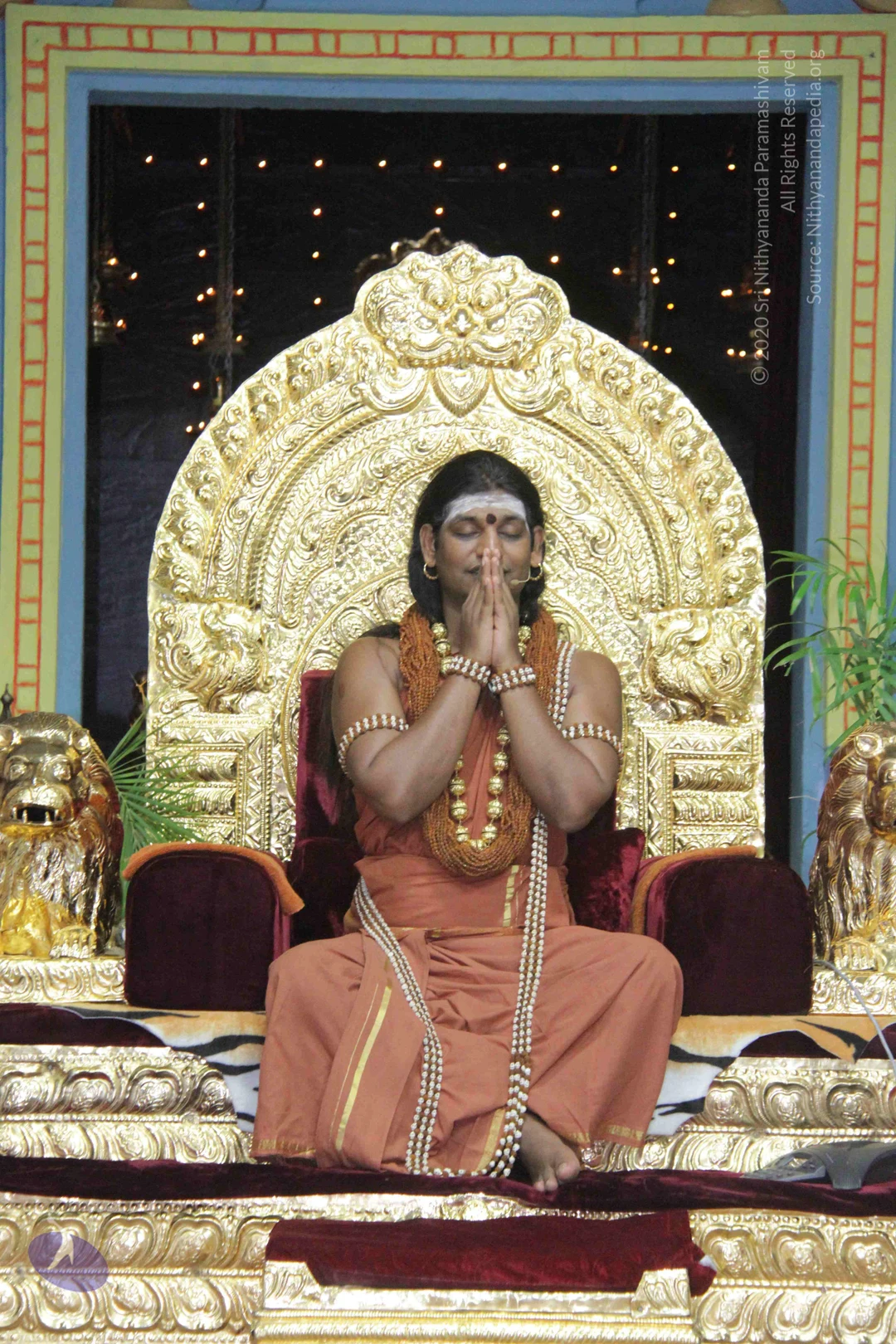
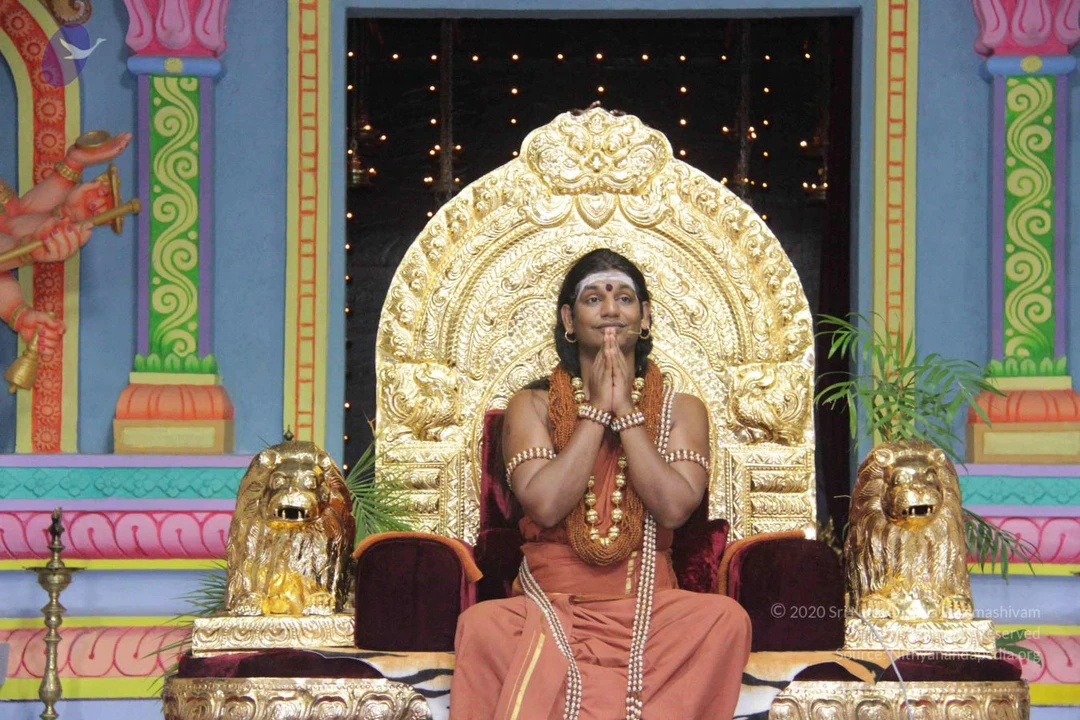
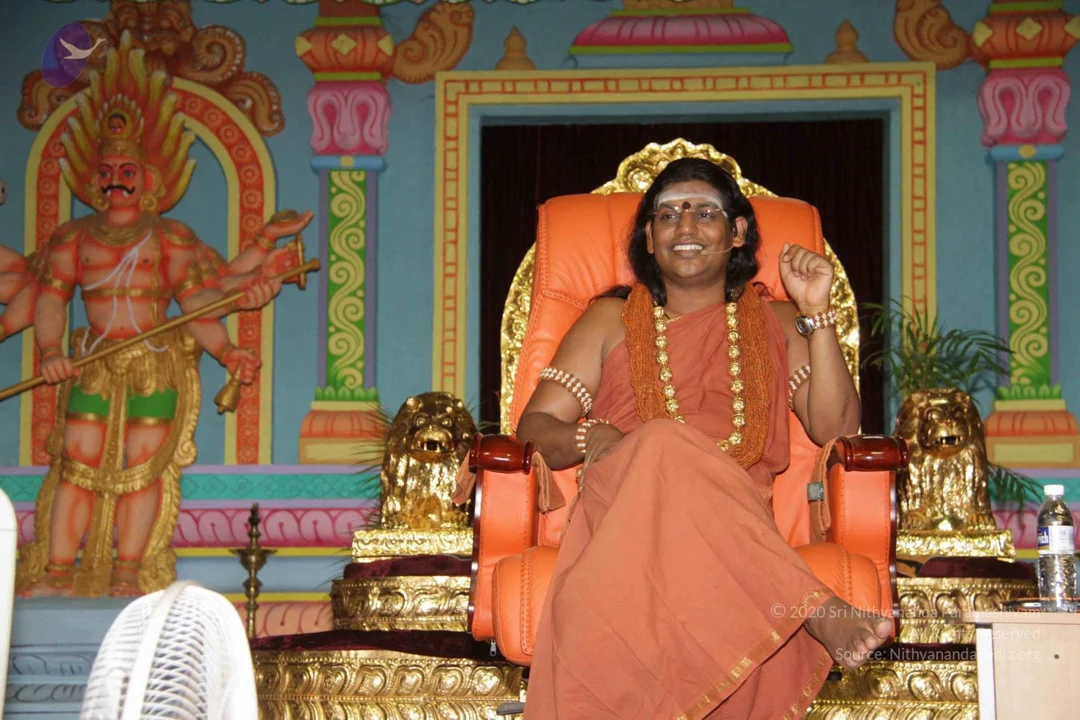
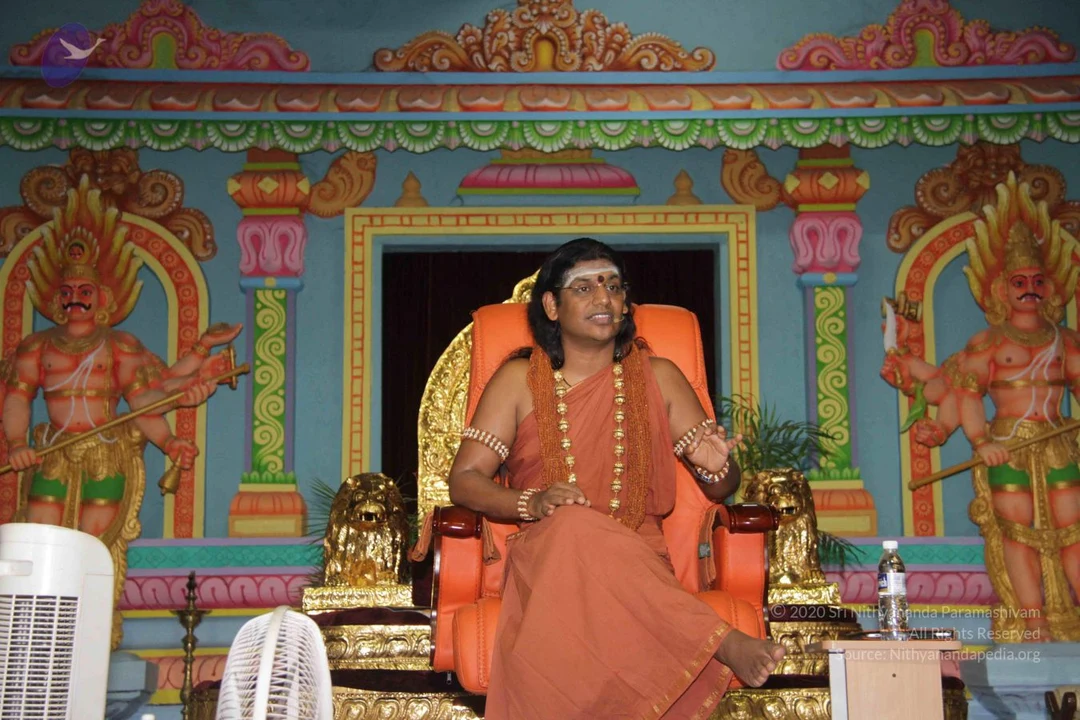
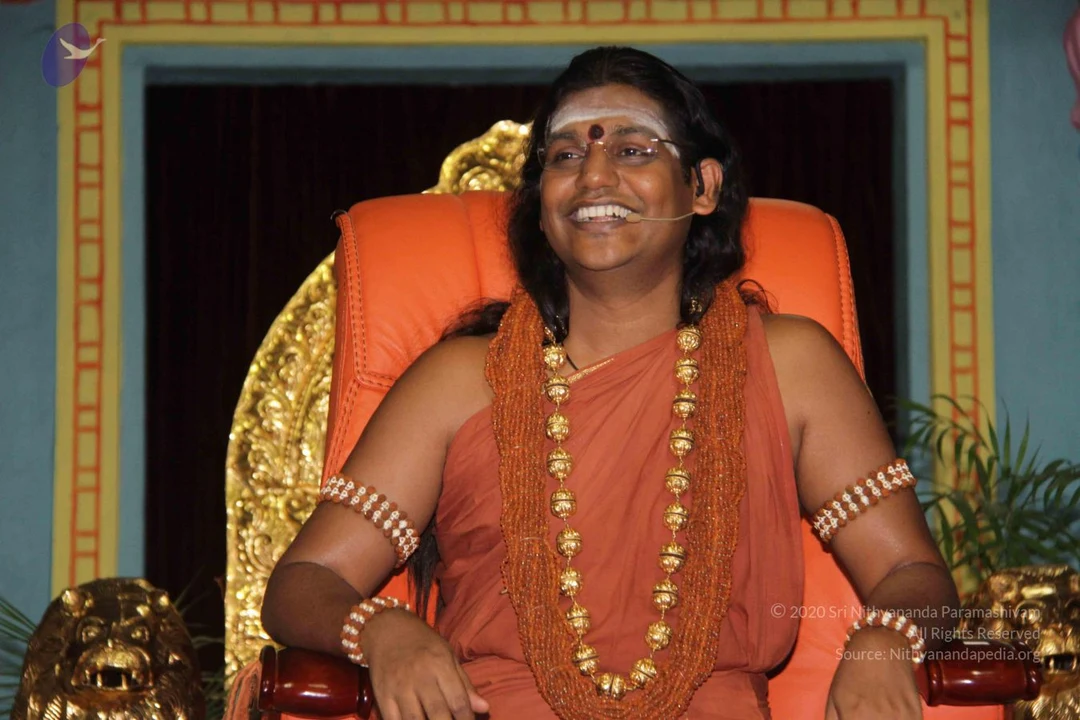
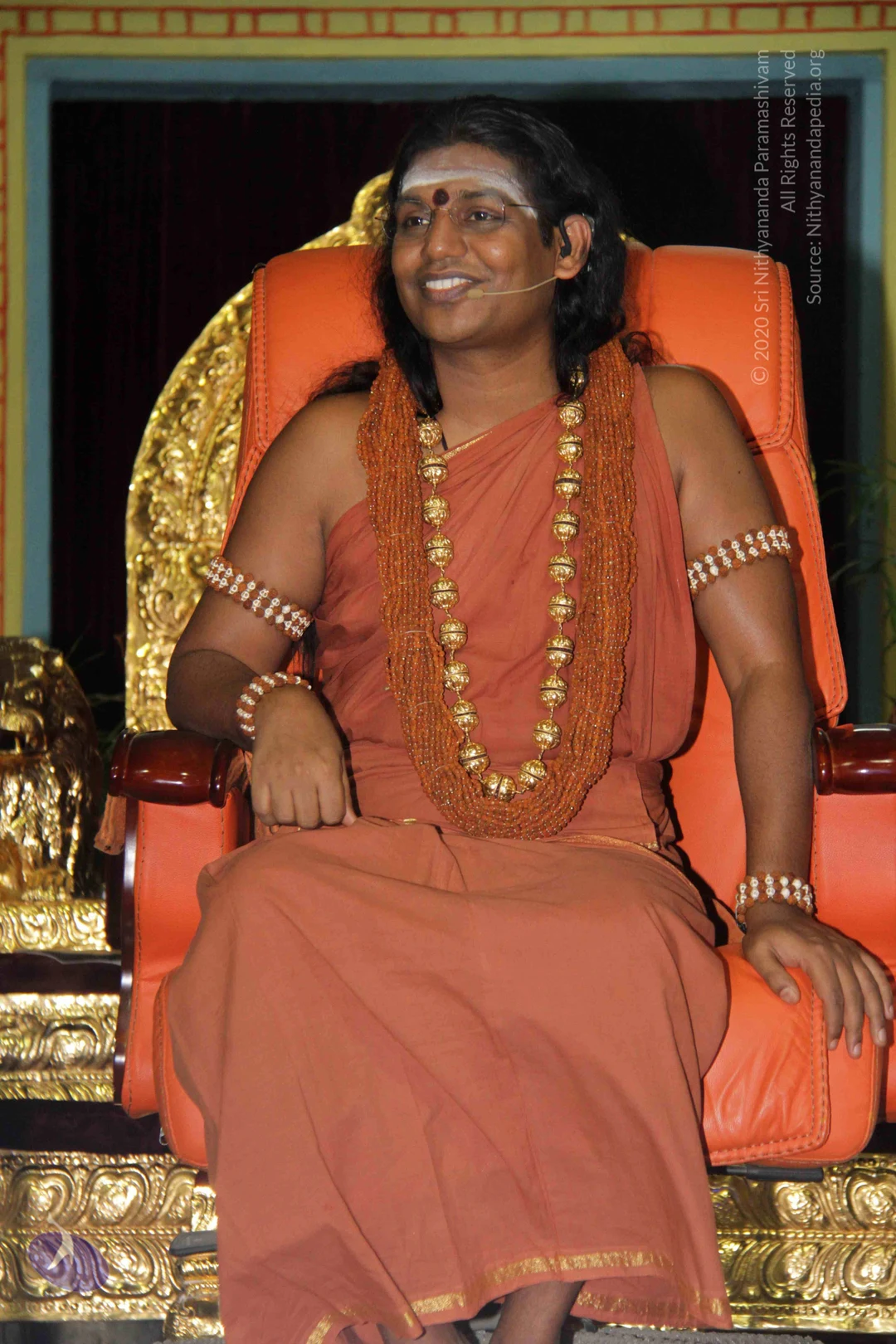
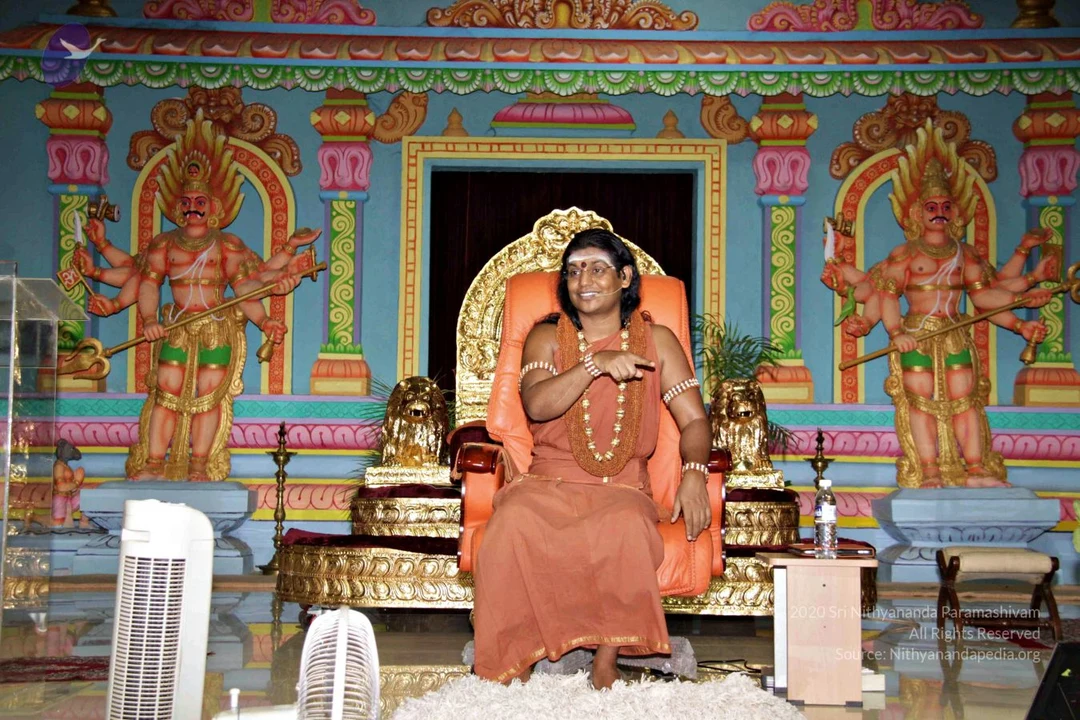
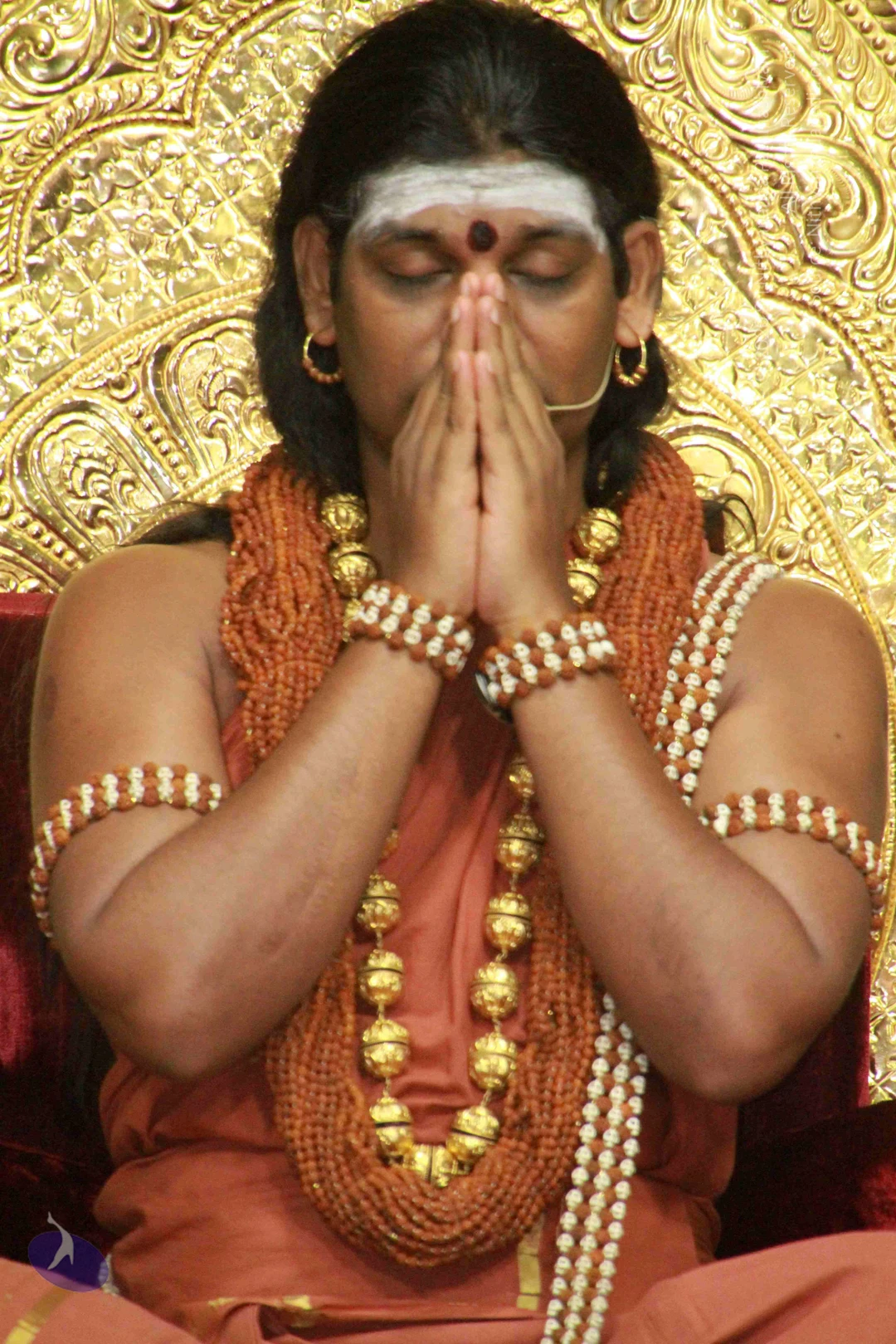
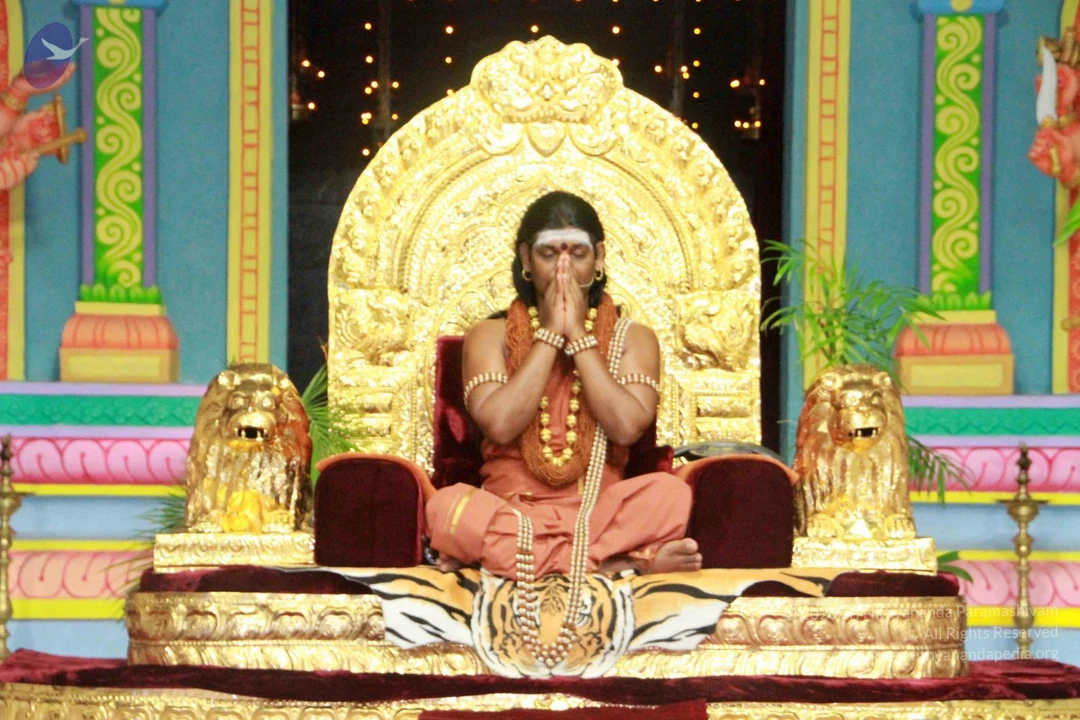
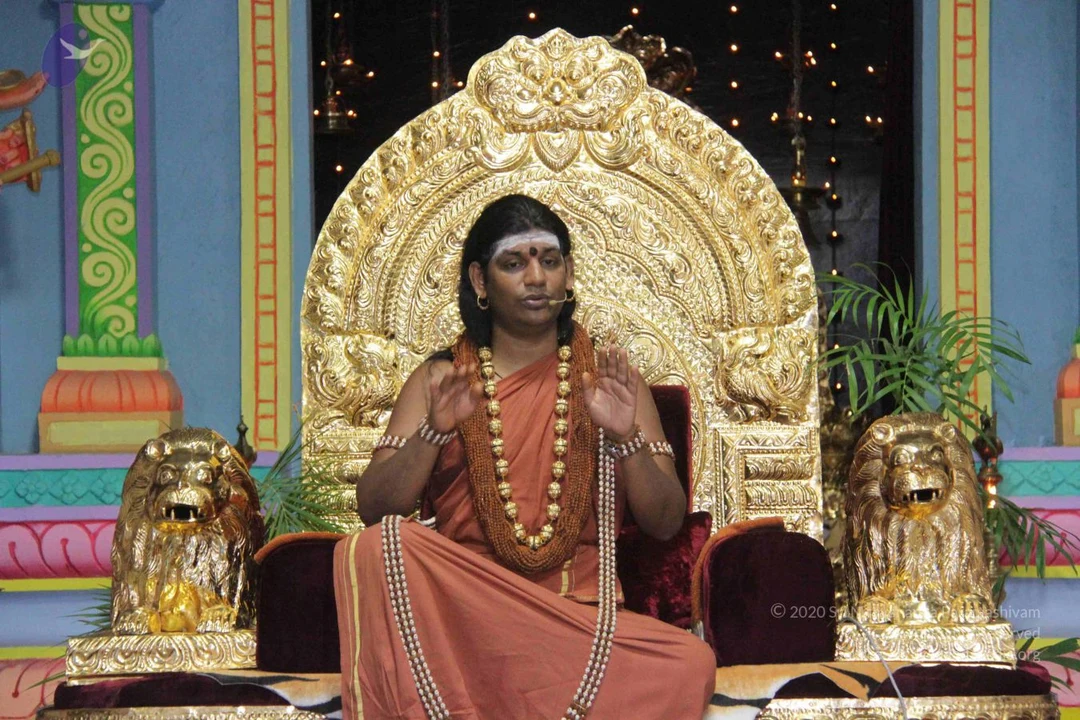
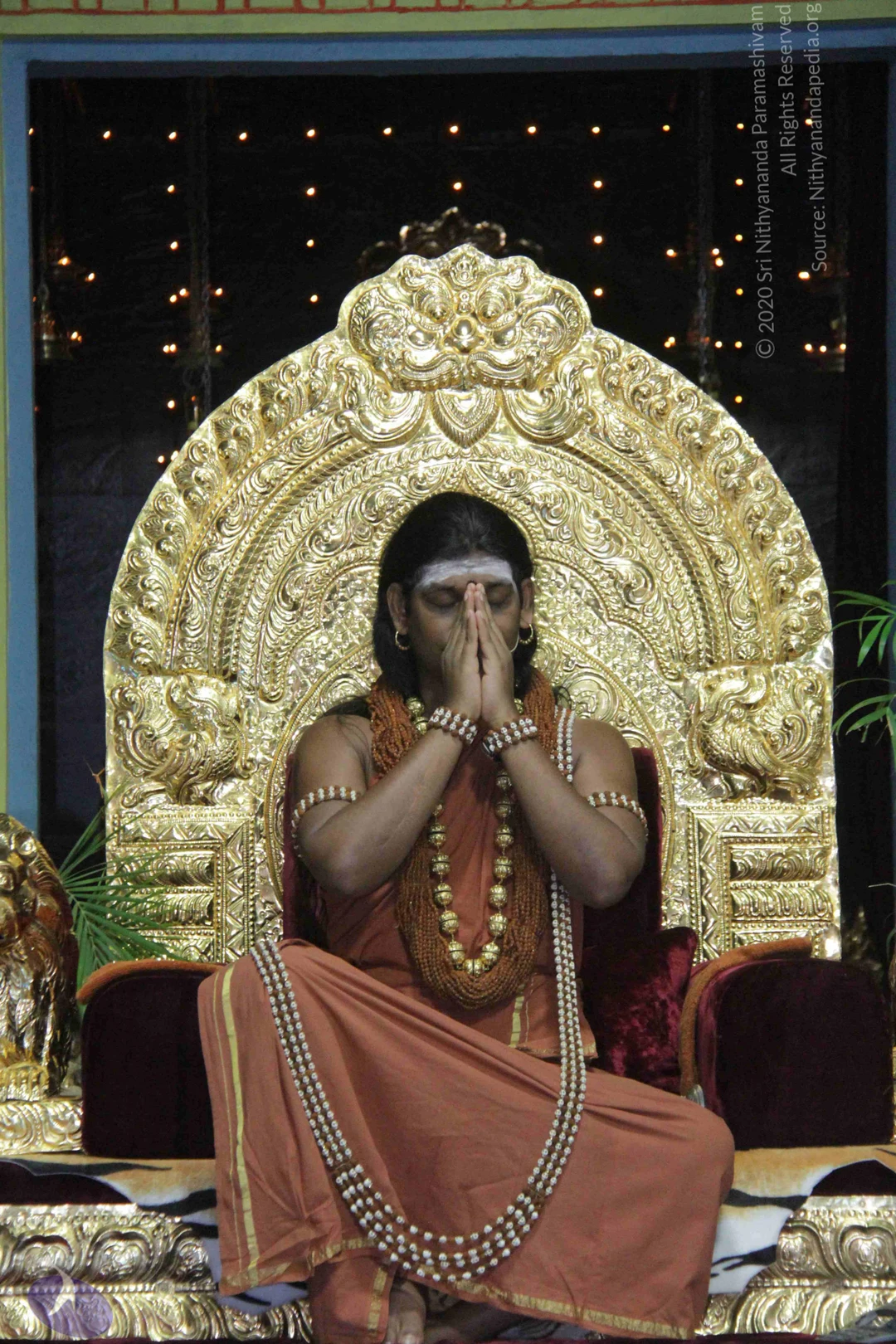
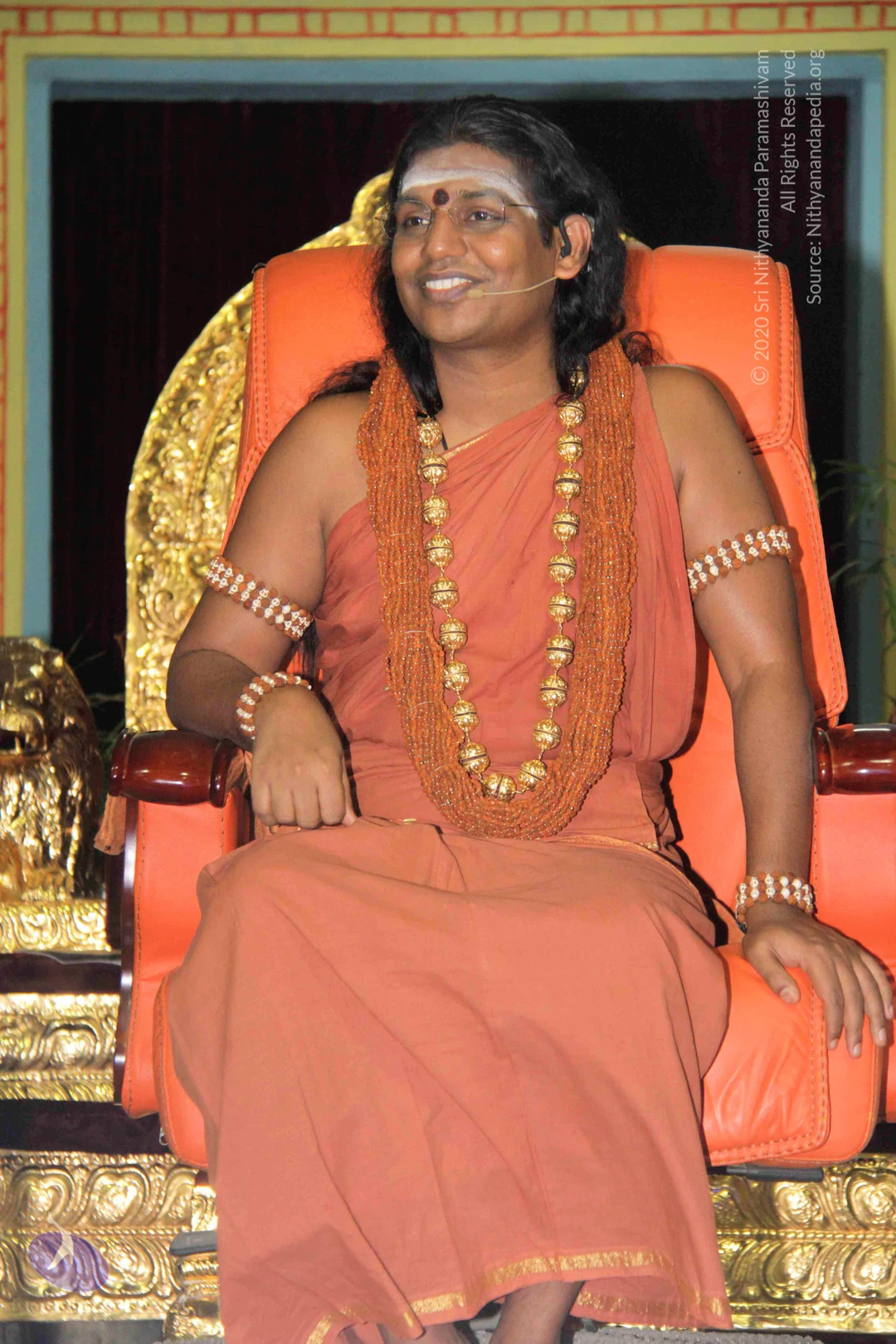
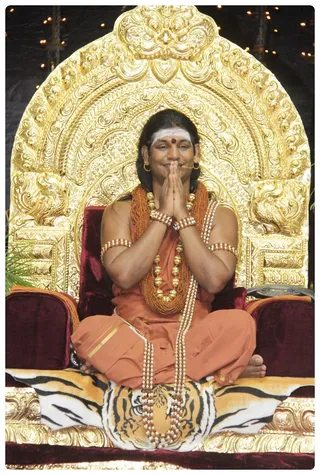
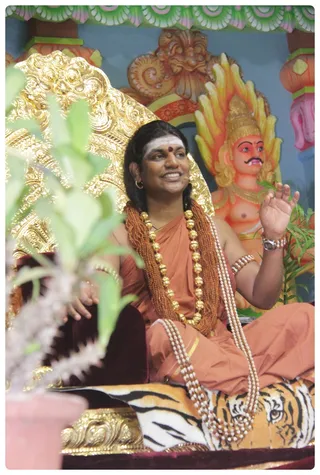
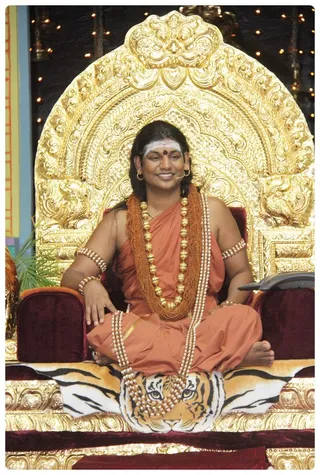
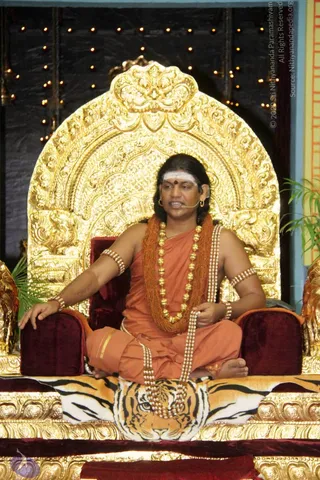
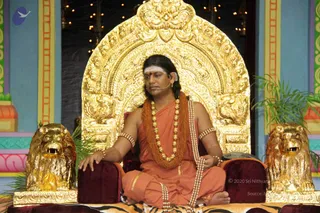
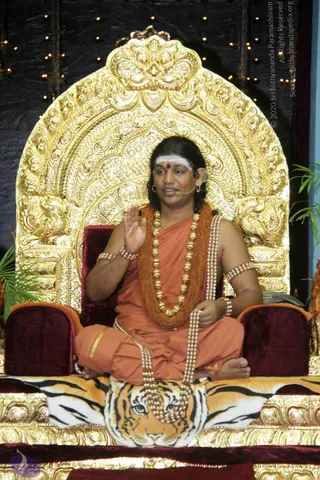
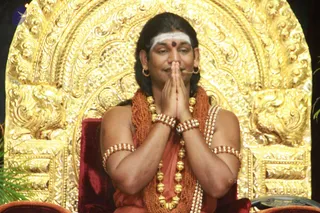
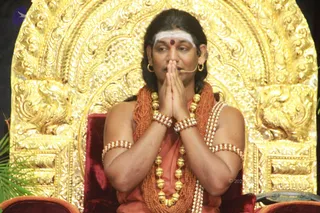
A seated man in saffron-orange robes sits on an ornate gold-carved throne with a red velvet seat and armrests, over a tiger-striped cloth. He presses his palms together in anjali namaskar and smiles. He wears a white forehead mark, a red bindi, gold earrings, layered orange and beaded rudraksha-style malas, and bead armlets and bracelets. A probable Swamiji by his saffron clothing, long swept-back hair, ornate gold necklaces and throne, and tiger-cloth seat, seated on the dais as a teacher in an in_person setting. The background shows string lights and a dark drape.A seated man in saffron-orange robes sits on an ornate gold throne draped with a tiger-striped cloth, gesturing with his raised right hand while smiling and speaking. He wears a rudraksha mala with gold beads, a pearl-like long garland, gold earrings, a wristwatch and a white and red forehead mark. Behind him is a painted backdrop of a fierce deity with a flaming halo, red face and moustache, flanked by decorative pillars, and a potted plant fills the foreground left. a person: the seated speaker wears saffron robes, rudraksha beads and a gold garland while teaching from a throne.A seated man in saffron-orange robes sits cross-legged on a tiger-skin cushion before an ornate gilded arched throne with carved floral and lion motifs. He wears a white tilak across his forehead, a red bindi, gold earrings, and multiple long rudraksha malas with gold beads, plus white beaded bracelets on his arms. Strings of fairy lights glow in the dark background. The scene resembles a discourse or darshan setting. Swamiji (probable): long dark hair, saffron robes, ceremonial gold necklaces and rudraksha malas are visible.

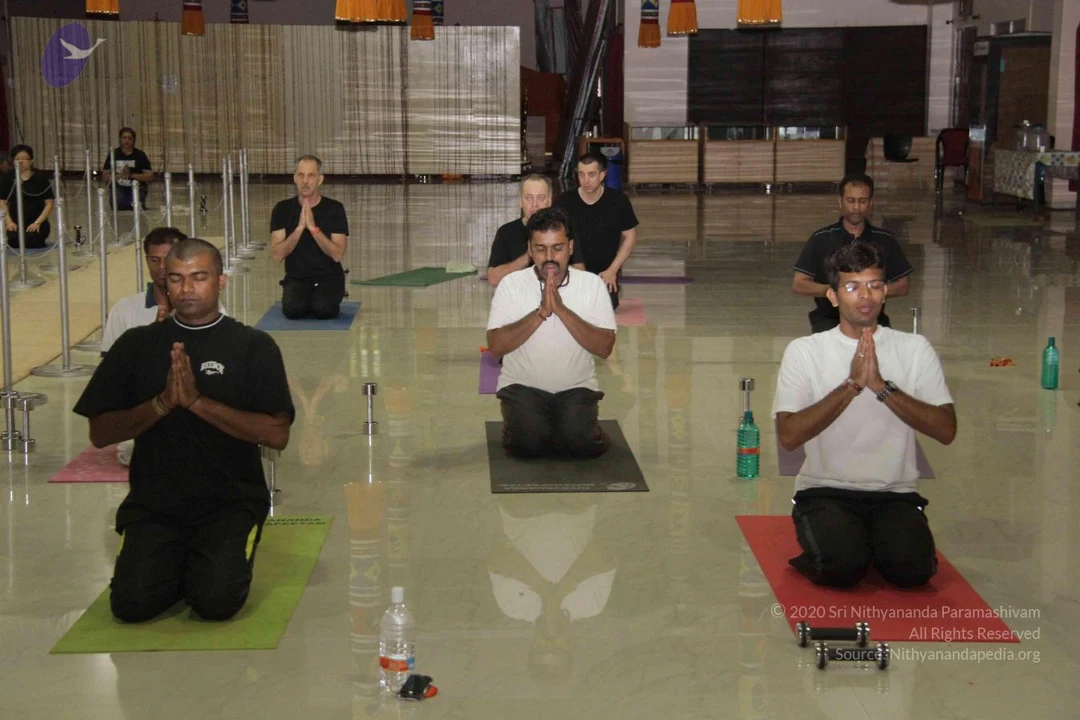
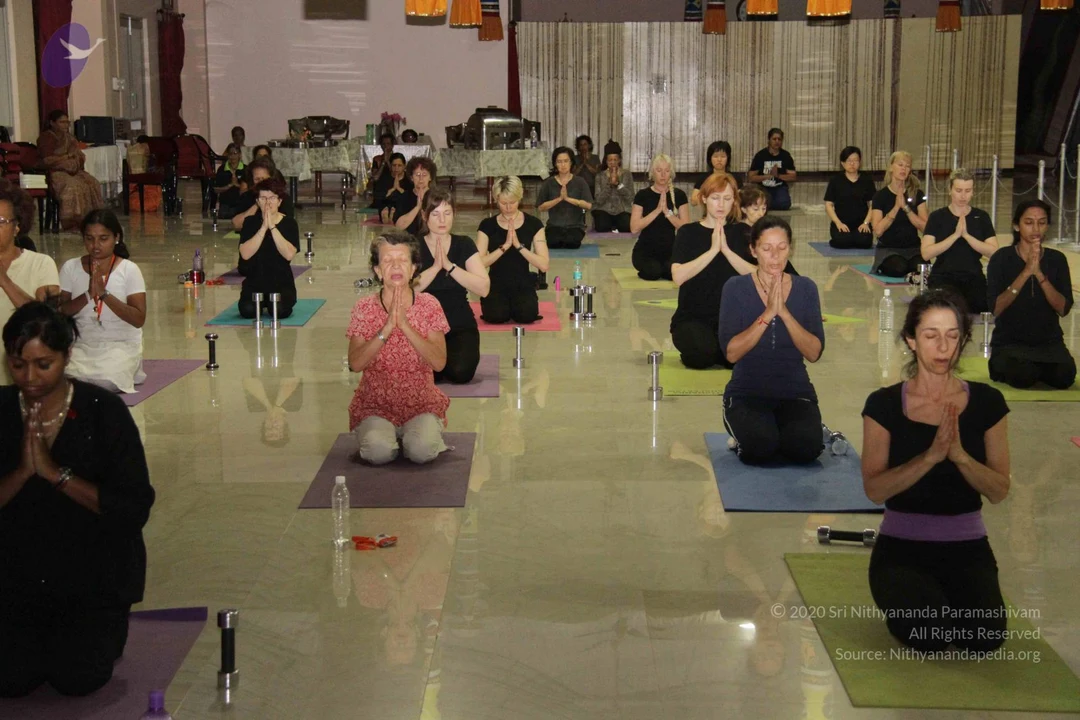
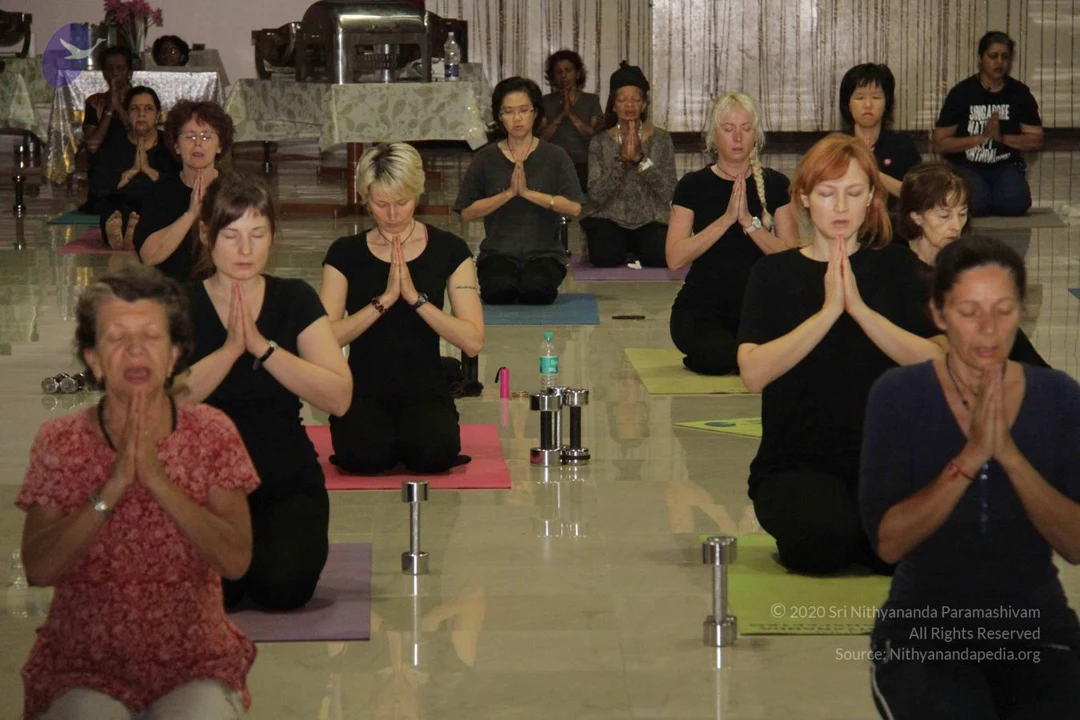
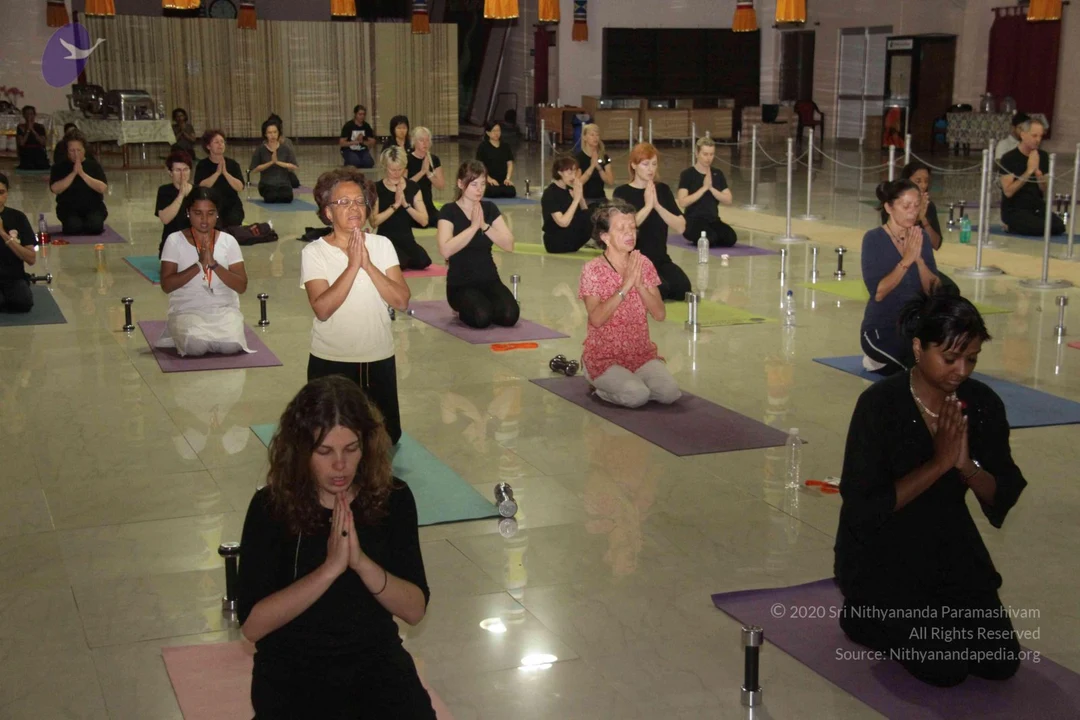
Yoga

11 photosSource gallery
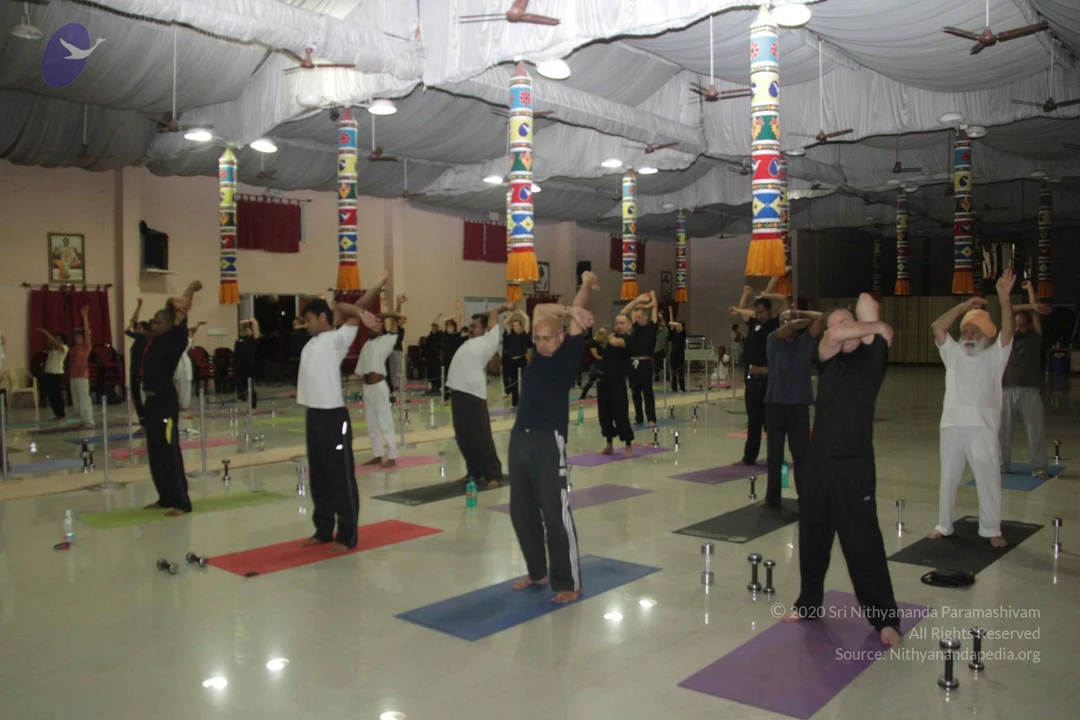
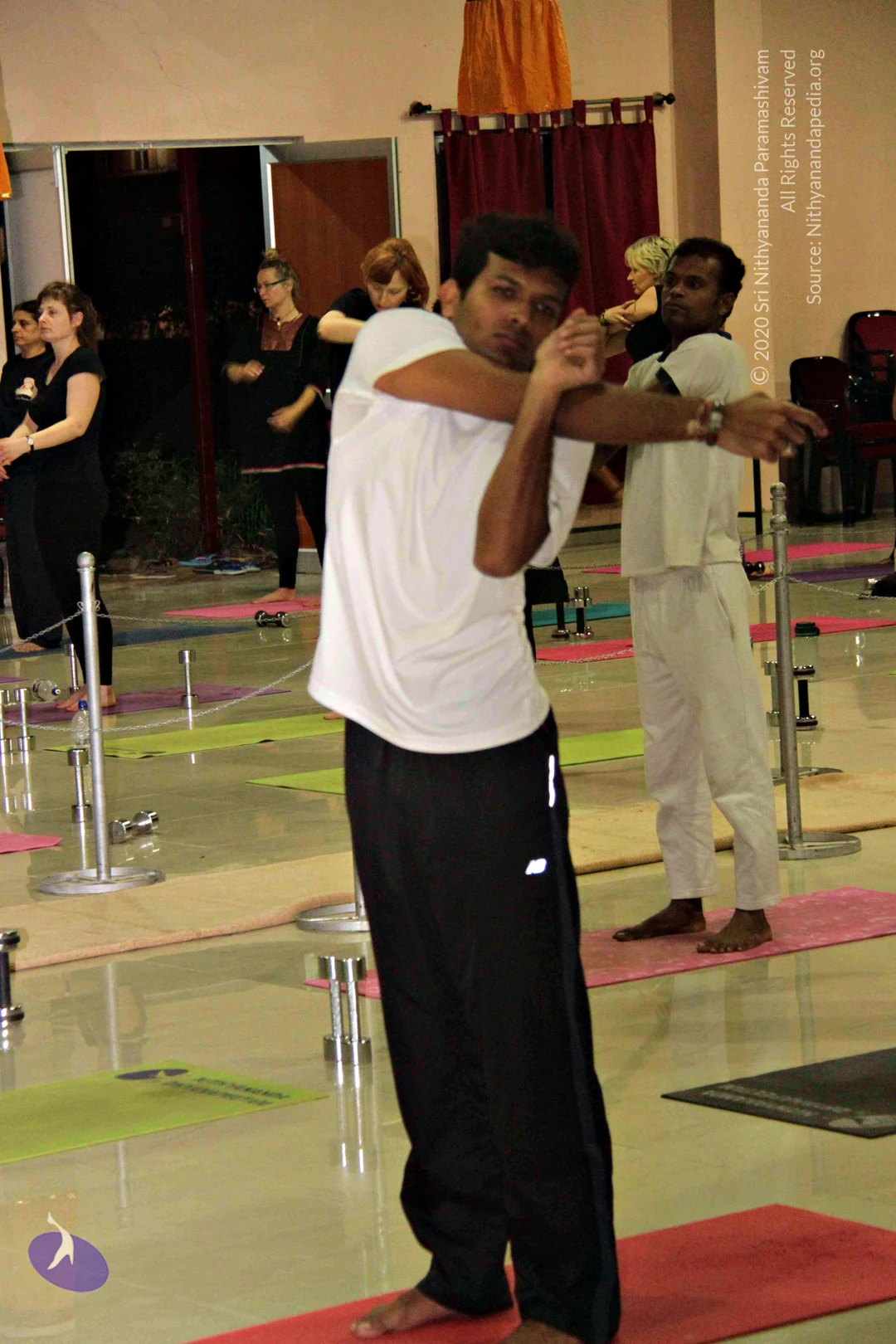
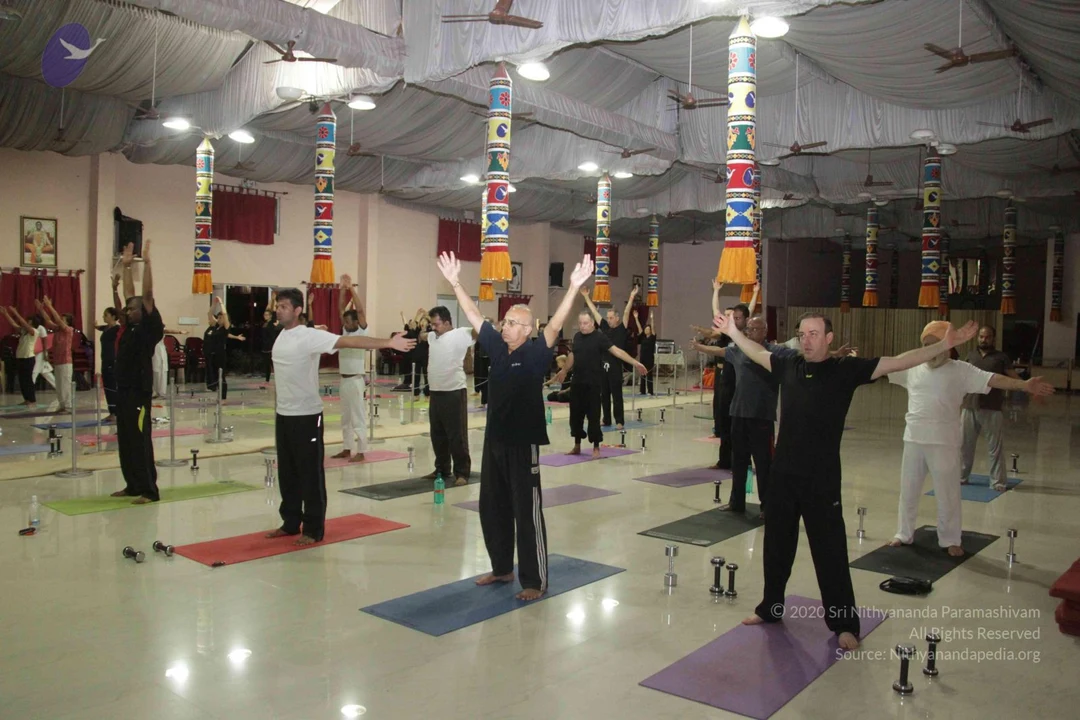
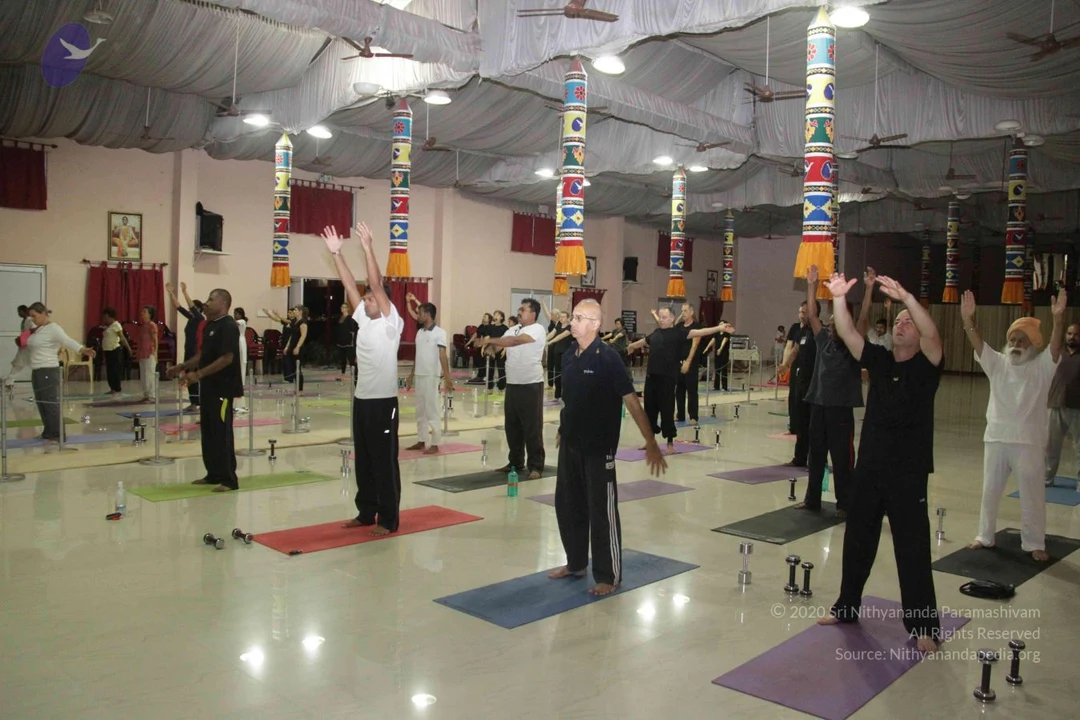
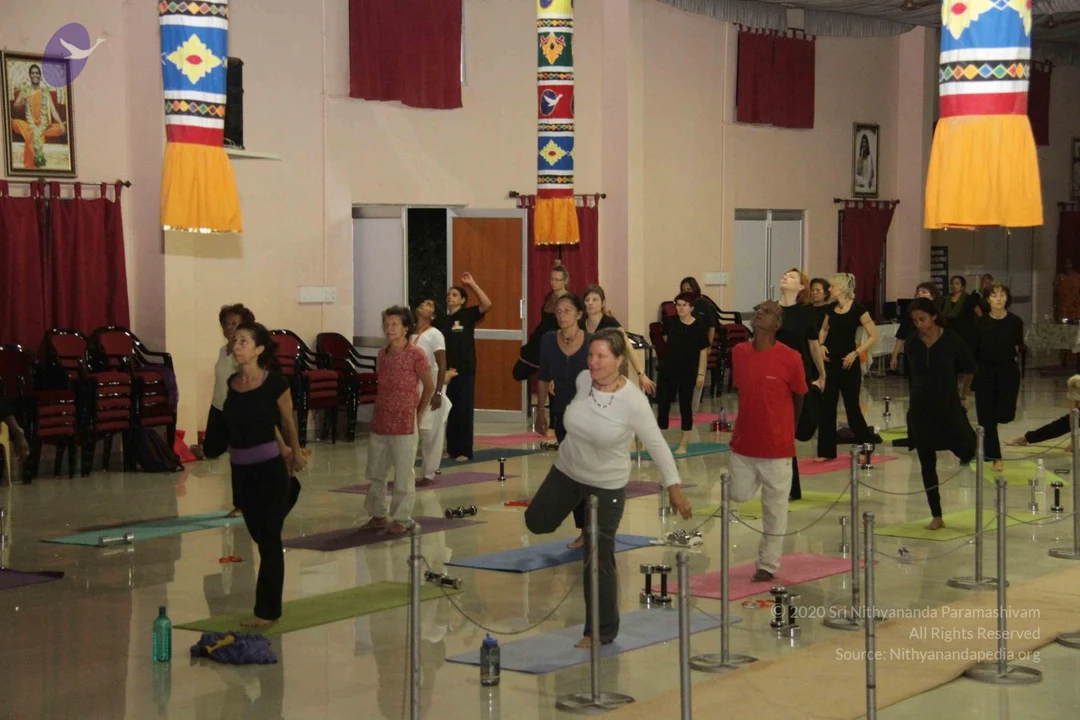
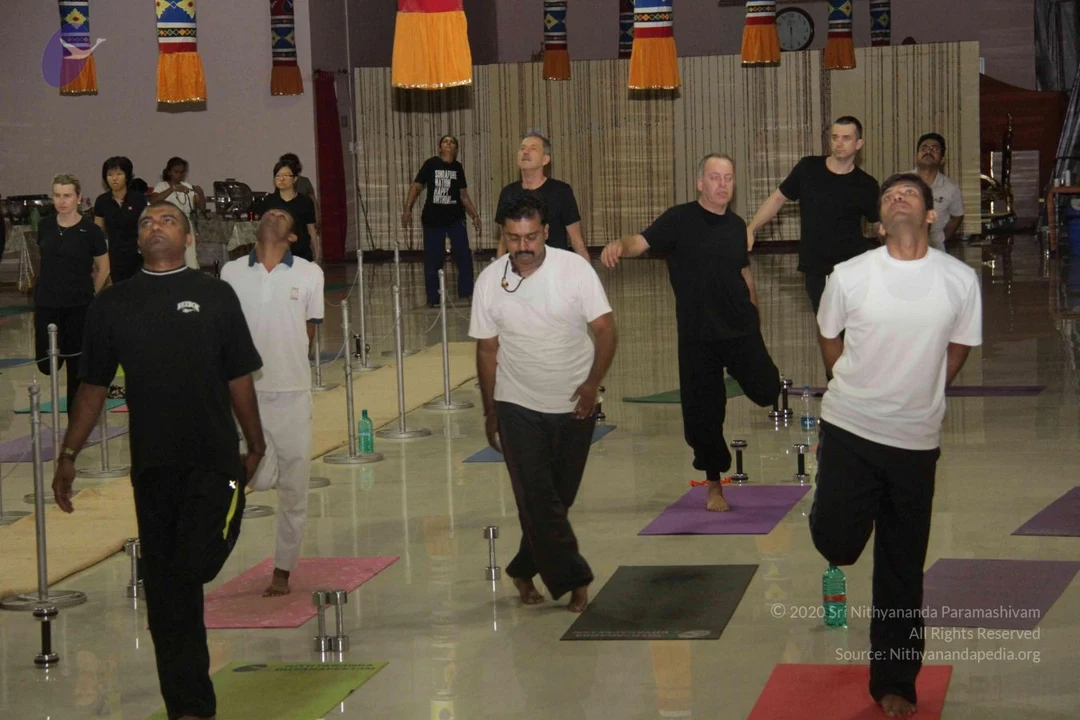
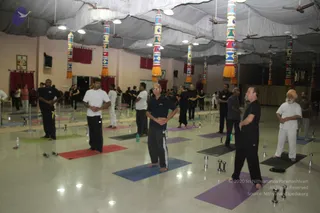
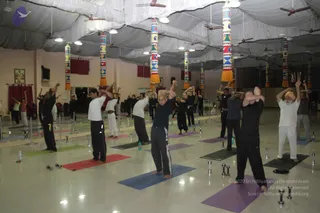
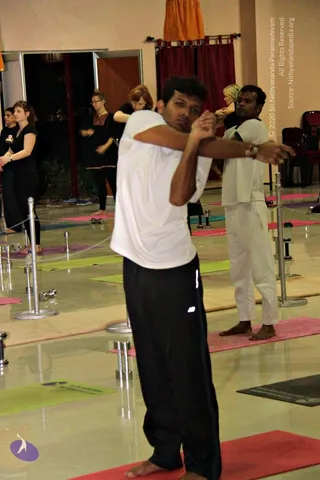
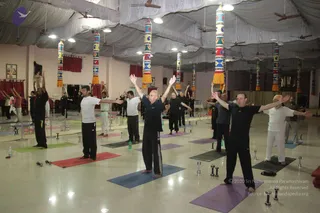
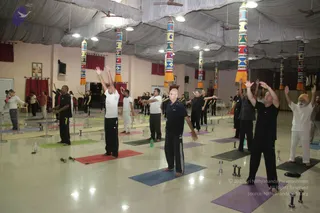
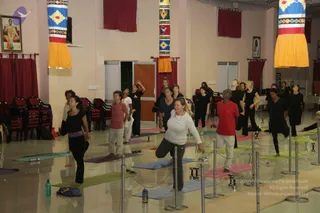
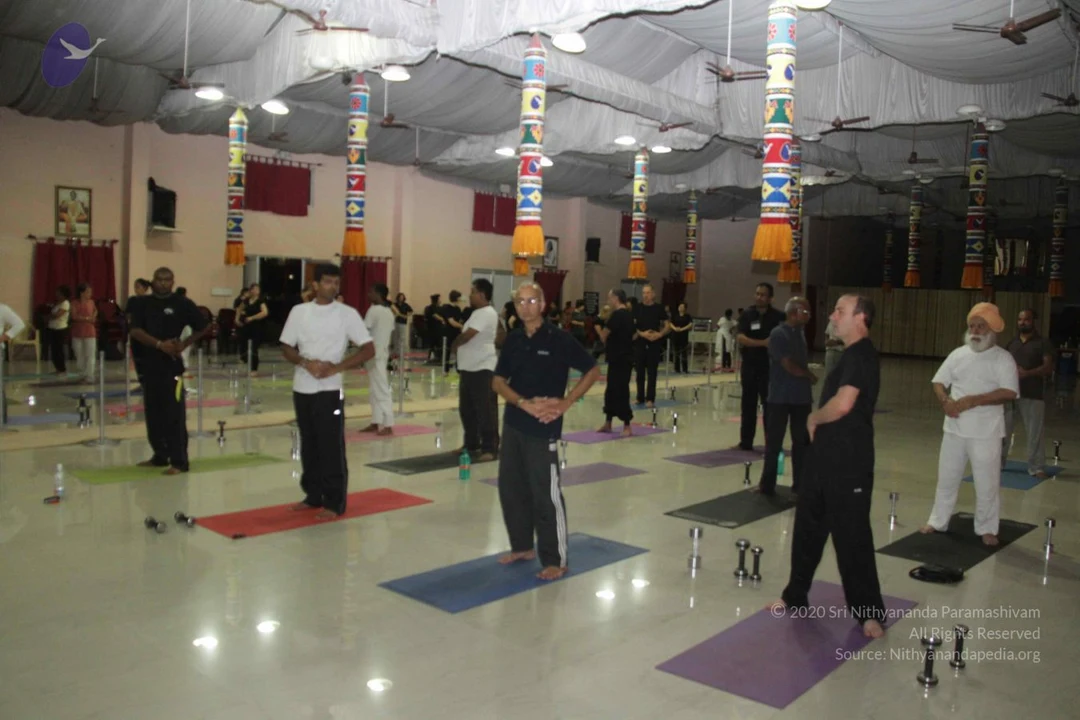
Indoor hall with a white fabric canopy and tall decorative pillars wrapped in colourful patterns with orange tassels. Many people stand on coloured yoga mats in rows, some in black and some in white clothing, performing a standing exercise with hands at the waist. Small dumbbells sit on the floor between mats. A bearded older man on the right wears a white kurta and an orange turban. Framed pictures hang on the pink wall at left, and red curtains line the background.A large indoor hall with a white draped ceiling and ceiling fans, where a group of about twenty-five people practise a standing yoga stretch on coloured mats. Participants raise both arms overhead with hands clasped, wearing black, white and navy track clothes. Decorative cylindrical pillars in red, blue, yellow and white patterns with tassels line the room. A framed picture hangs on the left wall beside red curtains, and metal dumbbells sit on the floor.A yoga class in a bright hall with glossy floors. In the foreground a young man in a white T-shirt and black track pants stretches one arm across his chest, barefoot on a red mat. Beside him an older man in white kurta and white trousers, also barefoot, mirrors the stretch on a pink mat. Behind them women in black tops and black leggings stand on mats, one with short blonde hair. Chrome stanchions with chains divide the mats, small hand weights lie on the floor, and a red curtain hangs on the back wall under an orange cloth. No a person candidate is clearly identifiable from appearance.A photograph of a yoga or exercise session in a large hall with a polished floor and a draped white ceiling. Many students stand on coloured mats in a practice stance with arms raised overhead, some with small hand weights placed beside them. The foreground includes a man in black shirt and trousers with arms raised, a man in white kurta and white trousers, and a man in black with arms extended. Decorated cylindrical pillars with painted geometric patterns and yellow tassels run through the room, with ceiling fans overhead and a framed picture on the left wall. Water bottles sit near some mats.A large hall with a cloth-draped ceiling and decorative painted pillars shows a yoga class in progress. Around 20 people stand on colourful exercise mats, arms raised overhead or stretched sideways, mostly in black, grey and white athletic clothes. A man in an orange turban and white clothing stands at the far right, and a small framed portrait hangs on the back wall. Dumbbells and water bottles sit near the mats, with red curtains and chairs along the walls.A group yoga class in a bright hall with pale pink walls and maroon curtains. Participants in black, white, red and blue clothing stand on coloured yoga mats, many holding a balance pose with arms raised overhead while an instructor in a dark top stands at the left. Tall hanging banners with yellow fringe and geometric motifs flank the room, and stacked metal dumbbells and water bottles sit on the floor. A framed portrait of a saffron-clad figure hangs on the left wall, and rows of red chairs line the side. No ritual activity is visible.

Temple-Swamiji
35 photosSource gallery
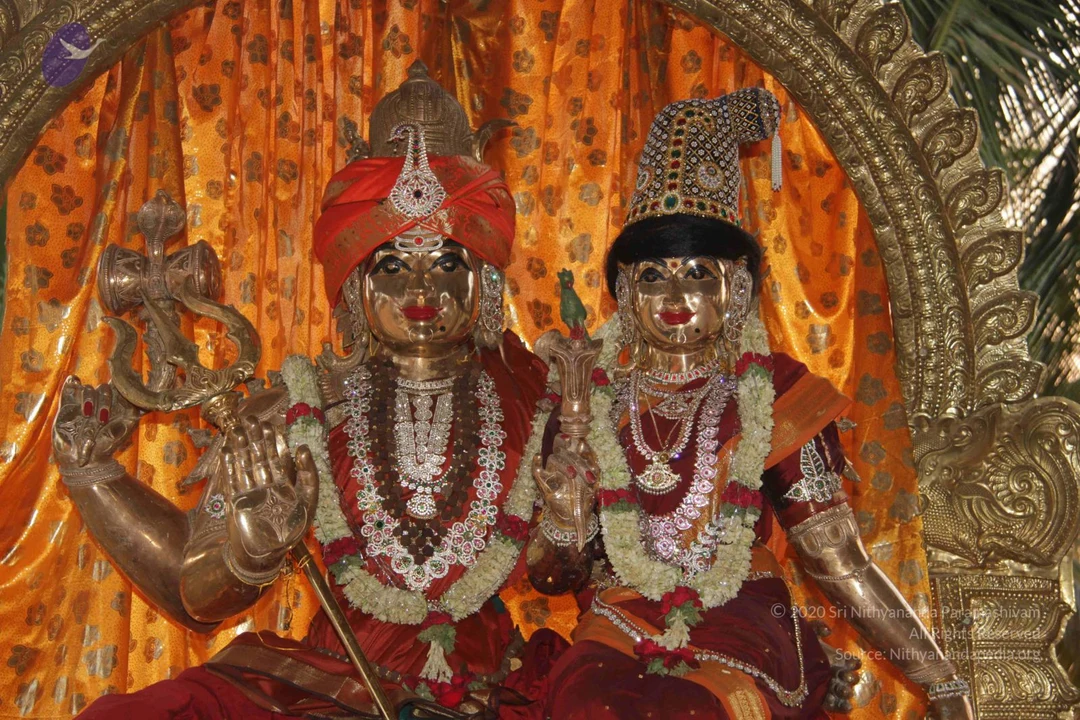
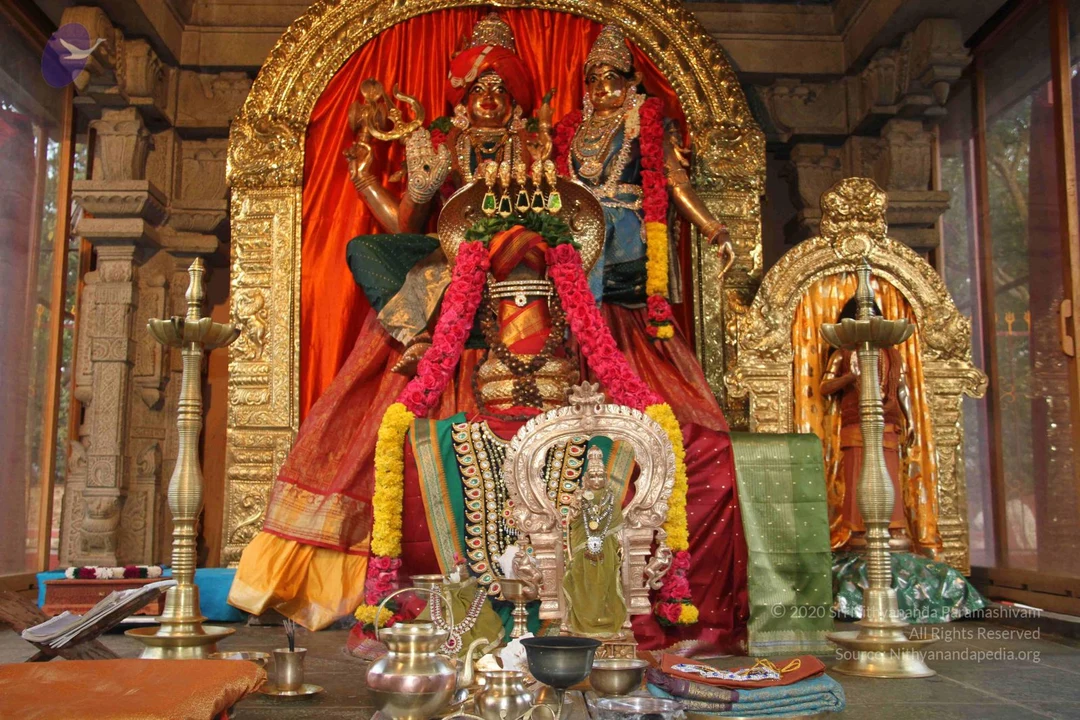
A dim, reddish dusk or dawn sky with a bright yellow sun low on the horizon, framed by dark silhouetted tree branches and foliage, with a utility pole and power lines crossing the scene. No people are visible.A photograph of a low sun glowing orange-white through a hazy reddish-brown dusk sky, framed by dark silhouetted tree branches and palm fronds. Thin utility wires and a wooden pole run across the lower dark treeline. A small purple emblem with a white bird sits in the upper left corner, and a , , in the lower right. No people, deities, or ritual activity are visibleTwo bronze-toned deity murtis are seated side by side against an orange and gold floral silk backdrop framed by an ornate gilded arch. The figure on the left wears a red turban, rudraksha malas and white floral garlands, and holds a trident-like staff and a damaru-style drum. The figure on the right wears an embellished jeweled crown, red and maroon garments, layered necklaces and a garland, holding a staff topped with a small green parrot. Both statues have red lips and gold ornaments. The scene is a decorated statue display, with no physical people visible.Two gilded deity murtis sit side by side against a shimmering orange and gold patterned cloth backdrop with a carved golden arch. The figure on the left has a red turban, a jeweled tilak, a rudraksha mala and white flower garlands, and holds a trident in one hand. The figure on the right wears a black and gold embroidered crown with red jewels, a green parrot perches on the staff in its hand, and it wears layered gold necklaces and red and white garlands.A black stone Nandi bull statue sits on a red sandstone pedestal in a garden setting. The Nandi wears a garland of red and white beads, a gold-toned necklace with tassels, a bead collar and a yellow cloth draped over its back. Behind it, grey stone statues of standing figures with folded hands and a red-brown tiered pedestal with a kalasha-like finial are visible among palm trees and foliage. No people are present.Two golden metal murti statues of a male and female deity seated side by side against a bright orange draped curtain within an ornate gilded arch. The male figure wears a red turban, a trident is held in one hand, and he has a rudraksha-style brown bead mala and layered jewelled necklaces. The female figure wears a tall jewelled crown, a blue sari with a silver-embroidered border, multiple gold and pearl necklaces and a green parrot perches near her. Both are adorned with pink rose garlands and white flower strands, and there is a gold-edged altar in the foreground. These are statues, so no physical people are present.

Pada-Puja

22 photosSource gallery
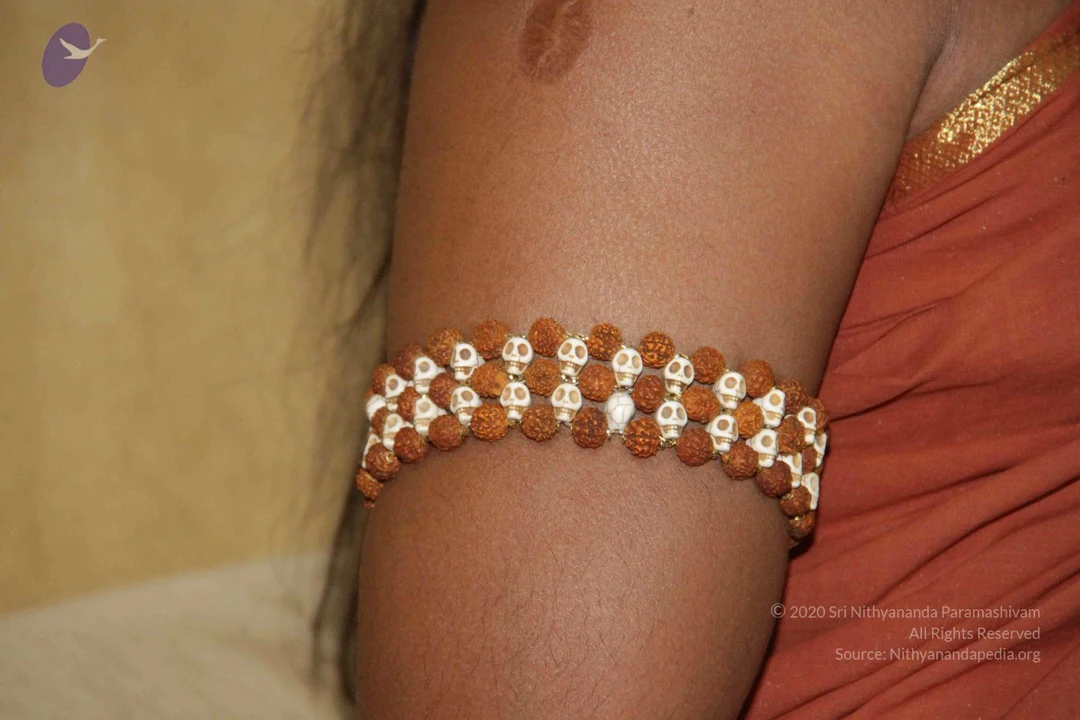
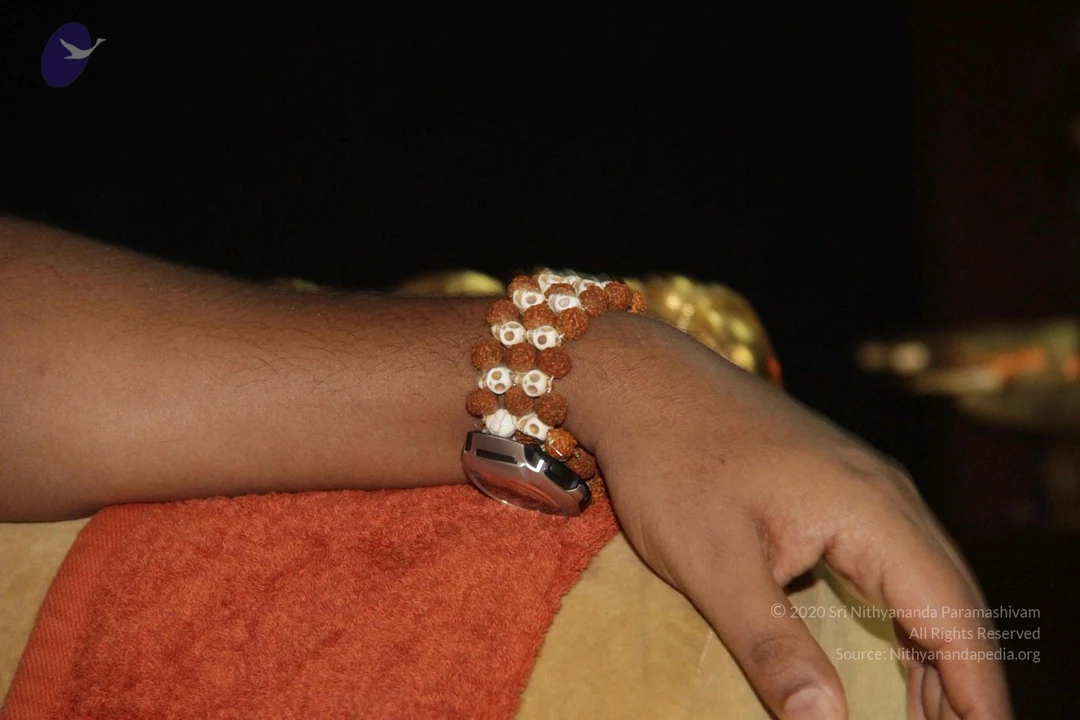
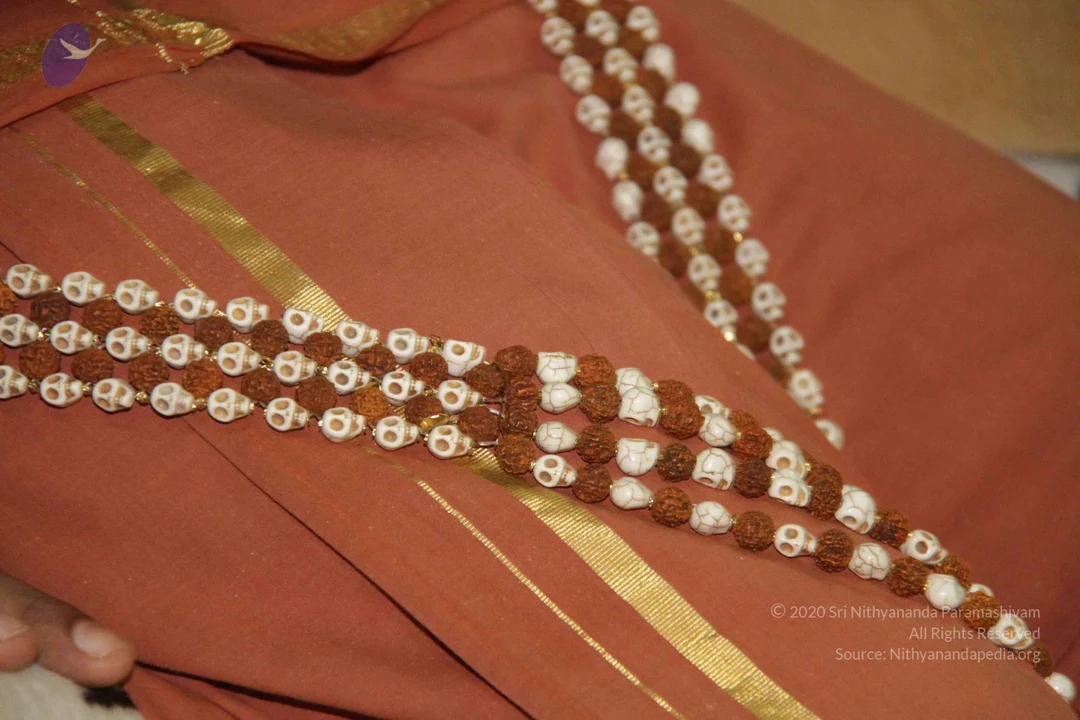
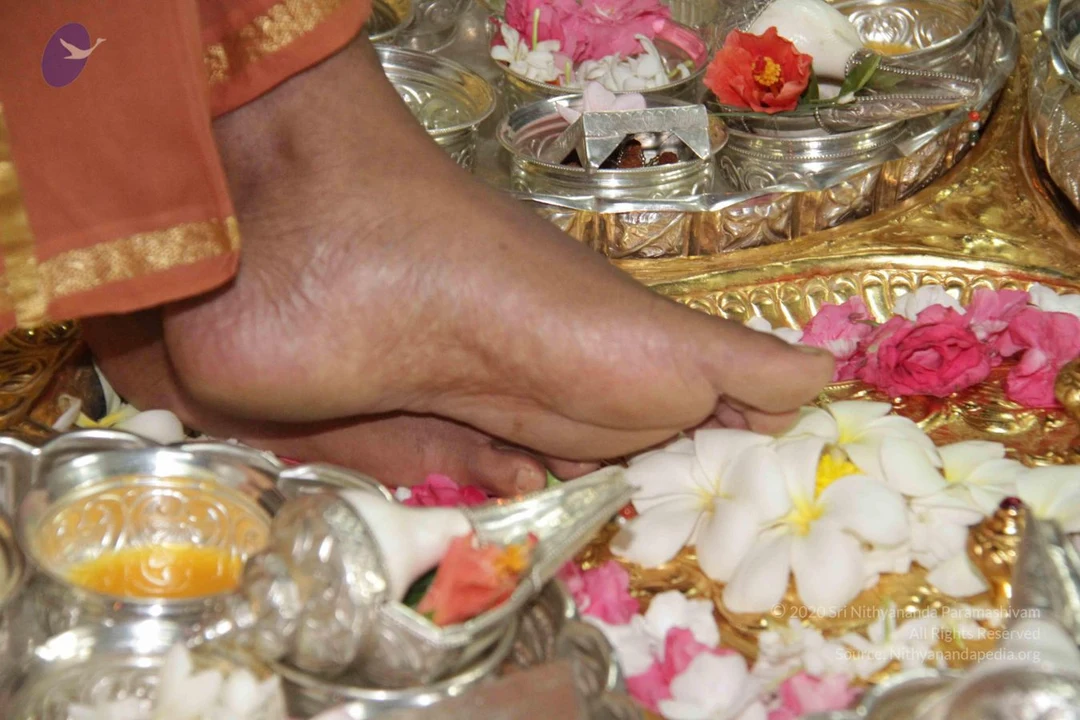
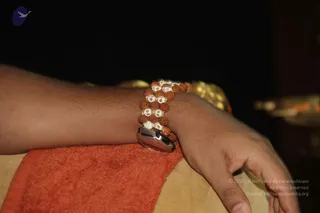
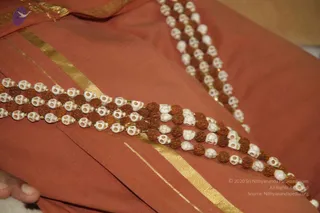
Close-up photograph of a person's right forearm and hand resting on an orange-red cloth over a tan lap. The wrist wears a layered bracelet of brown rudraksha beads alternating with white beads, plus a dark wristwatch. In the blurred background on the right, a brass oil lamp with a lit flame sits against a black backdrop. Only the arm and hand are visible, so no face is shown.Close side view of a man seated in a golden throne setting, wearing an orange-red saffron wrap over his shoulder and torso, layered with long orange rudraksha malas and gold bead necklaces, plus a white and orange rudraksha armband. He has long swept-back black hair, a white horizontal tilak with a red dot on his forehead, and a small gold earring, smiling and looking to the left. Behind him is ornate gold carved decoration against a dark background. Swamiji (probable) appears in person, with the appearance-based cues of long hair, saffron clothing and rudraksha malas, and a gold ornate backdrop.Close-up photograph of a person's upper arm wearing a wide armband made of brown rudraksha beads alternating with small white carved skull beads, strung in multiple rows. The person wears a saffron-orange garment draped over the shoulder with a gold border. The background is a plain beige wall and white fabric. No face is visible.Close-up photograph of a person's forearm and wrist resting on an orange terry-cloth towel draped over a pale surface. The wrist wears a bracelet of brown rudraksha beads alternating with white beads, and a dark metal wristwatch. The background is dark with a blurred golden and orange object at right. Only the arm and hand are visible, showing no face.Close-up photograph of several strands of rudraksha malas laid across a rust-orange cloth with a thin gold border. The malas alternate brown rudraksha beads with white skull-shaped beads, and a second set lies at the upper right. A person's fingers are visible at the lower left edge.Close photo of a bare foot resting on a gold-toned ritual tray scattered with white plumeria flowers and pink and red roses. A pair of bare feet in an orange garment with gold border stands on the tray, with the toes touching the flowers. Nearby are silver bowls holding flower petals, a small silver container, a silver spouted vessel and a dish of yellow turmeric paste. The setting suggests padapuja foot worship with flower offerings. No faces are visible and no people beyond the feet are shown.

Arati

54 photosSource gallery
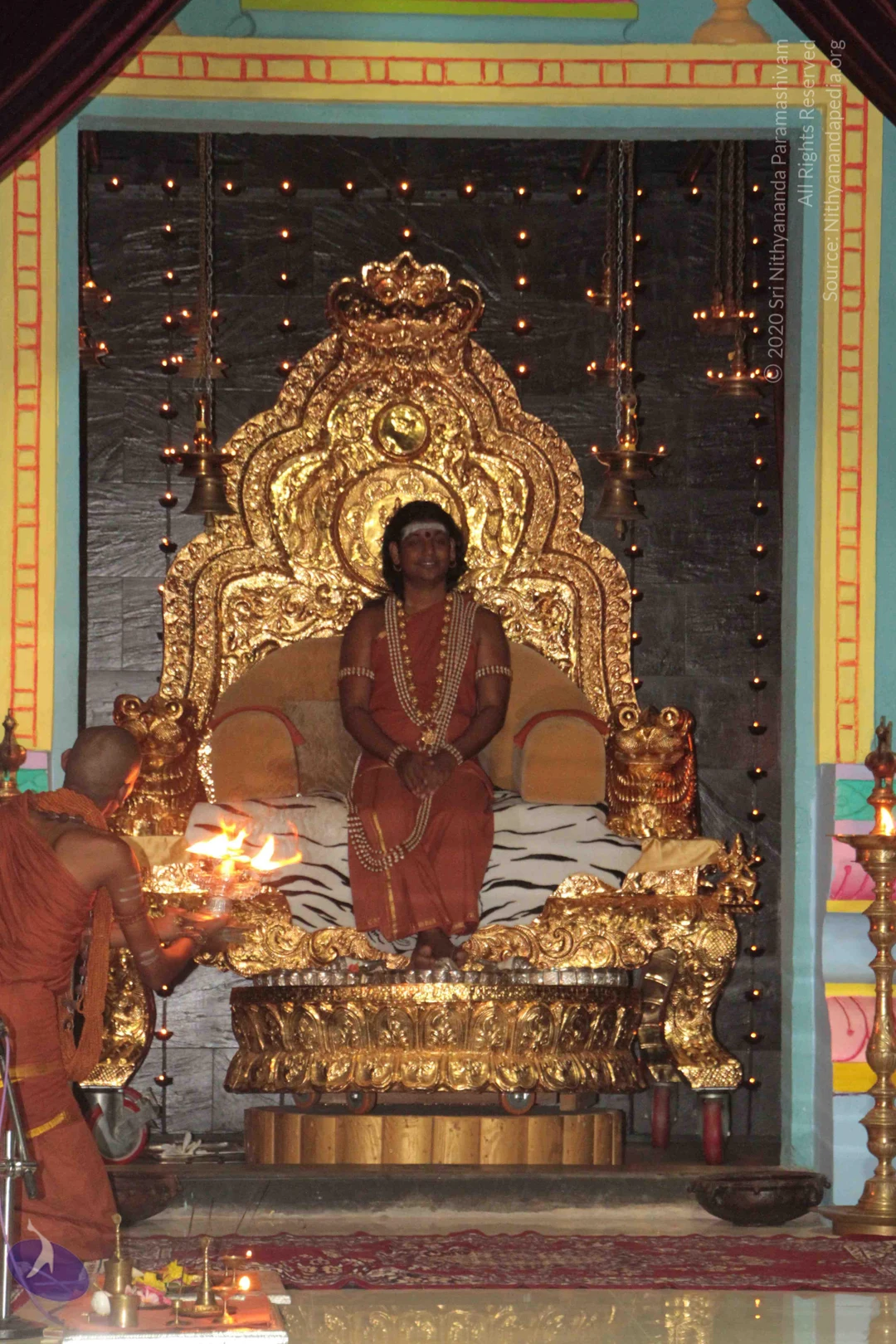
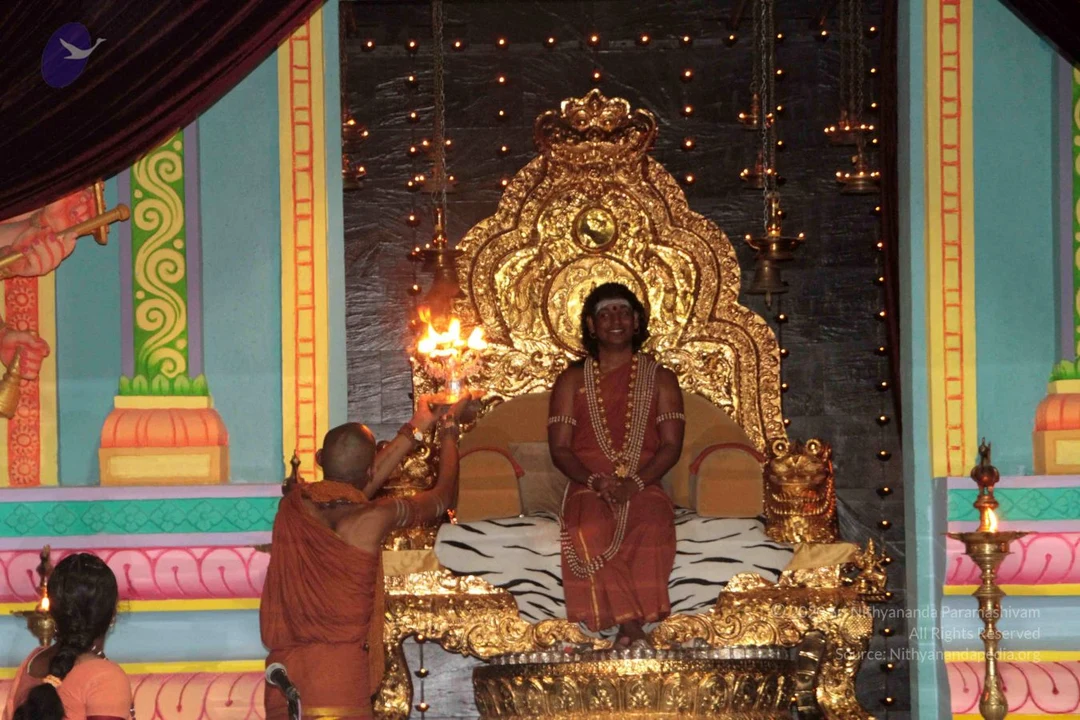
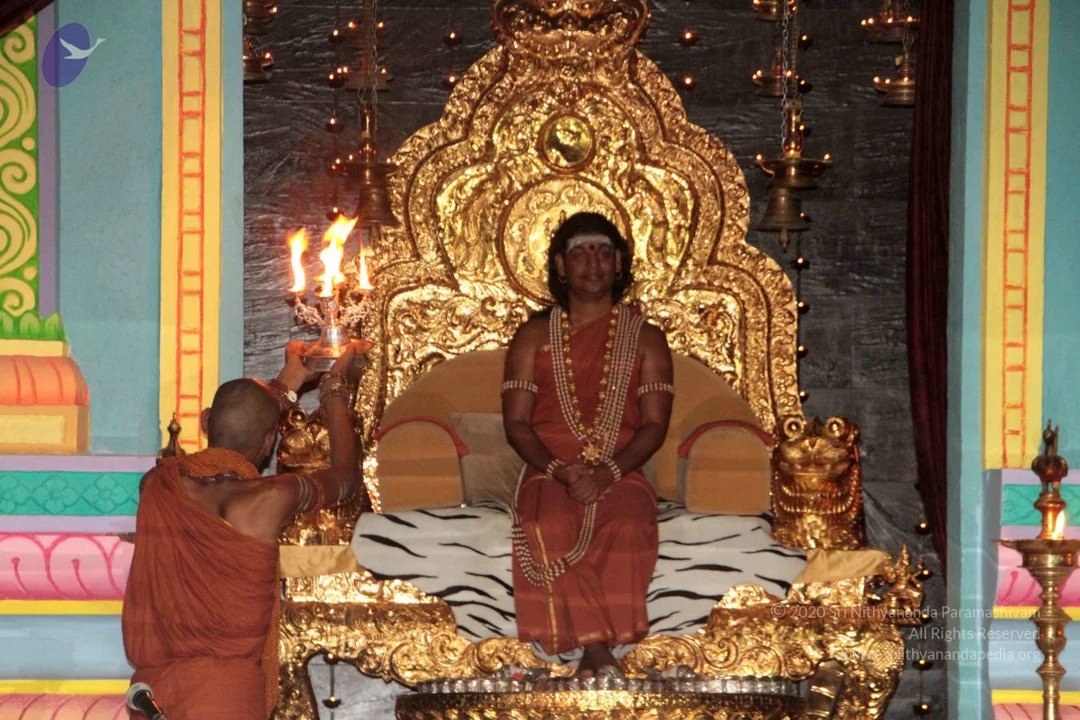
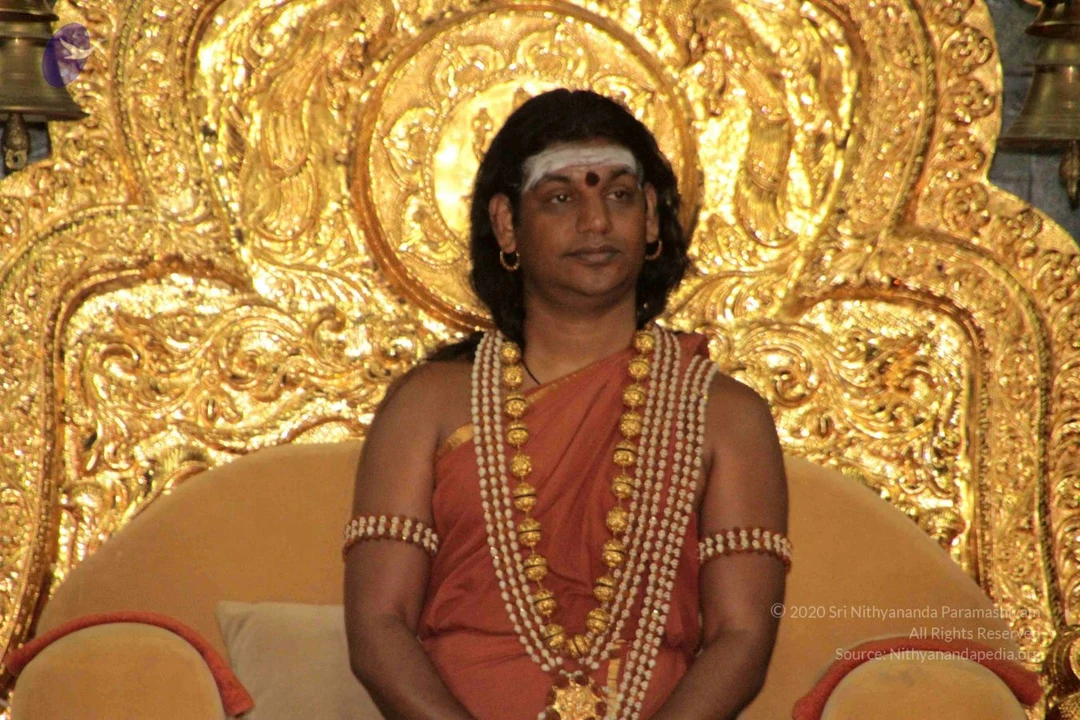
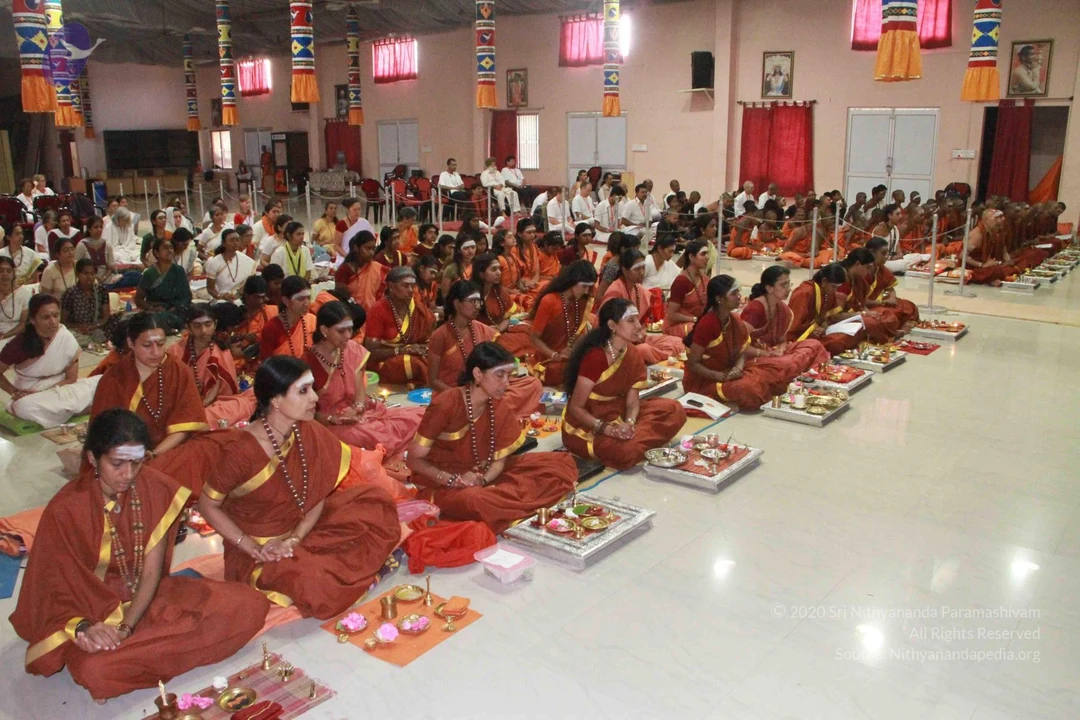
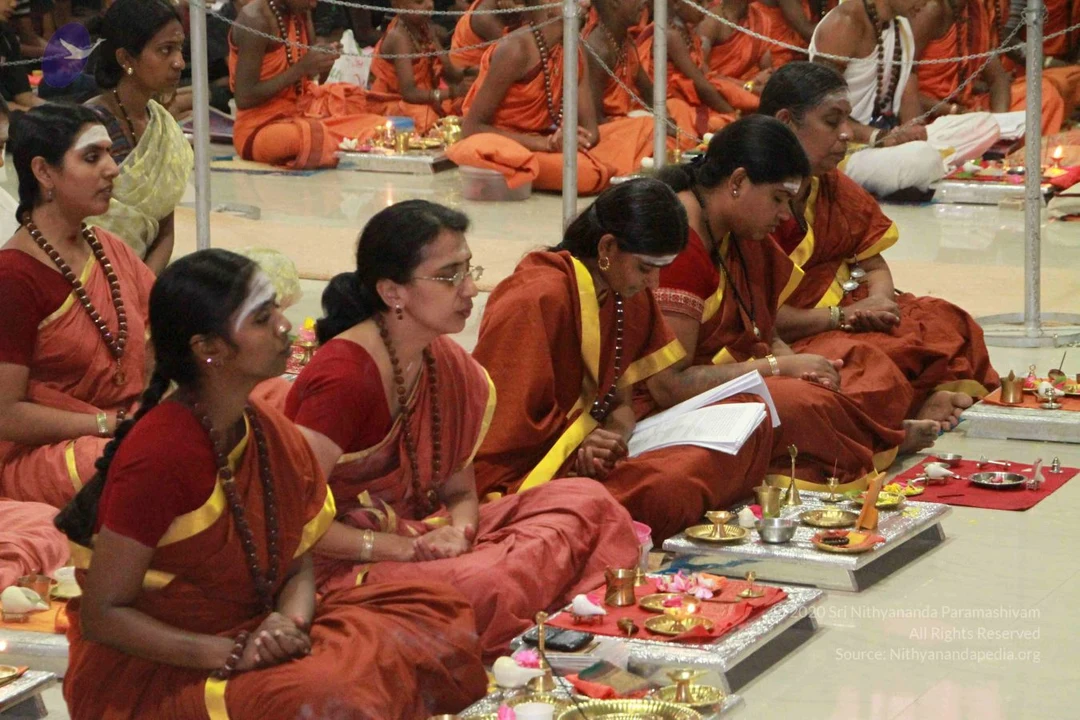
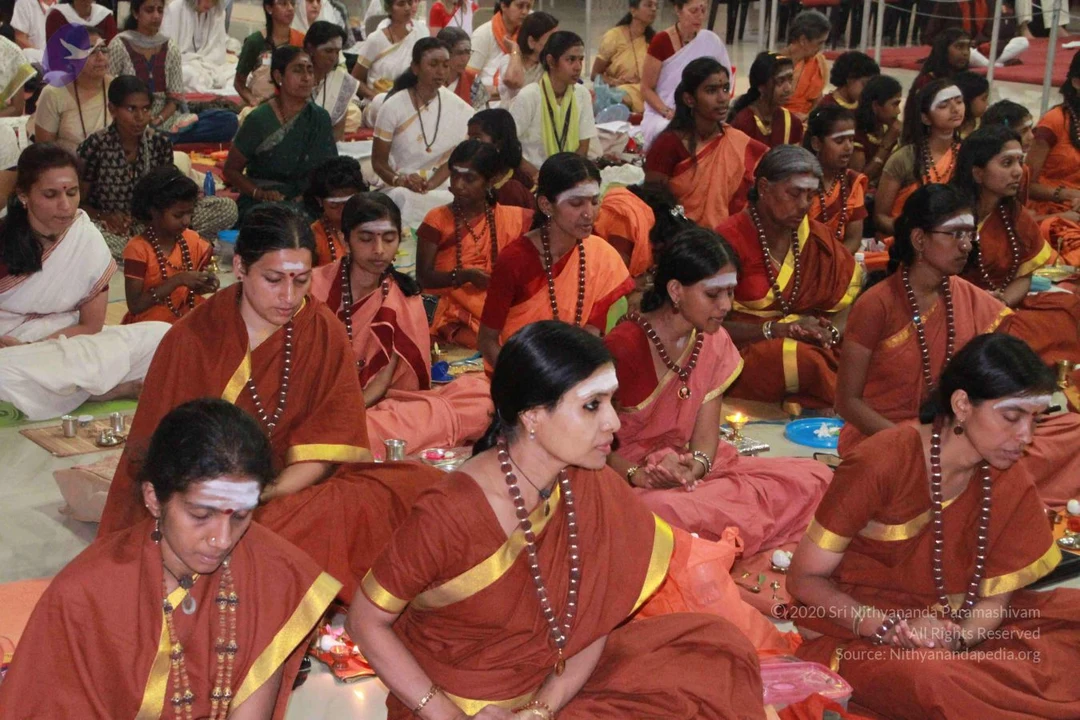
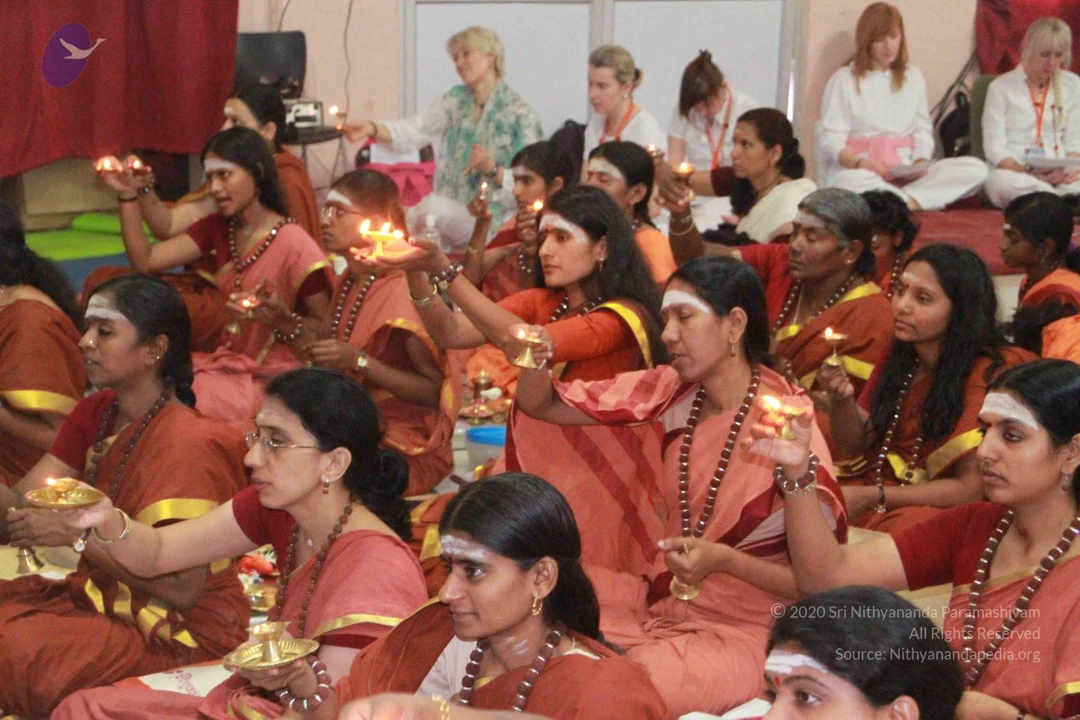
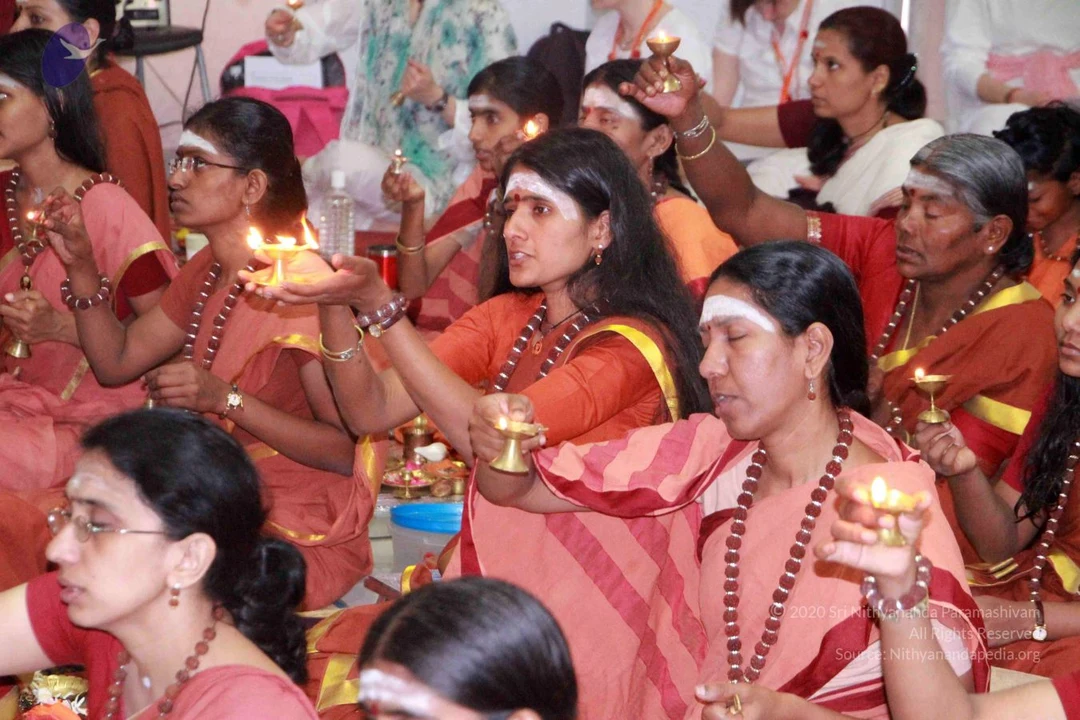
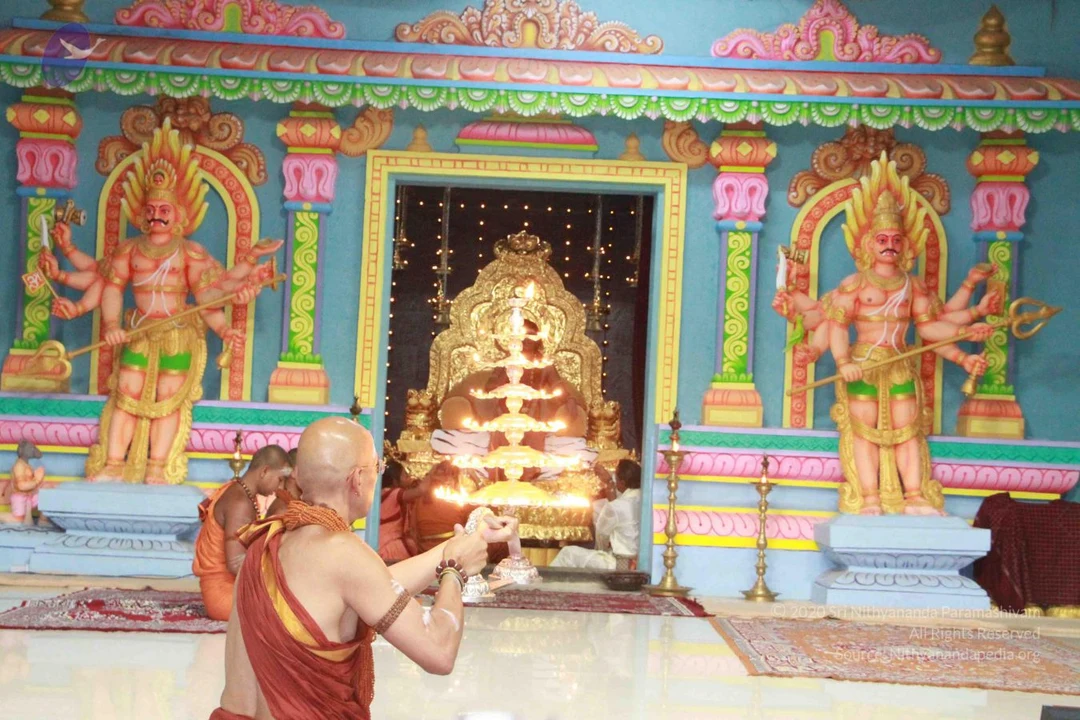
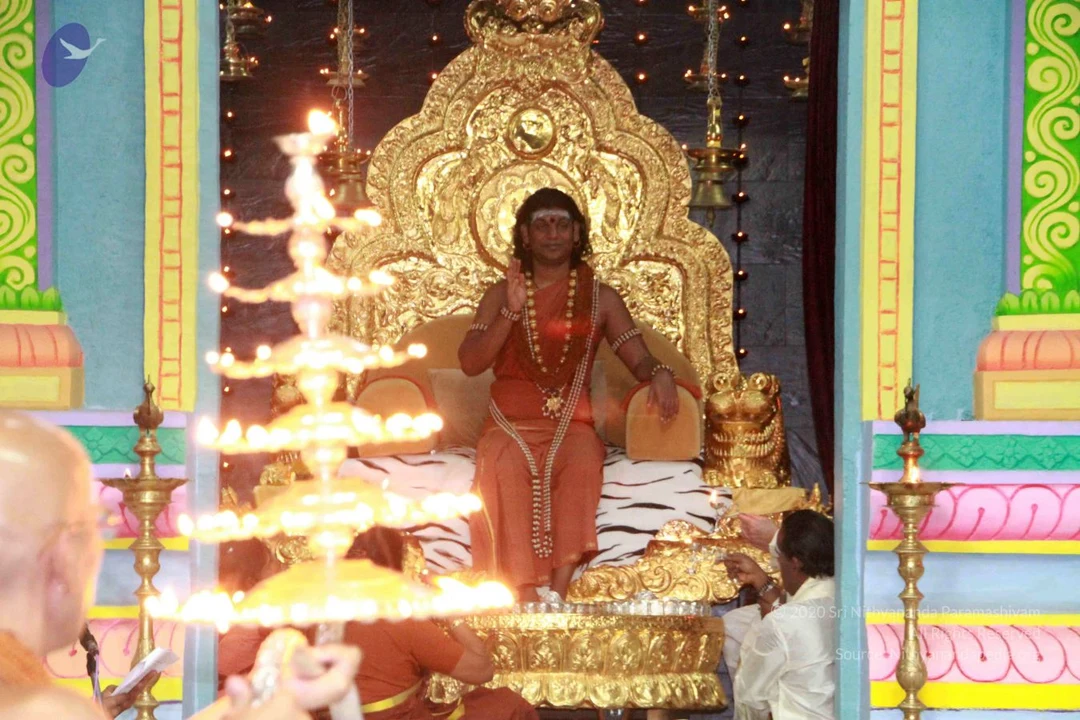
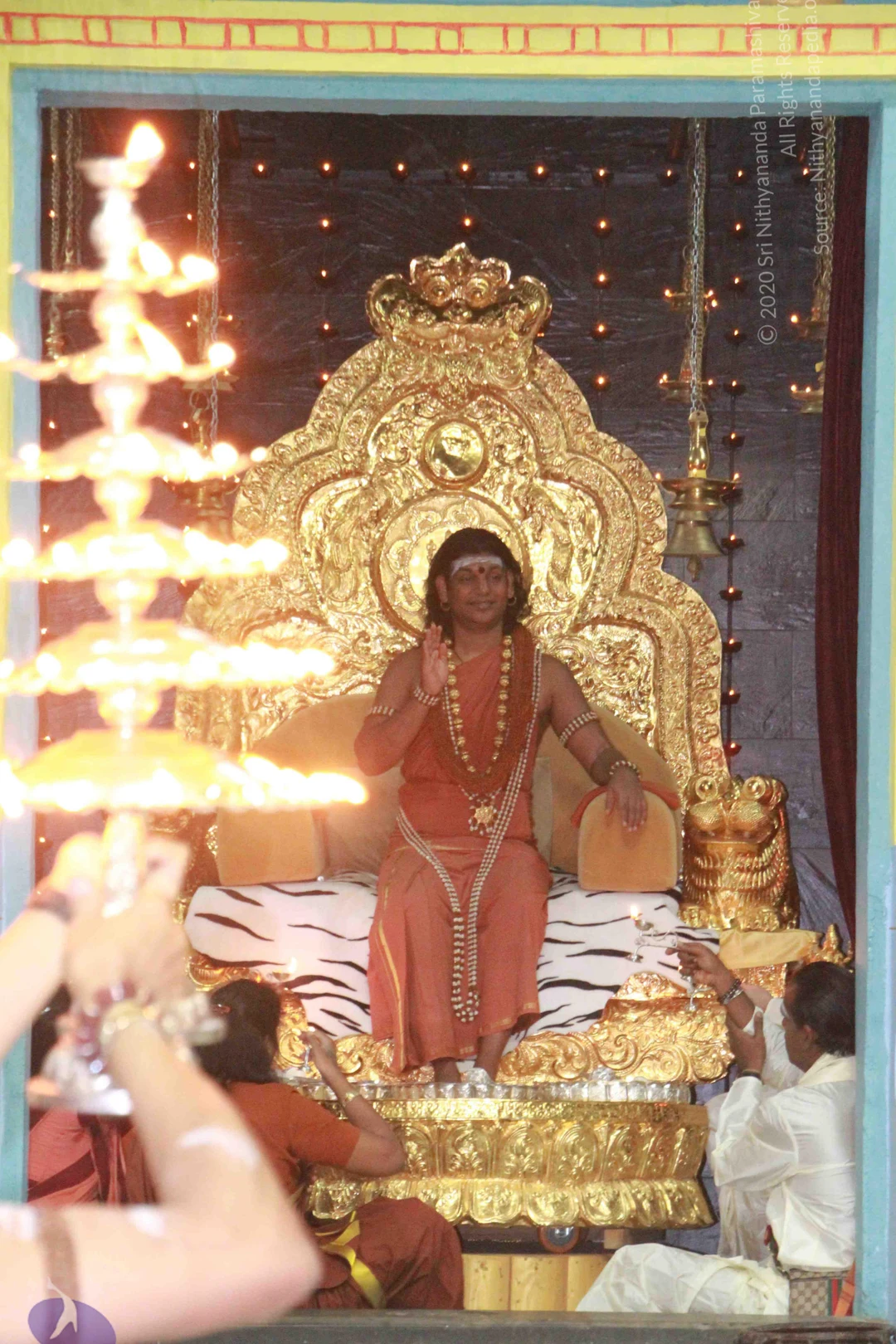
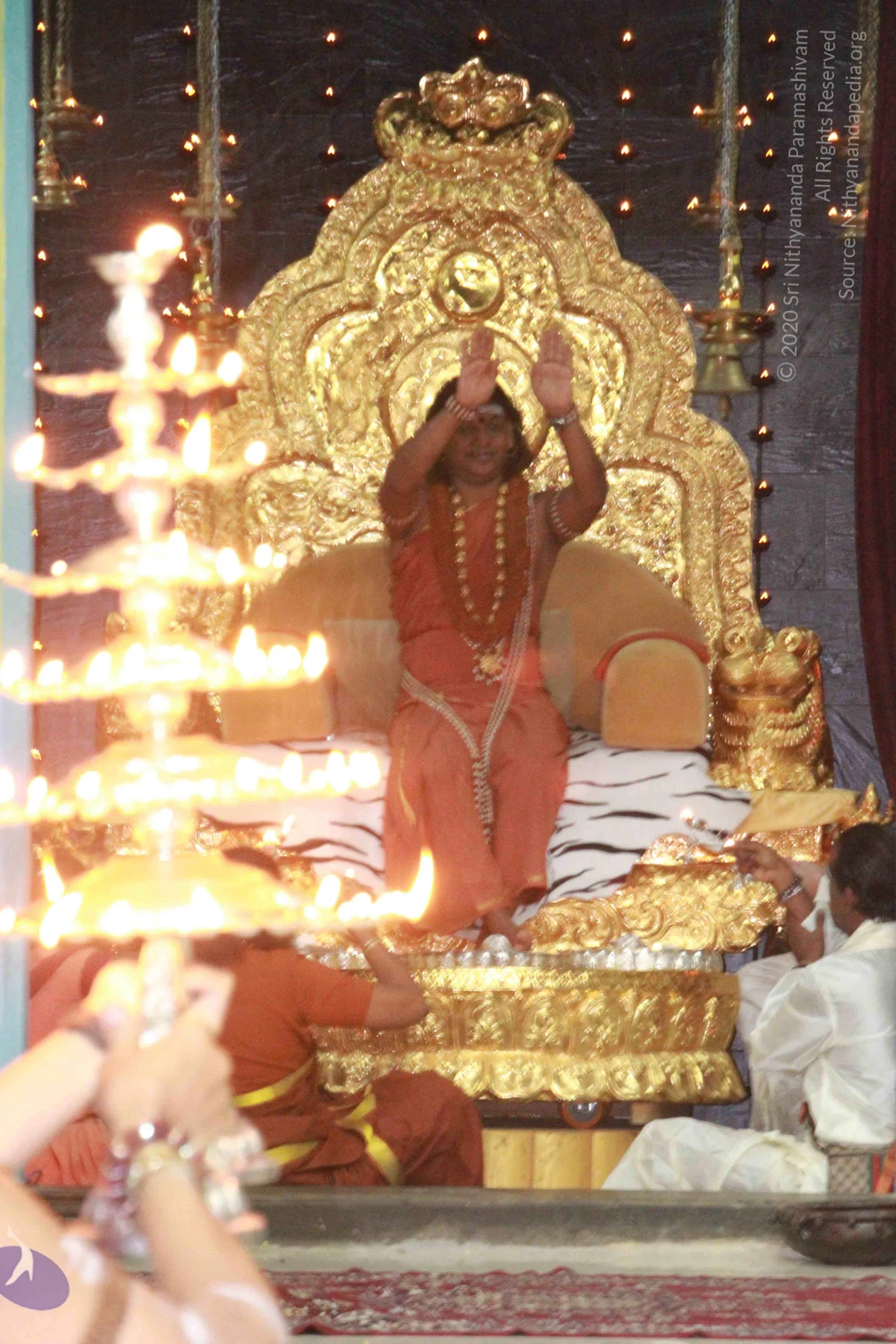
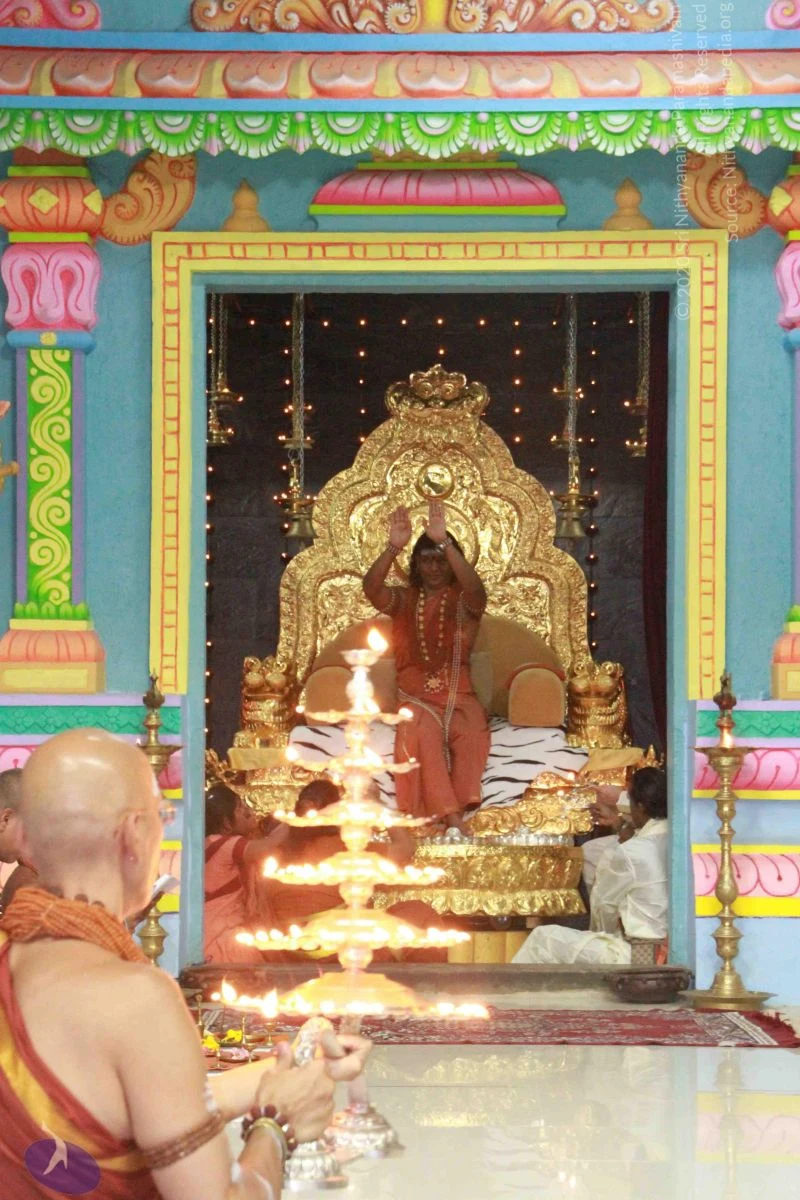
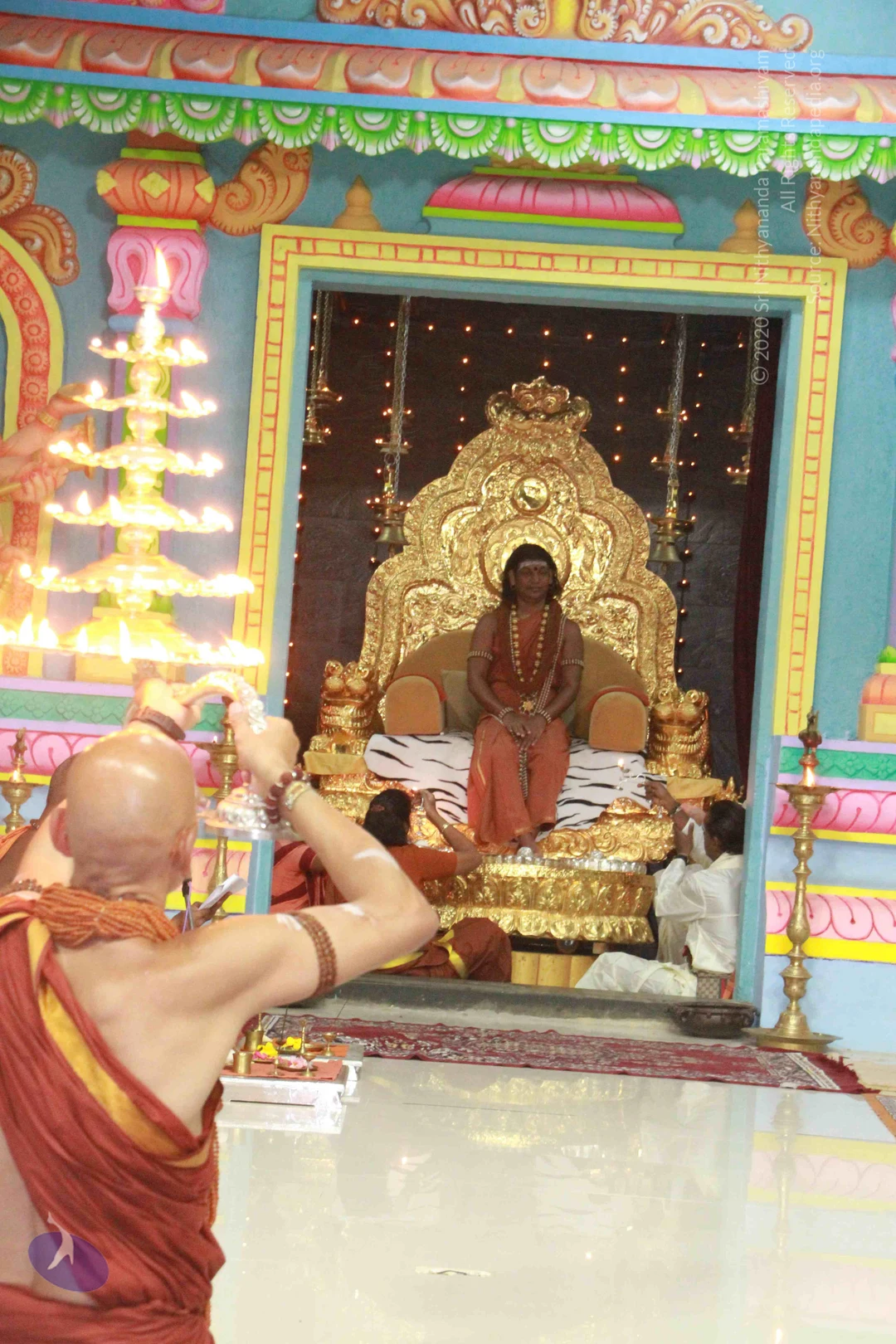
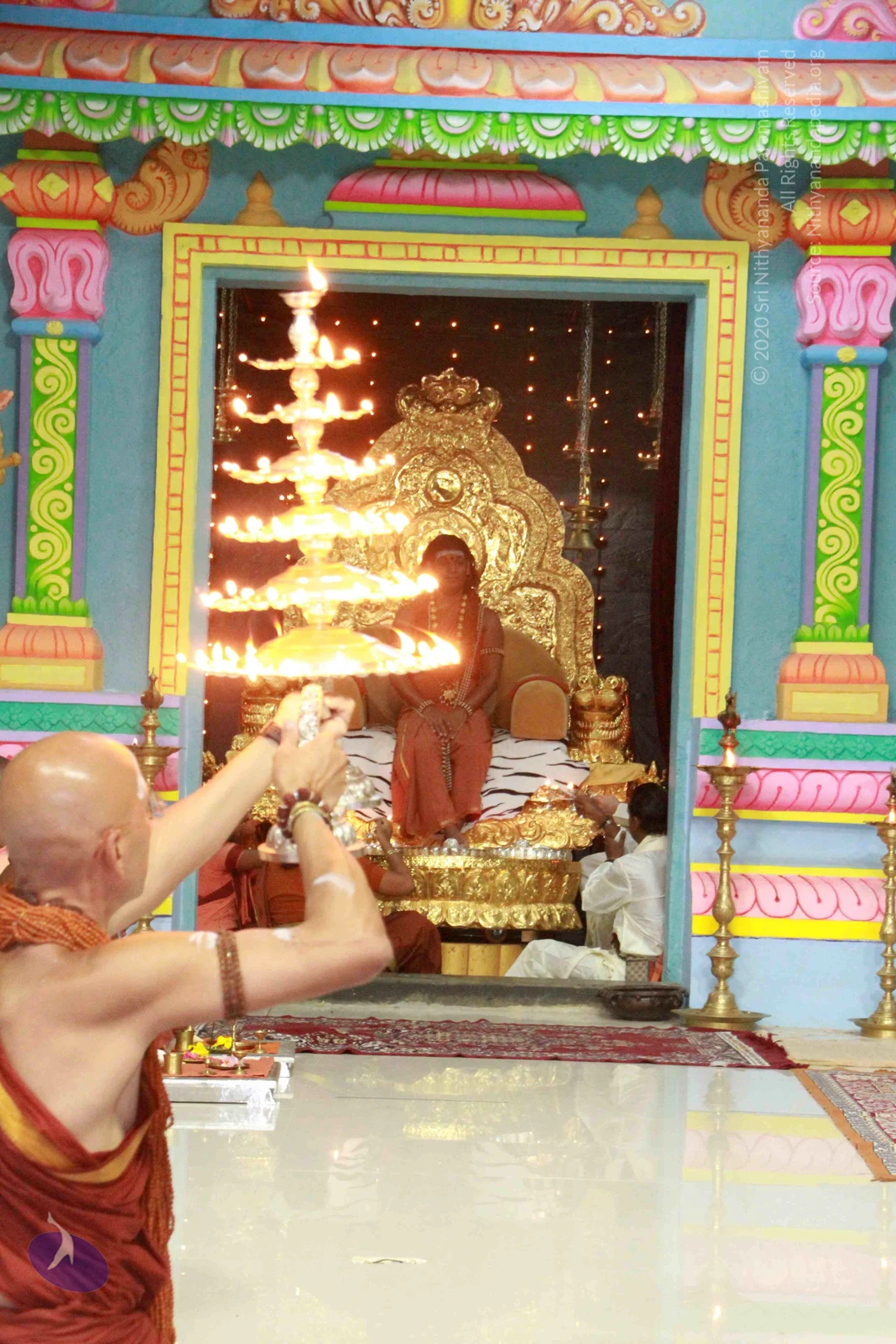
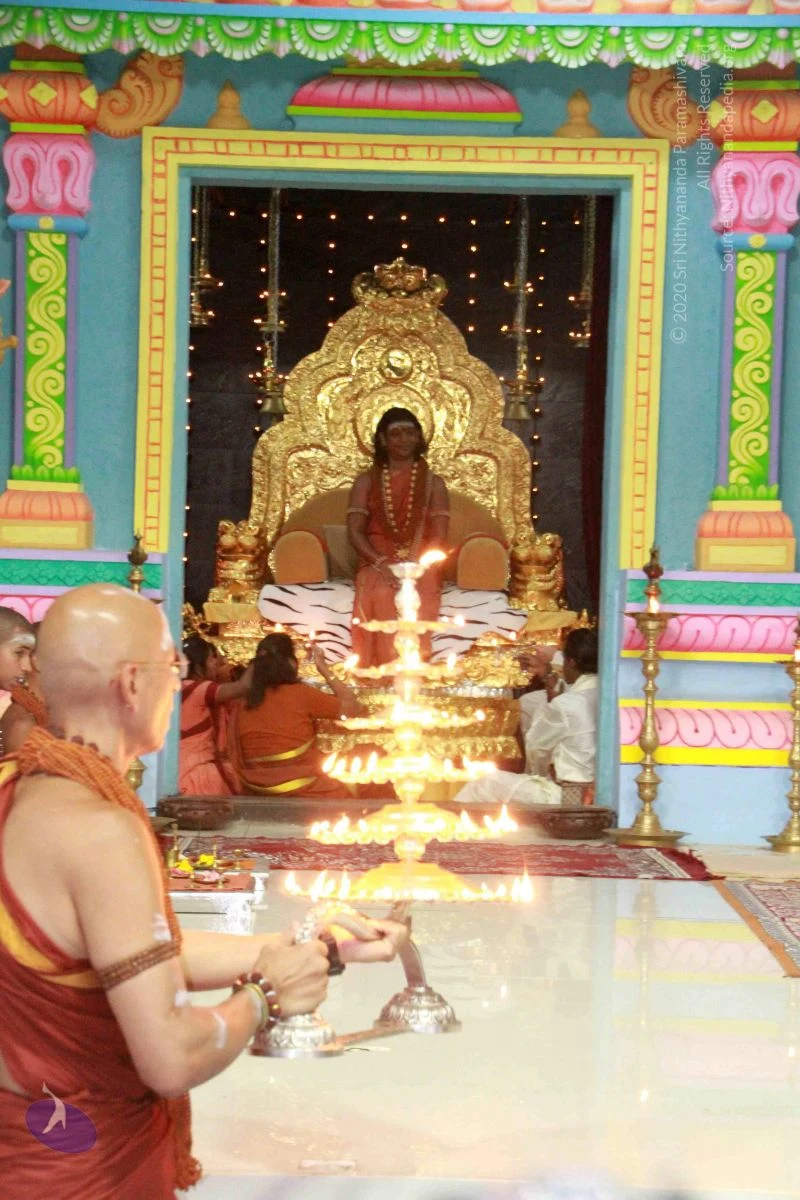
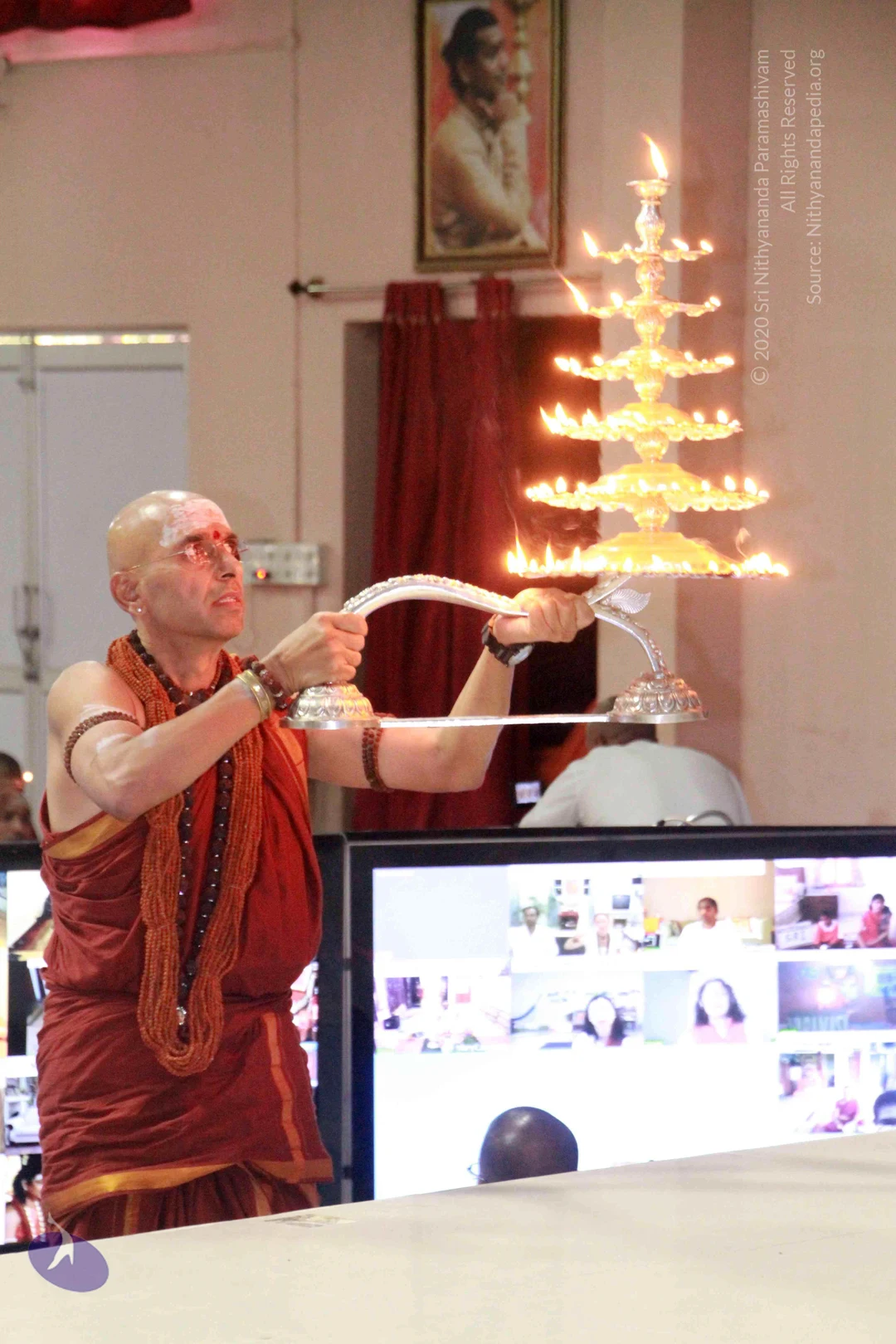
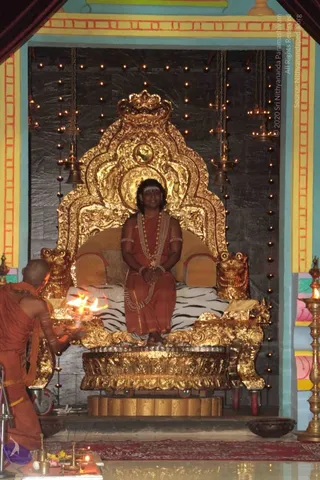
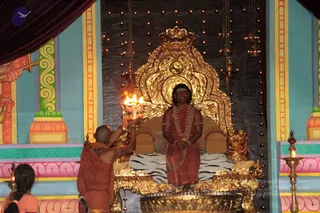
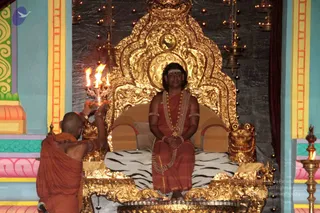
A seated man in a golden ornate throne with a large gilded backrest topped by a crown finial, draped in a zebra-striped cushion, wears an orange-red robe, multi-strand pearl and bead necklaces, bangles and a white forehead band with red tilak. He sits with hands folded in his lap while a bald priest in orange robes at the left holds a lit oil lamp aarti flame toward him. Behind the throne hang rows of small oil lamps and dark beads, with gilded lion figures flanking the seat. Brass lamps and offerings sit on the floor, and a red carpet covers the platform. a person: the seated figure wears a red-orange robe, pearl and rudraksha-style necklaces and bangles on an elaborate golden throne, consistent with a ceremonial presentation.A photograph of a golden ornate throne set against a dark textured backdrop with hanging brass lamps. A seated figure in red-orange robes and a long pearl-style necklace sits on a zebra-striped cushion, with a white sacred mark on the forehead. In front, a bald priest in orange robes holds up a lit oil lamp or flame arti to the seated figure. Painted teal and pink panels frame the scene, and a small lamp burns on the right. A visible candidate is seated in the throne and appears to be the a person; the appearance-based label is a person, with identity kept at unsure where cues are limited. A woman in orange stands at the lower left edge.A seated figure in a saffron-orange robe sits on an ornate gold throne with carved floral and lion motifs, draped with a striped tiger-print cloth. A long rudraksha mala and layered pearl-like necklaces hang on his chest, with bangles on his upper arms and a tilak on his forehead; his hands rest folded in his lap. Kneeling at the lower left, a bald priest in orange robes holds up a brass lamp with several flames in an aarti gesture. Hanging brass oil lamps and bells light the gold-and-painted pillared hall. A sign-free ritual scene inside a temple-style setting.A photograph of a bare-chested man with long dark hair seated on a cushioned gold throne backed by an ornate gilded carved panel. He wears an orange-saffron cloth draped over one shoulder, multiple strands of white beads and gold-bead necklaces, beaded armlets, and a white horizontal tilak with a red dot on his forehead, with gold hoop earrings. His hands rest in his lap. Brass bells hang at the upper corners of the frame. The photo is taken in a temple or ashram setting. Swamiji (probable) is seated on the throne, identified by the long swept-back hair, saffron cloth, rudraksha-style beads and ceremonial gold necklaces.A large hall with pink walls, red curtains and colourful striped pillars hung with fabric. Rows of women and men in saffron-orange and red robes with yellow borders sit cross-legged on a white floor, many wearing rudraksha malas. Brass plates with flowers, oil lamps and small ritual vessels are set before them. Several people in white clothes sit near the back, and framed portraits hang on the walls. Visible people are numerous across the hall, with many seated devotees in saffron and white clothing. A person presiding at the far end is not clearly identifiable, and no figure is clearly distinguished by the cues needed for an identification.A photograph of a seated ritual gathering in an open hall. In the foreground, several women in orange and red saris with yellow borders sit cross-legged, wearing rudraksha malas and white forehead markings. A woman in the center holds an open booklet and sits before a silver tray with brass oil lamps, bowls, flowers and small offerings. Behind them, rows of people in orange robes sit on the floor before similar brass puja plates, and a man in white clothing sits at the upper right. Metal poles and a rope divide the seating area.

Nithya-Satsang

57 photosSource gallery
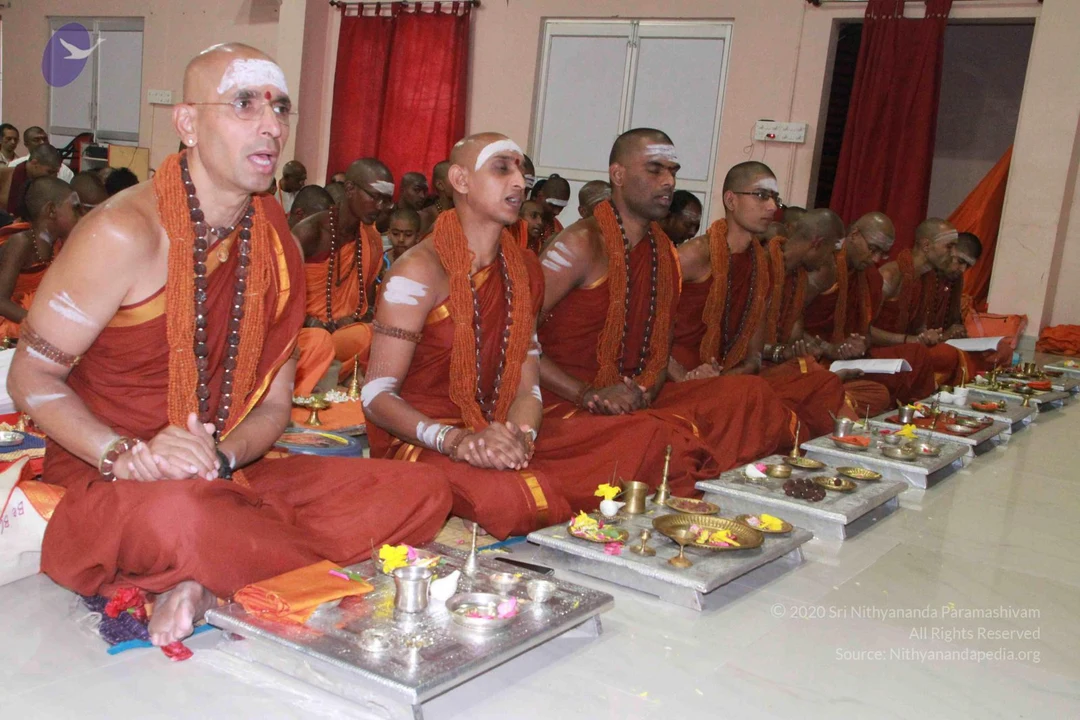
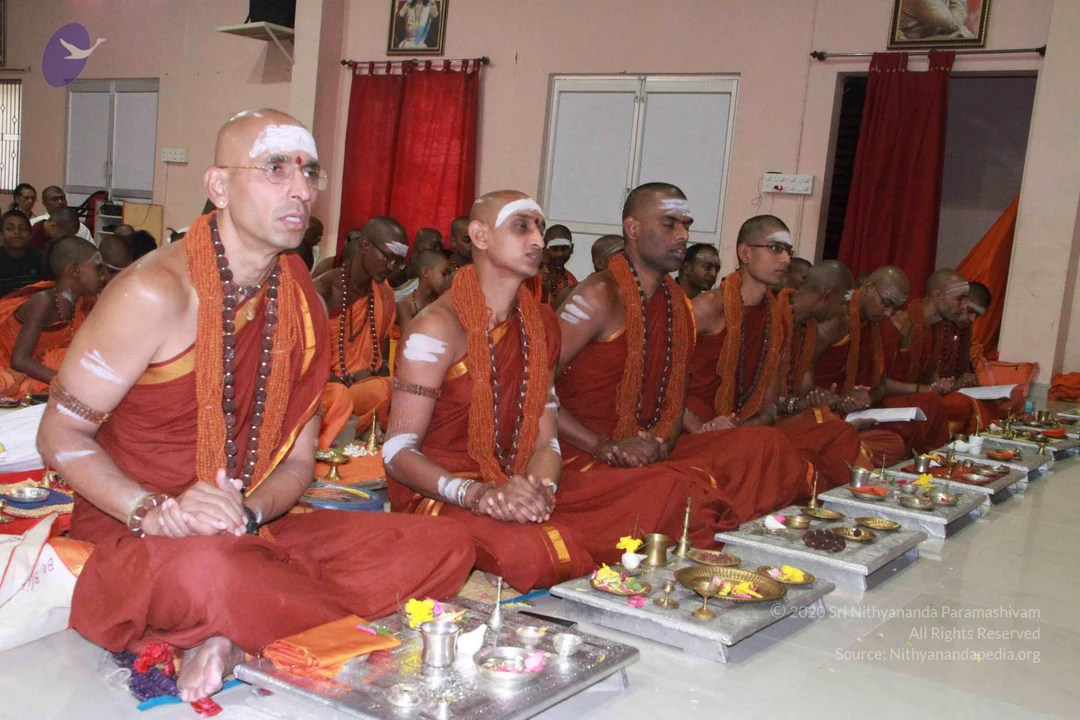
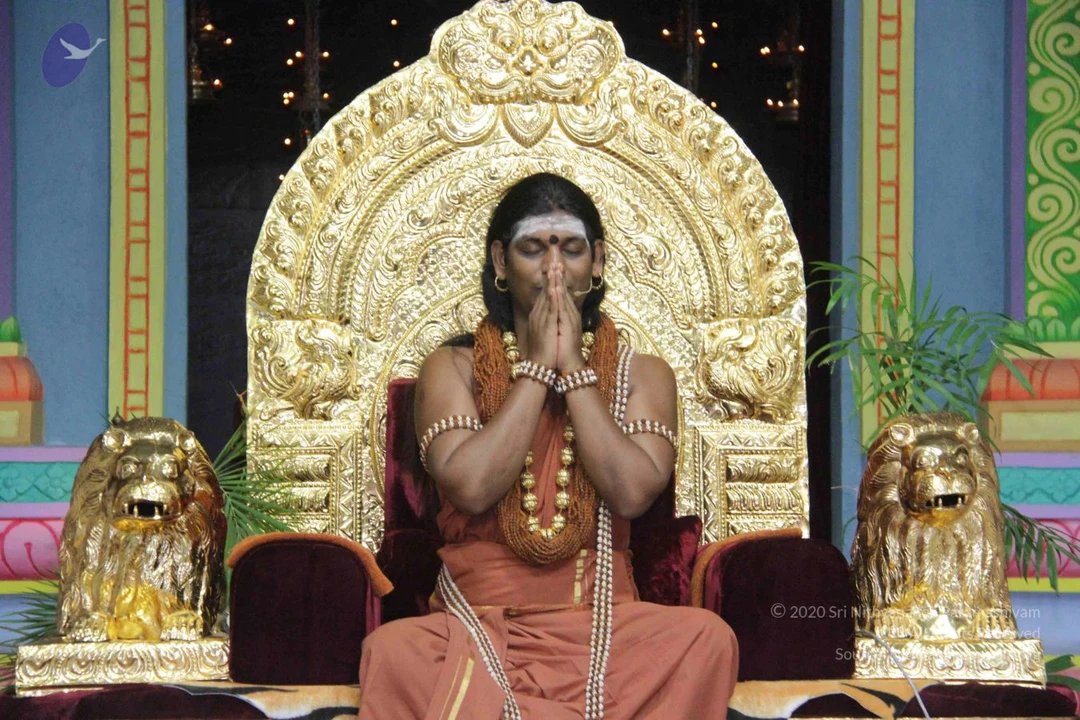
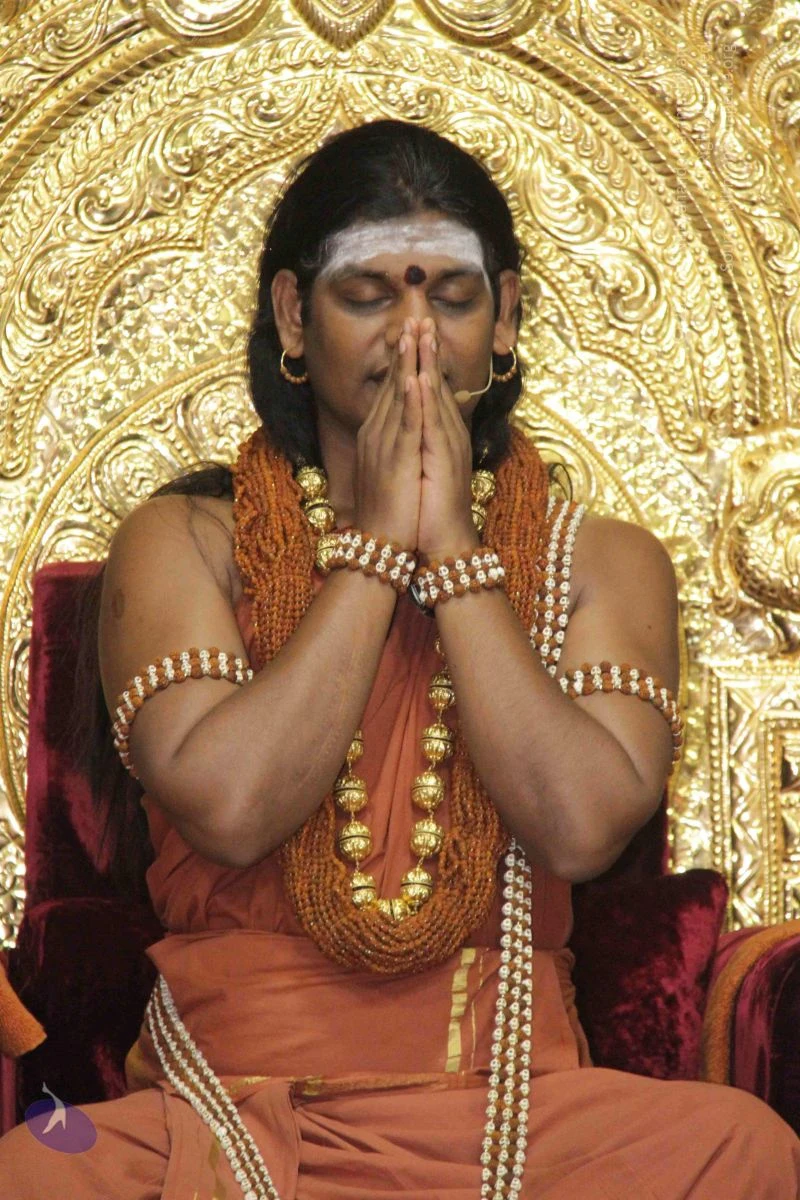
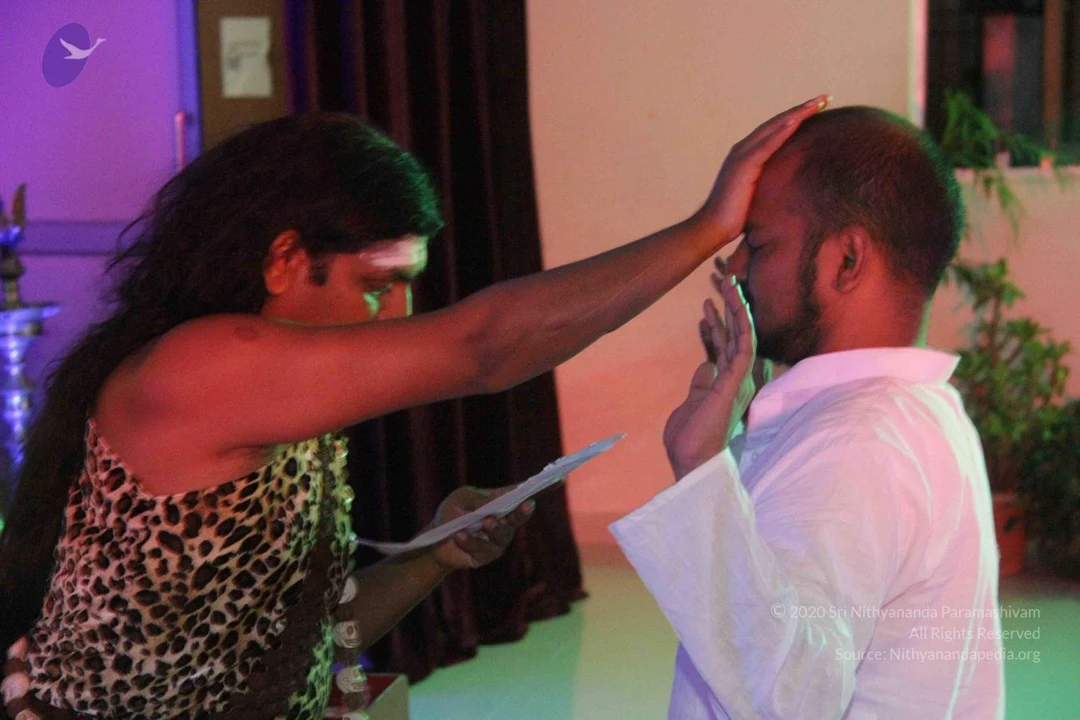
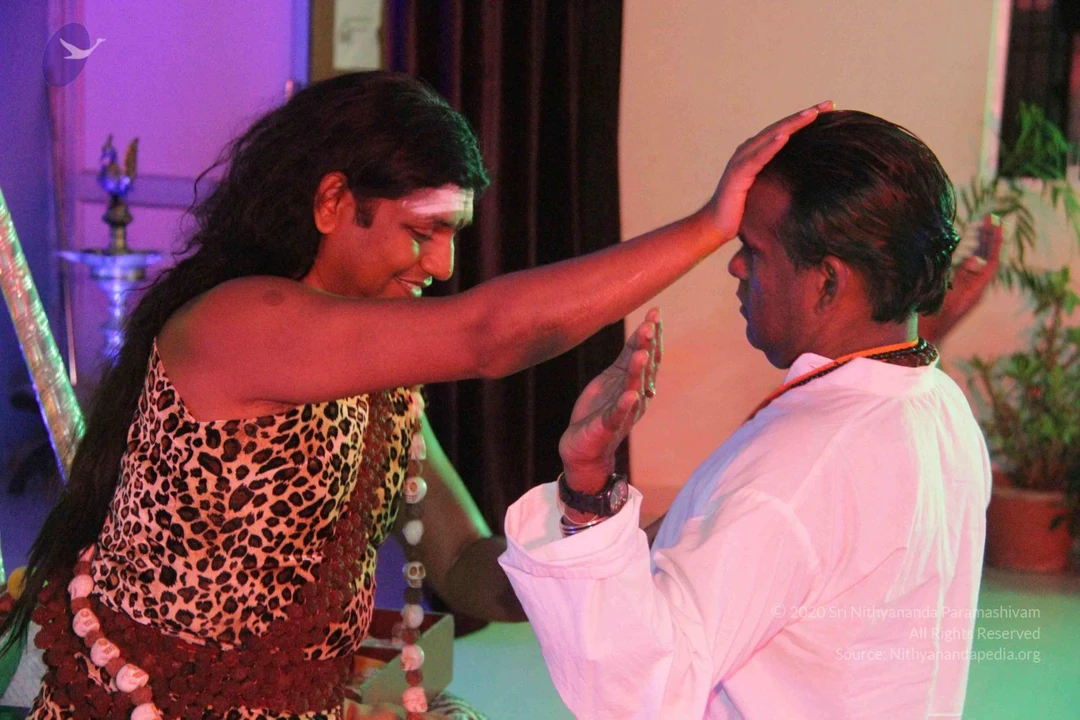
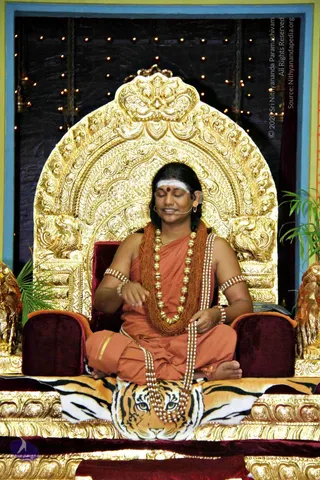
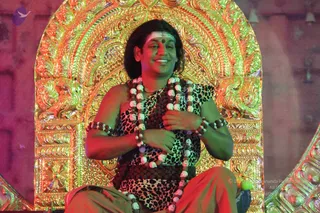
Photo of a seated person in saffron-orange robes with palms pressed together in namaste at the chest. The person wears long dark hair swept back, a white vertical tilak with a red bindi on the forehead, gold hoop earrings, a microphone clipped near the mouth, and layered orange rudraksha malas with gold bead necklaces and white-and-orange beaded armbands and wristbands. Behind is an ornate gold repoussé backdrop on a red velvet seat. Probable Swamiji by visible appearance cues: long swept-back hair, saffron clothing, rudraksha malas and ceremonial gold necklaces.A seated man on an ornate gilded throne with a tiger-skin rug draped over its platform, speaking into a headset microphone during a discourse. He wears orange-saffron robes, a long rudraksha mala and a gold bead necklace, with pearl-like beaded bands on his arms and a vertical sacred mark on his forehead. A dark backdrop with small lights and green foliage surround the golden throne.A seated man in orange robes sits cross-legged on an ornate gold throne with a carved arched back, flanked by two golden lion sculptures with open mouths. He wears a long multi-strand orange-beaded necklace, a large gold chain with rudraksha-style beads, bangles on both arms, a white forehead band with a red dot, and a small earpiece microphone. His hands rest on the throne's velvet armrests with a tiger-striped cloth beneath him. Potted palms and a colourful painted backdrop with lamps surround the stage. Swamiji (probable): the long swept-back hair, saffron-orange robes, rudraksha mala and ceremonial gold necklaces are consistent with the page's identification, shown here as a seated speaker on stage.A seated speaker on an ornate gilded throne with a tiger-skin rug before it, raising one hand in a gesture while speaking into a headset microphone. He wears a saffron-orange robe, a thick rudraksha mala with gold beads, a pearl-string armlet and bangles, and a white and red forehead mark. Behind him are gold-framed carvings, small lamps and potted palms. Swamiji (probable) appears as a robed speaker with long swept-back hair, saffron clothing and rudraksha and gold ornaments, seated on a throne in front of a discourse setting.A seated man in saffron-orange robes sits cross-legged on a red velvet seat before an ornate gold throne with a carved arch and lion figures, atop a tiger-skin cloth. He has long dark hair, a white forehead mark with a red dot, and wears a dark-beaded mala, a gold bead necklace, pearl-strand necklace and gold armbands, with his eyes closed in meditation. A lapel microphone is visible near his face. Golden lion statues flank the throne and potted green plants sit at the sides, with string lights behind the dais. Appearance-based identification: a person, seated in a satsang-style discourse setting with a microphone.A photograph of a large group of shaven-headed sannyasis seated cross-legged on the floor of a hall, wearing saffron-orange robes, rudraksha malas and orange shawls, with white and sandalwood marks on their foreheads and arms. Brass and silver ritual plates, small oil lamps, flowers and kalasha-style vessels sit before them. Behind them, younger boys in dark shirts and older men in white sit among the crowd, and a red curtain hangs on the back wall beside a white door. The image shows a group ritual setting rather than an identifiable single leader.

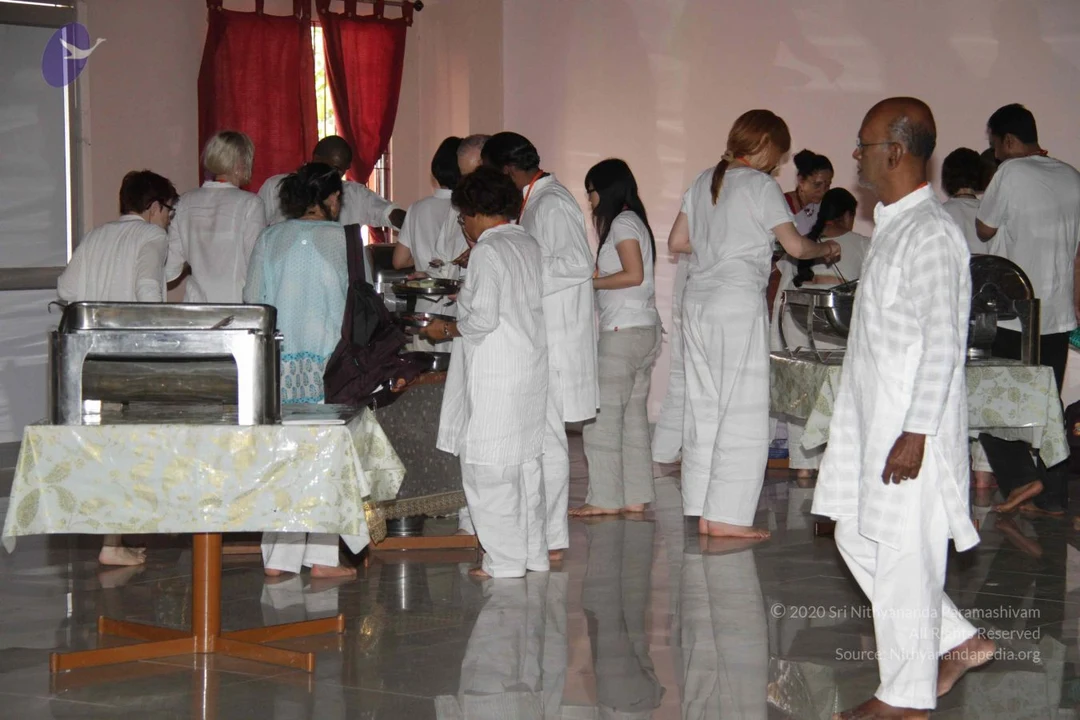
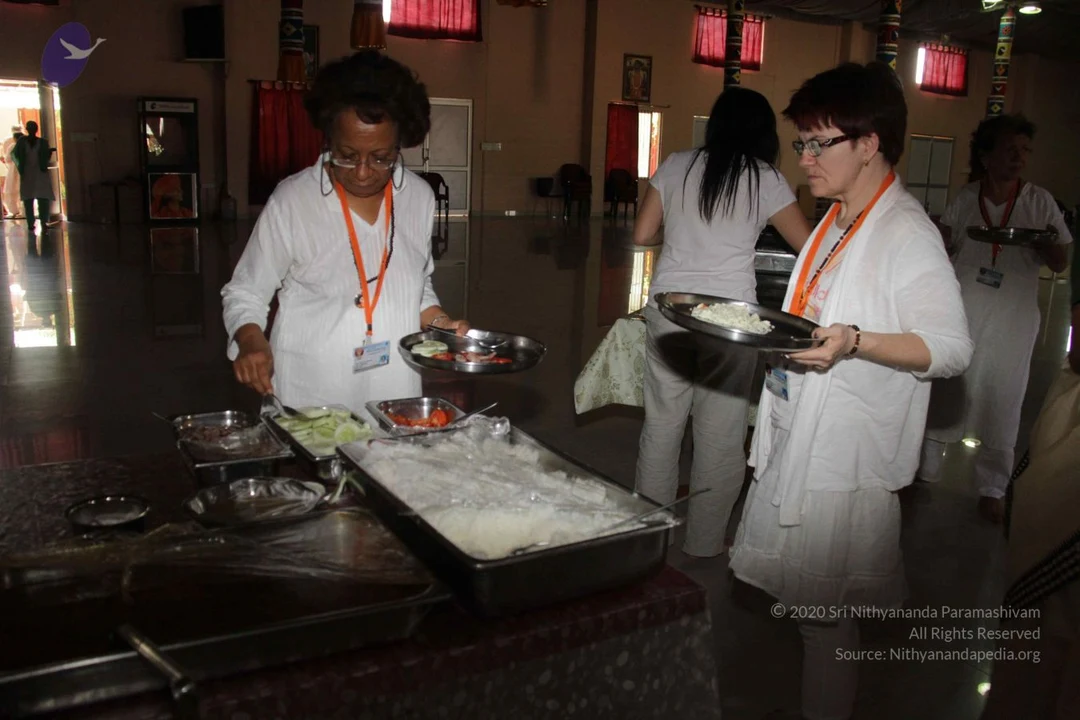
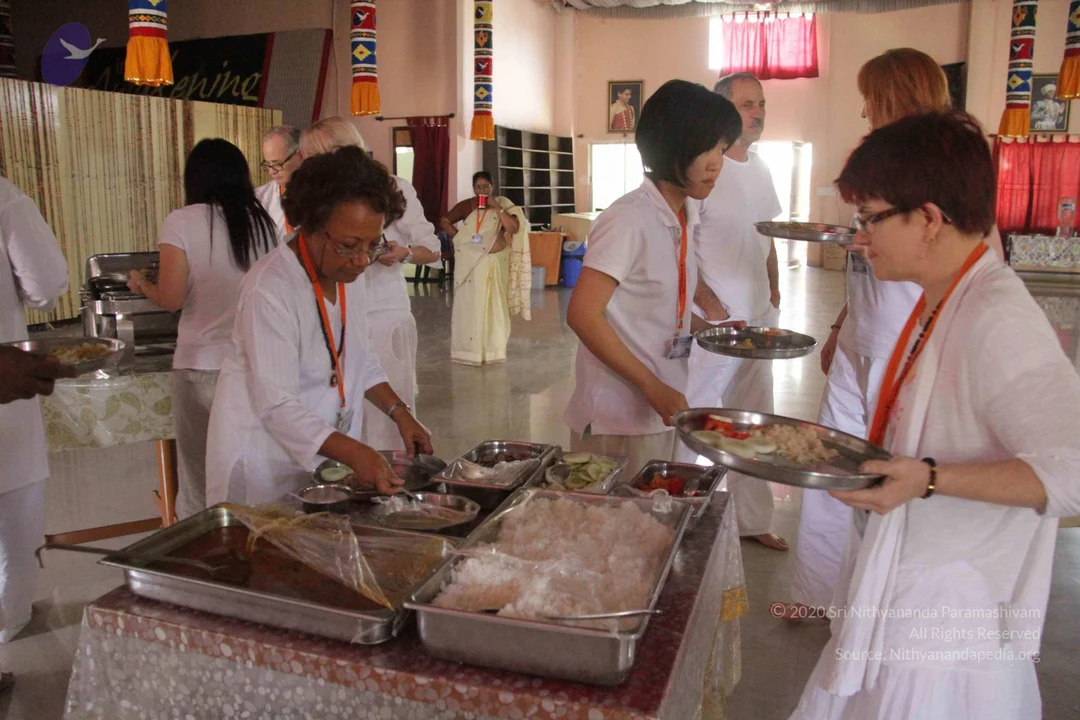
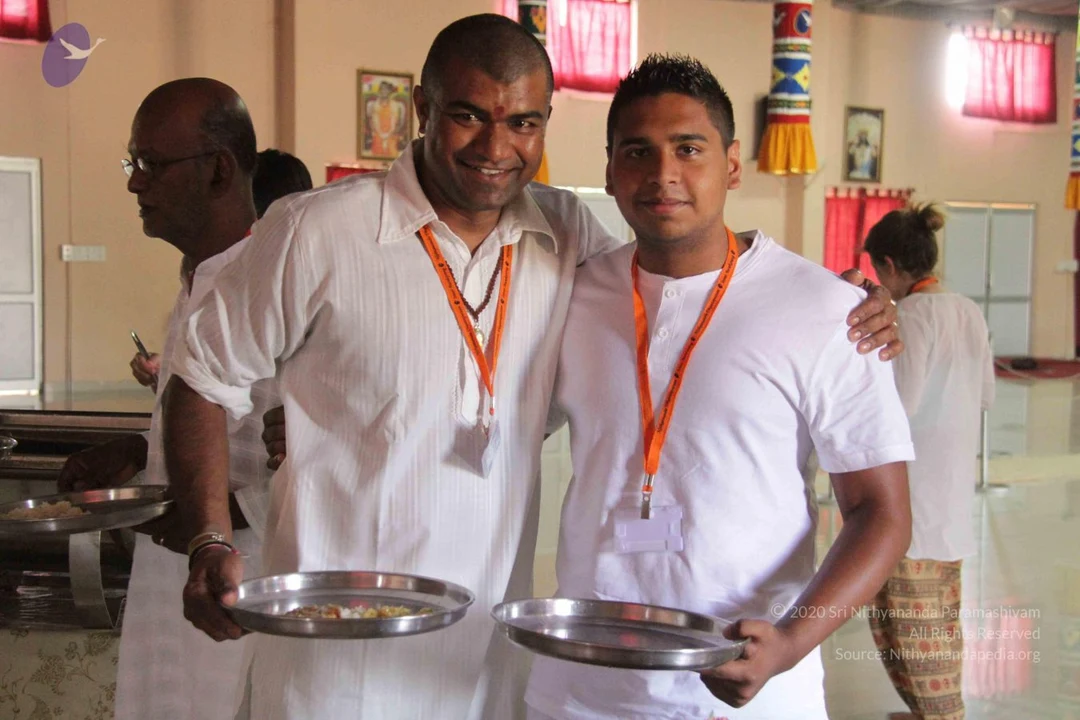
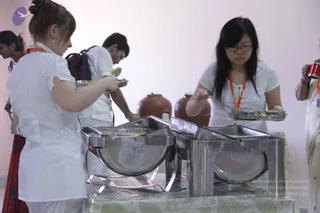
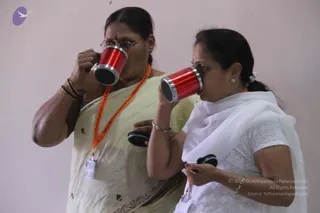
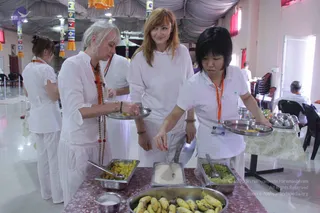
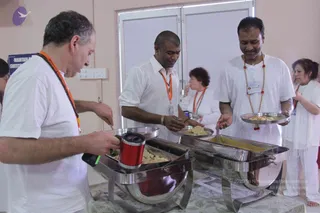
IA-Lunch

25 photosSource gallery
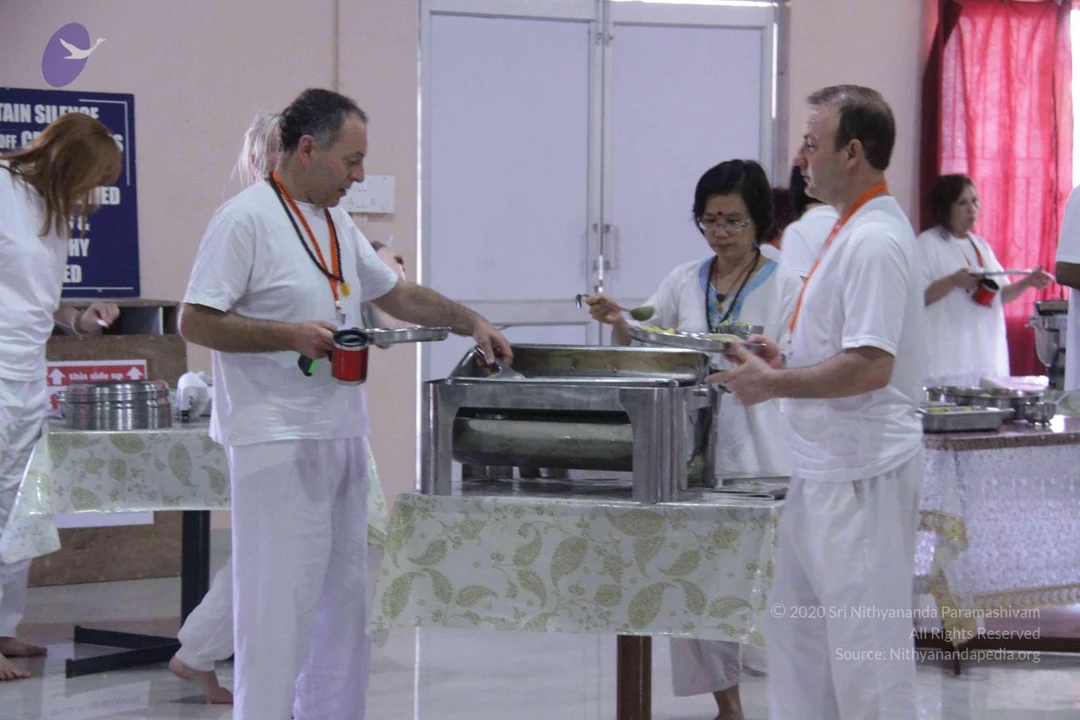
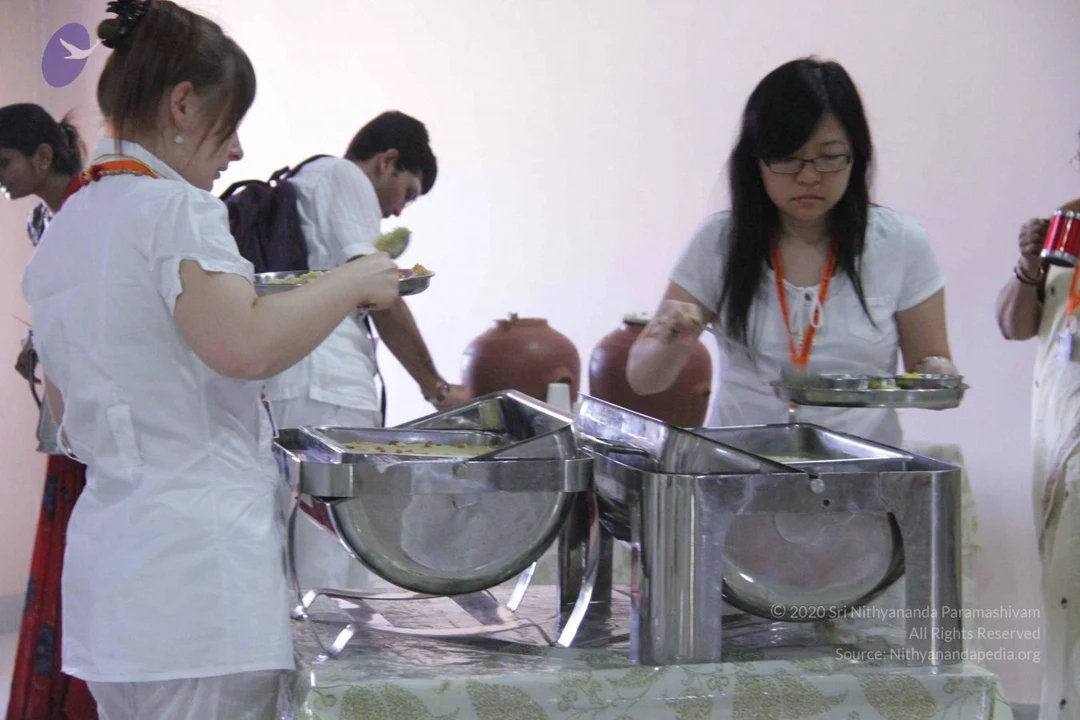
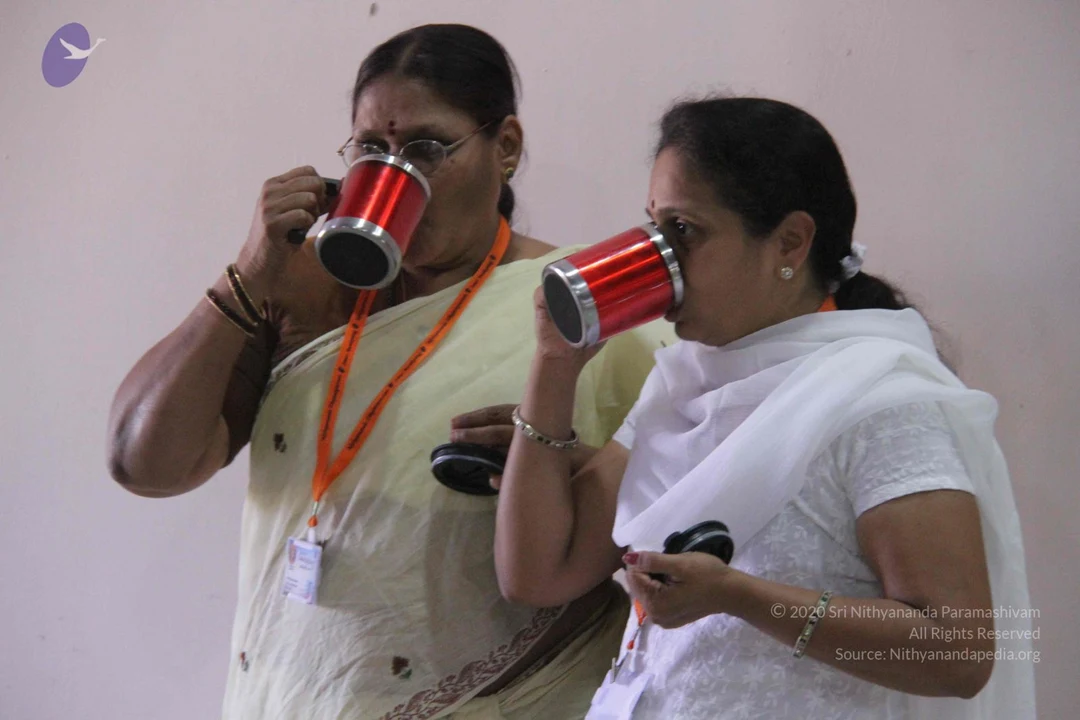
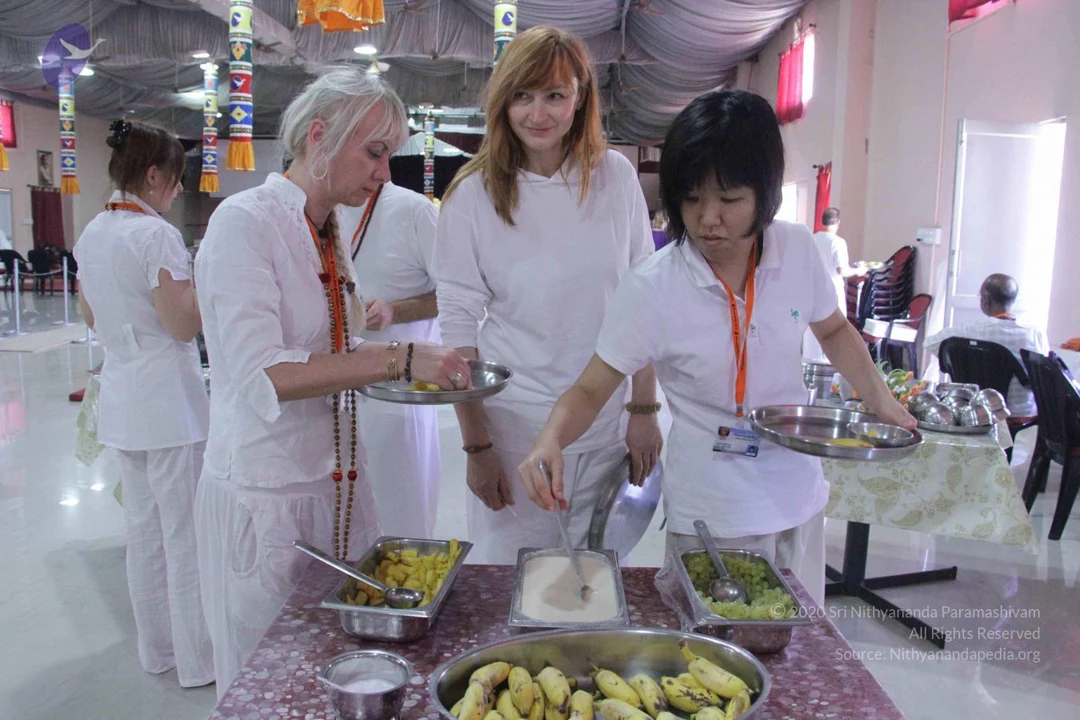
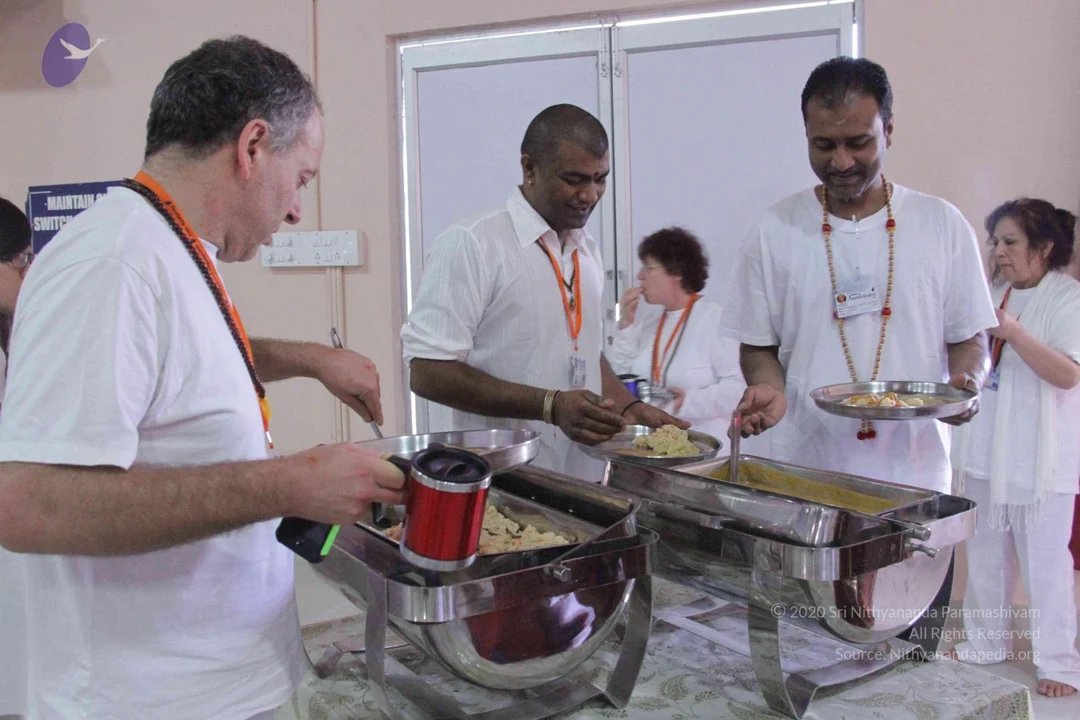
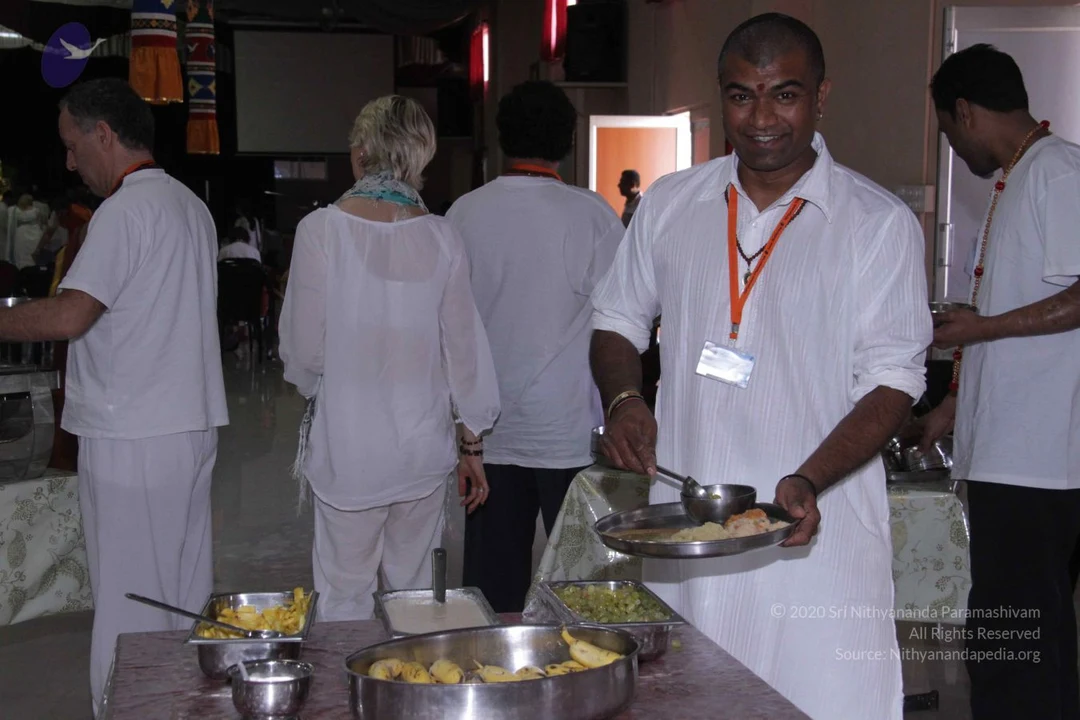
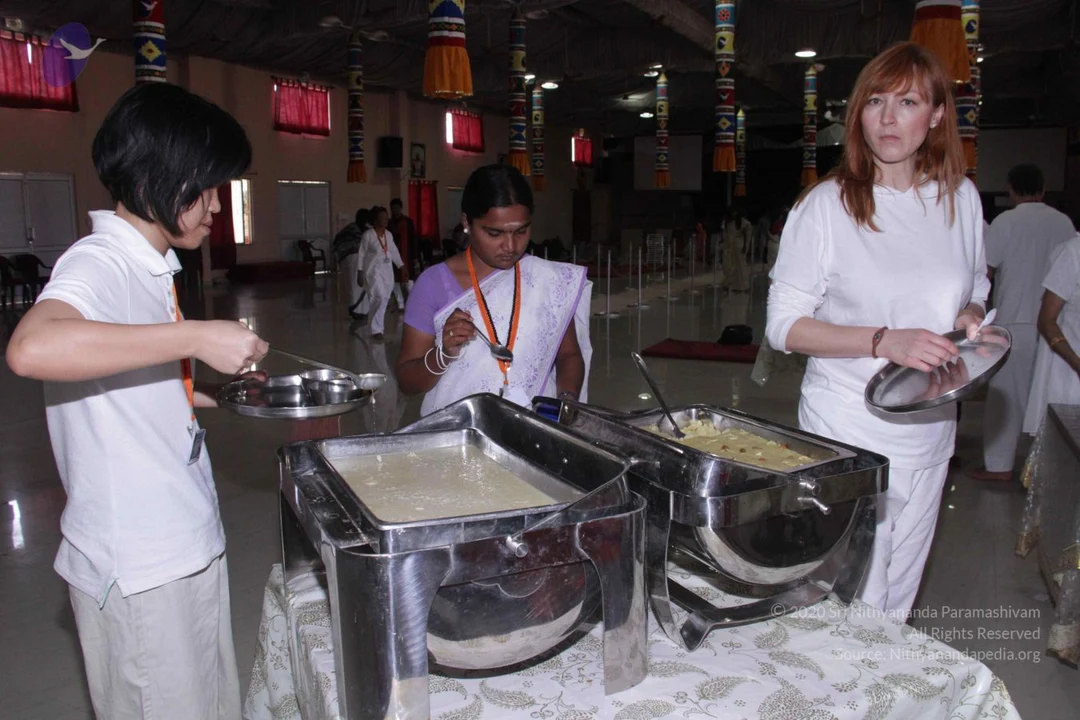
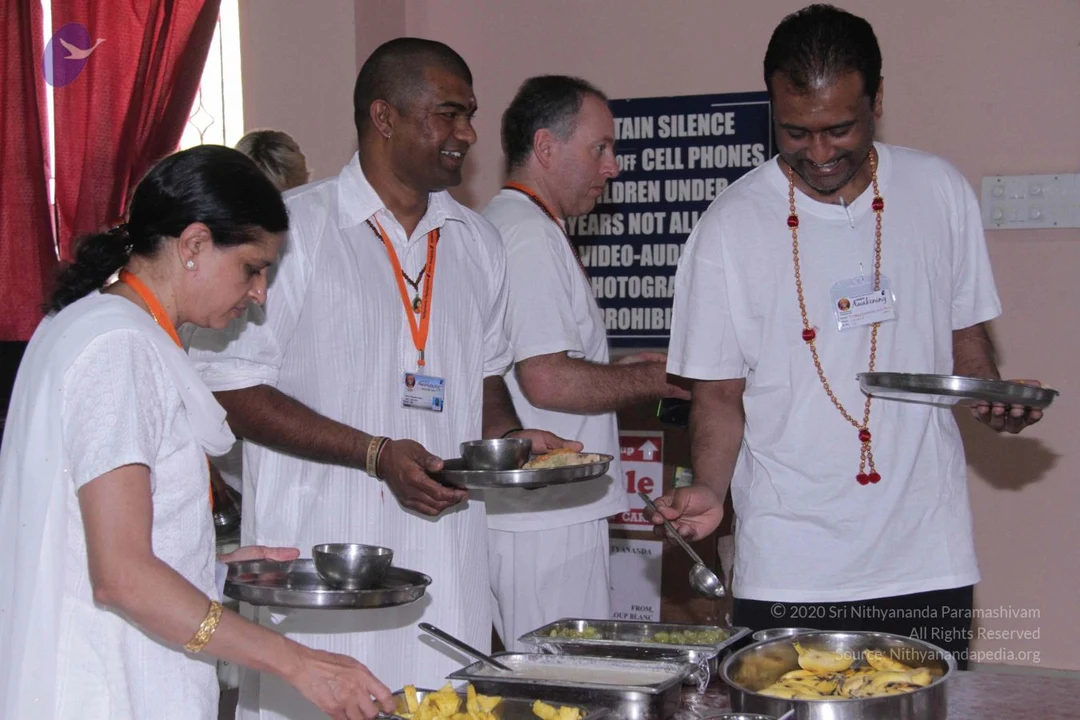
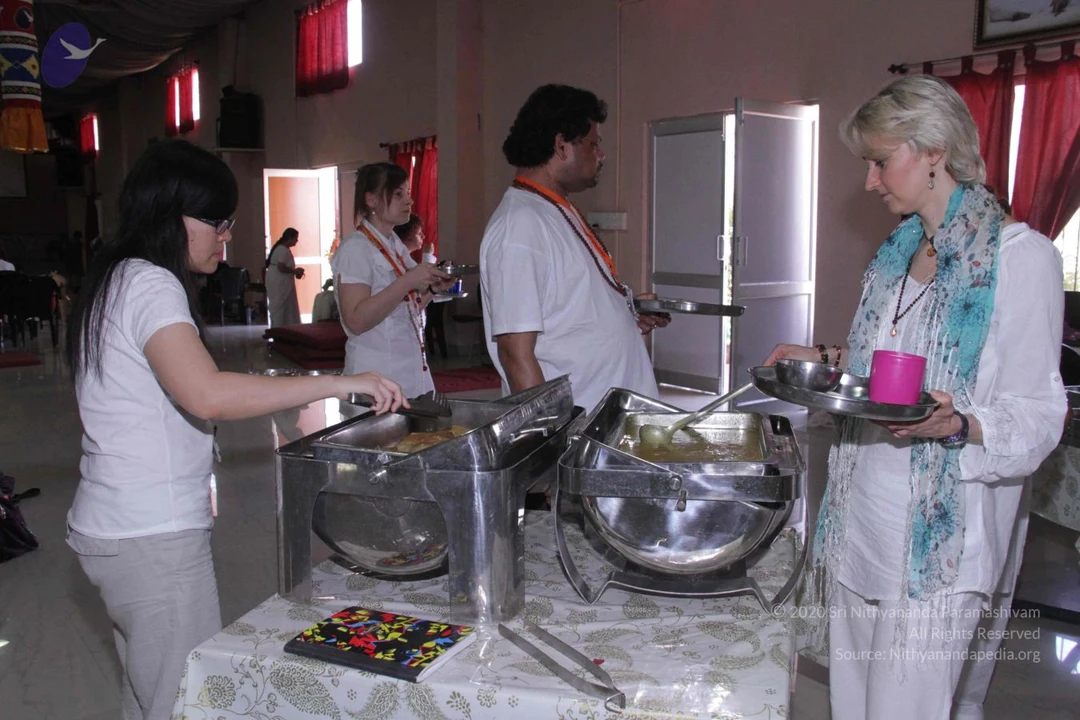
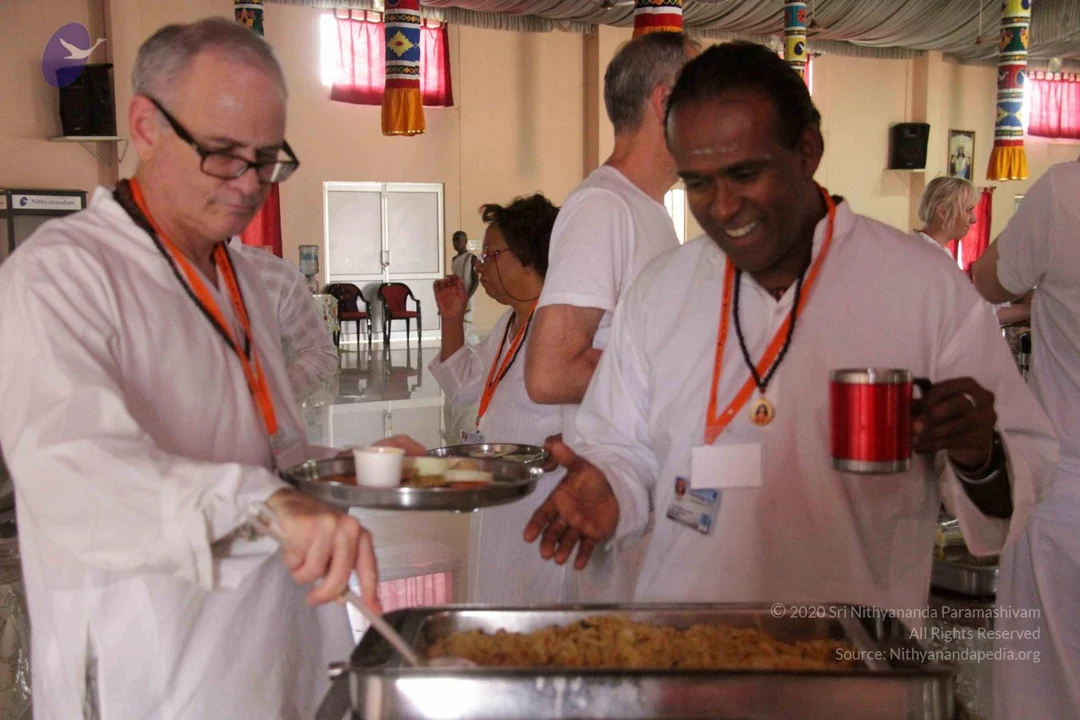
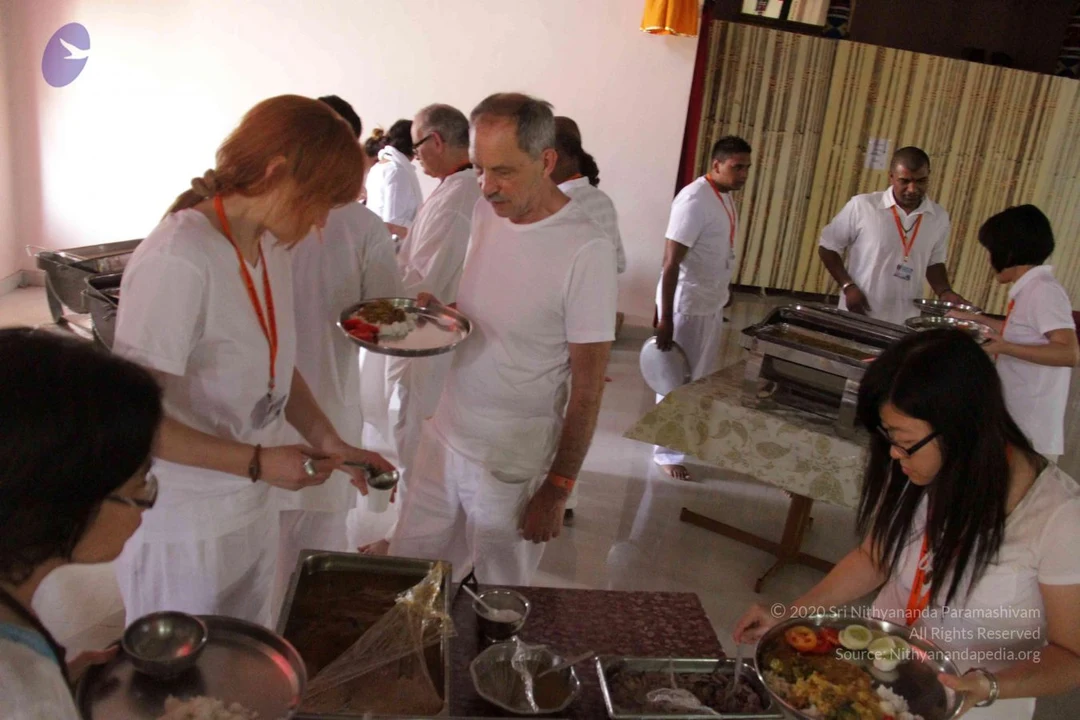
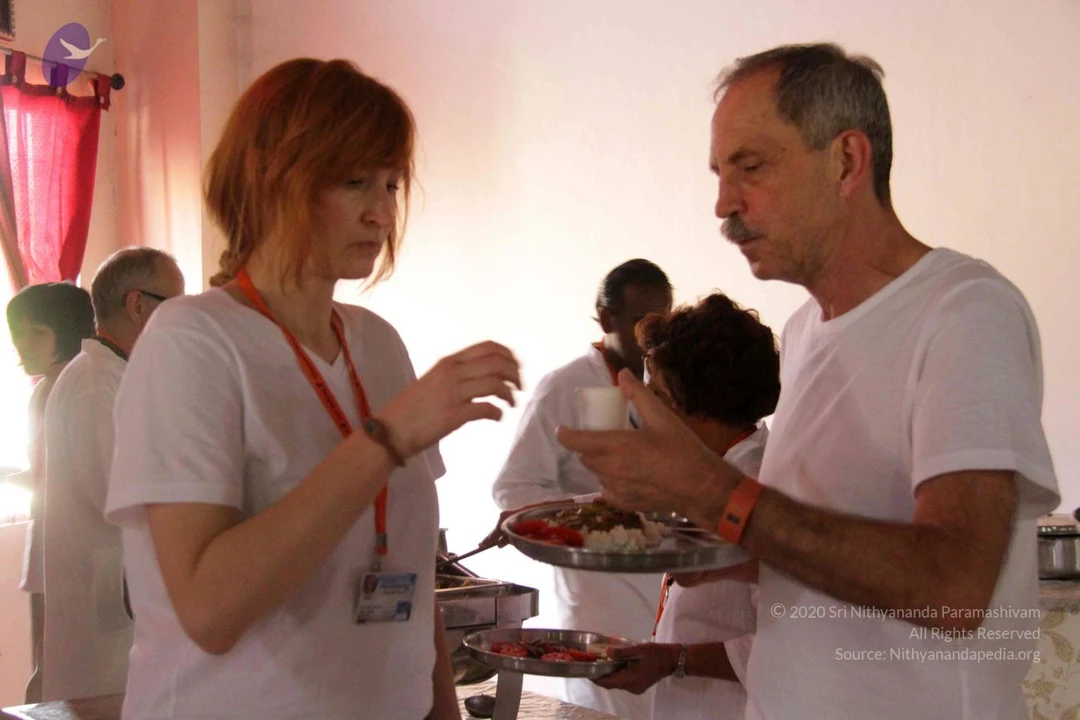
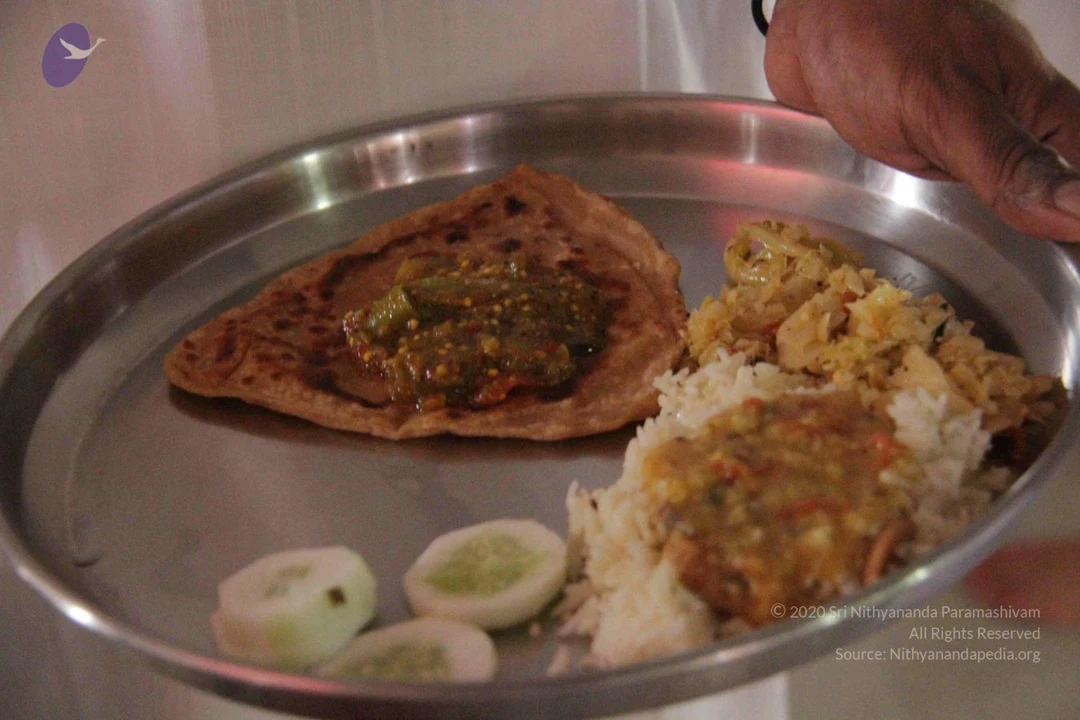
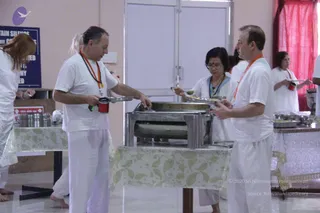
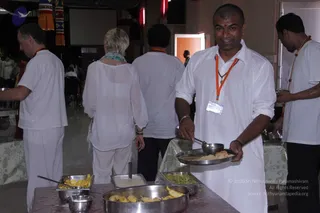
A dining hall serving line where devotees in white clothing and orange lanyards serve food from stainless steel chafing dishes on tables covered with green leaf-patterned cloths. A man in a white t-shirt and white pants holds a red thermos and serving tongs at left, while a man in white with an orange lanyard serves at right. A woman in white with a blue shawl and glasses ladles food in the centre. Behind them a woman in white holds a steel plate, and a blue sign on the wall reads 'Maintain silence' with partial text. Red curtains hang in the background.A photograph of volunteers serving a meal at a buffet. In the foreground a woman with her hair tied up wears a white short-sleeved shirt and an orange lanyard, and is spooning food onto a steel plate. Behind her a man in a white shirt and dark backpack also serves from a steel chafing dish. A woman on the right with long dark hair and glasses, wearing a white t-shirt and orange lanyard, holds a plate of food. Two large terracotta pots stand against a pale pink wall, and a green patterned tablecloth covers the serving table. At the far right edge a person in a white garment holds a steel tumbler.Two women drink from red stainless-steel travel mugs with black lids in an indoor room with pale pink walls. The woman on the left wears glasses, a pale yellow sari with brown border, an orange lanyard and an ID badge. The woman on the right wears a white embroidered top, a white dupatta draped over her shoulders, a white hair tie and bangles, with an orange lanyard and ID badge. Both are standing and looking ahead while drinking.A photograph of a dining hall where volunteers serve food from a buffet table covered with a green patterned cloth. Three women in white clothing stand at the serving counter: a woman with grey hair wears a white shirt, white skirt and a long beaded mala with orange-red thread, using a spoon on a tray of yellow fruit pieces; a woman with long reddish-brown hair in a white top stands behind her; and a woman with short black hair in a white polo shirt with an orange lanyard and ID badge serves from a steel tray holding bowls. Steel dishes hold yellow fruit, creamy white pudding, green chopped fruit and a bowl of ripe bananas. Colourful bunting hangs from the grey ceiling, and other white-clad people sit at tables in the background.A photo of a communal meal service with volunteers serving food from stainless steel chafing dishes on a draped table. On the left, a man in a white t-shirt with an orange lanyard and rudraksha mala ladles food onto a plate. In the centre, a man in a white shirt with an orange lanyard and a wristband places food on a plate. On the right, a man in a white shirt with rudraksha mala and a name badge holds a steel plate of food. A woman in white with an orange lanyard stands behind, and an older woman in white with a shawl stands at far right.A photograph of a serving line in a hall with a wooden stage and screen in the background. A smiling man in a white kurta and orange lanyard with an ID badge holds a steel plate of food and ladles more from a steel pot. Behind the counter, steel trays hold yellow and green dishes and a bowl of white sauce. Other people in white clothing stand at the buffet, including a woman with blonde hair in a sheer white top and scarf, and a man in white at the right holding a bowl and wearing red and white beaded garlands.

Sarvadarshan-Gurukul

51 photosSource gallery
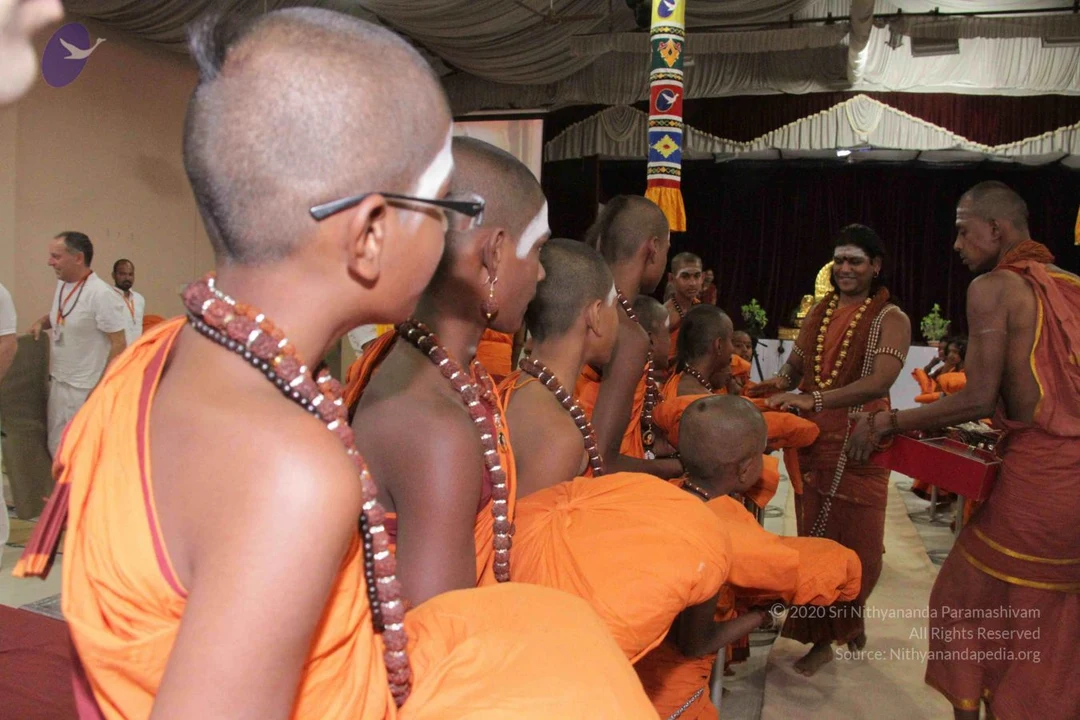
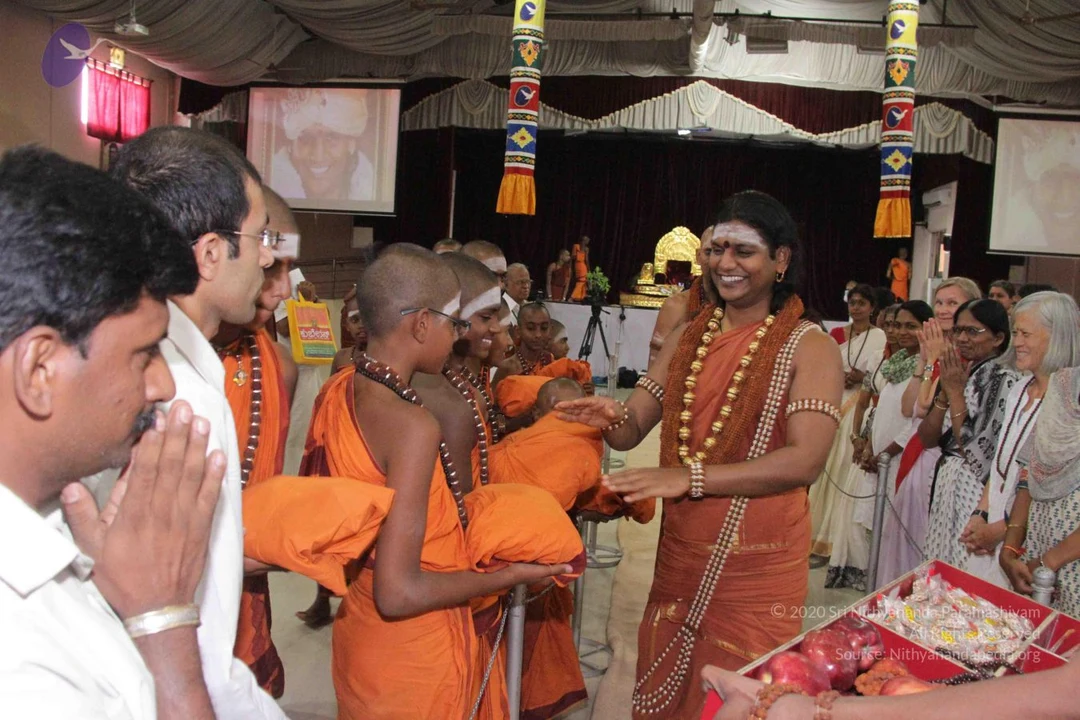
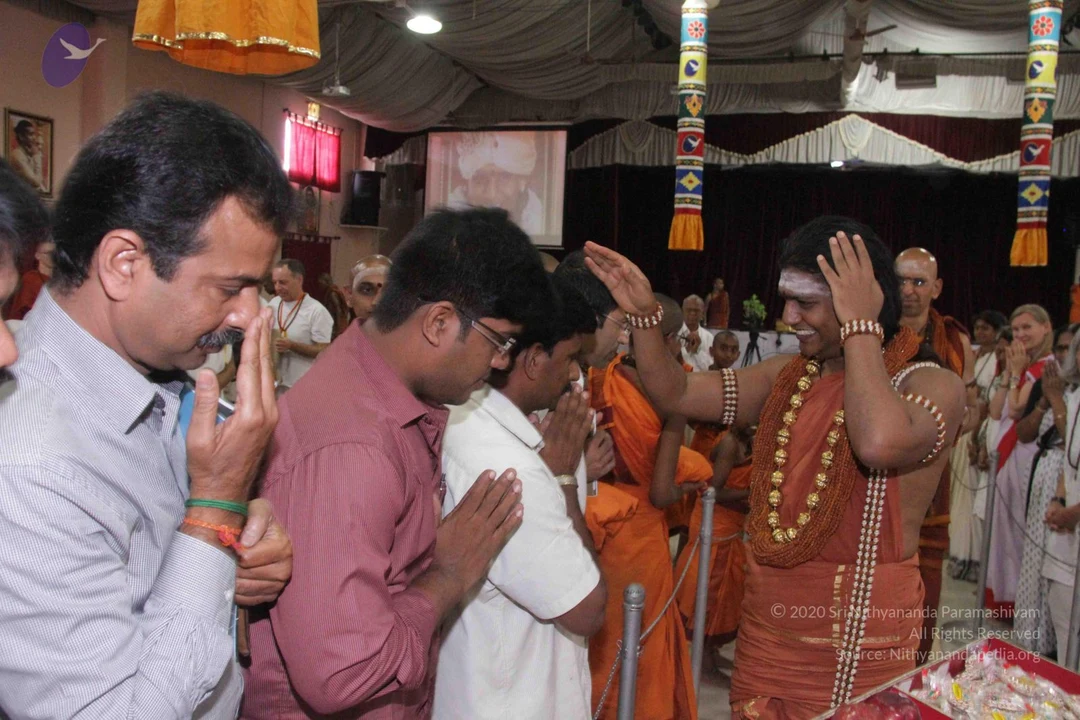
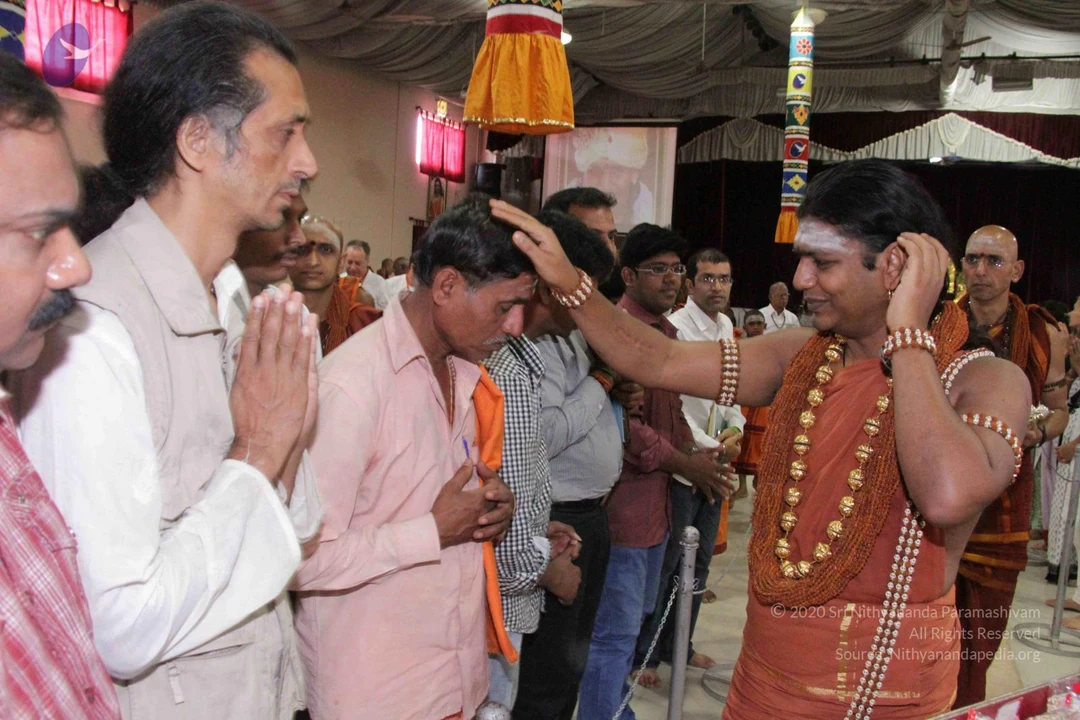
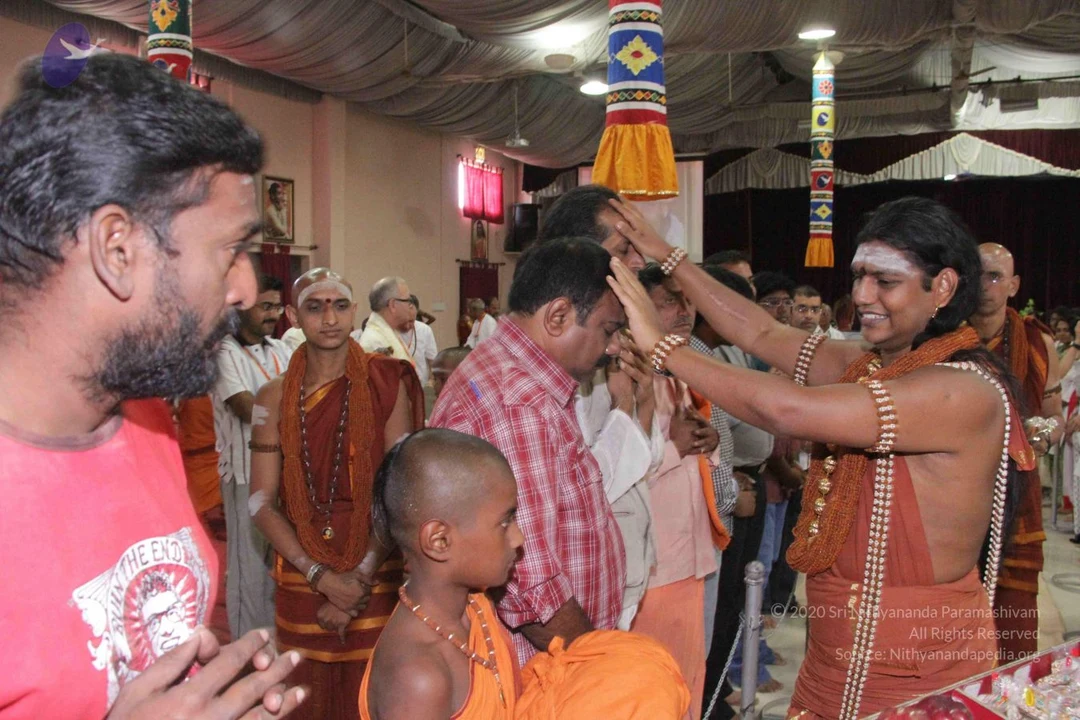
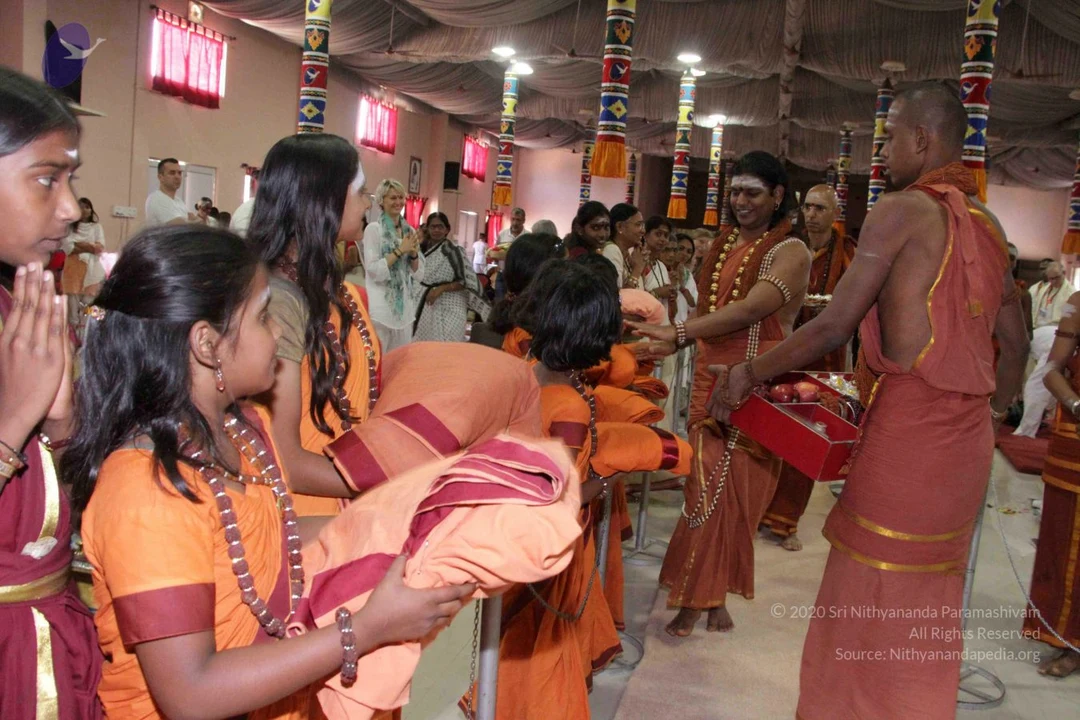
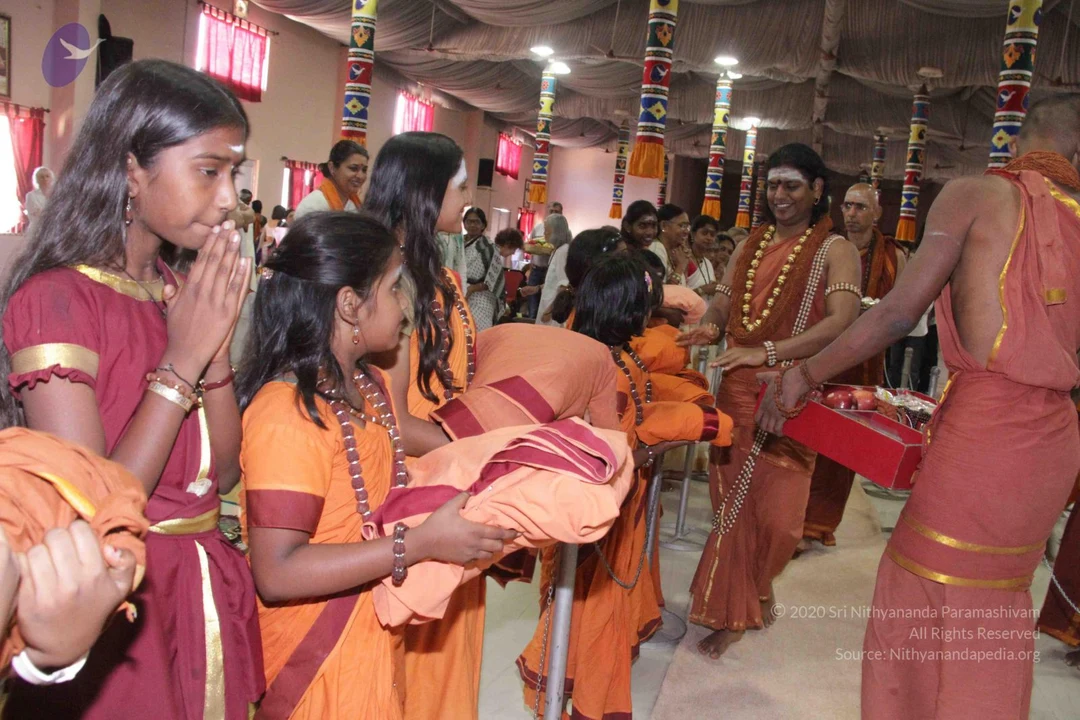
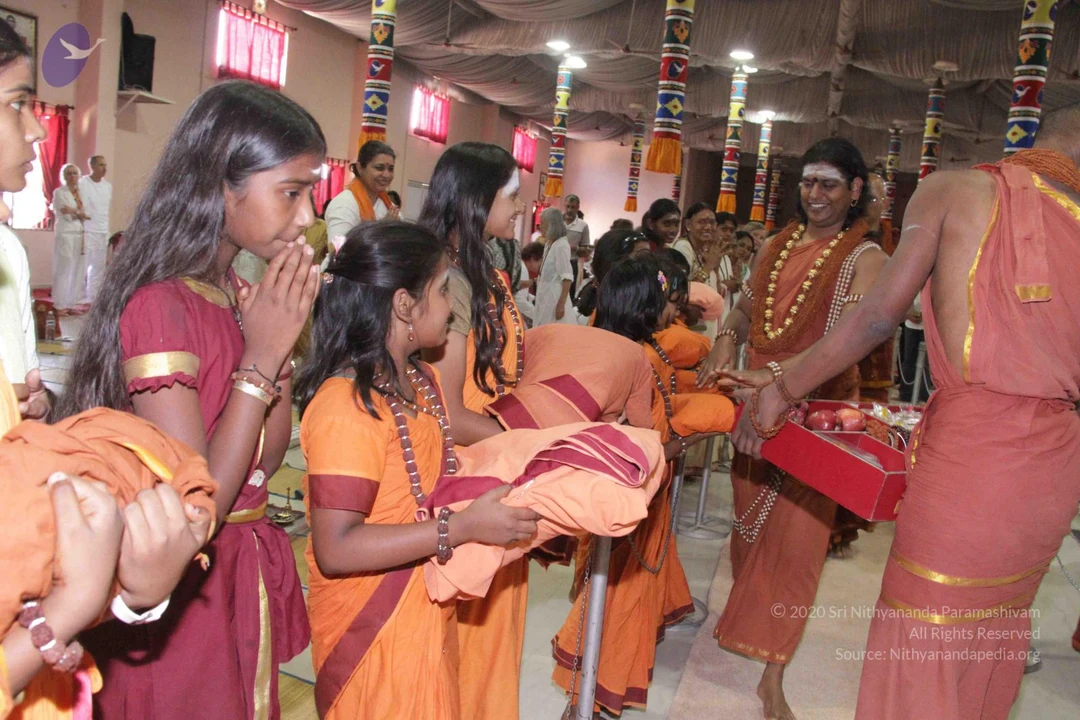
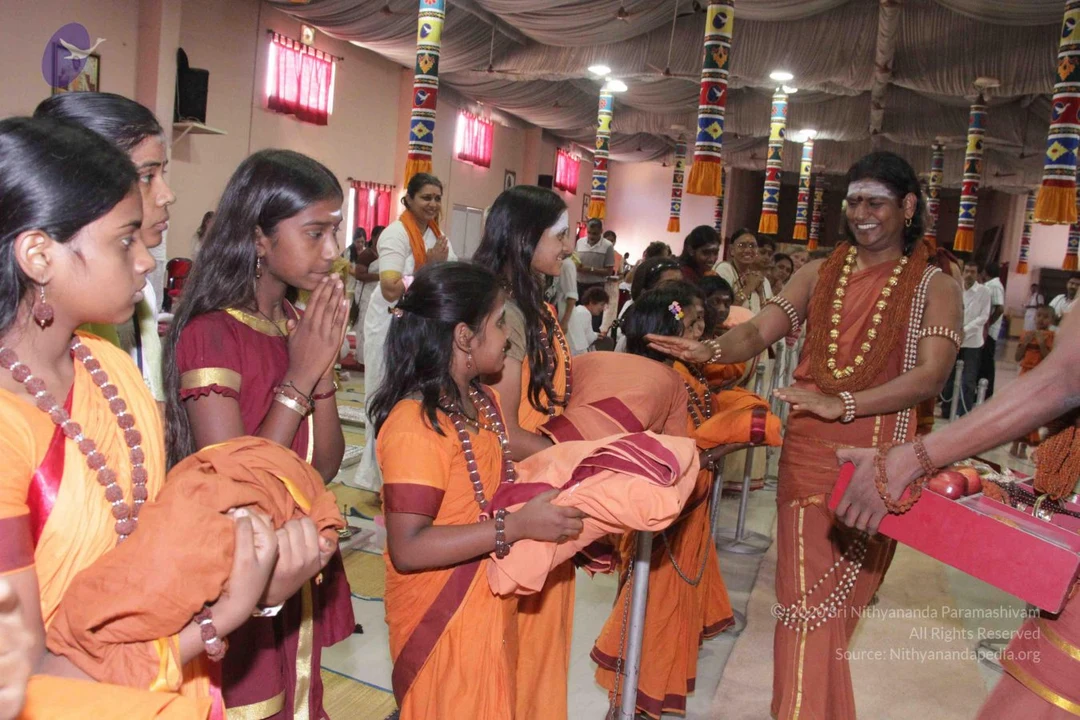
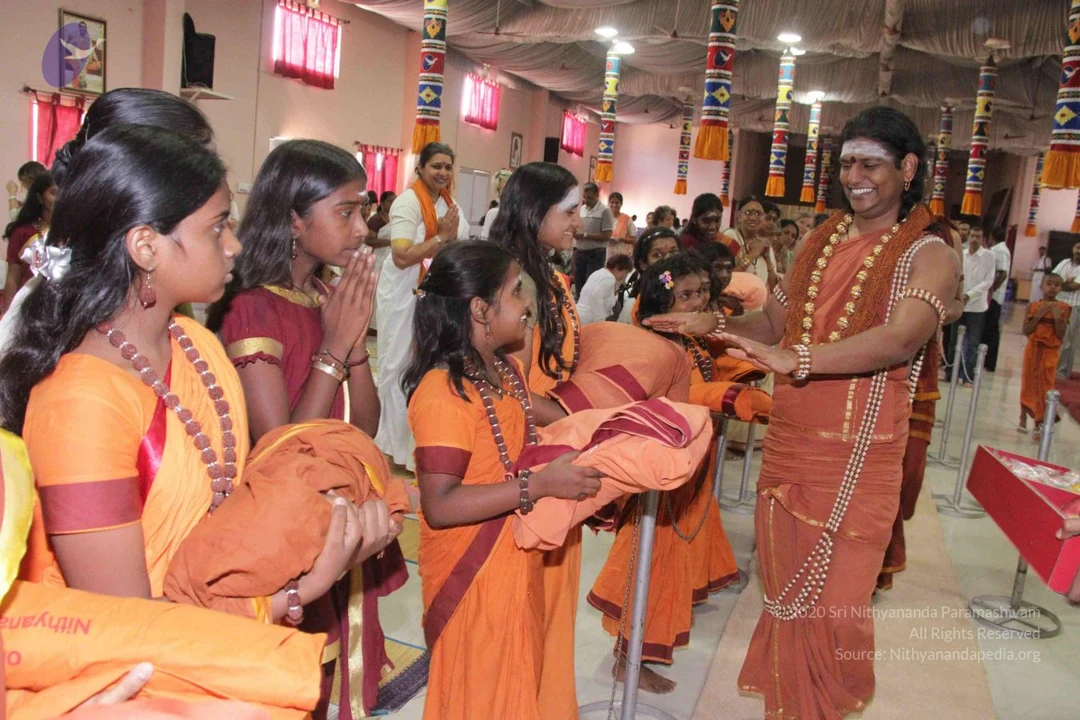
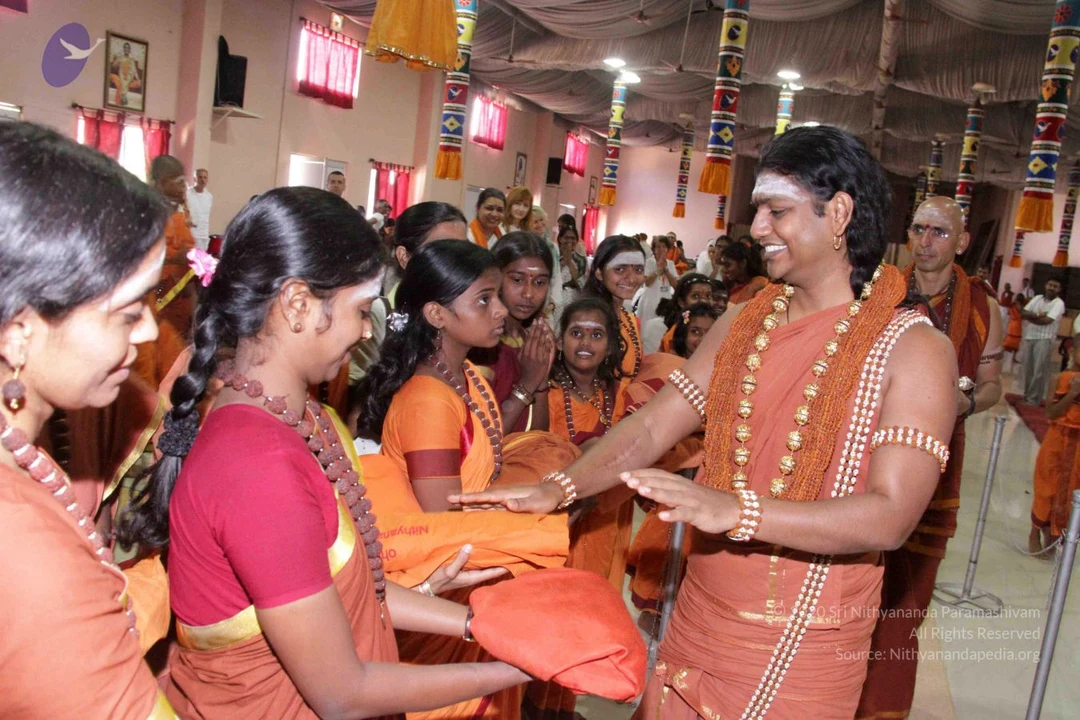
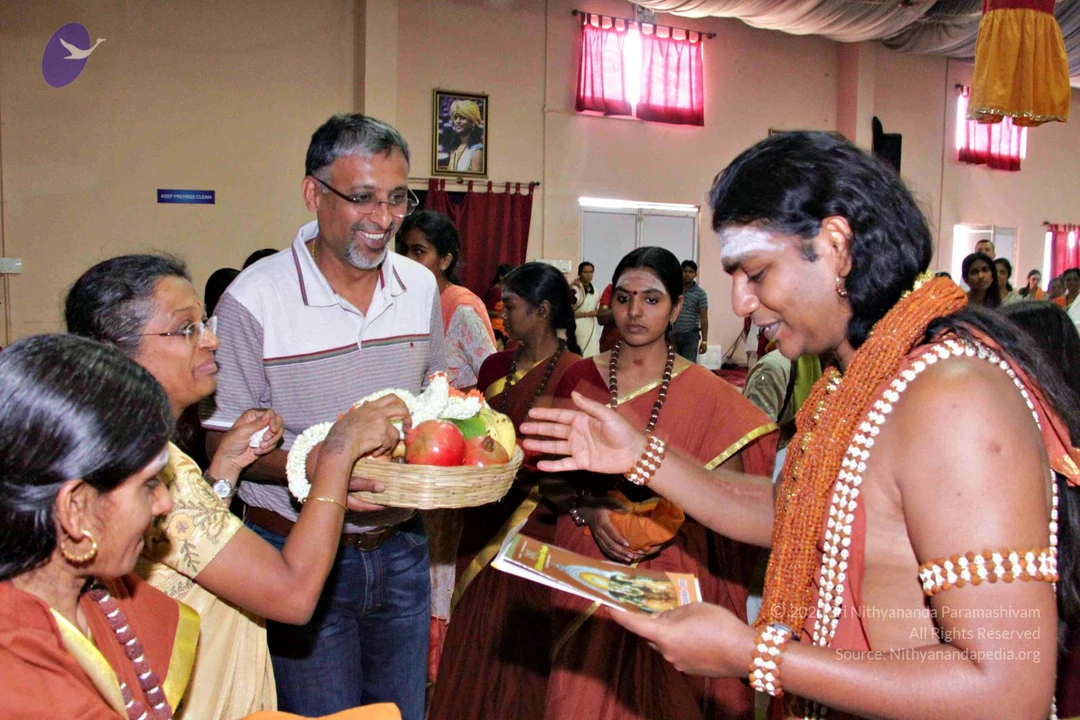
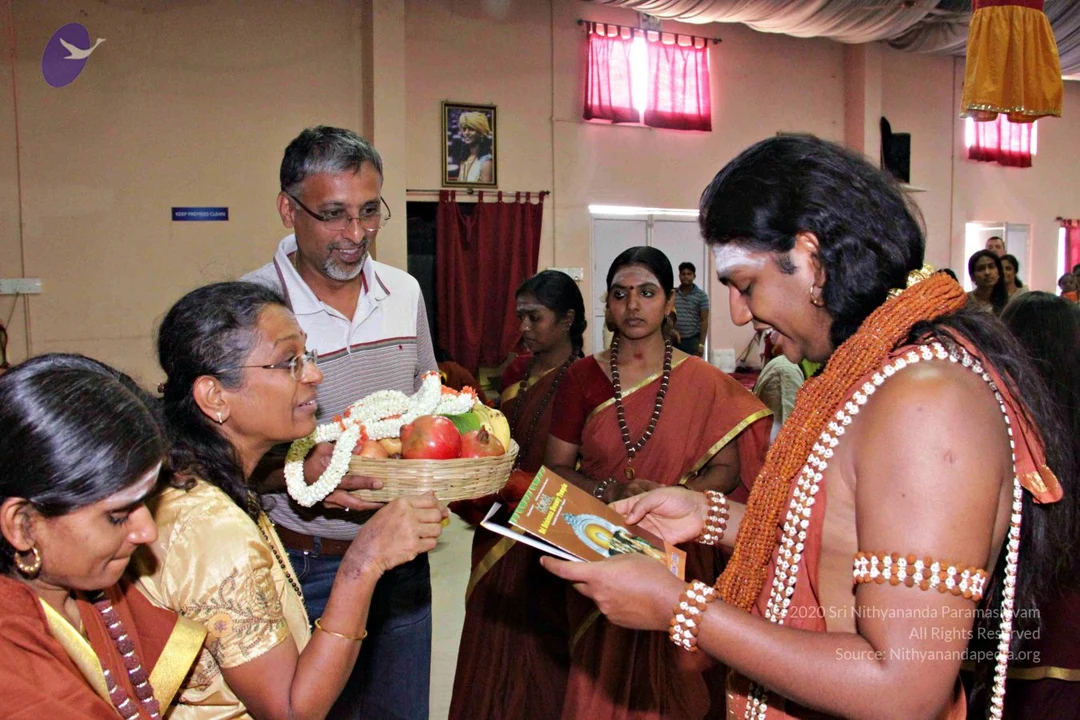
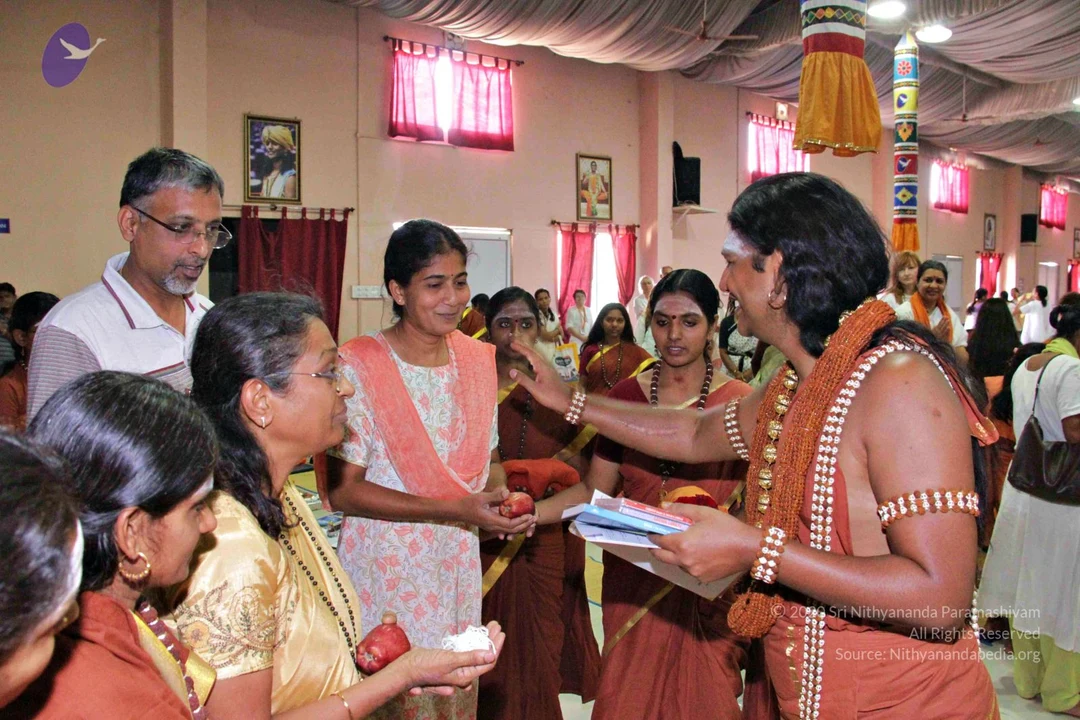
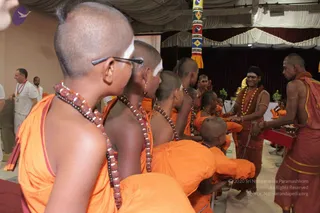
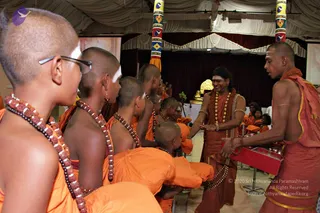
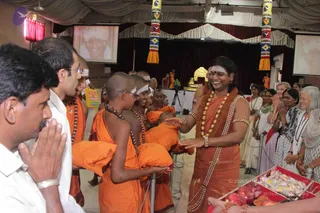
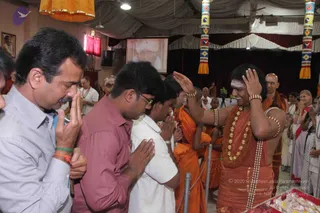
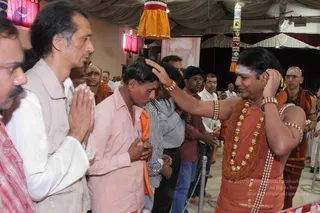
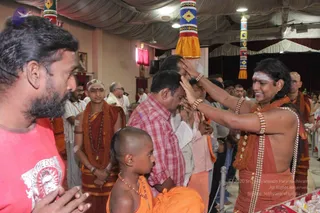
Photograph inside a decorated hall with draped white and maroon fabric ceiling and a dark stage backdrop. Several shaved-headed young monks in saffron-orange robes with rudraksha malas, some with white tilak on their foreheads, sit or stand in a row facing right. On the right, a standing man in deep red-brown robes and a rudraksha mala hands items from a red tray to a standing figure, while another robed man in red-brown kneels near the tray. A tall striped banner hangs in the upper centre. Several more people in white attire stand in the background.A photograph inside a decorated hall with draped orange-and-white fabric and striped pillars. Several shaved-headed young monks in saffron robes and rudraksha malas stand in a row at left, some with white forehead markings and one wearing glasses. A man with long swept-back hair in an orange dhoti and shawl, adorned with a long rudraksha and gold necklace and bangles, stands at centre smiling and gesturing toward the boys. At right, a bald man in orange robes holds a red box with a small ritual item. A gilded deity murti or shrine is visible in the background. Physical people visible: about seven or eight, so the count falls in the 6-20 range.A photograph of a ceremonial reception inside a hall with draped cream fabric, colourful striped banners and projection screens showing a smiling man in white. A tall figure in saffron-orange robes, with long swept-back dark hair, a rudraksha mala, layered gold beaded necklaces and bangles, and a white forehead mark, stands at right, extending his hands toward several shaved-headed young monks in orange robes who approach with orange cloth bundles. Nearby, a man in white with folded hands and women in white and red saris stand watching, and a red tray of fruit and flowers sits at lower right. Behind them a golden throne-like seat and a small deity murti are visible. Swamiji (probable) is described by the saffron robe, long hair and gold necklaces, and the figure is treated as the in-person central presence; overall about 12 people are visible.A photograph of a devotional gathering in an indoor hall with orange and white draped ceiling fabric and striped pillars. On the right, a shaved-headed man in orange robes wears a long rudraksha-style bead necklace and bangles, and holds his palms raised in blessing. Several men stand in front, some in orange robes and others in shirts, with hands pressed together in namaste. A projection screen and a framed portrait hang in the background, and a tray of sweets sits at the lower right. Watchers stand along the right edge.Indoor photo of a blessing line in a hall with draped white fabric ceiling and maroon drapes. A man in an orange-saffron robe with multiple rudraksha-style beaded and gold bead necklaces and bangles touches the head of a devotee with one hand, marked with white forehead paste. Devotees in pink, white and checked shirts stand with folded hands or bowed heads in line, and more people in orange robes stand at the right. Colorful hanging decorations and a red wall panel are behind. A tall figure in a saffron robe at right has a shaved head. The central figure is a person bestowing a blessing on a devotee.A photograph inside a hall with a draped white ceiling and hanging red, yellow and blue cloth decorations. On the right, a figure in an ochre-saffron dhoti with a long rudraksha mala and ornate gold-and-white beaded necklaces stands with both hands raised, touching the forehead of a seated devotee in a red checked shirt. Beside him, a shaved-headed child in orange sits in front, and a man in a red t-shirt with a printed portrait stands on the left with hands joined. Other saffron-robed sannyasis and white-clad attendees stand behind, and a framed portrait hangs on the wall. The scene looks like a blessing or darshan. The orange-robed figure with rudraksha and ornaments fits the swami candidate cues, but the face is not clearly visible enough to confirm, so the identity is uncertain.

Kalabairava-Darshan

13 photosSource gallery
A smiling man sits on an ornate golden throne with elaborately carved arched backrest, lit with red and green stage lighting. He wears a leopard-print sleeveless top with rudraksha mala necklaces of dark beads and white-tipped beads, matching beaded bands on his upper arms and wrists, and rust-orange loose trousers. He has a white and red forehead marking and holds his hands together over his chest. One person is visible.A photograph of two men in an indoor room with purple-tinted lighting, a dark curtain and a potted plant behind them. On the left, a smiling man with long dark hair, wearing a leopard-print top and a rudraksha-style bead necklace, raises his palm toward a younger man on the right. The younger man, with short hair, wears a white t-shirt and an orange lanyard, and faces him with his palm raised, as if in a high-five.A photograph of a long-haired figure in a leopard-print wrap and a rudraksha mala with skull beads placing a hand on the forehead of a short-haired man in a white t-shirt with an orange wristband, in a warmly lit room with a green-lit altar, a brass lamp and a curtain. The devotee stands with his palm raised to his cheek, receiving the blessing.A long-haired man in a leopard-print wrap with a beaded rudraksha-style necklace places his right palm on the forehead of a short-haired man in a white t-shirt, while the second man's hand is raised in front. Pink and purple stage lighting, a brown curtain, potted plants and a brass oil lamp stand in the room behind them. The first man has a white mark on his brow and appears to be giving a blessing.A photograph of a long-haired figure in a leopard-print sleeveless top and rust-orange dhoti, wearing a thick rudraksha-style bead necklace, seated and placing one hand on the forehead of a kneeling man in a white T-shirt with a red-and-white bead mala. A small oil lamp with a brass base stands at left beside a plant and dark curtain in a softly lit room with pink and green lighting. The kneeling man has his palms raised in receiving posture. This appears to be a blessing or initiation-style gesture between two people. a person cues are not clearly established here, since the seated figure's distinctive adornments are present but the identity is uncertain from appearance alone.A long-haired man in a leopard-print sleeveless top and a rudraksha mala with skull-shaped beads reaches out to touch the forehead of a bald older man in a white kurta with an orange cord and a wristwatch, who stands with palms pressed together in greeting. The setting is a dimly lit room with pink and green lighting, a brass oil lamp on the left, dark curtains, and potted plants.

Swamiji-Blessings-Namaskar

8 photosSource gallery
A seated person in saffron-orange robes presses palms together in anjali mudra with eyes closed in prayer or greeting. Multiple strands of rudraksha malas and ornate gold bead necklaces hang on the chest, with matching rudraksha and white bead bracelets and armlets. A white tilak with a red dot marks the forehead, and small gold hoop earrings are worn. Behind them is a richly embossed gold throne backdrop with floral and scroll patterns, and a red cushioned seat is visible at the lower left. The distinctive adornments and saffron clothing fit a person presentation, shown here as a devotee in an attitude of prayer on a throne setting.A figure seated cross-legged on an ornate gold-and-red throne with a golden arched back, flanked by two golden lion sculptures, in front of a turquoise and pink decorated stage. The seated person has palms pressed together in namaskar, wears an orange-saffron dhoti and shawl, a rudraksha mala, a long pearl-style necklace, and gold bangles and earrings, with white vertical markings on the forehead. A tiger-striped cloth covers the seat. Green leafy plants and a hanging string of lights are behind the throne. Swamiji (probable): the saffron clothing, long swept-back hair, ceremonial necklaces and throne seating are compatible cues, though this is not a confirmed identification.A seated man with palms pressed together in namaste, in front of an ornate gold-embossed throne backdrop. He wears an orange-saffron robe, layered rudraksha-style beaded necklaces with gold beads, pearl-white bead armlets and bracelets, gold hoop earrings, a white vibhuti horizontal mark with a red kumkum dot on his forehead, and a small head microphone. He sits on a deep red velvet chair. Probable Swamiji is a qualifying cue match: long swept-back hair, saffron clothing and rudraksha malas, with the orange robe and ceremonial gold ornaments present; the page identifies this event as a discourse.A man seated on a red velvet chair in front of an ornate gold repoussé backdrop, palms pressed together in namaste at chest level. He wears a saffron-orange garment, a long rudraksha mala, a heavy ceremonial gold bead necklace, and white and rudraksha bracelets and armlets. He has a white vibhuti band with a red kumkum dot on his forehead, gold earrings, and a small clip-on microphone. Swamiji (probable) appearance cues: long swept-back hair, saffron clothing and rudraksha malas with gold necklaces, seated as a discourse speaker.A seated man with palms pressed together in namaste gesture sits on a red velvet chair before an ornate gold repoussé throne backdrop. He wears a white vertical tilak with a red bindi, gold hoop earrings, a headset microphone, an orange-red garment, layered rudraksha-style and gold bead malas, and pearl bangles on his wrists and upper arms. Green palm fronds appear at the lower left edge. The scene suggests a discourse or satsang. Swamiji (probable): the long swept-back hair, orange clothing and multiple bead malas are consistent with the page's identification, and the figure is seated as the speaker.A seated figure in saffron-orange robes with a rudraksha mala and a long pearl-style mala sits on an ornate gold throne with gold lion armrests and a red velvet cushion. Two painted guardian figures with multiple arms, flame-like headdresses and gold loincloths stand on either side against a blue, pink and green temple-style backdrop. Potted plants and brass lamp stands flank the throne. Swamiji (probable): the figure wears long swept-back hair, saffron clothing, rudraksha and pearl malas and gold armbands, and sits on the throne as the central teacher of a discourse. A small lit display is visible behind the throne and the setting resembles a satsang hall.

Yoga

11 photosSource gallery
Indoor hall with a white fabric canopy and tall decorative pillars wrapped in colourful patterns with orange tassels. Many people stand on coloured yoga mats in rows, some in black and some in white clothing, performing a standing exercise with hands at the waist. Small dumbbells sit on the floor between mats. A bearded older man on the right wears a white kurta and an orange turban. Framed pictures hang on the pink wall at left, and red curtains line the background.A large indoor hall with a white draped ceiling and ceiling fans, where a group of about twenty-five people practise a standing yoga stretch on coloured mats. Participants raise both arms overhead with hands clasped, wearing black, white and navy track clothes. Decorative cylindrical pillars in red, blue, yellow and white patterns with tassels line the room. A framed picture hangs on the left wall beside red curtains, and metal dumbbells sit on the floor.A yoga class in a bright hall with glossy floors. In the foreground a young man in a white T-shirt and black track pants stretches one arm across his chest, barefoot on a red mat. Beside him an older man in white kurta and white trousers, also barefoot, mirrors the stretch on a pink mat. Behind them women in black tops and black leggings stand on mats, one with short blonde hair. Chrome stanchions with chains divide the mats, small hand weights lie on the floor, and a red curtain hangs on the back wall under an orange cloth. No a person candidate is clearly identifiable from appearance.A photograph of a yoga or exercise session in a large hall with a polished floor and a draped white ceiling. Many students stand on coloured mats in a practice stance with arms raised overhead, some with small hand weights placed beside them. The foreground includes a man in black shirt and trousers with arms raised, a man in white kurta and white trousers, and a man in black with arms extended. Decorated cylindrical pillars with painted geometric patterns and yellow tassels run through the room, with ceiling fans overhead and a framed picture on the left wall. Water bottles sit near some mats.A large hall with a cloth-draped ceiling and decorative painted pillars shows a yoga class in progress. Around 20 people stand on colourful exercise mats, arms raised overhead or stretched sideways, mostly in black, grey and white athletic clothes. A man in an orange turban and white clothing stands at the far right, and a small framed portrait hangs on the back wall. Dumbbells and water bottles sit near the mats, with red curtains and chairs along the walls.A group yoga class in a bright hall with pale pink walls and maroon curtains. Participants in black, white, red and blue clothing stand on coloured yoga mats, many holding a balance pose with arms raised overhead while an instructor in a dark top stands at the left. Tall hanging banners with yellow fringe and geometric motifs flank the room, and stacked metal dumbbells and water bottles sit on the floor. A framed portrait of a saffron-clad figure hangs on the left wall, and rows of red chairs line the side. No ritual activity is visible.

Temple-Swamiji
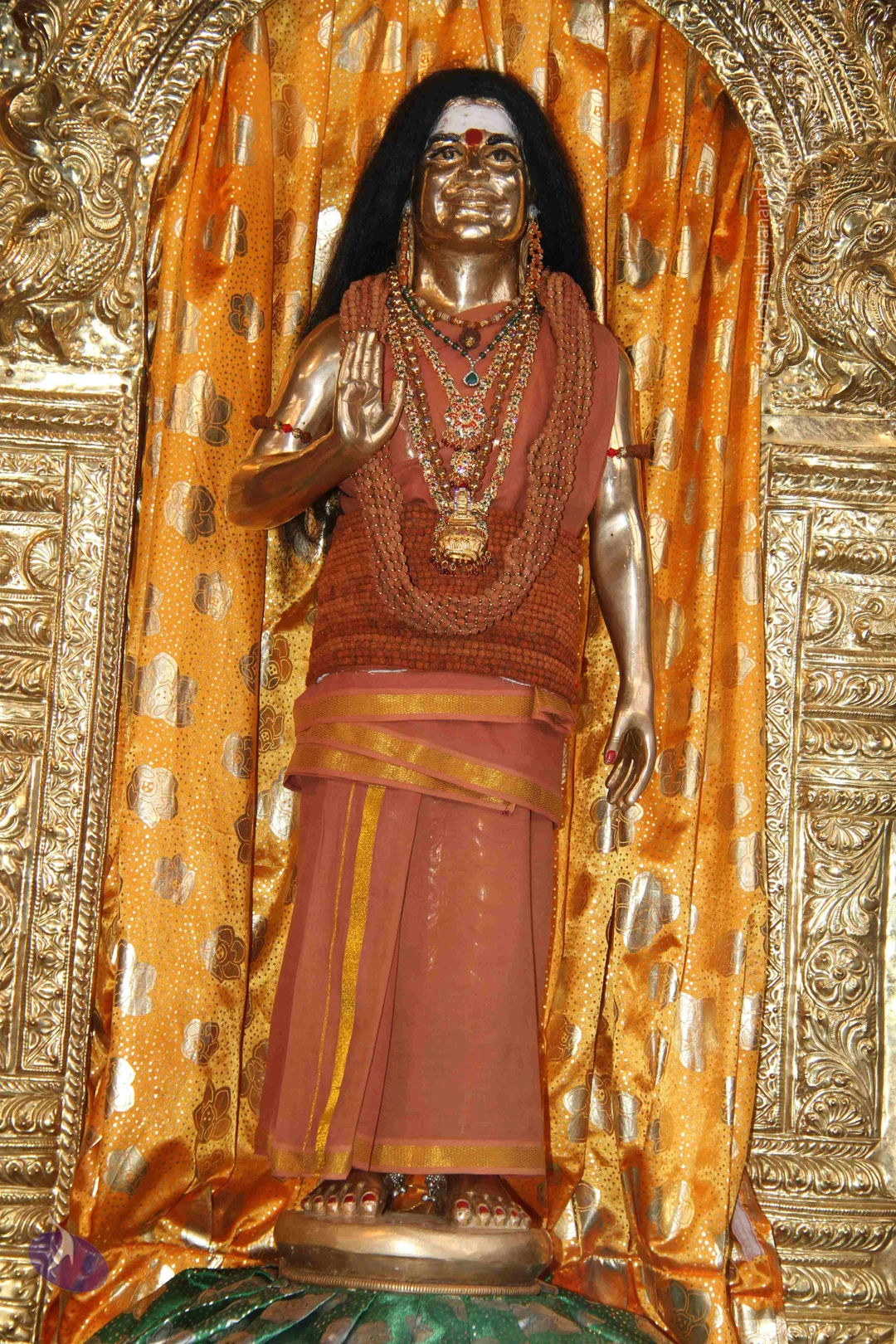
35 photosSource gallery
A dim, reddish dusk or dawn sky with a bright yellow sun low on the horizon, framed by dark silhouetted tree branches and foliage, with a utility pole and power lines crossing the scene. No people are visible.A photograph of a low sun glowing orange-white through a hazy reddish-brown dusk sky, framed by dark silhouetted tree branches and palm fronds. Thin utility wires and a wooden pole run across the lower dark treeline. A small purple emblem with a white bird sits in the upper left corner, and a , , in the lower right. No people, deities, or ritual activity are visibleTwo bronze-toned deity murtis are seated side by side against an orange and gold floral silk backdrop framed by an ornate gilded arch. The figure on the left wears a red turban, rudraksha malas and white floral garlands, and holds a trident-like staff and a damaru-style drum. The figure on the right wears an embellished jeweled crown, red and maroon garments, layered necklaces and a garland, holding a staff topped with a small green parrot. Both statues have red lips and gold ornaments. The scene is a decorated statue display, with no physical people visible.Two gilded deity murtis sit side by side against a shimmering orange and gold patterned cloth backdrop with a carved golden arch. The figure on the left has a red turban, a jeweled tilak, a rudraksha mala and white flower garlands, and holds a trident in one hand. The figure on the right wears a black and gold embroidered crown with red jewels, a green parrot perches on the staff in its hand, and it wears layered gold necklaces and red and white garlands.A black stone Nandi bull statue sits on a red sandstone pedestal in a garden setting. The Nandi wears a garland of red and white beads, a gold-toned necklace with tassels, a bead collar and a yellow cloth draped over its back. Behind it, grey stone statues of standing figures with folded hands and a red-brown tiered pedestal with a kalasha-like finial are visible among palm trees and foliage. No people are present.Two golden metal murti statues of a male and female deity seated side by side against a bright orange draped curtain within an ornate gilded arch. The male figure wears a red turban, a trident is held in one hand, and he has a rudraksha-style brown bead mala and layered jewelled necklaces. The female figure wears a tall jewelled crown, a blue sari with a silver-embroidered border, multiple gold and pearl necklaces and a green parrot perches near her. Both are adorned with pink rose garlands and white flower strands, and there is a gold-edged altar in the foreground. These are statues, so no physical people are present.

Pada-Puja

22 photosSource gallery
Close-up photograph of a person's right forearm and hand resting on an orange-red cloth over a tan lap. The wrist wears a layered bracelet of brown rudraksha beads alternating with white beads, plus a dark wristwatch. In the blurred background on the right, a brass oil lamp with a lit flame sits against a black backdrop. Only the arm and hand are visible, so no face is shown.Close side view of a man seated in a golden throne setting, wearing an orange-red saffron wrap over his shoulder and torso, layered with long orange rudraksha malas and gold bead necklaces, plus a white and orange rudraksha armband. He has long swept-back black hair, a white horizontal tilak with a red dot on his forehead, and a small gold earring, smiling and looking to the left. Behind him is ornate gold carved decoration against a dark background. Swamiji (probable) appears in person, with the appearance-based cues of long hair, saffron clothing and rudraksha malas, and a gold ornate backdrop.Close-up photograph of a person's upper arm wearing a wide armband made of brown rudraksha beads alternating with small white carved skull beads, strung in multiple rows. The person wears a saffron-orange garment draped over the shoulder with a gold border. The background is a plain beige wall and white fabric. No face is visible.Close-up photograph of a person's forearm and wrist resting on an orange terry-cloth towel draped over a pale surface. The wrist wears a bracelet of brown rudraksha beads alternating with white beads, and a dark metal wristwatch. The background is dark with a blurred golden and orange object at right. Only the arm and hand are visible, showing no face.Close-up photograph of several strands of rudraksha malas laid across a rust-orange cloth with a thin gold border. The malas alternate brown rudraksha beads with white skull-shaped beads, and a second set lies at the upper right. A person's fingers are visible at the lower left edge.Close photo of a bare foot resting on a gold-toned ritual tray scattered with white plumeria flowers and pink and red roses. A pair of bare feet in an orange garment with gold border stands on the tray, with the toes touching the flowers. Nearby are silver bowls holding flower petals, a small silver container, a silver spouted vessel and a dish of yellow turmeric paste. The setting suggests padapuja foot worship with flower offerings. No faces are visible and no people beyond the feet are shown.

Arati

54 photosSource gallery
A seated man in a golden ornate throne with a large gilded backrest topped by a crown finial, draped in a zebra-striped cushion, wears an orange-red robe, multi-strand pearl and bead necklaces, bangles and a white forehead band with red tilak. He sits with hands folded in his lap while a bald priest in orange robes at the left holds a lit oil lamp aarti flame toward him. Behind the throne hang rows of small oil lamps and dark beads, with gilded lion figures flanking the seat. Brass lamps and offerings sit on the floor, and a red carpet covers the platform. a person: the seated figure wears a red-orange robe, pearl and rudraksha-style necklaces and bangles on an elaborate golden throne, consistent with a ceremonial presentation.A photograph of a golden ornate throne set against a dark textured backdrop with hanging brass lamps. A seated figure in red-orange robes and a long pearl-style necklace sits on a zebra-striped cushion, with a white sacred mark on the forehead. In front, a bald priest in orange robes holds up a lit oil lamp or flame arti to the seated figure. Painted teal and pink panels frame the scene, and a small lamp burns on the right. A visible candidate is seated in the throne and appears to be the a person; the appearance-based label is a person, with identity kept at unsure where cues are limited. A woman in orange stands at the lower left edge.A seated figure in a saffron-orange robe sits on an ornate gold throne with carved floral and lion motifs, draped with a striped tiger-print cloth. A long rudraksha mala and layered pearl-like necklaces hang on his chest, with bangles on his upper arms and a tilak on his forehead; his hands rest folded in his lap. Kneeling at the lower left, a bald priest in orange robes holds up a brass lamp with several flames in an aarti gesture. Hanging brass oil lamps and bells light the gold-and-painted pillared hall. A sign-free ritual scene inside a temple-style setting.A photograph of a bare-chested man with long dark hair seated on a cushioned gold throne backed by an ornate gilded carved panel. He wears an orange-saffron cloth draped over one shoulder, multiple strands of white beads and gold-bead necklaces, beaded armlets, and a white horizontal tilak with a red dot on his forehead, with gold hoop earrings. His hands rest in his lap. Brass bells hang at the upper corners of the frame. The photo is taken in a temple or ashram setting. Swamiji (probable) is seated on the throne, identified by the long swept-back hair, saffron cloth, rudraksha-style beads and ceremonial gold necklaces.A large hall with pink walls, red curtains and colourful striped pillars hung with fabric. Rows of women and men in saffron-orange and red robes with yellow borders sit cross-legged on a white floor, many wearing rudraksha malas. Brass plates with flowers, oil lamps and small ritual vessels are set before them. Several people in white clothes sit near the back, and framed portraits hang on the walls. Visible people are numerous across the hall, with many seated devotees in saffron and white clothing. A person presiding at the far end is not clearly identifiable, and no figure is clearly distinguished by the cues needed for an identification.A photograph of a seated ritual gathering in an open hall. In the foreground, several women in orange and red saris with yellow borders sit cross-legged, wearing rudraksha malas and white forehead markings. A woman in the center holds an open booklet and sits before a silver tray with brass oil lamps, bowls, flowers and small offerings. Behind them, rows of people in orange robes sit on the floor before similar brass puja plates, and a man in white clothing sits at the upper right. Metal poles and a rope divide the seating area.

Nithya-Satsang

57 photosSource gallery
Photo of a seated person in saffron-orange robes with palms pressed together in namaste at the chest. The person wears long dark hair swept back, a white vertical tilak with a red bindi on the forehead, gold hoop earrings, a microphone clipped near the mouth, and layered orange rudraksha malas with gold bead necklaces and white-and-orange beaded armbands and wristbands. Behind is an ornate gold repoussé backdrop on a red velvet seat. Probable Swamiji by visible appearance cues: long swept-back hair, saffron clothing, rudraksha malas and ceremonial gold necklaces.A seated man on an ornate gilded throne with a tiger-skin rug draped over its platform, speaking into a headset microphone during a discourse. He wears orange-saffron robes, a long rudraksha mala and a gold bead necklace, with pearl-like beaded bands on his arms and a vertical sacred mark on his forehead. A dark backdrop with small lights and green foliage surround the golden throne.A seated man in orange robes sits cross-legged on an ornate gold throne with a carved arched back, flanked by two golden lion sculptures with open mouths. He wears a long multi-strand orange-beaded necklace, a large gold chain with rudraksha-style beads, bangles on both arms, a white forehead band with a red dot, and a small earpiece microphone. His hands rest on the throne's velvet armrests with a tiger-striped cloth beneath him. Potted palms and a colourful painted backdrop with lamps surround the stage. Swamiji (probable): the long swept-back hair, saffron-orange robes, rudraksha mala and ceremonial gold necklaces are consistent with the page's identification, shown here as a seated speaker on stage.A seated speaker on an ornate gilded throne with a tiger-skin rug before it, raising one hand in a gesture while speaking into a headset microphone. He wears a saffron-orange robe, a thick rudraksha mala with gold beads, a pearl-string armlet and bangles, and a white and red forehead mark. Behind him are gold-framed carvings, small lamps and potted palms. Swamiji (probable) appears as a robed speaker with long swept-back hair, saffron clothing and rudraksha and gold ornaments, seated on a throne in front of a discourse setting.A seated man in saffron-orange robes sits cross-legged on a red velvet seat before an ornate gold throne with a carved arch and lion figures, atop a tiger-skin cloth. He has long dark hair, a white forehead mark with a red dot, and wears a dark-beaded mala, a gold bead necklace, pearl-strand necklace and gold armbands, with his eyes closed in meditation. A lapel microphone is visible near his face. Golden lion statues flank the throne and potted green plants sit at the sides, with string lights behind the dais. Appearance-based identification: a person, seated in a satsang-style discourse setting with a microphone.A photograph of a large group of shaven-headed sannyasis seated cross-legged on the floor of a hall, wearing saffron-orange robes, rudraksha malas and orange shawls, with white and sandalwood marks on their foreheads and arms. Brass and silver ritual plates, small oil lamps, flowers and kalasha-style vessels sit before them. Behind them, younger boys in dark shirts and older men in white sit among the crowd, and a red curtain hangs on the back wall beside a white door. The image shows a group ritual setting rather than an identifiable single leader.

IA-Lunch

25 photosSource gallery
A dining hall serving line where devotees in white clothing and orange lanyards serve food from stainless steel chafing dishes on tables covered with green leaf-patterned cloths. A man in a white t-shirt and white pants holds a red thermos and serving tongs at left, while a man in white with an orange lanyard serves at right. A woman in white with a blue shawl and glasses ladles food in the centre. Behind them a woman in white holds a steel plate, and a blue sign on the wall reads 'Maintain silence' with partial text. Red curtains hang in the background.A photograph of volunteers serving a meal at a buffet. In the foreground a woman with her hair tied up wears a white short-sleeved shirt and an orange lanyard, and is spooning food onto a steel plate. Behind her a man in a white shirt and dark backpack also serves from a steel chafing dish. A woman on the right with long dark hair and glasses, wearing a white t-shirt and orange lanyard, holds a plate of food. Two large terracotta pots stand against a pale pink wall, and a green patterned tablecloth covers the serving table. At the far right edge a person in a white garment holds a steel tumbler.Two women drink from red stainless-steel travel mugs with black lids in an indoor room with pale pink walls. The woman on the left wears glasses, a pale yellow sari with brown border, an orange lanyard and an ID badge. The woman on the right wears a white embroidered top, a white dupatta draped over her shoulders, a white hair tie and bangles, with an orange lanyard and ID badge. Both are standing and looking ahead while drinking.A photograph of a dining hall where volunteers serve food from a buffet table covered with a green patterned cloth. Three women in white clothing stand at the serving counter: a woman with grey hair wears a white shirt, white skirt and a long beaded mala with orange-red thread, using a spoon on a tray of yellow fruit pieces; a woman with long reddish-brown hair in a white top stands behind her; and a woman with short black hair in a white polo shirt with an orange lanyard and ID badge serves from a steel tray holding bowls. Steel dishes hold yellow fruit, creamy white pudding, green chopped fruit and a bowl of ripe bananas. Colourful bunting hangs from the grey ceiling, and other white-clad people sit at tables in the background.A photo of a communal meal service with volunteers serving food from stainless steel chafing dishes on a draped table. On the left, a man in a white t-shirt with an orange lanyard and rudraksha mala ladles food onto a plate. In the centre, a man in a white shirt with an orange lanyard and a wristband places food on a plate. On the right, a man in a white shirt with rudraksha mala and a name badge holds a steel plate of food. A woman in white with an orange lanyard stands behind, and an older woman in white with a shawl stands at far right.A photograph of a serving line in a hall with a wooden stage and screen in the background. A smiling man in a white kurta and orange lanyard with an ID badge holds a steel plate of food and ladles more from a steel pot. Behind the counter, steel trays hold yellow and green dishes and a bowl of white sauce. Other people in white clothing stand at the buffet, including a woman with blonde hair in a sheer white top and scarf, and a man in white at the right holding a bowl and wearing red and white beaded garlands.

Sarvadarshan-Gurukul

51 photosSource gallery
Photograph inside a decorated hall with draped white and maroon fabric ceiling and a dark stage backdrop. Several shaved-headed young monks in saffron-orange robes with rudraksha malas, some with white tilak on their foreheads, sit or stand in a row facing right. On the right, a standing man in deep red-brown robes and a rudraksha mala hands items from a red tray to a standing figure, while another robed man in red-brown kneels near the tray. A tall striped banner hangs in the upper centre. Several more people in white attire stand in the background.A photograph inside a decorated hall with draped orange-and-white fabric and striped pillars. Several shaved-headed young monks in saffron robes and rudraksha malas stand in a row at left, some with white forehead markings and one wearing glasses. A man with long swept-back hair in an orange dhoti and shawl, adorned with a long rudraksha and gold necklace and bangles, stands at centre smiling and gesturing toward the boys. At right, a bald man in orange robes holds a red box with a small ritual item. A gilded deity murti or shrine is visible in the background. Physical people visible: about seven or eight, so the count falls in the 6-20 range.A photograph of a ceremonial reception inside a hall with draped cream fabric, colourful striped banners and projection screens showing a smiling man in white. A tall figure in saffron-orange robes, with long swept-back dark hair, a rudraksha mala, layered gold beaded necklaces and bangles, and a white forehead mark, stands at right, extending his hands toward several shaved-headed young monks in orange robes who approach with orange cloth bundles. Nearby, a man in white with folded hands and women in white and red saris stand watching, and a red tray of fruit and flowers sits at lower right. Behind them a golden throne-like seat and a small deity murti are visible. Swamiji (probable) is described by the saffron robe, long hair and gold necklaces, and the figure is treated as the in-person central presence; overall about 12 people are visible.A photograph of a devotional gathering in an indoor hall with orange and white draped ceiling fabric and striped pillars. On the right, a shaved-headed man in orange robes wears a long rudraksha-style bead necklace and bangles, and holds his palms raised in blessing. Several men stand in front, some in orange robes and others in shirts, with hands pressed together in namaste. A projection screen and a framed portrait hang in the background, and a tray of sweets sits at the lower right. Watchers stand along the right edge.Indoor photo of a blessing line in a hall with draped white fabric ceiling and maroon drapes. A man in an orange-saffron robe with multiple rudraksha-style beaded and gold bead necklaces and bangles touches the head of a devotee with one hand, marked with white forehead paste. Devotees in pink, white and checked shirts stand with folded hands or bowed heads in line, and more people in orange robes stand at the right. Colorful hanging decorations and a red wall panel are behind. A tall figure in a saffron robe at right has a shaved head. The central figure is a person bestowing a blessing on a devotee.A photograph inside a hall with a draped white ceiling and hanging red, yellow and blue cloth decorations. On the right, a figure in an ochre-saffron dhoti with a long rudraksha mala and ornate gold-and-white beaded necklaces stands with both hands raised, touching the forehead of a seated devotee in a red checked shirt. Beside him, a shaved-headed child in orange sits in front, and a man in a red t-shirt with a printed portrait stands on the left with hands joined. Other saffron-robed sannyasis and white-clad attendees stand behind, and a framed portrait hangs on the wall. The scene looks like a blessing or darshan. The orange-robed figure with rudraksha and ornaments fits the swami candidate cues, but the face is not clearly visible enough to confirm, so the identity is uncertain.

Kalabairava-Darshan

13 photosSource gallery
A smiling man sits on an ornate golden throne with elaborately carved arched backrest, lit with red and green stage lighting. He wears a leopard-print sleeveless top with rudraksha mala necklaces of dark beads and white-tipped beads, matching beaded bands on his upper arms and wrists, and rust-orange loose trousers. He has a white and red forehead marking and holds his hands together over his chest. One person is visible.A photograph of two men in an indoor room with purple-tinted lighting, a dark curtain and a potted plant behind them. On the left, a smiling man with long dark hair, wearing a leopard-print top and a rudraksha-style bead necklace, raises his palm toward a younger man on the right. The younger man, with short hair, wears a white t-shirt and an orange lanyard, and faces him with his palm raised, as if in a high-five.A photograph of a long-haired figure in a leopard-print wrap and a rudraksha mala with skull beads placing a hand on the forehead of a short-haired man in a white t-shirt with an orange wristband, in a warmly lit room with a green-lit altar, a brass lamp and a curtain. The devotee stands with his palm raised to his cheek, receiving the blessing.A long-haired man in a leopard-print wrap with a beaded rudraksha-style necklace places his right palm on the forehead of a short-haired man in a white t-shirt, while the second man's hand is raised in front. Pink and purple stage lighting, a brown curtain, potted plants and a brass oil lamp stand in the room behind them. The first man has a white mark on his brow and appears to be giving a blessing.A photograph of a long-haired figure in a leopard-print sleeveless top and rust-orange dhoti, wearing a thick rudraksha-style bead necklace, seated and placing one hand on the forehead of a kneeling man in a white T-shirt with a red-and-white bead mala. A small oil lamp with a brass base stands at left beside a plant and dark curtain in a softly lit room with pink and green lighting. The kneeling man has his palms raised in receiving posture. This appears to be a blessing or initiation-style gesture between two people. a person cues are not clearly established here, since the seated figure's distinctive adornments are present but the identity is uncertain from appearance alone.A long-haired man in a leopard-print sleeveless top and a rudraksha mala with skull-shaped beads reaches out to touch the forehead of a bald older man in a white kurta with an orange cord and a wristwatch, who stands with palms pressed together in greeting. The setting is a dimly lit room with pink and green lighting, a brass oil lamp on the left, dark curtains, and potted plants.

Swamiji-Blessings-Namaskar

8 photosSource gallery
A seated person in saffron-orange robes presses palms together in anjali mudra with eyes closed in prayer or greeting. Multiple strands of rudraksha malas and ornate gold bead necklaces hang on the chest, with matching rudraksha and white bead bracelets and armlets. A white tilak with a red dot marks the forehead, and small gold hoop earrings are worn. Behind them is a richly embossed gold throne backdrop with floral and scroll patterns, and a red cushioned seat is visible at the lower left. The distinctive adornments and saffron clothing fit a person presentation, shown here as a devotee in an attitude of prayer on a throne setting.A figure seated cross-legged on an ornate gold-and-red throne with a golden arched back, flanked by two golden lion sculptures, in front of a turquoise and pink decorated stage. The seated person has palms pressed together in namaskar, wears an orange-saffron dhoti and shawl, a rudraksha mala, a long pearl-style necklace, and gold bangles and earrings, with white vertical markings on the forehead. A tiger-striped cloth covers the seat. Green leafy plants and a hanging string of lights are behind the throne. Swamiji (probable): the saffron clothing, long swept-back hair, ceremonial necklaces and throne seating are compatible cues, though this is not a confirmed identification.A seated man with palms pressed together in namaste, in front of an ornate gold-embossed throne backdrop. He wears an orange-saffron robe, layered rudraksha-style beaded necklaces with gold beads, pearl-white bead armlets and bracelets, gold hoop earrings, a white vibhuti horizontal mark with a red kumkum dot on his forehead, and a small head microphone. He sits on a deep red velvet chair. Probable Swamiji is a qualifying cue match: long swept-back hair, saffron clothing and rudraksha malas, with the orange robe and ceremonial gold ornaments present; the page identifies this event as a discourse.A man seated on a red velvet chair in front of an ornate gold repoussé backdrop, palms pressed together in namaste at chest level. He wears a saffron-orange garment, a long rudraksha mala, a heavy ceremonial gold bead necklace, and white and rudraksha bracelets and armlets. He has a white vibhuti band with a red kumkum dot on his forehead, gold earrings, and a small clip-on microphone. Swamiji (probable) appearance cues: long swept-back hair, saffron clothing and rudraksha malas with gold necklaces, seated as a discourse speaker.A seated man with palms pressed together in namaste gesture sits on a red velvet chair before an ornate gold repoussé throne backdrop. He wears a white vertical tilak with a red bindi, gold hoop earrings, a headset microphone, an orange-red garment, layered rudraksha-style and gold bead malas, and pearl bangles on his wrists and upper arms. Green palm fronds appear at the lower left edge. The scene suggests a discourse or satsang. Swamiji (probable): the long swept-back hair, orange clothing and multiple bead malas are consistent with the page's identification, and the figure is seated as the speaker.A seated figure in saffron-orange robes with a rudraksha mala and a long pearl-style mala sits on an ornate gold throne with gold lion armrests and a red velvet cushion. Two painted guardian figures with multiple arms, flame-like headdresses and gold loincloths stand on either side against a blue, pink and green temple-style backdrop. Potted plants and brass lamp stands flank the throne. Swamiji (probable): the figure wears long swept-back hair, saffron clothing, rudraksha and pearl malas and gold armbands, and sits on the throne as the central teacher of a discourse. A small lit display is visible behind the throne and the setting resembles a satsang hall.

Yoga

11 photosSource gallery
Indoor hall with a white fabric canopy and tall decorative pillars wrapped in colourful patterns with orange tassels. Many people stand on coloured yoga mats in rows, some in black and some in white clothing, performing a standing exercise with hands at the waist. Small dumbbells sit on the floor between mats. A bearded older man on the right wears a white kurta and an orange turban. Framed pictures hang on the pink wall at left, and red curtains line the background.A large indoor hall with a white draped ceiling and ceiling fans, where a group of about twenty-five people practise a standing yoga stretch on coloured mats. Participants raise both arms overhead with hands clasped, wearing black, white and navy track clothes. Decorative cylindrical pillars in red, blue, yellow and white patterns with tassels line the room. A framed picture hangs on the left wall beside red curtains, and metal dumbbells sit on the floor.A yoga class in a bright hall with glossy floors. In the foreground a young man in a white T-shirt and black track pants stretches one arm across his chest, barefoot on a red mat. Beside him an older man in white kurta and white trousers, also barefoot, mirrors the stretch on a pink mat. Behind them women in black tops and black leggings stand on mats, one with short blonde hair. Chrome stanchions with chains divide the mats, small hand weights lie on the floor, and a red curtain hangs on the back wall under an orange cloth. No a person candidate is clearly identifiable from appearance.A photograph of a yoga or exercise session in a large hall with a polished floor and a draped white ceiling. Many students stand on coloured mats in a practice stance with arms raised overhead, some with small hand weights placed beside them. The foreground includes a man in black shirt and trousers with arms raised, a man in white kurta and white trousers, and a man in black with arms extended. Decorated cylindrical pillars with painted geometric patterns and yellow tassels run through the room, with ceiling fans overhead and a framed picture on the left wall. Water bottles sit near some mats.A large hall with a cloth-draped ceiling and decorative painted pillars shows a yoga class in progress. Around 20 people stand on colourful exercise mats, arms raised overhead or stretched sideways, mostly in black, grey and white athletic clothes. A man in an orange turban and white clothing stands at the far right, and a small framed portrait hangs on the back wall. Dumbbells and water bottles sit near the mats, with red curtains and chairs along the walls.A group yoga class in a bright hall with pale pink walls and maroon curtains. Participants in black, white, red and blue clothing stand on coloured yoga mats, many holding a balance pose with arms raised overhead while an instructor in a dark top stands at the left. Tall hanging banners with yellow fringe and geometric motifs flank the room, and stacked metal dumbbells and water bottles sit on the floor. A framed portrait of a saffron-clad figure hangs on the left wall, and rows of red chairs line the side. No ritual activity is visible.

Temple-Swamiji
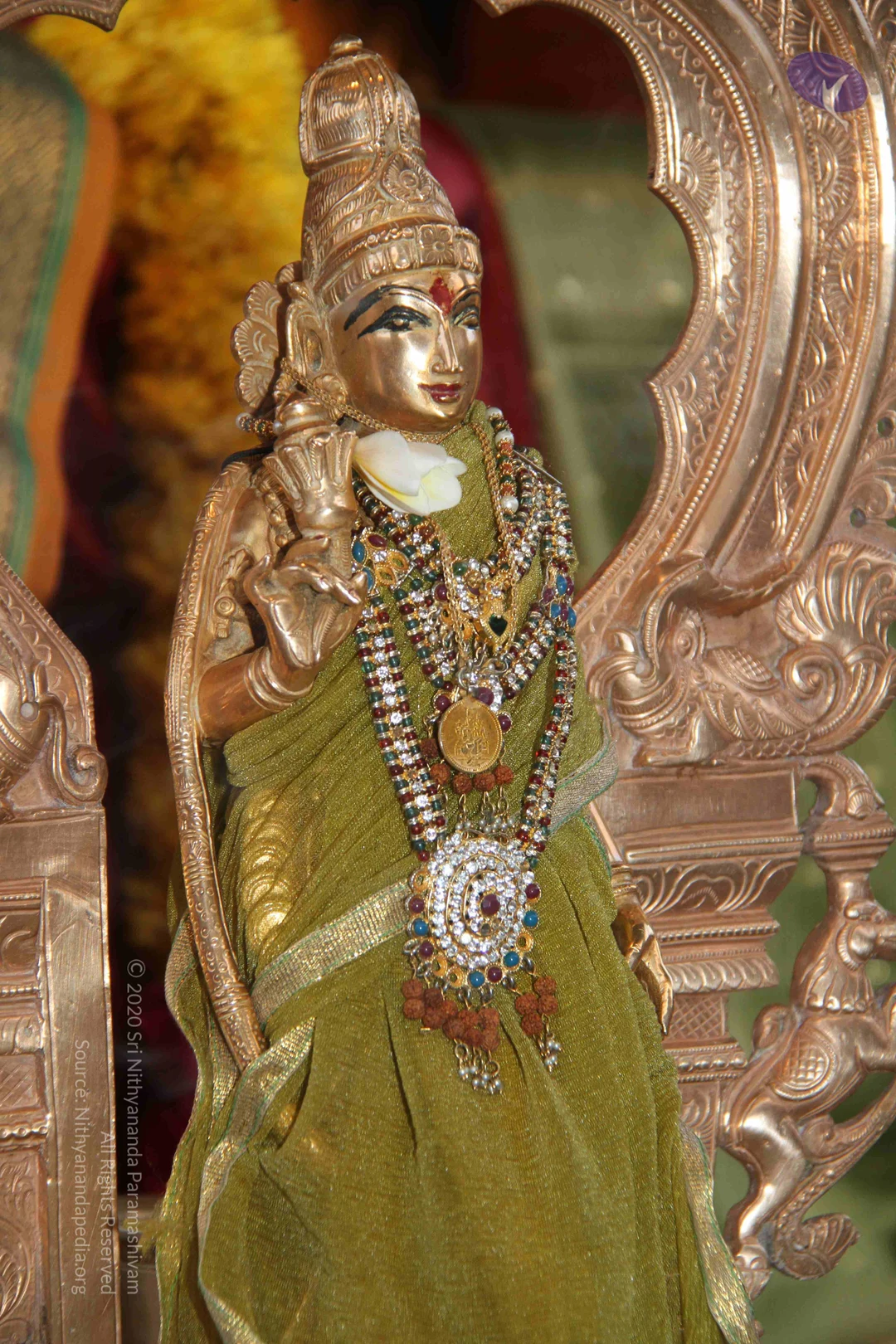
35 photosSource gallery
A dim, reddish dusk or dawn sky with a bright yellow sun low on the horizon, framed by dark silhouetted tree branches and foliage, with a utility pole and power lines crossing the scene. No people are visible.A photograph of a low sun glowing orange-white through a hazy reddish-brown dusk sky, framed by dark silhouetted tree branches and palm fronds. Thin utility wires and a wooden pole run across the lower dark treeline. A small purple emblem with a white bird sits in the upper left corner, and a , , in the lower right. No people, deities, or ritual activity are visibleTwo bronze-toned deity murtis are seated side by side against an orange and gold floral silk backdrop framed by an ornate gilded arch. The figure on the left wears a red turban, rudraksha malas and white floral garlands, and holds a trident-like staff and a damaru-style drum. The figure on the right wears an embellished jeweled crown, red and maroon garments, layered necklaces and a garland, holding a staff topped with a small green parrot. Both statues have red lips and gold ornaments. The scene is a decorated statue display, with no physical people visible.Two gilded deity murtis sit side by side against a shimmering orange and gold patterned cloth backdrop with a carved golden arch. The figure on the left has a red turban, a jeweled tilak, a rudraksha mala and white flower garlands, and holds a trident in one hand. The figure on the right wears a black and gold embroidered crown with red jewels, a green parrot perches on the staff in its hand, and it wears layered gold necklaces and red and white garlands.A black stone Nandi bull statue sits on a red sandstone pedestal in a garden setting. The Nandi wears a garland of red and white beads, a gold-toned necklace with tassels, a bead collar and a yellow cloth draped over its back. Behind it, grey stone statues of standing figures with folded hands and a red-brown tiered pedestal with a kalasha-like finial are visible among palm trees and foliage. No people are present.Two golden metal murti statues of a male and female deity seated side by side against a bright orange draped curtain within an ornate gilded arch. The male figure wears a red turban, a trident is held in one hand, and he has a rudraksha-style brown bead mala and layered jewelled necklaces. The female figure wears a tall jewelled crown, a blue sari with a silver-embroidered border, multiple gold and pearl necklaces and a green parrot perches near her. Both are adorned with pink rose garlands and white flower strands, and there is a gold-edged altar in the foreground. These are statues, so no physical people are present.

Pada-Puja

22 photosSource gallery
Close-up photograph of a person's right forearm and hand resting on an orange-red cloth over a tan lap. The wrist wears a layered bracelet of brown rudraksha beads alternating with white beads, plus a dark wristwatch. In the blurred background on the right, a brass oil lamp with a lit flame sits against a black backdrop. Only the arm and hand are visible, so no face is shown.Close side view of a man seated in a golden throne setting, wearing an orange-red saffron wrap over his shoulder and torso, layered with long orange rudraksha malas and gold bead necklaces, plus a white and orange rudraksha armband. He has long swept-back black hair, a white horizontal tilak with a red dot on his forehead, and a small gold earring, smiling and looking to the left. Behind him is ornate gold carved decoration against a dark background. Swamiji (probable) appears in person, with the appearance-based cues of long hair, saffron clothing and rudraksha malas, and a gold ornate backdrop.Close-up photograph of a person's upper arm wearing a wide armband made of brown rudraksha beads alternating with small white carved skull beads, strung in multiple rows. The person wears a saffron-orange garment draped over the shoulder with a gold border. The background is a plain beige wall and white fabric. No face is visible.Close-up photograph of a person's forearm and wrist resting on an orange terry-cloth towel draped over a pale surface. The wrist wears a bracelet of brown rudraksha beads alternating with white beads, and a dark metal wristwatch. The background is dark with a blurred golden and orange object at right. Only the arm and hand are visible, showing no face.Close-up photograph of several strands of rudraksha malas laid across a rust-orange cloth with a thin gold border. The malas alternate brown rudraksha beads with white skull-shaped beads, and a second set lies at the upper right. A person's fingers are visible at the lower left edge.Close photo of a bare foot resting on a gold-toned ritual tray scattered with white plumeria flowers and pink and red roses. A pair of bare feet in an orange garment with gold border stands on the tray, with the toes touching the flowers. Nearby are silver bowls holding flower petals, a small silver container, a silver spouted vessel and a dish of yellow turmeric paste. The setting suggests padapuja foot worship with flower offerings. No faces are visible and no people beyond the feet are shown.

Arati

54 photosSource gallery
A seated man in a golden ornate throne with a large gilded backrest topped by a crown finial, draped in a zebra-striped cushion, wears an orange-red robe, multi-strand pearl and bead necklaces, bangles and a white forehead band with red tilak. He sits with hands folded in his lap while a bald priest in orange robes at the left holds a lit oil lamp aarti flame toward him. Behind the throne hang rows of small oil lamps and dark beads, with gilded lion figures flanking the seat. Brass lamps and offerings sit on the floor, and a red carpet covers the platform. a person: the seated figure wears a red-orange robe, pearl and rudraksha-style necklaces and bangles on an elaborate golden throne, consistent with a ceremonial presentation.A photograph of a golden ornate throne set against a dark textured backdrop with hanging brass lamps. A seated figure in red-orange robes and a long pearl-style necklace sits on a zebra-striped cushion, with a white sacred mark on the forehead. In front, a bald priest in orange robes holds up a lit oil lamp or flame arti to the seated figure. Painted teal and pink panels frame the scene, and a small lamp burns on the right. A visible candidate is seated in the throne and appears to be the a person; the appearance-based label is a person, with identity kept at unsure where cues are limited. A woman in orange stands at the lower left edge.A seated figure in a saffron-orange robe sits on an ornate gold throne with carved floral and lion motifs, draped with a striped tiger-print cloth. A long rudraksha mala and layered pearl-like necklaces hang on his chest, with bangles on his upper arms and a tilak on his forehead; his hands rest folded in his lap. Kneeling at the lower left, a bald priest in orange robes holds up a brass lamp with several flames in an aarti gesture. Hanging brass oil lamps and bells light the gold-and-painted pillared hall. A sign-free ritual scene inside a temple-style setting.A photograph of a bare-chested man with long dark hair seated on a cushioned gold throne backed by an ornate gilded carved panel. He wears an orange-saffron cloth draped over one shoulder, multiple strands of white beads and gold-bead necklaces, beaded armlets, and a white horizontal tilak with a red dot on his forehead, with gold hoop earrings. His hands rest in his lap. Brass bells hang at the upper corners of the frame. The photo is taken in a temple or ashram setting. Swamiji (probable) is seated on the throne, identified by the long swept-back hair, saffron cloth, rudraksha-style beads and ceremonial gold necklaces.A large hall with pink walls, red curtains and colourful striped pillars hung with fabric. Rows of women and men in saffron-orange and red robes with yellow borders sit cross-legged on a white floor, many wearing rudraksha malas. Brass plates with flowers, oil lamps and small ritual vessels are set before them. Several people in white clothes sit near the back, and framed portraits hang on the walls. Visible people are numerous across the hall, with many seated devotees in saffron and white clothing. A person presiding at the far end is not clearly identifiable, and no figure is clearly distinguished by the cues needed for an identification.A photograph of a seated ritual gathering in an open hall. In the foreground, several women in orange and red saris with yellow borders sit cross-legged, wearing rudraksha malas and white forehead markings. A woman in the center holds an open booklet and sits before a silver tray with brass oil lamps, bowls, flowers and small offerings. Behind them, rows of people in orange robes sit on the floor before similar brass puja plates, and a man in white clothing sits at the upper right. Metal poles and a rope divide the seating area.

Nithya-Satsang

57 photosSource gallery
Photo of a seated person in saffron-orange robes with palms pressed together in namaste at the chest. The person wears long dark hair swept back, a white vertical tilak with a red bindi on the forehead, gold hoop earrings, a microphone clipped near the mouth, and layered orange rudraksha malas with gold bead necklaces and white-and-orange beaded armbands and wristbands. Behind is an ornate gold repoussé backdrop on a red velvet seat. Probable Swamiji by visible appearance cues: long swept-back hair, saffron clothing, rudraksha malas and ceremonial gold necklaces.A seated man on an ornate gilded throne with a tiger-skin rug draped over its platform, speaking into a headset microphone during a discourse. He wears orange-saffron robes, a long rudraksha mala and a gold bead necklace, with pearl-like beaded bands on his arms and a vertical sacred mark on his forehead. A dark backdrop with small lights and green foliage surround the golden throne.A seated man in orange robes sits cross-legged on an ornate gold throne with a carved arched back, flanked by two golden lion sculptures with open mouths. He wears a long multi-strand orange-beaded necklace, a large gold chain with rudraksha-style beads, bangles on both arms, a white forehead band with a red dot, and a small earpiece microphone. His hands rest on the throne's velvet armrests with a tiger-striped cloth beneath him. Potted palms and a colourful painted backdrop with lamps surround the stage. Swamiji (probable): the long swept-back hair, saffron-orange robes, rudraksha mala and ceremonial gold necklaces are consistent with the page's identification, shown here as a seated speaker on stage.A seated speaker on an ornate gilded throne with a tiger-skin rug before it, raising one hand in a gesture while speaking into a headset microphone. He wears a saffron-orange robe, a thick rudraksha mala with gold beads, a pearl-string armlet and bangles, and a white and red forehead mark. Behind him are gold-framed carvings, small lamps and potted palms. Swamiji (probable) appears as a robed speaker with long swept-back hair, saffron clothing and rudraksha and gold ornaments, seated on a throne in front of a discourse setting.A seated man in saffron-orange robes sits cross-legged on a red velvet seat before an ornate gold throne with a carved arch and lion figures, atop a tiger-skin cloth. He has long dark hair, a white forehead mark with a red dot, and wears a dark-beaded mala, a gold bead necklace, pearl-strand necklace and gold armbands, with his eyes closed in meditation. A lapel microphone is visible near his face. Golden lion statues flank the throne and potted green plants sit at the sides, with string lights behind the dais. Appearance-based identification: a person, seated in a satsang-style discourse setting with a microphone.A photograph of a large group of shaven-headed sannyasis seated cross-legged on the floor of a hall, wearing saffron-orange robes, rudraksha malas and orange shawls, with white and sandalwood marks on their foreheads and arms. Brass and silver ritual plates, small oil lamps, flowers and kalasha-style vessels sit before them. Behind them, younger boys in dark shirts and older men in white sit among the crowd, and a red curtain hangs on the back wall beside a white door. The image shows a group ritual setting rather than an identifiable single leader.

IA-Lunch

25 photosSource gallery
A dining hall serving line where devotees in white clothing and orange lanyards serve food from stainless steel chafing dishes on tables covered with green leaf-patterned cloths. A man in a white t-shirt and white pants holds a red thermos and serving tongs at left, while a man in white with an orange lanyard serves at right. A woman in white with a blue shawl and glasses ladles food in the centre. Behind them a woman in white holds a steel plate, and a blue sign on the wall reads 'Maintain silence' with partial text. Red curtains hang in the background.A photograph of volunteers serving a meal at a buffet. In the foreground a woman with her hair tied up wears a white short-sleeved shirt and an orange lanyard, and is spooning food onto a steel plate. Behind her a man in a white shirt and dark backpack also serves from a steel chafing dish. A woman on the right with long dark hair and glasses, wearing a white t-shirt and orange lanyard, holds a plate of food. Two large terracotta pots stand against a pale pink wall, and a green patterned tablecloth covers the serving table. At the far right edge a person in a white garment holds a steel tumbler.Two women drink from red stainless-steel travel mugs with black lids in an indoor room with pale pink walls. The woman on the left wears glasses, a pale yellow sari with brown border, an orange lanyard and an ID badge. The woman on the right wears a white embroidered top, a white dupatta draped over her shoulders, a white hair tie and bangles, with an orange lanyard and ID badge. Both are standing and looking ahead while drinking.A photograph of a dining hall where volunteers serve food from a buffet table covered with a green patterned cloth. Three women in white clothing stand at the serving counter: a woman with grey hair wears a white shirt, white skirt and a long beaded mala with orange-red thread, using a spoon on a tray of yellow fruit pieces; a woman with long reddish-brown hair in a white top stands behind her; and a woman with short black hair in a white polo shirt with an orange lanyard and ID badge serves from a steel tray holding bowls. Steel dishes hold yellow fruit, creamy white pudding, green chopped fruit and a bowl of ripe bananas. Colourful bunting hangs from the grey ceiling, and other white-clad people sit at tables in the background.A photo of a communal meal service with volunteers serving food from stainless steel chafing dishes on a draped table. On the left, a man in a white t-shirt with an orange lanyard and rudraksha mala ladles food onto a plate. In the centre, a man in a white shirt with an orange lanyard and a wristband places food on a plate. On the right, a man in a white shirt with rudraksha mala and a name badge holds a steel plate of food. A woman in white with an orange lanyard stands behind, and an older woman in white with a shawl stands at far right.A photograph of a serving line in a hall with a wooden stage and screen in the background. A smiling man in a white kurta and orange lanyard with an ID badge holds a steel plate of food and ladles more from a steel pot. Behind the counter, steel trays hold yellow and green dishes and a bowl of white sauce. Other people in white clothing stand at the buffet, including a woman with blonde hair in a sheer white top and scarf, and a man in white at the right holding a bowl and wearing red and white beaded garlands.

Sarvadarshan-Gurukul

51 photosSource gallery
Photograph inside a decorated hall with draped white and maroon fabric ceiling and a dark stage backdrop. Several shaved-headed young monks in saffron-orange robes with rudraksha malas, some with white tilak on their foreheads, sit or stand in a row facing right. On the right, a standing man in deep red-brown robes and a rudraksha mala hands items from a red tray to a standing figure, while another robed man in red-brown kneels near the tray. A tall striped banner hangs in the upper centre. Several more people in white attire stand in the background.A photograph inside a decorated hall with draped orange-and-white fabric and striped pillars. Several shaved-headed young monks in saffron robes and rudraksha malas stand in a row at left, some with white forehead markings and one wearing glasses. A man with long swept-back hair in an orange dhoti and shawl, adorned with a long rudraksha and gold necklace and bangles, stands at centre smiling and gesturing toward the boys. At right, a bald man in orange robes holds a red box with a small ritual item. A gilded deity murti or shrine is visible in the background. Physical people visible: about seven or eight, so the count falls in the 6-20 range.A photograph of a ceremonial reception inside a hall with draped cream fabric, colourful striped banners and projection screens showing a smiling man in white. A tall figure in saffron-orange robes, with long swept-back dark hair, a rudraksha mala, layered gold beaded necklaces and bangles, and a white forehead mark, stands at right, extending his hands toward several shaved-headed young monks in orange robes who approach with orange cloth bundles. Nearby, a man in white with folded hands and women in white and red saris stand watching, and a red tray of fruit and flowers sits at lower right. Behind them a golden throne-like seat and a small deity murti are visible. Swamiji (probable) is described by the saffron robe, long hair and gold necklaces, and the figure is treated as the in-person central presence; overall about 12 people are visible.A photograph of a devotional gathering in an indoor hall with orange and white draped ceiling fabric and striped pillars. On the right, a shaved-headed man in orange robes wears a long rudraksha-style bead necklace and bangles, and holds his palms raised in blessing. Several men stand in front, some in orange robes and others in shirts, with hands pressed together in namaste. A projection screen and a framed portrait hang in the background, and a tray of sweets sits at the lower right. Watchers stand along the right edge.Indoor photo of a blessing line in a hall with draped white fabric ceiling and maroon drapes. A man in an orange-saffron robe with multiple rudraksha-style beaded and gold bead necklaces and bangles touches the head of a devotee with one hand, marked with white forehead paste. Devotees in pink, white and checked shirts stand with folded hands or bowed heads in line, and more people in orange robes stand at the right. Colorful hanging decorations and a red wall panel are behind. A tall figure in a saffron robe at right has a shaved head. The central figure is a person bestowing a blessing on a devotee.A photograph inside a hall with a draped white ceiling and hanging red, yellow and blue cloth decorations. On the right, a figure in an ochre-saffron dhoti with a long rudraksha mala and ornate gold-and-white beaded necklaces stands with both hands raised, touching the forehead of a seated devotee in a red checked shirt. Beside him, a shaved-headed child in orange sits in front, and a man in a red t-shirt with a printed portrait stands on the left with hands joined. Other saffron-robed sannyasis and white-clad attendees stand behind, and a framed portrait hangs on the wall. The scene looks like a blessing or darshan. The orange-robed figure with rudraksha and ornaments fits the swami candidate cues, but the face is not clearly visible enough to confirm, so the identity is uncertain.

Kalabairava-Darshan

13 photosSource gallery
A smiling man sits on an ornate golden throne with elaborately carved arched backrest, lit with red and green stage lighting. He wears a leopard-print sleeveless top with rudraksha mala necklaces of dark beads and white-tipped beads, matching beaded bands on his upper arms and wrists, and rust-orange loose trousers. He has a white and red forehead marking and holds his hands together over his chest. One person is visible.A photograph of two men in an indoor room with purple-tinted lighting, a dark curtain and a potted plant behind them. On the left, a smiling man with long dark hair, wearing a leopard-print top and a rudraksha-style bead necklace, raises his palm toward a younger man on the right. The younger man, with short hair, wears a white t-shirt and an orange lanyard, and faces him with his palm raised, as if in a high-five.A photograph of a long-haired figure in a leopard-print wrap and a rudraksha mala with skull beads placing a hand on the forehead of a short-haired man in a white t-shirt with an orange wristband, in a warmly lit room with a green-lit altar, a brass lamp and a curtain. The devotee stands with his palm raised to his cheek, receiving the blessing.A long-haired man in a leopard-print wrap with a beaded rudraksha-style necklace places his right palm on the forehead of a short-haired man in a white t-shirt, while the second man's hand is raised in front. Pink and purple stage lighting, a brown curtain, potted plants and a brass oil lamp stand in the room behind them. The first man has a white mark on his brow and appears to be giving a blessing.A photograph of a long-haired figure in a leopard-print sleeveless top and rust-orange dhoti, wearing a thick rudraksha-style bead necklace, seated and placing one hand on the forehead of a kneeling man in a white T-shirt with a red-and-white bead mala. A small oil lamp with a brass base stands at left beside a plant and dark curtain in a softly lit room with pink and green lighting. The kneeling man has his palms raised in receiving posture. This appears to be a blessing or initiation-style gesture between two people. a person cues are not clearly established here, since the seated figure's distinctive adornments are present but the identity is uncertain from appearance alone.A long-haired man in a leopard-print sleeveless top and a rudraksha mala with skull-shaped beads reaches out to touch the forehead of a bald older man in a white kurta with an orange cord and a wristwatch, who stands with palms pressed together in greeting. The setting is a dimly lit room with pink and green lighting, a brass oil lamp on the left, dark curtains, and potted plants.

Swamiji-Blessings-Namaskar

8 photosSource gallery
A seated person in saffron-orange robes presses palms together in anjali mudra with eyes closed in prayer or greeting. Multiple strands of rudraksha malas and ornate gold bead necklaces hang on the chest, with matching rudraksha and white bead bracelets and armlets. A white tilak with a red dot marks the forehead, and small gold hoop earrings are worn. Behind them is a richly embossed gold throne backdrop with floral and scroll patterns, and a red cushioned seat is visible at the lower left. The distinctive adornments and saffron clothing fit a person presentation, shown here as a devotee in an attitude of prayer on a throne setting.A figure seated cross-legged on an ornate gold-and-red throne with a golden arched back, flanked by two golden lion sculptures, in front of a turquoise and pink decorated stage. The seated person has palms pressed together in namaskar, wears an orange-saffron dhoti and shawl, a rudraksha mala, a long pearl-style necklace, and gold bangles and earrings, with white vertical markings on the forehead. A tiger-striped cloth covers the seat. Green leafy plants and a hanging string of lights are behind the throne. Swamiji (probable): the saffron clothing, long swept-back hair, ceremonial necklaces and throne seating are compatible cues, though this is not a confirmed identification.A seated man with palms pressed together in namaste, in front of an ornate gold-embossed throne backdrop. He wears an orange-saffron robe, layered rudraksha-style beaded necklaces with gold beads, pearl-white bead armlets and bracelets, gold hoop earrings, a white vibhuti horizontal mark with a red kumkum dot on his forehead, and a small head microphone. He sits on a deep red velvet chair. Probable Swamiji is a qualifying cue match: long swept-back hair, saffron clothing and rudraksha malas, with the orange robe and ceremonial gold ornaments present; the page identifies this event as a discourse.A man seated on a red velvet chair in front of an ornate gold repoussé backdrop, palms pressed together in namaste at chest level. He wears a saffron-orange garment, a long rudraksha mala, a heavy ceremonial gold bead necklace, and white and rudraksha bracelets and armlets. He has a white vibhuti band with a red kumkum dot on his forehead, gold earrings, and a small clip-on microphone. Swamiji (probable) appearance cues: long swept-back hair, saffron clothing and rudraksha malas with gold necklaces, seated as a discourse speaker.A seated man with palms pressed together in namaste gesture sits on a red velvet chair before an ornate gold repoussé throne backdrop. He wears a white vertical tilak with a red bindi, gold hoop earrings, a headset microphone, an orange-red garment, layered rudraksha-style and gold bead malas, and pearl bangles on his wrists and upper arms. Green palm fronds appear at the lower left edge. The scene suggests a discourse or satsang. Swamiji (probable): the long swept-back hair, orange clothing and multiple bead malas are consistent with the page's identification, and the figure is seated as the speaker.A seated figure in saffron-orange robes with a rudraksha mala and a long pearl-style mala sits on an ornate gold throne with gold lion armrests and a red velvet cushion. Two painted guardian figures with multiple arms, flame-like headdresses and gold loincloths stand on either side against a blue, pink and green temple-style backdrop. Potted plants and brass lamp stands flank the throne. Swamiji (probable): the figure wears long swept-back hair, saffron clothing, rudraksha and pearl malas and gold armbands, and sits on the throne as the central teacher of a discourse. A small lit display is visible behind the throne and the setting resembles a satsang hall.

Yoga

11 photosSource gallery
Indoor hall with a white fabric canopy and tall decorative pillars wrapped in colourful patterns with orange tassels. Many people stand on coloured yoga mats in rows, some in black and some in white clothing, performing a standing exercise with hands at the waist. Small dumbbells sit on the floor between mats. A bearded older man on the right wears a white kurta and an orange turban. Framed pictures hang on the pink wall at left, and red curtains line the background.A large indoor hall with a white draped ceiling and ceiling fans, where a group of about twenty-five people practise a standing yoga stretch on coloured mats. Participants raise both arms overhead with hands clasped, wearing black, white and navy track clothes. Decorative cylindrical pillars in red, blue, yellow and white patterns with tassels line the room. A framed picture hangs on the left wall beside red curtains, and metal dumbbells sit on the floor.A yoga class in a bright hall with glossy floors. In the foreground a young man in a white T-shirt and black track pants stretches one arm across his chest, barefoot on a red mat. Beside him an older man in white kurta and white trousers, also barefoot, mirrors the stretch on a pink mat. Behind them women in black tops and black leggings stand on mats, one with short blonde hair. Chrome stanchions with chains divide the mats, small hand weights lie on the floor, and a red curtain hangs on the back wall under an orange cloth. No a person candidate is clearly identifiable from appearance.A photograph of a yoga or exercise session in a large hall with a polished floor and a draped white ceiling. Many students stand on coloured mats in a practice stance with arms raised overhead, some with small hand weights placed beside them. The foreground includes a man in black shirt and trousers with arms raised, a man in white kurta and white trousers, and a man in black with arms extended. Decorated cylindrical pillars with painted geometric patterns and yellow tassels run through the room, with ceiling fans overhead and a framed picture on the left wall. Water bottles sit near some mats.A large hall with a cloth-draped ceiling and decorative painted pillars shows a yoga class in progress. Around 20 people stand on colourful exercise mats, arms raised overhead or stretched sideways, mostly in black, grey and white athletic clothes. A man in an orange turban and white clothing stands at the far right, and a small framed portrait hangs on the back wall. Dumbbells and water bottles sit near the mats, with red curtains and chairs along the walls.A group yoga class in a bright hall with pale pink walls and maroon curtains. Participants in black, white, red and blue clothing stand on coloured yoga mats, many holding a balance pose with arms raised overhead while an instructor in a dark top stands at the left. Tall hanging banners with yellow fringe and geometric motifs flank the room, and stacked metal dumbbells and water bottles sit on the floor. A framed portrait of a saffron-clad figure hangs on the left wall, and rows of red chairs line the side. No ritual activity is visible.

Temple-Swamiji
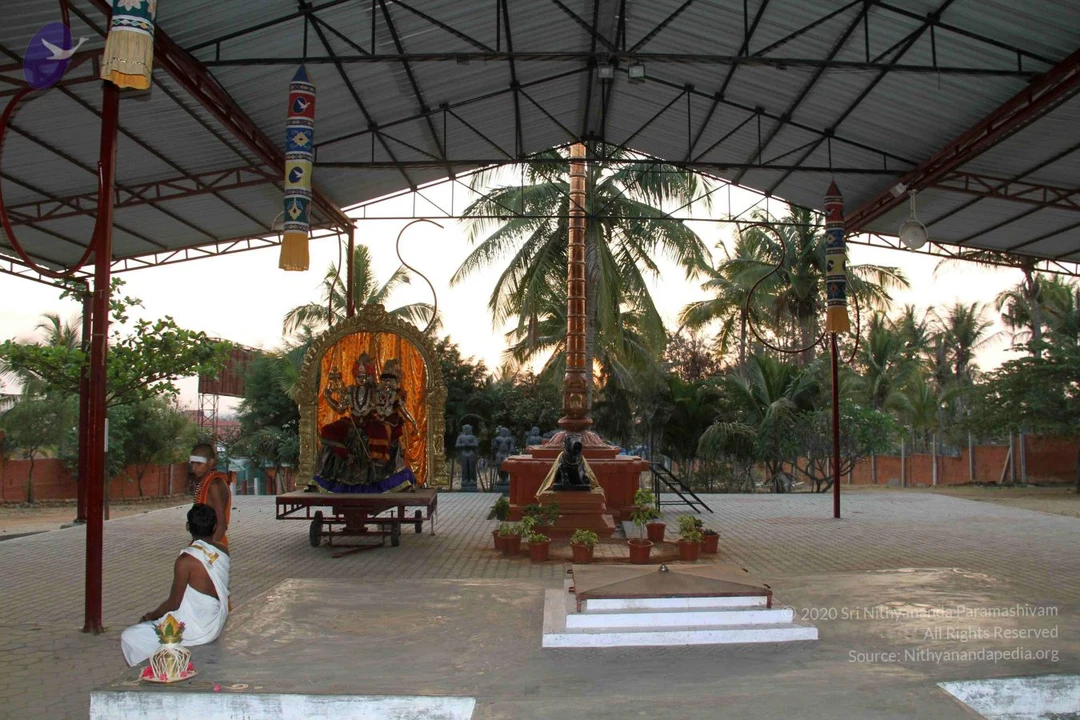
35 photosSource gallery
A dim, reddish dusk or dawn sky with a bright yellow sun low on the horizon, framed by dark silhouetted tree branches and foliage, with a utility pole and power lines crossing the scene. No people are visible.A photograph of a low sun glowing orange-white through a hazy reddish-brown dusk sky, framed by dark silhouetted tree branches and palm fronds. Thin utility wires and a wooden pole run across the lower dark treeline. A small purple emblem with a white bird sits in the upper left corner, and a , , in the lower right. No people, deities, or ritual activity are visibleTwo bronze-toned deity murtis are seated side by side against an orange and gold floral silk backdrop framed by an ornate gilded arch. The figure on the left wears a red turban, rudraksha malas and white floral garlands, and holds a trident-like staff and a damaru-style drum. The figure on the right wears an embellished jeweled crown, red and maroon garments, layered necklaces and a garland, holding a staff topped with a small green parrot. Both statues have red lips and gold ornaments. The scene is a decorated statue display, with no physical people visible.Two gilded deity murtis sit side by side against a shimmering orange and gold patterned cloth backdrop with a carved golden arch. The figure on the left has a red turban, a jeweled tilak, a rudraksha mala and white flower garlands, and holds a trident in one hand. The figure on the right wears a black and gold embroidered crown with red jewels, a green parrot perches on the staff in its hand, and it wears layered gold necklaces and red and white garlands.A black stone Nandi bull statue sits on a red sandstone pedestal in a garden setting. The Nandi wears a garland of red and white beads, a gold-toned necklace with tassels, a bead collar and a yellow cloth draped over its back. Behind it, grey stone statues of standing figures with folded hands and a red-brown tiered pedestal with a kalasha-like finial are visible among palm trees and foliage. No people are present.Two golden metal murti statues of a male and female deity seated side by side against a bright orange draped curtain within an ornate gilded arch. The male figure wears a red turban, a trident is held in one hand, and he has a rudraksha-style brown bead mala and layered jewelled necklaces. The female figure wears a tall jewelled crown, a blue sari with a silver-embroidered border, multiple gold and pearl necklaces and a green parrot perches near her. Both are adorned with pink rose garlands and white flower strands, and there is a gold-edged altar in the foreground. These are statues, so no physical people are present.

Pada-Puja

22 photosSource gallery
Close-up photograph of a person's right forearm and hand resting on an orange-red cloth over a tan lap. The wrist wears a layered bracelet of brown rudraksha beads alternating with white beads, plus a dark wristwatch. In the blurred background on the right, a brass oil lamp with a lit flame sits against a black backdrop. Only the arm and hand are visible, so no face is shown.Close side view of a man seated in a golden throne setting, wearing an orange-red saffron wrap over his shoulder and torso, layered with long orange rudraksha malas and gold bead necklaces, plus a white and orange rudraksha armband. He has long swept-back black hair, a white horizontal tilak with a red dot on his forehead, and a small gold earring, smiling and looking to the left. Behind him is ornate gold carved decoration against a dark background. Swamiji (probable) appears in person, with the appearance-based cues of long hair, saffron clothing and rudraksha malas, and a gold ornate backdrop.Close-up photograph of a person's upper arm wearing a wide armband made of brown rudraksha beads alternating with small white carved skull beads, strung in multiple rows. The person wears a saffron-orange garment draped over the shoulder with a gold border. The background is a plain beige wall and white fabric. No face is visible.Close-up photograph of a person's forearm and wrist resting on an orange terry-cloth towel draped over a pale surface. The wrist wears a bracelet of brown rudraksha beads alternating with white beads, and a dark metal wristwatch. The background is dark with a blurred golden and orange object at right. Only the arm and hand are visible, showing no face.Close-up photograph of several strands of rudraksha malas laid across a rust-orange cloth with a thin gold border. The malas alternate brown rudraksha beads with white skull-shaped beads, and a second set lies at the upper right. A person's fingers are visible at the lower left edge.Close photo of a bare foot resting on a gold-toned ritual tray scattered with white plumeria flowers and pink and red roses. A pair of bare feet in an orange garment with gold border stands on the tray, with the toes touching the flowers. Nearby are silver bowls holding flower petals, a small silver container, a silver spouted vessel and a dish of yellow turmeric paste. The setting suggests padapuja foot worship with flower offerings. No faces are visible and no people beyond the feet are shown.

Arati

54 photosSource gallery
A seated man in a golden ornate throne with a large gilded backrest topped by a crown finial, draped in a zebra-striped cushion, wears an orange-red robe, multi-strand pearl and bead necklaces, bangles and a white forehead band with red tilak. He sits with hands folded in his lap while a bald priest in orange robes at the left holds a lit oil lamp aarti flame toward him. Behind the throne hang rows of small oil lamps and dark beads, with gilded lion figures flanking the seat. Brass lamps and offerings sit on the floor, and a red carpet covers the platform. a person: the seated figure wears a red-orange robe, pearl and rudraksha-style necklaces and bangles on an elaborate golden throne, consistent with a ceremonial presentation.A photograph of a golden ornate throne set against a dark textured backdrop with hanging brass lamps. A seated figure in red-orange robes and a long pearl-style necklace sits on a zebra-striped cushion, with a white sacred mark on the forehead. In front, a bald priest in orange robes holds up a lit oil lamp or flame arti to the seated figure. Painted teal and pink panels frame the scene, and a small lamp burns on the right. A visible candidate is seated in the throne and appears to be the a person; the appearance-based label is a person, with identity kept at unsure where cues are limited. A woman in orange stands at the lower left edge.A seated figure in a saffron-orange robe sits on an ornate gold throne with carved floral and lion motifs, draped with a striped tiger-print cloth. A long rudraksha mala and layered pearl-like necklaces hang on his chest, with bangles on his upper arms and a tilak on his forehead; his hands rest folded in his lap. Kneeling at the lower left, a bald priest in orange robes holds up a brass lamp with several flames in an aarti gesture. Hanging brass oil lamps and bells light the gold-and-painted pillared hall. A sign-free ritual scene inside a temple-style setting.A photograph of a bare-chested man with long dark hair seated on a cushioned gold throne backed by an ornate gilded carved panel. He wears an orange-saffron cloth draped over one shoulder, multiple strands of white beads and gold-bead necklaces, beaded armlets, and a white horizontal tilak with a red dot on his forehead, with gold hoop earrings. His hands rest in his lap. Brass bells hang at the upper corners of the frame. The photo is taken in a temple or ashram setting. Swamiji (probable) is seated on the throne, identified by the long swept-back hair, saffron cloth, rudraksha-style beads and ceremonial gold necklaces.A large hall with pink walls, red curtains and colourful striped pillars hung with fabric. Rows of women and men in saffron-orange and red robes with yellow borders sit cross-legged on a white floor, many wearing rudraksha malas. Brass plates with flowers, oil lamps and small ritual vessels are set before them. Several people in white clothes sit near the back, and framed portraits hang on the walls. Visible people are numerous across the hall, with many seated devotees in saffron and white clothing. A person presiding at the far end is not clearly identifiable, and no figure is clearly distinguished by the cues needed for an identification.A photograph of a seated ritual gathering in an open hall. In the foreground, several women in orange and red saris with yellow borders sit cross-legged, wearing rudraksha malas and white forehead markings. A woman in the center holds an open booklet and sits before a silver tray with brass oil lamps, bowls, flowers and small offerings. Behind them, rows of people in orange robes sit on the floor before similar brass puja plates, and a man in white clothing sits at the upper right. Metal poles and a rope divide the seating area.

Nithya-Satsang

57 photosSource gallery
Photo of a seated person in saffron-orange robes with palms pressed together in namaste at the chest. The person wears long dark hair swept back, a white vertical tilak with a red bindi on the forehead, gold hoop earrings, a microphone clipped near the mouth, and layered orange rudraksha malas with gold bead necklaces and white-and-orange beaded armbands and wristbands. Behind is an ornate gold repoussé backdrop on a red velvet seat. Probable Swamiji by visible appearance cues: long swept-back hair, saffron clothing, rudraksha malas and ceremonial gold necklaces.A seated man on an ornate gilded throne with a tiger-skin rug draped over its platform, speaking into a headset microphone during a discourse. He wears orange-saffron robes, a long rudraksha mala and a gold bead necklace, with pearl-like beaded bands on his arms and a vertical sacred mark on his forehead. A dark backdrop with small lights and green foliage surround the golden throne.A seated man in orange robes sits cross-legged on an ornate gold throne with a carved arched back, flanked by two golden lion sculptures with open mouths. He wears a long multi-strand orange-beaded necklace, a large gold chain with rudraksha-style beads, bangles on both arms, a white forehead band with a red dot, and a small earpiece microphone. His hands rest on the throne's velvet armrests with a tiger-striped cloth beneath him. Potted palms and a colourful painted backdrop with lamps surround the stage. Swamiji (probable): the long swept-back hair, saffron-orange robes, rudraksha mala and ceremonial gold necklaces are consistent with the page's identification, shown here as a seated speaker on stage.A seated speaker on an ornate gilded throne with a tiger-skin rug before it, raising one hand in a gesture while speaking into a headset microphone. He wears a saffron-orange robe, a thick rudraksha mala with gold beads, a pearl-string armlet and bangles, and a white and red forehead mark. Behind him are gold-framed carvings, small lamps and potted palms. Swamiji (probable) appears as a robed speaker with long swept-back hair, saffron clothing and rudraksha and gold ornaments, seated on a throne in front of a discourse setting.A seated man in saffron-orange robes sits cross-legged on a red velvet seat before an ornate gold throne with a carved arch and lion figures, atop a tiger-skin cloth. He has long dark hair, a white forehead mark with a red dot, and wears a dark-beaded mala, a gold bead necklace, pearl-strand necklace and gold armbands, with his eyes closed in meditation. A lapel microphone is visible near his face. Golden lion statues flank the throne and potted green plants sit at the sides, with string lights behind the dais. Appearance-based identification: a person, seated in a satsang-style discourse setting with a microphone.A photograph of a large group of shaven-headed sannyasis seated cross-legged on the floor of a hall, wearing saffron-orange robes, rudraksha malas and orange shawls, with white and sandalwood marks on their foreheads and arms. Brass and silver ritual plates, small oil lamps, flowers and kalasha-style vessels sit before them. Behind them, younger boys in dark shirts and older men in white sit among the crowd, and a red curtain hangs on the back wall beside a white door. The image shows a group ritual setting rather than an identifiable single leader.

IA-Lunch

25 photosSource gallery
A dining hall serving line where devotees in white clothing and orange lanyards serve food from stainless steel chafing dishes on tables covered with green leaf-patterned cloths. A man in a white t-shirt and white pants holds a red thermos and serving tongs at left, while a man in white with an orange lanyard serves at right. A woman in white with a blue shawl and glasses ladles food in the centre. Behind them a woman in white holds a steel plate, and a blue sign on the wall reads 'Maintain silence' with partial text. Red curtains hang in the background.A photograph of volunteers serving a meal at a buffet. In the foreground a woman with her hair tied up wears a white short-sleeved shirt and an orange lanyard, and is spooning food onto a steel plate. Behind her a man in a white shirt and dark backpack also serves from a steel chafing dish. A woman on the right with long dark hair and glasses, wearing a white t-shirt and orange lanyard, holds a plate of food. Two large terracotta pots stand against a pale pink wall, and a green patterned tablecloth covers the serving table. At the far right edge a person in a white garment holds a steel tumbler.Two women drink from red stainless-steel travel mugs with black lids in an indoor room with pale pink walls. The woman on the left wears glasses, a pale yellow sari with brown border, an orange lanyard and an ID badge. The woman on the right wears a white embroidered top, a white dupatta draped over her shoulders, a white hair tie and bangles, with an orange lanyard and ID badge. Both are standing and looking ahead while drinking.A photograph of a dining hall where volunteers serve food from a buffet table covered with a green patterned cloth. Three women in white clothing stand at the serving counter: a woman with grey hair wears a white shirt, white skirt and a long beaded mala with orange-red thread, using a spoon on a tray of yellow fruit pieces; a woman with long reddish-brown hair in a white top stands behind her; and a woman with short black hair in a white polo shirt with an orange lanyard and ID badge serves from a steel tray holding bowls. Steel dishes hold yellow fruit, creamy white pudding, green chopped fruit and a bowl of ripe bananas. Colourful bunting hangs from the grey ceiling, and other white-clad people sit at tables in the background.A photo of a communal meal service with volunteers serving food from stainless steel chafing dishes on a draped table. On the left, a man in a white t-shirt with an orange lanyard and rudraksha mala ladles food onto a plate. In the centre, a man in a white shirt with an orange lanyard and a wristband places food on a plate. On the right, a man in a white shirt with rudraksha mala and a name badge holds a steel plate of food. A woman in white with an orange lanyard stands behind, and an older woman in white with a shawl stands at far right.A photograph of a serving line in a hall with a wooden stage and screen in the background. A smiling man in a white kurta and orange lanyard with an ID badge holds a steel plate of food and ladles more from a steel pot. Behind the counter, steel trays hold yellow and green dishes and a bowl of white sauce. Other people in white clothing stand at the buffet, including a woman with blonde hair in a sheer white top and scarf, and a man in white at the right holding a bowl and wearing red and white beaded garlands.

Sarvadarshan-Gurukul

51 photosSource gallery
Photograph inside a decorated hall with draped white and maroon fabric ceiling and a dark stage backdrop. Several shaved-headed young monks in saffron-orange robes with rudraksha malas, some with white tilak on their foreheads, sit or stand in a row facing right. On the right, a standing man in deep red-brown robes and a rudraksha mala hands items from a red tray to a standing figure, while another robed man in red-brown kneels near the tray. A tall striped banner hangs in the upper centre. Several more people in white attire stand in the background.A photograph inside a decorated hall with draped orange-and-white fabric and striped pillars. Several shaved-headed young monks in saffron robes and rudraksha malas stand in a row at left, some with white forehead markings and one wearing glasses. A man with long swept-back hair in an orange dhoti and shawl, adorned with a long rudraksha and gold necklace and bangles, stands at centre smiling and gesturing toward the boys. At right, a bald man in orange robes holds a red box with a small ritual item. A gilded deity murti or shrine is visible in the background. Physical people visible: about seven or eight, so the count falls in the 6-20 range.A photograph of a ceremonial reception inside a hall with draped cream fabric, colourful striped banners and projection screens showing a smiling man in white. A tall figure in saffron-orange robes, with long swept-back dark hair, a rudraksha mala, layered gold beaded necklaces and bangles, and a white forehead mark, stands at right, extending his hands toward several shaved-headed young monks in orange robes who approach with orange cloth bundles. Nearby, a man in white with folded hands and women in white and red saris stand watching, and a red tray of fruit and flowers sits at lower right. Behind them a golden throne-like seat and a small deity murti are visible. Swamiji (probable) is described by the saffron robe, long hair and gold necklaces, and the figure is treated as the in-person central presence; overall about 12 people are visible.A photograph of a devotional gathering in an indoor hall with orange and white draped ceiling fabric and striped pillars. On the right, a shaved-headed man in orange robes wears a long rudraksha-style bead necklace and bangles, and holds his palms raised in blessing. Several men stand in front, some in orange robes and others in shirts, with hands pressed together in namaste. A projection screen and a framed portrait hang in the background, and a tray of sweets sits at the lower right. Watchers stand along the right edge.Indoor photo of a blessing line in a hall with draped white fabric ceiling and maroon drapes. A man in an orange-saffron robe with multiple rudraksha-style beaded and gold bead necklaces and bangles touches the head of a devotee with one hand, marked with white forehead paste. Devotees in pink, white and checked shirts stand with folded hands or bowed heads in line, and more people in orange robes stand at the right. Colorful hanging decorations and a red wall panel are behind. A tall figure in a saffron robe at right has a shaved head. The central figure is a person bestowing a blessing on a devotee.A photograph inside a hall with a draped white ceiling and hanging red, yellow and blue cloth decorations. On the right, a figure in an ochre-saffron dhoti with a long rudraksha mala and ornate gold-and-white beaded necklaces stands with both hands raised, touching the forehead of a seated devotee in a red checked shirt. Beside him, a shaved-headed child in orange sits in front, and a man in a red t-shirt with a printed portrait stands on the left with hands joined. Other saffron-robed sannyasis and white-clad attendees stand behind, and a framed portrait hangs on the wall. The scene looks like a blessing or darshan. The orange-robed figure with rudraksha and ornaments fits the swami candidate cues, but the face is not clearly visible enough to confirm, so the identity is uncertain.

Kalabairava-Darshan

13 photosSource gallery
A smiling man sits on an ornate golden throne with elaborately carved arched backrest, lit with red and green stage lighting. He wears a leopard-print sleeveless top with rudraksha mala necklaces of dark beads and white-tipped beads, matching beaded bands on his upper arms and wrists, and rust-orange loose trousers. He has a white and red forehead marking and holds his hands together over his chest. One person is visible.A photograph of two men in an indoor room with purple-tinted lighting, a dark curtain and a potted plant behind them. On the left, a smiling man with long dark hair, wearing a leopard-print top and a rudraksha-style bead necklace, raises his palm toward a younger man on the right. The younger man, with short hair, wears a white t-shirt and an orange lanyard, and faces him with his palm raised, as if in a high-five.A photograph of a long-haired figure in a leopard-print wrap and a rudraksha mala with skull beads placing a hand on the forehead of a short-haired man in a white t-shirt with an orange wristband, in a warmly lit room with a green-lit altar, a brass lamp and a curtain. The devotee stands with his palm raised to his cheek, receiving the blessing.A long-haired man in a leopard-print wrap with a beaded rudraksha-style necklace places his right palm on the forehead of a short-haired man in a white t-shirt, while the second man's hand is raised in front. Pink and purple stage lighting, a brown curtain, potted plants and a brass oil lamp stand in the room behind them. The first man has a white mark on his brow and appears to be giving a blessing.A photograph of a long-haired figure in a leopard-print sleeveless top and rust-orange dhoti, wearing a thick rudraksha-style bead necklace, seated and placing one hand on the forehead of a kneeling man in a white T-shirt with a red-and-white bead mala. A small oil lamp with a brass base stands at left beside a plant and dark curtain in a softly lit room with pink and green lighting. The kneeling man has his palms raised in receiving posture. This appears to be a blessing or initiation-style gesture between two people. a person cues are not clearly established here, since the seated figure's distinctive adornments are present but the identity is uncertain from appearance alone.A long-haired man in a leopard-print sleeveless top and a rudraksha mala with skull-shaped beads reaches out to touch the forehead of a bald older man in a white kurta with an orange cord and a wristwatch, who stands with palms pressed together in greeting. The setting is a dimly lit room with pink and green lighting, a brass oil lamp on the left, dark curtains, and potted plants.

Swamiji-Blessings-Namaskar

8 photosSource gallery
A seated person in saffron-orange robes presses palms together in anjali mudra with eyes closed in prayer or greeting. Multiple strands of rudraksha malas and ornate gold bead necklaces hang on the chest, with matching rudraksha and white bead bracelets and armlets. A white tilak with a red dot marks the forehead, and small gold hoop earrings are worn. Behind them is a richly embossed gold throne backdrop with floral and scroll patterns, and a red cushioned seat is visible at the lower left. The distinctive adornments and saffron clothing fit a person presentation, shown here as a devotee in an attitude of prayer on a throne setting.A figure seated cross-legged on an ornate gold-and-red throne with a golden arched back, flanked by two golden lion sculptures, in front of a turquoise and pink decorated stage. The seated person has palms pressed together in namaskar, wears an orange-saffron dhoti and shawl, a rudraksha mala, a long pearl-style necklace, and gold bangles and earrings, with white vertical markings on the forehead. A tiger-striped cloth covers the seat. Green leafy plants and a hanging string of lights are behind the throne. Swamiji (probable): the saffron clothing, long swept-back hair, ceremonial necklaces and throne seating are compatible cues, though this is not a confirmed identification.A seated man with palms pressed together in namaste, in front of an ornate gold-embossed throne backdrop. He wears an orange-saffron robe, layered rudraksha-style beaded necklaces with gold beads, pearl-white bead armlets and bracelets, gold hoop earrings, a white vibhuti horizontal mark with a red kumkum dot on his forehead, and a small head microphone. He sits on a deep red velvet chair. Probable Swamiji is a qualifying cue match: long swept-back hair, saffron clothing and rudraksha malas, with the orange robe and ceremonial gold ornaments present; the page identifies this event as a discourse.A man seated on a red velvet chair in front of an ornate gold repoussé backdrop, palms pressed together in namaste at chest level. He wears a saffron-orange garment, a long rudraksha mala, a heavy ceremonial gold bead necklace, and white and rudraksha bracelets and armlets. He has a white vibhuti band with a red kumkum dot on his forehead, gold earrings, and a small clip-on microphone. Swamiji (probable) appearance cues: long swept-back hair, saffron clothing and rudraksha malas with gold necklaces, seated as a discourse speaker.A seated man with palms pressed together in namaste gesture sits on a red velvet chair before an ornate gold repoussé throne backdrop. He wears a white vertical tilak with a red bindi, gold hoop earrings, a headset microphone, an orange-red garment, layered rudraksha-style and gold bead malas, and pearl bangles on his wrists and upper arms. Green palm fronds appear at the lower left edge. The scene suggests a discourse or satsang. Swamiji (probable): the long swept-back hair, orange clothing and multiple bead malas are consistent with the page's identification, and the figure is seated as the speaker.A seated figure in saffron-orange robes with a rudraksha mala and a long pearl-style mala sits on an ornate gold throne with gold lion armrests and a red velvet cushion. Two painted guardian figures with multiple arms, flame-like headdresses and gold loincloths stand on either side against a blue, pink and green temple-style backdrop. Potted plants and brass lamp stands flank the throne. Swamiji (probable): the figure wears long swept-back hair, saffron clothing, rudraksha and pearl malas and gold armbands, and sits on the throne as the central teacher of a discourse. A small lit display is visible behind the throne and the setting resembles a satsang hall.

Yoga

11 photosSource gallery
Indoor hall with a white fabric canopy and tall decorative pillars wrapped in colourful patterns with orange tassels. Many people stand on coloured yoga mats in rows, some in black and some in white clothing, performing a standing exercise with hands at the waist. Small dumbbells sit on the floor between mats. A bearded older man on the right wears a white kurta and an orange turban. Framed pictures hang on the pink wall at left, and red curtains line the background.A large indoor hall with a white draped ceiling and ceiling fans, where a group of about twenty-five people practise a standing yoga stretch on coloured mats. Participants raise both arms overhead with hands clasped, wearing black, white and navy track clothes. Decorative cylindrical pillars in red, blue, yellow and white patterns with tassels line the room. A framed picture hangs on the left wall beside red curtains, and metal dumbbells sit on the floor.A yoga class in a bright hall with glossy floors. In the foreground a young man in a white T-shirt and black track pants stretches one arm across his chest, barefoot on a red mat. Beside him an older man in white kurta and white trousers, also barefoot, mirrors the stretch on a pink mat. Behind them women in black tops and black leggings stand on mats, one with short blonde hair. Chrome stanchions with chains divide the mats, small hand weights lie on the floor, and a red curtain hangs on the back wall under an orange cloth. No a person candidate is clearly identifiable from appearance.A photograph of a yoga or exercise session in a large hall with a polished floor and a draped white ceiling. Many students stand on coloured mats in a practice stance with arms raised overhead, some with small hand weights placed beside them. The foreground includes a man in black shirt and trousers with arms raised, a man in white kurta and white trousers, and a man in black with arms extended. Decorated cylindrical pillars with painted geometric patterns and yellow tassels run through the room, with ceiling fans overhead and a framed picture on the left wall. Water bottles sit near some mats.A large hall with a cloth-draped ceiling and decorative painted pillars shows a yoga class in progress. Around 20 people stand on colourful exercise mats, arms raised overhead or stretched sideways, mostly in black, grey and white athletic clothes. A man in an orange turban and white clothing stands at the far right, and a small framed portrait hangs on the back wall. Dumbbells and water bottles sit near the mats, with red curtains and chairs along the walls.A group yoga class in a bright hall with pale pink walls and maroon curtains. Participants in black, white, red and blue clothing stand on coloured yoga mats, many holding a balance pose with arms raised overhead while an instructor in a dark top stands at the left. Tall hanging banners with yellow fringe and geometric motifs flank the room, and stacked metal dumbbells and water bottles sit on the floor. A framed portrait of a saffron-clad figure hangs on the left wall, and rows of red chairs line the side. No ritual activity is visible.

Temple-Swamiji
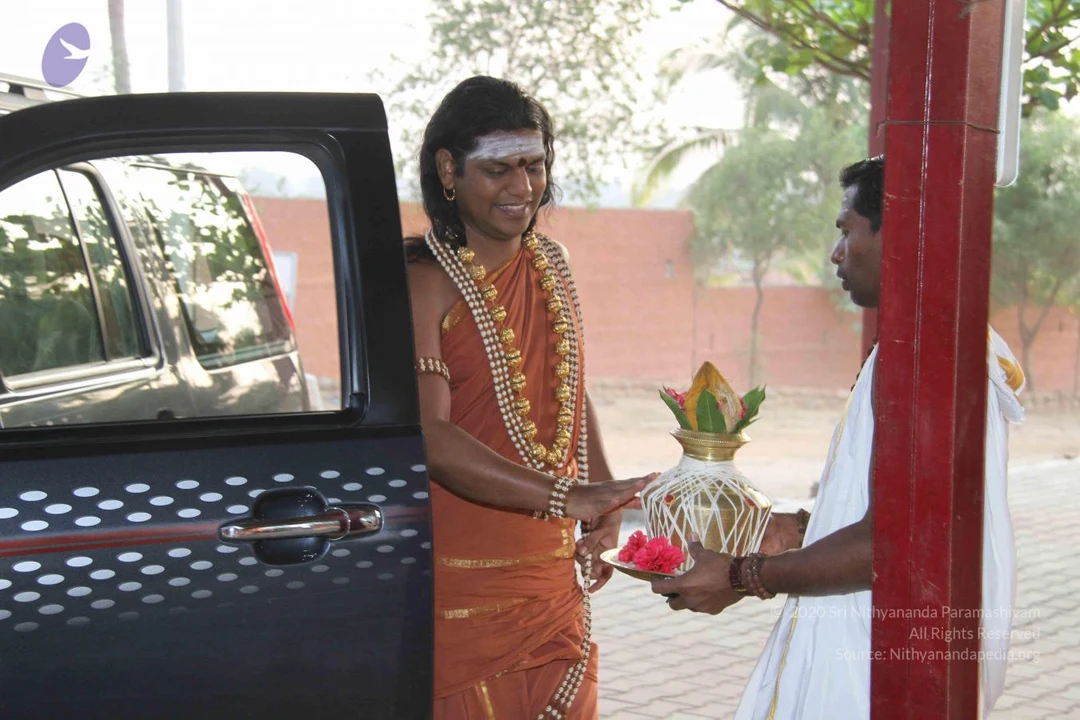
35 photosSource gallery
A dim, reddish dusk or dawn sky with a bright yellow sun low on the horizon, framed by dark silhouetted tree branches and foliage, with a utility pole and power lines crossing the scene. No people are visible.A photograph of a low sun glowing orange-white through a hazy reddish-brown dusk sky, framed by dark silhouetted tree branches and palm fronds. Thin utility wires and a wooden pole run across the lower dark treeline. A small purple emblem with a white bird sits in the upper left corner, and a , , in the lower right. No people, deities, or ritual activity are visibleTwo bronze-toned deity murtis are seated side by side against an orange and gold floral silk backdrop framed by an ornate gilded arch. The figure on the left wears a red turban, rudraksha malas and white floral garlands, and holds a trident-like staff and a damaru-style drum. The figure on the right wears an embellished jeweled crown, red and maroon garments, layered necklaces and a garland, holding a staff topped with a small green parrot. Both statues have red lips and gold ornaments. The scene is a decorated statue display, with no physical people visible.Two gilded deity murtis sit side by side against a shimmering orange and gold patterned cloth backdrop with a carved golden arch. The figure on the left has a red turban, a jeweled tilak, a rudraksha mala and white flower garlands, and holds a trident in one hand. The figure on the right wears a black and gold embroidered crown with red jewels, a green parrot perches on the staff in its hand, and it wears layered gold necklaces and red and white garlands.A black stone Nandi bull statue sits on a red sandstone pedestal in a garden setting. The Nandi wears a garland of red and white beads, a gold-toned necklace with tassels, a bead collar and a yellow cloth draped over its back. Behind it, grey stone statues of standing figures with folded hands and a red-brown tiered pedestal with a kalasha-like finial are visible among palm trees and foliage. No people are present.Two golden metal murti statues of a male and female deity seated side by side against a bright orange draped curtain within an ornate gilded arch. The male figure wears a red turban, a trident is held in one hand, and he has a rudraksha-style brown bead mala and layered jewelled necklaces. The female figure wears a tall jewelled crown, a blue sari with a silver-embroidered border, multiple gold and pearl necklaces and a green parrot perches near her. Both are adorned with pink rose garlands and white flower strands, and there is a gold-edged altar in the foreground. These are statues, so no physical people are present.

Pada-Puja

22 photosSource gallery
Close-up photograph of a person's right forearm and hand resting on an orange-red cloth over a tan lap. The wrist wears a layered bracelet of brown rudraksha beads alternating with white beads, plus a dark wristwatch. In the blurred background on the right, a brass oil lamp with a lit flame sits against a black backdrop. Only the arm and hand are visible, so no face is shown.Close side view of a man seated in a golden throne setting, wearing an orange-red saffron wrap over his shoulder and torso, layered with long orange rudraksha malas and gold bead necklaces, plus a white and orange rudraksha armband. He has long swept-back black hair, a white horizontal tilak with a red dot on his forehead, and a small gold earring, smiling and looking to the left. Behind him is ornate gold carved decoration against a dark background. Swamiji (probable) appears in person, with the appearance-based cues of long hair, saffron clothing and rudraksha malas, and a gold ornate backdrop.Close-up photograph of a person's upper arm wearing a wide armband made of brown rudraksha beads alternating with small white carved skull beads, strung in multiple rows. The person wears a saffron-orange garment draped over the shoulder with a gold border. The background is a plain beige wall and white fabric. No face is visible.Close-up photograph of a person's forearm and wrist resting on an orange terry-cloth towel draped over a pale surface. The wrist wears a bracelet of brown rudraksha beads alternating with white beads, and a dark metal wristwatch. The background is dark with a blurred golden and orange object at right. Only the arm and hand are visible, showing no face.Close-up photograph of several strands of rudraksha malas laid across a rust-orange cloth with a thin gold border. The malas alternate brown rudraksha beads with white skull-shaped beads, and a second set lies at the upper right. A person's fingers are visible at the lower left edge.Close photo of a bare foot resting on a gold-toned ritual tray scattered with white plumeria flowers and pink and red roses. A pair of bare feet in an orange garment with gold border stands on the tray, with the toes touching the flowers. Nearby are silver bowls holding flower petals, a small silver container, a silver spouted vessel and a dish of yellow turmeric paste. The setting suggests padapuja foot worship with flower offerings. No faces are visible and no people beyond the feet are shown.

Arati

54 photosSource gallery
A seated man in a golden ornate throne with a large gilded backrest topped by a crown finial, draped in a zebra-striped cushion, wears an orange-red robe, multi-strand pearl and bead necklaces, bangles and a white forehead band with red tilak. He sits with hands folded in his lap while a bald priest in orange robes at the left holds a lit oil lamp aarti flame toward him. Behind the throne hang rows of small oil lamps and dark beads, with gilded lion figures flanking the seat. Brass lamps and offerings sit on the floor, and a red carpet covers the platform. a person: the seated figure wears a red-orange robe, pearl and rudraksha-style necklaces and bangles on an elaborate golden throne, consistent with a ceremonial presentation.A photograph of a golden ornate throne set against a dark textured backdrop with hanging brass lamps. A seated figure in red-orange robes and a long pearl-style necklace sits on a zebra-striped cushion, with a white sacred mark on the forehead. In front, a bald priest in orange robes holds up a lit oil lamp or flame arti to the seated figure. Painted teal and pink panels frame the scene, and a small lamp burns on the right. A visible candidate is seated in the throne and appears to be the a person; the appearance-based label is a person, with identity kept at unsure where cues are limited. A woman in orange stands at the lower left edge.A seated figure in a saffron-orange robe sits on an ornate gold throne with carved floral and lion motifs, draped with a striped tiger-print cloth. A long rudraksha mala and layered pearl-like necklaces hang on his chest, with bangles on his upper arms and a tilak on his forehead; his hands rest folded in his lap. Kneeling at the lower left, a bald priest in orange robes holds up a brass lamp with several flames in an aarti gesture. Hanging brass oil lamps and bells light the gold-and-painted pillared hall. A sign-free ritual scene inside a temple-style setting.A photograph of a bare-chested man with long dark hair seated on a cushioned gold throne backed by an ornate gilded carved panel. He wears an orange-saffron cloth draped over one shoulder, multiple strands of white beads and gold-bead necklaces, beaded armlets, and a white horizontal tilak with a red dot on his forehead, with gold hoop earrings. His hands rest in his lap. Brass bells hang at the upper corners of the frame. The photo is taken in a temple or ashram setting. Swamiji (probable) is seated on the throne, identified by the long swept-back hair, saffron cloth, rudraksha-style beads and ceremonial gold necklaces.A large hall with pink walls, red curtains and colourful striped pillars hung with fabric. Rows of women and men in saffron-orange and red robes with yellow borders sit cross-legged on a white floor, many wearing rudraksha malas. Brass plates with flowers, oil lamps and small ritual vessels are set before them. Several people in white clothes sit near the back, and framed portraits hang on the walls. Visible people are numerous across the hall, with many seated devotees in saffron and white clothing. A person presiding at the far end is not clearly identifiable, and no figure is clearly distinguished by the cues needed for an identification.A photograph of a seated ritual gathering in an open hall. In the foreground, several women in orange and red saris with yellow borders sit cross-legged, wearing rudraksha malas and white forehead markings. A woman in the center holds an open booklet and sits before a silver tray with brass oil lamps, bowls, flowers and small offerings. Behind them, rows of people in orange robes sit on the floor before similar brass puja plates, and a man in white clothing sits at the upper right. Metal poles and a rope divide the seating area.

Nithya-Satsang

57 photosSource gallery
Photo of a seated person in saffron-orange robes with palms pressed together in namaste at the chest. The person wears long dark hair swept back, a white vertical tilak with a red bindi on the forehead, gold hoop earrings, a microphone clipped near the mouth, and layered orange rudraksha malas with gold bead necklaces and white-and-orange beaded armbands and wristbands. Behind is an ornate gold repoussé backdrop on a red velvet seat. Probable Swamiji by visible appearance cues: long swept-back hair, saffron clothing, rudraksha malas and ceremonial gold necklaces.A seated man on an ornate gilded throne with a tiger-skin rug draped over its platform, speaking into a headset microphone during a discourse. He wears orange-saffron robes, a long rudraksha mala and a gold bead necklace, with pearl-like beaded bands on his arms and a vertical sacred mark on his forehead. A dark backdrop with small lights and green foliage surround the golden throne.A seated man in orange robes sits cross-legged on an ornate gold throne with a carved arched back, flanked by two golden lion sculptures with open mouths. He wears a long multi-strand orange-beaded necklace, a large gold chain with rudraksha-style beads, bangles on both arms, a white forehead band with a red dot, and a small earpiece microphone. His hands rest on the throne's velvet armrests with a tiger-striped cloth beneath him. Potted palms and a colourful painted backdrop with lamps surround the stage. Swamiji (probable): the long swept-back hair, saffron-orange robes, rudraksha mala and ceremonial gold necklaces are consistent with the page's identification, shown here as a seated speaker on stage.A seated speaker on an ornate gilded throne with a tiger-skin rug before it, raising one hand in a gesture while speaking into a headset microphone. He wears a saffron-orange robe, a thick rudraksha mala with gold beads, a pearl-string armlet and bangles, and a white and red forehead mark. Behind him are gold-framed carvings, small lamps and potted palms. Swamiji (probable) appears as a robed speaker with long swept-back hair, saffron clothing and rudraksha and gold ornaments, seated on a throne in front of a discourse setting.A seated man in saffron-orange robes sits cross-legged on a red velvet seat before an ornate gold throne with a carved arch and lion figures, atop a tiger-skin cloth. He has long dark hair, a white forehead mark with a red dot, and wears a dark-beaded mala, a gold bead necklace, pearl-strand necklace and gold armbands, with his eyes closed in meditation. A lapel microphone is visible near his face. Golden lion statues flank the throne and potted green plants sit at the sides, with string lights behind the dais. Appearance-based identification: a person, seated in a satsang-style discourse setting with a microphone.A photograph of a large group of shaven-headed sannyasis seated cross-legged on the floor of a hall, wearing saffron-orange robes, rudraksha malas and orange shawls, with white and sandalwood marks on their foreheads and arms. Brass and silver ritual plates, small oil lamps, flowers and kalasha-style vessels sit before them. Behind them, younger boys in dark shirts and older men in white sit among the crowd, and a red curtain hangs on the back wall beside a white door. The image shows a group ritual setting rather than an identifiable single leader.

IA-Lunch

25 photosSource gallery
A dining hall serving line where devotees in white clothing and orange lanyards serve food from stainless steel chafing dishes on tables covered with green leaf-patterned cloths. A man in a white t-shirt and white pants holds a red thermos and serving tongs at left, while a man in white with an orange lanyard serves at right. A woman in white with a blue shawl and glasses ladles food in the centre. Behind them a woman in white holds a steel plate, and a blue sign on the wall reads 'Maintain silence' with partial text. Red curtains hang in the background.A photograph of volunteers serving a meal at a buffet. In the foreground a woman with her hair tied up wears a white short-sleeved shirt and an orange lanyard, and is spooning food onto a steel plate. Behind her a man in a white shirt and dark backpack also serves from a steel chafing dish. A woman on the right with long dark hair and glasses, wearing a white t-shirt and orange lanyard, holds a plate of food. Two large terracotta pots stand against a pale pink wall, and a green patterned tablecloth covers the serving table. At the far right edge a person in a white garment holds a steel tumbler.Two women drink from red stainless-steel travel mugs with black lids in an indoor room with pale pink walls. The woman on the left wears glasses, a pale yellow sari with brown border, an orange lanyard and an ID badge. The woman on the right wears a white embroidered top, a white dupatta draped over her shoulders, a white hair tie and bangles, with an orange lanyard and ID badge. Both are standing and looking ahead while drinking.A photograph of a dining hall where volunteers serve food from a buffet table covered with a green patterned cloth. Three women in white clothing stand at the serving counter: a woman with grey hair wears a white shirt, white skirt and a long beaded mala with orange-red thread, using a spoon on a tray of yellow fruit pieces; a woman with long reddish-brown hair in a white top stands behind her; and a woman with short black hair in a white polo shirt with an orange lanyard and ID badge serves from a steel tray holding bowls. Steel dishes hold yellow fruit, creamy white pudding, green chopped fruit and a bowl of ripe bananas. Colourful bunting hangs from the grey ceiling, and other white-clad people sit at tables in the background.A photo of a communal meal service with volunteers serving food from stainless steel chafing dishes on a draped table. On the left, a man in a white t-shirt with an orange lanyard and rudraksha mala ladles food onto a plate. In the centre, a man in a white shirt with an orange lanyard and a wristband places food on a plate. On the right, a man in a white shirt with rudraksha mala and a name badge holds a steel plate of food. A woman in white with an orange lanyard stands behind, and an older woman in white with a shawl stands at far right.A photograph of a serving line in a hall with a wooden stage and screen in the background. A smiling man in a white kurta and orange lanyard with an ID badge holds a steel plate of food and ladles more from a steel pot. Behind the counter, steel trays hold yellow and green dishes and a bowl of white sauce. Other people in white clothing stand at the buffet, including a woman with blonde hair in a sheer white top and scarf, and a man in white at the right holding a bowl and wearing red and white beaded garlands.

Sarvadarshan-Gurukul

51 photosSource gallery
Photograph inside a decorated hall with draped white and maroon fabric ceiling and a dark stage backdrop. Several shaved-headed young monks in saffron-orange robes with rudraksha malas, some with white tilak on their foreheads, sit or stand in a row facing right. On the right, a standing man in deep red-brown robes and a rudraksha mala hands items from a red tray to a standing figure, while another robed man in red-brown kneels near the tray. A tall striped banner hangs in the upper centre. Several more people in white attire stand in the background.A photograph inside a decorated hall with draped orange-and-white fabric and striped pillars. Several shaved-headed young monks in saffron robes and rudraksha malas stand in a row at left, some with white forehead markings and one wearing glasses. A man with long swept-back hair in an orange dhoti and shawl, adorned with a long rudraksha and gold necklace and bangles, stands at centre smiling and gesturing toward the boys. At right, a bald man in orange robes holds a red box with a small ritual item. A gilded deity murti or shrine is visible in the background. Physical people visible: about seven or eight, so the count falls in the 6-20 range.A photograph of a ceremonial reception inside a hall with draped cream fabric, colourful striped banners and projection screens showing a smiling man in white. A tall figure in saffron-orange robes, with long swept-back dark hair, a rudraksha mala, layered gold beaded necklaces and bangles, and a white forehead mark, stands at right, extending his hands toward several shaved-headed young monks in orange robes who approach with orange cloth bundles. Nearby, a man in white with folded hands and women in white and red saris stand watching, and a red tray of fruit and flowers sits at lower right. Behind them a golden throne-like seat and a small deity murti are visible. Swamiji (probable) is described by the saffron robe, long hair and gold necklaces, and the figure is treated as the in-person central presence; overall about 12 people are visible.A photograph of a devotional gathering in an indoor hall with orange and white draped ceiling fabric and striped pillars. On the right, a shaved-headed man in orange robes wears a long rudraksha-style bead necklace and bangles, and holds his palms raised in blessing. Several men stand in front, some in orange robes and others in shirts, with hands pressed together in namaste. A projection screen and a framed portrait hang in the background, and a tray of sweets sits at the lower right. Watchers stand along the right edge.Indoor photo of a blessing line in a hall with draped white fabric ceiling and maroon drapes. A man in an orange-saffron robe with multiple rudraksha-style beaded and gold bead necklaces and bangles touches the head of a devotee with one hand, marked with white forehead paste. Devotees in pink, white and checked shirts stand with folded hands or bowed heads in line, and more people in orange robes stand at the right. Colorful hanging decorations and a red wall panel are behind. A tall figure in a saffron robe at right has a shaved head. The central figure is a person bestowing a blessing on a devotee.A photograph inside a hall with a draped white ceiling and hanging red, yellow and blue cloth decorations. On the right, a figure in an ochre-saffron dhoti with a long rudraksha mala and ornate gold-and-white beaded necklaces stands with both hands raised, touching the forehead of a seated devotee in a red checked shirt. Beside him, a shaved-headed child in orange sits in front, and a man in a red t-shirt with a printed portrait stands on the left with hands joined. Other saffron-robed sannyasis and white-clad attendees stand behind, and a framed portrait hangs on the wall. The scene looks like a blessing or darshan. The orange-robed figure with rudraksha and ornaments fits the swami candidate cues, but the face is not clearly visible enough to confirm, so the identity is uncertain.

Kalabairava-Darshan

13 photosSource gallery
A smiling man sits on an ornate golden throne with elaborately carved arched backrest, lit with red and green stage lighting. He wears a leopard-print sleeveless top with rudraksha mala necklaces of dark beads and white-tipped beads, matching beaded bands on his upper arms and wrists, and rust-orange loose trousers. He has a white and red forehead marking and holds his hands together over his chest. One person is visible.A photograph of two men in an indoor room with purple-tinted lighting, a dark curtain and a potted plant behind them. On the left, a smiling man with long dark hair, wearing a leopard-print top and a rudraksha-style bead necklace, raises his palm toward a younger man on the right. The younger man, with short hair, wears a white t-shirt and an orange lanyard, and faces him with his palm raised, as if in a high-five.A photograph of a long-haired figure in a leopard-print wrap and a rudraksha mala with skull beads placing a hand on the forehead of a short-haired man in a white t-shirt with an orange wristband, in a warmly lit room with a green-lit altar, a brass lamp and a curtain. The devotee stands with his palm raised to his cheek, receiving the blessing.A long-haired man in a leopard-print wrap with a beaded rudraksha-style necklace places his right palm on the forehead of a short-haired man in a white t-shirt, while the second man's hand is raised in front. Pink and purple stage lighting, a brown curtain, potted plants and a brass oil lamp stand in the room behind them. The first man has a white mark on his brow and appears to be giving a blessing.A photograph of a long-haired figure in a leopard-print sleeveless top and rust-orange dhoti, wearing a thick rudraksha-style bead necklace, seated and placing one hand on the forehead of a kneeling man in a white T-shirt with a red-and-white bead mala. A small oil lamp with a brass base stands at left beside a plant and dark curtain in a softly lit room with pink and green lighting. The kneeling man has his palms raised in receiving posture. This appears to be a blessing or initiation-style gesture between two people. a person cues are not clearly established here, since the seated figure's distinctive adornments are present but the identity is uncertain from appearance alone.A long-haired man in a leopard-print sleeveless top and a rudraksha mala with skull-shaped beads reaches out to touch the forehead of a bald older man in a white kurta with an orange cord and a wristwatch, who stands with palms pressed together in greeting. The setting is a dimly lit room with pink and green lighting, a brass oil lamp on the left, dark curtains, and potted plants.

Swamiji-Blessings-Namaskar

8 photosSource gallery
A seated person in saffron-orange robes presses palms together in anjali mudra with eyes closed in prayer or greeting. Multiple strands of rudraksha malas and ornate gold bead necklaces hang on the chest, with matching rudraksha and white bead bracelets and armlets. A white tilak with a red dot marks the forehead, and small gold hoop earrings are worn. Behind them is a richly embossed gold throne backdrop with floral and scroll patterns, and a red cushioned seat is visible at the lower left. The distinctive adornments and saffron clothing fit a person presentation, shown here as a devotee in an attitude of prayer on a throne setting.A figure seated cross-legged on an ornate gold-and-red throne with a golden arched back, flanked by two golden lion sculptures, in front of a turquoise and pink decorated stage. The seated person has palms pressed together in namaskar, wears an orange-saffron dhoti and shawl, a rudraksha mala, a long pearl-style necklace, and gold bangles and earrings, with white vertical markings on the forehead. A tiger-striped cloth covers the seat. Green leafy plants and a hanging string of lights are behind the throne. Swamiji (probable): the saffron clothing, long swept-back hair, ceremonial necklaces and throne seating are compatible cues, though this is not a confirmed identification.A seated man with palms pressed together in namaste, in front of an ornate gold-embossed throne backdrop. He wears an orange-saffron robe, layered rudraksha-style beaded necklaces with gold beads, pearl-white bead armlets and bracelets, gold hoop earrings, a white vibhuti horizontal mark with a red kumkum dot on his forehead, and a small head microphone. He sits on a deep red velvet chair. Probable Swamiji is a qualifying cue match: long swept-back hair, saffron clothing and rudraksha malas, with the orange robe and ceremonial gold ornaments present; the page identifies this event as a discourse.A man seated on a red velvet chair in front of an ornate gold repoussé backdrop, palms pressed together in namaste at chest level. He wears a saffron-orange garment, a long rudraksha mala, a heavy ceremonial gold bead necklace, and white and rudraksha bracelets and armlets. He has a white vibhuti band with a red kumkum dot on his forehead, gold earrings, and a small clip-on microphone. Swamiji (probable) appearance cues: long swept-back hair, saffron clothing and rudraksha malas with gold necklaces, seated as a discourse speaker.A seated man with palms pressed together in namaste gesture sits on a red velvet chair before an ornate gold repoussé throne backdrop. He wears a white vertical tilak with a red bindi, gold hoop earrings, a headset microphone, an orange-red garment, layered rudraksha-style and gold bead malas, and pearl bangles on his wrists and upper arms. Green palm fronds appear at the lower left edge. The scene suggests a discourse or satsang. Swamiji (probable): the long swept-back hair, orange clothing and multiple bead malas are consistent with the page's identification, and the figure is seated as the speaker.A seated figure in saffron-orange robes with a rudraksha mala and a long pearl-style mala sits on an ornate gold throne with gold lion armrests and a red velvet cushion. Two painted guardian figures with multiple arms, flame-like headdresses and gold loincloths stand on either side against a blue, pink and green temple-style backdrop. Potted plants and brass lamp stands flank the throne. Swamiji (probable): the figure wears long swept-back hair, saffron clothing, rudraksha and pearl malas and gold armbands, and sits on the throne as the central teacher of a discourse. A small lit display is visible behind the throne and the setting resembles a satsang hall.

Yoga

11 photosSource gallery
Indoor hall with a white fabric canopy and tall decorative pillars wrapped in colourful patterns with orange tassels. Many people stand on coloured yoga mats in rows, some in black and some in white clothing, performing a standing exercise with hands at the waist. Small dumbbells sit on the floor between mats. A bearded older man on the right wears a white kurta and an orange turban. Framed pictures hang on the pink wall at left, and red curtains line the background.A large indoor hall with a white draped ceiling and ceiling fans, where a group of about twenty-five people practise a standing yoga stretch on coloured mats. Participants raise both arms overhead with hands clasped, wearing black, white and navy track clothes. Decorative cylindrical pillars in red, blue, yellow and white patterns with tassels line the room. A framed picture hangs on the left wall beside red curtains, and metal dumbbells sit on the floor.A yoga class in a bright hall with glossy floors. In the foreground a young man in a white T-shirt and black track pants stretches one arm across his chest, barefoot on a red mat. Beside him an older man in white kurta and white trousers, also barefoot, mirrors the stretch on a pink mat. Behind them women in black tops and black leggings stand on mats, one with short blonde hair. Chrome stanchions with chains divide the mats, small hand weights lie on the floor, and a red curtain hangs on the back wall under an orange cloth. No a person candidate is clearly identifiable from appearance.A photograph of a yoga or exercise session in a large hall with a polished floor and a draped white ceiling. Many students stand on coloured mats in a practice stance with arms raised overhead, some with small hand weights placed beside them. The foreground includes a man in black shirt and trousers with arms raised, a man in white kurta and white trousers, and a man in black with arms extended. Decorated cylindrical pillars with painted geometric patterns and yellow tassels run through the room, with ceiling fans overhead and a framed picture on the left wall. Water bottles sit near some mats.A large hall with a cloth-draped ceiling and decorative painted pillars shows a yoga class in progress. Around 20 people stand on colourful exercise mats, arms raised overhead or stretched sideways, mostly in black, grey and white athletic clothes. A man in an orange turban and white clothing stands at the far right, and a small framed portrait hangs on the back wall. Dumbbells and water bottles sit near the mats, with red curtains and chairs along the walls.A group yoga class in a bright hall with pale pink walls and maroon curtains. Participants in black, white, red and blue clothing stand on coloured yoga mats, many holding a balance pose with arms raised overhead while an instructor in a dark top stands at the left. Tall hanging banners with yellow fringe and geometric motifs flank the room, and stacked metal dumbbells and water bottles sit on the floor. A framed portrait of a saffron-clad figure hangs on the left wall, and rows of red chairs line the side. No ritual activity is visible.

Temple-Swamiji
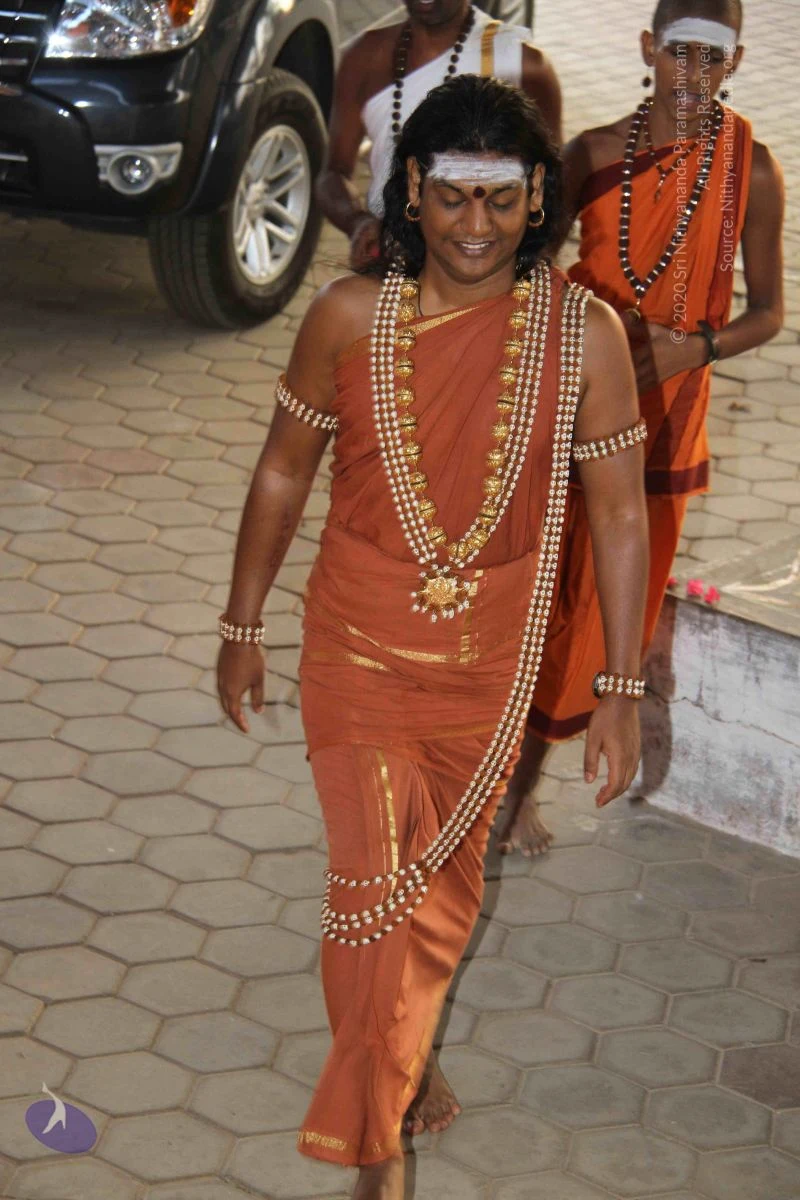
35 photosSource gallery
A dim, reddish dusk or dawn sky with a bright yellow sun low on the horizon, framed by dark silhouetted tree branches and foliage, with a utility pole and power lines crossing the scene. No people are visible.A photograph of a low sun glowing orange-white through a hazy reddish-brown dusk sky, framed by dark silhouetted tree branches and palm fronds. Thin utility wires and a wooden pole run across the lower dark treeline. A small purple emblem with a white bird sits in the upper left corner, and a , , in the lower right. No people, deities, or ritual activity are visibleTwo bronze-toned deity murtis are seated side by side against an orange and gold floral silk backdrop framed by an ornate gilded arch. The figure on the left wears a red turban, rudraksha malas and white floral garlands, and holds a trident-like staff and a damaru-style drum. The figure on the right wears an embellished jeweled crown, red and maroon garments, layered necklaces and a garland, holding a staff topped with a small green parrot. Both statues have red lips and gold ornaments. The scene is a decorated statue display, with no physical people visible.Two gilded deity murtis sit side by side against a shimmering orange and gold patterned cloth backdrop with a carved golden arch. The figure on the left has a red turban, a jeweled tilak, a rudraksha mala and white flower garlands, and holds a trident in one hand. The figure on the right wears a black and gold embroidered crown with red jewels, a green parrot perches on the staff in its hand, and it wears layered gold necklaces and red and white garlands.A black stone Nandi bull statue sits on a red sandstone pedestal in a garden setting. The Nandi wears a garland of red and white beads, a gold-toned necklace with tassels, a bead collar and a yellow cloth draped over its back. Behind it, grey stone statues of standing figures with folded hands and a red-brown tiered pedestal with a kalasha-like finial are visible among palm trees and foliage. No people are present.Two golden metal murti statues of a male and female deity seated side by side against a bright orange draped curtain within an ornate gilded arch. The male figure wears a red turban, a trident is held in one hand, and he has a rudraksha-style brown bead mala and layered jewelled necklaces. The female figure wears a tall jewelled crown, a blue sari with a silver-embroidered border, multiple gold and pearl necklaces and a green parrot perches near her. Both are adorned with pink rose garlands and white flower strands, and there is a gold-edged altar in the foreground. These are statues, so no physical people are present.

Pada-Puja

22 photosSource gallery
Close-up photograph of a person's right forearm and hand resting on an orange-red cloth over a tan lap. The wrist wears a layered bracelet of brown rudraksha beads alternating with white beads, plus a dark wristwatch. In the blurred background on the right, a brass oil lamp with a lit flame sits against a black backdrop. Only the arm and hand are visible, so no face is shown.Close side view of a man seated in a golden throne setting, wearing an orange-red saffron wrap over his shoulder and torso, layered with long orange rudraksha malas and gold bead necklaces, plus a white and orange rudraksha armband. He has long swept-back black hair, a white horizontal tilak with a red dot on his forehead, and a small gold earring, smiling and looking to the left. Behind him is ornate gold carved decoration against a dark background. Swamiji (probable) appears in person, with the appearance-based cues of long hair, saffron clothing and rudraksha malas, and a gold ornate backdrop.Close-up photograph of a person's upper arm wearing a wide armband made of brown rudraksha beads alternating with small white carved skull beads, strung in multiple rows. The person wears a saffron-orange garment draped over the shoulder with a gold border. The background is a plain beige wall and white fabric. No face is visible.Close-up photograph of a person's forearm and wrist resting on an orange terry-cloth towel draped over a pale surface. The wrist wears a bracelet of brown rudraksha beads alternating with white beads, and a dark metal wristwatch. The background is dark with a blurred golden and orange object at right. Only the arm and hand are visible, showing no face.Close-up photograph of several strands of rudraksha malas laid across a rust-orange cloth with a thin gold border. The malas alternate brown rudraksha beads with white skull-shaped beads, and a second set lies at the upper right. A person's fingers are visible at the lower left edge.Close photo of a bare foot resting on a gold-toned ritual tray scattered with white plumeria flowers and pink and red roses. A pair of bare feet in an orange garment with gold border stands on the tray, with the toes touching the flowers. Nearby are silver bowls holding flower petals, a small silver container, a silver spouted vessel and a dish of yellow turmeric paste. The setting suggests padapuja foot worship with flower offerings. No faces are visible and no people beyond the feet are shown.

Arati

54 photosSource gallery
A seated man in a golden ornate throne with a large gilded backrest topped by a crown finial, draped in a zebra-striped cushion, wears an orange-red robe, multi-strand pearl and bead necklaces, bangles and a white forehead band with red tilak. He sits with hands folded in his lap while a bald priest in orange robes at the left holds a lit oil lamp aarti flame toward him. Behind the throne hang rows of small oil lamps and dark beads, with gilded lion figures flanking the seat. Brass lamps and offerings sit on the floor, and a red carpet covers the platform. a person: the seated figure wears a red-orange robe, pearl and rudraksha-style necklaces and bangles on an elaborate golden throne, consistent with a ceremonial presentation.A photograph of a golden ornate throne set against a dark textured backdrop with hanging brass lamps. A seated figure in red-orange robes and a long pearl-style necklace sits on a zebra-striped cushion, with a white sacred mark on the forehead. In front, a bald priest in orange robes holds up a lit oil lamp or flame arti to the seated figure. Painted teal and pink panels frame the scene, and a small lamp burns on the right. A visible candidate is seated in the throne and appears to be the a person; the appearance-based label is a person, with identity kept at unsure where cues are limited. A woman in orange stands at the lower left edge.A seated figure in a saffron-orange robe sits on an ornate gold throne with carved floral and lion motifs, draped with a striped tiger-print cloth. A long rudraksha mala and layered pearl-like necklaces hang on his chest, with bangles on his upper arms and a tilak on his forehead; his hands rest folded in his lap. Kneeling at the lower left, a bald priest in orange robes holds up a brass lamp with several flames in an aarti gesture. Hanging brass oil lamps and bells light the gold-and-painted pillared hall. A sign-free ritual scene inside a temple-style setting.A photograph of a bare-chested man with long dark hair seated on a cushioned gold throne backed by an ornate gilded carved panel. He wears an orange-saffron cloth draped over one shoulder, multiple strands of white beads and gold-bead necklaces, beaded armlets, and a white horizontal tilak with a red dot on his forehead, with gold hoop earrings. His hands rest in his lap. Brass bells hang at the upper corners of the frame. The photo is taken in a temple or ashram setting. Swamiji (probable) is seated on the throne, identified by the long swept-back hair, saffron cloth, rudraksha-style beads and ceremonial gold necklaces.A large hall with pink walls, red curtains and colourful striped pillars hung with fabric. Rows of women and men in saffron-orange and red robes with yellow borders sit cross-legged on a white floor, many wearing rudraksha malas. Brass plates with flowers, oil lamps and small ritual vessels are set before them. Several people in white clothes sit near the back, and framed portraits hang on the walls. Visible people are numerous across the hall, with many seated devotees in saffron and white clothing. A person presiding at the far end is not clearly identifiable, and no figure is clearly distinguished by the cues needed for an identification.A photograph of a seated ritual gathering in an open hall. In the foreground, several women in orange and red saris with yellow borders sit cross-legged, wearing rudraksha malas and white forehead markings. A woman in the center holds an open booklet and sits before a silver tray with brass oil lamps, bowls, flowers and small offerings. Behind them, rows of people in orange robes sit on the floor before similar brass puja plates, and a man in white clothing sits at the upper right. Metal poles and a rope divide the seating area.

Nithya-Satsang

57 photosSource gallery
Photo of a seated person in saffron-orange robes with palms pressed together in namaste at the chest. The person wears long dark hair swept back, a white vertical tilak with a red bindi on the forehead, gold hoop earrings, a microphone clipped near the mouth, and layered orange rudraksha malas with gold bead necklaces and white-and-orange beaded armbands and wristbands. Behind is an ornate gold repoussé backdrop on a red velvet seat. Probable Swamiji by visible appearance cues: long swept-back hair, saffron clothing, rudraksha malas and ceremonial gold necklaces.A seated man on an ornate gilded throne with a tiger-skin rug draped over its platform, speaking into a headset microphone during a discourse. He wears orange-saffron robes, a long rudraksha mala and a gold bead necklace, with pearl-like beaded bands on his arms and a vertical sacred mark on his forehead. A dark backdrop with small lights and green foliage surround the golden throne.A seated man in orange robes sits cross-legged on an ornate gold throne with a carved arched back, flanked by two golden lion sculptures with open mouths. He wears a long multi-strand orange-beaded necklace, a large gold chain with rudraksha-style beads, bangles on both arms, a white forehead band with a red dot, and a small earpiece microphone. His hands rest on the throne's velvet armrests with a tiger-striped cloth beneath him. Potted palms and a colourful painted backdrop with lamps surround the stage. Swamiji (probable): the long swept-back hair, saffron-orange robes, rudraksha mala and ceremonial gold necklaces are consistent with the page's identification, shown here as a seated speaker on stage.A seated speaker on an ornate gilded throne with a tiger-skin rug before it, raising one hand in a gesture while speaking into a headset microphone. He wears a saffron-orange robe, a thick rudraksha mala with gold beads, a pearl-string armlet and bangles, and a white and red forehead mark. Behind him are gold-framed carvings, small lamps and potted palms. Swamiji (probable) appears as a robed speaker with long swept-back hair, saffron clothing and rudraksha and gold ornaments, seated on a throne in front of a discourse setting.A seated man in saffron-orange robes sits cross-legged on a red velvet seat before an ornate gold throne with a carved arch and lion figures, atop a tiger-skin cloth. He has long dark hair, a white forehead mark with a red dot, and wears a dark-beaded mala, a gold bead necklace, pearl-strand necklace and gold armbands, with his eyes closed in meditation. A lapel microphone is visible near his face. Golden lion statues flank the throne and potted green plants sit at the sides, with string lights behind the dais. Appearance-based identification: a person, seated in a satsang-style discourse setting with a microphone.A photograph of a large group of shaven-headed sannyasis seated cross-legged on the floor of a hall, wearing saffron-orange robes, rudraksha malas and orange shawls, with white and sandalwood marks on their foreheads and arms. Brass and silver ritual plates, small oil lamps, flowers and kalasha-style vessels sit before them. Behind them, younger boys in dark shirts and older men in white sit among the crowd, and a red curtain hangs on the back wall beside a white door. The image shows a group ritual setting rather than an identifiable single leader.

IA-Lunch

25 photosSource gallery
A dining hall serving line where devotees in white clothing and orange lanyards serve food from stainless steel chafing dishes on tables covered with green leaf-patterned cloths. A man in a white t-shirt and white pants holds a red thermos and serving tongs at left, while a man in white with an orange lanyard serves at right. A woman in white with a blue shawl and glasses ladles food in the centre. Behind them a woman in white holds a steel plate, and a blue sign on the wall reads 'Maintain silence' with partial text. Red curtains hang in the background.A photograph of volunteers serving a meal at a buffet. In the foreground a woman with her hair tied up wears a white short-sleeved shirt and an orange lanyard, and is spooning food onto a steel plate. Behind her a man in a white shirt and dark backpack also serves from a steel chafing dish. A woman on the right with long dark hair and glasses, wearing a white t-shirt and orange lanyard, holds a plate of food. Two large terracotta pots stand against a pale pink wall, and a green patterned tablecloth covers the serving table. At the far right edge a person in a white garment holds a steel tumbler.Two women drink from red stainless-steel travel mugs with black lids in an indoor room with pale pink walls. The woman on the left wears glasses, a pale yellow sari with brown border, an orange lanyard and an ID badge. The woman on the right wears a white embroidered top, a white dupatta draped over her shoulders, a white hair tie and bangles, with an orange lanyard and ID badge. Both are standing and looking ahead while drinking.A photograph of a dining hall where volunteers serve food from a buffet table covered with a green patterned cloth. Three women in white clothing stand at the serving counter: a woman with grey hair wears a white shirt, white skirt and a long beaded mala with orange-red thread, using a spoon on a tray of yellow fruit pieces; a woman with long reddish-brown hair in a white top stands behind her; and a woman with short black hair in a white polo shirt with an orange lanyard and ID badge serves from a steel tray holding bowls. Steel dishes hold yellow fruit, creamy white pudding, green chopped fruit and a bowl of ripe bananas. Colourful bunting hangs from the grey ceiling, and other white-clad people sit at tables in the background.A photo of a communal meal service with volunteers serving food from stainless steel chafing dishes on a draped table. On the left, a man in a white t-shirt with an orange lanyard and rudraksha mala ladles food onto a plate. In the centre, a man in a white shirt with an orange lanyard and a wristband places food on a plate. On the right, a man in a white shirt with rudraksha mala and a name badge holds a steel plate of food. A woman in white with an orange lanyard stands behind, and an older woman in white with a shawl stands at far right.A photograph of a serving line in a hall with a wooden stage and screen in the background. A smiling man in a white kurta and orange lanyard with an ID badge holds a steel plate of food and ladles more from a steel pot. Behind the counter, steel trays hold yellow and green dishes and a bowl of white sauce. Other people in white clothing stand at the buffet, including a woman with blonde hair in a sheer white top and scarf, and a man in white at the right holding a bowl and wearing red and white beaded garlands.

Sarvadarshan-Gurukul

51 photosSource gallery
Photograph inside a decorated hall with draped white and maroon fabric ceiling and a dark stage backdrop. Several shaved-headed young monks in saffron-orange robes with rudraksha malas, some with white tilak on their foreheads, sit or stand in a row facing right. On the right, a standing man in deep red-brown robes and a rudraksha mala hands items from a red tray to a standing figure, while another robed man in red-brown kneels near the tray. A tall striped banner hangs in the upper centre. Several more people in white attire stand in the background.A photograph inside a decorated hall with draped orange-and-white fabric and striped pillars. Several shaved-headed young monks in saffron robes and rudraksha malas stand in a row at left, some with white forehead markings and one wearing glasses. A man with long swept-back hair in an orange dhoti and shawl, adorned with a long rudraksha and gold necklace and bangles, stands at centre smiling and gesturing toward the boys. At right, a bald man in orange robes holds a red box with a small ritual item. A gilded deity murti or shrine is visible in the background. Physical people visible: about seven or eight, so the count falls in the 6-20 range.A photograph of a ceremonial reception inside a hall with draped cream fabric, colourful striped banners and projection screens showing a smiling man in white. A tall figure in saffron-orange robes, with long swept-back dark hair, a rudraksha mala, layered gold beaded necklaces and bangles, and a white forehead mark, stands at right, extending his hands toward several shaved-headed young monks in orange robes who approach with orange cloth bundles. Nearby, a man in white with folded hands and women in white and red saris stand watching, and a red tray of fruit and flowers sits at lower right. Behind them a golden throne-like seat and a small deity murti are visible. Swamiji (probable) is described by the saffron robe, long hair and gold necklaces, and the figure is treated as the in-person central presence; overall about 12 people are visible.A photograph of a devotional gathering in an indoor hall with orange and white draped ceiling fabric and striped pillars. On the right, a shaved-headed man in orange robes wears a long rudraksha-style bead necklace and bangles, and holds his palms raised in blessing. Several men stand in front, some in orange robes and others in shirts, with hands pressed together in namaste. A projection screen and a framed portrait hang in the background, and a tray of sweets sits at the lower right. Watchers stand along the right edge.Indoor photo of a blessing line in a hall with draped white fabric ceiling and maroon drapes. A man in an orange-saffron robe with multiple rudraksha-style beaded and gold bead necklaces and bangles touches the head of a devotee with one hand, marked with white forehead paste. Devotees in pink, white and checked shirts stand with folded hands or bowed heads in line, and more people in orange robes stand at the right. Colorful hanging decorations and a red wall panel are behind. A tall figure in a saffron robe at right has a shaved head. The central figure is a person bestowing a blessing on a devotee.A photograph inside a hall with a draped white ceiling and hanging red, yellow and blue cloth decorations. On the right, a figure in an ochre-saffron dhoti with a long rudraksha mala and ornate gold-and-white beaded necklaces stands with both hands raised, touching the forehead of a seated devotee in a red checked shirt. Beside him, a shaved-headed child in orange sits in front, and a man in a red t-shirt with a printed portrait stands on the left with hands joined. Other saffron-robed sannyasis and white-clad attendees stand behind, and a framed portrait hangs on the wall. The scene looks like a blessing or darshan. The orange-robed figure with rudraksha and ornaments fits the swami candidate cues, but the face is not clearly visible enough to confirm, so the identity is uncertain.

Kalabairava-Darshan

13 photosSource gallery
A smiling man sits on an ornate golden throne with elaborately carved arched backrest, lit with red and green stage lighting. He wears a leopard-print sleeveless top with rudraksha mala necklaces of dark beads and white-tipped beads, matching beaded bands on his upper arms and wrists, and rust-orange loose trousers. He has a white and red forehead marking and holds his hands together over his chest. One person is visible.A photograph of two men in an indoor room with purple-tinted lighting, a dark curtain and a potted plant behind them. On the left, a smiling man with long dark hair, wearing a leopard-print top and a rudraksha-style bead necklace, raises his palm toward a younger man on the right. The younger man, with short hair, wears a white t-shirt and an orange lanyard, and faces him with his palm raised, as if in a high-five.A photograph of a long-haired figure in a leopard-print wrap and a rudraksha mala with skull beads placing a hand on the forehead of a short-haired man in a white t-shirt with an orange wristband, in a warmly lit room with a green-lit altar, a brass lamp and a curtain. The devotee stands with his palm raised to his cheek, receiving the blessing.A long-haired man in a leopard-print wrap with a beaded rudraksha-style necklace places his right palm on the forehead of a short-haired man in a white t-shirt, while the second man's hand is raised in front. Pink and purple stage lighting, a brown curtain, potted plants and a brass oil lamp stand in the room behind them. The first man has a white mark on his brow and appears to be giving a blessing.A photograph of a long-haired figure in a leopard-print sleeveless top and rust-orange dhoti, wearing a thick rudraksha-style bead necklace, seated and placing one hand on the forehead of a kneeling man in a white T-shirt with a red-and-white bead mala. A small oil lamp with a brass base stands at left beside a plant and dark curtain in a softly lit room with pink and green lighting. The kneeling man has his palms raised in receiving posture. This appears to be a blessing or initiation-style gesture between two people. a person cues are not clearly established here, since the seated figure's distinctive adornments are present but the identity is uncertain from appearance alone.A long-haired man in a leopard-print sleeveless top and a rudraksha mala with skull-shaped beads reaches out to touch the forehead of a bald older man in a white kurta with an orange cord and a wristwatch, who stands with palms pressed together in greeting. The setting is a dimly lit room with pink and green lighting, a brass oil lamp on the left, dark curtains, and potted plants.

Swamiji-Blessings-Namaskar

8 photosSource gallery
A seated person in saffron-orange robes presses palms together in anjali mudra with eyes closed in prayer or greeting. Multiple strands of rudraksha malas and ornate gold bead necklaces hang on the chest, with matching rudraksha and white bead bracelets and armlets. A white tilak with a red dot marks the forehead, and small gold hoop earrings are worn. Behind them is a richly embossed gold throne backdrop with floral and scroll patterns, and a red cushioned seat is visible at the lower left. The distinctive adornments and saffron clothing fit a person presentation, shown here as a devotee in an attitude of prayer on a throne setting.A figure seated cross-legged on an ornate gold-and-red throne with a golden arched back, flanked by two golden lion sculptures, in front of a turquoise and pink decorated stage. The seated person has palms pressed together in namaskar, wears an orange-saffron dhoti and shawl, a rudraksha mala, a long pearl-style necklace, and gold bangles and earrings, with white vertical markings on the forehead. A tiger-striped cloth covers the seat. Green leafy plants and a hanging string of lights are behind the throne. Swamiji (probable): the saffron clothing, long swept-back hair, ceremonial necklaces and throne seating are compatible cues, though this is not a confirmed identification.A seated man with palms pressed together in namaste, in front of an ornate gold-embossed throne backdrop. He wears an orange-saffron robe, layered rudraksha-style beaded necklaces with gold beads, pearl-white bead armlets and bracelets, gold hoop earrings, a white vibhuti horizontal mark with a red kumkum dot on his forehead, and a small head microphone. He sits on a deep red velvet chair. Probable Swamiji is a qualifying cue match: long swept-back hair, saffron clothing and rudraksha malas, with the orange robe and ceremonial gold ornaments present; the page identifies this event as a discourse.A man seated on a red velvet chair in front of an ornate gold repoussé backdrop, palms pressed together in namaste at chest level. He wears a saffron-orange garment, a long rudraksha mala, a heavy ceremonial gold bead necklace, and white and rudraksha bracelets and armlets. He has a white vibhuti band with a red kumkum dot on his forehead, gold earrings, and a small clip-on microphone. Swamiji (probable) appearance cues: long swept-back hair, saffron clothing and rudraksha malas with gold necklaces, seated as a discourse speaker.A seated man with palms pressed together in namaste gesture sits on a red velvet chair before an ornate gold repoussé throne backdrop. He wears a white vertical tilak with a red bindi, gold hoop earrings, a headset microphone, an orange-red garment, layered rudraksha-style and gold bead malas, and pearl bangles on his wrists and upper arms. Green palm fronds appear at the lower left edge. The scene suggests a discourse or satsang. Swamiji (probable): the long swept-back hair, orange clothing and multiple bead malas are consistent with the page's identification, and the figure is seated as the speaker.A seated figure in saffron-orange robes with a rudraksha mala and a long pearl-style mala sits on an ornate gold throne with gold lion armrests and a red velvet cushion. Two painted guardian figures with multiple arms, flame-like headdresses and gold loincloths stand on either side against a blue, pink and green temple-style backdrop. Potted plants and brass lamp stands flank the throne. Swamiji (probable): the figure wears long swept-back hair, saffron clothing, rudraksha and pearl malas and gold armbands, and sits on the throne as the central teacher of a discourse. A small lit display is visible behind the throne and the setting resembles a satsang hall.

Yoga

11 photosSource gallery
Indoor hall with a white fabric canopy and tall decorative pillars wrapped in colourful patterns with orange tassels. Many people stand on coloured yoga mats in rows, some in black and some in white clothing, performing a standing exercise with hands at the waist. Small dumbbells sit on the floor between mats. A bearded older man on the right wears a white kurta and an orange turban. Framed pictures hang on the pink wall at left, and red curtains line the background.A large indoor hall with a white draped ceiling and ceiling fans, where a group of about twenty-five people practise a standing yoga stretch on coloured mats. Participants raise both arms overhead with hands clasped, wearing black, white and navy track clothes. Decorative cylindrical pillars in red, blue, yellow and white patterns with tassels line the room. A framed picture hangs on the left wall beside red curtains, and metal dumbbells sit on the floor.A yoga class in a bright hall with glossy floors. In the foreground a young man in a white T-shirt and black track pants stretches one arm across his chest, barefoot on a red mat. Beside him an older man in white kurta and white trousers, also barefoot, mirrors the stretch on a pink mat. Behind them women in black tops and black leggings stand on mats, one with short blonde hair. Chrome stanchions with chains divide the mats, small hand weights lie on the floor, and a red curtain hangs on the back wall under an orange cloth. No a person candidate is clearly identifiable from appearance.A photograph of a yoga or exercise session in a large hall with a polished floor and a draped white ceiling. Many students stand on coloured mats in a practice stance with arms raised overhead, some with small hand weights placed beside them. The foreground includes a man in black shirt and trousers with arms raised, a man in white kurta and white trousers, and a man in black with arms extended. Decorated cylindrical pillars with painted geometric patterns and yellow tassels run through the room, with ceiling fans overhead and a framed picture on the left wall. Water bottles sit near some mats.A large hall with a cloth-draped ceiling and decorative painted pillars shows a yoga class in progress. Around 20 people stand on colourful exercise mats, arms raised overhead or stretched sideways, mostly in black, grey and white athletic clothes. A man in an orange turban and white clothing stands at the far right, and a small framed portrait hangs on the back wall. Dumbbells and water bottles sit near the mats, with red curtains and chairs along the walls.A group yoga class in a bright hall with pale pink walls and maroon curtains. Participants in black, white, red and blue clothing stand on coloured yoga mats, many holding a balance pose with arms raised overhead while an instructor in a dark top stands at the left. Tall hanging banners with yellow fringe and geometric motifs flank the room, and stacked metal dumbbells and water bottles sit on the floor. A framed portrait of a saffron-clad figure hangs on the left wall, and rows of red chairs line the side. No ritual activity is visible.

Temple-Swamiji
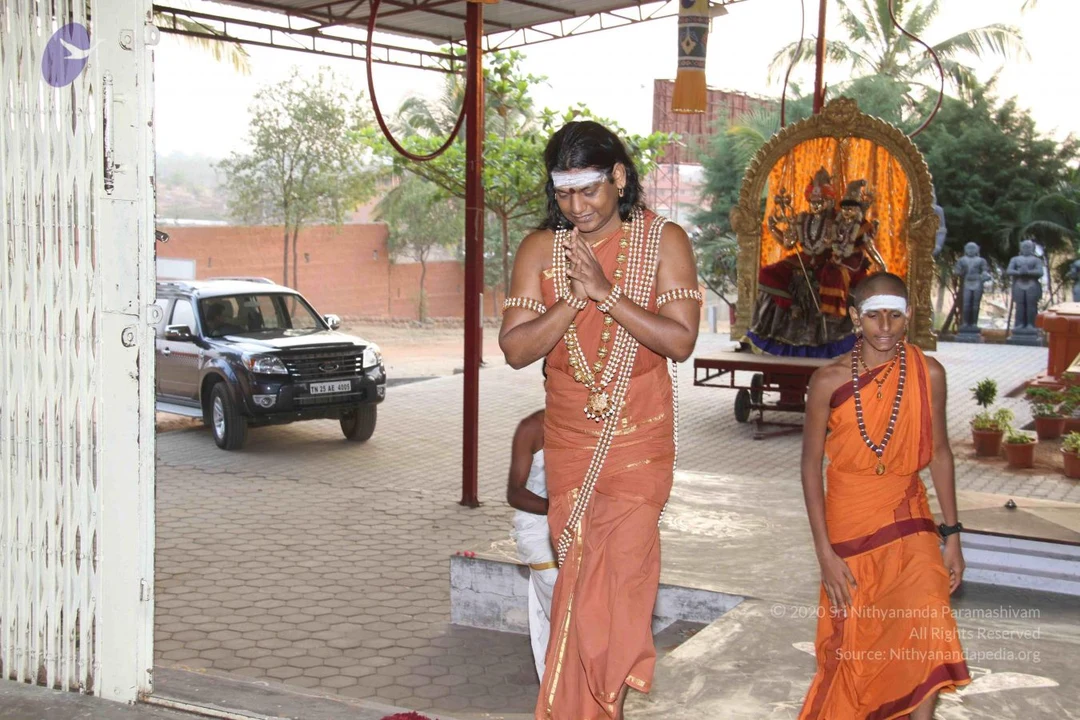
35 photosSource gallery
A dim, reddish dusk or dawn sky with a bright yellow sun low on the horizon, framed by dark silhouetted tree branches and foliage, with a utility pole and power lines crossing the scene. No people are visible.A photograph of a low sun glowing orange-white through a hazy reddish-brown dusk sky, framed by dark silhouetted tree branches and palm fronds. Thin utility wires and a wooden pole run across the lower dark treeline. A small purple emblem with a white bird sits in the upper left corner, and a , , in the lower right. No people, deities, or ritual activity are visibleTwo bronze-toned deity murtis are seated side by side against an orange and gold floral silk backdrop framed by an ornate gilded arch. The figure on the left wears a red turban, rudraksha malas and white floral garlands, and holds a trident-like staff and a damaru-style drum. The figure on the right wears an embellished jeweled crown, red and maroon garments, layered necklaces and a garland, holding a staff topped with a small green parrot. Both statues have red lips and gold ornaments. The scene is a decorated statue display, with no physical people visible.Two gilded deity murtis sit side by side against a shimmering orange and gold patterned cloth backdrop with a carved golden arch. The figure on the left has a red turban, a jeweled tilak, a rudraksha mala and white flower garlands, and holds a trident in one hand. The figure on the right wears a black and gold embroidered crown with red jewels, a green parrot perches on the staff in its hand, and it wears layered gold necklaces and red and white garlands.A black stone Nandi bull statue sits on a red sandstone pedestal in a garden setting. The Nandi wears a garland of red and white beads, a gold-toned necklace with tassels, a bead collar and a yellow cloth draped over its back. Behind it, grey stone statues of standing figures with folded hands and a red-brown tiered pedestal with a kalasha-like finial are visible among palm trees and foliage. No people are present.Two golden metal murti statues of a male and female deity seated side by side against a bright orange draped curtain within an ornate gilded arch. The male figure wears a red turban, a trident is held in one hand, and he has a rudraksha-style brown bead mala and layered jewelled necklaces. The female figure wears a tall jewelled crown, a blue sari with a silver-embroidered border, multiple gold and pearl necklaces and a green parrot perches near her. Both are adorned with pink rose garlands and white flower strands, and there is a gold-edged altar in the foreground. These are statues, so no physical people are present.

Pada-Puja

22 photosSource gallery
Close-up photograph of a person's right forearm and hand resting on an orange-red cloth over a tan lap. The wrist wears a layered bracelet of brown rudraksha beads alternating with white beads, plus a dark wristwatch. In the blurred background on the right, a brass oil lamp with a lit flame sits against a black backdrop. Only the arm and hand are visible, so no face is shown.Close side view of a man seated in a golden throne setting, wearing an orange-red saffron wrap over his shoulder and torso, layered with long orange rudraksha malas and gold bead necklaces, plus a white and orange rudraksha armband. He has long swept-back black hair, a white horizontal tilak with a red dot on his forehead, and a small gold earring, smiling and looking to the left. Behind him is ornate gold carved decoration against a dark background. Swamiji (probable) appears in person, with the appearance-based cues of long hair, saffron clothing and rudraksha malas, and a gold ornate backdrop.Close-up photograph of a person's upper arm wearing a wide armband made of brown rudraksha beads alternating with small white carved skull beads, strung in multiple rows. The person wears a saffron-orange garment draped over the shoulder with a gold border. The background is a plain beige wall and white fabric. No face is visible.Close-up photograph of a person's forearm and wrist resting on an orange terry-cloth towel draped over a pale surface. The wrist wears a bracelet of brown rudraksha beads alternating with white beads, and a dark metal wristwatch. The background is dark with a blurred golden and orange object at right. Only the arm and hand are visible, showing no face.Close-up photograph of several strands of rudraksha malas laid across a rust-orange cloth with a thin gold border. The malas alternate brown rudraksha beads with white skull-shaped beads, and a second set lies at the upper right. A person's fingers are visible at the lower left edge.Close photo of a bare foot resting on a gold-toned ritual tray scattered with white plumeria flowers and pink and red roses. A pair of bare feet in an orange garment with gold border stands on the tray, with the toes touching the flowers. Nearby are silver bowls holding flower petals, a small silver container, a silver spouted vessel and a dish of yellow turmeric paste. The setting suggests padapuja foot worship with flower offerings. No faces are visible and no people beyond the feet are shown.

Arati

54 photosSource gallery
A seated man in a golden ornate throne with a large gilded backrest topped by a crown finial, draped in a zebra-striped cushion, wears an orange-red robe, multi-strand pearl and bead necklaces, bangles and a white forehead band with red tilak. He sits with hands folded in his lap while a bald priest in orange robes at the left holds a lit oil lamp aarti flame toward him. Behind the throne hang rows of small oil lamps and dark beads, with gilded lion figures flanking the seat. Brass lamps and offerings sit on the floor, and a red carpet covers the platform. a person: the seated figure wears a red-orange robe, pearl and rudraksha-style necklaces and bangles on an elaborate golden throne, consistent with a ceremonial presentation.A photograph of a golden ornate throne set against a dark textured backdrop with hanging brass lamps. A seated figure in red-orange robes and a long pearl-style necklace sits on a zebra-striped cushion, with a white sacred mark on the forehead. In front, a bald priest in orange robes holds up a lit oil lamp or flame arti to the seated figure. Painted teal and pink panels frame the scene, and a small lamp burns on the right. A visible candidate is seated in the throne and appears to be the a person; the appearance-based label is a person, with identity kept at unsure where cues are limited. A woman in orange stands at the lower left edge.A seated figure in a saffron-orange robe sits on an ornate gold throne with carved floral and lion motifs, draped with a striped tiger-print cloth. A long rudraksha mala and layered pearl-like necklaces hang on his chest, with bangles on his upper arms and a tilak on his forehead; his hands rest folded in his lap. Kneeling at the lower left, a bald priest in orange robes holds up a brass lamp with several flames in an aarti gesture. Hanging brass oil lamps and bells light the gold-and-painted pillared hall. A sign-free ritual scene inside a temple-style setting.A photograph of a bare-chested man with long dark hair seated on a cushioned gold throne backed by an ornate gilded carved panel. He wears an orange-saffron cloth draped over one shoulder, multiple strands of white beads and gold-bead necklaces, beaded armlets, and a white horizontal tilak with a red dot on his forehead, with gold hoop earrings. His hands rest in his lap. Brass bells hang at the upper corners of the frame. The photo is taken in a temple or ashram setting. Swamiji (probable) is seated on the throne, identified by the long swept-back hair, saffron cloth, rudraksha-style beads and ceremonial gold necklaces.A large hall with pink walls, red curtains and colourful striped pillars hung with fabric. Rows of women and men in saffron-orange and red robes with yellow borders sit cross-legged on a white floor, many wearing rudraksha malas. Brass plates with flowers, oil lamps and small ritual vessels are set before them. Several people in white clothes sit near the back, and framed portraits hang on the walls. Visible people are numerous across the hall, with many seated devotees in saffron and white clothing. A person presiding at the far end is not clearly identifiable, and no figure is clearly distinguished by the cues needed for an identification.A photograph of a seated ritual gathering in an open hall. In the foreground, several women in orange and red saris with yellow borders sit cross-legged, wearing rudraksha malas and white forehead markings. A woman in the center holds an open booklet and sits before a silver tray with brass oil lamps, bowls, flowers and small offerings. Behind them, rows of people in orange robes sit on the floor before similar brass puja plates, and a man in white clothing sits at the upper right. Metal poles and a rope divide the seating area.

Nithya-Satsang

57 photosSource gallery
Photo of a seated person in saffron-orange robes with palms pressed together in namaste at the chest. The person wears long dark hair swept back, a white vertical tilak with a red bindi on the forehead, gold hoop earrings, a microphone clipped near the mouth, and layered orange rudraksha malas with gold bead necklaces and white-and-orange beaded armbands and wristbands. Behind is an ornate gold repoussé backdrop on a red velvet seat. Probable Swamiji by visible appearance cues: long swept-back hair, saffron clothing, rudraksha malas and ceremonial gold necklaces.A seated man on an ornate gilded throne with a tiger-skin rug draped over its platform, speaking into a headset microphone during a discourse. He wears orange-saffron robes, a long rudraksha mala and a gold bead necklace, with pearl-like beaded bands on his arms and a vertical sacred mark on his forehead. A dark backdrop with small lights and green foliage surround the golden throne.A seated man in orange robes sits cross-legged on an ornate gold throne with a carved arched back, flanked by two golden lion sculptures with open mouths. He wears a long multi-strand orange-beaded necklace, a large gold chain with rudraksha-style beads, bangles on both arms, a white forehead band with a red dot, and a small earpiece microphone. His hands rest on the throne's velvet armrests with a tiger-striped cloth beneath him. Potted palms and a colourful painted backdrop with lamps surround the stage. Swamiji (probable): the long swept-back hair, saffron-orange robes, rudraksha mala and ceremonial gold necklaces are consistent with the page's identification, shown here as a seated speaker on stage.A seated speaker on an ornate gilded throne with a tiger-skin rug before it, raising one hand in a gesture while speaking into a headset microphone. He wears a saffron-orange robe, a thick rudraksha mala with gold beads, a pearl-string armlet and bangles, and a white and red forehead mark. Behind him are gold-framed carvings, small lamps and potted palms. Swamiji (probable) appears as a robed speaker with long swept-back hair, saffron clothing and rudraksha and gold ornaments, seated on a throne in front of a discourse setting.A seated man in saffron-orange robes sits cross-legged on a red velvet seat before an ornate gold throne with a carved arch and lion figures, atop a tiger-skin cloth. He has long dark hair, a white forehead mark with a red dot, and wears a dark-beaded mala, a gold bead necklace, pearl-strand necklace and gold armbands, with his eyes closed in meditation. A lapel microphone is visible near his face. Golden lion statues flank the throne and potted green plants sit at the sides, with string lights behind the dais. Appearance-based identification: a person, seated in a satsang-style discourse setting with a microphone.A photograph of a large group of shaven-headed sannyasis seated cross-legged on the floor of a hall, wearing saffron-orange robes, rudraksha malas and orange shawls, with white and sandalwood marks on their foreheads and arms. Brass and silver ritual plates, small oil lamps, flowers and kalasha-style vessels sit before them. Behind them, younger boys in dark shirts and older men in white sit among the crowd, and a red curtain hangs on the back wall beside a white door. The image shows a group ritual setting rather than an identifiable single leader.

IA-Lunch

25 photosSource gallery
A dining hall serving line where devotees in white clothing and orange lanyards serve food from stainless steel chafing dishes on tables covered with green leaf-patterned cloths. A man in a white t-shirt and white pants holds a red thermos and serving tongs at left, while a man in white with an orange lanyard serves at right. A woman in white with a blue shawl and glasses ladles food in the centre. Behind them a woman in white holds a steel plate, and a blue sign on the wall reads 'Maintain silence' with partial text. Red curtains hang in the background.A photograph of volunteers serving a meal at a buffet. In the foreground a woman with her hair tied up wears a white short-sleeved shirt and an orange lanyard, and is spooning food onto a steel plate. Behind her a man in a white shirt and dark backpack also serves from a steel chafing dish. A woman on the right with long dark hair and glasses, wearing a white t-shirt and orange lanyard, holds a plate of food. Two large terracotta pots stand against a pale pink wall, and a green patterned tablecloth covers the serving table. At the far right edge a person in a white garment holds a steel tumbler.Two women drink from red stainless-steel travel mugs with black lids in an indoor room with pale pink walls. The woman on the left wears glasses, a pale yellow sari with brown border, an orange lanyard and an ID badge. The woman on the right wears a white embroidered top, a white dupatta draped over her shoulders, a white hair tie and bangles, with an orange lanyard and ID badge. Both are standing and looking ahead while drinking.A photograph of a dining hall where volunteers serve food from a buffet table covered with a green patterned cloth. Three women in white clothing stand at the serving counter: a woman with grey hair wears a white shirt, white skirt and a long beaded mala with orange-red thread, using a spoon on a tray of yellow fruit pieces; a woman with long reddish-brown hair in a white top stands behind her; and a woman with short black hair in a white polo shirt with an orange lanyard and ID badge serves from a steel tray holding bowls. Steel dishes hold yellow fruit, creamy white pudding, green chopped fruit and a bowl of ripe bananas. Colourful bunting hangs from the grey ceiling, and other white-clad people sit at tables in the background.A photo of a communal meal service with volunteers serving food from stainless steel chafing dishes on a draped table. On the left, a man in a white t-shirt with an orange lanyard and rudraksha mala ladles food onto a plate. In the centre, a man in a white shirt with an orange lanyard and a wristband places food on a plate. On the right, a man in a white shirt with rudraksha mala and a name badge holds a steel plate of food. A woman in white with an orange lanyard stands behind, and an older woman in white with a shawl stands at far right.A photograph of a serving line in a hall with a wooden stage and screen in the background. A smiling man in a white kurta and orange lanyard with an ID badge holds a steel plate of food and ladles more from a steel pot. Behind the counter, steel trays hold yellow and green dishes and a bowl of white sauce. Other people in white clothing stand at the buffet, including a woman with blonde hair in a sheer white top and scarf, and a man in white at the right holding a bowl and wearing red and white beaded garlands.

Sarvadarshan-Gurukul

51 photosSource gallery
Photograph inside a decorated hall with draped white and maroon fabric ceiling and a dark stage backdrop. Several shaved-headed young monks in saffron-orange robes with rudraksha malas, some with white tilak on their foreheads, sit or stand in a row facing right. On the right, a standing man in deep red-brown robes and a rudraksha mala hands items from a red tray to a standing figure, while another robed man in red-brown kneels near the tray. A tall striped banner hangs in the upper centre. Several more people in white attire stand in the background.A photograph inside a decorated hall with draped orange-and-white fabric and striped pillars. Several shaved-headed young monks in saffron robes and rudraksha malas stand in a row at left, some with white forehead markings and one wearing glasses. A man with long swept-back hair in an orange dhoti and shawl, adorned with a long rudraksha and gold necklace and bangles, stands at centre smiling and gesturing toward the boys. At right, a bald man in orange robes holds a red box with a small ritual item. A gilded deity murti or shrine is visible in the background. Physical people visible: about seven or eight, so the count falls in the 6-20 range.A photograph of a ceremonial reception inside a hall with draped cream fabric, colourful striped banners and projection screens showing a smiling man in white. A tall figure in saffron-orange robes, with long swept-back dark hair, a rudraksha mala, layered gold beaded necklaces and bangles, and a white forehead mark, stands at right, extending his hands toward several shaved-headed young monks in orange robes who approach with orange cloth bundles. Nearby, a man in white with folded hands and women in white and red saris stand watching, and a red tray of fruit and flowers sits at lower right. Behind them a golden throne-like seat and a small deity murti are visible. Swamiji (probable) is described by the saffron robe, long hair and gold necklaces, and the figure is treated as the in-person central presence; overall about 12 people are visible.A photograph of a devotional gathering in an indoor hall with orange and white draped ceiling fabric and striped pillars. On the right, a shaved-headed man in orange robes wears a long rudraksha-style bead necklace and bangles, and holds his palms raised in blessing. Several men stand in front, some in orange robes and others in shirts, with hands pressed together in namaste. A projection screen and a framed portrait hang in the background, and a tray of sweets sits at the lower right. Watchers stand along the right edge.Indoor photo of a blessing line in a hall with draped white fabric ceiling and maroon drapes. A man in an orange-saffron robe with multiple rudraksha-style beaded and gold bead necklaces and bangles touches the head of a devotee with one hand, marked with white forehead paste. Devotees in pink, white and checked shirts stand with folded hands or bowed heads in line, and more people in orange robes stand at the right. Colorful hanging decorations and a red wall panel are behind. A tall figure in a saffron robe at right has a shaved head. The central figure is a person bestowing a blessing on a devotee.A photograph inside a hall with a draped white ceiling and hanging red, yellow and blue cloth decorations. On the right, a figure in an ochre-saffron dhoti with a long rudraksha mala and ornate gold-and-white beaded necklaces stands with both hands raised, touching the forehead of a seated devotee in a red checked shirt. Beside him, a shaved-headed child in orange sits in front, and a man in a red t-shirt with a printed portrait stands on the left with hands joined. Other saffron-robed sannyasis and white-clad attendees stand behind, and a framed portrait hangs on the wall. The scene looks like a blessing or darshan. The orange-robed figure with rudraksha and ornaments fits the swami candidate cues, but the face is not clearly visible enough to confirm, so the identity is uncertain.

Kalabairava-Darshan

13 photosSource gallery
A smiling man sits on an ornate golden throne with elaborately carved arched backrest, lit with red and green stage lighting. He wears a leopard-print sleeveless top with rudraksha mala necklaces of dark beads and white-tipped beads, matching beaded bands on his upper arms and wrists, and rust-orange loose trousers. He has a white and red forehead marking and holds his hands together over his chest. One person is visible.A photograph of two men in an indoor room with purple-tinted lighting, a dark curtain and a potted plant behind them. On the left, a smiling man with long dark hair, wearing a leopard-print top and a rudraksha-style bead necklace, raises his palm toward a younger man on the right. The younger man, with short hair, wears a white t-shirt and an orange lanyard, and faces him with his palm raised, as if in a high-five.A photograph of a long-haired figure in a leopard-print wrap and a rudraksha mala with skull beads placing a hand on the forehead of a short-haired man in a white t-shirt with an orange wristband, in a warmly lit room with a green-lit altar, a brass lamp and a curtain. The devotee stands with his palm raised to his cheek, receiving the blessing.A long-haired man in a leopard-print wrap with a beaded rudraksha-style necklace places his right palm on the forehead of a short-haired man in a white t-shirt, while the second man's hand is raised in front. Pink and purple stage lighting, a brown curtain, potted plants and a brass oil lamp stand in the room behind them. The first man has a white mark on his brow and appears to be giving a blessing.A photograph of a long-haired figure in a leopard-print sleeveless top and rust-orange dhoti, wearing a thick rudraksha-style bead necklace, seated and placing one hand on the forehead of a kneeling man in a white T-shirt with a red-and-white bead mala. A small oil lamp with a brass base stands at left beside a plant and dark curtain in a softly lit room with pink and green lighting. The kneeling man has his palms raised in receiving posture. This appears to be a blessing or initiation-style gesture between two people. a person cues are not clearly established here, since the seated figure's distinctive adornments are present but the identity is uncertain from appearance alone.A long-haired man in a leopard-print sleeveless top and a rudraksha mala with skull-shaped beads reaches out to touch the forehead of a bald older man in a white kurta with an orange cord and a wristwatch, who stands with palms pressed together in greeting. The setting is a dimly lit room with pink and green lighting, a brass oil lamp on the left, dark curtains, and potted plants.

Swamiji-Blessings-Namaskar

8 photosSource gallery
A seated person in saffron-orange robes presses palms together in anjali mudra with eyes closed in prayer or greeting. Multiple strands of rudraksha malas and ornate gold bead necklaces hang on the chest, with matching rudraksha and white bead bracelets and armlets. A white tilak with a red dot marks the forehead, and small gold hoop earrings are worn. Behind them is a richly embossed gold throne backdrop with floral and scroll patterns, and a red cushioned seat is visible at the lower left. The distinctive adornments and saffron clothing fit a person presentation, shown here as a devotee in an attitude of prayer on a throne setting.A figure seated cross-legged on an ornate gold-and-red throne with a golden arched back, flanked by two golden lion sculptures, in front of a turquoise and pink decorated stage. The seated person has palms pressed together in namaskar, wears an orange-saffron dhoti and shawl, a rudraksha mala, a long pearl-style necklace, and gold bangles and earrings, with white vertical markings on the forehead. A tiger-striped cloth covers the seat. Green leafy plants and a hanging string of lights are behind the throne. Swamiji (probable): the saffron clothing, long swept-back hair, ceremonial necklaces and throne seating are compatible cues, though this is not a confirmed identification.A seated man with palms pressed together in namaste, in front of an ornate gold-embossed throne backdrop. He wears an orange-saffron robe, layered rudraksha-style beaded necklaces with gold beads, pearl-white bead armlets and bracelets, gold hoop earrings, a white vibhuti horizontal mark with a red kumkum dot on his forehead, and a small head microphone. He sits on a deep red velvet chair. Probable Swamiji is a qualifying cue match: long swept-back hair, saffron clothing and rudraksha malas, with the orange robe and ceremonial gold ornaments present; the page identifies this event as a discourse.A man seated on a red velvet chair in front of an ornate gold repoussé backdrop, palms pressed together in namaste at chest level. He wears a saffron-orange garment, a long rudraksha mala, a heavy ceremonial gold bead necklace, and white and rudraksha bracelets and armlets. He has a white vibhuti band with a red kumkum dot on his forehead, gold earrings, and a small clip-on microphone. Swamiji (probable) appearance cues: long swept-back hair, saffron clothing and rudraksha malas with gold necklaces, seated as a discourse speaker.A seated man with palms pressed together in namaste gesture sits on a red velvet chair before an ornate gold repoussé throne backdrop. He wears a white vertical tilak with a red bindi, gold hoop earrings, a headset microphone, an orange-red garment, layered rudraksha-style and gold bead malas, and pearl bangles on his wrists and upper arms. Green palm fronds appear at the lower left edge. The scene suggests a discourse or satsang. Swamiji (probable): the long swept-back hair, orange clothing and multiple bead malas are consistent with the page's identification, and the figure is seated as the speaker.A seated figure in saffron-orange robes with a rudraksha mala and a long pearl-style mala sits on an ornate gold throne with gold lion armrests and a red velvet cushion. Two painted guardian figures with multiple arms, flame-like headdresses and gold loincloths stand on either side against a blue, pink and green temple-style backdrop. Potted plants and brass lamp stands flank the throne. Swamiji (probable): the figure wears long swept-back hair, saffron clothing, rudraksha and pearl malas and gold armbands, and sits on the throne as the central teacher of a discourse. A small lit display is visible behind the throne and the setting resembles a satsang hall.

Yoga

11 photosSource gallery
Indoor hall with a white fabric canopy and tall decorative pillars wrapped in colourful patterns with orange tassels. Many people stand on coloured yoga mats in rows, some in black and some in white clothing, performing a standing exercise with hands at the waist. Small dumbbells sit on the floor between mats. A bearded older man on the right wears a white kurta and an orange turban. Framed pictures hang on the pink wall at left, and red curtains line the background.A large indoor hall with a white draped ceiling and ceiling fans, where a group of about twenty-five people practise a standing yoga stretch on coloured mats. Participants raise both arms overhead with hands clasped, wearing black, white and navy track clothes. Decorative cylindrical pillars in red, blue, yellow and white patterns with tassels line the room. A framed picture hangs on the left wall beside red curtains, and metal dumbbells sit on the floor.A yoga class in a bright hall with glossy floors. In the foreground a young man in a white T-shirt and black track pants stretches one arm across his chest, barefoot on a red mat. Beside him an older man in white kurta and white trousers, also barefoot, mirrors the stretch on a pink mat. Behind them women in black tops and black leggings stand on mats, one with short blonde hair. Chrome stanchions with chains divide the mats, small hand weights lie on the floor, and a red curtain hangs on the back wall under an orange cloth. No a person candidate is clearly identifiable from appearance.A photograph of a yoga or exercise session in a large hall with a polished floor and a draped white ceiling. Many students stand on coloured mats in a practice stance with arms raised overhead, some with small hand weights placed beside them. The foreground includes a man in black shirt and trousers with arms raised, a man in white kurta and white trousers, and a man in black with arms extended. Decorated cylindrical pillars with painted geometric patterns and yellow tassels run through the room, with ceiling fans overhead and a framed picture on the left wall. Water bottles sit near some mats.A large hall with a cloth-draped ceiling and decorative painted pillars shows a yoga class in progress. Around 20 people stand on colourful exercise mats, arms raised overhead or stretched sideways, mostly in black, grey and white athletic clothes. A man in an orange turban and white clothing stands at the far right, and a small framed portrait hangs on the back wall. Dumbbells and water bottles sit near the mats, with red curtains and chairs along the walls.A group yoga class in a bright hall with pale pink walls and maroon curtains. Participants in black, white, red and blue clothing stand on coloured yoga mats, many holding a balance pose with arms raised overhead while an instructor in a dark top stands at the left. Tall hanging banners with yellow fringe and geometric motifs flank the room, and stacked metal dumbbells and water bottles sit on the floor. A framed portrait of a saffron-clad figure hangs on the left wall, and rows of red chairs line the side. No ritual activity is visible.

Temple-Swamiji
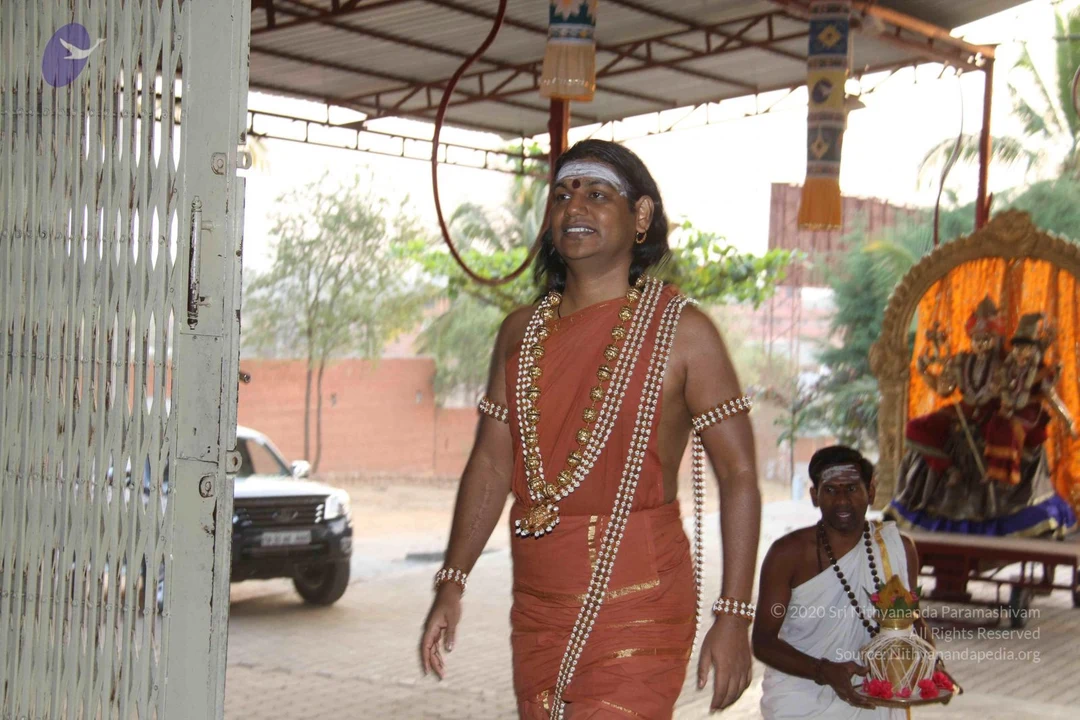
35 photosSource gallery
A dim, reddish dusk or dawn sky with a bright yellow sun low on the horizon, framed by dark silhouetted tree branches and foliage, with a utility pole and power lines crossing the scene. No people are visible.A photograph of a low sun glowing orange-white through a hazy reddish-brown dusk sky, framed by dark silhouetted tree branches and palm fronds. Thin utility wires and a wooden pole run across the lower dark treeline. A small purple emblem with a white bird sits in the upper left corner, and a , , in the lower right. No people, deities, or ritual activity are visibleTwo bronze-toned deity murtis are seated side by side against an orange and gold floral silk backdrop framed by an ornate gilded arch. The figure on the left wears a red turban, rudraksha malas and white floral garlands, and holds a trident-like staff and a damaru-style drum. The figure on the right wears an embellished jeweled crown, red and maroon garments, layered necklaces and a garland, holding a staff topped with a small green parrot. Both statues have red lips and gold ornaments. The scene is a decorated statue display, with no physical people visible.Two gilded deity murtis sit side by side against a shimmering orange and gold patterned cloth backdrop with a carved golden arch. The figure on the left has a red turban, a jeweled tilak, a rudraksha mala and white flower garlands, and holds a trident in one hand. The figure on the right wears a black and gold embroidered crown with red jewels, a green parrot perches on the staff in its hand, and it wears layered gold necklaces and red and white garlands.A black stone Nandi bull statue sits on a red sandstone pedestal in a garden setting. The Nandi wears a garland of red and white beads, a gold-toned necklace with tassels, a bead collar and a yellow cloth draped over its back. Behind it, grey stone statues of standing figures with folded hands and a red-brown tiered pedestal with a kalasha-like finial are visible among palm trees and foliage. No people are present.Two golden metal murti statues of a male and female deity seated side by side against a bright orange draped curtain within an ornate gilded arch. The male figure wears a red turban, a trident is held in one hand, and he has a rudraksha-style brown bead mala and layered jewelled necklaces. The female figure wears a tall jewelled crown, a blue sari with a silver-embroidered border, multiple gold and pearl necklaces and a green parrot perches near her. Both are adorned with pink rose garlands and white flower strands, and there is a gold-edged altar in the foreground. These are statues, so no physical people are present.

Pada-Puja

22 photosSource gallery
Close-up photograph of a person's right forearm and hand resting on an orange-red cloth over a tan lap. The wrist wears a layered bracelet of brown rudraksha beads alternating with white beads, plus a dark wristwatch. In the blurred background on the right, a brass oil lamp with a lit flame sits against a black backdrop. Only the arm and hand are visible, so no face is shown.Close side view of a man seated in a golden throne setting, wearing an orange-red saffron wrap over his shoulder and torso, layered with long orange rudraksha malas and gold bead necklaces, plus a white and orange rudraksha armband. He has long swept-back black hair, a white horizontal tilak with a red dot on his forehead, and a small gold earring, smiling and looking to the left. Behind him is ornate gold carved decoration against a dark background. Swamiji (probable) appears in person, with the appearance-based cues of long hair, saffron clothing and rudraksha malas, and a gold ornate backdrop.Close-up photograph of a person's upper arm wearing a wide armband made of brown rudraksha beads alternating with small white carved skull beads, strung in multiple rows. The person wears a saffron-orange garment draped over the shoulder with a gold border. The background is a plain beige wall and white fabric. No face is visible.Close-up photograph of a person's forearm and wrist resting on an orange terry-cloth towel draped over a pale surface. The wrist wears a bracelet of brown rudraksha beads alternating with white beads, and a dark metal wristwatch. The background is dark with a blurred golden and orange object at right. Only the arm and hand are visible, showing no face.Close-up photograph of several strands of rudraksha malas laid across a rust-orange cloth with a thin gold border. The malas alternate brown rudraksha beads with white skull-shaped beads, and a second set lies at the upper right. A person's fingers are visible at the lower left edge.Close photo of a bare foot resting on a gold-toned ritual tray scattered with white plumeria flowers and pink and red roses. A pair of bare feet in an orange garment with gold border stands on the tray, with the toes touching the flowers. Nearby are silver bowls holding flower petals, a small silver container, a silver spouted vessel and a dish of yellow turmeric paste. The setting suggests padapuja foot worship with flower offerings. No faces are visible and no people beyond the feet are shown.

Arati

54 photosSource gallery
A seated man in a golden ornate throne with a large gilded backrest topped by a crown finial, draped in a zebra-striped cushion, wears an orange-red robe, multi-strand pearl and bead necklaces, bangles and a white forehead band with red tilak. He sits with hands folded in his lap while a bald priest in orange robes at the left holds a lit oil lamp aarti flame toward him. Behind the throne hang rows of small oil lamps and dark beads, with gilded lion figures flanking the seat. Brass lamps and offerings sit on the floor, and a red carpet covers the platform. a person: the seated figure wears a red-orange robe, pearl and rudraksha-style necklaces and bangles on an elaborate golden throne, consistent with a ceremonial presentation.A photograph of a golden ornate throne set against a dark textured backdrop with hanging brass lamps. A seated figure in red-orange robes and a long pearl-style necklace sits on a zebra-striped cushion, with a white sacred mark on the forehead. In front, a bald priest in orange robes holds up a lit oil lamp or flame arti to the seated figure. Painted teal and pink panels frame the scene, and a small lamp burns on the right. A visible candidate is seated in the throne and appears to be the a person; the appearance-based label is a person, with identity kept at unsure where cues are limited. A woman in orange stands at the lower left edge.A seated figure in a saffron-orange robe sits on an ornate gold throne with carved floral and lion motifs, draped with a striped tiger-print cloth. A long rudraksha mala and layered pearl-like necklaces hang on his chest, with bangles on his upper arms and a tilak on his forehead; his hands rest folded in his lap. Kneeling at the lower left, a bald priest in orange robes holds up a brass lamp with several flames in an aarti gesture. Hanging brass oil lamps and bells light the gold-and-painted pillared hall. A sign-free ritual scene inside a temple-style setting.A photograph of a bare-chested man with long dark hair seated on a cushioned gold throne backed by an ornate gilded carved panel. He wears an orange-saffron cloth draped over one shoulder, multiple strands of white beads and gold-bead necklaces, beaded armlets, and a white horizontal tilak with a red dot on his forehead, with gold hoop earrings. His hands rest in his lap. Brass bells hang at the upper corners of the frame. The photo is taken in a temple or ashram setting. Swamiji (probable) is seated on the throne, identified by the long swept-back hair, saffron cloth, rudraksha-style beads and ceremonial gold necklaces.A large hall with pink walls, red curtains and colourful striped pillars hung with fabric. Rows of women and men in saffron-orange and red robes with yellow borders sit cross-legged on a white floor, many wearing rudraksha malas. Brass plates with flowers, oil lamps and small ritual vessels are set before them. Several people in white clothes sit near the back, and framed portraits hang on the walls. Visible people are numerous across the hall, with many seated devotees in saffron and white clothing. A person presiding at the far end is not clearly identifiable, and no figure is clearly distinguished by the cues needed for an identification.A photograph of a seated ritual gathering in an open hall. In the foreground, several women in orange and red saris with yellow borders sit cross-legged, wearing rudraksha malas and white forehead markings. A woman in the center holds an open booklet and sits before a silver tray with brass oil lamps, bowls, flowers and small offerings. Behind them, rows of people in orange robes sit on the floor before similar brass puja plates, and a man in white clothing sits at the upper right. Metal poles and a rope divide the seating area.

Nithya-Satsang

57 photosSource gallery
Photo of a seated person in saffron-orange robes with palms pressed together in namaste at the chest. The person wears long dark hair swept back, a white vertical tilak with a red bindi on the forehead, gold hoop earrings, a microphone clipped near the mouth, and layered orange rudraksha malas with gold bead necklaces and white-and-orange beaded armbands and wristbands. Behind is an ornate gold repoussé backdrop on a red velvet seat. Probable Swamiji by visible appearance cues: long swept-back hair, saffron clothing, rudraksha malas and ceremonial gold necklaces.A seated man on an ornate gilded throne with a tiger-skin rug draped over its platform, speaking into a headset microphone during a discourse. He wears orange-saffron robes, a long rudraksha mala and a gold bead necklace, with pearl-like beaded bands on his arms and a vertical sacred mark on his forehead. A dark backdrop with small lights and green foliage surround the golden throne.A seated man in orange robes sits cross-legged on an ornate gold throne with a carved arched back, flanked by two golden lion sculptures with open mouths. He wears a long multi-strand orange-beaded necklace, a large gold chain with rudraksha-style beads, bangles on both arms, a white forehead band with a red dot, and a small earpiece microphone. His hands rest on the throne's velvet armrests with a tiger-striped cloth beneath him. Potted palms and a colourful painted backdrop with lamps surround the stage. Swamiji (probable): the long swept-back hair, saffron-orange robes, rudraksha mala and ceremonial gold necklaces are consistent with the page's identification, shown here as a seated speaker on stage.A seated speaker on an ornate gilded throne with a tiger-skin rug before it, raising one hand in a gesture while speaking into a headset microphone. He wears a saffron-orange robe, a thick rudraksha mala with gold beads, a pearl-string armlet and bangles, and a white and red forehead mark. Behind him are gold-framed carvings, small lamps and potted palms. Swamiji (probable) appears as a robed speaker with long swept-back hair, saffron clothing and rudraksha and gold ornaments, seated on a throne in front of a discourse setting.A seated man in saffron-orange robes sits cross-legged on a red velvet seat before an ornate gold throne with a carved arch and lion figures, atop a tiger-skin cloth. He has long dark hair, a white forehead mark with a red dot, and wears a dark-beaded mala, a gold bead necklace, pearl-strand necklace and gold armbands, with his eyes closed in meditation. A lapel microphone is visible near his face. Golden lion statues flank the throne and potted green plants sit at the sides, with string lights behind the dais. Appearance-based identification: a person, seated in a satsang-style discourse setting with a microphone.A photograph of a large group of shaven-headed sannyasis seated cross-legged on the floor of a hall, wearing saffron-orange robes, rudraksha malas and orange shawls, with white and sandalwood marks on their foreheads and arms. Brass and silver ritual plates, small oil lamps, flowers and kalasha-style vessels sit before them. Behind them, younger boys in dark shirts and older men in white sit among the crowd, and a red curtain hangs on the back wall beside a white door. The image shows a group ritual setting rather than an identifiable single leader.

IA-Lunch

25 photosSource gallery
A dining hall serving line where devotees in white clothing and orange lanyards serve food from stainless steel chafing dishes on tables covered with green leaf-patterned cloths. A man in a white t-shirt and white pants holds a red thermos and serving tongs at left, while a man in white with an orange lanyard serves at right. A woman in white with a blue shawl and glasses ladles food in the centre. Behind them a woman in white holds a steel plate, and a blue sign on the wall reads 'Maintain silence' with partial text. Red curtains hang in the background.A photograph of volunteers serving a meal at a buffet. In the foreground a woman with her hair tied up wears a white short-sleeved shirt and an orange lanyard, and is spooning food onto a steel plate. Behind her a man in a white shirt and dark backpack also serves from a steel chafing dish. A woman on the right with long dark hair and glasses, wearing a white t-shirt and orange lanyard, holds a plate of food. Two large terracotta pots stand against a pale pink wall, and a green patterned tablecloth covers the serving table. At the far right edge a person in a white garment holds a steel tumbler.Two women drink from red stainless-steel travel mugs with black lids in an indoor room with pale pink walls. The woman on the left wears glasses, a pale yellow sari with brown border, an orange lanyard and an ID badge. The woman on the right wears a white embroidered top, a white dupatta draped over her shoulders, a white hair tie and bangles, with an orange lanyard and ID badge. Both are standing and looking ahead while drinking.A photograph of a dining hall where volunteers serve food from a buffet table covered with a green patterned cloth. Three women in white clothing stand at the serving counter: a woman with grey hair wears a white shirt, white skirt and a long beaded mala with orange-red thread, using a spoon on a tray of yellow fruit pieces; a woman with long reddish-brown hair in a white top stands behind her; and a woman with short black hair in a white polo shirt with an orange lanyard and ID badge serves from a steel tray holding bowls. Steel dishes hold yellow fruit, creamy white pudding, green chopped fruit and a bowl of ripe bananas. Colourful bunting hangs from the grey ceiling, and other white-clad people sit at tables in the background.A photo of a communal meal service with volunteers serving food from stainless steel chafing dishes on a draped table. On the left, a man in a white t-shirt with an orange lanyard and rudraksha mala ladles food onto a plate. In the centre, a man in a white shirt with an orange lanyard and a wristband places food on a plate. On the right, a man in a white shirt with rudraksha mala and a name badge holds a steel plate of food. A woman in white with an orange lanyard stands behind, and an older woman in white with a shawl stands at far right.A photograph of a serving line in a hall with a wooden stage and screen in the background. A smiling man in a white kurta and orange lanyard with an ID badge holds a steel plate of food and ladles more from a steel pot. Behind the counter, steel trays hold yellow and green dishes and a bowl of white sauce. Other people in white clothing stand at the buffet, including a woman with blonde hair in a sheer white top and scarf, and a man in white at the right holding a bowl and wearing red and white beaded garlands.

Sarvadarshan-Gurukul

51 photosSource gallery
Photograph inside a decorated hall with draped white and maroon fabric ceiling and a dark stage backdrop. Several shaved-headed young monks in saffron-orange robes with rudraksha malas, some with white tilak on their foreheads, sit or stand in a row facing right. On the right, a standing man in deep red-brown robes and a rudraksha mala hands items from a red tray to a standing figure, while another robed man in red-brown kneels near the tray. A tall striped banner hangs in the upper centre. Several more people in white attire stand in the background.A photograph inside a decorated hall with draped orange-and-white fabric and striped pillars. Several shaved-headed young monks in saffron robes and rudraksha malas stand in a row at left, some with white forehead markings and one wearing glasses. A man with long swept-back hair in an orange dhoti and shawl, adorned with a long rudraksha and gold necklace and bangles, stands at centre smiling and gesturing toward the boys. At right, a bald man in orange robes holds a red box with a small ritual item. A gilded deity murti or shrine is visible in the background. Physical people visible: about seven or eight, so the count falls in the 6-20 range.A photograph of a ceremonial reception inside a hall with draped cream fabric, colourful striped banners and projection screens showing a smiling man in white. A tall figure in saffron-orange robes, with long swept-back dark hair, a rudraksha mala, layered gold beaded necklaces and bangles, and a white forehead mark, stands at right, extending his hands toward several shaved-headed young monks in orange robes who approach with orange cloth bundles. Nearby, a man in white with folded hands and women in white and red saris stand watching, and a red tray of fruit and flowers sits at lower right. Behind them a golden throne-like seat and a small deity murti are visible. Swamiji (probable) is described by the saffron robe, long hair and gold necklaces, and the figure is treated as the in-person central presence; overall about 12 people are visible.A photograph of a devotional gathering in an indoor hall with orange and white draped ceiling fabric and striped pillars. On the right, a shaved-headed man in orange robes wears a long rudraksha-style bead necklace and bangles, and holds his palms raised in blessing. Several men stand in front, some in orange robes and others in shirts, with hands pressed together in namaste. A projection screen and a framed portrait hang in the background, and a tray of sweets sits at the lower right. Watchers stand along the right edge.Indoor photo of a blessing line in a hall with draped white fabric ceiling and maroon drapes. A man in an orange-saffron robe with multiple rudraksha-style beaded and gold bead necklaces and bangles touches the head of a devotee with one hand, marked with white forehead paste. Devotees in pink, white and checked shirts stand with folded hands or bowed heads in line, and more people in orange robes stand at the right. Colorful hanging decorations and a red wall panel are behind. A tall figure in a saffron robe at right has a shaved head. The central figure is a person bestowing a blessing on a devotee.A photograph inside a hall with a draped white ceiling and hanging red, yellow and blue cloth decorations. On the right, a figure in an ochre-saffron dhoti with a long rudraksha mala and ornate gold-and-white beaded necklaces stands with both hands raised, touching the forehead of a seated devotee in a red checked shirt. Beside him, a shaved-headed child in orange sits in front, and a man in a red t-shirt with a printed portrait stands on the left with hands joined. Other saffron-robed sannyasis and white-clad attendees stand behind, and a framed portrait hangs on the wall. The scene looks like a blessing or darshan. The orange-robed figure with rudraksha and ornaments fits the swami candidate cues, but the face is not clearly visible enough to confirm, so the identity is uncertain.

Kalabairava-Darshan

13 photosSource gallery
A smiling man sits on an ornate golden throne with elaborately carved arched backrest, lit with red and green stage lighting. He wears a leopard-print sleeveless top with rudraksha mala necklaces of dark beads and white-tipped beads, matching beaded bands on his upper arms and wrists, and rust-orange loose trousers. He has a white and red forehead marking and holds his hands together over his chest. One person is visible.A photograph of two men in an indoor room with purple-tinted lighting, a dark curtain and a potted plant behind them. On the left, a smiling man with long dark hair, wearing a leopard-print top and a rudraksha-style bead necklace, raises his palm toward a younger man on the right. The younger man, with short hair, wears a white t-shirt and an orange lanyard, and faces him with his palm raised, as if in a high-five.A photograph of a long-haired figure in a leopard-print wrap and a rudraksha mala with skull beads placing a hand on the forehead of a short-haired man in a white t-shirt with an orange wristband, in a warmly lit room with a green-lit altar, a brass lamp and a curtain. The devotee stands with his palm raised to his cheek, receiving the blessing.A long-haired man in a leopard-print wrap with a beaded rudraksha-style necklace places his right palm on the forehead of a short-haired man in a white t-shirt, while the second man's hand is raised in front. Pink and purple stage lighting, a brown curtain, potted plants and a brass oil lamp stand in the room behind them. The first man has a white mark on his brow and appears to be giving a blessing.A photograph of a long-haired figure in a leopard-print sleeveless top and rust-orange dhoti, wearing a thick rudraksha-style bead necklace, seated and placing one hand on the forehead of a kneeling man in a white T-shirt with a red-and-white bead mala. A small oil lamp with a brass base stands at left beside a plant and dark curtain in a softly lit room with pink and green lighting. The kneeling man has his palms raised in receiving posture. This appears to be a blessing or initiation-style gesture between two people. a person cues are not clearly established here, since the seated figure's distinctive adornments are present but the identity is uncertain from appearance alone.A long-haired man in a leopard-print sleeveless top and a rudraksha mala with skull-shaped beads reaches out to touch the forehead of a bald older man in a white kurta with an orange cord and a wristwatch, who stands with palms pressed together in greeting. The setting is a dimly lit room with pink and green lighting, a brass oil lamp on the left, dark curtains, and potted plants.

Swamiji-Blessings-Namaskar

8 photosSource gallery
A seated person in saffron-orange robes presses palms together in anjali mudra with eyes closed in prayer or greeting. Multiple strands of rudraksha malas and ornate gold bead necklaces hang on the chest, with matching rudraksha and white bead bracelets and armlets. A white tilak with a red dot marks the forehead, and small gold hoop earrings are worn. Behind them is a richly embossed gold throne backdrop with floral and scroll patterns, and a red cushioned seat is visible at the lower left. The distinctive adornments and saffron clothing fit a person presentation, shown here as a devotee in an attitude of prayer on a throne setting.A figure seated cross-legged on an ornate gold-and-red throne with a golden arched back, flanked by two golden lion sculptures, in front of a turquoise and pink decorated stage. The seated person has palms pressed together in namaskar, wears an orange-saffron dhoti and shawl, a rudraksha mala, a long pearl-style necklace, and gold bangles and earrings, with white vertical markings on the forehead. A tiger-striped cloth covers the seat. Green leafy plants and a hanging string of lights are behind the throne. Swamiji (probable): the saffron clothing, long swept-back hair, ceremonial necklaces and throne seating are compatible cues, though this is not a confirmed identification.A seated man with palms pressed together in namaste, in front of an ornate gold-embossed throne backdrop. He wears an orange-saffron robe, layered rudraksha-style beaded necklaces with gold beads, pearl-white bead armlets and bracelets, gold hoop earrings, a white vibhuti horizontal mark with a red kumkum dot on his forehead, and a small head microphone. He sits on a deep red velvet chair. Probable Swamiji is a qualifying cue match: long swept-back hair, saffron clothing and rudraksha malas, with the orange robe and ceremonial gold ornaments present; the page identifies this event as a discourse.A man seated on a red velvet chair in front of an ornate gold repoussé backdrop, palms pressed together in namaste at chest level. He wears a saffron-orange garment, a long rudraksha mala, a heavy ceremonial gold bead necklace, and white and rudraksha bracelets and armlets. He has a white vibhuti band with a red kumkum dot on his forehead, gold earrings, and a small clip-on microphone. Swamiji (probable) appearance cues: long swept-back hair, saffron clothing and rudraksha malas with gold necklaces, seated as a discourse speaker.A seated man with palms pressed together in namaste gesture sits on a red velvet chair before an ornate gold repoussé throne backdrop. He wears a white vertical tilak with a red bindi, gold hoop earrings, a headset microphone, an orange-red garment, layered rudraksha-style and gold bead malas, and pearl bangles on his wrists and upper arms. Green palm fronds appear at the lower left edge. The scene suggests a discourse or satsang. Swamiji (probable): the long swept-back hair, orange clothing and multiple bead malas are consistent with the page's identification, and the figure is seated as the speaker.A seated figure in saffron-orange robes with a rudraksha mala and a long pearl-style mala sits on an ornate gold throne with gold lion armrests and a red velvet cushion. Two painted guardian figures with multiple arms, flame-like headdresses and gold loincloths stand on either side against a blue, pink and green temple-style backdrop. Potted plants and brass lamp stands flank the throne. Swamiji (probable): the figure wears long swept-back hair, saffron clothing, rudraksha and pearl malas and gold armbands, and sits on the throne as the central teacher of a discourse. A small lit display is visible behind the throne and the setting resembles a satsang hall.

Yoga

11 photosSource gallery
Indoor hall with a white fabric canopy and tall decorative pillars wrapped in colourful patterns with orange tassels. Many people stand on coloured yoga mats in rows, some in black and some in white clothing, performing a standing exercise with hands at the waist. Small dumbbells sit on the floor between mats. A bearded older man on the right wears a white kurta and an orange turban. Framed pictures hang on the pink wall at left, and red curtains line the background.A large indoor hall with a white draped ceiling and ceiling fans, where a group of about twenty-five people practise a standing yoga stretch on coloured mats. Participants raise both arms overhead with hands clasped, wearing black, white and navy track clothes. Decorative cylindrical pillars in red, blue, yellow and white patterns with tassels line the room. A framed picture hangs on the left wall beside red curtains, and metal dumbbells sit on the floor.A yoga class in a bright hall with glossy floors. In the foreground a young man in a white T-shirt and black track pants stretches one arm across his chest, barefoot on a red mat. Beside him an older man in white kurta and white trousers, also barefoot, mirrors the stretch on a pink mat. Behind them women in black tops and black leggings stand on mats, one with short blonde hair. Chrome stanchions with chains divide the mats, small hand weights lie on the floor, and a red curtain hangs on the back wall under an orange cloth. No a person candidate is clearly identifiable from appearance.A photograph of a yoga or exercise session in a large hall with a polished floor and a draped white ceiling. Many students stand on coloured mats in a practice stance with arms raised overhead, some with small hand weights placed beside them. The foreground includes a man in black shirt and trousers with arms raised, a man in white kurta and white trousers, and a man in black with arms extended. Decorated cylindrical pillars with painted geometric patterns and yellow tassels run through the room, with ceiling fans overhead and a framed picture on the left wall. Water bottles sit near some mats.A large hall with a cloth-draped ceiling and decorative painted pillars shows a yoga class in progress. Around 20 people stand on colourful exercise mats, arms raised overhead or stretched sideways, mostly in black, grey and white athletic clothes. A man in an orange turban and white clothing stands at the far right, and a small framed portrait hangs on the back wall. Dumbbells and water bottles sit near the mats, with red curtains and chairs along the walls.A group yoga class in a bright hall with pale pink walls and maroon curtains. Participants in black, white, red and blue clothing stand on coloured yoga mats, many holding a balance pose with arms raised overhead while an instructor in a dark top stands at the left. Tall hanging banners with yellow fringe and geometric motifs flank the room, and stacked metal dumbbells and water bottles sit on the floor. A framed portrait of a saffron-clad figure hangs on the left wall, and rows of red chairs line the side. No ritual activity is visible.

Temple-Swamiji
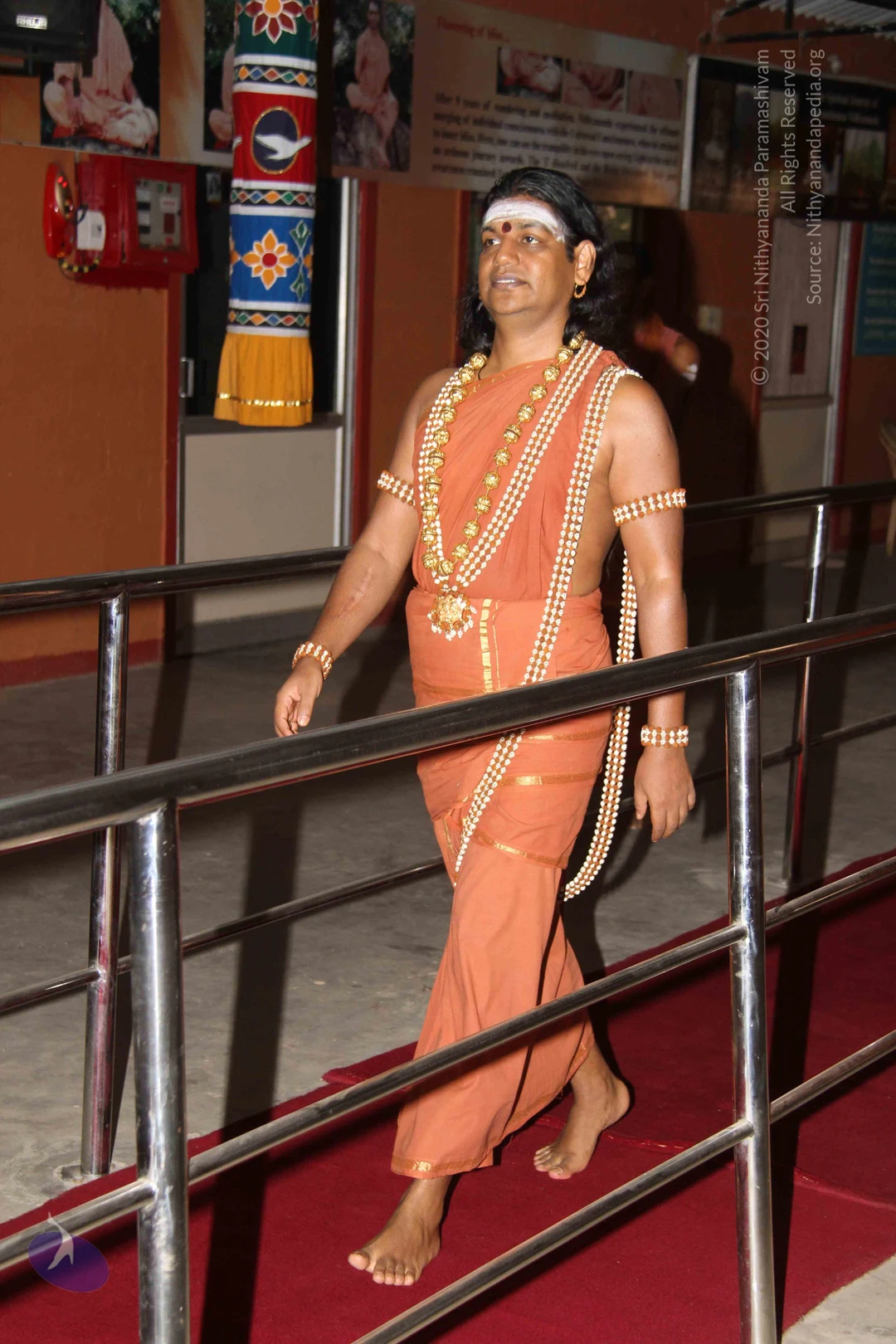
35 photosSource gallery
A dim, reddish dusk or dawn sky with a bright yellow sun low on the horizon, framed by dark silhouetted tree branches and foliage, with a utility pole and power lines crossing the scene. No people are visible.A photograph of a low sun glowing orange-white through a hazy reddish-brown dusk sky, framed by dark silhouetted tree branches and palm fronds. Thin utility wires and a wooden pole run across the lower dark treeline. A small purple emblem with a white bird sits in the upper left corner, and a , , in the lower right. No people, deities, or ritual activity are visibleTwo bronze-toned deity murtis are seated side by side against an orange and gold floral silk backdrop framed by an ornate gilded arch. The figure on the left wears a red turban, rudraksha malas and white floral garlands, and holds a trident-like staff and a damaru-style drum. The figure on the right wears an embellished jeweled crown, red and maroon garments, layered necklaces and a garland, holding a staff topped with a small green parrot. Both statues have red lips and gold ornaments. The scene is a decorated statue display, with no physical people visible.Two gilded deity murtis sit side by side against a shimmering orange and gold patterned cloth backdrop with a carved golden arch. The figure on the left has a red turban, a jeweled tilak, a rudraksha mala and white flower garlands, and holds a trident in one hand. The figure on the right wears a black and gold embroidered crown with red jewels, a green parrot perches on the staff in its hand, and it wears layered gold necklaces and red and white garlands.A black stone Nandi bull statue sits on a red sandstone pedestal in a garden setting. The Nandi wears a garland of red and white beads, a gold-toned necklace with tassels, a bead collar and a yellow cloth draped over its back. Behind it, grey stone statues of standing figures with folded hands and a red-brown tiered pedestal with a kalasha-like finial are visible among palm trees and foliage. No people are present.Two golden metal murti statues of a male and female deity seated side by side against a bright orange draped curtain within an ornate gilded arch. The male figure wears a red turban, a trident is held in one hand, and he has a rudraksha-style brown bead mala and layered jewelled necklaces. The female figure wears a tall jewelled crown, a blue sari with a silver-embroidered border, multiple gold and pearl necklaces and a green parrot perches near her. Both are adorned with pink rose garlands and white flower strands, and there is a gold-edged altar in the foreground. These are statues, so no physical people are present.

Pada-Puja

22 photosSource gallery
Close-up photograph of a person's right forearm and hand resting on an orange-red cloth over a tan lap. The wrist wears a layered bracelet of brown rudraksha beads alternating with white beads, plus a dark wristwatch. In the blurred background on the right, a brass oil lamp with a lit flame sits against a black backdrop. Only the arm and hand are visible, so no face is shown.Close side view of a man seated in a golden throne setting, wearing an orange-red saffron wrap over his shoulder and torso, layered with long orange rudraksha malas and gold bead necklaces, plus a white and orange rudraksha armband. He has long swept-back black hair, a white horizontal tilak with a red dot on his forehead, and a small gold earring, smiling and looking to the left. Behind him is ornate gold carved decoration against a dark background. Swamiji (probable) appears in person, with the appearance-based cues of long hair, saffron clothing and rudraksha malas, and a gold ornate backdrop.Close-up photograph of a person's upper arm wearing a wide armband made of brown rudraksha beads alternating with small white carved skull beads, strung in multiple rows. The person wears a saffron-orange garment draped over the shoulder with a gold border. The background is a plain beige wall and white fabric. No face is visible.Close-up photograph of a person's forearm and wrist resting on an orange terry-cloth towel draped over a pale surface. The wrist wears a bracelet of brown rudraksha beads alternating with white beads, and a dark metal wristwatch. The background is dark with a blurred golden and orange object at right. Only the arm and hand are visible, showing no face.Close-up photograph of several strands of rudraksha malas laid across a rust-orange cloth with a thin gold border. The malas alternate brown rudraksha beads with white skull-shaped beads, and a second set lies at the upper right. A person's fingers are visible at the lower left edge.Close photo of a bare foot resting on a gold-toned ritual tray scattered with white plumeria flowers and pink and red roses. A pair of bare feet in an orange garment with gold border stands on the tray, with the toes touching the flowers. Nearby are silver bowls holding flower petals, a small silver container, a silver spouted vessel and a dish of yellow turmeric paste. The setting suggests padapuja foot worship with flower offerings. No faces are visible and no people beyond the feet are shown.
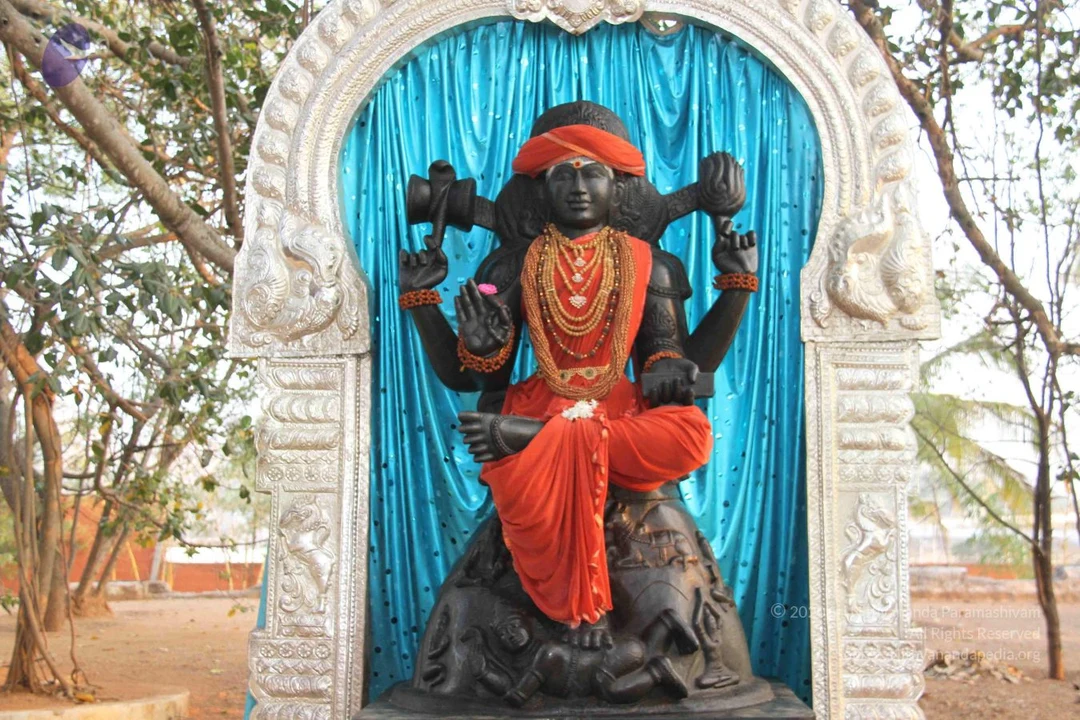
Arati

54 photosSource gallery
A seated man in a golden ornate throne with a large gilded backrest topped by a crown finial, draped in a zebra-striped cushion, wears an orange-red robe, multi-strand pearl and bead necklaces, bangles and a white forehead band with red tilak. He sits with hands folded in his lap while a bald priest in orange robes at the left holds a lit oil lamp aarti flame toward him. Behind the throne hang rows of small oil lamps and dark beads, with gilded lion figures flanking the seat. Brass lamps and offerings sit on the floor, and a red carpet covers the platform. a person: the seated figure wears a red-orange robe, pearl and rudraksha-style necklaces and bangles on an elaborate golden throne, consistent with a ceremonial presentation.A photograph of a golden ornate throne set against a dark textured backdrop with hanging brass lamps. A seated figure in red-orange robes and a long pearl-style necklace sits on a zebra-striped cushion, with a white sacred mark on the forehead. In front, a bald priest in orange robes holds up a lit oil lamp or flame arti to the seated figure. Painted teal and pink panels frame the scene, and a small lamp burns on the right. A visible candidate is seated in the throne and appears to be the a person; the appearance-based label is a person, with identity kept at unsure where cues are limited. A woman in orange stands at the lower left edge.A seated figure in a saffron-orange robe sits on an ornate gold throne with carved floral and lion motifs, draped with a striped tiger-print cloth. A long rudraksha mala and layered pearl-like necklaces hang on his chest, with bangles on his upper arms and a tilak on his forehead; his hands rest folded in his lap. Kneeling at the lower left, a bald priest in orange robes holds up a brass lamp with several flames in an aarti gesture. Hanging brass oil lamps and bells light the gold-and-painted pillared hall. A sign-free ritual scene inside a temple-style setting.A photograph of a bare-chested man with long dark hair seated on a cushioned gold throne backed by an ornate gilded carved panel. He wears an orange-saffron cloth draped over one shoulder, multiple strands of white beads and gold-bead necklaces, beaded armlets, and a white horizontal tilak with a red dot on his forehead, with gold hoop earrings. His hands rest in his lap. Brass bells hang at the upper corners of the frame. The photo is taken in a temple or ashram setting. Swamiji (probable) is seated on the throne, identified by the long swept-back hair, saffron cloth, rudraksha-style beads and ceremonial gold necklaces.A large hall with pink walls, red curtains and colourful striped pillars hung with fabric. Rows of women and men in saffron-orange and red robes with yellow borders sit cross-legged on a white floor, many wearing rudraksha malas. Brass plates with flowers, oil lamps and small ritual vessels are set before them. Several people in white clothes sit near the back, and framed portraits hang on the walls. Visible people are numerous across the hall, with many seated devotees in saffron and white clothing. A person presiding at the far end is not clearly identifiable, and no figure is clearly distinguished by the cues needed for an identification.A photograph of a seated ritual gathering in an open hall. In the foreground, several women in orange and red saris with yellow borders sit cross-legged, wearing rudraksha malas and white forehead markings. A woman in the center holds an open booklet and sits before a silver tray with brass oil lamps, bowls, flowers and small offerings. Behind them, rows of people in orange robes sit on the floor before similar brass puja plates, and a man in white clothing sits at the upper right. Metal poles and a rope divide the seating area.
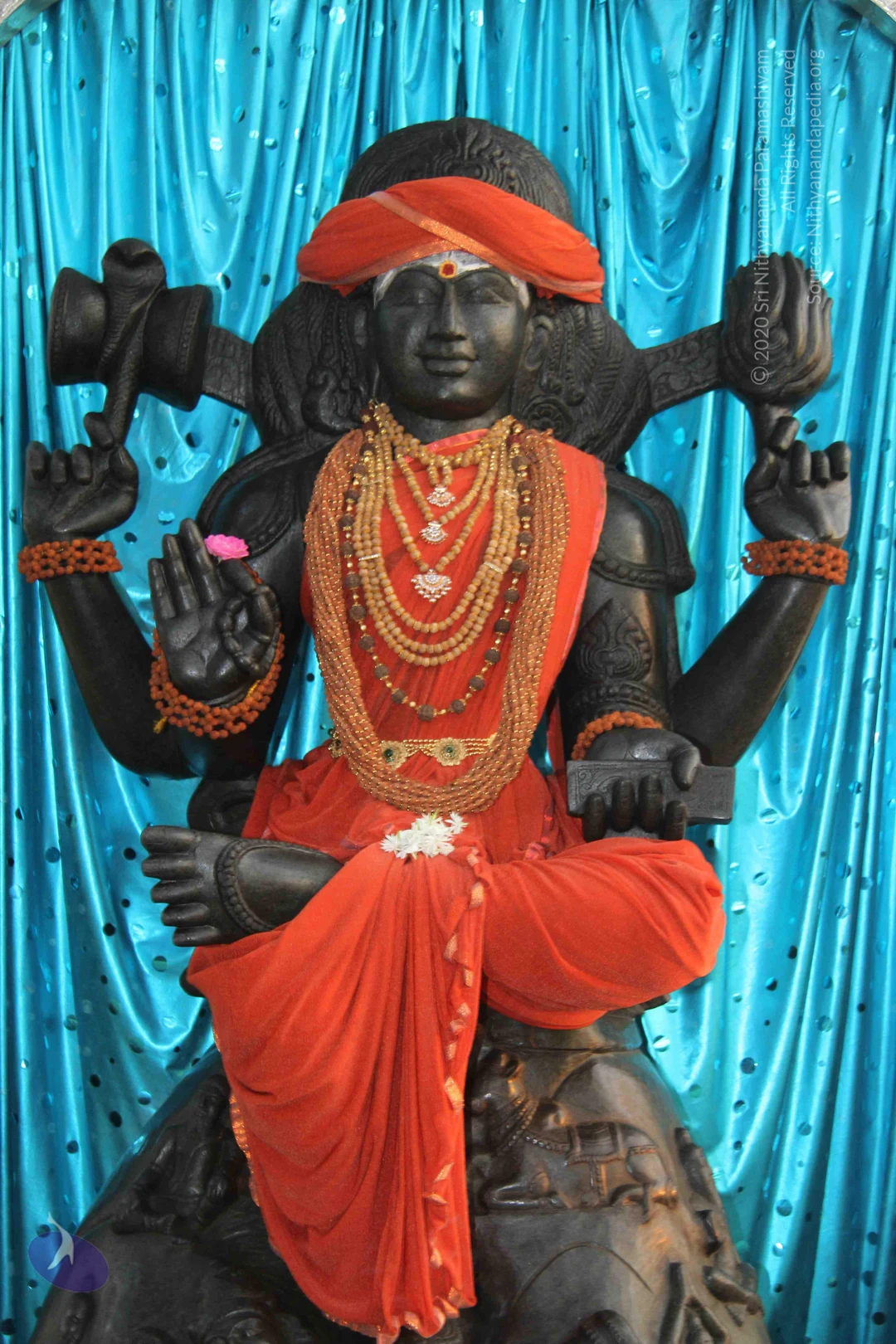
Nithya-Satsang

57 photosSource gallery
Photo of a seated person in saffron-orange robes with palms pressed together in namaste at the chest. The person wears long dark hair swept back, a white vertical tilak with a red bindi on the forehead, gold hoop earrings, a microphone clipped near the mouth, and layered orange rudraksha malas with gold bead necklaces and white-and-orange beaded armbands and wristbands. Behind is an ornate gold repoussé backdrop on a red velvet seat. Probable Swamiji by visible appearance cues: long swept-back hair, saffron clothing, rudraksha malas and ceremonial gold necklaces.A seated man on an ornate gilded throne with a tiger-skin rug draped over its platform, speaking into a headset microphone during a discourse. He wears orange-saffron robes, a long rudraksha mala and a gold bead necklace, with pearl-like beaded bands on his arms and a vertical sacred mark on his forehead. A dark backdrop with small lights and green foliage surround the golden throne.A seated man in orange robes sits cross-legged on an ornate gold throne with a carved arched back, flanked by two golden lion sculptures with open mouths. He wears a long multi-strand orange-beaded necklace, a large gold chain with rudraksha-style beads, bangles on both arms, a white forehead band with a red dot, and a small earpiece microphone. His hands rest on the throne's velvet armrests with a tiger-striped cloth beneath him. Potted palms and a colourful painted backdrop with lamps surround the stage. Swamiji (probable): the long swept-back hair, saffron-orange robes, rudraksha mala and ceremonial gold necklaces are consistent with the page's identification, shown here as a seated speaker on stage.A seated speaker on an ornate gilded throne with a tiger-skin rug before it, raising one hand in a gesture while speaking into a headset microphone. He wears a saffron-orange robe, a thick rudraksha mala with gold beads, a pearl-string armlet and bangles, and a white and red forehead mark. Behind him are gold-framed carvings, small lamps and potted palms. Swamiji (probable) appears as a robed speaker with long swept-back hair, saffron clothing and rudraksha and gold ornaments, seated on a throne in front of a discourse setting.A seated man in saffron-orange robes sits cross-legged on a red velvet seat before an ornate gold throne with a carved arch and lion figures, atop a tiger-skin cloth. He has long dark hair, a white forehead mark with a red dot, and wears a dark-beaded mala, a gold bead necklace, pearl-strand necklace and gold armbands, with his eyes closed in meditation. A lapel microphone is visible near his face. Golden lion statues flank the throne and potted green plants sit at the sides, with string lights behind the dais. Appearance-based identification: a person, seated in a satsang-style discourse setting with a microphone.A photograph of a large group of shaven-headed sannyasis seated cross-legged on the floor of a hall, wearing saffron-orange robes, rudraksha malas and orange shawls, with white and sandalwood marks on their foreheads and arms. Brass and silver ritual plates, small oil lamps, flowers and kalasha-style vessels sit before them. Behind them, younger boys in dark shirts and older men in white sit among the crowd, and a red curtain hangs on the back wall beside a white door. The image shows a group ritual setting rather than an identifiable single leader.

IA-Lunch

25 photosSource gallery
A dining hall serving line where devotees in white clothing and orange lanyards serve food from stainless steel chafing dishes on tables covered with green leaf-patterned cloths. A man in a white t-shirt and white pants holds a red thermos and serving tongs at left, while a man in white with an orange lanyard serves at right. A woman in white with a blue shawl and glasses ladles food in the centre. Behind them a woman in white holds a steel plate, and a blue sign on the wall reads 'Maintain silence' with partial text. Red curtains hang in the background.A photograph of volunteers serving a meal at a buffet. In the foreground a woman with her hair tied up wears a white short-sleeved shirt and an orange lanyard, and is spooning food onto a steel plate. Behind her a man in a white shirt and dark backpack also serves from a steel chafing dish. A woman on the right with long dark hair and glasses, wearing a white t-shirt and orange lanyard, holds a plate of food. Two large terracotta pots stand against a pale pink wall, and a green patterned tablecloth covers the serving table. At the far right edge a person in a white garment holds a steel tumbler.Two women drink from red stainless-steel travel mugs with black lids in an indoor room with pale pink walls. The woman on the left wears glasses, a pale yellow sari with brown border, an orange lanyard and an ID badge. The woman on the right wears a white embroidered top, a white dupatta draped over her shoulders, a white hair tie and bangles, with an orange lanyard and ID badge. Both are standing and looking ahead while drinking.A photograph of a dining hall where volunteers serve food from a buffet table covered with a green patterned cloth. Three women in white clothing stand at the serving counter: a woman with grey hair wears a white shirt, white skirt and a long beaded mala with orange-red thread, using a spoon on a tray of yellow fruit pieces; a woman with long reddish-brown hair in a white top stands behind her; and a woman with short black hair in a white polo shirt with an orange lanyard and ID badge serves from a steel tray holding bowls. Steel dishes hold yellow fruit, creamy white pudding, green chopped fruit and a bowl of ripe bananas. Colourful bunting hangs from the grey ceiling, and other white-clad people sit at tables in the background.A photo of a communal meal service with volunteers serving food from stainless steel chafing dishes on a draped table. On the left, a man in a white t-shirt with an orange lanyard and rudraksha mala ladles food onto a plate. In the centre, a man in a white shirt with an orange lanyard and a wristband places food on a plate. On the right, a man in a white shirt with rudraksha mala and a name badge holds a steel plate of food. A woman in white with an orange lanyard stands behind, and an older woman in white with a shawl stands at far right.A photograph of a serving line in a hall with a wooden stage and screen in the background. A smiling man in a white kurta and orange lanyard with an ID badge holds a steel plate of food and ladles more from a steel pot. Behind the counter, steel trays hold yellow and green dishes and a bowl of white sauce. Other people in white clothing stand at the buffet, including a woman with blonde hair in a sheer white top and scarf, and a man in white at the right holding a bowl and wearing red and white beaded garlands.

Sarvadarshan-Gurukul

51 photosSource gallery
Photograph inside a decorated hall with draped white and maroon fabric ceiling and a dark stage backdrop. Several shaved-headed young monks in saffron-orange robes with rudraksha malas, some with white tilak on their foreheads, sit or stand in a row facing right. On the right, a standing man in deep red-brown robes and a rudraksha mala hands items from a red tray to a standing figure, while another robed man in red-brown kneels near the tray. A tall striped banner hangs in the upper centre. Several more people in white attire stand in the background.A photograph inside a decorated hall with draped orange-and-white fabric and striped pillars. Several shaved-headed young monks in saffron robes and rudraksha malas stand in a row at left, some with white forehead markings and one wearing glasses. A man with long swept-back hair in an orange dhoti and shawl, adorned with a long rudraksha and gold necklace and bangles, stands at centre smiling and gesturing toward the boys. At right, a bald man in orange robes holds a red box with a small ritual item. A gilded deity murti or shrine is visible in the background. Physical people visible: about seven or eight, so the count falls in the 6-20 range.A photograph of a ceremonial reception inside a hall with draped cream fabric, colourful striped banners and projection screens showing a smiling man in white. A tall figure in saffron-orange robes, with long swept-back dark hair, a rudraksha mala, layered gold beaded necklaces and bangles, and a white forehead mark, stands at right, extending his hands toward several shaved-headed young monks in orange robes who approach with orange cloth bundles. Nearby, a man in white with folded hands and women in white and red saris stand watching, and a red tray of fruit and flowers sits at lower right. Behind them a golden throne-like seat and a small deity murti are visible. Swamiji (probable) is described by the saffron robe, long hair and gold necklaces, and the figure is treated as the in-person central presence; overall about 12 people are visible.A photograph of a devotional gathering in an indoor hall with orange and white draped ceiling fabric and striped pillars. On the right, a shaved-headed man in orange robes wears a long rudraksha-style bead necklace and bangles, and holds his palms raised in blessing. Several men stand in front, some in orange robes and others in shirts, with hands pressed together in namaste. A projection screen and a framed portrait hang in the background, and a tray of sweets sits at the lower right. Watchers stand along the right edge.Indoor photo of a blessing line in a hall with draped white fabric ceiling and maroon drapes. A man in an orange-saffron robe with multiple rudraksha-style beaded and gold bead necklaces and bangles touches the head of a devotee with one hand, marked with white forehead paste. Devotees in pink, white and checked shirts stand with folded hands or bowed heads in line, and more people in orange robes stand at the right. Colorful hanging decorations and a red wall panel are behind. A tall figure in a saffron robe at right has a shaved head. The central figure is a person bestowing a blessing on a devotee.A photograph inside a hall with a draped white ceiling and hanging red, yellow and blue cloth decorations. On the right, a figure in an ochre-saffron dhoti with a long rudraksha mala and ornate gold-and-white beaded necklaces stands with both hands raised, touching the forehead of a seated devotee in a red checked shirt. Beside him, a shaved-headed child in orange sits in front, and a man in a red t-shirt with a printed portrait stands on the left with hands joined. Other saffron-robed sannyasis and white-clad attendees stand behind, and a framed portrait hangs on the wall. The scene looks like a blessing or darshan. The orange-robed figure with rudraksha and ornaments fits the swami candidate cues, but the face is not clearly visible enough to confirm, so the identity is uncertain.
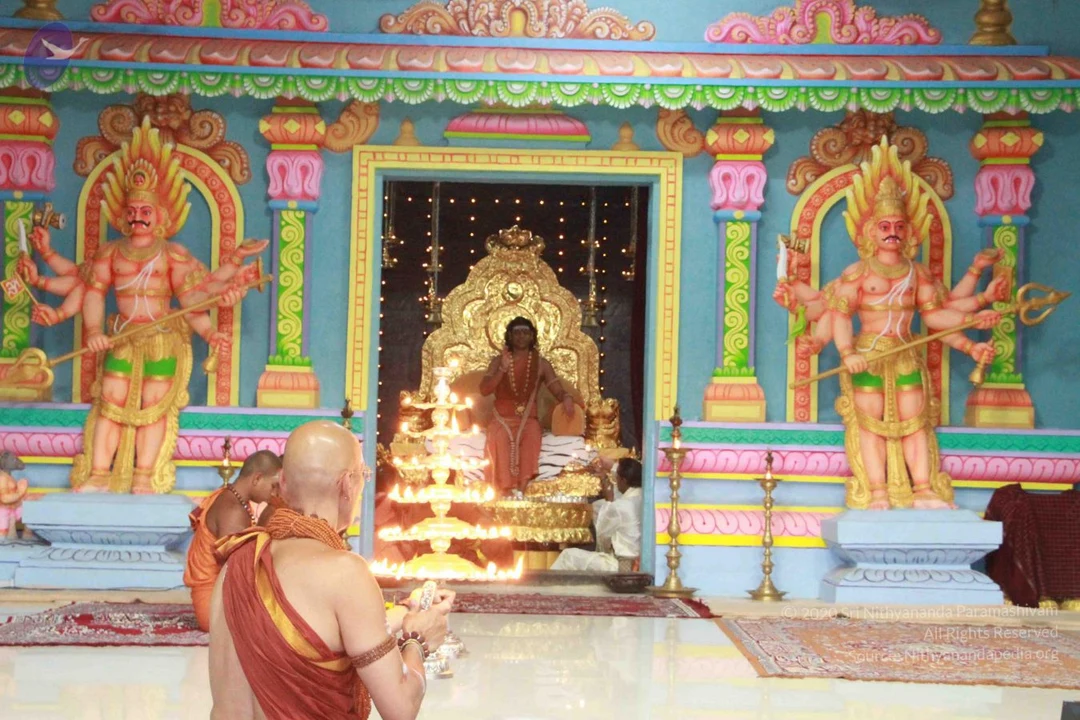
Kalabairava-Darshan

13 photosSource gallery
A smiling man sits on an ornate golden throne with elaborately carved arched backrest, lit with red and green stage lighting. He wears a leopard-print sleeveless top with rudraksha mala necklaces of dark beads and white-tipped beads, matching beaded bands on his upper arms and wrists, and rust-orange loose trousers. He has a white and red forehead marking and holds his hands together over his chest. One person is visible.A photograph of two men in an indoor room with purple-tinted lighting, a dark curtain and a potted plant behind them. On the left, a smiling man with long dark hair, wearing a leopard-print top and a rudraksha-style bead necklace, raises his palm toward a younger man on the right. The younger man, with short hair, wears a white t-shirt and an orange lanyard, and faces him with his palm raised, as if in a high-five.A photograph of a long-haired figure in a leopard-print wrap and a rudraksha mala with skull beads placing a hand on the forehead of a short-haired man in a white t-shirt with an orange wristband, in a warmly lit room with a green-lit altar, a brass lamp and a curtain. The devotee stands with his palm raised to his cheek, receiving the blessing.A long-haired man in a leopard-print wrap with a beaded rudraksha-style necklace places his right palm on the forehead of a short-haired man in a white t-shirt, while the second man's hand is raised in front. Pink and purple stage lighting, a brown curtain, potted plants and a brass oil lamp stand in the room behind them. The first man has a white mark on his brow and appears to be giving a blessing.A photograph of a long-haired figure in a leopard-print sleeveless top and rust-orange dhoti, wearing a thick rudraksha-style bead necklace, seated and placing one hand on the forehead of a kneeling man in a white T-shirt with a red-and-white bead mala. A small oil lamp with a brass base stands at left beside a plant and dark curtain in a softly lit room with pink and green lighting. The kneeling man has his palms raised in receiving posture. This appears to be a blessing or initiation-style gesture between two people. a person cues are not clearly established here, since the seated figure's distinctive adornments are present but the identity is uncertain from appearance alone.A long-haired man in a leopard-print sleeveless top and a rudraksha mala with skull-shaped beads reaches out to touch the forehead of a bald older man in a white kurta with an orange cord and a wristwatch, who stands with palms pressed together in greeting. The setting is a dimly lit room with pink and green lighting, a brass oil lamp on the left, dark curtains, and potted plants.

Swamiji-Blessings-Namaskar

8 photosSource gallery
A seated person in saffron-orange robes presses palms together in anjali mudra with eyes closed in prayer or greeting. Multiple strands of rudraksha malas and ornate gold bead necklaces hang on the chest, with matching rudraksha and white bead bracelets and armlets. A white tilak with a red dot marks the forehead, and small gold hoop earrings are worn. Behind them is a richly embossed gold throne backdrop with floral and scroll patterns, and a red cushioned seat is visible at the lower left. The distinctive adornments and saffron clothing fit a person presentation, shown here as a devotee in an attitude of prayer on a throne setting.A figure seated cross-legged on an ornate gold-and-red throne with a golden arched back, flanked by two golden lion sculptures, in front of a turquoise and pink decorated stage. The seated person has palms pressed together in namaskar, wears an orange-saffron dhoti and shawl, a rudraksha mala, a long pearl-style necklace, and gold bangles and earrings, with white vertical markings on the forehead. A tiger-striped cloth covers the seat. Green leafy plants and a hanging string of lights are behind the throne. Swamiji (probable): the saffron clothing, long swept-back hair, ceremonial necklaces and throne seating are compatible cues, though this is not a confirmed identification.A seated man with palms pressed together in namaste, in front of an ornate gold-embossed throne backdrop. He wears an orange-saffron robe, layered rudraksha-style beaded necklaces with gold beads, pearl-white bead armlets and bracelets, gold hoop earrings, a white vibhuti horizontal mark with a red kumkum dot on his forehead, and a small head microphone. He sits on a deep red velvet chair. Probable Swamiji is a qualifying cue match: long swept-back hair, saffron clothing and rudraksha malas, with the orange robe and ceremonial gold ornaments present; the page identifies this event as a discourse.A man seated on a red velvet chair in front of an ornate gold repoussé backdrop, palms pressed together in namaste at chest level. He wears a saffron-orange garment, a long rudraksha mala, a heavy ceremonial gold bead necklace, and white and rudraksha bracelets and armlets. He has a white vibhuti band with a red kumkum dot on his forehead, gold earrings, and a small clip-on microphone. Swamiji (probable) appearance cues: long swept-back hair, saffron clothing and rudraksha malas with gold necklaces, seated as a discourse speaker.A seated man with palms pressed together in namaste gesture sits on a red velvet chair before an ornate gold repoussé throne backdrop. He wears a white vertical tilak with a red bindi, gold hoop earrings, a headset microphone, an orange-red garment, layered rudraksha-style and gold bead malas, and pearl bangles on his wrists and upper arms. Green palm fronds appear at the lower left edge. The scene suggests a discourse or satsang. Swamiji (probable): the long swept-back hair, orange clothing and multiple bead malas are consistent with the page's identification, and the figure is seated as the speaker.A seated figure in saffron-orange robes with a rudraksha mala and a long pearl-style mala sits on an ornate gold throne with gold lion armrests and a red velvet cushion. Two painted guardian figures with multiple arms, flame-like headdresses and gold loincloths stand on either side against a blue, pink and green temple-style backdrop. Potted plants and brass lamp stands flank the throne. Swamiji (probable): the figure wears long swept-back hair, saffron clothing, rudraksha and pearl malas and gold armbands, and sits on the throne as the central teacher of a discourse. A small lit display is visible behind the throne and the setting resembles a satsang hall.
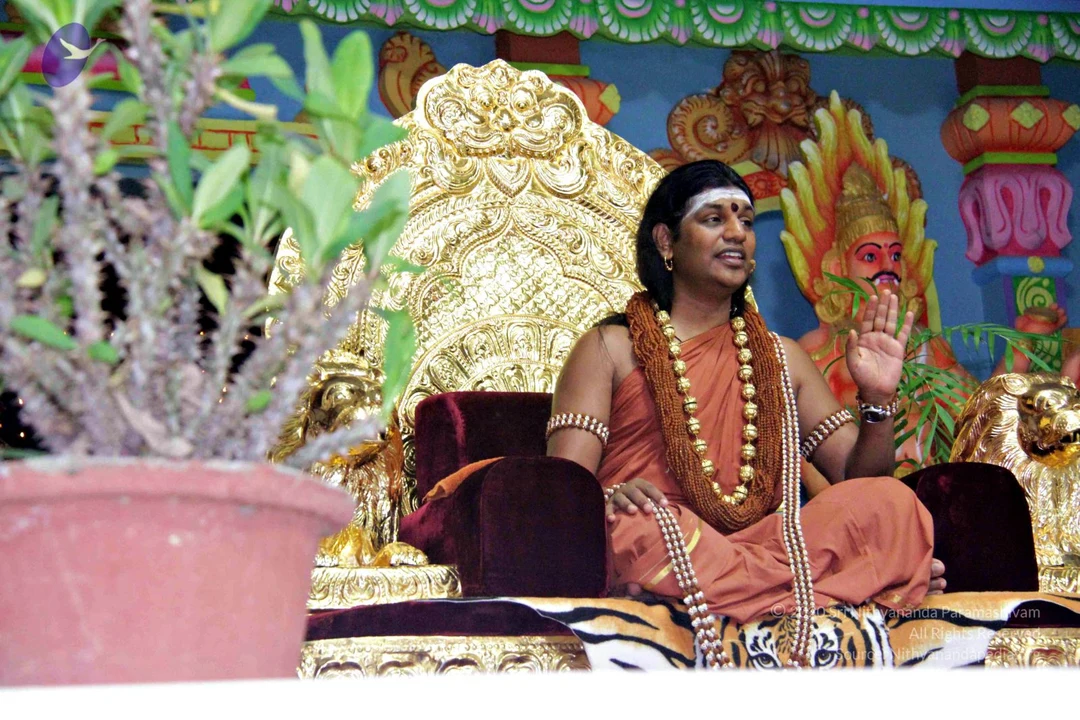
01-KALABHAIRAVAR-DARSHAN

50 photosSource gallery
A figure with long, loose black hair and a white forehead mark stands on an ornate, gold-framed stage set lit in red and green. They wear a leopard-print top over a dark garment, a red and green wrap, layered beaded necklaces and beaded wrist bands, and hold a tall silver trident with their right hand, one hand resting on the hip. The backdrop is a carved, arched gilded panel, and a tiger-striped cloth covers the stage front.A performer dressed as a fierce deity form stands on an ornate raised platform in front of a golden, arched backdrop lit with red and green lights. The figure has long, loose black hair, a white forehead marking, and wears a leopard-print garment with a green draped cloth and layered beaded necklaces and bracelets. In one hand is a silver trident, and the other hand rests on the hip. The platform has a tiger-striped cloth at its base.A figure stands on a raised platform before an ornate gold-embossed arch lit with red and green lights. The figure has long dark hair, a forehead marking, and wears a green leopard-patterned garment with beaded necklaces and bracelets, and holds a silver trident (trishul) in the right hand. The setting resembles a stage or decorated shrine backdrop, with a tiger-striped cloth draped over the platform edge. The figure appears to be a costumed or dressed devotee or performer in a deity-style presentation; the appearance does not clearly establish a person identity.A performer in costume stands on an ornate gold-and-green decorated platform in front of a pink-lit backdrop. The figure has long dark wavy hair, a painted forehead mark, and wears a green and black patterned net top over green trousers, with layered beaded necklaces and beaded bracelets on both wrists. The raised right hand holds a silver trident, and the left hand rests on the hip. Bright pink and green stage lighting colours the scene.A performer stands on a raised stage in front of an ornate golden arch and gold-embossed panels lit in pink and green. He has long, dark, wavy hair, a white forehead marking with a red dot, and wears a green and black leopard-print sleeveless top with a dark mesh overlay, a long beaded necklace and bead bracelets, and loose green-olive trousers. He holds a silver trident in his right hand and rests his left hand on his hip. The costume and trident suggest a Shiva-themed role, presented as a performance on stage. Tiger-striped cloth covers the platform edge.A person in a Kalabhairava-style costume stands in a glowing golden arch lit in red and green. The figure has long dark wavy hair, a white forehead marking, a beaded necklace and rudraksha-style mala, a leopard-patterned wrap, and holds a silver trident. A dark kalasha-like object and small offering vessels sit on the decorated stage base. The setting is a decorated temple-style backdrop with bell motifs. Whether this is a person is uncertain given the costume-style presentation and lighting, so the identification is left unsure.

02-SATSANG

1 photoSource gallery
A man stands on a stage in front of a golden throne flanked by two golden lion sculptures, draped with a tiger-striped cloth. He wears a saffron-orange robe with gold-edged border, a thick rust-coloured rudraksha mala and a heavy gold bead necklace, plus beaded white armbands. He has long swept-back dark hair, a white vibhuti line with a red kumkum mark on his forehead, and a small microphone at his face. Colourful painted temple-style decorations frame the backdrop. Swamiji (probable), appearing to speak as a discourse presenter, based on long hair, saffron robe and rudraksha mala cues.

March 16 2013

2 photosView all
A wide photograph of a broadcast control room with a long white counter in the foreground. Several technicians sit at computers, and a row of six wall-mounted monitors displays video feeds of a speaker in red and maroon robes, a crowd, and a bright floral setup. Behind the glass, a large seated audience of many people in saffron and orange robes listens, with a figure in orange near the right side of the counter. A tabletop placard and a small green-lit display sit on the counter. The scene conveys a live satsang being produced for television.A photo of a smiling man seated cross-legged on a red velvet throne in front of an ornate gold-embossed backdrop carved with floral and lion motifs. He wears a saffron-orange sannyasi robe, a long orange rudraksha mala with large gold beads, white and beaded armlets and bracelets, a white horizontal tilak with a red dot on the forehead, and a small microphone clipped near his ear. A tiger-striped cloth covers the floor beneath him. Swamiji (probable): long swept-back dark hair, saffron robe, ornate gold and rudraksha adornments, and a throne setting. Seated as a speaker during a discourse.