Skip to content
Sunday

12 December 2010

Ashtanga Yoga - Yama: Patanjali Yoga Sutras 81 - Nithyananda Morning Satsang 12 Dec 2010
55Dated photos
1Source pages
14Media embeds
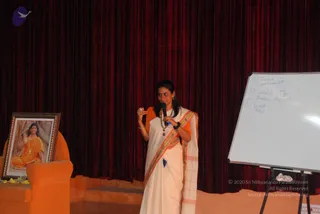
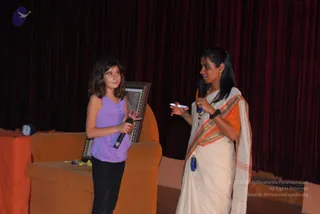
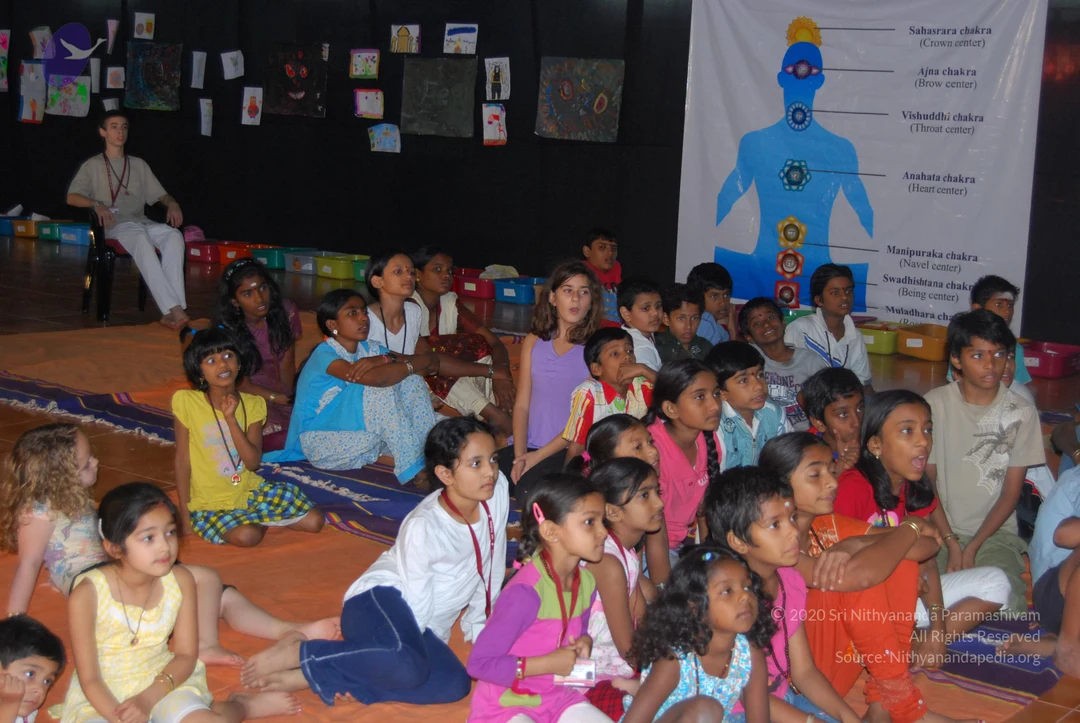
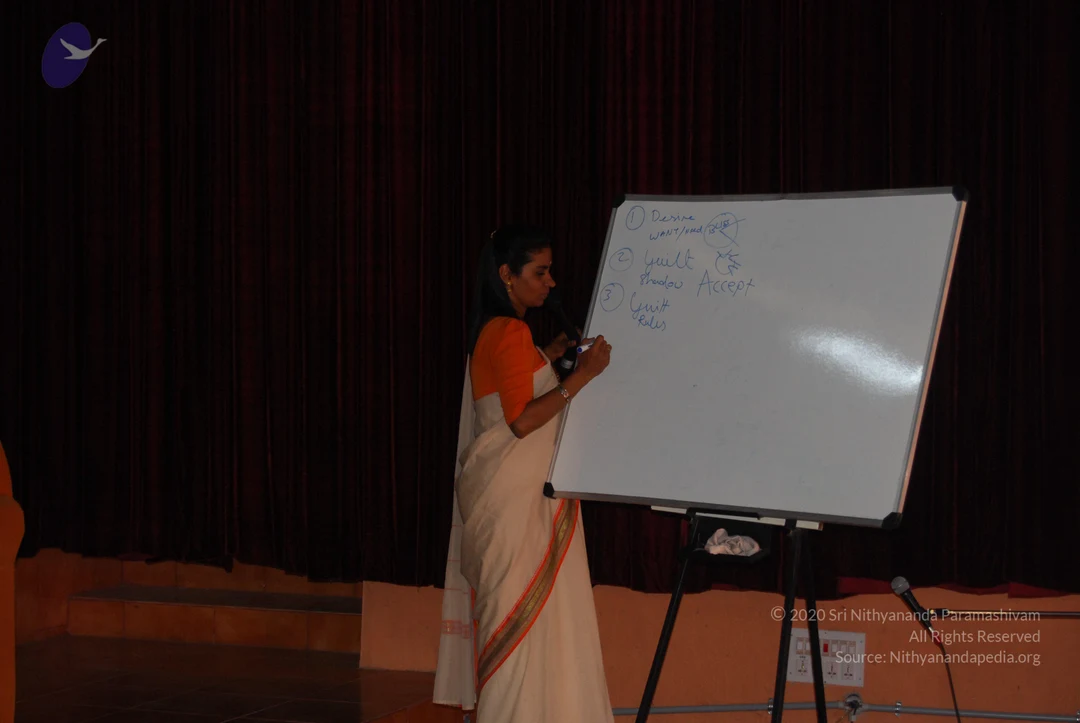
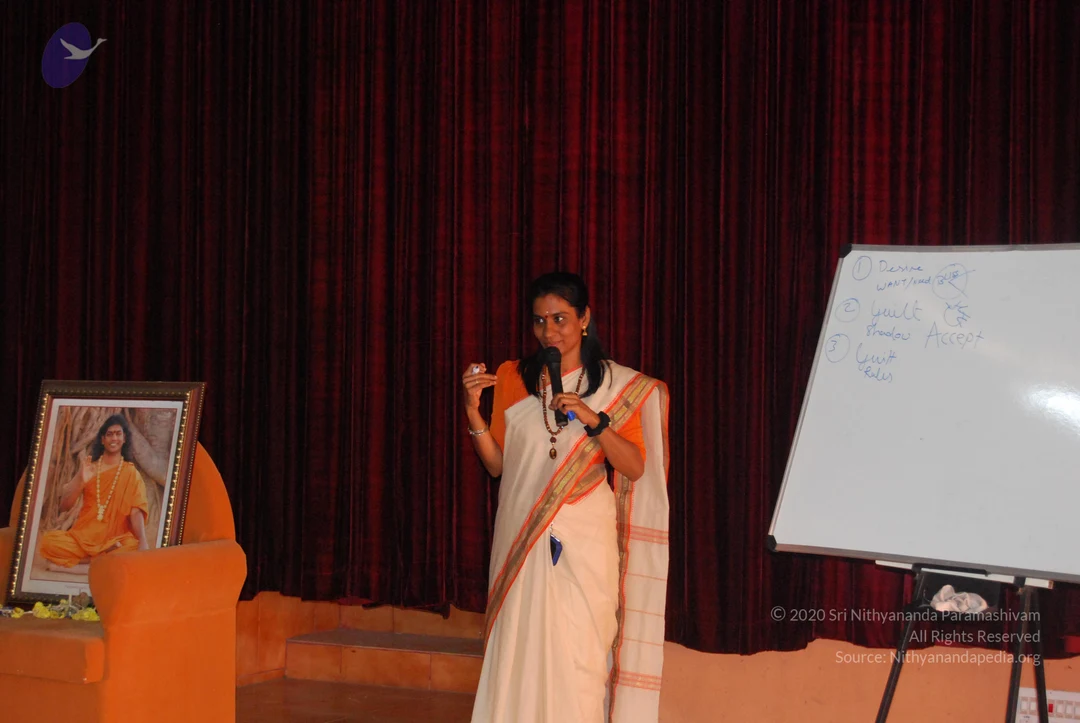
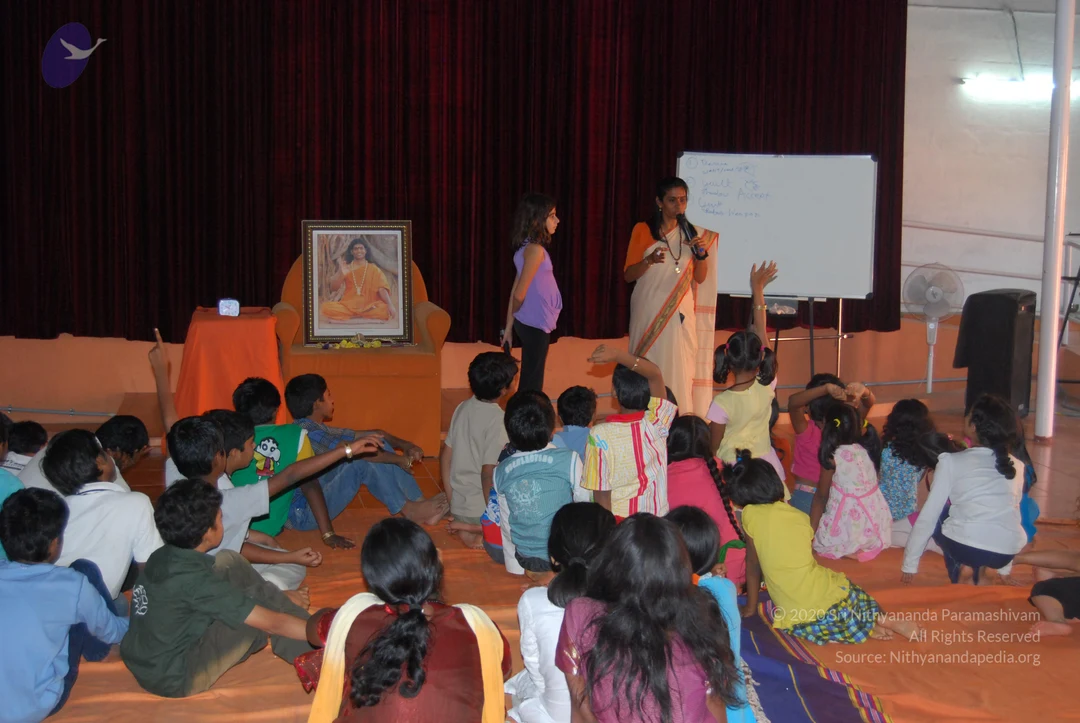
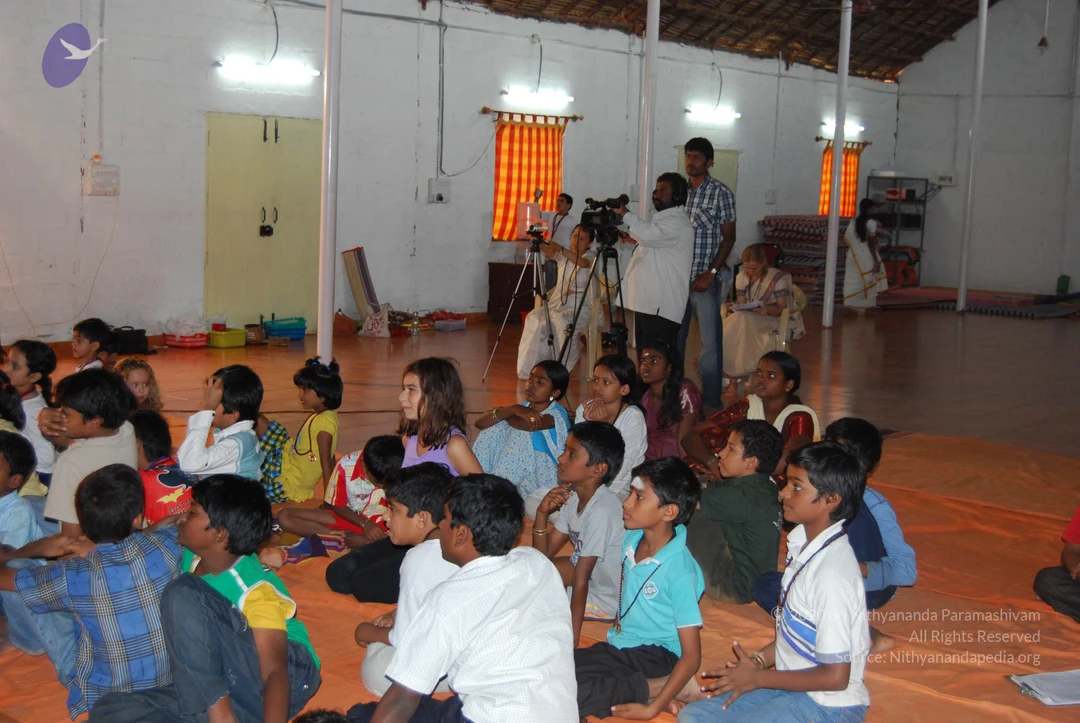
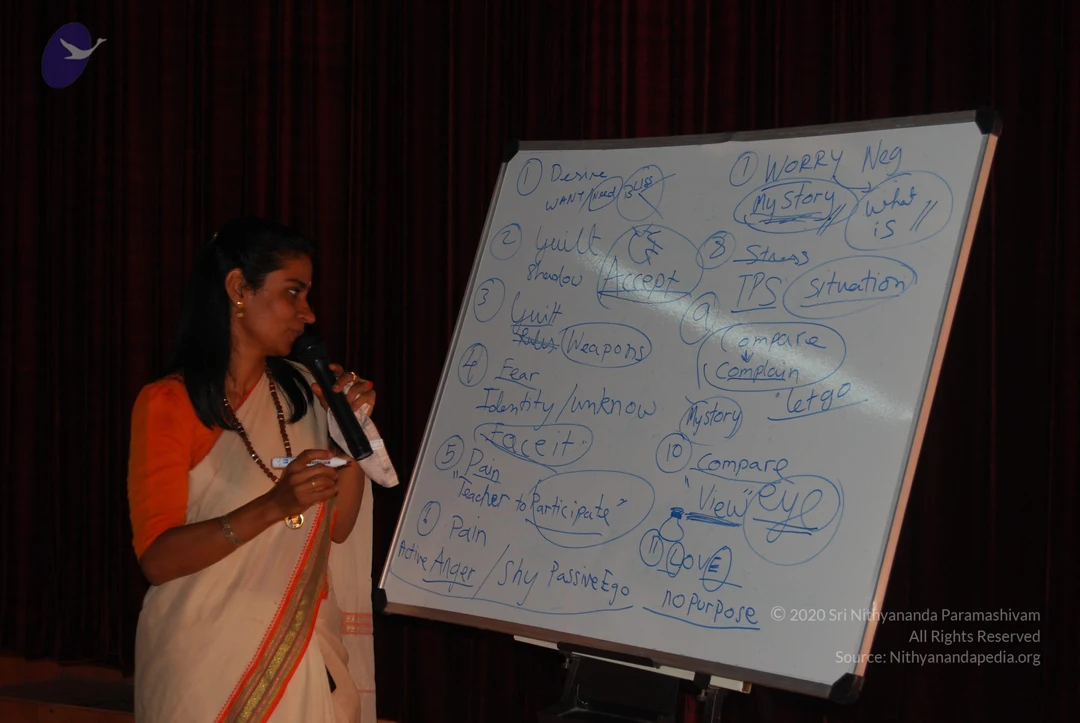
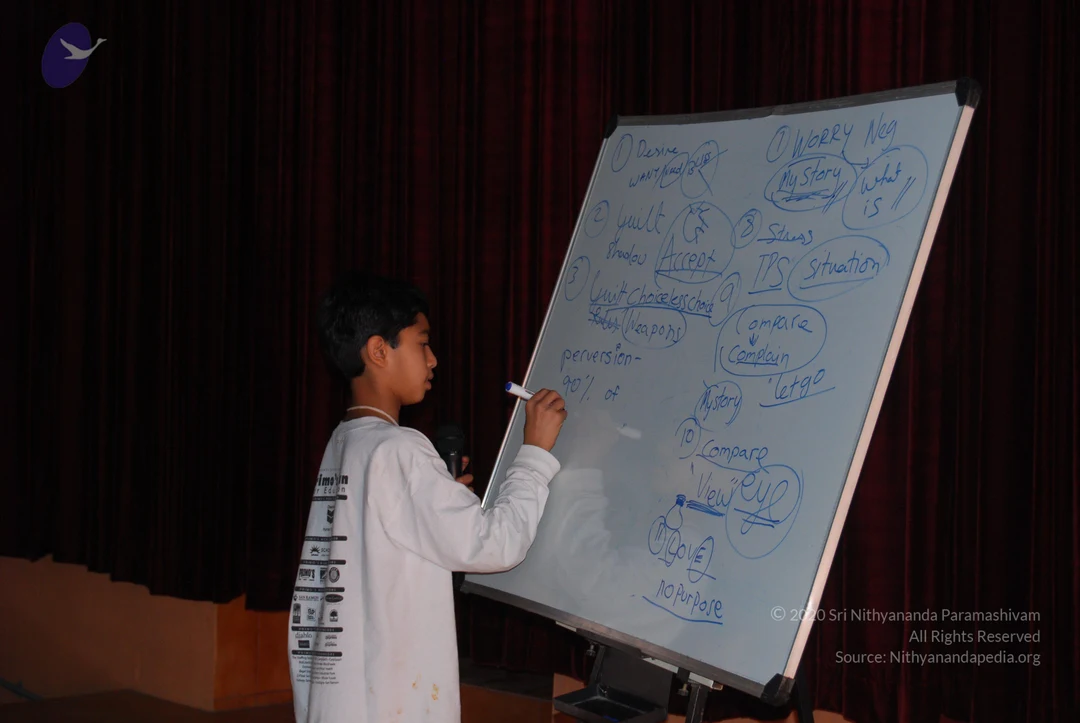
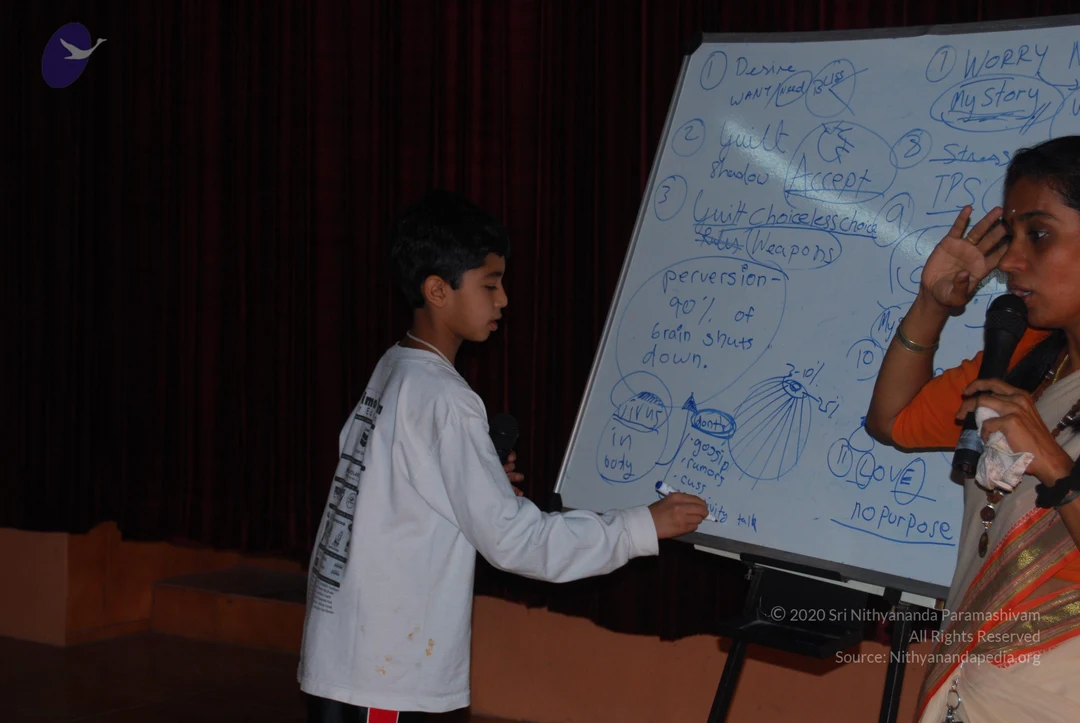
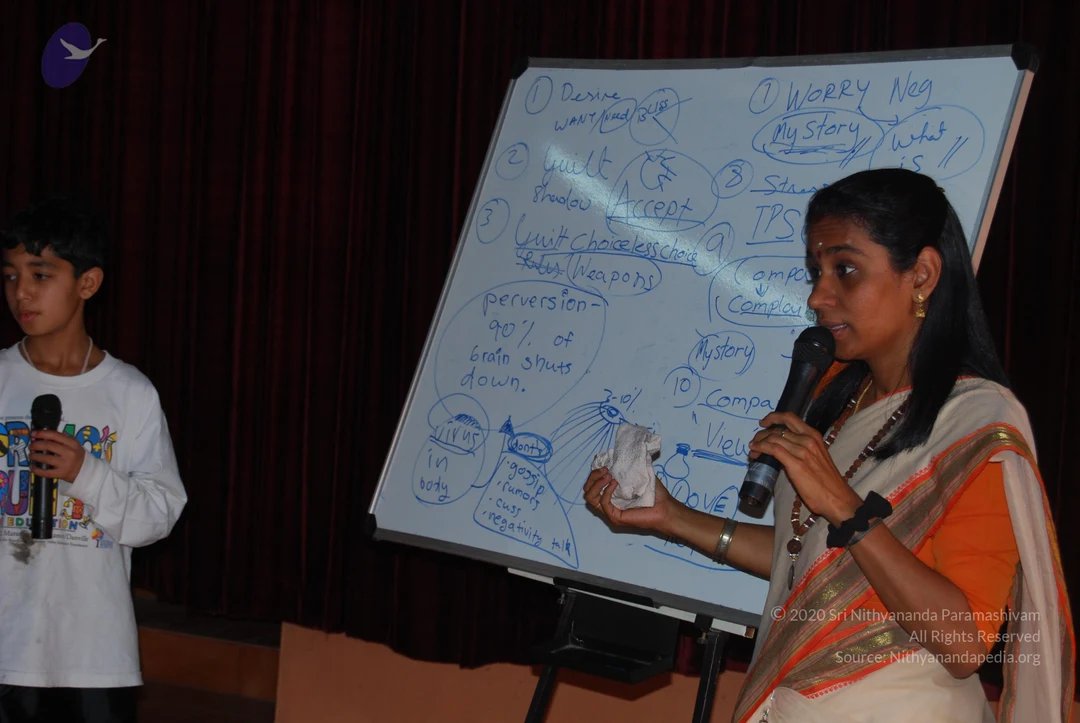
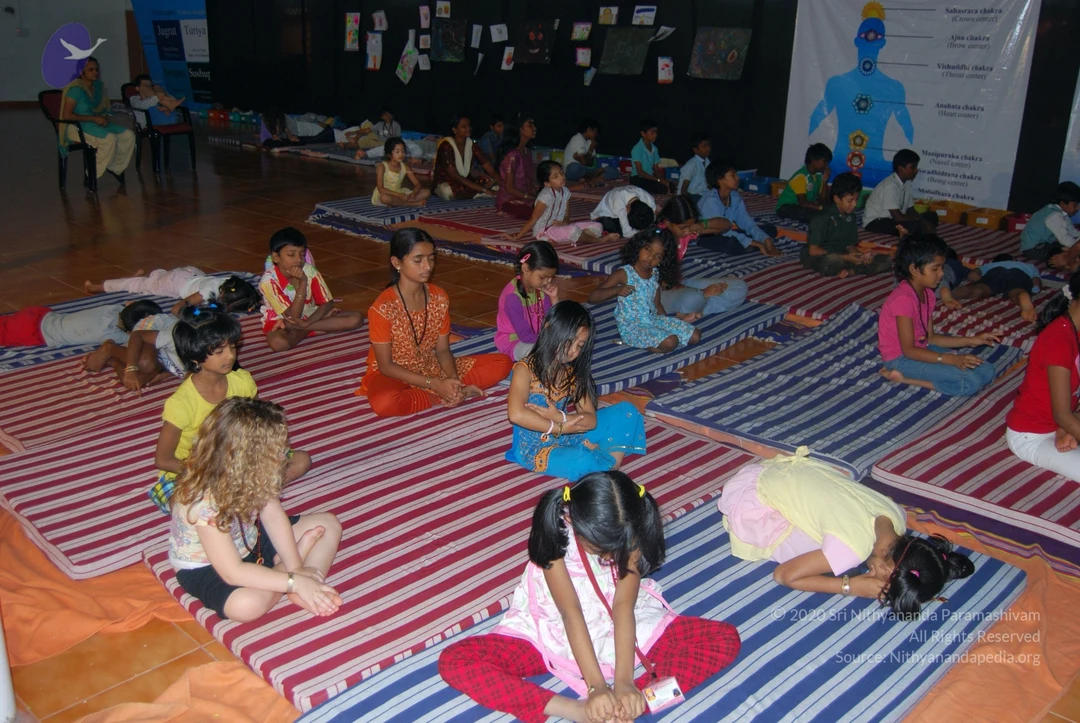
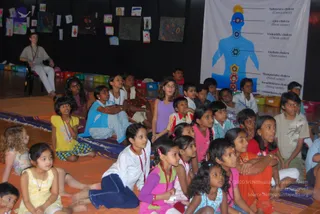
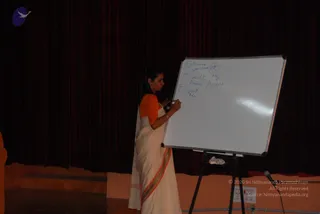
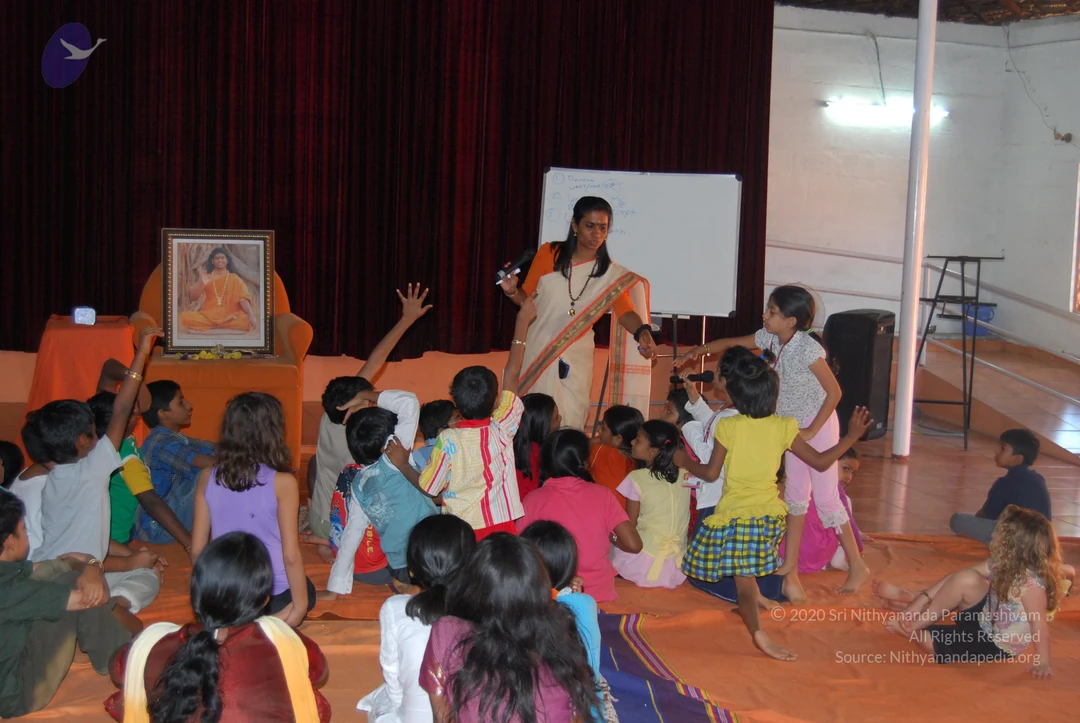
A group of children and teenagers sit cross-legged on orange and purple floor mats in a large hall with a black backdrop, watching a presentation. A large white banner on the right shows a blue human silhouette with labelled chakra centres: Sahasrara (Crown centre), Ajna (Brow centre), Vishuddhi (Throat centre), Anahata (Heart centre), Manipuraka (Navel centre), Swadhishtana (Being centre) and Muladhara. Children wear white, yellow, pink, purple, orange and blue clothes, some with red lanyards. A woman in a lavender top sits among them, and a man in white sits on a chair at the upper left near colourful children's artwork pinned to the wall. Plastic storage bins line the background.A woman in a cream saree with an orange blouse and a thin orange-and-gold border stands at a whiteboard on an easel, writing with a blue marker on a stage with dark red curtains. The whiteboard lists numbered points in blue handwriting, including words such as 'Desire', 'want', 'Accept' and 'Rules'. A microphone stand is visible at the lower right, and the setting appears to be a satsang or workshop talk. No a person candidate is visible in the frame.A woman speaker stands on a stage in front of dark red drapes, holding a microphone in one hand and gesturing with the other. She wears a white sari with orange and gold border and an orange blouse, with a dark beaded mala necklace and a wristwatch. To the left, a framed portrait on an orange chair shows a figure in orange robes and beads seated beneath a tree, with yellow flowers placed on the chair. To the right, a whiteboard on an easel lists numbered handwritten points including 'Desire', 'Guilt Shadow Accept' and 'Guilt Relief'.

Photos of the day

View all 55 photos

55 distinct dated photos. Source gallery sets may overlap.

01

1-En-Genius-LE

11 dated photos in previewSource gallery
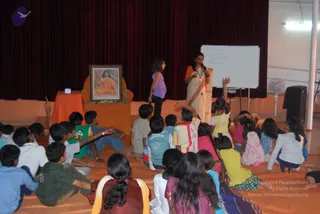
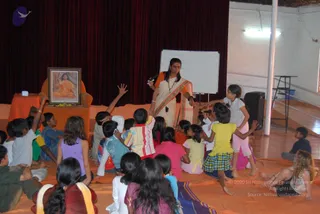
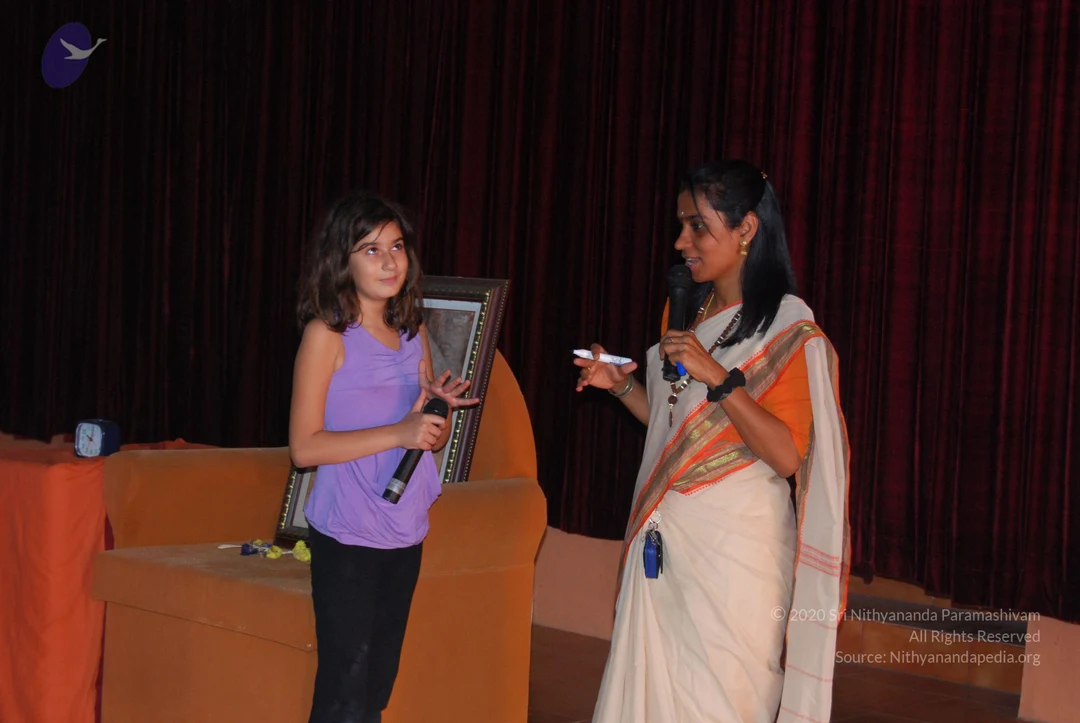
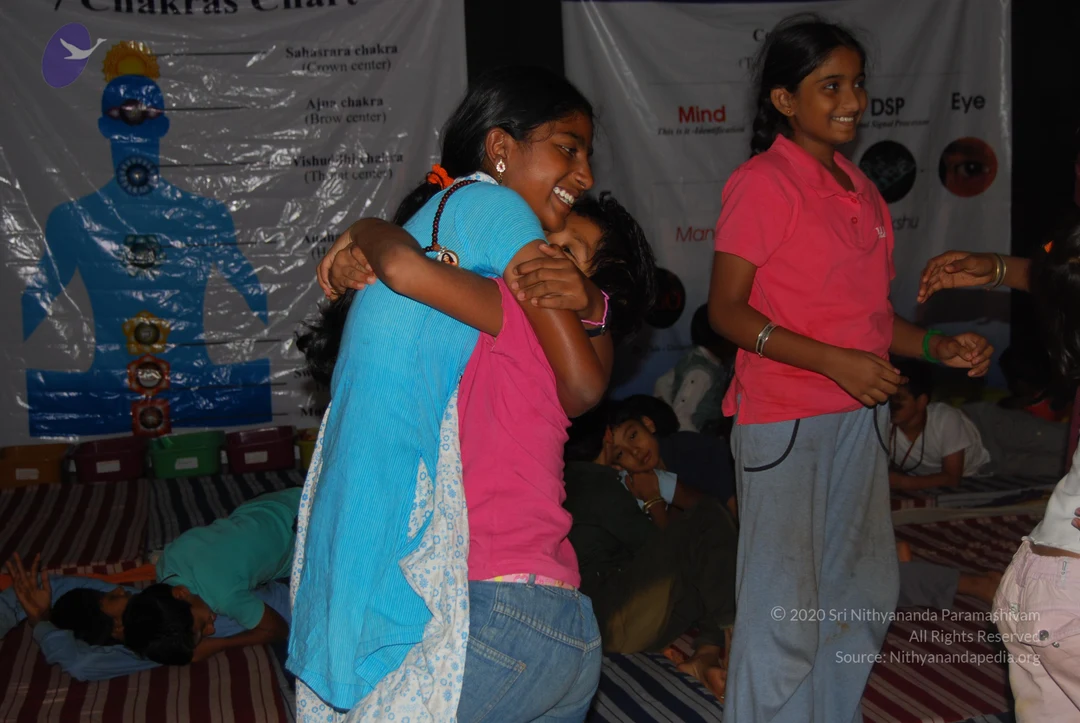
A group of children and teenagers sit cross-legged on orange and purple floor mats in a large hall with a black backdrop, watching a presentation. A large white banner on the right shows a blue human silhouette with labelled chakra centres: Sahasrara (Crown centre), Ajna (Brow centre), Vishuddhi (Throat centre), Anahata (Heart centre), Manipuraka (Navel centre), Swadhishtana (Being centre) and Muladhara. Children wear white, yellow, pink, purple, orange and blue clothes, some with red lanyards. A woman in a lavender top sits among them, and a man in white sits on a chair at the upper left near colourful children's artwork pinned to the wall. Plastic storage bins line the background.A woman in a cream saree with an orange blouse and a thin orange-and-gold border stands at a whiteboard on an easel, writing with a blue marker on a stage with dark red curtains. The whiteboard lists numbered points in blue handwriting, including words such as 'Desire', 'want', 'Accept' and 'Rules'. A microphone stand is visible at the lower right, and the setting appears to be a satsang or workshop talk. No a person candidate is visible in the frame.A woman speaker stands on a stage in front of dark red drapes, holding a microphone in one hand and gesturing with the other. She wears a white sari with orange and gold border and an orange blouse, with a dark beaded mala necklace and a wristwatch. To the left, a framed portrait on an orange chair shows a figure in orange robes and beads seated beneath a tree, with yellow flowers placed on the chair. To the right, a whiteboard on an easel lists numbered handwritten points including 'Desire', 'Guilt Shadow Accept' and 'Guilt Relief'.A photograph of a stage with dark red curtains and an orange-draped low platform. A young girl with shoulder-length brown hair, wearing a purple sleeveless top and black trousers, holds a handheld microphone and gestures while speaking. Beside her, a woman in a white saree with an orange and gold border, a red bindi, gold earrings and a beaded necklace holds a microphone and a pen, listening and facing the girl. A framed picture stands on the orange platform behind them. A wall clock sits at the left edge. Two people are present.A classroom-style session in a hall with dark red drapes and an orange-draped low table. A framed portrait of a saffron-robed, long-haired teacher figure sits on an orange-cushioned chair at left, labelled with a printed caption; it is a depiction on a wall-mounted frame, not a physical person. A woman in a cream sari with an orange border stands at a whiteboard holding a microphone, while a younger woman in a purple top stands beside her. About two dozen children sit cross-legged on an orange mat, many raising hands, some in green, yellow, blue and pink clothes. A white ceiling fan and a speaker are visible at right.A photograph of a children's session in a hall with an orange floor covering and a maroon curtain backdrop. A woman in a cream saffron-bordered sari and a beaded necklace stands at the centre holding a microphone, beside a whiteboard with handwritten notes. Many children sit on the orange mat with hands raised, and one girl in a pink top and pink pants stands at right gesturing. On the left, a framed portrait of a saffron-robed figure with long hair and beads sits on a small orange-draped stand with flower offerings, next to a small lamp. Visible people number about 20 to 25.
02

2-En-Genius-Meditation

17 dated photos in previewSource gallery
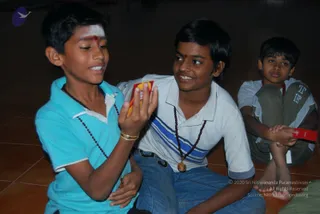
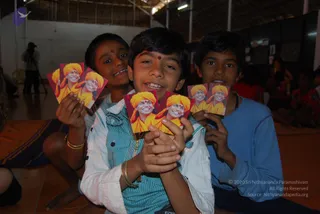
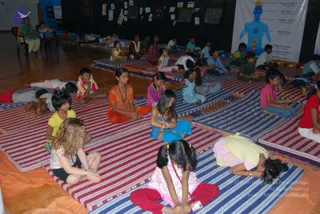
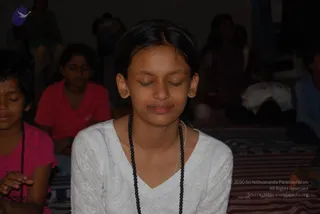
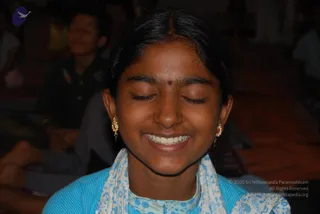
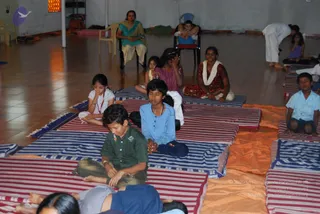
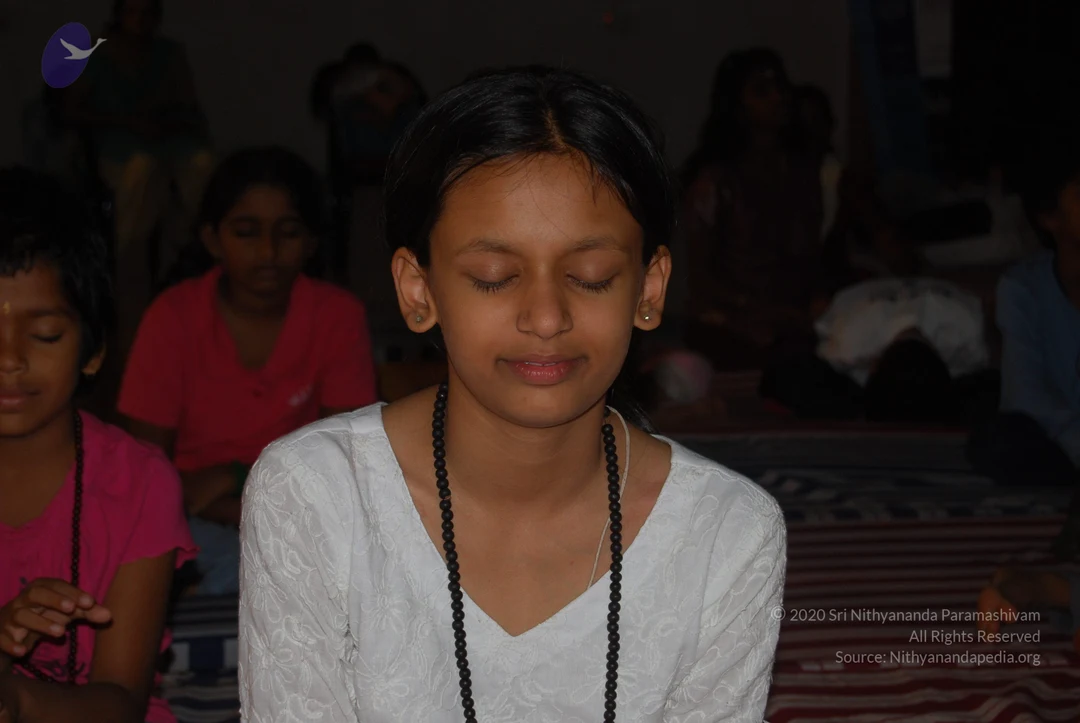
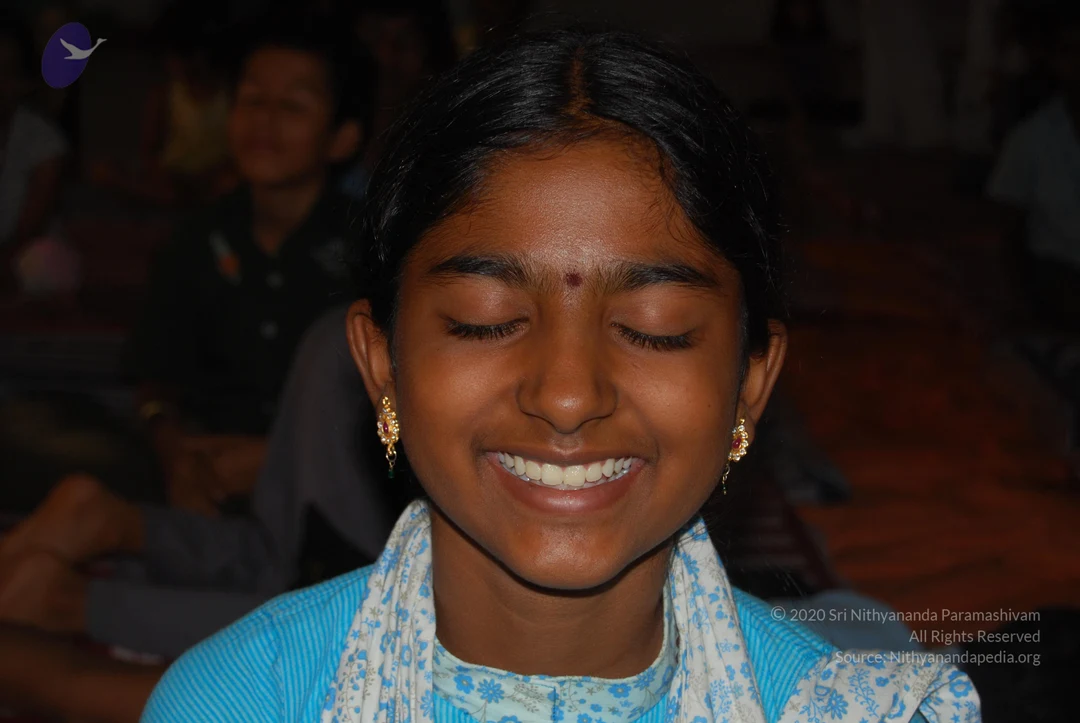
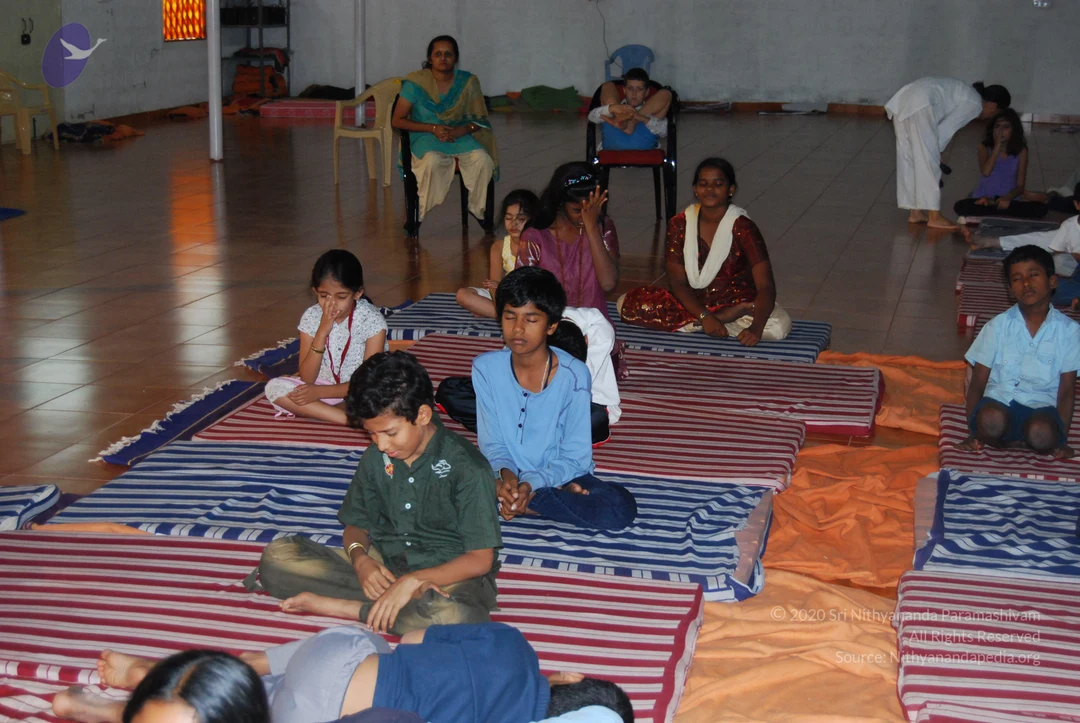
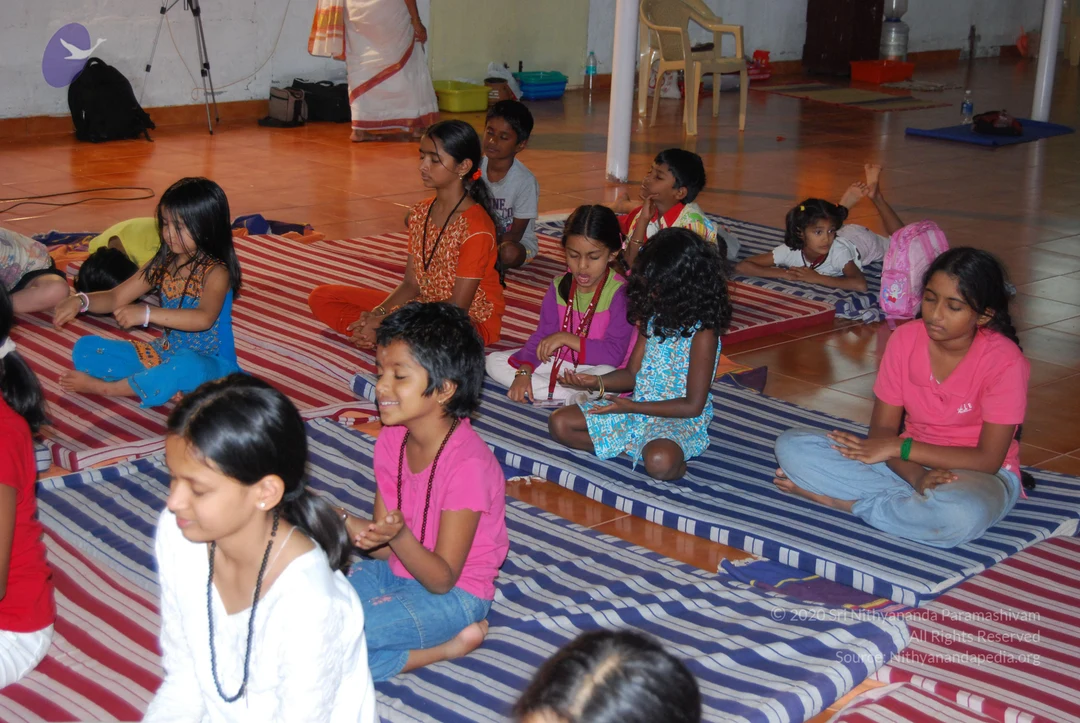
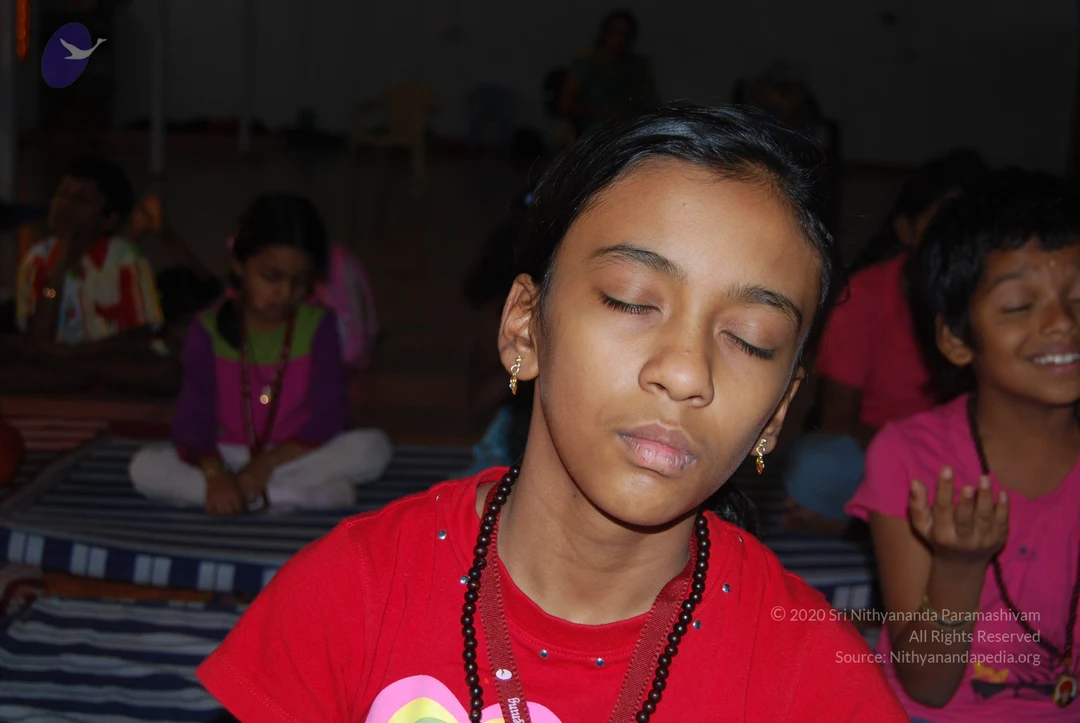
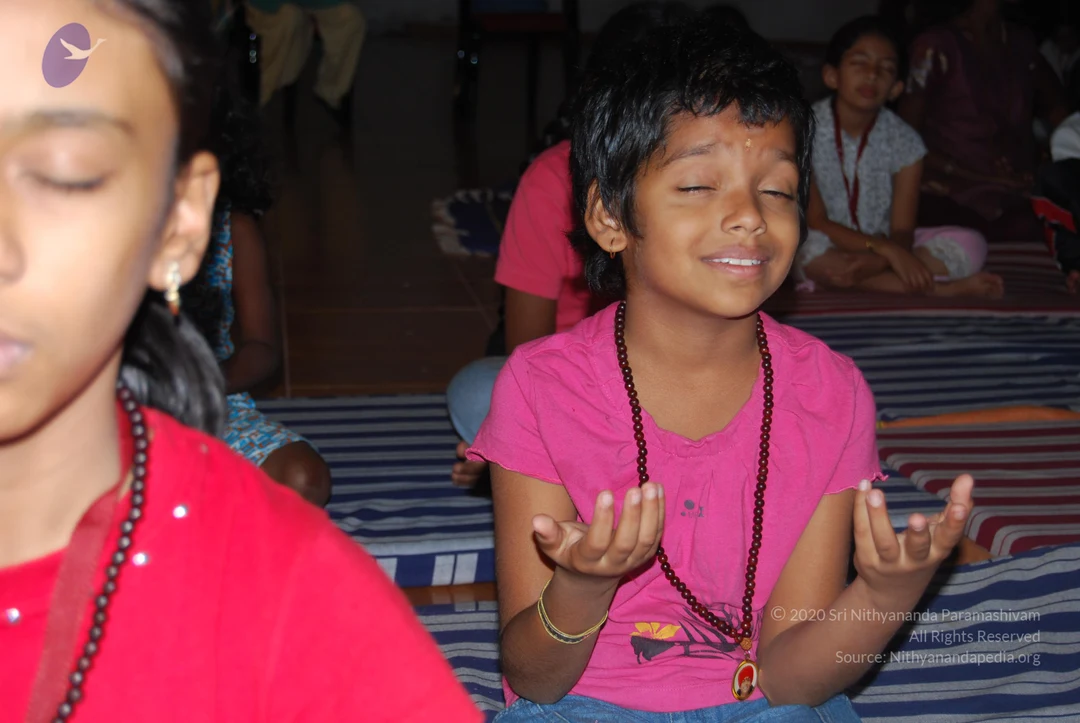
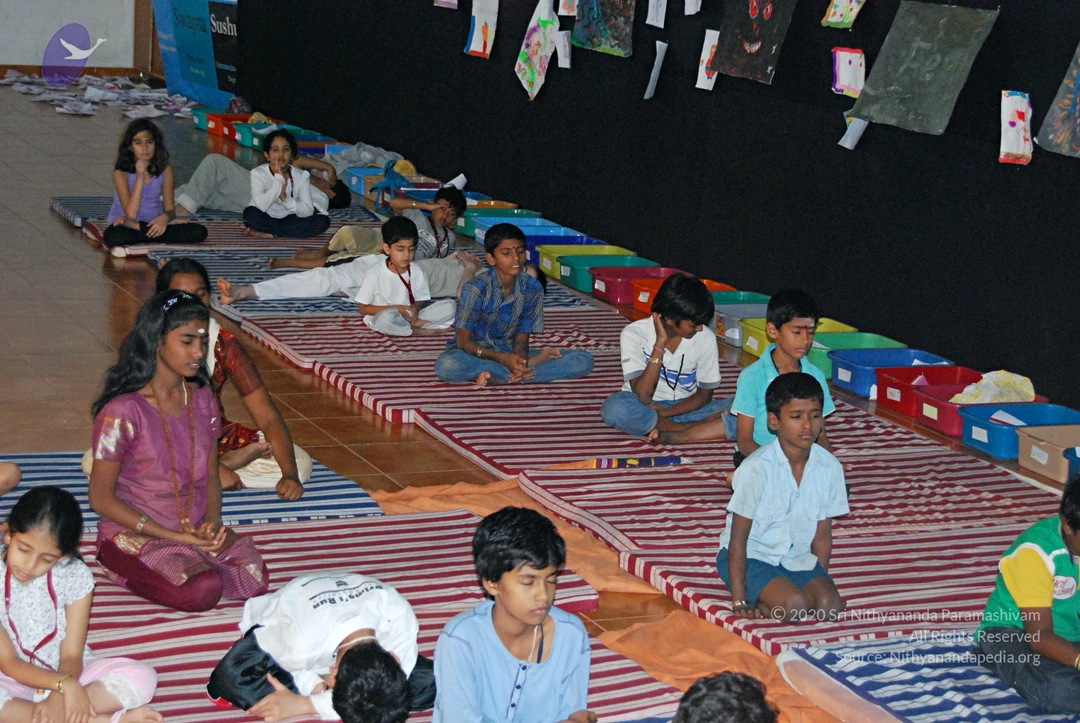
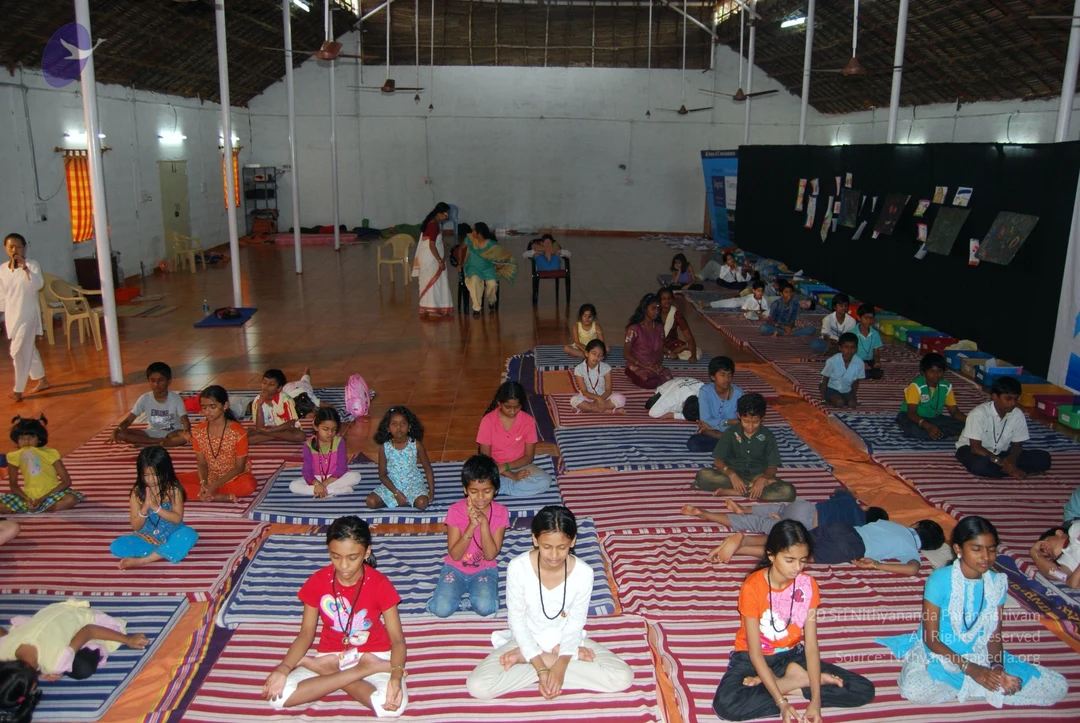
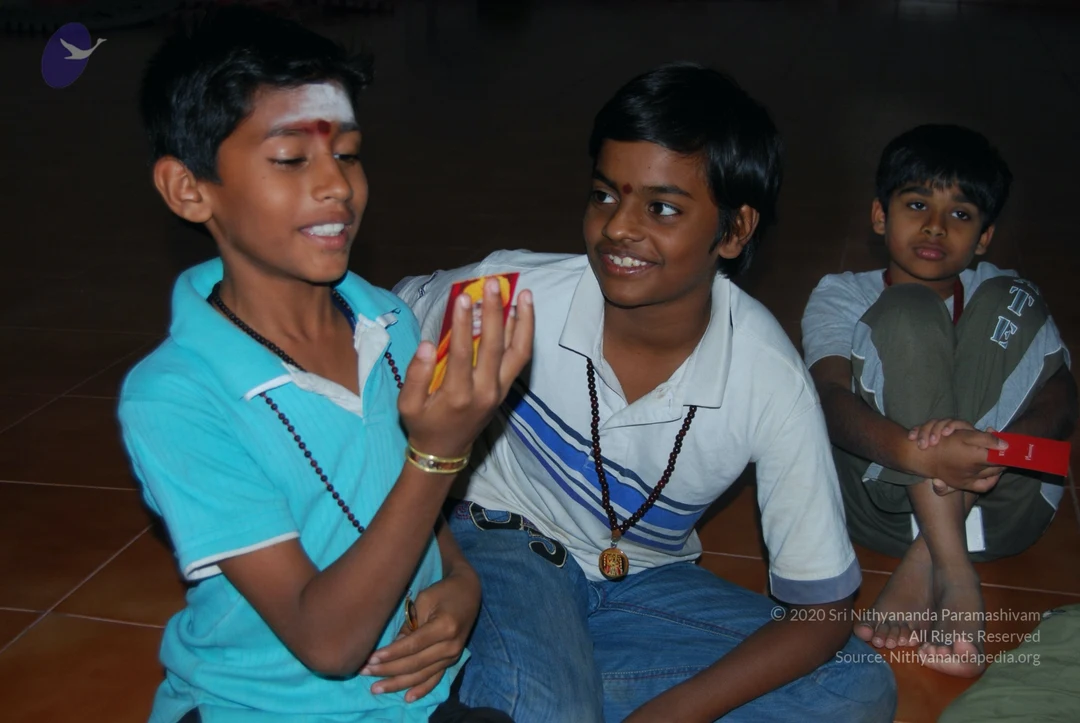
Three boys sit on a tiled floor indoors. The boy on the left wears a turquoise polo shirt, a dark rudraksha-style mala and a gold bracelet, with white sacred ash and a red bindi on his forehead; he holds up a small red and yellow card. The boy in the middle wears a white striped polo, blue jeans, a dark mala and a gold pendant, and smiles toward him while holding a red card. The boy on the right, in a grey top and olive shorts, sits cross-legged and holds a red card. No swami is visible in the frame.Three boys sit close together in a hall, smiling and holding up small printed cards of a smiling woman in a bright orange-yellow head wrap and orange garment. The boy in the centre wears a white jacket over a green-and-white striped shirt with a red bindi and gold bangles; the boy on the left has a red bindi and holds the cards; the boy on the right wears a blue long-sleeved top. Behind them, a cameraman films on a tripod and other people sit on an orange floor covering. The cards show a woman's portrait, not a physical person, and the image is a photograph.A photograph of a hall where a group of children and some adults sit on striped blue and red floor mats practising yoga and meditation. Many people sit cross-legged with eyes closed or hands folded, while a girl in pink and white bends forward in the foreground and a girl in orange kurta sits upright near the center. A woman in a green sari sits on a chair at the upper left. On the right wall a blue chakra chart shows a human figure with labeled energy centres, including Sahasrara chakra, Ajna chakra, Vishuddhi chakra, Anahata chakra, Manipura chakra, Svadhisthana chakra and Muladhara chakra, with small coloured artworks pinned on the dark wall above. Orange cloth lies on the floor at the edges.Dimly lit hall with seated devotees during meditation or satsang. In the foreground a young girl in a white embroidered top and black beaded mala sits with eyes closed and a calm expression. To her left a girl in a pink top, also with eyes closed, holds her hands together in her lap. Behind them more seated people in red, pink and light clothing are visible on striped mats, with a small golden mark on one forehead.Close-up photograph of a smiling young girl with her eyes closed, seated in a meditative state during a satsang. She wears a small red bindi on her forehead, gold earrings with red stones, a blue top and a white scarf with blue floral print. Blurred seated attendees and warm-toned surroundings are visible in the background.A hall with a tiled floor where children and young people sit cross-legged on striped red-and-blue mats over orange cloth, eyes closed in meditation. A boy in a green shirt and khaki trousers sits in the foreground with hands resting on his knees, and a boy in a blue long-sleeved top sits with palms joined. A girl in a pink top and a woman in a teal sari sit on a chair at the back, with another woman in a red-brown dress nearby. A person in white clothes bends over at the far right, and a sign or caption in the corner has a small bird logo. The walls are white and a red-and-yellow panel hangs at top left, with no visible figure of a person.
03

3-En-Genius-Vedic-Arts

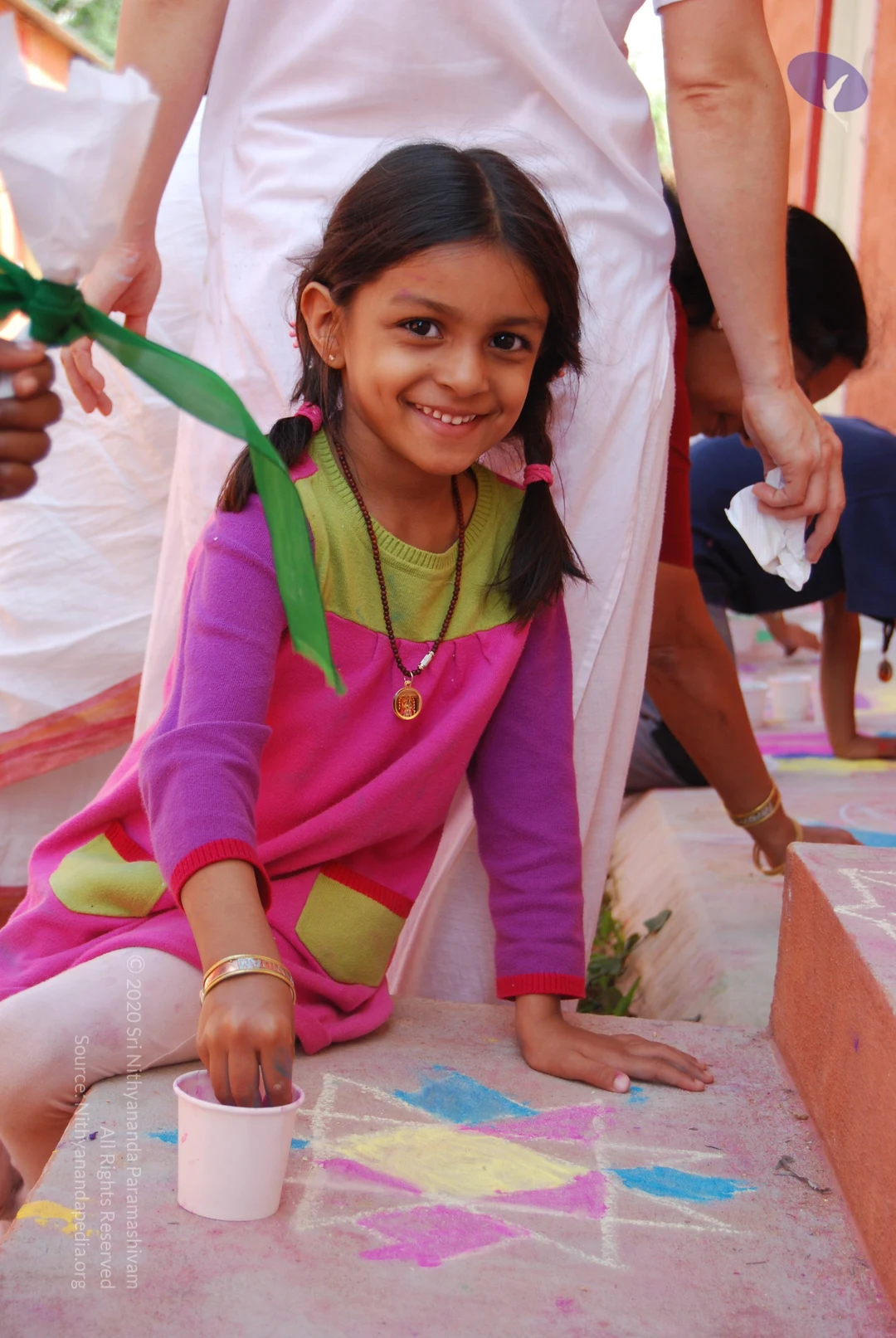
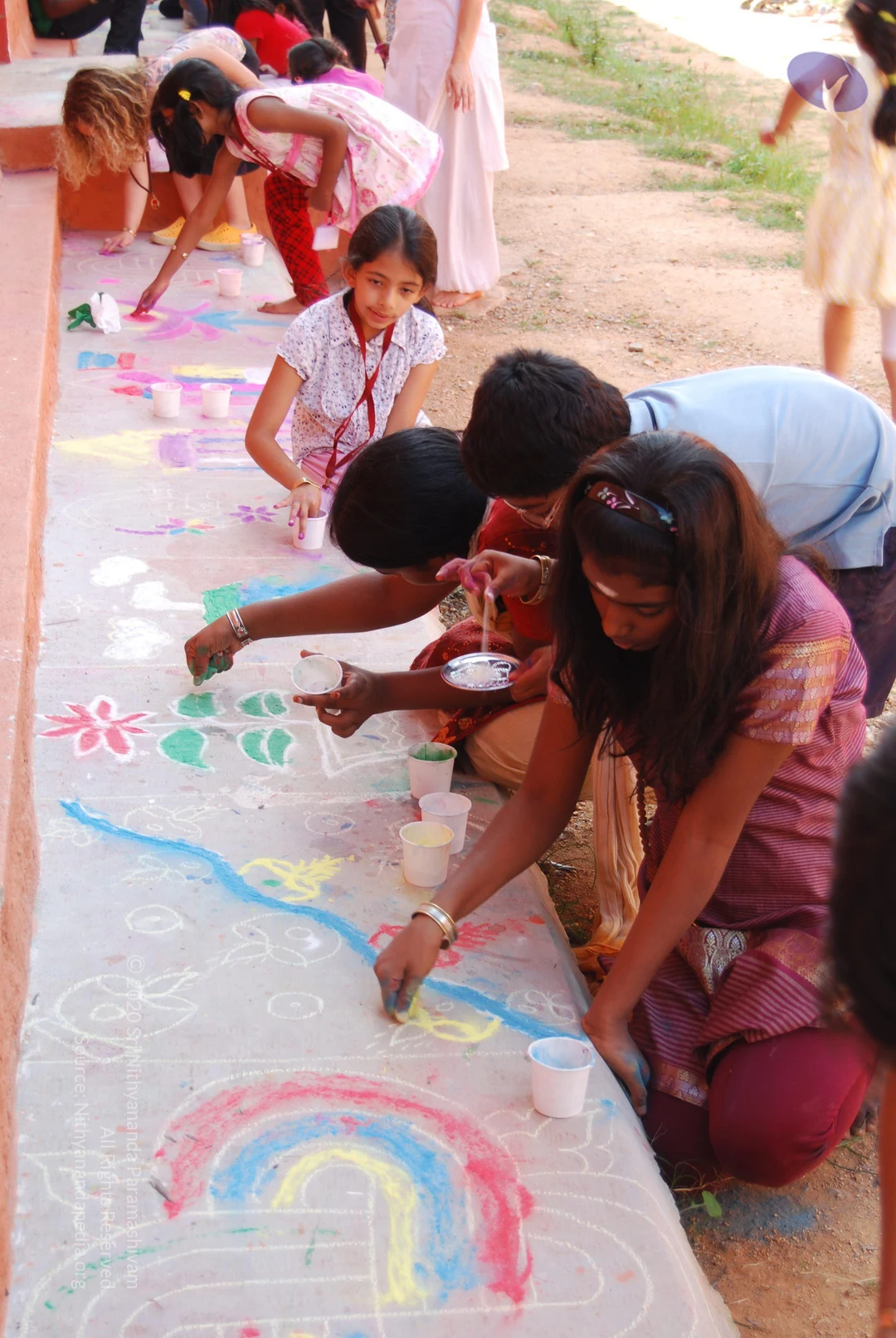
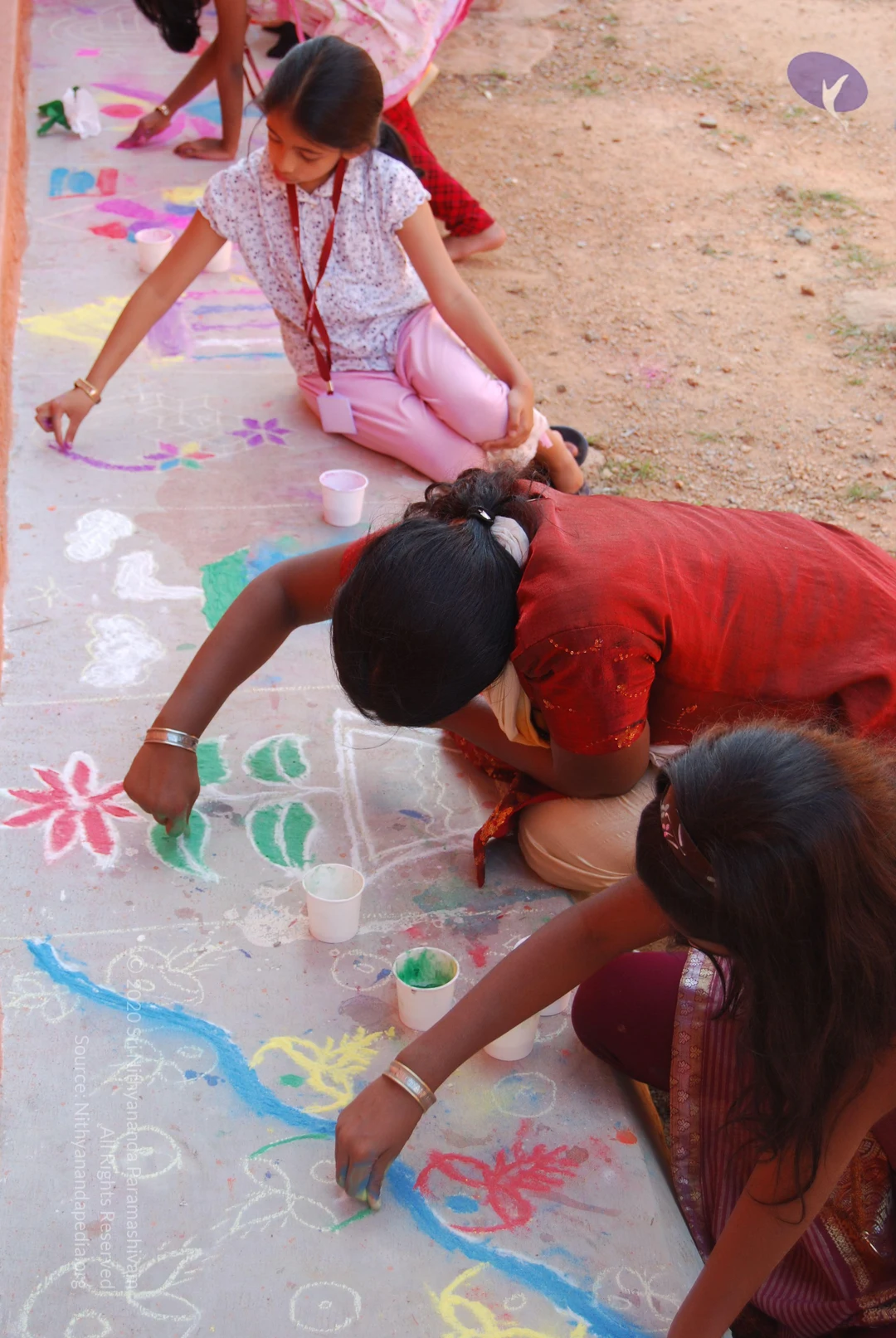
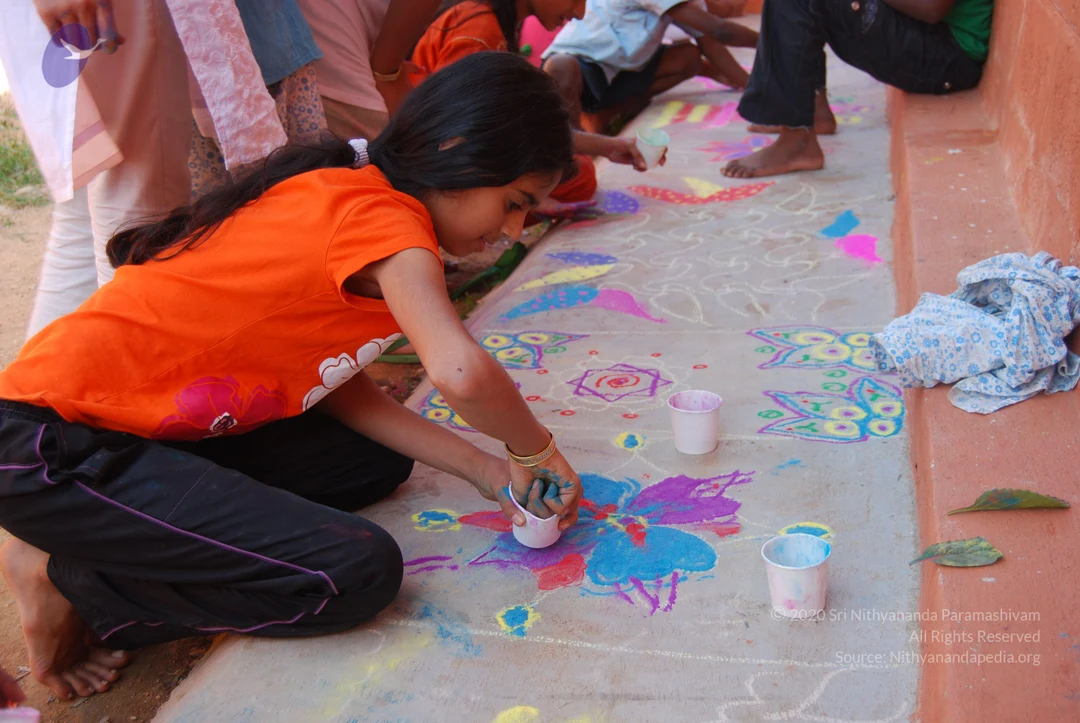
27 dated photos in previewSource gallery
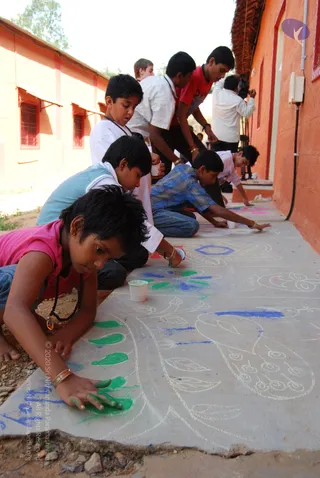
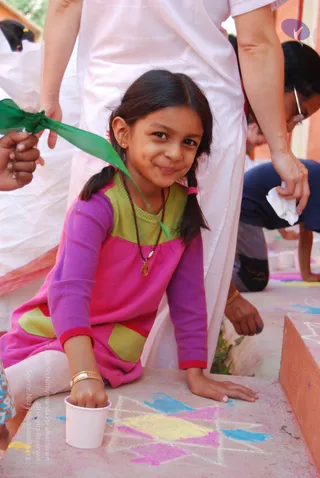
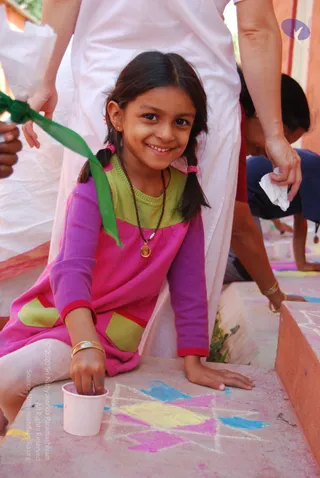
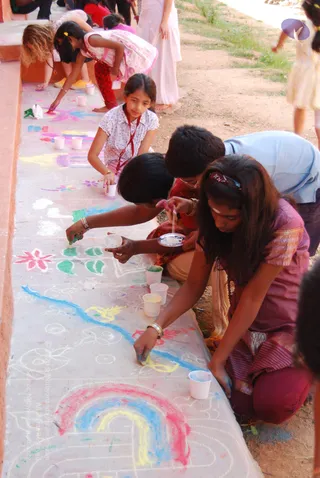
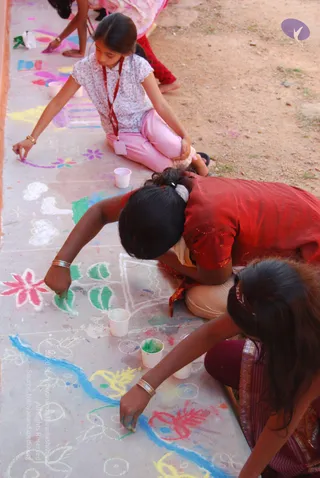
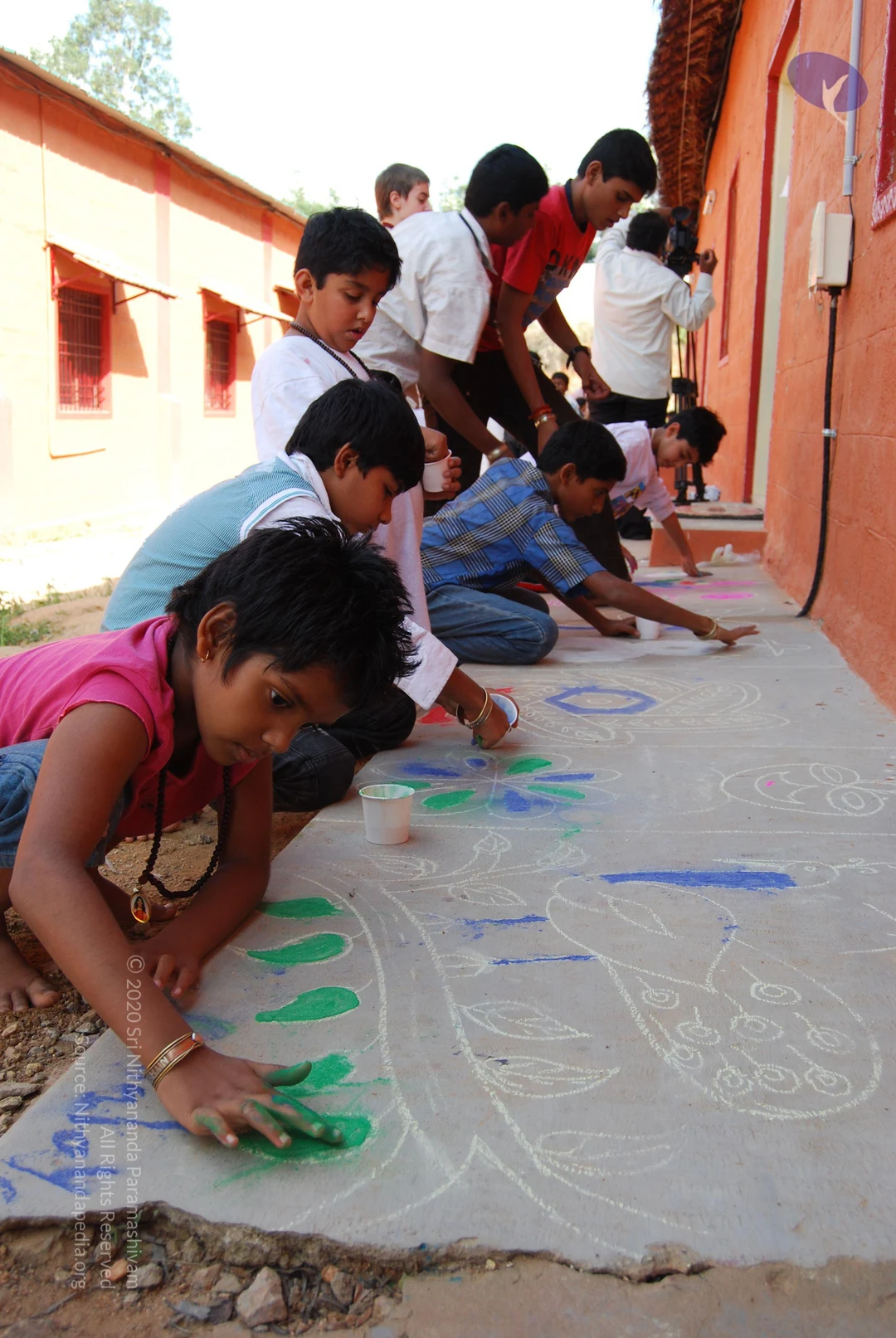
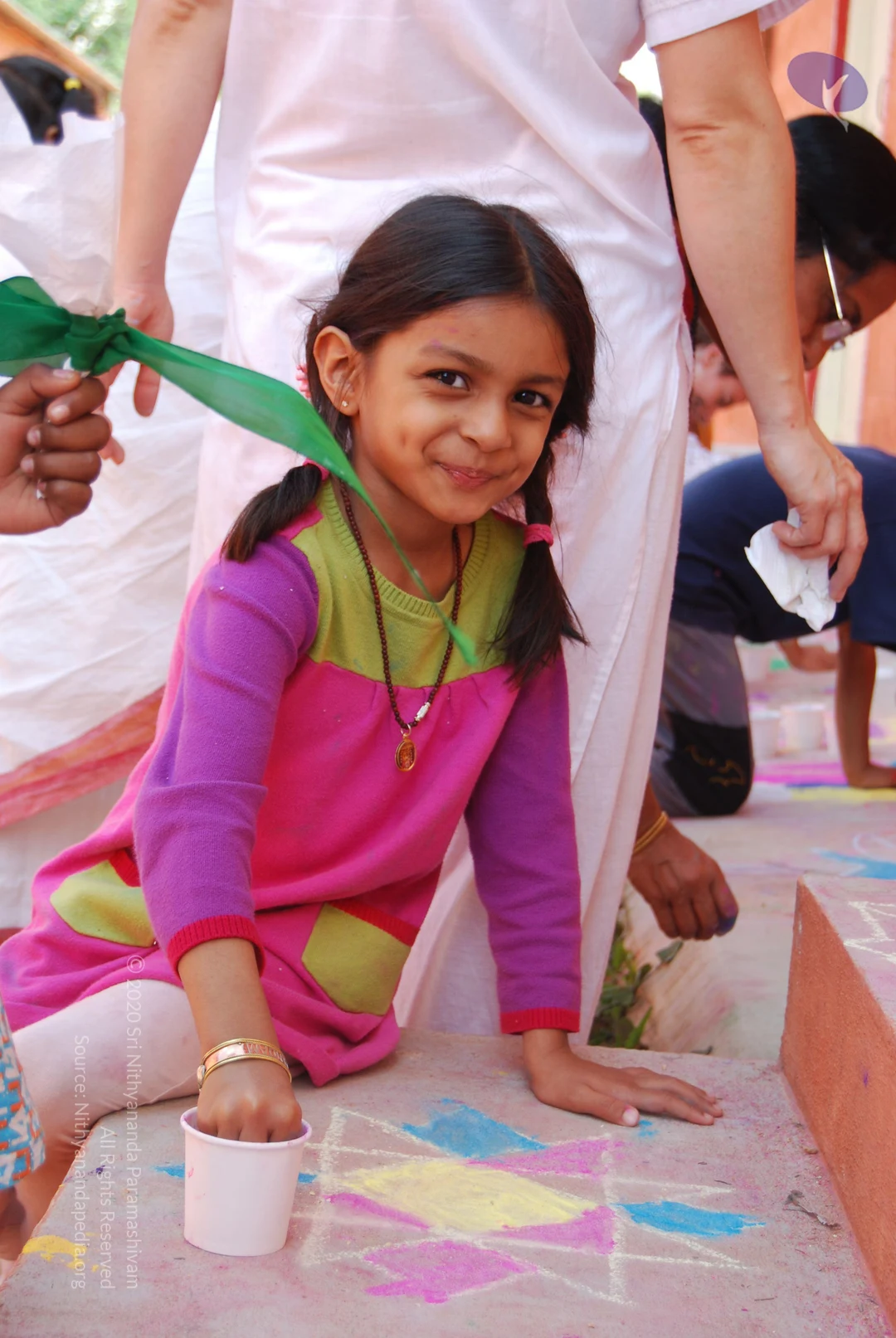
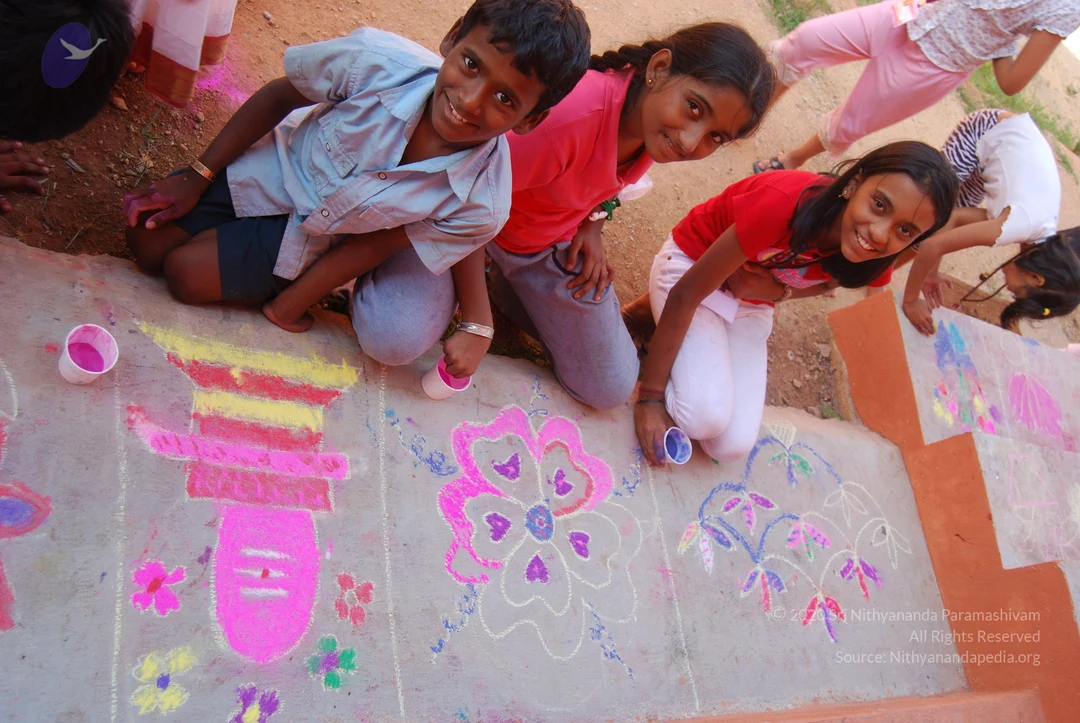
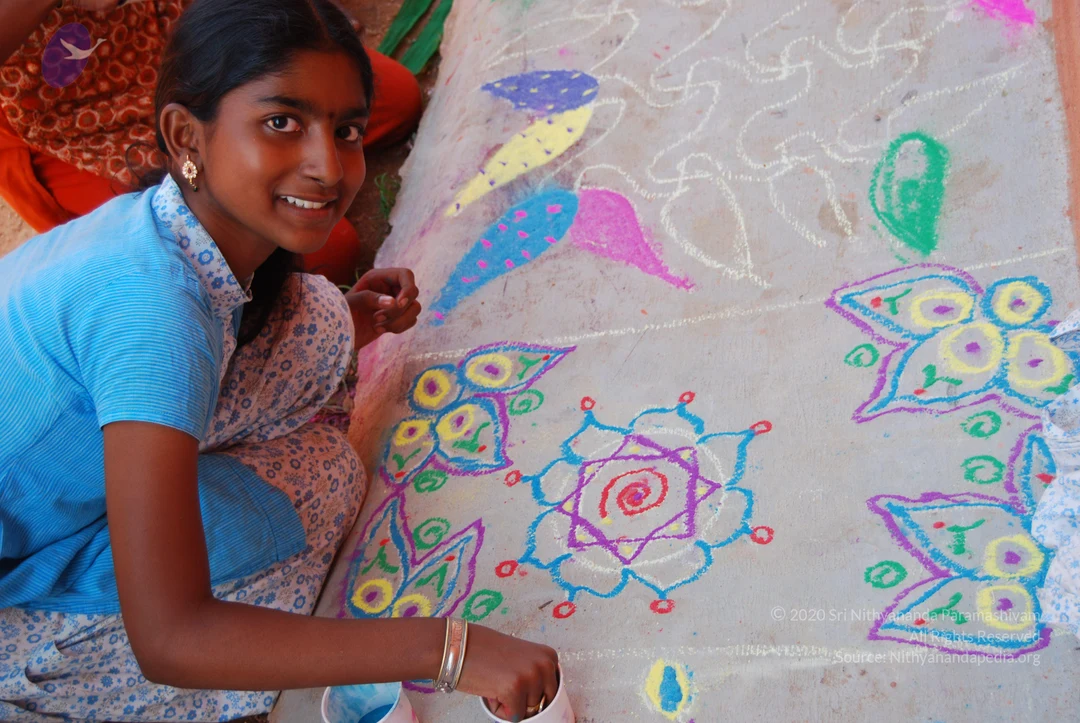
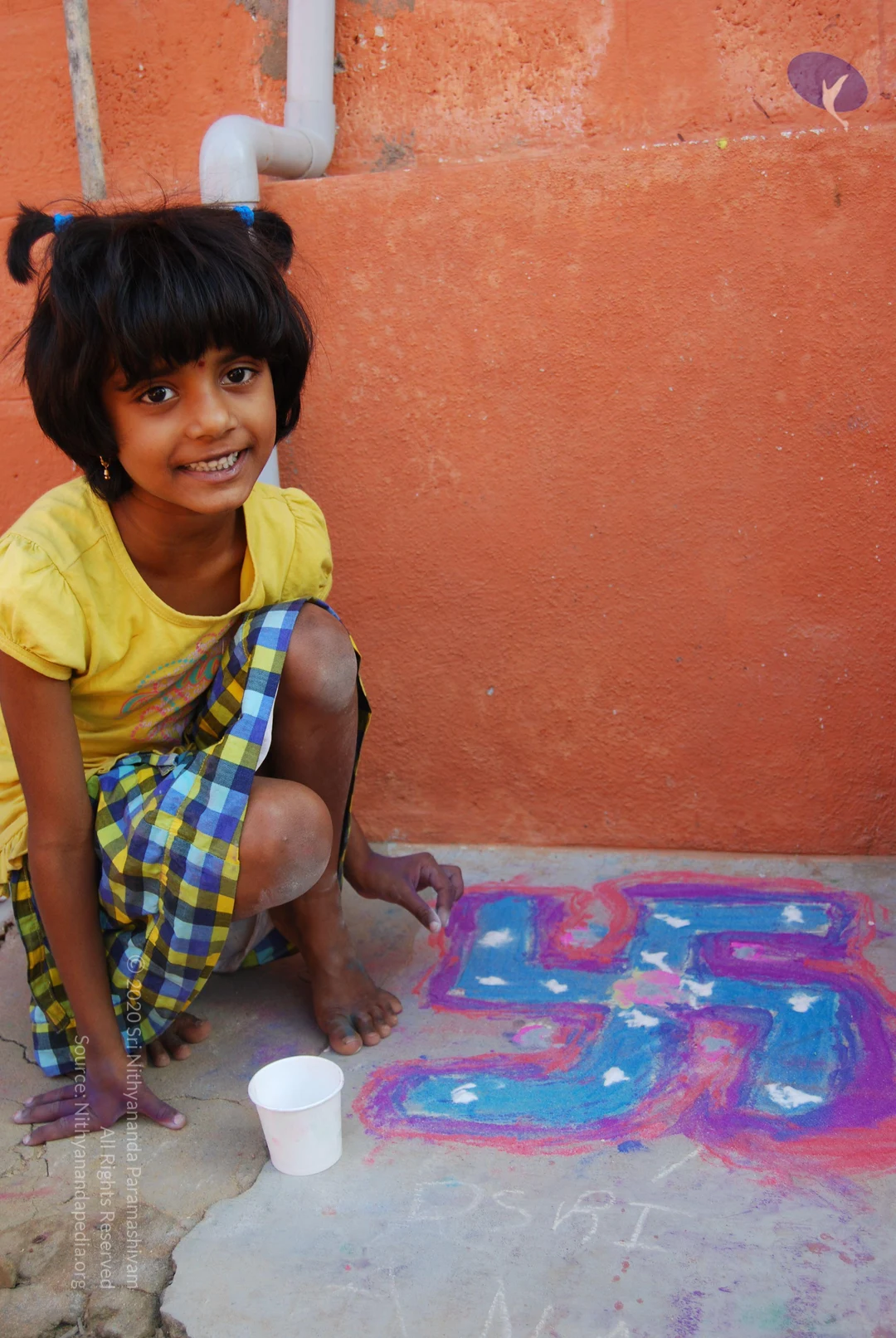
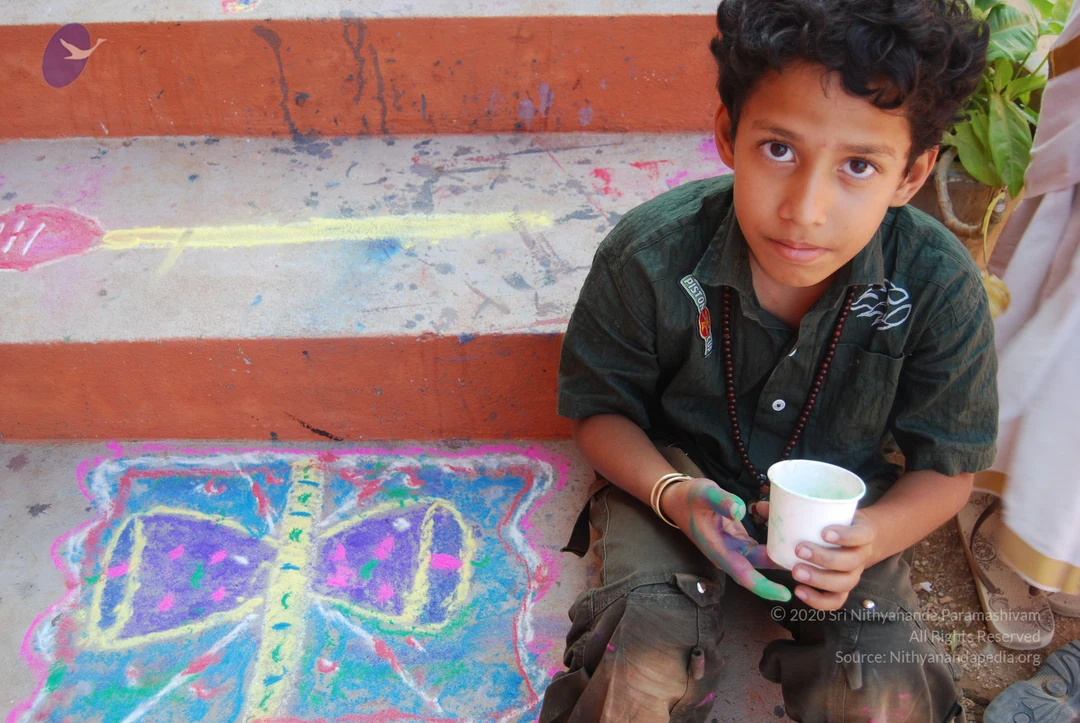
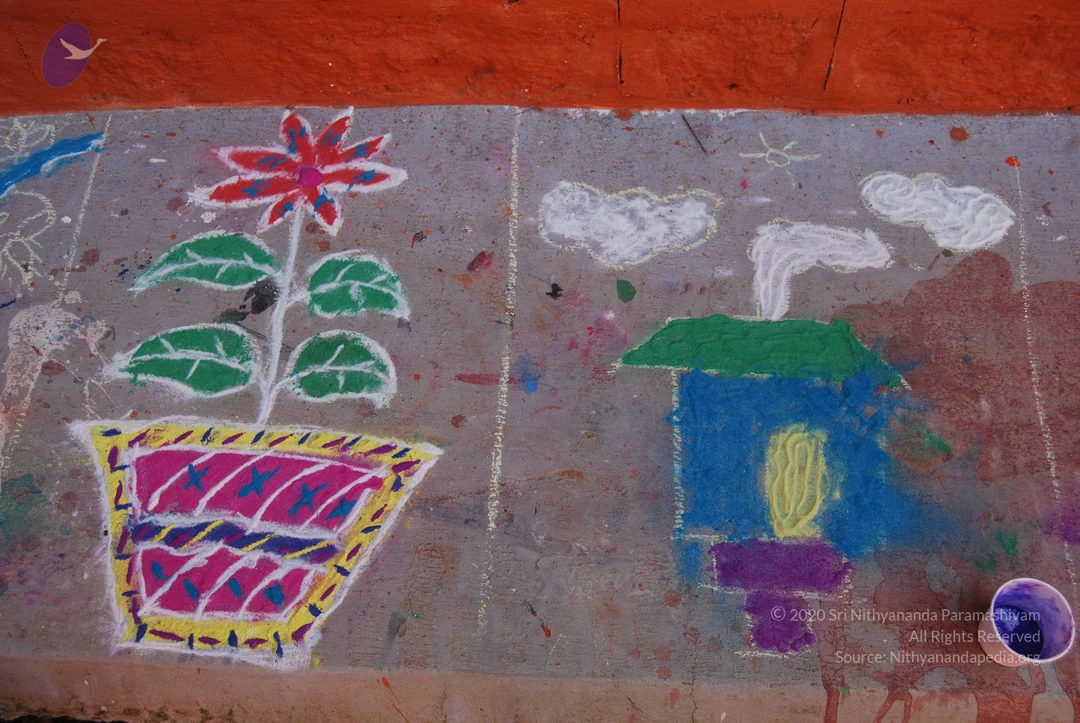
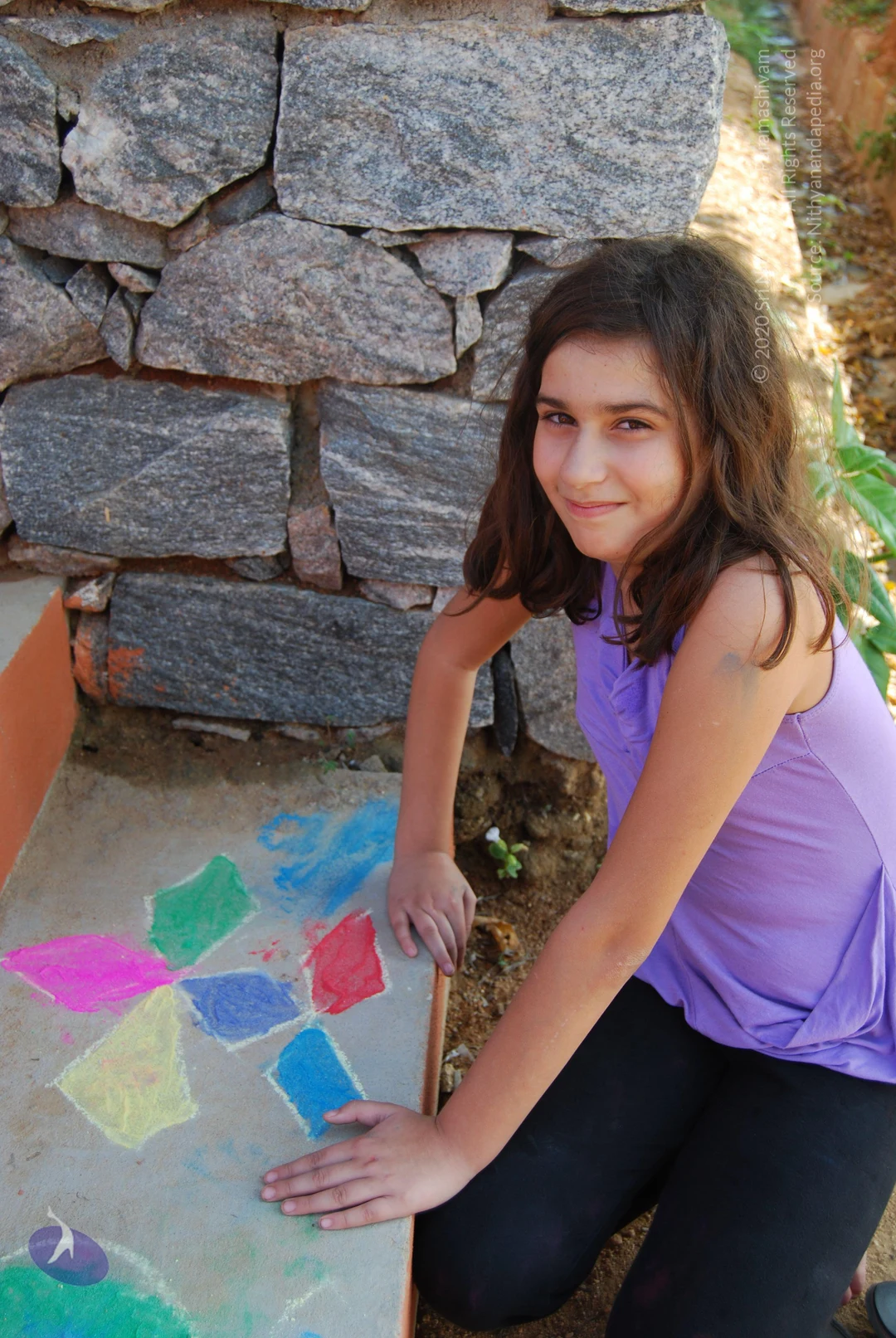
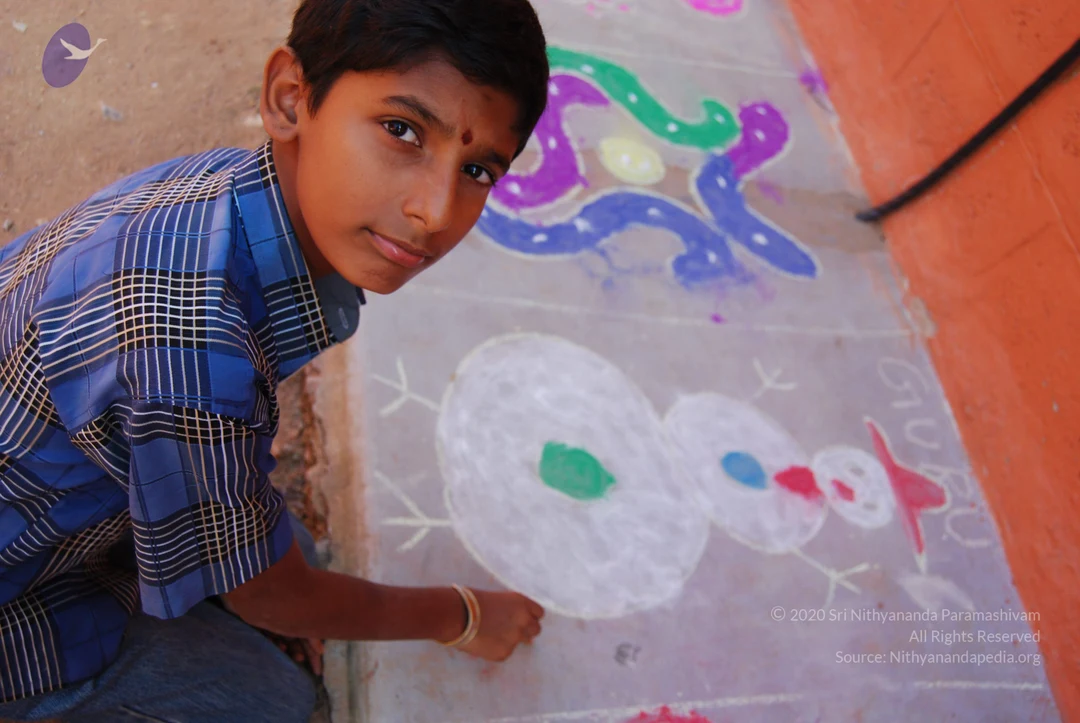
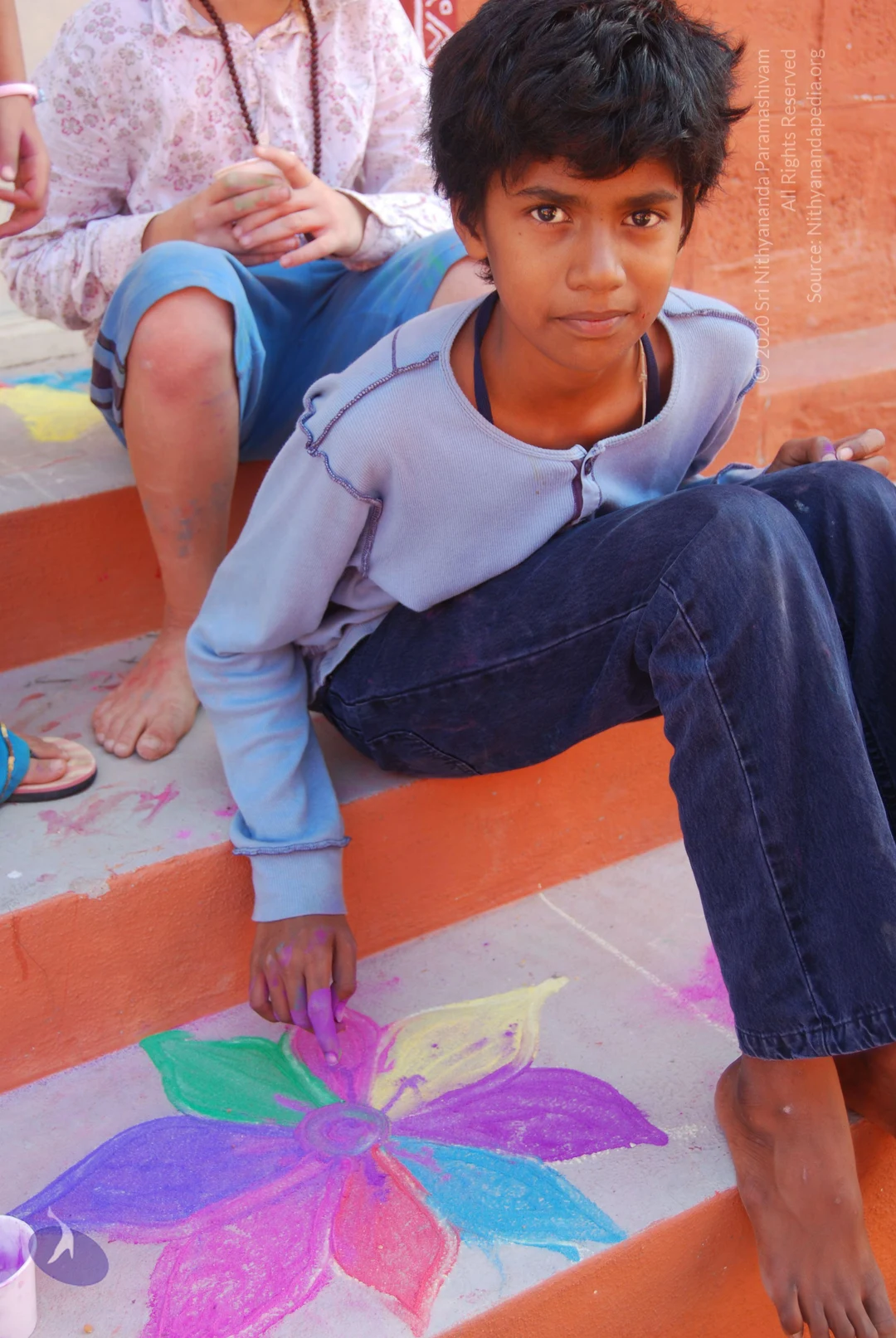
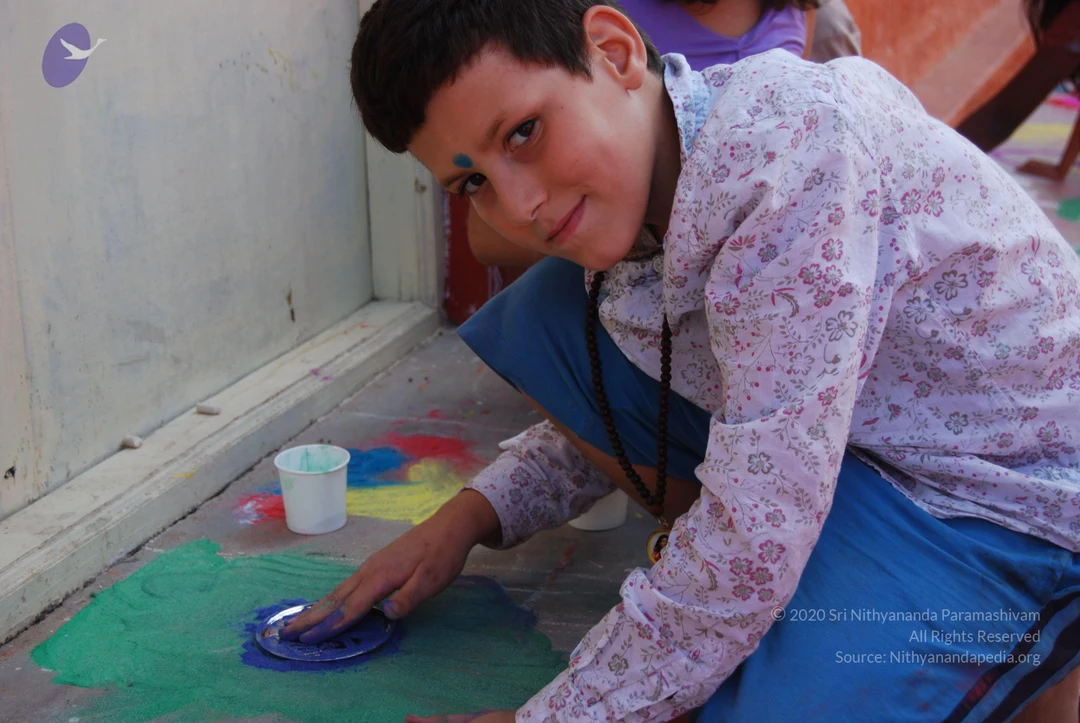
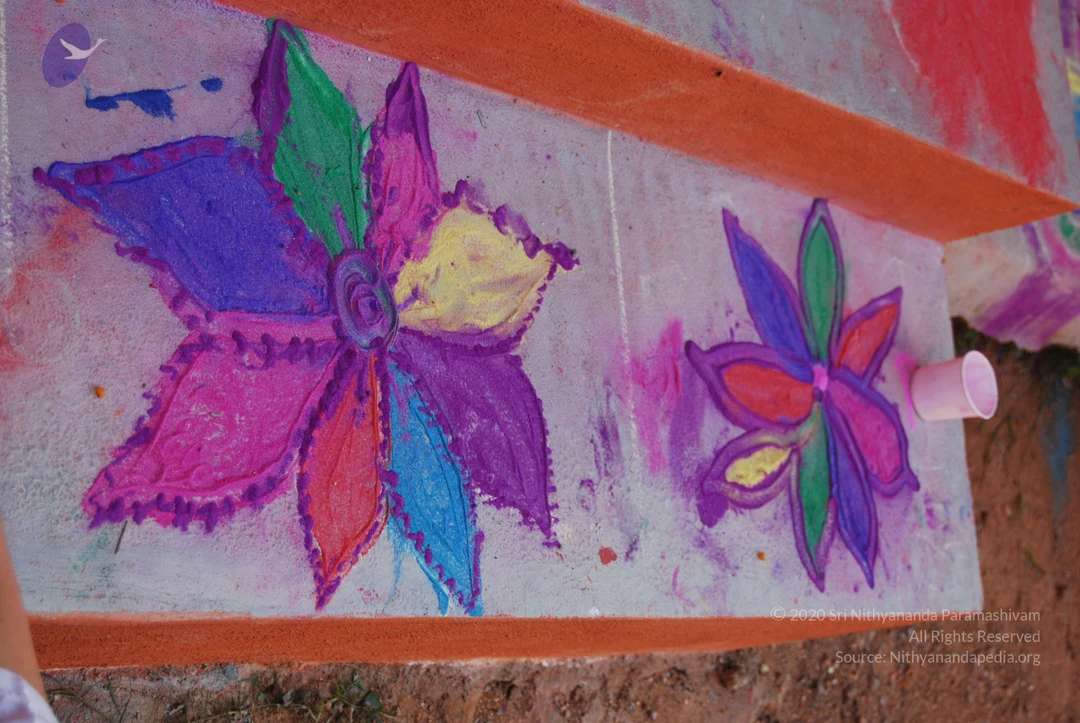
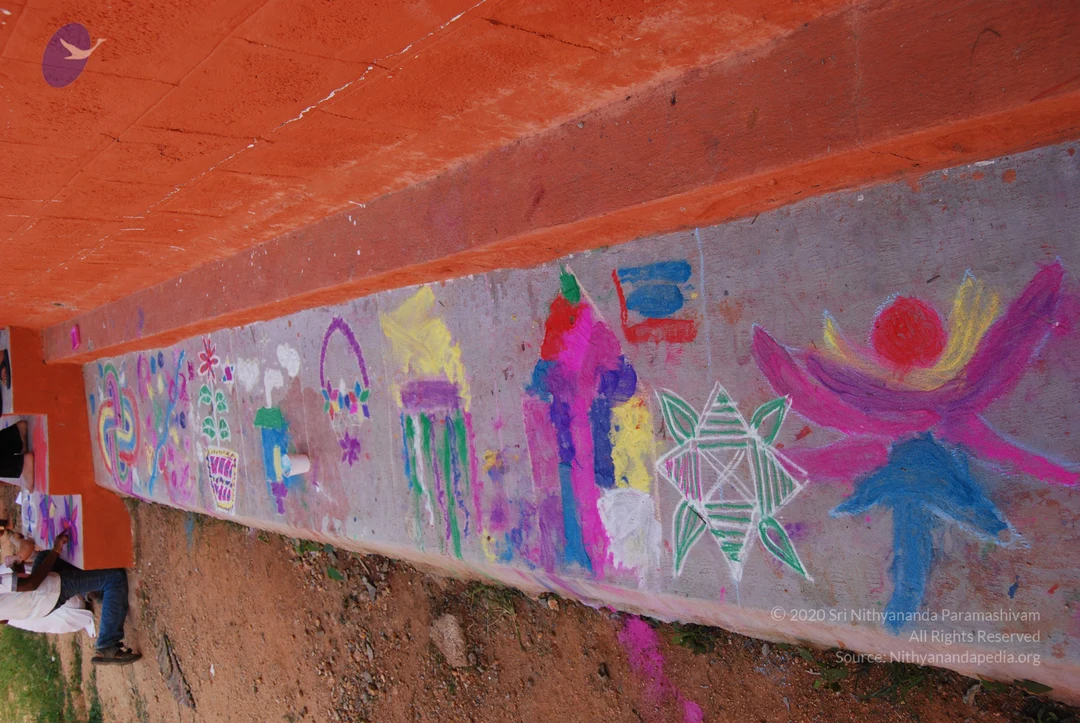
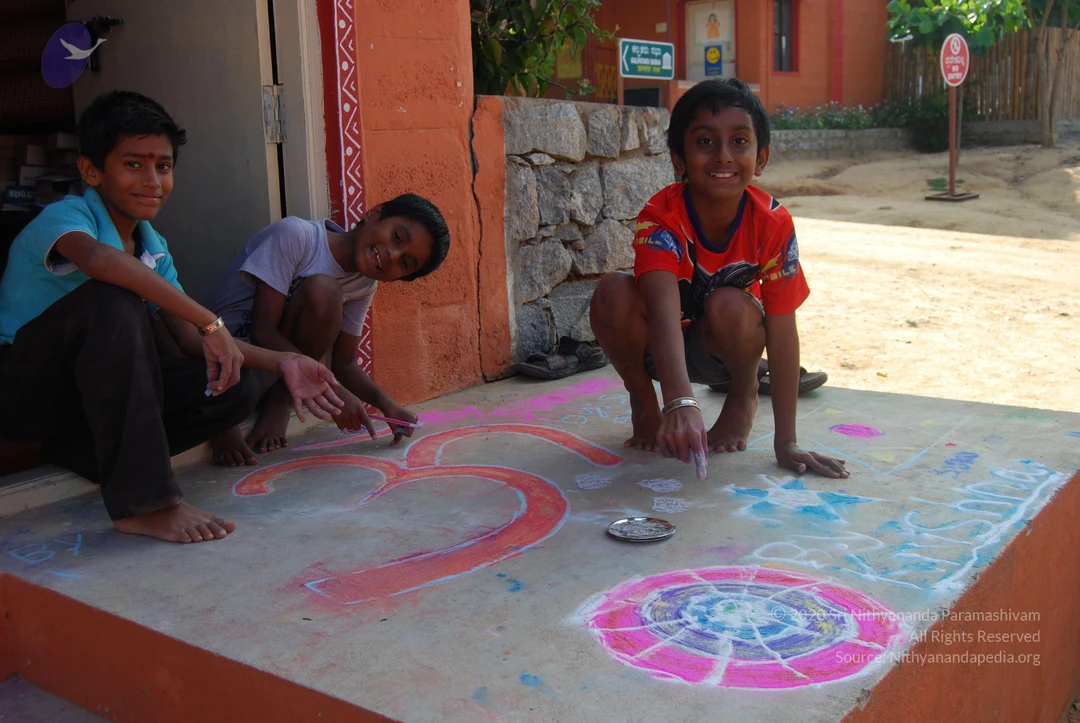
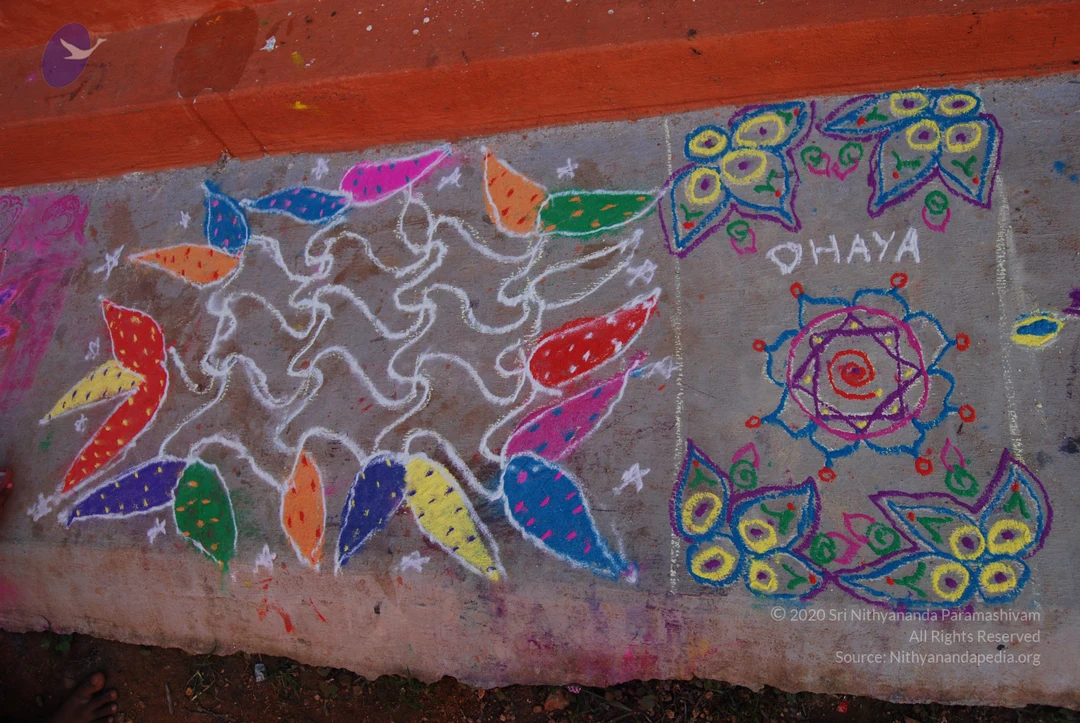
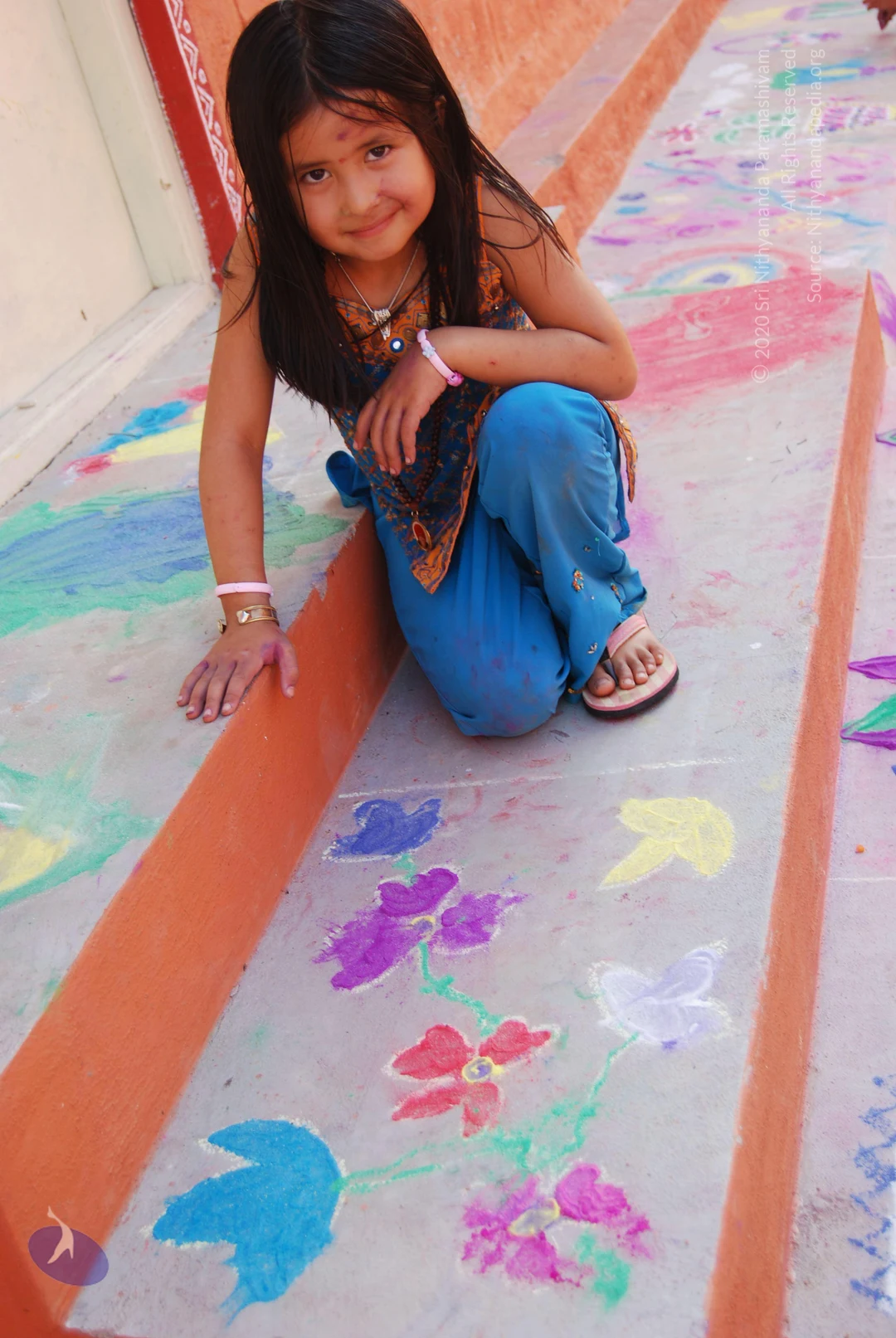
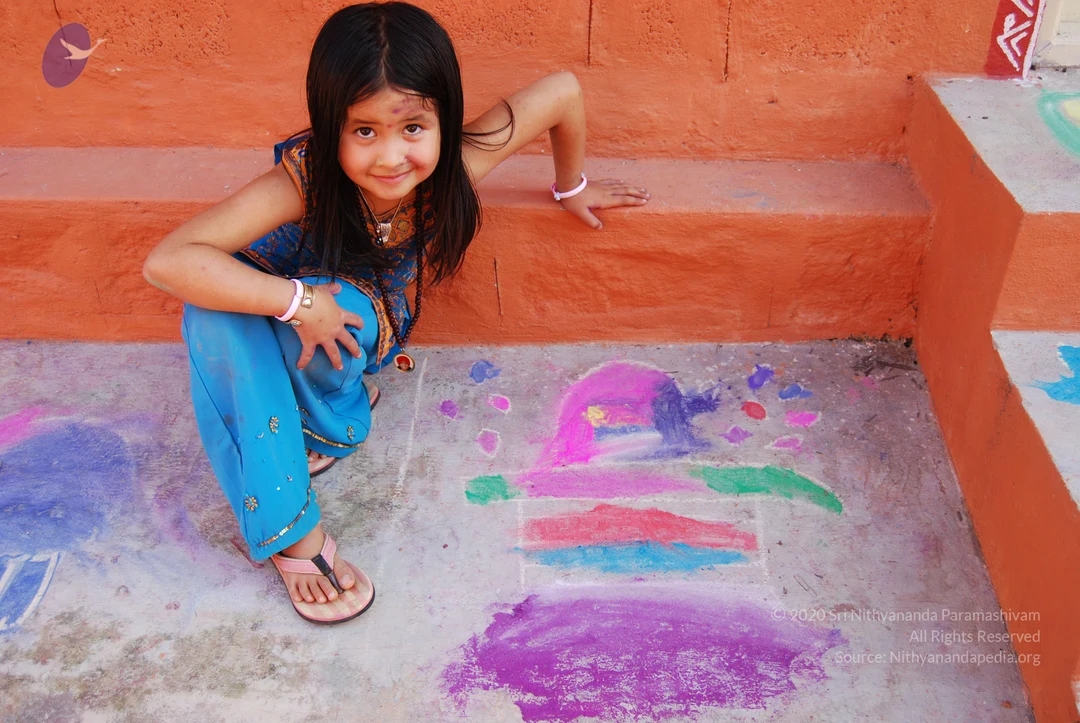
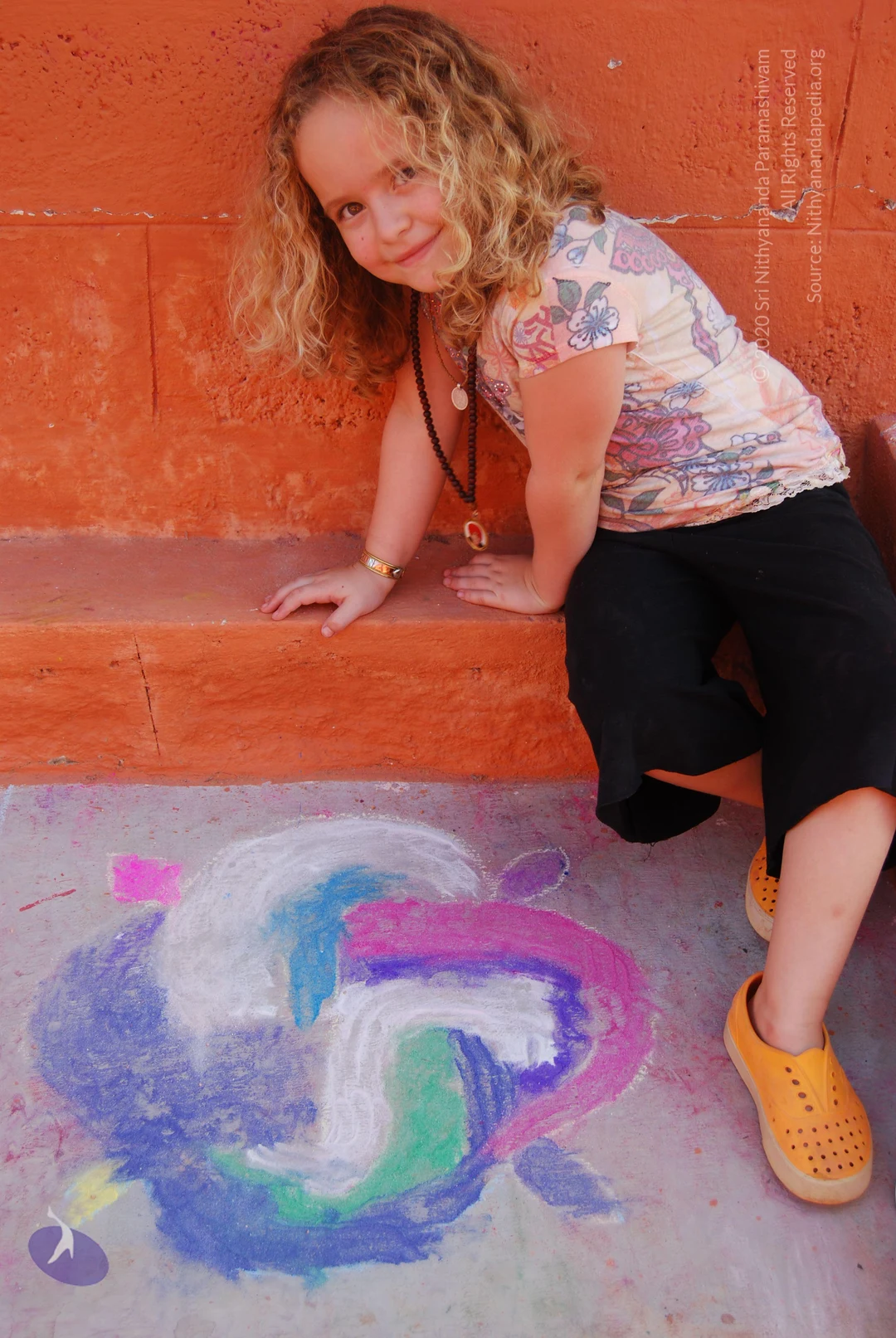
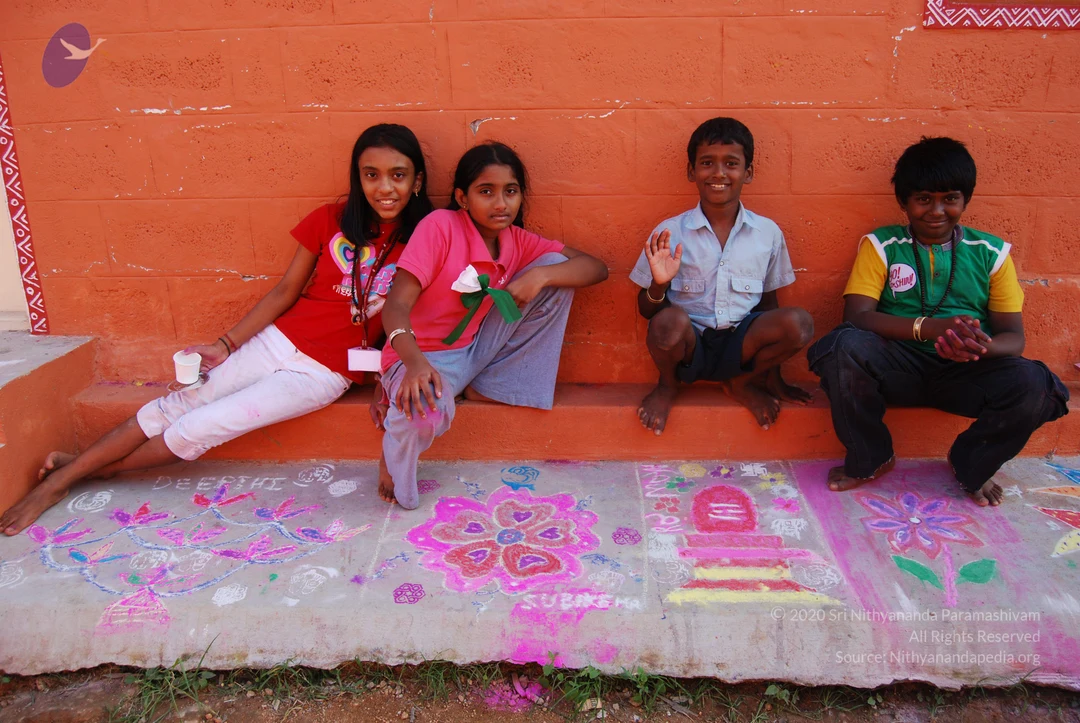
Several boys kneel and crouch along a concrete walkway beside an orange-washed building, painting a large chalk-outlined floral and peacock-style design with green and blue paint. The foreground boy in a pink t-shirt and a dark beaded mala presses his green-painted hand onto the ground. Behind him a boy in a blue plaid shirt and others in white kurtas and red t-shirts lean over the drawing, and a cameraman on a tripod films from the right. Paint cups sit on the concrete among the outlines, and a thatched roof edge shows at the top right.A smiling young girl with dark hair in two low pigtails kneels on a concrete step outdoors, wearing a pink, purple and lime-green sweater dress with a brown rudraksha-style bead mala and a small pendant. She holds a white paper cup of coloured powder beside a chalk or powder floor design in yellow, blue and pink. Behind her, a person in white clothing stands and another person in dark clothing bends over the floor, drawing or decorating. A green ribbon trails from a hand at the left edge.A smiling young girl with two dark braids sits on a pale stone step, leaning forward while she dips her fingers into a small white paper cup of coloured powder. She wears a pink and purple sweater-dress with green panels, a wooden rudraksha-style bead necklace with a small gold pendant, and gold bangles. Beside her on the step she has traced a chalk-outlined geometric design filled with yellow, pink and blue powder. Behind her, a person in white clothing stands, and other people in the background kneel and work on similar coloured designs on the ground. A green cloth strip is tied to the left edge of the frame.Photo of young participants decorating a concrete ledge outdoors with coloured powder rangoli. Several people kneel and lean along the ledge, pouring pastel powders from small white cups and a metal plate into white-outlined patterns of flowers, leaves and a rainbow arc in pink, blue, yellow and green. A girl in a white floral top and red lanyard watches closely at center, while a young woman in a maroon striped kurta with a headband works at the right foreground. A man in a light blue shirt bends over the design behind them, and more people in pink and white clothing stand or crouch further back on dirt ground with green grass at the edge.Girls and young women sit on a concrete ground painting colourful rangoli-style floor designs with chalk and coloured powder. In the foreground a girl in a red top with a hair tie bends over the design, dipping her fingers into a small white cup of green colour and filling in green leaf-like shapes beside a pink flower outline. Another girl in a maroon salwar with bangles works in front of her, using blue and red colour, while a girl in a white floral blouse, pink trousers and a red lanyard with an ID badge paints a purple flower in the upper left. Empty white paper cups of colour sit on the ground between them, and bare dirt lies beyond the paved area.A girl in an orange t-shirt and black track pants kneels on a concrete path, painting a colourful flower rangoli design with powder held in a small white cup. Her hand is stained with blue and pink colour. Nearby, other children sit along the edge of an orange-red step painting similar floral and lotus-style patterns in yellow, pink, purple and blue. Additional white paint cups sit on the concrete, and a folded blue floral cloth lies on the step.

December 12 2010

Original wiki page
Contents

Title

Ashtanga Yoga - Yama: Patanjali Yoga Sutras 81 - Nithyananda Morning Satsang 12 Dec 2010
Narration

The Supreme Pontiff of Hinduism, Jagatguru Mahasannidhanam, His Divine Holiness, Bhagavan Nithyananda Paramashivam, expounded on the Cosmic Principles of Patanjali Yoga Sutras during the live public talk - Nithyananda Satsang. In this talk entitled Ashtanga Yoga 3: Yama: Patanjali Yoga Sutras 81, The Supreme Pontiff of Hinduism shared that the whole world is in this one Sutra where Yama is both the law and the energy which executes law. He explained that our Masters’ understanding of the original Truth, both law and execution are not two different energies and as long as you think they are separate, there will be constant conflict. He shared that you need to have a clear understanding about the ultimate Truths that human beings are beyond body and based in Consciousness and without this Ultimate understanding you will always understand law and execution as two things. First thing, He said, is that human beings need to experience higher states of Consciousness then law and order will be in order.

Today during Day 12 of the Inner Awakening Program, the delegates experienced multiple Sessions with His Divine Holiness: The Power of Will over Memory, Nithyananda Speaks - Learn how to Handle a Kingdom, Nithyananda Speaks - Learn how to Handle a Kingdom, Nithyananda Speaks - Are you a Devotee or a Disciple? and Nithyananda As He Is - HDH shares His First Roller-Coaster Ride Experience.

Video and Audio

Ashtanga Yoga - Yama: Patanjali Yoga Sutras 81

VideoAudio

Title:

Nithyananda Speaks - What to choose? Home OR Sanyas || IA || 12 Dec 2010

Description

Name Of The Convention: Inner Awakening
Session on: Nithyananda speaks-What to choose? Home OR Sanyas
Date: 12 December 2010
Venue: Adi Kailasa, Bengaluru, Karnataka, India

In this video Supreme Pontiff of Hinduism HDH #Nithyananda Paramashivam guided delegates into cognizing that when we let go of all the past, present and future memories we open our possibilities to new probabilities in life and become better in all phases of our lives.

Video

VideoAudio

Title:

Nithyananda Speaks - Learn how to Handle a Kingdom || IA || 12 Dec 2010

Description

Name Of The Convention: Inner Awakening
Session on: Nithyananda Speaks - Learn how to Handle a Kingdom
Date: 12 December 2010
Venue: Adi Kailasa, Bengaluru, Karnataka, India

In this video Supreme Pontiff of Hinduism HDH #Nithyananda Paramashivam guided delegates into cognizing that when we let go of all the past, present and future memories we open our possibilities to new probabilities in life and become better in all phases of our lives.

Video

VideoAudio

Title:

Nithyananda Speaks - Erase All Your Memory || IA || 12 Dec 2010

Description

Name Of The Convention: Inner Awakening
Session on: Nithyananda Speaks - Erase All Your Memory
Date: 12 December 2010
Venue: Adi Kailasa, Bengaluru, Karnataka, India

In this video Supreme Pontiff of Hinduism HDH #Nithyananda Paramashivam guided delegates into cognizing that when we let go of all the past, present and future memories we open our possibilities to new probabilities in life and become better in all phases of our lives.

Video

VideoAudio

Title:

Nithyananda Speaks - Are you a Devotee or a Disciple? || IA || 12 Dec 2010

Description

Name Of The Convention: Inner Awakening
Session on: Nithyananda Speaks - Are you a Devotee or a Disciple
Date: 12 December 2010
Venue: Adi Kailasa, Bengaluru, Karnataka, India

In this video Supreme Pontiff of Hinduism HDH #Nithyananda Paramashivam guided delegates into cognizing that when we let go of all the past, present and future memories we open our possibilities to new probabilities in life and become better in all phases of our lives.

Video

VideoAudio

Title:

Difference Between Disciple & Devotee

Video

VideoAudio

Transcript

0:13 (Questioner) “Does being unclutched mean that you don’t care about anything?”

Swamiji: No. You don’t care only about suffering.

(Questioner) “And if someone is physically or verbally abusing you how do you respond if you are unclutched?”

Swamiji: It’s like a … Your bio memory will not keep quiet. Automatically respond. But after that you will not carry the taste of vengeance and irritation, that’s all. The action itself will not be different. But the irritation, vengeance, suffering will not be there.

0:45 ...54, he’s asking the best technique to be practiced. Number 54. Unclutching. That’s all.

1:00 (Questioner) “Would you encourage having a Facebook group of all participants IA, LBE?

Swamiji: I’ll really encourage. Please go ahead and have a Facebook group. Form it today. Yes. Form it today. Evolve. Evolve my blessings for all good, friendliness, friendship, and encouraging growing spiritually. See, disciple-disciple relationship is always good if it creates more and more feeling connection with the master and the message and the life. It’s great. Disciple-disciple relationship is the worst sin if it is, what to say that - reduces your devotion towards the master. “If you are going to help me in my spiritual path, come. Otherwise get lost.” Otherwise, I encourage.

2:01 (Inaudible) Devi (name of a participant), the pains in the body don’t matter about, for the process. Actually, pains are created by the process only. So don’t worry about that at all.

2:13 Arundade, she’s asking about onion, green chili, garlic. It’s just natural steroid. That’s all. Nothing else. As a medicine garlic is good. But not as a food.

2:27 (Swamiji reading participants letters silently)

3:24 (music)

4:40 (Questioner) “Nirvikalpa samadhi - you are both thoughtless and breathless.”

Swamiji: No, it is not actually breathless. When videha samadhi only breathlessness happens. In nirvikalpa samadhi you become thoughtless but the breath will be there as long as the body is alive, prarabhda is alive. Mhm. Once the prarabhda settles down only you become thoughtless also.

5:05 Thoughtlessness happens only when the prarabhda also is exhaust, means I can say… In ordinary breath there is a part of energy and thought, that when the thought disappears ordinary breathing does not happen. That time what happens is just body taking care of itself, like a surviving mechanism. So that cannot be called as breathing. But a breathlessness will not happen til the body is there. When the body goes away - videha samadhi - only breathlessness happens.

5:59 (Swamiji sits in silence)

6:24 Swamiji speaking to a participant: During the unclutching? No need actually. That will happen when it is required. Actually, when you don’t attend, you are not hearing. When you attend, you are hearing. Only those moments you attend, you remember. There are so many moments you don’t hear. You don’t remember those moments.

6:59 (Questioner) “Would you tell us a little about Nandi? I love his energy when I visit the temple.”

Swamiji: Nandi is a great devotee of Shiva. He’s supposed to be the first disciple and vehicle for him. And the teachings given to Nandi has created a big sampradaya - Nandinatha Sampradaya. There is a sampradaya - Nandinatha Sampradaya. The Hinduism Today Hawaii, they belong to that sampradaya. Natha sampradaya is Nandinatha Sampradaya. I don’t about Edgar Cayce, but I know about akashic records. Akashic record means all the things happened in the cosmos. There is an archives. That is what is akashic records. Master can access that and download and radiate.

8:01 (Questioner) “Can you please explain what difference you make between devotees and disciples?”

Swamiji: Devotees are more like customers. They come for something. As long as they get, they are there. Otherwise, they go away.

8:12 Disciples are people who want enlightenment. Who are feeling connected, not just customer relationship. It’s a deep feeling connection. I stand for them and they stand for what I stand for. Naturally, after initiation I accept you as disciple. You accepting me as guru or not is your (illegible) relation.

(End of Q&A session)

8:42 - 10:48 (Inner Awakening promo video)

Title:

The Power of Will over Memory || IA || 12 Dec 2010

Video and Audio

Name Of The Program : Inner Awakening
Session on: Memory
Date : 12 December 2010
Venue : Adikailaasa, Bengaluru, India

This video is a short session on memory where Supreme Pontiff of Hinduism HDH #Nithyananda Paramashivam explains about Power of one's Will over the logic to work on #memory and drop, which helps to come out of all the ideas put in us by the society and #renounce.

VideoAudio

Photos Of The Day:

1-En-Genius-LE
2-En-Genius-Meditation
3-En-Genius-Vedic-Arts