Skip to content
Monday

25 October 2010

Unlock The Past To Heal The Future: Nithyananda Morning Message (25 Oct 2010)

Dated photos
287
Source pages
1
Media
2
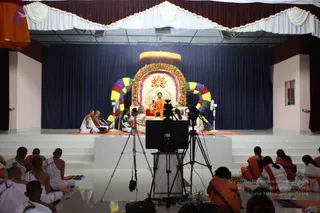
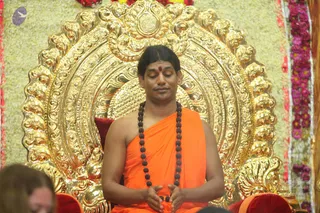
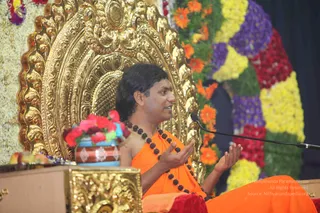
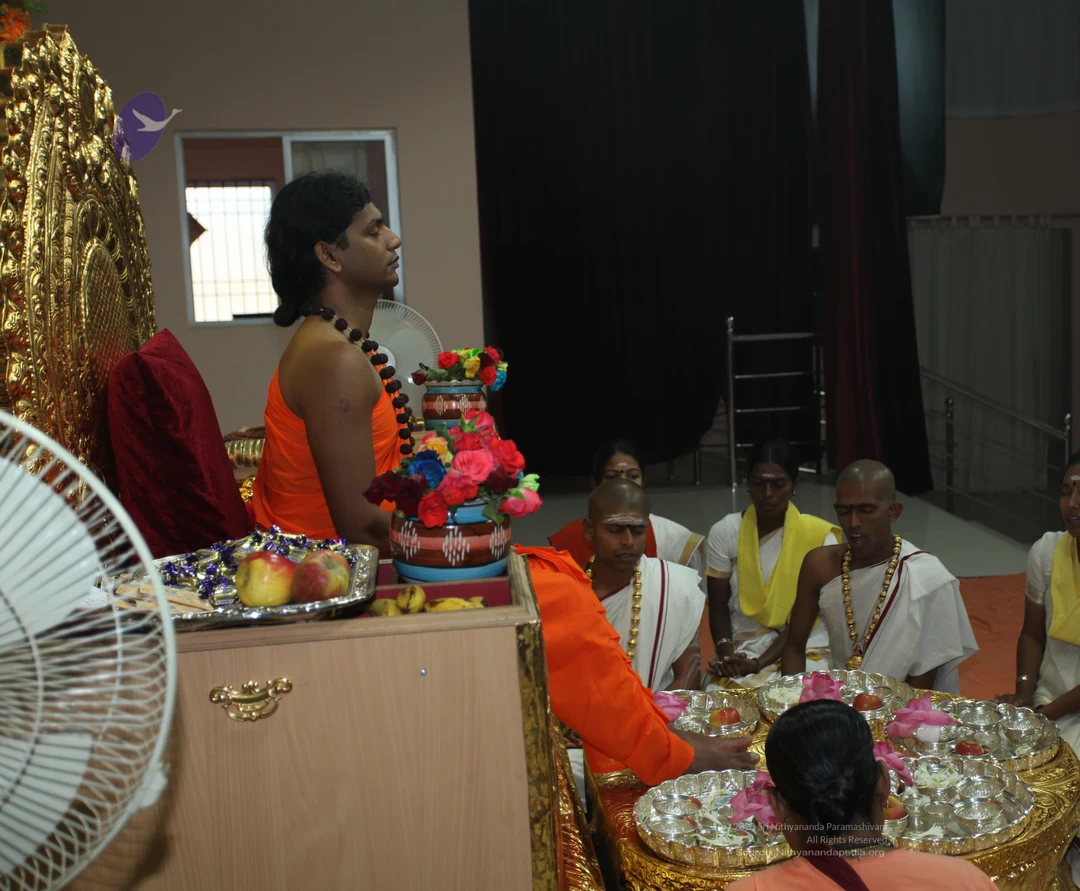
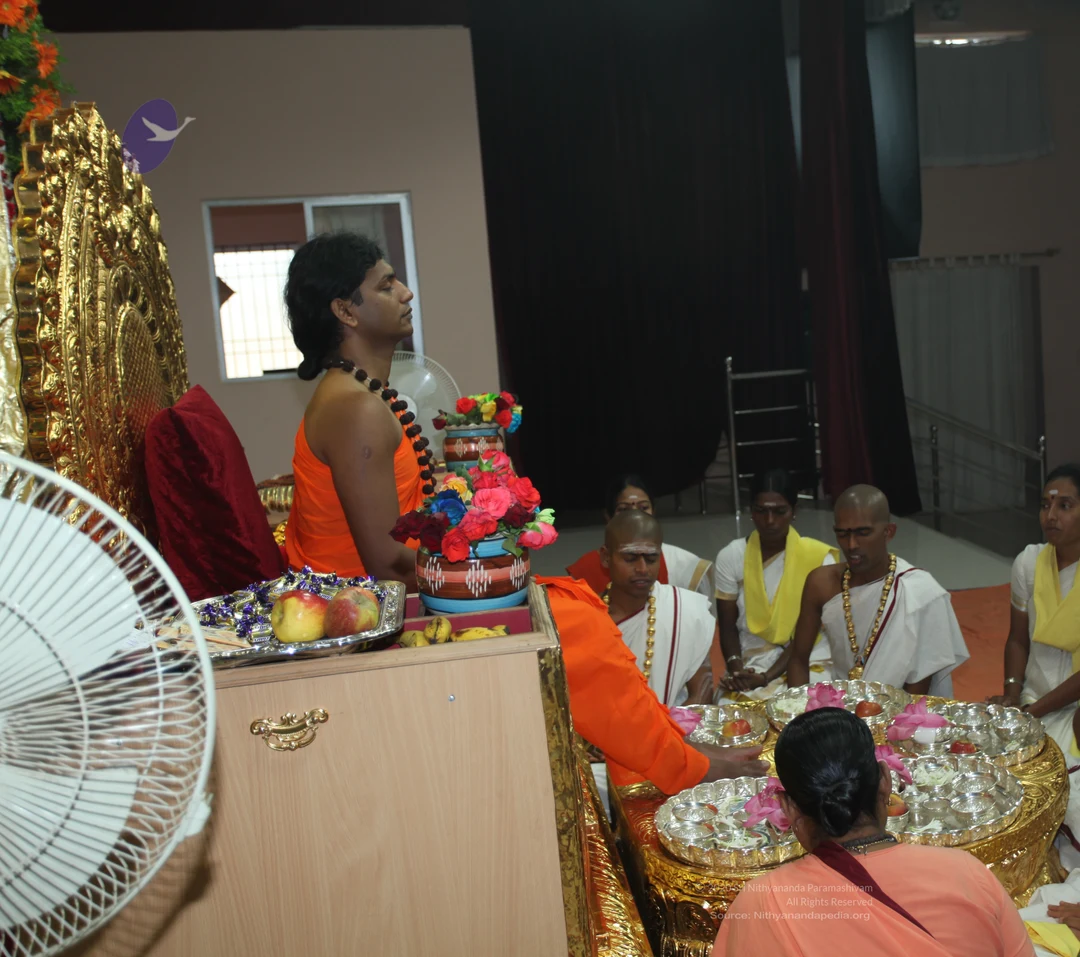
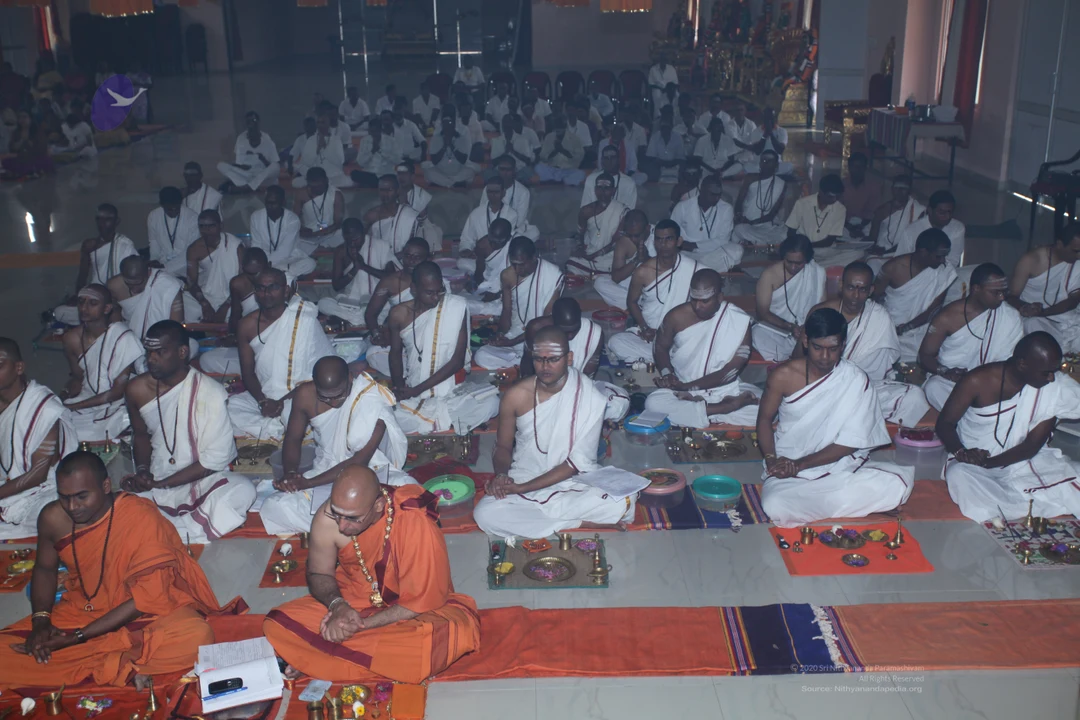
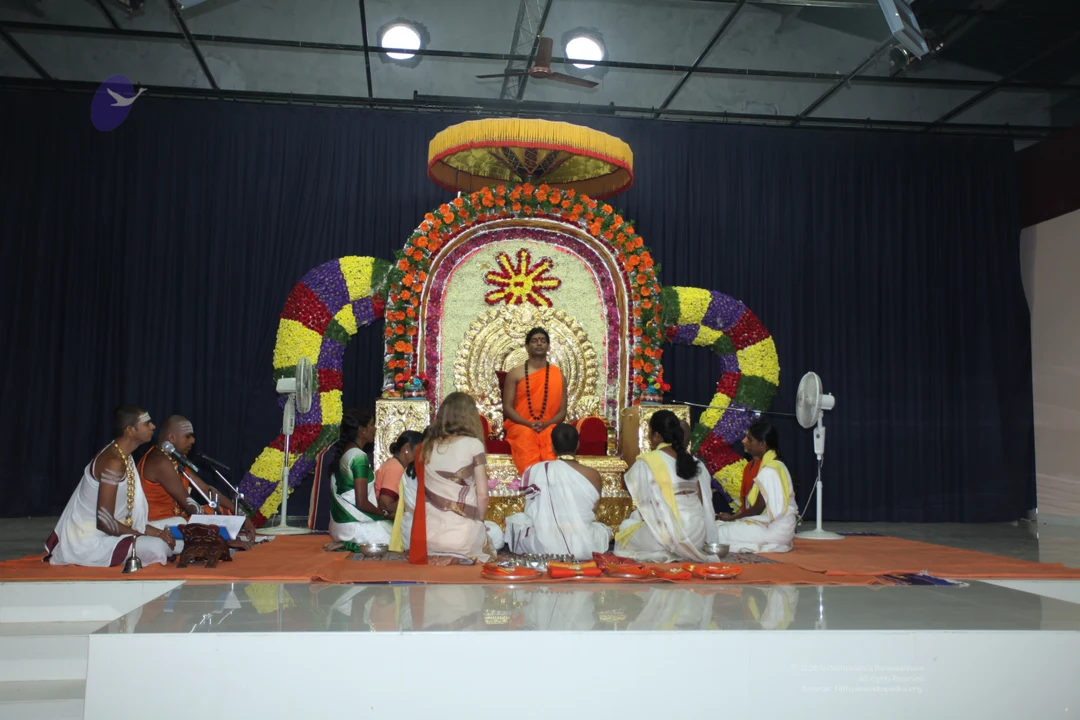
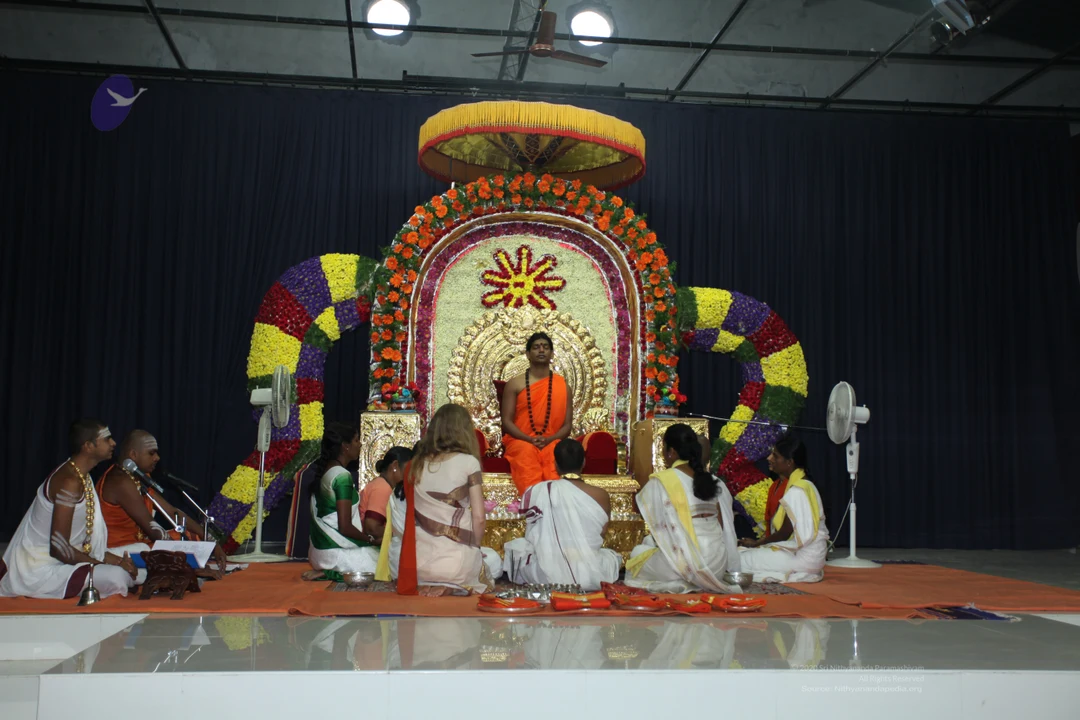
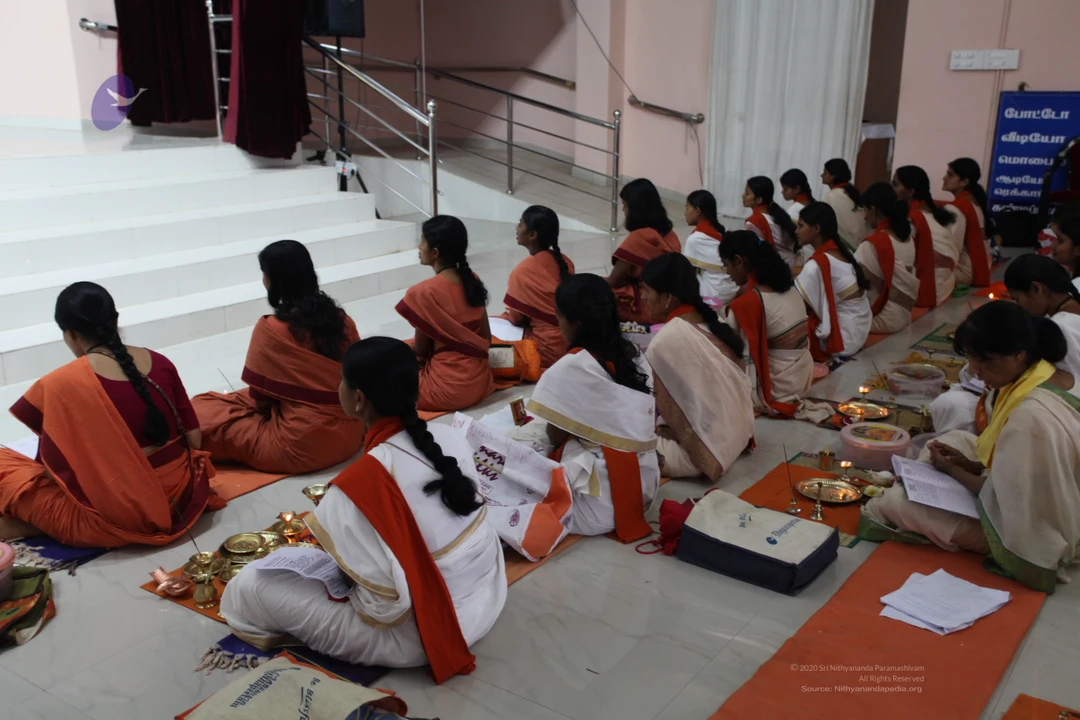
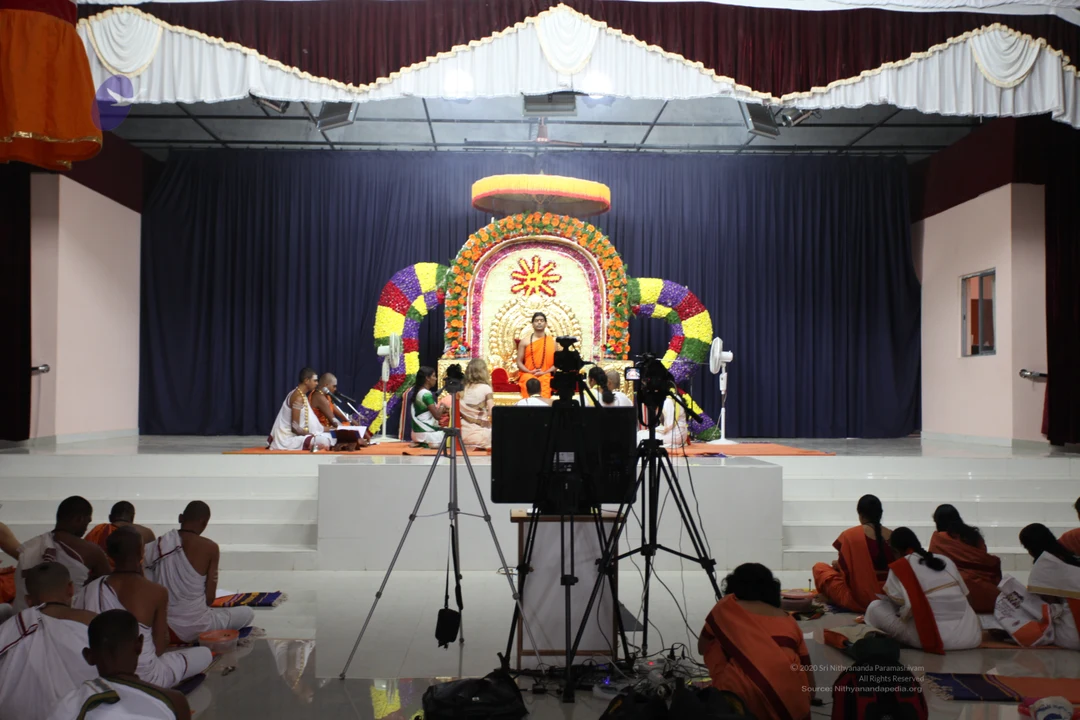
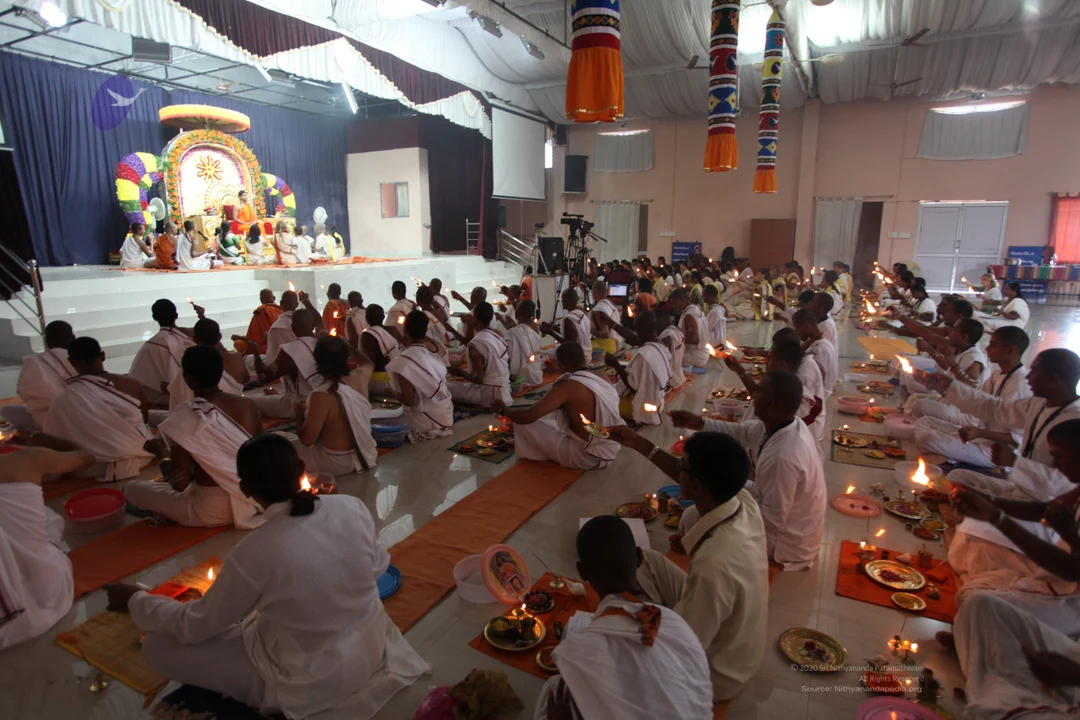
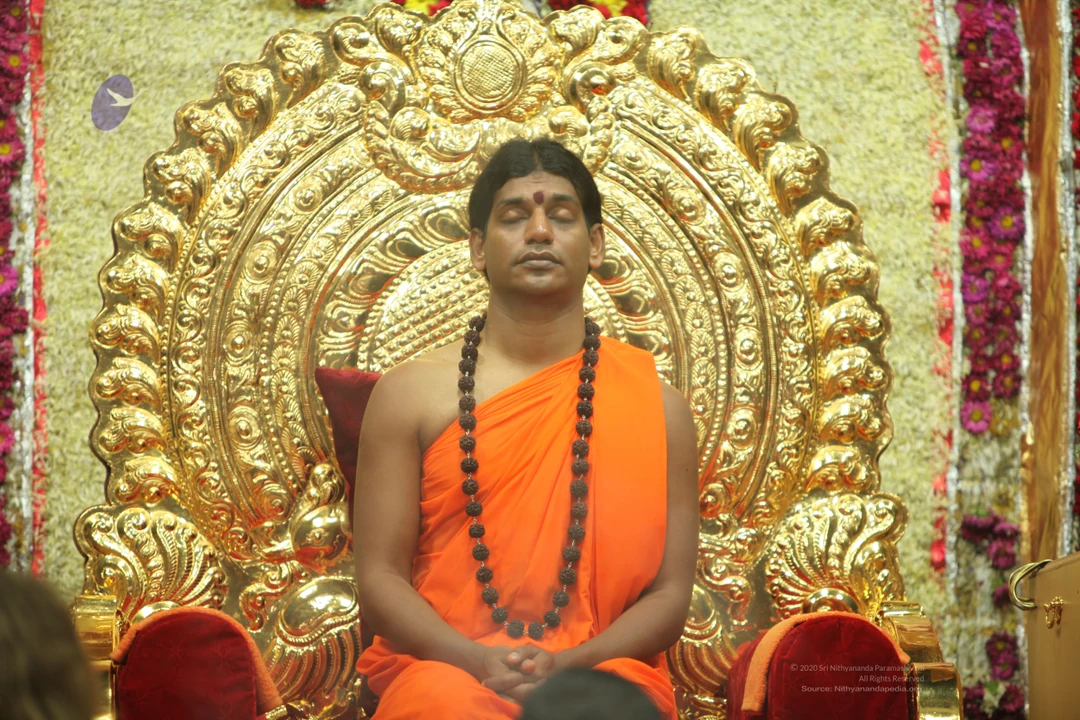
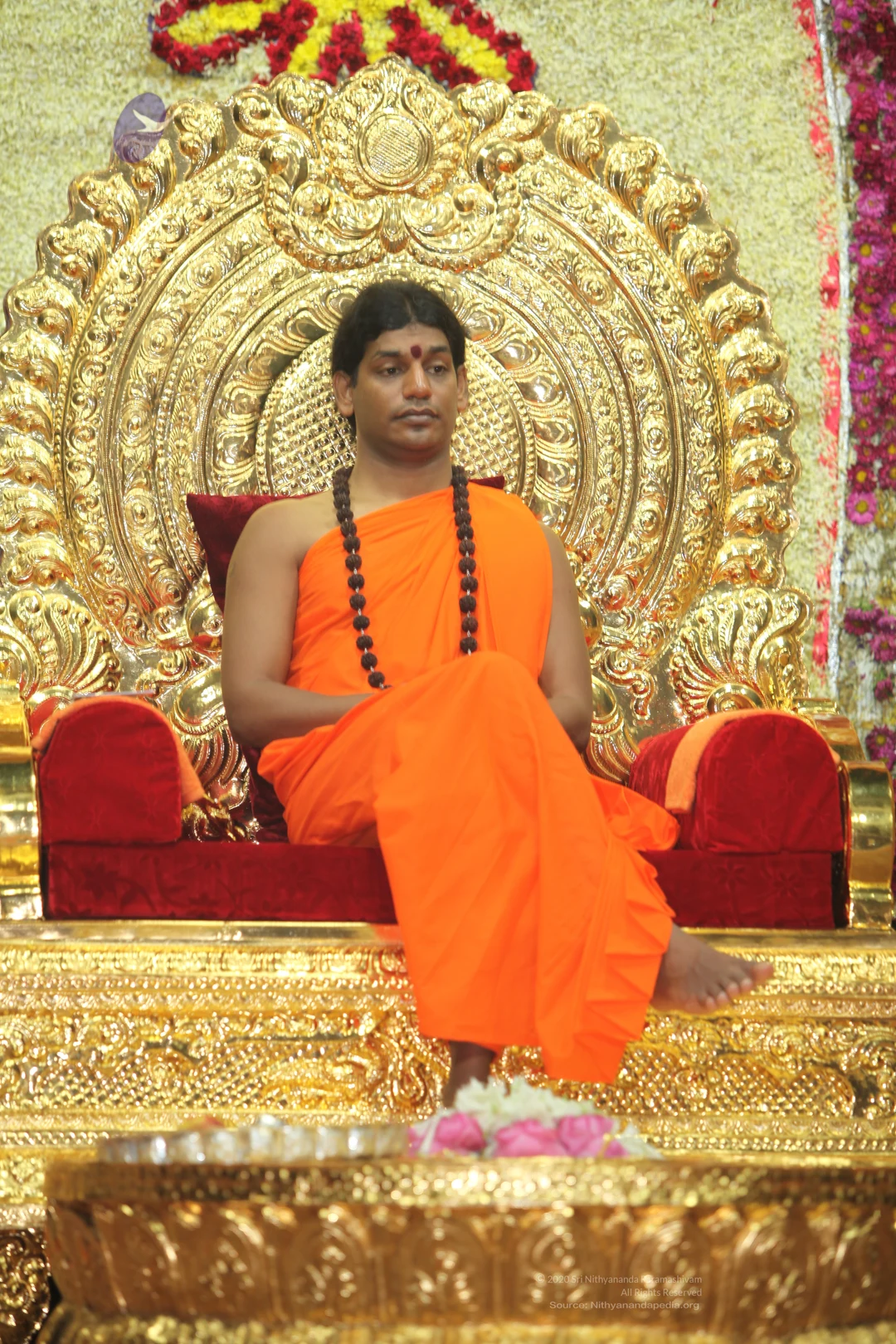
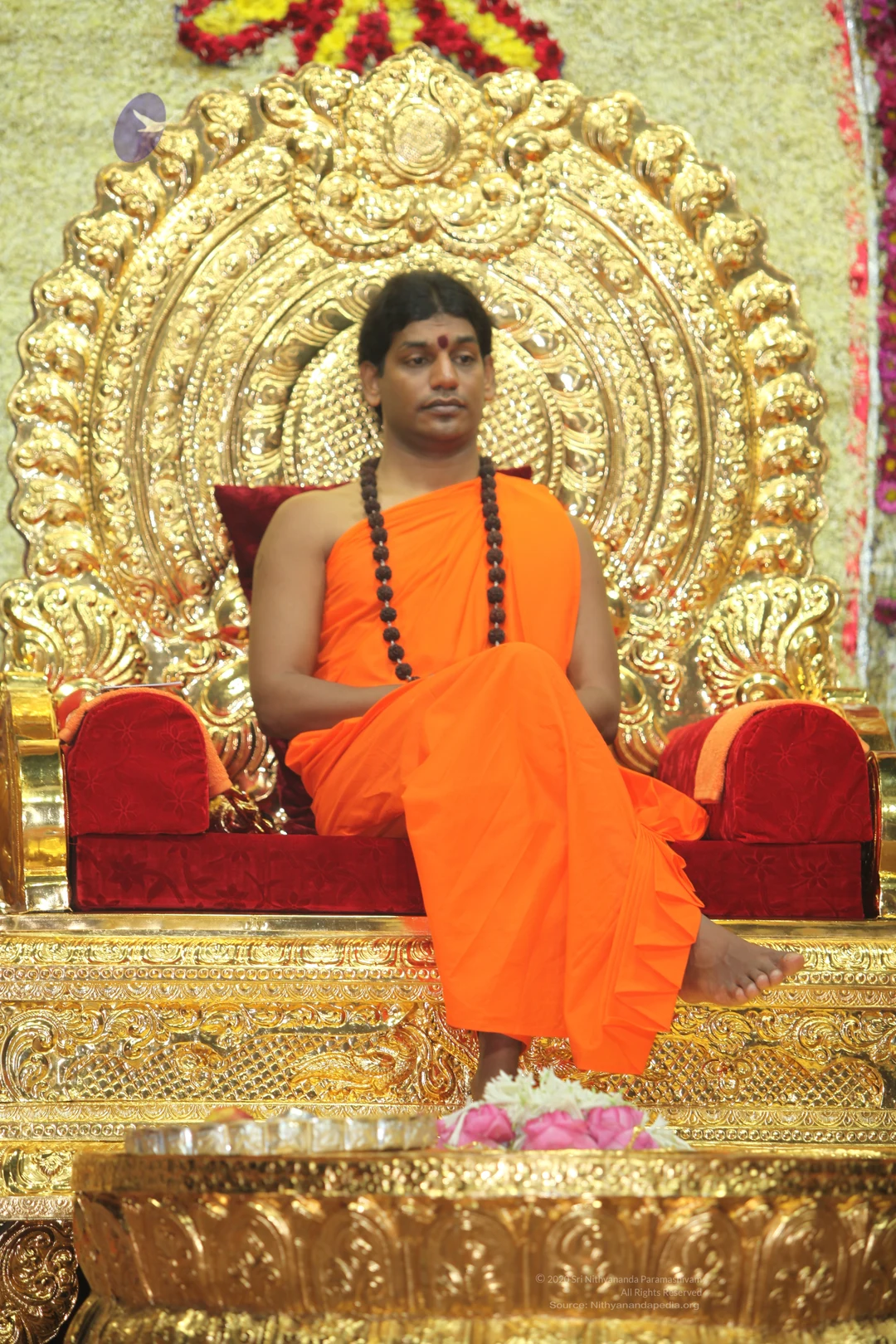
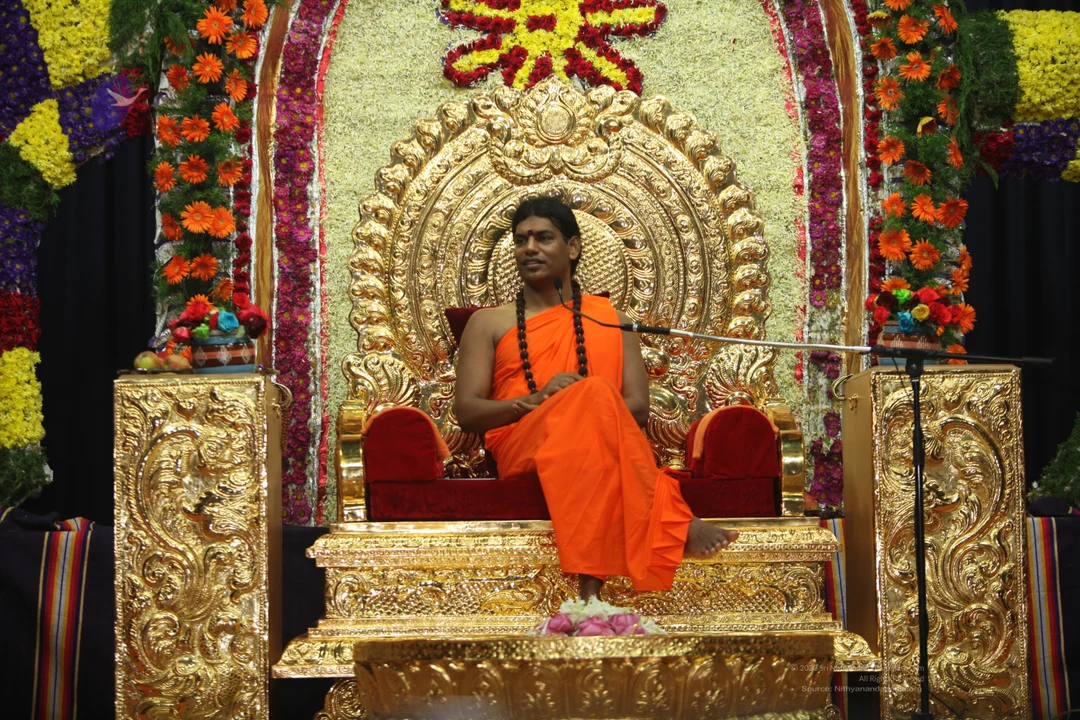
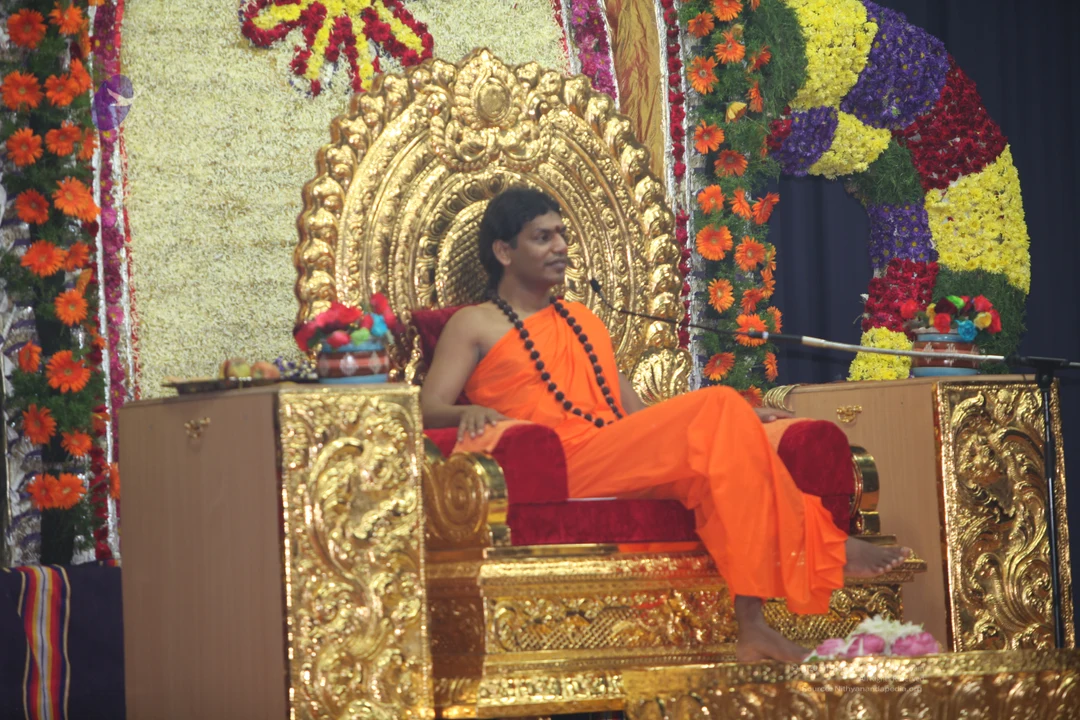
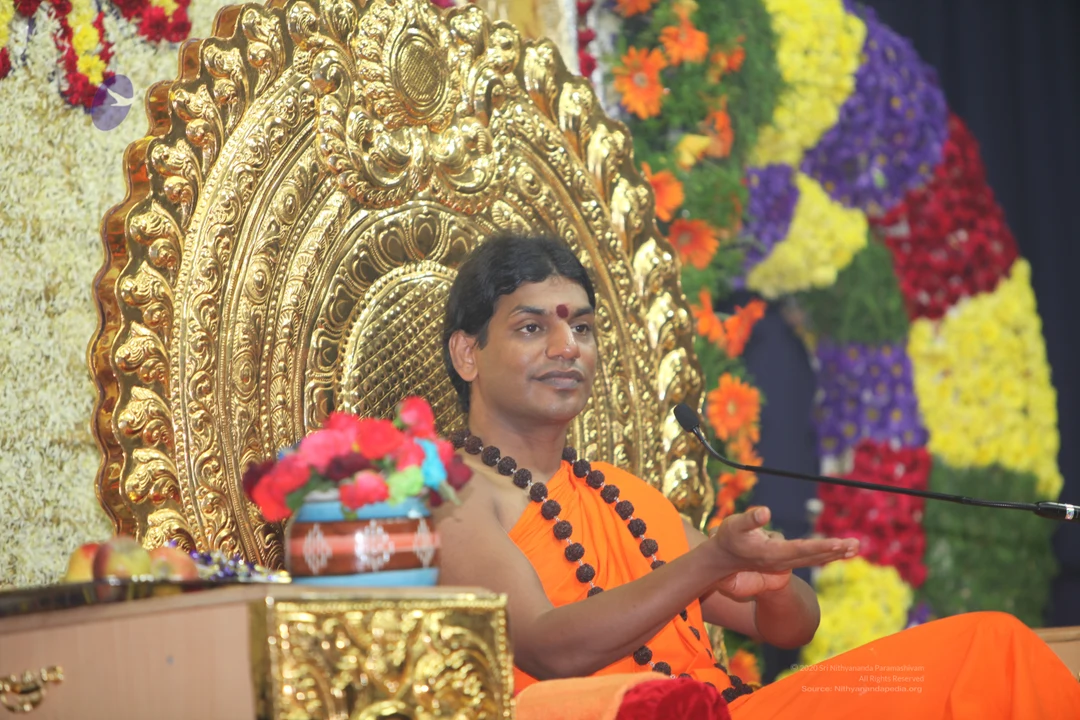
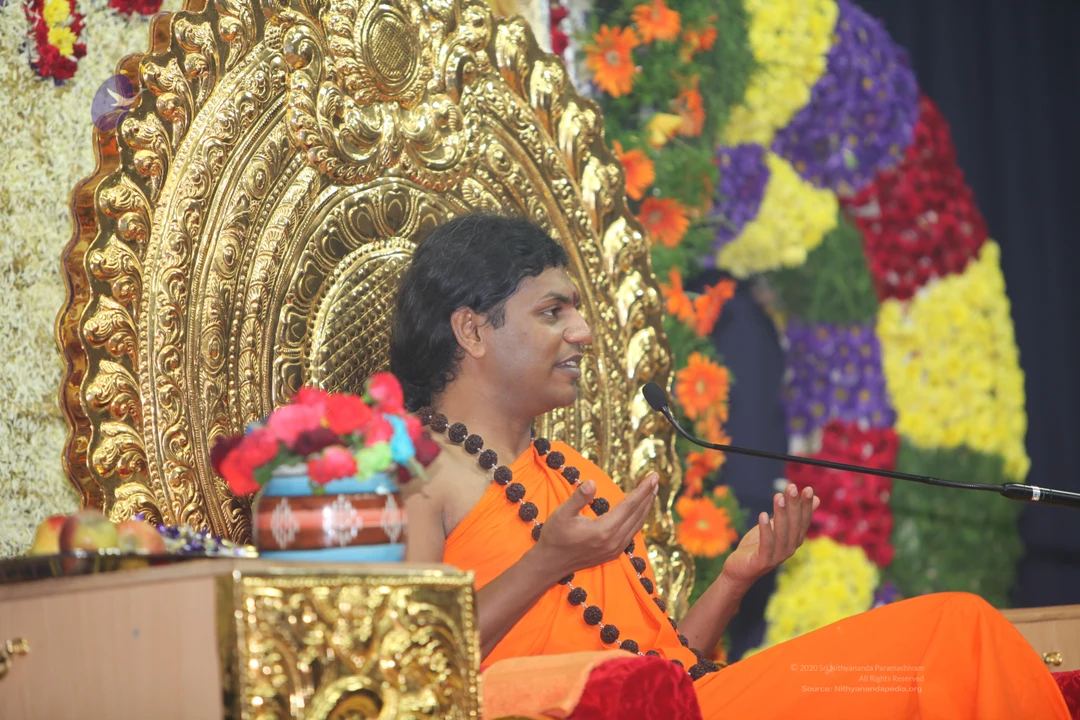
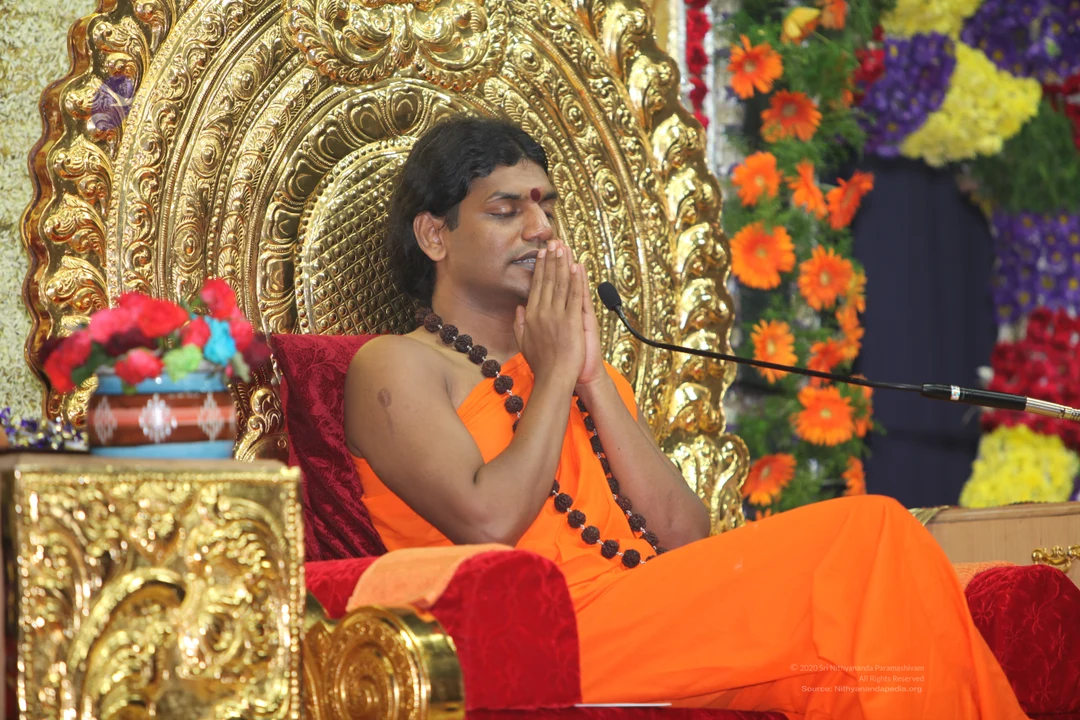
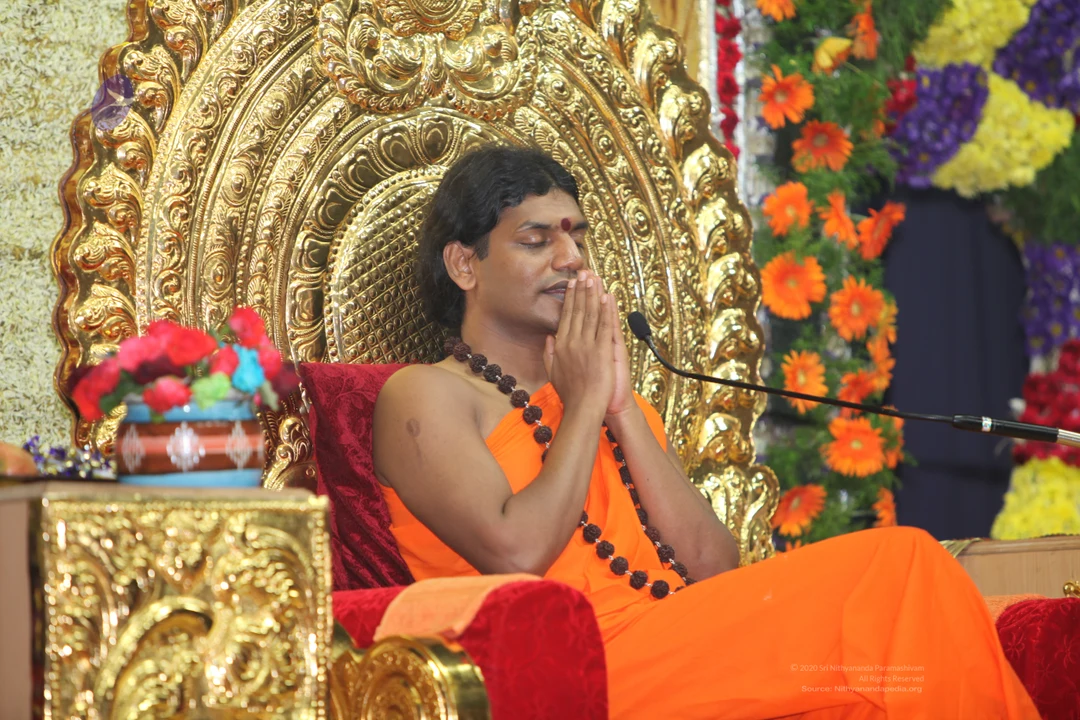
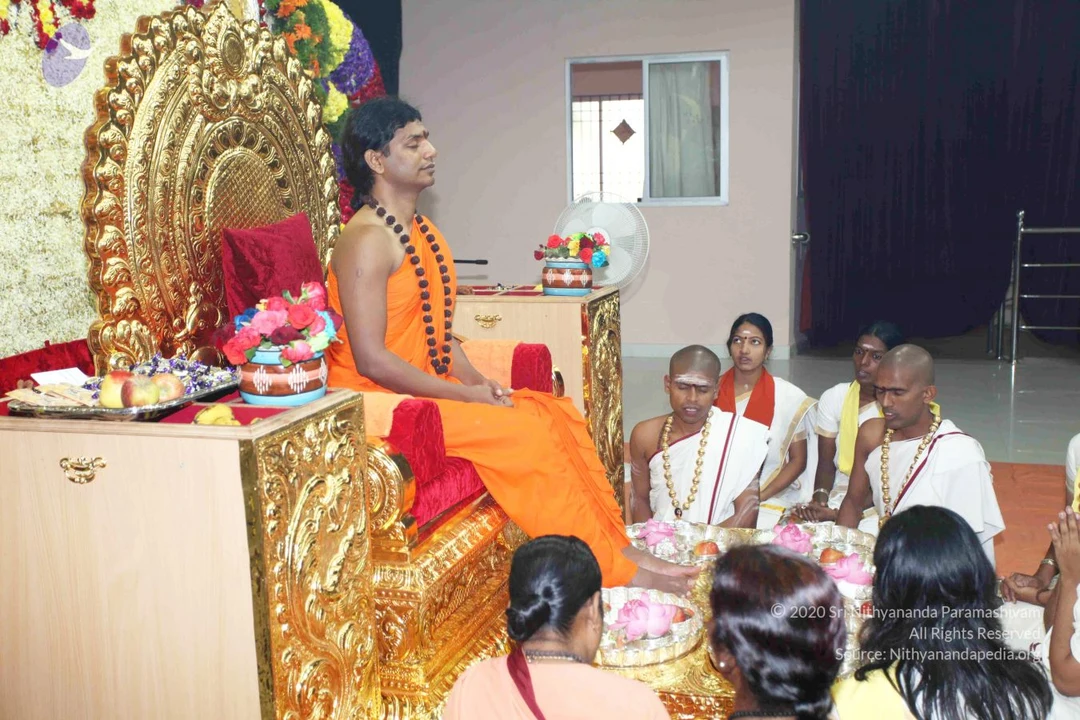
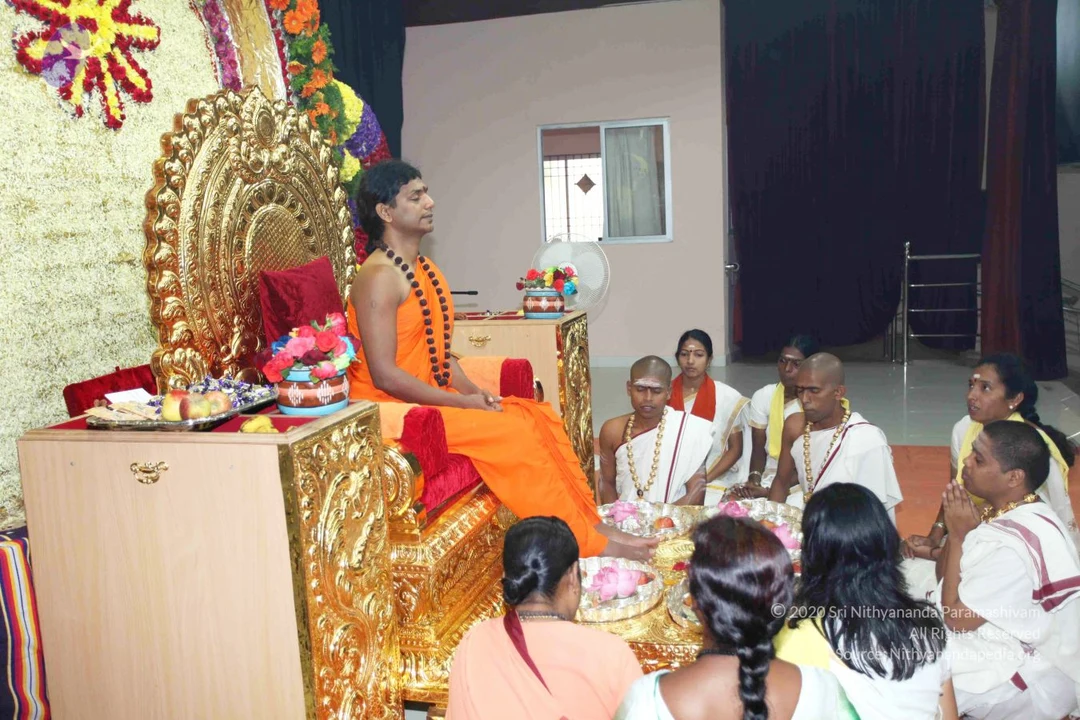
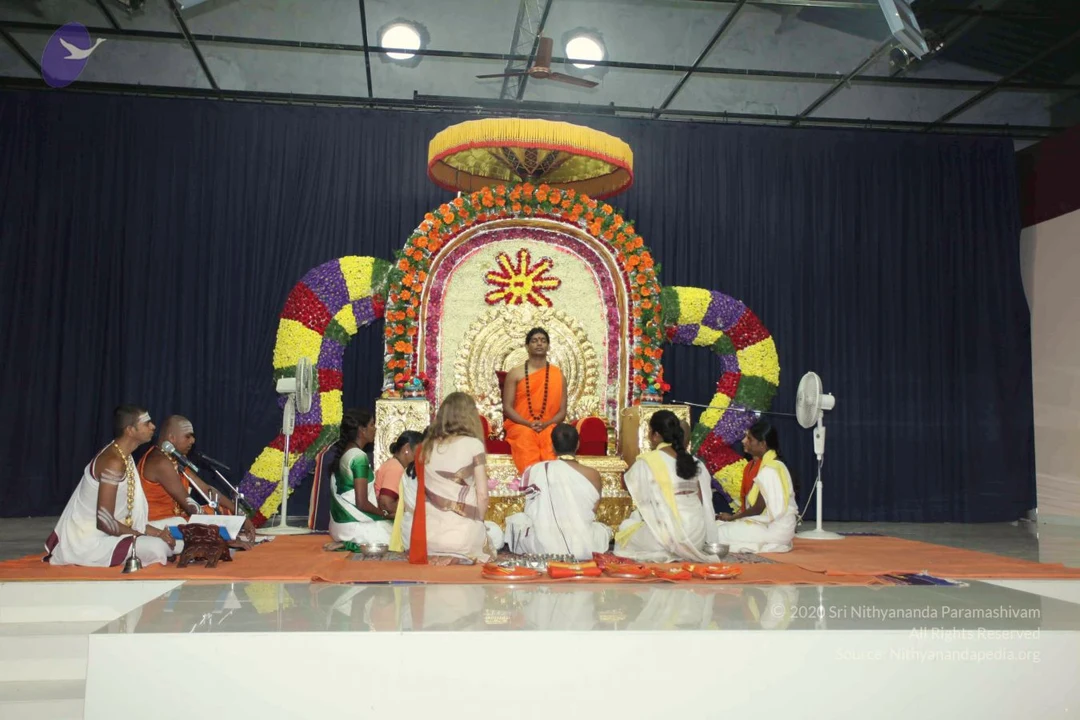
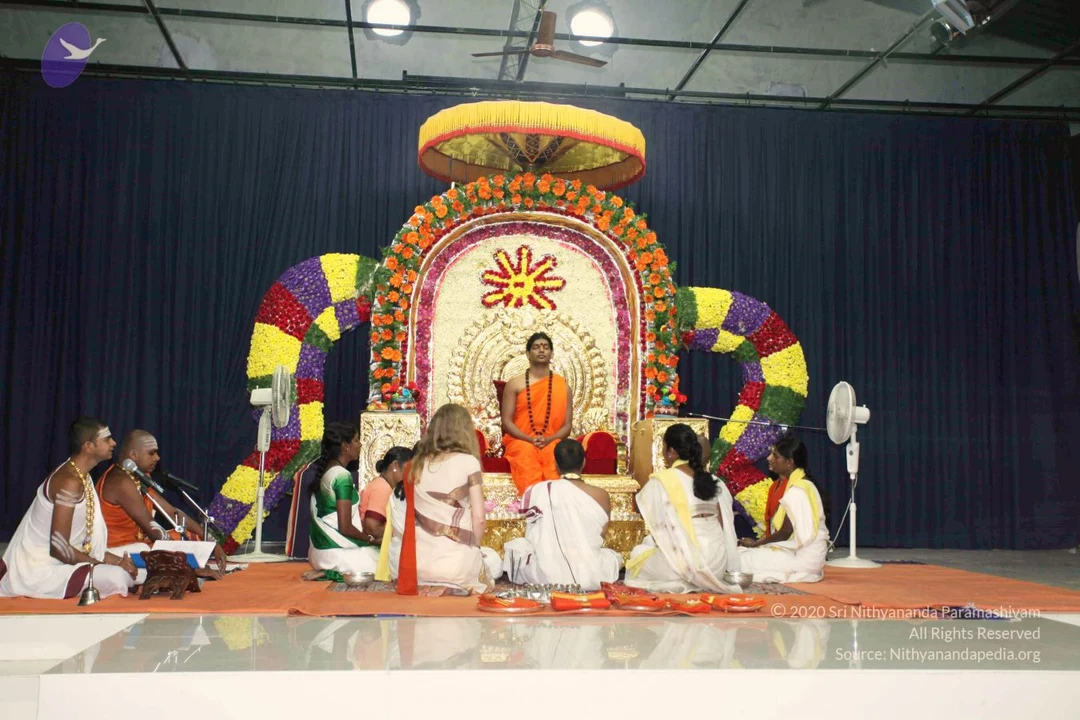
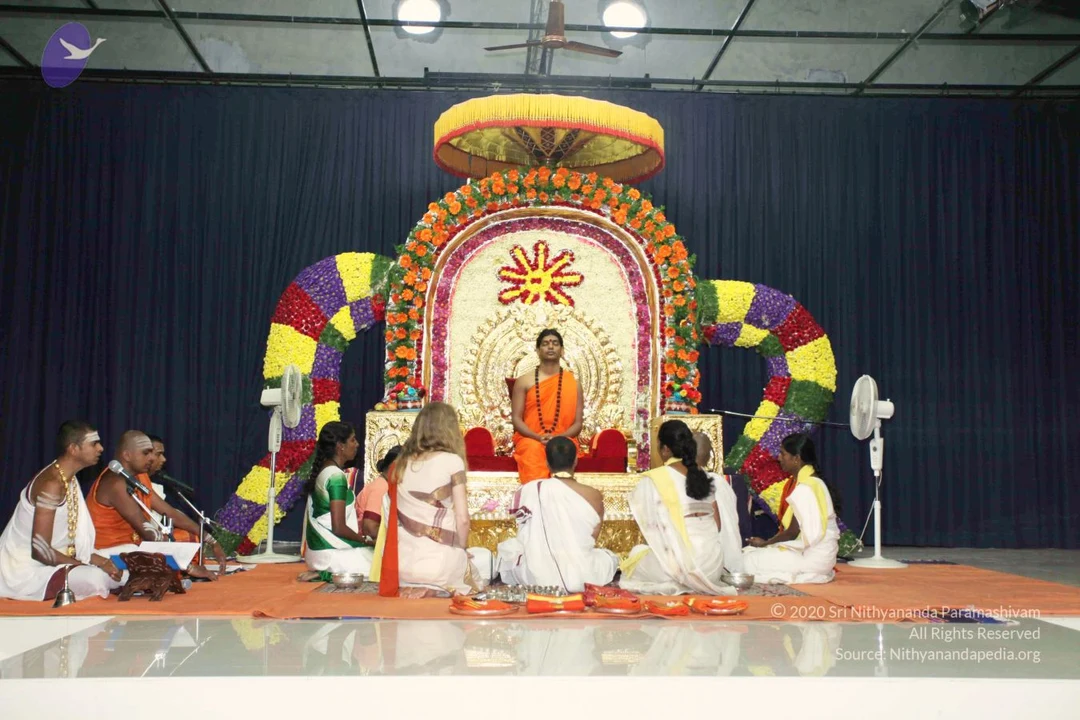
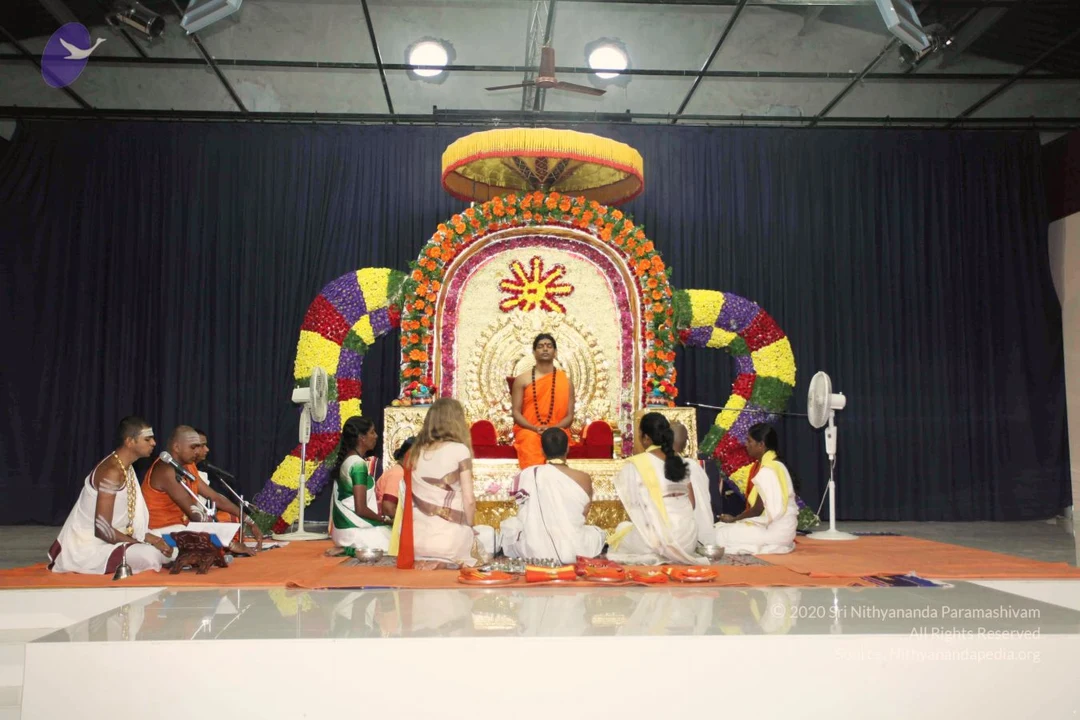
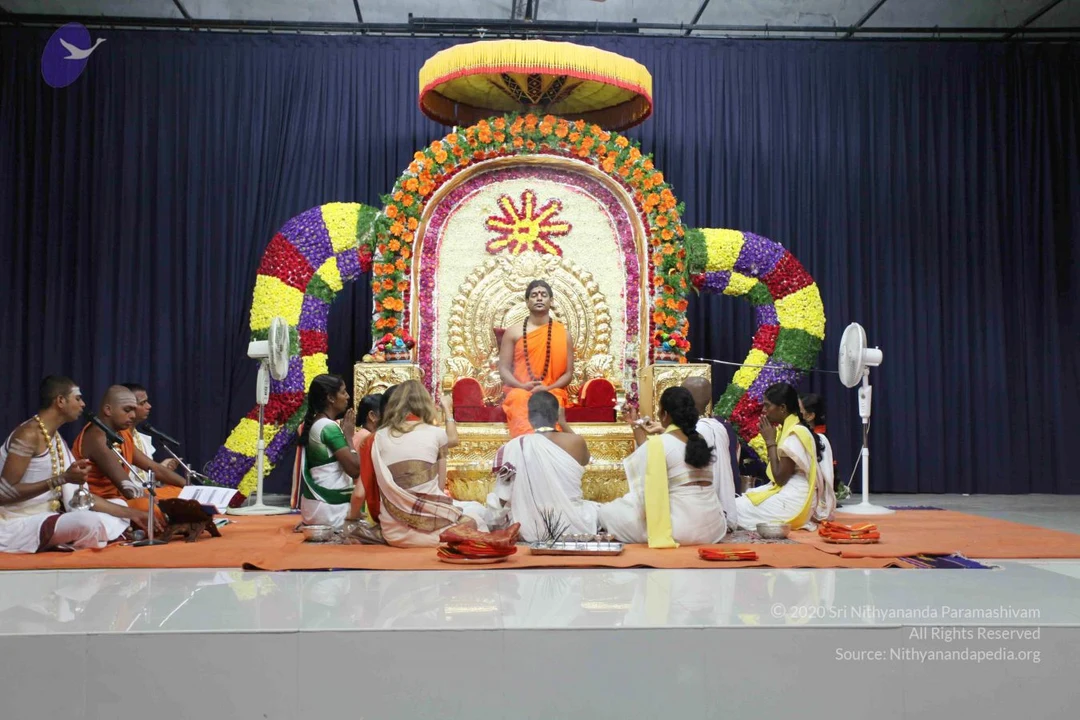
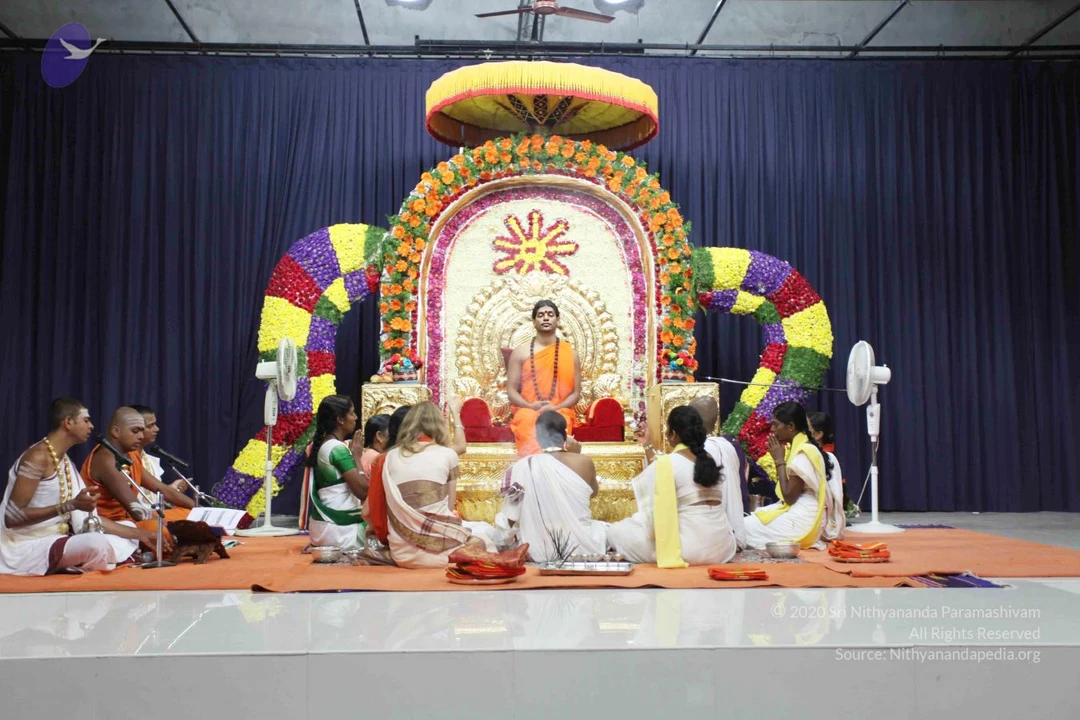
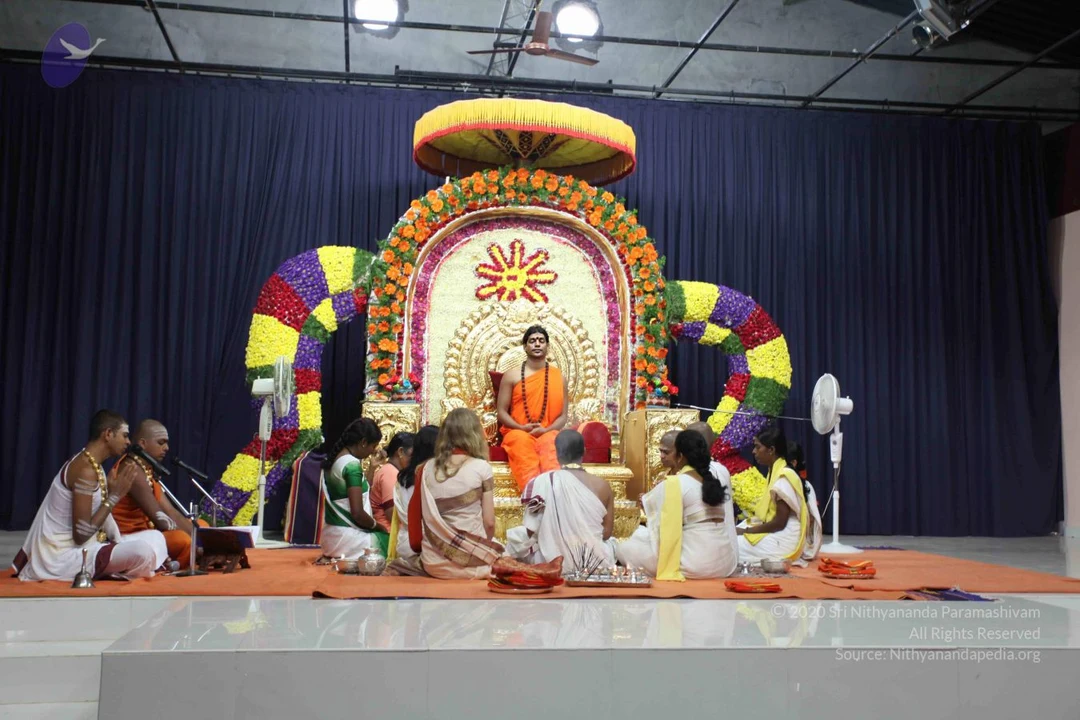
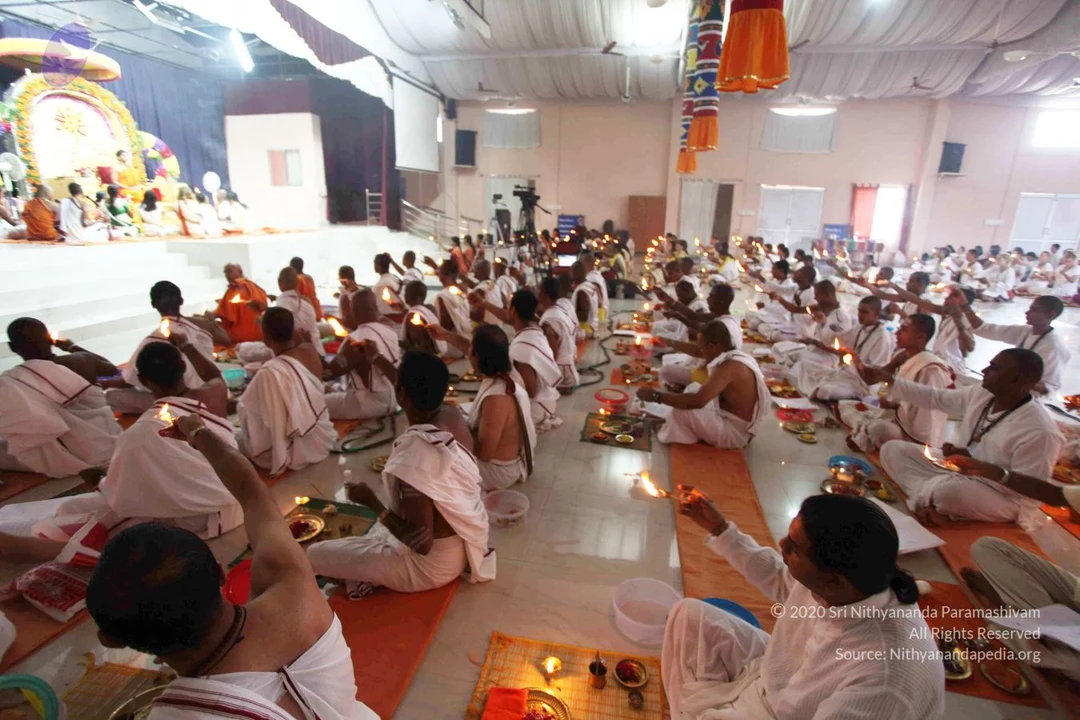
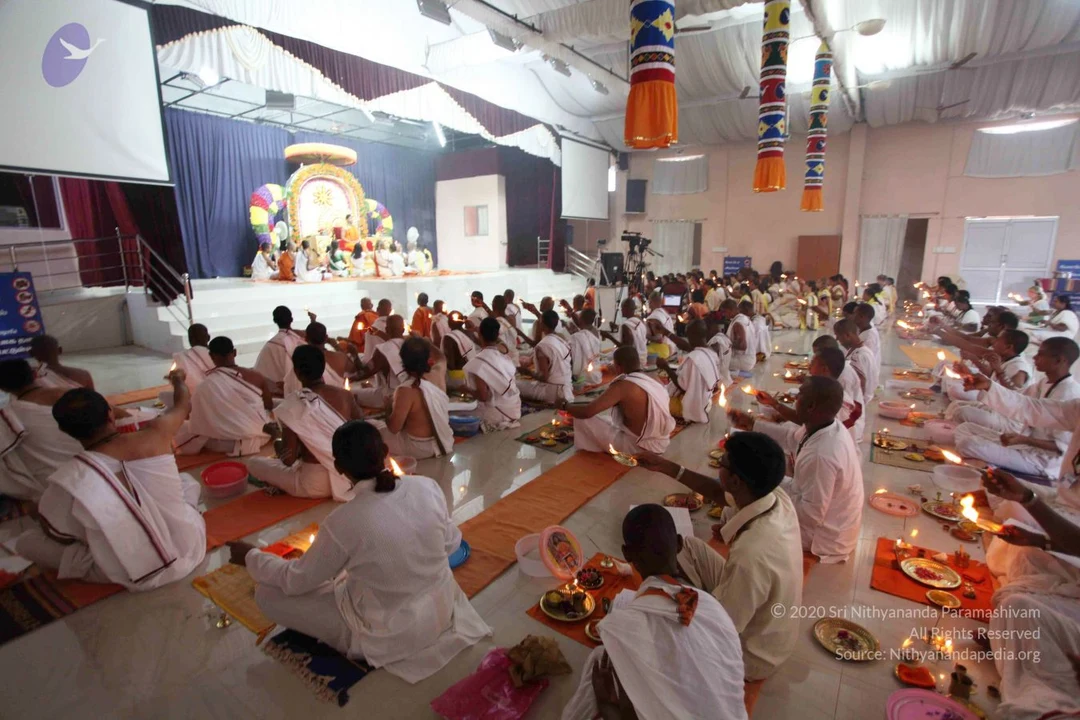
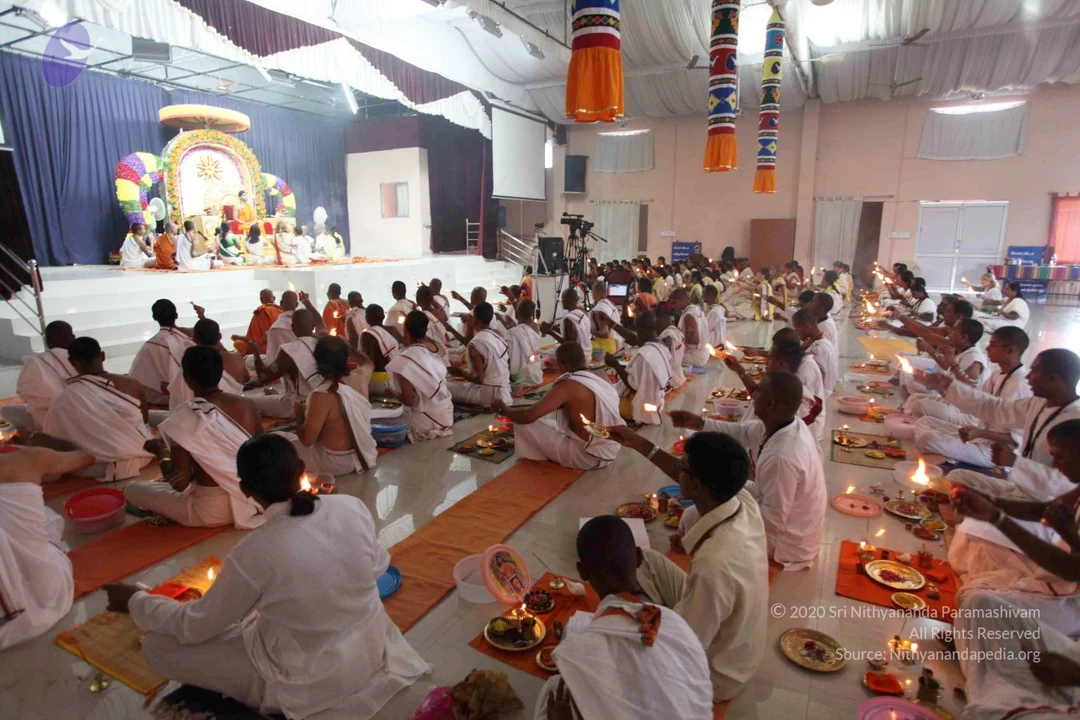
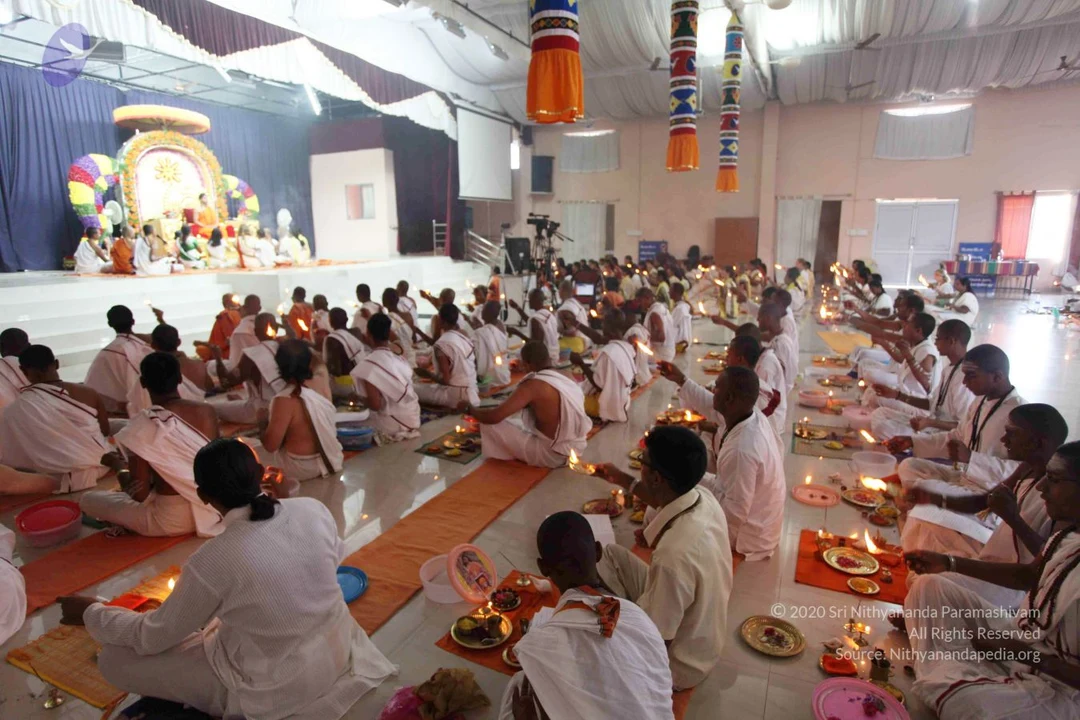
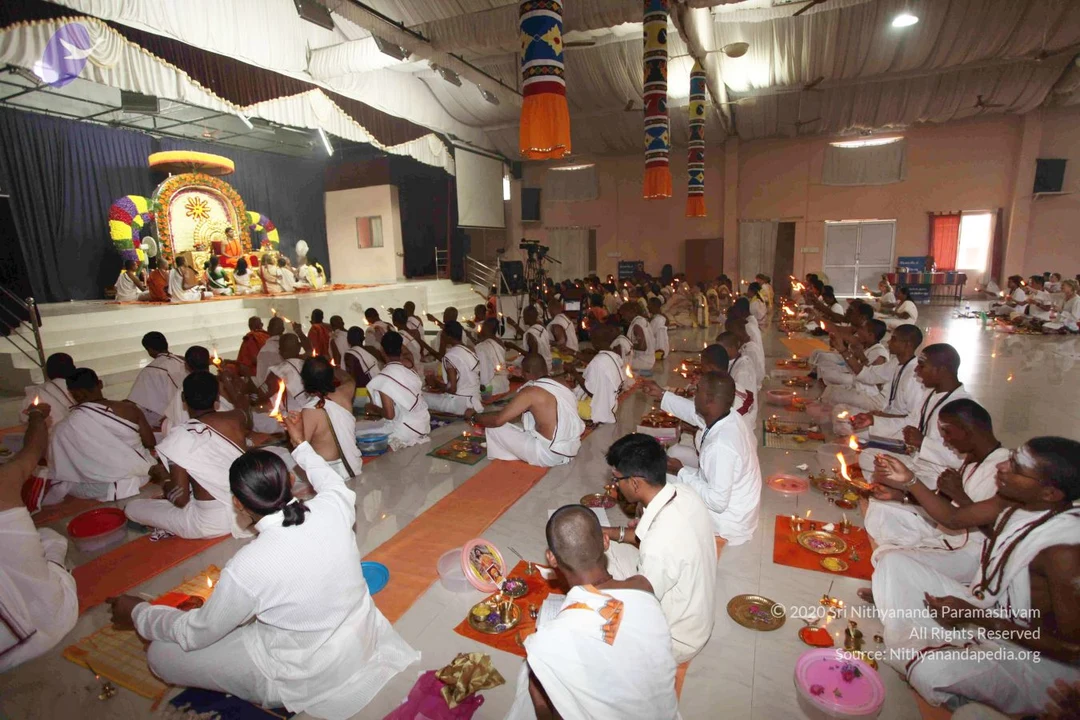
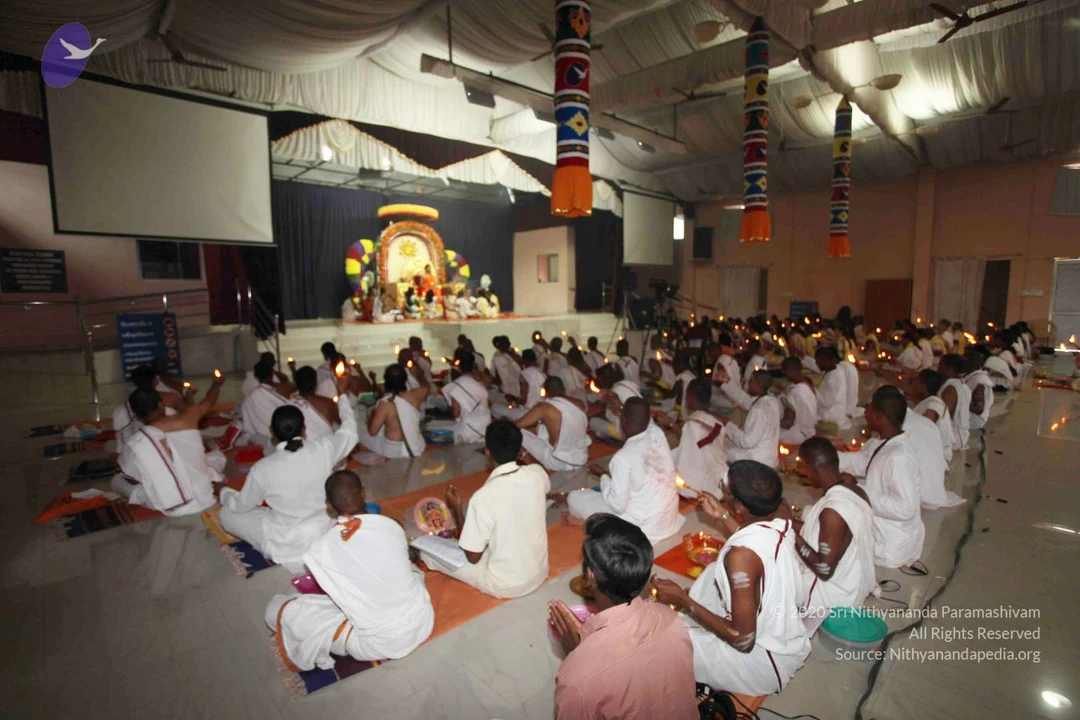
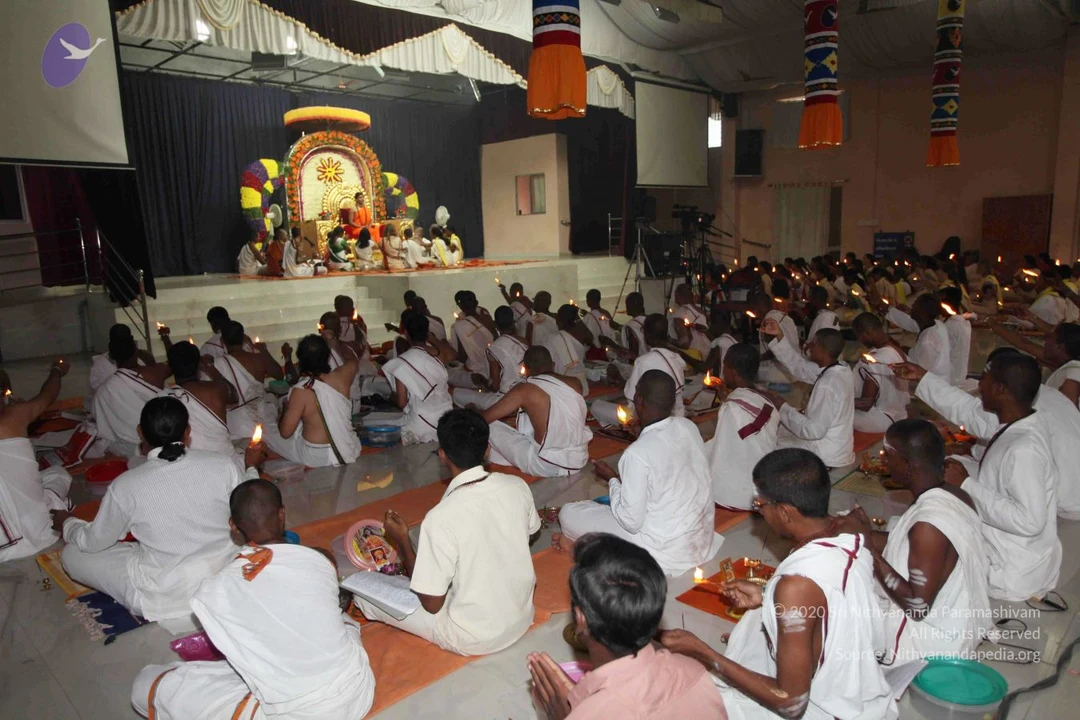
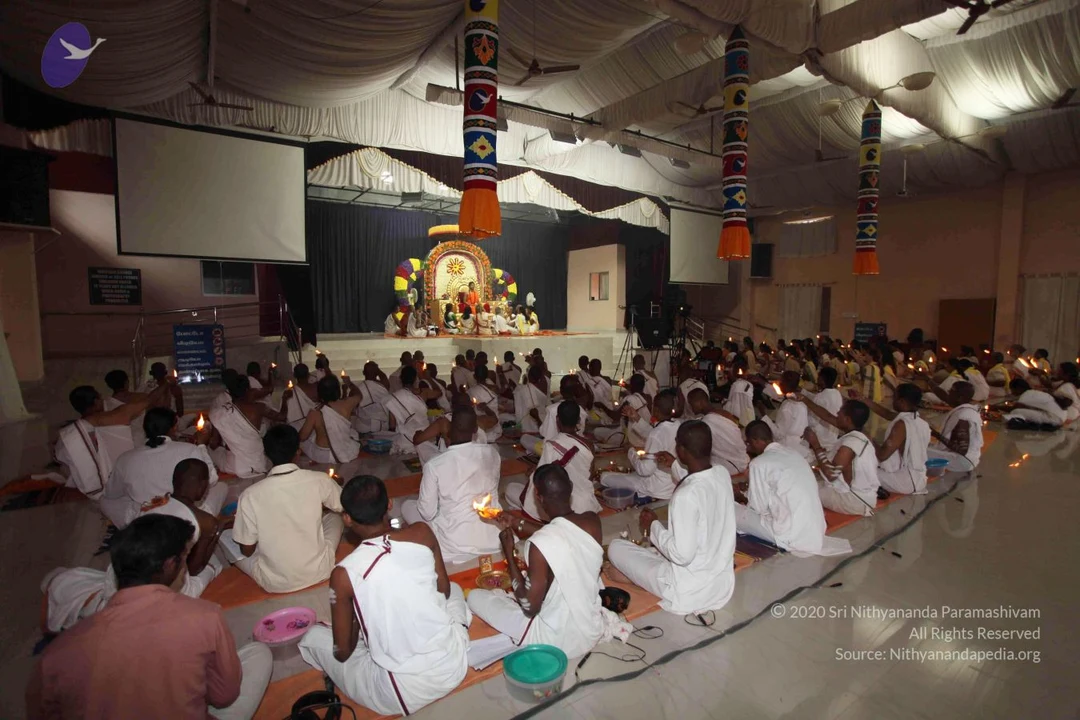
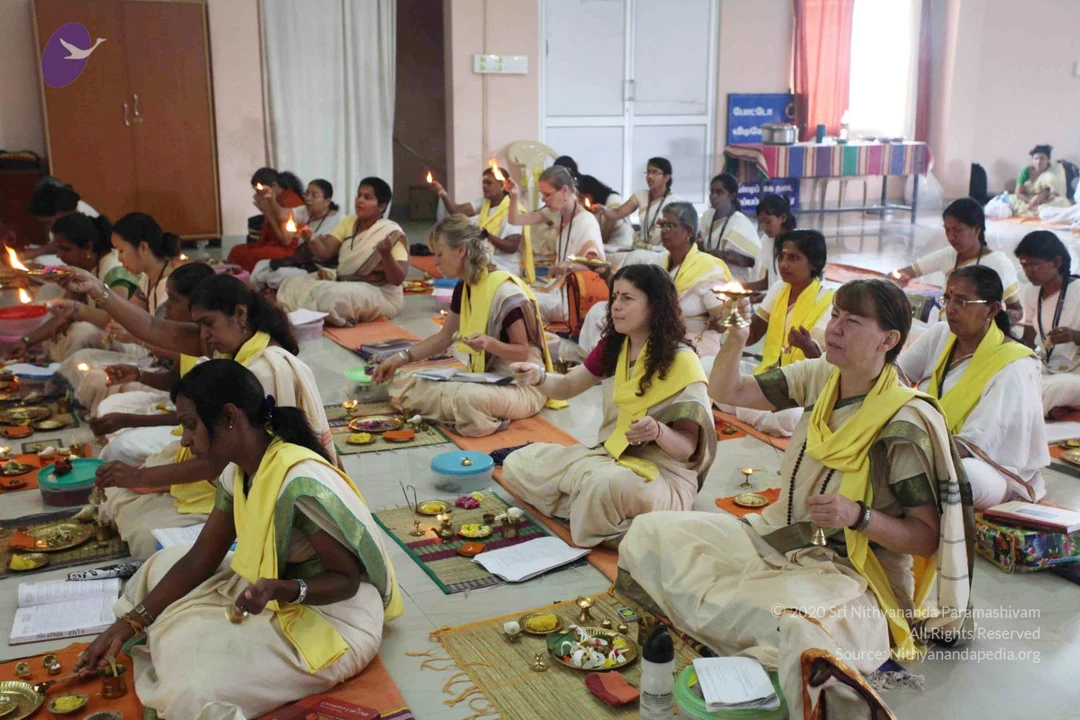
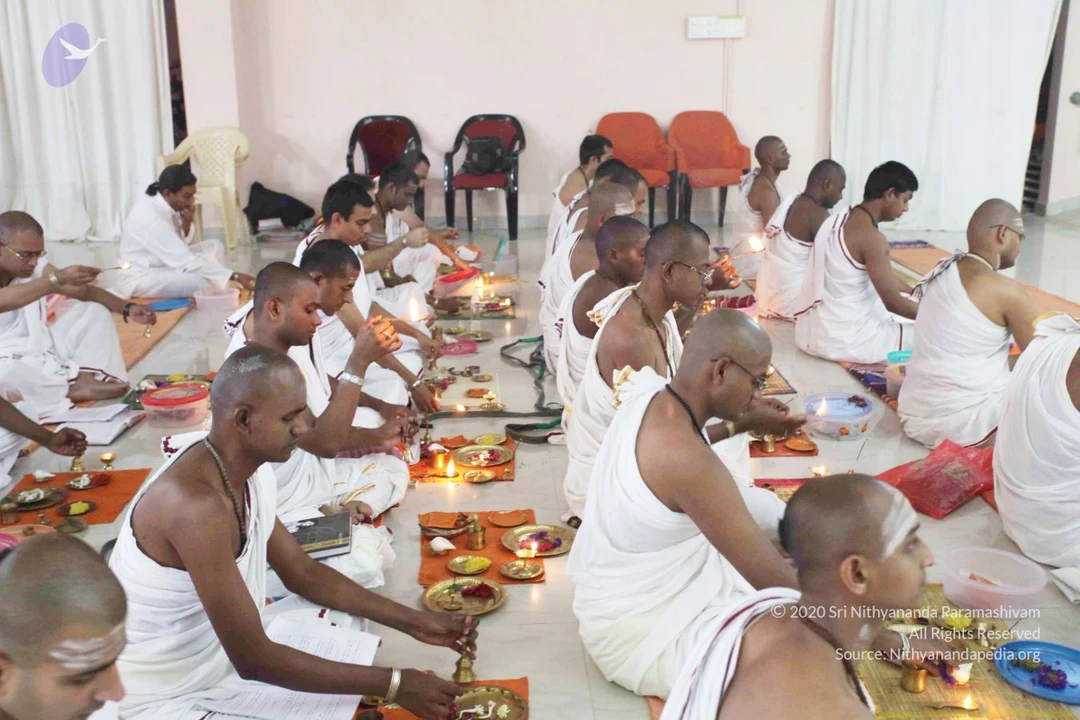
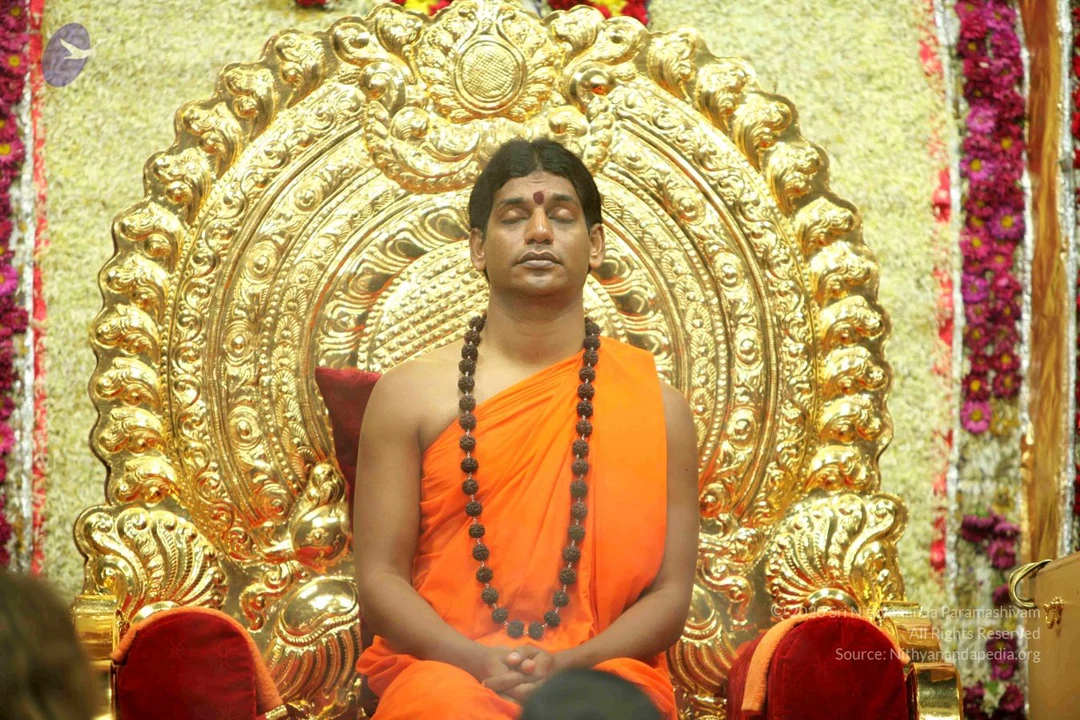
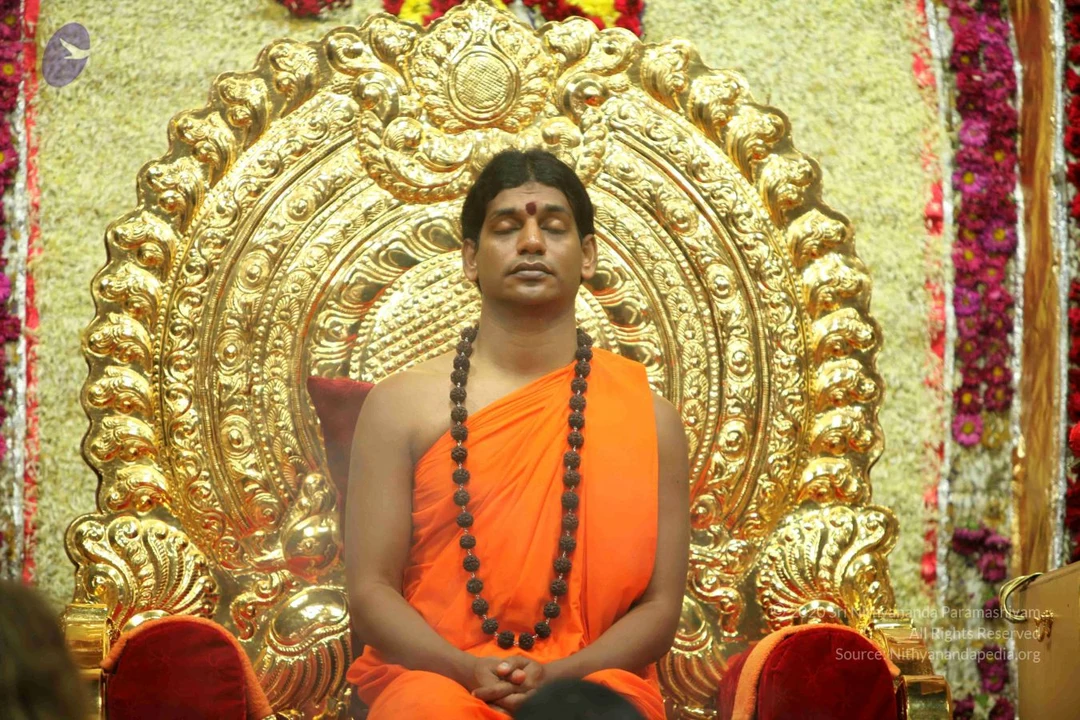
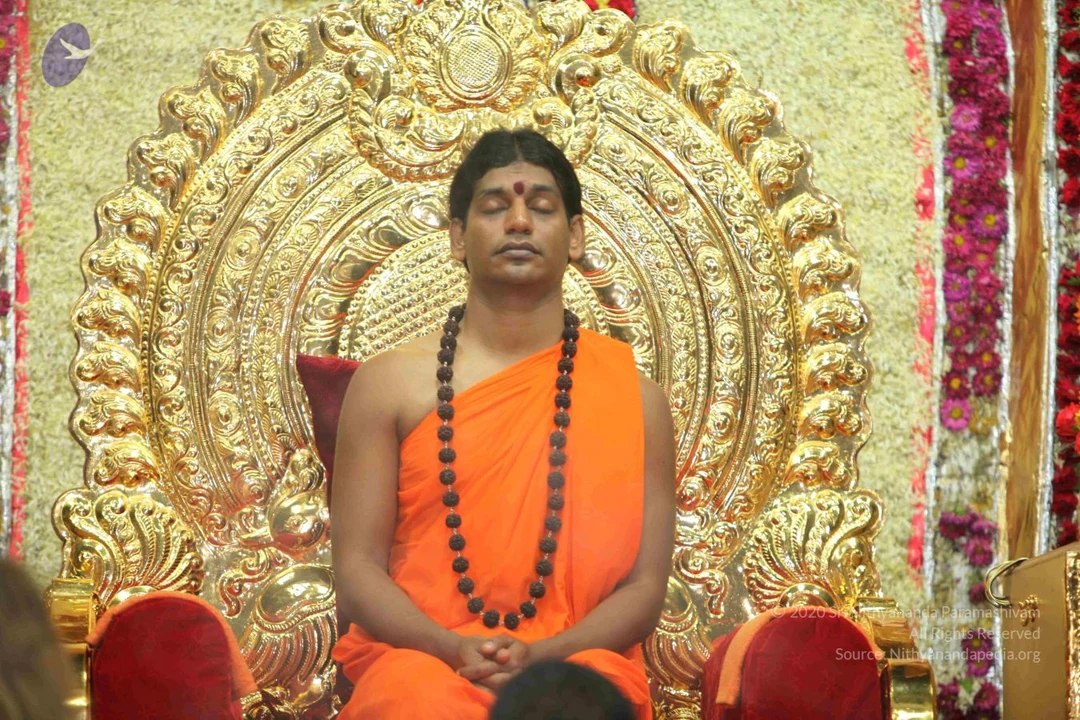
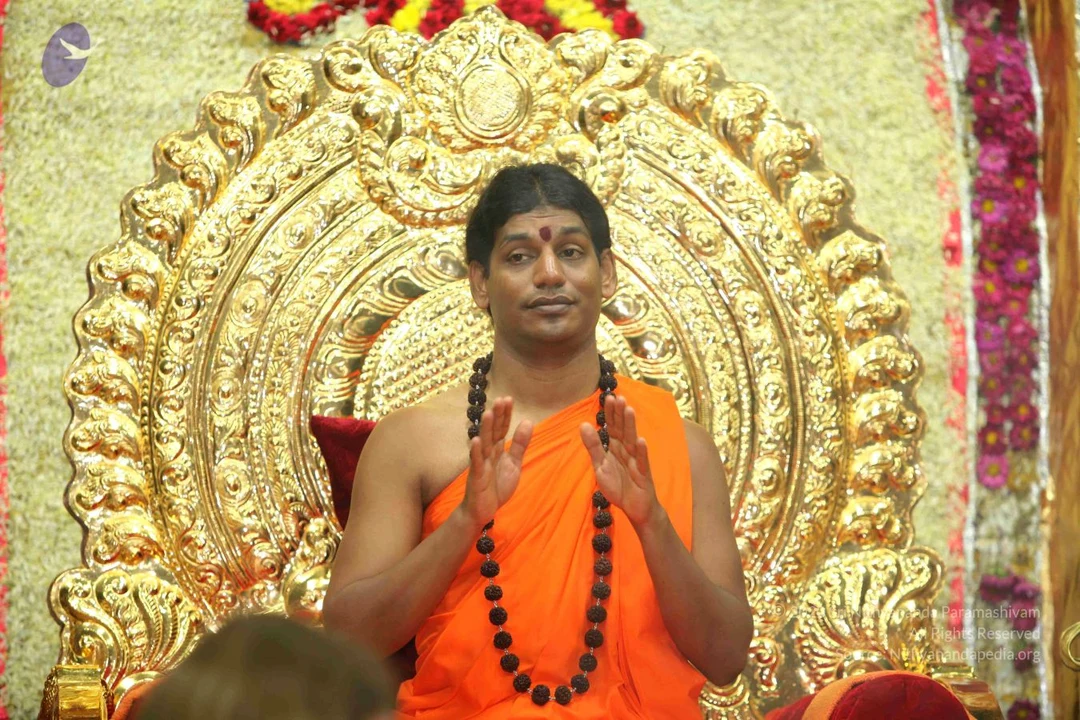
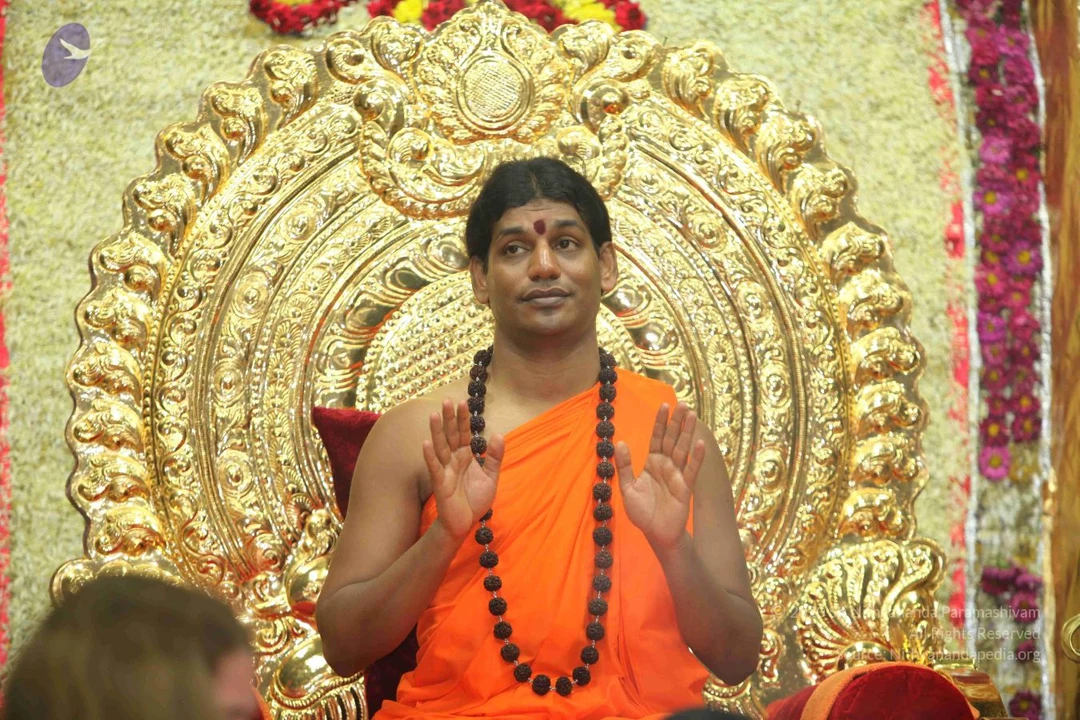
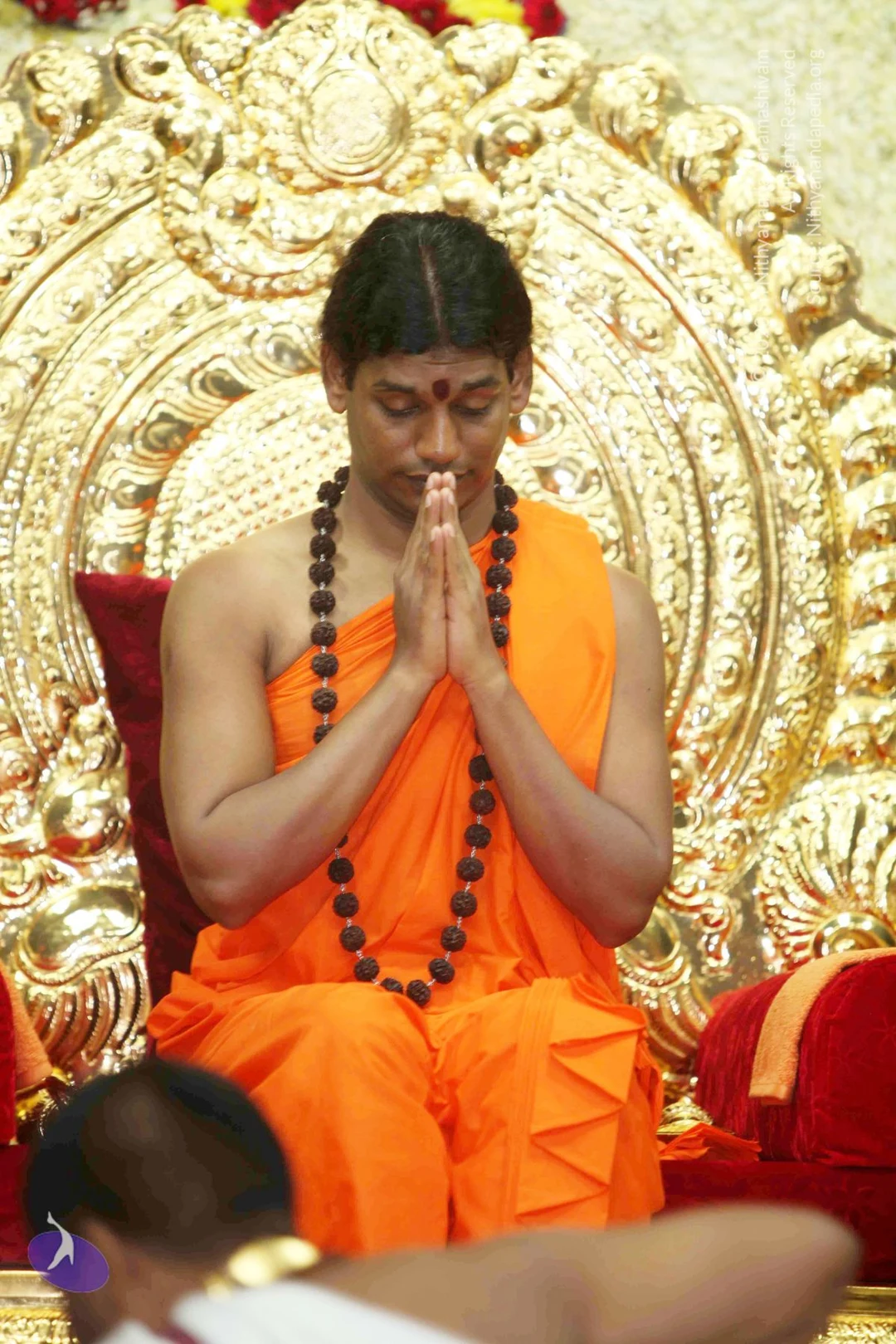
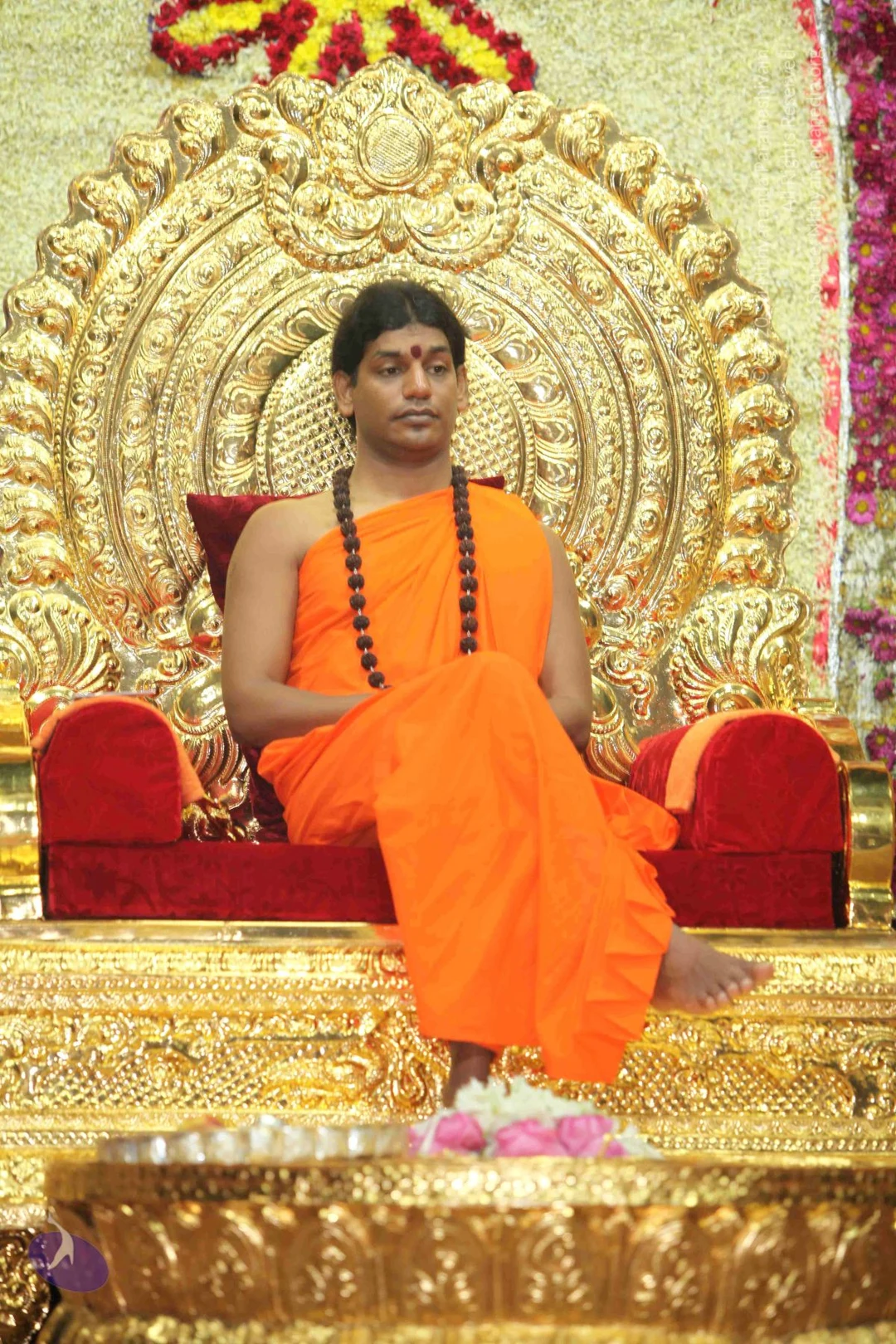
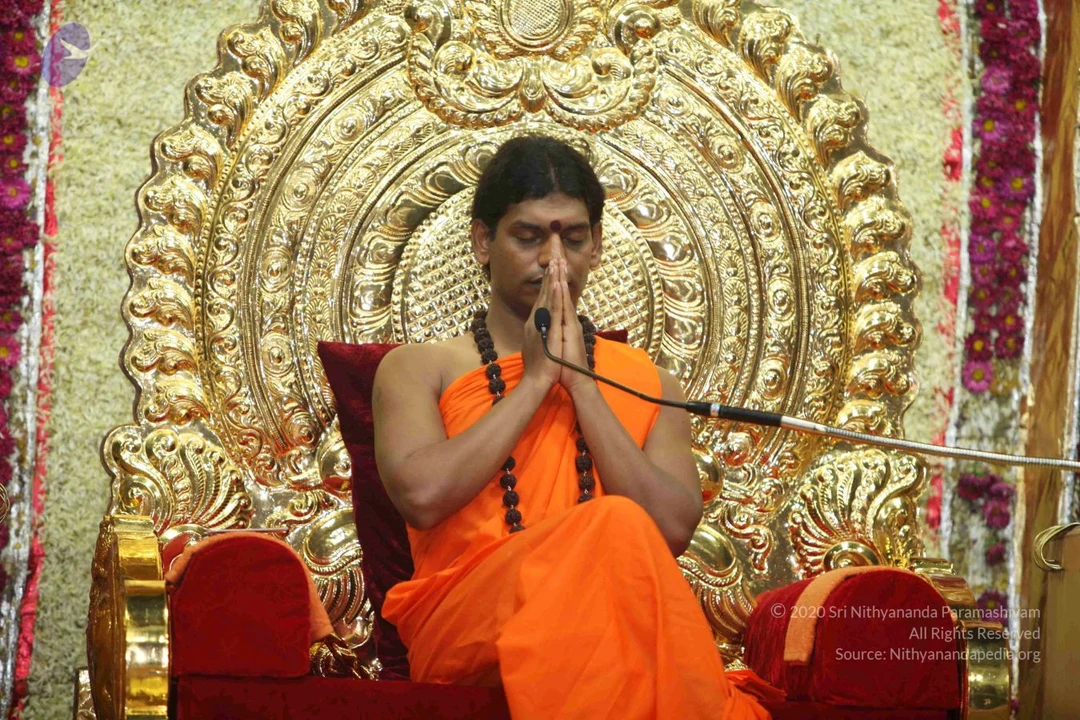
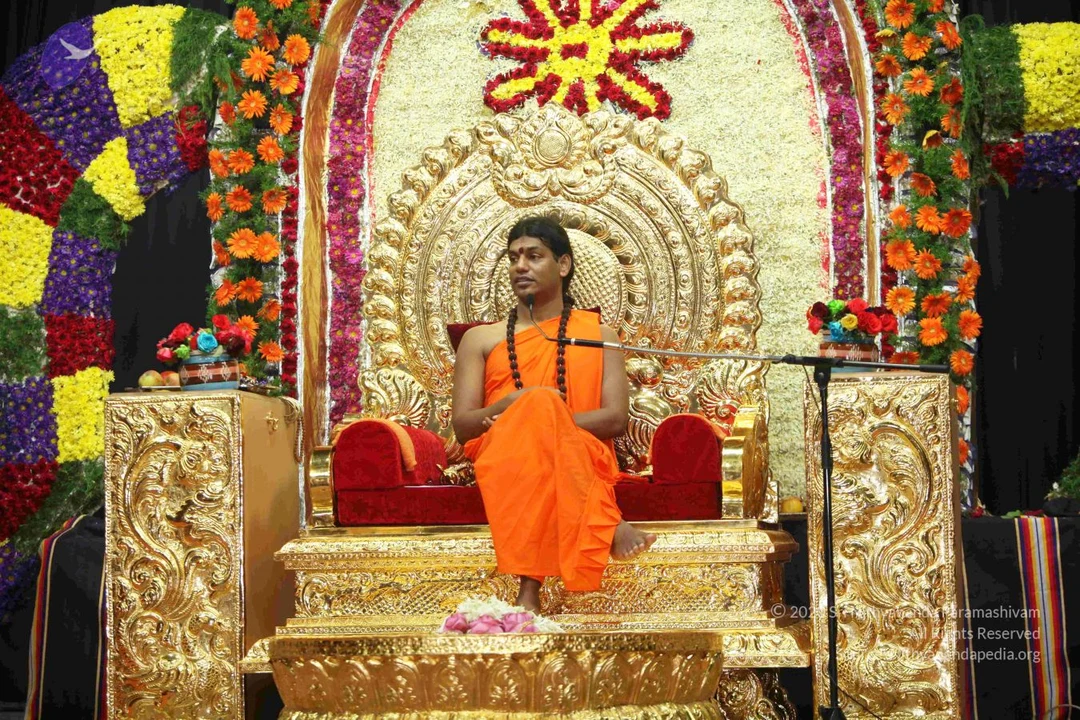
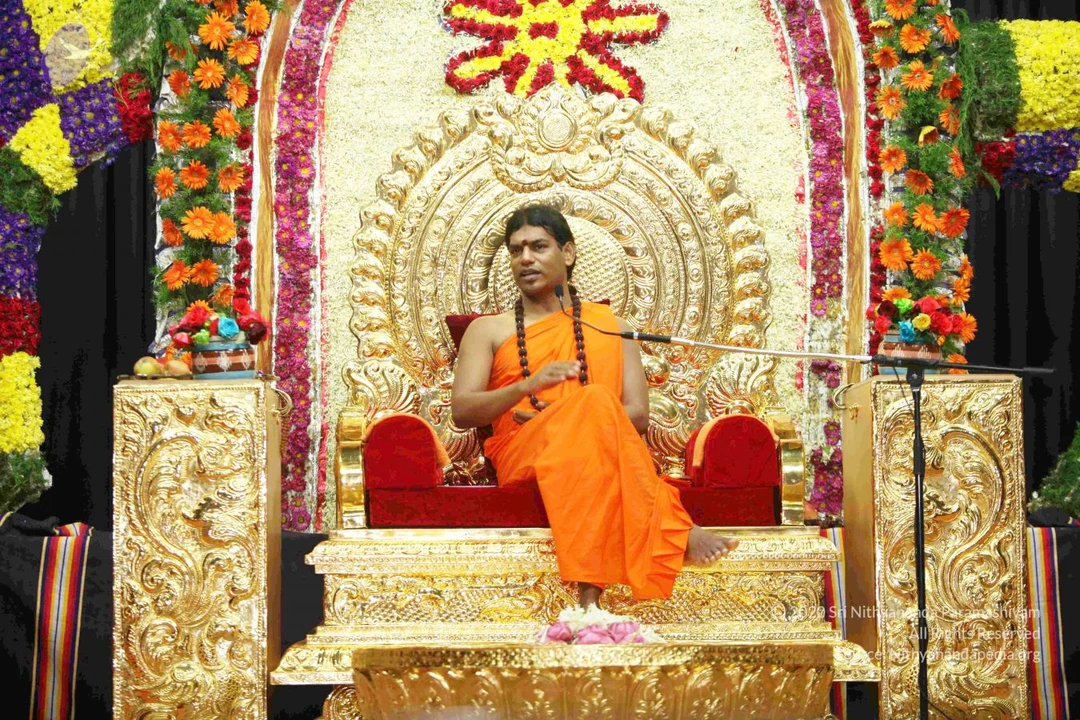
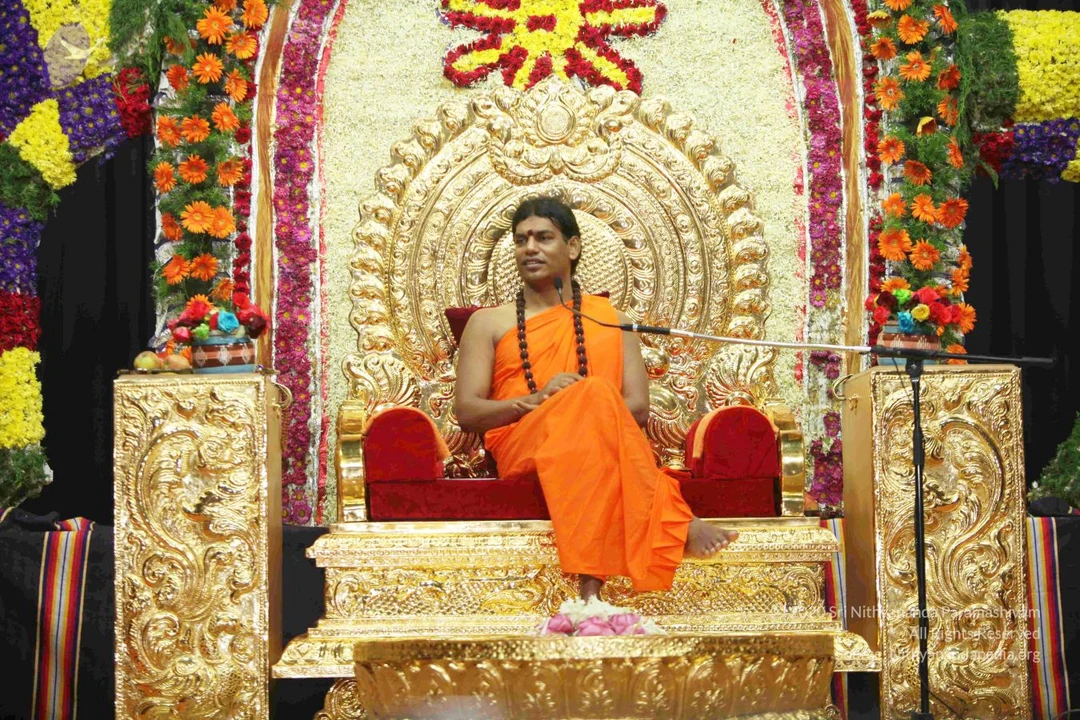
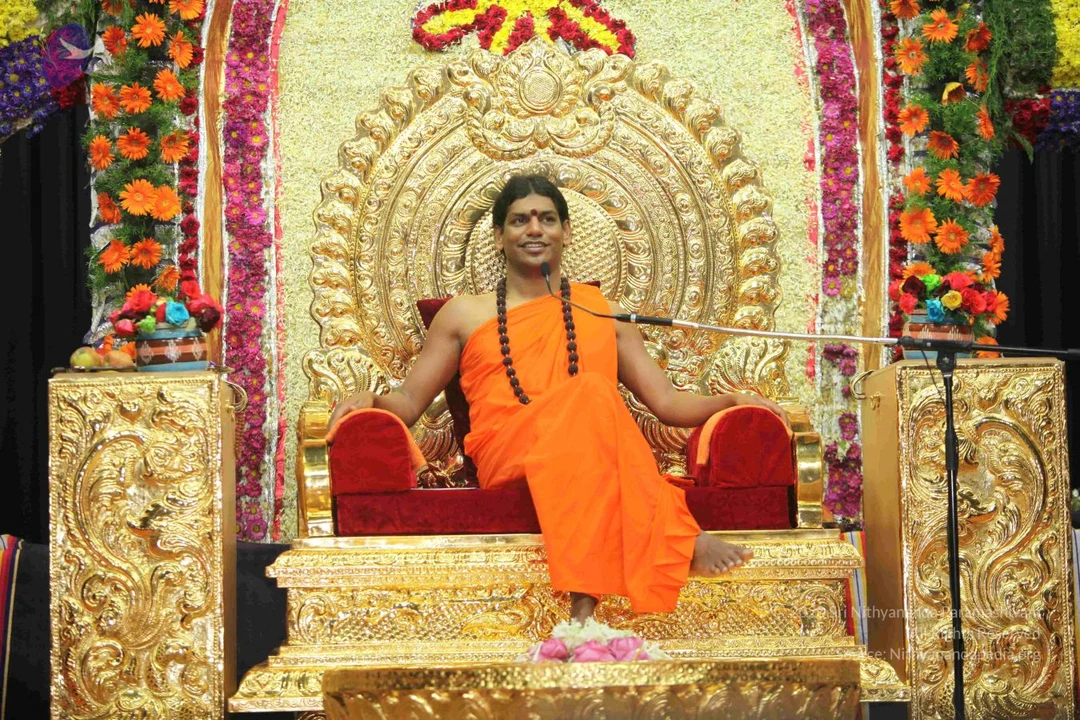
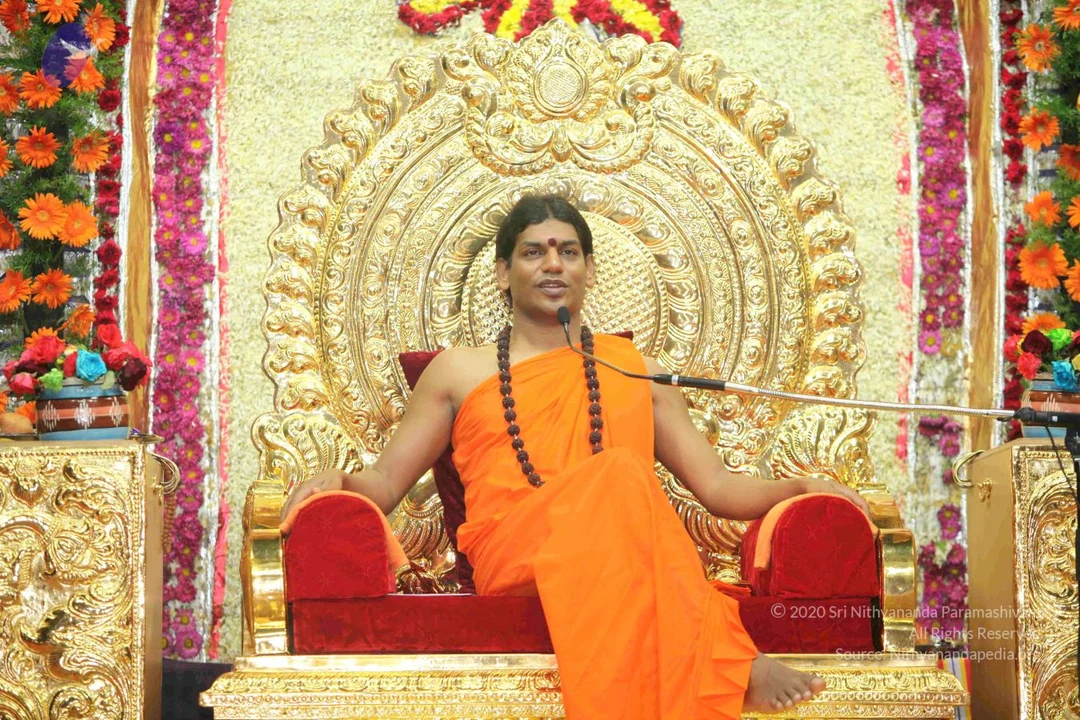
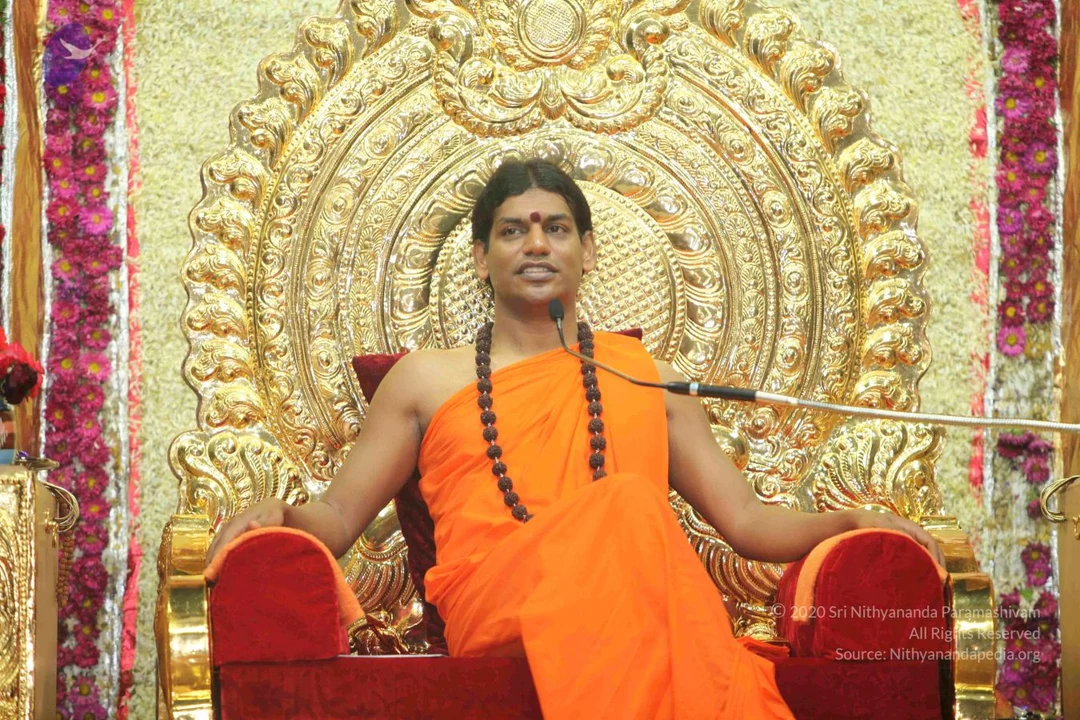
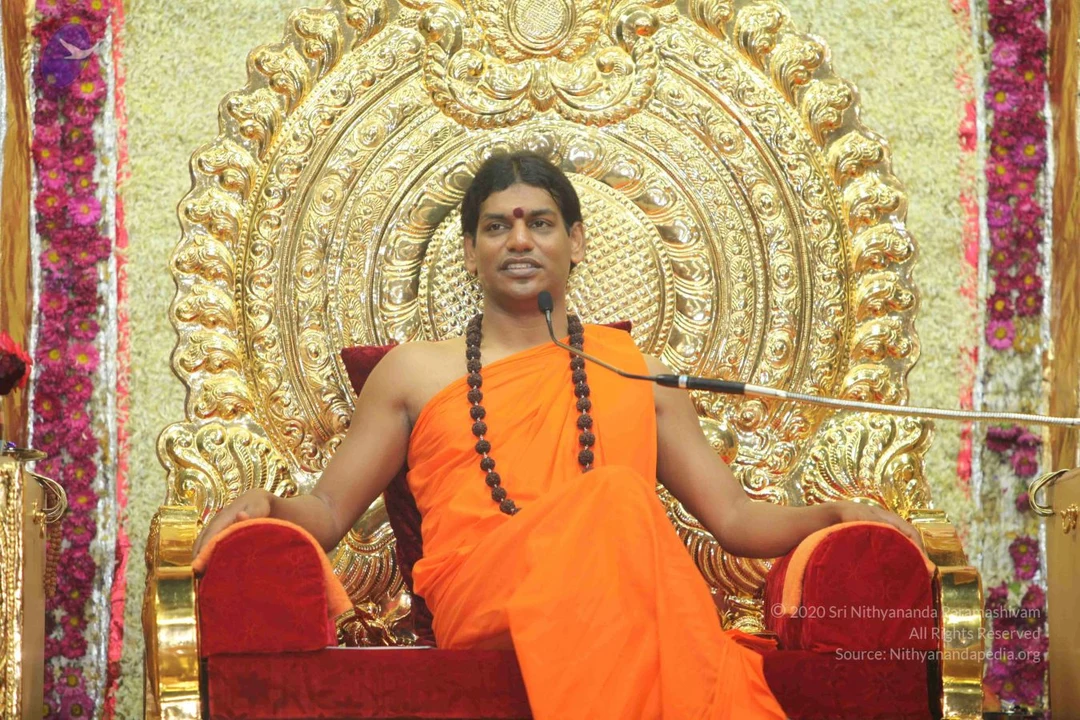
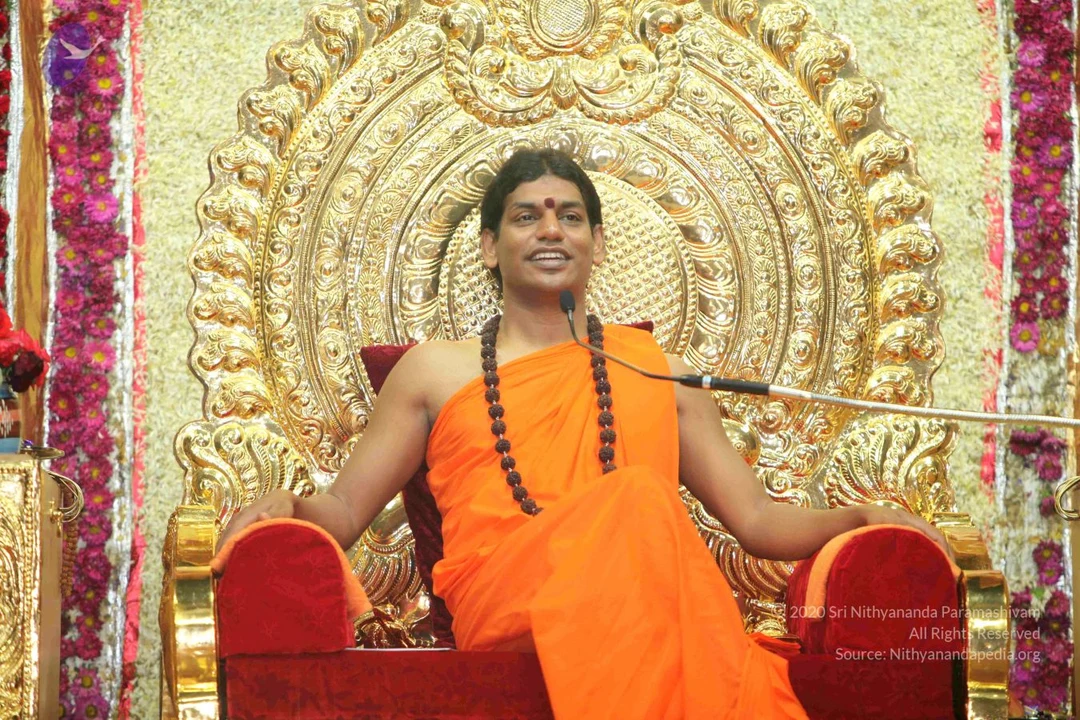
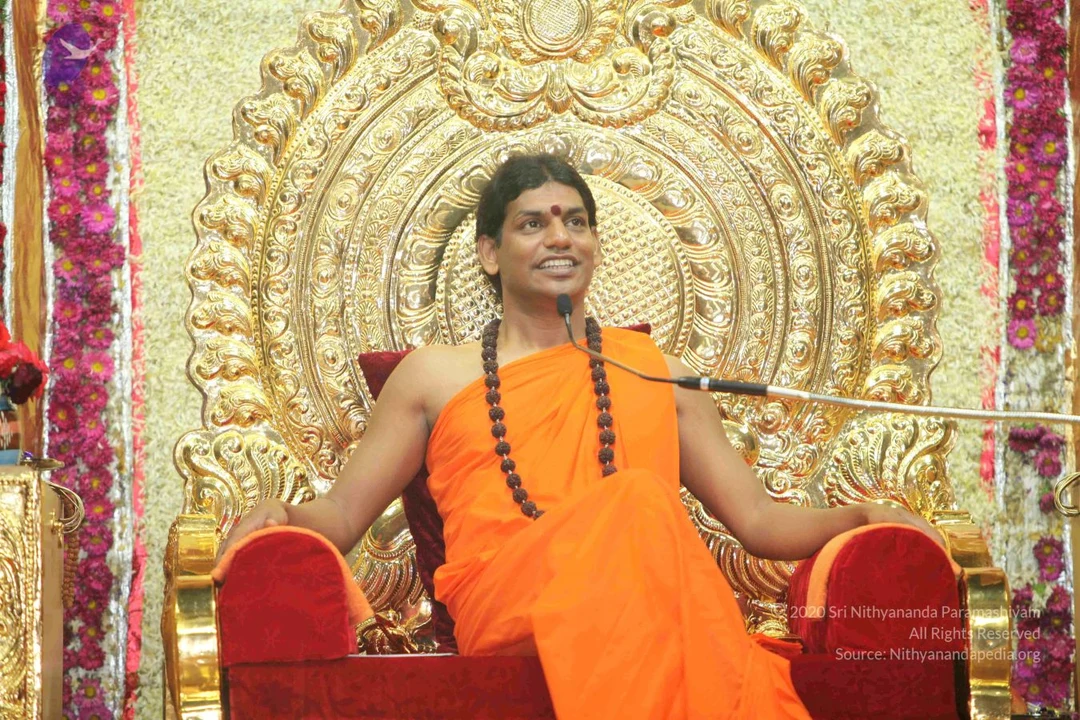
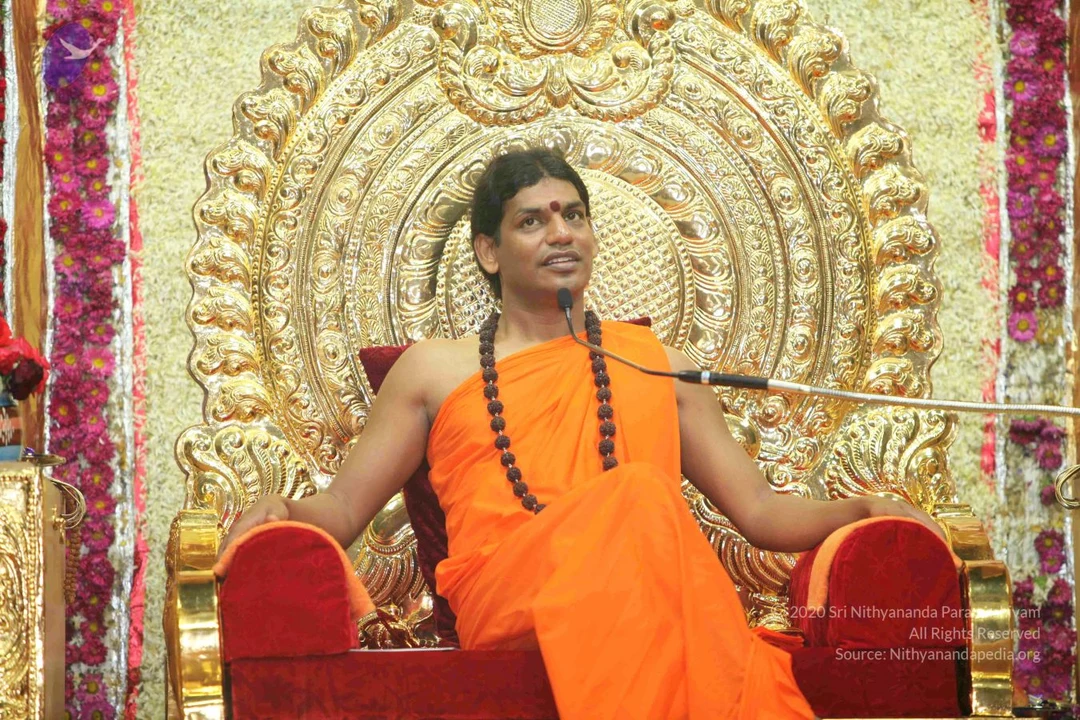
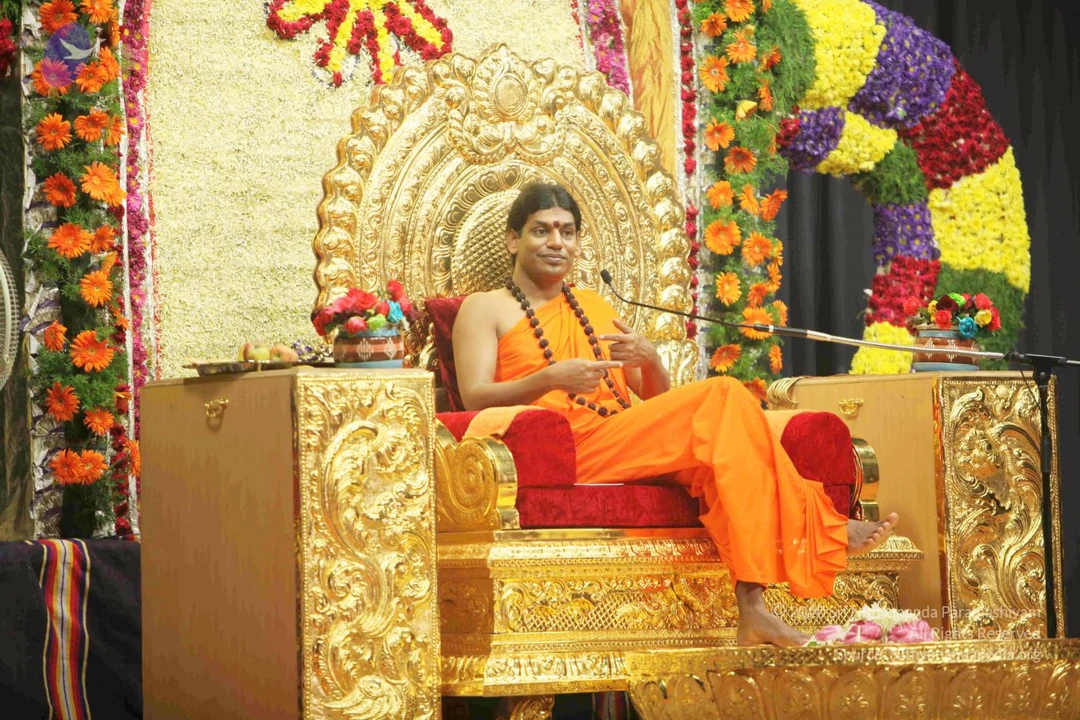
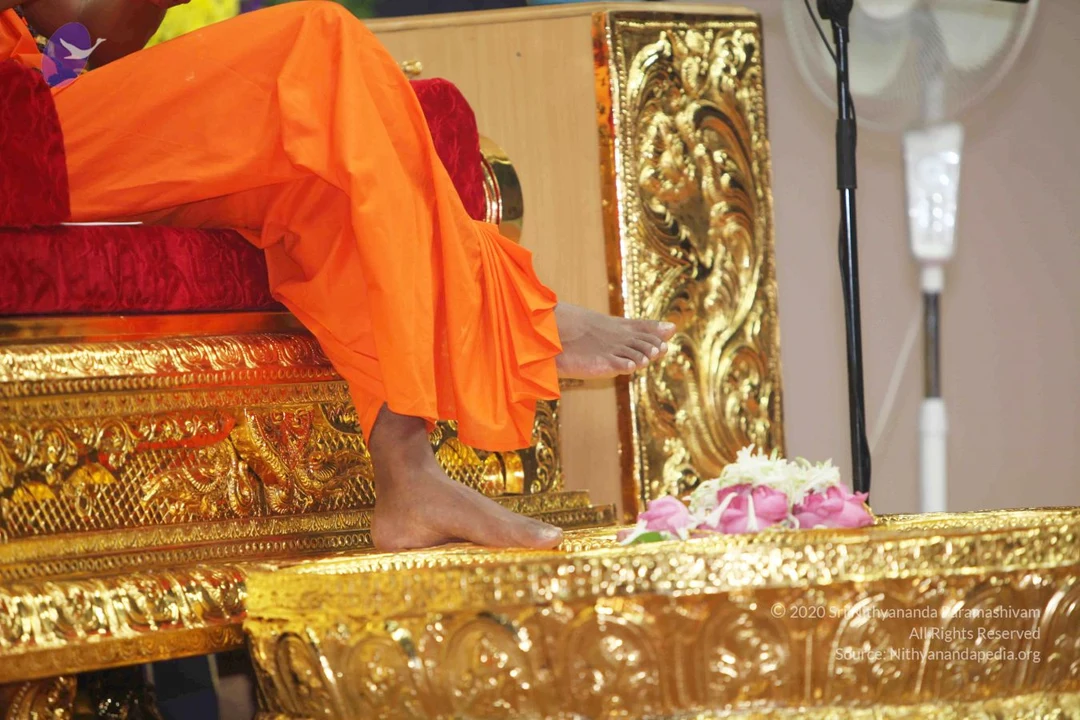
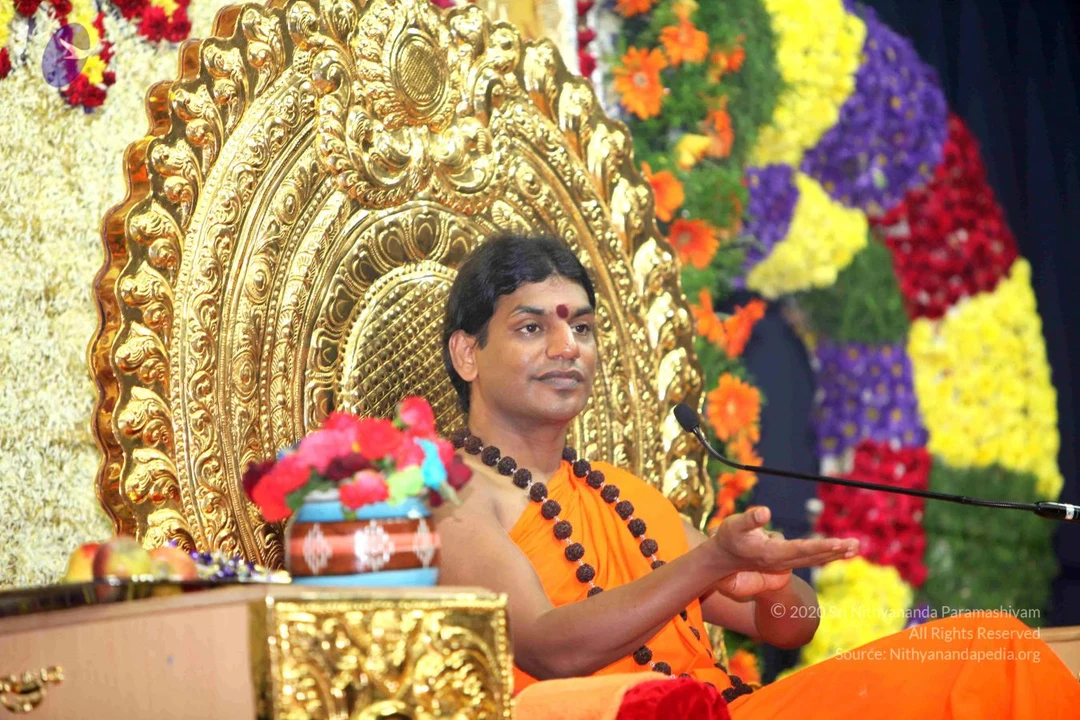
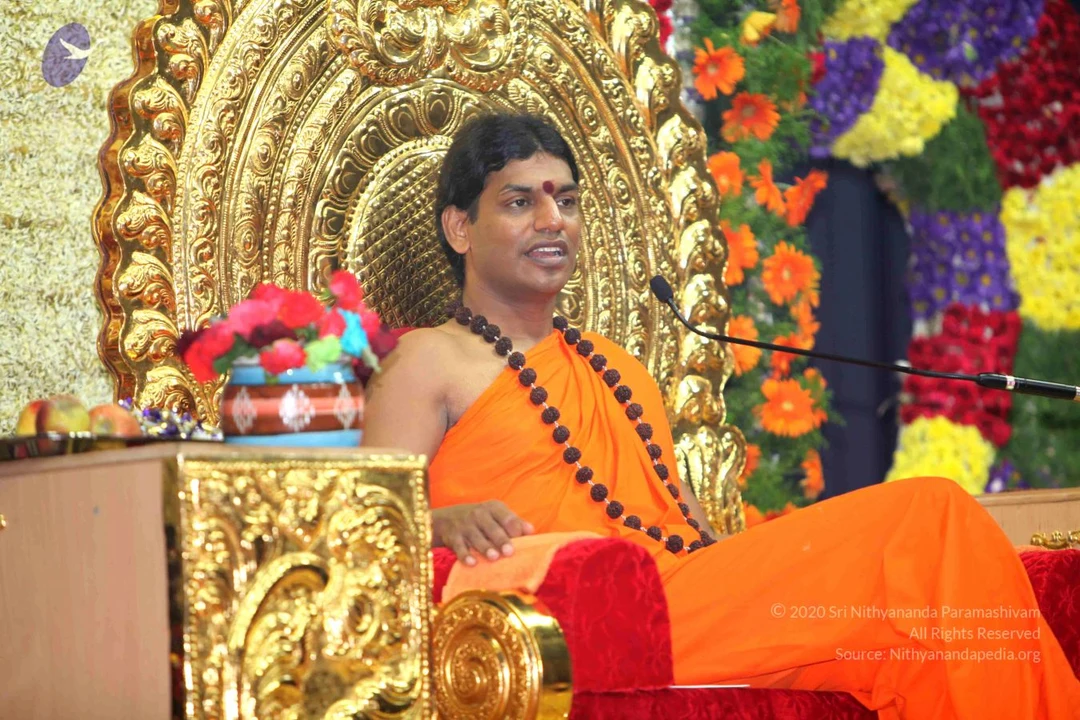
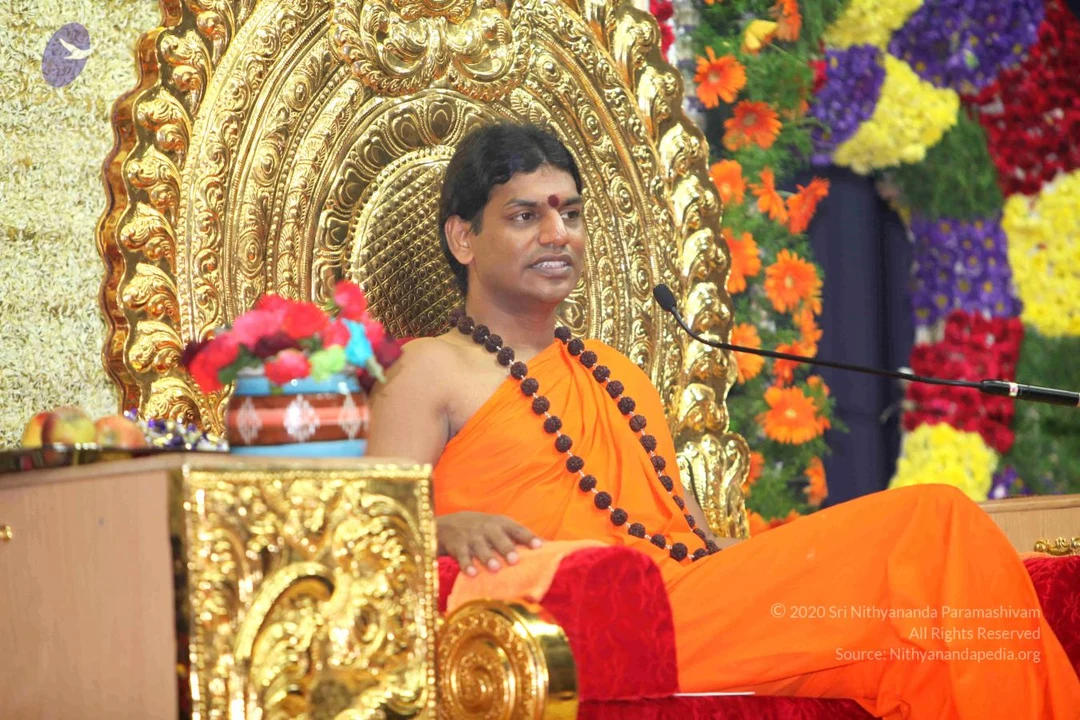
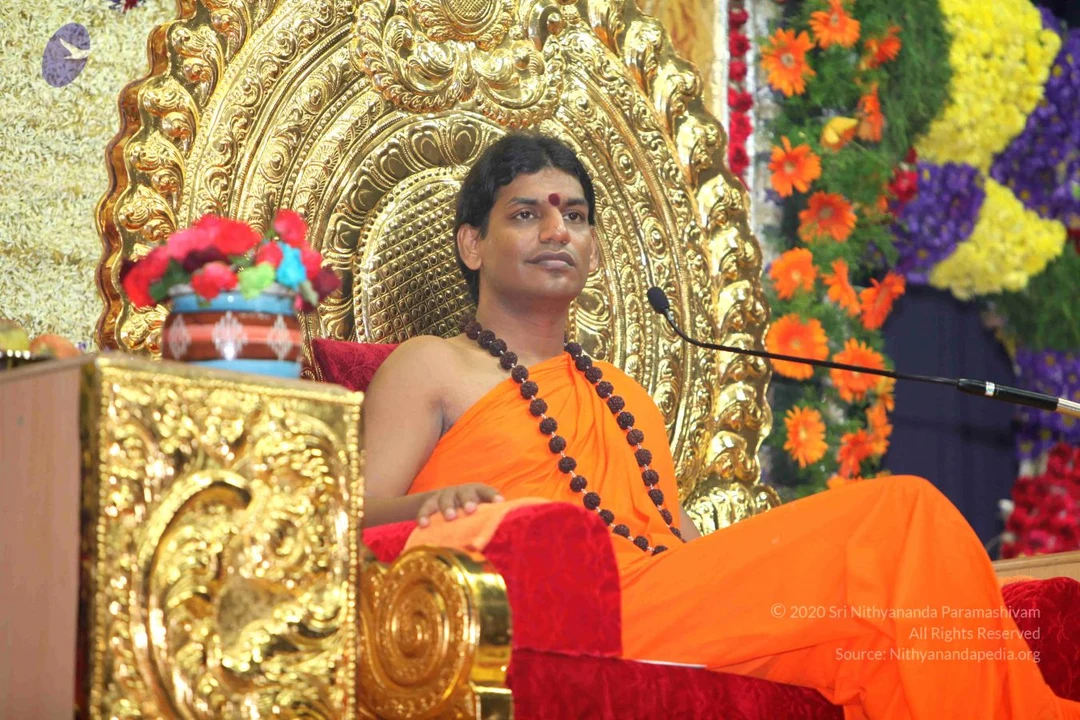
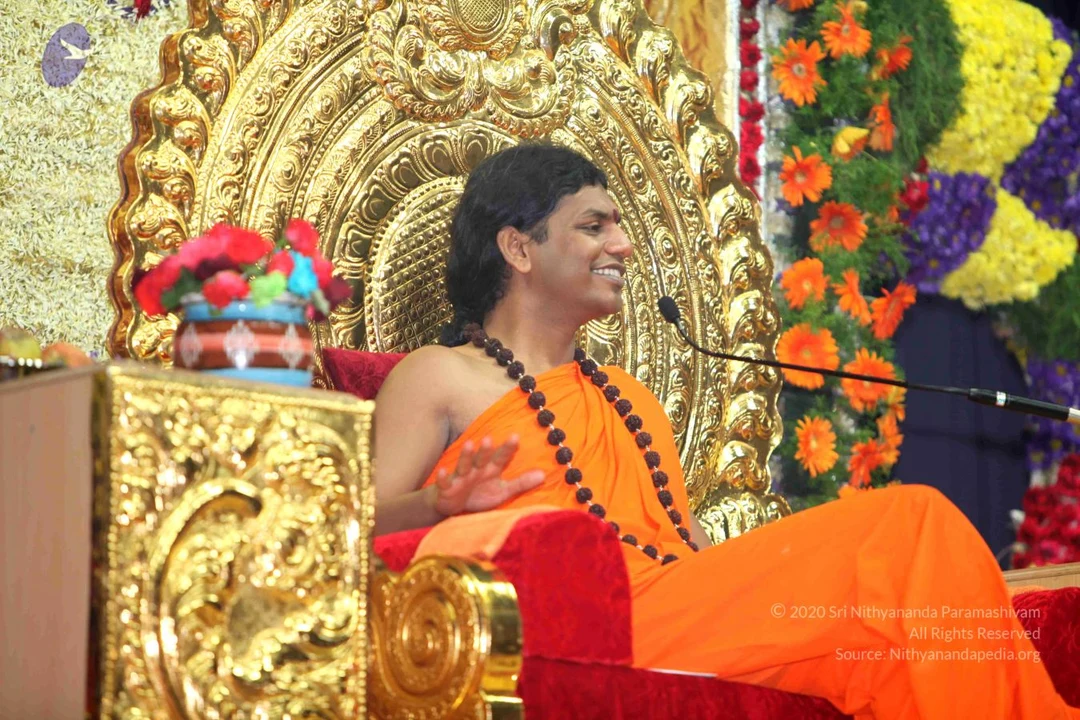
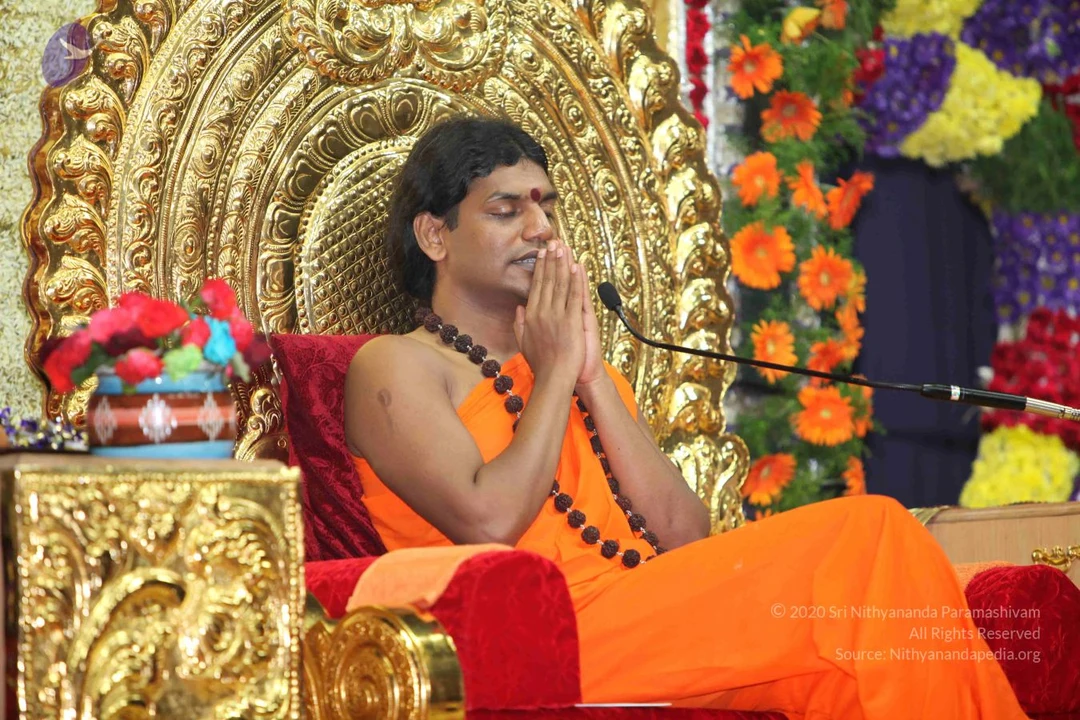
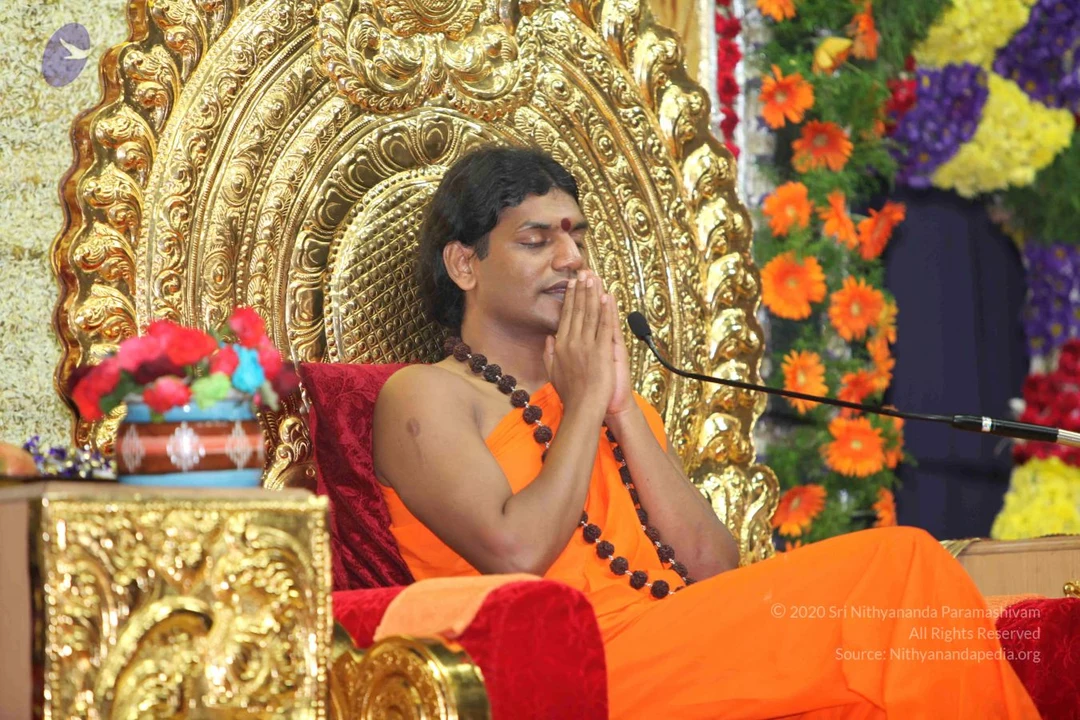
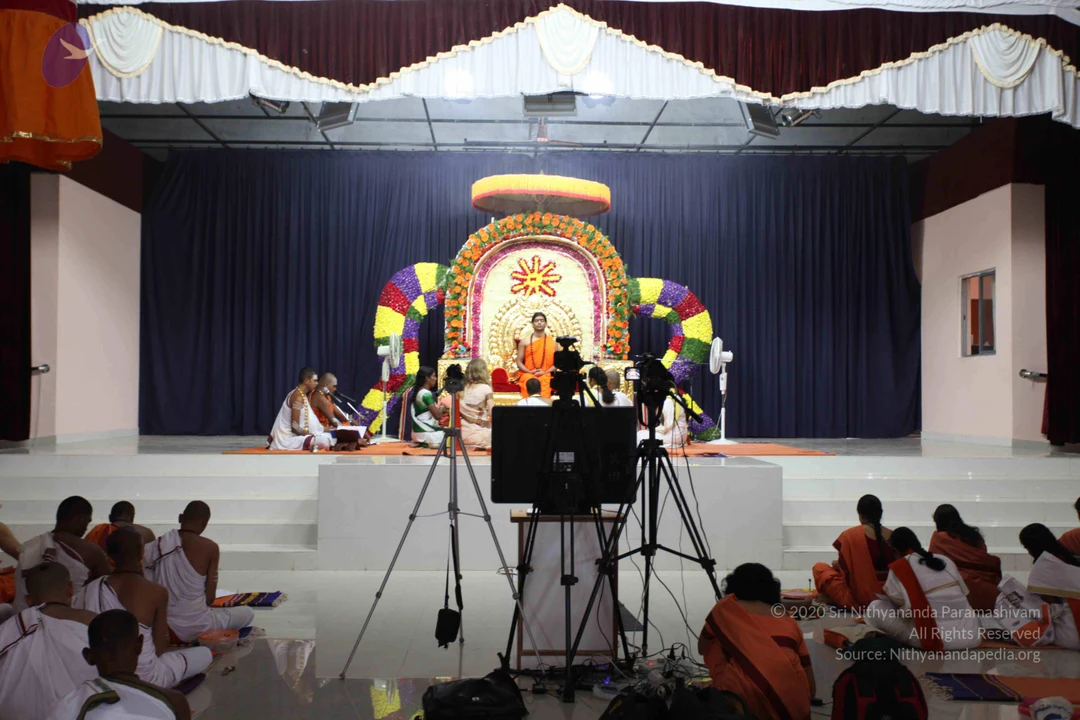
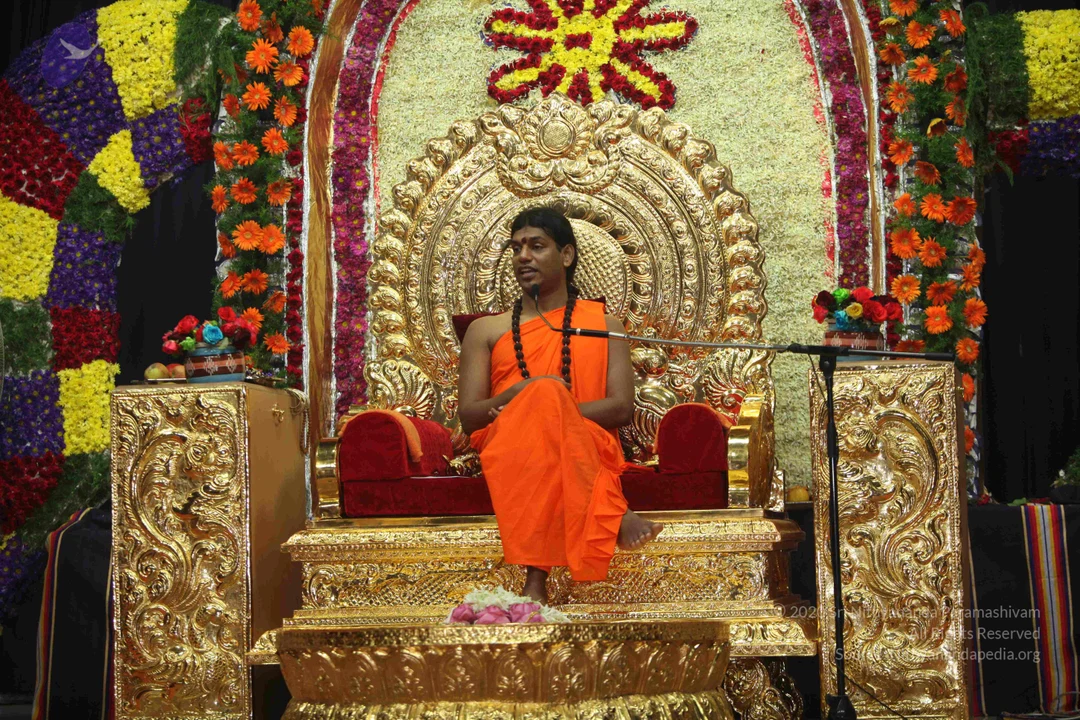
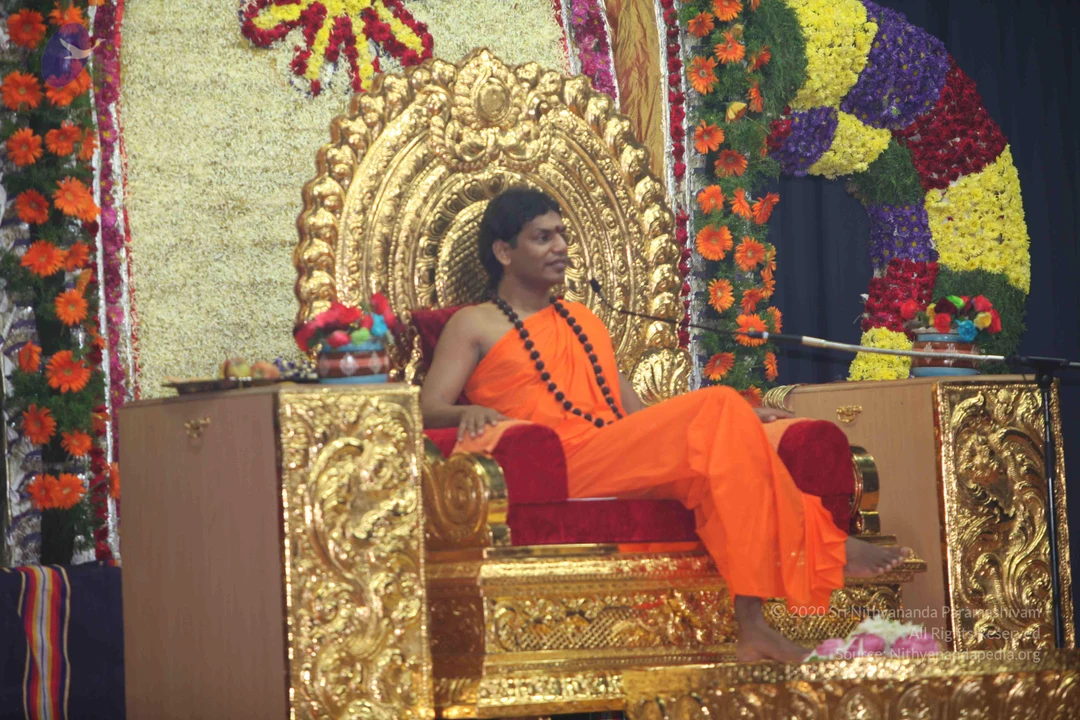
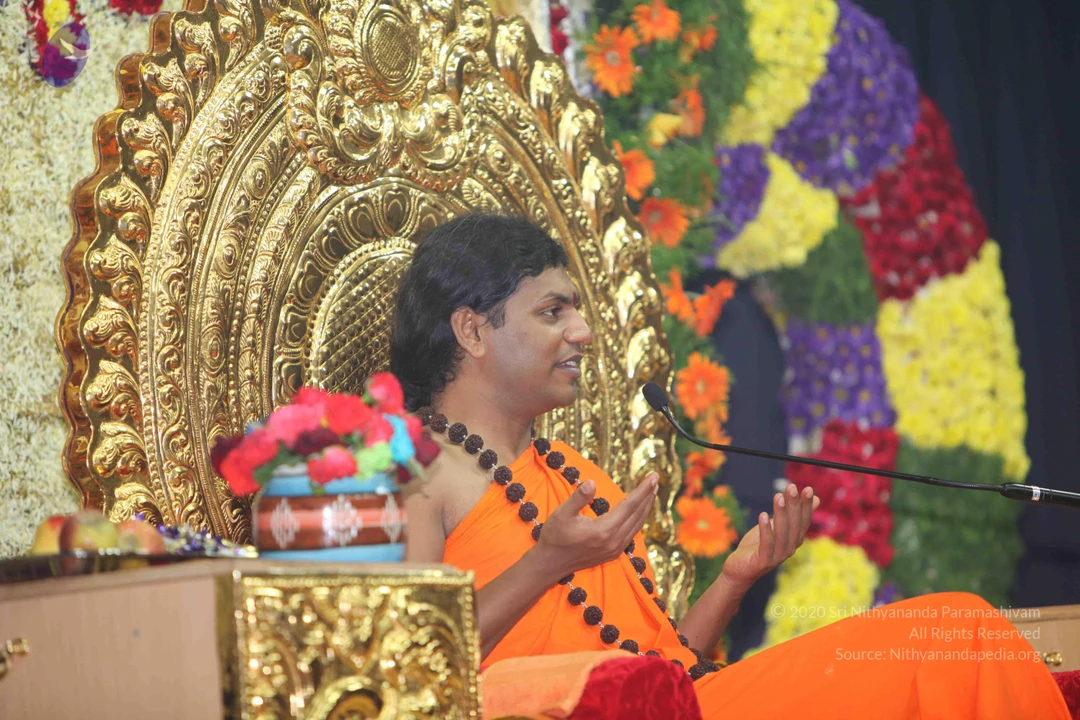
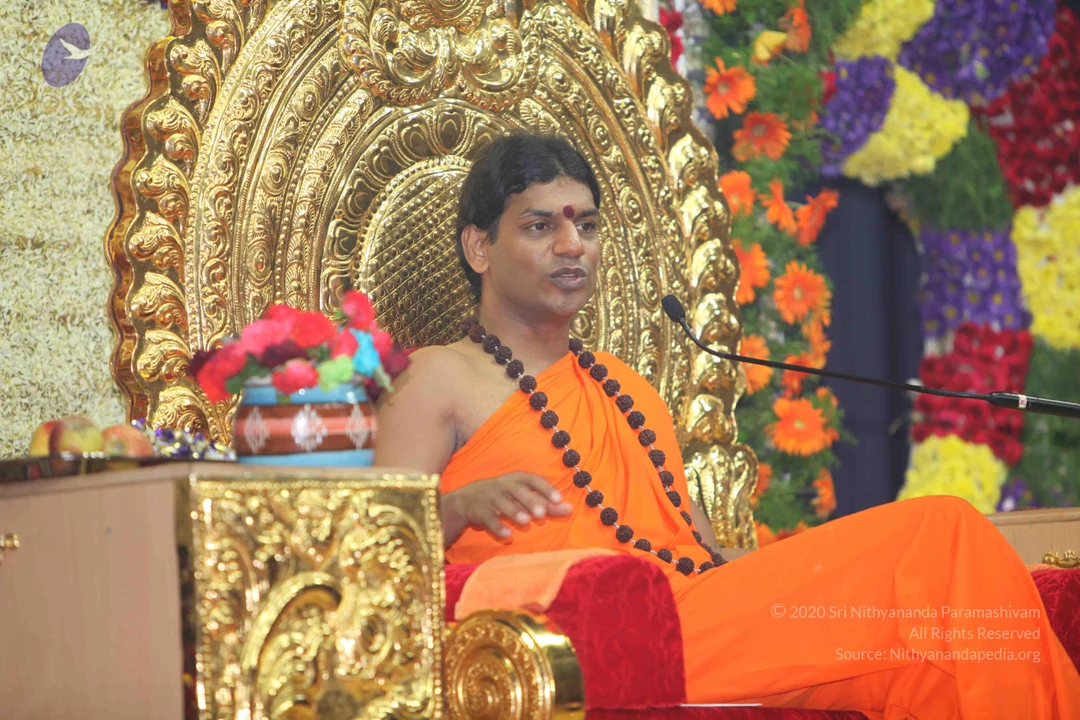
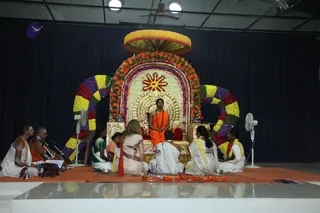
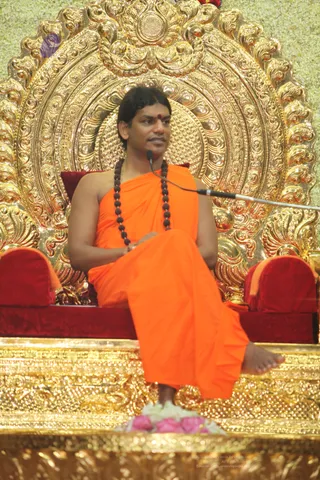
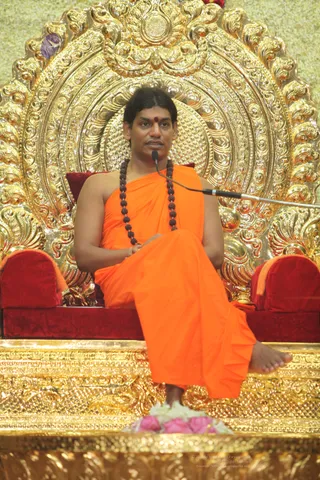
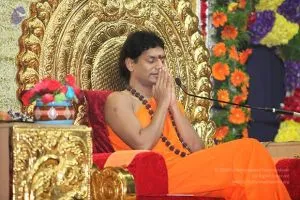
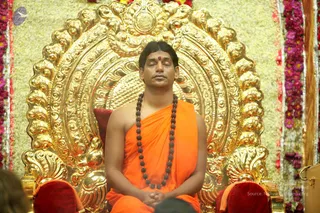
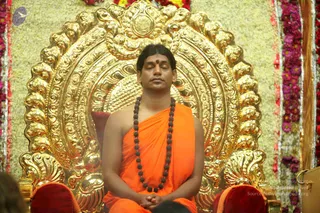
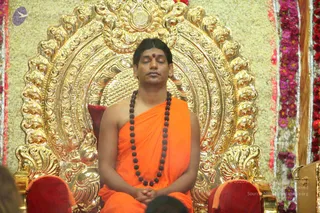
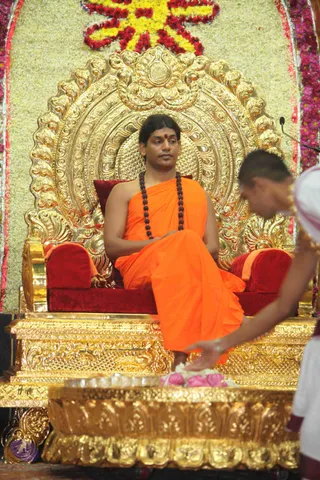
A photograph of a stage-level puja setup in an indoor hall. A seated figure in saffron-orange robes sits centrally on a raised throne-like seat framed by a large floral arch of orange and yellow marigolds with striped multicoloured garlands on each side, a golden halo-like backdrop with a red sun-like emblem, and a yellow-and-orange floral canopy above. Several men in white dhotis and white shawls sit cross-legged on the left of the stage, some with chanting or ritual props, and women in green and pink saris sit nearby. A camera on a tripod and a monitor are placed in front of the stage in the foreground. Below, a row of seated people in white and saffron-orange clothing face the stage, including shaven-headed men in white and women in orange garments. White and orange draped fabric hangs along the top of the hall, and pink-and-white walls frame the space.A man in orange saffron robes sits on an ornate gold throne with a large carved gold backrest, eyes closed and hands folded in front of him. He wears a long rudraksha mala with dark beads and a red bindi on his forehead, with his hair swept back. Behind him the gold throne is framed by white flowers and pink blossoms. At the lower left edge, the partial heads of other attendees are visible. The scene suggests a seated satsang setting, with the figure appearing meditative. Visible cues include saffron clothing, a rudraksha mala and swept-back hair, so the appearance-based label is Swamiji (probable), seated in person on the throne.A seated man in an orange saffron shawl and a dark rudraksha mala speaks into a microphone with both hands open in front of him. He sits before an ornate gold throne with carved floral backrest, and behind him a wall of marigold and rose garlands in orange, purple, yellow and red. A pink and red flower arrangement sits in a blue and red vessel on a gold-carved table at left. Swamiji (probable): long swept-back hair, saffron clothing and rudraksha beads identify a.

October 25 2010

Original wiki page
Contents

Title

Unlock The Past To Heal The Future: Nithyananda Morning Message (25 Oct 2010)

Narration

The Supreme Pontiff of Hinduism, Jagatguru Mahasannidhanam, His Divine Holiness, Bhagavan Nithyananda Paramashivam, expounded on the Cosmic Principles of Engrams during the everyday live public talk - Nithyananda Satsang. In this talk entitled Unlock The Past To Heal The Future: Nithyananda Morning Message (25 Oct 2010), His Divine Holiness (HDH) cited several researchers who report that most ailments we suffer from in this life are due to engrams or blocks developed in early childhood, the prenatal stage, or past lives. He shared further that researchers speculate that these threads of suffering have made men forget their divinity. HDH further cited research about the use of past life therapy or past life regression in removing engrams or blocks. This modern day research was juxtaposed by His Divine Holiness with the Patanjali Yoga Sutras which said, in essence, that the root of all affliction is latent, seen and unseen, and stays as Karma through births. He added commentary that we can unlock the engrams and make our future into a powerful reality, but we should not make Enlightenment as a goal as it is too abstract for us to grasp. Instead, we should have as a goal to create for ourselves a Vedic mind and Yogic body. Then we will be able to work along the same lines required for Enlightenment. He defined Vedic mind and Yogic body and outlined what is required to achieve it. HDH advised delegates to disappear into the great fire of the Sangha, and we will experience the space where we can never be annihilated. His Divine Holiness concluded by asking delegates to bring more Manana from one day to the next

Video and Audio

Unlock The Past To Heal The Future

VideoAudio

Transcript

(00:27)

I welcome you all with My love and respects. Today’s subject is “Unlock the past to heal the present”.

I have some Shastra Pramanas for all of you. This is a modern day research from Life Research Academy, their website - 90% of illnesses and diseases and ailments that we suffer from in our present lives have past life connections and this is one of the very great revelation from one of the modern day great Rishis L Ron Hubbard who created the tradition of Scientology. Most problems are due to engrams and blocks created by the threat in early childhood, parental stage… prenatal stage or past lives. It says engrams formed during all times have made men forget his divinity; divinity.

Psychotherapists Brian L. Weiss and Dr. Ian Stevenson reveal that past life therapy can be a cure for psychological ailments like phobias, mental blocks, unexplained fears, depression, addiction, obesity and insomnia.

(02:10)

Now I am coming to the ancient Rishis. Whatever few things I read out now is from modern day Rishis; now I am coming to the ancient Rishis.

An ancient Yoga philosopher Patanjali extends his extensive research on past life regression. He calls it as a Pratiprasav.

I will quote a Sutra from him. Already I spoke on this Sutra but I will give you the essence, “क्लेशमूलः कर्माशयो दृष्टादृष्टजन्मवेदनीयः”

The route of affliction is past action. It is latent, seen, unseen and stays as Karma through births.

Mahavira calls past life as Jatismaran. Remembering past life is an integral part of Jain practices; Jains call attaining freedom of rebirth. I can say, “freedom from rebirth” as Kaivalya. So these are some of the Shastra Pramanas.

(03:25)

Now I will add My Atma Pramana. Please understand, it is out of past, your present is made and future is going to be made. You can always unlock the past and release those intense suffering engrams and make your future into a powerful reality, powerful experience. I tell you, don’t make Enlightenment as a goal because you don’t understand that word completely. Make Yogic body and Vedic mind as goal then you will be able to work exactly in the line I am telling you. See Enlightenment is more like a abstract concept, more like a poetry and romance which you are never able to catch it. So it’s like a, unclear, but the concept of Yogic body and Vedic mind can be more tangible for you.

Actually if you have a tangible goal, you will understand directly how this past life regression or releasing the past helps you, to achieve that goal. Because you keep some abstract goal, you don’t know how all this, each day My message adds you or leads you to that goal. Even mentally don’t have Enlightenment as a goal because you do not know it exactly what it is. When you do not know what it is, then how every day My message and inspiration can push you towards that goal. It becomes like a unconnected. See I want you to understand, everyday My message should be inspiring you towards that experience and you should start perspiring for it only then this morning message is useful. It becomes an inspiration. It becomes like a tonic otherwise if you don’t have a clear goal and don’t know how to connect this with that, it is not tonic it is just toxic, waste; not only waste, dangerous because you will learn words without working for it.

(06:15)

Why this people who don’t have a clear understanding, not only they are not tonic they are toxic. This is what exactly I was telling during the LEP session also. I have no problem in accommodating any number of people and giving them food and shelter and taking care of their basic needs; any number of volunteers we can accommodate freely but the problem is these few toxic people who are not responsible; they become the negative group. I am afraid of these people who don’t have clarity, having some abstract ideas and unable to connect their daily life with that abstract ideas that is why I am telling you, don’t have Enlightenment as a goal that’s too abstract, too poetic; you will never be able to even comprehend.

Have this Yogic body and Vedic mind as a goal then you will see everyday life with Me moves you towards that goal, inspires you towards that goal. You will see that everyday life is an excitement, joy; you are growing.

(07:34)

When I say Yogic body I mean healthy, well built, flexible, joyful body. When I say Vedic mind I mean completely excited, everyday healing itself, recovering itself, exciting itself; this mind. Have this two as a goal; it is doable. Not only that every day you can check and see, “What’s my measurement? What is happening here? What is happening here? What is happening to my Kurma Nadi? Is it becoming green or red? Everyday morning when you wake up you can feel what is happening today’s my mind, is it high or low? Am I feeling excited? Did I sort out this problem which I used to have three months before or still am I carrying that wound? Am I feeling better? Doable! Then you will see everyday life around Me becomes worthy then you will feel like committing; taking responsibility.

(08:48)

Why people are not able to take the responsibility? Because they do not know that it directly works on them; helps them. I tell you even when you volunteer, understand I asked you to volunteer not to work for Me. When you work… when you volunteer, many of the sharp corners you have gets soft. Many of the problems you have gets sorted out. So actually the major problems you have inside you, take list of it. When you volunteer you will see exactly those problems are only again and again happening. You can volunteer any department, understand it is a energy field. Automatically all people, all situation, all... even the plants and animals are trained to hurt you exactly where it hurts you. Clearly they are instructed to hurt you exactly where it hurts you; to make you understand where you are stuck, where you are standing, where you need to work, where you need to polish, where you need to move. Even the animals, plants, anything which is here, everybody is programmed, clearly asked, instructed; it’s an energy field.

(10:22)

If you are caught with the lazy engram you will see exactly when you go and lie down on your bed it will smell badly. It will tell you, “Get out! I am not interested in letting you rest on Me”. It will just tell you; literally it will tell you. Every step I can tell, the engrams you are caught will only be exactly activated or shaken and I tell you, make a list. Make a list, what are the obstructions that you are not experiencing Vedic mind. Make a list. You will see exactly how the engrams which are stopping you experience the Vedic mind are only directly hurt, every moment only they are hurt; they are questioned. If somebody is sleeping whole day without laziness, I will… I will make sure that no… no... neither he is questioned nor… nor somebody else questions him. But if you are lying down just for half an hour in your chair itself out of laziness, you will see twenty people asking you question, that day exactly I will be asking you, what have you done today, give Me the routine.

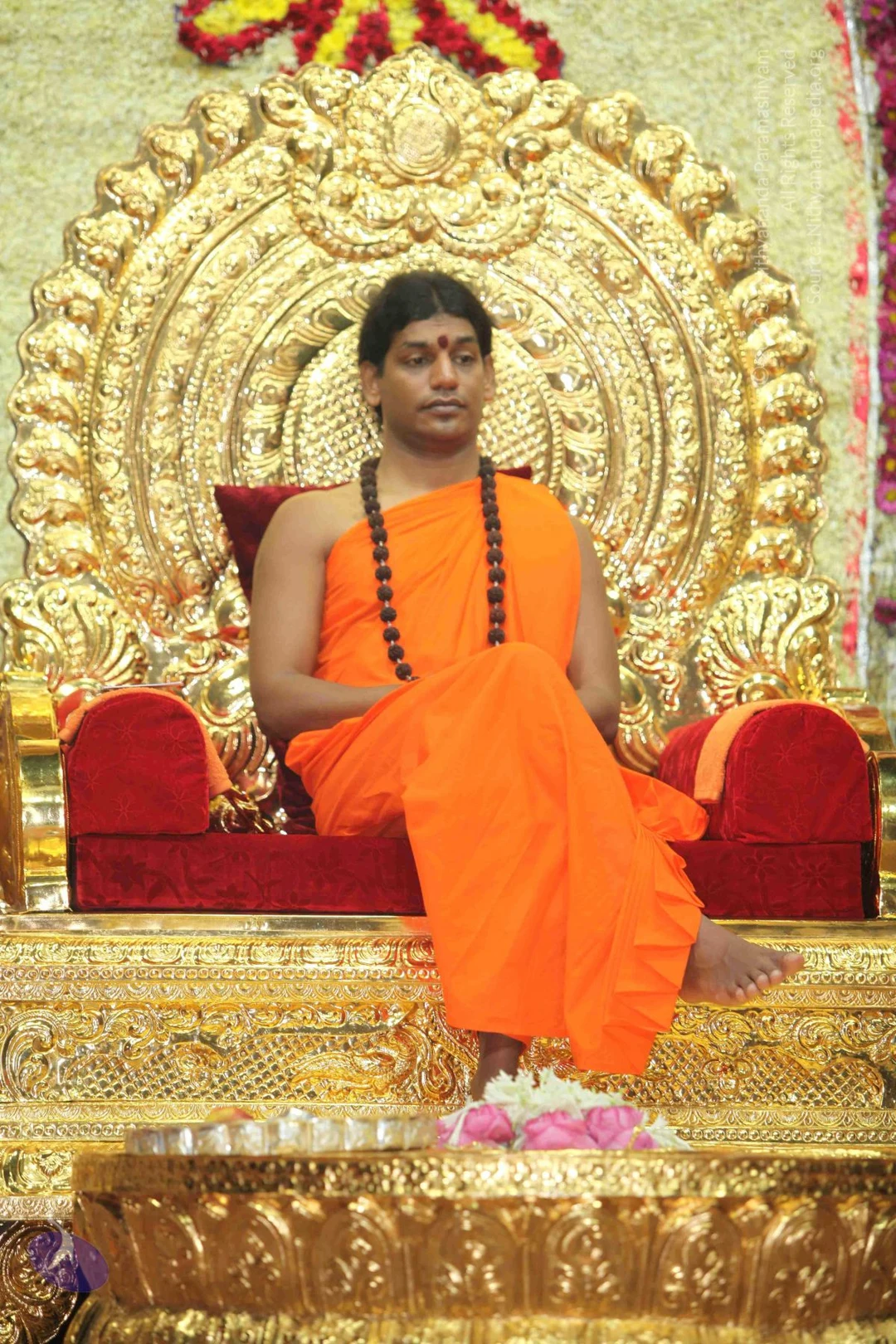
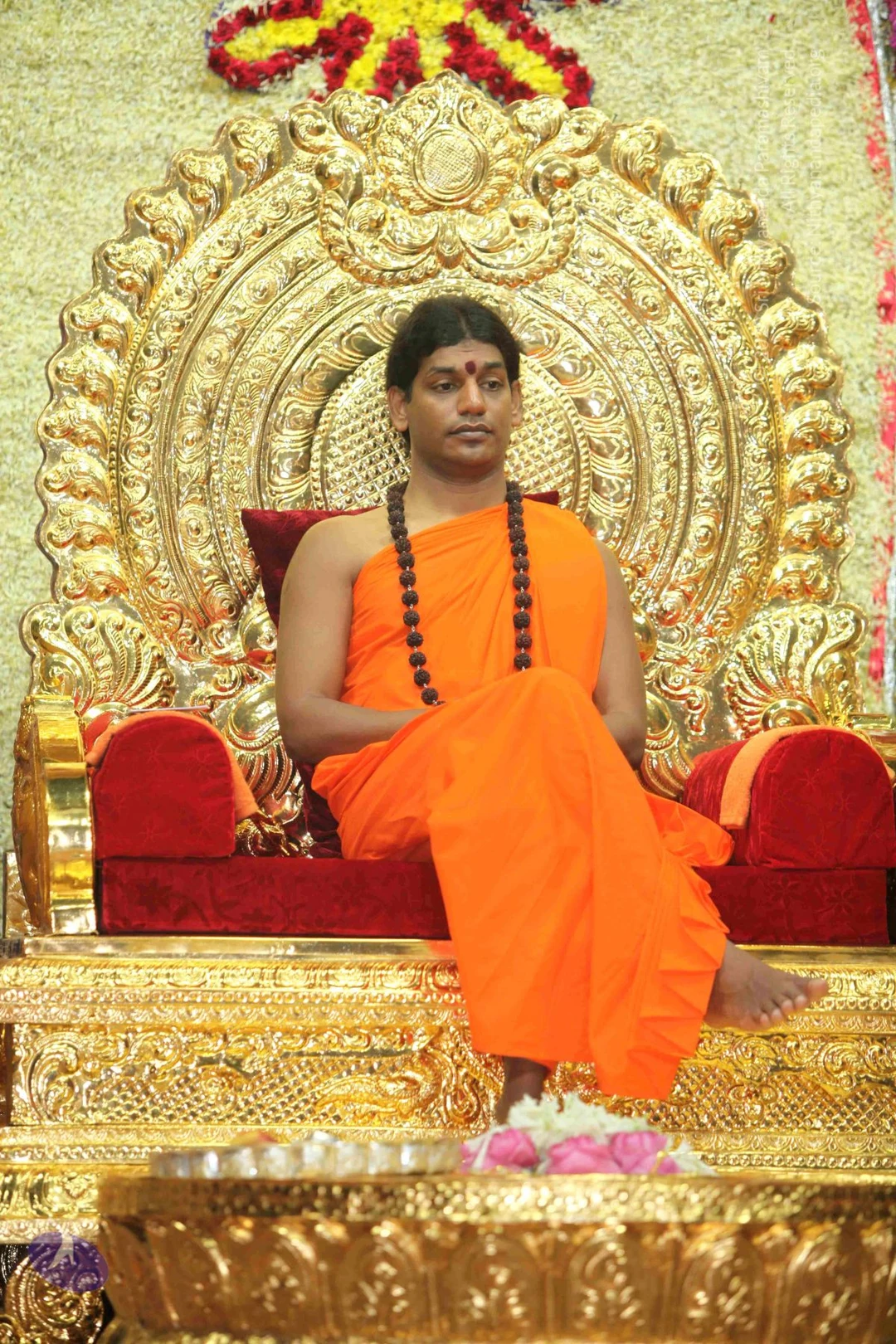
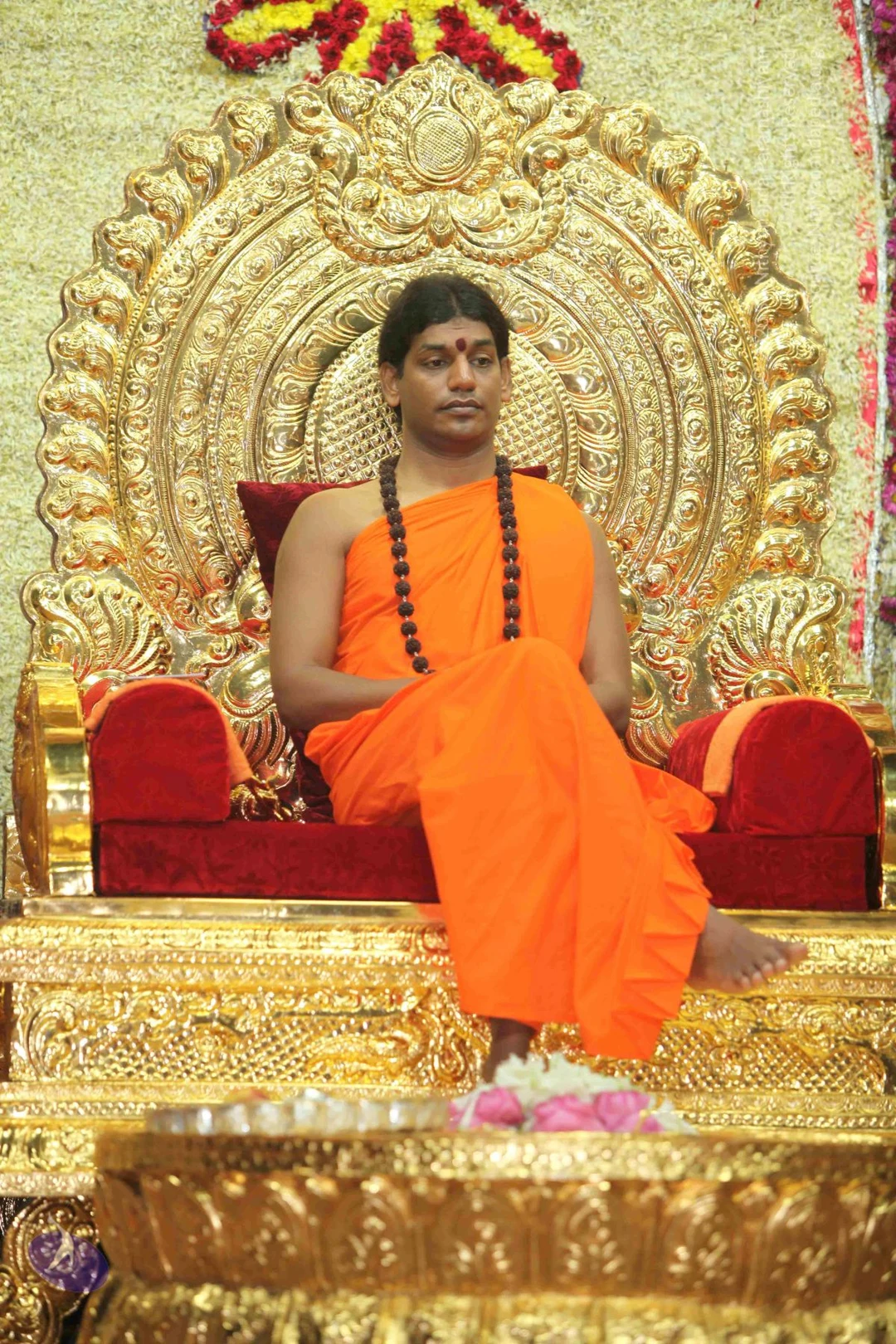
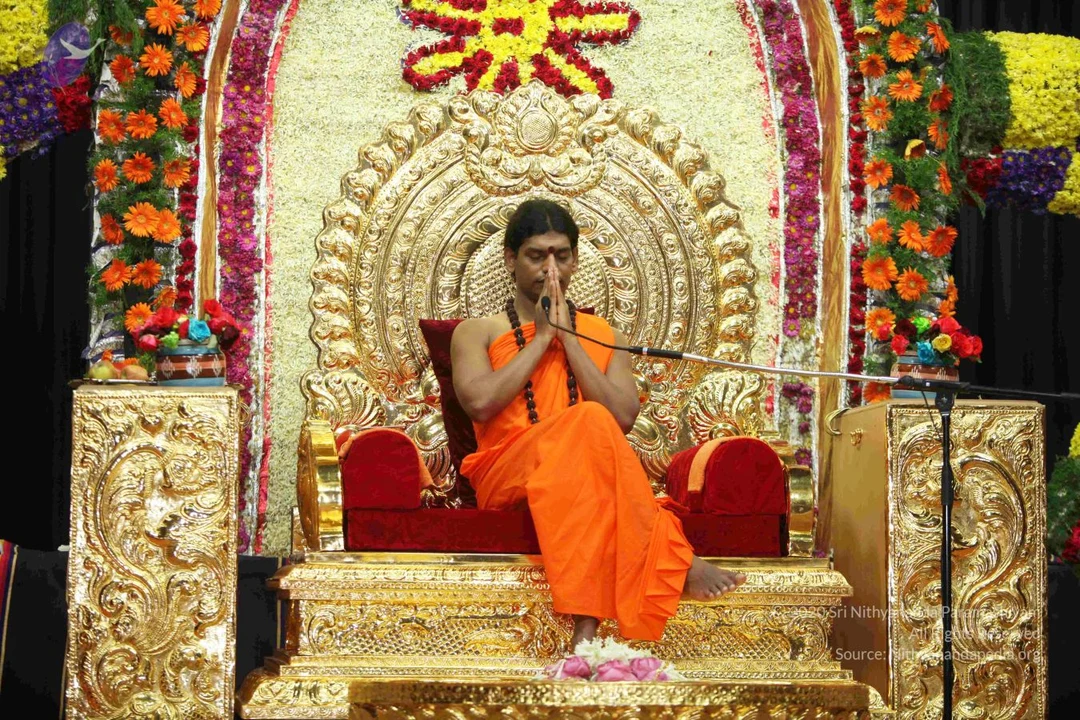
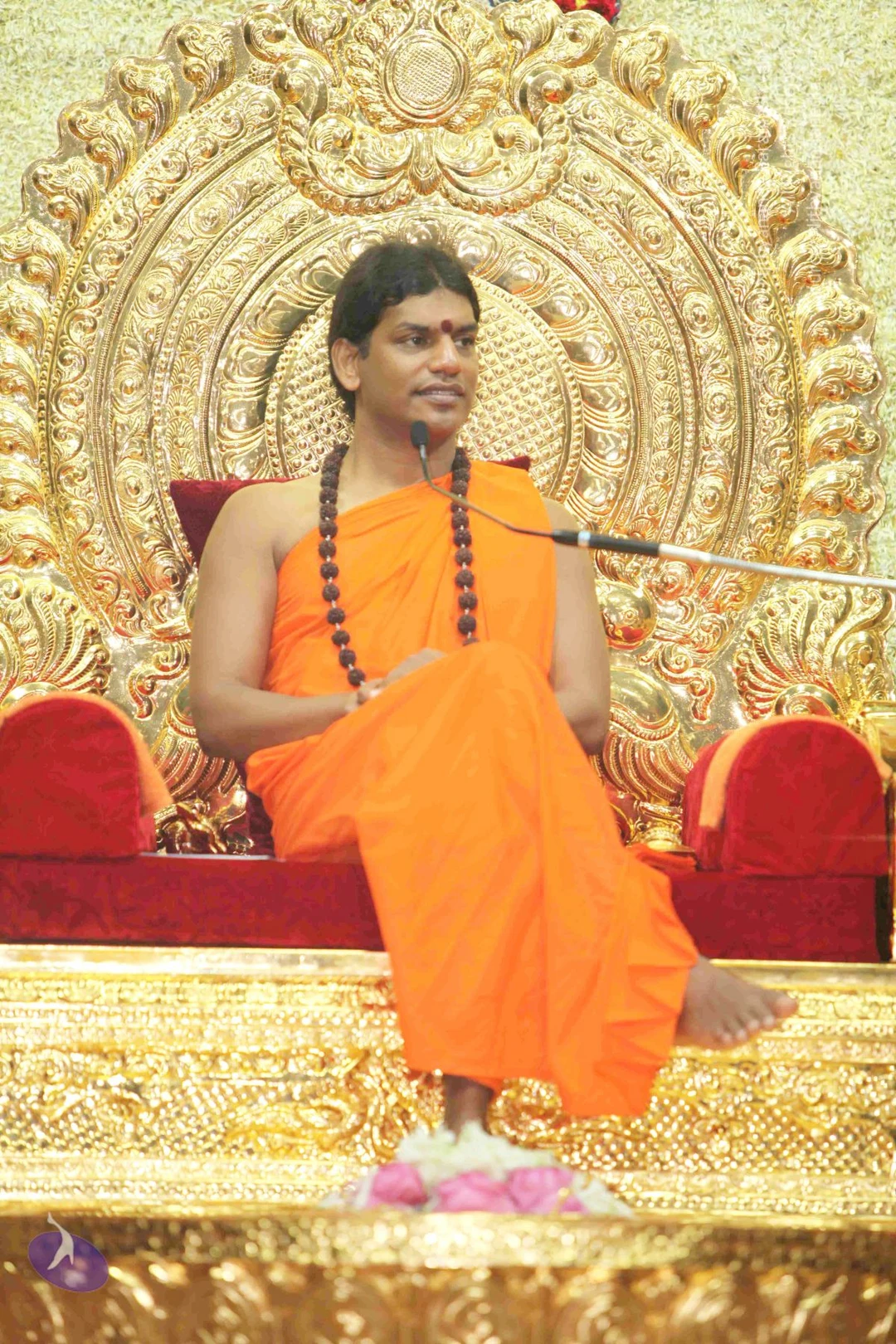
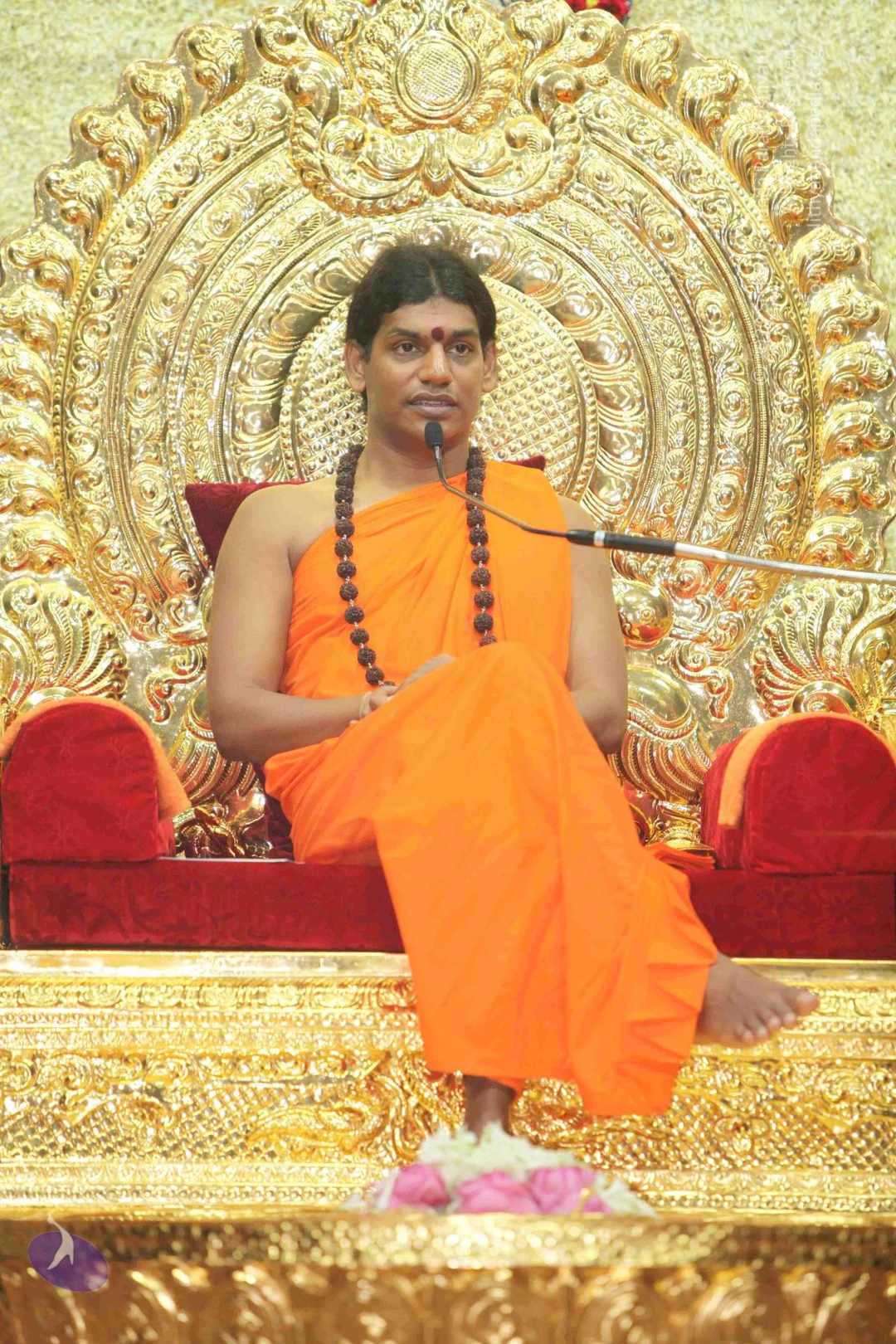
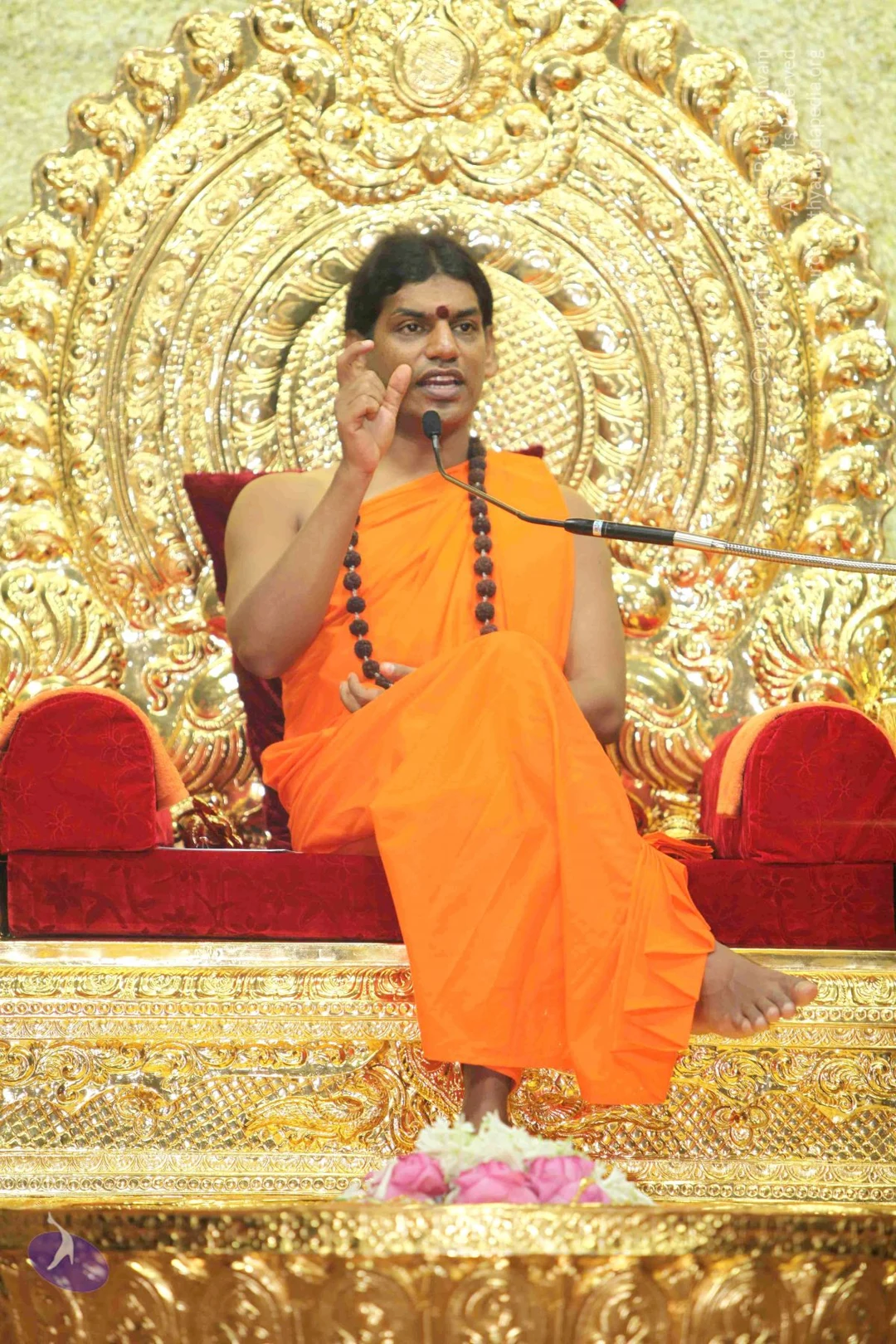
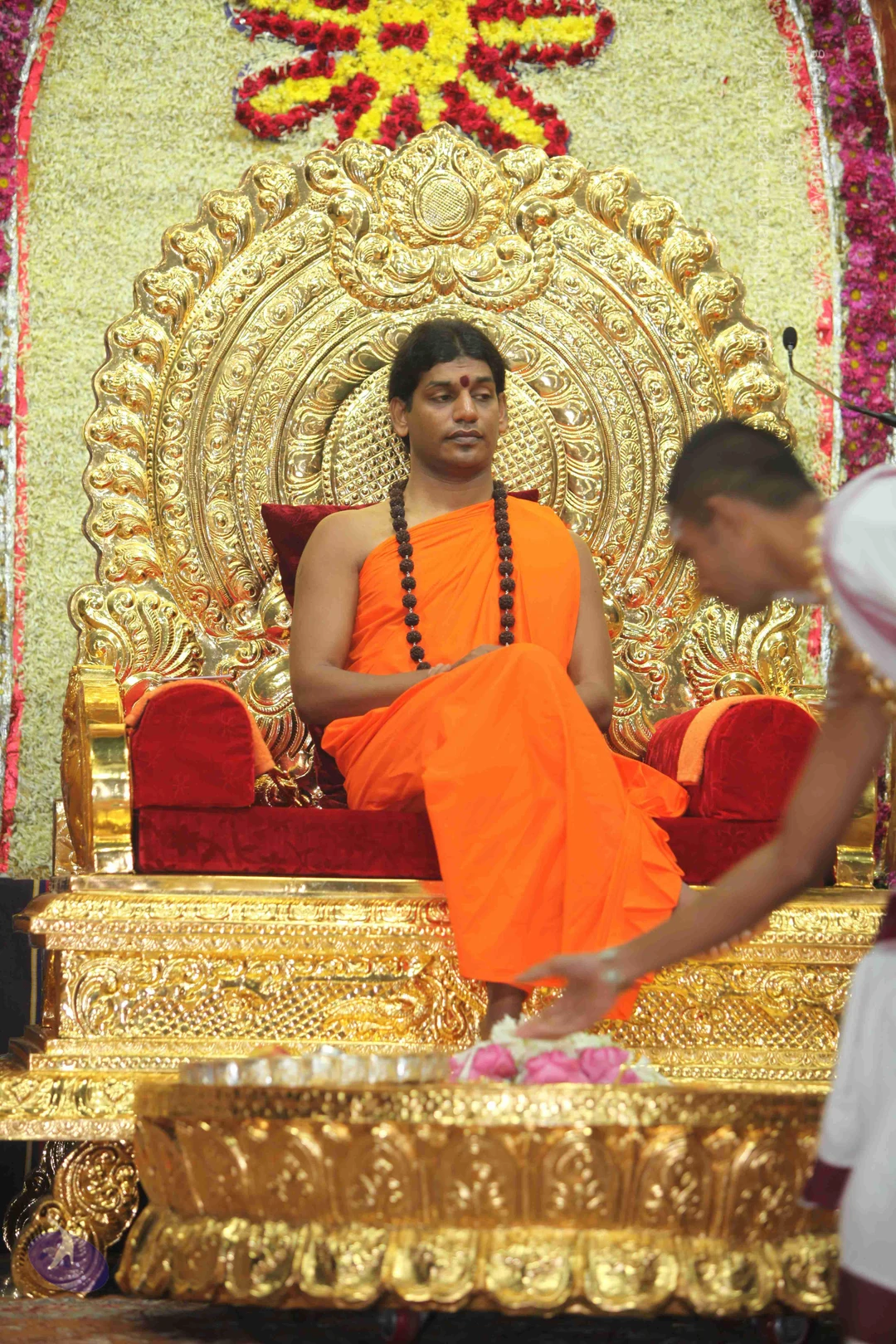
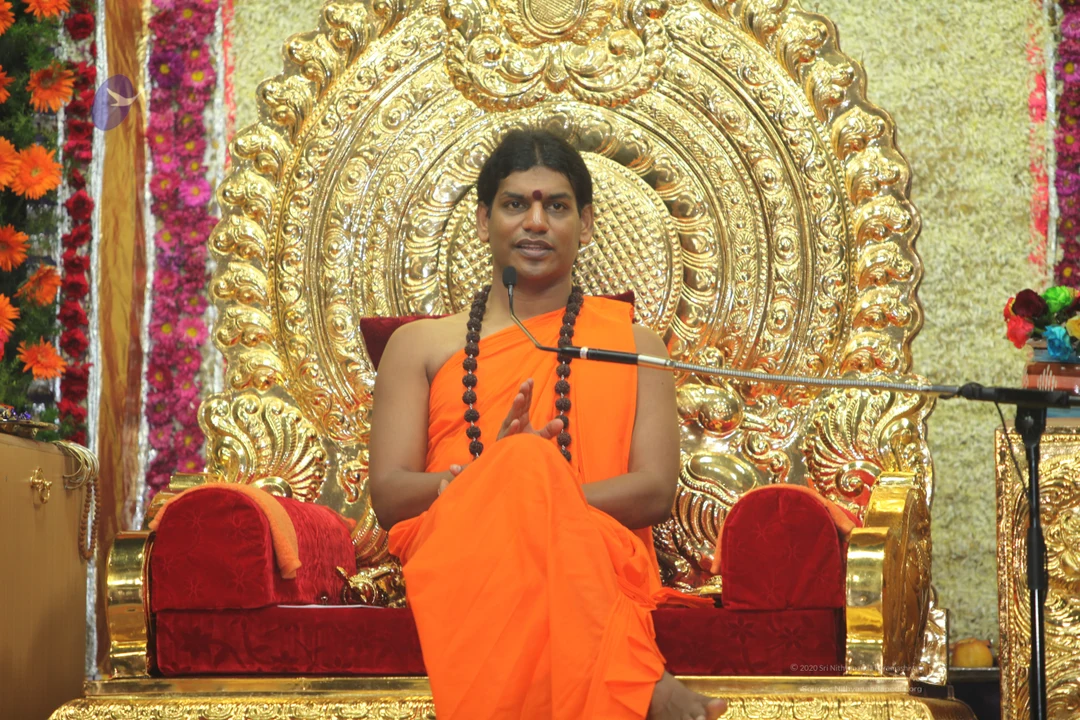
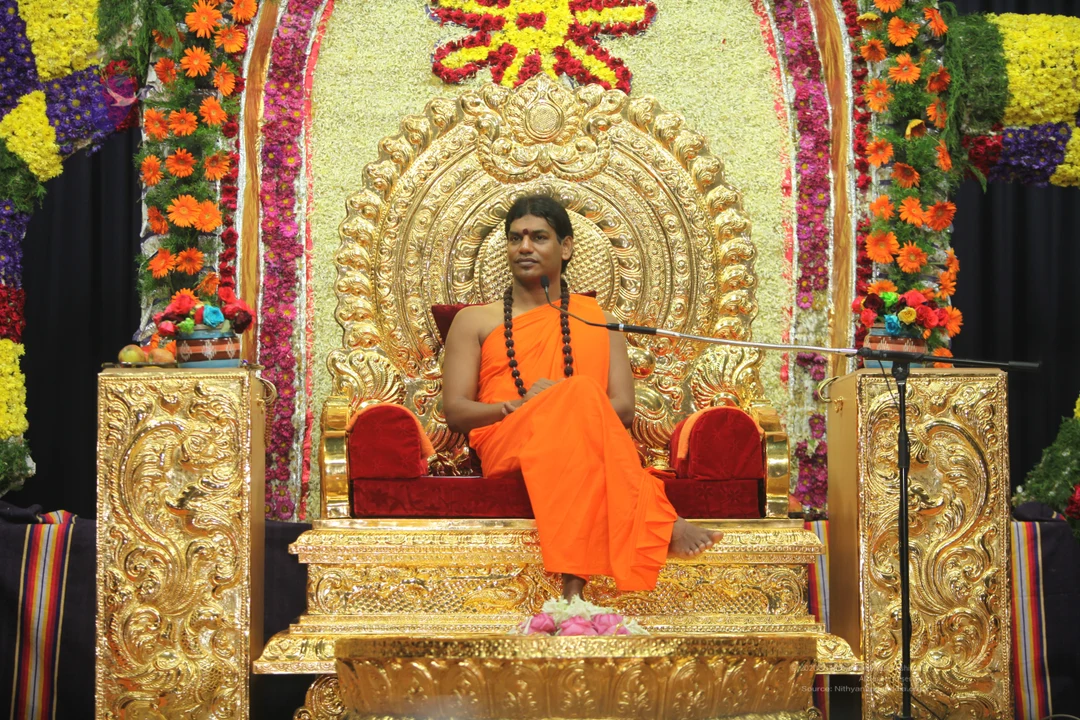
Understand, I have an automatic mechanism; independent intelligent mechanism. Sangha is an independent intelligence. This throne is not made out of just wood, copper sheet and gold paint; I have added life to it. It is an independent intelligence. It talks, answers, responses, take actions and acts and reacts to everything. Sangha is an independent intelligence.

(12:35)

Understand that is why, that is why exactly the engrams which you are not able to overcome, are worked on. If you have the doable goal, you can easily unlock your past. see, when I am saying unlocking your past I am not talking about past life; means before you took this body. I am talking about even the recent past after you took this body. You need to work on both. Actually first I will teach you the science of working on the past after you took this body. About this subject I will speak for next few days then I will give you the techniques and method to work on the past before you took this body. Three levels of past, please understand, the past after you took this body is the first level, the past before you took this body but after you took the identity which you carry; the first dust gathered on your consciousness and the third level past is before even you took that identity, past of that, that is the cosmic archive.

(14:08)

Understand, the past which you are having after you took this body, this moment to your birth that is a first level; the past incident it can be called; then second is the past from this moment to the moment you assumed your identity; means many births. I can call that as Bhugarbha, Bhugarbha memory; the memories which you accumulated, the experiences which you had through many bodies and the third level past is, the past before even you assumed this identity; the pure consciousness that’s what is cosmic archives, where all past of the whole world is available.

Understand whenever I talk about My past life I talk from that third layer. Actually if I say, if I have to tell really, all the lives happened on the planet Earth all the time is My past lives. This is what is the ultimate statement from the third level of the past life; Hiranyagarbha, this is what is the truth; then from the Bhugarbha level, from the bodies I collected Bio-Memory to create this body, that is where I say, I identify specially few bodies which I took.

(15:57)

So understand the different levels of past and past life then you will be able to understand very clearly how this releasing the past heals your present and takes you to the future. First few days I will talk on the past you are carrying after you took this body. Shiva Sutra also gives a very beautiful technique. If you just sit and even remember, so many of those blockages associated with those memory will leave your system through the Kurma Nadi; through the body. Understand just simple remembrance, actually simple remembrance will lead to reliving. Reliving will automatically relieve the engrams which you accumulated unnecessarily, the blockages which you created unnecessarily. Coming to terms with the past will awaken the intuition in you to come to terms with the future.

(17:34)

Most of us are afraid of our intuition. We feel we are ready to use our intuition to predict others life. We are not ready to use our intuition to predict our life because we are afraid if something about the future, bad thing comes up, “I will start… I will be worrying continuously. Why should I look? Let it come we will face it”. The fear, I tell you actually if you look into the future you will come to terms with it. The problem is you don’t trust you have intelligence to come to terms with the future, because you never came to terms with the past. Come to terms with the past you will have the courage and guts. You can come to terms with the future. “Eh, worst things which can, which I never imagined and all happened in my life, I handled it. Why can’t I handle the future? What more can happen? It’s okay”. Coming to terms with the past is almost healing all the blockages and that will naturally, automatically lead and awaken the intelligence of coming to terms with the future.

(18:52)

Pratiprasav, beautiful word; come to terms with the past by constantly doing the past life regression. Of course this word is used in a meaning like a lives before you had, lives you had before you took this body. But now I am working on the line of life and past you had after you took this body. First I will work on this then we will go to the second level and third level. The past life regression need to be understood very strongly.

In NSP I work only on the first level. This is the level I work on NSP. In Inner Awakening I work on two levels especially this Inner Awakening I am going to be… the important two component, I am adding to this Inner Awakening. As a unique thing is the science of balancing five Pranas; five energies; means the science of levitation. Levitation may happen in you when you balance this five air energies, this is a one thing. Second thing, the science of past life regression; this two layer past life we will work on, we will release. One, the past after you took this birth, this body, second the past before you took this body, after you took the identity which you are carrying; so in NSP I work on this first level past.

(20:42)

First-level past is all about releasing the engraved memories you collected during the childhood time and till this moment. Working on that, reliving, reliving, reliving and releasing; various catharsis methods, boiling your muscle so that it can just leave your system and using cathartic methods so that completely it can be, it can disappear from your system. The system, life, can become more intelligent, more alive, learns to live the whole thing, learns to radiate the whole thing. See it’s like a, if some part of your body is not coping up with the excitement you are carrying, that part is not only not tonic, it is toxic. The same thing like today I was telling, some group of volunteers are not coping up with excitement you are creating, the group energy, the Sangha Shakti, they are not only not a tonic, toxic, whether it is an Ashramite or a volunteer or anybody.

(22:05)

You see because, here I am taking up group of people, working nicely on them, making new man. Understand anything we do extreme. When you sit, no questions asked; be silent. When you do Puja, no questions asked; melt down. When you work, no questions asked; be like a ghost. When you do anything you are asked to be in extreme, which, human mind can never tolerate. It asks, “Alright, if I go to that extreme, what is the use for me”. Arey fool, being in that extreme is your lifestyle. There is no such thing as use, that’s your lifestyle. Don’t ask what is the use of me breathing, that is supposed to be your lifestyle. Only through breathing you will be alive. So, same way, only by being in extreme, the new man whom I am trying to create, will be alive; the new man can be alive only by being in extreme.

Early morning when you do Yoga, just break the body. If you think you can’t do this posture, do it. When you sit unclutched, be in complete Samadhi. No question of words, no question of mind moving here and there and then bringing to centre. Just tell yourself; get lost!! I have to be in Samadhi. The power with which you tell your mind, it should run away like a dog and disappear. The next when you start the Guru Puja tell yourself, here I am melting. Have that tremendous power over you. Here I am declaring that I am melting and just melt. Just dedicate, just surrender then again when you go to the office here I am doing my strategy planning; how to make the whole thing productive. This is what I call Yogic body and Vedic mind; new man. Just fit yourself.

(24:29)

People who are not excited about this idea, people who are not interested having this as a goal and people who are not interested to choose this as a doable goal. Understand that is another one thing. Sometime people are greedy about this, but they also have a nice hiding compartment, hideout to say, “No, no it is not doable. I am this, I have this, I have that”. Either it is doable or just get lost! I have no place for anybody else here. This place is created specially for the people who are interested in becoming new man. I am not interested in awakening your 12 strands of DNA taking two year. I am clear I want this to be done. I think it should have been done by yesterday. Even if it is done today it is already late. It’s already late. So be very clear I want this urgency to be felt by people, that can happen only when you have a doable goal; means clearly seen; measurable.

So Enlightenment is a poetic goal, forget about it; that will happen, that will happen. Let that be a side milestone in your journey, not a goal. Let the goal be Yogic body and Vedic mind, where you are able to measure all the measurements. Yogic body means you can measure how flexible you are, how strong you are, how healthy you are, how graceful you are, how your dimensions change. Take up this as a goal. Take up this as a goal. For Yogic body, Nirvani Akhada. For Vedic mind constantly chewing the words of the Master, Smarana; chewing the words of the Master, digesting the words of the Master. Anything you do, bring at least two-three contradicting points of the Master.

Please understand when you make any decision, you can easily pick up My contradicting points. Don’t talk for one side. See about any idea you can have ten contradicting points from My teachings. If you have heard enough and perfectly, for example food, you can have a point of Me telling just fast and die or you can have the same from My own words you can have the point to eat as much as you want, as long as you can, how much you want. You will have both points from My own teachings. Bring those self contradicting points and fight with them. That is what I call chewing.

(27:47)

Please understand I am defining Smarana, Manana. I am defining Manana. From My own teachings, the subject you are supposed to decide, the decision you are supposed to take, on that subject bring self contradicting points. You may think what is going on? Actually after you bring those self contradict points you will see very clearly which is, “Eh this I know, I am cheating myself; this I know, he is teaching for me by Swamiji”. This is what I call Viveka. The Viveka needs to be kept alive, sharp, to experience the truth by yourself. But the problem is if you don’t do this self contradicting and clear Manana, you will pick up self contradicting point one or two and keep it to answer me. I have seen sometime people giving very intelligent answers using My own words against My own words. They will use My own words; very nicely they will quote, to attack Me.

It means you have not done Manana, you are cheating yourself. When the Manana is done, means when you bring self contradicting points and analyze, spend time with it. You know, “Oh no… this is told at different point, different situation, different way. This is told at different point, different situation, different way. No, I know this is the right, this is the word for me from Swamiji, for this situation”. The fellows who have done this Manana never use My words against Me, never try to cheat because they don’t cheat internally they don’t know how to cheat externally but whoever cheats Me externally I know they are cheating themselves internally. They take My various judgments and use it in wrong places.

(30:17)

Understand, actually when I talk to people I very clearly understand whether they are internally cheating themself or not cheating, honest. I can very clearly make it out. Because if they try to cheat Me externally, then naturally I know this is the same thing going on inside, internally also they are cheating themself.

Understand Vedic mind means a non cheating, honest, committed mind. Have this Yogic body and Vedic mind as goal, honesty and strength and integrity as goal. Sacrifice, dedicate, just disappear into the great fire of the Sangha, annihilate yourself into the Sangha. You will see, you will literally see you experience the space where you can never be annihilated. The Yogic body and Vedic mind is just happening in you.

See everyday your body becomes more healthy, more active. You are able to do at least one posture more than yesterday. Your body is more flexible than yesterday. Same way mind is more honest than yesterday, doing more Manana than yesterday.

(31:58)

Understand again I am defining Manana; bringing the self contradicting points about the same subject from the Master and letting them fight each other in front of your pure awareness and using your Viveka to choose rightly, honestly; honestly without compromising, that’s what I call manana. If there is a clear cut rule given, you will never grow in the intelligence of Manana. The people who never grow in the intelligence of Manana, are only creating fanatic religions. Fanatic religions does not allow this component of intelligence of Manana, Viveka. It only says Vidhi-Nisheda; do’s and dont’s but all great mystical traditions, the spiritual traditions encourages the Viveka not Vidhi-Nisheda. The traditions which encourages only the Vidhi-Nisheda do’s and dont’s, they create fanatic religions. The traditions which encourages Viveka by the Manana, they create intelligent people; that is what I call Vedic mind, that is what I call Vedic mind.

(33:36)

Have tremendous intelligence and be honest. Do an honest, clear cut, strong Manana. I think, first time I am defining Manana. So practice Manana. Manana is very powerful. With your honesty and Viveka, Manana can do miracles in your mind. Manana is like muscle building exercise for Vedic mind. If you want Yogic body, do Yoga and Samana practices like weight lifting and all that. If you want Vedic mind, so, do Manana. Manana is like a weightlifting and yoga for, to create vedic mind. It’s a very powerful process, very powerful process. Honesty and manana will create Viveka, that is what exactly I call Inner Awakening. The ability to do Manana with discrimination is Inner Awakening; your inner lit is lit. Your inner light is lit. The Inner Awakening has happened.

(34:53)

So understand, the honesty, Integrity and Manana does Inner Awakening. So this is the truth I want to share with you all today. Bring Manana into your life, relive the past and relieve it, awaken the inner self.

Let you all achieve and radiate the eternal bliss, achieve and radiate Enlightenment.

Live, experience, achieve, radiate the eternal bliss.

Nithyananda.

Thank you.

(35:51)

Photos

Panchatapas
Paadapooja
Morning-Satsang

Sarvadarshan

Photos Of The Day:

nithyananda-bidadi

Photos Of The Day:

Panchatapas

Pada-Puja

Morning-Satsang

Sarva-Darshan

VIP

01-Pada-Puja

20101025_Photo_1000_IMG_5973_CMP_WM

02-Morning-Satsang

03-Sarva-Darshan

04-VIPs

20101025_Photo_1000_IMG_6145_CMP_WM

Photos from this day

View all 287 photos

Panchatapas

9 photosSource gallery
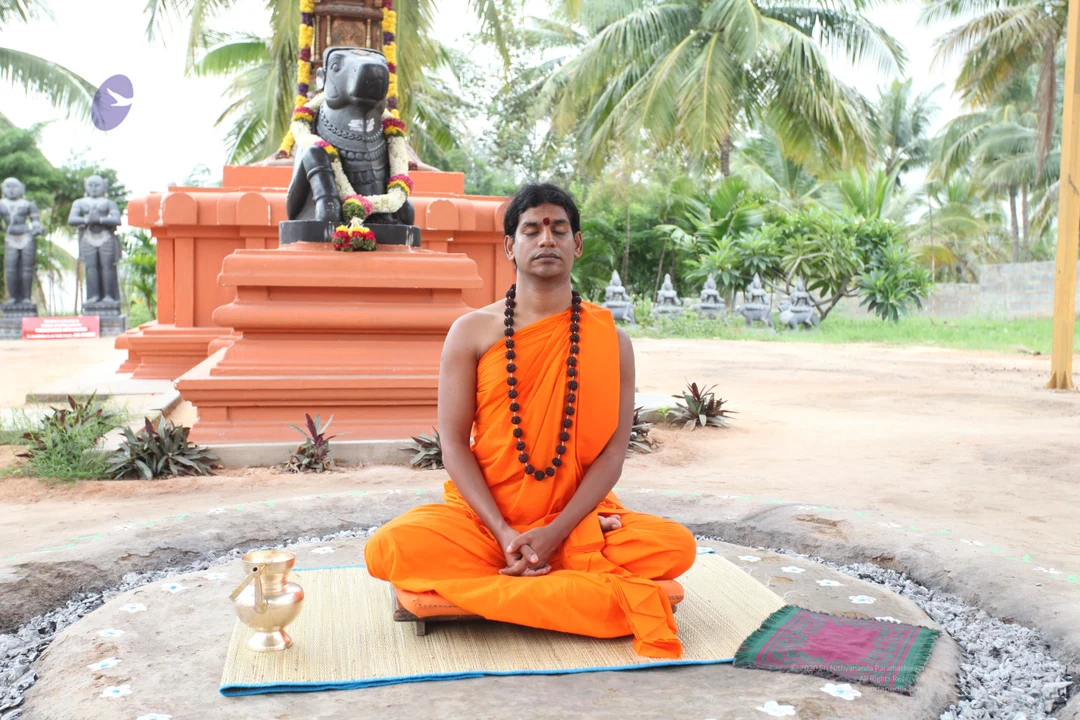
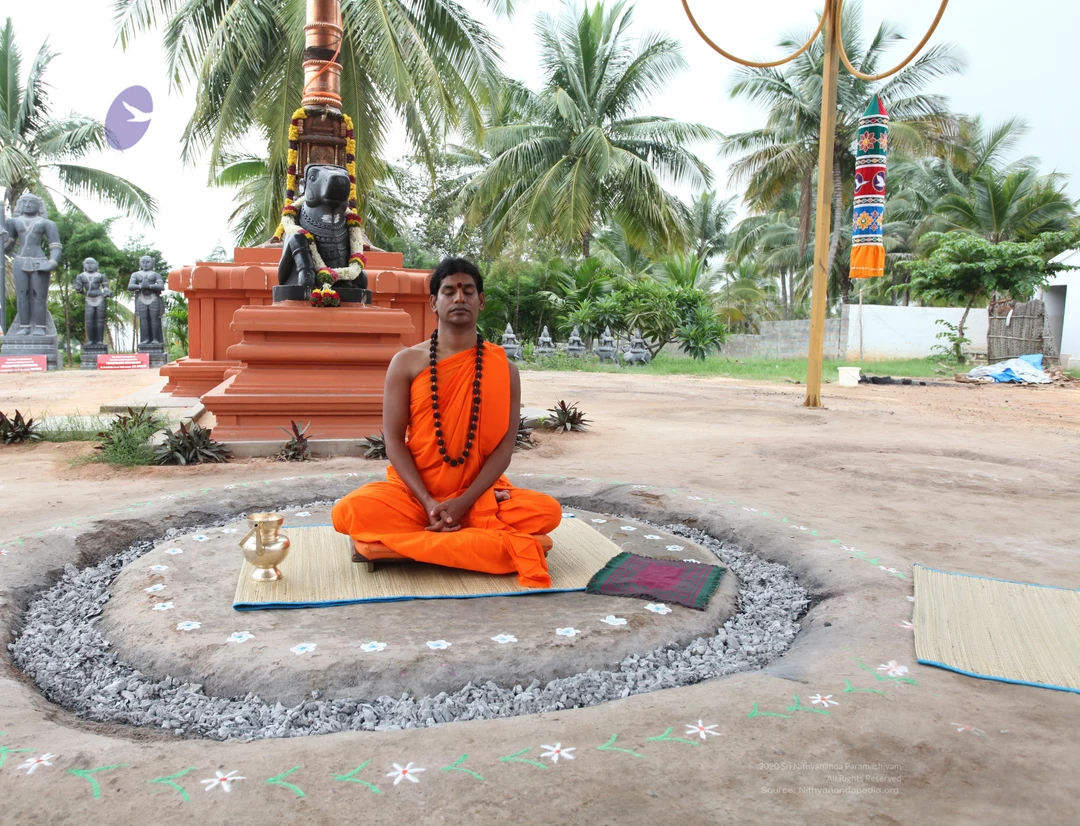
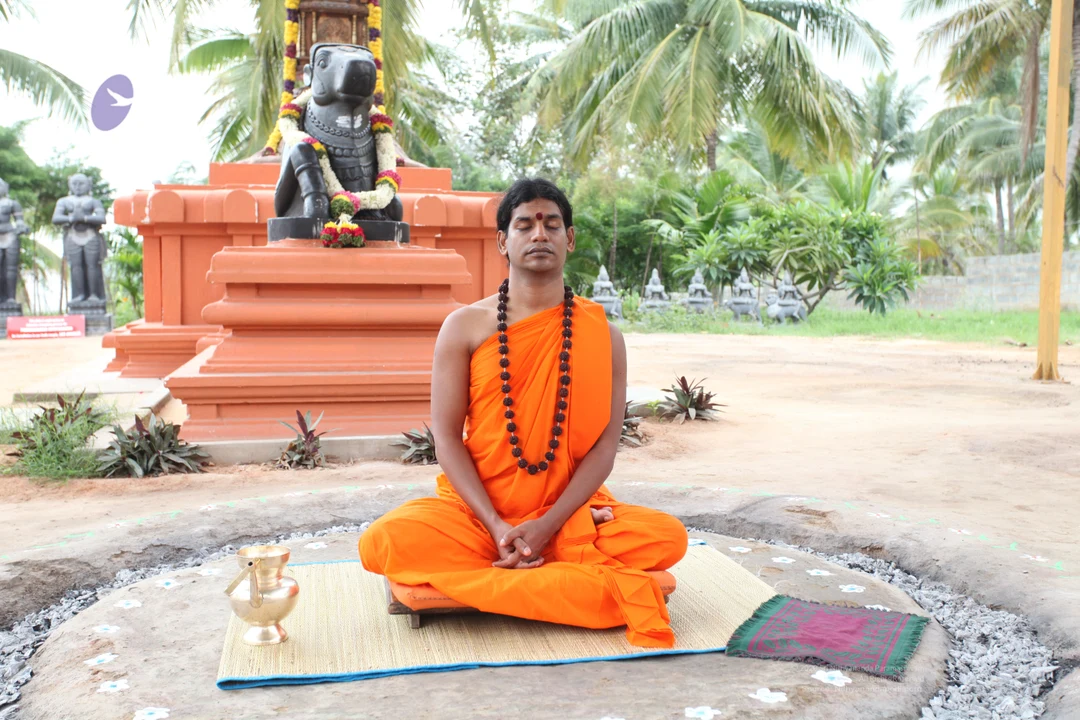
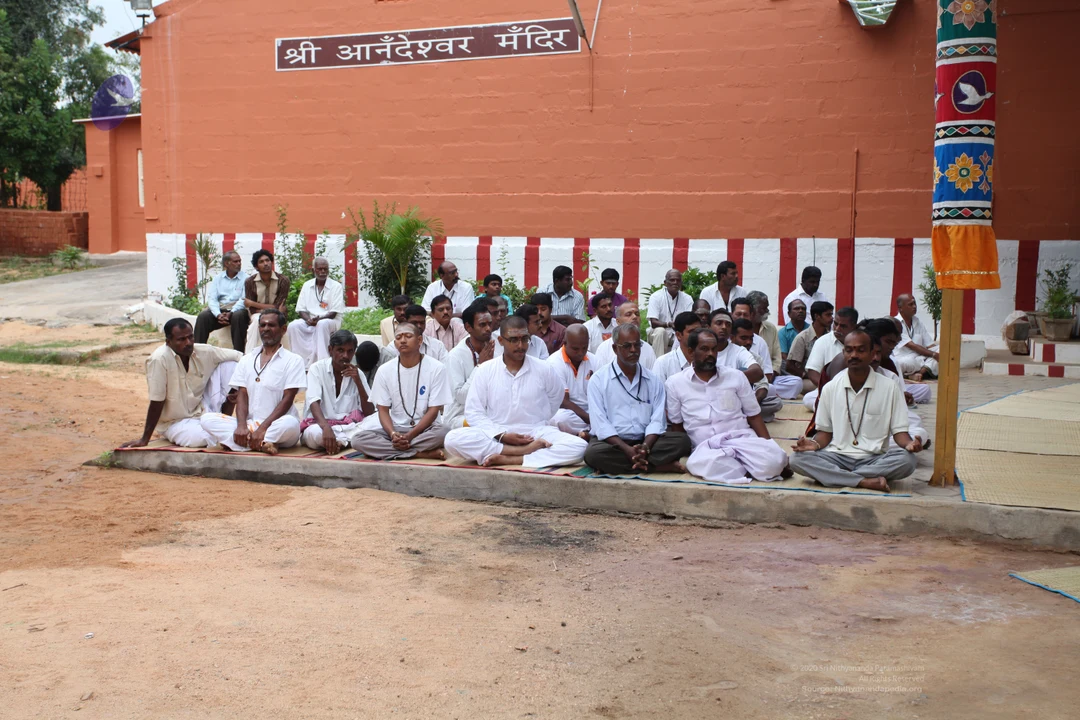
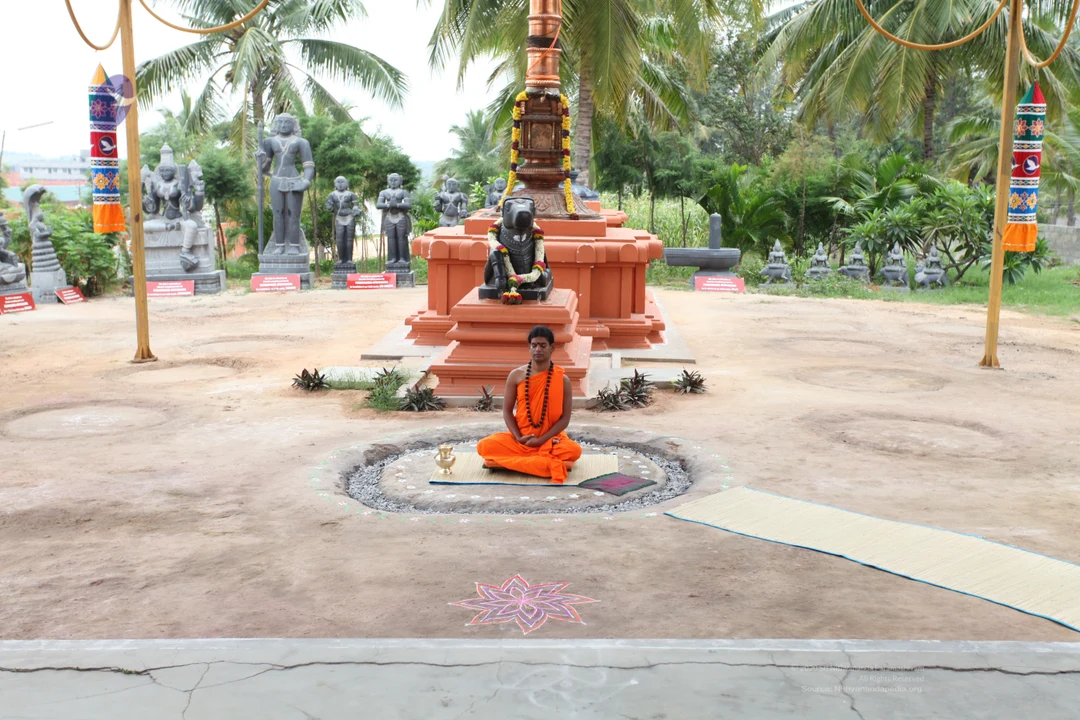
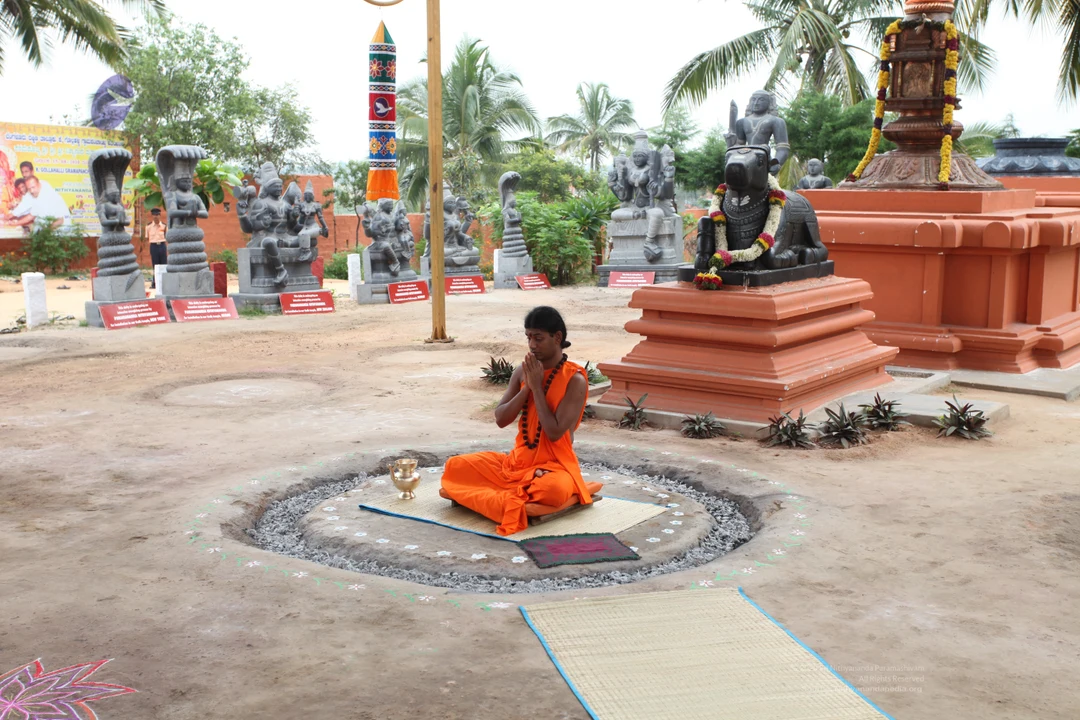
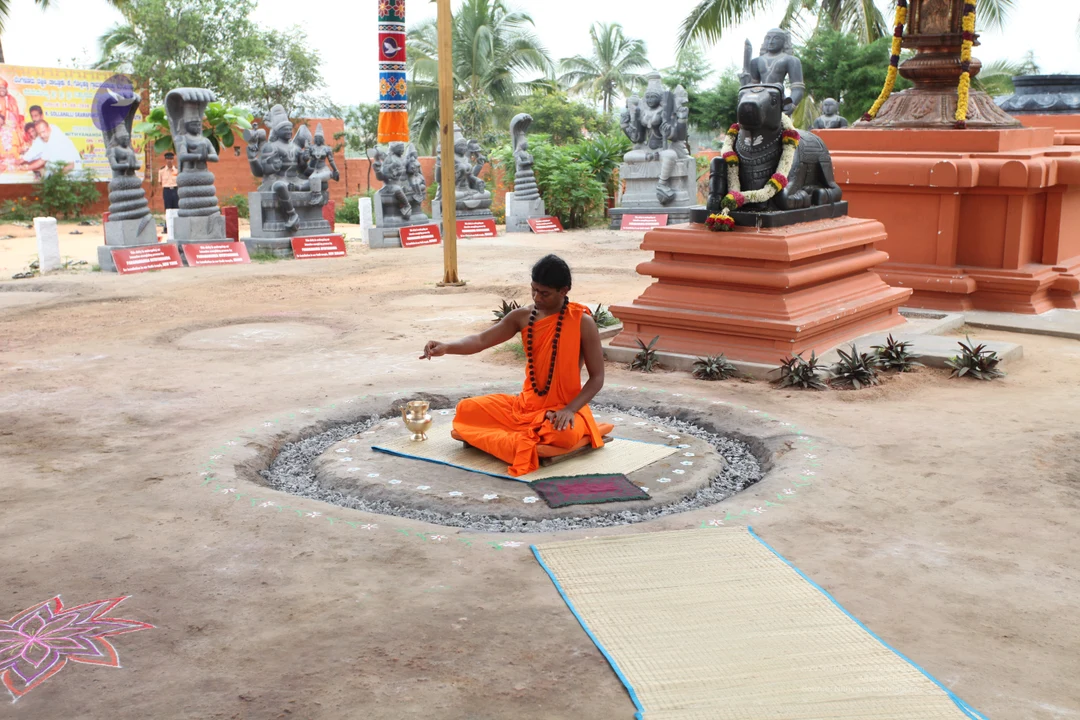
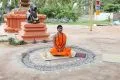
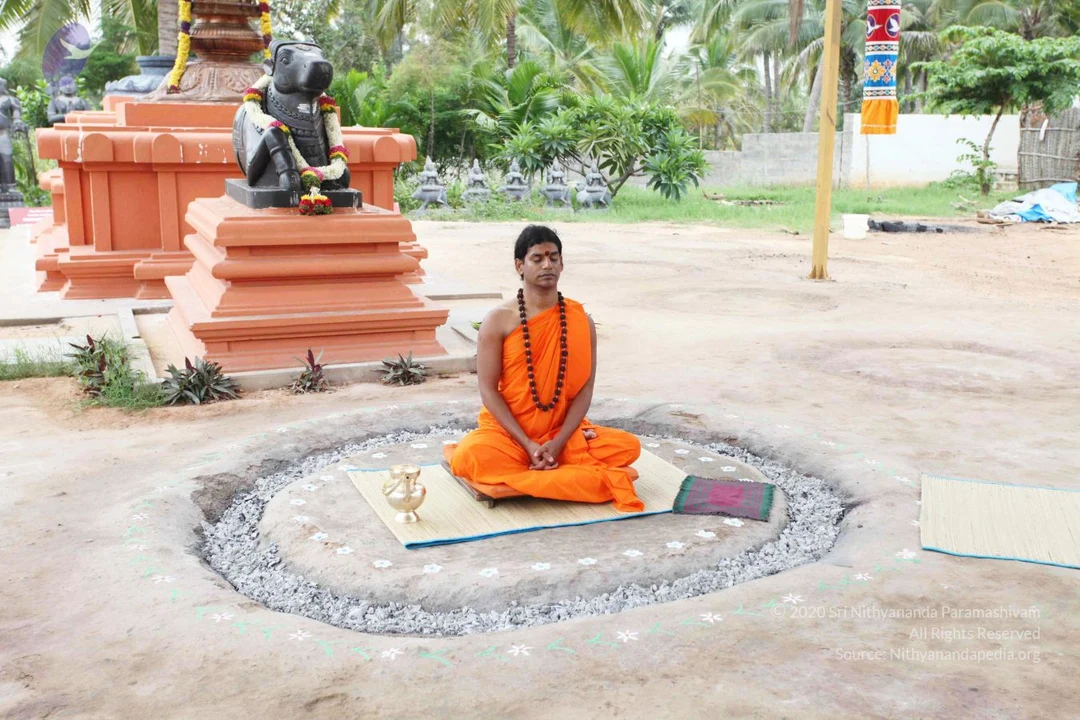
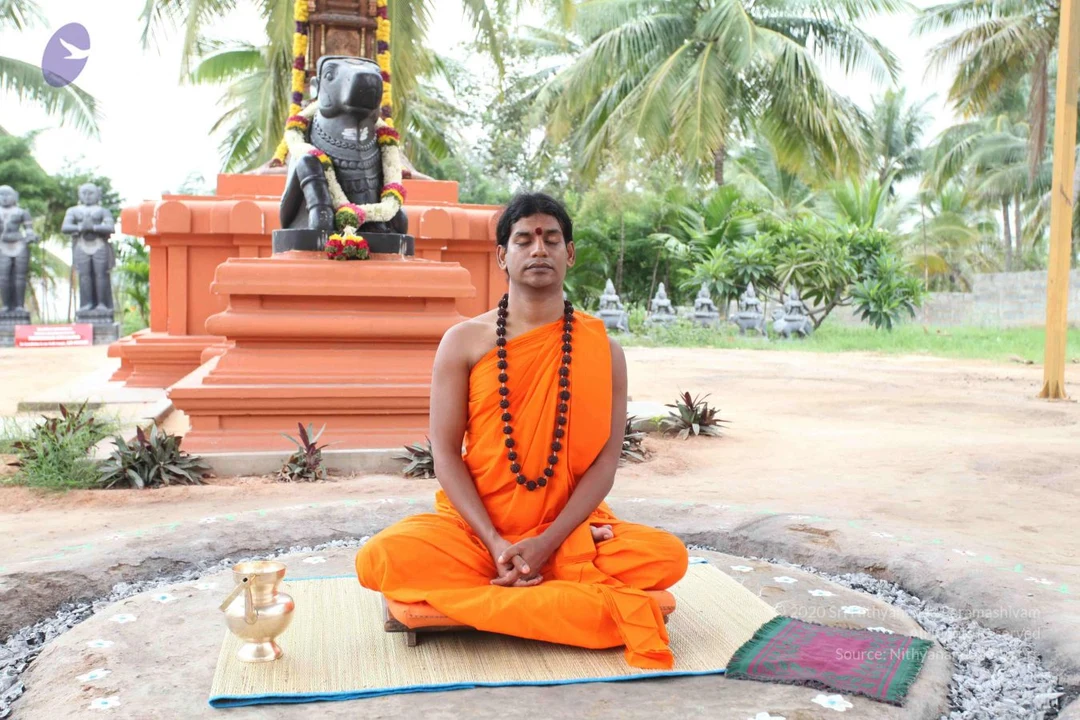
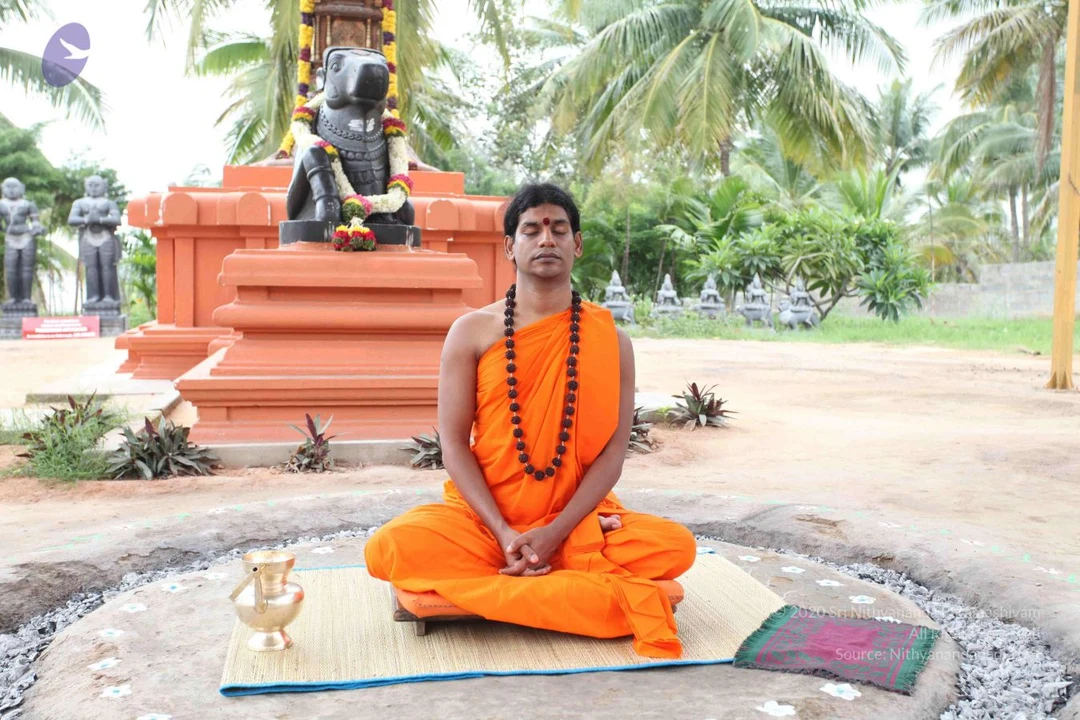
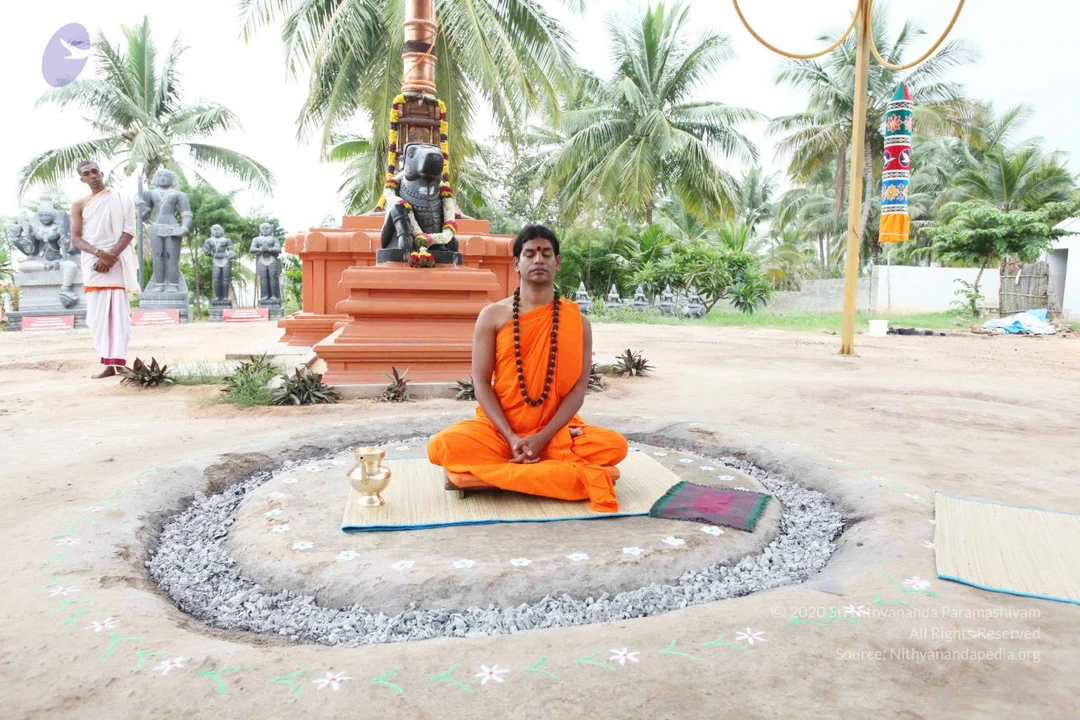
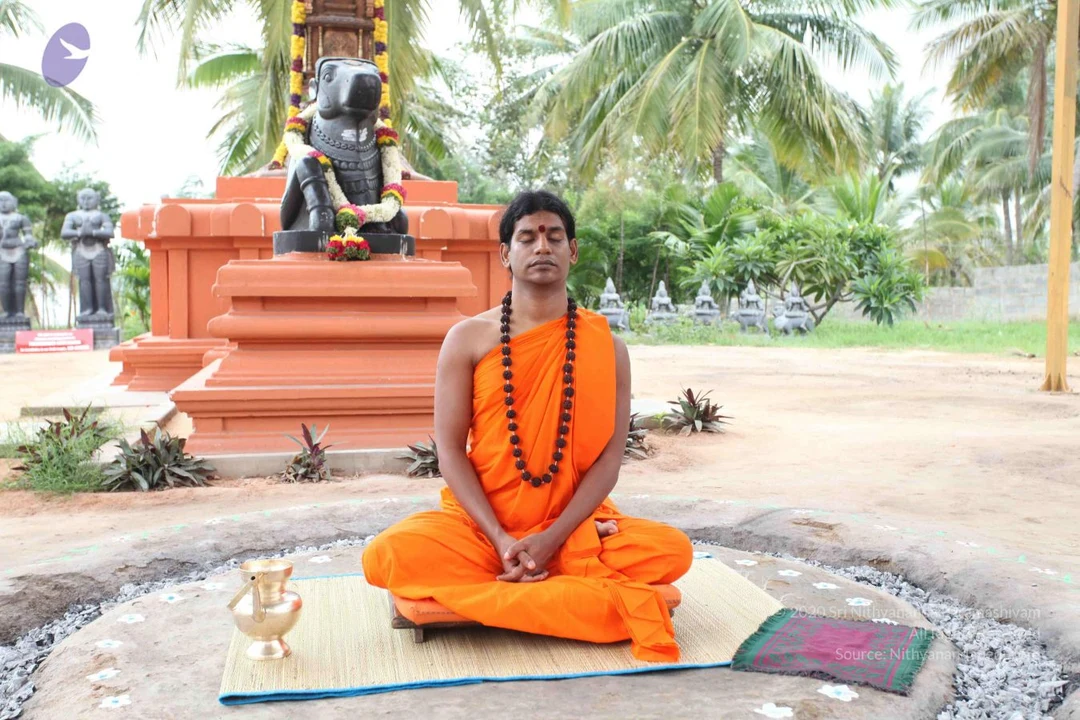
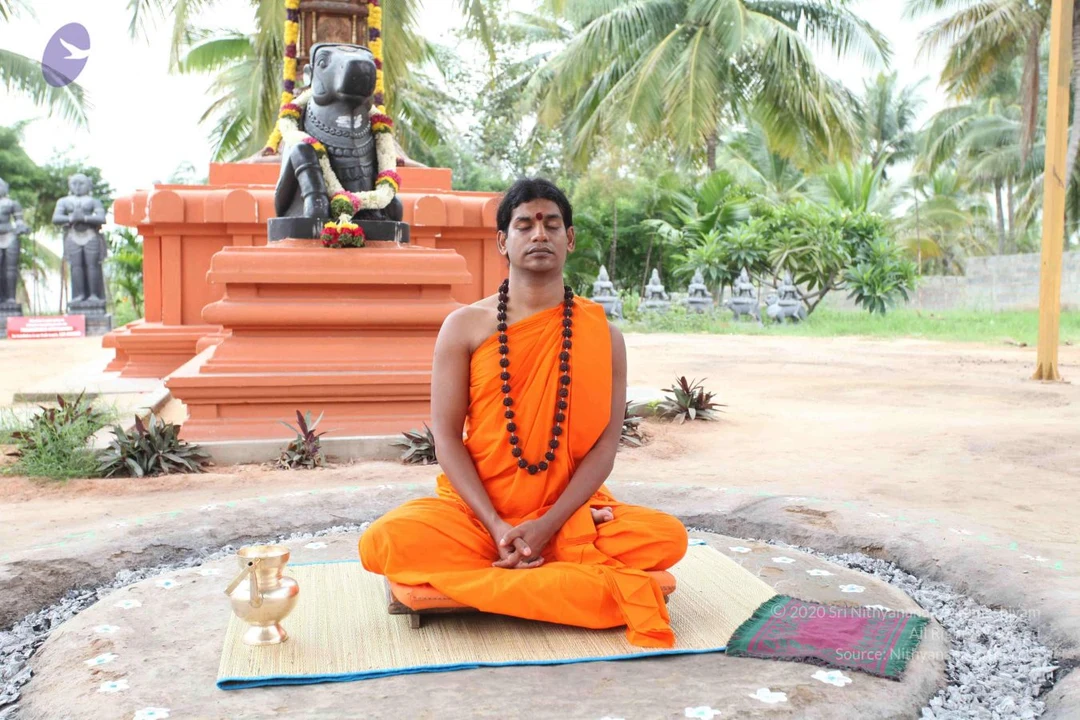
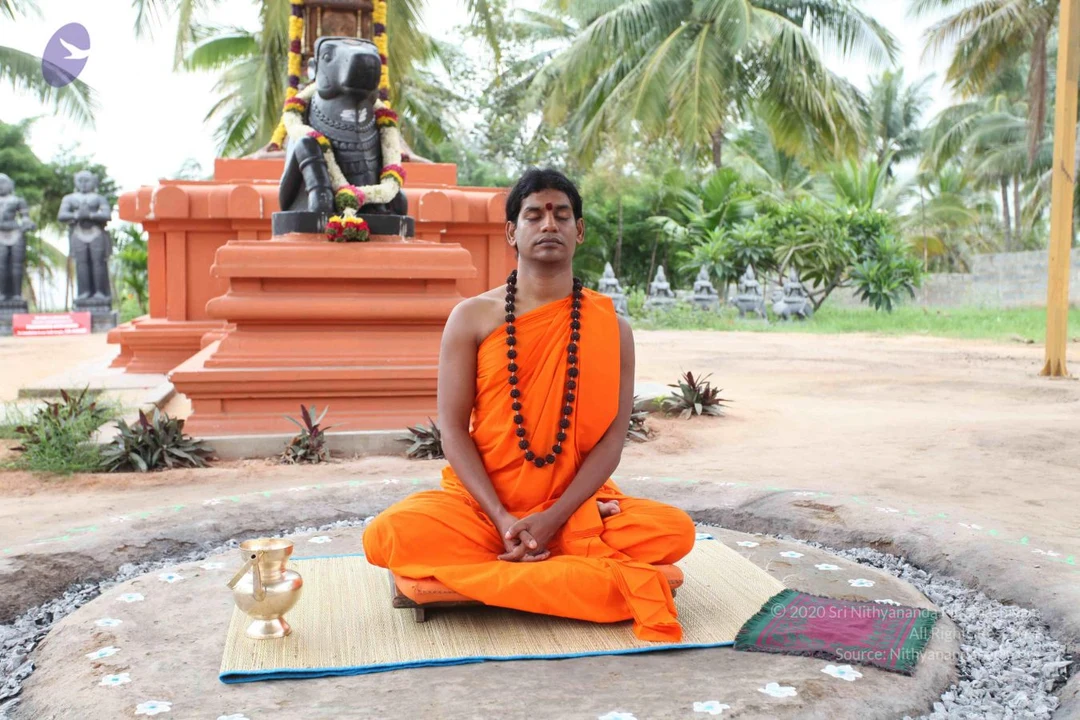
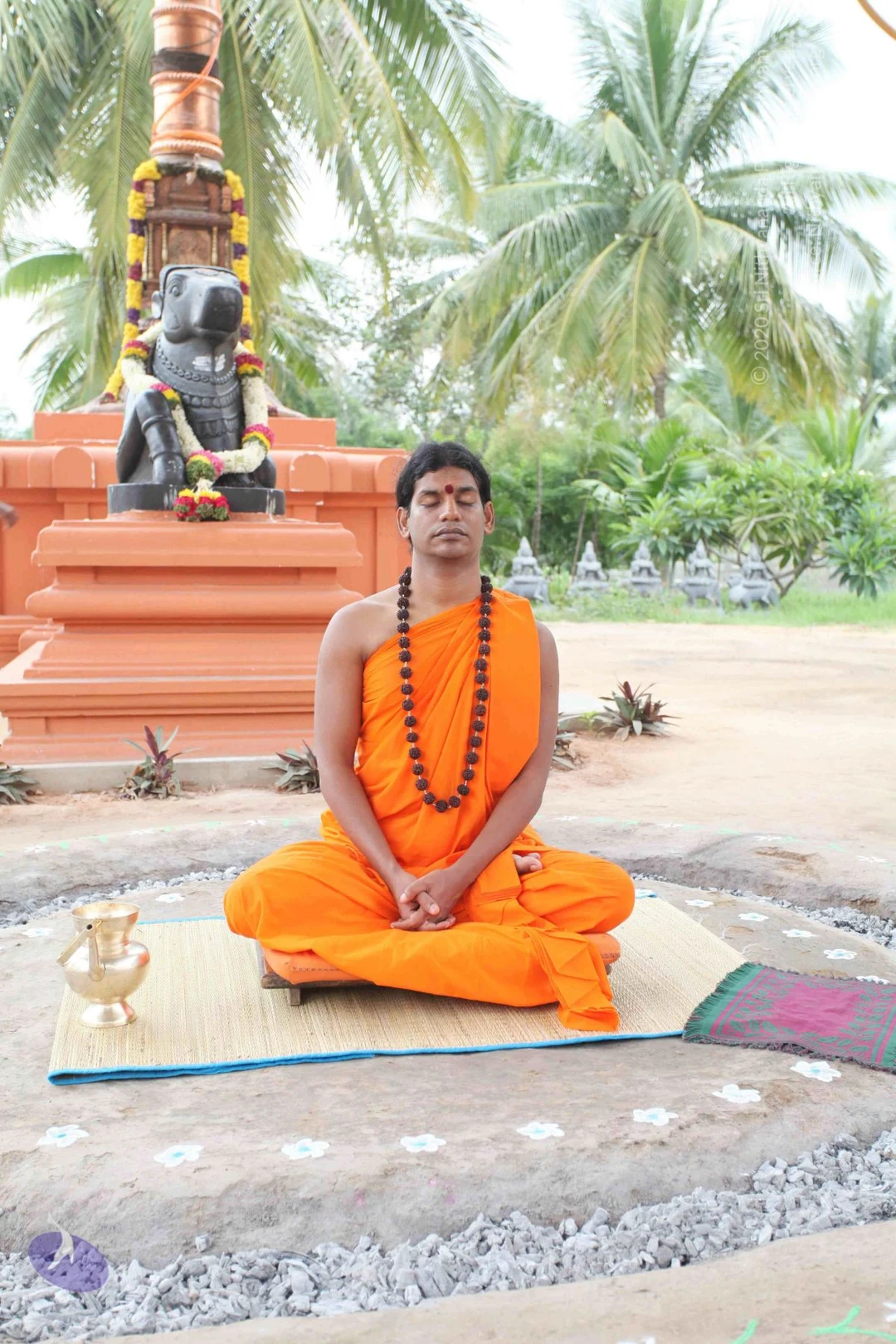
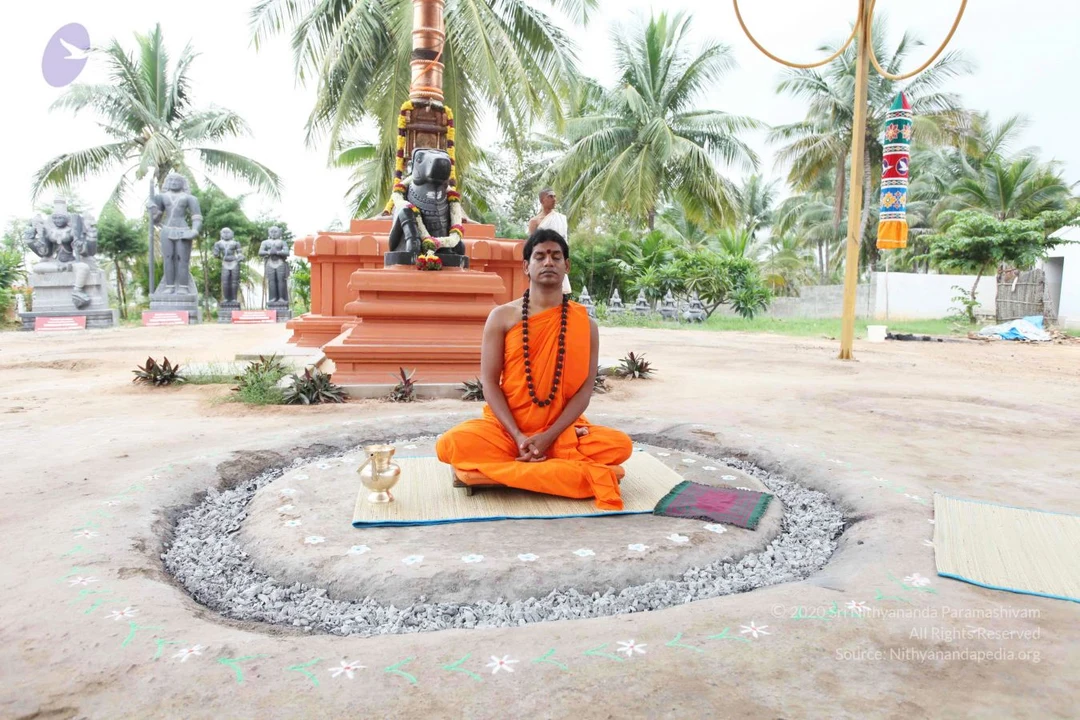
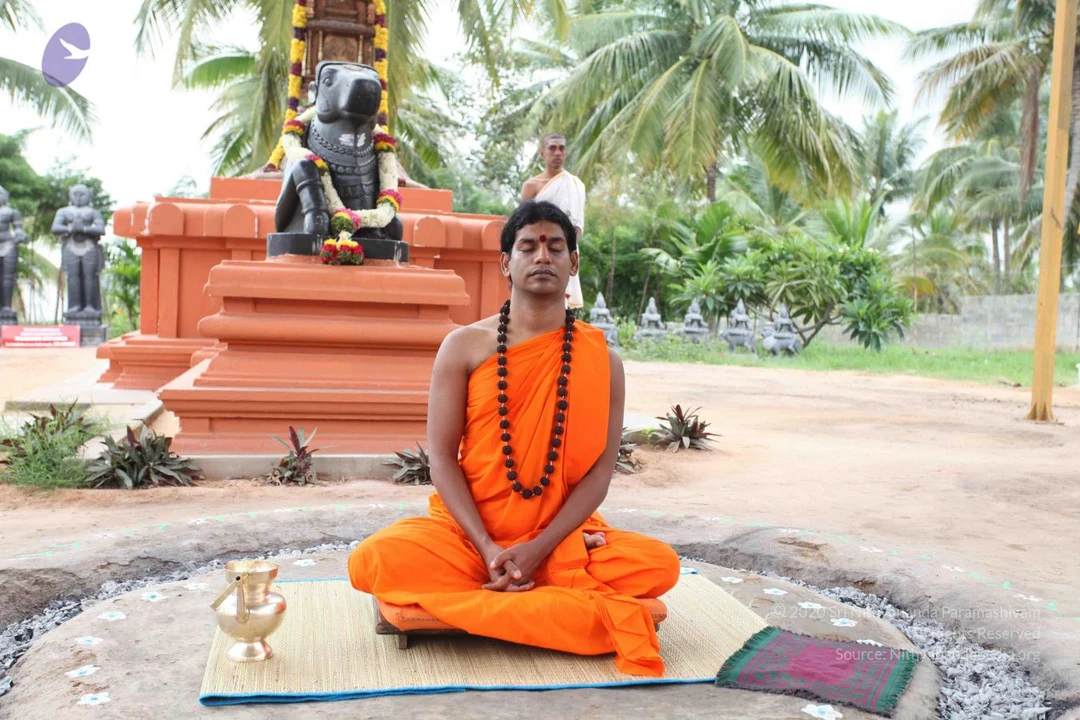
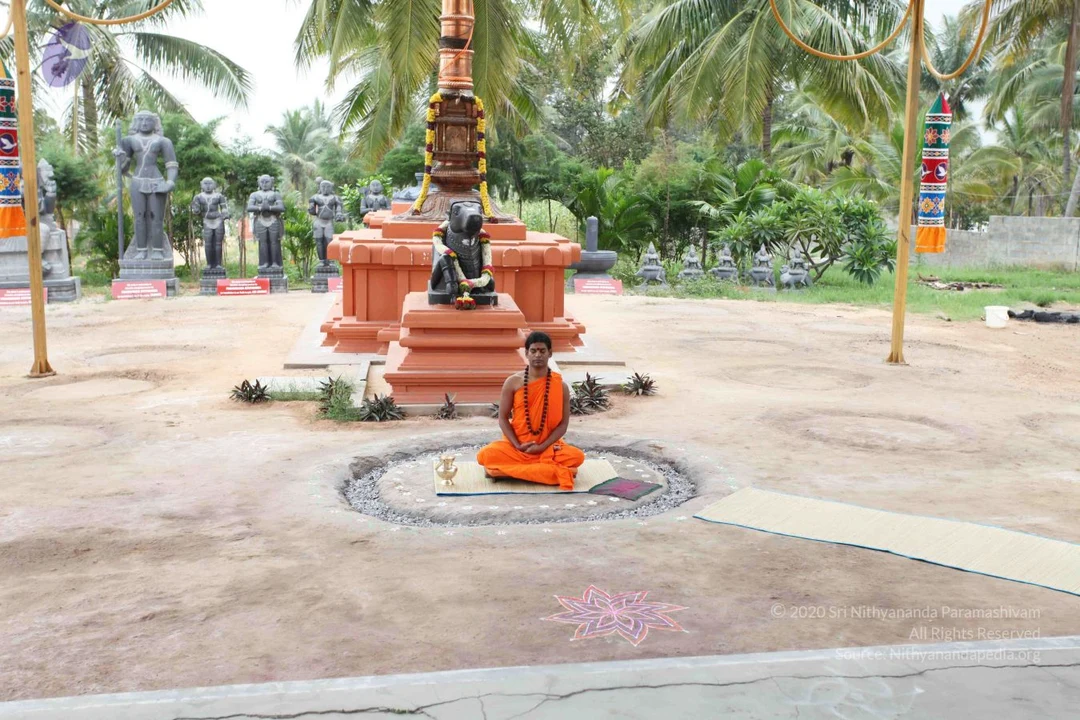
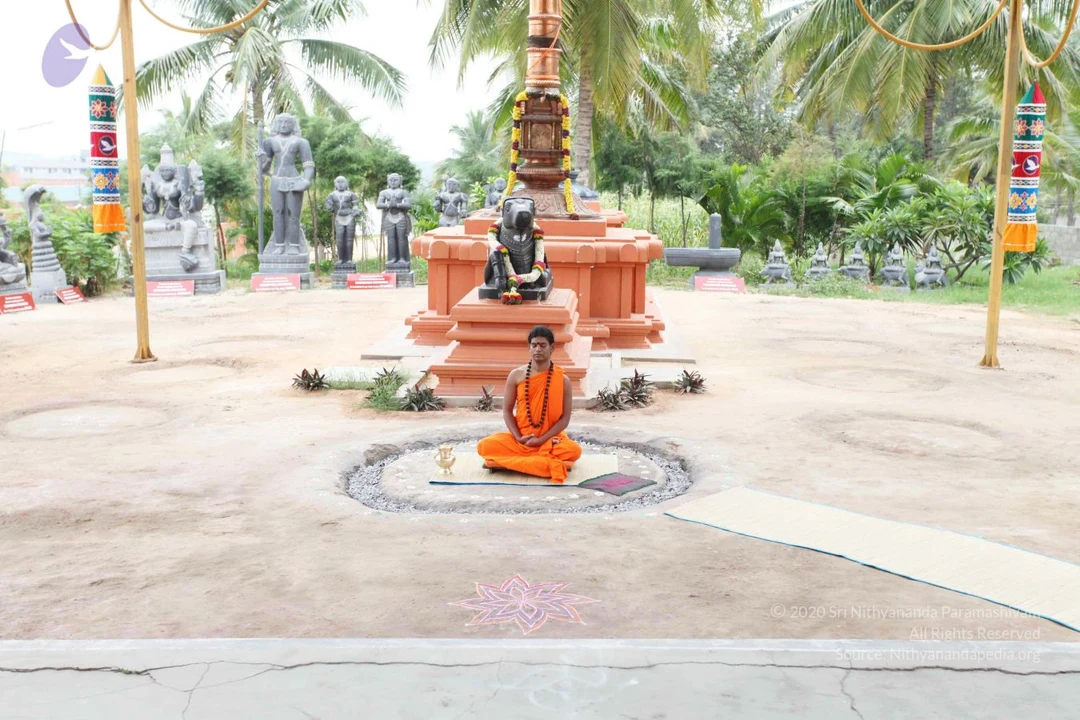
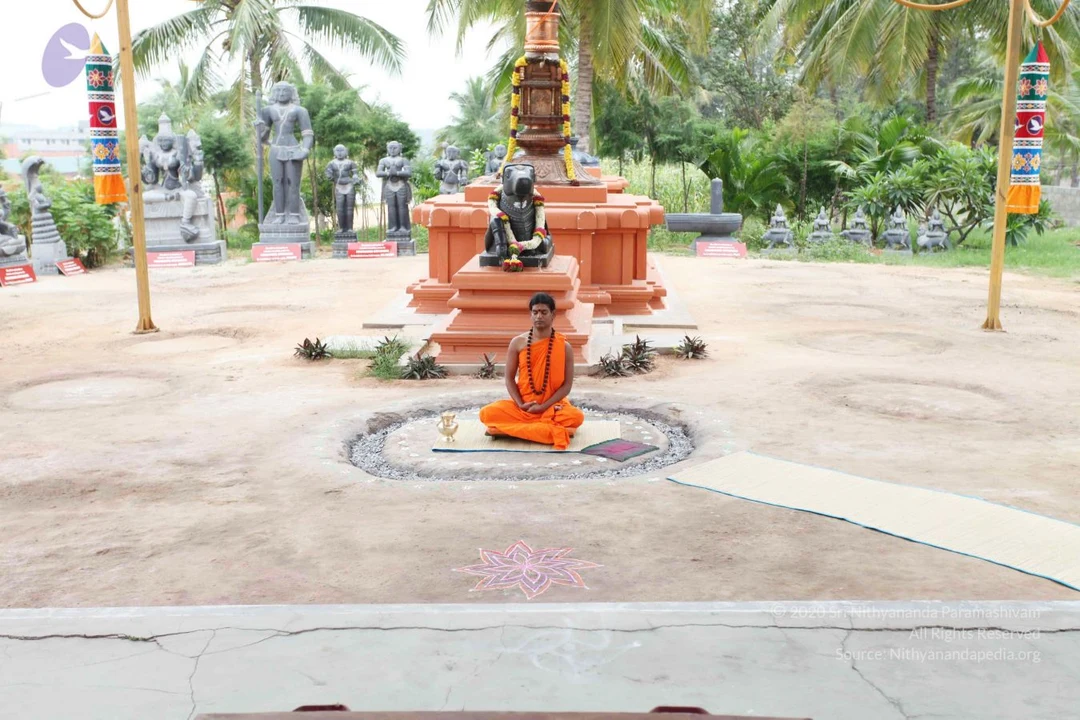
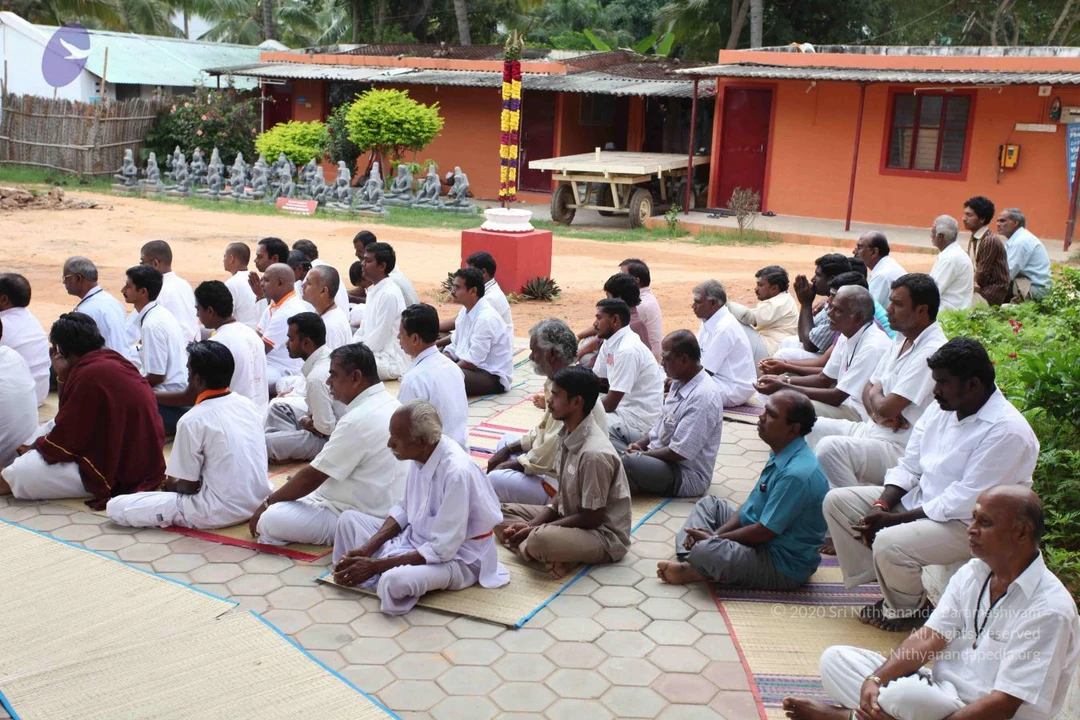
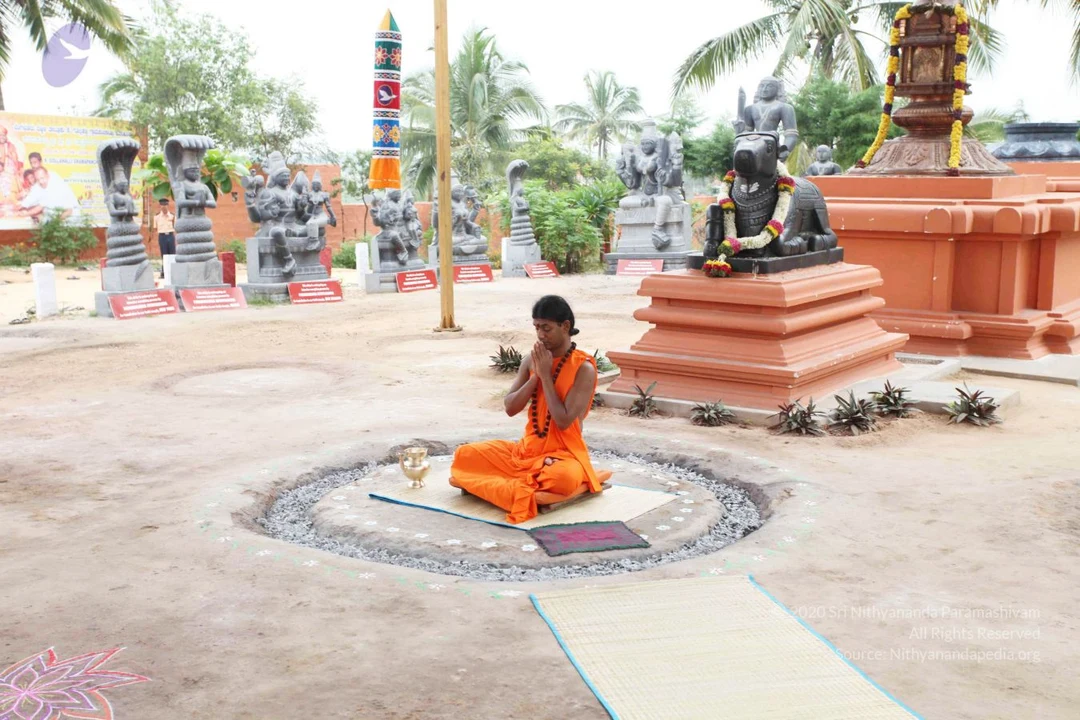
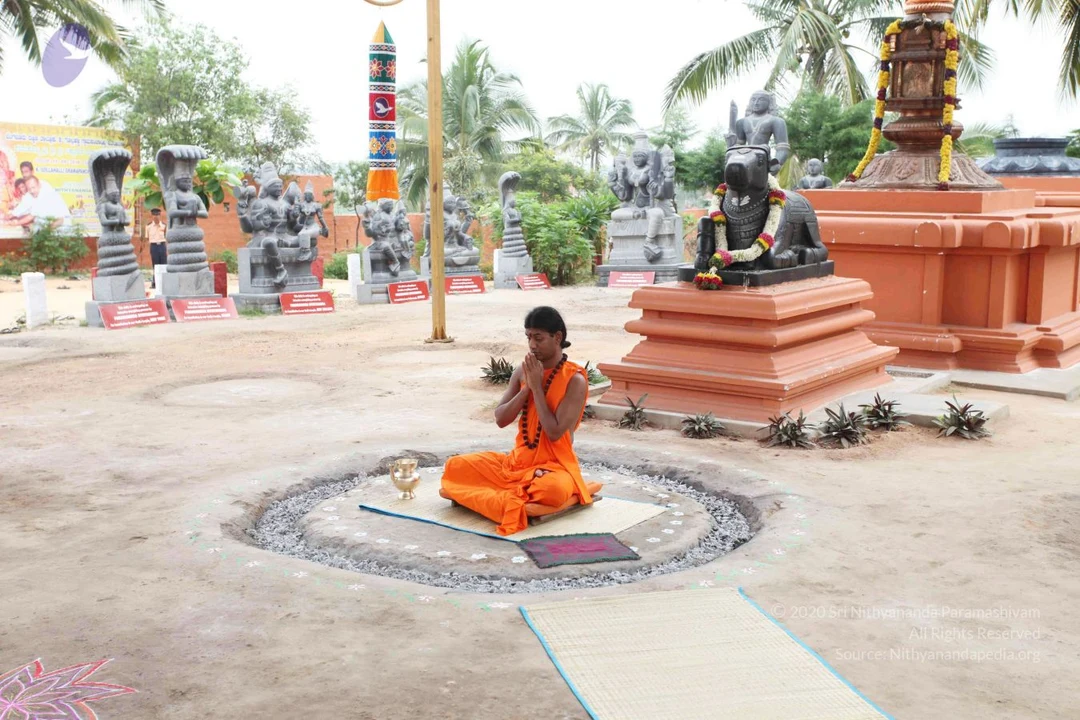
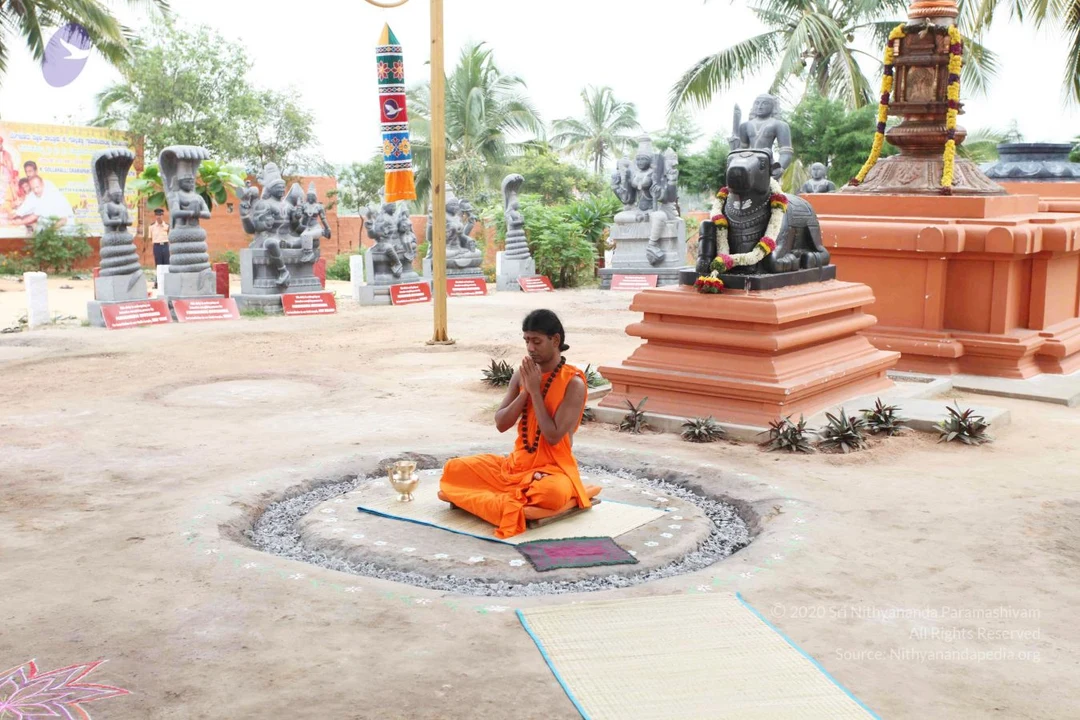
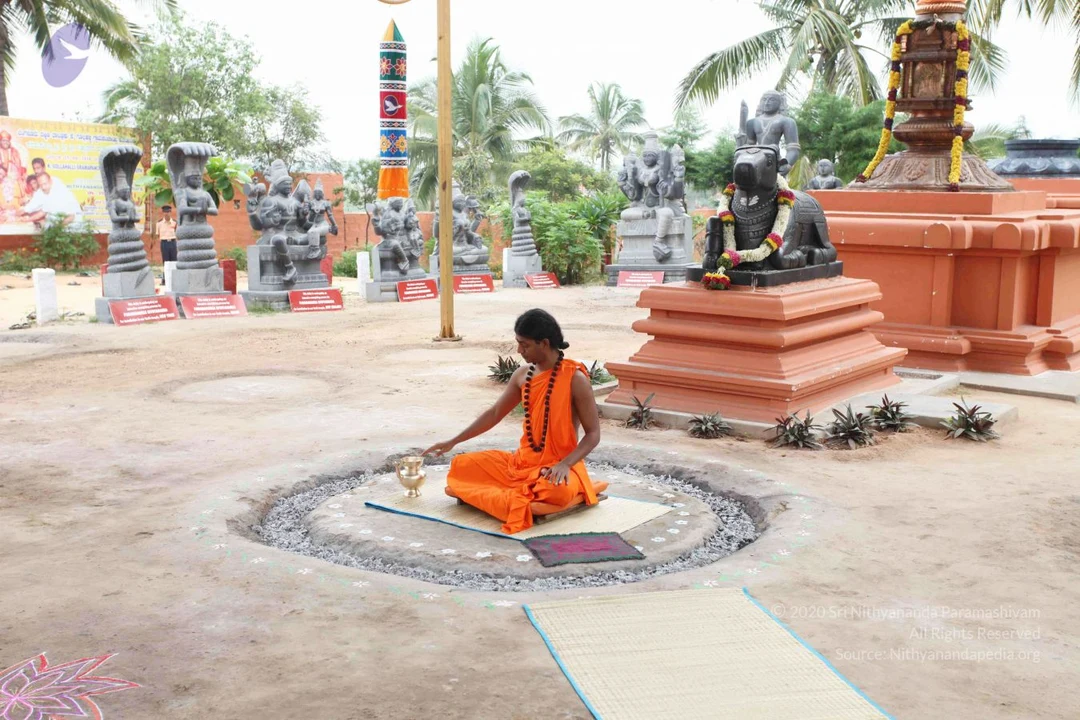
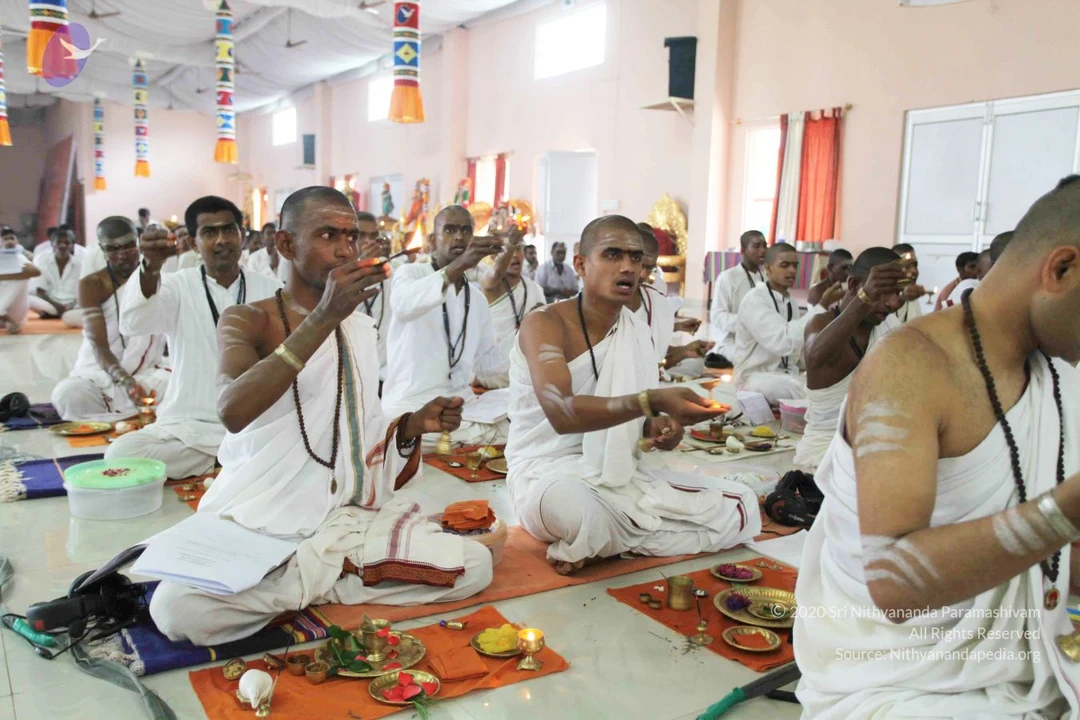
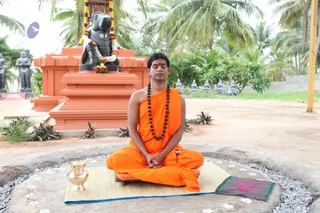
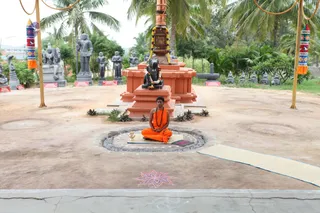
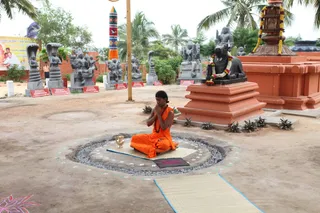
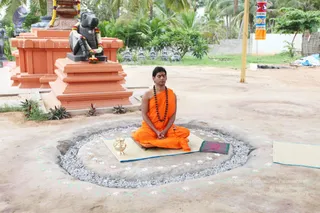
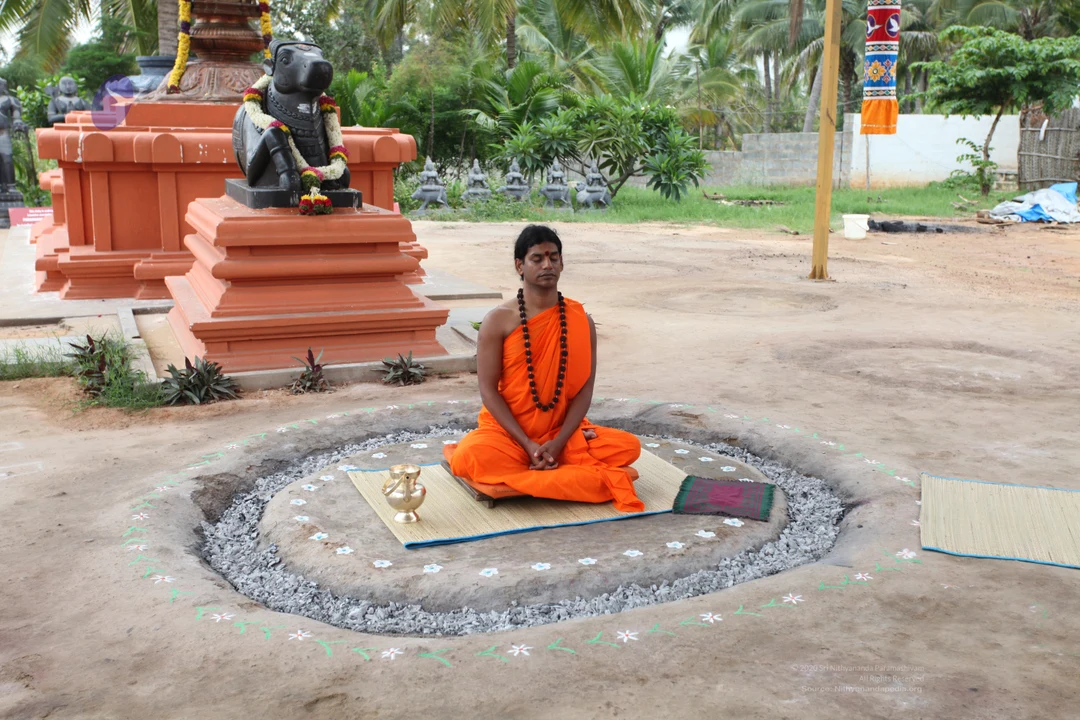
A seated man in an orange-saffron robe and a rudraksha mala meditates cross-legged on a woven mat atop a raised circular stone platform ringed with grey gravel and white flowers. A brass kalasha-style vessel sits beside him. Behind him stands an orange-painted shrine with a black Nandi bull statue garlanded with marigolds, and a vertical banner in red, yellow and blue hangs on the right under palm trees.A man sits cross-legged in meditation on a woven mat over a stone platform outdoors. He wears an orange saffron robe, a dark rudraksha mala around his neck, and a small red bindi on his forehead, with eyes closed and hands resting in his lap. Beside him is a brass kalasha-style pot. Behind him stands an orange-painted shrine platform with a black stone Nandi bull draped in garlands of marigolds and red flowers. Stone figures, potted plants and palm trees surround the open ground.An outdoor photo of a seated man in cross-legged meditation on a raised circular platform of stone chips and sand, decorated with white flowers and green leaf motifs. He wears a saffron-orange robe and a long dark rudraksha mala, with a red mark on his forehead, and his hands rest together in his lap with eyes closed. Beside him is a brass kalasha pot on a woven mat, and a second mat lies nearby. Behind him stands a dark stone Nandi-style bull statue draped with garlands and a red-orange pedestal, with grey stone deity figures at left, palm trees, and a colourful cloth-wrapped pole at right.A photograph of a man seated cross-legged in meditation outdoors on a woven mat placed on a stone platform. He wears an orange saffron robe and a long dark rudraksha mala, with a red bindi on his forehead, eyes closed and hands clasped in his lap. Beside him sits a brass kalasha-style vessel. Behind him stands an orange-painted pedestal supporting a black stone bull statue (Nandi) draped with a marigold garland, with stone figures and palm trees in the background. A purple circular logo appears in the upper left corner.A seated figure in orange saffron robes and a rudraksha mala sits cross-legged on a woven mat inside a circular gravel-edged ring on bare ground, hands folded in his lap, in meditation. Before him stands an orange tiered stone base with a black stone linga or Nandi-like murti draped with a floral garland, topped by a tall orange kalasha-style pillar wrapped in marigold garlands. Dark grey stone statues of deities and attendants stand in rows along the left, with red placards in front. Palm trees and tropical foliage fill the background, and a multicoloured kolam or rangoli lotus sits on the ground in front. A small brass lamp rests near the seated figure.Outdoor temple courtyard with sandy ground and palm trees. A person in orange saffron robes and a rudraksha mala sits cross-legged on a woven mat inside a circular stone-lined pit, hands pressed together in anjali mudra. A brass kalasha stands nearby. Behind them are rows of dark granite carved deity murtis and a large black Nandi bull statue draped with a marigold garland, beside an orange brick shrine pedestal. A red-and-white banner hangs on a wall at left. A brightly painted ceremonial pole stands in the background. Kolam designs decorate the ground. a person is not clearly identifiable from appearance; the seated figure is a devotee in saffron with a rudraksha mala.

Paadapooja
15 photosSource gallery
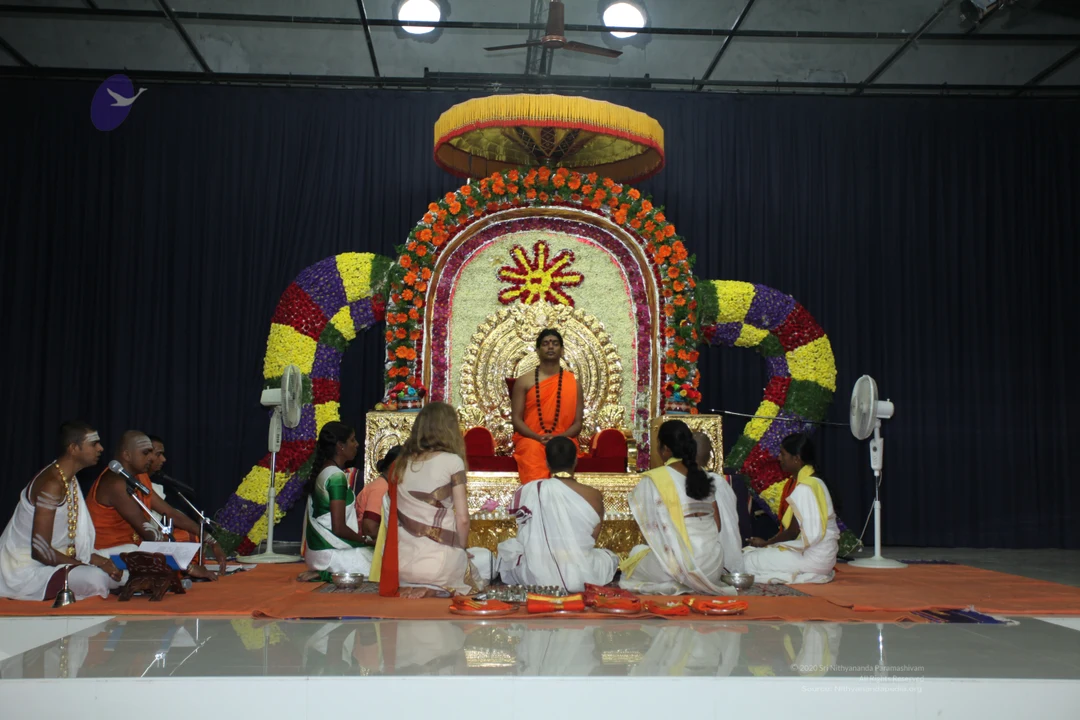
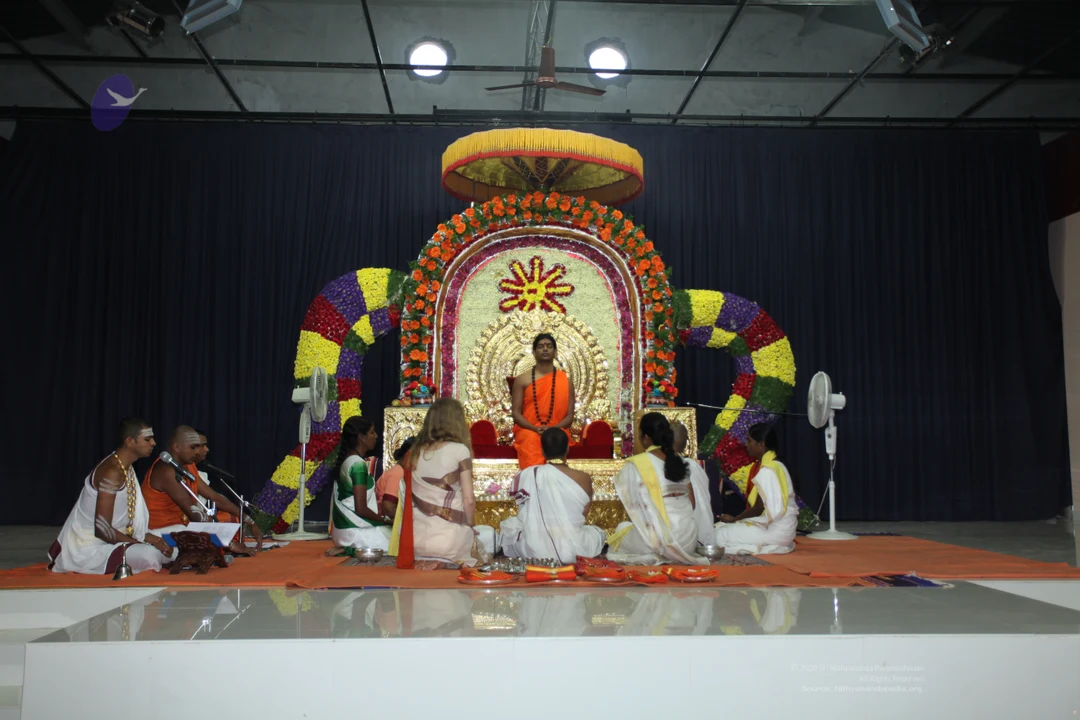
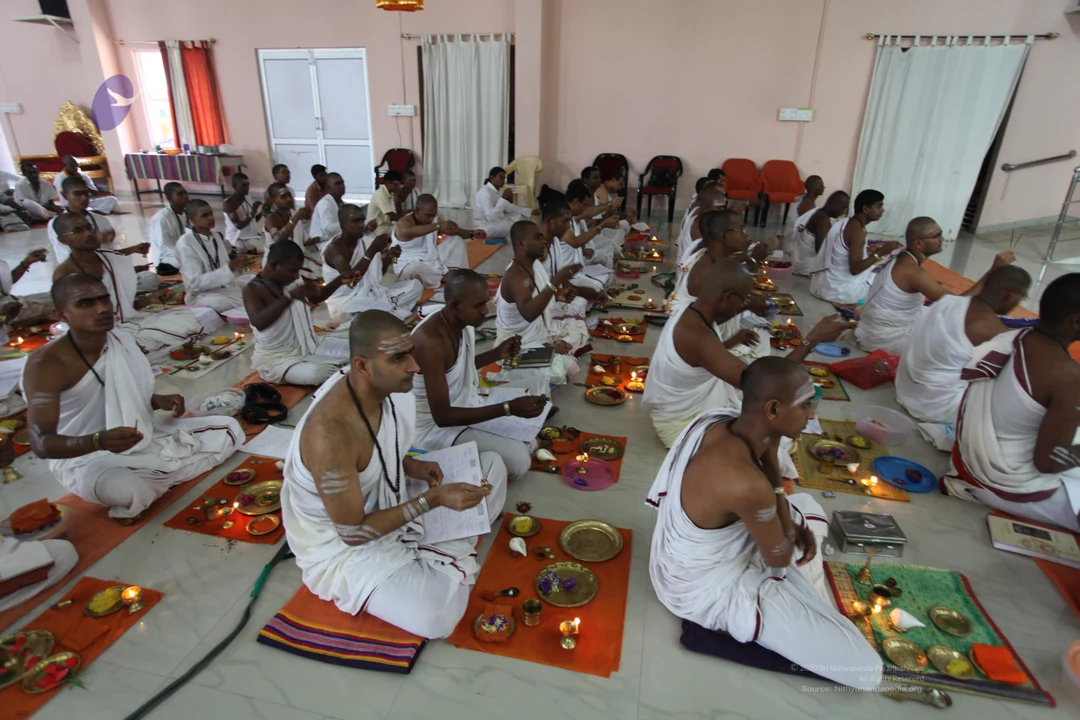
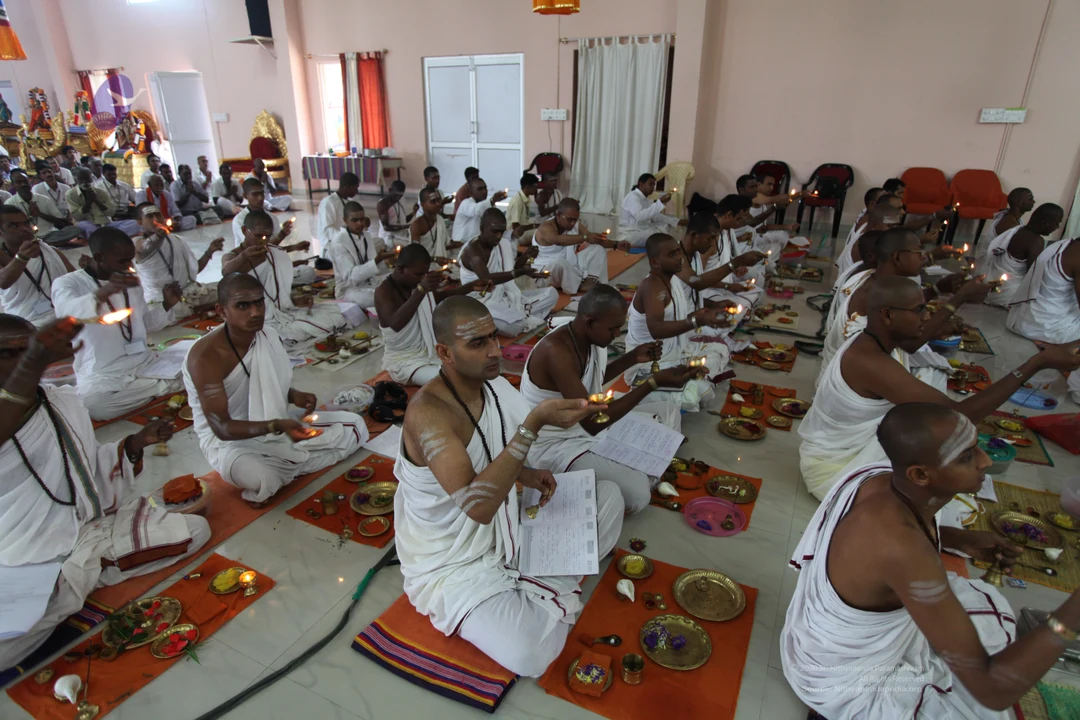
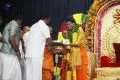
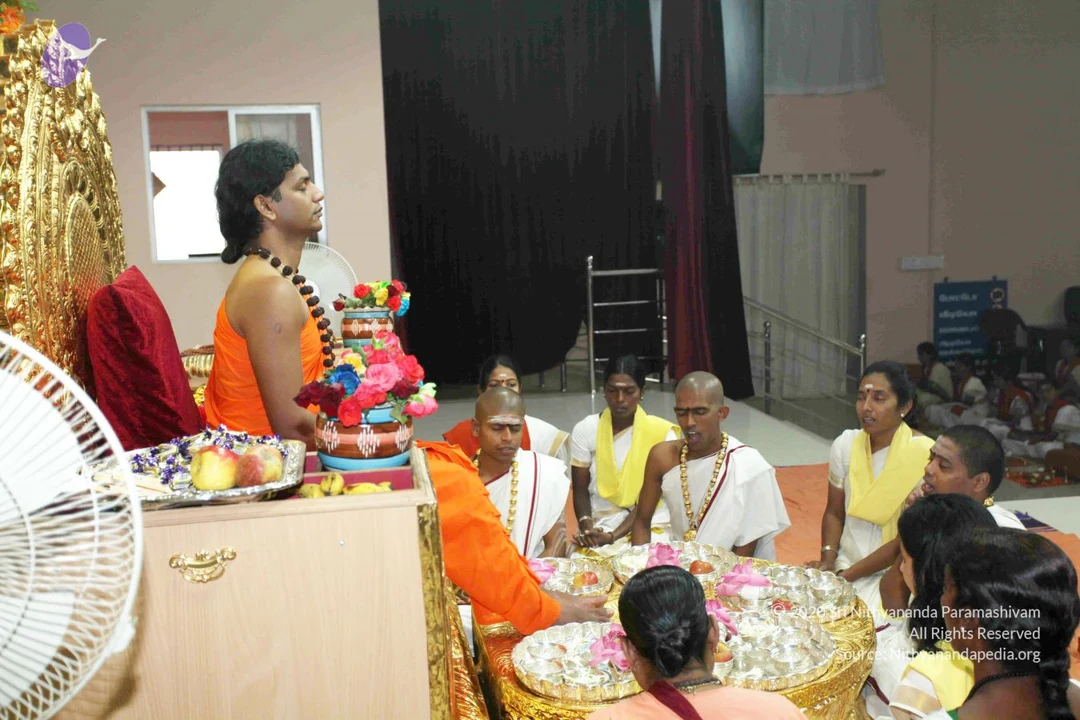
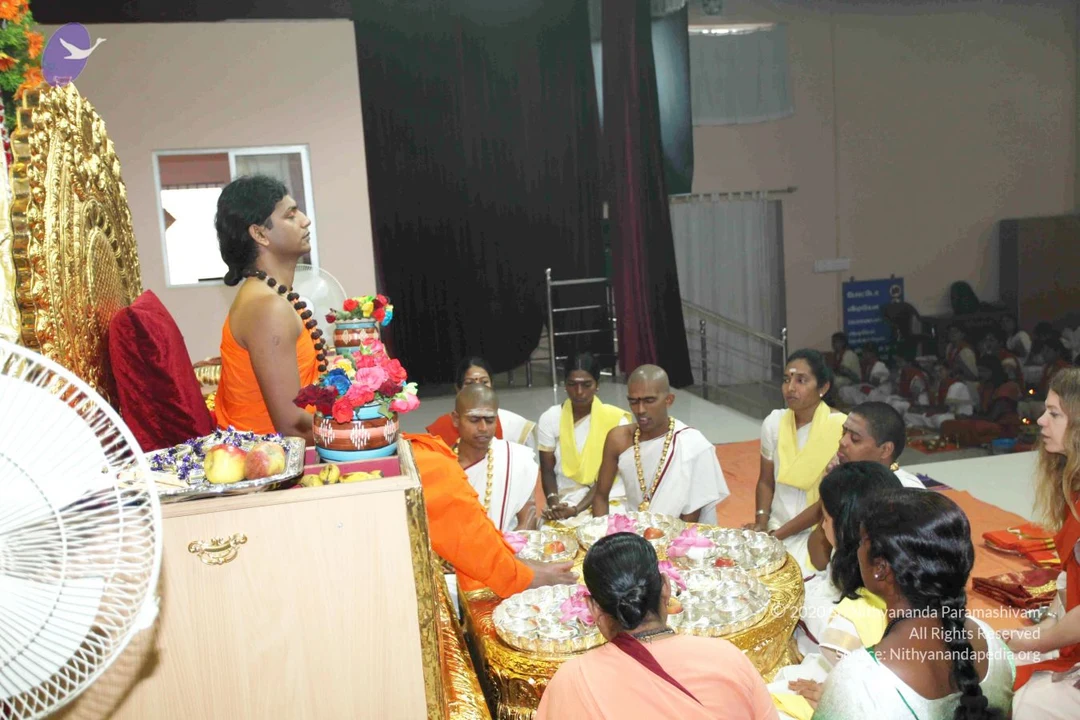
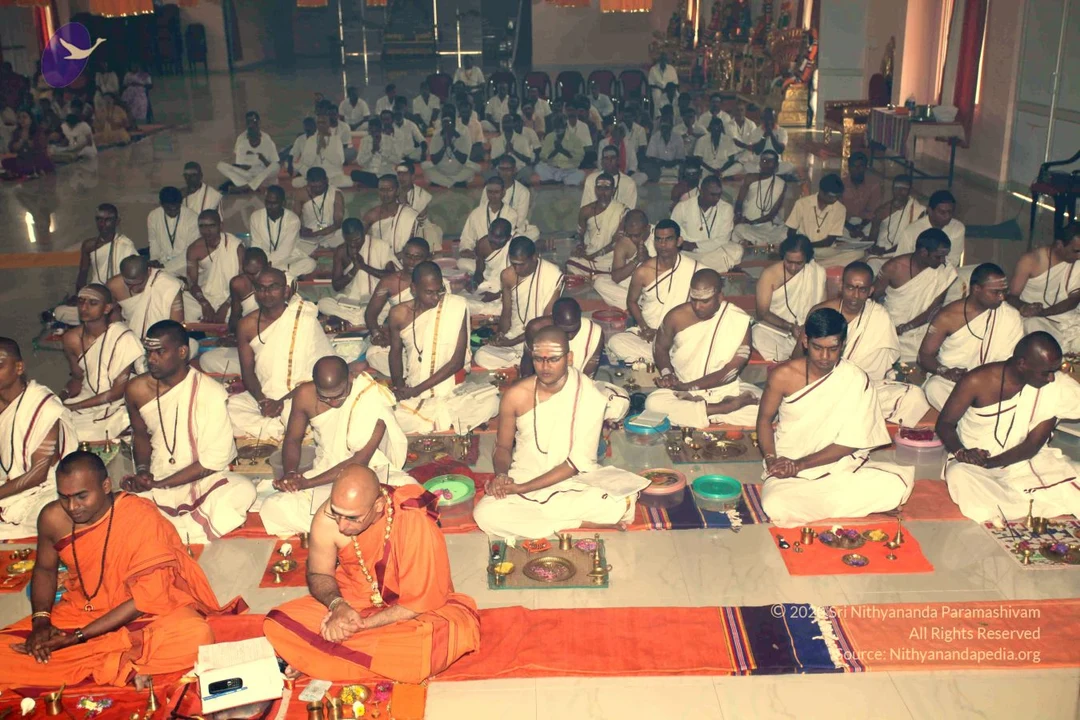
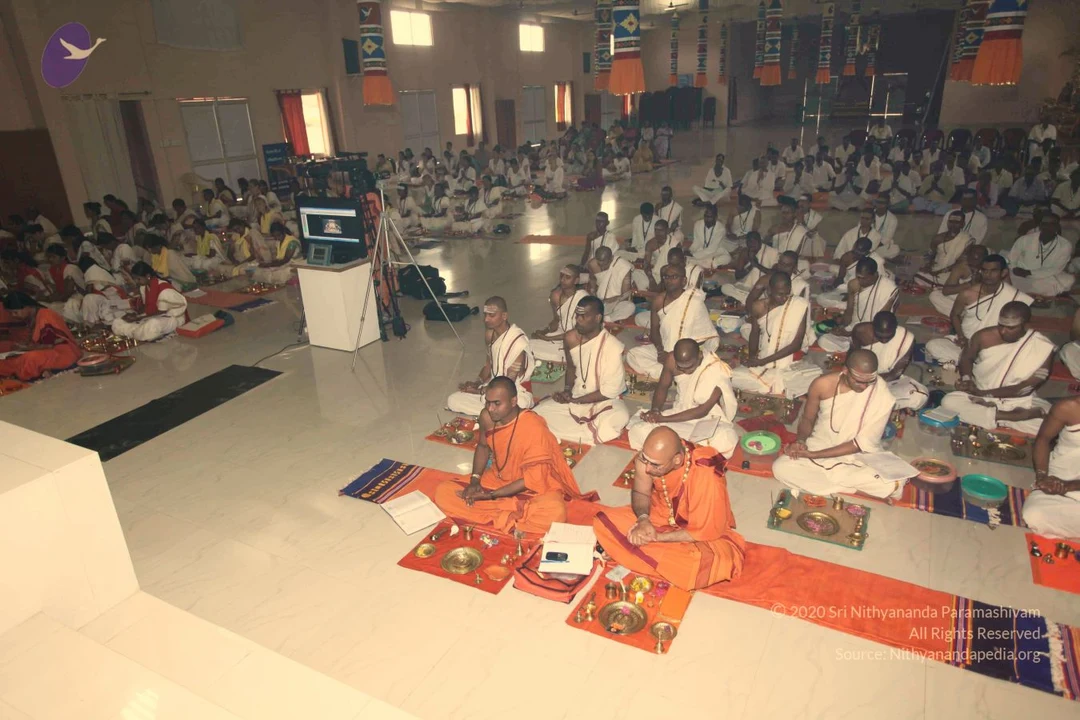
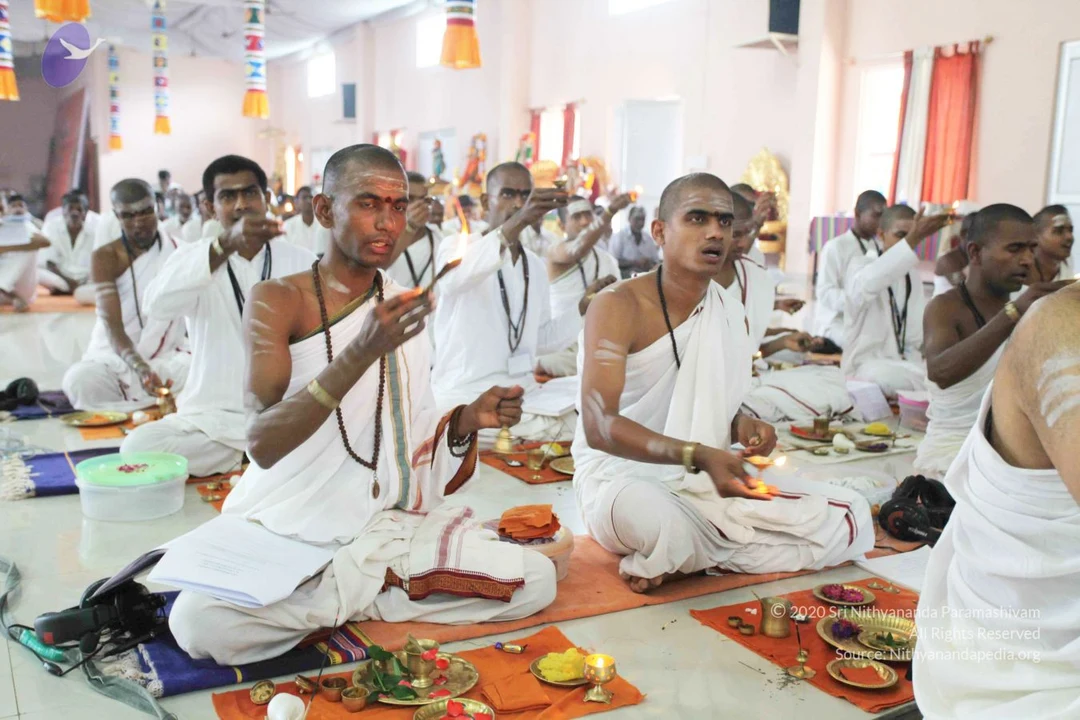
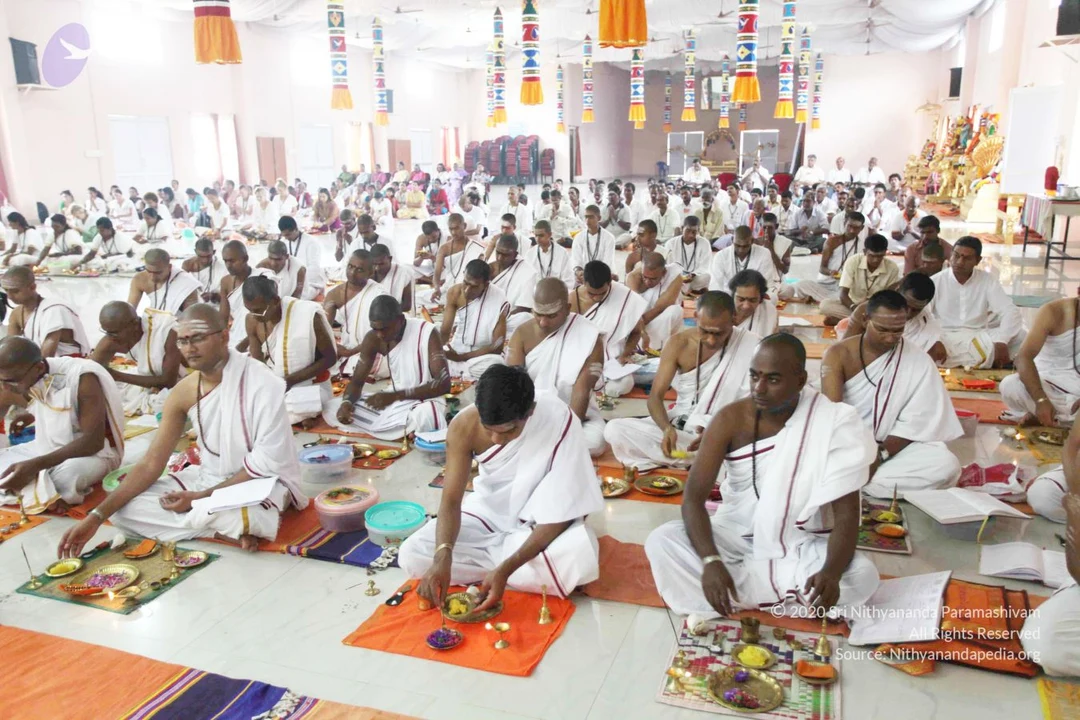
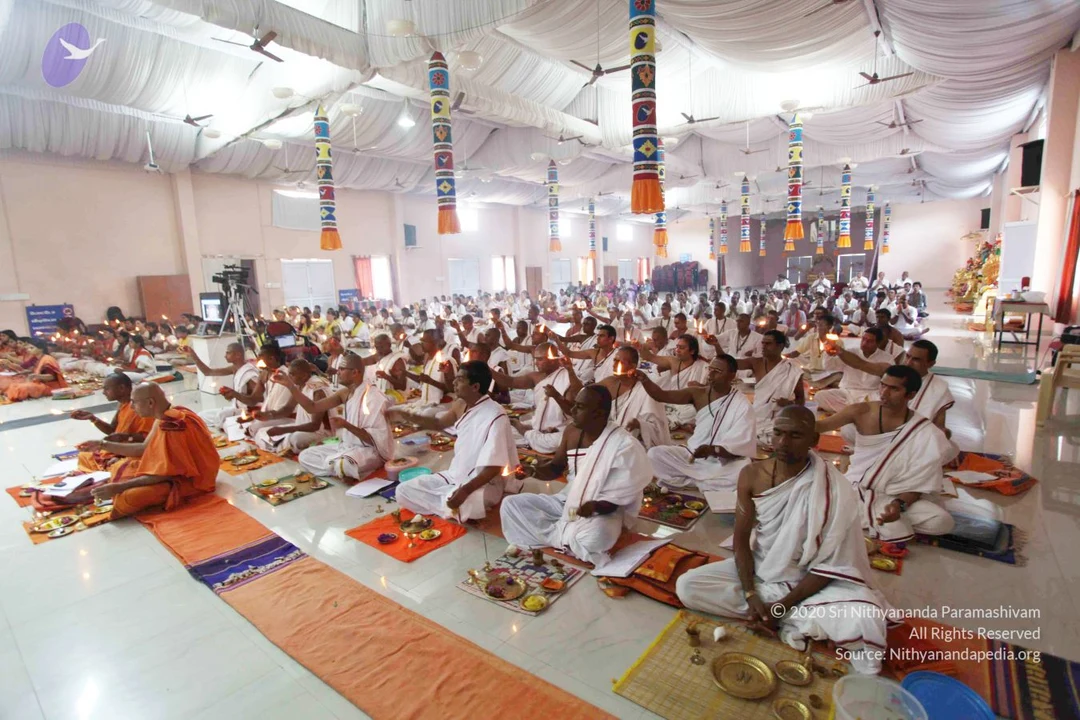
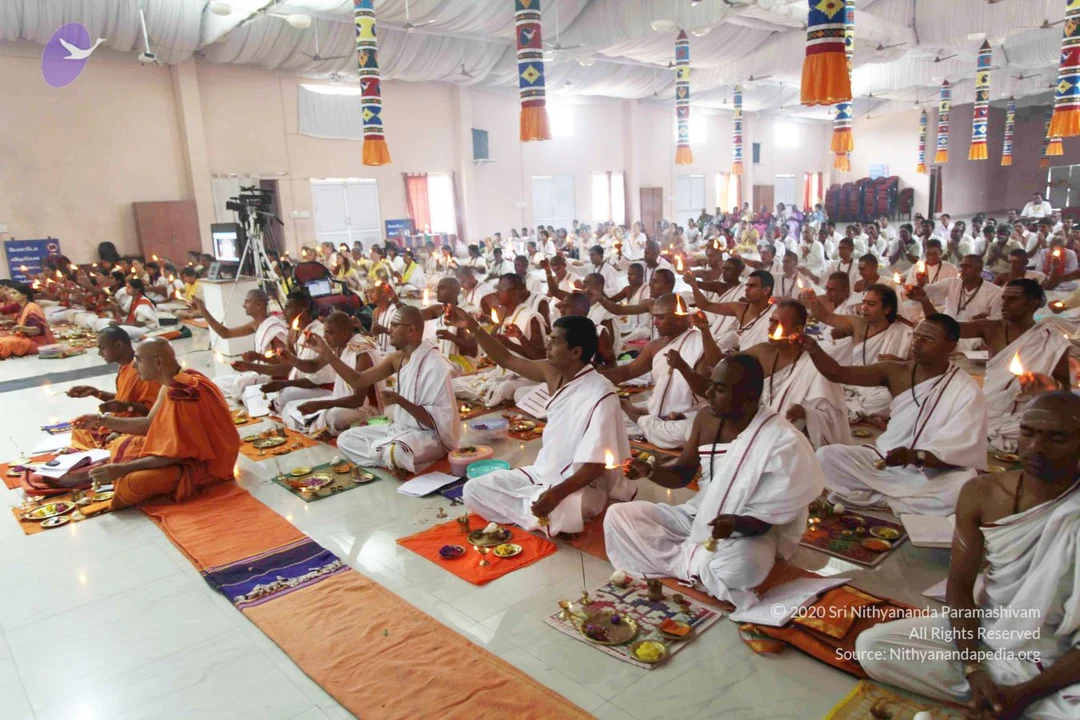
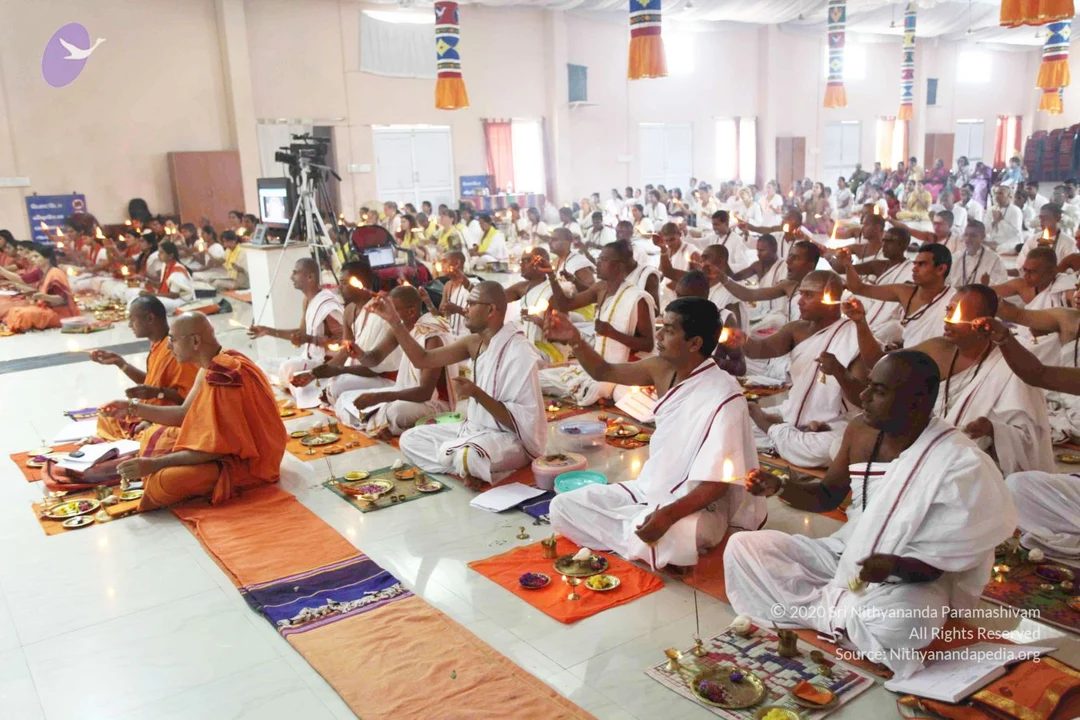
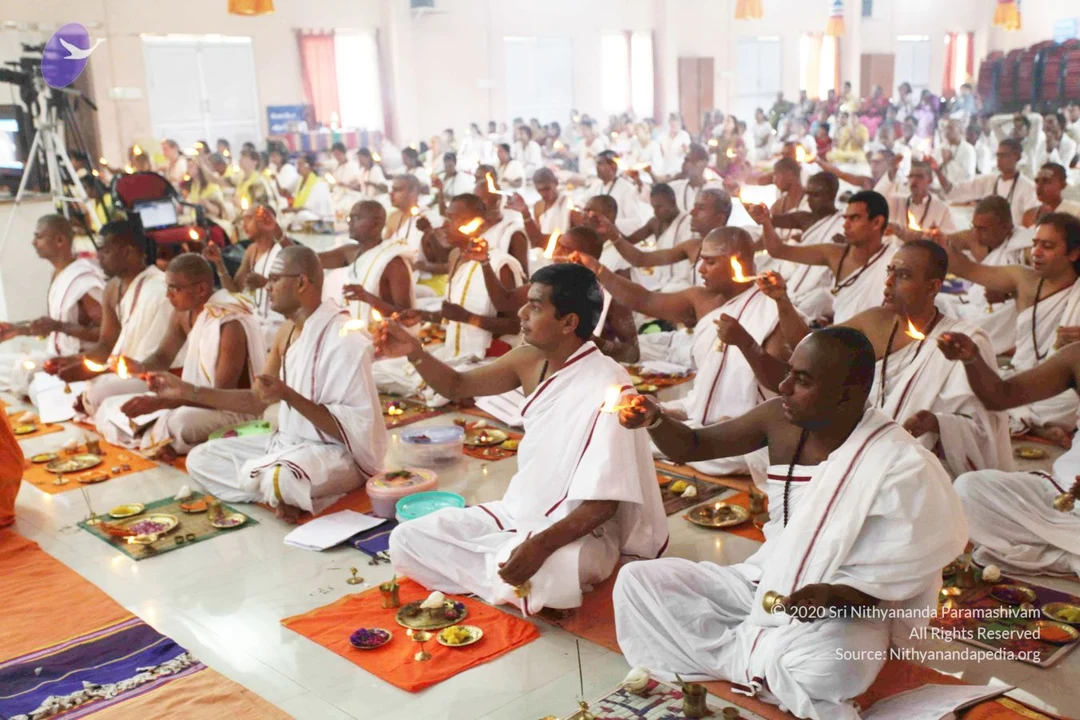
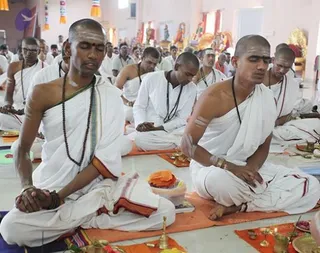
Close-up of an ornate gold repoussé throne or altar surface decorated with floral and scroll motifs. At the centre sits a bouquet of red roses and white jasmine-like flowers, with two gold finials topped by small pink-red gemstones on either side and a single red rose placed below. No people or persons are visible; the scene is a flower arrangement on a gold seat or pedestal.A photograph inside a plain hall at a person ritual setting. A man with long dark hair stands at left wearing an orange unstitched wrap over his shoulders and a long rudraksha mala, with eyes closed in a devotional pose, beside an ornate gold-and-red throne backrest. Before him a tiered flower arrangement of pink, red and blue blossoms sits on a wooden table alongside a silver tray of apples, bananas and a bowl of sweets. Seated on the floor to the right, several people in white dhotis and yellow shawls and a shaved-headed man in an orange robe with a tilak and beaded necklace sit near gold-rimmed brass plates of fruit, flowers and offerings. A white electric fan is visible at left and dark curtains hang at the back of the room.A photograph of a ceremony in a hall with a gold-trimmed ornate throne and a red cushion on the left. A man with long swept-back dark hair, wearing an orange saffron cloth over his shoulders and a dark rudraksha mala, stands behind a wooden stand. He looks upward with hands near the stand. Nearby, a brass-like vessel holds bright pink, red and blue flowers, and a silver tray holds apples, bananas and sweets. Several people in white dhoti-style clothes and yellow shawls sit on the floor; one bald man wears a white upper cloth and beads, and a woman in white sits at the lower right near silver plates of flowers and fruit. A white electric fan stands at the left edge and a black curtain hangs behind the group. Probable Swamiji (appearance-based: long hair, saffron cloth and rudraksha mala) stands at the wooden stand, performing a ritual offering with the attendants.A large seated group of men in white dhotis and white shirts with rudraksha malas sits cross-legged on the floor of a hall during a ritual. In the front, two men in saffron/orange robes sit on orange cloth mats with brass pots, small oil lamps and offering plates on the floor in front of them. Several other men in white sit with their eyes closed or hands folded, and each rests before a small brass vessel, lamp or tray on a red and orange mat. A striped runner covers the floor at the front, and a dark ceiling and altar area are visible at the back.A stage event photographed from the front. A seated figure in saffron-orange robes with a rudraksha mala sits on a gold-and-red throne (peetha) at the centre, framed by an arch of orange and yellow marigold garlands and a golden sun-shaped motif, with a yellow canopy above. Several people in white dhotis and shawls sit on an orange mat in front, including a man with a shaved head and two men in white with sacred marks, a woman in a green sari, and women in white and yellow. Brass items and offering plates lie on the mat, and fans stand at the sides against a dark blue backdrop.A photograph of a satsang stage with a central throne framed by a golden arch and a canopy with a yellow fringe. A figure in saffron-orange robes and a rudraksha mala sits on the throne, with red cushions and a large floral garland arch in orange, yellow, purple and red behind. Seated on the orange-carpeted stage in front, several people in white dhotis and white shawls face the throne; one man in white at left with a microphone and a bare-chested priest in orange-and-white attire sit near a harmonium-like table. Brass plates and small oil lamps are arranged on the floor in front. A woman in a pale sari sits in the center foreground, and other women in green, pink and yellow saris are seated nearby. Ceiling fans and standing fans frame the hall.

Morning-Satsang
9 photosSource gallery
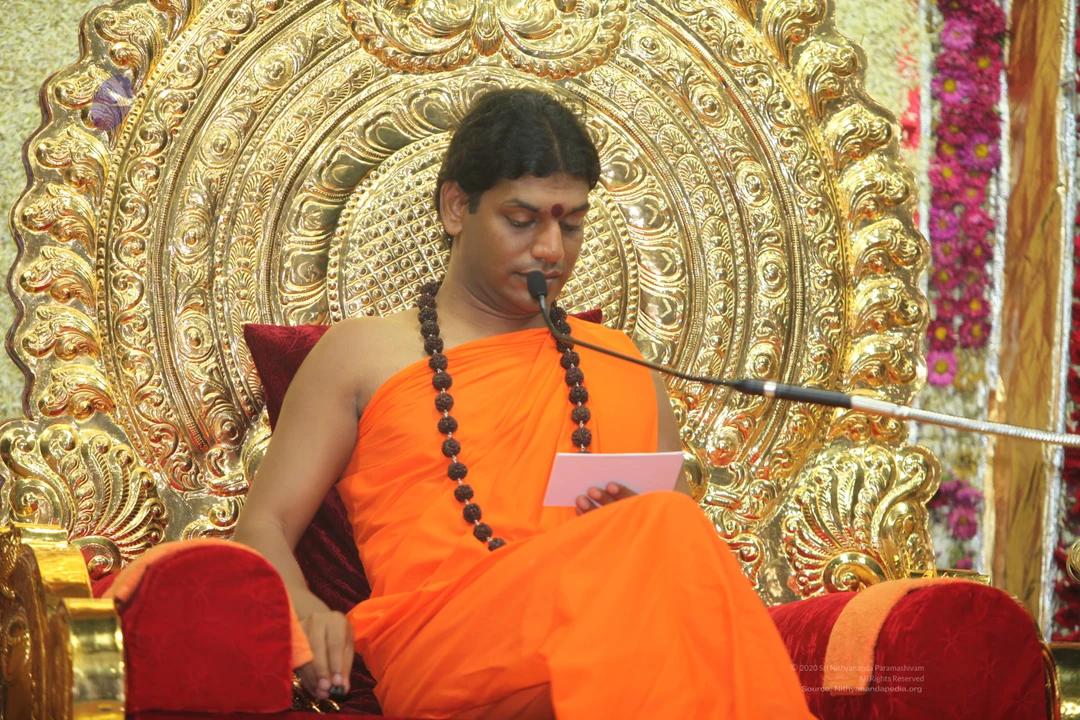
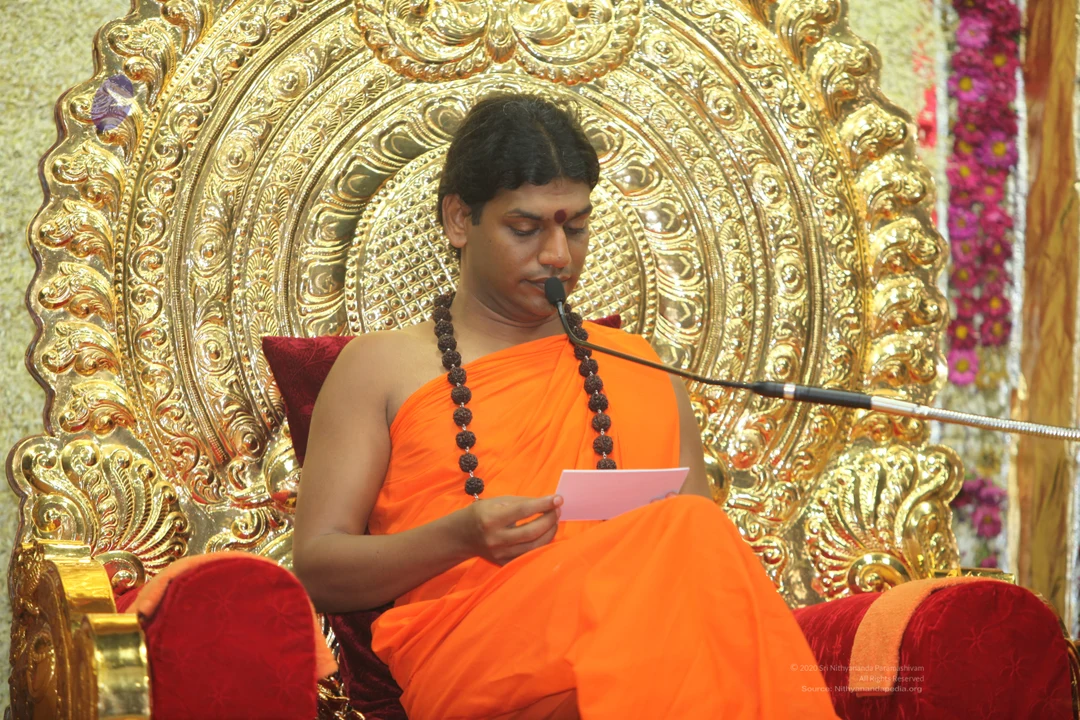
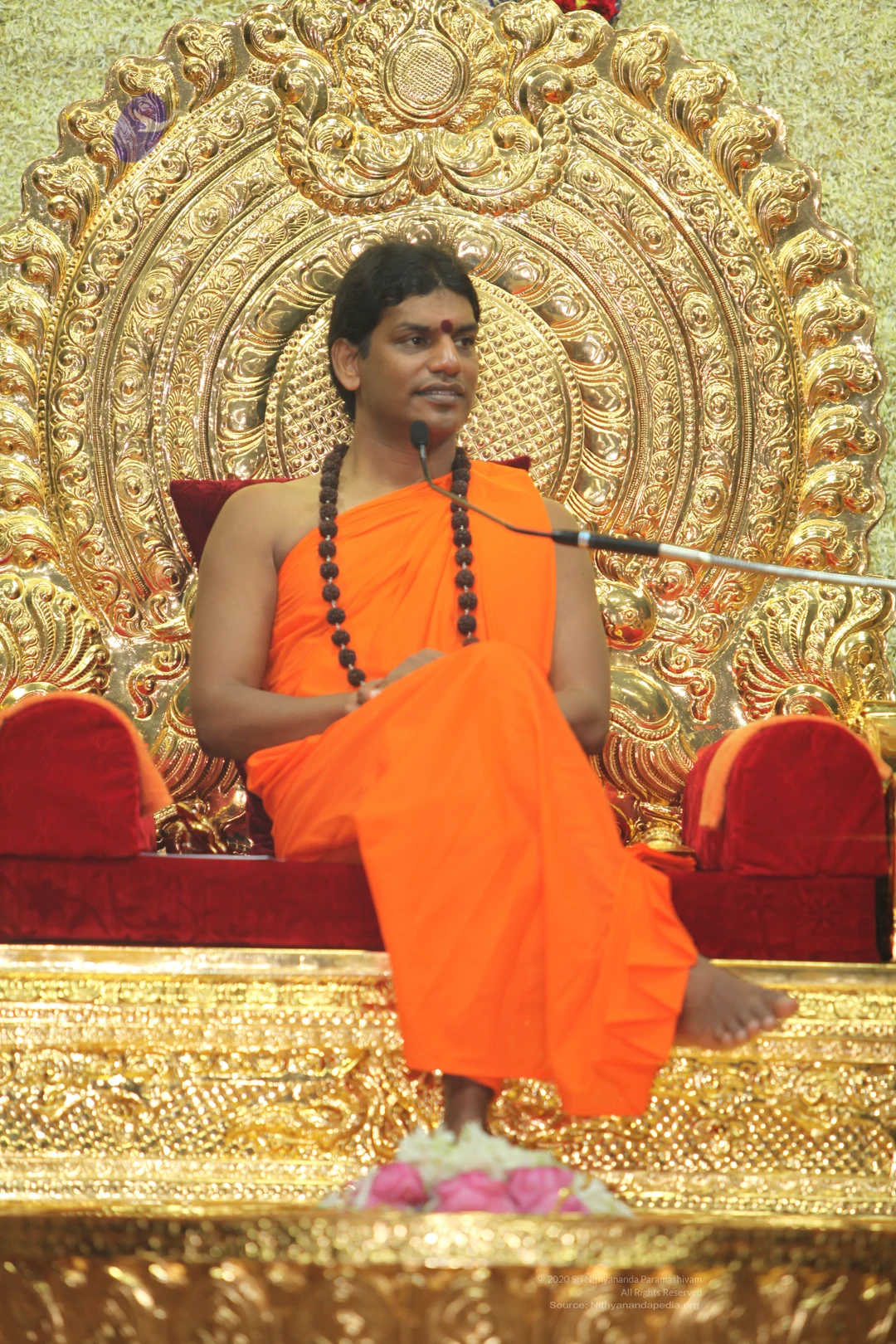
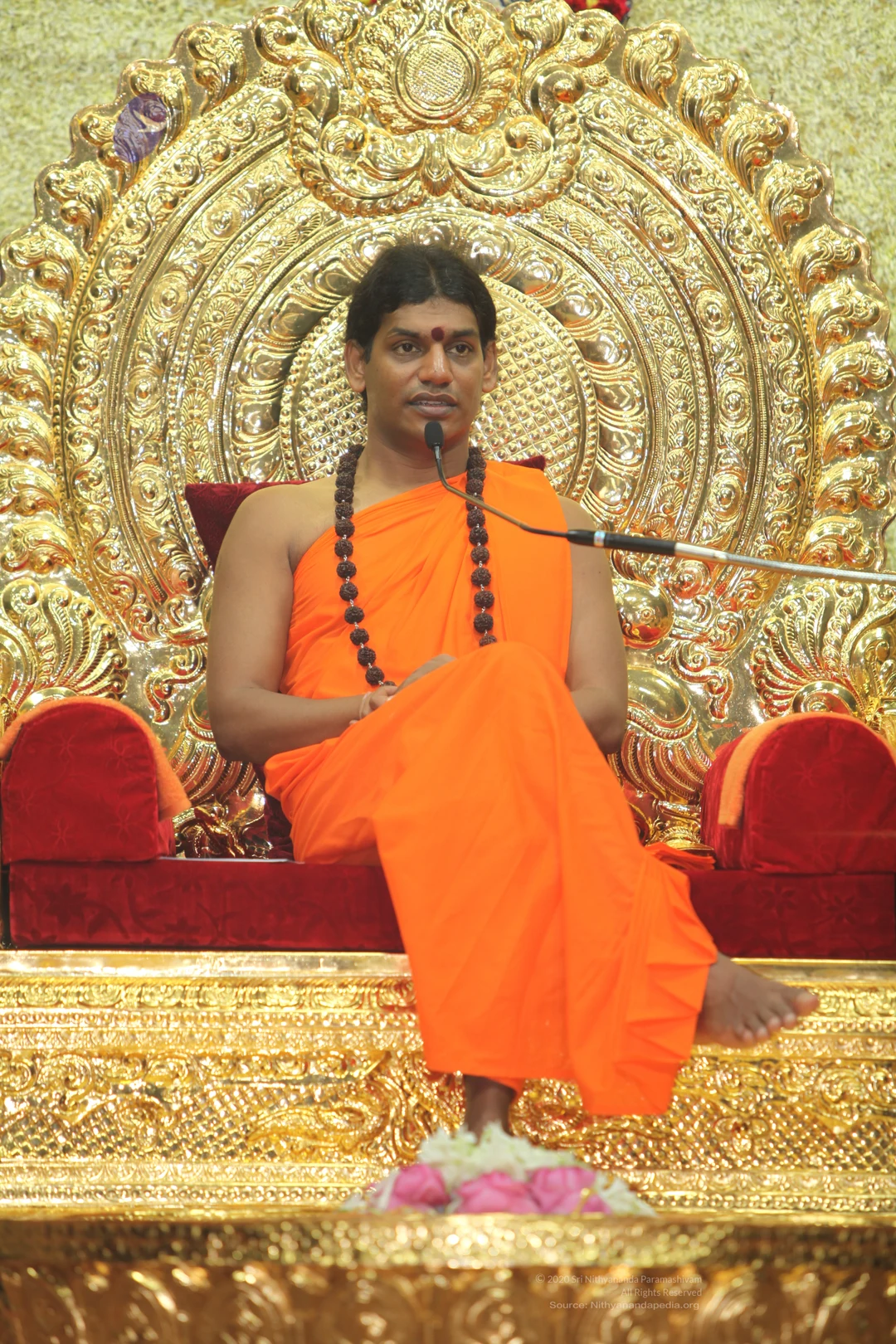
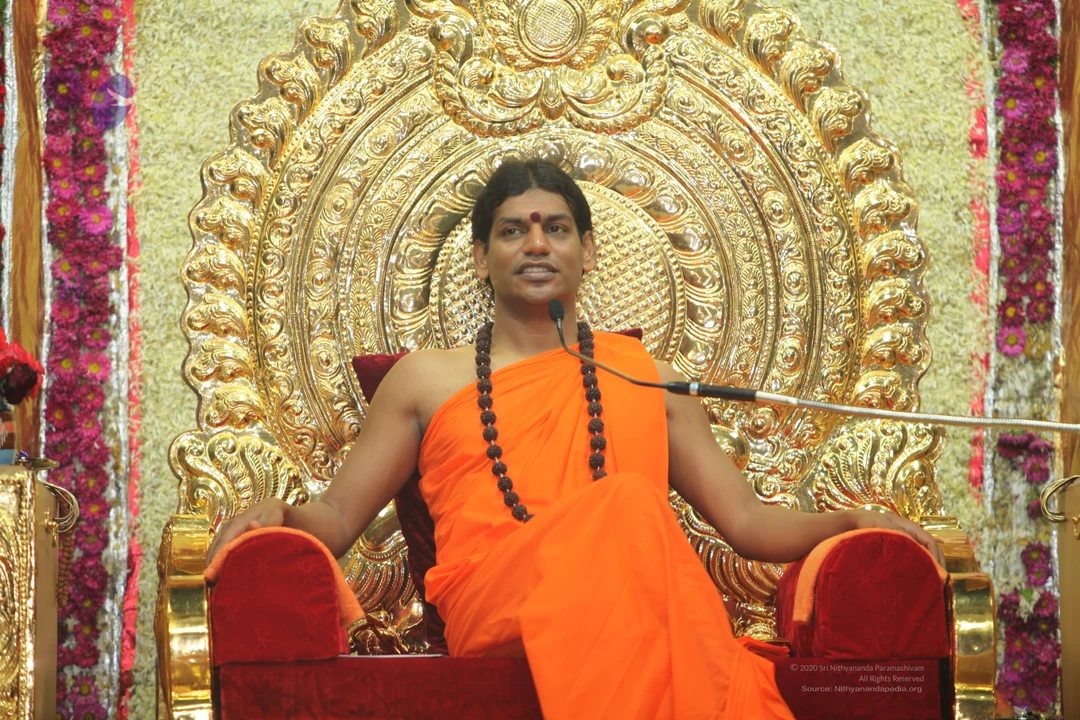
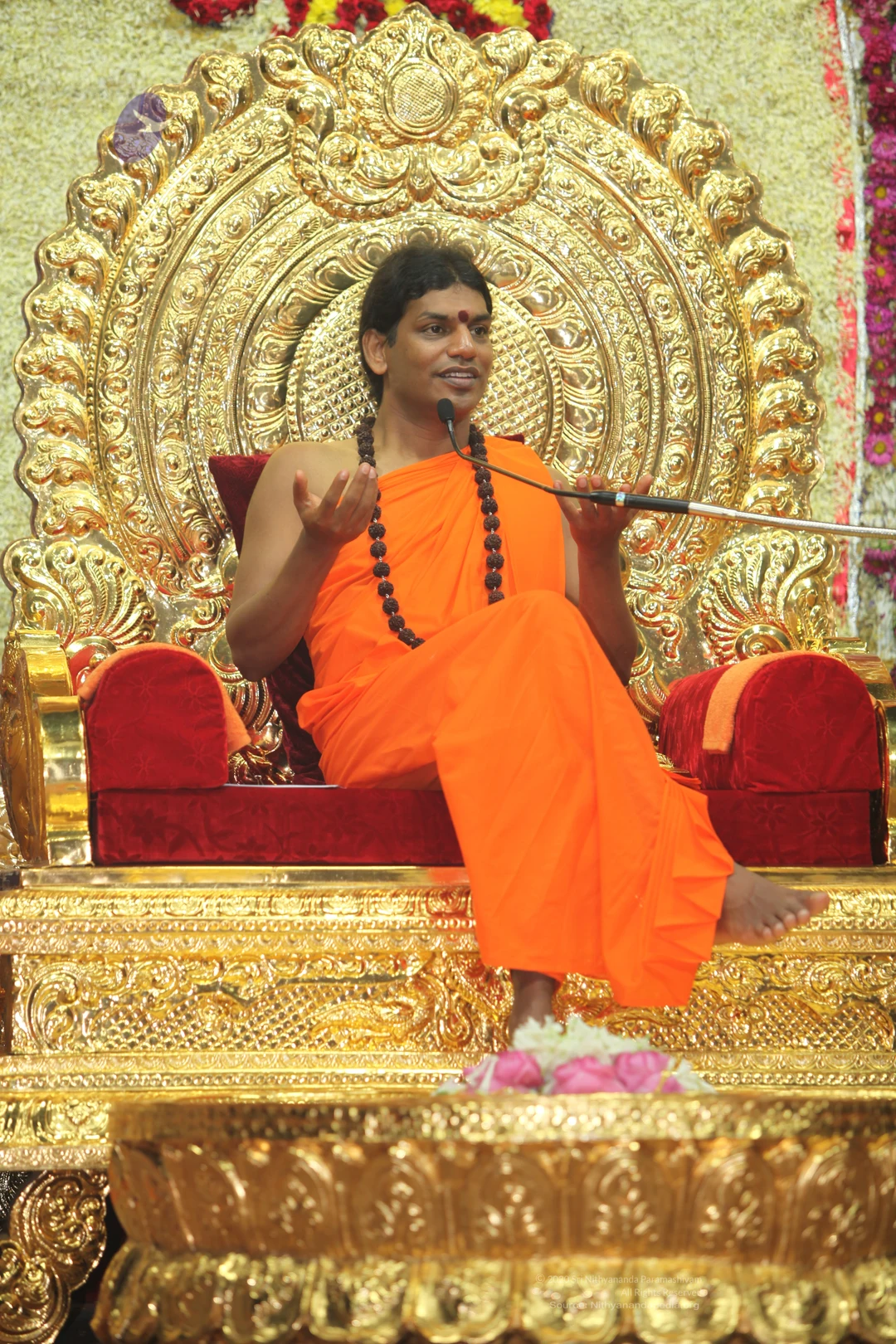
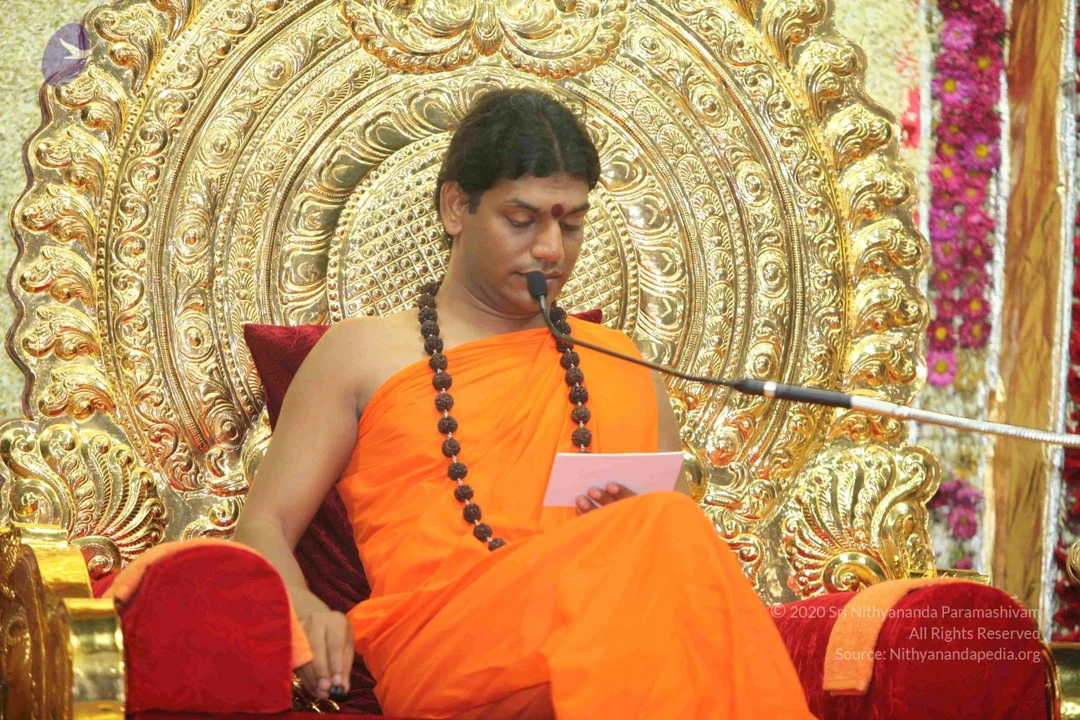
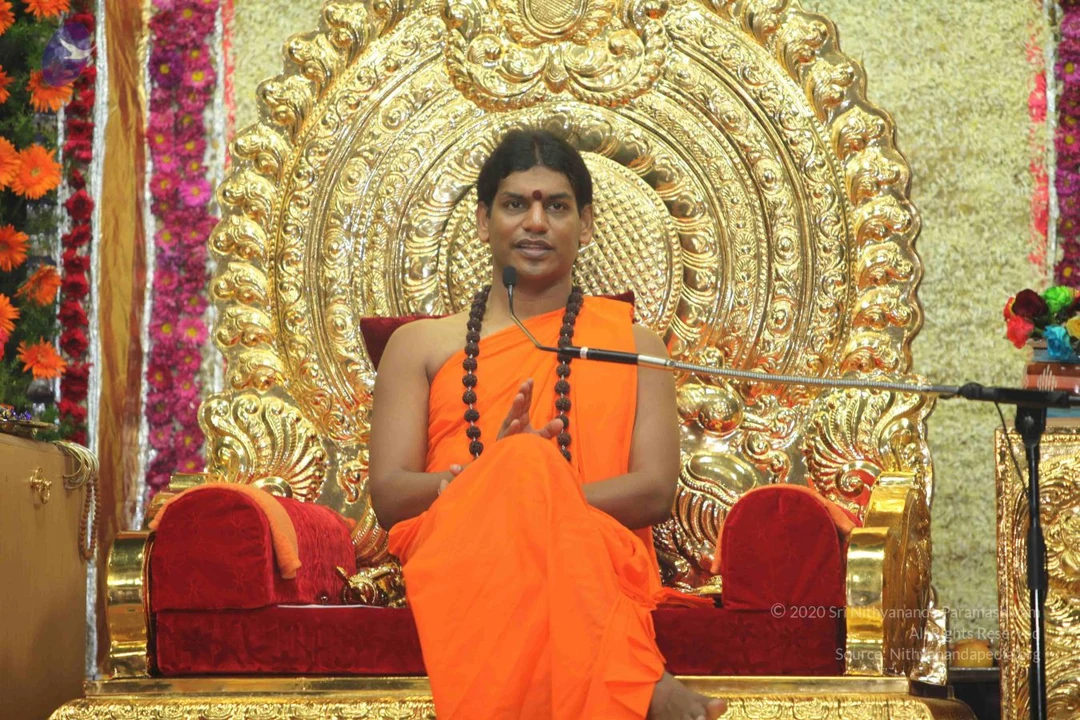
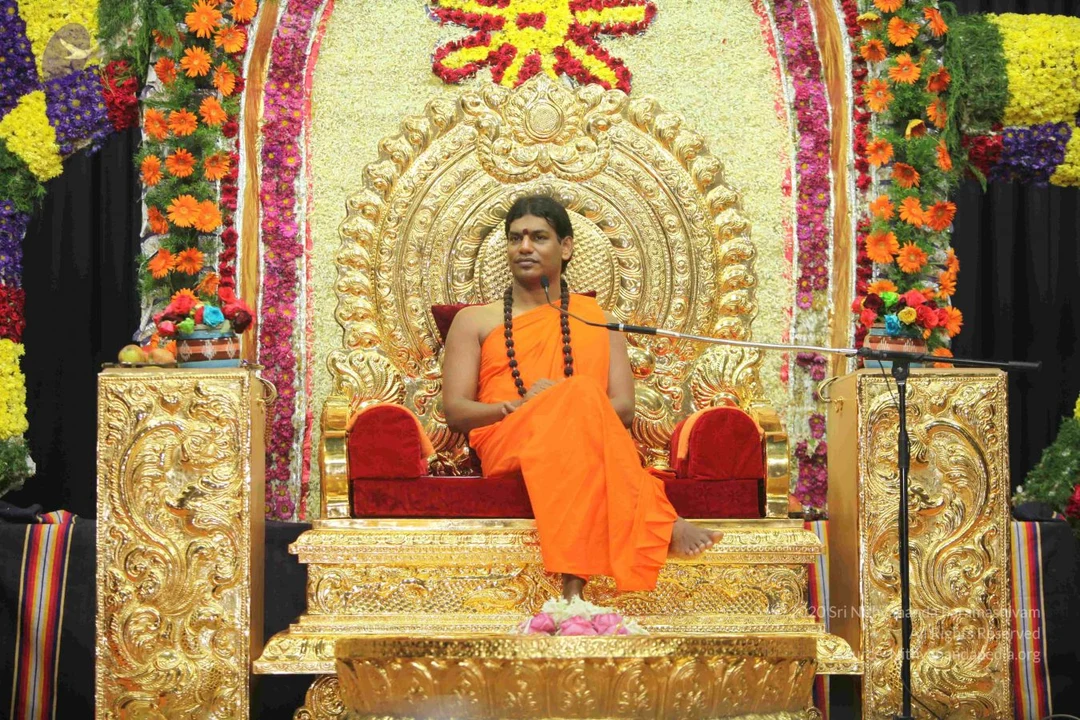
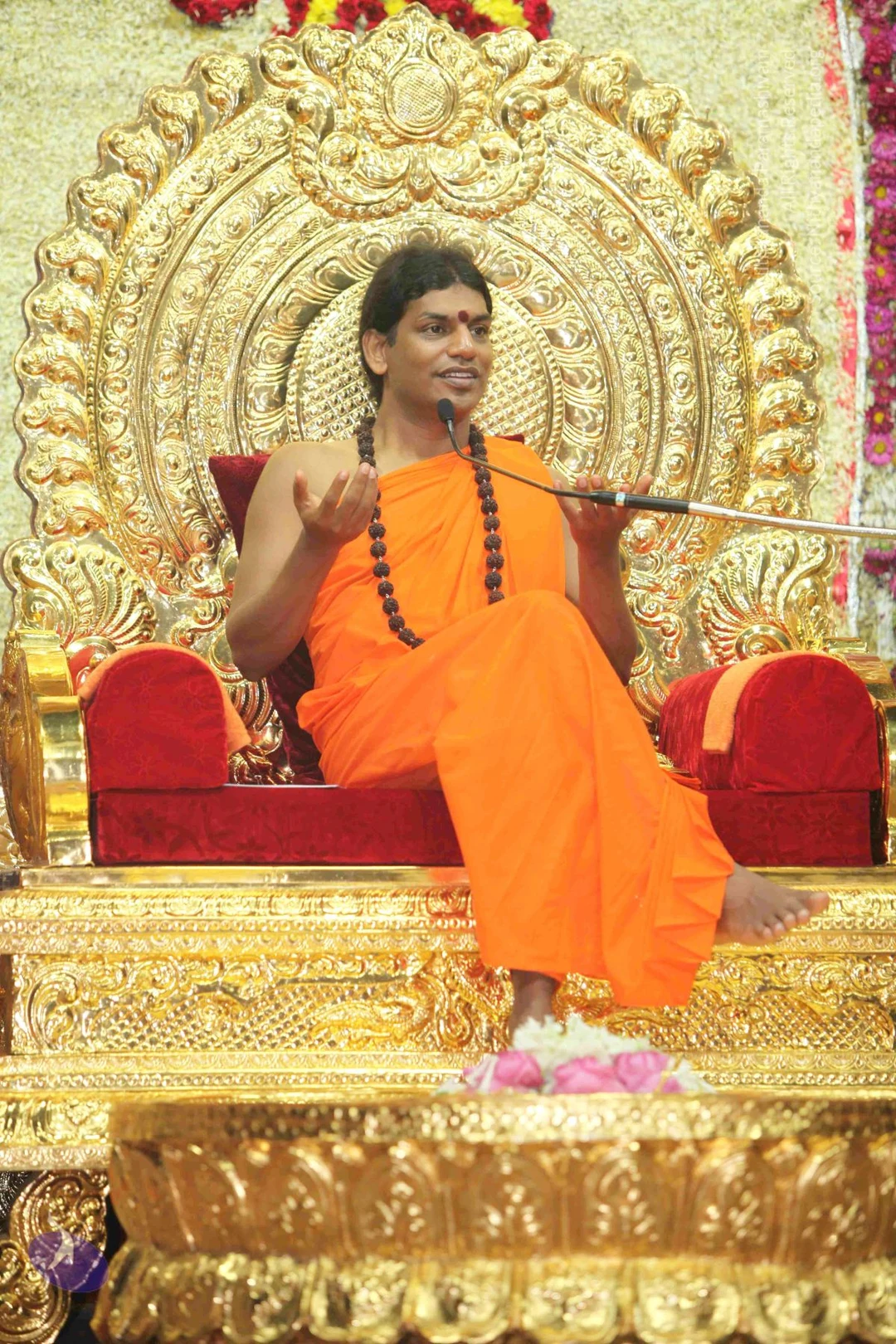
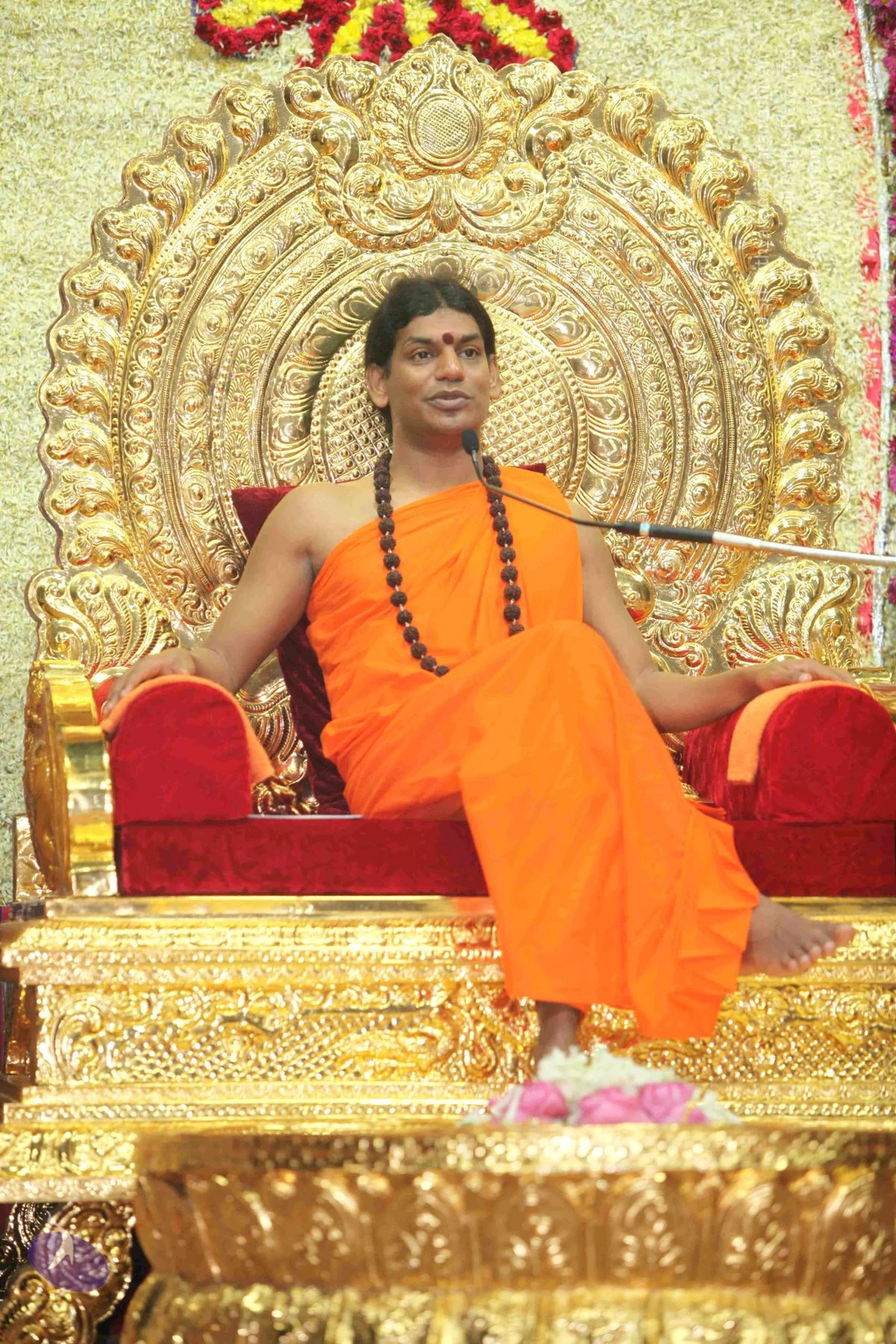
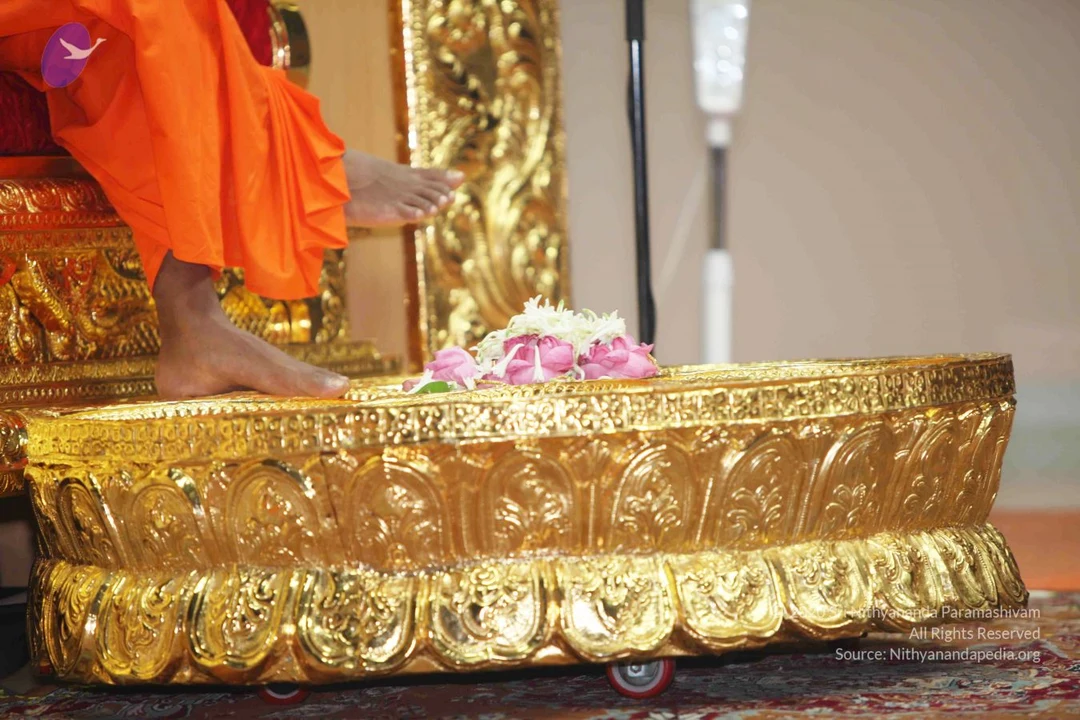
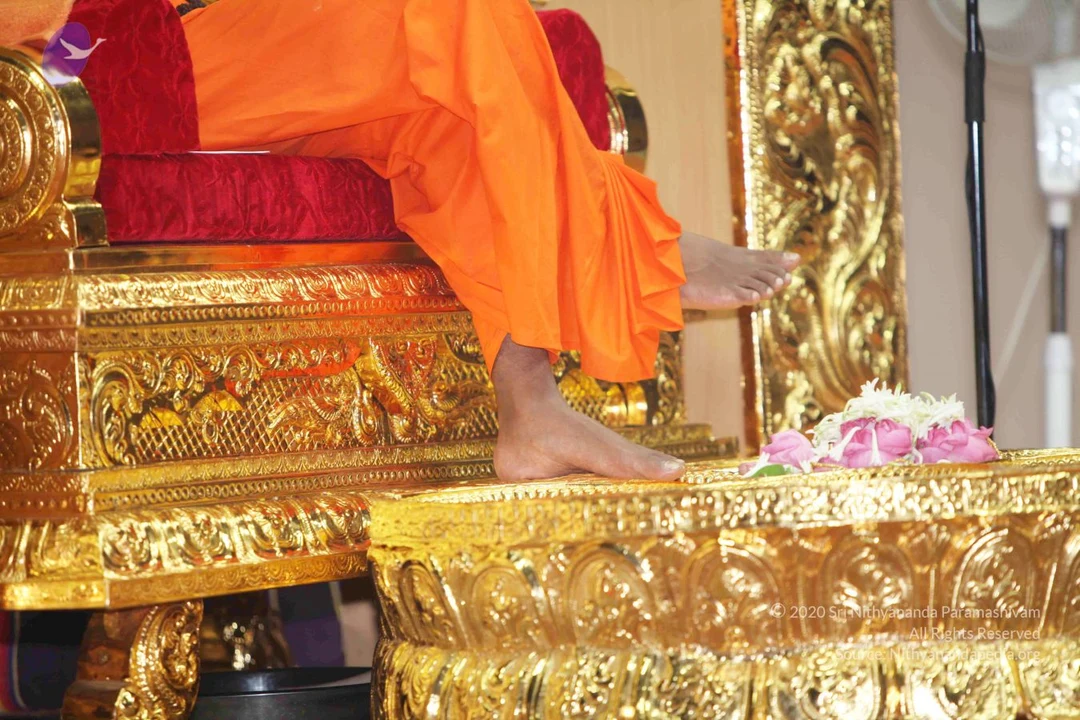
A seated man in saffron-orange robes sits on an ornate gold throne with a red cushioned seat and armrests, reading from a small pink card held in his hands. He wears a long dark rudraksha mala and a red mark on his forehead, with a microphone stand before him. Behind the throne, pink flower garlands hang against a decorated backdrop. Appearance-based candidate: a person, identified by the saffron robes, rudraksha mala and the ceremonial gold throne, with the page noting a talk.A seated man in saffron-orange robes speaks into a microphone during a satsang discourse. He wears a long rudraksha mala with dark beads, a red-and-orange tilak on his forehead, and sits bare-footed on an ornate gold throne with red velvet cushions. Behind him rises a large embossed gold backrest, flanked by orange and pink flower garlands and a bouquet of colourful blooms at right.A photograph of a seated figure on an ornate gilded throne with a red velvet seat and back, framed by a backdrop of orange marigolds, purple and yellow flower garlands and a golden floral arch. The man wears an orange-saffron robe draped over his shoulders and bare chest, has long dark hair with a swept-back style, and wears long dark rudraksha malas hanging down his chest. A microphone stand stands beside him, and a pink flower offering rests on the gold base in front. Swamiji (probable): the saffron robe, long swept-back hair and rudraksha malas on a ceremonial throne match the page's description of a satsang talk; this is an appearance-based label only.A man sits on an ornate gold throne with a red velvet seat and cushioned armrests, speaking into a microphone on a boom stand. He wears a saffron-orange robe draped over one shoulder and a long dark rudraksha mala, with a red bindi on his forehead. His right hand rests in his lap while his left leg is crossed. Bare feet rest on a gold dais above a small offering of pink flowers and white petals. The gold-embossed backdrop behind the throne is elaborately carved with floral and scroll motifs. Appearance-based label: a person, seated in person, giving a satsang talk.A seated man in saffron-orange robes, wearing a long rudraksha mala and a red bindi on his forehead, sits cross-legged on an ornate gold throne with red velvet cushions while speaking into a microphone. His hands rest in his lap and his bare feet rest on a gold platform above a small arrangement of white flowers and pink rose petals. Swamiji (probable): long dark hair swept back, saffron robes, rudraksha mala, and a gold-embossed throne indicate the teacher giving a satsang discourse.A man seated on an ornate gold throne with a repousse-patterned backrest and red velvet armrests, speaking into a microphone on a stand. He wears a saffron-orange garment draped over his shoulders and a long rudraksha mala of dark beads around his neck, with a red bindi on his forehead. Behind the throne are garlands of pink and purple flowers and white blossoms.

Sarvadarshan

3 photosSource gallery
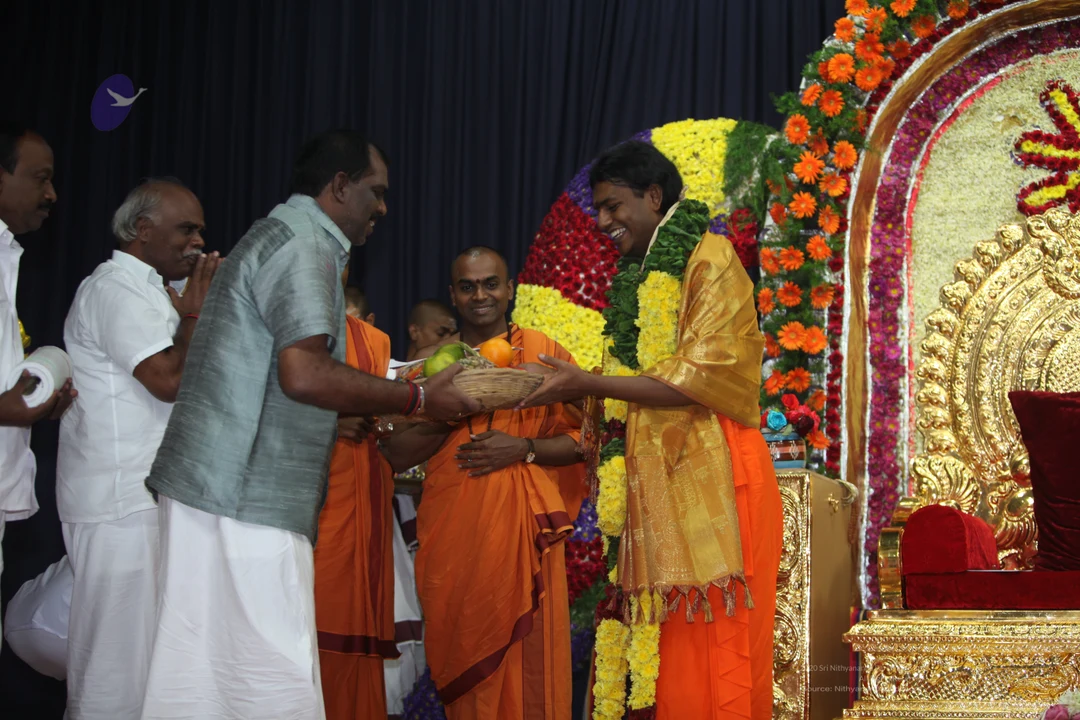
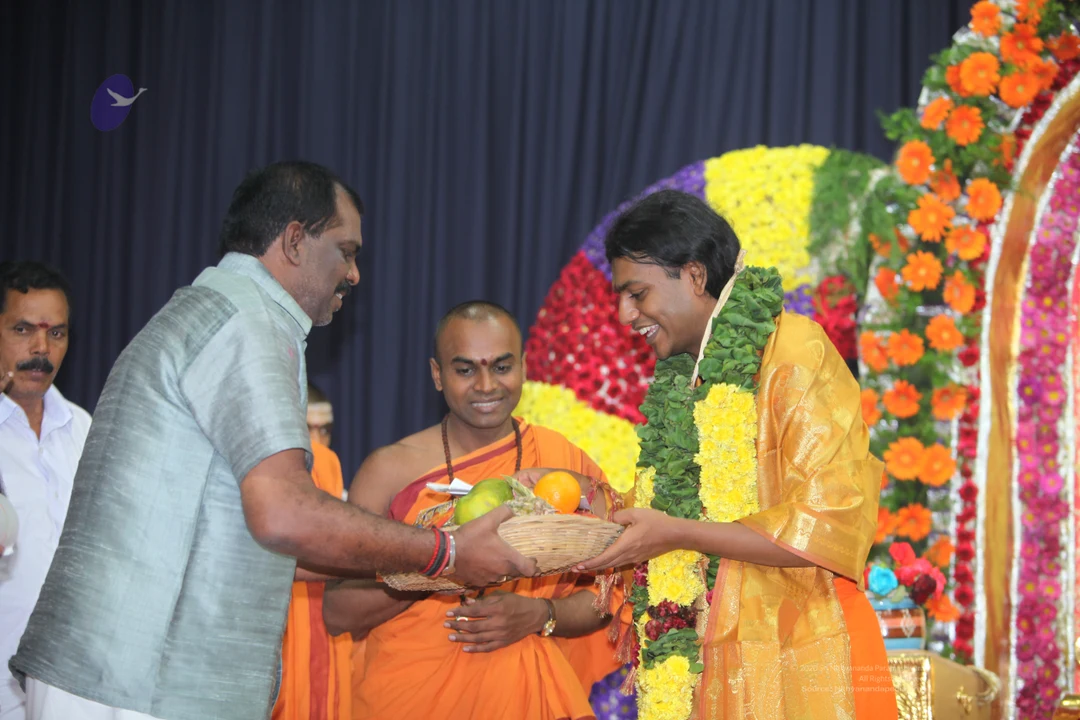
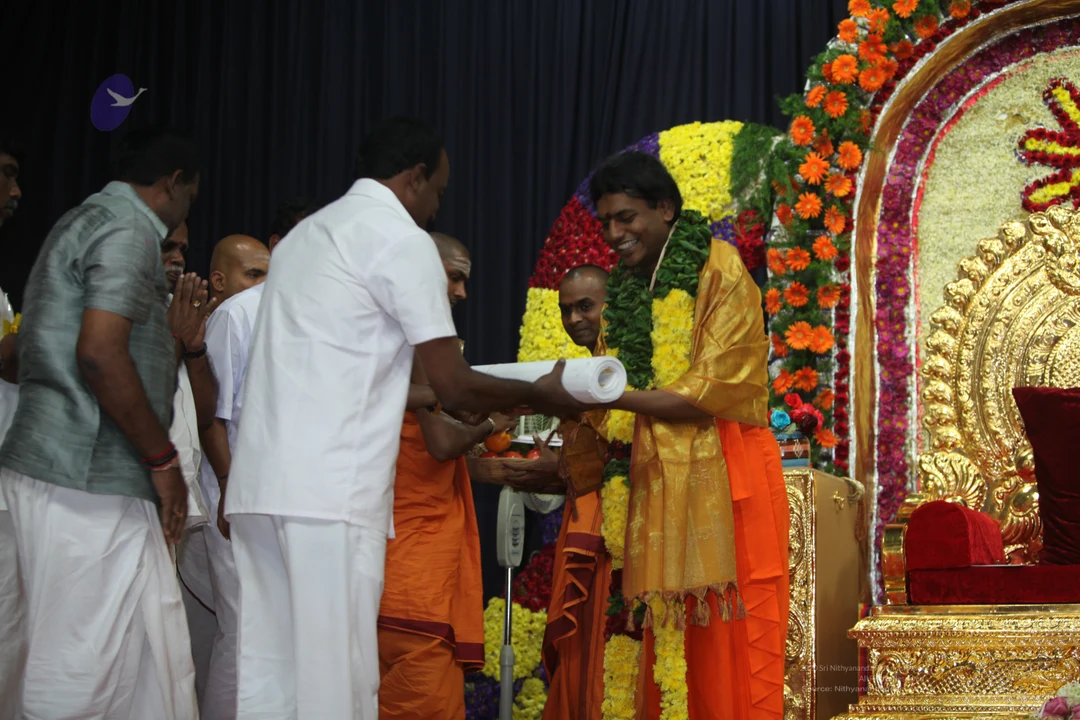
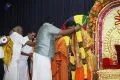
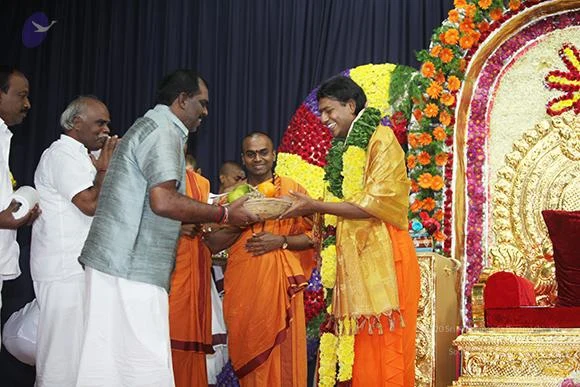
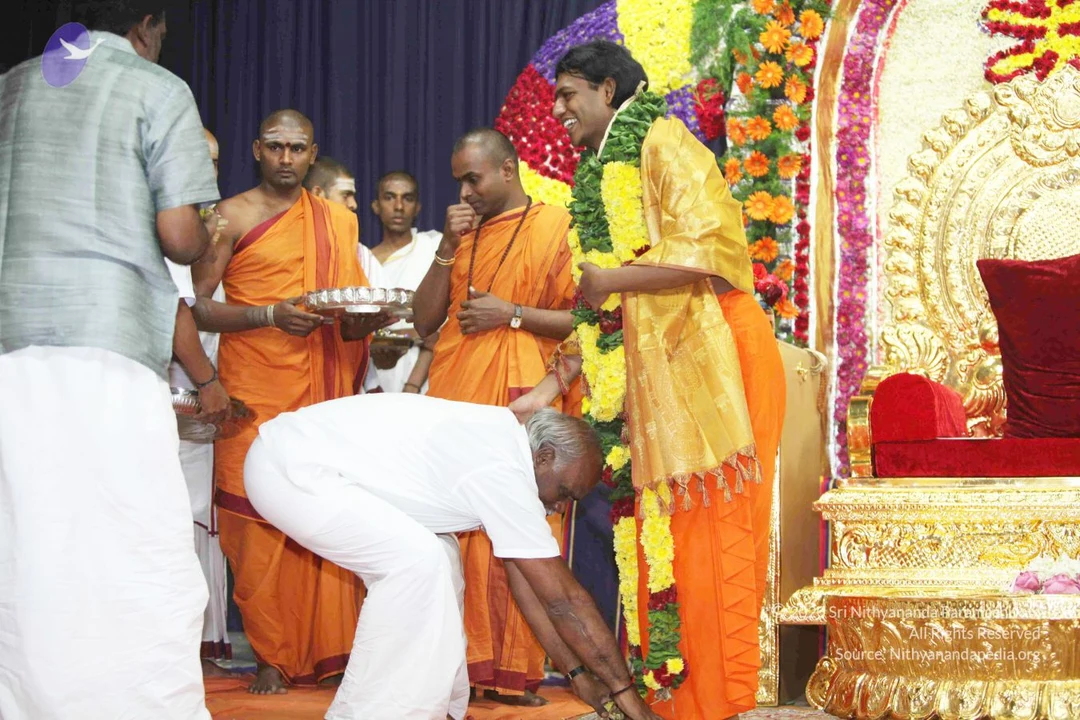
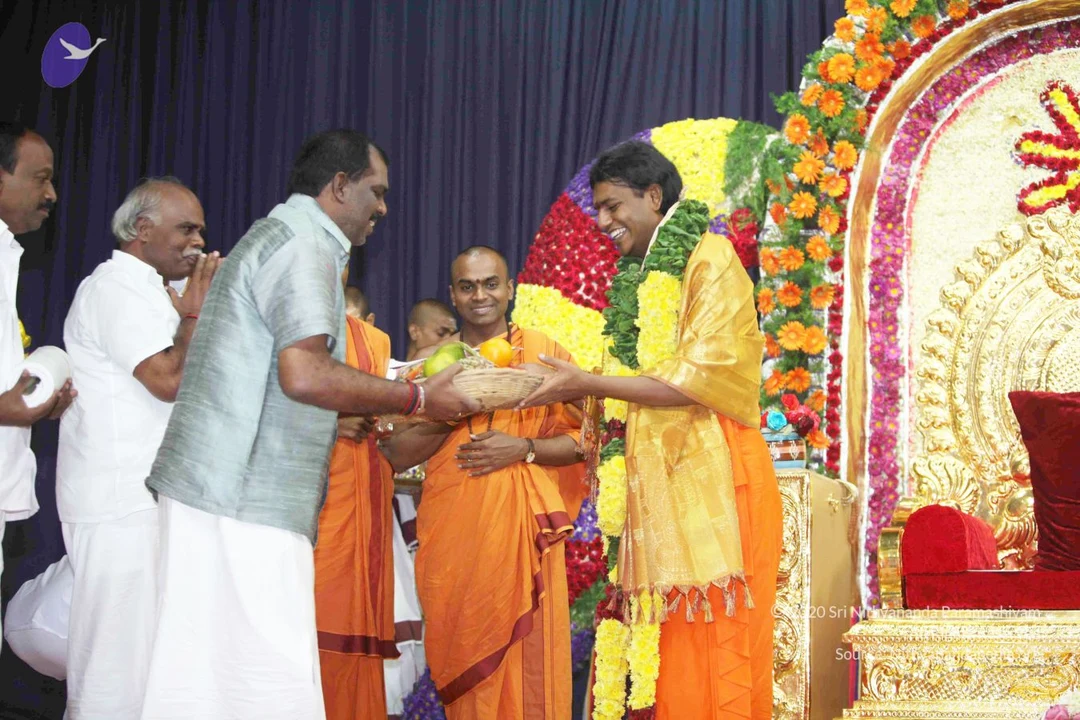
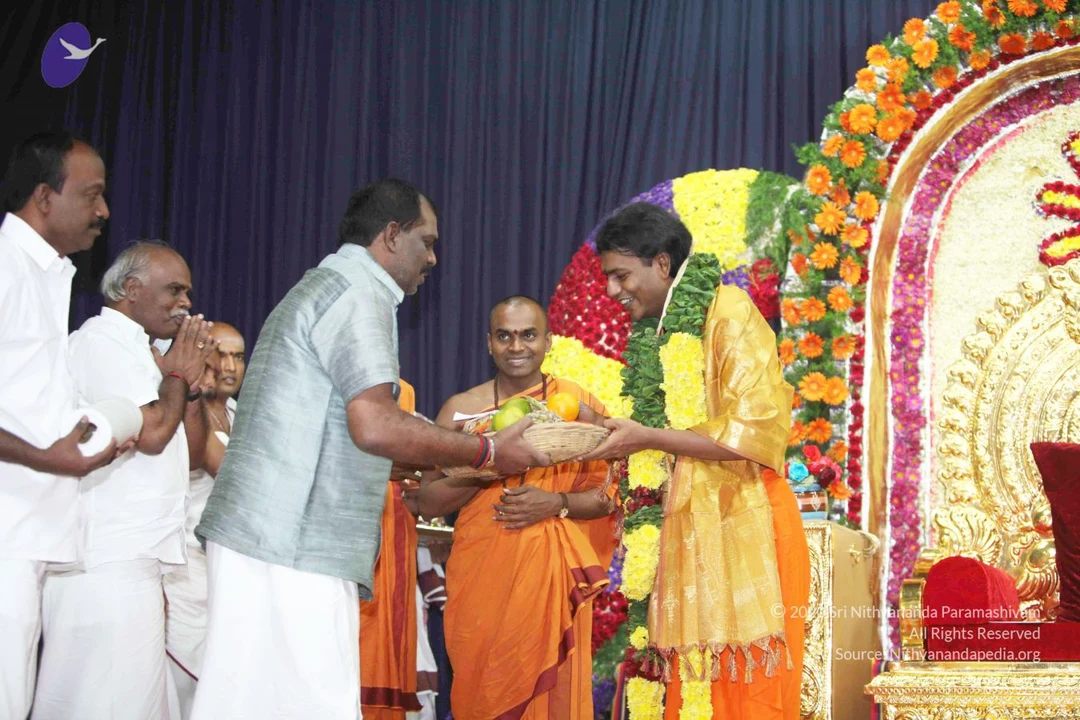
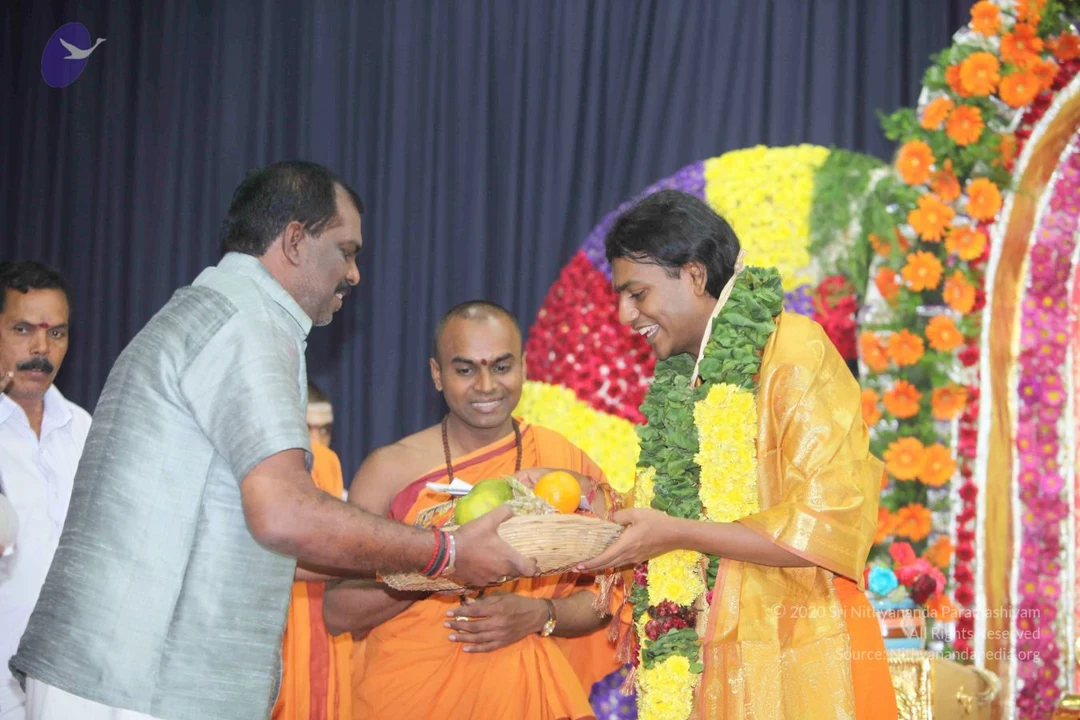
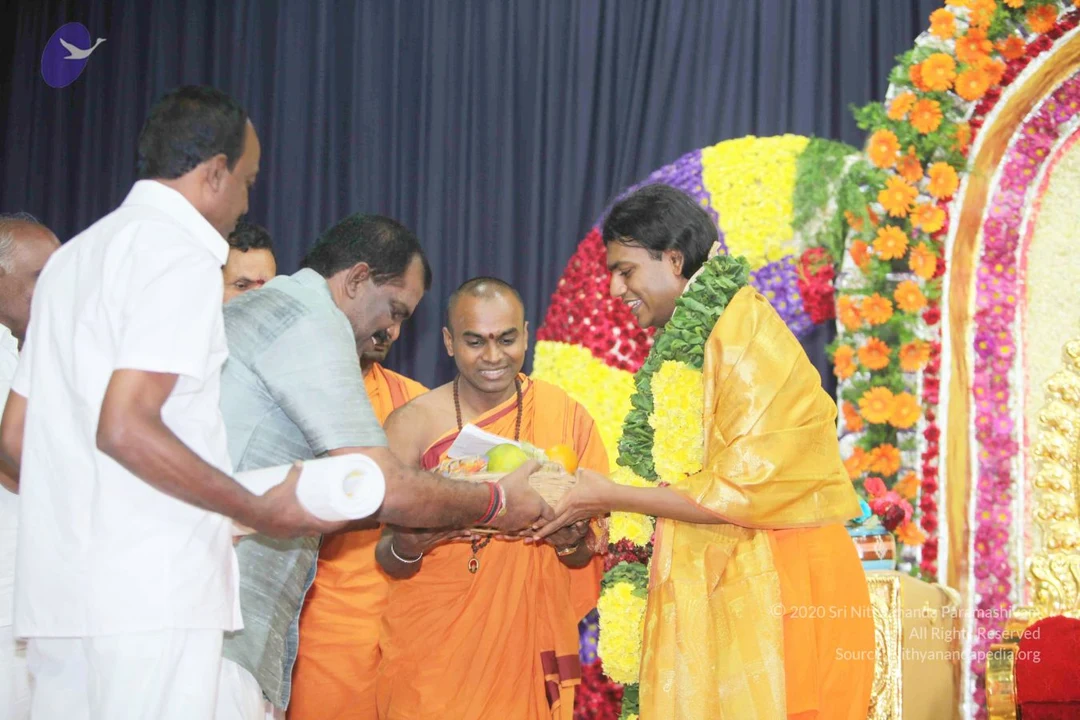
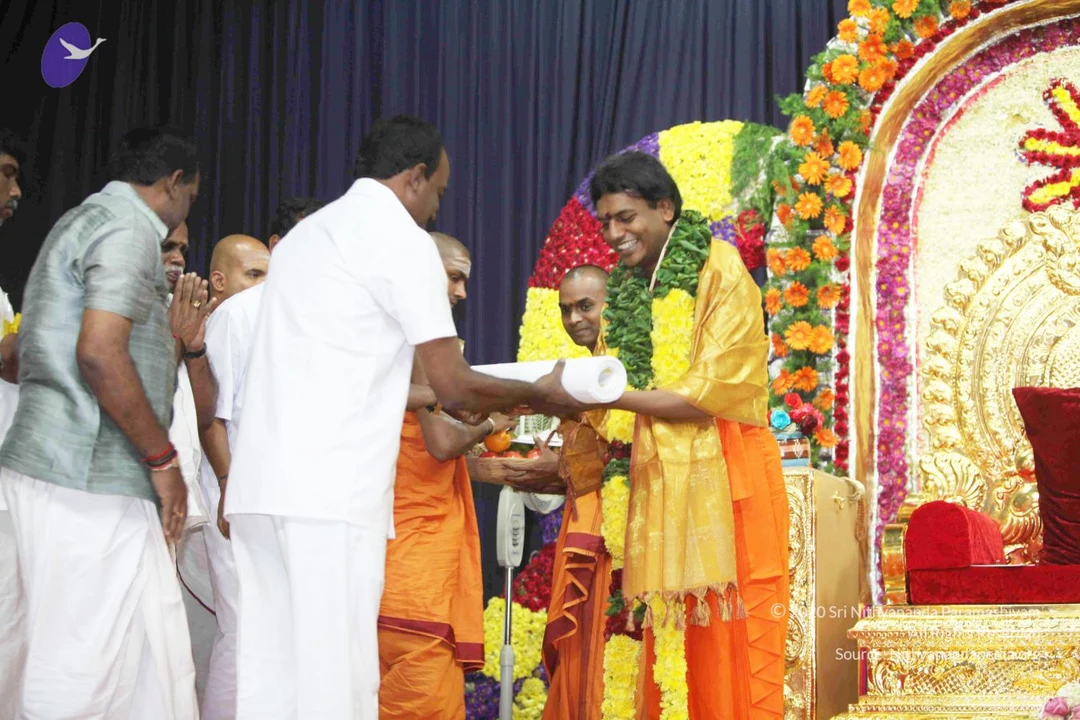
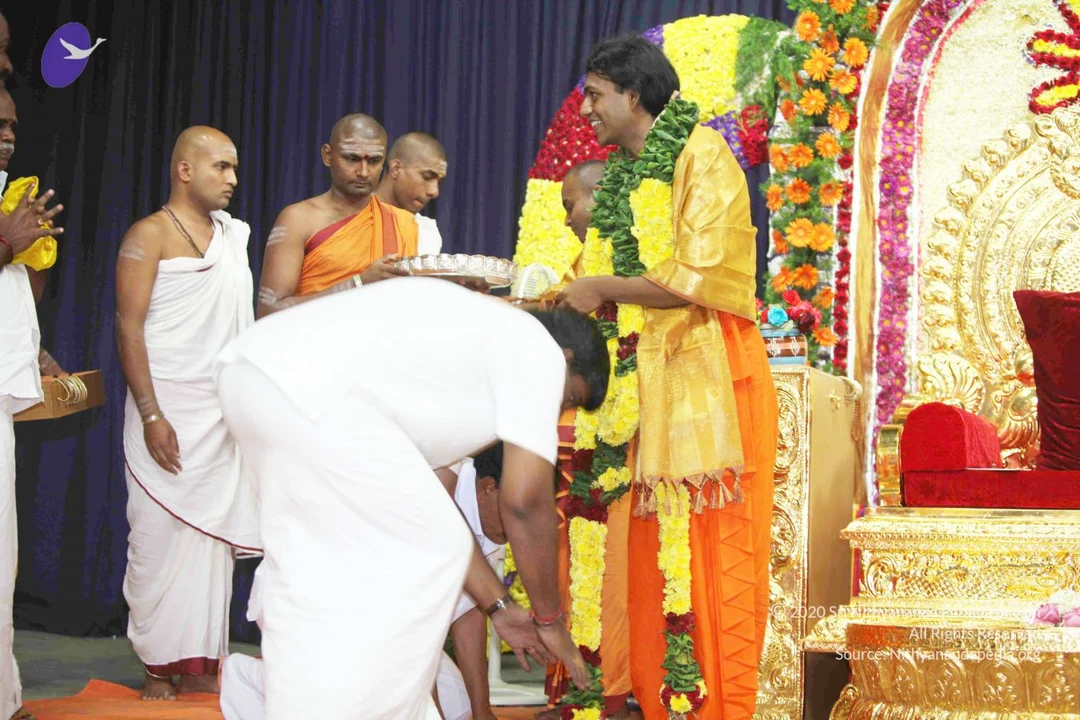
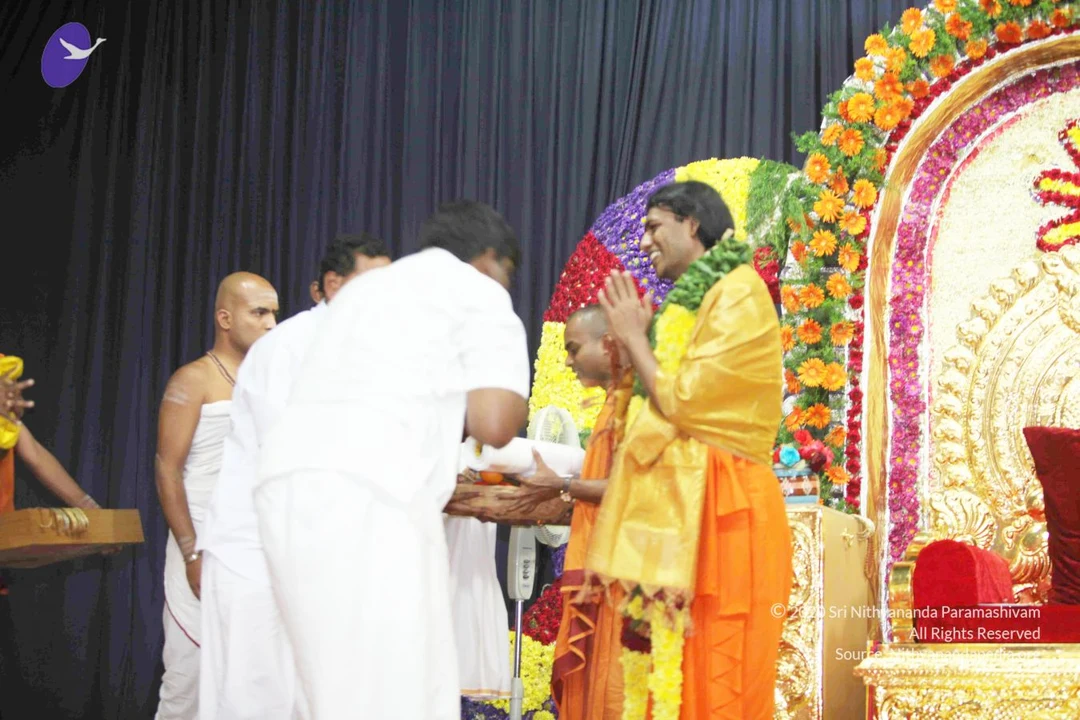
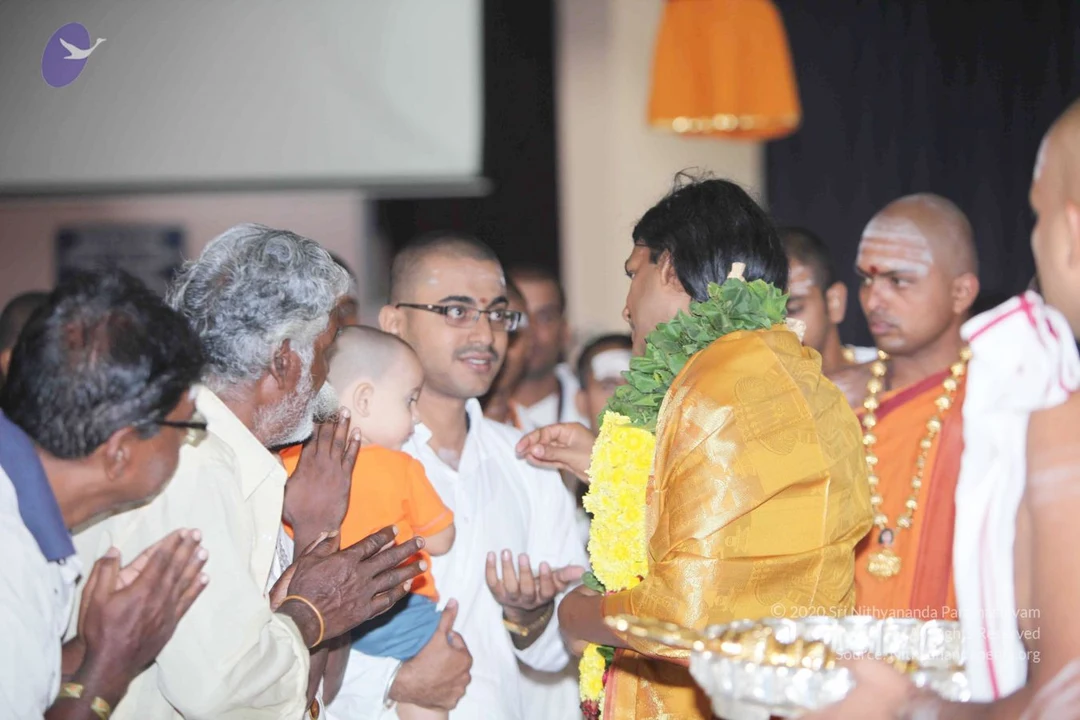
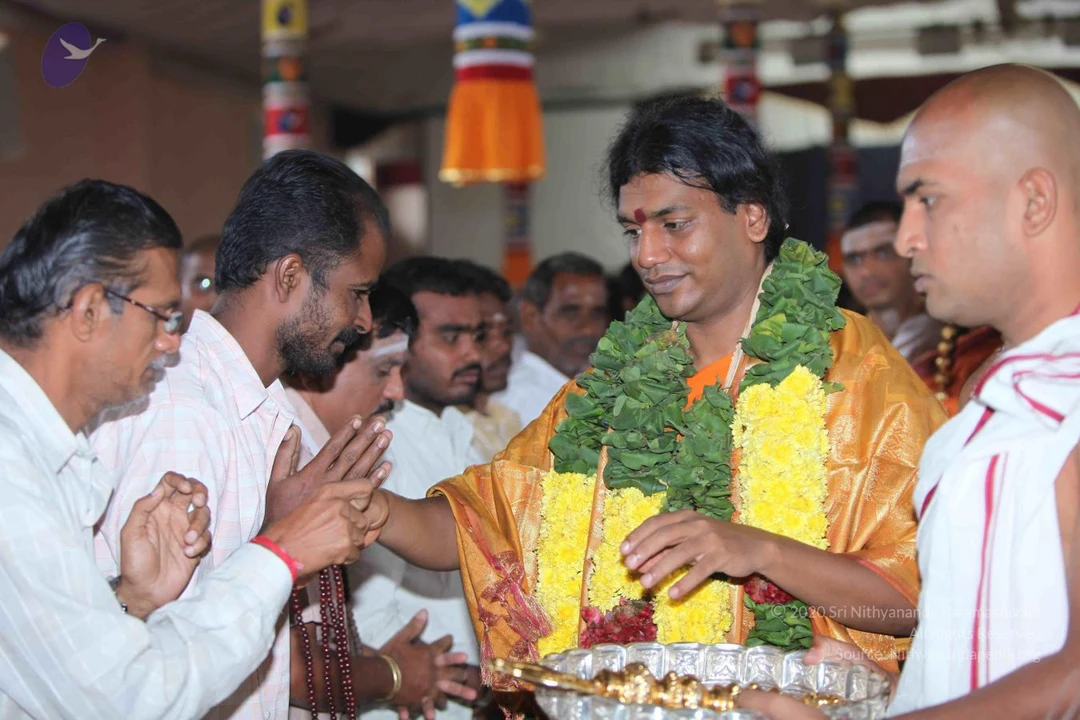
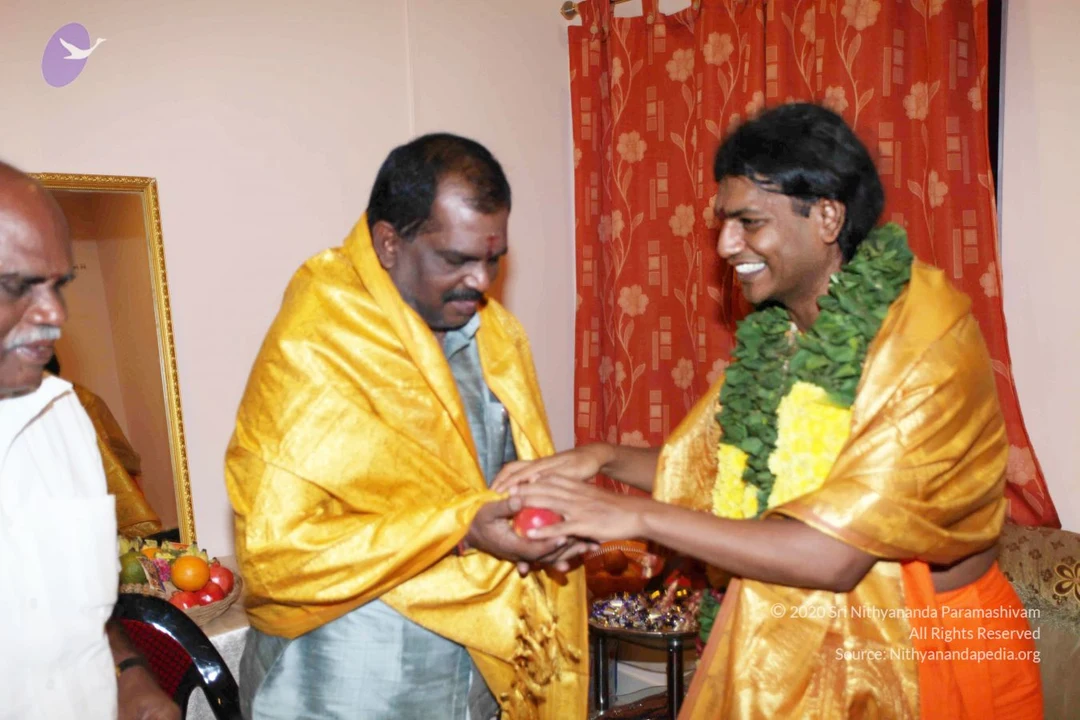
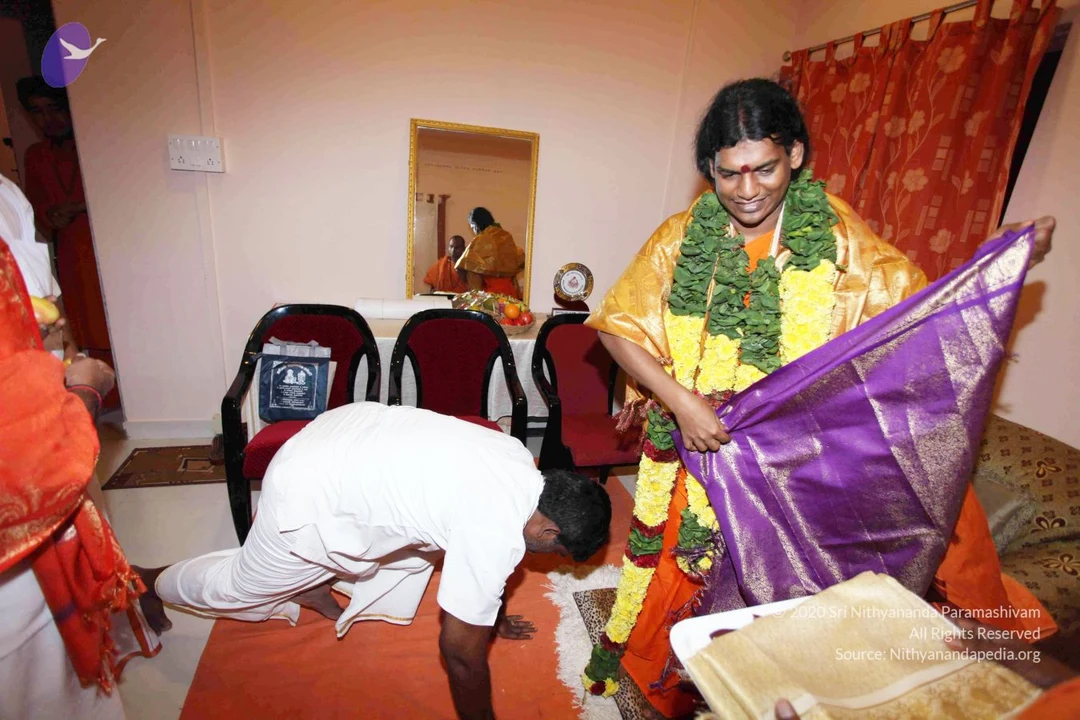
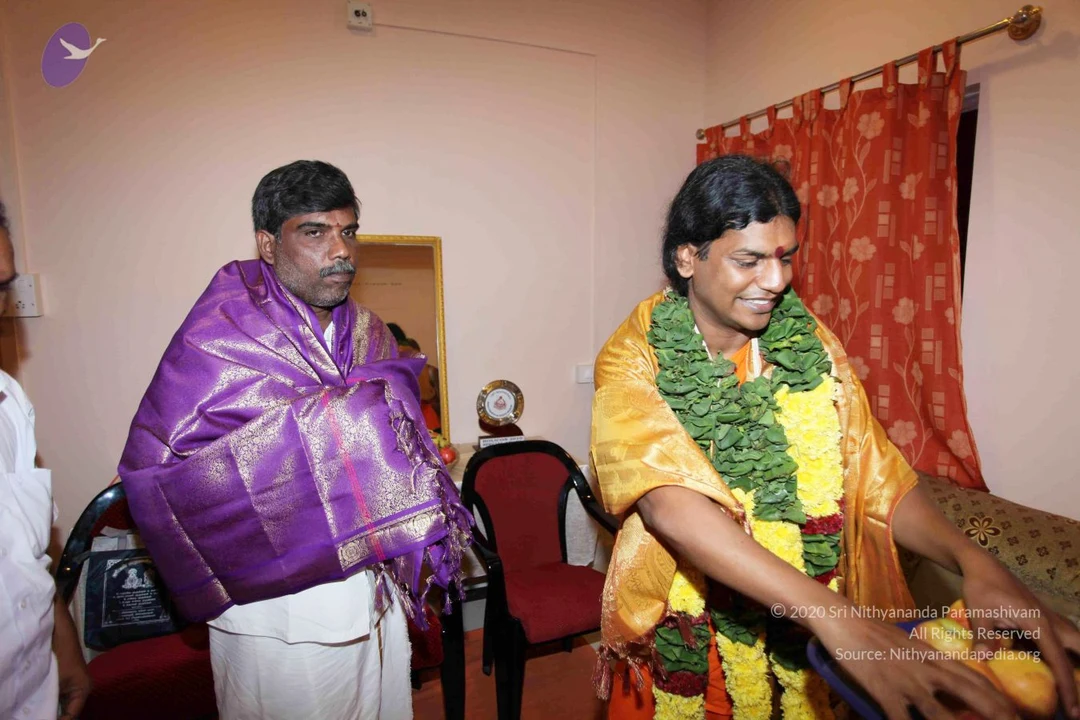
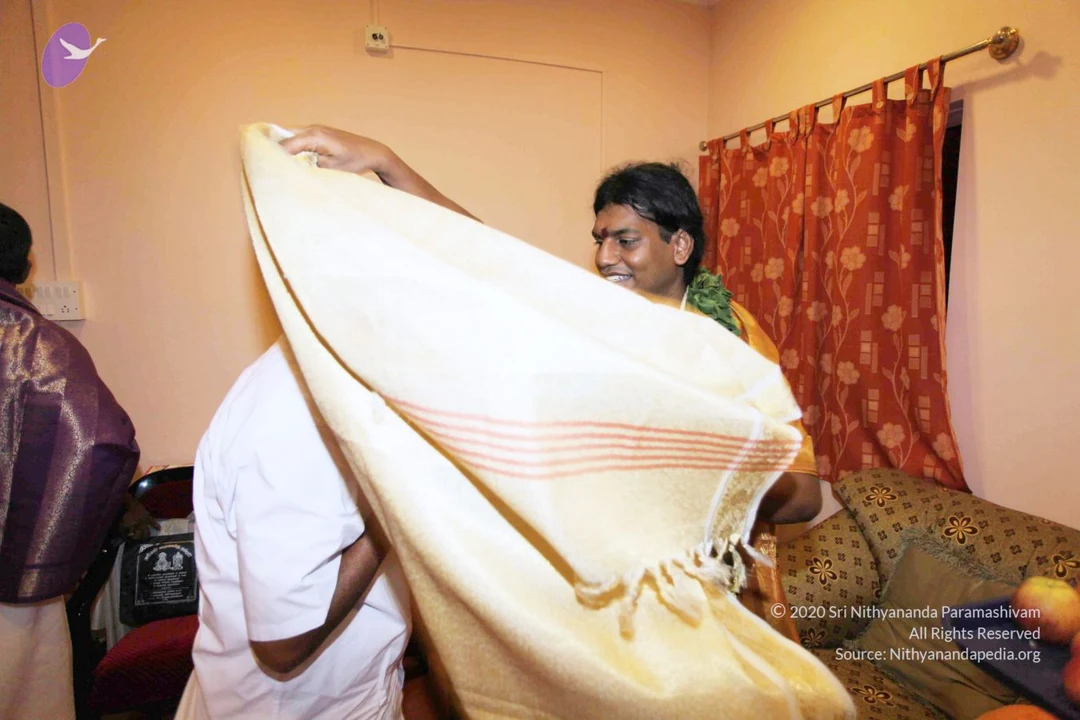
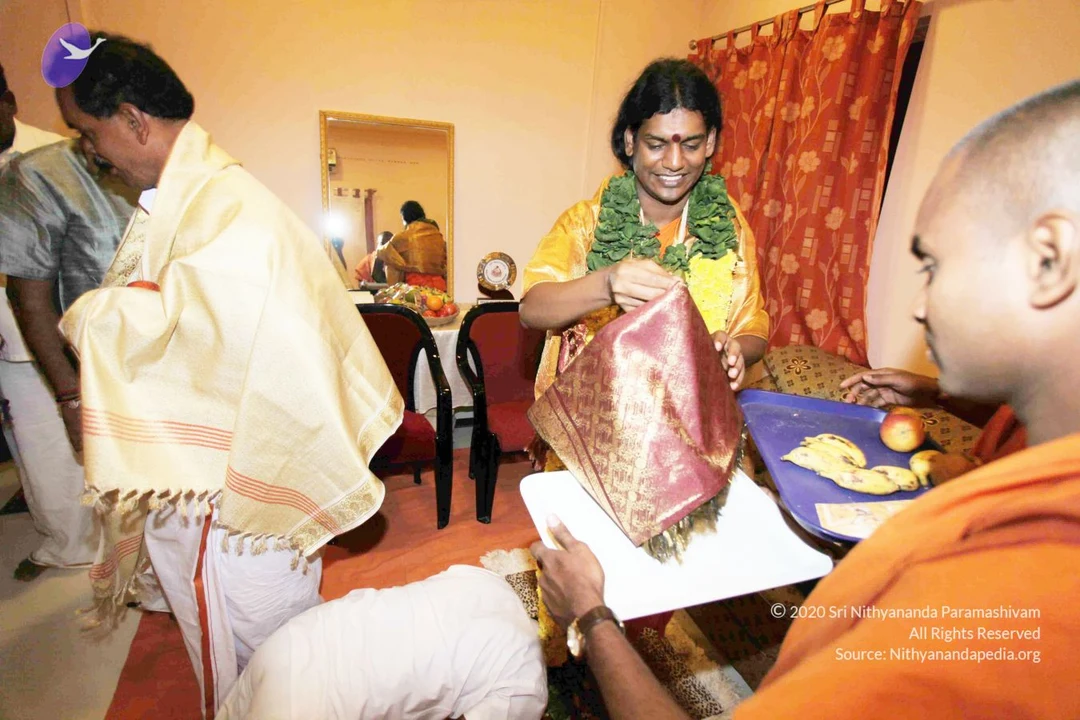
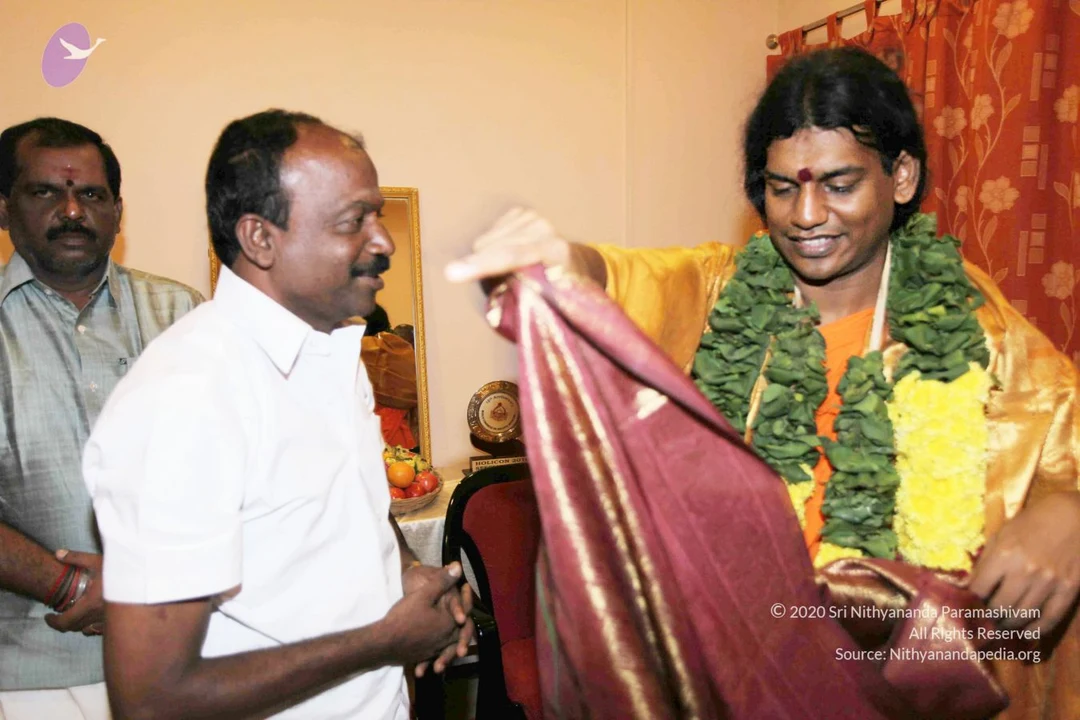
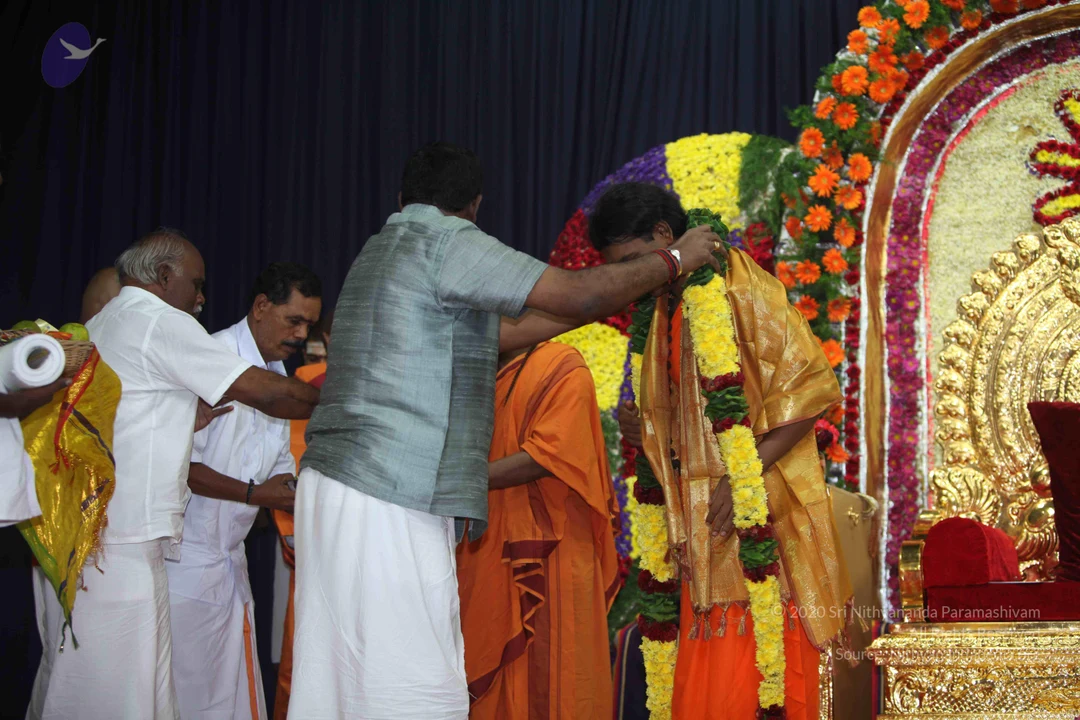
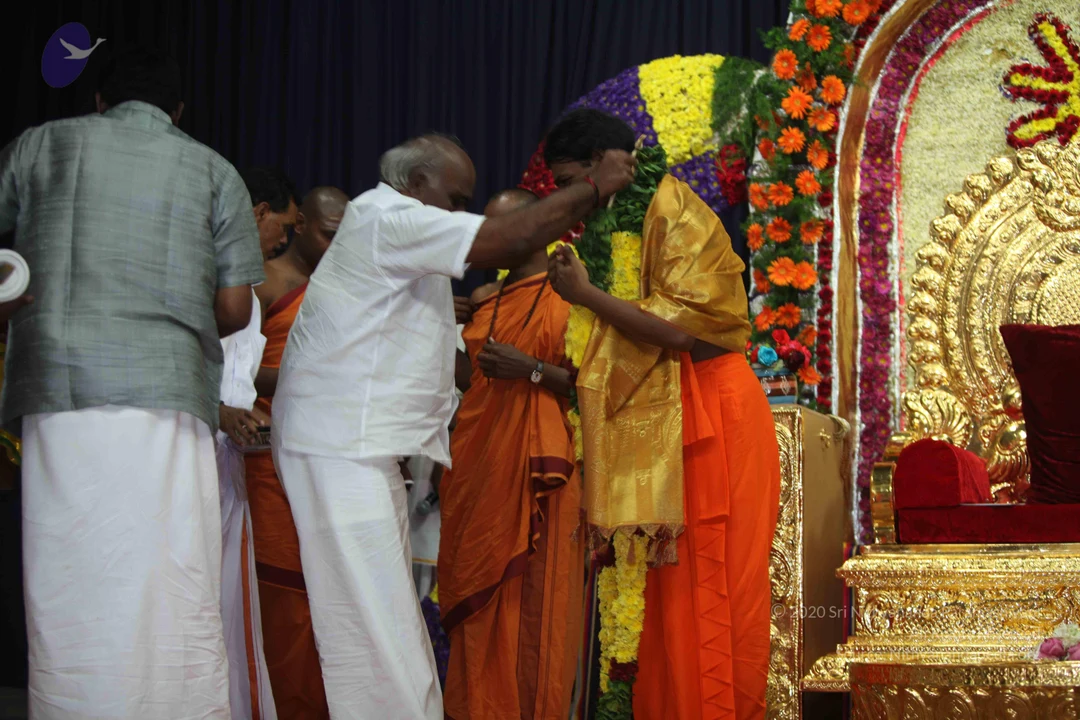
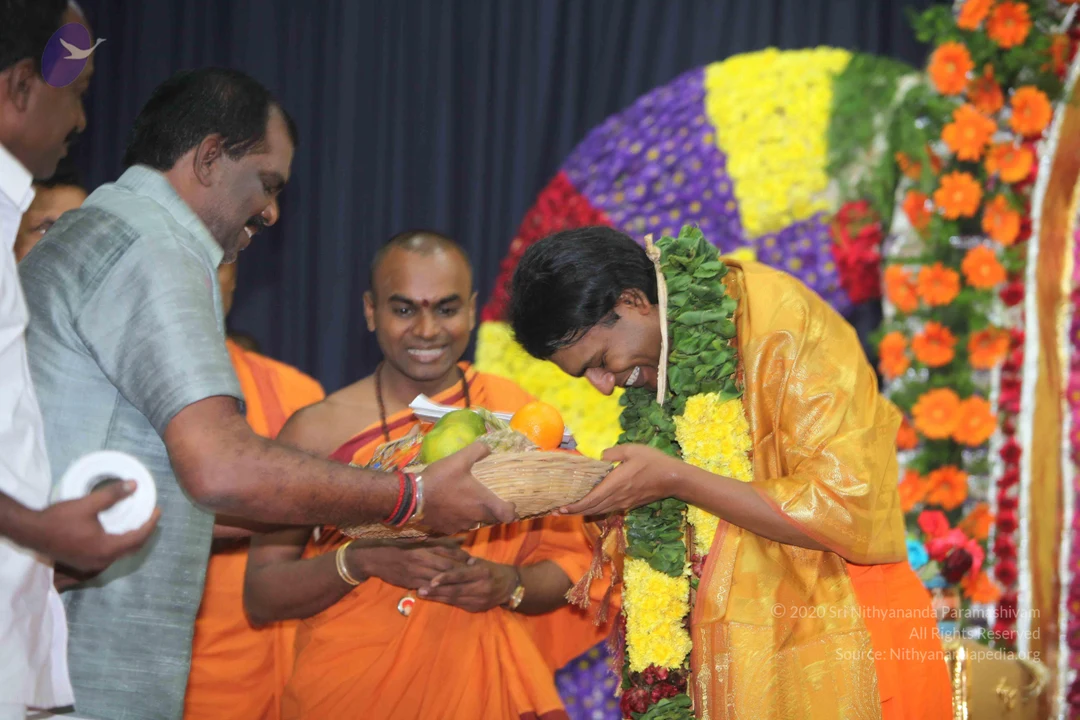
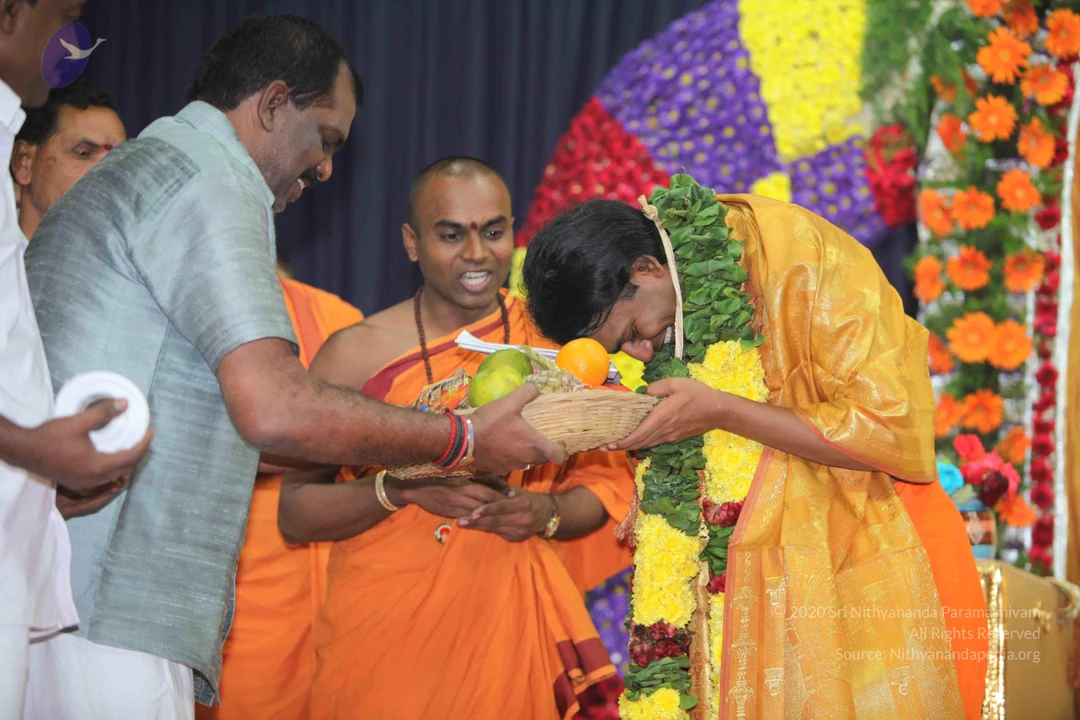
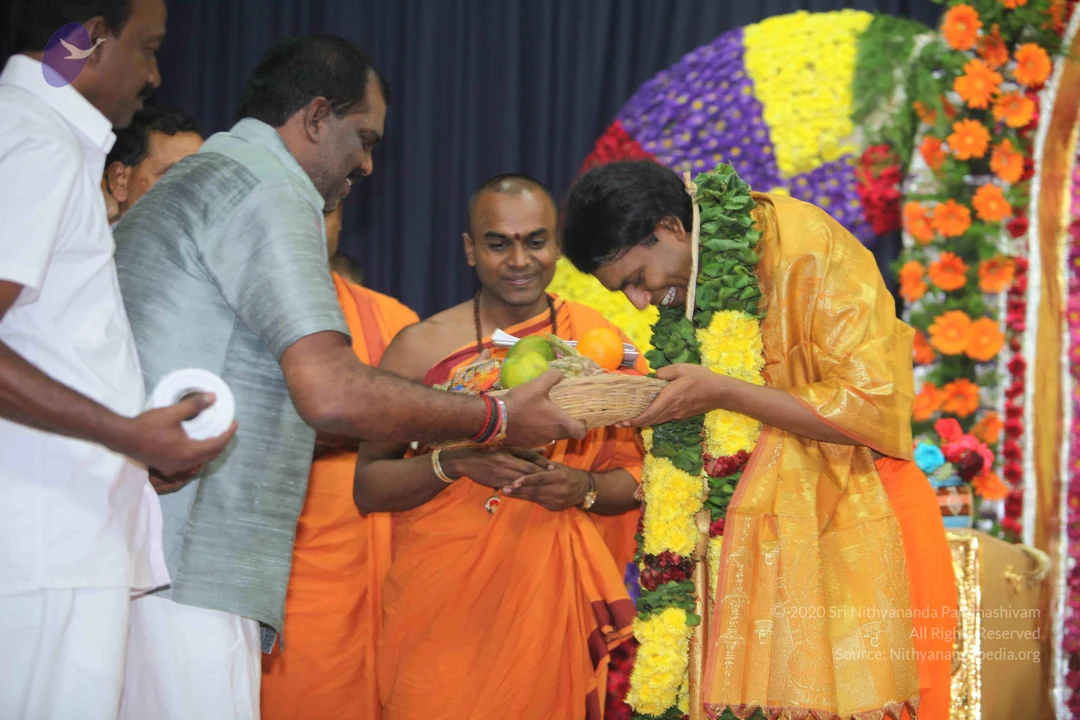
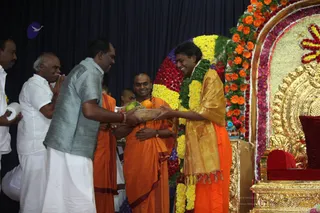
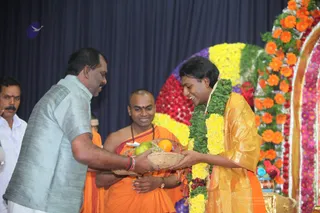
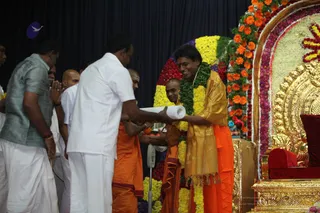
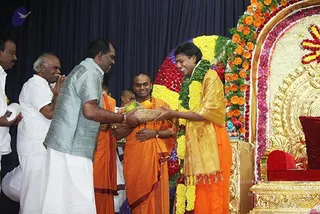
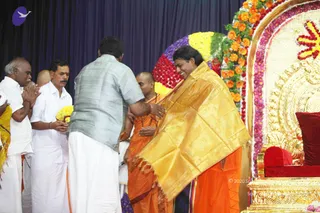
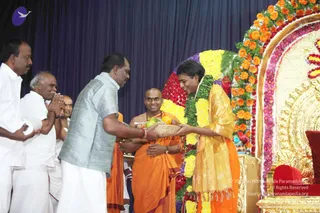
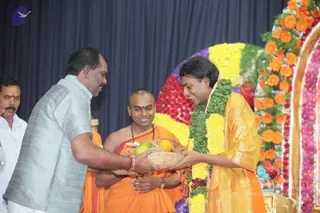
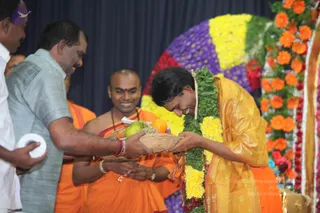
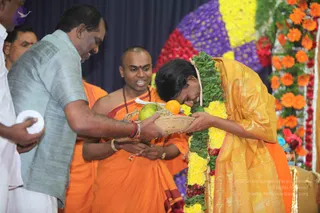
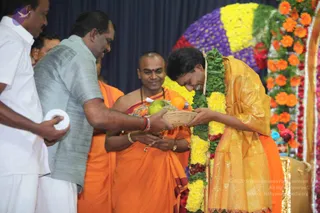
Photo of a ceremonial reception at a flower-decorated stage with a gold throne at right. A smiling man in a gold-bordered orange-and-gold shawl over an orange robe, wearing a long green-and-yellow garland, receives a woven basket of fruit from a man in a grey shirt and white dhoti. Behind them stands a bald man in an orange robe with hands folded. An elderly man in white on the left presses his palms together. Walls are draped with orange, yellow and red marigold garlands.A stage ceremony with a flower-decorated backdrop of marigolds, yellow and red blossoms. A man in a grey shirt and white dhoti holds out a woven basket of fruit and offerings toward a man in a gold-orange silk garment wearing a long green-and-yellow flower garland. A saffron-robed monk with a shaved head and rudraksha mala stands between them, smiling. a person is the man in the gold silk with the garland, receiving the basket offering; the cues are the ornate gold-orange clothing and the garland. Other people are partly visible at the left edge.A photograph of a stage event with a floral backdrop of orange, yellow, red and purple flowers around a gold-framed throne with a red cushion at right. A smiling man in a saffron-orange dhoti and a gold-bordered orange shawl, wearing a green leaf garland and a white ceremonial necklace, stands at centre-right and receives a white rolled cloth from a man in a white shirt and white dhoti who reaches toward him. Other people in white or grey shirts and white dhotis stand at left with hands folded, and a monk in orange robes with a shaved head stands near the centre holding a tray of fruit. The appearance-based candidate is a man in a saffron shawl with a garland, shown in a presentation with several cues; the page indicates a person is present, but the appearance is not distinctive enough to confirm identity.

nithyananda-bidadi

6 photosSource gallery
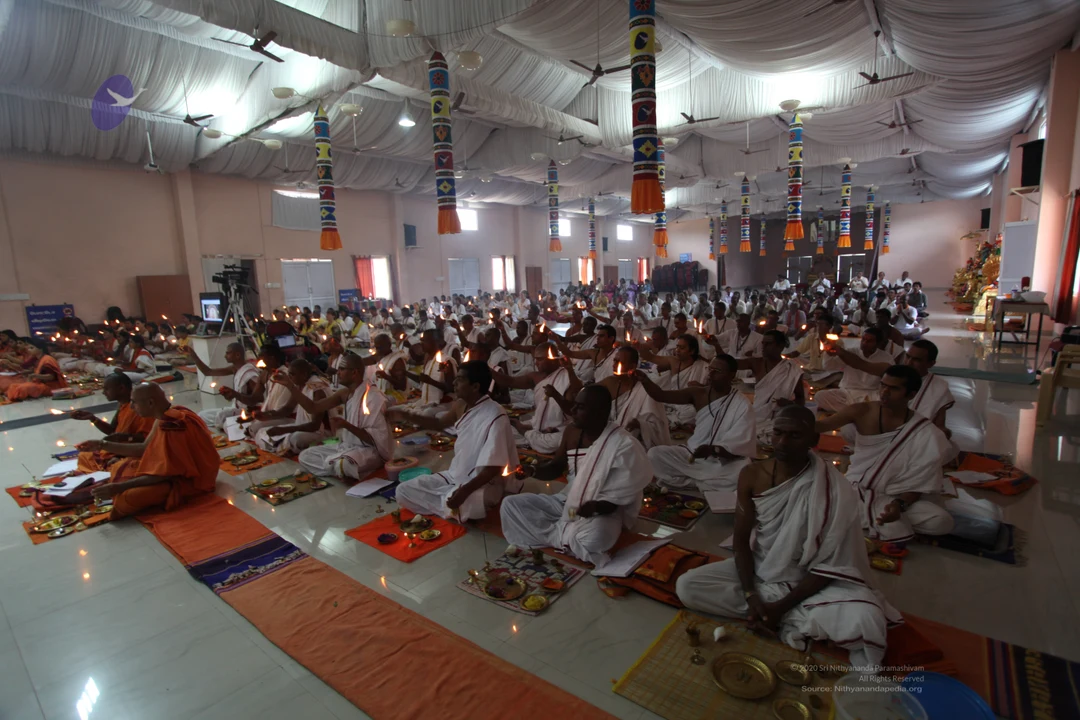
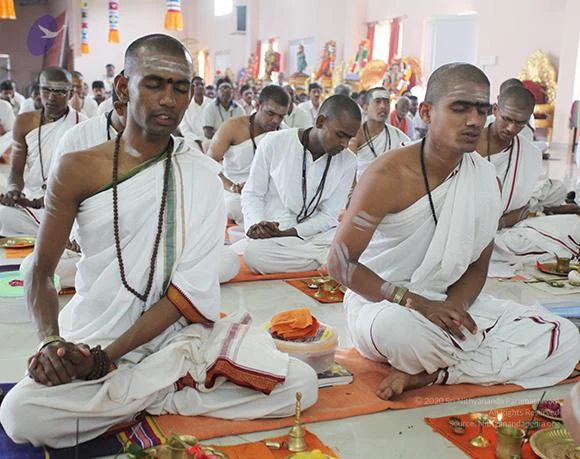
A close-up photograph of an ornate golden object with a central red and white floral or lotus-like motif, surrounded by intricate gold filigree and raised decorative patterns. Pink flower petals and garlands are visible at the top edge. No people are visible; the frame shows only the decorated object.A seated group of men in white ritual dhotis and shawls sits cross-legged on orange and red mats in a hall, eyes closed in meditation. Several wear rudraksha malas and have white sacred markings on their foreheads and arms. Brass oil lamps, small bowls and pots of offerings sit on the floor in front of them, with colourful deity murti and decorations visible in the background. The posture and white clothing suggest a group puja or meditation session, with a watermarked archive copyright notice in the lower corner.A photograph of a temple-style stage with a large ornate golden backdrop. A man in an orange-and-gold robe with a white head covering bends forward, offering something toward a seated figure in a red-and-gold garment at the center. Several men in white dhotis and shirts stand in the background, and the scene appears to be a ceremonial reception or darshan. a person: the central seated figure has long dark hair and wears ornate red and gold clothing, but the image is small and the cues are not distinctive enough to confirm identity.

Panchatapas

33 photosSource gallery
A man seated cross-legged in meditation on a raised circular stone platform ringed with gravel and white flower petals on sandy ground. He wears an orange-saffron robe, a rudraksha mala around his neck, and his hands rest together in his lap with eyes closed. A brass kalasha-style vessel sits on a woven mat beside him. Behind him an orange-painted pedestal supports a black stone Nandi bull garlanded with marigold and red flowers. Palm trees, a white wall and a striped colourful banner frame the courtyard. a person: the seated meditator wears saffron robes and rudraksha beads, consistent with the page's reference to a person at this satsang.A man in a seated lotus posture meditates outdoors on a woven mat over a stone platform, eyes closed and hands folded in his lap. He wears a saffron-orange robe draped over one shoulder and a long dark rudraksha mala with a small red mark on his forehead. Behind him stands a black stone bull statue (Nandi) draped in a garland of yellow and red flowers, set on a tall orange-red pedestal. A brass kalasha vessel sits on the mat at left, and palm trees, statues and frangipani bushes surround the open courtyard.A man sits cross-legged in meditation on a woven mat over a stone-edged platform outdoors, eyes closed and hands resting in his lap. He wears an orange saffron robe draped over one shoulder and a long dark rudraksha mala with a red bindi on his forehead. Behind him stands an orange temple plinth with a black stone Nandi bull statue garlanded in orange and pink flowers, flanked by small stone figures and palm trees. A brass kalasha vessel sits on the mat beside him. The scene reads as a meditation or satsang setting.A man in saffron-orange robes sits cross-legged in meditation on a woven mat atop a circular stone platform surrounded by grey gravel and white flowers, with a brass kalasha-style pot beside him. He wears a long rudraksha mala and a red tilak on his forehead, hands folded in his lap, eyes closed. Behind him stands an orange brick peetha with a black stone Shiva lingam draped in marigold garlands, backed by palm trees. A man in white dhoti and shawl stands at left near grey stone deity murtis, and a tall decorated pole with a red-and-white painted cylinder rises at right.A man in orange saffron robes sits cross-legged in meditation with eyes closed and hands folded in his lap, on a woven straw mat over a small wooden seat. He wears a long rudraksha mala around his neck and a red bindi on his forehead. Behind him stands a dark stone statue of a bull (Nandi) draped in a marigold garland with a red-and-yellow flower chain, set on an orange tiered pedestal. Palm trees and green shrubs fill the background, with rows of small grey stone figures to the right. A brass kalasha pot sits on the mat to his left, and a pink cloth lies at the mat's edge. The scene is an outdoor meditation at a temple grounds.A man in orange saffron robes sits cross-legged with eyes closed in meditation on a woven mat atop a circular stone platform. He wears a long rudraksha mala and a red bindi, hands clasped in his lap. Behind him stands an orange-painted shrine with a black stone Nandi bull garlanded with marigold and multicoloured flower strands. A brass kalasha/pot sits to his left, and palm trees and stone figures surround the courtyard. The seated man is an appearance-based candidate for a person, but his features and cues are not distinctive enough to confirm, so the identity is unsure.

Pada-Puja

93 photosSource gallery
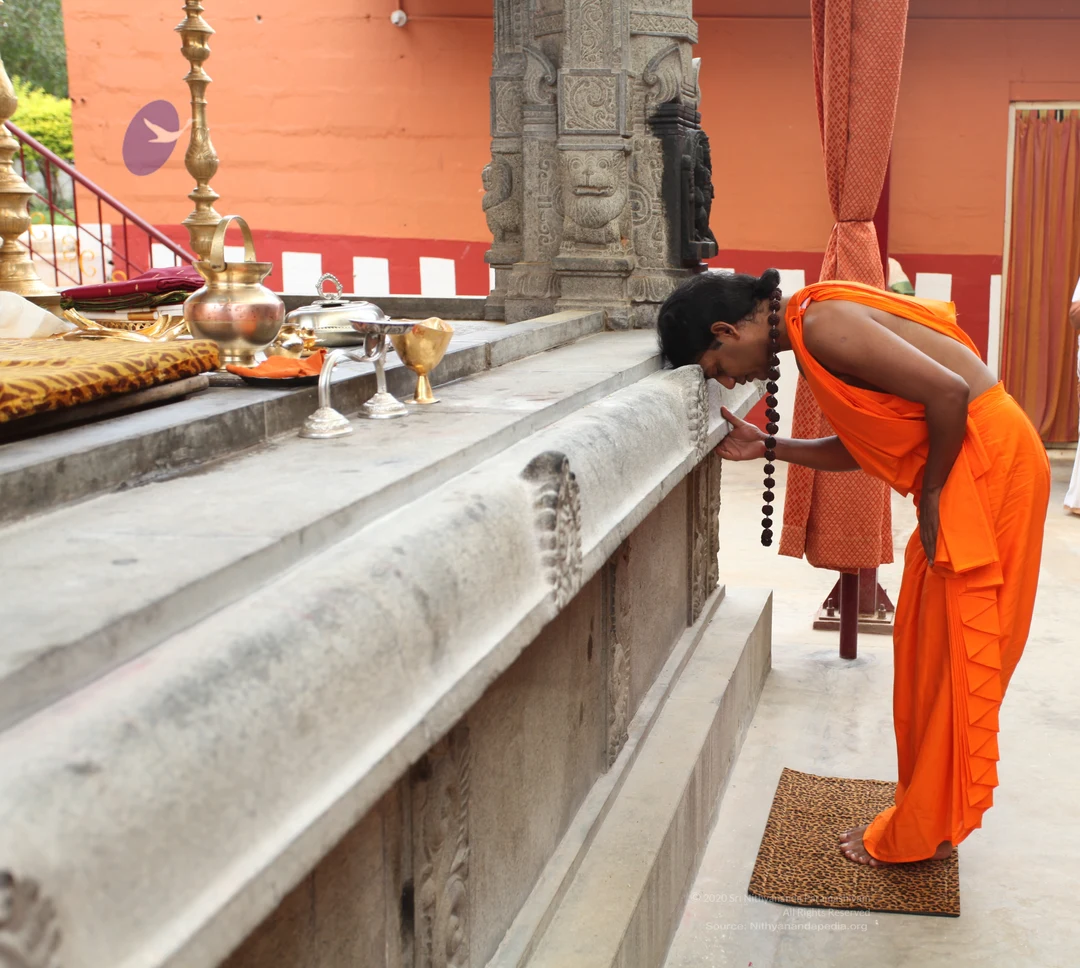
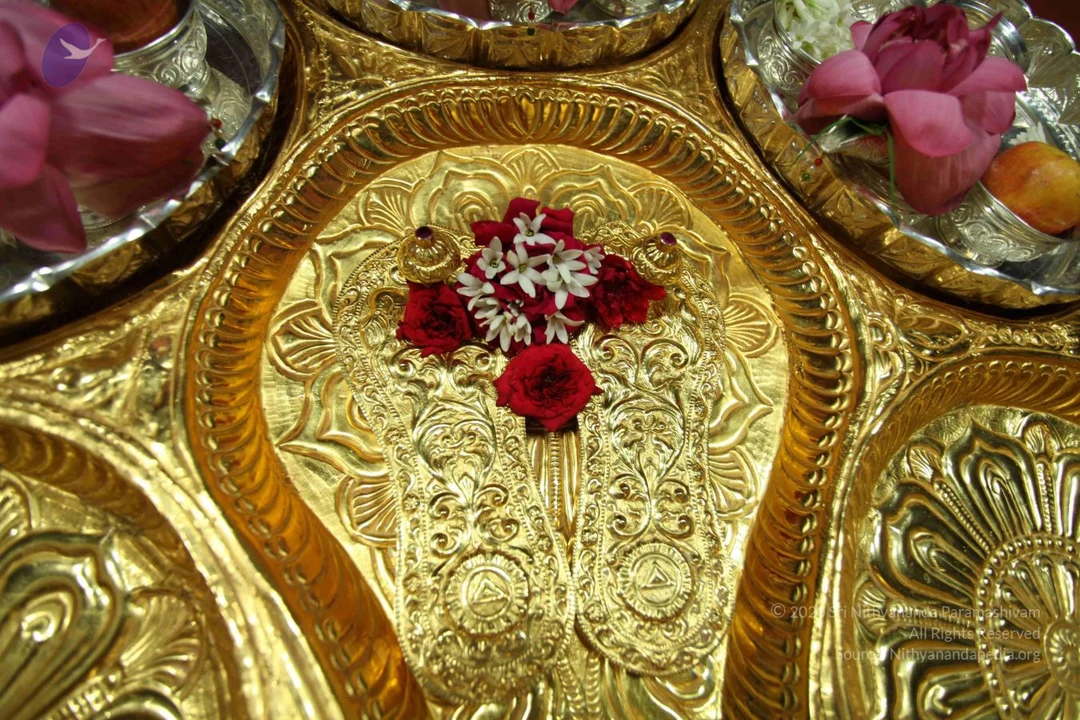
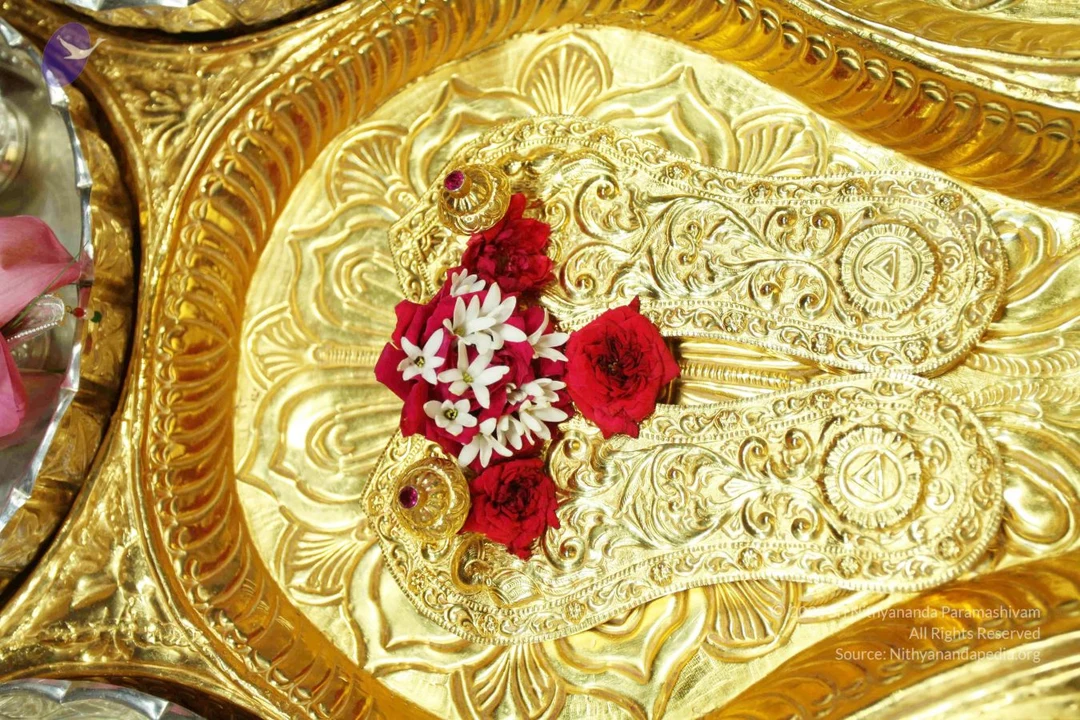
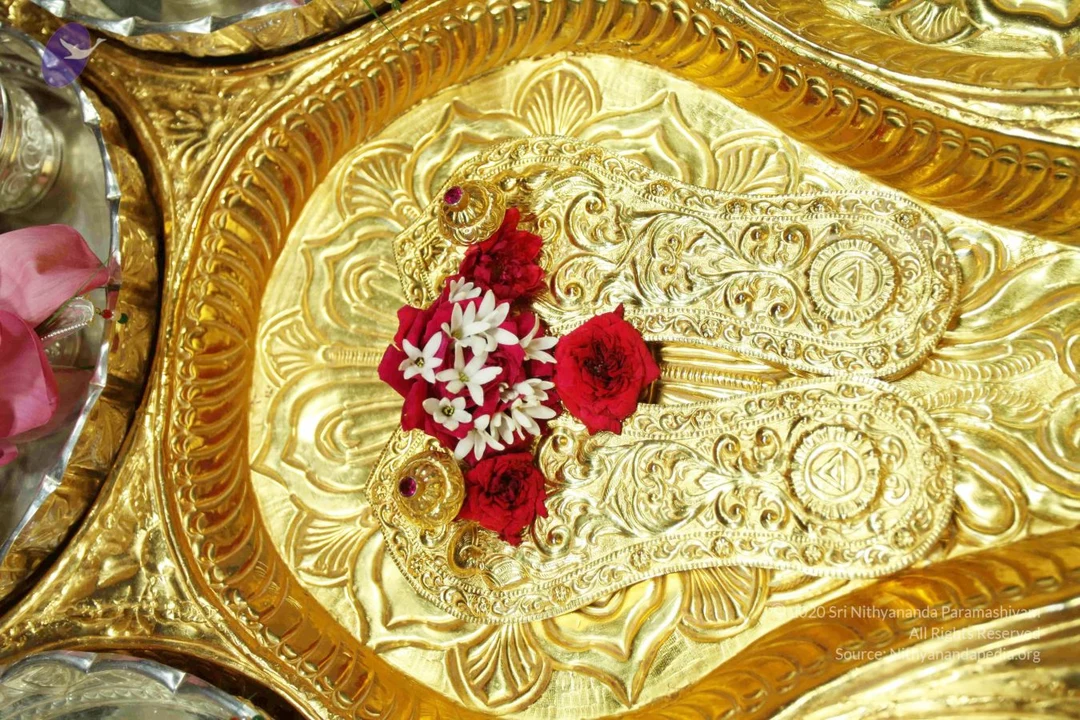
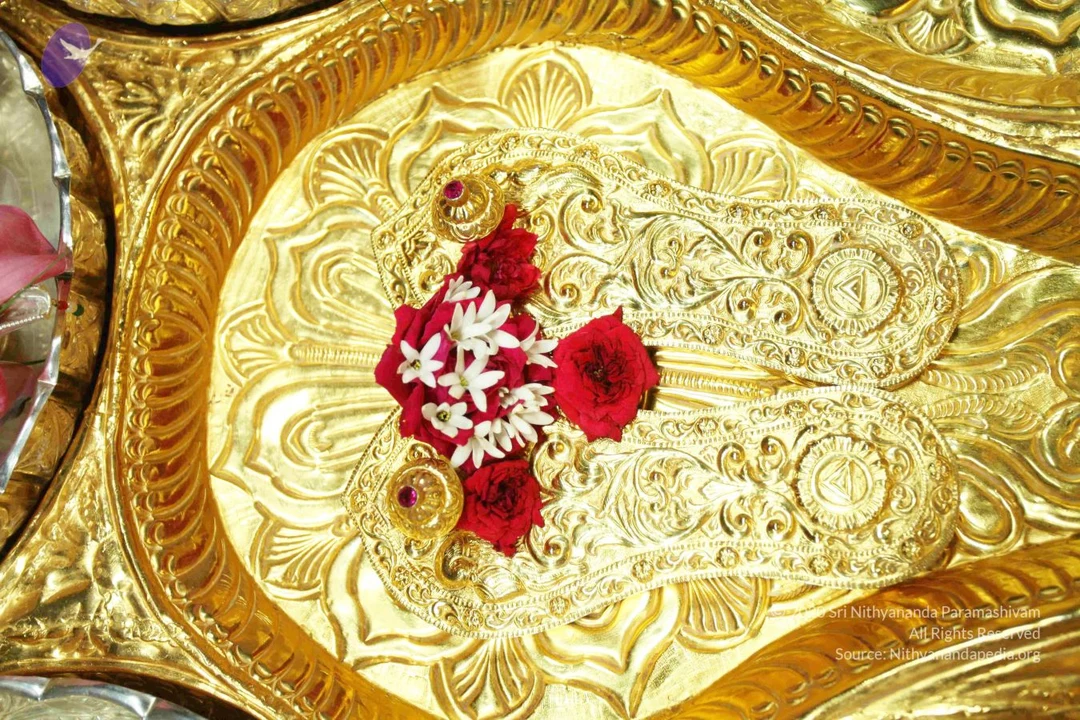
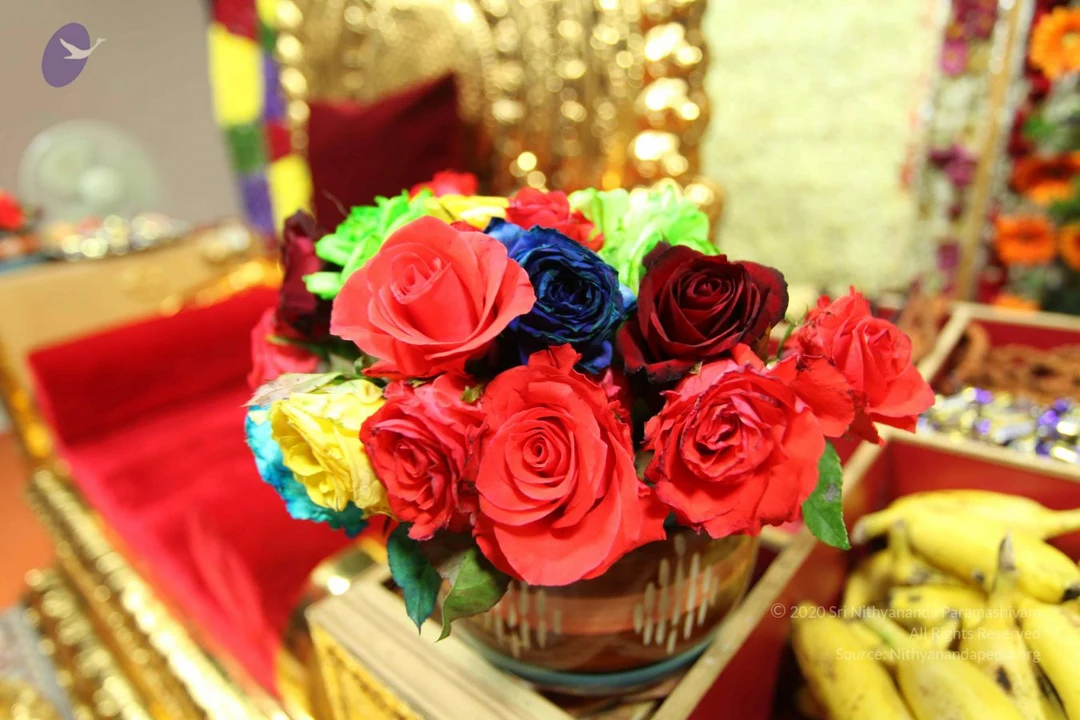
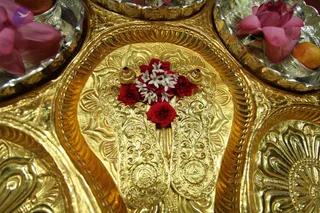
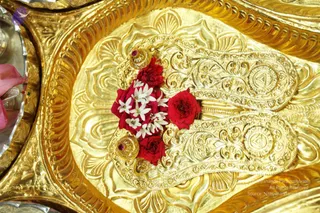
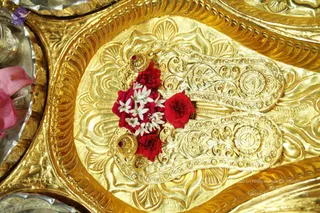
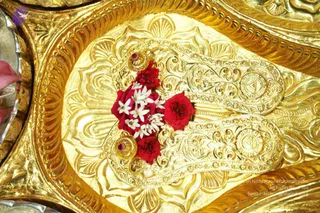
Close-up of an ornate gold-plated surface. At the centre sits a small arrangement of red roses and white jasmine blossoms. Silver bowls holding pink lotus flowers and a yellow fruit sit at the top corners. No people are visible.Close-up photograph of a pair of ornate gold sandals resting on a gold-embossed surface. The sandals have intricate repoussé floral and scroll patterns and small circular medallions with a triangle motif, one set with a pink stone. Red roses and white jasmine-like flowers are arranged on the sandals. A pink flower and a silver-rimmed vessel appear at the left edge. No people are visible.Close-up photograph of a pair of ornate gold sandals or padukas resting on a gold-embossed surface, decorated with red roses and white jasmine flowers. Each sandal has a circular medallion with a triangular motif and a small red gemstone. Behind the padukas, a silver plate and a pink petal are partly visible at the left edge. No people are visible. The gilded peetha-like base suggests a temple or ashram puja setting.Close-up photograph of an ornate gold-plated throne or seat surface with heavily embossed floral and scroll patterns. Two gold padukas or sandal-shaped footwear pieces rest on the gold, decorated with engraved designs, a small triangular emblem, and inset red stones. Red roses and white jasmine flowers are placed between them as offerings. No people are visible.A photograph of a glass vase holding a dense arrangement of roses in red, dark maroon, blue, green and yellow, set on a wooden offering tray. Behind it, a red velvet cloth lies on a golden-edged platform, with gold-and-white garlands and orange flowers at the right edge. Bananas and a tray of sweets sit at the lower right. No people are visible.Close-up photograph of a pink lotus flower with its petals open, showing yellow stamens at the centre, resting in a silver bowl. Behind it, blurred golden ritual objects and a red-and-white floral garland suggest a temple or puja setting. A red fruit sits at the left edge in a silver dish.

Morning-Satsang
46 photosSource gallery
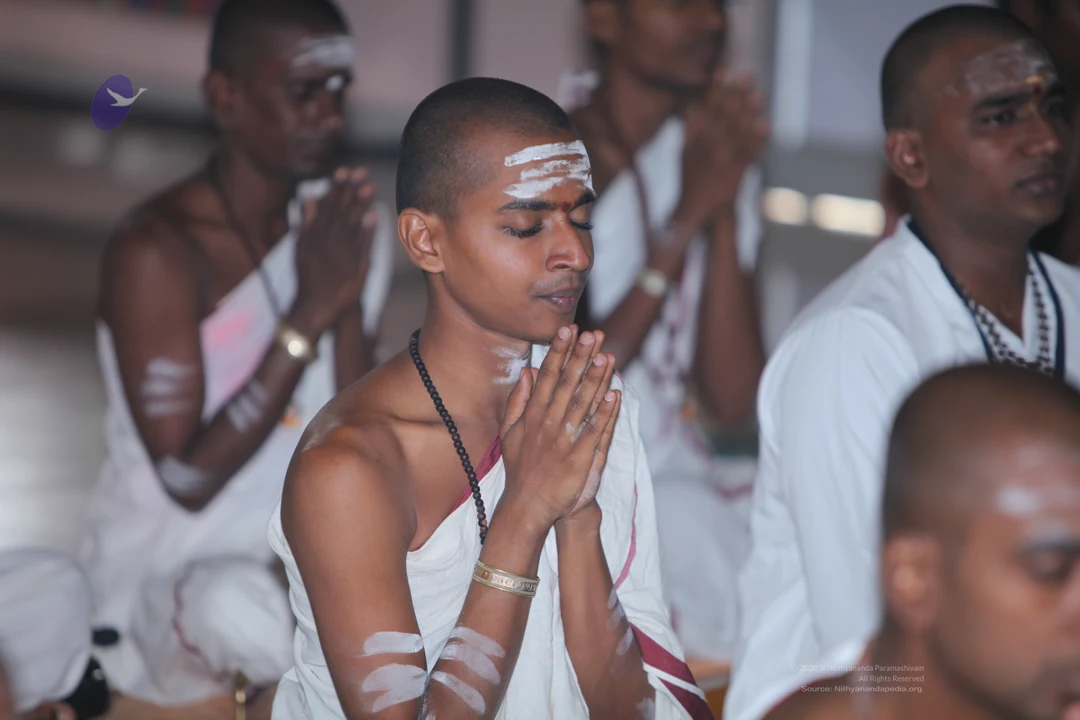
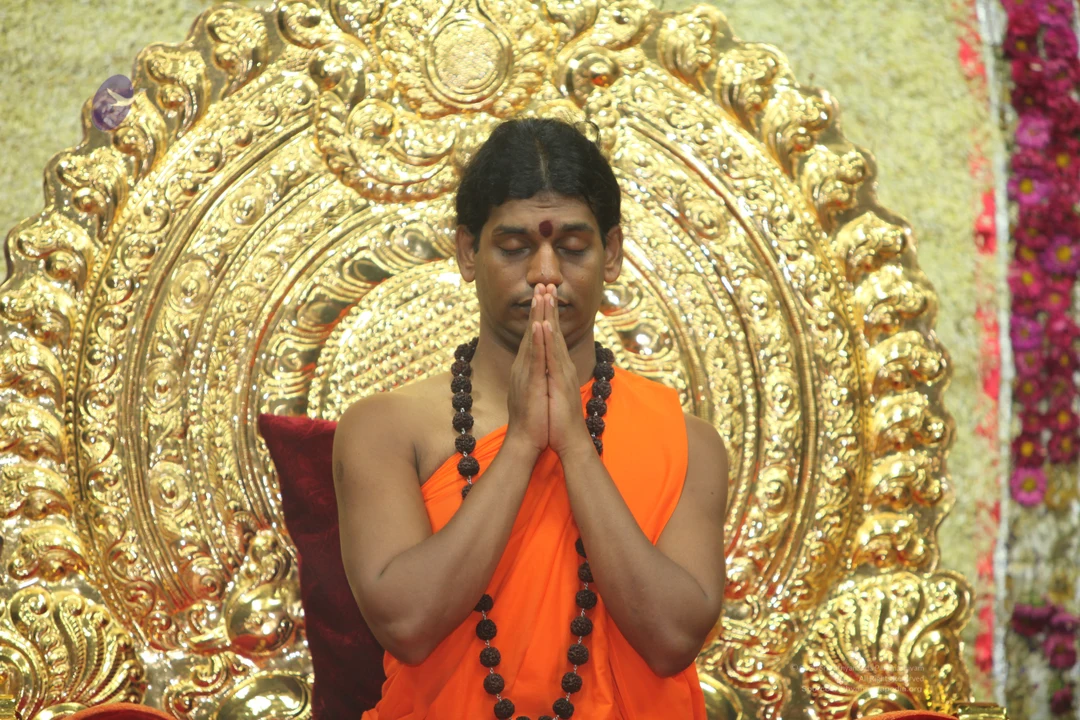
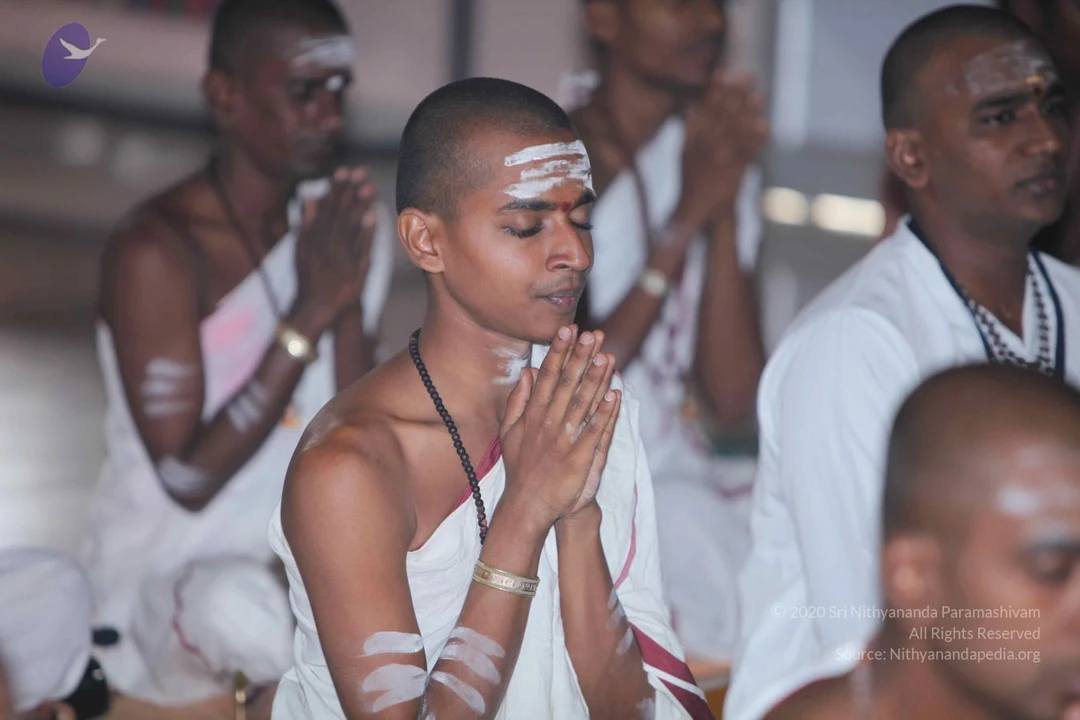
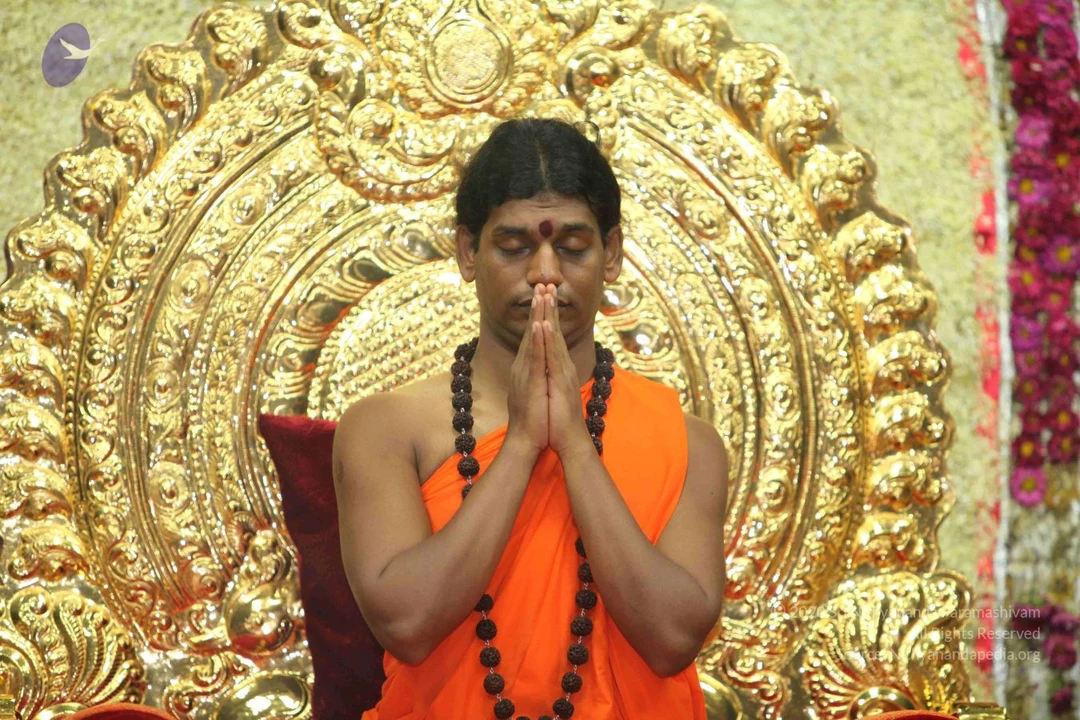
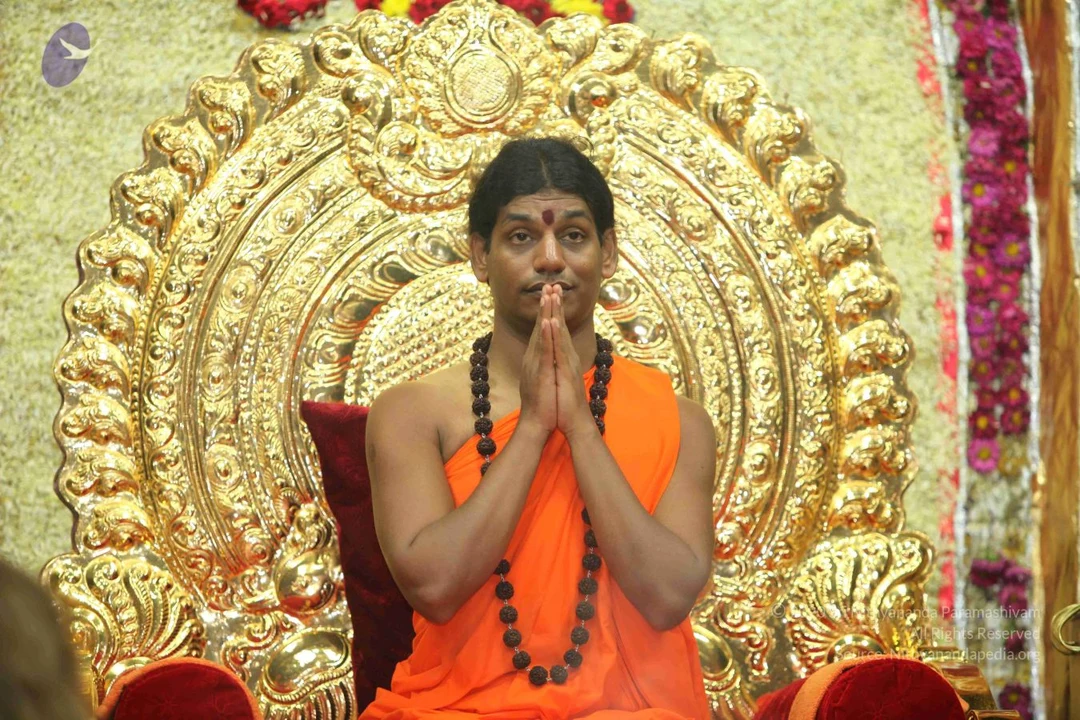
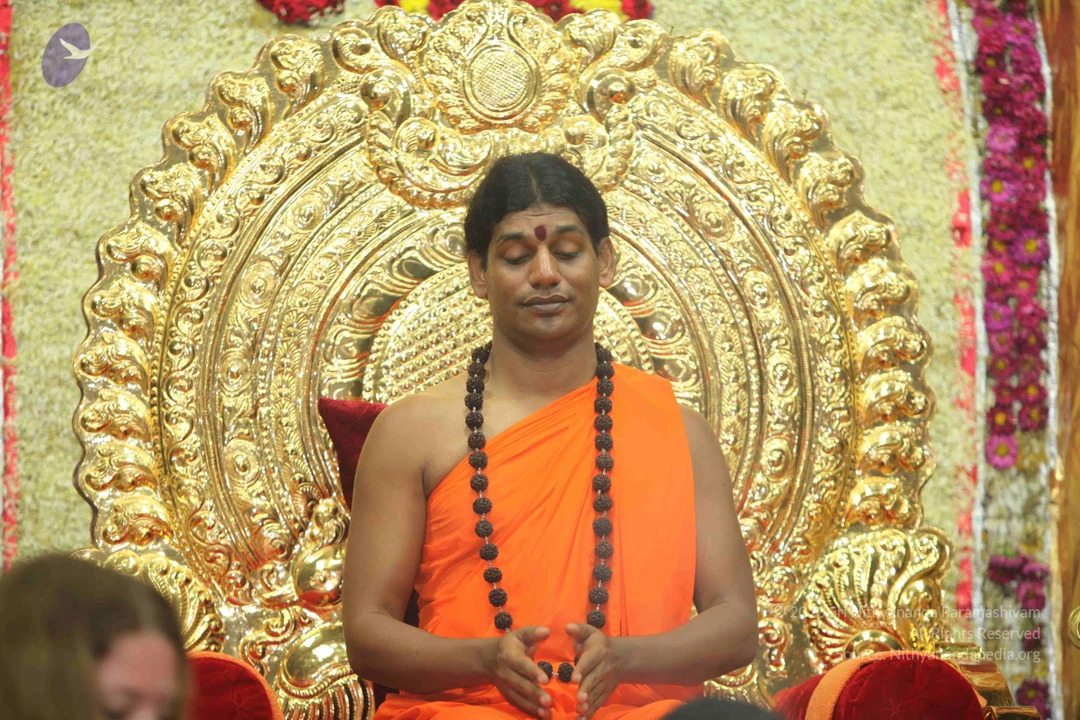
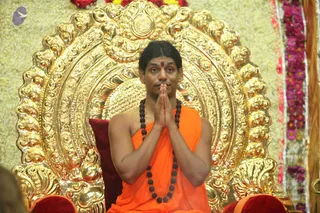
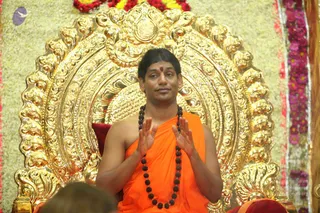
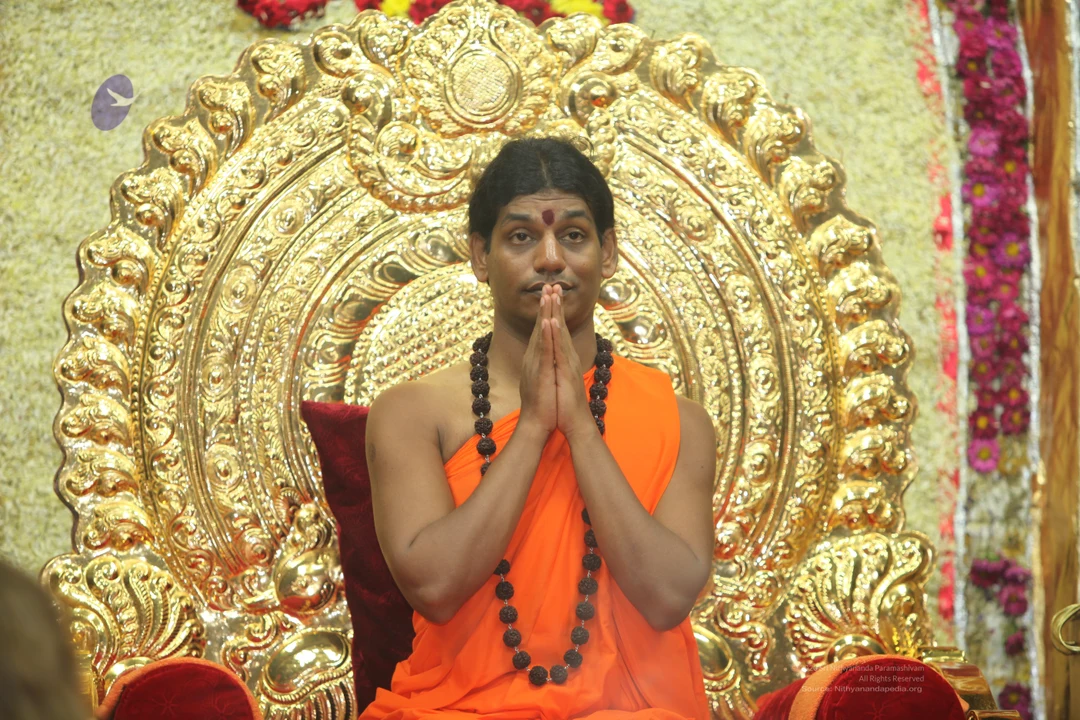
A seated man with eyes closed sits in meditation on an ornate gold throne with carved scrollwork and red velvet cushions. He wears a saffron-orange shawl over bare shoulders, a long mala of dark rudraksha beads, and a red bindi on his forehead, with hands folded in his lap. Behind him are cascades of pink and white flowers and garlands. a person is shown seated in meditation, wearing saffron wrap and rudraksha mala. A partially visible person appears at the lower left edge, and another at the bottom centre.A seated man in an orange saffron robe and a long rudraksha mala sits with eyes closed and hands folded in his lap, a red bindi on his forehead, on a large ornate gold throne with carved scrollwork and red cushions. Behind him are white flower garlands and pink and red flowers. a person: the seated man has short dark hair, a saffron robe and a rudraksha mala, with a throne and flower garlands as setting; the appearance cues are moderate, so the identification is probable rather than certain. Partially visible people in the lower corners are at the edges of the frame.A seated man in orange saffron robes and a rudraksha mala sits eyes closed with hands clasped in his lap, centred before an ornate gold carved throne with a red cushion. A red bindi marks his forehead and his hair is swept back. Pink and white floral garlands frame the golden backdrop, and a wooden lectern edge appears at right. a person seated in meditative posture during a satsang setting.A photograph of several men in white ritual dhotis and shawls seated and praying with palms pressed together at chest level. In the foreground, a shaved-headed young man with eyes closed wears white and red-trimmed cloth, a black rudraksha-style mala, and a gold bracelet, with white sacred ash marks on his forehead and arms. Behind him, other devotees sit with hands folded, some wearing dark beaded necklaces. The setting appears to be an indoor satsang or puja gathering. No identifiable a person figure is visible.A seated man in saffron-orange sleeveless robes and multiple dark rudraksha mala necklaces sits before an ornate golden throne with carved scroll and floral motifs, palms pressed together in anjali mudra. A red tilak mark is on his forehead, and red cushions sit at the throne base. Pink and magenta flower garlands hang along the right edge, and a golden backdrop frames the scene. A partially visible person appears at the lower left. Swamiji (probable): the long swept-back hair, saffron clothing and rudraksha malas align with the page's reference to Swamiji, so this is a candidate in-person presence seated on the throne.A man in an orange saffron robe with a dark rudraksha mala draped over his shoulders sits on an ornate gold throne with a carved, repoussé backrest. He has a red bindi on his forehead and his hands are raised in front of his chest in a teaching gesture, speaking to an audience. Behind the throne is a wall of white flower garlands with pink and yellow blossoms along the right edge. A partial head of an unseen listener is visible in the lower foreground.
Sarva-Darshan

22 photosSource gallery
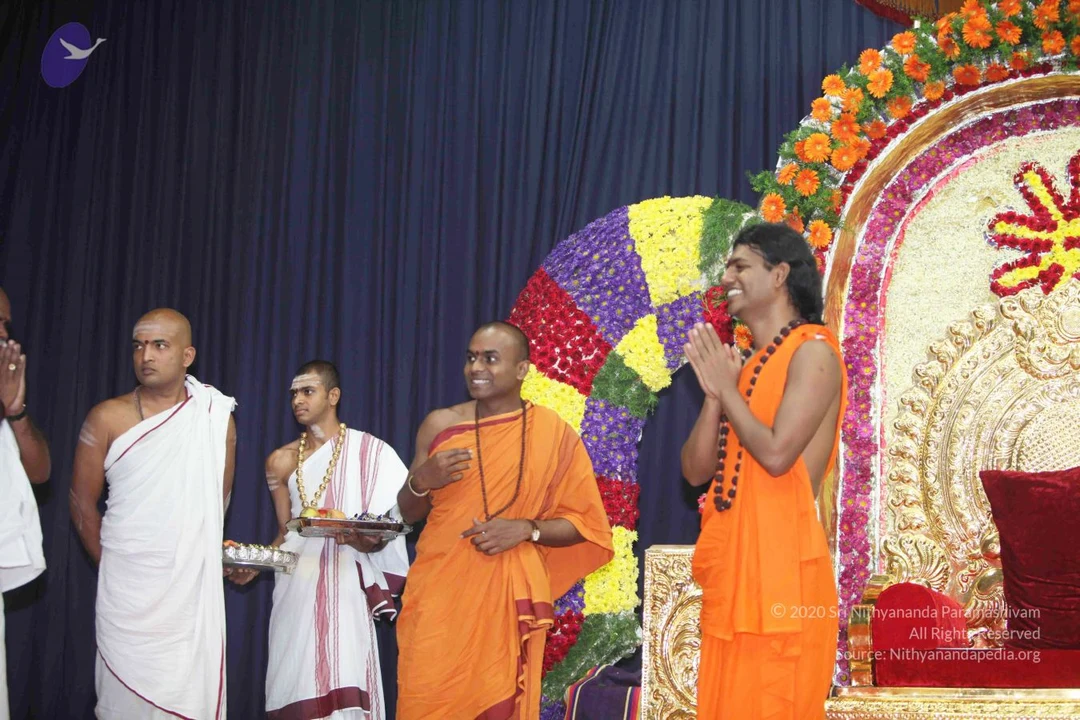
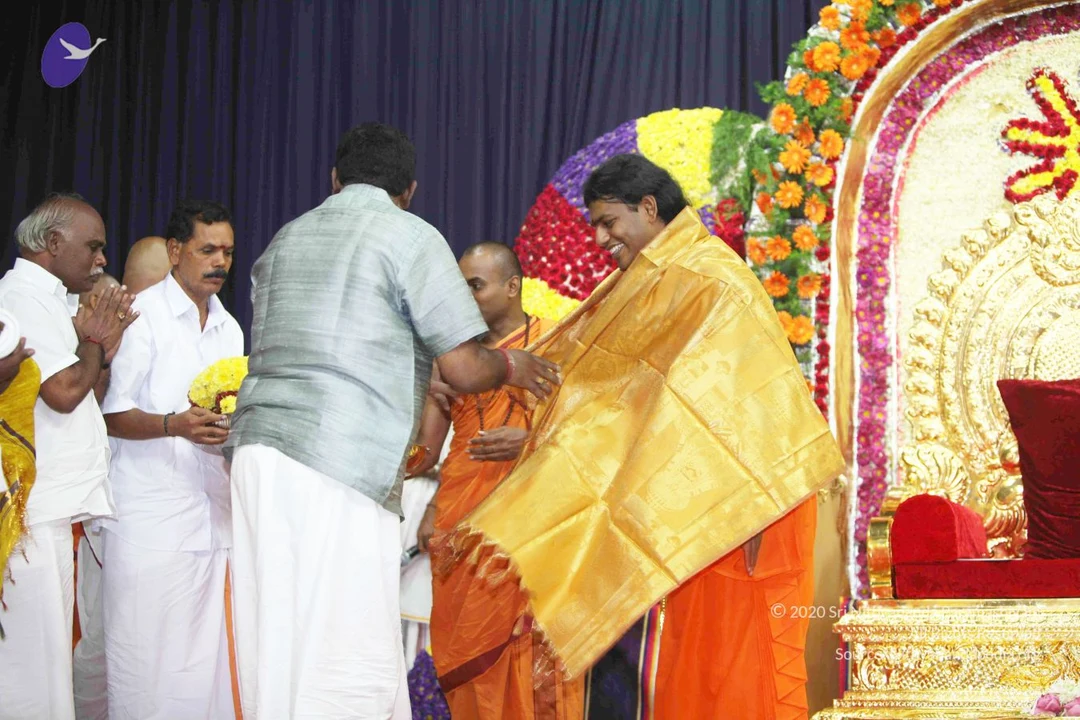
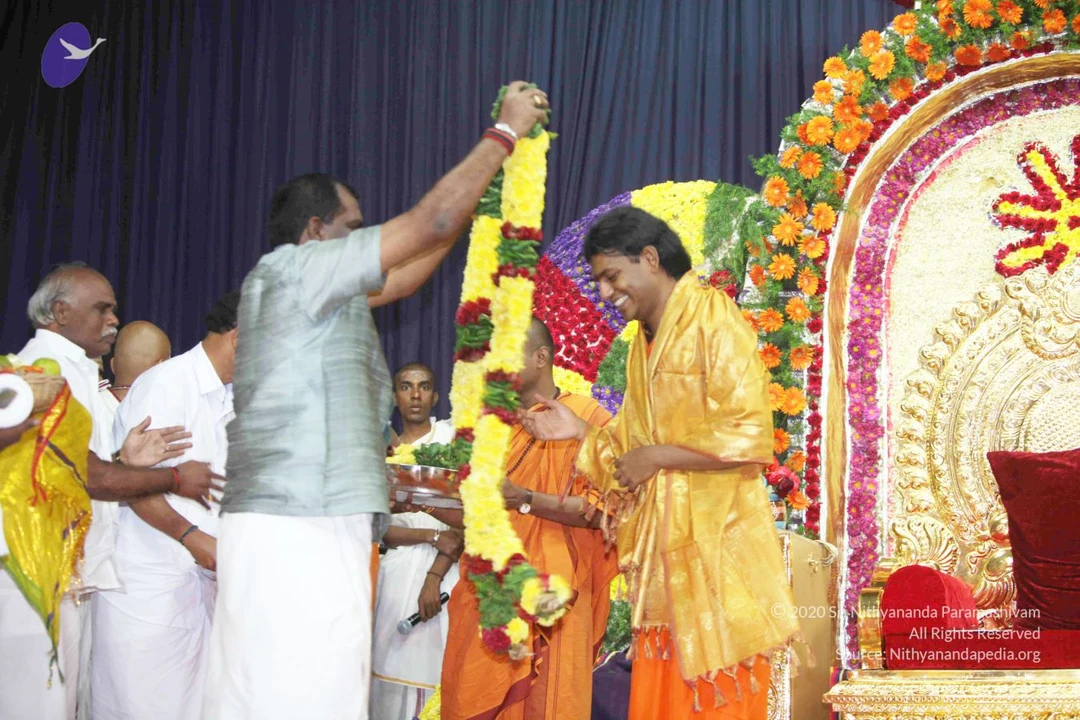
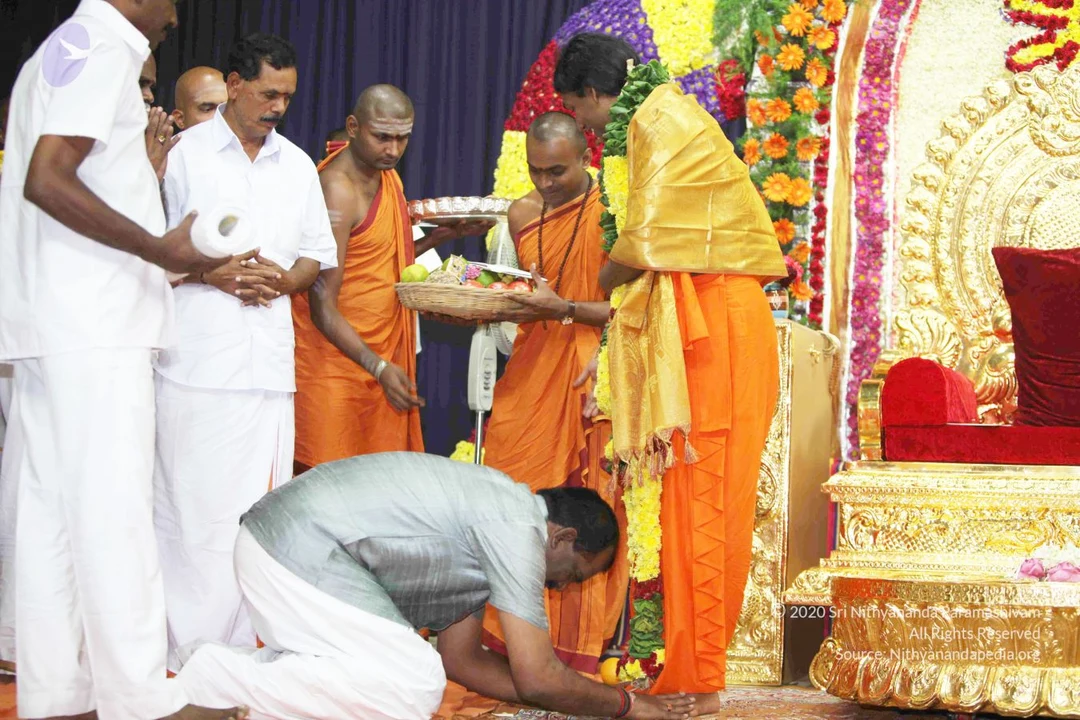
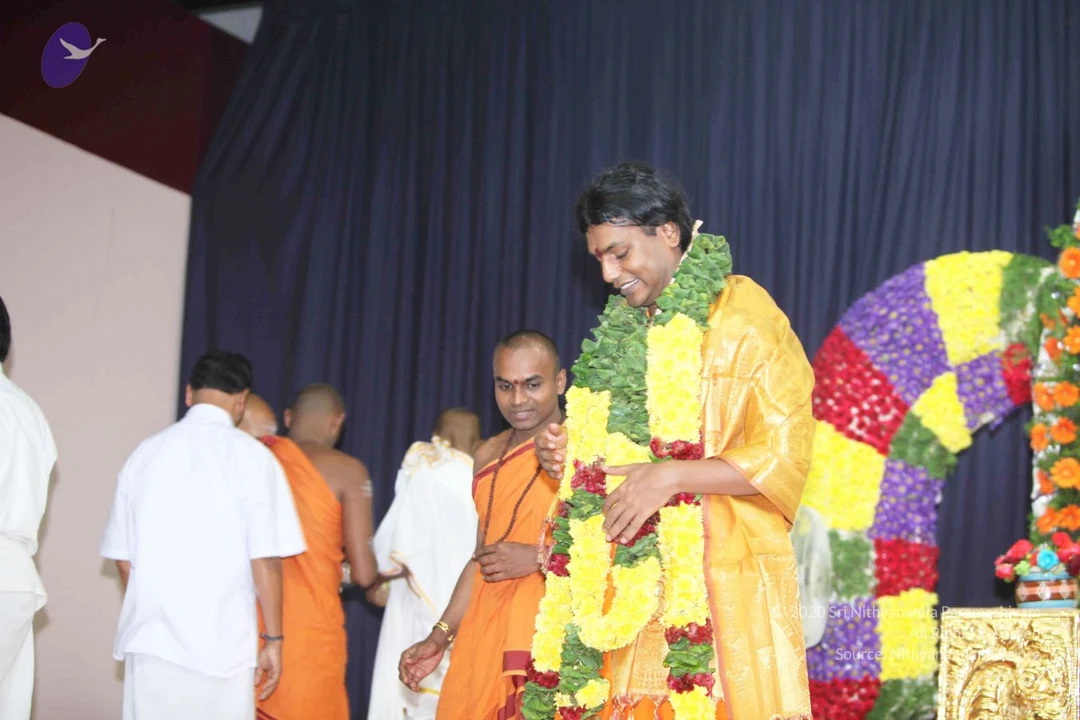
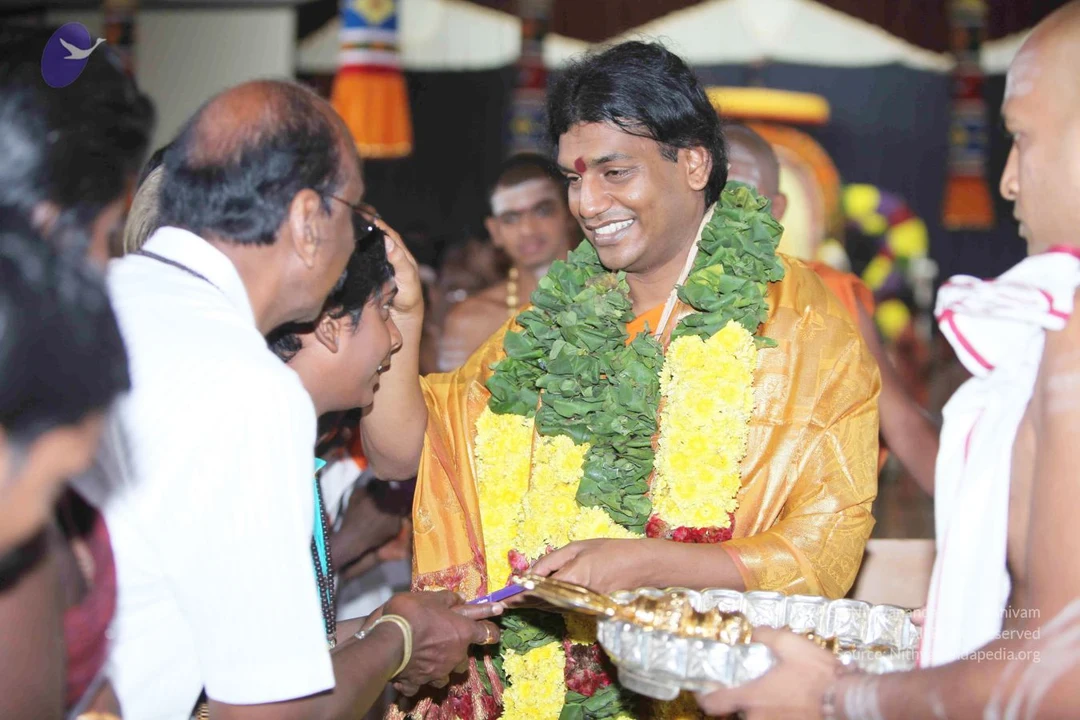
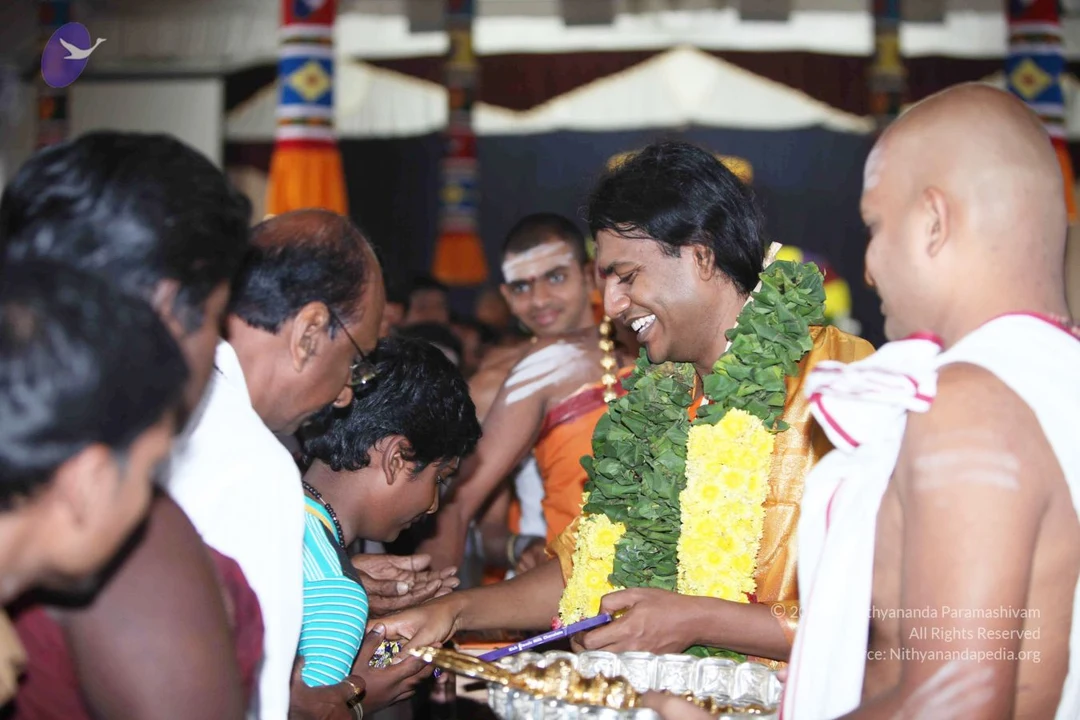
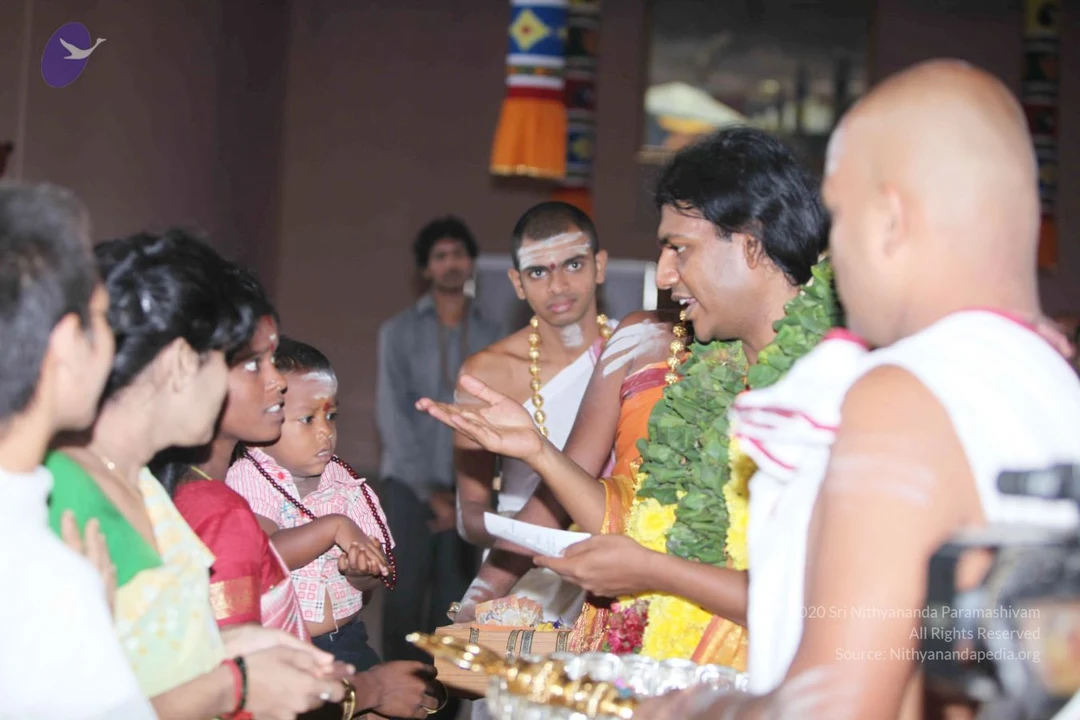
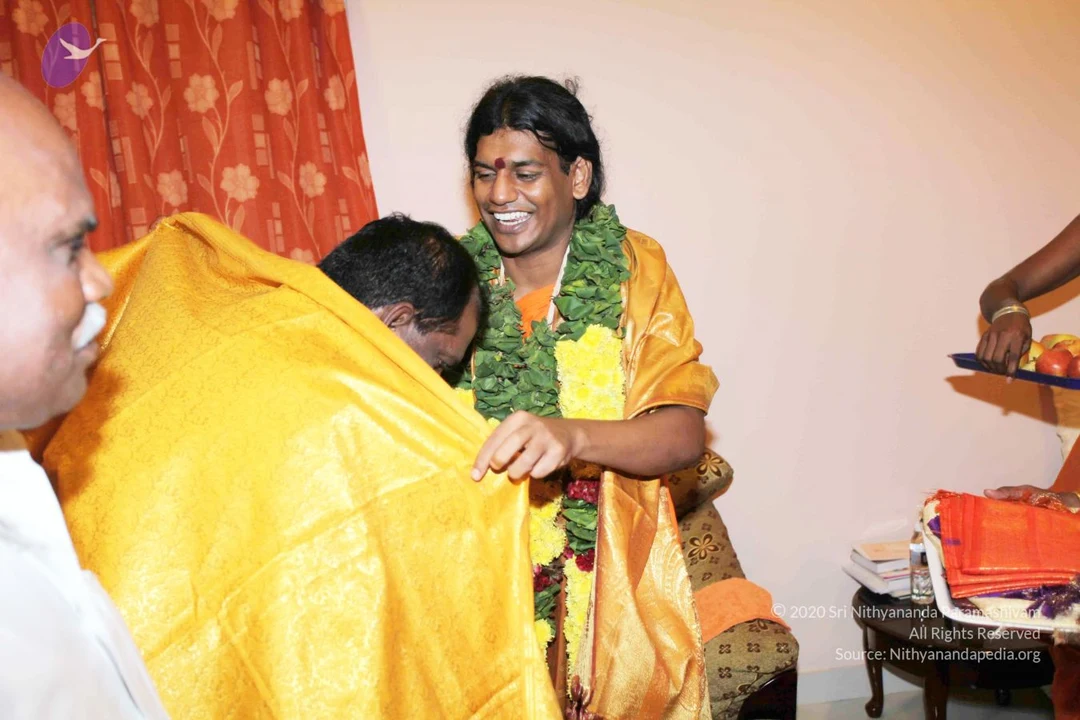
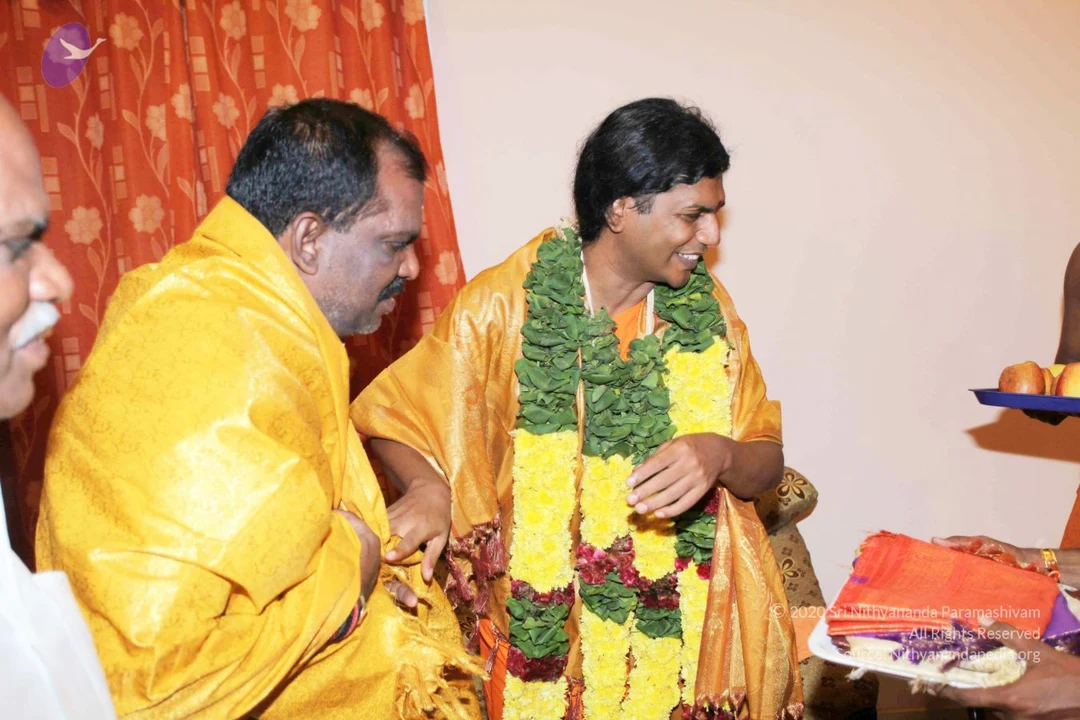
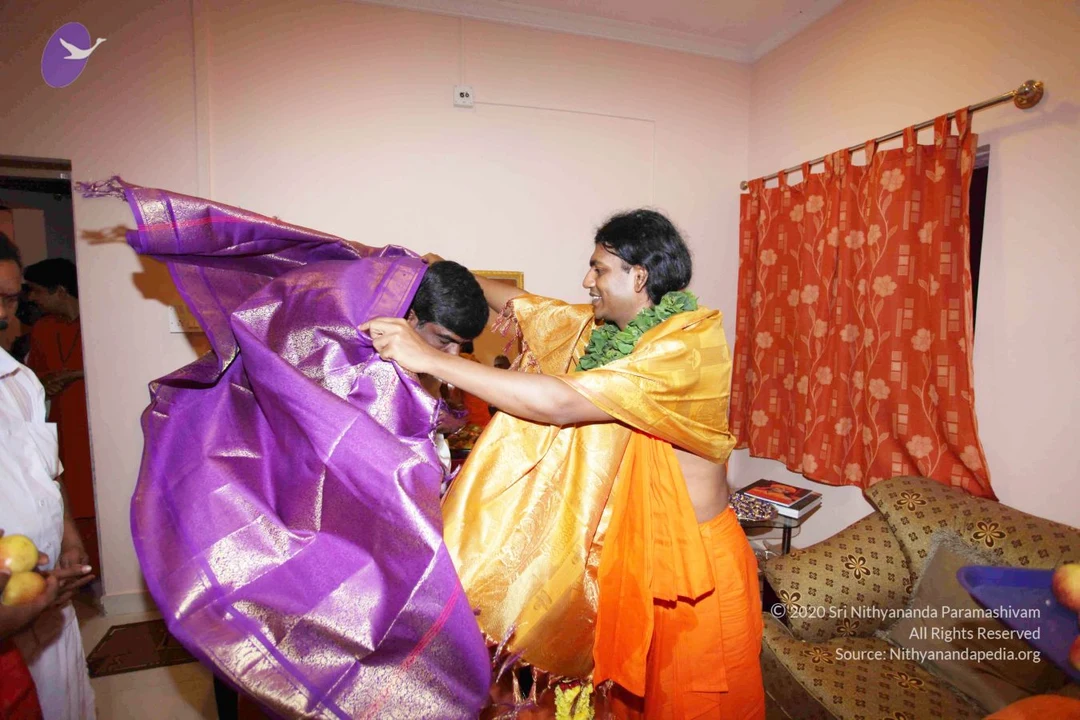
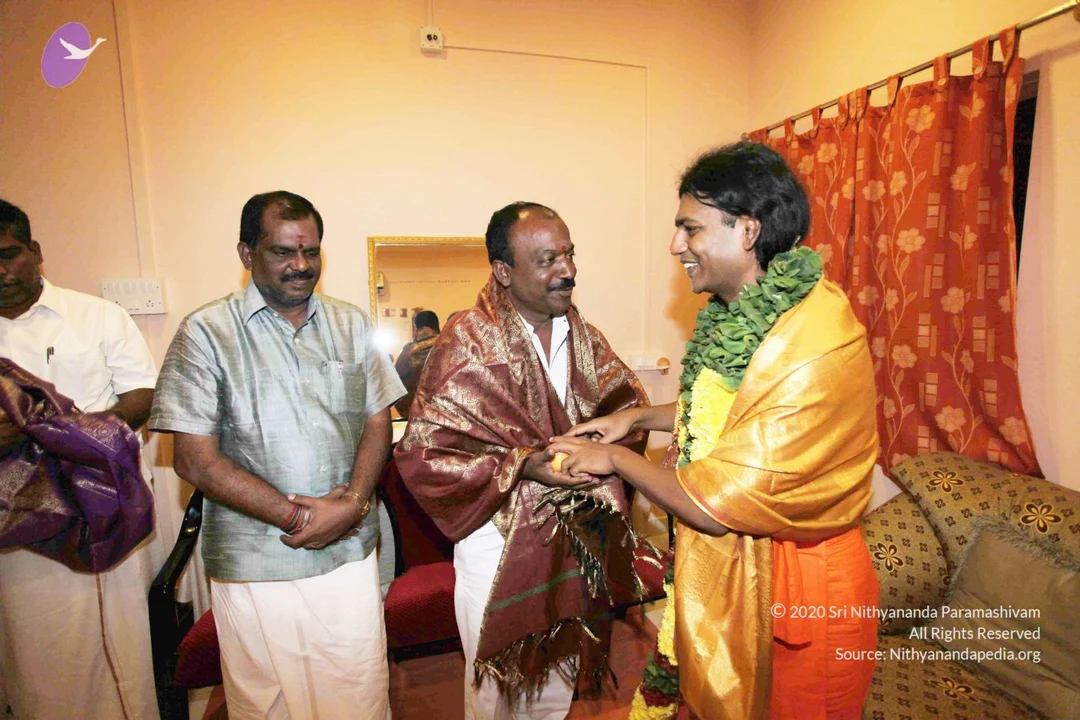
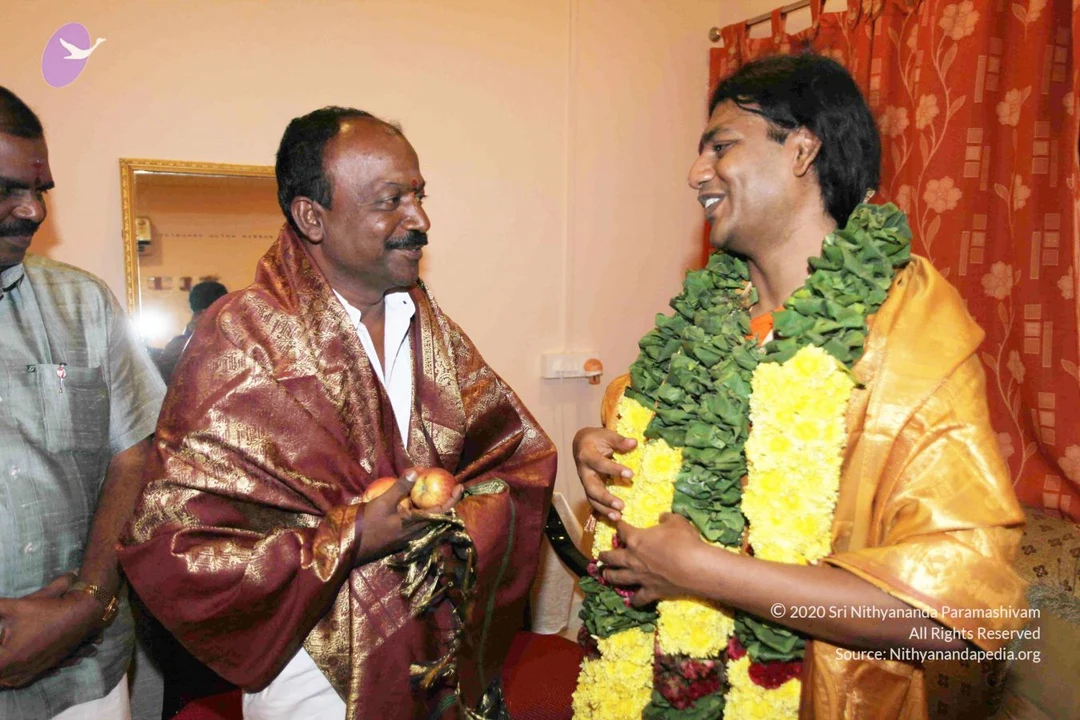
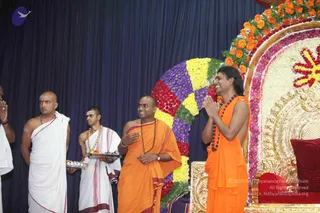
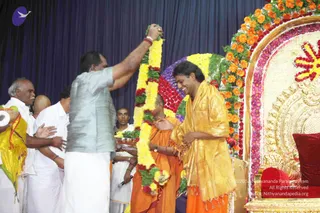
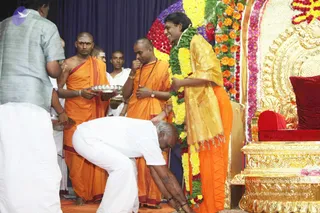
A stage event with a dark blue draped backdrop. On the right, a man in orange robes with a rudraksha mala and long swept-back hair stands with palms joined beside a gold-and-red throne decorated with orange, yellow and purple flower garlands. Beside him, a bald man in orange robes with a mala and wristband stands smiling with hands together at his chest. To the left, a bald man in white dhoti and shawl with sandalwood markings stands with palms joined, and another person in white ritual cloth with a gold necklace holds a silver tray. A flower-decorated kalasha arrangement in purple, yellow and red stands behind them.A photograph of a stage event beside a golden throne decorated with marigold and rose garlands. In the centre, a smiling man in a gold-bordered orange-and-gold shawl stands with arms raised slightly as another man in a grey shirt and white dhoti drapes or presents the shawl around him. Nearby, a shaved-headed man in saffron robes with a rudraksha mala stands by, and several men in white dhotis and white shirts, one holding a garland, stand at left with hands folded in greeting. A throne with red cushions and gold carved backrest is at right, backed by a colourful floral arch and dark blue curtain.A photograph of a ceremonial garlanding on a flower-decorated stage. A man in a grey-green shirt and white dhoti lifts a long garland of yellow marigolds and green leaves with red accents, offering it forward. Beside him, a man in saffron-orange robes stands with hands near a silver tray. The central figure, wearing a golden-yellow silk garment with a shawl and orange lower cloth, smiles and gestures with open hands toward the garland. He stands before an ornate gold throne backed by a large arch of orange, yellow and red flowers. Several white-clad attendants and an elderly man in white are present, and a microphone is visible.A photograph of a ceremonial scene on a stage draped with flower garlands in yellow, orange, purple and red. A man in a yellow silk shawl and orange dhoti, wearing a long yellow-and-white garland and a bead necklace, stands smiling beside a gold-carved throne with a red cushion. Two saffron-robed priests stand behind, one holding a silver tray and one with a rudraksha mala, along with a white-clad attendant. In the foreground an older man in white shirt and trousers bends low to touch the feet of the seated central figure. People visible: about five.A man in a light grey short-sleeved shirt and white dhoti stands at left, holding out a woven basket of fruit toward a smiling man in an ornate gold-threaded saffron silk garment draped with a thick garland of white and yellow flowers. Behind them a bald man in orange robes and a rudraksha-style necklace stands with hands folded. Several white-clad men stand at the left edge, one with palms pressed together. Behind the central figure is a large floral arch of orange, yellow, pink and red blooms beside a gold-carved throne draped in red fabric, with a dark blue curtain backdrop. A probable Swamiji is the man in gold-threaded saffron silk receiving the garland and fruit; he has swept-back dark hair and a ceremonial gold-trimmed garment, so the swamiji field is set to in_person. Five to six people are visible.A photograph of a ceremonial welcome on a stage decorated with banks of marigolds and yellow and red flowers. On the right, a man in a gold-yellow silk garment wears a long green-leaf and yellow flower garland and smiles while receiving a woven basket of fruit from a man in a grey shirt on the left. Between them stands a monk in saffron-orange robes with a rudraksha mala, smiling and watching. A blue draped curtain forms the backdrop. A man in white clothing stands at the far left edge. The gold-clad figure has long swept-back hair and ornate gold-toned clothing, which are cues consistent with a person receiving an offering, though the appearance is not certain.

VIP

35 photosSource gallery
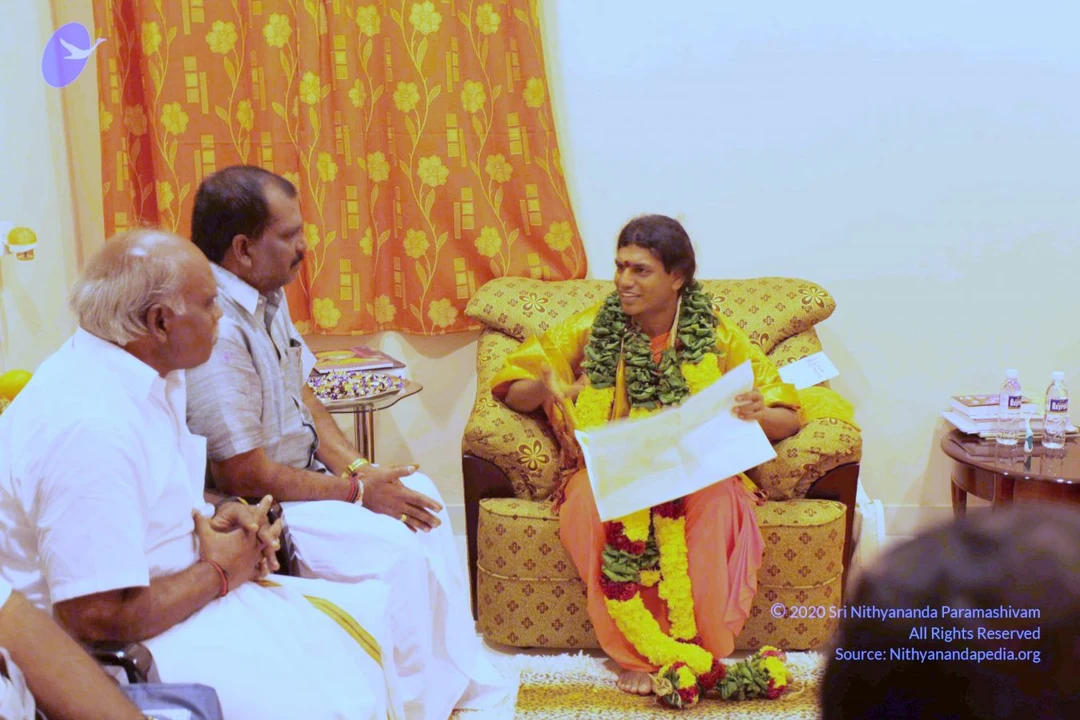
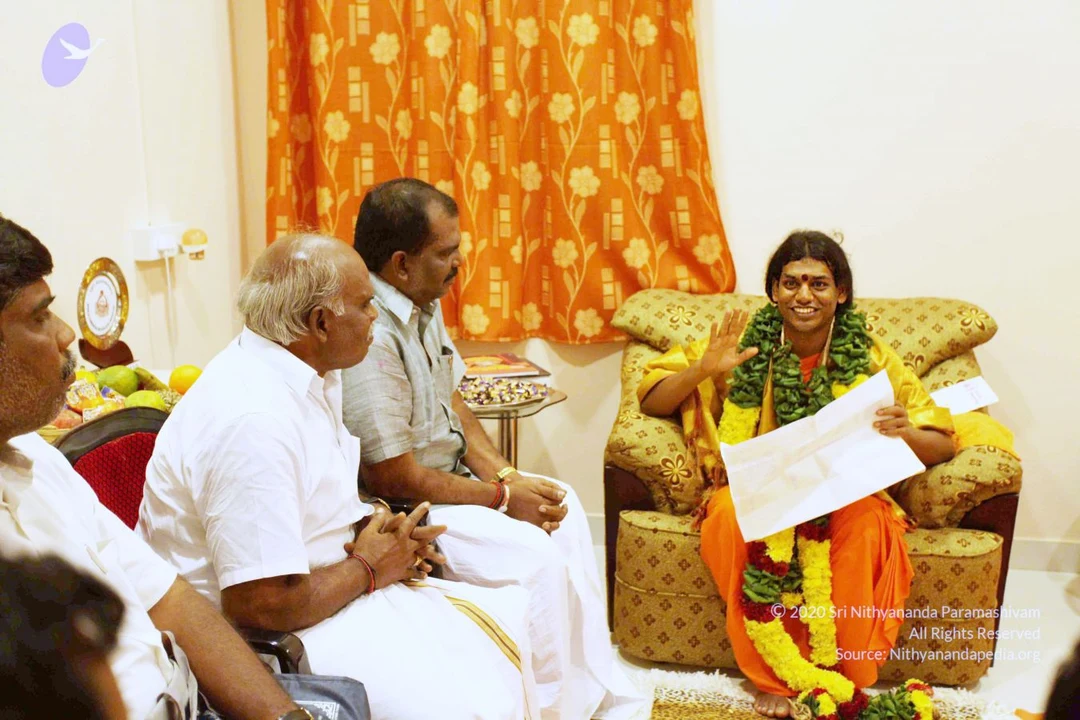
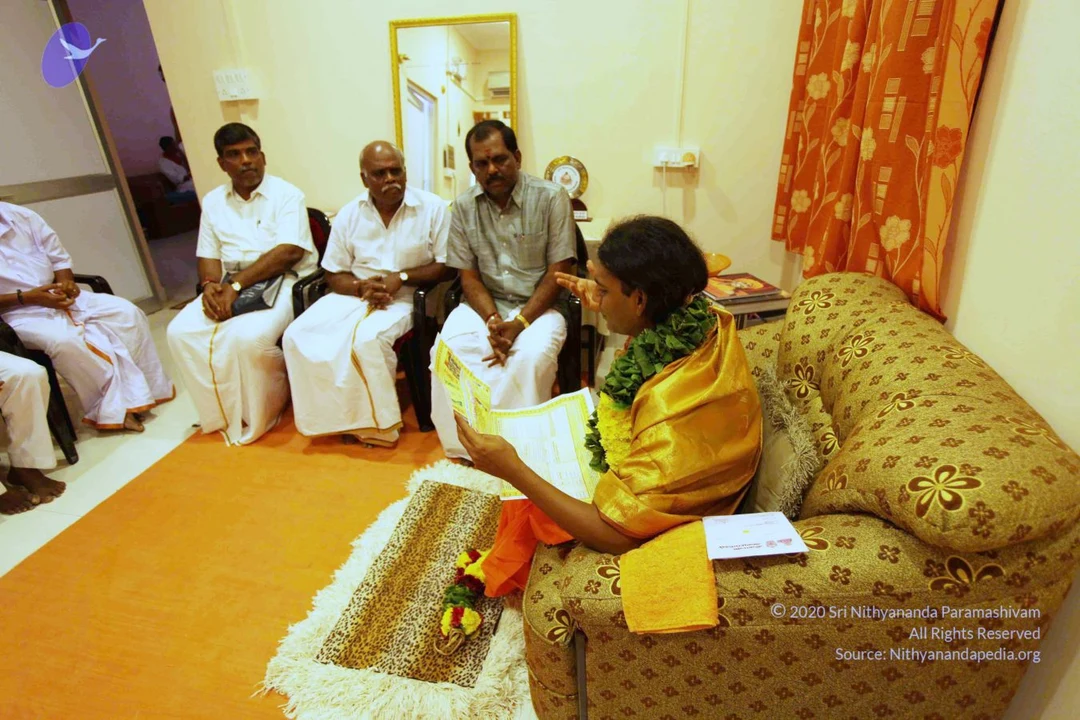
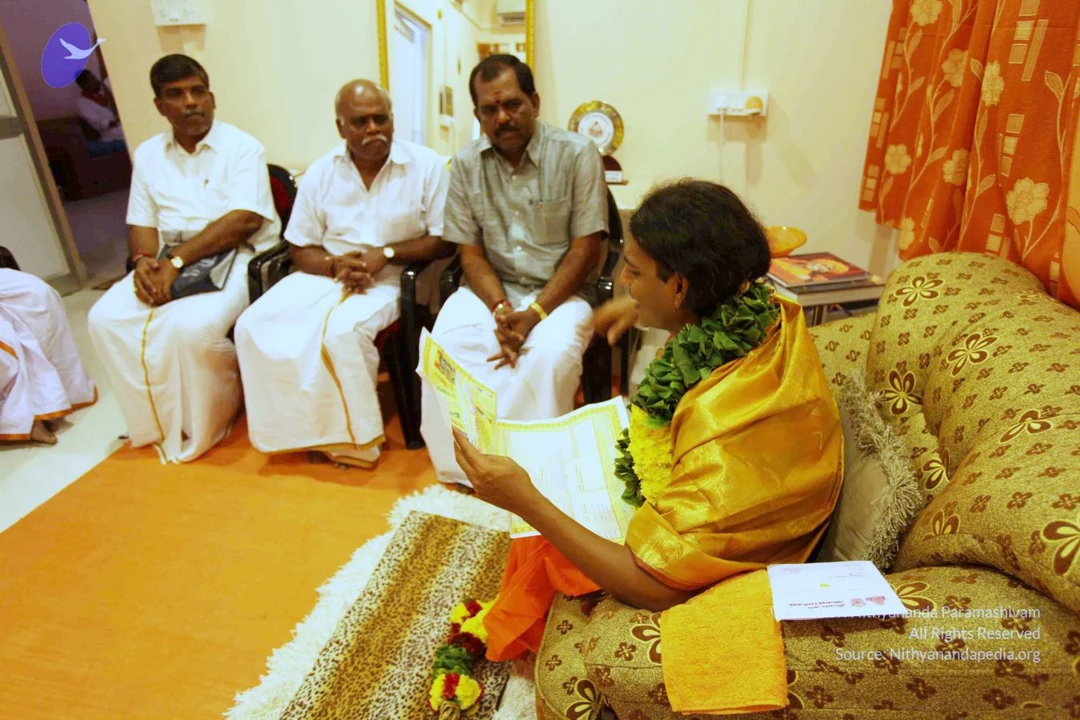
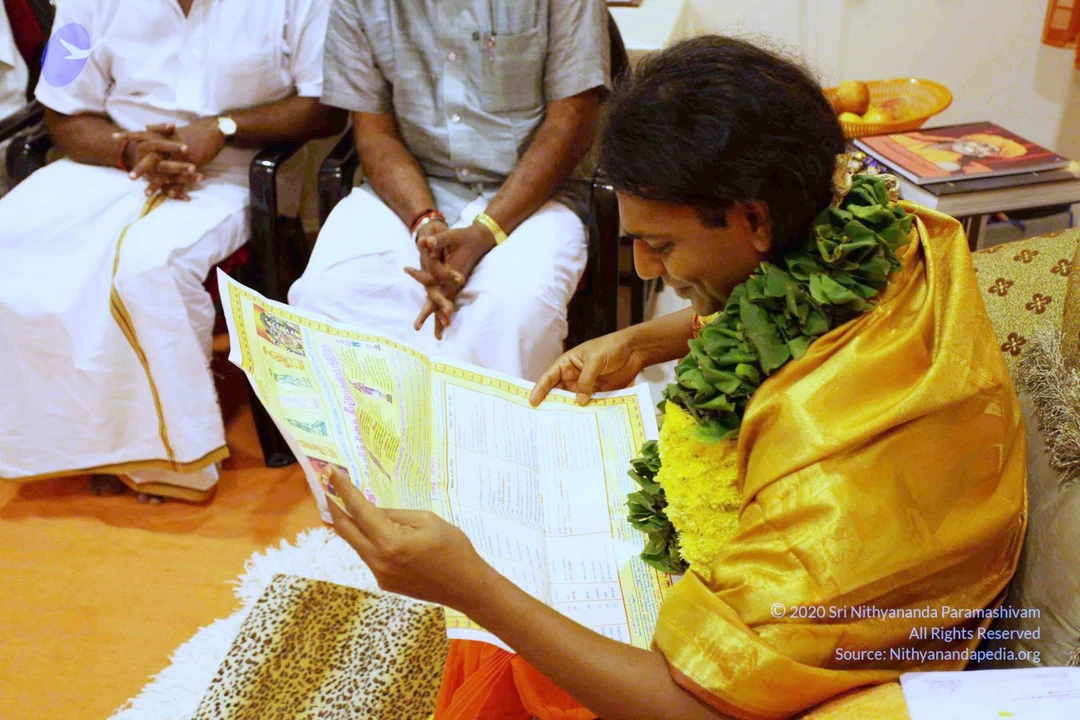
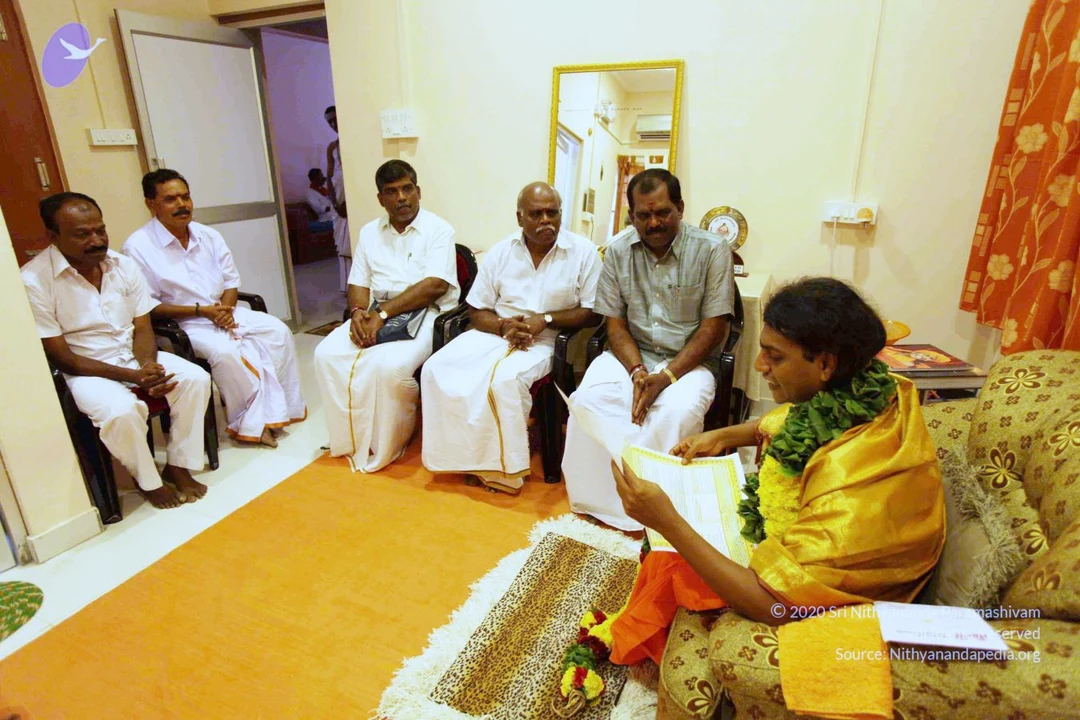
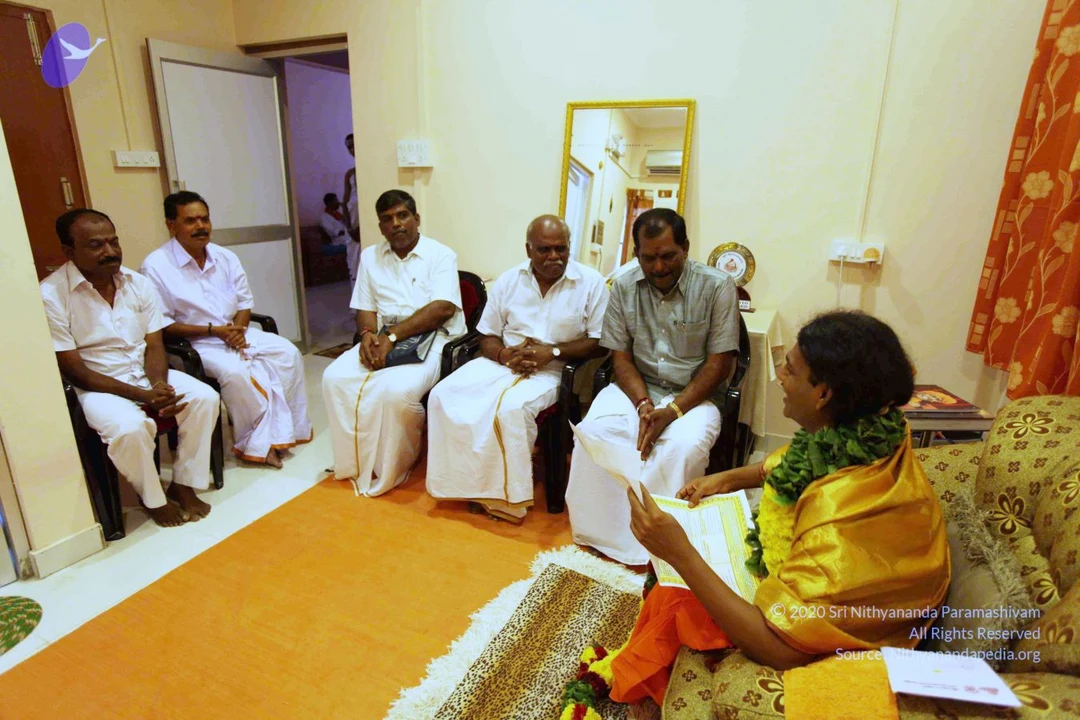
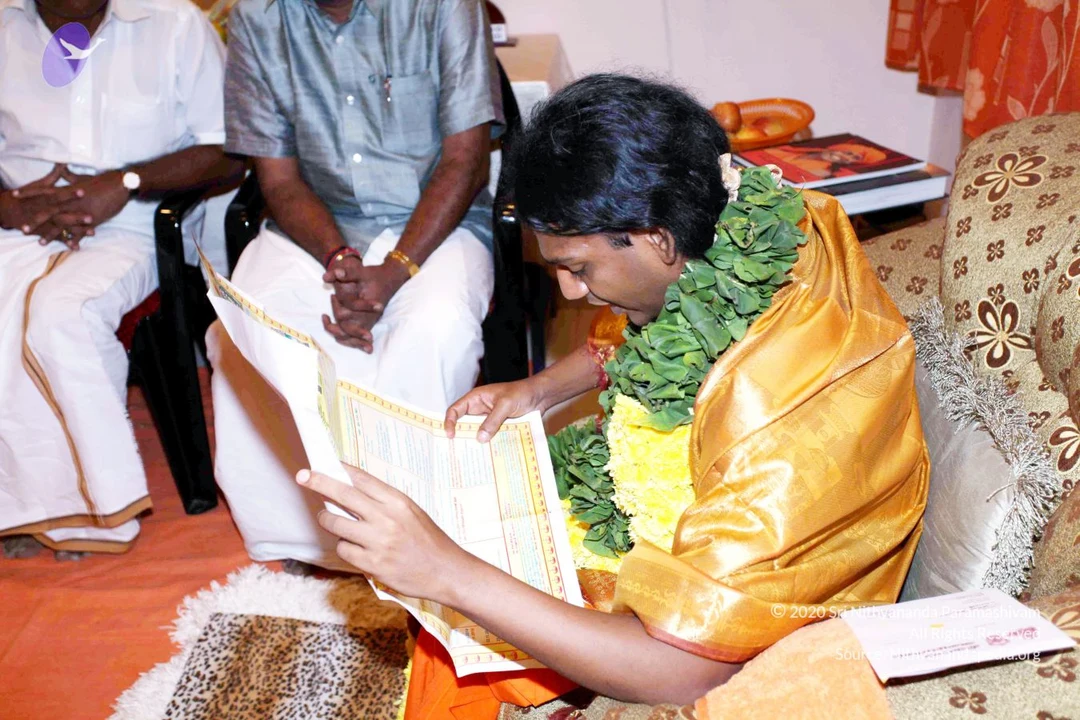
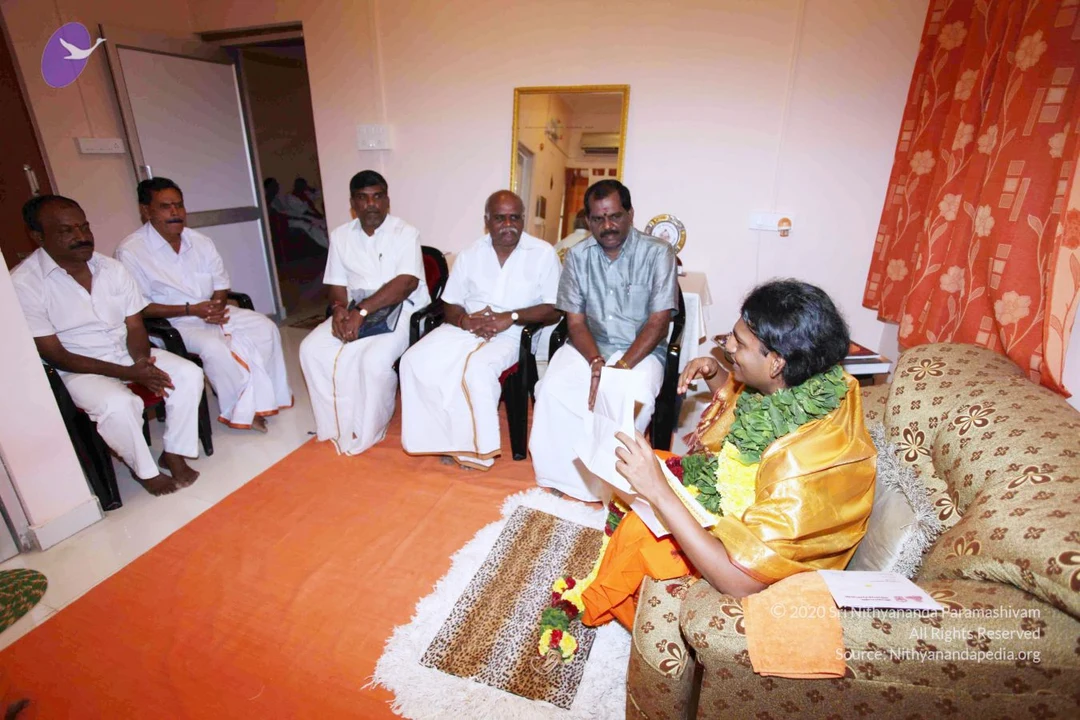
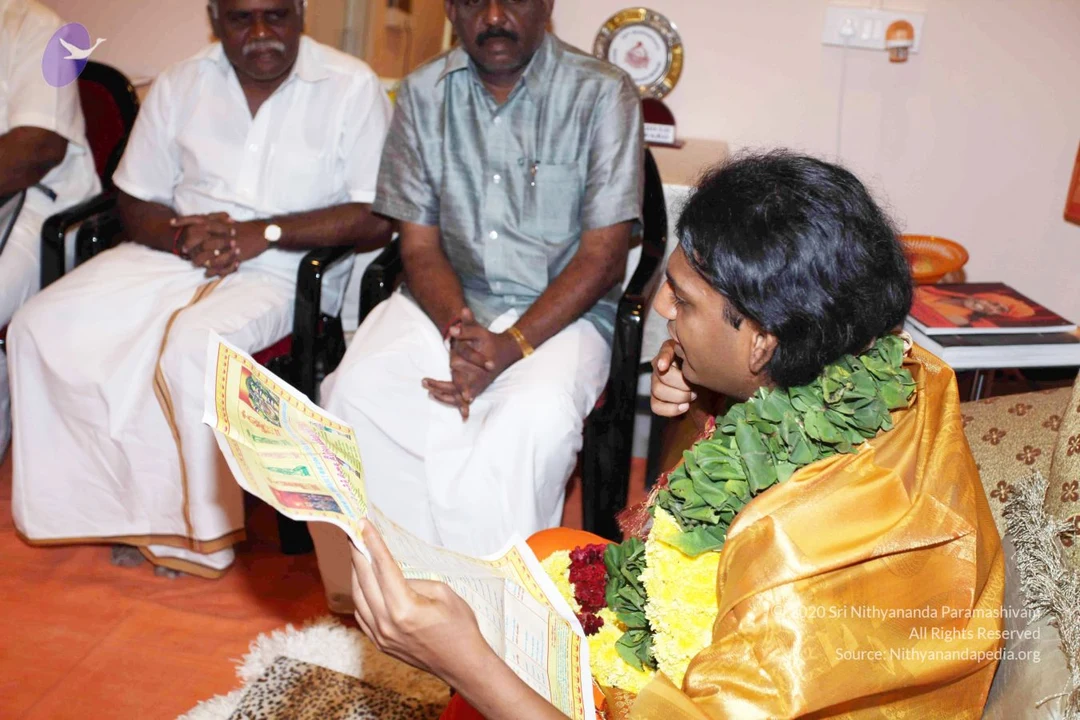
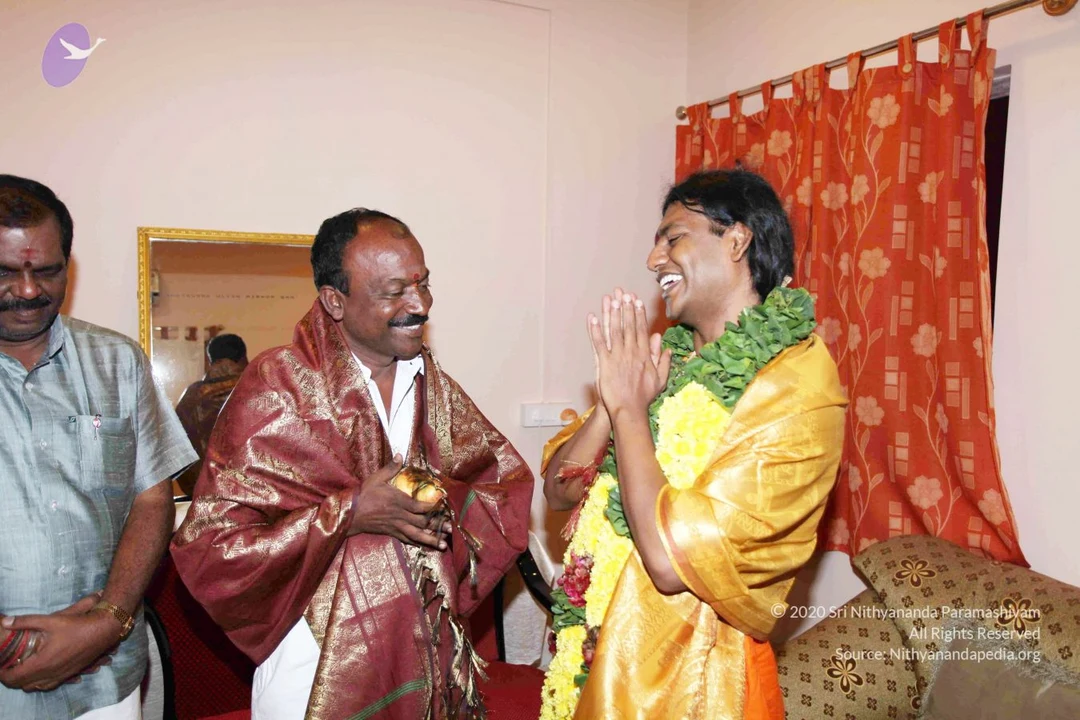
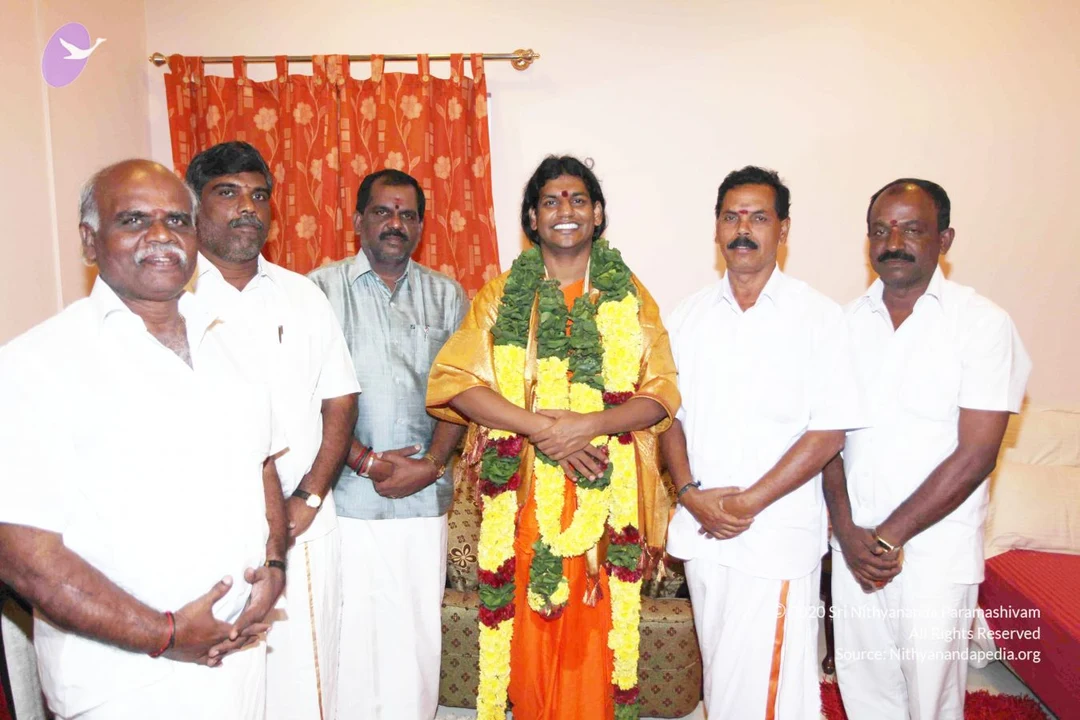
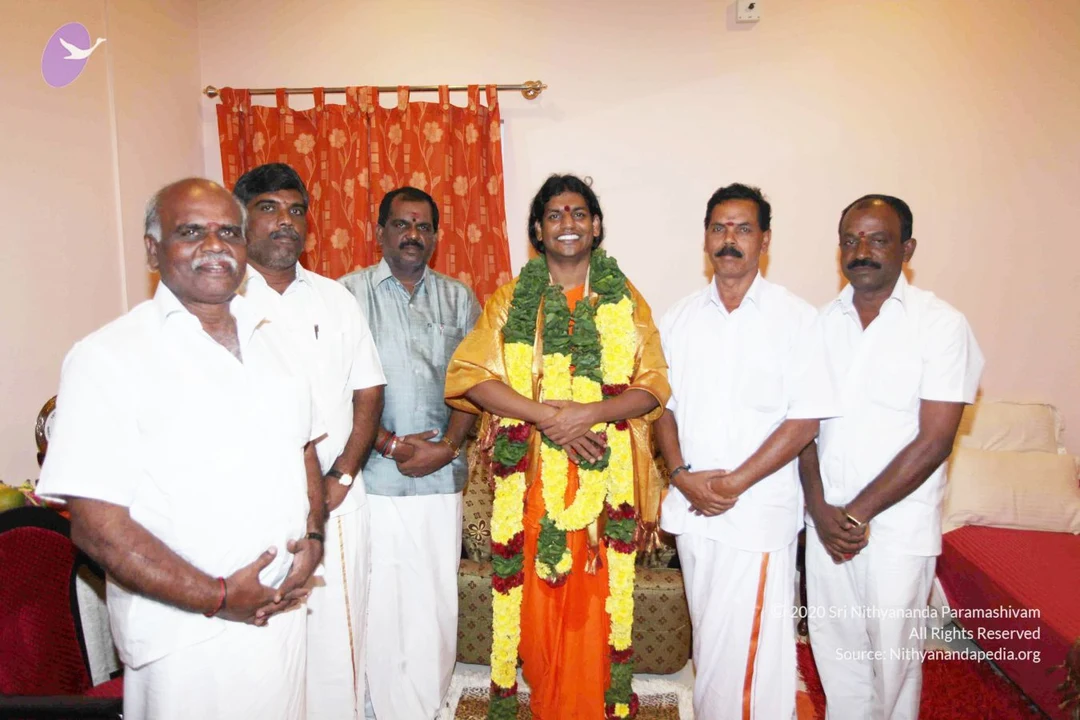
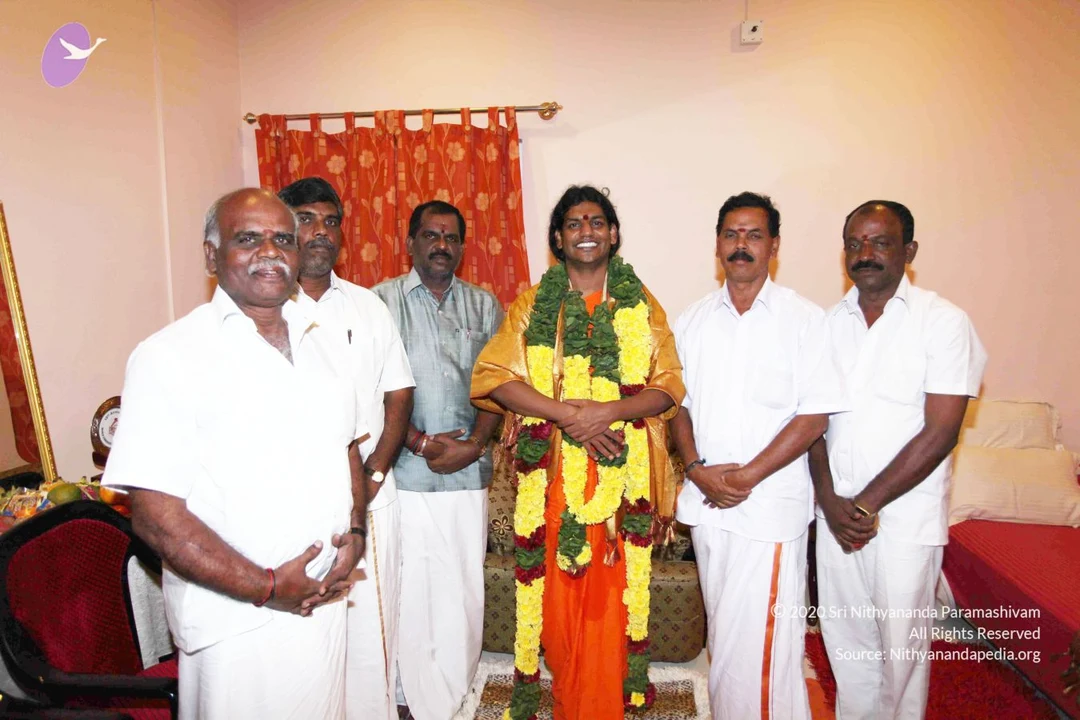
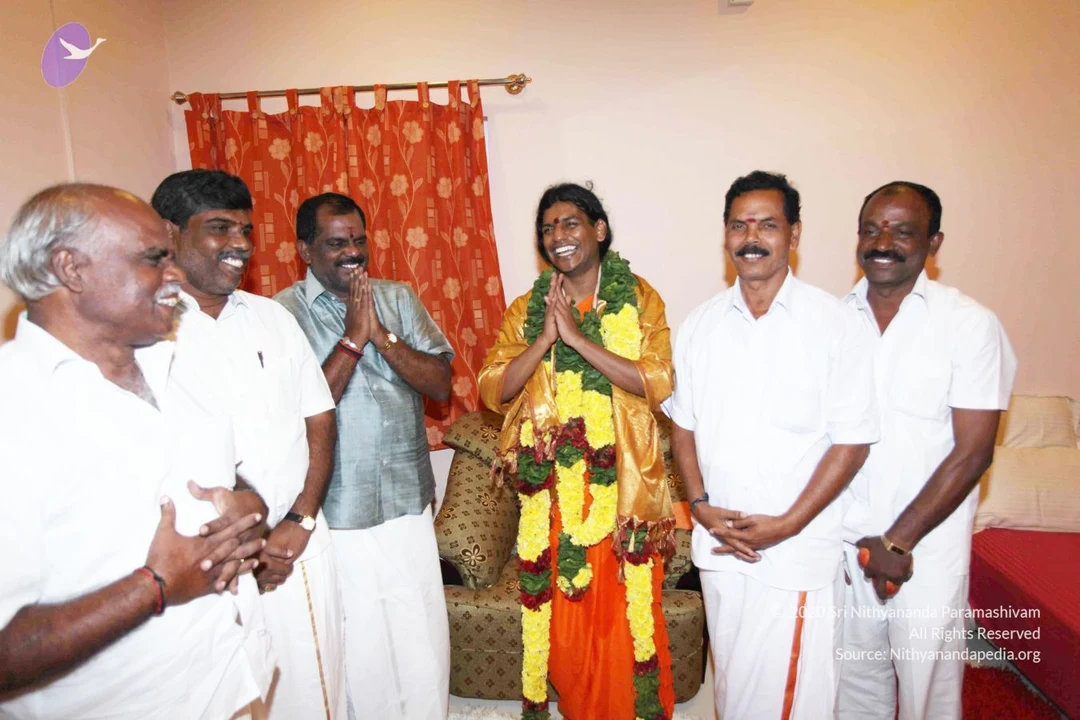
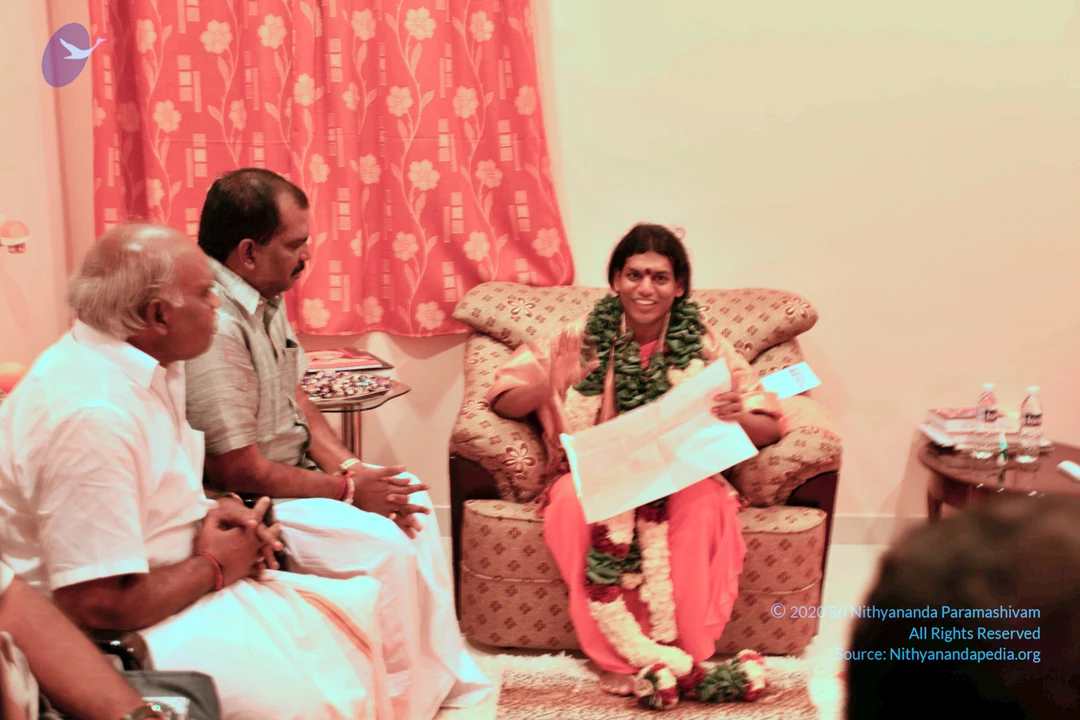
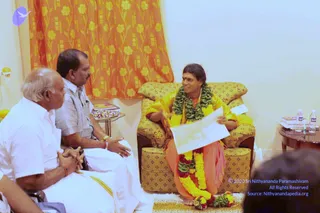
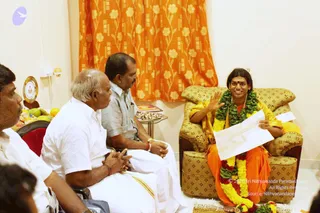
A seated man in an orange-and-yellow robe with a long green-and-red garland and a small red tilak on his forehead holds a white paper and speaks, sitting in a golden upholstered armchair before orange floral curtains. Two older men in white dhotis and shirts sit on a sofa to the left, one with hands clasped, and a bottle of water and a stack of books rest on a side table at right. A partly visible person's head appears at the lower right corner.A seated figure in saffron-orange robes and a yellow shawl, wearing a long green and orange flower garland and a red bindi, sits in a gold-upholstered armchair in a room with an orange floral curtain. He gestures with one raised hand while holding a sheet of paper. Three men in white or grey shirts and white dhotis sit facing him on the left, one with hands clasped. A tray of fruit and a sweets bowl sit on a side table. Swamiji (probable) is the seated figure, distinguished by his saffron robes, floral garland and long swept-back hair, while the others are devotees.A seated woman in an orange-and-gold silk sari with a green leaf garland sits on a patterned brown sofa, holding a yellow printed sheet and pointing with her hand toward three men seated in a row. The three men wear white dhotis and shirts, one in a grey shirt, and listen attentively. A leopard-print mat and marigold garlands lie on the orange floor in front of the sofa. Orange floral curtains and a framed mirror are on the wall behind. Several other people in white are partly visible at the left edge. The setting appears to be a domestic room used for a one-to-one or small group meeting.A woman seated on a floral-upholstered sofa in a domestic room holds a yellow printed document and reads from it. She wears a gold silk sari with an orange under-skirt and a long green leaf garland with yellow and orange flowers. Three seated men in white dhotis and shirts, one in a grey-striped shirt, listen attentively; a white-clad figure is partly visible at the left edge. Garland of flowers lies on the orange rug and a leopard-print mat, with an orange curtain behind.A photo of a person seated indoors on a sofa with an orange floor and a leopard-print rug, holding and studying a large yellow-and-white printed chart with a pointing finger. The person wears a golden-yellow silk shawl over orange clothing and a thick green leaf garland with yellow flower strands. Behind them, two seated men in white dhotis and a grey shirt sit with hands clasped; one wears a gold wristwatch and red thread. On a side table sit a basket of fruit and a book with a deity cover. Appearance-based label: a person for the person in the gold shawl and leaf garland, based on the saffron-orange clothing, ornate shawl and garland cues; the seated men are devotees.A seated man in a golden-yellow silk shawl over orange robes, wearing a green-and-yellow flower garland, sits on a floral-upholstered sofa reading from a sheet of paper held in both hands. Five men in white dhotis and white shirts sit on black chairs in a cream-walled room with an orange rug, a gilt-framed mirror and a patterned orange curtain. Two of the seated men wear grey-green and white shirts. Flower petals and a small floral arrangement lie on the rug before the reader.

02-Morning-Satsang

6 photosSource gallery
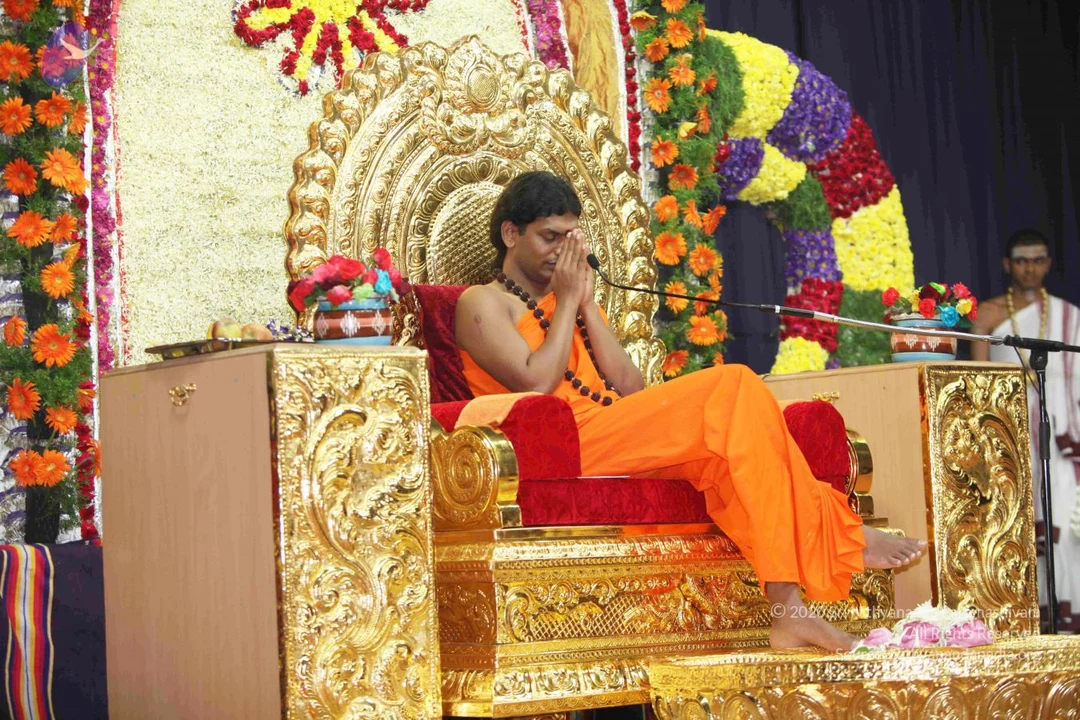
A man in orange saffron robes sits on an ornate gold throne with a large carved gold backrest, eyes closed and hands folded in front of him. He wears a long rudraksha mala with dark beads and a red bindi on his forehead, with his hair swept back. Behind him the gold throne is framed by white flowers and pink blossoms. At the lower left edge, the partial heads of other attendees are visible. The scene suggests a seated satsang setting, with the figure appearing meditative. Visible cues include saffron clothing, a rudraksha mala and swept-back hair, so the appearance-based label is Swamiji (probable), seated in person on the throne.A man in an orange saffron robe and a long rudraksha mala sits on an ornate gold throne with red velvet cushions, against a backdrop of yellow and red flower decorations. He has a red bindi on his forehead and looks calmly ahead. In the foreground a devotee in white clothing bends forward, touching his feet, which rest on a gold footstool scattered with pink roses and white petals. A microphone stand is visible at the upper right. The scene appears to be a formal padapuja at a satsang.A man in an orange saffron robe sits cross-legged on an ornate gold throne with red velvet cushions, speaking into a microphone on a stand. He has long dark hair in plaits and a red tilak on his forehead, and his bare feet rest on a gold pedestal decorated with pink flowers. Behind the throne a large gold arch is surrounded by orange marigolds, yellow and purple flower garlands, and a red and yellow floral motif. Small floral arrangements stand on side tables, and a striped textile covers the platform edge.A seated man in an orange saffron robe and a black rudraksha mala sits on an ornate gold throne with red velvet cushions, bare feet resting on the gold footrest, speaking into a microphone on a stand. The throne is flanked by gold-carved side pedestals holding brass vessels with flowers. Behind him is a backdrop of orange marigolds, yellow and purple flower arches, and a golden textured wall. The photo looks like a satsang stage setting. Swamiji (probable): the seated figure has shoulder-length swept-back hair, saffron clothing and rudraksha mala, matching the page's claim that Swamiji was present.A seated man in an orange saffron shawl and a dark rudraksha mala speaks into a microphone with both hands open in front of him. He sits before an ornate gold throne with carved floral backrest, and behind him a wall of marigold and rose garlands in orange, purple, yellow and red. A pink and red flower arrangement sits in a blue and red vessel on a gold-carved table at left. Swamiji (probable): long swept-back hair, saffron clothing and rudraksha beads identify a.A photograph of a seated man on an ornate gold throne speaking during a satsang. He wears an orange saffron robe draped over his shoulder and a long dark rudraksha mala, with a red bindi on his forehead. His right hand rests on the gold armrest and a microphone on a stand is beside him. Behind the throne are garlands of orange, yellow, purple and red flowers, and a vase of red and pink flowers sits on a wooden table with fruit.
03-Sarva-Darshan

8 photosSource gallery
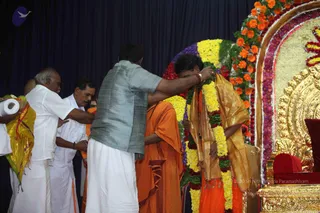
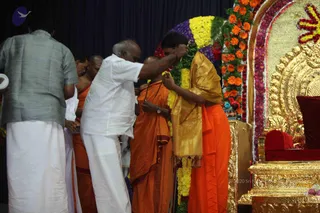
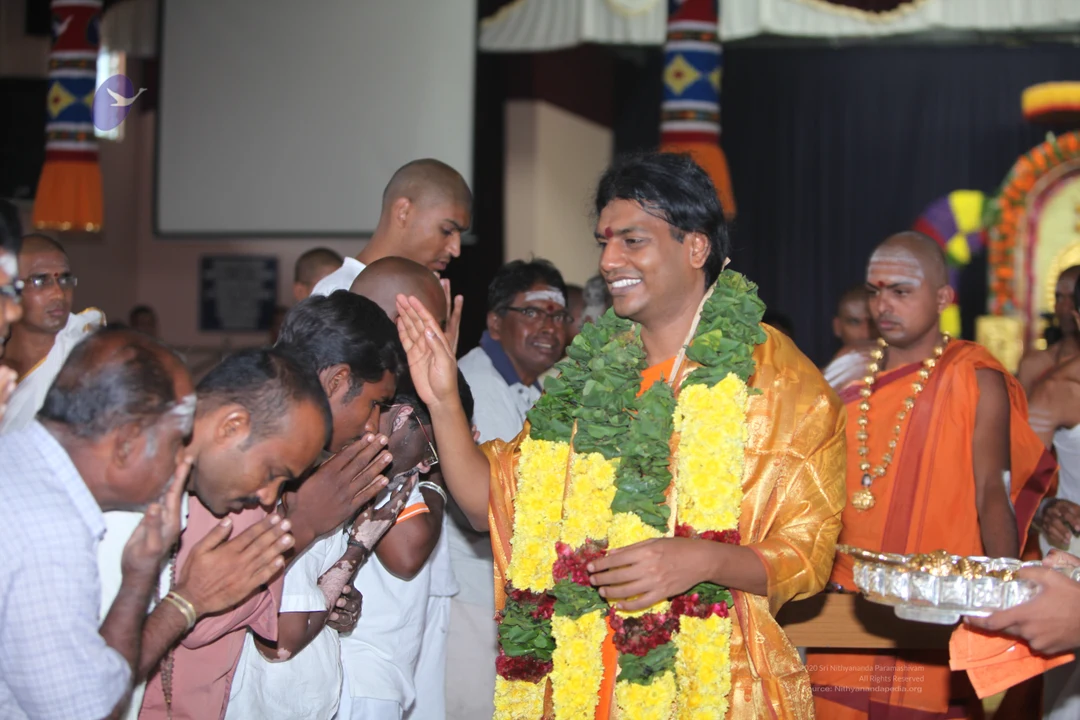
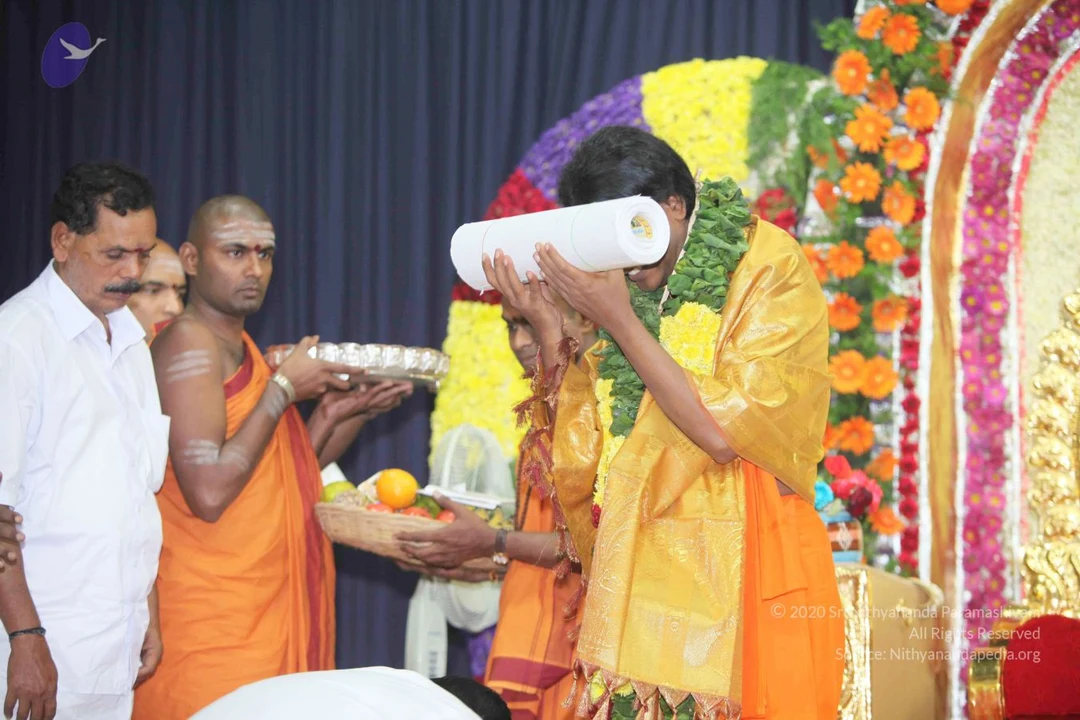
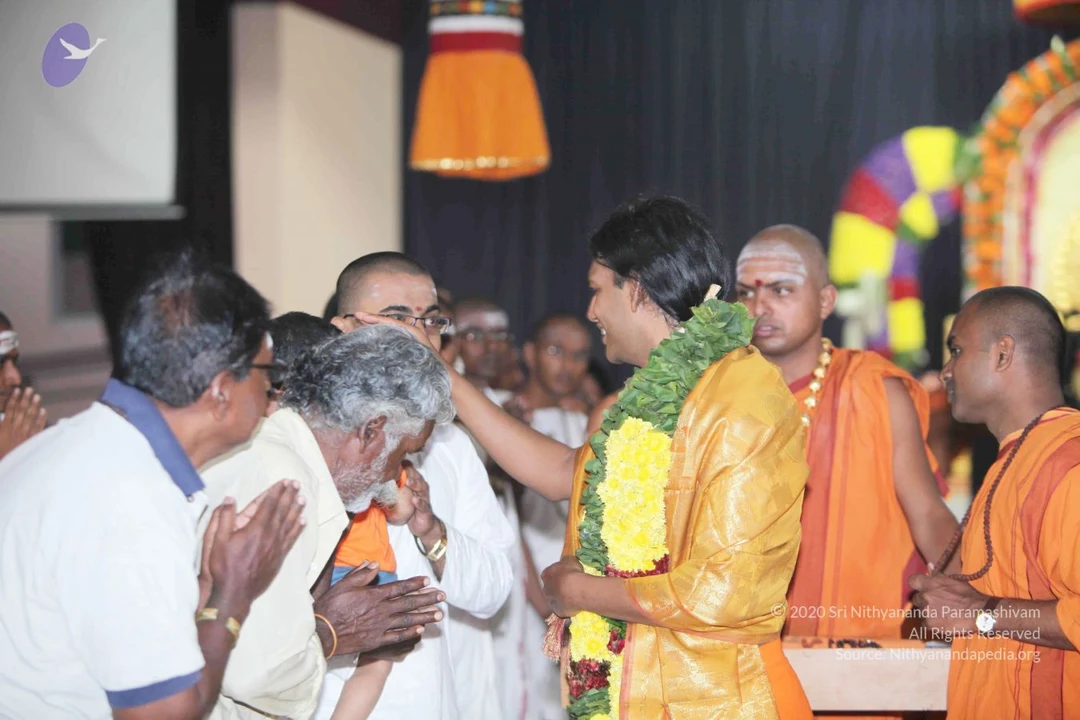
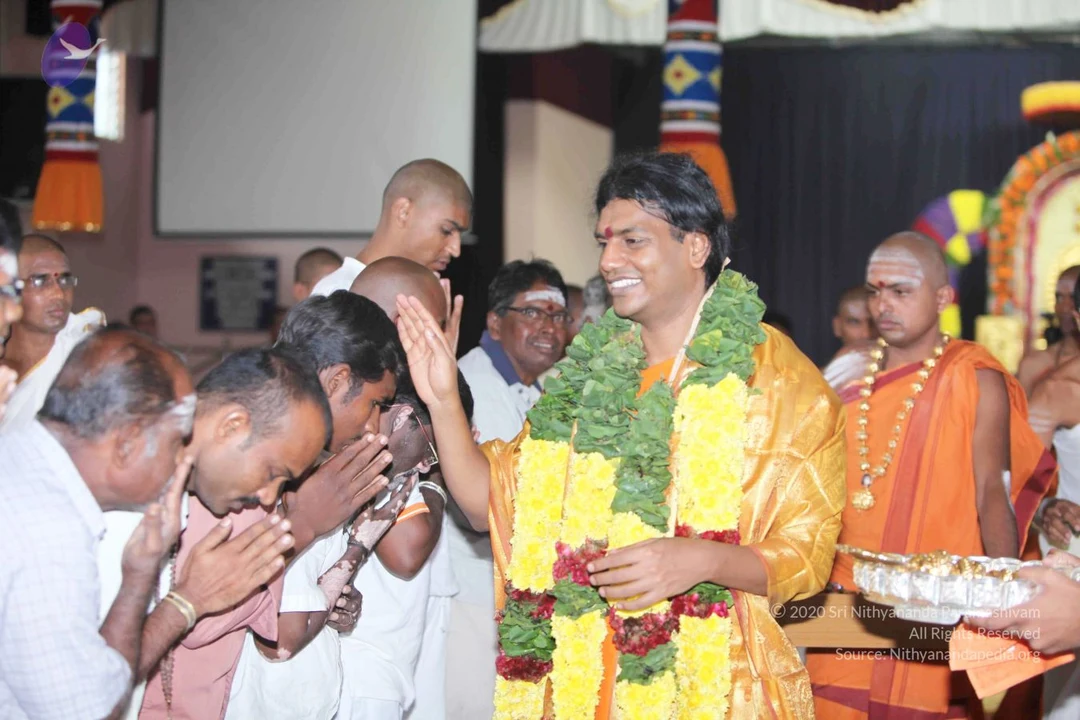
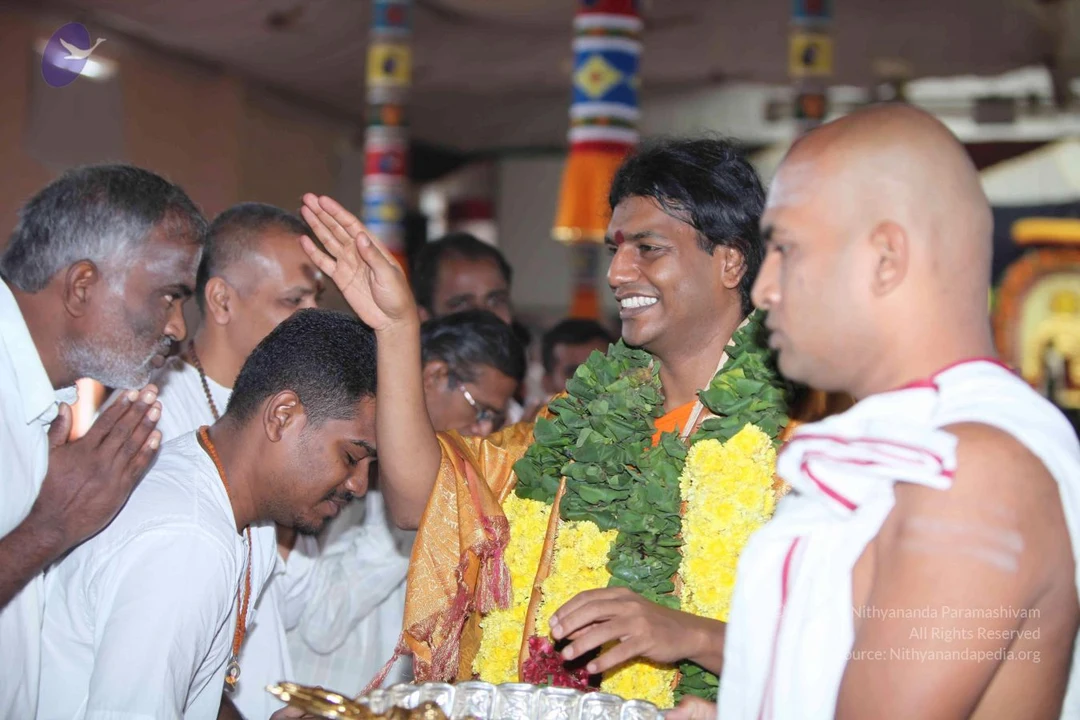
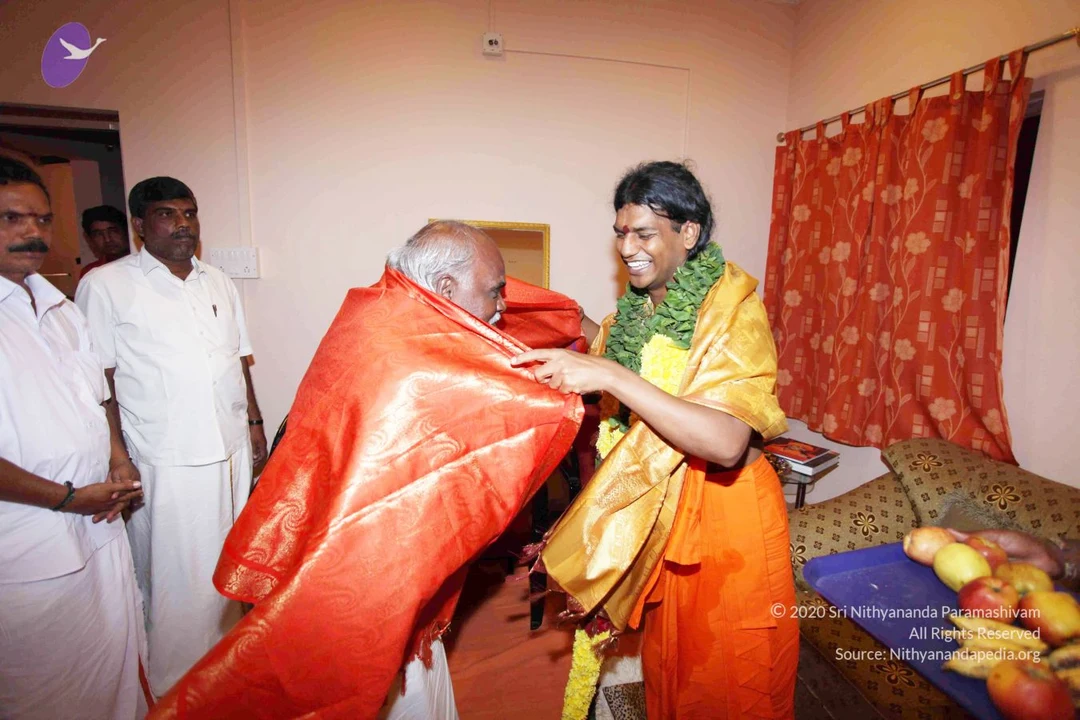
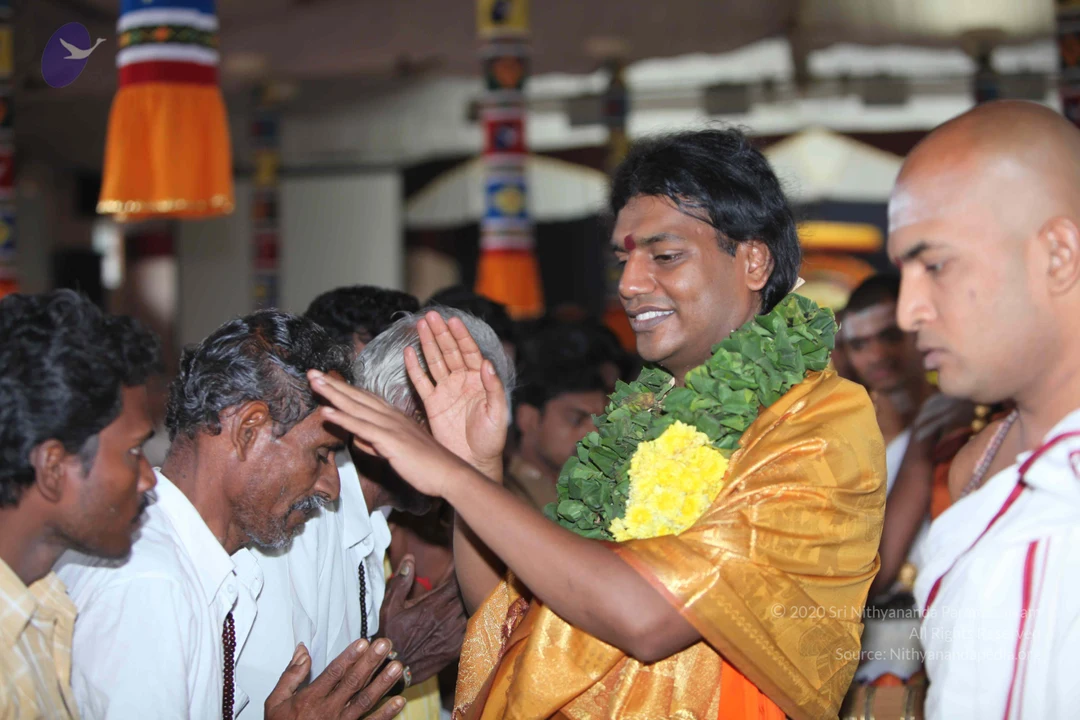
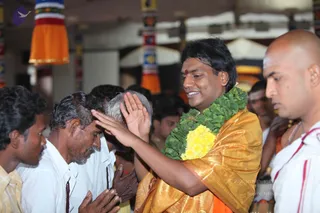
A photograph of a felicitation at a stage in front of a golden throne. A man in a grey-green shirt and white dhoti leans forward to drape a garland of yellow and white flowers with green leaves around the neck of a seated figure in an orange and gold shawl, with a rudraksha-style red-and-white mala visible. Behind them, a monk in orange robes stands, and an older man in white clothes and a yellow-bordered cloth holds a basket. A large floral arrangement of orange, yellow, magenta and purple flowers frames an ornate gold throne with a red cushion, against a dark blue backdrop.A photograph of a flower-decorated stage in an indoor hall. A bald man in an orange robe stands at centre, facing right, while a man in a white shirt and white dhoti places a long garland around his neck and a woman in an orange sari with a gold shawl reaches to adjust it. Another man in a grey shirt and white dhoti stands at left. Behind them rise large arches of orange marigolds, yellow blooms and purple and red flowers. At right, an ornate gold throne with a red cushion and gold carved base sits beside a gold-framed panel. Dark blue drapery forms the backdrop.A photograph of a formal reception on a stage decorated with large floral arrangements in orange marigolds, yellow and purple blooms. A man in a grey shirt on the left holds a woven basket of fruit, including a green lime or pear and an orange, extending it forward. A smiling monk in orange robes with a rudraksha mala stands behind the basket. On the right, a figure in a golden-yellow silk garment and orange dhoti wears a long garland of green leaves and yellow flowers and bows forward with hands together, receiving the offering. Another person in white stands at the far left edge. The figure receiving the garland has long dark hair and appears to be a person (appearance-based candidate, honoured with a garland and fruit basket).A photograph of a ceremonial welcome at an indoor event. A man in a grey-green striped shirt and white dhoti stands at left, holding a woven basket of fruit, including oranges and green lemons, toward a woman in a golden-yellow silk saree who bows her head over a long garland of green leaves, yellow and red flowers. Behind them a man in saffron-orange robes and a rudraksha mala holds a white cloth-wrapped object and looks on. Another person in orange stands behind him. In the background are a large floral arrangement of purple, red and yellow flowers and a wall of orange marigold garlands.A photograph of a ceremonial welcome. On the right, a person in a golden-orange silk saree with a thick green and yellow flower garland bows forward, hands near a woven basket of fruit. A man in a grey shirt and white dhoti on the left holds out the basket and a folded white cloth. Between them stands a shaved-headed priest in orange robes with a rudraksha mala, smiling and holding his hands together. Behind them is a backdrop of purple, yellow, red and orange flower arrangements.A photograph of a darshan-style gathering inside a temple-like hall with colourful striped pillars and orange fabric hangings. A man in a gold-and-orange silk shawl and a green leaf garland with yellow flowers stands centre, smiling, a red tilak on his forehead, his right palm raised over the head of an older man in a white shirt who bows with hands folded. Another man in white dhoti-style clothing with a red sash stands at right, a shaven-headed priest-like figure. Several devotees in white shirts and yellow clothing crowd behind. The central man shows distinctive long swept-back hair and ornate saffron-gold clothing, a probable match for a person, though this is an appearance-based label only.

October 25 2010

2 photosView all
A photograph of a stage-level puja setup in an indoor hall. A seated figure in saffron-orange robes sits centrally on a raised throne-like seat framed by a large floral arch of orange and yellow marigolds with striped multicoloured garlands on each side, a golden halo-like backdrop with a red sun-like emblem, and a yellow-and-orange floral canopy above. Several men in white dhotis and white shawls sit cross-legged on the left of the stage, some with chanting or ritual props, and women in green and pink saris sit nearby. A camera on a tripod and a monitor are placed in front of the stage in the foreground. Below, a row of seated people in white and saffron-orange clothing face the stage, including shaven-headed men in white and women in orange garments. White and orange draped fabric hangs along the top of the hall, and pink-and-white walls frame the space.A photograph of an indoor sitting room with pink-and-cream floral curtains and a patterned upholstered armchair. A figure with long dark hair wearing a pink-orange robe and layered green and white garlands sits in the armchair, holding a folded white paper and gesturing with one hand while smiling. Two men sit to the left on a sofa: an older man with white hair in a white shirt and white dhoti, and a middle-aged man with a moustache in a grey checked shirt and white dhoti, hands clasped. Appearance-based label for the central figure is a person, identified by long swept hair, saffron-pink robe and ceremonial garlands, shown seated and speaking with the two men.