Skip to content
Tuesday

7 September 2010

Transcend through meditation (PYS-62-63): Nithyananda on Patanjali Yoga Sutras

Dated photos
240
Source pages
1
Media
4
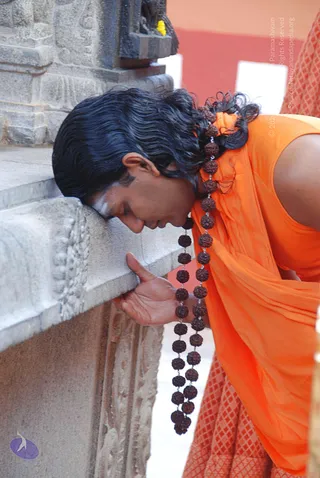
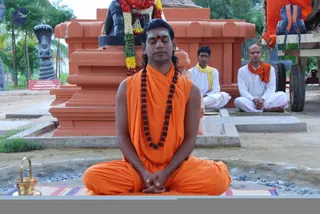
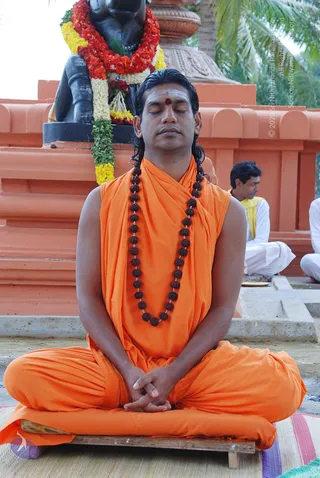
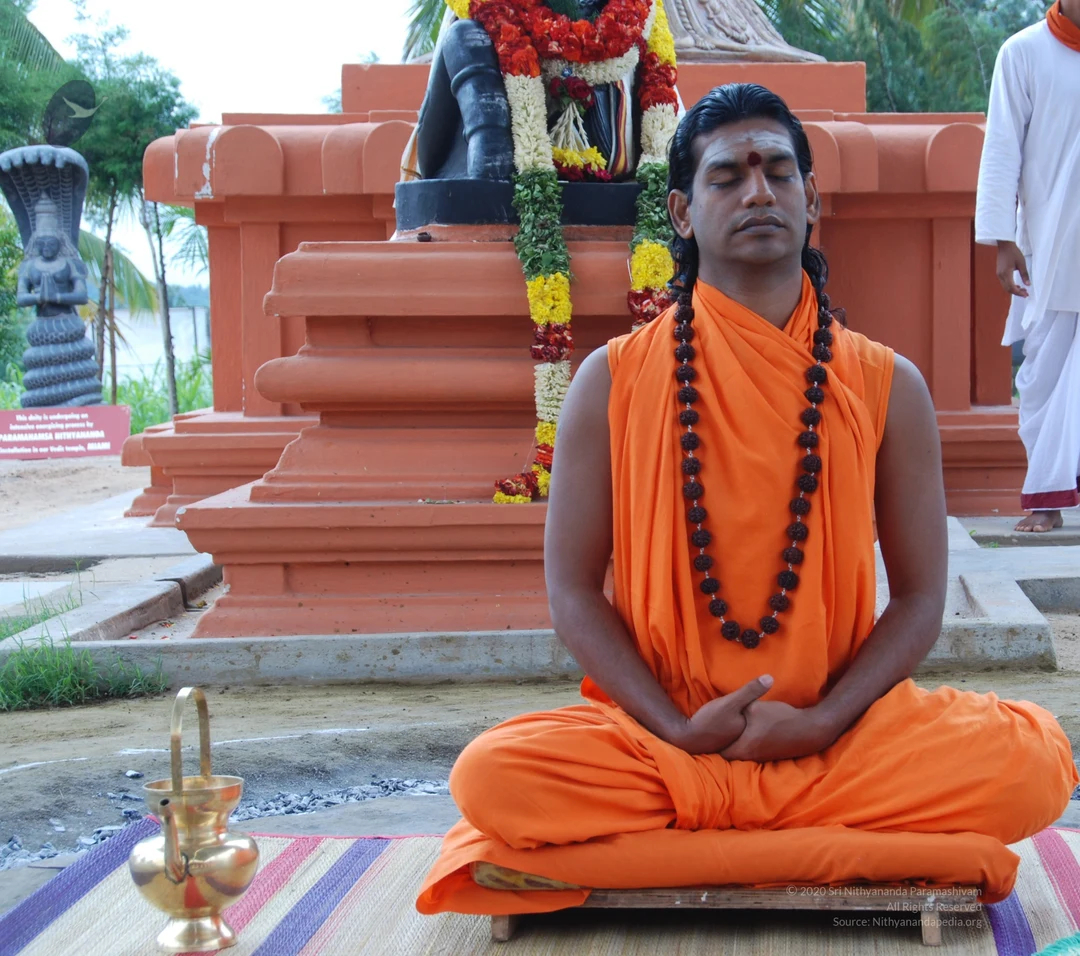
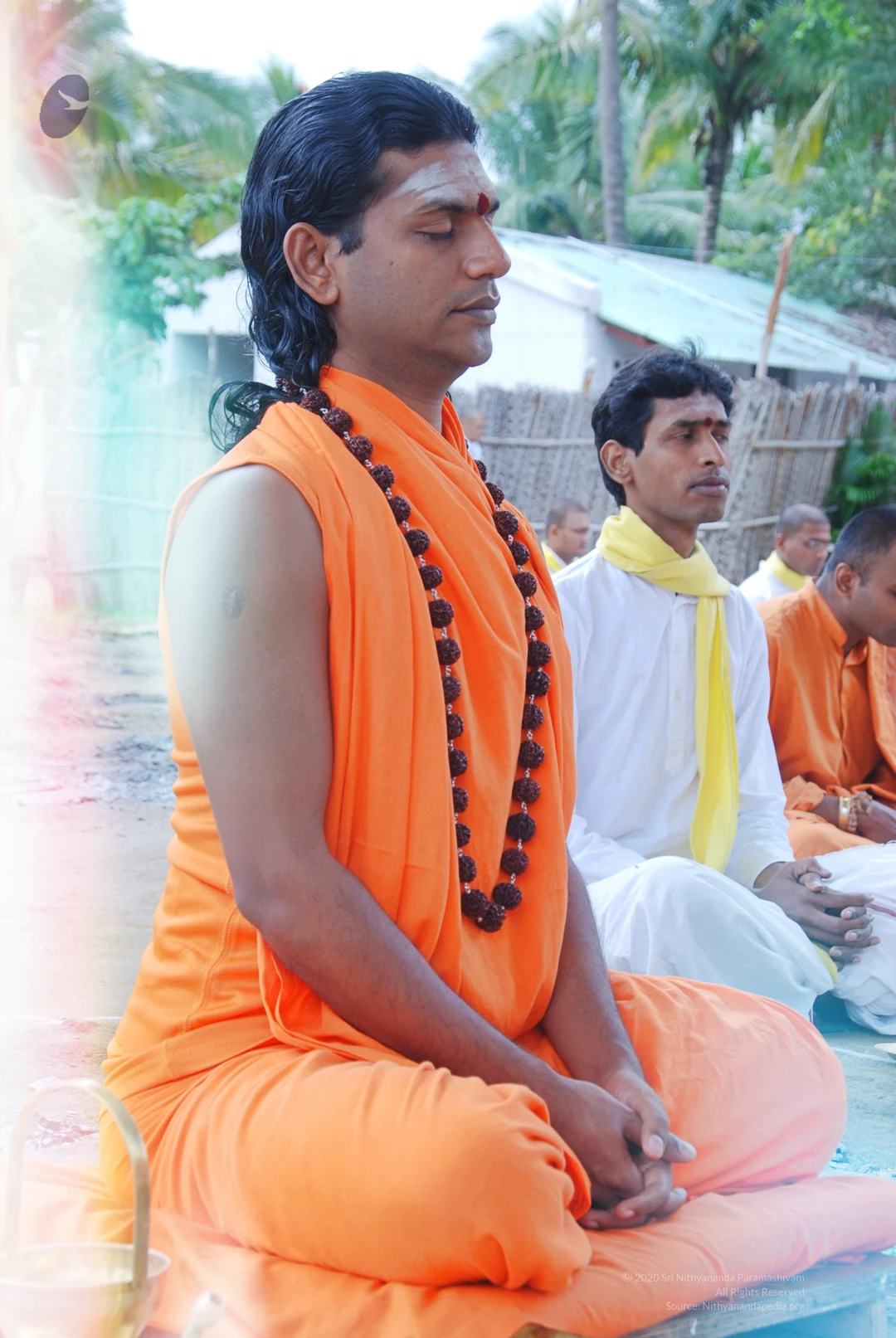
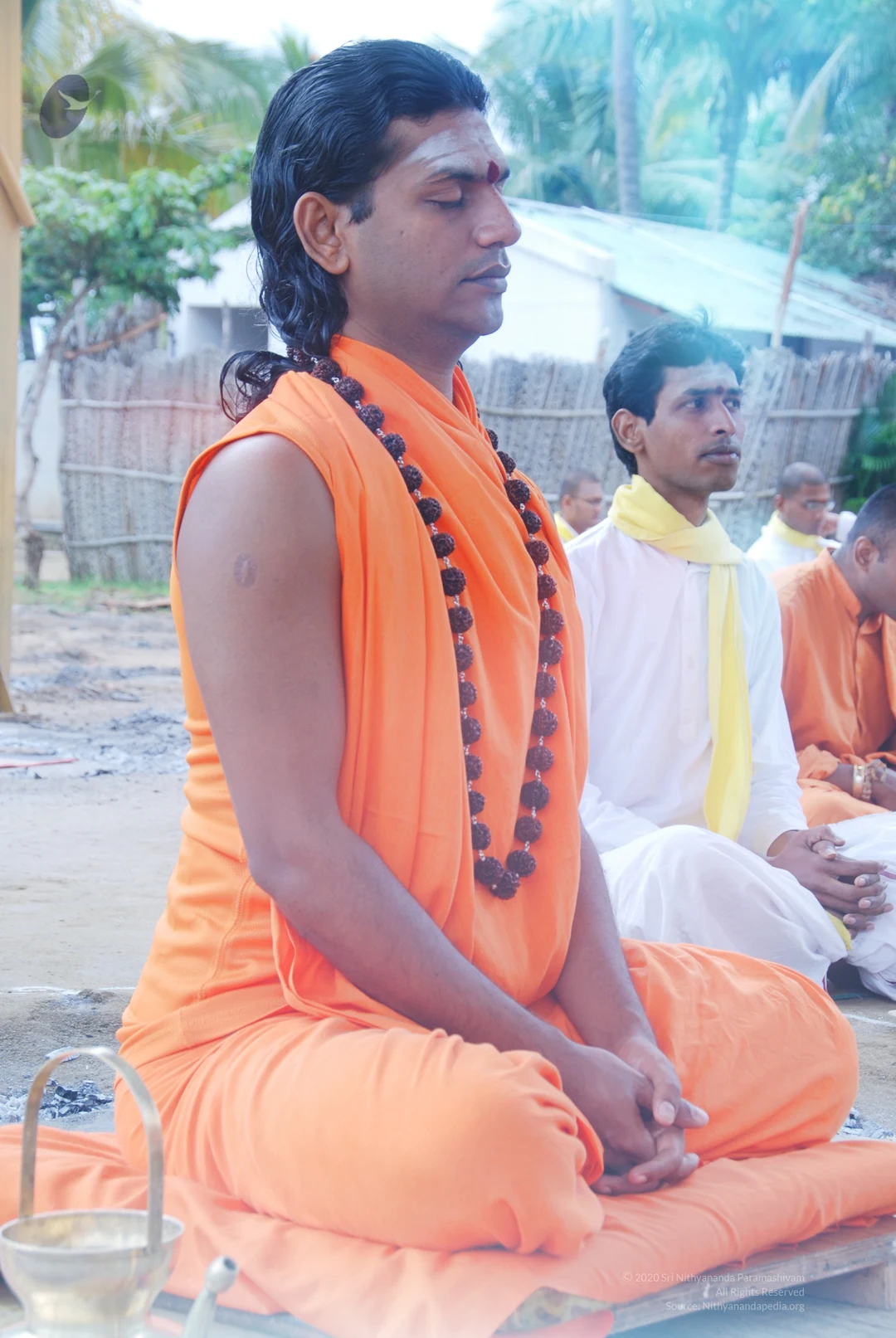
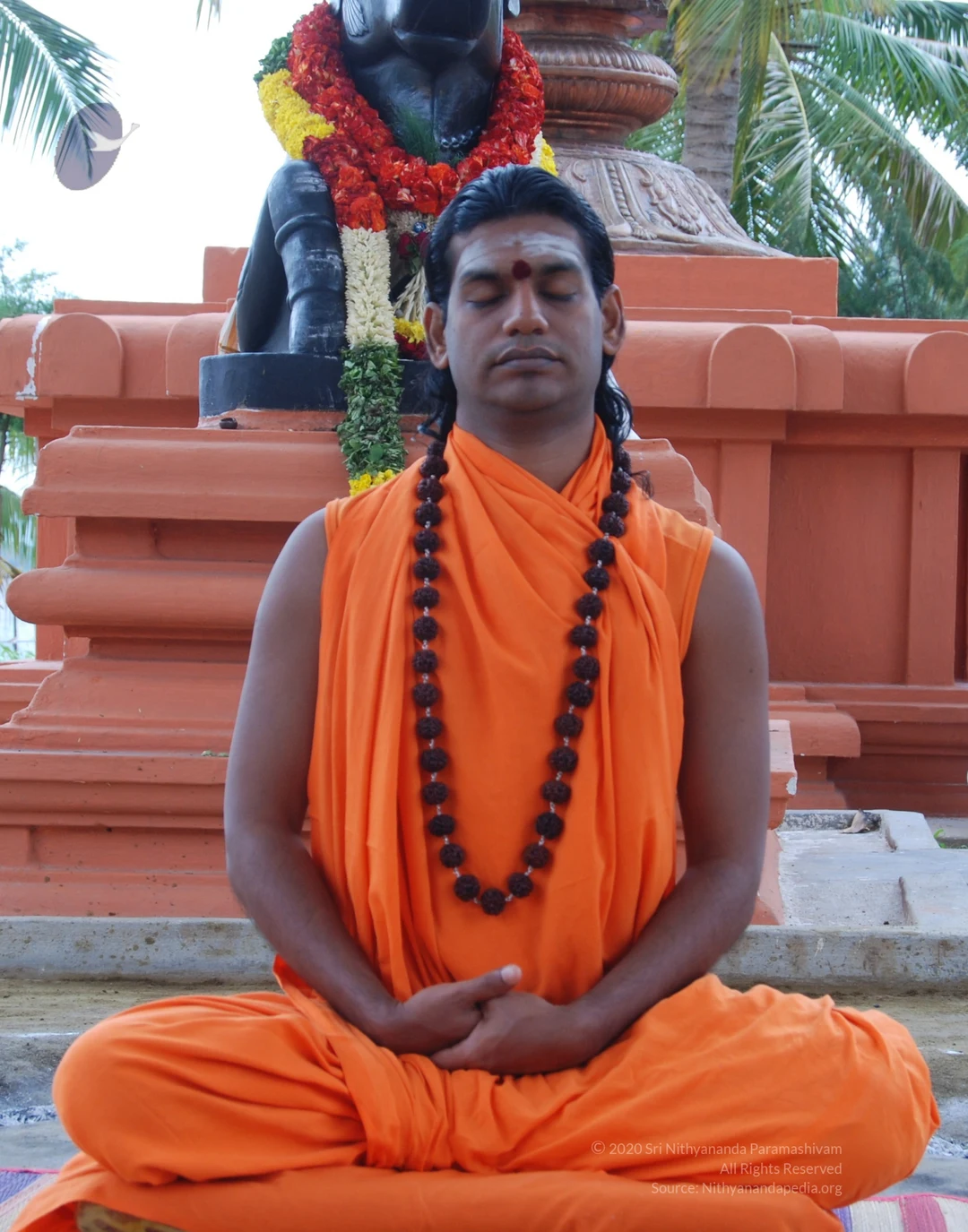
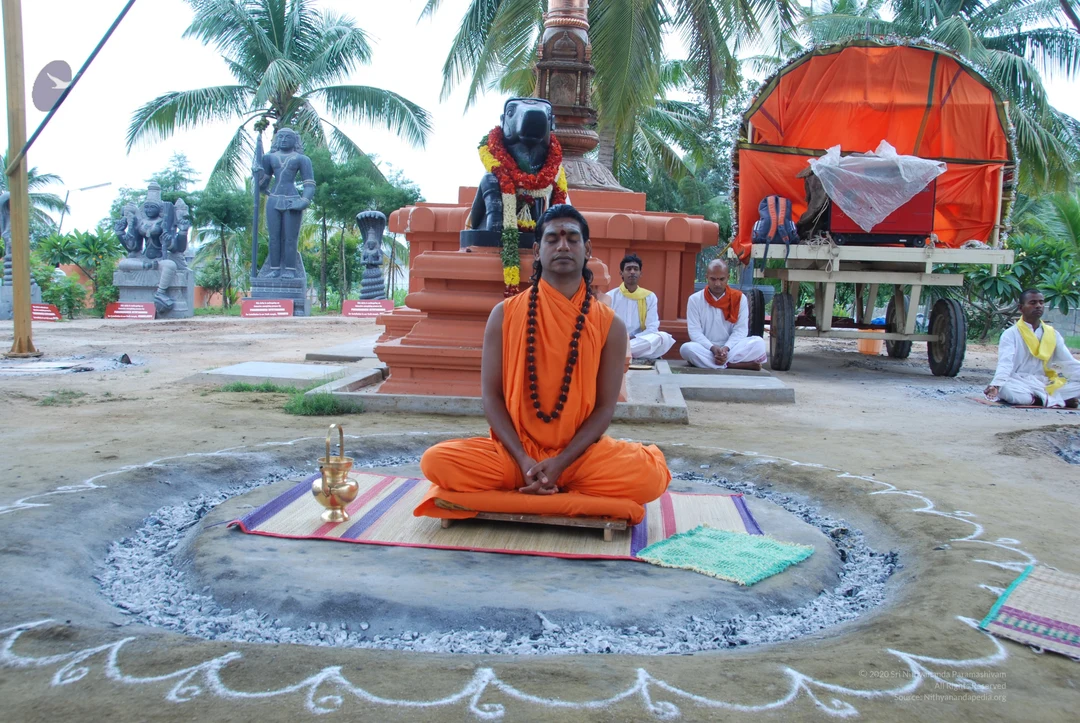
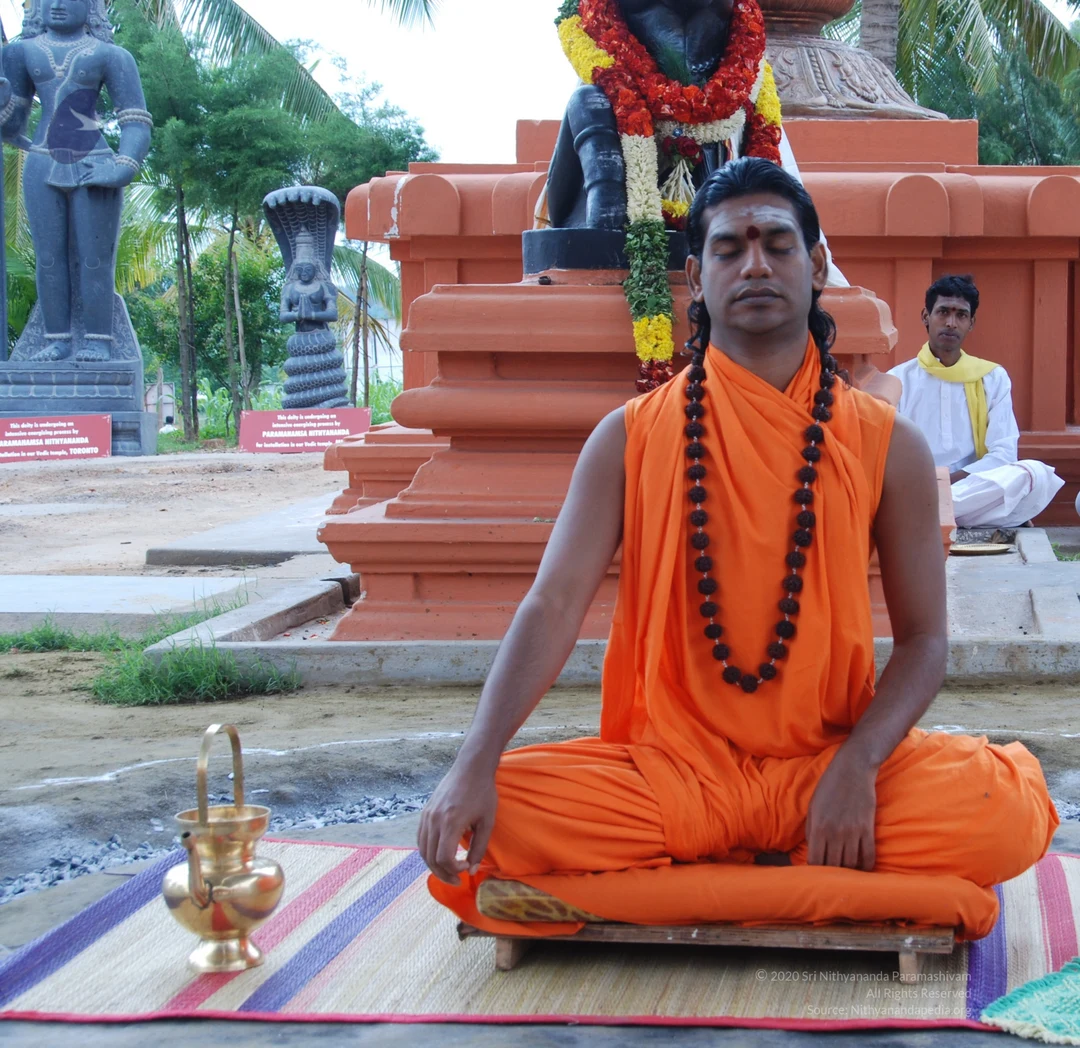
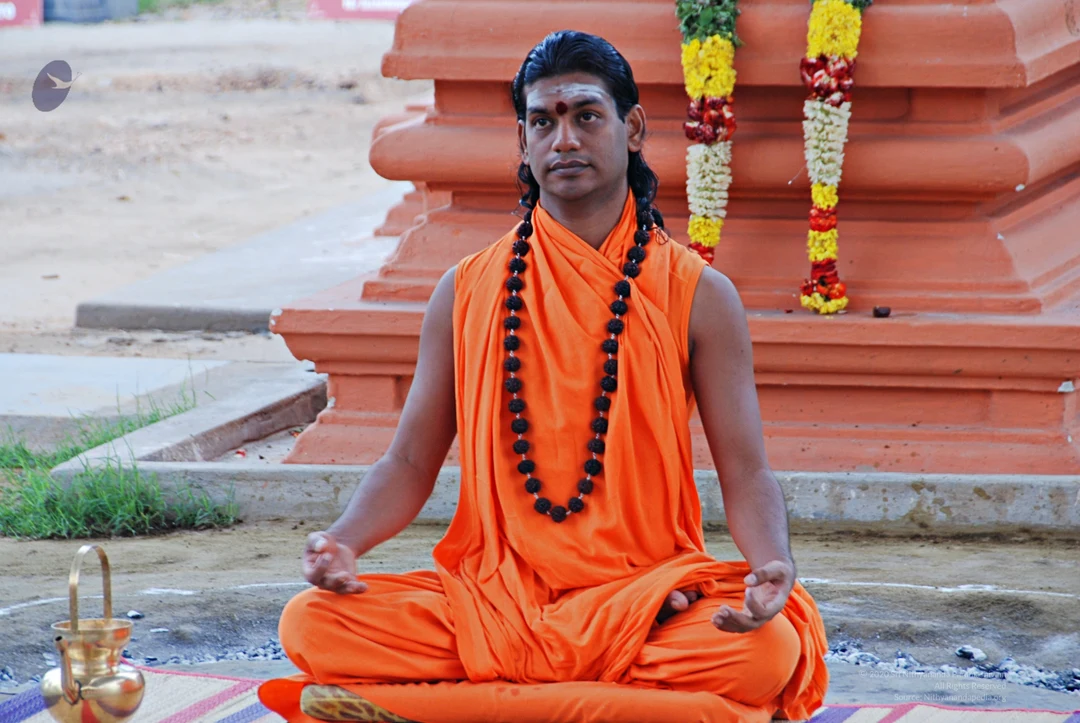
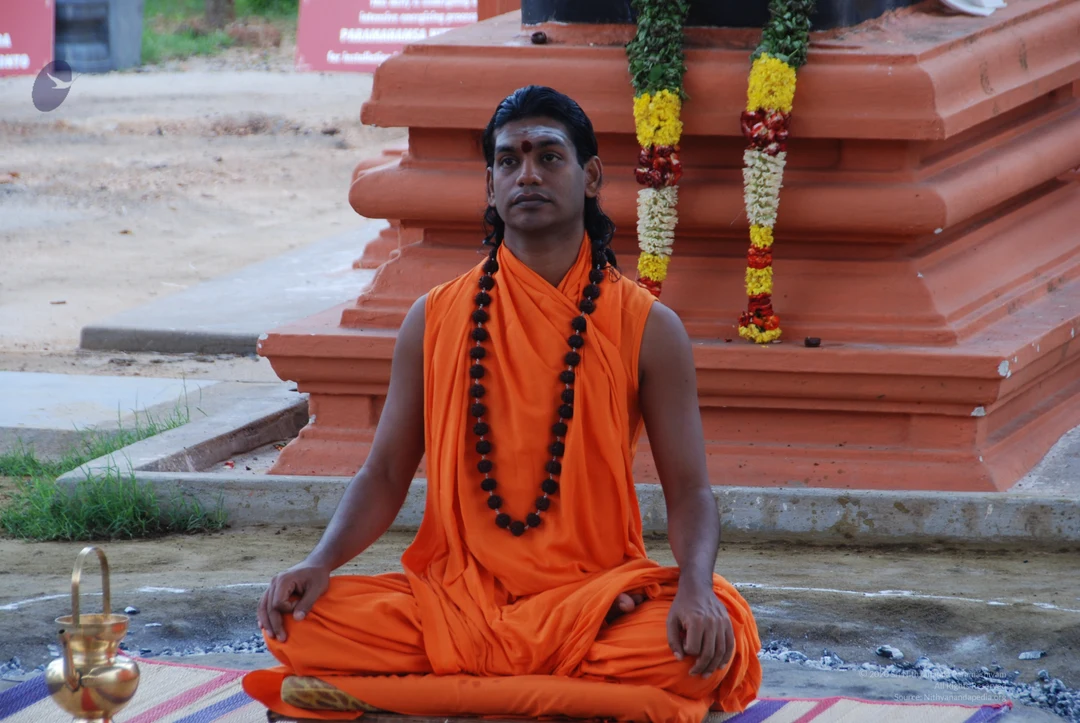
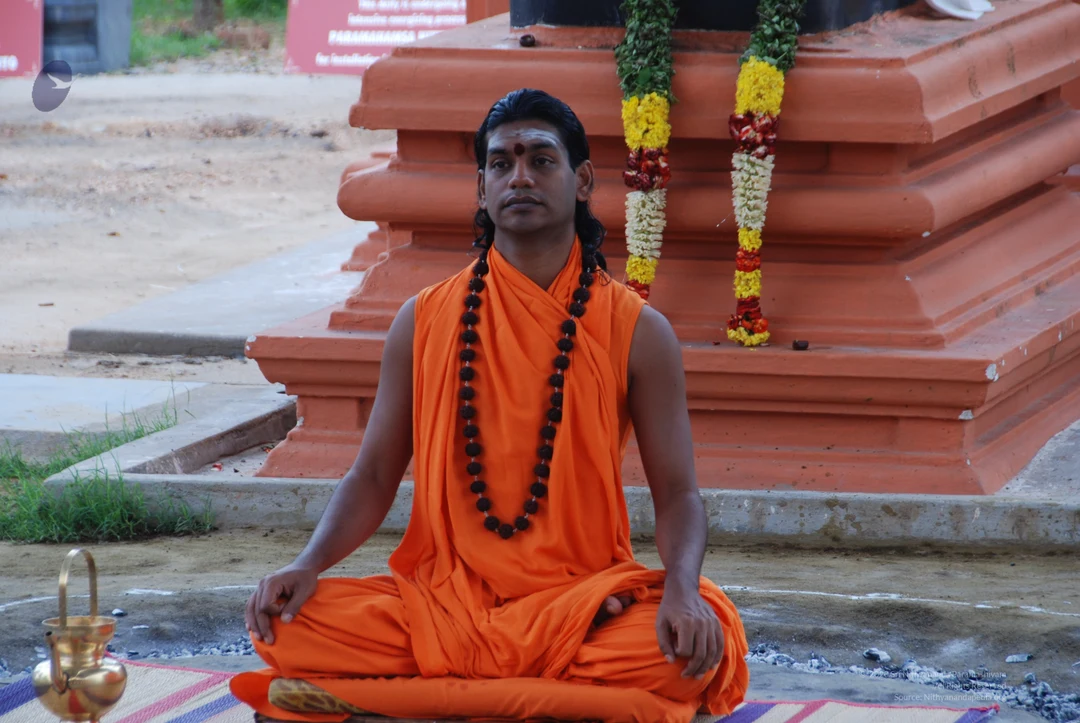
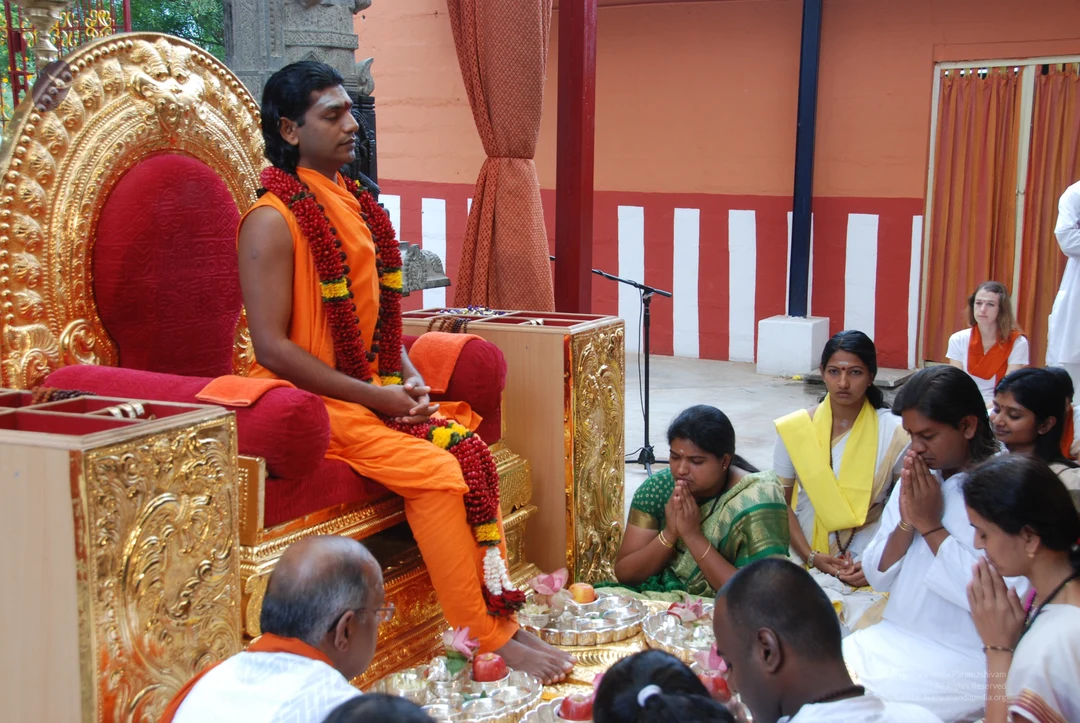
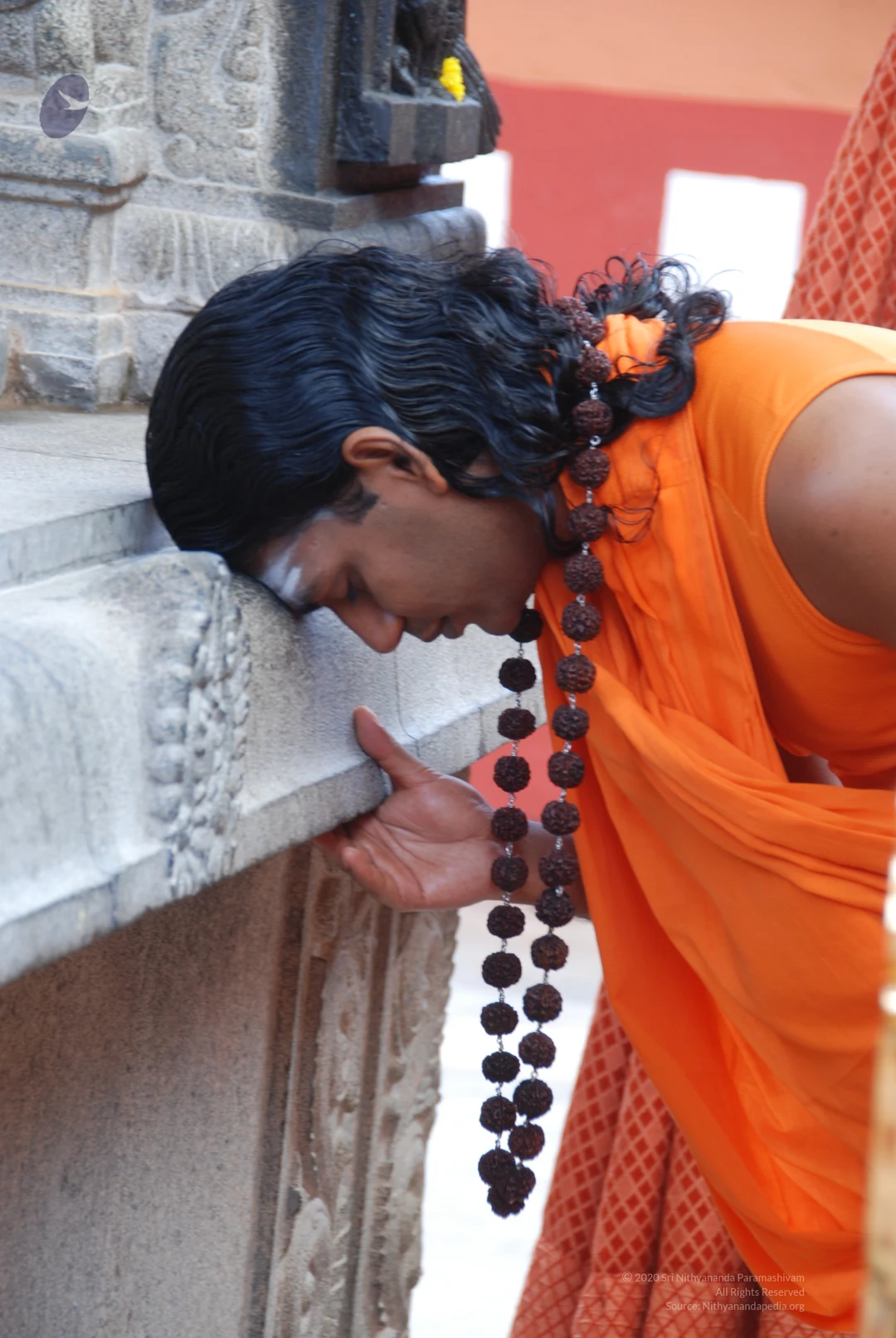
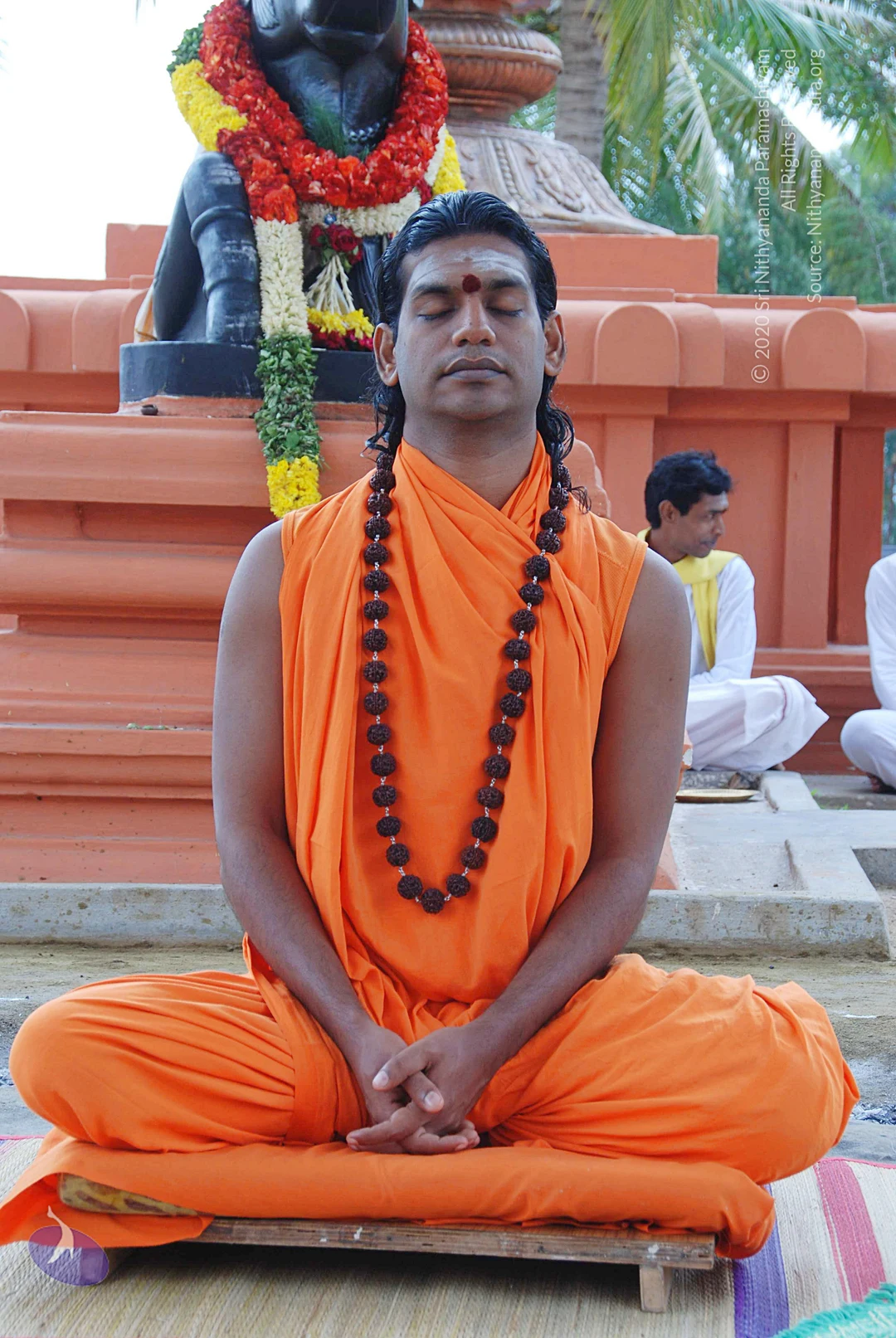
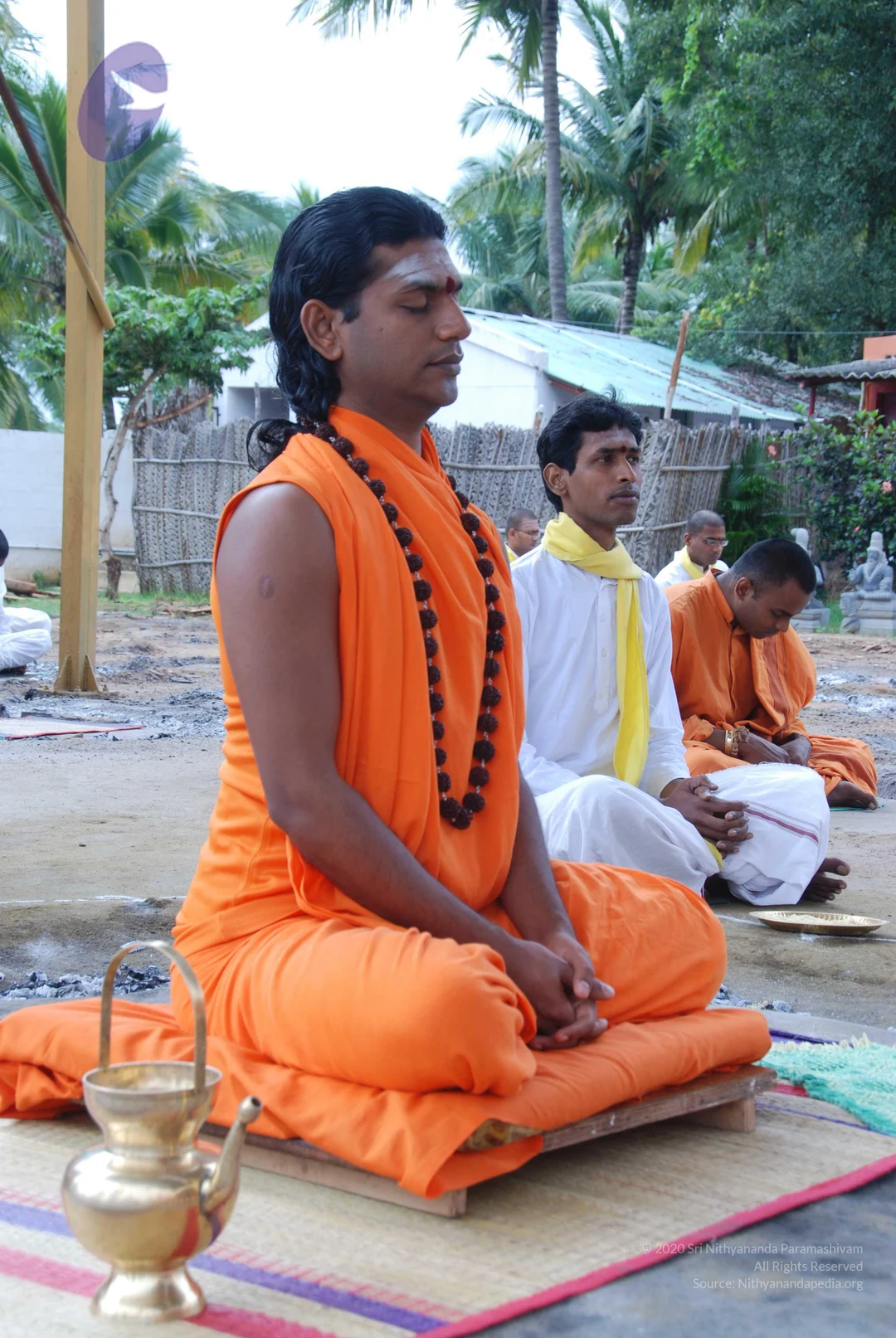
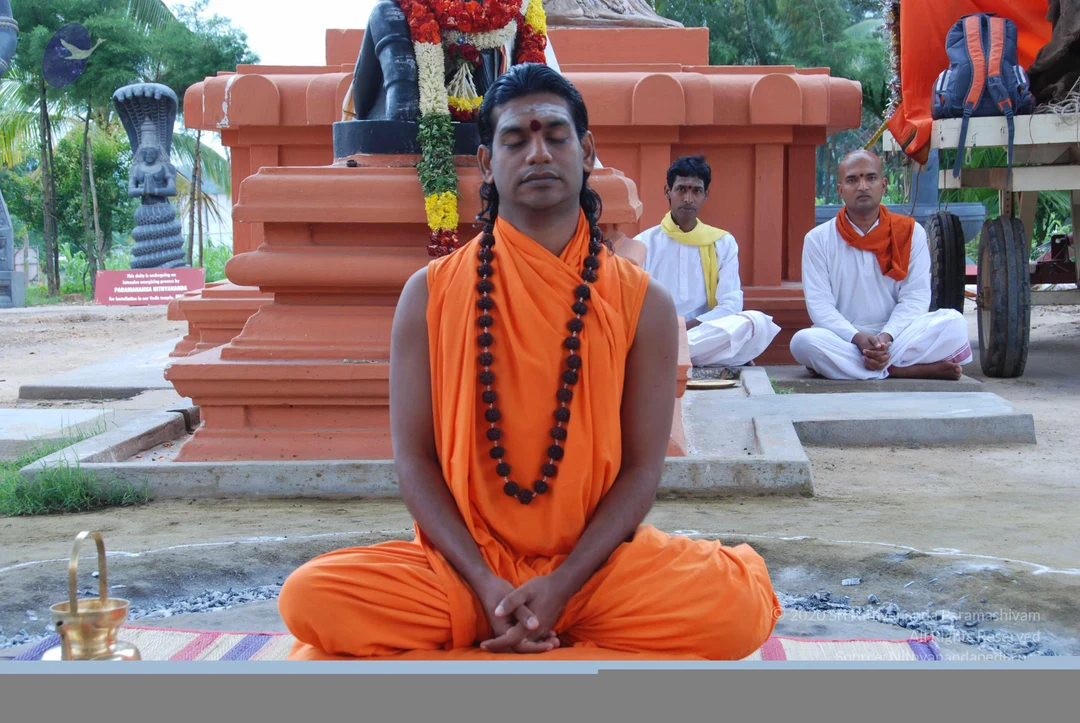
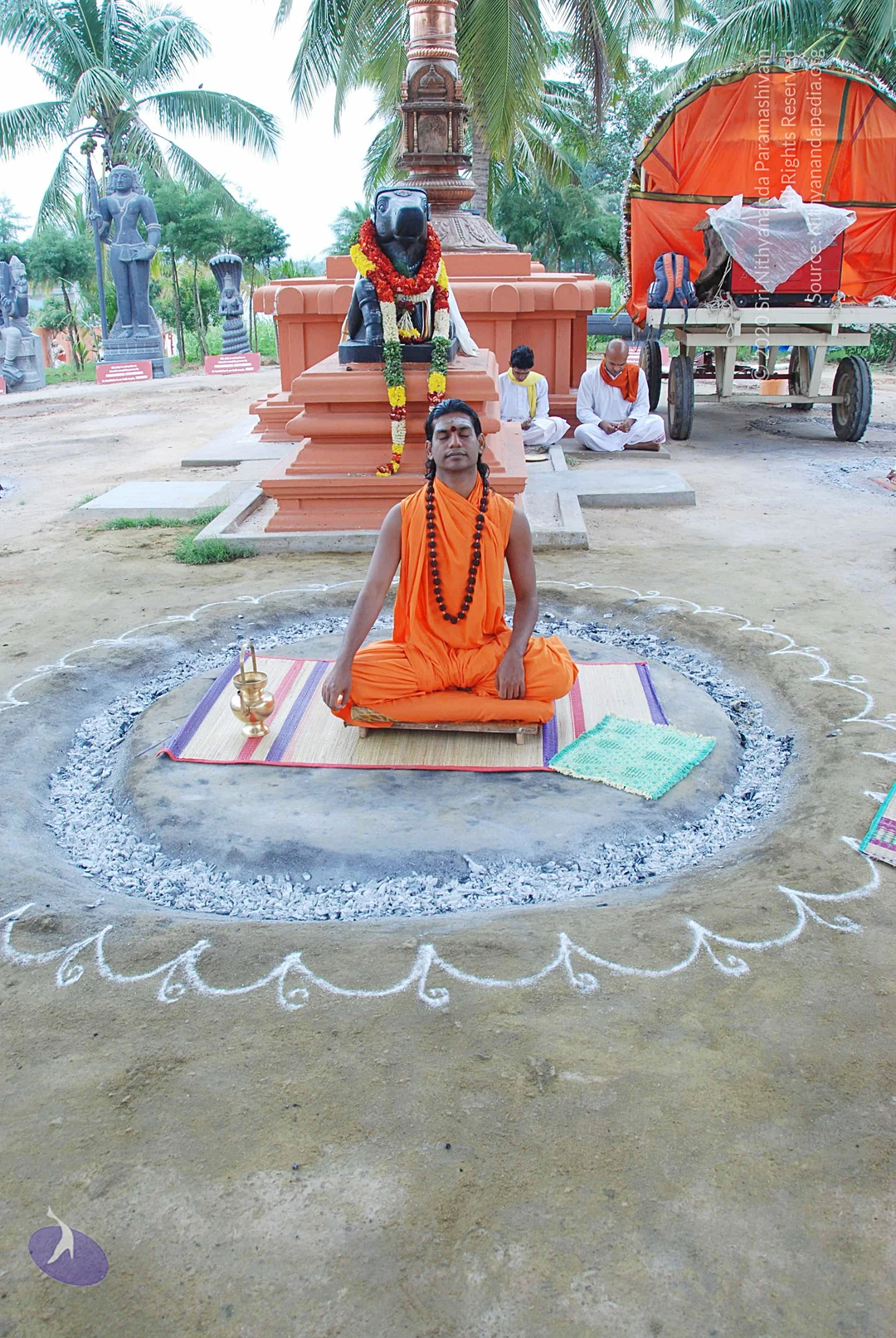
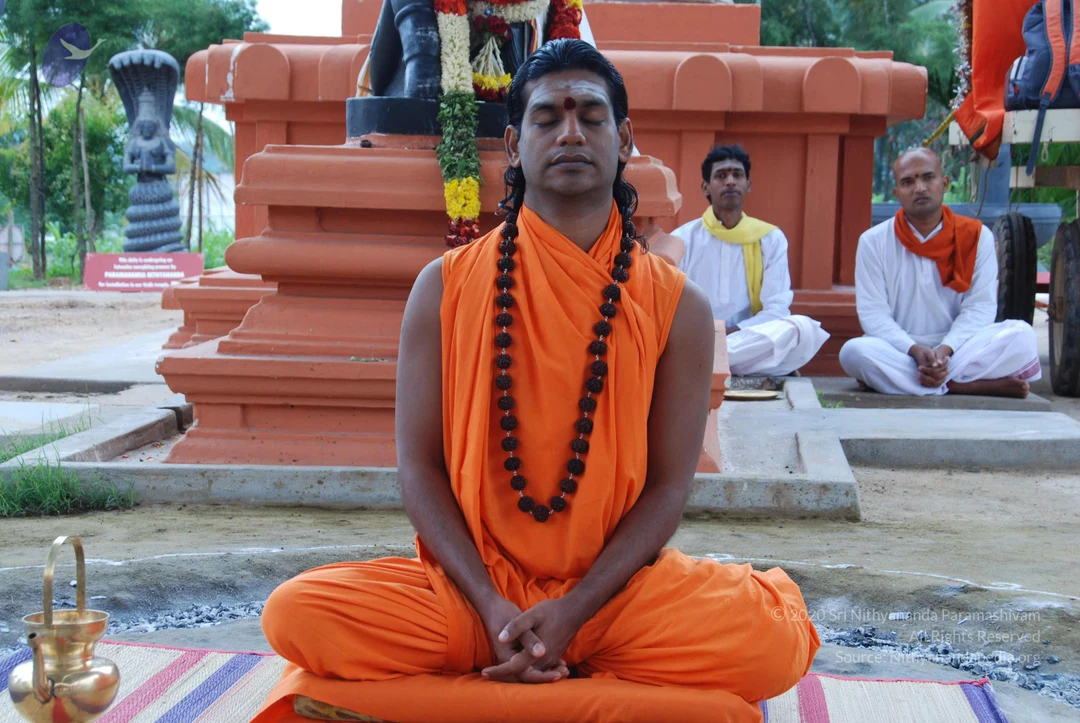
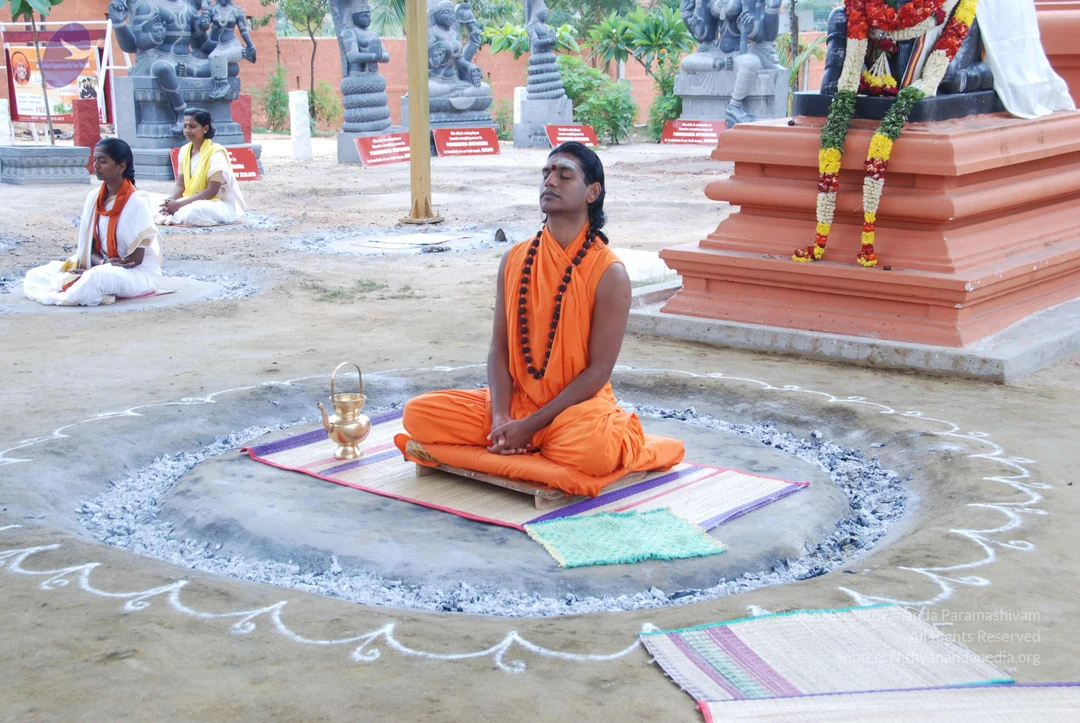
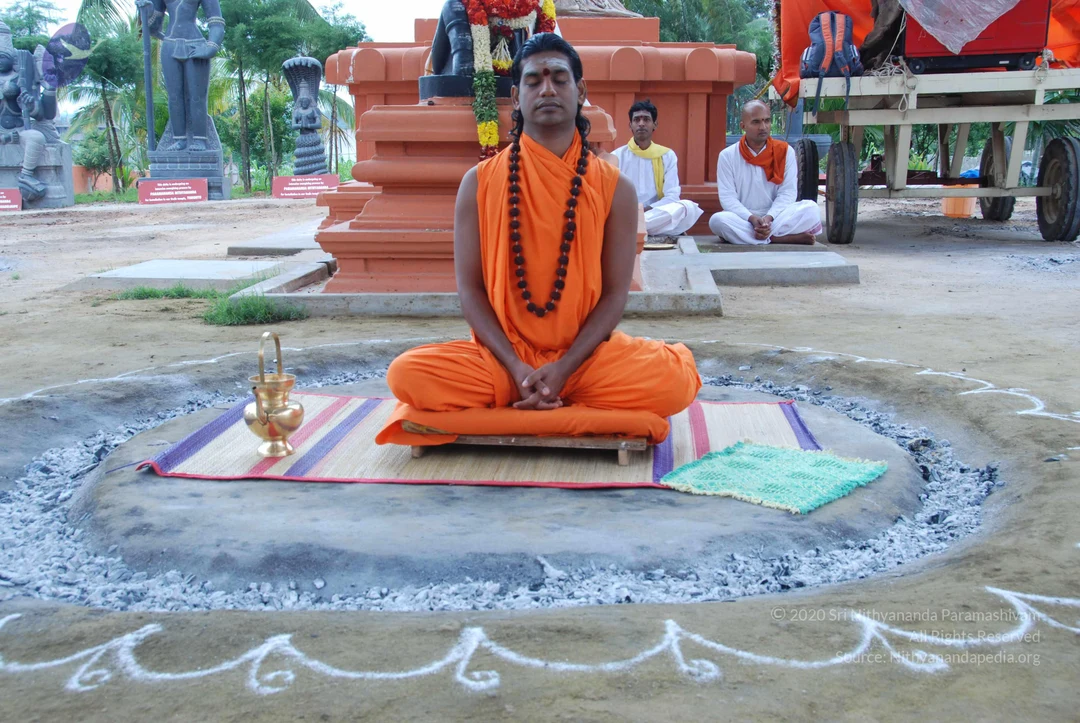
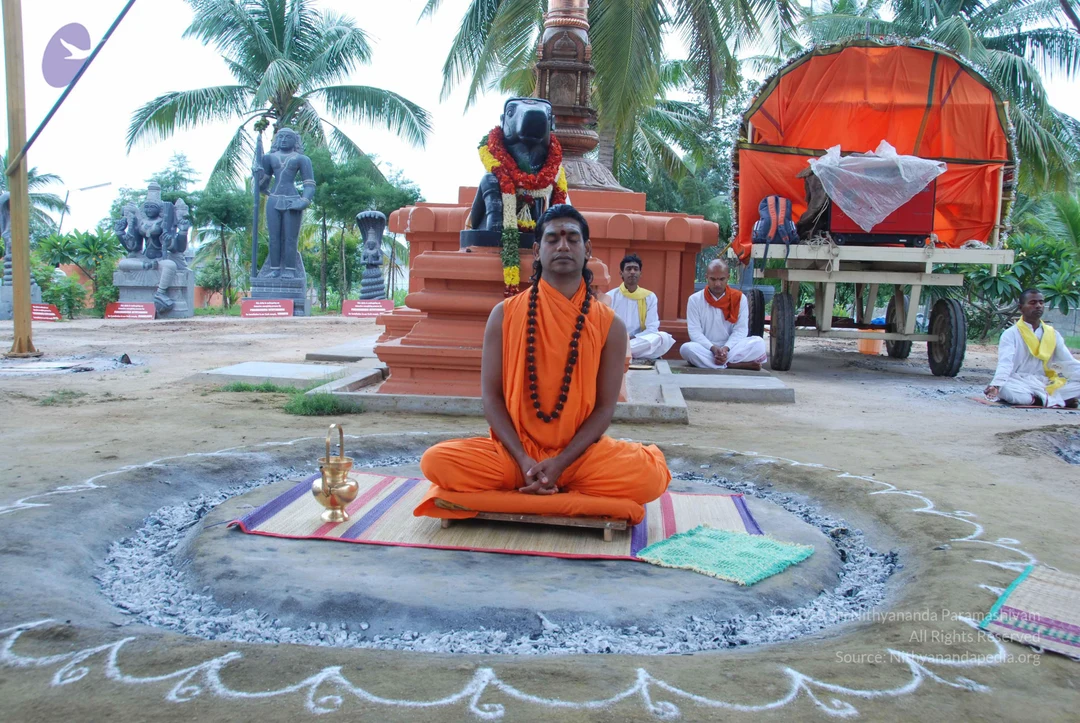
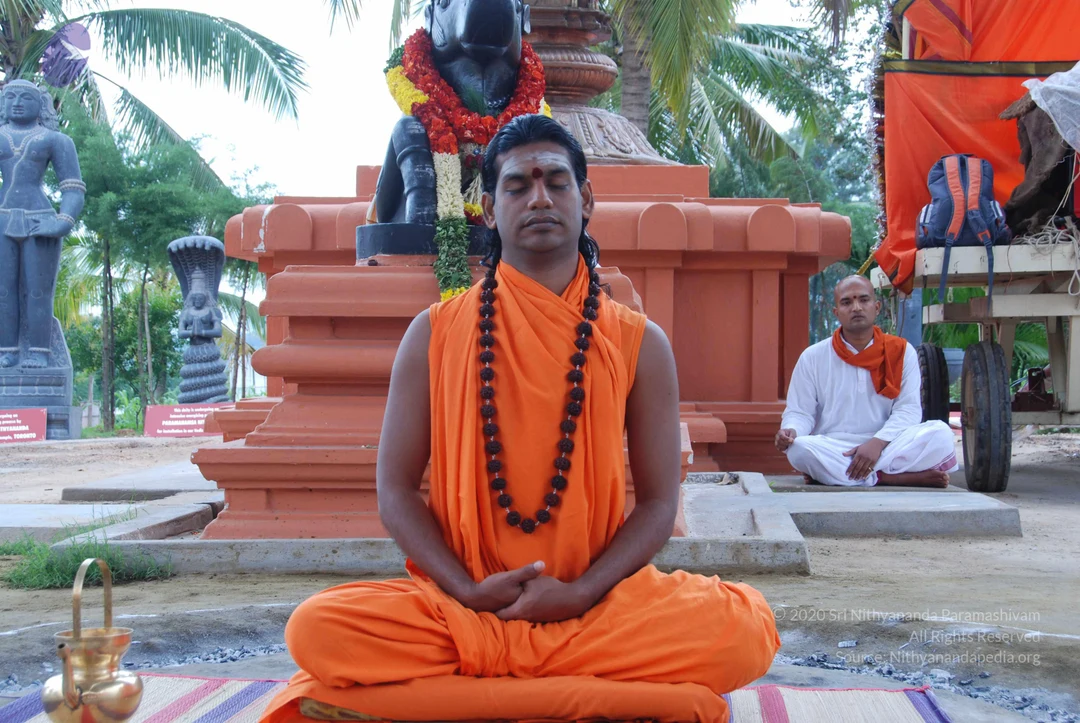
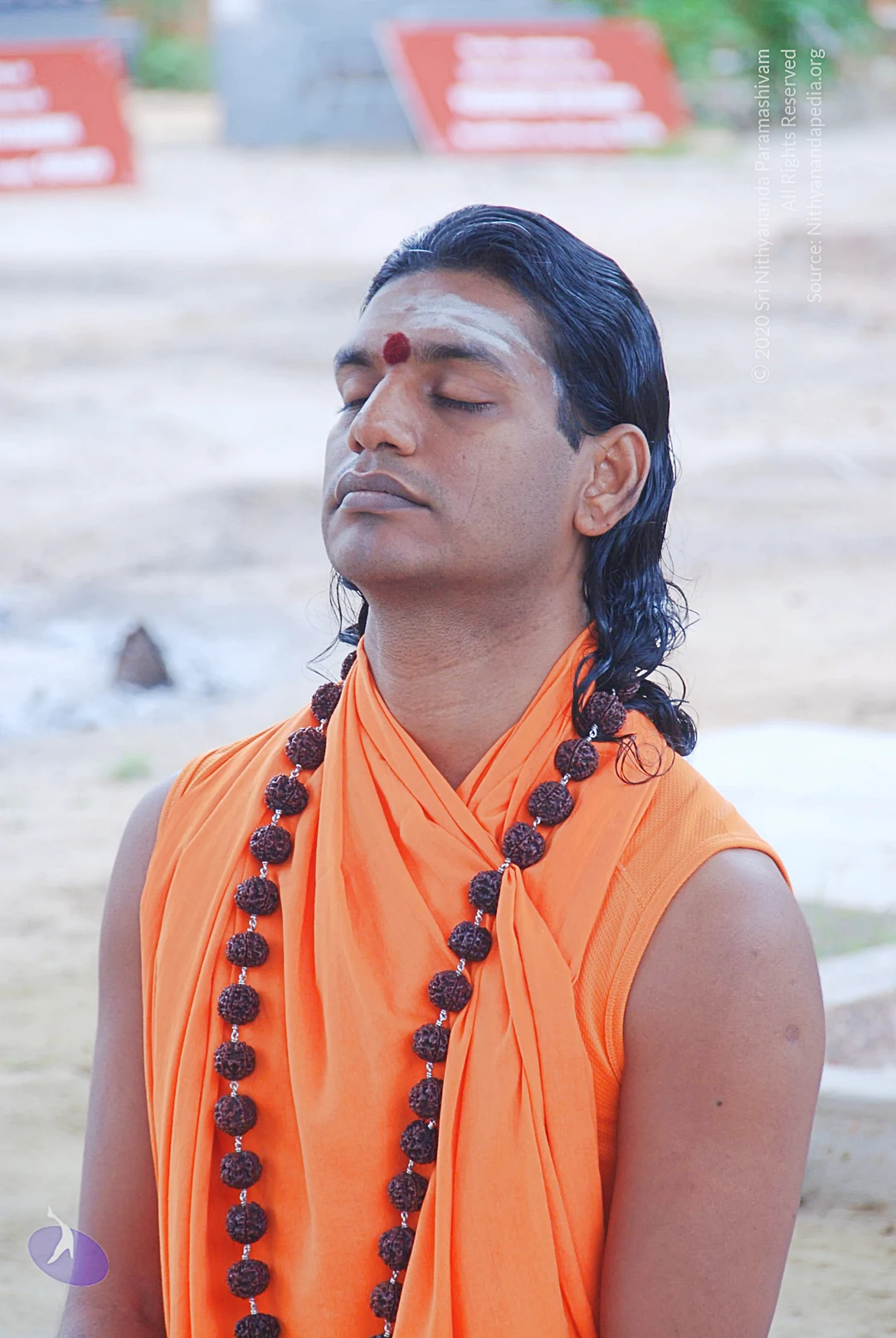
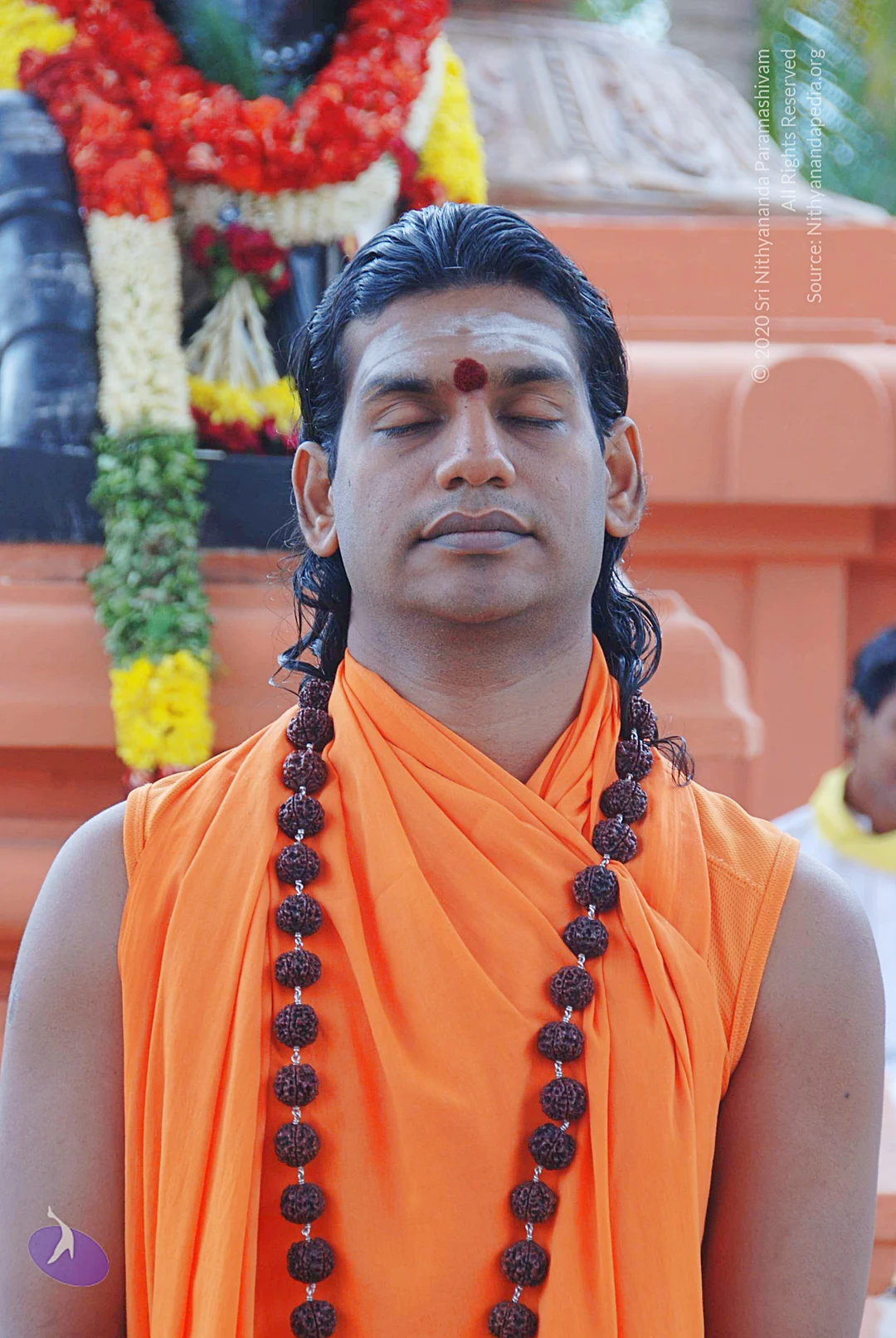
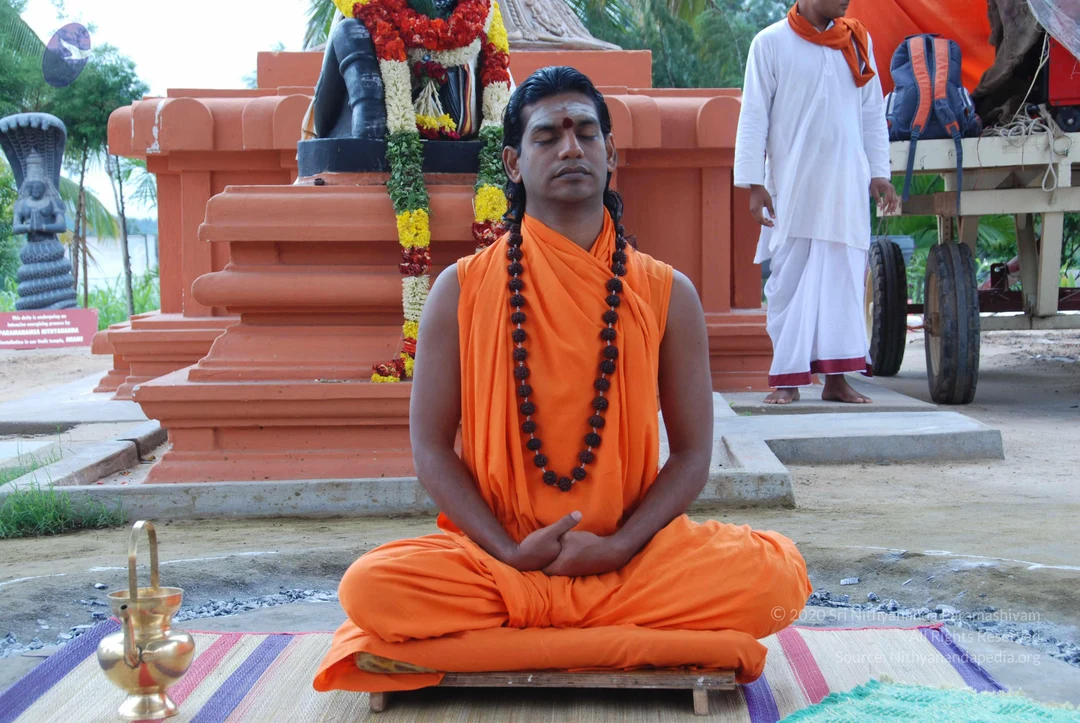
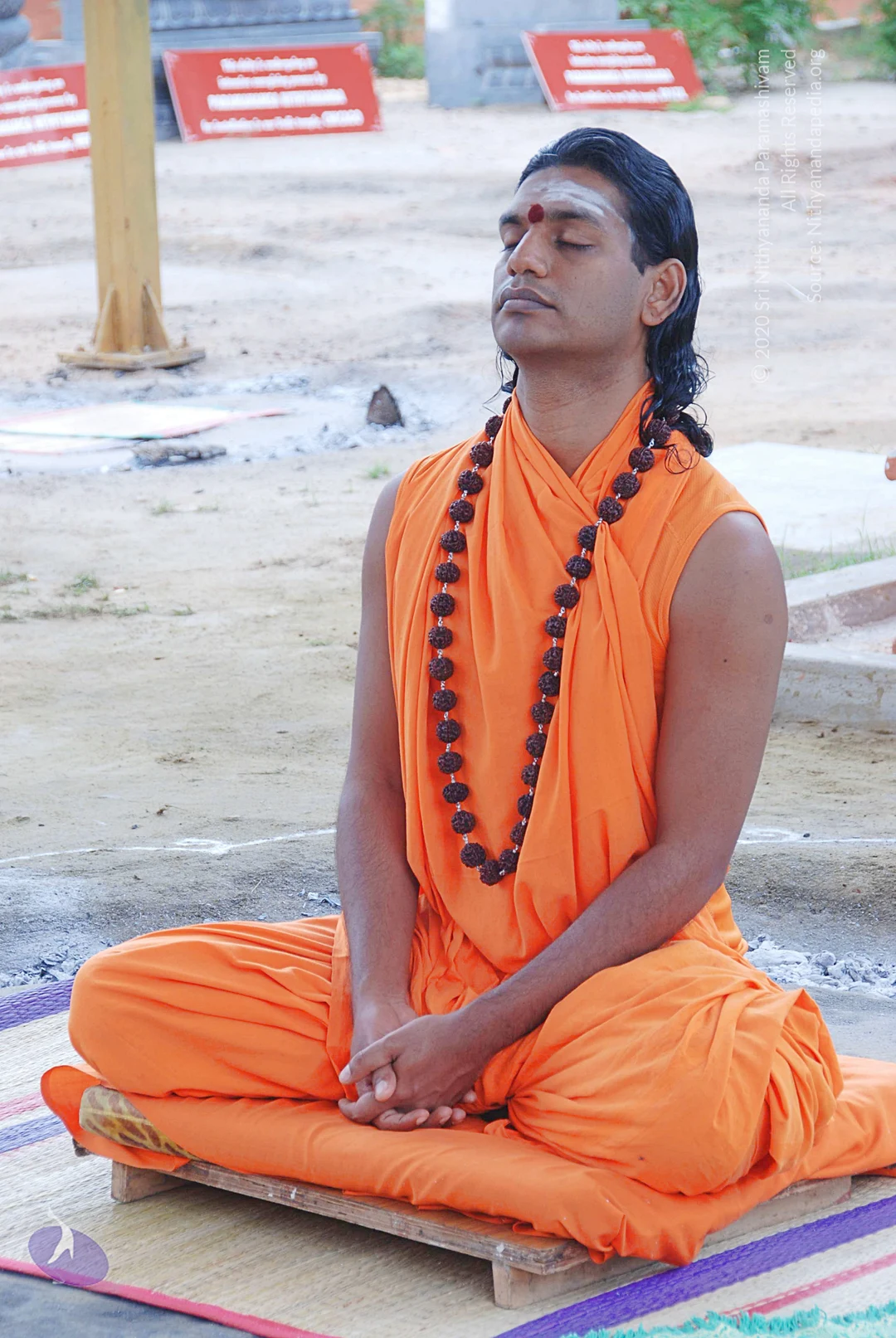
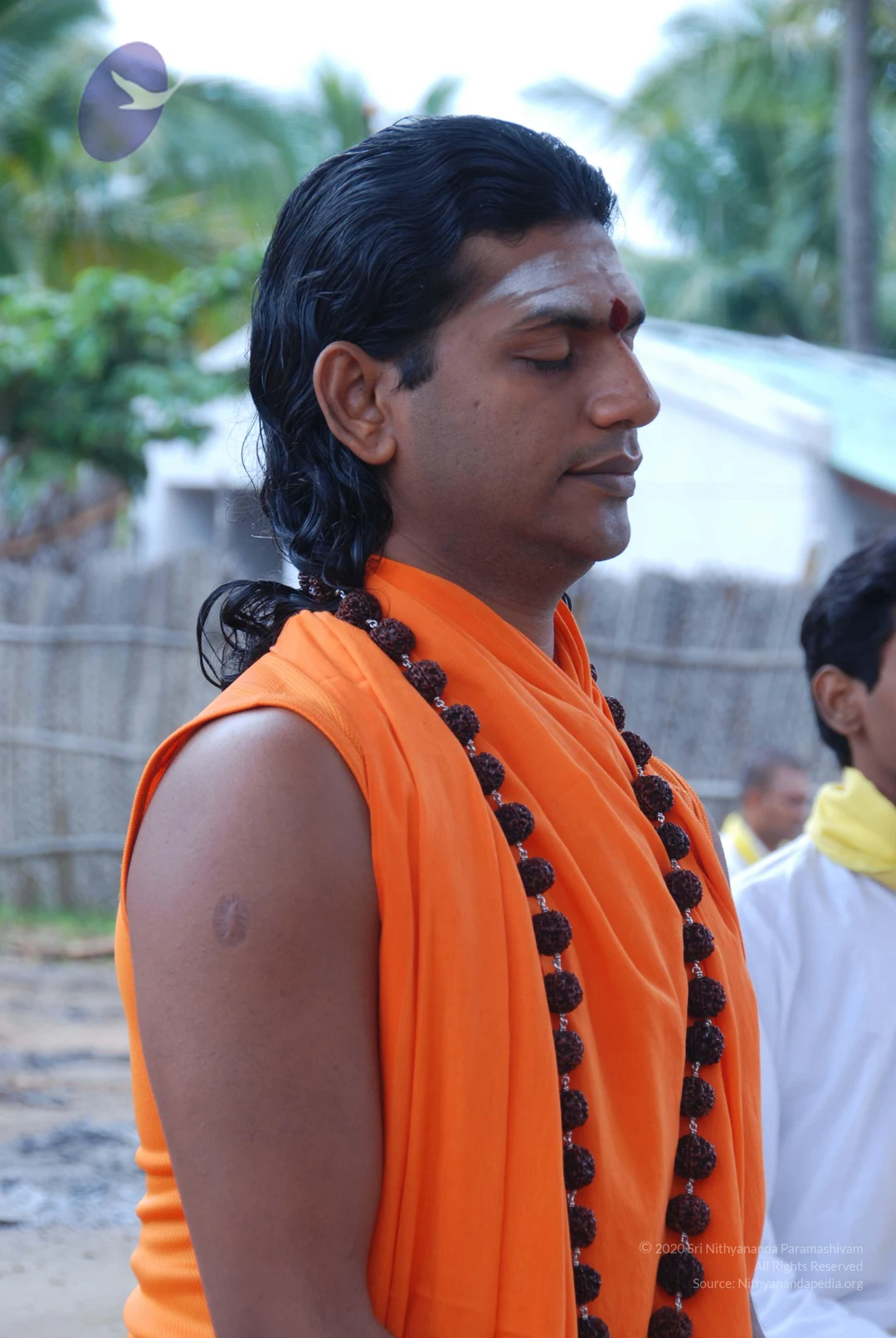
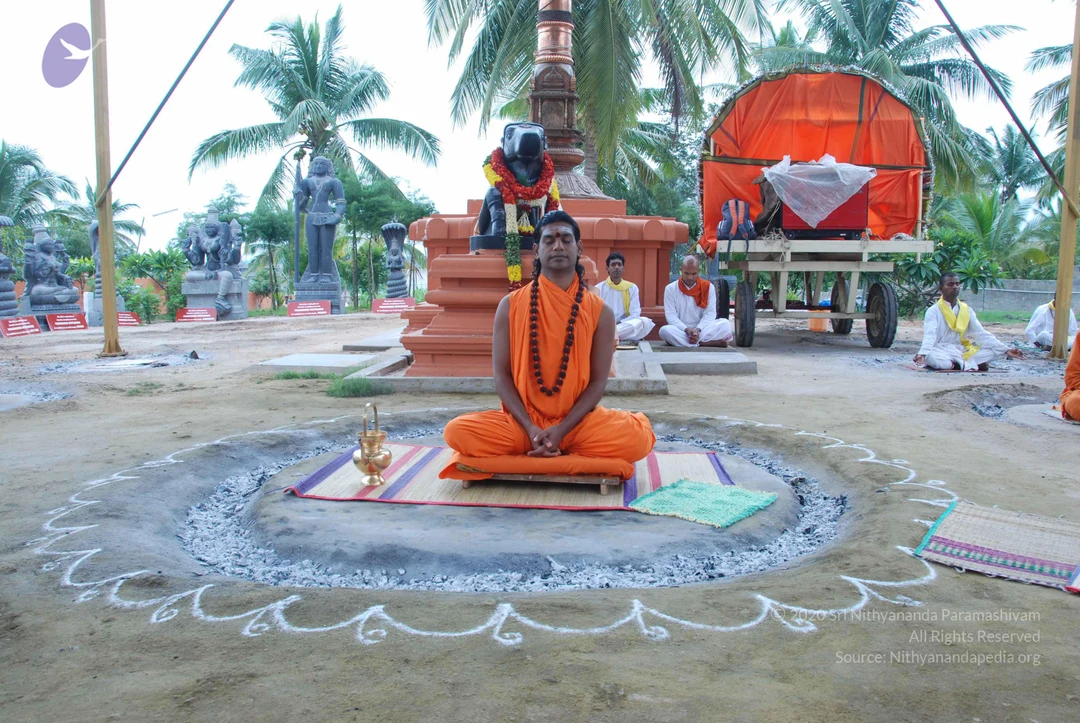
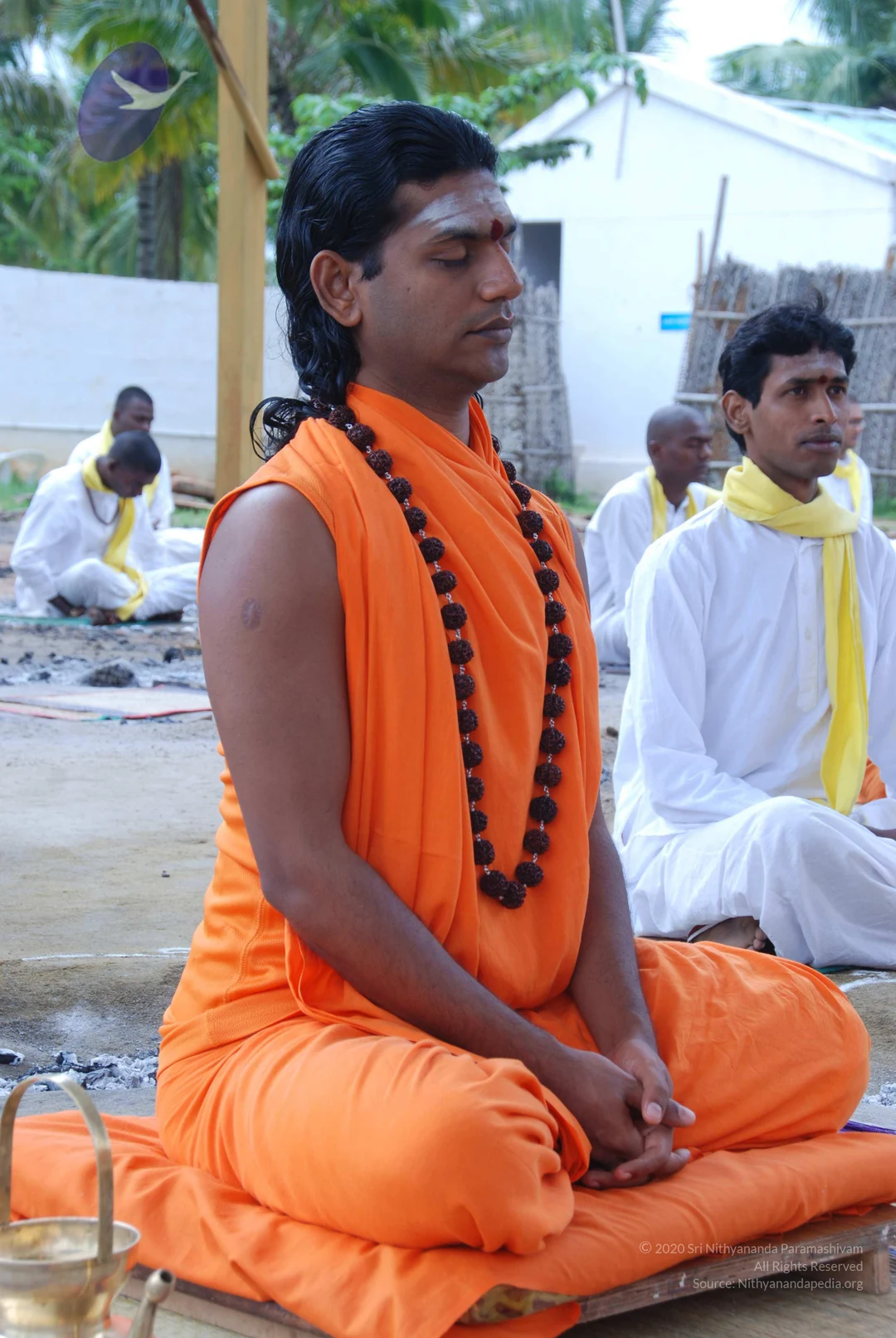
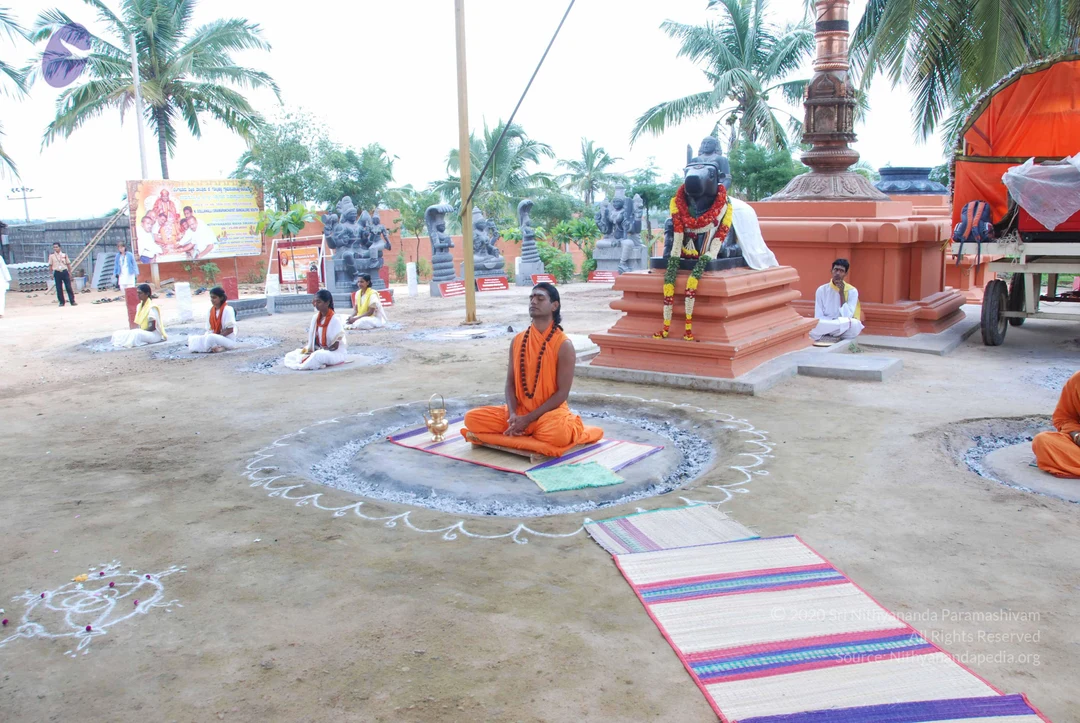
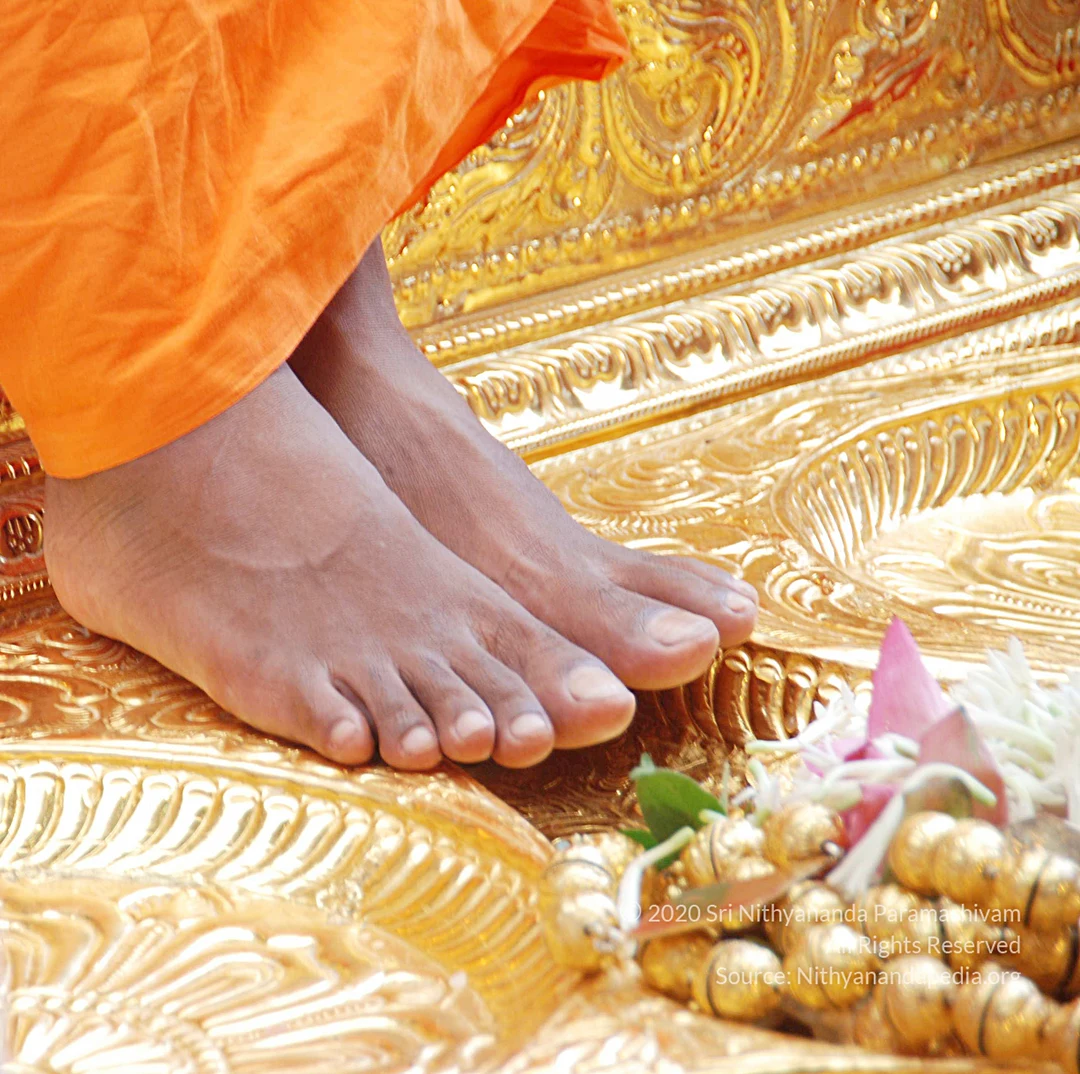
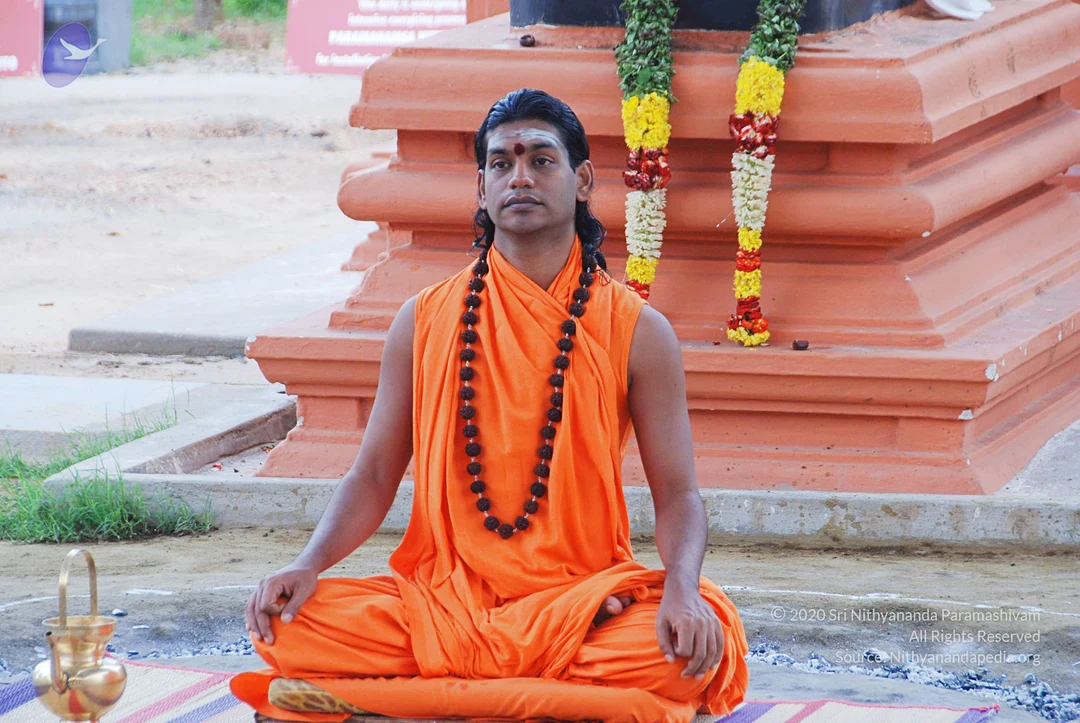
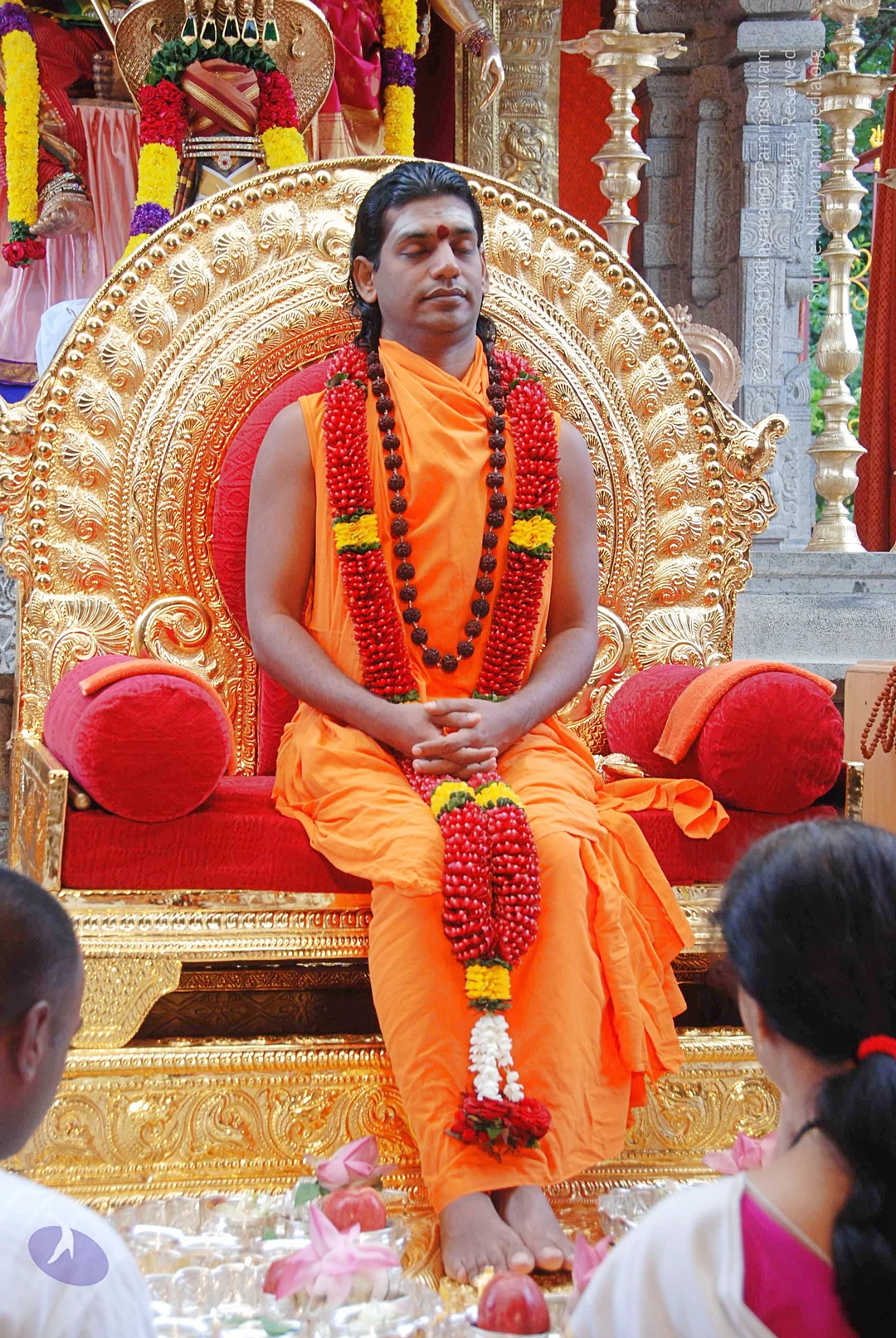
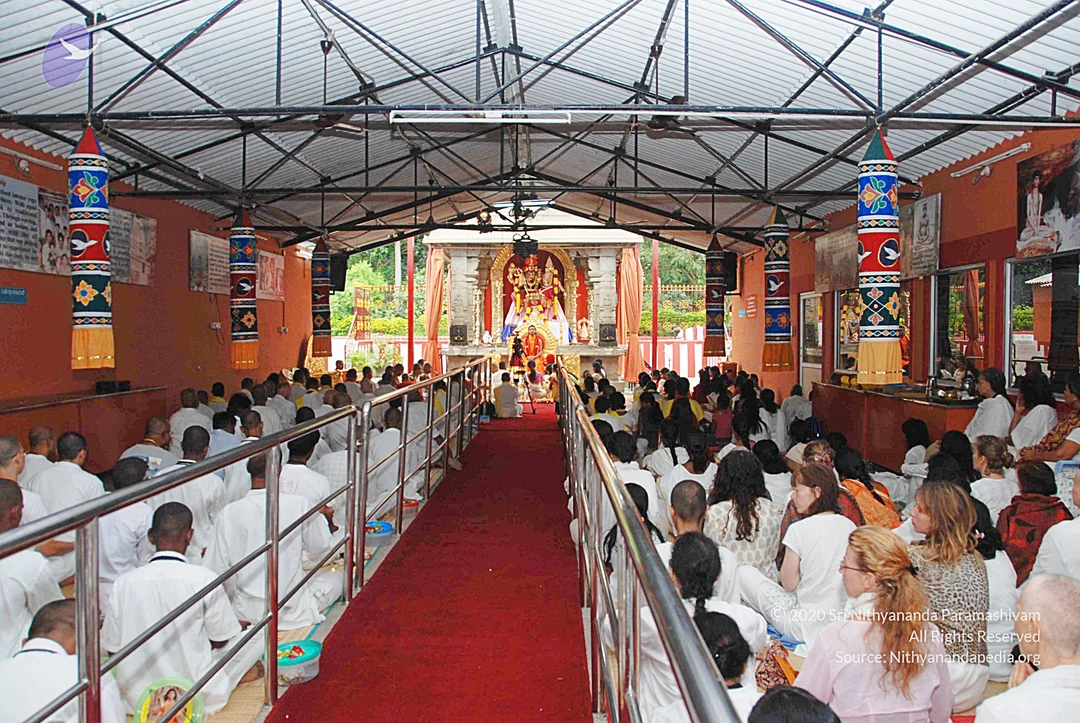
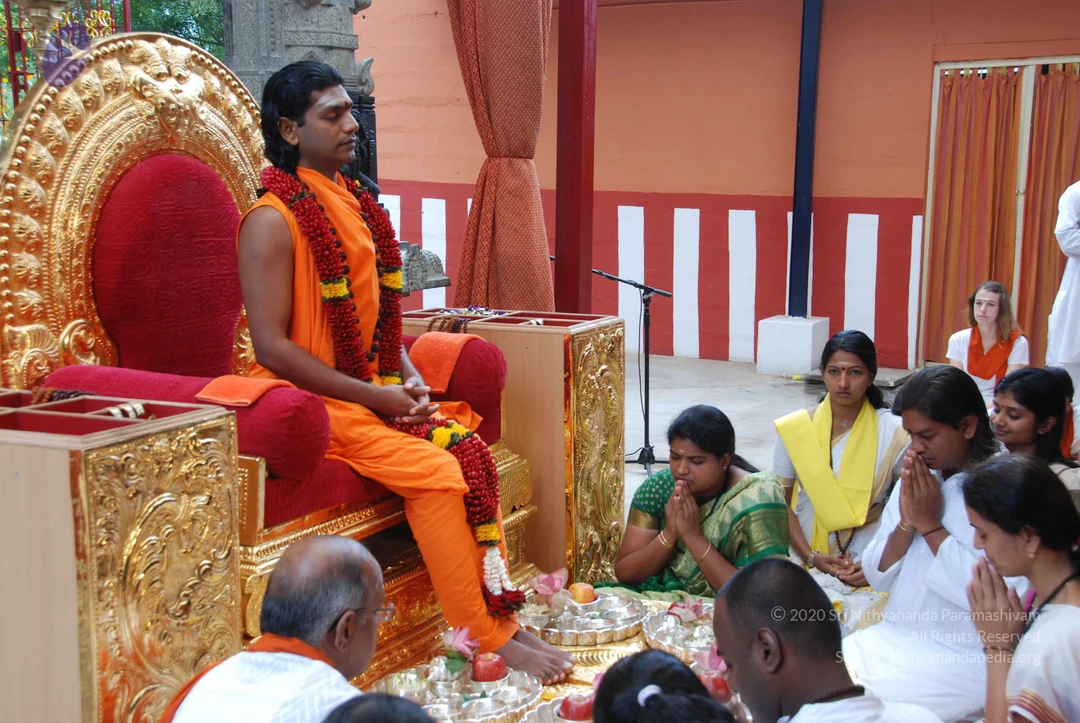
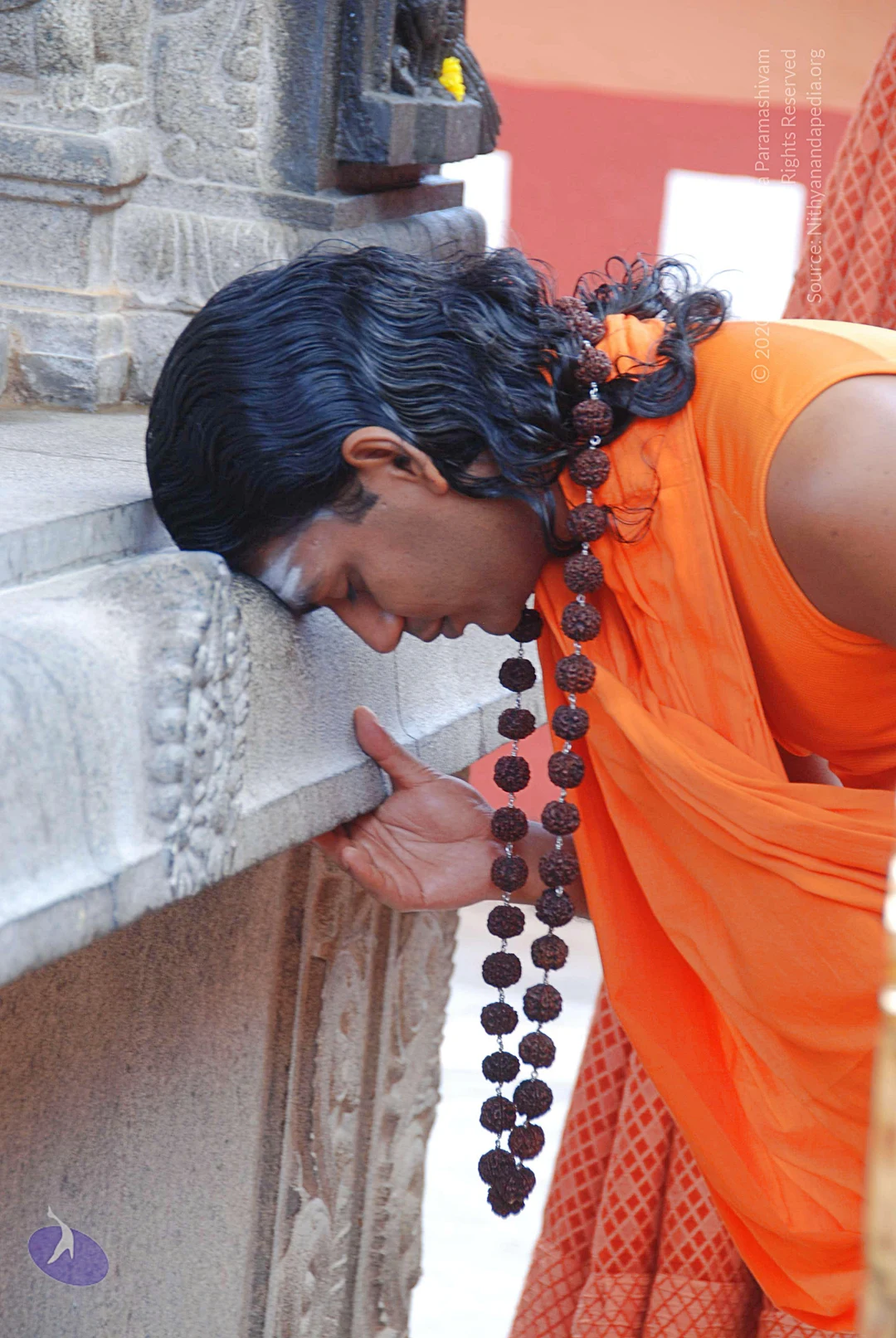
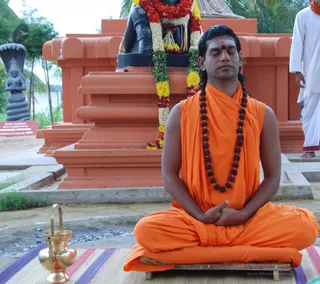
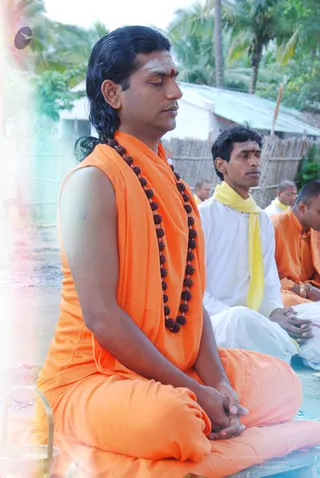
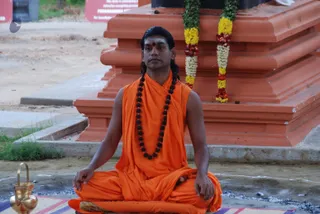
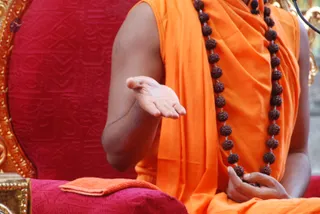
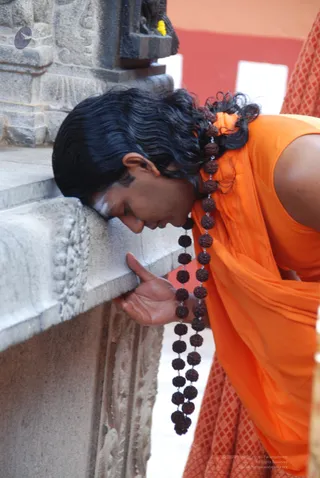
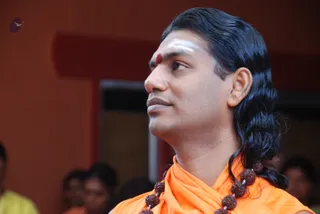
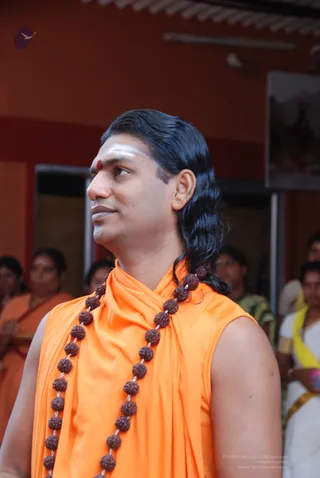
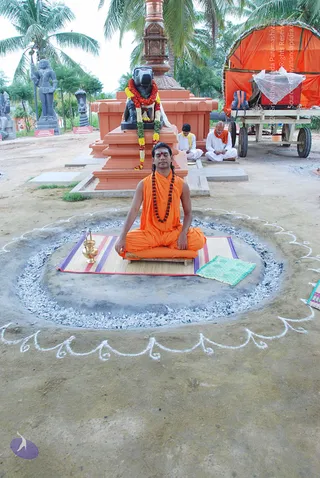
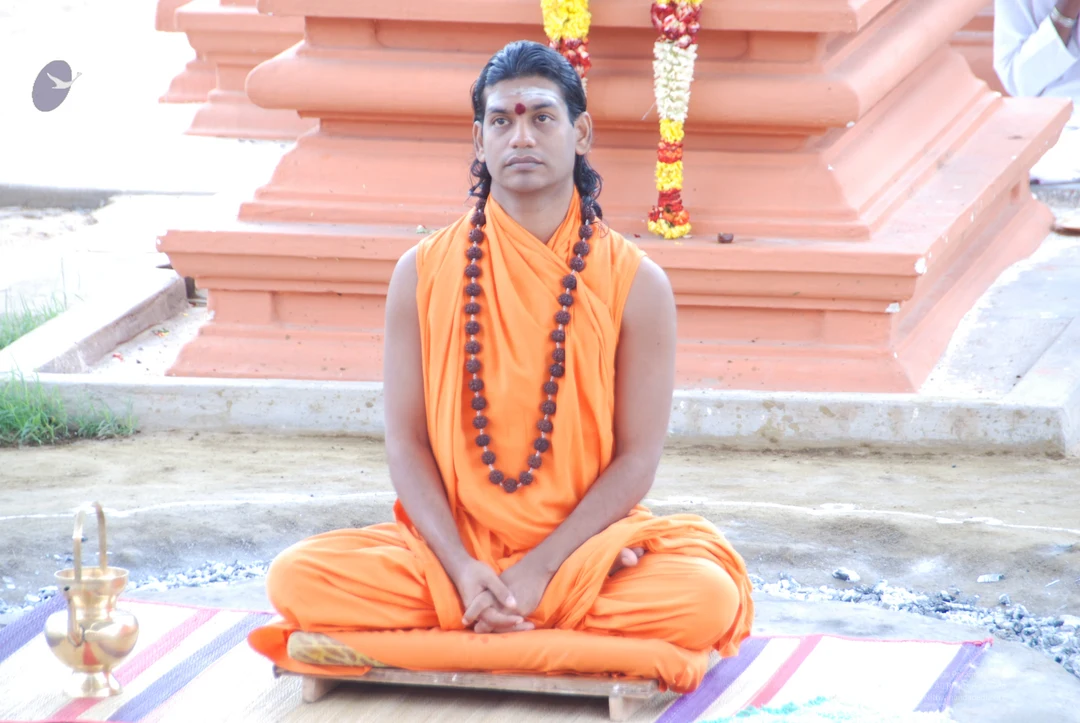
A man in an orange sleeveless top and orange patterned wrap leans forward to press his forehead and face against a carved grey stone ledge of a temple. He has long dark wavy hair, a white mark on his forehead, and a long rudraksha mala with brown beads hanging from his neck. His right hand rests flat on the stone. A small yellow flower sits on the carved stone above. The pose appears to be a reverent gesture at a temple structure.A seated man in saffron-orange robes sits cross-legged on a striped mat in meditation, eyes closed, hands resting in his lap. He wears a long rudraksha mala with dark beads, a red bindi and an upswept hairstyle. Behind him, a red-orange stone pedestal is draped with a garland of red and yellow flowers, and a black deity murti stands on top. Two seated men in white clothes with yellow and orange shawls sit to the right beside a cart. A small brass vessel sits at the lower left, and a sign with text stands on the ground behind. Outdoor ashram setting with palms and a cobra-hooded stone figure at left.A man with swept-back long dark hair sits cross-legged in meditation with eyes closed and hands clasped in his lap on a striped mat and wooden seat. He wears an orange saffron wrap and garment, a long rudraksha mala around his neck, and a red bindi on his forehead. Behind him stands a dark stone deity murti draped with a red and yellow marigold garland, set against a terracotta-coloured shrine wall with palm fronds. Two other men in white dhotis sit in the background to the right.

September 07 2010

Original wiki page
Contents

Title:

Description:

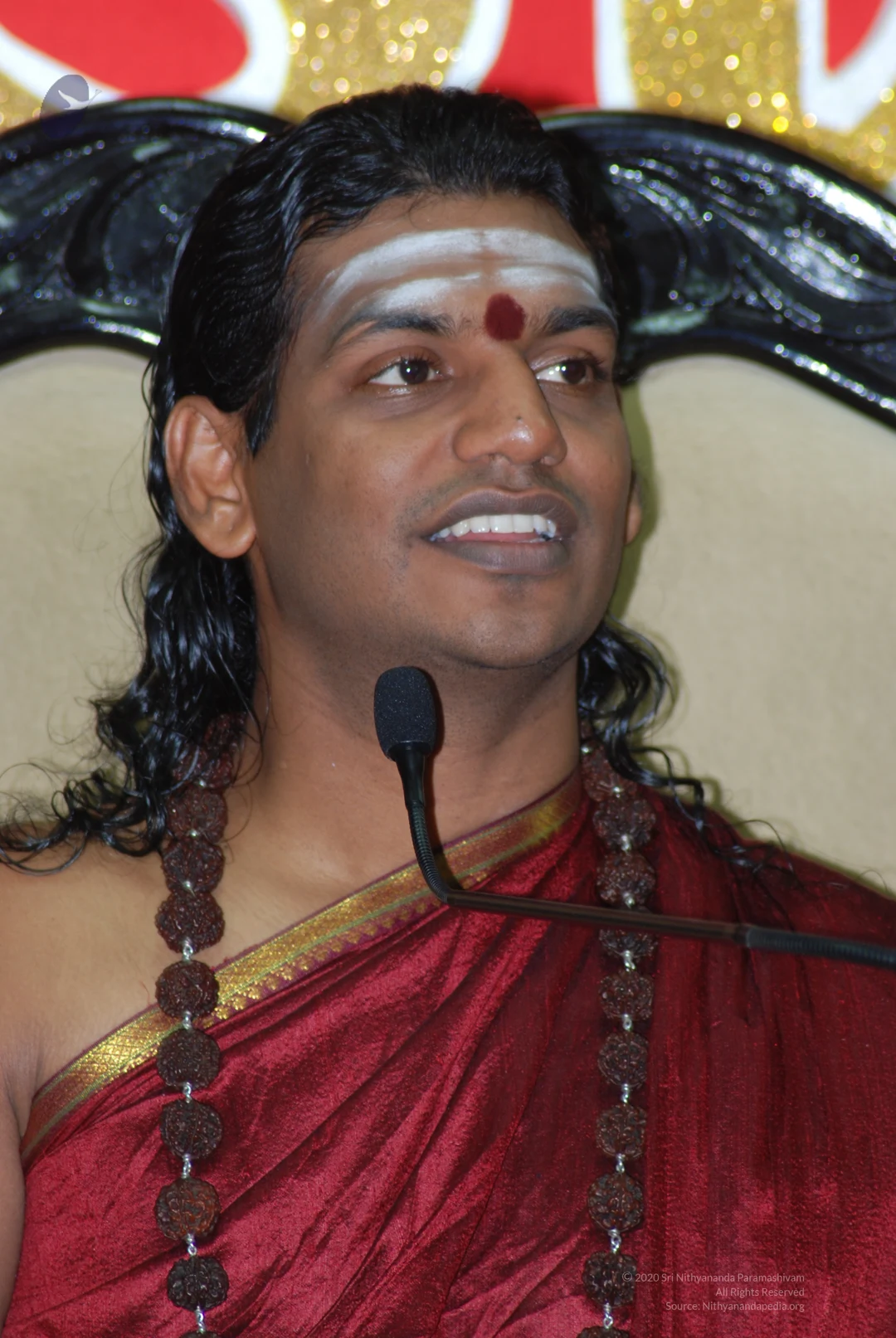
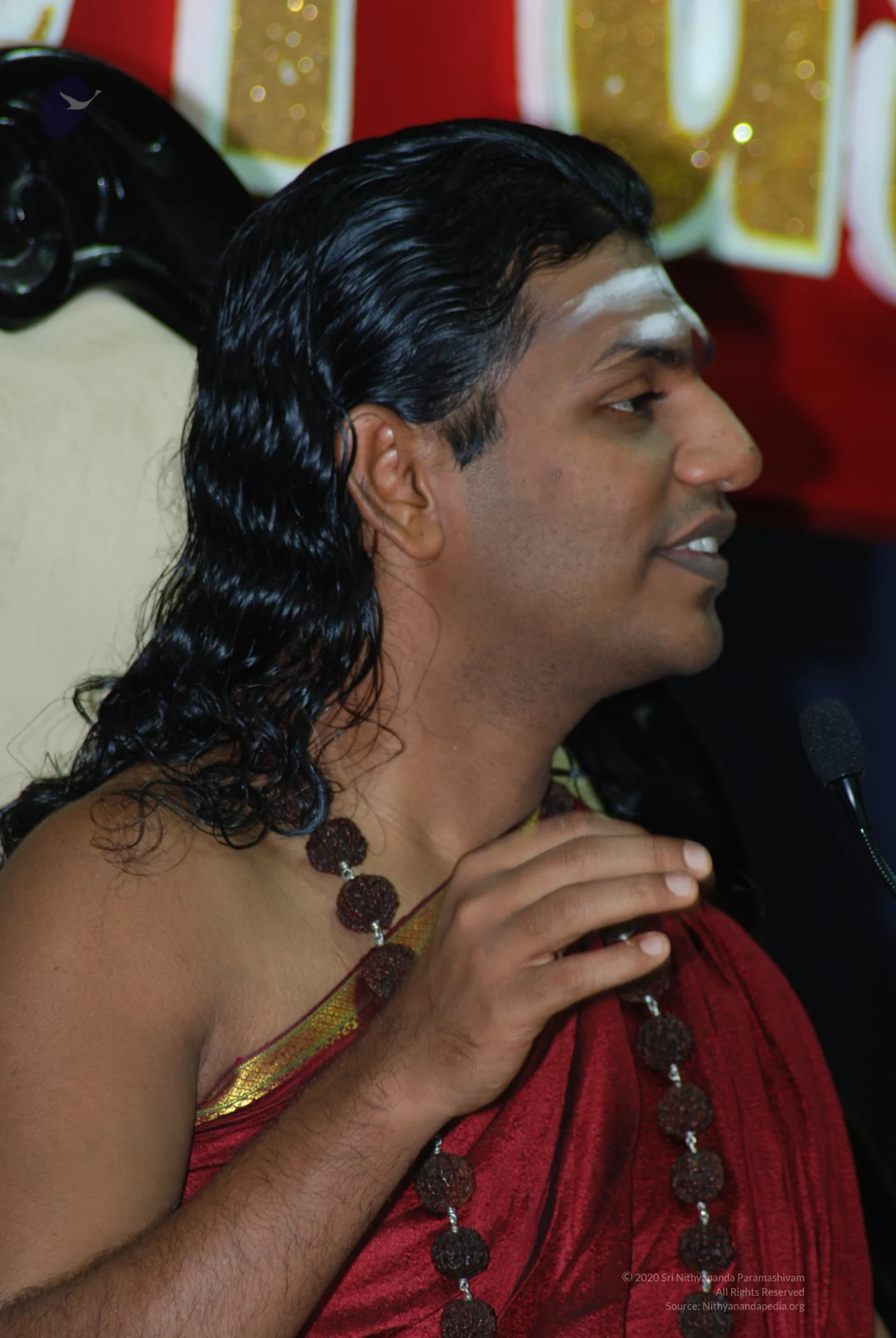
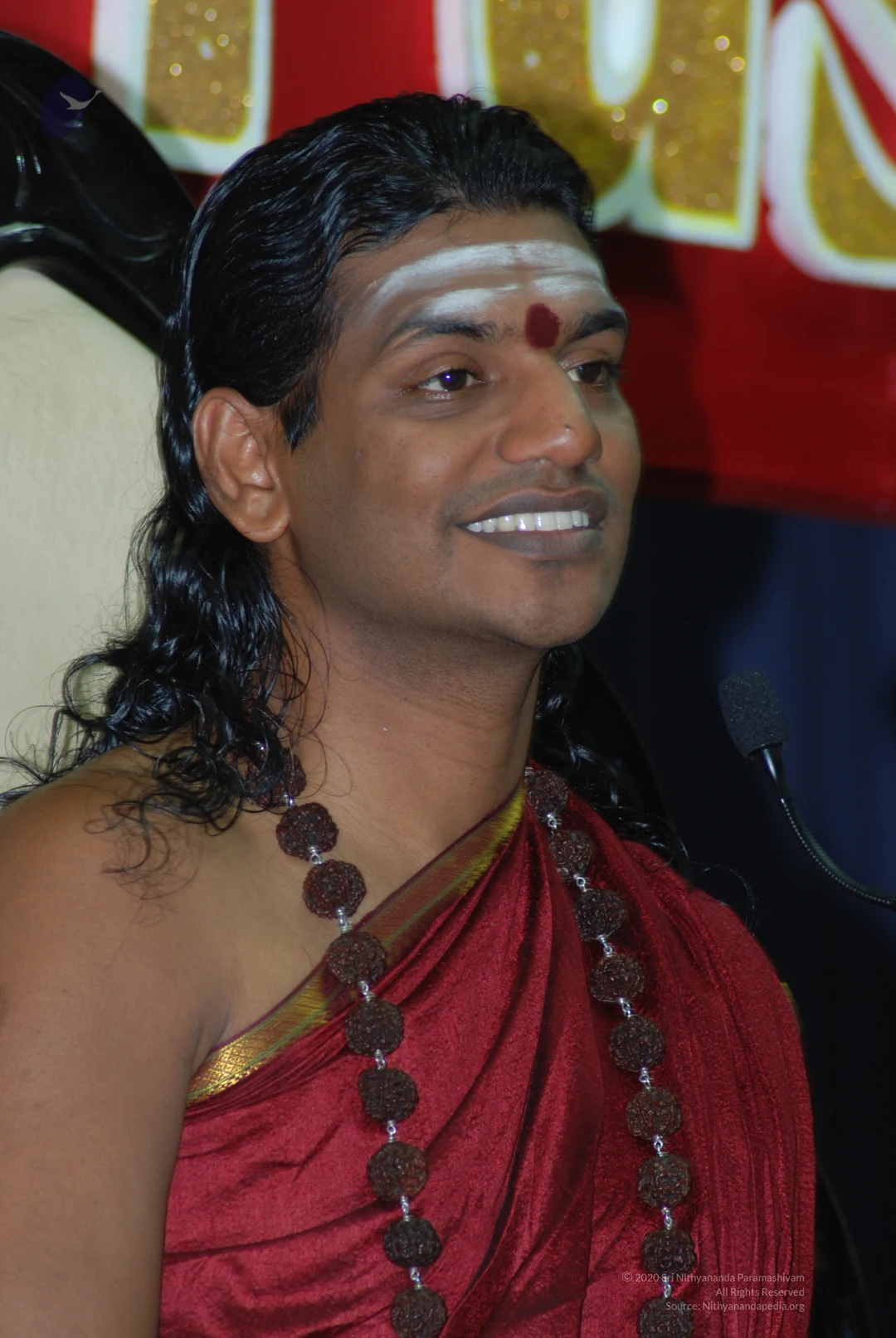
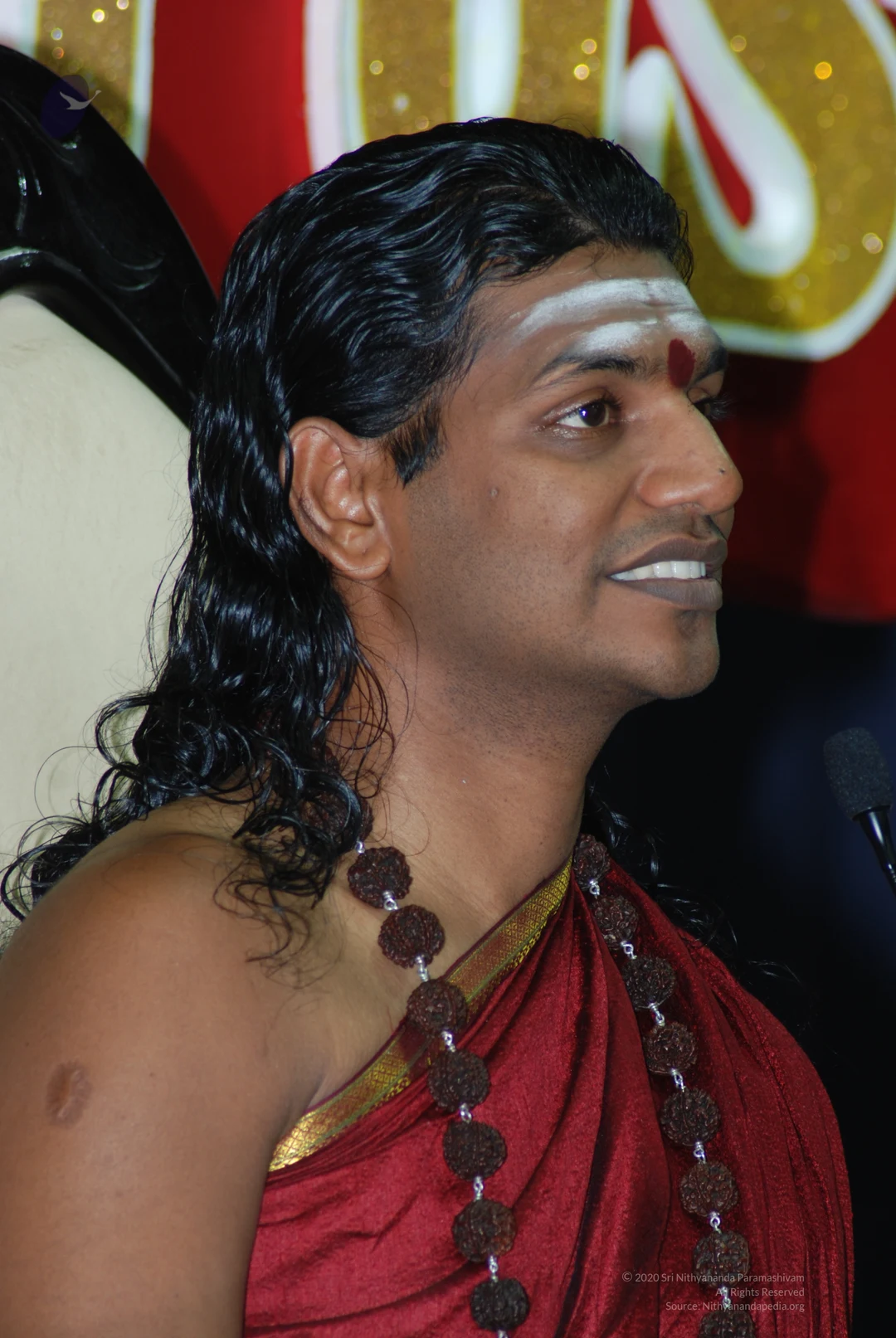
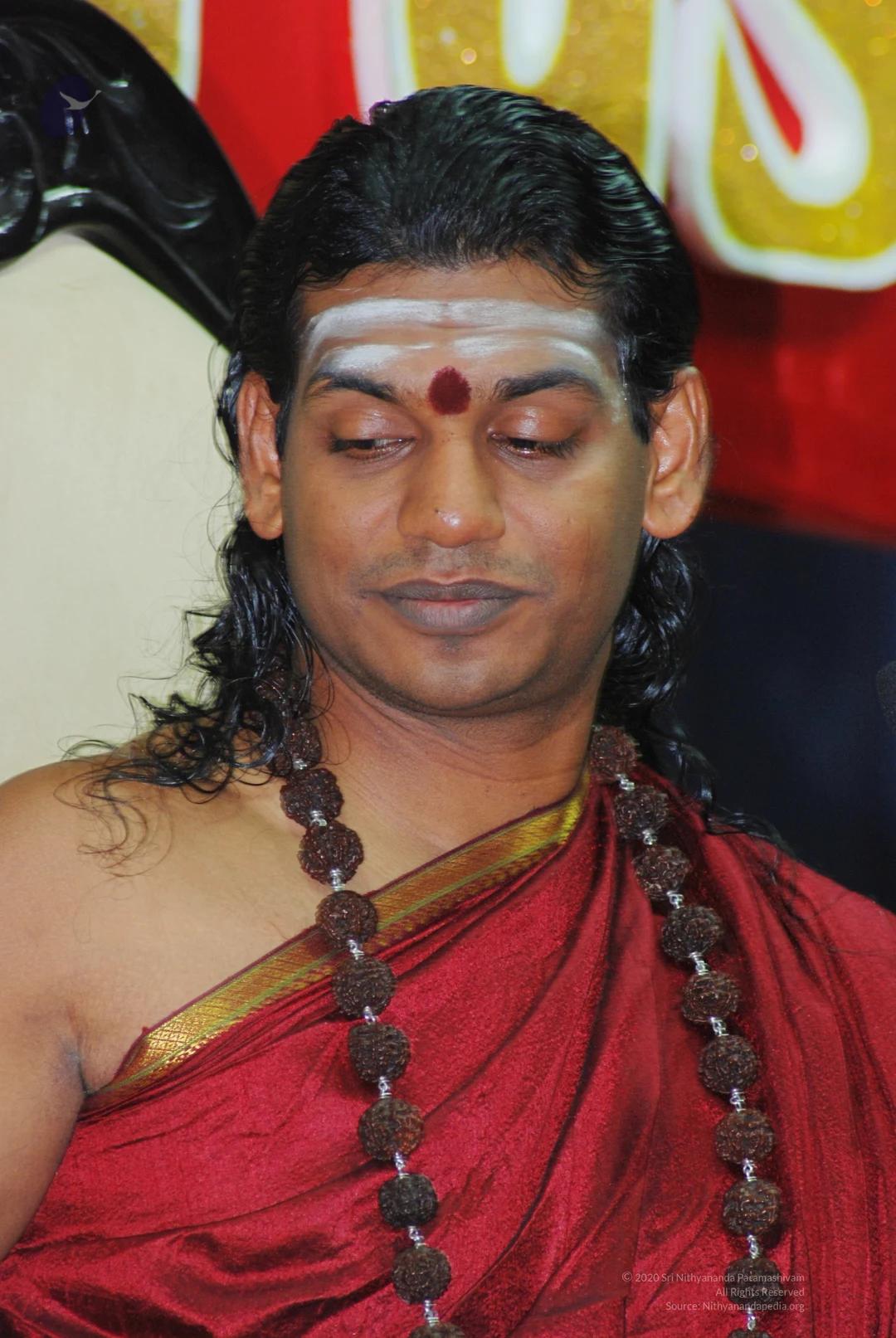
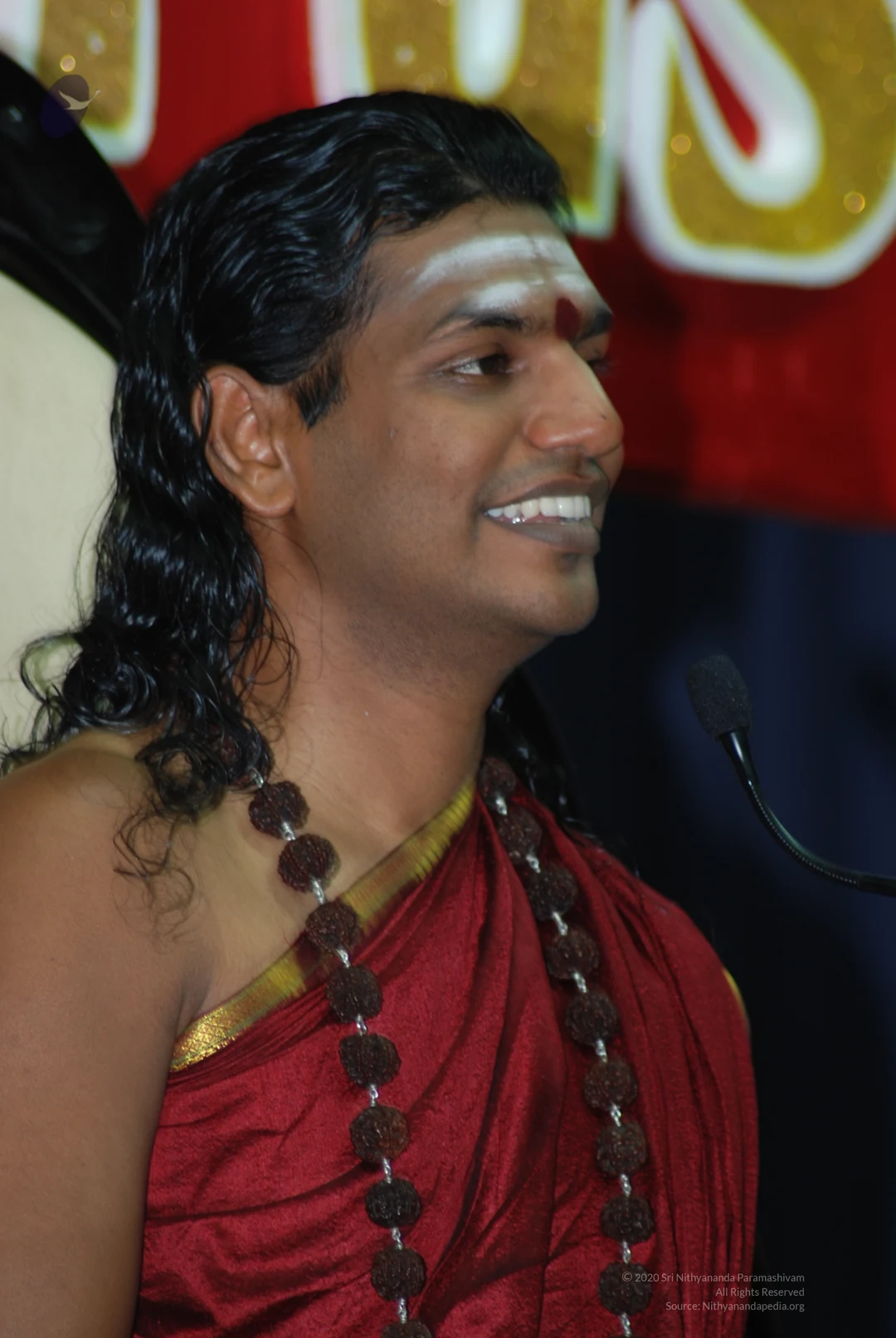
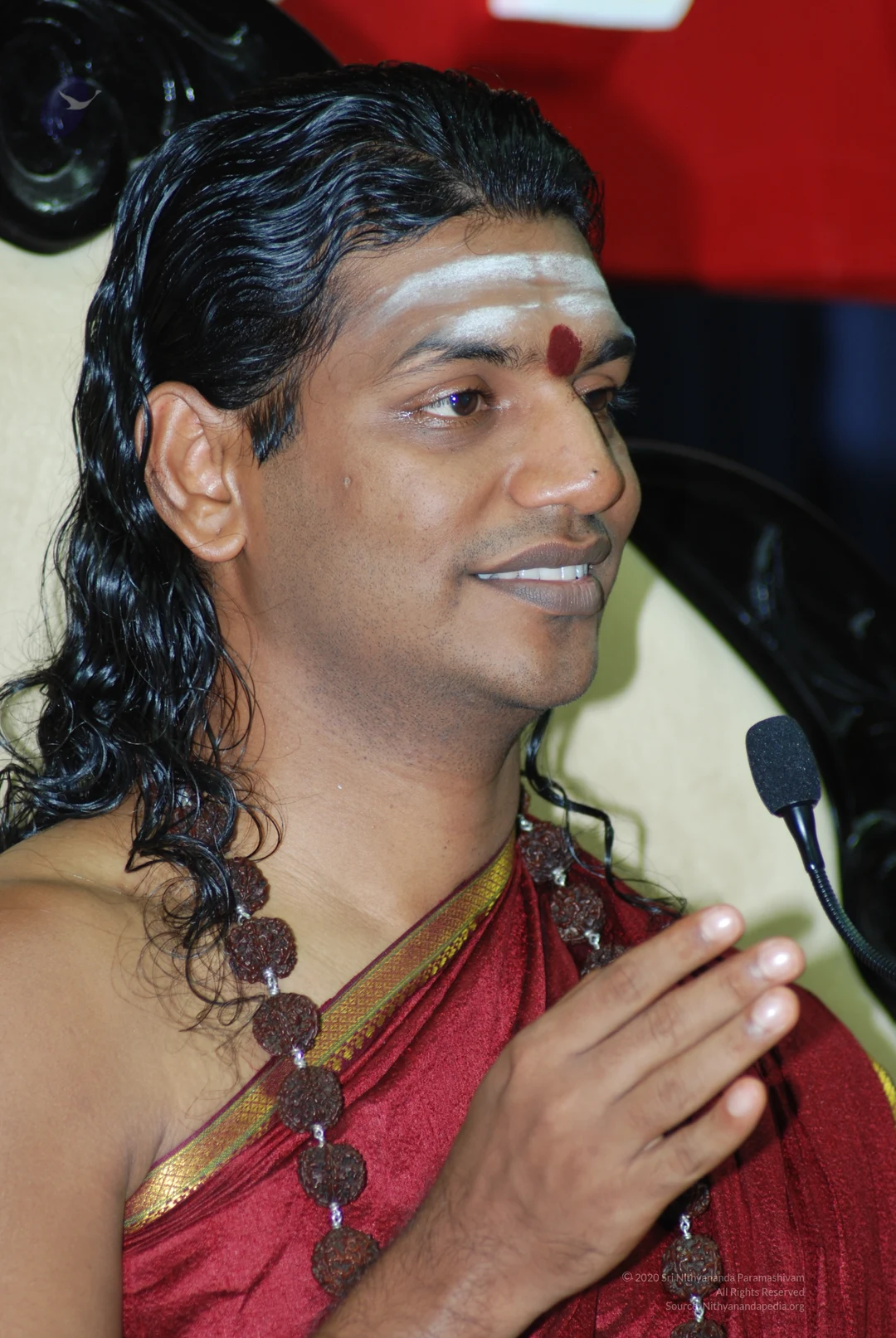
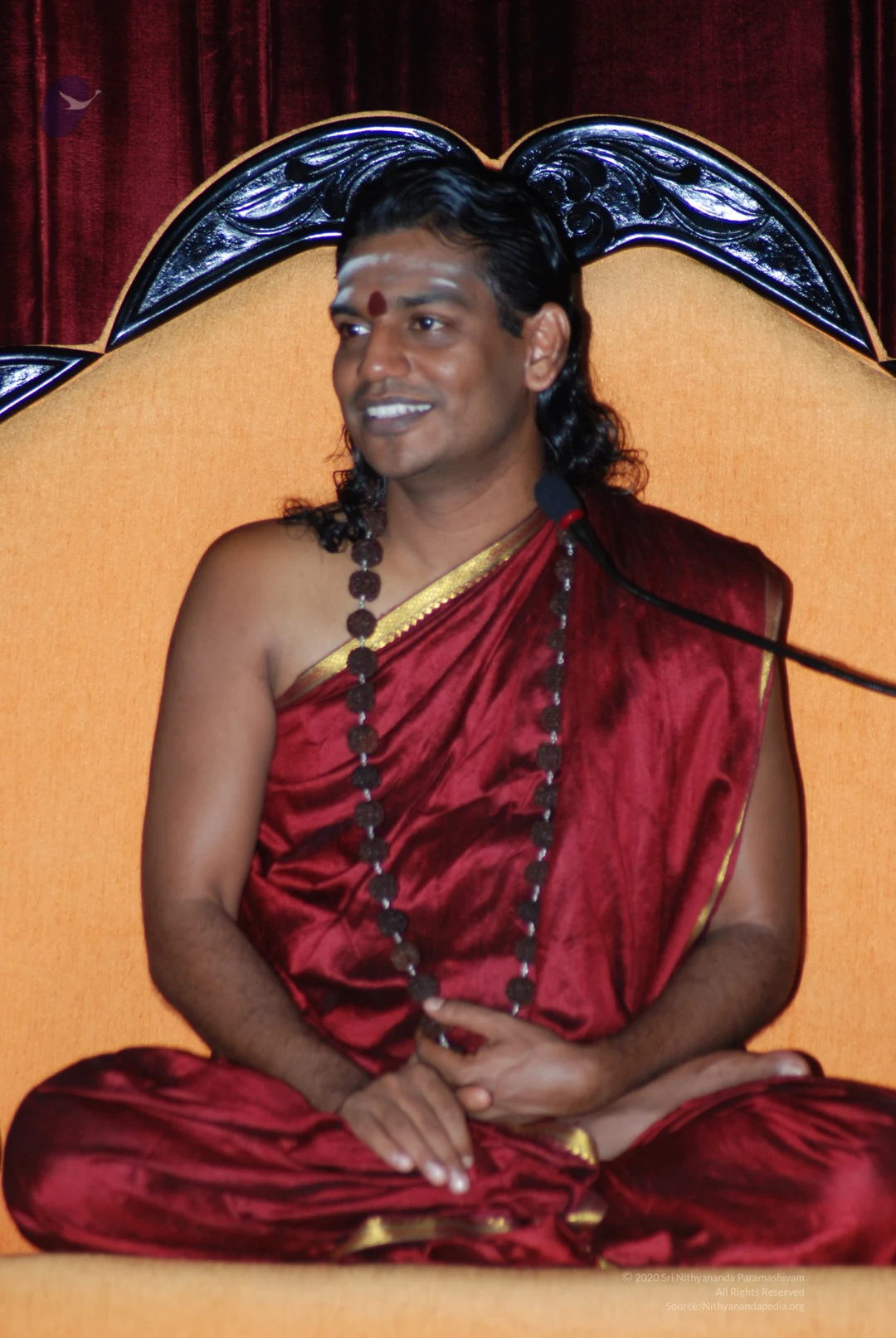
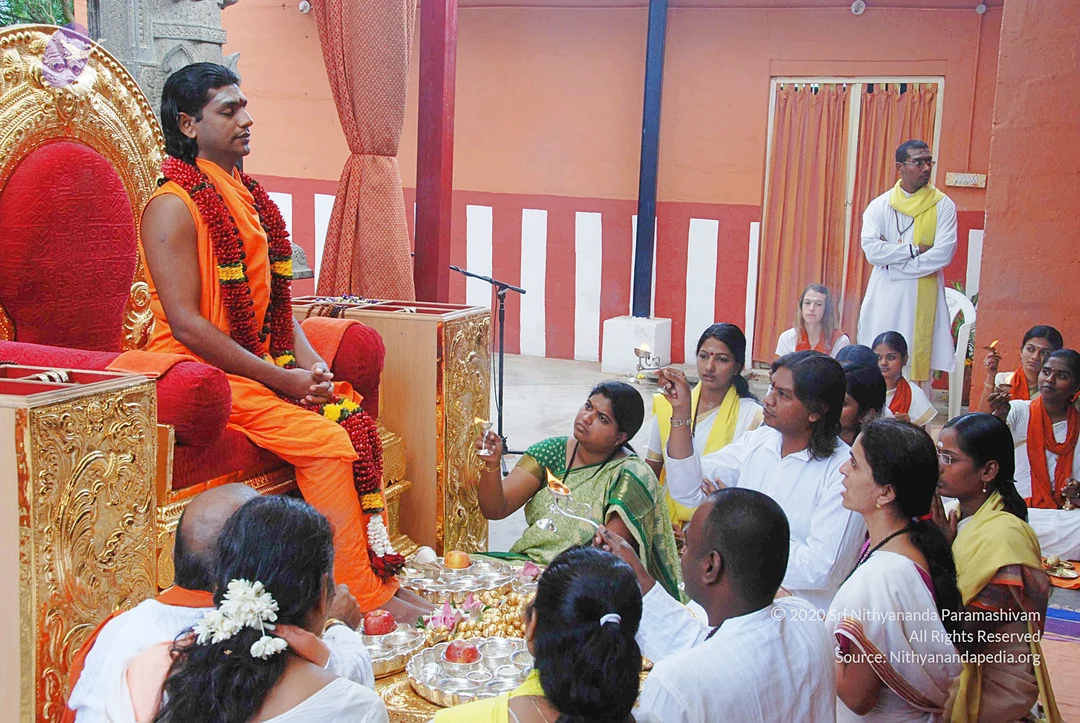
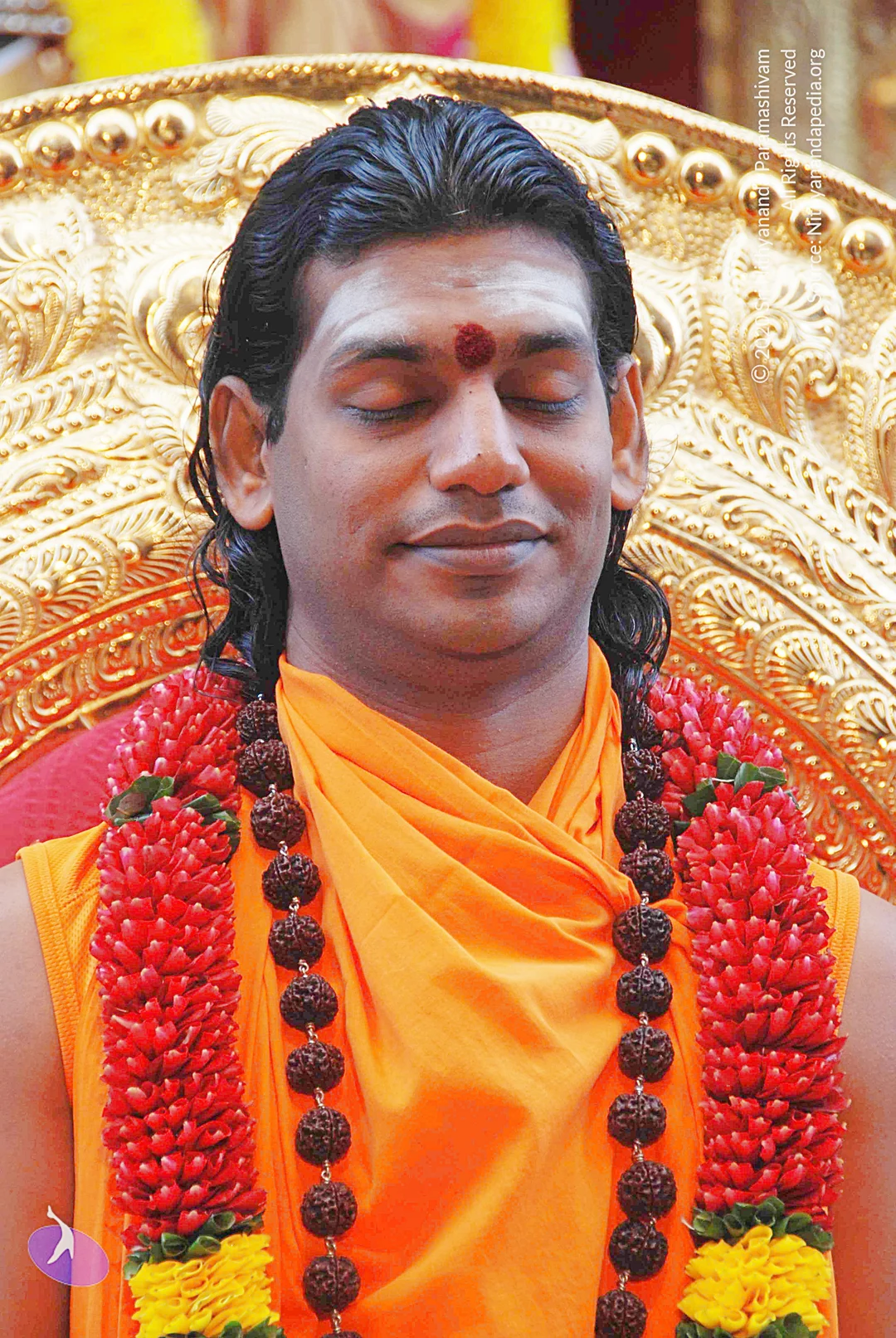
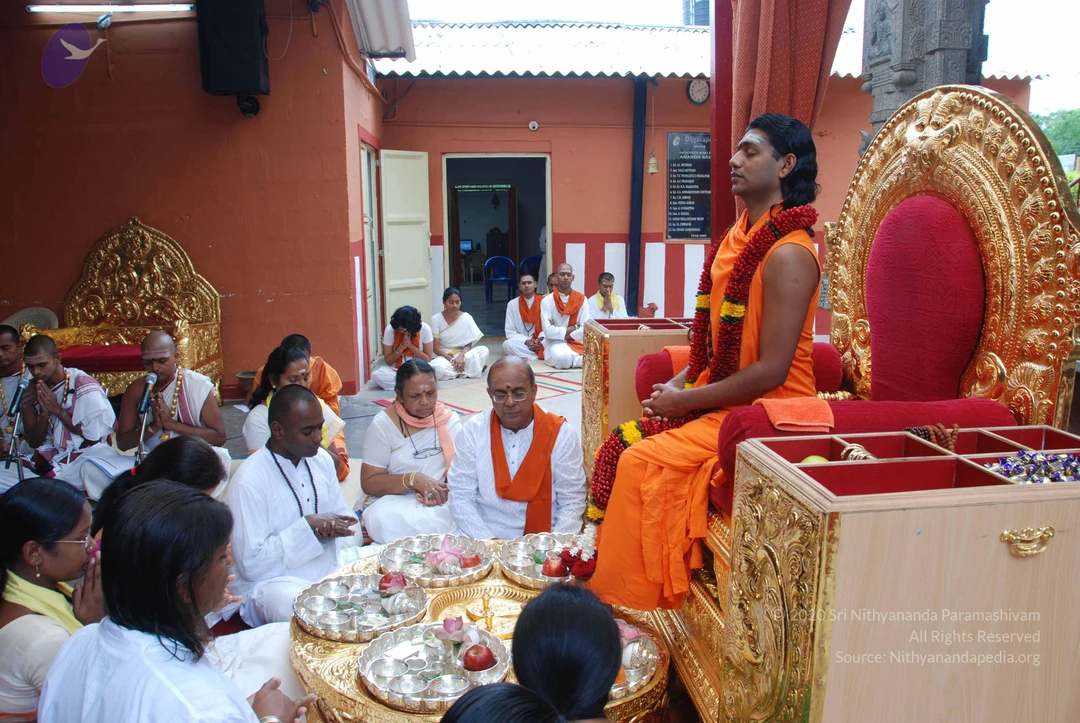
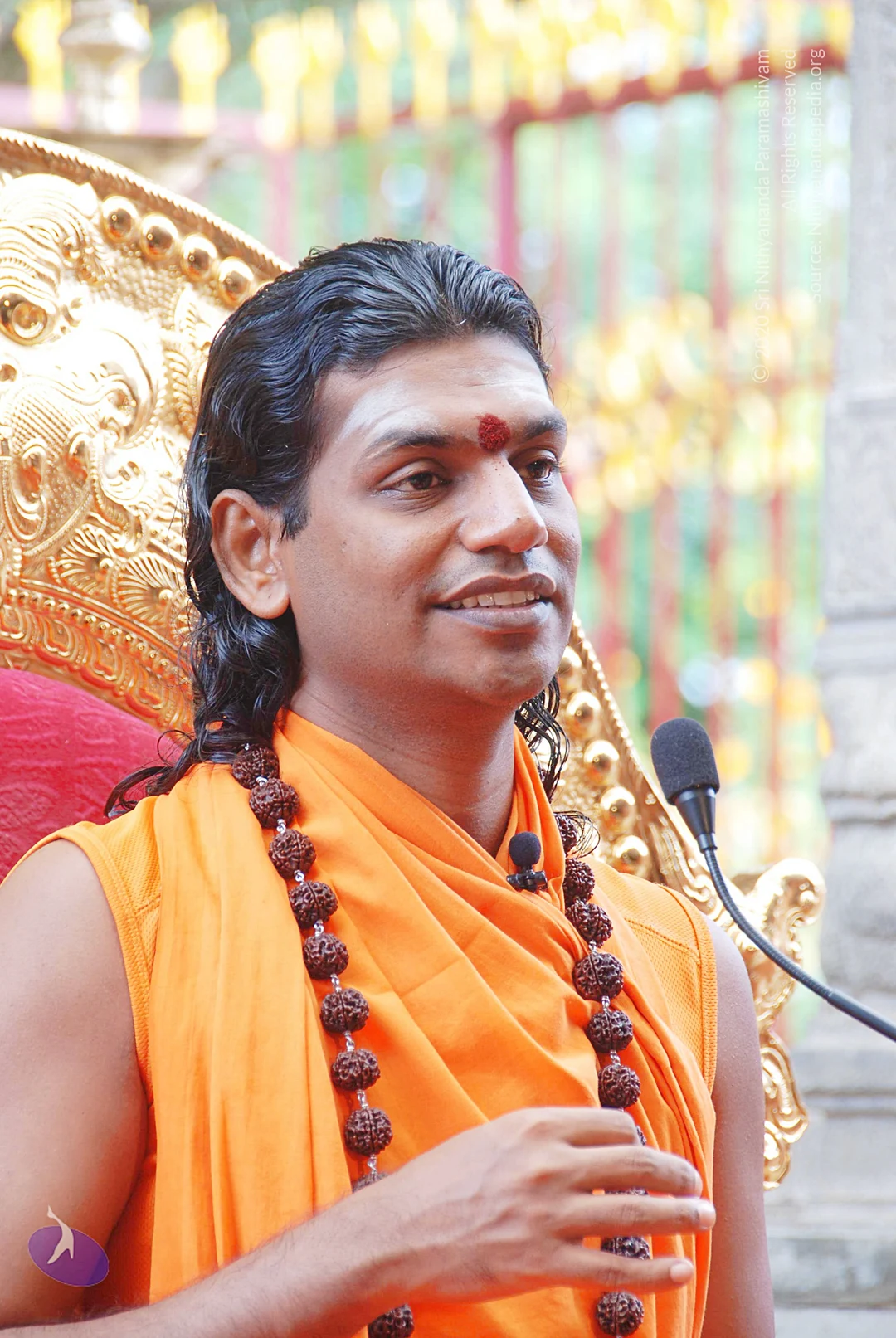
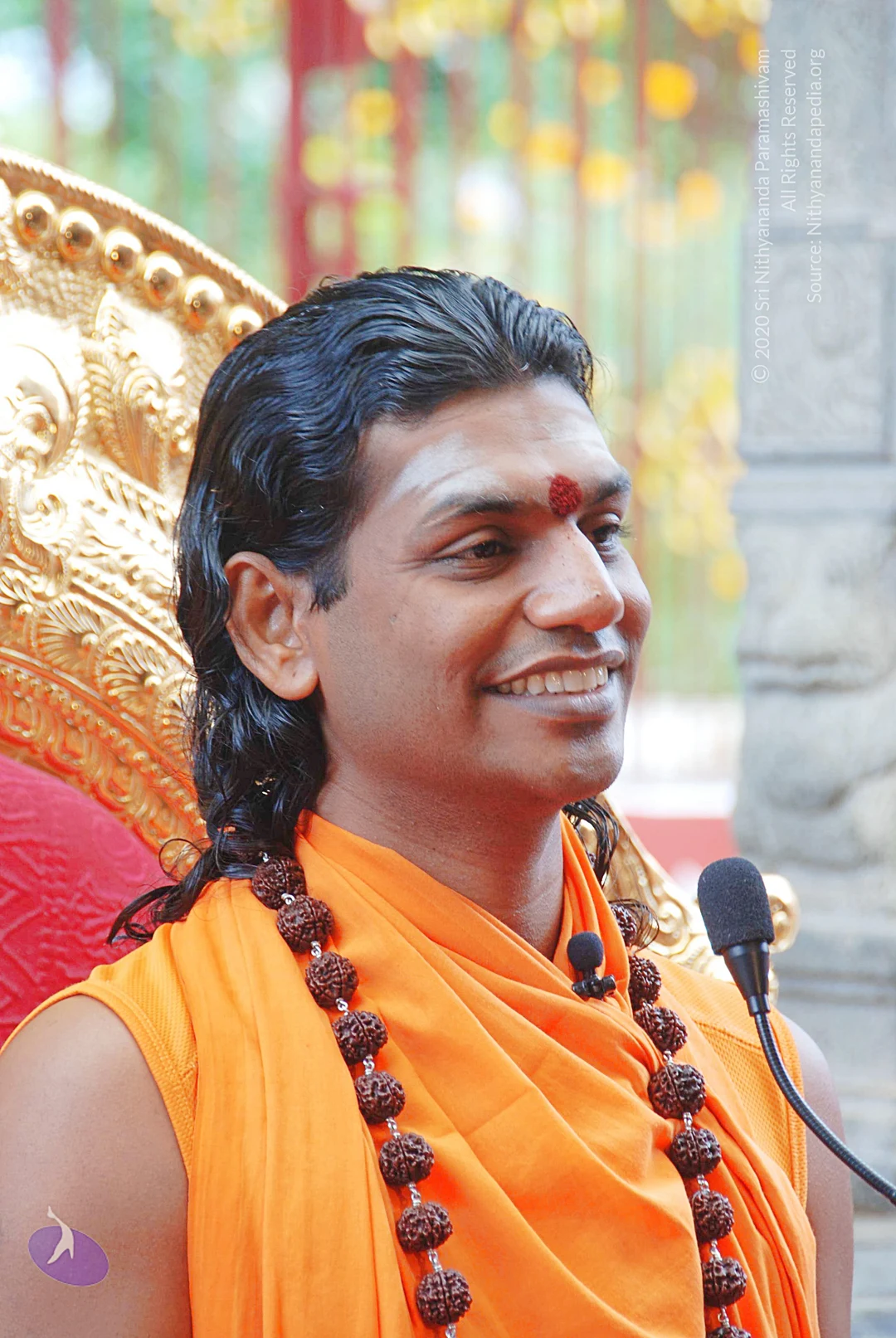
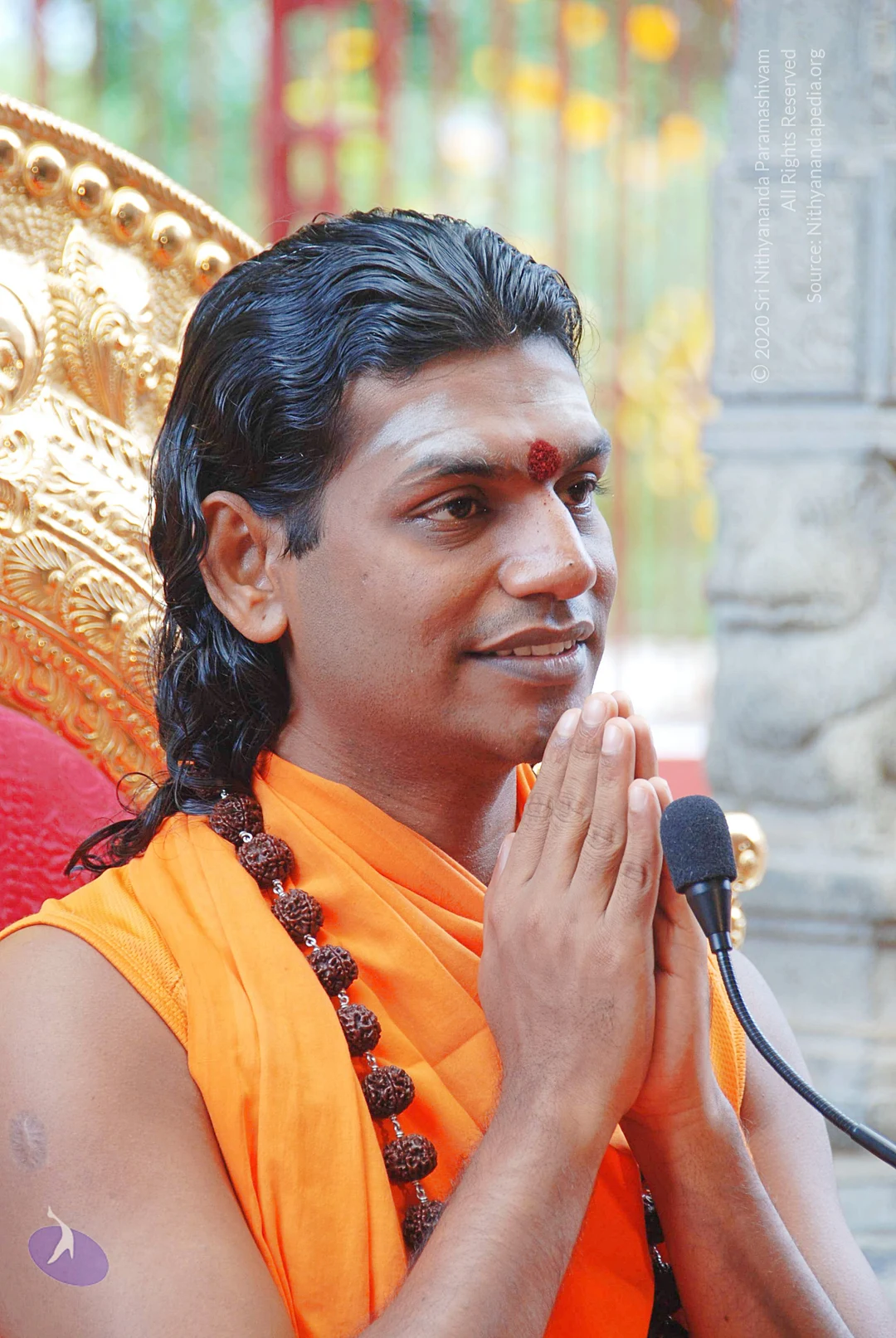
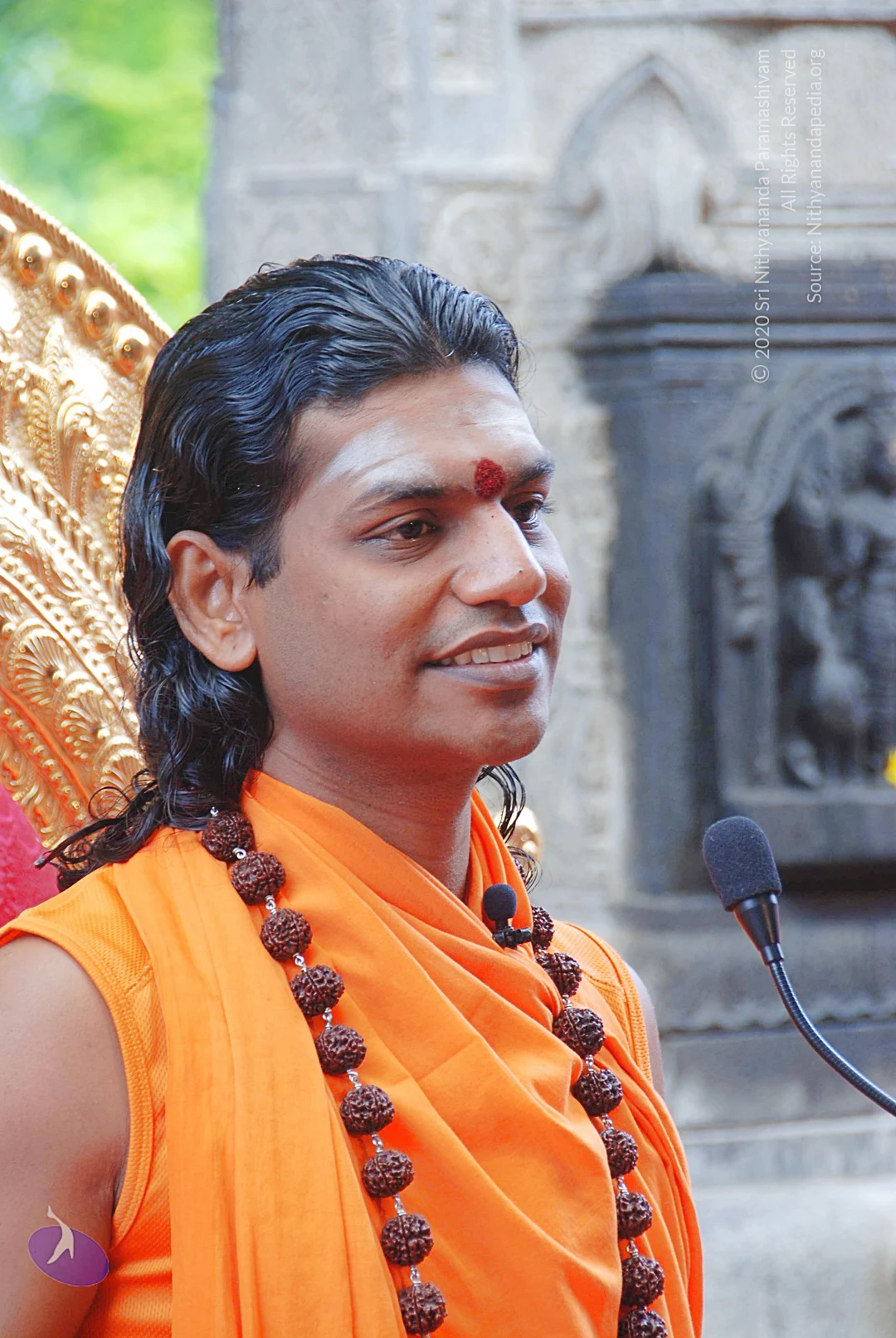
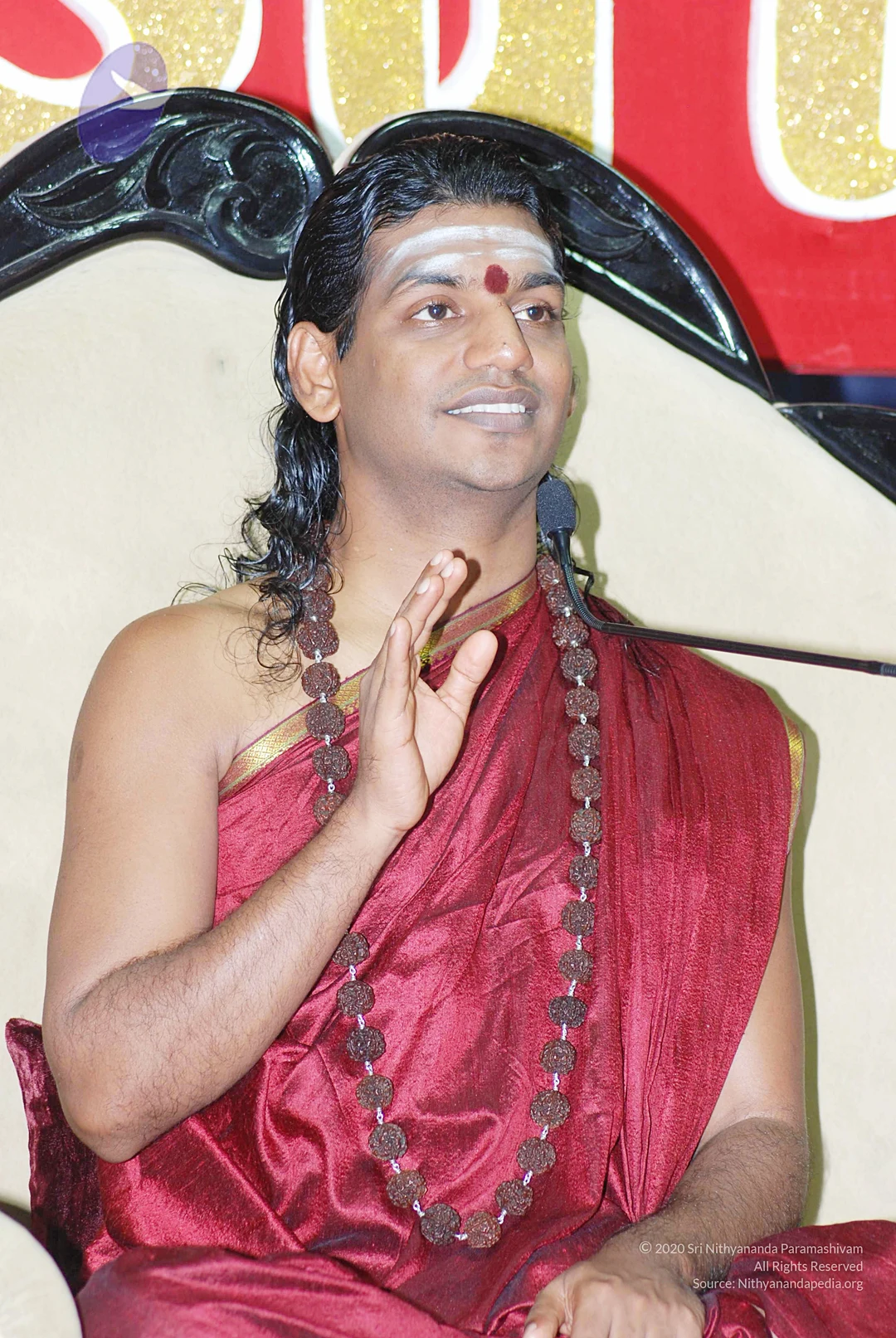
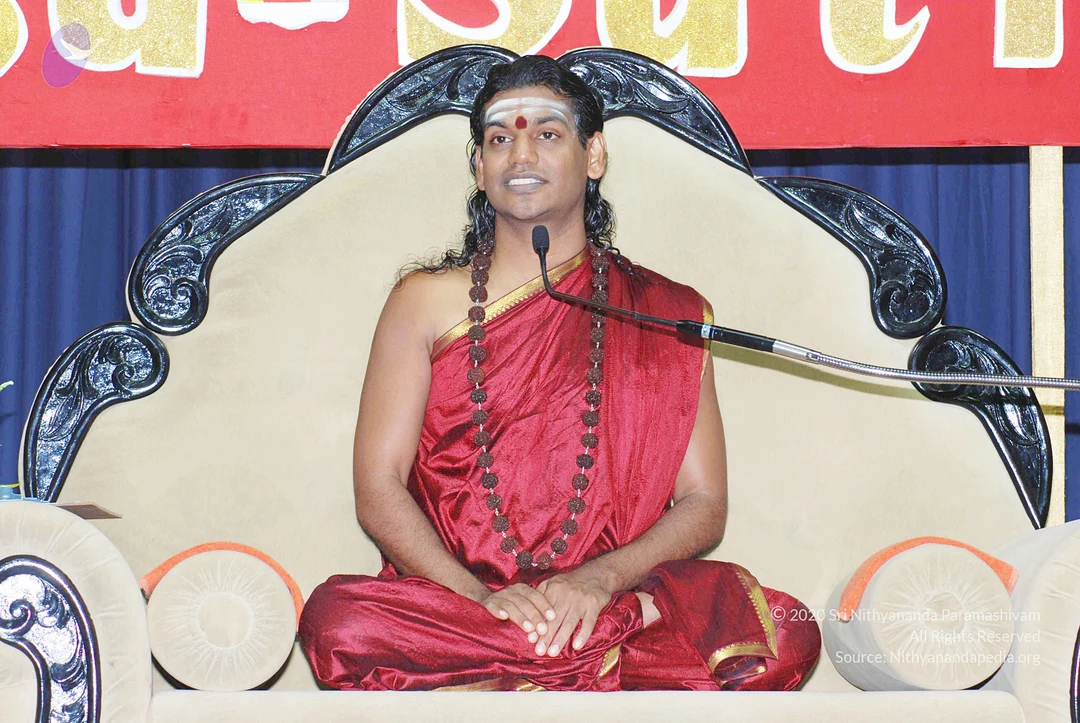
In this discourse, Paramahamsa Nithyananda elaborates on sleep and health.

By its innate nature, you, the Consciousness, resides in pure space - the timeless, formless, nameless space. But because of engraved memories, you see name & form, and go through time. Engraved memories (engrams)are nothing but passing thoughts, to which you have given power by being attached to them. Too much attachment to engrams is responsible for insomnia & all sleep disorders in your body.

Own your body, own your mind, own your life -- this is the solution for sleeping your way to health & enlightenment. Own your body - Consciously design your body as you want it with yoga - healthy and graceful. Own your mind -- Consciously design your mind in such a way that suffering cannot touch you. Own your living -- Infuse awareness into every action of your life. Yogic body, Vedic mind, Zen living!

MEDITATION TECHNIQUE: One night, try meditating in darkness on darkness. When you sit and meditate in darkness consciously, sleep disorder will disappear.

Understand the truth about sleep, and you will sleep your way to enlightenment!

Video and Audio

Sleep your way to health - Meditation Technique: Nithyananda

VideoAudio

Transcript:

sadāshiva samārambhām shankarācāryā madhyamām | asmat ācārya paryantām vande guru paramparām || (0:49)

I welcome you all with My love and respects.

Today’s subject is Sleep your way to health. I will define sleep. Understand, first I will define sleep; what is sleep. By very nature, by the innate nature, you, the consciousness reside in pure space; the timeless, formless, nameless space. But because of engraved memories you see name, form and go through time. So the inner, innate, intelligent consciousness wanted to get back to its original state. It just want to retire, go back to its original state; original space. But this engrams, engraved memories... by its very nature the engraved memories create name, form, time. But by the very nature the consciousness is timeless, nameless, formless. When the engrams are active, they create this world and dream. But when the consciousness overtakes, it just rewinds everything, gets back to its pure original state. But the engrams do not die, they only get back to that seed level.

(3:21)

So understand, I will define sleep: your innate, intelligent, conscious nature, just getting back to its original nameless, formless, timeless state, in spite of engrams pulling them out to the name, time, form space, is sleep. It just gets back to its timeless, nameless, formless space. That is sleep. Too much of attachment to what is seen or heard, means the engrams, is responsible for insomnia and all sleep disorders.

(4:31)

In your body, in your nervous system when the consciousness flows, it just packs up all engrams like a, almost like a packing your tent into a small size and retires. The effect of consciousness on your nervous system, the effect of engrams on your nervous system, if they are 50-50 you will have the right experience of world, dream and sleep. If the consciousness becomes less, the effect of engram, if it is more, then naturally sleep disorder; unable to sleep, insomnia. If the effect of consciousness becomes more, than the effect of engrams, on your nervous system, that is what leads you to the meditative state and super consciousness. It will naturally first lead to awareness during the dream state, then awareness during the deep sleep state, then awareness during all three states - sleep, dream and deep sleep. Awareness during all three states is what I call Turiya- fourth state.

(6:27)

So understand the whole truth about the sleep. By nature engrams pulls you out and shows you the time, name, form. By nature consciousness takes you to the timeless, nameless, formless state. Fight between this two is your life. When the engrams have more power over your nervous system, you see the world and dream. When the consciousness has more power over your system, it rewinds and puts you in rest. But even in the rewinding state you rewinded your tent, you have not burnt it; so all the engrams gets into the causal state, but not engram free. If the consciousness, the effect of consciousness is too much on your nervous system, then the tent gets burnt. The engrams which are in the causal state, seed state, just gets burnt, it disappears, it’s not there anymore.

(7:34)

Understand, it’s a very important truth - how the three states are experienced by your system, how the fourth state can be experienced in your system. Sleeping your way to health. Understand, the process I am explaining is not even sleeping your way to health, it’s only, health is only your by, one by product - sleep your way to enlightenment. That’s what exactly I mean, that’s what exactly I am expressing; sleep your way to enlightenment.

(8:15)

Actually if the effect of consciousness on your system becomes more and more, the effect of consciousness even while your engrams are open... see when your engrams are open means the tent is fully open, that’s a waking state and the tent is getting dismantled that is a dream state, tent is completely folded and kept as a pillow is deep sleep state. In all three states this consciousness will start penetrating, means the quality of sleep will become different, the quality of dream will become different, quality of waking state will become different. Own your body, own your mind, own your lifestyle. This is the solution.

(9:19)

Understand, this is the solution for sleeping your way to enlightenment and sleeping your way to health. Own your body, when I say word ‘own your body’, your own body, own it, build it as you want with yoga. Owning your body means, yes that is the closest object you have. If you don’t own your body what do you mean? It is just there like a garbage can. For most of us it is there, because it is dumped on you, you just dump everything on it, that’s all, like a garbage can. Own your body, that is the first step for enlightenment.

(10:14)

Sharira Madhyam Khalu Dharma Sadhanam means it is the body which is base for all achievements. Own your body, feel it, it is yours. So design it as you want with yoga - Yogic body. Own your mind, it is yours. Design it so that never any suffering can touch you, never any suffering can happen to you. Your own mind, just this very feeling - “My mind!!! Come on!!! Now I am designing it so that nobody can give me any suffering, no suffering can touch me.” Same way own your living - “My life!!! Come on!!! Let me own it! I will make money only the way I enjoy. I will have the pleasures which I enjoy. I will choose My way of life. I will be conscious in every step, see that I achieve what I want.” Own your body, own your mind, own your living, own your lifestyle. That is what I call yogic body, vedic mind, zen living. Yogic body, vedic mind, zen living.

(11:52)

Do not live inside a body which is not flexible or healthy. “Come on, I am not interested in keeping the body like this.” Put energy, time, bend your body, make it yogic. It is your body. Whole day you are living with it. Why are you unaware of it? Whole day let all your movements be such, it continuously become healthy, graceful, as you always wanted it. Own your mind, it’s your mind. See that every thought you give life, brings only joy to you, brings only bliss to you, never any suffering, never any disturbance. Your mind - mend it, weave it as you want, train it as you want, tame it as you want.

(13:03)

I cannot tolerate people who suffer with engrams. Understand, the worst sinners, worst sinners. How can this people say... Your mind, how can you say, “No, I don’t know what to do, I know this is wrong, but I am suffering with it.” Why don’t you just disappear? No… even that is not a right punishment. “My mind, let me own it. It is time I take ownership. Let me weave as I want. Maybe in the past I failed, but now it is time, let me weave as I want, let me design as I want.”

(13:56)

Own your mind - the mind which is based on vidya is vedic mind - knowledge, truth is vedic mind - which does not bring suffering to you is vedic mind. And zen living. When I say zen living, meditative living. Infuse awareness into every action - walking, talking, sitting, moving, breathing - infuse awareness into everything. Slow down; in every action slow down. Let it be more with awareness. That is what I call infusing awareness.

(15:09)

Buddha, once beaten a fly on his face. Immediately he comes back to awareness and does the same thing again with awareness slowly. Disciple asked, “What are you doing? The fly has died.” He says, “No, that is what, I did it unconsciously. So now I am doing prayaschitta, doing the same movement consciously.” Any movement you did unconsciously, do it again consciously. That is a prayaschitta. If you unconsciously got up from the bed, no, sit again, move consciously, bring it back, bring your centre back. Any movement done unconsciously, do it again consciously and see that you are constantly aware and conscious of everything. You will easily sleep your way to enlightenment.

(16:25)

Whole day when you are aware and conscious whole night you will be aware and conscious. Whole night being aware, is sleeping your way to enlightenment. Understand these three things. First, the truth about sleep - by your nature, you are timeless, nameless, formless, but the engrams create the name, form, time - the world. So you, when your nature takes over you, takes over your nervous system, it reminds itself, recoils itself, recalls itself, to its nature; so the tent is packed, the packed tent...

(17:29)

See the open tent is the waking state, tent getting dismantled is the dream state, the packed tent is the deep sleep state. Too much of interest, attachment, in the engrams creates sleep disorder - insomnia. Reducing the engrams into thoughts by removing attachment. See the pillars which holds the tent is attachment, the cloth is thought, if the pillar is not there it can be just winded up and kept under as a pillow. Pillar is attachment, the cloth is thought and the established pillar with the cloth is engram. Reducing the engram into thought is one of the best powerful process for sleeping your way to enlightenment.

(18:57)

I can give you another one technique, direct technique. Sitting and meditating in the darkness, on darkness; in darkness, on darkness, which is the nature of deep sleep. Meditate on deep sleep consciously. One night meditation is more than enough to get you out of any sleep disorder. One night if you can sit and meditate on darkness consciously, any sleep disorder will disappear; insomnia or chronic fatigue, any sleep disorder will disappear.

(20:03)

Vedic mind, yogic body, zen living, will directly lead you to health and enlightenment using your just ordinary sleep. Nothing else is required. Your ordinary sleep will simply lead you to health and enlightenment itself. Understand the truth about the sleep and inspire yourself to live with yogic body, vedic mind and zen living, you will sleep your way to health and enlightenment itself.

Let you all sleep your way to enlightenment, radiate and achieve enlightenment, live and radiate the eternal bliss, Nithyananda. Thank you

(22:08)

Title

Transcend through meditation (PYS-62-63): Nithyananda on Patanjali Yoga Sutras

Description

In this Patanjali Yoga Sutras discourse, Paramahamsa Nithyananda describes the purpose of meditation and how one can transcend the mind through meditation.

Video and Audio

VideoAudio

Photos

Panchatapas
Paadapooja

Morning-Message

Sarvadarshan

Nithyanandeshwara-Paramashiva-Golden-Temple

Yogasutras

Ashramites-Meeting

Photos Of The Day:

PANCHA-TAPAS

PRATYAKSHA-PADA-PUJA

NITHYANANDA-MORNING-SATSANG-IN-BIDADI

E-KALPATARU

SARVA-DARSHAN

YOGA-SUTRA-IN-BIDADI

ASHRAMITES-MEETING-IN-BIDADI

01-Pancha-Tapas

02-Pada-Puja

03-Morning-Message

04-Sarva-Darsan

05-Vip-Visits

06-Temple

07-Yoga-Sutras

08-E-Kalpataru

09-Ashramite-Meeting

Photos from this day

View all 240 photos

Panchatapas
22 photosSource gallery
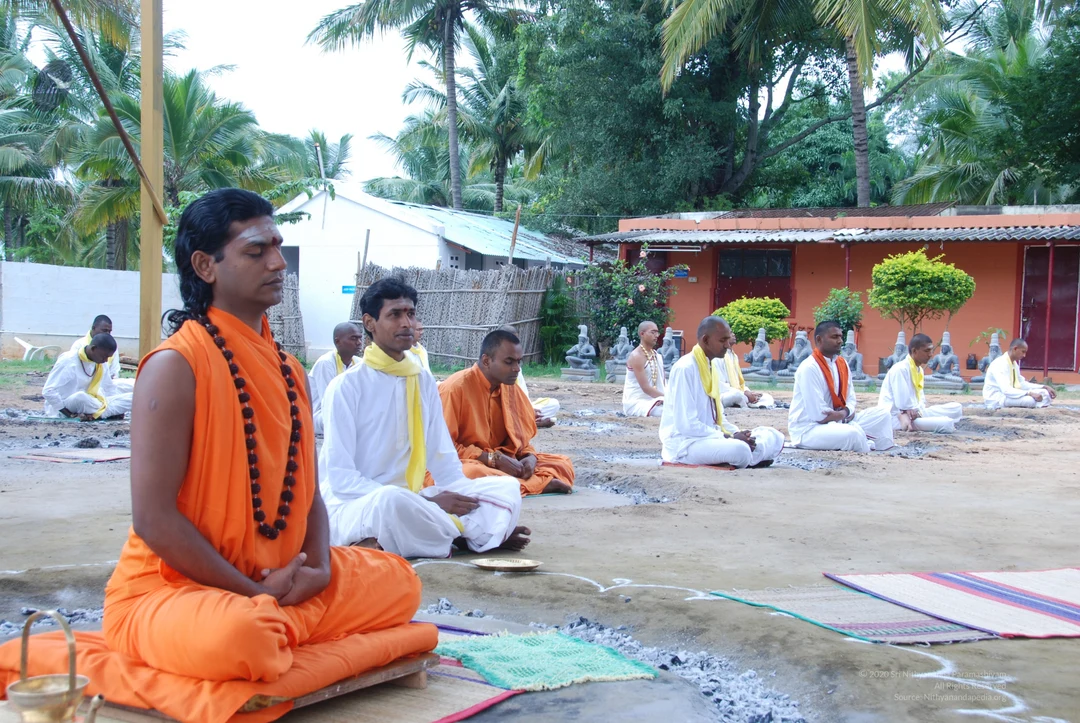
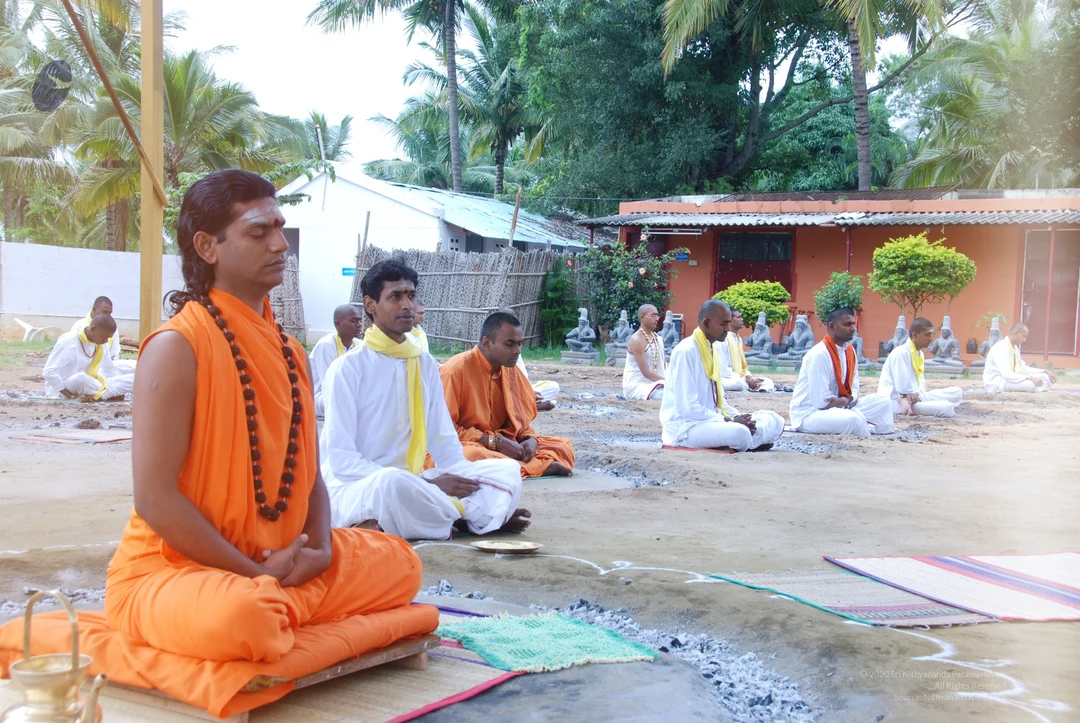
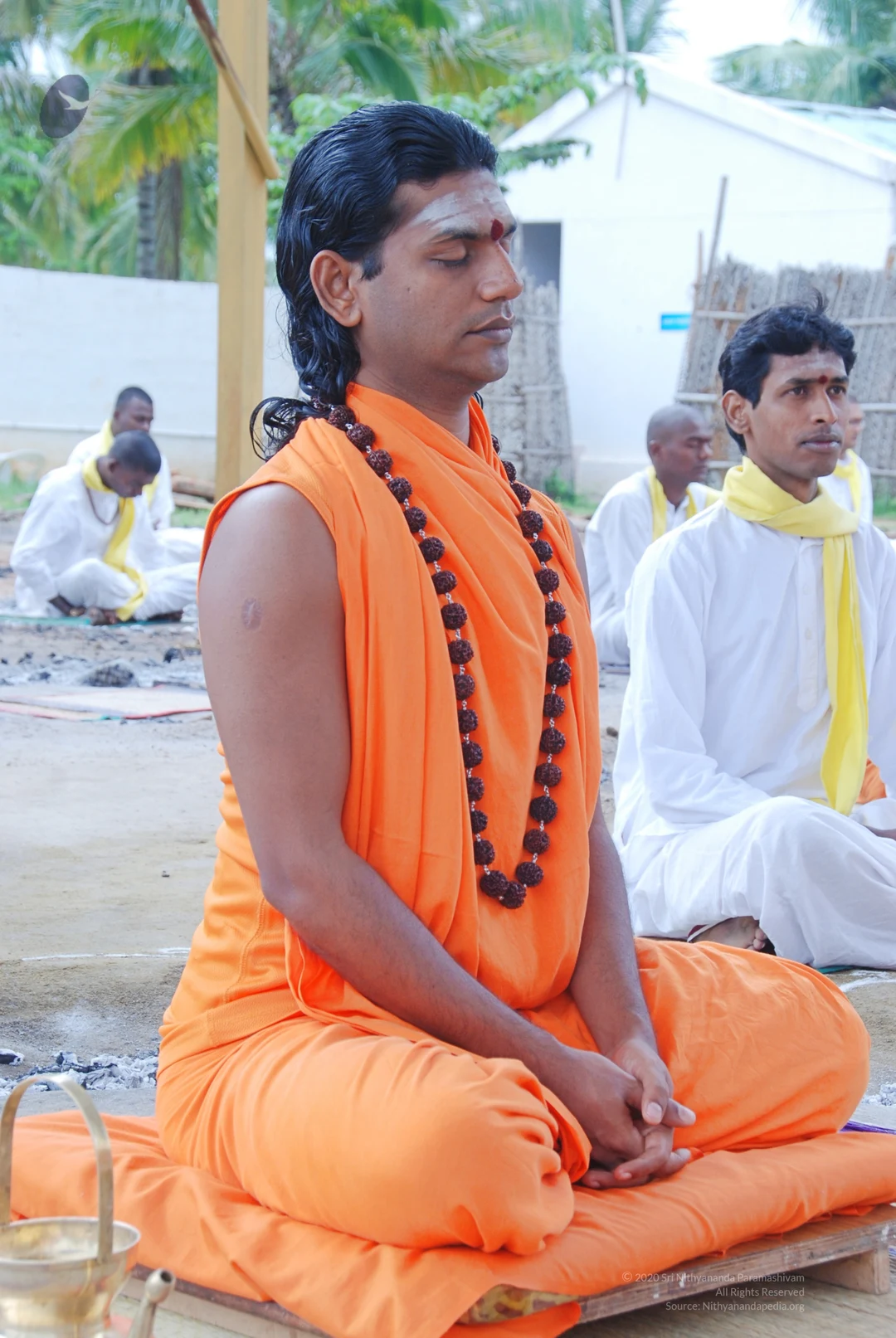
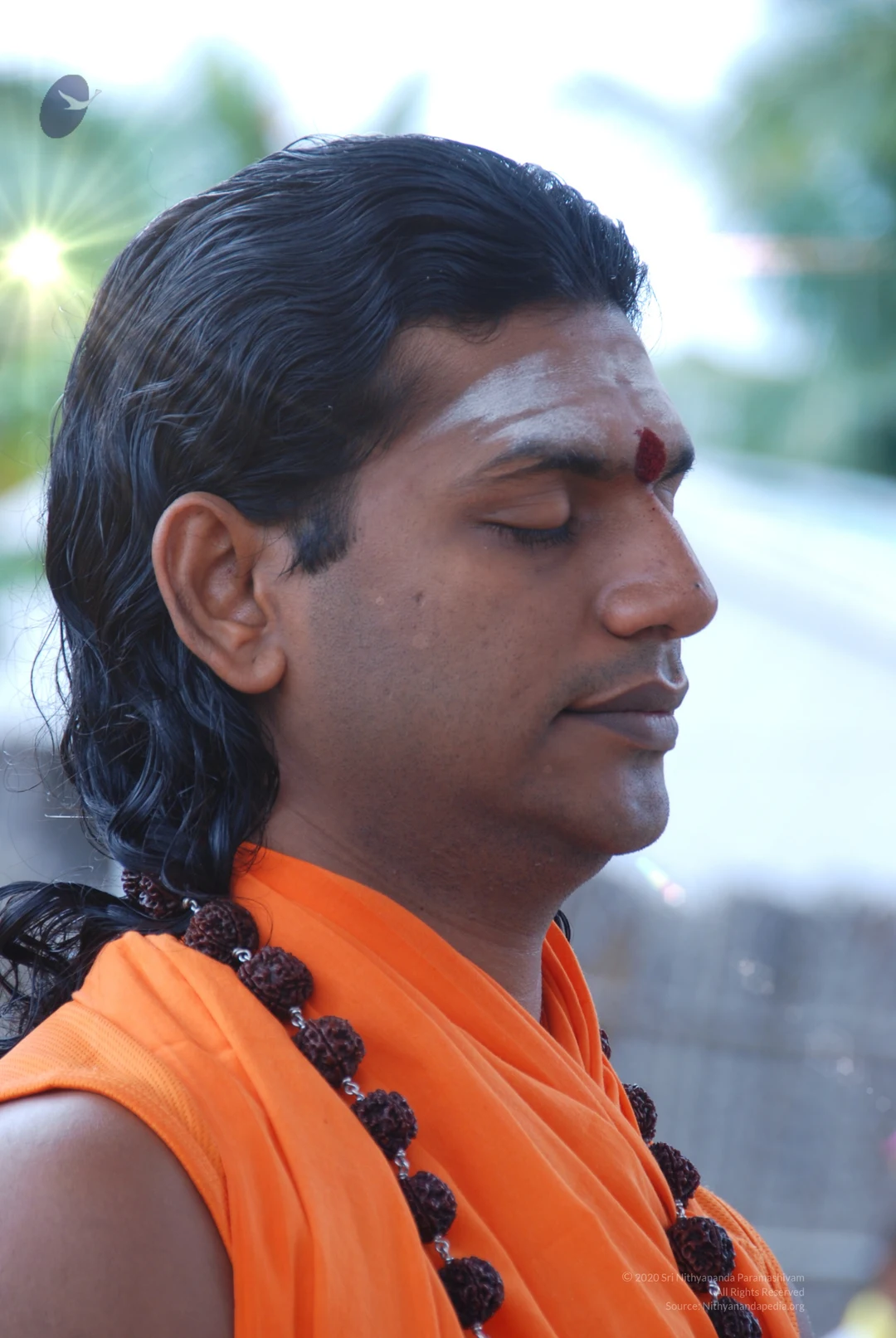
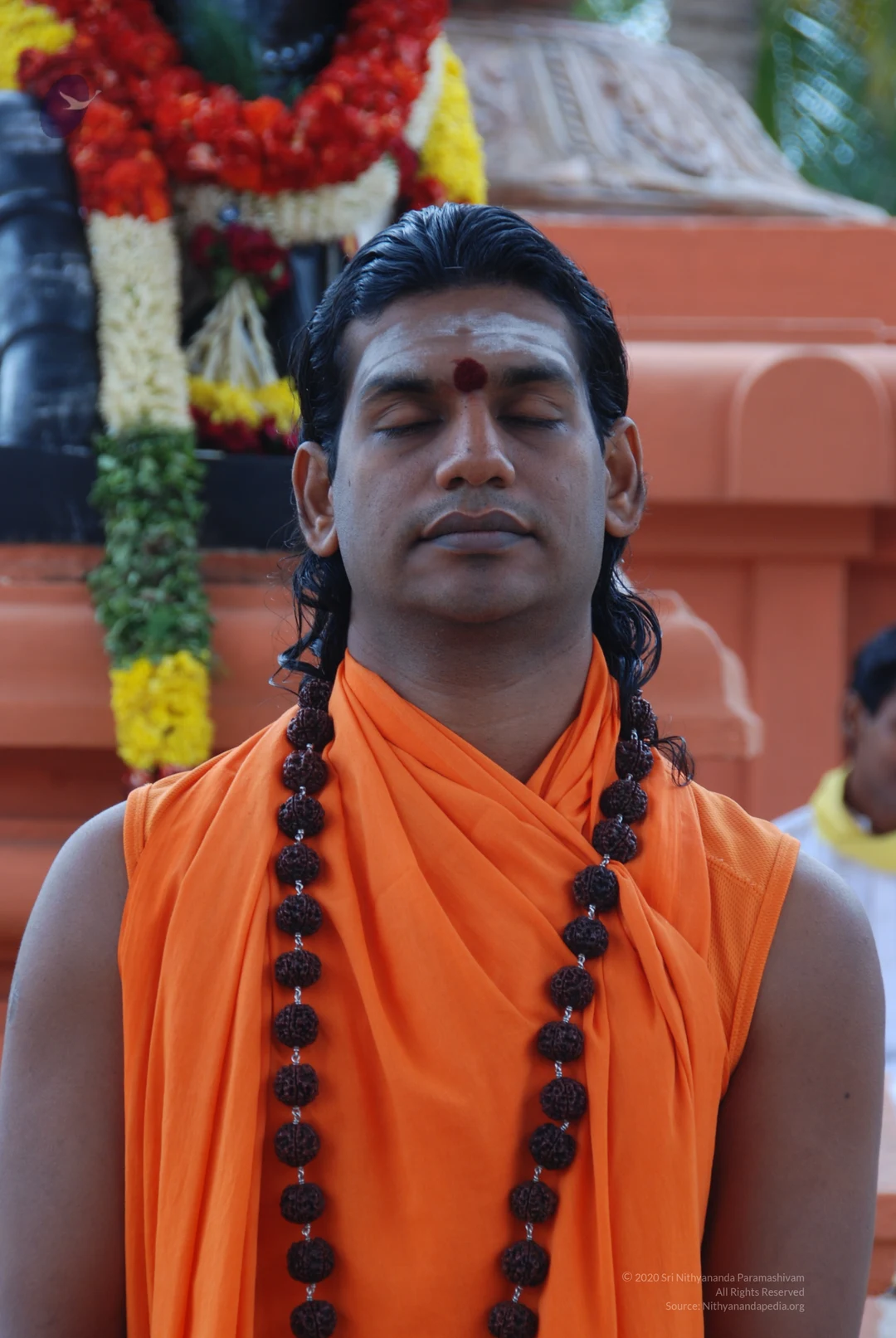
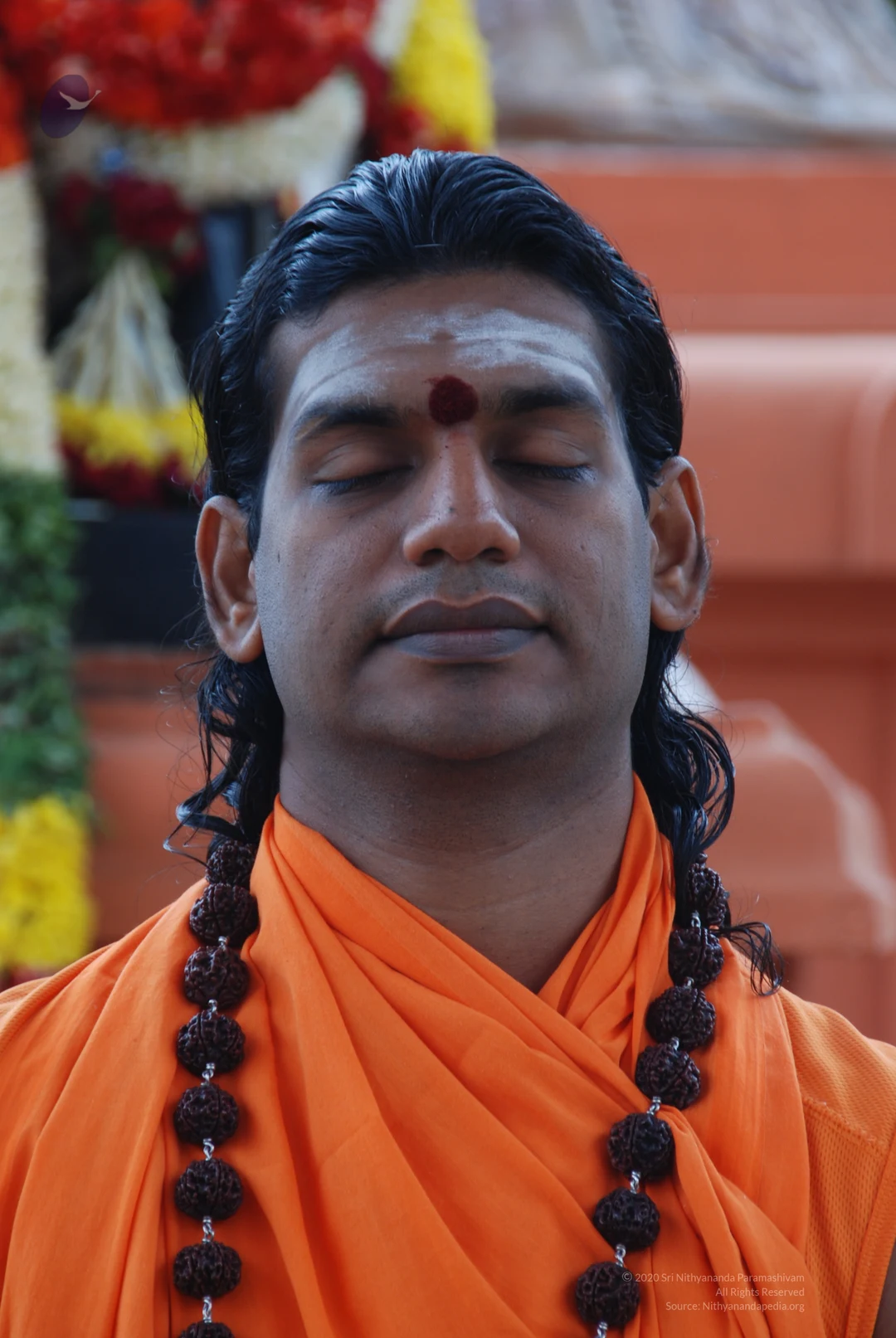
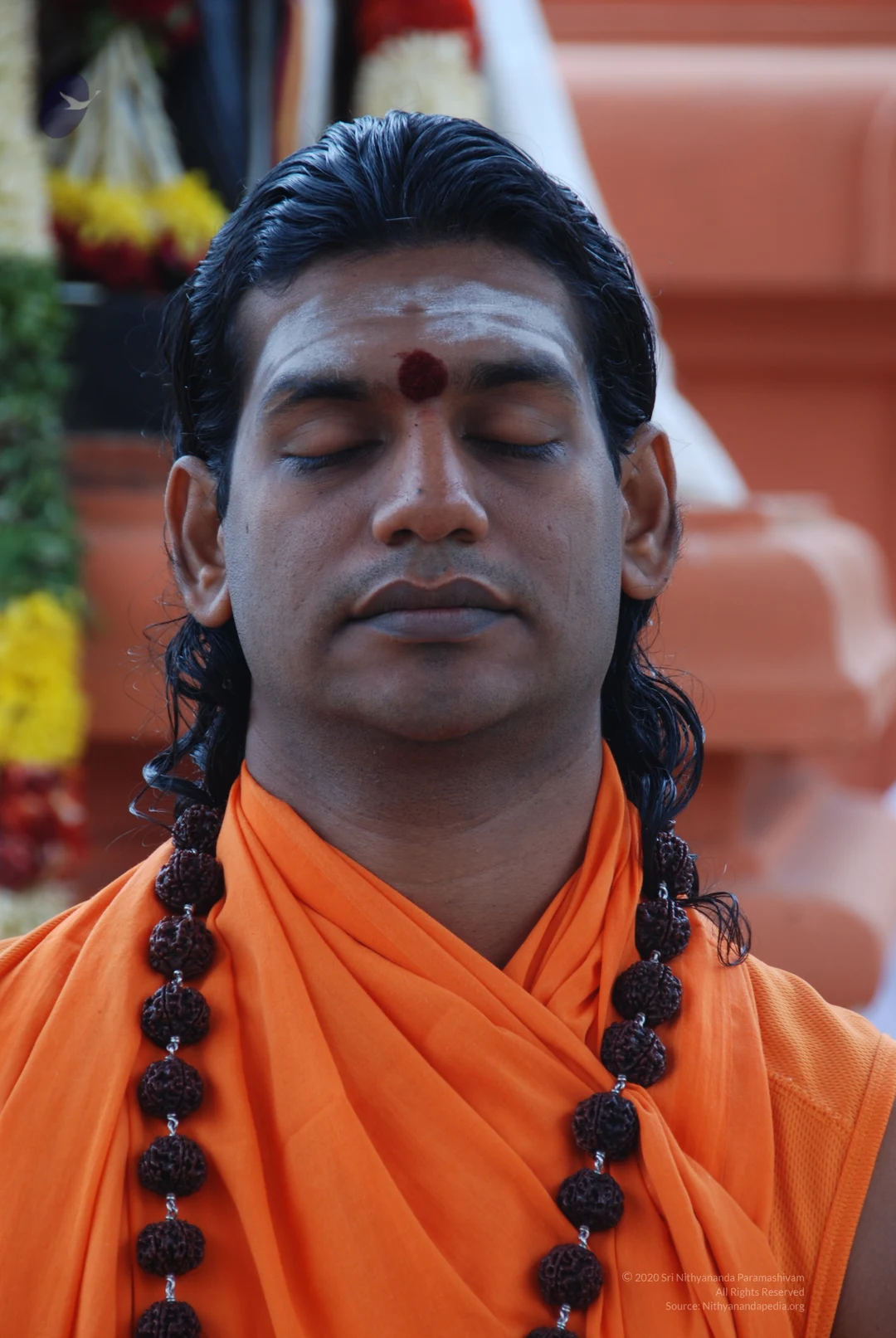
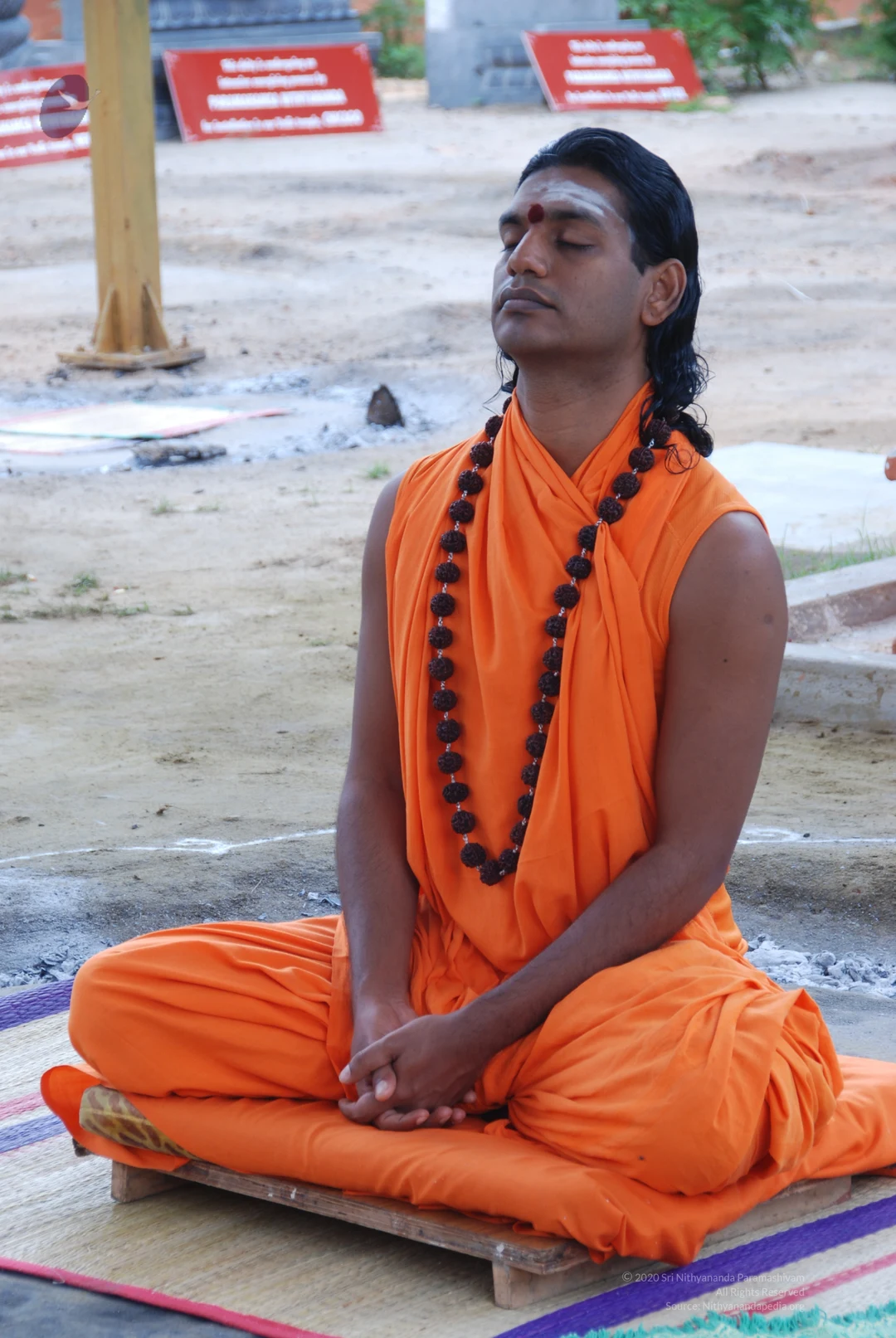
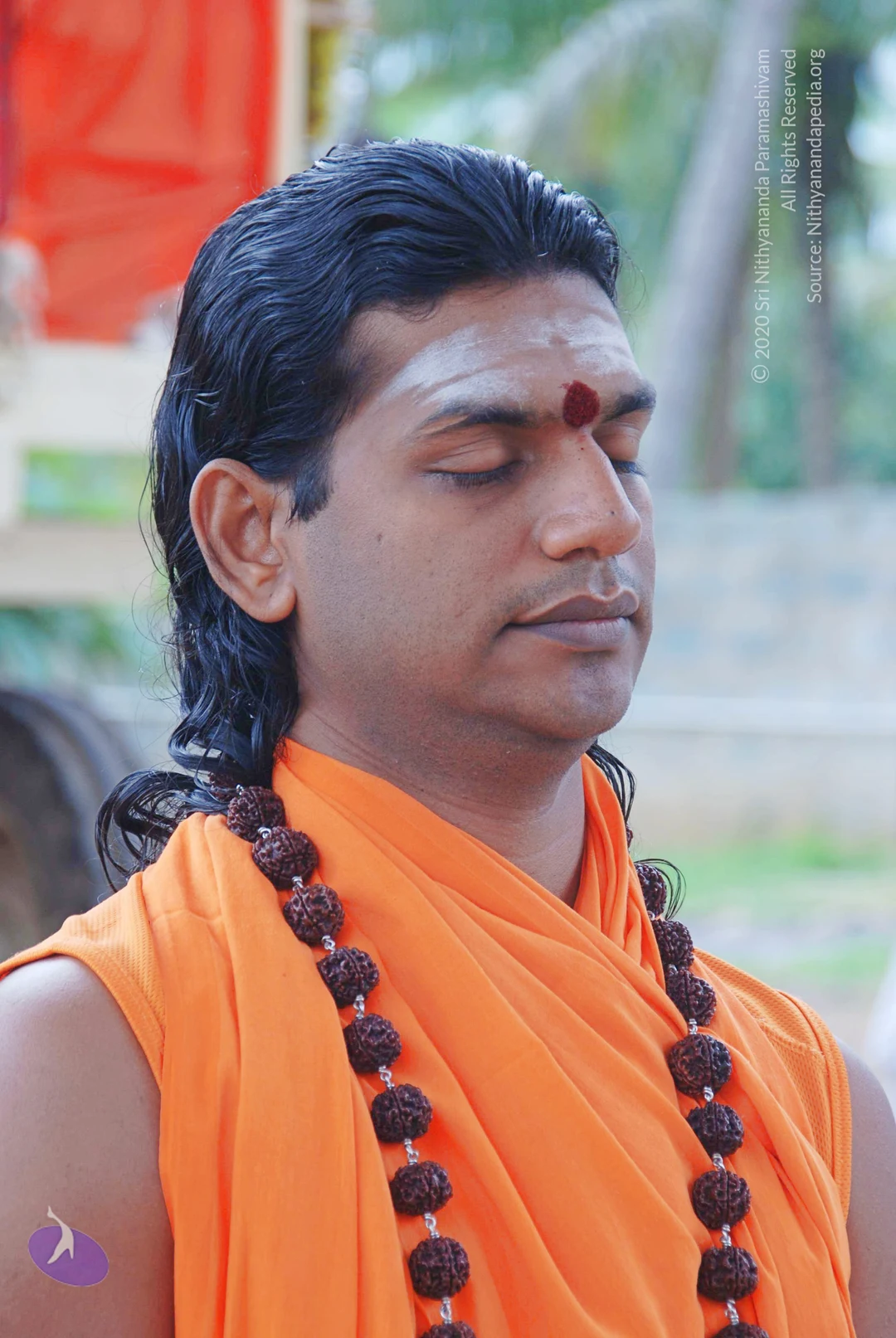
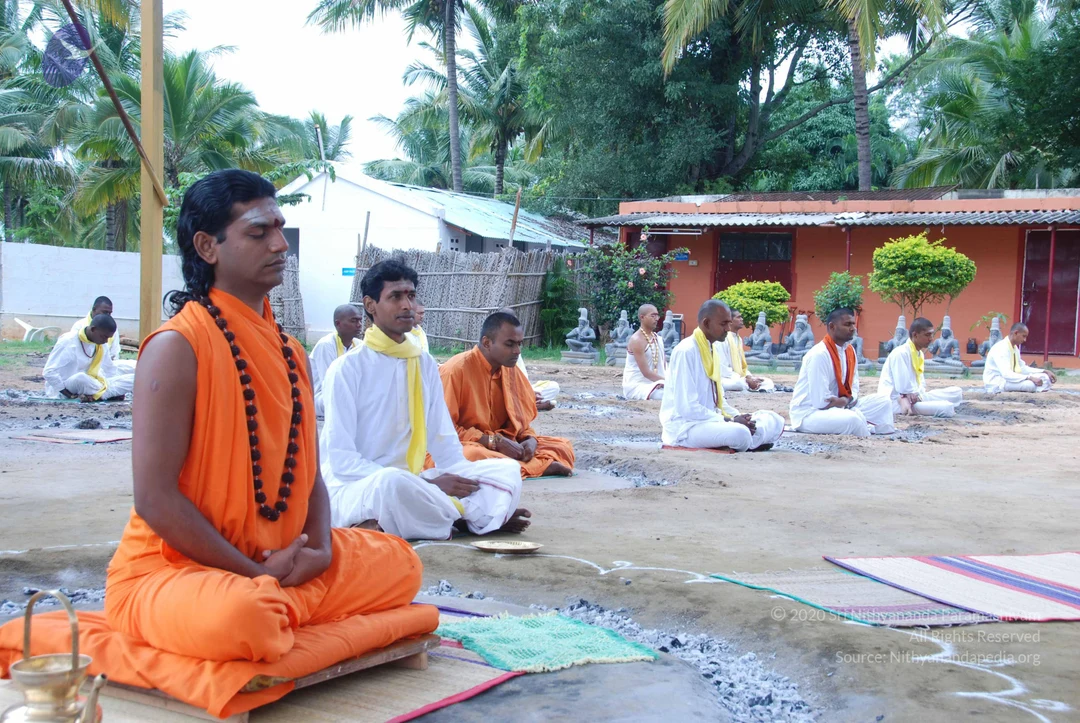
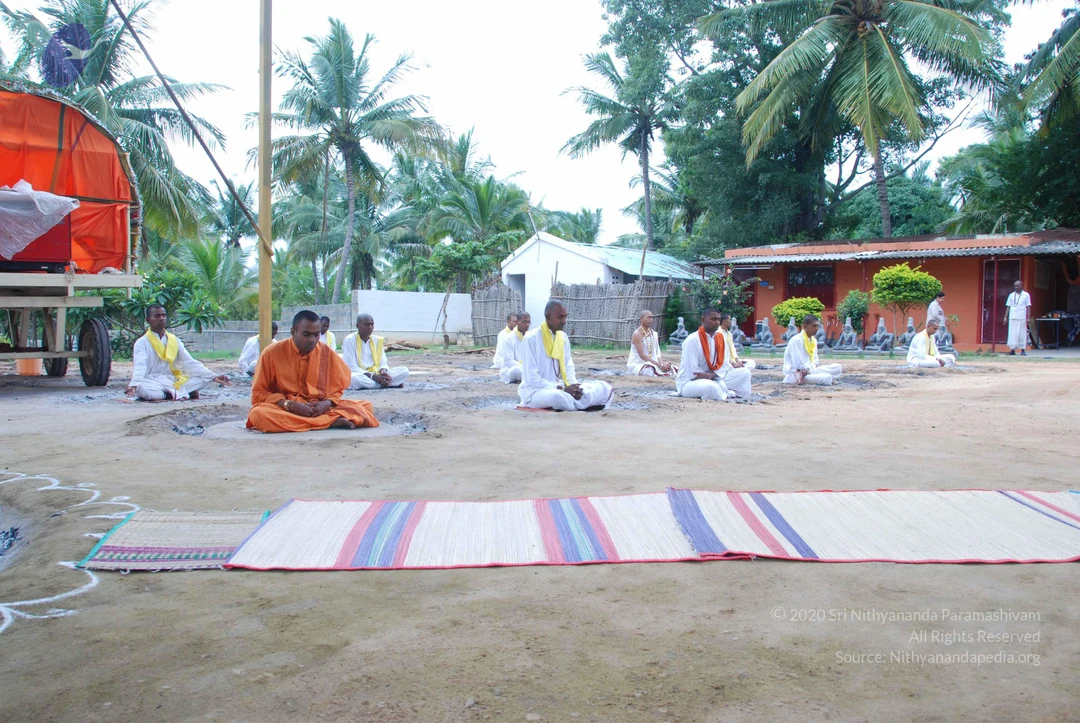
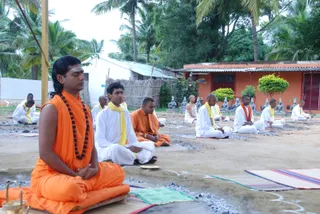
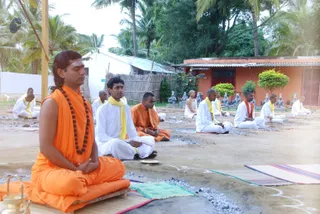
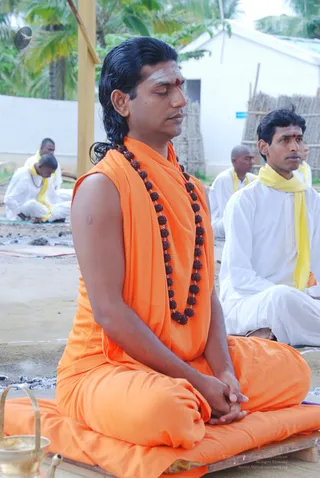
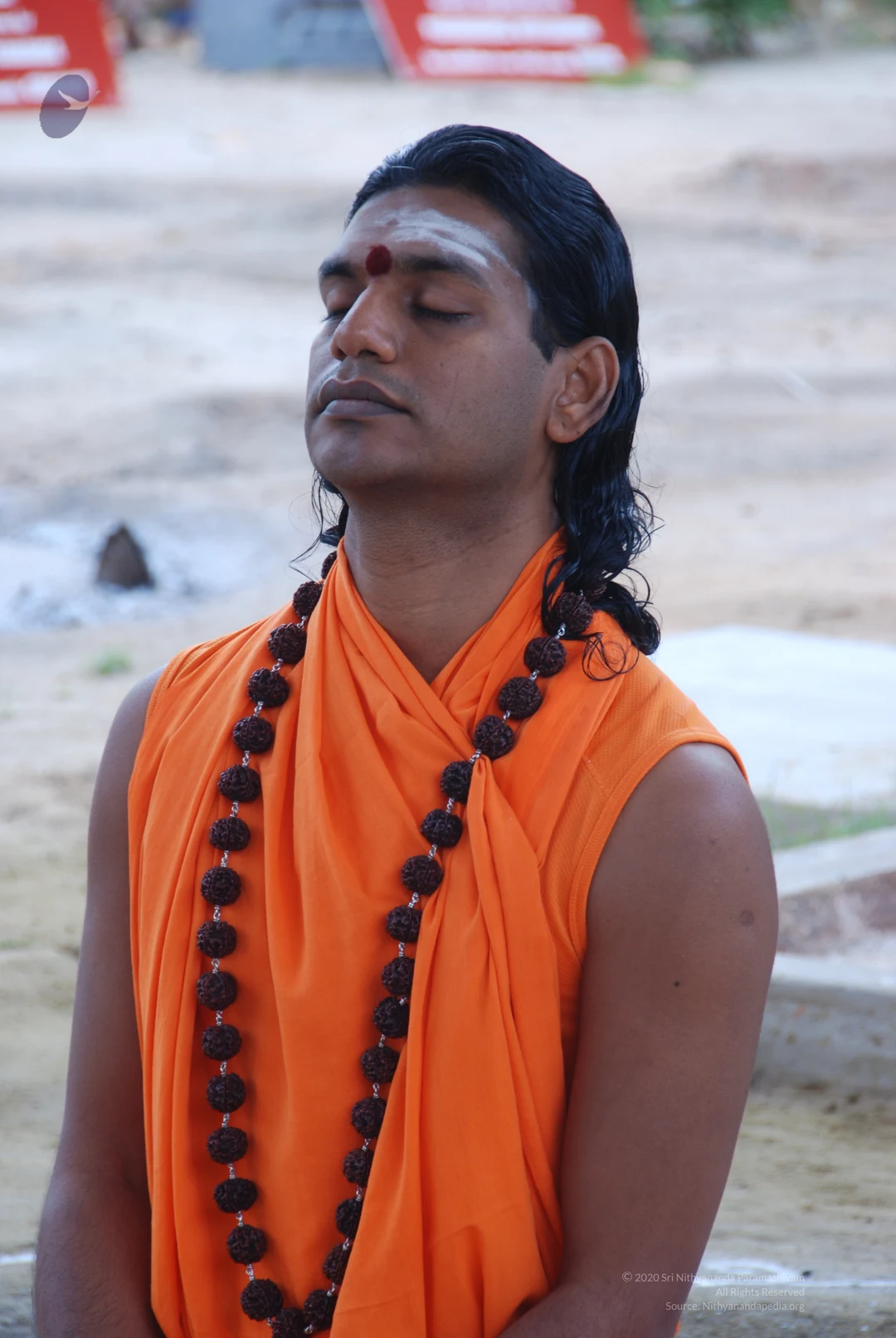
A man with long dark hair swept back sits with eyes closed in meditation, wearing an orange sleeveless garment draped over the shoulders and a long mala of dark rudraksha beads, with a red bindi and a white tilak on his forehead. Behind him is an orange-red temple structure and a garland of white, yellow and red flowers hangs at the left edge.A man with long swept-back black hair and a red tilak on his forehead sits cross-legged in meditation with eyes closed and hands resting in his lap, wearing an orange saffron robe and a long necklace of dark rudraksha beads. Behind him stands a dark stone deity murti of Shiva draped in a garland of red, yellow and white flowers, set on a red-orange stepped pedestal. A brass kalasha-style lamp sits on a striped mat in the foreground. To the right, a standing person in white clothing is partly visible. Lush green plants and a stone naga sculpture appear on the left, with a red sign beside the pedestal. a person in meditation pose.Outdoors in a palm-lined compound, a row of people sit cross-legged in meditation on a sandy, ash-marked ground. The foreground man in front wears a saffron-orange robe, a rudraksha mala, a vertical tilak on his forehead, and has long hair swept back; his hands rest in his lap beside a small brass vessel. Beside him a man in a yellow scarf and orange garment sits on a mat, and behind them several men in white dhotis with yellow shawls meditate. Striped mats are spread on the ground and rows of stone statues stand near an orange-walled building. Several shaved-headed men in white and saffron are visible.A group of men sit cross-legged in meditation on a sandy open courtyard under coconut palms, with stone sculptures and an orange-walled building behind them. In the foreground at left, a man in saffron-orange robes, a long rudraksha mala, and a vertical tilak on his forehead sits with eyes closed, hands folded in his lap. Beside and behind him, several men wear white dhotis and yellow shawls, and a couple wear saffron cloth. A brass vessel sits on a low wooden platform at lower left, and a small pit of ash lies near the centre. The people appear absorbed in silent meditation.Outdoor meditation scene. A man with long dark hair swept back sits cross-legged on an orange cloth mat on a wooden platform, eyes closed, hands clasped in his lap. He wears an orange sleeveless robe and a long rudraksha mala, with white and red forehead markings. Behind him, several men in white dhotis and yellow shawls sit in meditation, and a brass vessel rests at the lower left edge. Palm trees, a white building and bamboo screens fill the background. The swami presentation cues (long swept-back hair, orange robe, rudraksha mala) match the page's claim, so this is a probable Swamiji in person; the yellow-shawled men are devotees.Photograph of a man seated cross-legged in meditation outdoors, eyes closed, hands resting in his lap. He wears an orange sleeveless garment with a matching orange wrap and a long necklace of dark rudraksha beads. His long dark hair is swept back, and he has white and red marks on his forehead. Beside him sits a man in a white kurta with a yellow shawl, also meditating with hands folded. Further back, more people in orange and white clothing sit in rows. Palm trees, a corrugated roof and a woven bamboo fence form the background, and a brass vessel is visible at the lower left.

Paadapooja
35 photosSource gallery
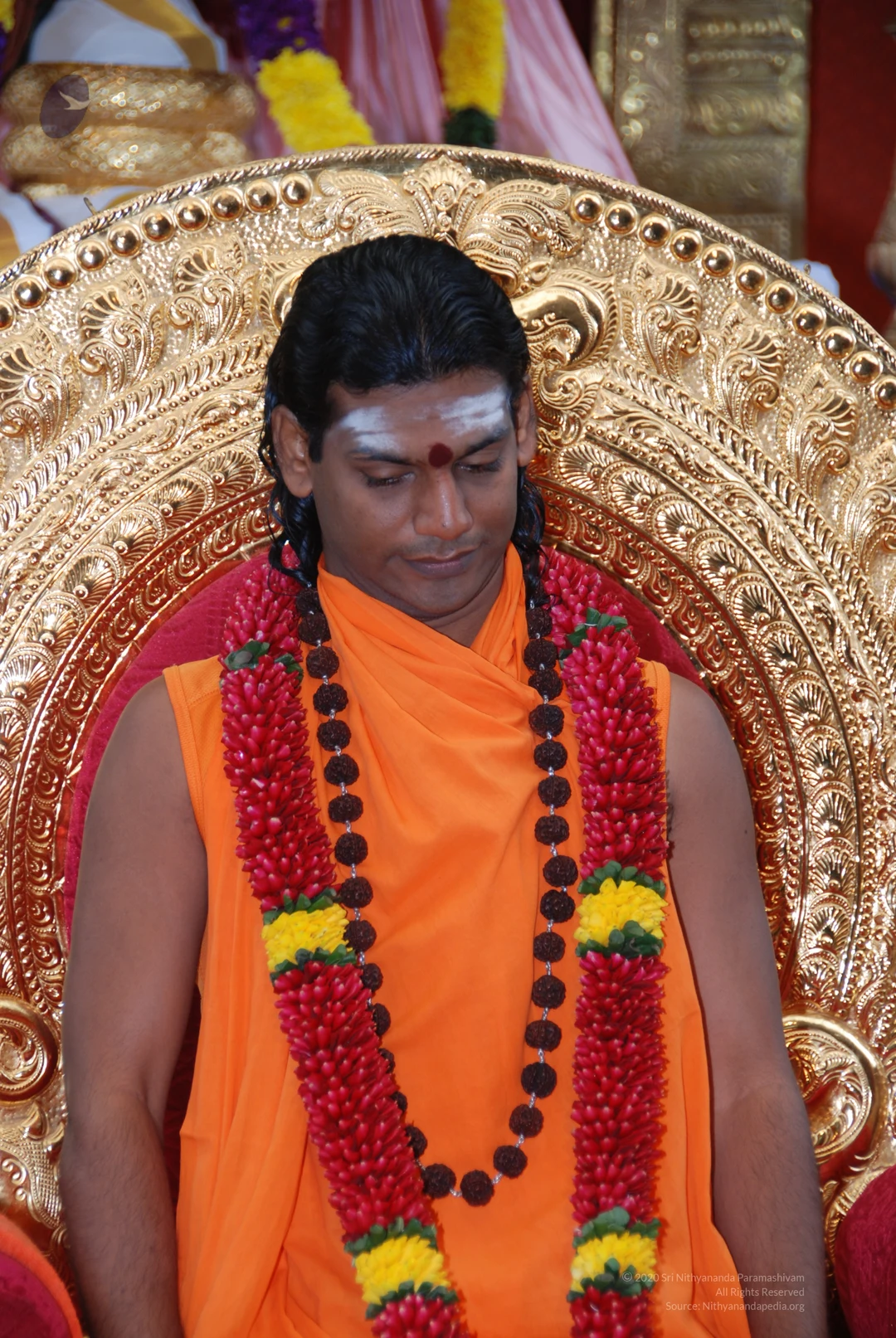
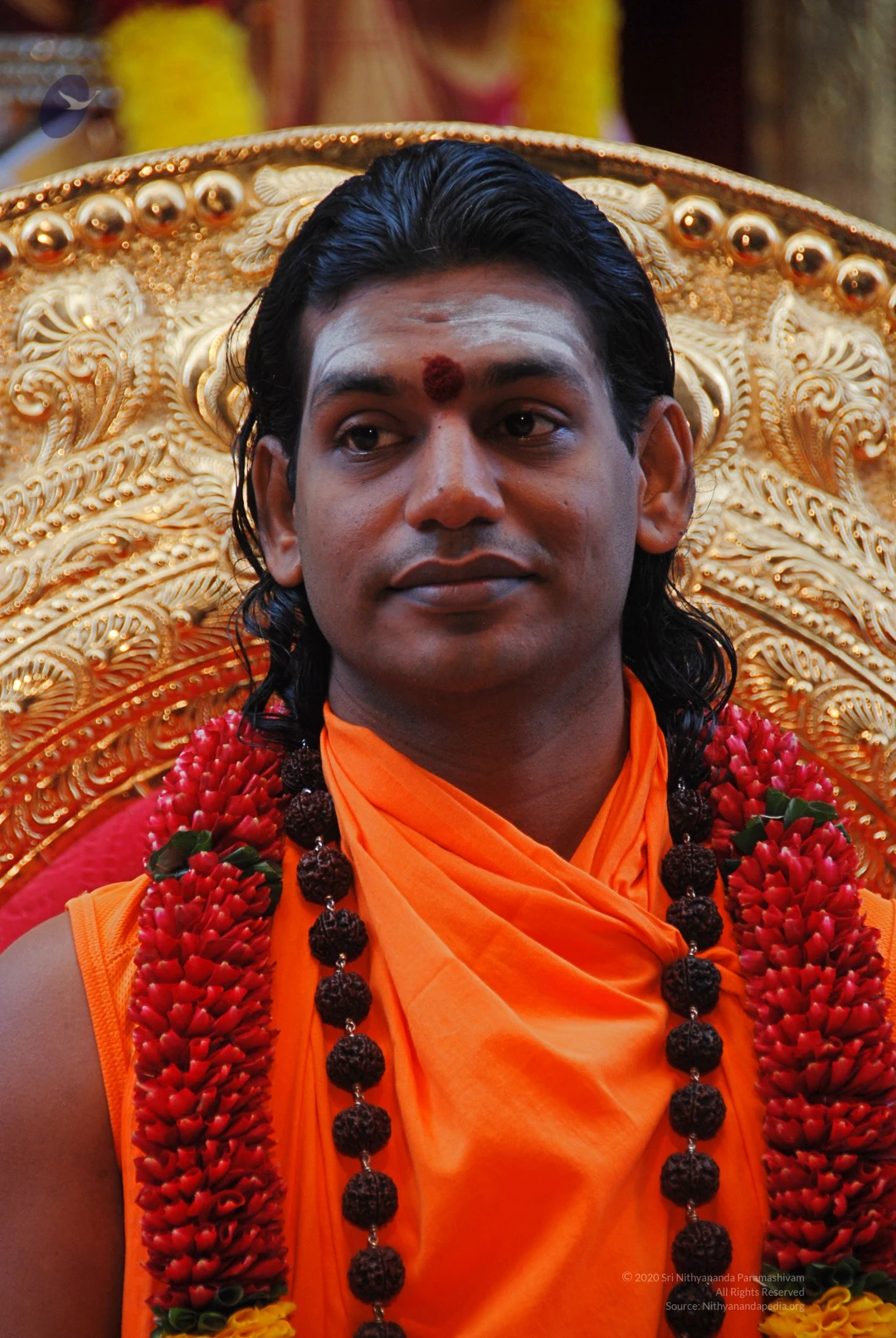
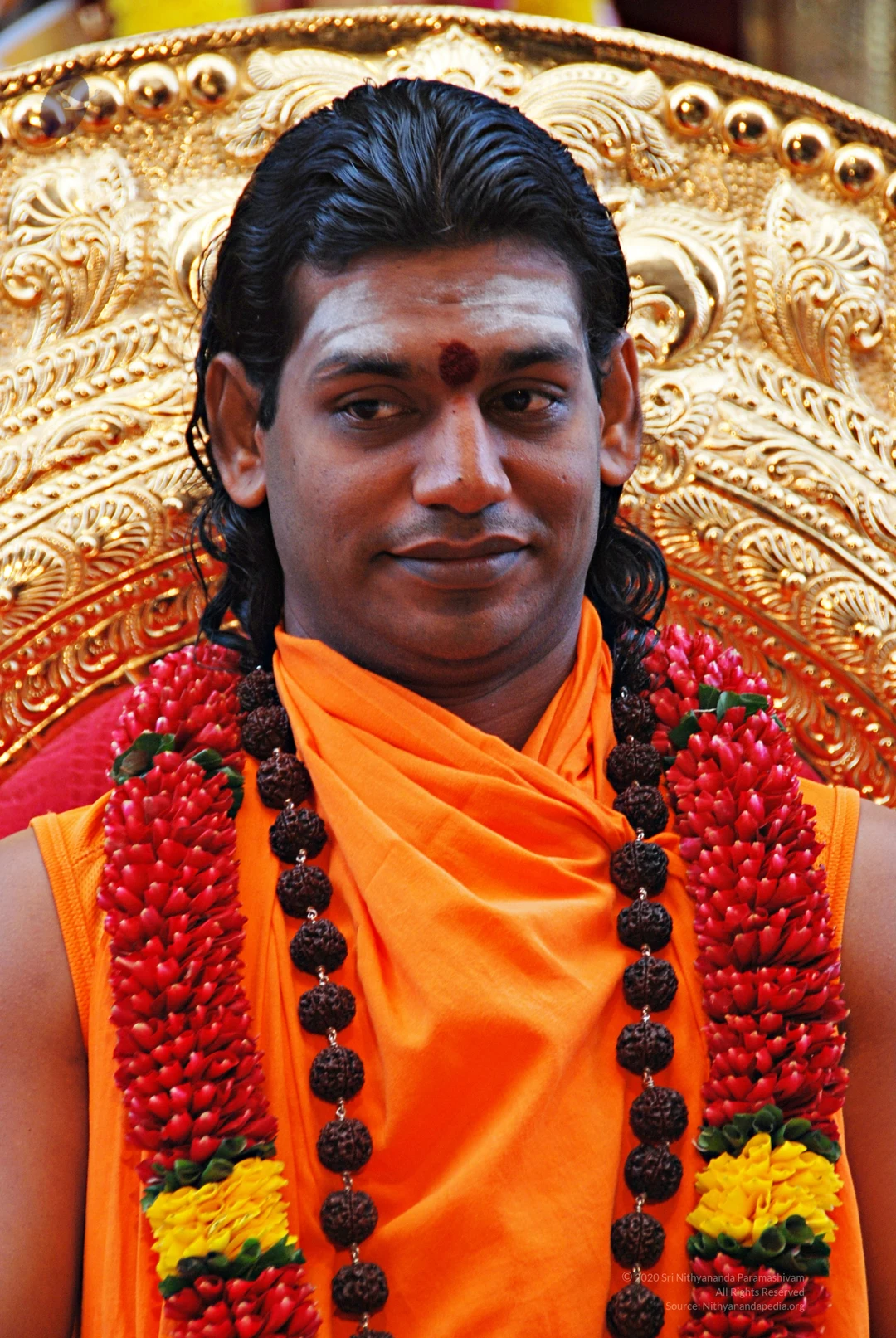
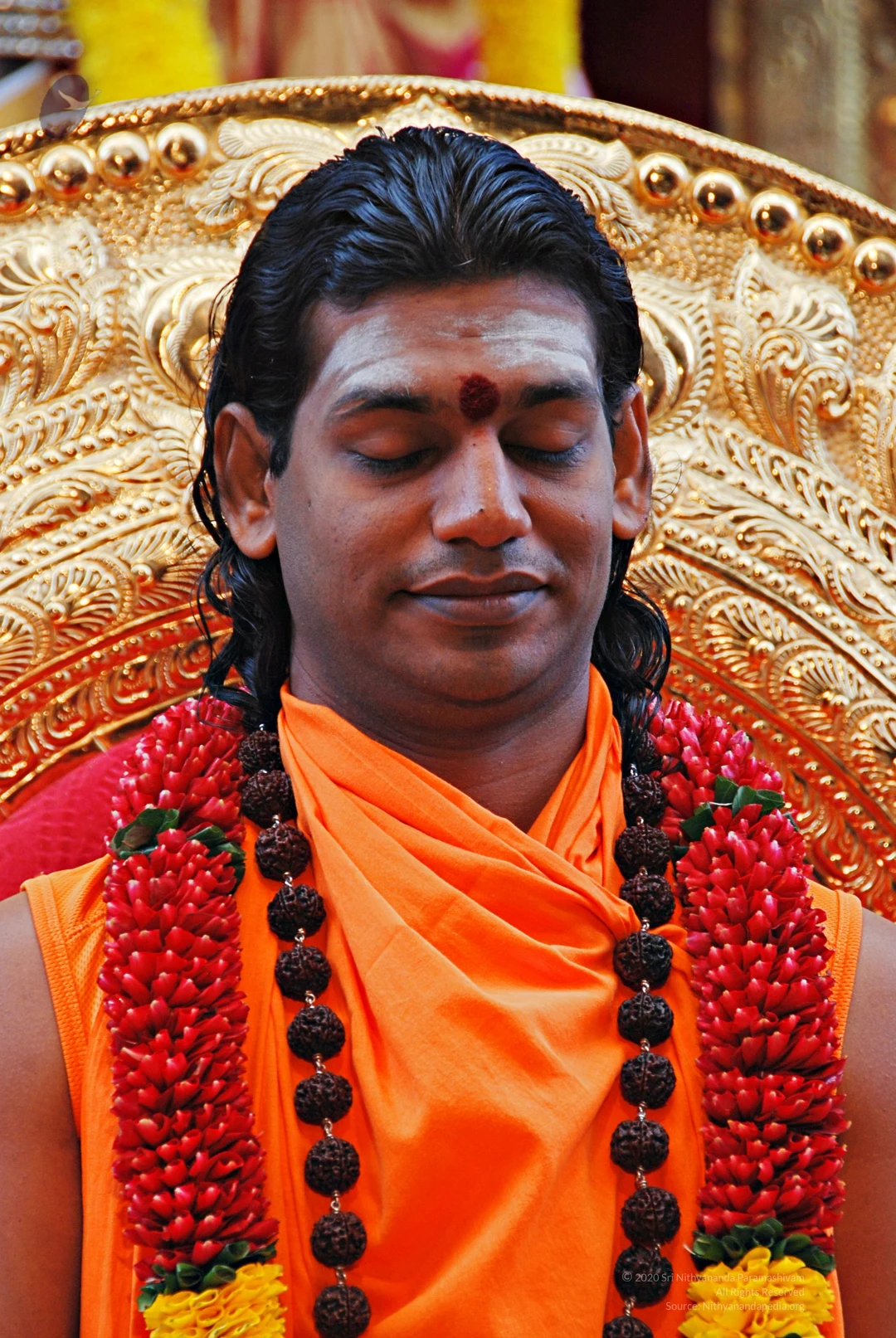
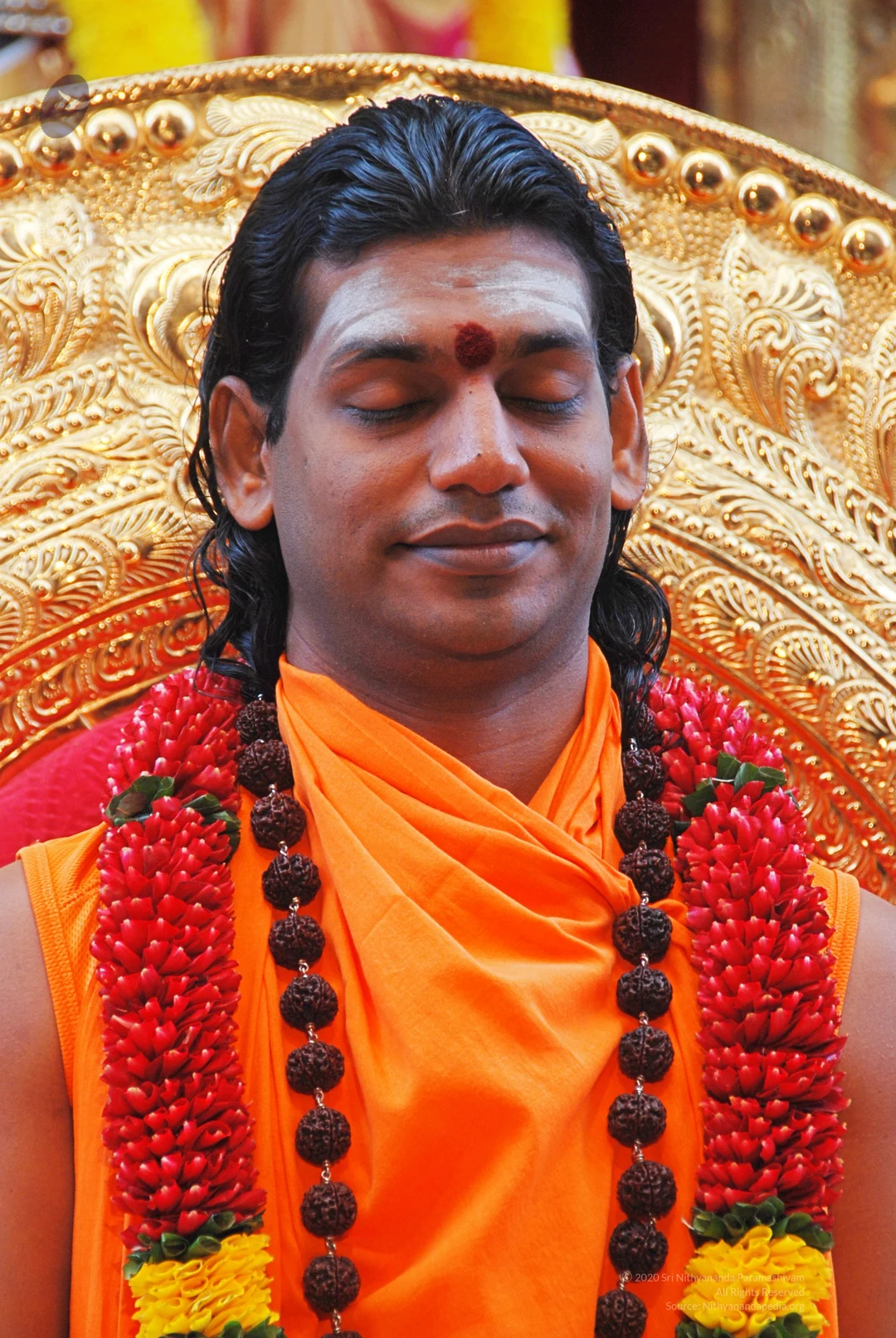
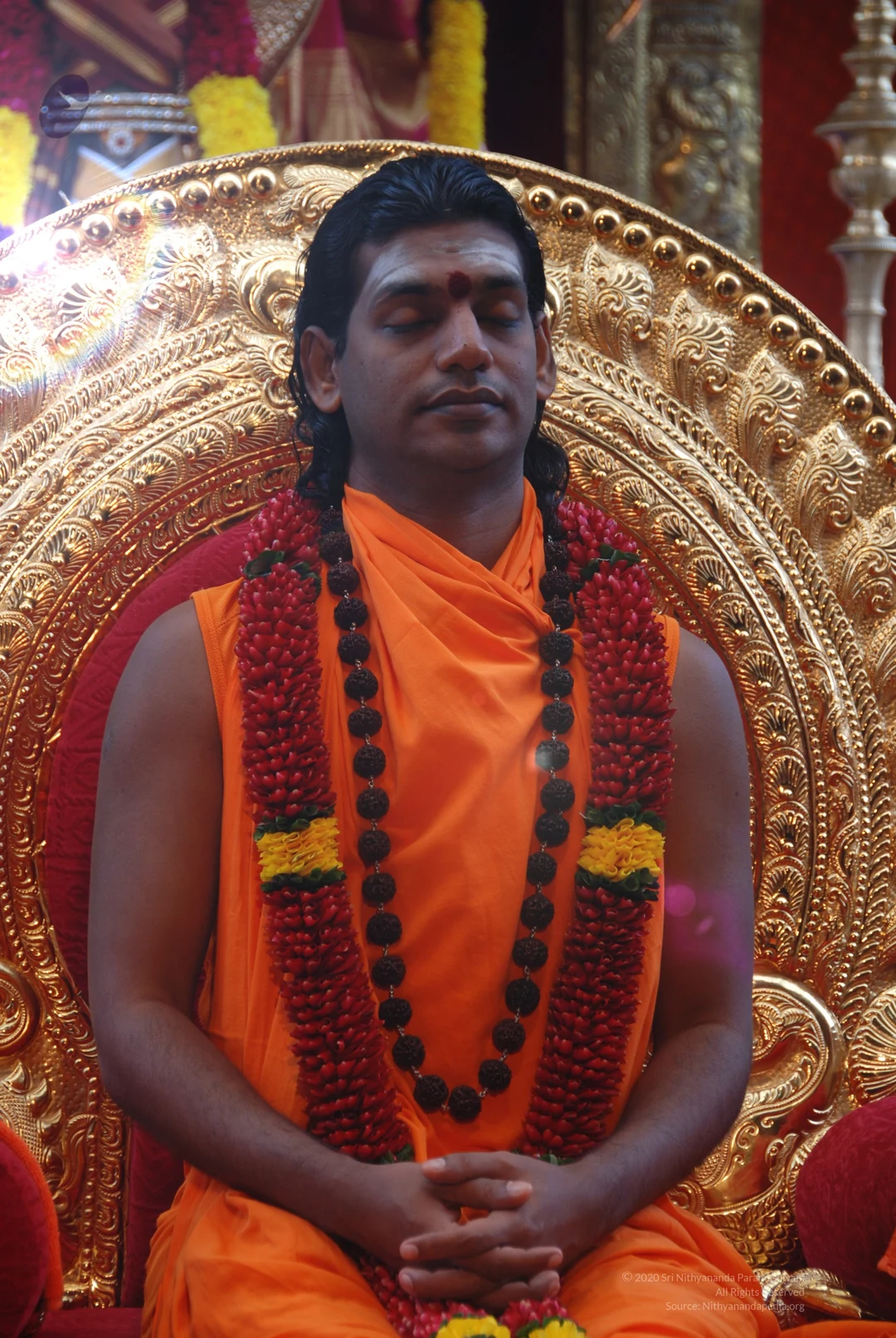
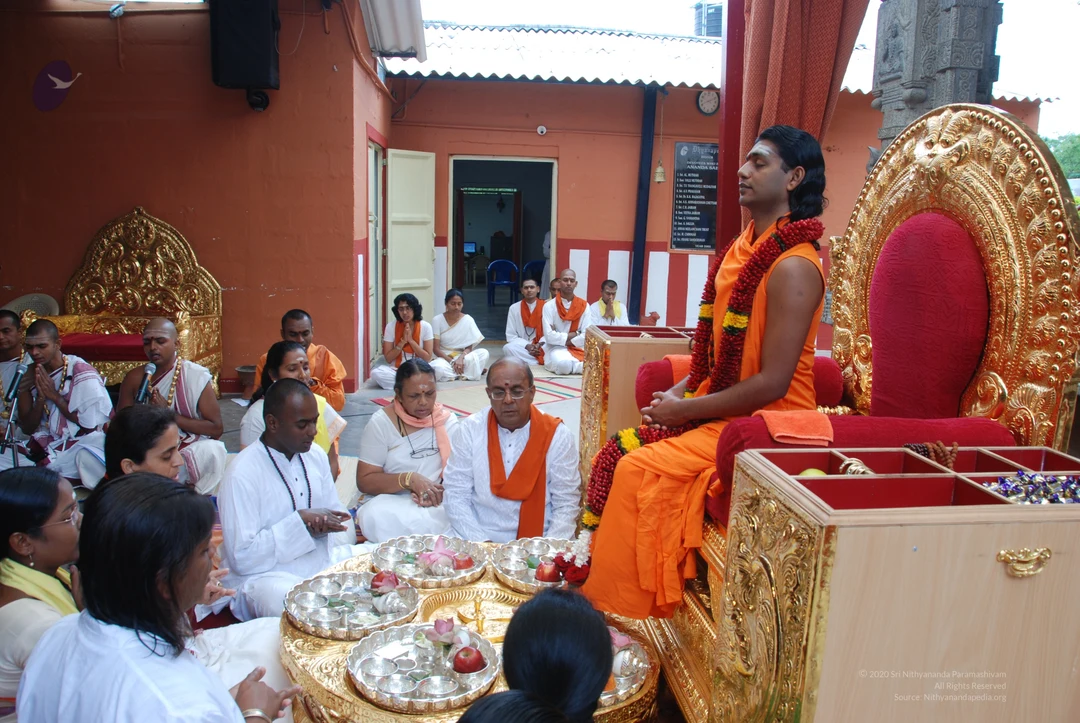
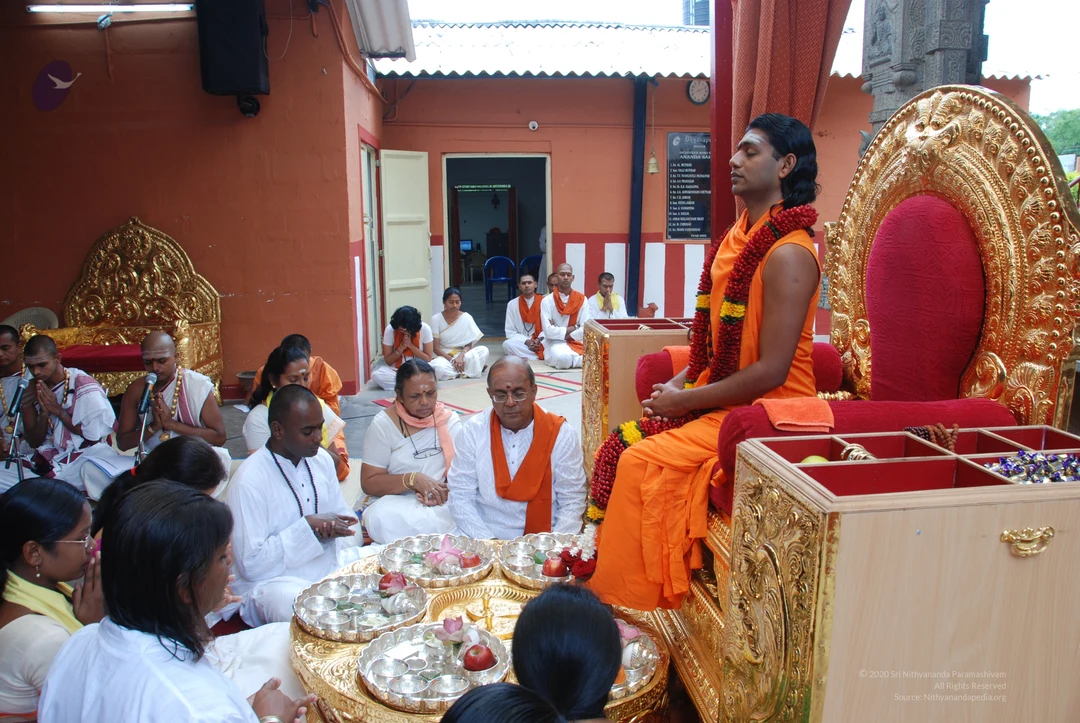
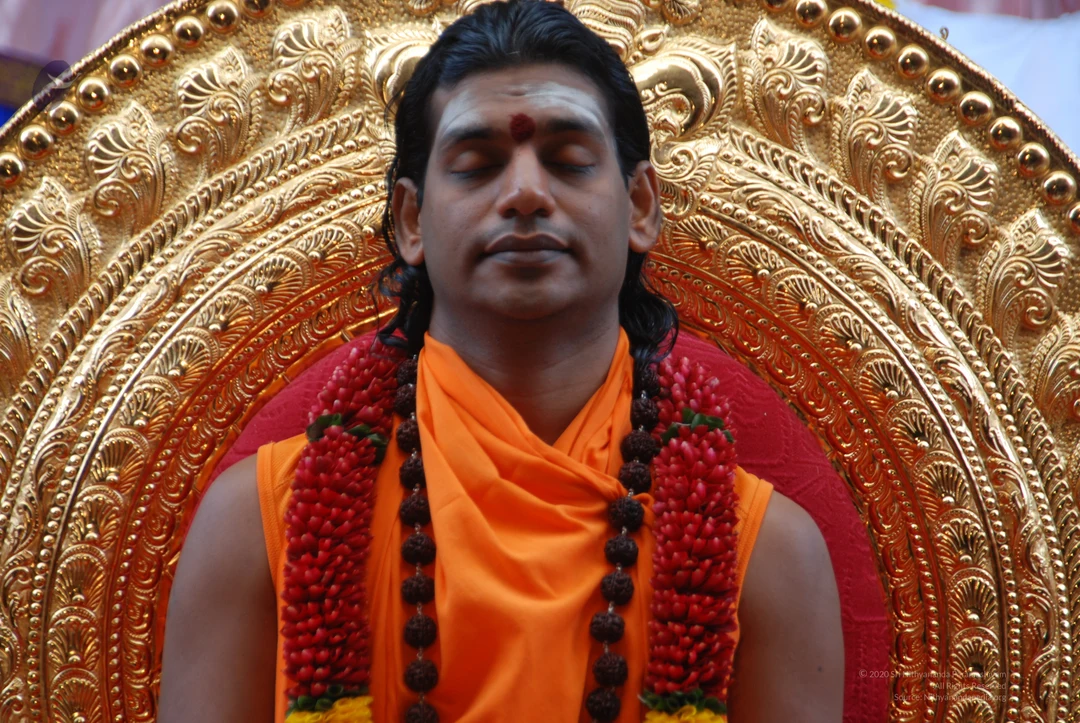
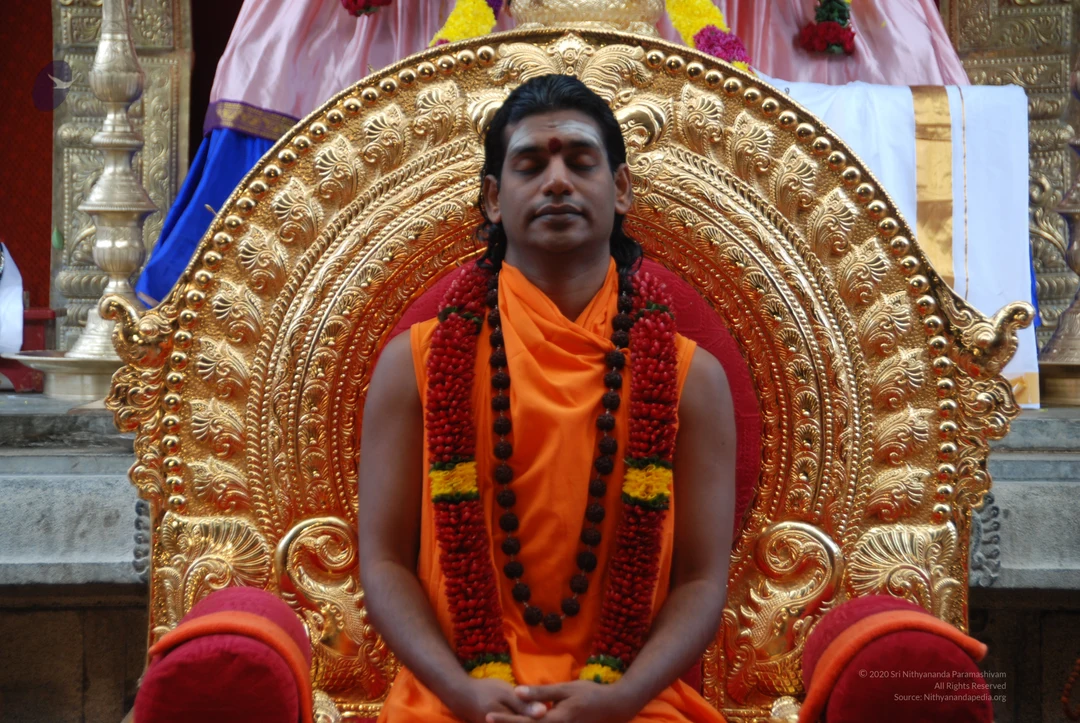
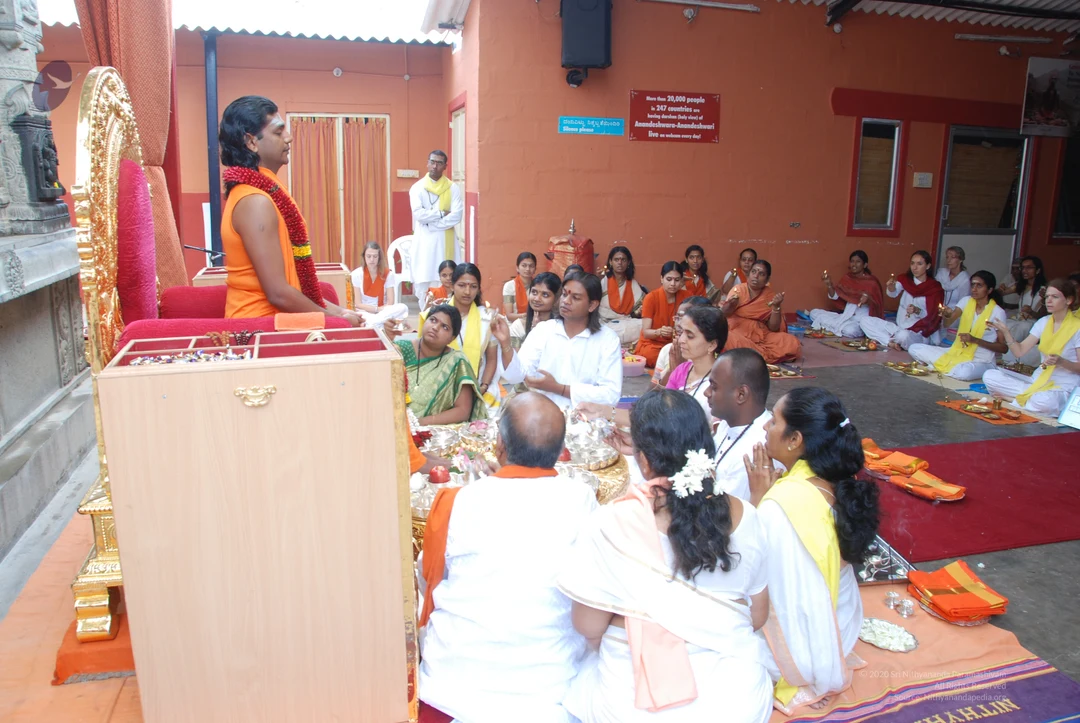
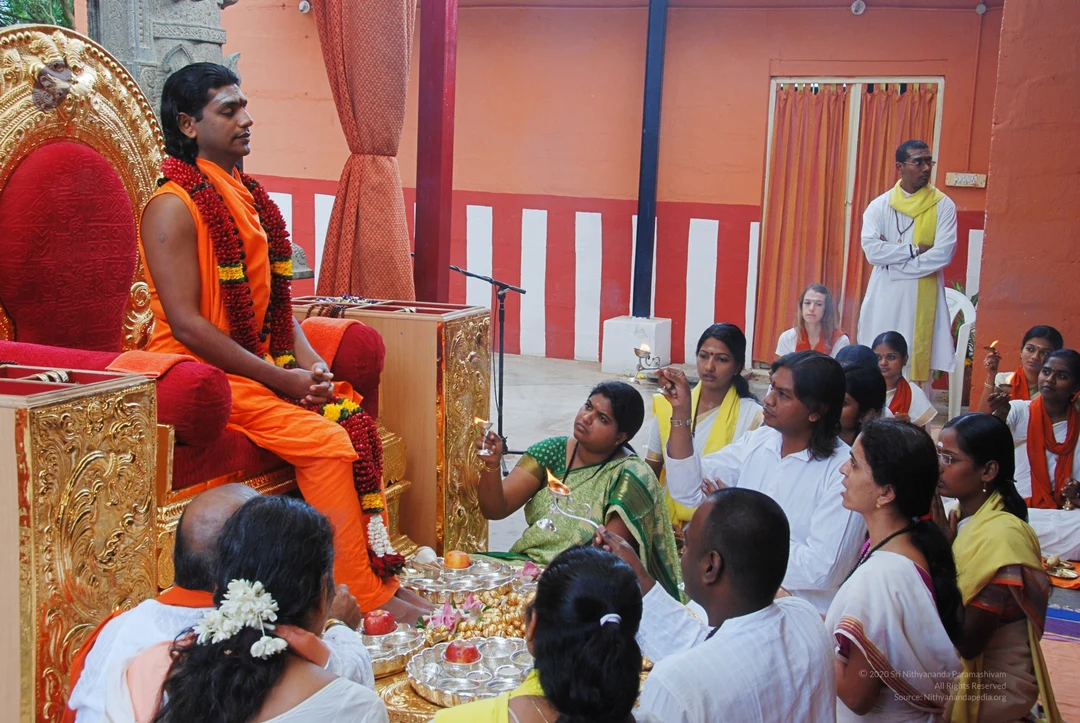
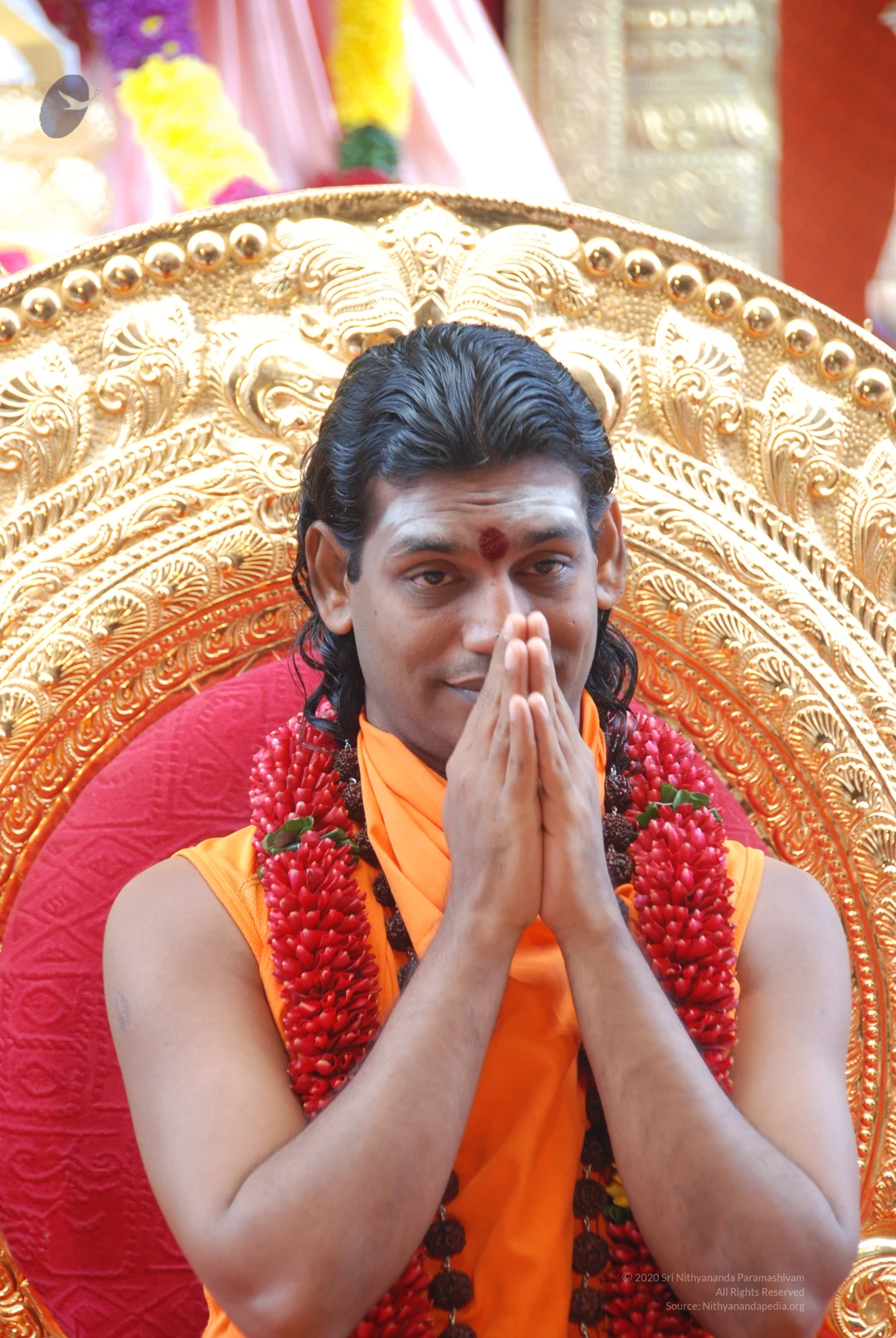
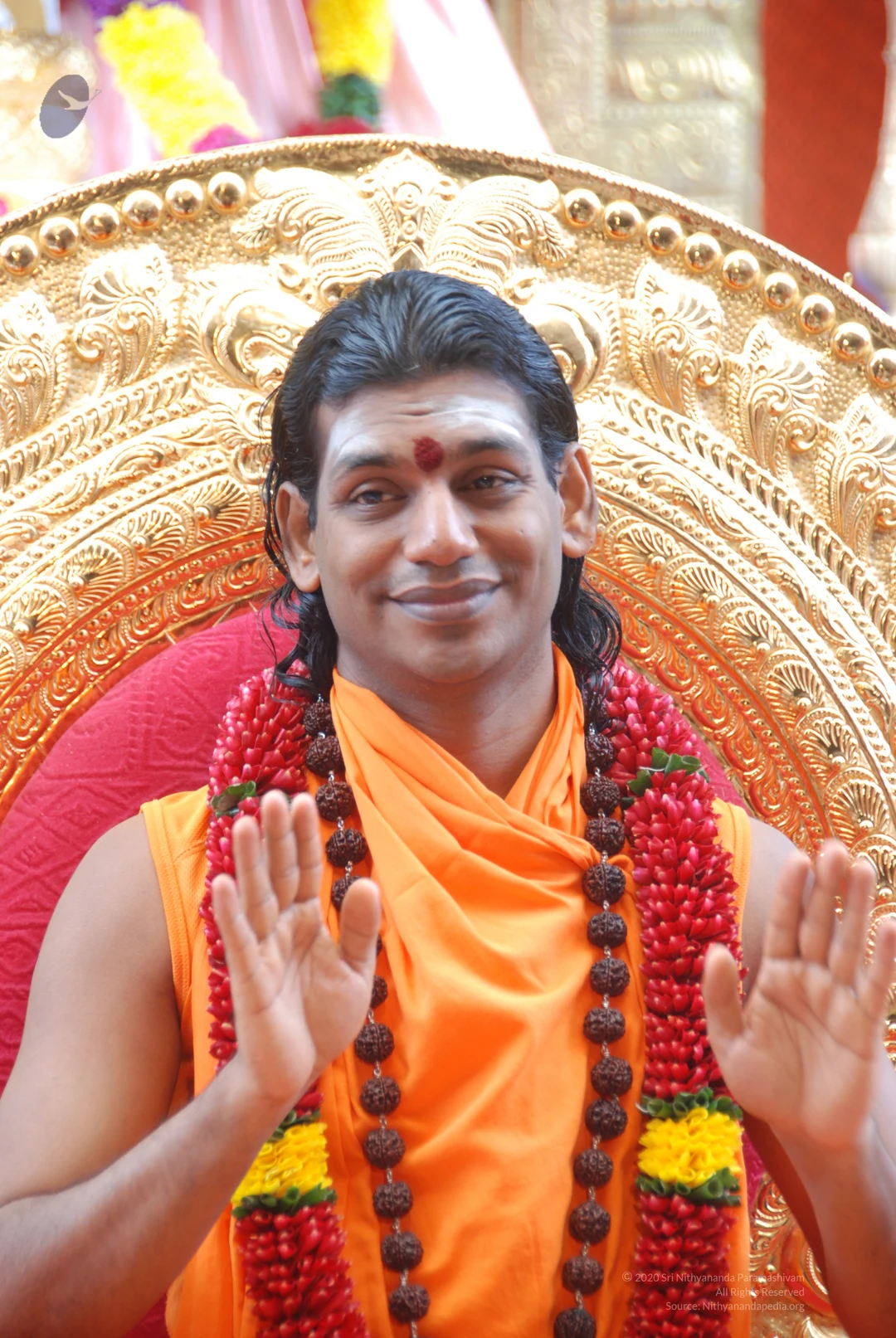
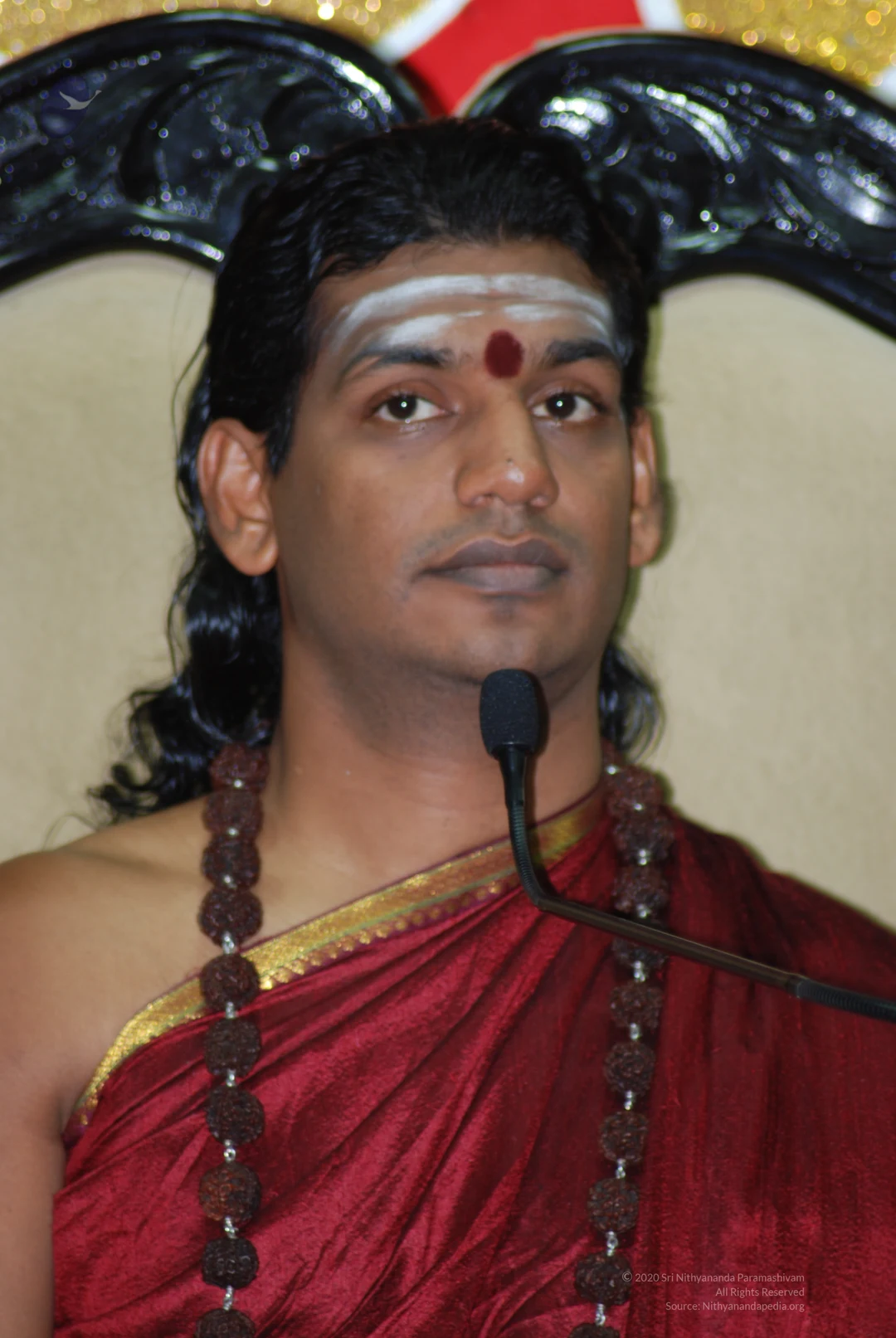
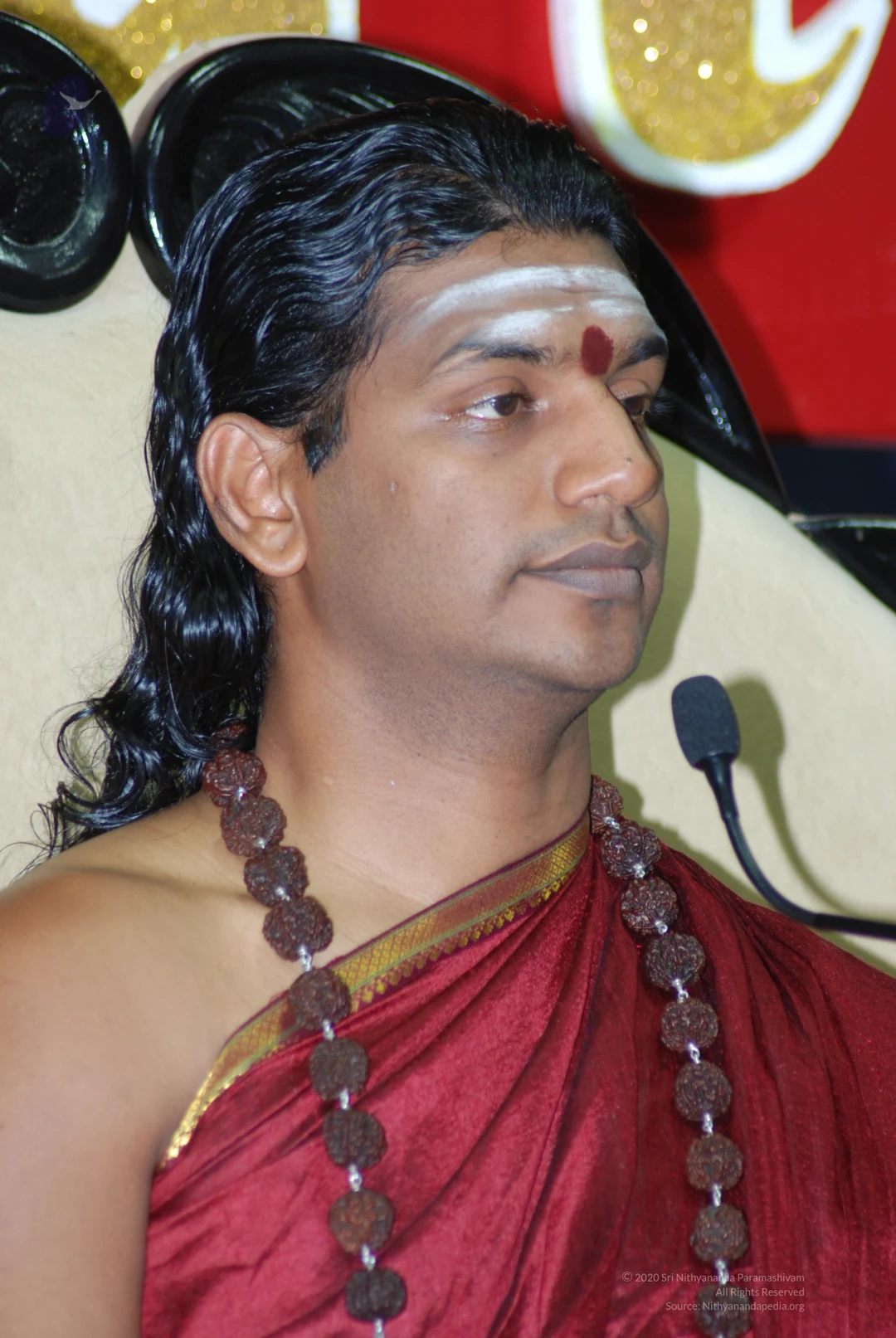
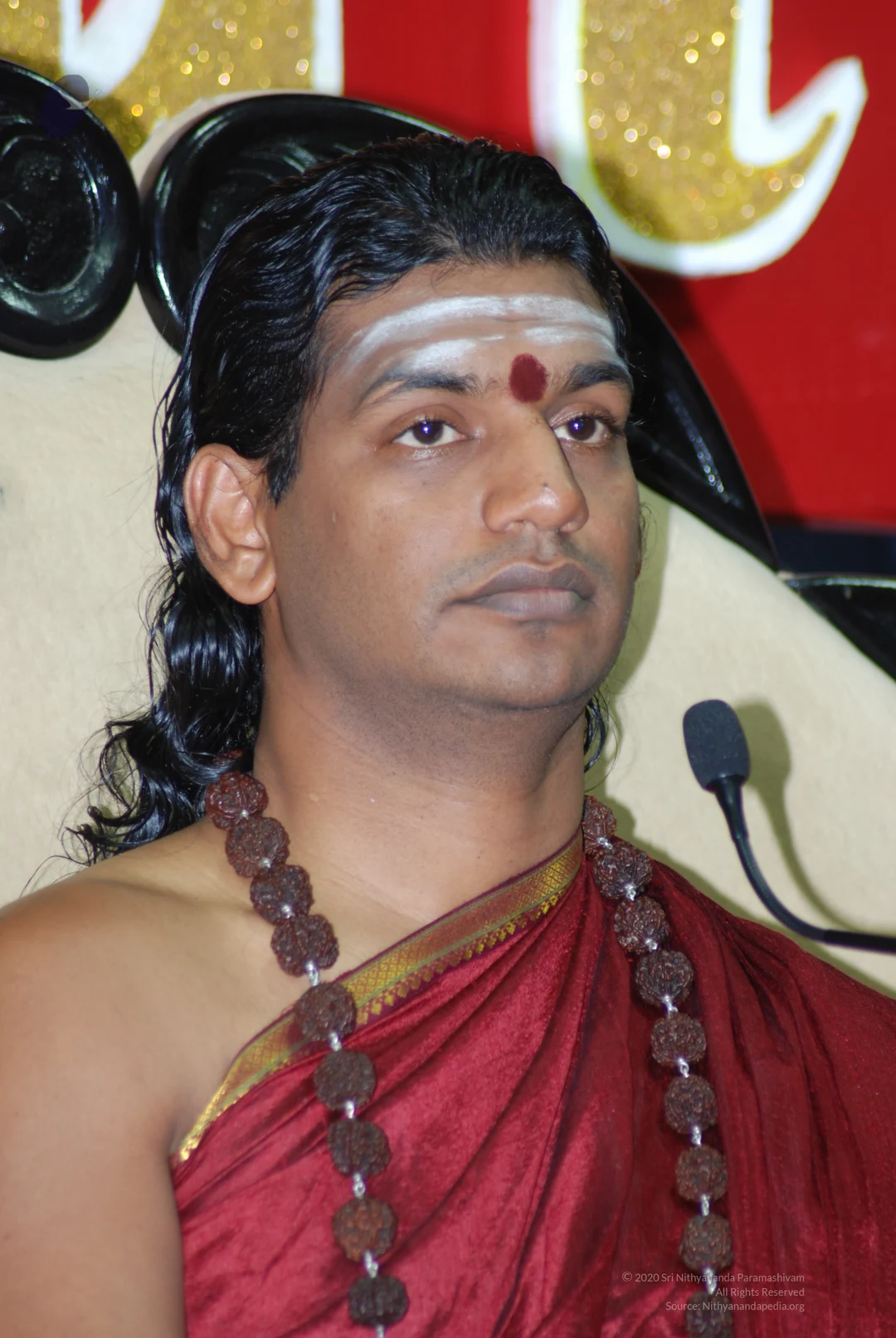
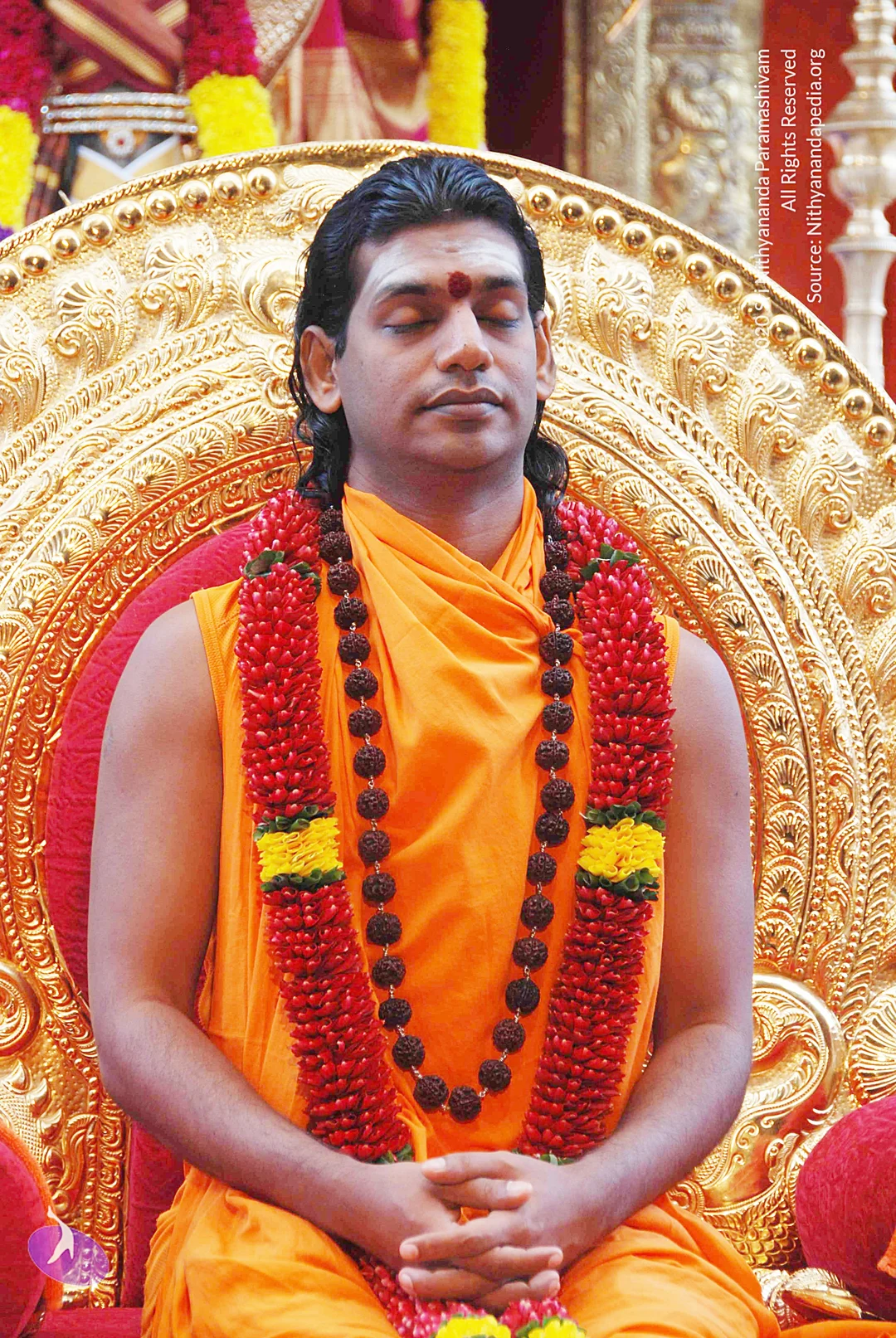
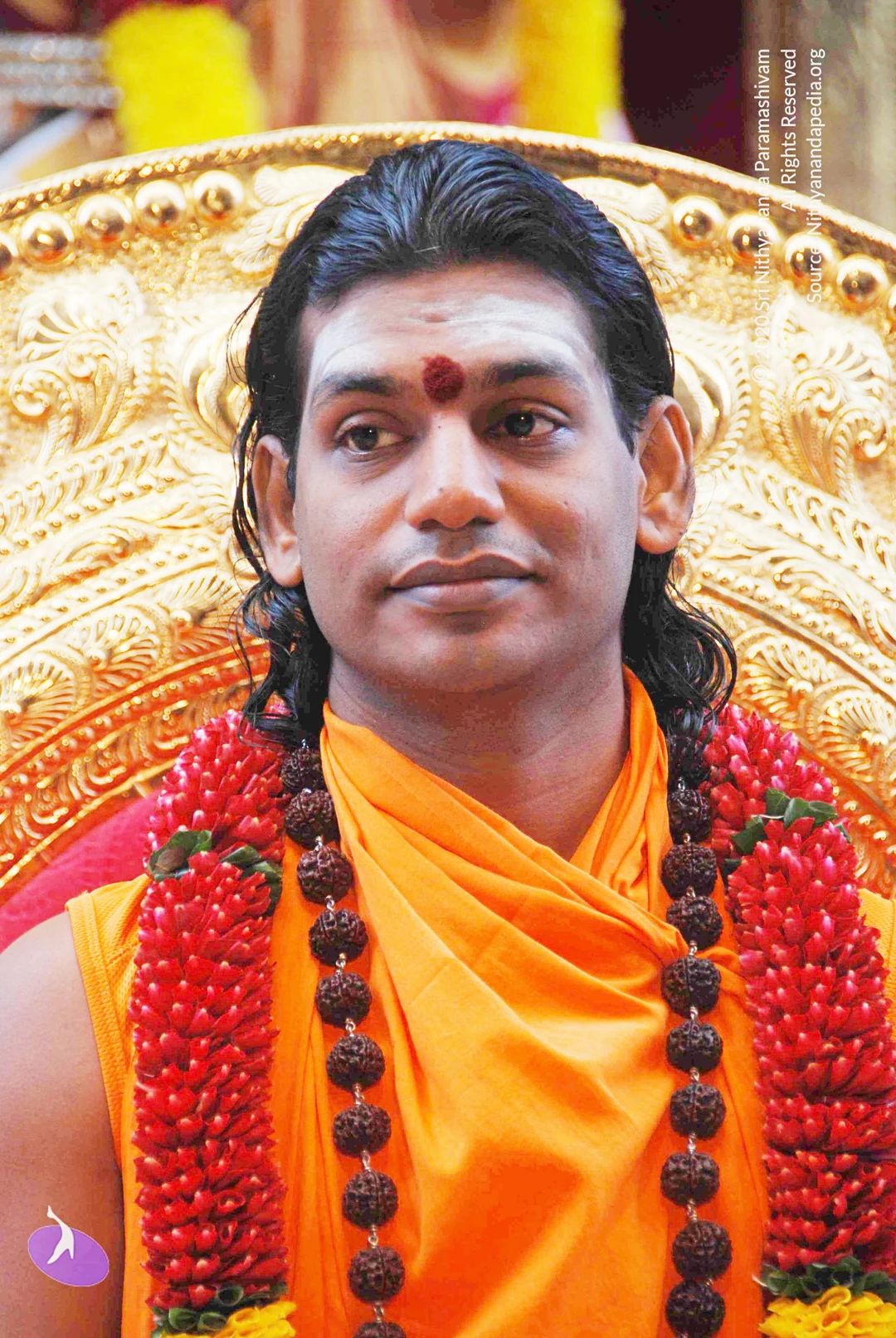
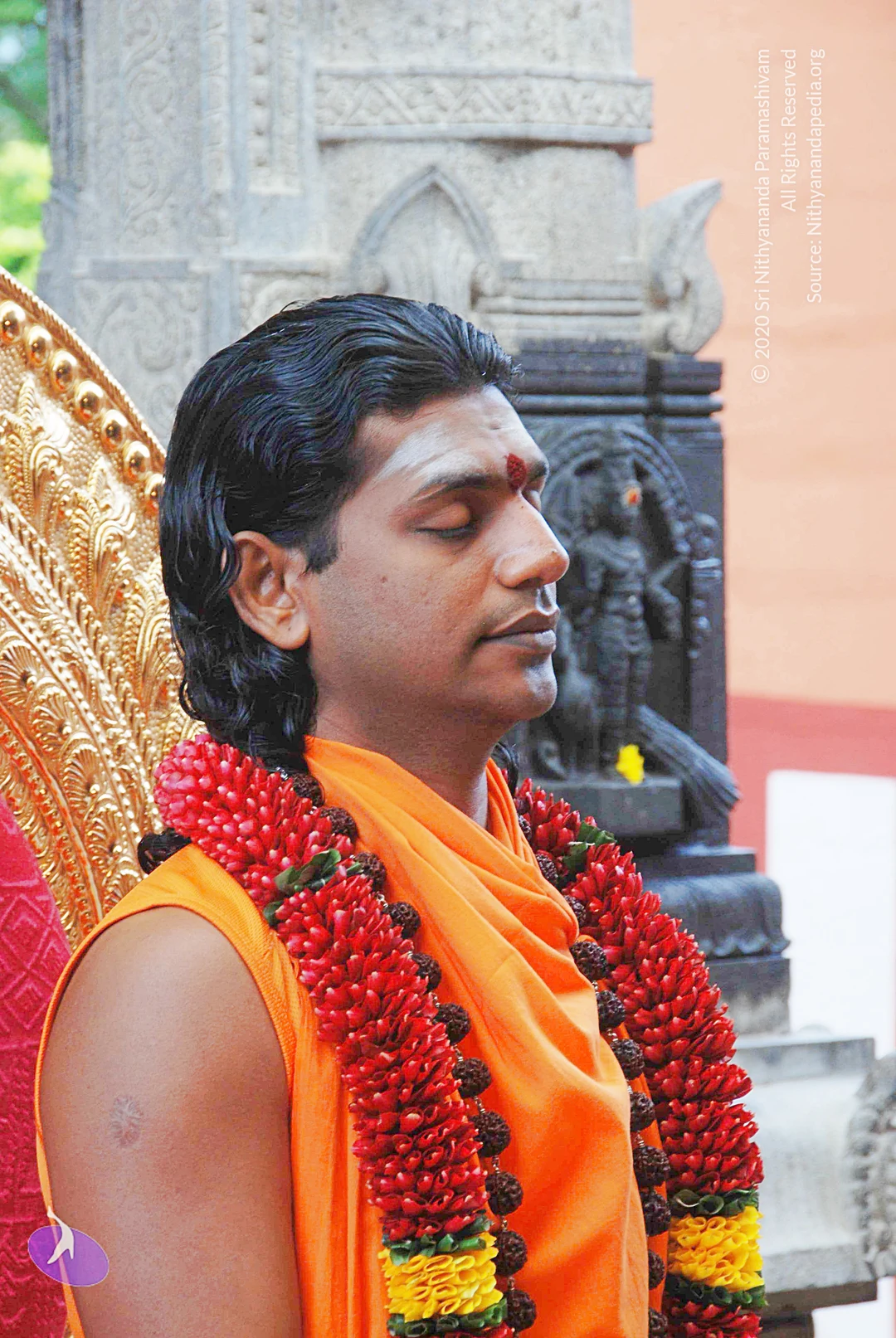
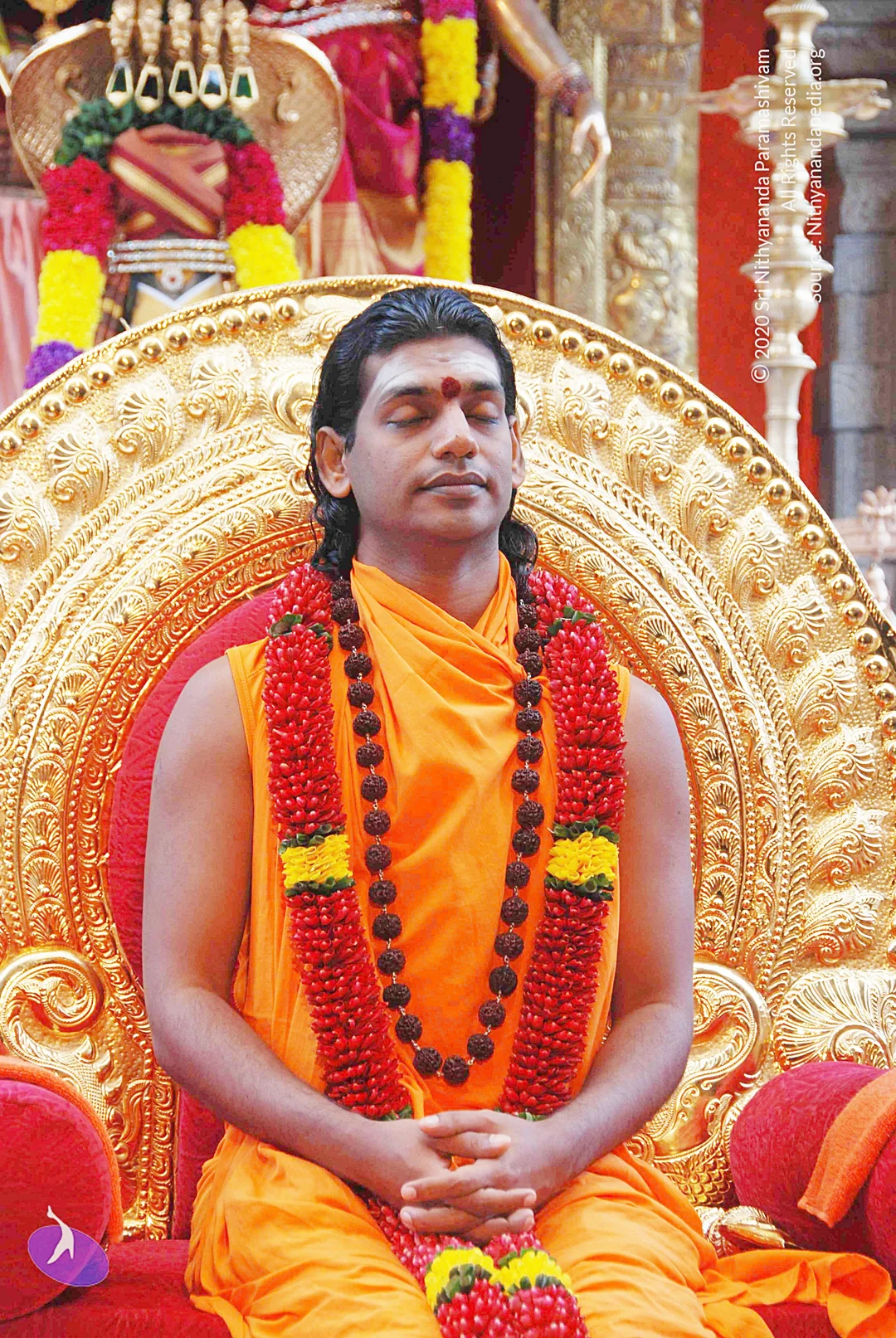
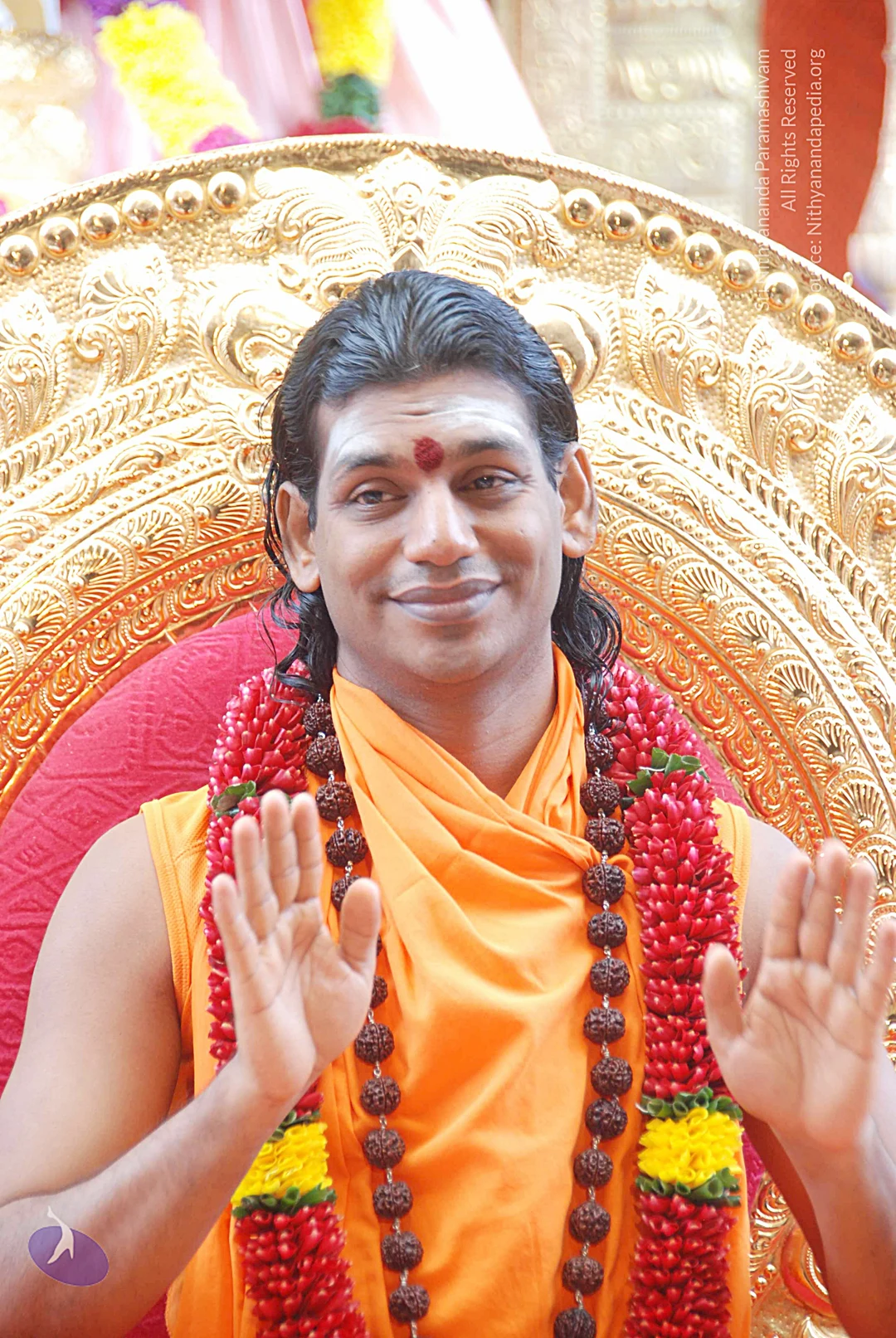
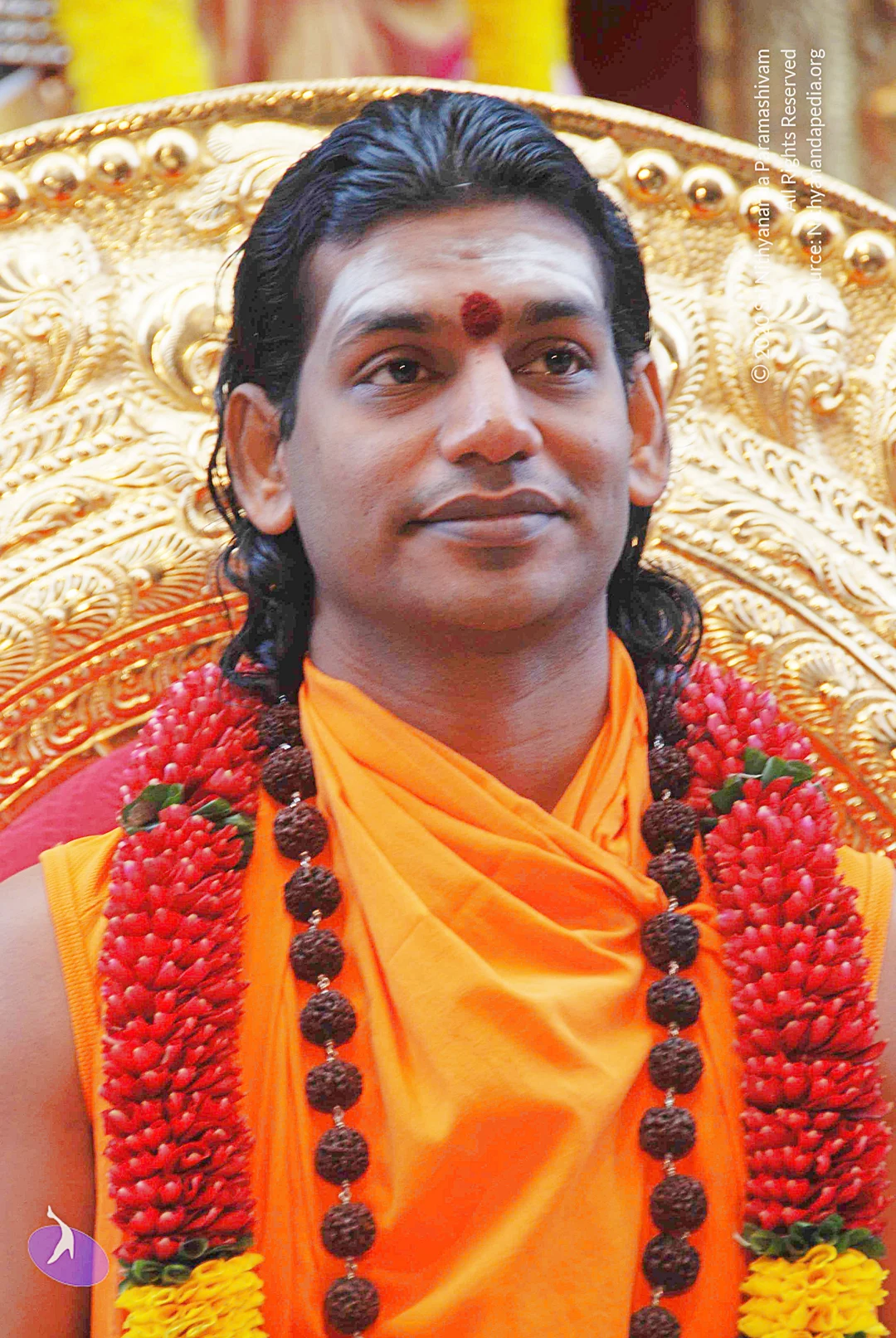
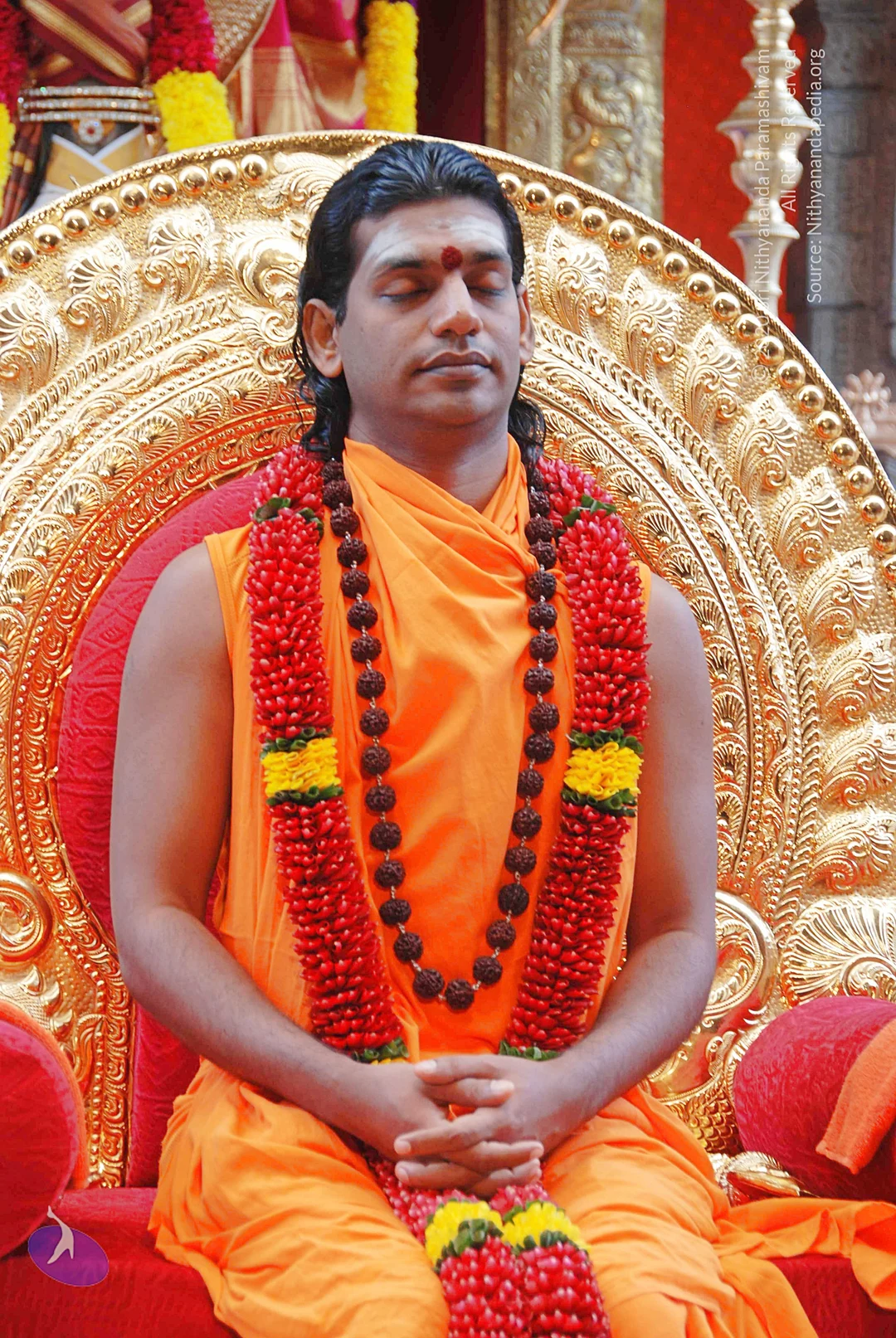
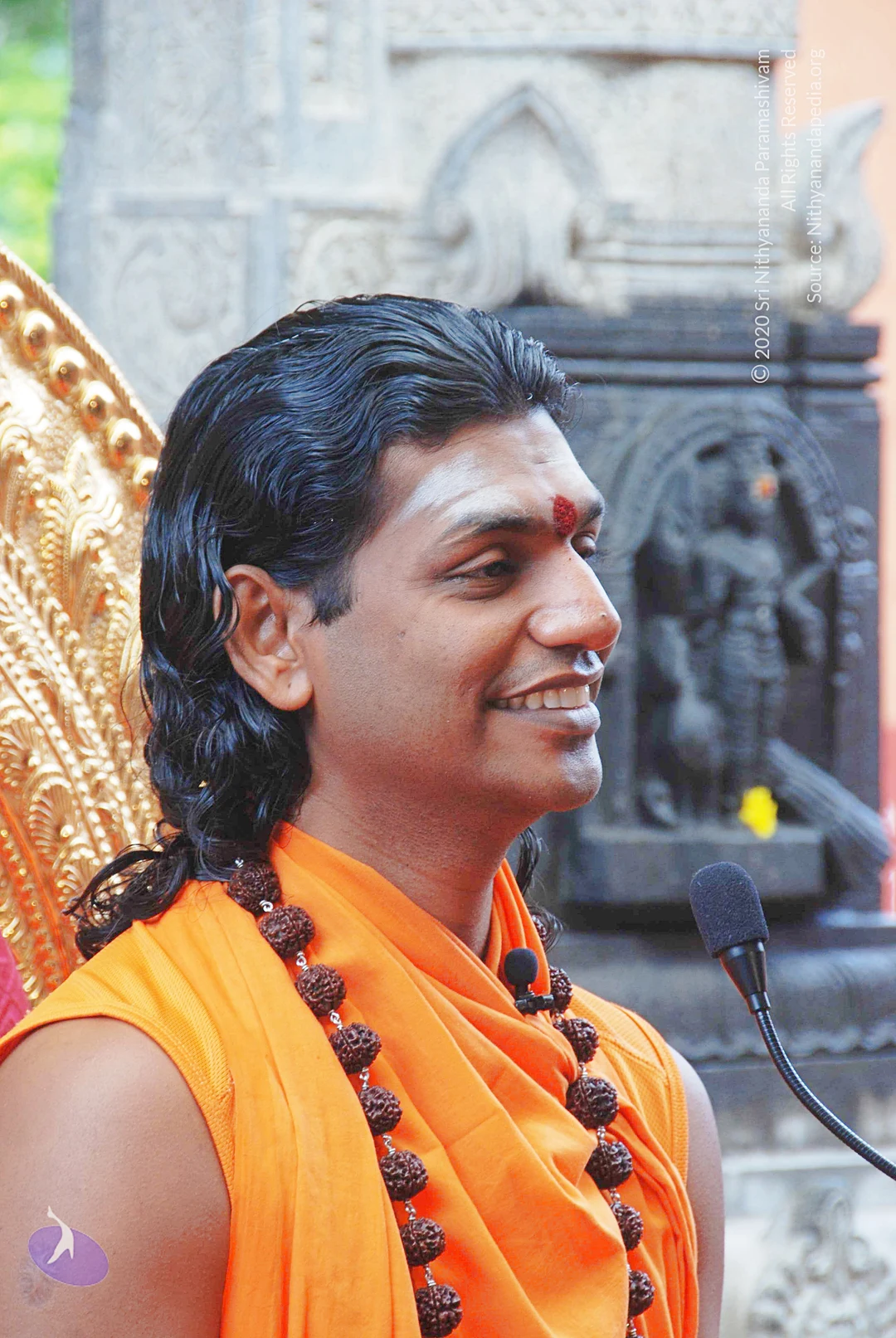
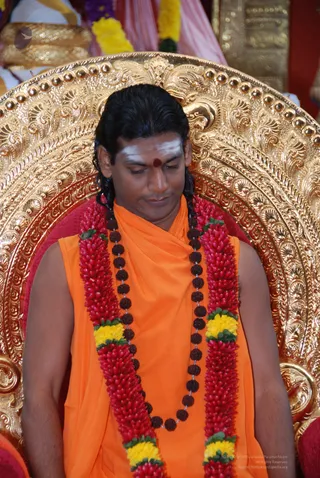
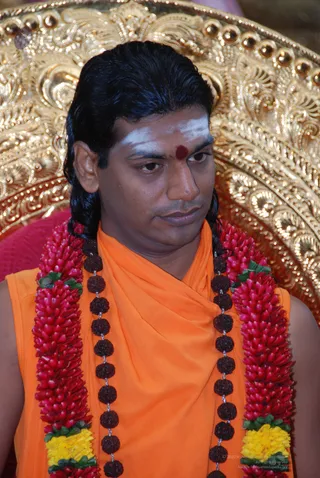
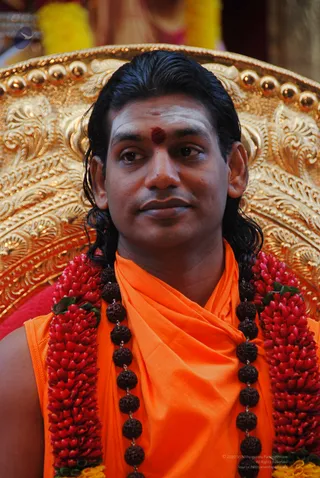
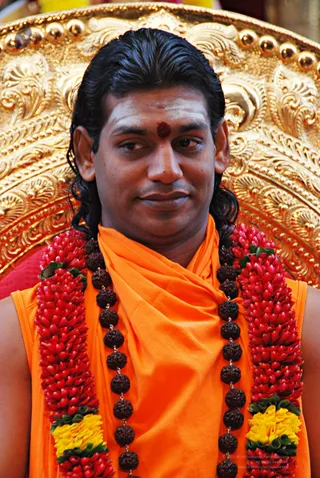
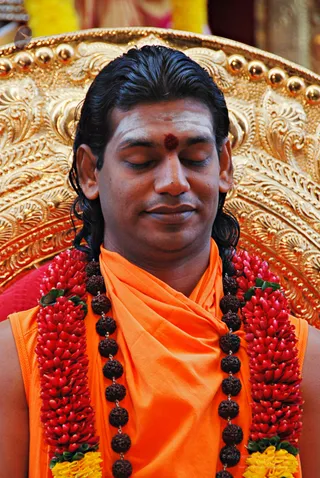
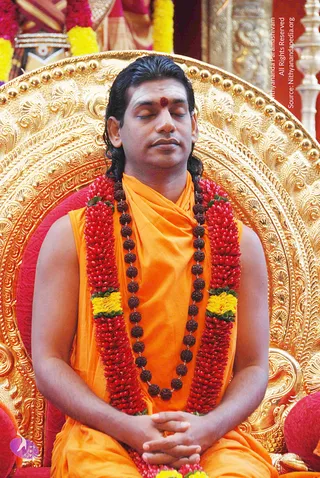
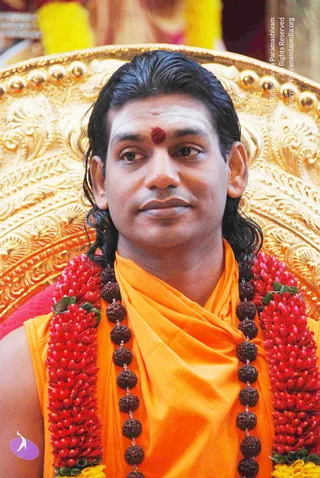
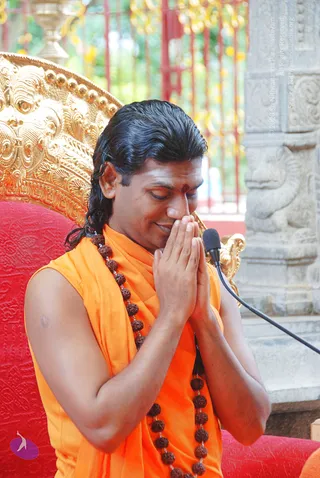
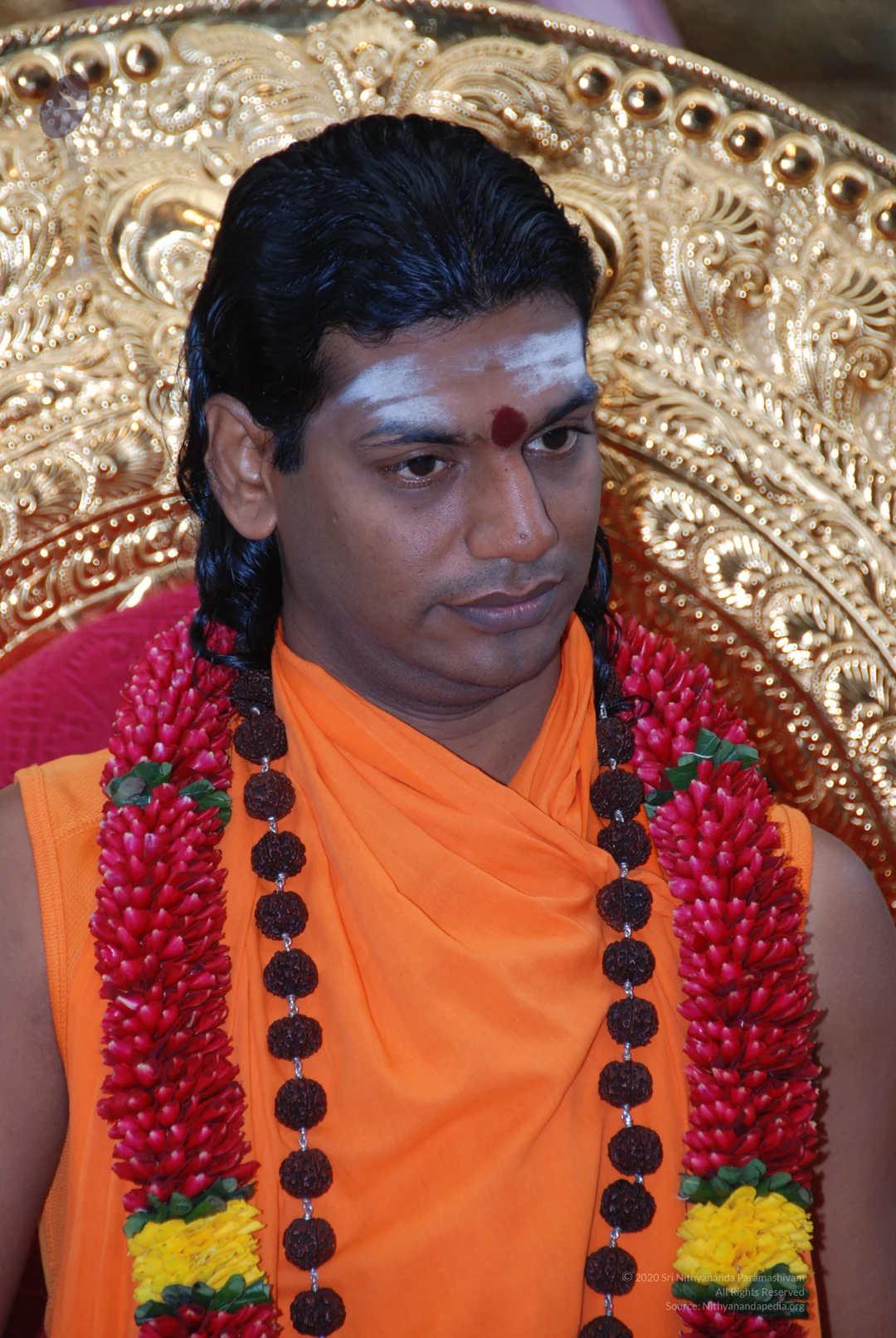
A man sits cross-legged in lotus-style meditation on a striped mat outdoors, wearing a sleeveless saffron-orange robe draped over one shoulder and a long dark rudraksha mala hanging to his chest. He has a red bindi on his forehead and long dark hair swept back. Behind him stands a terracotta-coloured stone plinth draped with garlands of yellow and white flowers and red blooms. A brass kalasha-style vessel sits on the mat at left, and grey gravel covers the ground.A man seated on an ornate gold throne with carved floral and scroll patterns, eyes lowered in meditation. He wears an orange sleeveless garment with a draped orange shawl, a long rudraksha mala, a red bindi and white vertical tilak on his forehead, and thick red and yellow flower garlands over his shoulders. The background shows red fabric, gold and yellow decorations.A man sits in front of an ornate gold-embossed throne back with raised floral and peacock-feather patterns. He has long, swept-back black hair, white vertical tilak lines on his forehead and a red kumkum dot between his brows. He wears a saffron-orange sleeveless top with an orange shawl draped over one shoulder, a dark rudraksha mala hanging to his waist, and thick garlands of red flower buds with yellow marigold and green leaves. Swamiji (probable) is seated centrally, with long hair, saffron clothing, rudraksha mala and ceremonial garlands, gazing downward.Close-up photograph of a man seated before an ornate gilded throne with floral scrollwork and round gold finials. He has long dark hair swept back, a red kumkum dot and white vibhuti marks on his forehead, and wears an orange saffron wrap over a sleeveless orange garment. Layered rudraksha malas and thick red flower garlands with green leaves hang across his chest. Blurred yellow flowers and a red fabric appear in the background.Close-up photograph of a man with swept-back dark hair and a red kumkum dot with white vibhuti marks on his forehead. He wears an orange saffron shawl over an orange sleeveless top, a long rudraksha mala, and a thick red and yellow flower garland. Behind him is an ornate gold-embossed throne back. The subject is a probable Swamiji; his long swept-back hair, saffron clothing, rudraksha mala, flower garland and the gilded throne are the qualifying cues, and he is seated in front of the throne.Close-up photo of a man with long, swept-back dark hair, eyes closed and a slight serene smile, seated before an ornate gold throne with repoussé floral and pearl-bead carving. He wears an orange-saffron sleeveless garment with a draped orange shawl, a rudraksha mala with brown seeds, and two thick red flower garlands with yellow marigold accents. White sandalwood paste marks his forehead with a red kumkum dot between the brows. Swamiji (probable): long swept-back hair, saffron clothing, rudraksha mala and ceremonial garlands on a golden throne. Partially visible red fabric and yellow flowers appear at the edges.

Morning-Message

9 photosSource gallery
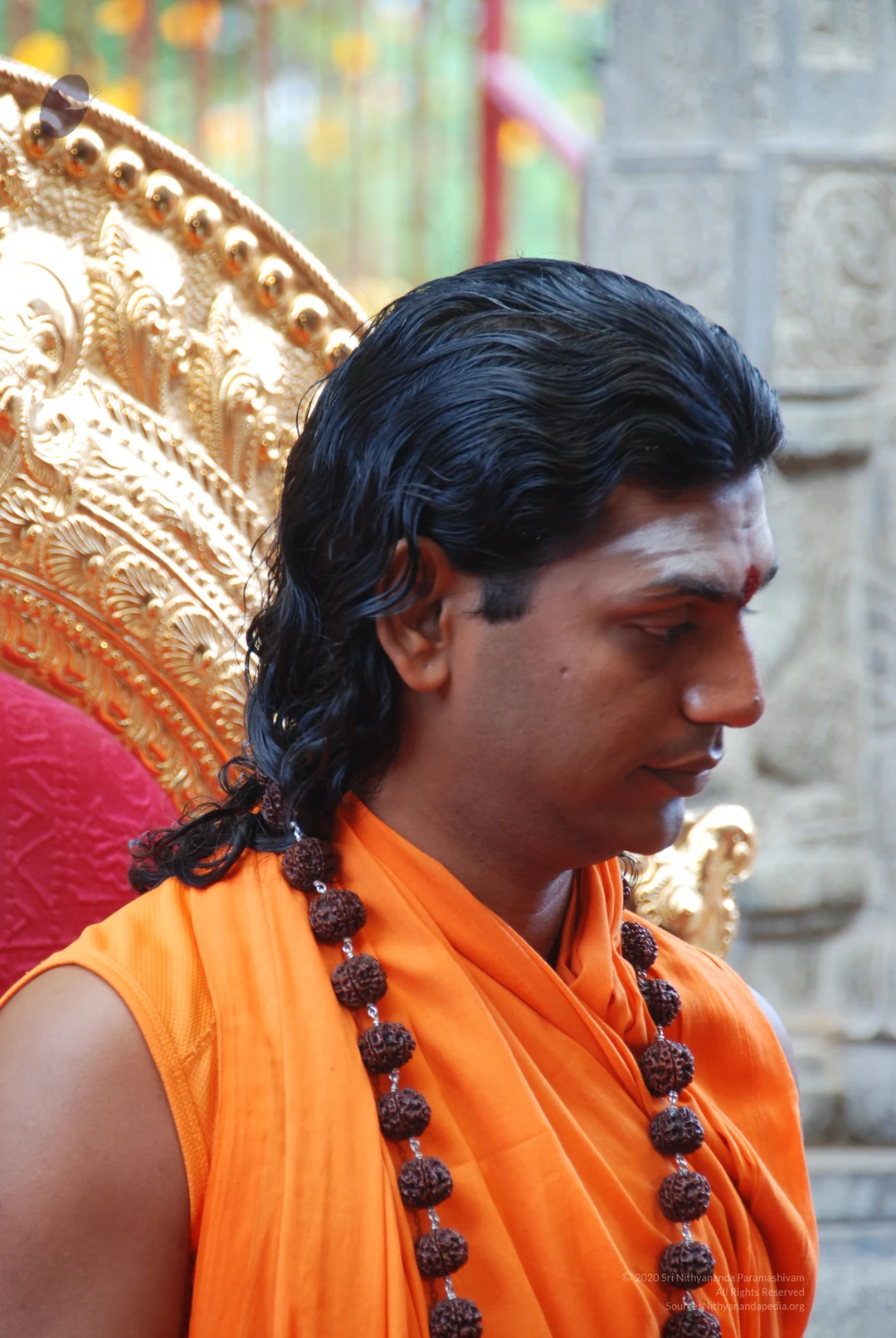
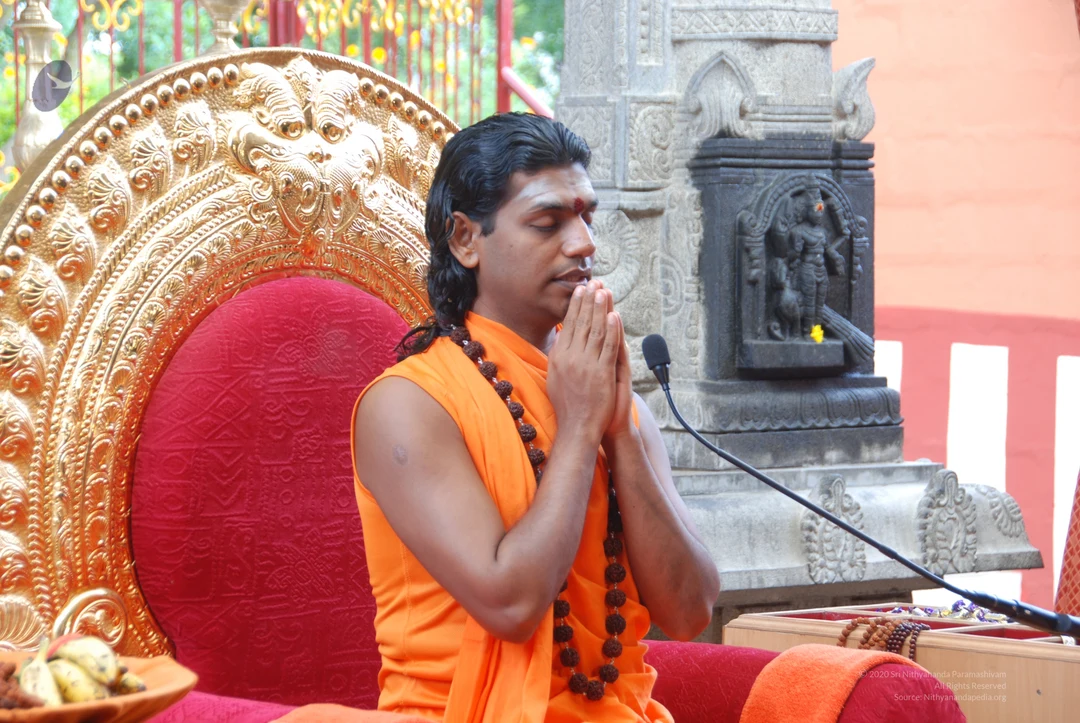
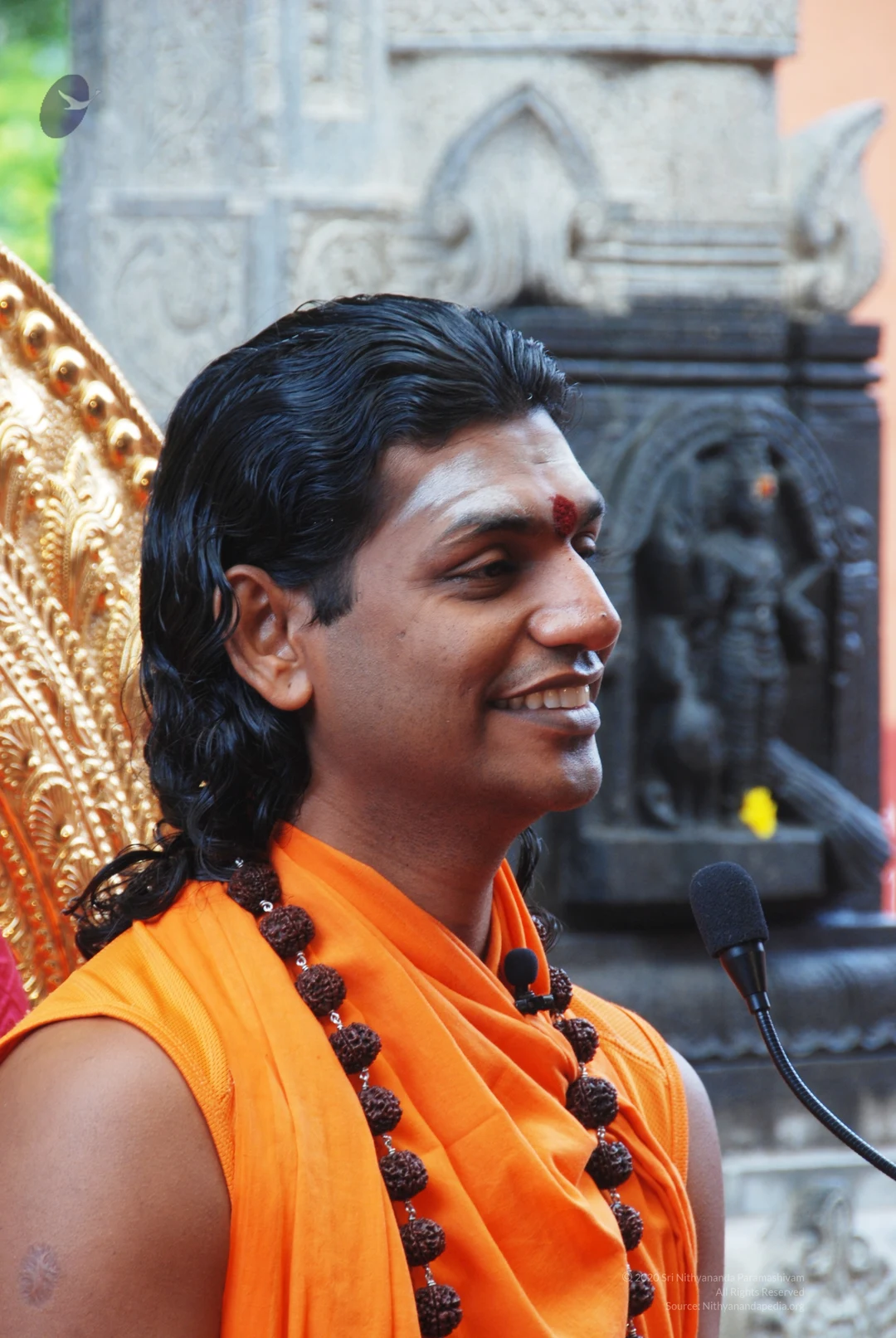
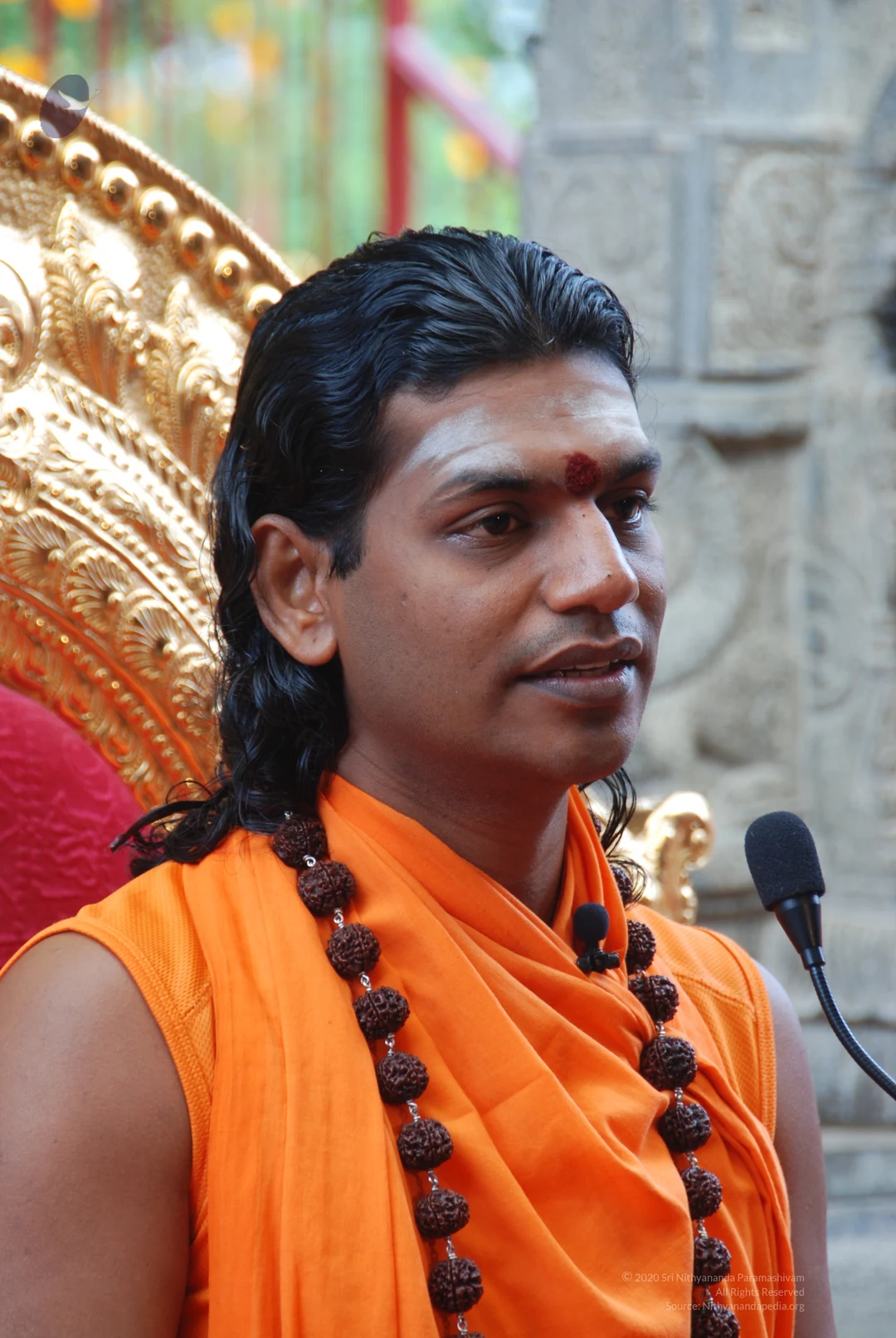
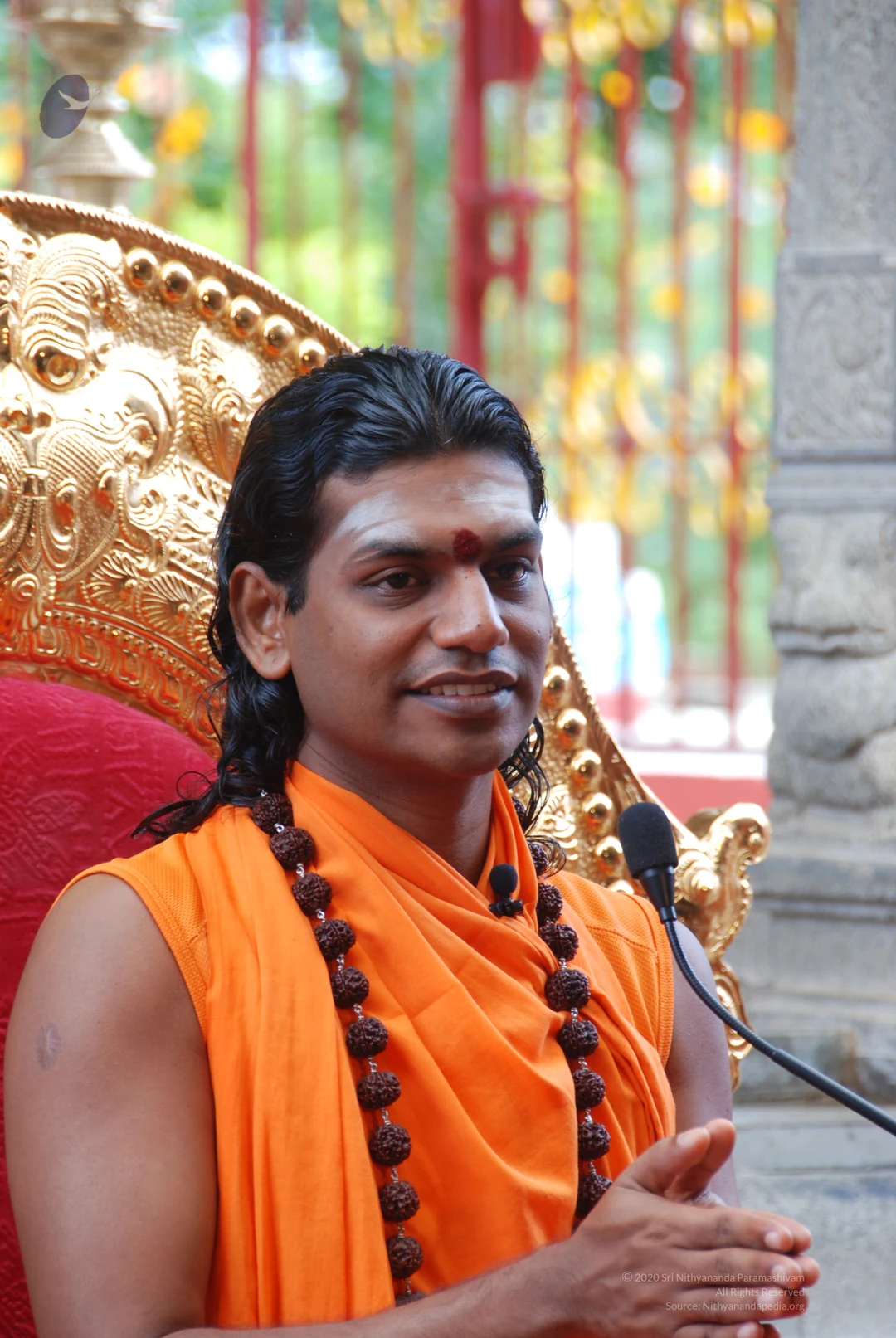
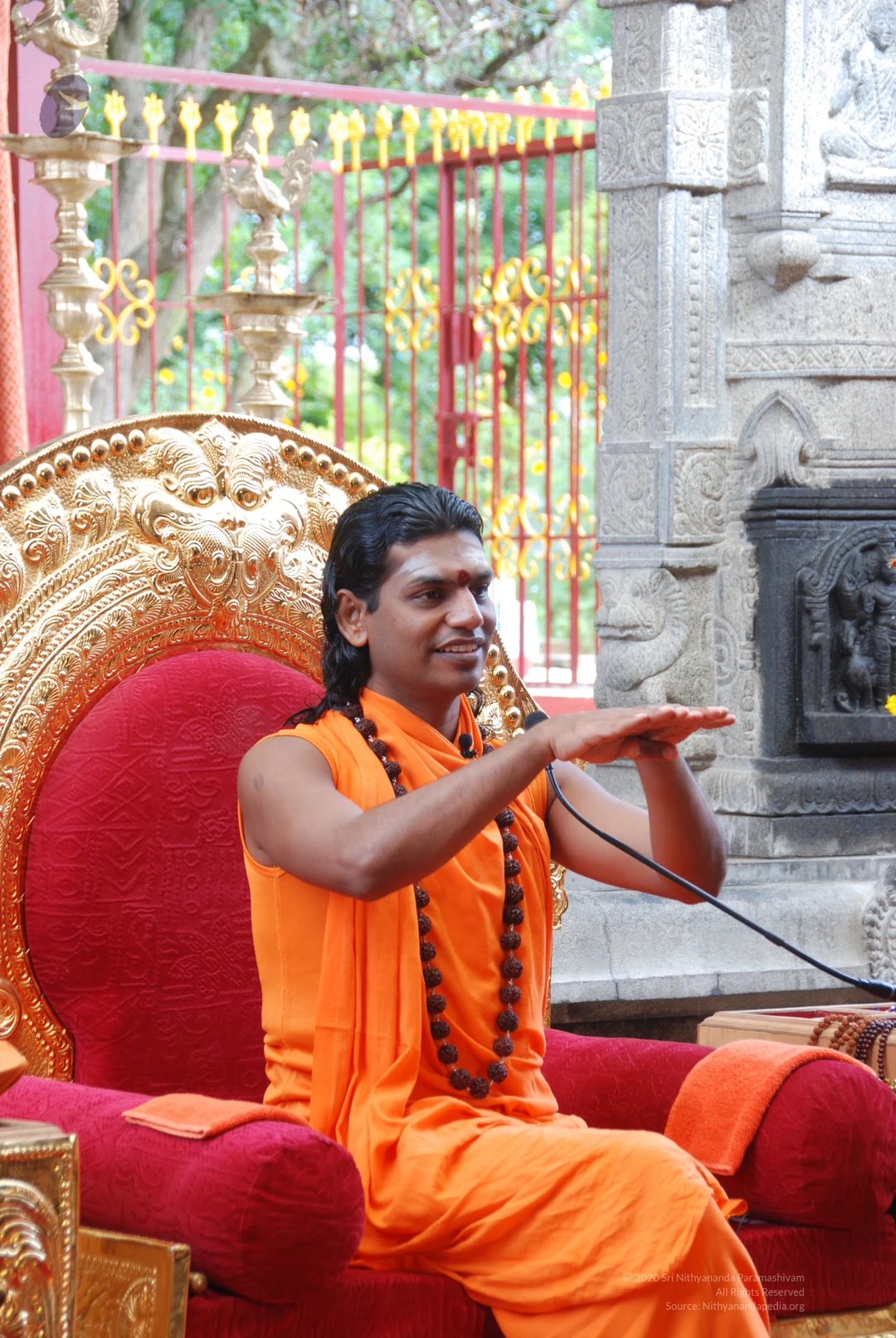
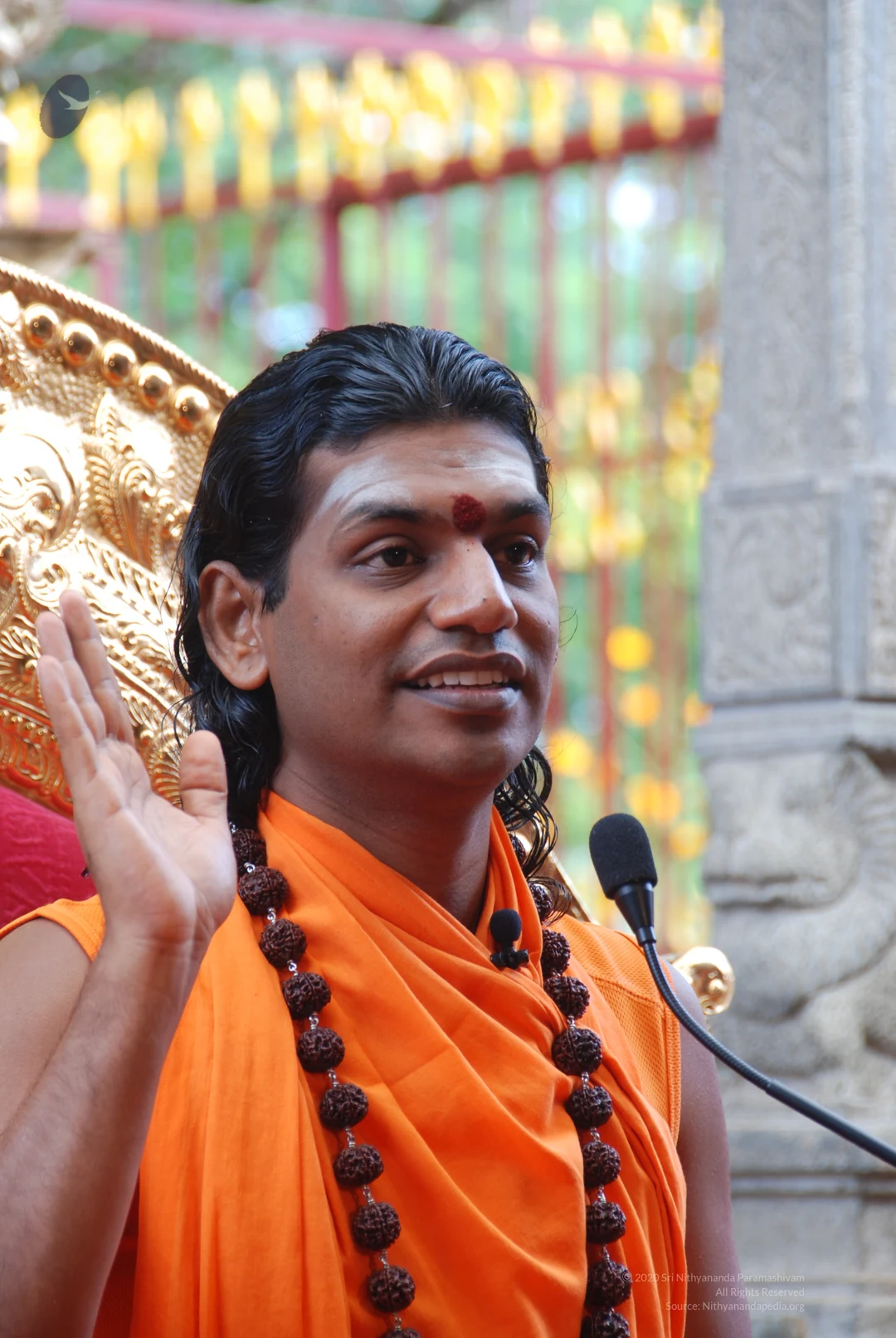
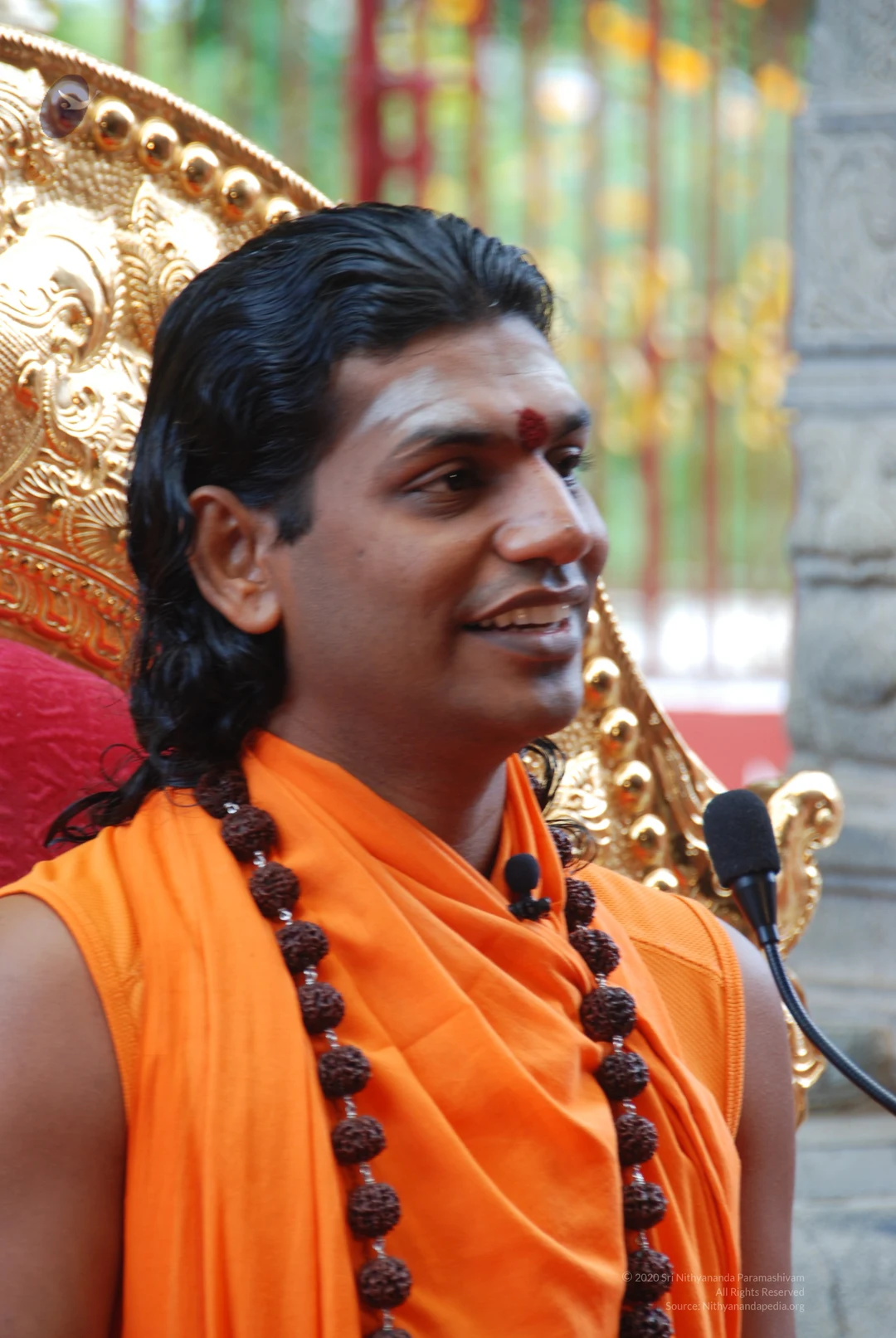
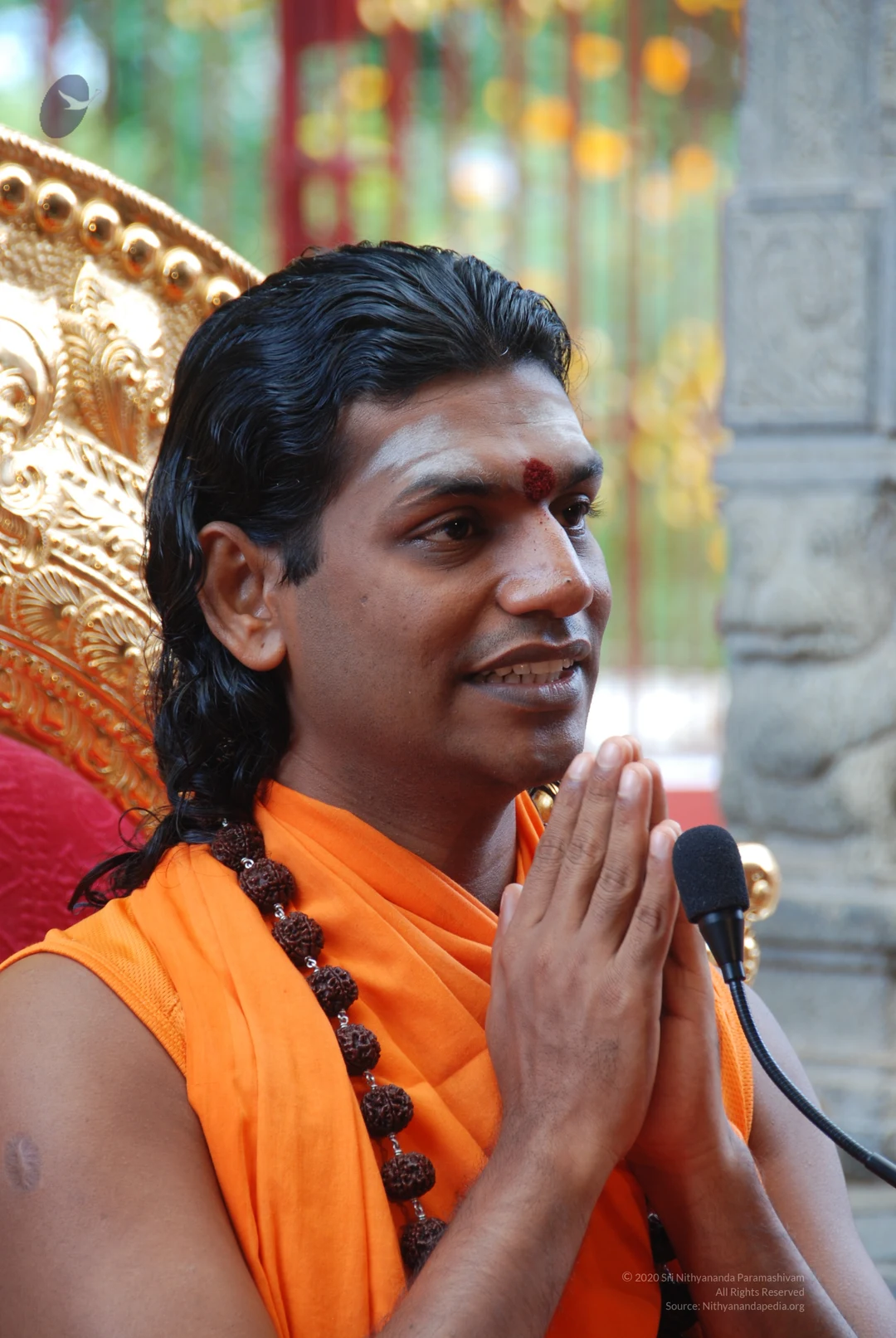
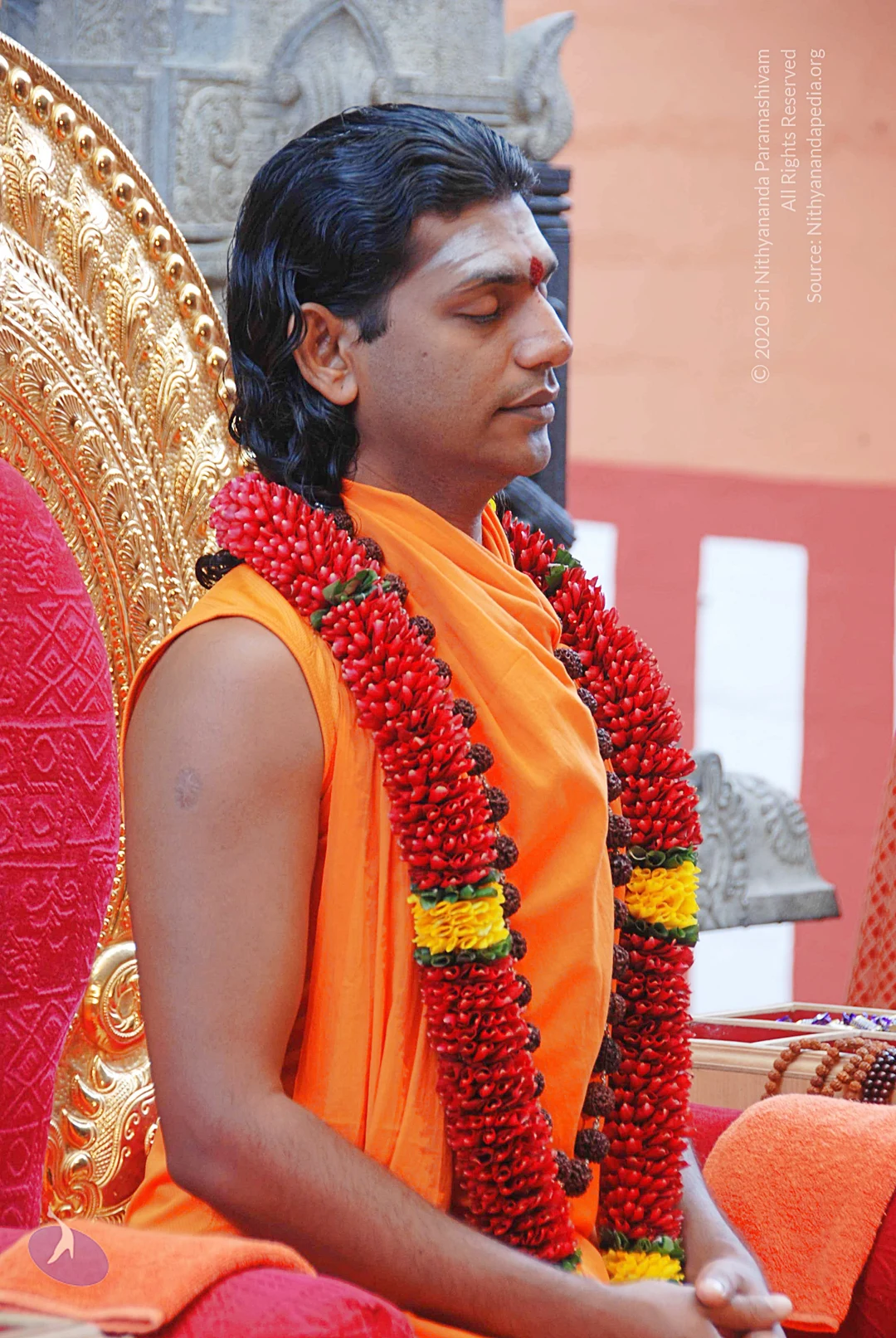
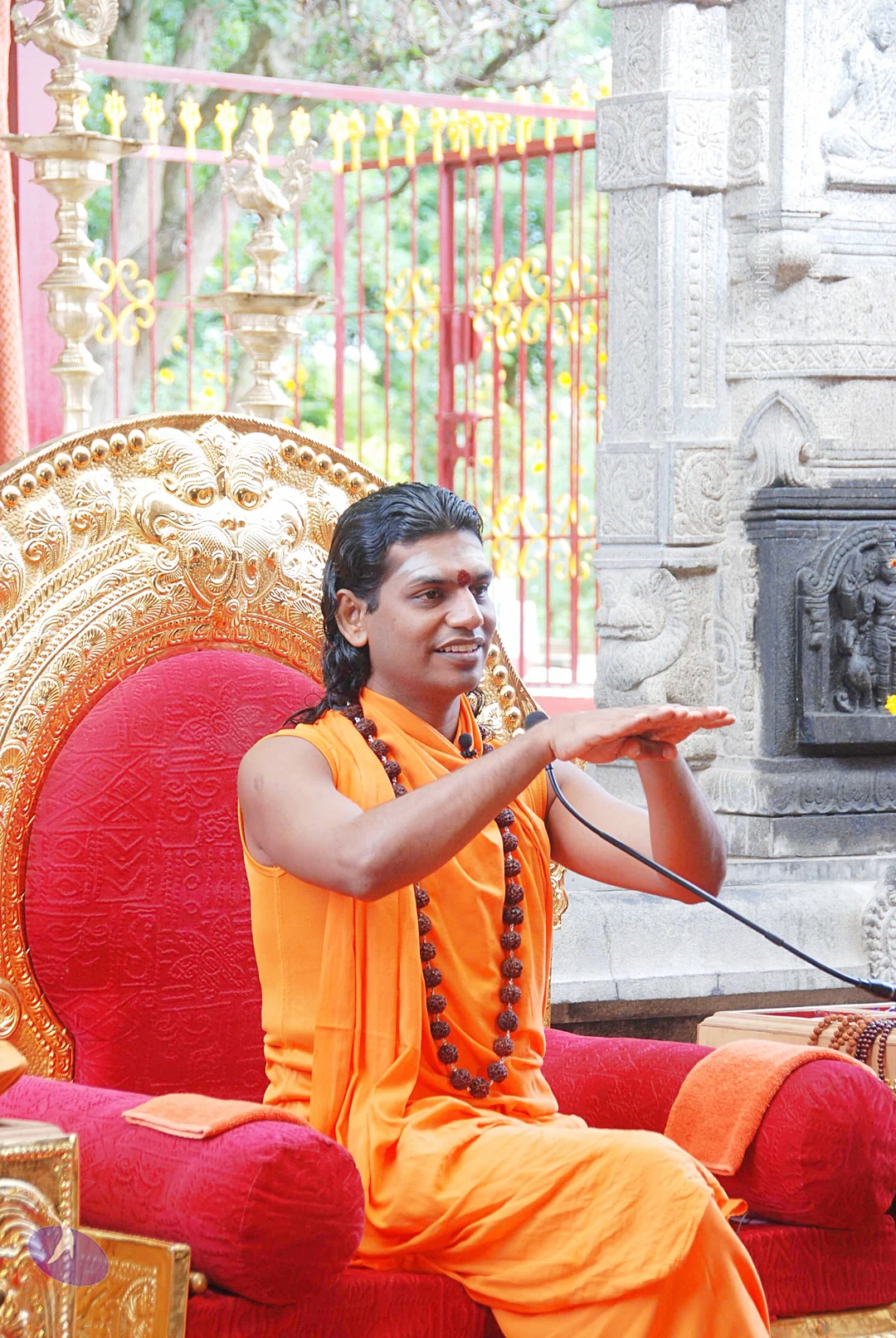
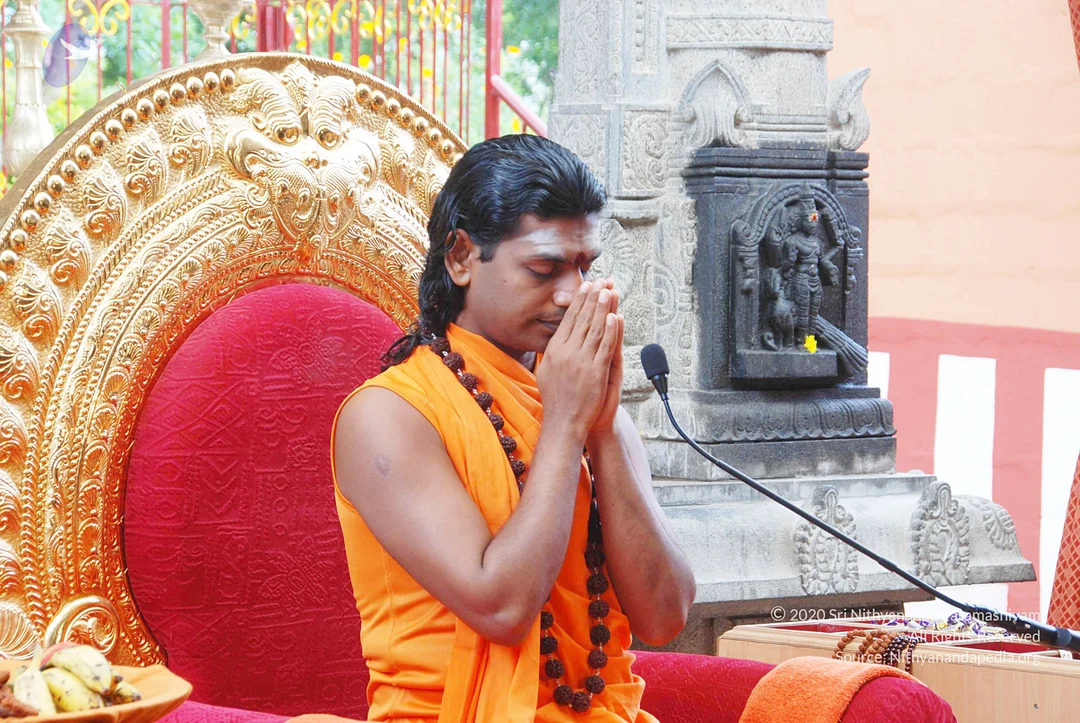
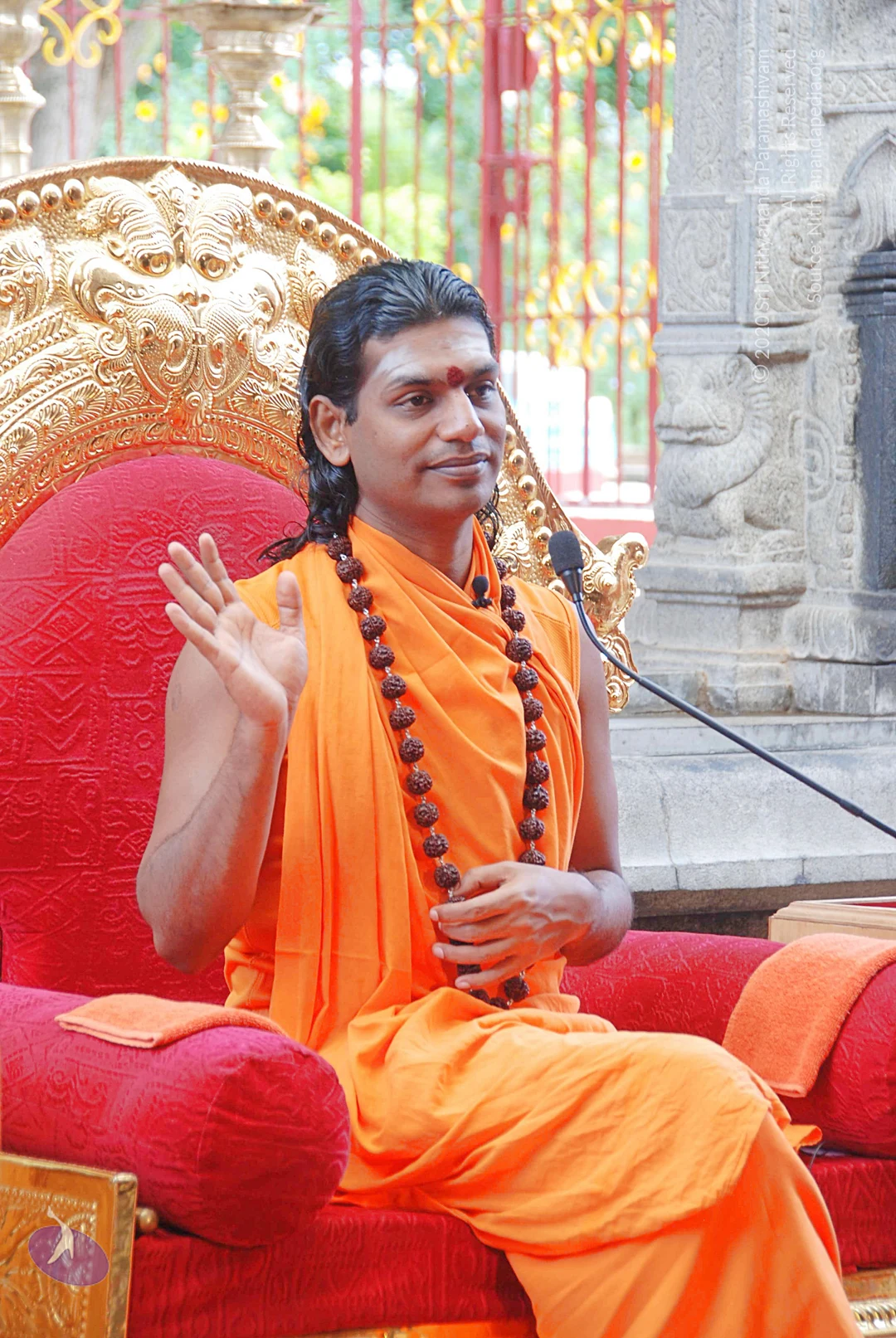
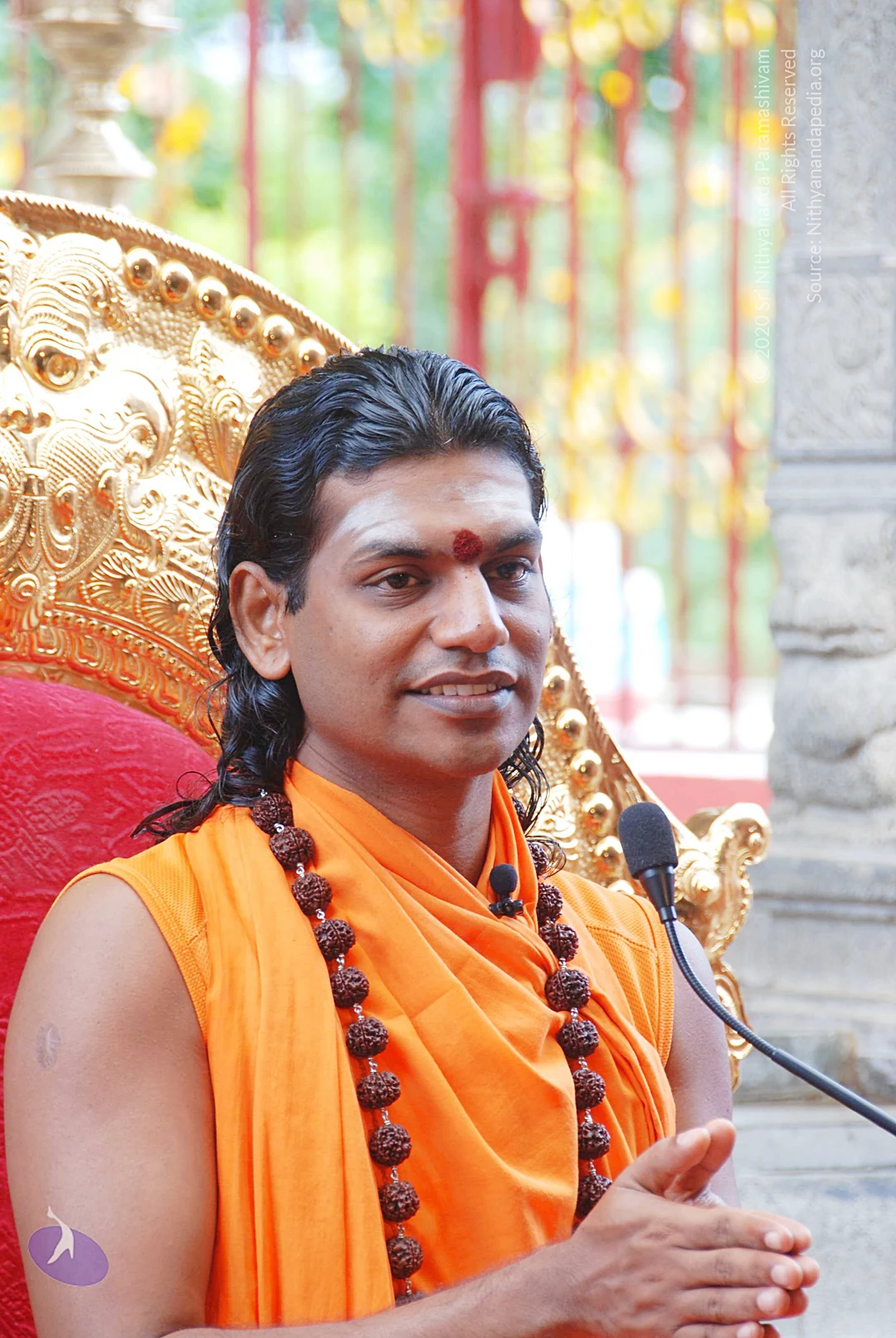
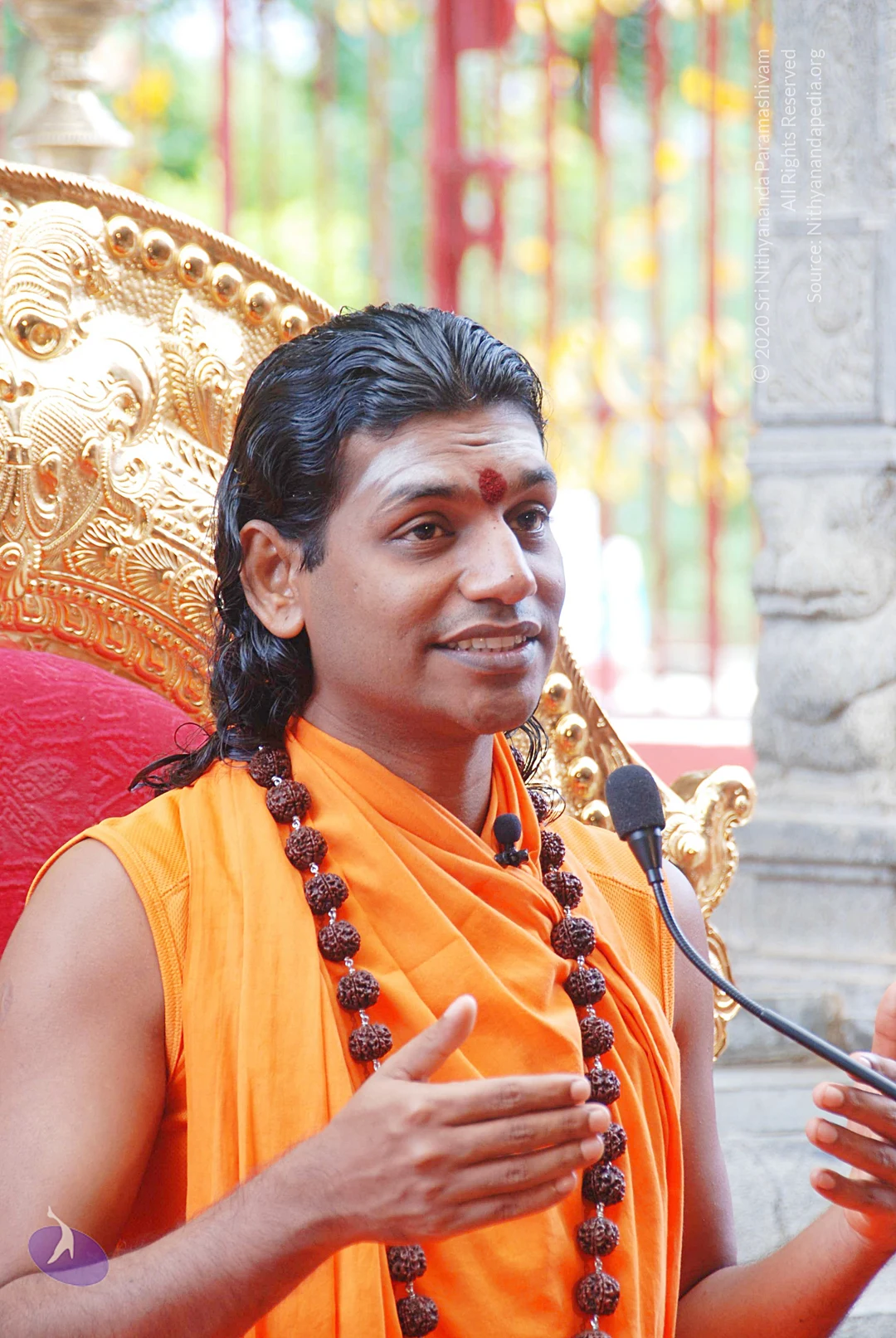
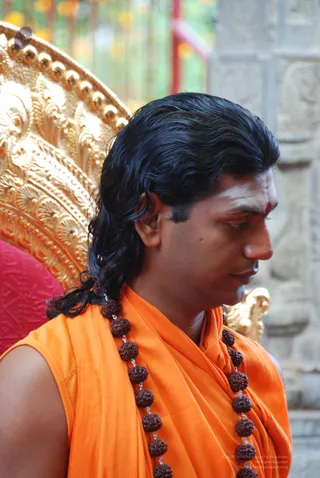
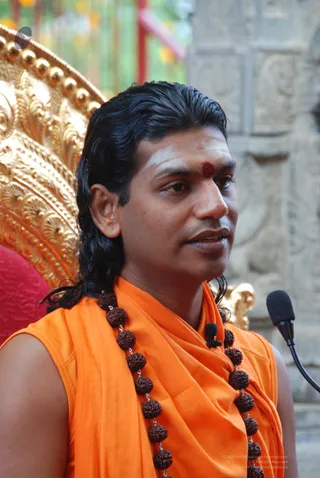
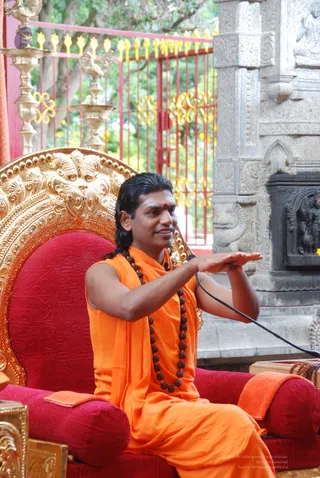
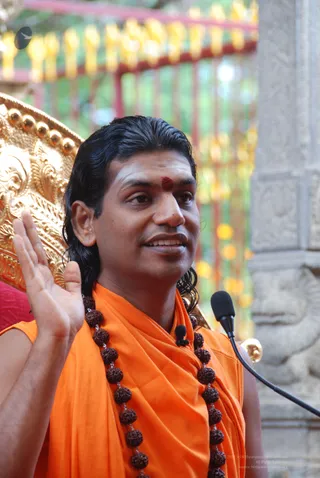
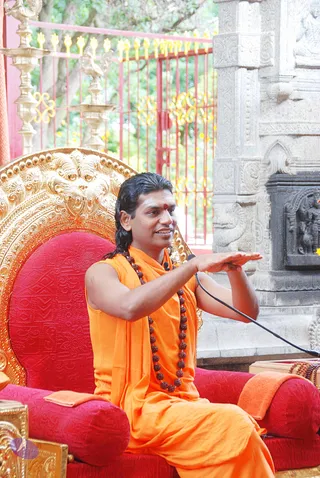
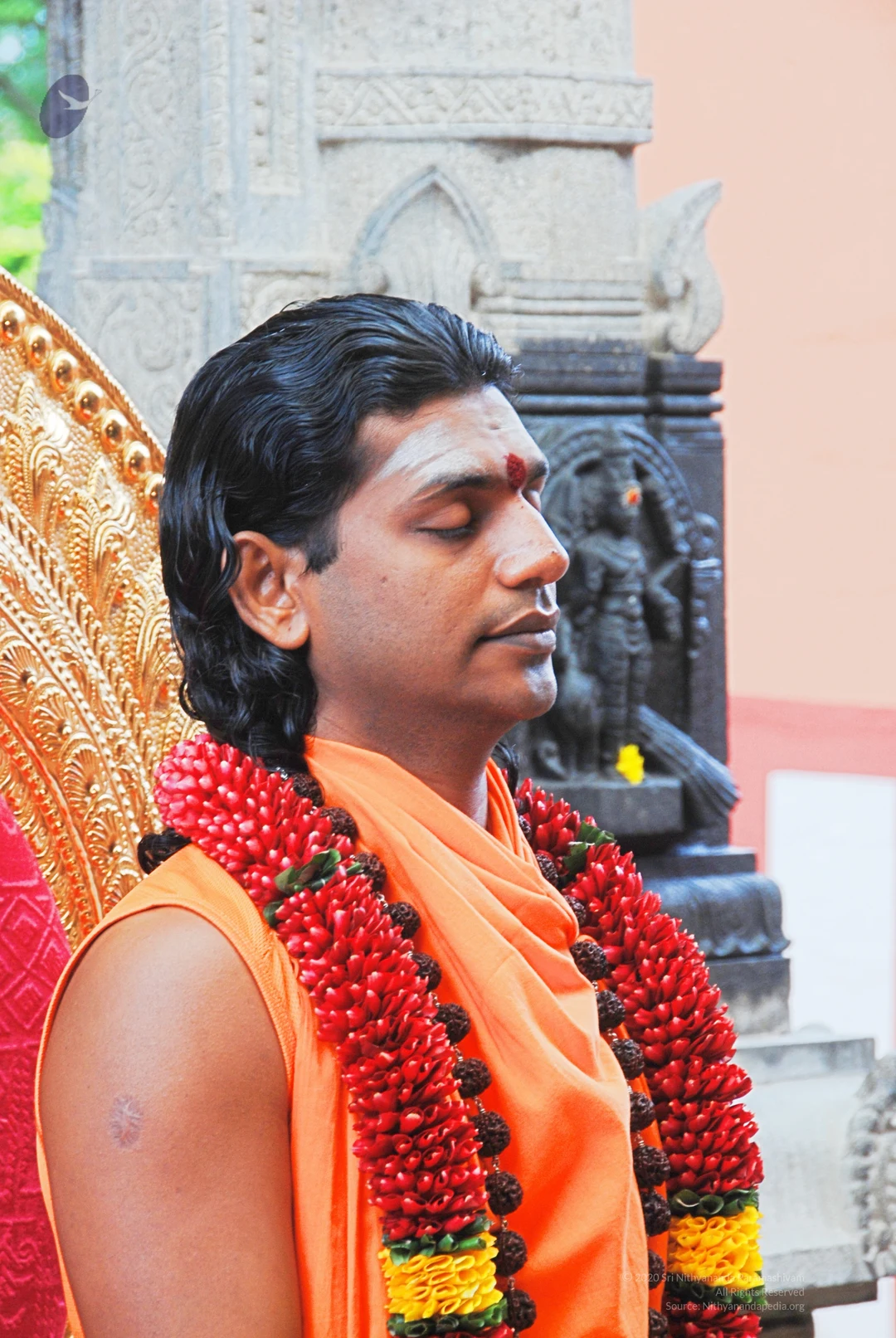
Close side-profile photograph of a man with long, swept-back black hair, a red bindi and white vertical forehead marks, wearing an orange saffron-coloured shawl over a sleeveless orange garment and a long rudraksha mala. He sits before an ornate gold-carved throne back with a red cushion and a stone carved pillar behind. Probable Swamiji by visible cues: long swept-back hair, saffron clothing and rudraksha mala seated on a gilded throne, a role consistent with the page's reference to a discourse.A seated man in an orange sleeveless garment and orange shawl sits with palms pressed together in namaste and eyes closed, wearing a red vibhuti or kumkum mark on his forehead and a long rudraksha mala around his neck. He sits on an ornate golden throne with a red cushioned seat, in front of a grey stone shrine niche carrying a carved deity murti decorated with yellow flowers. A microphone stands beside him, and a tray of fruit and a red-and-orange cloth lie at the lower left. The setting suggests a discourse or satsang.Close photo of a man with long swept-back dark hair wearing a sleeveless saffron-orange garment draped over his shoulders, with multiple large dark rudraksha mala beads hanging across his chest. He has a red bindi and white vertical tilak on his forehead. He speaks into a small lapel microphone and a boom microphone is at right; behind him is an ornate gold carved chair and a stone wall with carvings. Appearance-based candidate: Swamiji (probable), seated in front of the gold throne and microphone, with long hair, orange clothing and rudraksha malas.A photograph of a man seated on an ornate gold-and-red throne, speaking into a small clip microphone with one hand raised in an open gesture. He wears a sleeveless saffron-orange garment with a matching shawl, a rudraksha mala necklace, and a red tilak on his forehead; his hair is long and swept back. Behind him stand a red metal gate with gold scrollwork, brass oil lamps with peacock-shaped finials, and a carved grey stone pillar with relief sculpture. A red tilak and orange cloth accompany the throne. The scene suggests a seated discourse in an outdoor temple setting. Swamiji (probable): the long swept-back hair, saffron clothing, rudraksha mala and throne are consistent with the page's Swamiji reference.A man seated on a gold-carved throne-style chair speaks into a small black microphone with his right hand raised in a gesture of address. He wears a flowing saffron-orange robe draped over one shoulder and a long strand of dark brown rudraksha beads around his neck. He has long dark hair swept back and a red kumkum mark on his forehead. Behind him are a red metal railing with golden hanging ornaments and a carved grey stone pillar.Close-up photo of a seated figure in saffron-orange robes draped over the torso, wearing a long rudraksha mala of dark brown beads that hangs to the waist. The right hand is open, palm up, gesturing mid-discourse, while the left hand rests holding beads. The seat is a red upholstered throne with gold-painted trim and an embossed geometric pattern, and a folded orange cloth lies on the red cushion. A small clip-on microphone is visible near the collar. Only the torso, arms and hands are shown; the face is not in frame.

Sarvadarshan

9 photosSource gallery
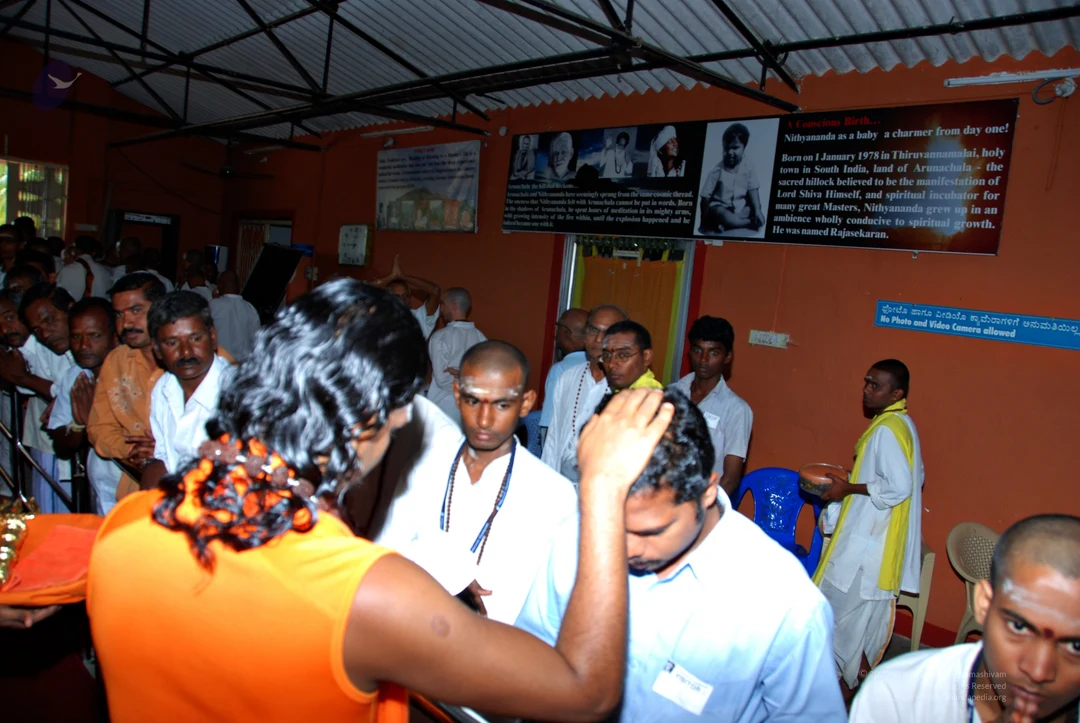
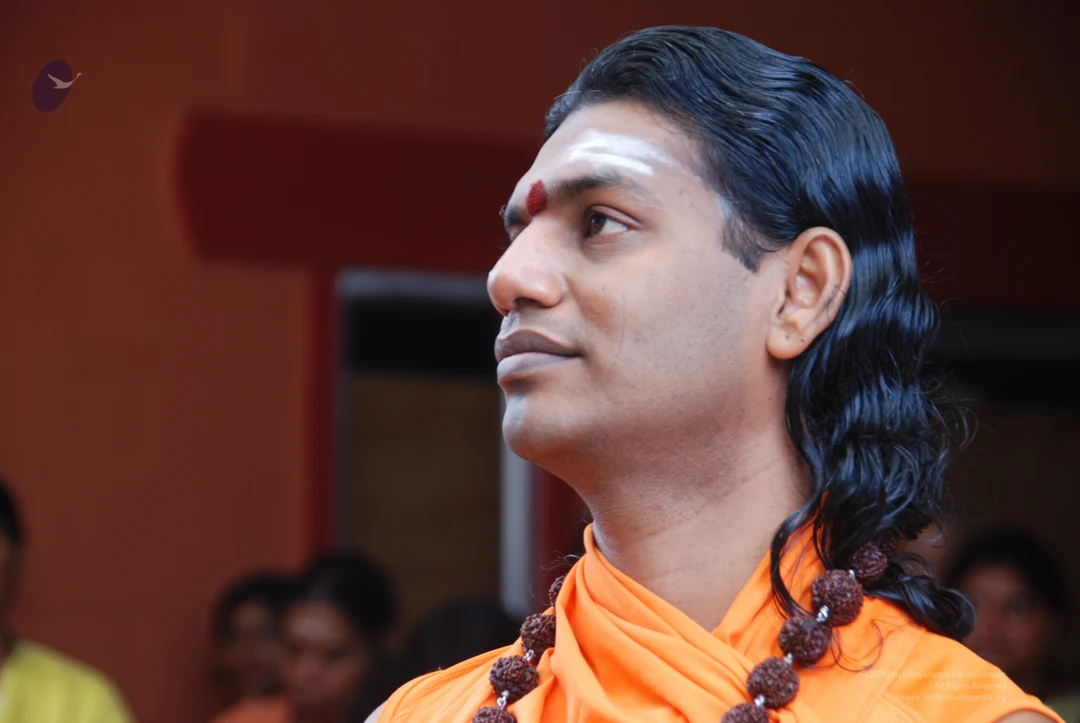
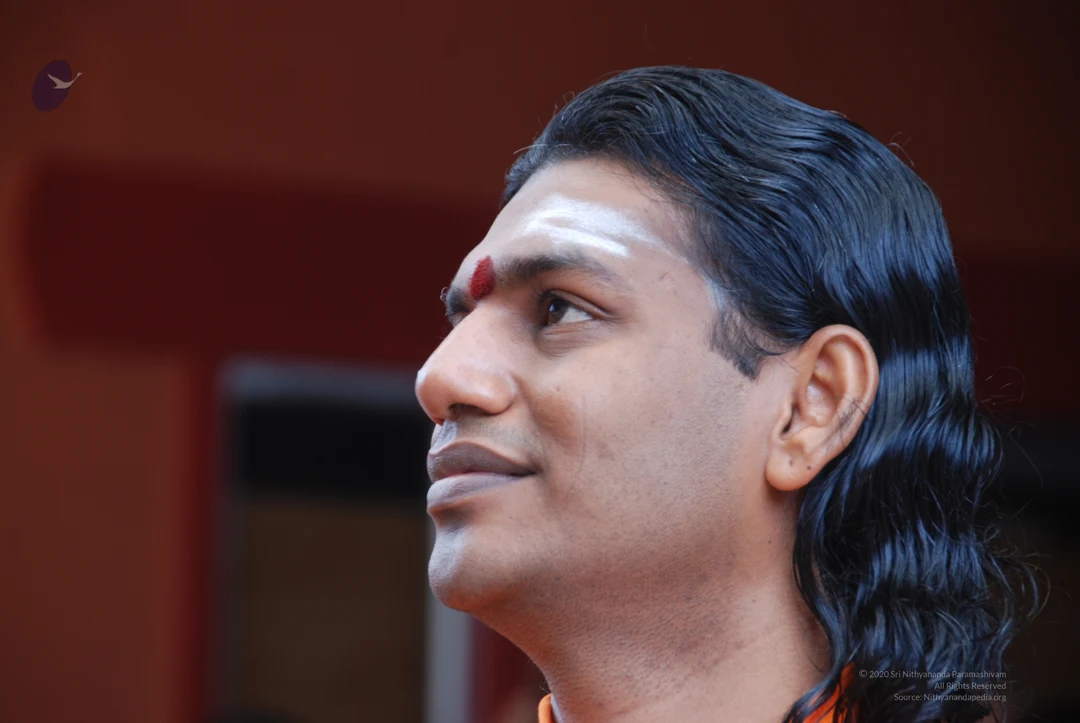
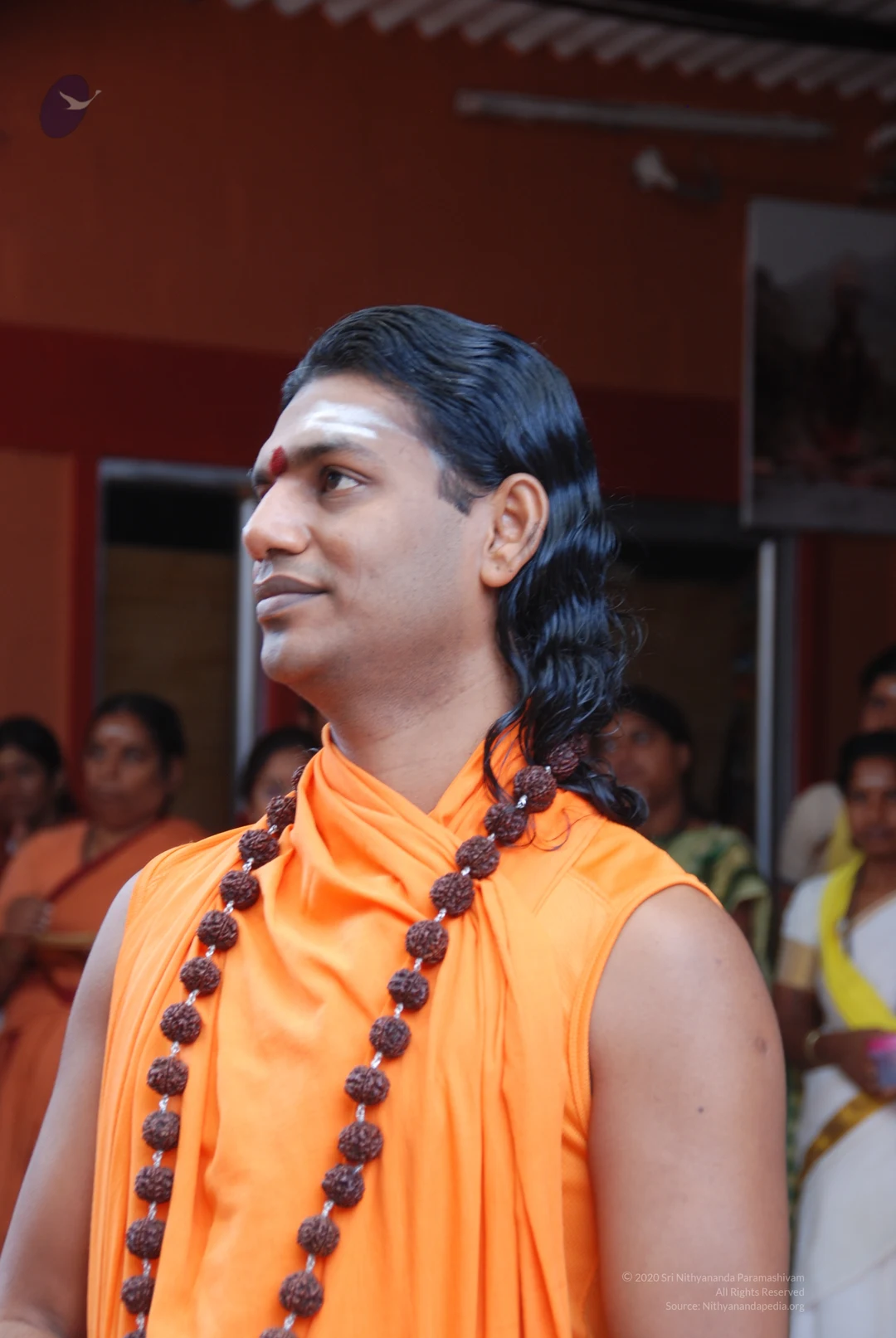
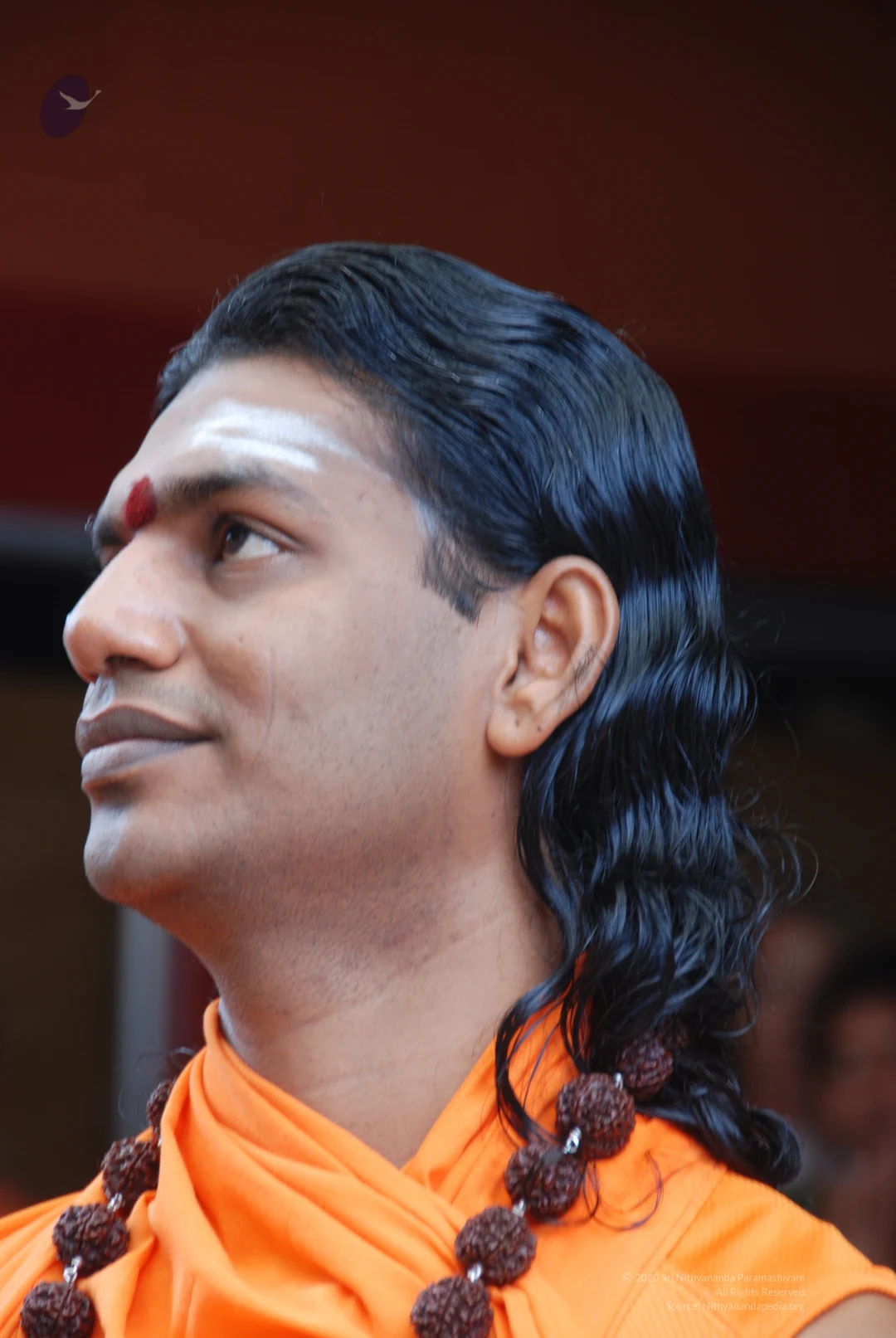
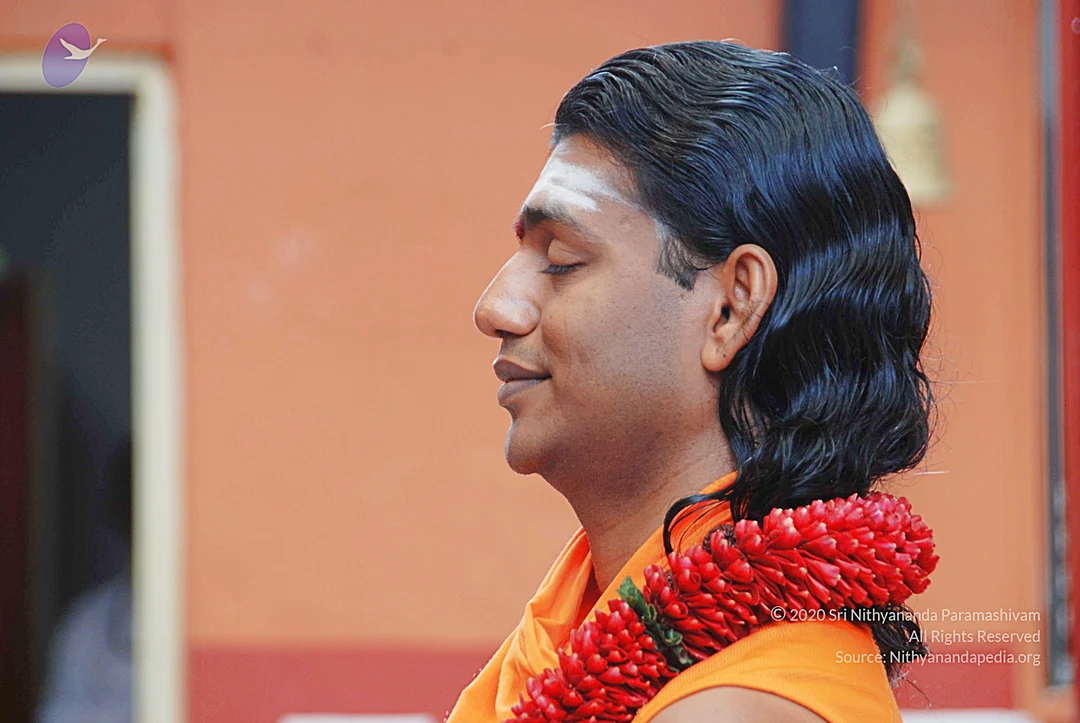
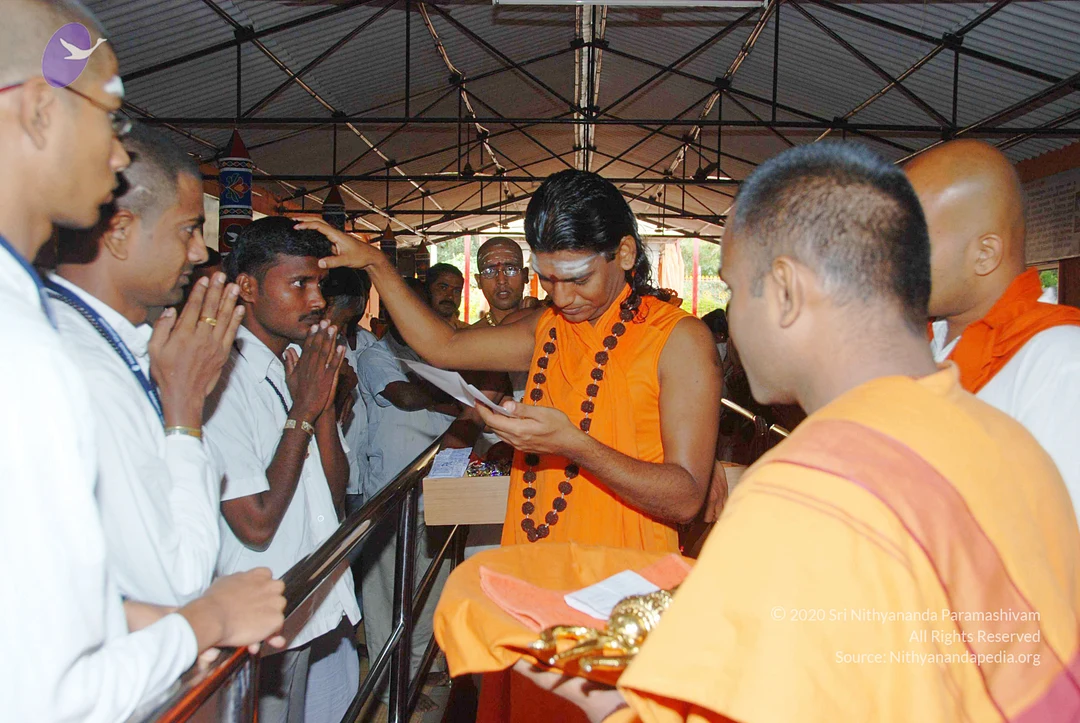
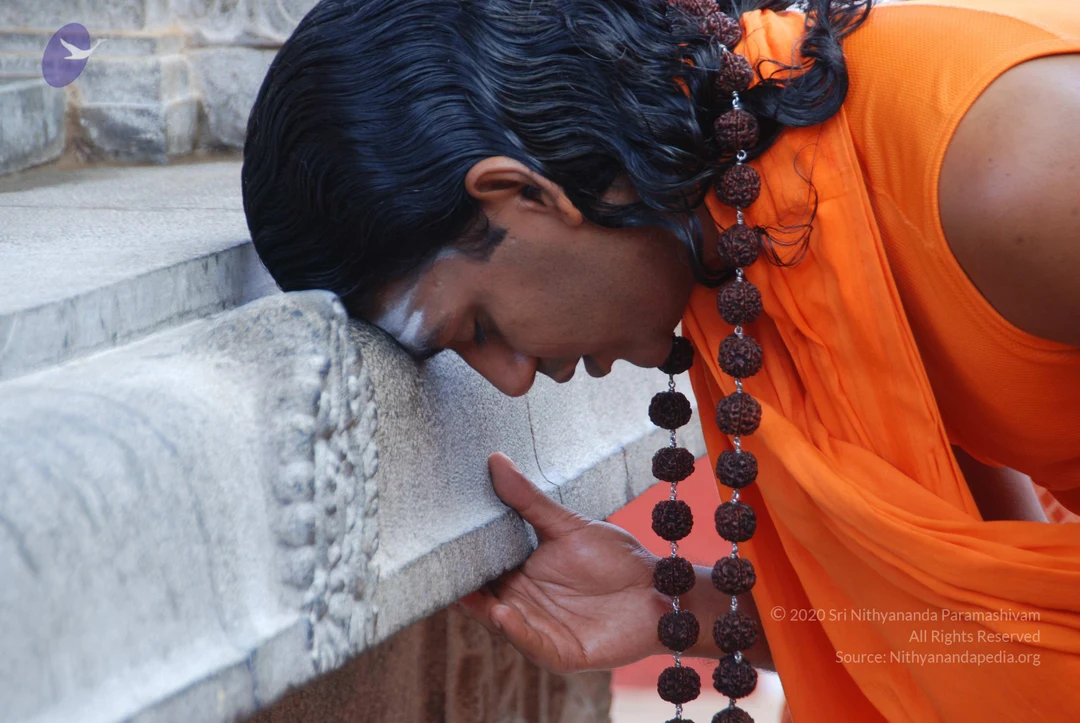
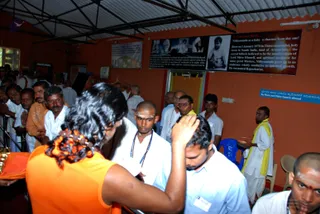
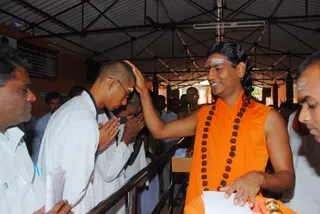
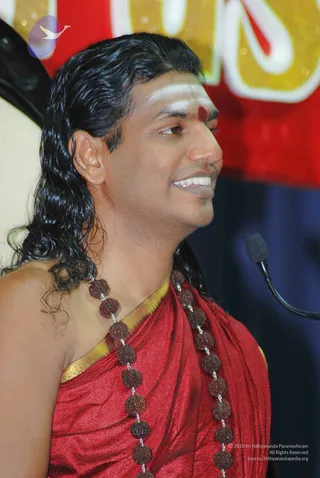
Crowded indoor hall with orange-painted walls and a corrugated metal roof. A large banner on the back wall displays photographs under the heading "A Conscious Birth..." with a paragraph beginning "Born on 1 January 1978 in Thiruvannamalai". Foreground: a person with long curly dark hair in an orange sleeveless top, one hand raised to the head of a shaven-headed man in a light blue shirt. Behind them, men in white shirts and dhotis, some with white tilak on their foreheads and rudraksha-style beads, press close together. A man in a white dhoti and yellow-green shawl holds a brass bowl. A blue sign reads "No Photo and Video Camera allowed" in Kannada.A photograph of an indoor hall under a corrugated metal roof with exposed steel trusses. A man in a saffron-orange sleeveless robe with a long rudraksha mala and a wrapped shawl stands at right, his long dark hair swept back, a white vibhuti marking on his forehead, smiling as he places his right hand on the crown of a shaven-headed young man in white kurta and glasses who bows with palms pressed together. Another devotee in white stands behind, with a few more people and a small brass vessel visible at lower right. This appearance is a probable match for Swamiji, based on the saffron robe, long swept-back hair, and rudraksha mala, and the page notes him as present.A man with long dark wavy hair bends forward and touches his forehead to the carved grey stone ledge of a temple structure, his right hand resting on the stone. He wears an orange saffron garment draped over a sleeveless orange top and a long string of brown rudraksha beads hanging around his neck and shoulder. A white tilak mark is visible on his forehead. Behind him stands a red-orange wall, and a yellow flower is tucked into the carved stone above. The pose is one of reverent prostration at a shrine. The figure is an appearance-based a person candidate with long swept-back hair, saffron clothing and rudraksha malas, but the face is partly turned away and the identification is uncertain.A close profile photograph of a man with long, swept-back dark wavy hair, a white horizontal forehead mark and a red dot at the centre of the forehead, wearing an orange saffron shawl over the shoulders and a multi-strand rudraksha mala of brown beads at the neck. He gazes to the left with a calm expression. Behind him, blurred figures in the background sit in a room with orange-red walls and a dark doorway.Close side-profile photograph of a man with long, swept-back dark wavy hair, looking upward and to the left against a deep red-orange wall. He has a white horizontal forehead band with a red dot at the centre, and an orange garment is visible at the bottom edge.Probable Swamiji, a man with long swept-back dark hair and a white vertical tilak with a red bindi on his forehead, wears a sleeveless saffron-orange wrap draped over one shoulder and a long strand of brown rudraksha beads. He stands in profile looking to the right inside a red-walled room. Several women in white and saffron saris stand blurred in the background near a doorway.

Nithyanandeshwara-Paramashiva-Golden-Temple

3 photosSource gallery
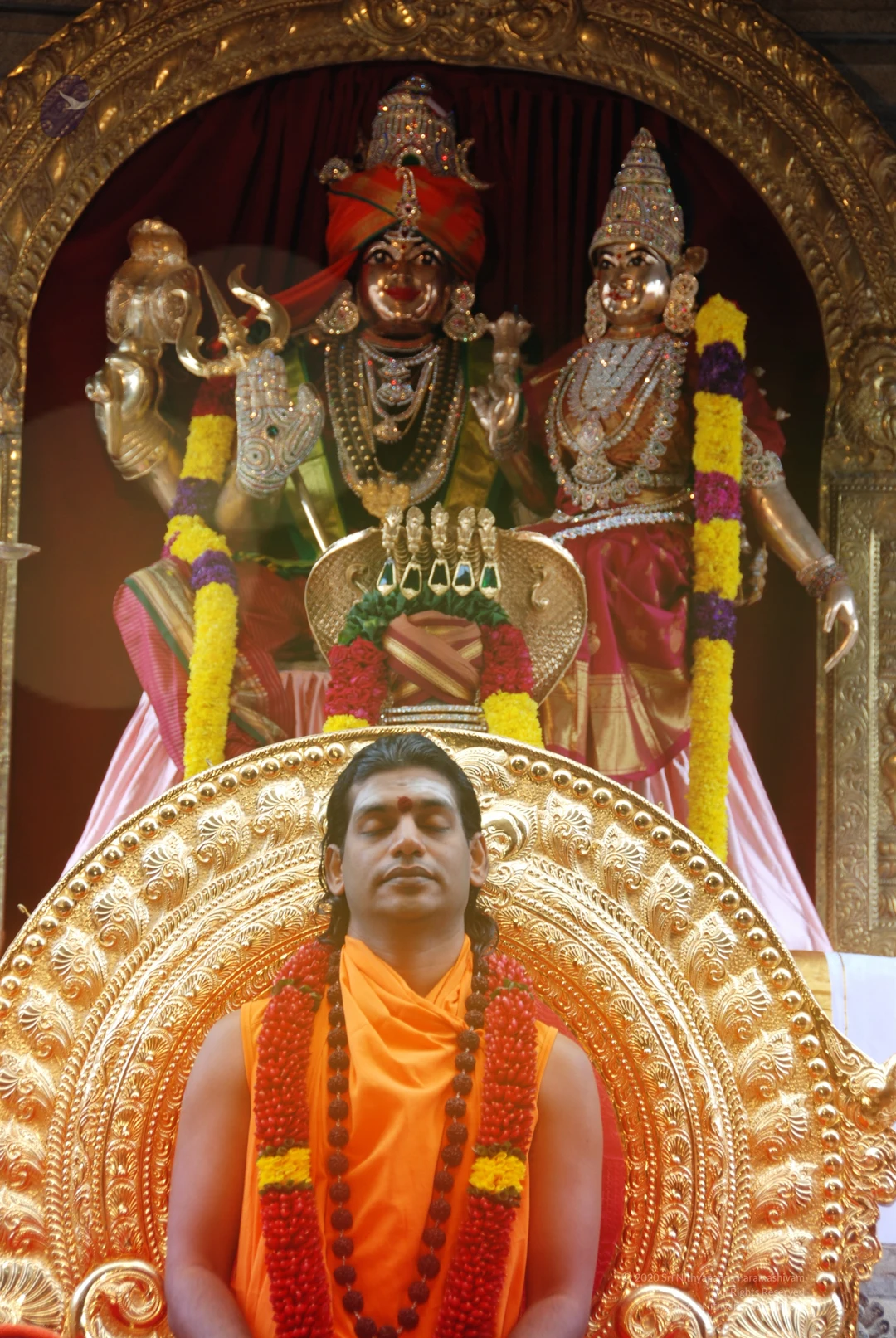
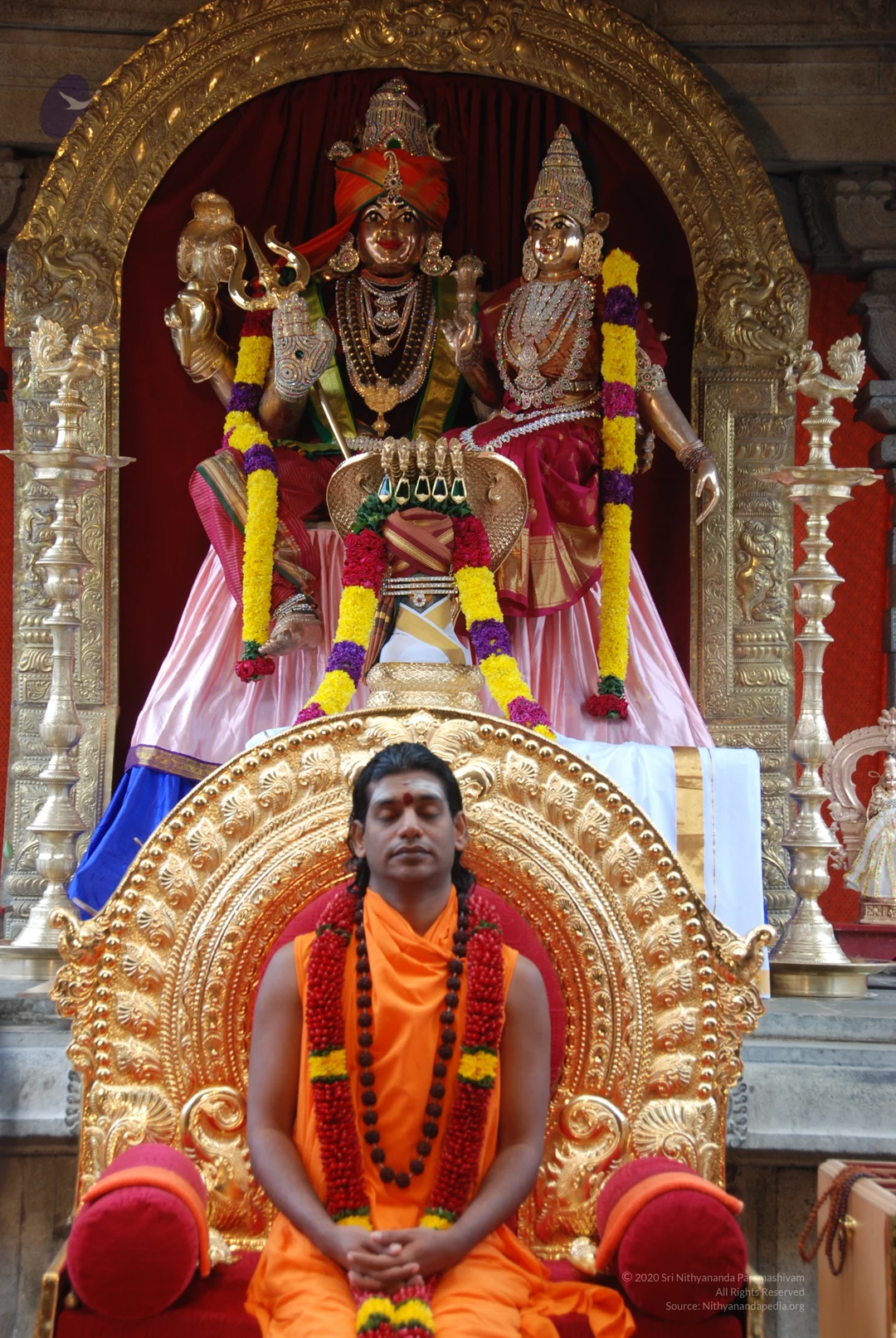
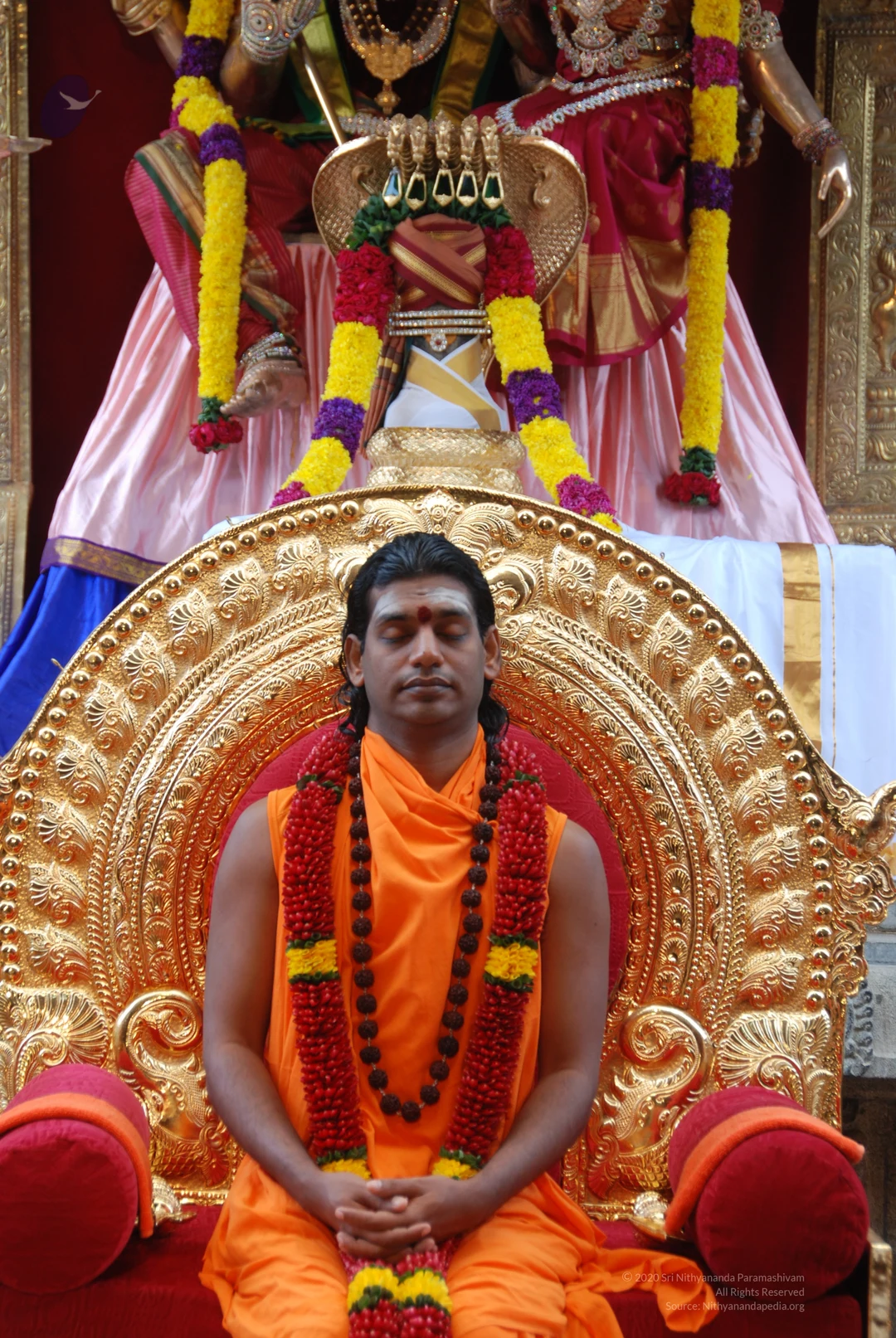
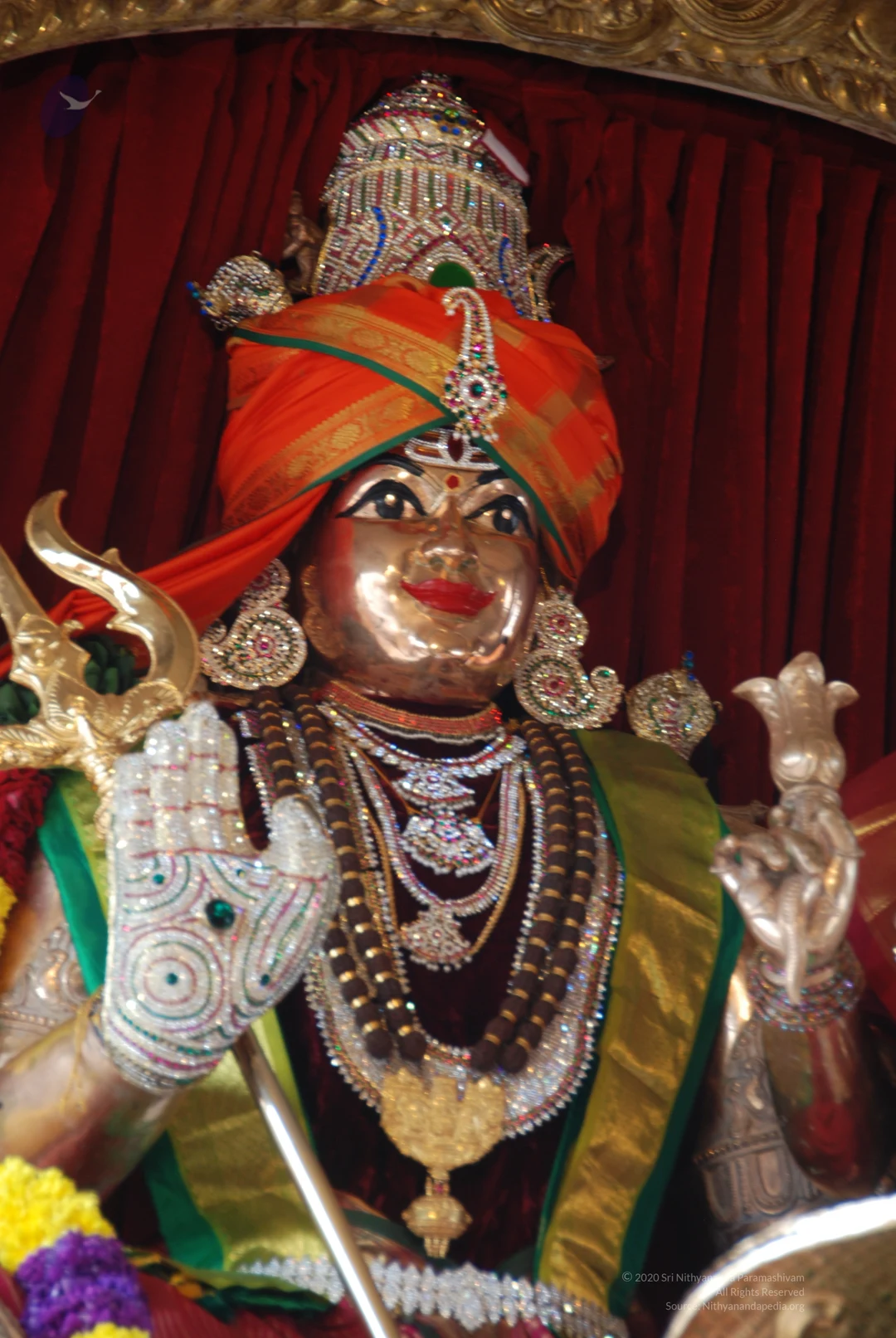
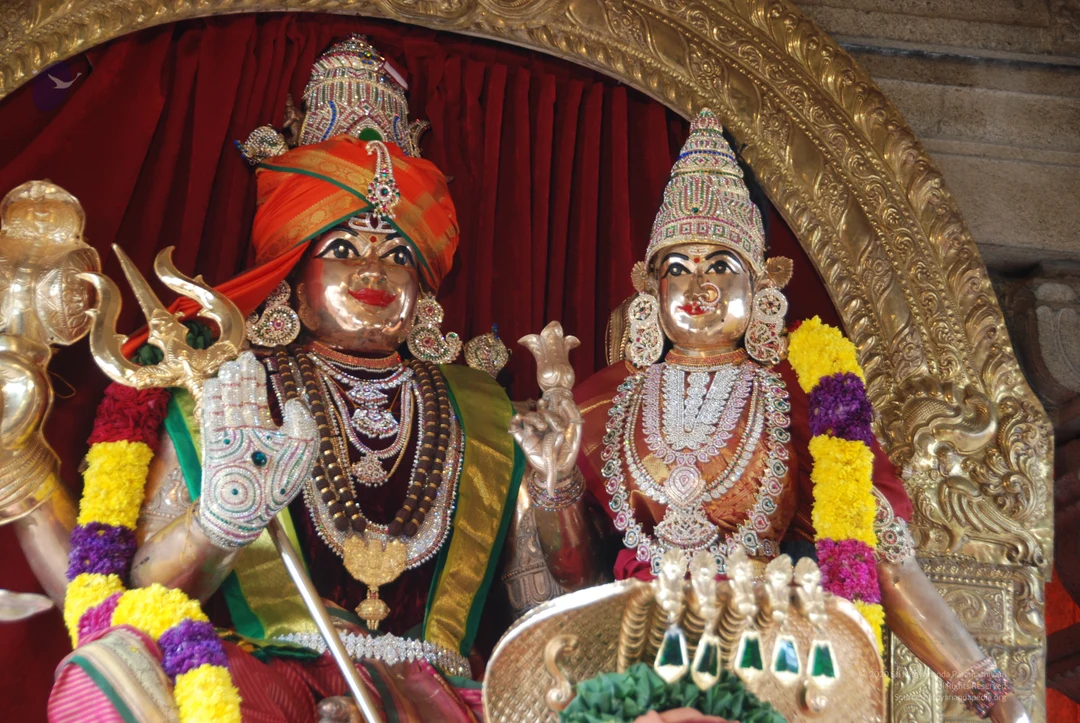
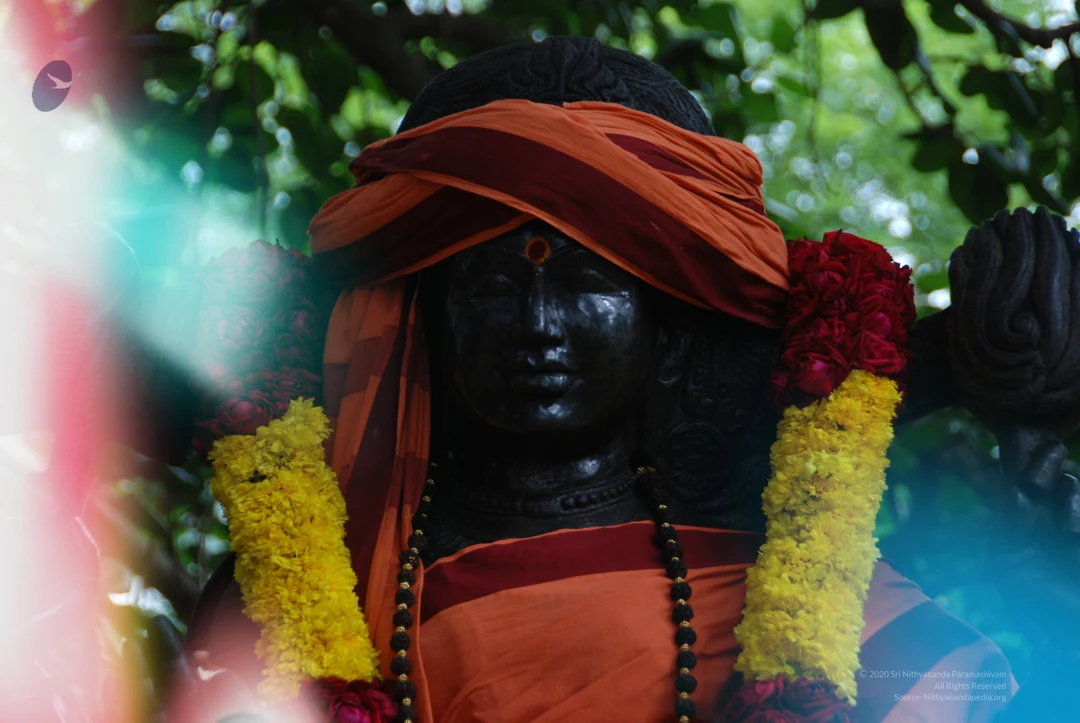
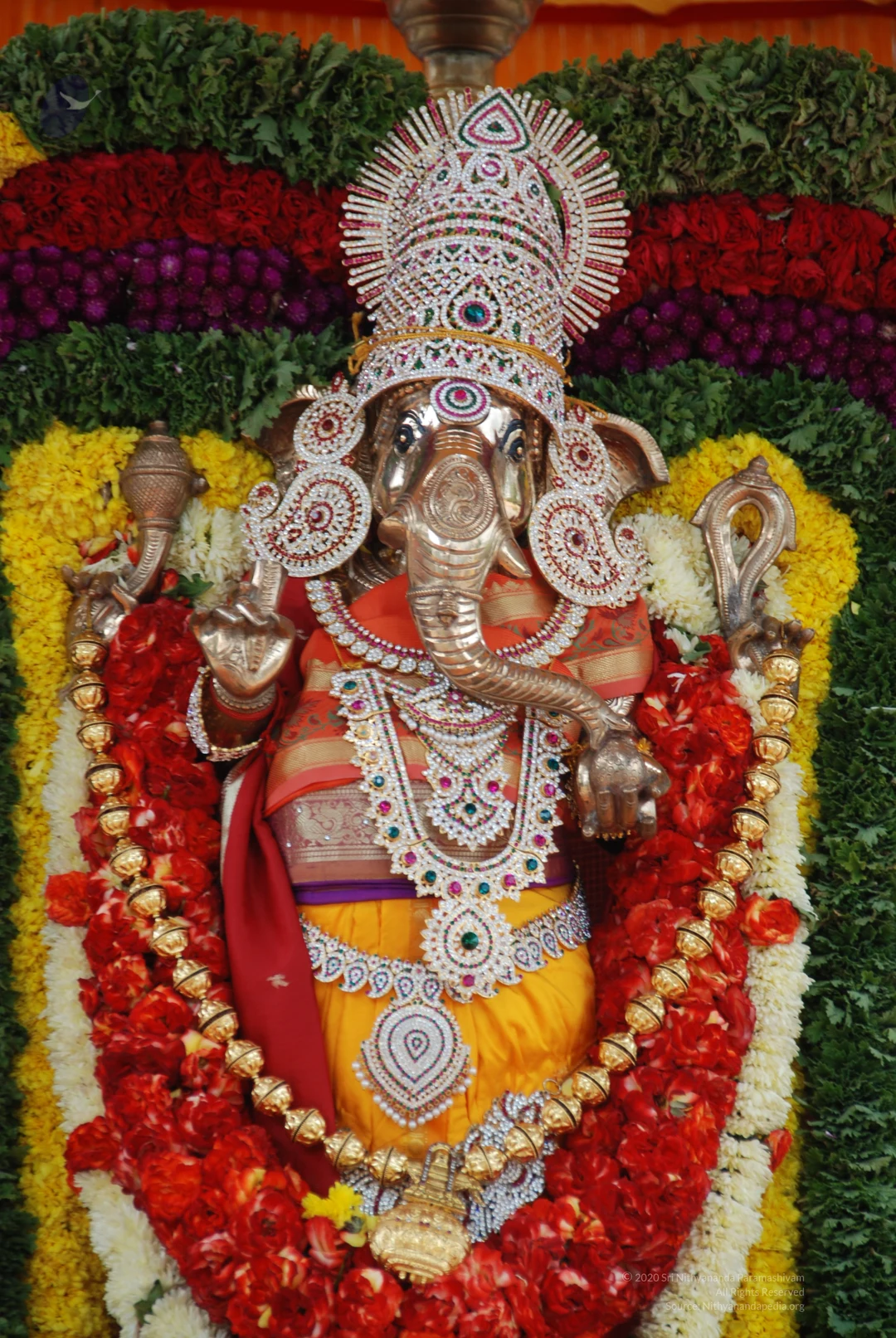
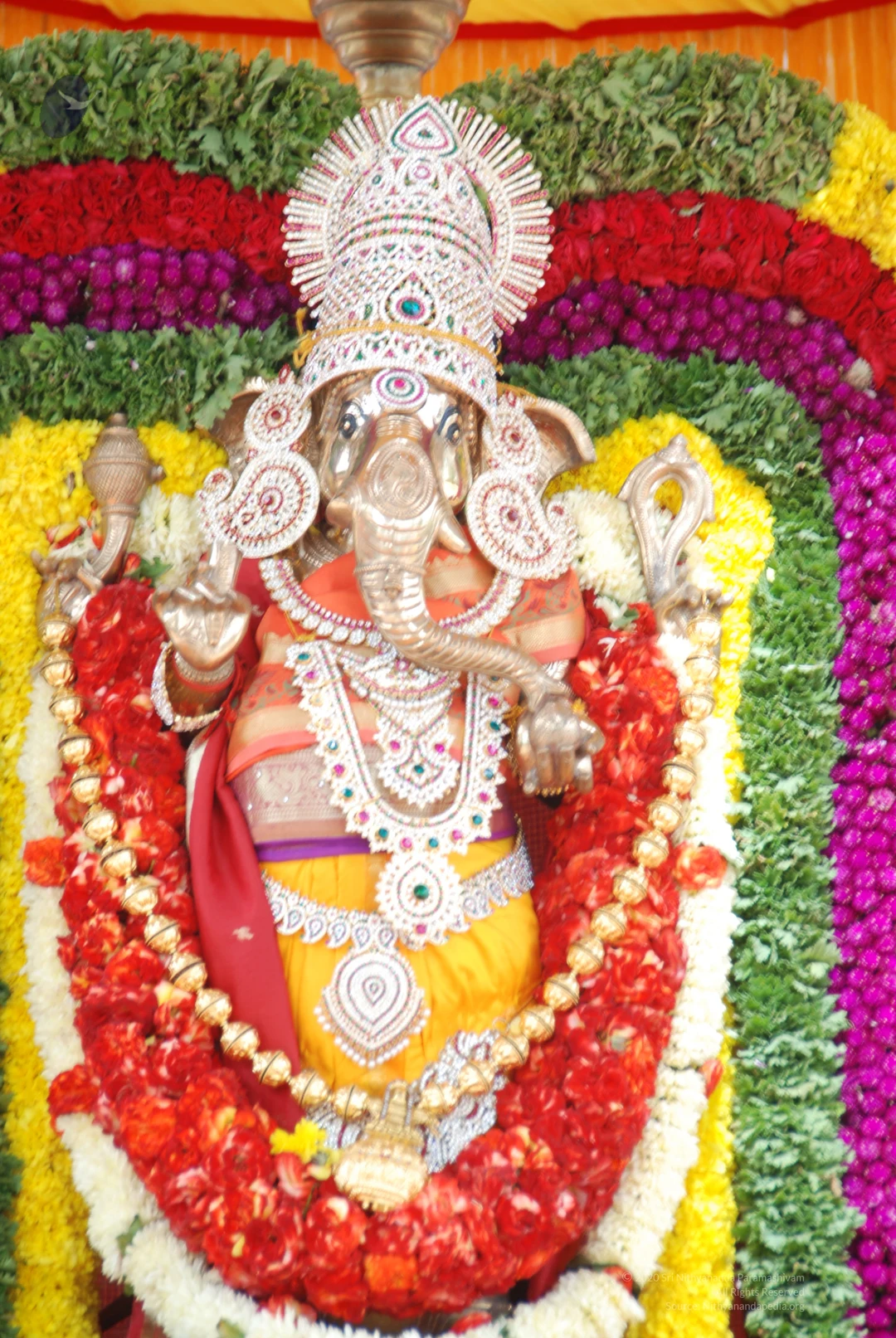
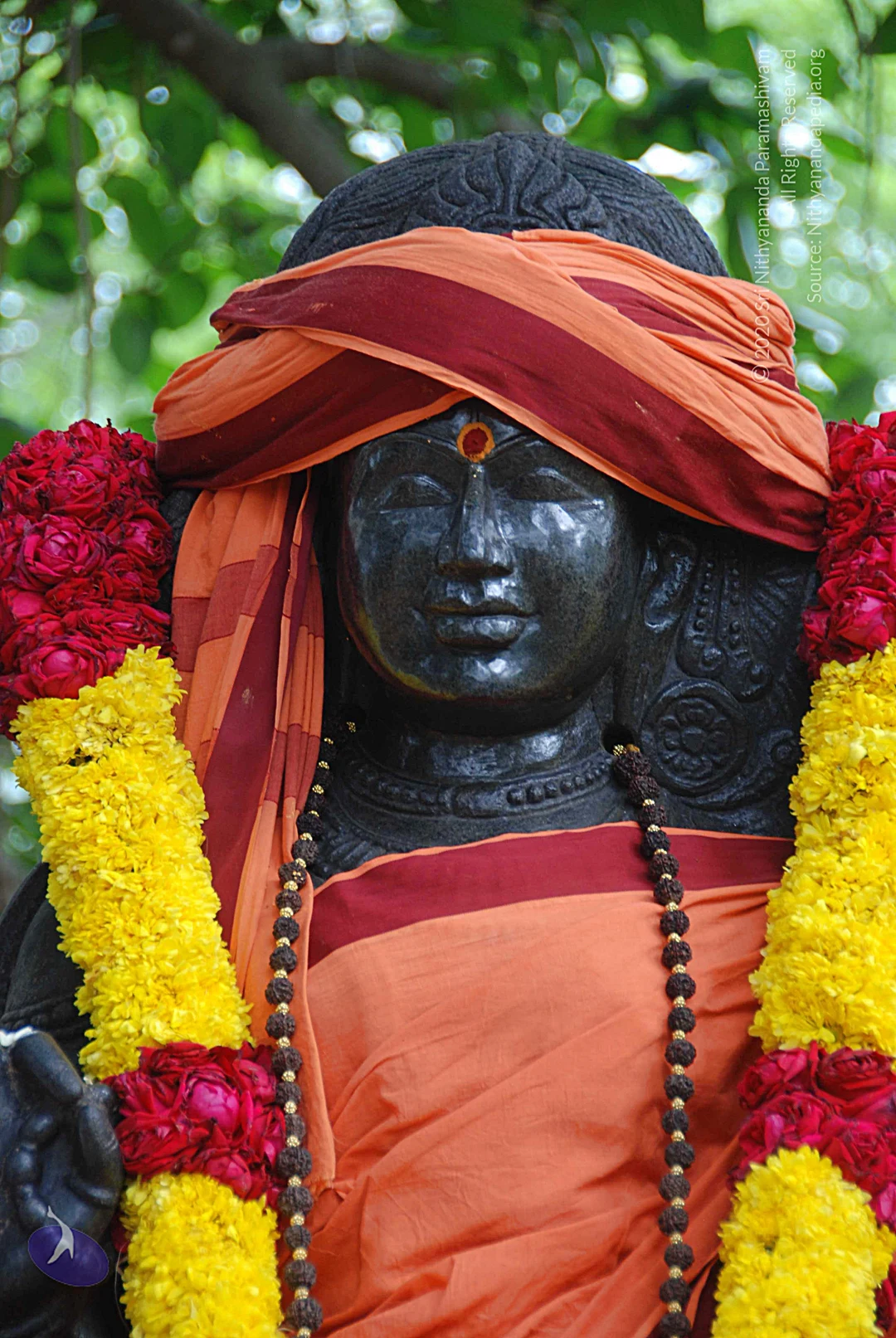
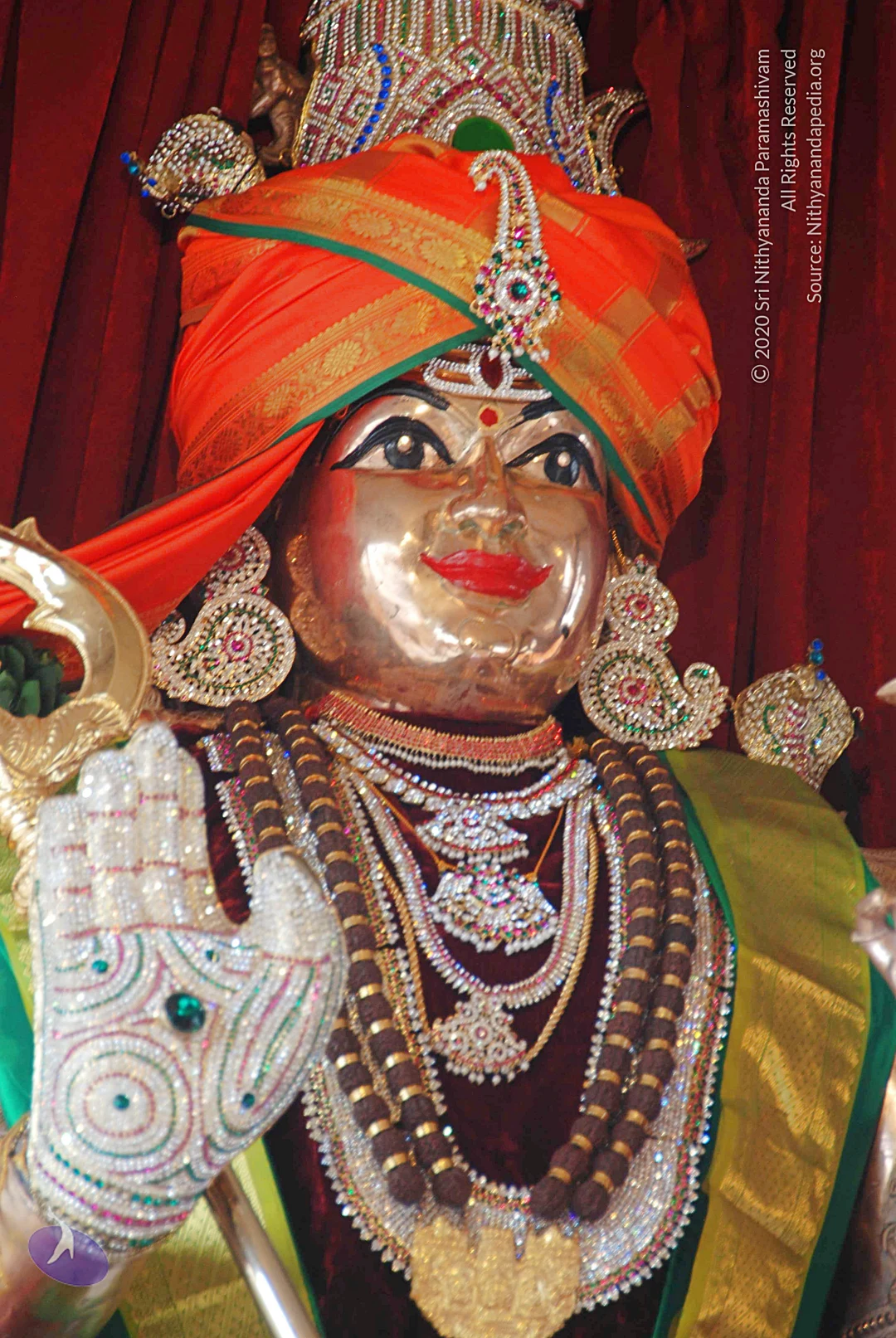
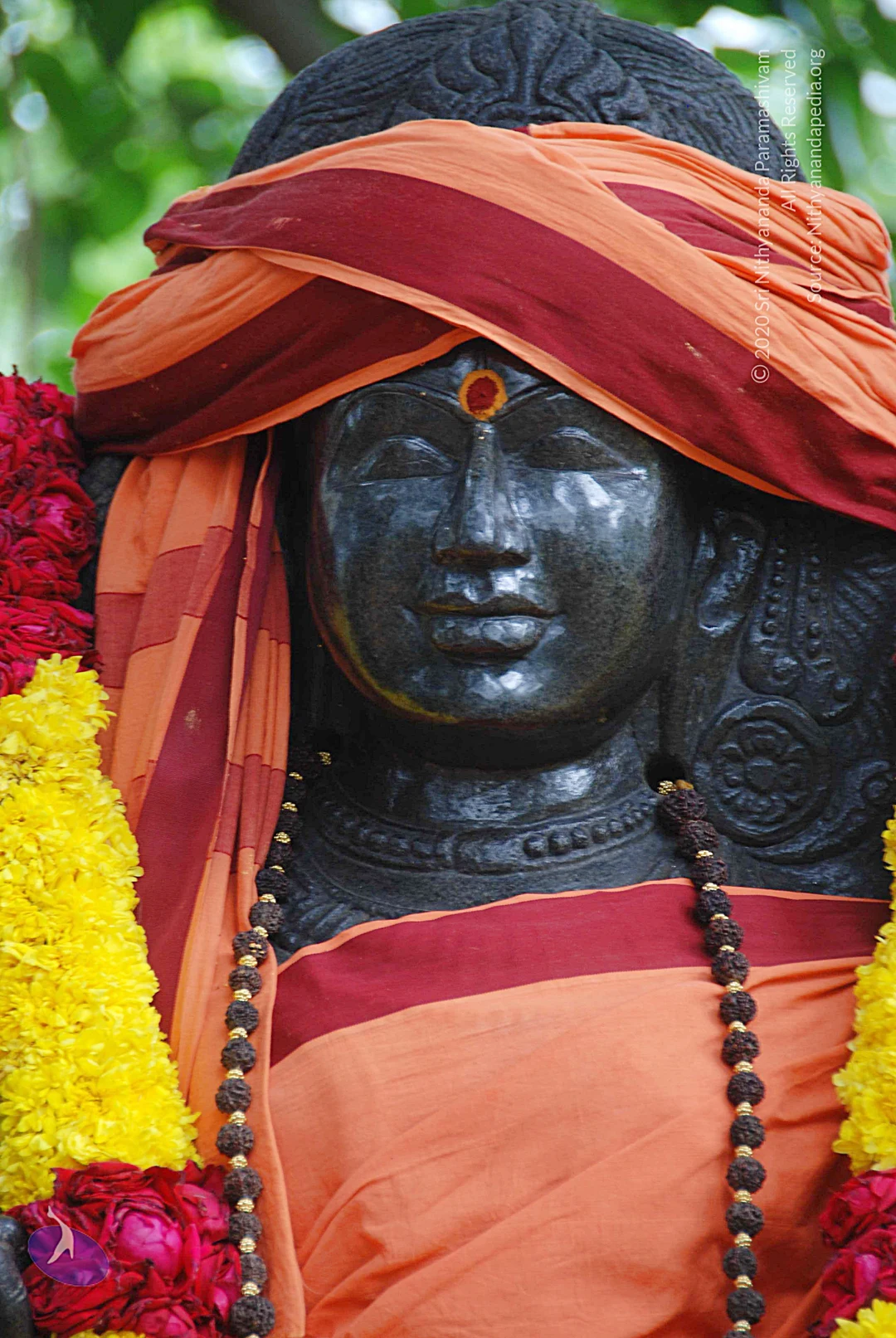
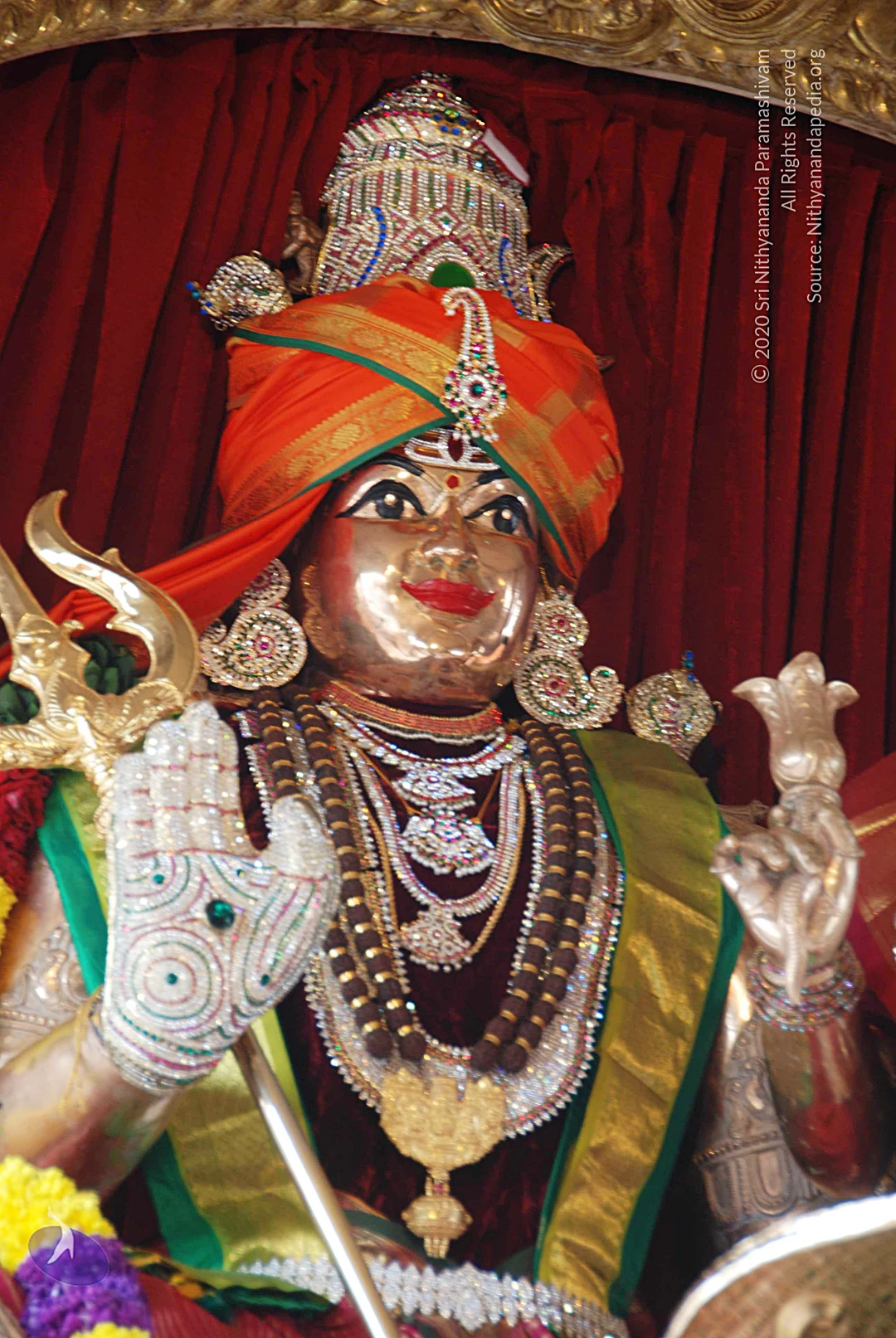
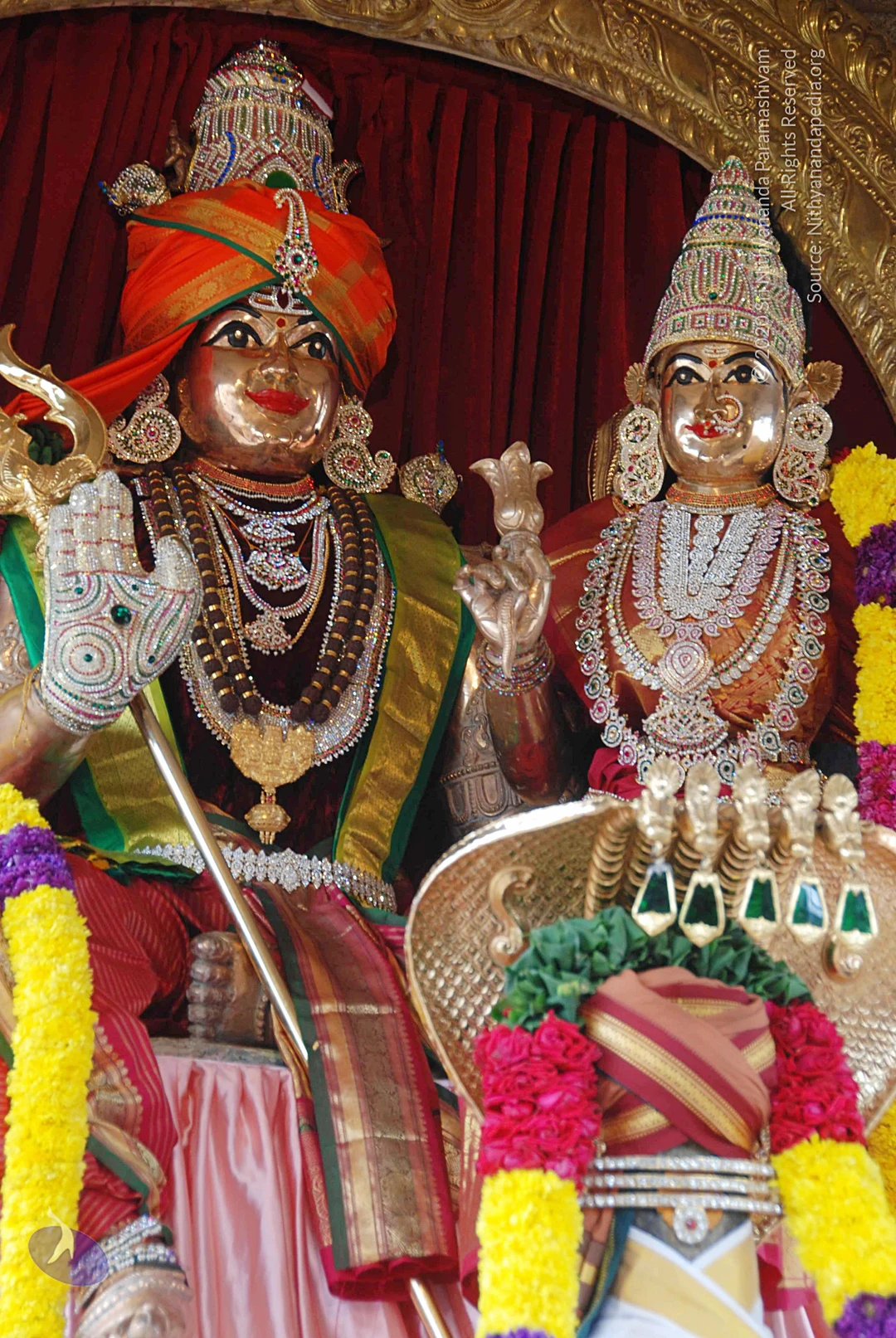
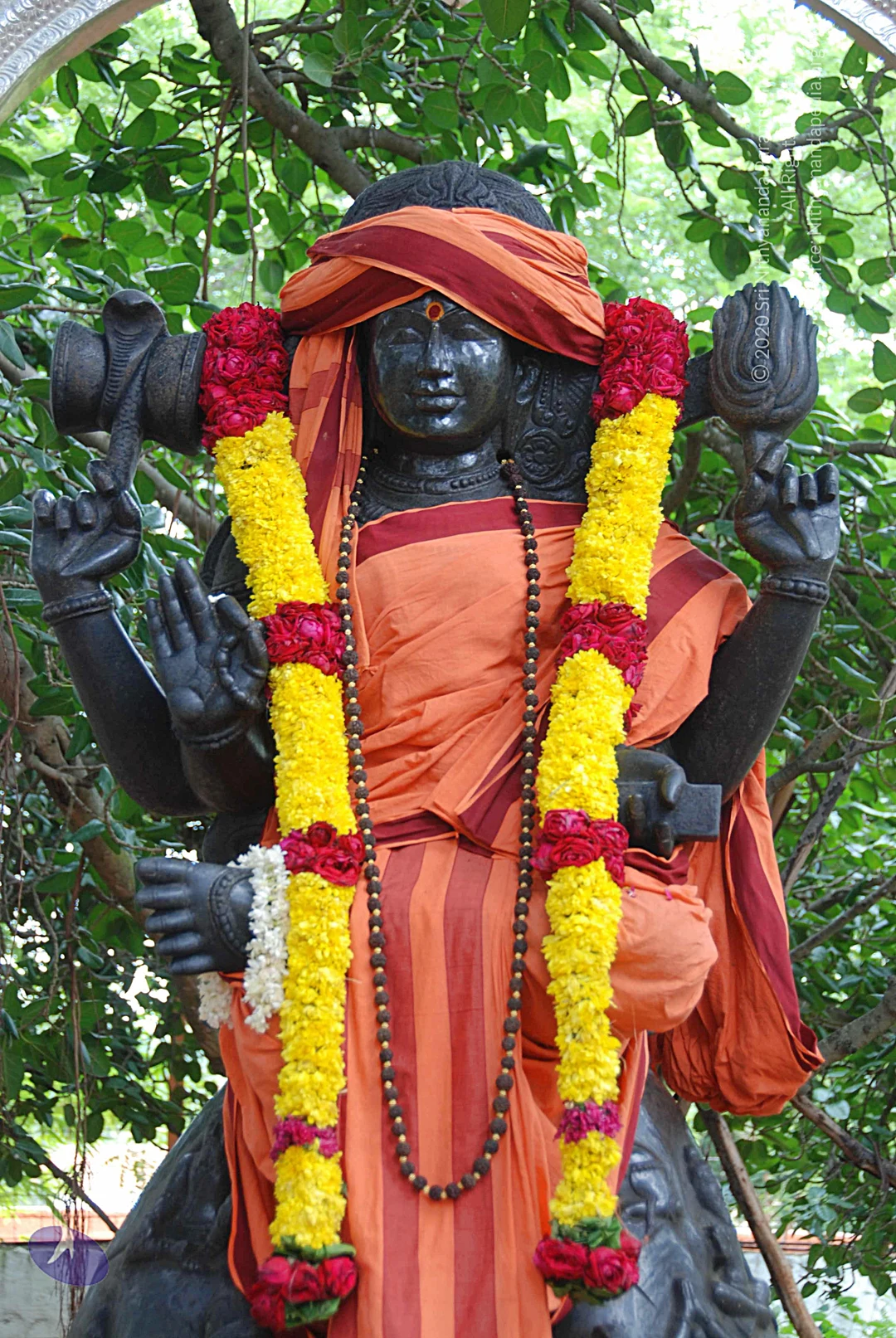
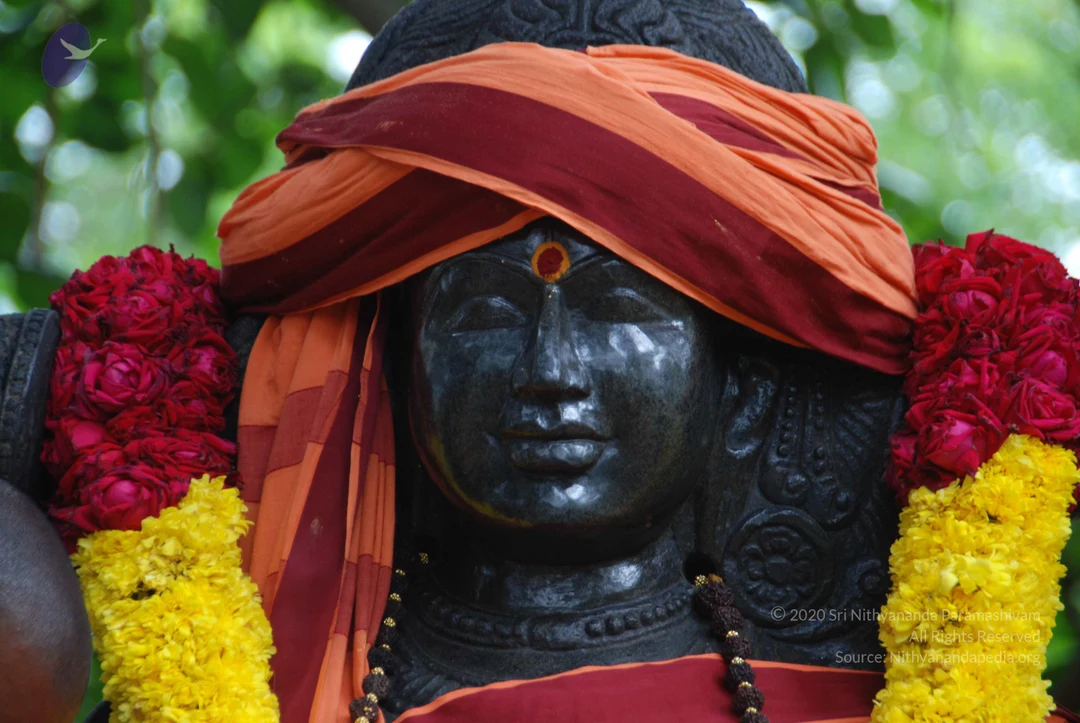
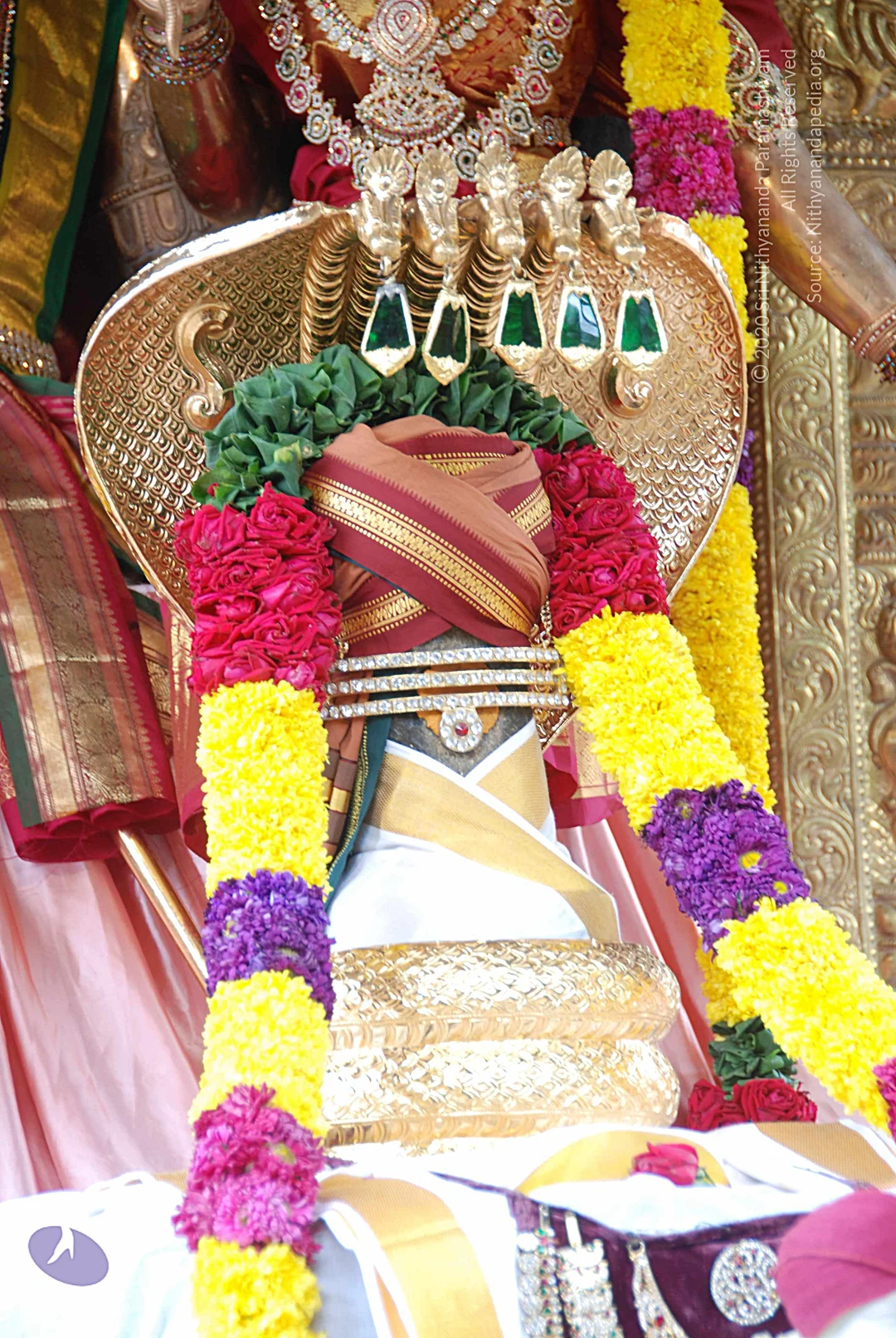
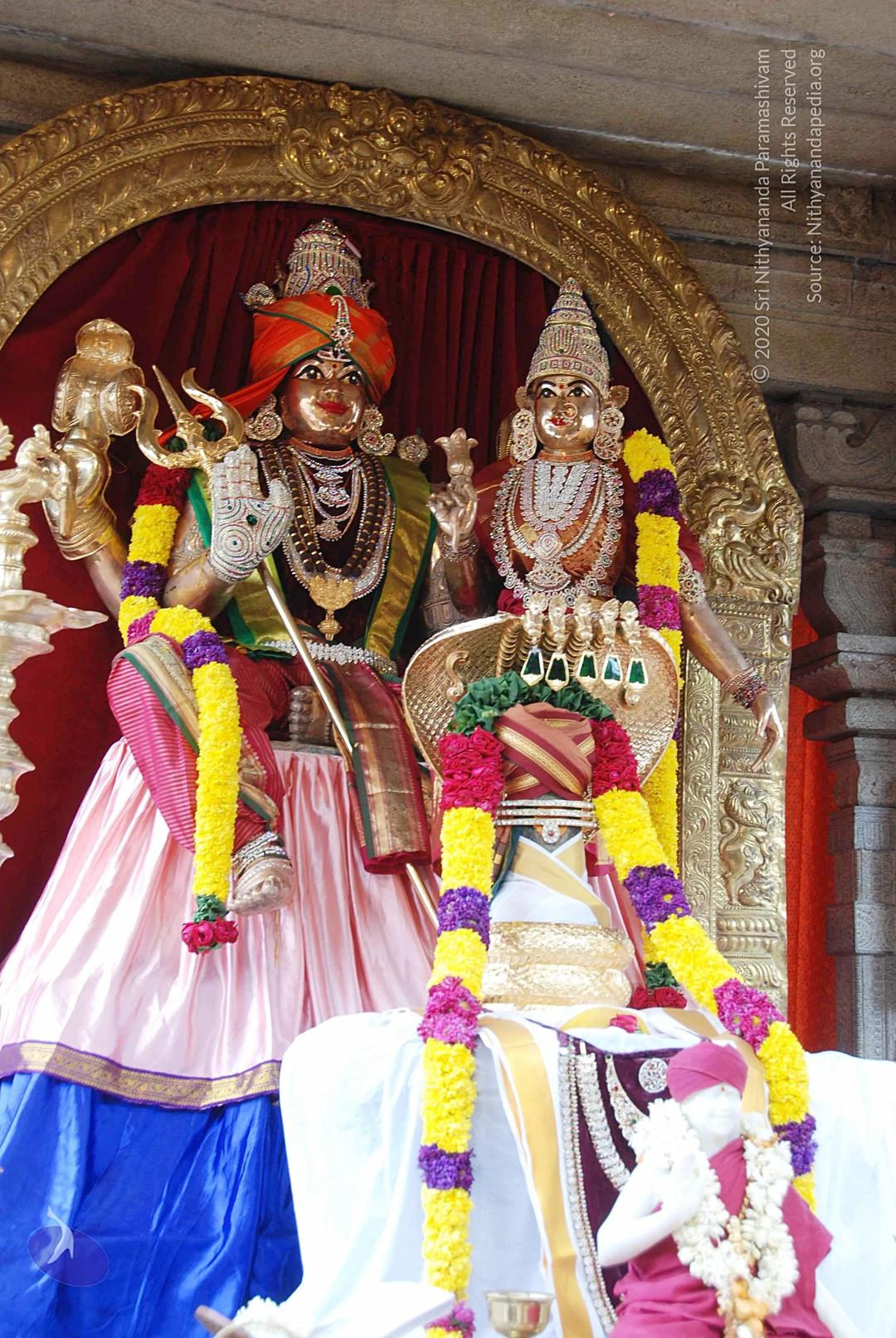
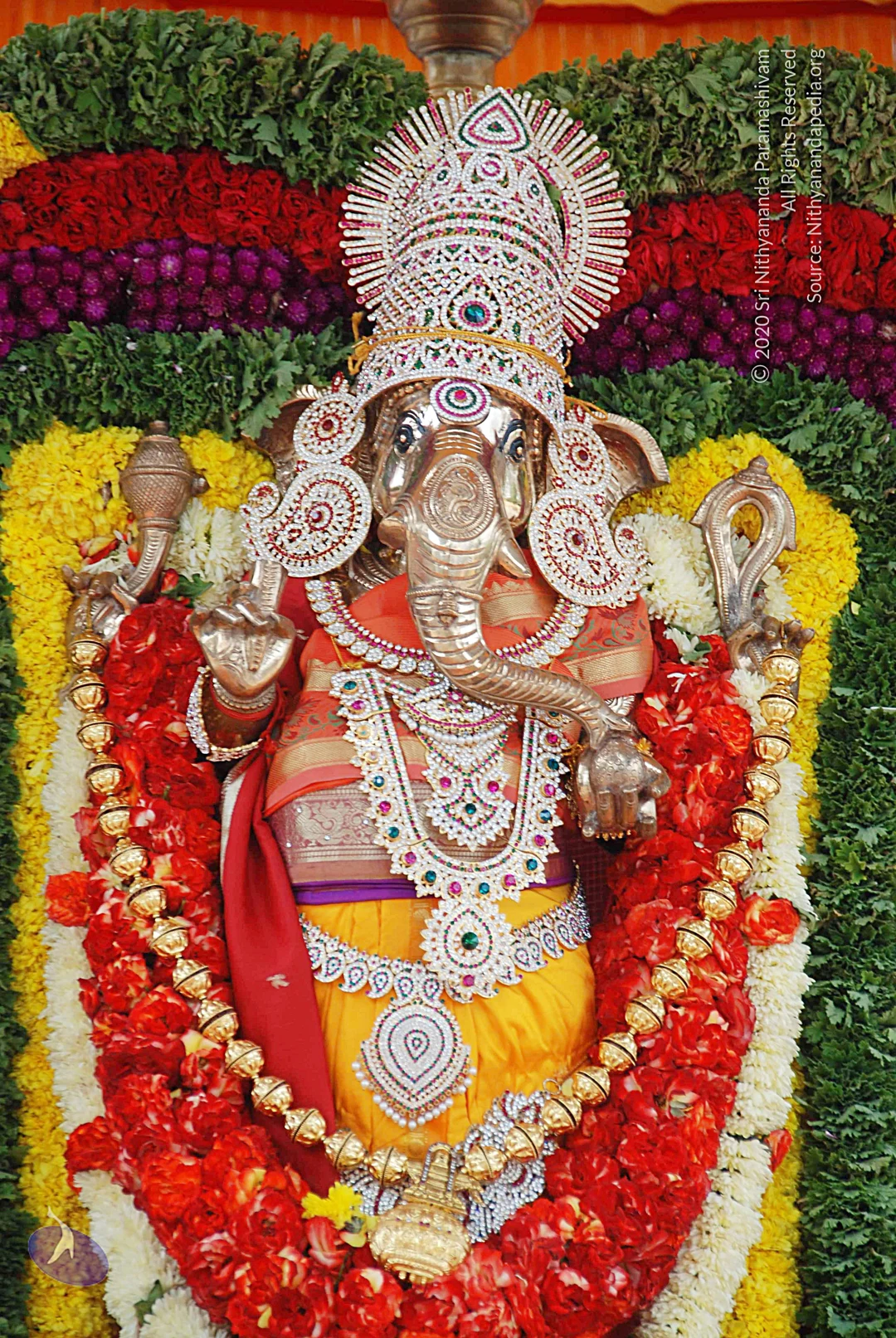
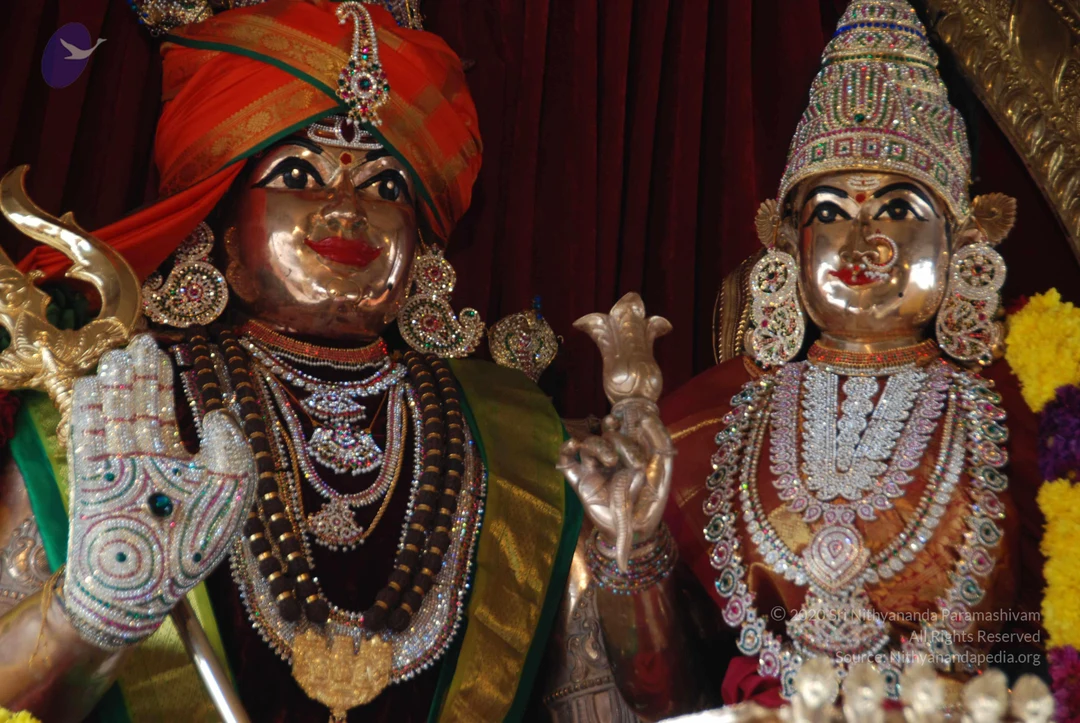
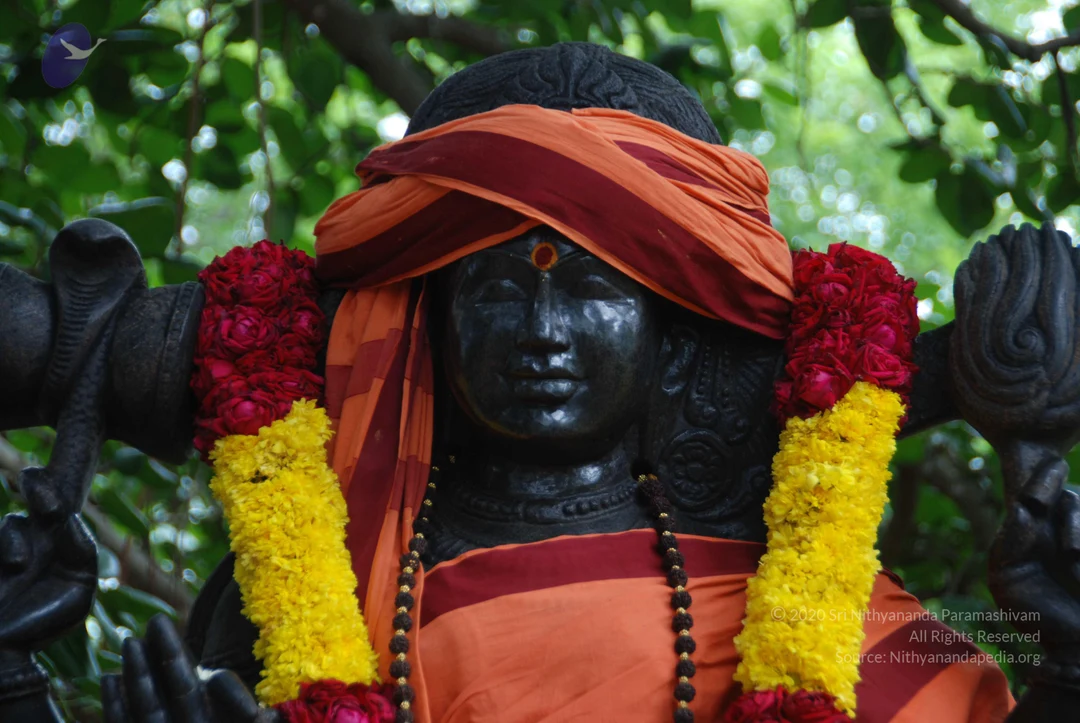
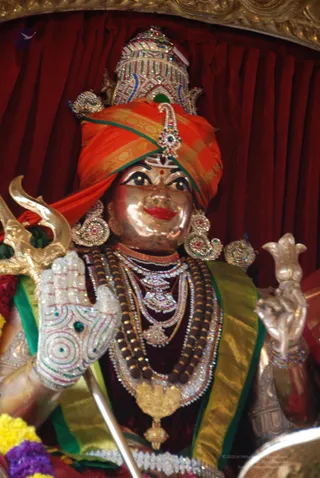
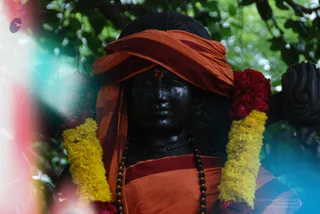
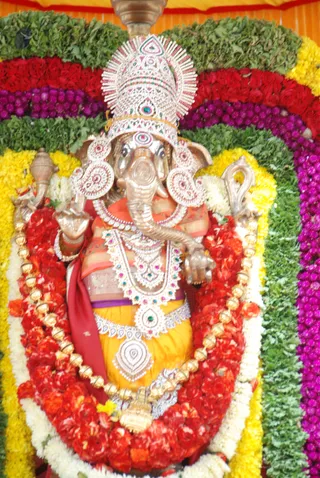
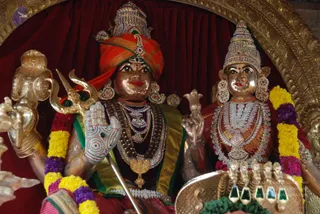
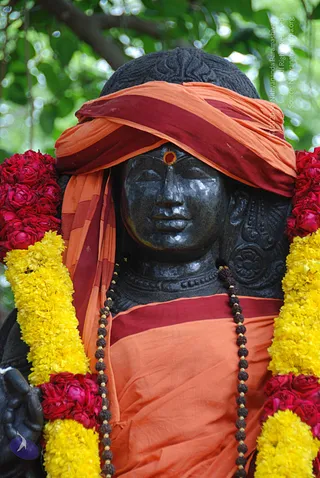
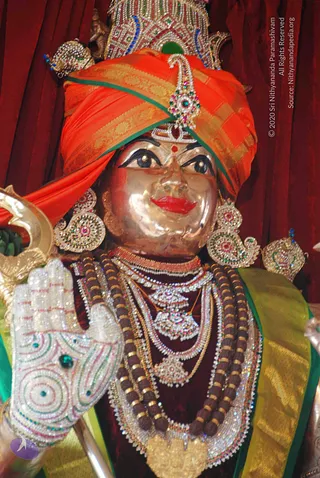
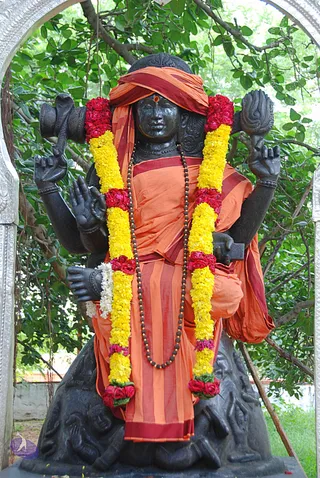
A photograph of a metal deity murti, with a copper-toned face, red lips and painted eyes, wearing an orange and gold turban topped with an ornate jewelled crown. It is adorned with layered beaded necklaces, rudraksha-style dark mala beads, jewelled earrings and bracelets. The right hand is raised in a jewelled, beaded blessing gesture, and a golden trident rests at the left side. A green and gold shawl drapes the shoulders against a red velvet backdrop, with yellow and purple flower garlands in the lower corners. No physical person is visible; the figure is a statue.A dark stone or metal statue of a saint wrapped in an orange and maroon turban and robe, with a red bindi on the forehead. The figure wears a rudraksha-style bead mala and is garlanded with red roses and yellow marigold strands. Green leaves fill the background, and a blurred colour flare sits at the left edge. The statue is a depiction, not a living person, so no physical people are present.A photograph of a decorated Ganesha murti at the centre, an elephant-headed deity with a tall ornate silver-and-jewelled crown, silver necklaces set with red and green stones, and a yellow dhoti with a red sash. The deity holds a modak-like sweet in one hand and an axe-like attribute in the other, and is framed by thick garlands of red roses, white jasmine and yellow marigolds arranged in concentric arches of red, purple, green and yellow flowers. No physical people are visible; the murti is the only figure. Sweets and puja offerings are not clearly visible.
Yogasutras

17 photosSource gallery
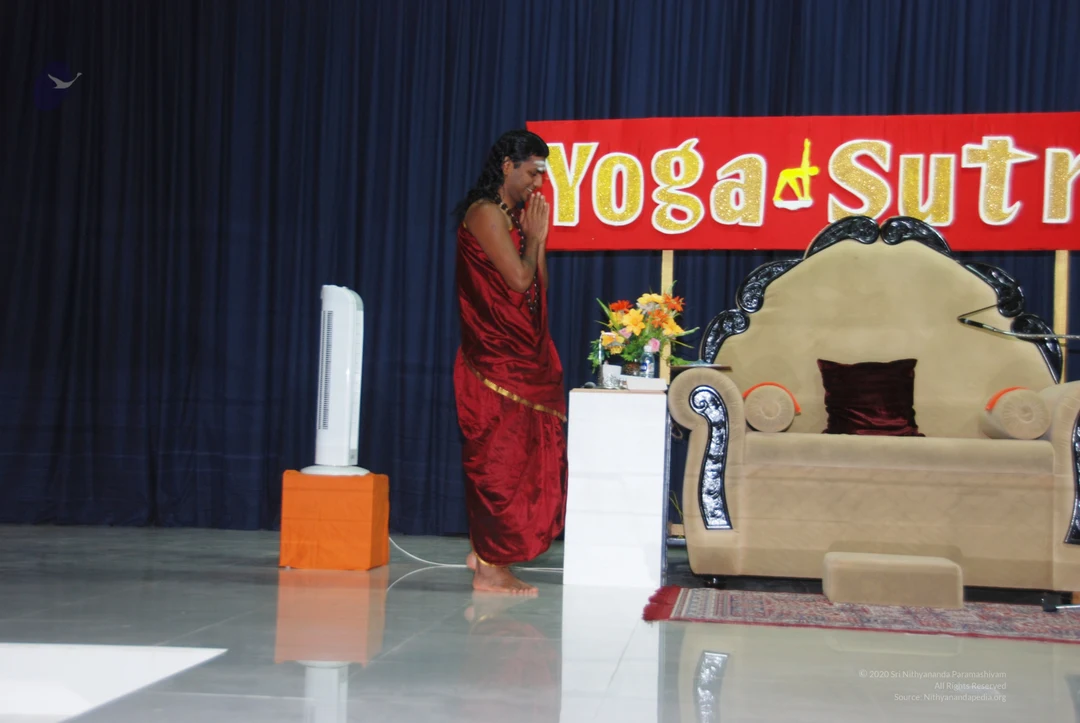
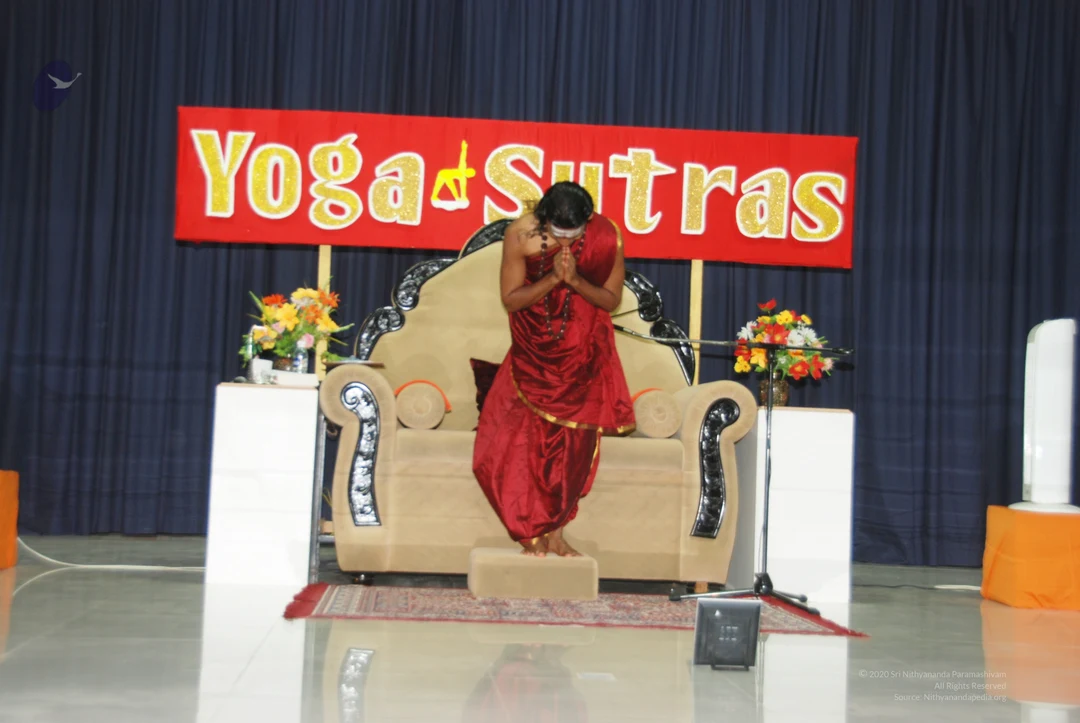
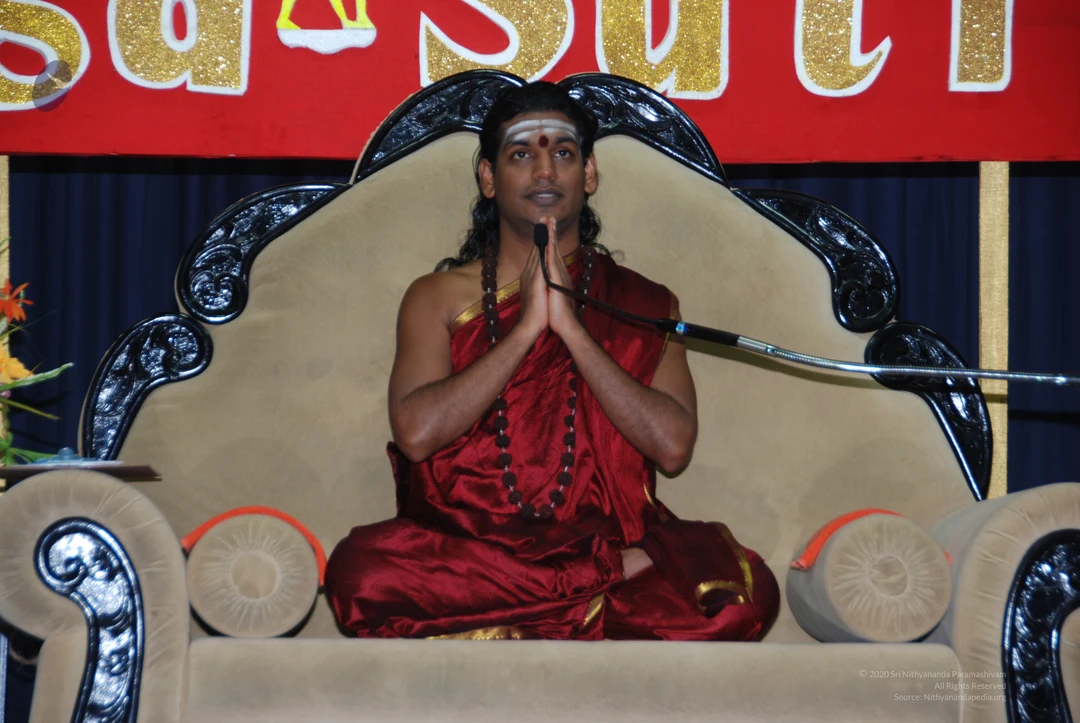
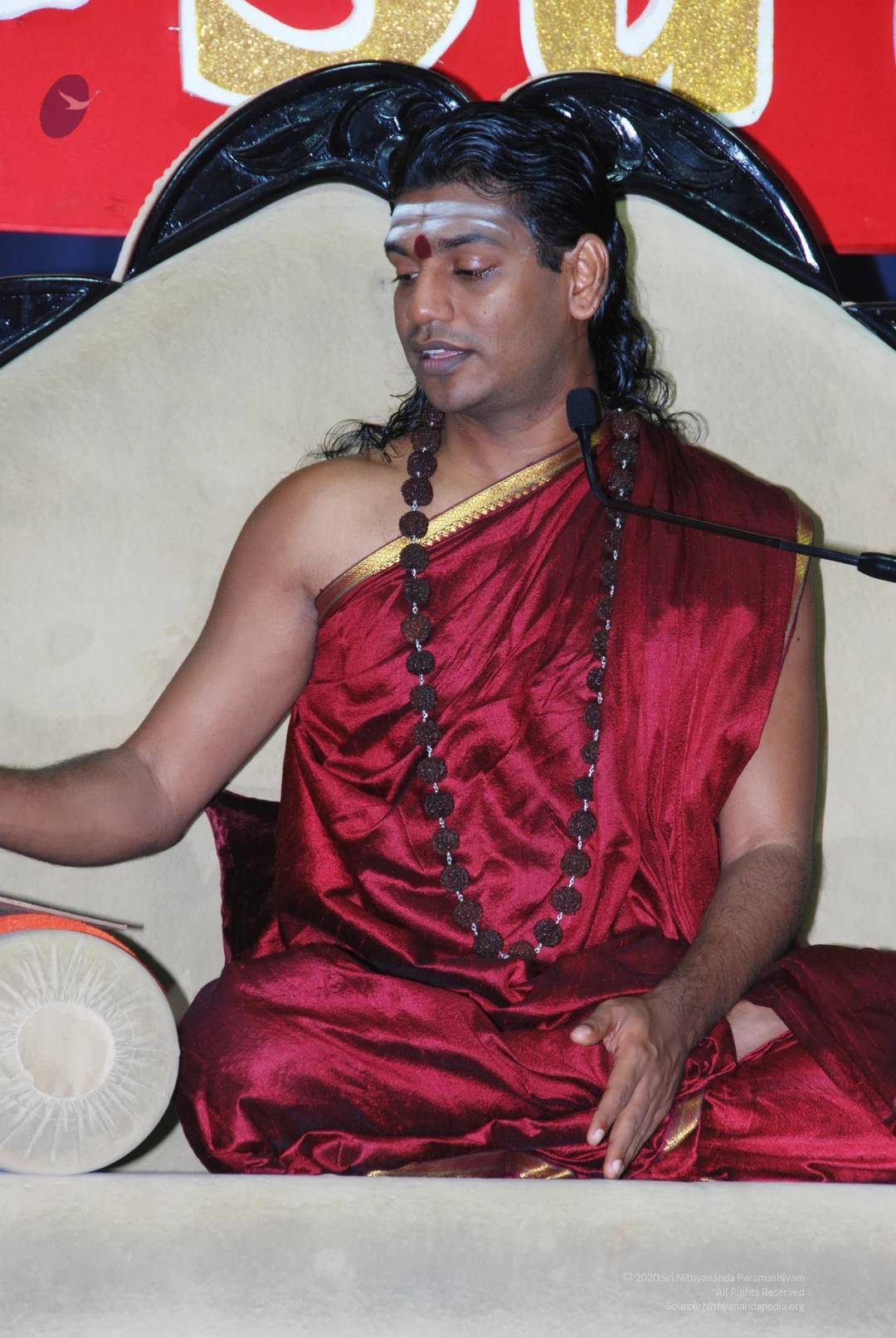
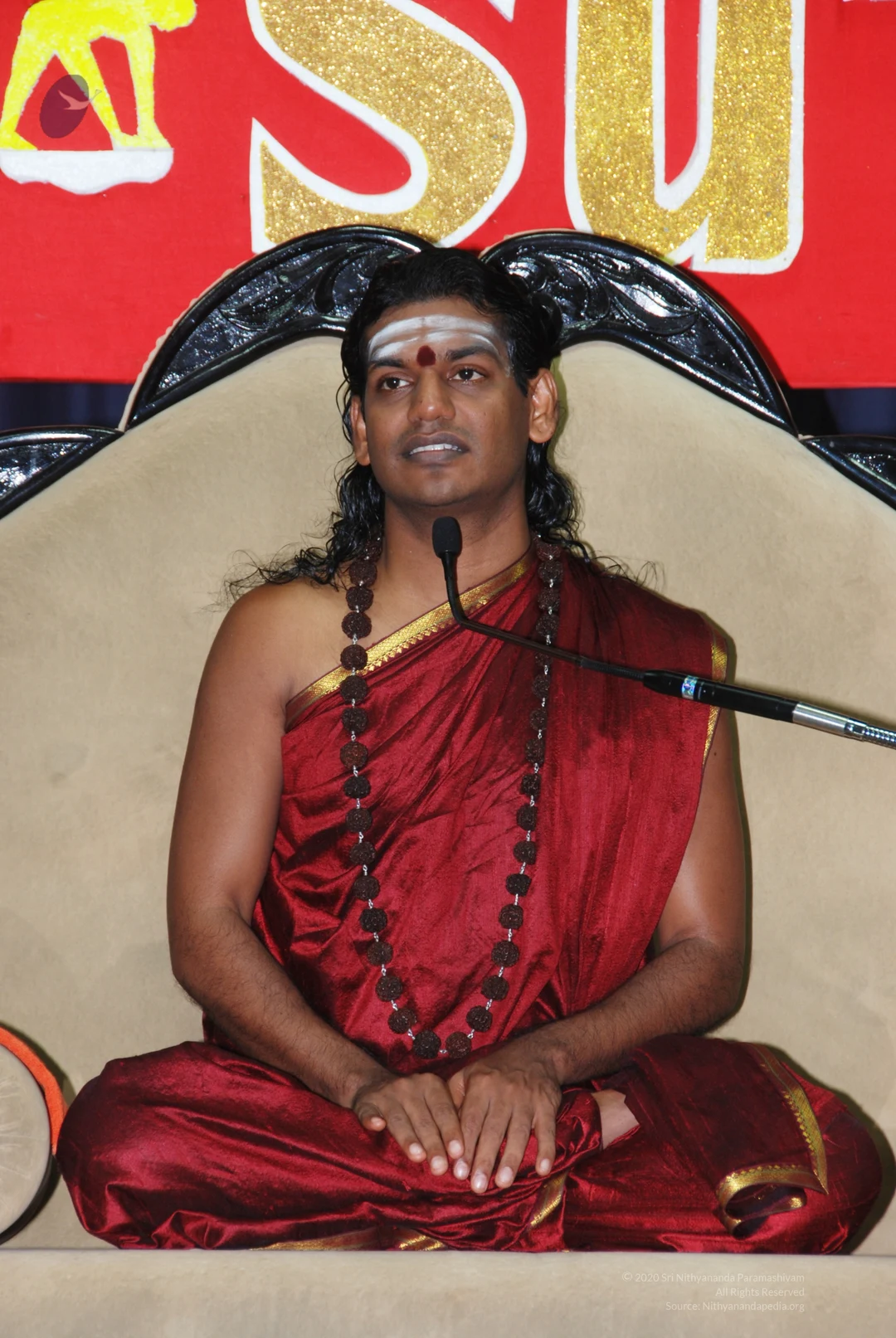
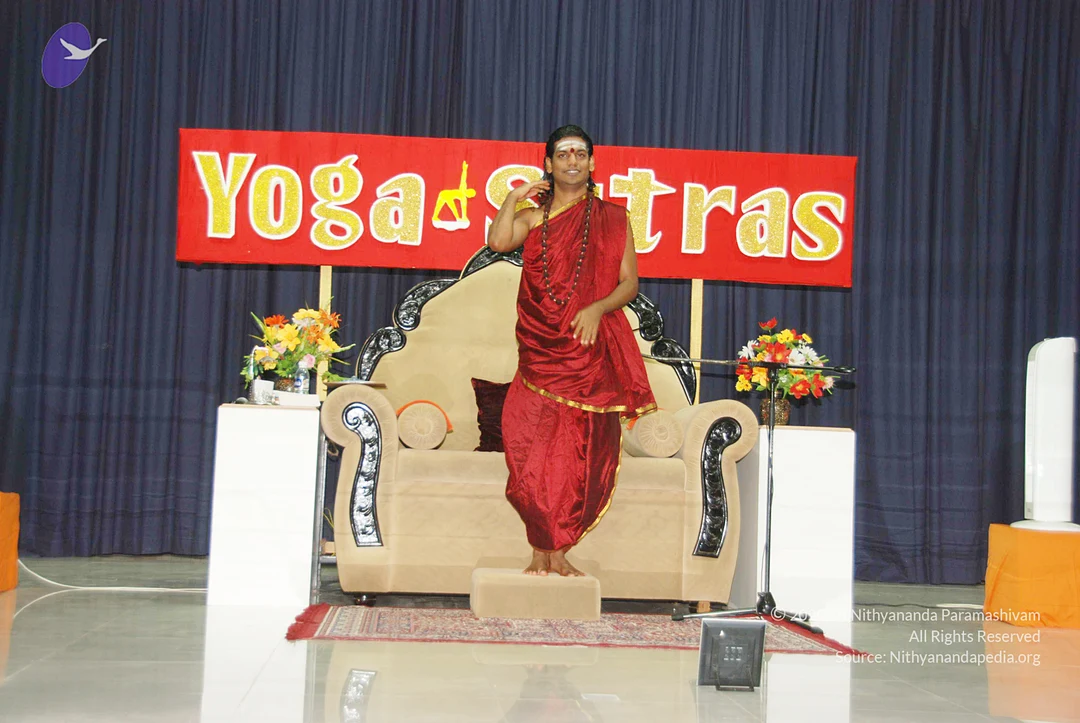
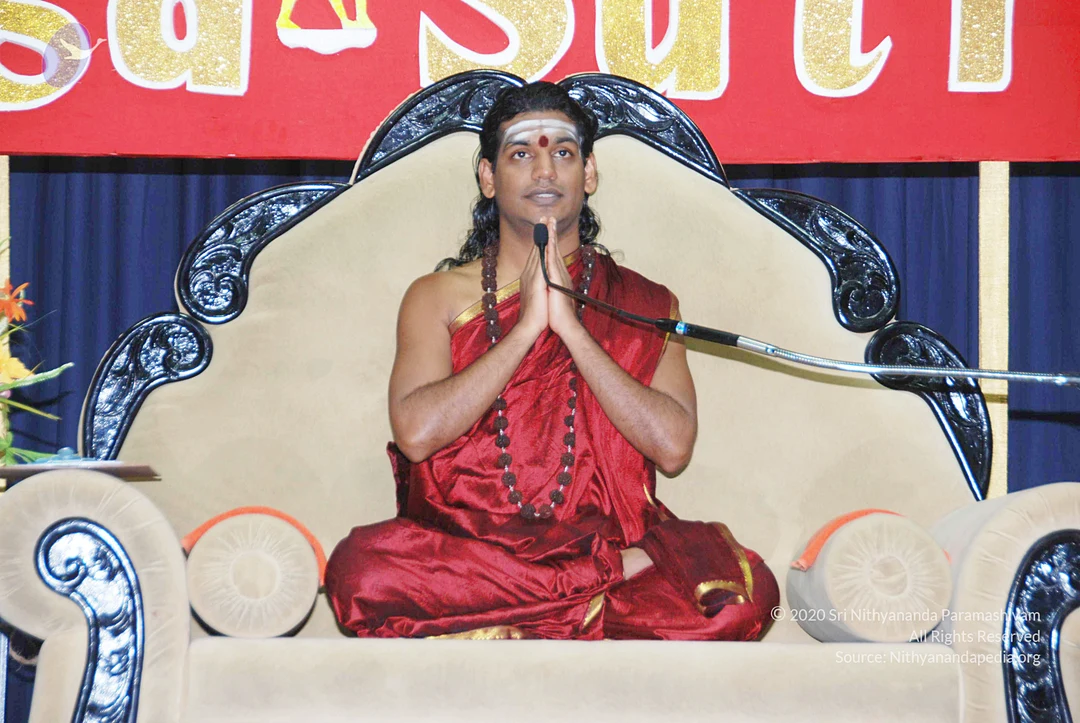
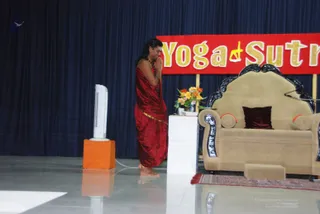
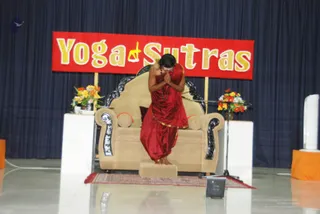
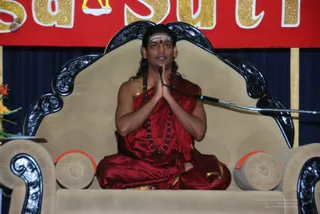
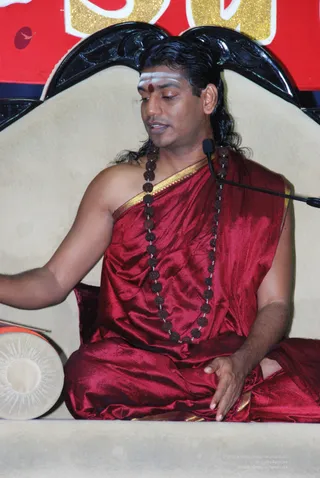
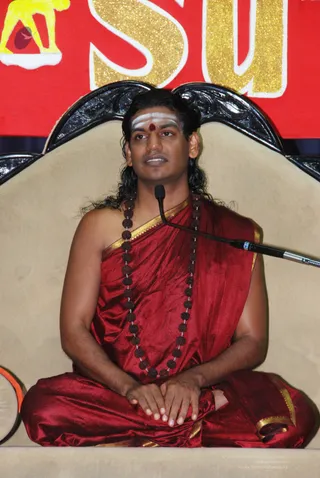
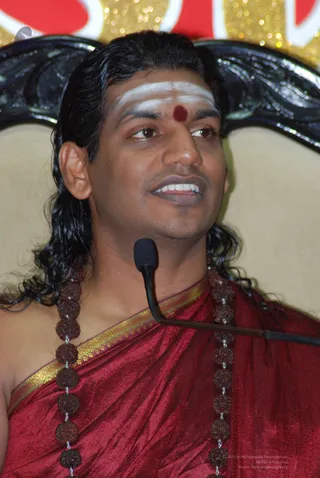
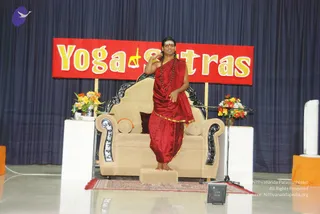
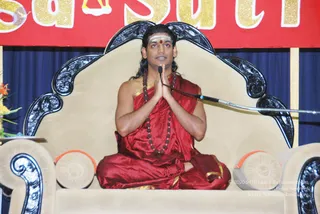
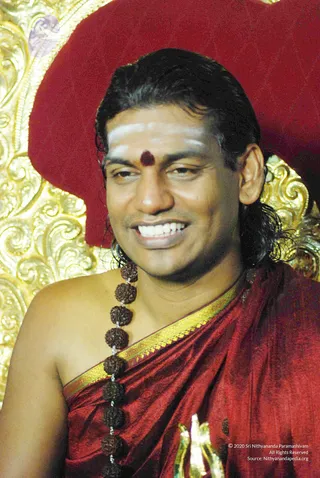
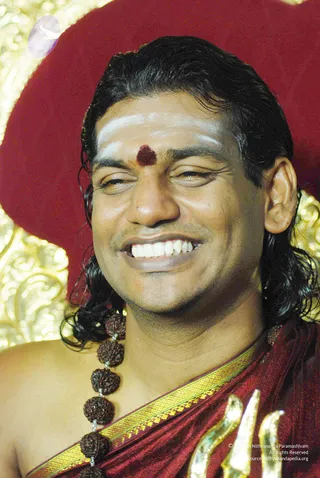
A standing figure in a red draped garment with a gold border stands at the left of a stage with palms pressed together in anjali, a respectful greeting gesture. The figure has long dark hair and a dark rudraksha-style necklace, and wears a tilak mark on the forehead. To the right stands an ornate cream upholstered throne with dark carved wooden arms and a maroon cushion, beside a white pedestal holding a vase of orange and yellow flowers. A blue draped curtain and a red banner reading Yoga Sutra with a yoga figure form the backdrop, and a white tower fan sits on an orange base at left. a person: the figure has long swept hair, a red robe and rudraksha-style beads, cues consistent with the page's reference to a person, so the identity remains uncertain from appearance alone.A person in a red robe with gold trim stands barefoot on a beige cushioned step before a large beige upholstered throne with dark carved armrests and a dark back. The figure bows with palms pressed together in namaste, head lowered. A red banner reading Yoga Sutras with a yoga pose silhouette hangs behind, with flower arrangements on white pedestals on either side and a microphone stand nearby. A dark blue curtain forms the backdrop and a red patterned rug covers the floor. The appearance-based candidate wears a red robe and white forehead markings, with a rudraksha mala visible, and the page names a person for this event, but the face and build are not clear enough to confirm identity, so this is a person in the scene.A photograph of a man seated in padmasana on an ornate beige upholstered throne with black carved wooden arms and backrest, in front of a red banner with gold glittery letters. He wears a deep red silk robe over bare shoulders, a rudraksha mala around his neck, a white tripundra with a red dot on his forehead, and has long hair. His palms are pressed together in anjali mudra before a microphone on a stand. Orange flowers sit at the left edge of the frame. Appearance-based label: a person, seated in a discourse setting with the throne, rudraksha mala and red robe as cues.Photo of a seated man speaking at a discourse on a cream upholstered throne with a carved black backrest, in front of a red banner with gold lettering. He wears a deep red silk drape with gold border, multiple dark rudraksha mala necklaces, white horizontal forehead markings and a red bindi, with long dark hair swept back. A microphone stand is at his side and a cream drum sits at left. Swamiji (probable): long swept-back hair, rudraksha malas, and red-and-gold silk clothing on a throne, presiding over the discourse.A seated man in a red silk wrap with gold borders sits cross-legged on a cream upholstered throne with a carved black backrest. He wears a long rudraksha mala, a white vertical tilak with a red bindi, and has long swept-back hair. A microphone on a stand is at his side, and behind him is a red banner with large gold lettering. His hands rest folded in his lap as he speaks during a discourse. Appearance-based candidate: a person, seated on a throne in a discourse setting with rudraksha mala and red silk.Close photo of a man seated before a microphone, speaking during a discourse. He has long dark hair swept back, a white vibhuti horizontal mark with a red kumkum dot on his forehead, and wears a deep red silk garment with a gold zari border over his shoulder. Multiple rudraksha malas hang on his chest. Behind him is a dark carved wooden chair back and a gold and red backdrop. The a person cues are the long swept hair, saffron-red ornate clothing and rudraksha malas, seated as a discourse speaker. The page links this to a discourse on sleep and health.
Ashramites-Meeting
7 photosSource gallery
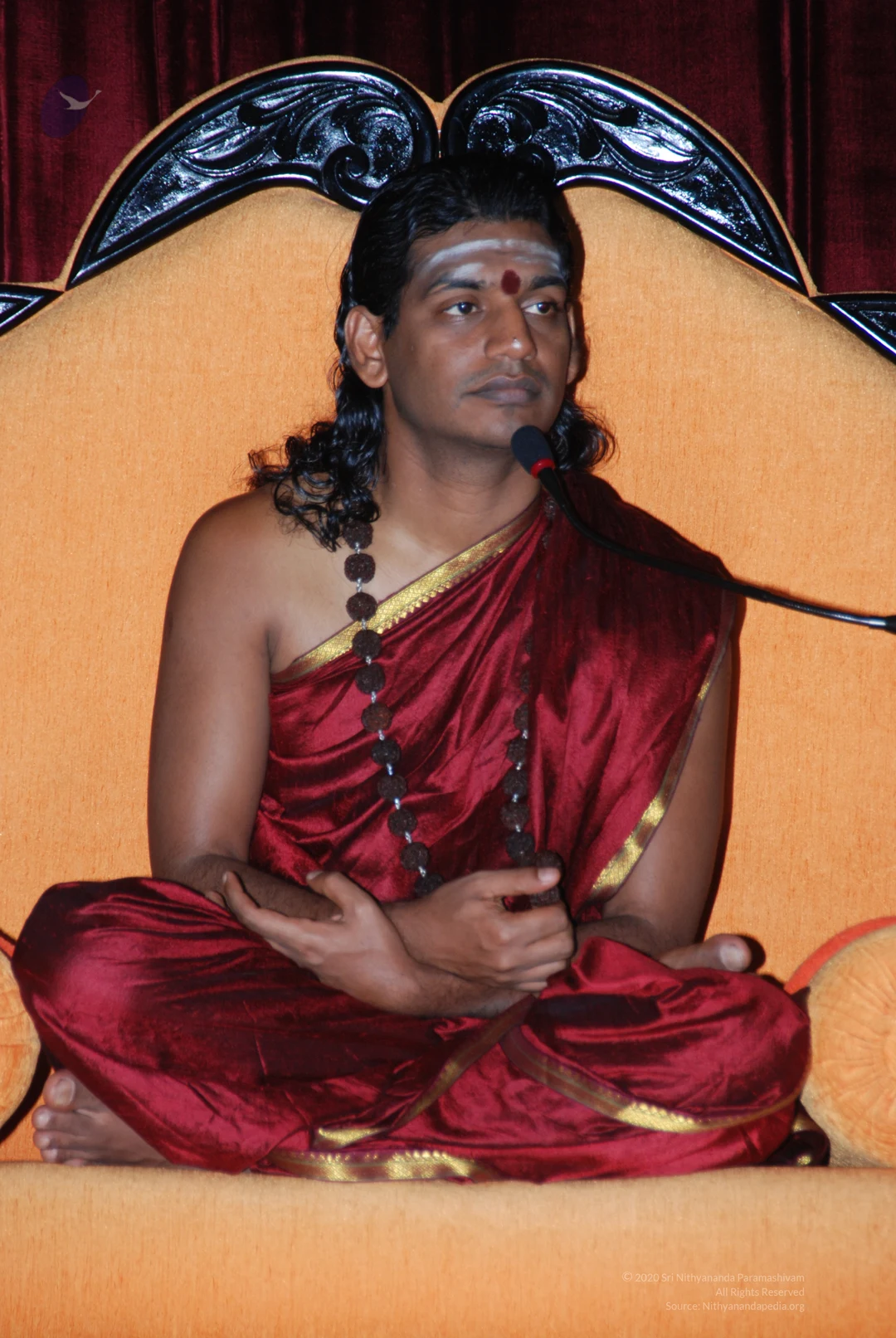
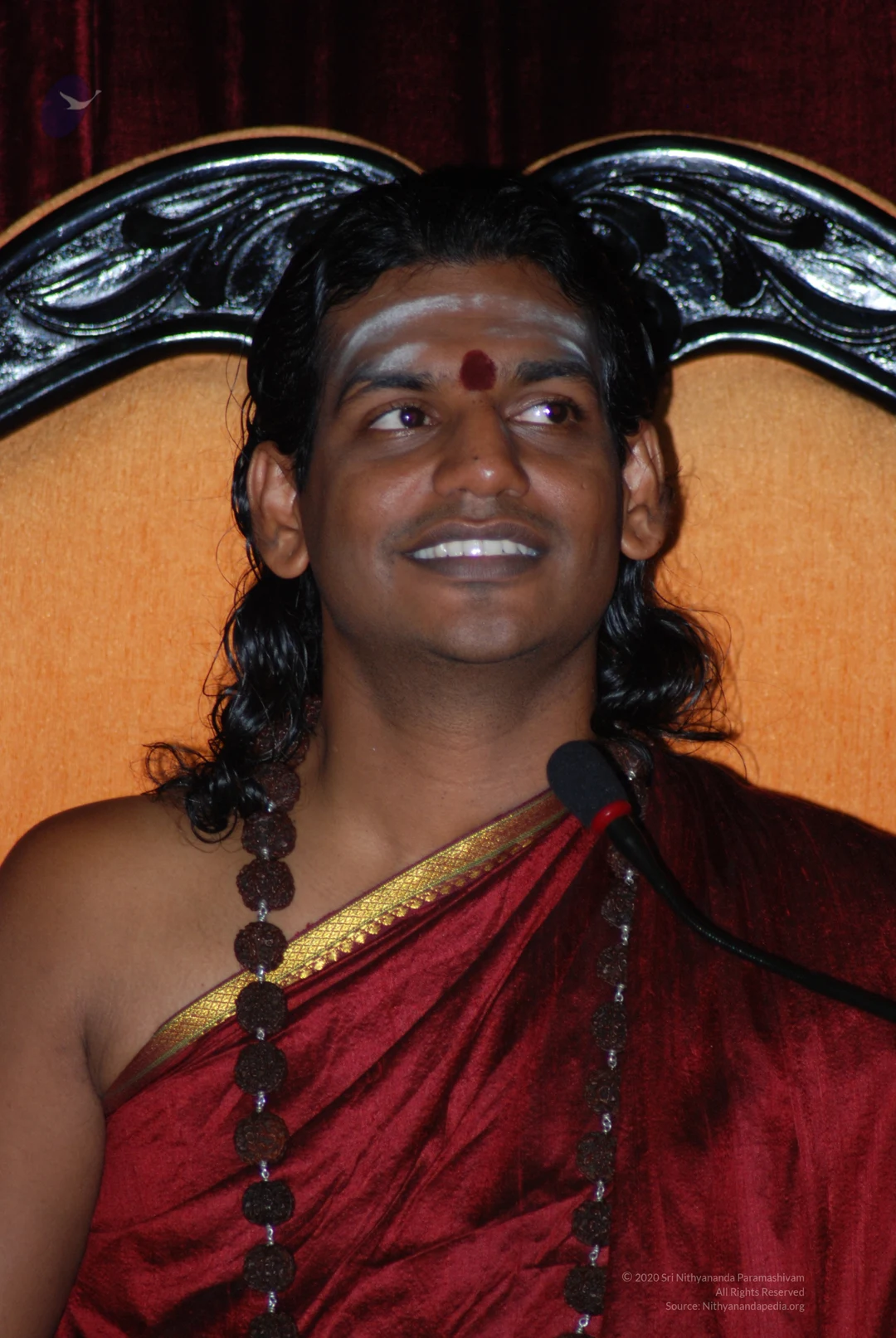
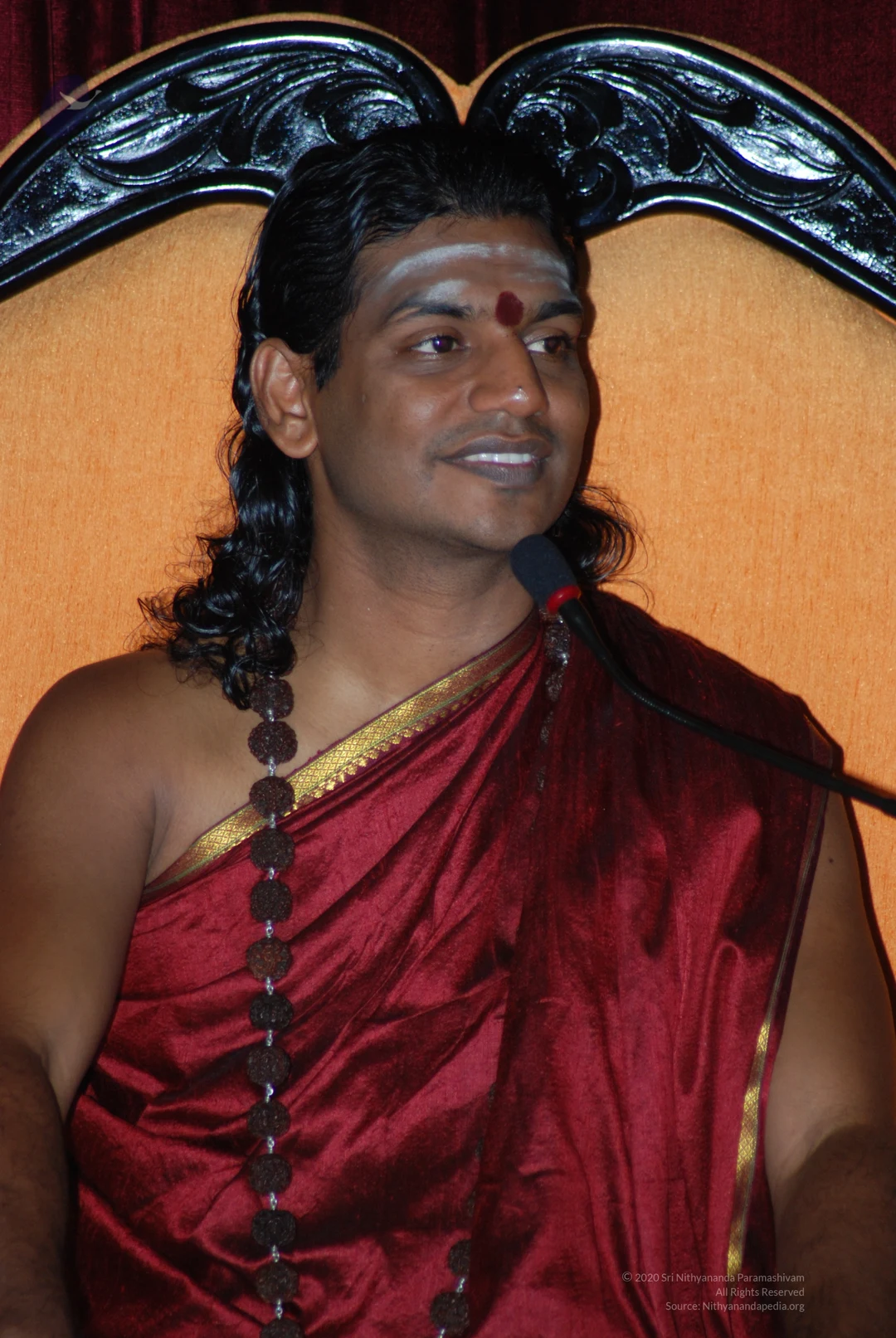
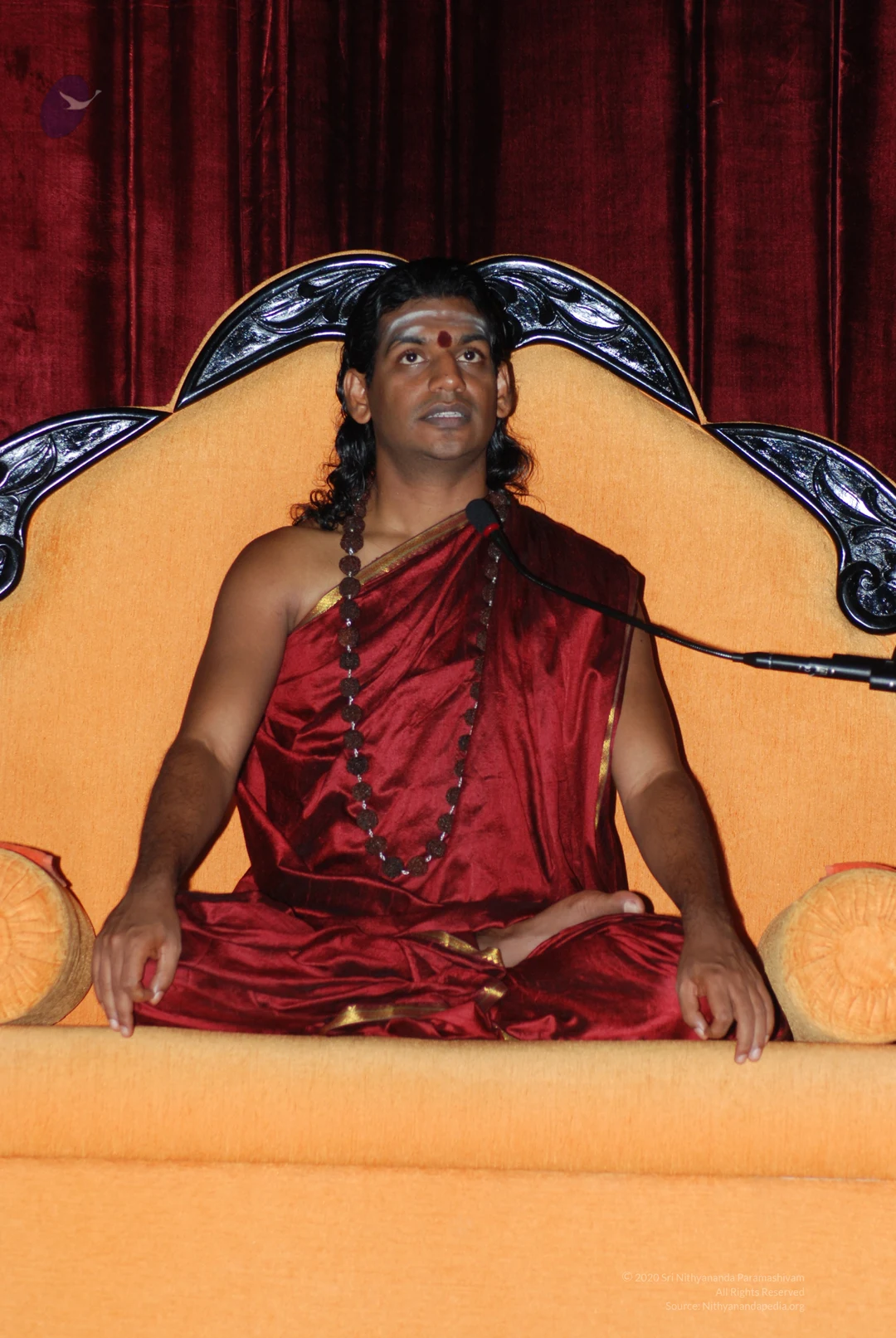
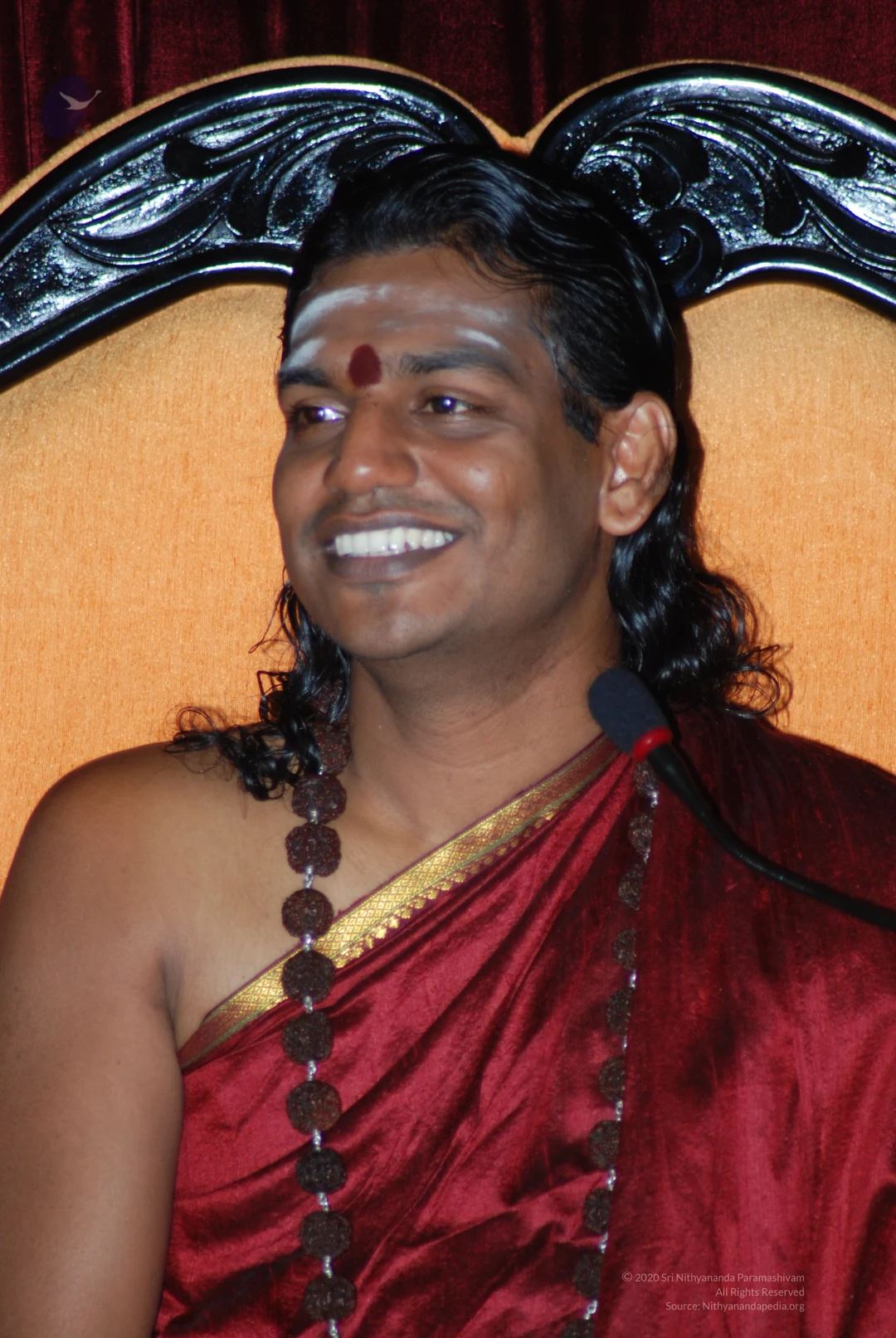
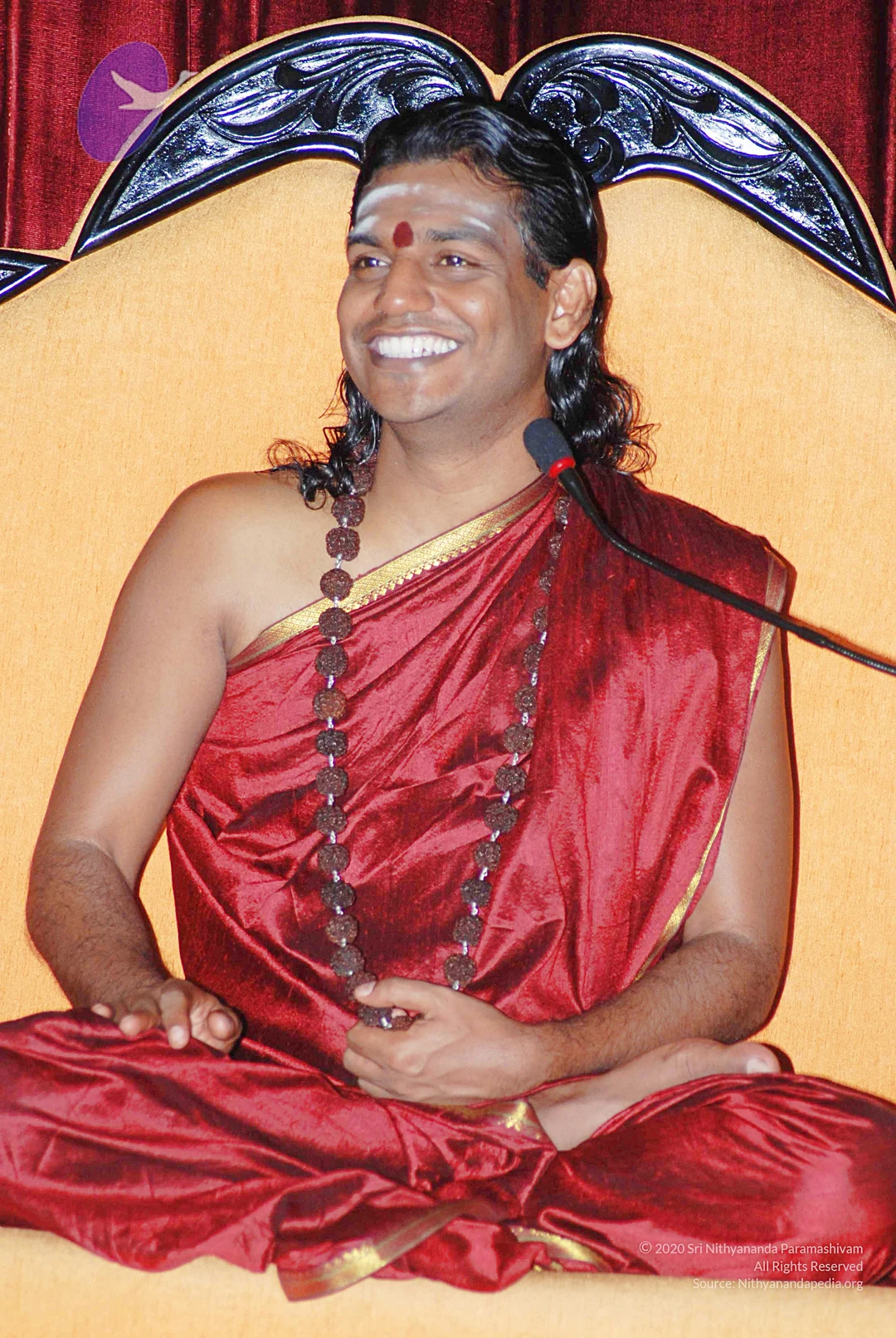
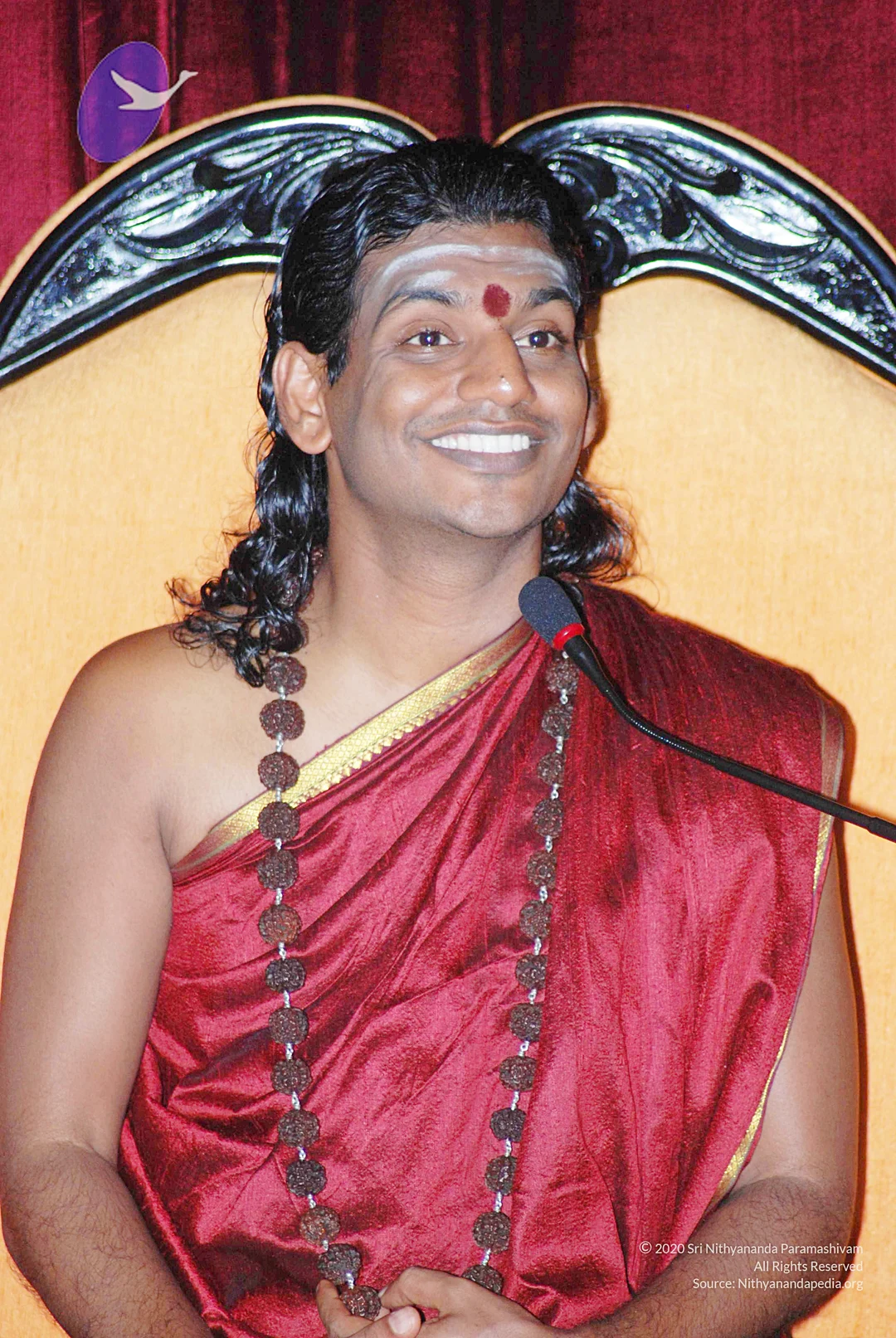
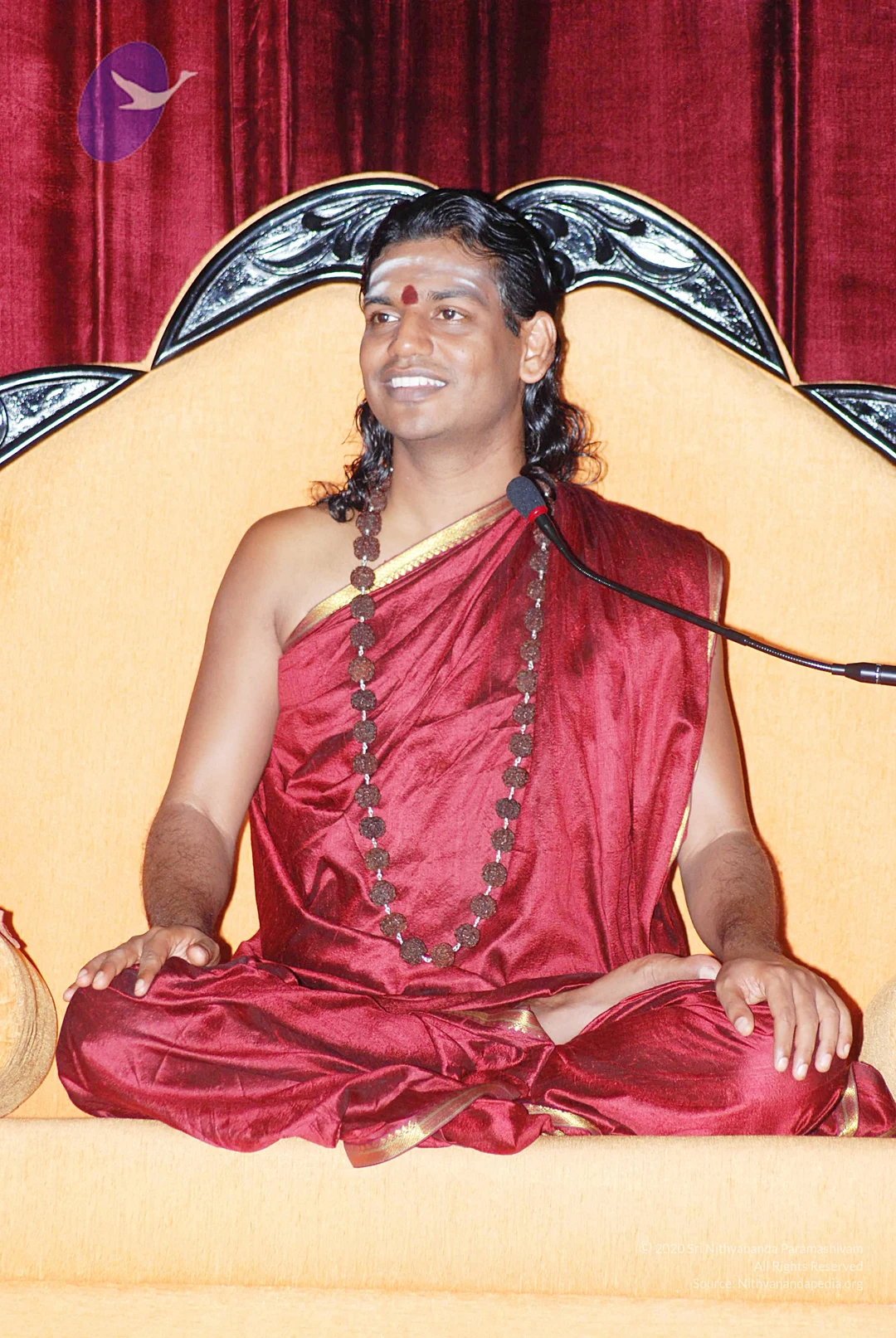
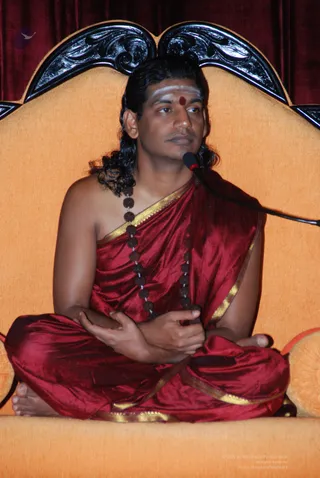
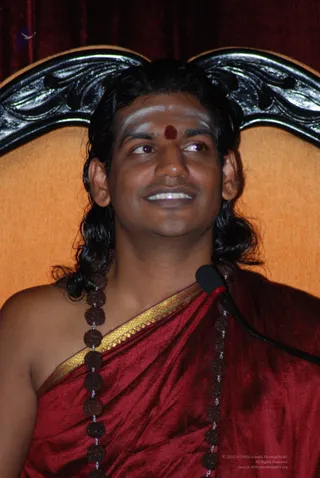
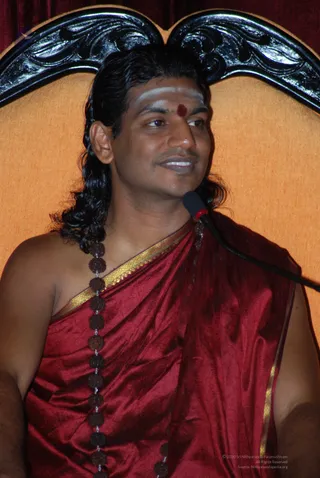
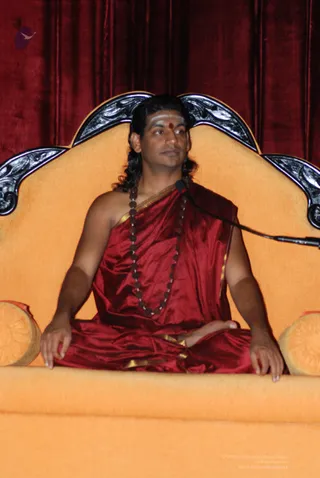
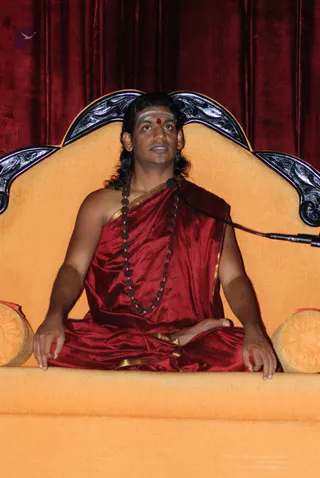
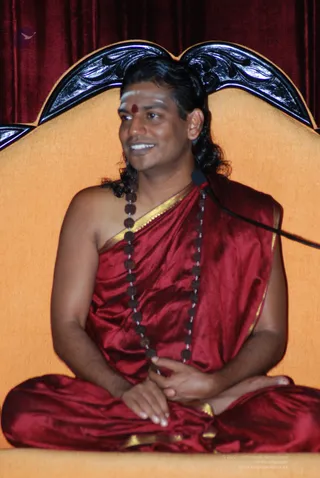
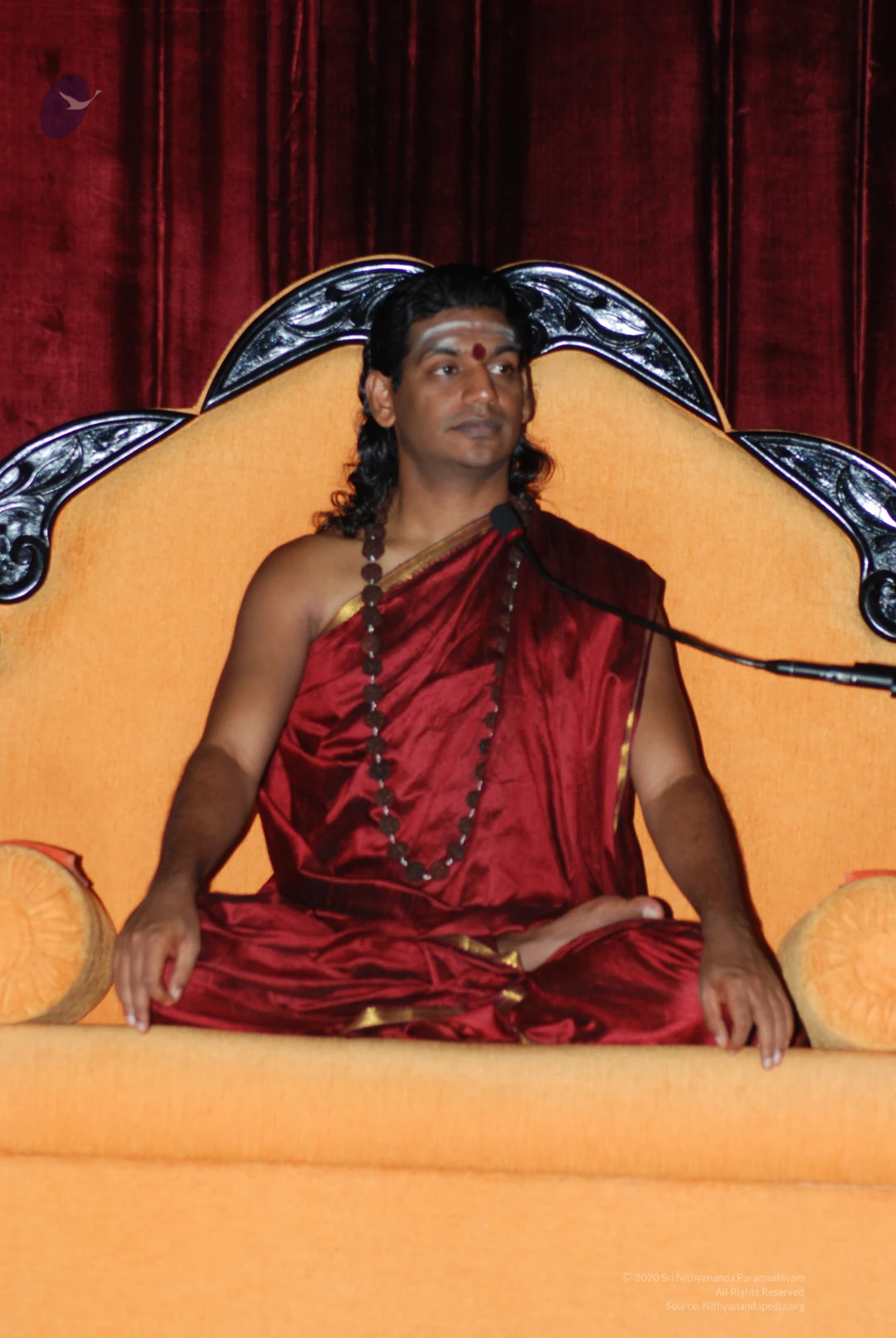
Photograph of a seated man in a cross-legged meditation pose on an orange upholstered throne with carved black wooden arches and a deep red velvet backdrop. He wears a dark red silk-like shawl with gold border over the shoulder, a matching red lower garment with gold border, and a long rudraksha mala hanging across his chest. He has a white horizontal tilak with a red dot on his forehead, long dark wavy hair, and his hands rest together in his lap. A microphone stands at his right side. Swamiji (probable): the seated figure has long swept-back hair, a tilak, rudraksha mala and saffron-red ceremonial clothing on a throne, with compatible cues on the page.Close-up photograph of a smiling man with long, swept-back dark hair, white vertical tilak lines and a red bindi on his forehead, seated in front of an ornate black-carved chair with an orange upholstered back and red velvet drapes. He wears a deep red shawl with a gold zari border over bare shoulders and a long strand of rudraksha beads, and a microphone stand is visible at the right edge.Photograph of a man with long dark wavy hair seated in front of an ornately carved dark wooden chair back against an orange cushioned backdrop. He wears a deep maroon silk shawl with a gold zari border draped over one shoulder, a long rudraksha mala hanging down his chest, a white sacred ash marking on his forehead and a red kumkum dot between the brows. A microphone on a black stand is near his chin. a person by appearance cues: long swept hair, rudraksha mala and ceremonial maroon drape, with the page noting this event. Mood is calm and attentive.A seated man in a deep red silk garment with gold border sits cross-legged on an ornate orange cushioned throne with carved black armrest-back, in front of dark red velvet drapes. He wears a rudraksha mala necklace, has a white tilak with red bindi on his forehead, and a microphone clip is near his chest. a person: long swept-back hair, rudraksha mala and ceremonial red-gold drape cues are present, seated in the discourse setting described on the page. Hands rest on his knees while he gazes to the side.A seated man in a deep red silk garment with gold edging sits cross-legged on an ornate orange cushioned throne with carved black wooden arms, in front of a dark red velvet curtain. He wears a long rudraksha mala, has a red bindi and white markings on his forehead, and has long swept-back dark hair. A microphone on a stand is beside him. Appearance cues include long swept-back hair, rudraksha mala and saffron-red ceremonial clothing; the page indicates this is Swamiji, so this is a probable identification from appearance cues. Discourse setting.A seated man sits cross-legged on an ornate golden-orange throne with carved black wooden armrests, in front of a deep red velvet curtain. He wears a red silk shawl edged with gold zari over a red garment, with a long rudraksha mala draped across his chest and a microphone clipped near his shoulder. He has long, swept-back dark hair, white tripundra markings and a red bindi on his forehead, and holds his hands together in his lap while smiling. Swamiji (probable): the long swept-back hair, rudraksha mala, saffron-red ceremonial shawl and throne match the presentation cues for the page's subject, a discourse speaker. The image shows a single seated speaker with no other people visible.

PANCHA-TAPAS

1 photoSource gallery
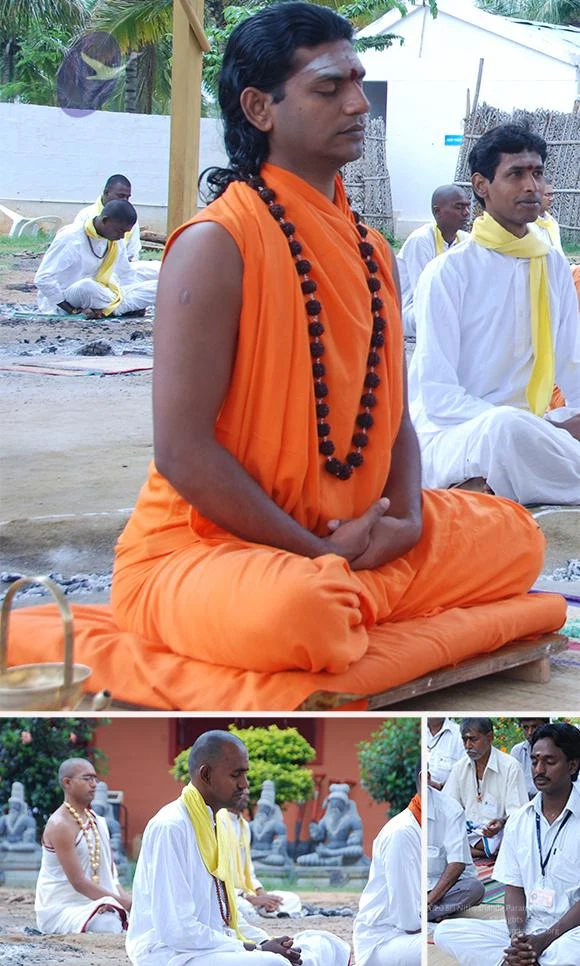
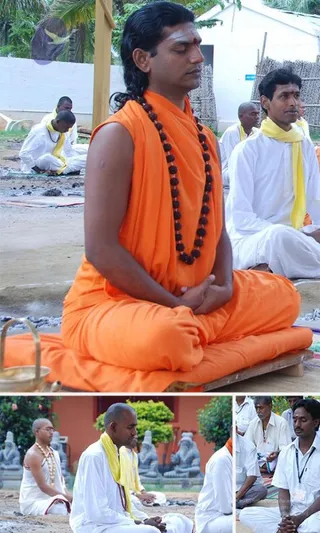
Collage of four panels showing a seated meditation session outdoors on a dirt ground with ash and a brass vessel. The large top panel shows a man in saffron-orange sleeveless robes and a long dark rudraksha mala, eyes closed, hands folded in his lap, with a sandalwood or vibhuti mark on his forehead and long swept-back hair; he has a probable Swamiji appearance by cues of long hair, ornate mala and orange robes. Beside him, a devotee in white with a yellow shawl meditates with eyes closed. Lower panels show more people in white dhotis and yellow shawls seated in meditation, and a shaved-headed man in white with gold chain and beads. Background includes white walls, palm and bamboo fencing, and stone sculptures.

PRATYAKSHA-PADA-PUJA

3 photosSource gallery
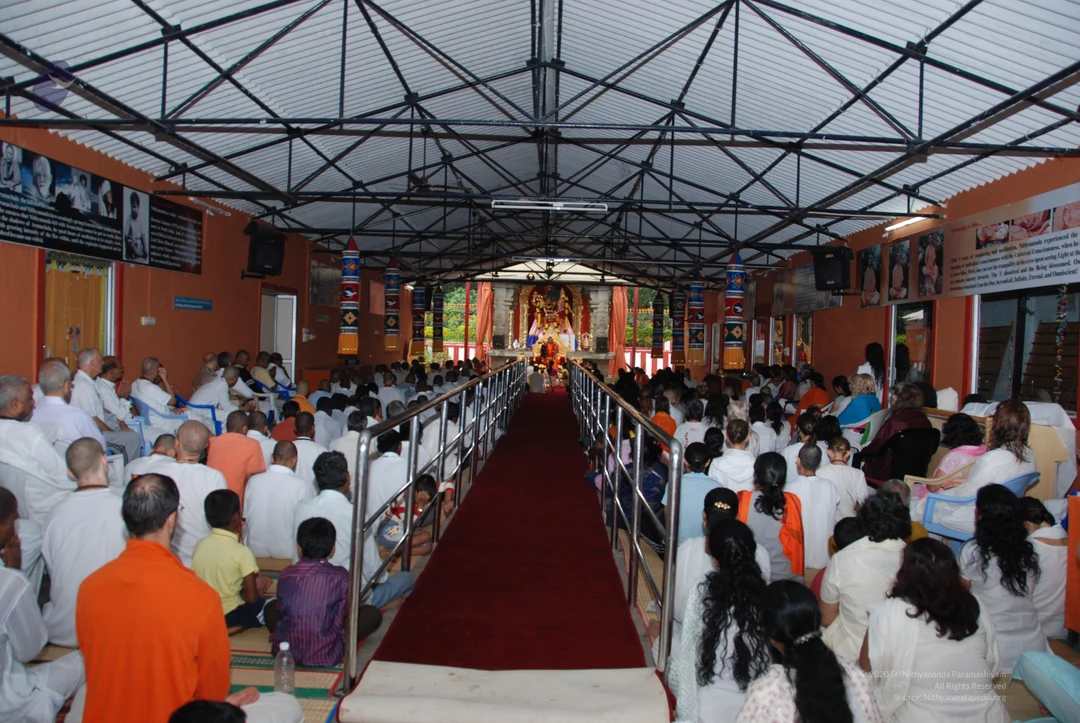
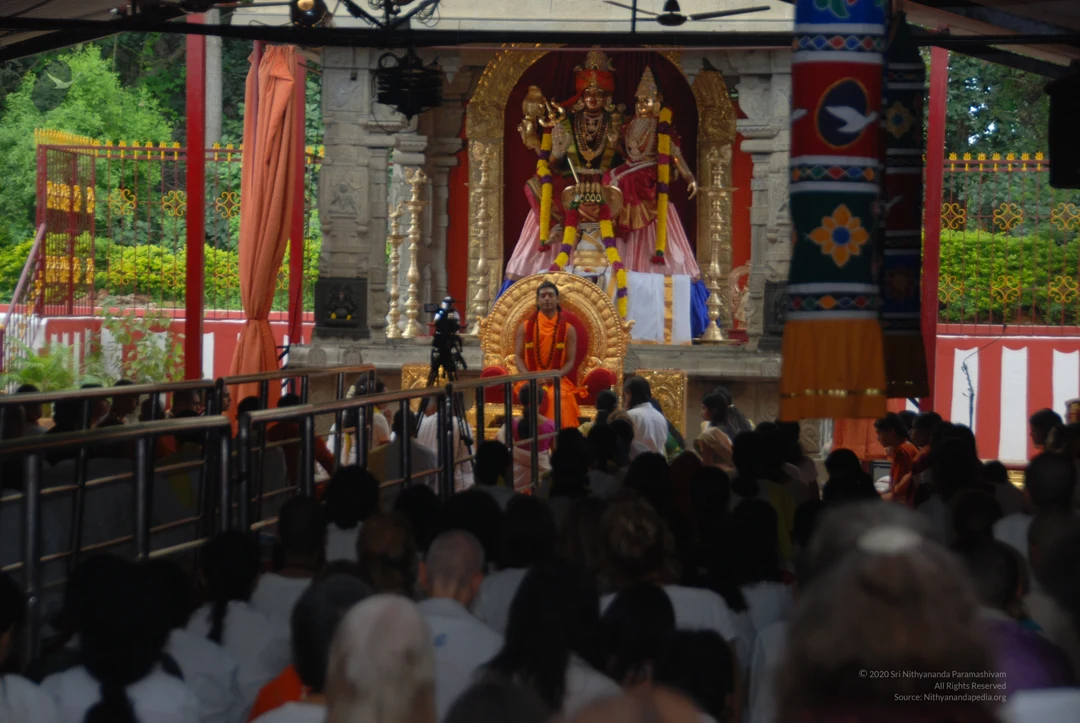
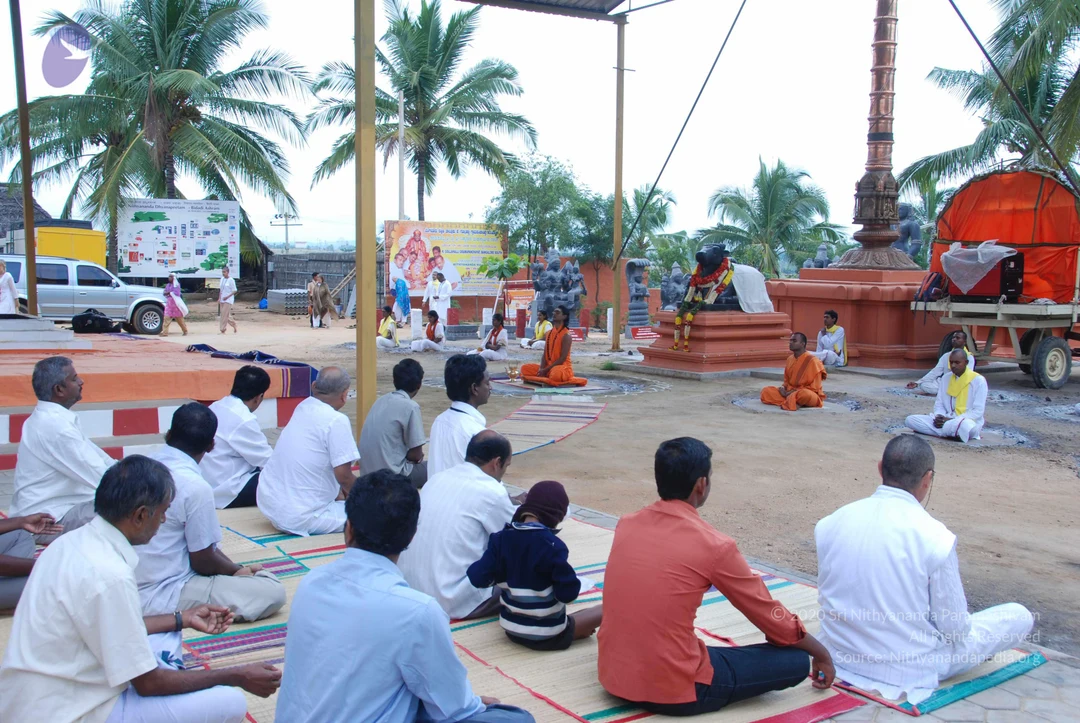
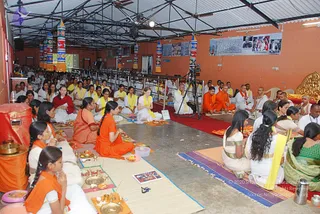
A wide photograph of a large seated audience under a dark tented canopy at a discourse hall. Rows of devotees sit on white floor mats, many in white clothing, facing toward the front of the hall, where a raised platform is set up. Hanging lights and draped fabric overhead frame the gathering.

NITHYANANDA-MORNING-SATSANG-IN-BIDADI
1 photoSource gallery
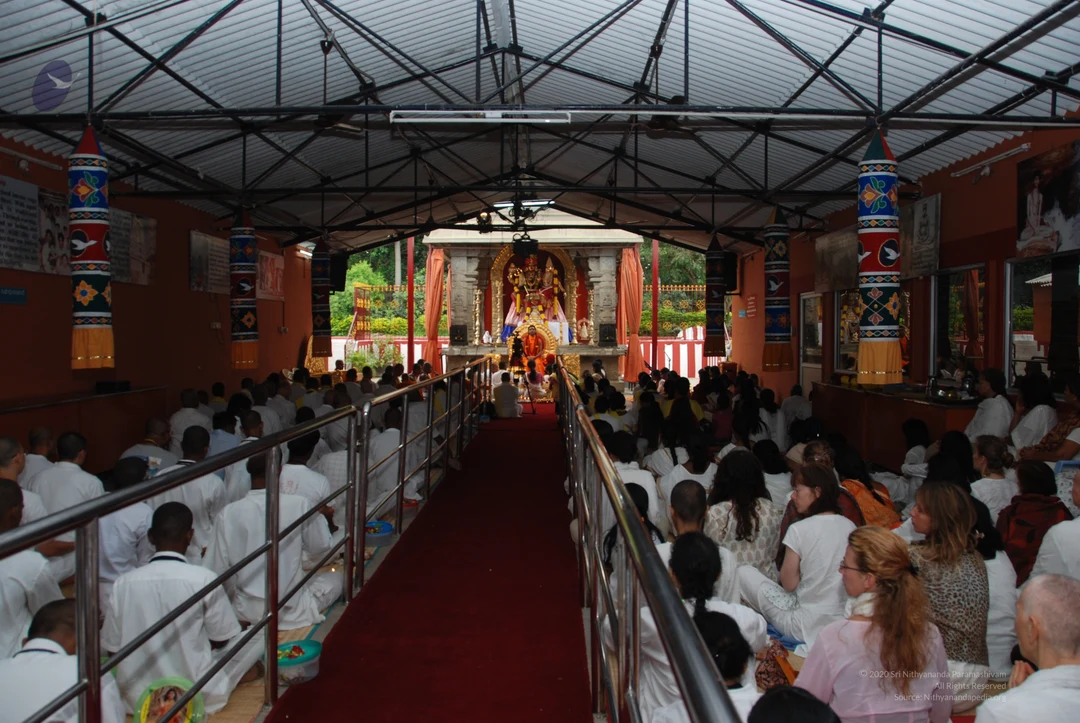
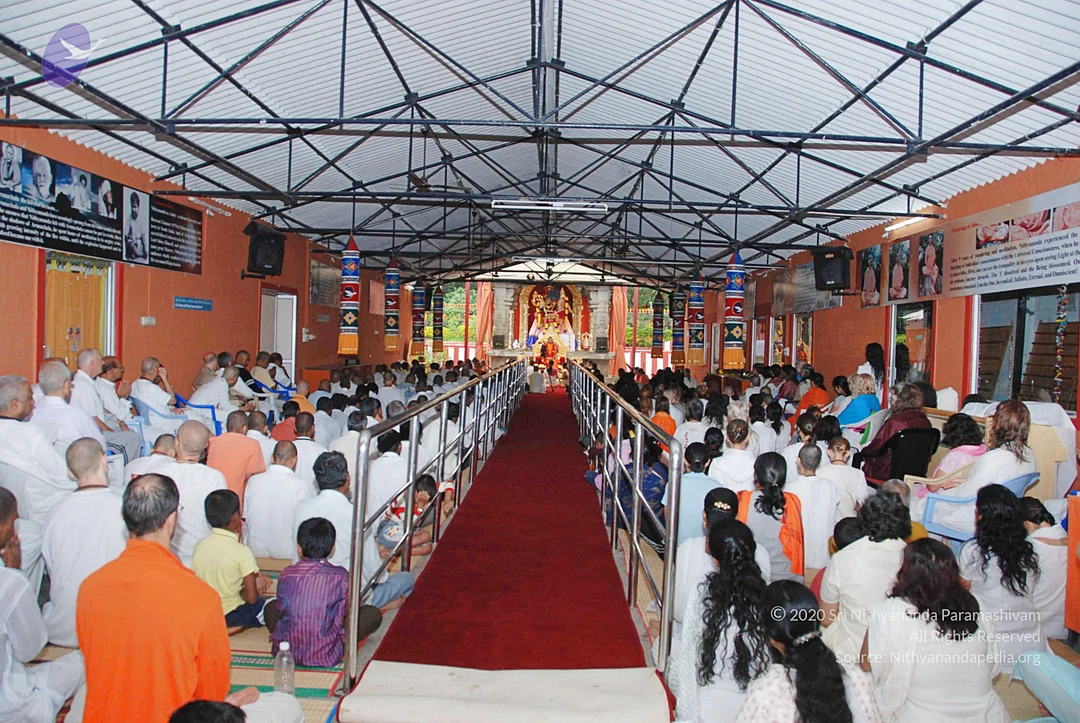
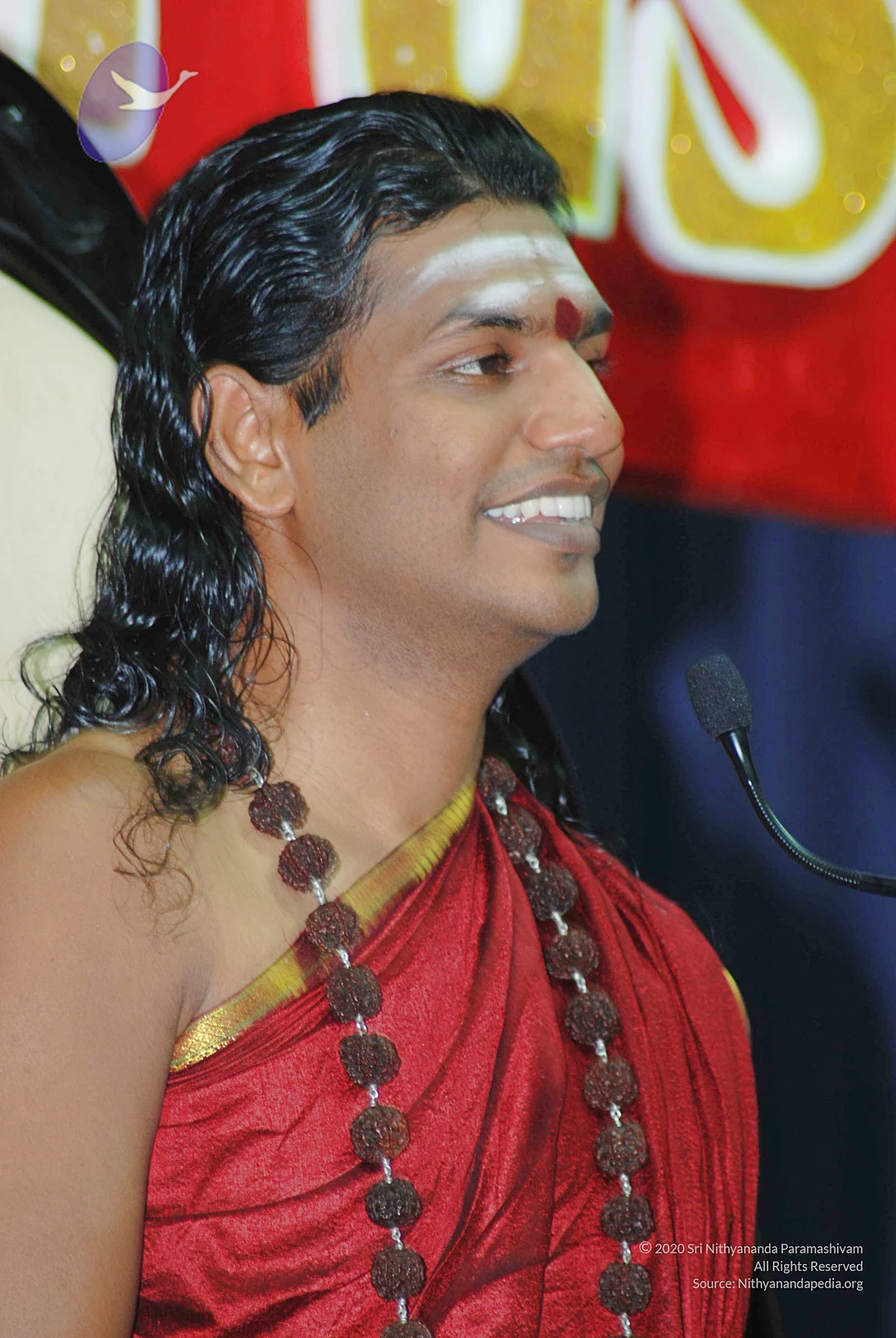
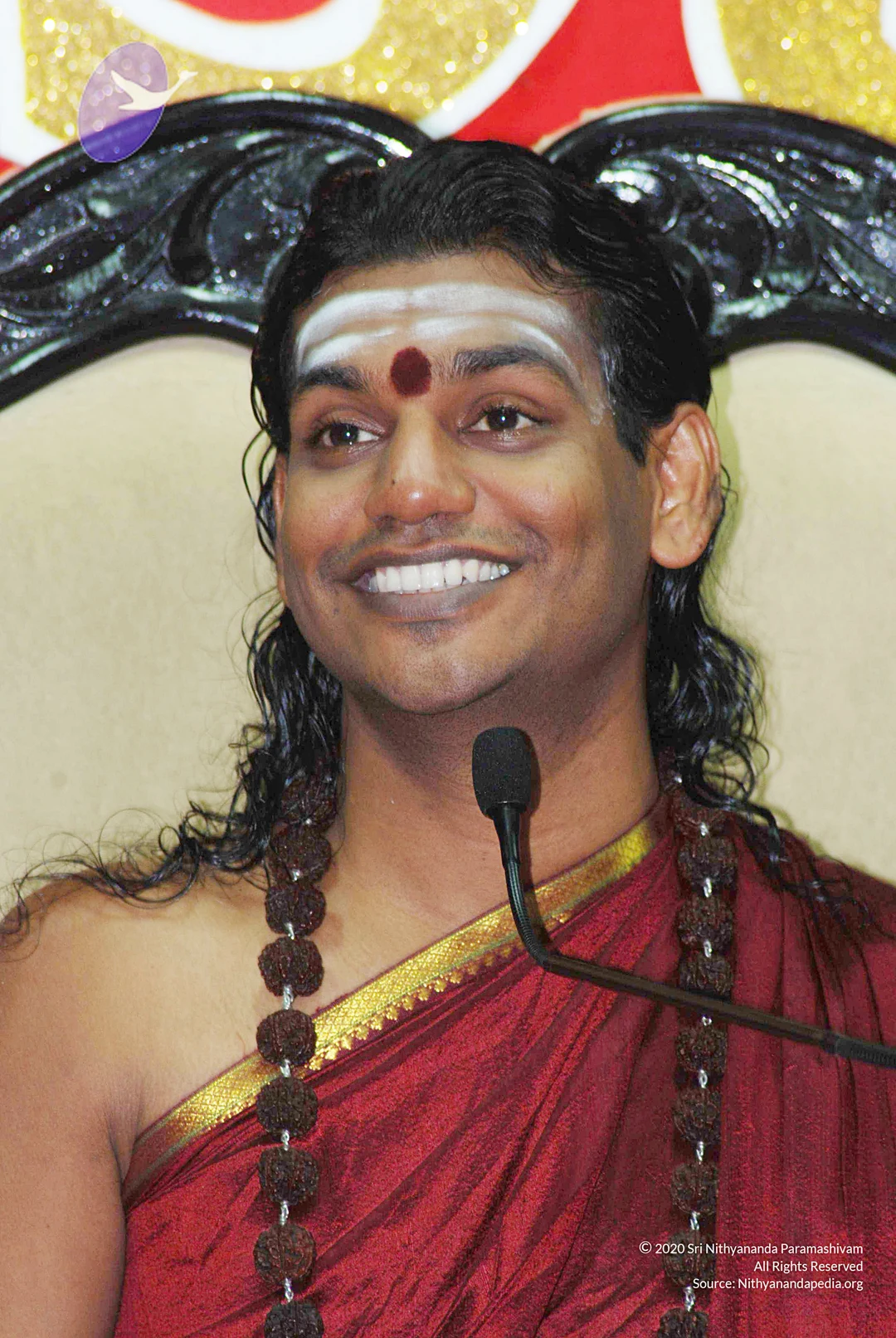
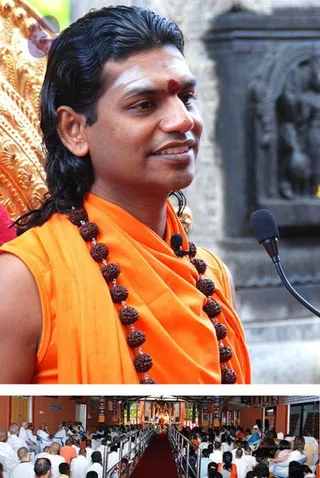
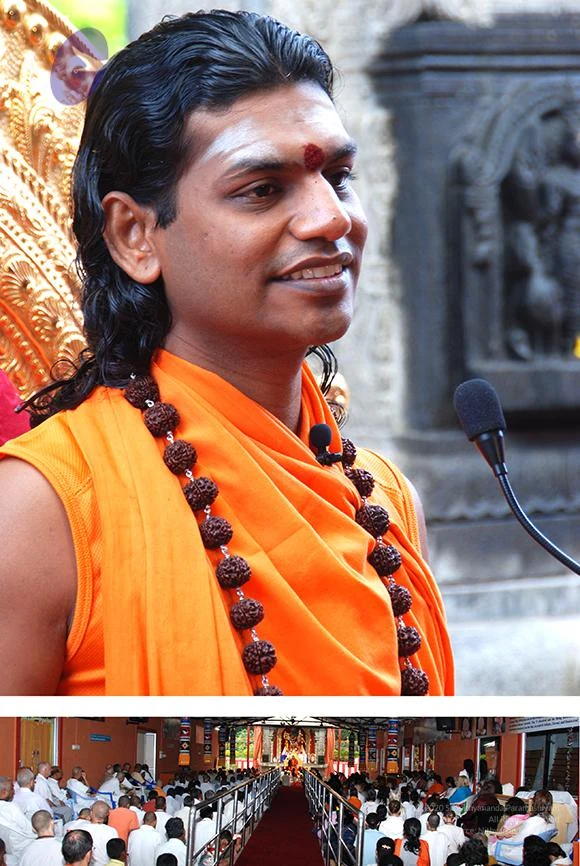
Two-panel photo collage. Upper panel: a smiling man with swept-back long dark hair wears an orange sleeveless saffron garment and a long rudraksha mala, with a red bindi on his forehead, speaking into a microphone in front of a golden throne and carved stone. Lower panel: a wide view of a hall with orange-draped pillars and rows of seated devotees in white and orange clothing facing a central aisle toward a distant altar, with a deity murti visible at the far end. Appearance-based cues for the upper speaker are several (swept-back hair, saffron clothing, rudraksha mala), so the speaker is a probable Swamiji, though his appearance is not verified.

E-KALPATARU

1 photoSource gallery

SARVA-DARSHAN

1 photoSource gallery
A candid photograph of an indoor event with warm stage lighting. A man in an orange robe with a long multi-strand rudraksha mala around his neck stands at right, his hair swept back, with a visible crown-like headpiece and ceremonial bearing, while a man in a white shirt on the left leans in and touches his forehead in a gesture of blessing or reverence. The setting appears to be a hall with a dark background and other attendees behind them.

YOGA-SUTRA-IN-BIDADI

2 photosSource gallery
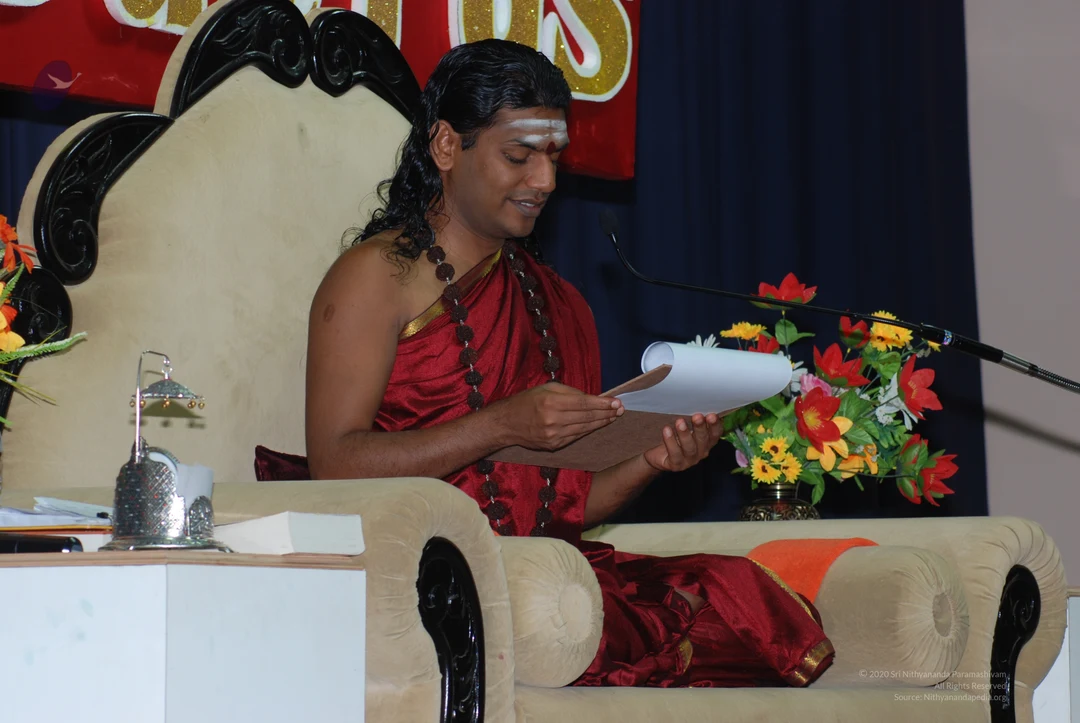
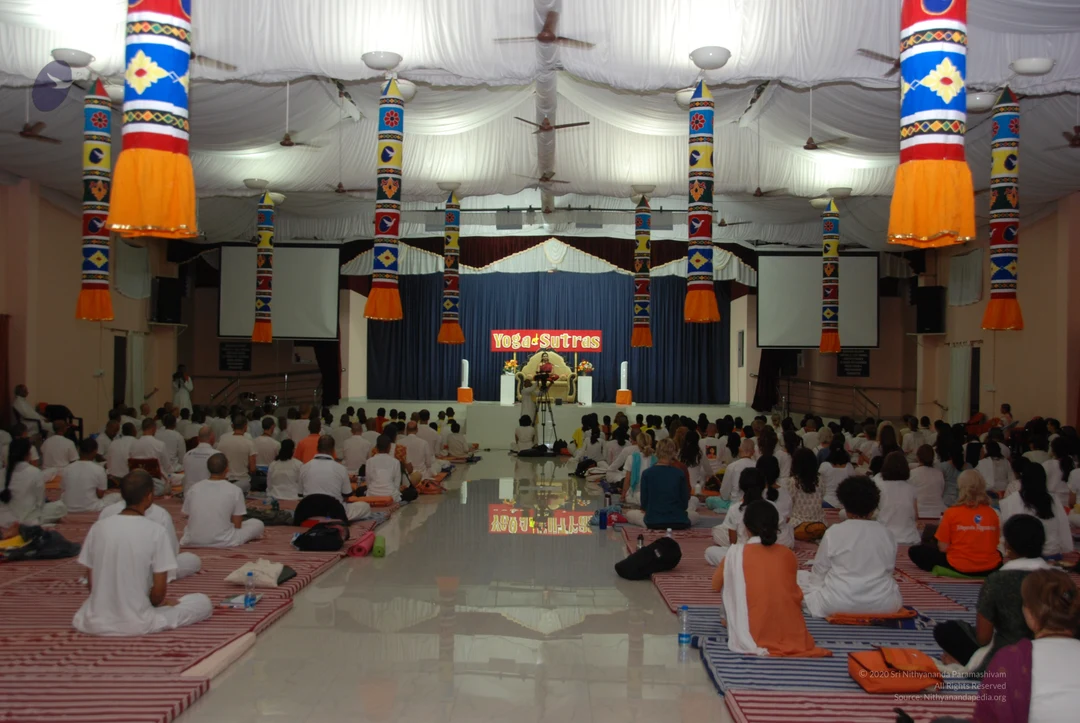
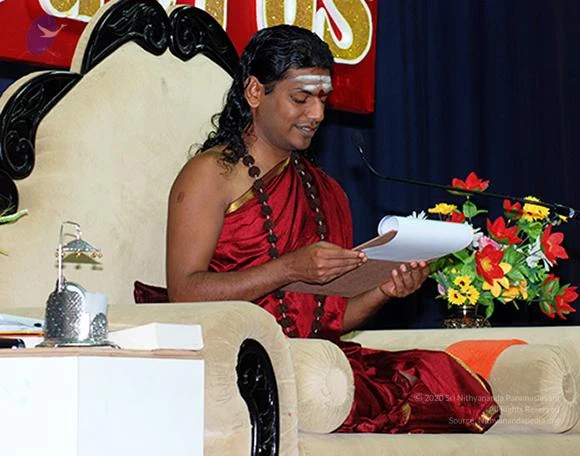
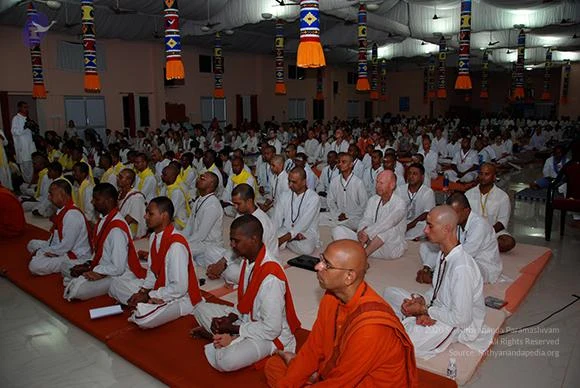
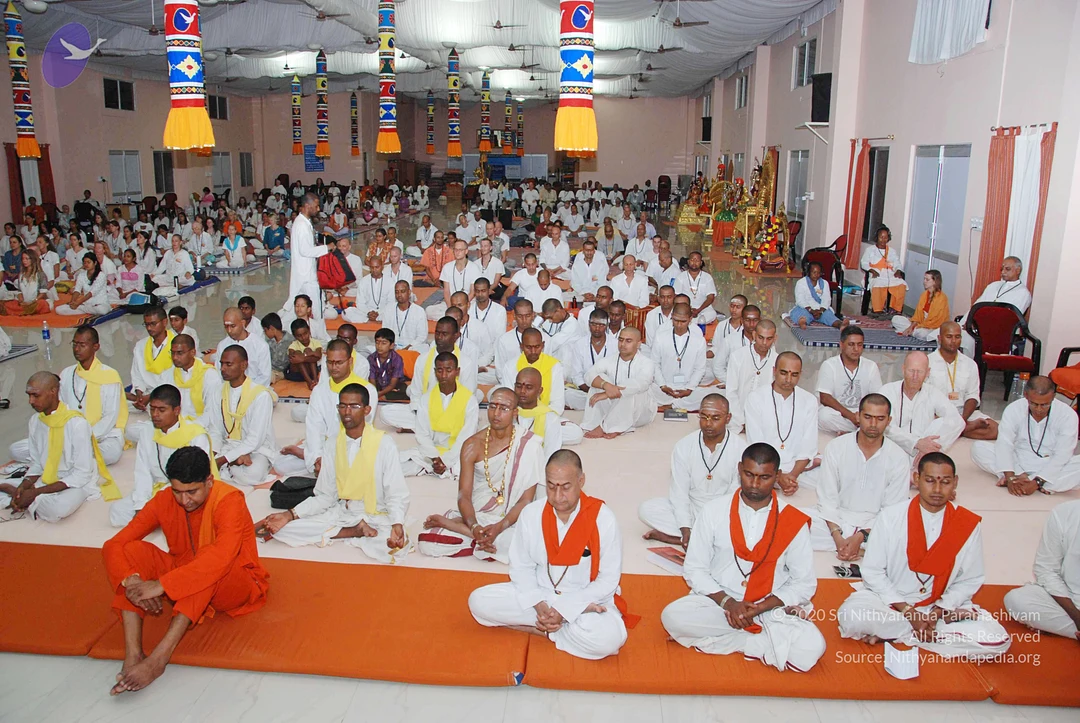
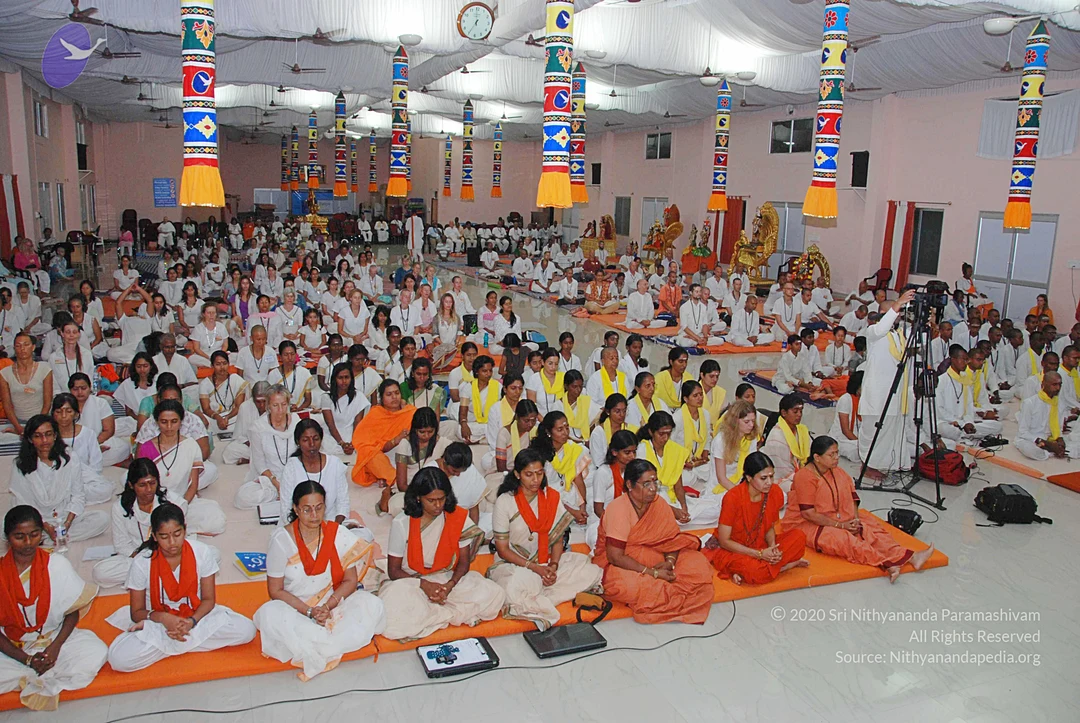
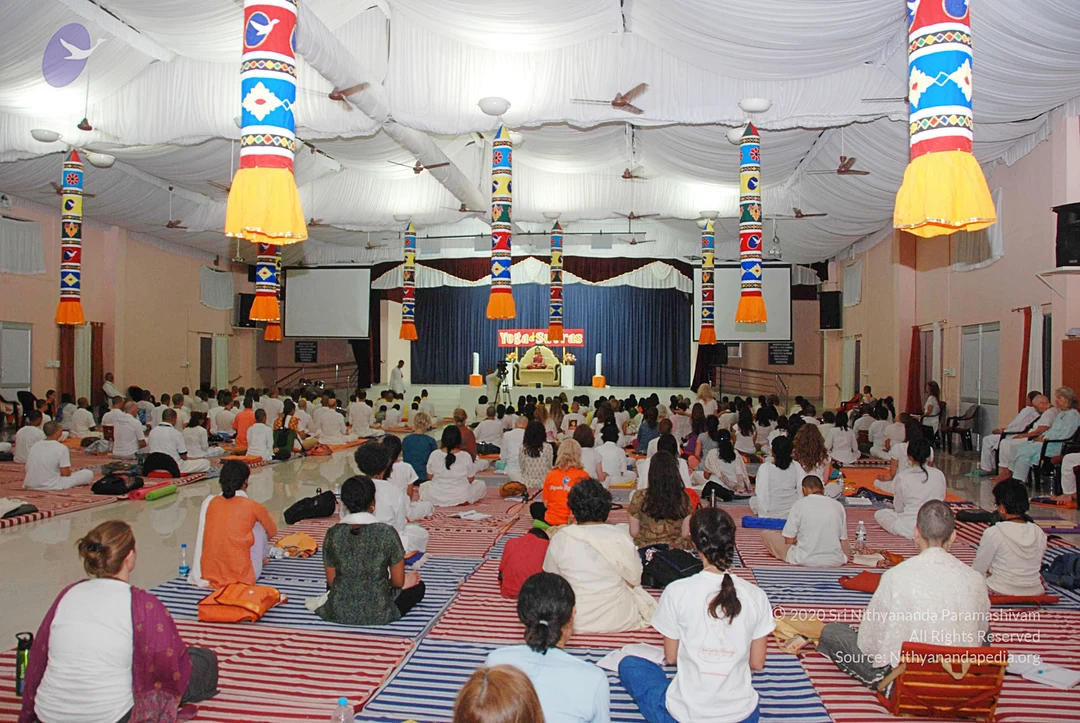
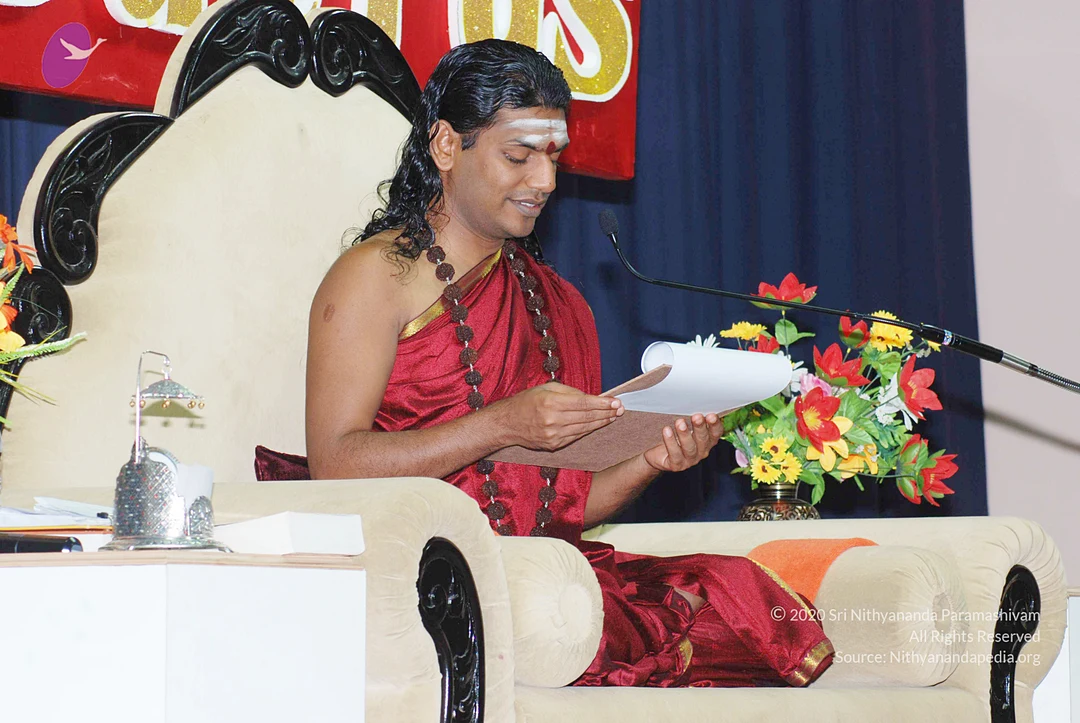
A man seated on a cream upholstered throne with carved dark wooden arms reads from a sheet of paper held in both hands. He wears a deep red and maroon shawl over a bare upper torso, a rudraksha mala with beads draped at his chest, and a white vertical tilak on his forehead. Long dark hair falls past his shoulders. Beside him stand a silver oil lamp on a white table and a vase of red and yellow artificial flowers. Behind is a dark blue curtain and a red and gold banner. Appearance-based candidate: Swamiji (probable), seated on the throne as the speaker, with long swept-back hair, rudraksha mala and red ceremonial shawl.A large hall with rows of seated devotees on orange and red mats, most wearing white clothing with lanyards. In the foreground a bald man in an orange robe sits cross-legged, and a few men in white robes wear red or orange shawls. Colourful hanging decorations with tassels line the ceiling. The audience appears attentive to a discourse or meditation session.

01-Pancha-Tapas
25 photosSource gallery
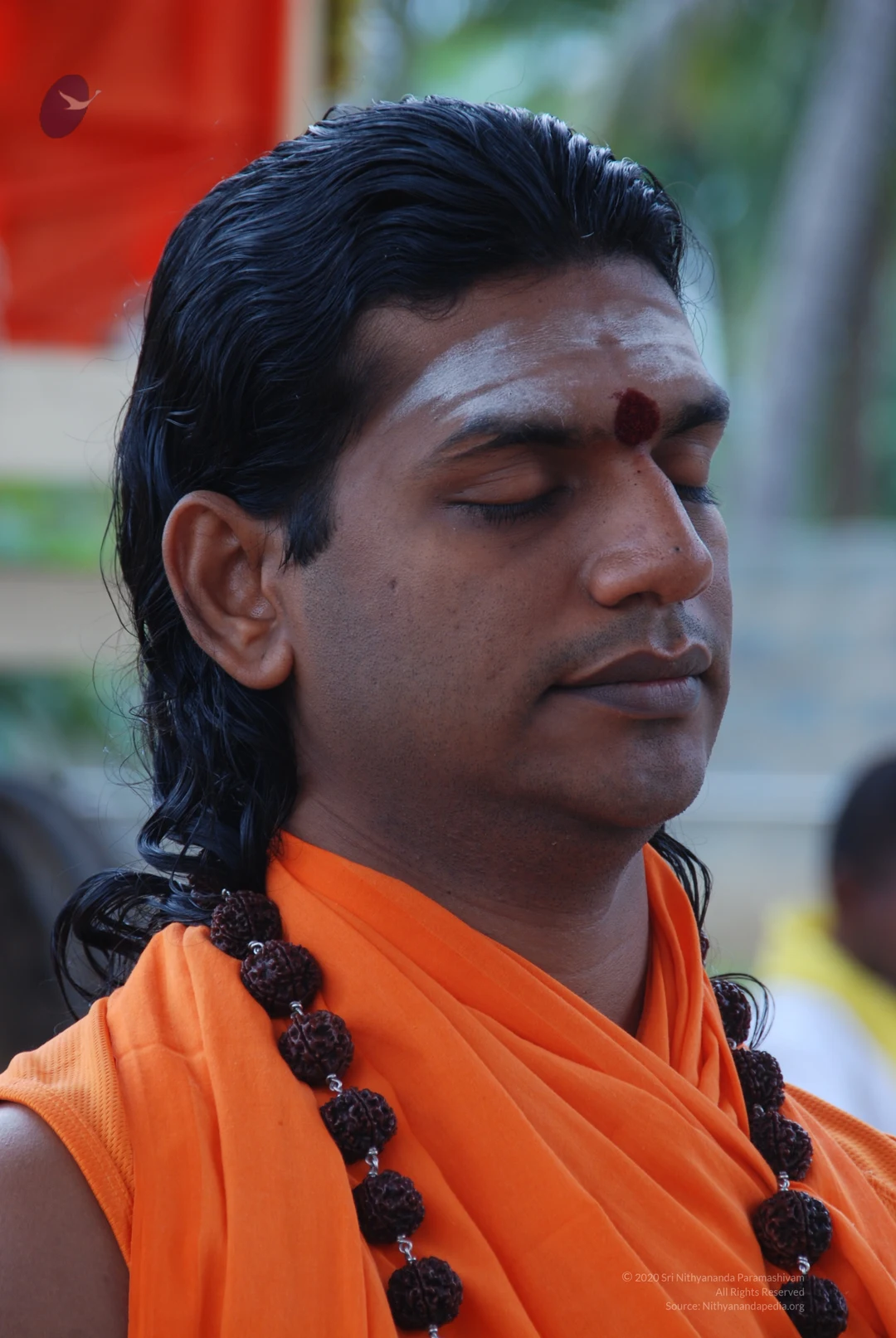
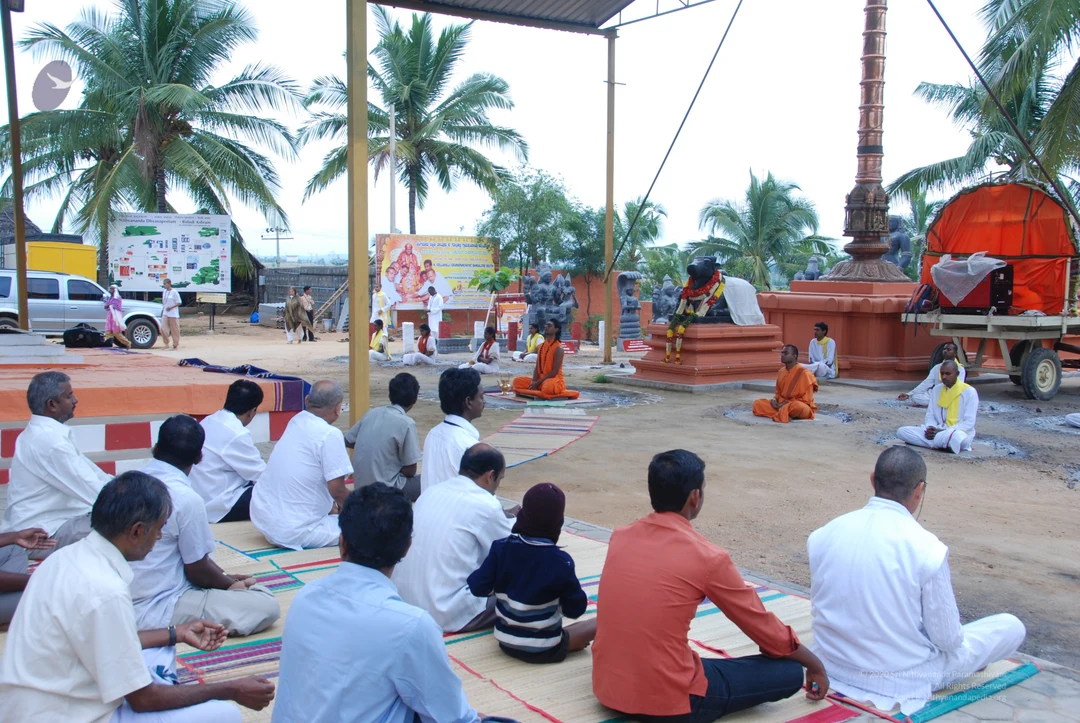
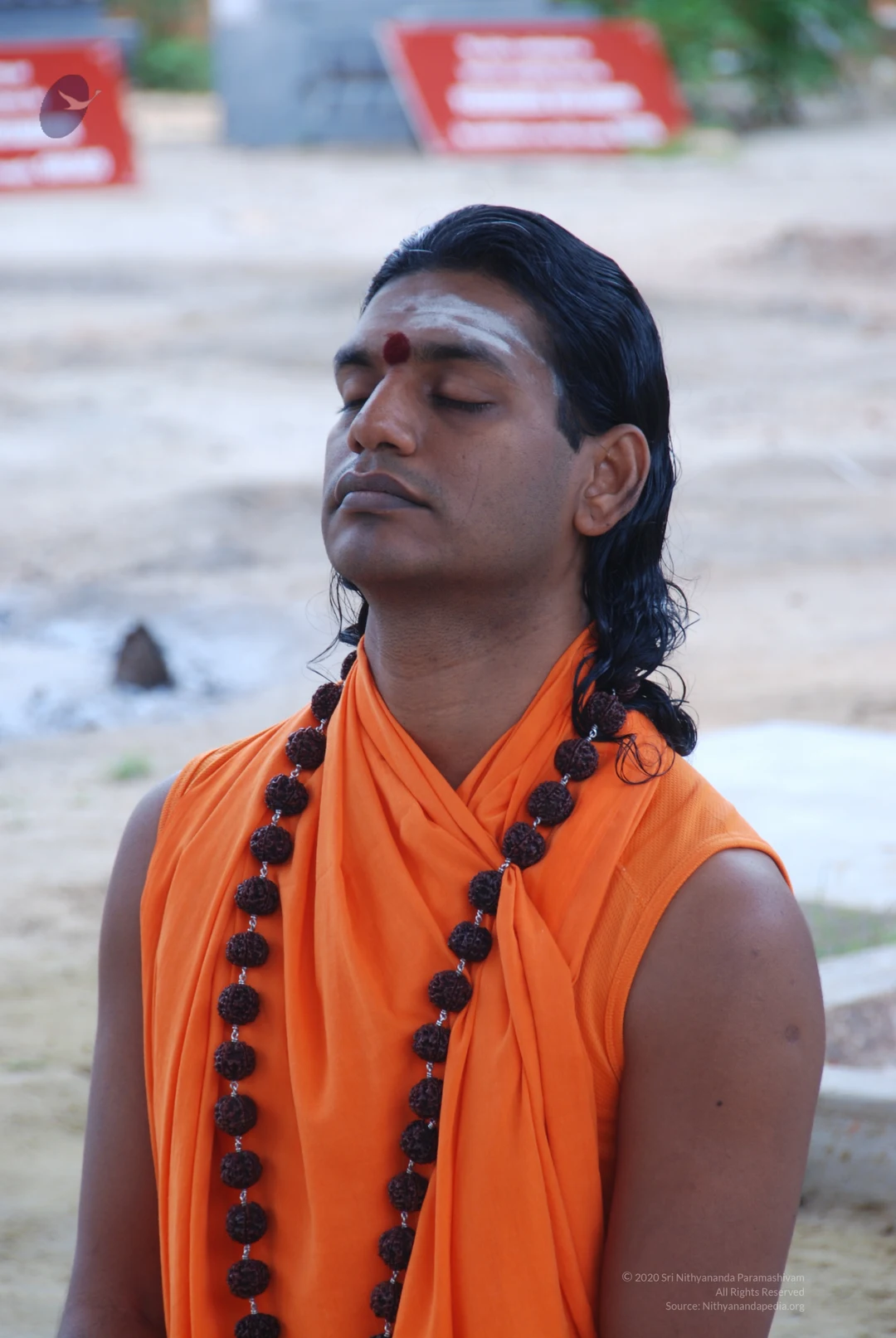
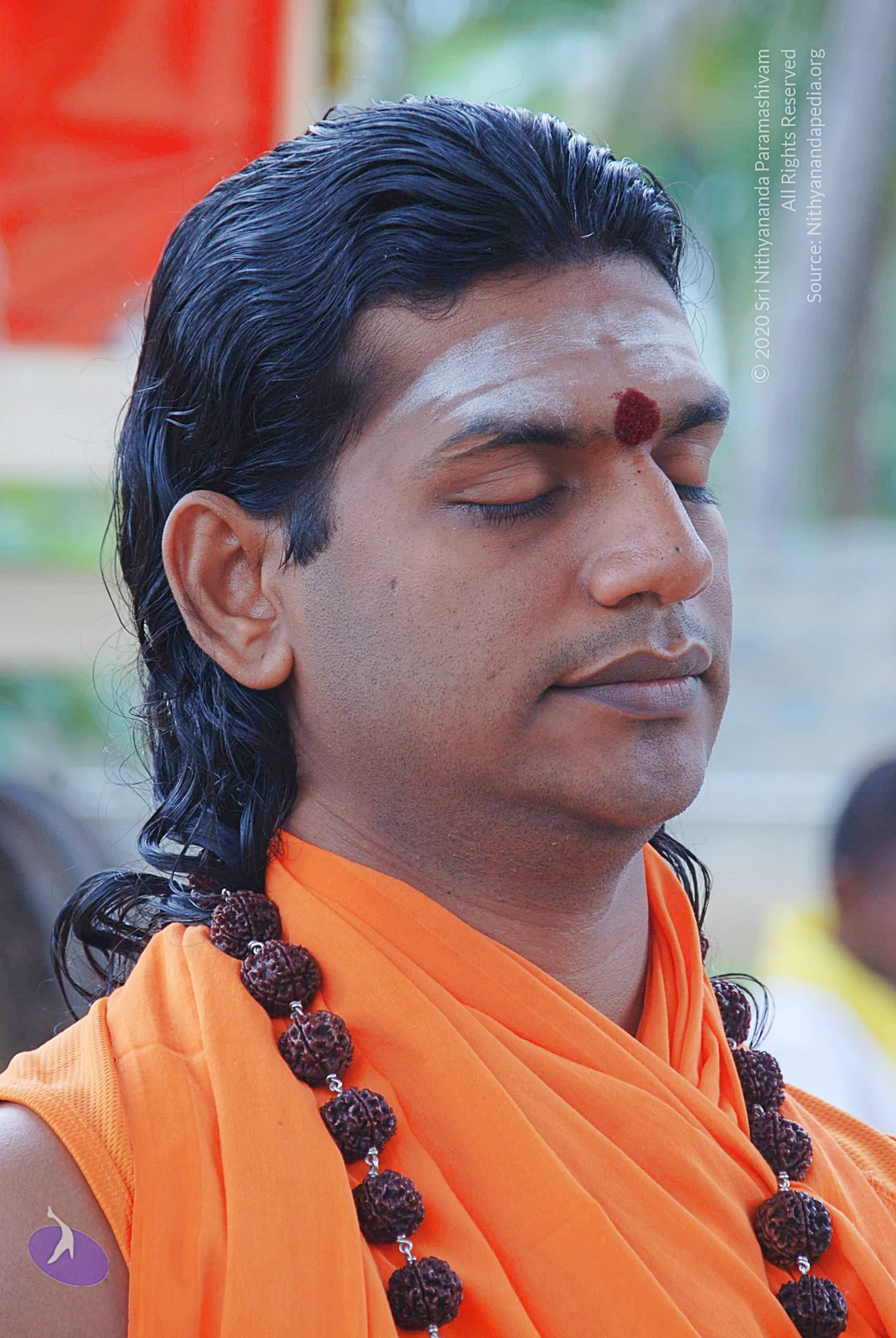
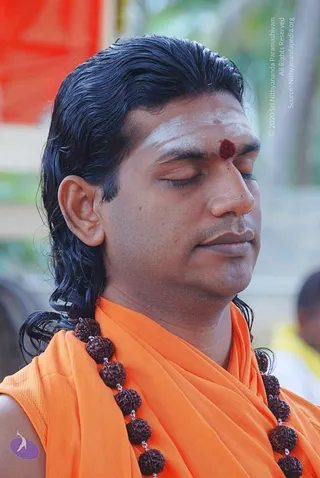
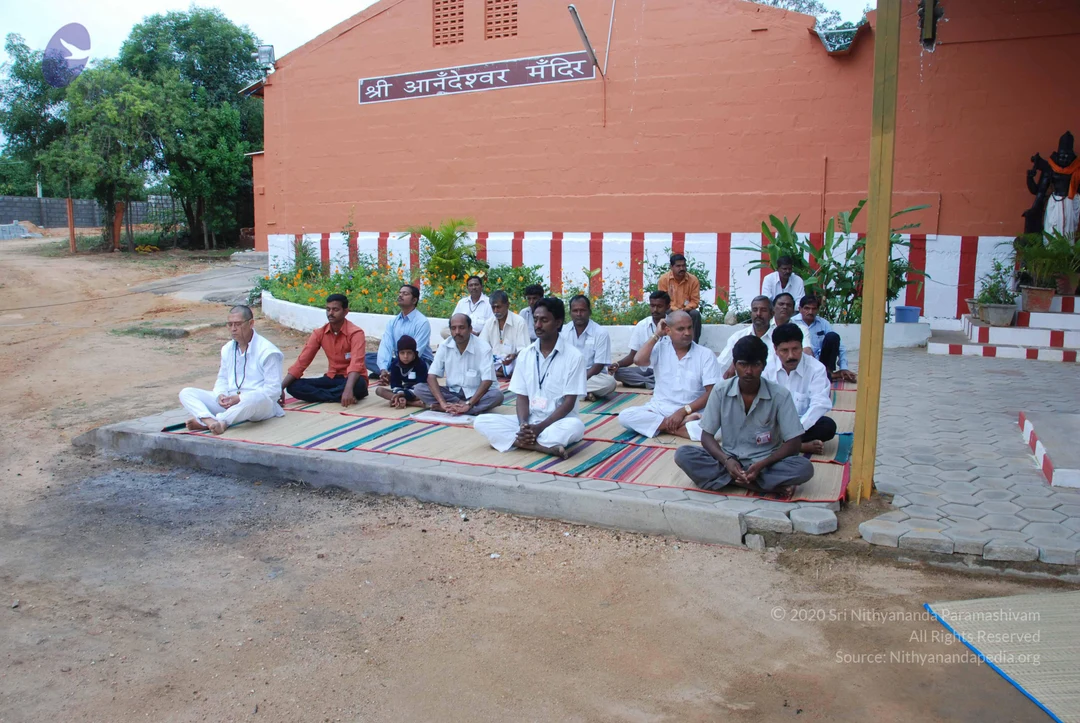
A man with swept-back long dark hair sits cross-legged in meditation with eyes closed and hands clasped in his lap on a striped mat and wooden seat. He wears an orange saffron wrap and garment, a long rudraksha mala around his neck, and a red bindi on his forehead. Behind him stands a dark stone deity murti draped with a red and yellow marigold garland, set against a terracotta-coloured shrine wall with palm fronds. Two other men in white dhotis sit in the background to the right.Outdoor photo of a seated group in meditation on a sandy ground with palm trees and a bamboo fence behind. In the foreground, a man with long swept-back dark hair, a red bindi and a rudraksha mala, wearing a sleeveless saffron/orange cloth, sits cross-legged on an orange cushion with hands folded and eyes closed. Behind him, a man in a white kurta with a yellow shawl sits with hands clasped, and a man in orange robes sits with head bowed. Other seated men in white and orange are partly visible further back. A brass kettle-shaped vessel stands in the lower left, with a brass plate near the group. The seated man in the foreground has distinctive long hair, a rudraksha mala and saffron clothing, consistent with the page's reference to Swamiji (probable).A seated man in saffron-orange robes sits cross-legged on a striped mat in meditation, eyes closed, hands resting in his lap. He wears a long rudraksha mala with dark beads, a red bindi and an upswept hairstyle. Behind him, a red-orange stone pedestal is draped with a garland of red and yellow flowers, and a black deity murti stands on top. Two seated men in white clothes with yellow and orange shawls sit to the right beside a cart. A small brass vessel sits at the lower left, and a sign with text stands on the ground behind. Outdoor ashram setting with palms and a cobra-hooded stone figure at left.A photograph of a man seated cross-legged in meditation at the centre of a circular ash-covered fire pit, eyes closed, wearing a saffron-orange sleeveless wrap, a rudraksha mala and a vertical tilak on his forehead. He sits on a striped woven mat with a small brass kalasha-style vessel beside him and a green cloth nearby. A white chalk kolam border surrounds the pit. Behind him a black Nandi bull statue wears a red, orange and white flower garland on an orange-painted pedestal. Two men in white dhotis sit in meditation further back, one in an orange shawl. A stone deity statue stands at left among palm trees, and an orange-canopied cart is at right.Close-up photograph of a man with eyes closed in meditation, head slightly tilted. He has long, swept-back dark hair, a white vertical tilak on the forehead with a red bindi-like mark at the centre, and wears an orange-saffron shawl draped over the shoulders. Multiple dark brown rudraksha beads on a mala hang across the chest. The background is blurred with greenery and a red banner at upper left. Appearance-based label: Swamiji (probable), seated in meditation as a devotee-style practitioner in saffron robes with rudraksha mala and long hair. A printed copyright caption runs vertically at right.A photograph of a man seated in lotus-style meditation on a striped mat outdoors, eyes closed, hands resting in his lap. He wears a saffron-orange robe draped over one shoulder and a long rudraksha mala with dark beads, with a red tilak on his forehead and long hair swept back. Behind him stands an orange temple-style structure with a dark deity murti wrapped in a garland of yellow and red flowers. To the right, two seated men in white clothes sit in meditation, one with a yellow shawl and one with an orange shawl. A brass kettle-like vessel sits at the lower left, and a stone naga statue stands in the background.

02-Pada-Puja
37 photosSource gallery
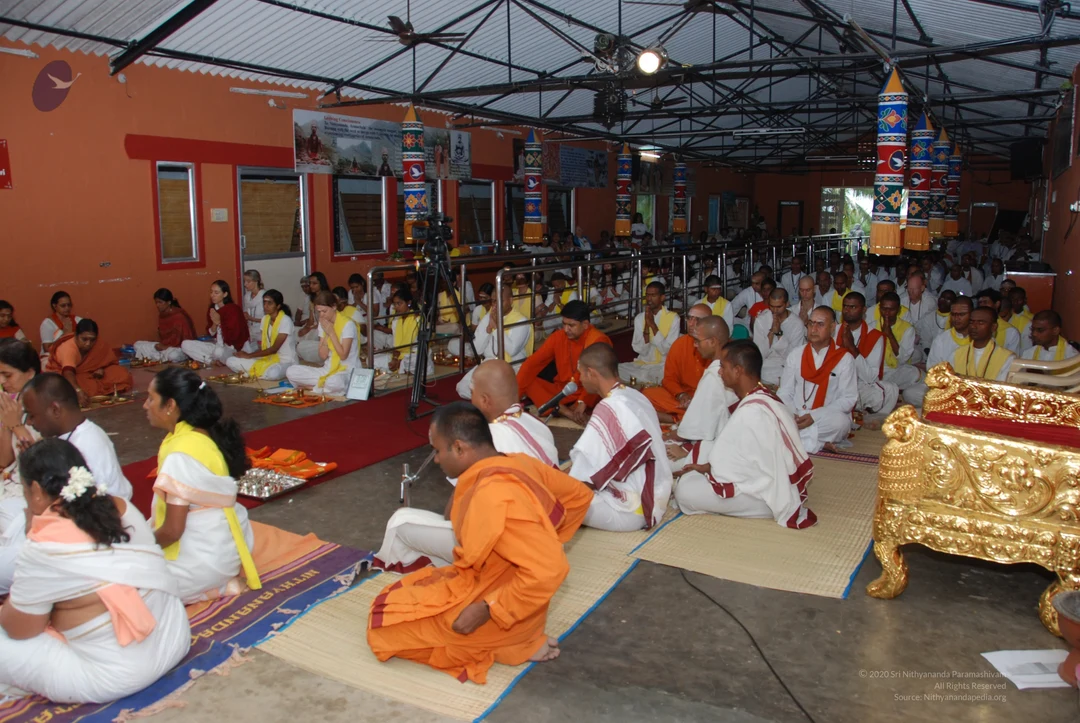
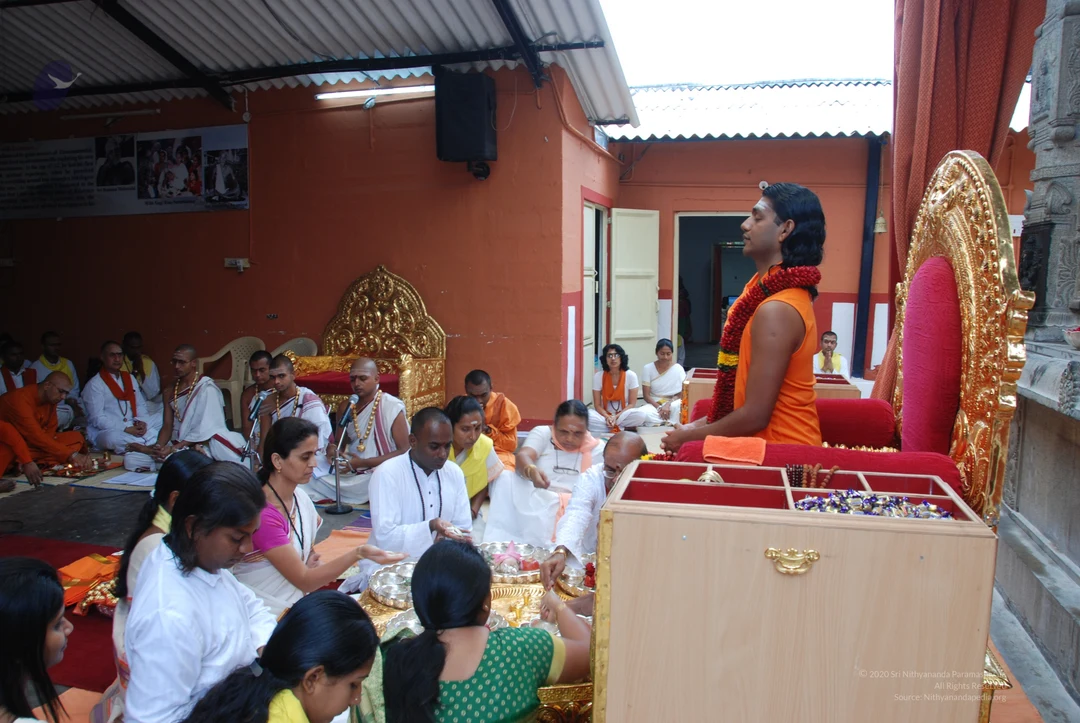
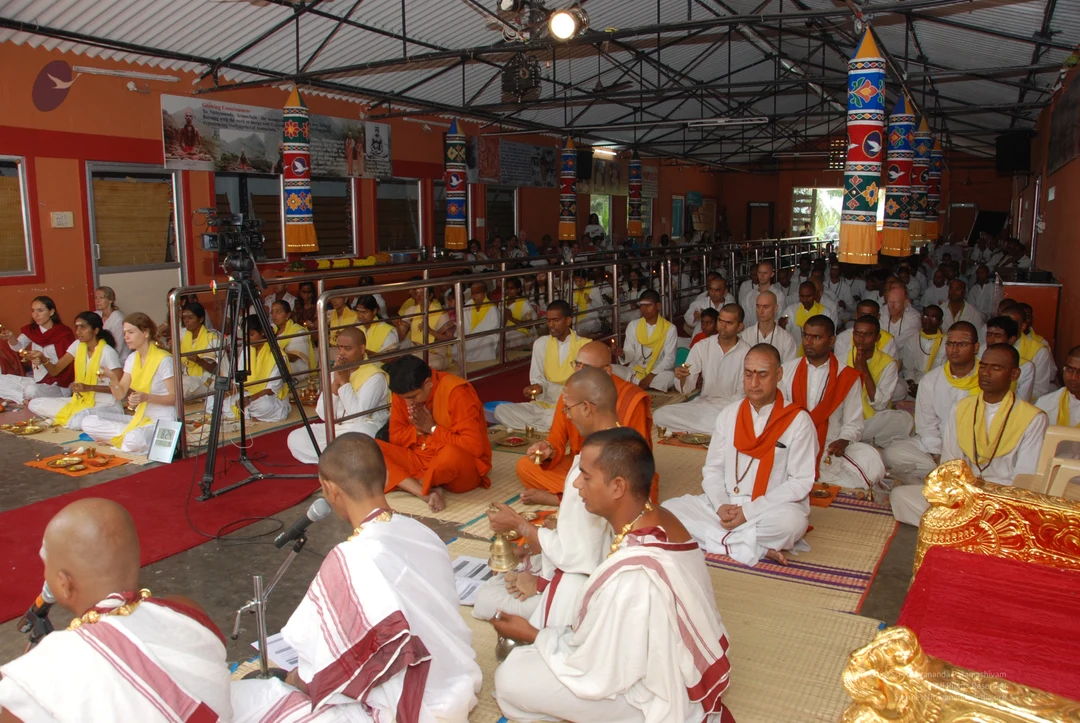
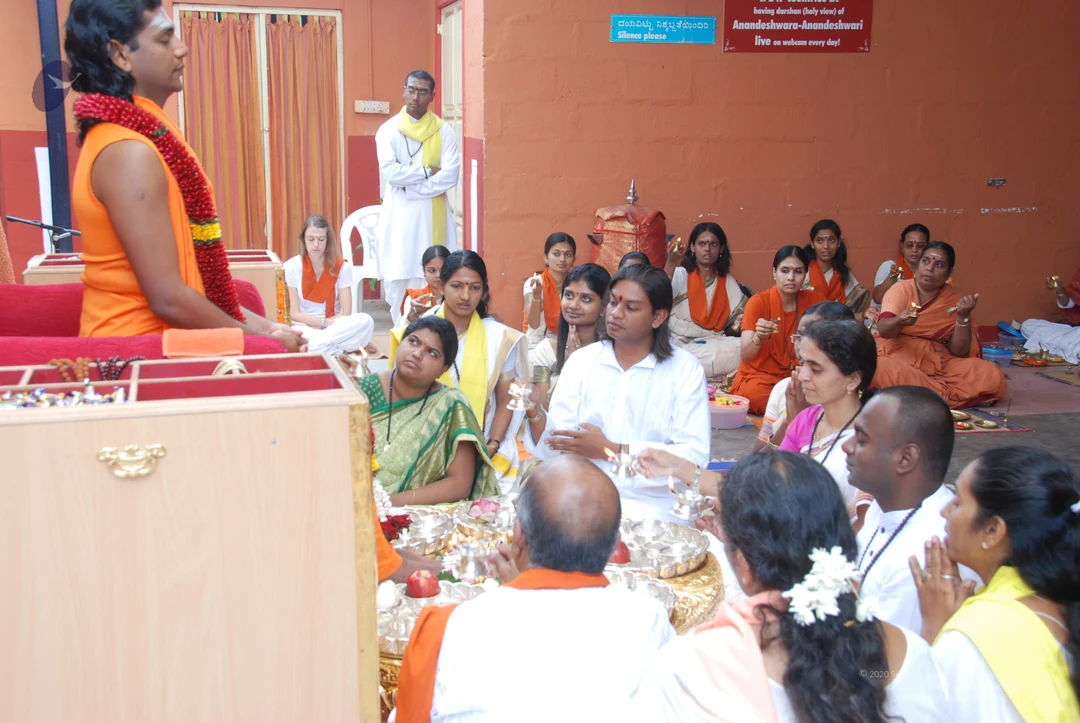
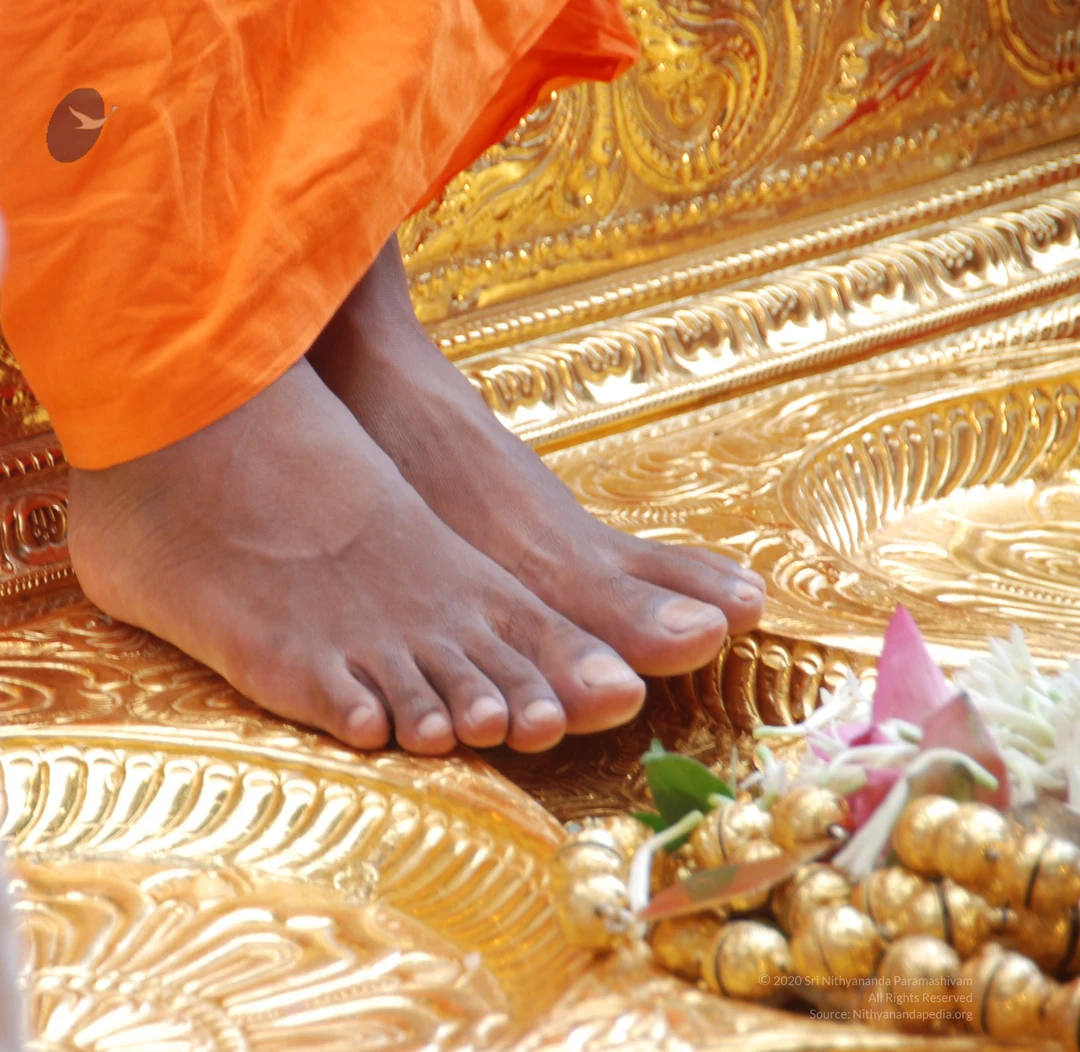
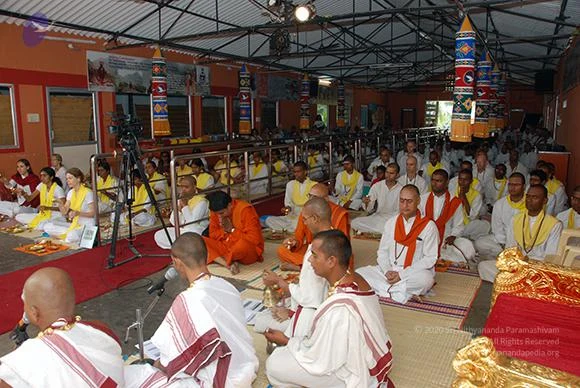
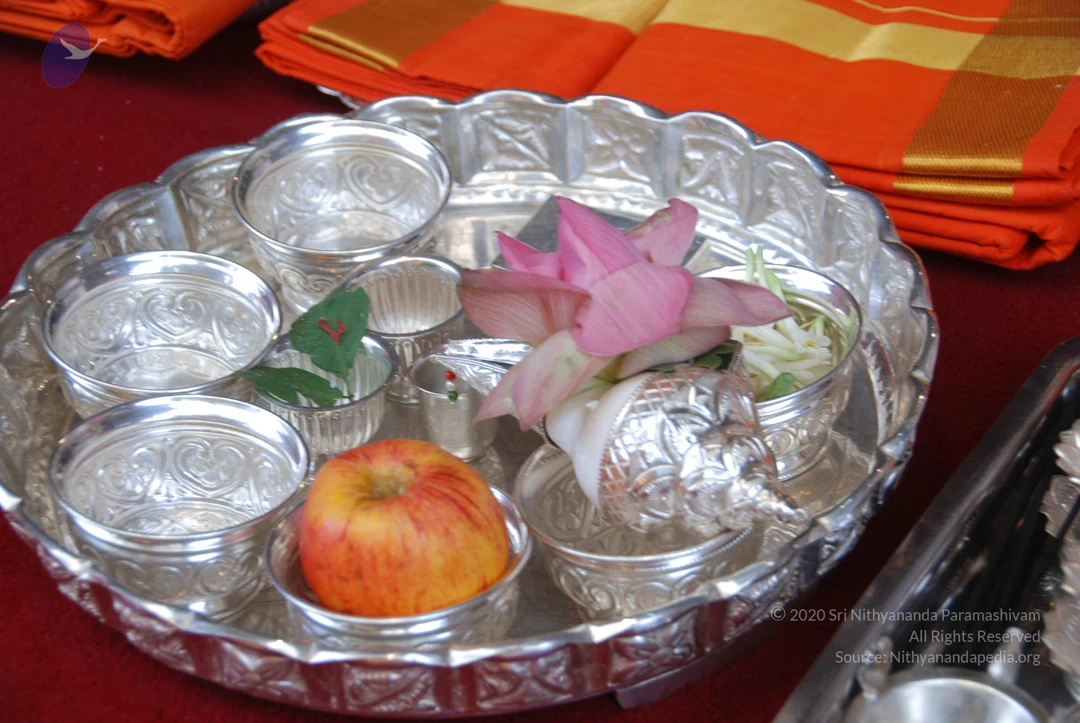
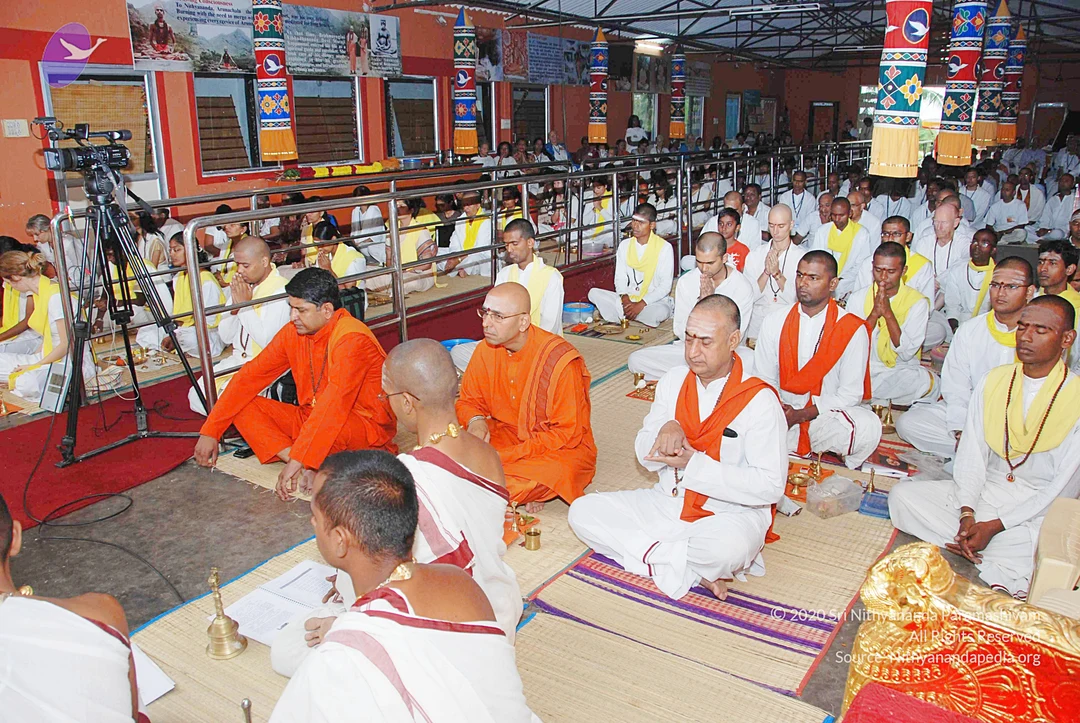
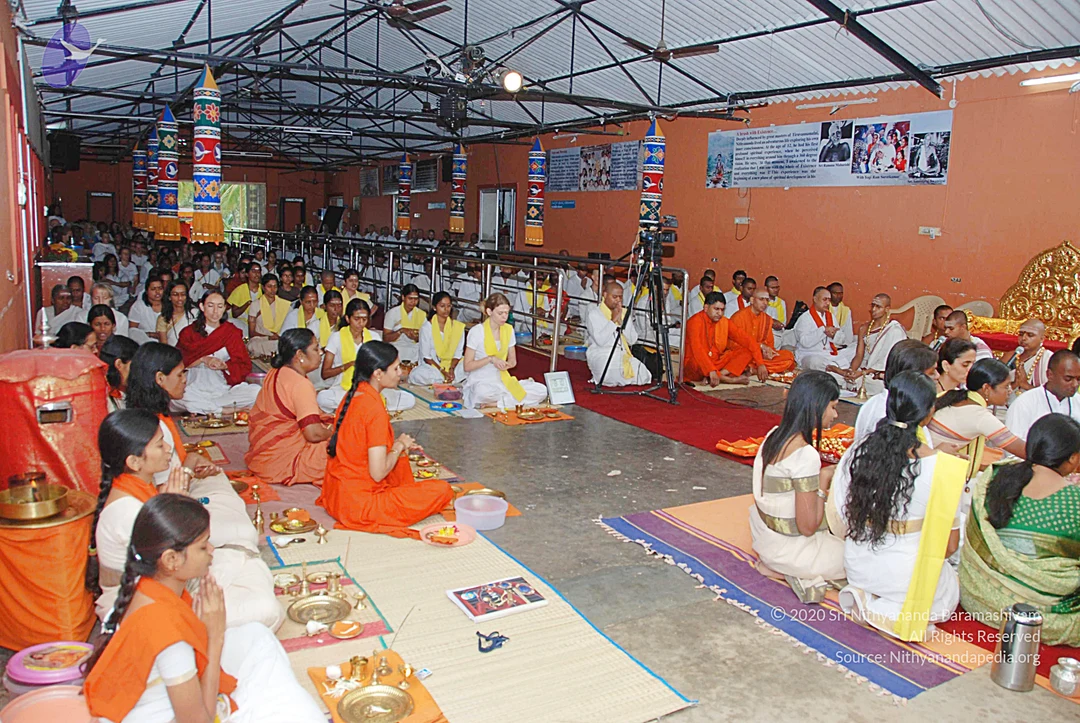
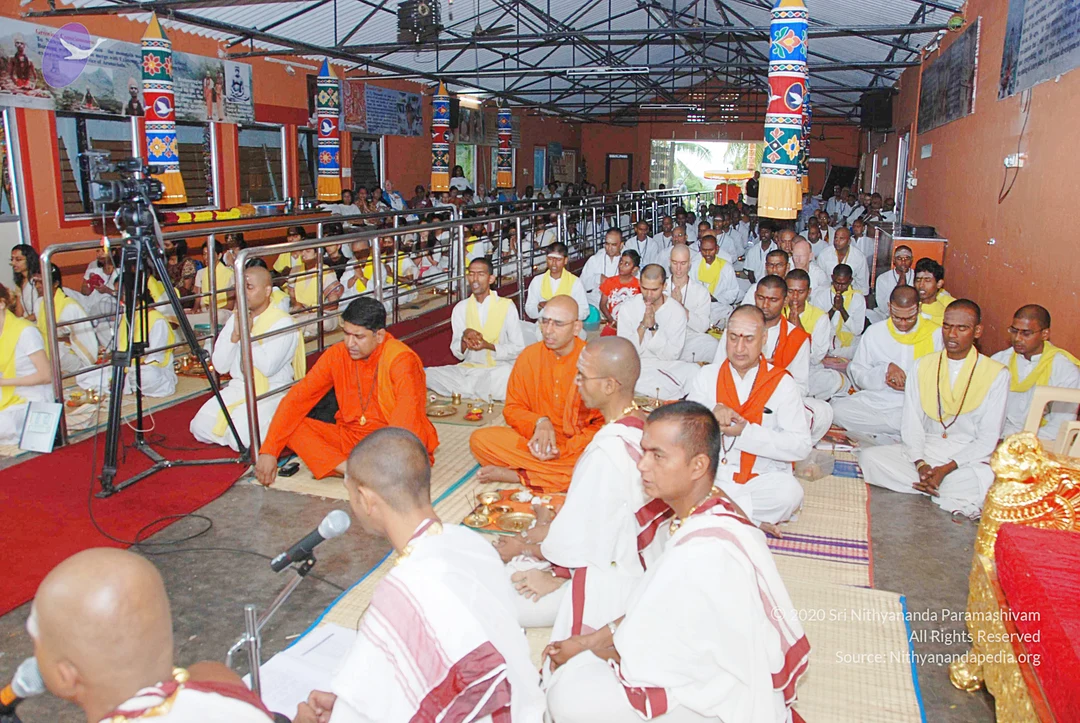
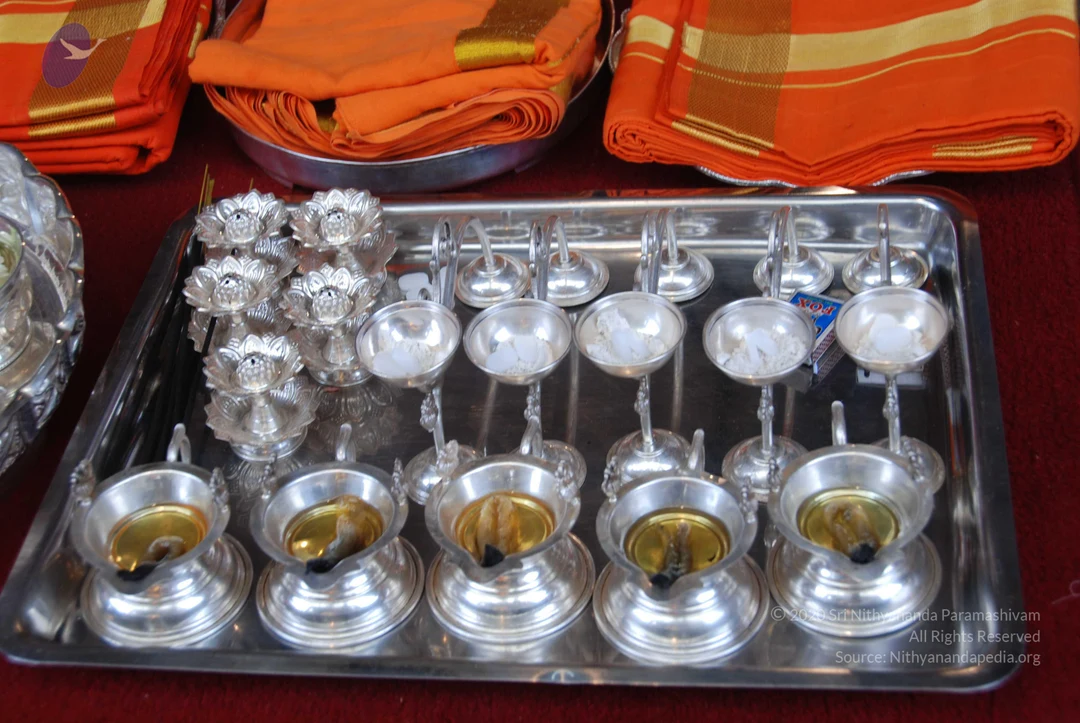
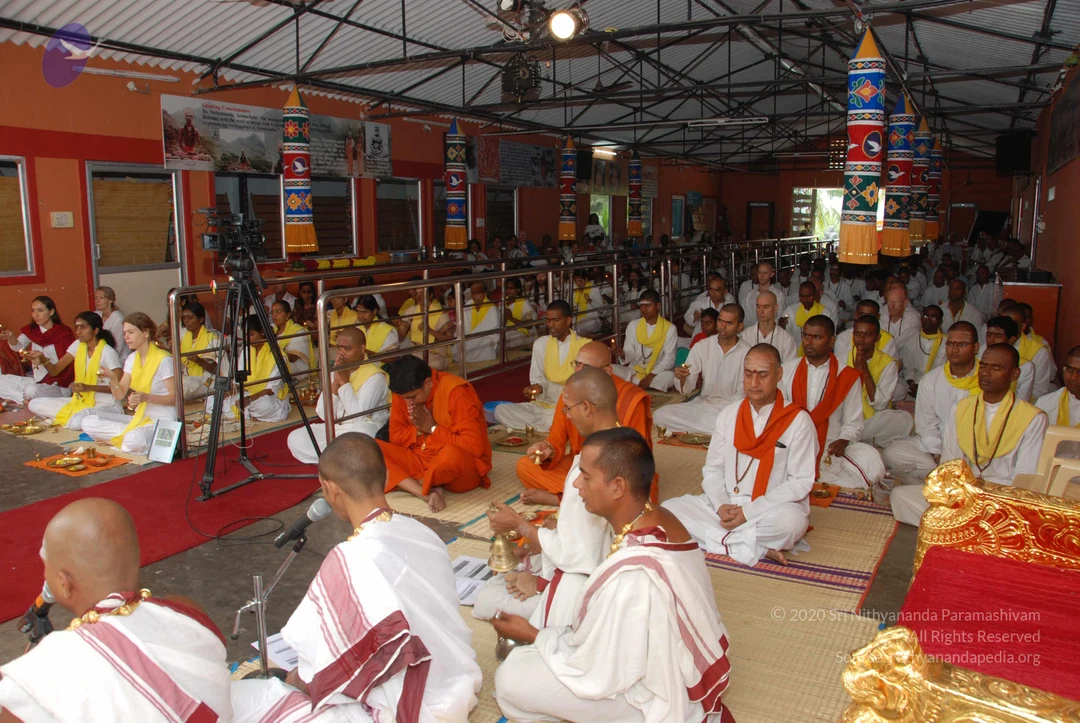
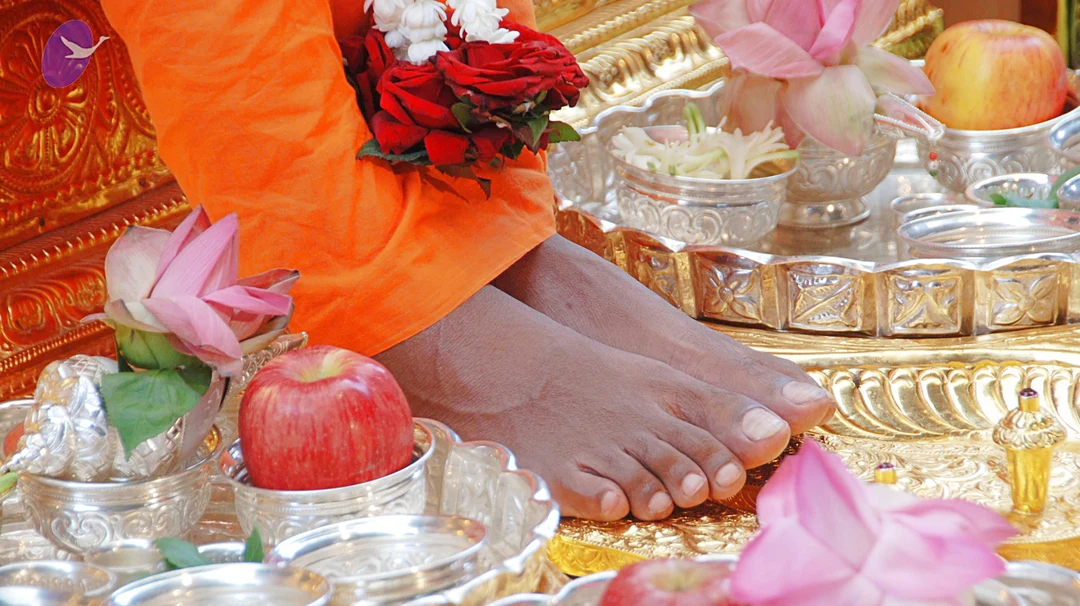
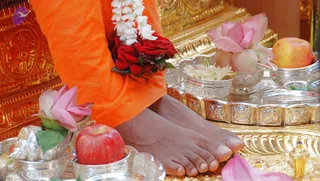
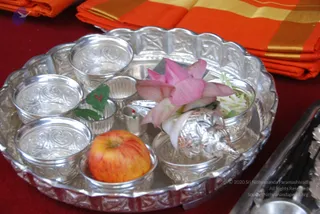
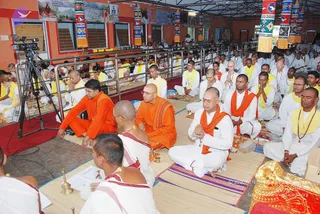
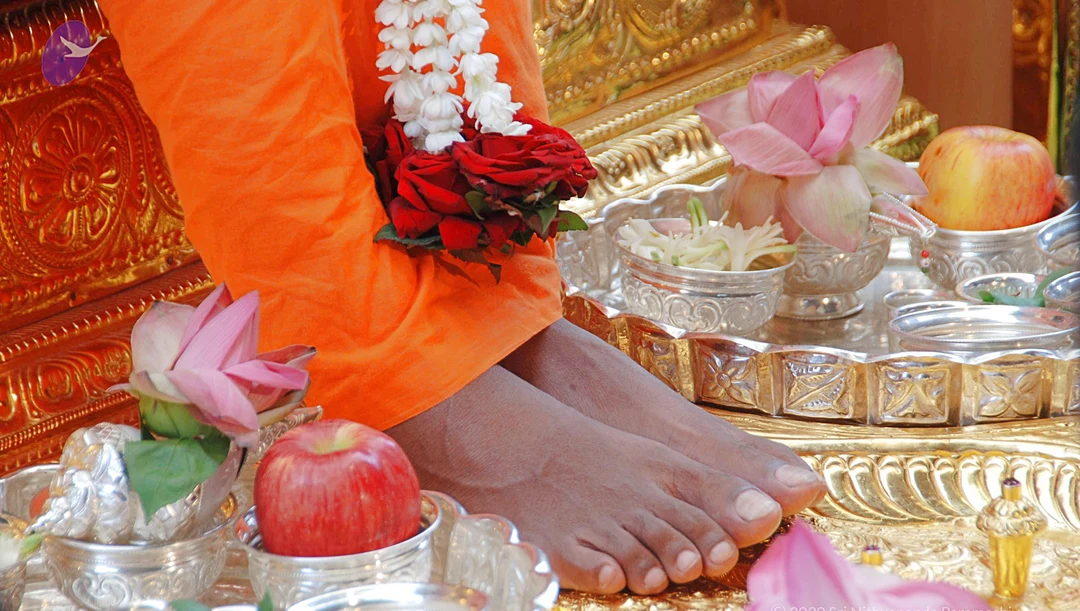
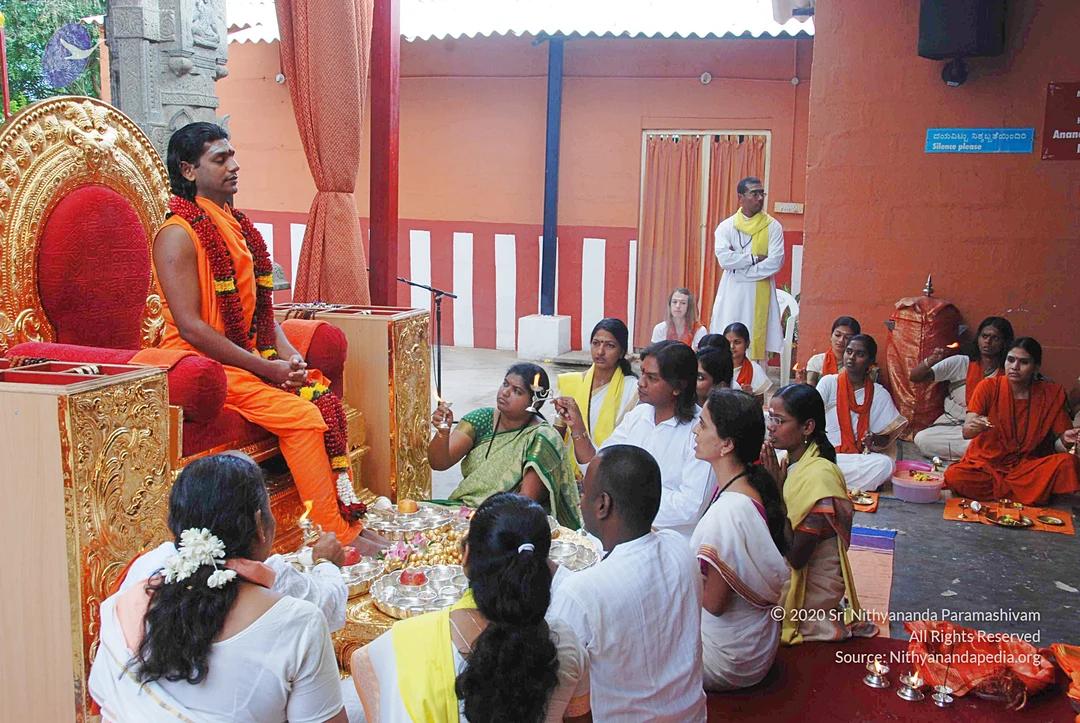
A man seated with eyes closed in meditation on an ornate gold throne with a red cushioned back. He wears a plain saffron/orange robe draped over the shoulders, a dark rudraksha mala, and a thick red-and-yellow flower garland. Long dark hair swept back, a red bindi-style mark on the forehead and tilak above the brows. Hands rest folded in his lap. Behind him, red and yellow marigold garlands and gilded carved decor. Appearance-based probable Swamiji (probable): long swept-back hair, saffron robe, rudraksha mala and garlands on a throne, though the face is not a basis for identification.Close view of a seated person's bare feet resting on a gold-toned ornate tray during a padapuja. The person wears an orange-saffron garment and a white flower garland with red roses draped over the knee. Around the feet are silver bowls holding red apples, pink lotus flowers, white flowers and small offerings, and a silver-rimmed bowl sits beside them. Ornate gold carved panels form the background. A small purple logo appears in the upper left corner.A photograph of a round, ornately embossed silver puja tray set on a red cloth. The tray holds several small silver bowls, a red apple, a pink lotus bloom with petals, a small silver kalasha-style vessel with a silver spout, green betel-type leaves with a red mark, and white flowers in a bowl. Folded orange and gold-bordered cloth lies at the top edge, and silver serving implements sit at the right edge. No people are visible; the arrangement looks like an offering tray for puja.A large hall with orange and red walls and a corrugated roof, filled with seated devotees in white clothes and yellow shawls, many with orange stoles and rudraksha malas, hands folded in prayer. In the foreground, a shaved-headed man in white with an orange stole sits cross-legged on a mat, flanked by monks in saffron robes and white-clad attendants with bells and brass lamps. A camera on a tripod films the gathering. A golden deity murti sits at the lower right on a red cloth, and banners with colourful patterns hang from the ceiling. Some sitting people are in the back rows, with a crowd extending to the rear of the hall.Close-up photograph of a man seated before an ornate gold throne with raised relief scrollwork and round bead finials. He has long swept-back dark hair, a red kumkum mark on his forehead and white tilak lines, wears an orange saffron shawl over a sleeveless orange top, and has a thick rudraksha mala draped down the front along with a red flower garland. Behind him, blurred yellow and red flowers suggest a decorated hall.A photograph of a large indoor hall with orange-painted walls and a corrugated roof, where a seated congregation performs a puja. Many participants sit cross-legged on mats and cloth in rows; women in white with yellow shawls, women in orange saffron robes, and men in white and saffron garments predominate. Brass plates, small brass lamps and offering trays sit in front of them. Near the front, a monk in orange robes sits beside a golden ornate throne-like chair, and another figure in white with a shaved head sits on the carpet area. A tripod camera stands in the central aisle. Banners with photographs hang on the far wall, and tall decorative cylindrical pillars wrapped in patterned cloth line the hall. The people are sitting as a congregation during the ritual.
03-Morning-Message
11 photosSource gallery
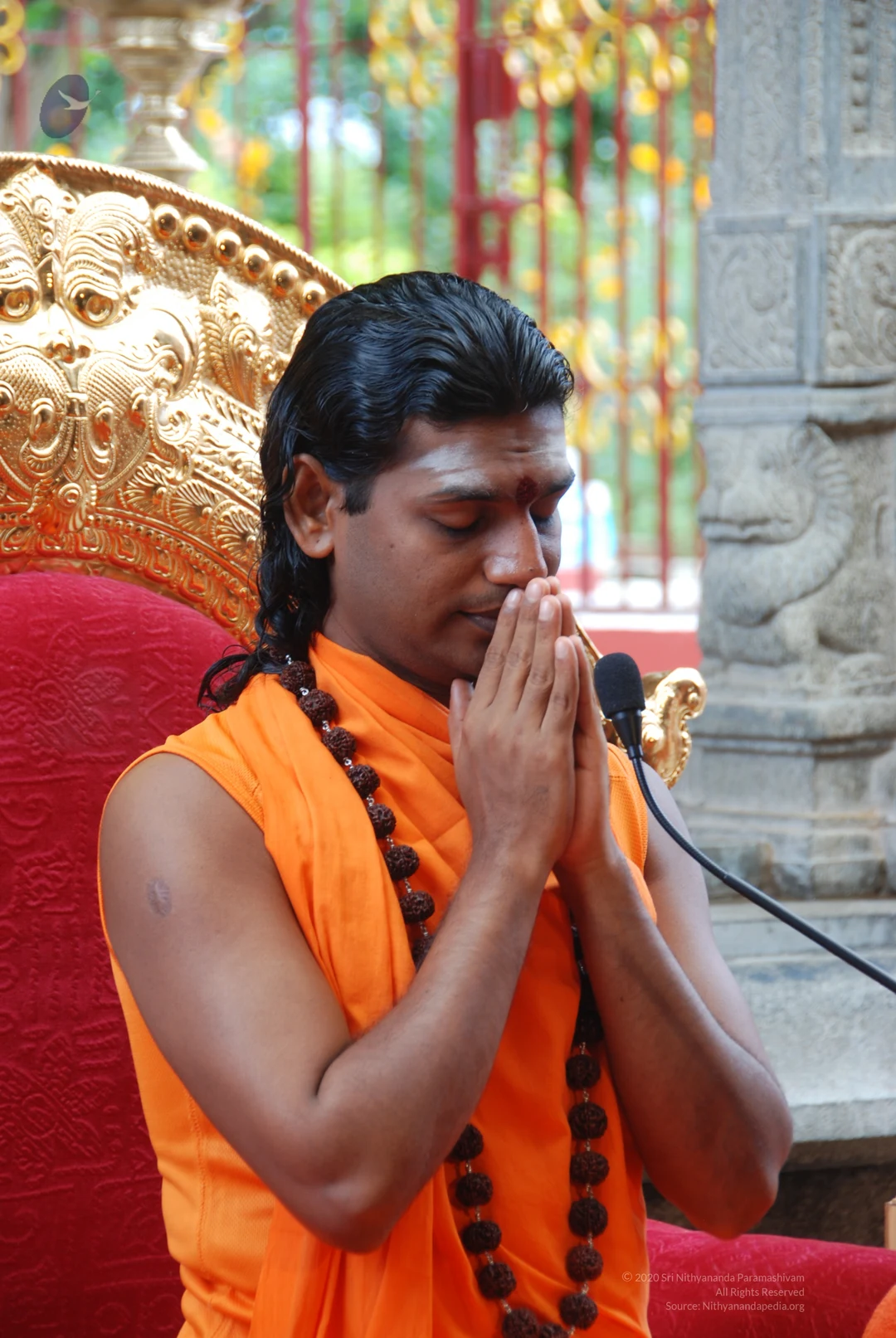
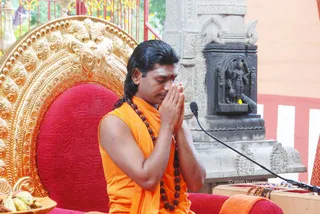
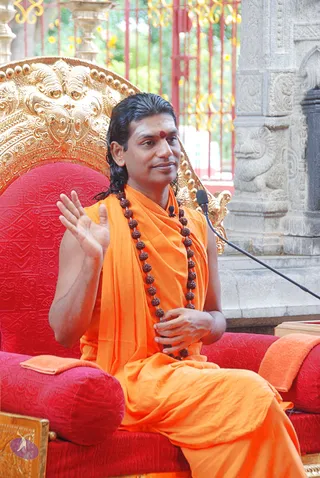
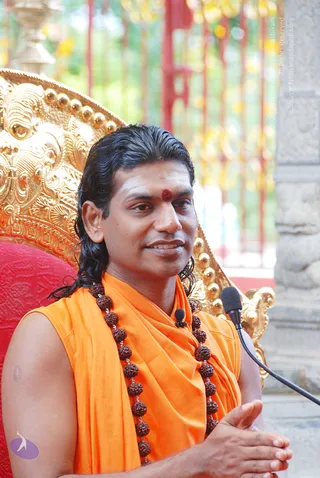
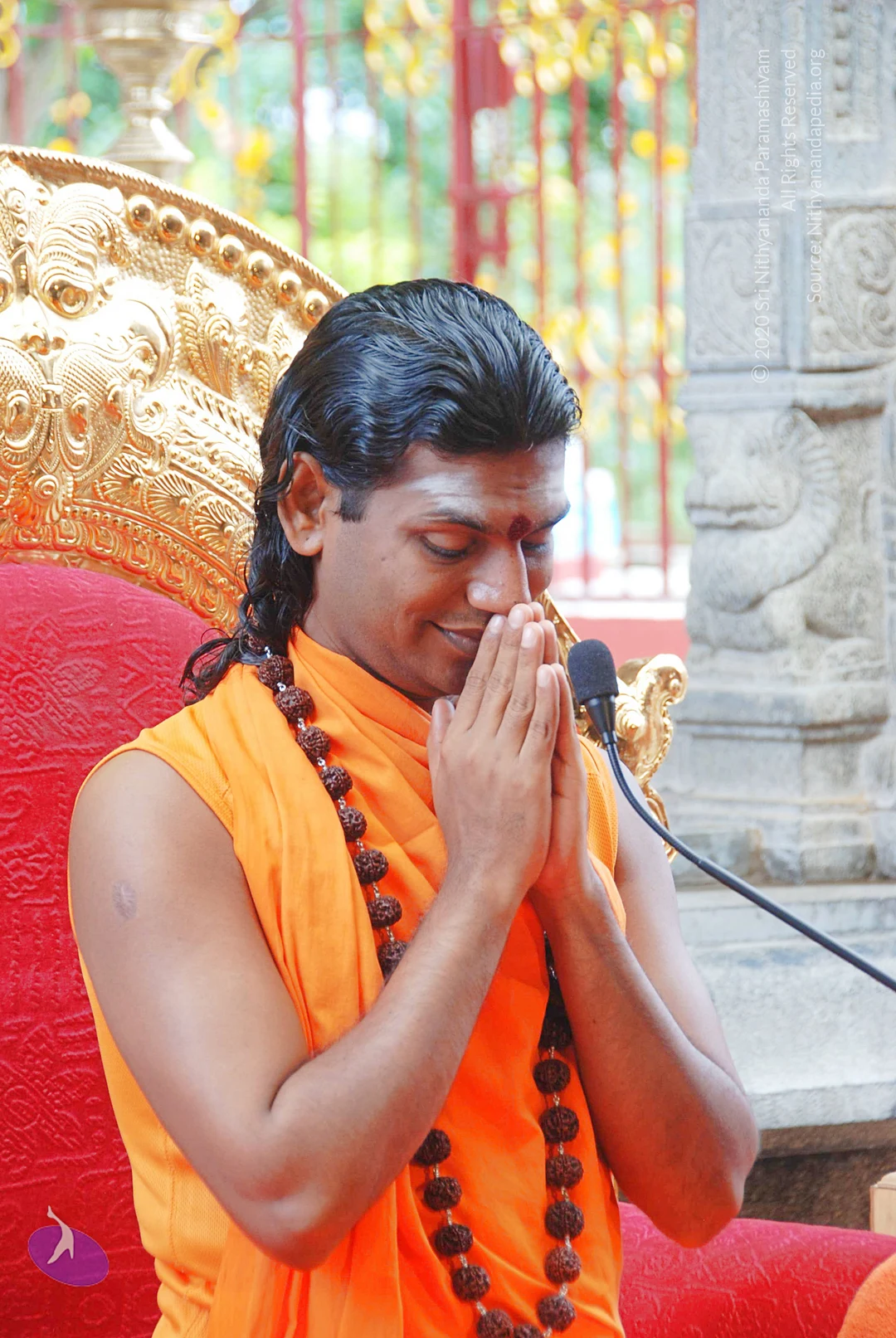
Photo of a man seated on an ornate gold-and-red throne with his palms pressed together in namaste, eyes closed and head slightly bowed. He wears a sleeveless saffron-orange robe and a long rudraksha mala of brown beads, with a red tilak on his forehead and long, swept-back dark hair. A microphone stands at his side, and a carved stone pillar and red metal gate are behind him. Swamiji (probable): long swept-back hair, saffron-orange clothing and rudraksha mala, seated on a throne during a discourse setting.A man in orange sleeveless robes and an orange wrap sits on an ornate gold-framed throne with red cushions, speaking into a clip-on microphone while extending one hand outward in a gesture. He wears a long rudraksha mala and a red tilak on his forehead, with swept-back dark hair. Behind him stand a carved grey stone temple pillar with relief sculptures and a red iron gate with gold finials. Brass lamps stand on the left. A brass-edged tray holding prayer beads rests at the lower right. The scene appears to be an outdoor discourse at a temple setting. Swamiji (probable): the orange robes, rudraksha mala, swept-back hair and ornate throne match the page's identification of the speaker, a seated discourse giver.A man seated on a red cushioned throne with an ornate gold carved backrest, hands pressed together in anjali mudra with eyes closed. He wears a sleeveless saffron-orange garment over his shoulders and a long rudraksha mala around his neck, with a red tilak on his forehead and long swept-back dark hair. A microphone on a stand is in front of him, and a dark stone carved shrine niche with a deity relief stands behind him beside a red and white painted wall. A small bowl of bananas and a folded orange cloth sit nearby. The appearance and role match the a person cues described, so the figure is a person seated in a discourse setting.Close-up photo of a smiling man with long, swept-back black hair and a red kumkum mark on his forehead, wearing an orange saffron shawl over a sleeveless orange garment and a long rudraksha mala. A microphone stands at right. Behind him is a dark stone sculpture of a deity in a niche and a golden ornate throne back at left. Swamiji (probable): long swept-back hair, saffron clothing and rudraksha mala suggest a discourse setting.A man seated on an ornate red and gold throne, wearing a saffron-orange robe draped over one shoulder and a long string of dark rudraksha beads around his neck. He has long dark hair swept back, a red tilak on his forehead, and raises one open hand while the other rests on his lap, as if speaking. A microphone on a stand is near him. Behind him are a red metal gate with gold scrollwork, carved grey stone pillars and greenery. The seated speaker is an appearance-based probable Swamiji candidate: long swept-back hair, saffron clothing and rudraksha mala are visible cues. No readable printed name appears on the figure.Photograph of a man seated on an ornate gilded throne with a red cushion, speaking into a microphone with hands held together in front of him. He wears a sleeveless saffron-orange robe draped over one shoulder and a long rudraksha mala of brown beads, with a red tilak mark on his forehead and long, swept-back dark hair. A small lapel microphone is clipped to his robe. Behind him are red metal gates, a stone pillar and blurred green foliage. Swamiji (probable): the orange robe, long swept-back hair, rudraksha mala and ornate gilded throne fit the page's Swamiji reference, so this is an in_person candidate with a discourse setting.

04-Sarva-Darsan

7 photosSource gallery
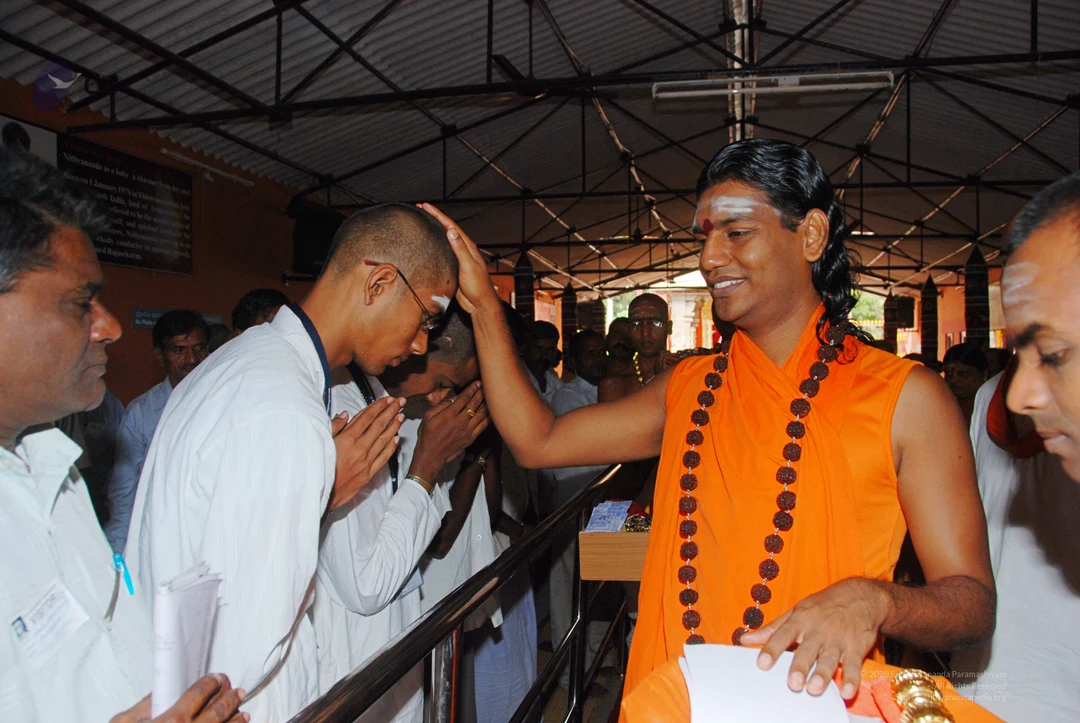
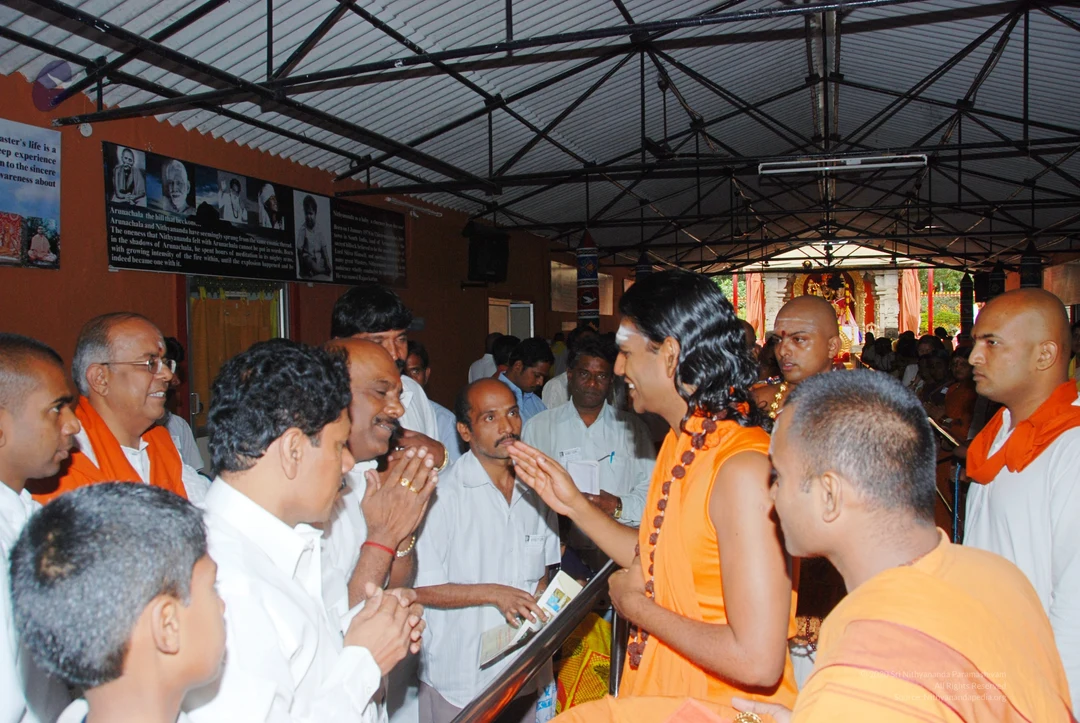
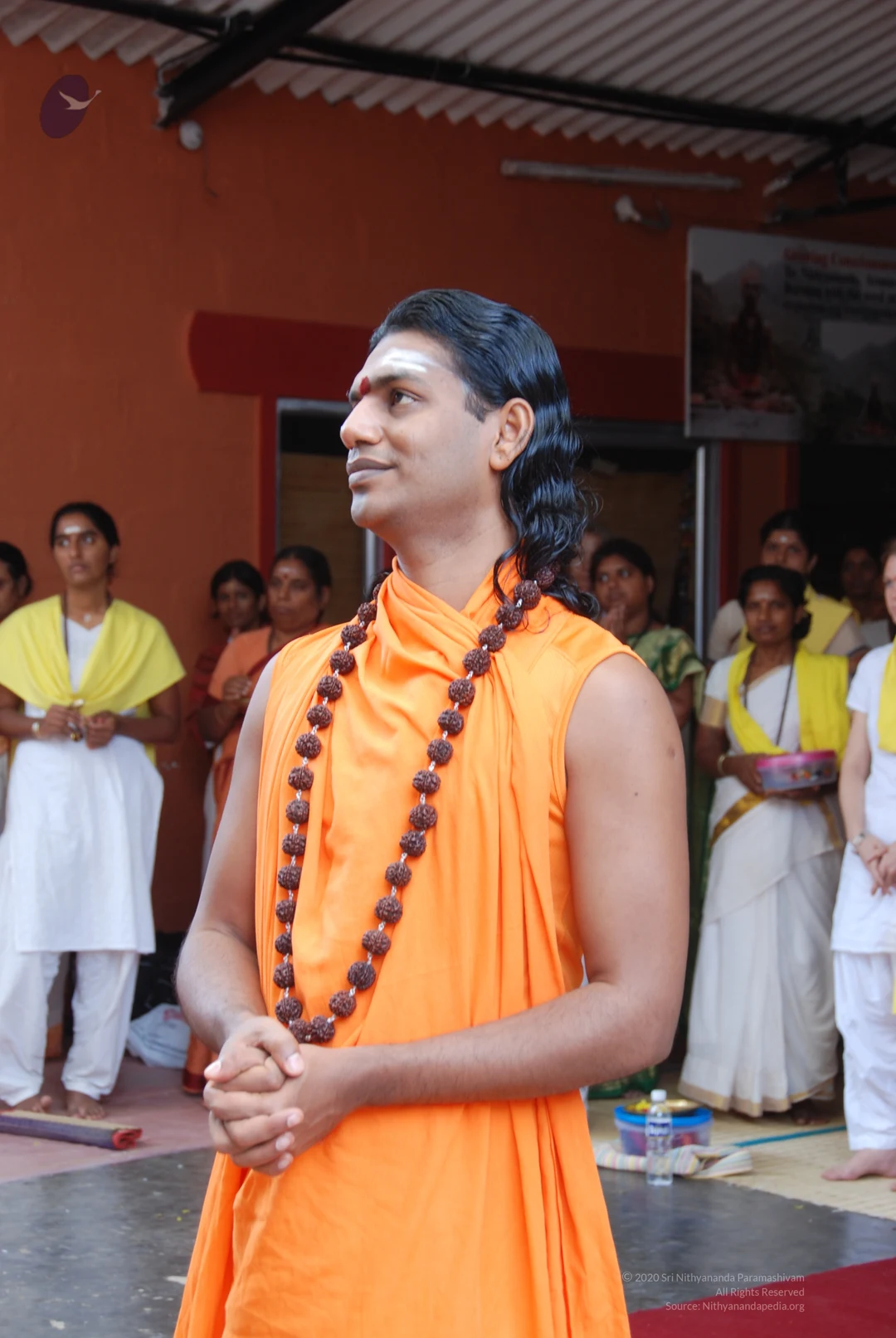
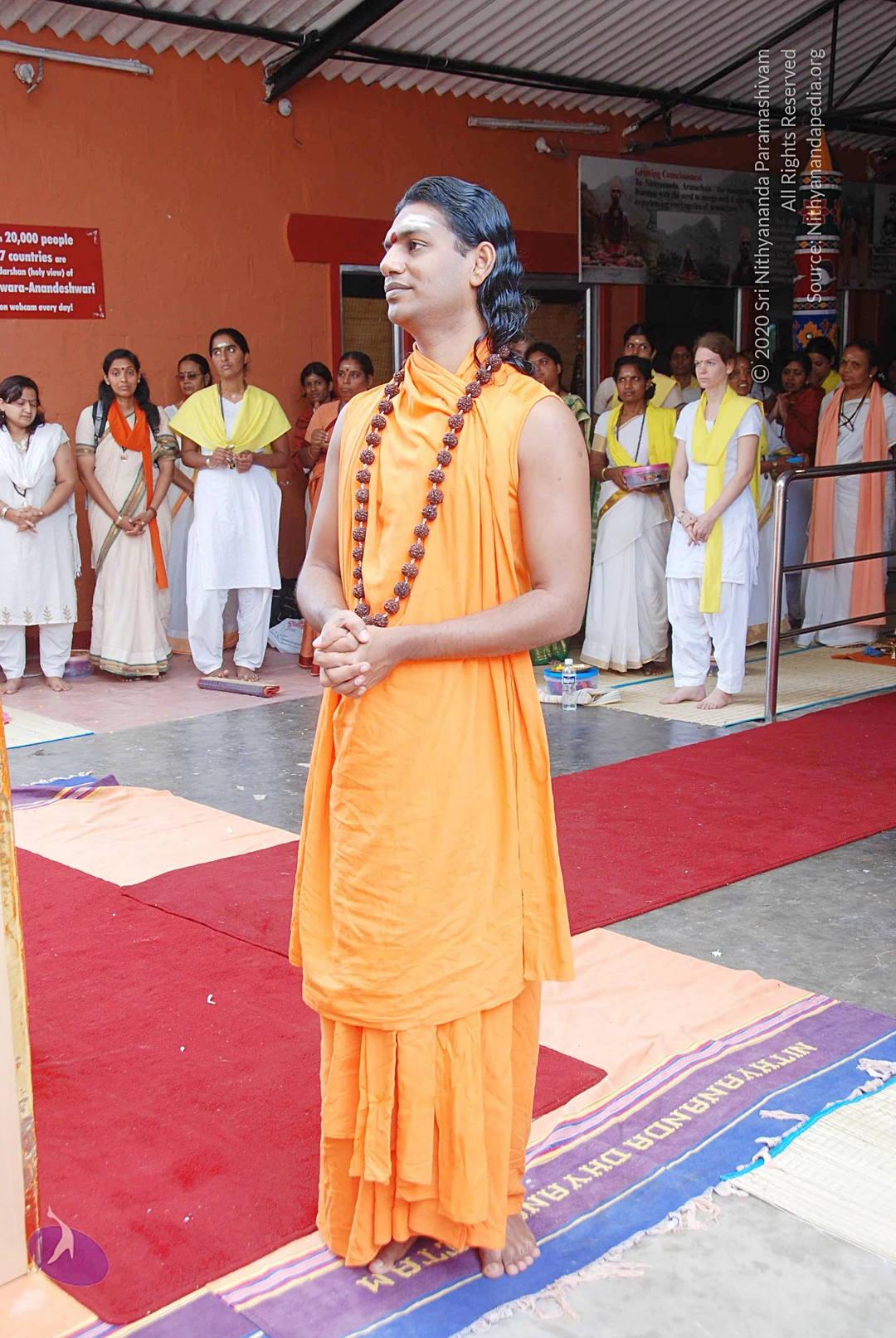
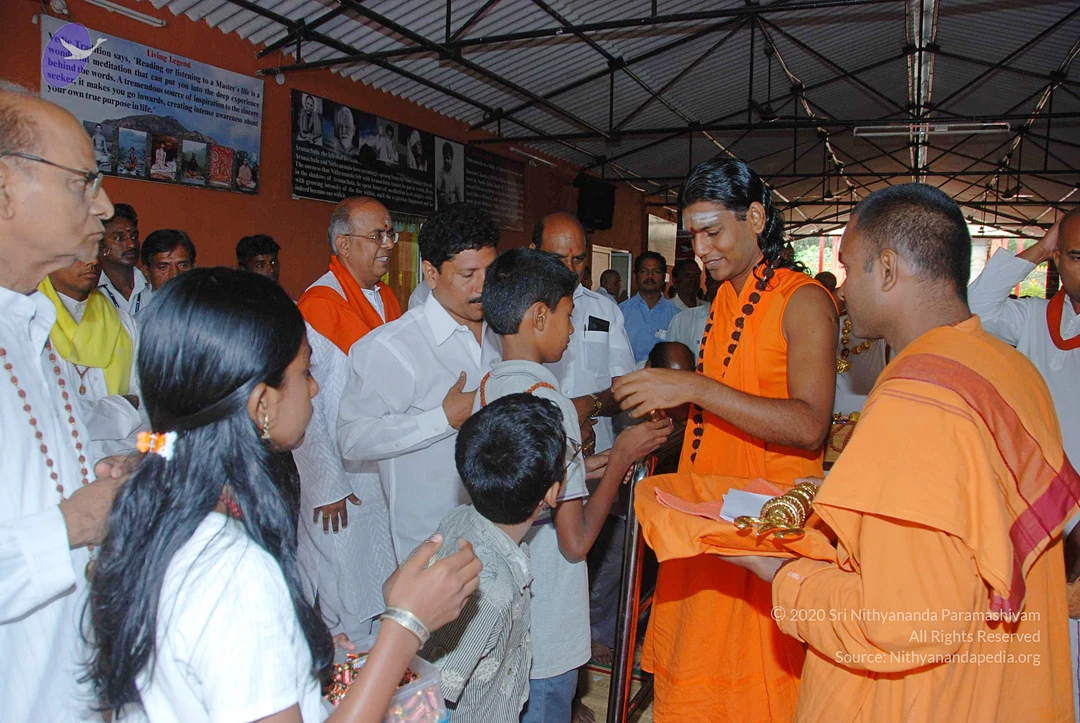
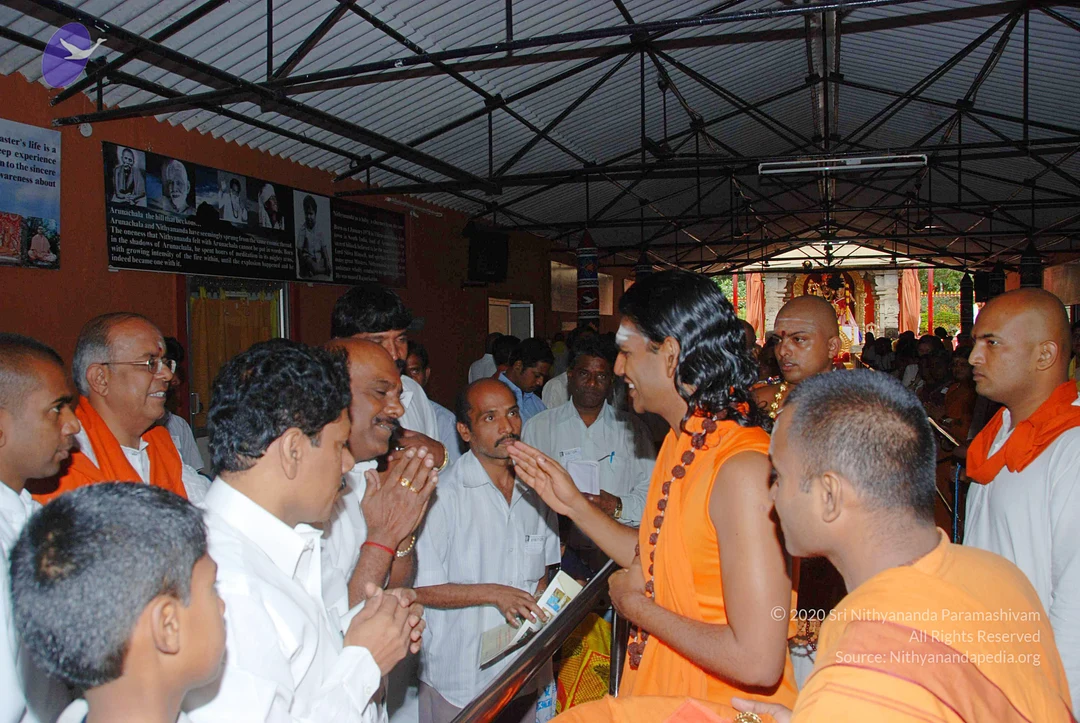
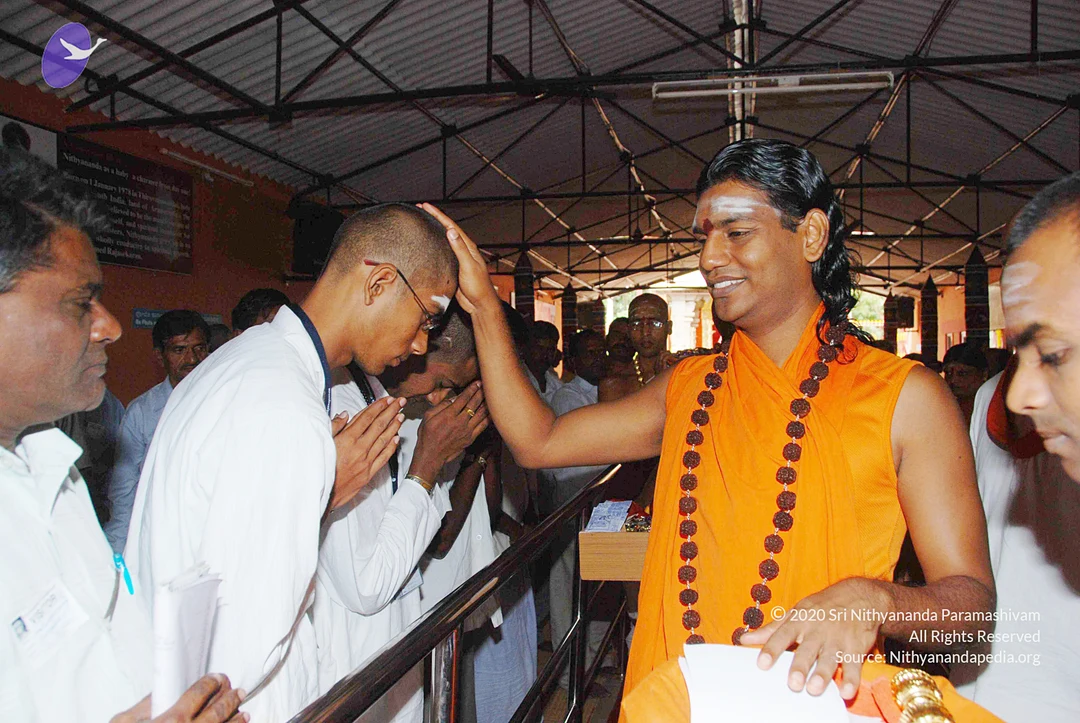
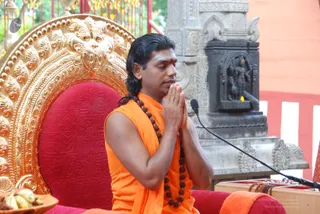
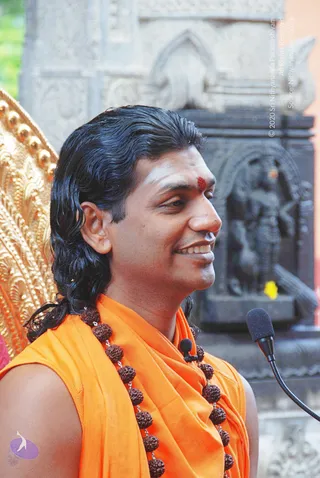
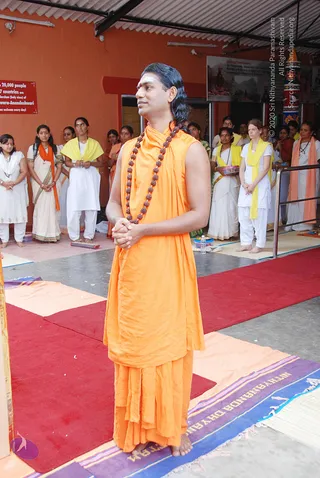
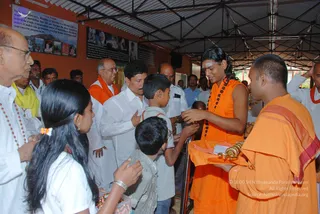
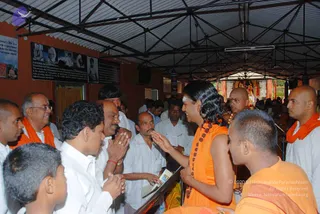
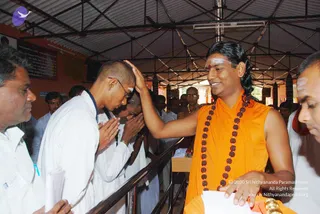
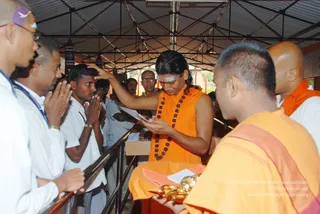
A photograph of a man standing barefoot on a red carpet and a striped purple-and-blue mat, dressed in a loose sleeveless saffron-orange garment with a rudraksha mala of dark beads hanging to his waist. His long dark hair is swept back and he has a white tilak on his forehead, hands pressed together in front of him as he gazes upward. Behind him a row of women in white and cream saris and salwar, several with yellow or orange shawls, stand with hands folded in an orange-walled hall with a corrugated roof. A banner on the wall reads Growing Consciousness, and a red sign on the left mentions 20,000 people and darshan via webcam. Orange and white draped cloth and a water bottle sit near the mat.Photograph of a darshan line inside a covered hall with an orange-painted wall and corrugated roof. A man with long dark hair, a white tilak on his forehead, a saffron sleeveless garment and dark beaded malas stands at right, extending his hands toward two young boys who are receiving items. A monk in saffron robes with a reddish border holds a tray with a gold-coloured vessel and small packets at lower right. Devotees in white kurtas and dhotis, one with rudraksha beads, stand around; a girl in white with a hair clip is at lower left. Framed photographs and a banner line the upper wall. The man in saffron with long hair and malas is a person candidate based on his distinctive long hair, saffron clothing and malas, though his appearance is not certain enough to confirm.A photograph inside a covered temple hall with a corrugated metal roof and orange-painted walls. A long-haired person in a sleeveless saffron-orange garment with a rudraksha mala stands at the centre, smiling and gesturing with an extended hand toward a group of devotees. Several men in white shirts and dhotis have their palms pressed together in anjali, one holding a small booklet. Two shaved-headed men in orange shawls stand nearby, and a shaved-headed man in orange is in the lower right foreground. Behind them, a deity murti is decorated with garlands in an altar area, and framed photo panels hang on the wall. The long-haired figure is a probable Swamiji by appearance: long swept-back hair, saffron clothing and a rudraksha mala.A photograph of a figure in an orange sleeveless robe and a long rudraksha mala with long swept-back dark hair and a tilak-marked forehead, placing his right hand on the forehead of a bespectacled man in a white shirt with a blue lanyard who has his palms pressed together. Several other people in white and light clothing stand behind and beside them, with a corrugated metal roof and a wooden railing in the foreground. The orange-robed figure is a probable candidate for Swamiji, identified by long swept-back hair, orange robes and a multi-bead rudraksha mala. He is giving a blessing, touching the head of a devotee.A photograph of a devotional darshan line under a metal-framed roof with hanging decorations. A man in an orange sleeveless robe with a long rudraksha mala and white forehead markings stands center, placing his hand on the head of a young man in a white shirt whose hands are pressed together in anjali. Several other devotees in white shirts and dhotis wait in line behind a metal railing, and a monk in orange robes holds a brass tray of offerings in the foreground. The central figure has long swept-back hair and distinctive ornate orange-and-rudraksha clothing, matching the page's description of a probable Swamiji appearance, so this is a probable in-person presence. Other attendees are devotees and sannyasis.A man in an orange sleeveless top and orange patterned wrap leans forward to press his forehead and face against a carved grey stone ledge of a temple. He has long dark wavy hair, a white mark on his forehead, and a long rudraksha mala with brown beads hanging from his neck. His right hand rests flat on the stone. A small yellow flower sits on the carved stone above. The pose appears to be a reverent gesture at a temple structure.

05-Vip-Visits

4 photosSource gallery
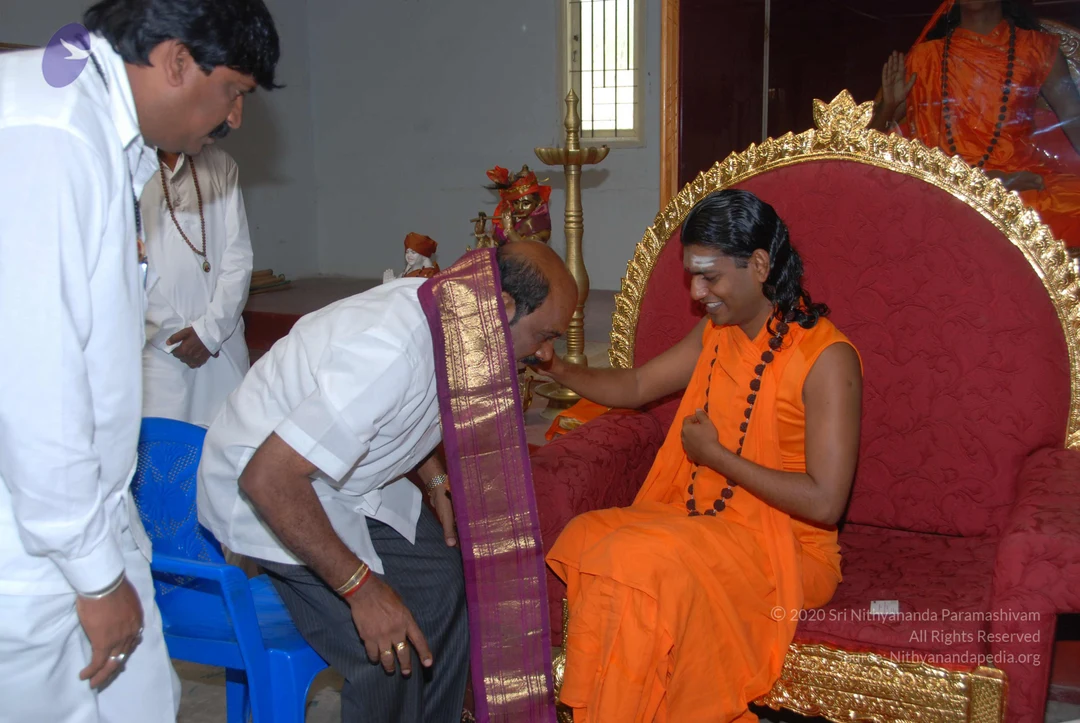
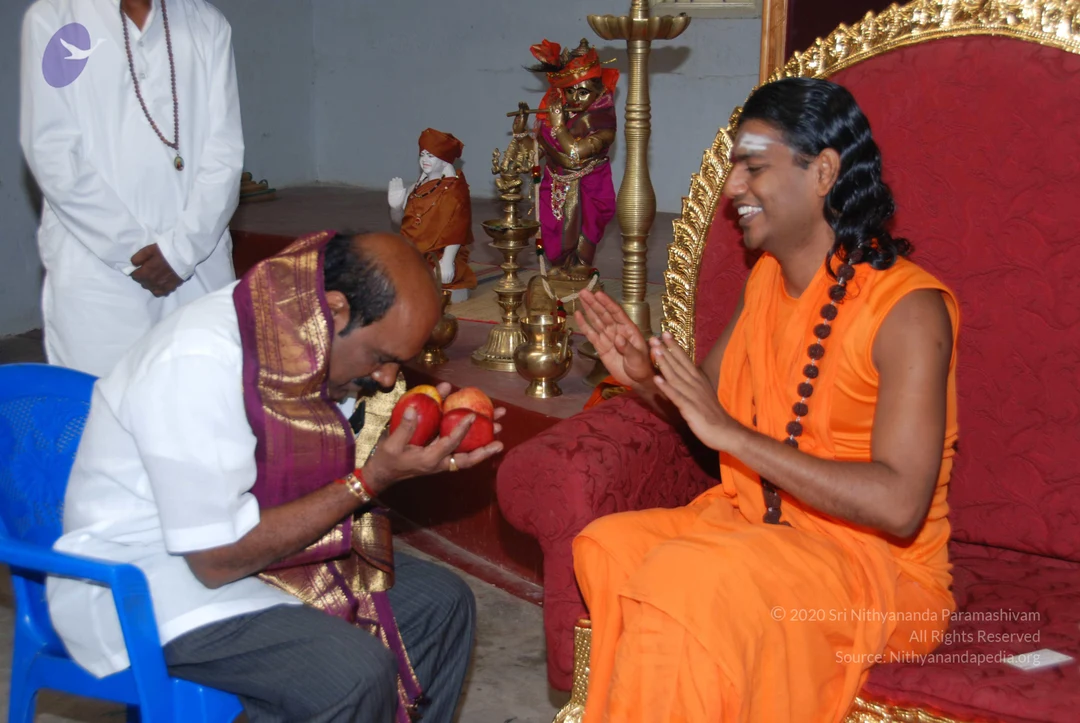
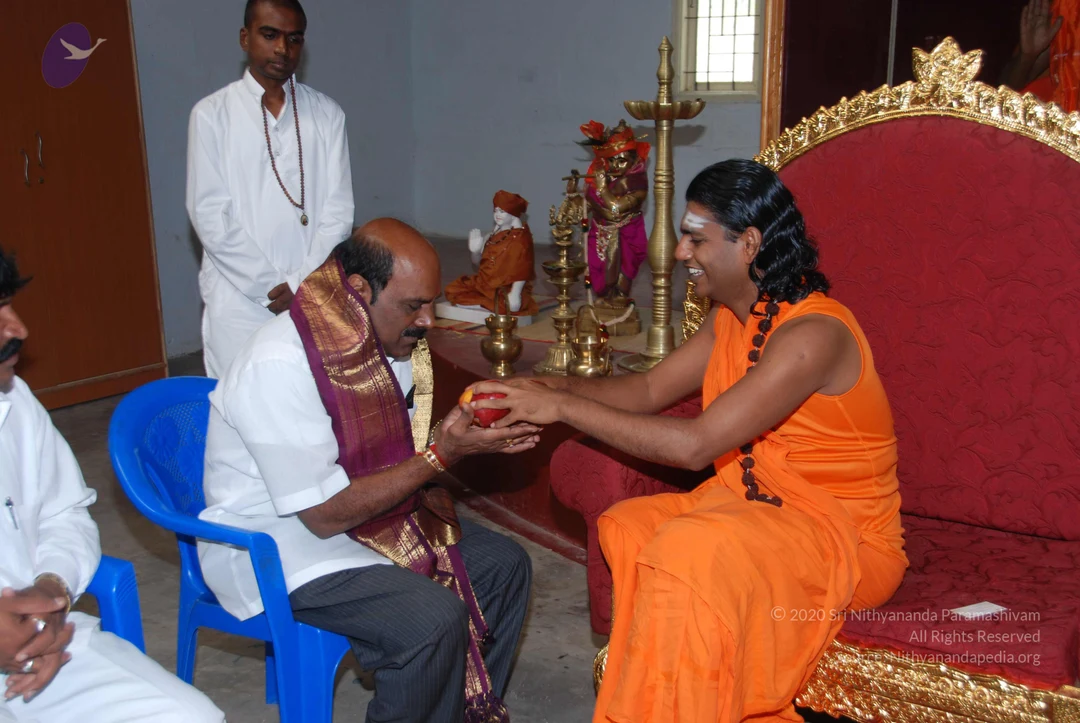
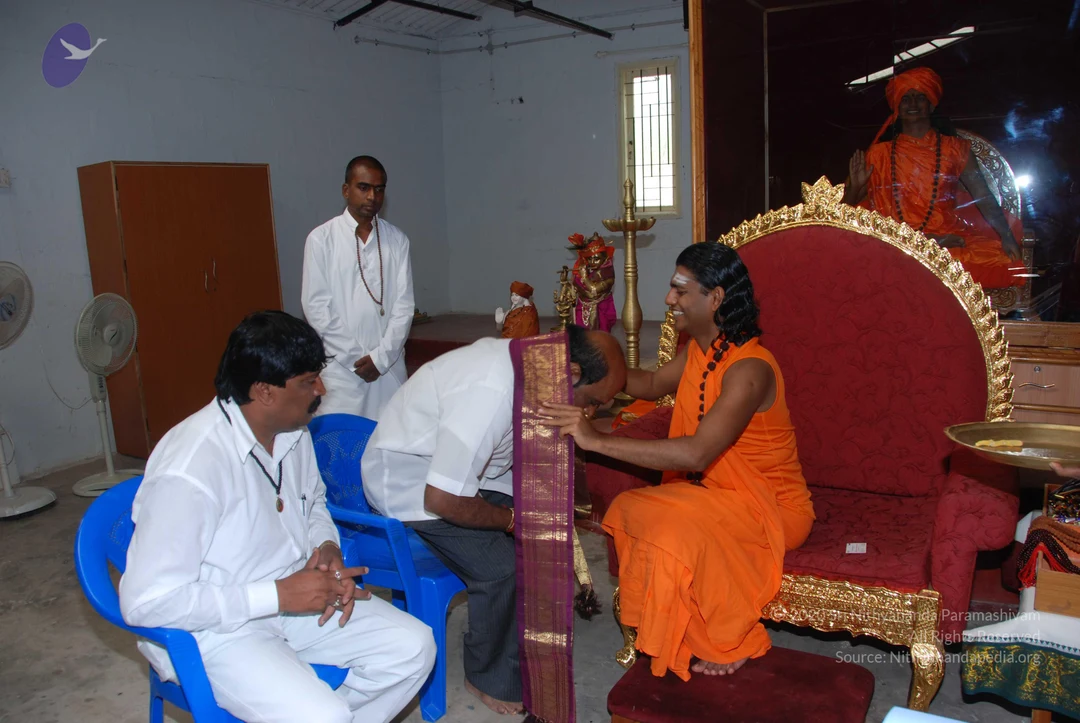
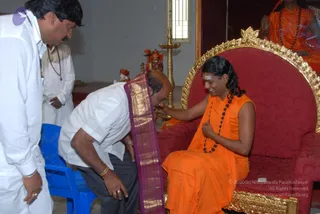
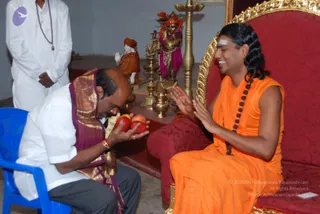
A photograph in a plain room with pale walls and a window. Seated on a red upholstered throne with an ornate gold frame is a man with long dark hair, a white tilak on his forehead, wearing an orange saffron robe and a dark rudraksha mala; he is smiling and his hand rests on the head of a man bending forward before him. The bending man wears a white shirt, dark trousers, a purple and gold bordered shawl draped over his shoulders, and bangles. A standing man on the left in a white shirt and white dhoti-style clothing with a mala looks on. Behind the throne, a woman in an orange robe with a mala has her palms pressed together. A brass oil lamp stands on the floor near the throne, and a small orange and red decorative object sits beside it.A photograph of a seated man in a saffron robe with long dark hair, a tilak on his forehead and a rudraksha mala around his neck, smiling with palms pressed together on a red throne with gold trim. Before him a man in white shirt and grey trousers, wearing a maroon and gold shawl, sits on a blue plastic chair bowing his head and holding three red apples in his cupped hands. Behind them a standing man in white with a rudraksha mala watches, and brass oil lamps, a kalasha and small painted figures of saints sit on a red-carpeted platform. Probable Swamiji is the seated figure on the throne, identified by his saffron robe, long hair, rudraksha mala and ceremonial throne seating.

06-Temple

18 photosSource gallery
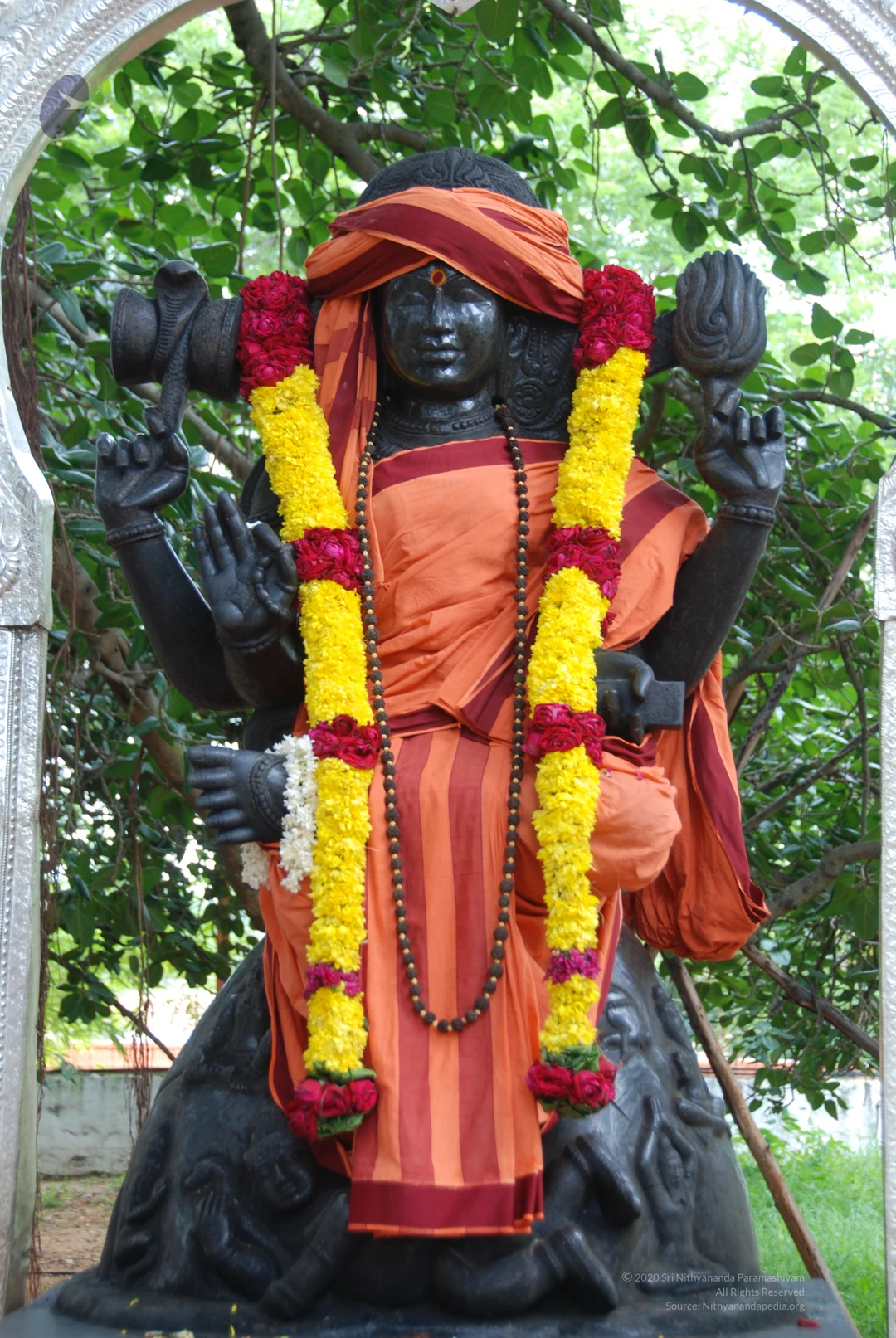
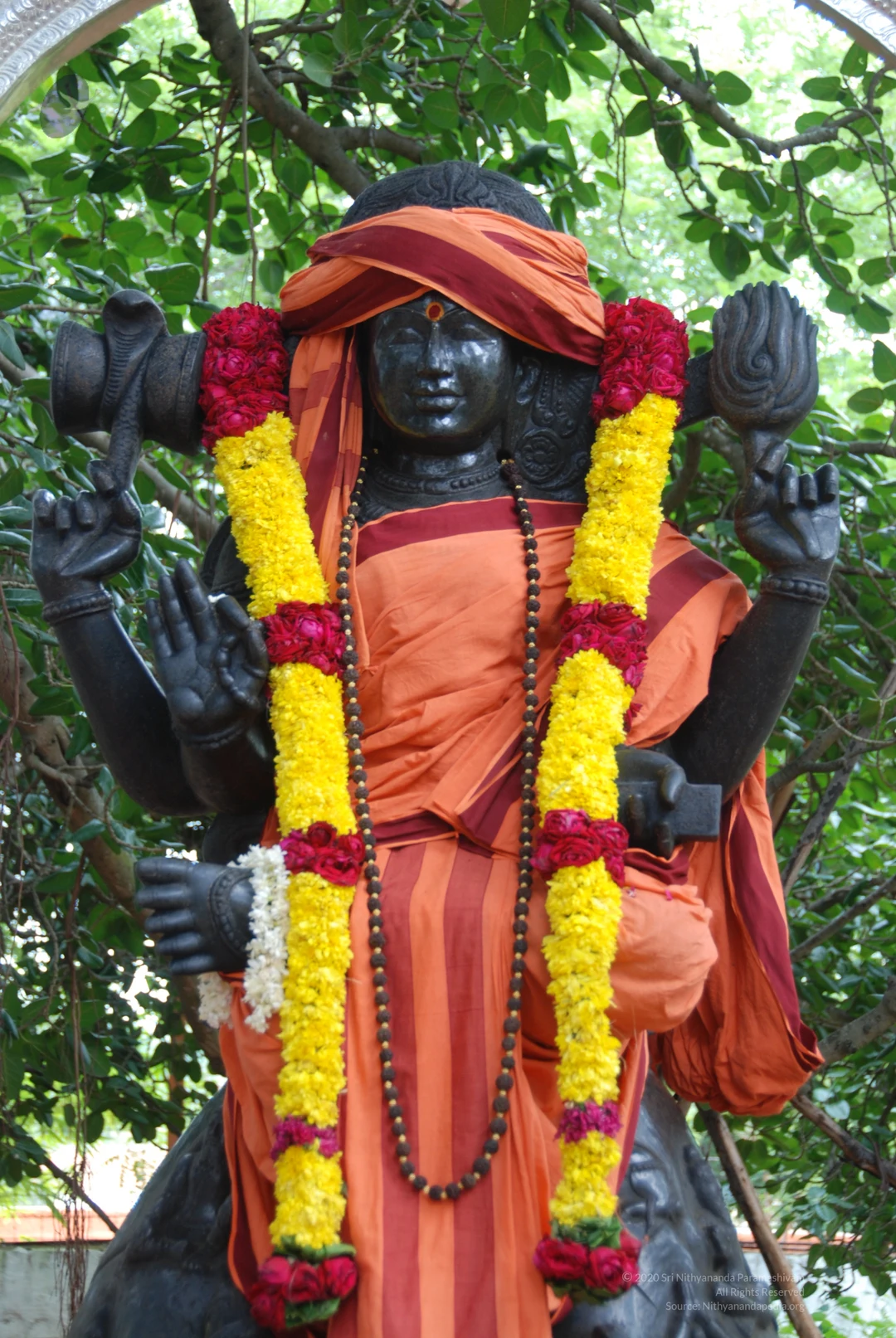
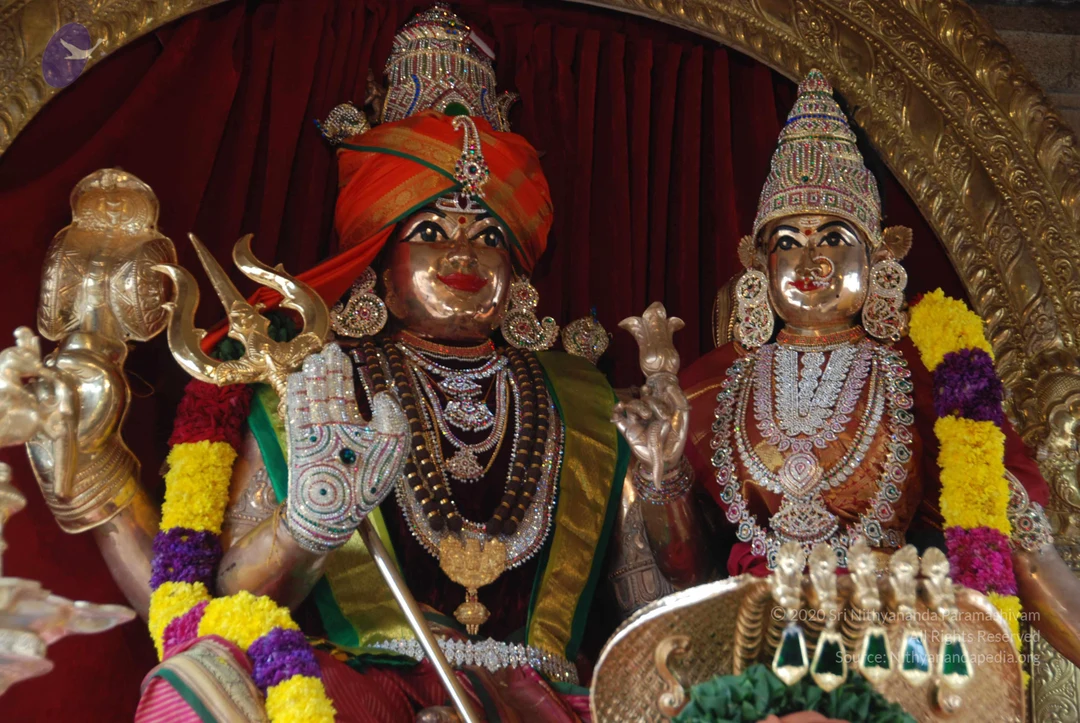
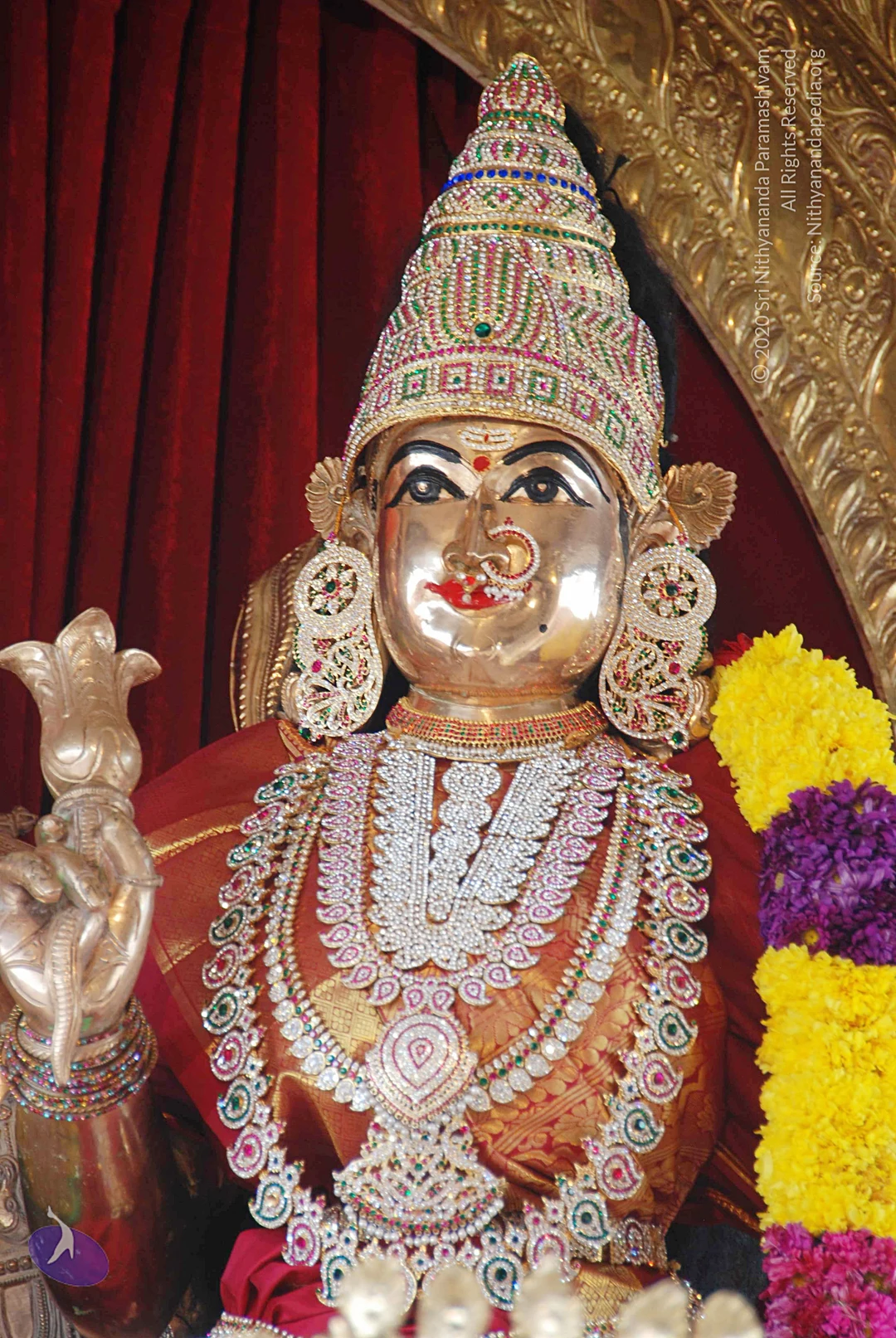
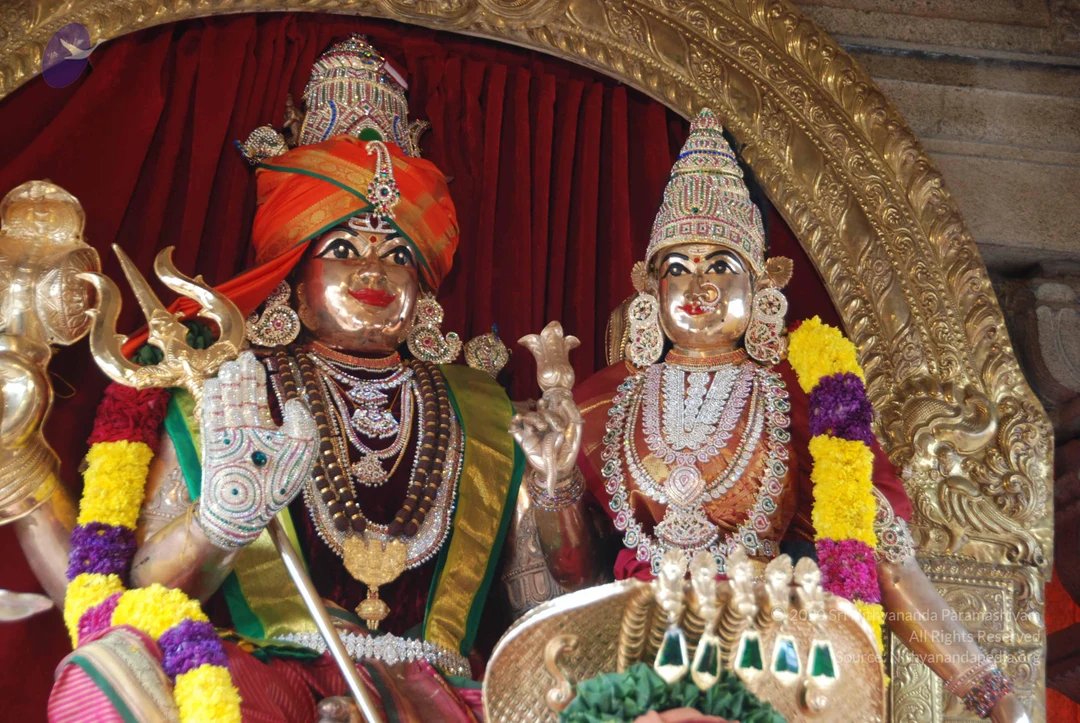
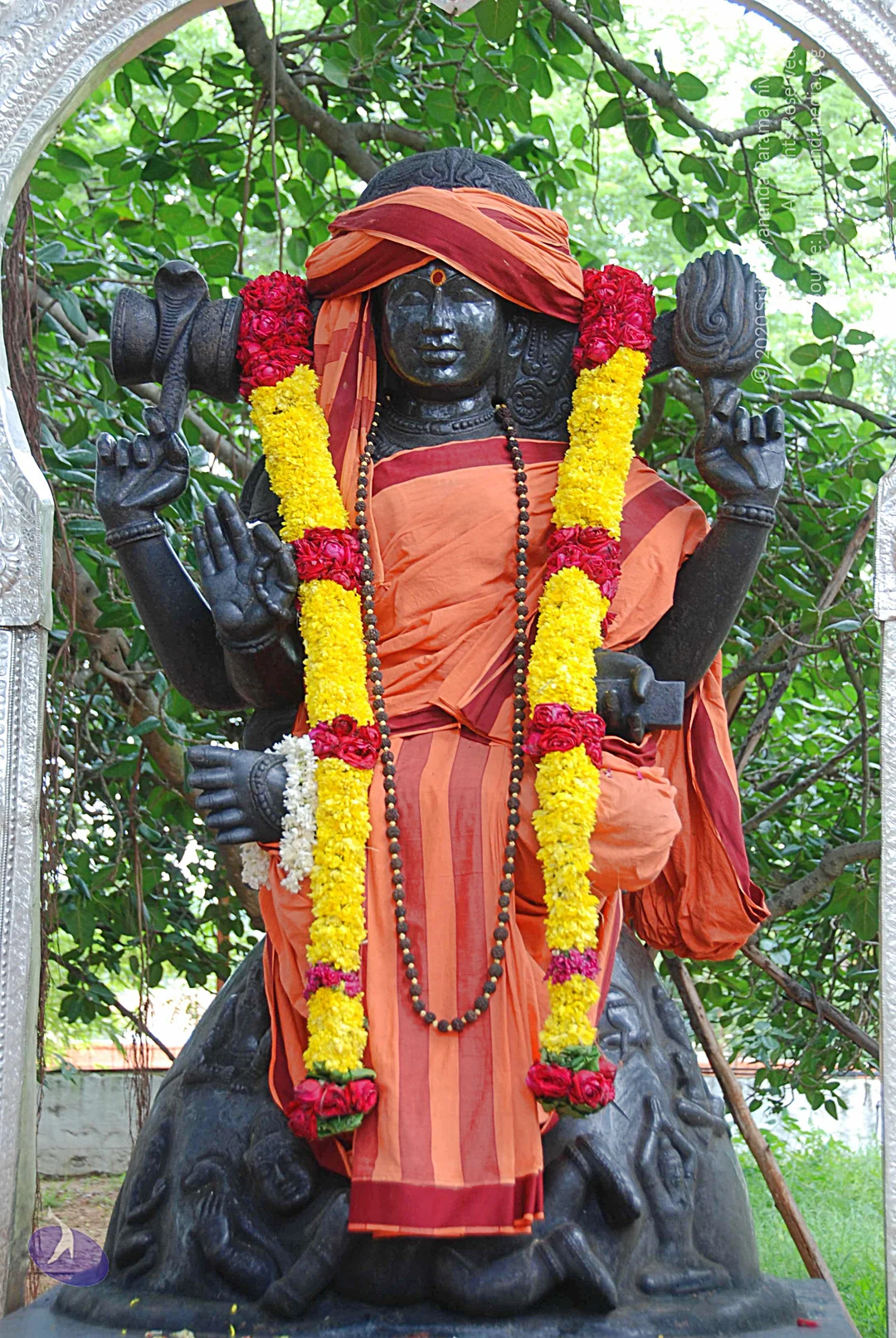
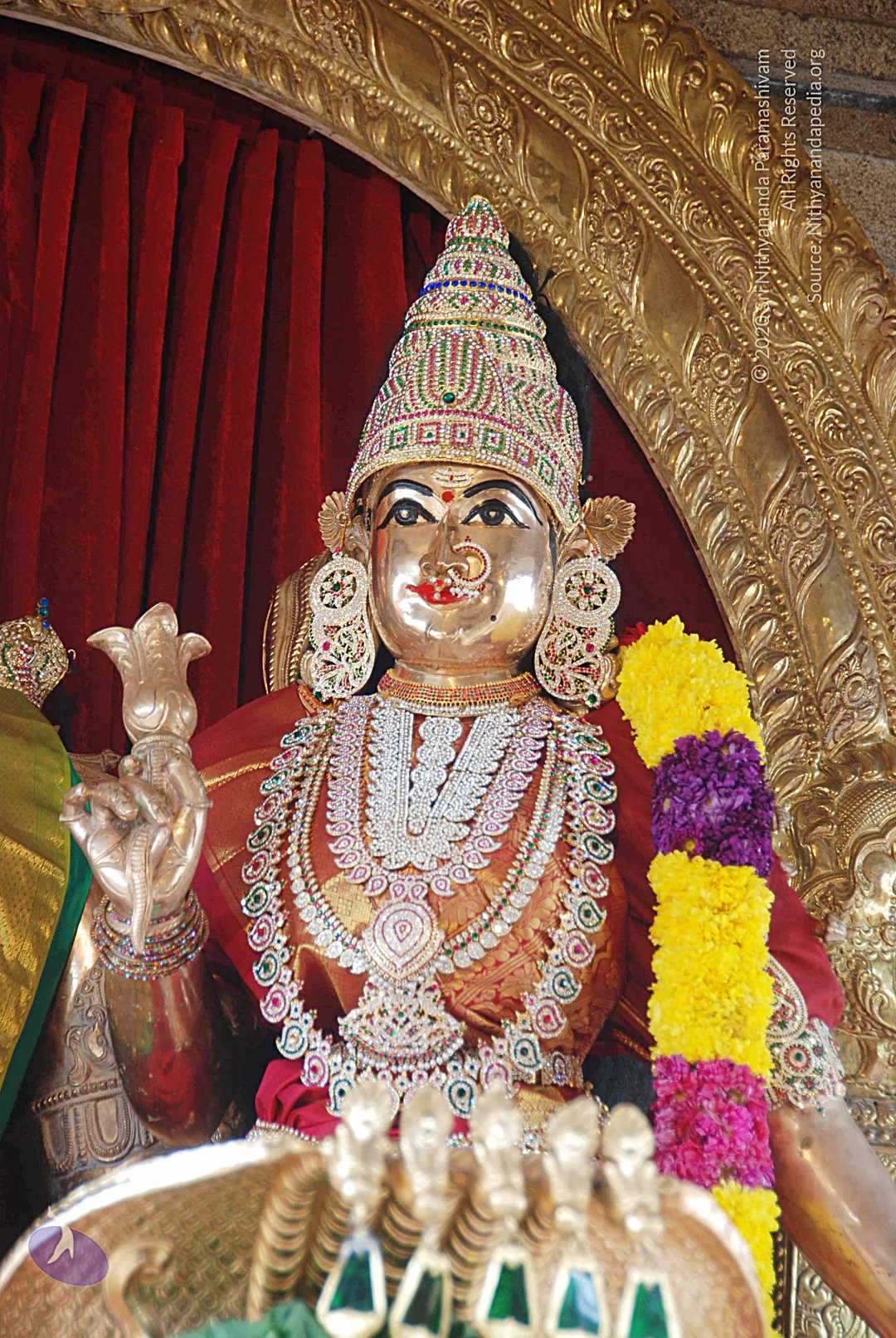
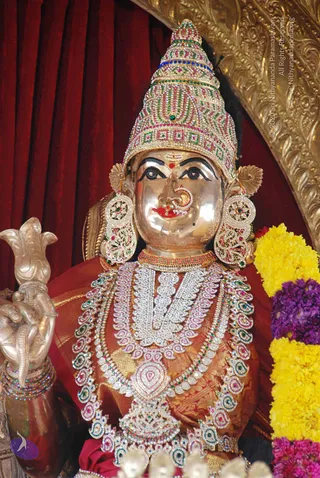
A photograph of two metal murti statues seated side by side against a deep red velvet backdrop framed by an ornate gold arch. The figure on the left wears an orange and red turban, a gold and gemstone crown ornament, rudraksha mala beads and layered necklaces, and holds a golden trident. The figure on the right wears a jewelled conical crown, layered pearl and gemstone necklaces, and a red garment. Both wear yellow and purple flower garlands and gold earrings. Their hands are raised in blessing gestures, and a golden shield-like plate sits in the foreground.A close-up photograph of a black stone statue of a sage wearing an orange and maroon striped turban and an orange robe, with a red tilak dot on the forehead and a rudraksha mala with gold beads hanging down the chest. Thick garlands of red roses and yellow marigolds drape over both shoulders. Green leaves blur in the background. The statue is a carved murti, not a living person, and it is shown on a stone-carved pedestal in an outdoor setting.Close-up of a gilded metal deity murti. Heavy layered necklaces, large drop earrings and bangles in white, green and red stones cover the figure, which is dressed in a red and gold sari. Yellow and purple marigold garlands hang at the right edge, with a red velvet curtain and ornate gold arch behind. The murti's raised hand holds a stem-like object. No living person is visible in the frame.Two gilded metal deity murtis stand side by side under an ornate gold arch against a red velvet backdrop. The figure on the left wears an orange turban, a green and gold sash, a rudraksha-style bead mala and layered ceremonial jewellery, and holds a trident. The figure on the right wears a jewelled conical crown, a red garment and a white and silver necklace, with garlands of yellow, purple and red flowers draped on both. Brass and jewelled ritual items sit in the foreground. No physical people are visible.A close photograph of a metallic deity murti with a polished copper-gold face, red lips and painted dark eyes. It wears a bright orange turban with green and gold border, a jewelled crown with green and red stones, layered jewelled necklaces, dark brown rudraksha-style mala beads with gold spacers, and a green and gold shawl. Its raised hand is covered in white beadwork with green and red stones, and a gold staff or weapon is visible at the left edge against red drapery.A black stone statue of a multi-armed deity stands under a silver-coloured arch, surrounded by green foliage. The figure wears an orange and maroon striped cloth wrapped around the body and an orange-maroon head cloth, with a red bindi on the forehead and a long rudraksha mala hanging to the waist. Garlands of yellow marigolds and red roses drape over both shoulders. Its hands hold a trident-like staff, a flame-shaped object, and a small serpent is coiled near one upper hand. Carved relief figures decorate the rocky base. This is a statue, not a living person, and no photographed person is visible.

07-Yoga-Sutras
16 photosSource gallery
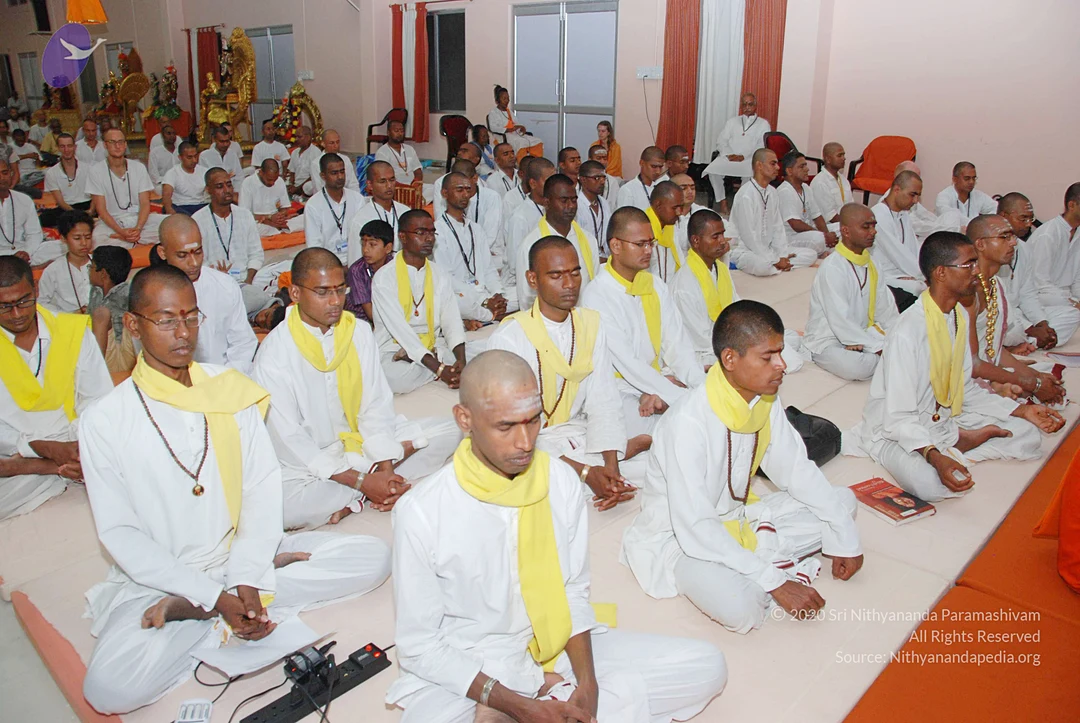
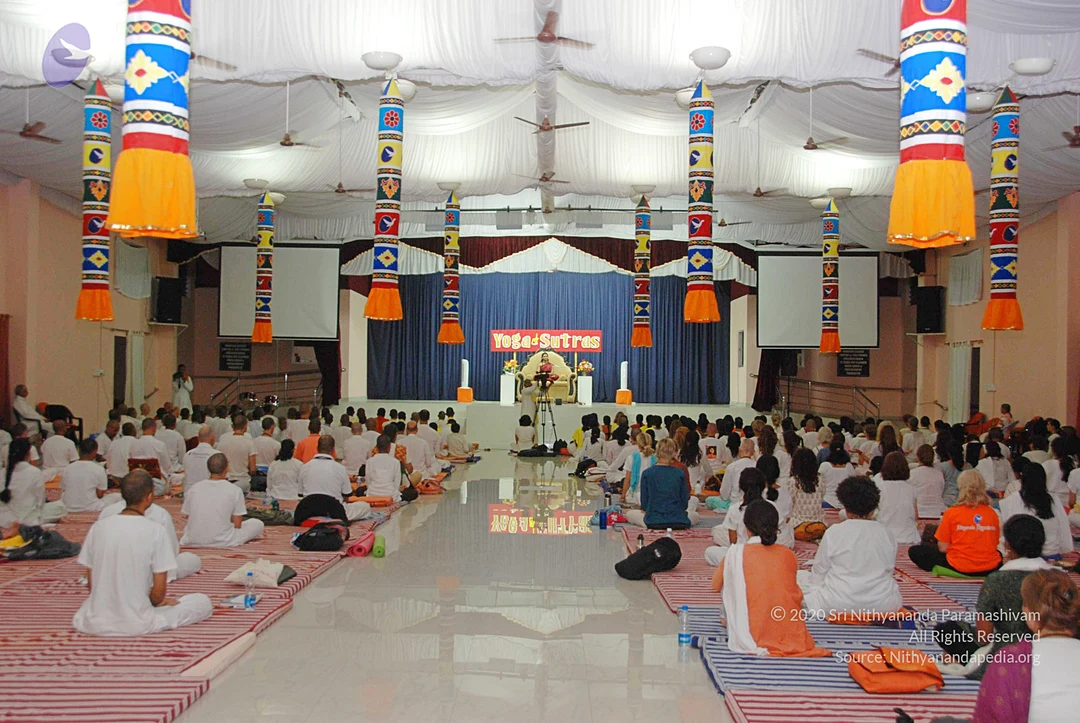
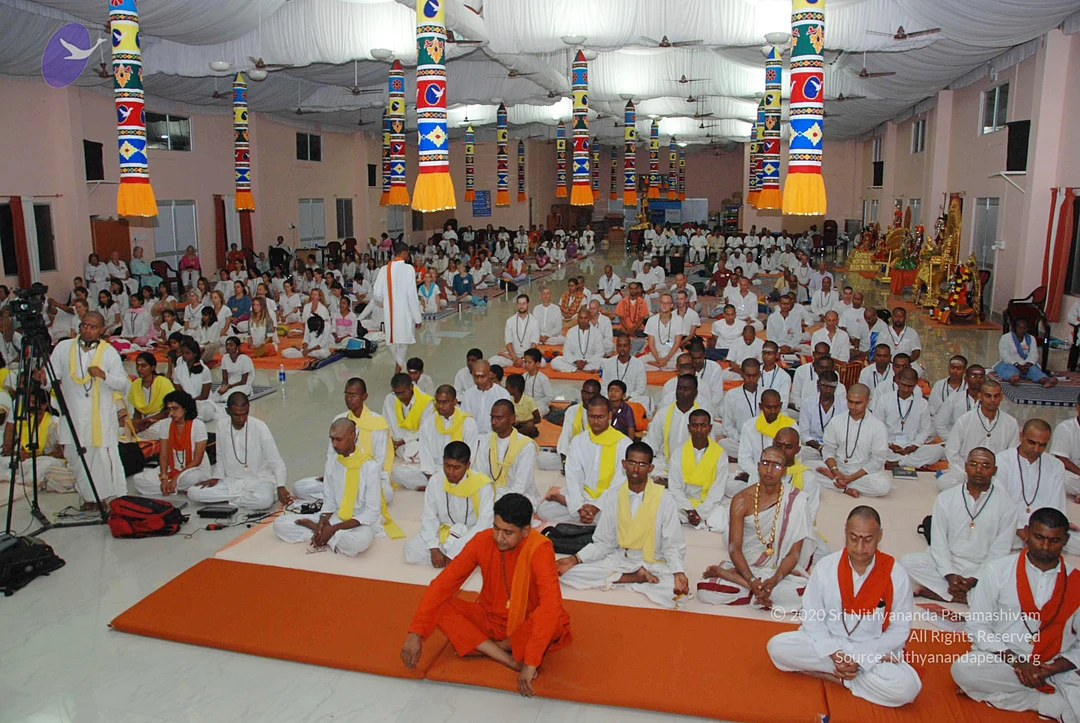
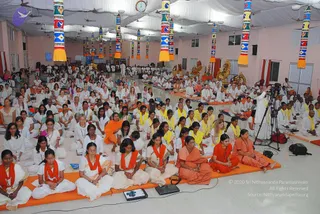
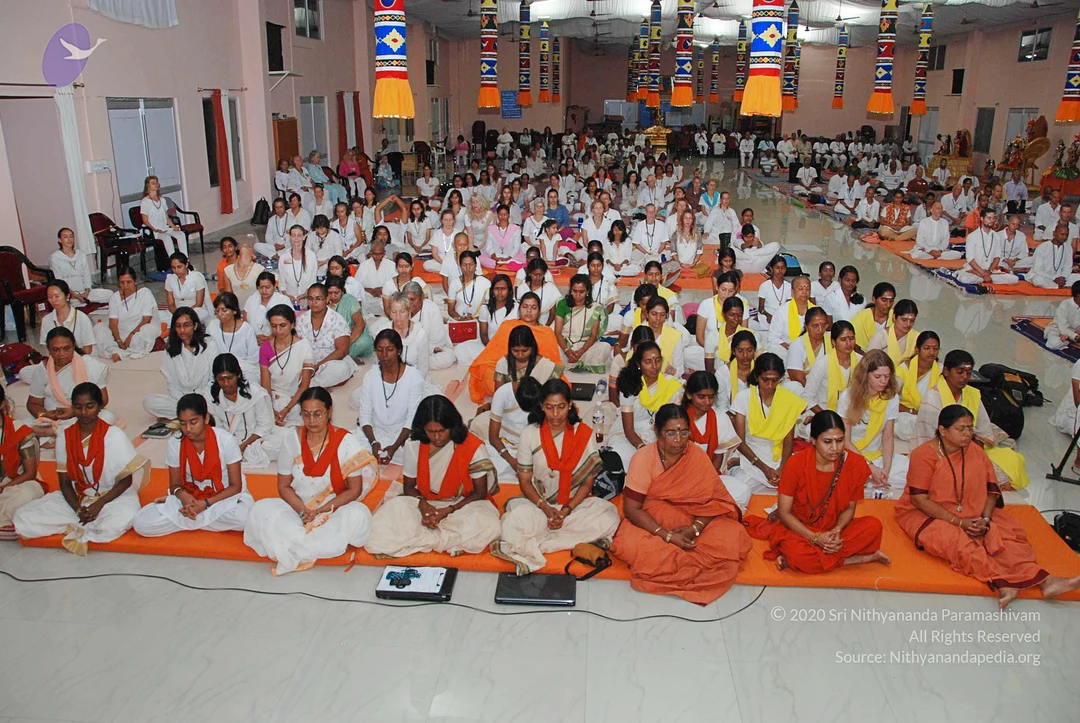
A large hall with white draped ceiling and colourful hanging banners in red, blue and yellow. Many devotees sit cross-legged on orange and white mats in rows, most in white clothes with red or yellow shawls and rudraksha malas. Several in front wear orange or saffron robes and red shawls, and a man in white stands at the left edge near a microphone stand. At the right, a shrine holds a deity murti decorated with flowers and a garland. A portion of the audience is visible seated on chairs at the right. Many participants appear to be meditating with eyes closed.Close-up photograph of a smiling man with long, swept-back black hair, white tripod-style sacred markings on the forehead and a red bindi, wearing a red draped shawl with gold border and a long strand of rudraksha beads. He is speaking beside a black gooseneck microphone, with a red and gold banner behind him. Appearance-based a person cues: long swept-back hair, rudraksha mala and ornate red and gold draping, seen as a speaker at a discourse.A photograph of a large seated meditation gathering in a bright hall with pink walls and orange floor mats. In the foreground, rows of men in white kurta-style clothing and yellow shawls sit cross-legged with eyes closed and hands resting in their laps; several wear rudraksha malas and wire-rimmed glasses. Behind them, more participants in white sit in rows, and a few wear orange garments. At the back left, a golden throne and decorative gold-and-floral ornaments stand near the wall, and an orange-clad figure sits on the right side of the room. A power strip lies on the floor in the foreground. The scene conveys a silent group meditation session.A large hall filled with seated meditators on orange mats, most dressed in white with orange or yellow shawls and stoles. Colourful cylindrical pillars with striped patterns hang from a white draped ceiling, and the pink walls carry ceiling fans. At the right, a man in white with a yellow stole stands behind a tripod-mounted camera, while a gold ornamental throne and floral decorations stand near the back of the hall. Foreground participants include women in orange and white saris and a few people in orange robes.A man stands barefoot on a low beige step in front of a beige upholstered throne-style armchair with dark carved wooden arms, on a stage. He wears a deep red silk dhoti and wrap with gold trim, multiple rudraksha malas, and a vibhuti mark on his forehead, with long hair tied back. He raises one hand near his face while gesturing with the other. Behind him hangs a red banner reading Yoga Sutras over a dark blue curtain, flanked by flower arrangements in orange and yellow, with a microphone stand at his side. A man in red robes with a shaved or cropped head, identified only by appearance and setting, may be a person, giving a discourse on a stage with a throne and banner.A man seated cross-legged on an ornate cream-upholstered throne with carved black scrollwork, palms pressed together in anjali before a red banner with gold lettering. He wears a red silk shawl draped over one shoulder, a dark rudraksha mala with a central bead, and a white horizontal tilak with a red dot on his forehead. A microphone on a gooseneck stand is in front of him, and flowers are visible at the left edge. Swamiji (probable): long dark hair swept back, a rudraksha mala and red-and-gold ceremonial robes on a throne, presiding over a discourse.

08-E-Kalpataru

8 photosSource gallery
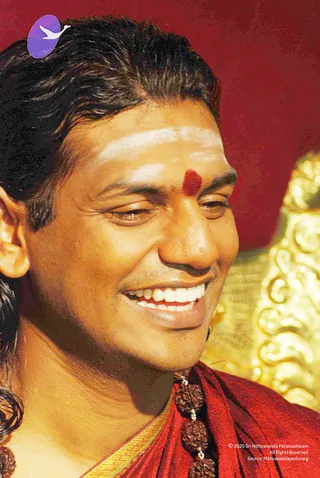
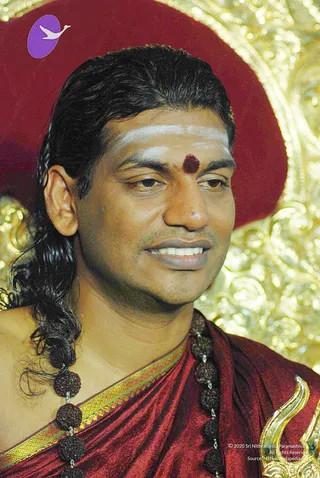
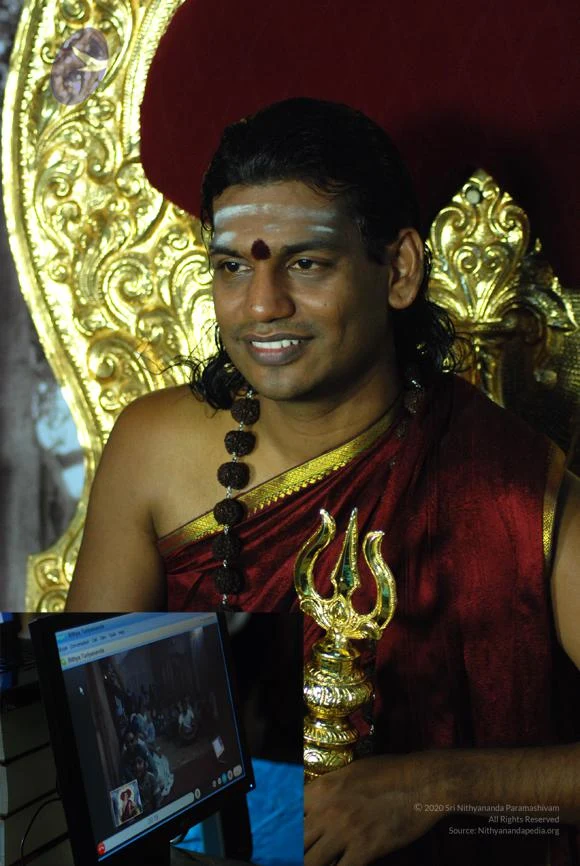
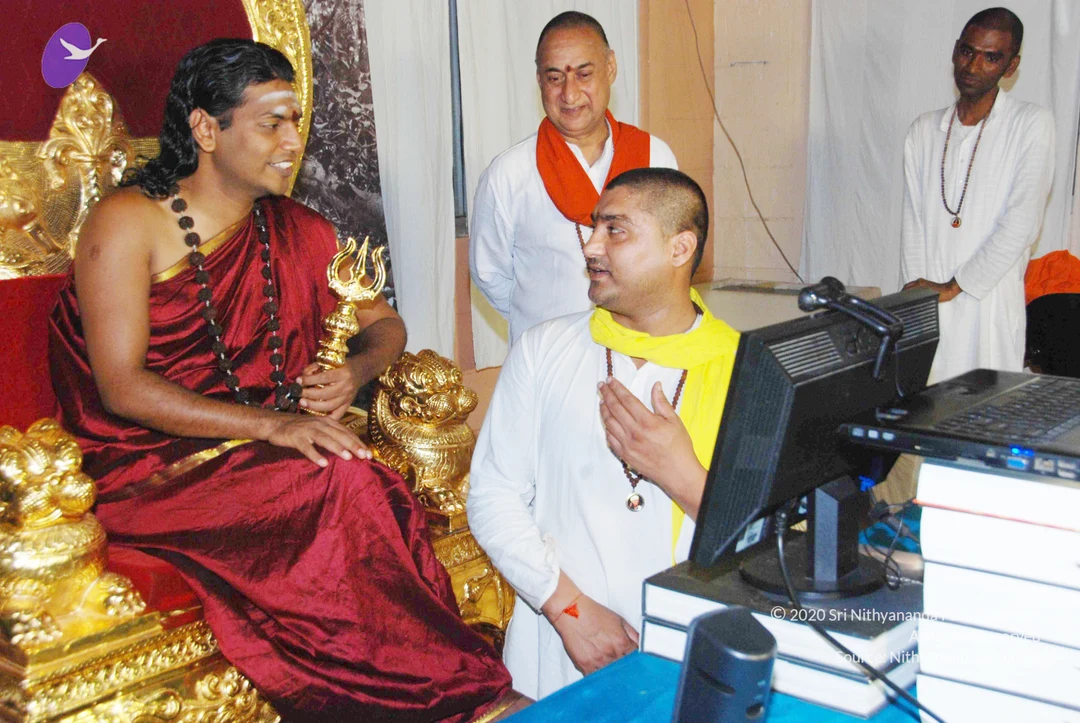
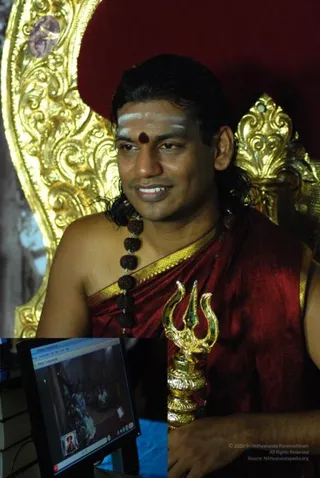
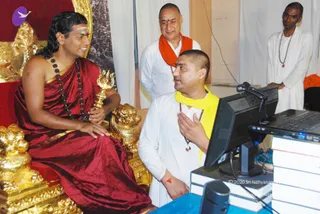
Close-up photograph of a smiling man with swept-back dark hair, white horizontal tilak lines across the forehead and a red kumkum dot at the centre. He wears a red shawl with a gold border and a rudraksha mala of dark seeds hanging at the chest. Gold ornate decorative carving is visible at the right edge against a deep red backdrop. A purple bird logo appears at the top left corner.Close-up photograph of a smiling man with long dark hair swept back, wearing a white horizontal forehead mark and a red dot at the centre of his brow. He wears a deep red shawl with a gold-bordered edge and a long rudraksha mala of dark beads hanging over his shoulder. Behind him a red cushioned backdrop and ornate gold repoussé metalwork are visible. Probable Swamiji by appearance: long swept-back hair, rudraksha mala, red-and-gold ceremonial shawl, seated before a gilded throne-like backdrop.A smiling man with long, swept-back dark hair sits in front of a red velvet backdrop and ornate gold-patterned panel. He wears a deep red shawl with a gold border over bare shoulders, a rudraksha mala with large beads hanging to his chest, and a red bindi with white horizontal forehead markings. A gold ceremonial ornament is visible at the lower right of the shawl. Swamiji (probable) cues: long swept-back hair, rudraksha mala, saffron-red ceremonial clothing and a throne-like seat; he is the sole person and appears to be seated on a throne.Close-up photograph of a smiling man with swept-back shoulder-length dark hair, white horizontal sacred ash stripes across the forehead with a round red kumkum dot, wearing a maroon-red shawl with a gold-and-green border and a long rudraksha mala of brown beads. Behind him is a red cushioned backdrop with gold ornamental carving, and a gold trident-shaped finial is visible at lower right. Appearance-based label: a person, seated in a ceremonial setting, shown in a relaxed portrait.A photograph of an indoor event. On the left, a man seated on an ornate gold-and-red throne wears a maroon draped garment and a long black rudraksha mala, holding a golden trident. Behind a laptop and monitor, a man in white with a yellow shawl and rudraksha mala sits with hands folded in greeting. Two more men stand in the background, one in white with an orange shawl and one in white with a rudraksha mala. A white curtain and a stack of books are visible on the right.Close-up photograph of a smiling man with long dark hair swept back, white horizontal tilak lines across the forehead and a red round bindi mark between the brows. He wears a deep red shawl with a gold zari border and a long strand of dark rudraksha beads around the neck. A red backdrop and blurred gold ornament sit behind him. A purple bird logo appears at the top left. Identity uncertain from appearance alone; role is a devotee-style portrait subject.

09-Ashramite-Meeting

3 photosSource gallery
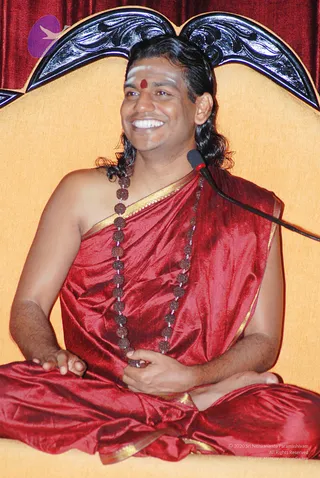
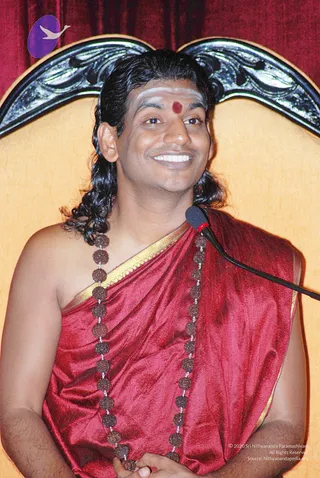
A seated man in a red silk drape with gold-bordered edges sits cross-legged on a golden cushioned throne-like chair before a red velvet curtain. He wears a long rudraksha mala across his chest, has a white horizontal tilak with a red dot on his forehead, and wears his long dark hair swept back. A microphone on a cord is positioned near his shoulder, and he smiles while his hands rest in his lap. The large dark carved wooden crest above the chair frames the scene. Appearance-based label: Swamiji (probable), based on saffron-red robes, rudraksha mala and swept-back long hair; he is shown as a speaker in a seated discourse setting.A man seated in front of an ornate golden-cream chair with a carved dark-silver crest and a deep red velvet backdrop, smiling broadly toward the audience. He has long, swept-back dark hair, a white sandalwood stripe on the forehead with a red kumkum dot at the centre, and wears a deep red silk wrap with a gold border over his bare shoulder. Multiple rudraksha malas hang across his chest. A black microphone stands at his right side, and his hands are folded in his lap. A small purple bird logo appears in the top left corner.A seated man in a red silk-like sannyasi wrap with gold border sits cross-legged on an ornate golden-yellow throne with carved dark wooden arches. He wears a long rudraksha mala, a white tilak with a red dot on his forehead, and has long swept-back dark hair. A microphone on a gooseneck stand is beside him, and deep red velvet drapes hang behind. He smiles and looks to the side with hands resting on his knees, appearing to address an audience. Swamiji (probable): the long swept-back hair, rudraksha mala and red-and-gold sannyasi wrap are the cues.