Skip to content
Saturday

14 August 2010

Baul mystics: 14 Aug 2010 Morning Message by Nithyananda

Dated photos
184
Source pages
1
Media
6
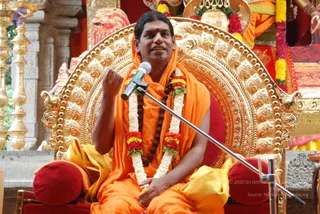
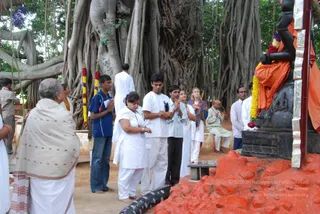
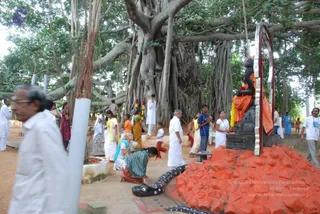
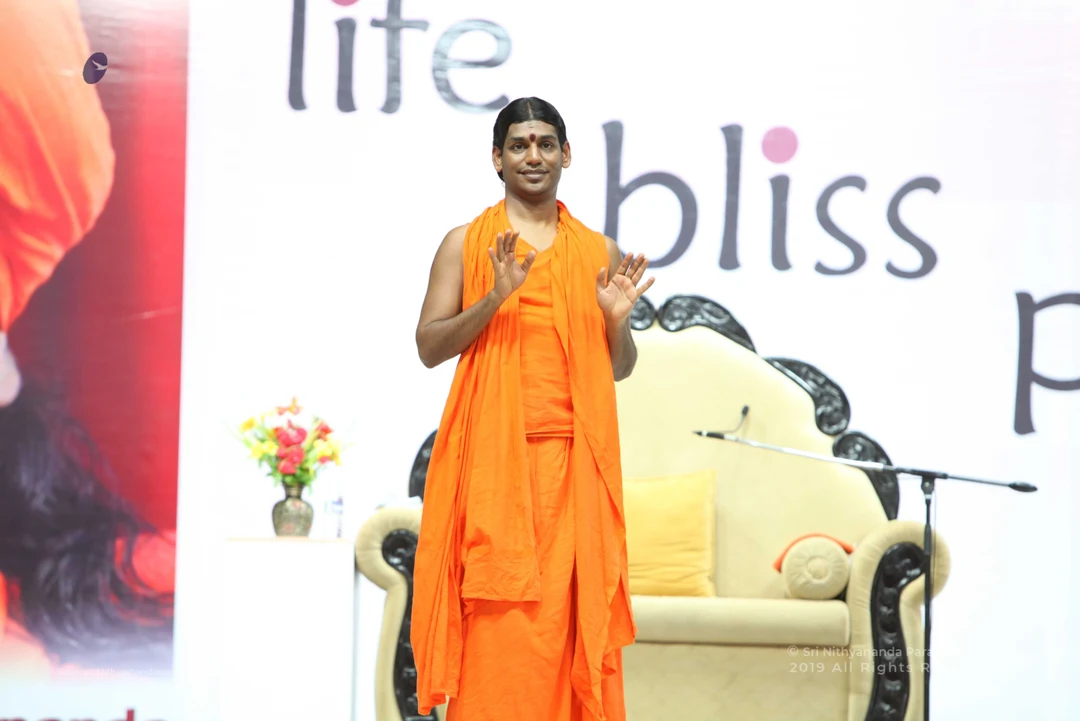
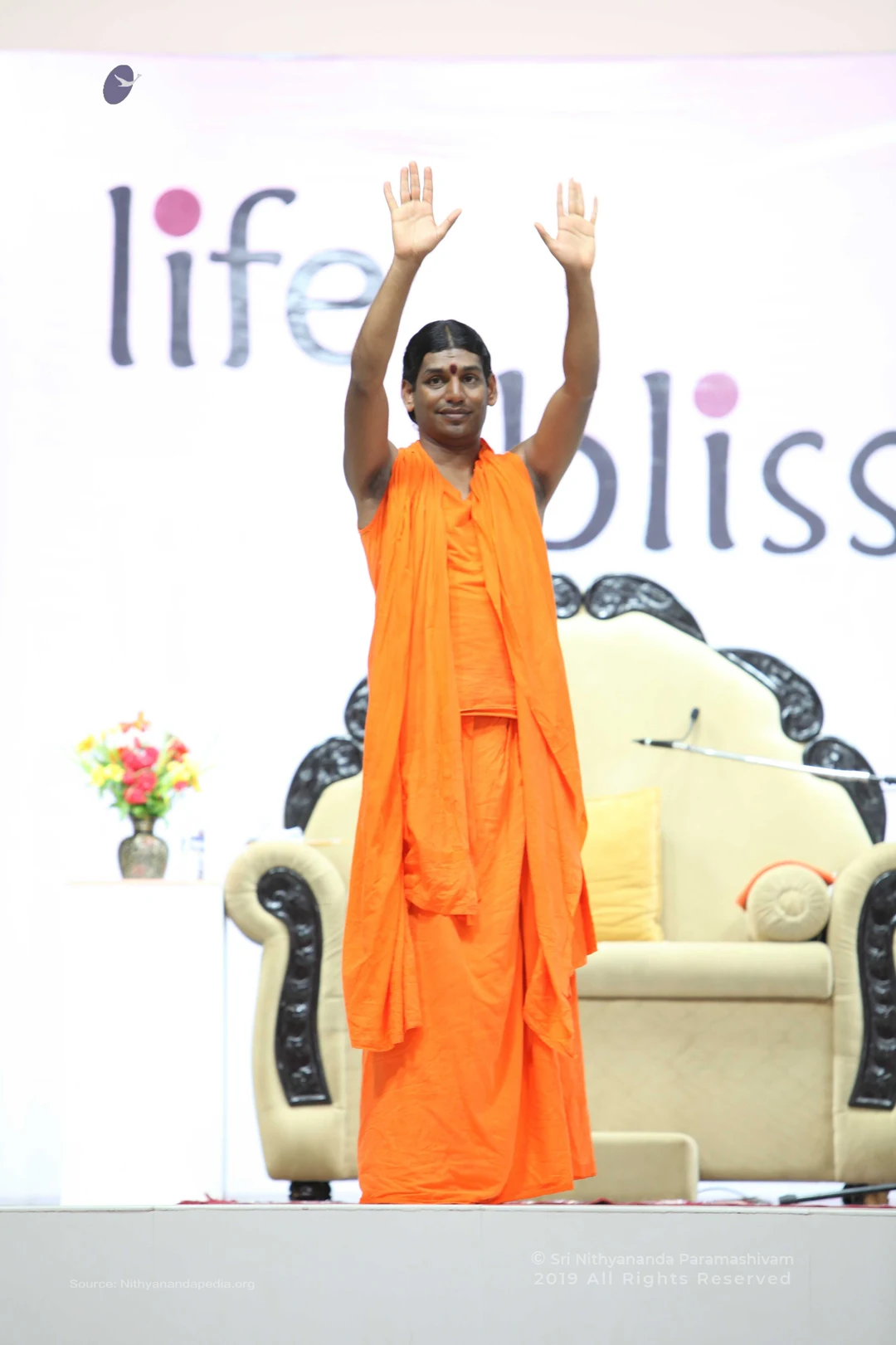
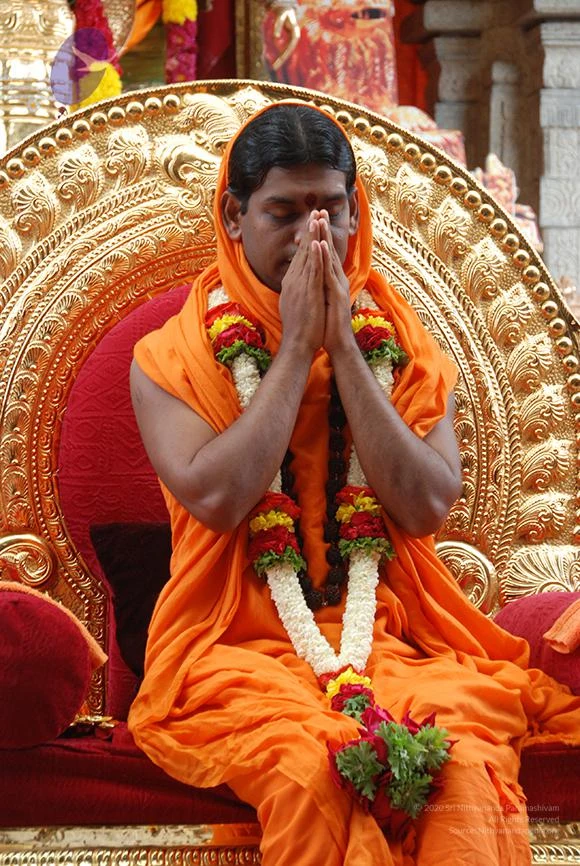
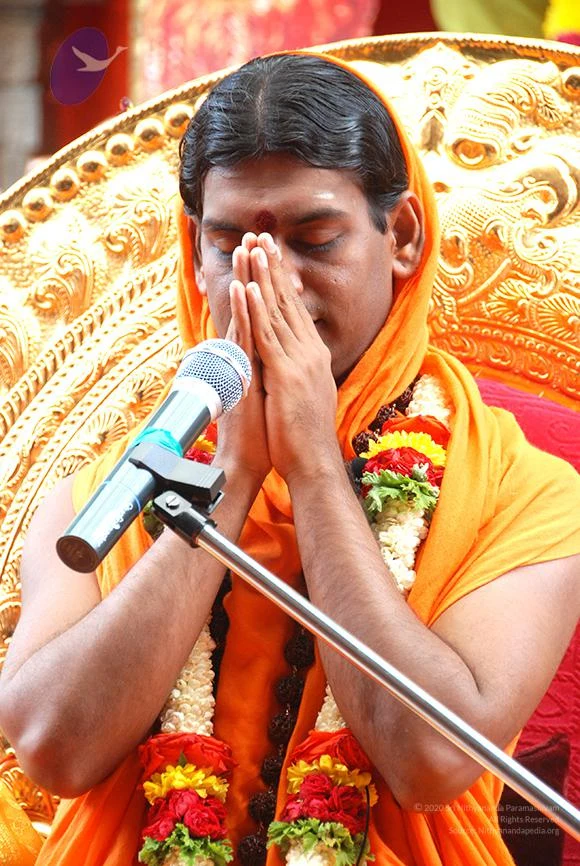
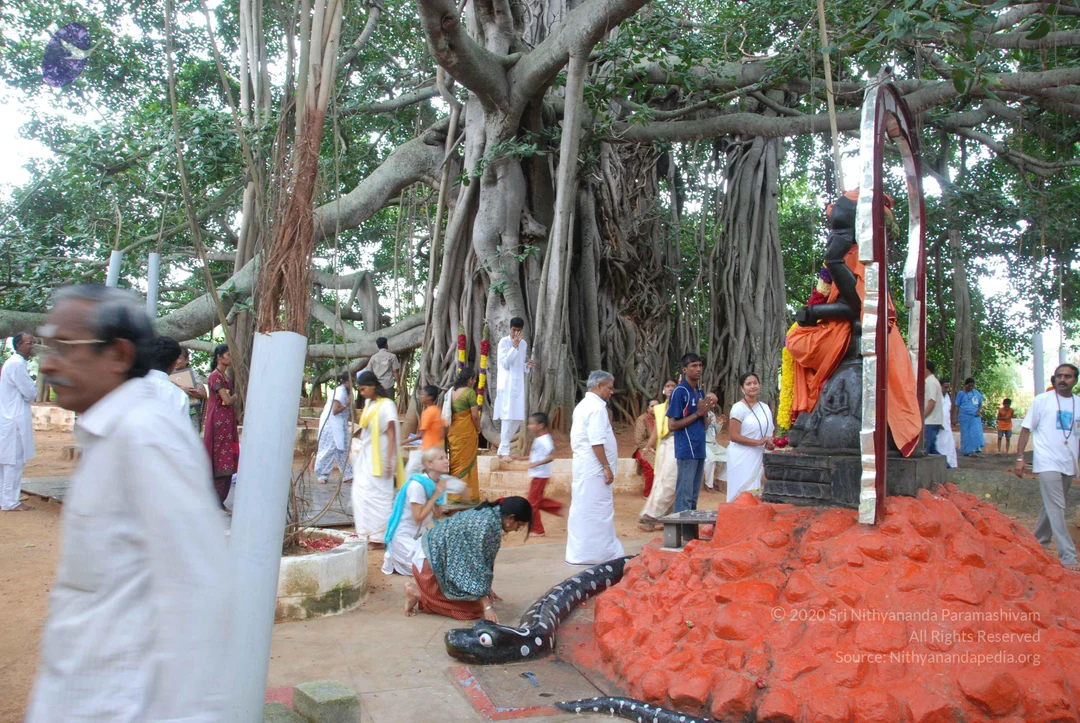
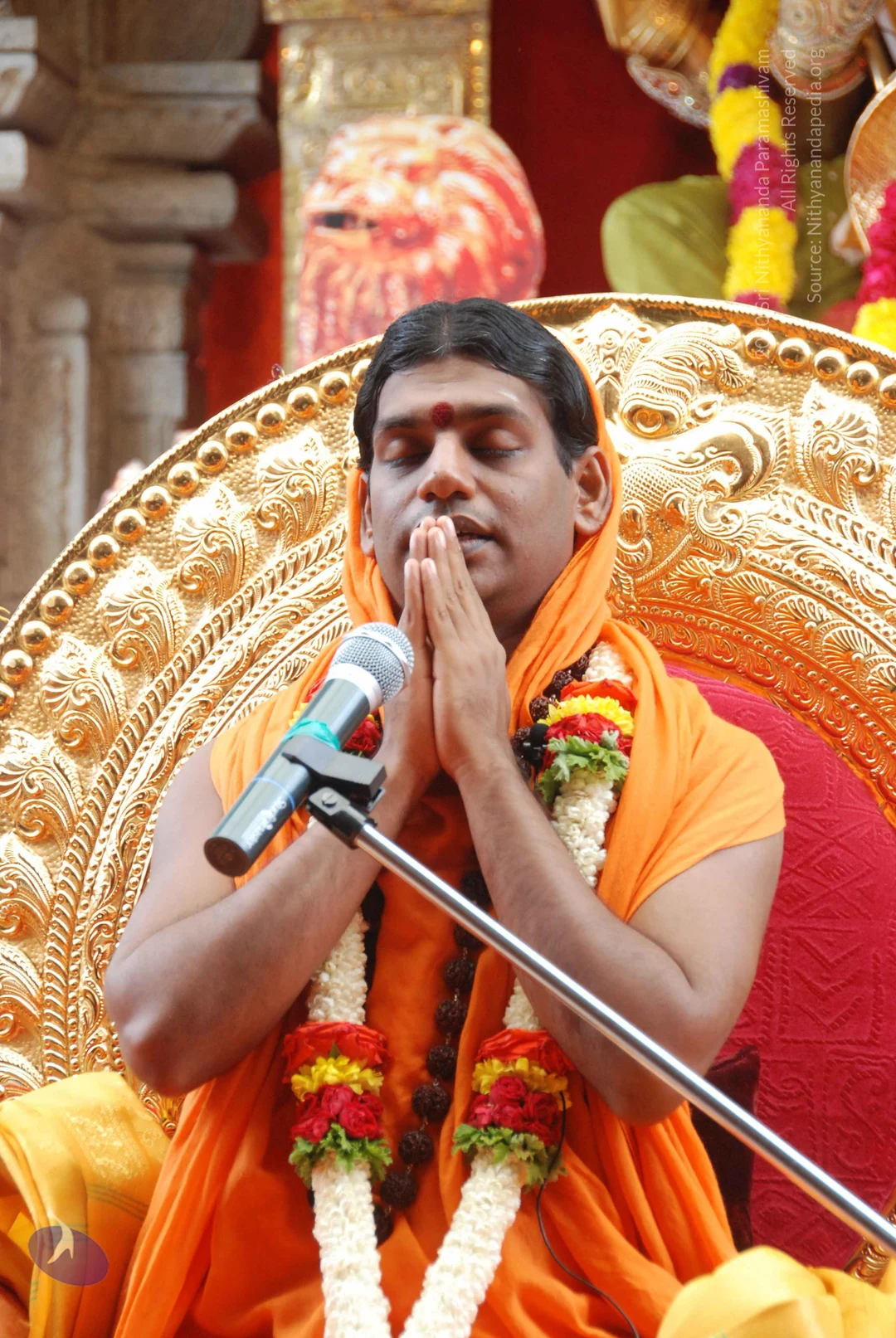
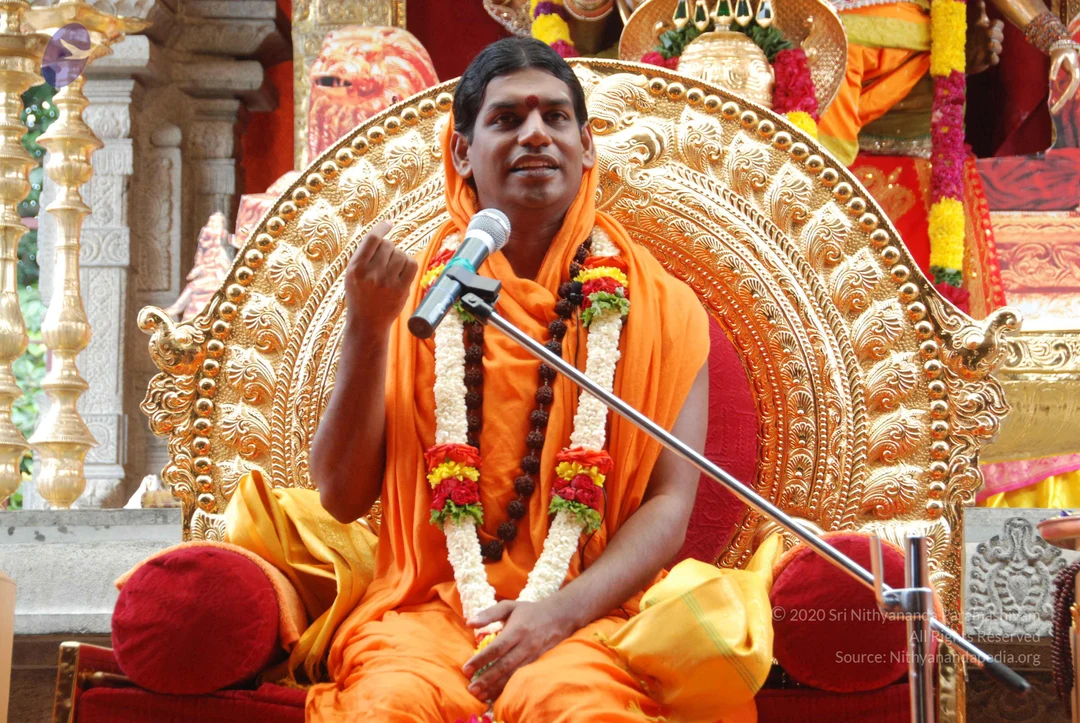
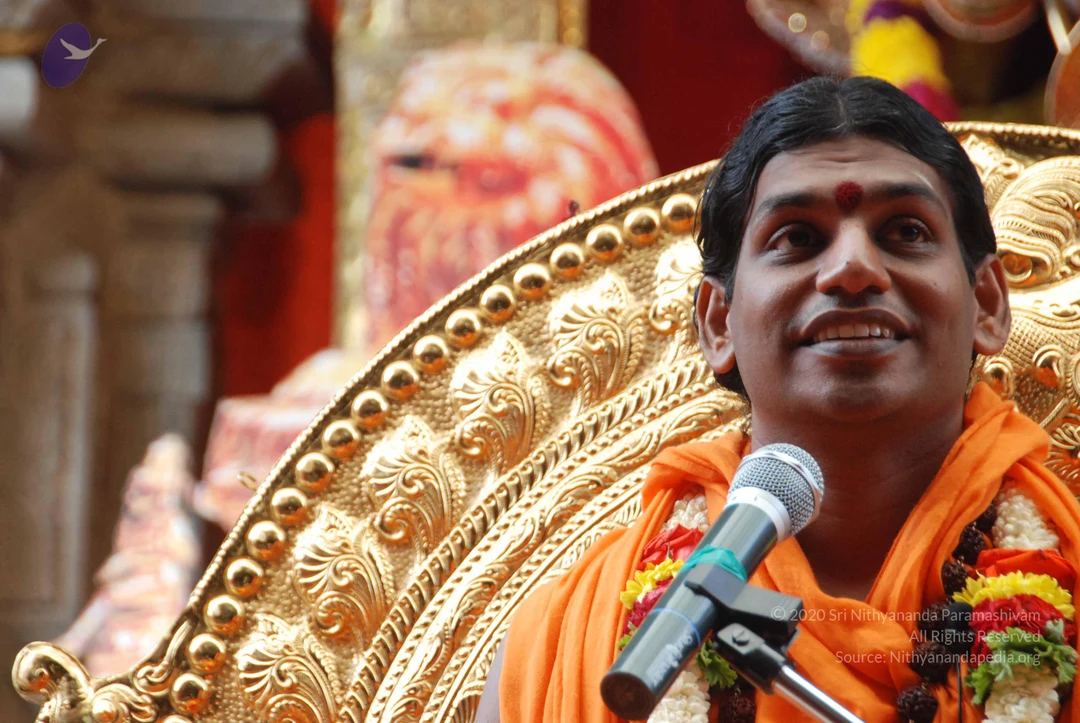
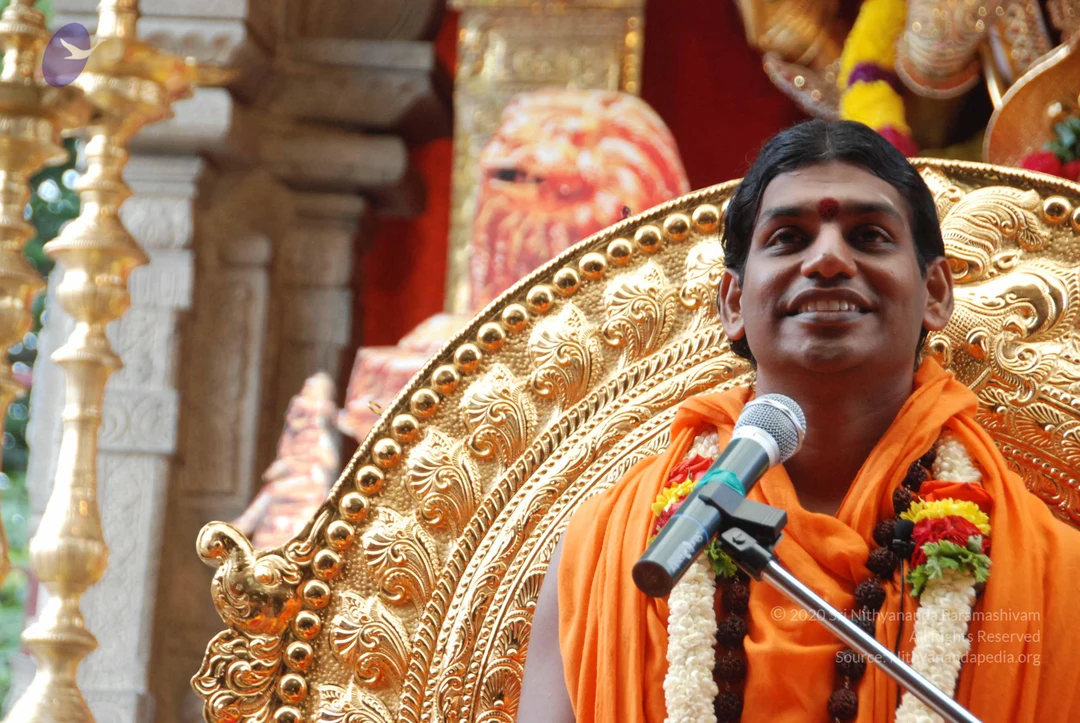
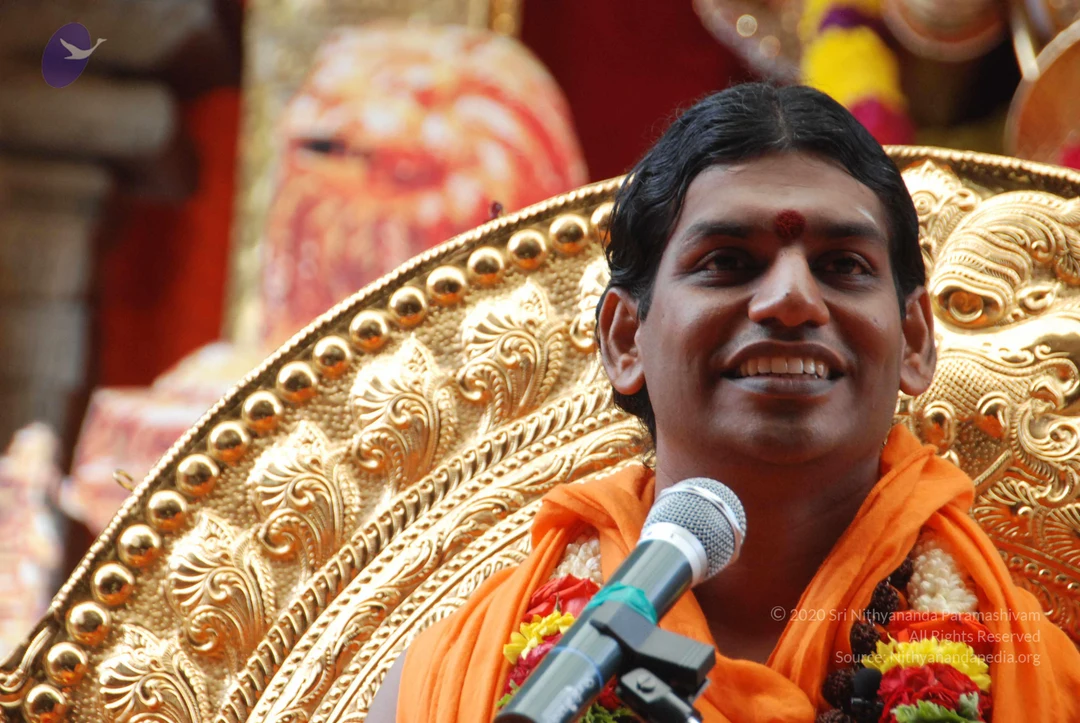
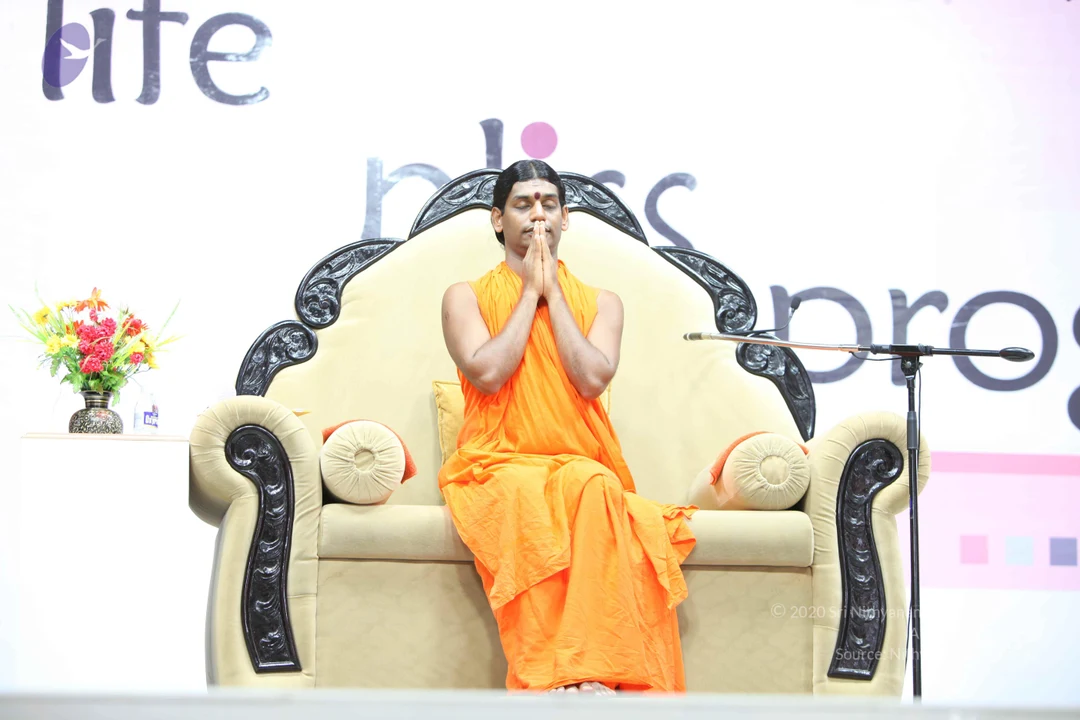
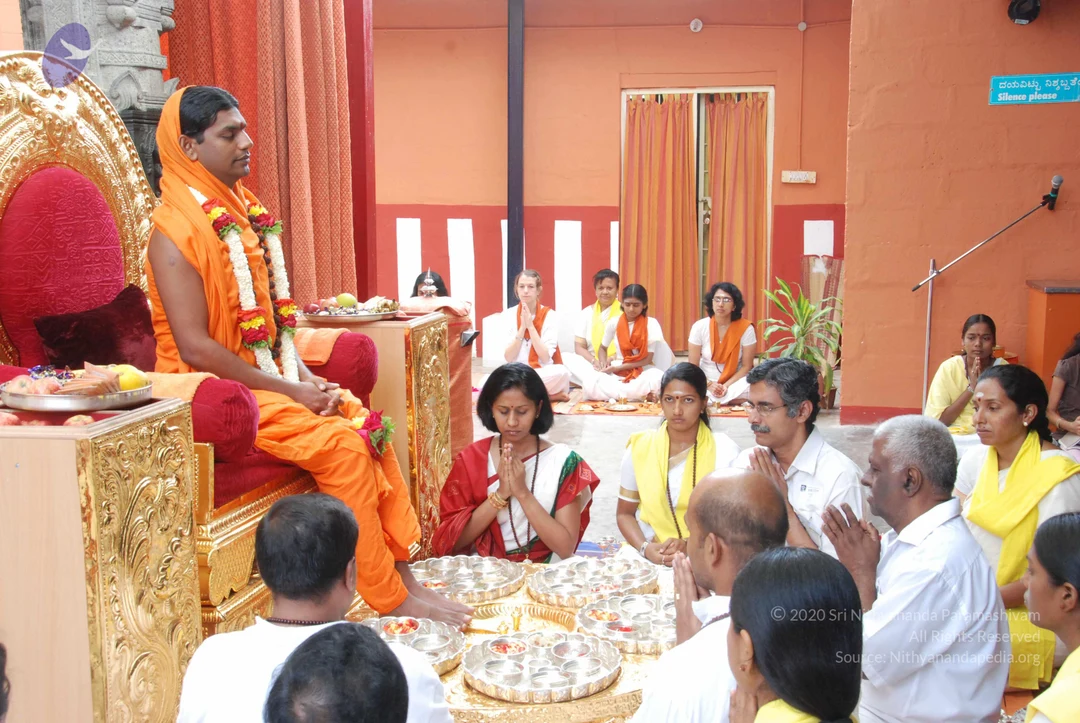
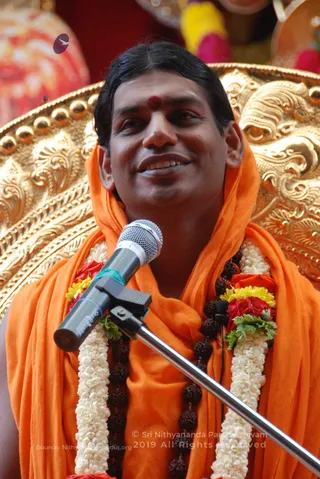
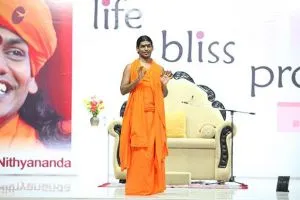
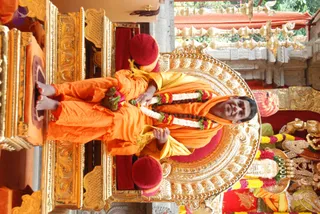
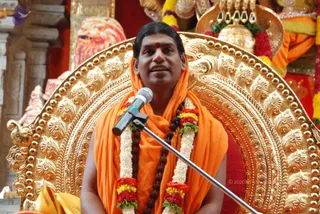
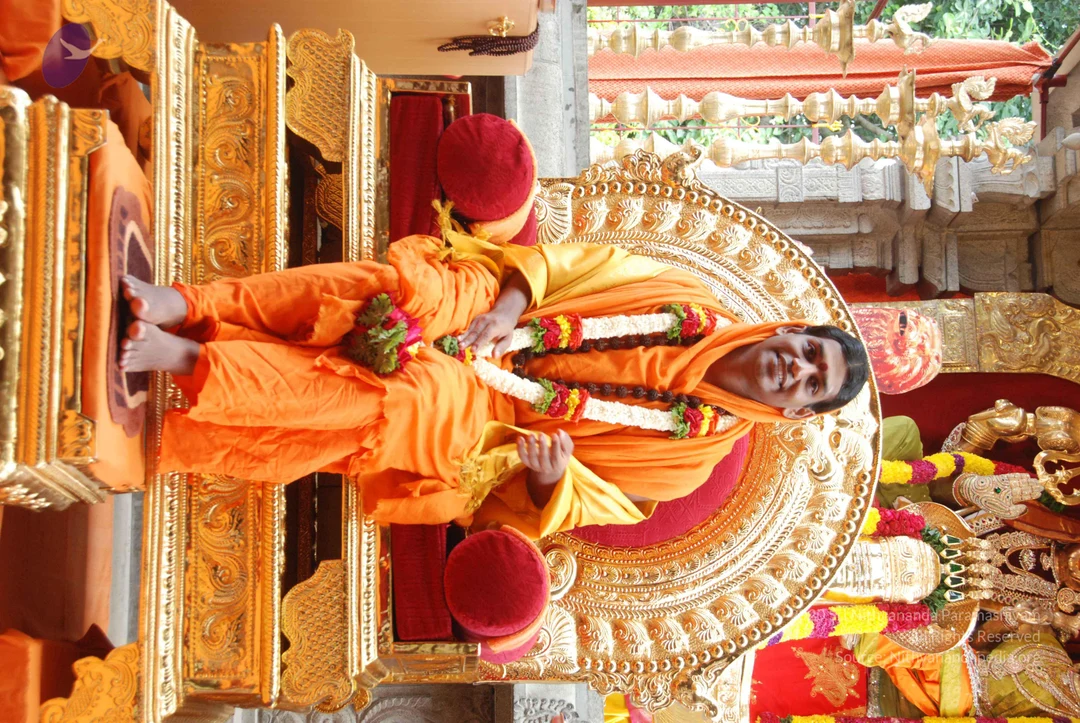
A man sits on an ornate gold throne with carved scrollwork and red cushions, speaking into a handheld microphone on a stand, his raised right hand gesturing. He wears an orange saffron shawl over orange robes, a white and red floral garland with a dark rudraksha mala, and a red vermilion bindi. Behind him stand gold and red decorations, a gold kalasha-style finial and ornate gilded ceremonial items. The setting suggests a live satsang talk on a throne.A photograph of devotees standing with palms pressed together in prayer beneath a large banyan tree with many hanging aerial roots. On the right, a dark stone deity murti wrapped in an orange cloth and garlanded with yellow and red flower strands stands on a red-painted base. Several people in white clothes stand in the foreground, including a woman in white with a grey-haired older woman in a white shawl with red border on the left, a man in a white shirt, and a man in a blue sports top. A bald man in a light green robe sits on a bench near the deity, and a woman with light hair stands in a patterned top among the group.Outdoor photo beneath a large banyan tree with thick aerial roots and hanging vines. In the foreground a blurred elderly man in white shirt and glasses walks past. Several devotees in white dhotis and saris stand and walk around a shrine: a black stone deity murti draped in orange cloth with garlands stands beside a black stone snake sculpture coiled over a mound painted bright red-orange. A woman in a blue-green sari kneels at the snake sculpture while a woman in white stands near the mound with hands joined. A man in a blue shirt and a man in a white shirt stand nearby, and a small child in red walks by. Red-orange paint covers a stone platform, and a white pillar stands at left.

August 14 2010

Original wiki page
Contents

Title

Baul mystics: 14 Aug 2010 Morning Message by Nithyananda

Narration

The Supreme Pontiff of Hinduism, Jagatguru Mahasannidhanam, His Divine Holiness, Bhagavan Nithyananda Paramashivam, expounded on the Cosmic Principles of Vedic Tradition Has Many Living Stream Of Enlightened Masters during a live public talk - Nithyananda Satsang. In this talk entitled Baul Mystics, The Supreme Pontiff of Hinduism expounded on the unbroken lineage of living Enlightened Masters which are Vedanta, Agori, Tantra and Bauls. He shared that the Baul Mystics are not well known because they do not have property nor are they centered in one place. The Baul tradition is such a joyful species that has a pure love towards everything that exists. Whatever exists they flood it with love. His Divine Holiness explained that the whole theme of the Bauls attending Kumbha Mela is saying NO to social hypocrisy. He shared that Bauls are literally like butterflies that happen, fly, spread colors, and just disappear; nothing else.

Video and Audio

Baul mystics: 14 Aug 2010 Morning Message by Nithyananda

VideoAudio

Transcript

(00:08)

Sadāshiva samārambhām Shankarāchārya madhyamām | asmat āchārya paryantām vande guru paramparām ||

(00:40)

I welcome you all with My love and respects. Today, I’ll try to share one truth from the tradition of Baul Mystics. Vedic tradition has many living stream of Enlightened Masters, and many streams have dried. The streams which have living Enlightened Masters, unbroken lineage of living enlightened masters are Vedanta, Aghori, Tantra and Bauls. The Baul Mystics, even though not well known as a mainstream traditions, just because of their habit of not having property; they are not centered in one place. That is the only reason they are not well known, otherwise they have all the qualifications to be respected as living stream of Enlightened Masters. But the Bauls has a strong feeling, the moment you start staying in one place the corruption starts happening. I do agree with it. Organization is forcing some time, unconscious people to dilute the truth. In a way I can say, unconscious people will dilute even if there is no organization. That’s the reason I accepted the organization. Even otherwise these guys are going to dilute; but organization some way helps. But the Bauls are such pure uncompromising tradition, they don’t compromise even in one step of - having an organization or having a permanent place to stay. I had the fortune of staying little time in Bengal and fortune of getting associated with some of the Baul sanyasis. Of course the Baul sanyasis are not celebates or unmarried. They live like a breeze. Travel place to place, sometime alone, sometime together. They sing so beautifully. Each Baul can at least sing two to three thousand verses. Sometime the predecessors, the early masters verses, or sometime their own spontaneous compositions. But the main theme which runs through the Baul tradition is the pure love toward everything that exists - to the river, hill, sun, moon, plants, trees, animals and to themself. Whatever exists they flood it with love. That is why they are not socially accepted; because they are such joyful species. I can say, Bauls and Tantrics are actually different species altogether. One of the most endangered species on planet earth. They are altogether different species. It’s a different life.

(05:29)

The very word Baul means paagal. It’s a Bengali word - paagal means ‘mad’. If somebody else calls you mad, there is every possibility you may get hurt. If you yourself declare I am ‘mad’, you are liberated, it’s a great liberation from the social image. One of their main core message, almost like a mahavakya they transmit to the disciples is - ‘break free from the social hypocrisy’. The unconsciousness being carried from generation to generation and transmitted to you unconsciously without knowing why, what - without having any reason. Your forefathers have transmitted to your grandfathers. Your grandfathers have transmitted to your fathers and your father transmits to you. It’s like a unnecessary social hypocrisy which keeps you away from enlightenment.

(06:54)

Each tradition has mahavakya. Vedanta has a mahavakya - means the ultimate truth, the ultimate word. Tantrics - they have their mahavakya. Aghoris - they have their own mahavakya. Zen Masters - they have their own mahavakya. The mahavakya of Bauls is - “Say capital letter, NO to society and social hypocrisy. Constantly, a kind of a unconscious lifestyle, unnecessary lifestyle is made into a legitimate living tradition, trend and forced on human beings in the name of social etiquette or social trend, social traditions. Please understand, almost all sufferings caused to human beings are neither because of cosmic law nor because of country law. It is because of social hypocrisy. When the social hypocrisy becomes part of you or forced to become part of you the suffering becomes inevitable. Losing enlightenment becomes inevitable.

(09:05)

The Bauls, Bauls are the ultimate beings, from My experience; of course I never had chance to live with thousands of Zen mystics and masters, I had the fortune of meeting one or two like Thích Nhat Hanh, Dalai Lama, few Zen masters and Buddhist Masters, one from Japan, very few. Never saw bunch or thousands living, giving life to the tradition and having life from that tradition. Any tradition can be called as living tradition only if it can give life to you, when you give life to it. When you give life to it, that should give life to you. Only then can it be called as living tradition.

(10:06)

But I have seen Bauls in I can say lakhs. Every year the Bauls will have their own Kumbha Mela in Calcutta. Just like Vedantis have Kumbha Mela in Allahabad and Haridwar, Nasik and Ujjaini, Bauls have their own Kumbha Mela. I’ll sincerely suggest at least all My disciples should make pilgrimage to the Bauls Kumbha Mela. Every year they gather, if you Google you will find out their date in Calcutta. They don’t have big organization structure; only some few people maintain this website and all that. Almost all Baul Mystics gather. None of them are well known to society because they live such a beautiful life, such an innocent life, society cannot tolerate them. The unconsciousness cannot tolerate them. So they don’t recognize the Baul mystics. They are not mainstream people but I can say, that’s the most powerful congregation I have ever seen in My experience.

(11:35)

There is a beautiful book called ‘Nine Lives’. The other day I was reading; maybe after five, six years some book made Me cry, or tears were bought to My eyes. That book is an amazing book. The author has picked up nine individuals from the villages of India, different parts of India. So beautifully he describes, so authentically he describes. In that nine lives, one was a Baul Mystic. I know for sure based on the description, the person about whom the author is talking is an Enlightened Being. The way he lives... in that they describe very beautifully about that - Bauls Kumbha Mela, the gathering. The whole theme of the Bauls and their Kumbha Mela is only one line, ‘Saying capital letter NO to social hypocrisy’. The so-called, the ideas - the social - whatever you can’t live, start forcing on others and call or claim that as morality - the social hypocrisy.

(13:28)

Even during this scandal I was surprised who all have started teaching morality to me! Rowdies! Thugs! Media Mafias - who run some media either print or electronic just to hide all their anti-social activities! The fellows who have hundreds of criminal cases against them in all possible courts of India - how these kind of idiots have started teaching morality to Me? This is what I call the peak of stupidity; peak of social hypocrisy. Hmm.

(14:25)

Anyhow, the Bauls are amazing people who really live with backbone. Sometime, even Vedantis in the name of compassion bend their backbone. But here are Mystics - never, never, never bend their backbone. If at all I have a fantasy, that is to live as a Baul. Baul, being a Baul is the fantasy to be cherished by every human being or every being happened on the planet earth. Much, much more than Zen; because even the Zen tradition has missed one point - not to have a permanent place to stay. There are only two traditions still maintain that; Aghoris and Bauls. Aghoris don’t have permanent resident address, but they have monasteries where nobody stays, Aghoris can go and stay and go somewhere else. But Bauls have not even compromised to that level; just unimaginable life. Bauls are literally like butterflies. They happen, fly, spread colors, just disappear; nothing else. The only truth the Bauls radiate, ‘Say No to all the social hypocrisy’ Sit today and you must be having thousands of social hypocrisy inside you now. Pick up only one, just one. Say NO to it. You got My message for today. Thank You. (16:42)

Title

Nithyananda in Spanish - Freedom

Narration

In this discourse in Spanish, Paramahamsa Nithyananda speaks on Freedom.

Video and Audio

Nithyananda In Spanish - Freedom

VideoAudio

Title

14 Aug 2010 News from Nithyananda World Family

Video and Audio

14 Aug 2010 News From Nithyananda World Family

VideoAudio

Photos

Photos Of The Day:

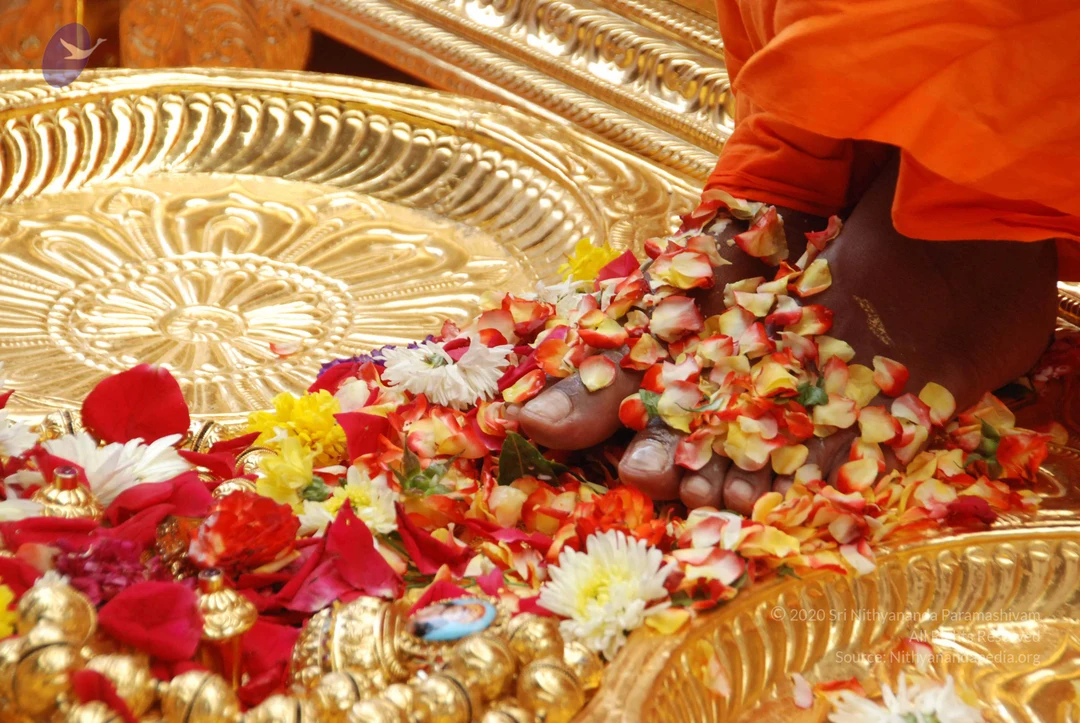
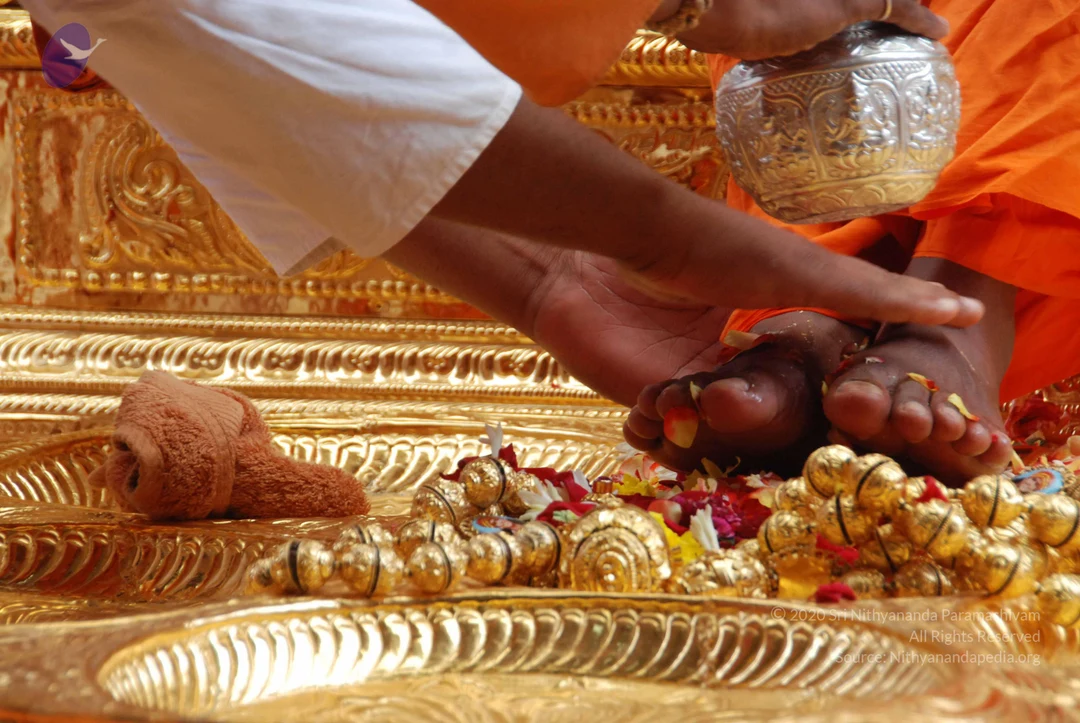
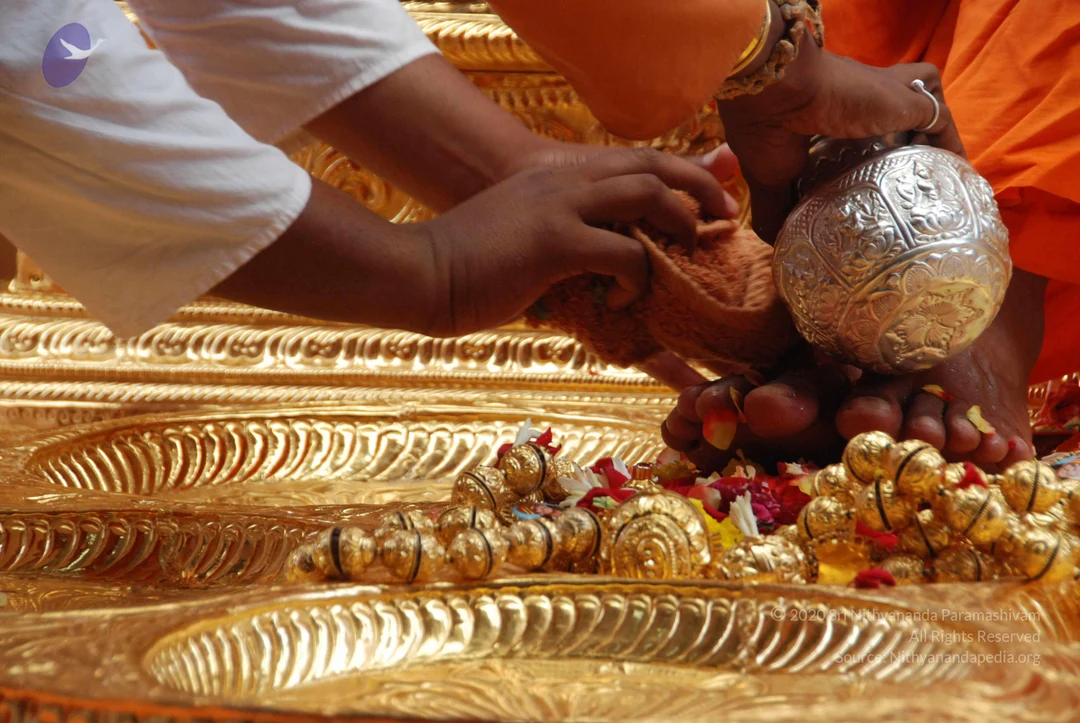
Paadapuja
panchatapas
1-Banyan-Tree
2-Morning-Message
3-NSP

4-Pada-Puja

5-Pancha-Tapas

6-Sarva-Darshan

Photos from this day

View all 184 photos

Photos

3 photosSource gallery
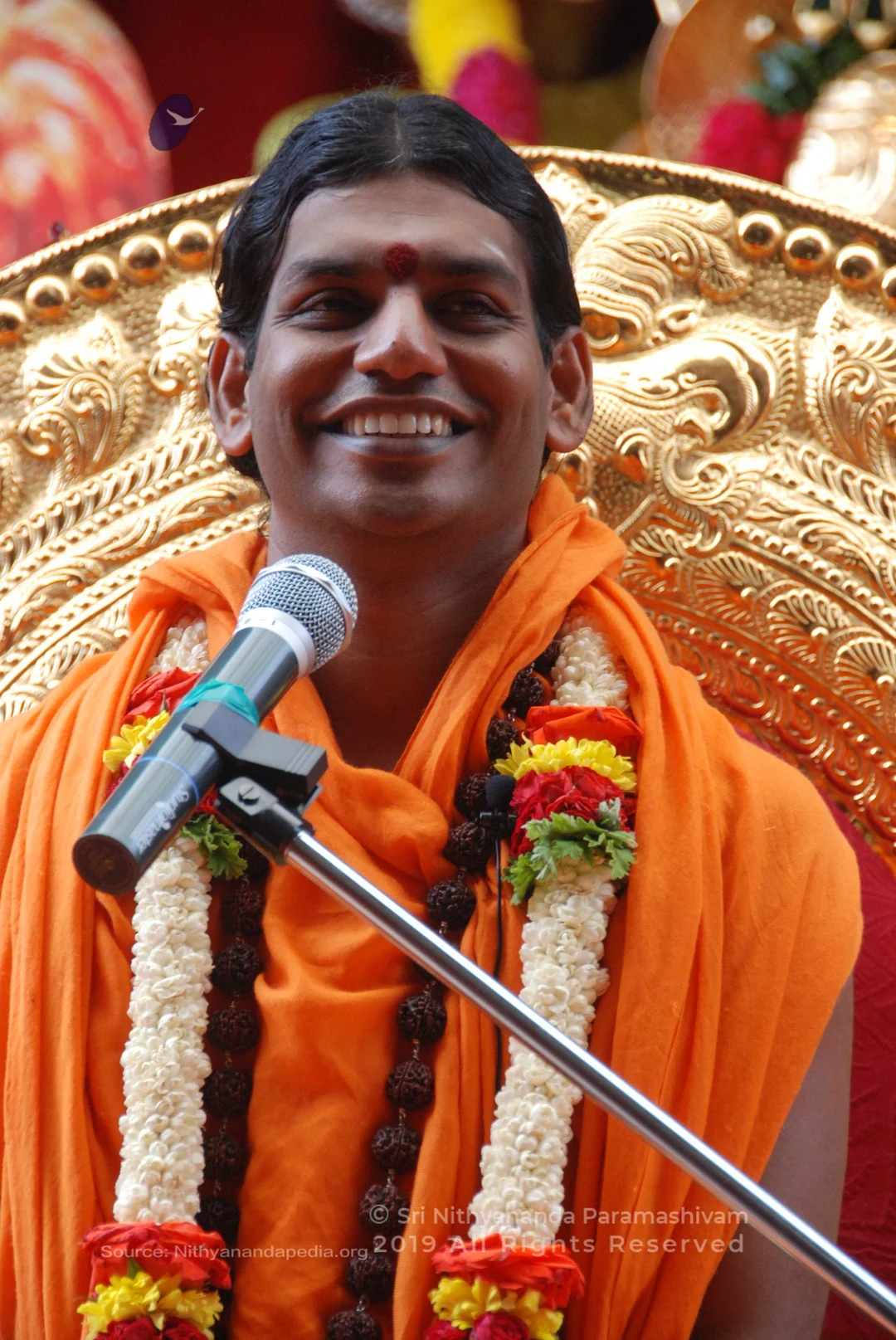
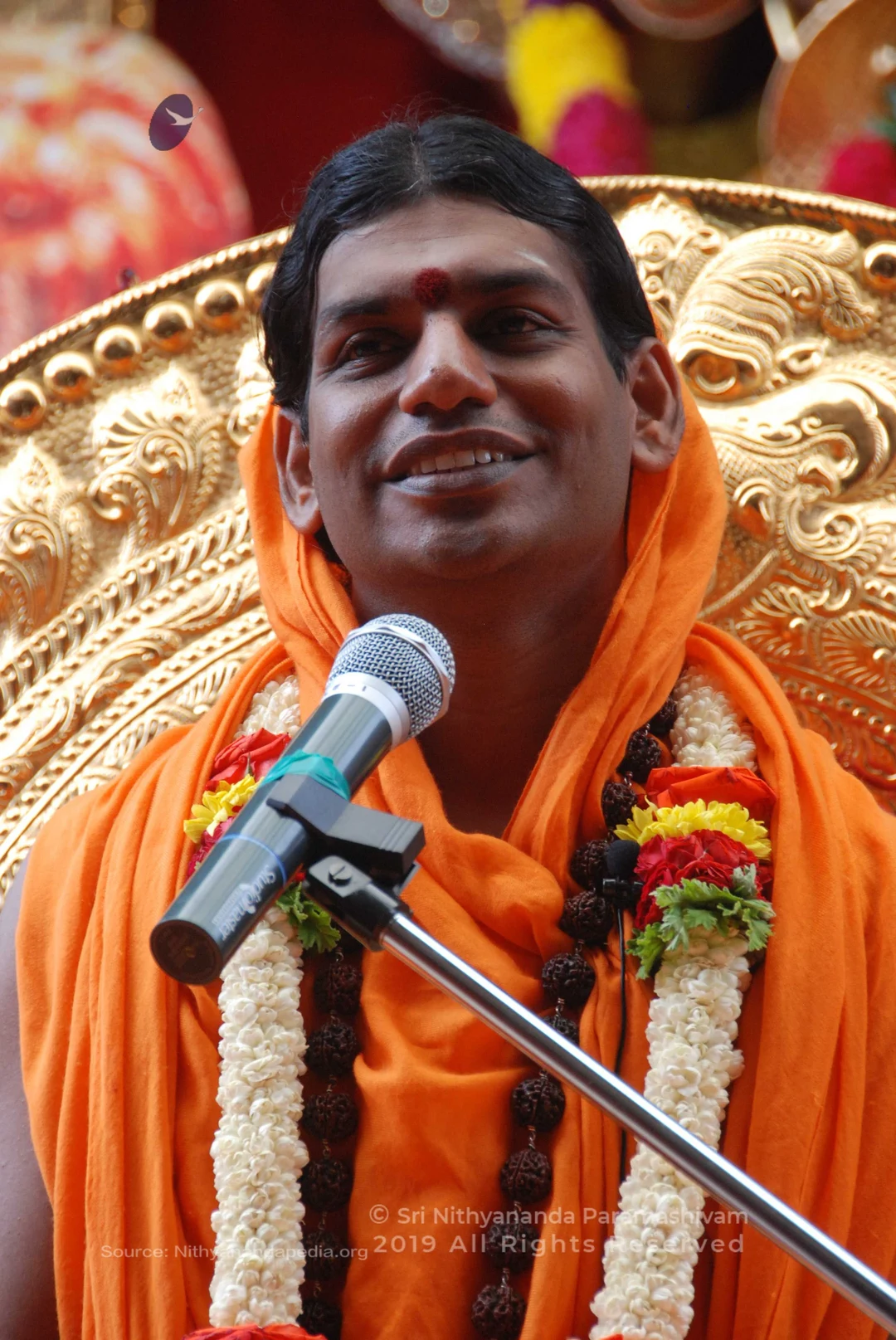
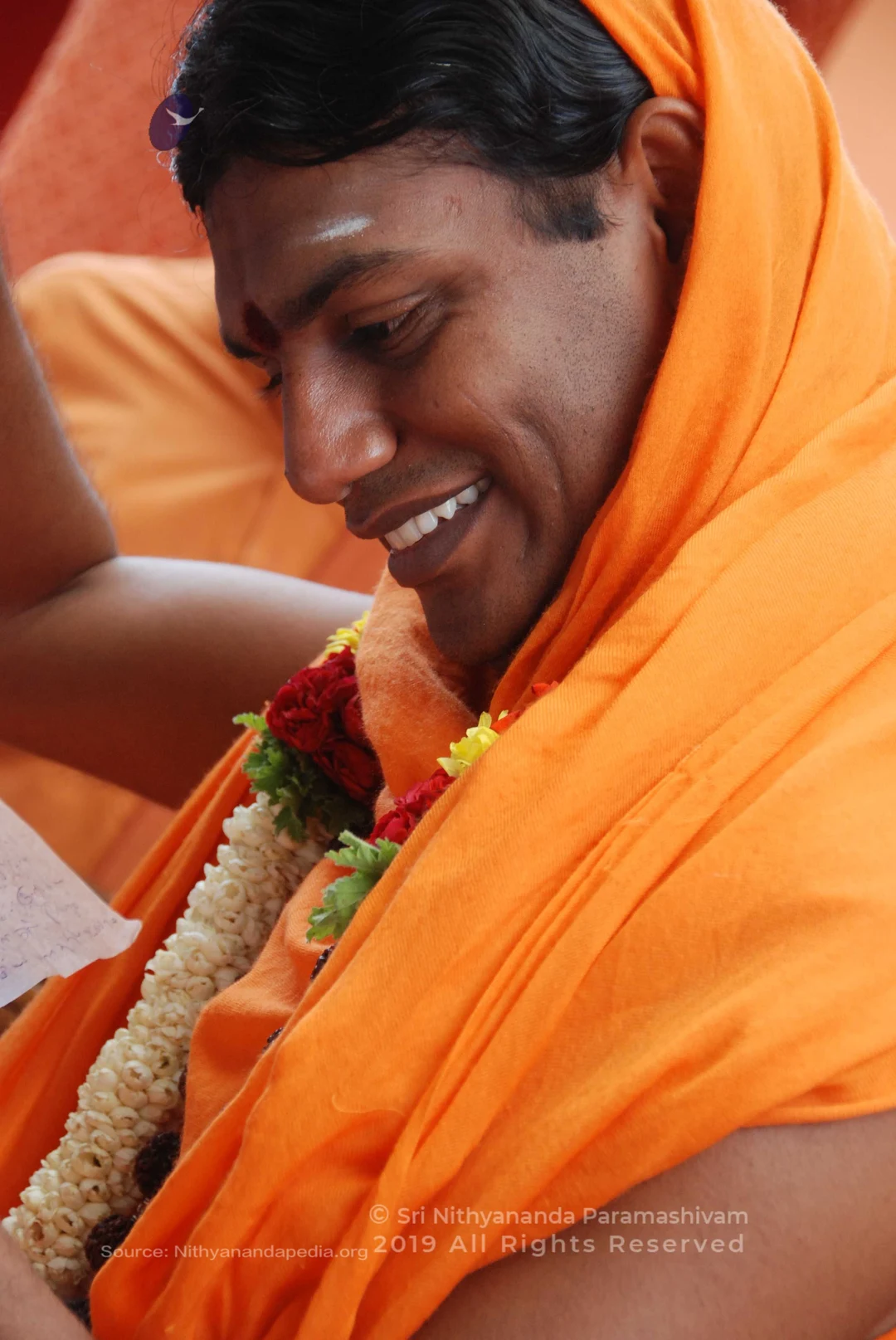
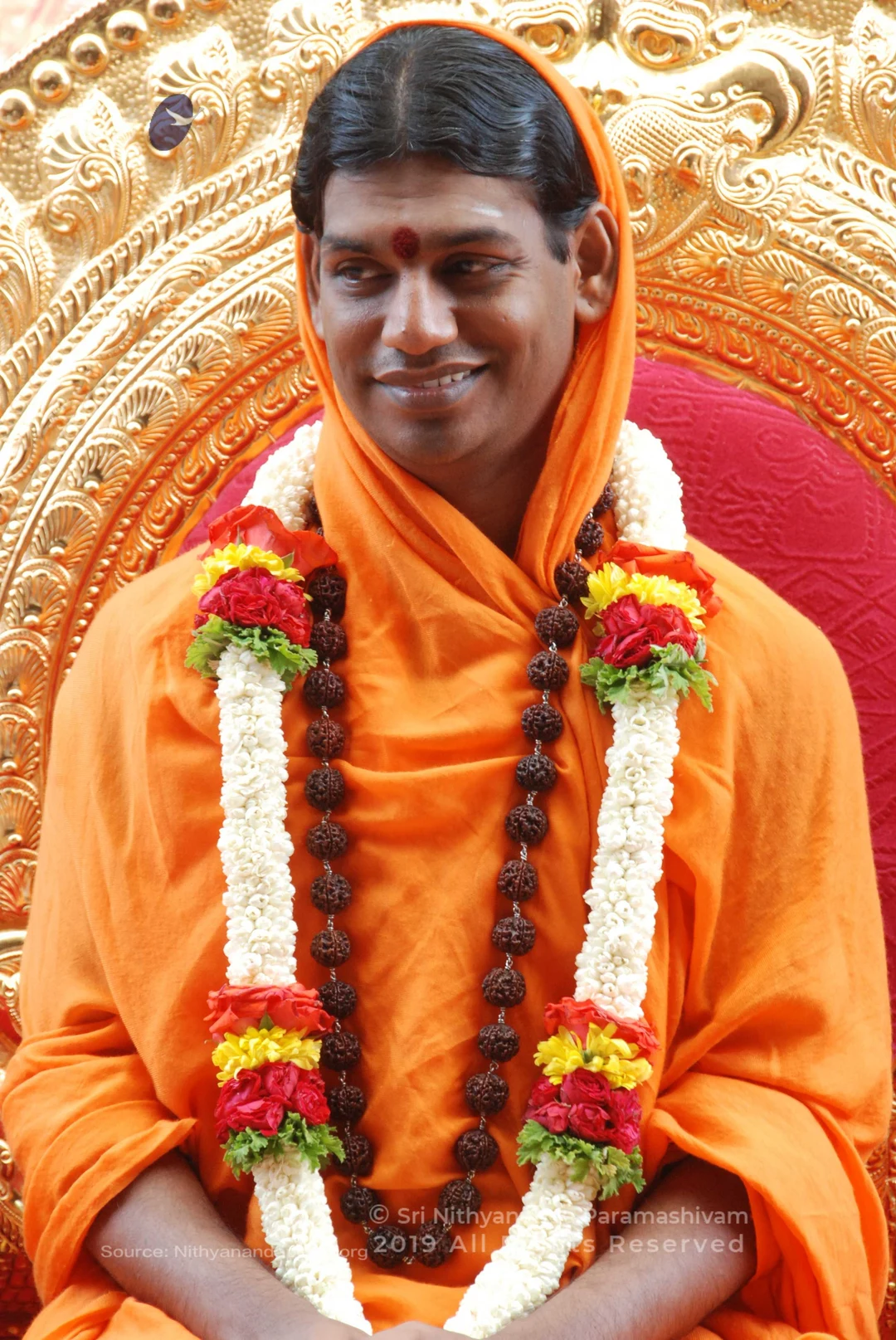
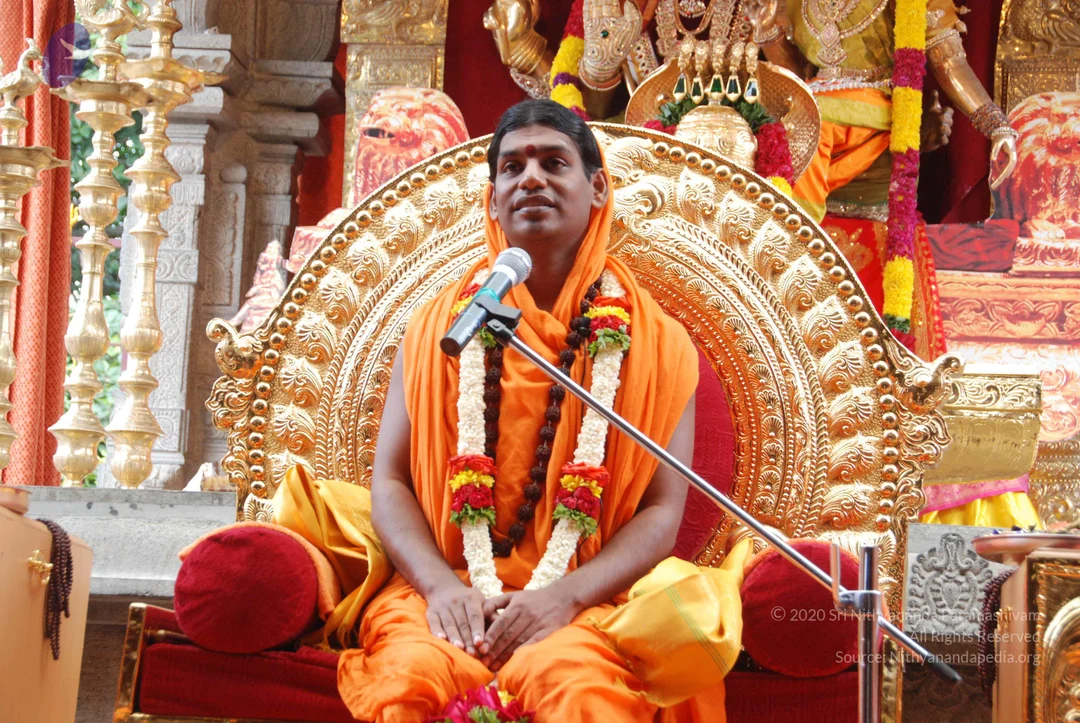
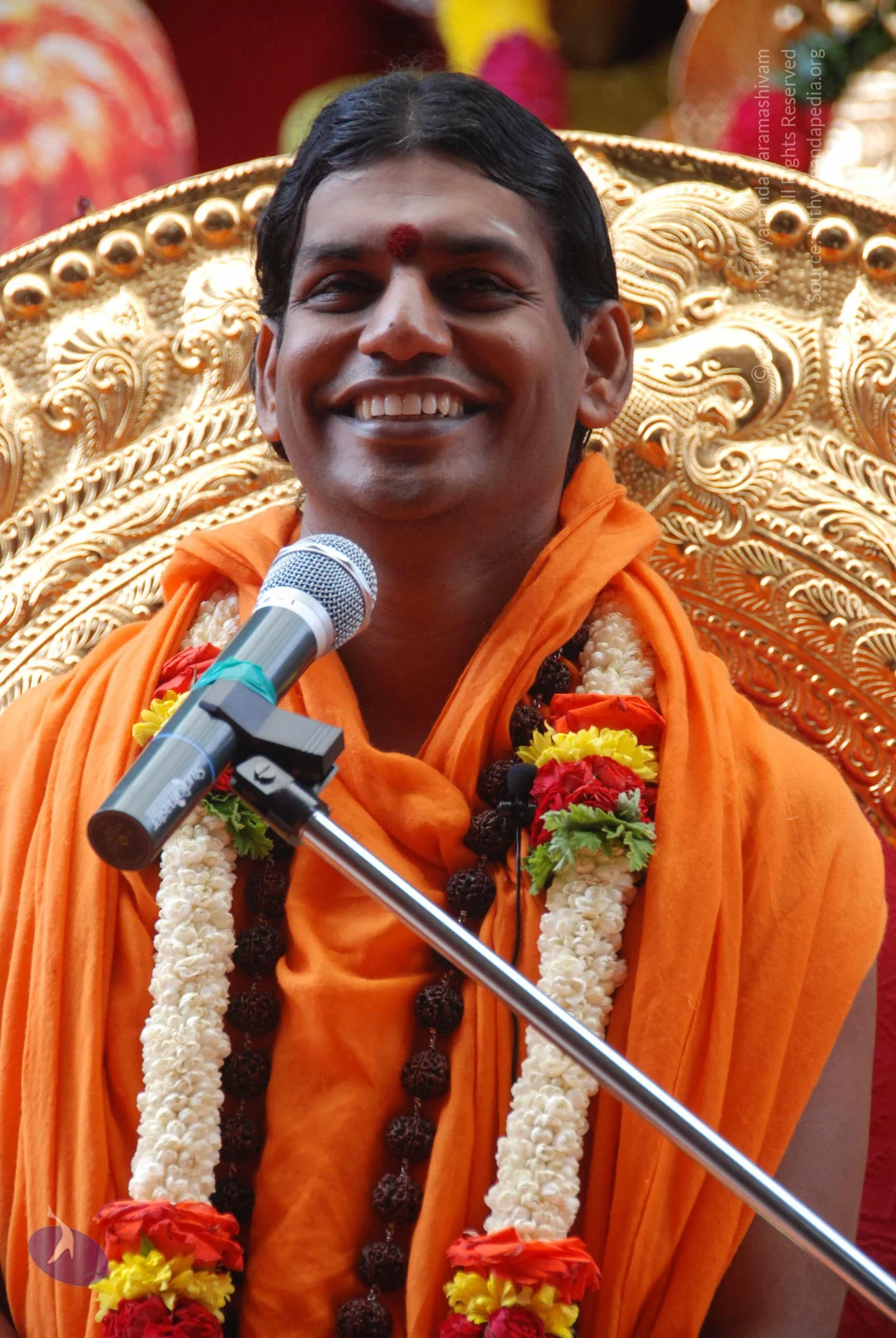
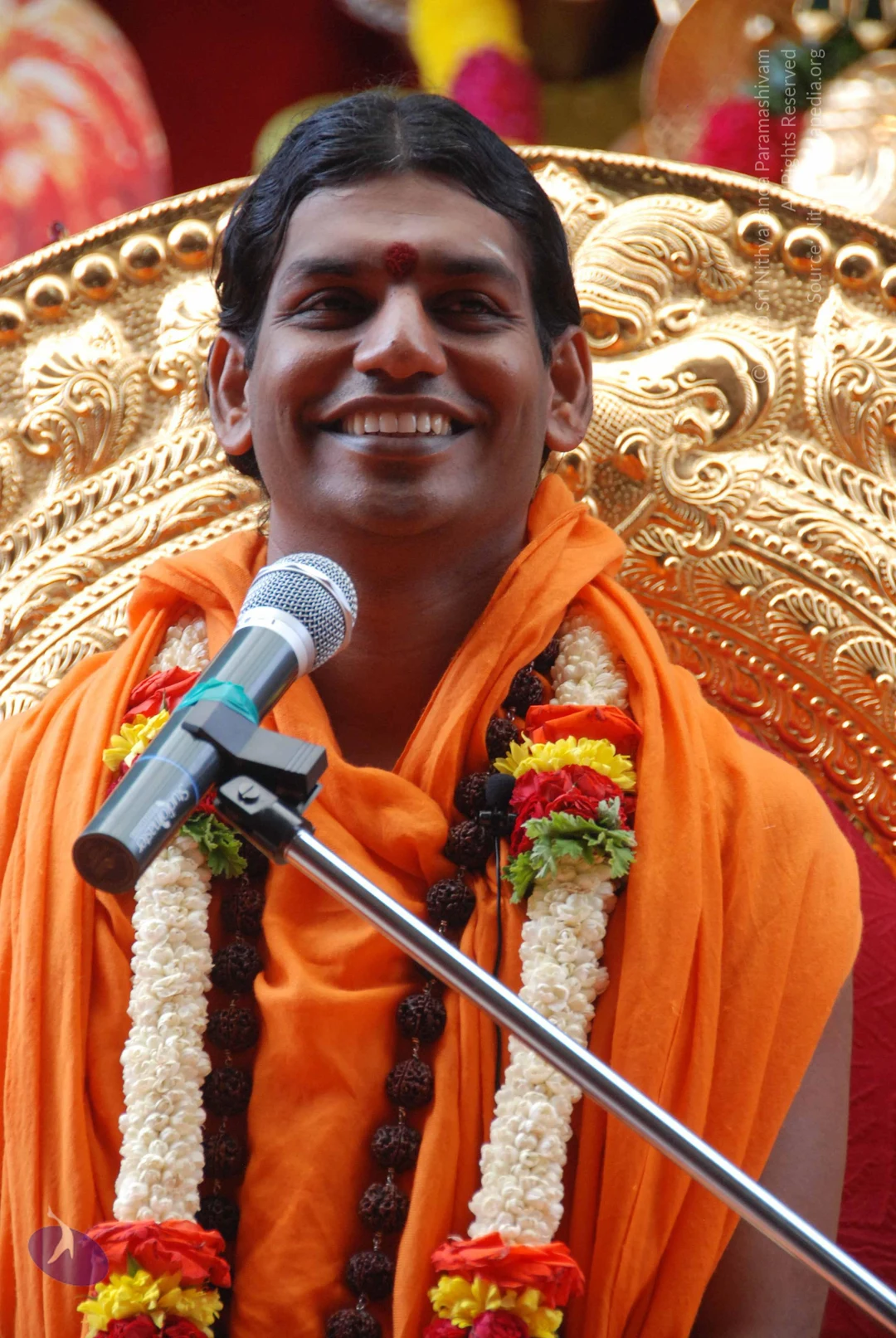
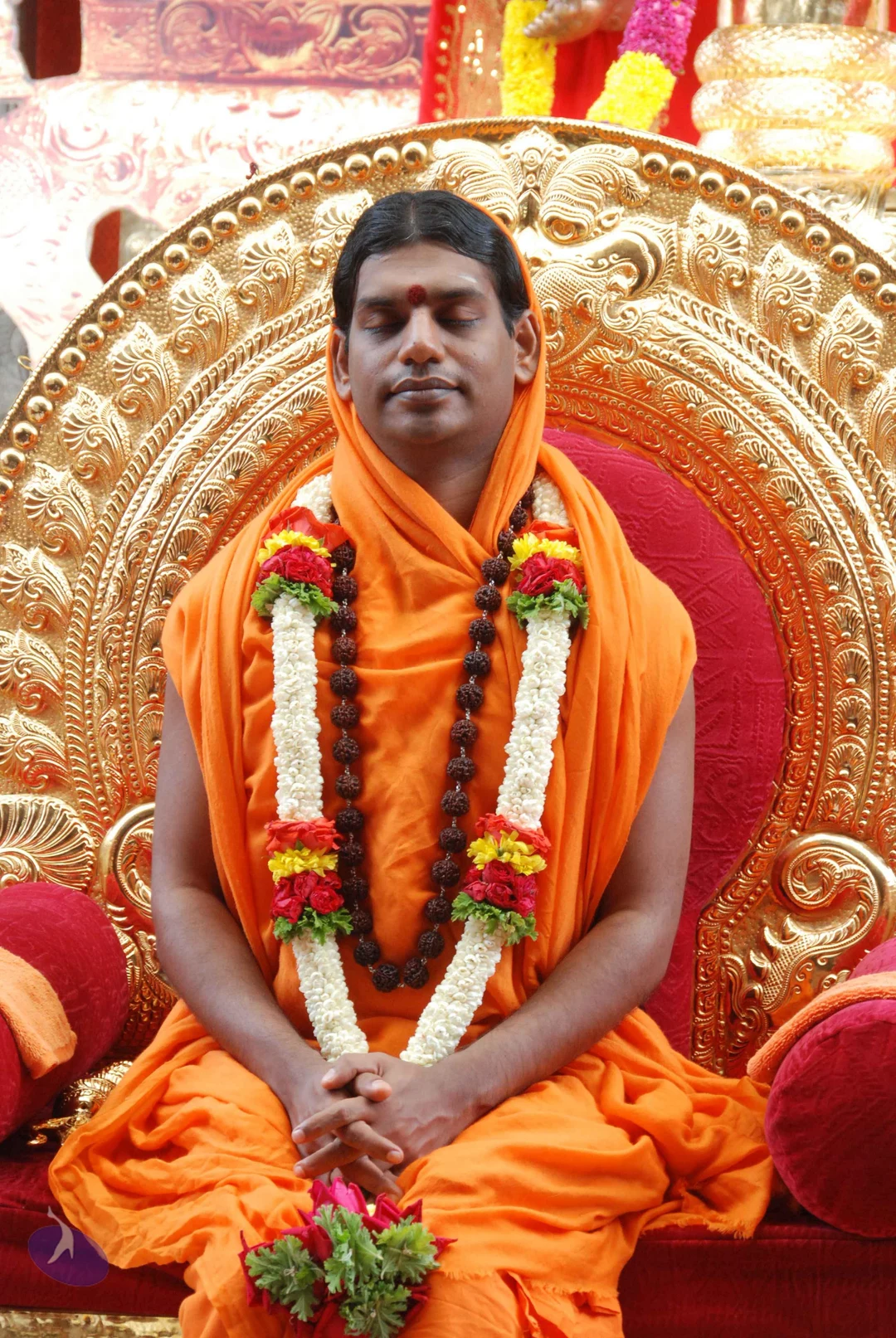
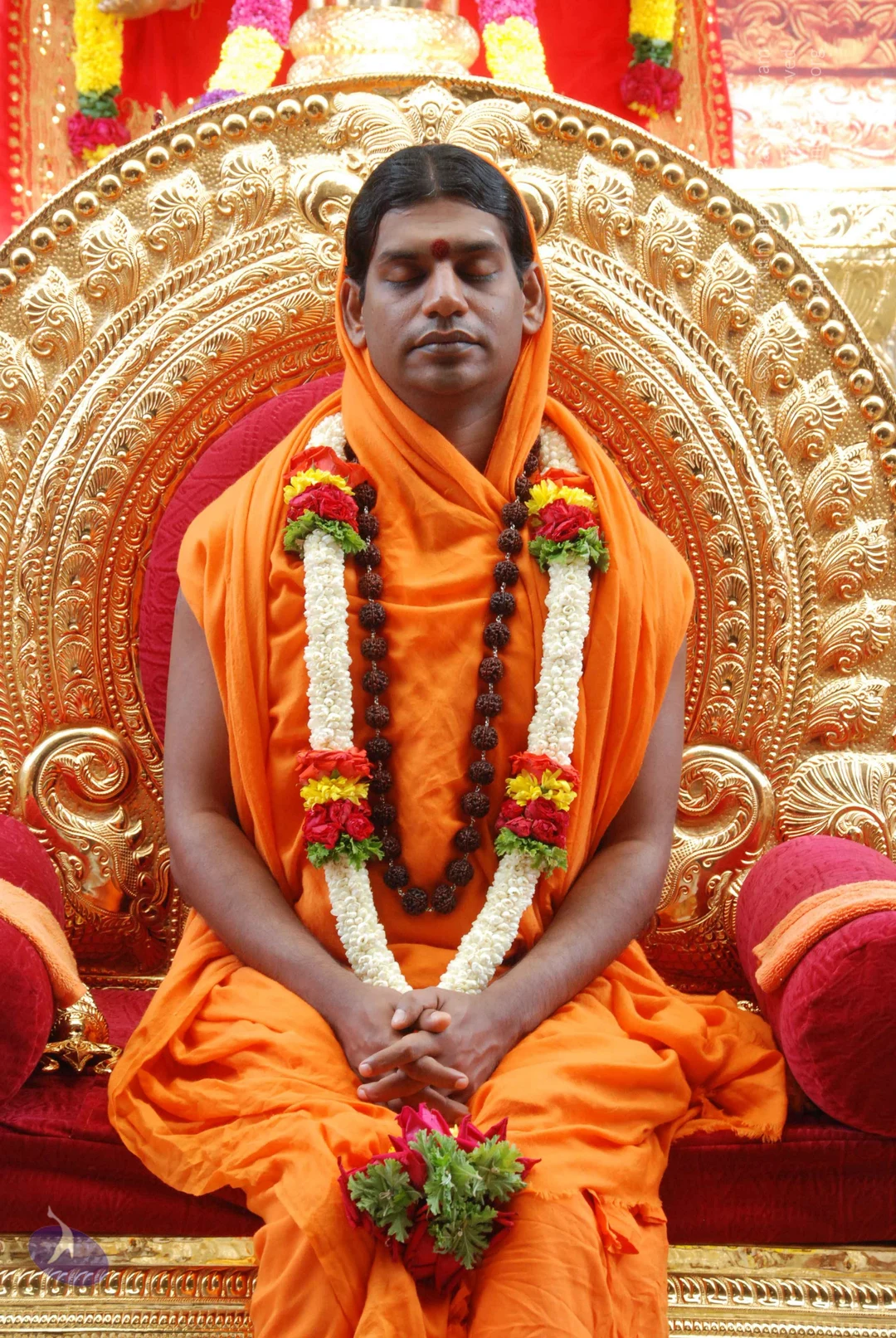
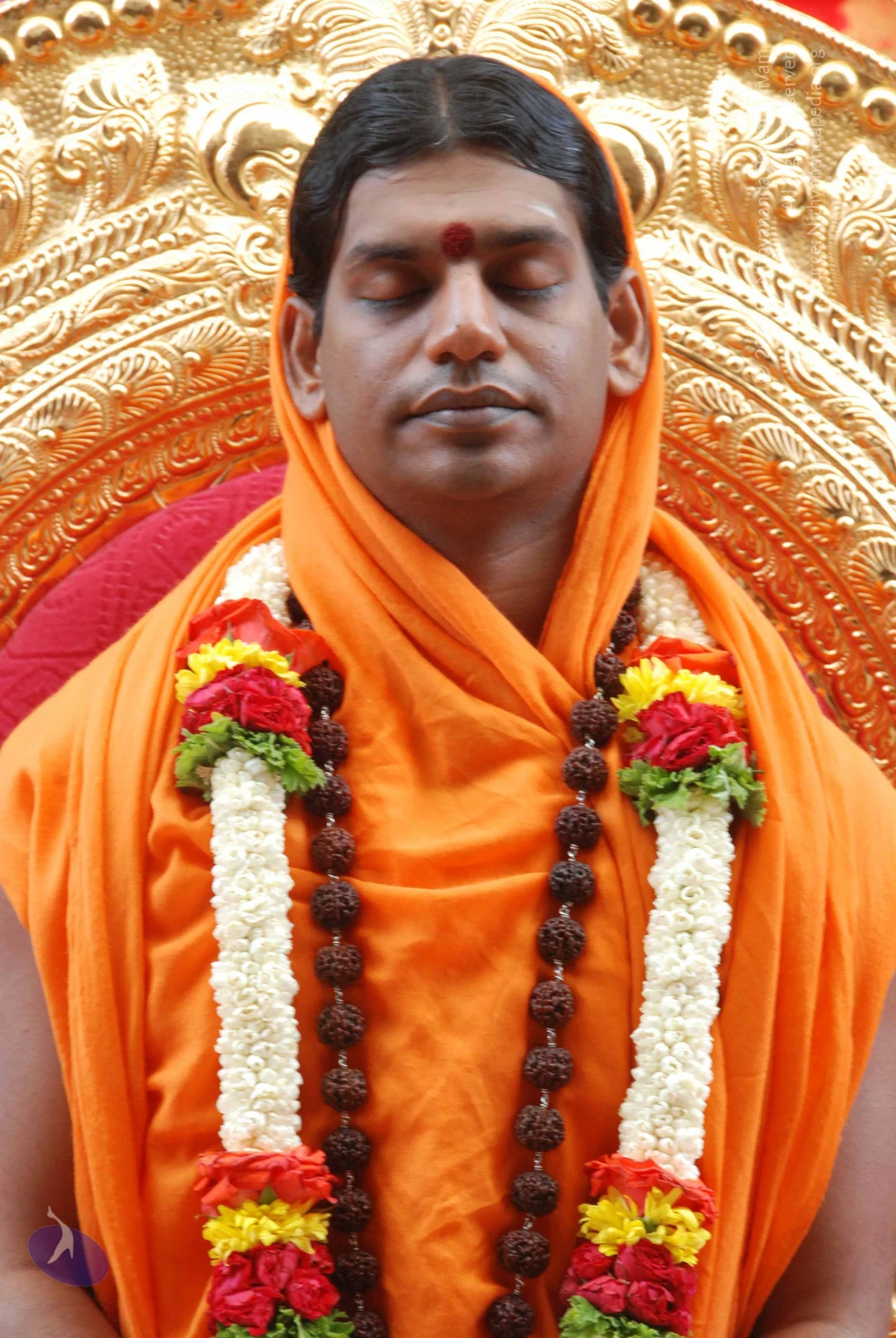
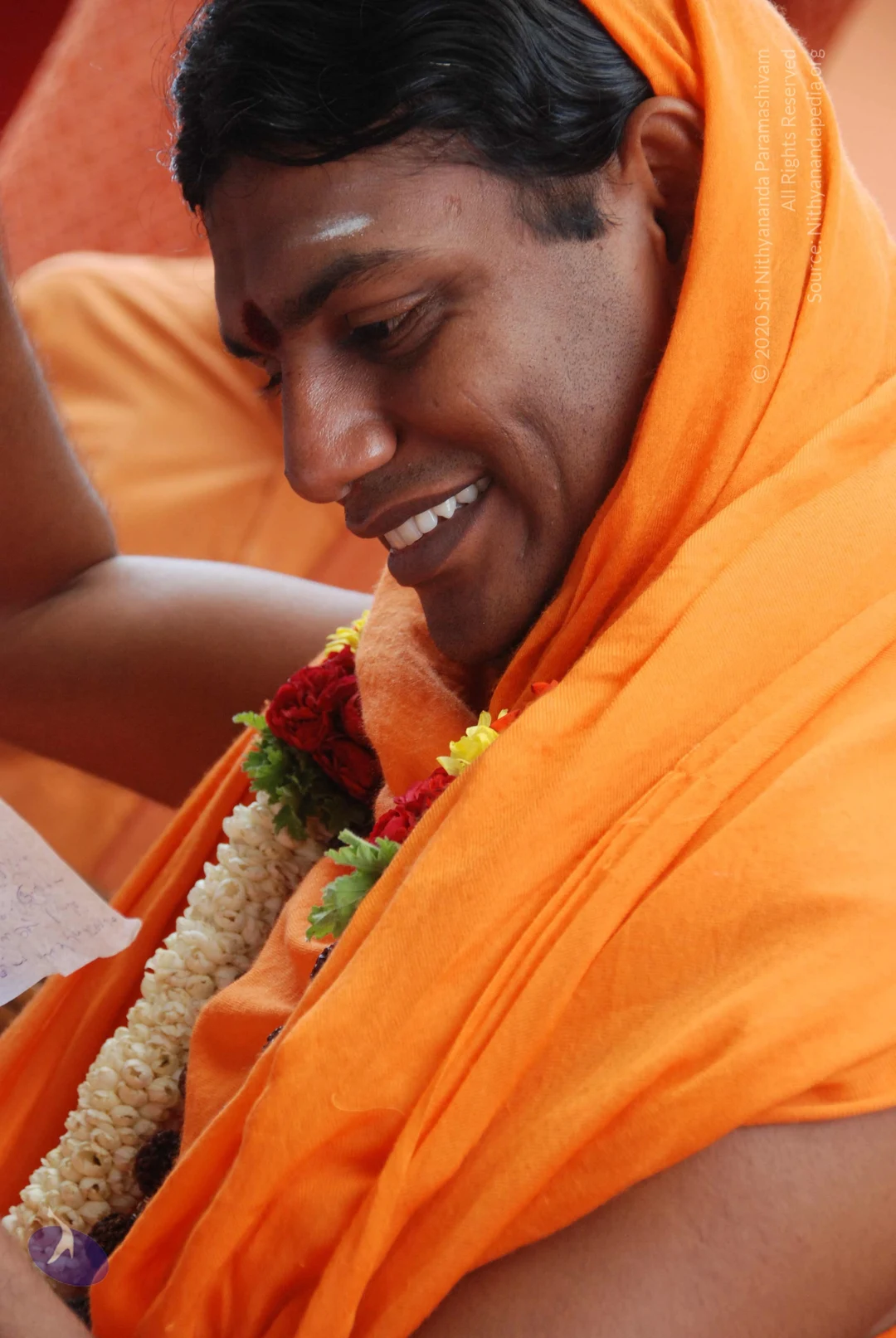
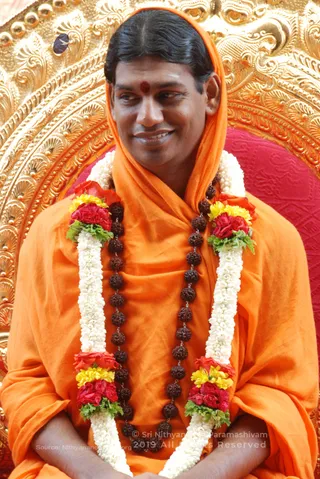
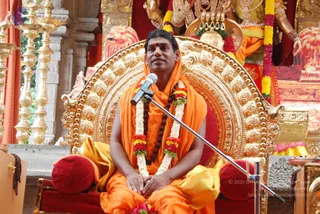
A smiling man with short dark hair and a red bindi sits before a microphone on a stand, wearing an orange shawl draped over his head and shoulders, with long rudraksha mala beads and white and red-yellow flower garlands around his neck. Behind him is an ornate gold throne with lion-head carvings, and colourful flowers appear at the top of the frame. This is a live talk setting. Appearance-based label: a person, seated at the microphone with orange robes, rudraksha mala and flower garlands.Close-up photograph of a smiling man with short dark hair, a white sandalwood mark on his forehead and a red bindi-style mark between the brows, wearing an orange saffron cloth draped over his shoulders. He wears a garland of red roses, yellow flowers, white jasmine and green leaves around his neck. He is bent forward and looking down, laughing broadly, and a sheet of handwritten paper is visible at the lower left. The face is visible, and the figure's appearance does not clearly establish a specific identity, so the person is described by role and clothing only.A smiling man in orange saffron robes and a matching orange head wrap sits on an ornate gilded throne with a red cushion. He wears long strands of rudraksha beads and garlands of white jasmine, yellow marigold and red roses with green leaves, and has a red tilak mark on his forehead. His hands are folded in his lap. The gold carved backdrop and red fabric frame him closely. Appearance-based cues of saffron robes, rudraksha malas and a throne are consistent with the page's a person reference, so this is a probable identification.

Paadapuja

6 photosSource gallery
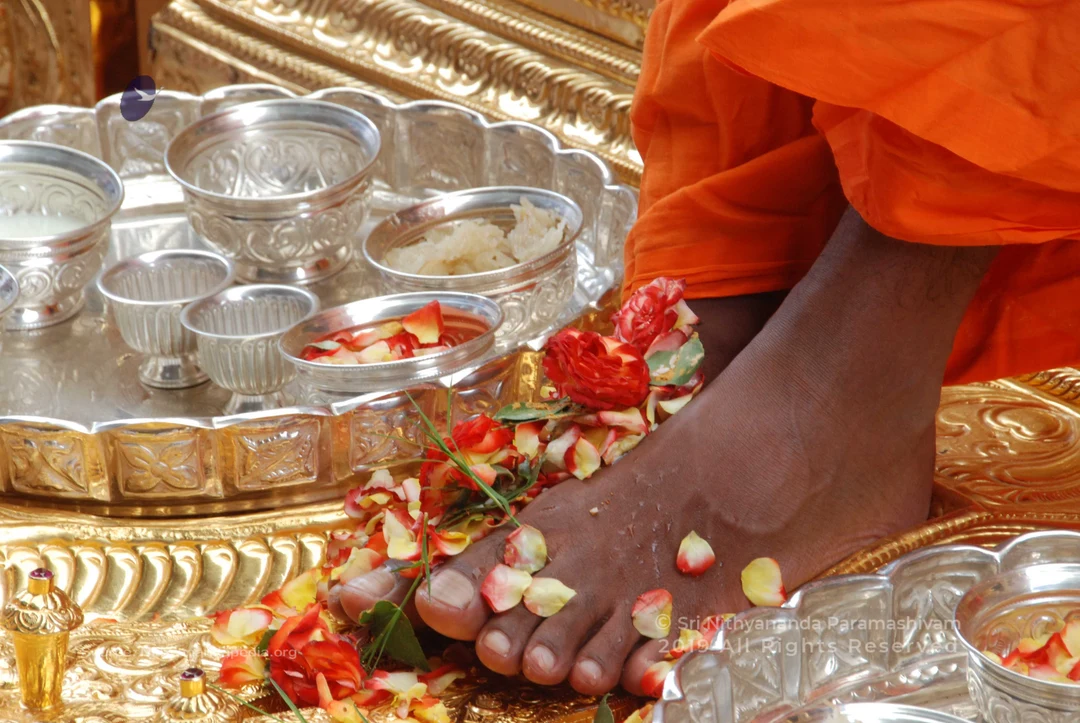
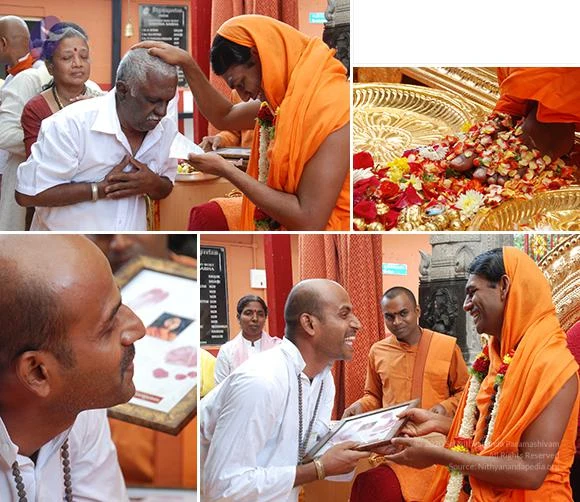
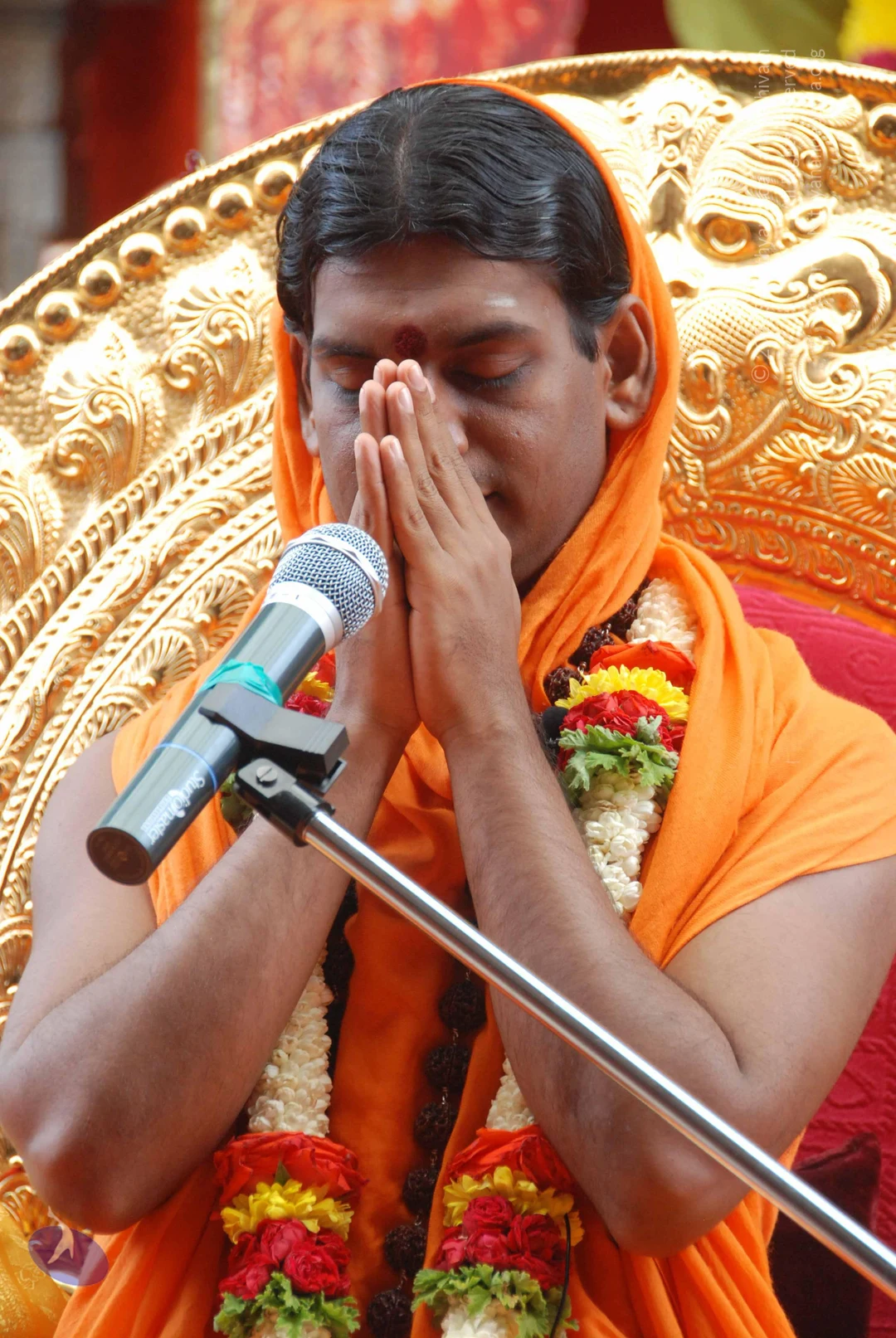
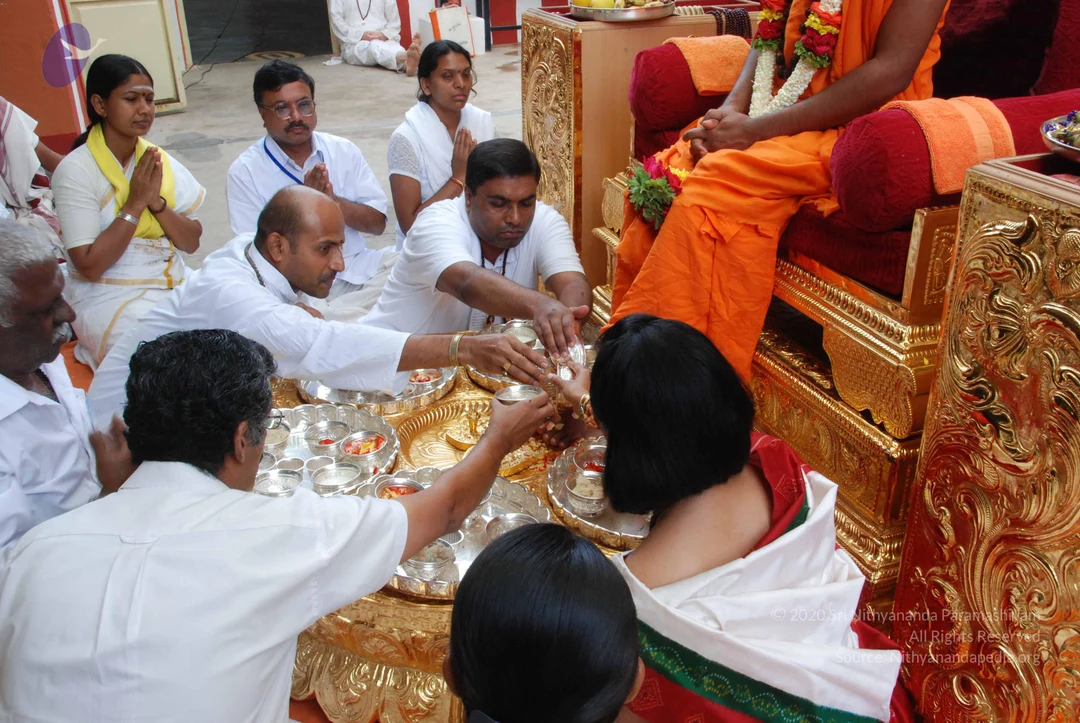
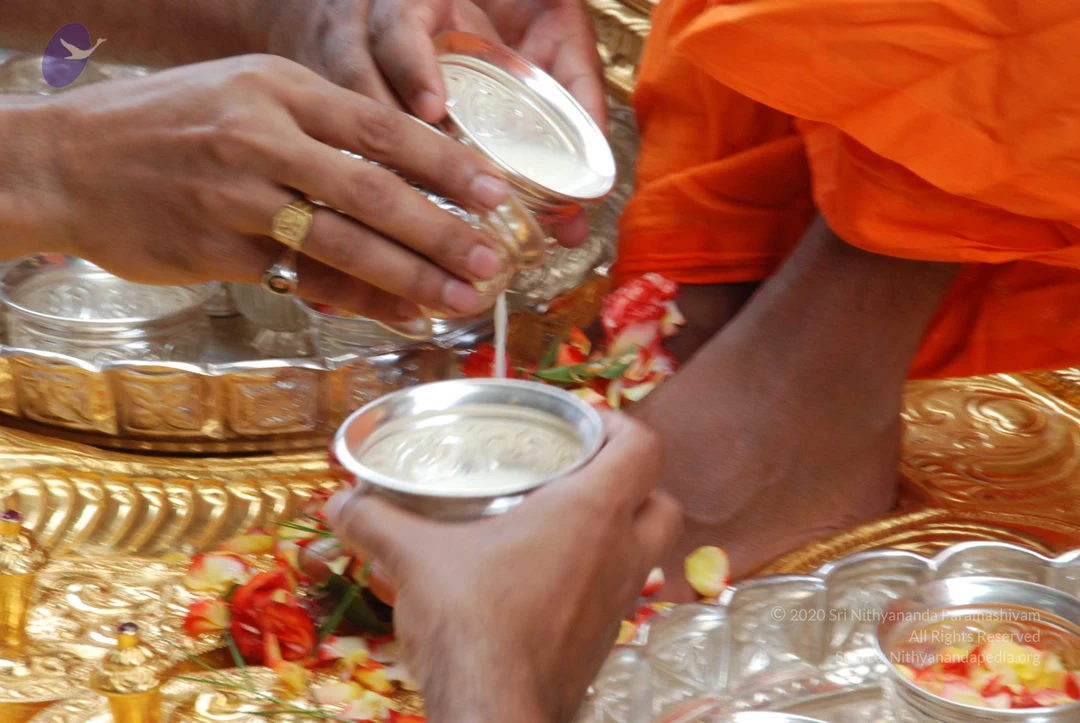
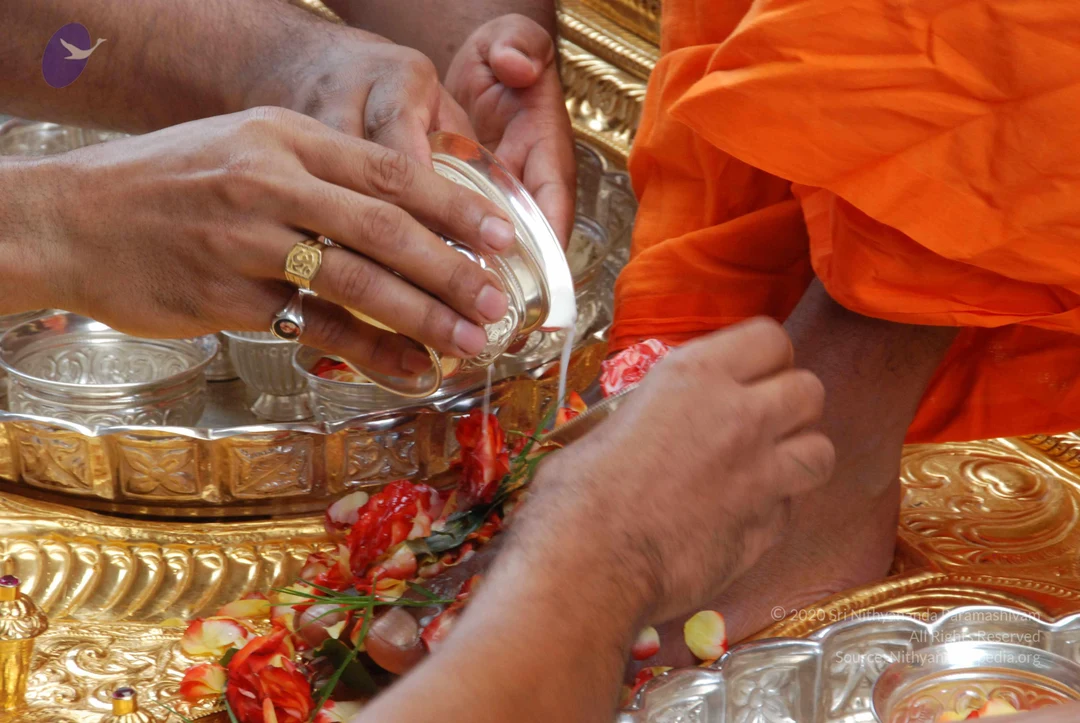
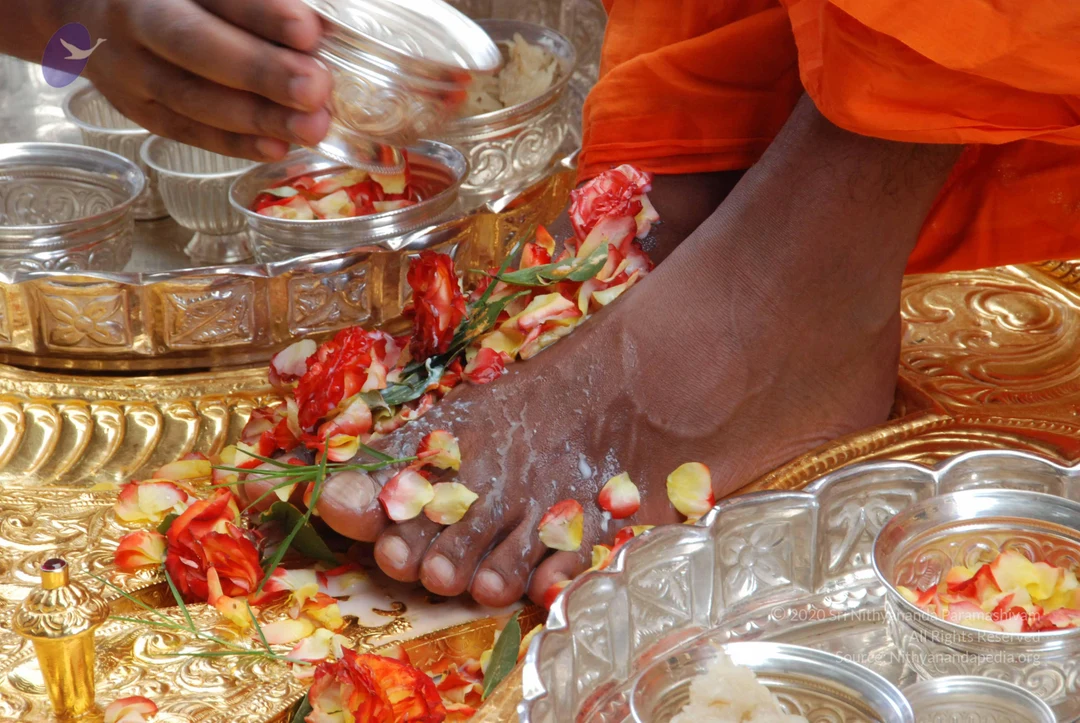
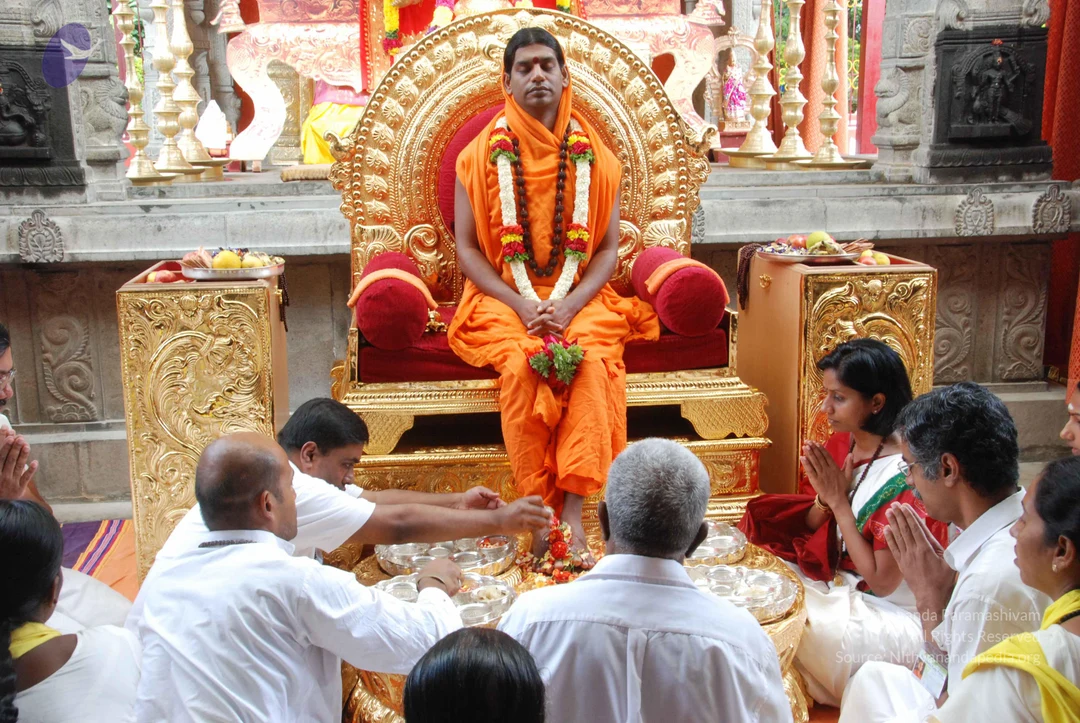
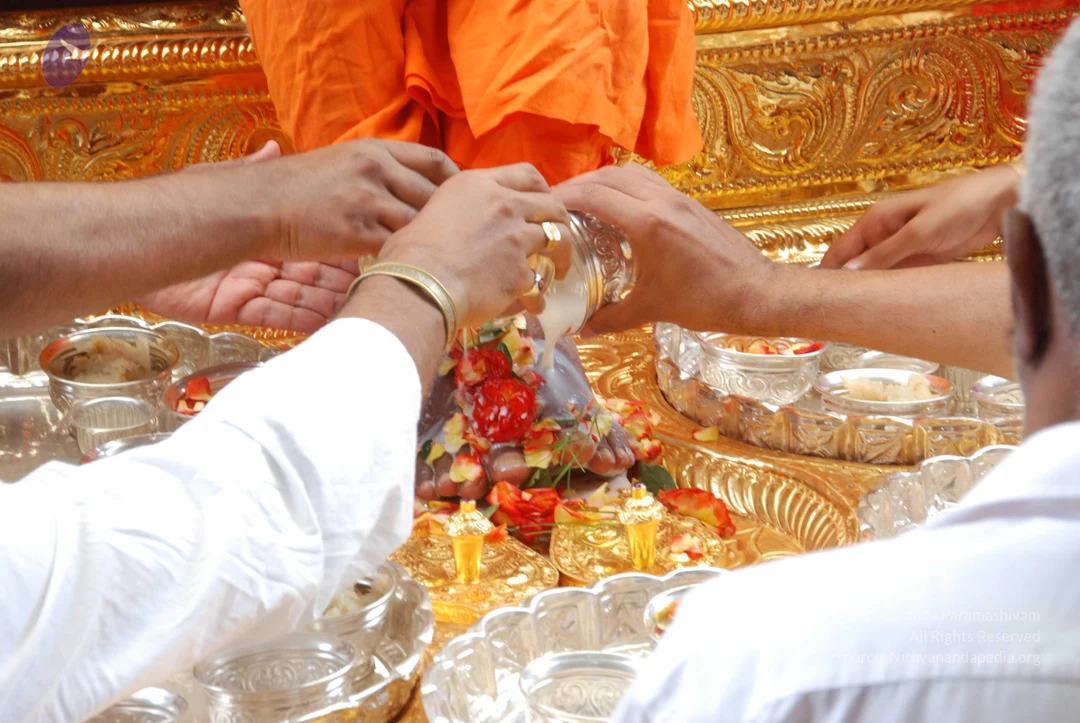
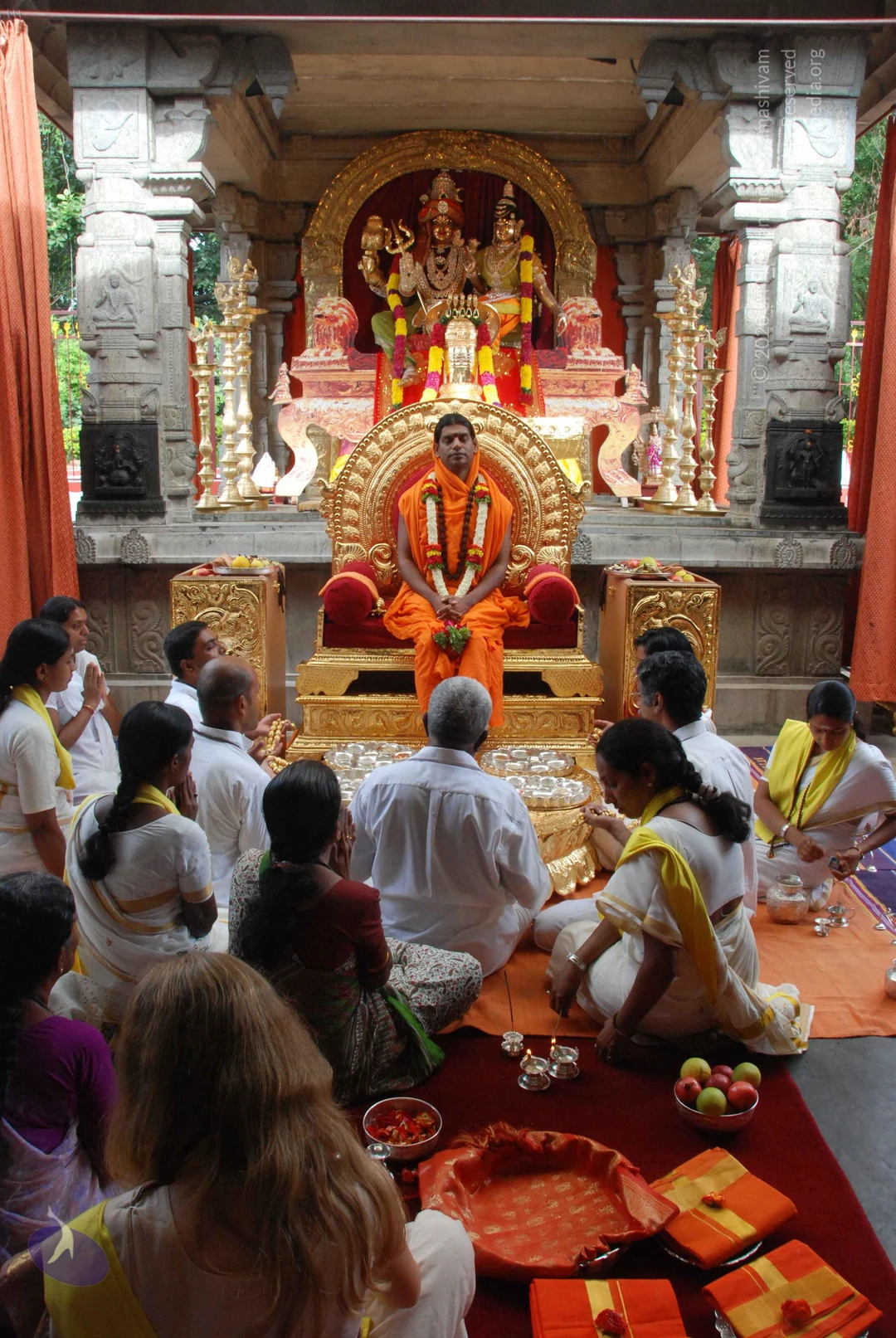
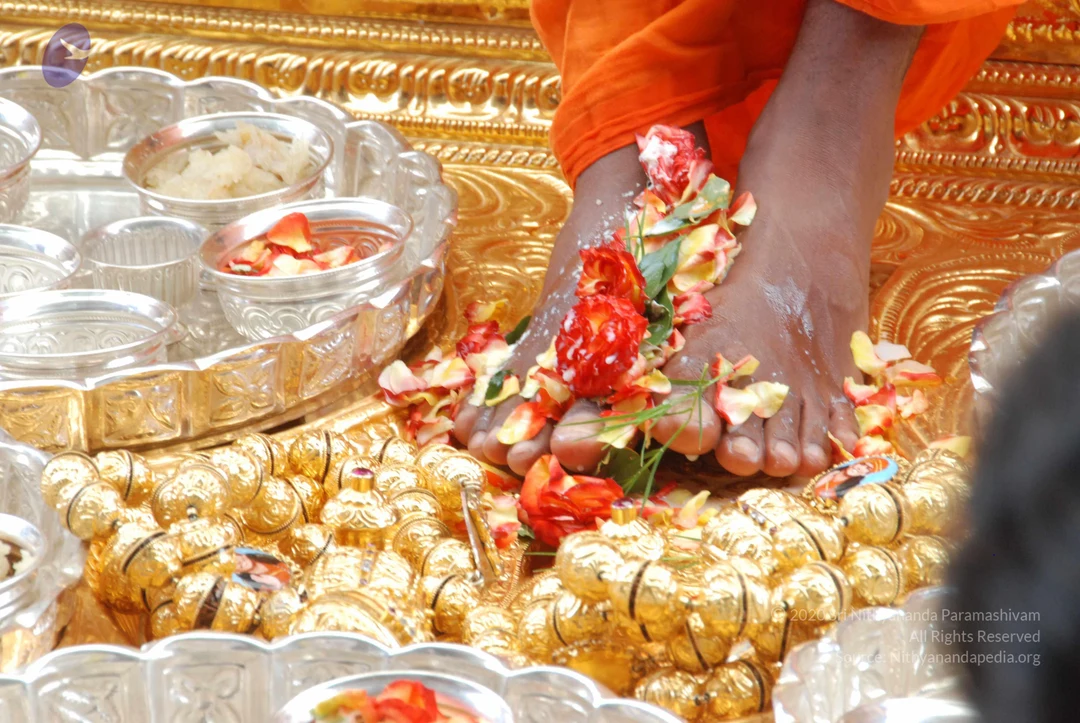
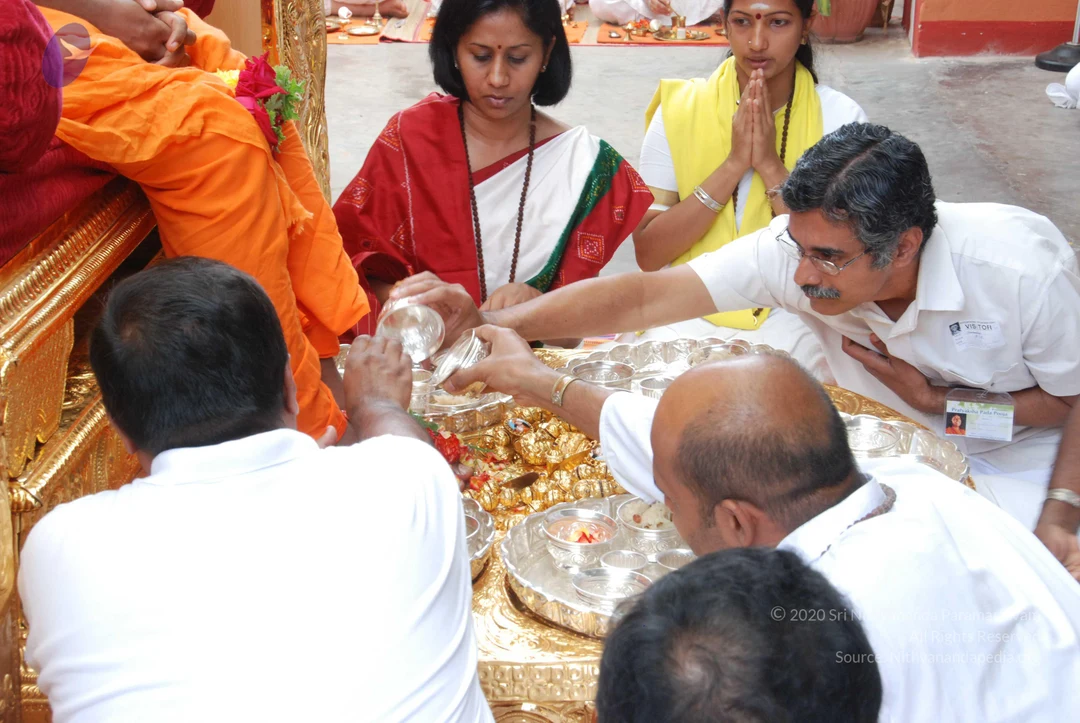
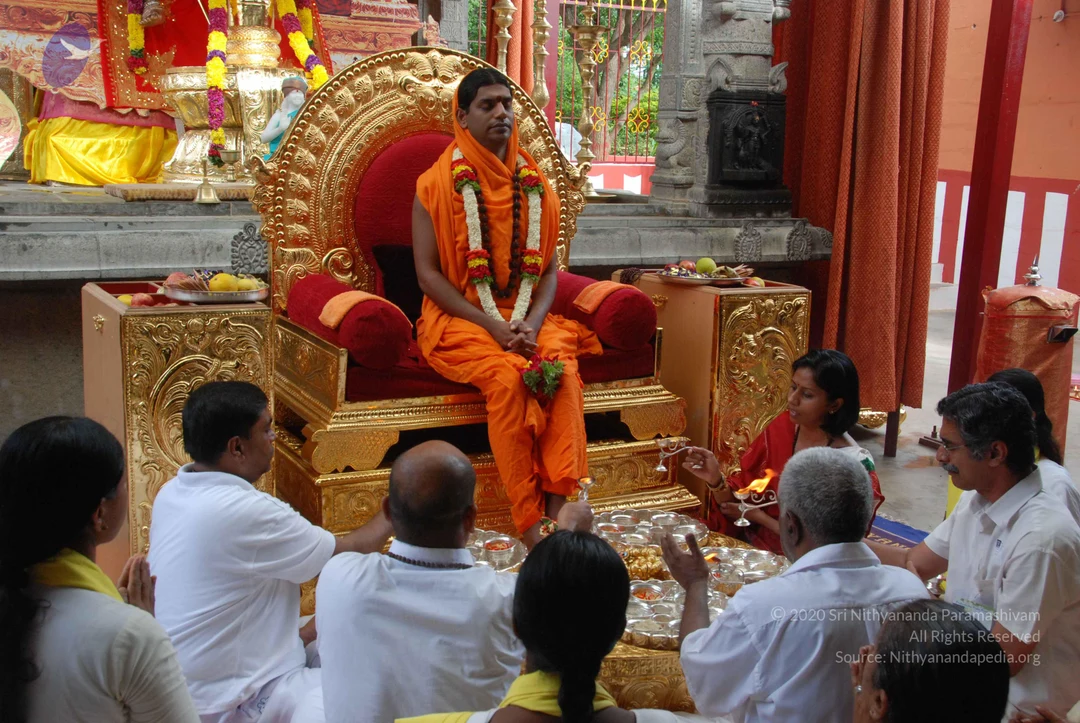
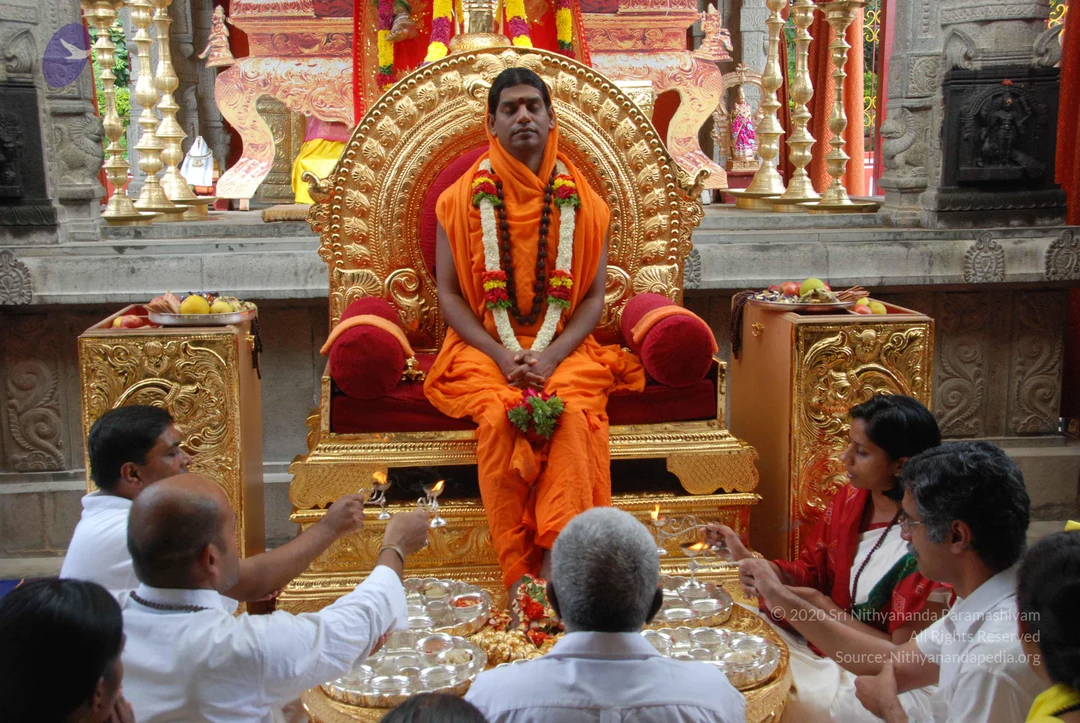
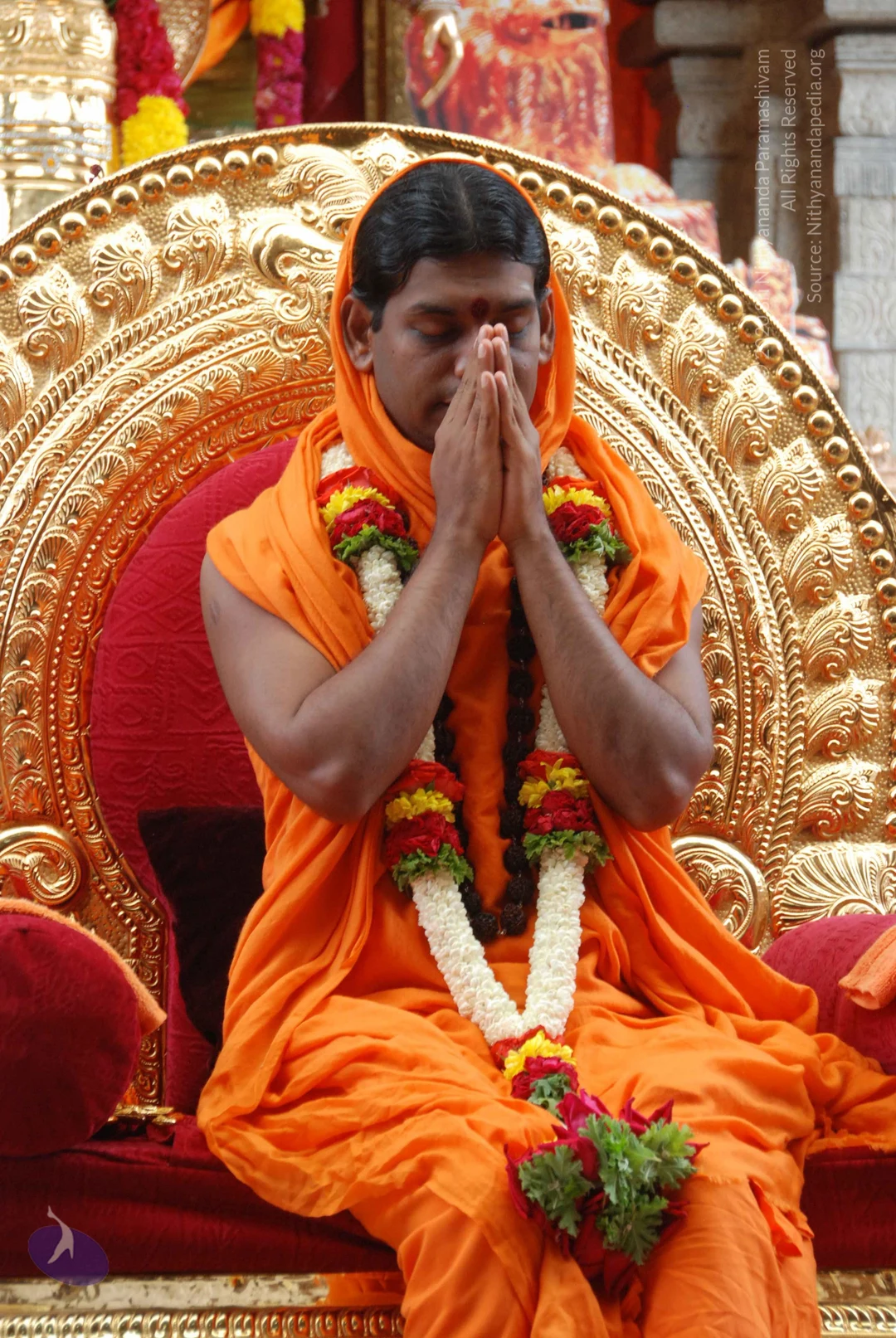
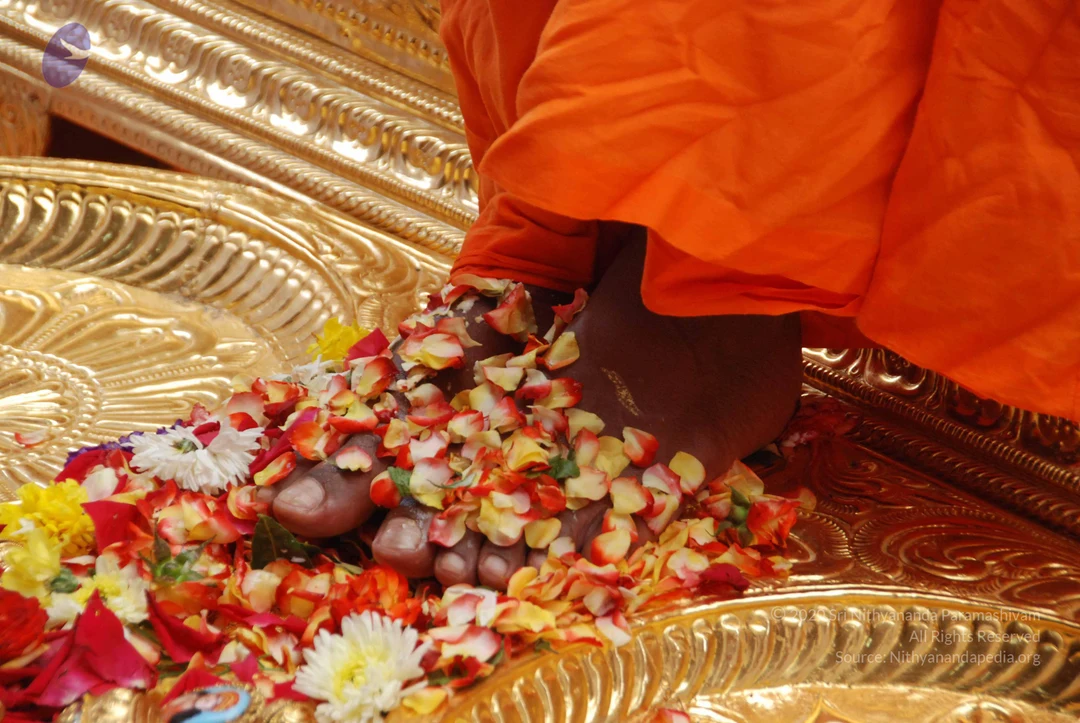
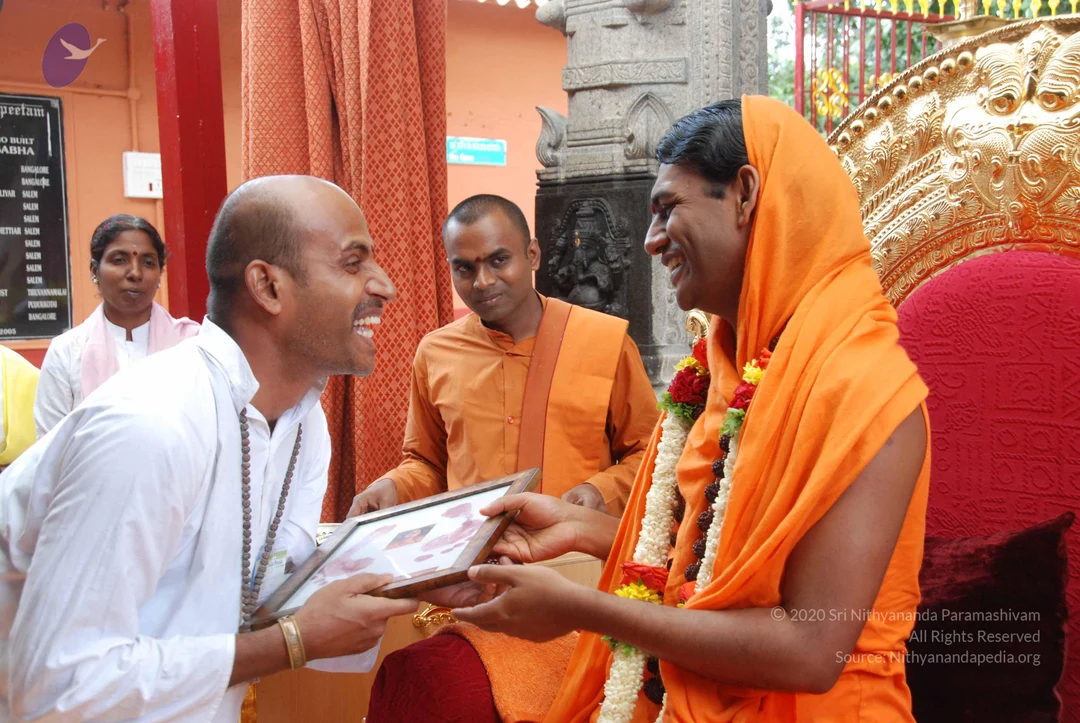
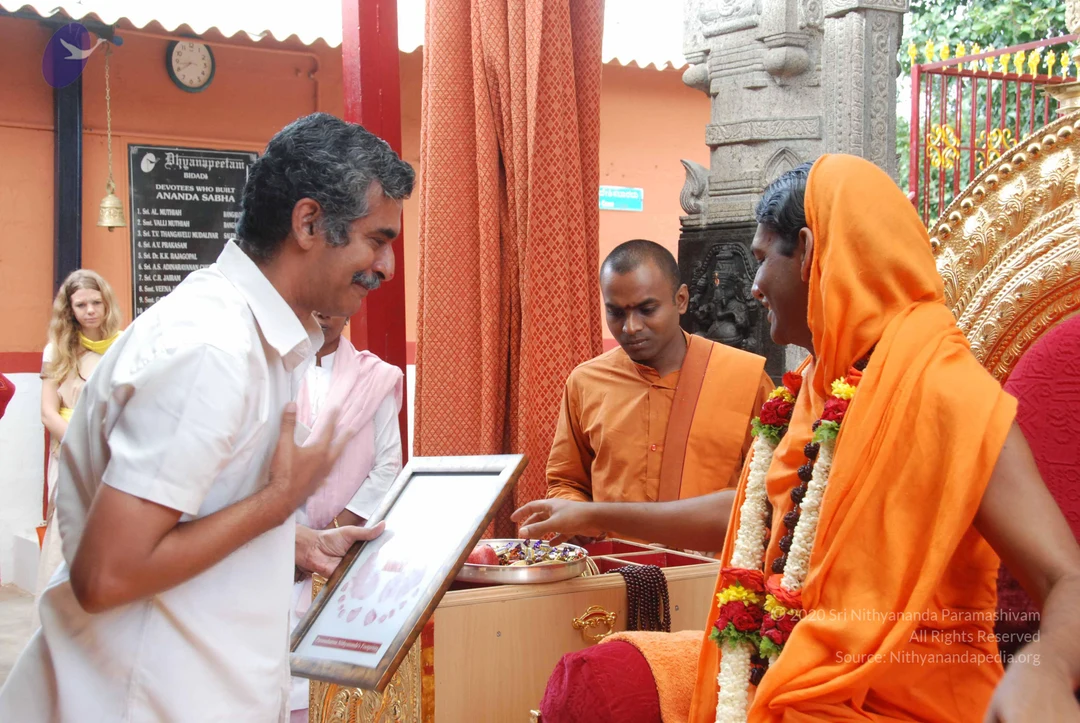
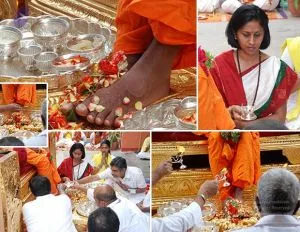
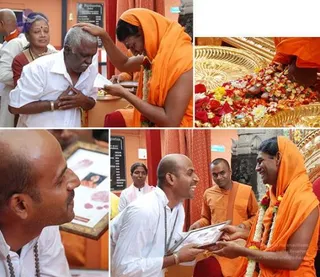
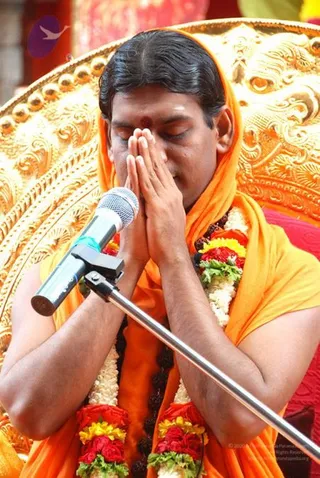
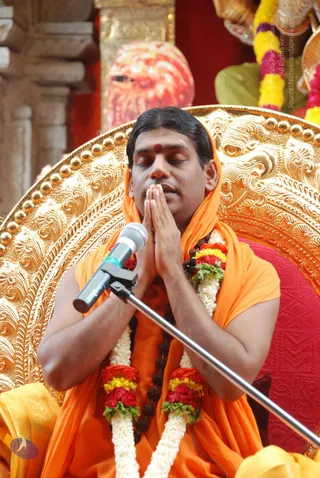
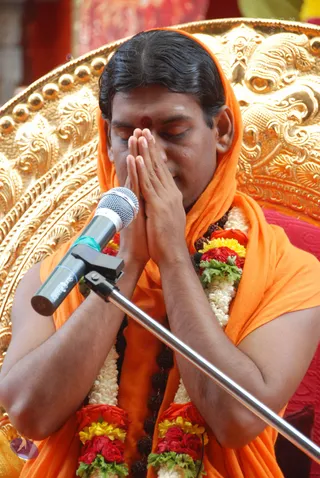
A four-panel collage of a ritual padapuja-style ceremony on a golden dais. Top left shows a bare foot in an orange-saffron garment resting on a golden seat with flower petals, with silver and steel bowls of offerings beside it. Top right shows a woman in a red-and-white saree holding a small silver vessel and standing near the golden platform. Bottom panels show a woman in red saree pouring or offering from a silver container, and a man in white dhoti and shirt seated at the dais, with an older man in white kneeling and offering. The scene is a temple-like ritual with orange-robed attendants, silver plates, flowers and a golden throne-like seat. No identifiable face is needed to describe the scene.A four-panel collage of photographs from a KAILASA event. Top left: a grey-haired man in white clothes stands with hands at his chest while a woman in orange and gold robes with a garland touches his head. Top right: a golden throne-like seat decorated with rose petals and marigolds, with an orange-robed hand scattering petals. Bottom left: a bald man in white with a rudraksha mala looks at a framed photograph held in a wooden frame. Bottom right: an orange-robed man with garlands smiles while another bald man in white with a mala receives a framed photograph from him, a third orange-robed man stands behind. Collage with printed caption referencing a person andClose photo of a man seated before a golden ornate throne, palms pressed together in namaste with eyes closed. He wears an orange-saffron shawl draped over his head and shoulders, a red kumkum mark on his forehead, and a rudraksha mala with a garland of white jasmine and red and yellow flowers around his neck. A silver microphone on a boom stand is positioned before him. The gilded carved throne behind him has floral and scroll patterns. Whether this is a person is uncertain from appearance alone, so the figure is described by role as a seated speaker in saffron.A small outdoor satsang gathering under a tent-like canopy. An orange-robed figure stands at the centre with a white-clad attendant beside them, while several devotees in white shirts and dhotis or saris stand in a row to the left and behind. The setting is a simple covered pavilion with a plain backdrop and draped fabric overhead.

panchatapas

1 photoSource gallery
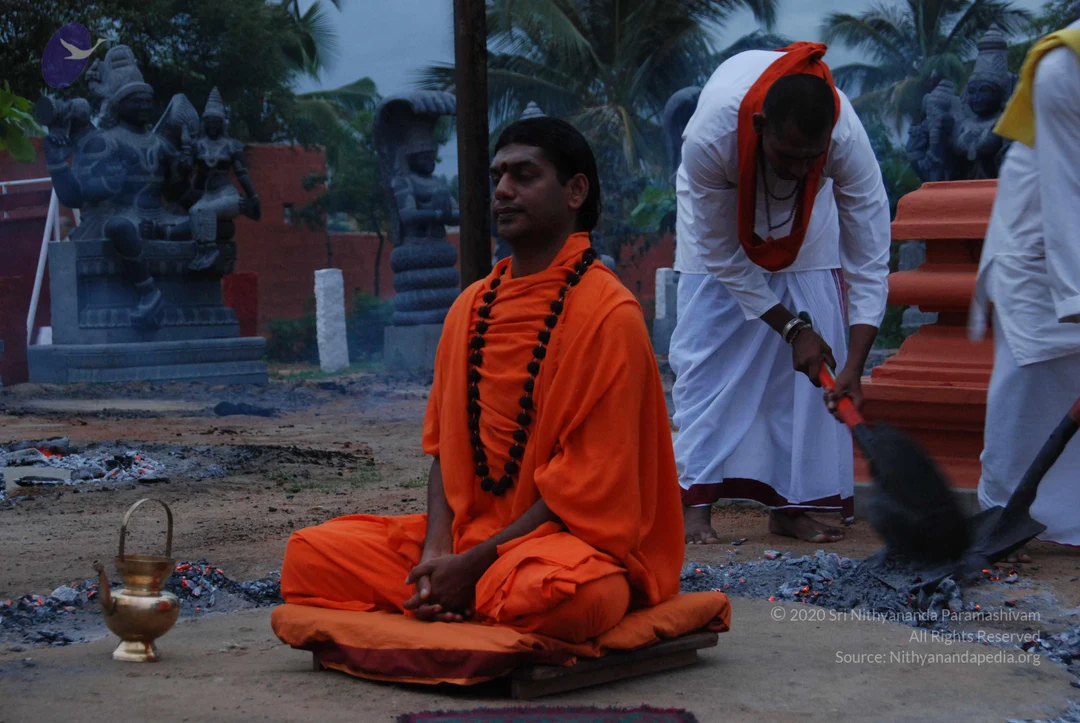
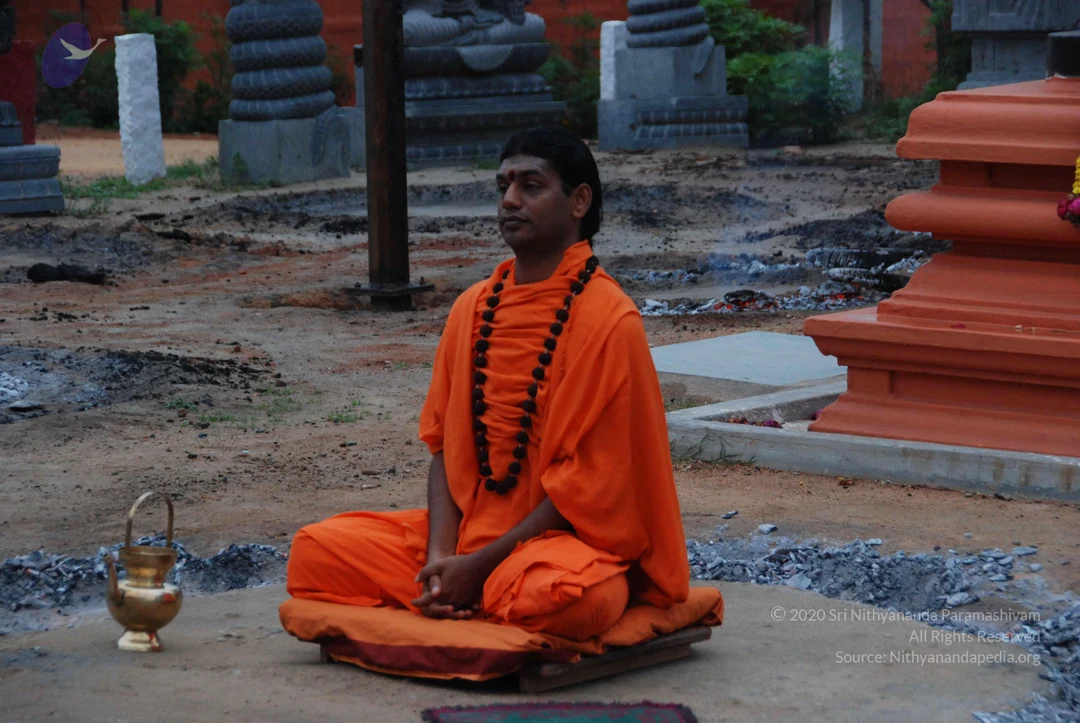
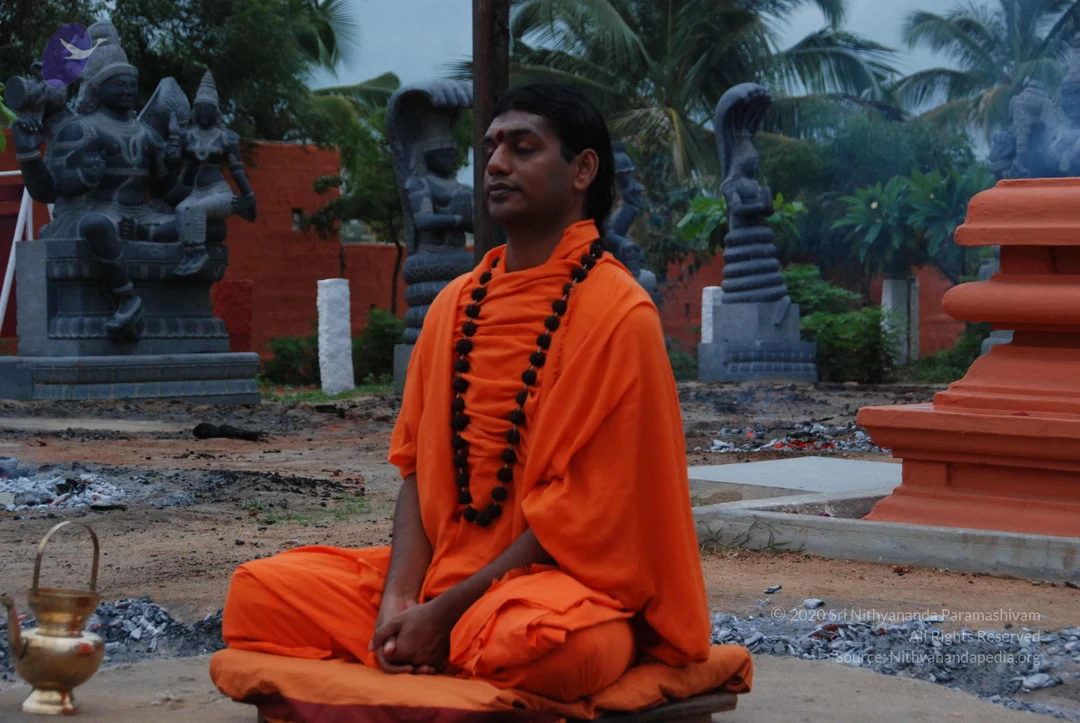
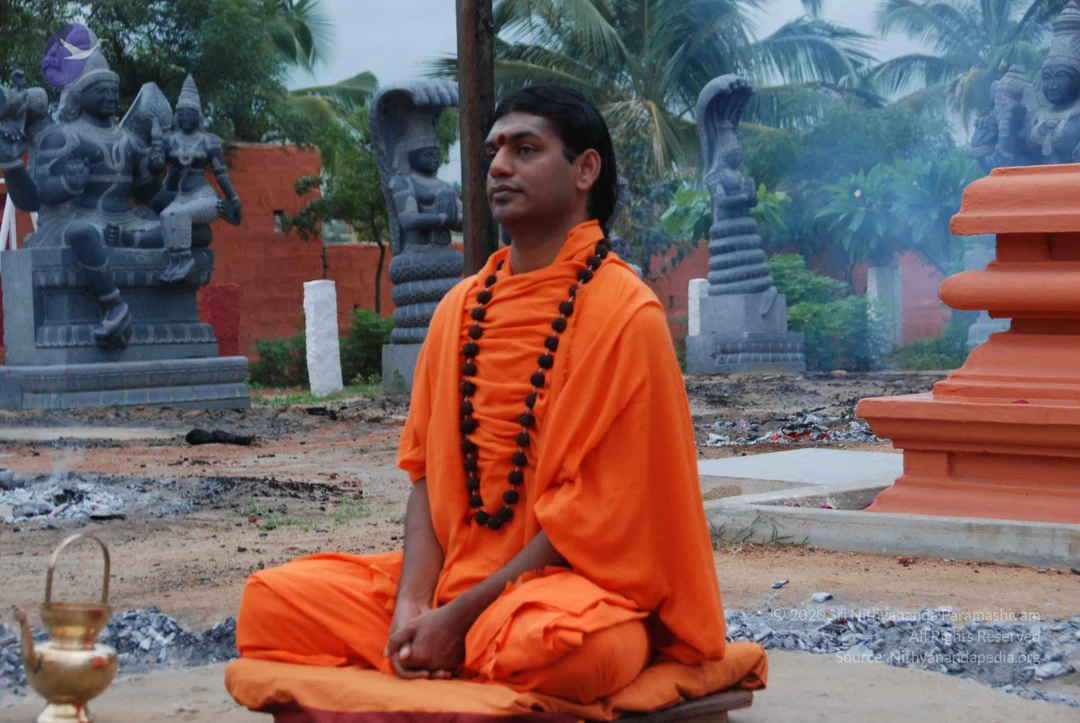
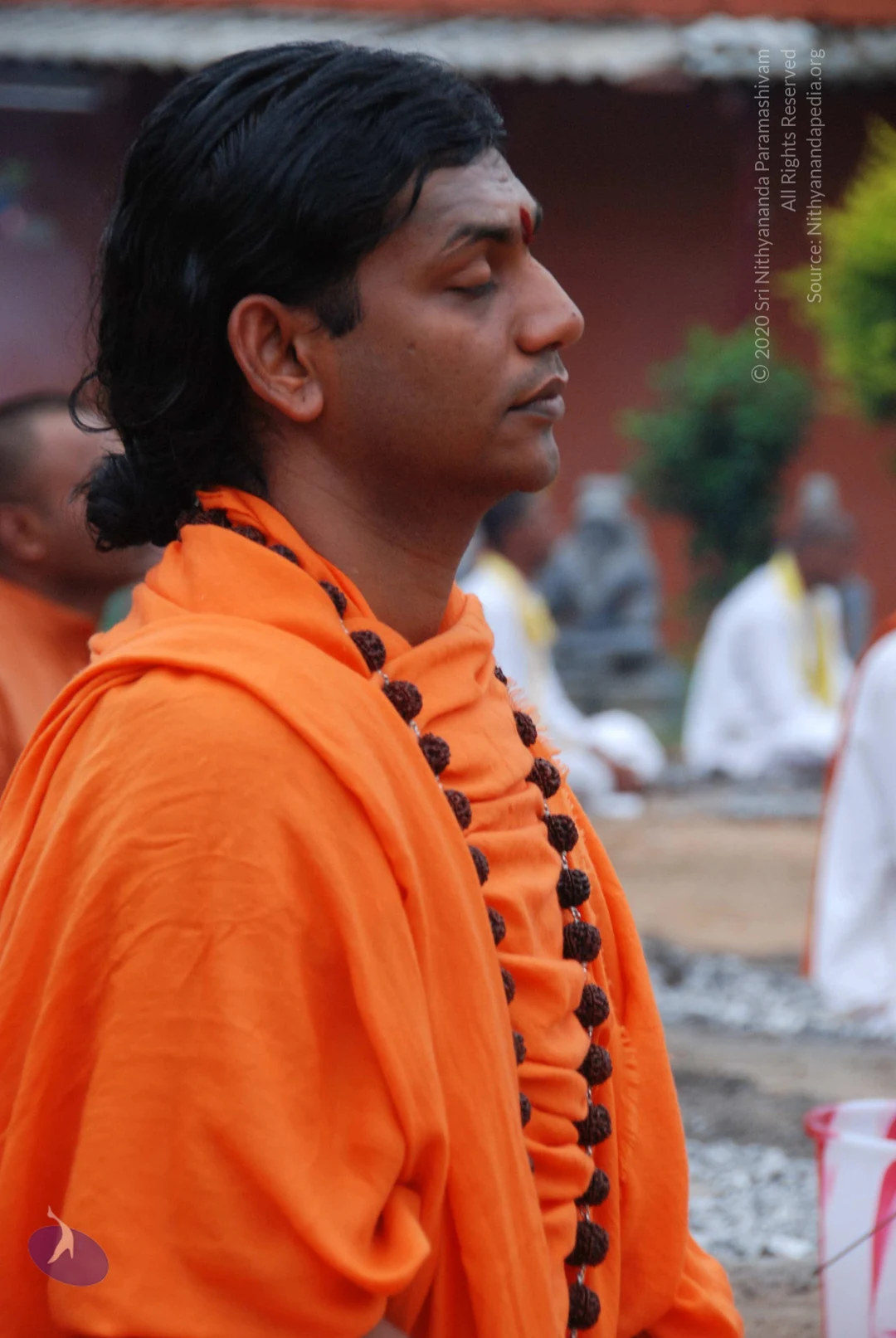
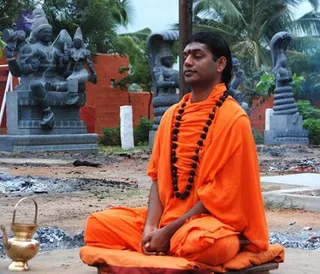
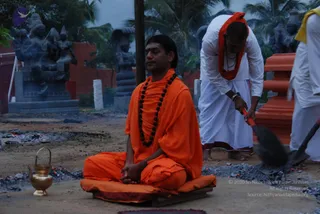
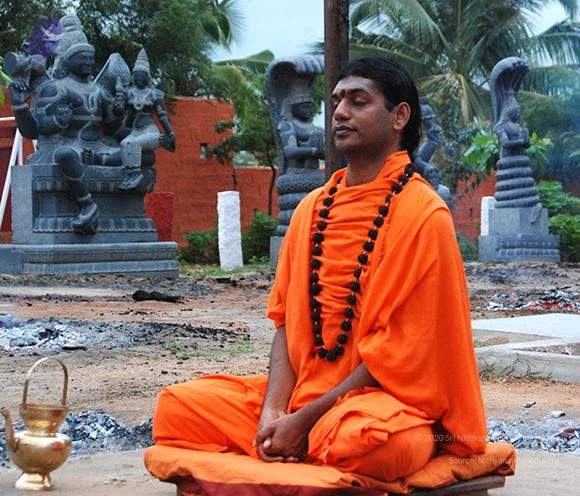
A man seated cross-legged on an orange cushion in an outdoor courtyard, eyes closed in meditation, with hands resting in his lap. He wears saffron/orange robes, a shawl draped over his shoulders and a long rudraksha mala around his neck, with a red tilak on his forehead. Behind him stand dark grey stone sculptures of deities, including a multi-armed figure and a cobra-hooded figure, with a brick wall and palm foliage. A brass kalasha-style pot sits at left on the ground beside scattered ash and burnt embers. The appearance-based candidate is Swamiji (probable), identified by the long swept-back hair, saffron robes, rudraksha mala and tilak cues.

1-Banyan-Tree

16 photosSource gallery
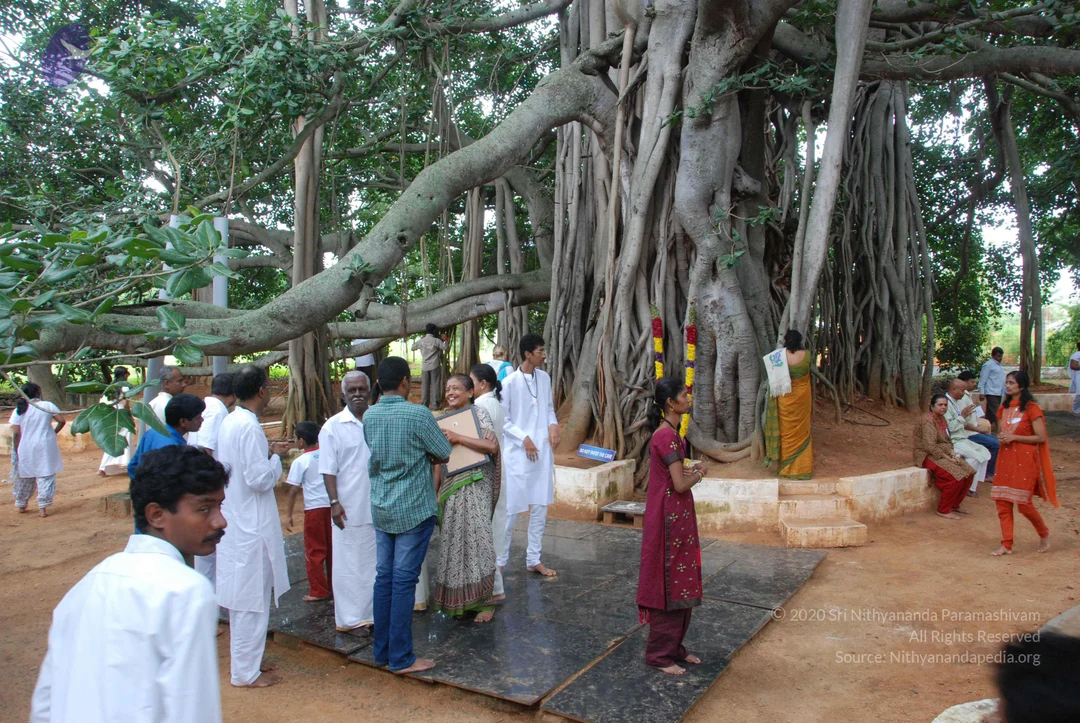
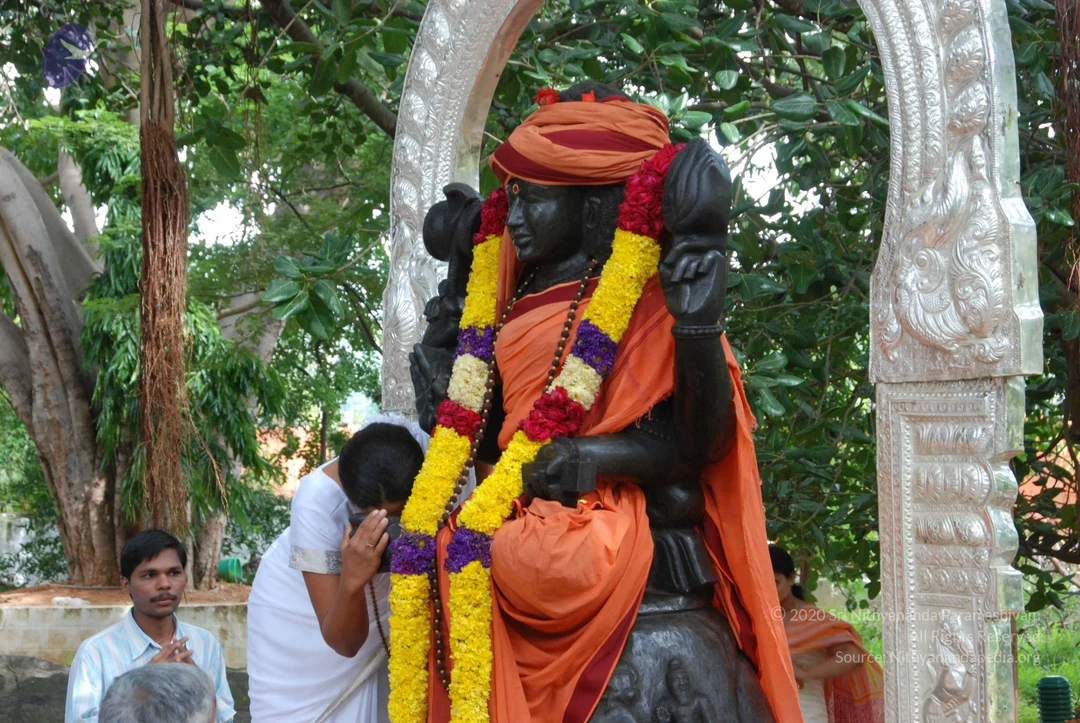
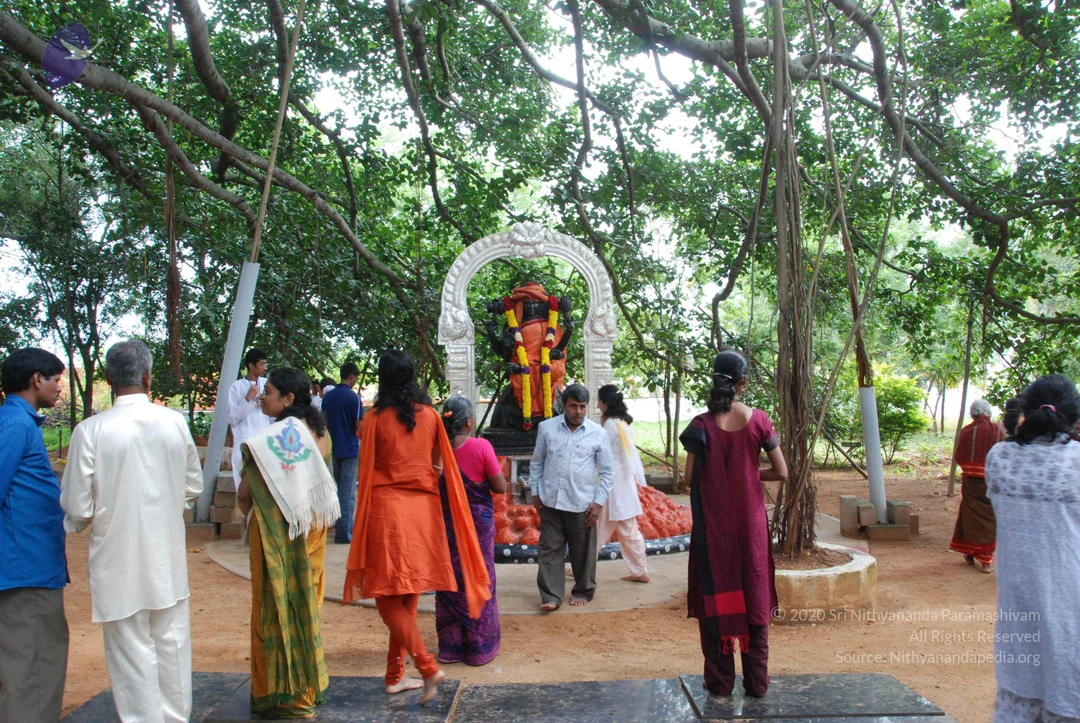
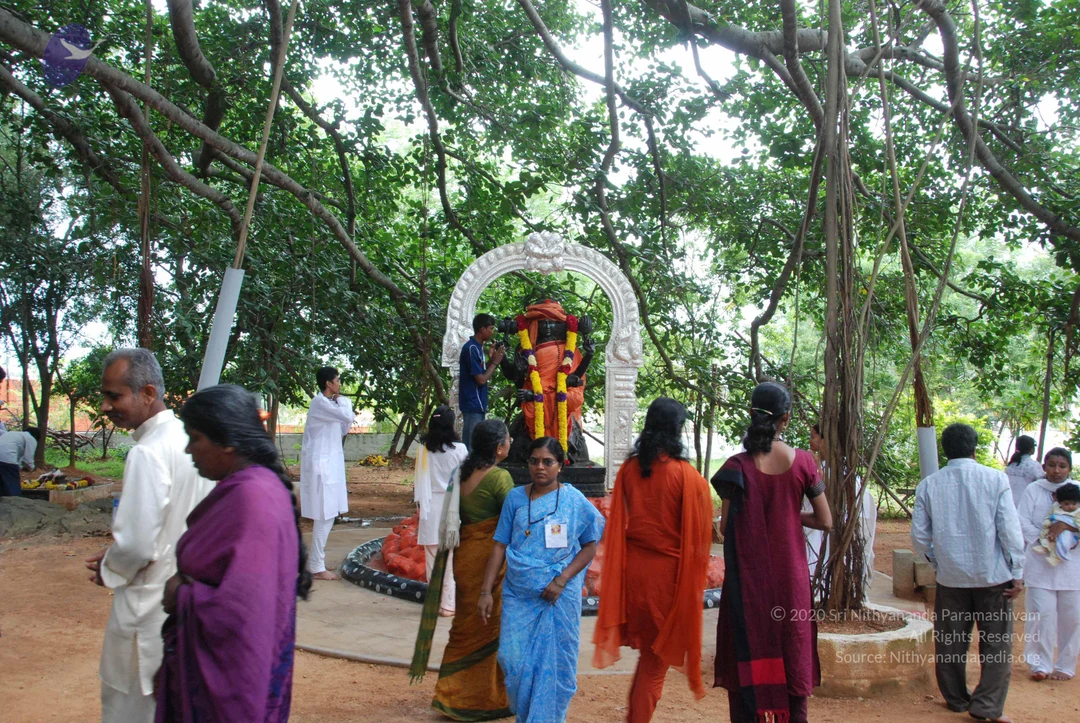
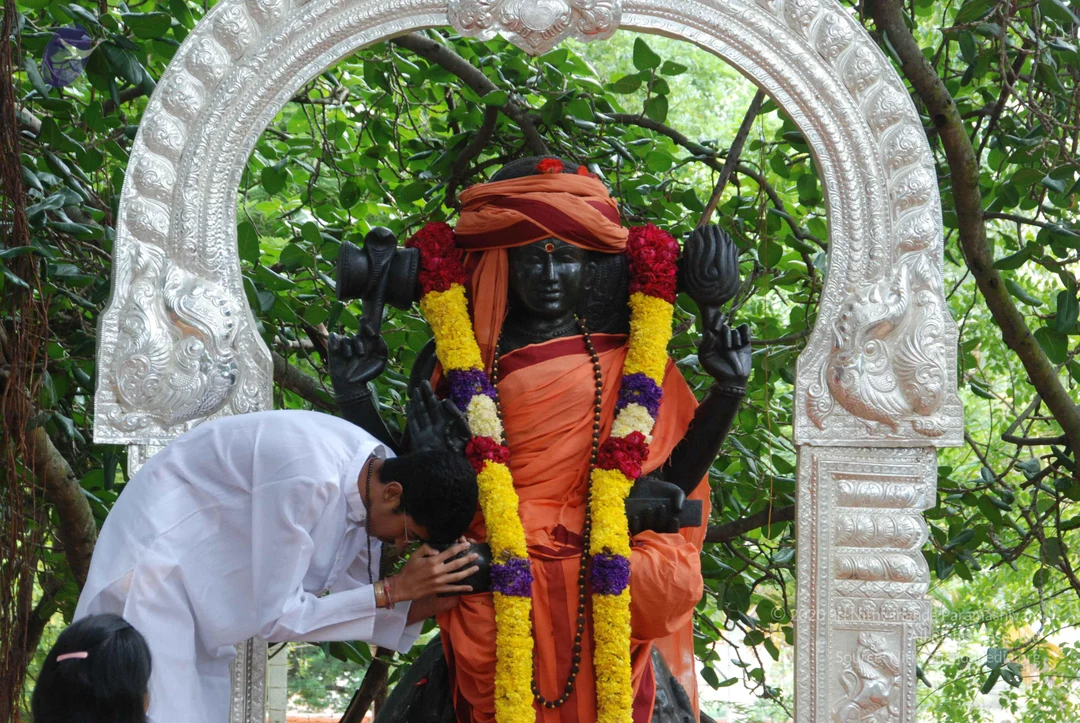
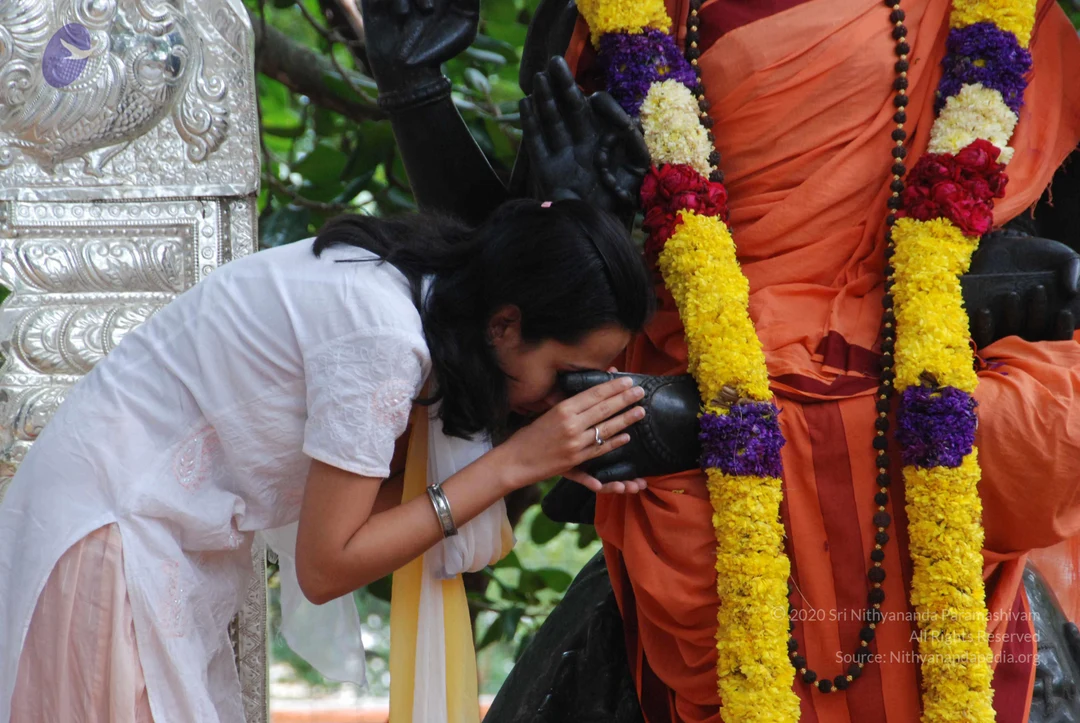
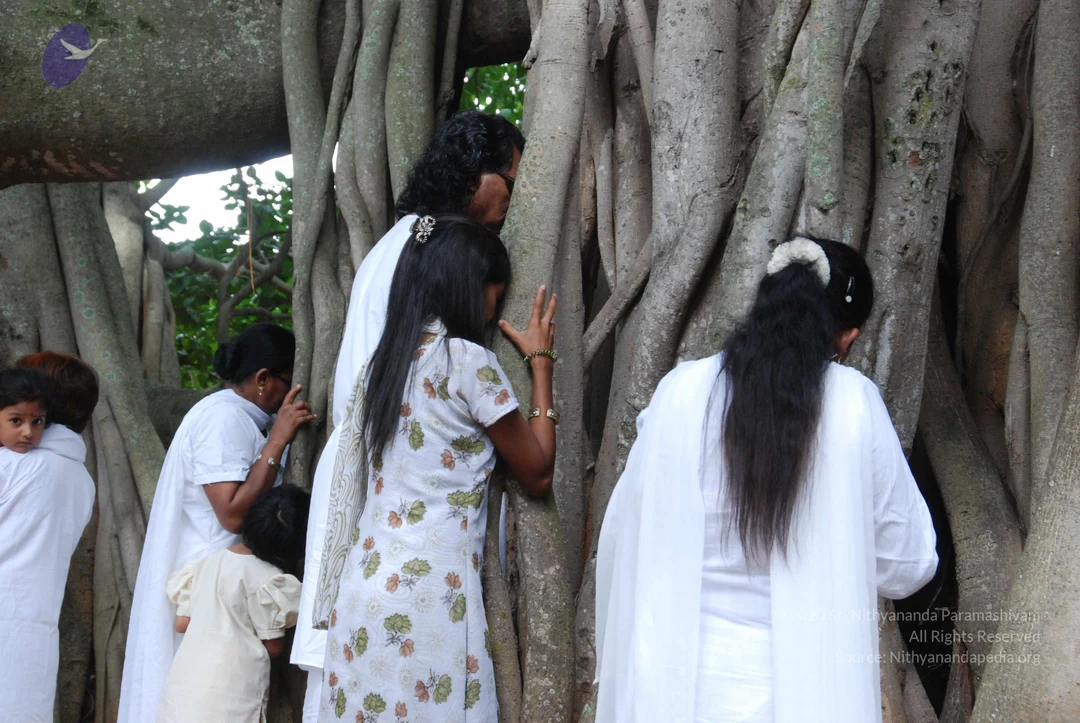
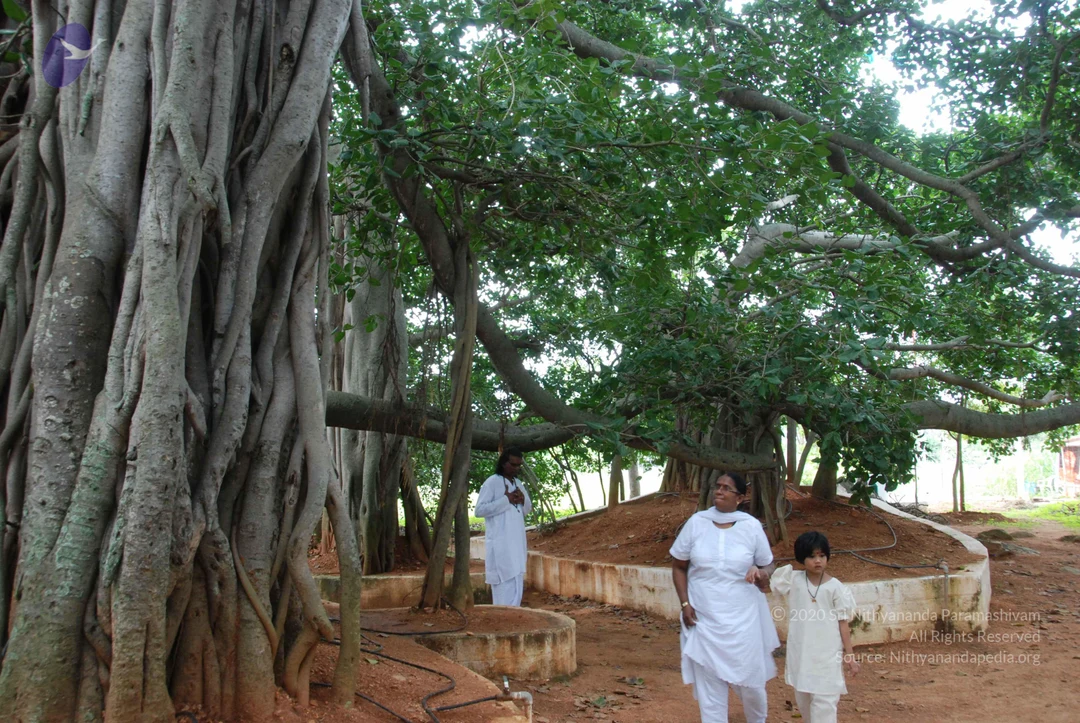
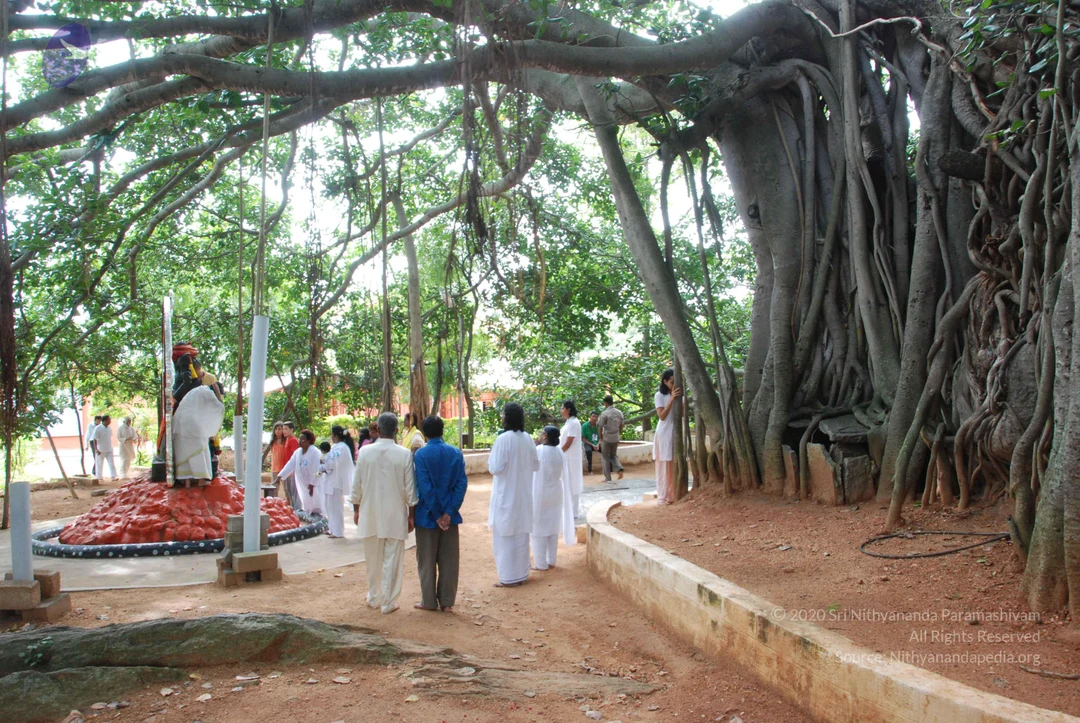
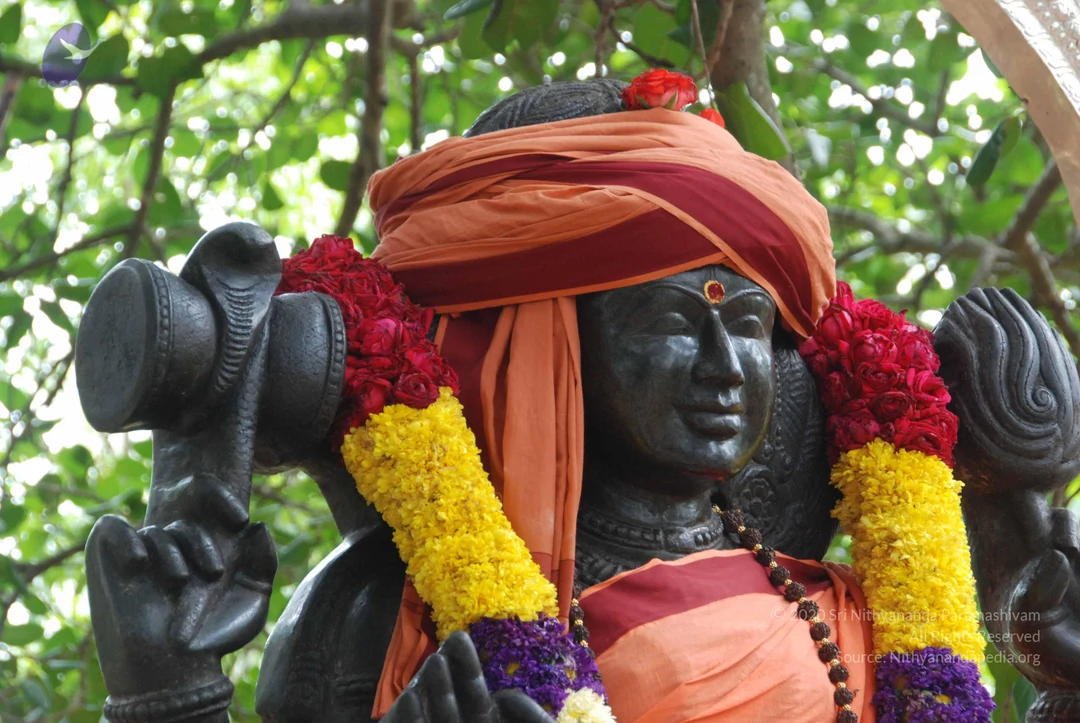
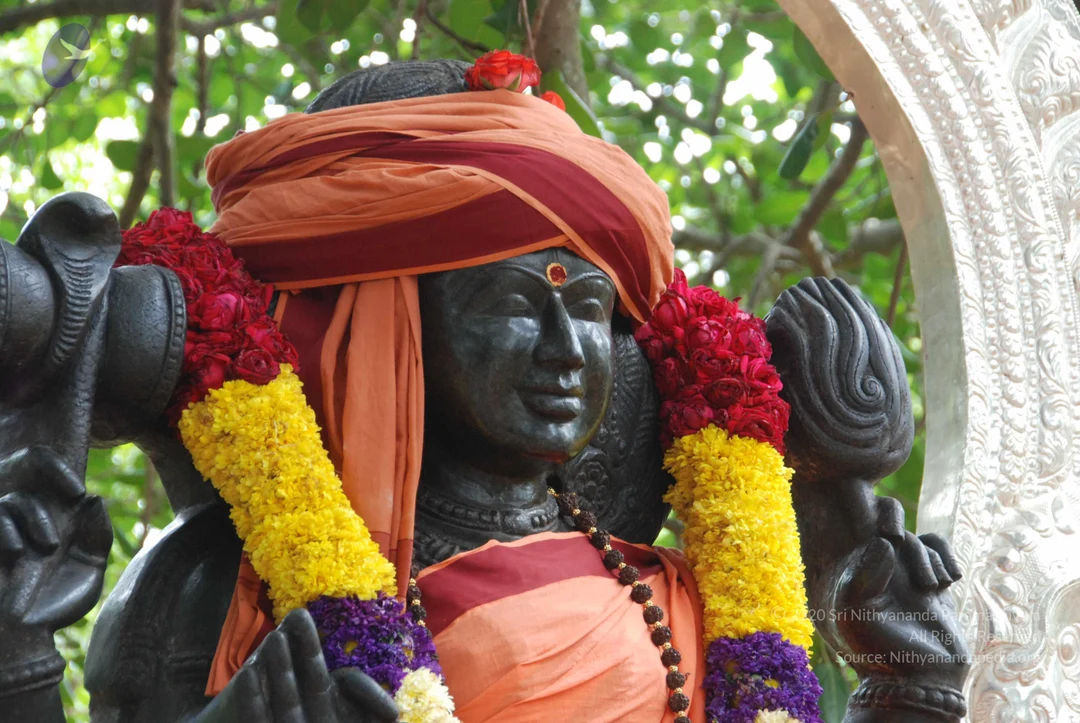
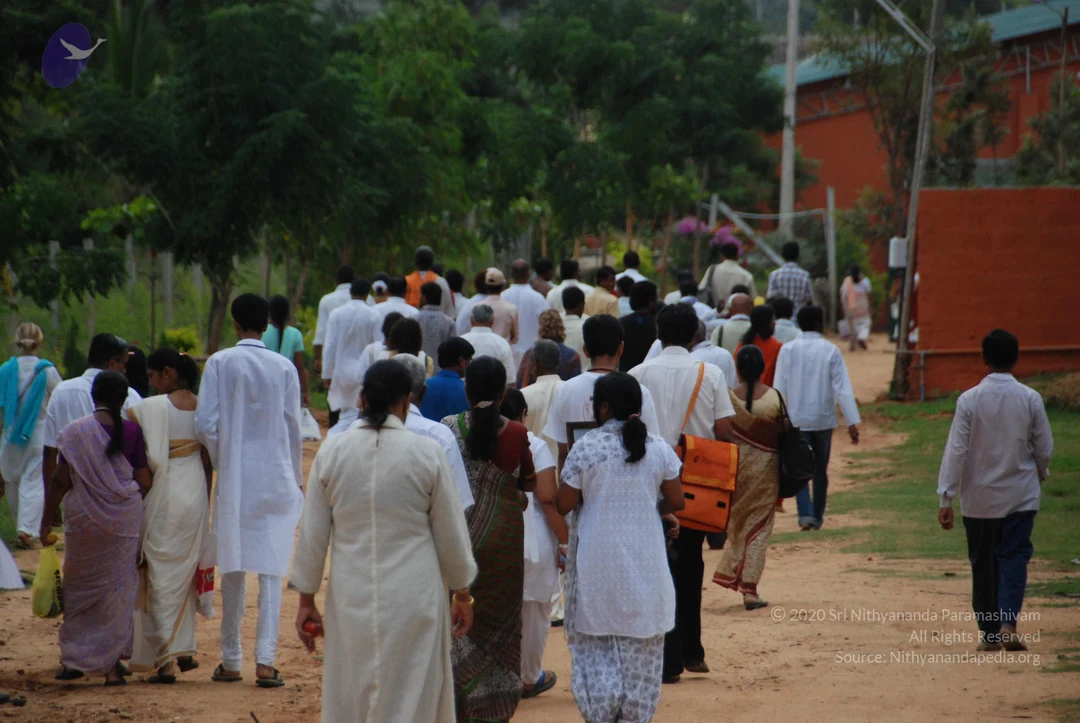
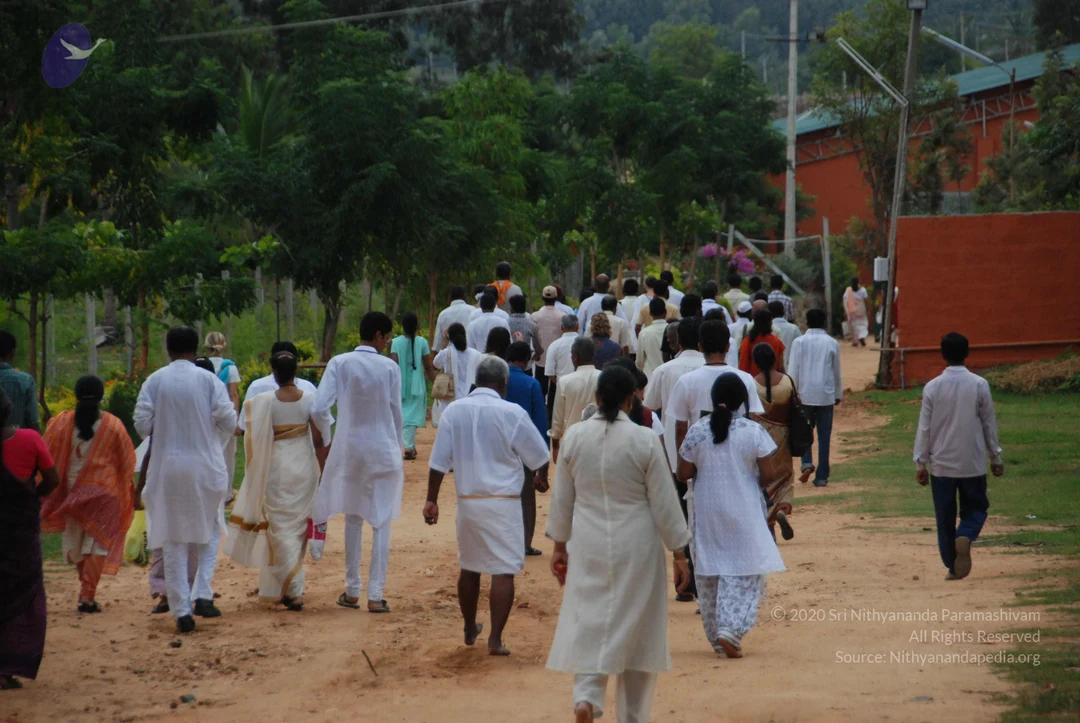
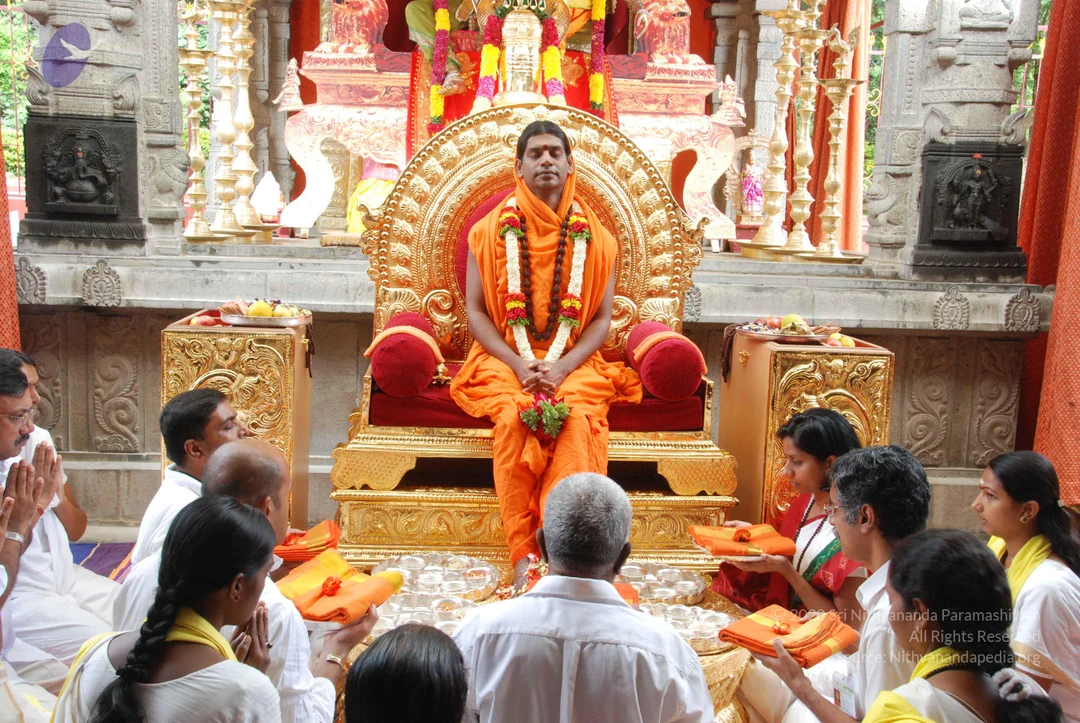
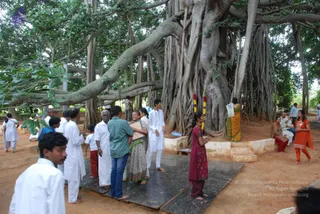
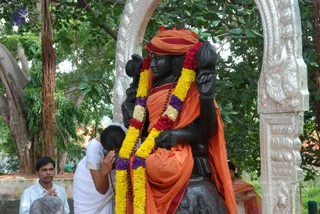
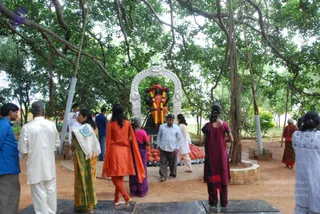
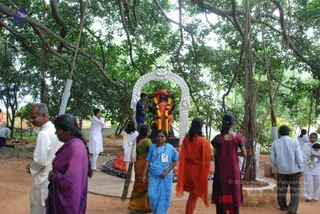
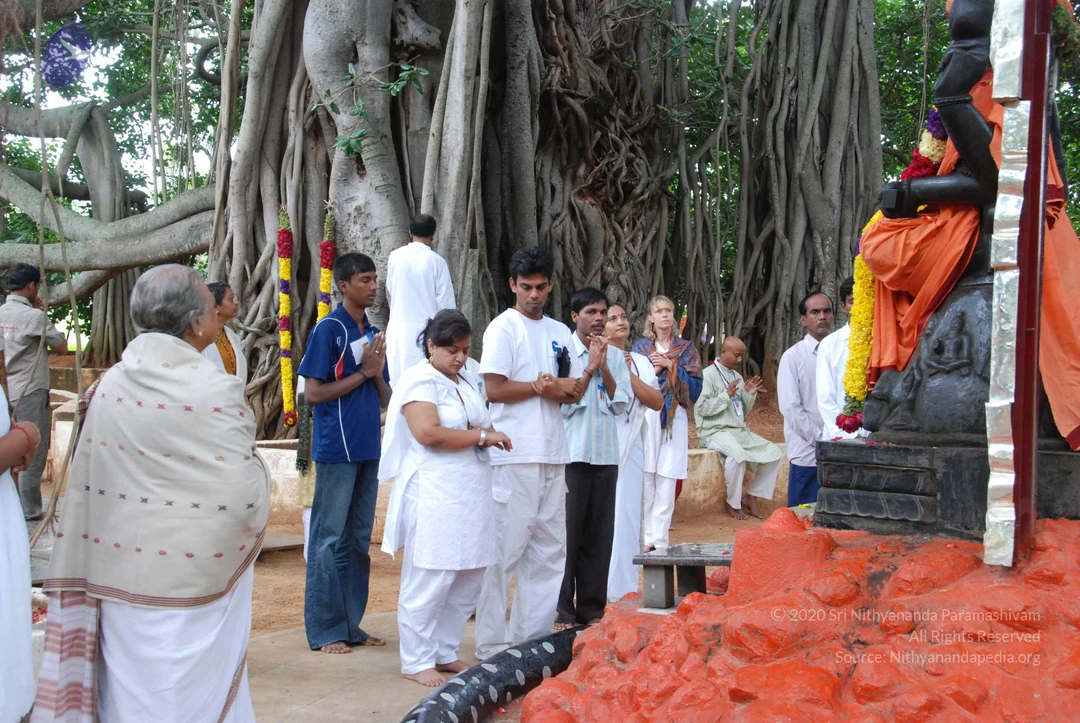
A photograph of devotees standing with palms pressed together in prayer beneath a large banyan tree with many hanging aerial roots. On the right, a dark stone deity murti wrapped in an orange cloth and garlanded with yellow and red flower strands stands on a red-painted base. Several people in white clothes stand in the foreground, including a woman in white with a grey-haired older woman in a white shawl with red border on the left, a man in a white shirt, and a man in a blue sports top. A bald man in a light green robe sits on a bench near the deity, and a woman with light hair stands in a patterned top among the group.Outdoor photo beneath a large banyan tree with thick aerial roots and hanging vines. In the foreground a blurred elderly man in white shirt and glasses walks past. Several devotees in white dhotis and saris stand and walk around a shrine: a black stone deity murti draped in orange cloth with garlands stands beside a black stone snake sculpture coiled over a mound painted bright red-orange. A woman in a blue-green sari kneels at the snake sculpture while a woman in white stands near the mound with hands joined. A man in a blue shirt and a man in a white shirt stand nearby, and a small child in red walks by. Red-orange paint covers a stone platform, and a white pillar stands at left.Outdoor photo at a large banyan tree with many aerial roots hanging from wide, sprawling branches over a sandy red-earth ground. Several people in white ashram clothing stand and walk around the trunk on a dark stone platform; a man in white dhoti and a woman in a green-and-cream sari stand near the centre. A woman in a maroon salwar kameez holds a small object, and a woman in a bright orange outfit walks at the right. Strands of marigold-style garlands hang from the trunk, and a few other people sit on a low white platform on the right. A man in a green checked shirt and blue jeans stands in the middle of the group. No identifiable a person is visible.Outdoor photo beneath large trees showing a black stone statue of a seated sage garlanded with yellow, red and purple flower chains. The statue wears an orange turban and an orange and maroon wrap, with rudraksha beads at the chest, and holds a staff-like object. A devotee in white dhoti and shirt bows forward with palms joined in front of the statue. A man in a light blue striped shirt stands at the left edge, and another figure in orange-striped cloth appears at the far right. A silver ornamental arch frames the murti.Outdoor photo beneath a large banyan tree with hanging aerial roots, showing a white arched shrine framing a deity murti draped in orange with garlands of yellow and orange flowers. Several devotees stand around on sandy ground: a man in a white dhoti and shirt on the left, a woman in an orange saree and orange skirt, a woman in a green and yellow saree with a white shawl, a man in a blue shirt and grey trousers near the shrine, and a woman in a maroon outfit at right. Orange and red offerings are heaped at the base of the shrine. No a person candidate is visible.Outdoor photo beneath a large banyan tree with dense hanging aerial roots. At centre, a deity murti in an orange-draped form stands within a white arched shrine frame, adorned with yellow and orange marigold garlands. Several people walk on a dirt ground around it: a man in white kurta at left, a woman in purple sari, a woman in green-and-gold sari, a woman in light blue sari with a lanyard, a woman in orange robes, a woman in maroon salwar kameez, and a man in pale shirt at right holding a small child in white. A man in blue shirt photographs the shrine, and a figure in white stands beside it. Orange and red offering bags sit near a tyre-ringed platform.

2-Morning-Message
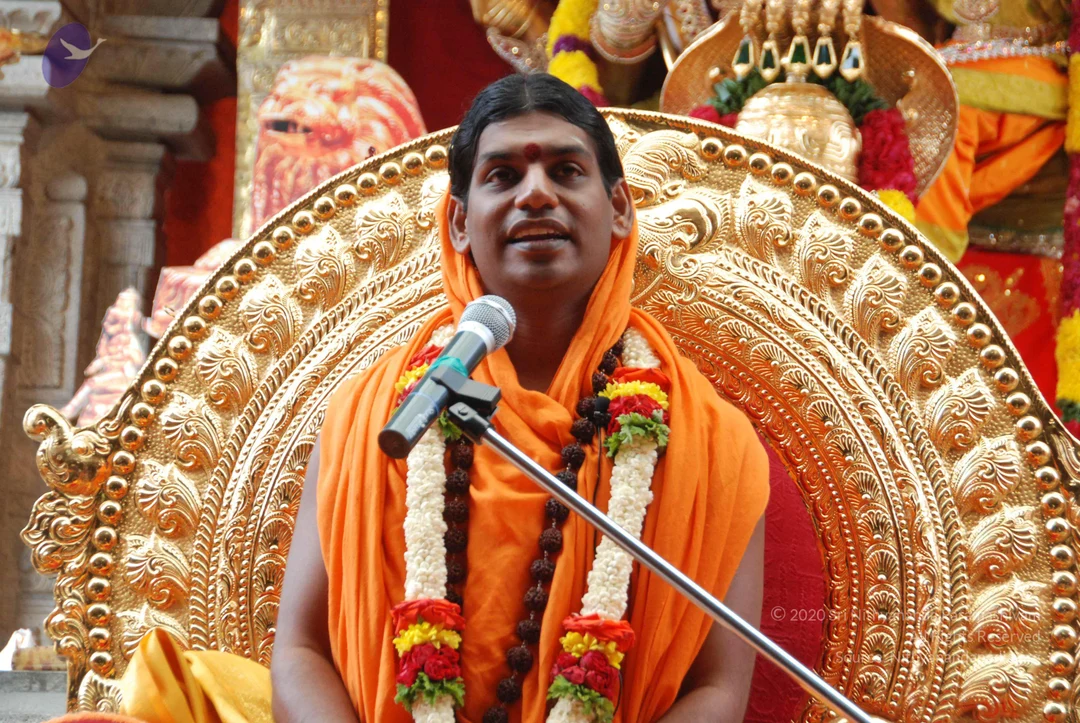
11 photosSource gallery
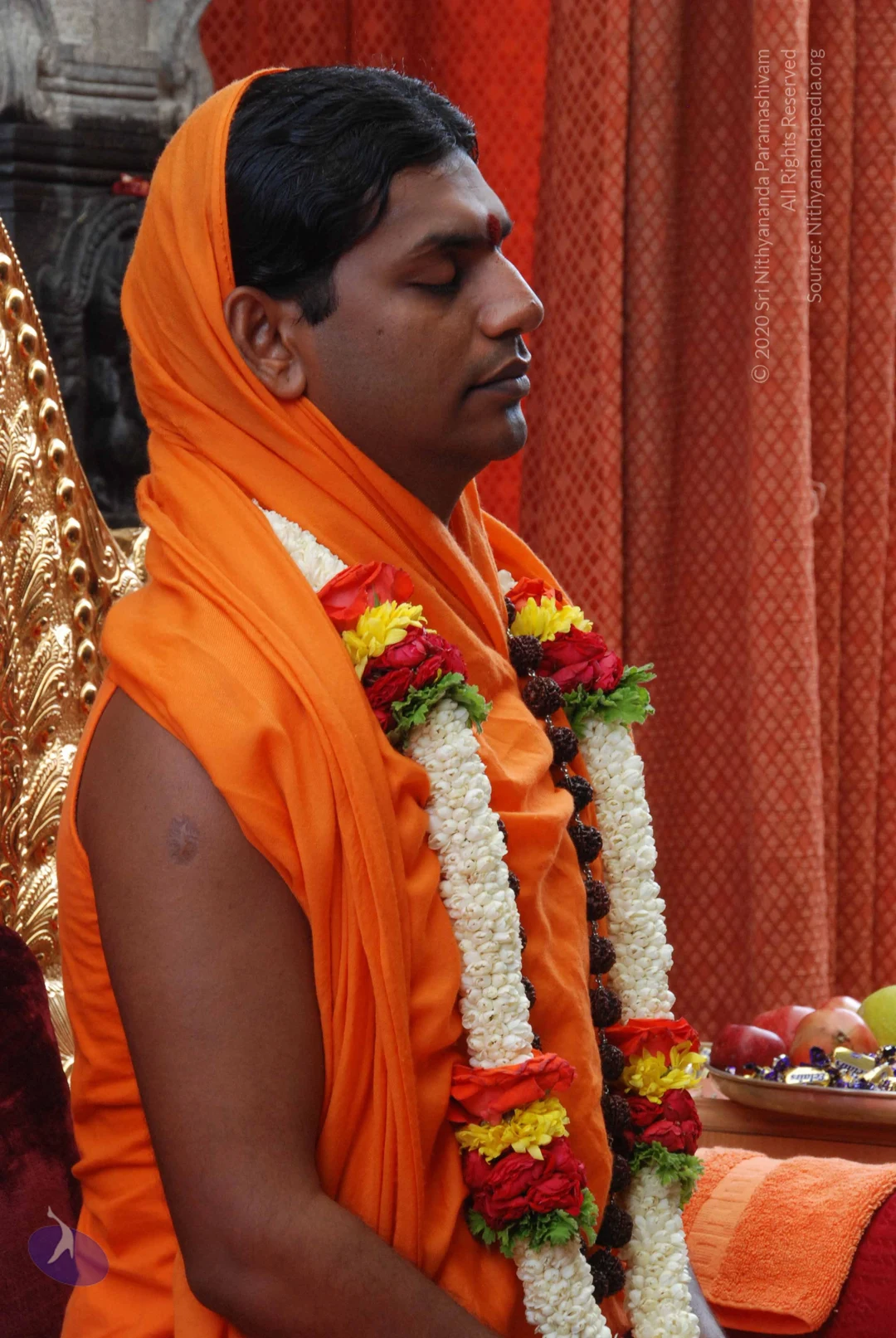
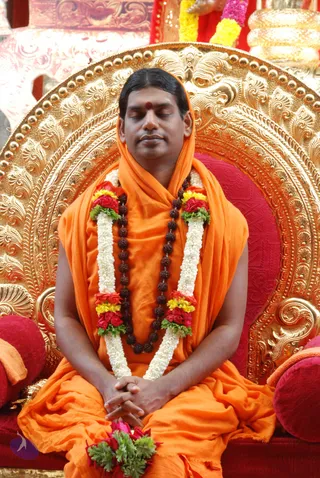
A photograph of a seated figure in saffron-orange robes on an ornate golden throne with carved gold panels, wearing a long rudraksha mala and layered flower garlands of white, red and green. The figure is seated on a red cushion with bare feet visible, and a second red-capped attendant stands behind the throne. A gilded chair with carved lion-like details and golden ceremonial items surround the scene, with a red-roofed temple structure and greenery in the background.A man seated on an ornate gold throne with a red cushion, eyes closed and palms pressed together in namaste before a microphone on a stand. He wears an orange saffron shawl draped over his head and shoulders, an orange garment, a red vermilion mark on his forehead, and layered garlands of white jasmine, yellow marigold and red flowers with rudraksha beads around his neck. Behind him is a red and gold backdrop with a red painted figure and floral garlands. The appearance is consistent with the a person (saffron shawl, rudraksha mala, flower garlands, ceremonial throne), though identification is uncertain; the page places him at a live satsang talk.A man seated on an ornate gold throne with carved floral and scroll motifs presses his palms together in anjali mudra with eyes closed. He wears an orange saffron shawl draped over his head and shoulders, a red kumkum mark on his forehead, and layered garlands of white jasmine, yellow and red flowers with green leaves, and dark rudraksha beads. A silver microphone on a stand is in front of him. Red fabric is visible behind the throne. a person: the orange saffron shawl, rudraksha malas and ceremonial garlands on a throne are consistent with the page's identification of a person speaking at this event.A man sits on an ornate gold throne with carved scrollwork and red cushions, speaking into a handheld microphone on a stand, his raised right hand gesturing. He wears an orange saffron shawl over orange robes, a white and red floral garland with a dark rudraksha mala, and a red vermilion bindi. Behind him stand gold and red decorations, a gold kalasha-style finial and ornate gilded ceremonial items. The setting suggests a live satsang talk on a throne.A photograph of a seated man giving a talk into a microphone on a stand. He sits on an ornate gold throne with red cushions, wearing an orange saffron shawl over orange robes, a rudraksha mala and white and multicoloured flower garlands. His hands rest folded in his lap. Behind him stands a golden deity murti adorned with a crown, orange garments and flower garlands, with gold pillars and lamps at the left edge. a person: the man has short hair, a swept saffron shawl, rudraksha mala and garlands, matching the page's claim that he is present.A man in orange saffron robes speaks into a microphone on a stand, seated before an ornate gold throne with elaborate filigree and round studs. He wears a red tilak on his forehead and a layered garland of white jasmine, red and yellow flowers, plus a rudraksha mala with dark beads. Behind him are gold and red decorative elements, a gold kalasha-like ornament and a yellow flower garland. A purple bird logo appears in the upper left corner. a person: the speaker has short dark hair, wears saffron cloth and a rudraksha mala, and sits on a throne, consistent with the page's reference to a person speaking at this event.

3-NSP
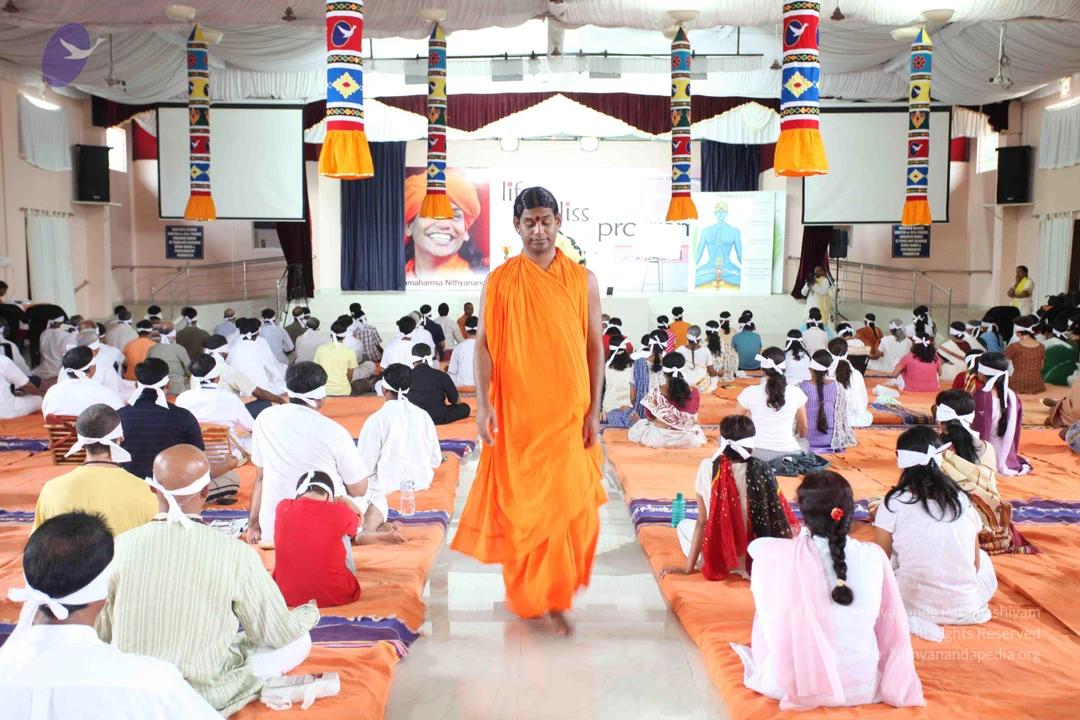
61 photosSource gallery
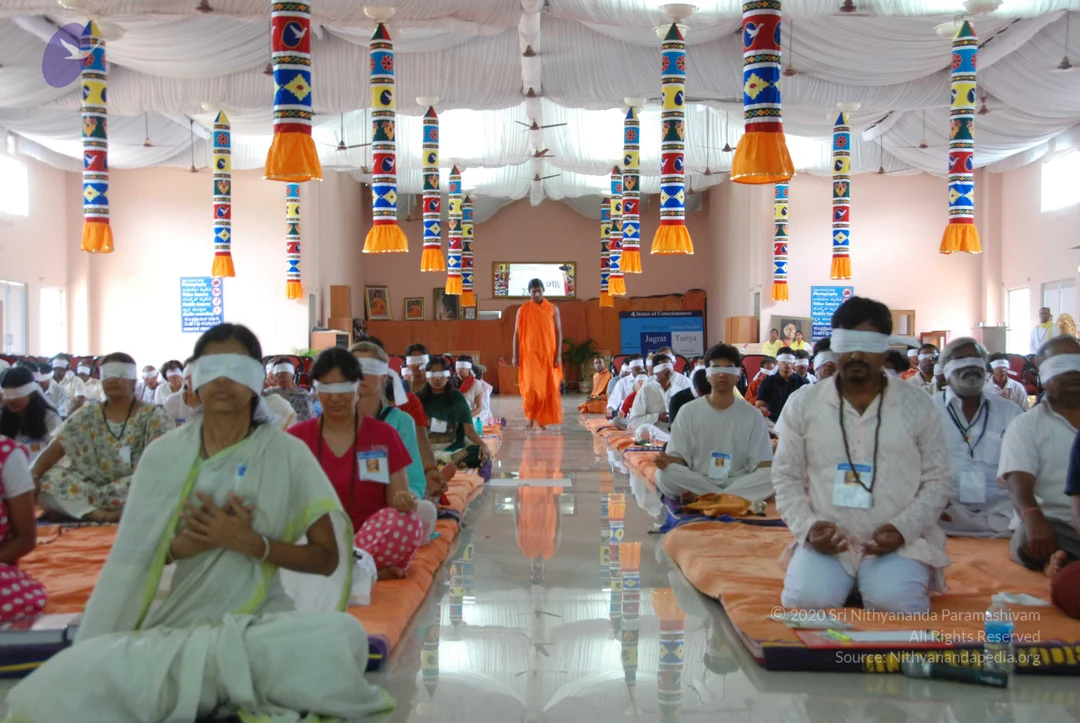
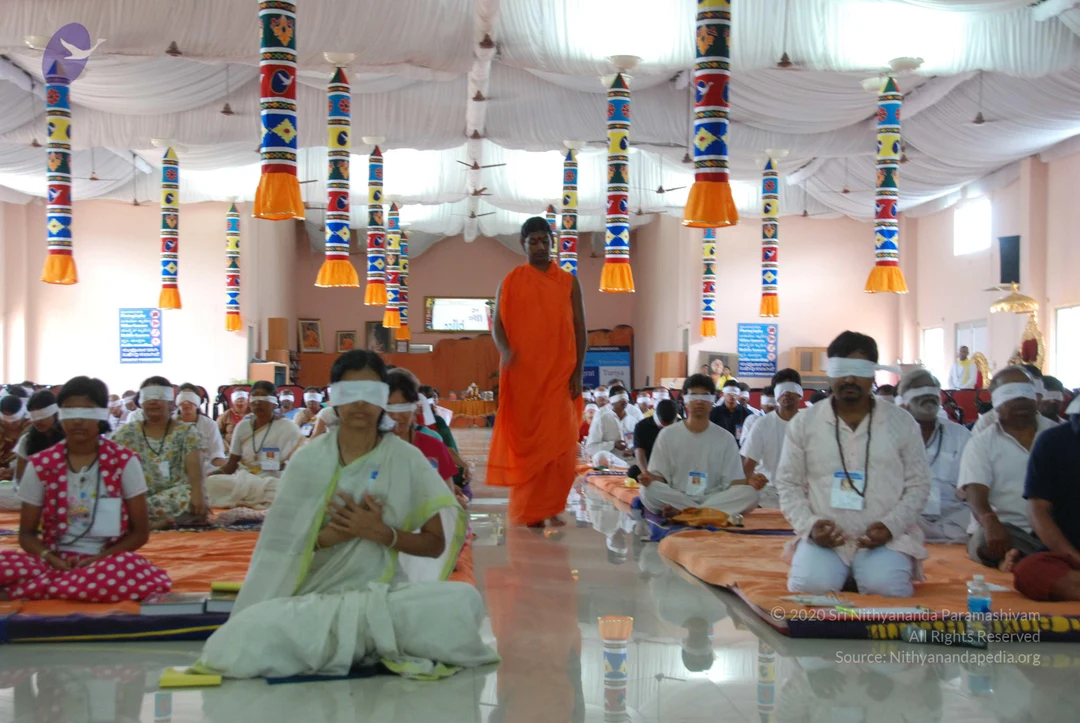
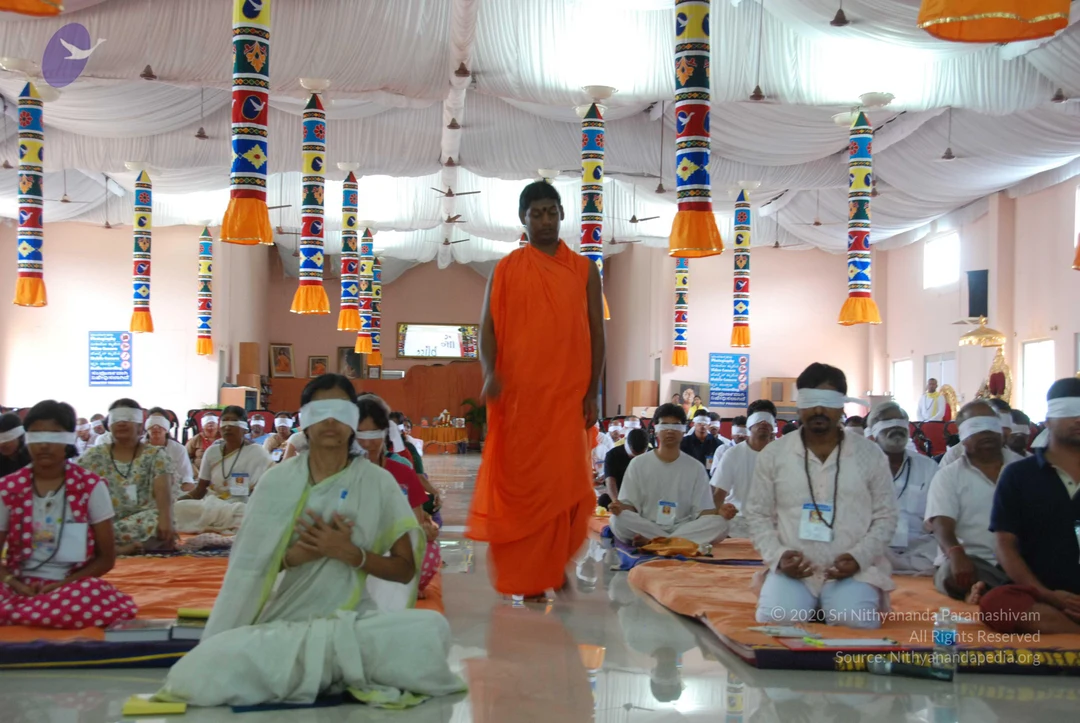
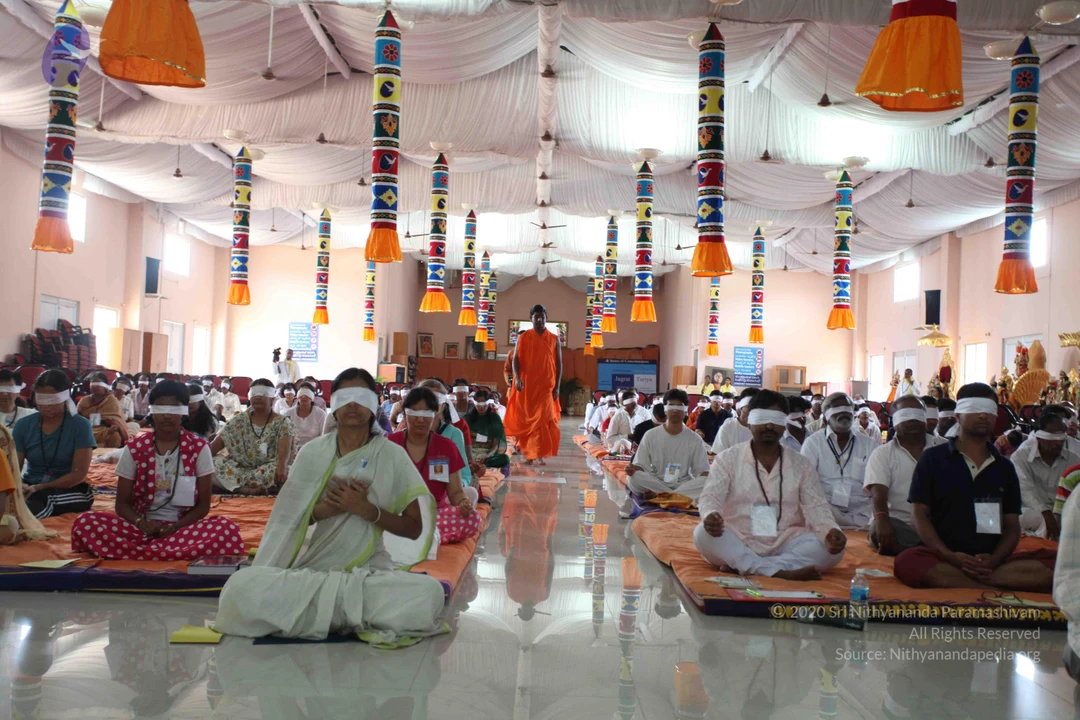
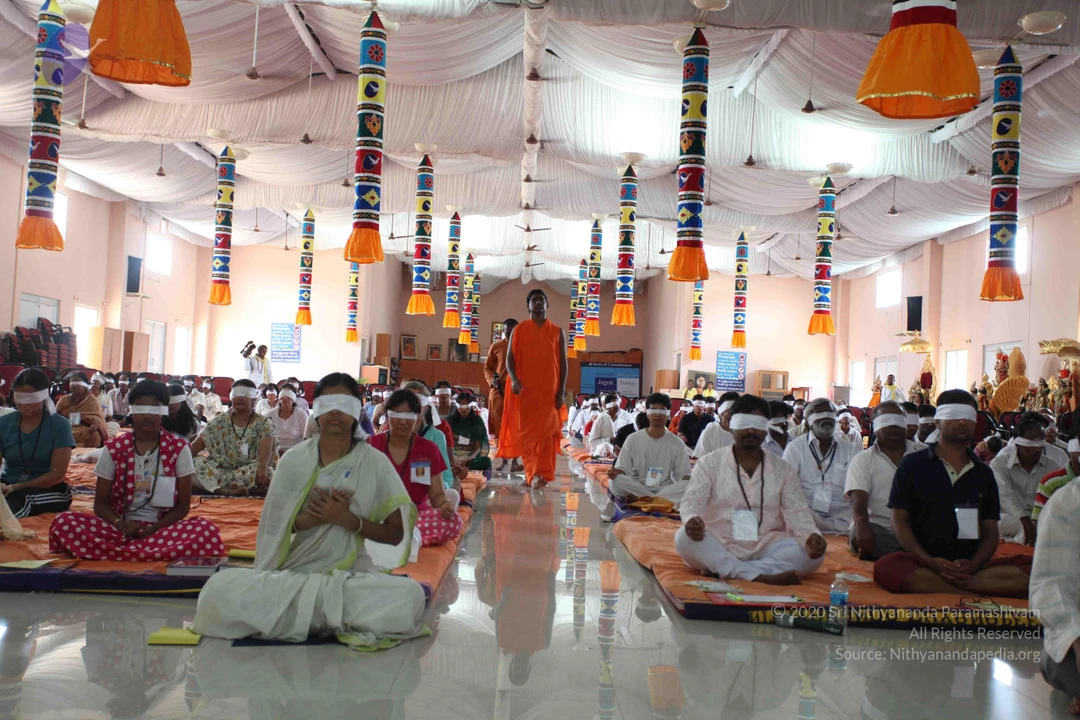
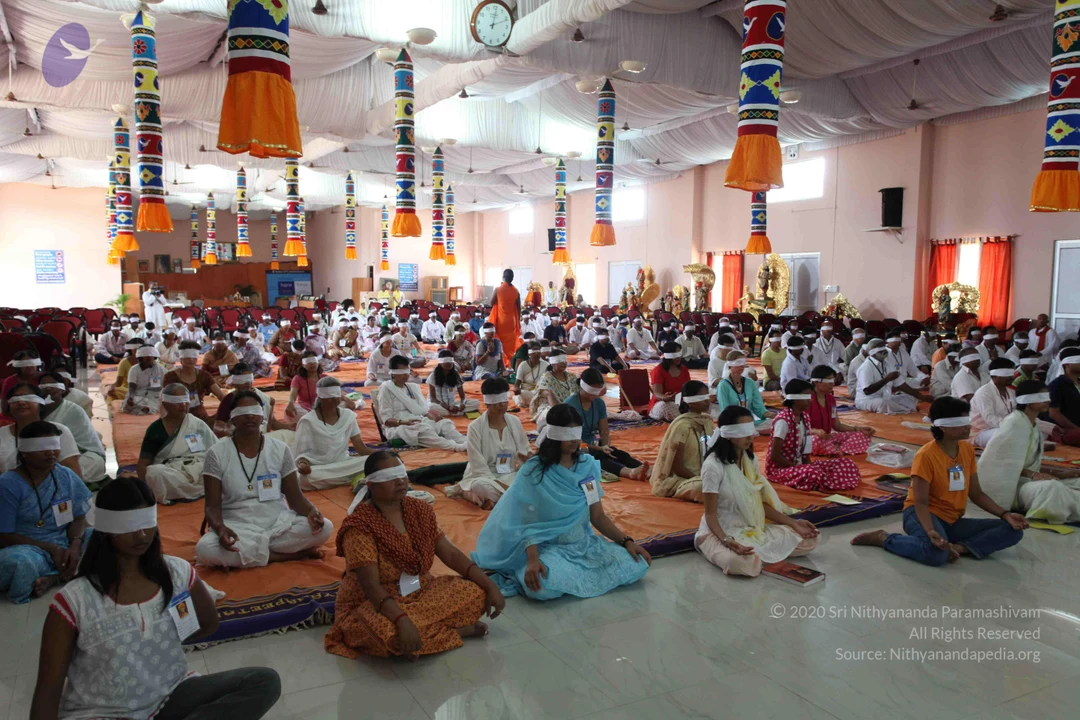
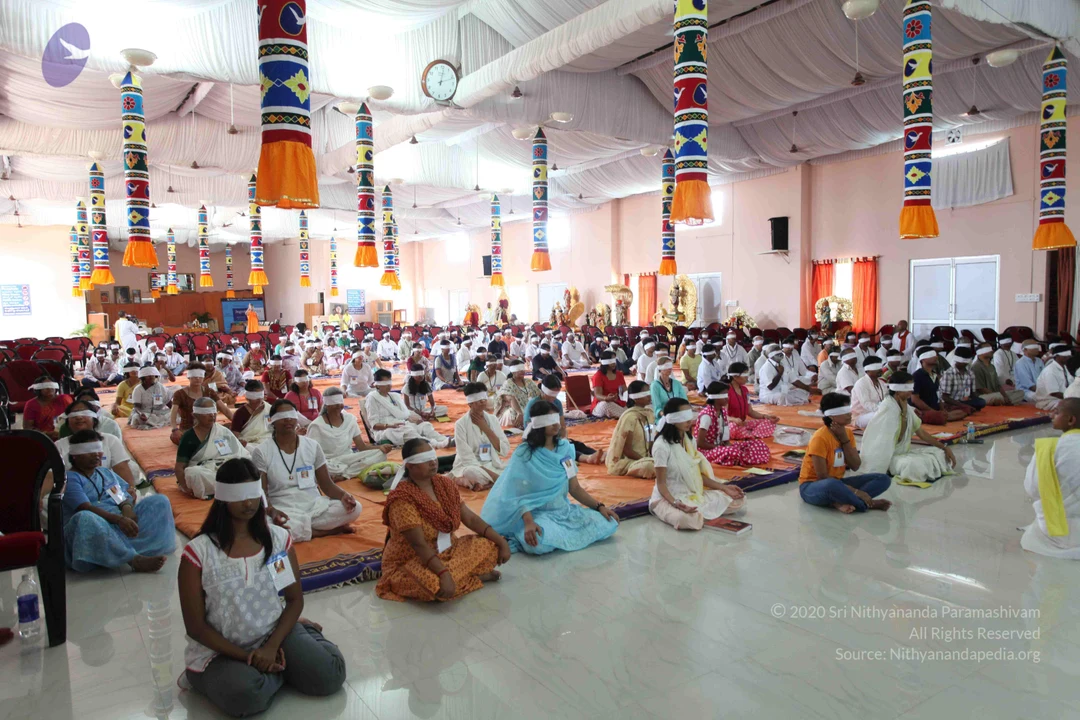
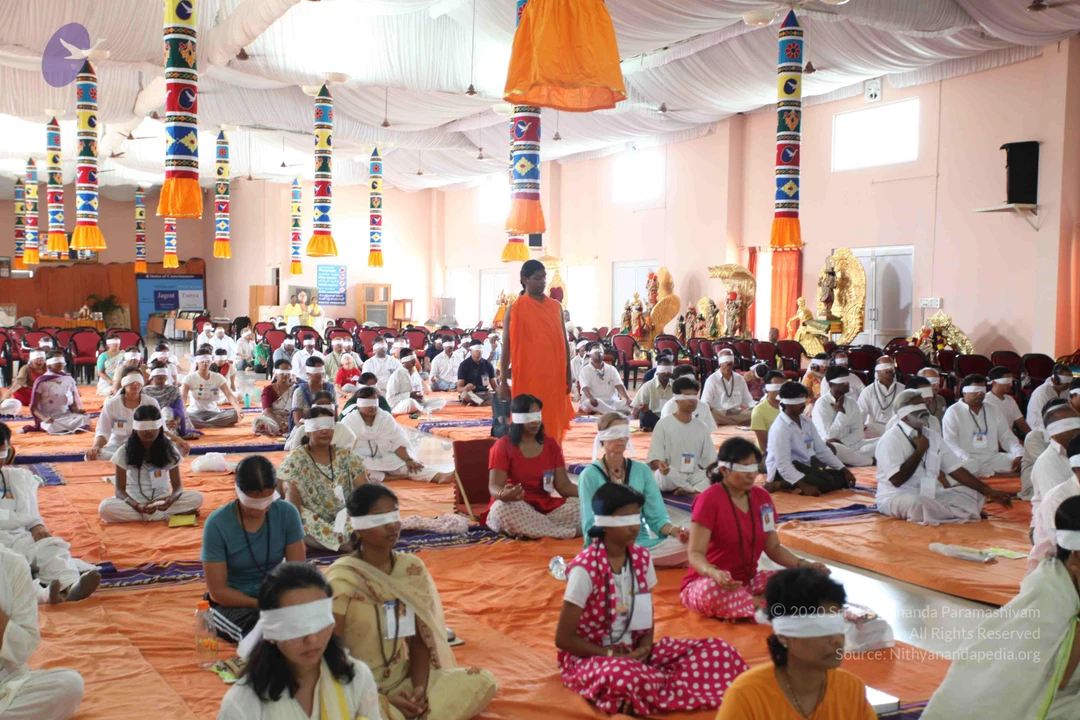
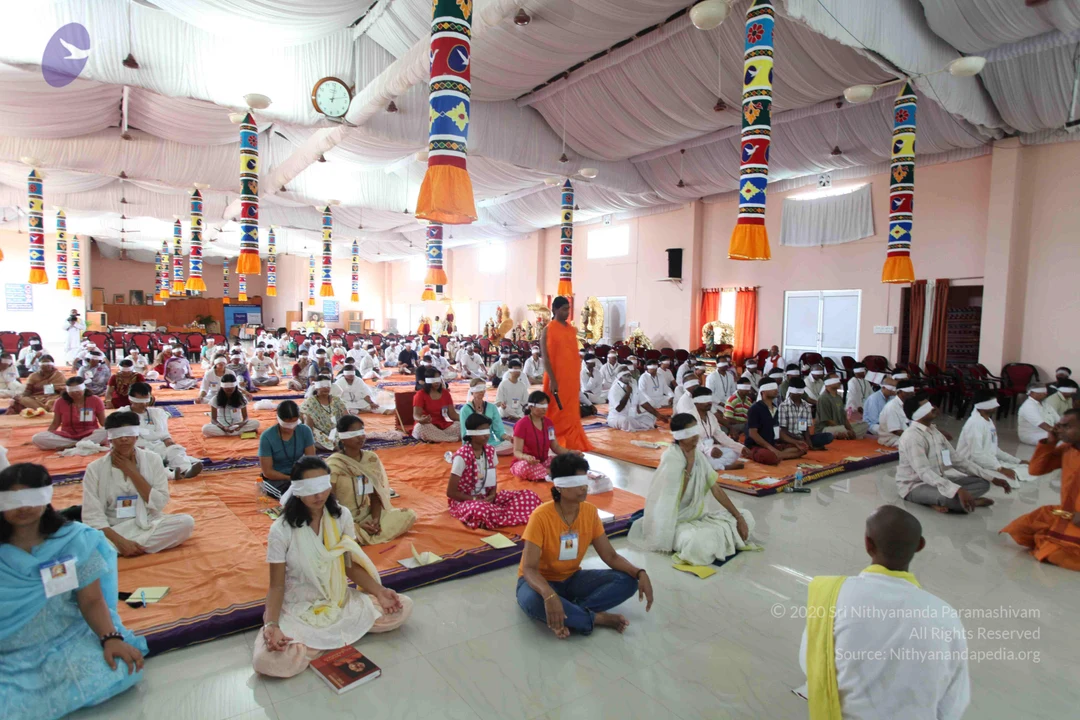
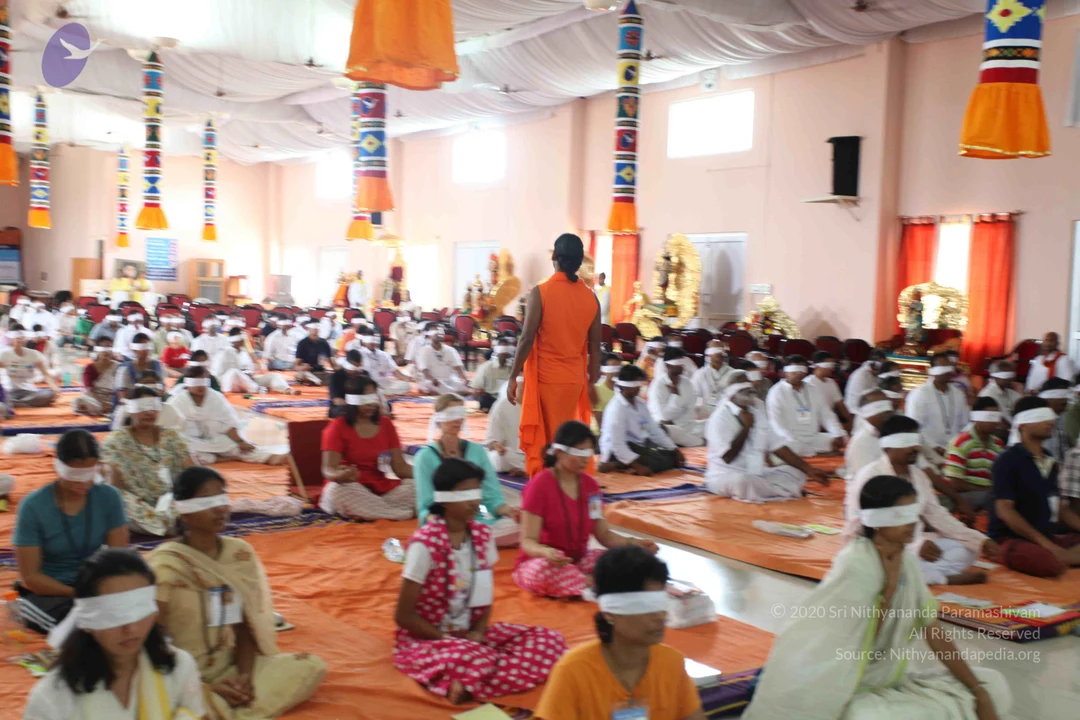
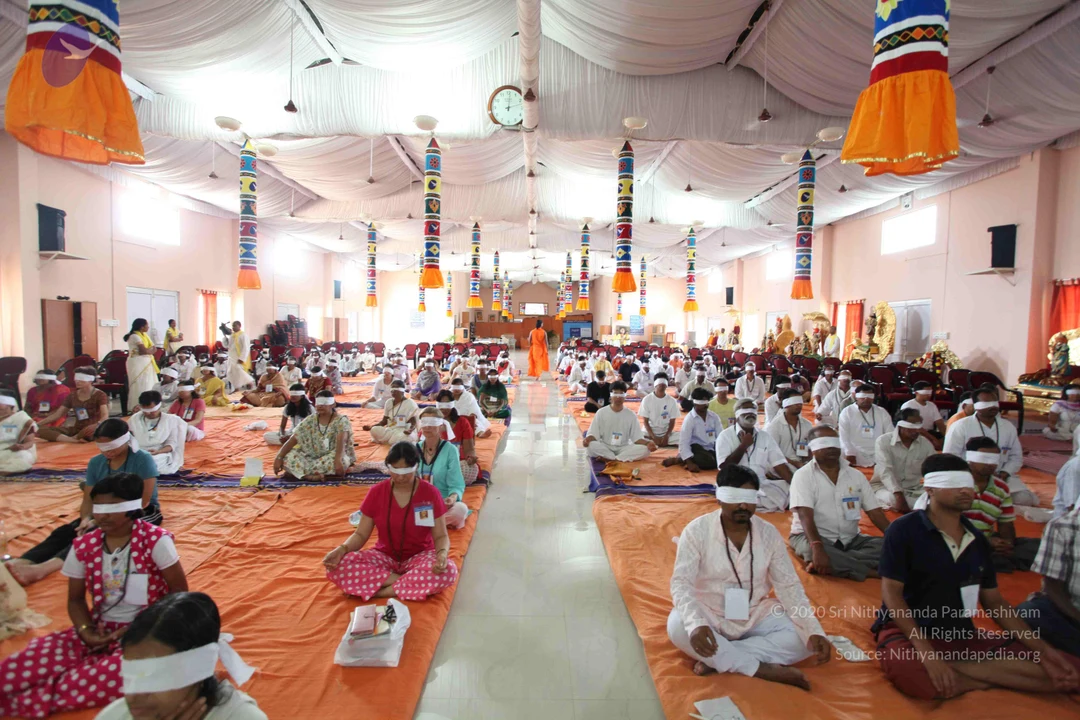
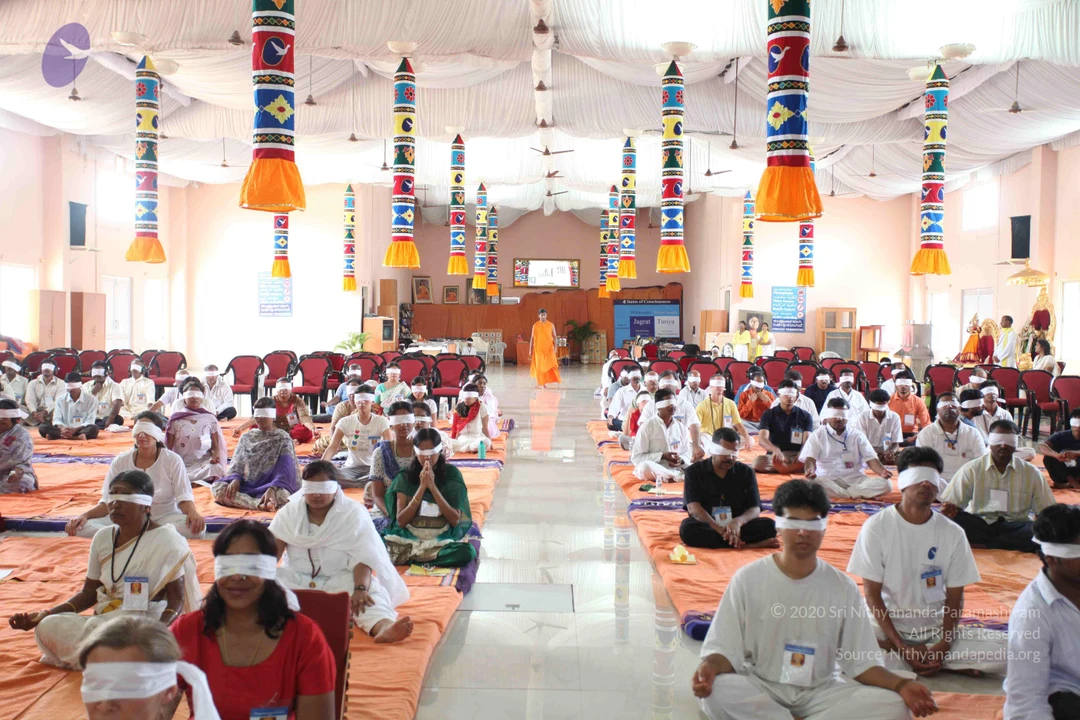
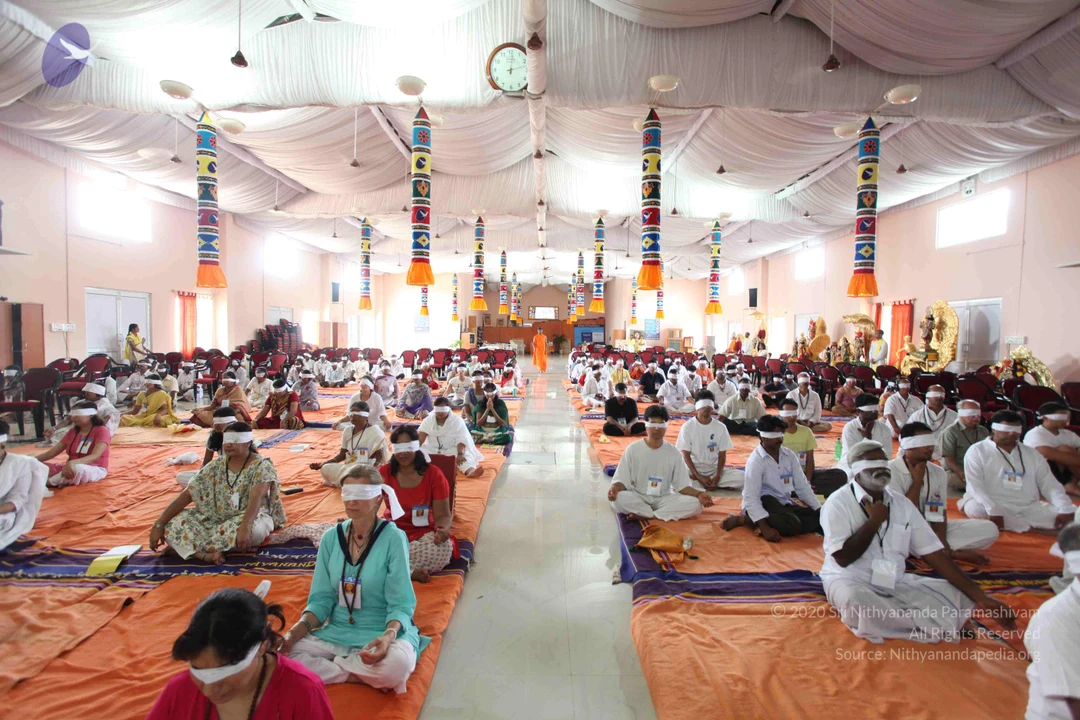
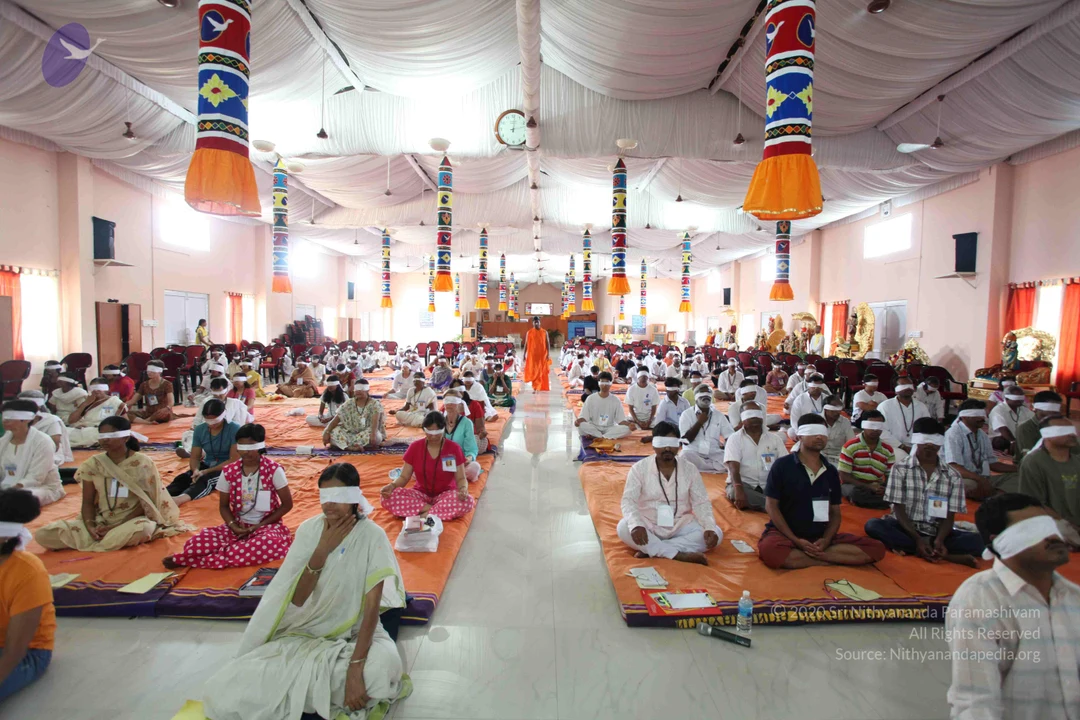
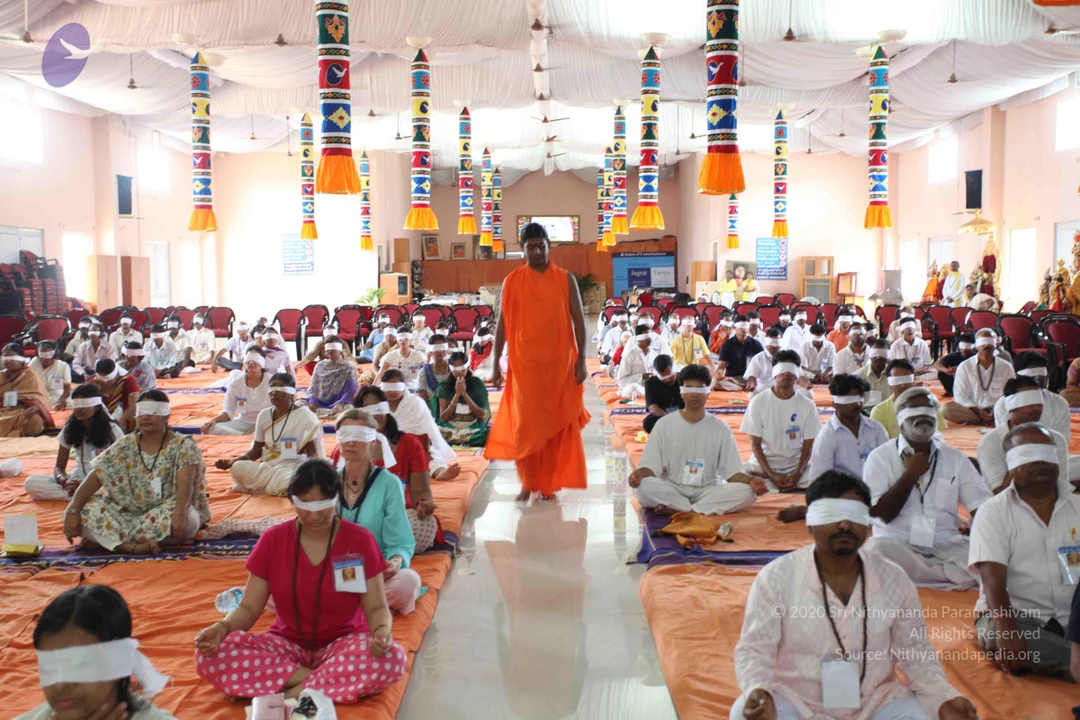
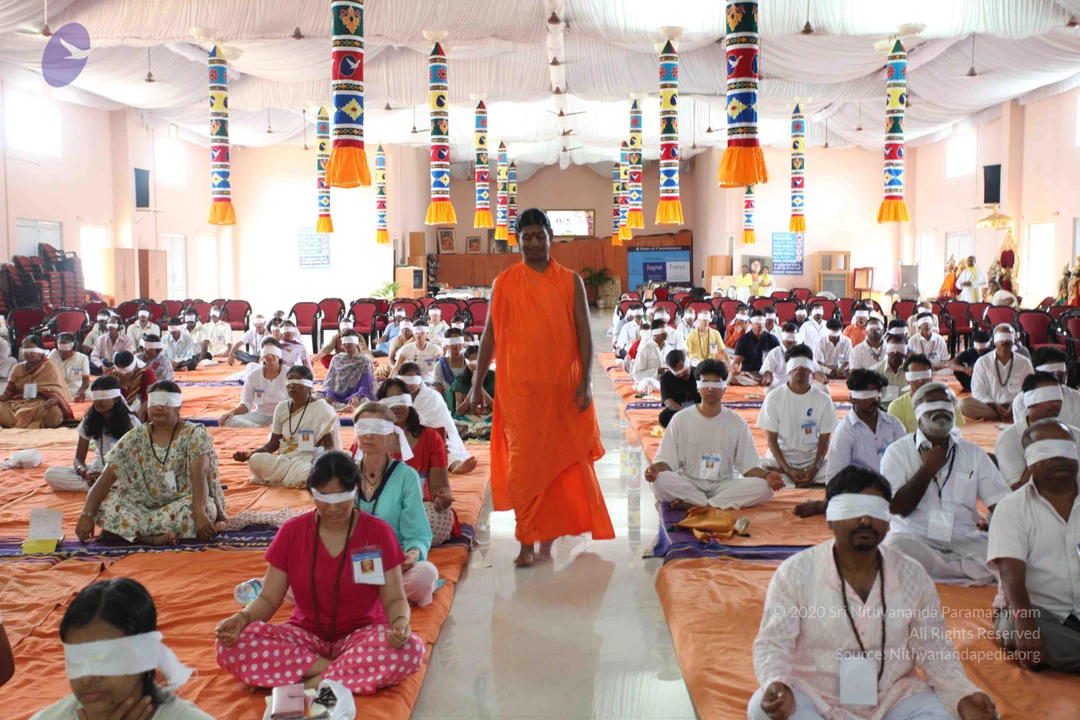
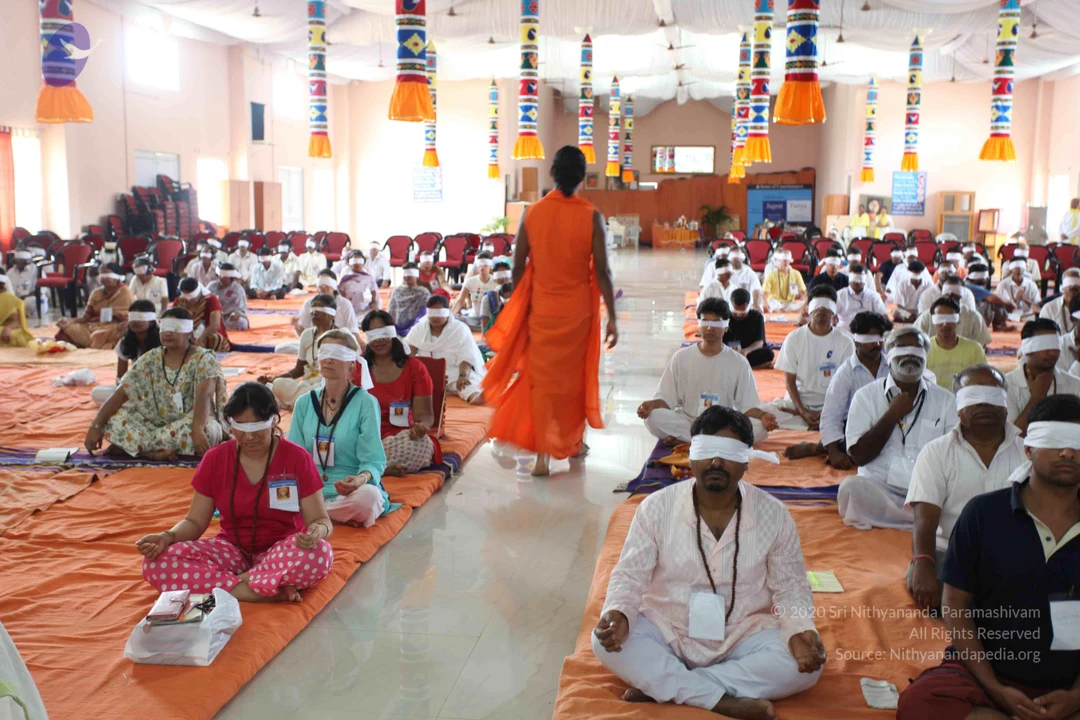
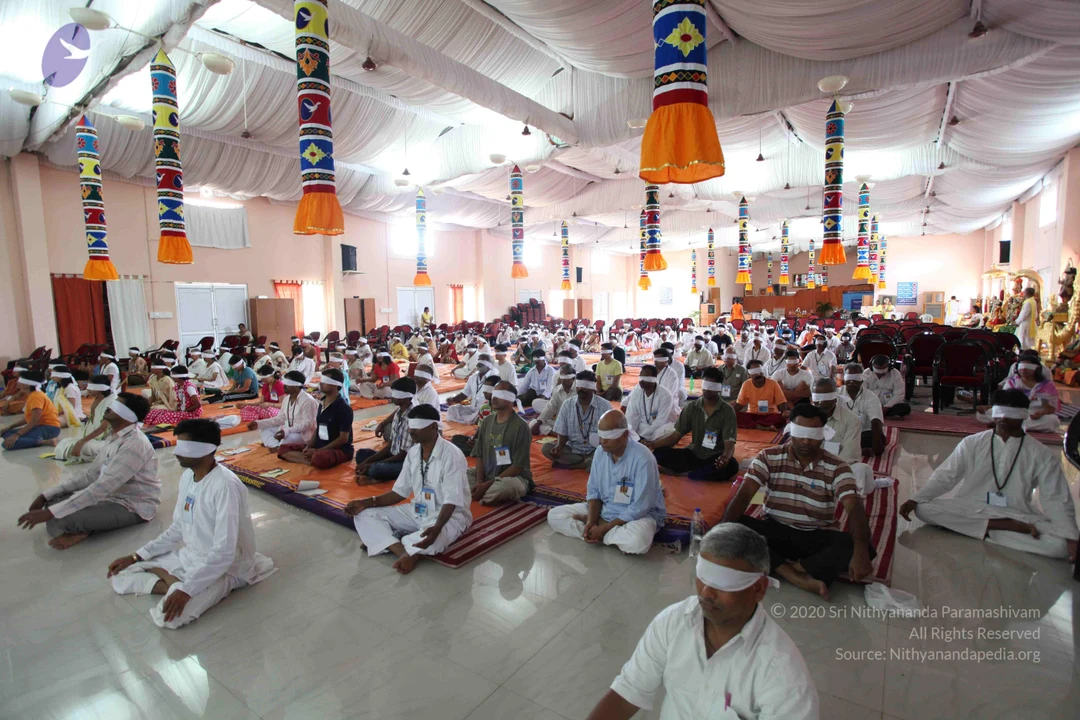
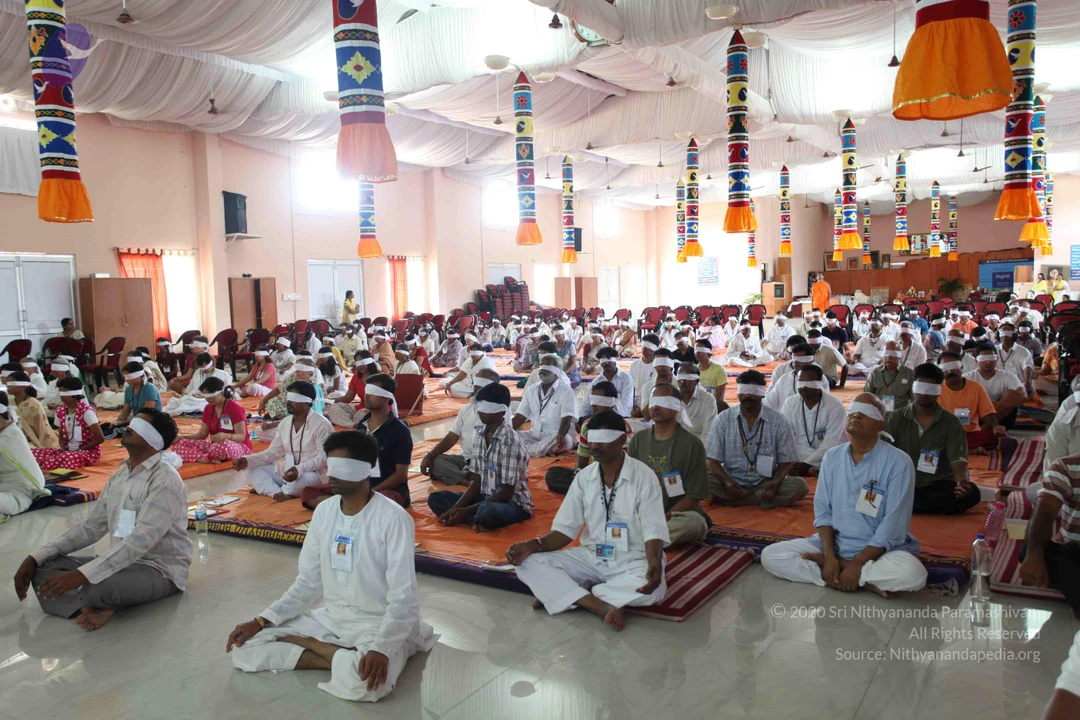
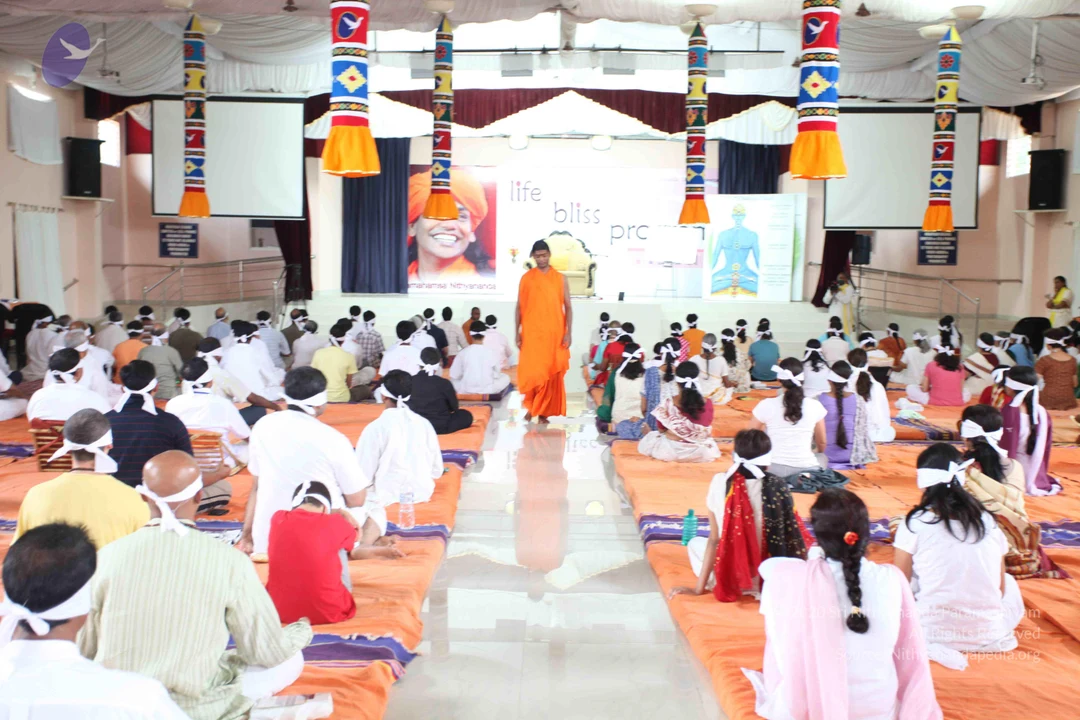
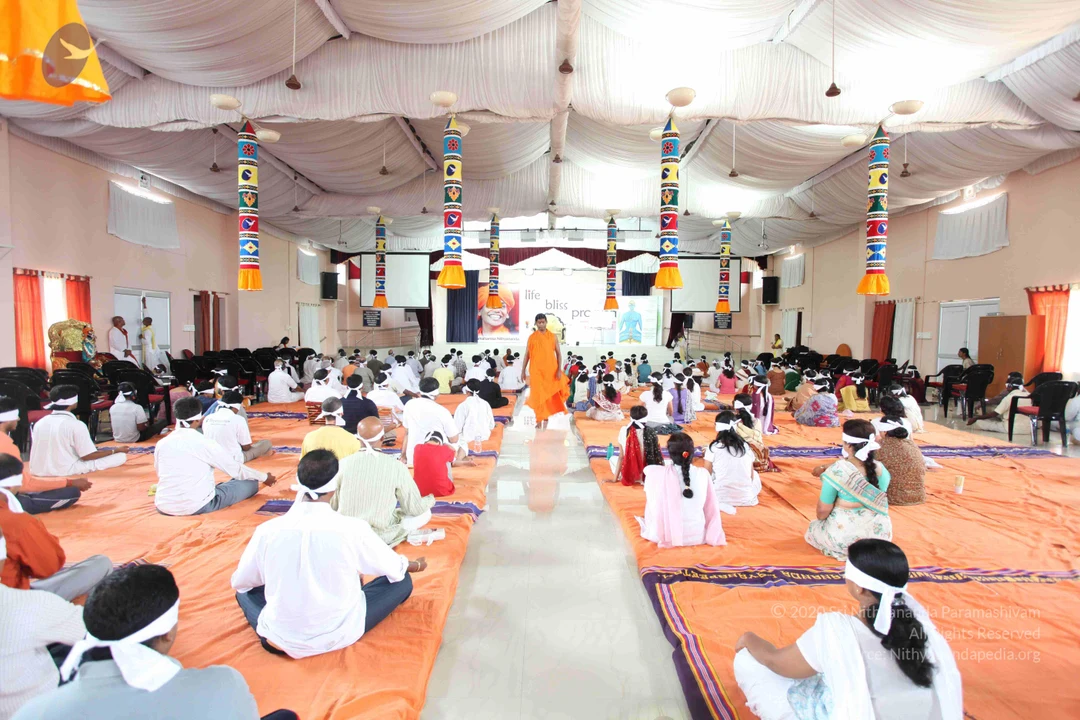
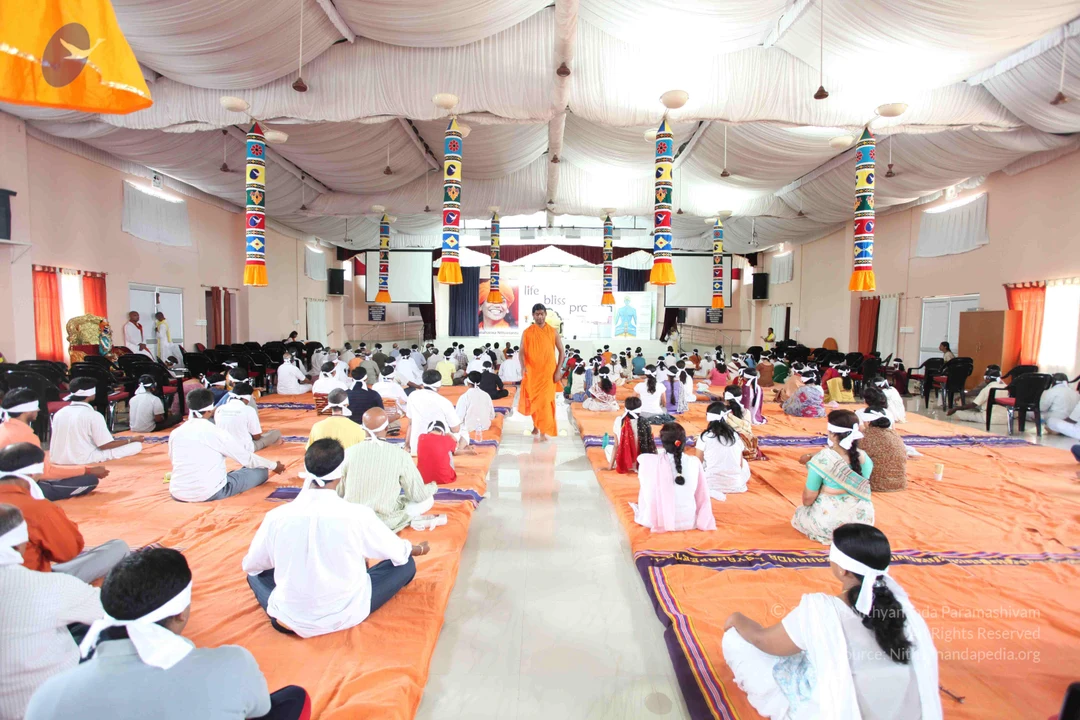
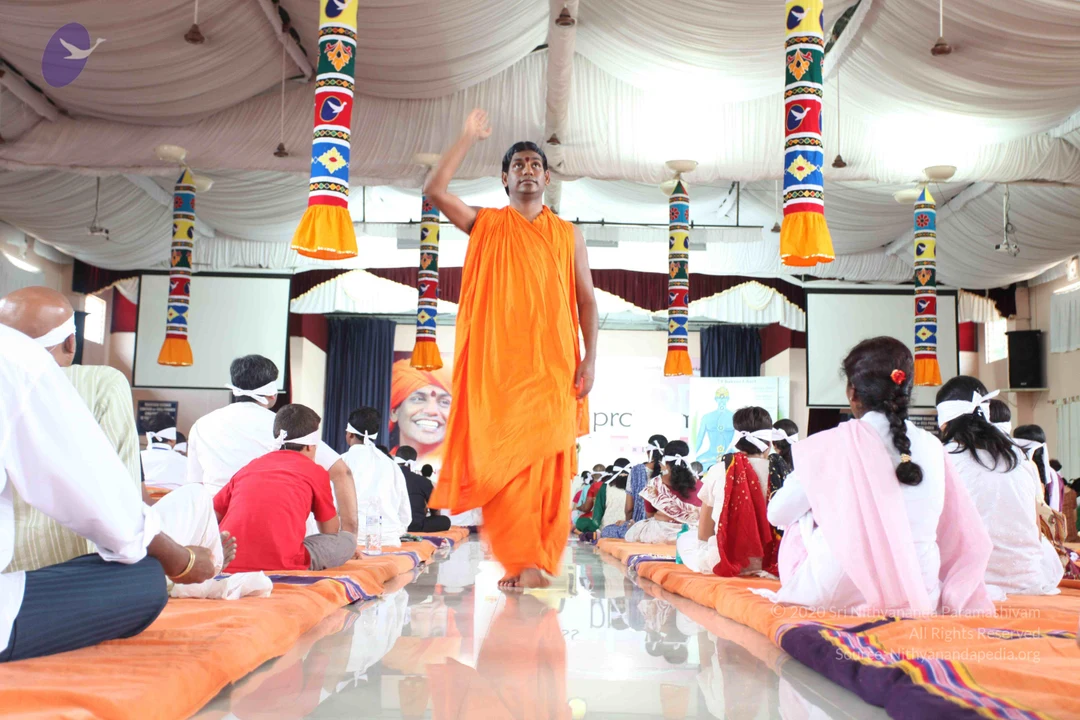
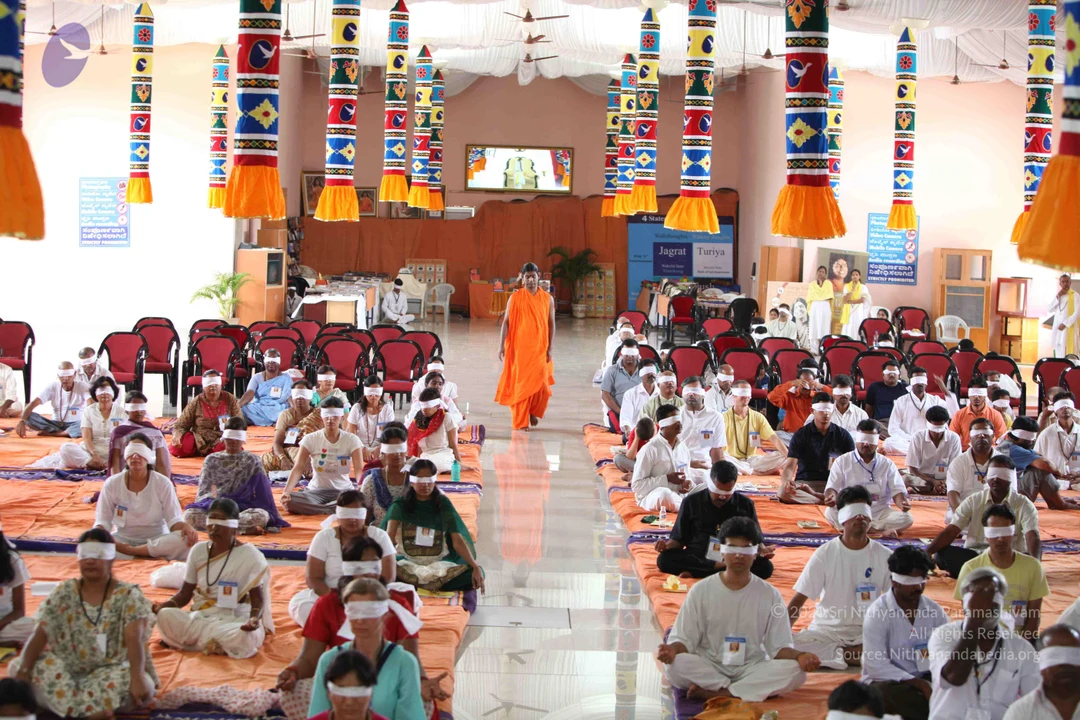
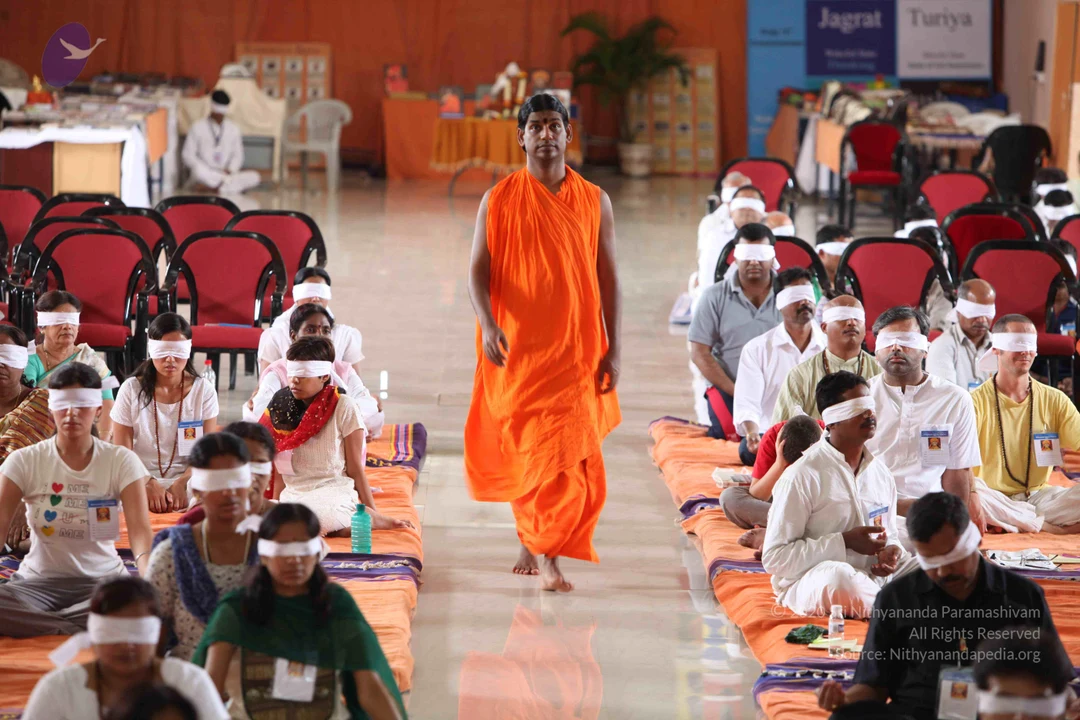
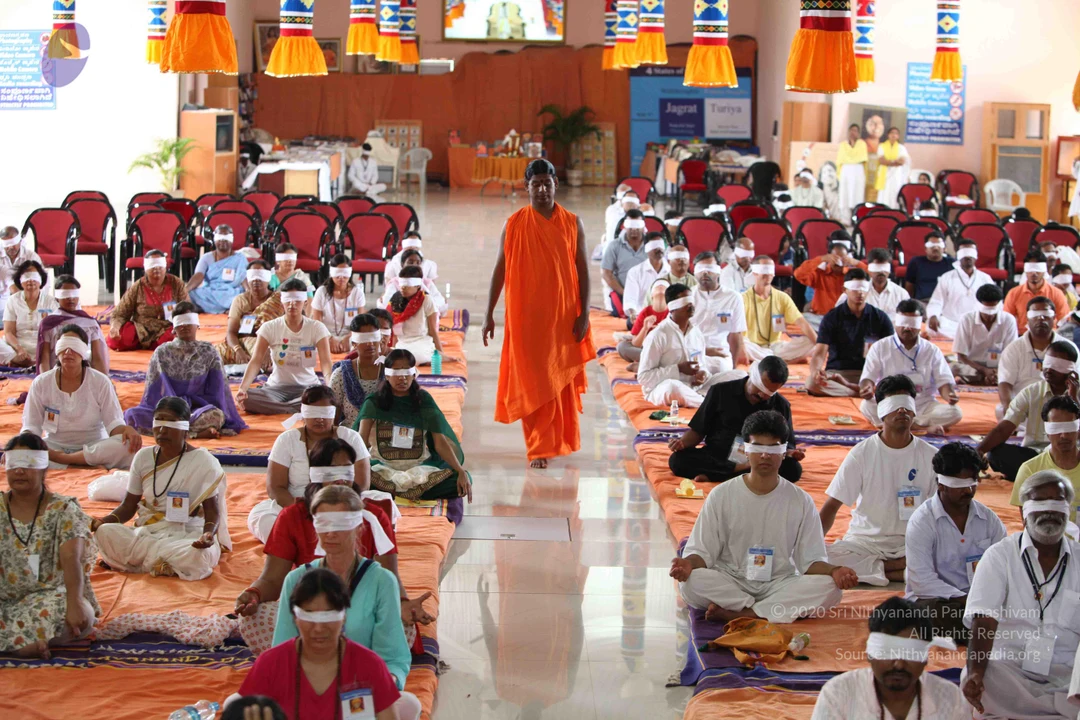
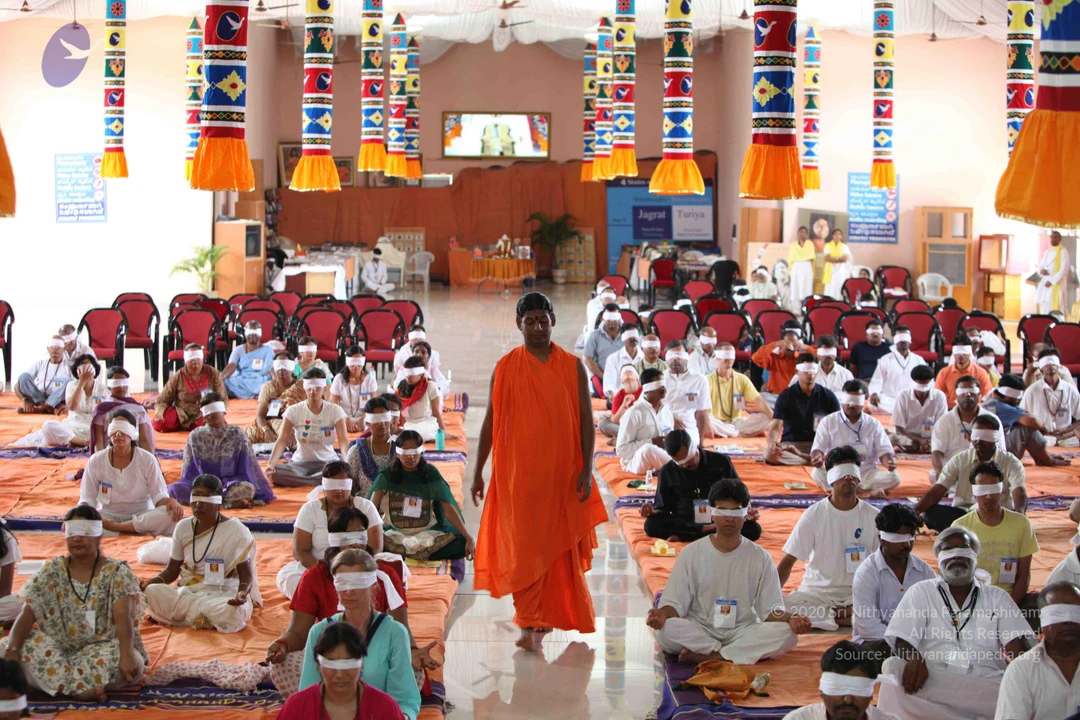
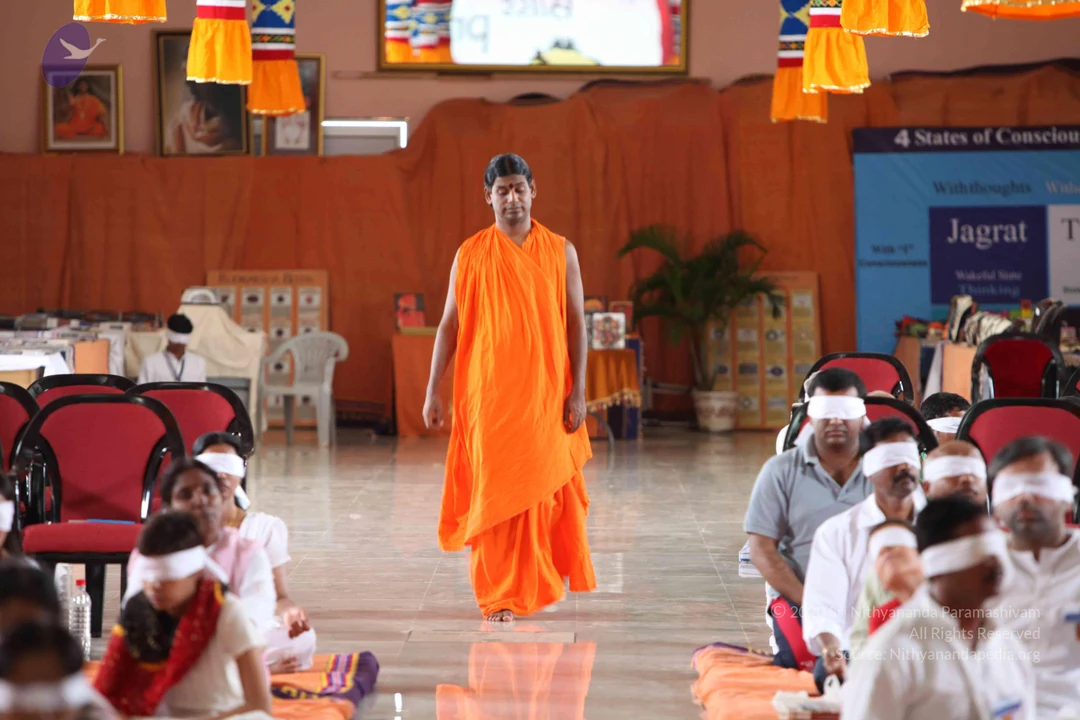
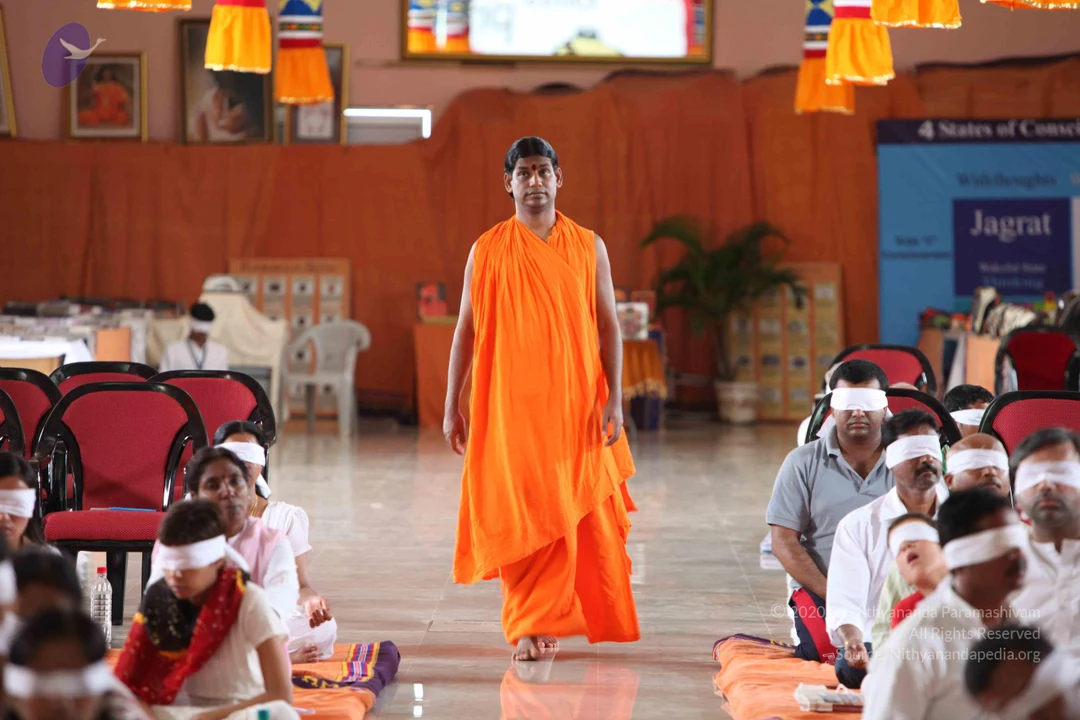
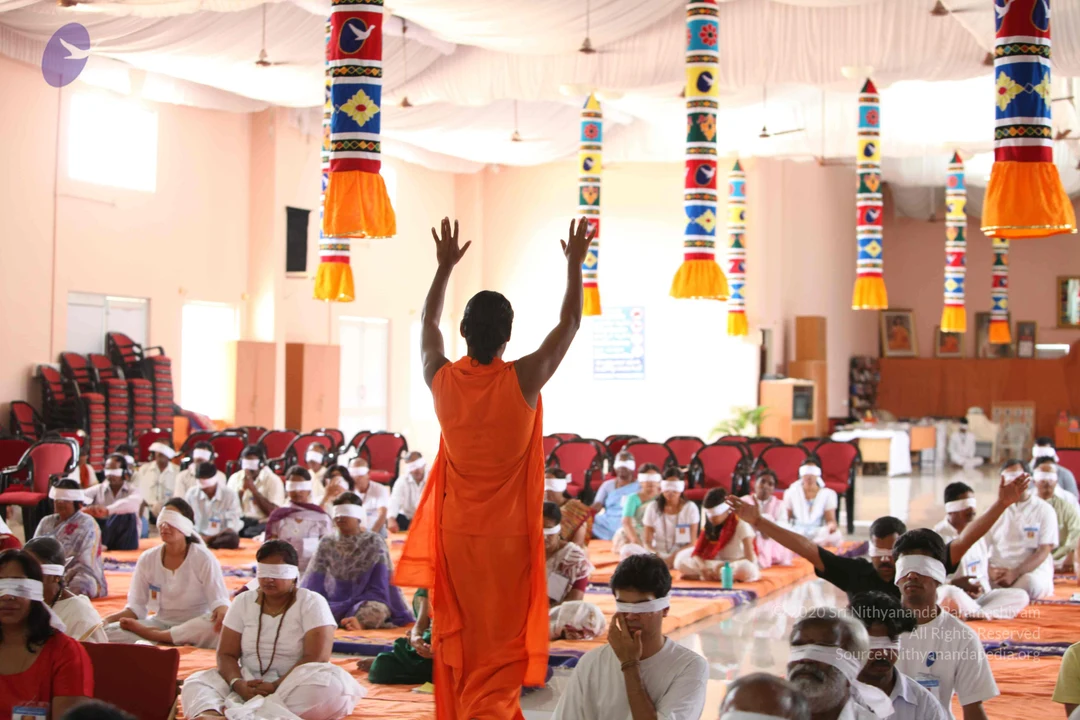
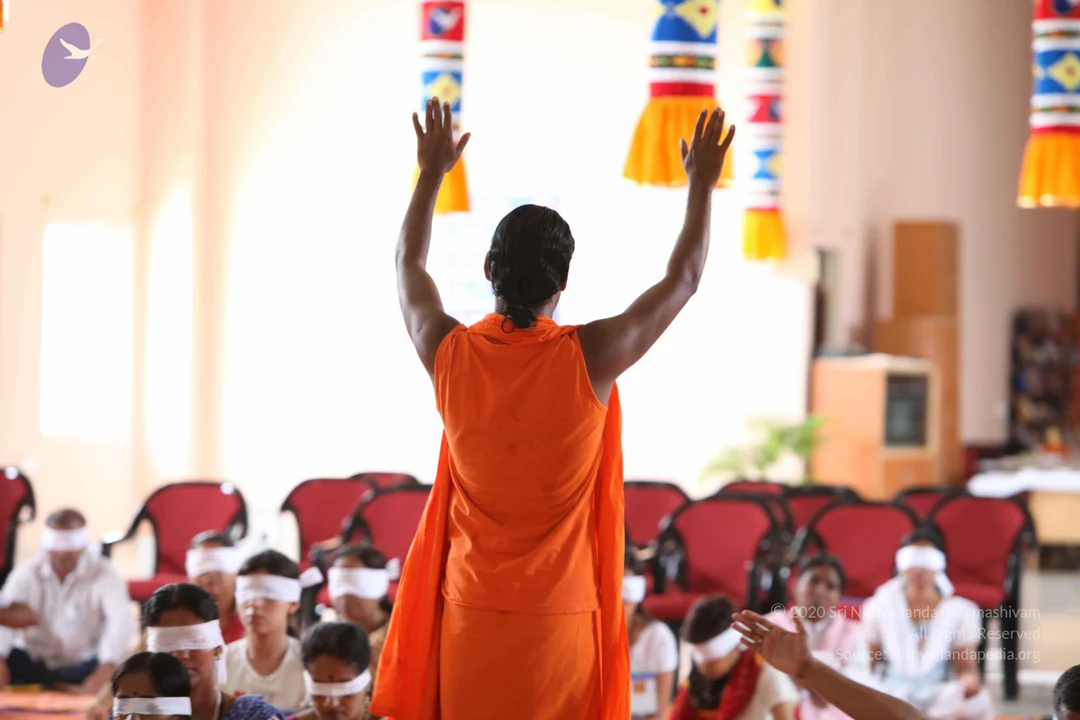
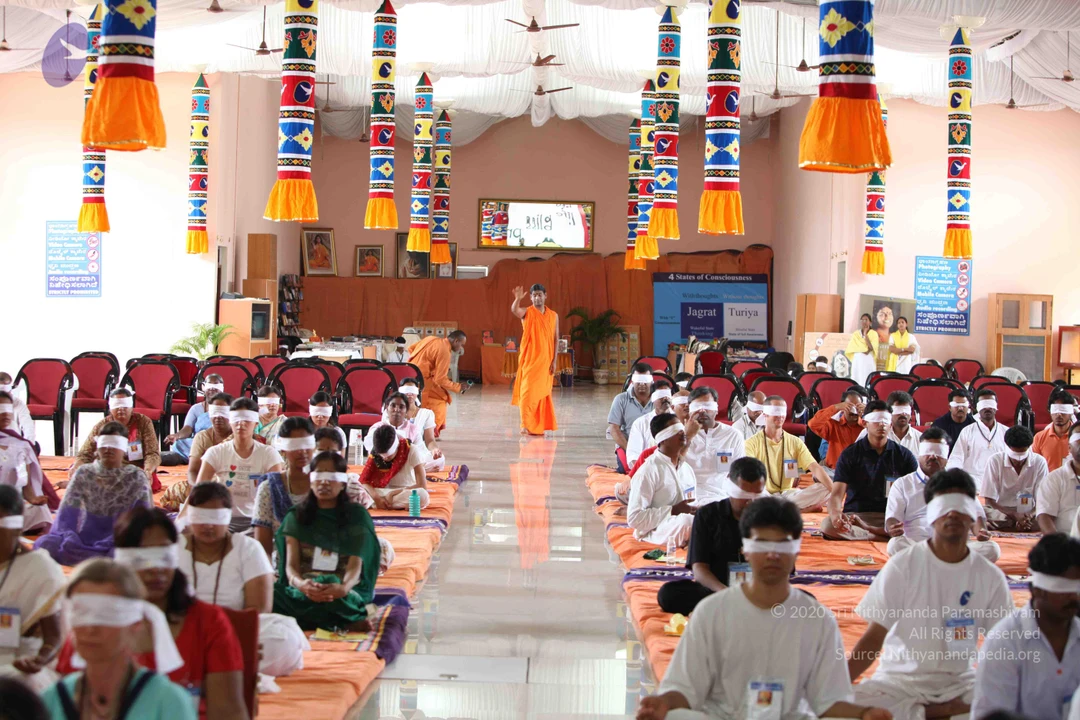
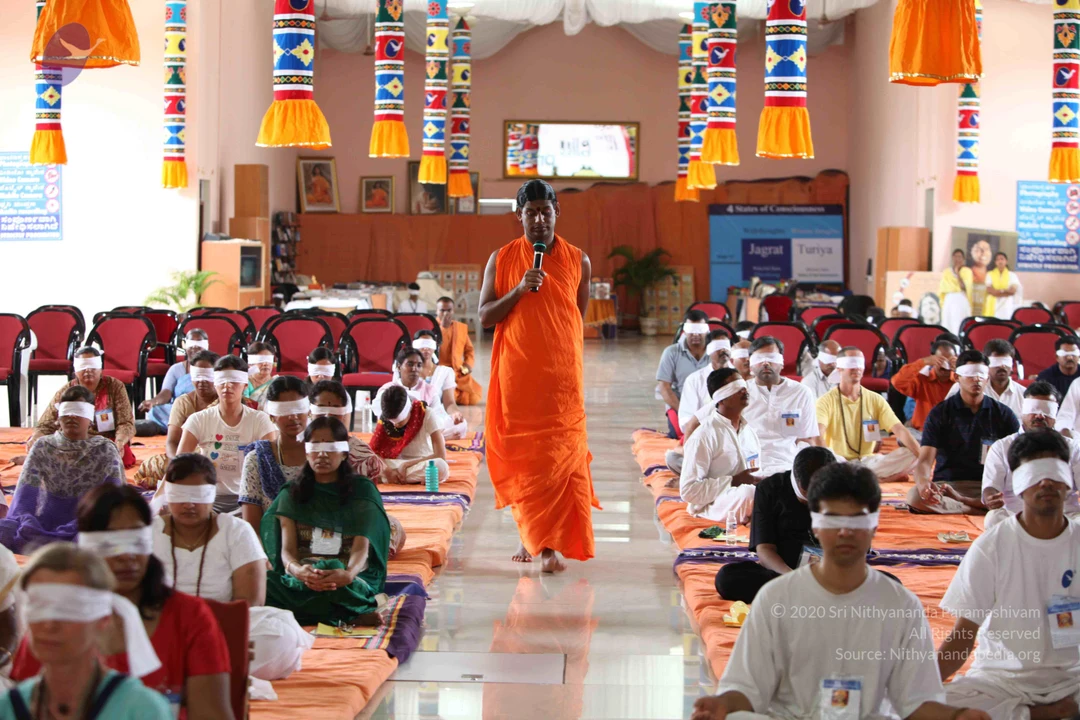
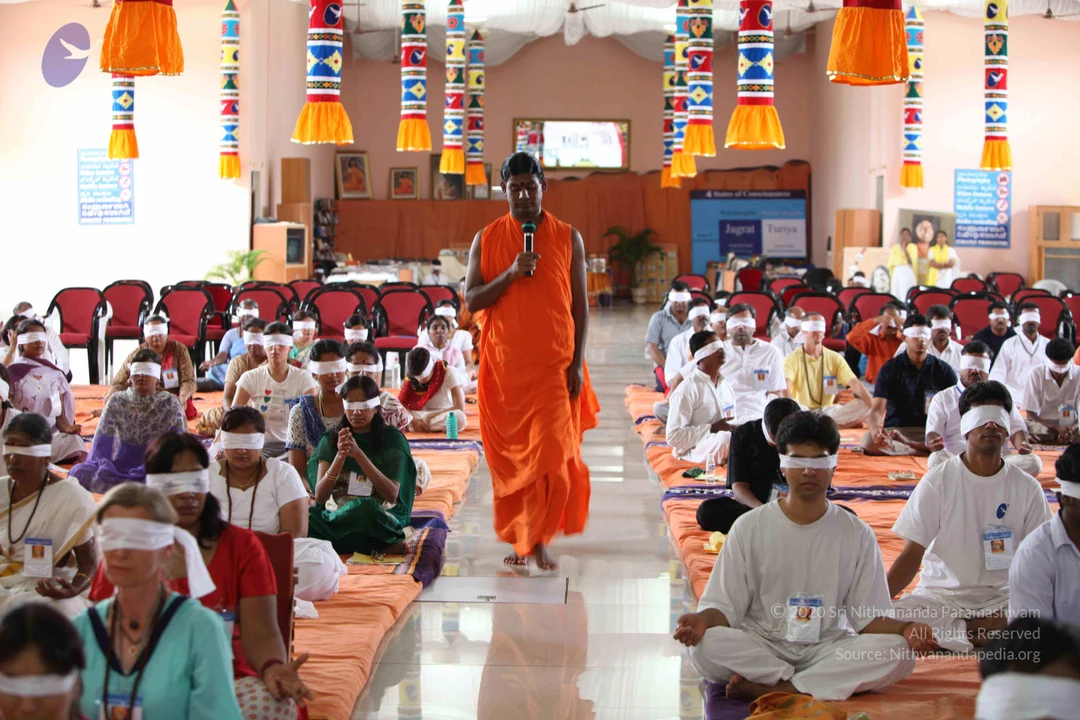
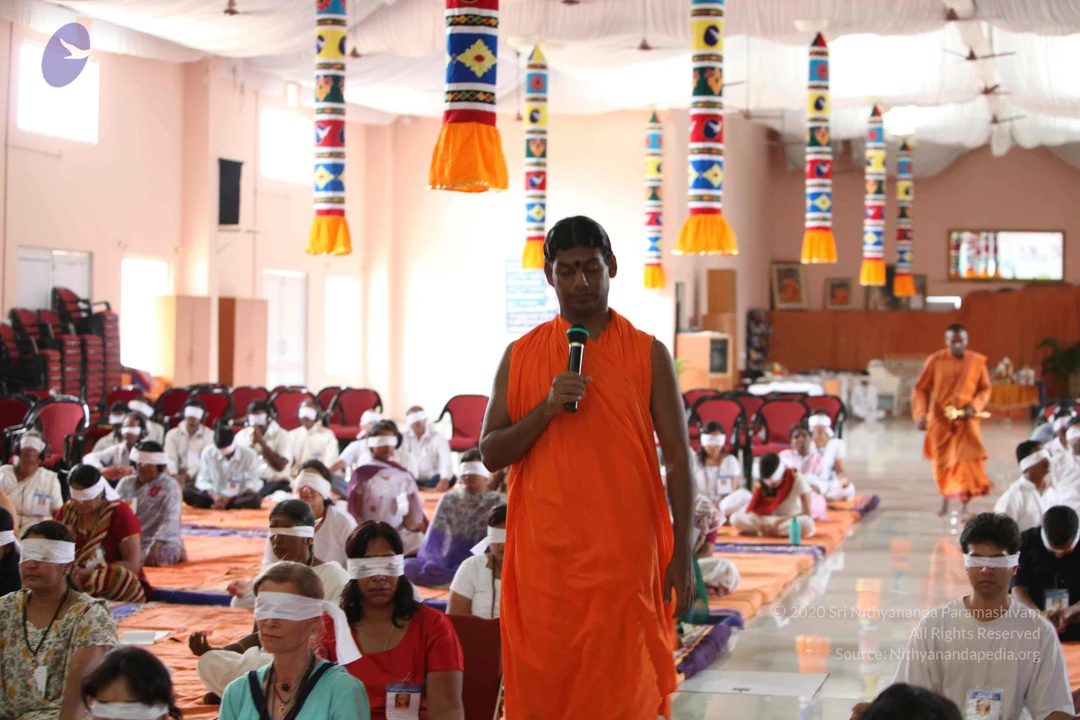
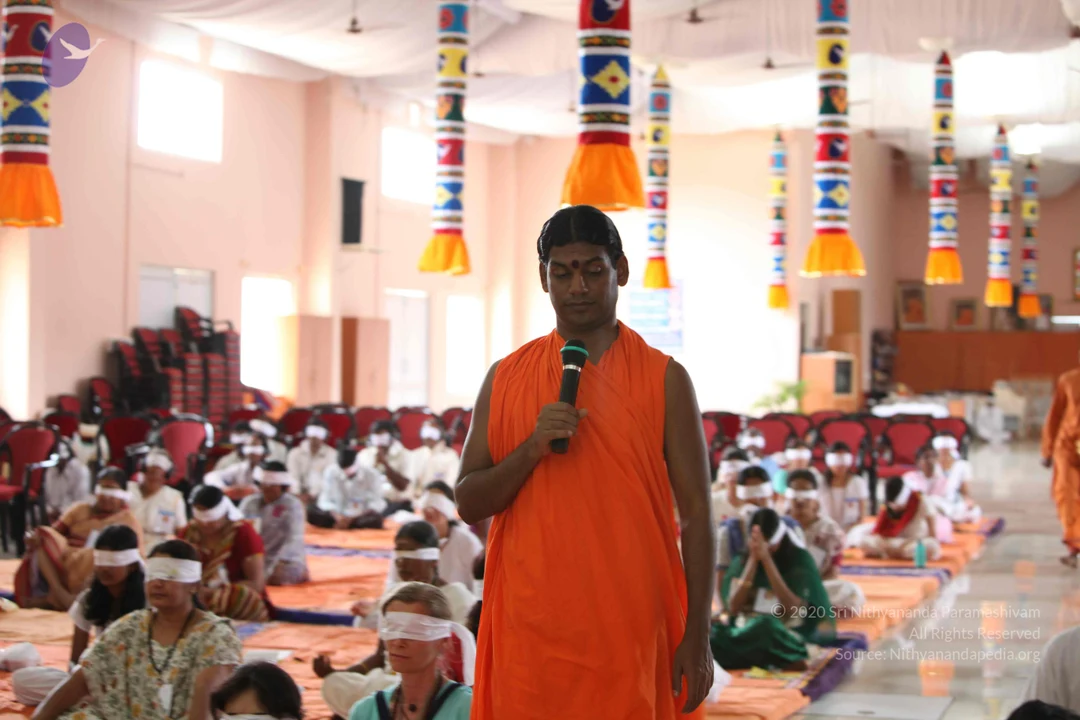
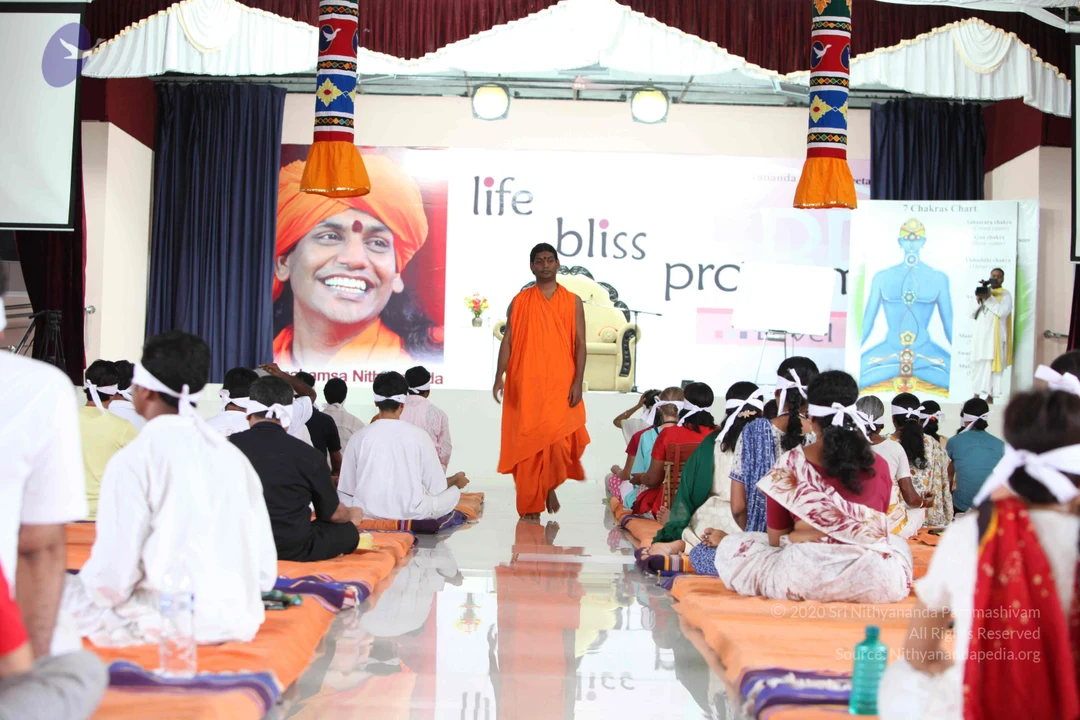
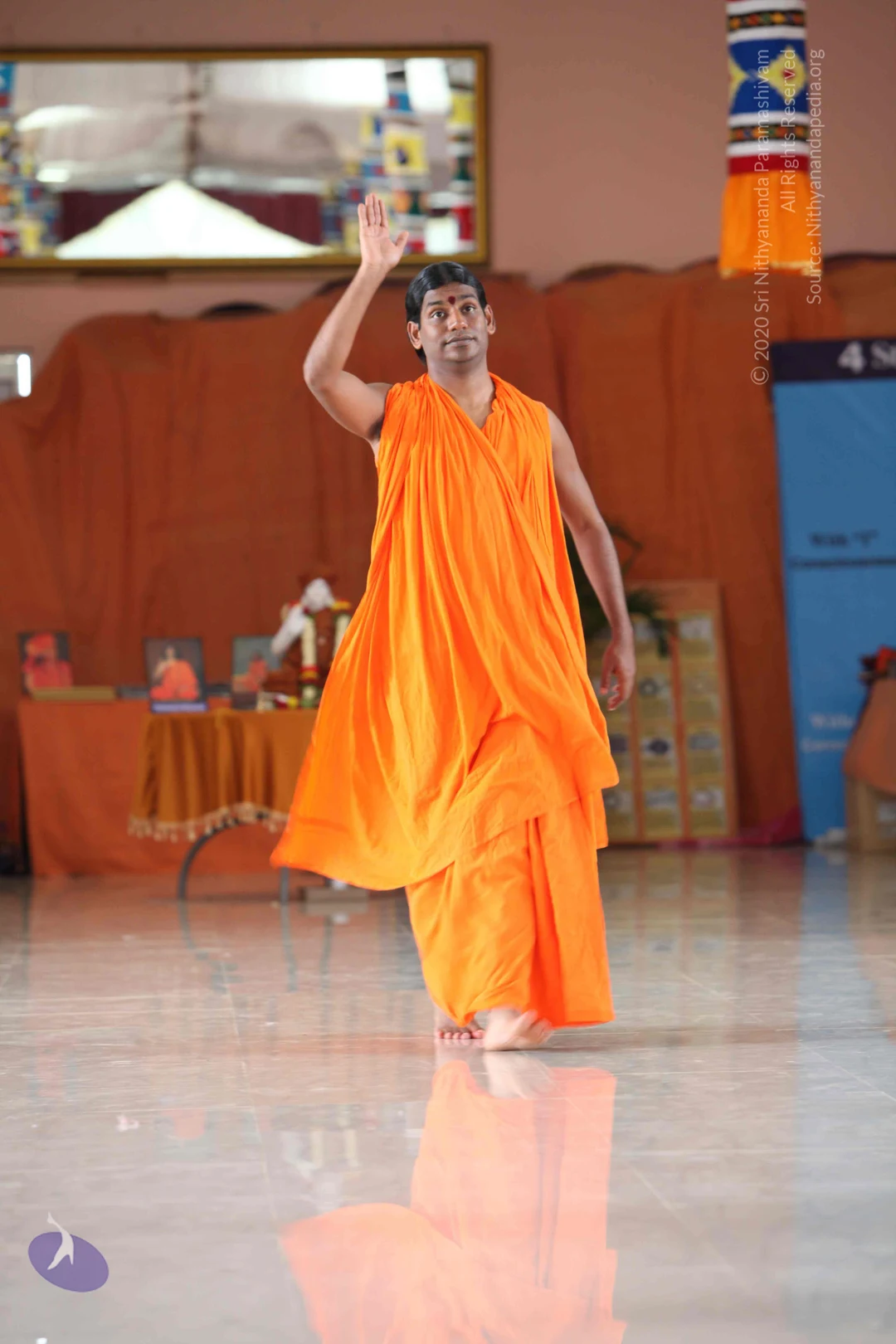
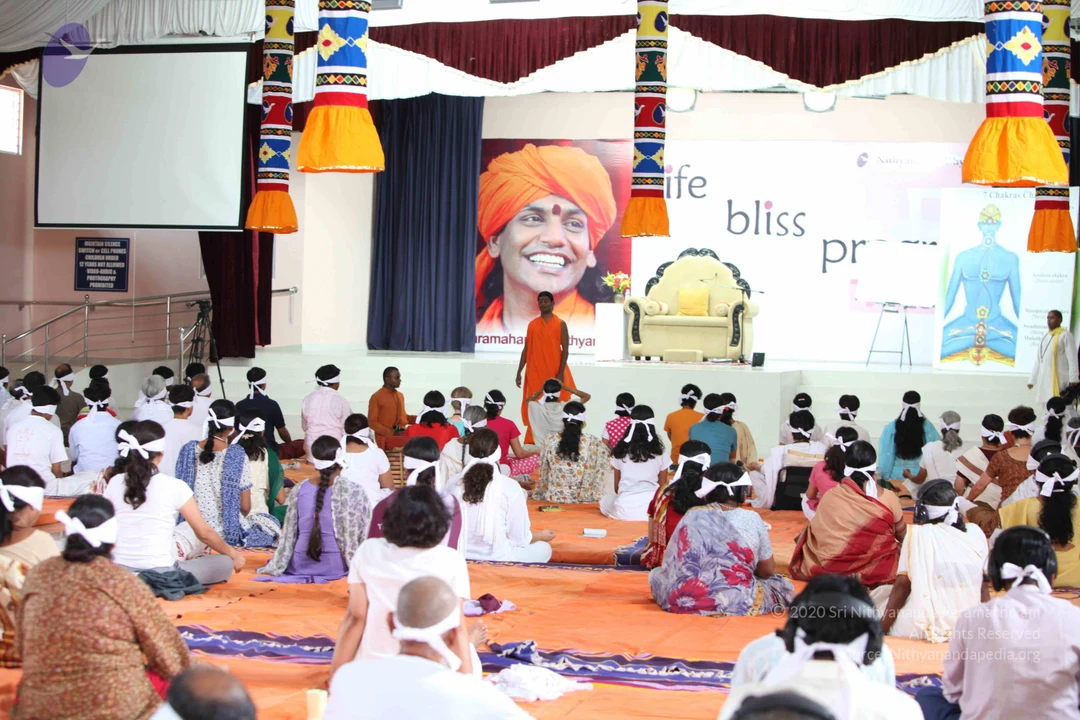
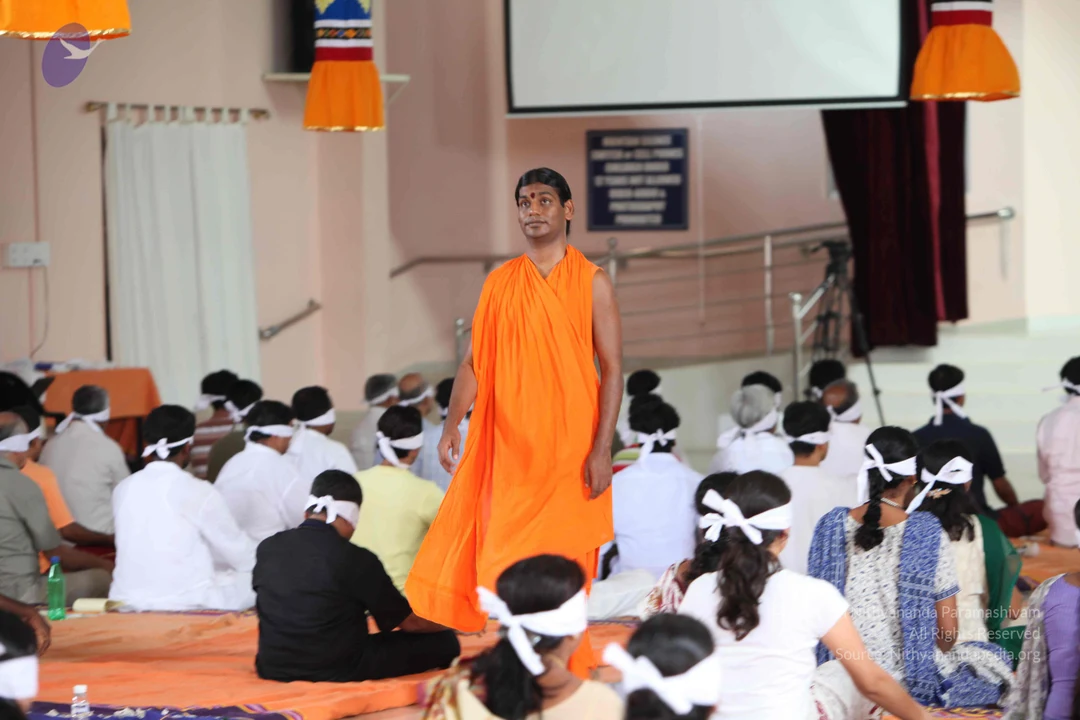
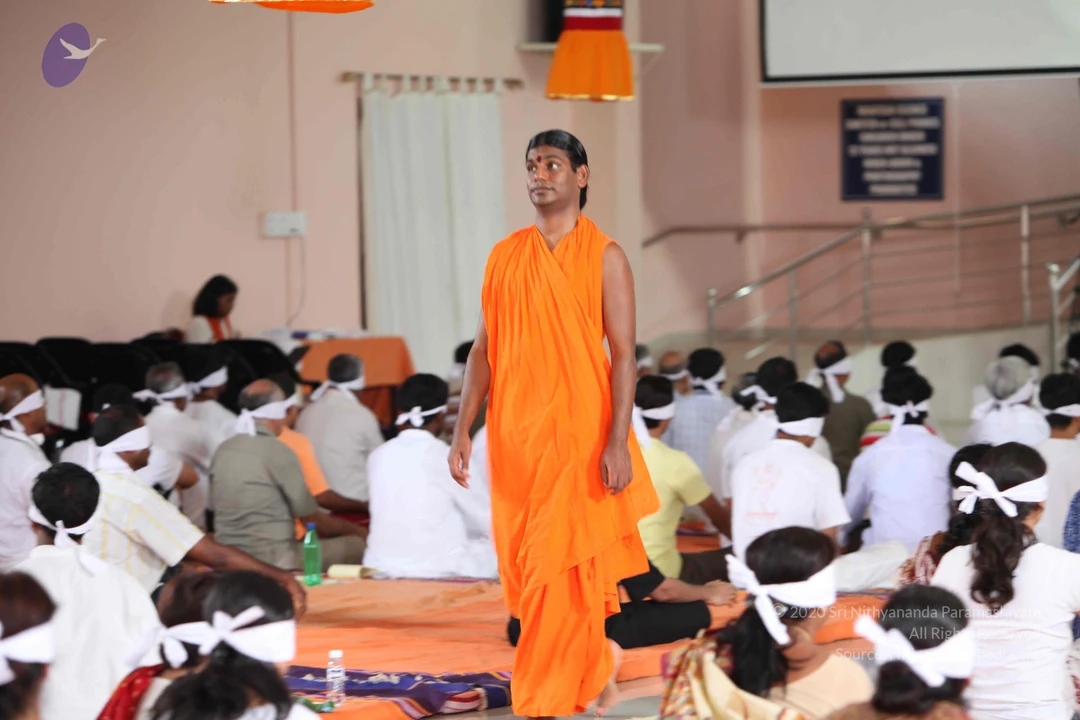
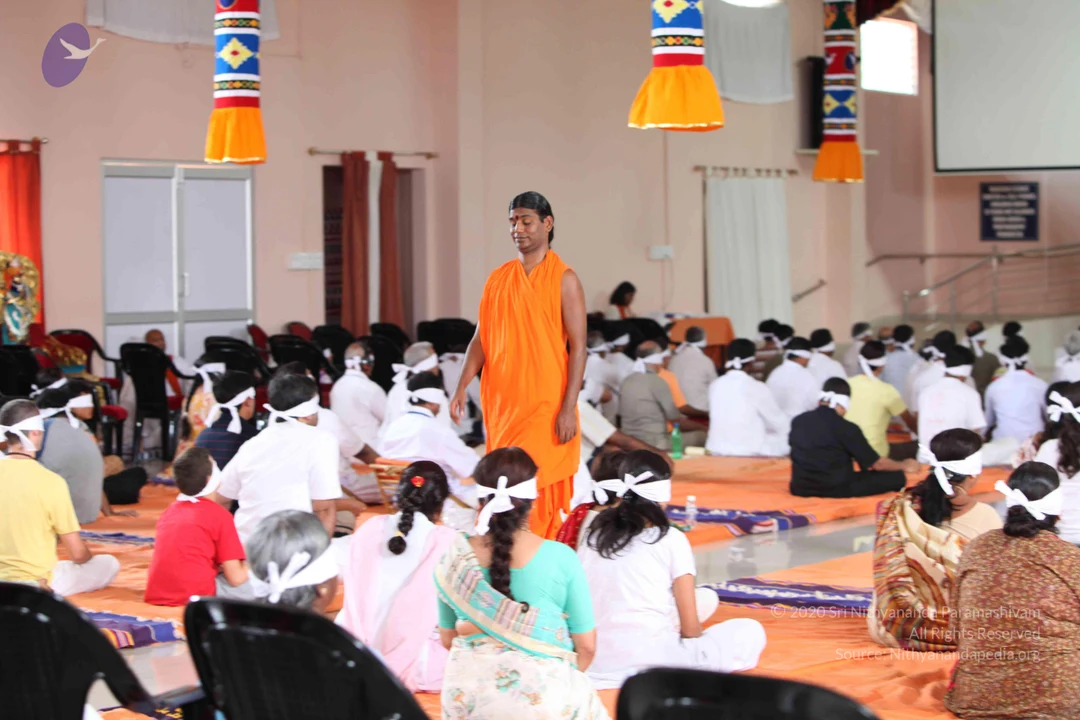
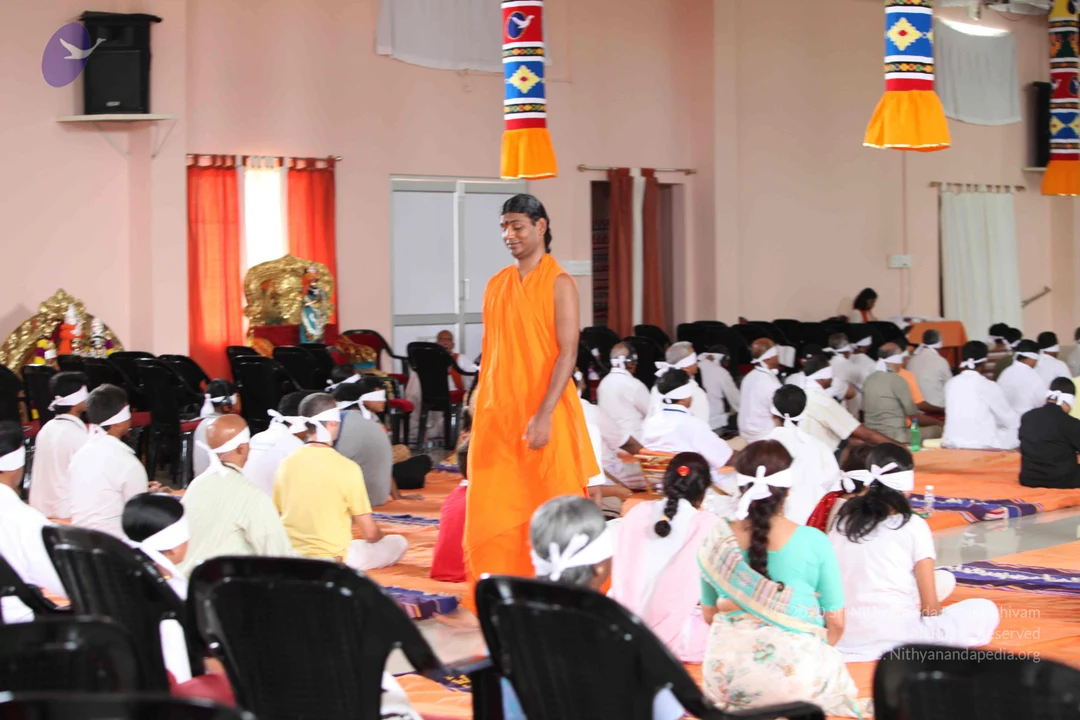
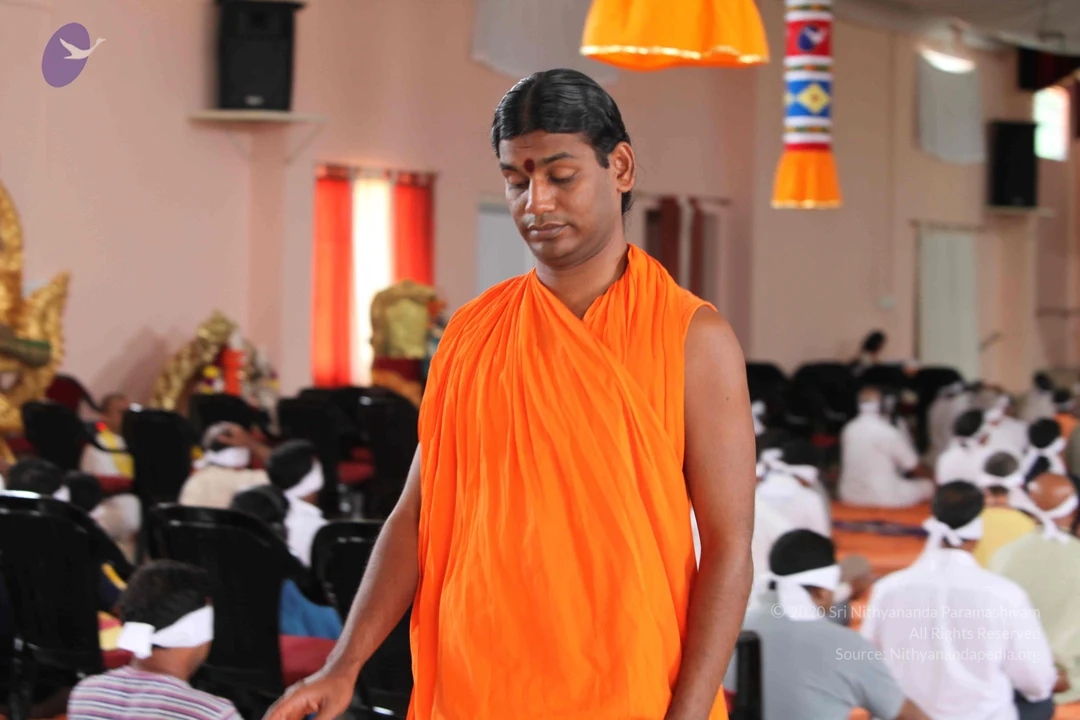
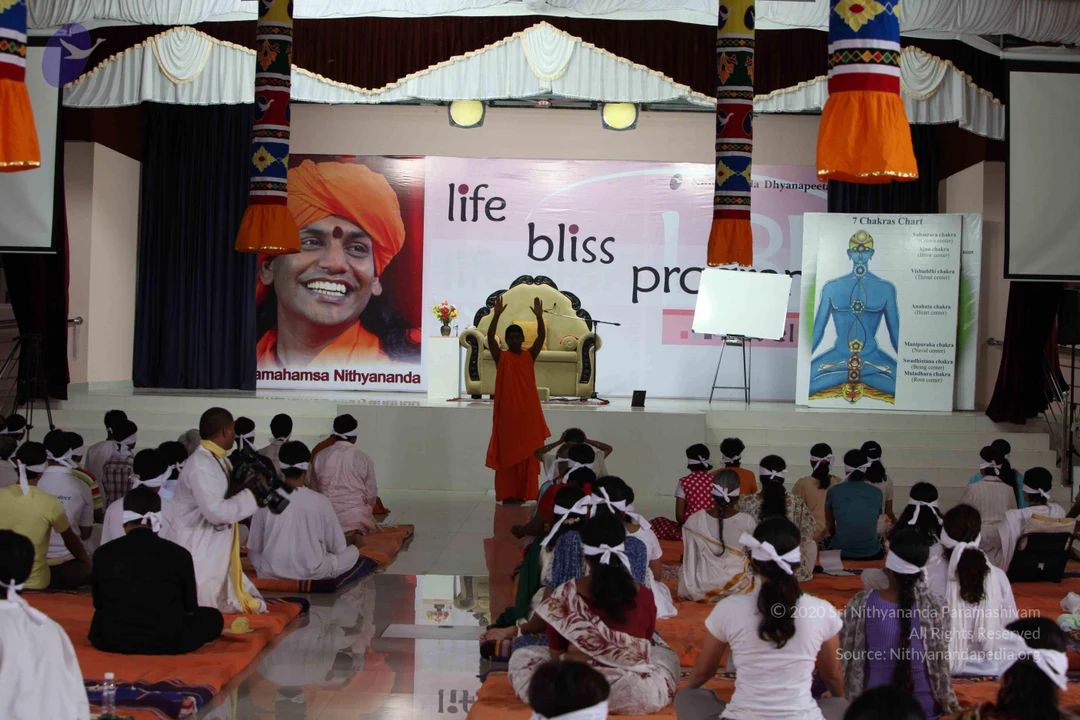
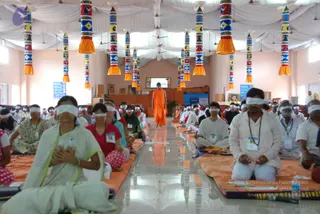
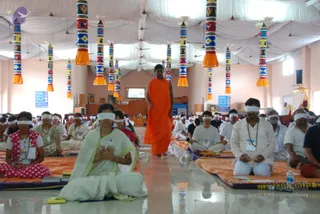
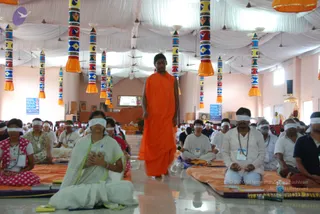
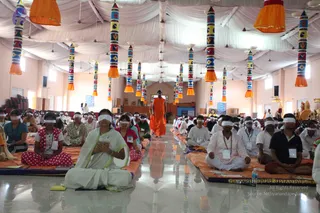
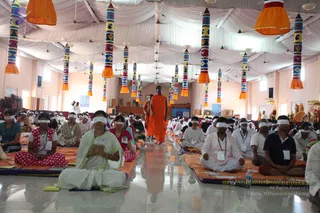
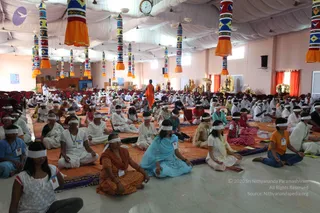
A photograph inside a bright hall with white draped ceiling and colourful striped hanging pillars with orange tassels. Rows of seated participants wear white blindfolds and sit on orange mats, hands folded or palms together. A figure in a flowing orange robe walks down the central aisle on a reflective floor, with a screen and banners at the back. Some seated people wear white clothing and identity badges. A large banner reads Jagrat Turya. The figure in orange is a robed person whose appearance is not clearly established, so a person is unsure.A large hall with a white draped ceiling and tall colourful striped pillars with orange tassels hangs overhead. Rows of devotees sit cross-legged on orange mats with white blindfolds covering their eyes, many with hands folded in prayer. A standing figure in a flowing saffron-orange robe walks down the central aisle between the rows. Foreground, a woman in a white sari with a light green border sits with hands on her chest, and a woman in a pink and red polka-dot top sits at left. Men in white kurtas sit at right. Water bottles and a glass sit on the glossy white floor. Blue wall banners and a large screen are visible in the background.A photograph of a large hall with a white draped ceiling and colourful striped pillars with orange tassels. Many seated people wear white blindfolds across their eyes and sit on orange mats in meditation. A young monk in saffron-orange robes walks down the central aisle between the rows. A woman in a white sari sits in the front left with hands folded at her chest, and a man in white kurta sits at right. A large screen and a small altar with lamps are visible at the back.A large hall with white draped ceiling and tall colourful striped cylindrical hangings with orange tassels. Many seated participants sit on orange-cushioned mats in rows, most wearing white or pastel clothes, with white cloths tied over their eyes. A lone standing figure in an orange-saffron robe walks down the central aisle between the rows. Chairs line the left side and small display screens and framed images appear at the back wall.A large hall with white draped ceiling and tall colourful striped pillars hanging with orange tassels. Rows of seated participants sit on orange mats wearing white headbands that cover their eyes, many in white, pink and red clothes with lanyard badges. A standing figure in an orange robe walks down the central aisle on a polished white floor, reflected in its surface. Framed pictures and a screen with blue signage line the back wall.A large hall with a white ceiling draped in fabric and tall, colourful cylindrical pillars hung with orange tassels. Many seated devotees sit cross-legged on orange and purple mats, most with white cloth blindfolds tied over their eyes, dressed in white, orange, red, pink and light blue clothes. A standing figure in a saffron-orange robe stands at the front near a decorated altar with golden deity murtis and floral offerings. Name badges hang from several participants' necks. Pink walls, red curtains and a wall clock frame the scene.

4-Pada-Puja
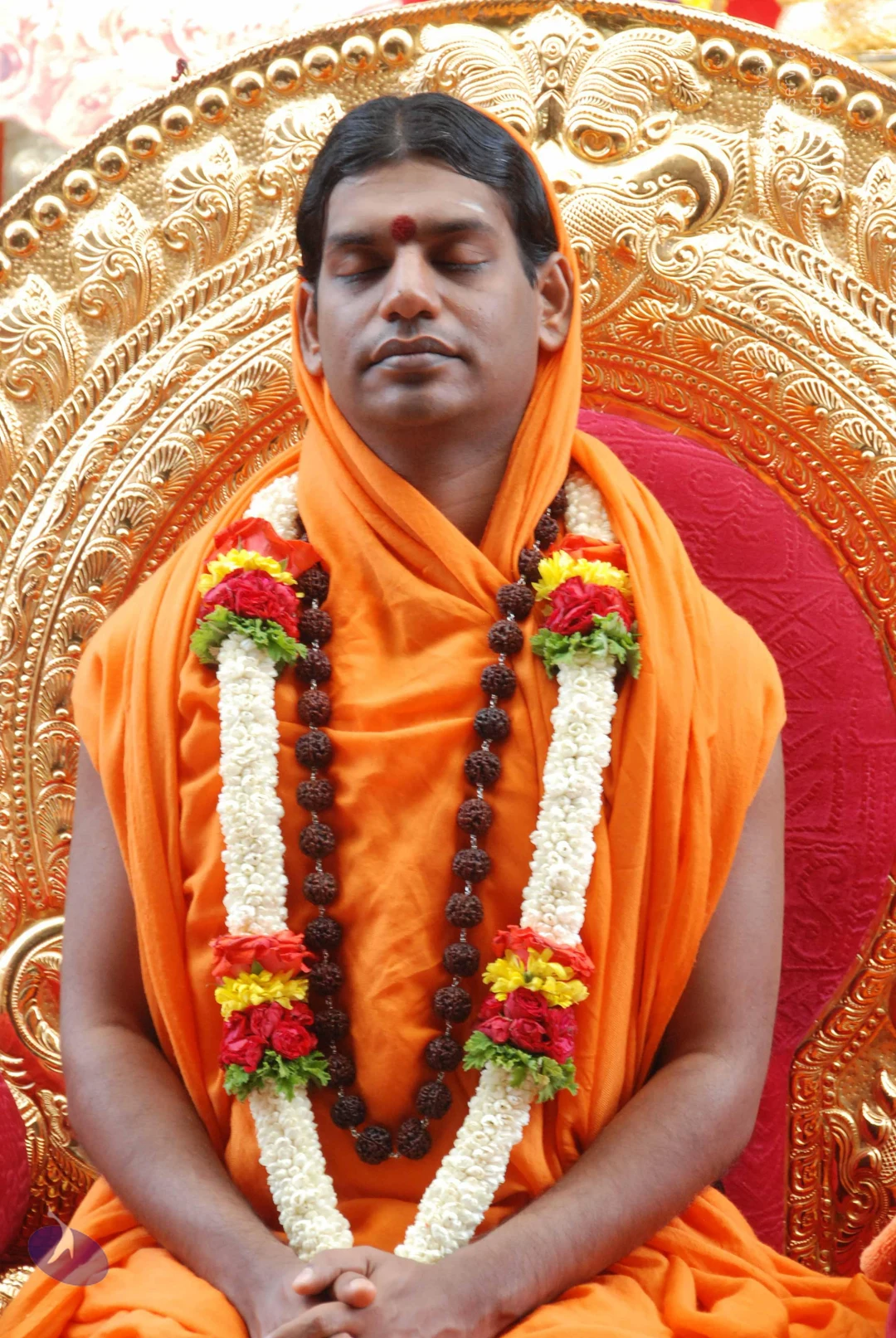
34 photosSource gallery
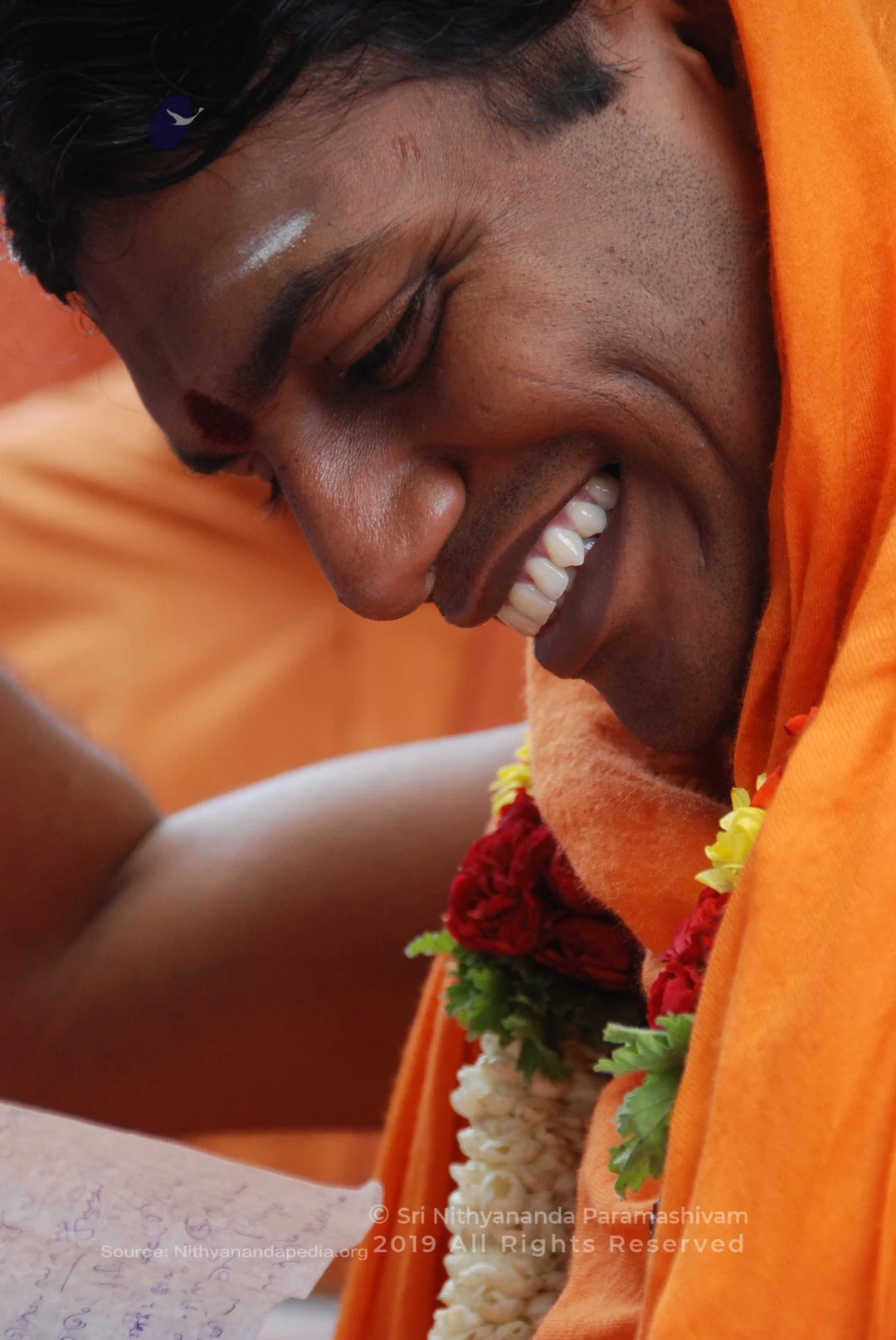
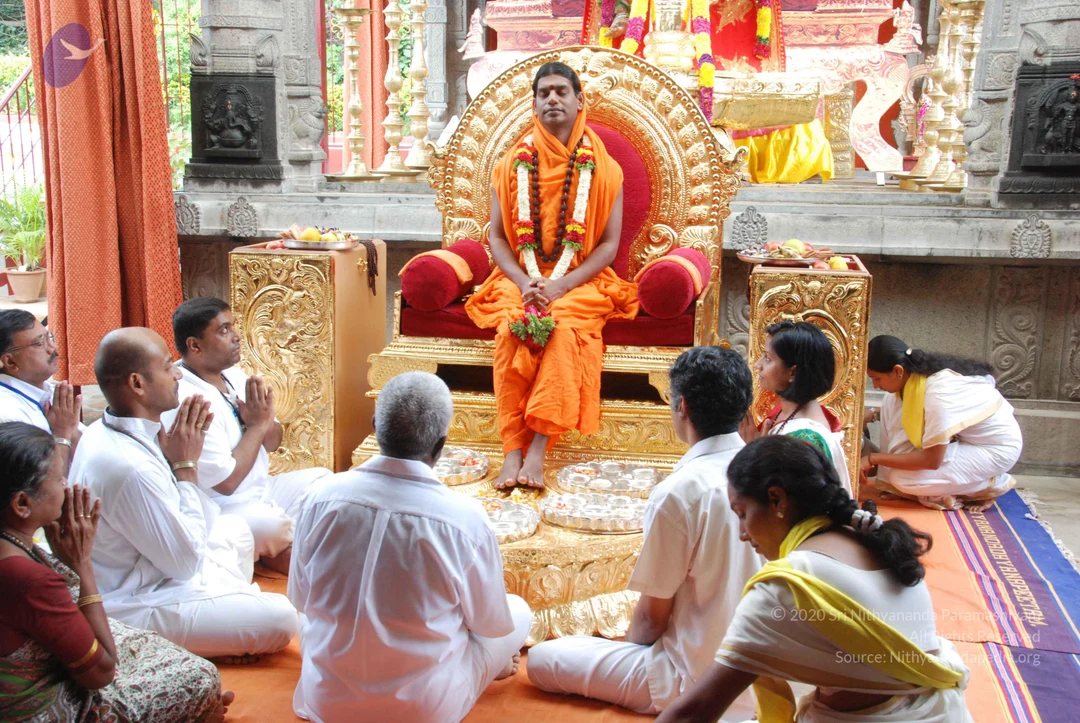
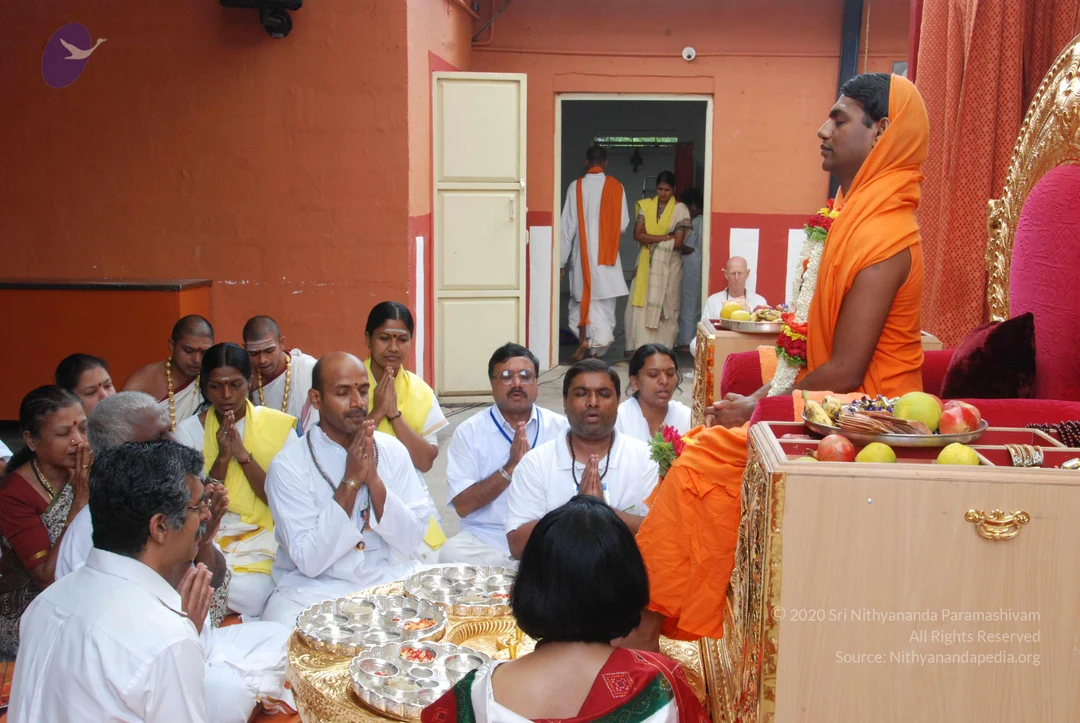
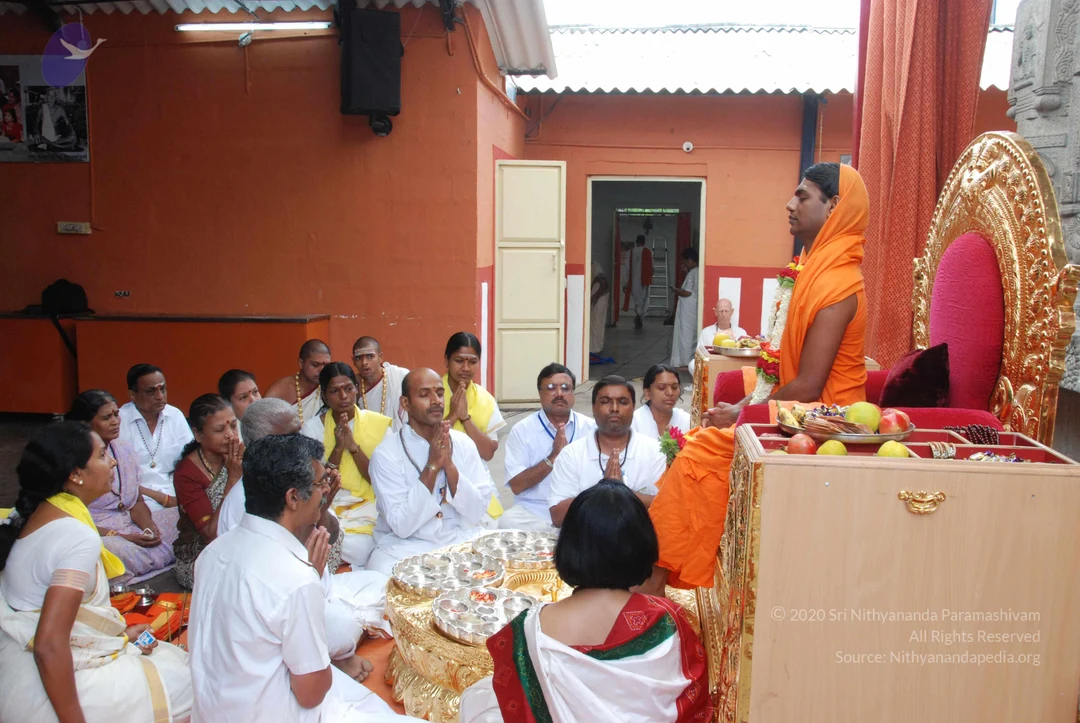
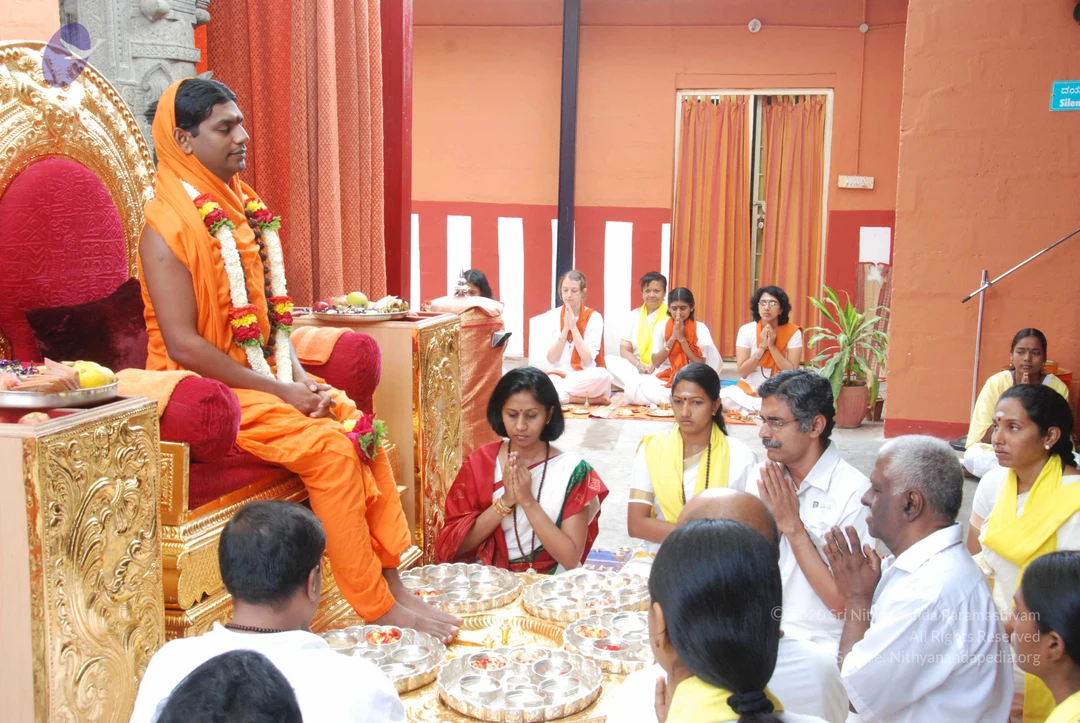
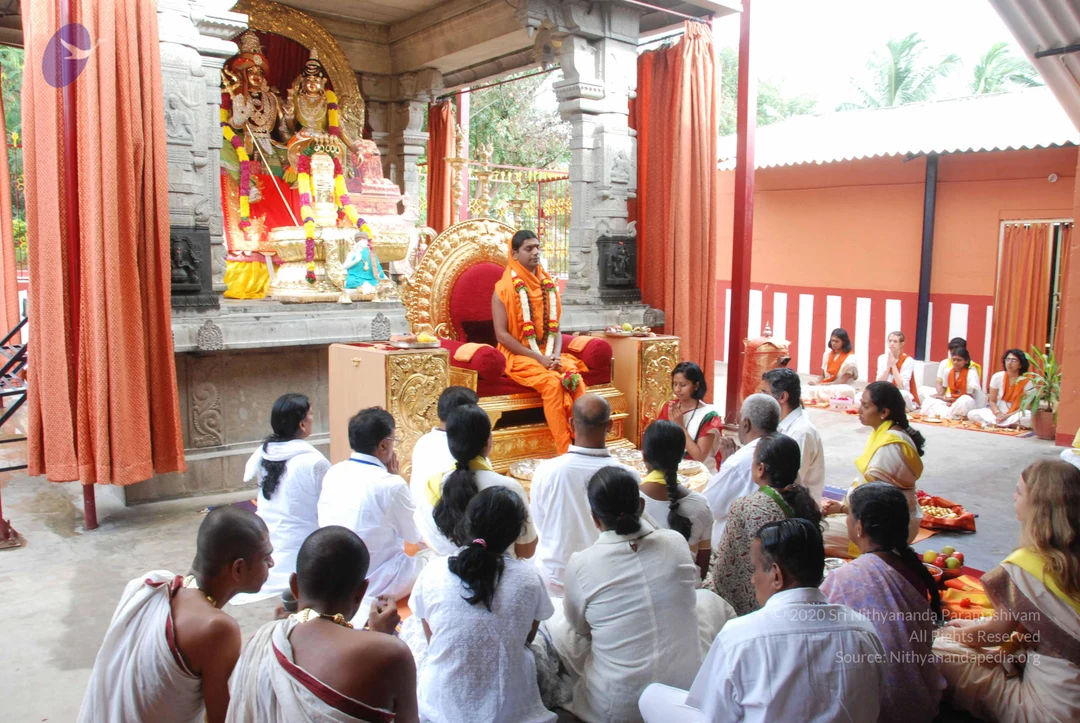
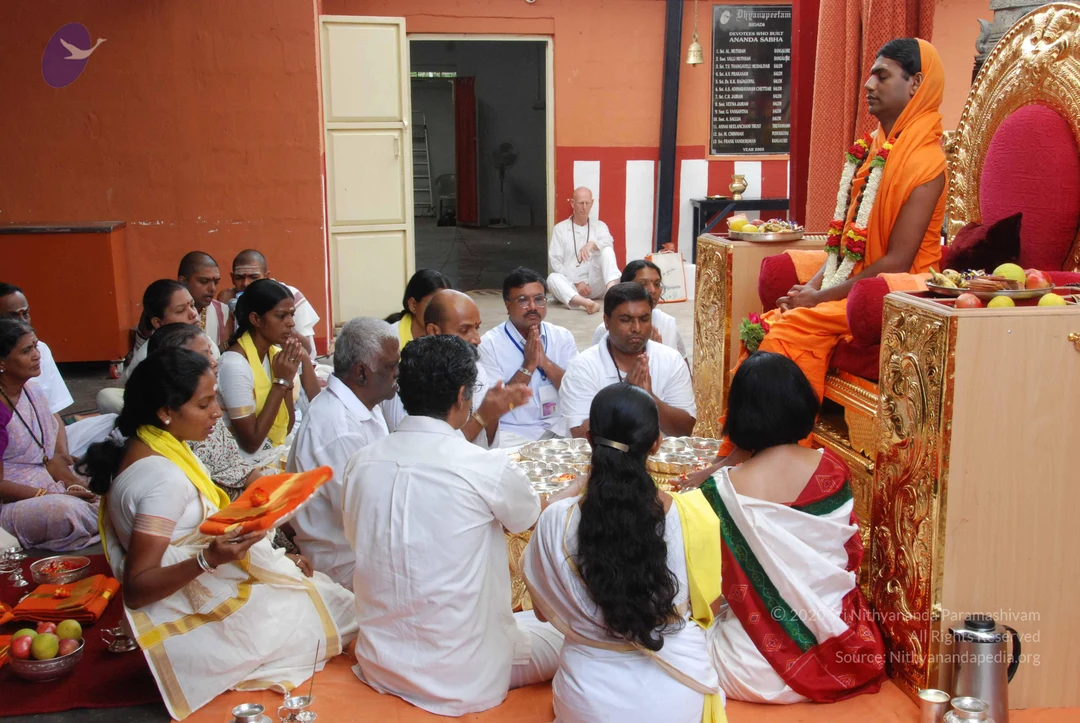
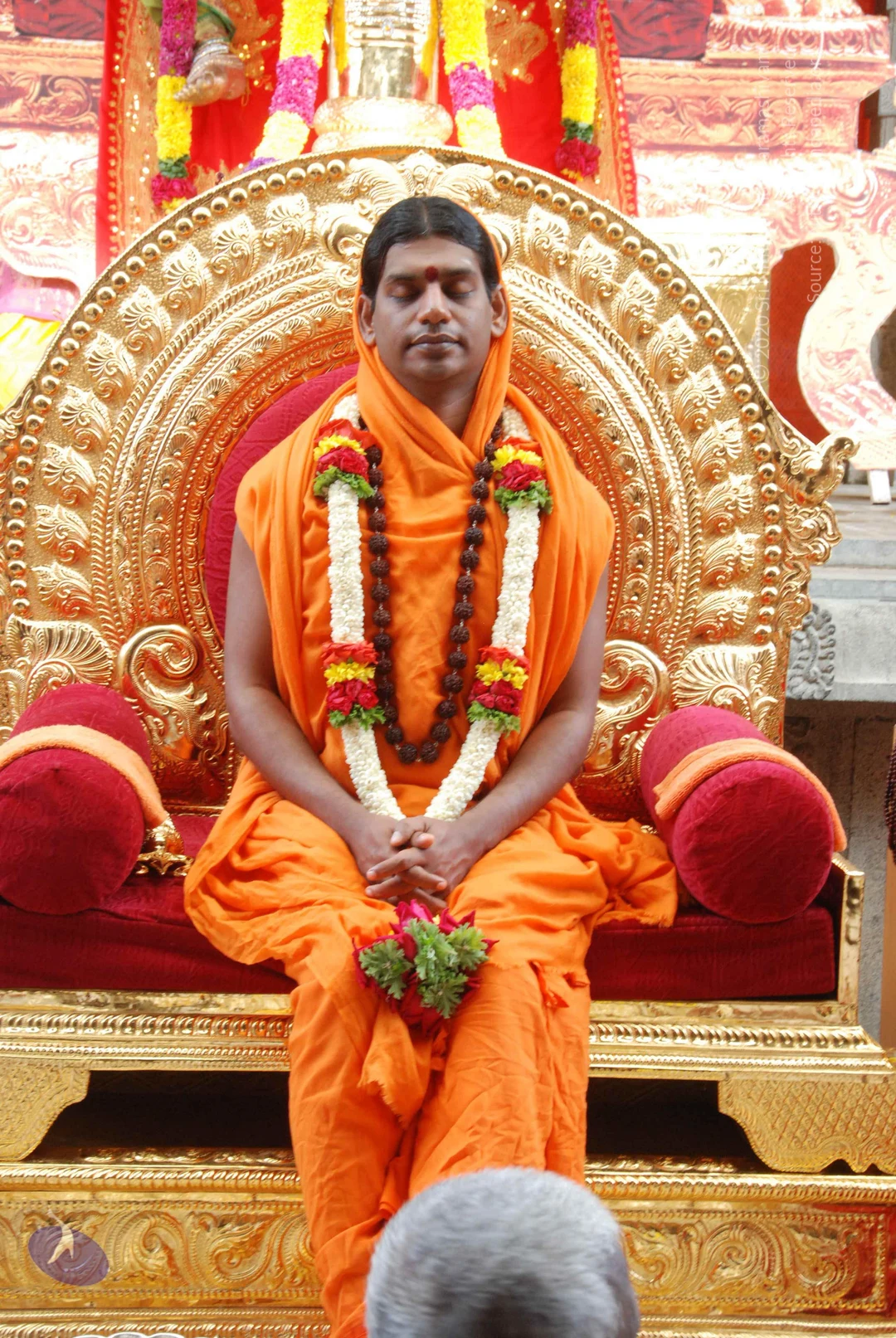
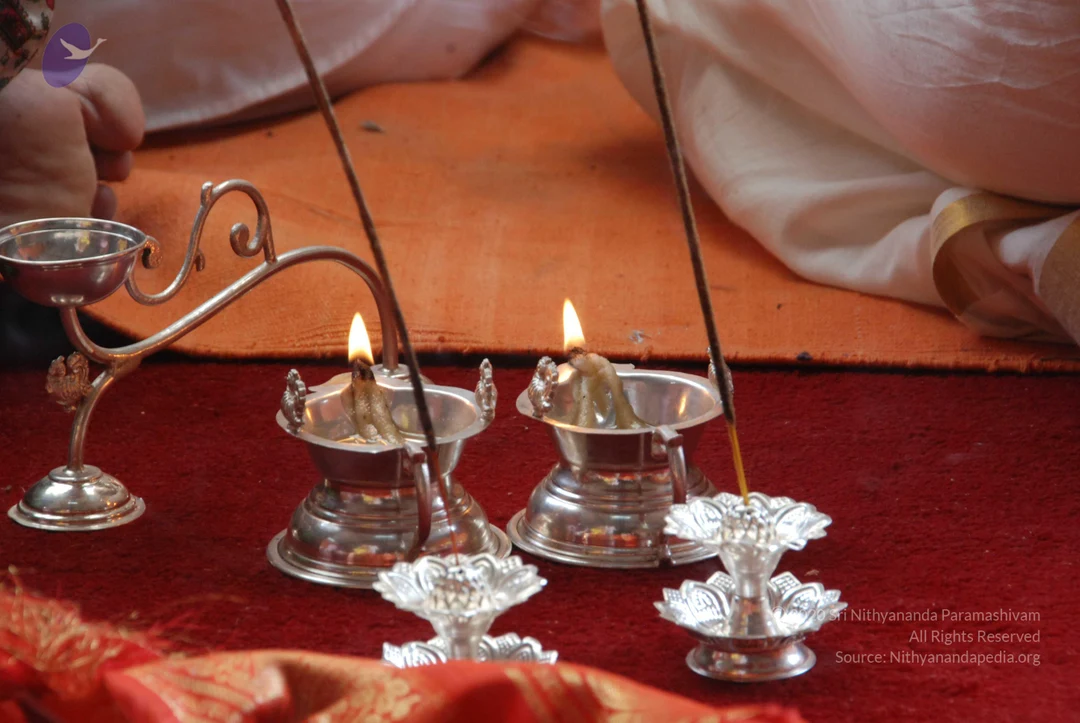
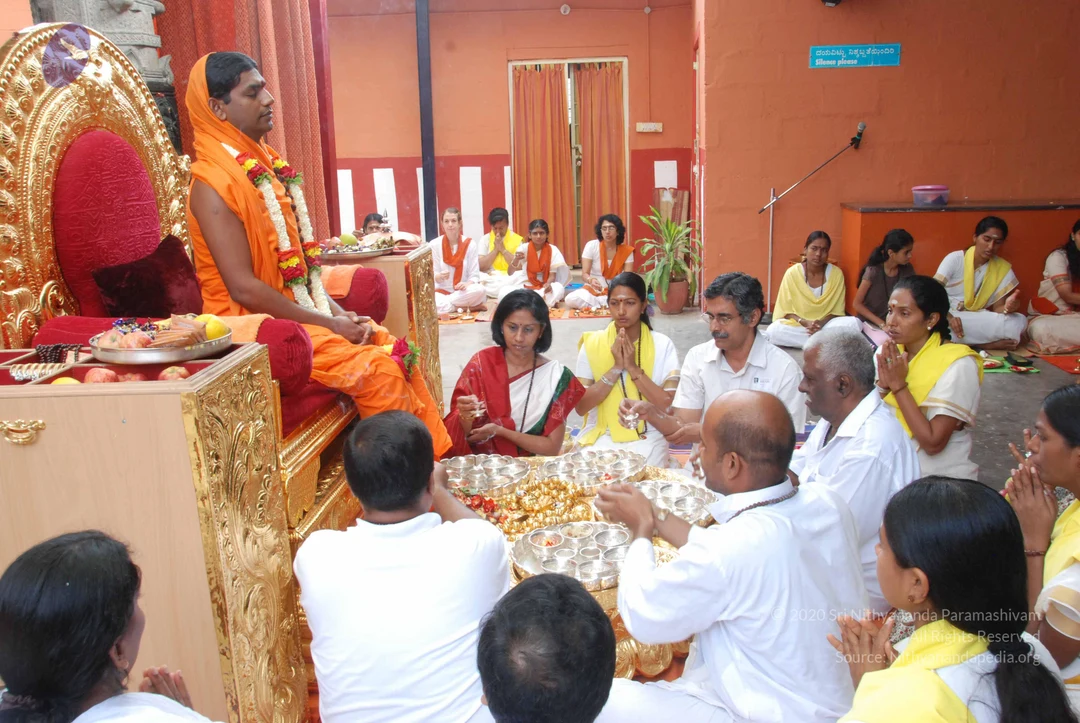
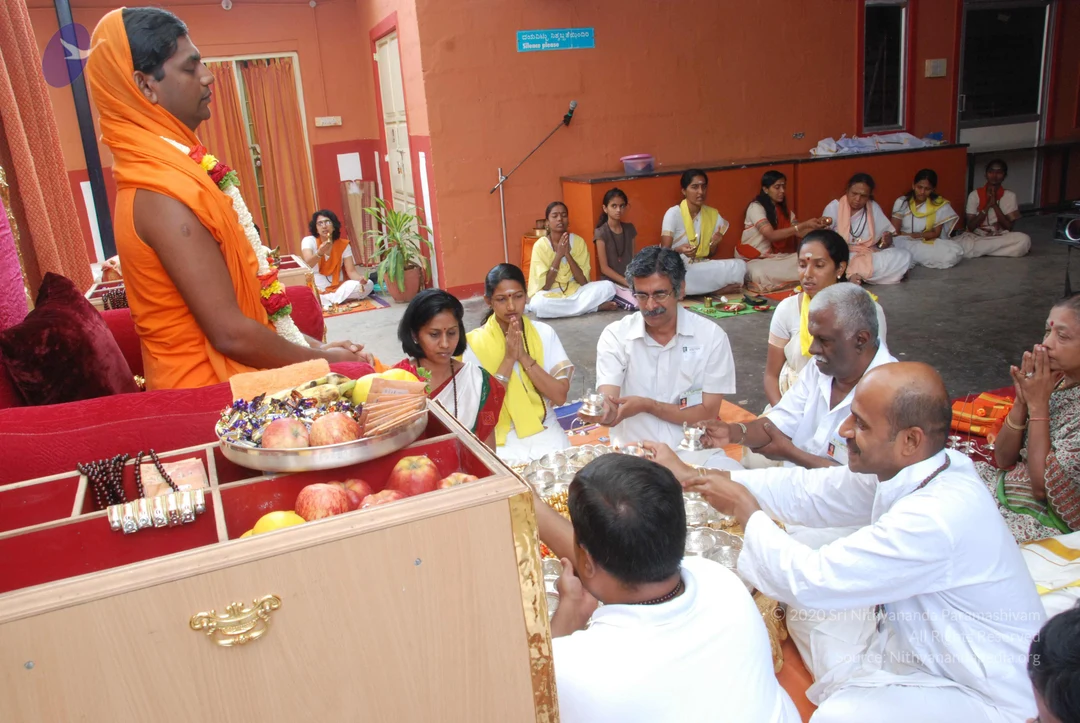
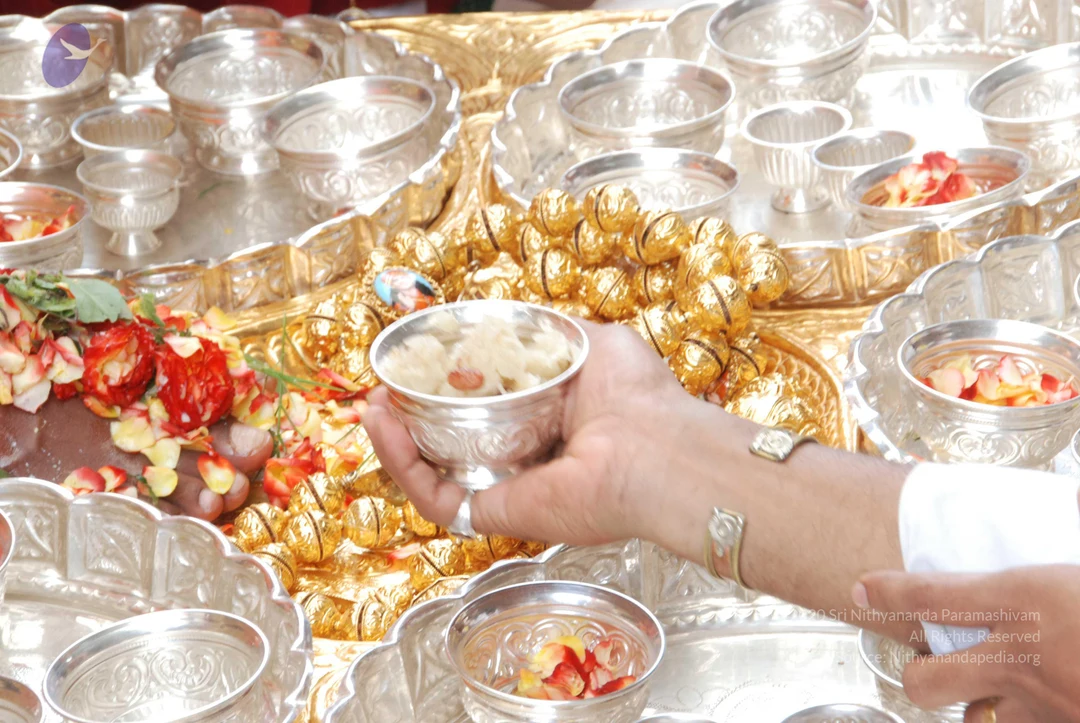
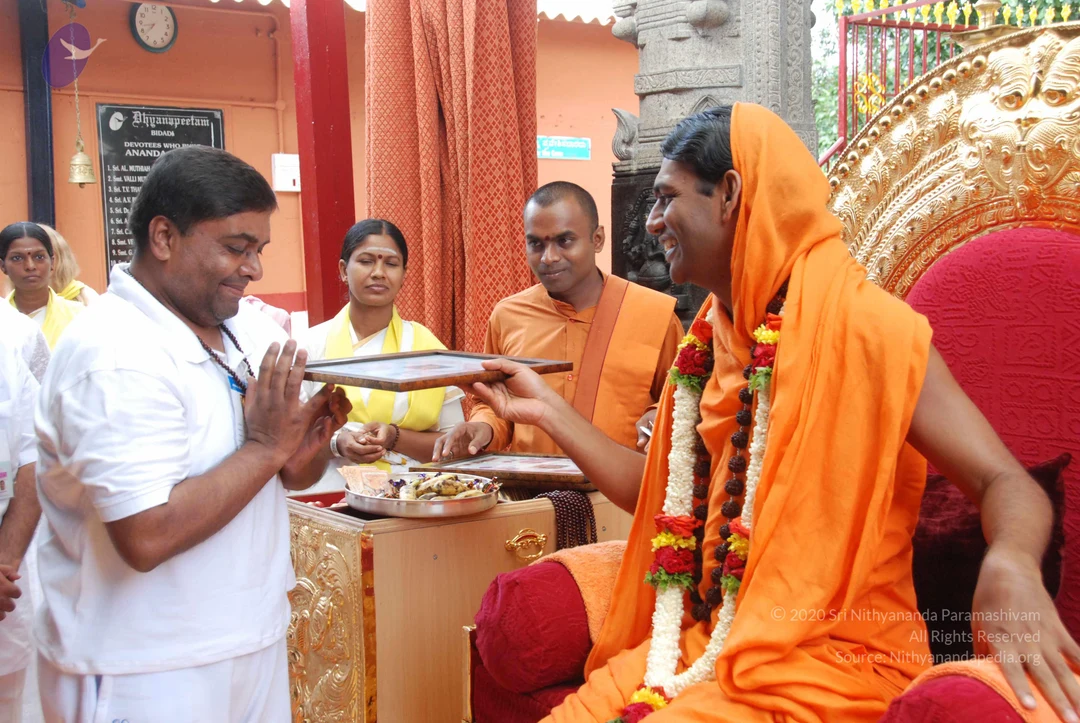
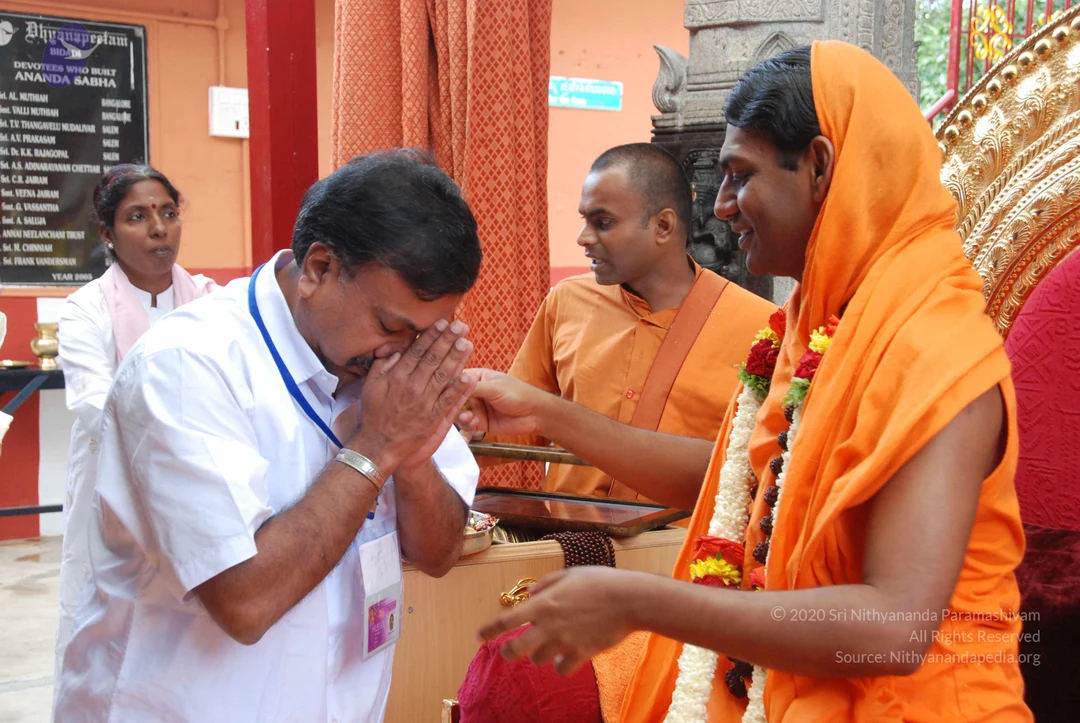
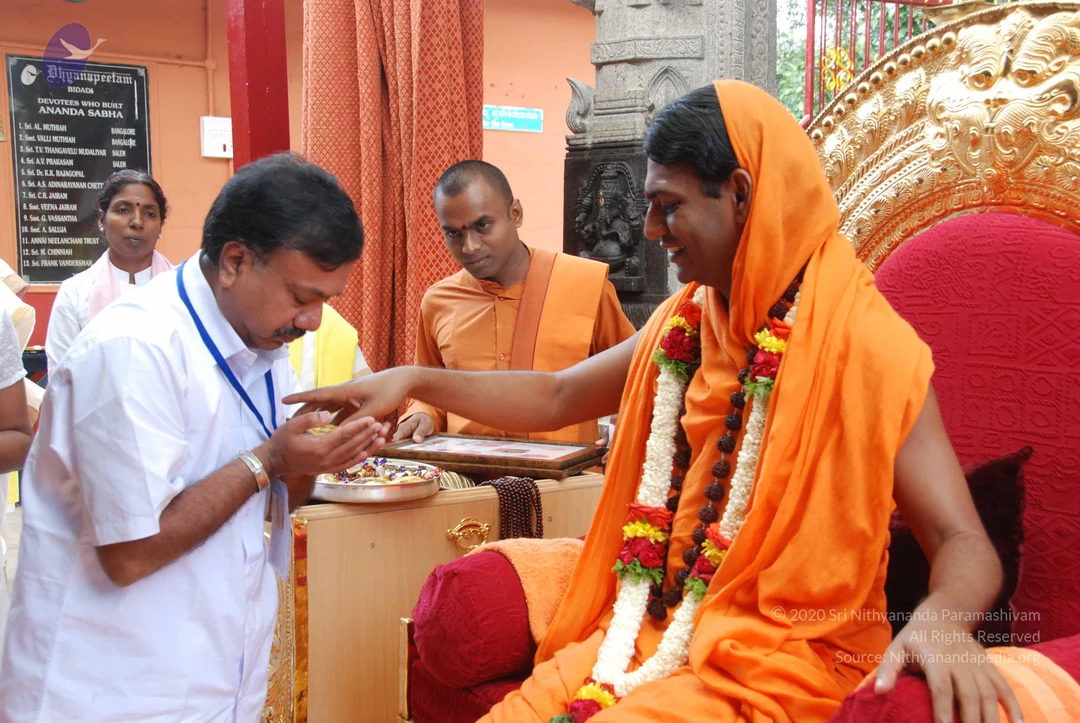
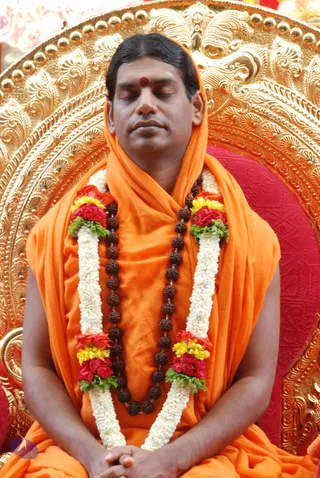
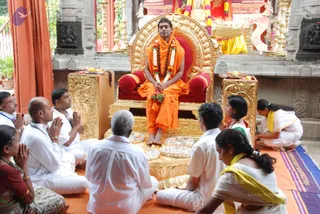
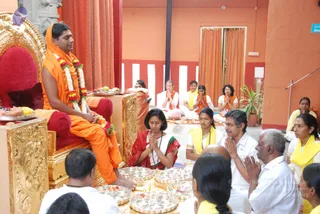
A seated man with eyes closed sits on an ornate gold and red throne with repoussé floral carvings. He wears an orange saffron shawl draped over his head and shoulders, a red kumkum dot on his forehead, and long rudraksha malas over his chest. White jasmine garlands interwoven with red roses and yellow flowers hang across his chest. His hands are folded in his lap. Swamiji (probable): the long swept-back hair, saffron shawl, rudraksha malas and ceremonial floral garlands fit the page description of a seated teacher receiving honour on a throne.A seated man with eyes closed and hands clasped in his lap sits on an ornate gold throne with a red cushion. He wears an orange saffron wrap draped over his head and body, a red-and-yellow vermilion dot on his forehead, and multiple rudraksha mala beads. Two white jasmine garlands with red and yellow flowers hang across his chest, and a bundle of red flowers rests on his lap. Behind him are gold and red decorations, and a small logo appears in the lower left corner. The appearance is consistent with the a person label, based on the saffron wrap, rudraksha malas and ornate throne cues.A seated man in saffron-orange robes sits on an ornate gold throne with red cushions, a rudraksha mala and a white and red flower garland around his neck, hands folded in front and feet bare on a gold footstool. Several devotees in white ritual clothes sit on orange floor mats before him with hands joined in namaste, including a woman in a red blouse and a woman in a white dress with a yellow shawl. Gold-rimmed brass plates with offerings and fruit sit beside the throne, and red and gold temple carvings and a decorated shrine appear behind. A devotee at right in white and a yellow shawl kneels and prepares offerings.A photograph of a padapuja-style ritual in an orange-walled hall. A standing man in saffron-orange robes and a saffron head cloth stands before a red and gold throne, hands folded, with a garland and a tray of fruit on a wooden table beside him. Seated devotees in white and yellow clothes sit with palms pressed together on the floor, while a woman in a red sari and a man in white robes watch from the foreground. Silver thalis holding flowers and offerings sit on a gold tray in front. Several people stand in the doorway in orange and white clothing.Indoor ashram scene with an orange-walled hall. A young man in an orange shawl stands before a red-cushioned golden throne, his hands raised, with a flower garland draped near him. Seated devotees in white and yellow clothing sit with hands folded in namaskar before a brass tray and thali plates of offerings, and fruit sits on a tray at the throne. A bald man in white stands in the doorway behind. A photo-frame and wall-mounted speaker are visible. The photo is an archive image of a padapuja-style event.A seated man in an orange robe with an orange shawl and garlands of white and red flowers sits on a red and gold throne, his bare feet resting on a gold footstool. A woman in a red sari with a white blouse kneels before him with palms pressed together, and brass thalis of offerings lie on the floor in front. Behind them, devotees in white clothes with orange or yellow shawls sit in rows with hands folded in prayer. Fruit and flowers are arranged on a side table. Orange walls frame the hall. Several people in white and yellow sit on the floor, and a person sits on the far right in white. The scene reads as a padapuja ritual honouring the seated figure.

5-Pancha-Tapas
14 photosSource gallery
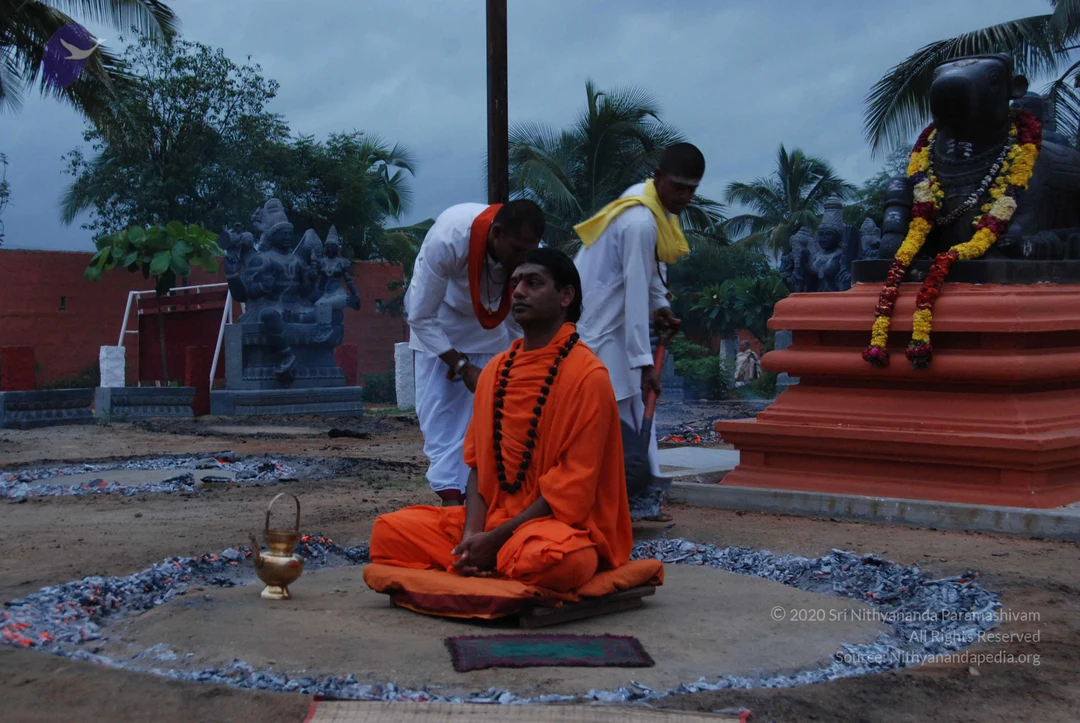
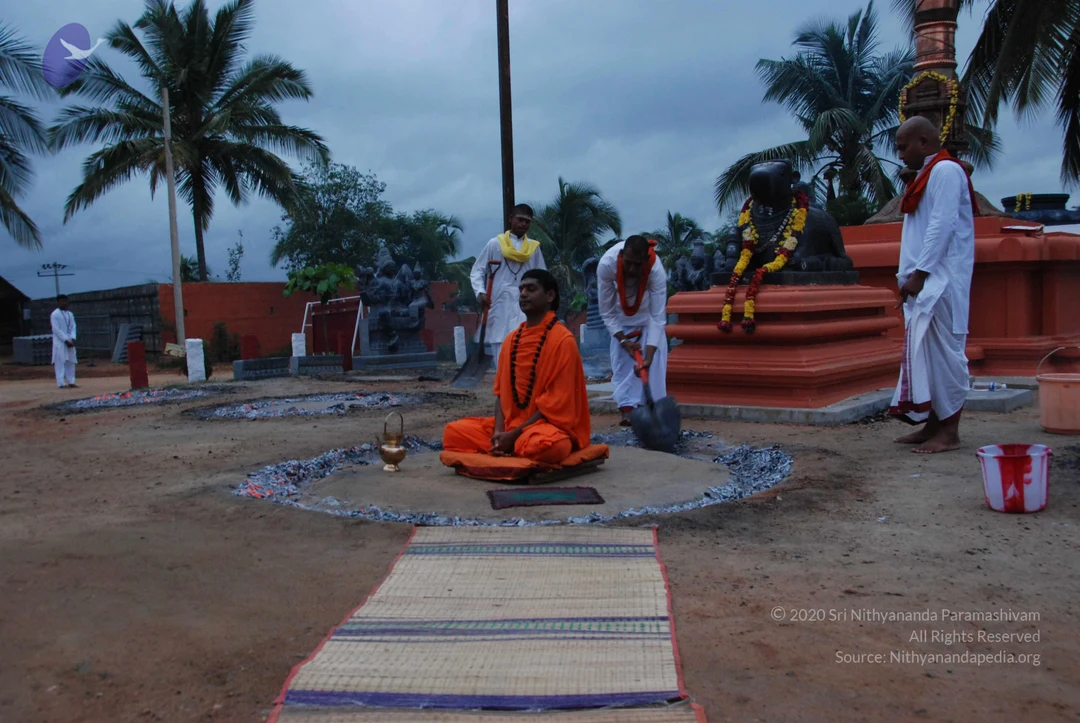
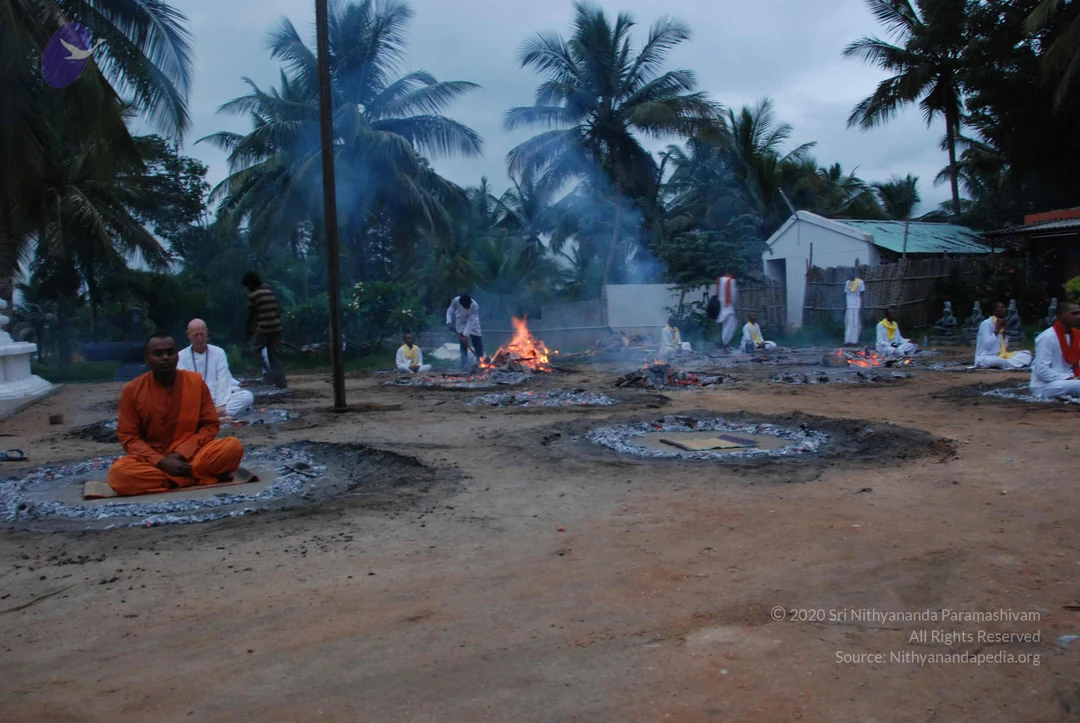
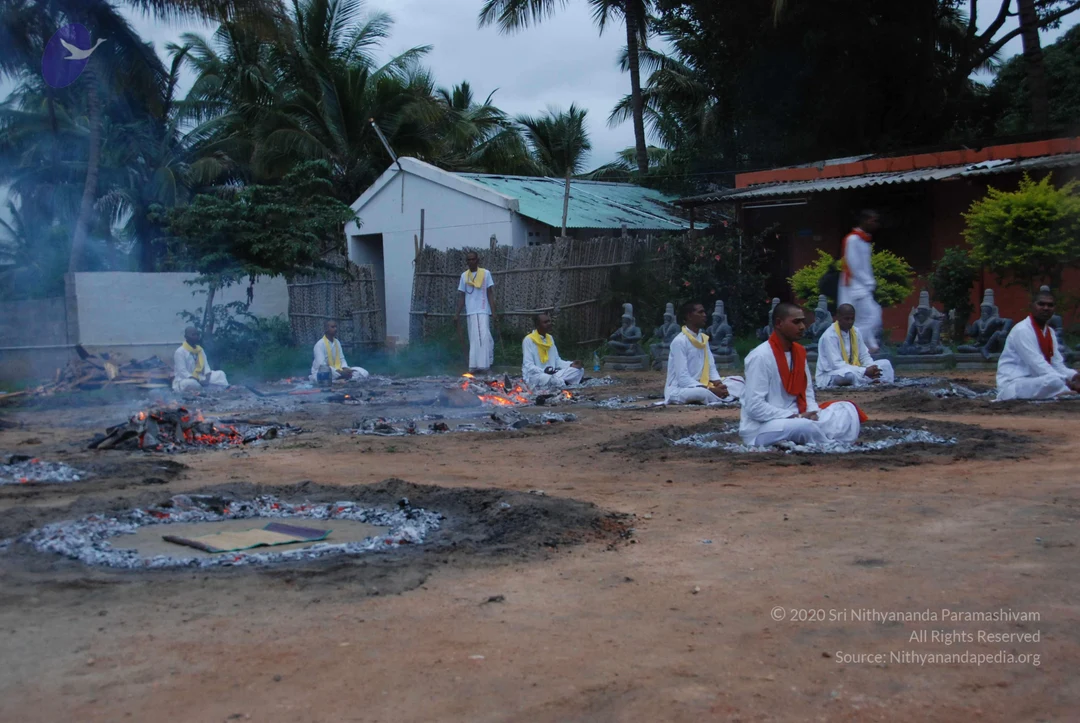
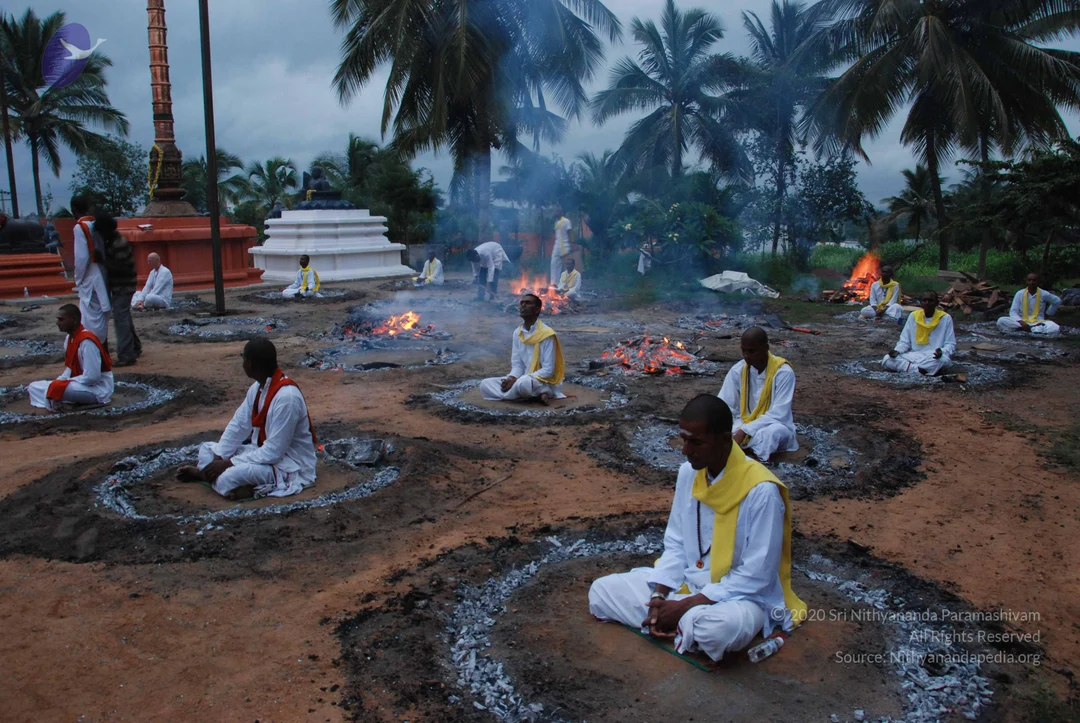
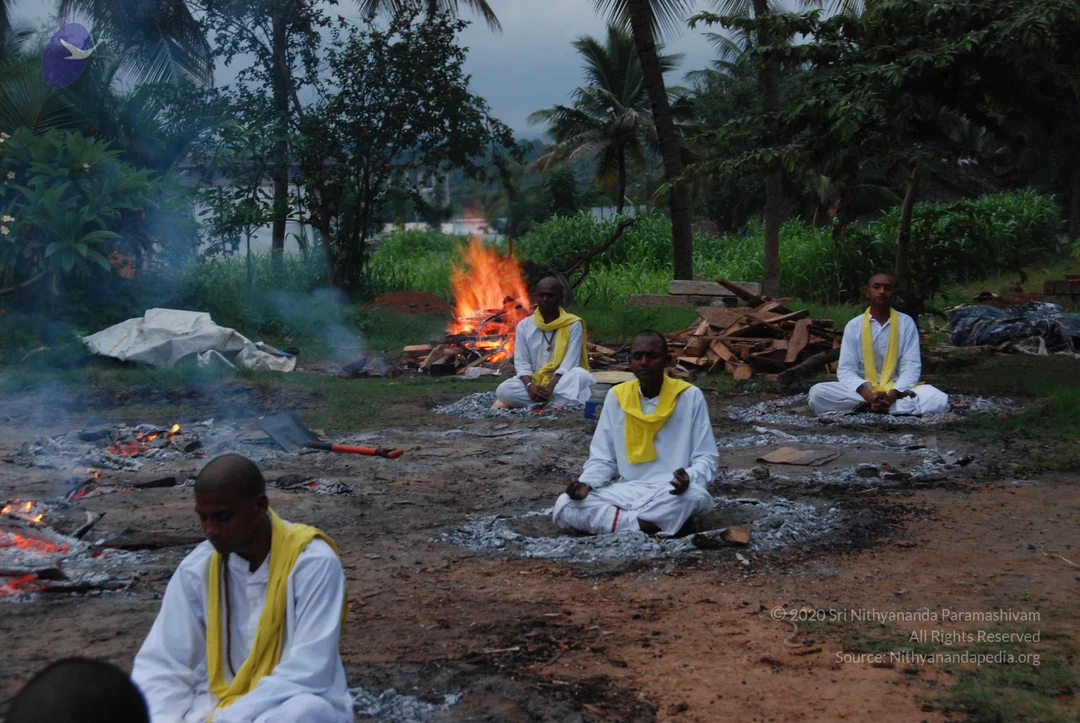
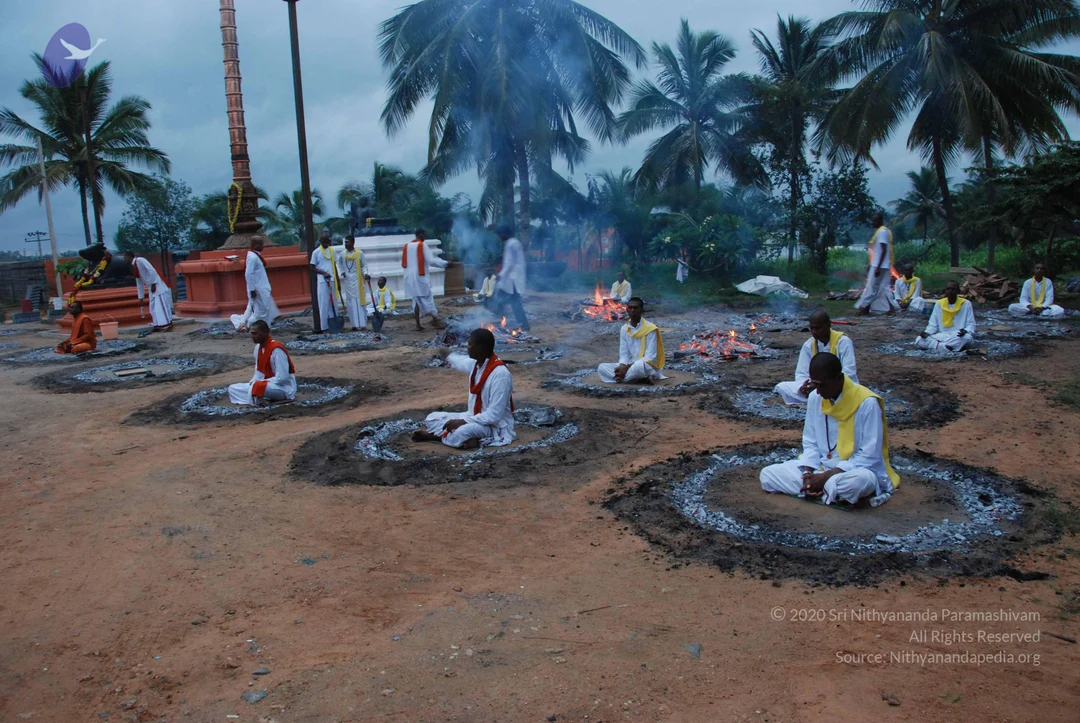
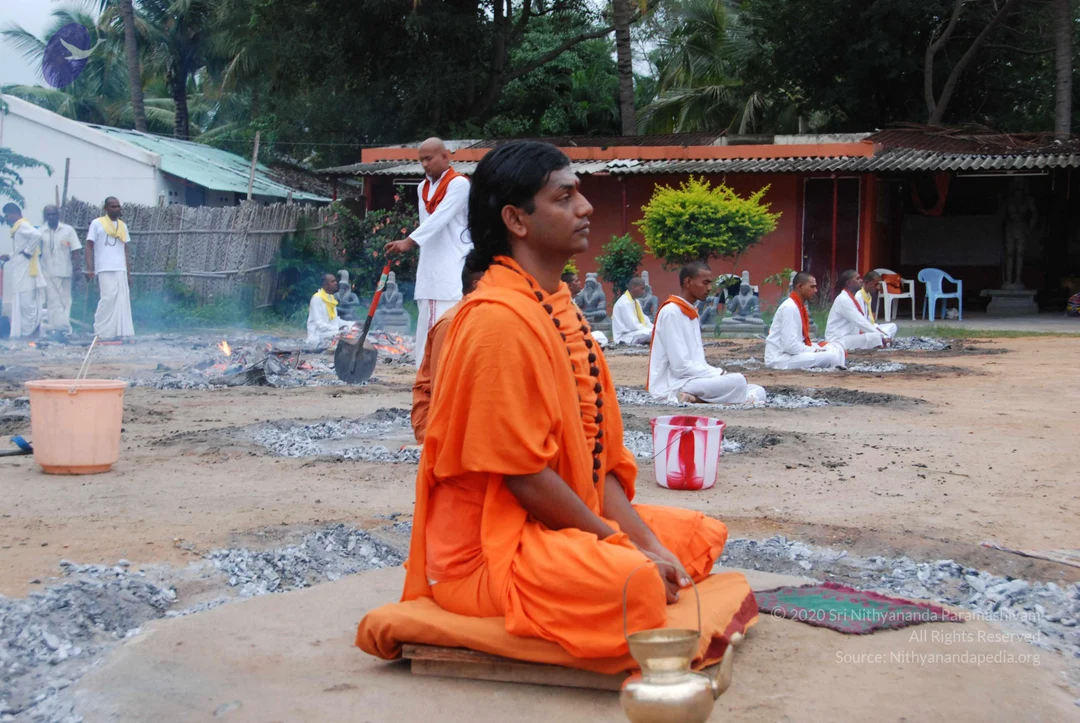
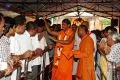
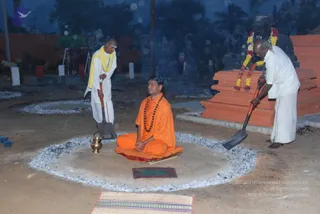
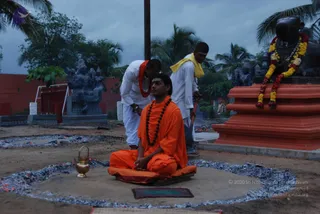
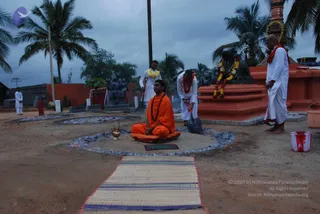
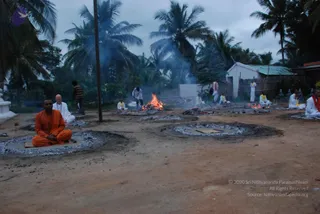
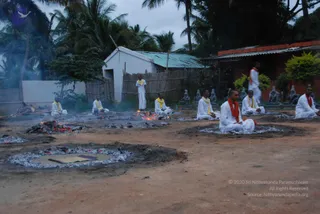
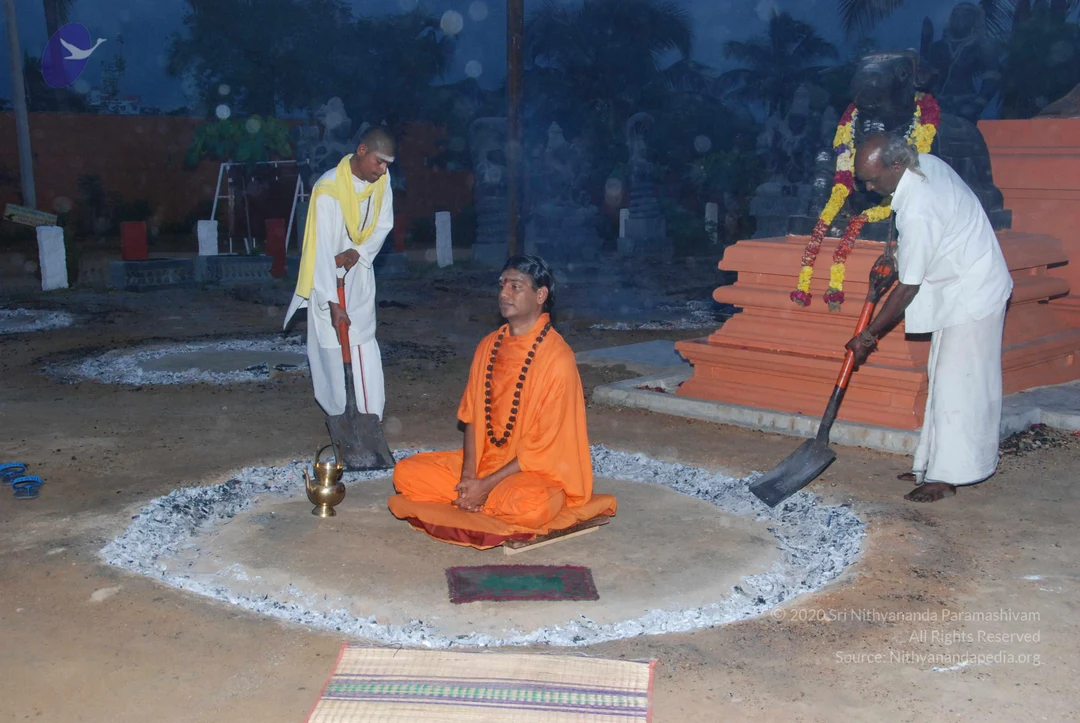
Outdoor ritual scene at dusk in an ashram courtyard. A man in an orange robe with a rudraksha mala sits cross-legged on a raised concrete platform encircled by white ash or lime, with a brass kalasha beside him. Two men in white dhotis assist: one in a yellow shawl leans on a long-handled spade on the left, and an older man in white with a long-handled spade shovels ash on the right beside an orange stone structure draped with marigold garlands. Stone deity murti and statues fill the background among palm trees. A woven mat lies in the foreground. The seated man appears to be the a person, identified by the saffron robe and rudraksha mala, and the scene reads as a homa-style fire ritual site.Outdoors under an overcast sky with palm trees, a seated man in saffron-orange robes and a rudraksha mala sits cross-legged on a raised square platform with a small brass kalasha or pot beside him. Two assistants in white garments stand behind him, one in a red-orange cloth and one in a yellow cloth; one leans forward to attend to him. Around the platform, a ring of ash or burnt embers surrounds the seat. To the right stands a large black Shiva lingam draped with a garland of yellow and red flowers on an orange-red base, and dark stone deity murtis stand in the background among palms and a red wall.Outdoor ritual scene at a temple courtyard under an overcast sky with palm trees. A man in saffron-orange robes and a rudraksha mala sits cross-legged on a raised circular platform ringed with ash or charcoal. Behind him, a man in white clothes with a yellow shawl digs with a shovel, and another in white with an orange-red shawl works with a shovel beside a dark stone deity murti garlanded with orange and yellow flowers. A shaven-headed man in white dhoti and red shawl stands at right beside a red bucket. A brass kalasha/pot sits on the ground, and a woven mat leads toward the platform. Orange-red temple walls and stone sculptures frame the courtyard.Outdoor photo at a sculpture-lined ashram ground with dark stone deity sculptures and a red-brick wall behind. A man in saffron-orange robes with a dark rudraksha mala sits cross-legged on an orange cushion with hands folded in meditation, eyes closed. Beside him, a man in white dhoti and white shirt with an orange shawl sweeps ash from the ground with a broom, while another white-clad attendant in the right foreground works with a shovel. A brass vessel sits on the ground near glowing embers and ash from a fire pit. Palm trees and overcast sky are visible.An outdoor photograph of a homa or fire ritual on bare earth under coconut palms, with a grey overcast sky. Several circular fire pits lined with white ash stand in the open ground, with flames and smoke rising from some of them. A seated man in orange robes in the foreground sits on a mat near a pit, and a bald man in white stands to the left beside a figure in a striped shirt. Further back, several people in white clothes sit or stand near the fire pits, one wearing a red-orange shawl on the right. A white-walled small building with a green tin roof and a wooden fence sit behind them, with a wooden pole in the middle distance.Outdoor scene on a dirt ground beside a white-walled building with a green corrugated roof, palm trees behind, and carved stone figures lining a bed. Several devotees in white dhoti and kurta sit cross-legged on dark ash-circle mats across the ground, some wearing yellow shawls and others red shawls, with small fires and smoke rising from fire pits in front of them. A man in white stands at the centre-left, and another in white walks at the right edge. A small wooden tray or cloth sits in one ash circle. The setting appears to be a rural ashram courtyard in the morning.

6-Sarva-Darshan
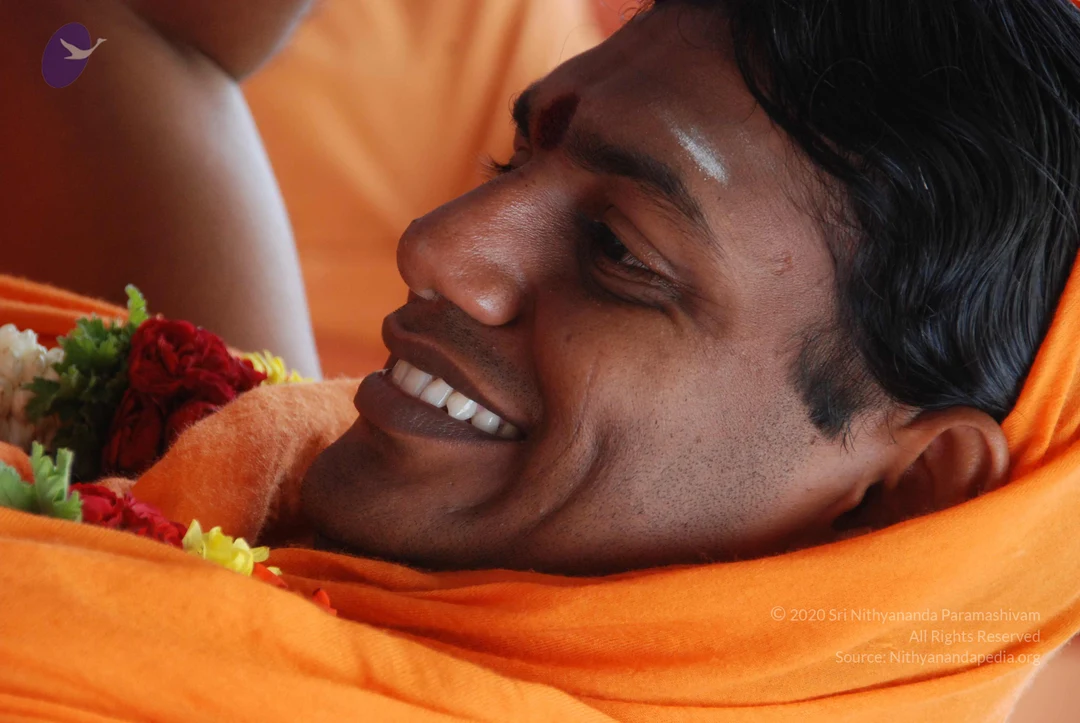
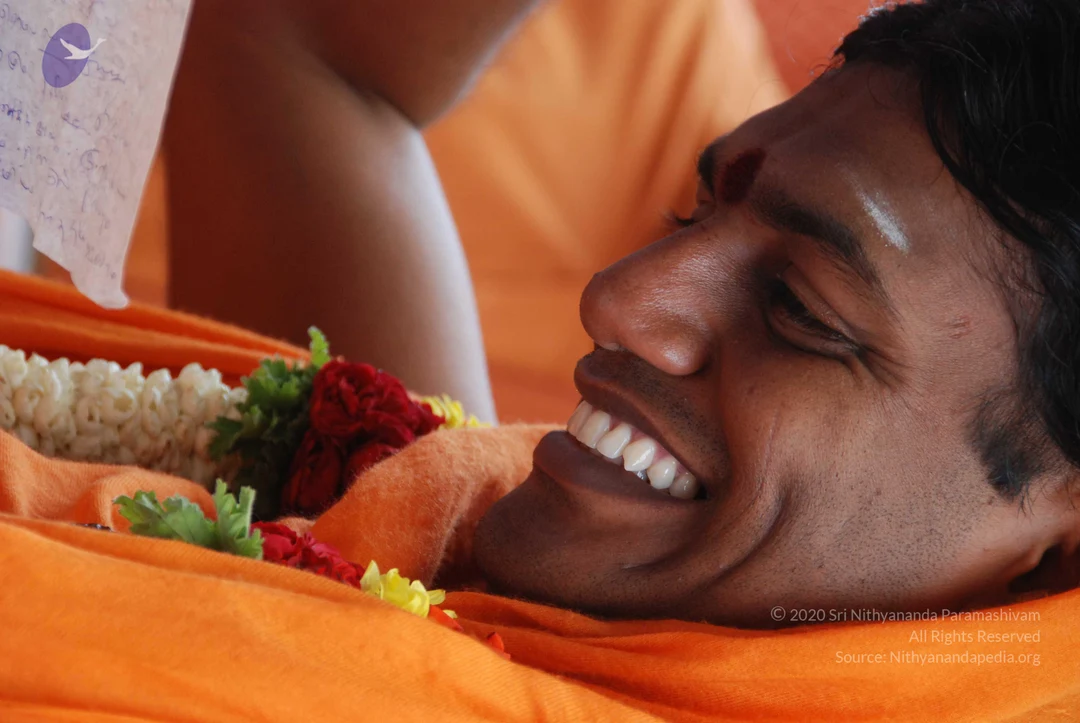
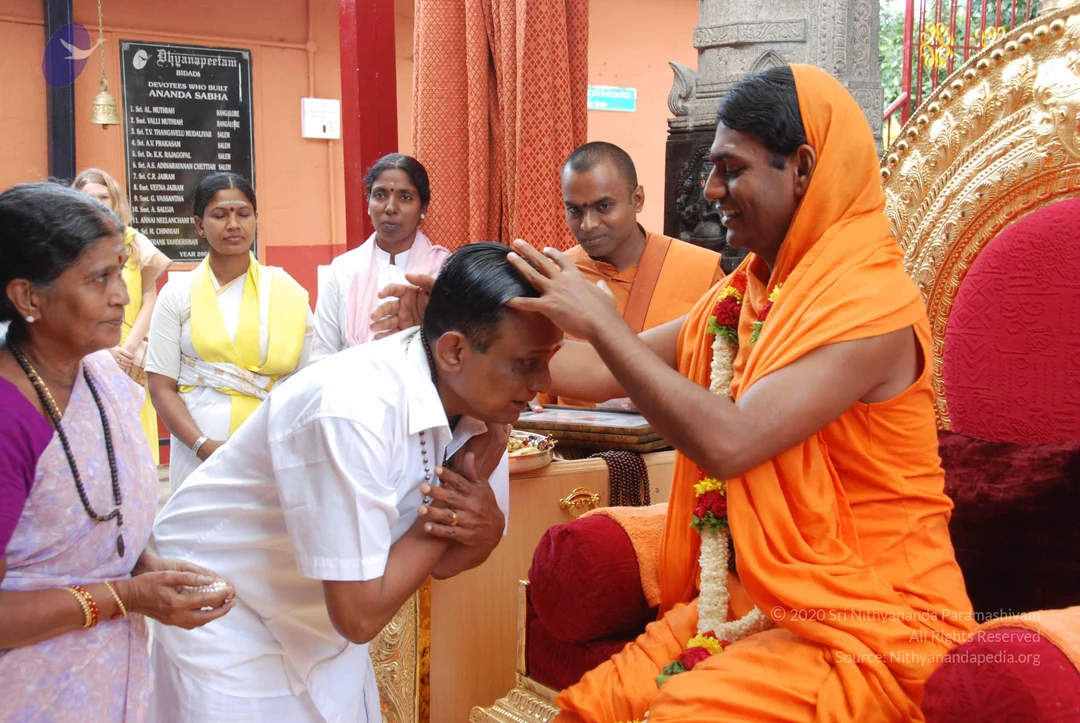
38 photosSource gallery
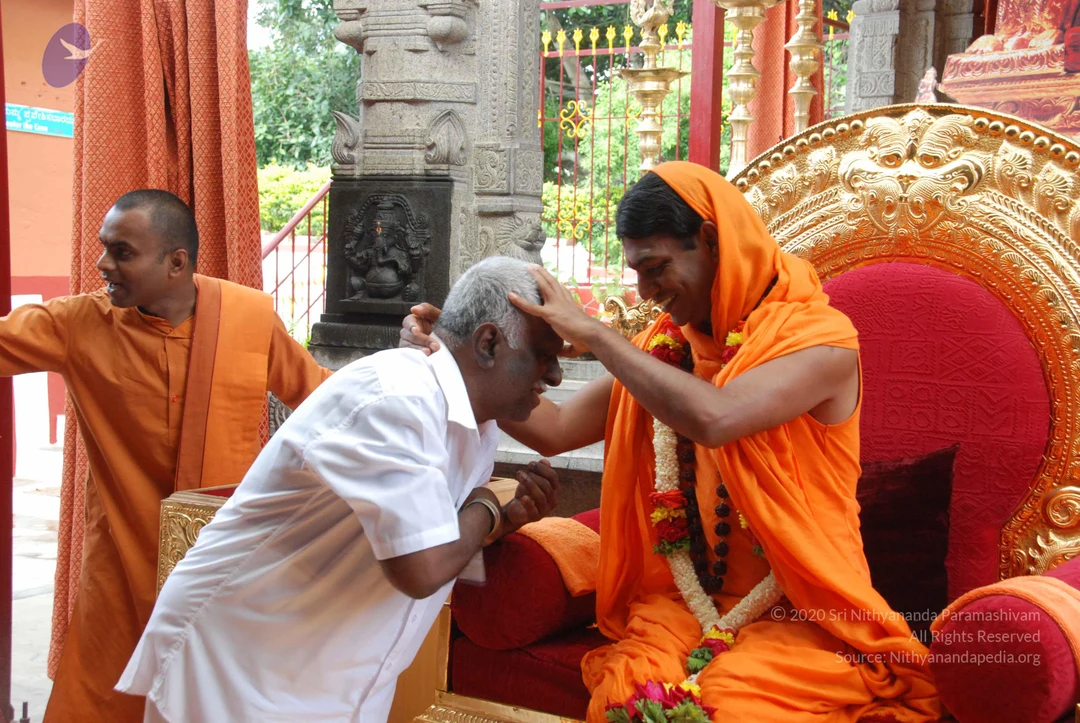
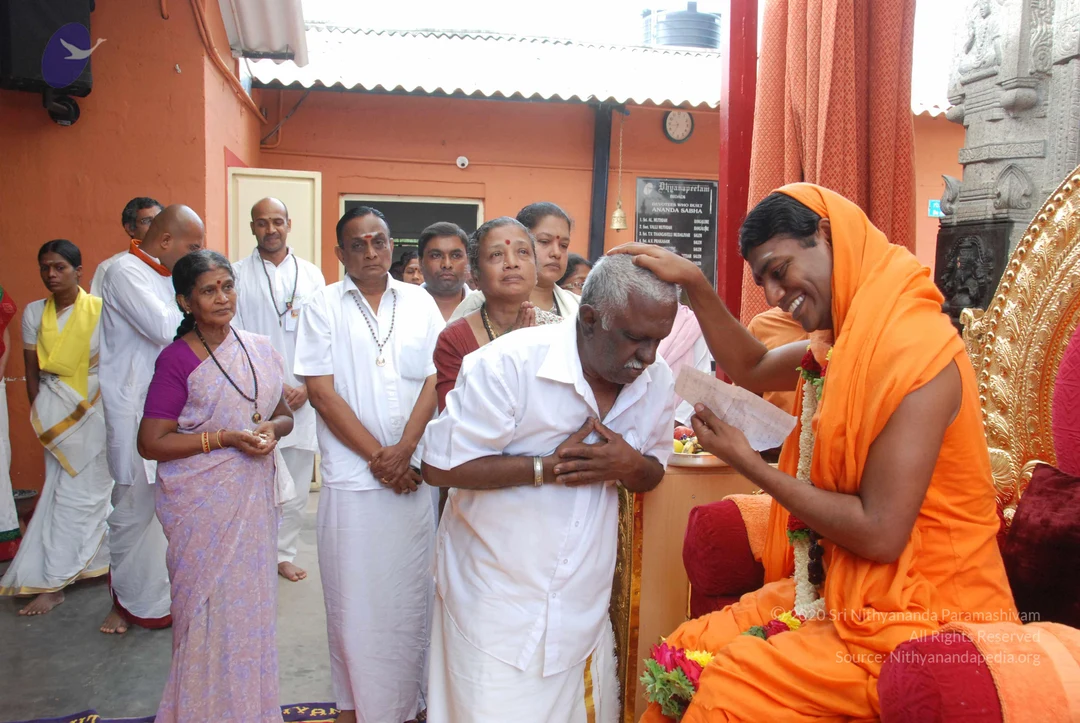
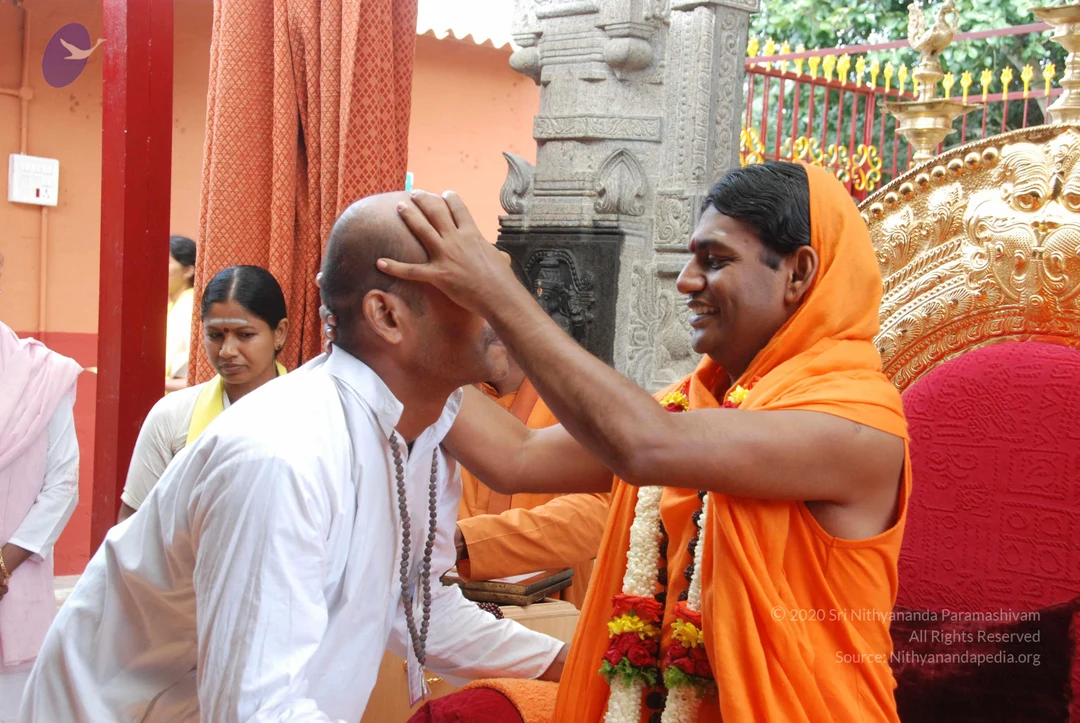
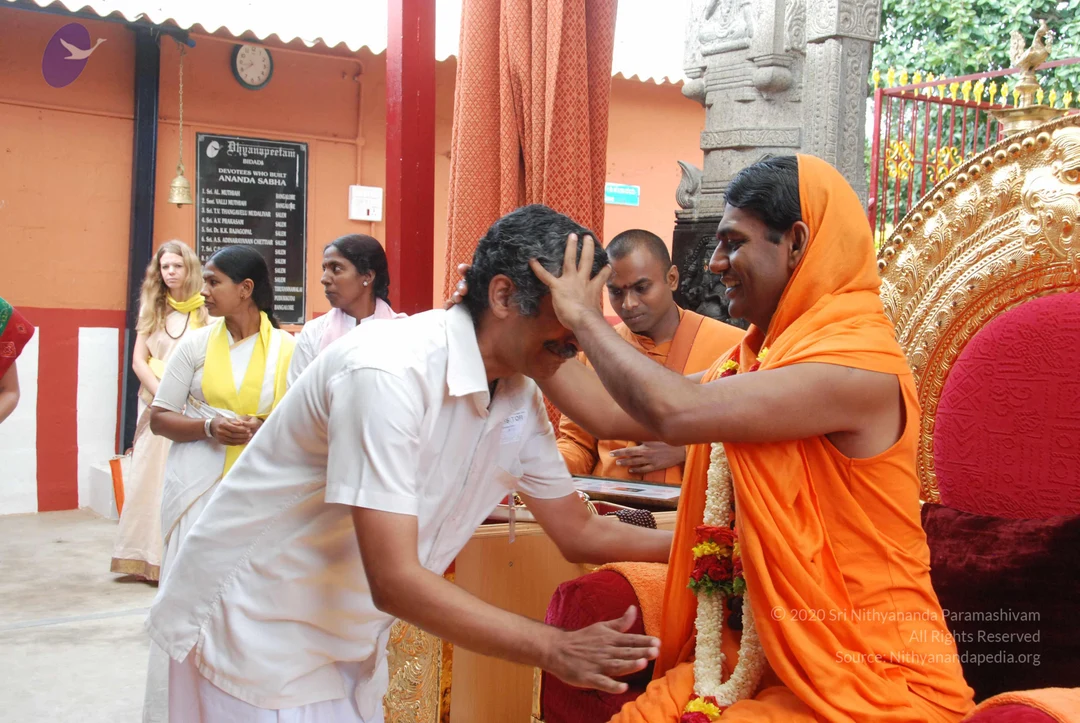
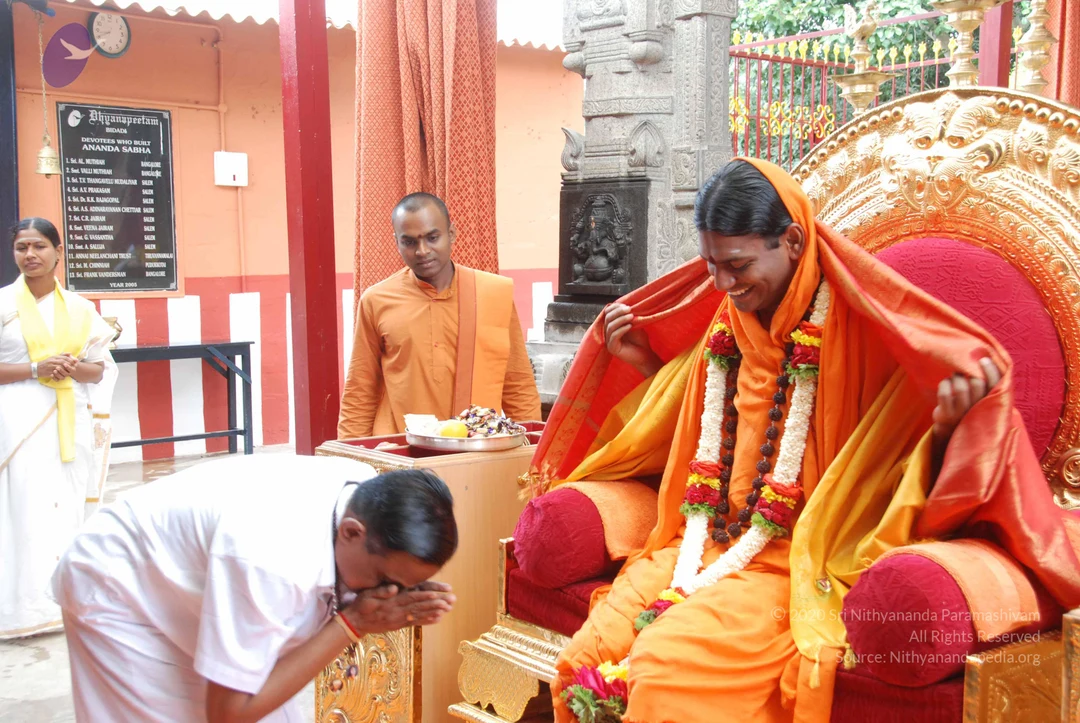
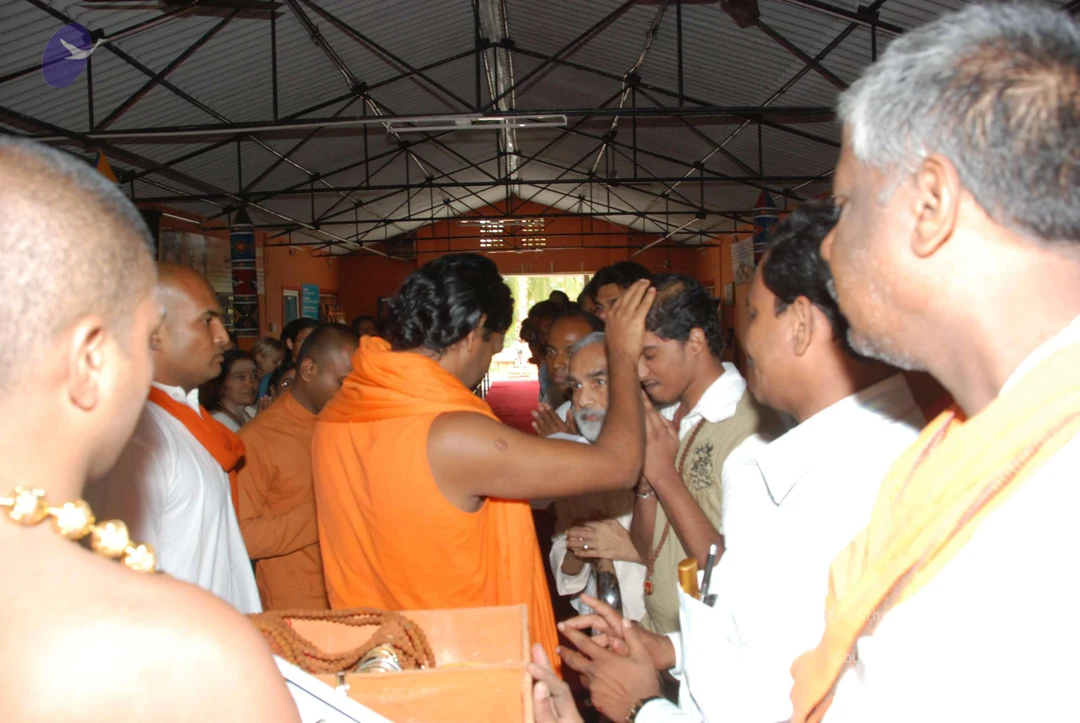
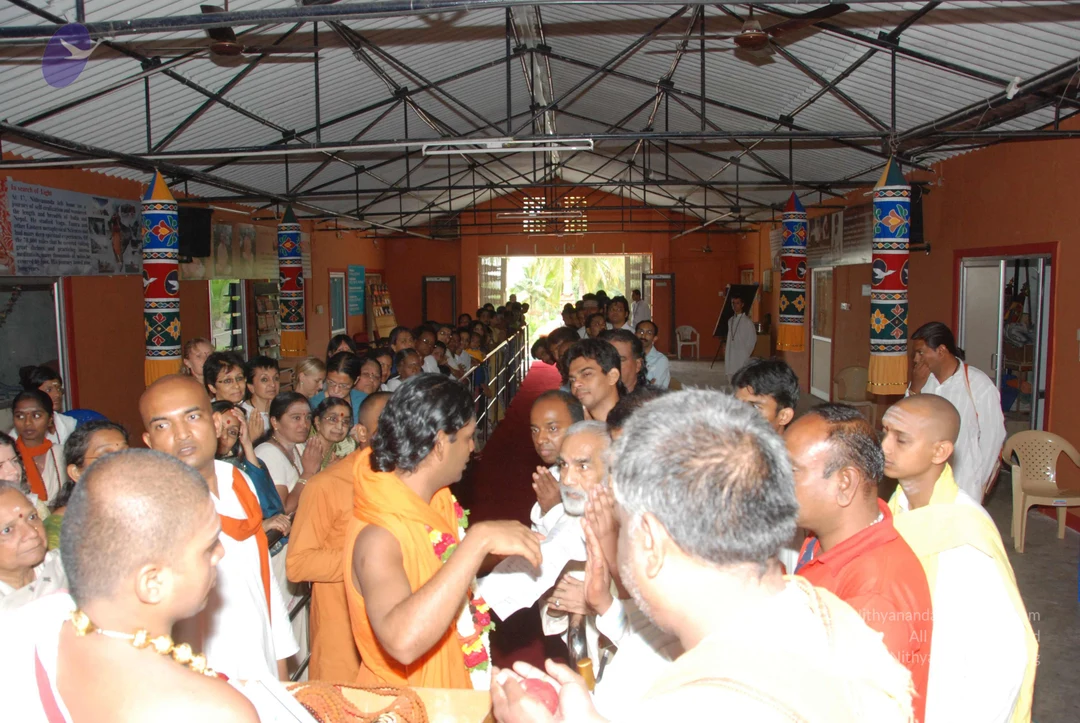
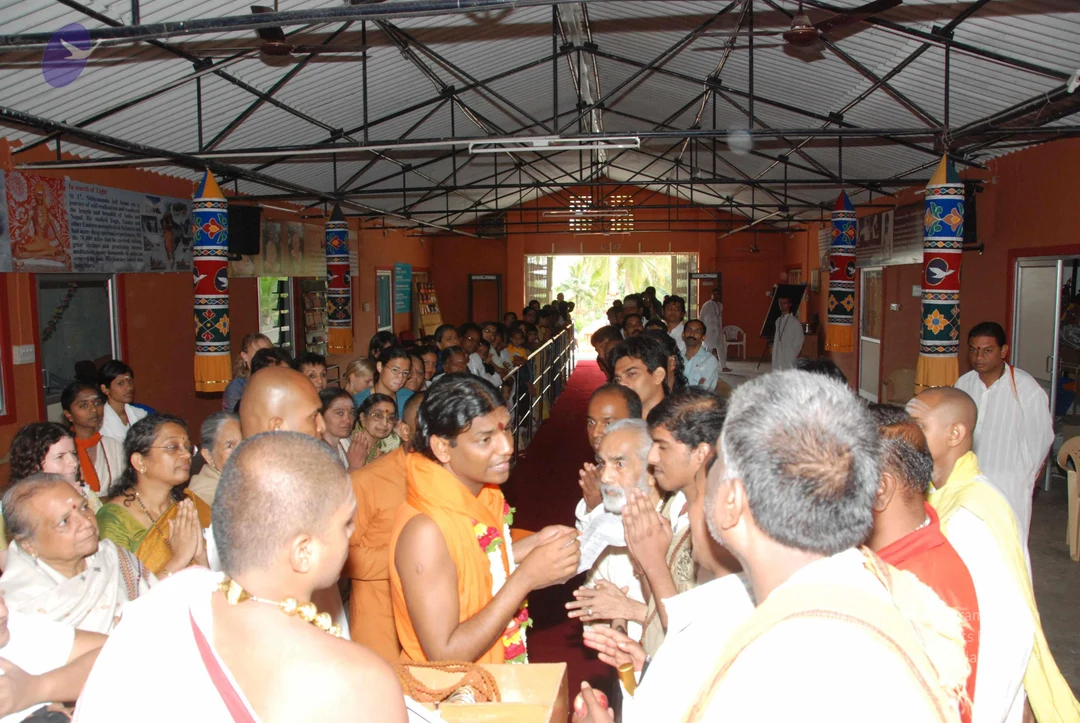
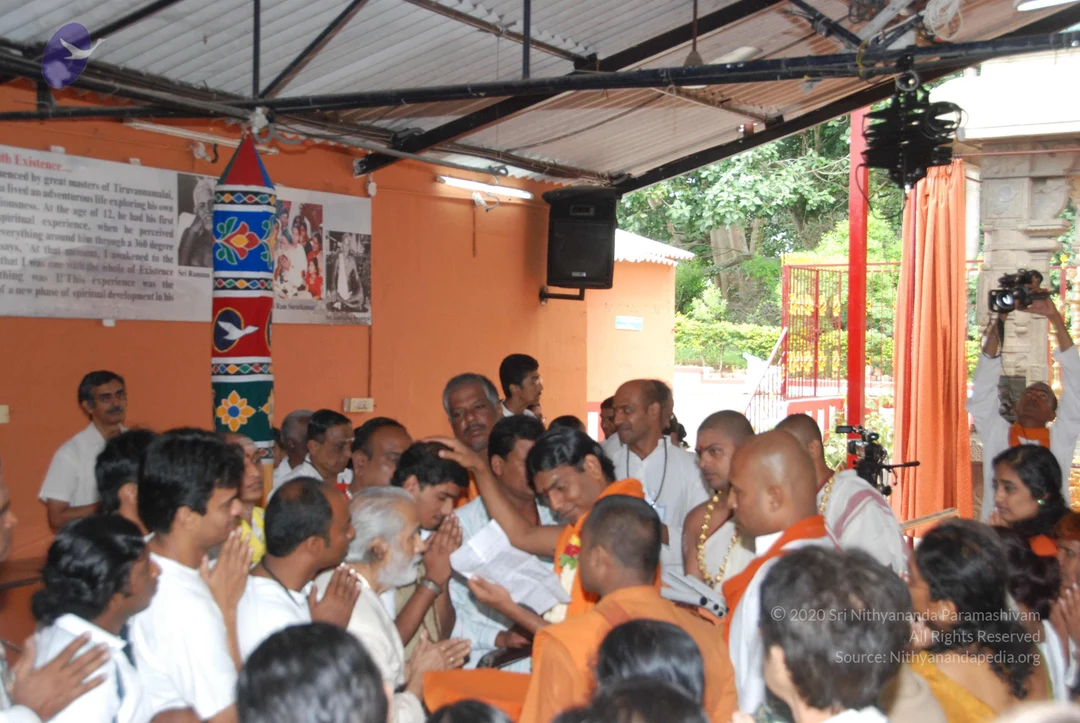
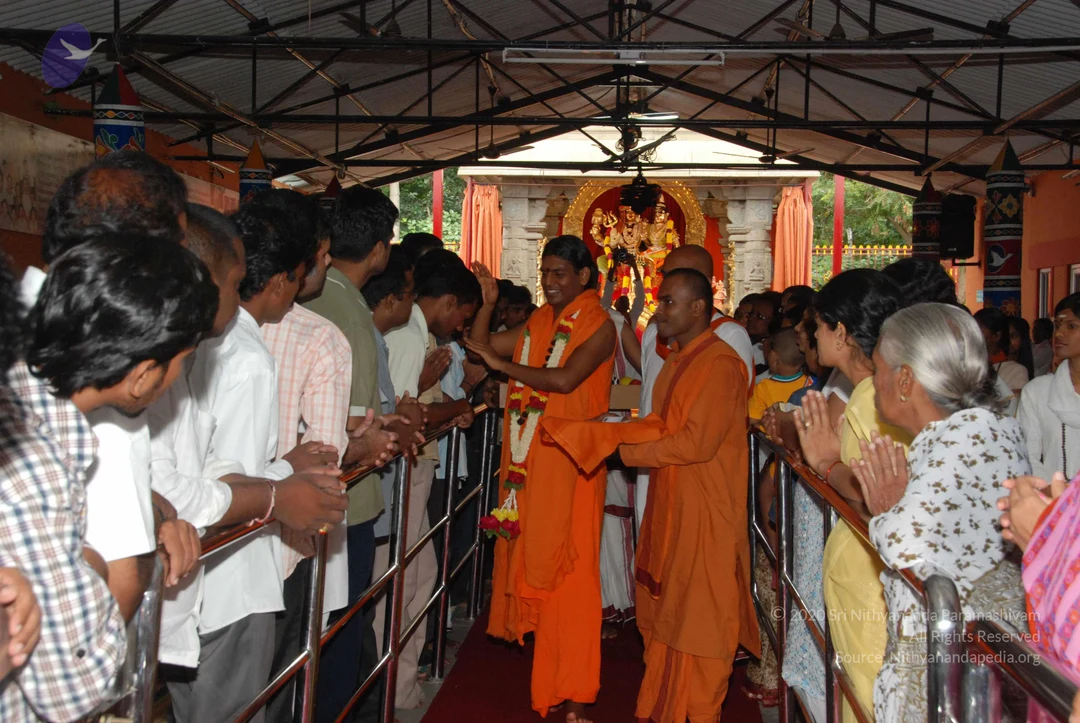
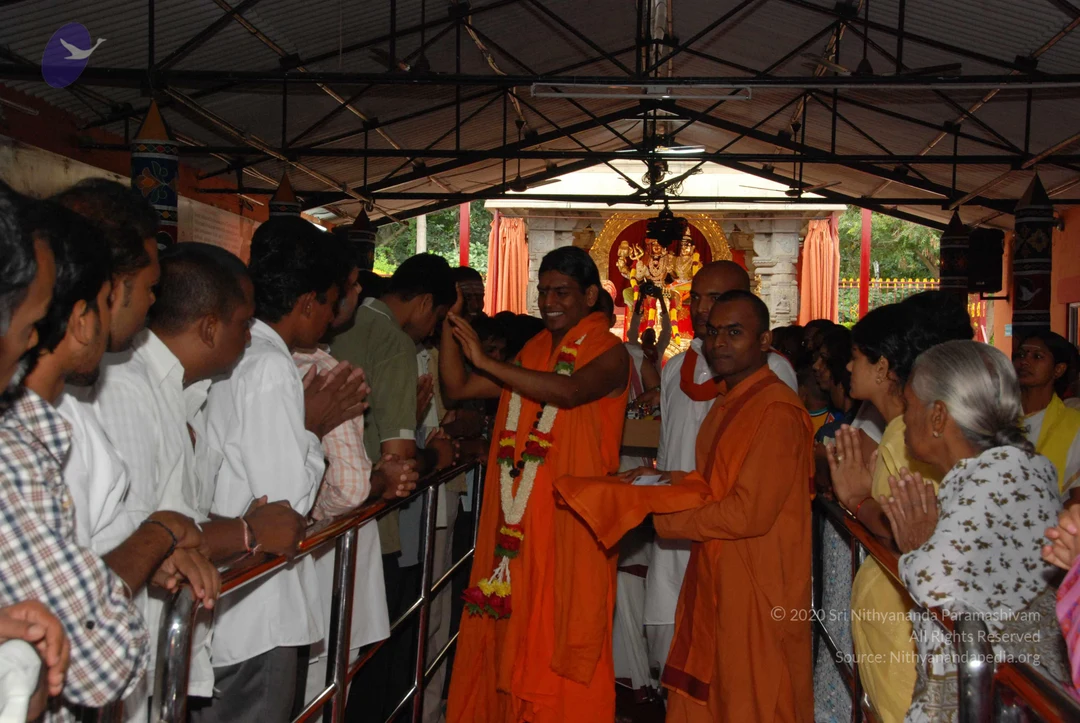
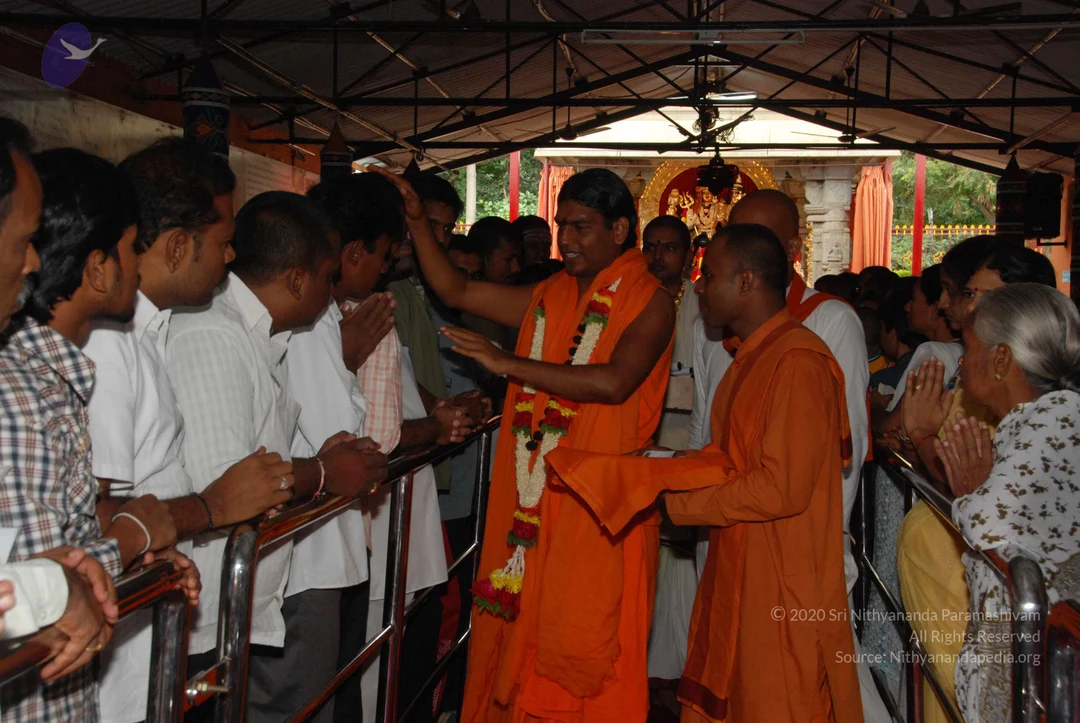
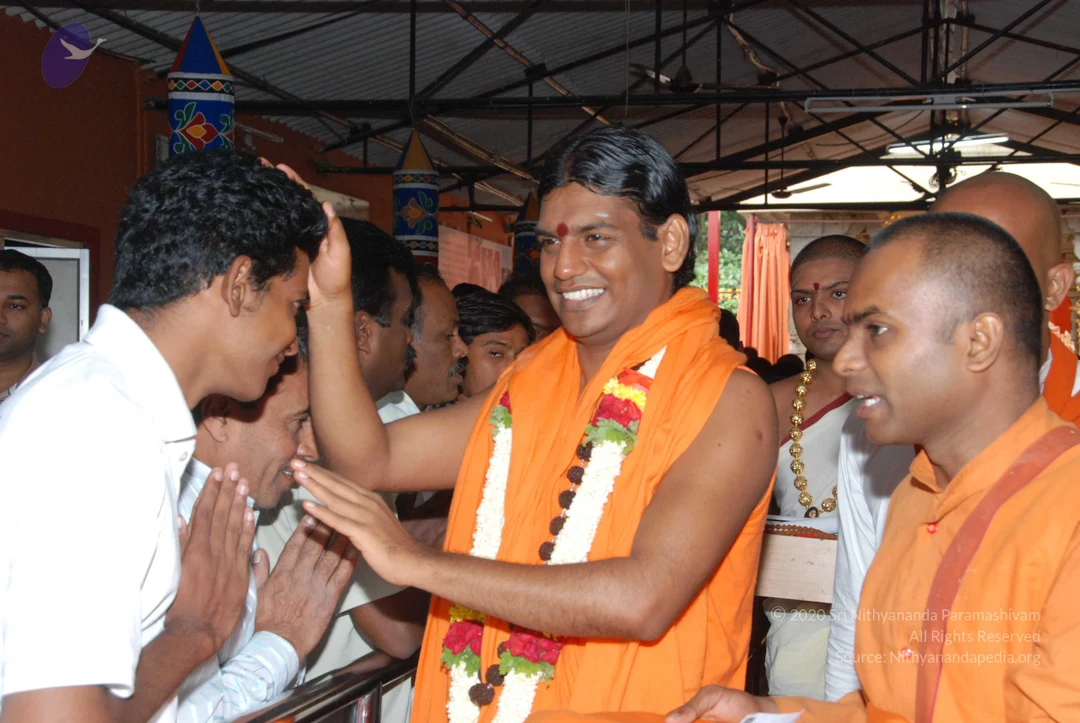
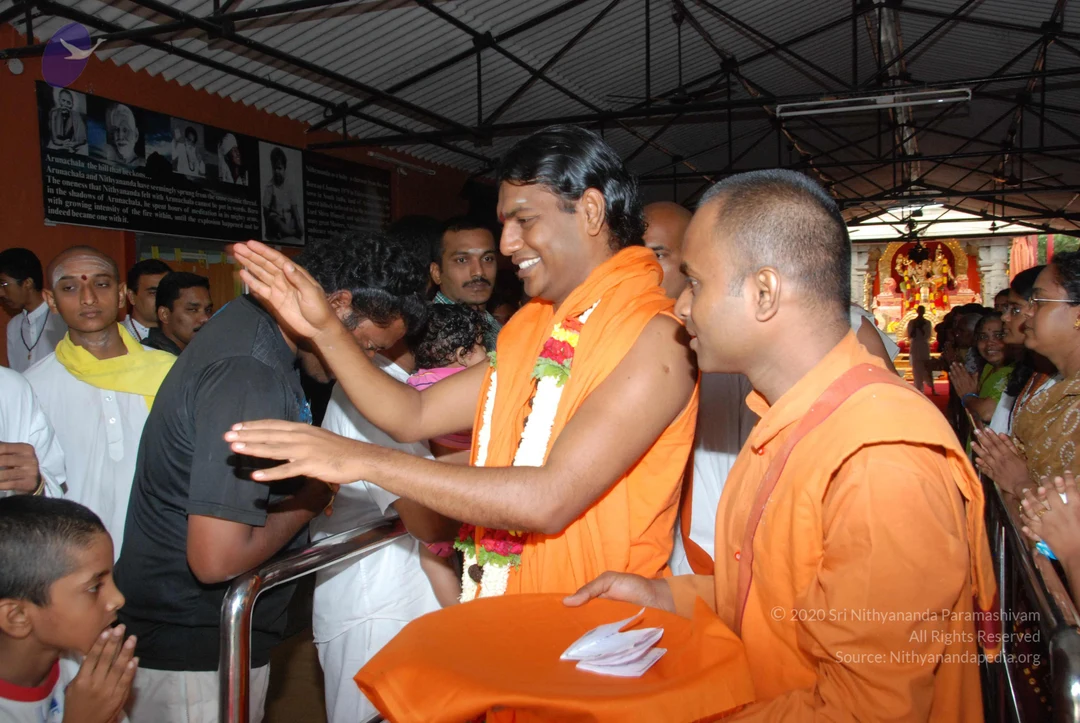
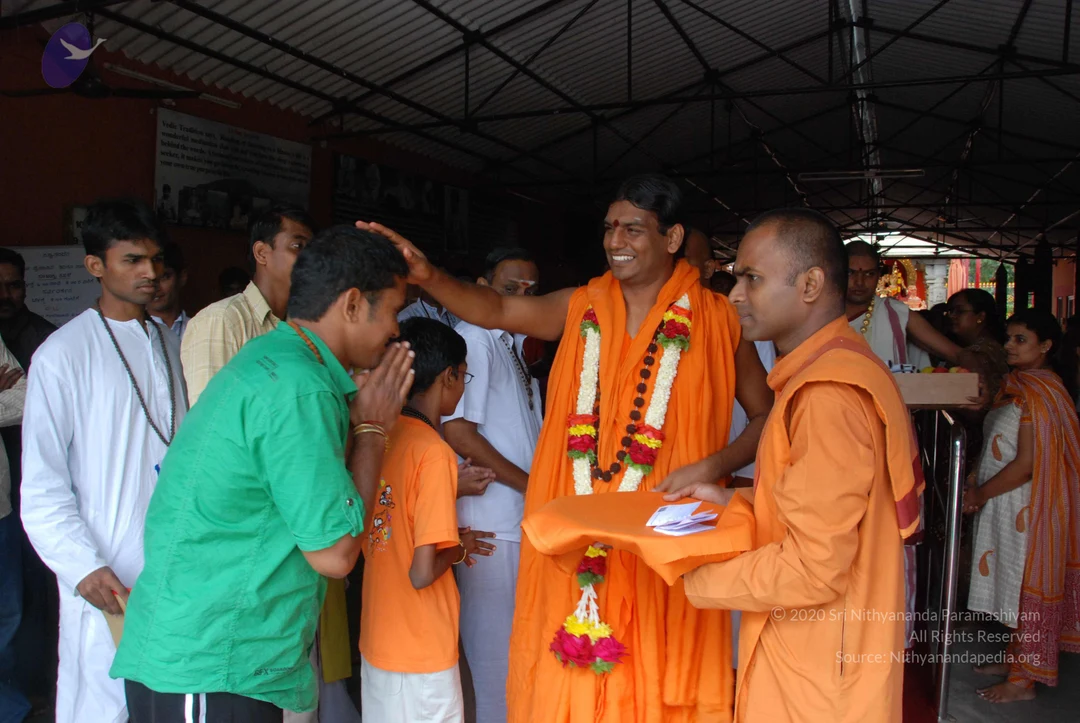
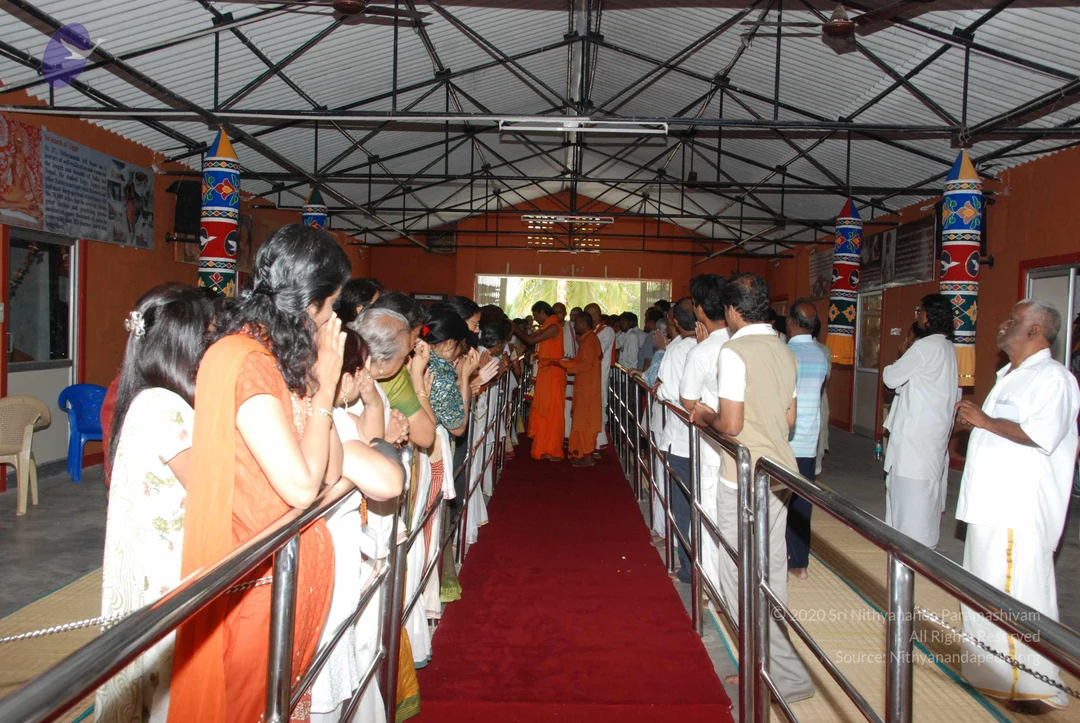
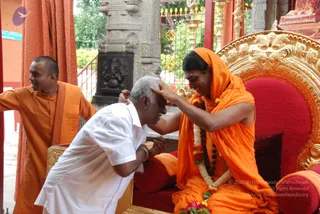
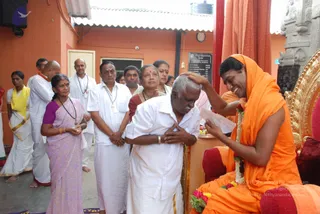
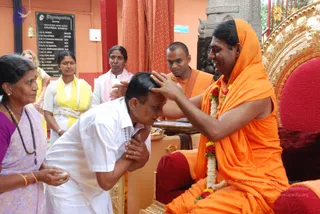
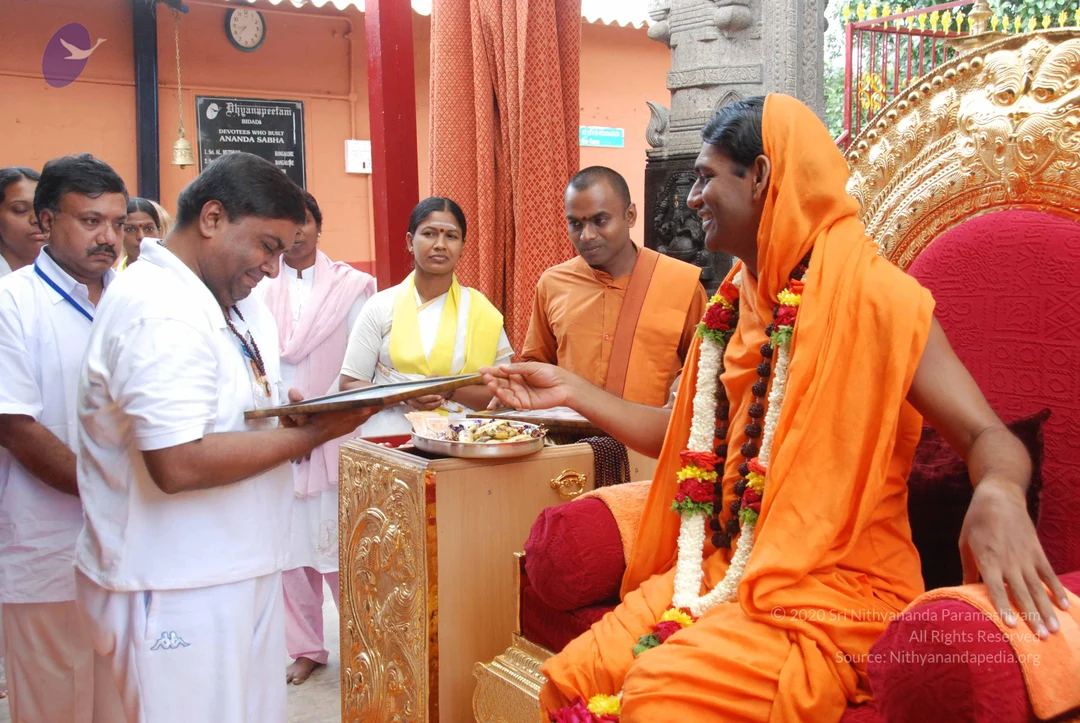
A seated saffron-robed figure on an ornate gold-and-red throne receives a blessing as an elderly man in a white shirt and white dhoti bows forward with folded hands while the seated figure places a hand on his head. The seated figure wears an orange shawl draped over the head, a white flower garland with red blossoms, and a rudraksha mala. To the left, a man in orange robes gestures with one arm. Behind them stands a carved stone pillar with a seated deity relief, and a gold-tipped railing and greenery frame the temple-style setting. a person: the seated figure wears saffron robes, a rudraksha mala and a ceremonial flower garland while seated on a throne, and is receiving honour, which is an appearance-based candidate.A seated figure in an orange saffron shawl and orange garments sits on an ornate gold-trimmed throne with red cushions, a garland of white flowers draped over his shoulder. He smiles as he places his hand on the head of an older bald-grey-haired man in a white dhoti and white shirt, who bows with his hand on his chest. Behind them, standing devotees include a woman in a lavender sari with a rudraksha mala, a man in a white dhoti with a rudraksha mala, a woman in a maroon sari, and others in white. A brass plate on the orange wall reads Dhyanapeetam. Flower petals and a plate of fruit sit near the throne, and a grey stone carved panel stands at right.Close photo of a smiling man with short dark hair, a white vertical tilak on his forehead and a red bindi-style mark between his brows, wrapped in a saffron-orange shawl draped over his head and shoulders. A garland of white jasmine, red roses and yellow flowers with green leaves rests across his chest. He looks down and to the side, and a sheet of handwritten paper is visible at the left edge. The background is orange fabric. a person candidate is present with a saffron wrap and floral garland, but the appearance cues are not sufficiently distinctive to confirm identity.Close-up photograph of a smiling man with short dark hair wrapped in an orange cloth, his head resting against the orange fabric. He has a red kumkum mark and white vibhuti stripes on his forehead. Red and yellow flower garlands are visible at the lower left. Another orange-clad arm appears at the top left. The face is in profile and turned toward the right.A close photo of a smiling man lying on an orange cloth, face turned sideways with eyes nearly closed. He has a red tilak mark and white vertical marking on his forehead, dark swept-back hair, and a white and red-yellow flower garland rests beside him on the saffron fabric. Blurred orange-clothed arm and a white paper with handwritten text appear at the upper left. The posture suggests a relaxed devotee or person resting during a gathering. Printed copyright text appears at the lower right corner.A seated figure in saffron-orange robes with a draped shawl and a flower garland sits on an ornate gold-and-red throne, placing his hand on the forehead of a man in white who bows before him. A woman in a lavender sari with a rudraksha mala and bangles stands at left holding a small offering. Behind them, devotees in white, yellow and pink garments and another monk in orange look on. A dark plaque on the orange wall lists names of devotees who built the Ananda Sabha at Dhyanapeetam. The setting appears to be a devotional gathering or blessing ceremony.