Skip to content
Sunday

7 March 2021

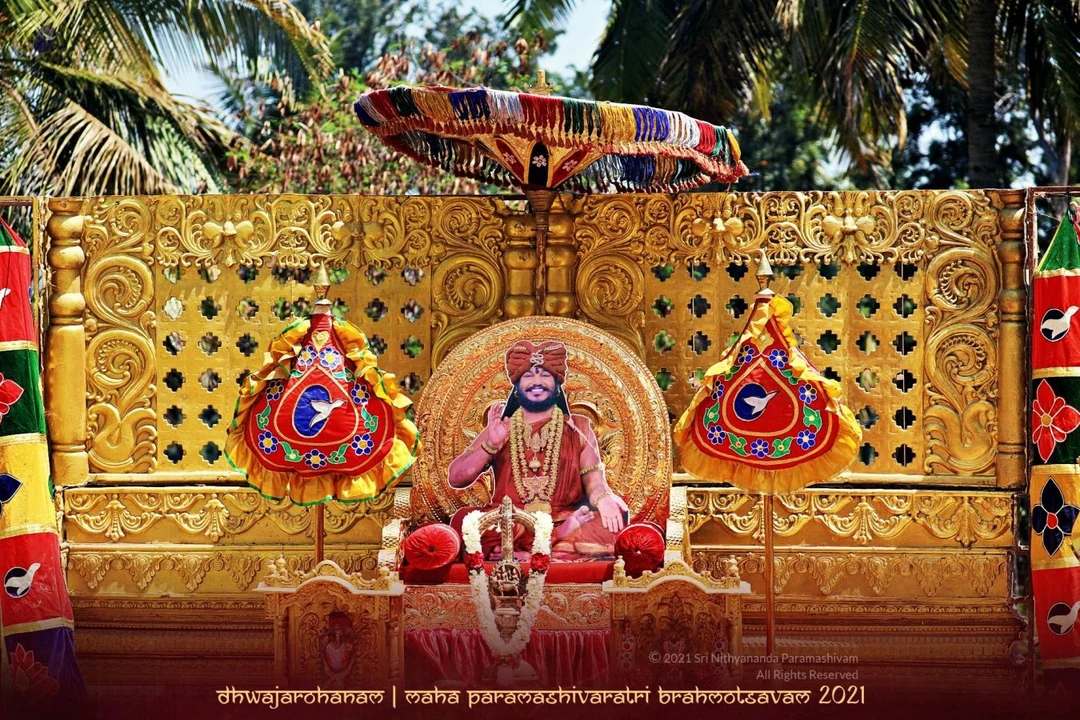
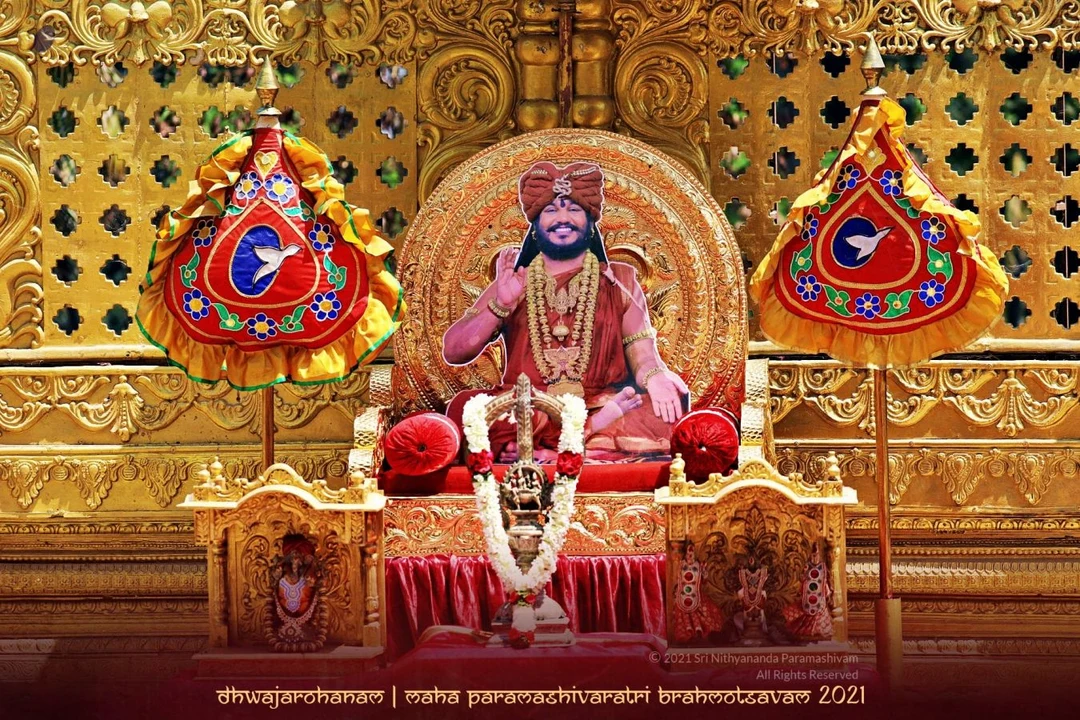
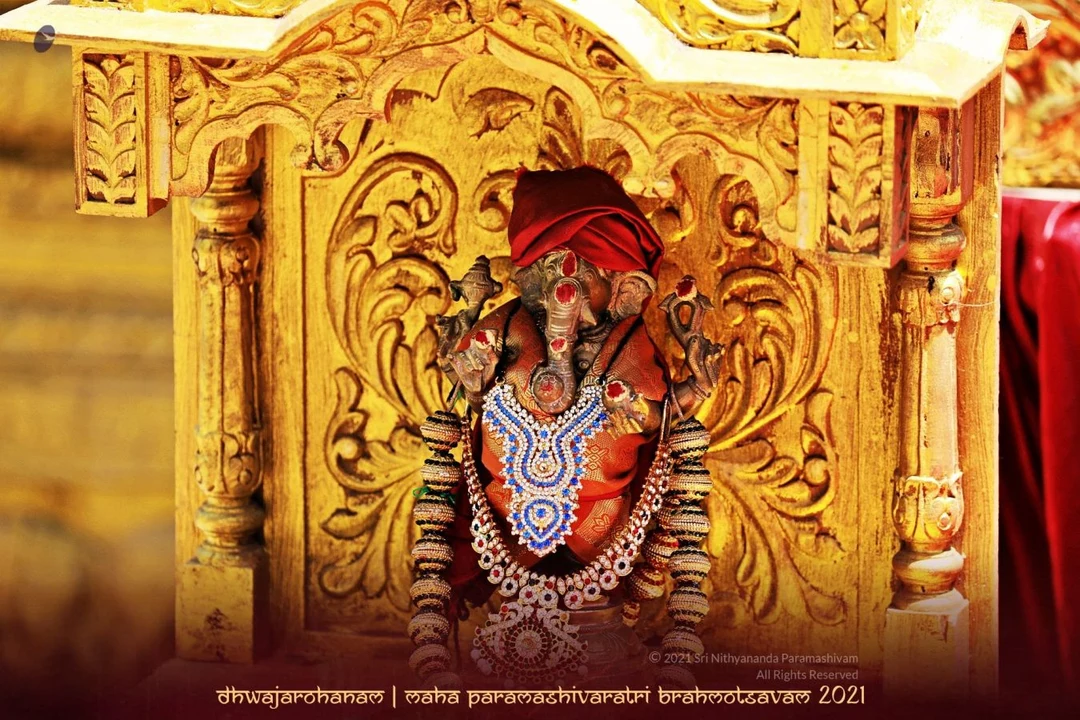
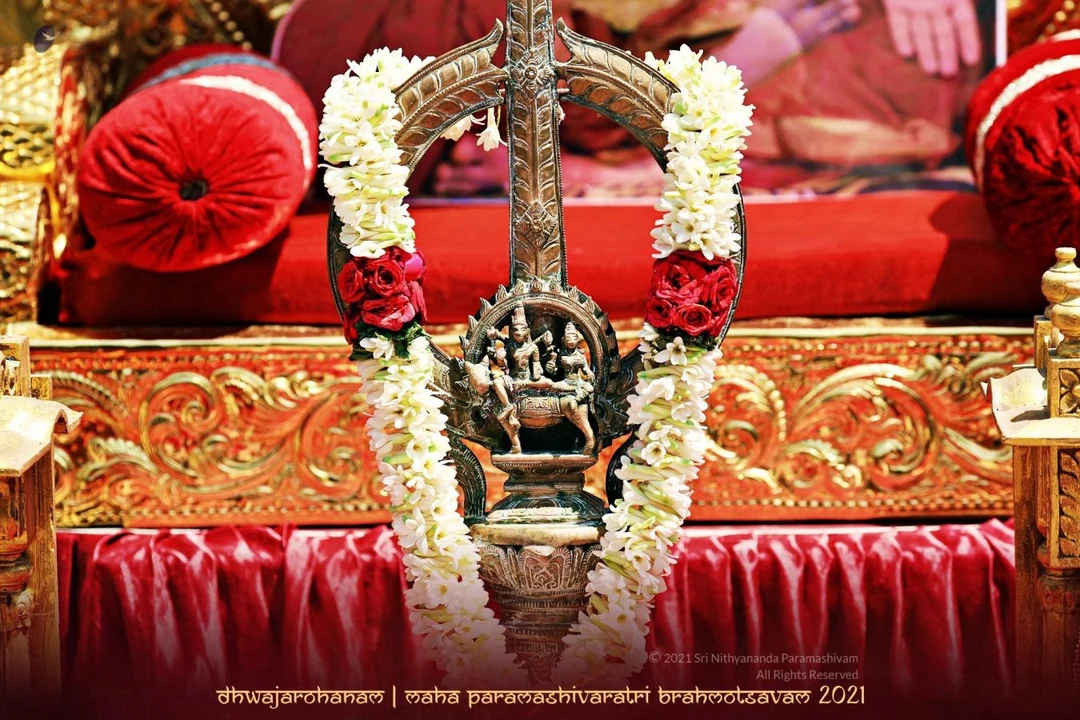
SANKALPA (CONSCIOUS RESOLUTION) FOR PACHAI PATTINI VRATHAM || DVAJAROHANAM FOR MAHA PARAMASHIVARATRI || 7 MARCH 2021

Dated photos
105
Source pages
11
Media
2
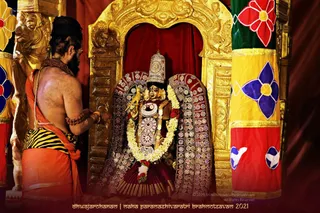
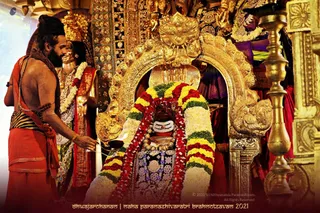
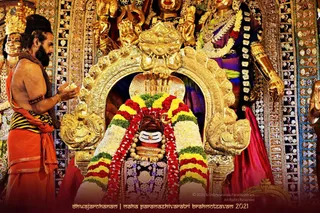
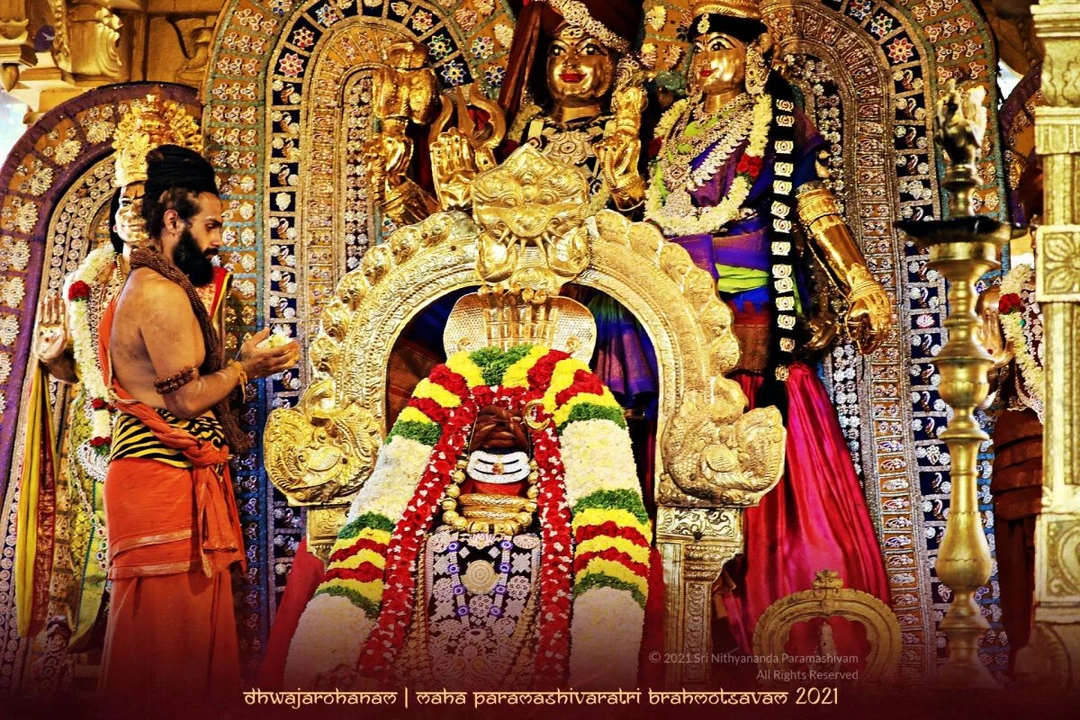
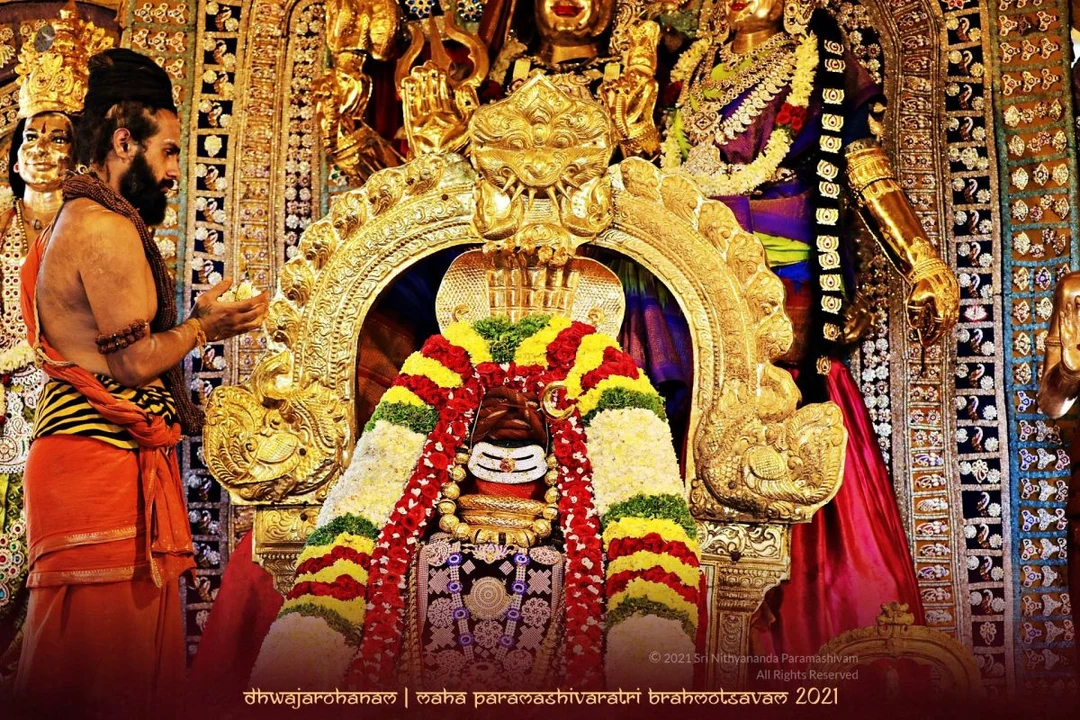
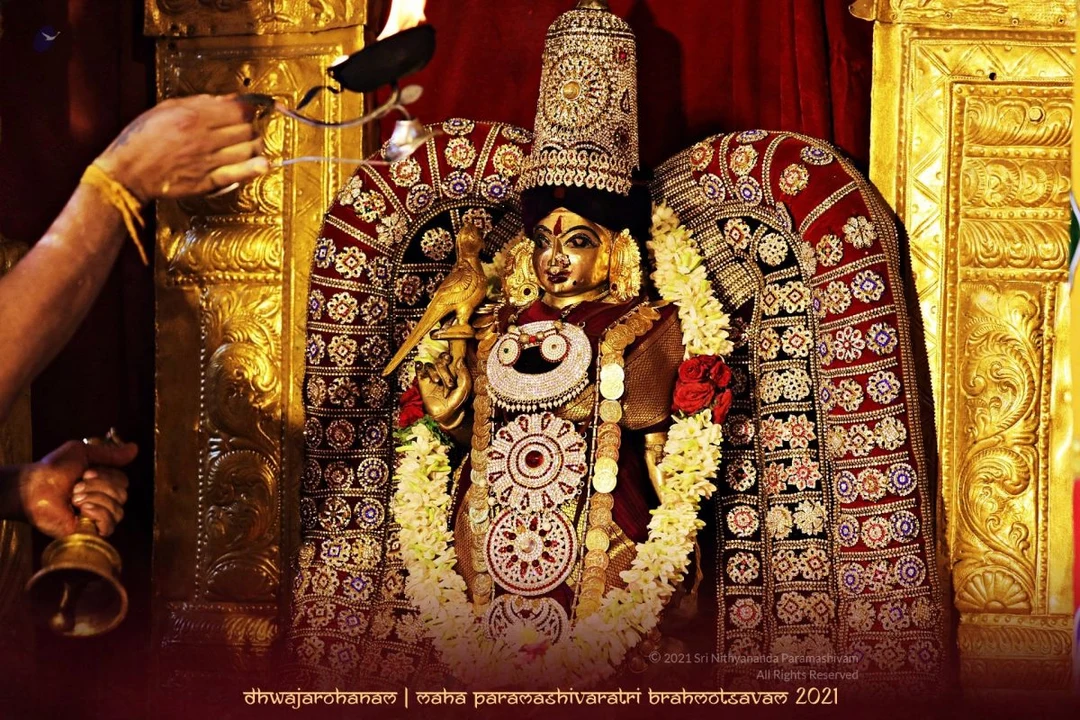
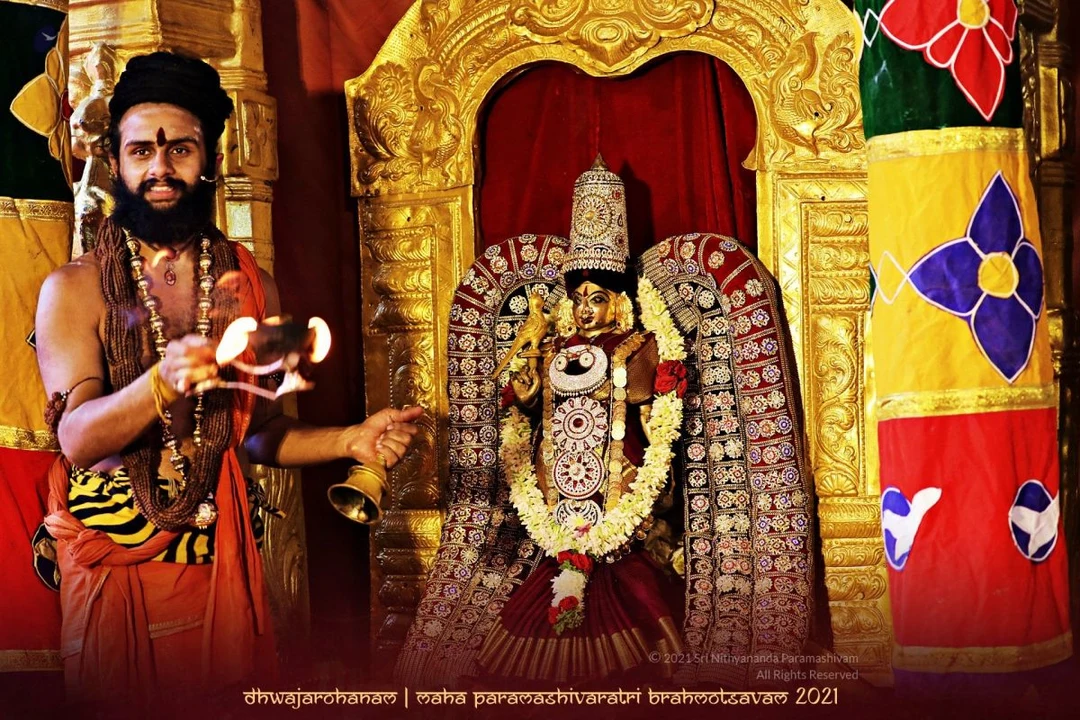
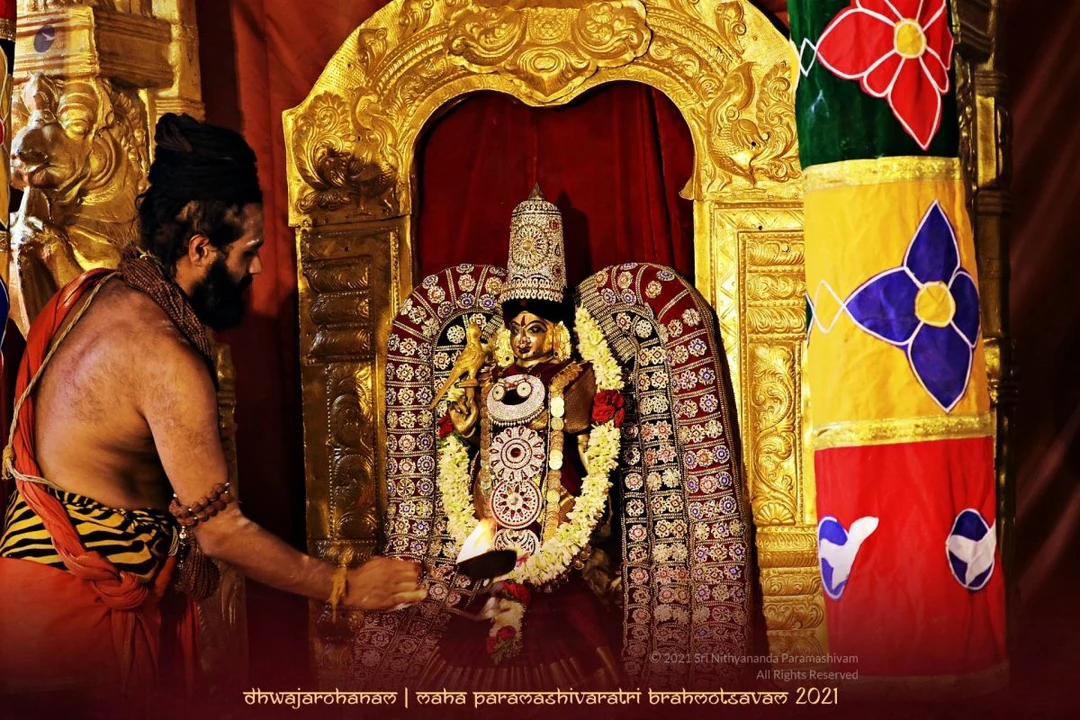
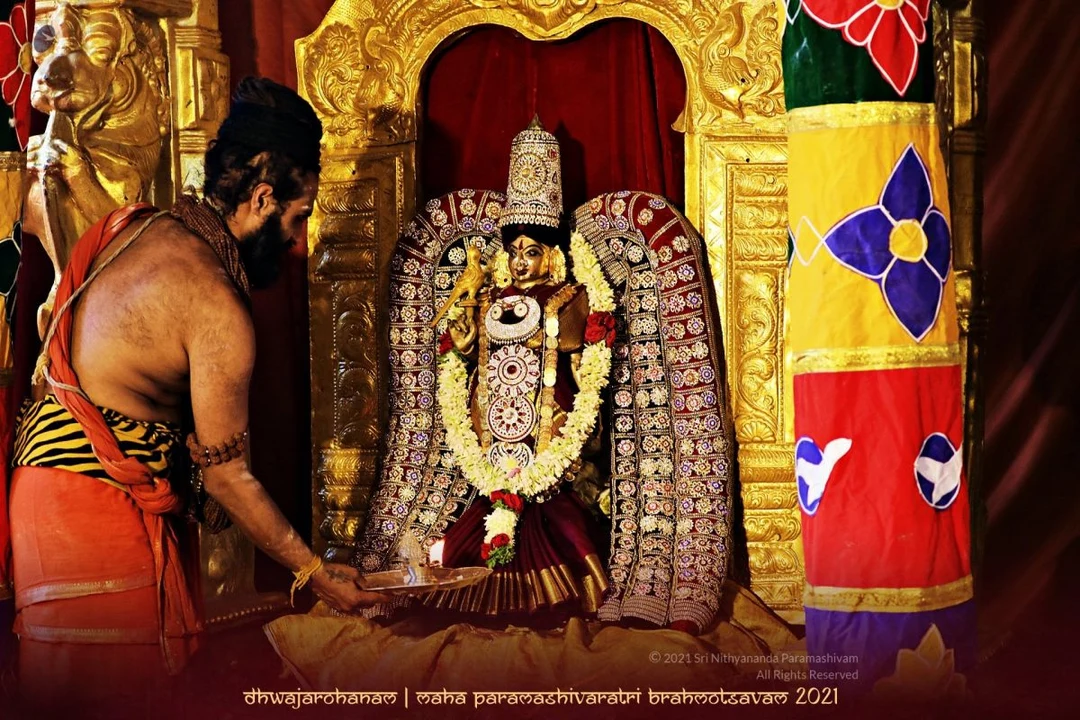
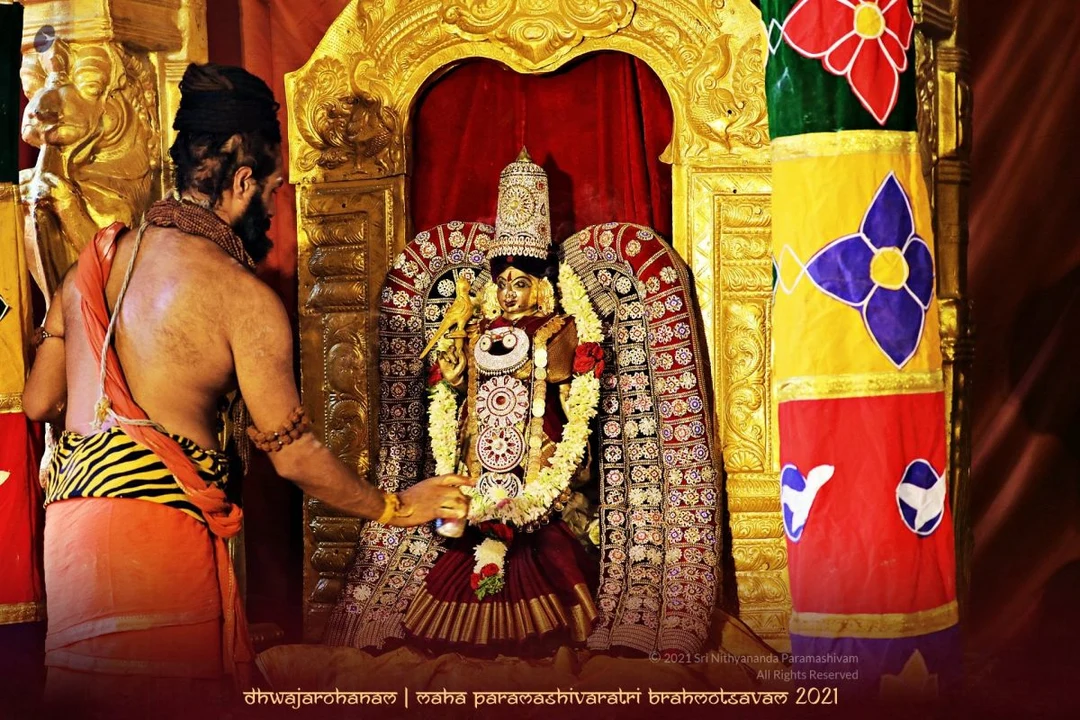
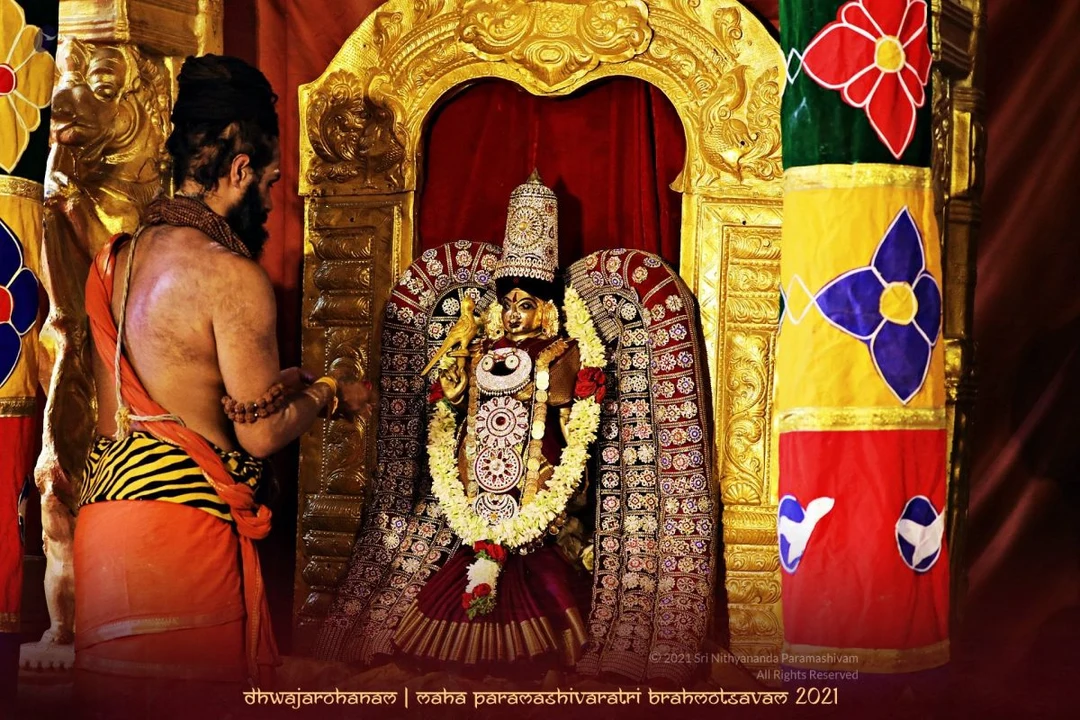
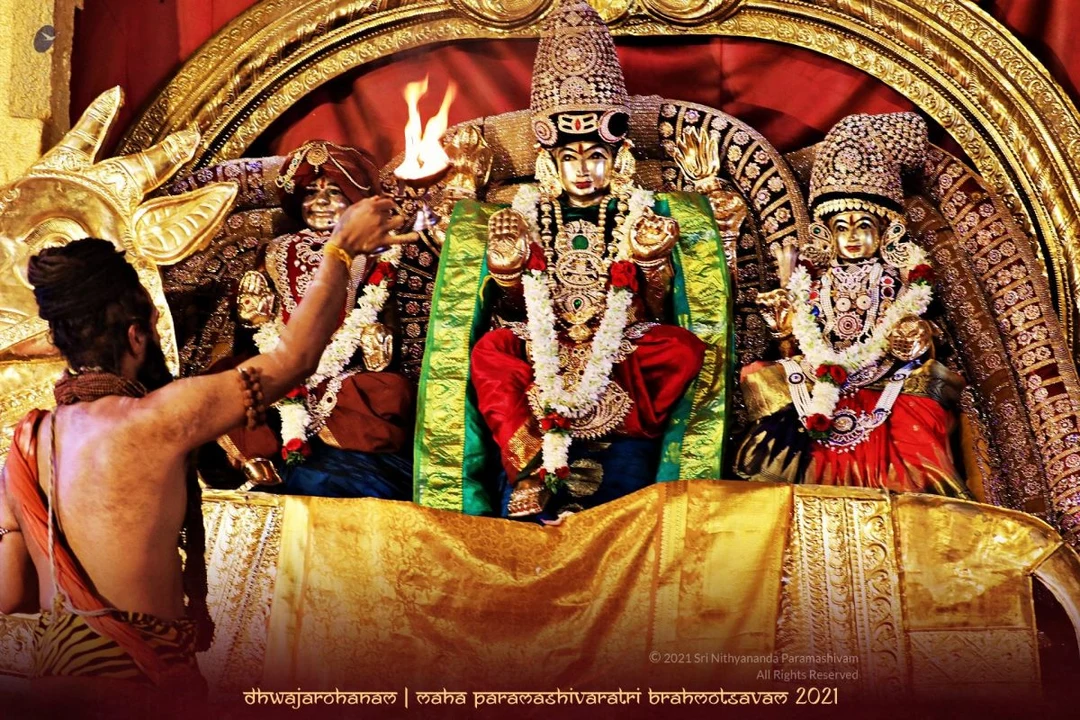
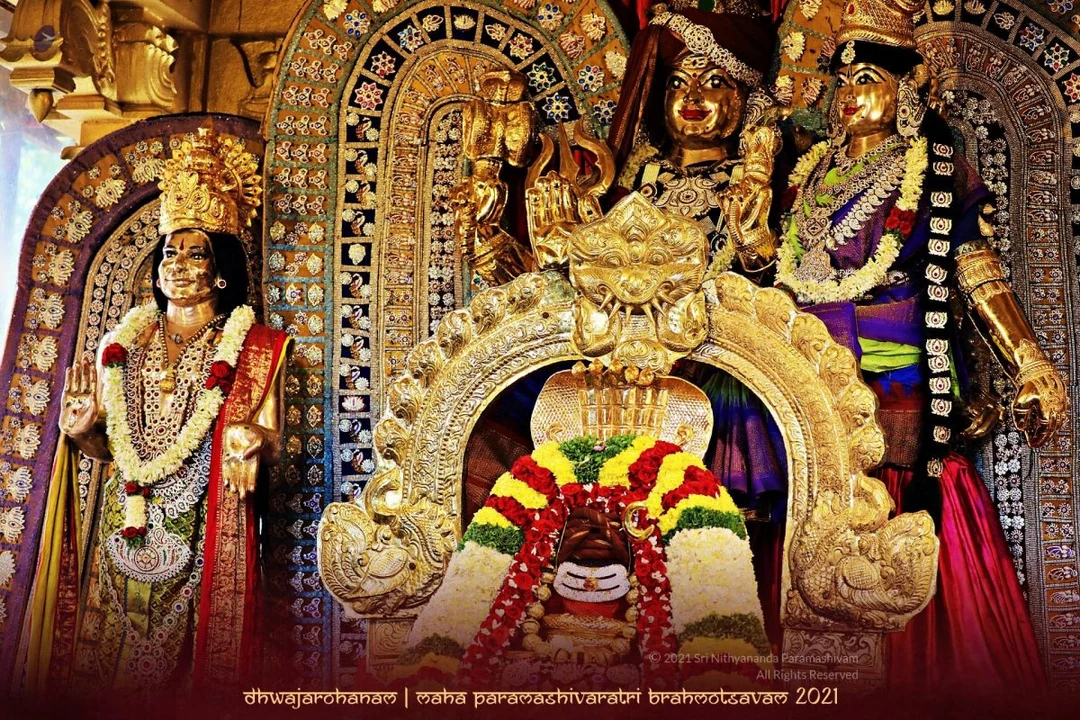
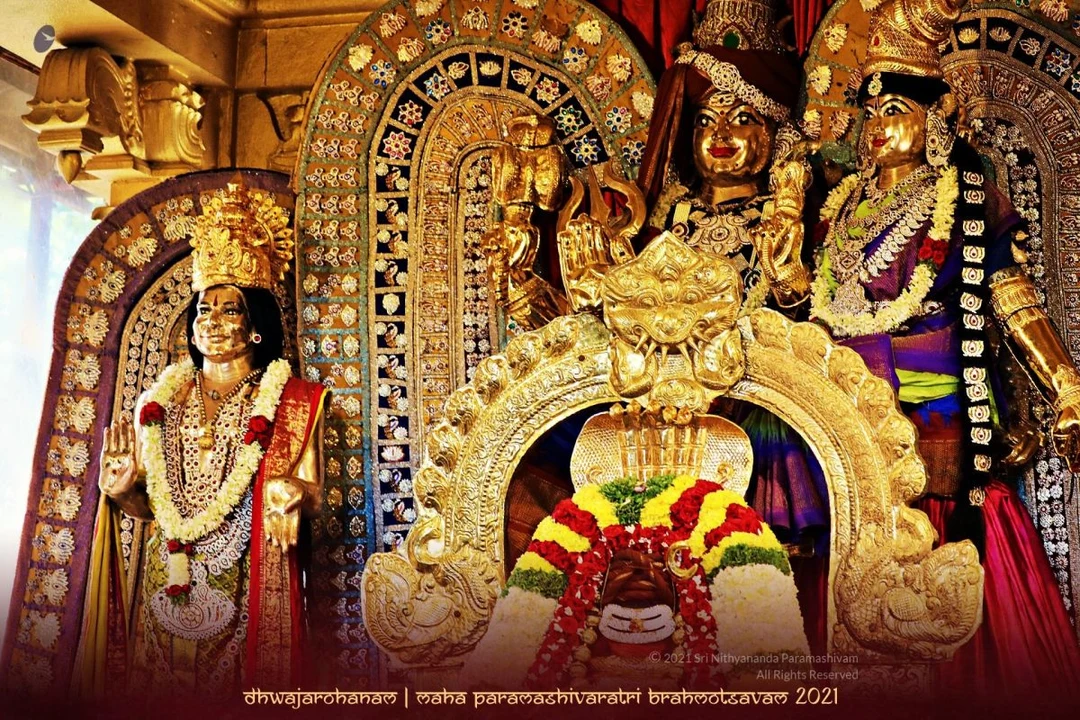
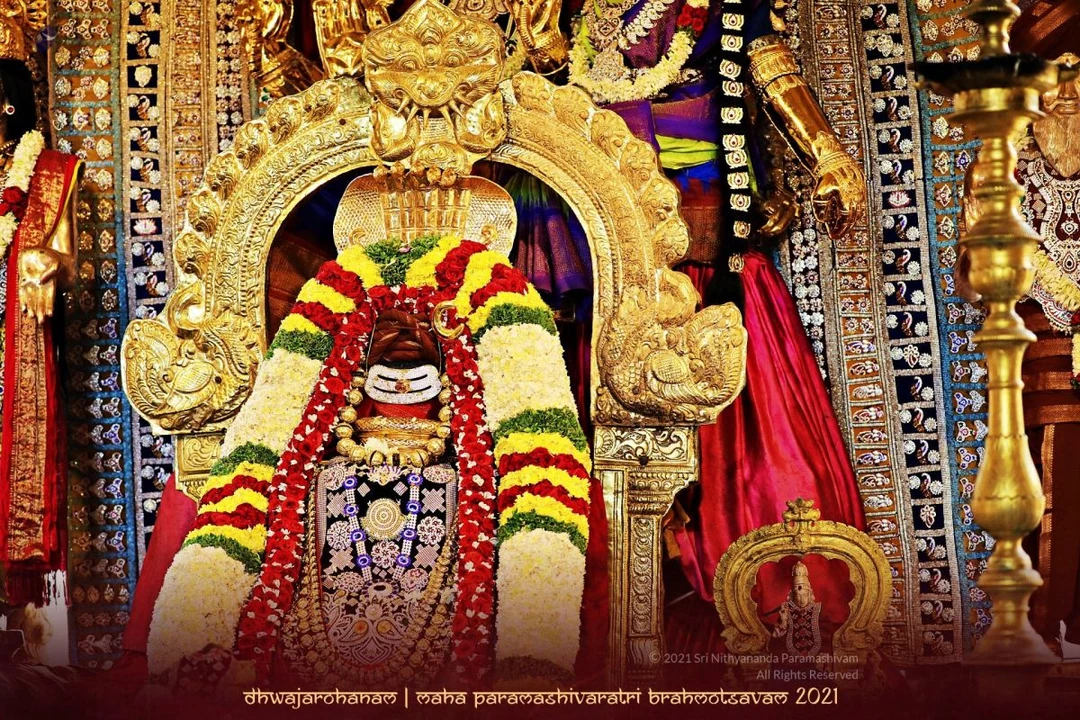
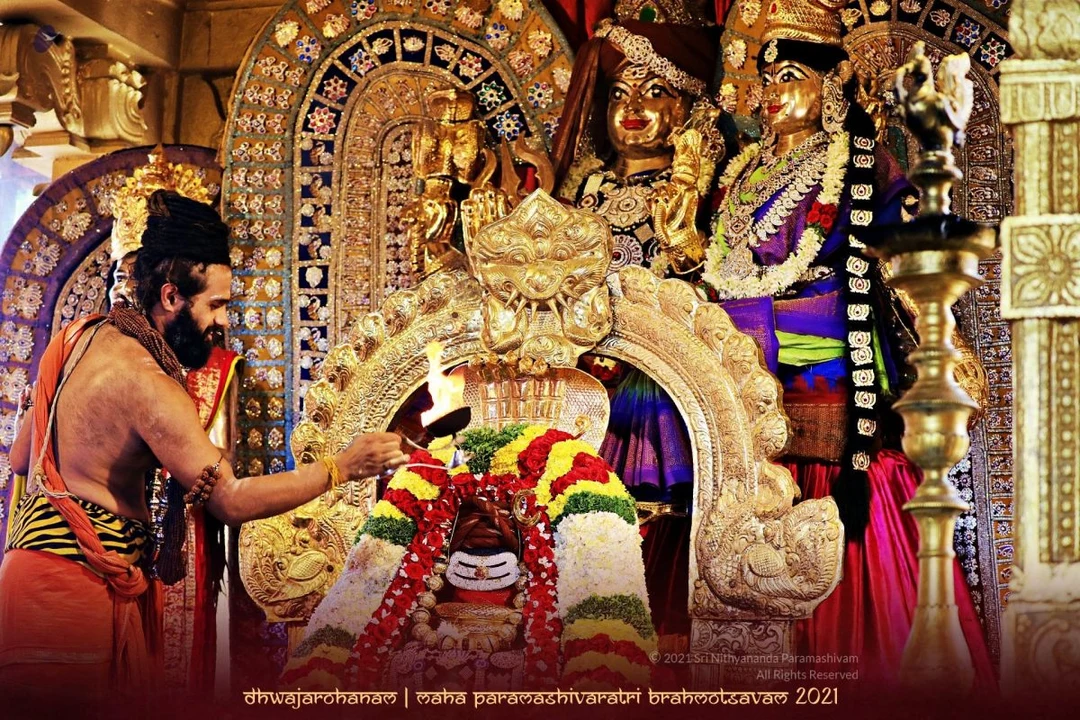
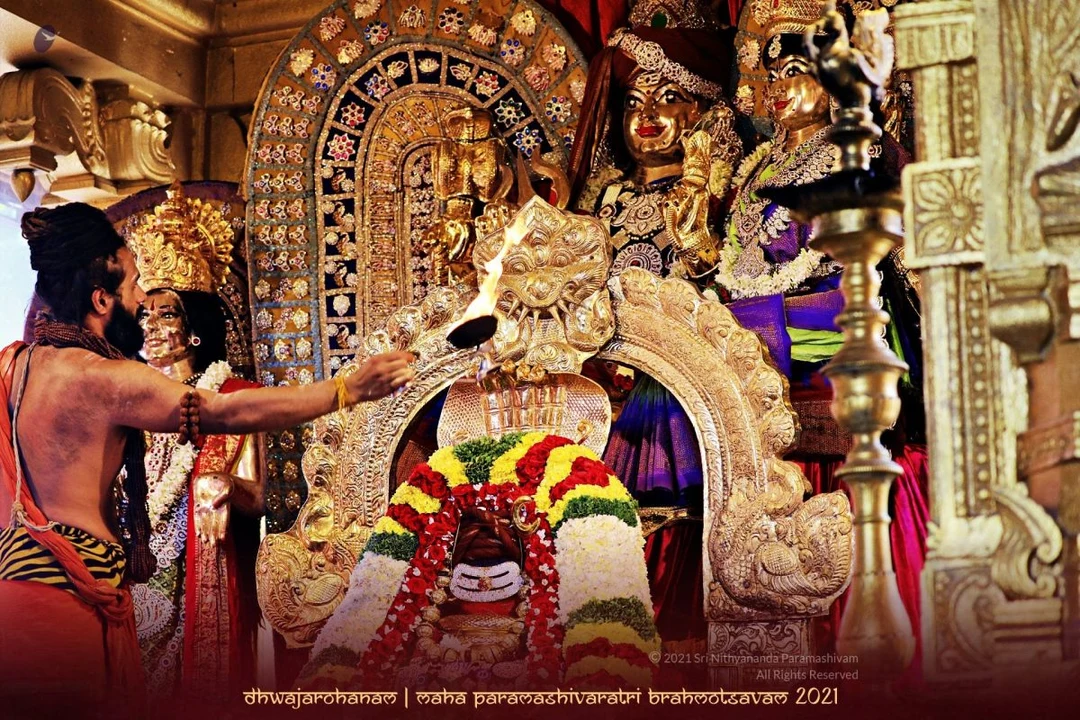
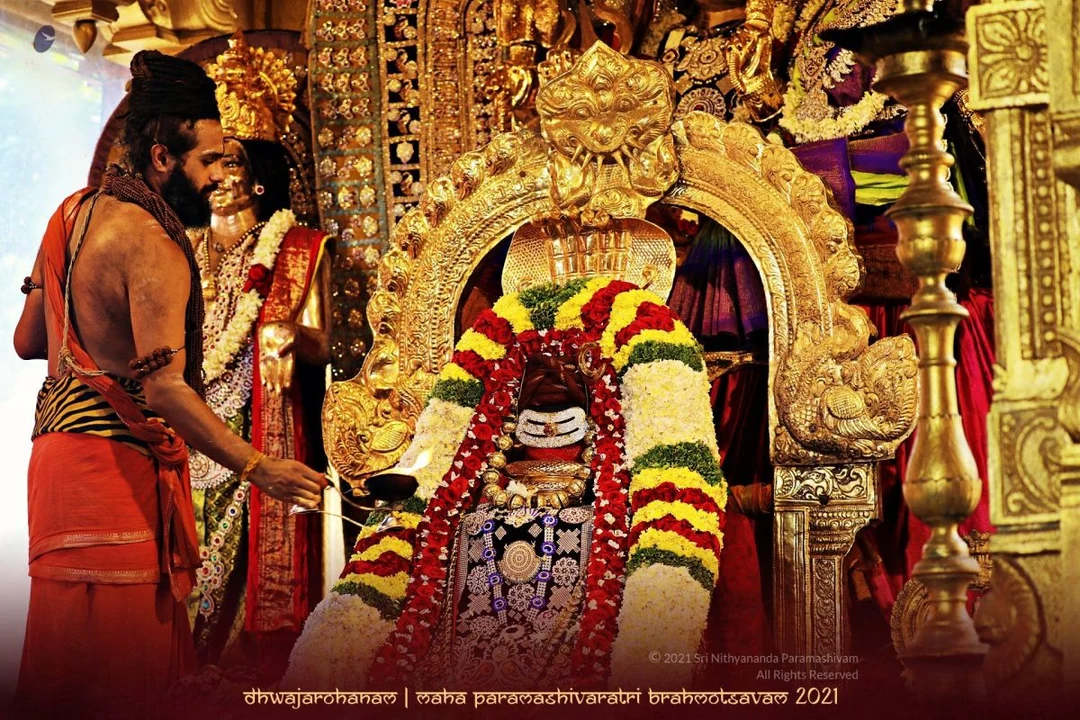
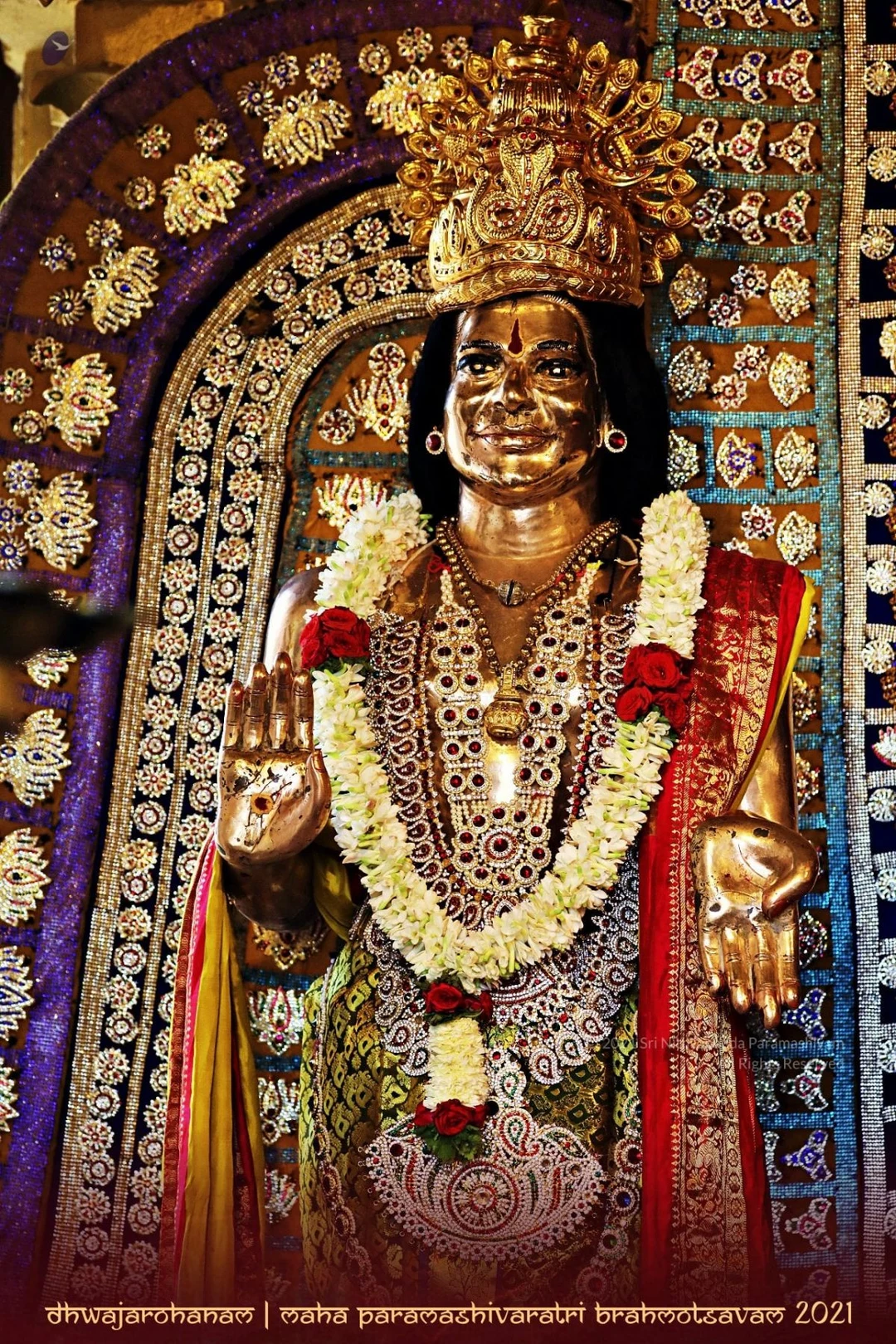
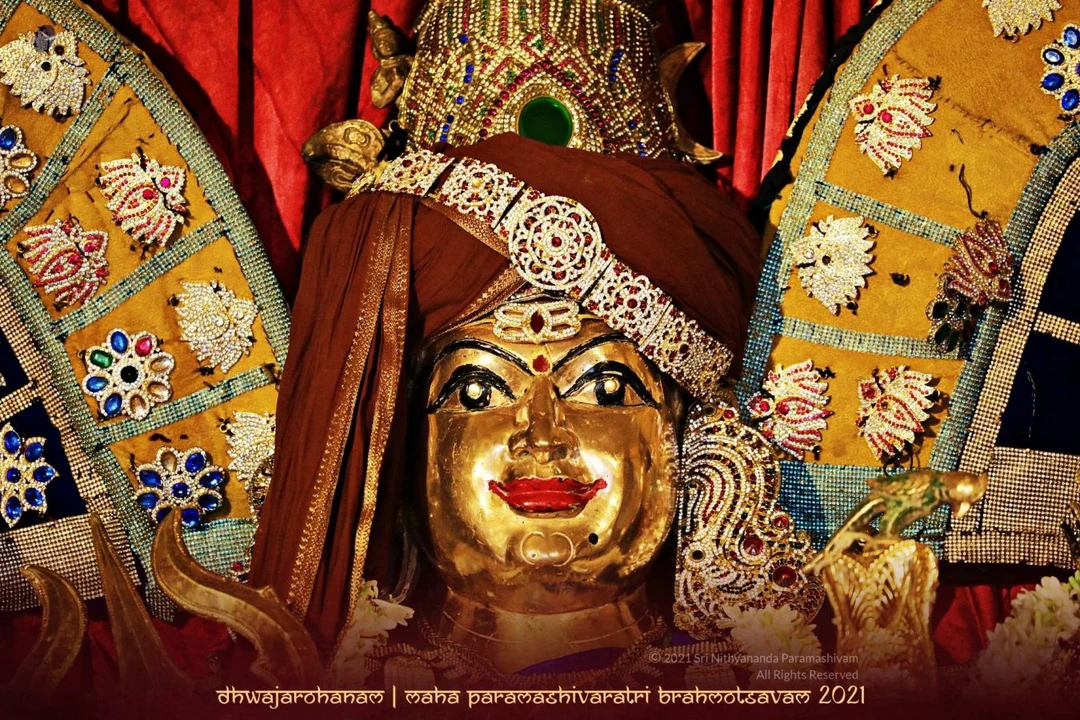
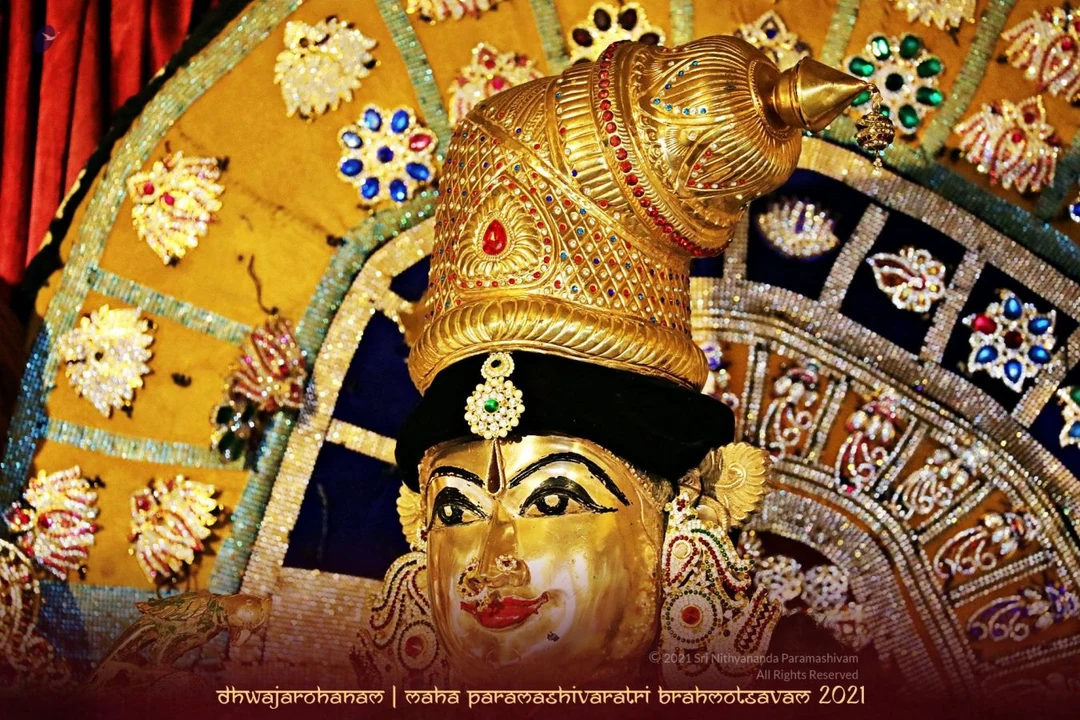
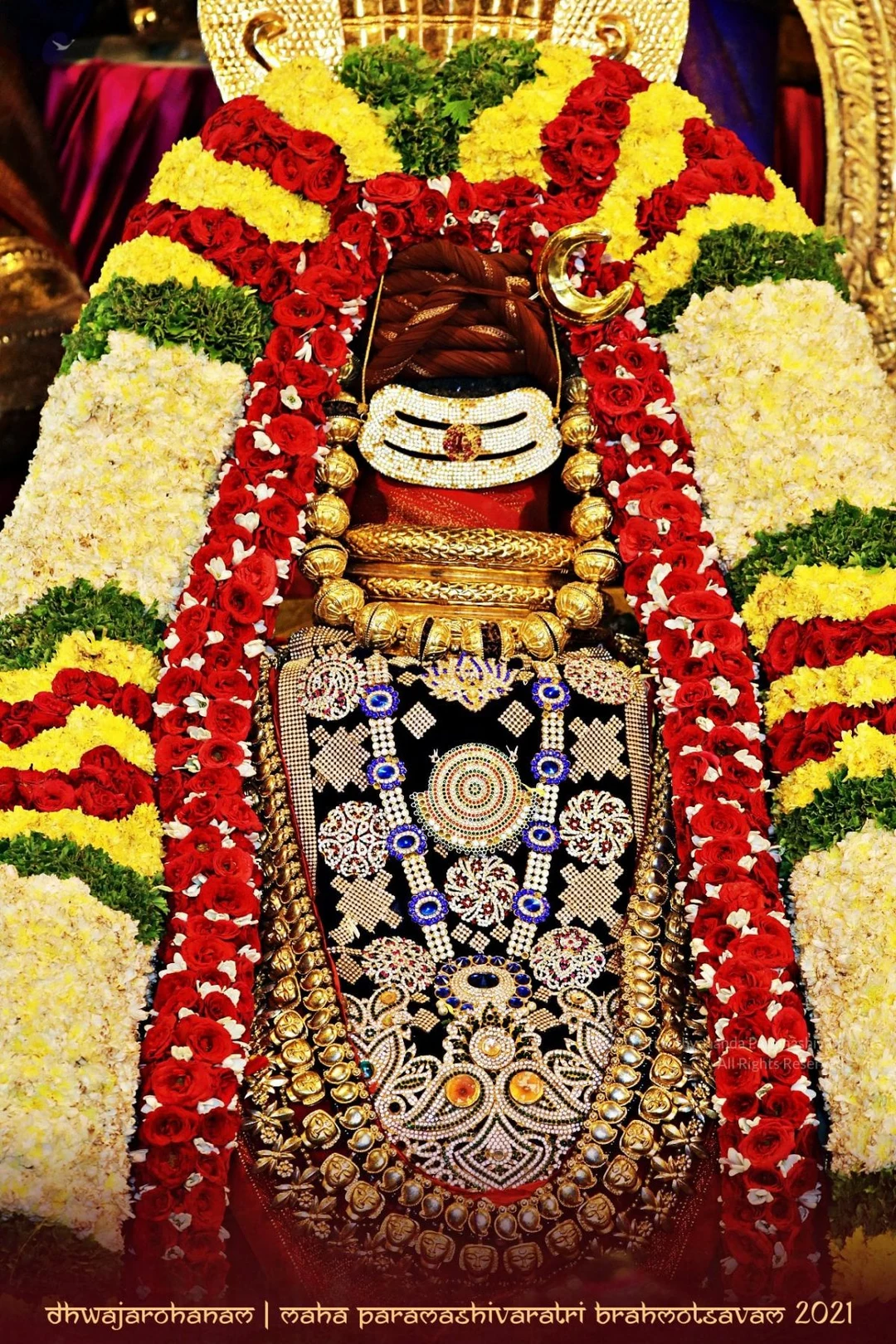
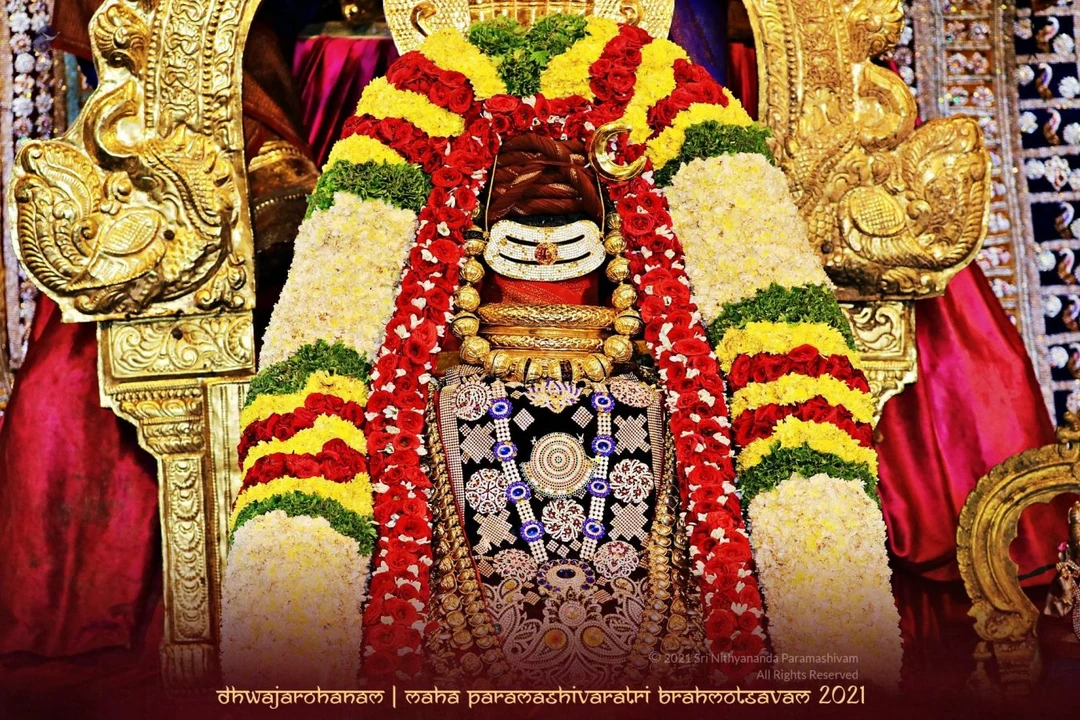
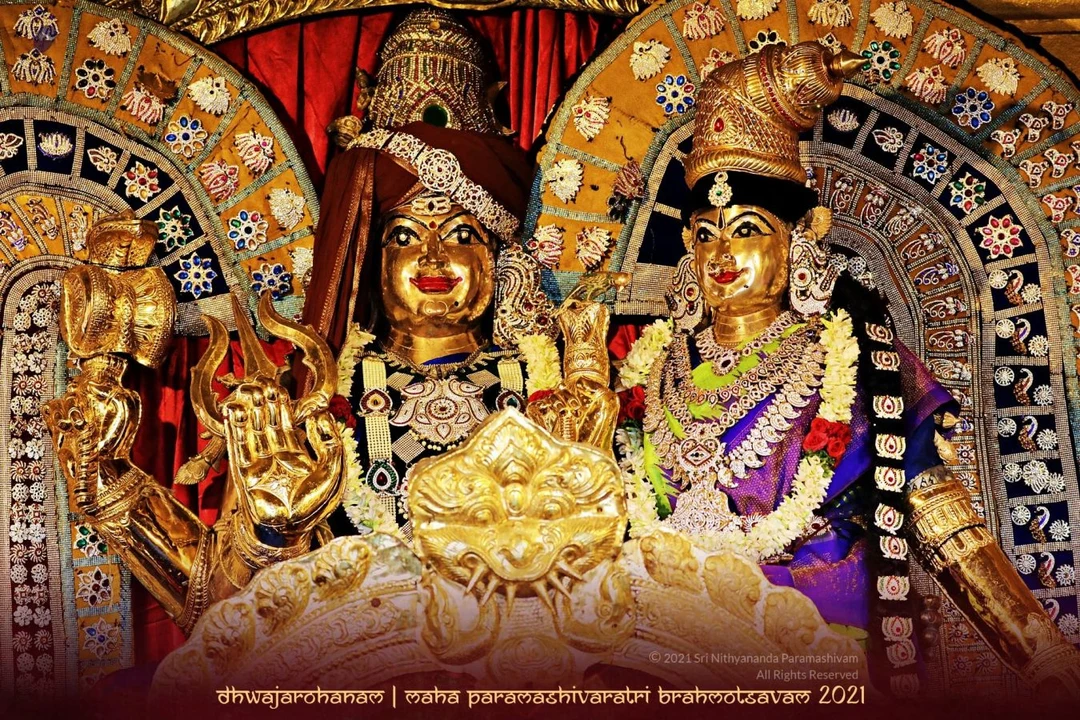
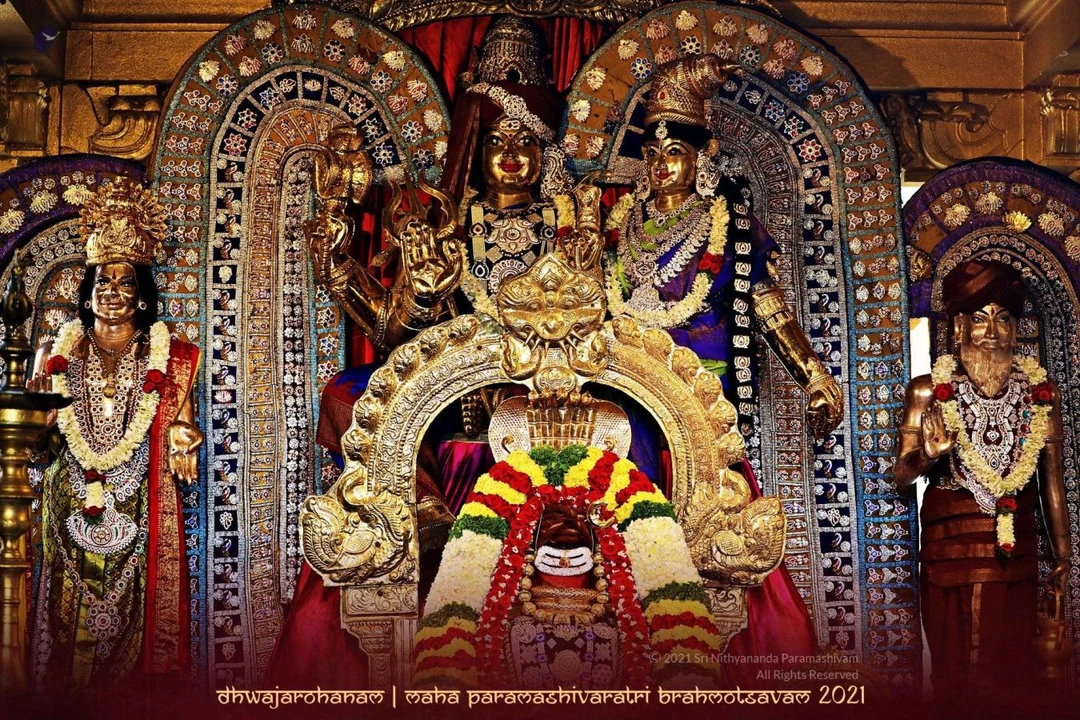
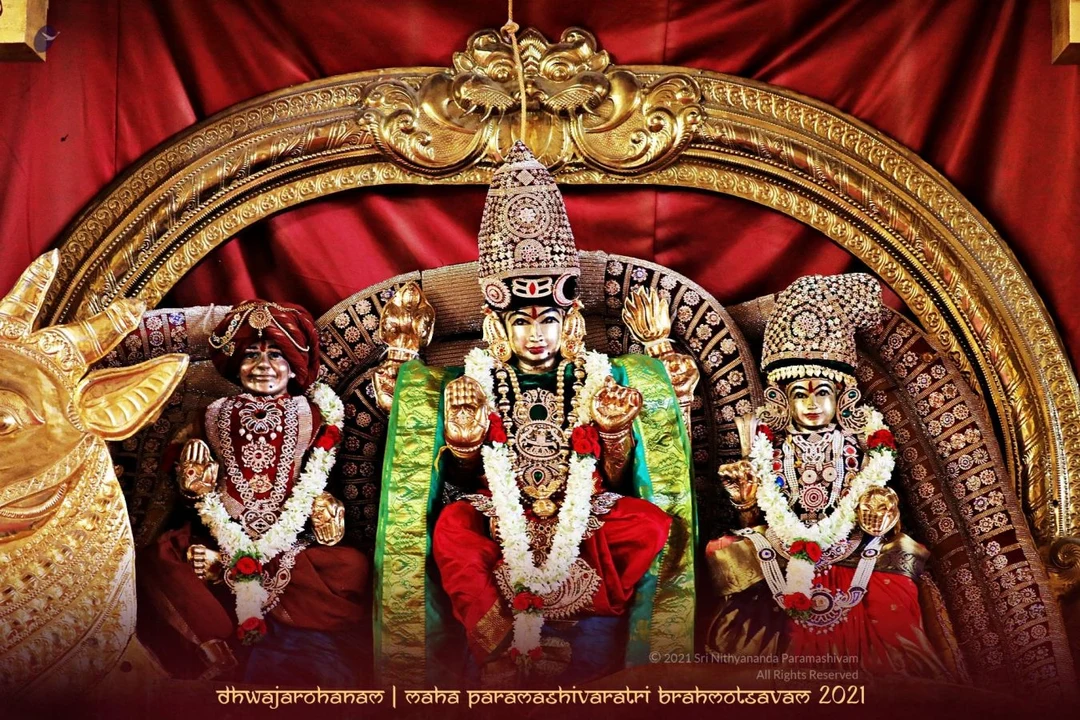
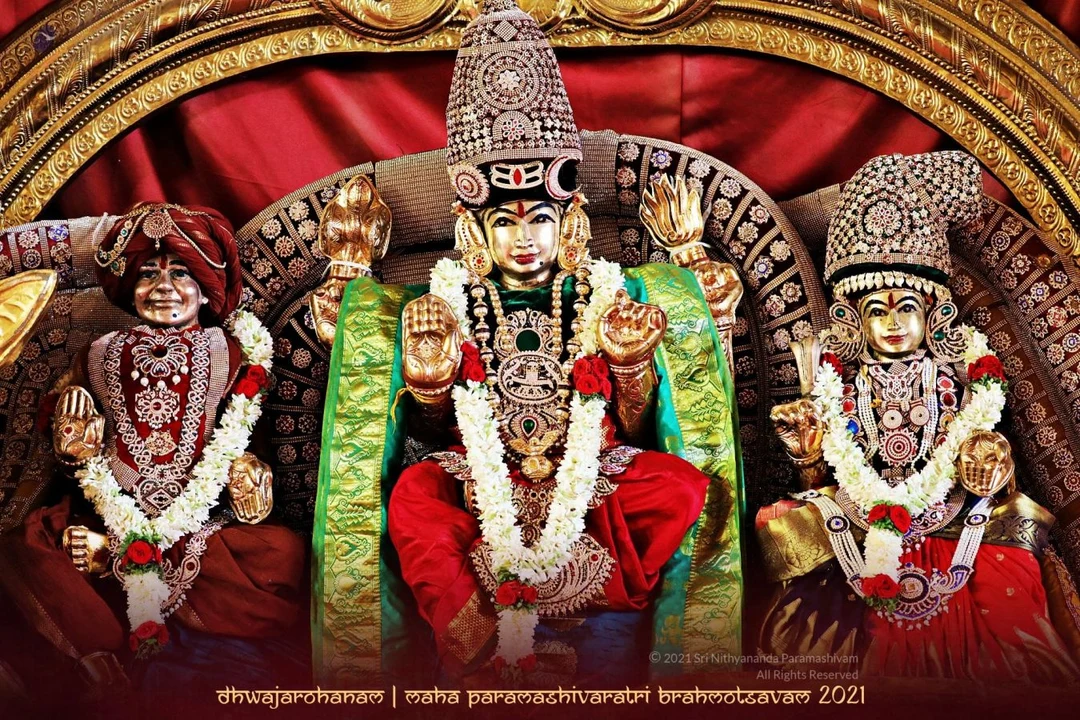
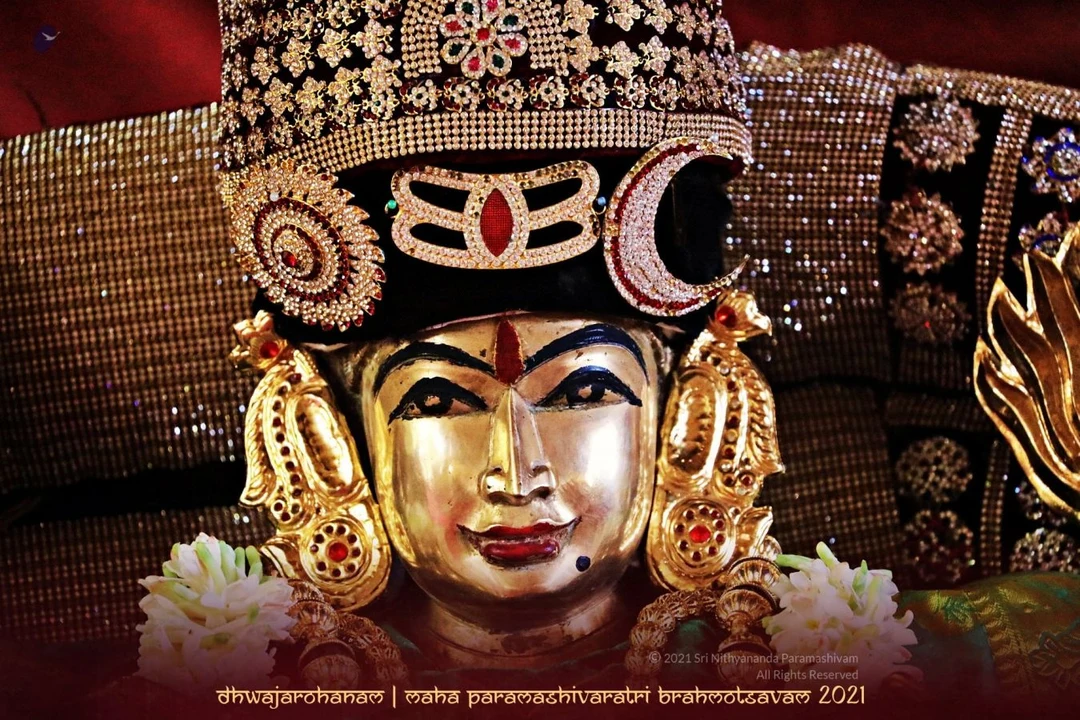
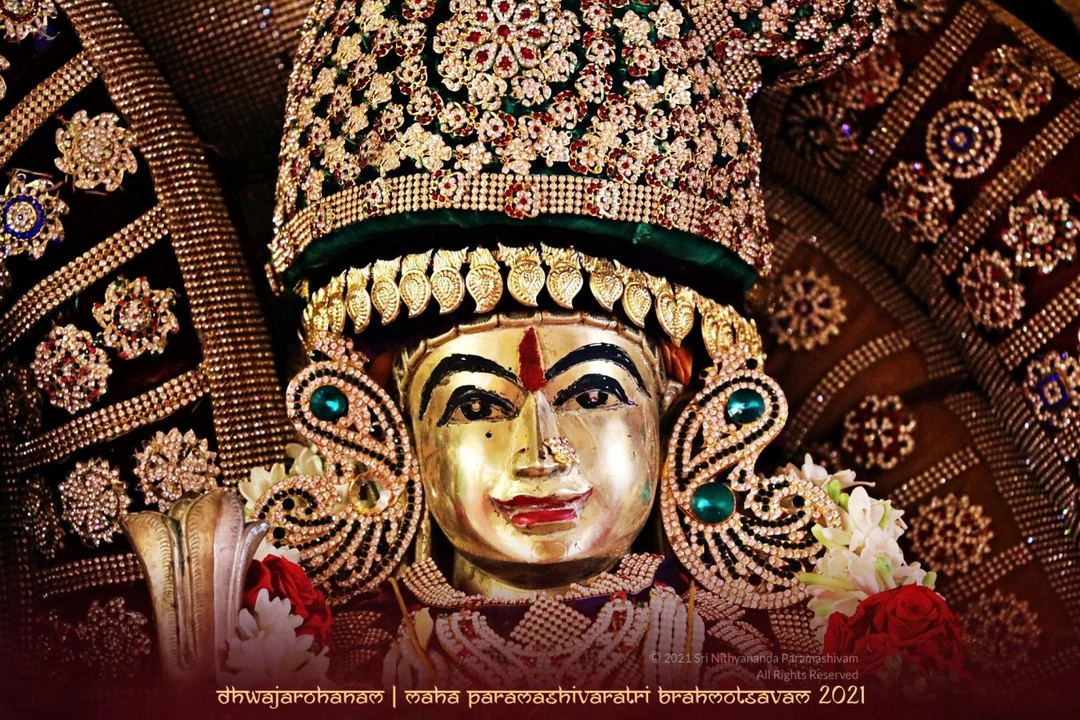
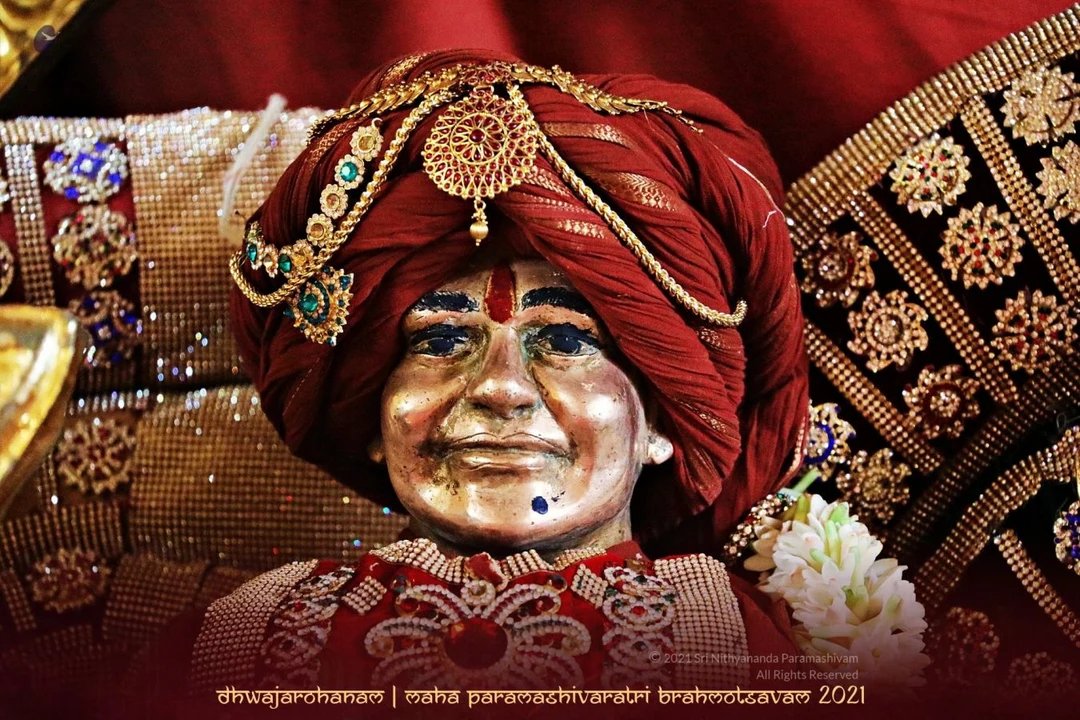
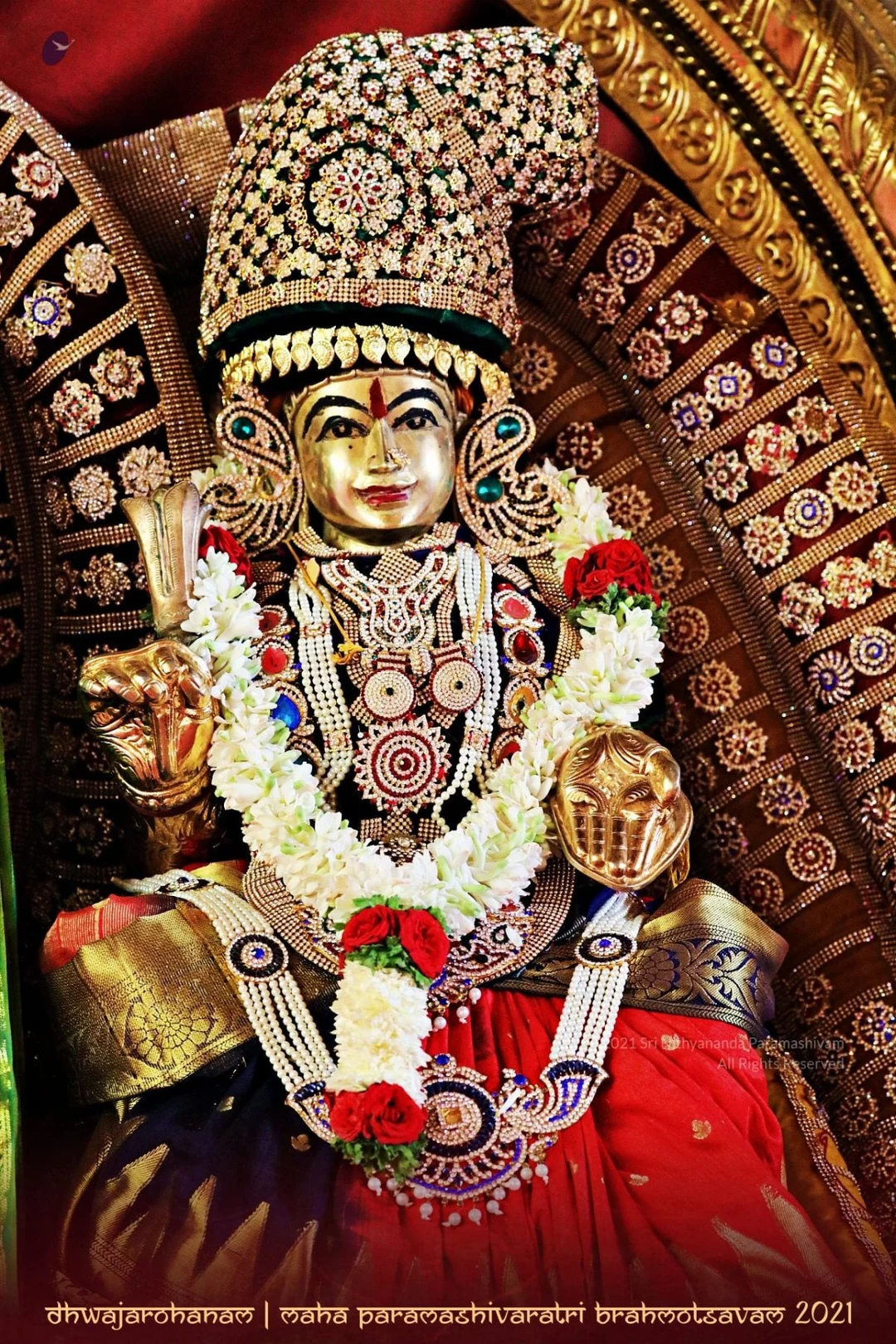
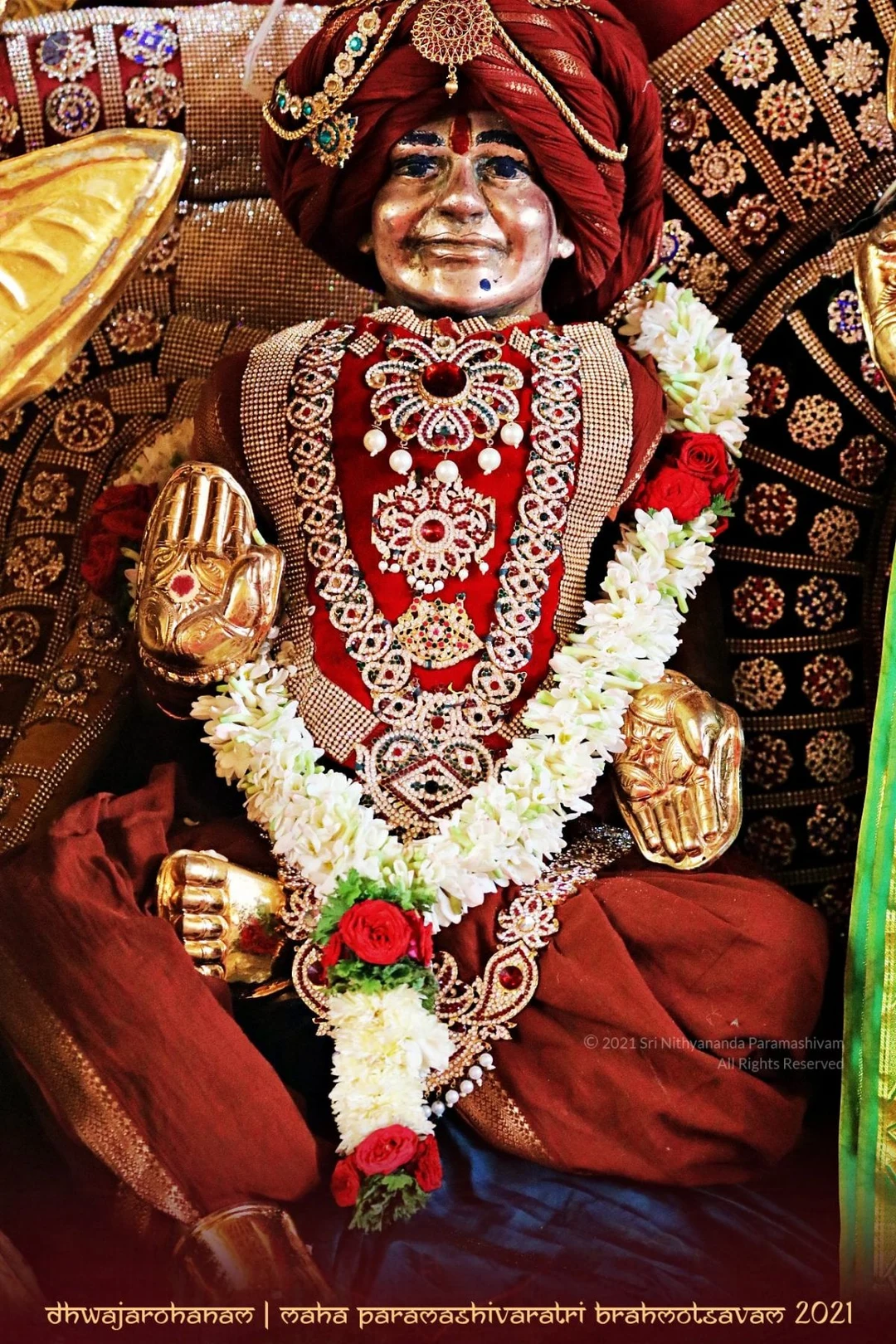
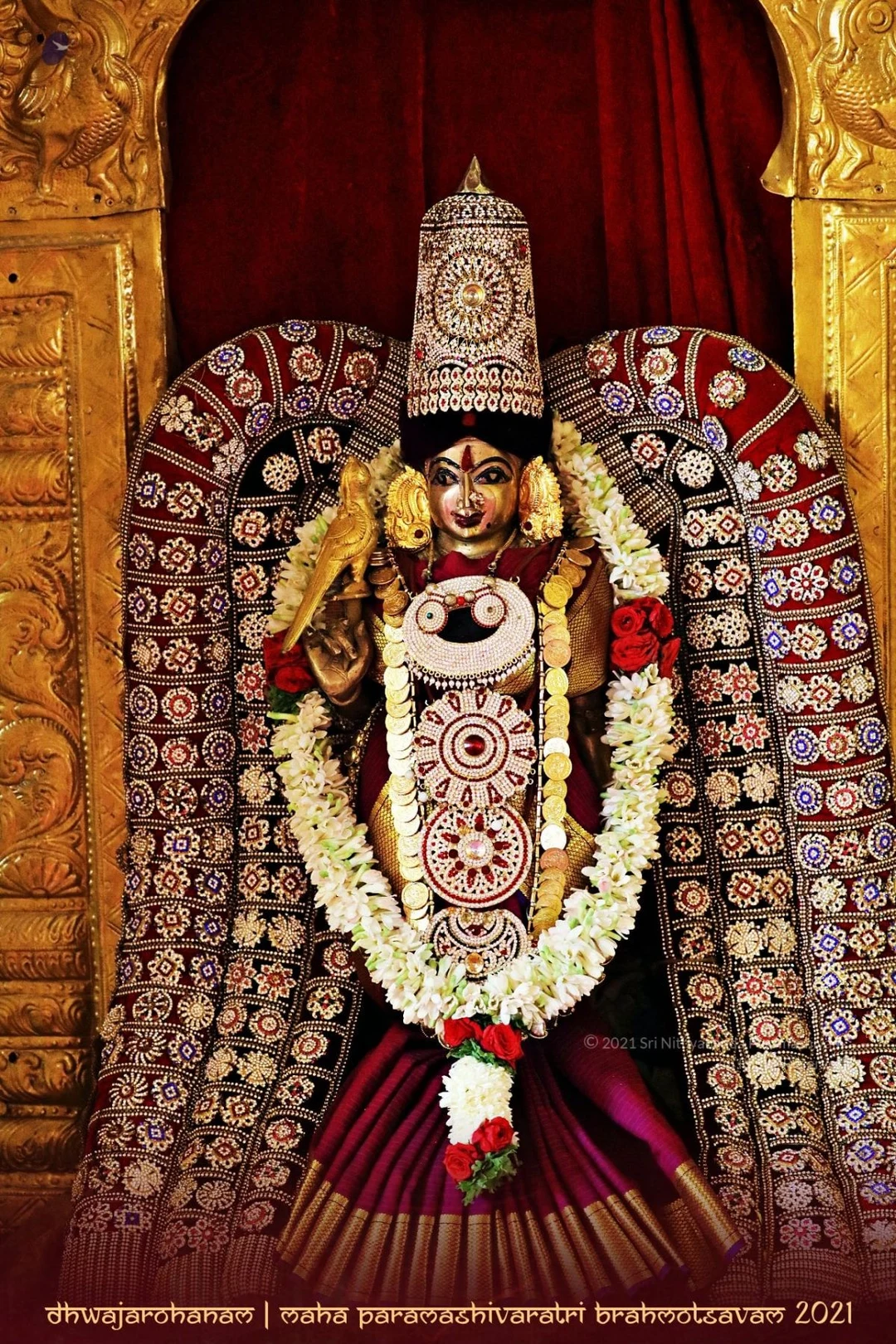
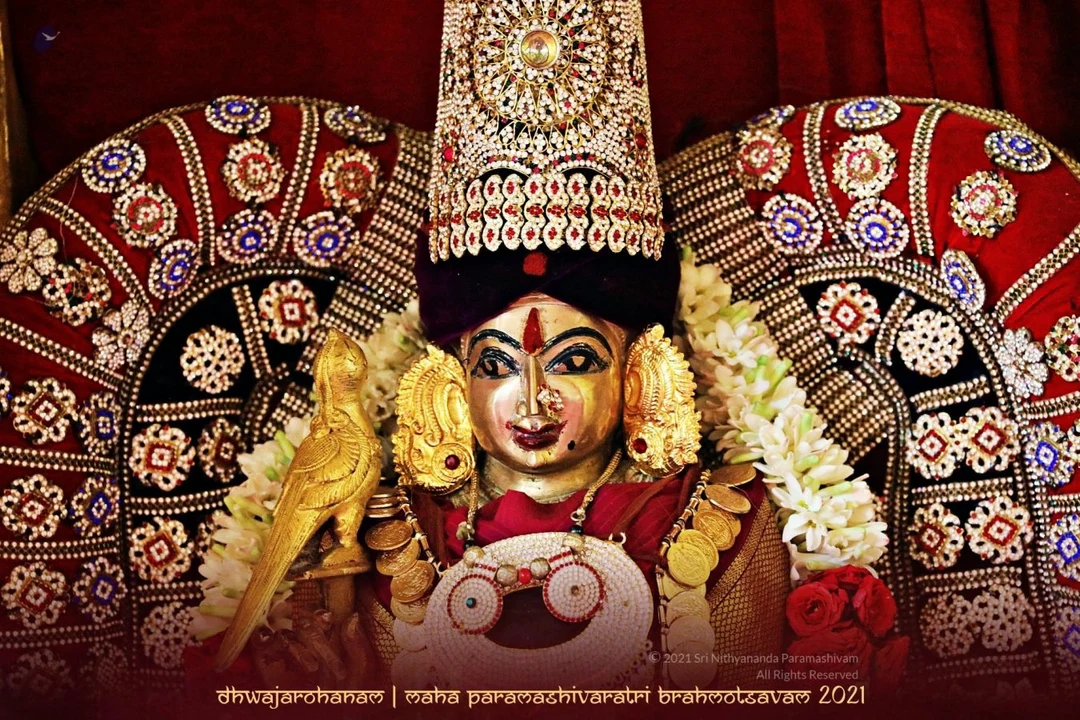
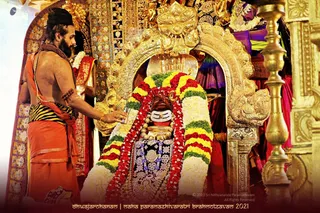
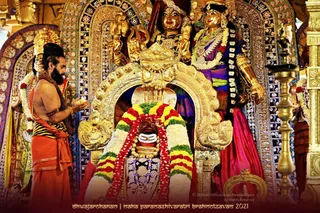
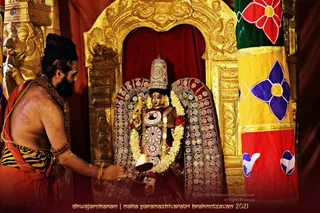
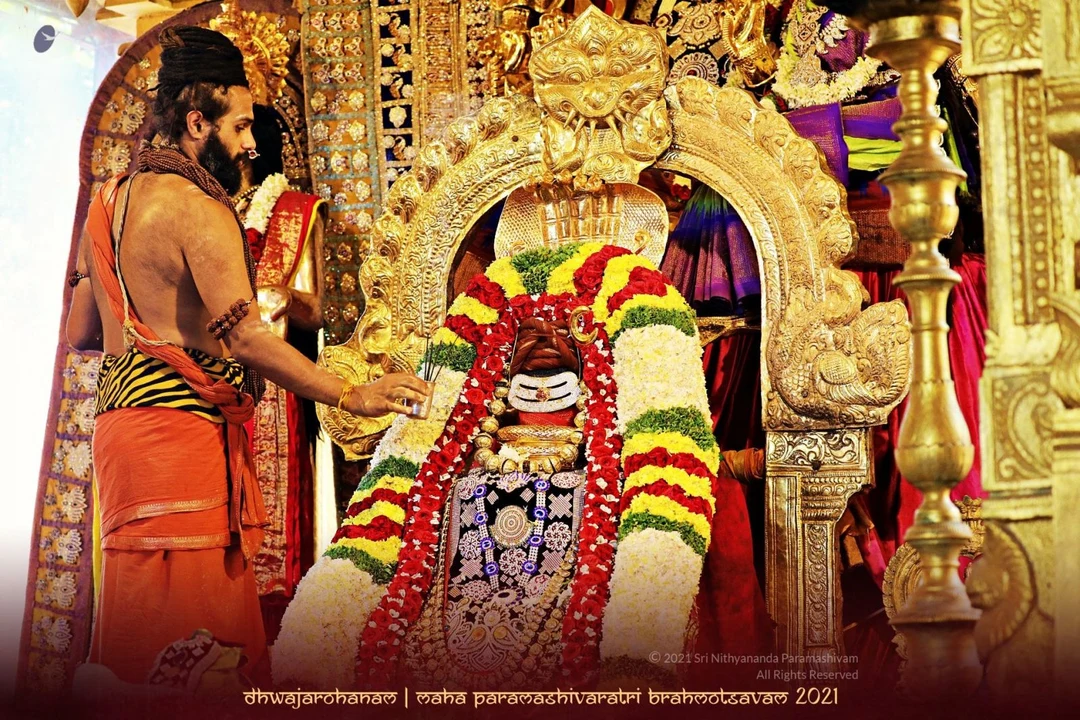
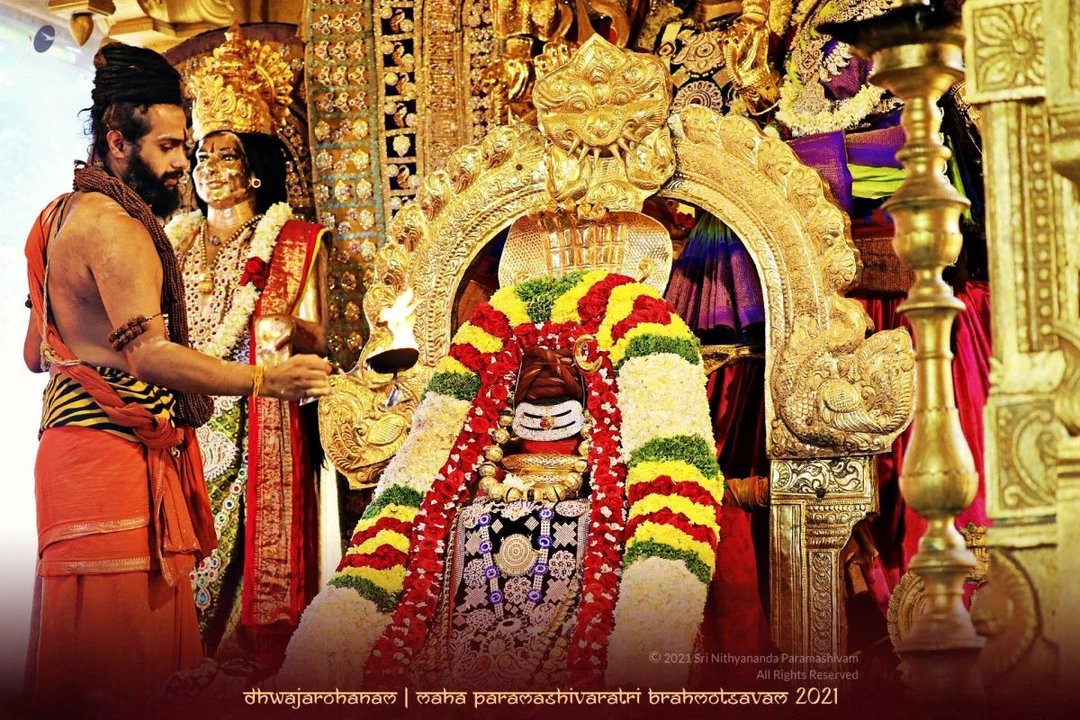
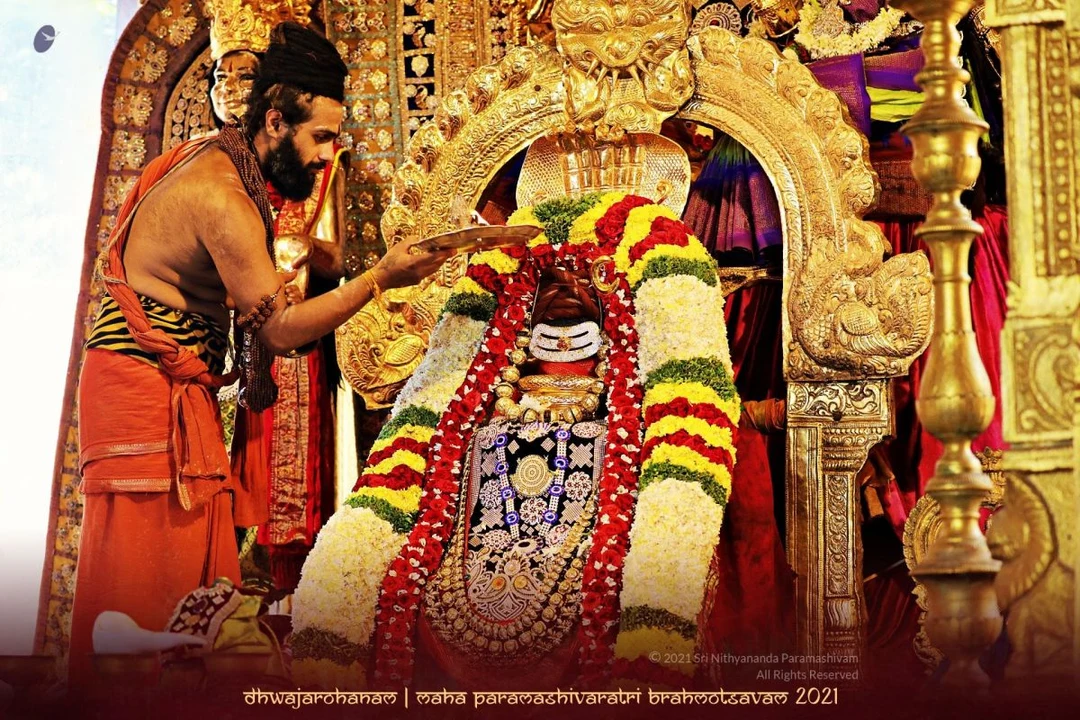
A bare-chested priest in an orange dhoti with a yellow-and-black striped cloth stands at left, back partly turned, with his hands raised in prayer near a gilded doorway. Inside the golden arch stands a decorated deity murti dressed in a red and gold embroidered garment, with a tall crown, a white flower garland, red flowers and a small golden parrot perched by its shoulder. Behind it hangs a red curtain, and painted pillars with red, blue and yellow floral designs frame the scene. The image is a photograph of a temple ritual during a festival.A photograph of a temple shrine during a Maha Paramashivaratri Brahmotsavam ritual. A bare-chested man with long matted hair, a full beard and a red-orange dhoti holds a lamp and performs worship before a richly decorated Shiva linga, with a silver face and garlands of red, yellow and white flowers draped around it. Gold arch-shaped frame with lion-face motifs surrounds the linga. Behind him a standing attendant wears a gold crown, white and red garlands and a red-and-gold sari-style cloth. Gold lamp stands and ornate gold carvings fill the background. The caption reads dhwajarohanam, maha paramashivaratri brahmotsavam 2021.A photograph of a Shiva lingam draped in layered garlands of red, yellow and white flowers with green leaves, set before an ornate golden arch with lion-face motifs and a gilded kirtimukha-style crest. Behind it stand gilded deity figures and a tall figure in a magenta cloth. On the left, a bare-chested priest in an orange and black-striped dhoti with an orange shawl, a rudraksha mala across his chest and an orange-and-gold armlet, holds a small offering while standing beside the decorated shrine. The scene shows a festival puja at a temple altar. A caption reads 'dhwajarohanam | maha paramashivaratri brahmotsavam 2021'.

ADIKAILASA on 3/7/2021

Original wiki page
Contents

Paramashivarathri-DHWAJAROHANAM | MAHA PARAMASHIVARATRI BRAHMOTSAVAM

Event Details
Participants Count0
Event TypeBoth
Was Food Served in Event?No
Count of Meals Served
Volunteers Count0
Event Duration

DHWAJAROHANAM | MAHA PARAMASHIVARATRI BRAHMOTSAVAM

Pictures from the day
KAILASA HOUSTON, USA on 3/7/2021

Original wiki page
Contents

Daily Update - PDB + Daily pictures

Event Details
Participants Count5
Event TypeIn-Person
Was Food Served in Event?Yes
Count of Meals Served
Volunteers Count5
Event Duration

Daily Report

Pictures from the day
KAILASA LATIN AMERICA on 3/7/2021

Original wiki page
Contents

Daily Update - PDB + Daily pictures

Event Details
Participants Count1
Event TypeOnline
Was Food Served in Event?No
Count of Meals Served
Volunteers Count1
Event Duration

Familias de America Latina unete a conocer este mundo maravilloso con las ciencias de los seres mas savios del planeta.

Pictures from the day
KAILASA MELBOURNE, AUSTRALIA on 3/7/2021

Original wiki page
Contents

Daily Update - PDB + Daily pictures

Event Details
Participants Count8
Event TypeIn-Person
Was Food Served in Event?Yes
Count of Meals Served
Volunteers Count2
Event Duration

6AM Suprabhatam | Guru Puja and Paramashiva Puja | offering of Naivedhyam | taking Padukas down to the temple | evening naivedhyam | first day Pacchai Pattini Vratam | 9pm Palliarai Seva.

Pictures from the day
KAILASA NEW YORK, USA on 3/7/2021

Original wiki page
Contents

Daily Update - PDB + Daily pictures

Event Details
Participants Count2
Event TypeIn-Person
Was Food Served in Event?Yes
Count of Meals Served
Volunteers Count0
Event Duration

Meditation

Pictures from the day

KAILASA RIO DE JANEIRO NORTE RICHUELO CENTRO, BRASIL on 3/7/2021

Original wiki page
Contents

Annadhan

Event Details
Participants Count72
Event TypeIn-Person
Was Food Served in Event?Yes
Count of Meals Served72
Volunteers Count2
Event DurationUm dia de preparação

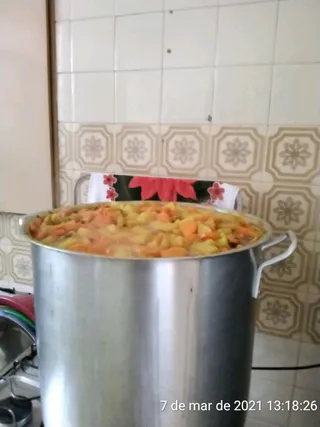
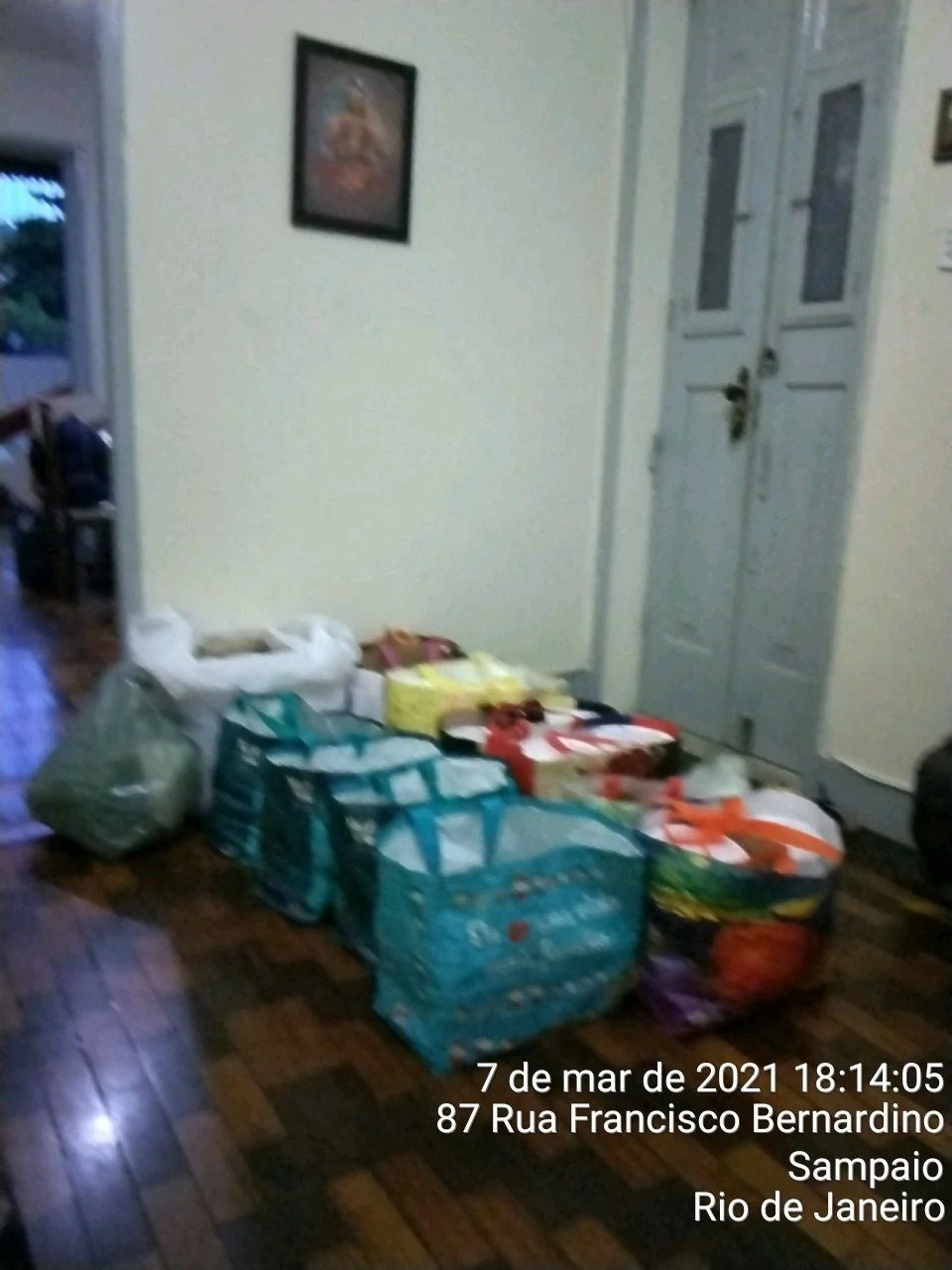
Distribuição de sopas, pao e águas para moradores de rua no Rio de Janeiro.

Pictures from the day
Videos from the day

KAILASA RIO GRANDE DO SUL, BRAZIL on 3/7/2021

Original wiki page
Contents

Daily Update - PDB + Daily pictures

Event Details
Participants Count5 - minuts4peace
Event TypeOnline
Was Food Served in Event?No
Count of Meals Served
Volunteers Count1
Event Durationminuts4peace-2h, meditation 40min, abishekam Ohio temple watchedm - attended 1 h

meditation/uncluthing/ wathing abishekaaaaaaam and puja/satsang

Pictures from the day
KAILASA SAN FERNANDO, TRINIDAD & TOBAGO on 3/7/2021

Original wiki page
Contents

Daily Update - PDB + Daily pictures-Daily Paduka Puja

Event Details
Participants Count1
Event TypeIn-Person
Was Food Served in Event?No
Count of Meals Served
Volunteers Count1
Event Duration

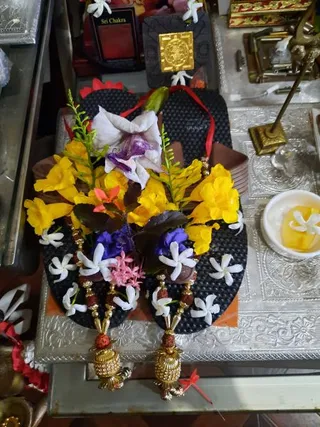
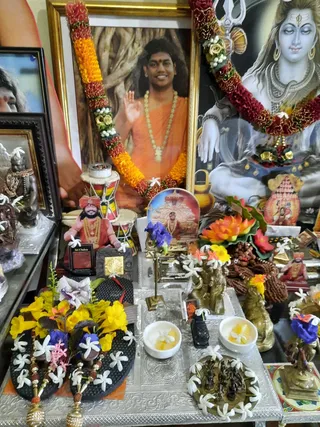
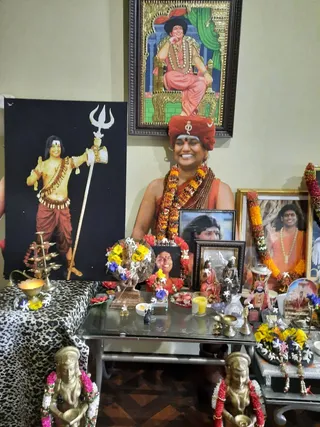
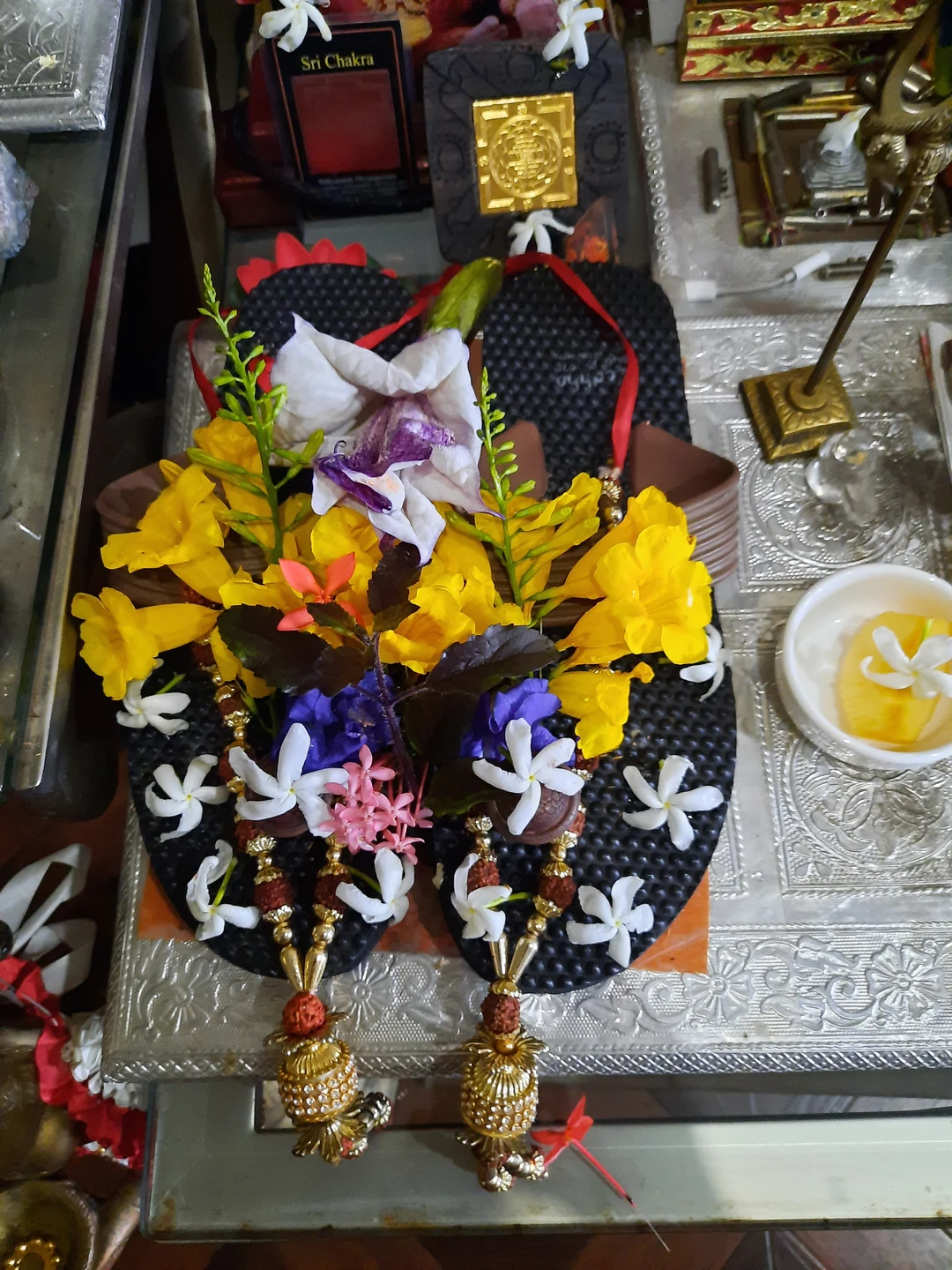
Today we offered the Daily Puja to the sacred Padukas of our beloved Guru, Supreme Pontiff of Hinduism Jagatguru Mahasannidhanam HDH Bhagavan Nithyananda Paramashivam. We are preparing for Annalaya initiative to distribute food hampers to residents of Aripero Village, South Trinidad and working for the Councillor for this area to accomplish reaching the families in need.

Pictures from the day
KAILASA SAN JOSE, USA on 3/7/2021

Original wiki page
Contents

Shivarathri-DHVAJAROHANAM FOR MAHAPARAMASHIVARATRI 2021

Event Details
Participants Count5
Event TypeIn-Person
Was Food Served in Event?Yes
Count of Meals Served
Volunteers Count3
Event Duration

KAILASA San Jose joined Adi Kailasa and other global Kailasa Temples in Dhvajarohanam for Mahaparamashivaratri by the grace and blessings of the Supreme Pontiff of Hinduism Jagatguru Mahasannidhanam, His Divine Holiness Bhagavan Sri Nithyananda Paramashivam

Pictures from the day
KAILASA SEATTLE, USA on 3/7/2021

Original wiki page
Contents

Daily Update - PDB + Daily pictures-Pachai Pattini Viratham

Event Details
Participants Count10
Event TypeOnline
Was Food Served in Event?No
Count of Meals Served
Volunteers Count5
Event Duration

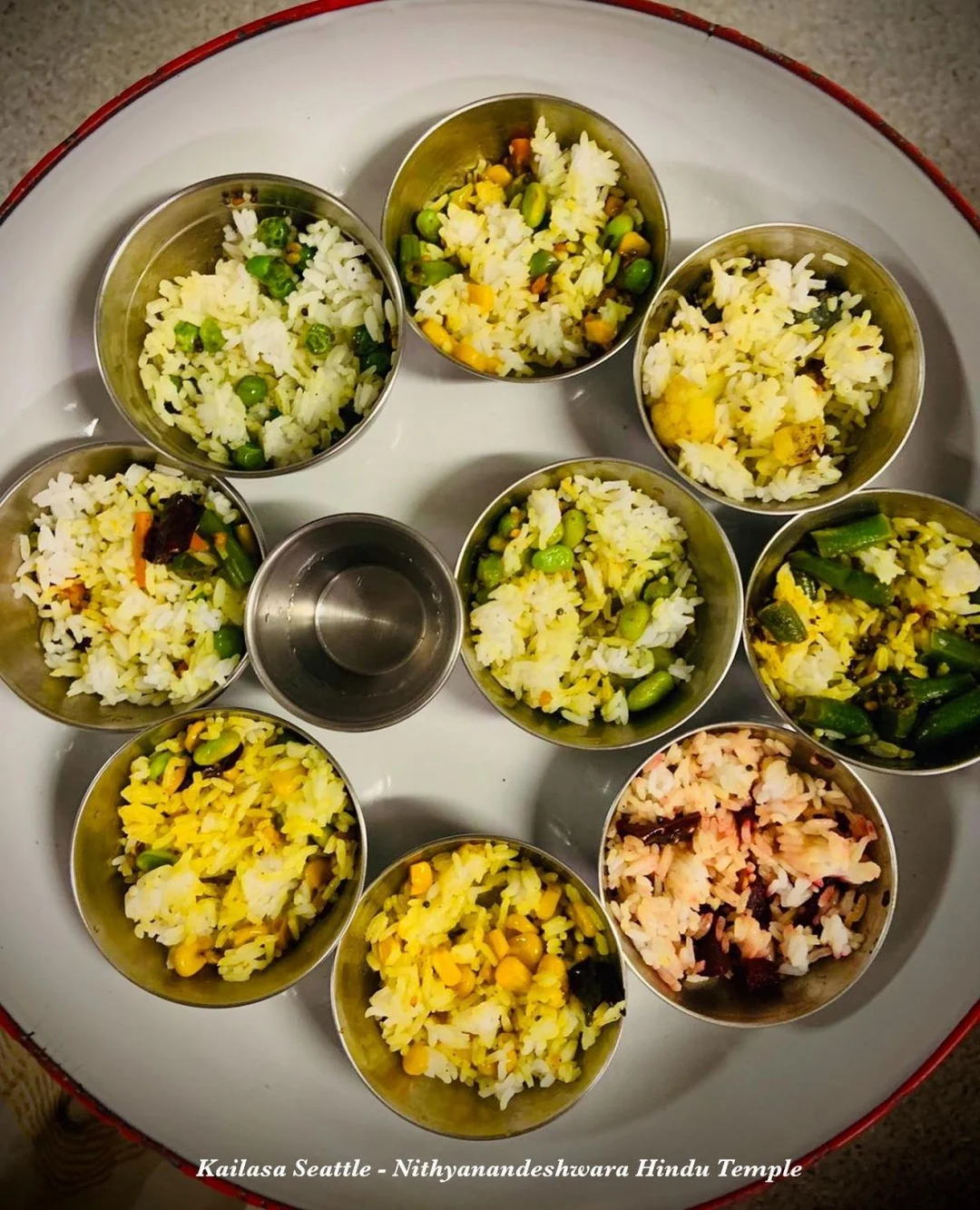
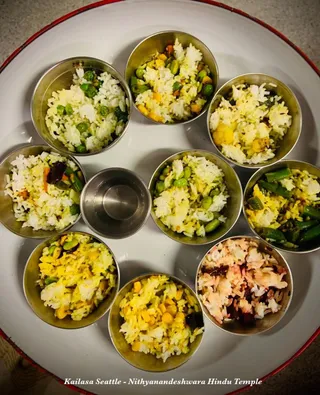
"We start the day with performing the Suprabatham seva. It is the sacred process of waking up the deities. Morning Naivedhyam was offered to Moolavar.

Evening PPP was offered to SPH JGM HDH Bhagawan Nithyananda Paramashivam. Morning naivedhyam was offered to Moolavar. Evening naivedyam was offered to moolavar & HDH Nithyananda Paramashivam. We concluded the day with Palliarai Seva - The sacred process of putting the deities to sleep.

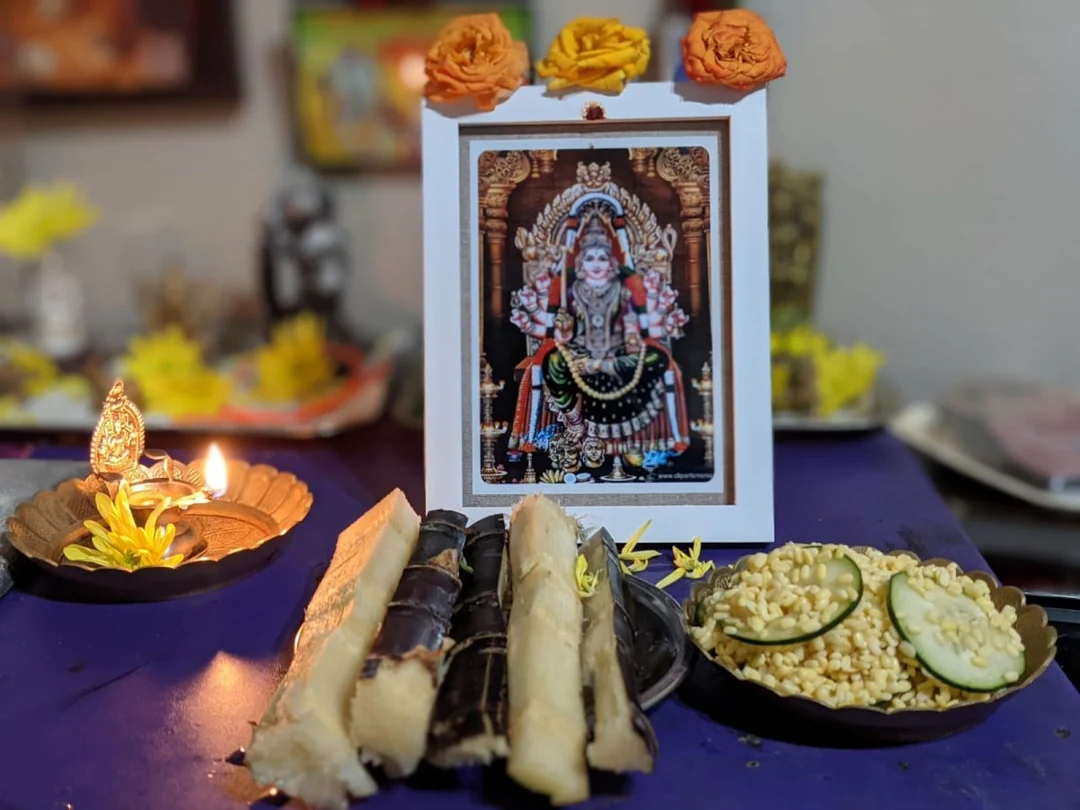
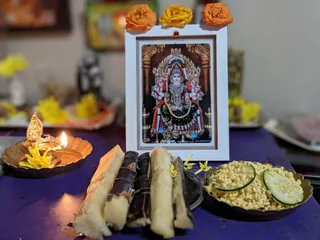
Celebrating Pachai Pattini Vratham, the following offerings were made to Sri Sivagama Sundari Devi - Sri Devi Khadgamala stortram, Sri Durga Spathasholkam, Sri Suktam were offered. Dhoopam, Dheepam, Naivedhyam & Aarartrikam was offered. Special Naivedhyams of Tulu Maavu & Banana were offered.

We continuously enrich the local community by creating posts across various social media platforms with the sacred truths revealed by HDH, darshan pictures of the deities and by going live during Bhava Samadhi Darshans & satsangs."

Presidential Daily Briefing

KAILASA-SEATTLE--USA-2021-03-07-1Lgtdzd2nwbhXMxoWtSkGhztdDso86X4x.pdf

Pictures from the day
March 07 2021

Original wiki page
Contents

Title

SANKALPA (CONSCIOUS RESOLUTION) FOR PACHAI PATTINI VRATHAM || DVAJAROHANAM FOR MAHA PARAMASHIVARATRI || 7 MARCH 2021

Narration

Video

VideoAudio

Transcript

7 MARCH 2021, SATURDAY (IST) 08:08 AM - SPH APPEARANCE

SHAKTI PADA AND SHAKTINI PADA WITH THE LIVE DARSHAN OF THE SUPREME PONTIFF OF HINDUISM (SPH), JAGATGURU MAHASANNIDHANAM (JGM), HIS DIVINE HOLINESS (HDH) BHAGAVAN NITHYANANDA PARAMASHIVAM.

  • TODAY, ON THE 6TH DAY OF THE VIJAYOTSAVAM, DEVI PARASHAKTI IS GRACING US IN THE KAMAKSHI ALANKARAM. THE DEITY OF THE SPH IS GRACING US AS KAPALA BHAIRAVA AND MAHAKALABHAIRAVA IS GRACING US IN SARVA ALANKARA.

08:31 AM TO 8:39 AM - NITHYANANDA SATSANG

  • THE SCIENCE OF KAYAKALPA IS MANIFESTING EXPERIENTIALLY IN ALL OF US FROM TODAY THROUGH THIS PACHAI PATTINI VRATAM.
  • LET US SINCERELY DO THIS PACHAI PATTINI VRATAM.
  • NOT ONLY YOU WILL MANIFEST KAYAKALPA, YOU WILL MANIFEST ALL THE POWERS OF PARAMASHIVA.
  • CONTINUOUSLY, INTENSELY DO AJAPA JAPA OF ANY OF THESE 6:

OM
SHIVA SHIVA
SHIVOHAM
SHIVAYA NAMAH
PARAMASHIVOHAM
OM NITHYANANDA PARAMASHIVOHAM

  • THIS PACHAI PATTINI VRATAM WILL MANIFEST THE GRACE OF GANAPATI, PARAMASHIVA, PARASHAKTI AND MAHAMAARI.
  • YOU WILL ALL MANIFEST KAYAKALPA AND ALL THE POWERS OF PARAMASHIVA.
  • EVERYDAY THERE WILL BE CONTINUOUS MULTIPLE PARAMASHIVA GANA SESSIONS AND CONTINUOUS KAILASA BUILDING SESSIONS.
  • MANIFESTING THE POWERS OF PARAMASHIVA IS KAILASA NATION BUILDING AND KAILASA NATION BUILDING IS MANIFESTING THE POWERS OF PARAMASHIVA.
  • KAILASA IS BUILT FOR PEOPLE.
  • IT IS BUILT FOR ALL OF YOU!
  • IT IS ‘YOUR ENLIGHTENMENT’-CENTRIC, ‘YOUR’-CENTRIC!
  • THAT IS WHY I AM SAYING, IT WILL STAY FOREVER.
  • IT IS ETERNAL BECAUSE IT IS ‘YOUR ENLIGHTENMENT’-CENTRIC, NOT ANY LAND-CENTRIC OR ANY OTHER CENTRIC.
  • IT IS ‘YOUR’-CENTRIC, DONE FOR YOU, FOR THE PEOPLE. SO IT WILL STAY FOREVER.
  • LET US ENRICH OURSELVES AND THE WHOLE WORLD.
  • TODAY 11:45 AM IST, WE HAVE DVAJAROHANAM FOR MAHAPARAMASHIVARATRI BRAHMOTSAVAM.
  • WITH THIS, WITH THE GRACE OF GANAPATI, PARAMASHIVA, PARASHAKTI, SRI MAHAMAARI, SAMAYAPURATHU MAHAAMARI, LET US ALL START THE PACHAI PATTINI VRATAM. (DETAILS IN: https://events.kailaasa.org/kayakalpa/ppv2021/ )
  • WE WILL ALL BE SUCCESSFUL.
  • I AM INITIATING ALL OF YOU INTO THIS PACHAI PATTINI VRATAM AND WE WILL ALL BE SUCCESSFUL IN THIS VRATAM AND MANIFEST KAYAKALPA AND POWERS OF PARAMASHIVA.
  • BLESSINGS TO ALL OF YOU.
  • LET US GATHER FOR MAHAPARAMASHIVARATRI BRAHMOTSAVAM DVAJAROHANAM.
  • I BLESS YOU ALL.

Video

GLIMPSES OF DVAJAROHANAM FOR MAHA PARAMASHIVARATRI IN KAILASA

GLIMPSES OF DVAJAROHANAM FOR MAHA PARAMASHIVARATRI IN KAILASA || 2 PM IST || 7 MARCH 2021

Paramashivaratri is when the most powerful manifestation of Paramashiva as the Infinite light shaft, as Lingodbhava happened in the cosmos.

Every Shivaratri this clairvoyant cosmological happening happens again and again. Paramashiva manifests for the devotion of the devotee to remove the darkness of ignorance and give enlightenment to the whole cosmos.

He is Avykata the Unmanifest and He is also Vyakta, the Manifest. Yet He is as available to us as a deep breath of fresh air. Paramashiva is the One who is beyond all - all dualities, all good and bad, all genders, all tendencies and moods. He is the most pure and is completely untouched. But His compassion brings Him down to our human plane and takes us from wherever we are to Paramashivoham.

On the very first Mahashivaratri, the universe received His cosmic happening, in the form of Lingodbhava to which Brahma and Vishnu surrendered to Him as the highest spiritual principle. Since then Paramashiva is a clarion call for beings to live in absolute Oneness with the Cosmos, as the highest spiritual principle, as Paramashiva Himself.

The Kamika Agama, Uttara Pada, Magha Shivaratri Vidhi Verse 2-3 beautifully says:
anuṣṭhitaṁ purā devyā yadanyairapyanuṣṭhitam|
mayā saha mudā sārdhaṁ ramantīpsitamāyayuḥ|| 2
na bādhyante yamādeśāt kiṅkaraiḥ krūradṛṣṭibhiḥ|
yamaṁ cāpi na paśyanti narakāṇi ca no yayuḥ|| 3

This vowed observance(sivaratri vrata) was duly accomplished earlier by Devi(Sivasakti) and was performed by others(deities and sages)according to the rules prescribed for that. Because of such accomplishment,
Devi attained the blissful state being united with Me. Others were enabled to experience much delighted state, having obtained all those desired by them. Those who observe this supreme vow would not be bound with the
ropes hurled by the servants of Yama who cast dreadful looks with their protruding eyes. They would not even see Yama. And, they will never go to the hellish worlds.

Today we receive Paramashiva, and remember and celebrate His glories, His leelas, and His manifestation, here in the Nithyanandeshwara Paramashiva Devasthanam.

All temple festivals are ‘Utsavams’ and the most important one is called ‘Brahmotsavam’. The Sanskrit word ‘Utsava’ denotes an act of creation or re-creation. If we study the features of the Brahmotsavam, we will find that more than any other temple festival, the Brahmotsavam would essentially be a festival of re-creation.

Celebrating Paramashiva's advent, glory, and blessings, is that re-creation as Paramashiva manifestation happened to save the world from misery and delusion.

A Brahmotsavam is an utsavam or a festival that is organized by the Lord Creator Brahma Himself. Brahma being the creator of the cosmos is said to organize such a festival with universal grandeur and celebration.

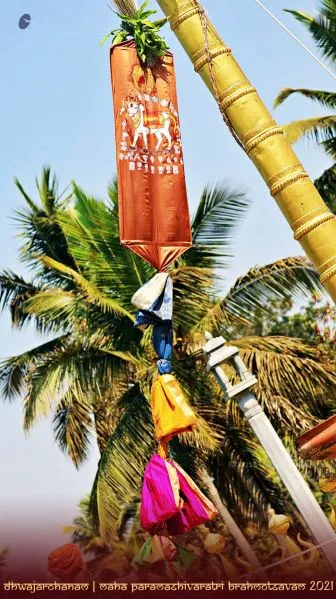
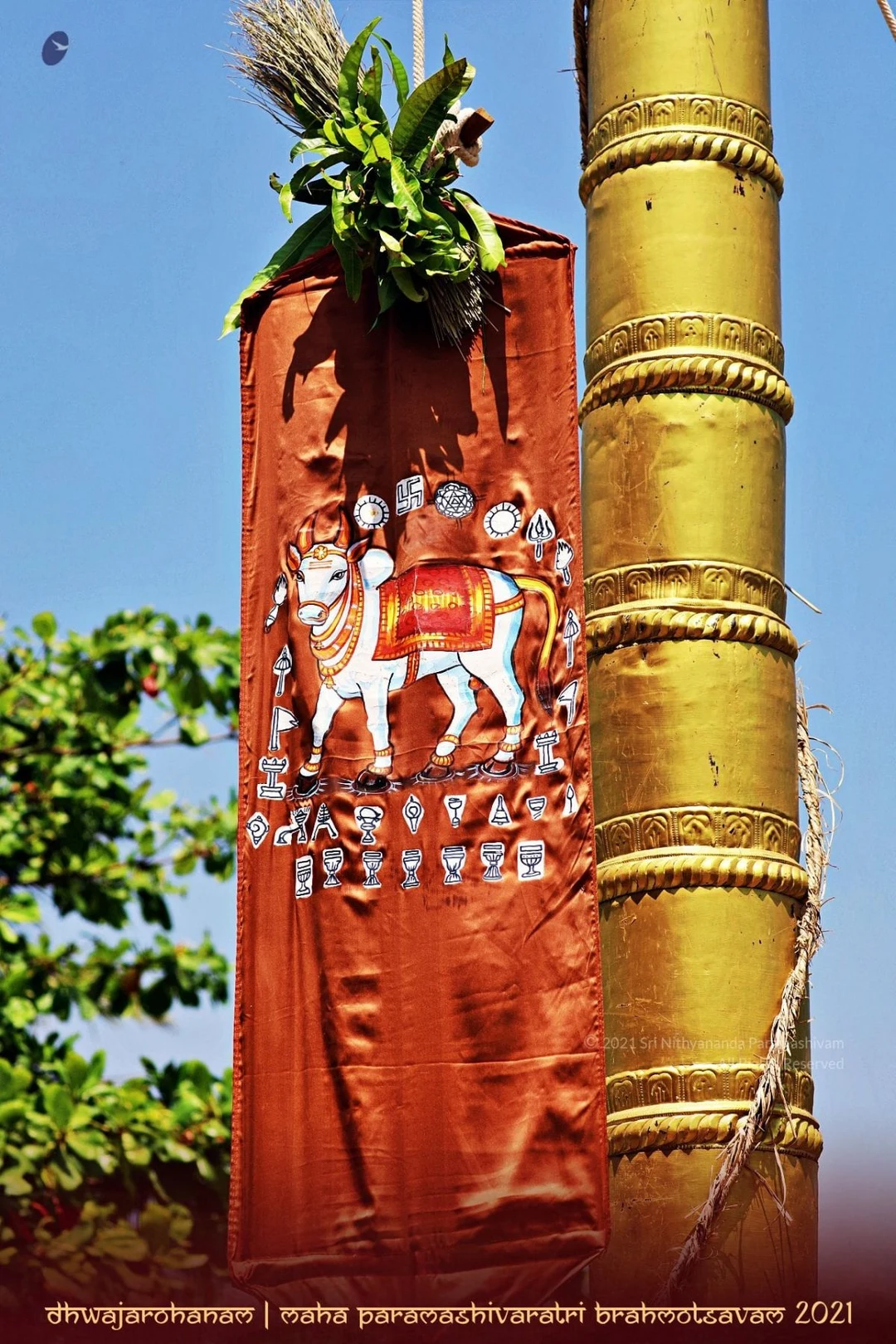
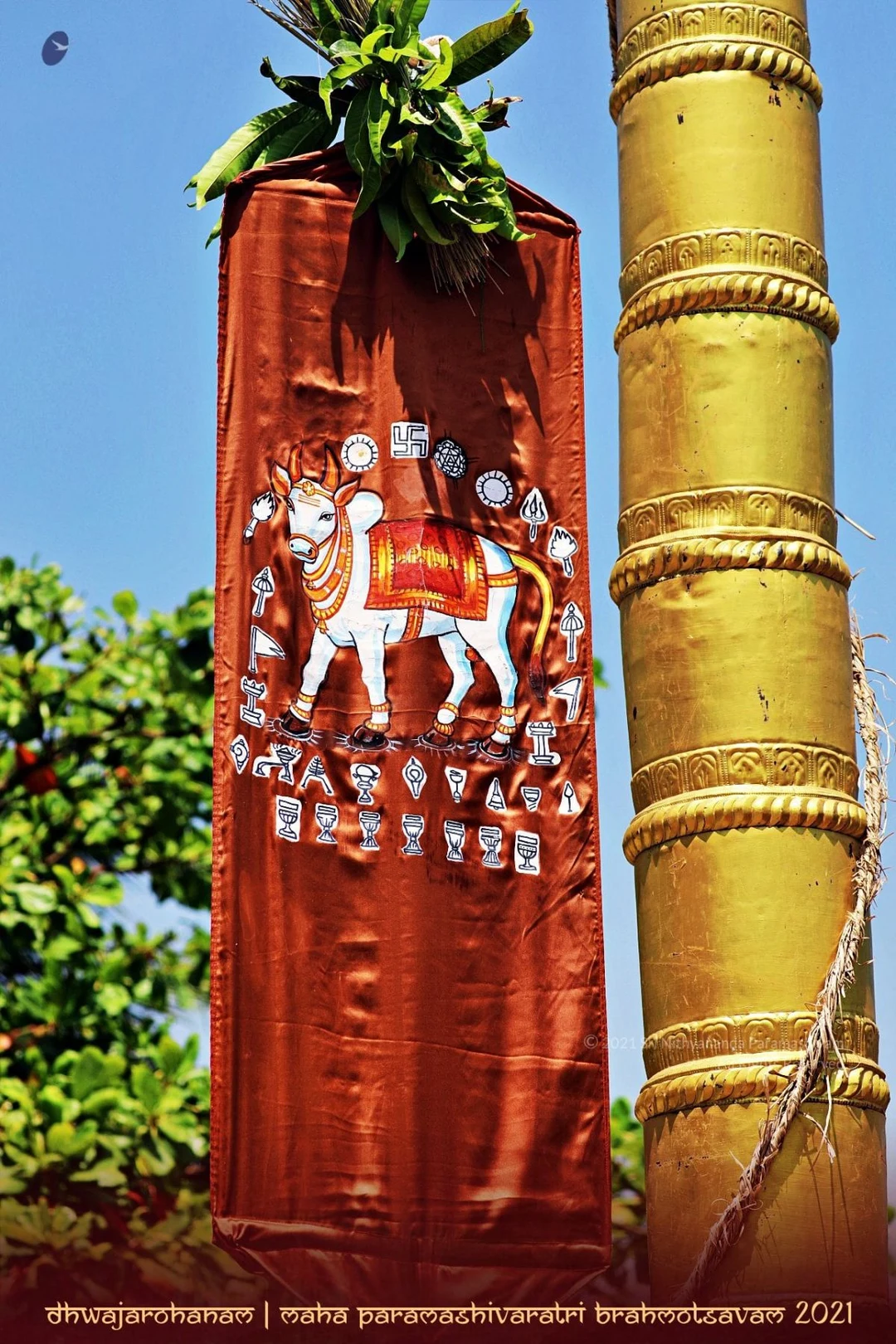
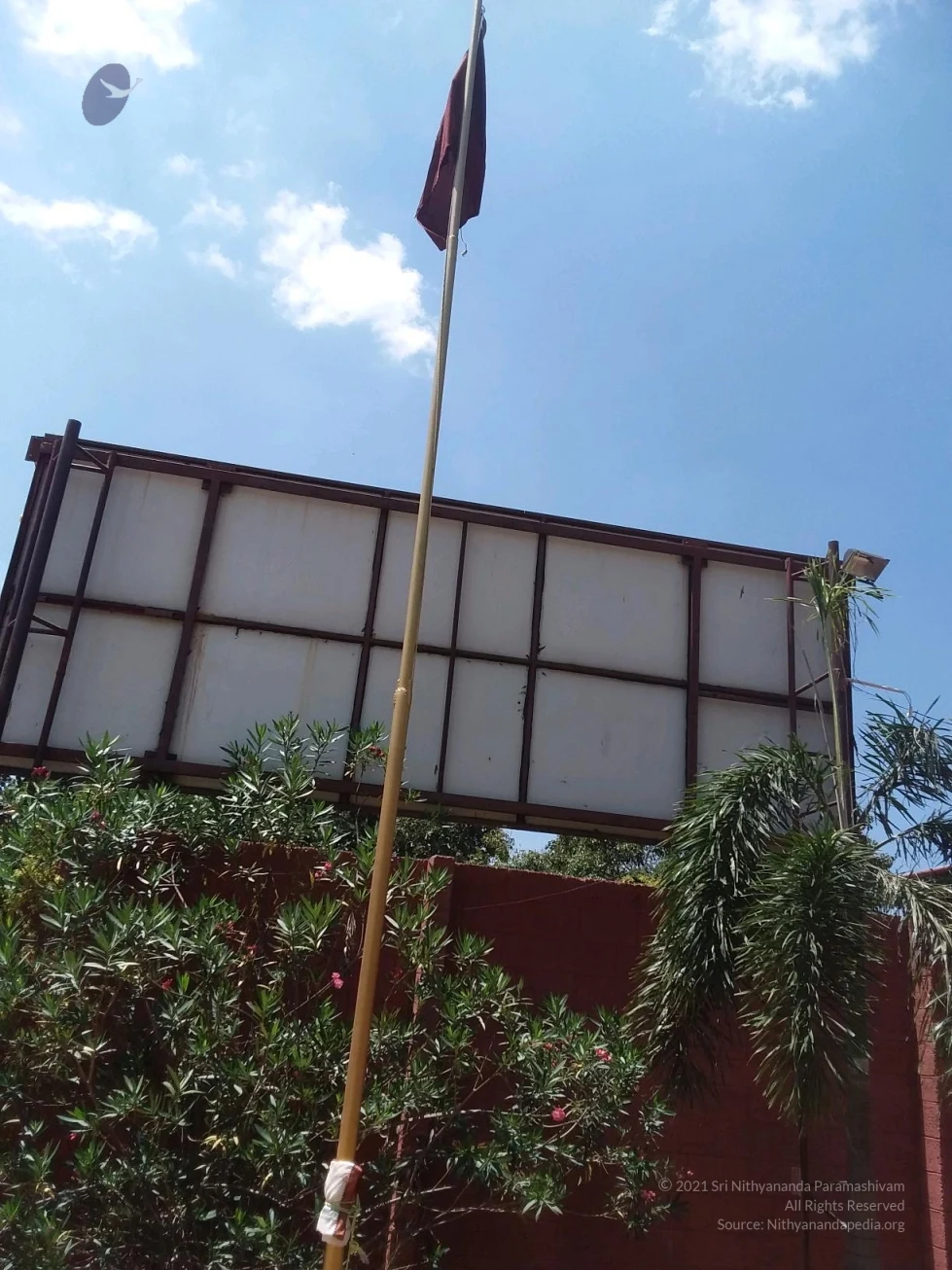
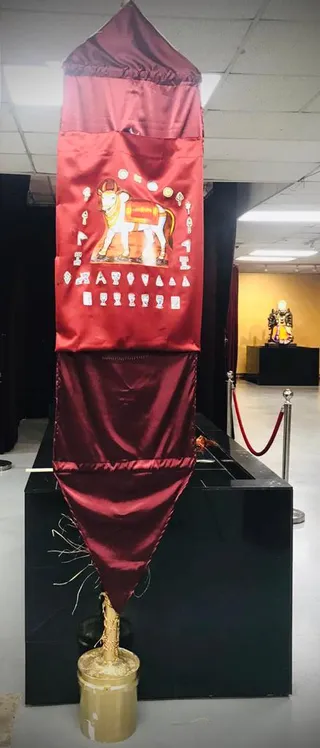
Dhvajarohanam is the ritual which marks the start of the Brahmotsavam. It is a very sacred ritual wherein the Dhvaja (Flag) is hoisted on the Dhvajastambha (Flag pole).

Once that happens, Paramashiva along with all the 330 million gods and goddesses from all the 14 Lokas land very intensely and powerfully in the temple premises to celebrate the Brahmostavam.

In the Kamika Agama, Uttara Pada, Mahotasava Vidhih, Verse 1 , Paramashiva says:
utsavaṁ saṁpravakṣyāmi yathāvadanupūrvakam|
dhvajārohovarohāntā kriyā utsava ucyate||

Now, I will explain the details of the festival, the subject-matter of which comes next in the order of chapters mentioned in the beginning. The activities which take place from the beginning of flag-hoisting to the lowering of the flag go by the collective name ‘utsava’.

The Supreme Pontiff of Hinduism Jagat Guru Mahasannidhanam HDH Bhagavan Nithyananda Paramashivam is the 1008th incarnation of Paramashiva. He is here to revive Kailasa that enlightenment ecosystem of Paramashiva. All the rituals done in the Nithyanandeshwara Paramashiva Devalaya are personally micromanaged and officiated by the Supreme Pontiff of Hinduism Swamiji.

With our Sakshat Dandavat Pranams we welcome our beloved Swamiji, our beloved Bhagavan, and request His grace and blessings for the Dhvajarohana celebrations.

Photos

FB-Photos-of-the-Day
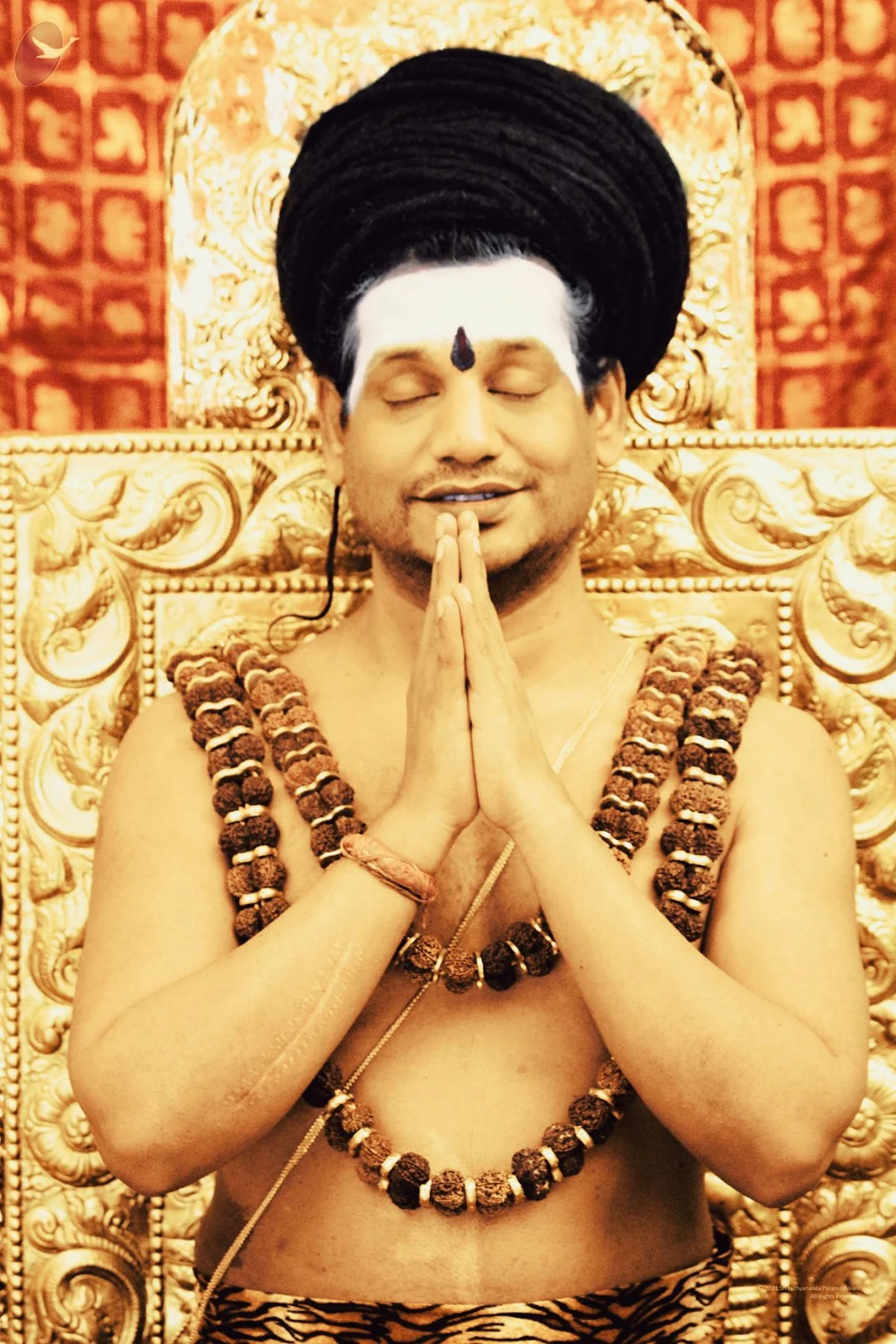
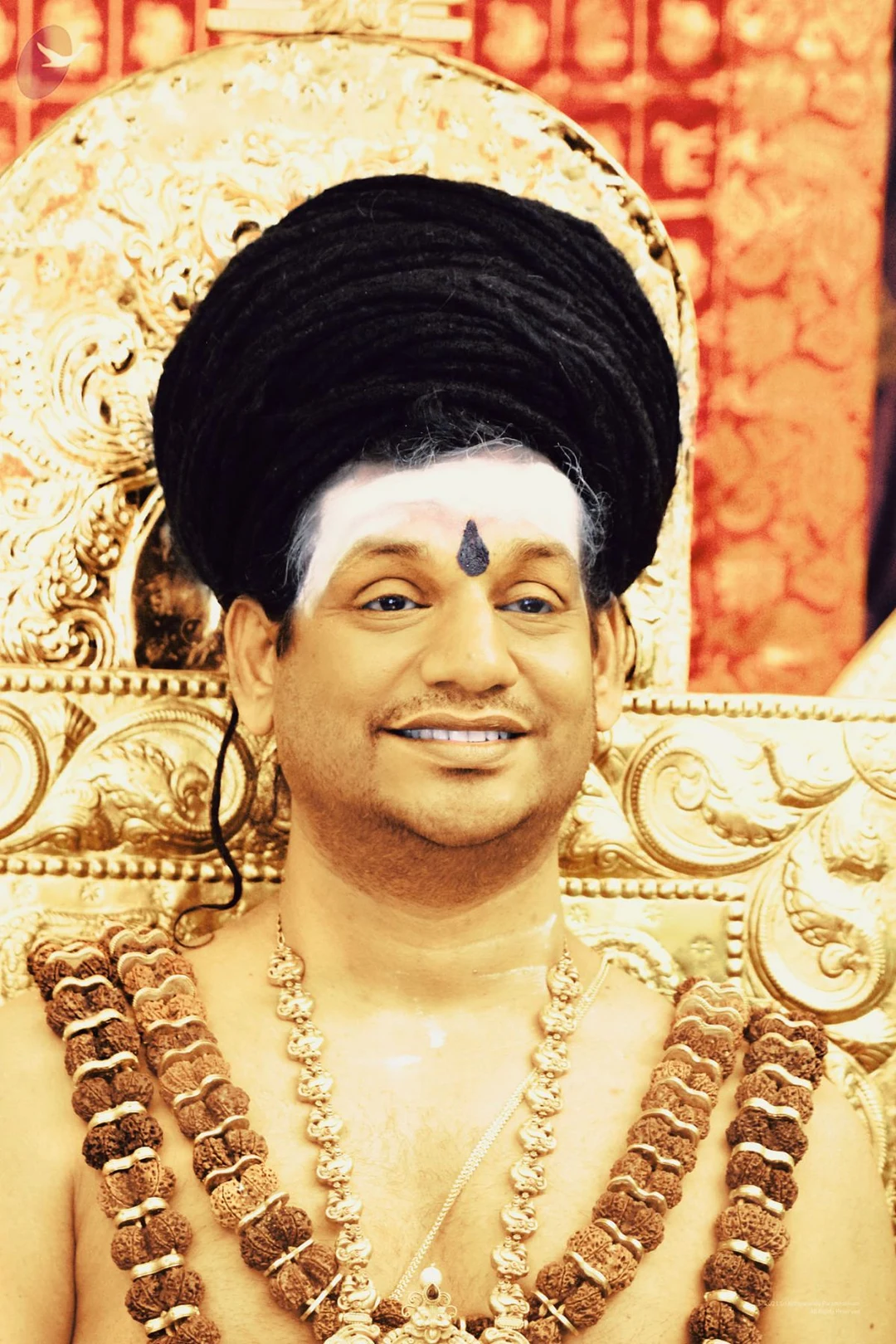
FB-Photos-GLIMPSES OF DVAJAROHANAM FOR MAHA PARAMASHIVARATRI IN KAILASA
Glimpses of Dwajarohanam for Maha Paramashivaratri at Arunachala Sarvajnapeetham, Thiruvannamalai, Tamilnadu, India

Link to Facebook Page

https://www.facebook.com/ParamahamsaNithyananda/videos/717767869105812
https://www.facebook.com/ParamahamsaNithyananda/videos/111541517554622
https://www.facebook.com/ParamahamsaNithyananda/posts/4971090372978773
https://www.facebook.com/ParamahamsaNithyananda/posts/4971091652978645
https://www.facebook.com/ParamahamsaNithyananda/videos/909362893151279

Photos from this day

View all 105 photos

Pictures from the day

19 photosSource gallery
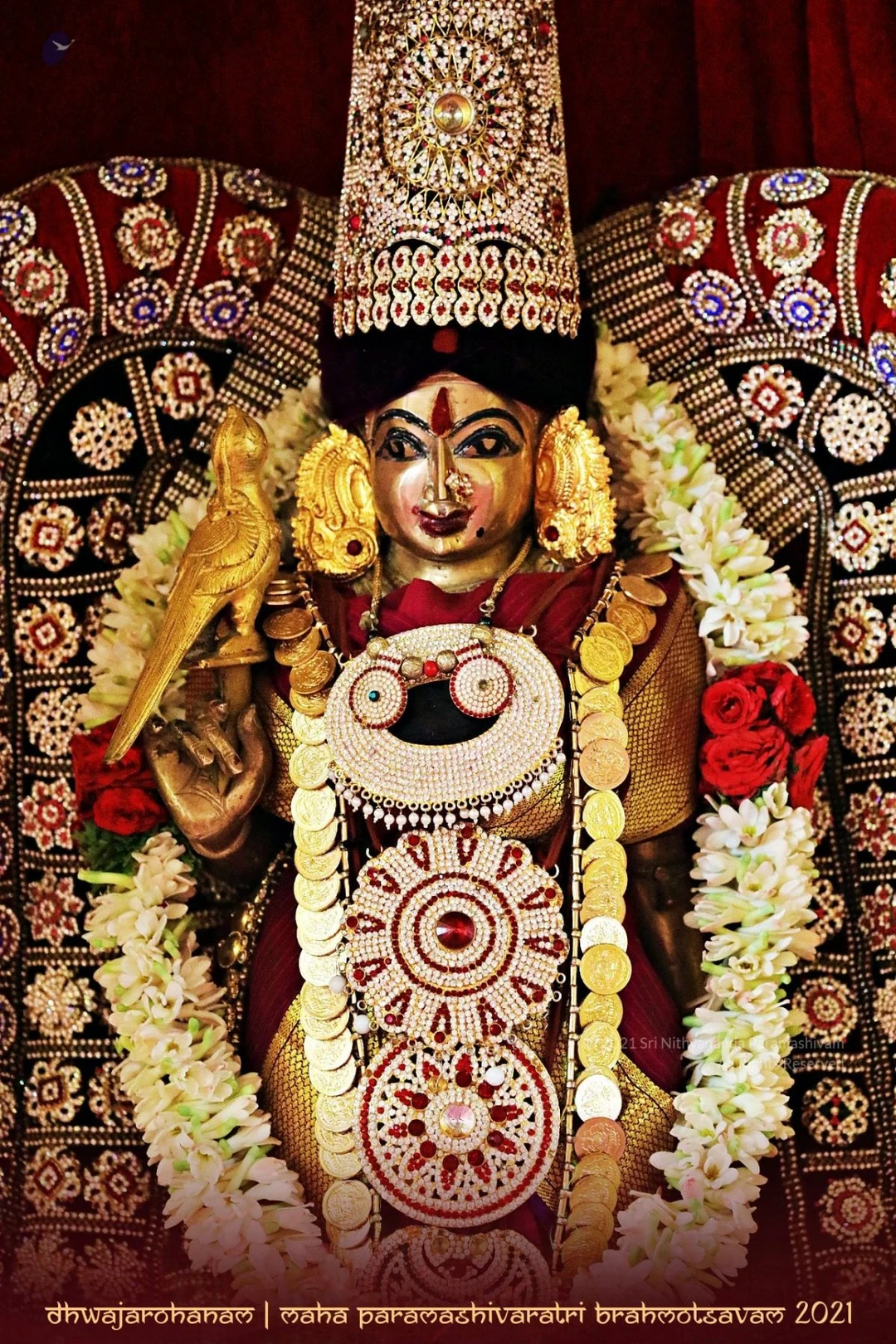
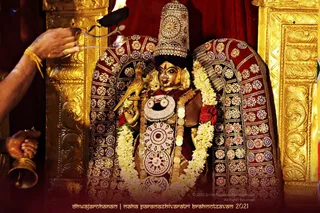
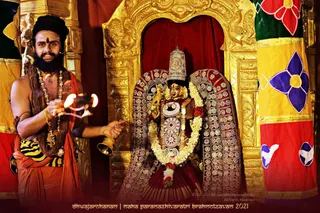
A photograph of a temple shrine during a Maha Paramashivaratri Brahmotsavam ritual. A bare-chested priest with long dark hair and a beard stands at left, wearing an orange dhoti and an orange-and-black striped cloth over one shoulder, a rudraksha-style mala and wrist beads, and holds a small lamp or offering vessel toward a Shiva lingam. The lingam is draped in red, yellow, green and white flower garlands and has three horizontal white and red lines painted on its face. Behind it stands an ornate gold arched shrine frame with a lion-face motif, and a second figure in red garments stands at the back. Colourful silk hangings and gold pillars surround the shrine.A bearded priest in an orange-saffron dhoti and a brown shawl stands at left, bare-chested with a rudraksha-style bracelet and a tied hair knot, hands raised in a gesture during worship. Before him is a Shiva lingam draped in garlands of white, yellow and red flowers and green leaves, marked with white tripundra lines, set within an ornate gold arch. Behind stands a gilded deity murti with a crown and a flower garland, flanked by a golden figure in a magenta and purple sari. A tall brass lamp stands at right. The setting is a richly decorated temple shrine with gold and mosaic work, suited to a Maha Paramashivaratri abhishekam or puja.A photograph of a Shiva lingam draped in layered garlands of red, yellow and white flowers with green leaves, set before an ornate golden arch with lion-face motifs and a gilded kirtimukha-style crest. Behind it stand gilded deity figures and a tall figure in a magenta cloth. On the left, a bare-chested priest in an orange and black-striped dhoti with an orange shawl, a rudraksha mala across his chest and an orange-and-gold armlet, holds a small offering while standing beside the decorated shrine. The scene shows a festival puja at a temple altar. A caption reads 'dhwajarohanam | maha paramashivaratri brahmotsavam 2021'.A golden deity murti of a goddess is decorated for worship, standing before a red velvet backdrop framed by ornate gold panels. She wears a tall jewelled crown, a large jewelled necklace with circular medallions, gold coin-like ornaments, and a white flower garland, and holds a golden parrot-shaped object. Dark red and gold embroidered arches with floral motifs surround the figure. At the left edge, a hand pours liquid from a vessel near a flame, and another hand holds a brass bell. No visible persons are shown in the sacred image itself.A priest in saffron-orange dhoti and shawl with a yellow-and-black striped cloth, long dark hair, full beard and rudraksha mala stands at left holding a lit oil lamp in one hand and a brass bell in the other. Beside him, a decorated deity murti with a gold crown, white flower garland and red-and-gold embellished garments sits within a gilded arch with red drapery. Tall banners with red, blue and yellow floral patterns frame the scene.A photograph of a priest in saffron and orange cloth with a tiger-striped waist wrap and a rudraksha mala, waving a lamp before a decorated deity murti in a gold-framed shrine. The murti wears a tall silver crown, white and red garlands, and a patterned red and gold cloth. Red drapes and a tall pillar with green, yellow and red panels with blue and red flower motifs frame the scene.

Pictures from the day

7 photosSource gallery
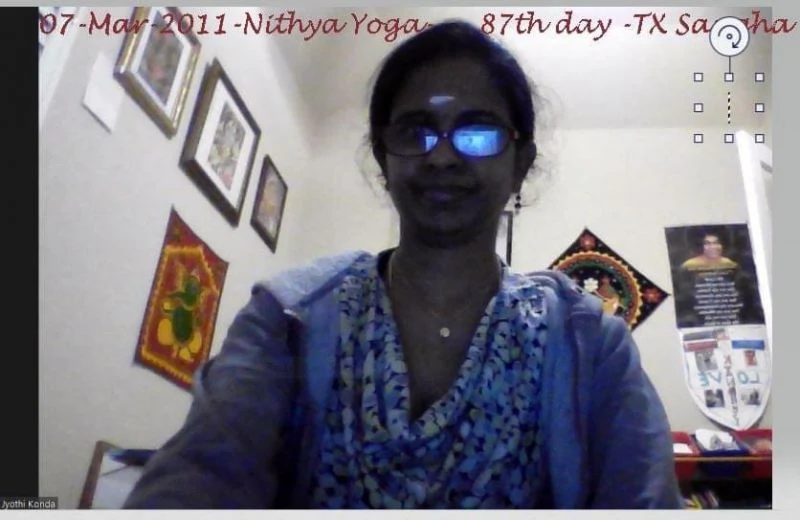
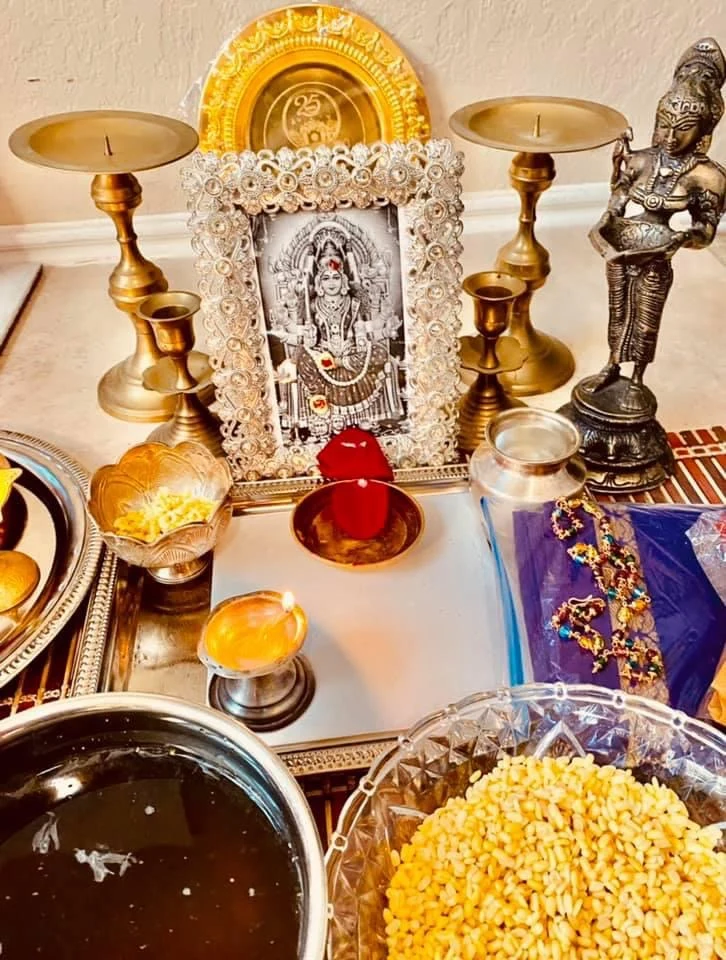
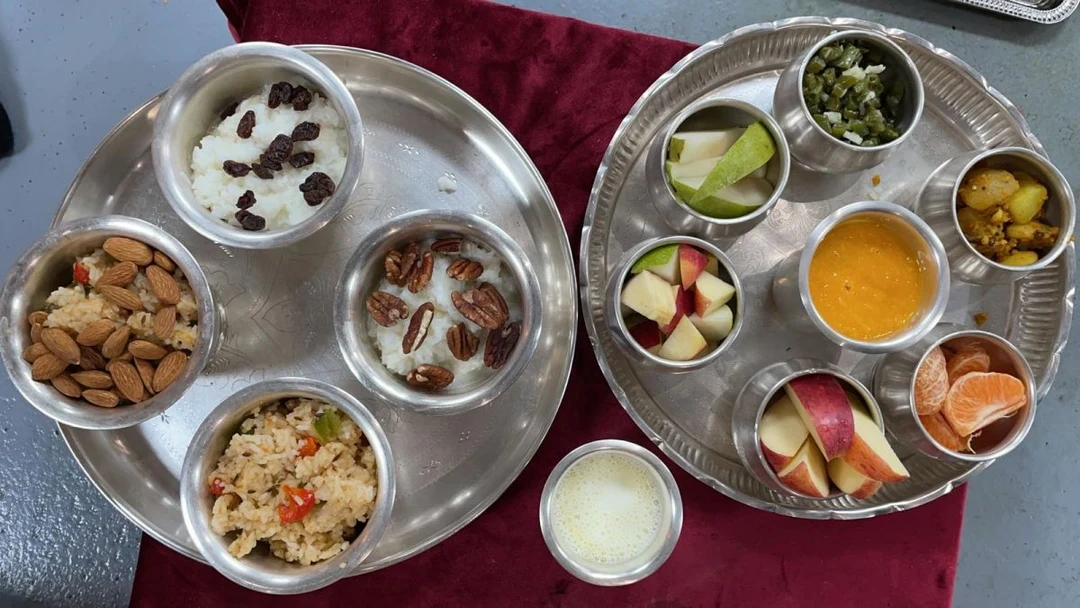
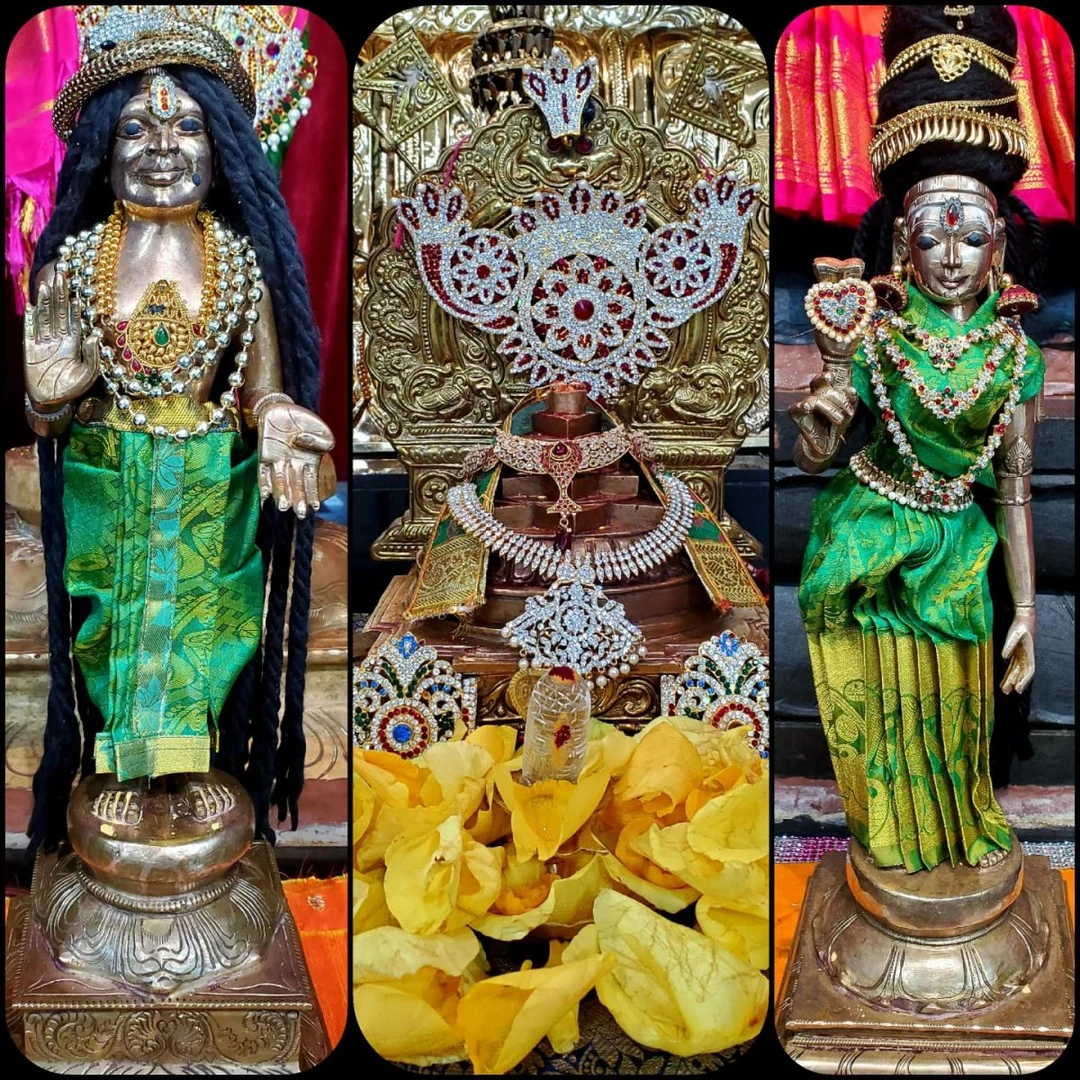
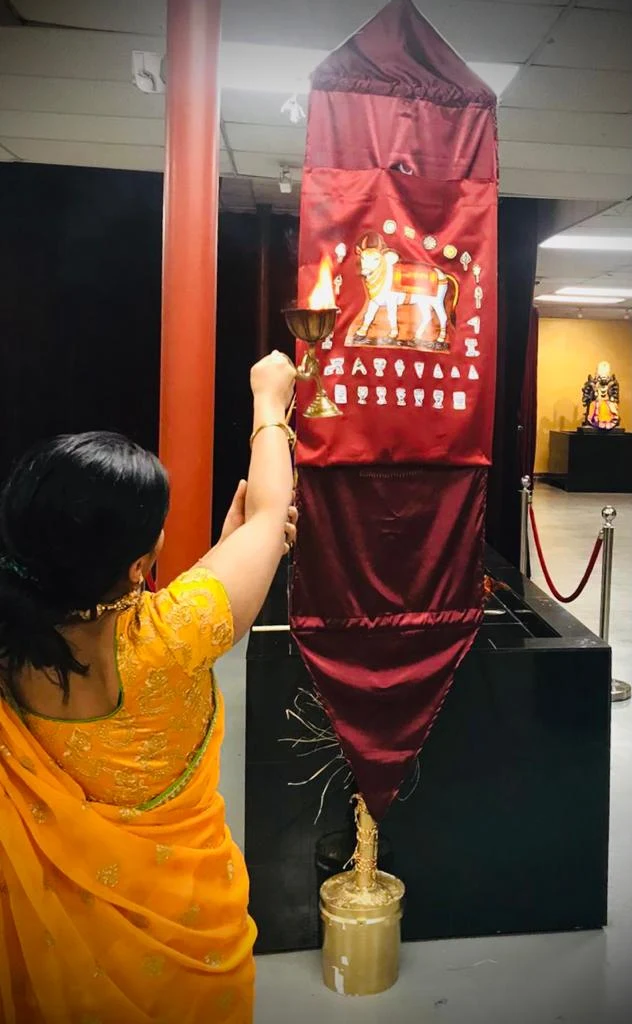
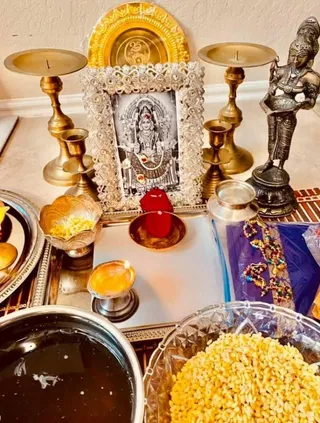
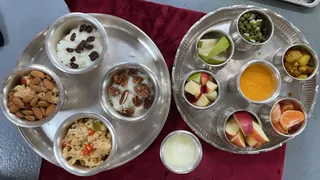
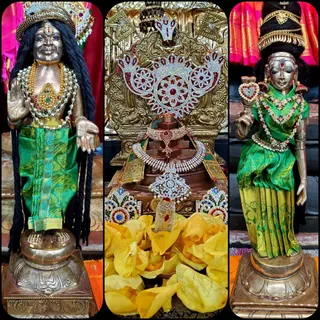
A small table offering set on a purple cloth in front of a framed printed picture of a multi-armed goddess seated on a throne within an arched temple niche, adorned with a red and white garland, dressed in red and white garments and holding objects in several hands. Three orange and yellow marigold flowers sit atop the frame. In front, a brass oil lamp with a lit flame and a yellow flower rests beside sugarcane pieces wrapped partly in dark leaves and a brass bowl of pale grains topped with cucumber slices. Scattered yellow flowers and a blurred background of more flowers and figurines complete the scene.A woman with dark hair, glasses and a small bindi sits smiling in a video-call style frame in a room with framed pictures on the wall. She wears a blue patterned top with a light blue cardigan and a thin pendant necklace. Behind her hang a red and yellow embroidered wall hanging with a green beetle motif, a framed poster of a man in a yellow top, and a small shield-shaped plaque. A caption banner across the top reads the day count and Nithya Yoga label, and a name label sits in the lower left corner. No a person candidate is visible.A home shrine arrangement on a silver tray, photographed close up. A black-and-white framed print of a deity murti with a red tilak and garland is set in an ornate silver-embossed frame, flanked by brass candlesticks and a bronze female figure holding a lamp. Before it sit a small red cloth, a brass bowl of red powder, a clear oil lamp with a lit flame, a glass bowl of yellow grains, a bowl of dark liquid, and a plastic-wrapped bundle of colourful beaded garlands. No people are visible.A tall maroon satin ceremonial banner stands on a black pedestal in an indoor hall with a grey ceiling and red velvet rope barriers. The banner has a pointed top and a central panel depicting a white cow with a red saddle cloth, surrounded by small painted ritual objects such as lamps, conch, bells, pots and a kalasha-like vessel arranged in rows. Its base is set in a gold-coloured pot with straw or grass fibres spilling out. In the background, a small golden deity murti sits on a black pedestal beneath a warm yellow wall. No people are visible.Overhead photo of two round stainless steel thalis on a dark red velvet cloth over a grey surface. The left thali holds small bowls of white rice topped with raisins, rice with pecans, almonds beside a rice dish with red pepper, and a rice dish with peppers and vegetables. The right thali holds bowls of sliced apples and pears, cut apple pieces, peeled mandarin orange segments, a bowl of orange-yellow sauce or dal, a bowl of spiced potato curry, and a bowl of sliced green chillies. A small steel cup of pale milky drink sits between the plates. No people are visible.A three-panel collage of temple deity images. Left: a bronze standing figure with long dark hair, a jewelled crown, a green silk dhoti, a layered pearl and gold necklace and a raised hand. Centre: a jewelled silver shivalinga-style form with a crescent-shaped diadem, a diamond-studded necklace and a heap of yellow flower petals. Right: a bronze female figure with a tall hair crown, a green and gold sari, pearl and ruby necklaces and a heart-shaped object in hand. The images are of murti statues, not people, so no physical people are present.

Pictures from the day

1 photoSource gallery
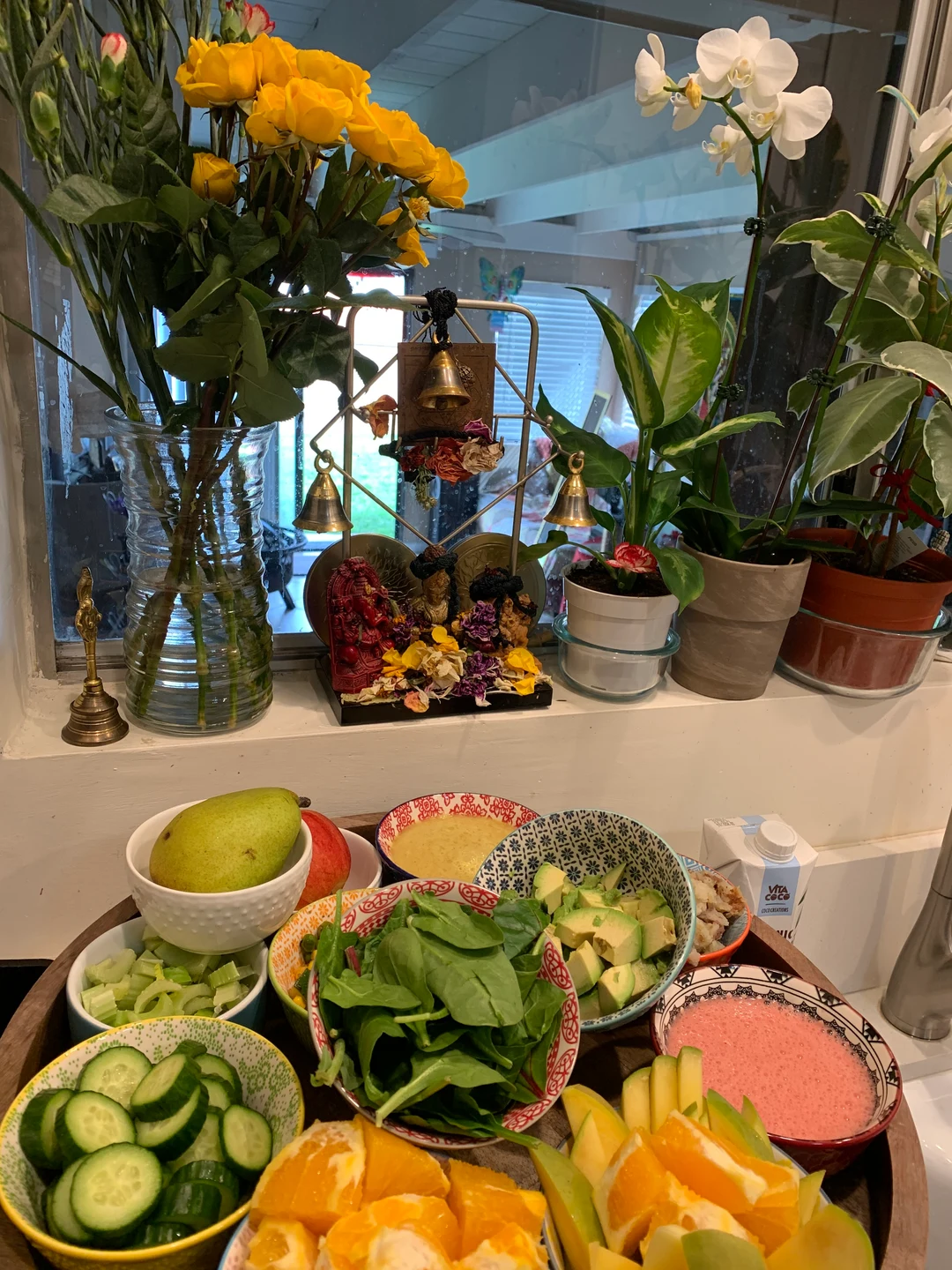
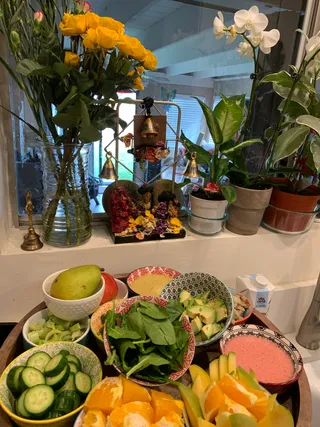
A windowsill home altar beside a tray of fresh food. A small red deity murti stands on a black base scattered with dried flowers, beside a brass hanging bell frame with bells and a brass bell on the left. Behind it, a glass vase holds yellow roses, white orchids and potted green plants. In front, a wooden tray holds bowls of sliced cucumber, celery, spinach leaves, avocado, orange segments, mango slices, a pear, and pink and yellow smoothies, with a carton of coconut milk. No people are visible.

Pictures from the day

5 photosSource gallery
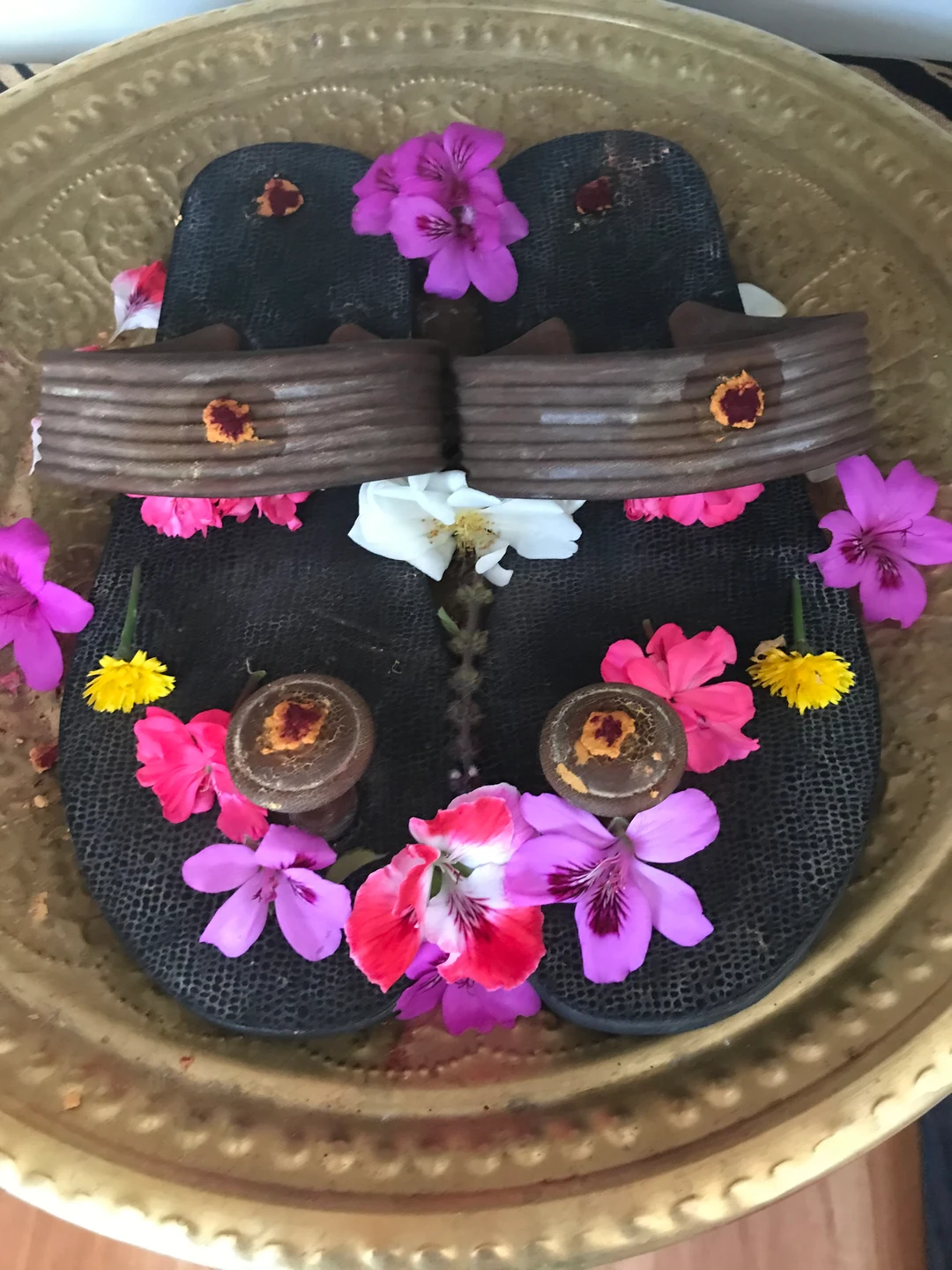
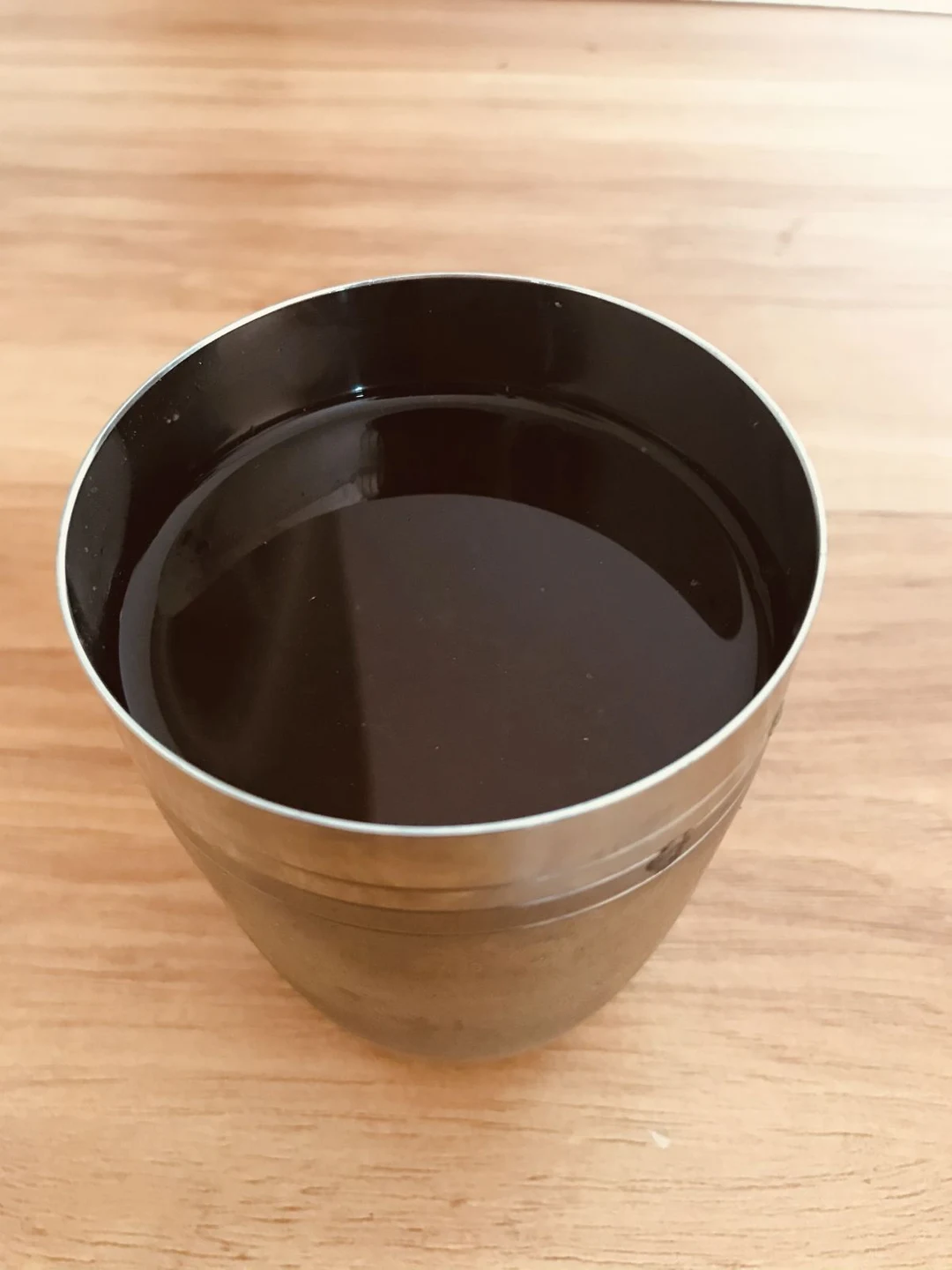
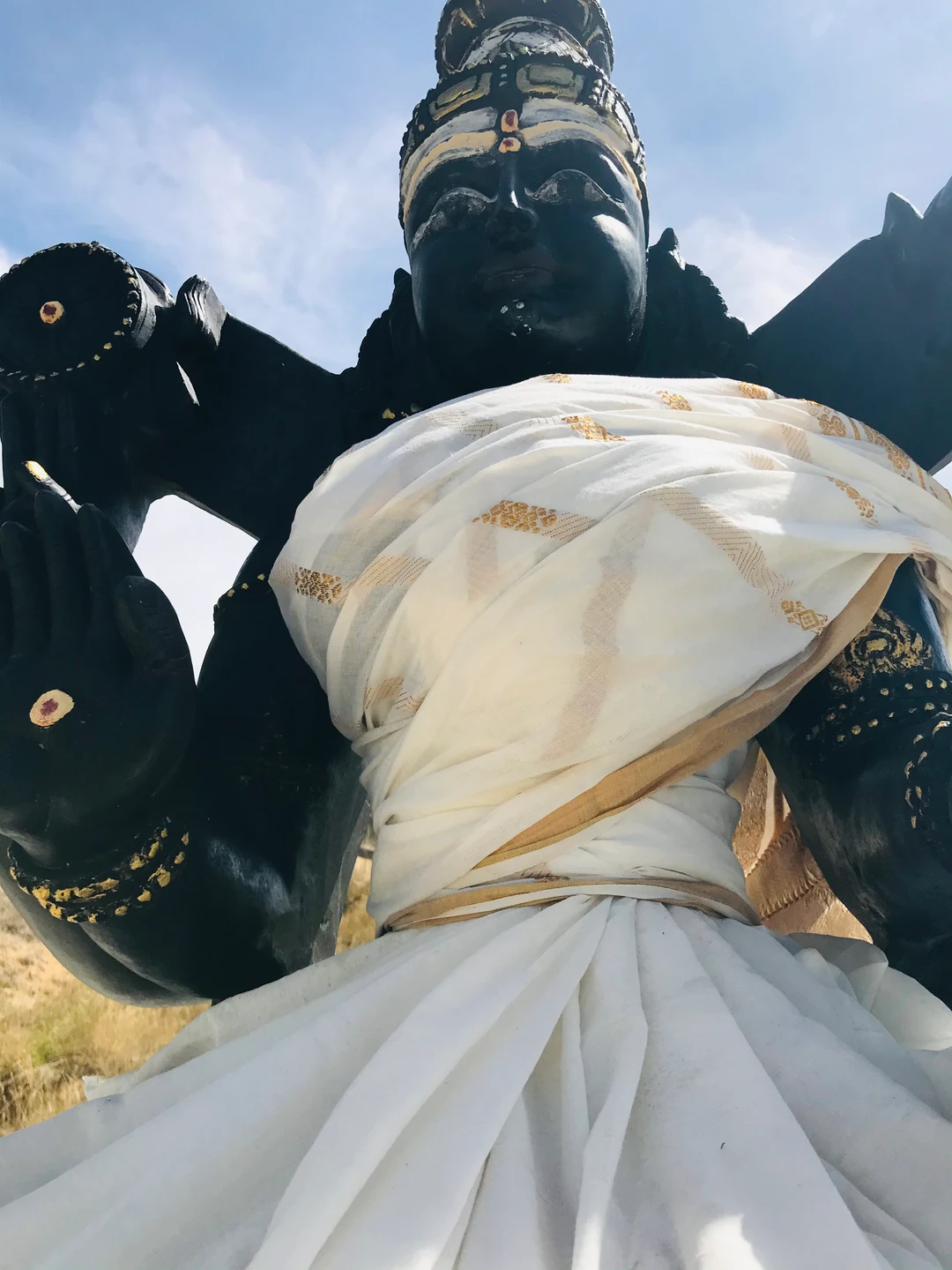
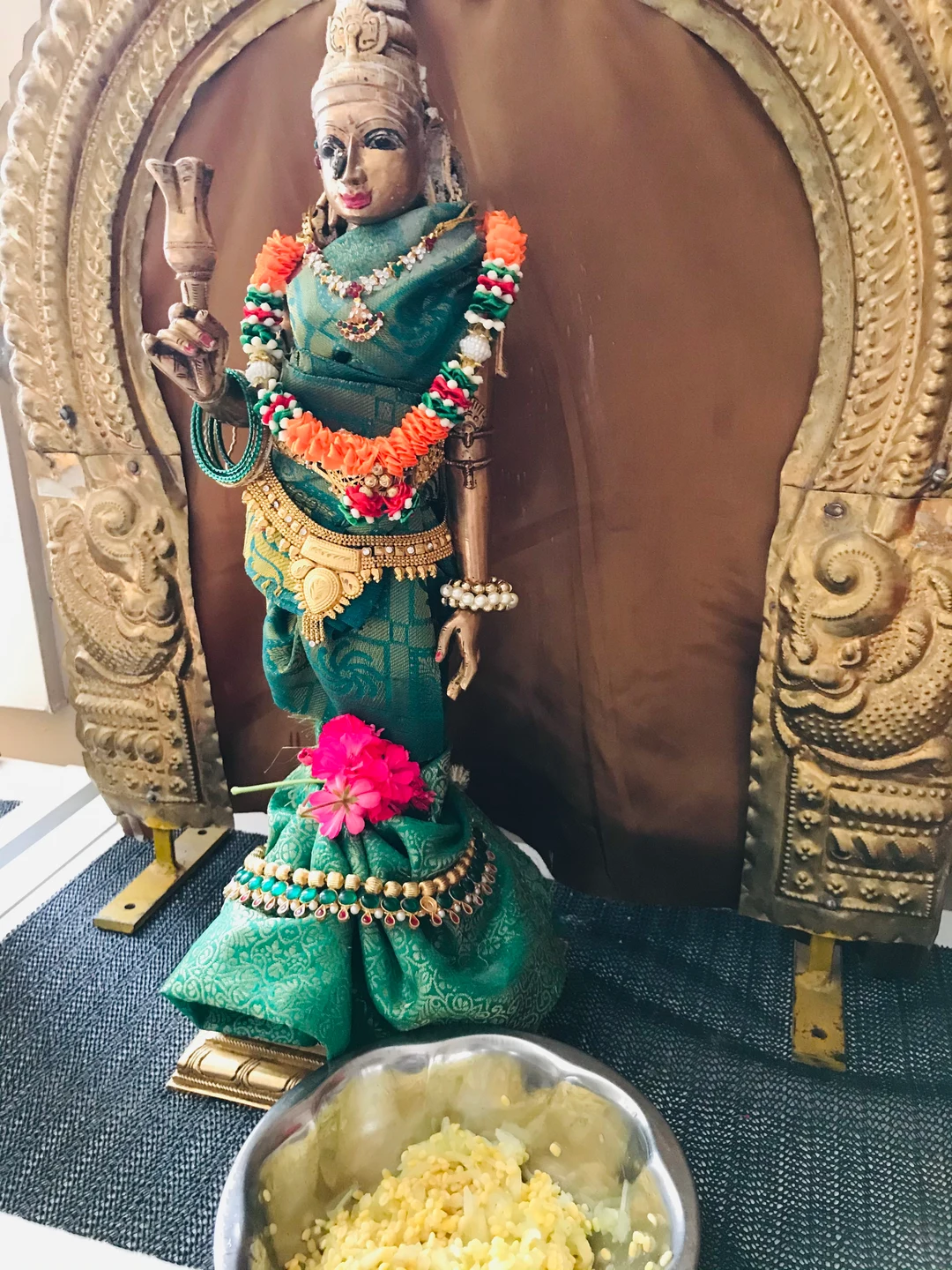
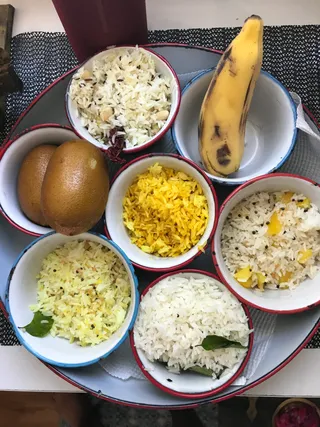
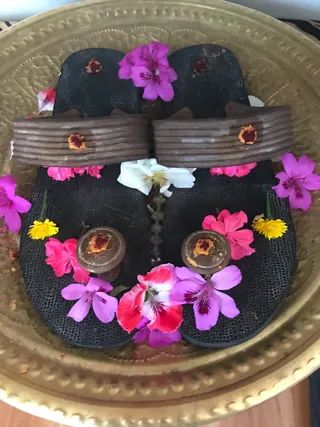
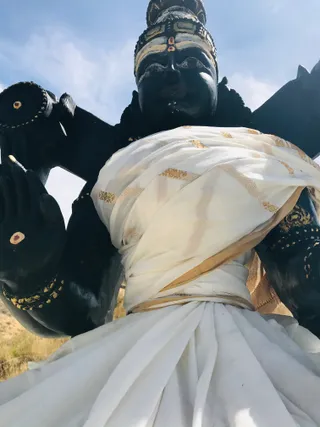
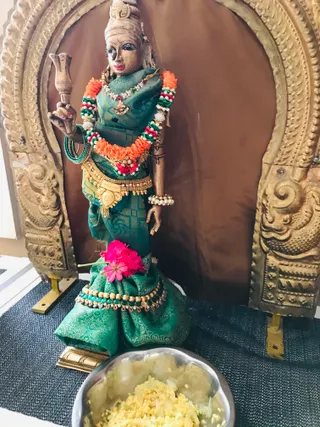
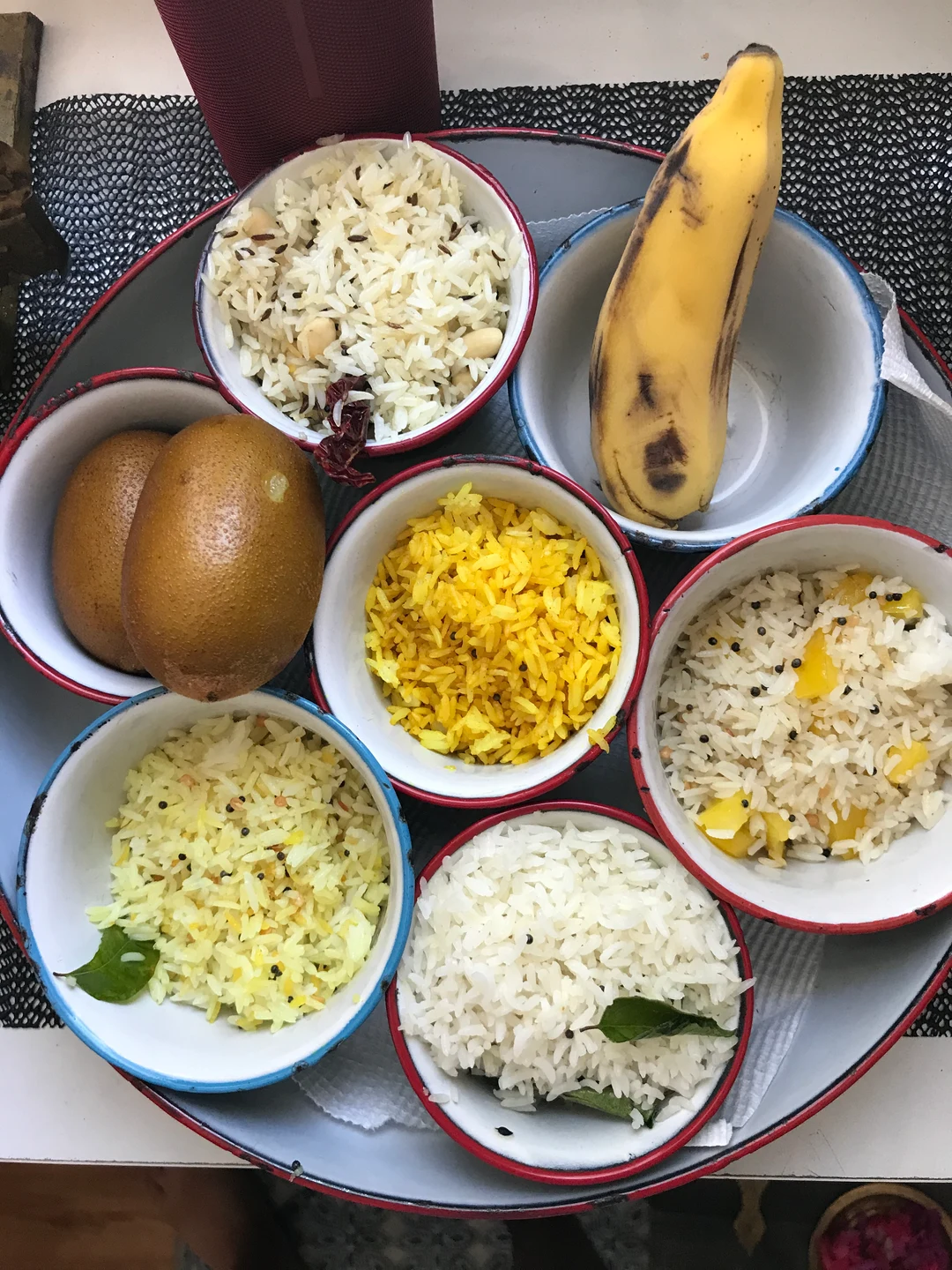
Overhead photograph of a round grey metal tray with red and blue rimmed enamel bowls holding a ritual meal of rice preparations. One bowl has cumin-tempered rice with cashews, another turmeric yellow rice, another lemon-tinted rice with curry leaves, another mango rice with mustard seeds, and another plain white rice with a curry leaf. Two round brown fruits sit in a bowl at left, and a ripe banana rests in a bowl at upper right. A red cylindrical speaker and a dark woven mat appear at the edges. No people are visible.Close-up photograph of a pair of dark wooden padukas, sacred sandals with raised wooden pegs and brown straps stained with kumkum, resting on an ornate brass tray. Pink, magenta, red-and-white and yellow flowers, including geraniums and a white blossom, are scattered over the sandals and tray. No people are visible in the frame.Close overhead photo of a small metallic cup filled with dark brown liquid, resting on a light wooden table. No people are visible. The cup has a silver rim and banded silver body, and the liquid surface is smooth and nearly black-brown.Low-angle photograph of a large black stone deity murti against a blue sky with wispy clouds. The figure has a tall ornate crown with gold and white painted details, a painted forehead mark, and multiple arms; one raised hand holds a lit lamp or candle. The statue wears a white dhoti or cloth draped around the waist with gold woven border patterns, plus gold-painted armbands and bangles. Dry golden grass is visible at the lower left.A standing wooden deity murti dressed in a teal-green silk sari with gold-brocade border, decorated with orange and red-white garlands, gold necklaces, bangles and a gold waist belt, with pink flowers tucked at its feet. It holds a tall brass lamp-like object in one raised hand, set before a gilded arched niche with a brown fabric backdrop. A silver bowl of yellow rice or naivedhyam sits in the foreground on a dark woven mat. No people are visible.

Pictures from the day

2 photosSource gallery
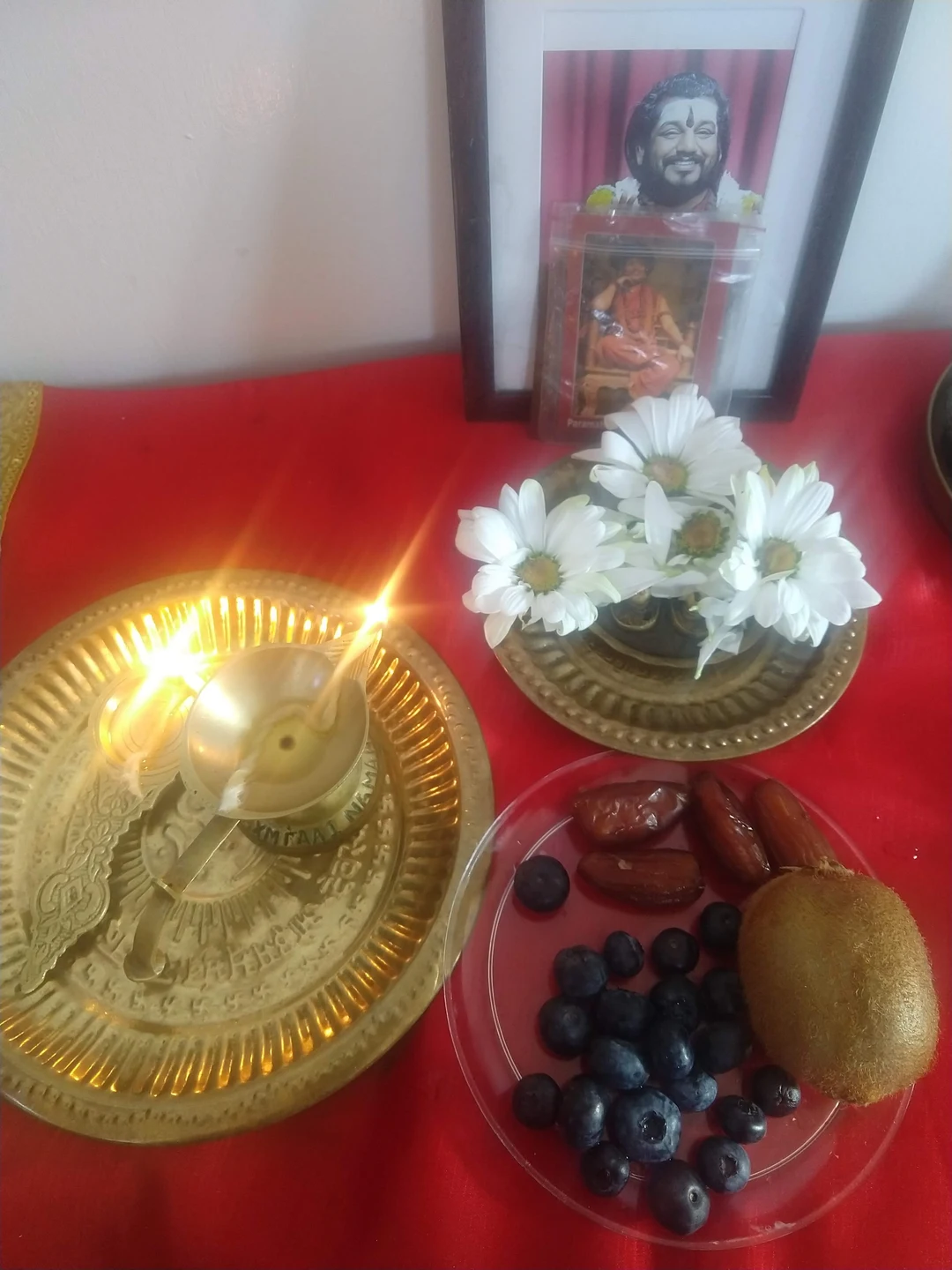
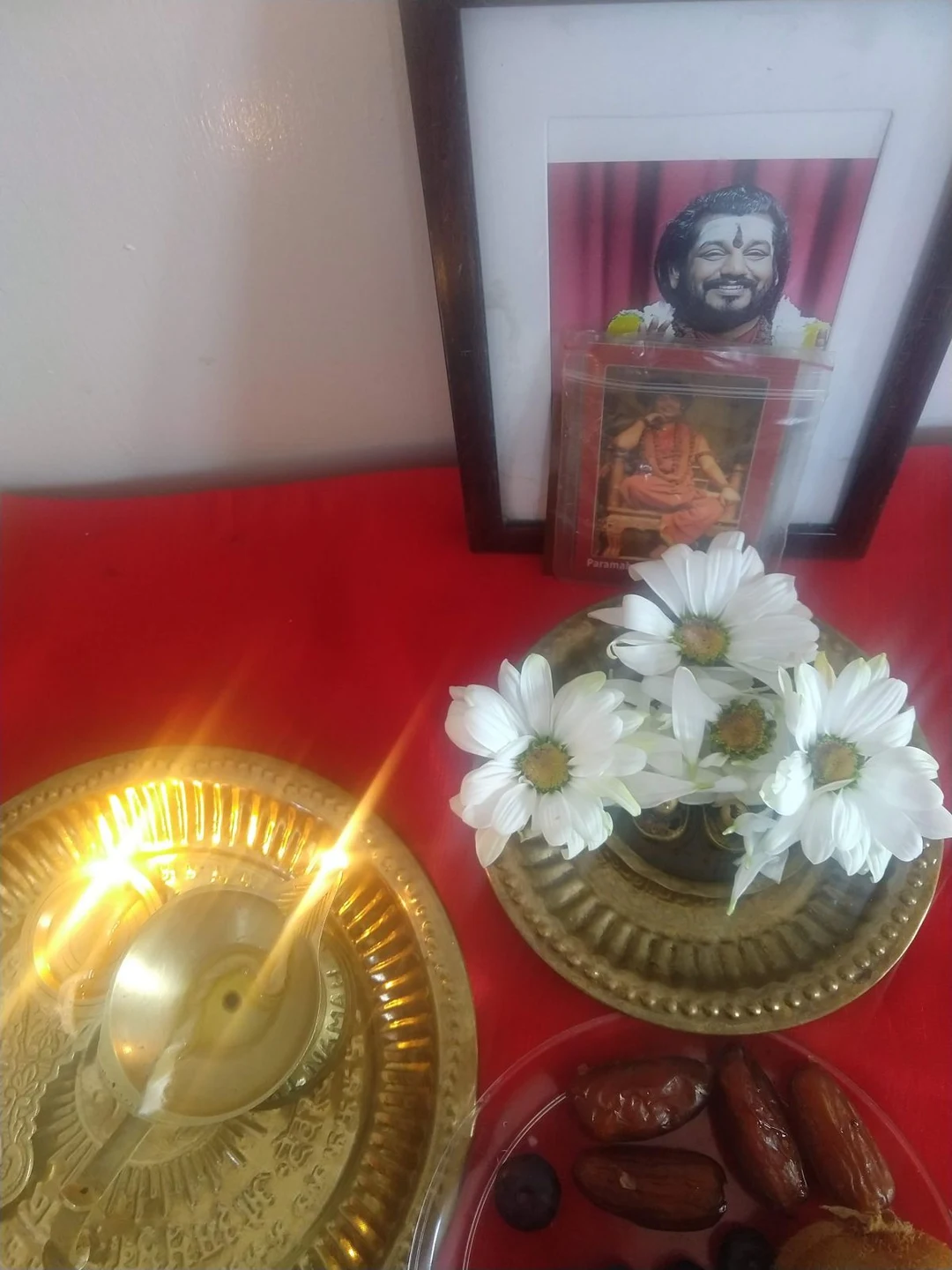
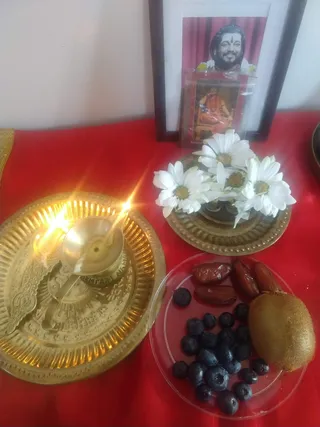
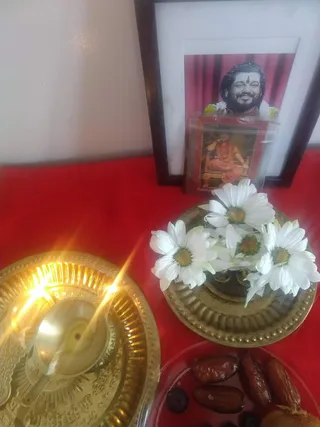
A home puja arrangement on a red cloth. In the upper centre, a framed portrait of a smiling bearded man with a tilak on his forehead and white flower garland stands behind a small plastic-sleeved card showing a robed figure in orange seated on a chair. Left foreground, a brass plate holds a lit brass oil lamp with a flame. Right foreground, a brass plate holds white daisy-like flowers, and a clear glass plate holds dates, blueberries and a kiwi fruit. No people are visible.A home shrine on a red cloth, photographed from above. A framed photo of a smiling man with dark hair, a forehead mark and a white flower garland stands at the back, with a small red-bordered card showing a seated figure in orange robes beside it. In front, a brass plate holds a lit brass oil lamp, a brass bowl of white daisy-like flowers, and a red dish of dates. No people are visible.

Pictures from the day

2 photosSource gallery
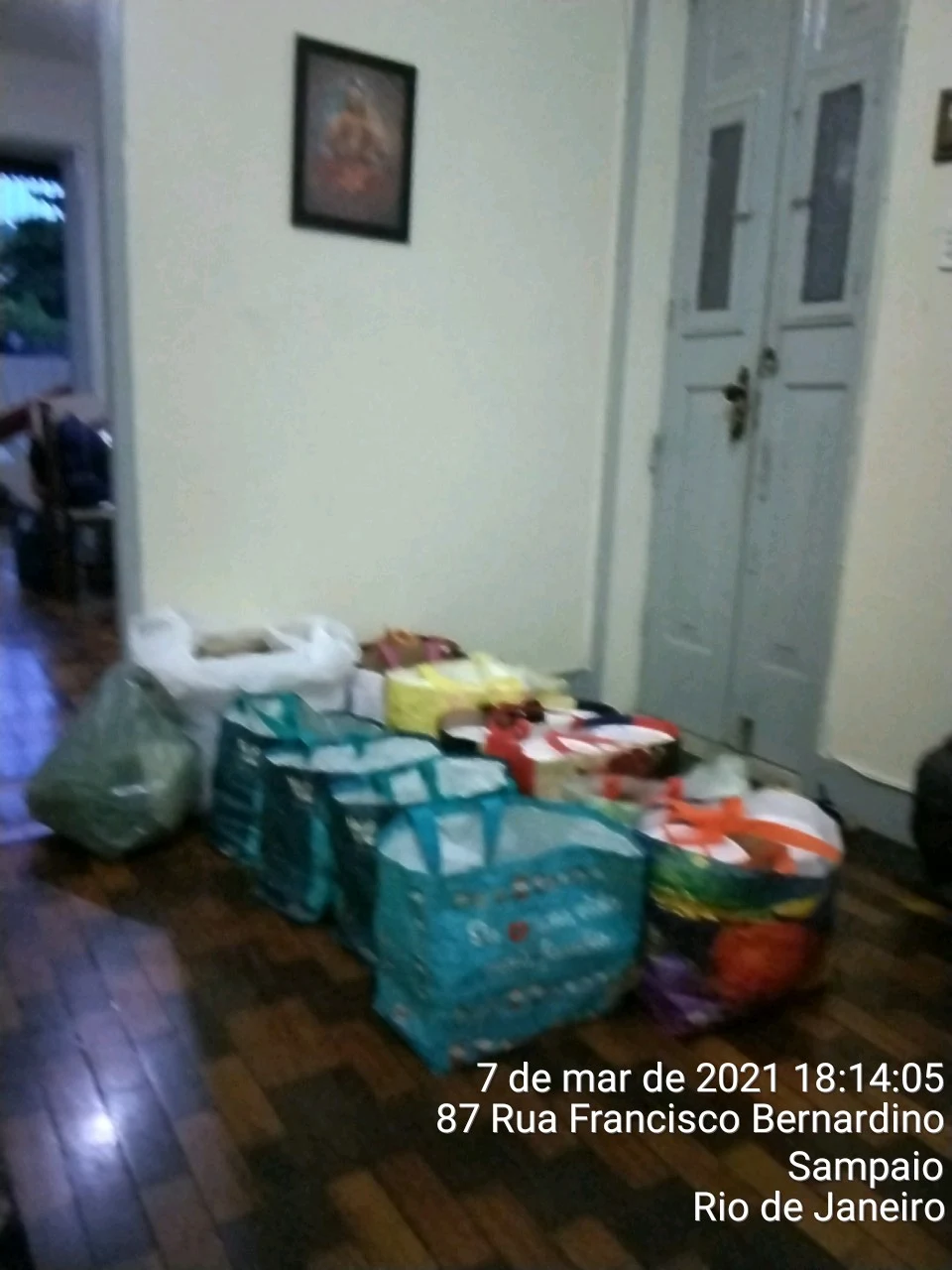
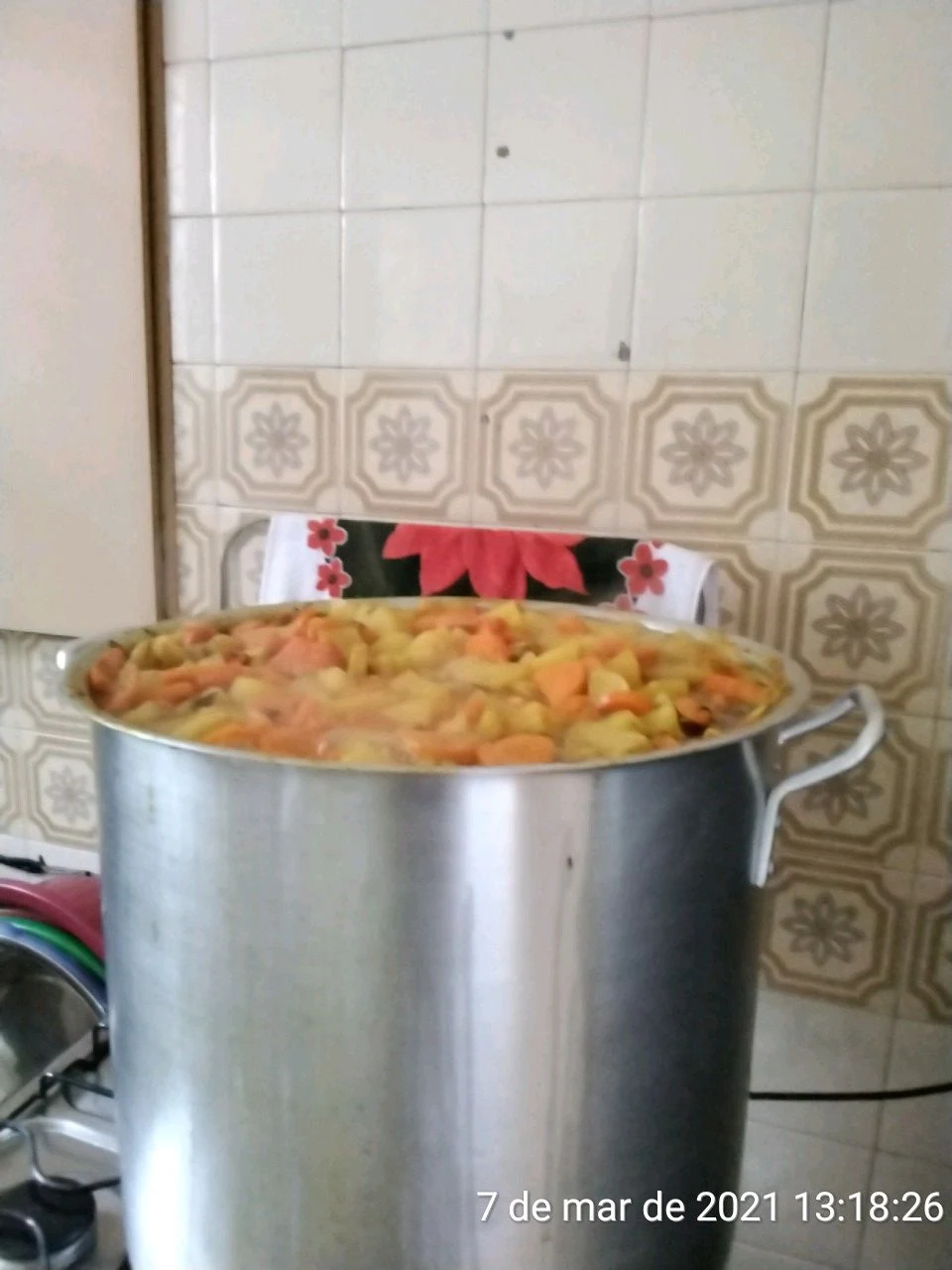
A dim indoor hallway with cream walls and a dark wood parquet floor. Several large teal and yellow woven bags, a green sack and white plastic bags are piled on the floor, some with orange ribbon bows, stacked in front of a grey double door with glass panes. A framed devotional picture of a deity hangs on the wall above the bags. A timestamp overlay reads 7 de mar de 2021 18:14:05 with an address line in Rio de Janeiro. No people are visible.A large stainless steel stockpot on a stove in a tiled kitchen filled with cooked vegetable soup of diced carrots and potatoes in a broth. A red and white floral dish towel hangs behind the pot against cream and beige patterned wall tiles. A timestamp in the lower right reads 7 de mar de 2021 13:18:26. No people are visible.

Pictures from the day

2 photosSource gallery
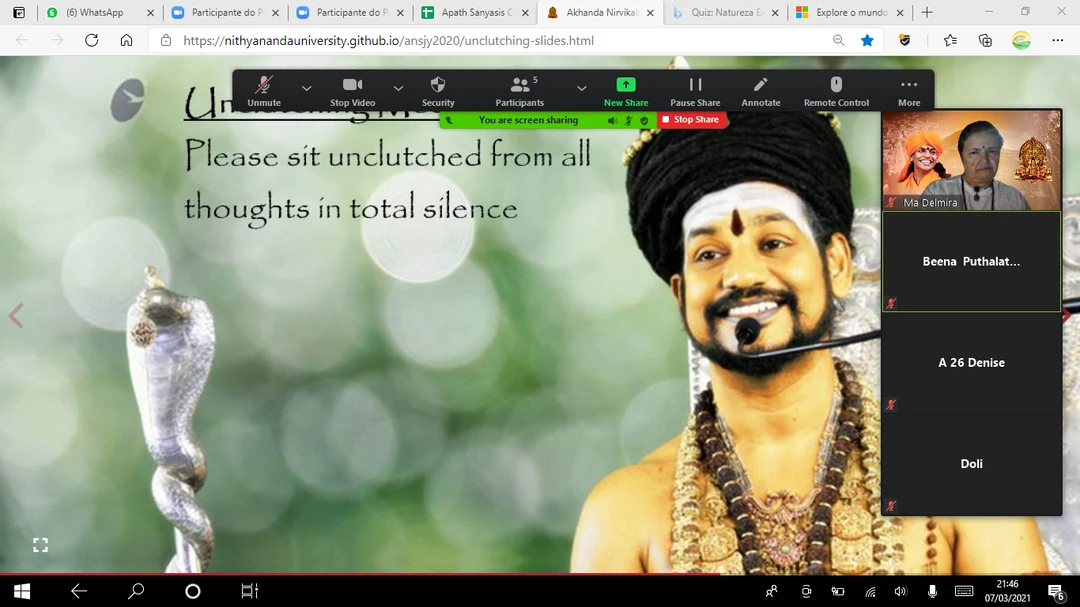
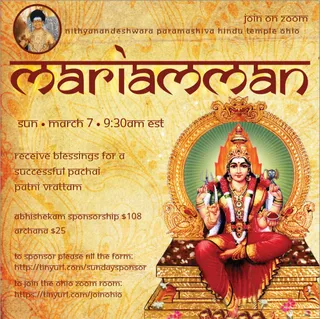
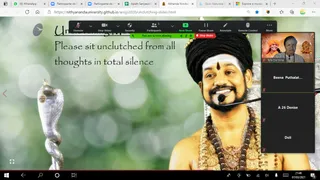
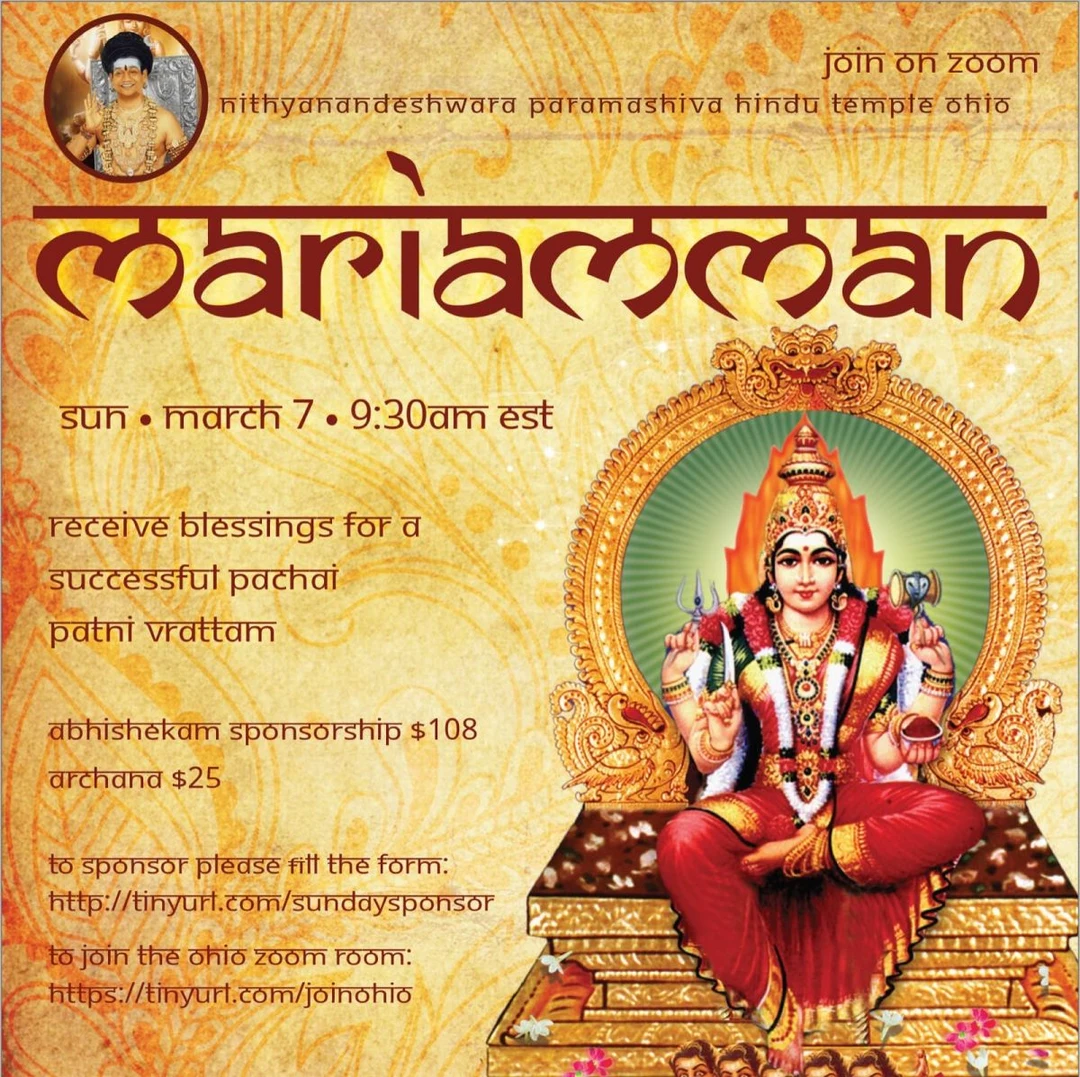
A devotional event poster in warm gold and orange tones with ornate floral patterns. A large central illustration shows the deity Mariamman seated on a golden throne, holding a trident, a damaru-like drum, a bowl and a lotus, adorned with red and gold garments, garlands and jewellery, with a green halo behind her. A small circular inset at top left shows a man with dark hair wearing a dark head covering and a white-and-gold garland, with his hand raised in blessing; the inset is a printed image, not a physical person, and no caption names him. The headline reads Mariamman with event details for online participation.Screenshot of a Zoom video call shared by a participant, showing a slide titled "Unclutching" with the text "Please sit unclutched from all thoughts in total silence" over a soft green bokeh background with a silver cobra statue at left. At right, a bare-chested figure wearing a tall black turban with a white and red tilak, a gold and beaded necklace, and a microphone headset smiles toward the camera; the figure's appearance is consistent with the a person candidate, but identity is uncertain. The right-hand Zoom gallery shows small video tiles and participant name labels including Ma Delmira, Beena Puthalat..., A 26 Denise and Doli. The taskbar displays 21:46 on 07/03/2021 and a browser with several tabs open.

Pictures from the day

9 photosSource gallery
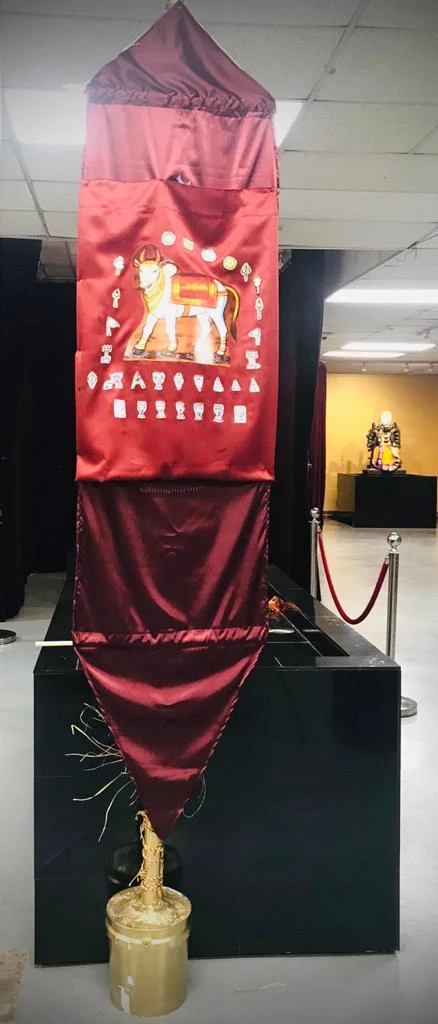
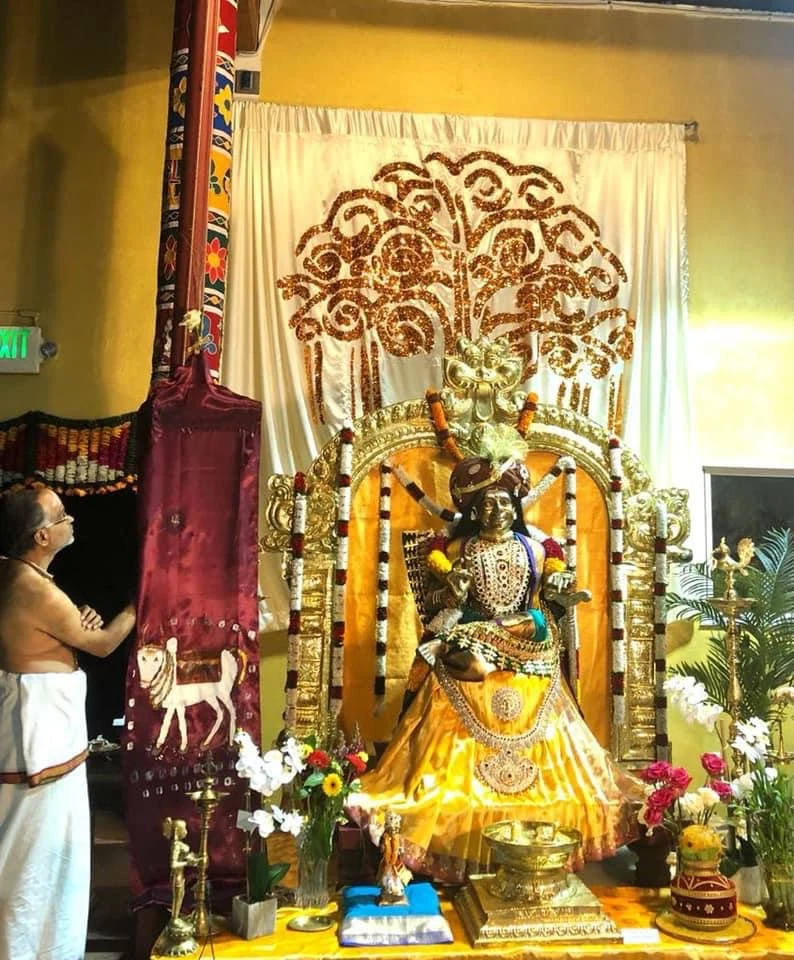
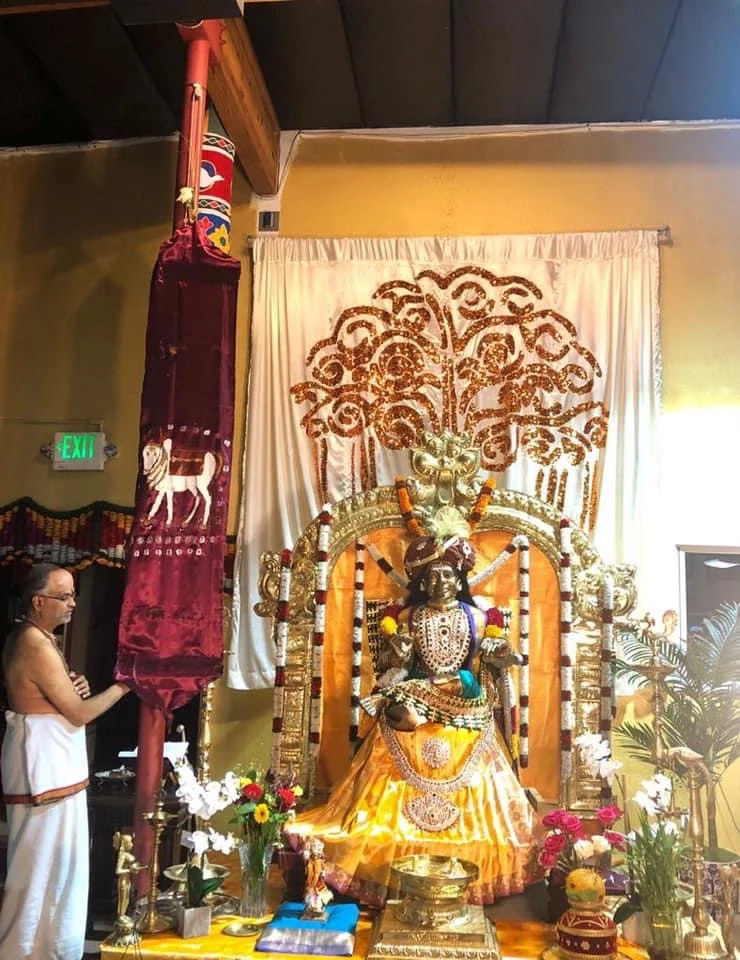
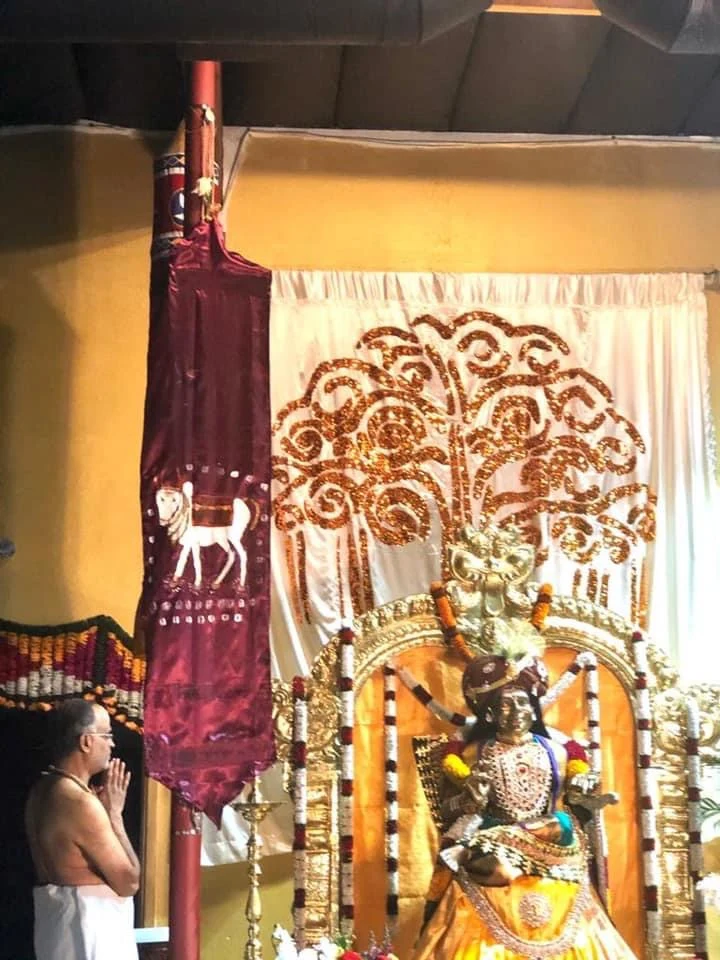
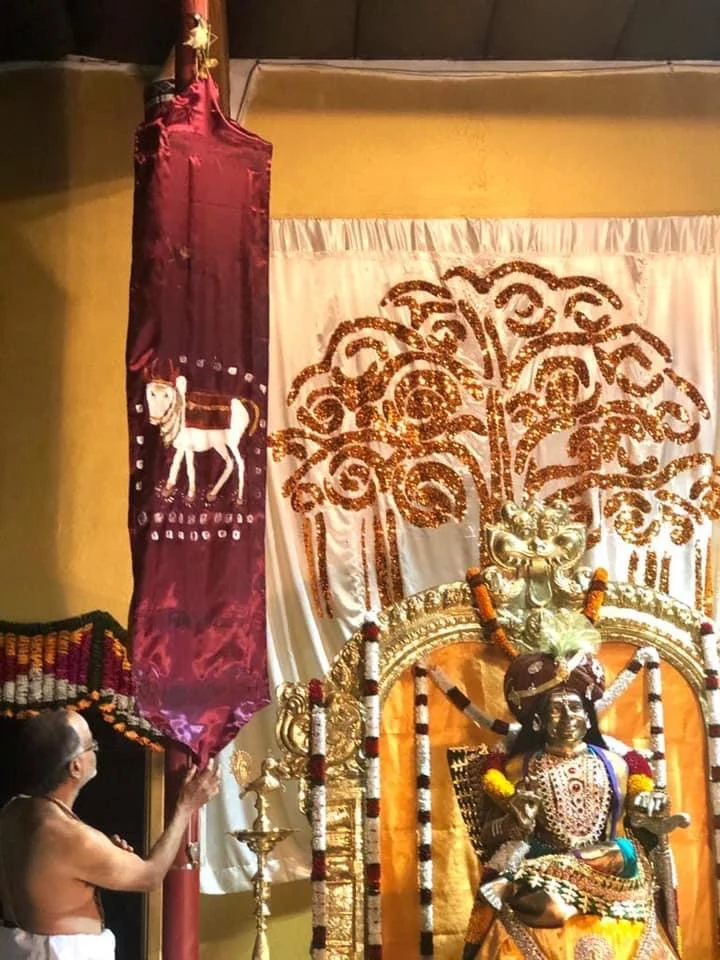
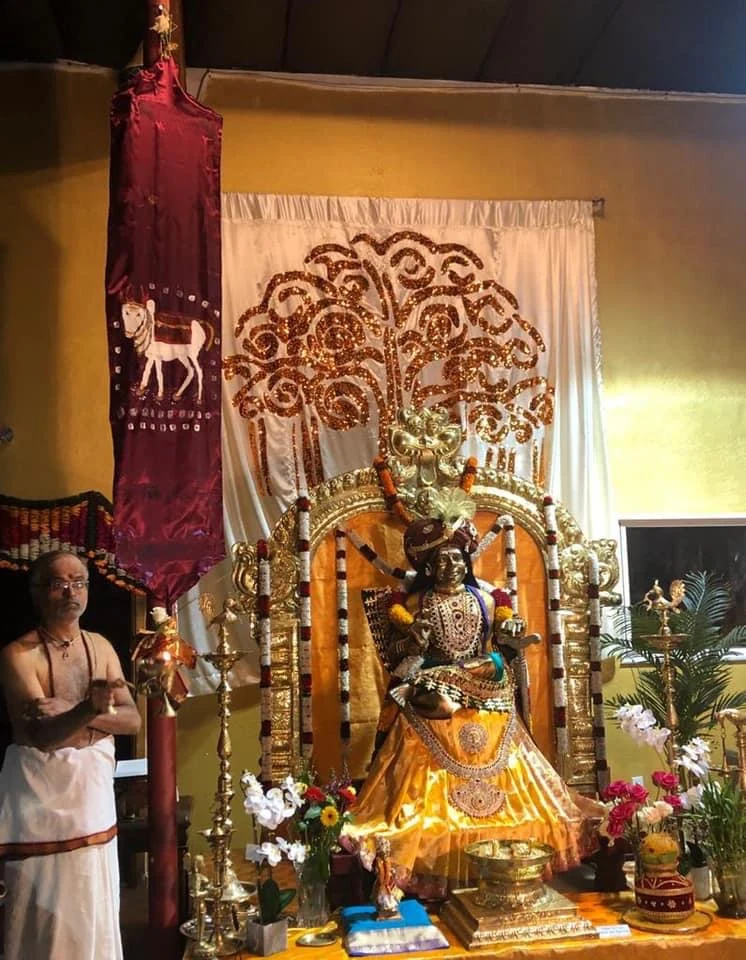
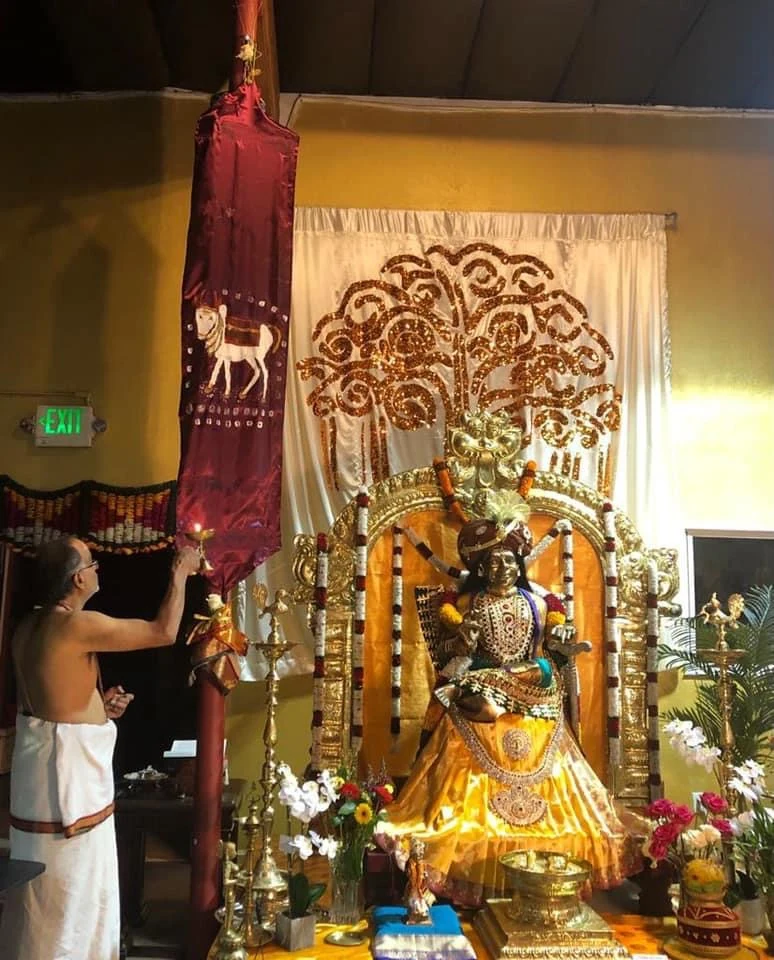
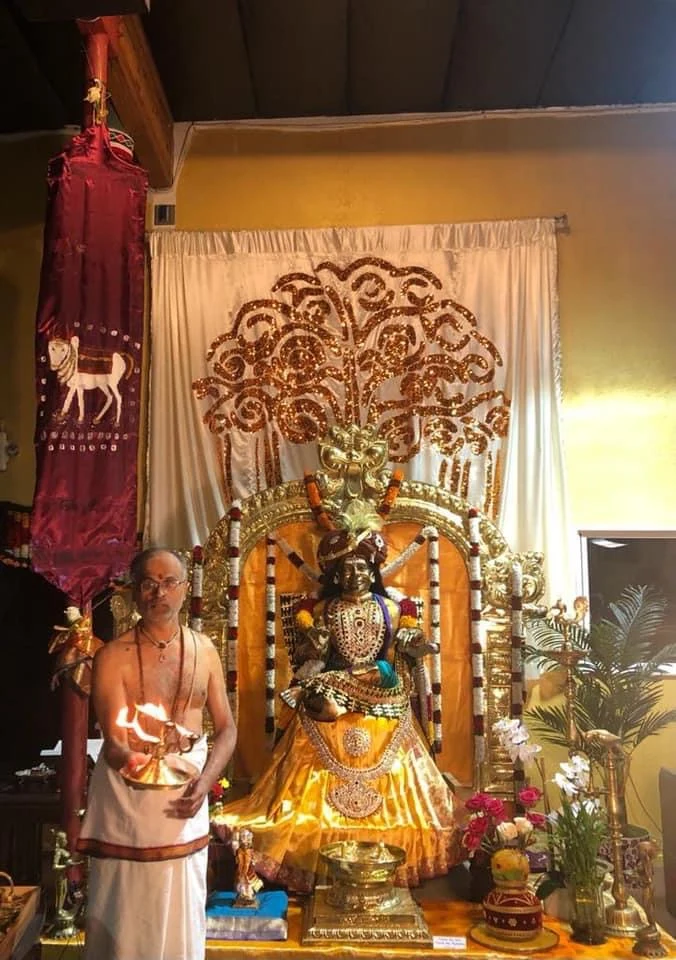
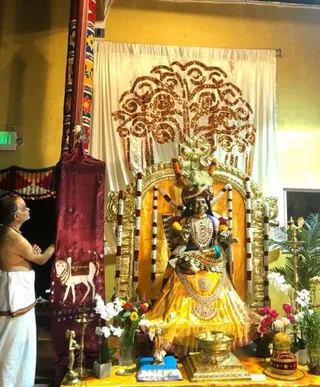
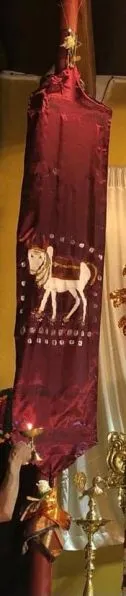
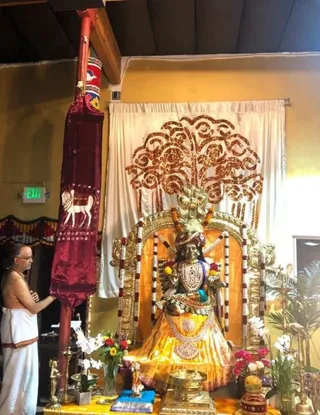
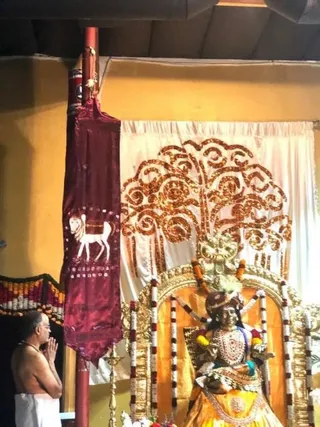
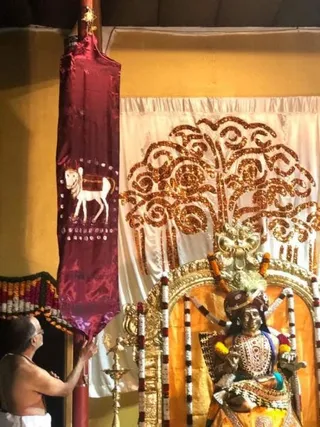
A photograph inside a temple hall for the Mahaparamashivaratri dhvajarohanam at KAILASA San Jose. On the left, a bare-chested man in white dhoti stands before a tall maroon ceremonial banner embroidered with a white bull figure. In the centre is an ornate gold-and-yellow deity murti seated on a golden throne with a crown, jewelled necklaces and garlands of orange and white flowers, backed by a cream curtain with a gold tree-like motif. Brass oil lamps, a brass pot, white orchids and pink roses decorate the altar, and an exit sign hangs on the wall.A tall, narrow photograph of a maroon-red silk dhvaja (ceremonial flag) hanging vertically from a pole with a small gold finial at the top. The flag is embroidered with a white horse figure and small decorative roundels. Brass lamps and a brass vessel stand in the foreground, and a person's hand is partly visible at the left edge holding a lit lamp or flame. The setting appears to be a temple-style room with a white cloth backdrop, consistent with a dhvajarohanam flag-hoisting ritual. The flag is the main subject, with no clearly visible face.Indoor temple photo at KAILASA San Jose during a Mahaparamashivaratri dhvajarohanam. A bare-chested priest in white dhoti with a white upper cloth stands at left, one hand on a tall red pole raising a maroon banner embroidered with a white bull. Behind him, a seated deity murti in gold and orange silk is decorated with a gold crown, jeweled necklaces and marigold garlands, set under a gold arched peetha with a white curtain and gold tree-like motif. Brass lamps, white orchids, red and yellow flowers, potted palms and a kalasha stand on the altar in front. An EXIT sign is visible on the wall.A man in white dhoti and an orange-brown upper cloth stands at left with palms pressed together in namaste before a deity murti. The murti sits on a gold-framed throne decorated with orange and white flower garlands, wearing jewelled ornaments and an ornate crown. Behind it hangs a white curtain with gold sequin scrollwork. A maroon flag with a white animal figure hangs from a red pole, and a brass oil lamp stands at the lower left. The setting is a temple hall with yellow walls and wooden ceiling beams.A priest in white dhoti and shaved head stands at left, hoisting a maroon flag up a tall red pole during a dhvajarohanam flag-hoisting ritual. The flag bears a painted white bull with a decorated saddle cloth. Behind it, a gold-sequined tree motif hangs on a white curtain, and a decorated murti of a deity sits on a gold throne draped with orange-and-white marigold garlands. A brass oil lamp stands on the left and the yellow walls frame the shrine, with garlanded floral borders at left.

Pictures from the day

3 photosSource gallery

FB-Photos-of-the-Day

11 photosSource gallery
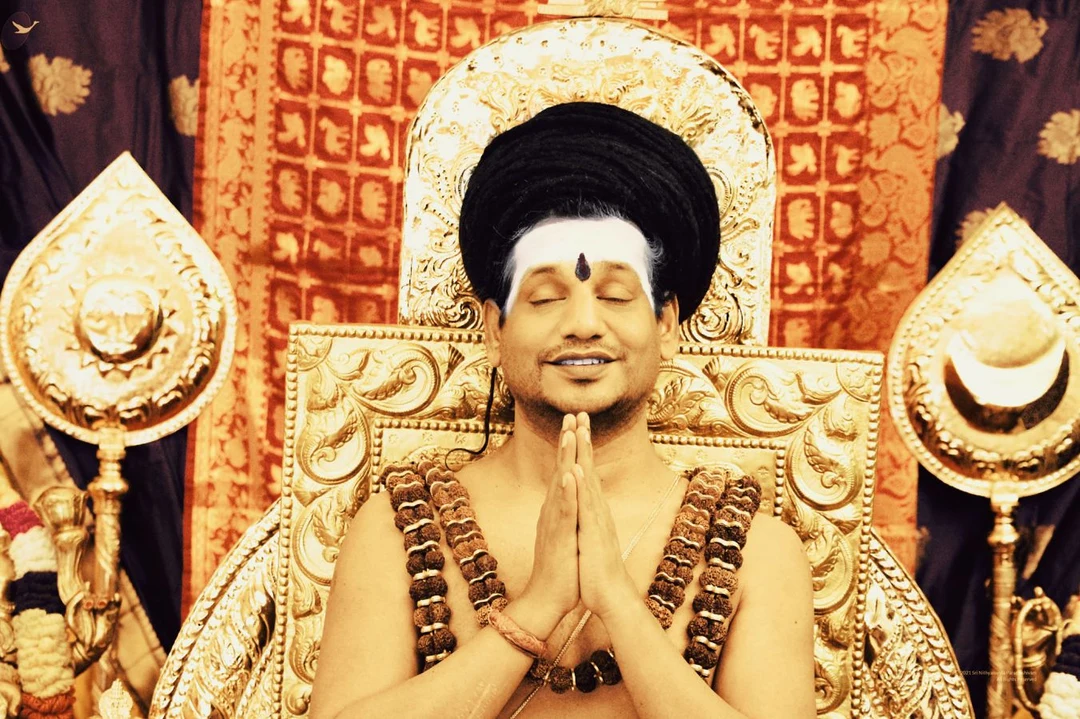
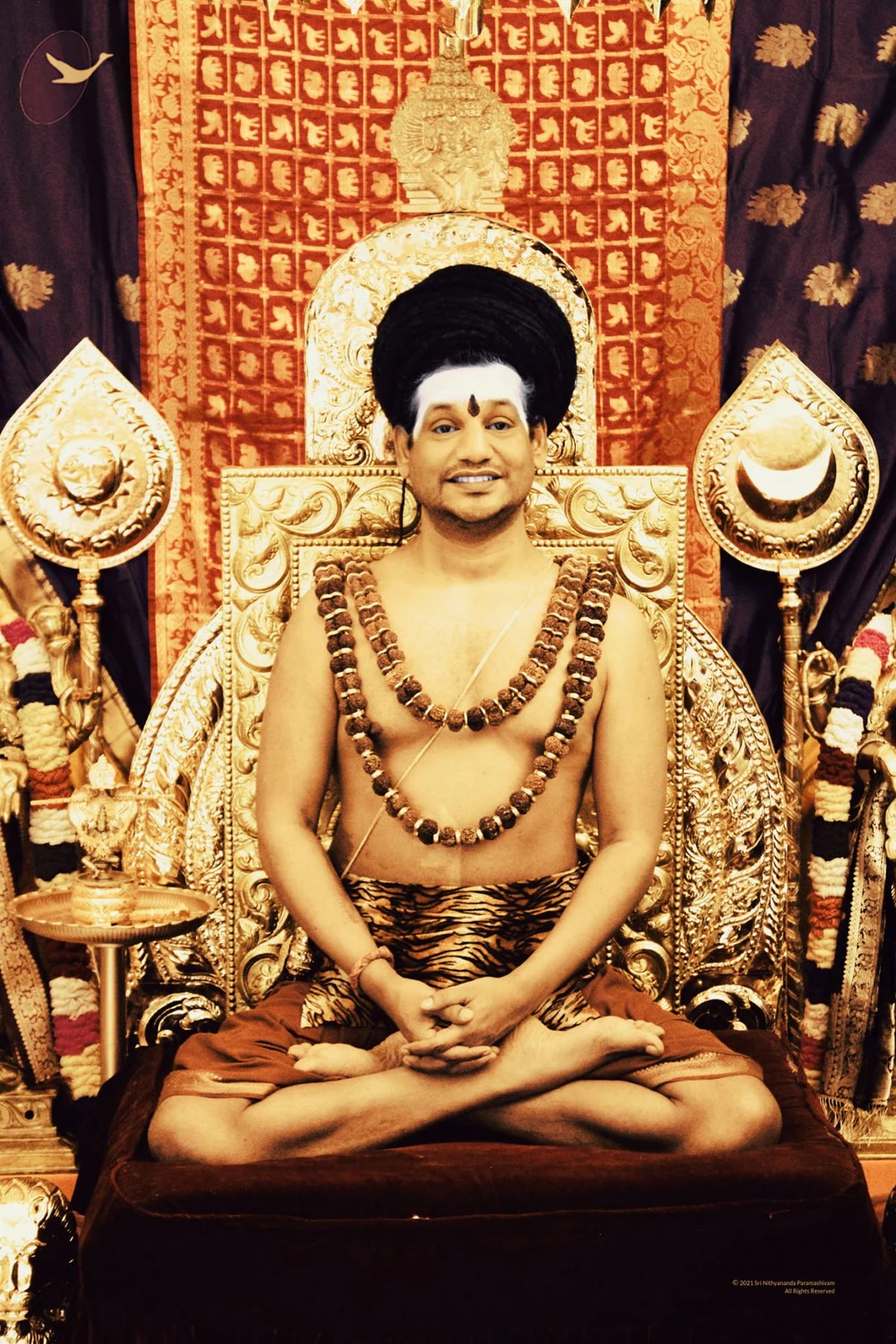
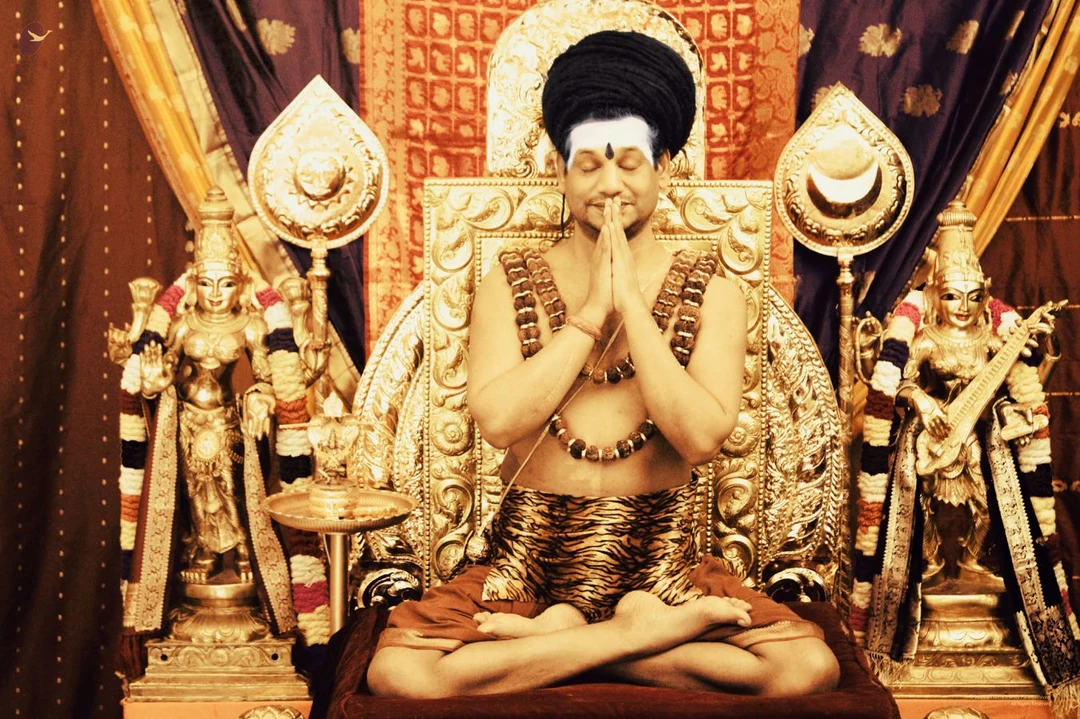
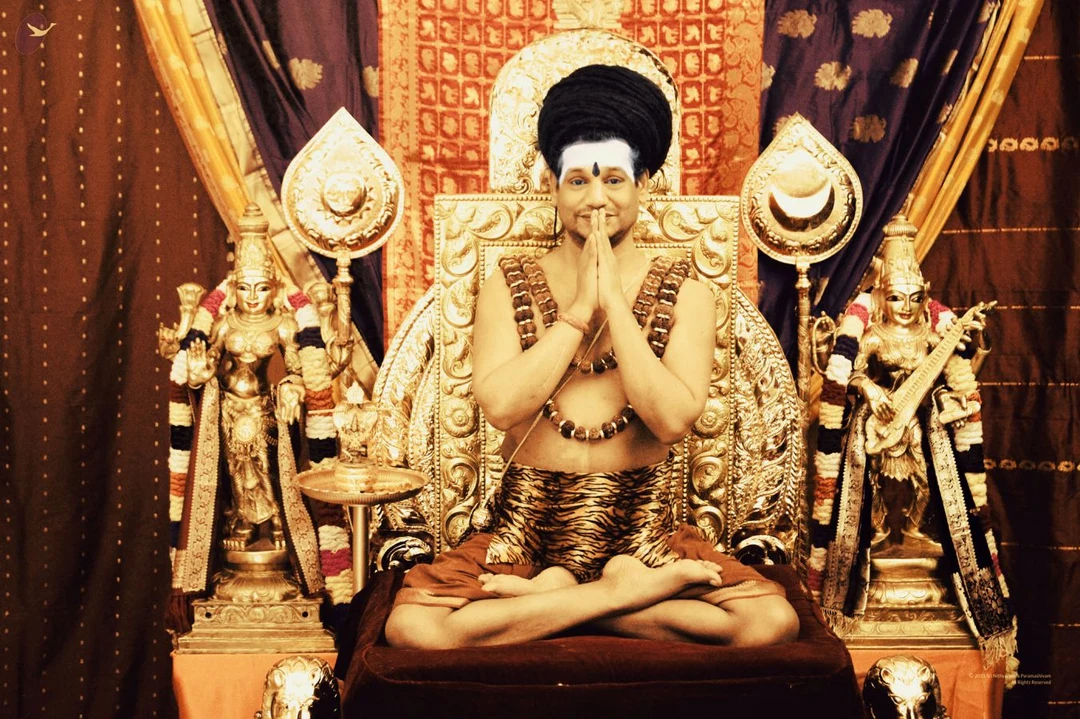
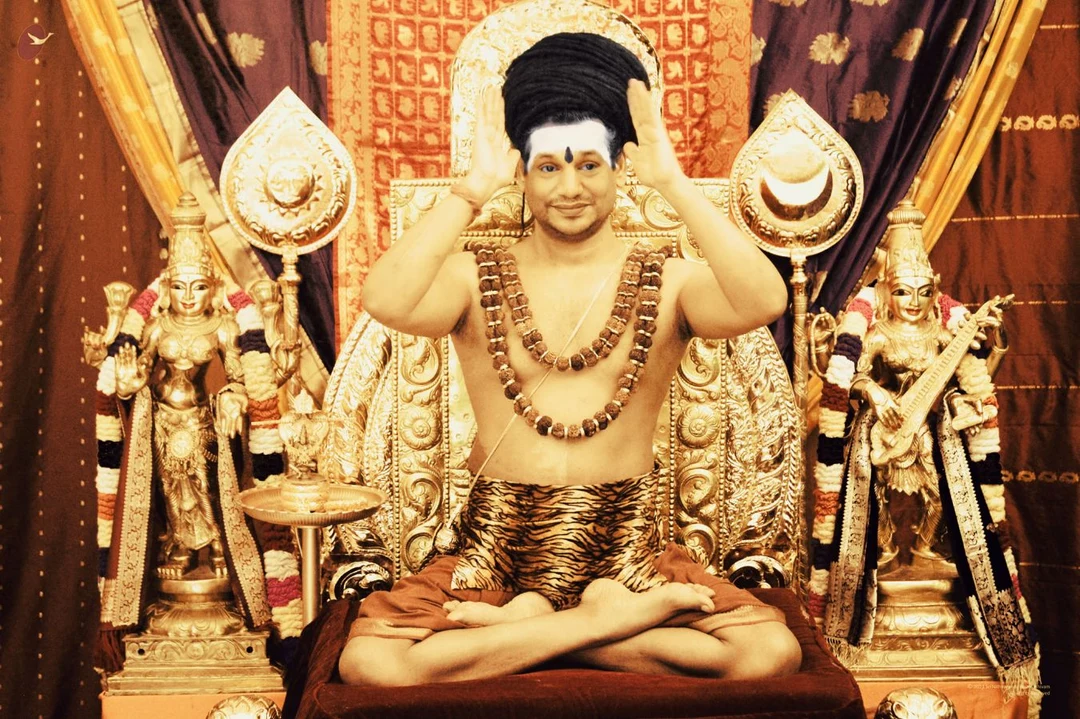
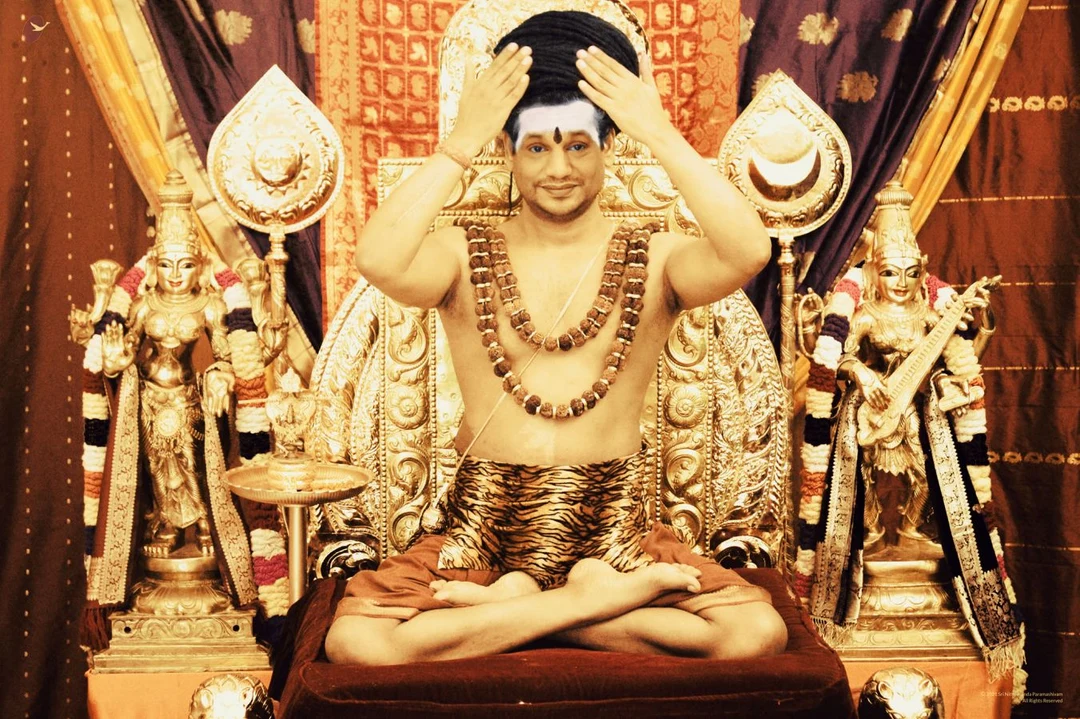
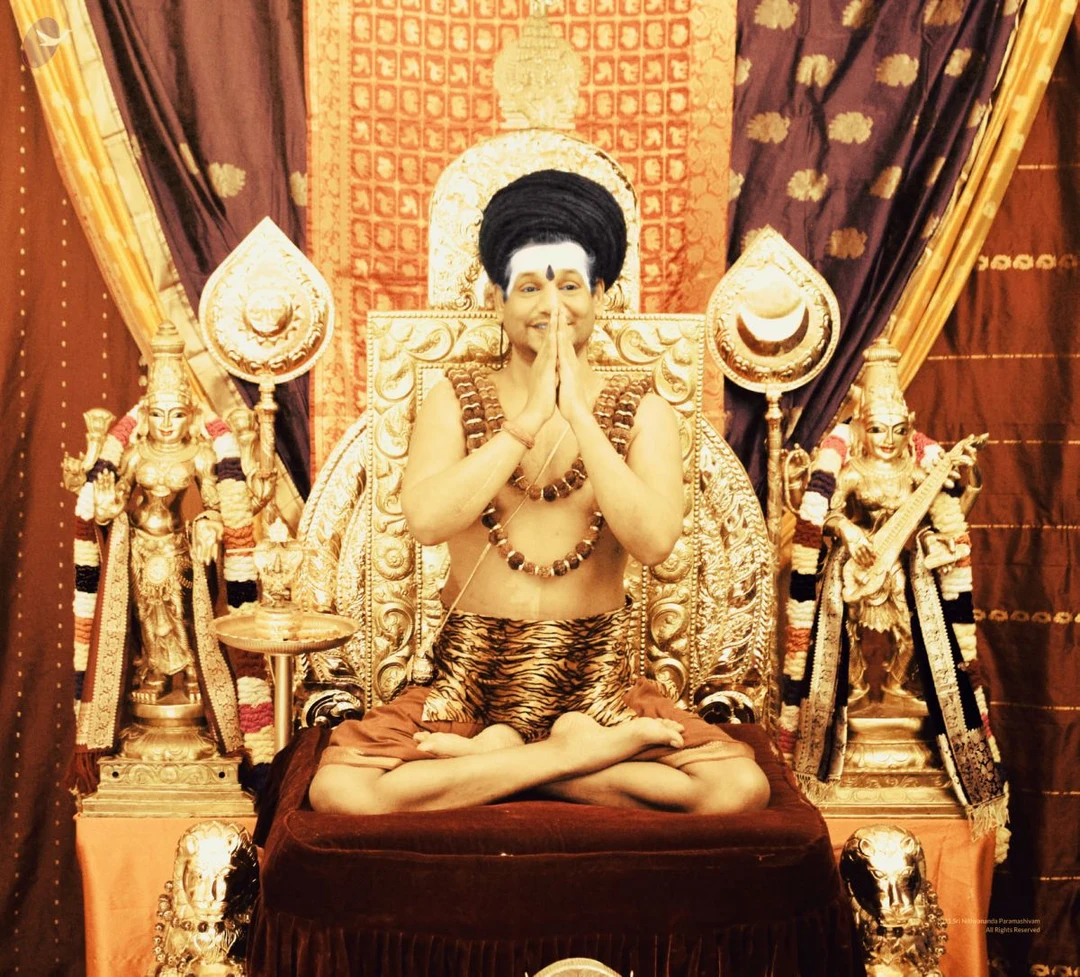
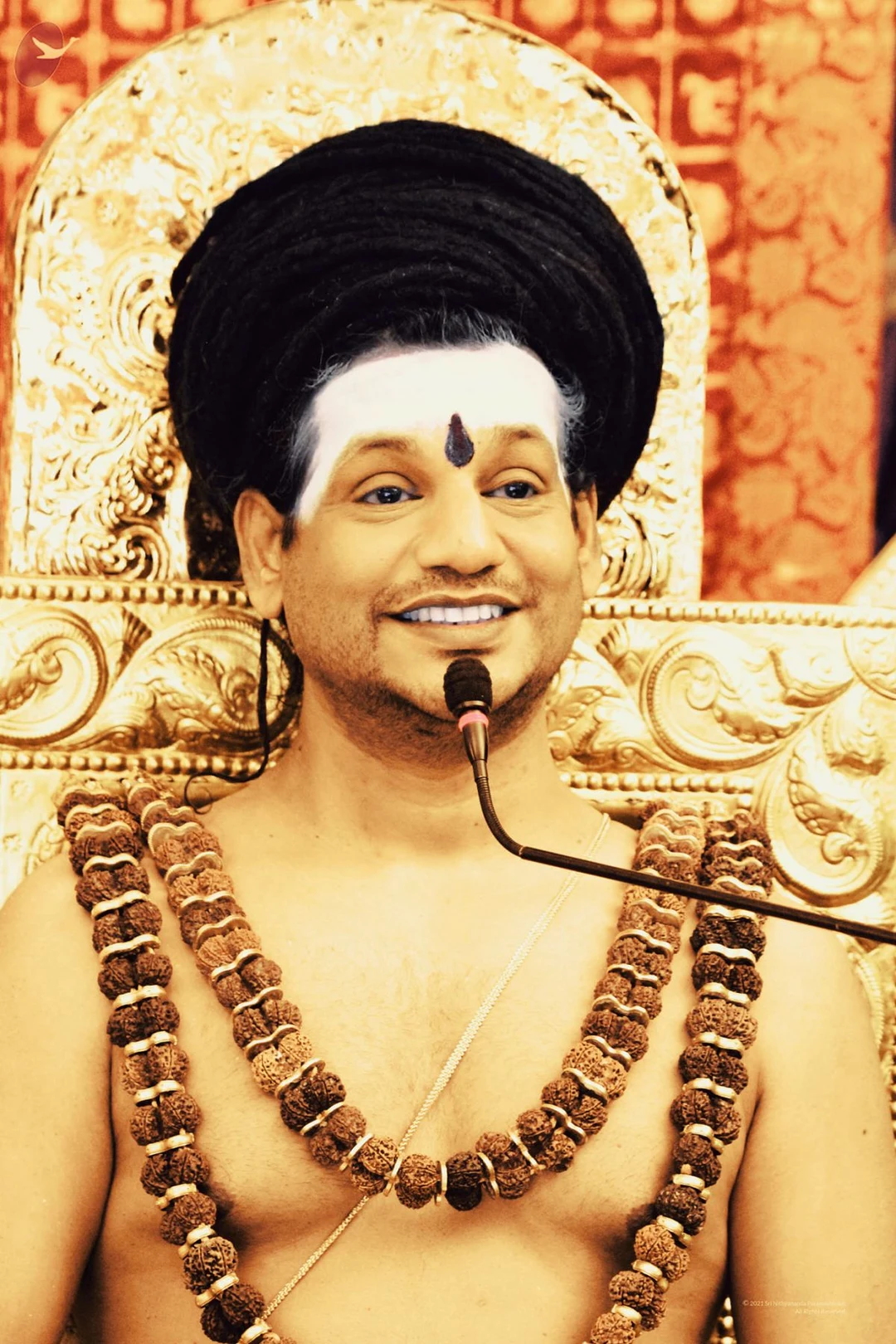
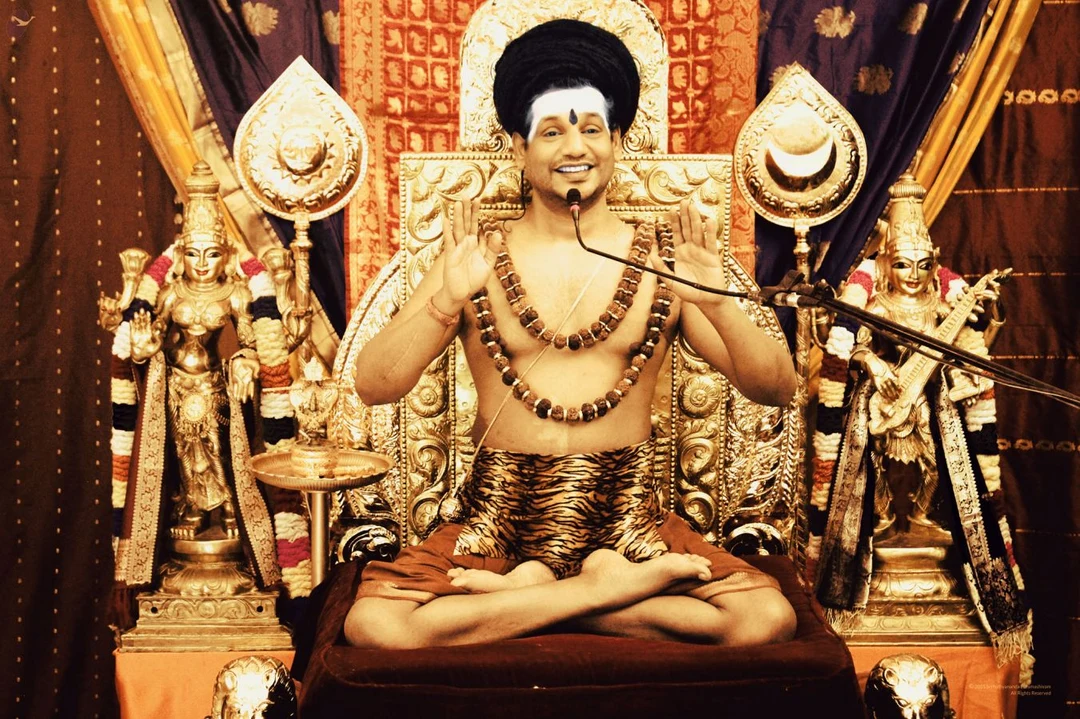
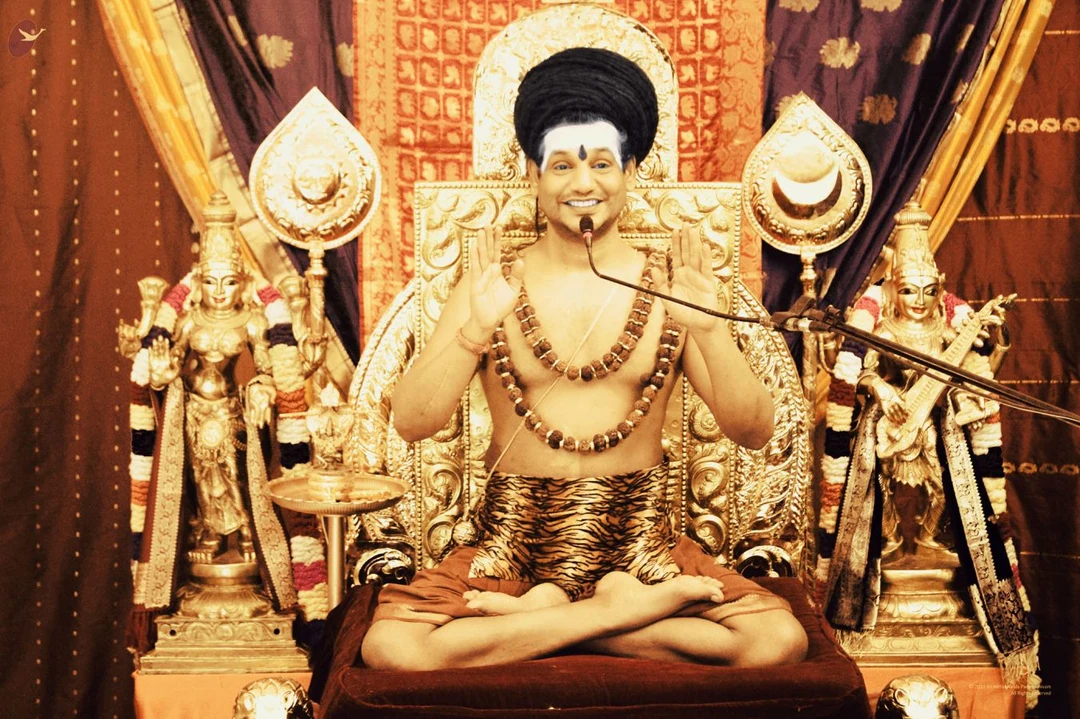
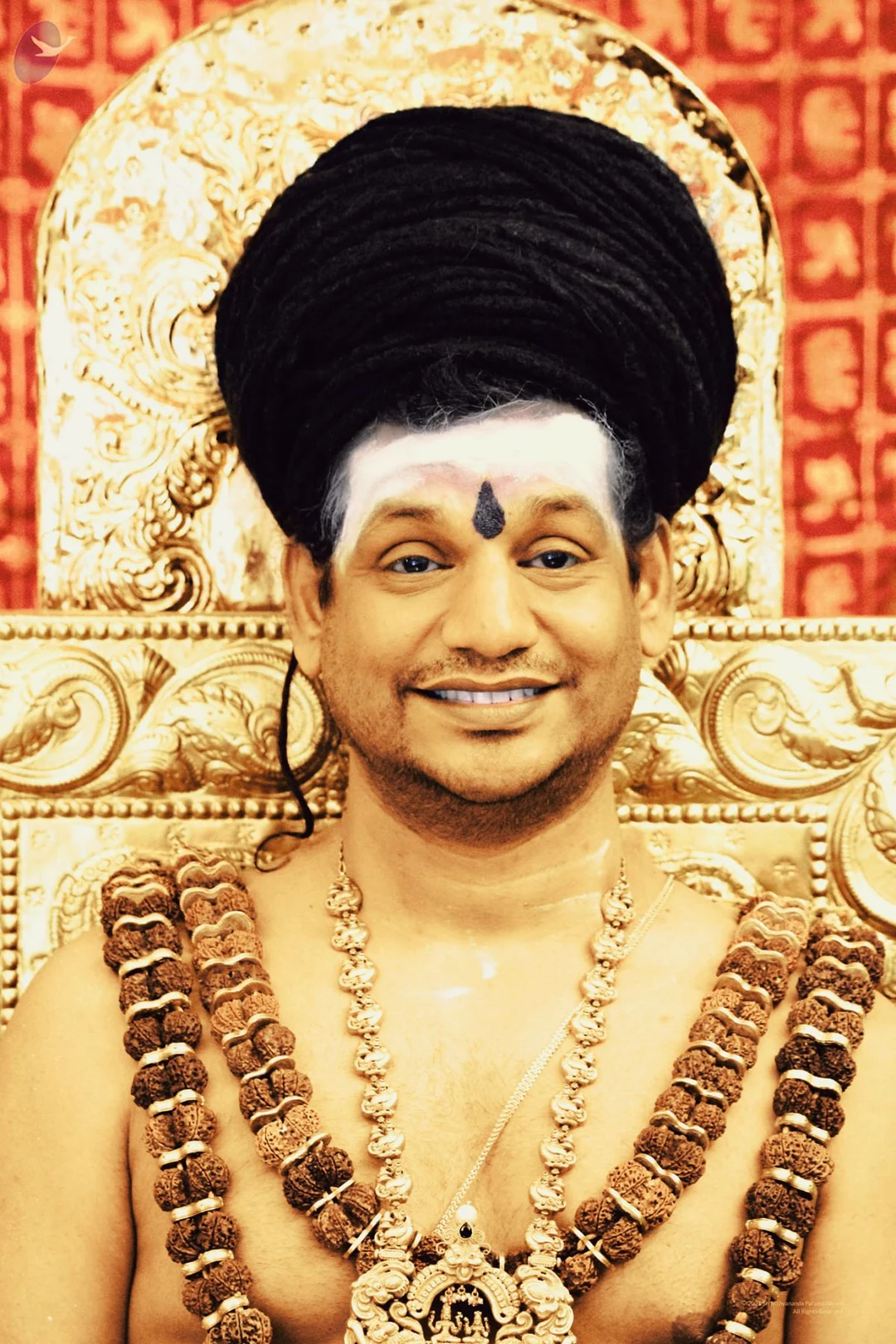
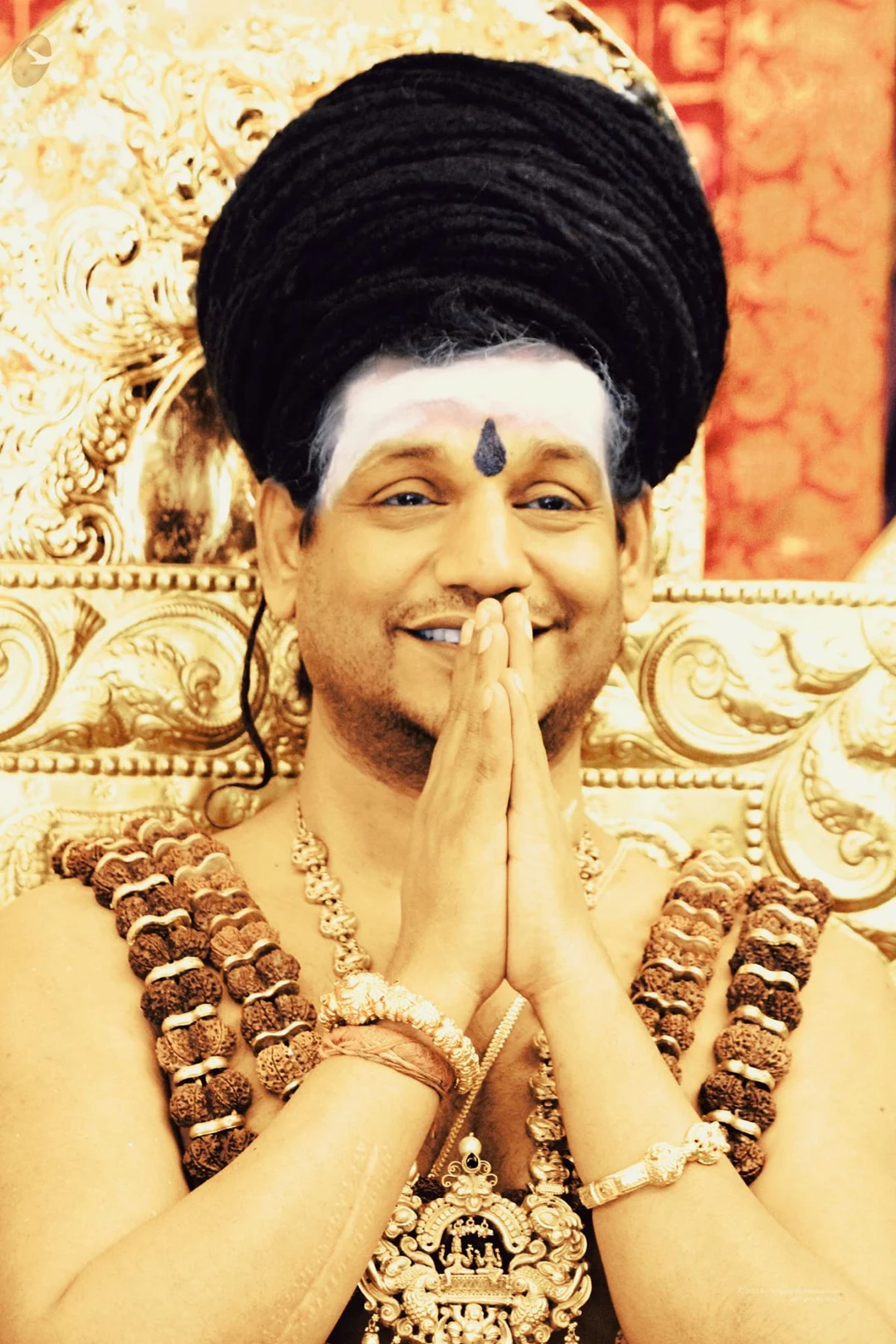
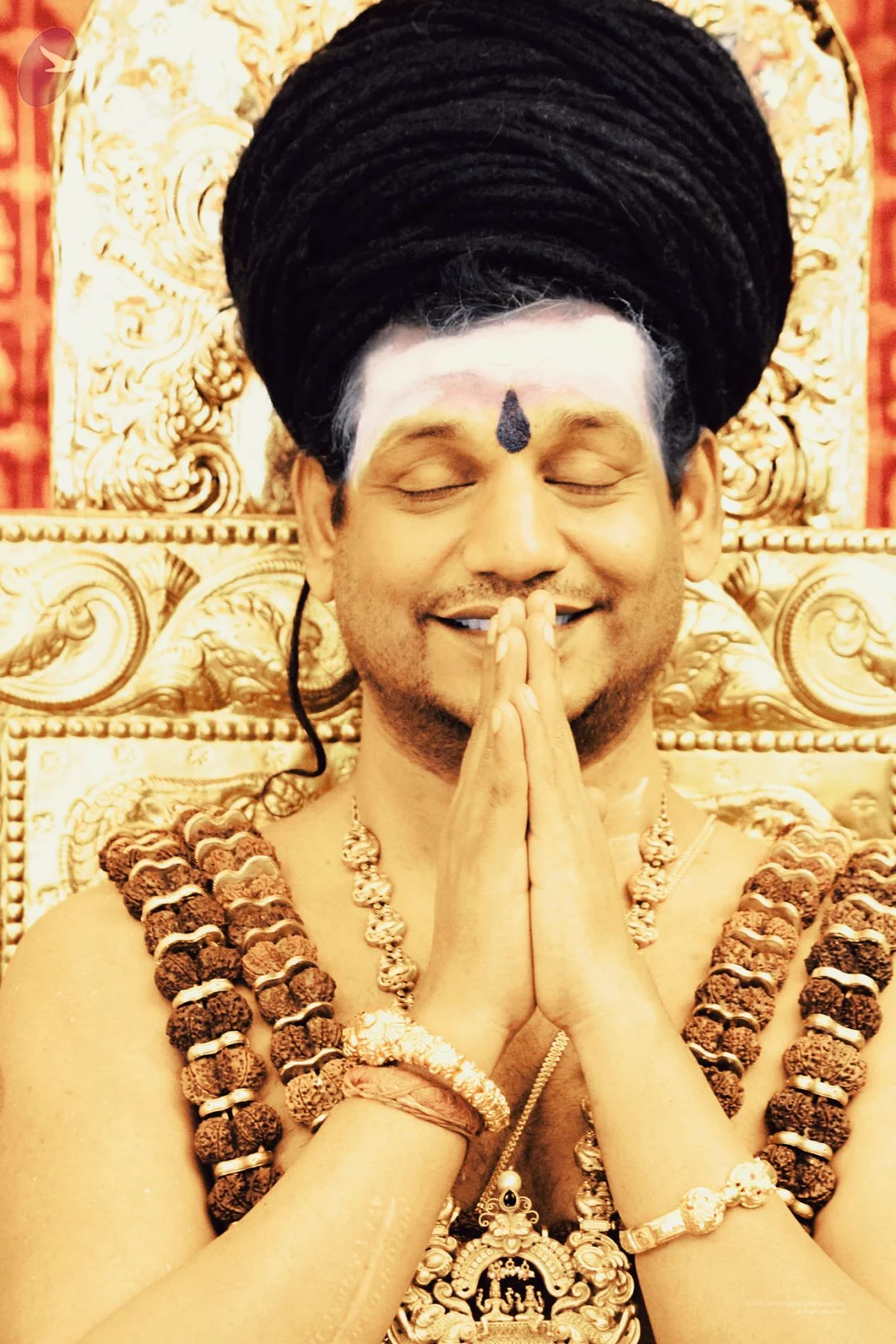
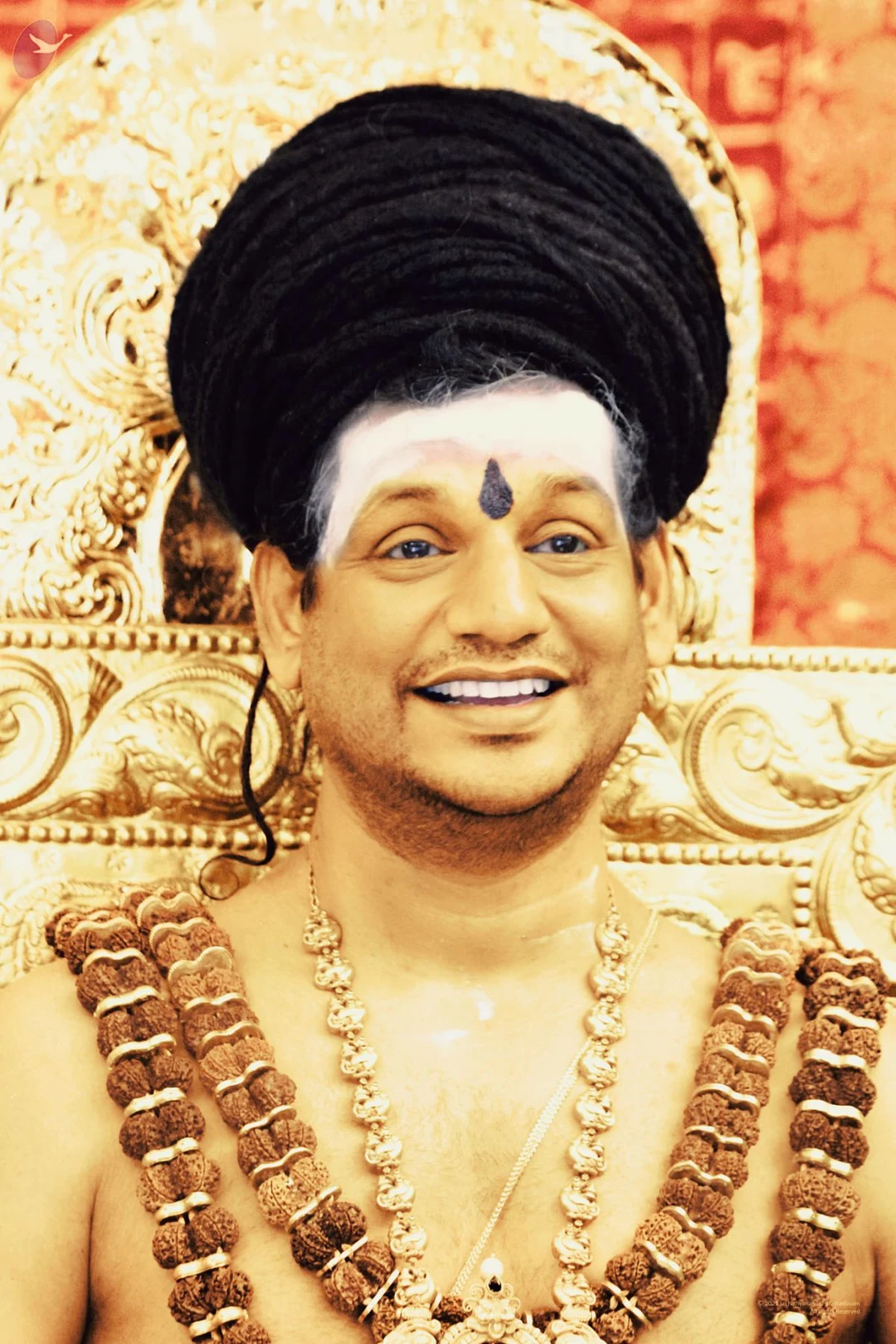
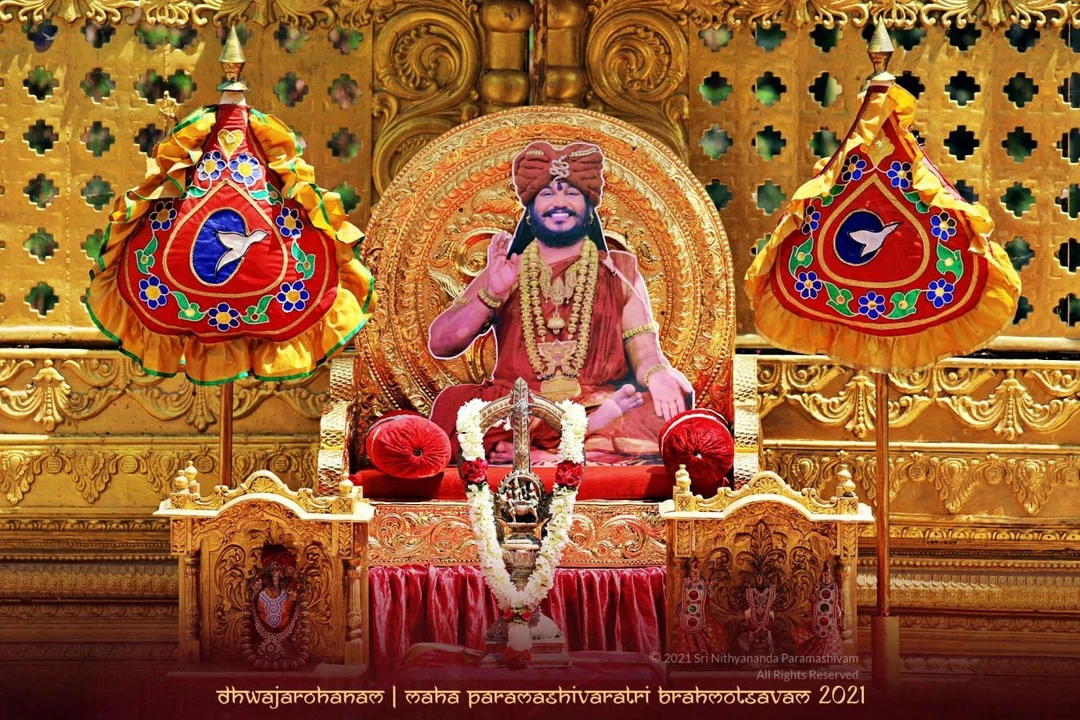
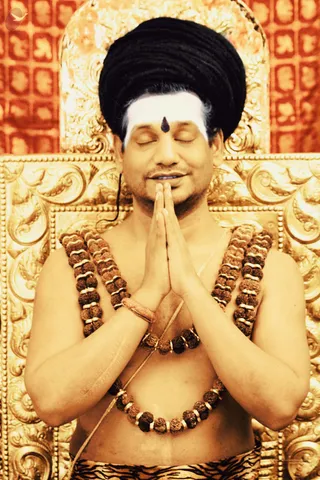
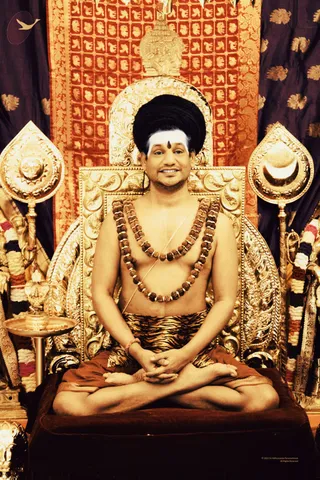
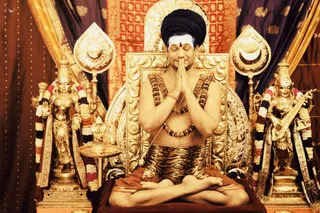
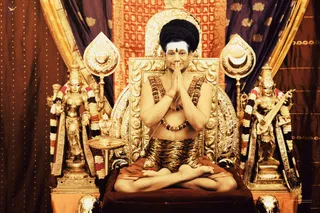
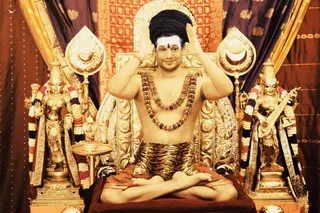
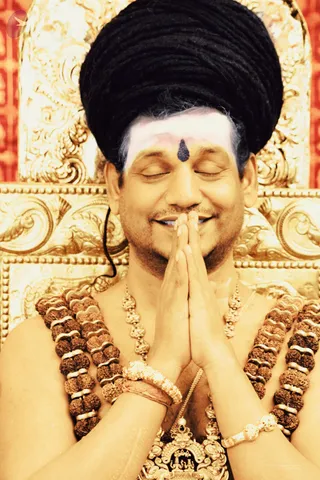
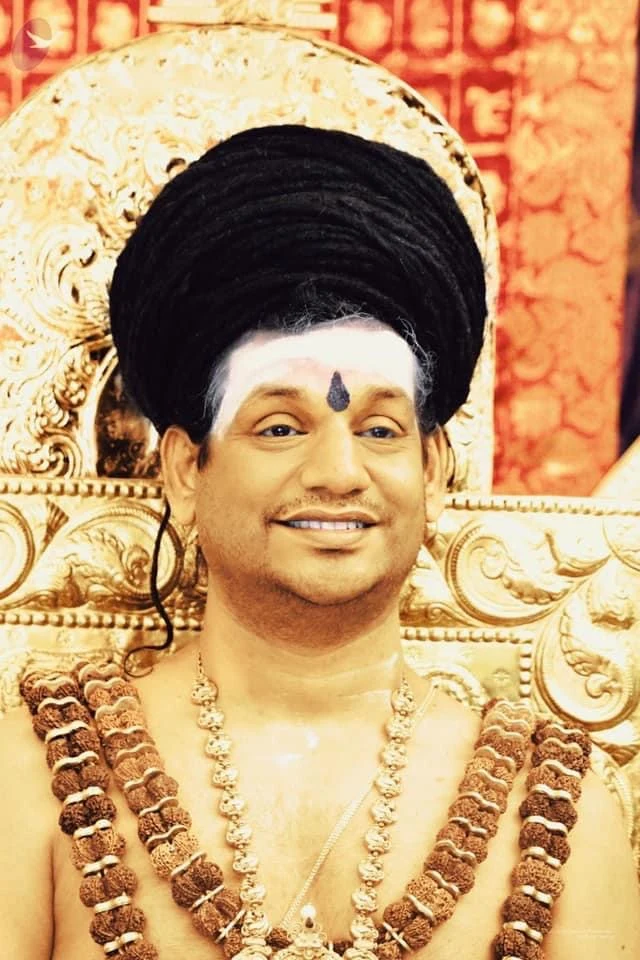
A bare-chested man with eyes closed sits before an ornate gold throne with repoussé scrollwork, hands pressed together in anjali mudra at his chest. He wears a tall black turban-style head covering, a white urdhva-style forehead mark with a dark bindi, multiple strands of rudraksha malas with silver spacers, a gold-coloured bracelet, and a tiger-striped lower garment. Behind him a red and gold patterned backdrop is visible.A bare-chested man with a tall black turban-style hair bun and a white vertical forehead mark with a dark bindi sits on an ornate gold throne with carved scrollwork, palms pressed together in namaste with eyes closed and a faint smile. Multiple rudraksha mala garlands with large beads hang across his chest, and a wrist bead bracelet is visible. Behind him are gold ceremonial fans or umbrella-shaped standards and a red and gold brocade backdrop with a dark purple draped cloth. Flower garlands are visible at the left edge. This appears to be an appearance-based candidate for Swamiji (probable), with long swept hair in a turban style, a bare chest, rudraksha malas and ornate gold throne setting.A seated man sits cross-legged on a dark velvet cushion before an ornate gold throne with a red and gold patterned backdrop. He is bare-chested with a long tiered rudraksha mala draped across his chest, wears a tiger-striped lower garment and a rust-coloured cloth, and has a black swept-back hair bun, white vibhuti band and red tilak on his forehead. Flanking the throne are large gold peacock-style fan finials with a sun and crescent motif, and a brass oil lamp stands at left beside garlands of white, red and dark flowers. Per the page, this is Swamiji, and the cues of long swept-back hair, rudraksha malas and ceremonial throne fit that description; the seated man is the primary subject, identified as Swamiji (probable).A bare-chested man with a tall black turban-style hairstyle sits cross-legged on an ornate gold throne with his palms pressed together in namaskar and eyes closed. He wears a white forehead band with a red bindi, a tiger-striped cloth around his waist, and multiple rudraksha mala strands across his chest. Golden deity statues flank the throne, including a standing figure on the left and a figure holding a veena on the right, both draped with multicolored flower garlands. A brass lamp stands in front of the throne, with gold and purple drapes and an orange brocade backdrop behind. Swamiji (probable) is seated on the throne, identified by the distinctive turban-style hair, rudraksha malas and ornate ceremonial setting.A seated man sits cross-legged on an ornate golden throne (peetha) with gilded carved backrest and armrests, bare-chested, with a tiger-striped golden-brown cloth wrapped at the waist and a dark rudraksha mala draped across the chest and a second mala at the neck. He has a large black swept-up hairstyle, white forehead paste with a red dot, and presses his palms together in namaste with a smile. Flanking the throne are two golden deity statues garlanded with multicoloured flowers: on the left a standing figure holding a conch-like object, on the right a figure playing a veena. A brass lamp stands in front of the throne, and deep purple and gold draped fabric forms the backdrop.A seated man with long dark hair piled high, bare-chested, wearing a tiger-striped gold lower garment and a rudraksha mala with a second bead necklace, sits cross-legged on a red cushioned seat before a gold-carved throne. He raises both hands beside his head in a blessing gesture, with a white and red tilak on his forehead. Two gold deity statues flank him: on the left a female figure with raised hand and kumkum-marked dress, on the right a figure playing a veena, both draped in flower garlands. A brass oil lamp stands at left, and purple and gold draped cloth fills the background. Appearance-based label: a person, seated on the throne as the central figure, with long swept hair, rudraksha malas and ornate tiger-striped clothing as the qualifying cues.

FB-Photos-GLIMPSES OF DVAJAROHANAM FOR MAHA PARAMASHIVARATRI IN KAILASA
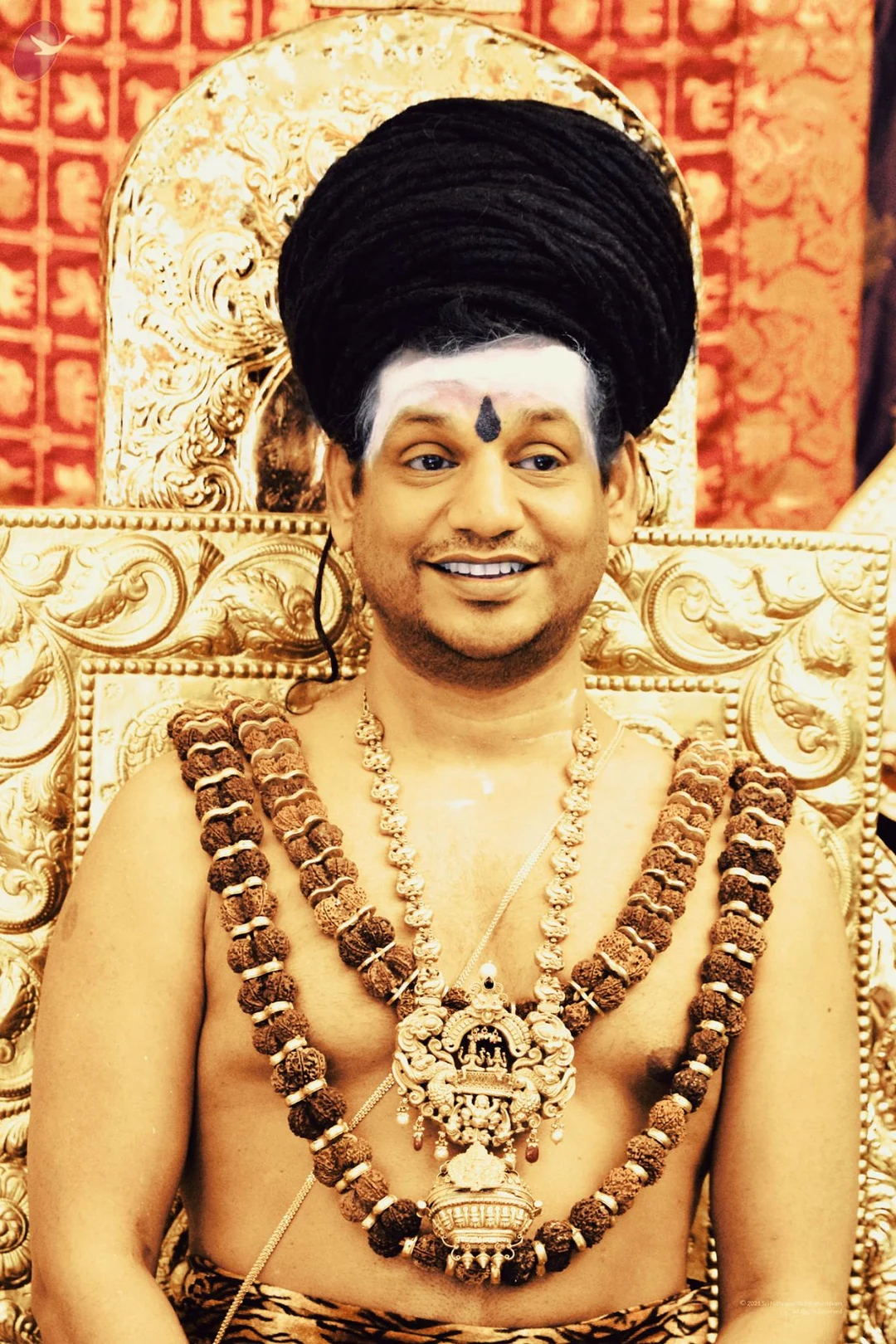
33 photosSource gallery
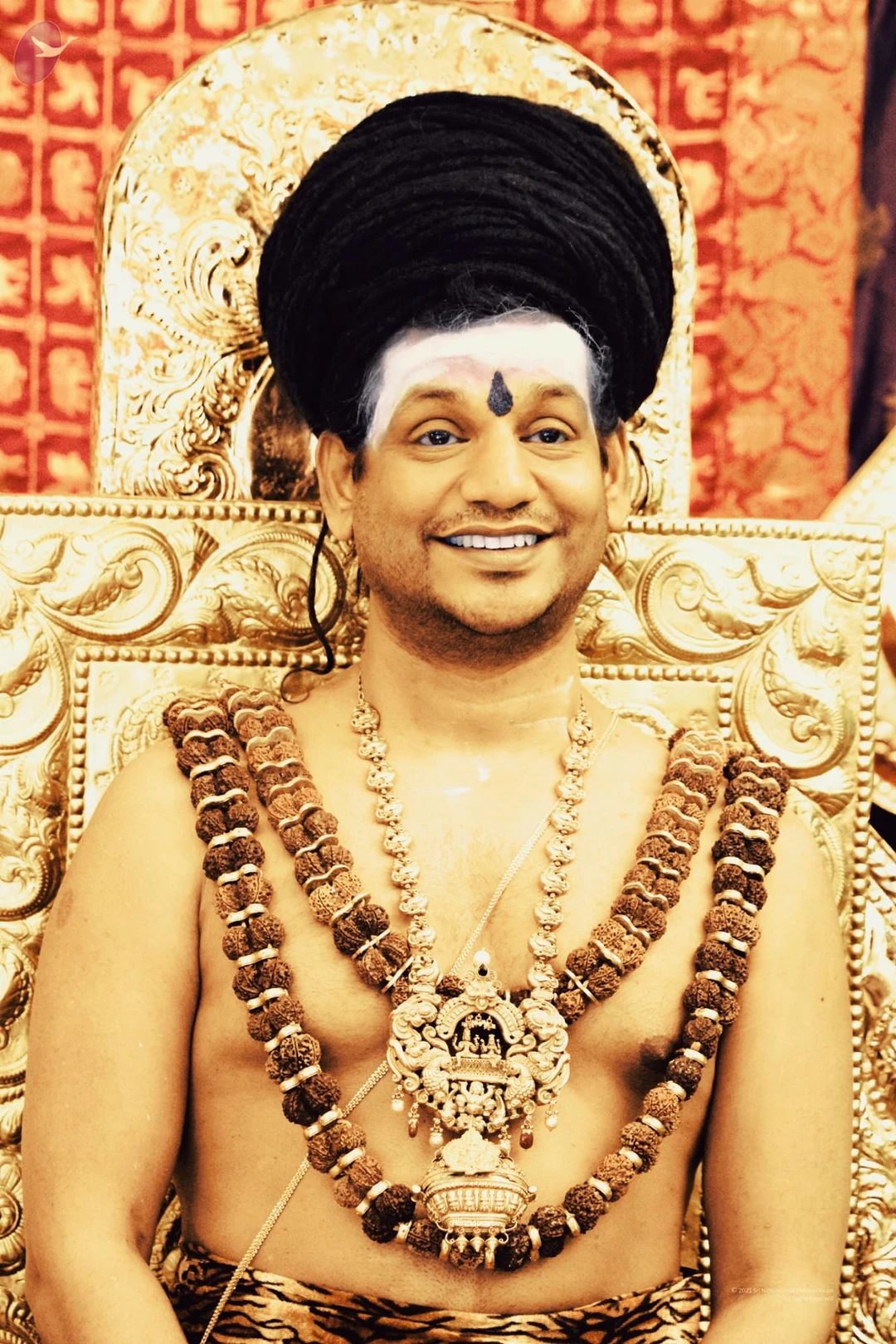
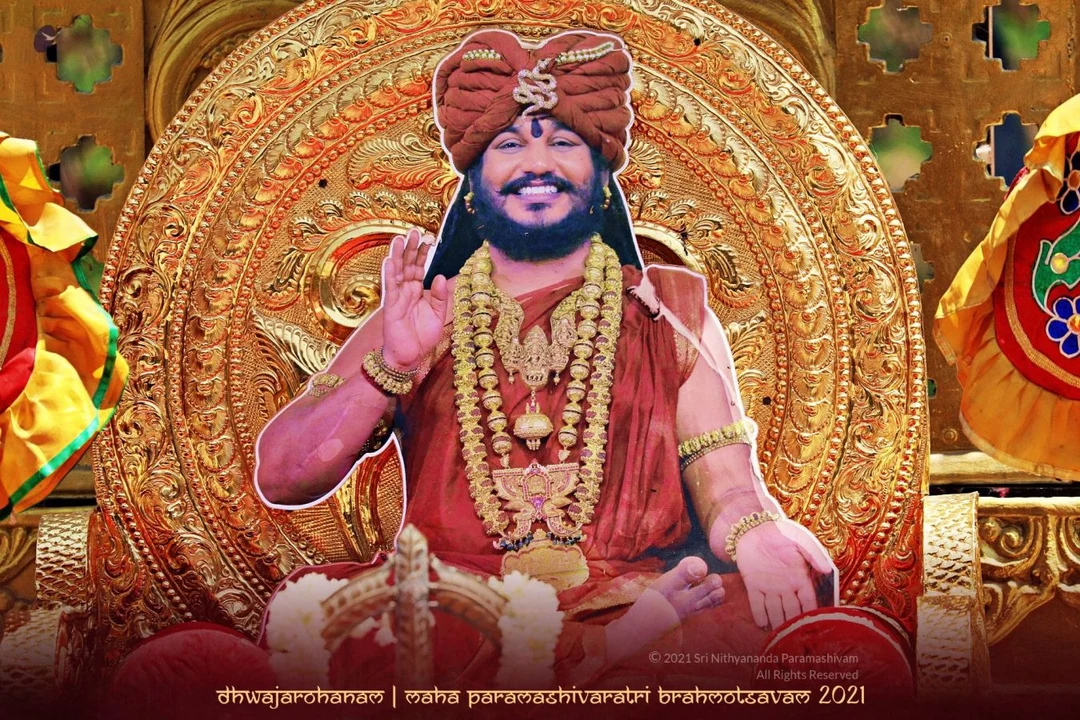
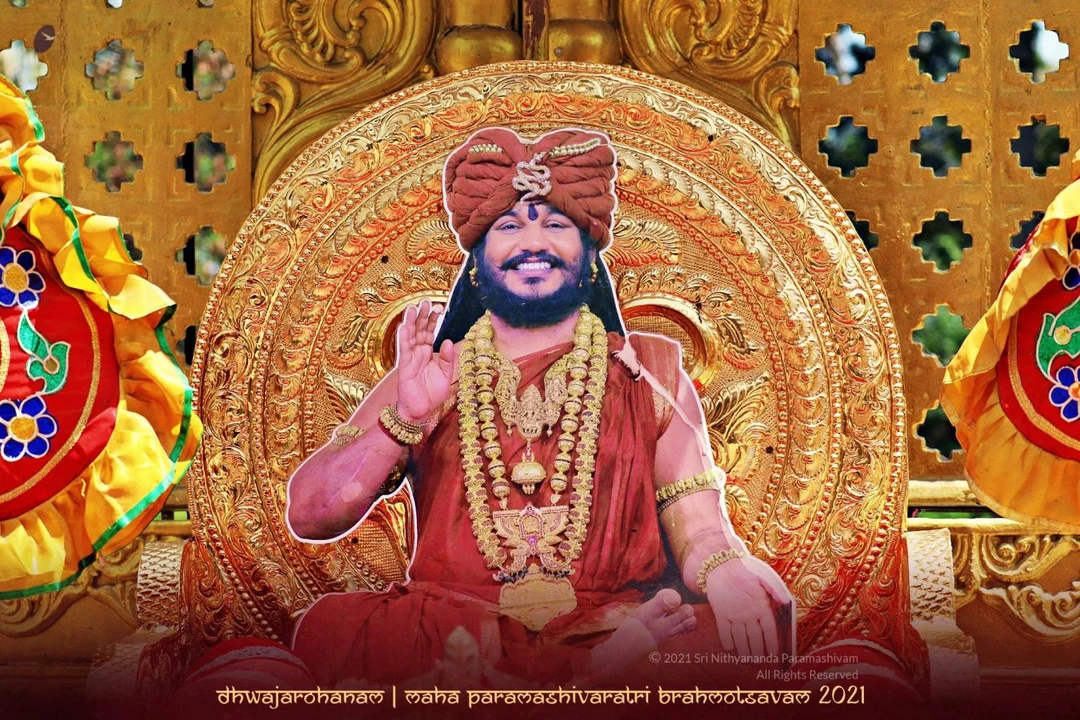
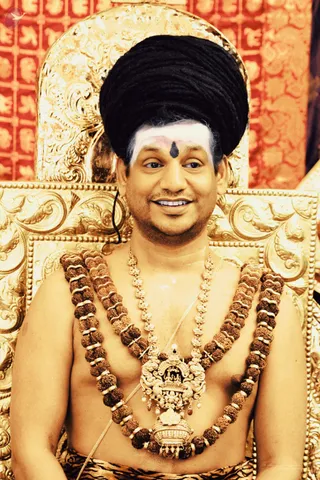
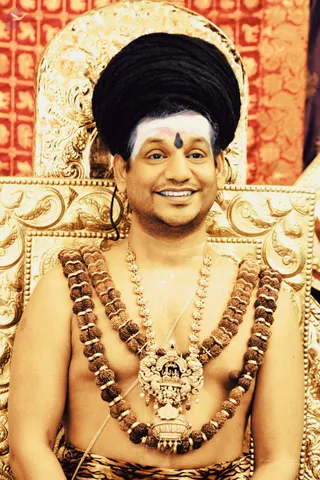
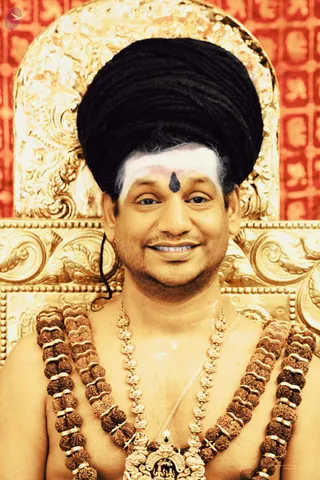
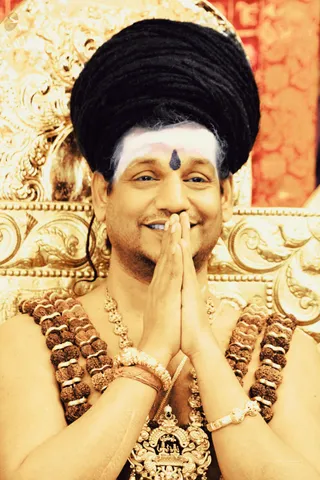
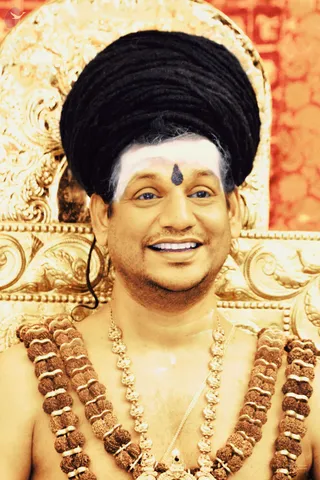
A smiling bare-chested man sits on an ornate gold throne with carved floral scrollwork, against a red and gold patterned backdrop. He wears a tall black turban-style head covering, a white vertical tilak with a dark bindi-like mark on his forehead, multiple tiers of brown rudraksha malas with silver spacers, and a large ornate gold pendant with a deity figure on the chest. A patterned tiger-striped cloth is wrapped at his waist. Swamiji (probable): the sitter has long dark hair swept into a crown-like turban, saffron-free ceremonial gold jewellery and rudraksha malas, seated on a throne in a ritual setting.A seated man sits on an ornate gilded throne with carved floral scrollwork, against a red and gold patterned backdrop. He has a tall black cloth turban, white vertical tilak on the forehead with a dark bindi, and smiles broadly. He is bare-chested, wearing multiple rows of rudraksha malas with silver spacers and an ornate gold pendant necklace with a deity motif, plus a tiger-print cloth around the waist.Close portrait of a bare-chested man seated on an ornate gold throne against a red patterned backdrop. He wears a tall, wound black hair crown, white vertical forehead markings with a dark central bindi, and multiple rudraksha malas layered over his chest with gold beads and a large gold pendant ornament. He smiles at the camera. The image is a single person and no printed names are visible.A smiling bare-chested man with a large coiled black crown of hair sits before an ornate gold throne, pressing his palms together in anjali mudra. He wears a white forehead mark with a dark central bindu, multiple rudraksha malas across his chest, a heavy gold necklace with a carved pendant, and gold bangles on his wrists. Behind him, red and gold decorative fabric fills the background. The man is shown in a close, frontal portrait.A close-up photograph of a man seated before an ornate gold throne with red drapery behind it. He has his eyes closed and palms pressed together in anjali mudra, smiling. He wears a tall black cloth turban-like head covering, a white forehead marking with a dark bindu, multiple rudraksha malas across the chest and shoulders, a gold necklace with a large ornate pendant, and gold bracelets on his wrists. Bare-chested, with a saffron-toned wrap visible at the arm. a person by visible cues: tall dark head covering, rudraksha malas, and ceremonial gold adornments, shown in a seated, honoured posture on a throne.Close-up photo of a smiling bare-chested man seated before an ornate gold throne with carved scrollwork and a red patterned backdrop. He wears a large black turban-style headwrap, a white forehead marking with a dark vertical tilak, and multiple rudraksha malas with gold spacers across his chest, plus a gold chain with a pendant. The image is a candid portrait of a single person in a ceremonial setting.

Glimpses of Dwajarohanam for Maha Paramashivaratri at Arunachala Sarvajnapeetham, Thiruvannamalai, Tamilnadu, India

6 photosSource gallery
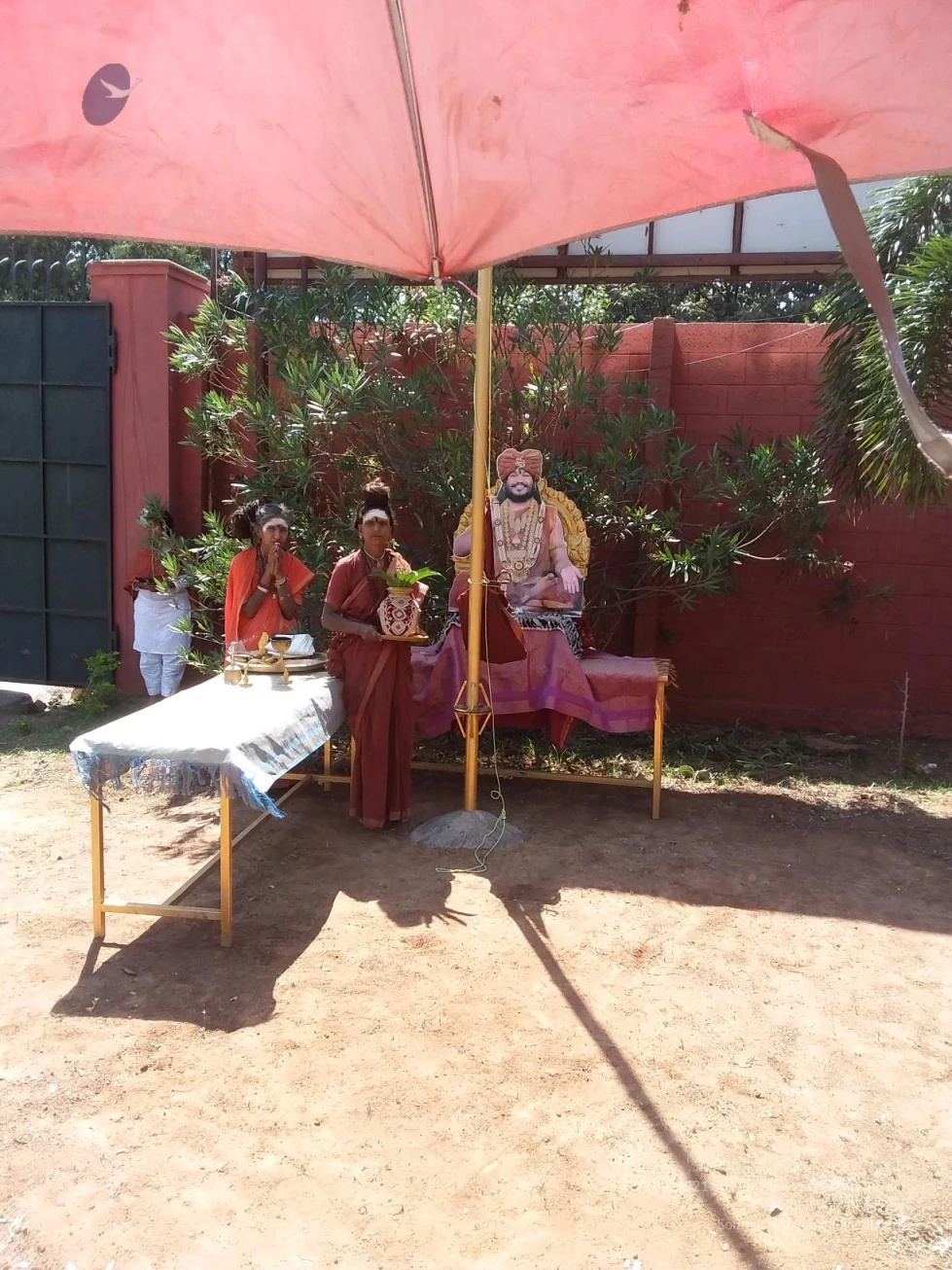
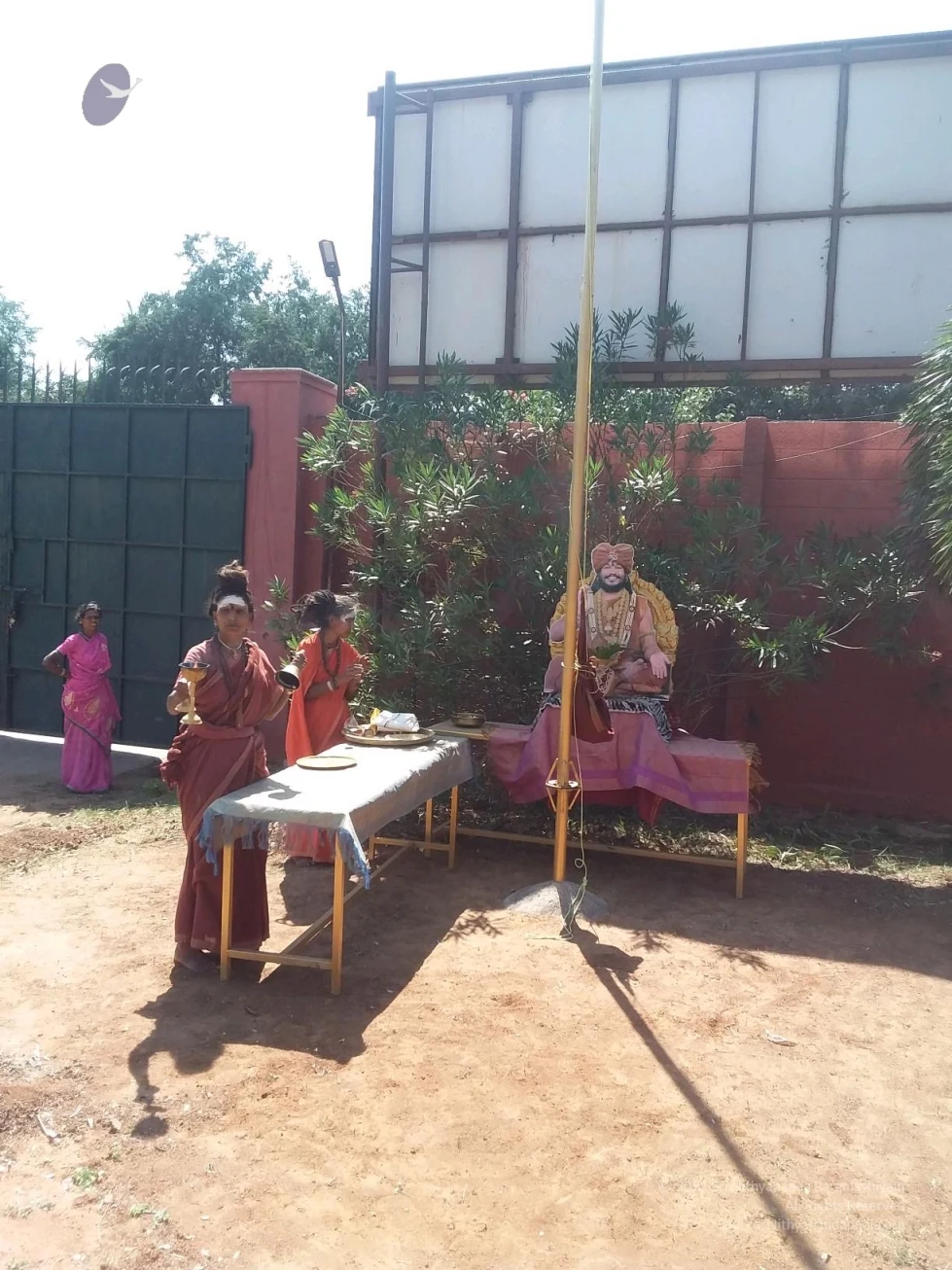
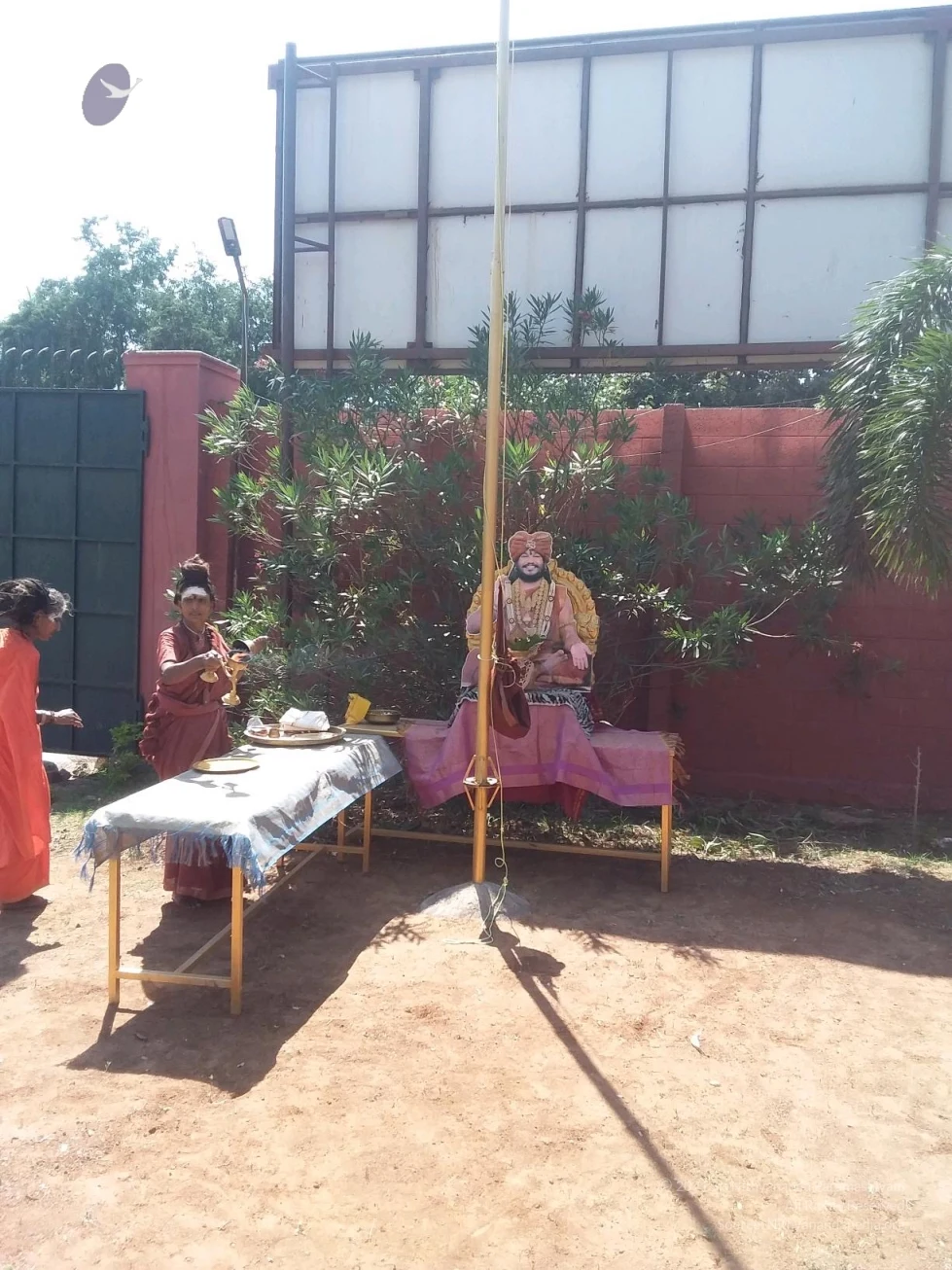
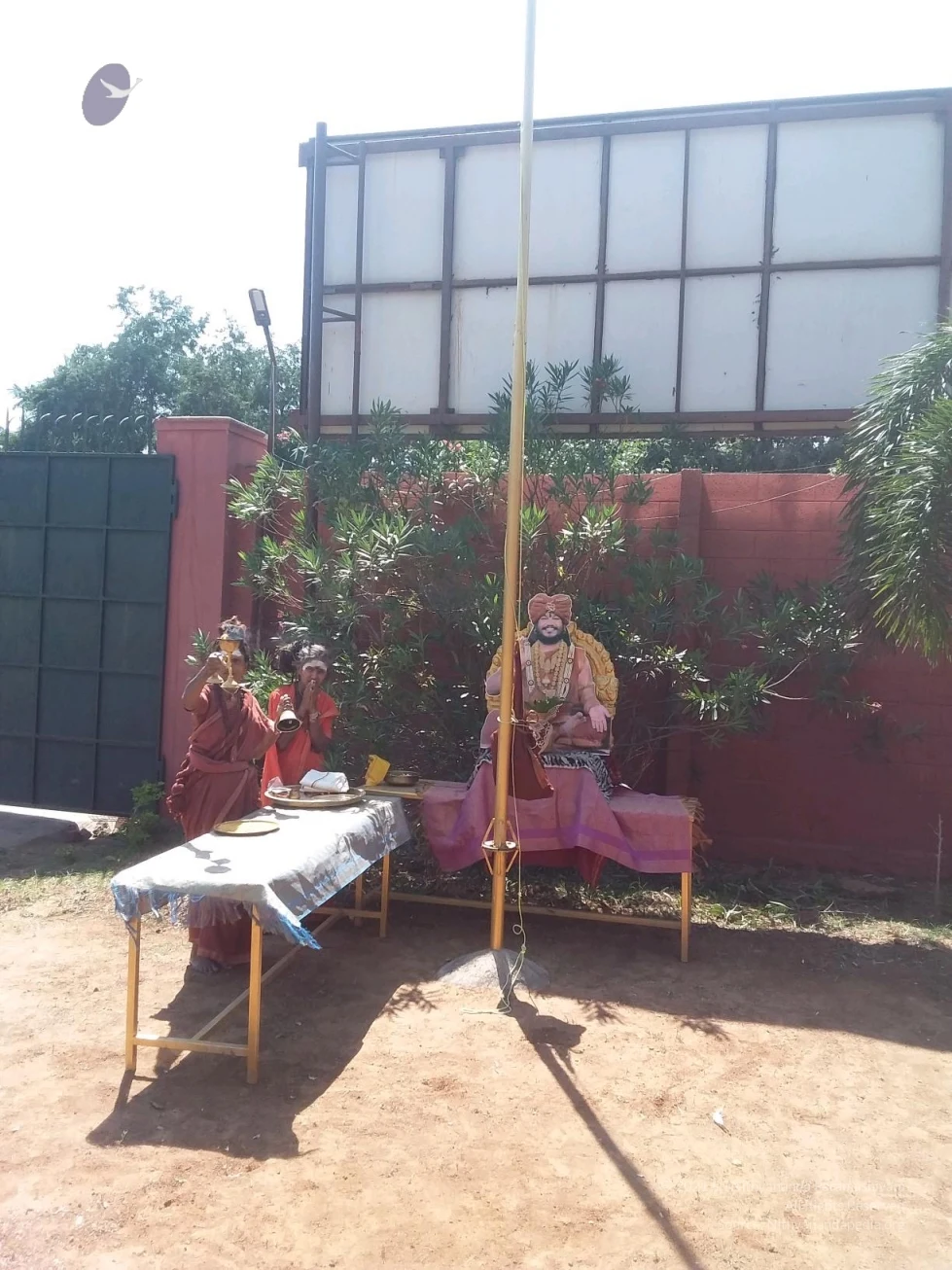
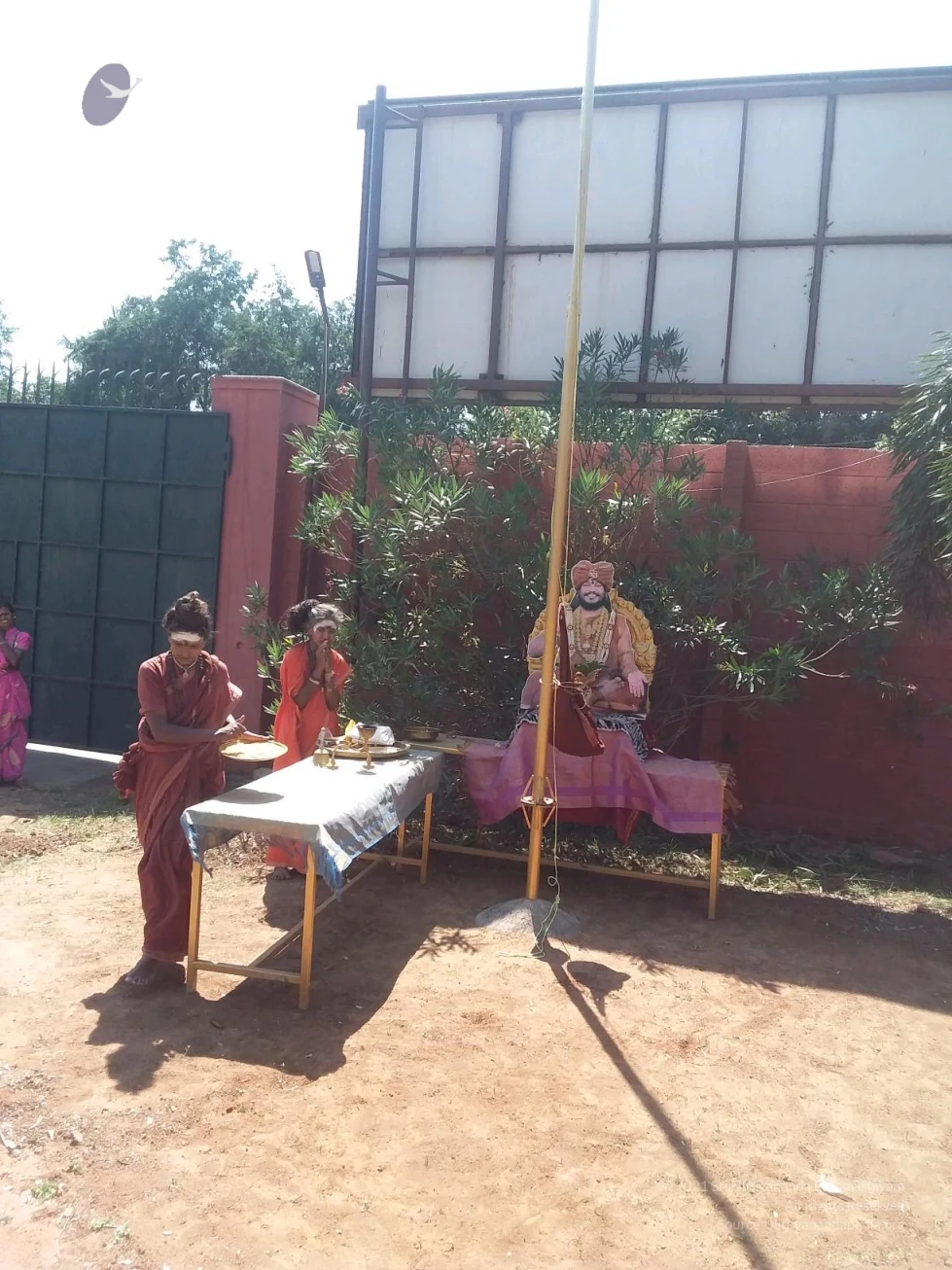
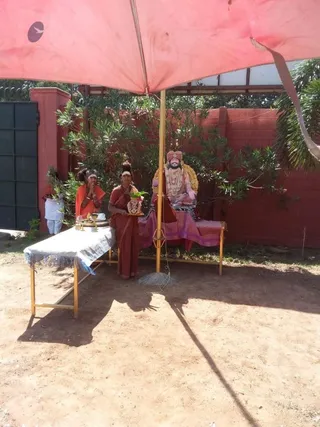
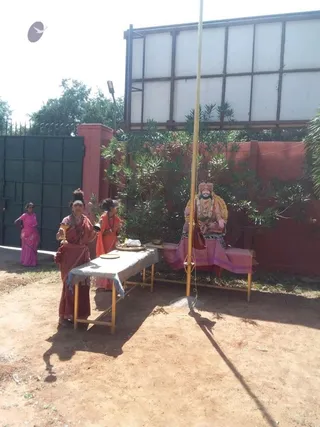
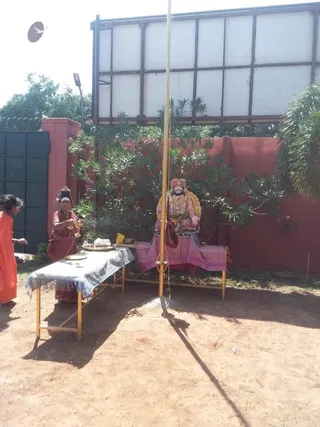
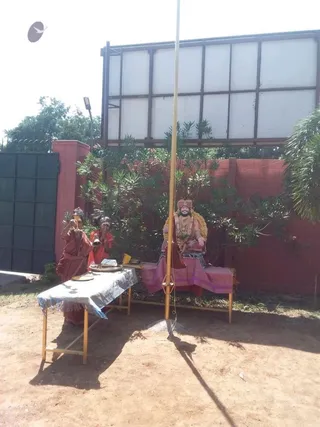
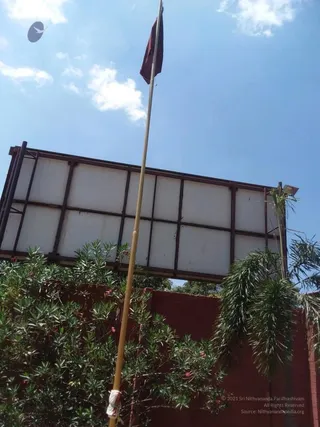
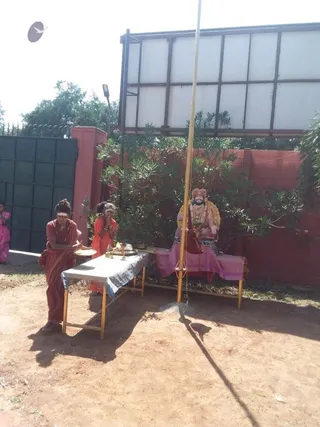
Outdoor photo under a pink canopy in a dusty courtyard beside a red-brick wall and green gate. Two women in saffron and rust-red robes stand at a white-draped table; the woman in the centre holds a decorated pot with green leaves, while the woman on the left has her palms pressed together in prayer. A brass tray with small vessels sits on the table. Behind them a life-size printed cutout of a seated bearded figure in an orange turban, rudraksha necklaces and ornate gold-edged chair is set on a pink cloth-draped bench, a depiction rather than a physical person. A man in white clothing stands at the left edge near the gate.Outdoor ritual at a flagpole in a dusty courtyard beside a red wall and green gate. Two women in orange-red saris stand at a draped table holding a brass vessel and a plate of offerings, one with a white forehead mark and hair pulled back. A third woman in a pink sari stands by the gate in the background. Behind the flagpole, a life-size statue of a seated bearded figure in orange and gold robes, with a rudraksha mala and a golden crown, sits on a pink-draped platform. The statue is a depiction, not a living person, so no in-person candidate is visible.Outdoor photo in a dusty courtyard in front of a red boundary wall and a large blank white billboard. A tall bamboo-style flagpole with a rope stands in the centre. Behind it, a life-size painted or statue-like figure of a seated man with a large orange-and-gold turban, long beard, garlands and gold necklace sits on a pink-draped seat with a gold back. A woman in a dark red sari with white forehead markings stands at a table draped in silver cloth, holding a brass pot and lamp near a brass plate. A person in orange robes stands at the left edge beside a green gate. The seated figure appears to be a depiction rather than a physically present person, so no in-person candidate is clear.Outdoor scene at a walled compound beside a tall bamboo flagpole with a metal base. A seated life-size figure in a figure-of-authority pose, wearing an orange turban, rudraksha mala and gold ceremonial necklace, sits on a throne-like chair draped in pink cloth with a gold backrest. Two people in red-orange robes stand at a white-covered table holding brass items and lamps, one blowing a conch-style instrument. Brass trays and a yellow vessel sit on the table. A large blank billboard frame and red wall stand behind, with green foliage.Low-angle photograph of a tall bamboo flagpole raising a small dark maroon flag against a bright blue sky with scattered white clouds. Beside it stands a large empty billboard frame with white panels and rusted metal supports, above a red compound wall overgrown with green shrubs bearing pink flowers and a palm tree. No people are visible in the scene.Outdoor photo of a ritual set up in a dusty yard in front of a red brick wall with shrubs and a tall bamboo flagpole. On the right, a large printed cutout or poster-like figure of a seated man in orange and gold ceremonial dress, with a turban, garlands and a rudraksha-style necklace, is placed on a pink-draped bench; this figure is a depiction, not a physical person. In the foreground, a man in a rust-red dhoti and shawl stands behind a small table draped in white, holding a brass plate with a lamp and offerings. Behind him, a second person in orange robes stands with hands pressed together in prayer. A woman in a pink sari stands at the gate on the left.

KAILASA SAN FERNANDO, TRINIDAD & TOBAGO on 3/7/2021
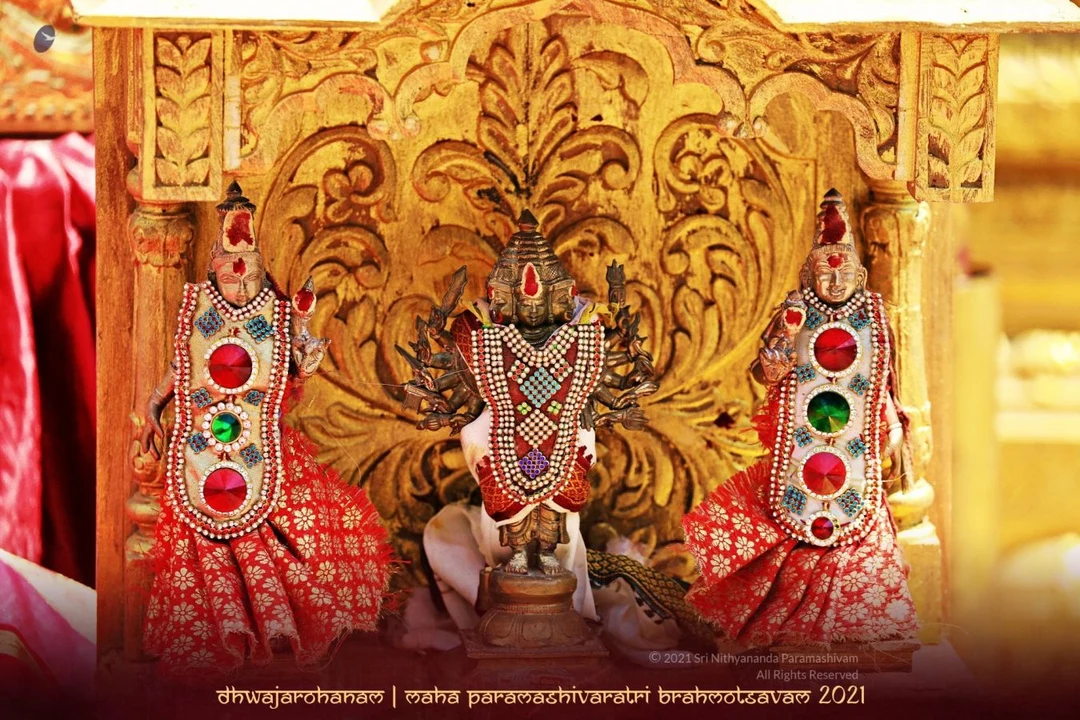
5 photosView all
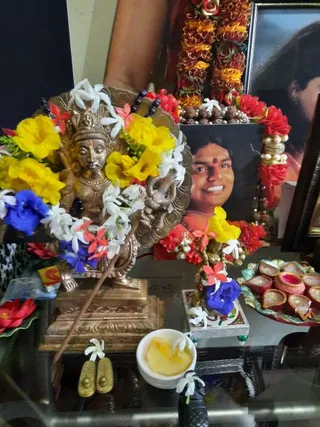
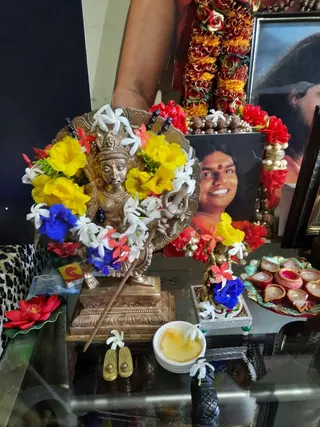
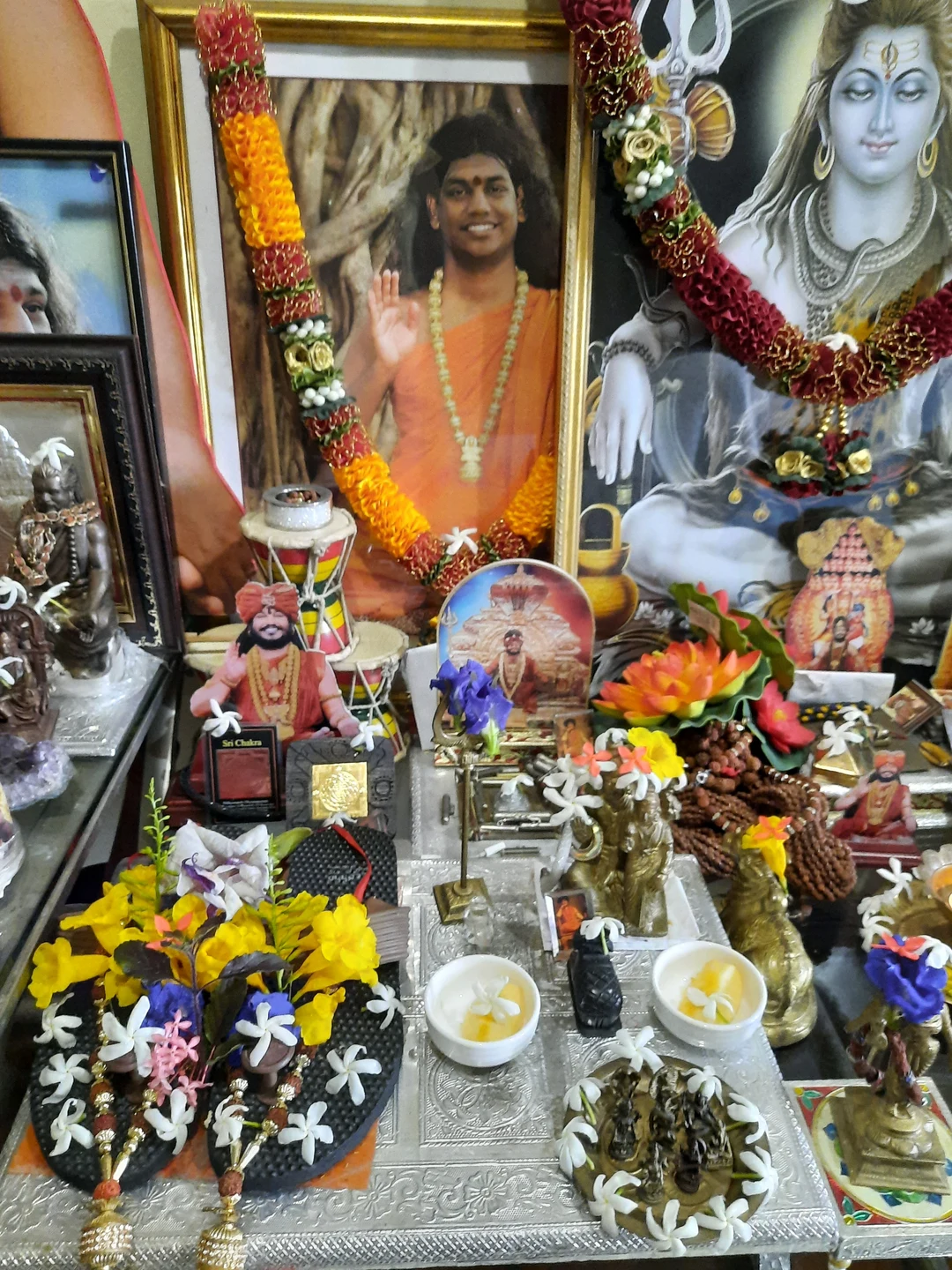
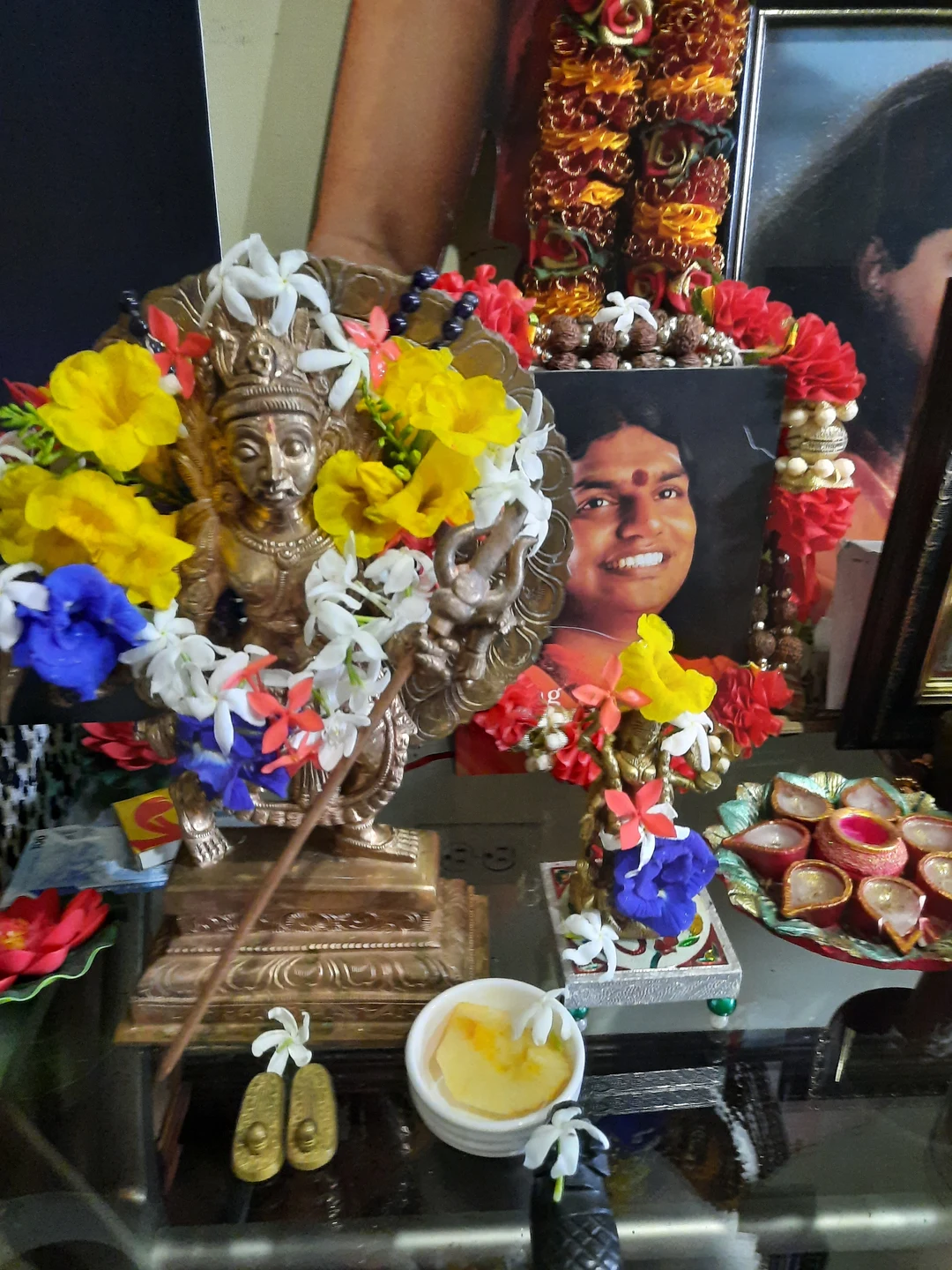
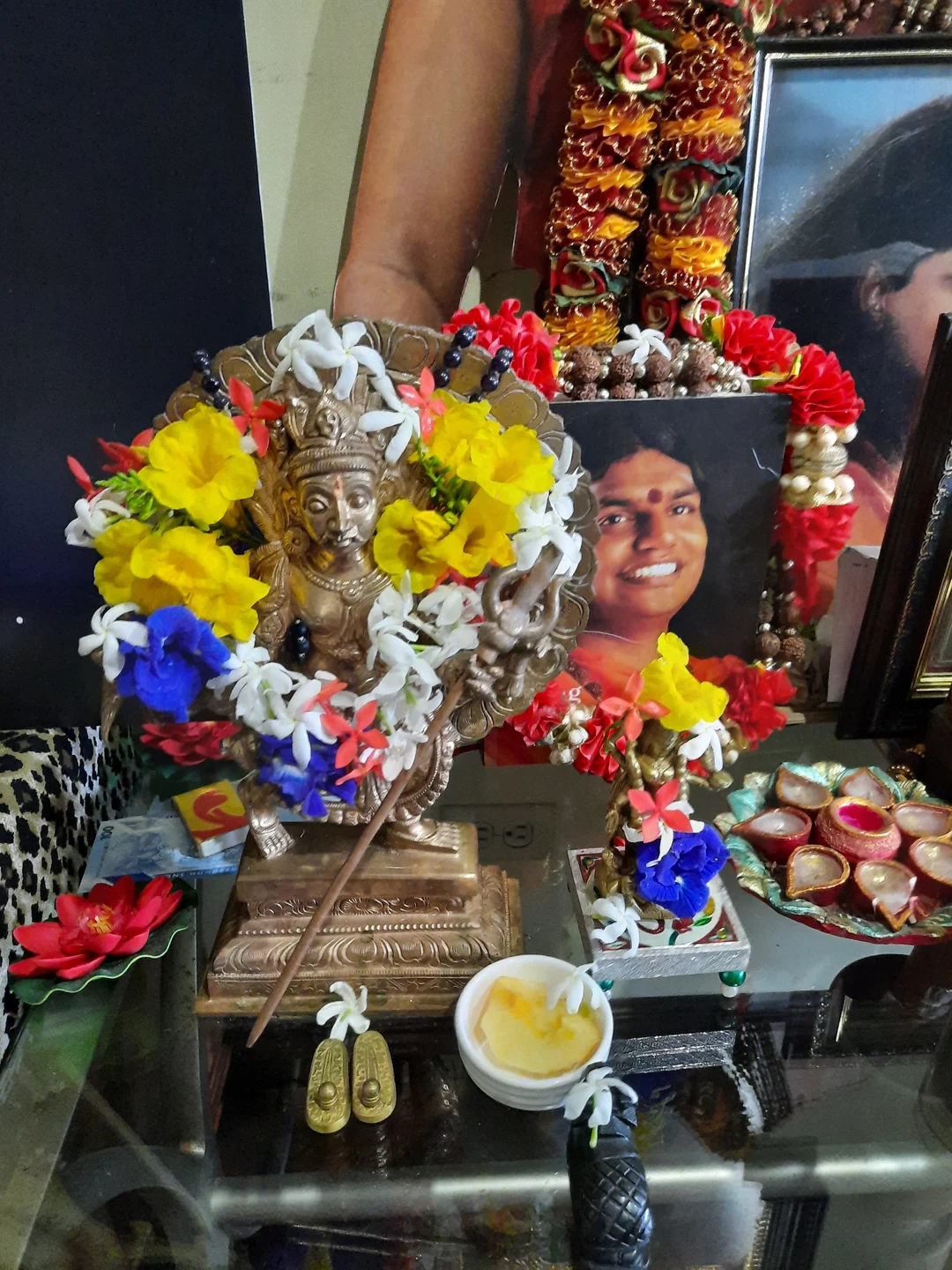
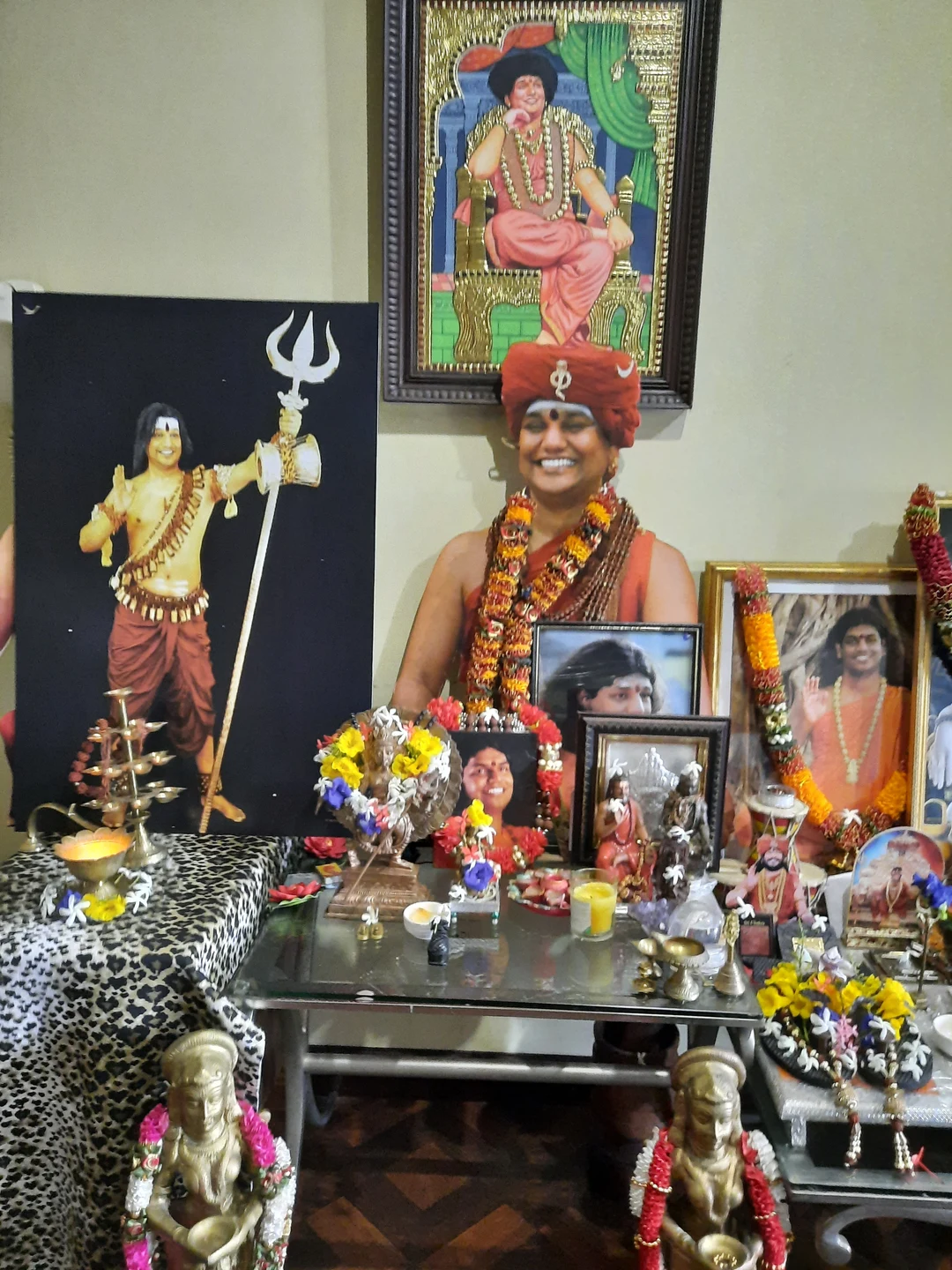
A home shrine photographed on a glass table. In the foreground a bronze deity murti stands on a square base, decorated with white jasmine garlands, yellow and red flowers and blue blossoms, and holding a staff. Beside it a small framed photograph of a smiling person with a red bindi and dark hair is set among red and orange flower garlands and rudraksha beads, labelled by no visible text. A pair of small brass lamps and a tray of red and gold diyas sit on the right, with a white bowl of yellow offering and a few jasmine flowers in front. No people are visible apart from a partial arm at the top.A home altar display with a bronze deity murti decorated with white jasmine garlands and yellow, blue and red flowers, set before a framed portrait photograph of a smiling man with a red bindi and red garlands; a rudraksha mala hangs over the frame. In front, a bronze trident-like staff leans against a pedestal, with small brass bells, a white bowl of yellow liquid, diyas on a tray, a red lotus and a sweet-smelling offering. Taken at a close angle with a partial arm visible above. The portrait is a printed photo, so it is a depiction; the altar contains no one in person.Overhead view of a pair of black rubber sandals, the padukas, decorated with yellow trumpet flowers, white jasmine blossoms, purple blooms, pink ixora and dark leaves, with red ribbons and gold-capped rudraksha malas hanging from them, set on a silver tray with floral engraving. Behind them sit a Sri Chakra plaque, a gold Sri Yantra on a dark stone, a brass lamp stand, and a small white bowl holding a yellow liquid garnished with jasmine. No people are visible; this is a puja offering to the padukas.Home altar photograph dedicated to a guru, with no physical people visible. Centre: a framed portrait labelled "Paramahamsa Nithyananda" shows a smiling man in saffron-orange robes with a beaded necklace, raising one hand in front of a tree trunk backdrop; the frame is draped with a marigold and rose garland. Right: a large painting of Shiva in white with a crescent and trident, also garlanded. Foreground: a silver tray holding a pair of black slippers decorated with yellow flowers and jasmine, brass lamps, small bowls of ghee or oil, rudraksha malas, a brass kalasha-style vessel, and a Sri Chakra plaque. A small figurine in saffron clothing with a turban sits on the altar. Overall, a Hindu puja setup with floral offerings.A woman devotee sits smiling behind a decorated altar in a home room. She wears an orange-red turban with a small gold emblem, an orange garment and layered marigold and orange flower garlands with a rudraksha mala. In front of her is a glass table with brass oil lamps, a flower-decked kalasha-like vessel, small brass deity figures garlanded in pink and red, and framed photographs. Behind her, a large framed painting shows a seated figure in pink robes on a golden throne, and a black-backed poster shows a standing figure holding a trident. Garlanded brass murtis flank the table on the floor, and the walls are pale yellow.