Skip to content
Sunday

30 August 2015

The Secret to Creating Wealth and Abundance Q & A

Dated photos
348
Source pages
1
Media
3
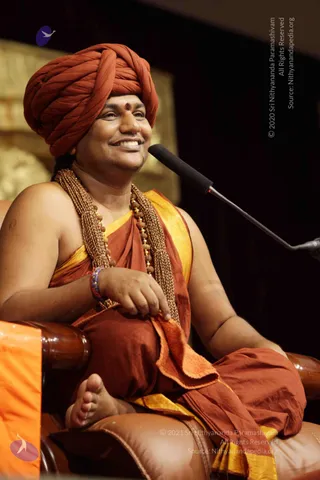
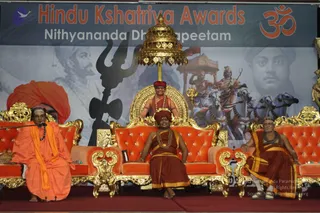
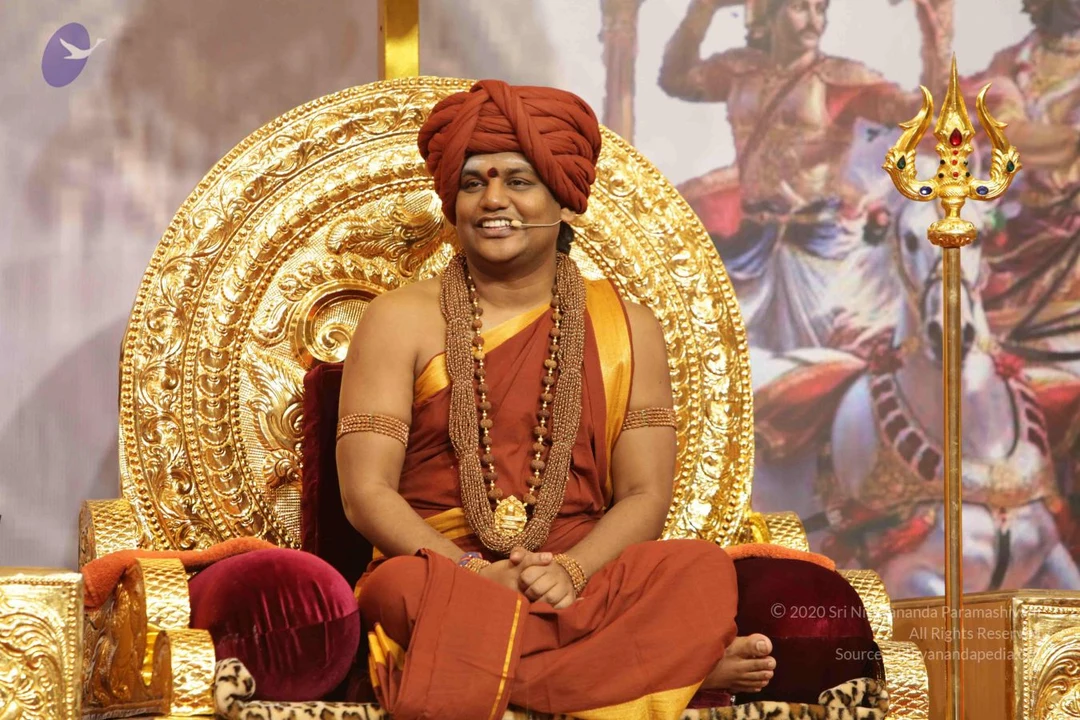
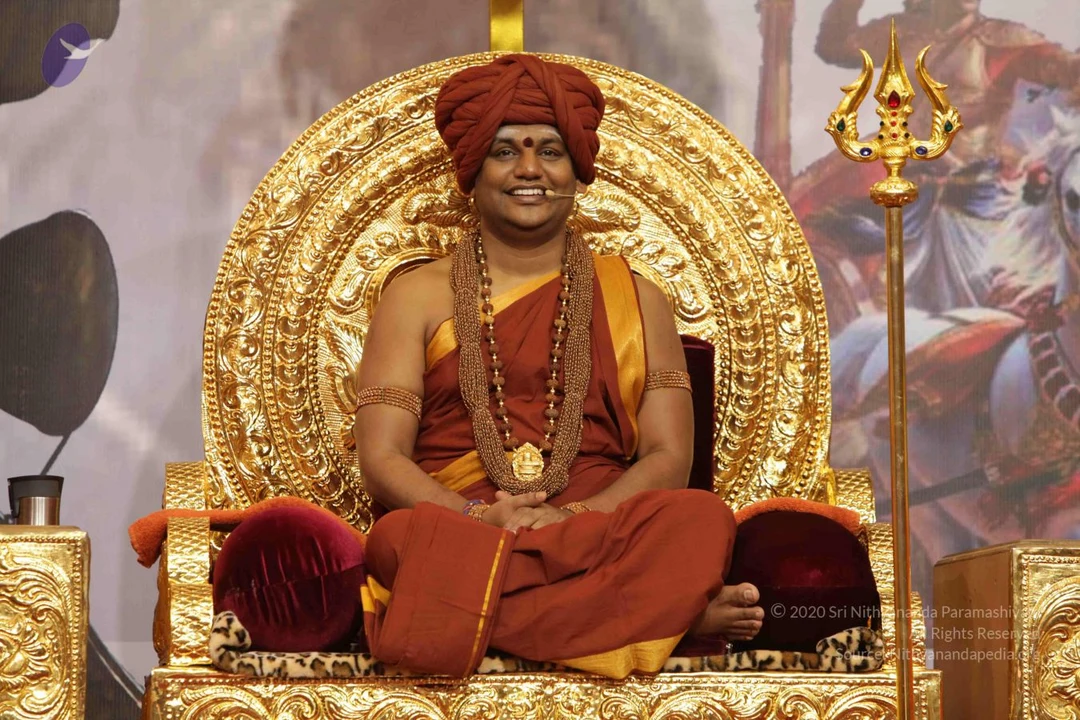
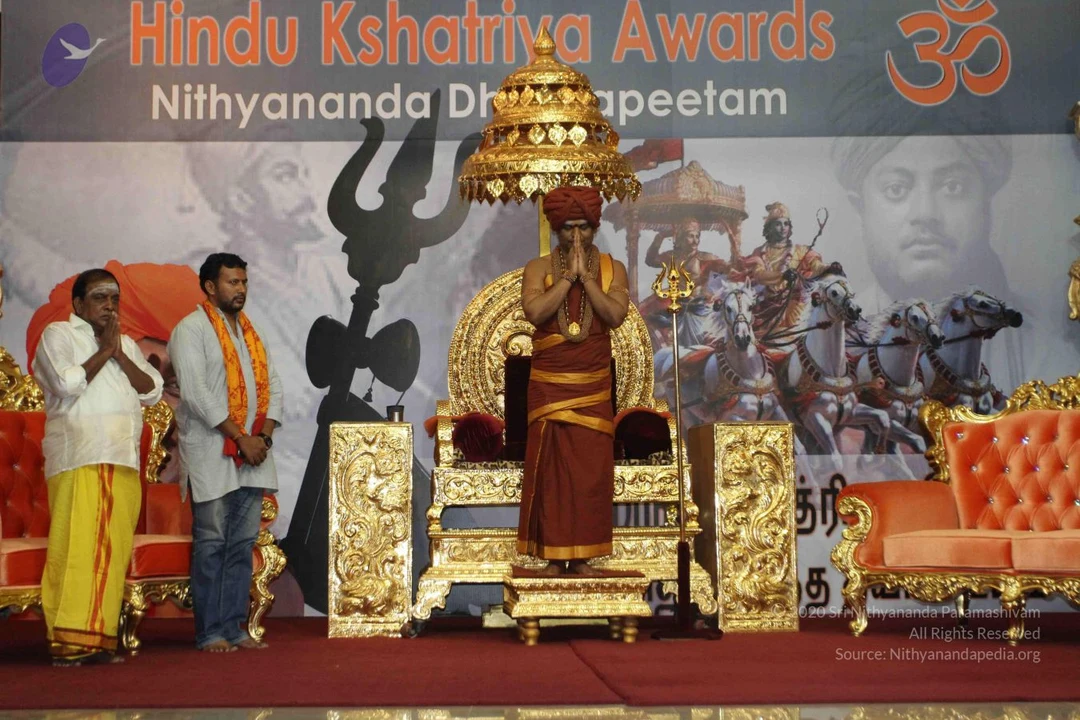
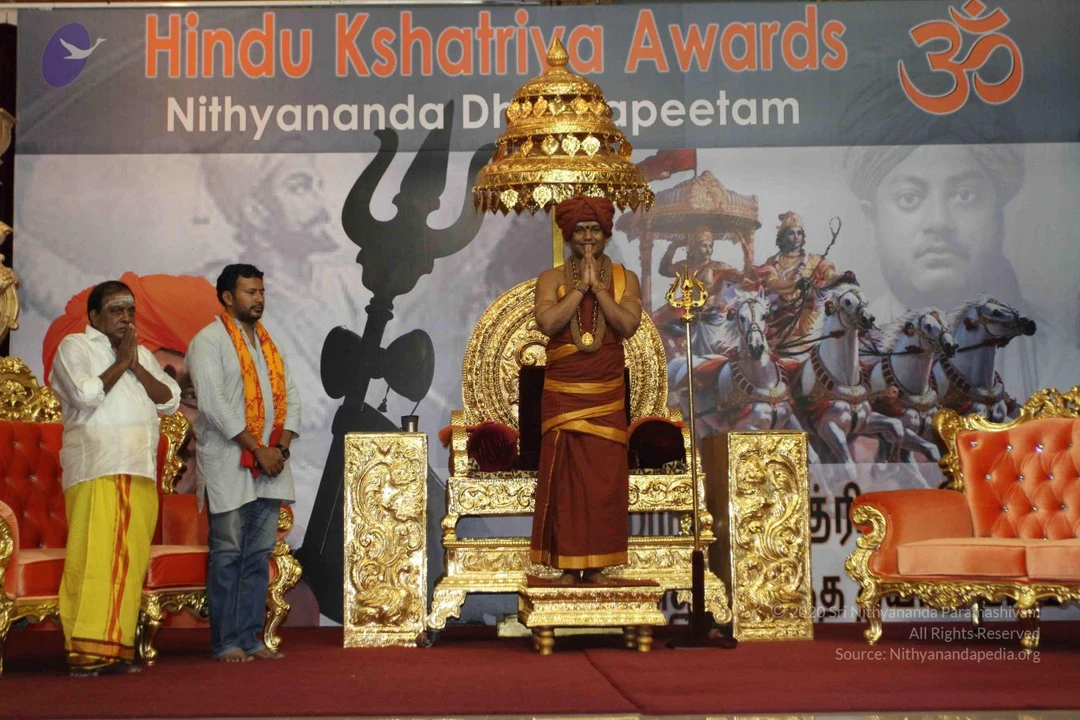
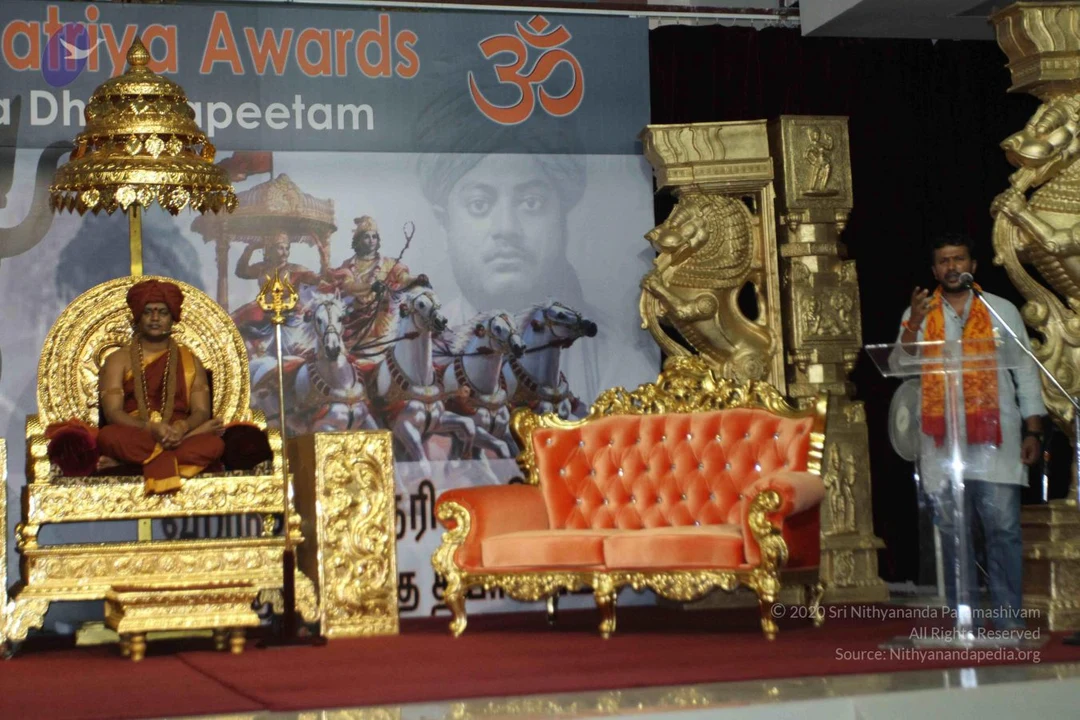
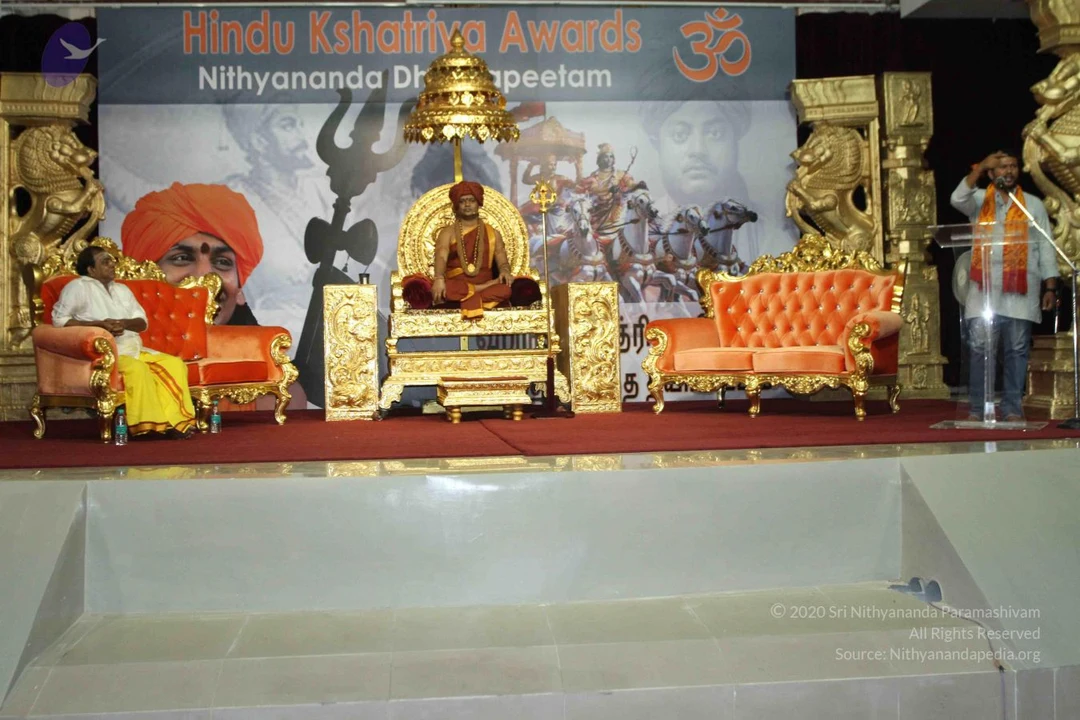
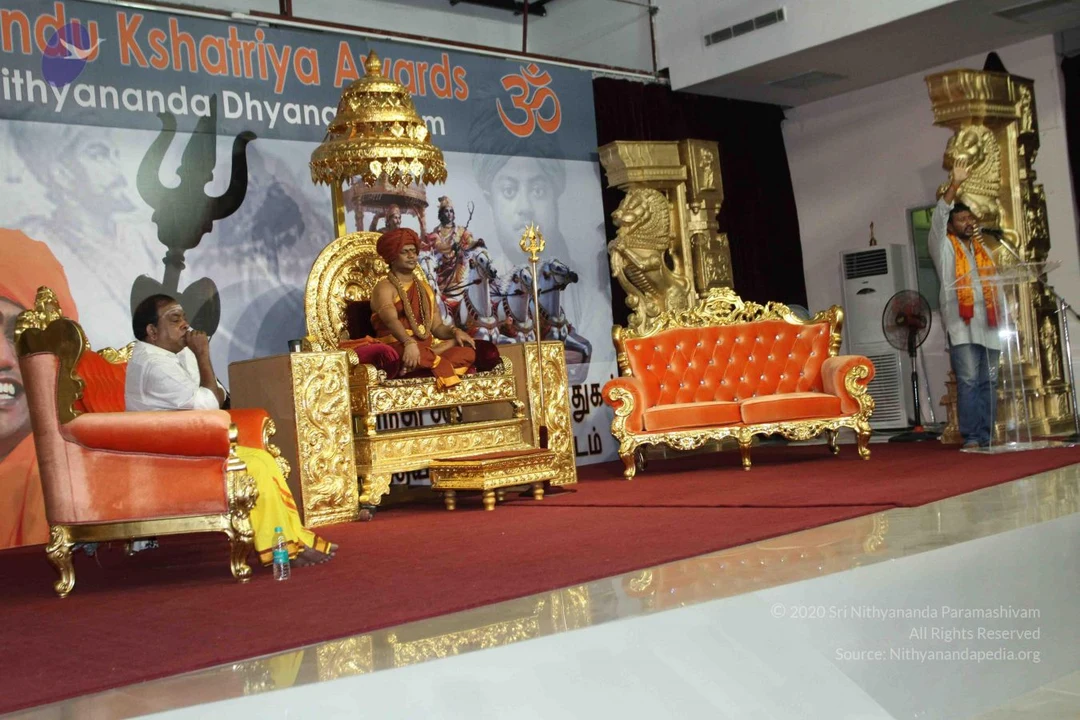
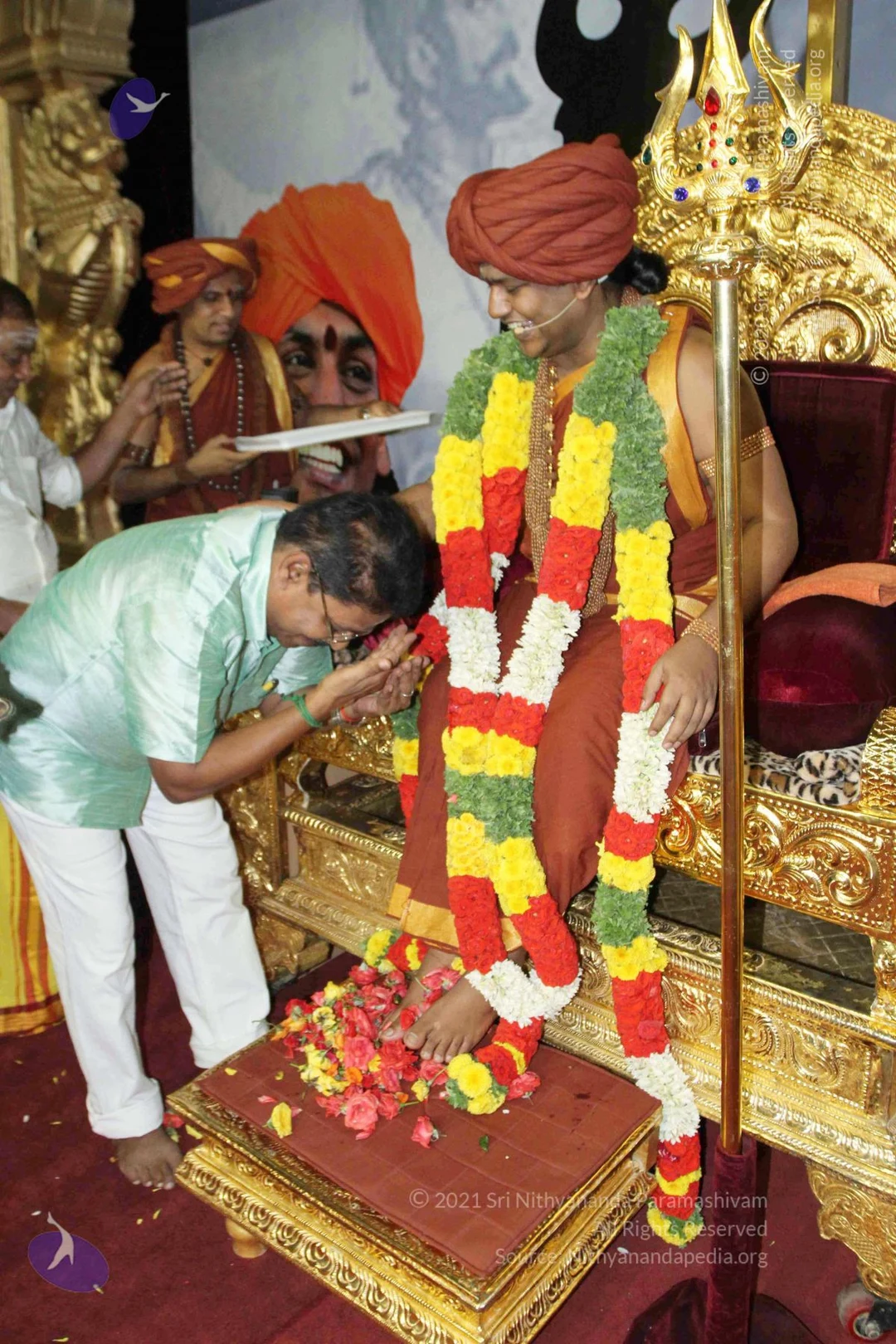
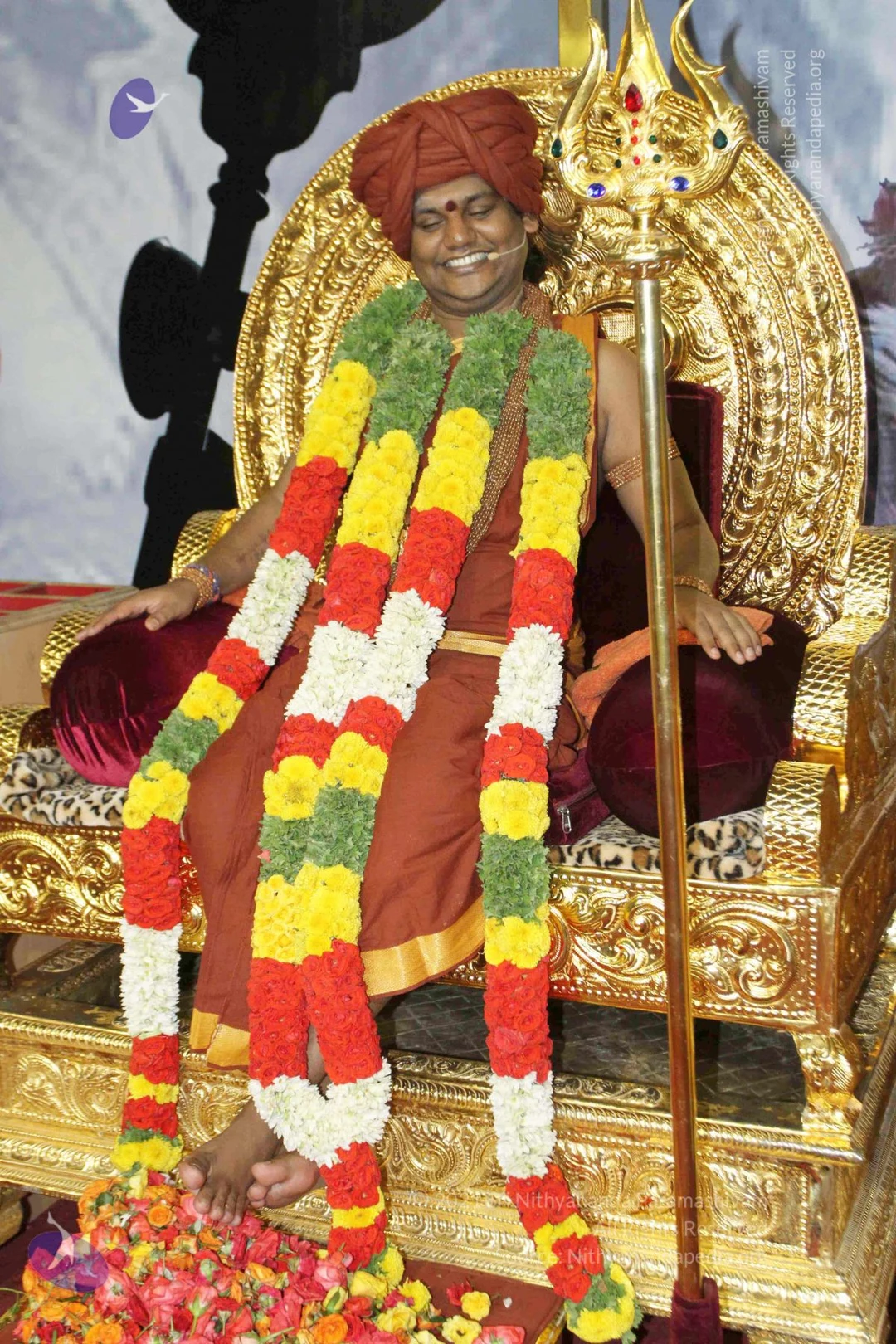
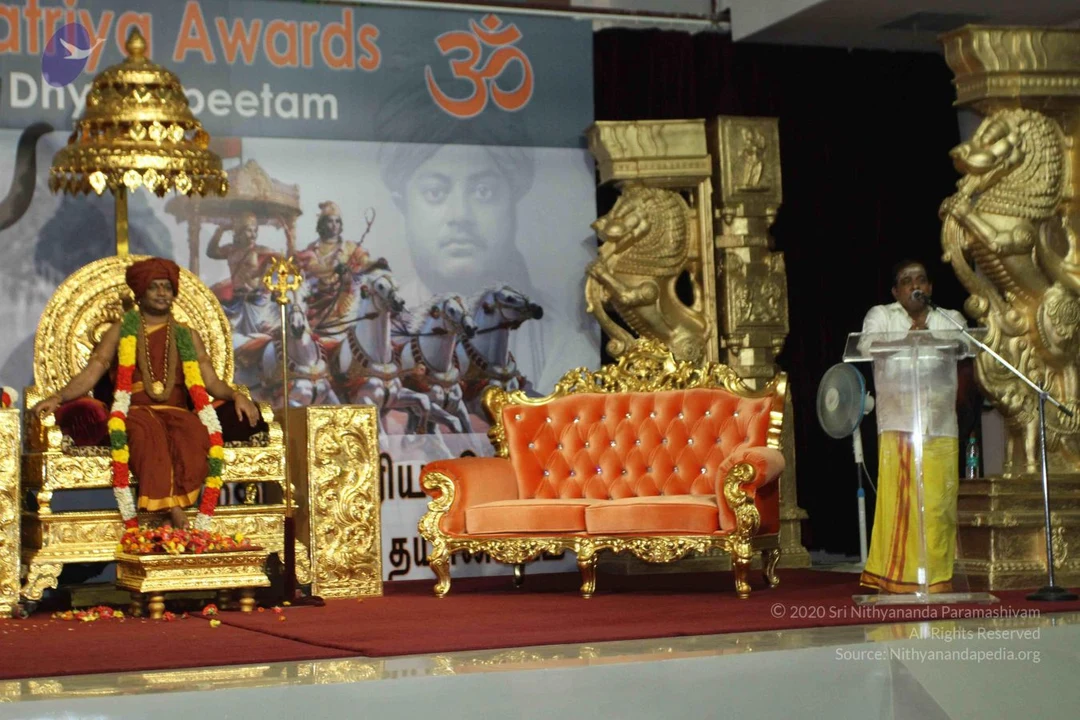
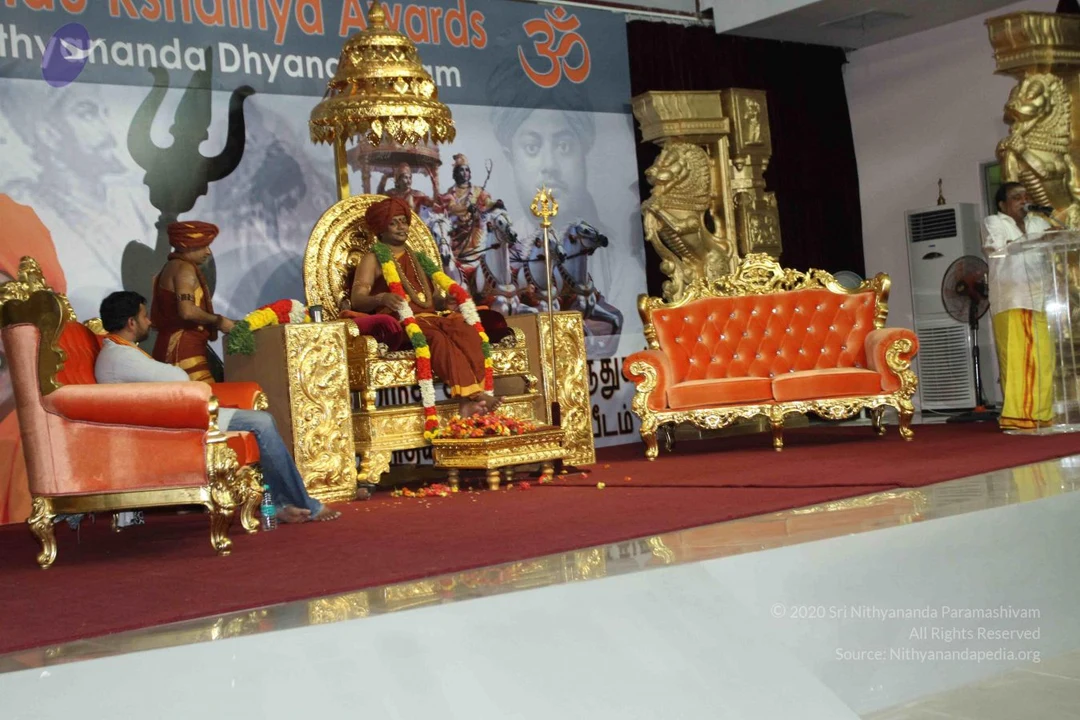
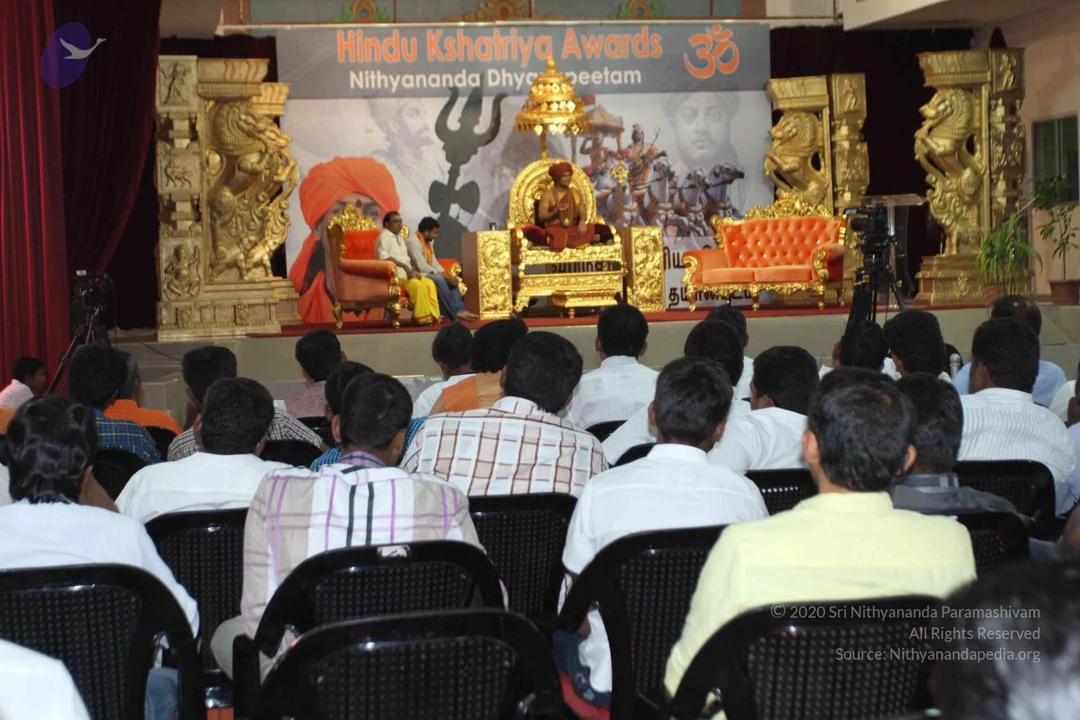
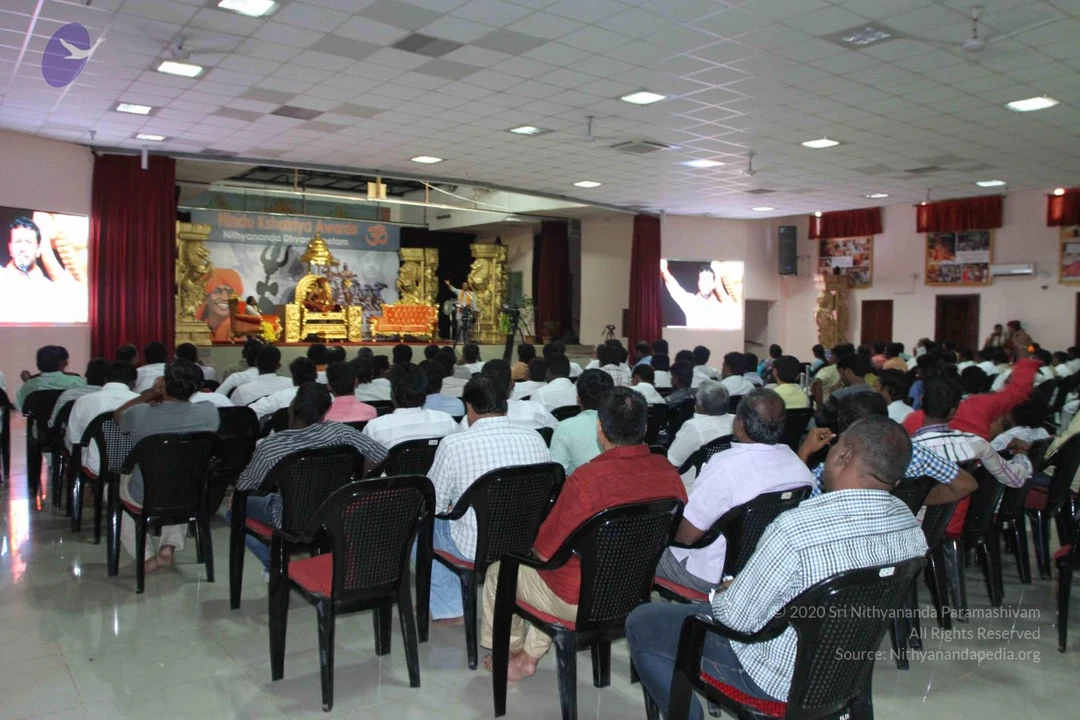
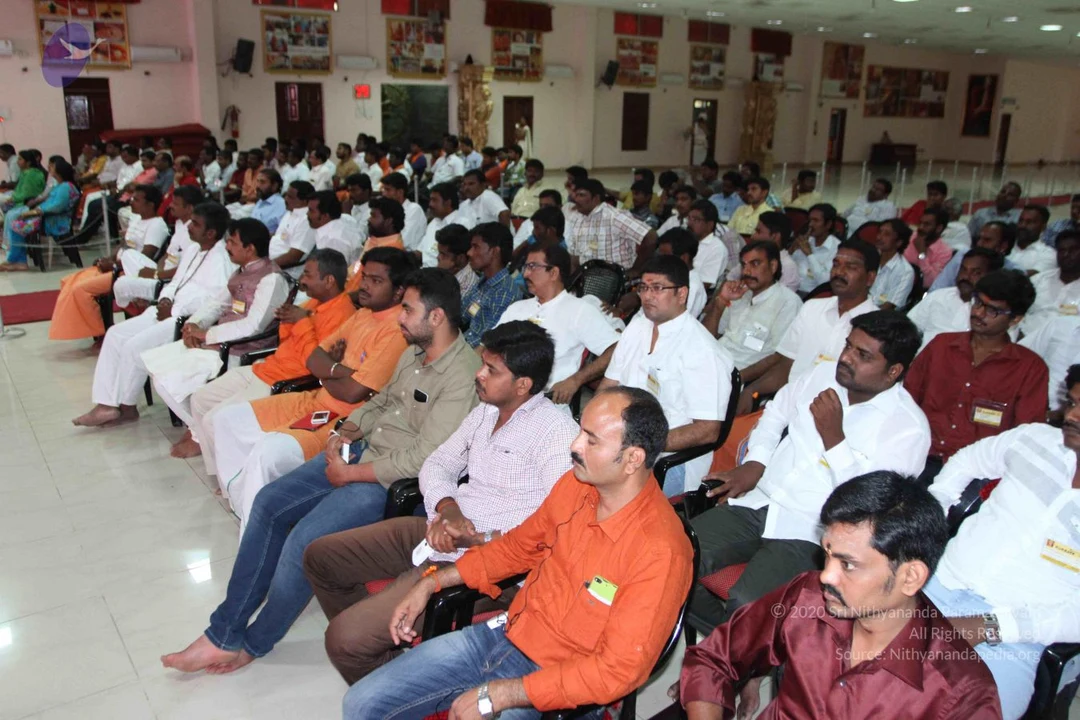
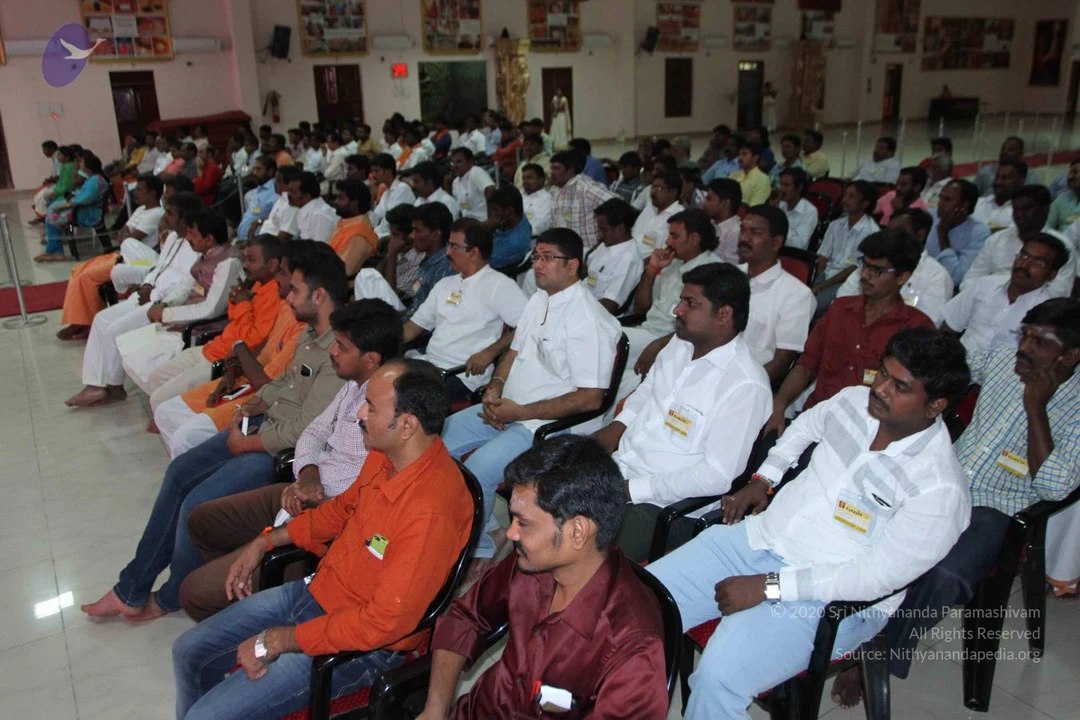
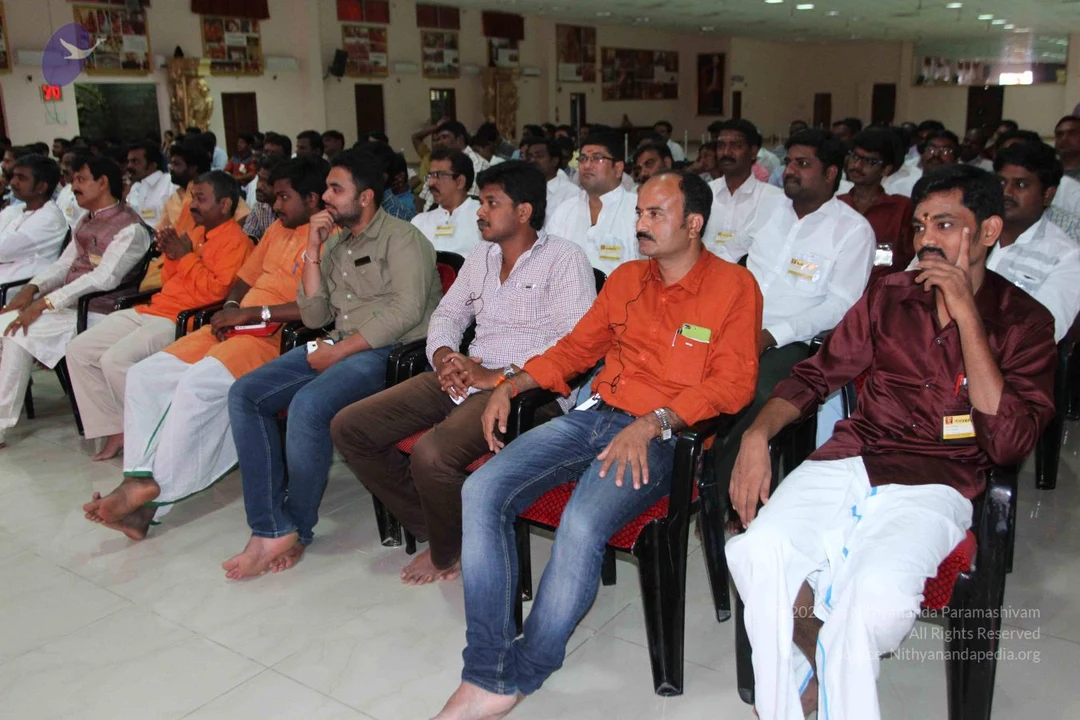
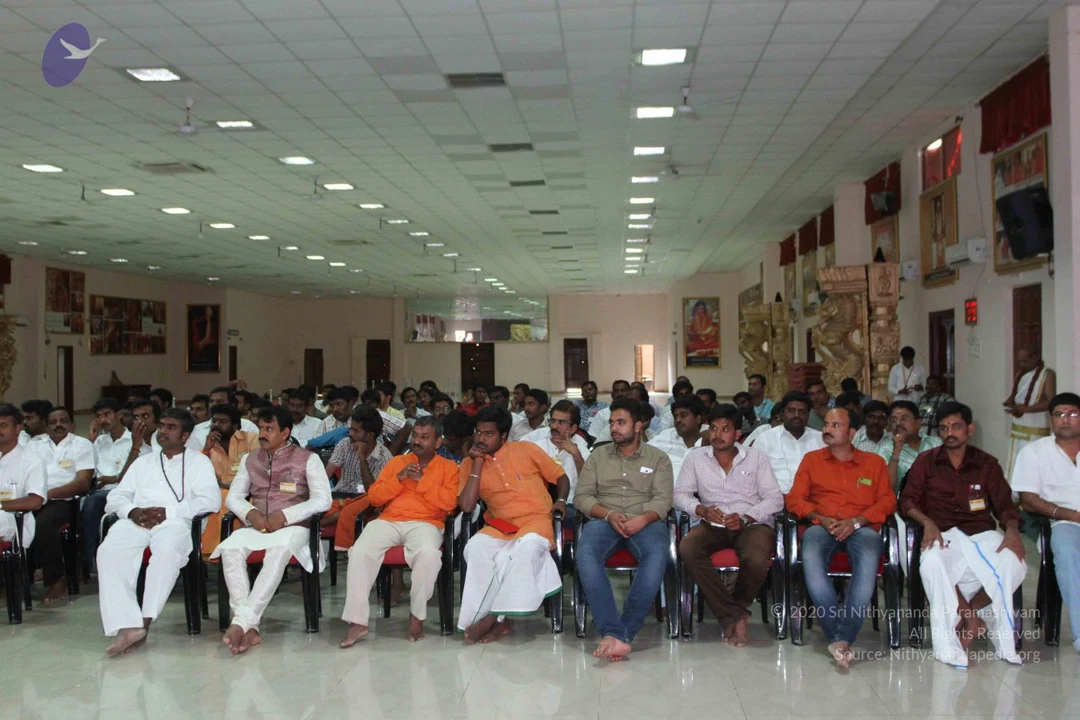
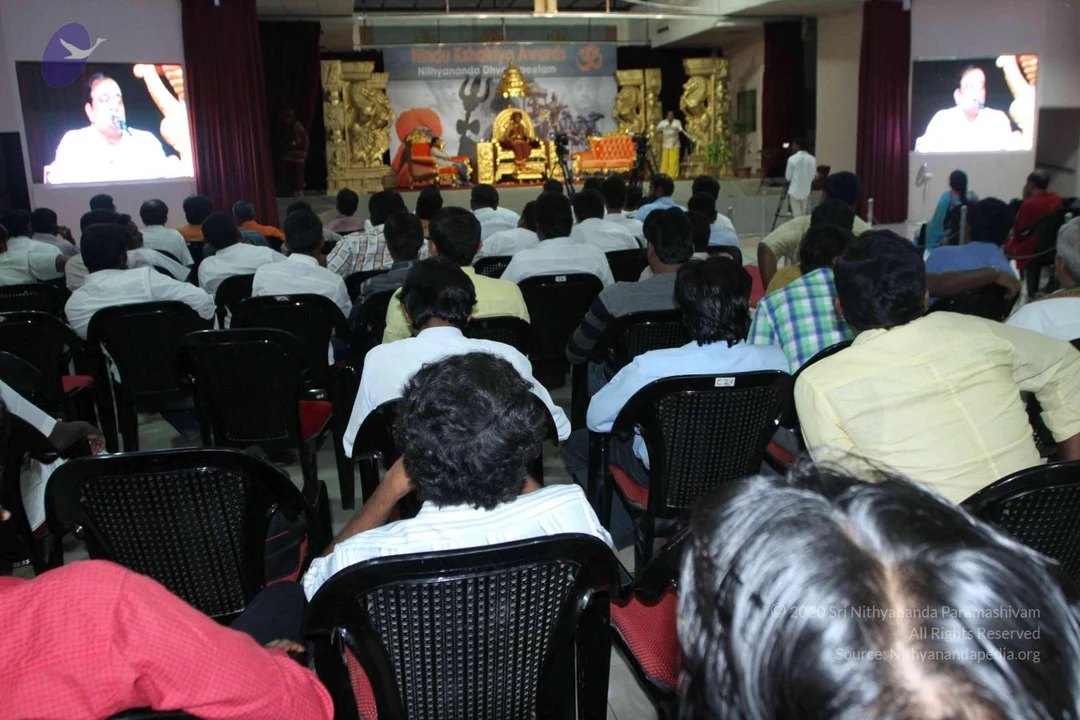
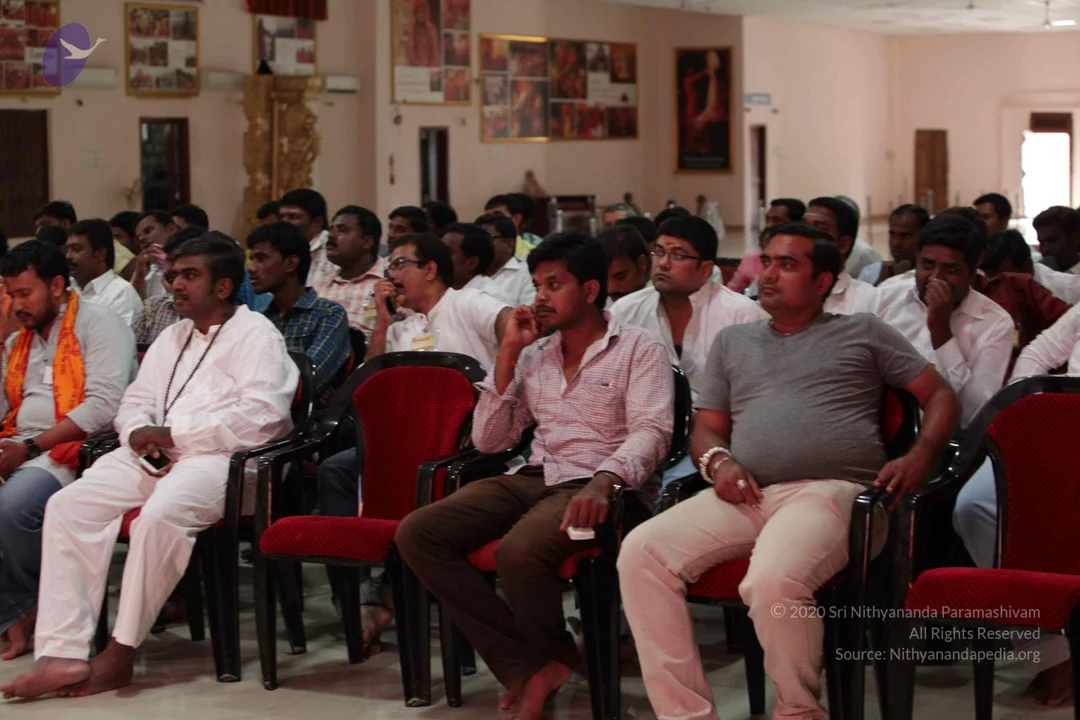
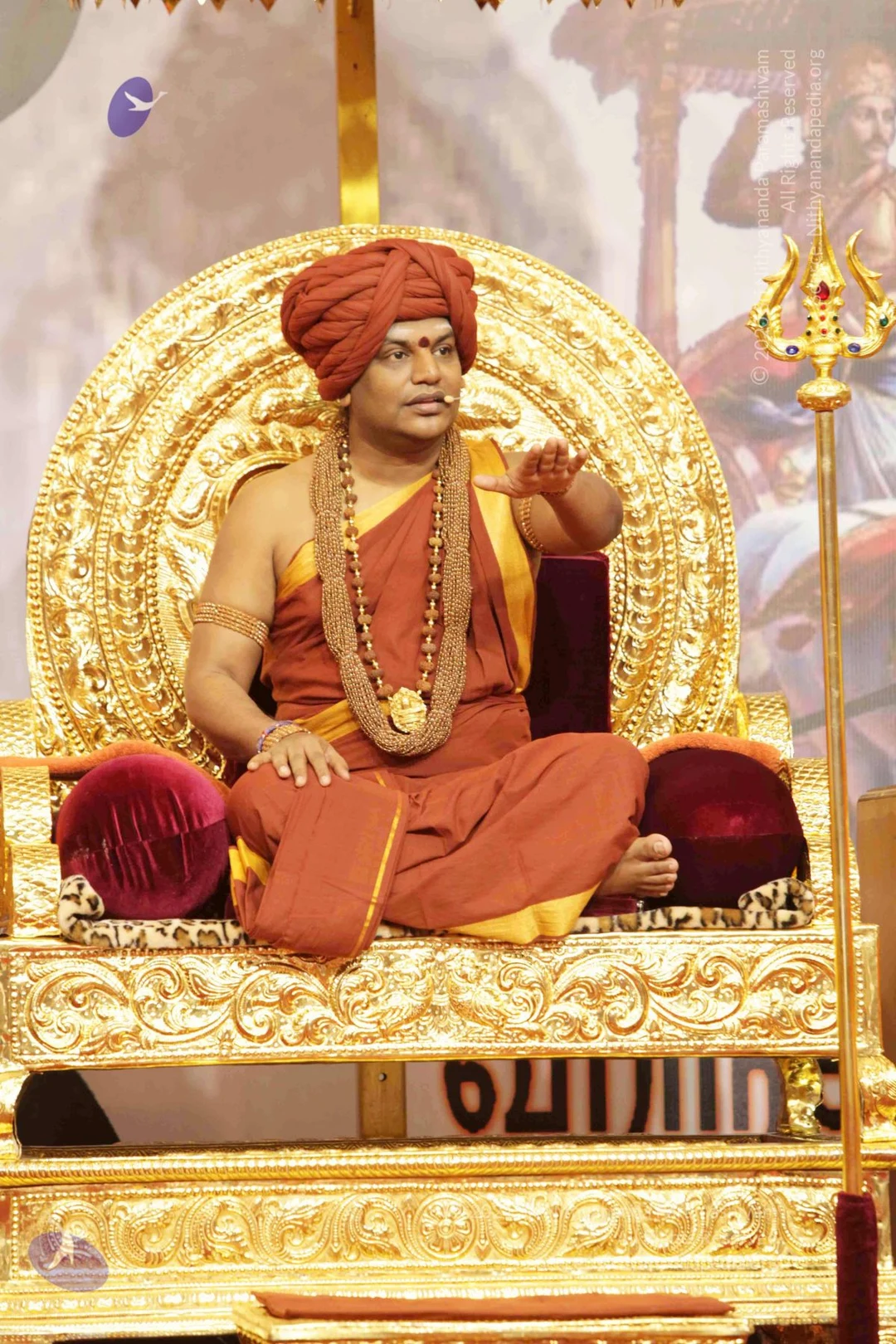
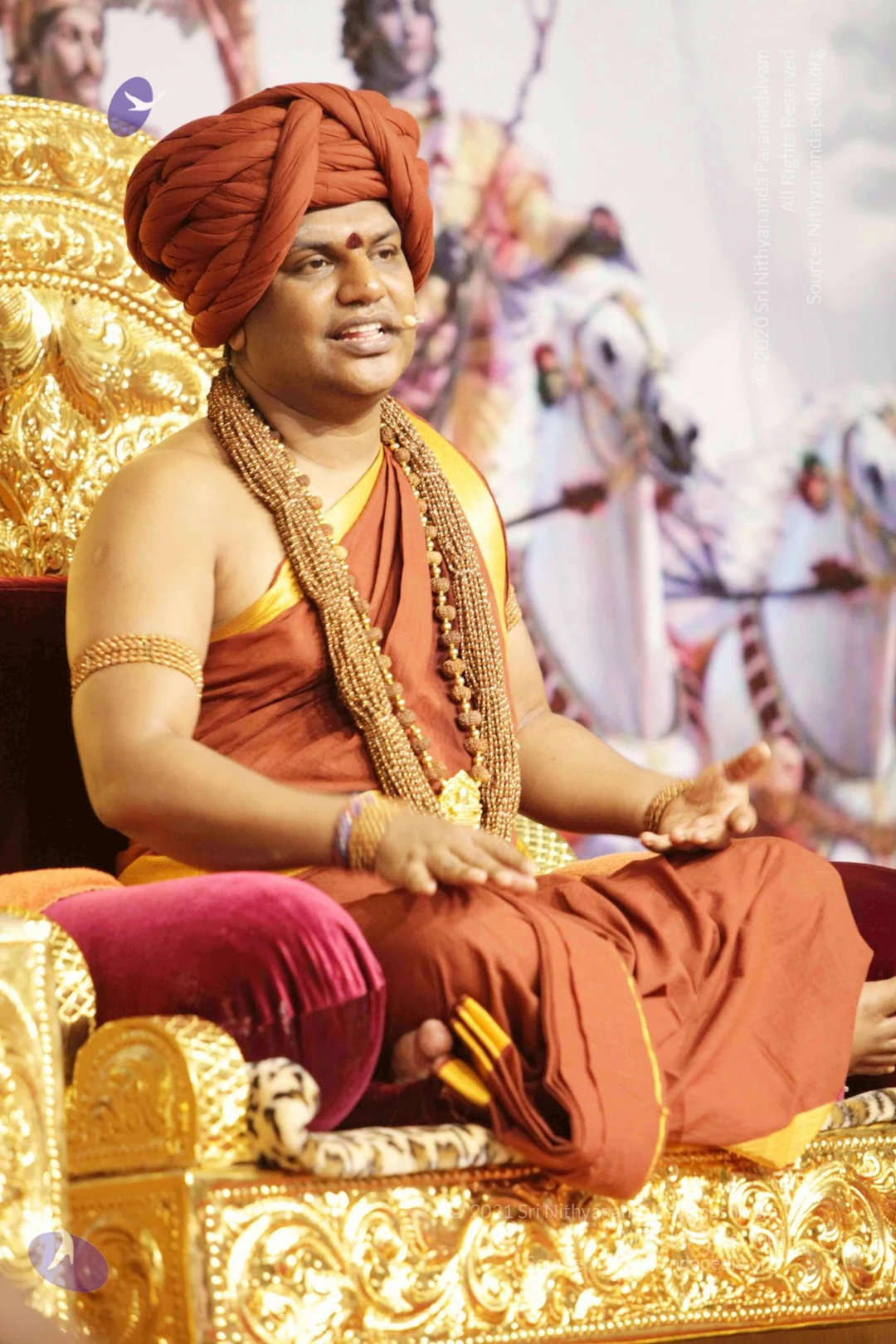
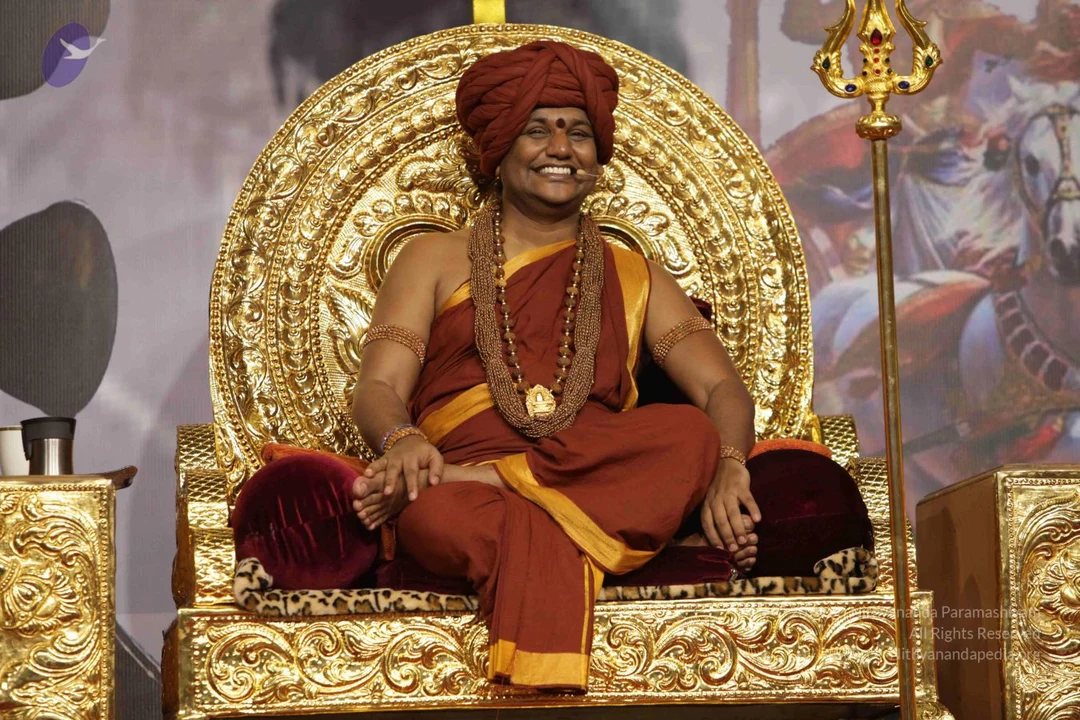
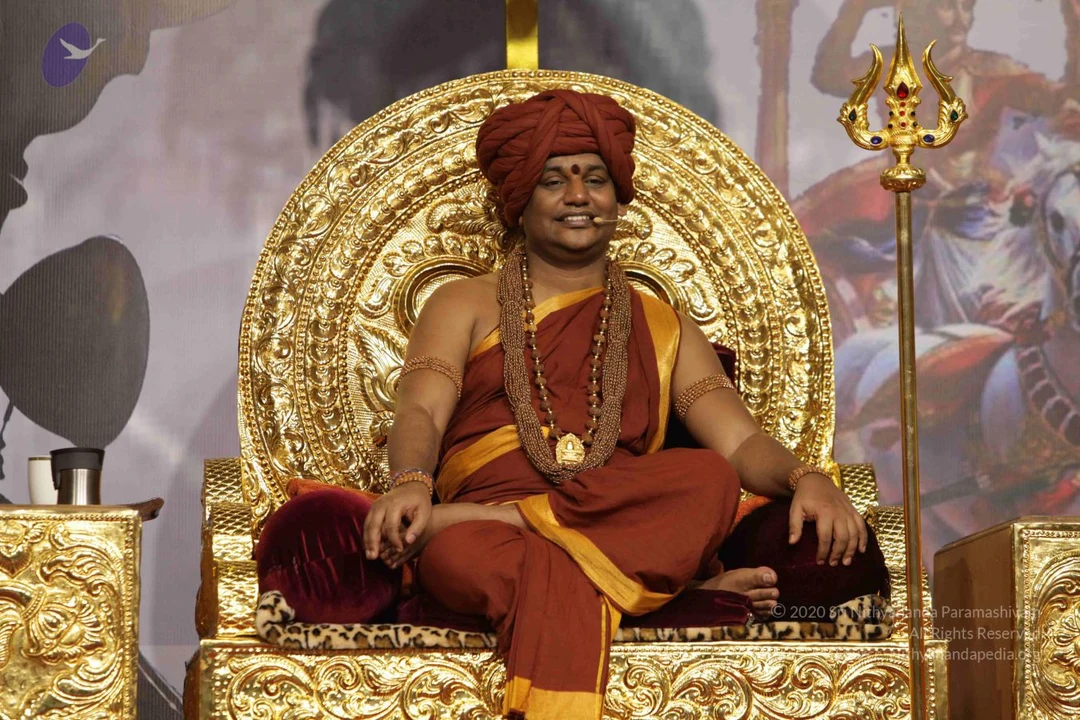
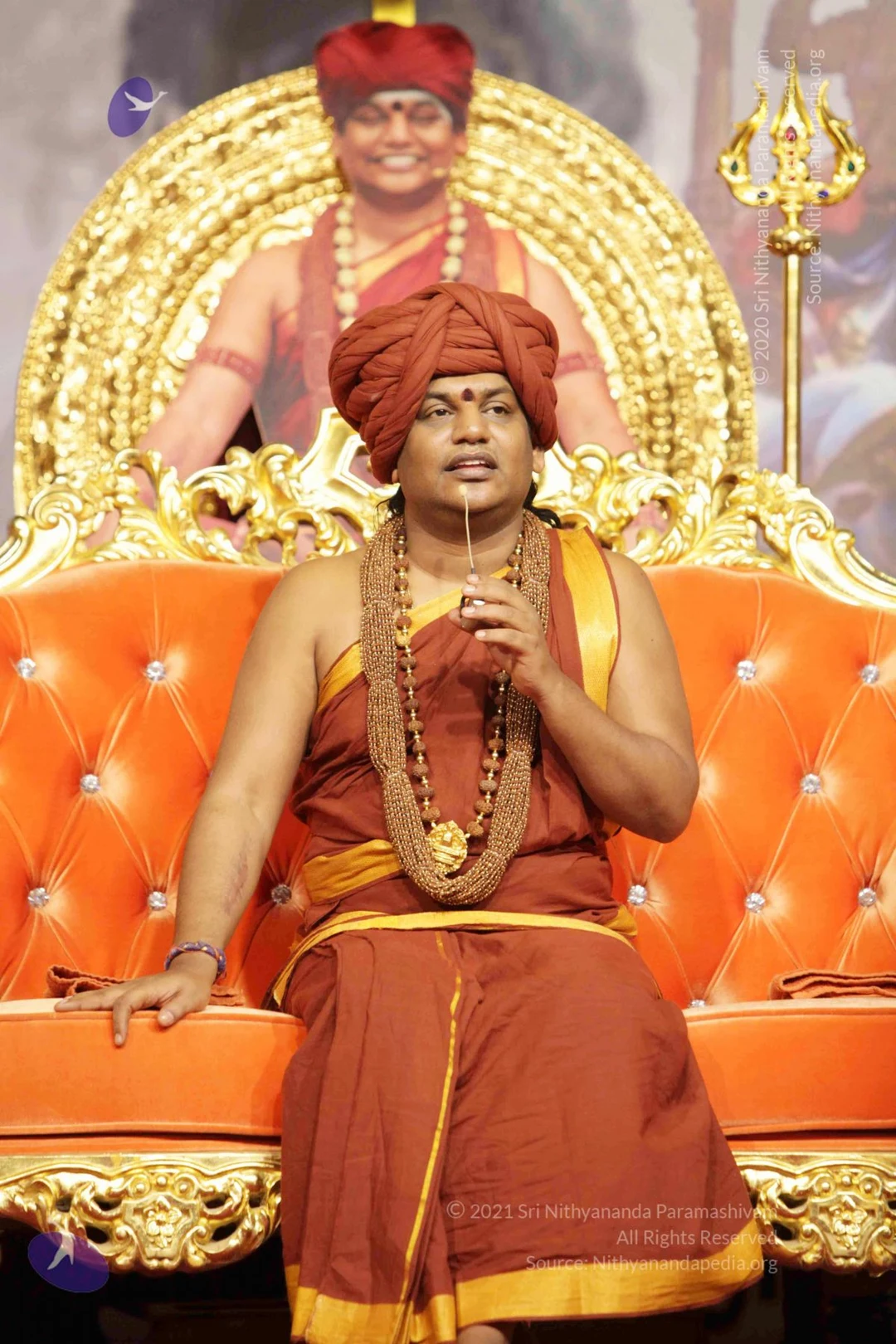
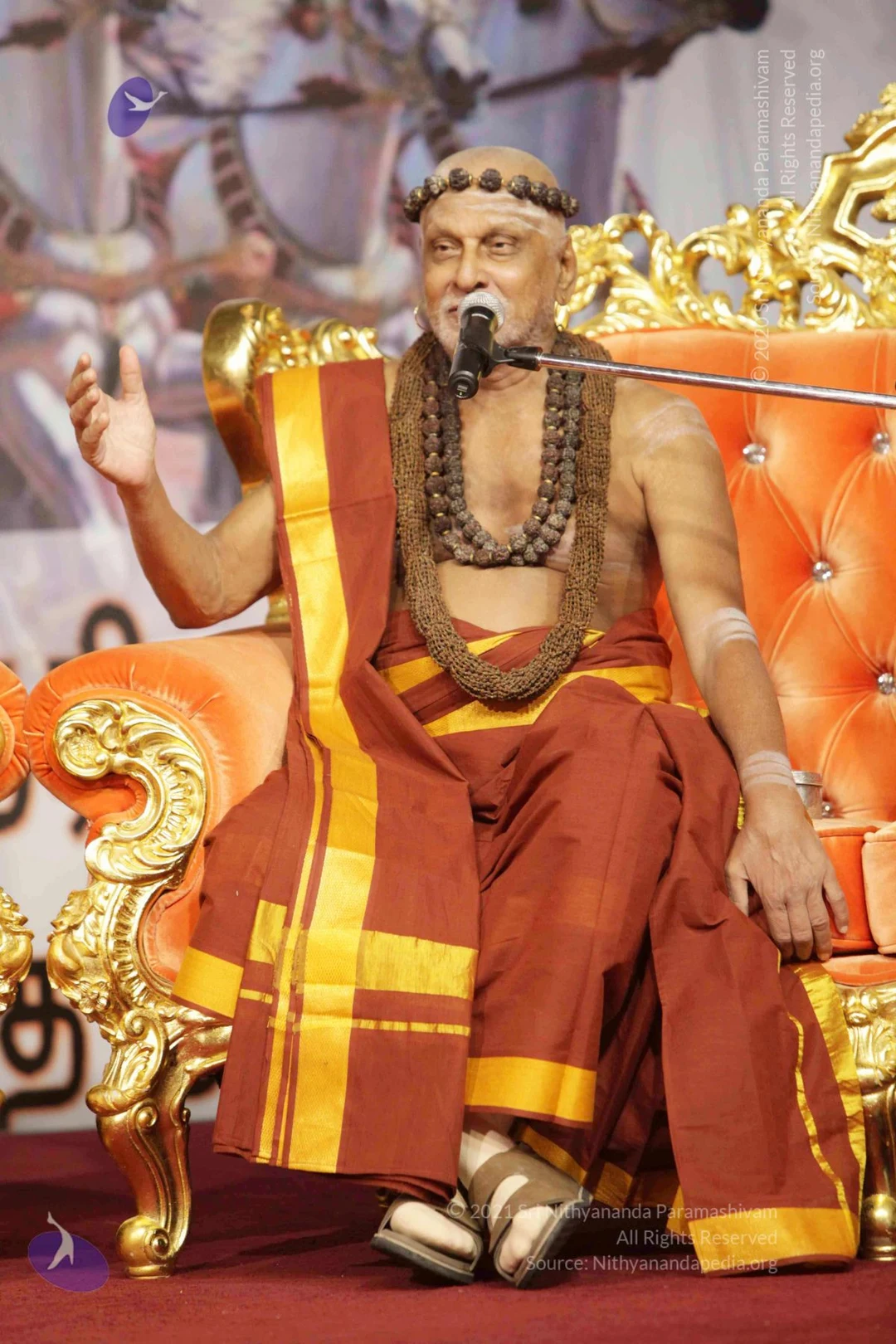
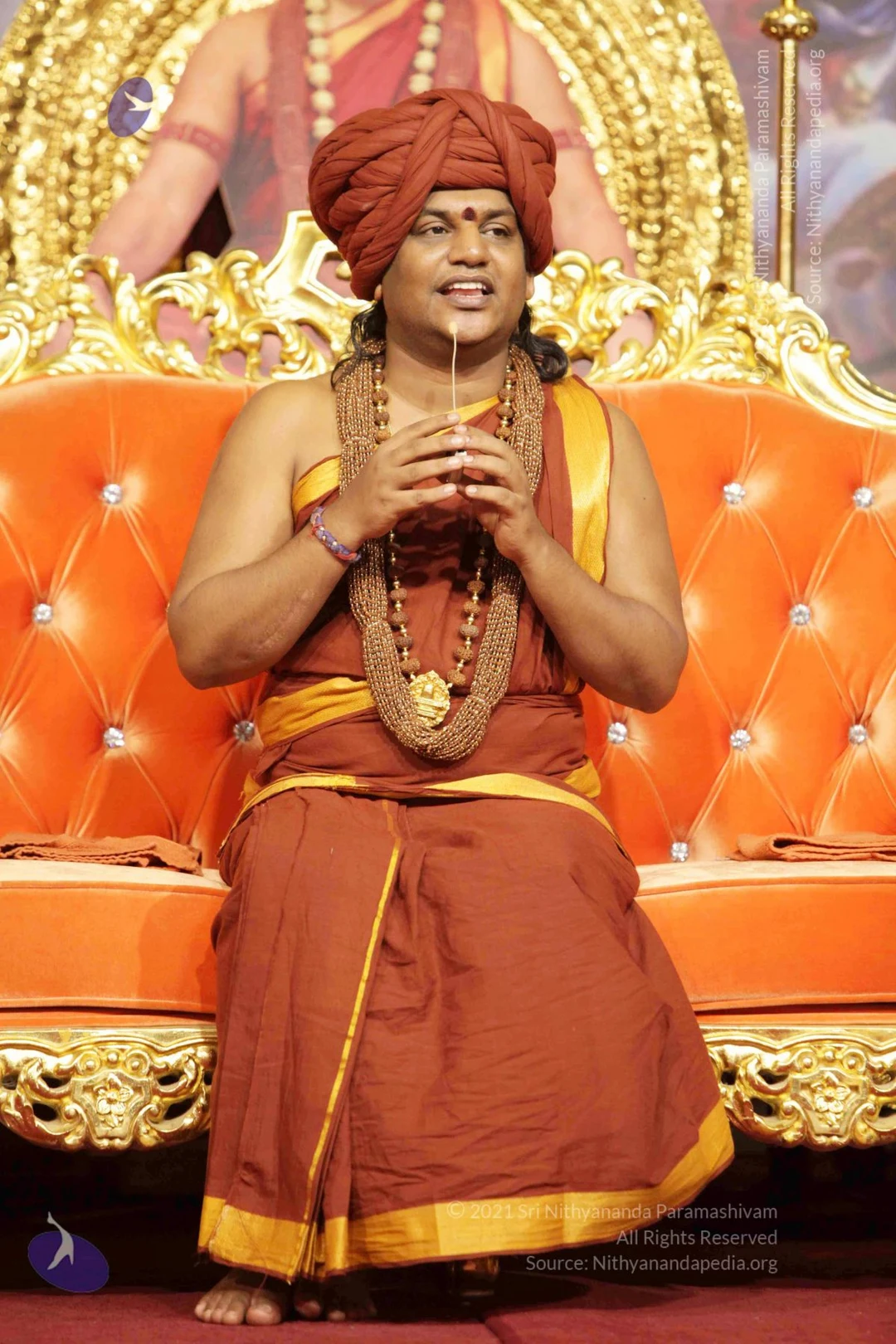
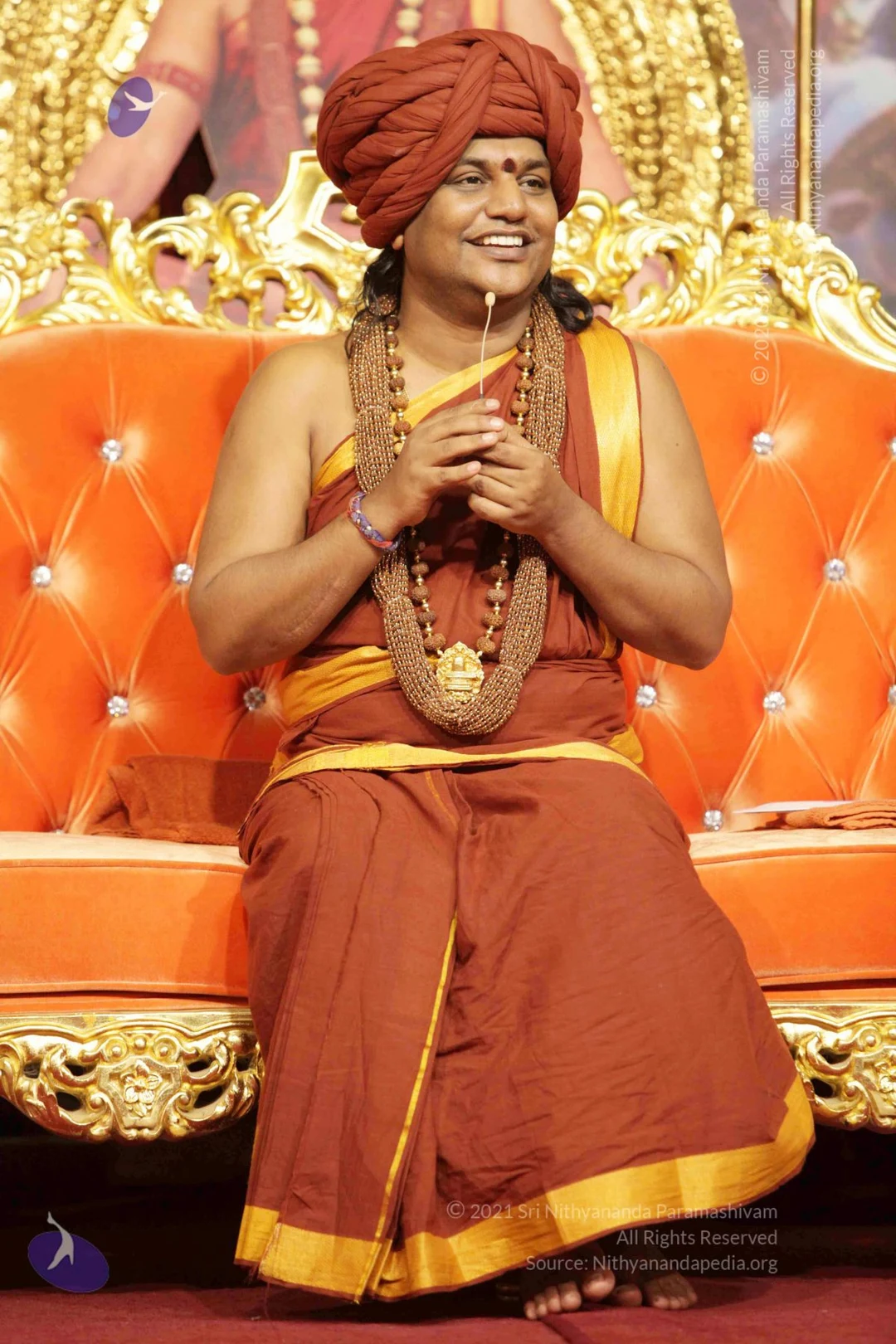
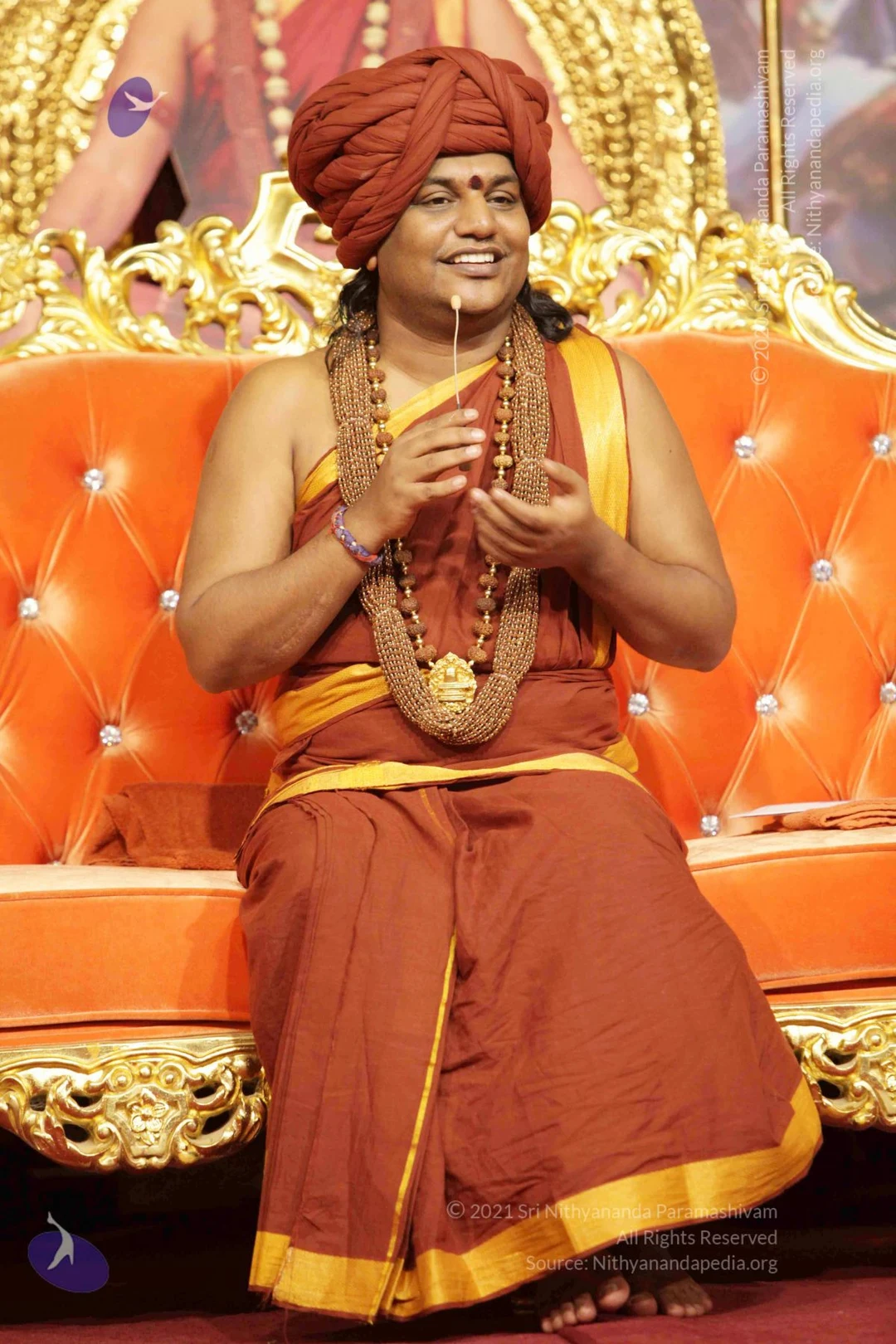
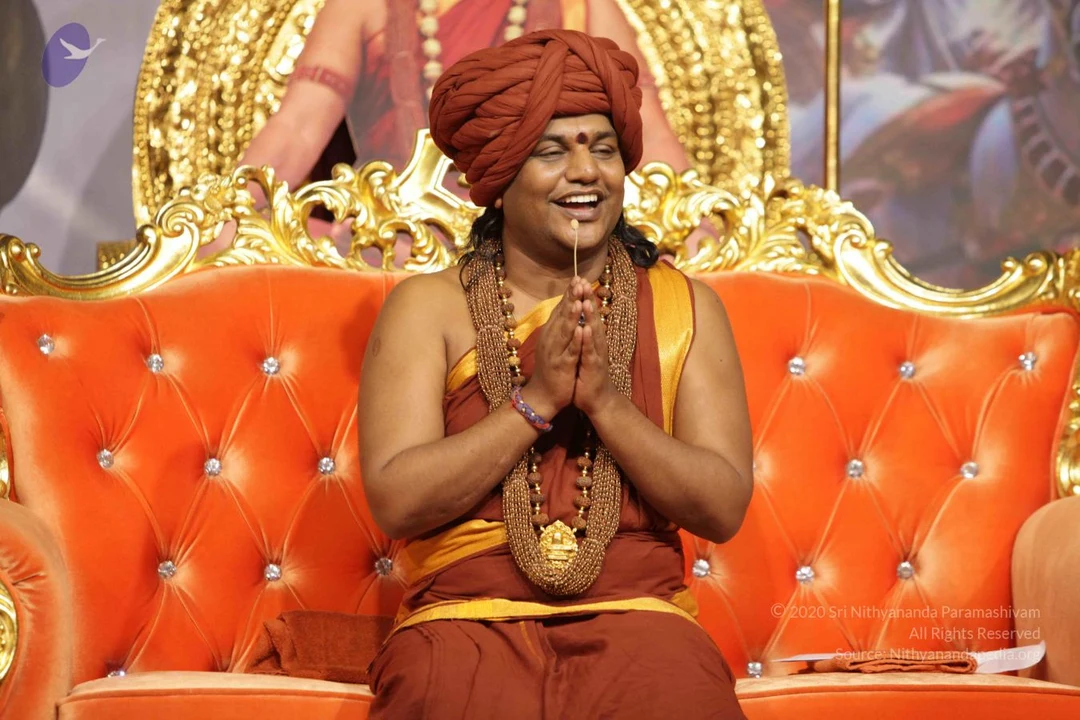
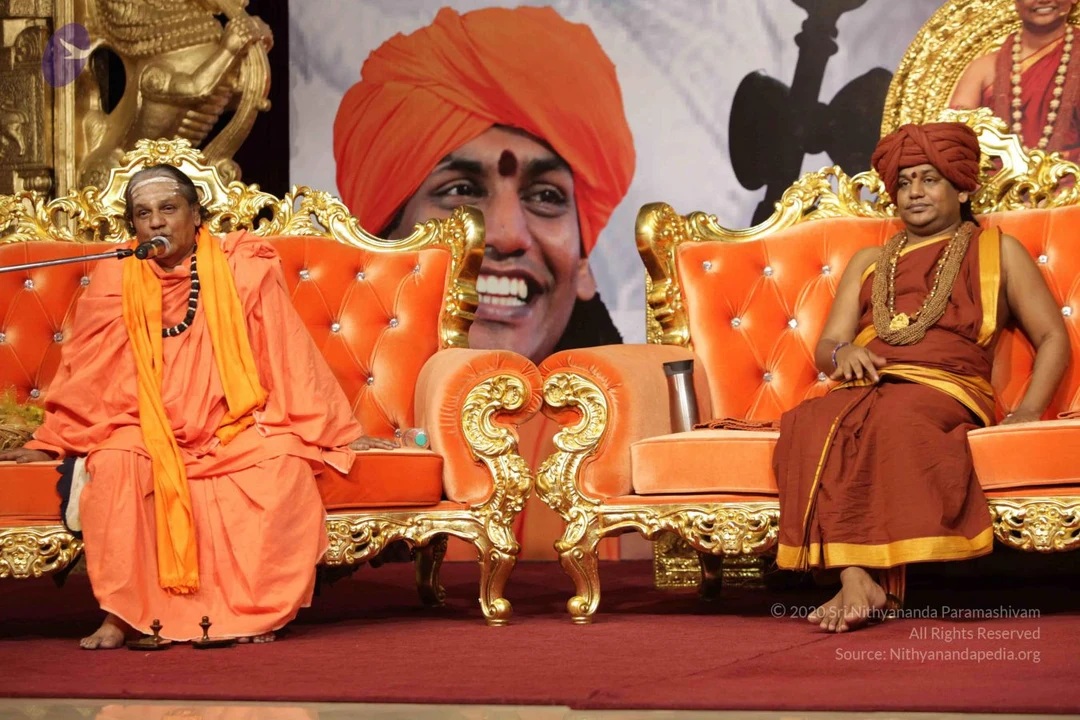
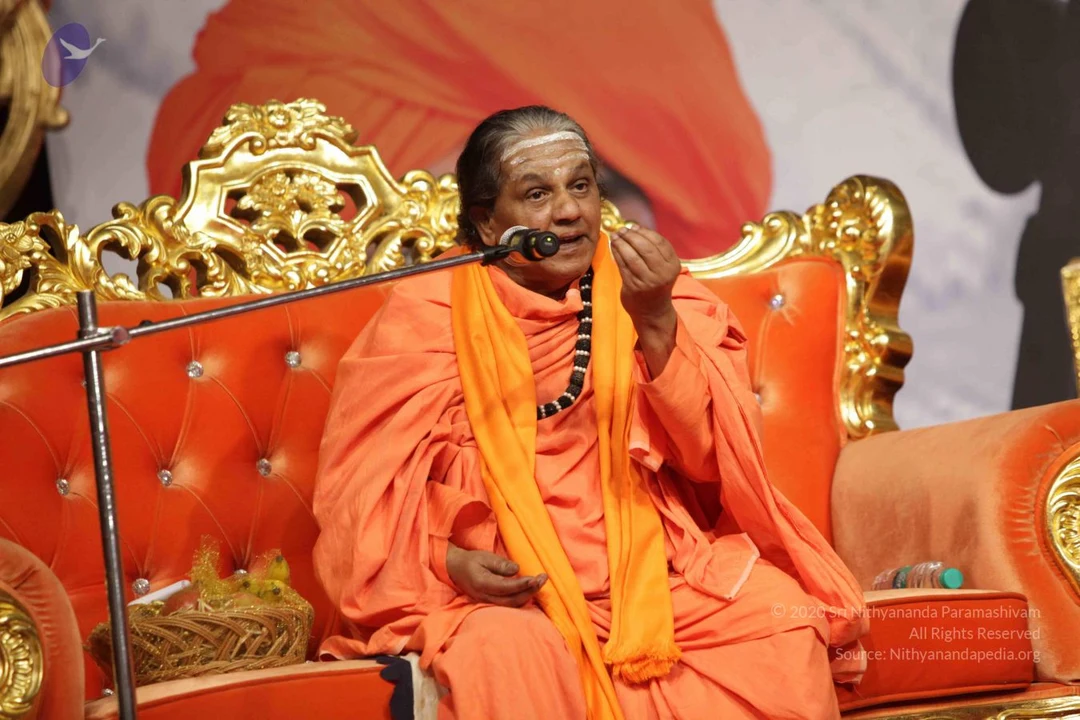
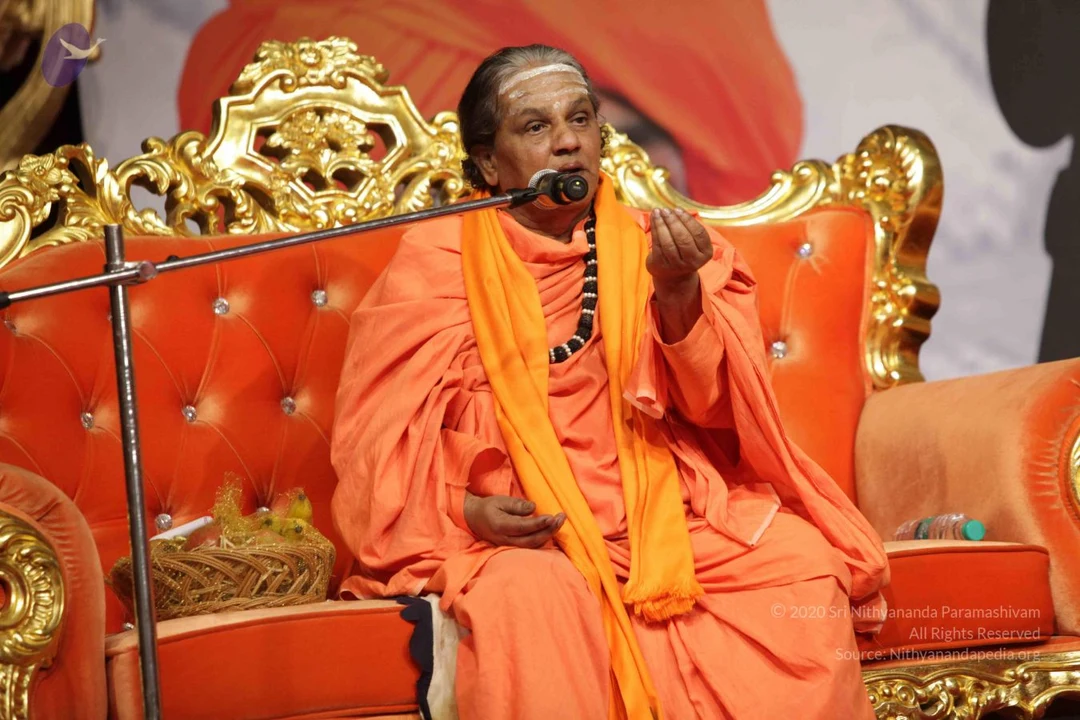
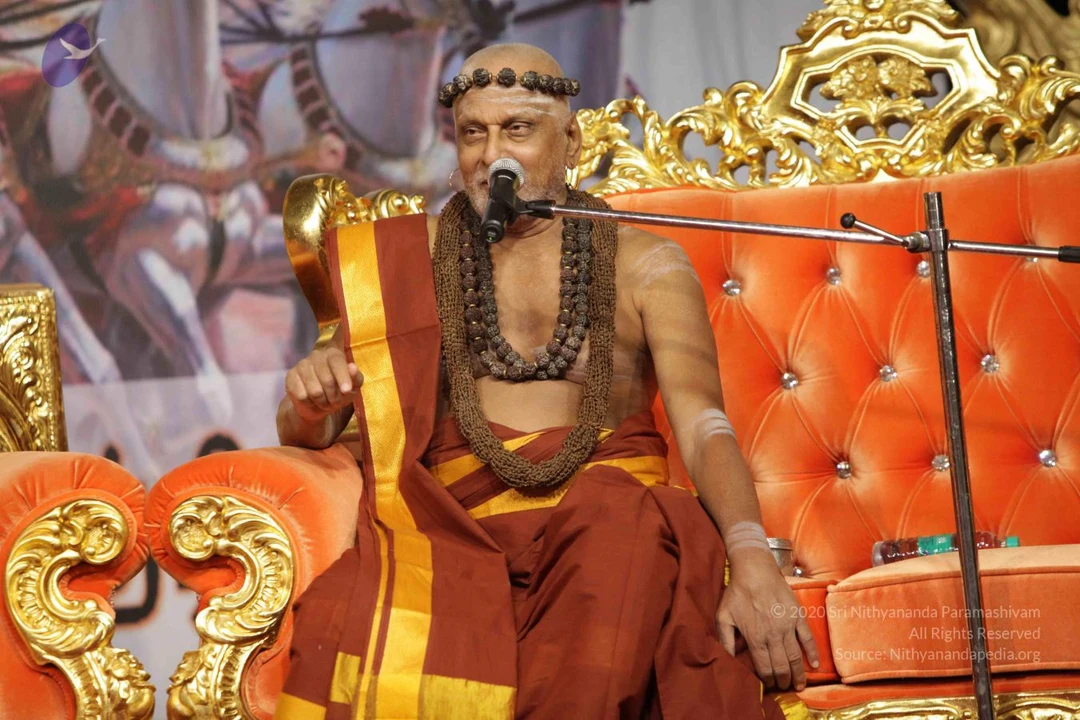
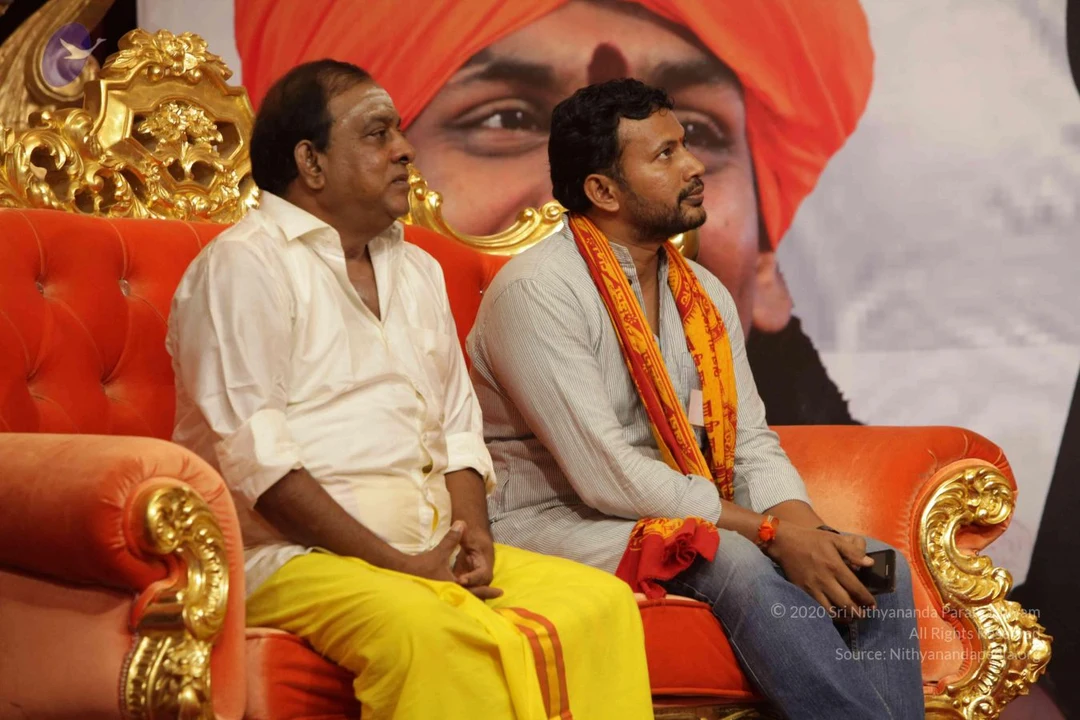
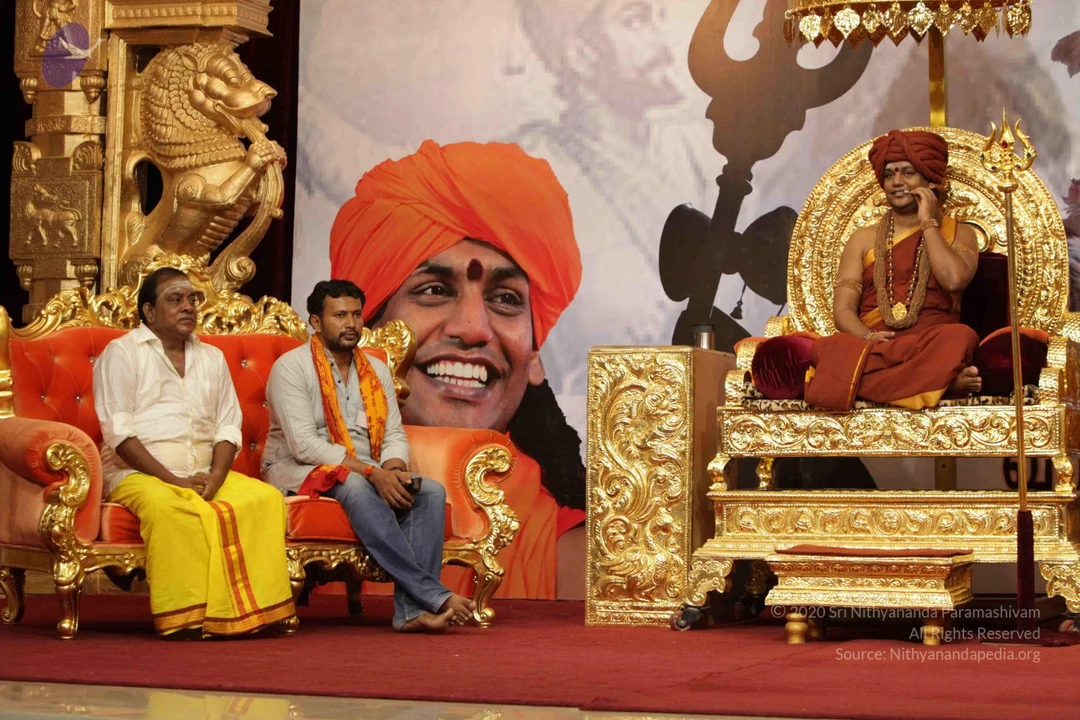
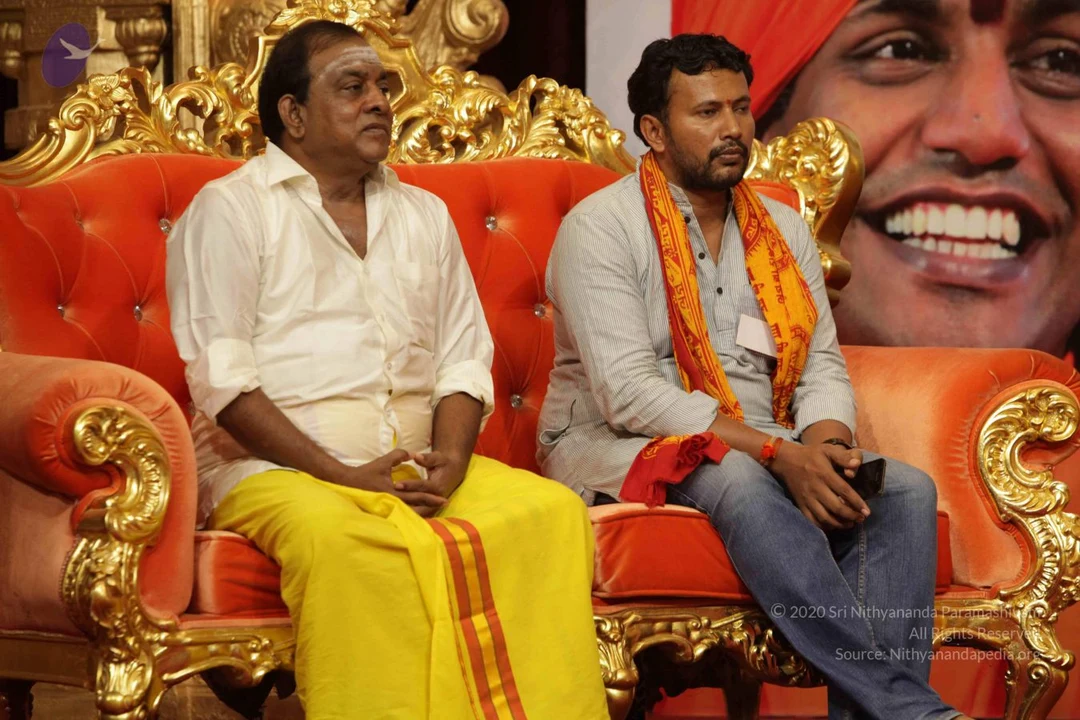
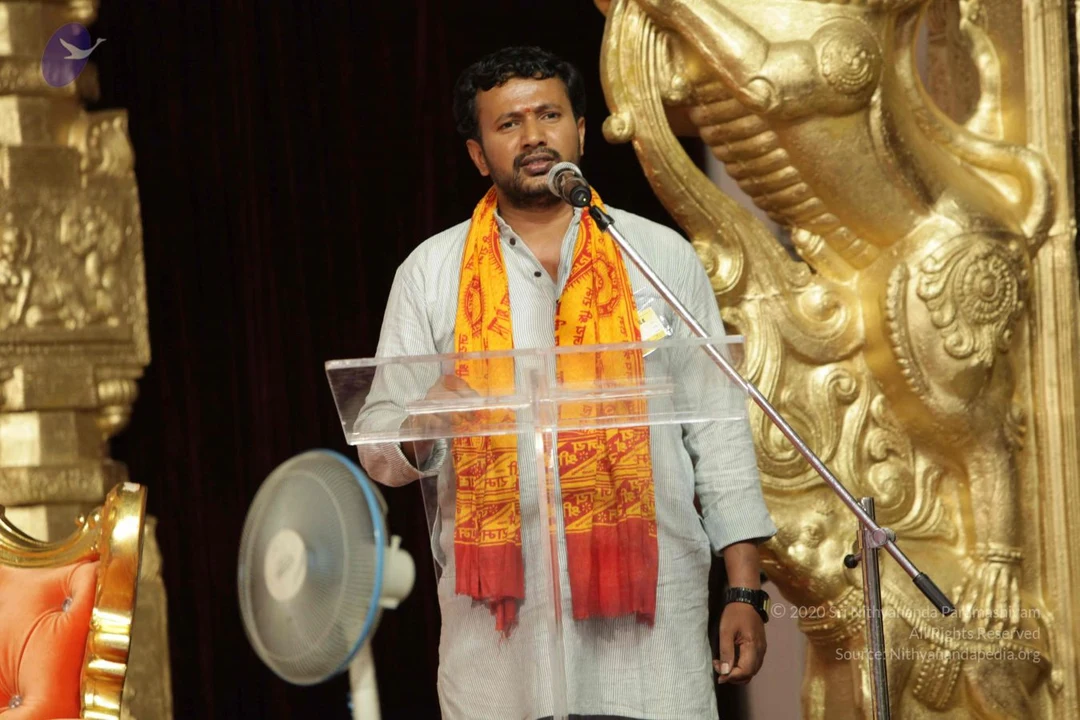
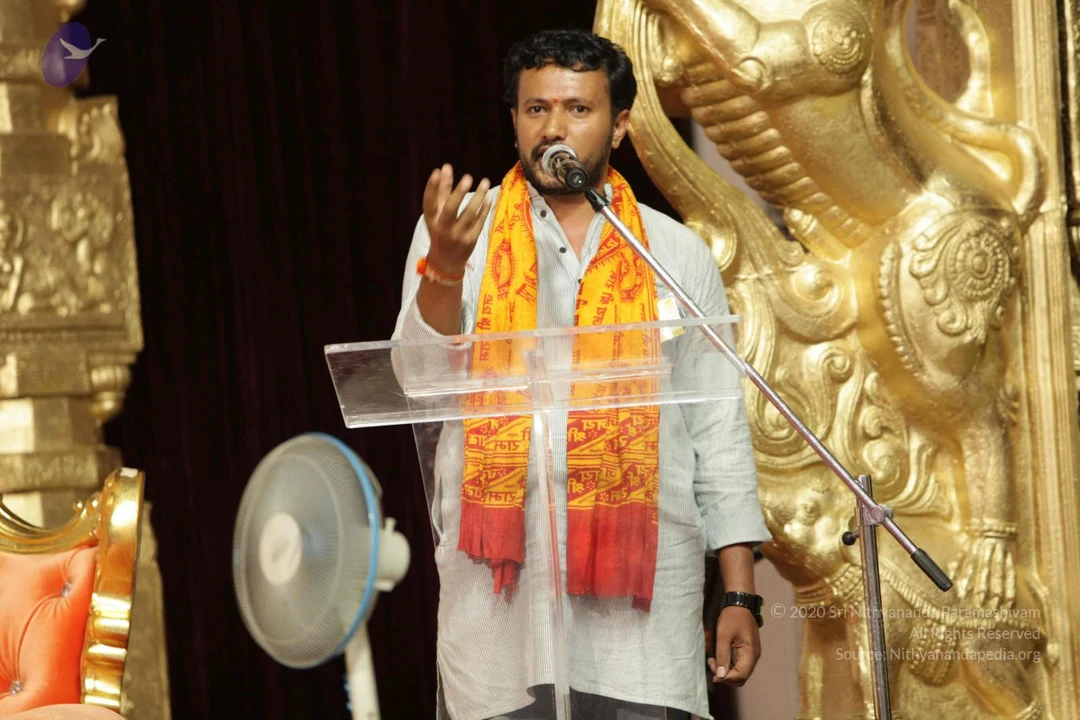
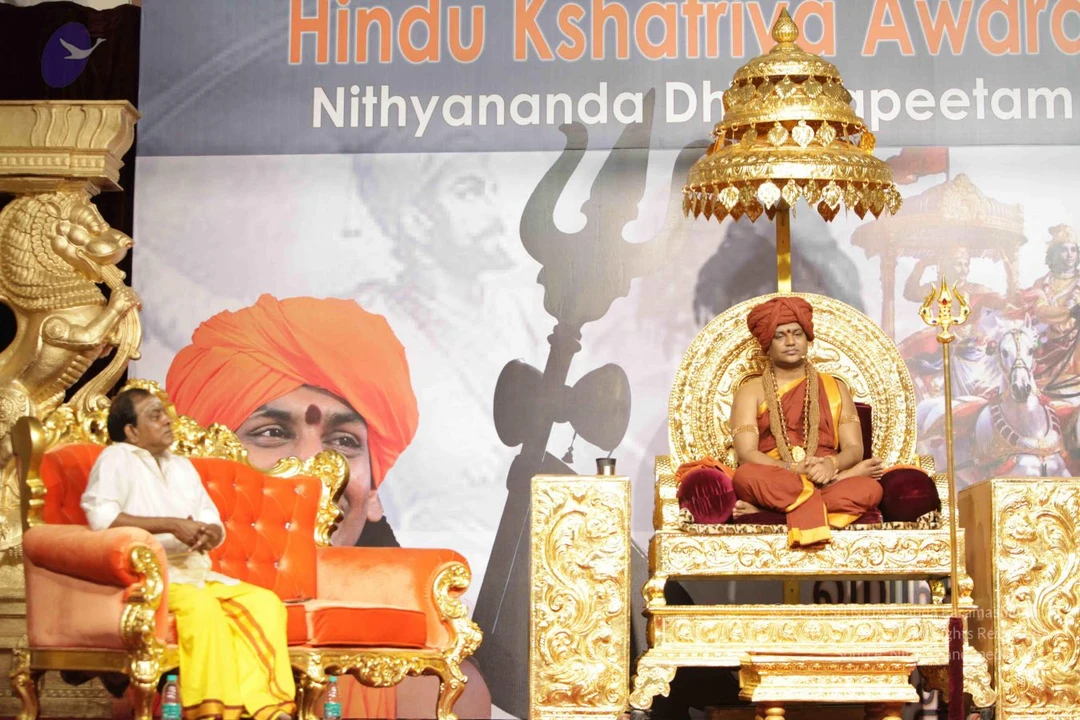
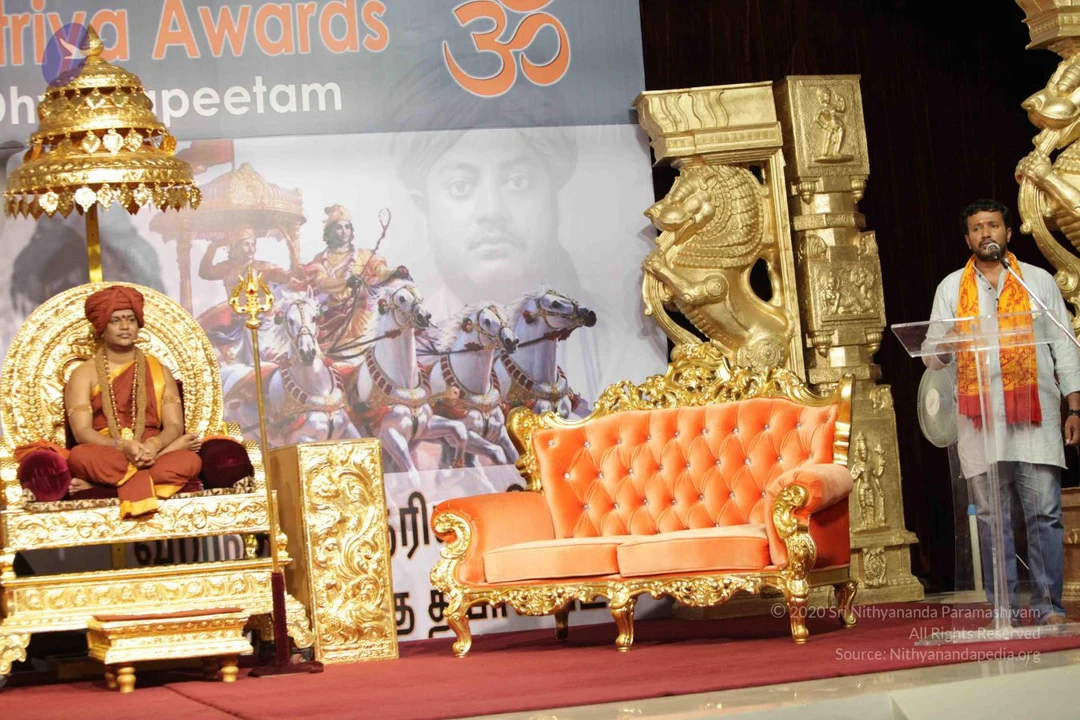
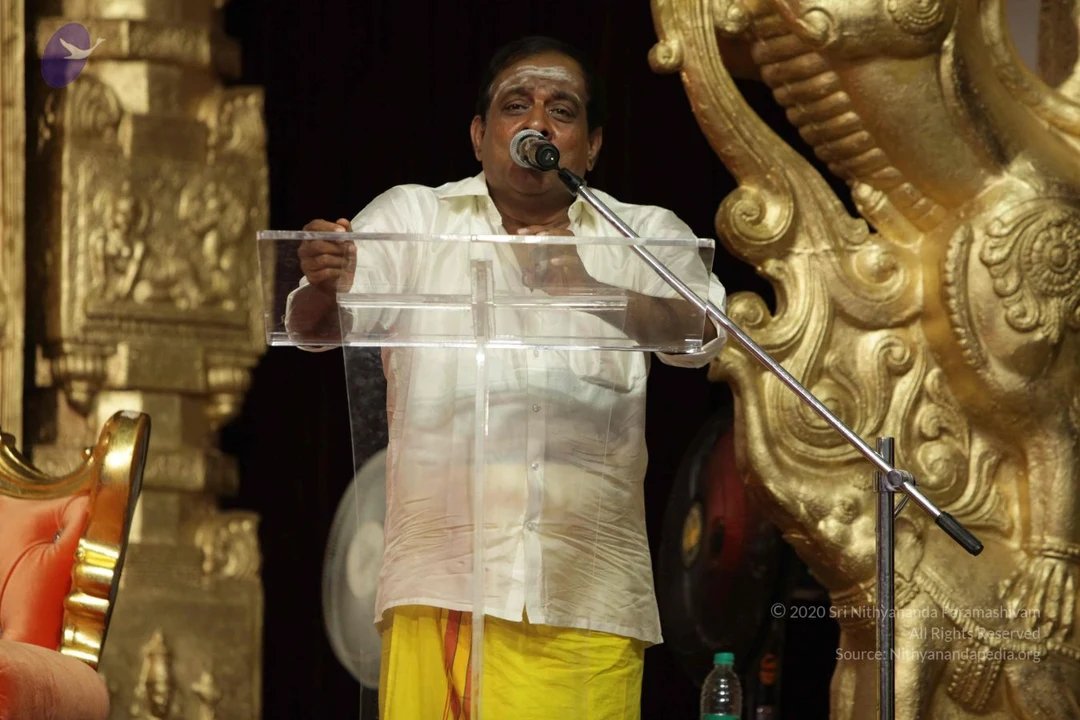
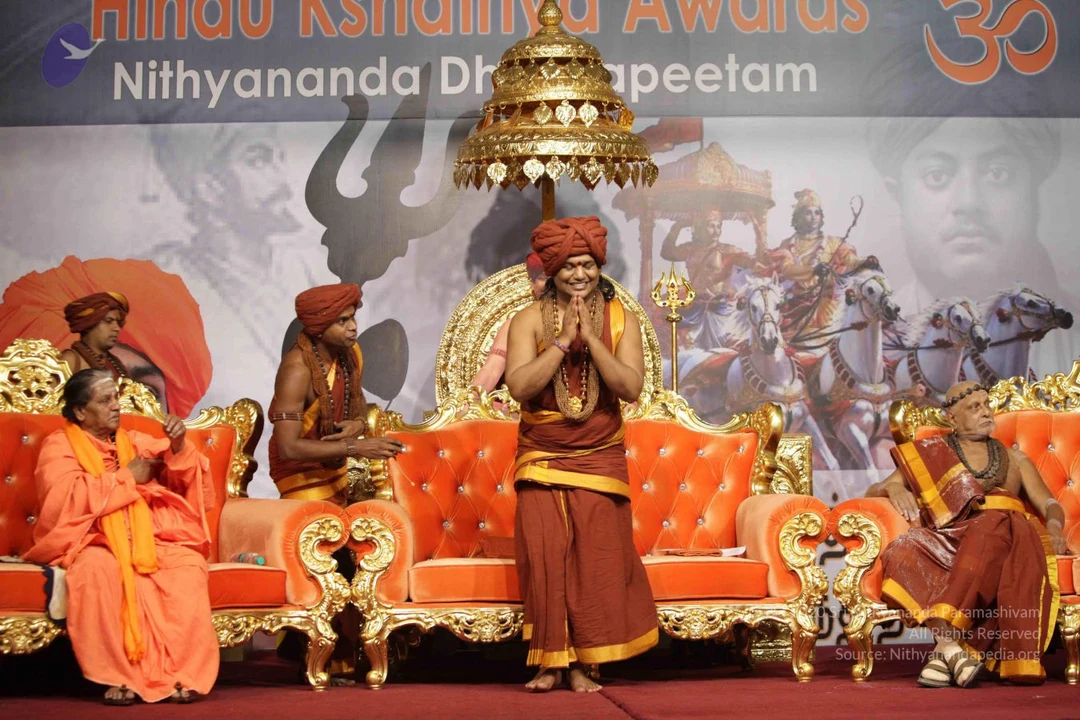
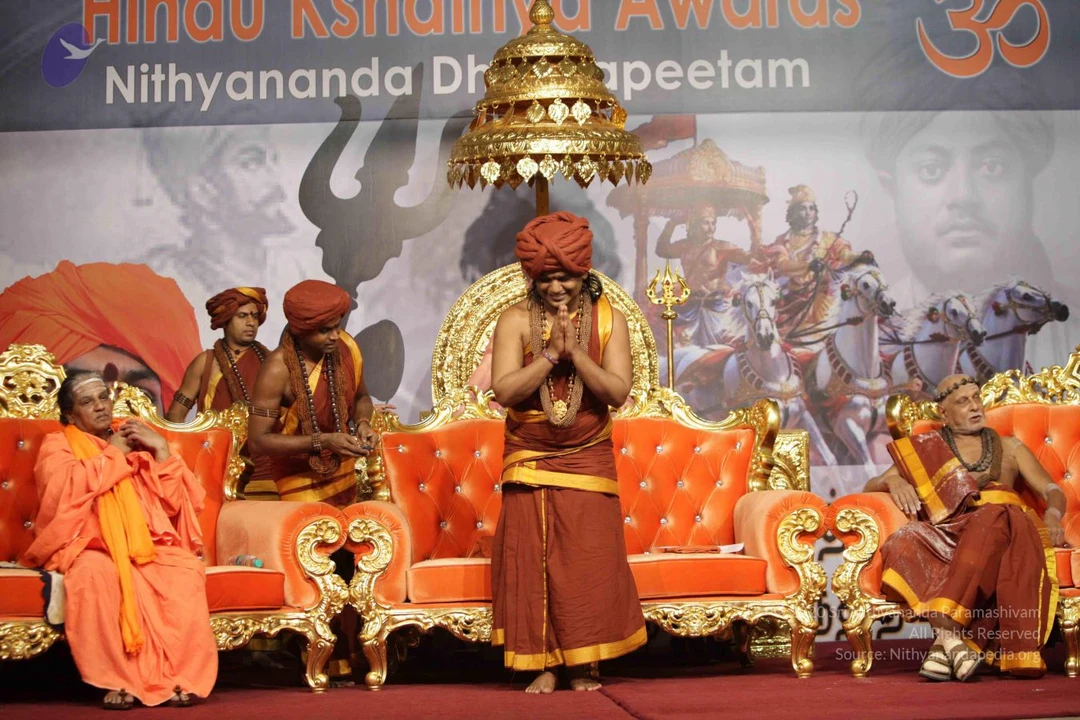
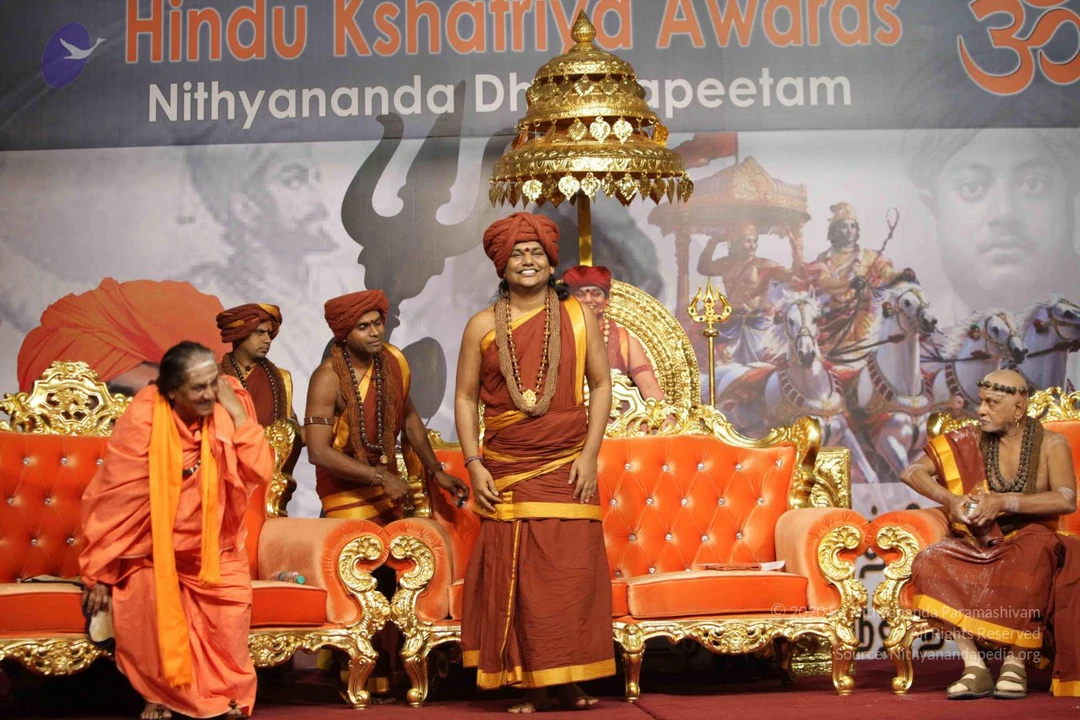
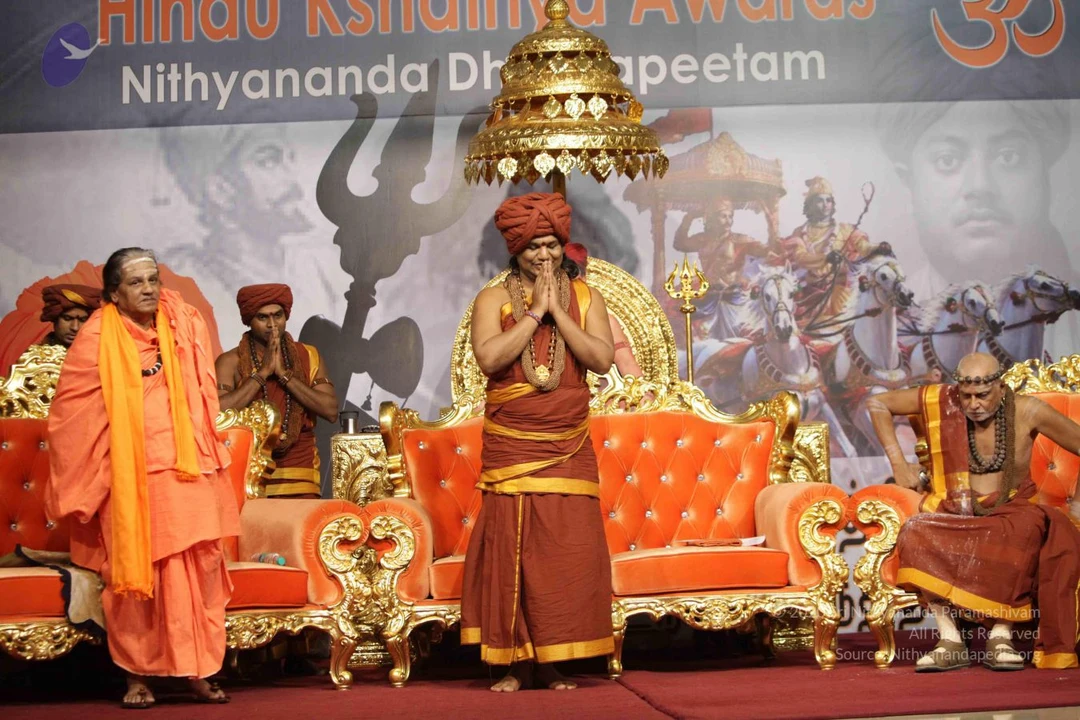
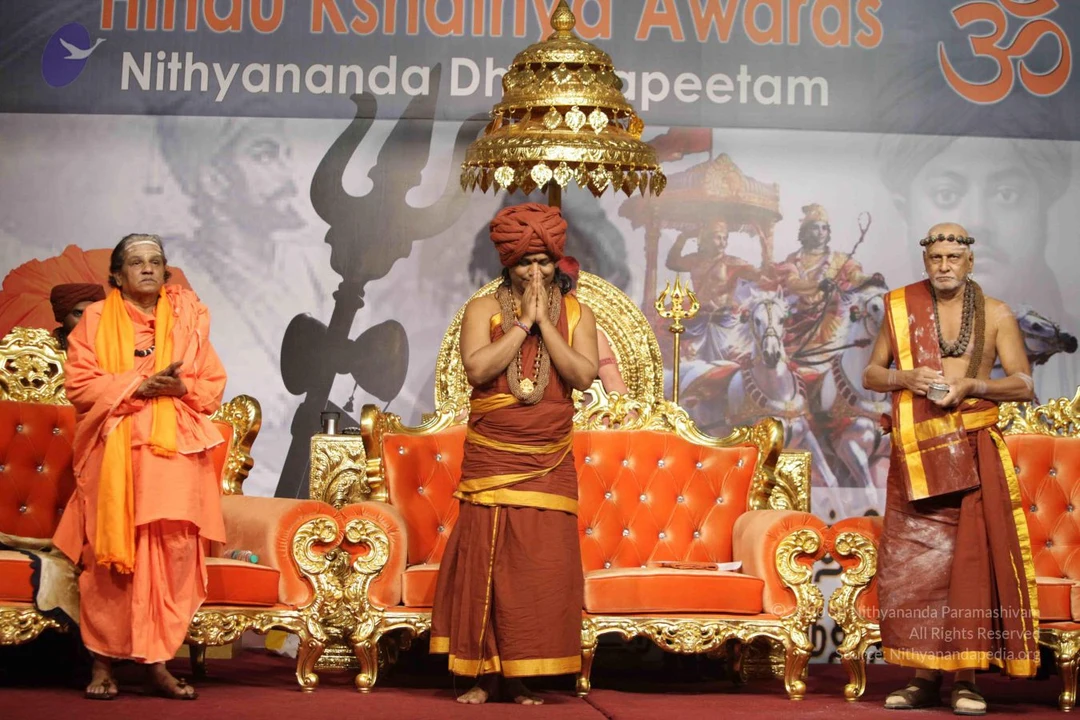
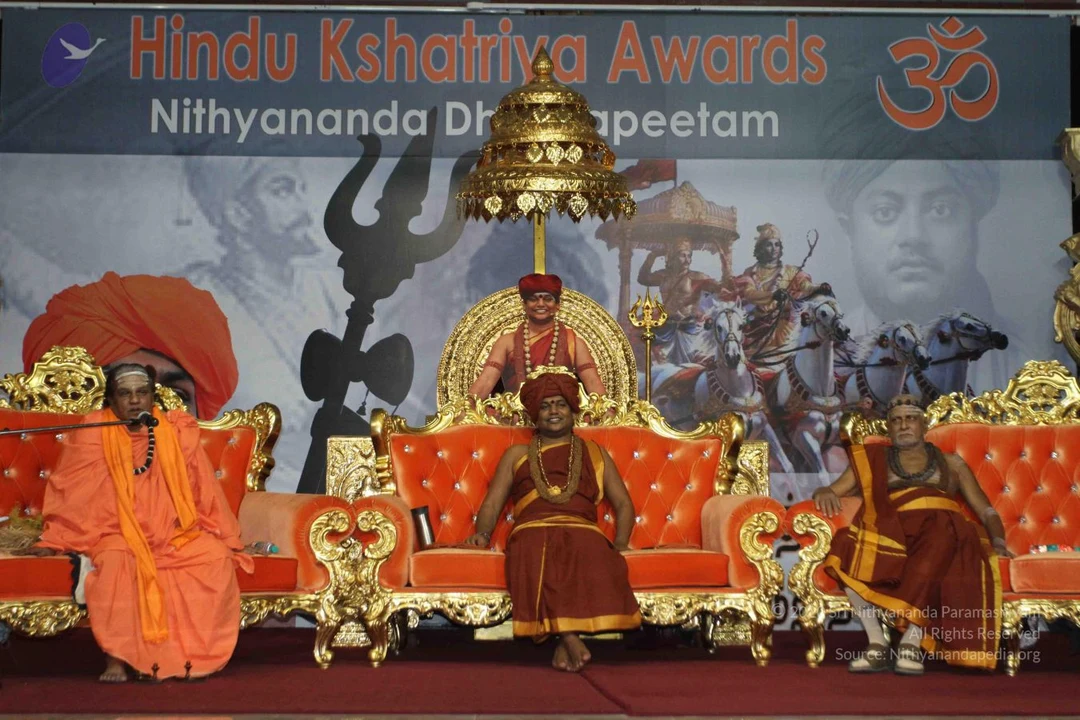
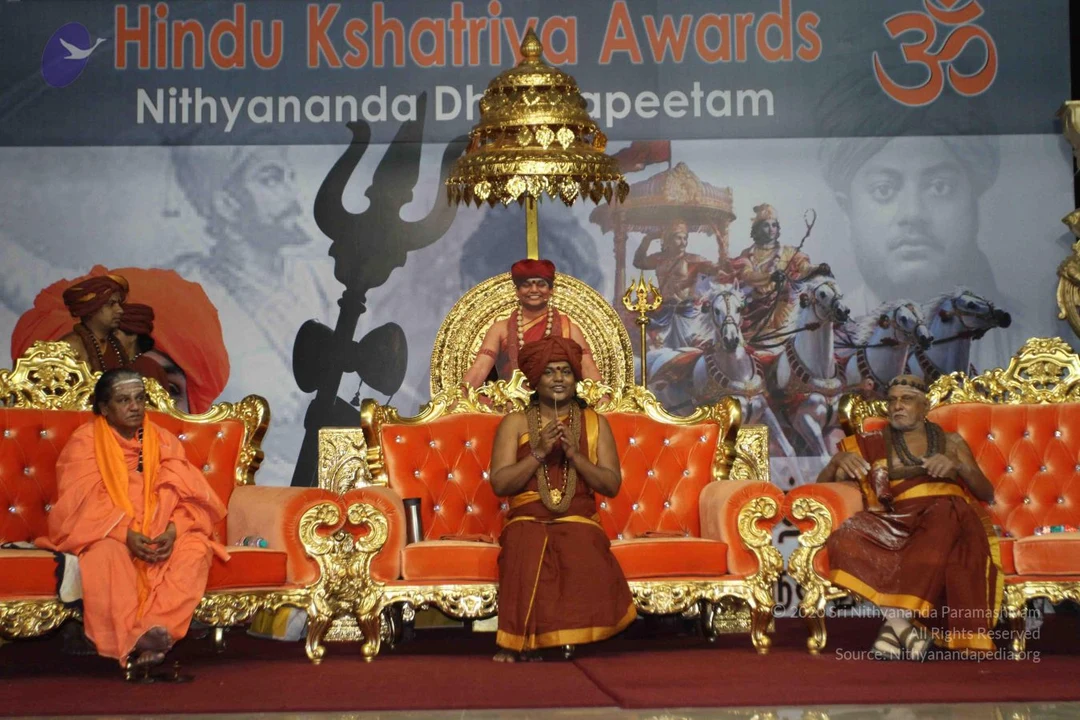
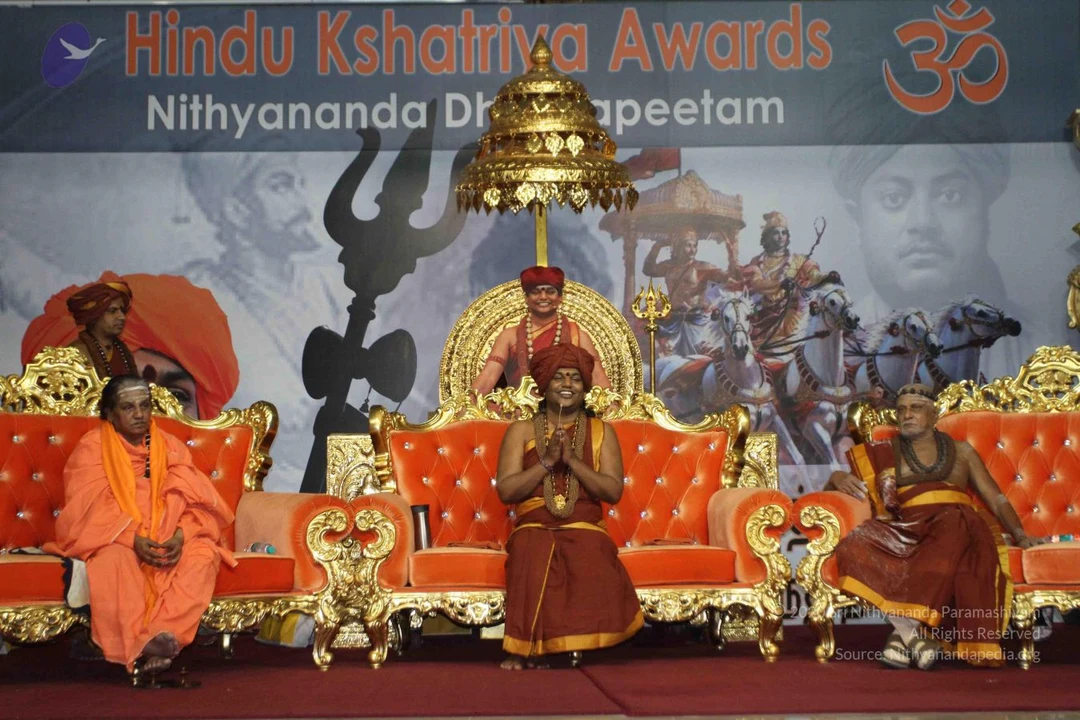
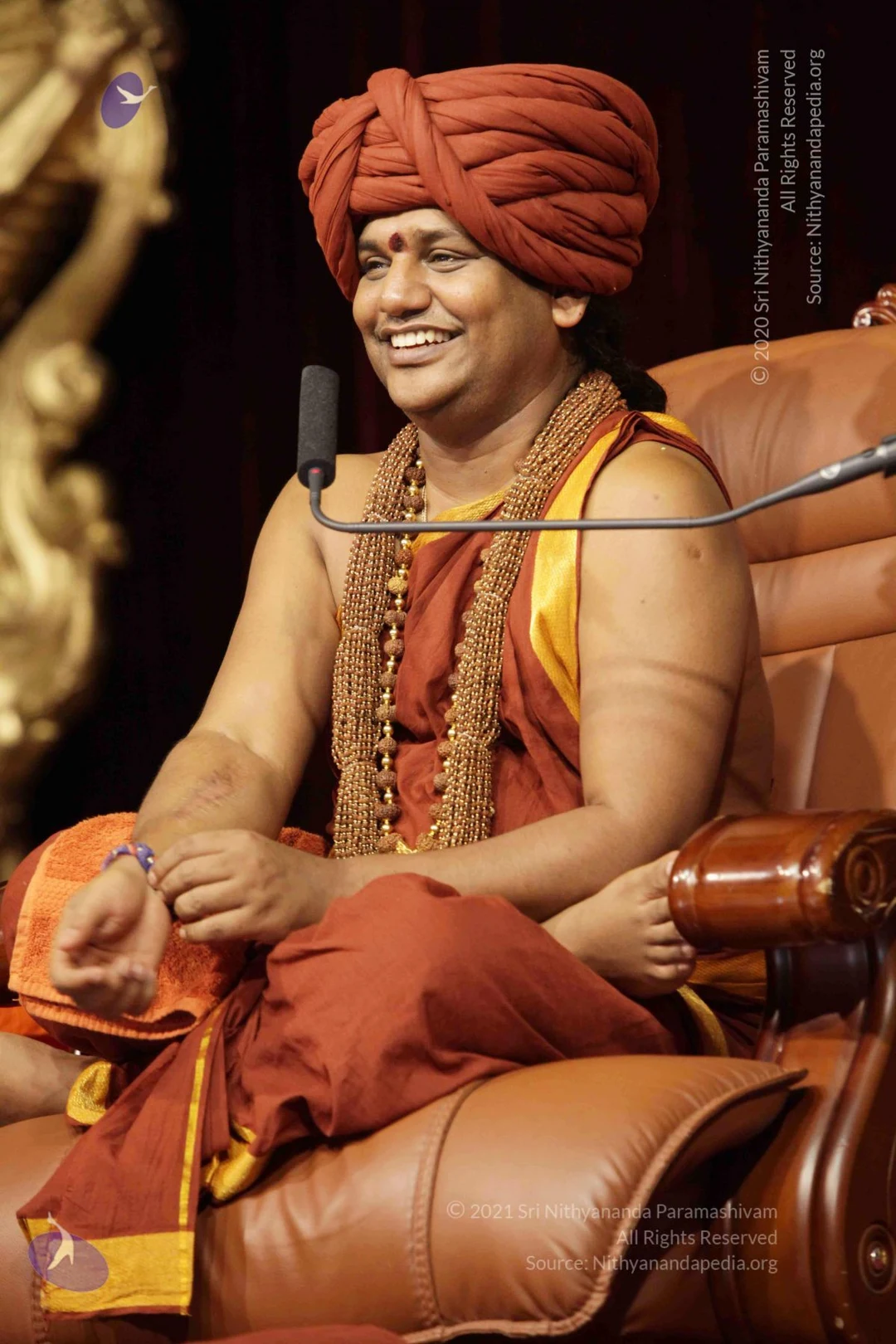
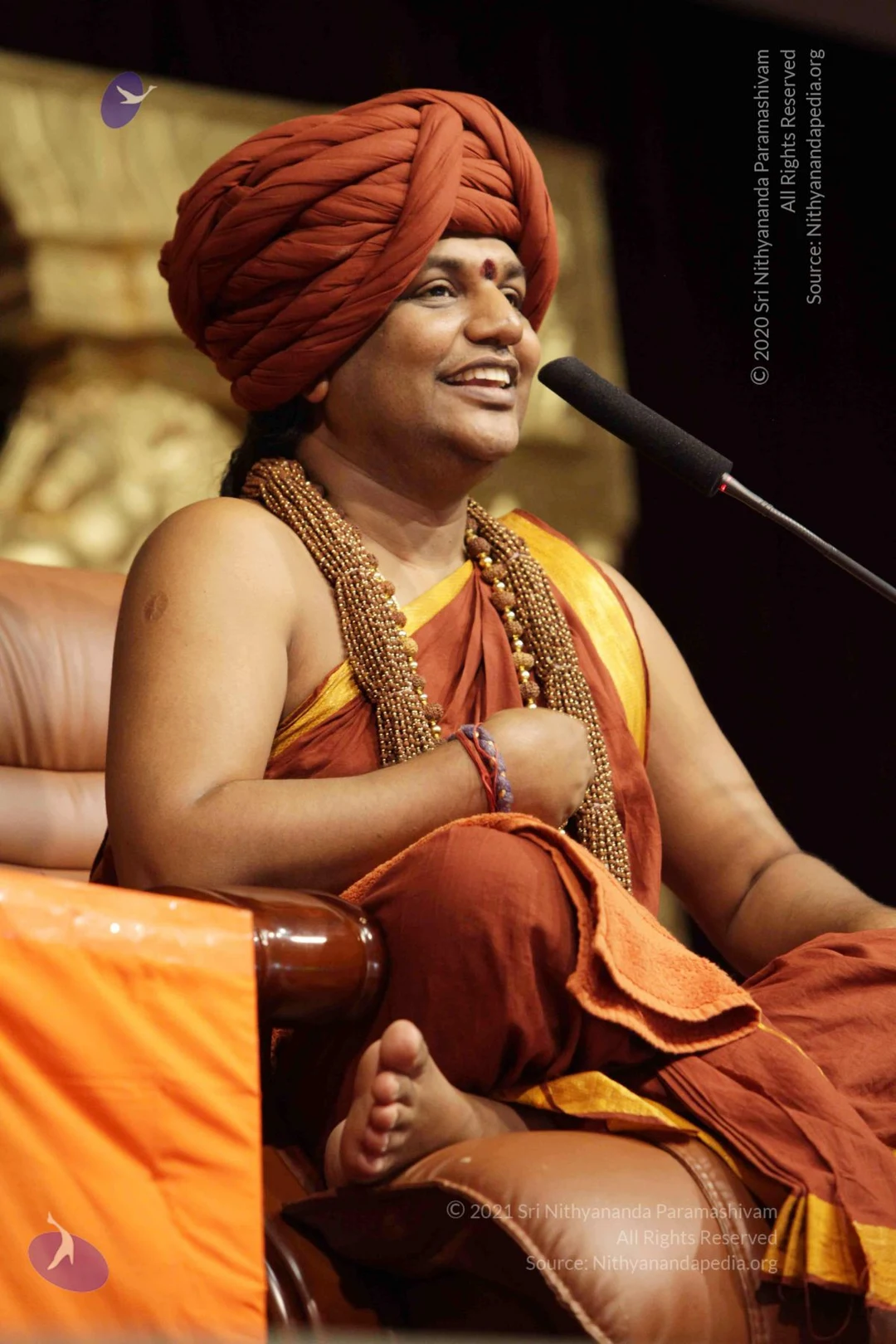
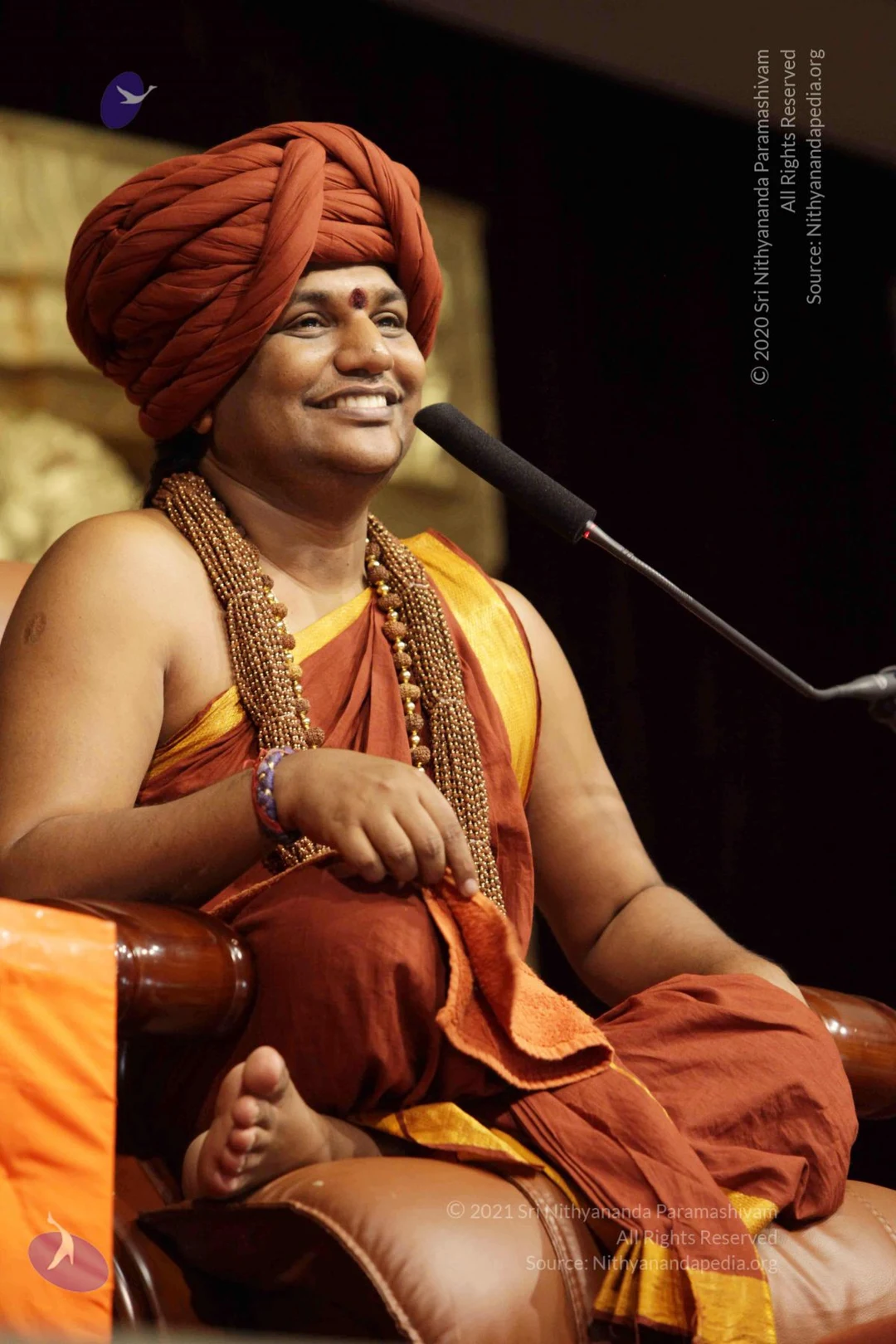
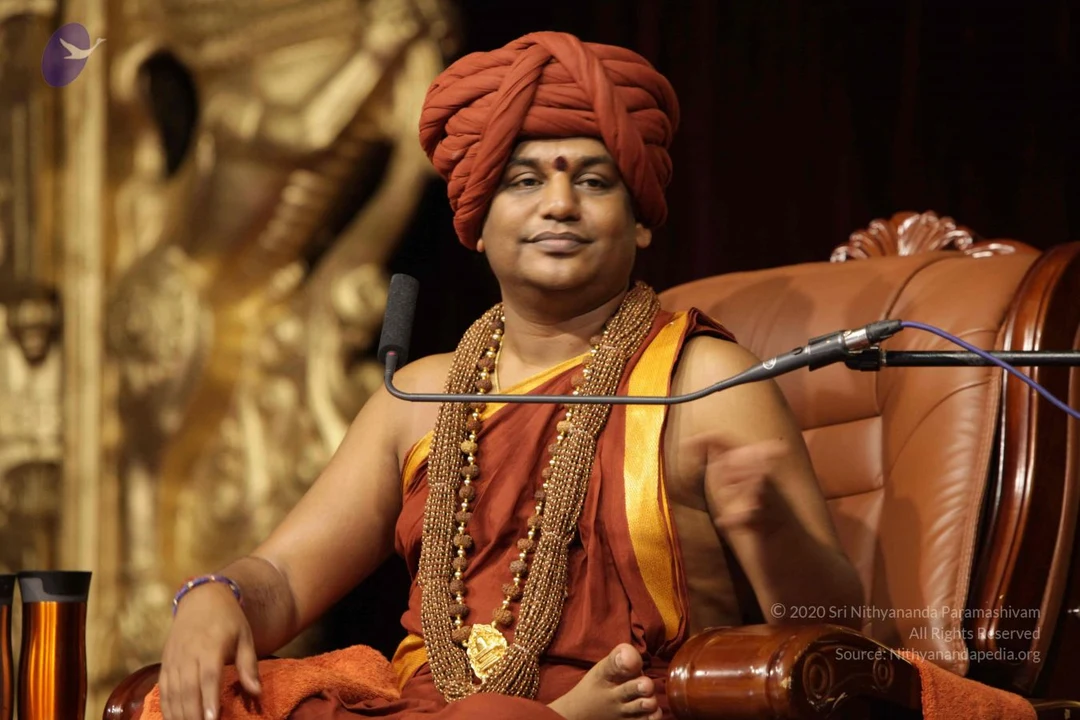
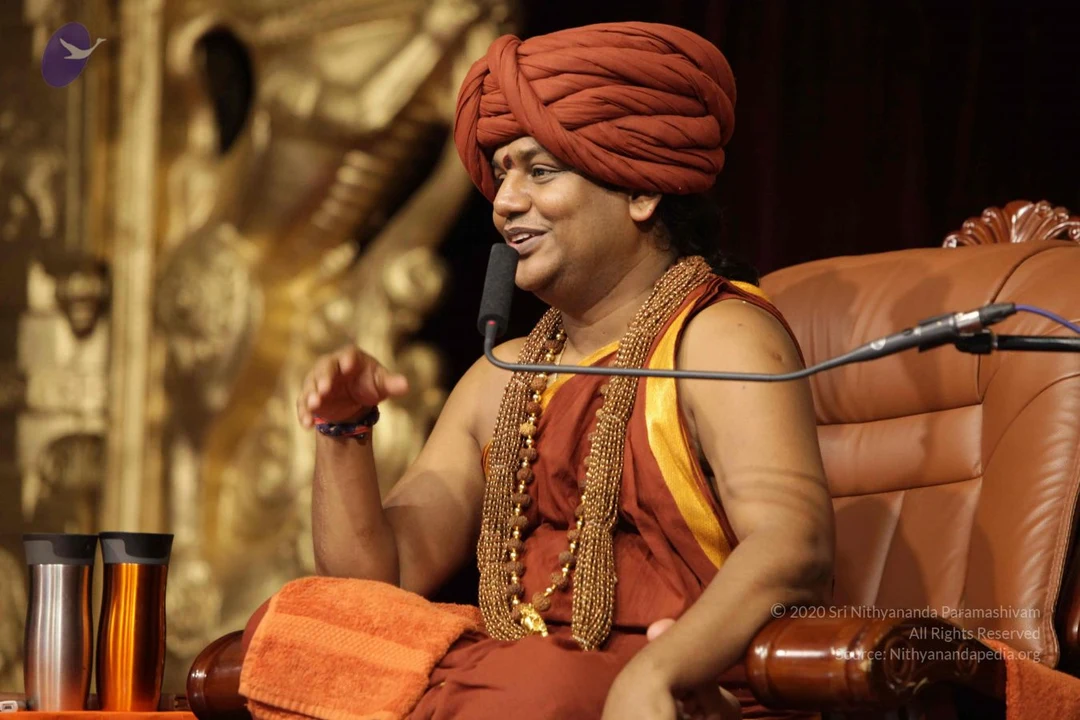
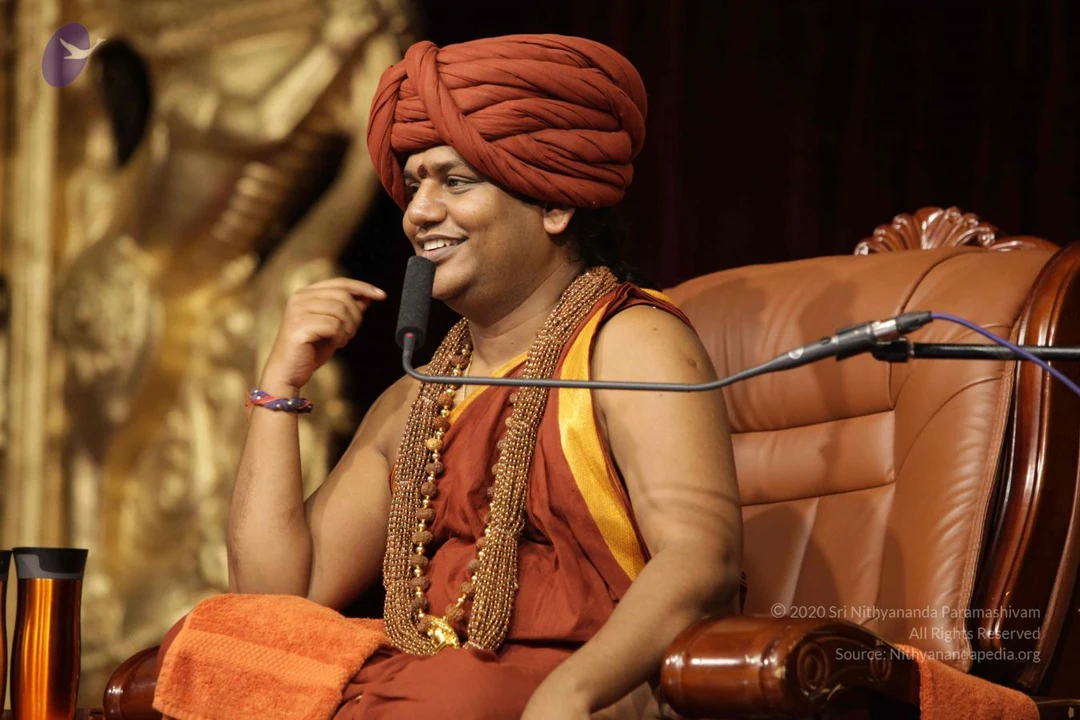
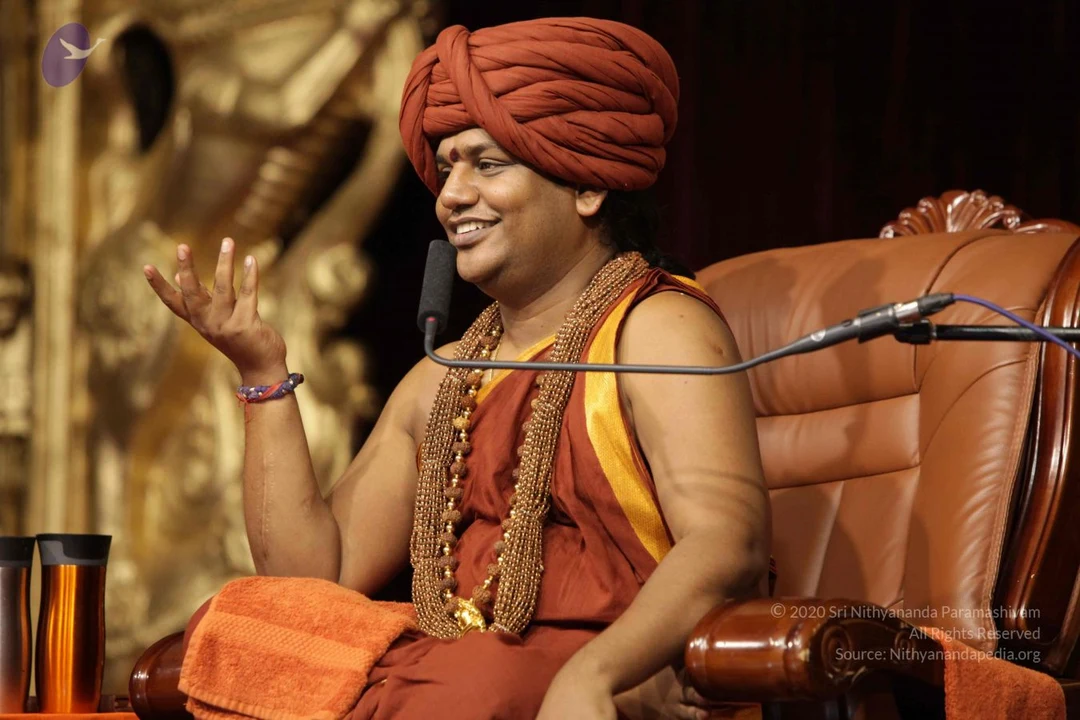
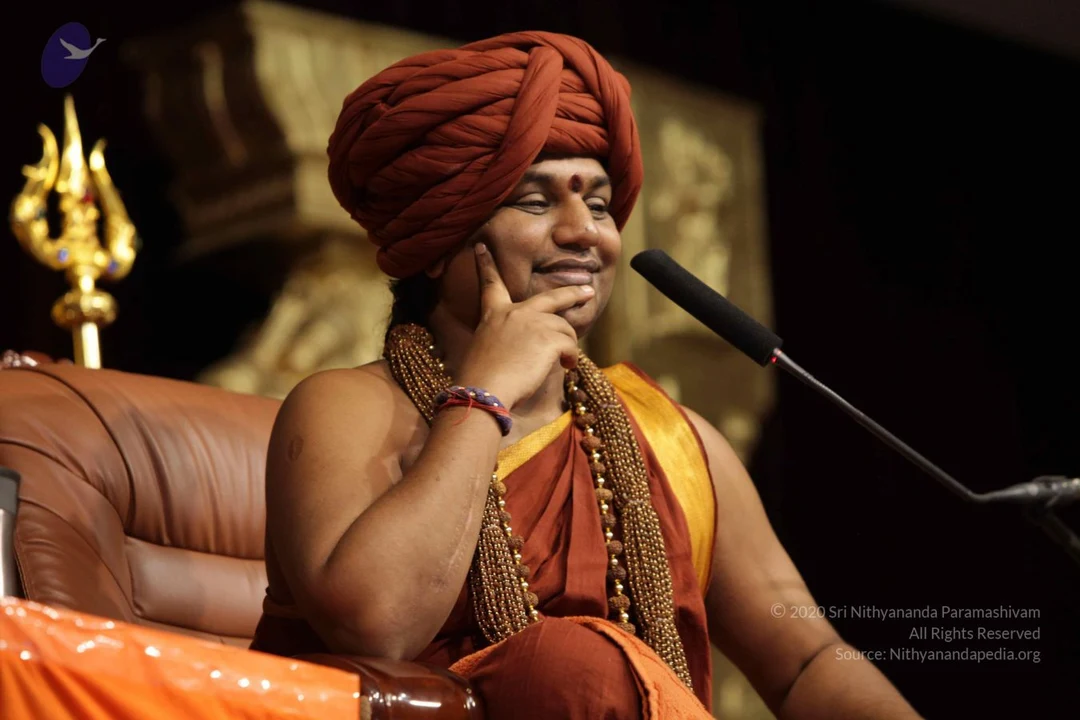
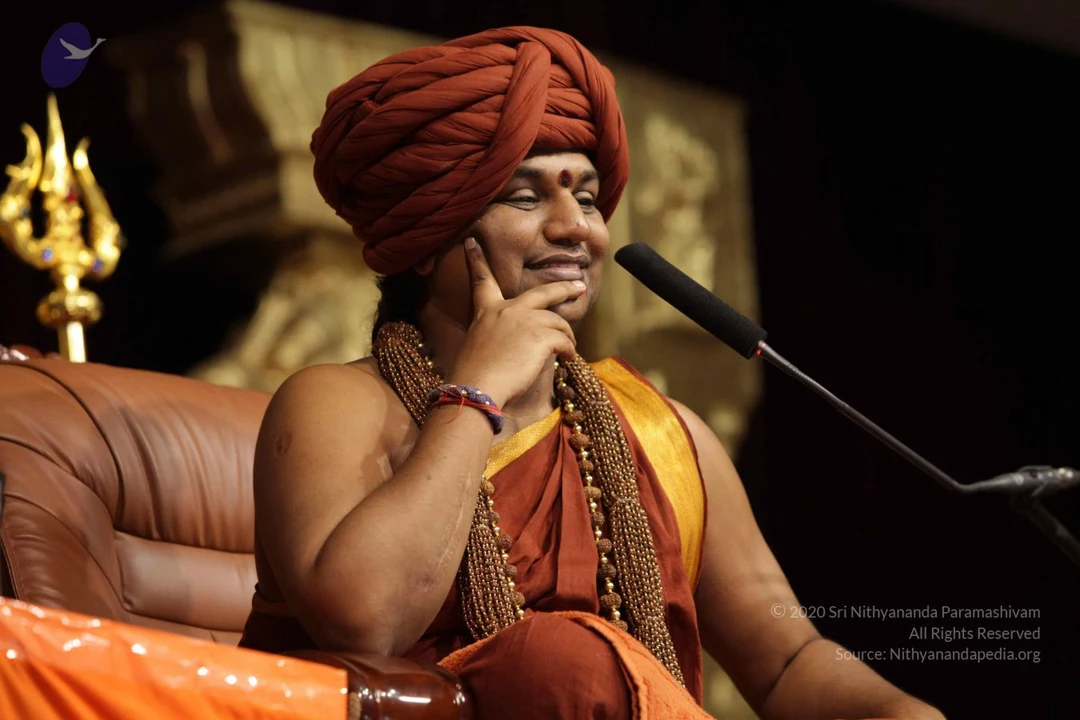
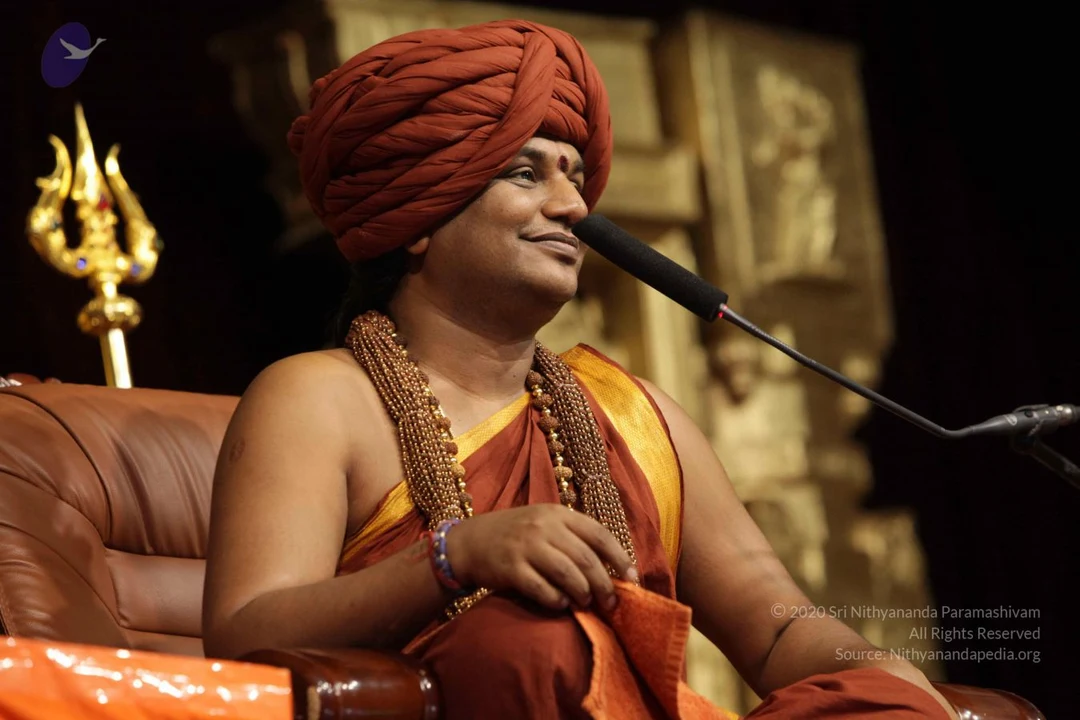
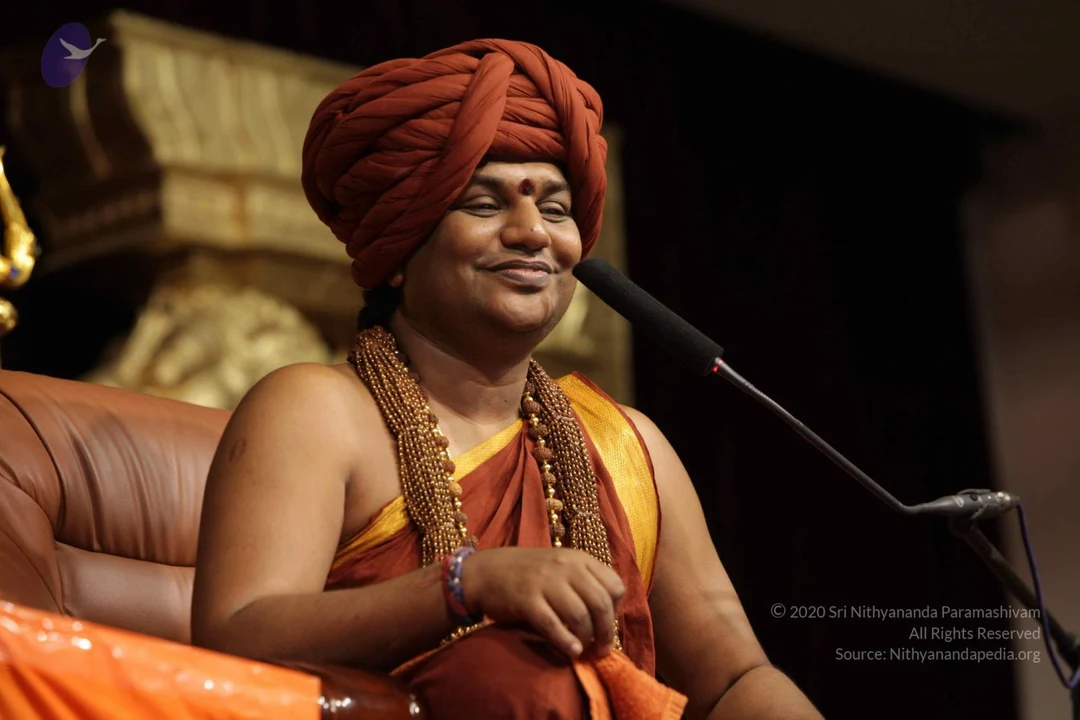
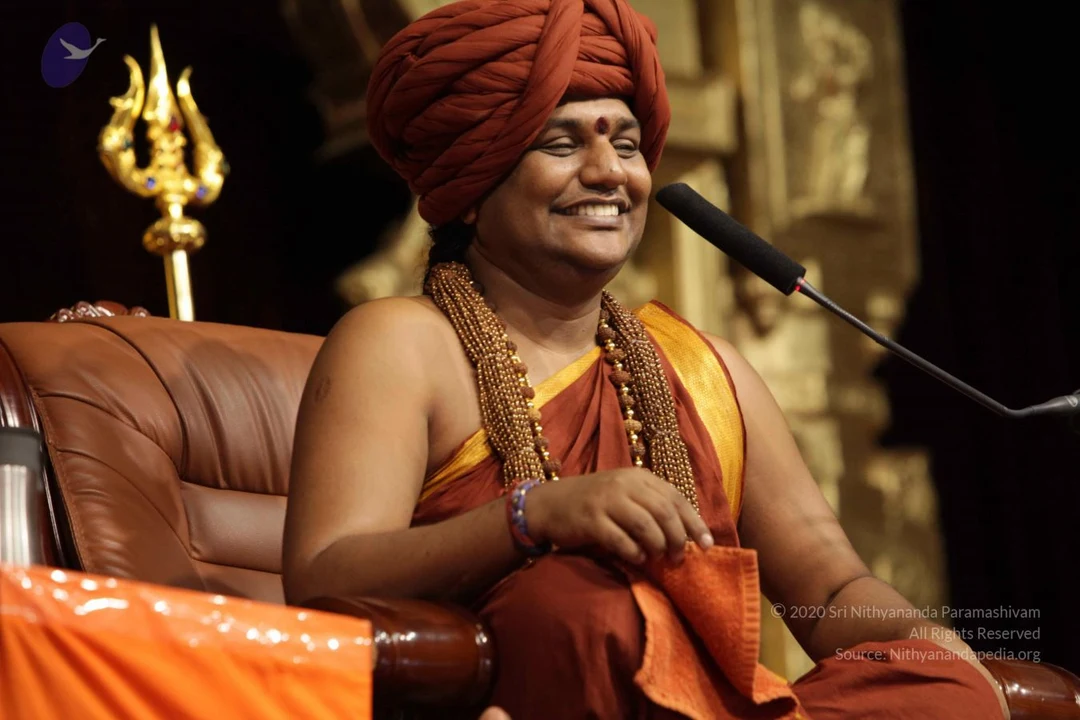
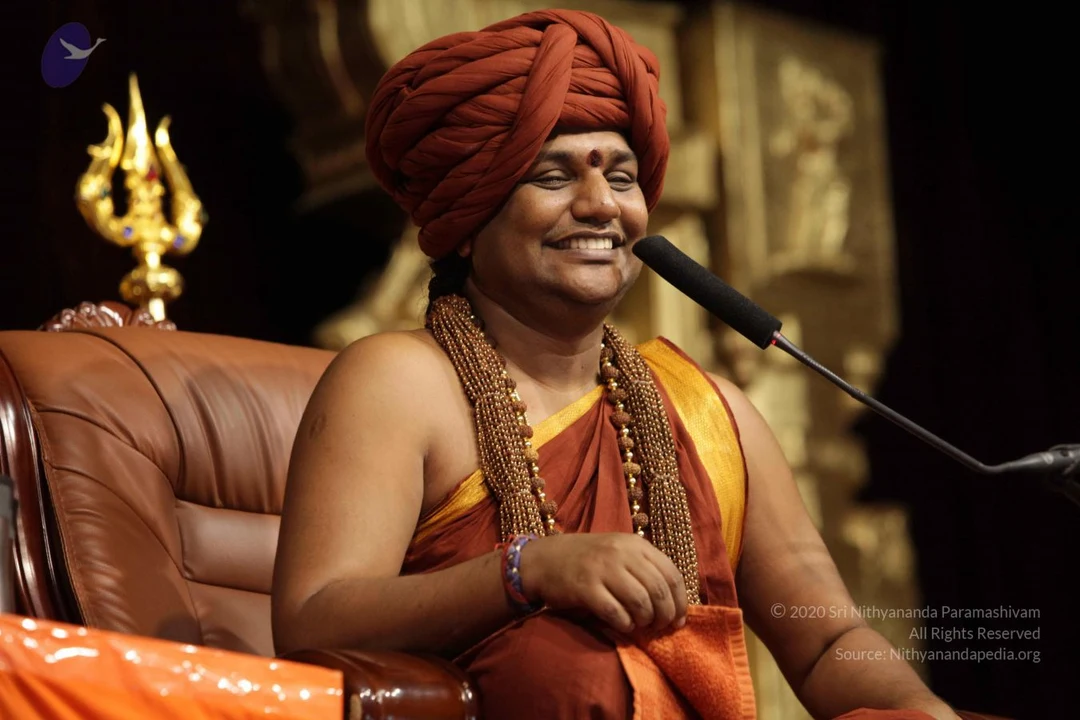
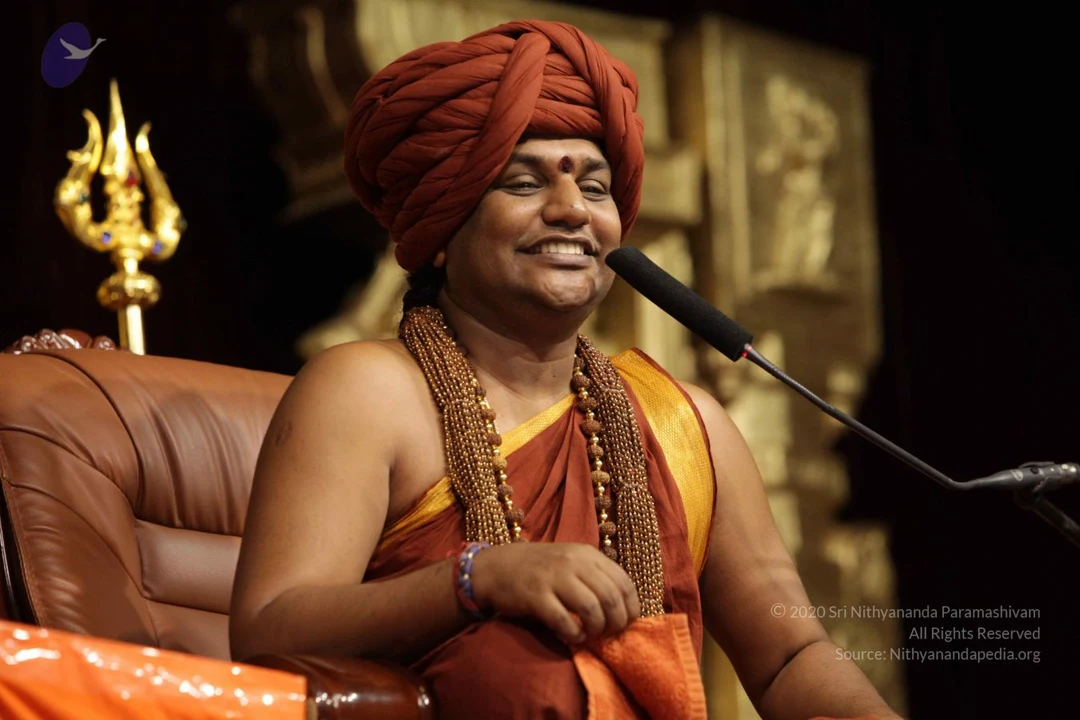
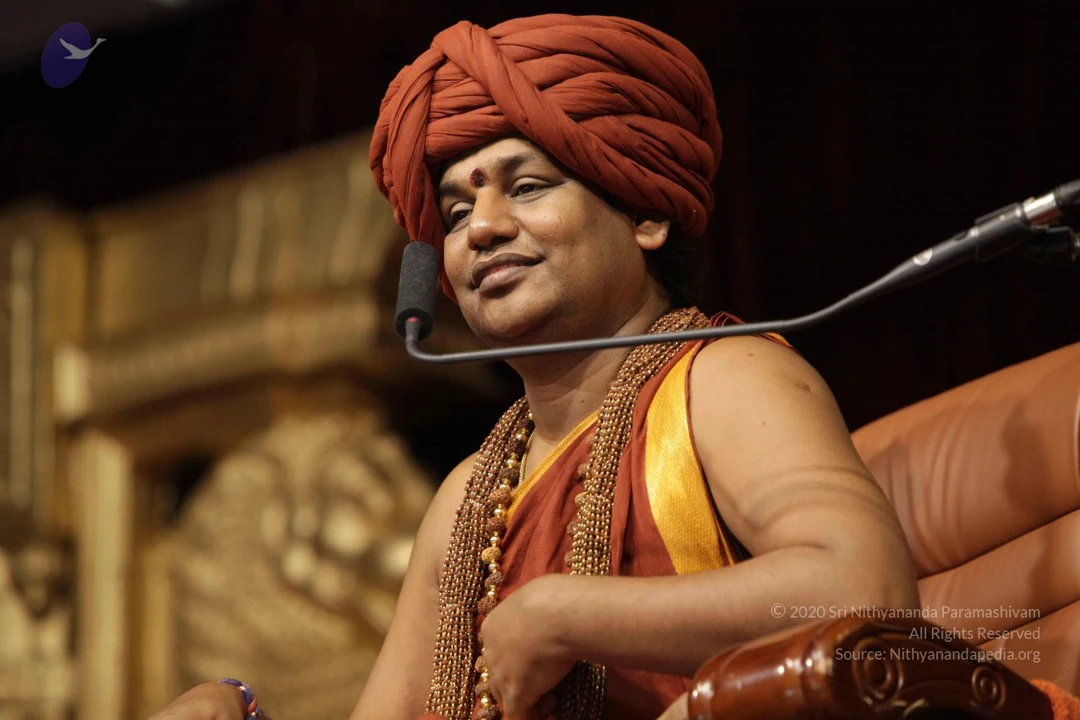
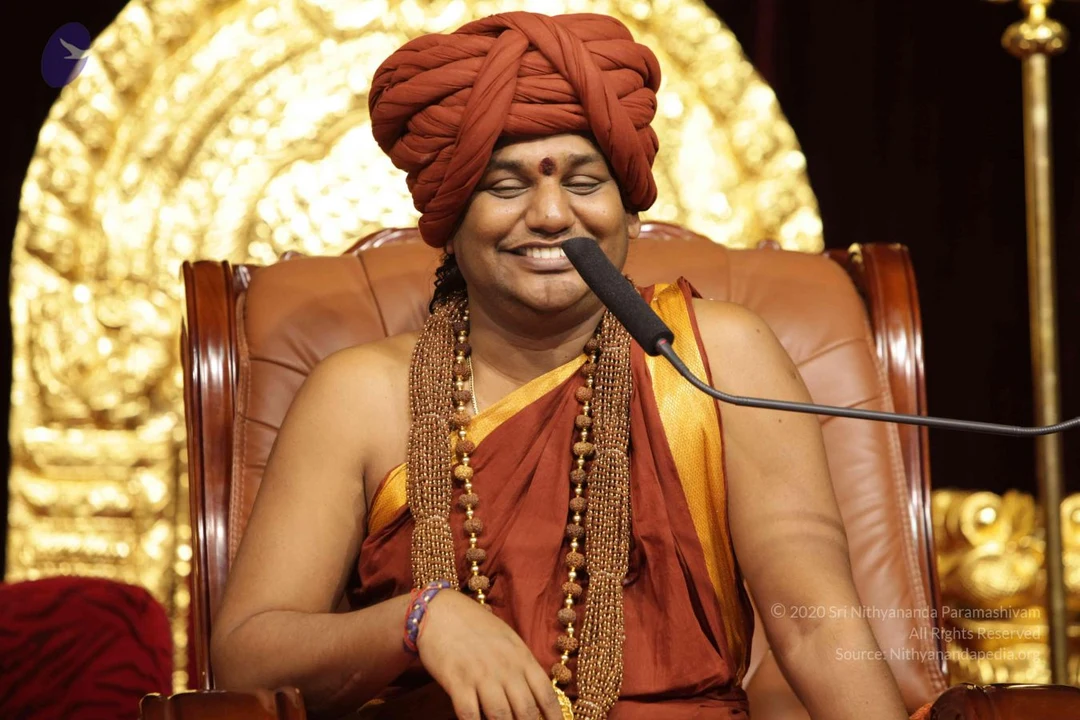
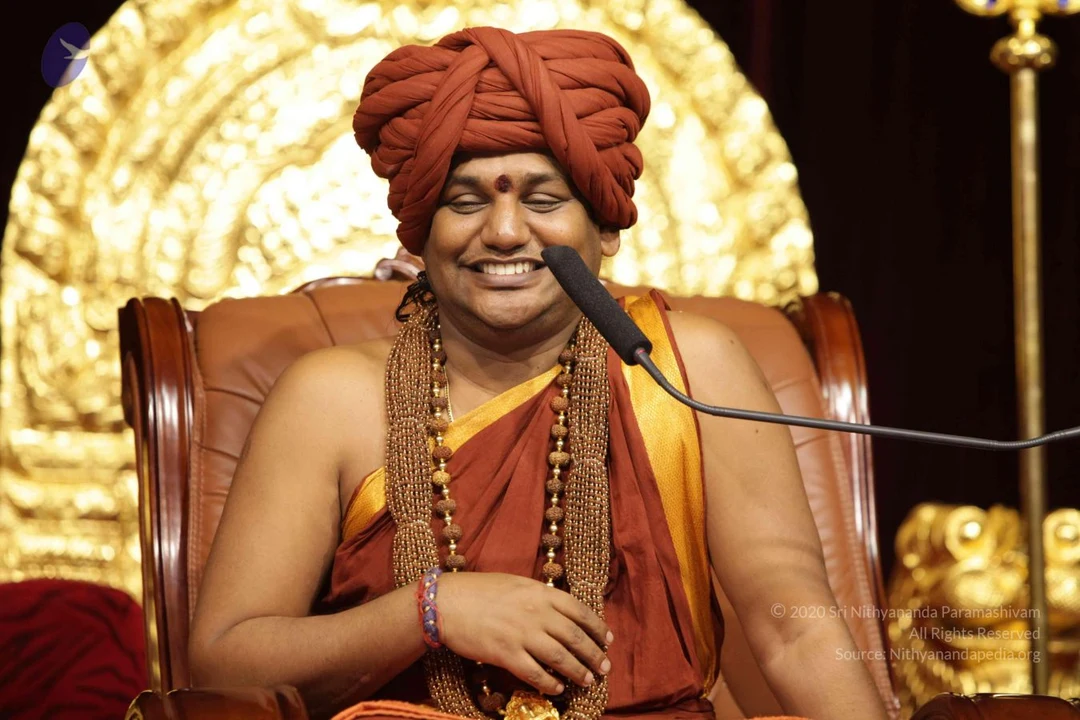
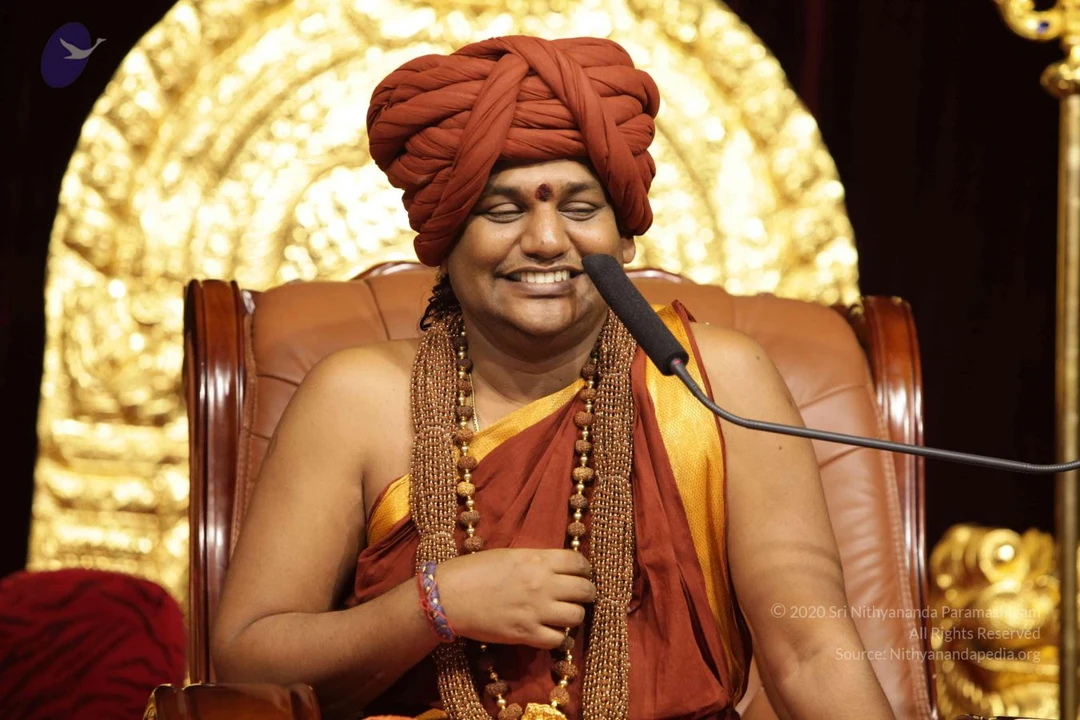
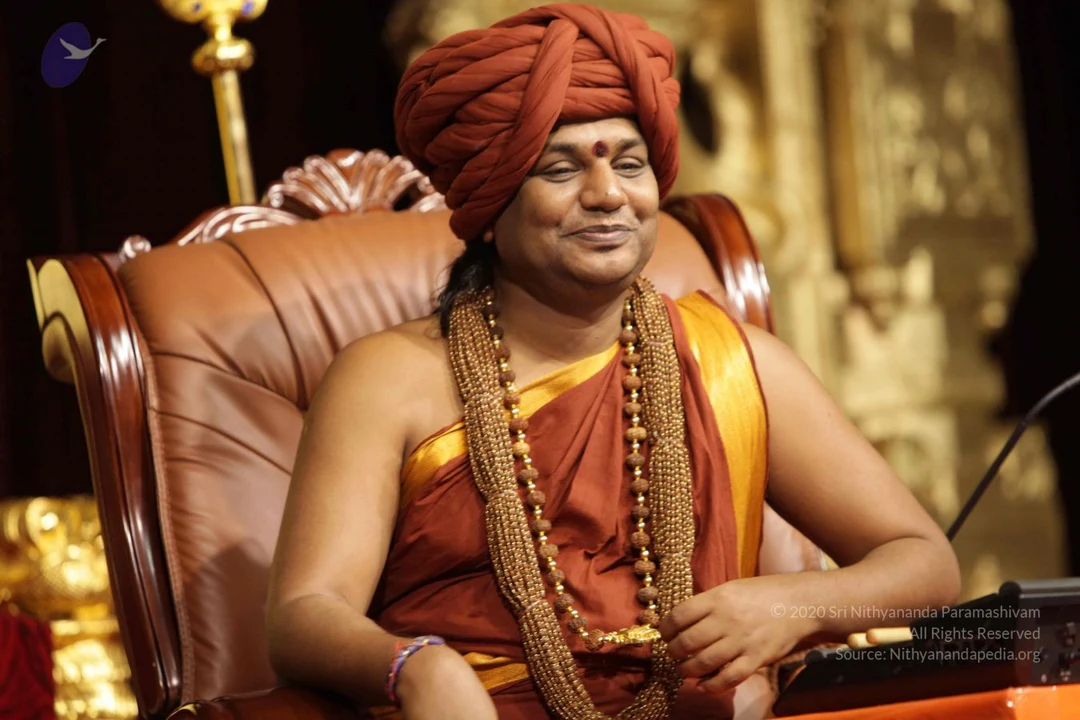
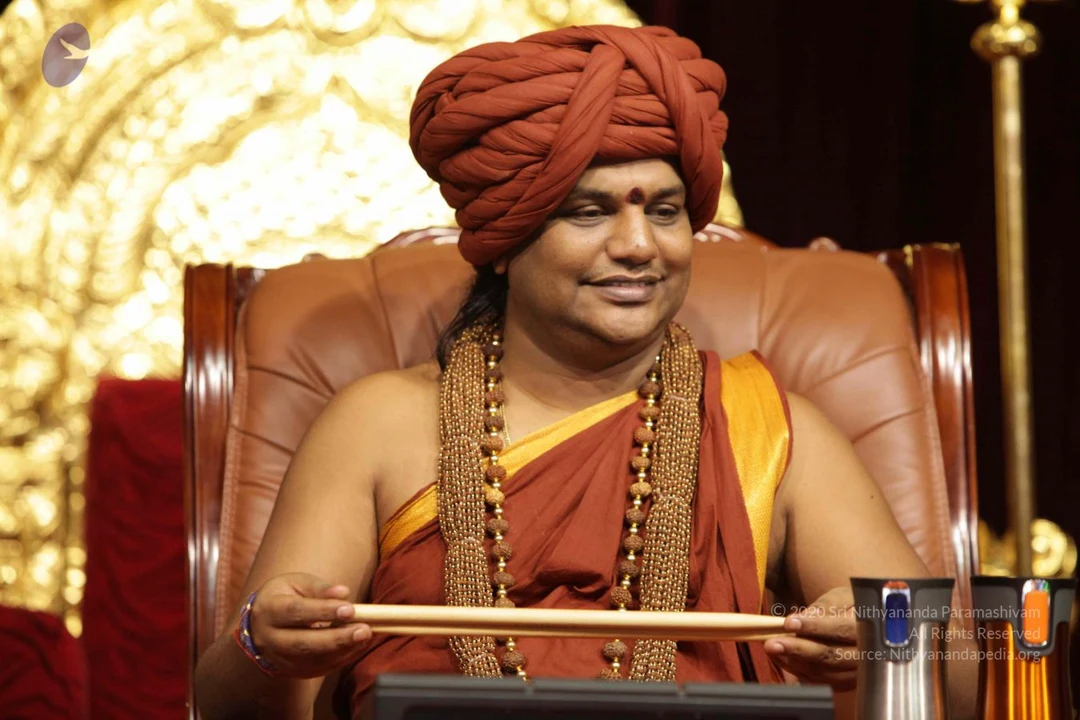
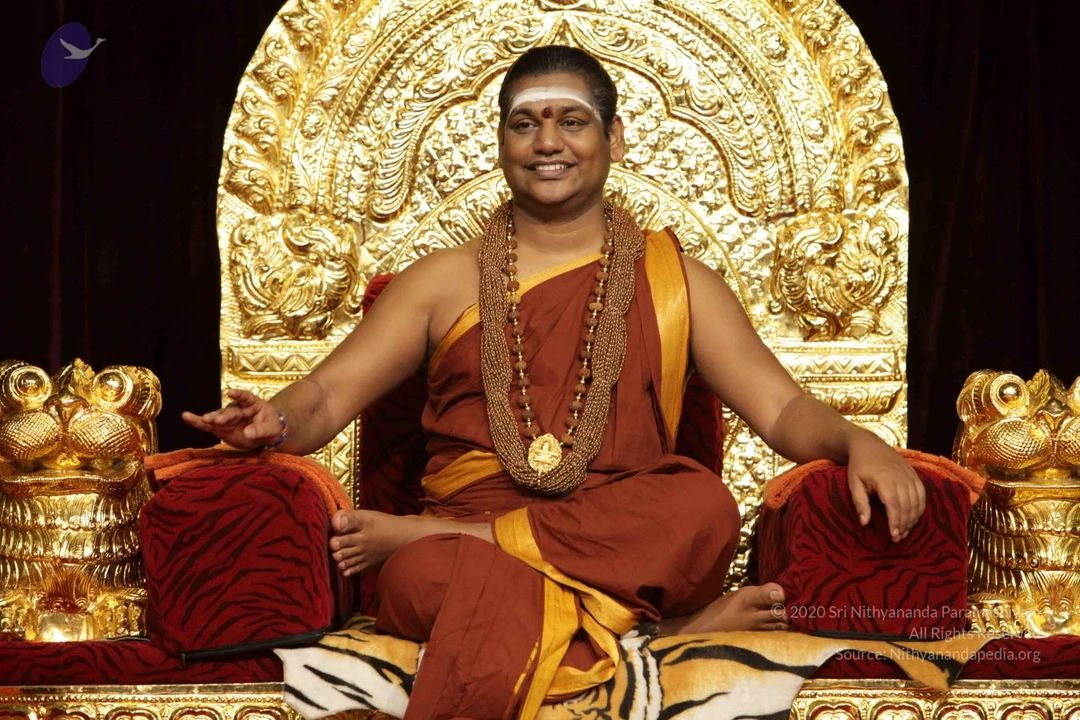
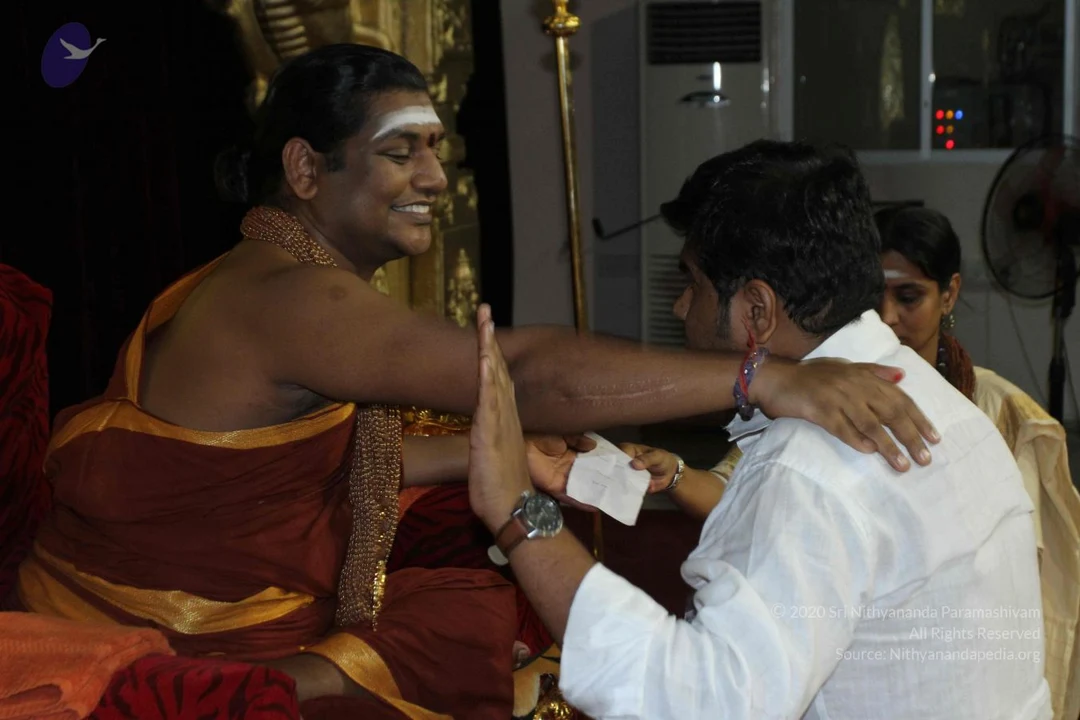
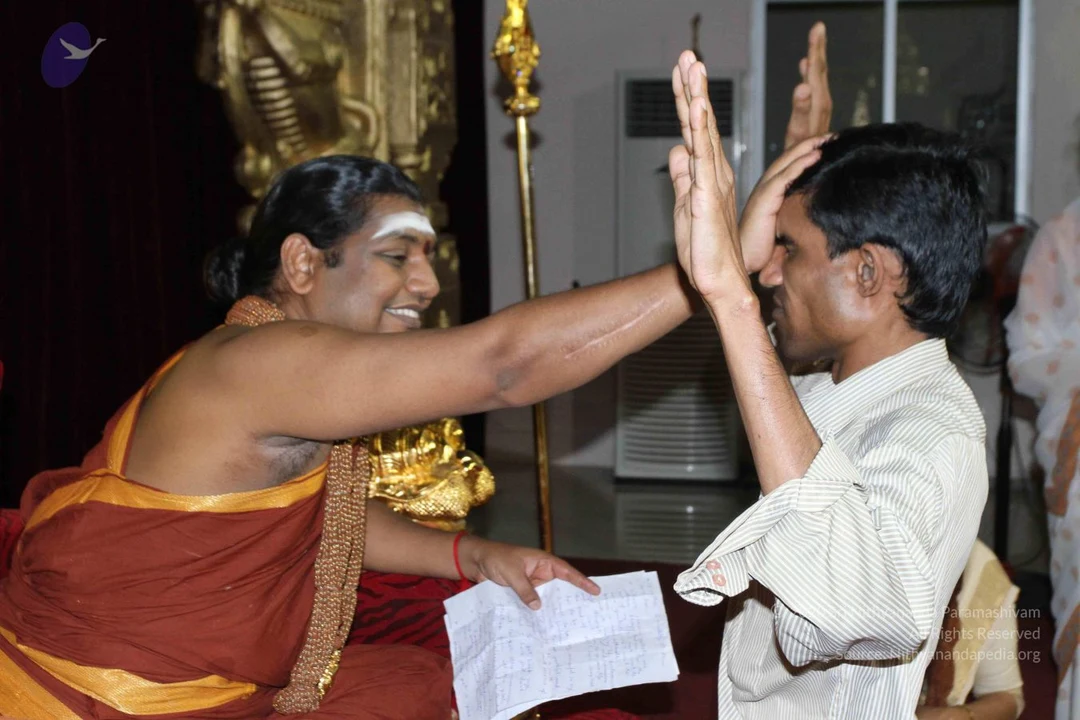
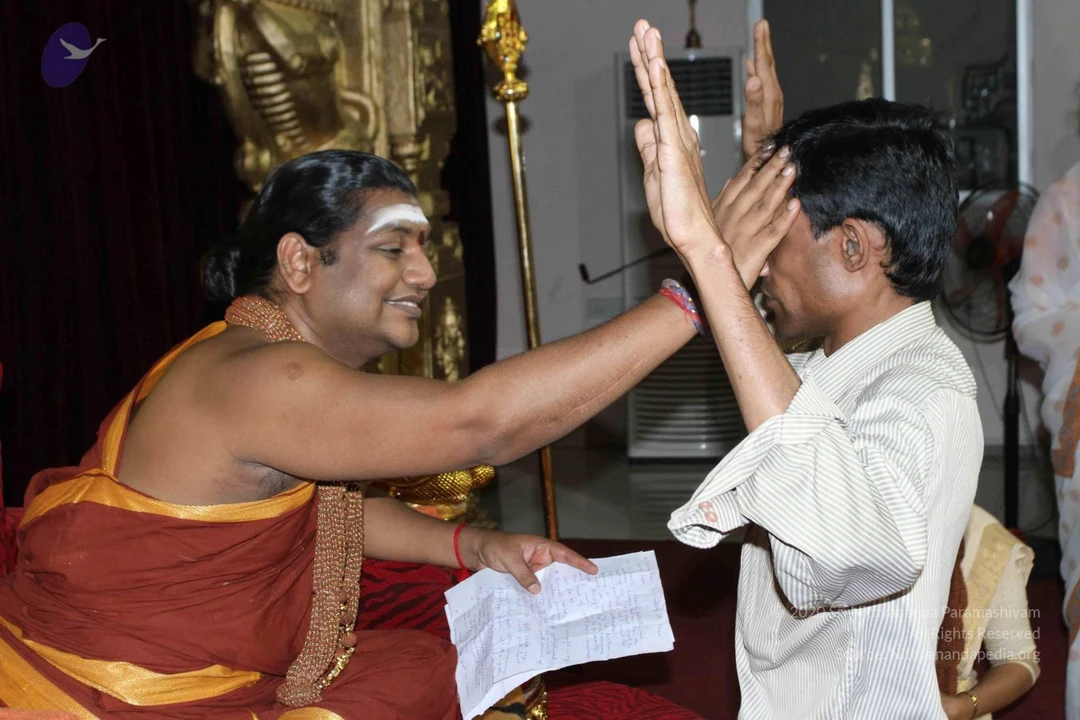
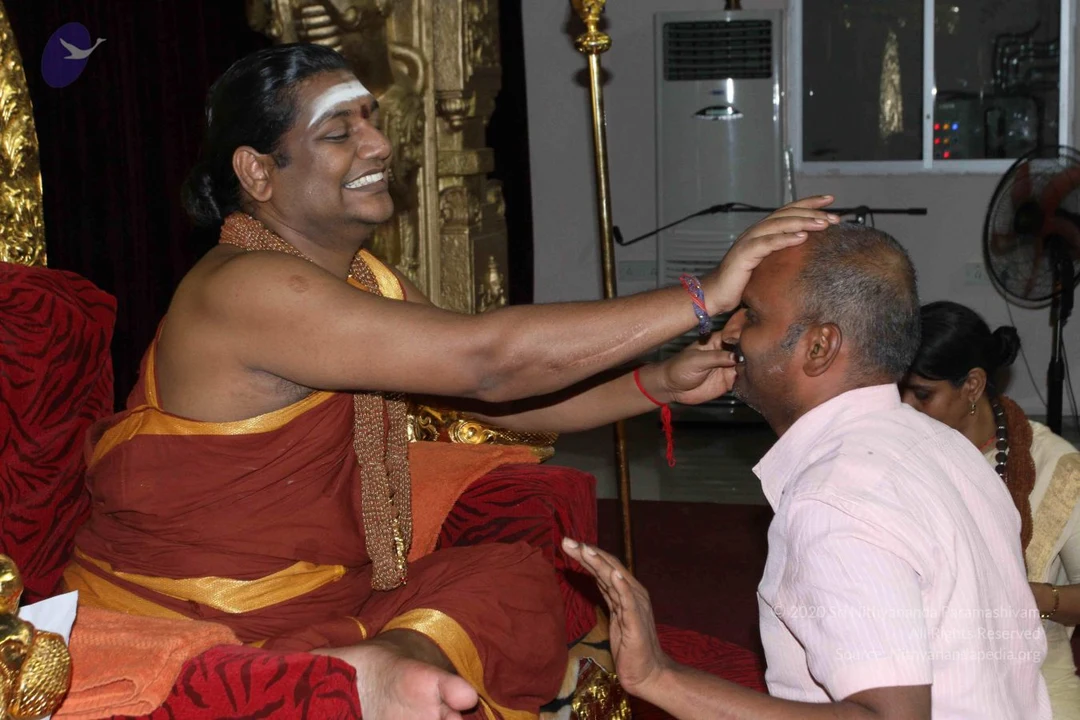
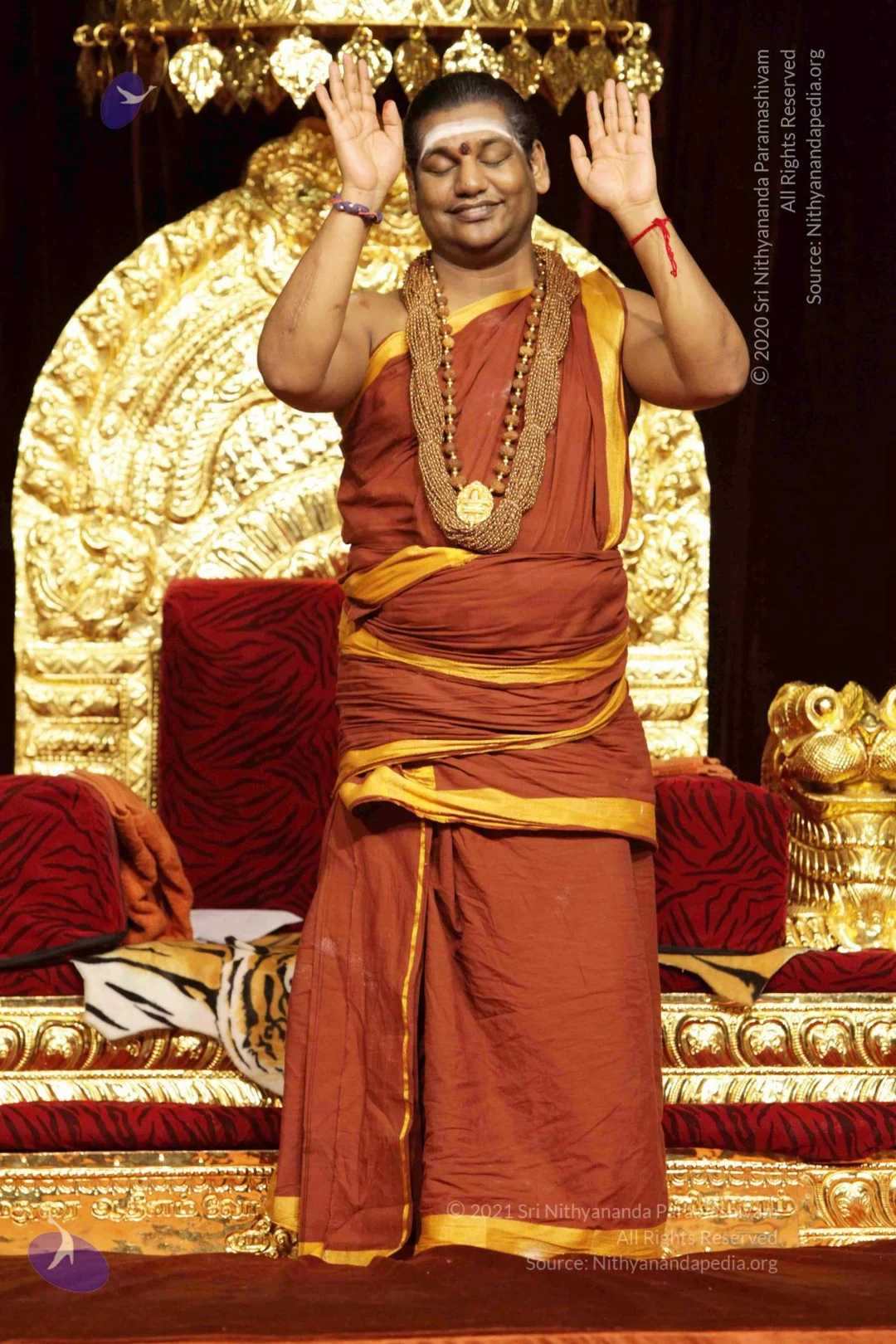
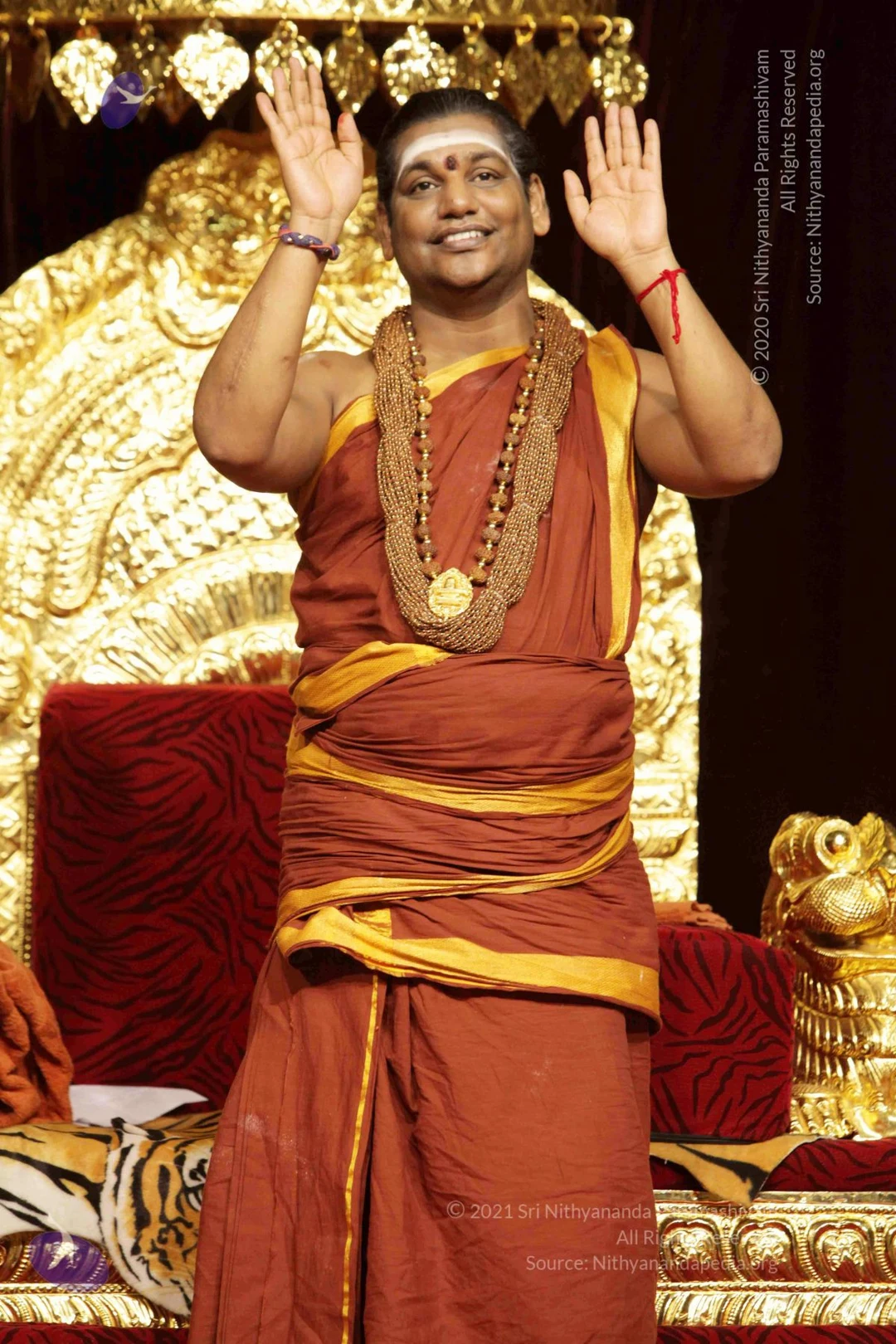
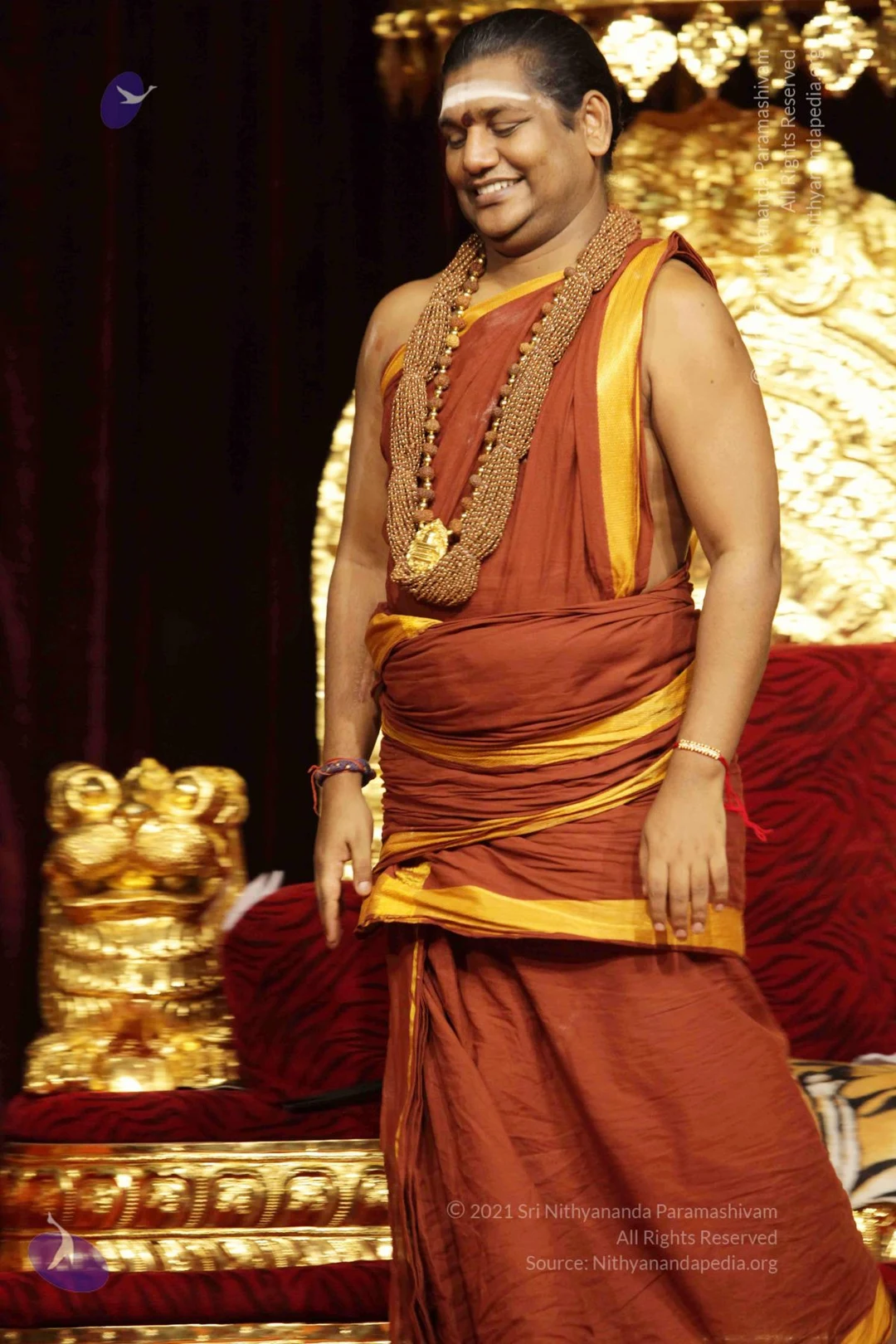
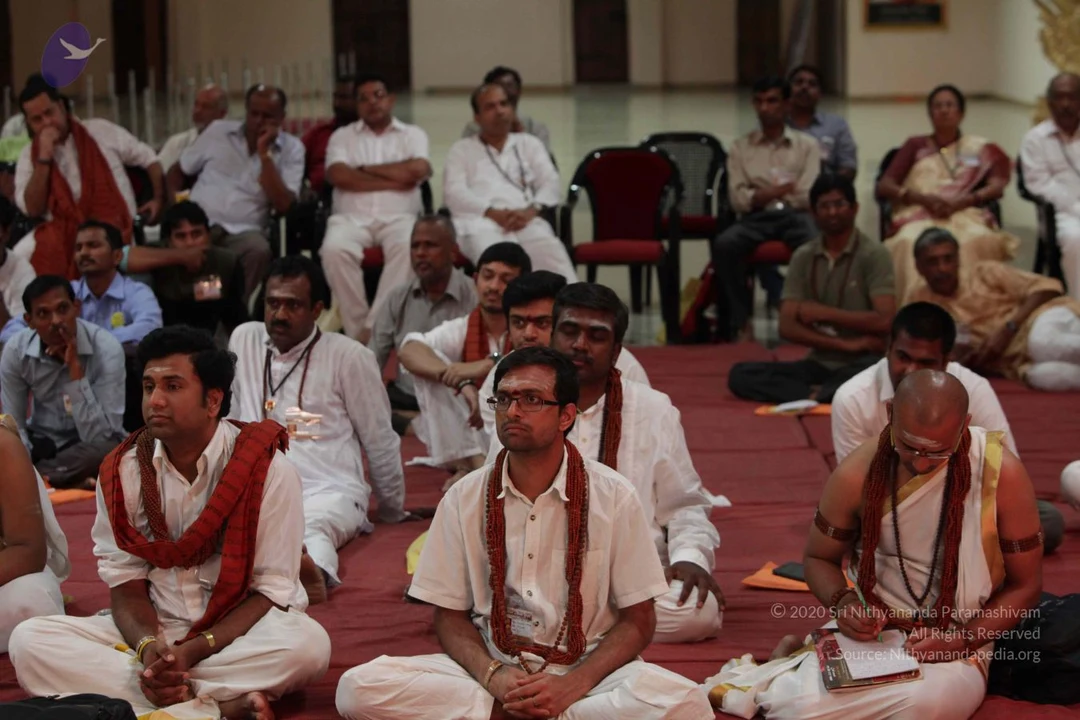
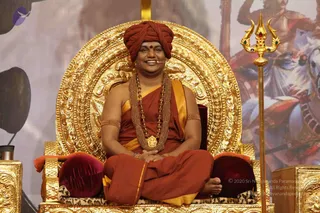
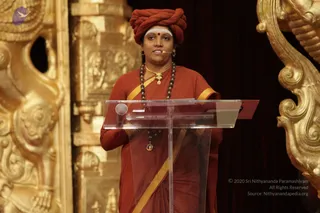
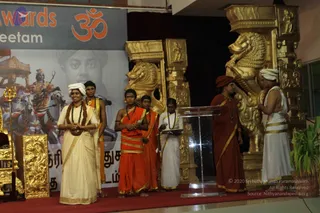
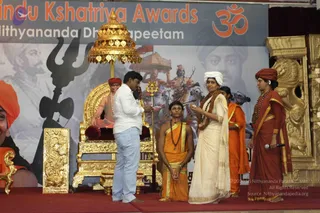
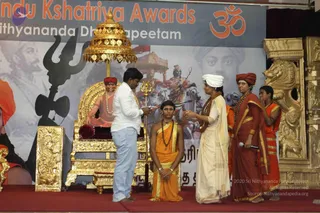
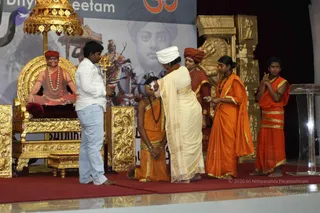
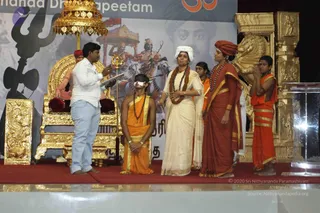
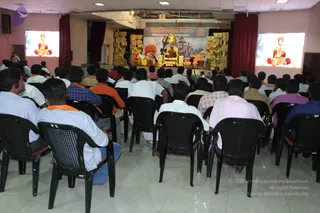
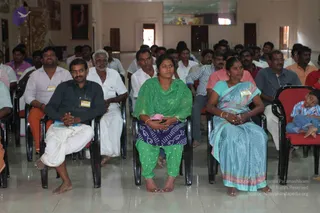
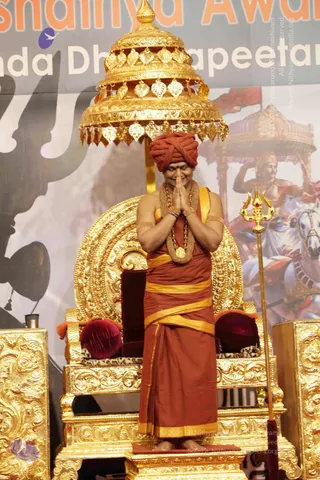
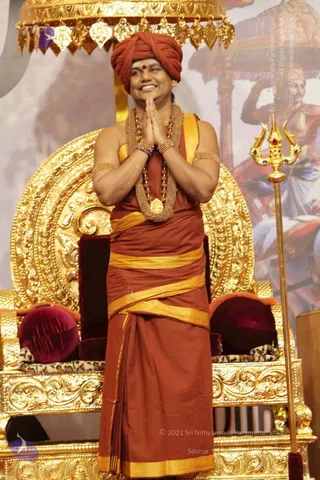
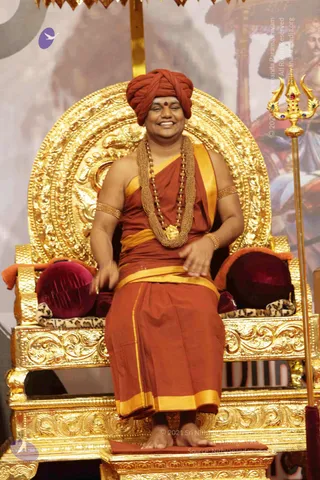
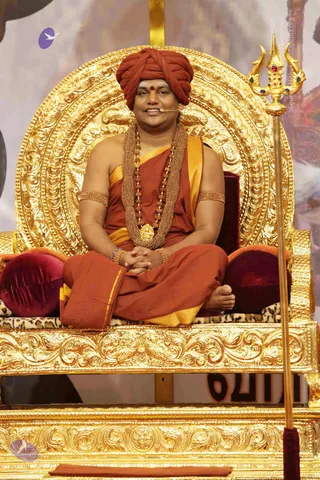
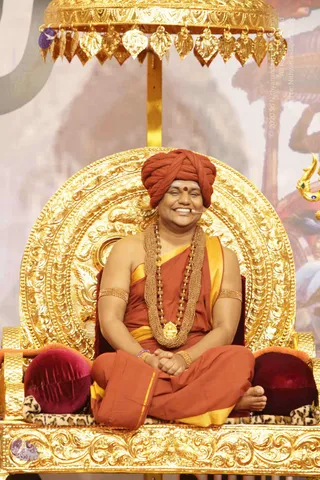
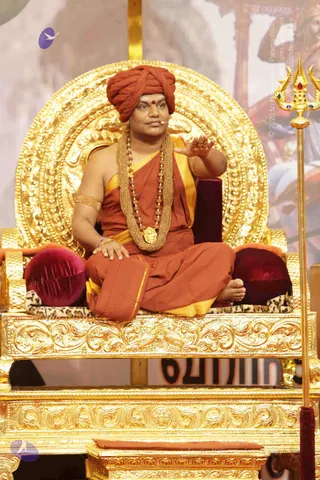
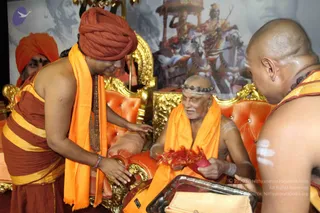
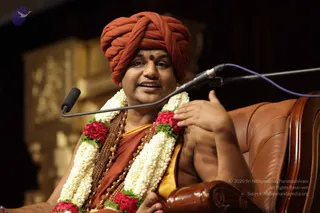
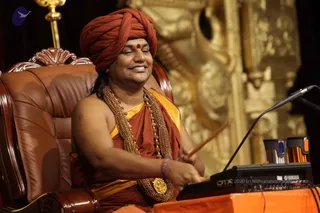
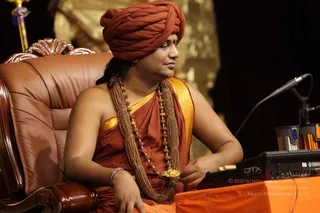
A smiling man in a rust-orange turban with a red bindi sits in a brown leather chair on a stage, bare-shouldered and wrapped in a rust-orange cloth with gold border. He wears layered gold-beaded and rudraksha malas and a red-and-gold wrist band, one hand resting on a folded orange cloth while he looks off to the side. A black boom microphone is positioned near his face, and a gold-toned backdrop is partly visible behind him. Swamiji (probable): the candidate shows a turban, saffron-orange robes, and rudraksha malas, presented as a speaker at a seated discourse.A stage event at a Nithyananda Dhyanapeetam backdrop reading "Hindu Kshatriya Awards" with an om symbol. Three men sit on ornate gold-framed orange cushioned thrones. On the left a bald man in orange robes and an orange shawl speaks into a microphone. In the centre a man in a maroon dhoti and maroon shawl wears a large gold-and-beaded necklace and a maroon turban. Behind and above him, seated on a higher golden throne under a golden parasol, a man in a red turban, orange robe and rudraksha mala is seated. On the right a man in a maroon and gold dhoti and shawl with a long beaded necklace sits on an orange throne. Behind them a painted backdrop shows a trident, a chariot with white horses and warrior figures, and portraits of historical figures.A seated audience in a hall with cream walls and framed pictures, most attendees in white or light shirts and dhotis, facing forward toward an unseen speaker. In the foreground five men sit in black chairs with red seat cushions: on the left a man in a white kurta with a rudraksha-style mala, next a man in an orange shirt holding a phone, then a man in a pink checked shirt with a wristwatch, a man in a grey t-shirt with a white bead bracelet and necklace, and on the right a man in a maroon shirt with a name badge and white dhoti with blue border. Another person stands in the background near a doorway. No identifiable figure in the scene is a person, so the scene shows only devotees.

August 30 2015

Original wiki page
Contents

Title

The Secret to Creating Wealth and Abundance Q & A

Description

In this Q&A session from the 30 August 2015 Wealth workshop Paramahamsa Nithyananda answers all sorts of questions related to money and wealth. For example, If a person dies unexpectedly before paying off a loan, will he carry the karma and has to come back to pay off the loan? I don't have the money to come for Inner Awakening, what to do? What is the best thing to do to create wealth? What is the right context of money and wealth that we should teach our children? How to attract money in our life?

Video - The Secret to Creating Wealth and Abundance Q & A

VideoAudio

Transcript - The Secret to Creating Wealth and Abundance Q & A

I know everyone thinks let me have jackpot, let me have lottery. One person even had a bargaining application to me. You tell me the number of this lottery, I’ll give you half of it. Arrey, fool. If I need half of it, then I’ll get the whole. Why should I tell you the number and get half of it? Lotteries do not make people rich, I tell you. Lotteries do not make people rich. It only brings harassing people around you. It only makes harassing people around you. So, first, bring completion and ability to handle, then money will be boon, blessing, joy, celebration.

Now, this is one of the important thing. We always keep it as a blind spot. We think money will solve all the problems. Yes, it can if you are complete enough. Otherwise, you know, just even if you get a lottery or mega lottery or mega jackpot or anything, people can talk to you for half an hour and convince you they will triple that money and give you and take away whole thing. Because when you fall for greed, when you have greed, you can be easily made to fall for it. You can very easily be made to fall for it. Please be very clear. If you have greed, you have a big board on your forehead telling, please come and cheat me. Anybody can sit and talk to you for ten minutes and dangle the carrot and take away what you have.

How many of you had this kind of a bad experience in your life? Raise your hand. I tell you, it is possible. That is the way things happen. So, bring completion. That’s the best way. That’s the first way and best way to attract and retain wealth. To attract and retain wealth.

Question:

The next question we have is from Melbourne Centre, Sujana. Sujana is asking, I would like to master the manifestation of my desires. What would be a single factor that I have to be good at?

Swami Nithyananda:

Mate, Sujana, first thing I want to tell you, the only thing you need to be good at is perpetual completion, constantly being in the space of completion. That one is enough. That one is enough. You will be able to manifest anything you want. Yesterday, I taught you the completion process. Practice that for next 21 days every night. Sit with yourself. Any pattern, incompletion, incidents you remember, pen down. Go on completing, completing, completing for next 21 days every night. By one month, you will learn the taste of completion. You will start being in the space of completion perpetually. That is the master key to manifest anything you want. I tell you, there are some things for which you need money to buy. There are many other things, you just need MasterCard. MasterCard is perpetual completion. Perpetual completion. So, if you ask me, I would like to master the manifestation of my desires, what would be a single factor that I have to be good at, perpetual completion.

Question:

The next question we have is from Penang Malaysia Centre, Ren Ka Tan [0:04:52]. What can I do after this two-day session to guide myself into achieving the peak wealth state? Where do I go from here?

Swami Nithyananda:

Ren Ka Tan, Penang Malaysia. Yes, the one thing I’ll recommend, next 21 days, every night, completion before going to sleep about all the wealth incompletion patterns you have. All the incompletion patterns you have, self-doubt you have about creating wealth, self-hatred you have about creating wealth, self-denial you have about creating wealth, all that please relive and complete. Next 21 days, I guarantee you will achieve the peak wealth state and you will start manifesting it. My blessings.

Question:

Nithyanandam Swamiji. Swamiji, I don't have the money to come for the Inner Awakening program. That is my [inaudible 0:06:02].

Swami Nithyananda:

Okay. Now, do the completion that I don't have, with that pattern. You will see you will attract wealth. Please understand. Never money stands as obstacle for your spiritual seeking. Maybe if you have the anger, why should I pay for spirituality, then you will not get it.

Question:

And I chose December because I was not confident that I’ll be able to [inaudible] by October.

Swami Nithyananda:

Please understand, whenever you say, I want to attend, Swamiji, bless me, it should come, so I should attend, always it happens. But there are some people, why should I pay for spirituality? If you have the anger towards paying for spirituality, then you will never be able to attract. Please understand, you have now gone into the mental setup, knowingly and unknowingly, the whole civilization, unless you give, you don't even receive it full-heartedly. I've seen. Whenever – see, I have done tons of free programs. Still doing tons of free programs. But in the free programs, I always see people, Swamiji, this program is nice, but can you teach it in my city. If I come there, Swamiji, so nice, why don’t you come to my house itself and teach?

I'm telling you, I won’t keep money as obstacle for your spiritual seeking. Complete with this pattern, I don’t have, you will see you will attract. Complete – bring completion, you will see money, time, everything will align and you will be there. And without money, even if you come there, you will never receive the benefit. I have seen. People just waste their time and my time. In the end of the day, “Okay, I'm here.” That’s all. But when money is involved, people completely get involved and get the whole benefit. My purpose and their purpose both gets fulfilled.

Yes, next question. Go ahead.

Question:

The next question is from Melbourne Centre, Sinn is asking, Nithyanandam Swamiji, can you suggest what I should do so that I can remove the obstacles preventing me from going to Kumbh Mela in Nasik?

Swami Nithyananda:

Can I suggest something, what should I do, so I can remove the obstacle preventing from me going to Kumbh Mela?

First thing, you need to know what is Kumbh Mela. Second, sit and complete with that pattern that I don't have enough to live my life. The moment you complete that pattern, suddenly, you will see, you really attract and manifest what you want to have. And maybe you need to have a small introduction about Kumbh Mela. There are many questions about Kumbh Mela. I can see. Many questions. First, let me introduce Kumbh Mela. And I was also thinking that I should introduce Kumbh Mela. You asked a question already. Come on, let's have a short video. Once you understand, then you will understand how it can add to you. If you want wealth, Kumbh chalo because then you become a priority. That’s all. There’s nobody who can't make it to Kumbh. Maybe there are many people who can't make Kumbh as their priority. That’s all. Understand. So, if it becomes your priority, you will be there. Maybe first you have to remove the obstacles to understand Kumbh can add something to you. It can add so much of intensity into you, I can tell you.

See, first of all, seeing so many millions of people doing one action, dipping in the sacred river for one purpose, to raise the consciousness, that itself will add intensity to you. That will simply – see, the moment intensity is added, you will simply manifest health, wealth, whatever you want. Whatever you want is all about intensity. That's it. So, I can guarantee Kumbh will manifest your wealth. Kumbh will make you manifest whatever you want.

Question:

The next question we have is from London Aadheenam Centre. Katherine Parson is asking, how do you see the world, if everyone has their third eye awakened?

Swami Nithyananda:

You’re asking, how do you see the world if everyone had third eye awakened? It will be just world of gods, Kailasa, Nithyananda Loka where just eternal bliss overflows. And you’re asking what happens if a person has third eye opened and still lot of incompletions. No, no, no. When your third eye is awakened and when you start practicing, keeping your third eye awakened continuously, all your incompletions will melt down because you will simply know incompletions are only happening when you look at with two eyes. Small vision. When your vision becomes big, all incompletions disappears. Incompletions will simply disappear when you have your third eye awakened, when you work on your third eye.

Question:

The next question is from New York's Queens Centre, Meg is asking, I feel such a deep-rooted pattern inside of me, deep feelings of discomfort which I envision when I envision me having money in my future. Why is there so much shame and such strong karma around the idea of making money, saving money and requesting money in the world?

Swami Nithyananda:

Yes. I understand. The why you have this problem, there is no answer for it. How to get rid of this problem, I have answer for it. Why you created this pattern, you only have to ask you. Because in the young age, accidentally, you create all these patterns. For accidents, there is no why. That is why it is called accident. If there is a why, it will be called as incident. So, most of your identity and pattern is accident. So, there's no answer for this question why I feel so much of shame, karma around making money. I can tell you how you can get out of this. Pen down all these patterns and relive. With so much of karma patterns around money, you know how life is suffocating, complete and throw it, you will really become a real New Yorker. New Yorker should be comfortable with money. Come on! It's a city of money. You will become a real New Yorker once you break from this karma pattern and once you break free from this karma pattern related to money. Come on.

See, if you hate spirituality, you can’t live in Varanasi because in Varanasi everything is related to spirituality. Same way, if you hate money and you have karma pattern about money, you can't live in New York because in New York everything is related to money. In Paris, everything is related to beauty. In Italy, everything is related to food. If you go to Calcutta, everywhere you will see sugar. Even in the rasam and rice – cooked rice, they will add sugar. If you hate sugar, you can't live in Calcutta. So, if you hate food, you can’t live in Italy. If you hate money, you can't live in New York. If you hate spirituality, you can’t live in Varanasi. Come on, complete with it.

Question:

The next question we have is from Dallas Texas Center, Ravi Kusuma (0:14:41) is asking, Swamiji, being in the sales profession, I face a lot of stress due to things not in my control, such as dependencies on client decisions. How should I get rid of this stress?

Swami Nithyananda:

Ravi, Ravi, Ravi, please understand, there is no situation in your life where things are not in your control. Please understand, especially a person like you, who is sales profession, if you think if you have this pattern, “Oh, client's decision, I'm dependent on that,” even before starting the game you lost the game. Understand, you being clear, I can make him decide the way I want is the soft power you have, that is the plan for success.

First thing you need to complete with this deep belief you have built that you are dependent on his decision. No, he is dependent on the way you explain and convince him. Please understand, you are not dependent on his decision. He is dependent to make decision on your convincing ability, your ability to convince him. See, a client, I tell you, the client always believes, if the sales representative, if he convinces me, I’ll take a decision. He is dependent – you see in your life, whenever you are a client – see, you may be sales representative for some products. But for many products, you will be a client. Look with what psychology you are approaching. You think when you go whether to decide yes or no, you think, “Okay, let him convince me; based on that, I will decide.” So, you are dependent on his ability to convince you. Same way, he is dependent. Please understand, when you go for sales, remember this one thing. If I am in his place, I am going to be dependent on the sales profession's ability to convince me.

So, change the internal conversation you have about it. Don't ever say, I am dependent on his decisions. He is dependent on my ability to convince him, I’ll convince him. I'll make him take decision. That is soft power. Always go with the clarity. He is actually waiting. He is dependent on my ability to convince him. So, I should be authentic to convince him. Not that I'll be dependent on his decision.

The moment you see you are dependent on the decision of a client, you will be irritated about client. That – your subtle irritation and anger will start expressing with the client. The moment client even asks you doubts, you will start feeling that he already decided against you and you will dump him. How many times you think you have done this, Ravi? You understand? Because you're going with a plan to fail. Getting it? Ravi? Go with a plan for success. Go with a plan for miracles. That will solve the whole problem.

Question:

The next question we have is from Penang, Malaysia Center. Sally Hone (0:18:52) is asking, if a person dies unexpectedly before paying off a loan, will he carry the karma and has to come back to pay off the loan?

Swami Nithyananda:

Sally Hone, yes, actually, the person who dies without paying off the loan, he himself doesn’t have the karma, but this guy who gave money, if he suffers, he has to come back to heal that suffering. See, the money itself is not carried, but the suffering – see, this guy who gave money, if he's complete and says, “okay, it's okay, let go,” then the guy who died does not need to come back to heal him. If this guy suffers, the guy who died without paying, he has to come back to complete him. He may not need to pay the money, even if he does some service, something he gifts and this fellow becomes complete, then okay. Till he becomes complete, he has to come back. That is the only thing. Loan itself is not carried, but the incompletion is carried.

Question:

The next question we have is from London Aadheenam Centre. Rashida is asking, will we be cleared, healed from all accidental ideas about money, wealth during the session or do we need more constant clearing?

Swami Nithyananda:

Rashida, I may recommend at least for next 21 days you practice completion every night. Even though I'm doing my job, the problem is you will not even be convinced about your own clarity, your own completion for you to feel convinced that you’re complete. You need to struggle little bit. Otherwise, you don't convince yourself that you are complete. So, maybe for 21 days, do completion. Then you will see you’re complete and you settle down.

Question:

The next question we have is from Chicago Centre. Kavita is asking, humble pranams from Chicago Sanga, Swamiji. What is the correct context of money and wealth that we should introduce and teach our children as they become older?

Swami Nithyananda:

Kavita, first thing, there is no such thing as a right context for money. Just teach them completion. See, having or not having is not at all going to affect them. Tell them, be complete and make as much as you can, celebrate as much as you can. That’s all. Be complete about it. Take responsibility. And whenever you make, you will always see there will be few people who will be grabbing, who will be cheating, and be complete and powerful even when that happens in your life. The completion should be the context and the correct attitude and not falling into powerlessness should be the right attitude about money, right context about the money you should teach for your kids. Kavita, you got it? Okay.

Question:

The next question we have is from Penang Malaysia Centre. Lakshmi Prabha is asking, how to attract money in our life?

Swami Nithyananda:

Lakshmi Prabha, Penang, yes, first thing, all the incompletions, like a fear, greed, guilt you carry about money, if you complete, that's enough. Your whole magnetic force will change. The magnetic life force will change. You will attract wealth.

Question:

The next question we have is from New York Varanasi, Morris Plains Center. Rashmin Dave (0:22:56), he is asking, dear, Swamiji, I'm sincerely looking for a job in a pharmaceutical sales operation where I was laid off in June 2014. Each time I'm close to getting a job, but some obstacle takes place and I do not get the opportunity.

Swami Nithyananda:

Rashmin Dave, can you wave your hands? Okay. I understand. This, actually you can't deal it. I commit with you, the pattern will be broken. Within next 21 days, you will have the job. I'm responsible for this. You will have it. Once you got it, send me email. Send me the message.

Question:

The next question we have is from Hong Kong Center. Ravi is asking, Pranam, Swamiji, if my client does not pay me money, whose fault is it? Should I check if something is wrong inside of me? I was authentic while selling the goods, but now client is not authentic in paying me. What should I do?

Swami Nithyananda:

Ravi, I'm not going to say only it is your mistake. I'm also not going to say there's no mistake from your side. So, many time – many time, you may not be authentic in judging the client’s ability to pay because for your greed to sell, your greed to sell, you should not force the jump. You should not miss seeing. You should not have the blind spot of your client’s ability to pay. So, I'm not going to say it’s completely your mistake or their mistake. Both together create this situation. You have to take the responsibility for it because you are going to suffer, not he.

Question:

The next question is also from Hong Kong Sirkazhi Center, Chook (0:24:55) is asking, how to complete the completion with wealth completely? The poverty is always happening inside me. Even, I have done many completions.

Swami Nithyananda:

Chook, your word that I've done many completions is wrong. You may be sitting and brooding over, not cleaning over. Remembering is not completion. Reliving is completion. With this context, relive and complete. Your problem will be solved. Many time, brooding over and remembering you think as completion, which is not.

Question:

The next question we have is from Rastatt, Germany Centre, Karen is asking, what is Shivoham?

Swami Nithyananda:

Shivoham means – I can give you a simple translation. Experiencing that you are the cosmos, you are the centre of the cosmos, you are the source of the cosmos is Shivoham. As on now, you think you are the source of all the problems. Instead, realizing you are the source of all the solutions is Shivoham. Usually, when you remember you, you feel you are the source of all problems. Instead, realizing you are the source of all solutions is Shivoham. Aham is source of all problems. Shiva is source of all solutions. So, realizing you are the Aham, I, is the source of all solutions, not source of all problems, is Shivoham.

This is the most easiest, simplest definition I’ve ever given.

Question:

The next question we have is from San Jose Aadheenam Center. Luan is asking, many incompletions are coming from the ideas that parents have said over and over and not from one event. How do I complete with that?

Swami Nithyananda:

So, even that incident parents have told you is an incident, relive them, it will be complete. That’s all. I know most of the incompletions are from parents. It’s not that they did it purposely. They were also unconscious. And they got it from their parents. They got it from their parents. So, at least, you break the cycle. Don't give it to your kids, break it and don't pass it on to your kids. The person who breaks the karma cycle of the next, next generation's passing, he becomes liberated and liberates the next generation. Yes.

Question:

We also have received a lot of questions about the 21-day Inner Awakening program. So, before we move on to the next question, we would like to play a short introduction Swamiji has spoken about the Inner Awakening program, so all of us understand the answers from the right context.

The next question we have is from Amersfoort Netherlands Center. Lizzy is asking, I don't have very specific incidents to relive. It is more that the whole atmosphere from youth came to me like clouds of blur.

Swami Nithyananda:

Lizzy Nuvens (0:28:38), can you wave your hands? Netherlands. Yes, okay. First thing, please understand that that very feeling which came to you from the whole atmosphere from the youth, relive that. That is enough. Relive that feeling. You will break that pattern. You are getting it? Great.

Next.

Question:

The next question is from Queens, New York Centre. Hema is asking. Pranam, Swamiji, please bless my family. Bless me with more salary. I'm underpaid for experience and quality. Please do completion in all aspects of my life. My kids are having problem getting money for selling their property – getting to money.

Swami Nithyananda:

Hema, I understand the whole problem. I’ll free you from this karma pattern. Actually, you can't do anything in this situation. Only I can do it. I'll do it. My blessings. Tathaastu.

Question:

The next question we have is from Los Angeles Aadhenam Centre. Jennifer Lowe. Jennifer Lowe is asking, my old zen master put a slight curse on investing in stock market. I'm retired. The money is not for gambling, but for growing new companies. Please take away the curse.

Swami Nithyananda:

My blessings. I’ll remove the curse. Don’t worry. You'll be free from the curse from today. Don’t worry.

Question:

The next question we have is from Selayang Malaysia Centre. Lim Yeung Keong (0:30:13). Buddhism believes a person’s wealth is the result of giving away money or wealth to others in past lives. In other words, wealth is faithed and not created. What is Swamiji's view on this?

Swami Nithyananda:

Selayang, Malaysia, Lim Yeung Keong, I do strongly support this theory ma. I do strongly support this theory. Please understand, I am not saying, you should not work for wealth at all. No. But I do strongly support this theory of when you share, it comes back. You don't even have to wait for next jenma. Even in this birth, the more and more you share, more and more it comes back. So, I do support and approve the belief Buddhism is promoting. It is true, not just belief. It is a truth. And I just want to add one more thing. You taking personal responsibility also will add to your wealth. That’s all. That’s all.

After all, Buddhism is the branch of Mahanirvani Peeta. And Buddha took sanyaas from Mahanirvani Peeta. That is why he used the word nirvana for enlightenment and his guru is – Kapila is Sankhya Muni. That is why he is called Sakhya Muni. He assumed the title Sakhya Muni because of his guru. Kapila is called Sankhya Muni. Mahanirvani Peeta guru was – the founder was called Sankhya Muni.

And last two Kumbh Mela, Dalai Lama comes to attend Kumb Mela as part of Mahanirvani Akhada. Even this Kumbh Mela, first Shahi Snan, he attended. And the whole Buddhists accept that they are part of Mahanirvani Peeta. That’s the good news. Come on.

Question:

The next question we have is from Manhattan Centre. Bella Shtern is asking, dear Swamiji, can the incident of missing mother as a baby and crying for her be a root pattern for feeling lack of abundance and wealth? The symptom is the need to cry like a baby.

Swami Nithyananda:

Bella Shtern, can you wave your hands? Yes. What you are stating can be the root pattern and please complete it. You will really attract wealth. It is root pattern.

Question:

The next question is from Delhi Centre, Vikram. Money comes when I need it, but never in abundance and also never remains with me. Why?

Swami Nithyananda:

Please understand, it's a strong belief you built it. You just need to break that pattern by completing it. Then this problem will be solved.

Question:

The next question we have is from Vancouver Centre. Spencer is asking, dear Swamiji, what to do with the negative patterns which I'm aware of, but I'm not able to find the earliest root incident? How to complete that pattern? Thank you, Swamiji.

Swami Nithyananda:

Spencer, Vancouver, can you wave your hands? Even if you remember the situation, the last you experienced that pattern, even if you remember that situation, start reliving, you will go deeper and deeper and complete with it. When last that pattern made you powerless, remember that and start reliving. You will be free from it. Blessings.

Question:

The next question we have is from Selayang Centre, Pan Su Gween (0:34:10) I work hard to pay debt. Can I solve the problem as soon as possible and have extra pocket money?

Pan Su Gween, can you wave your hand? Selayang, Malaysia. Working hard is the most stupid way you will work, ma. Work smart. You understand? The moment you say working hard, you believe you're working hard, you have a deep pain pattern about work. Pain pattern about work. Pain pattern about life. Pain pattern about money. Please complete with it. You will not just find pocket money. Your pocket will be full of money.

Understand, once you complete, you don't have to think of pocket money, you will get money pocket. Not just pocket money.

Question:

The next question we have is from St. Louis Aadheenam Centre. Ehan Kamat is asking, Swamiji, I need your blessings for an offer that I go to – that I got to go to California to work on a business. But, right now, there are a lot of obstacles in my way. What do I need to do to make this a reality? Ehan Kamat, please wave your hand.

Swami Nithyananda:

Ehan Kamat, I’ll take care. Don’t worry. I’ll remove the obstacles. You don’t need to do anything. I’ll do it. Don’t worry. Just go with my mala, I'll make it as successful after you go there also. The whole business and the whole offer will be successful for you. I’ll do it for you. Don’t worry.

Question:

The next question we have is from Mexico City. Geronimo del Rio, she's asking, what I have to do to achieve economic stability in my life with a real plan of life?

Swami Nithyananda:

First thing, bring yourself to completion with all the pain patterns you have about money. Your whole life will become economically stable. Don’t worry.

Question:

The next question is from Mill Valley Centre. Brian is asking: Namaste, Swamiji, my daughter, Reese, and I, in our deepest desire, wish to be with you at Inner Awakening this October. Please bless our lives and connect the bridge from us to you and allow the money to come that will allow us to attend. We want nothing more than to be of service to others and to be with you in India? Namaste and thank you.

Swami Nithyananda:

Brian, Mill Valley, yes. Tathaastu. It will happen. I will make it happen. Don’t worry, all the obstacles will be removed. I’ll make it happen. Don’t worry. Done.

Question:

The next question we have is from Wellington, New Zealand Centre. Indar Dev is asking: Pranam, Swamiji, me and my wife want to be a part of October Inner Awakening workshop, but we don't have the money. We would like to sell my house, currently on rent, at a big profit and also other sources to help with Inner Awakening and to bring prosperity.

Swami Nithyananda:

Wellington, New Zealand, Indar Dev, I'll make it happen. Tathaastu. Don’t worry. It will be done within next 20 days. Blessings to Deva Vedanta, Gautama, both.

Question:

The next question we have is from Bandra, Mumbai Centre from Chaya Bharadwaj. Chaya is asking, Nithyanandam, Swamiji, I come from a pretty well-off family. Only later in life, I had certain financial challenges, which I even overcame. As a businesswoman, I am pretty successful. But I have realized that I have not achieved what I should have. Bigger businesses elude me. Also, I used to not desire big houses and luxuries and thought I was being very noble. But somewhere, I had a nagging feeling I was not right. Yesterday, within five minutes of your introduction to the session, I had a wealth awakening. Indeed, to me, rich guys are bad guys and guys who are going to face a life full of problems, people trying to kidnap a son or fleece the wealth. In my completion session yesterday, which was unexpectedly intense, I saw all the old Hindi movie scenes. Actors like wicked Manorama, fat one from Hindi movies – not the Tamil one – all came up. I was terrified and so upset as I relived those moments where Hema Malini was being beaten with a whip by Manorama. Thank you, Swamiji, for helping me realize. Bless me with my completion. I'm sharing this because I feel, more than parents, these movies are very highly responsible and maybe others are affected as I have been. Thank you and I love you very much, Swamiji.

Swami Nithyananda:

Chaya Bharadwaj, you really had a powerful completion. My blessings to you. Hope – I really hope everyone gets into this much of completion and be liberated from this powerful money negative patterns. Whenever you believe the rich man, the rich person is cruel, negative, you develop the deep hatred, guilt to have wealth, hatred towards having wealth, anger towards having wealth. Chaya, it's good you found your pattern.

Title:

Nithyananda Times, 30th August, 2015

Link to Video:

Photos From The Day:

Photos Of The Day:

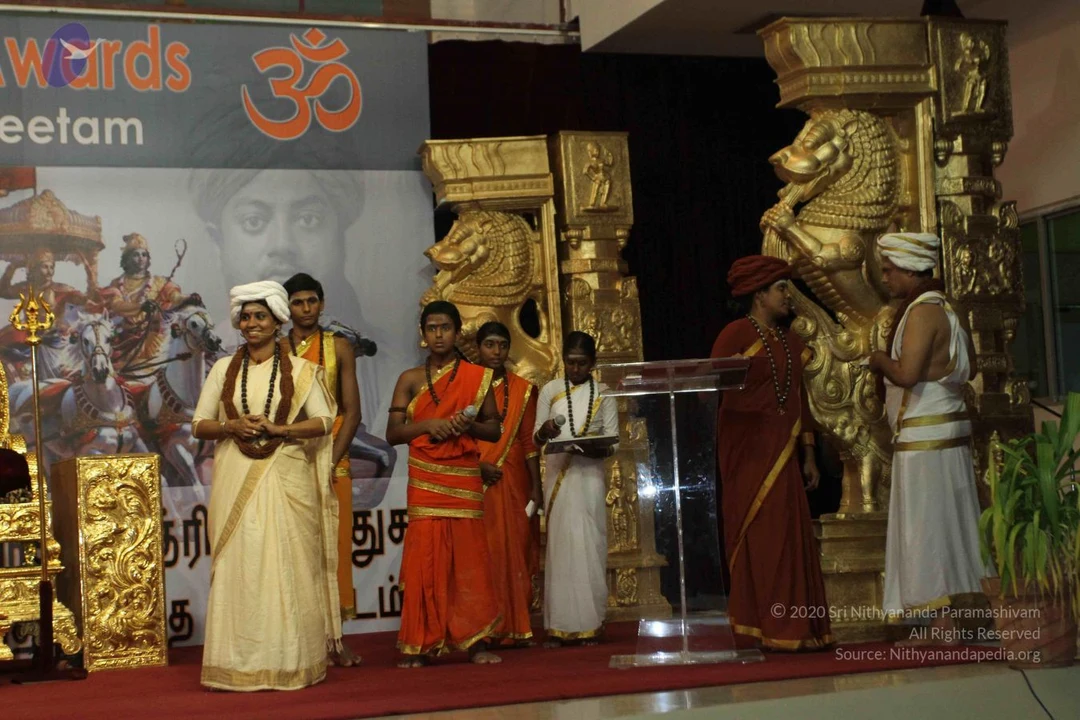
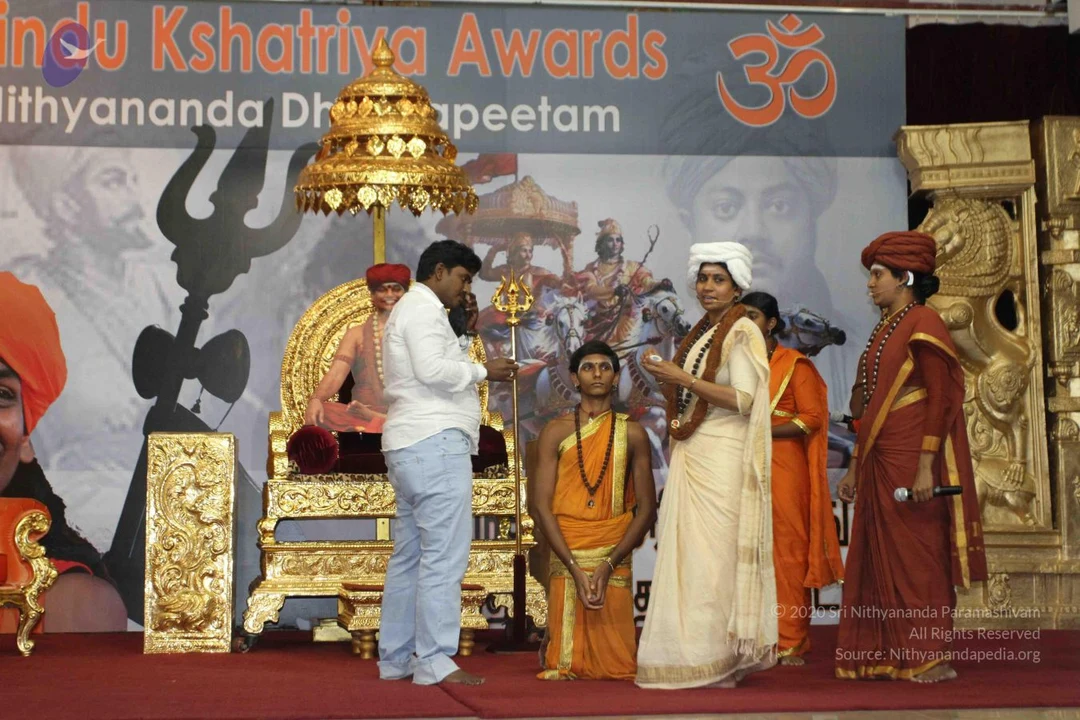
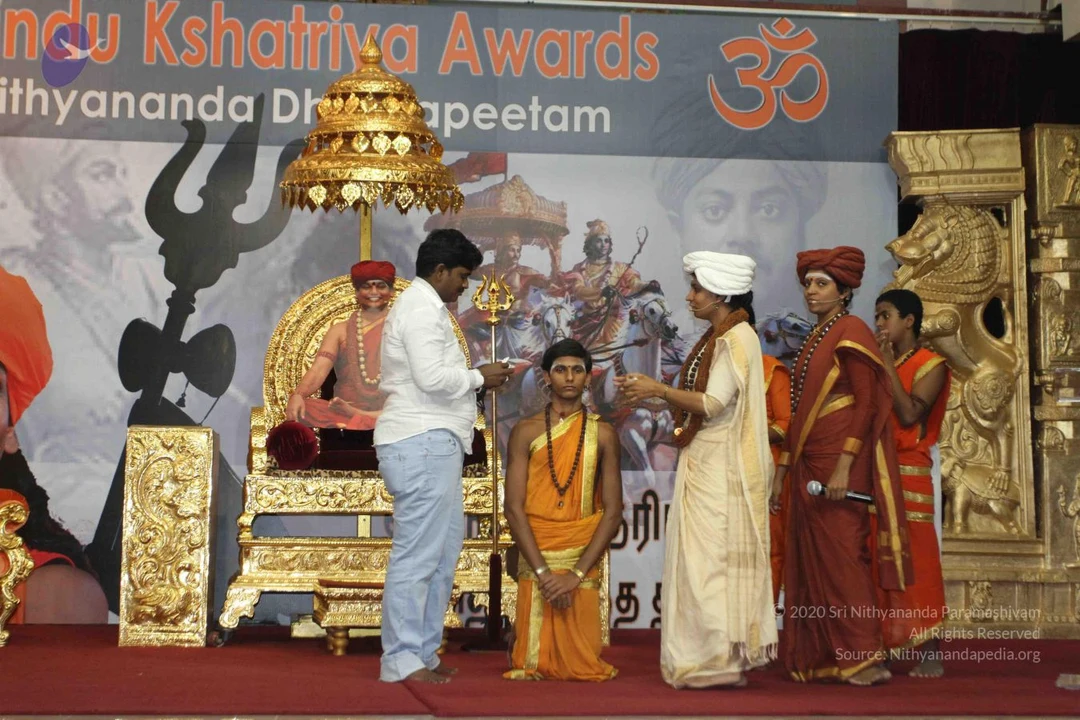
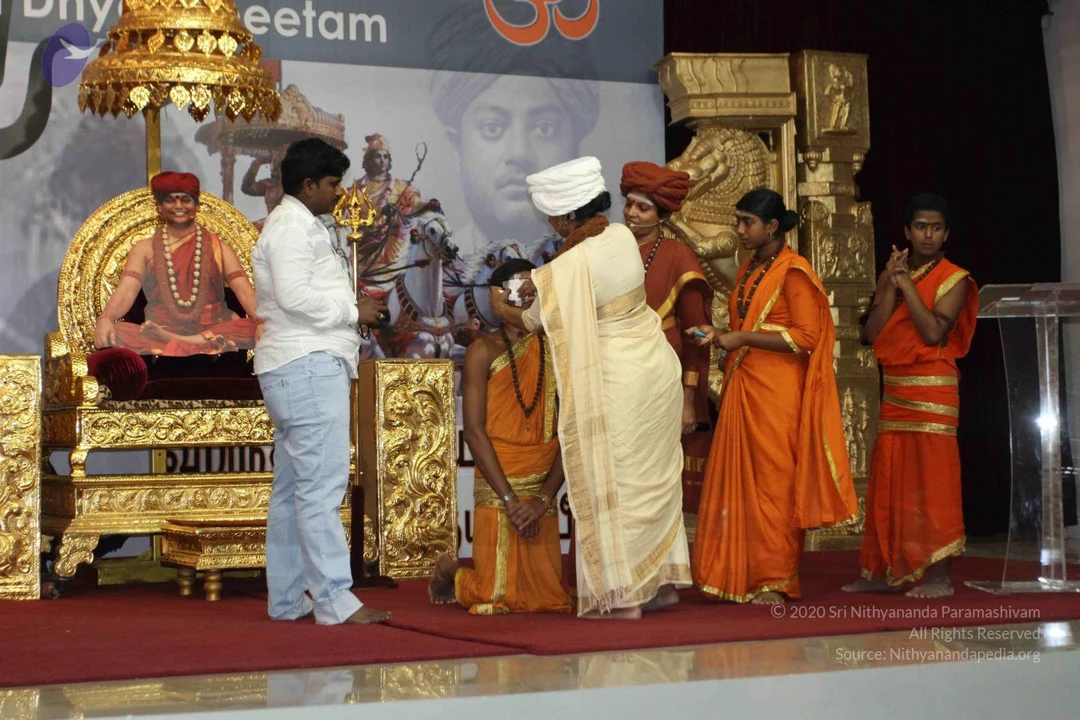
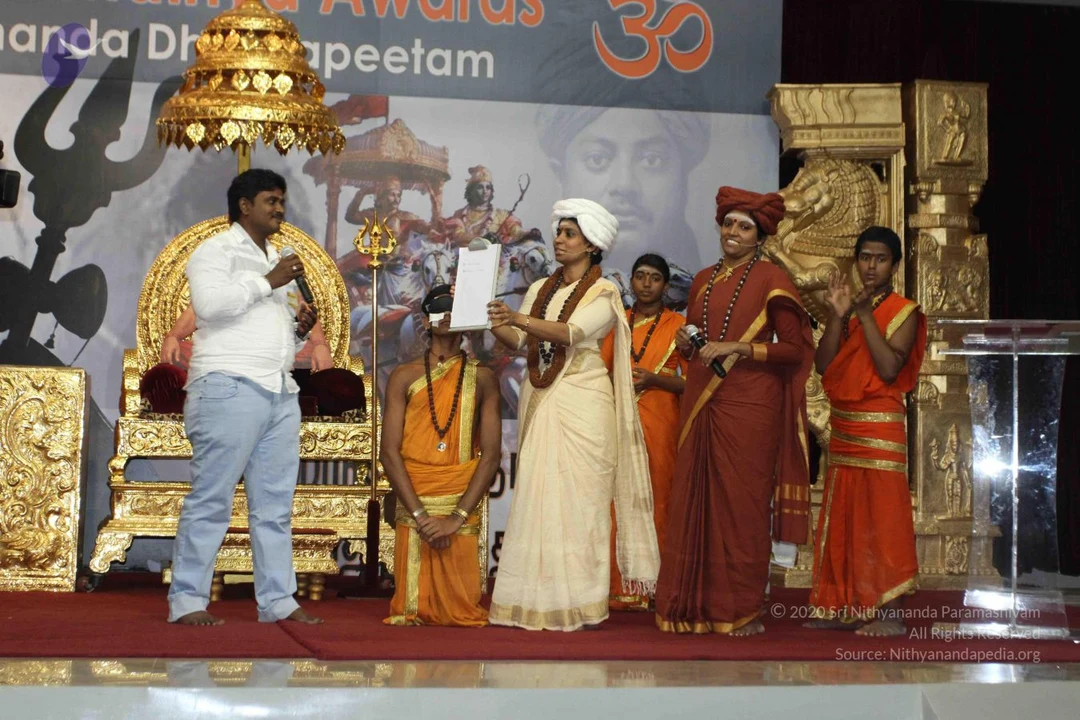
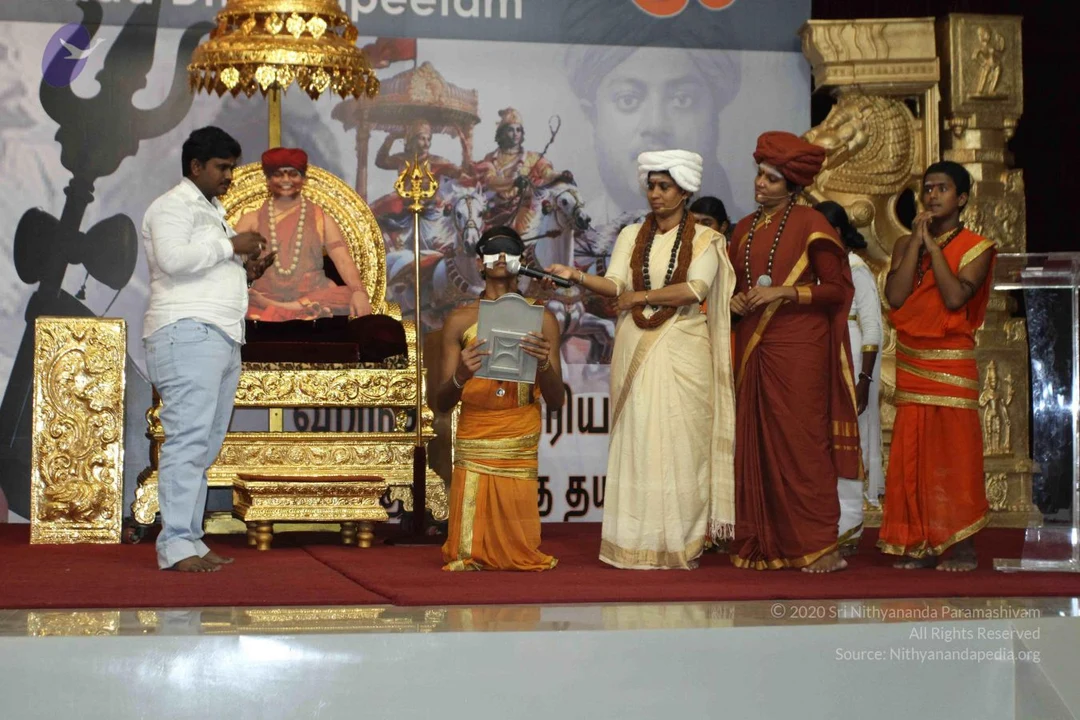
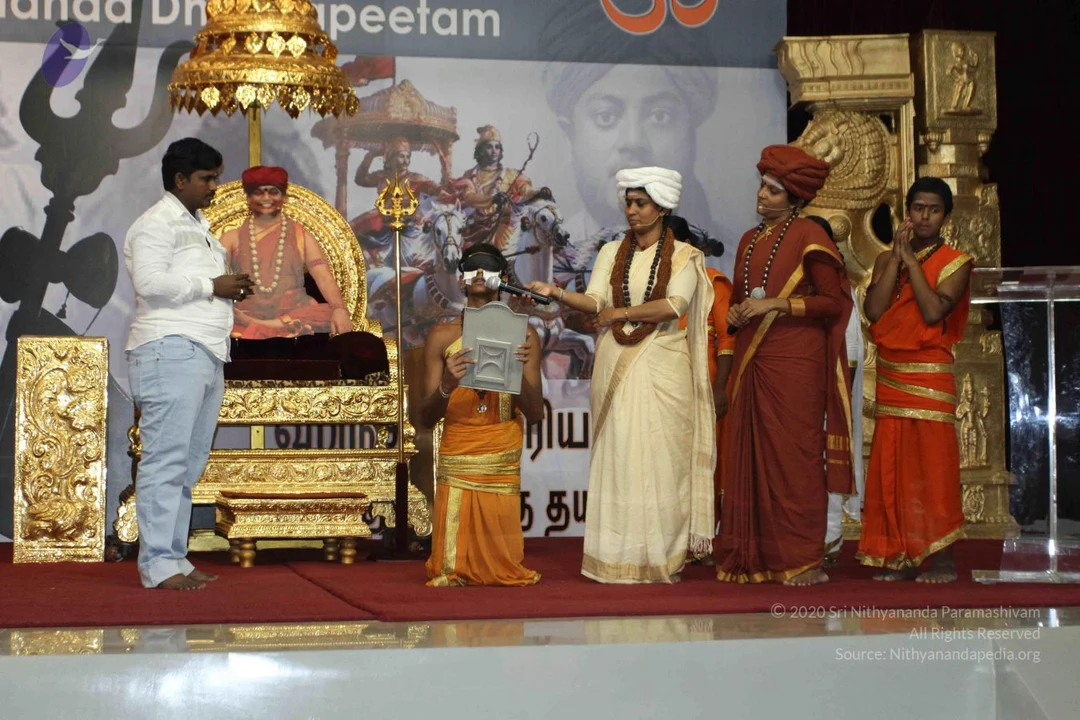
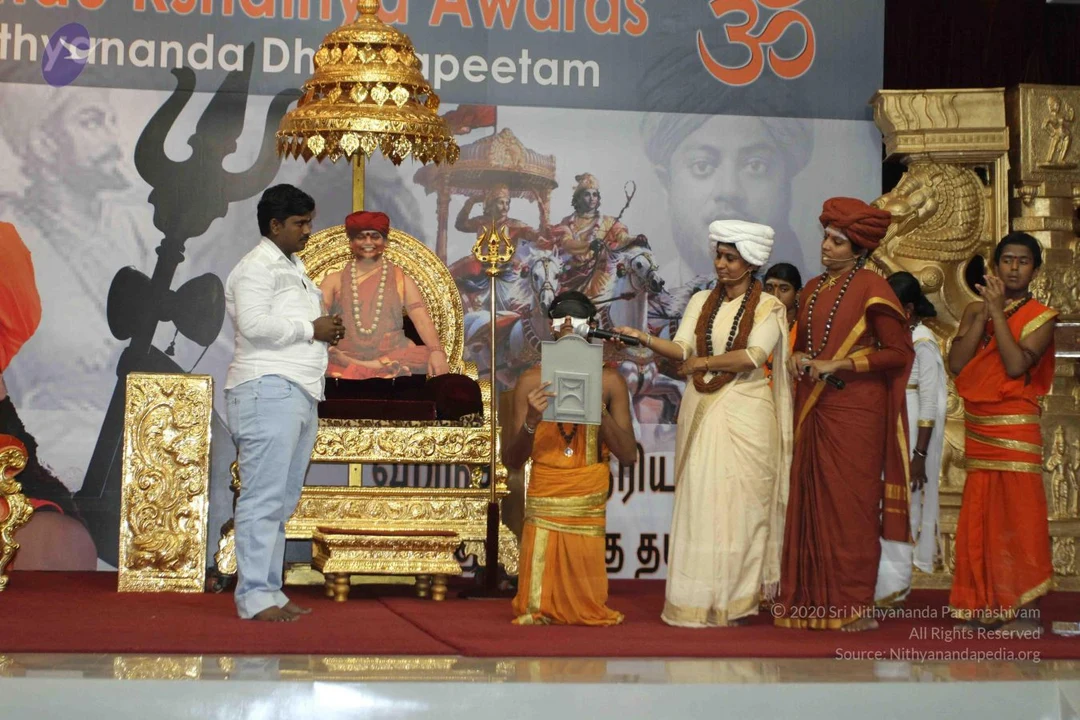
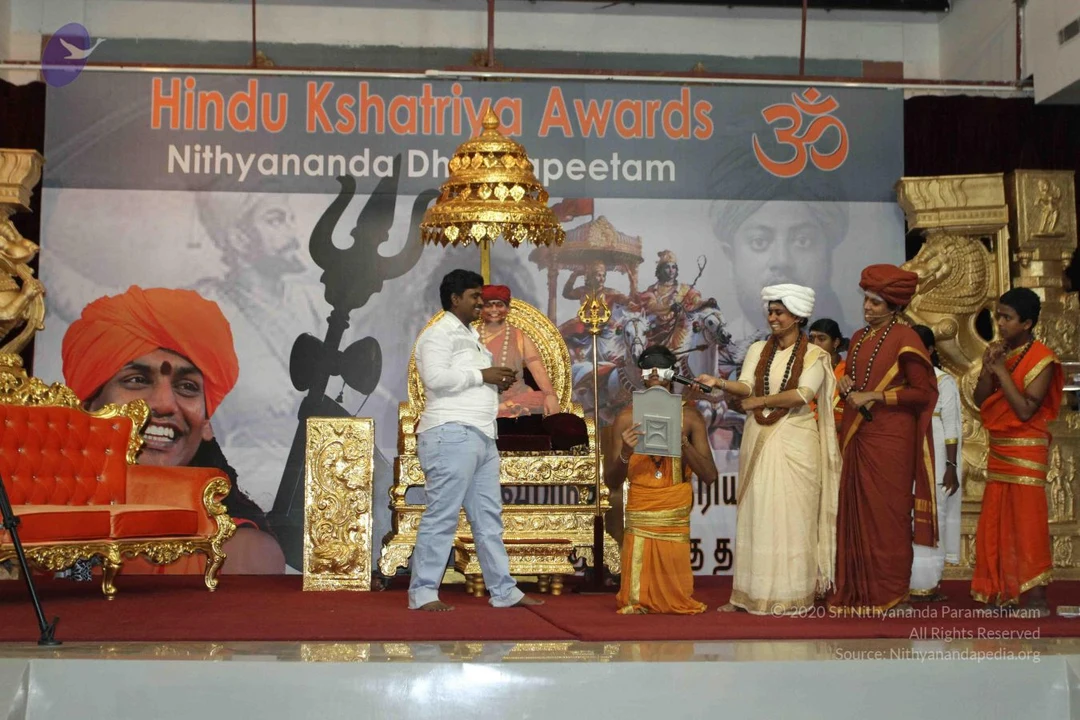
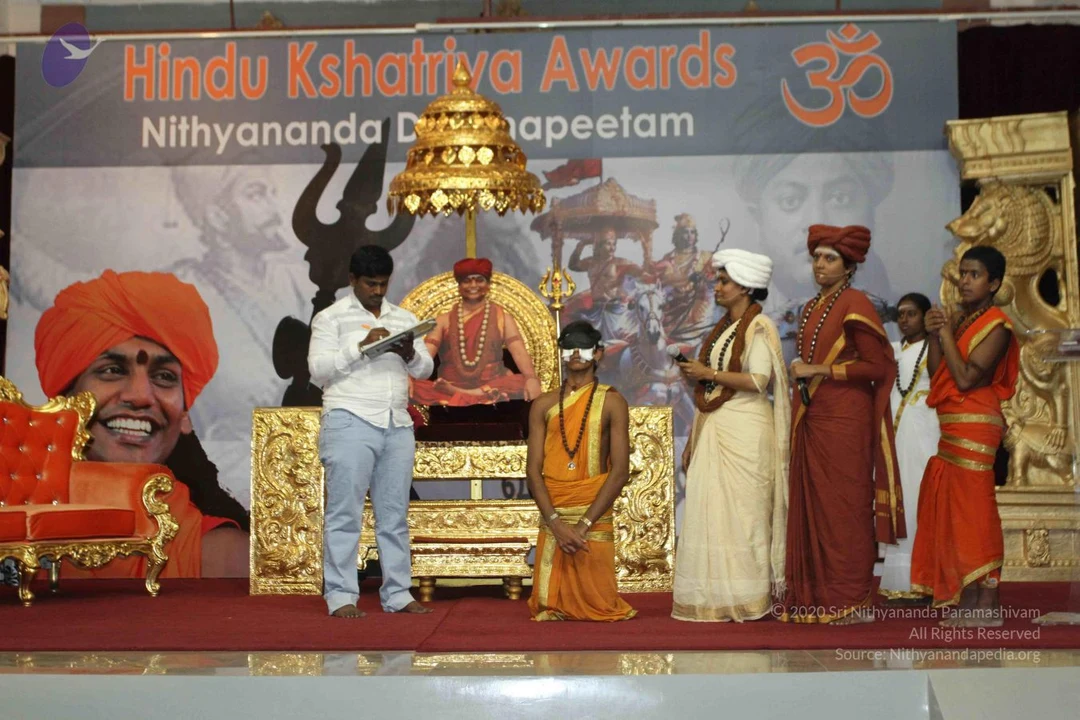
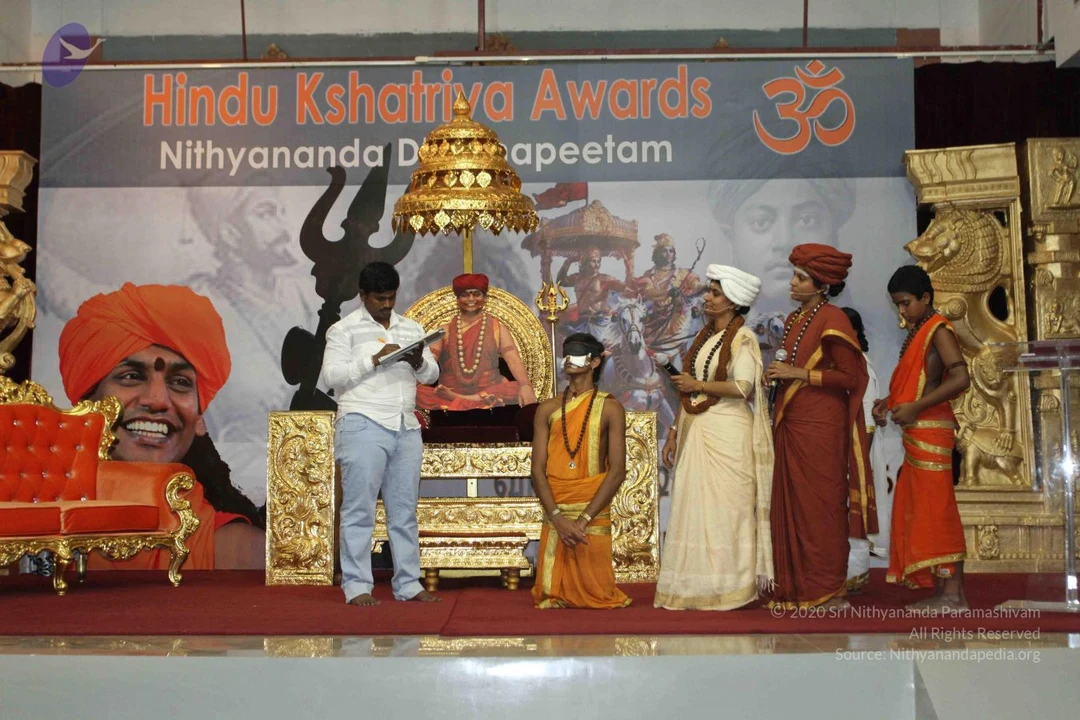
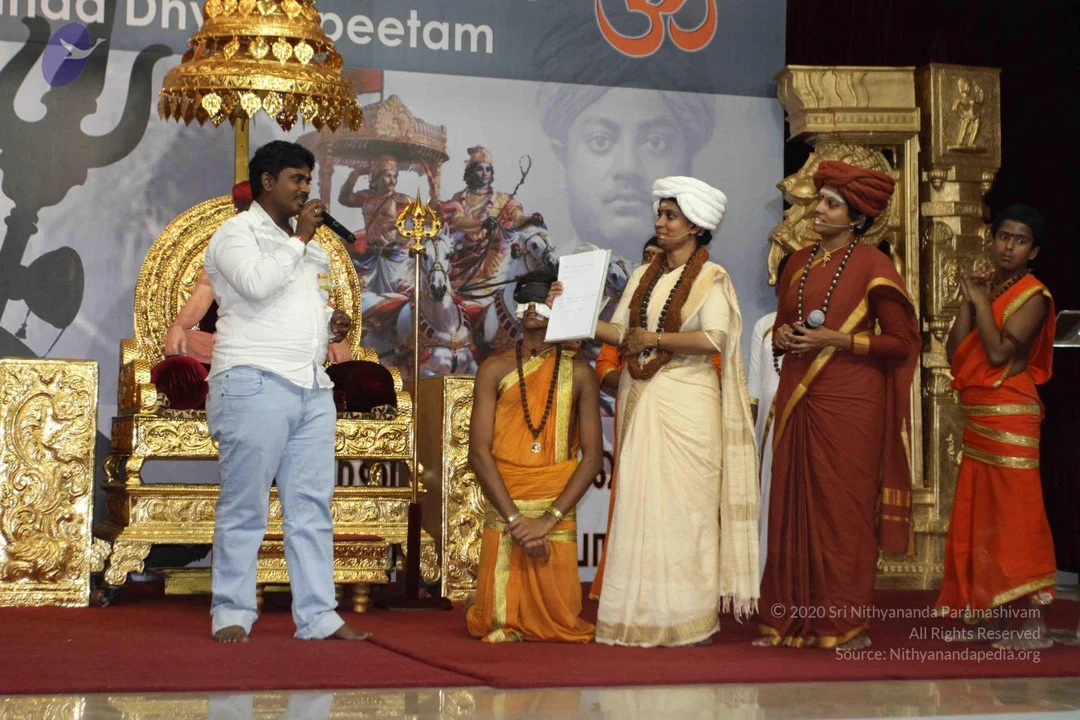
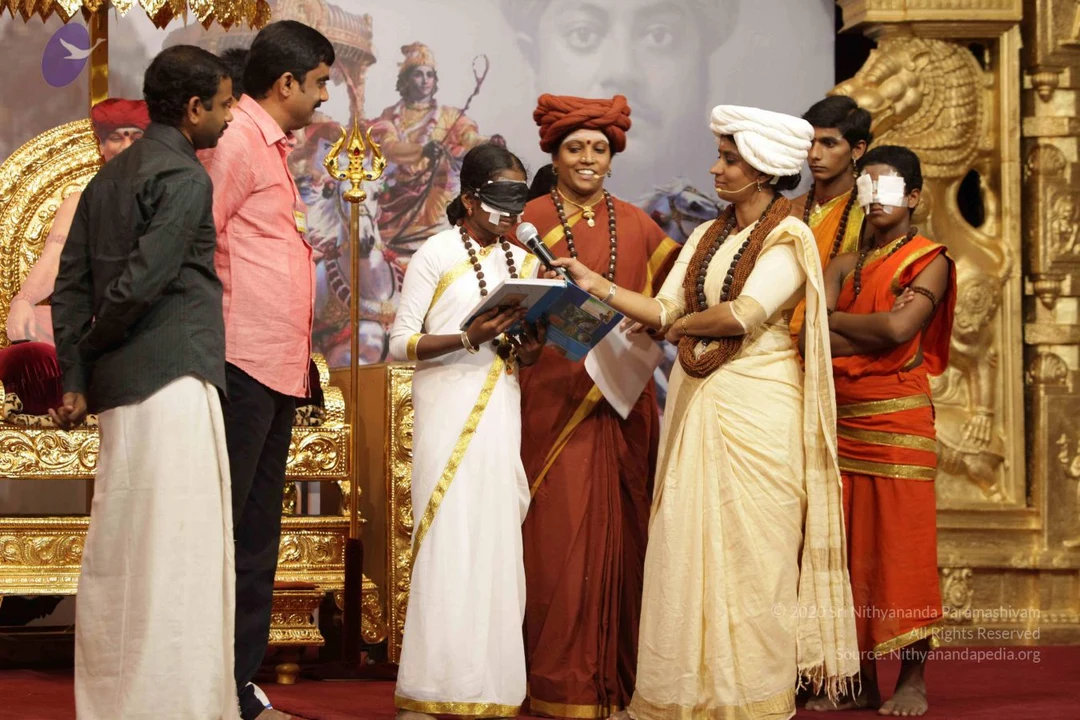
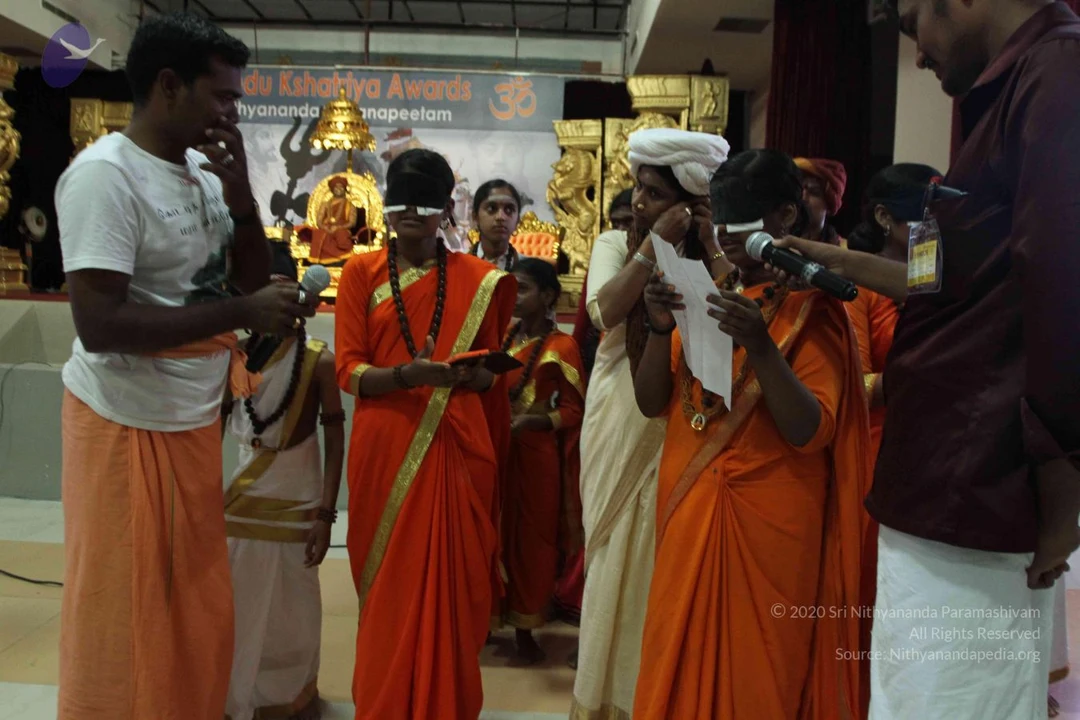
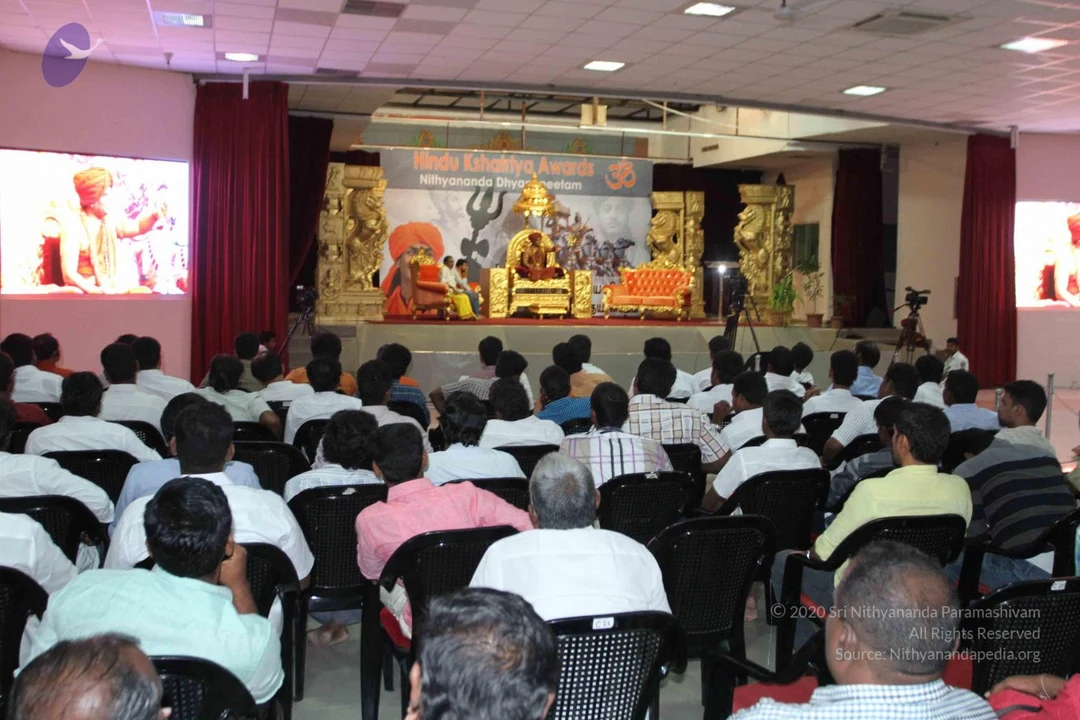
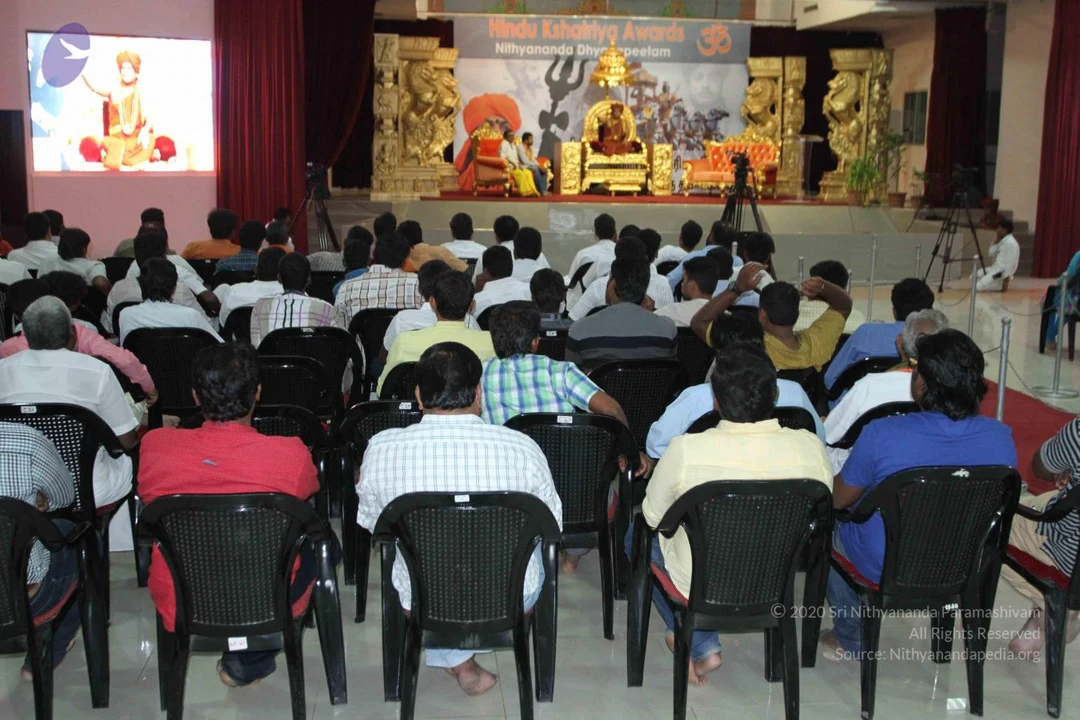
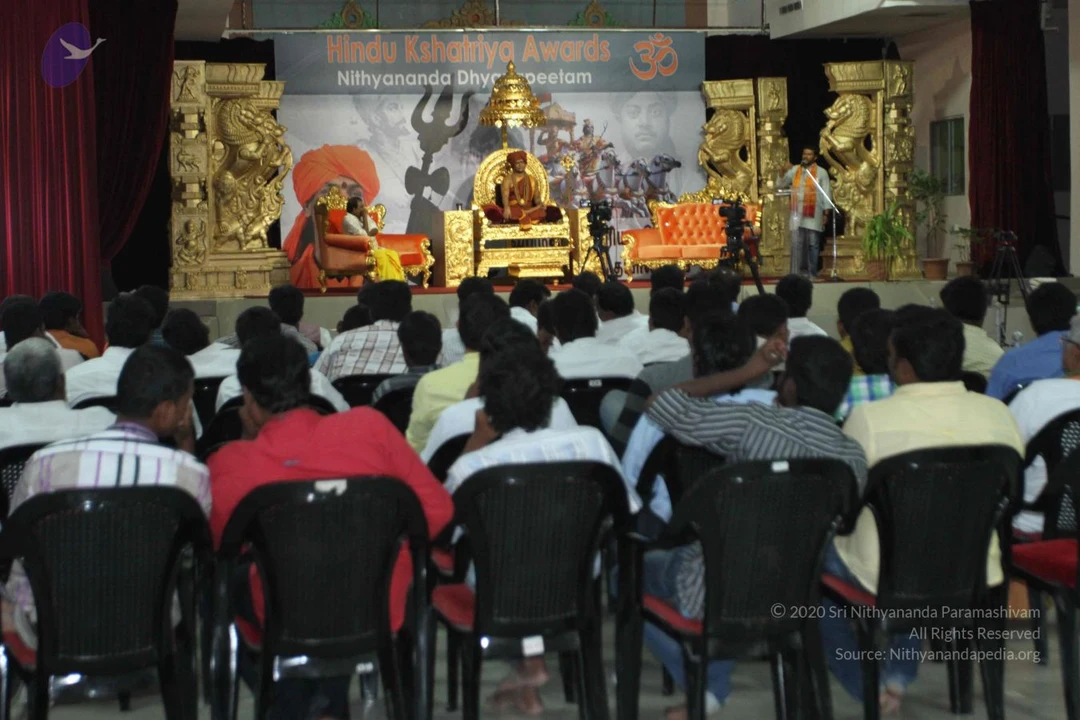
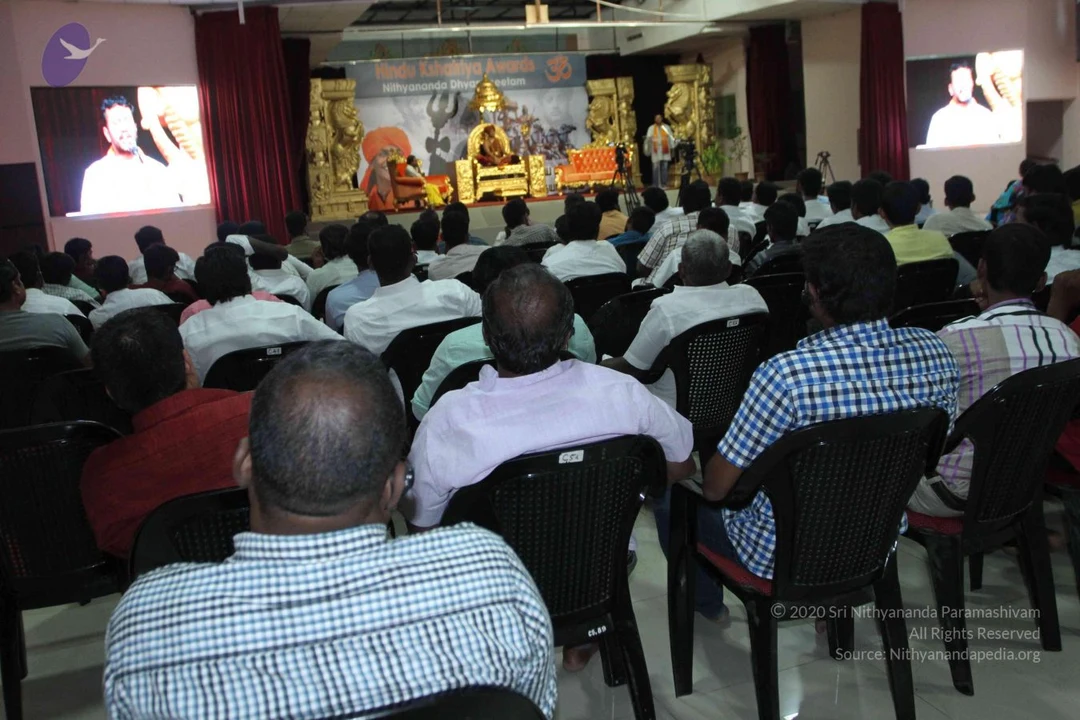
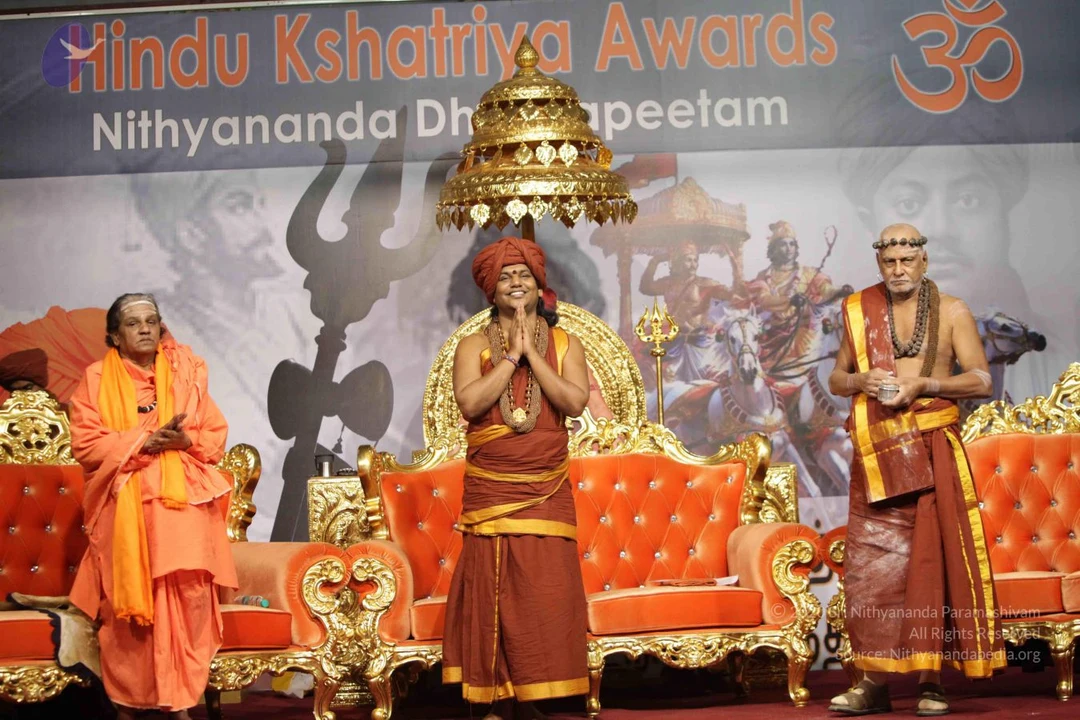
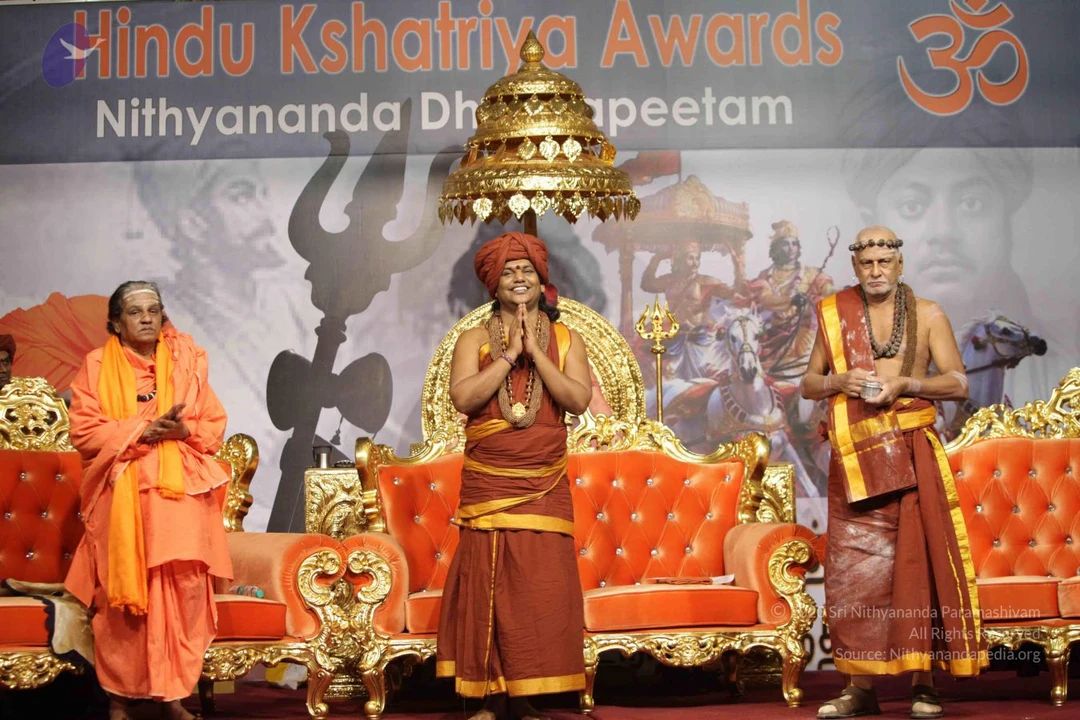
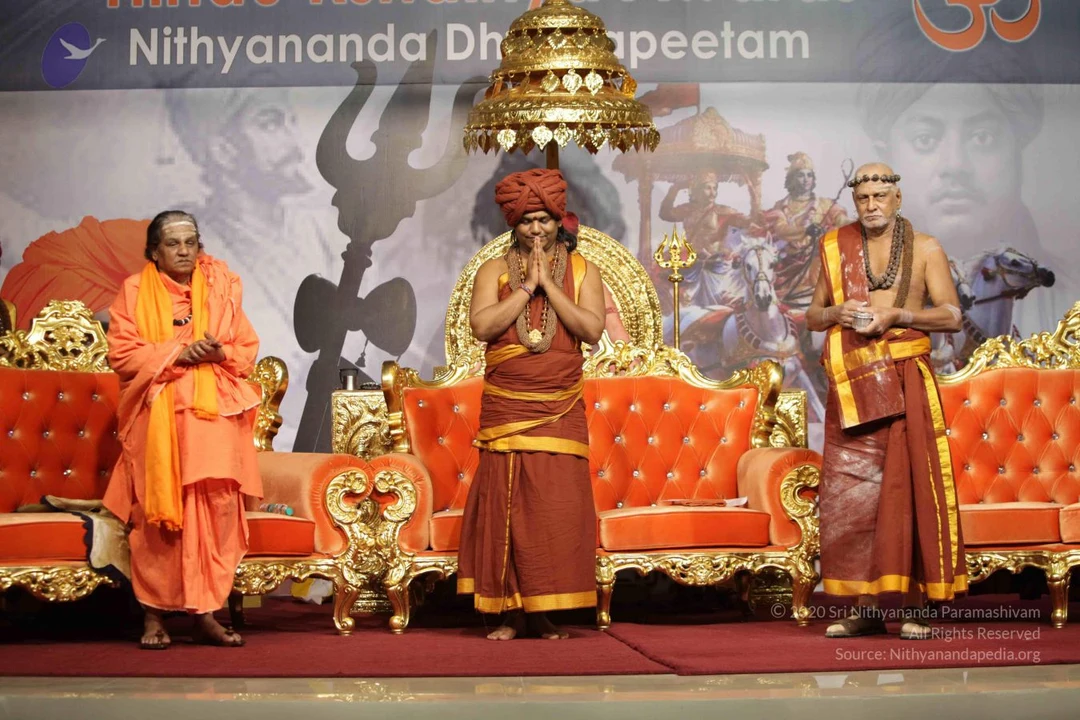
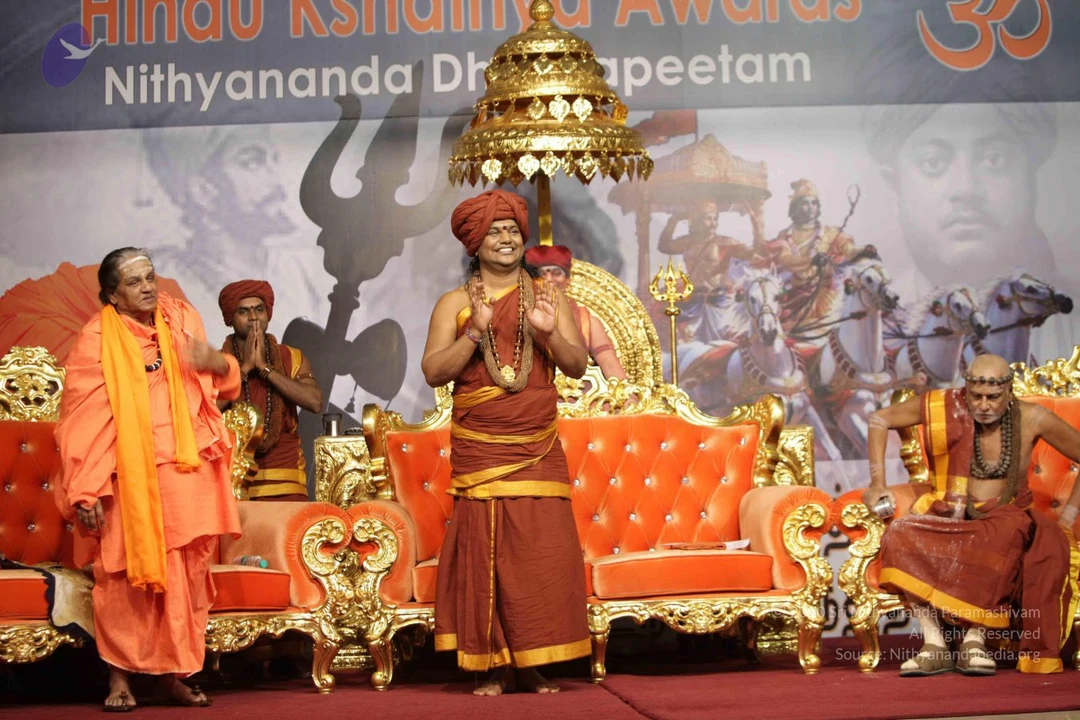
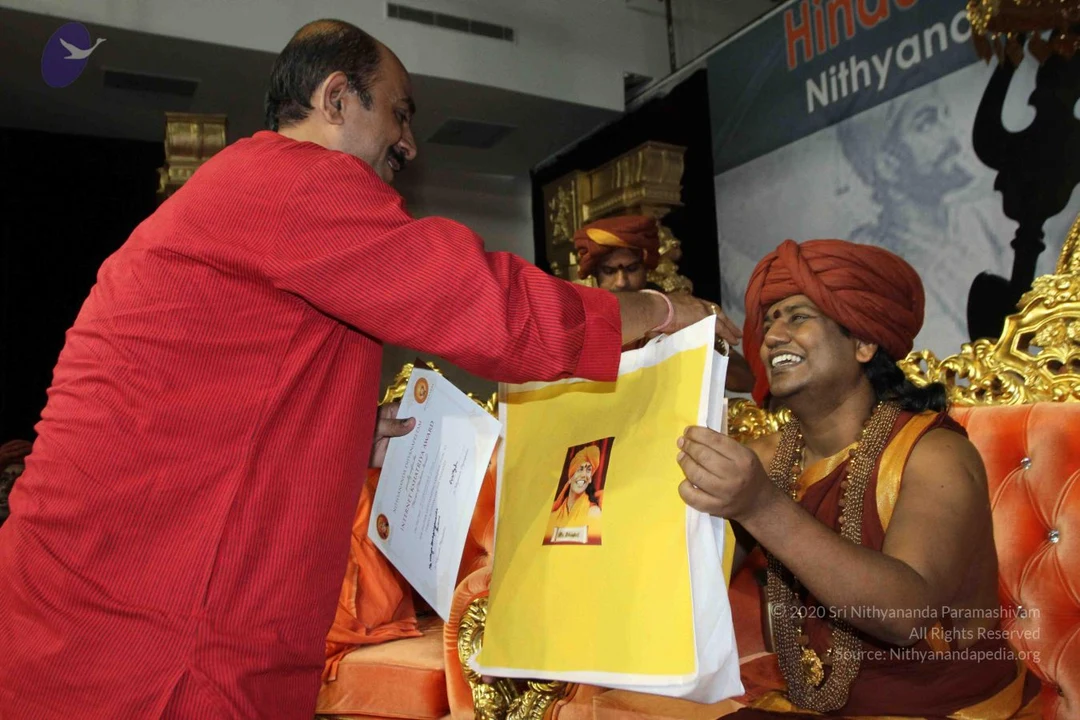
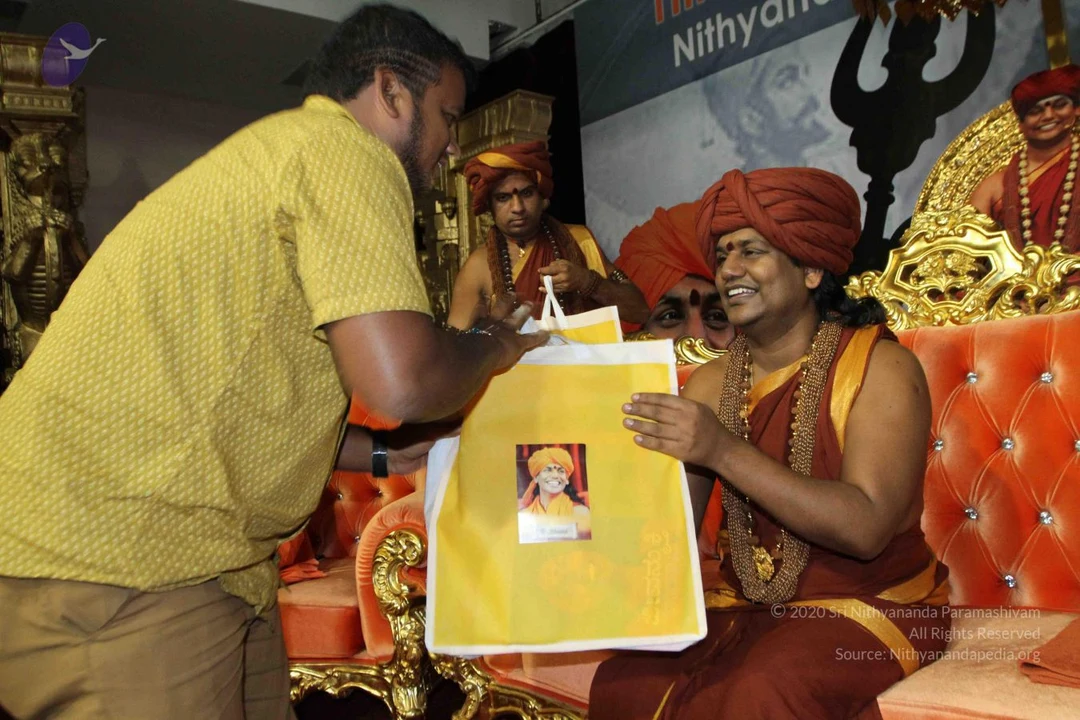
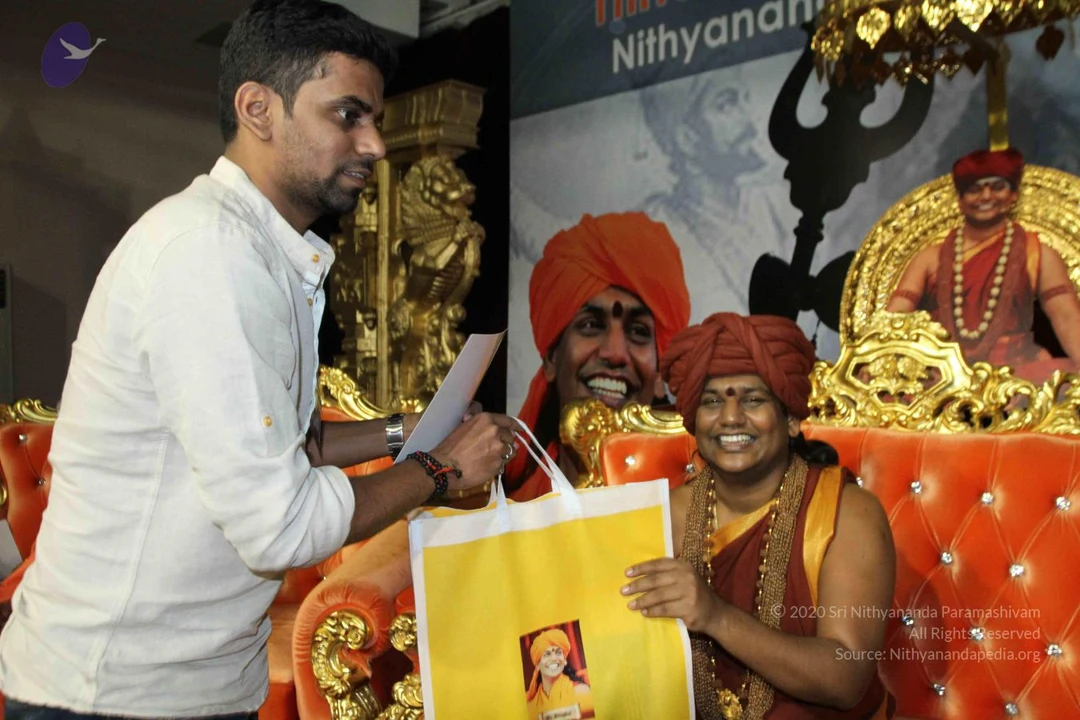
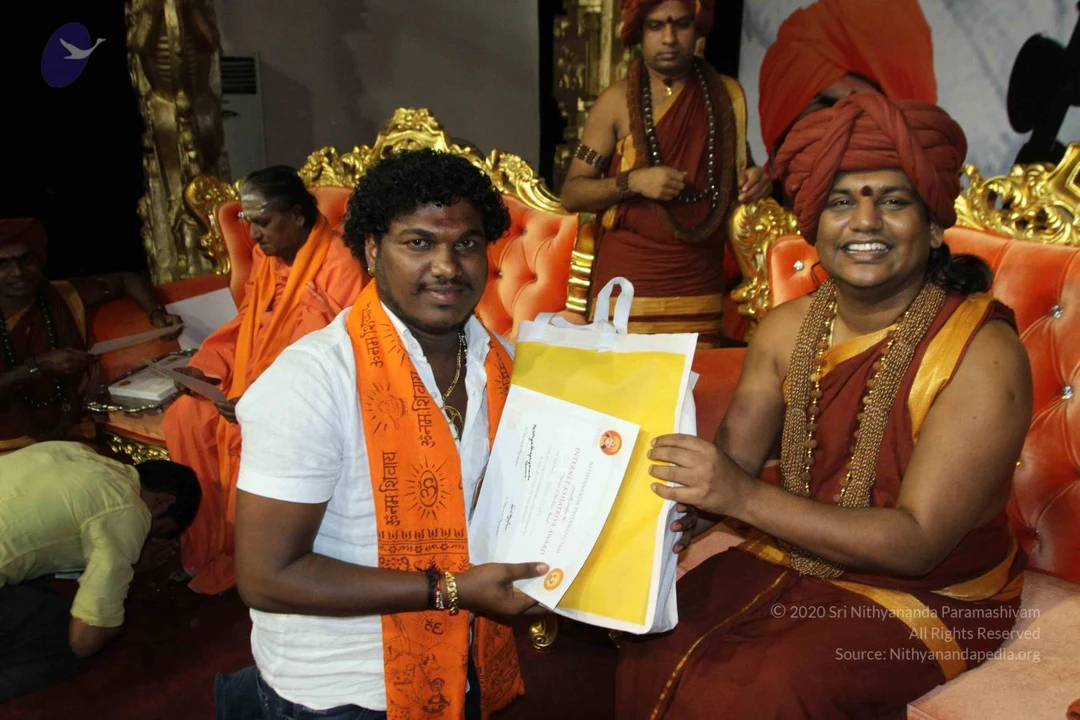
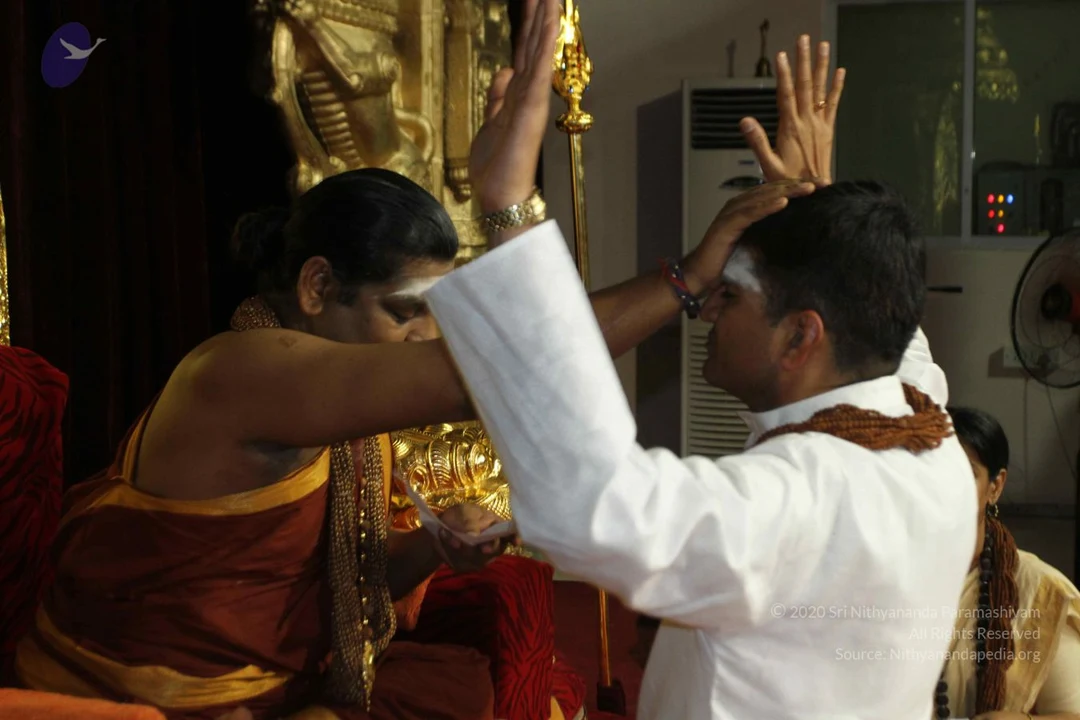
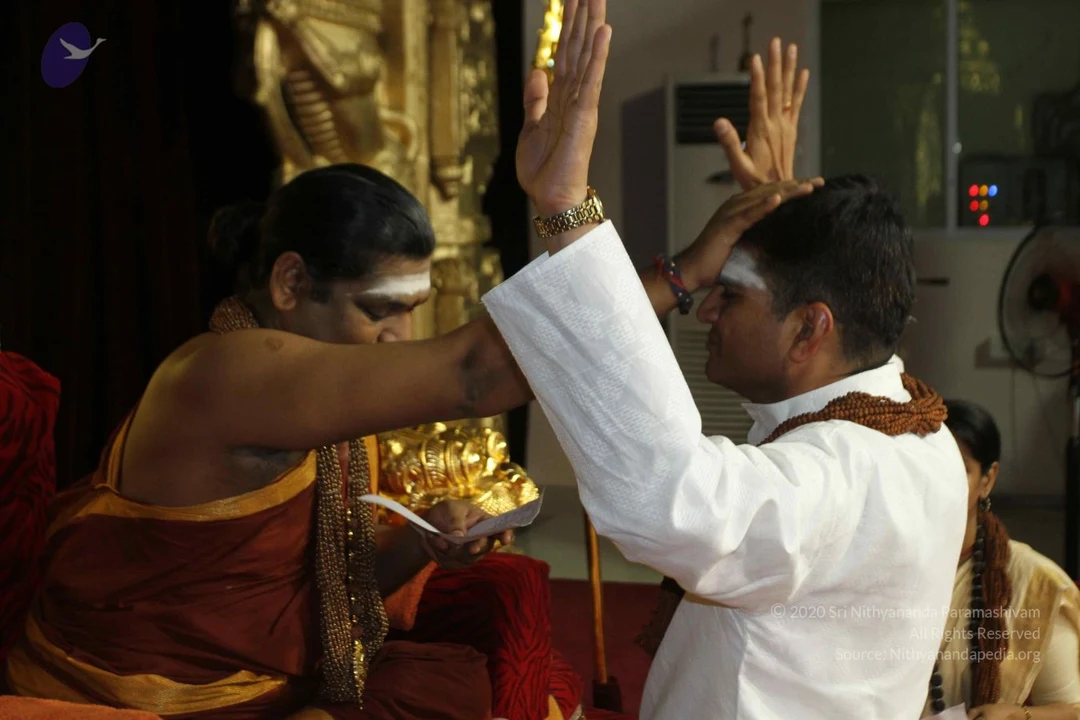
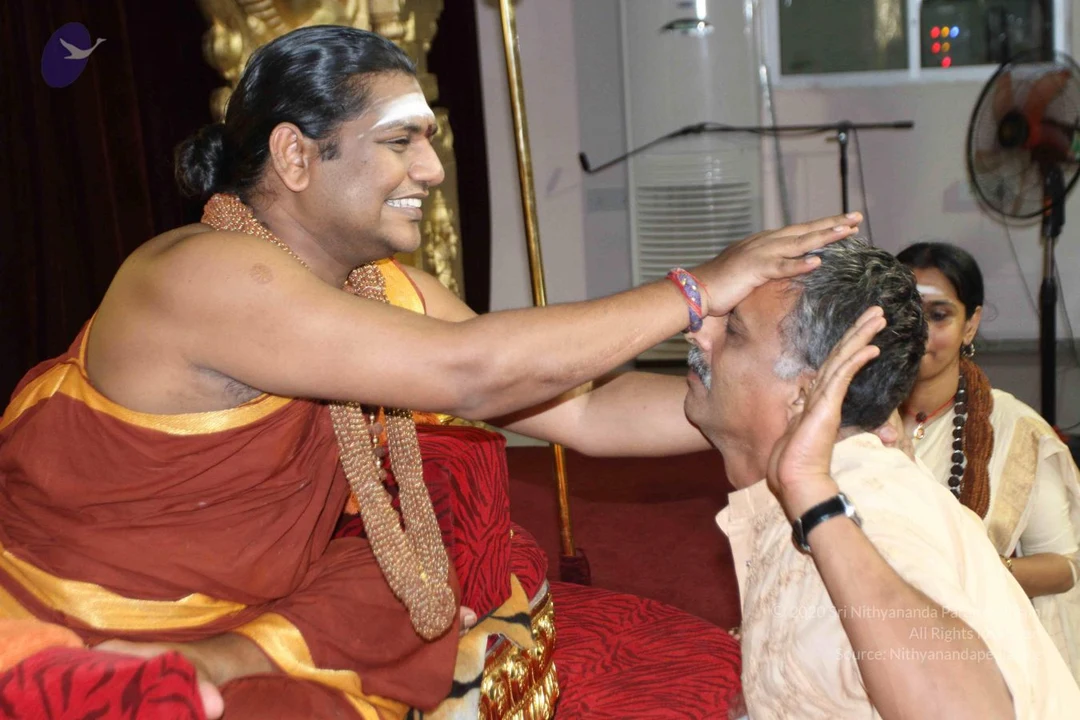
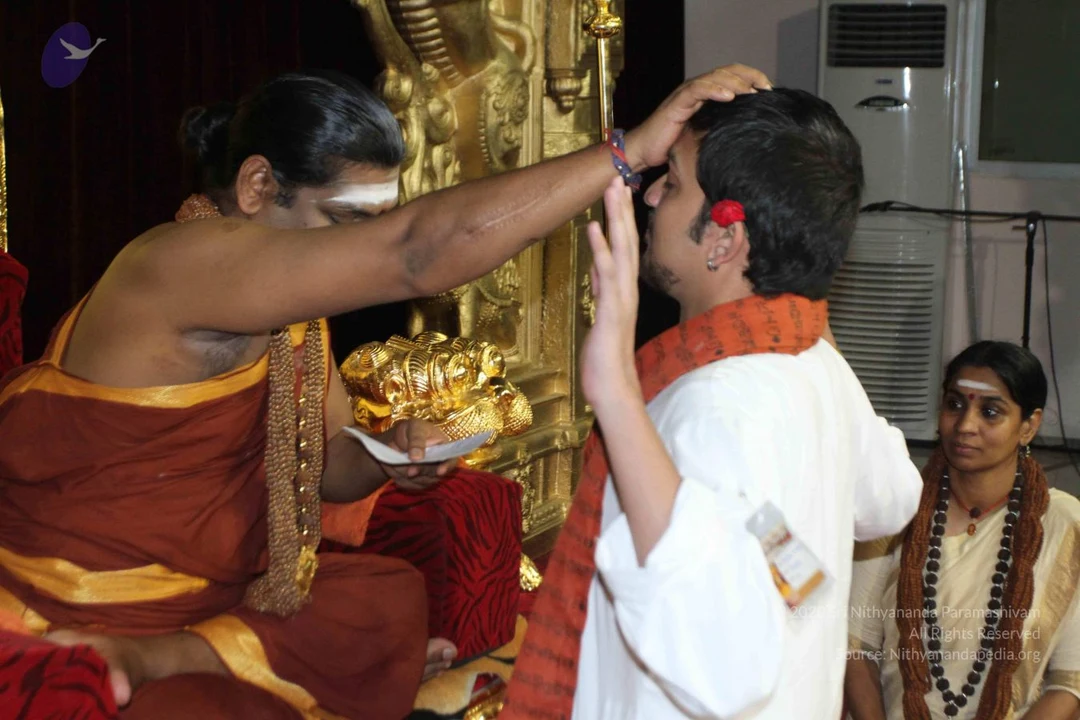
Hindu Kshathriya Awards
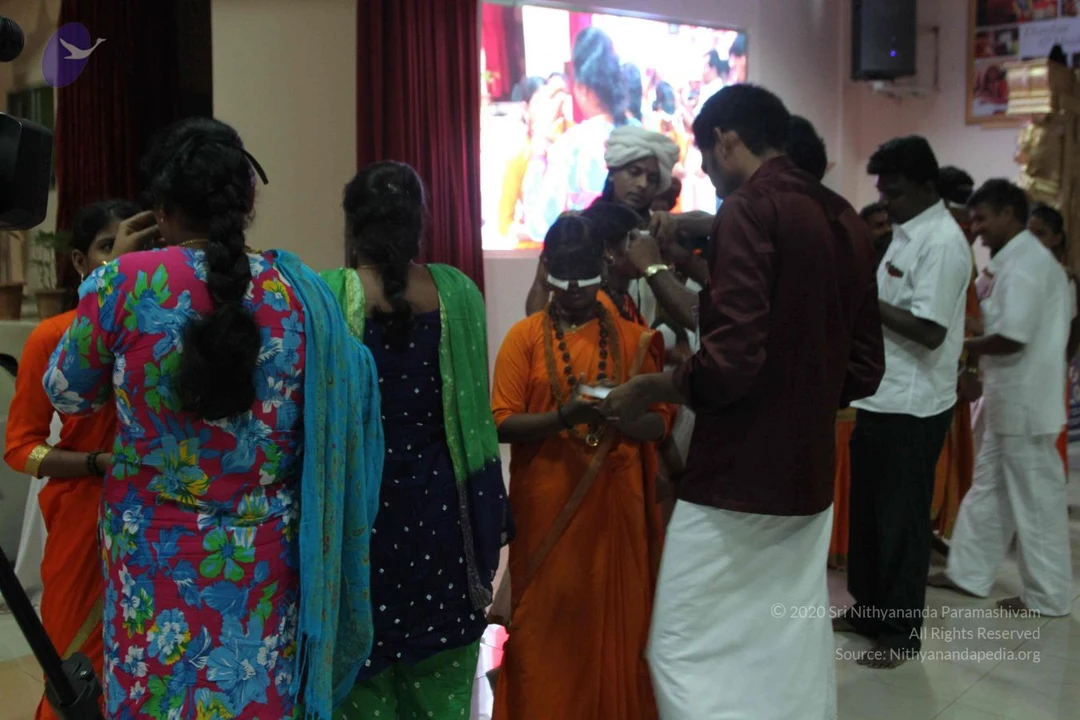
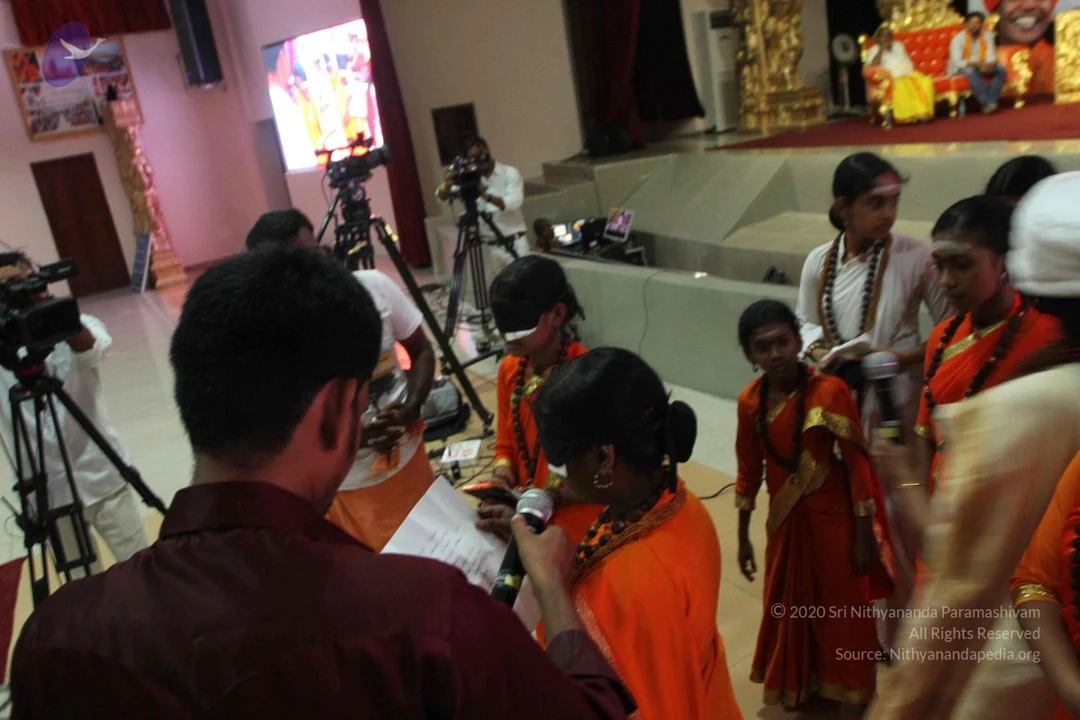
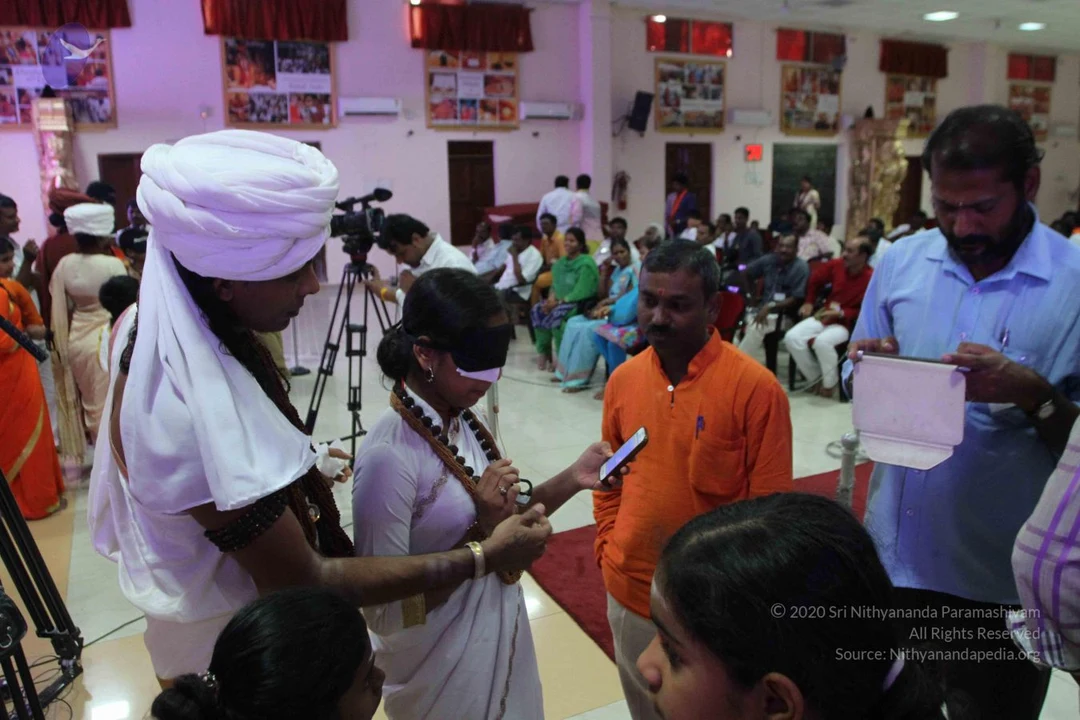
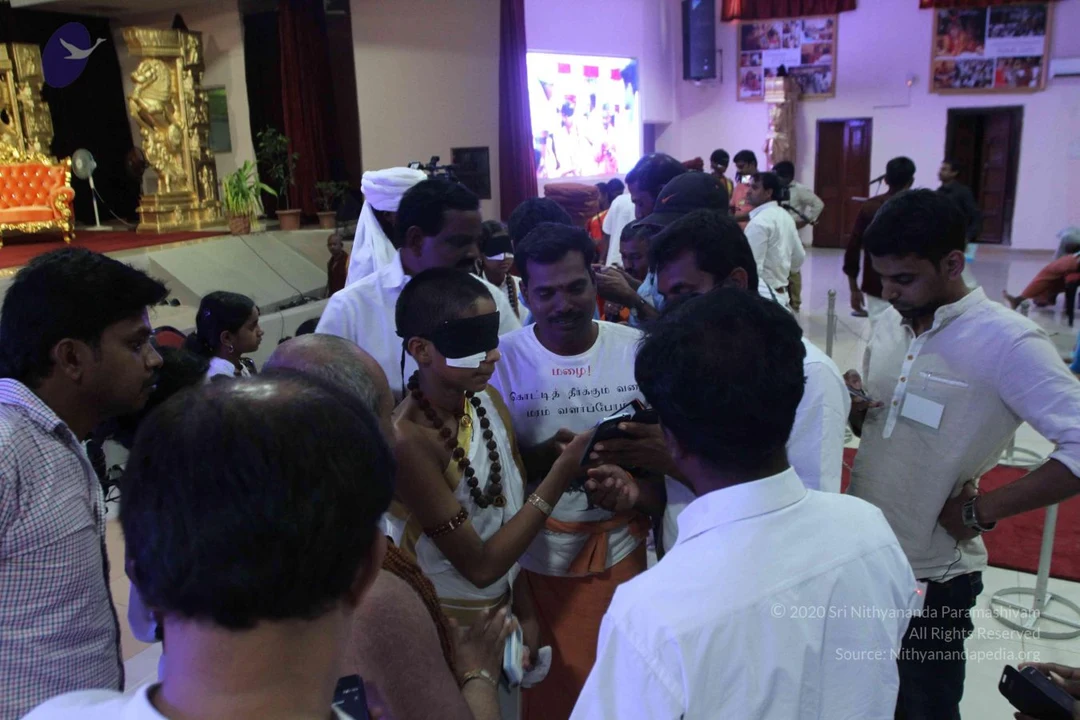
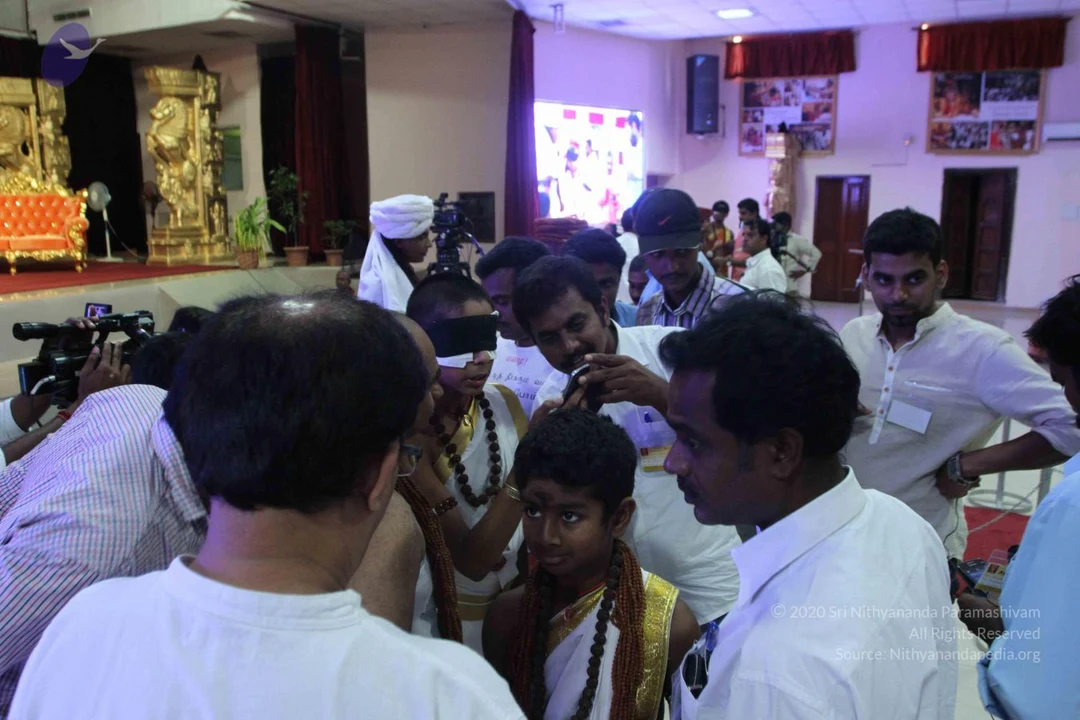
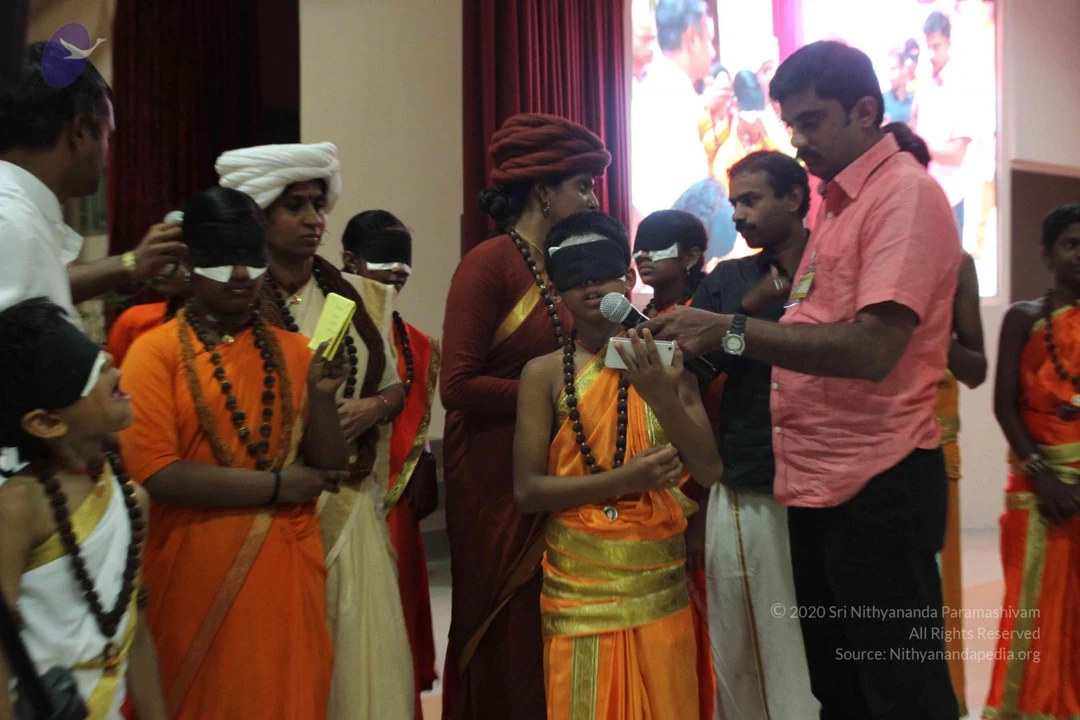
Demonstration of Powers

HDH Swamiji addressing the delegates

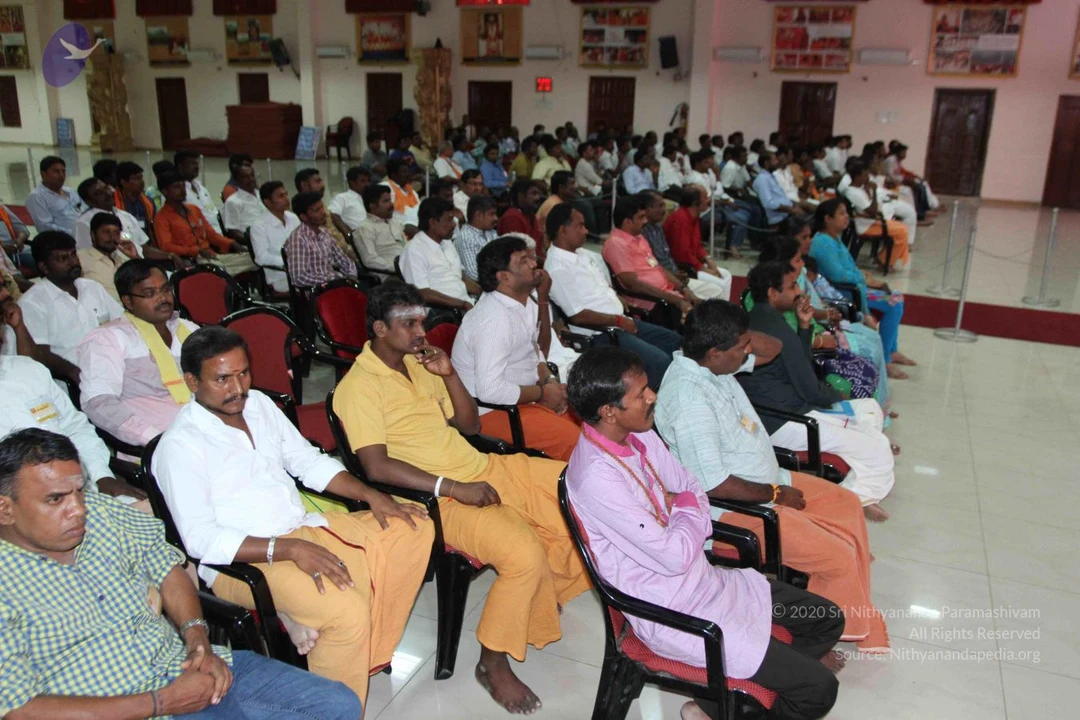
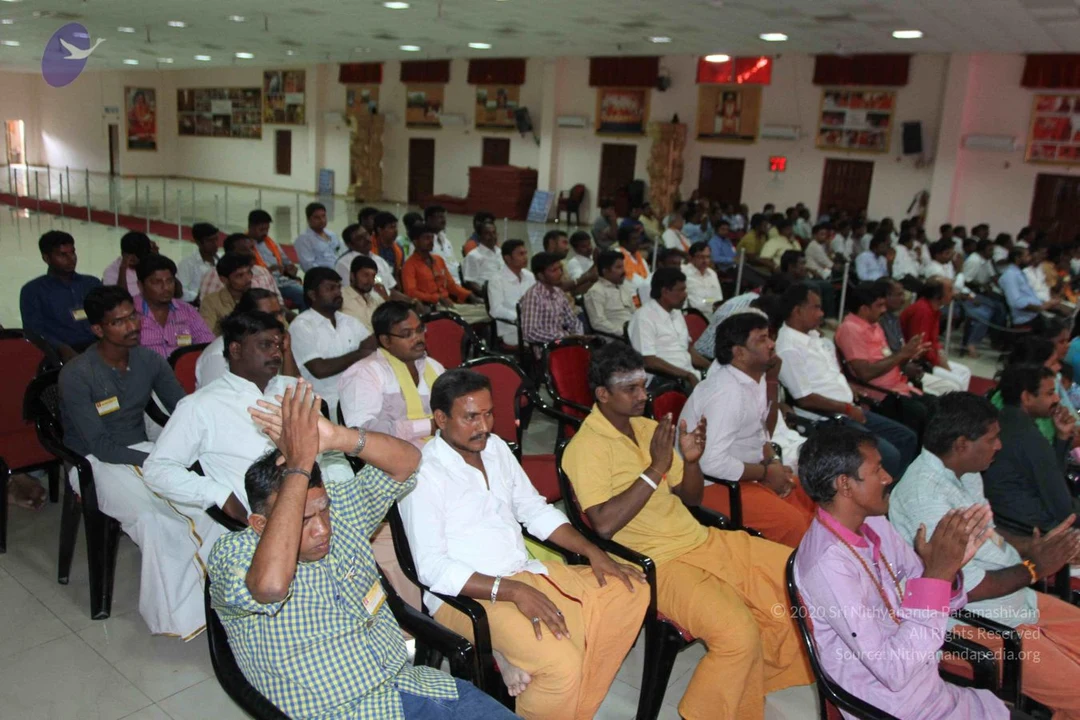
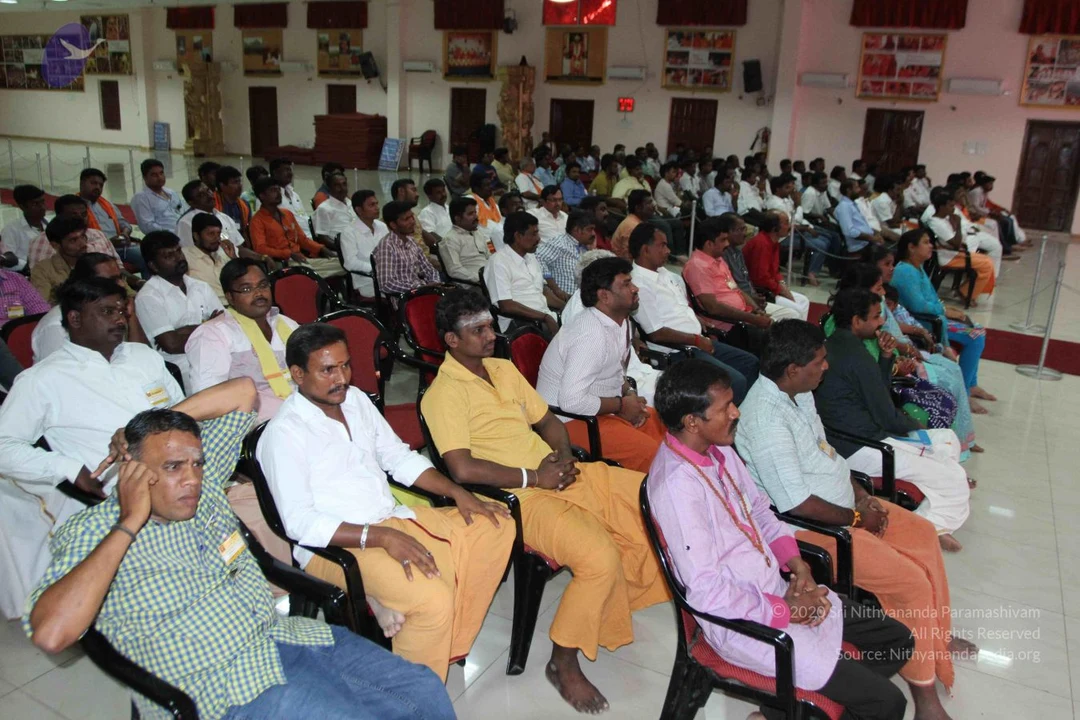
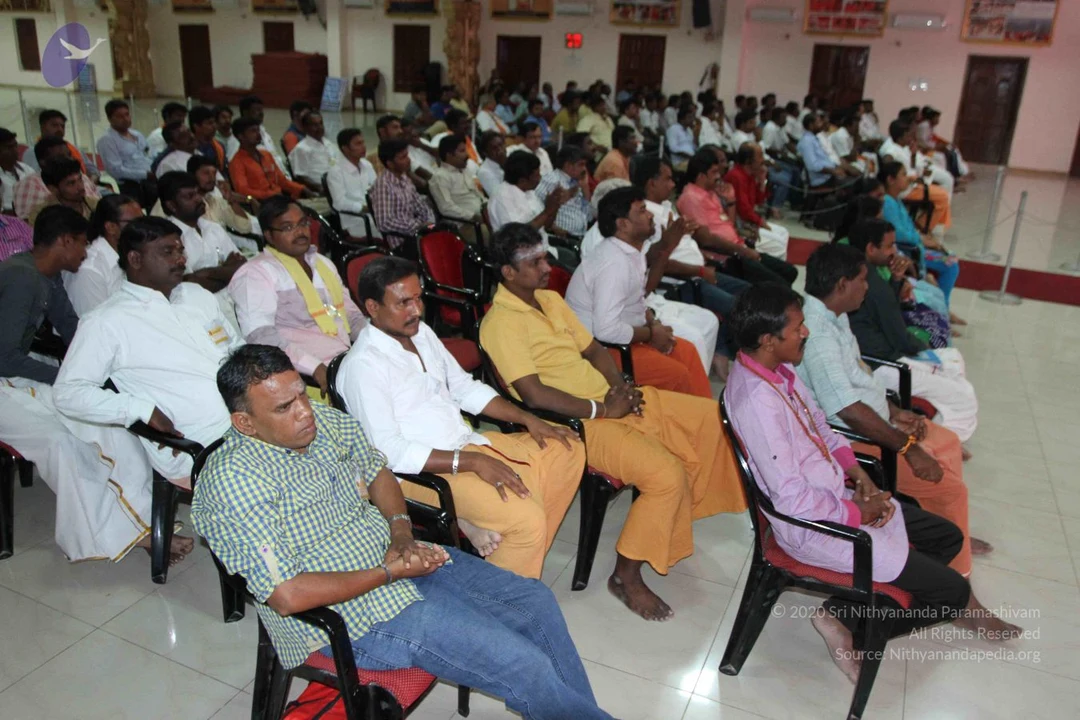
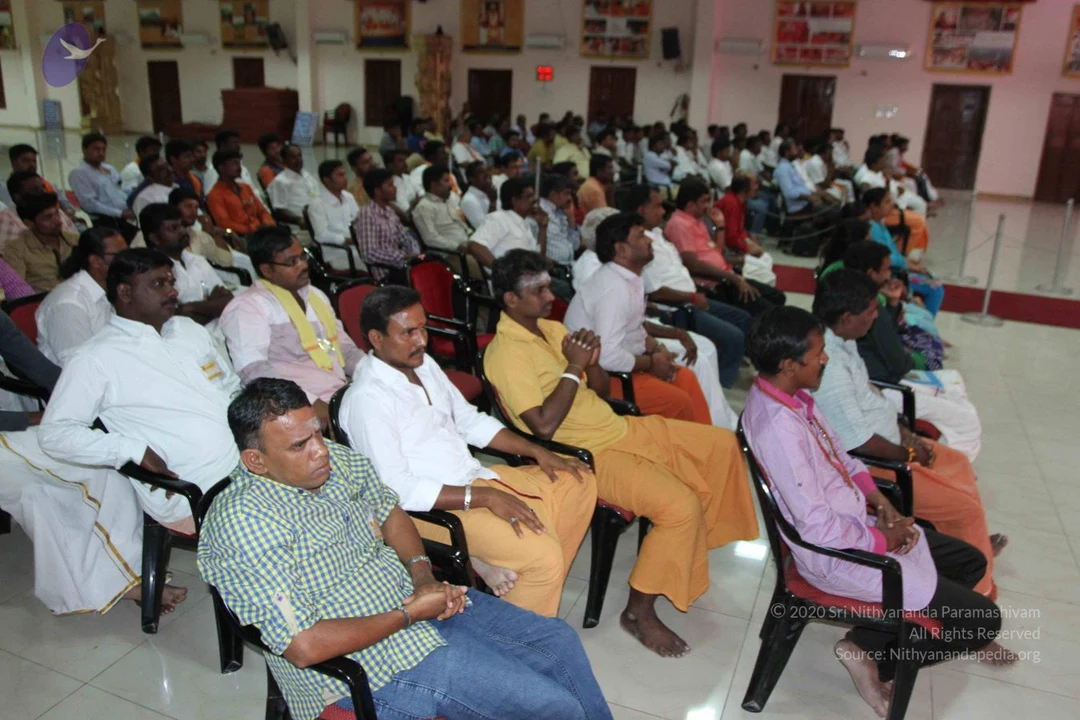
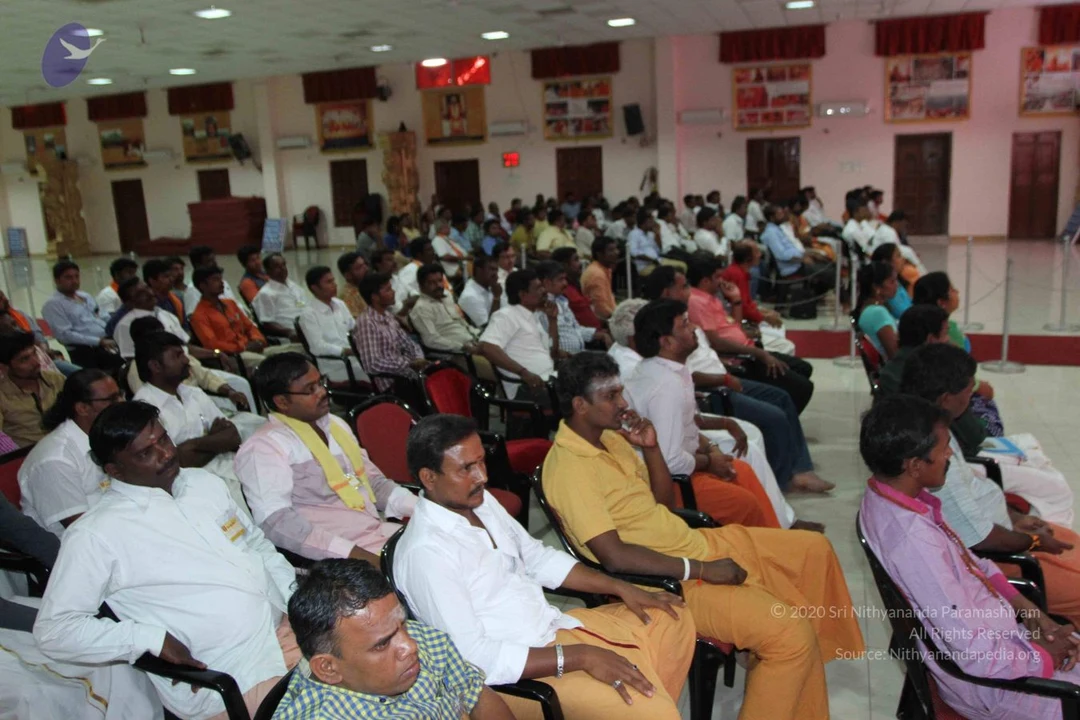
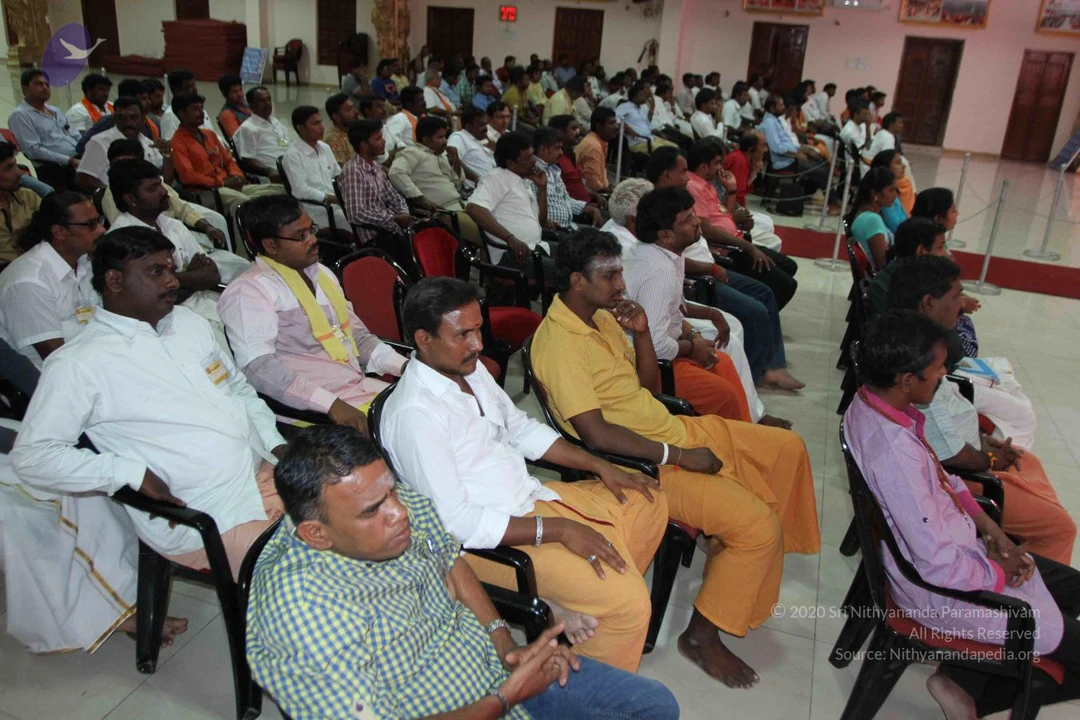
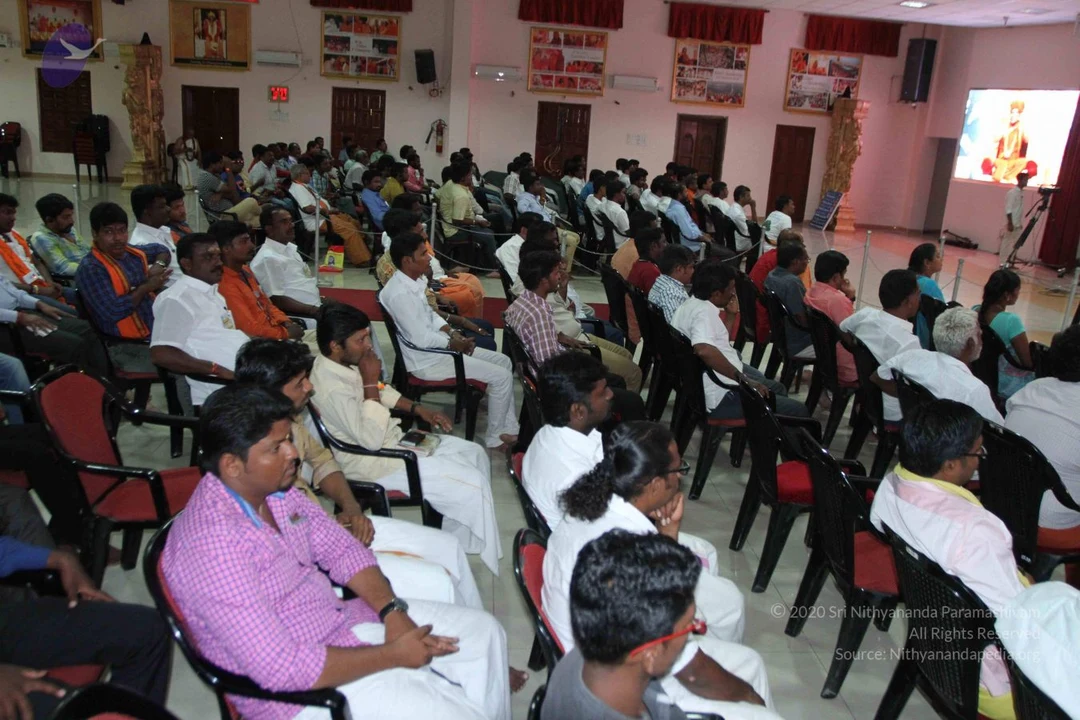
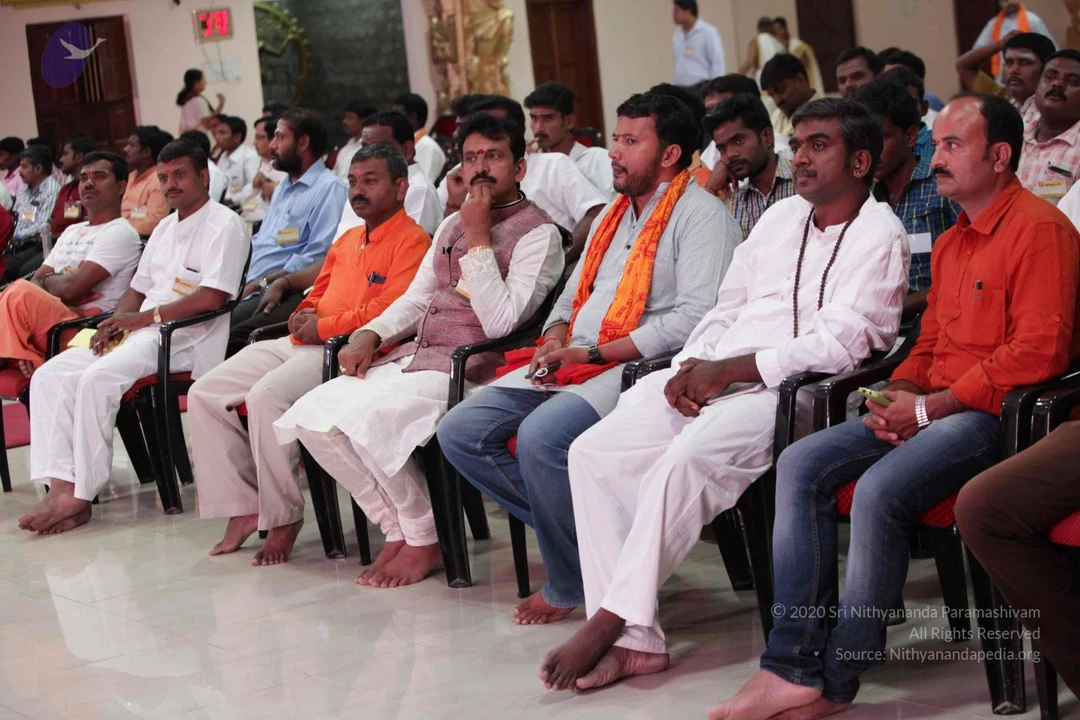
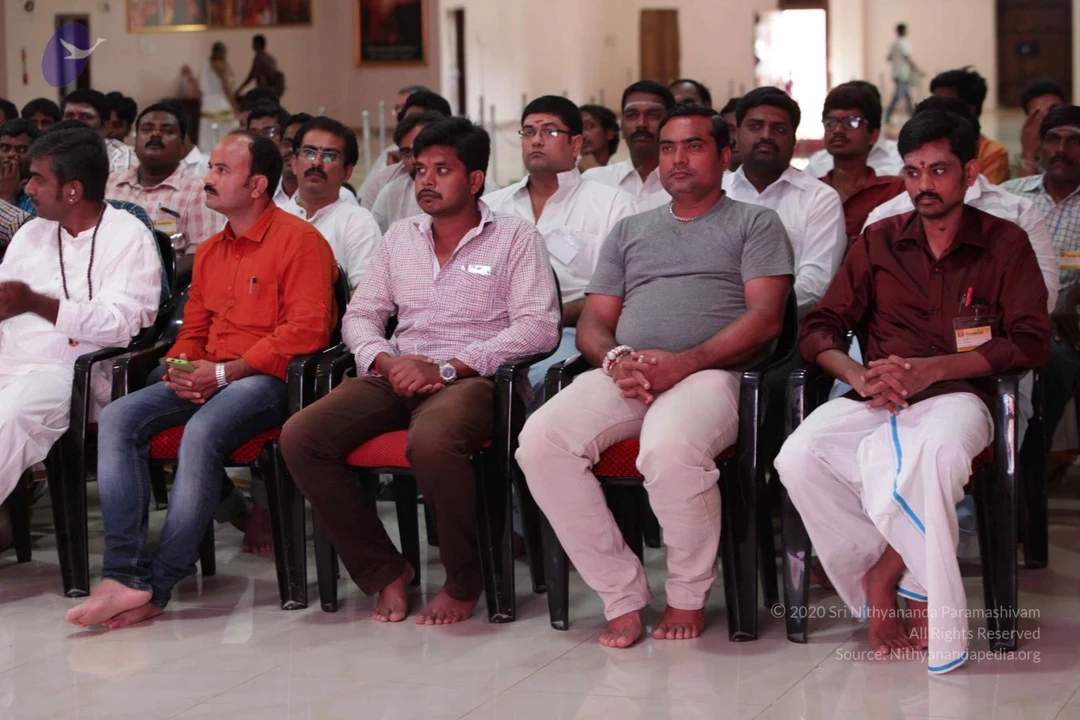
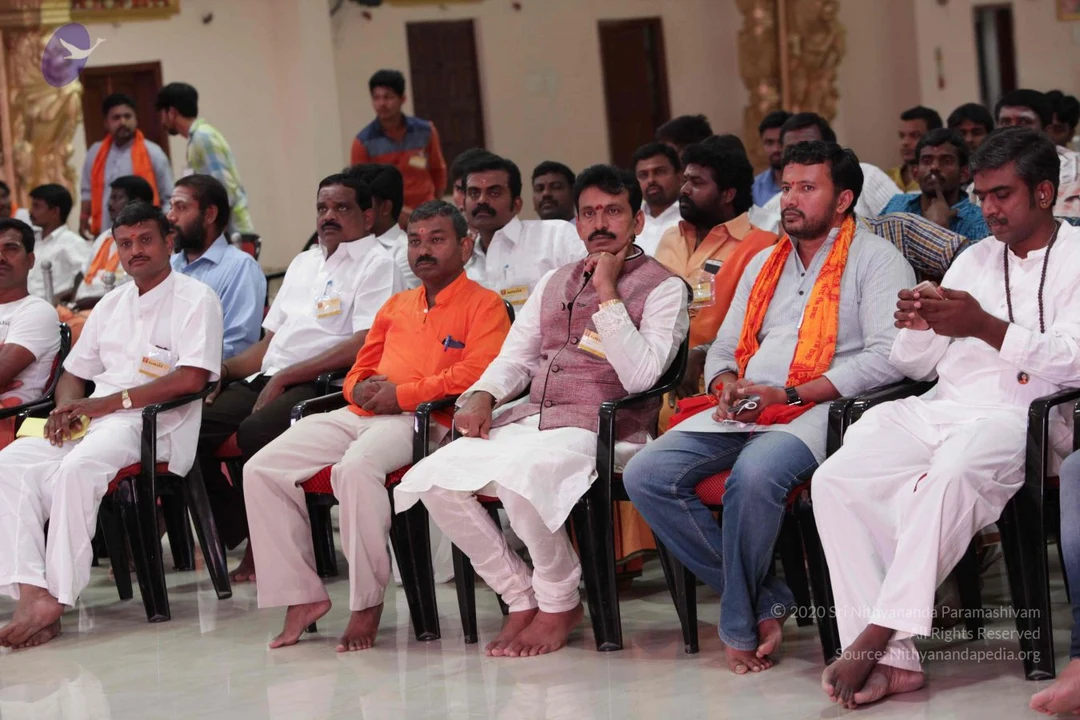
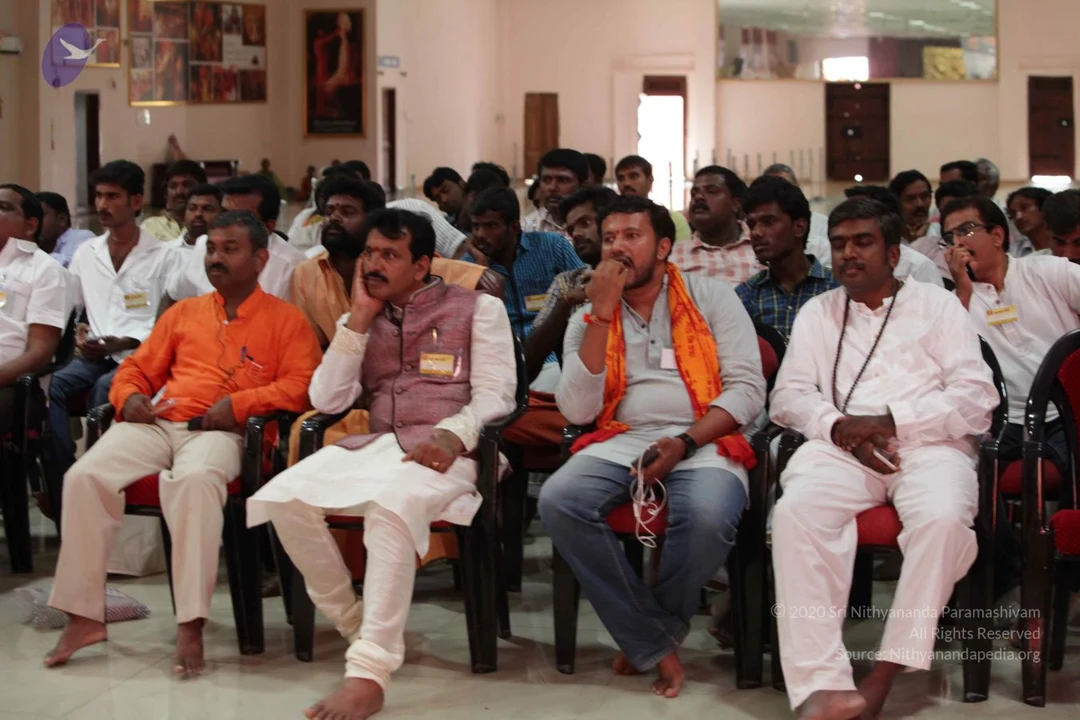
Delegates Watching

Award Giving Function-1

Awarding Giving Function

NDY

Shivoham Process

NDY

Delegates of NDY

Photos from this day

View all 348 photos

Hindu Kshathriya Awards
19 photosSource gallery
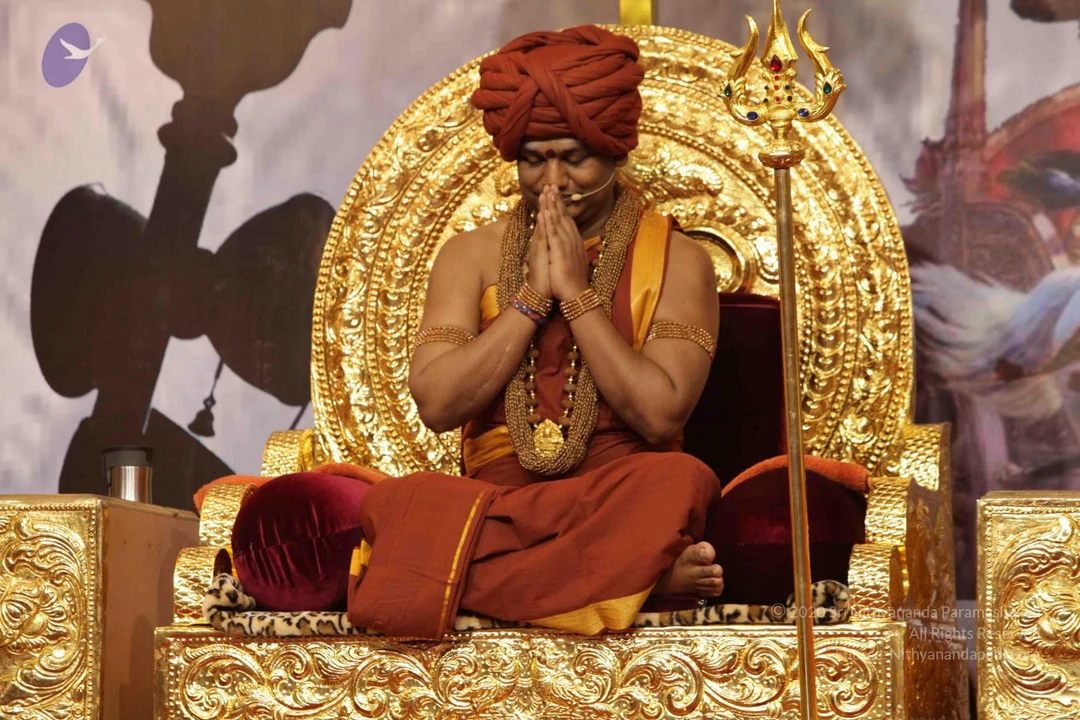
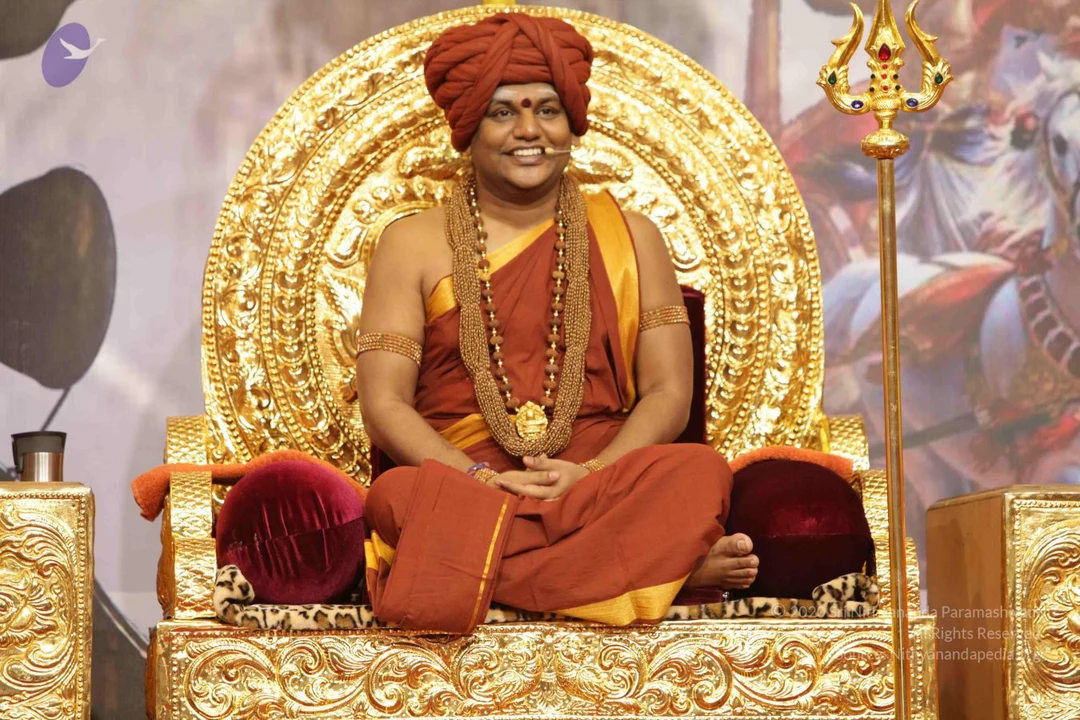
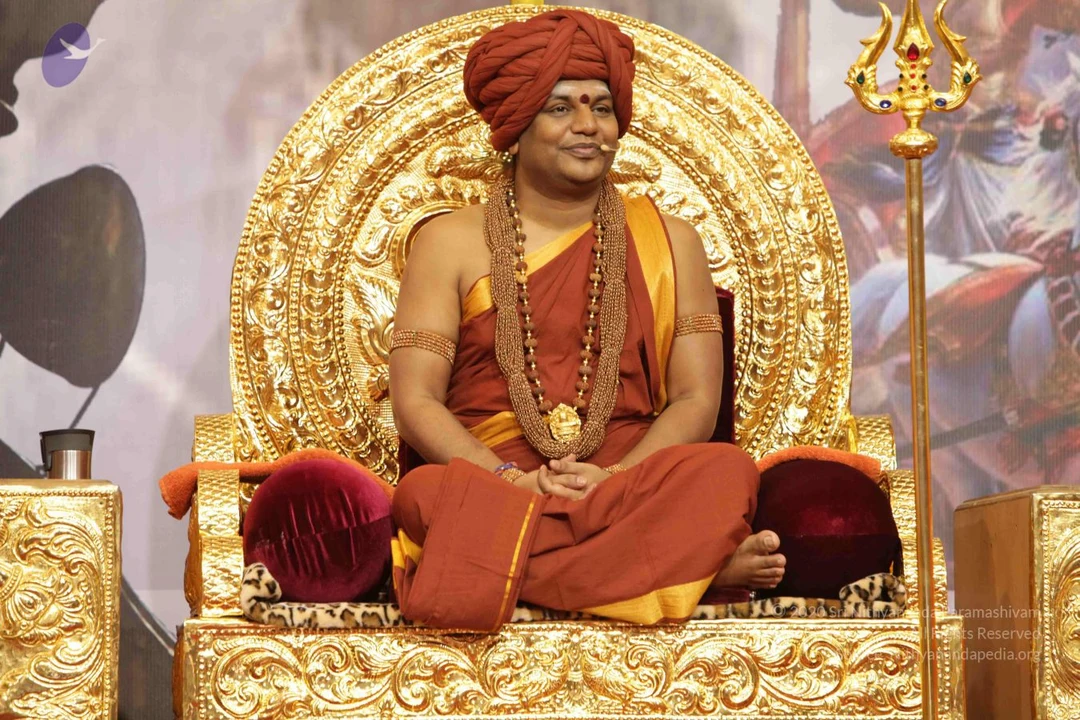
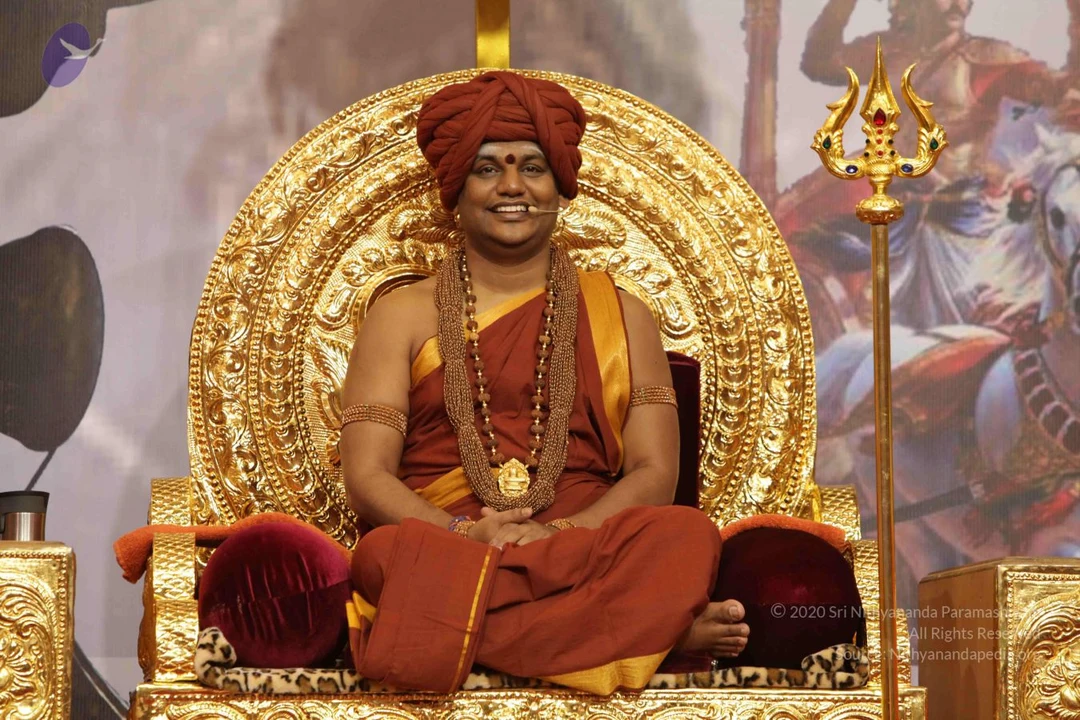
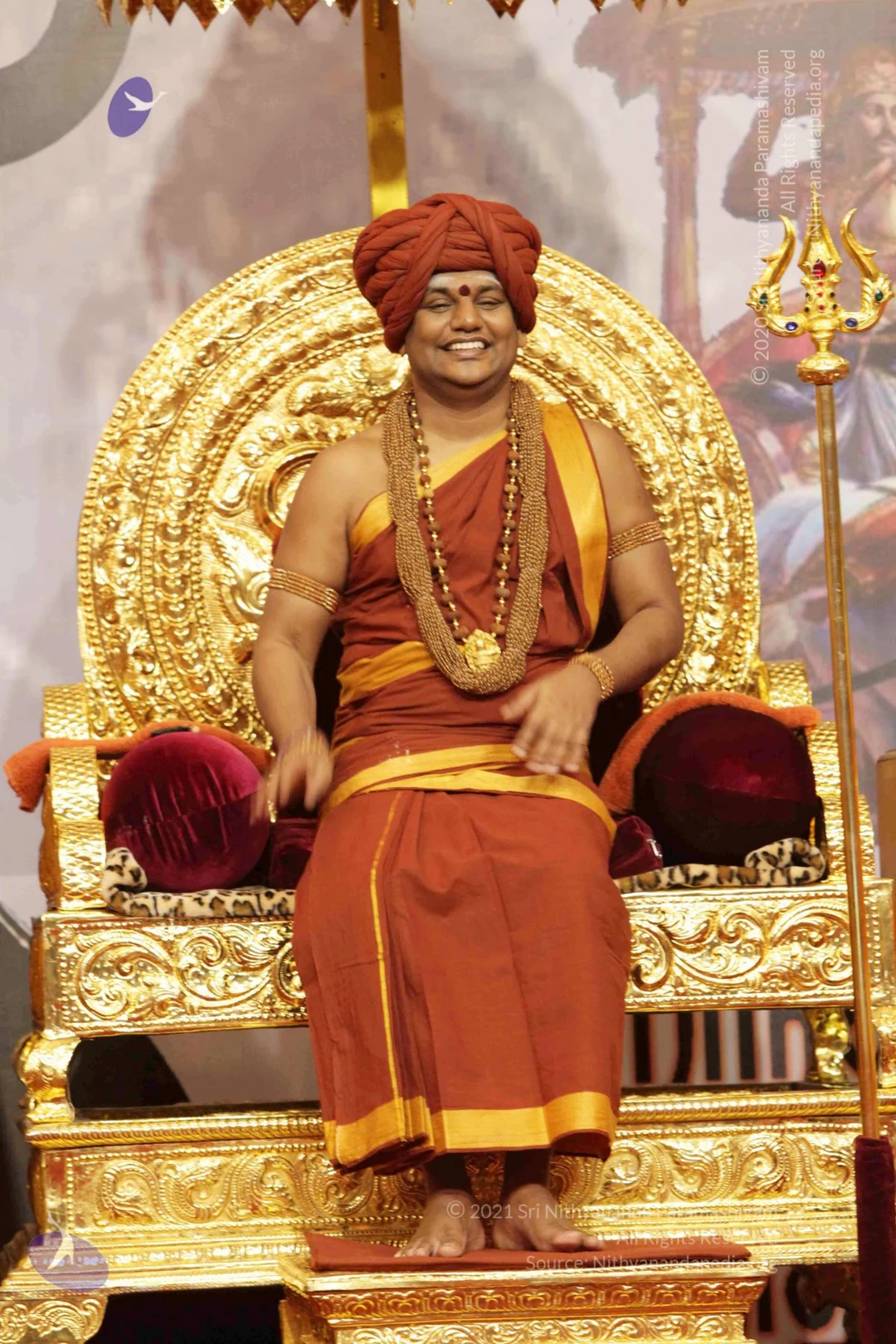
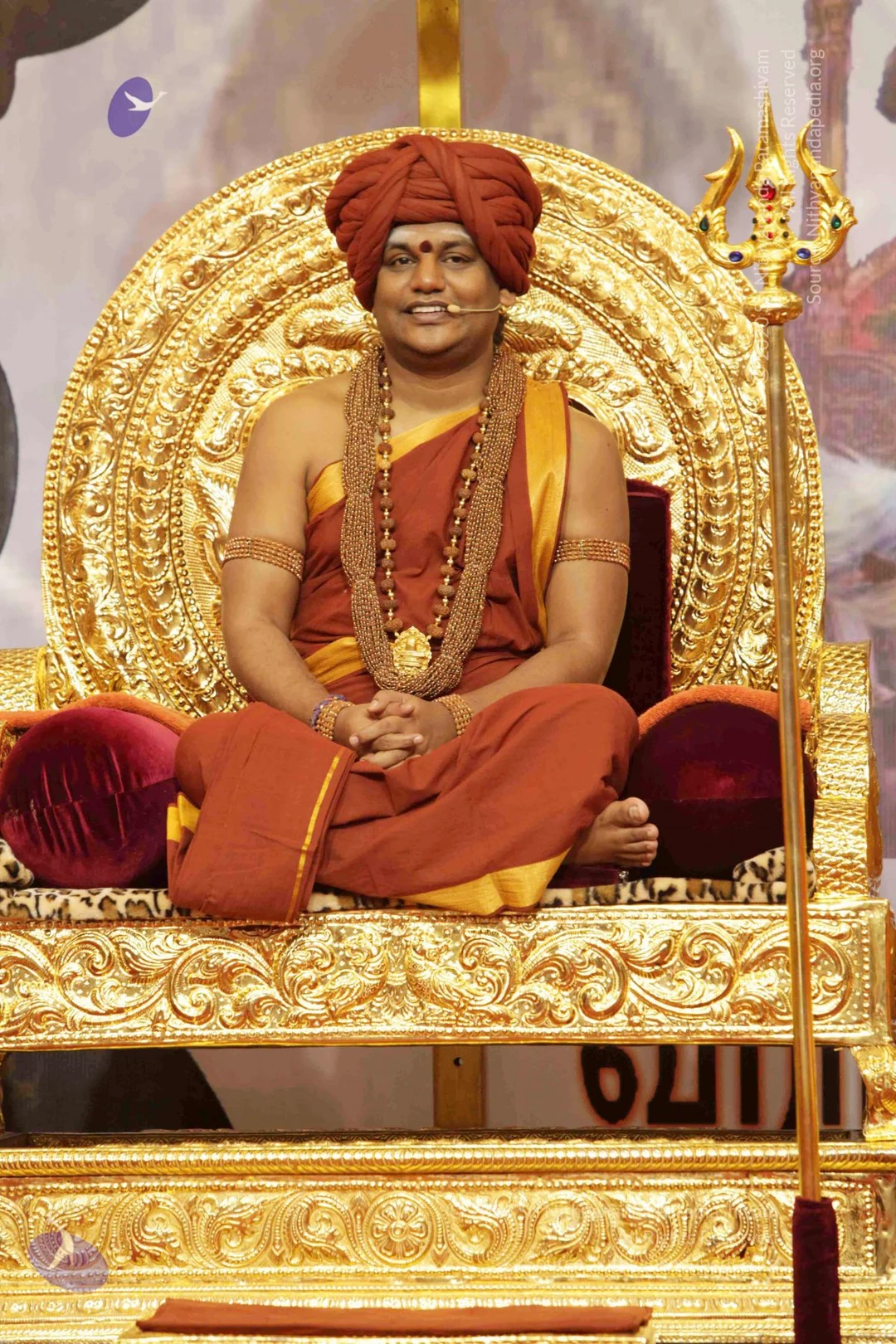
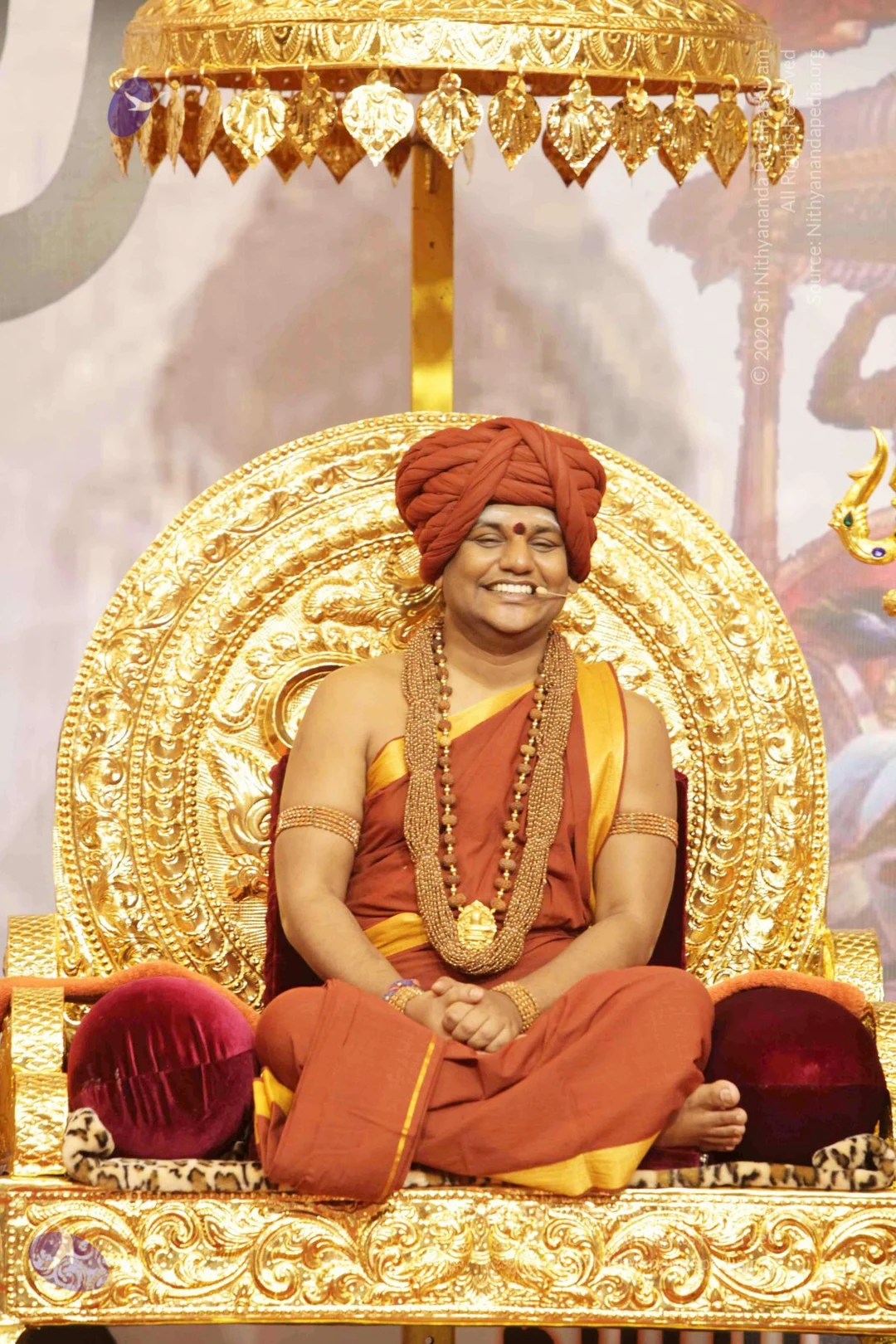
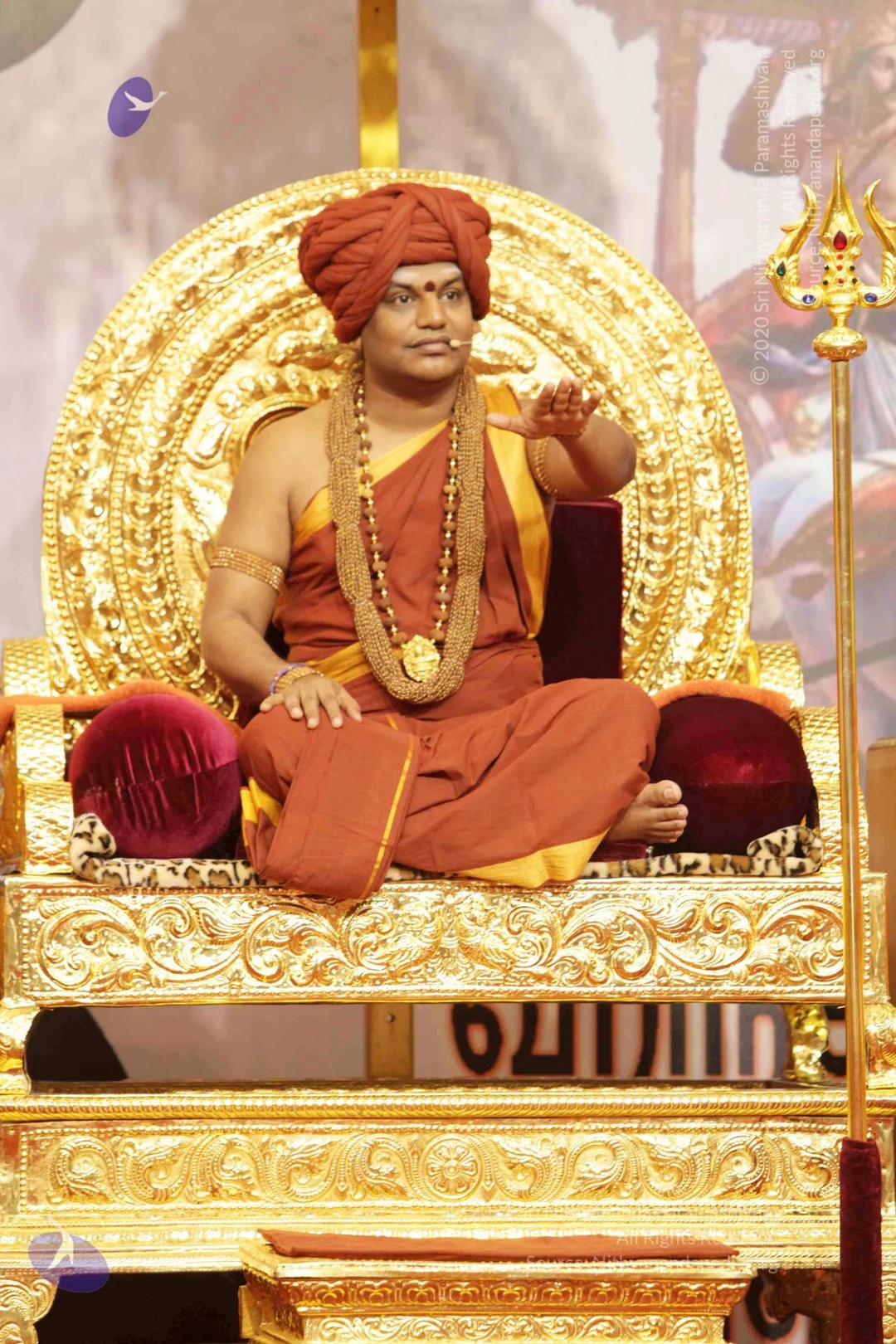
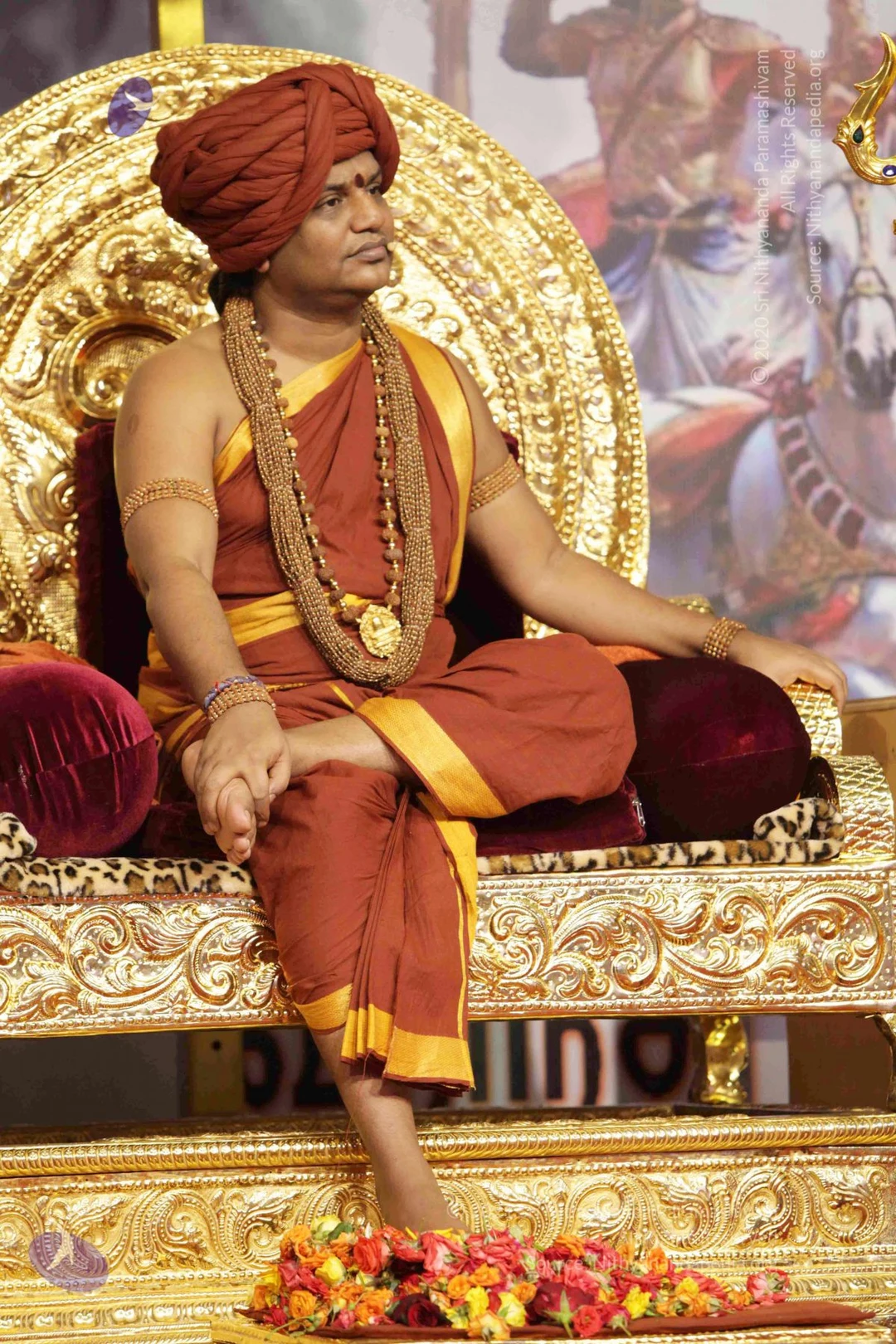
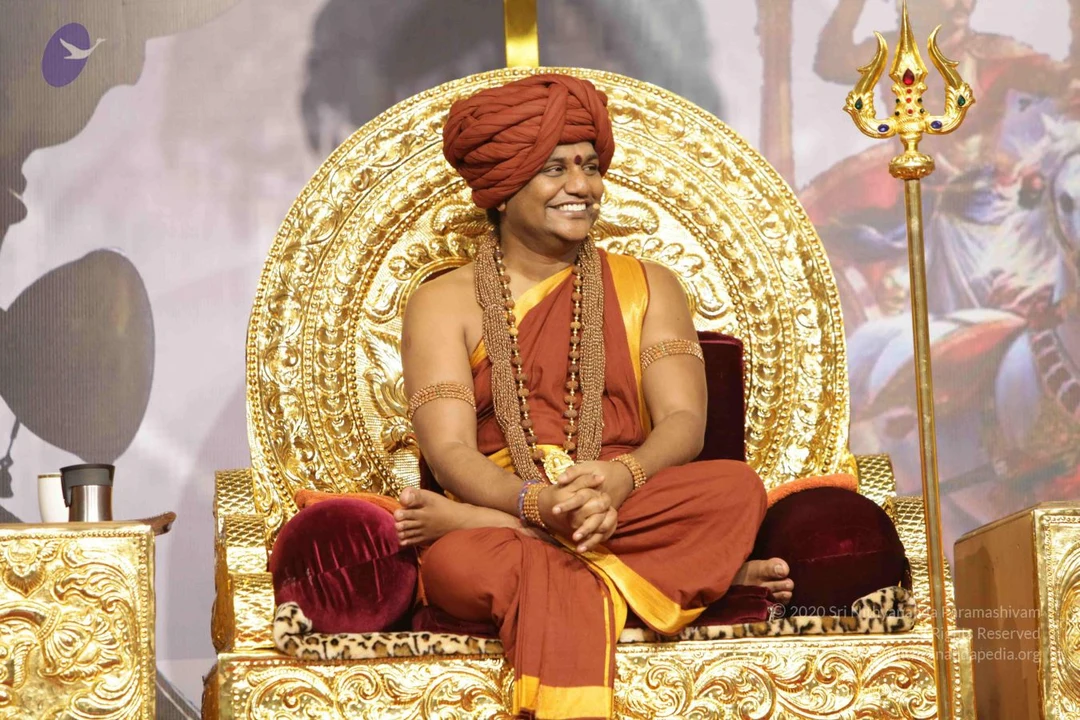
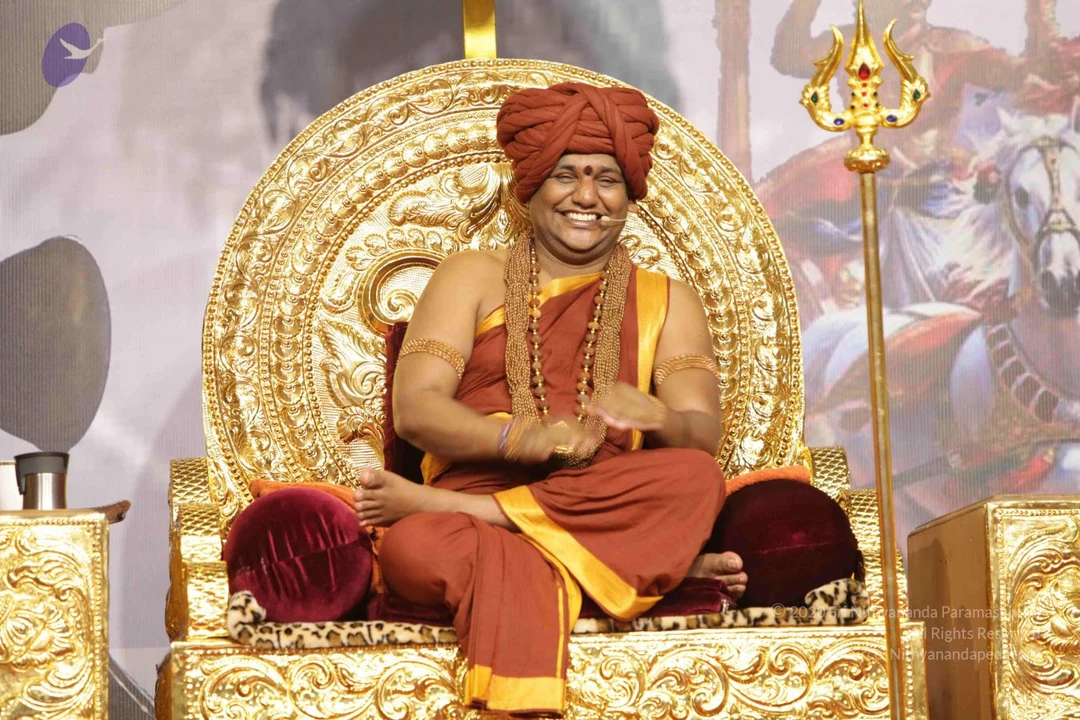
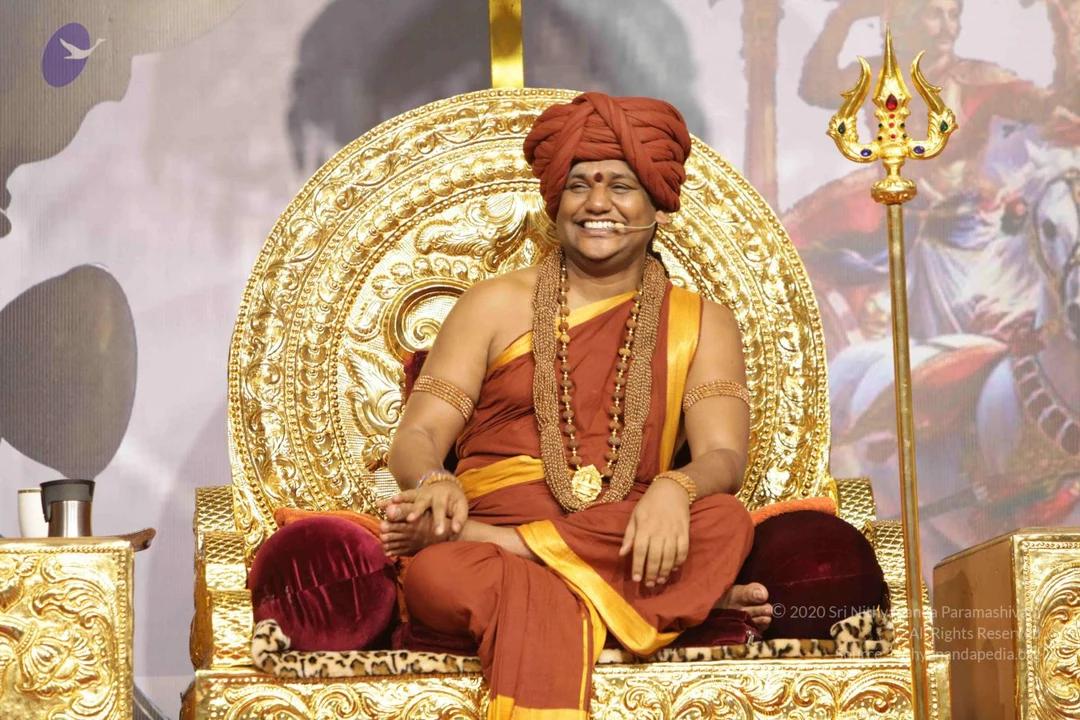
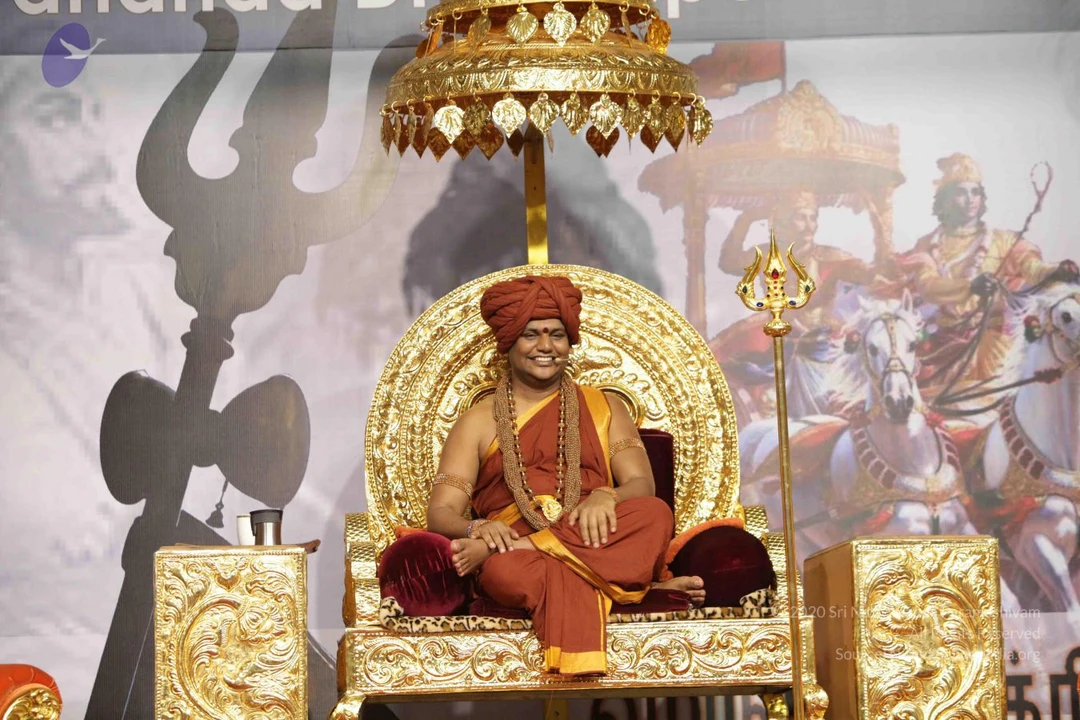
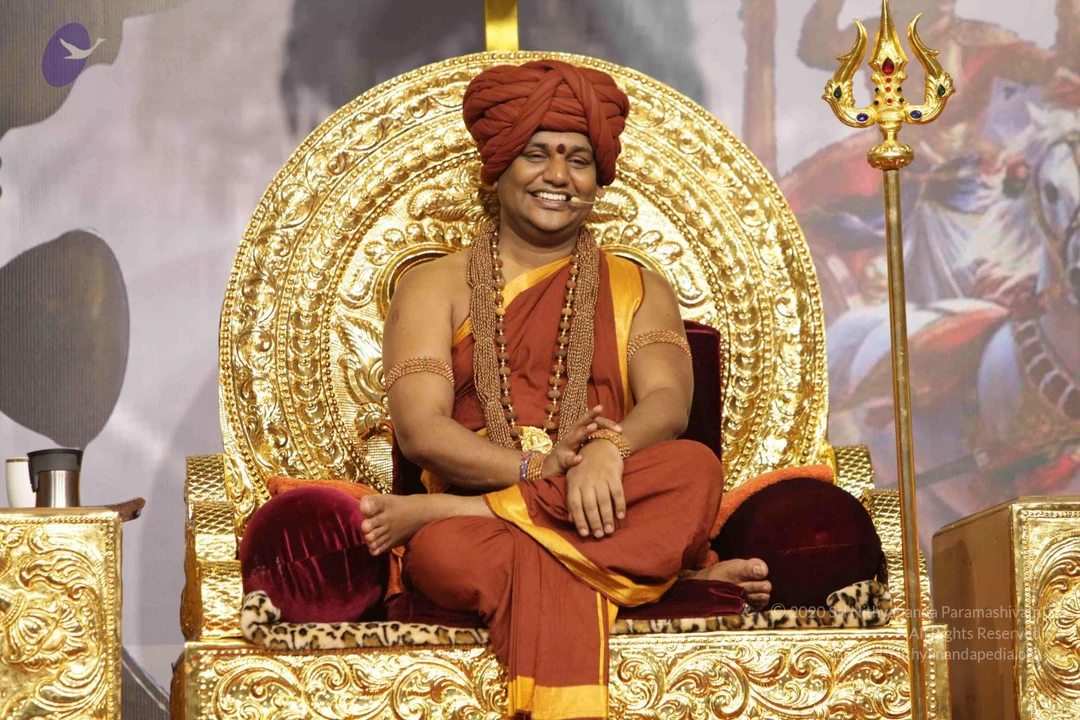
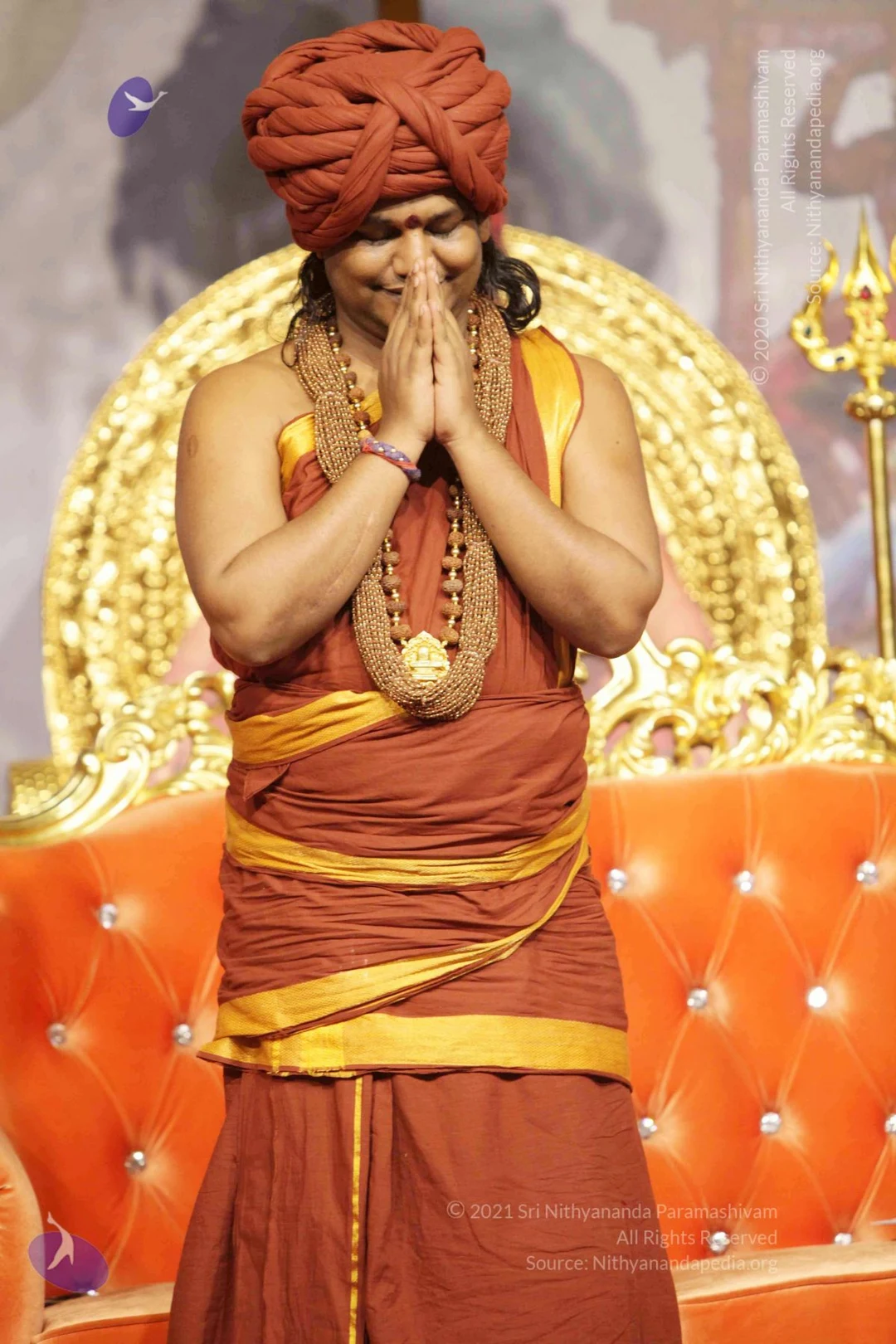
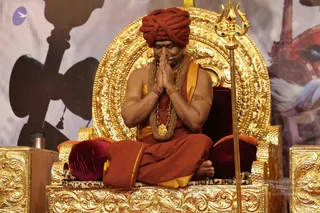
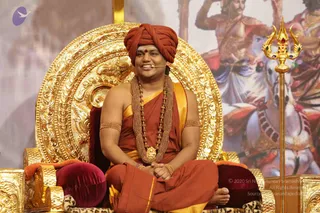
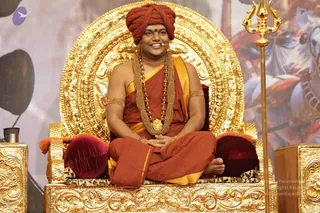
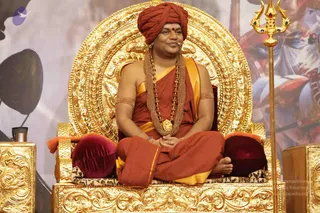
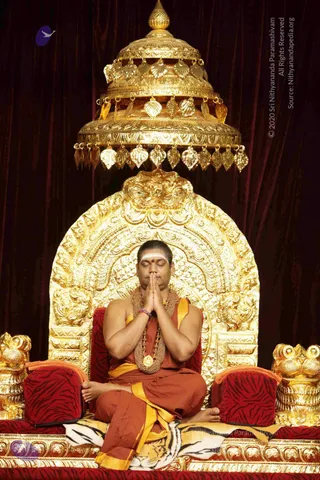
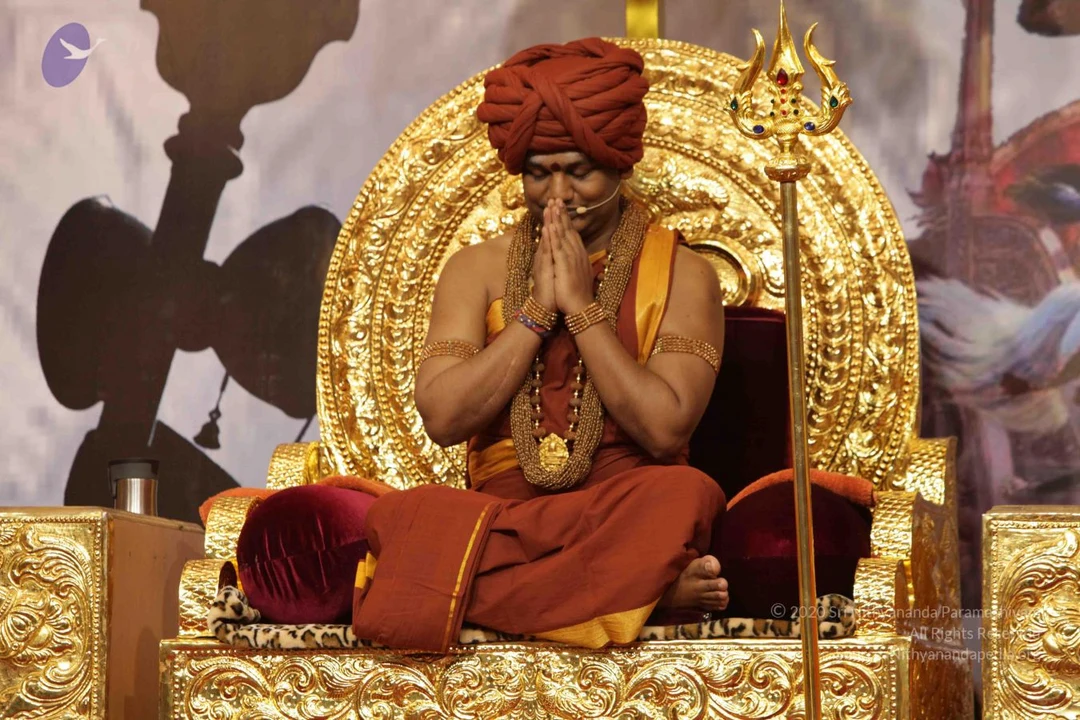
A man in an orange-red turban and orange-red robes sits cross-legged on an ornate gold throne with red velvet cushions, palms pressed together in namaste with eyes closed. He wears a heavy gold necklace over a rudraksha-style mala, gold armbands and a small lapel microphone. A large golden trident rises beside him, and a golden decorative backdrop and painted panels surround the stage.A photograph of a man seated cross-legged on an ornate gold throne with red velvet cushions and a leopard-print cloth, hands pressed together in anjali mudra with eyes closed. He wears a red-orange turban, orange and saffron robes, a long gold-bead mala and gold armbands, with a small headset microphone at his face. A golden trident stands beside the throne, and a silhouetted ceremonial mace and painted backdrop frame the scene. Probable Swamiji by appearance cues: red turban, orange robes and ornate gold jewellery, shown seated in a position of honour. A small metal cup sits on a gold side table at left.A seated man sits cross-legged on an ornate golden throne with a round gilded backrest, smiling broadly with hands clasped in his lap. He wears a rust-orange turban, an orange-red robe with gold border, a heavy rudraksha mala with a gold pendant, and gold armbands. A small microphone is clipped near his face. Beside him stands a golden trident with red and blue gems, and behind him a painted image shows warriors on horseback. Swamiji (probable): the appearance cues are a red-orange turban, orange robes and a rudraksha mala seated on a throne.A smiling man in saffron and orange robes sits cross-legged on an ornate gold throne with a gold-embossed back, legs folded on a leopard-print cushion. He wears a rust-red turban with a red tilak, a long rudraksha-style mala with a gold pendant, gold armlets and a gold-edged orange shawl. Maroon velvet bolsters flank him. A tall gold trident with red and blue gems stands to his right, and a painted backdrop shows a white horse and a charioteer. The person appears to be a person, seated on the throne as the speaker at a Q&A session, with a microphone visible near his face.Photograph of a seated man on an ornate gold throne with a carved arched back, sitting cross-legged with hands folded in his lap. He wears a red-orange turban with a small red dot on the forehead, a long rudraksha mala and a gold ceremonial pendant, a saffron-orange shawl over the shoulders, gold armlets, and a red-orange dhoti with gold border. Burgundy velvet cushions sit at his sides, and a gold trishul stands to the right. A golden lamp-like stand and a gold-framed side table are visible, with a painted backdrop of a red-clad deity in the background. Appearance-based candidate: Swamiji (probable), wearing turban, rudraksha mala, saffron shawl and gold ornaments on a throne.A smiling man in saffron-orange robes and a red turban sits cross-legged on an ornate gold throne with a richly carved high back and red velvet cushions. He wears a thick rudraksha mala, a gold pendant, and gold armlets, with hands folded in his lap. A tall gold trident stands to the right, and a painted backdrop of a rider on a white horse fills the background. A small microphone is clipped near his face. Swamiji (probable): long-established ceremonial presentation with a saffron turban, rudraksha mala and gold pendant, seated in a dais setting for a discourse.

Demonstration of Powers
78 photosSource gallery
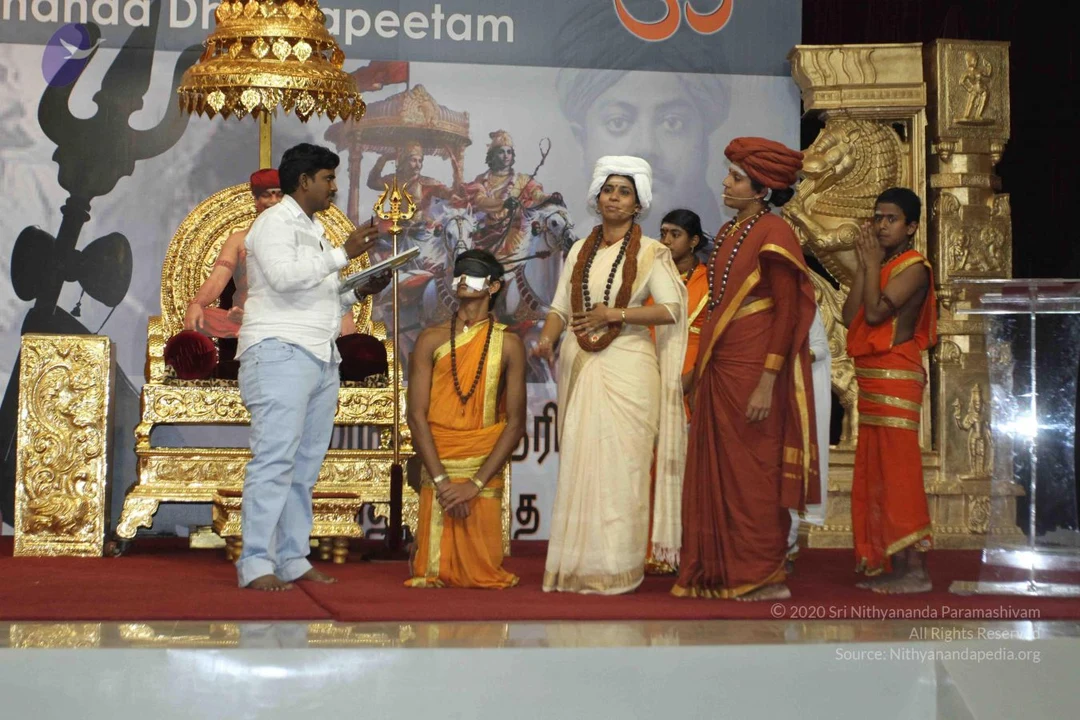
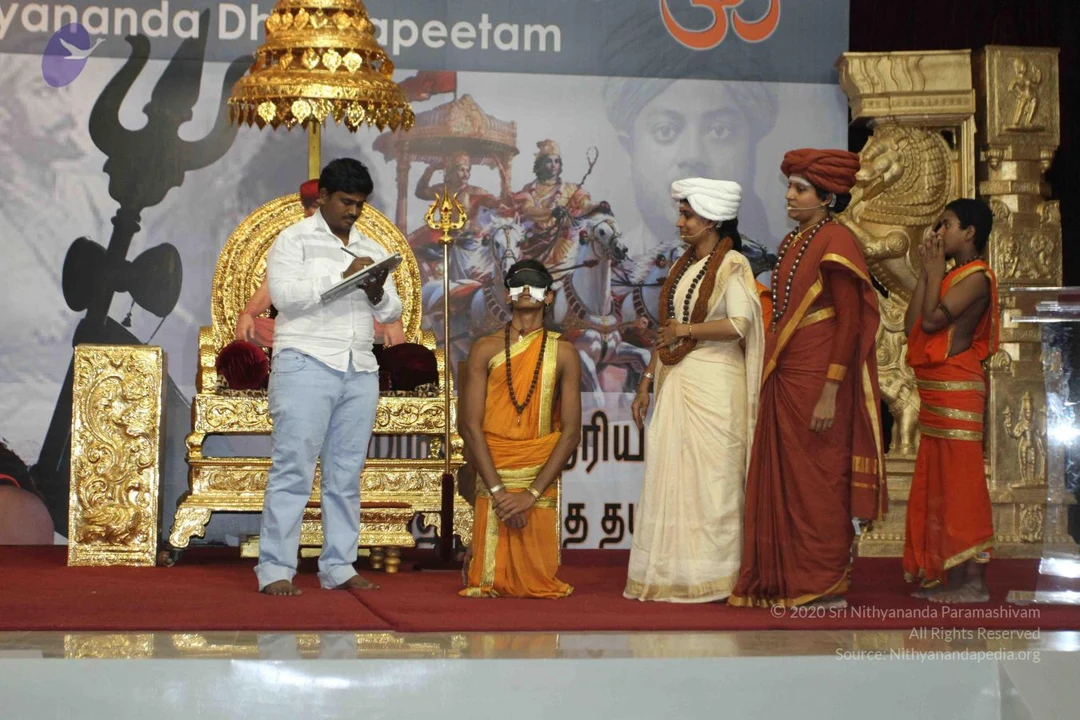
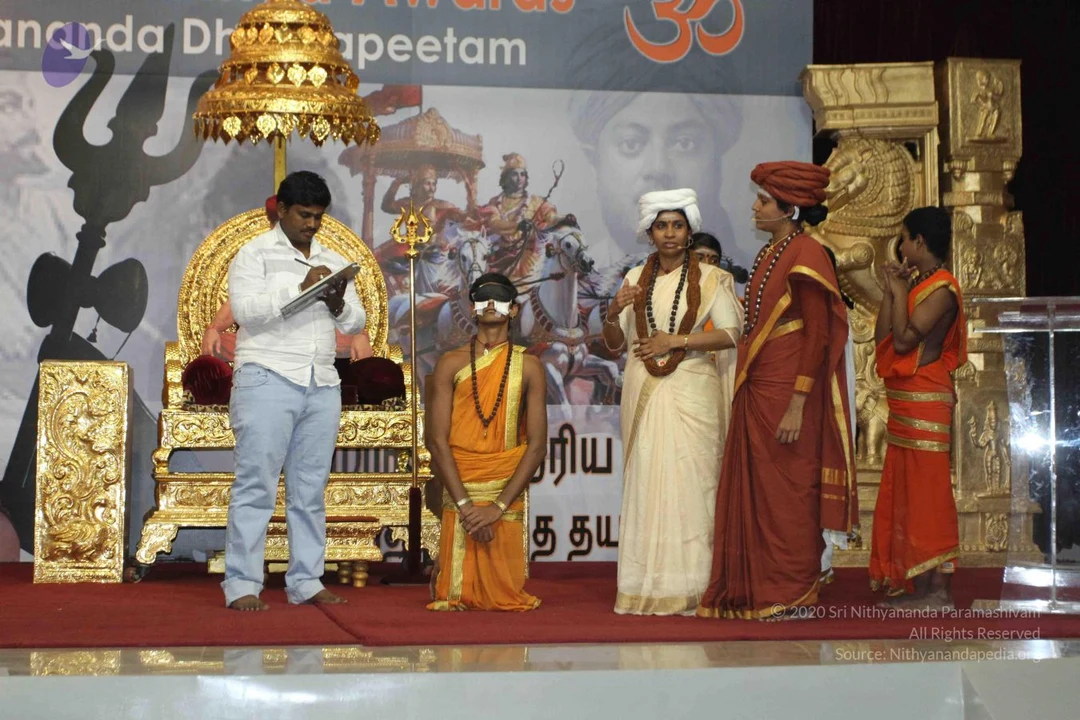
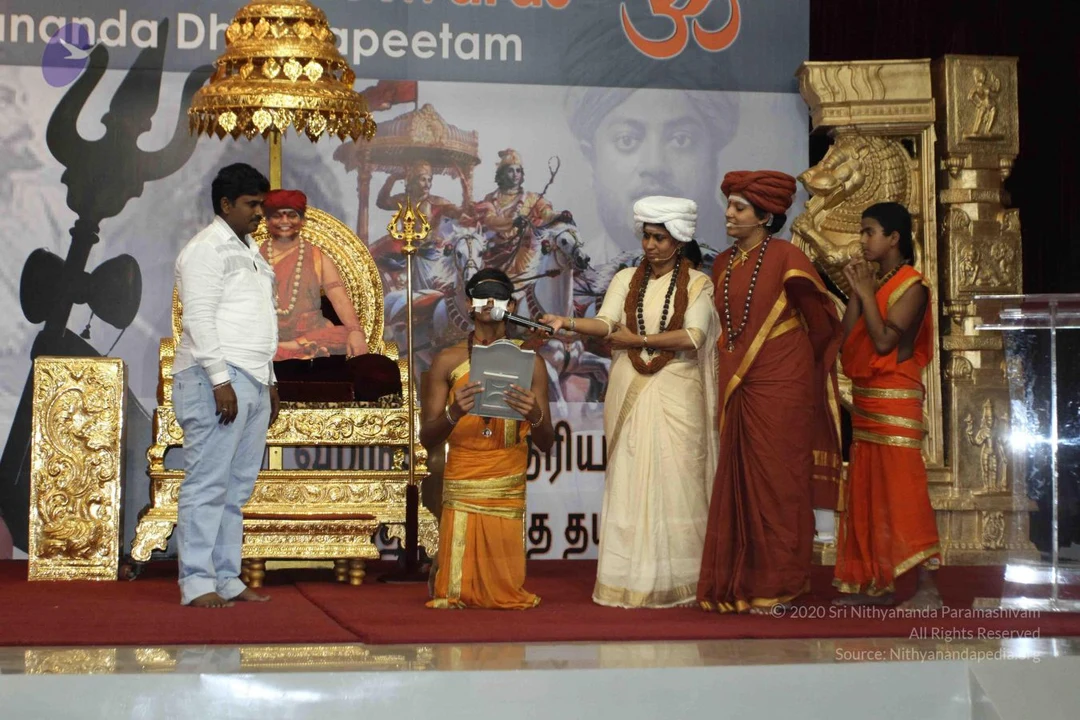
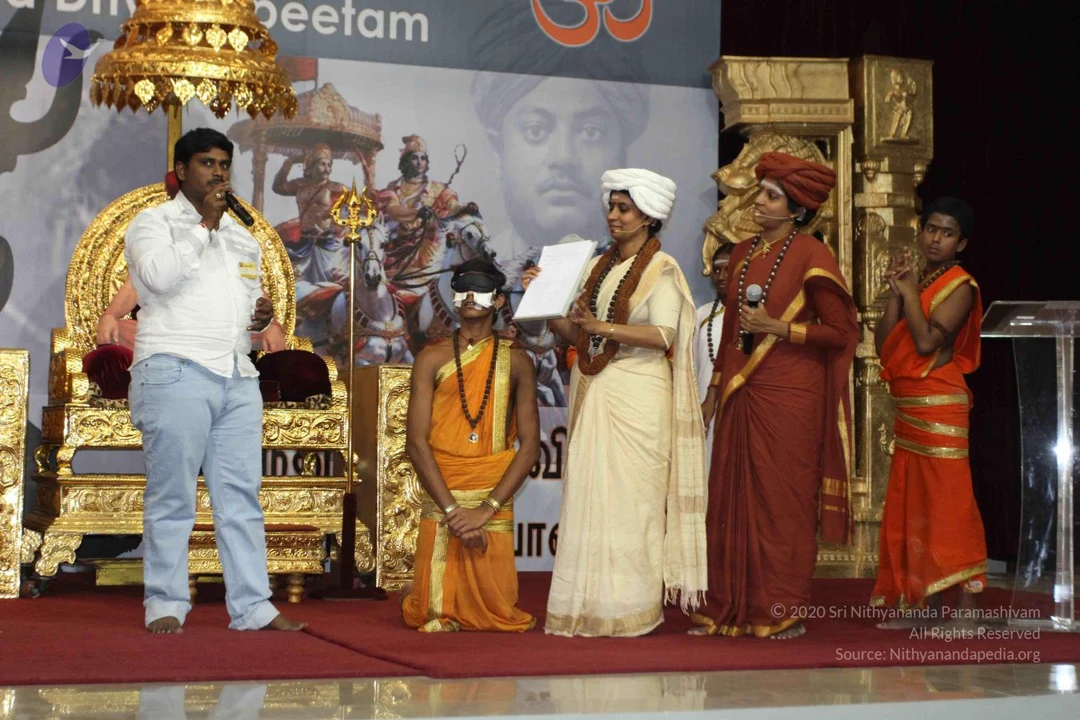
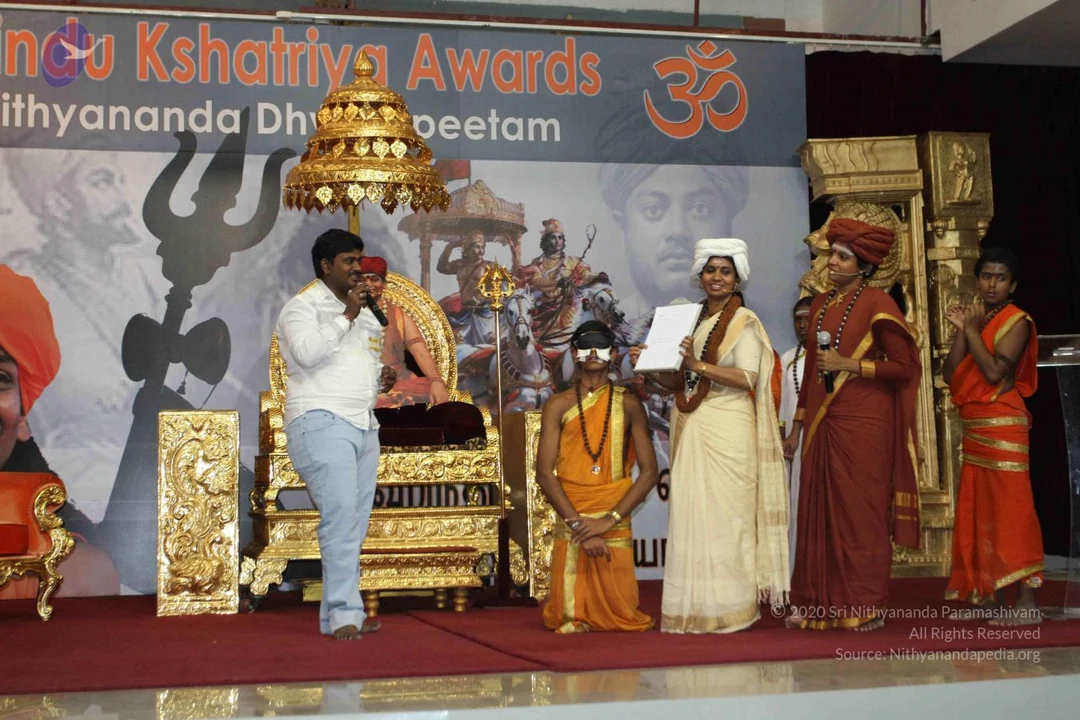
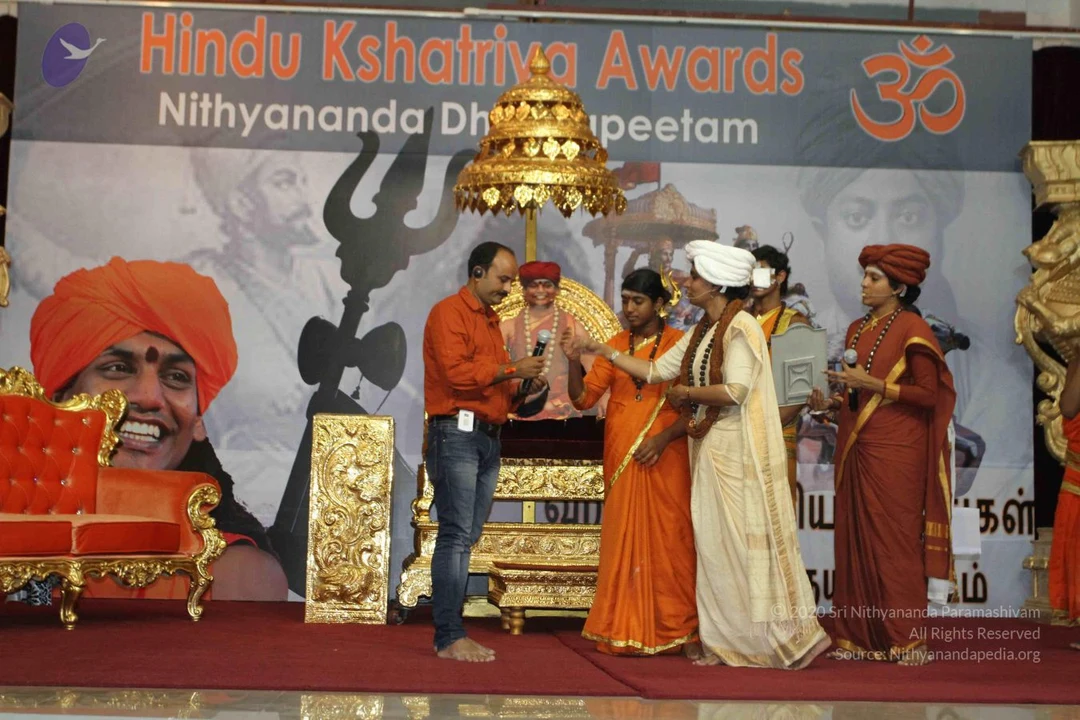
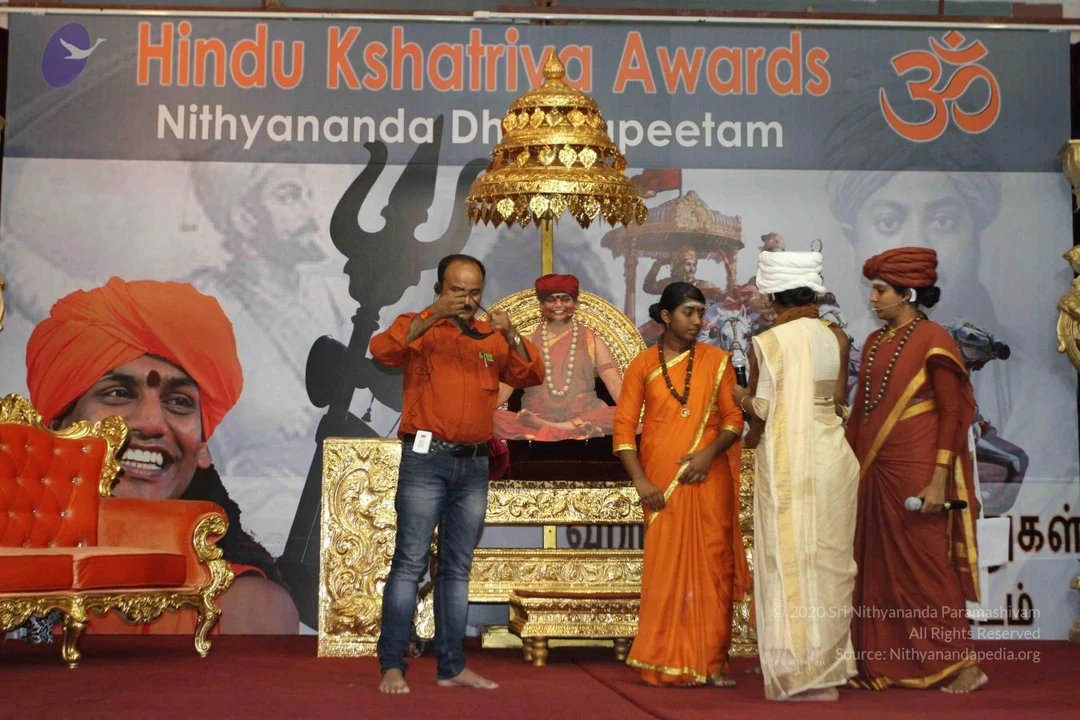
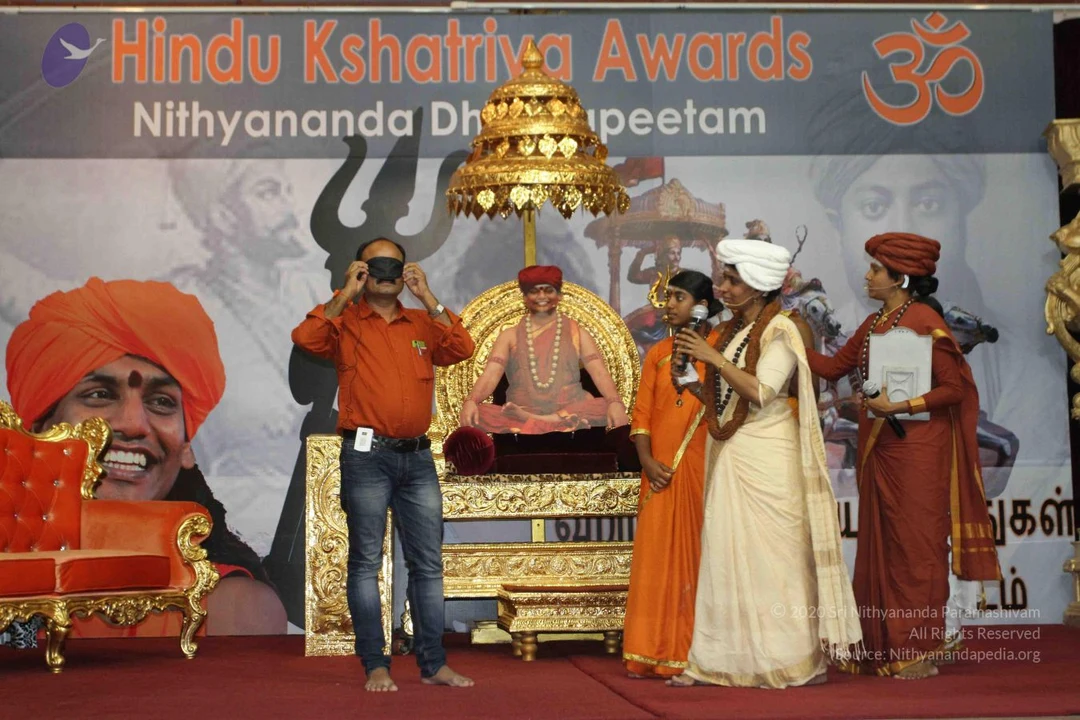
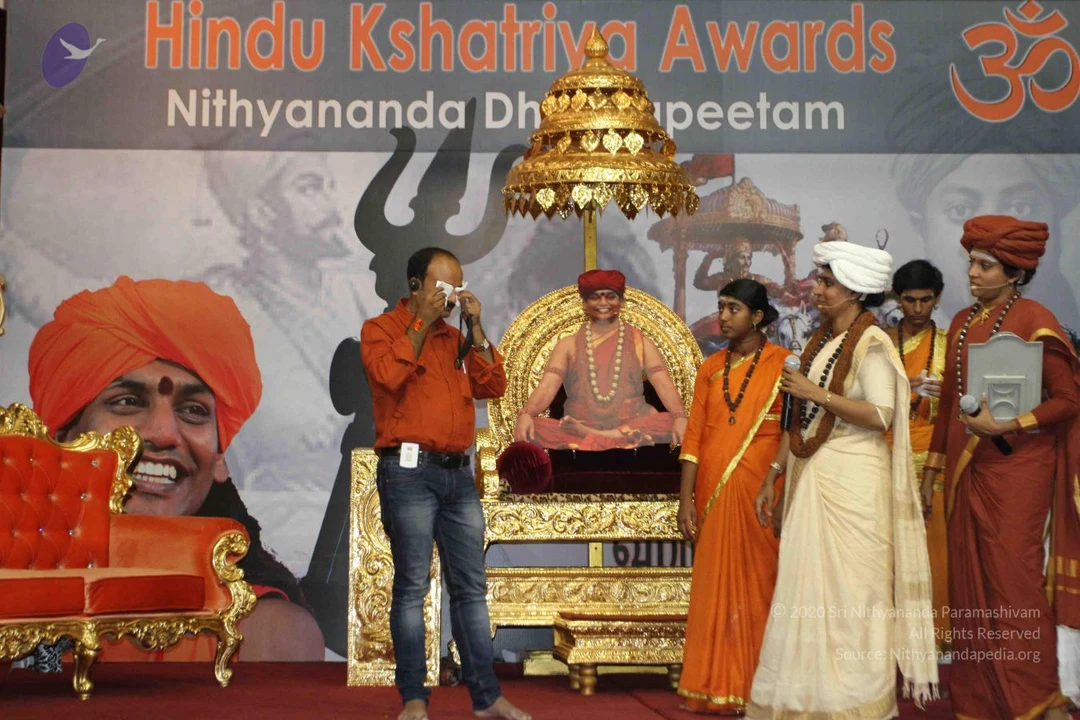
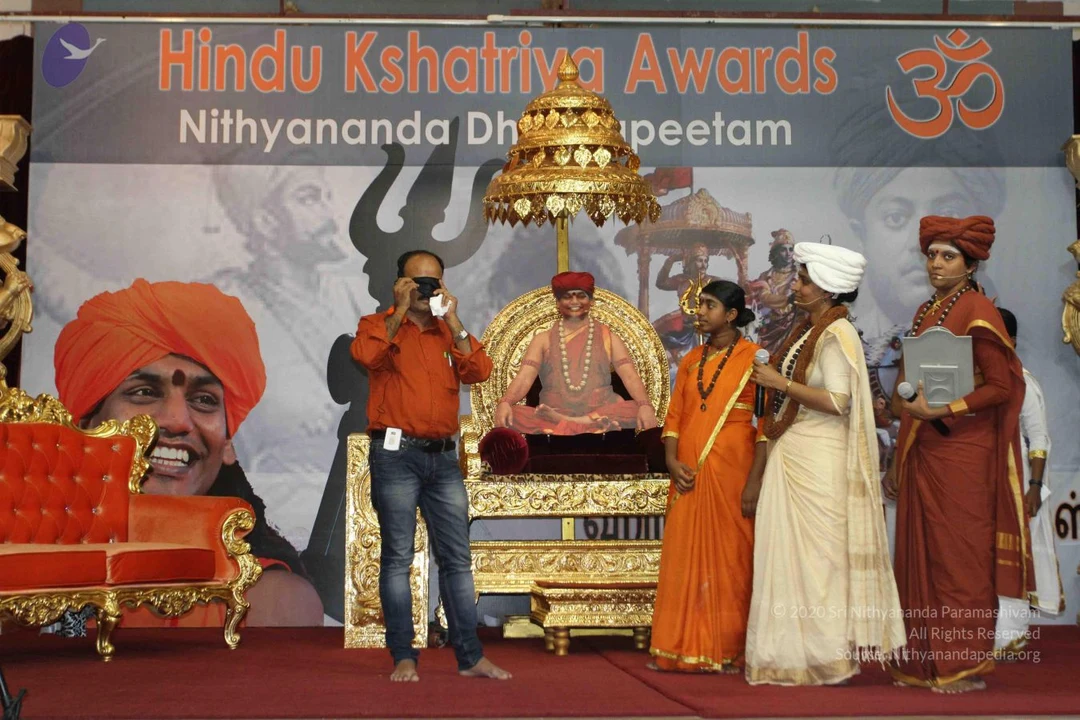
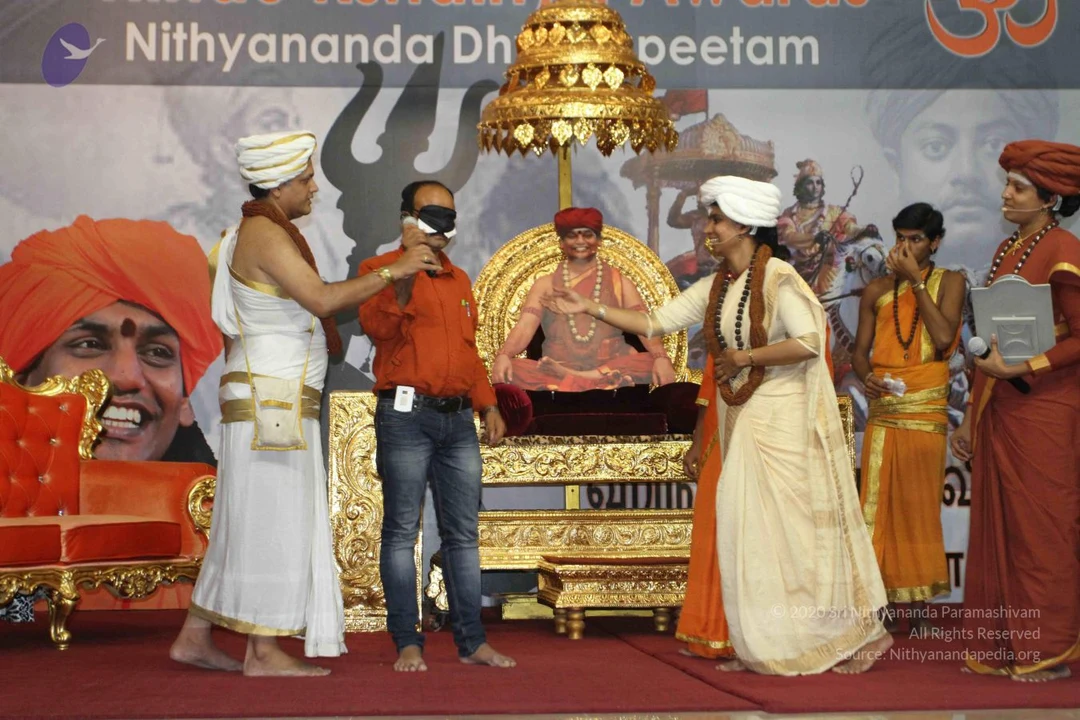
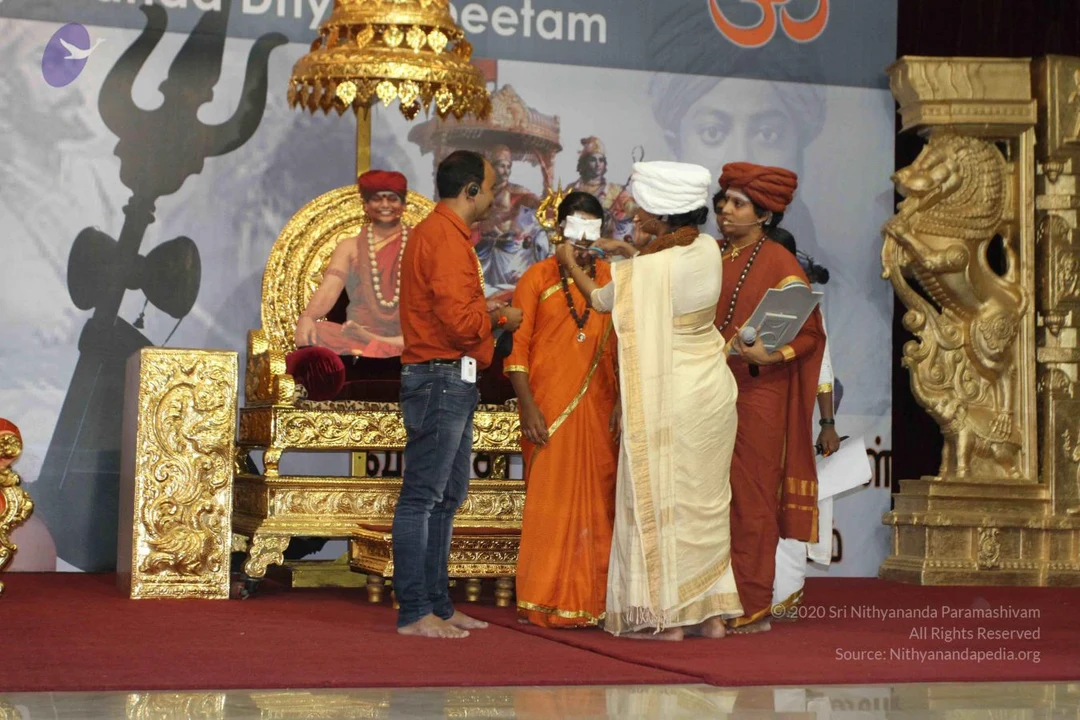
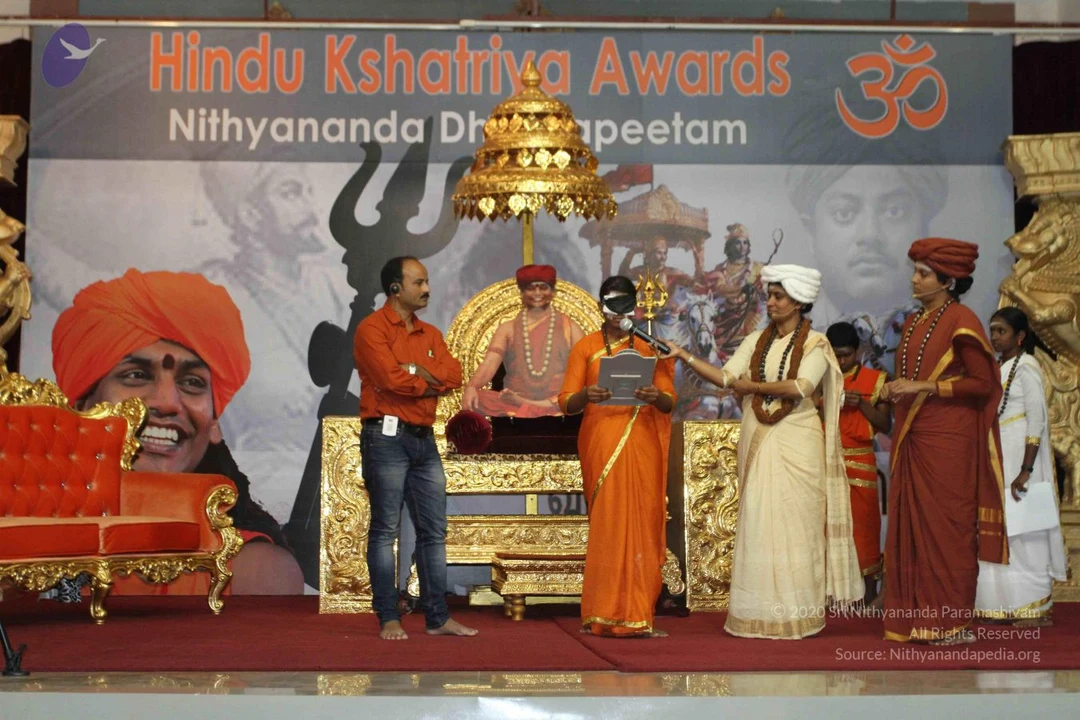
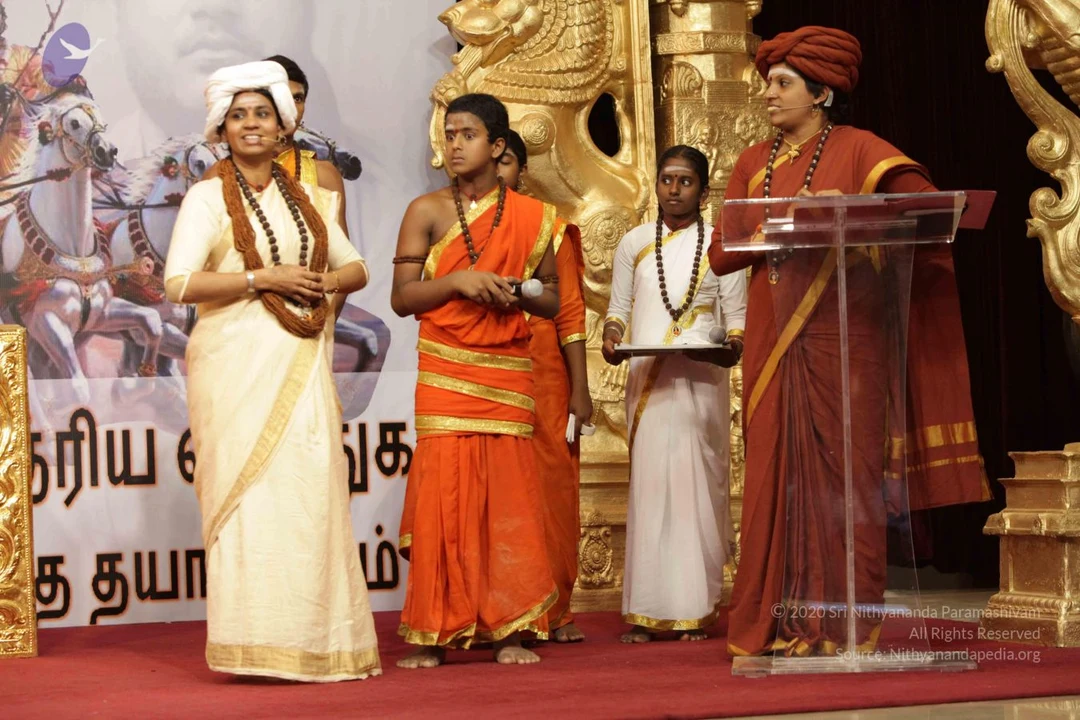
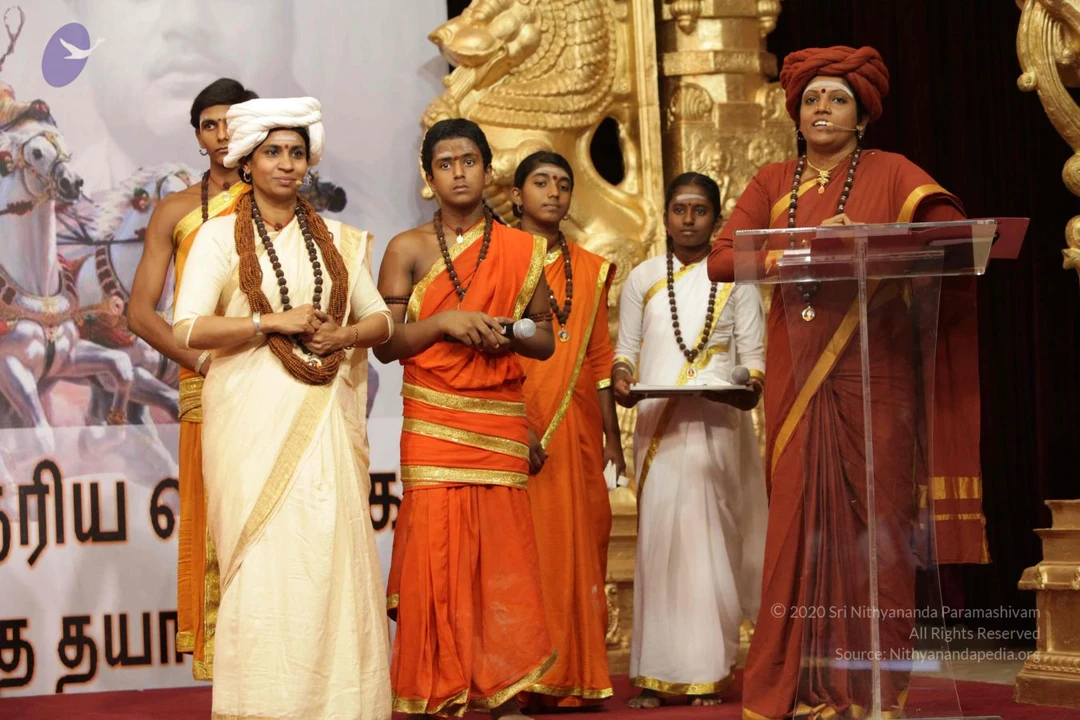
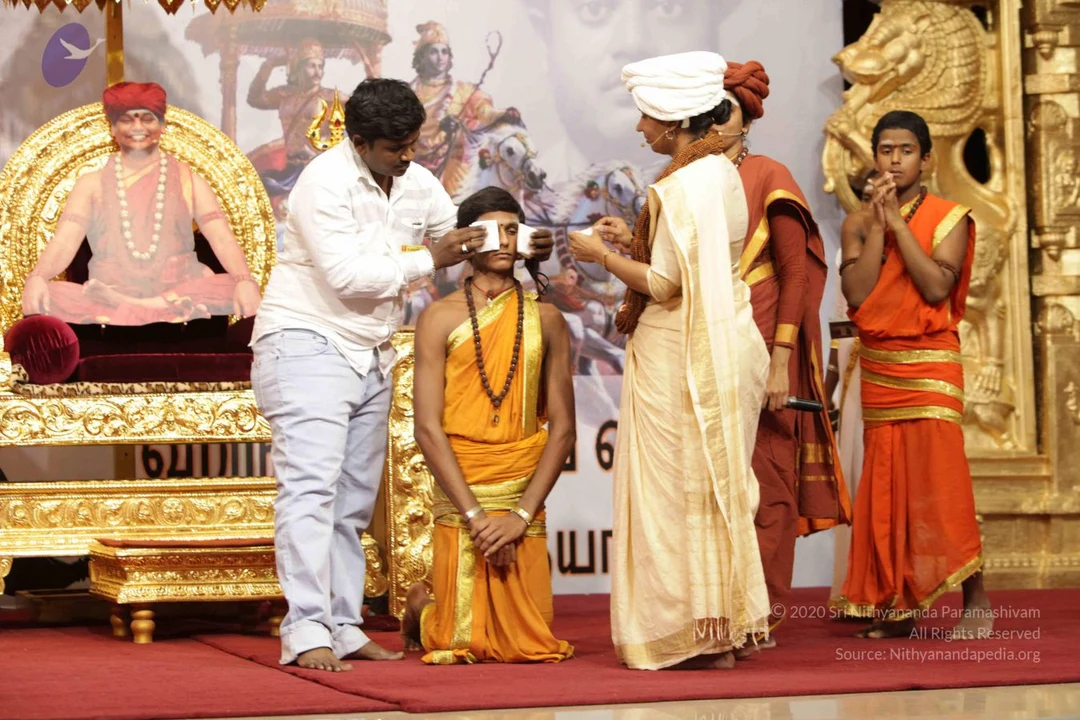
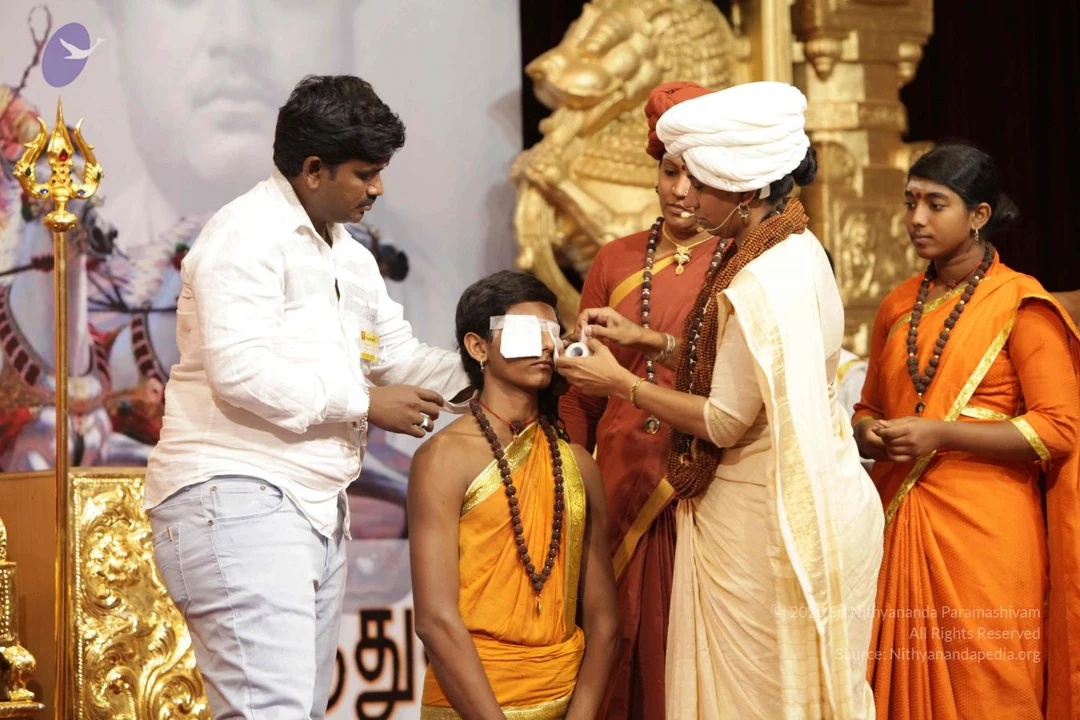
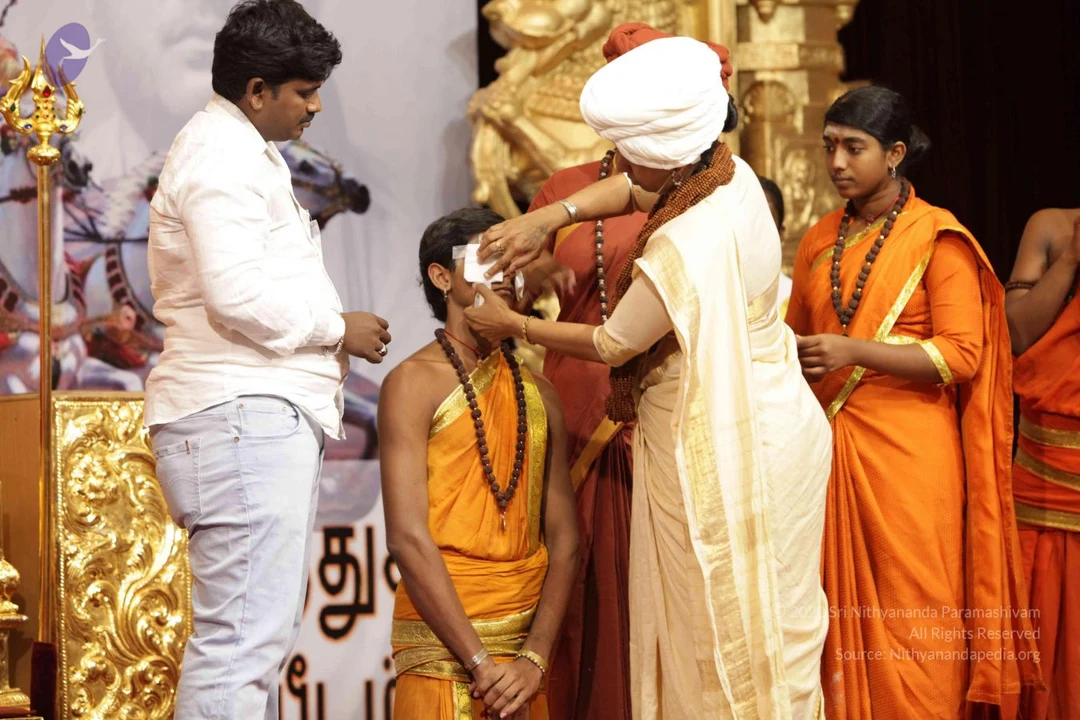
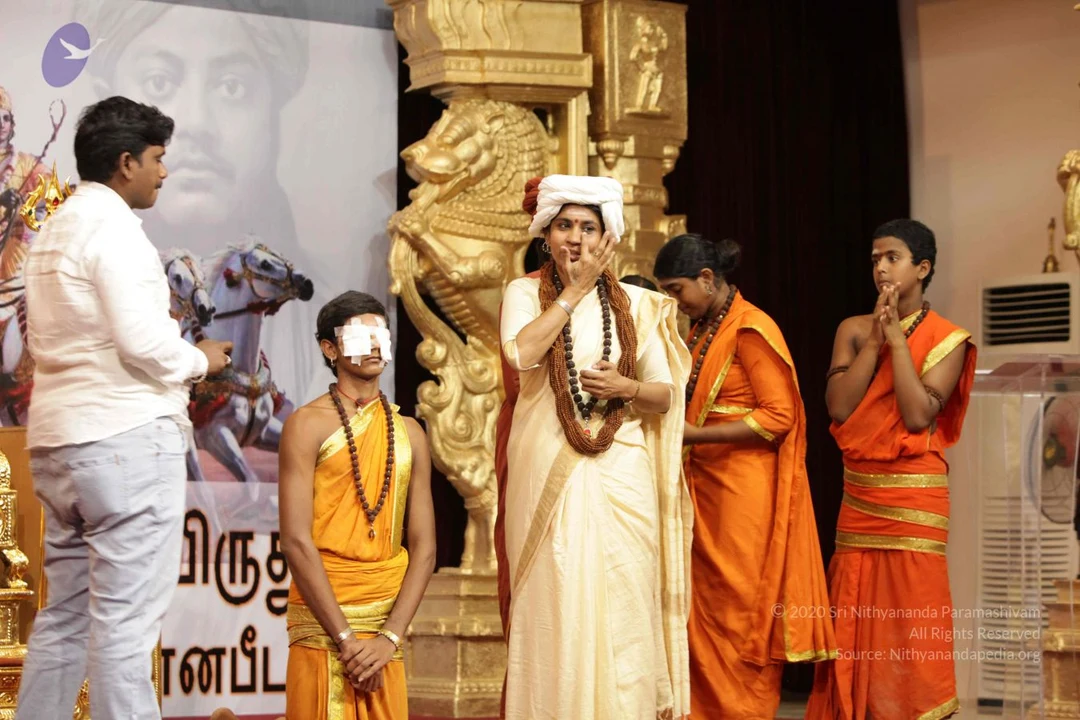
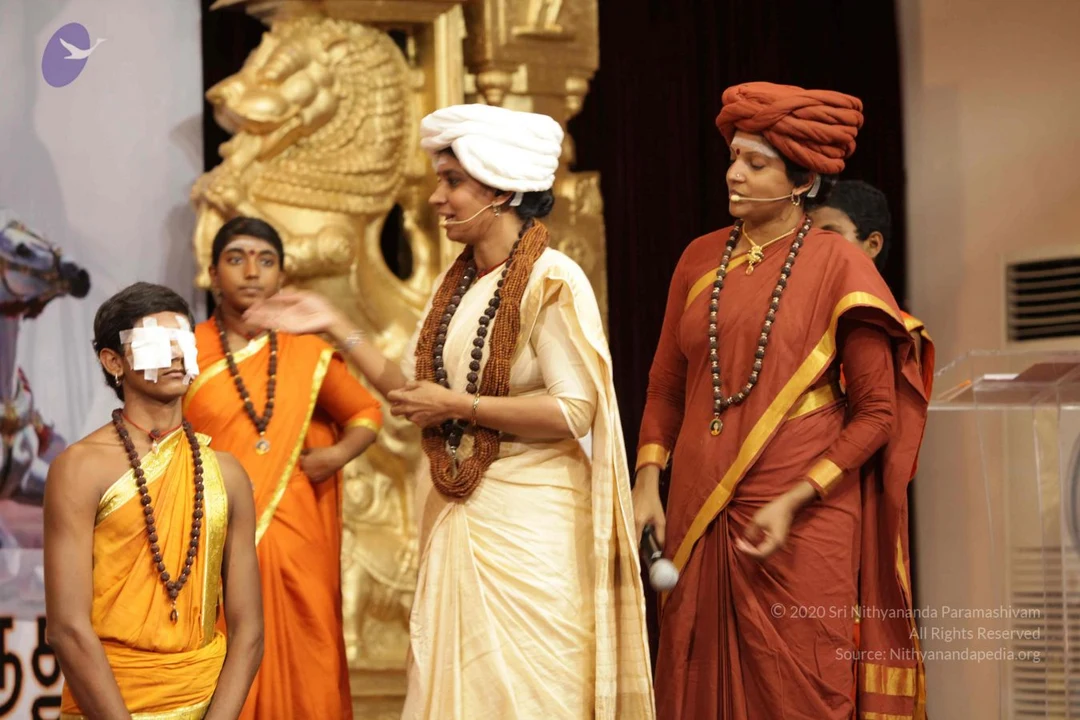
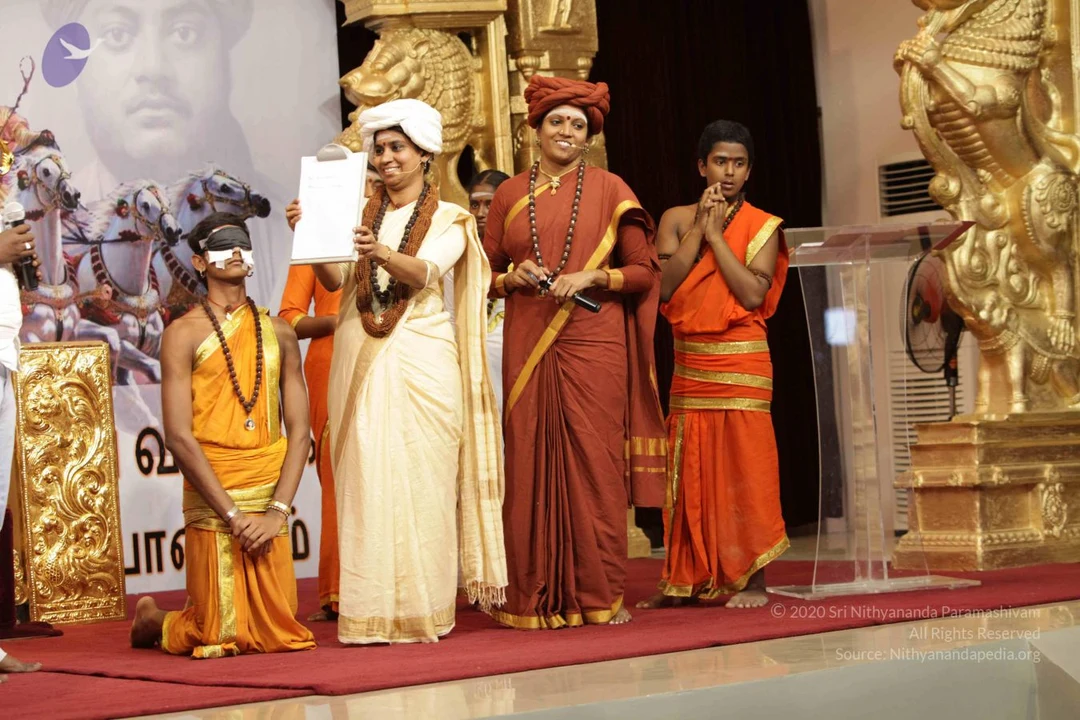
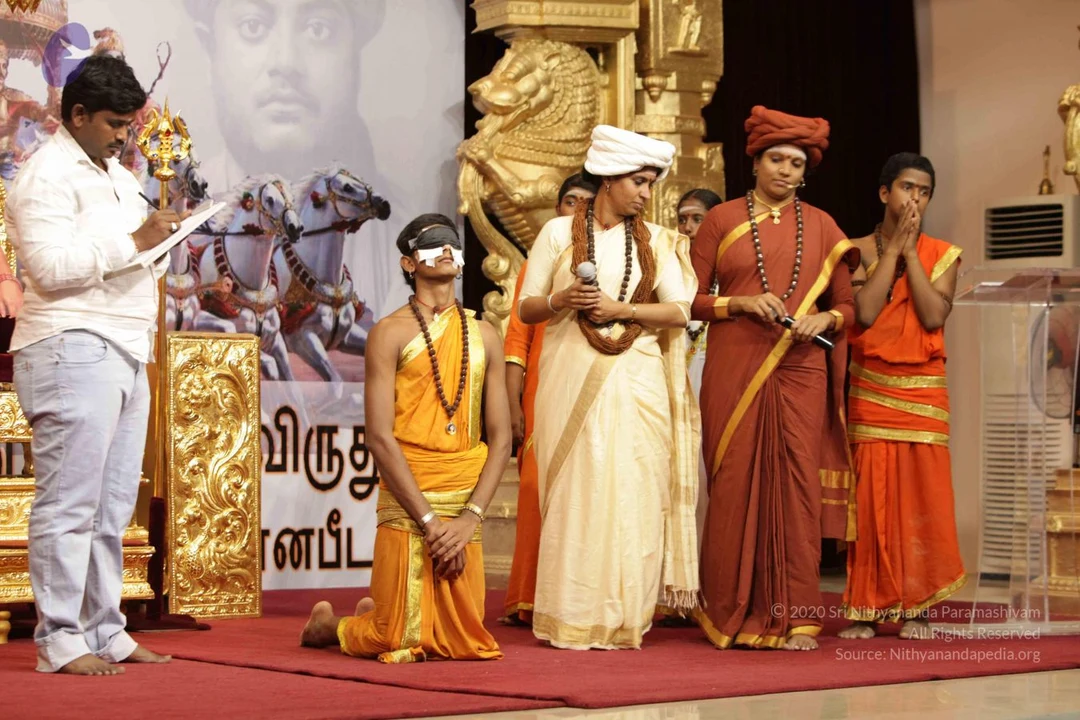
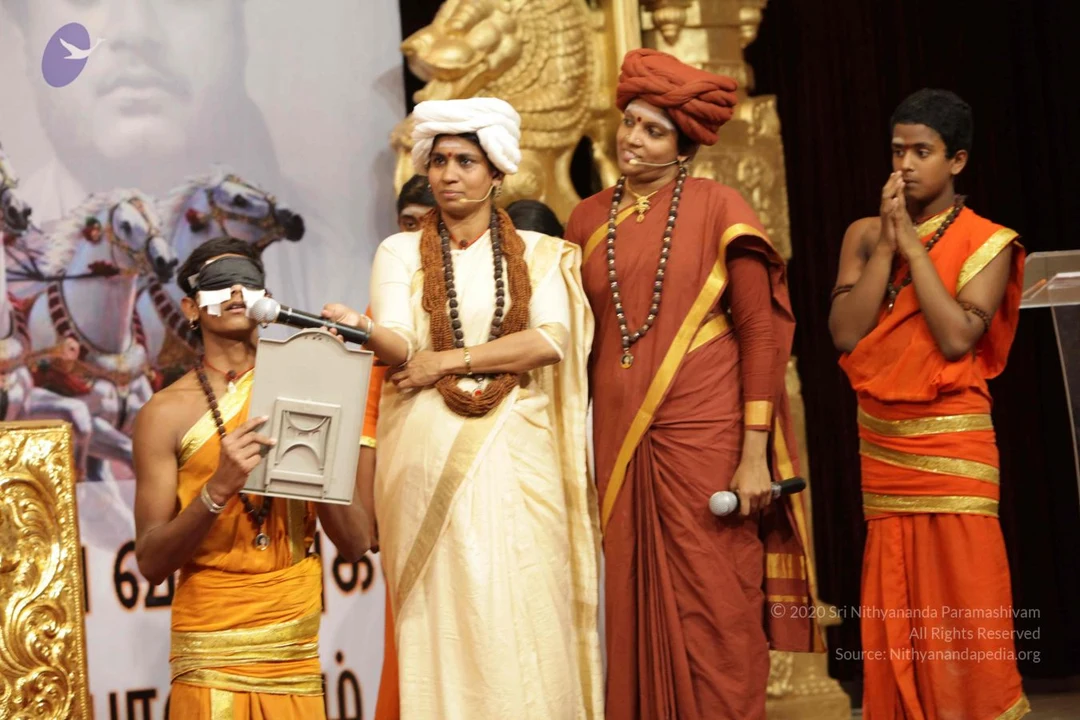
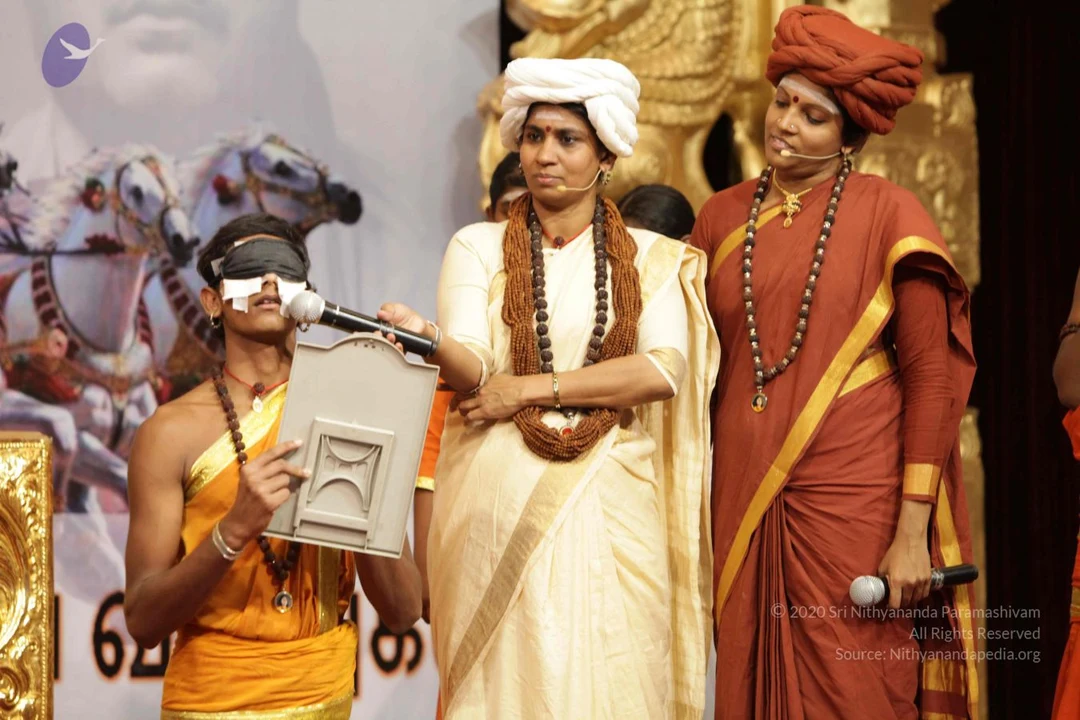
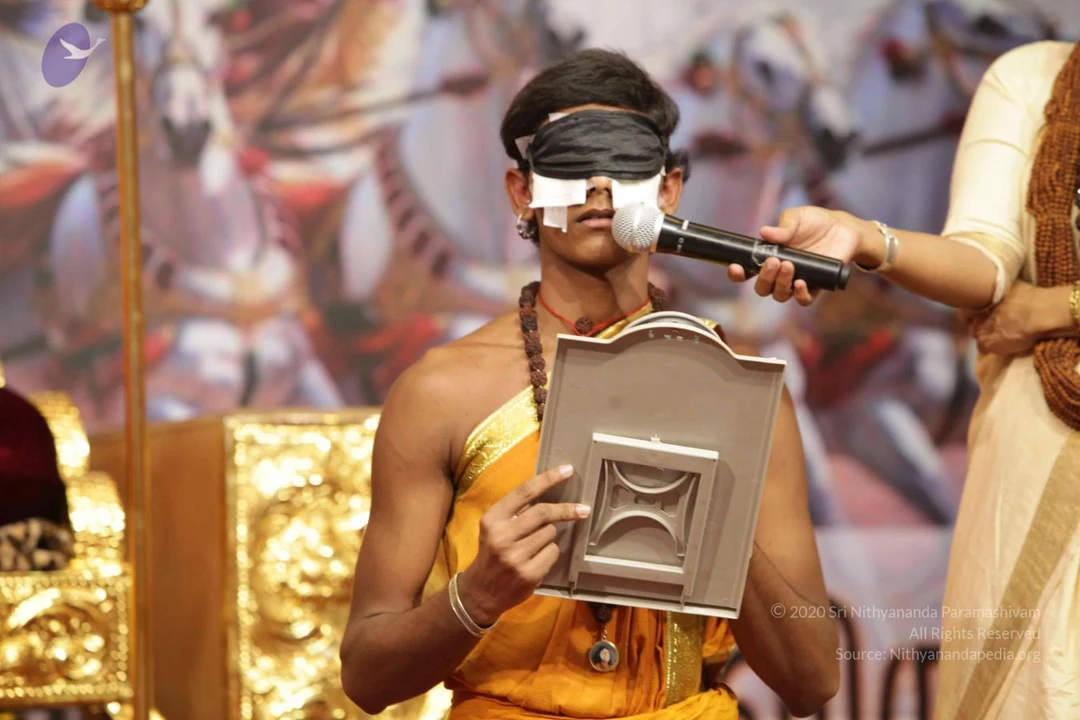
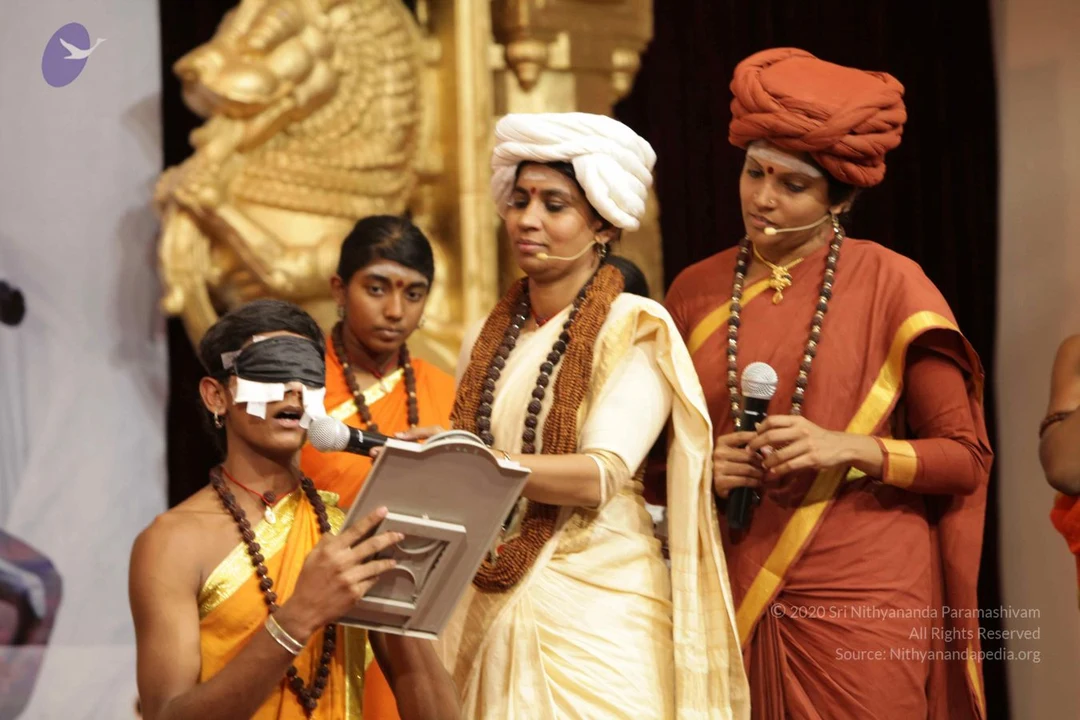
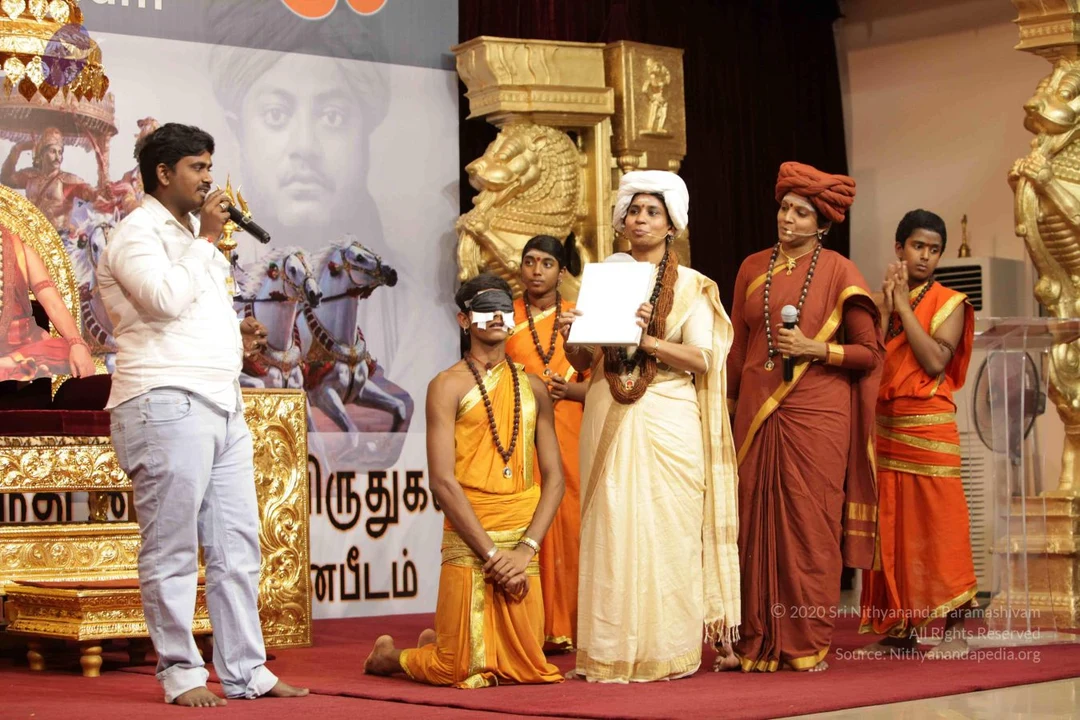
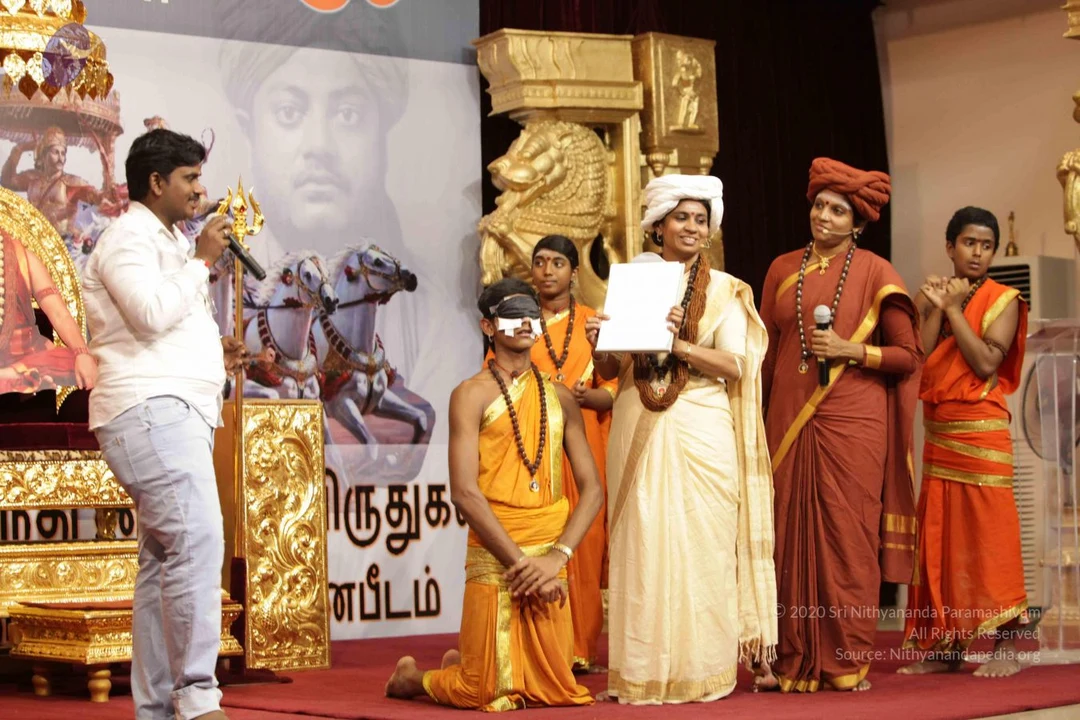
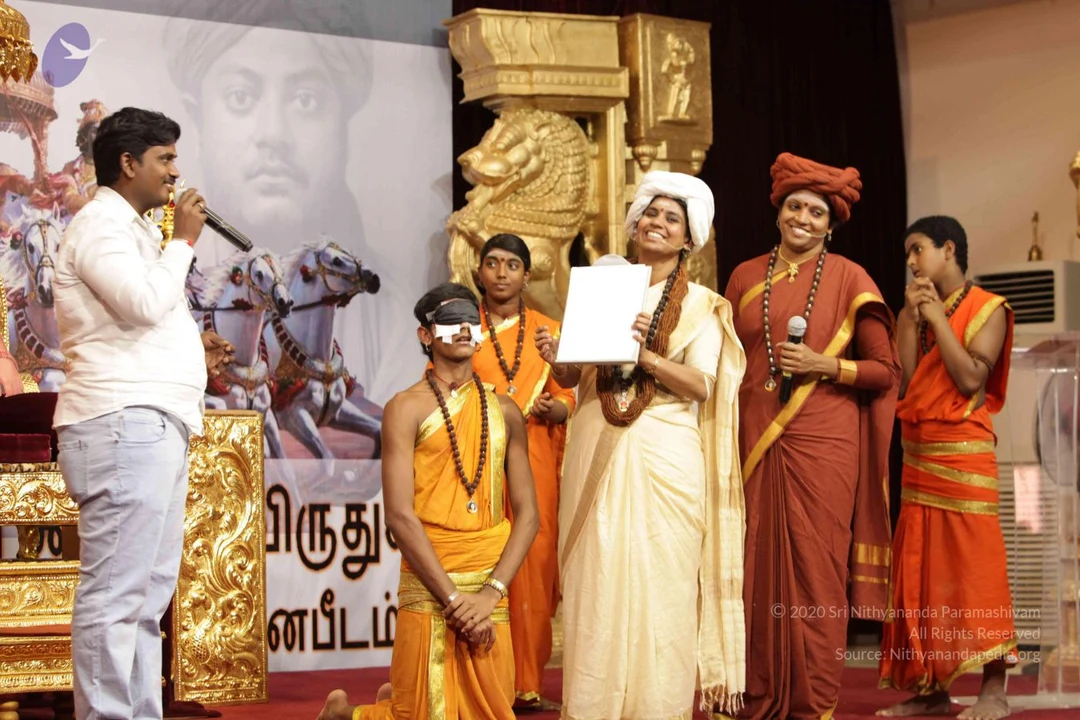
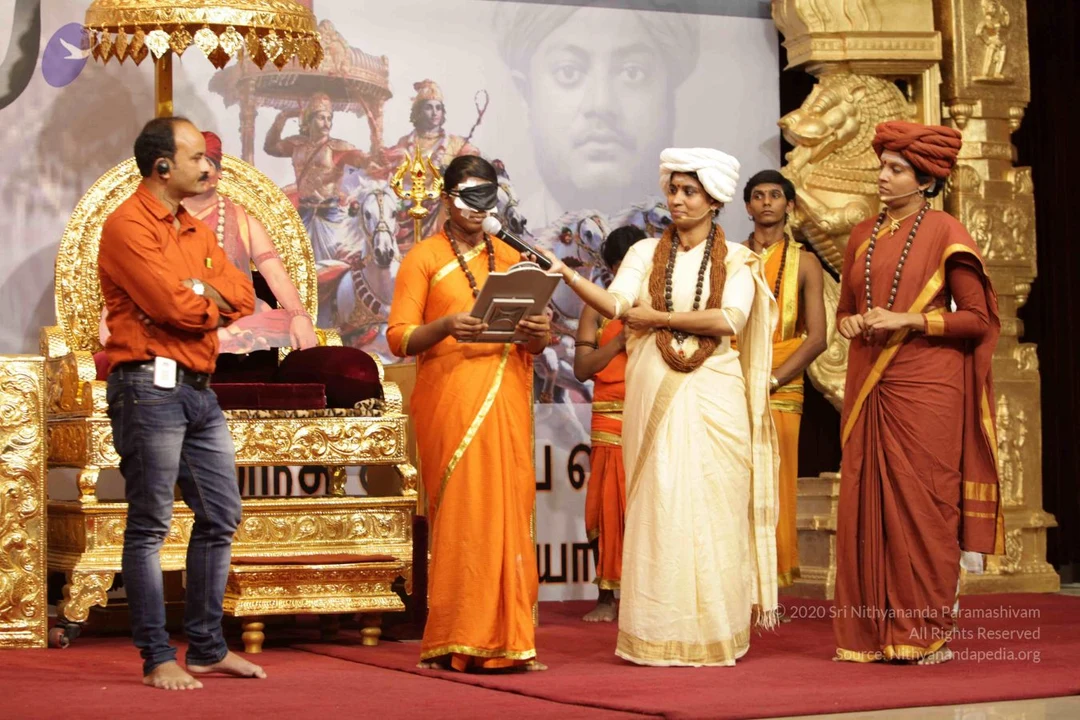
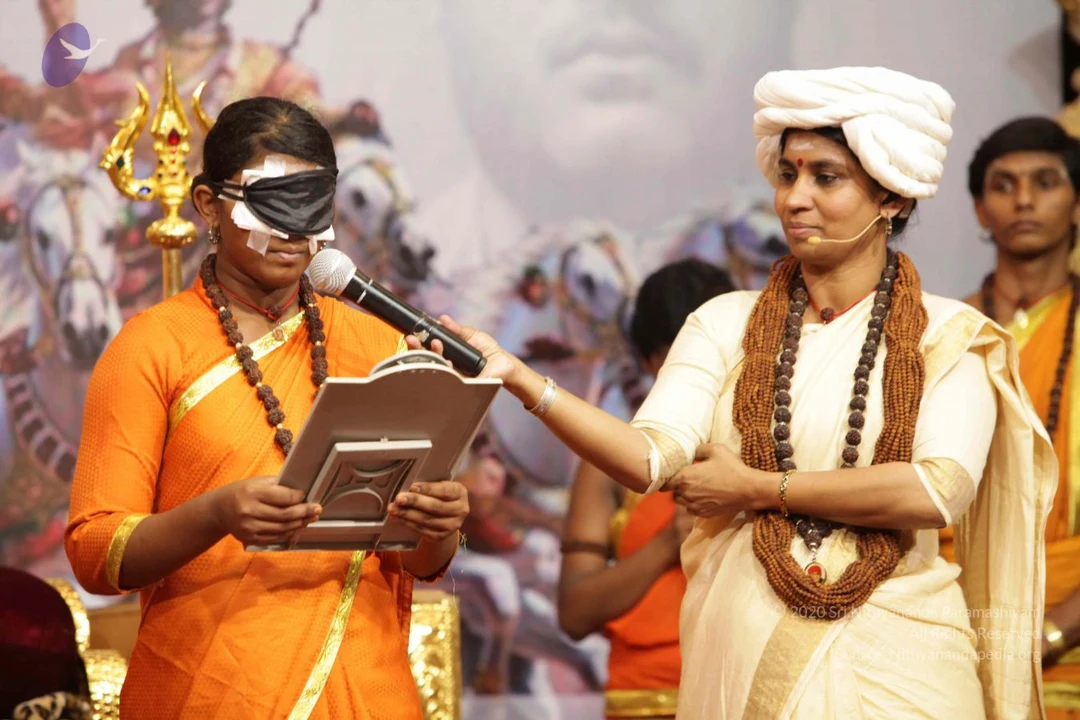
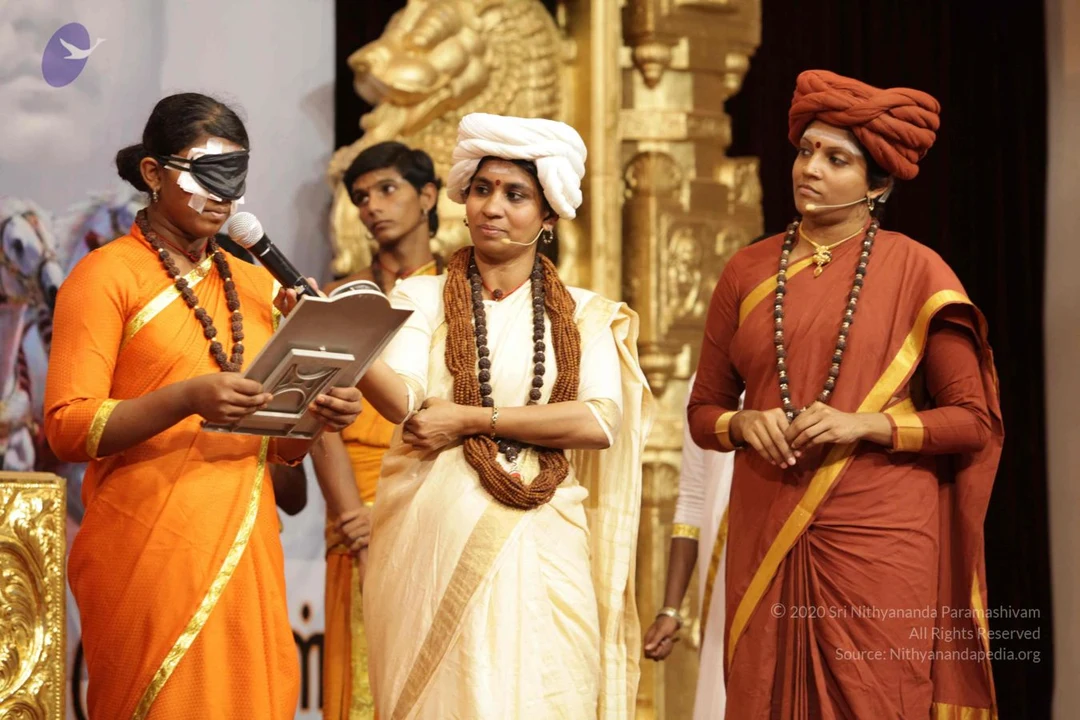
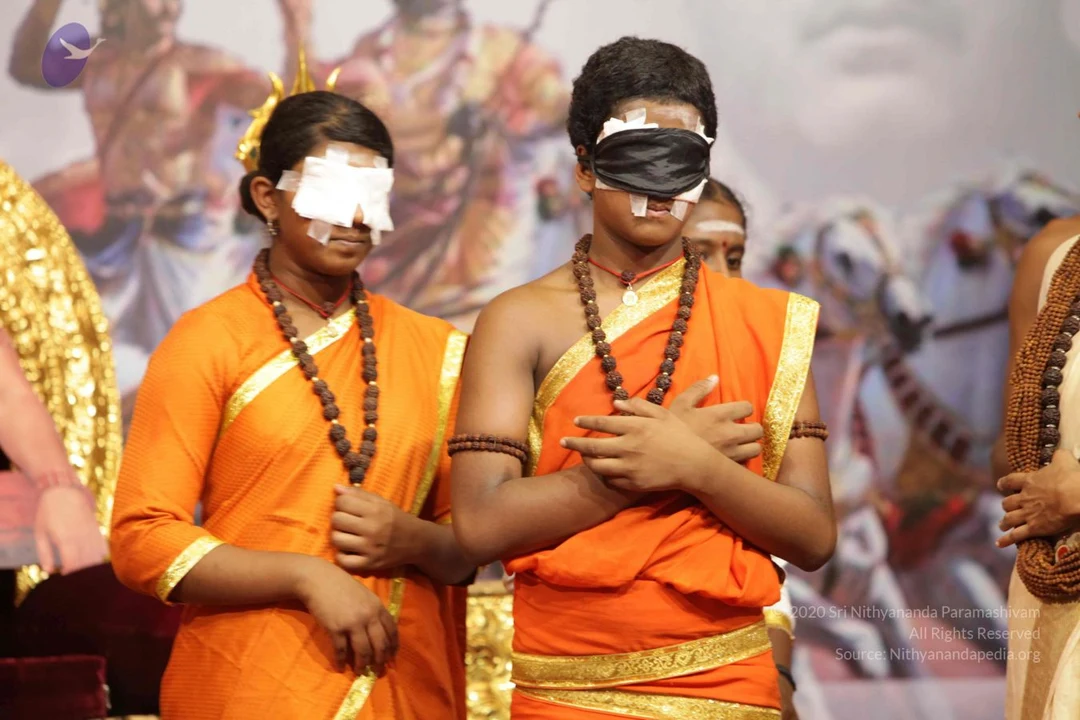
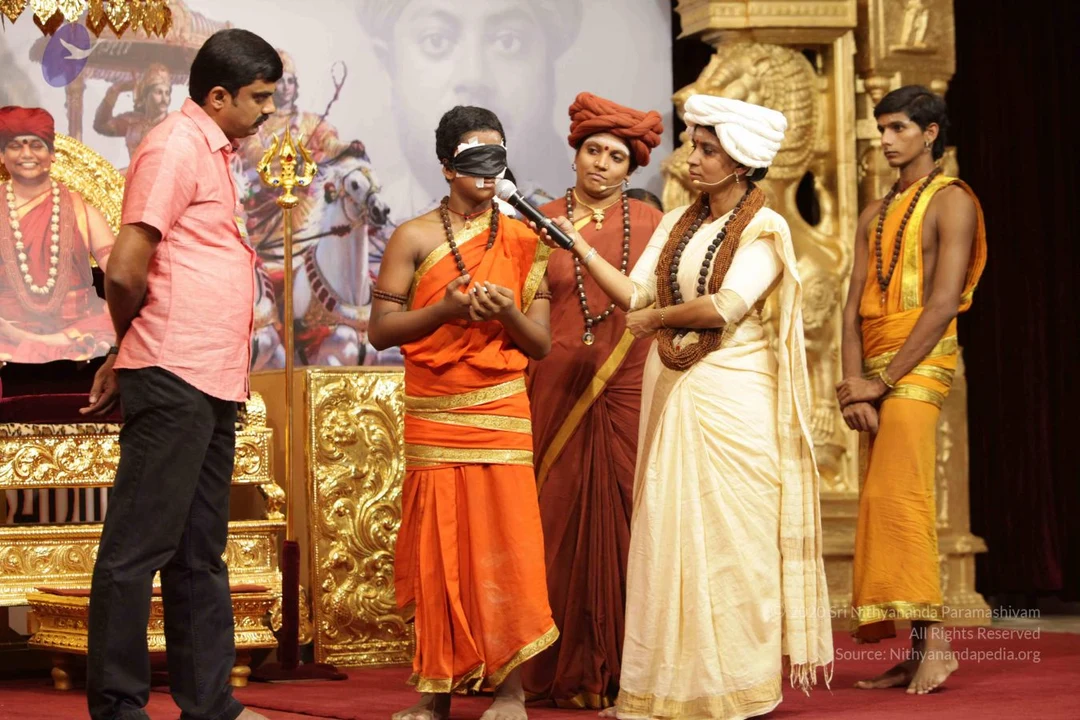
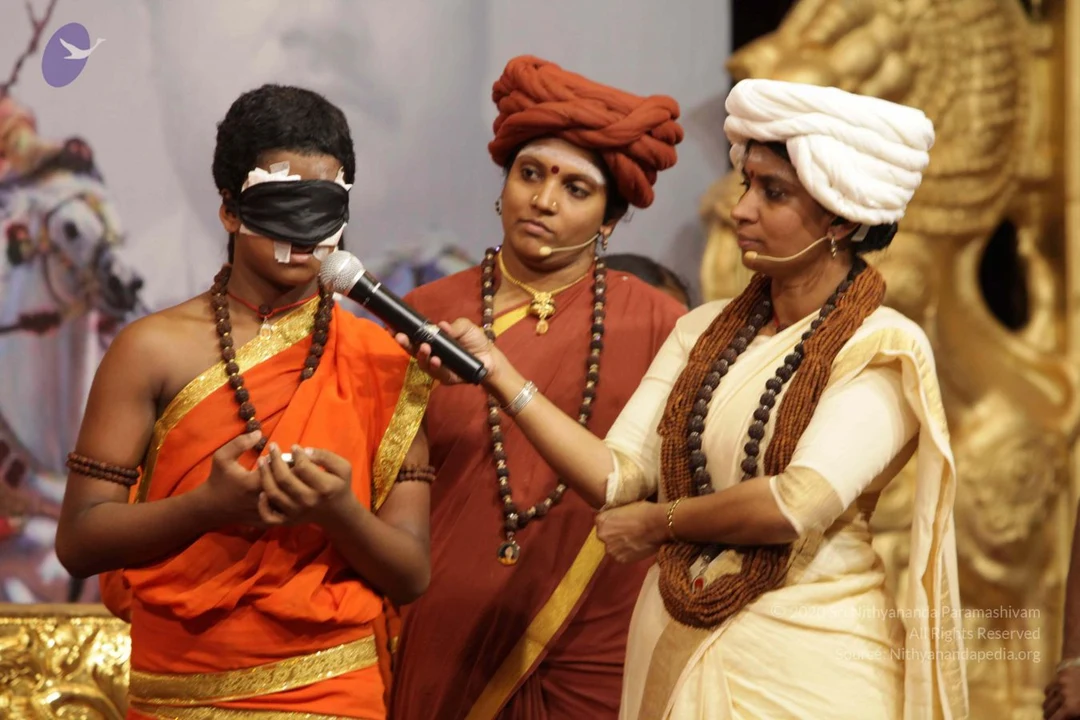
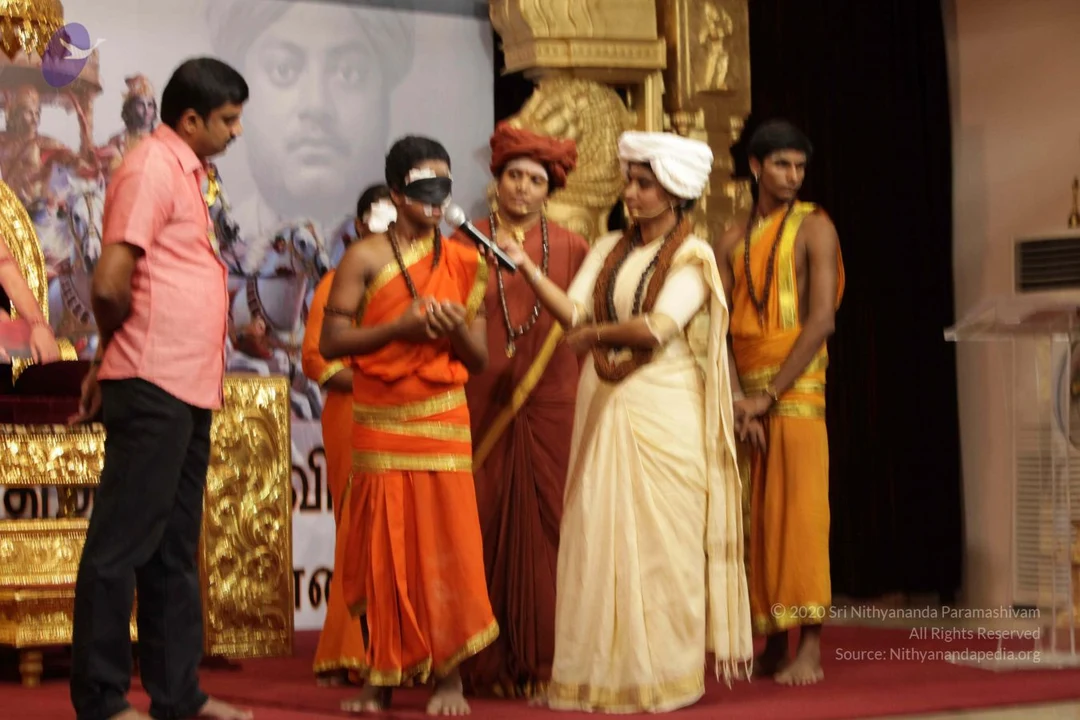
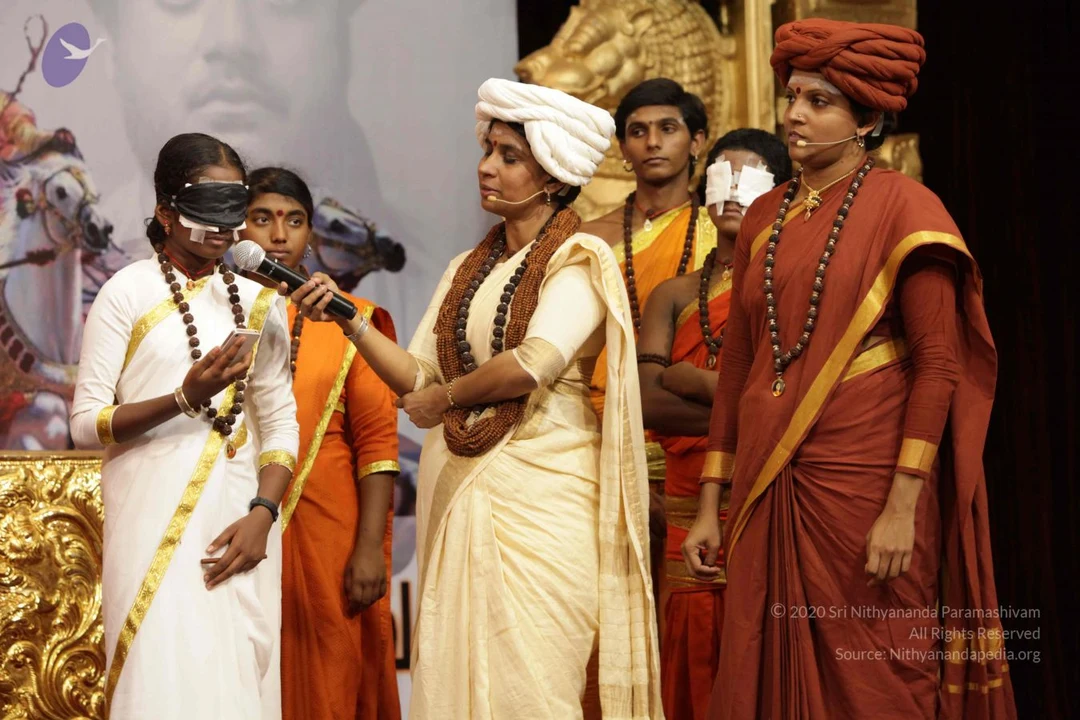
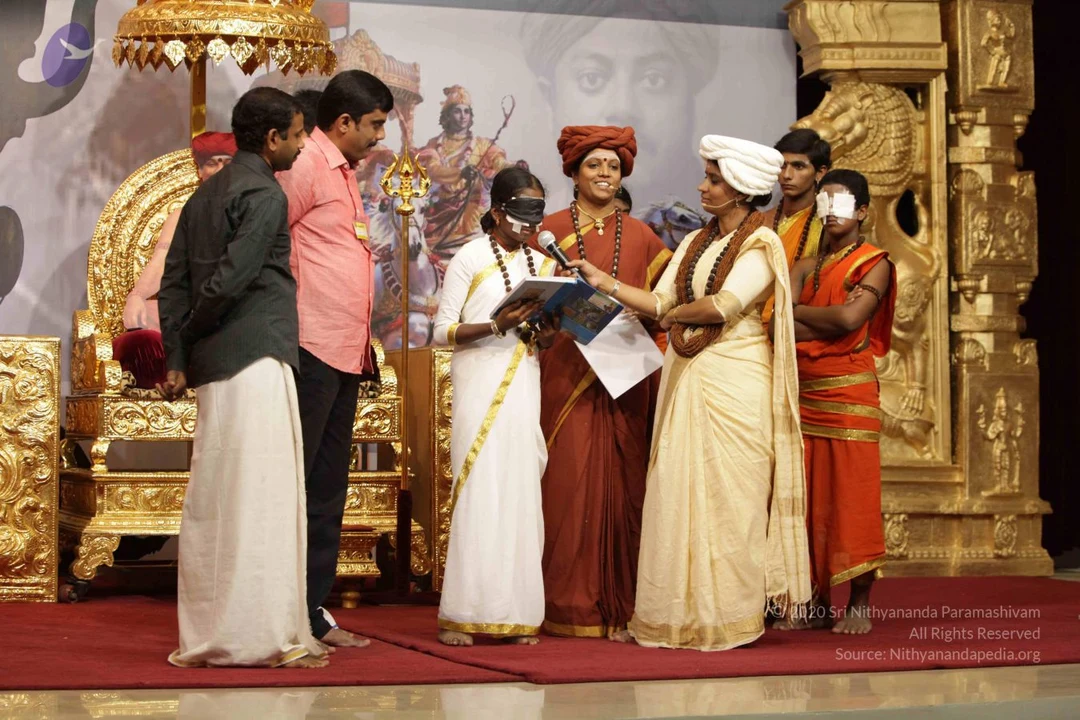
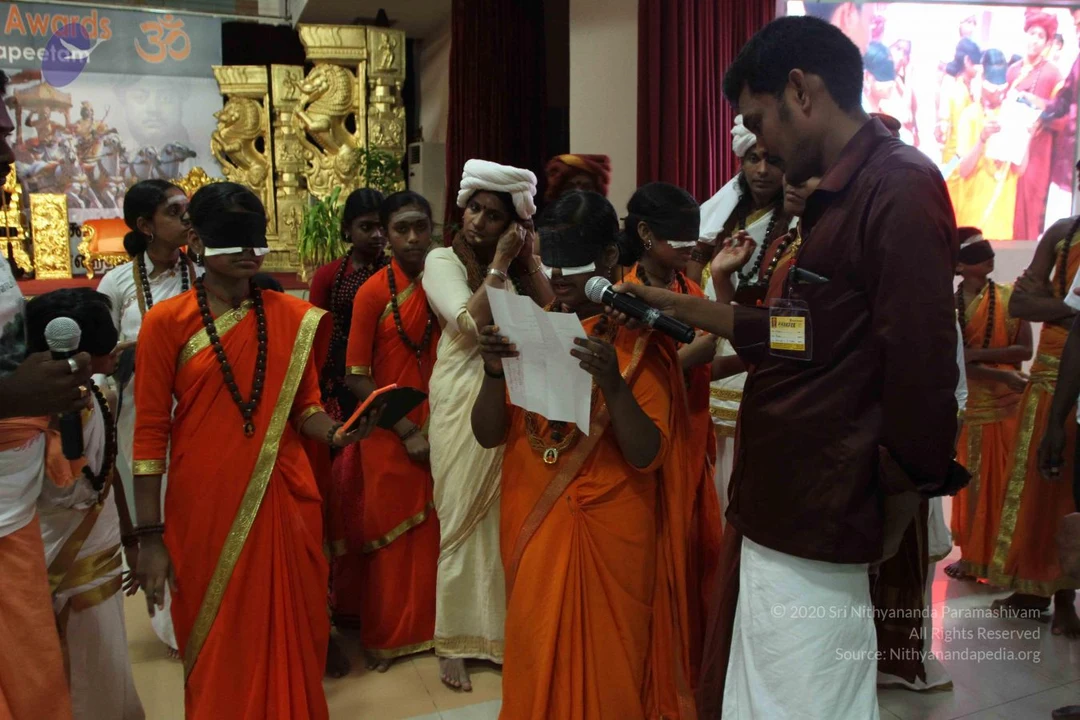
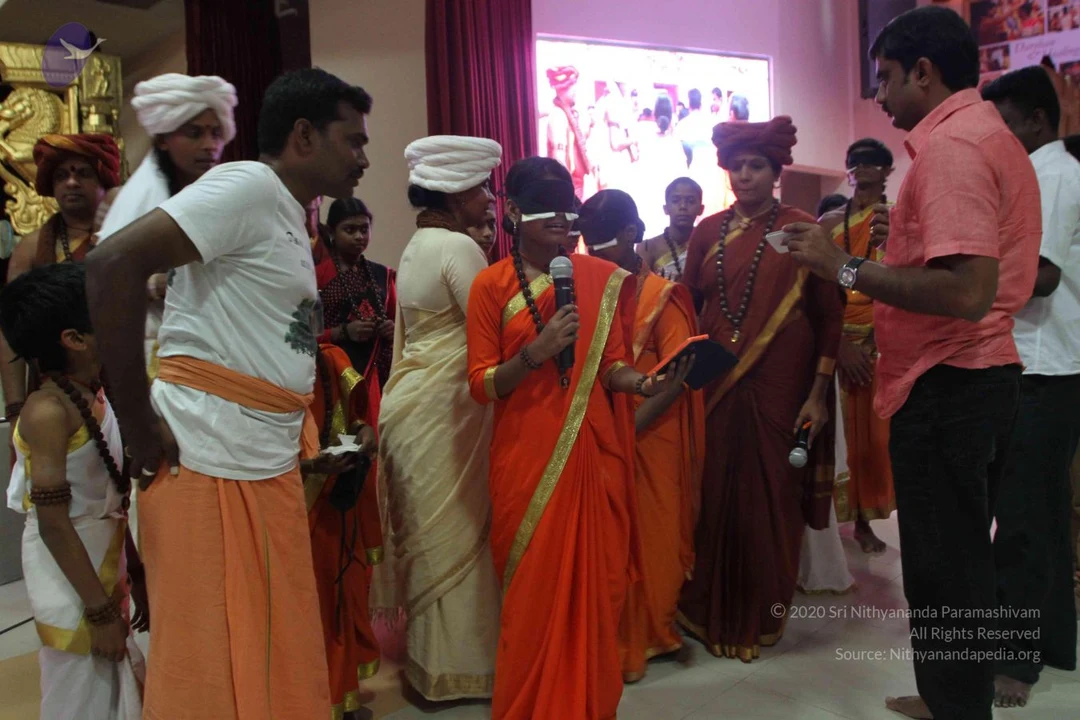
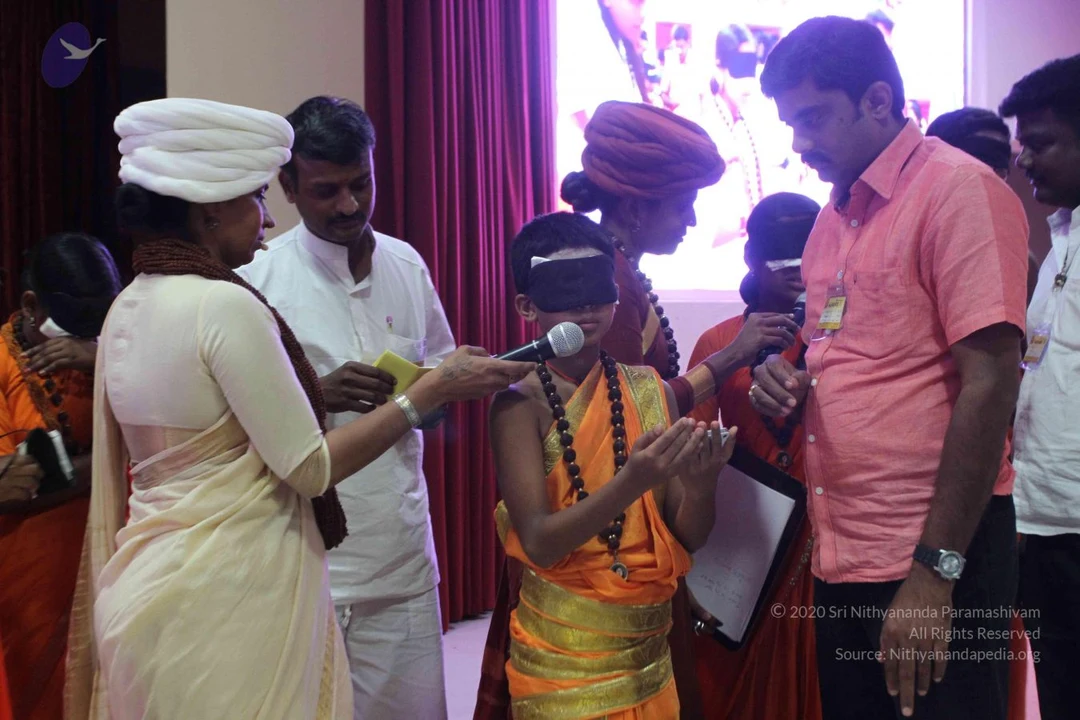
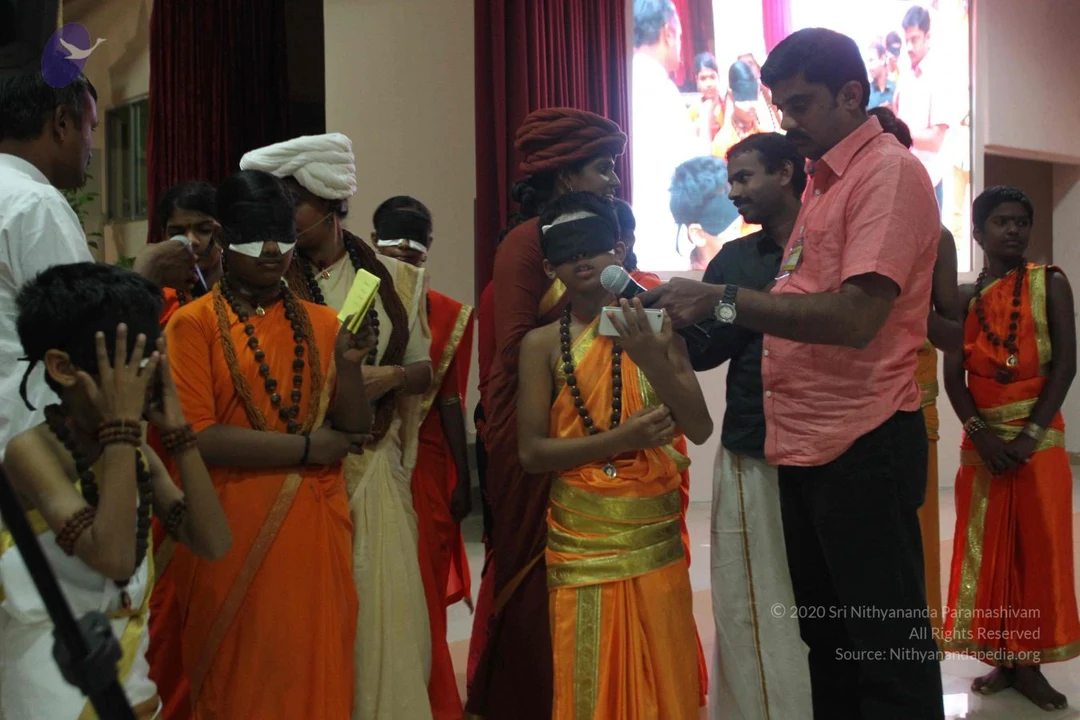
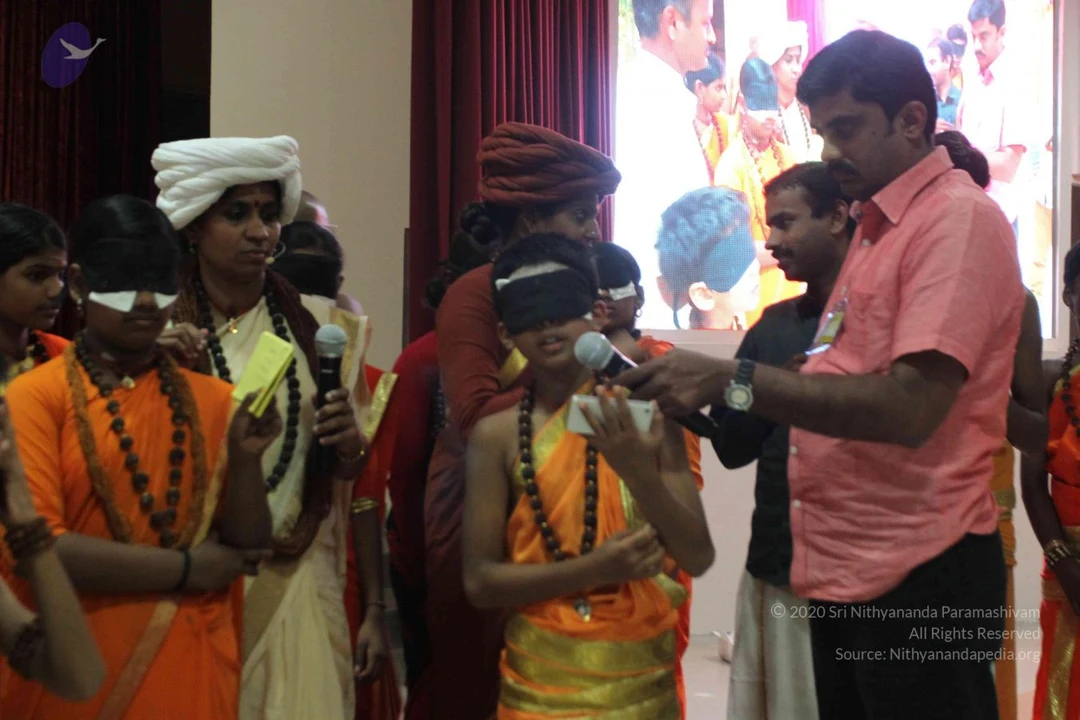
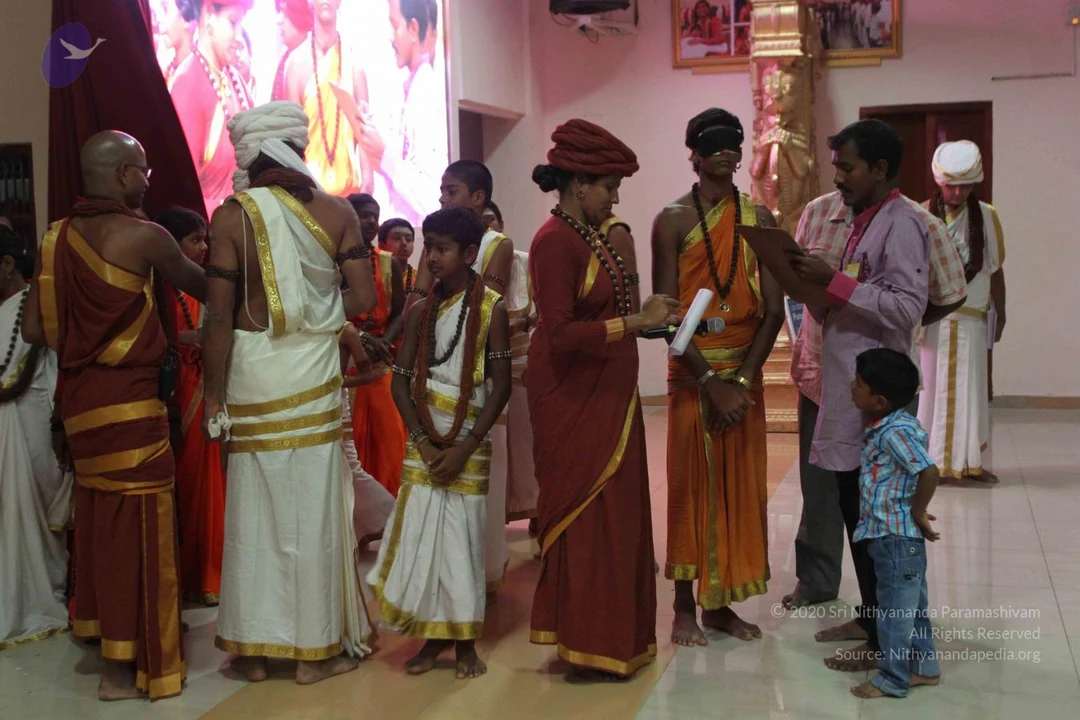
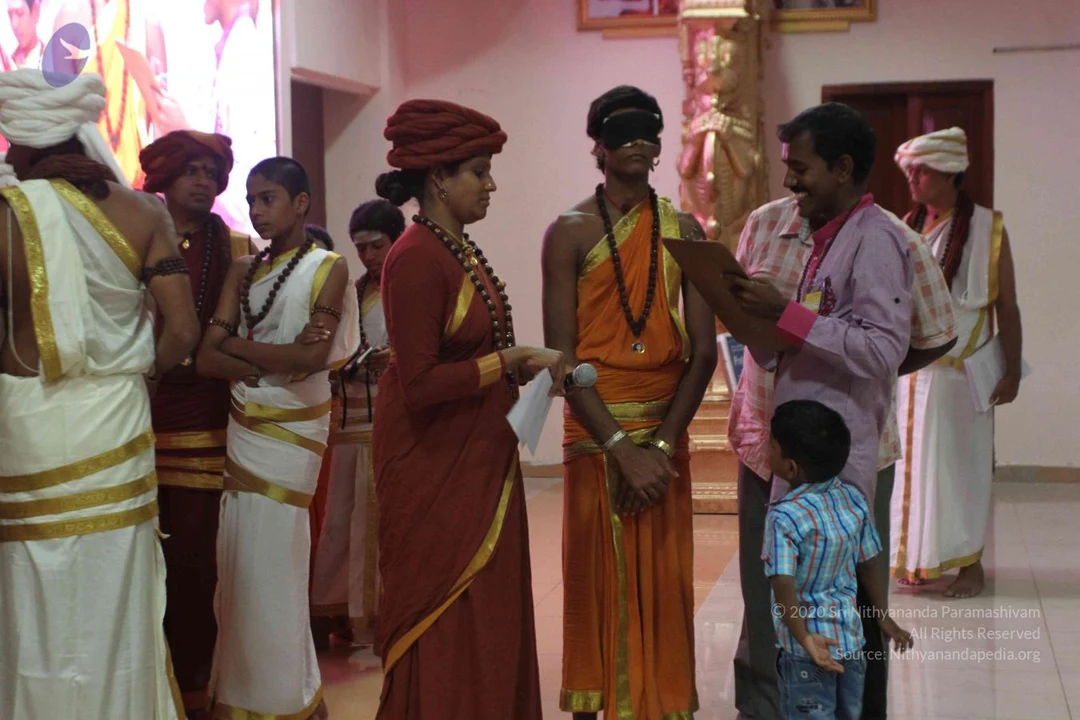
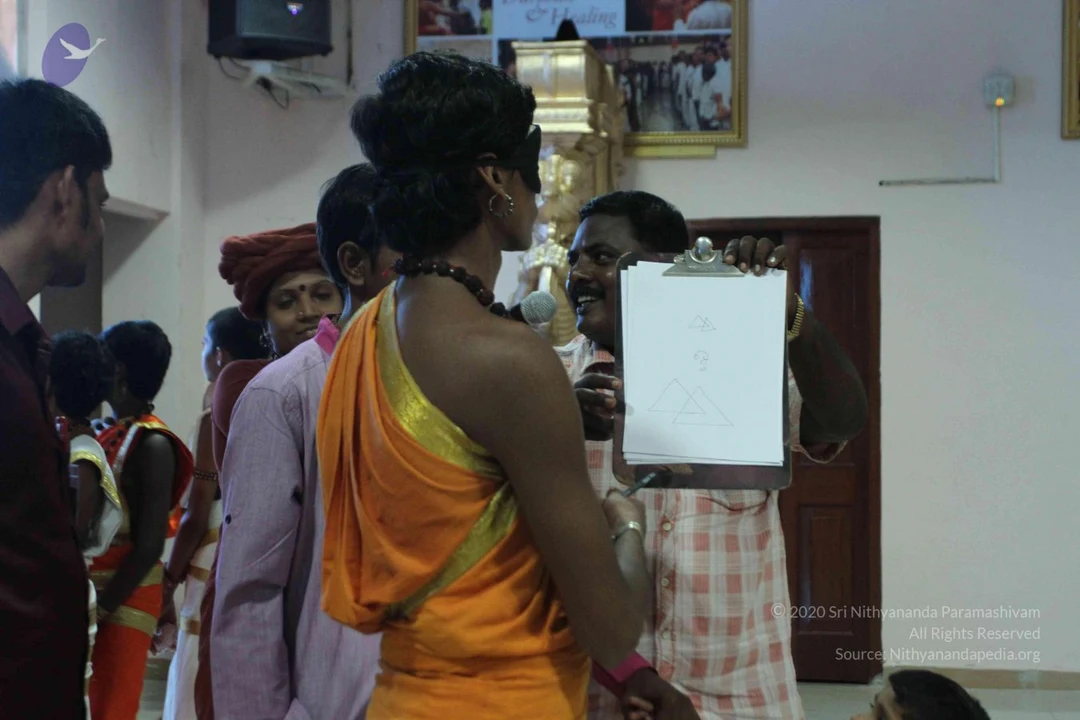
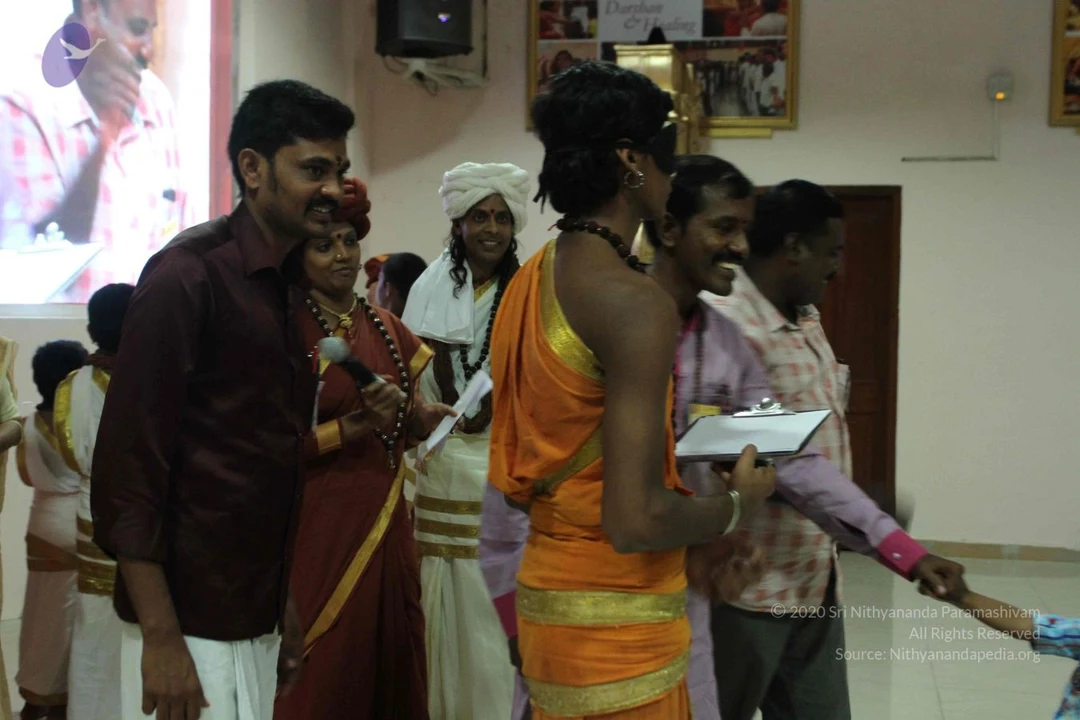
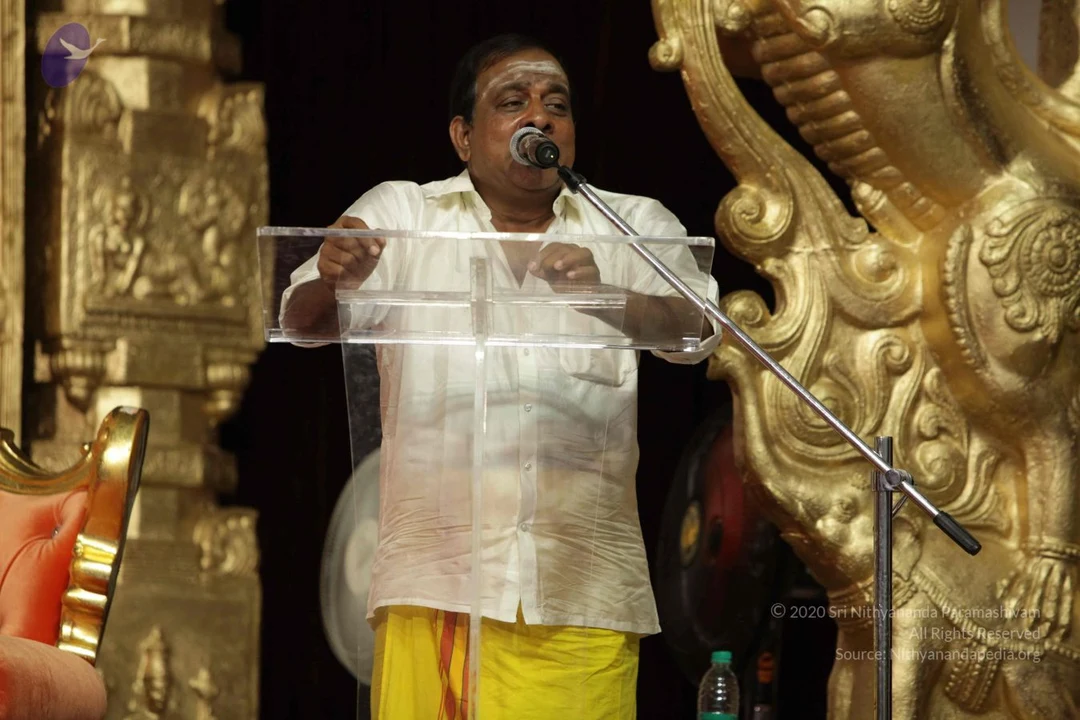
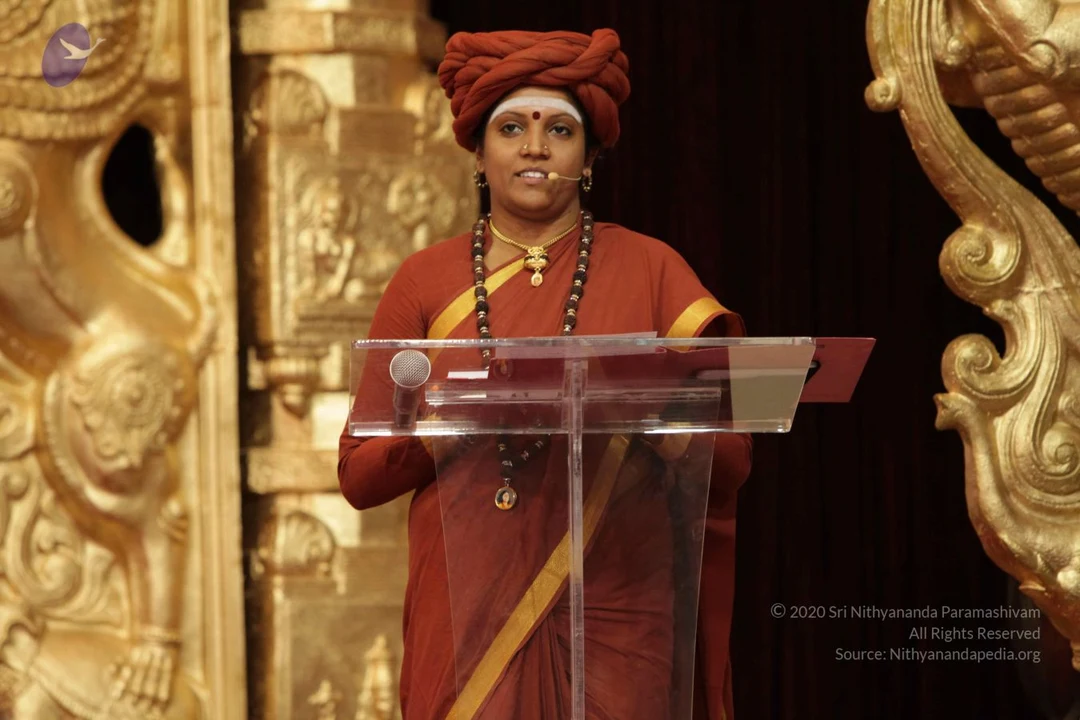
A photo of a woman in a red-orange turban and matching red-orange sari with a gold border speaking at a clear acrylic podium with a microphone. She wears a rudraksha mala, a gold pendant necklace, a red bindi and a white forehead band. A golden carved temple-style column frames the left side and an ornate gold carved panel is on the right, with a dark curtain behind. One person is visible.A stage event with a red carpet and ornate gold lion-headed pillars. A woman in a cream and white sari with a white head wrap and rudraksha mala stands at left, hands folded. Behind her, a young person in orange and gold clothing stands. Center, a young boy in an orange dhoti stands beside a young person in white with a rudraksha mala and a folded paper. A clear acrylic lectern stands center stage. At right, a man in a red-brown robe with gold border and a red head wrap and rudraksha mala faces a man in white dhoti and white head wrap. A banner behind shows chariot riders and a black-and-white portrait of a man in a turban, with orange Om symbol and Tamil text. Gold throne armrest visible at left edge.Photograph of a stage event beneath a large banner reading "Hindu Kshatriya Awards" and "Nithyananda Dhyanapeetam" with an om symbol, showing a trident and historical figures. A gold ornate throne with a gold parasol stands center stage on a red carpet. A man in a white shirt and light blue jeans stands before a kneeling young man in orange robes with a rudraksha mala. A woman in a white saree with gold border and white head covering holds an object, while two people in orange and red robes stand nearby, one holding a microphone. A figure in a red turban and red garments sits on the throne area. Several people appear on stage, with gold carved decor at right.Stage event under a banner reading Hindu Kshatriya Awards and Nithyananda Dhyanapeetam, with a trident emblem and Om symbol. A seated figure in orange robes and red turban sits on an ornate gold throne under a gold canopy, and a man in a white shirt and light trousers stands near it holding a small object. A young man in an orange dhoti with rudraksha mala kneels in front. A woman in a white sari and white head covering holds a microphone-style gesture toward him, and two women in red-and-gold saris stand at right, one holding a microphone. Large gold carved lion-and-pillar decor and painted backdrop figures of warriors on chariots complete the stage.A stage ceremony at a Nithyananda Dhyanapeetam event. On the left a large gilded throne holds a framed portrait of a seated figure in saffron with a red turban and rudraksha mala, standing in for the absent guru. Beside it a man in white shirt and light trousers stands near a golden trident. In the centre a white-turbaned figure in cream dhoti and shawl presses a mark to the forehead of a kneeling disciple in orange robes with folded hands. Two orange-robed attendants stand behind, one in a red turban, and at right a young man in orange with palms joined. A gilded column and a clear lectern complete the stage, with a backdrop of a painted warrior on horseback.A stage drama performed at Nithyananda Dhyanapeetam, with a golden ornate throne and a golden royal umbrella on the left. A man in a white shirt and light jeans stands barefoot holding a folded paper and gesturing toward a blindfolded young boy in orange robes and rudraksha beads kneeling on the red carpet. A woman in white sari with a white head cloth and a rudraksha mala stands beside them, while a man in a rust-red robe and orange-red turban and a boy in orange robes with hands joined stand at the right. A golden horse-headed pillar and a large painted backdrop of a chariot with horses and a portrait of a turbaned man complete the set.

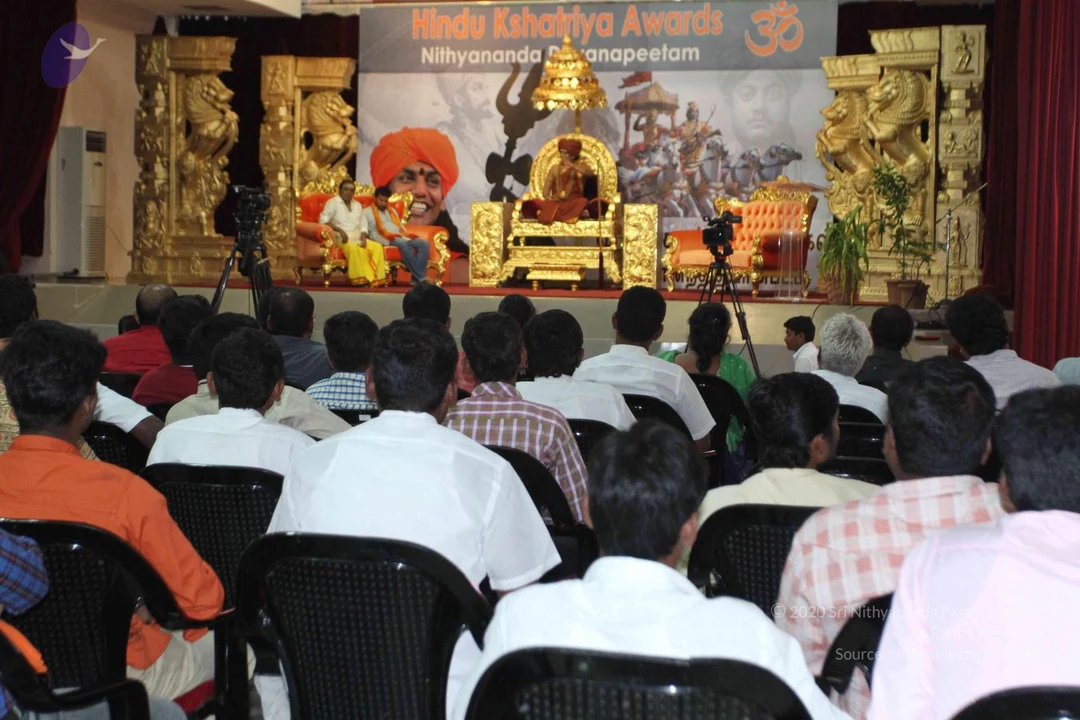
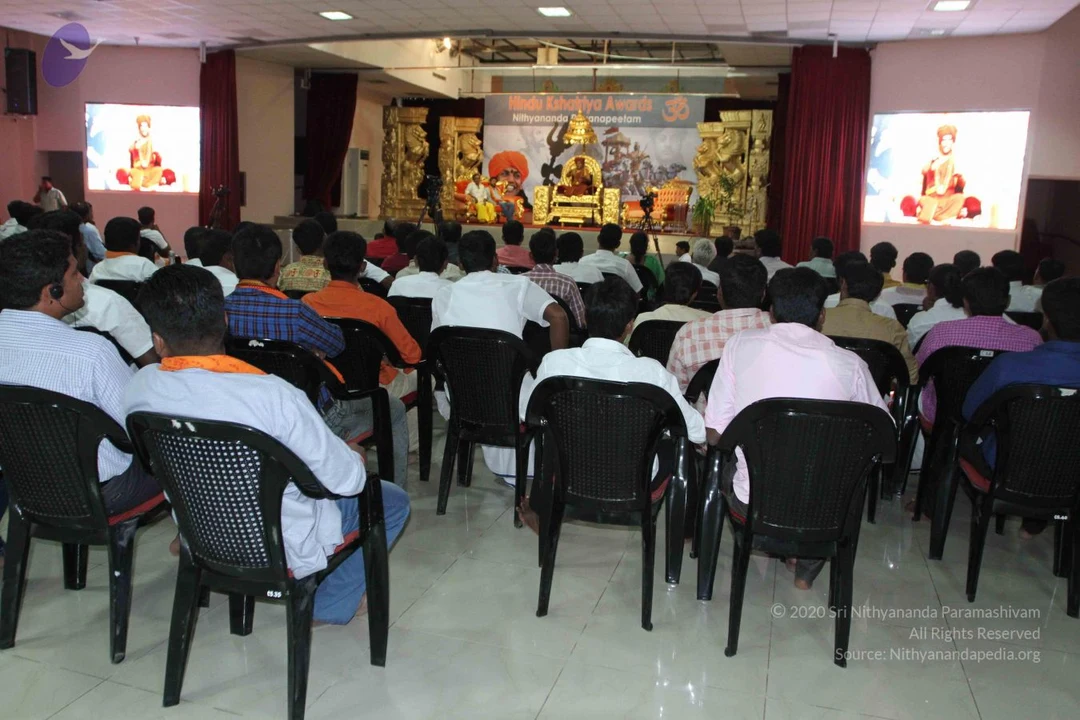
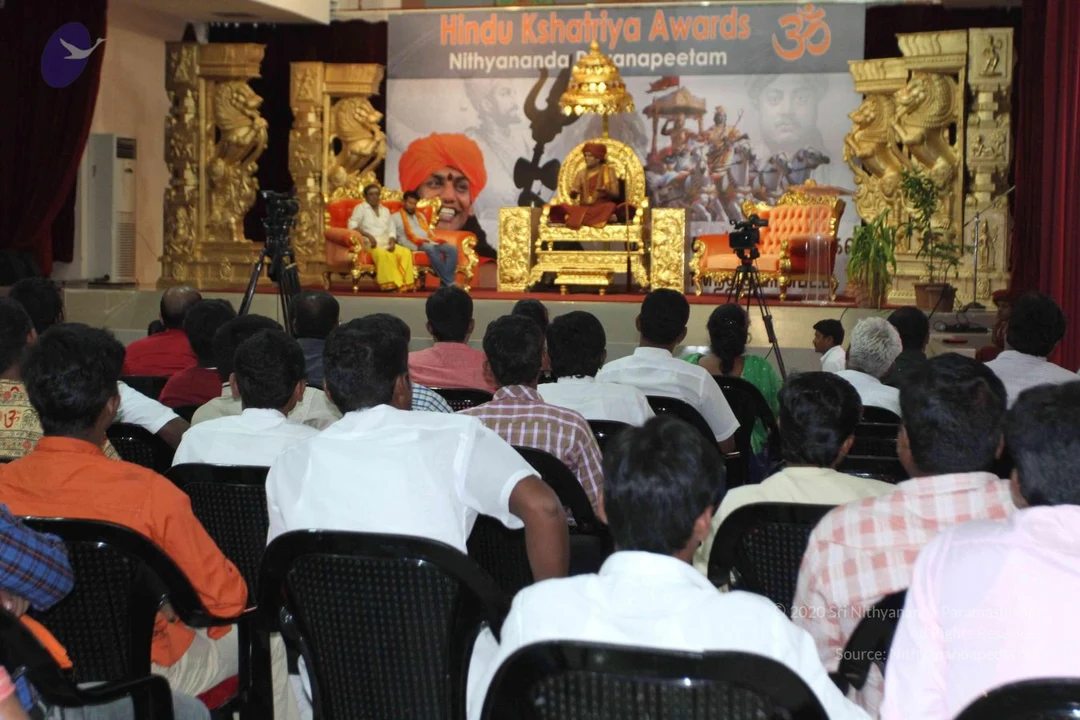
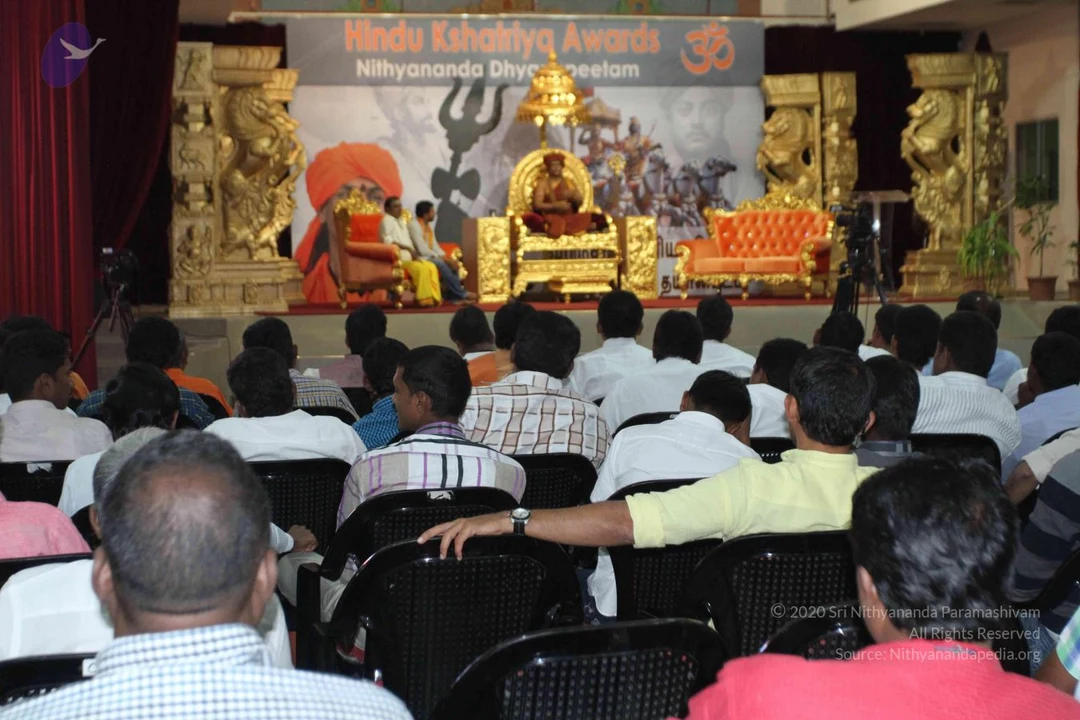
HDH Swamiji addressing the delegates

14 photosSource gallery
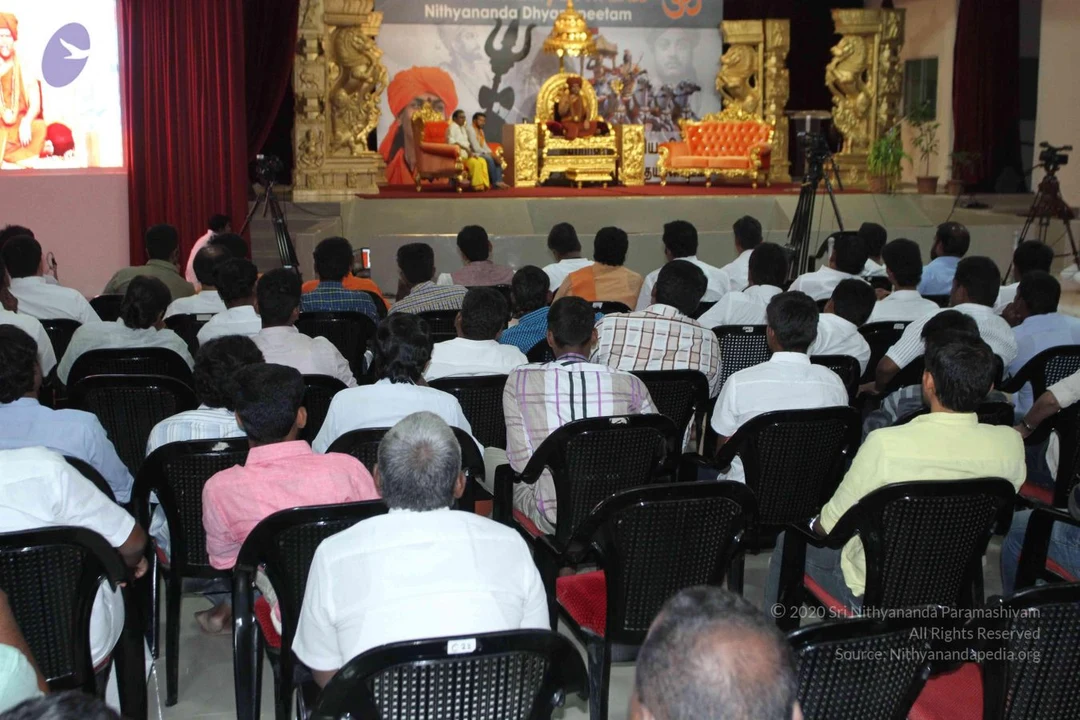
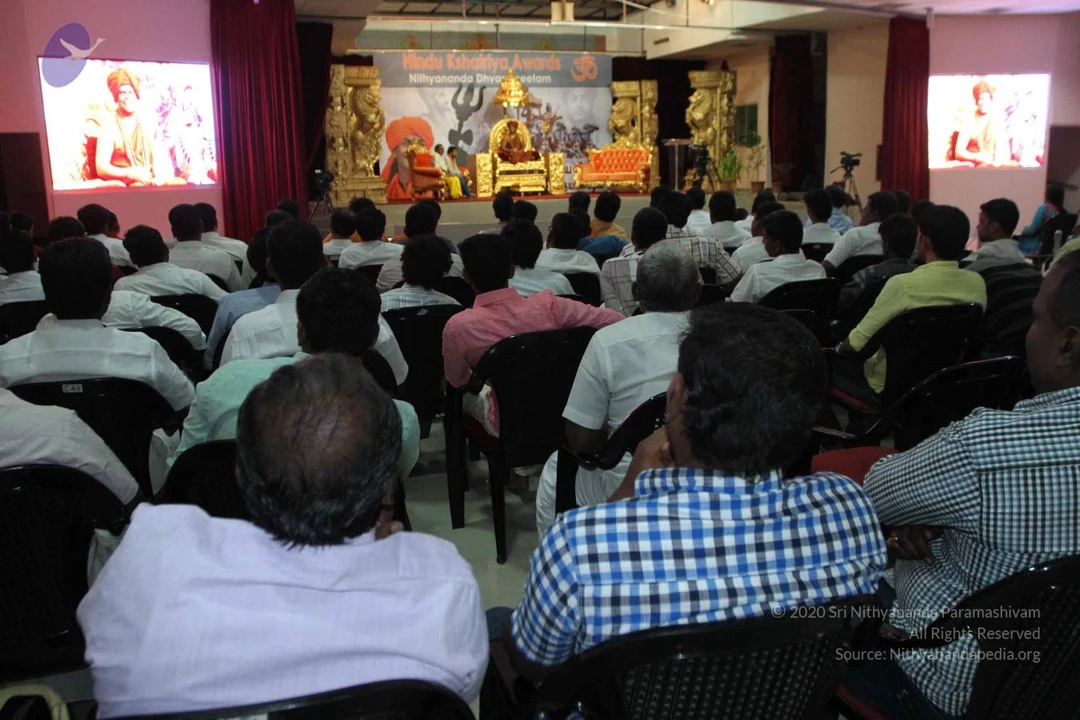
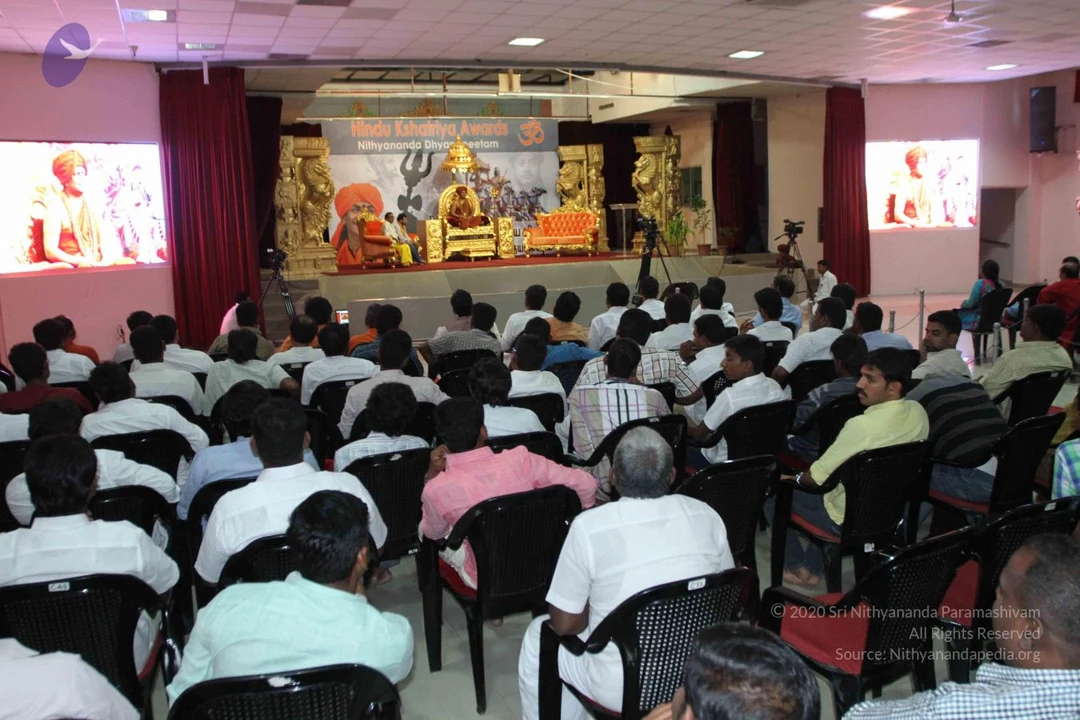
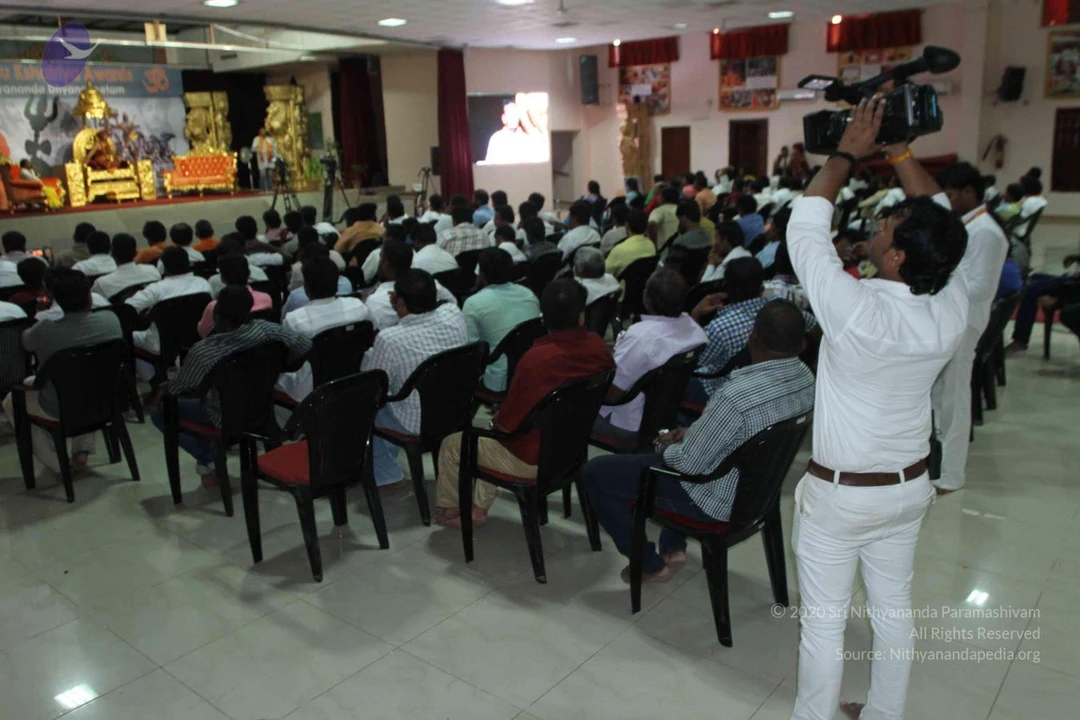
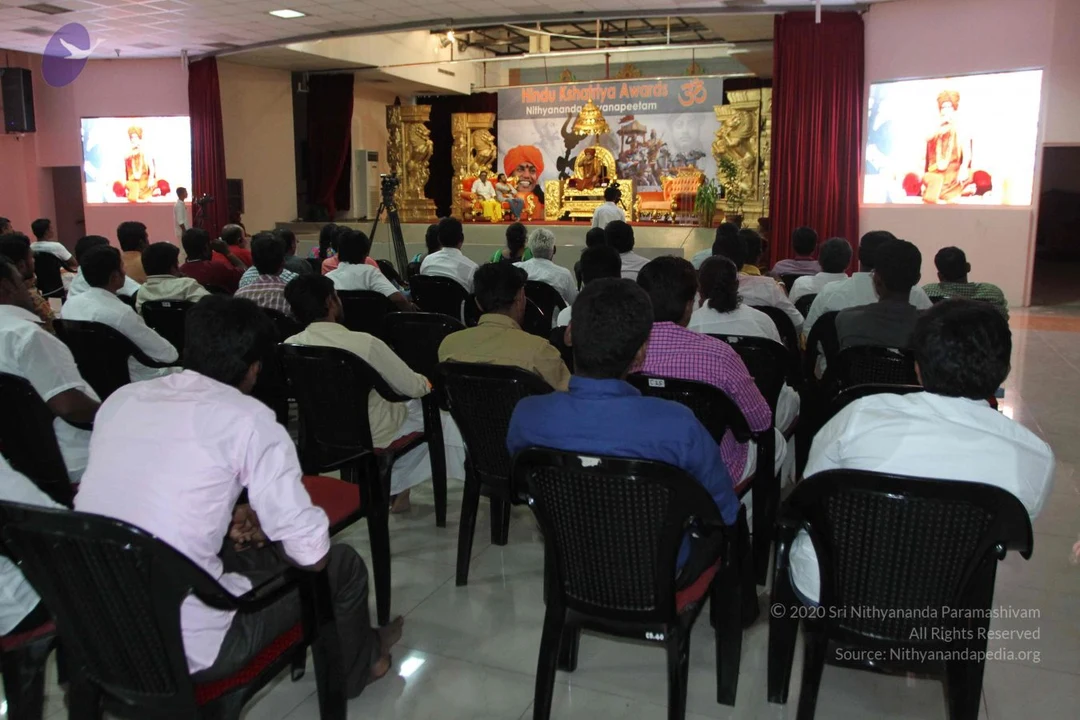
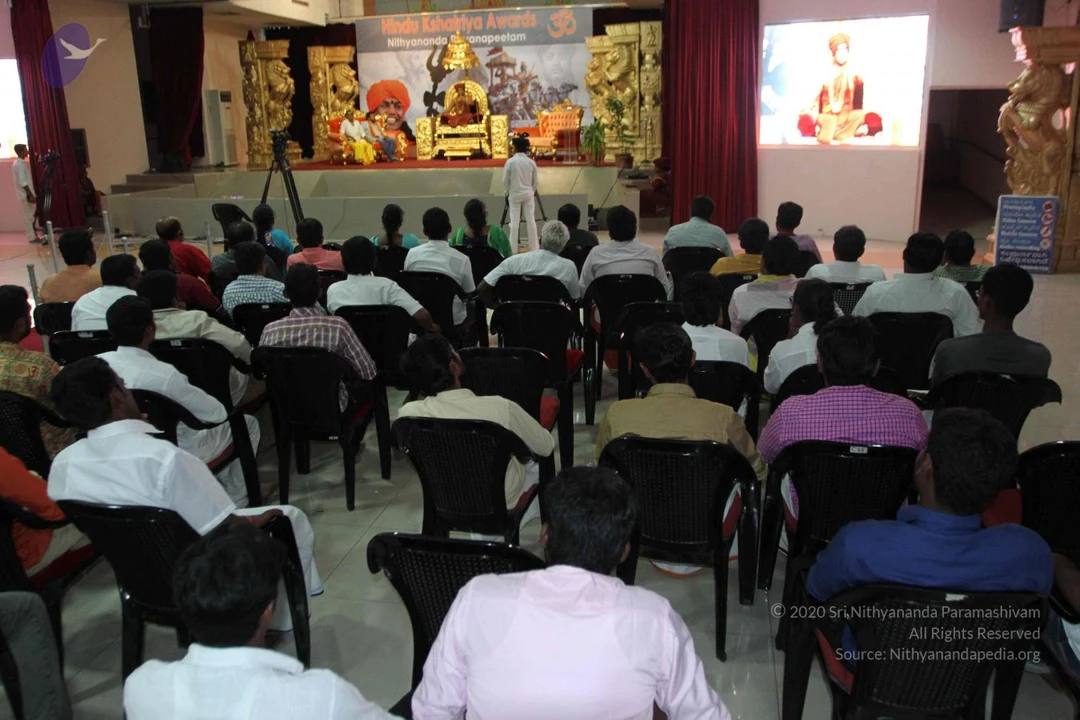
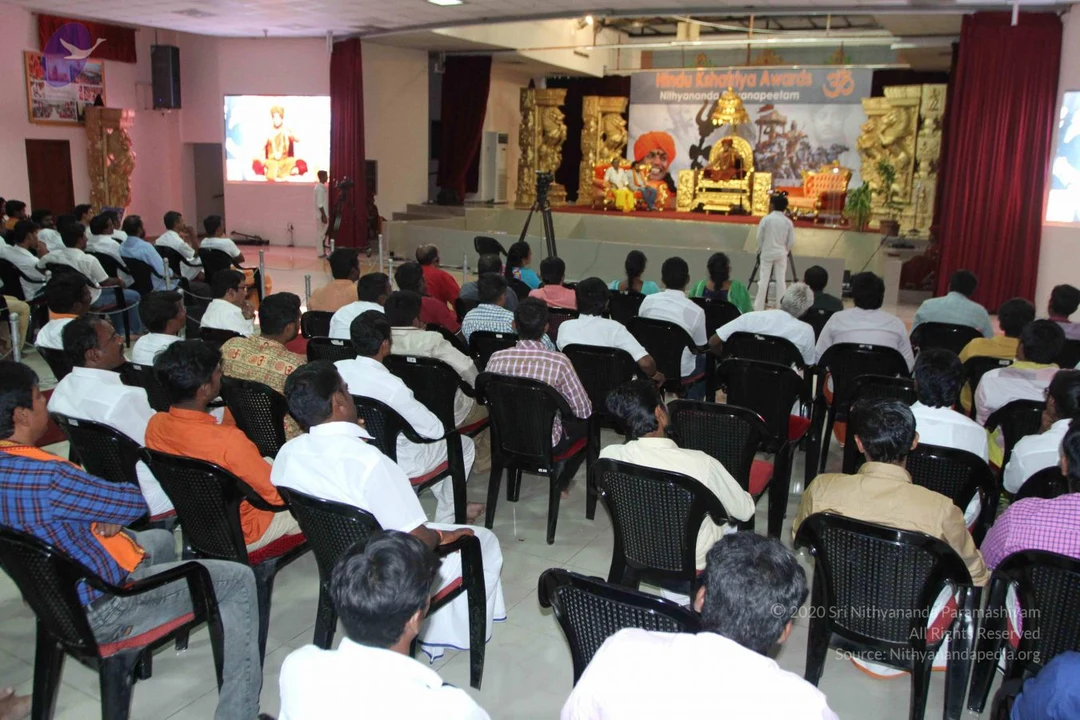
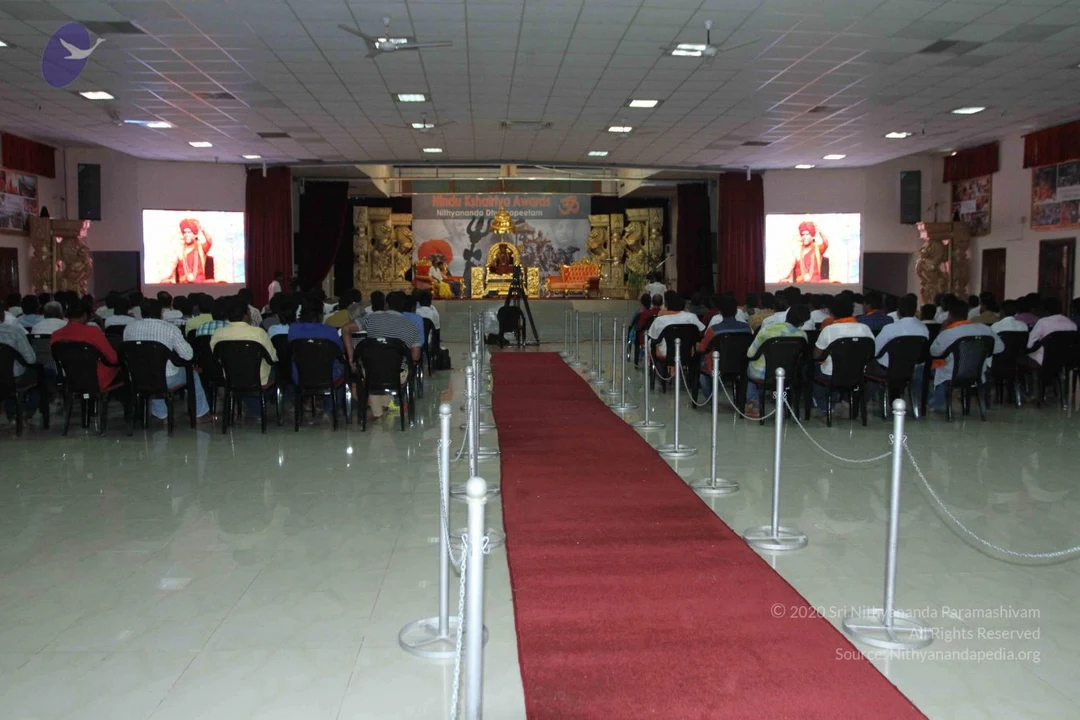
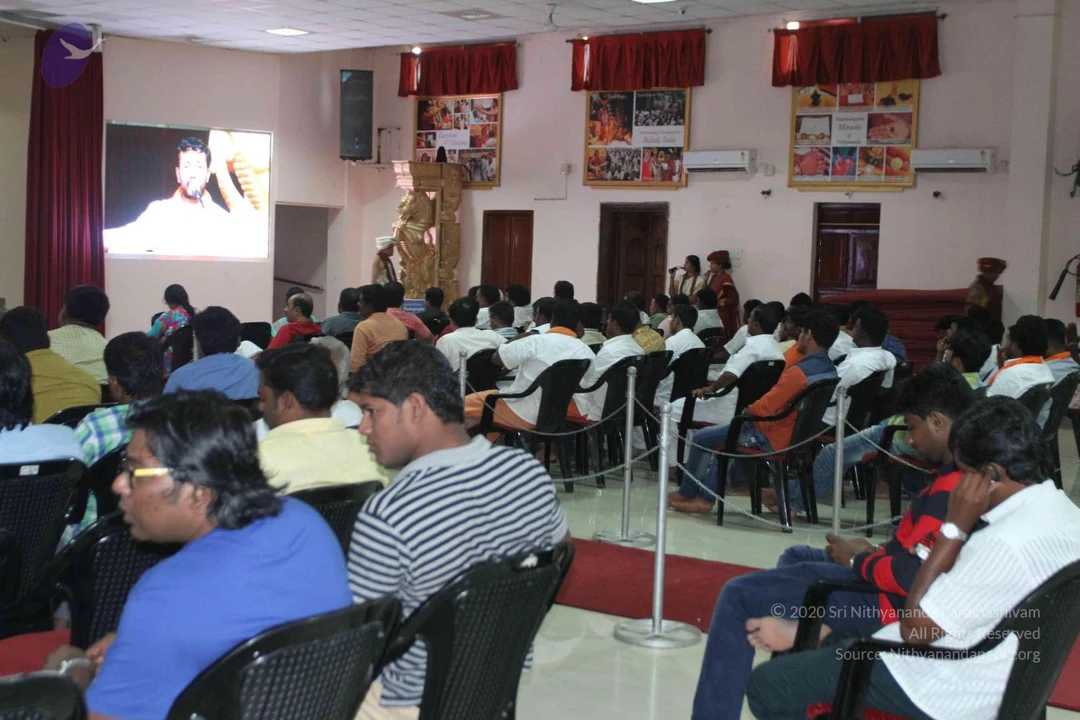
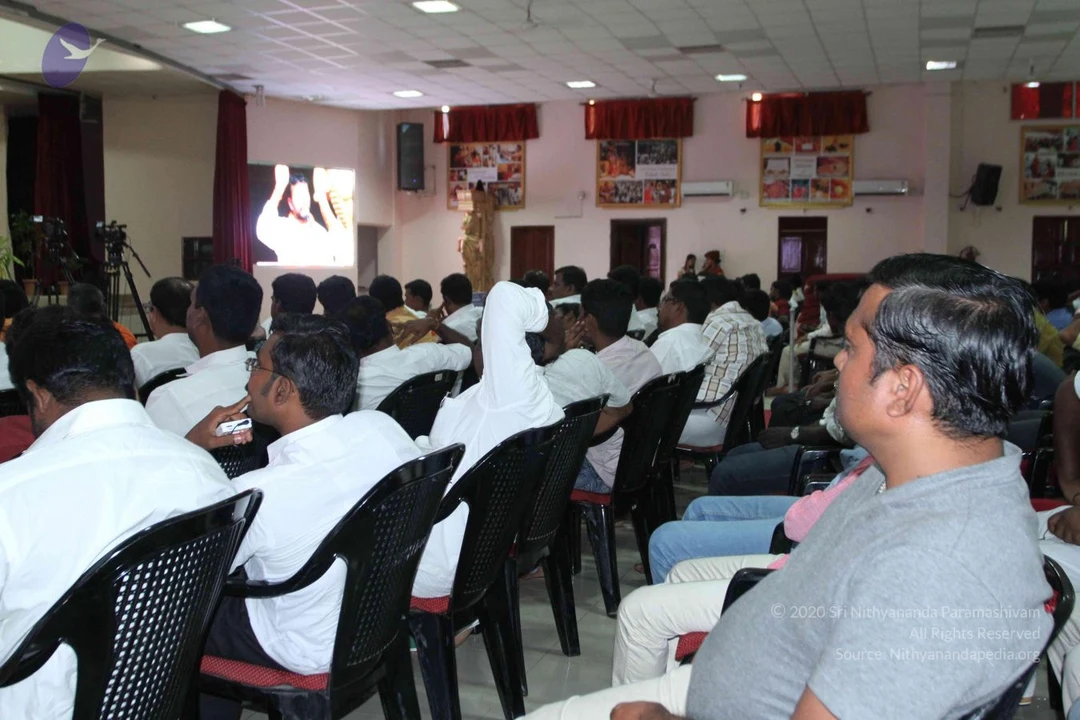
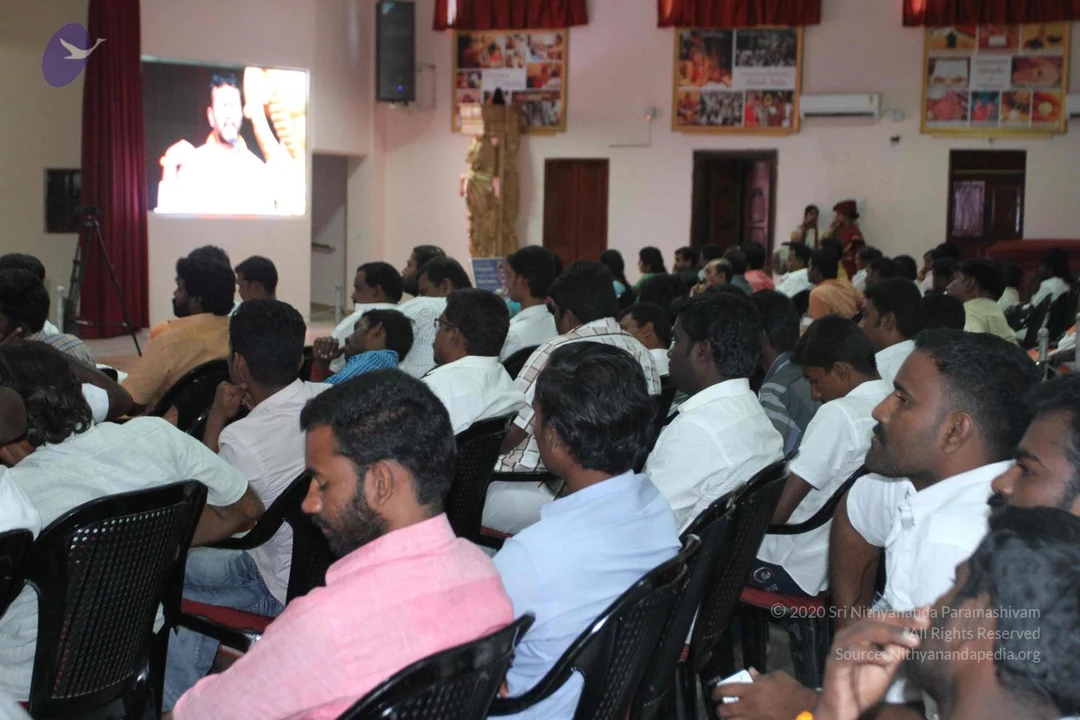
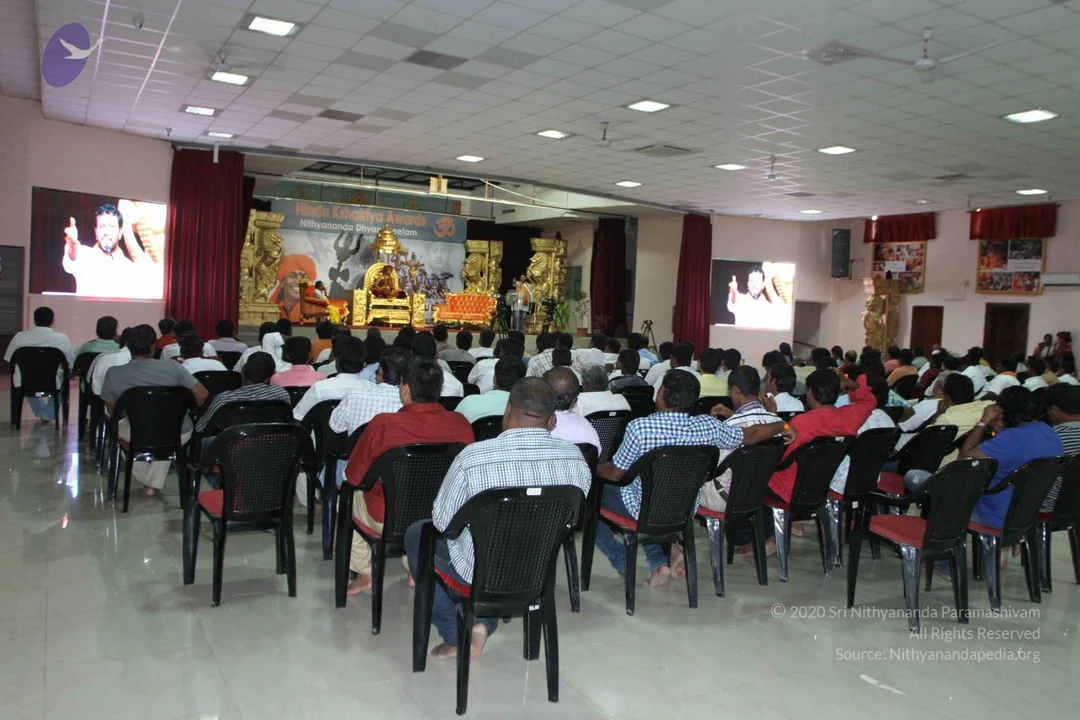
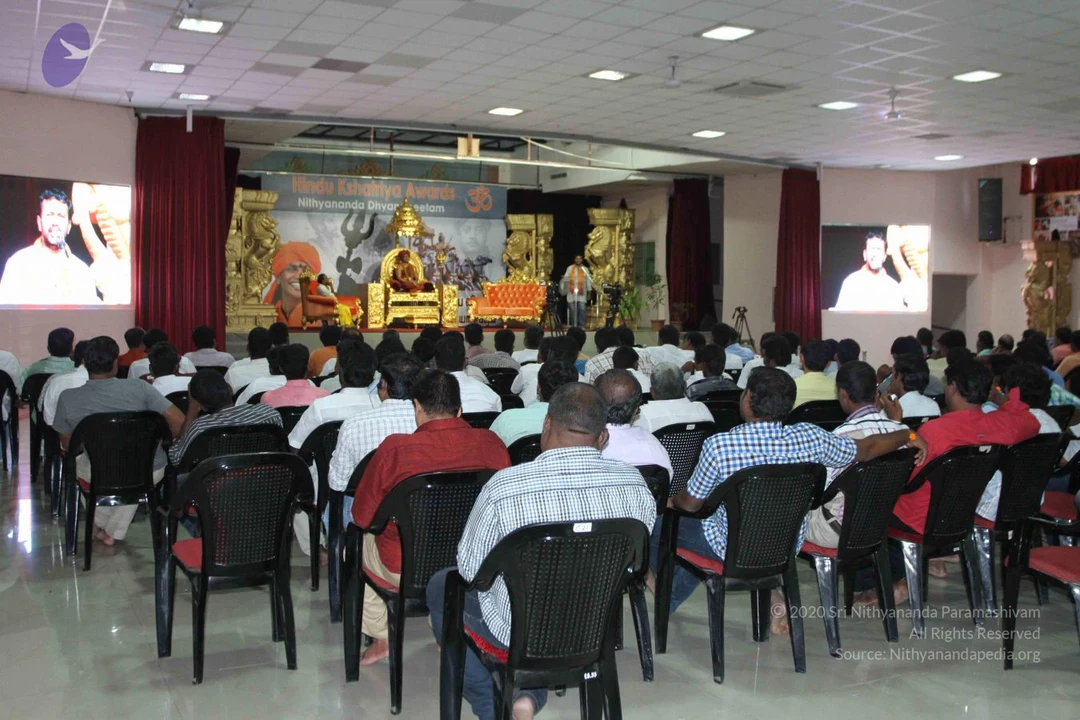
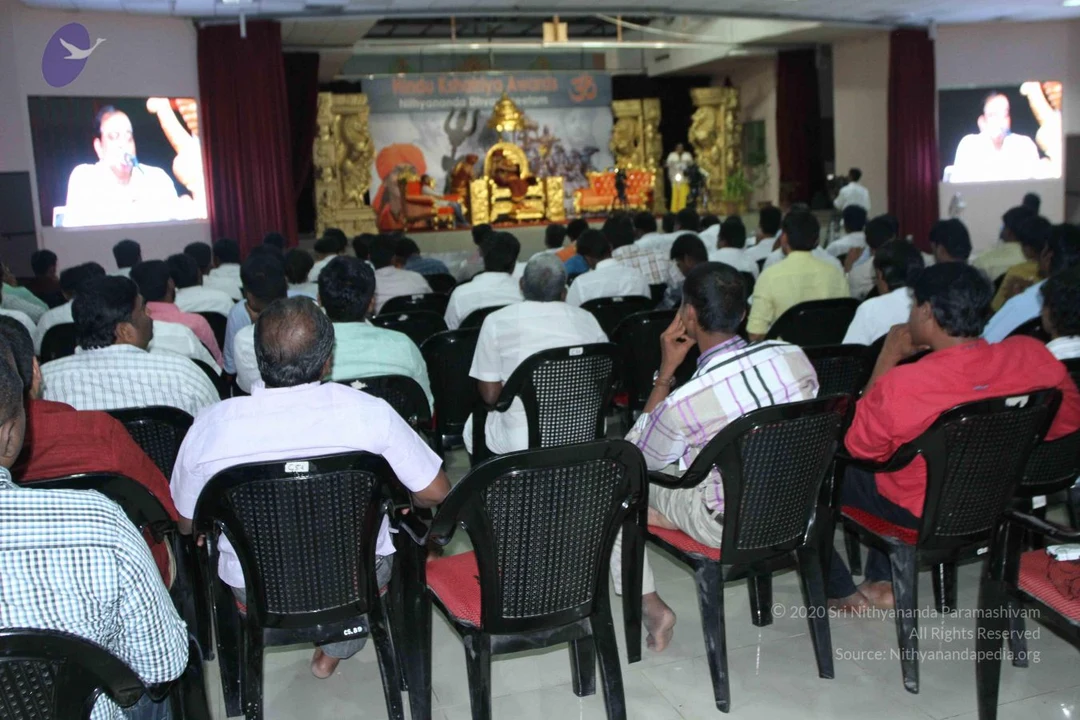
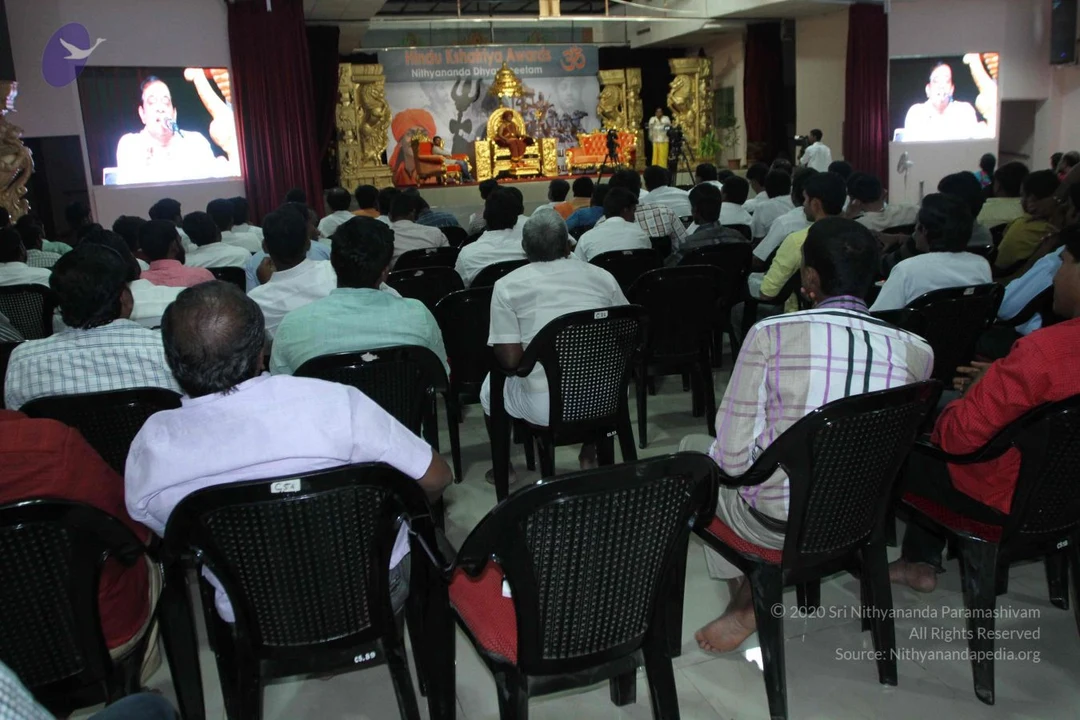
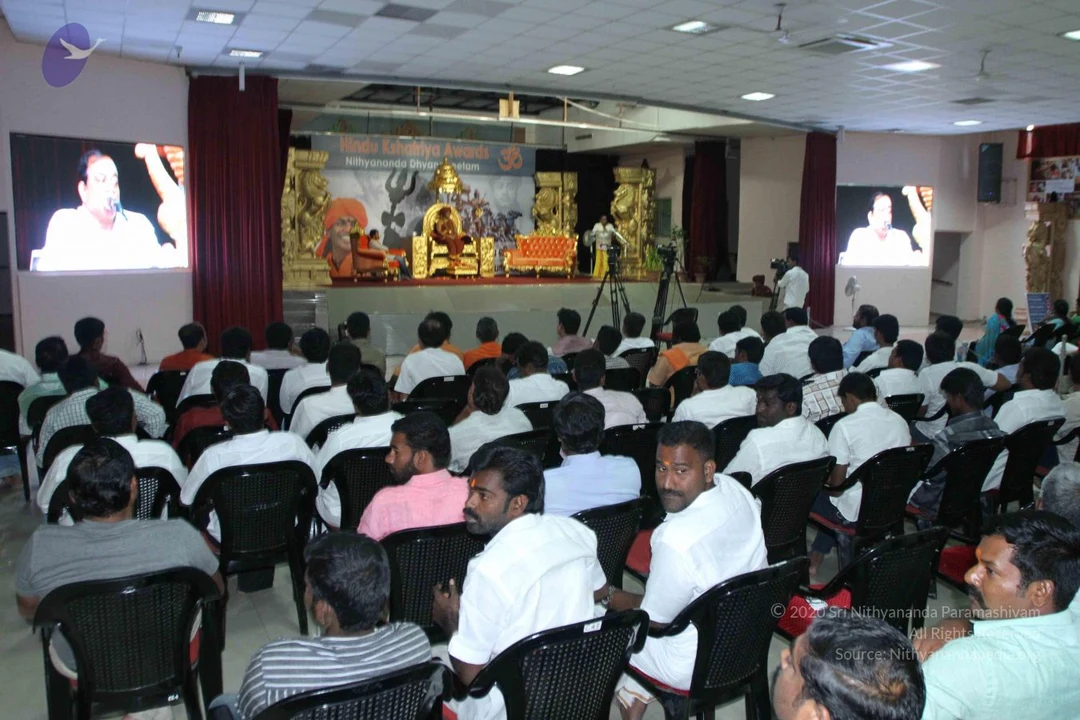
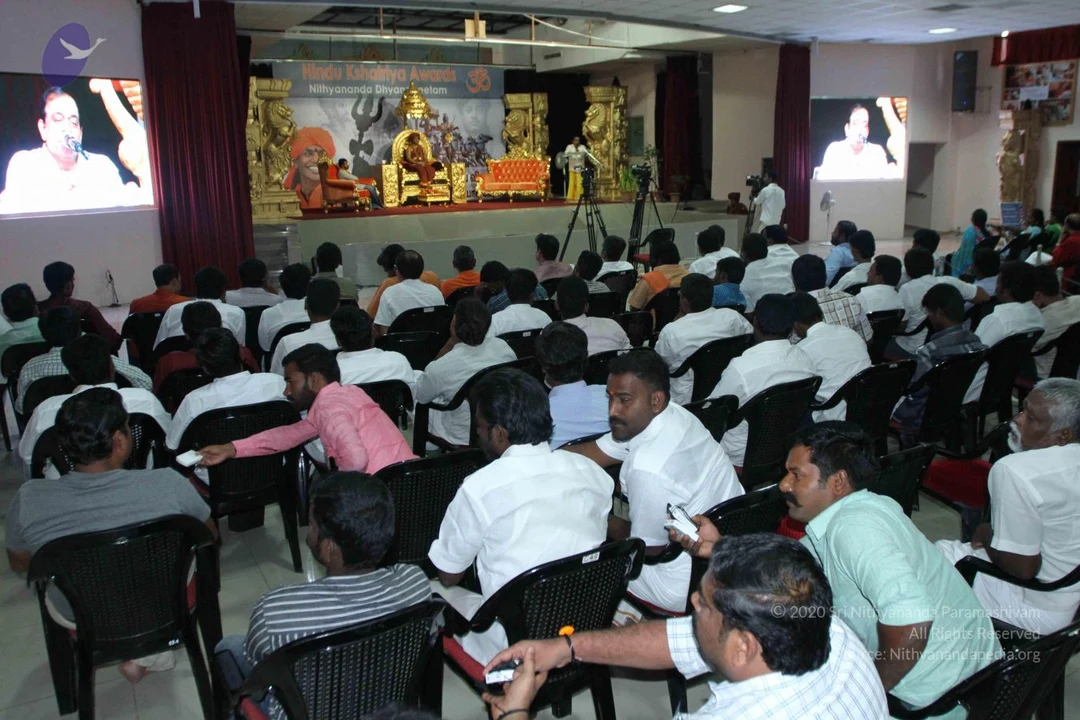
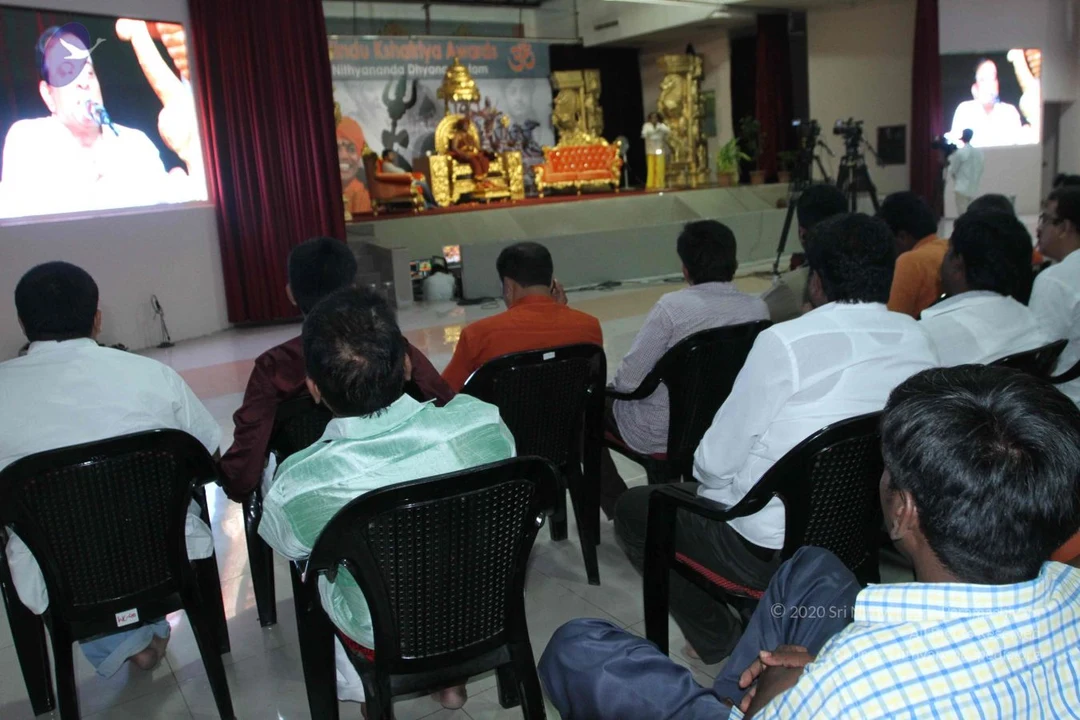
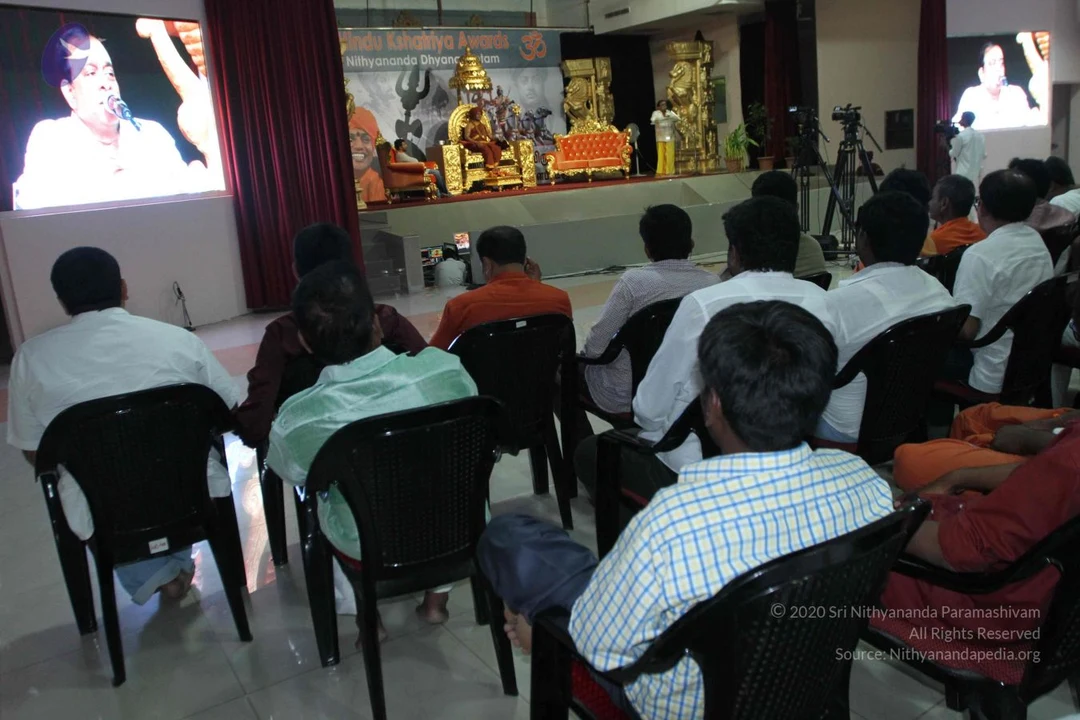
Photo of an indoor hall audience seated on black chairs facing a raised stage. Several rows of attendees in white shirts, checked shirts and an orange shirt are seen from behind. On the stage, a figure in saffron-orange clothing sits on an ornate gold throne with a golden canopy, flanked by two more chairs with orange cushions; one seated man wears white with a yellow dhoti. Behind them a large banner reads Hindu Kshatriya Awards and Nithyananda Dhyanapeetam, with an Om symbol, a large portrait of a man in an orange turban, a trident and a painted chariot scene. Gold lion-carved pillars frame the stage and video cameras on tripods film the event.Photo taken from the back of a hall of seated audience members in black plastic chairs, facing a stage. Many attendees wear white shirts, checked shirts and saffron or orange scarves, and several wear headsets. On the stage, a large banner reads Hindu Kshatriya Awards and Nithyananda Dhyanapeetam, beside an OM symbol. A figure in saffron/orange turban-style headwear and white clothing sits on a gold ornate throne flanked by gold carved panels, with a deity murti and a stage backdrop of painted scenery. Two large screens on the walls show a figure in red and saffron clothing seated against a blue sky.A photograph of a seated audience facing a stage at a Hindu Kshatriya Awards event at Nithyananda Dhyanapeetam. Many attendees sit in black plastic chairs, mostly seen from behind, wearing white shirts, pink and checked shirts, and an orange shirt. On stage, a large golden throne-like seat with an ornate canopy sits centre, flanked by golden lion-figure pillars and orange-upholstered armchairs. A large backdrop shows a man in an orange turban and a painted scene of chariots and warriors. Two seated figures on stage, one in white and one in orange, face the audience. A video camera on a tripod stands at the front left and another at the right of the stage.Photograph from the back of a seated audience in black chairs, facing a stage at a Hindu Kshatriya Awards event at Nithyananda Dhyanapeetam. A large banner behind the stage reads Hindu Kshatriya Awards with an Om symbol and a trident motif, with painted figures on chariots. Centre stage, a figure in a red-orange robe sits on an ornate gold throne with a gold canopy, flanked by gold lion-motif pillars. To the left, a man in an orange turban and orange robe sits on an orange upholstered seat, with two men in white and yellow clothing nearby. Attendees wear white shirts, checked shirts and yellow tops. a person is seated on the central throne in red-orange clothing, with a visible crown-like headpiece and ornate gold adornments on the throne.Photograph of an indoor event hall taken from the audience seating, looking toward a raised stage. A large banner reads Hindu Kshatriya Awards with Nithyananda Dhyanapeetam and an Om symbol, showing a trident and historical figures. On a golden throne at centre sits a figure in orange robes with an orange turban, flanked by ornate golden lion sculptures. Two men in white and saffron sit on orange-cushioned chairs to the left, and a golden armchair with orange upholstery stands to the right. Rows of seated audience members in white shirts and checked shirts face the stage, with a camera on a tripod at the side.A photograph taken from the back of a seated audience in a hall with black plastic chairs, facing a raised stage. Many attendees in white shirts, pastel and checked shirts sit in rows, several with cameras on tripods filming the stage. On the stage, a central gold-and-red ornate throne flanked by golden carved pillars holds a seated figure in orange robes, with two people in yellow and white seated on a red chair to the left and an orange cushioned chair to the right. A large banner behind the stage shows a trident, a red-and-orange figure and an Om symbol. A projected screen at upper left shows a saffron-robed figure. Potted plants stand at the right edge.

Delegates Watching

49 photosSource gallery
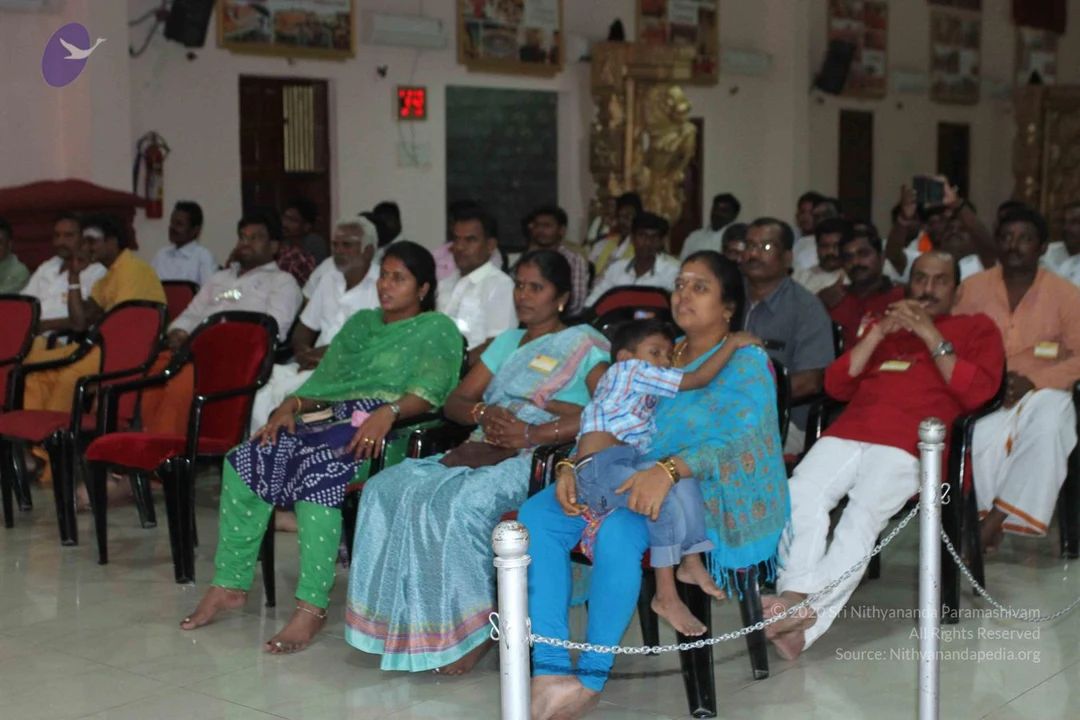
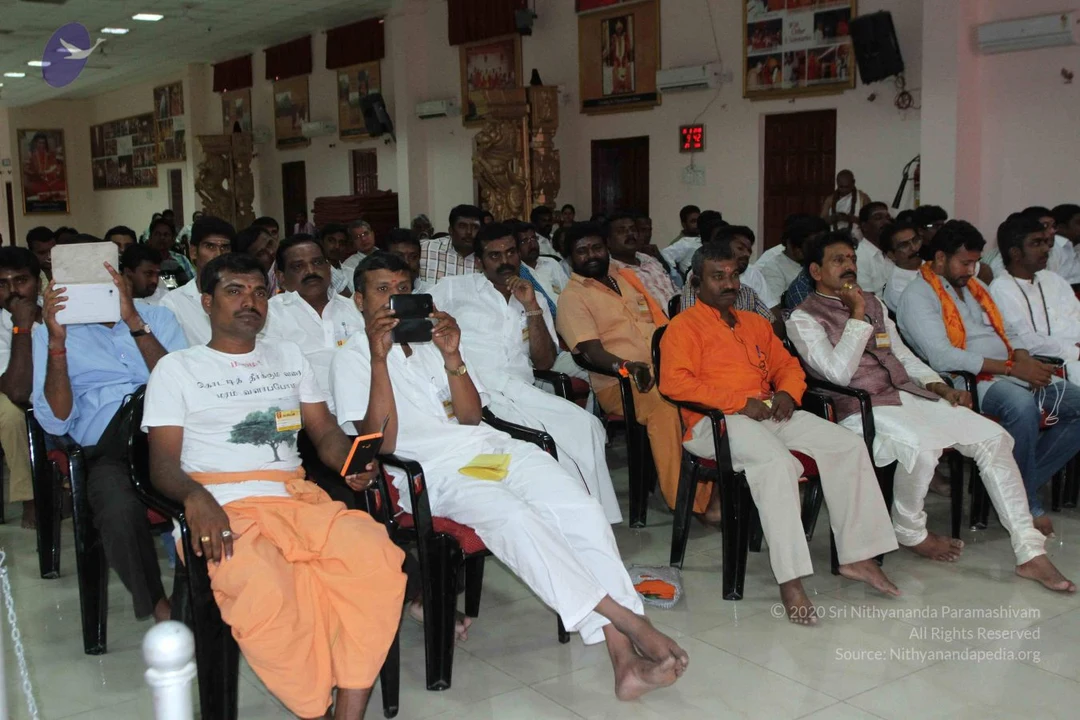
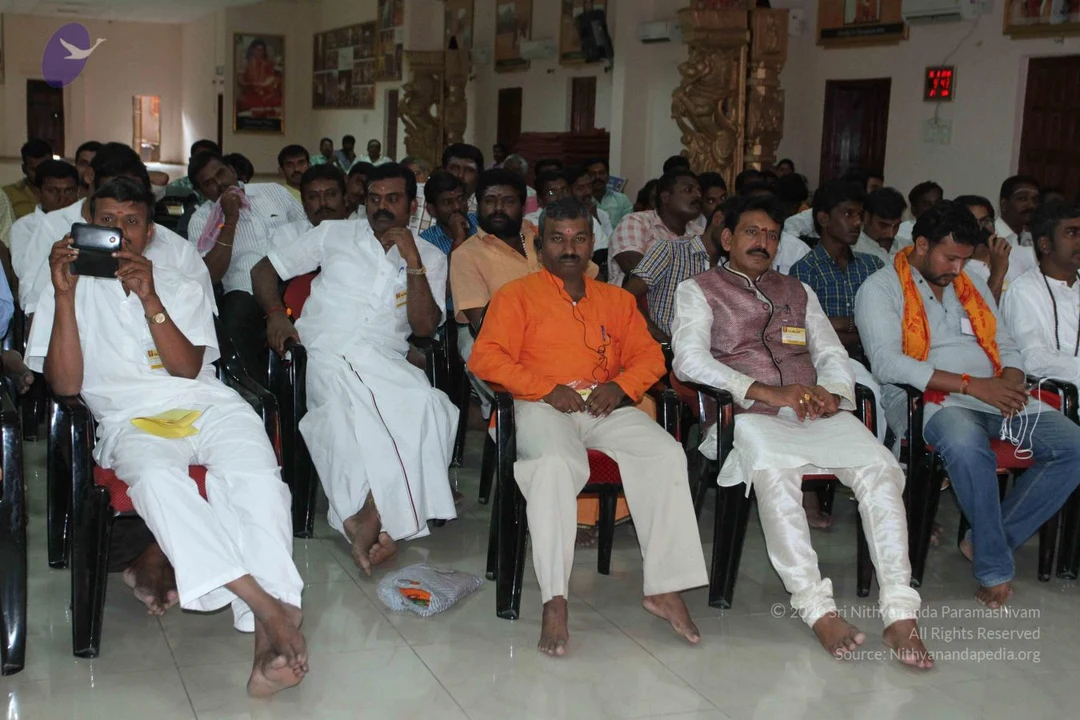
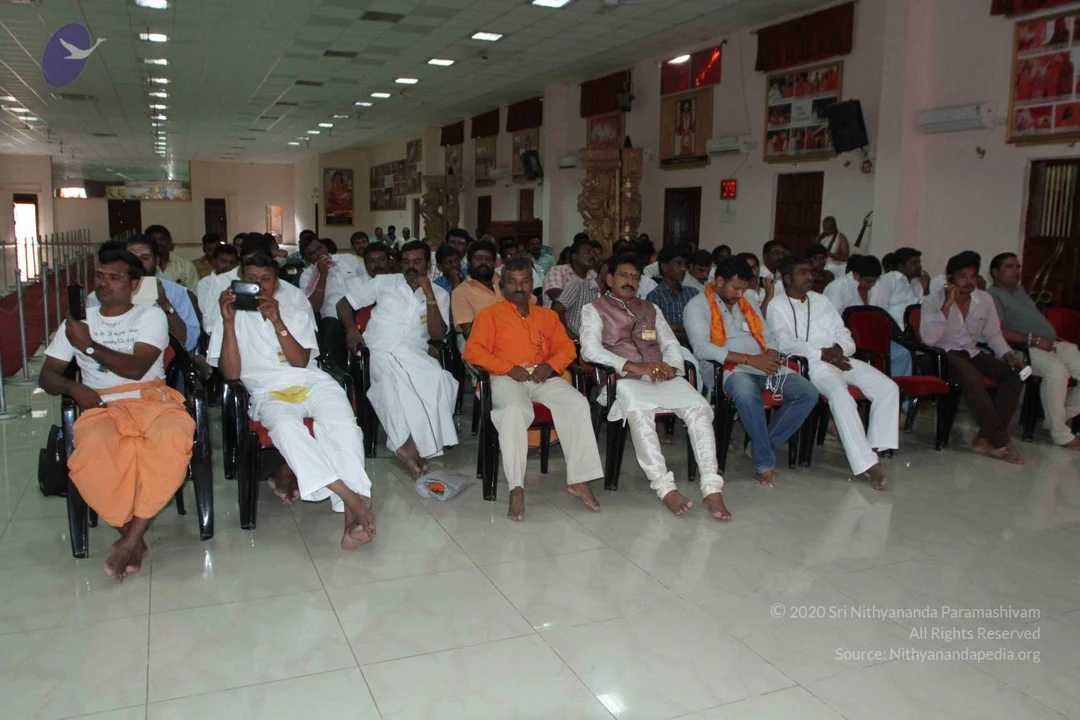
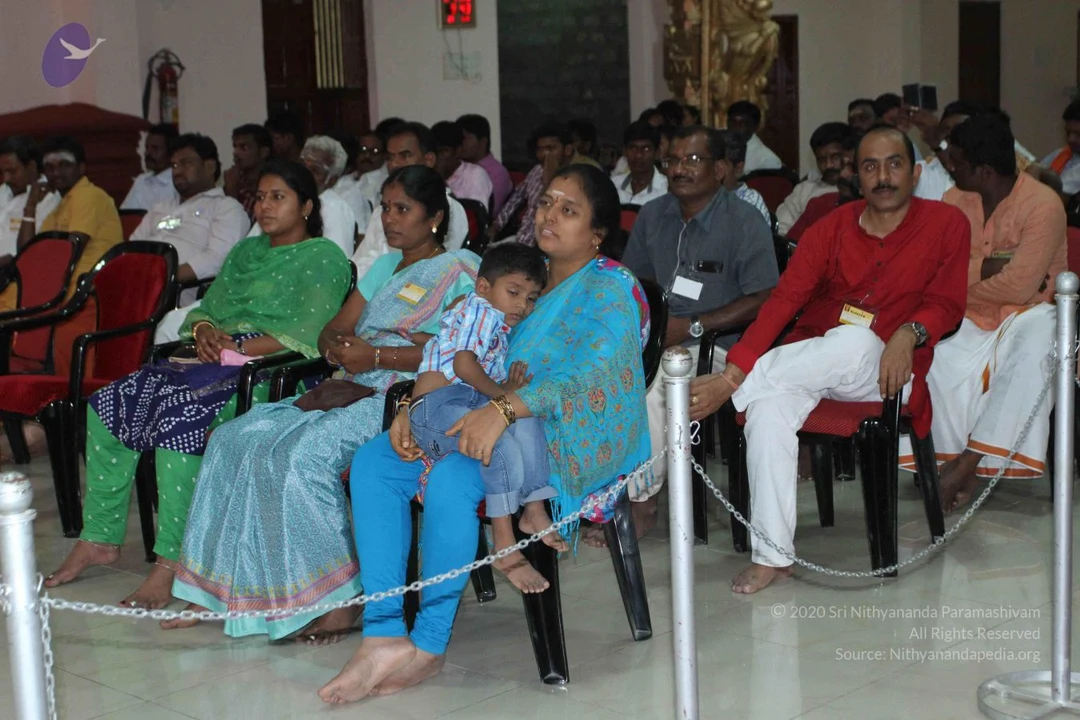
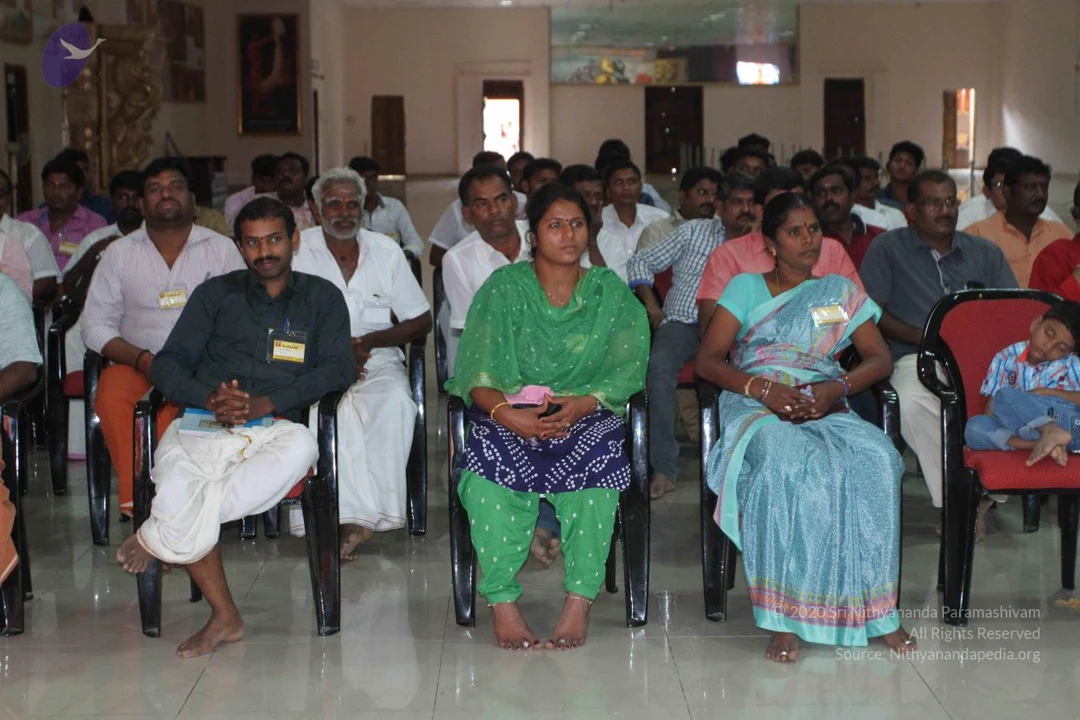
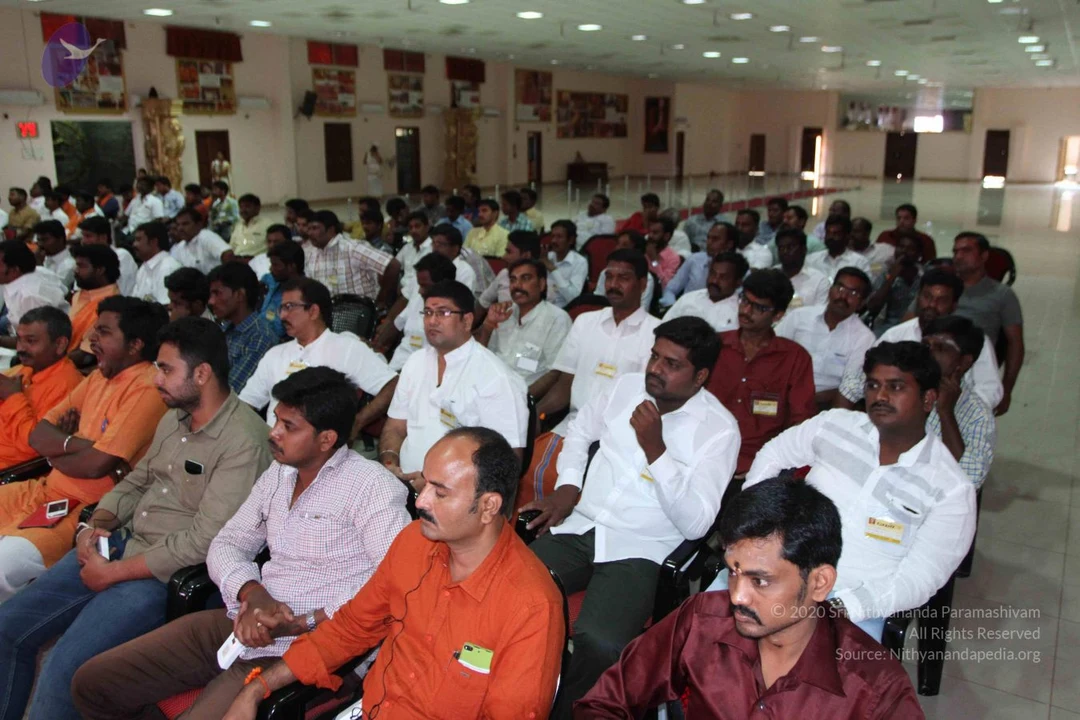
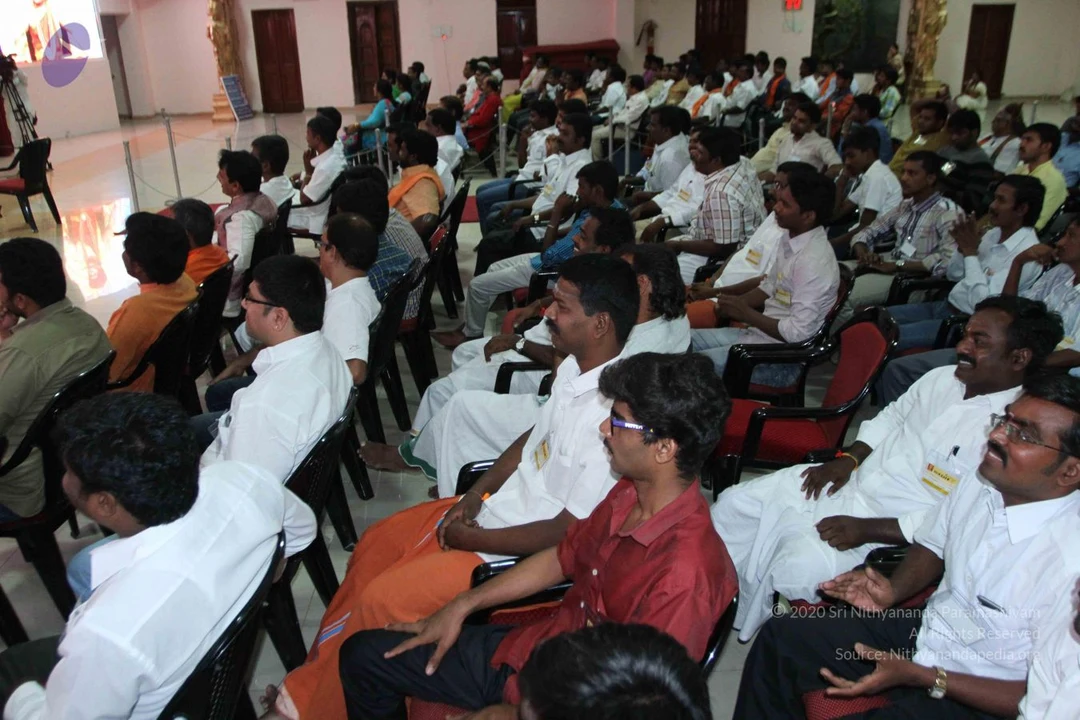
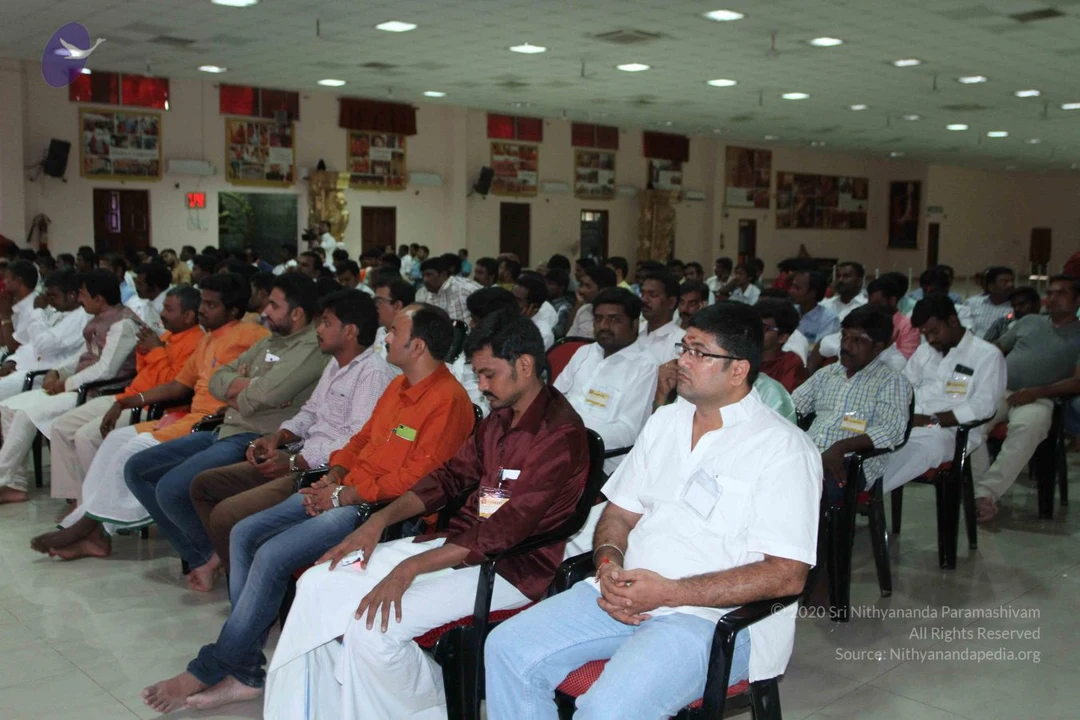
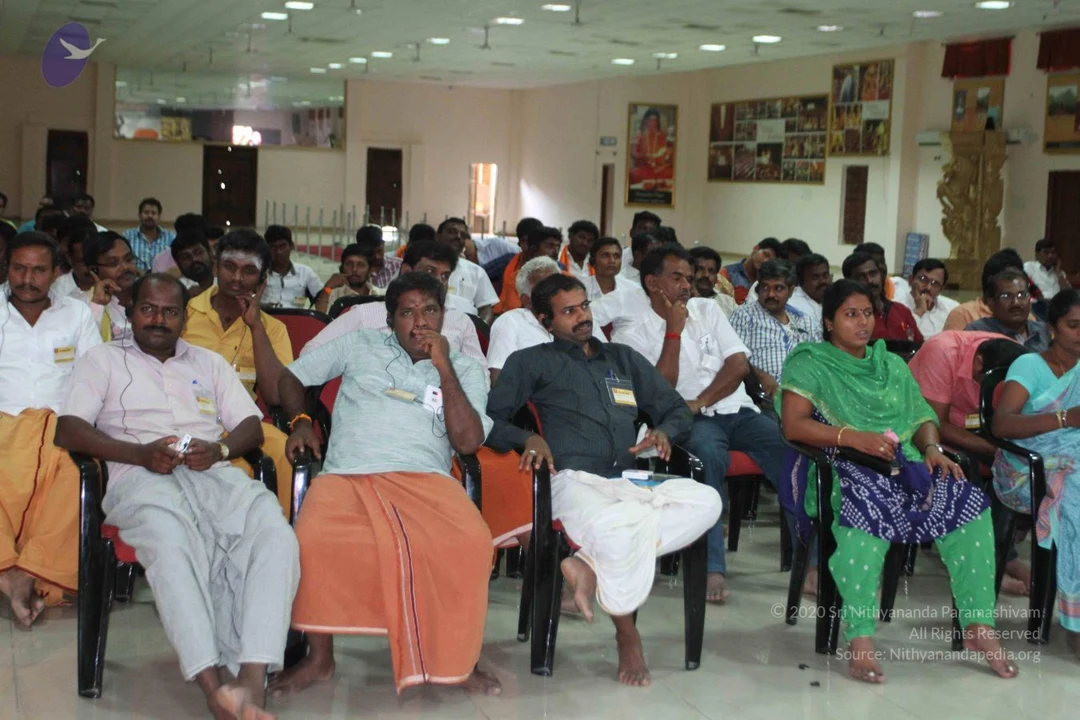
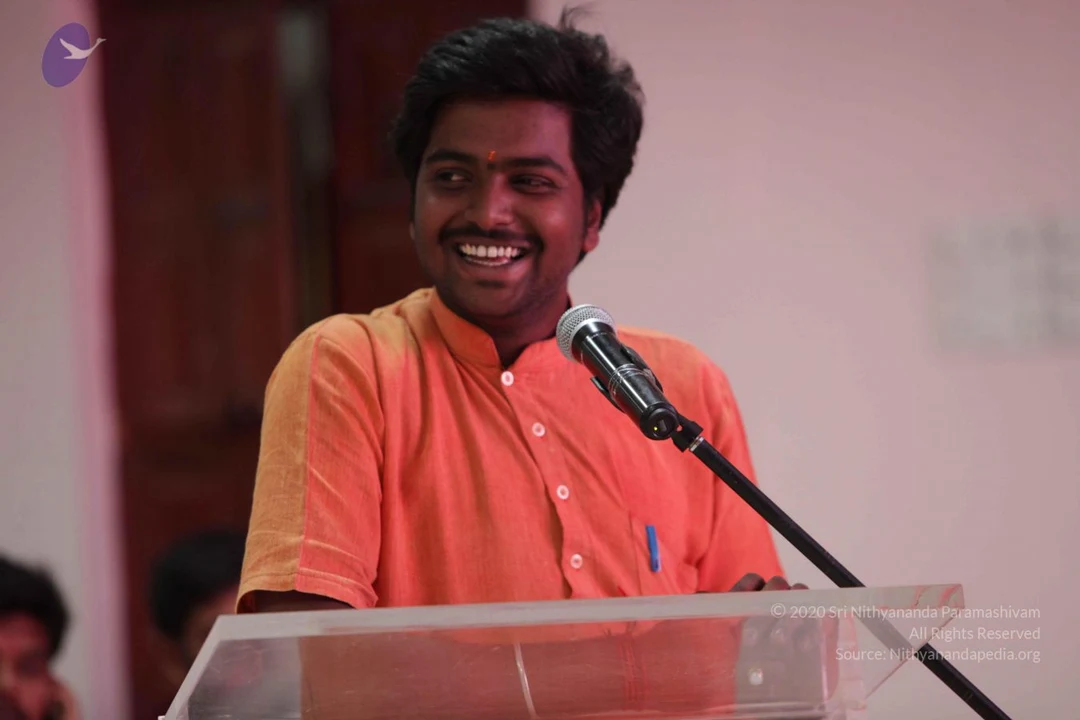
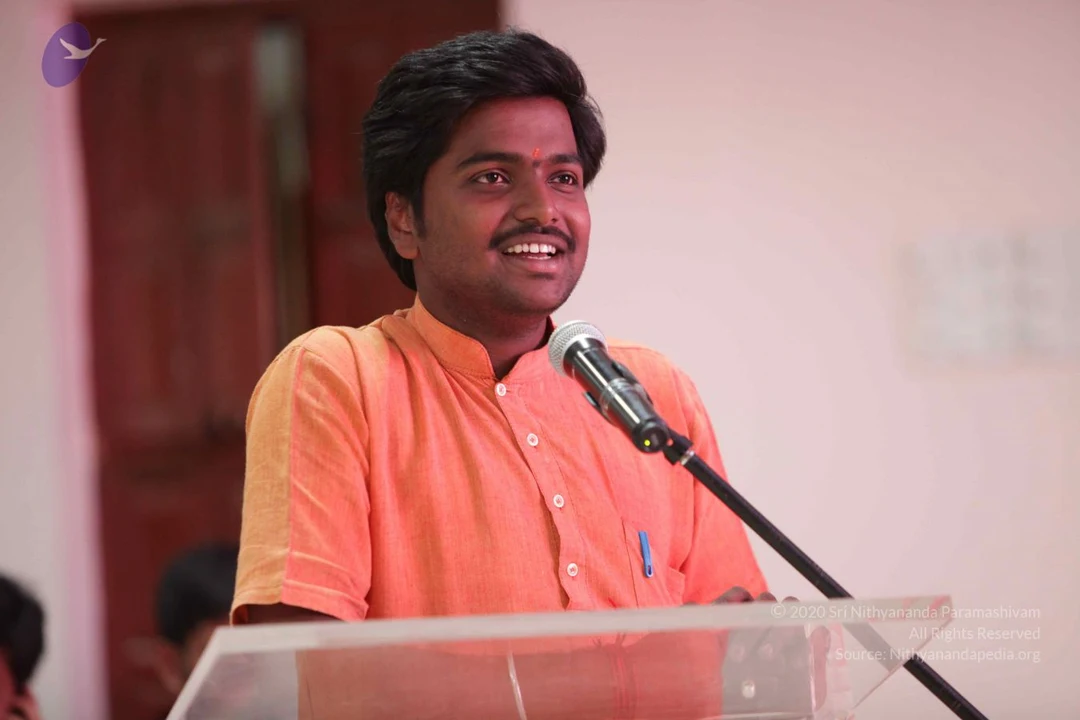
Seated audience in a bright hall with red-and-black chairs during a talk or Q&A session. In the foreground a woman in a green salwar kameez and a woman in a turquoise sari sit near a stanchion and chain; a woman in a blue top and blue shawl holds a small child in a striped shirt. A man in a red shirt and white dhoti sits at right. Behind them rows of men in white shirts and dhotis, some in saffron and yellow, sit facing forward; a person at the back raises a phone to take a picture. A golden deity murti stands in a niche on the upper right wall and framed photos hang on the wall. A digital clock shows red numerals.A photograph of a seated audience in a hall with cream walls, framed portraits and a wooden carved panel. Rows of men sit on black chairs on a glossy tiled floor. A man in front wears a white t-shirt and orange dhoti and holds a phone; the man beside him in white kurta raises a phone to take a picture. A man in an orange shirt and a man in a maroon shawl and white dhoti sit to the right, with a man in a grey shirt wearing an orange scarf. Several people hold up phones and tablets to record. A large wall clock with red numerals is visible. Overall, a seminar-style gathering.Photograph of a seated audience in a hall with cream tiled floor and wooden carved pillars, a framed deity picture on the wall and a red digital clock. Foreground men sit barefoot on black chairs with red seats. A man at left in white shirt and dhoti holds a phone up to take a picture. Next seat, a man in white dhoti with a bare chest of wrap and mustache sits with hand at face. Center, a man in orange kurta and cream trousers with a red vermilion mark sits beside a man in cream kurta and maroon vest. At right, a man in grey kurta wears an orange shawl and holds a mala. Many more men sit behind them in shirts and checked shirts. No one is identifiable as a person.A photograph of a seated audience in a large hall with cream tiled floors and red-cushioned black chairs. Many men sit facing forward, mostly in white dhotis and shirts; one in the front left wears an orange dhoti and white shirt and holds a phone, another in white holds a camera. A man in the centre wears an orange kurta, a maroon waistcoat and white dhoti; a man to his right wears an orange shawl over a light blue shirt. Bare feet rest on the floor. Behind them, wall portraits, framed pictures and a carved wooden panel decorate the walls, with a speaker mounted high on the right. No clearly identifiable speaker is visible in the frame.Photograph of a seated audience in a hall with a tiled floor, red and black chairs, and a golden ornamental figure in the upper right. In the foreground, a woman in a teal sari and a woman in a green salwar with purple patterned skirt sit beside a woman in a blue sari holding a young child in striped shirt and jeans. To the right, a bald man in a red kurta and white dhoti wears a visitor badge, and another man in an orange shirt and white dhoti sits nearby. Behind a chain barrier, rows of men in white and light shirts listen attentively toward the front of the hall.A seated audience fills rows of black chairs in a bright hall with polished white floor tiles. In the foreground a man in a dark shirt and white dhoti sits with hands clasped and an ID badge on his chest, beside an older man in a white shirt and white dhoti. A woman in a green salwar and purple patterned top sits centre-front with bare feet, and a woman in a teal sari with a gold bangle sits to the right. A young boy in a blue striped shirt sleeps on a red chair at the far right. Behind them a large audience of men and women in white, pink and orange clothing listens attentively, and a framed painting hangs on the back wall.

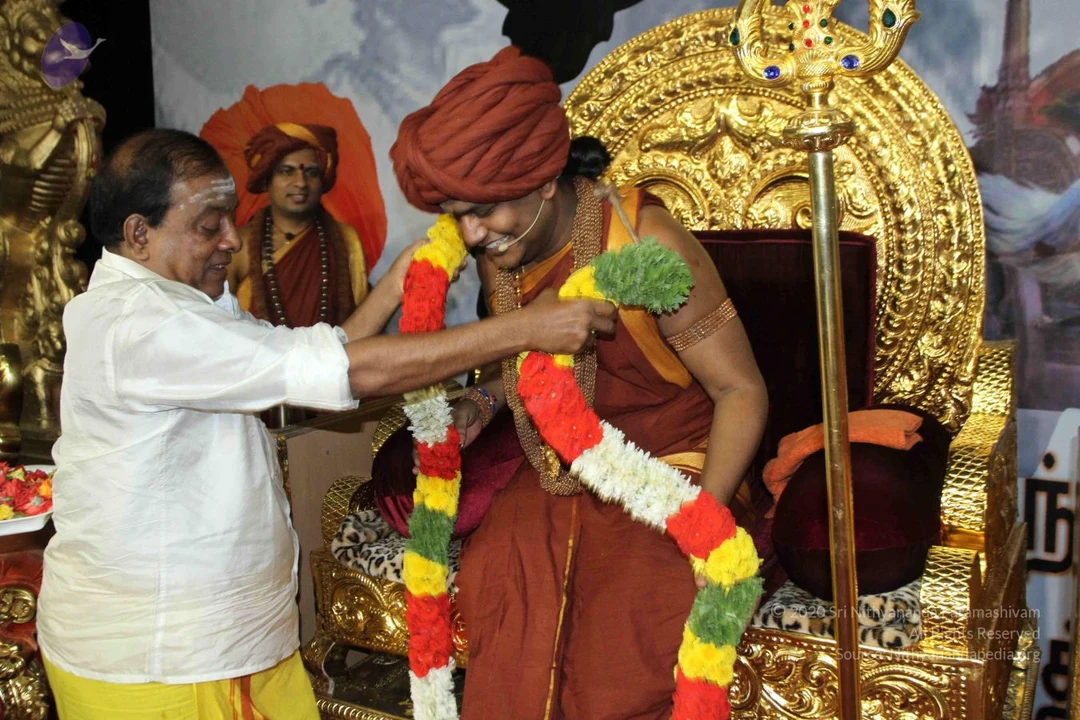
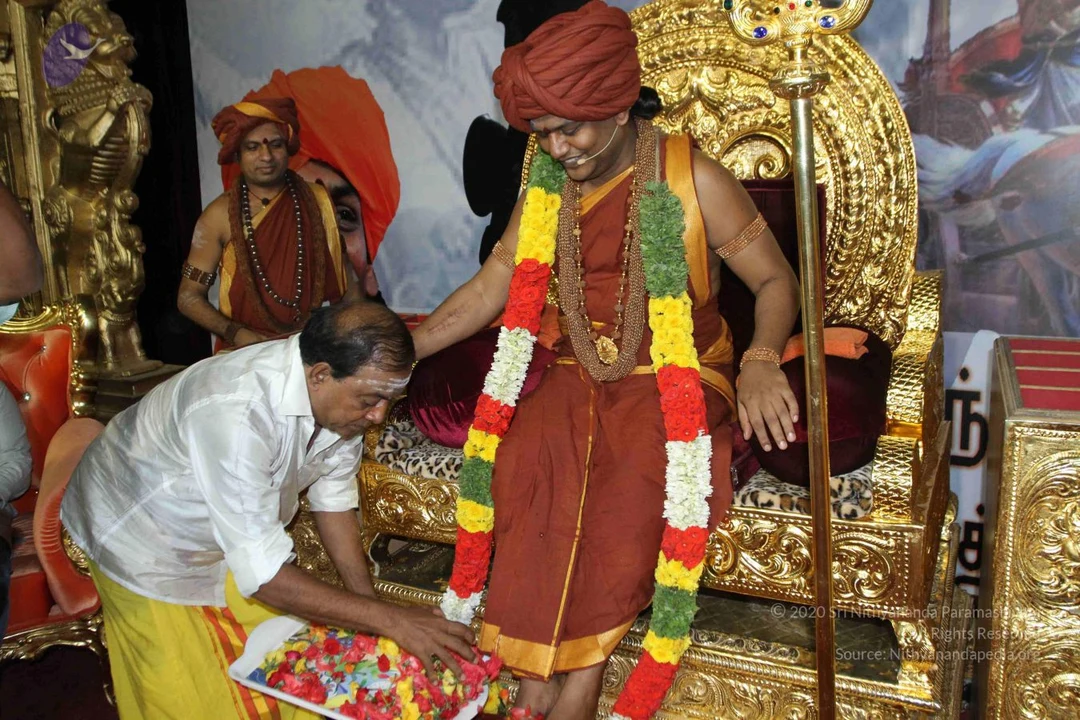
Award Giving Function-1

62 photosSource gallery
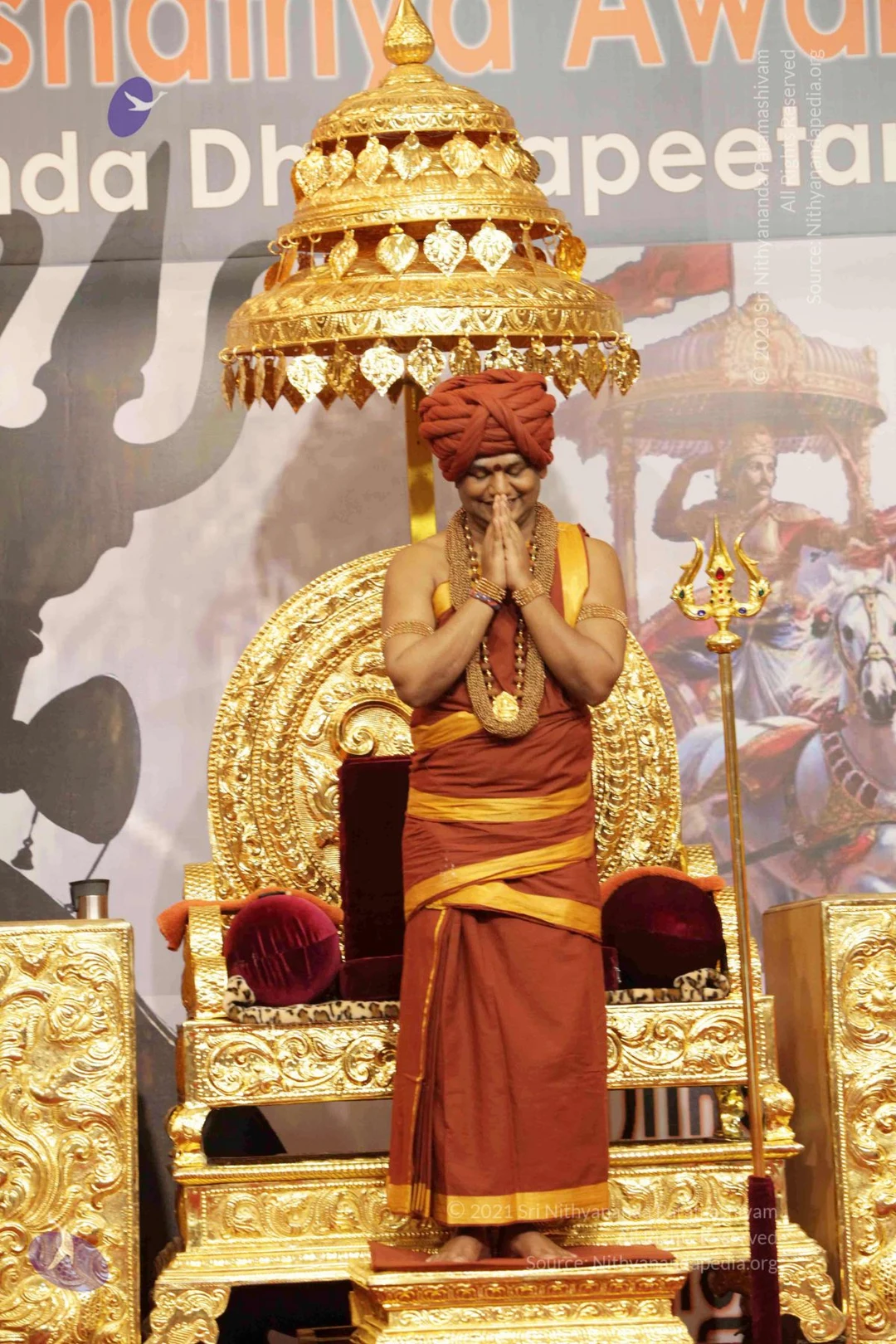
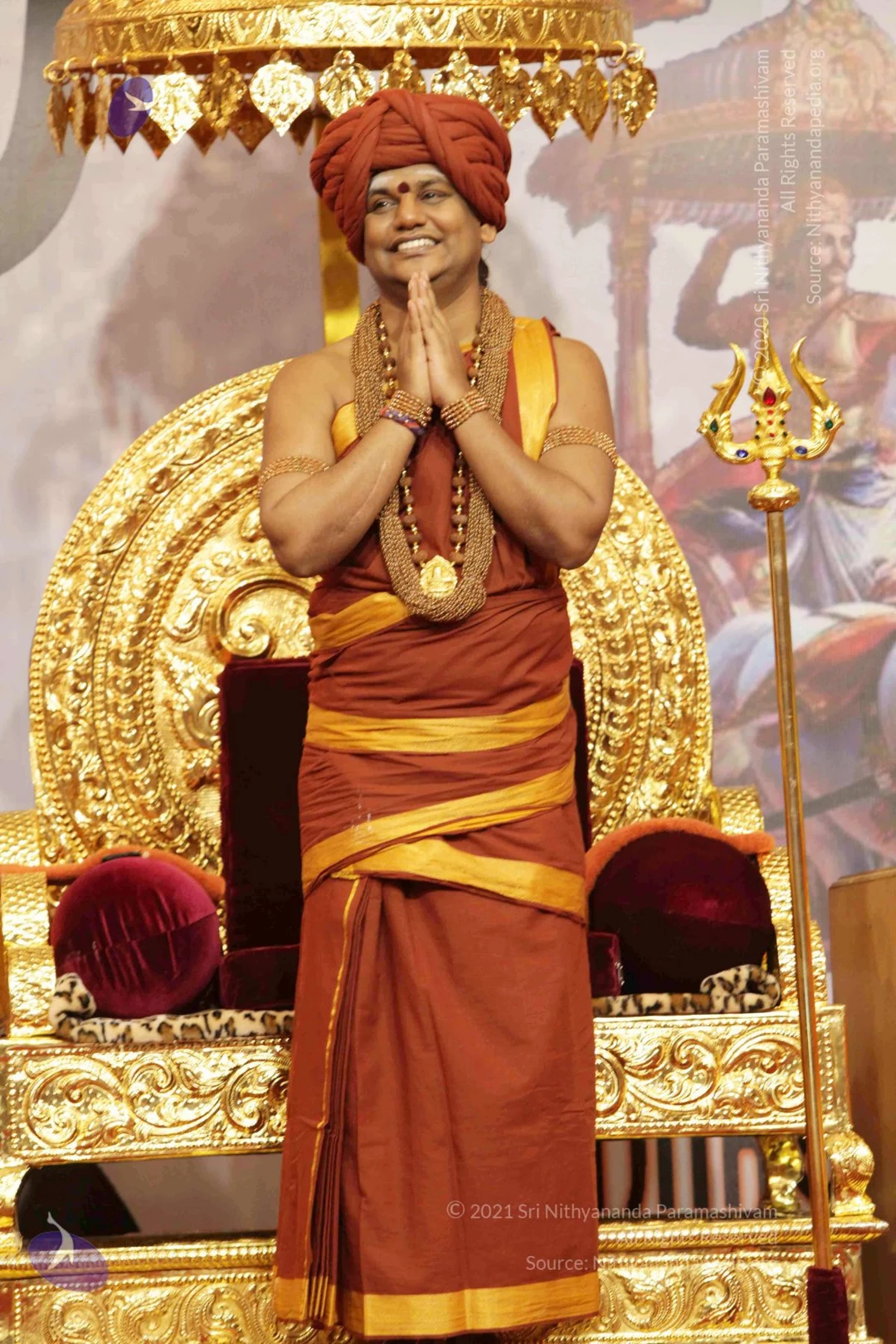
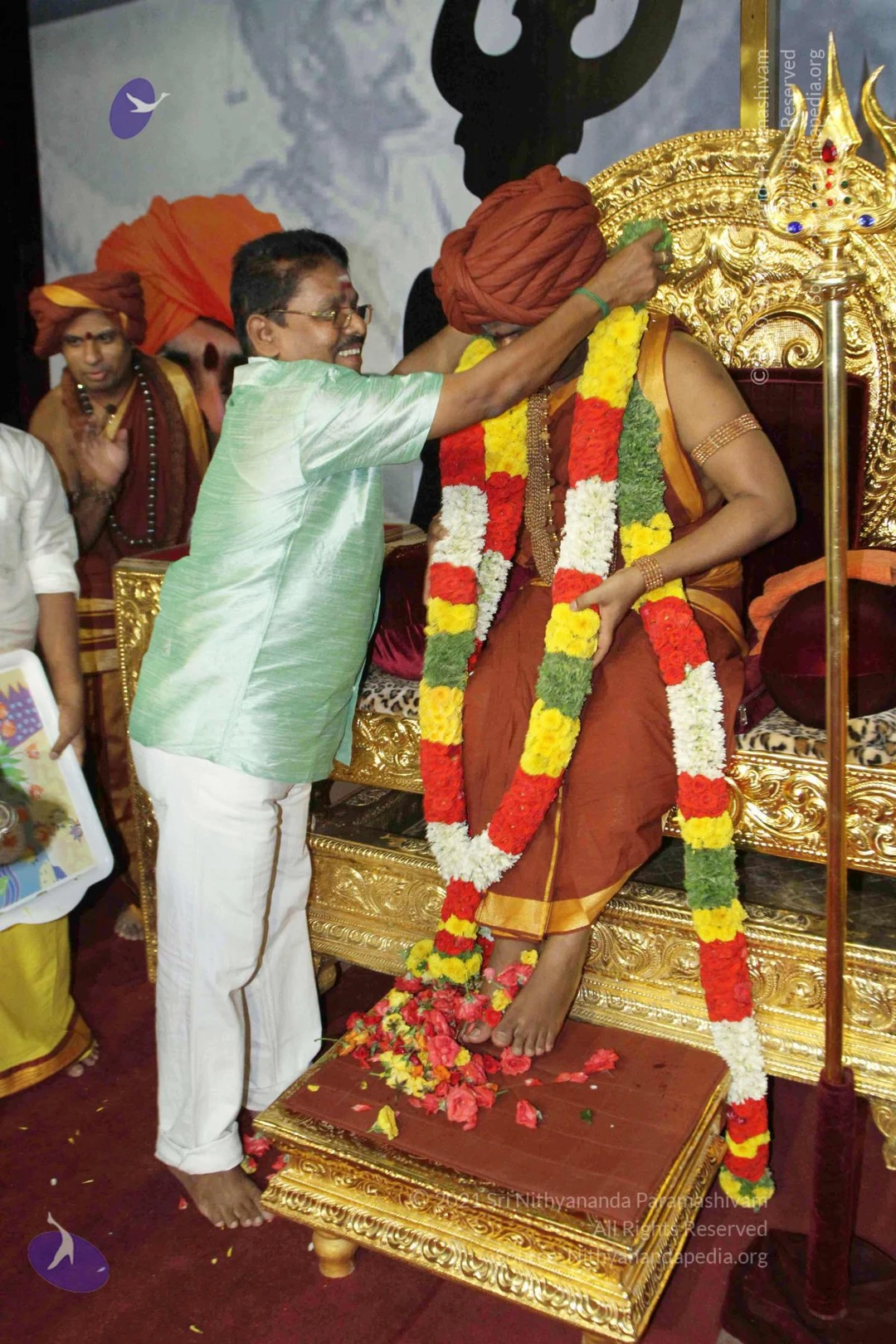
A person stands barefoot on a raised golden platform before an ornate golden throne, palms pressed together in anjali mudra with eyes closed. He wears a rust-red turban, a rust-red dhoti-style garment with gold borders, a gold shoulder band, gold armlets and layered gold necklaces with a rudraksha mala. Above the throne hangs a tiered golden canopy with leaf-shaped pendants, and a golden trident stands to the right. The backdrop shows a banner with partial text and a painted chariot scene with white horses. Appearance cues are consistent with a person during an honouring or greeting moment.A man in a rust-red turban and rust-red robe with gold borders stands before an ornate gold throne with red velvet cushions, hands pressed together in namaskar and smiling. He wears layered gold and bead necklaces, gold armbands and bangles. A golden trident stands to his right, and a painted background shows a royal umbrella and chariot scene. Probable Swamiji (appearance cues: rust-red turban, layered ornate gold necklaces and armbands, saffron-toned robes), seated-throne setting, in person as the single visible figure.A smiling man in a rust-red turban with a red bindi sits on an ornate gold throne with a gold-embossed back and red velvet cushions. He wears a rust-red and gold-bordered dhoti and shawl, a thick gold necklace with rudraksha beads, and gold armlets. A gold trident with jewelled tips stands beside the throne, and a painted backdrop of a deity figure and chariot appears behind. Appearance-based cues of the throne, turban, gold ornaments and rudraksha malas suggest Swamiji (probable), seated in person.A man seated cross-legged on an ornate gold throne with a leopard-print cushion, wearing a red-orange turban with a red bindi, orange-saffron robes with gold borders, multi-strand rudraksha and gold bead necklaces, gold armlets and bangles. His hands rest folded in his lap as he smiles, with a small headset microphone near his mouth. A gold trident with red and green gems stands beside the throne, with red velvet bolsters and a gold-painted backdrop behind him. Swamiji (probable): the orange robes, turban, rudraksha malas and ceremonial gold ornaments fit the presentation, and the page indicates he is present at this event, though the identity is inferred from appearance and context only.A smiling man with closed eyes sits cross-legged on an ornate gold throne with a canopy of gold leaf-shaped finials above him. He wears a rust-orange turban, a red dot on his forehead, an orange robe with a gold-yellow border, multi-strand rudraksha and gold beaded necklaces with a gold pendant, and gold armlets. He holds his hands together in his lap, with bare feet resting on a leopard-print cushion beside maroon velvet bolsters. Behind him is a painted backdrop of a traditional temple scene. a person: the appearance cues include the saffron-orange robe, rudraksha malas and ornate gold necklaces, seated on a throne in a presiding role.A seated man in a red-orange turban and orange-red saffron robes with yellow borders sits cross-legged on an ornate gold throne with red velvet cushions and leopard-print cloth. He wears layered beaded rudraksha-style malas and a gold ceremonial necklace, gold armbands and bracelets, and a red tilak on his forehead, with his right hand raised in discourse. A golden trident stands to the right of the throne against a painted backdrop. The scene appears to be a stage teaching session. Appearance cues include the turban, saffron robes, malas and gold regalia, so this is a probable Swamiji in person.

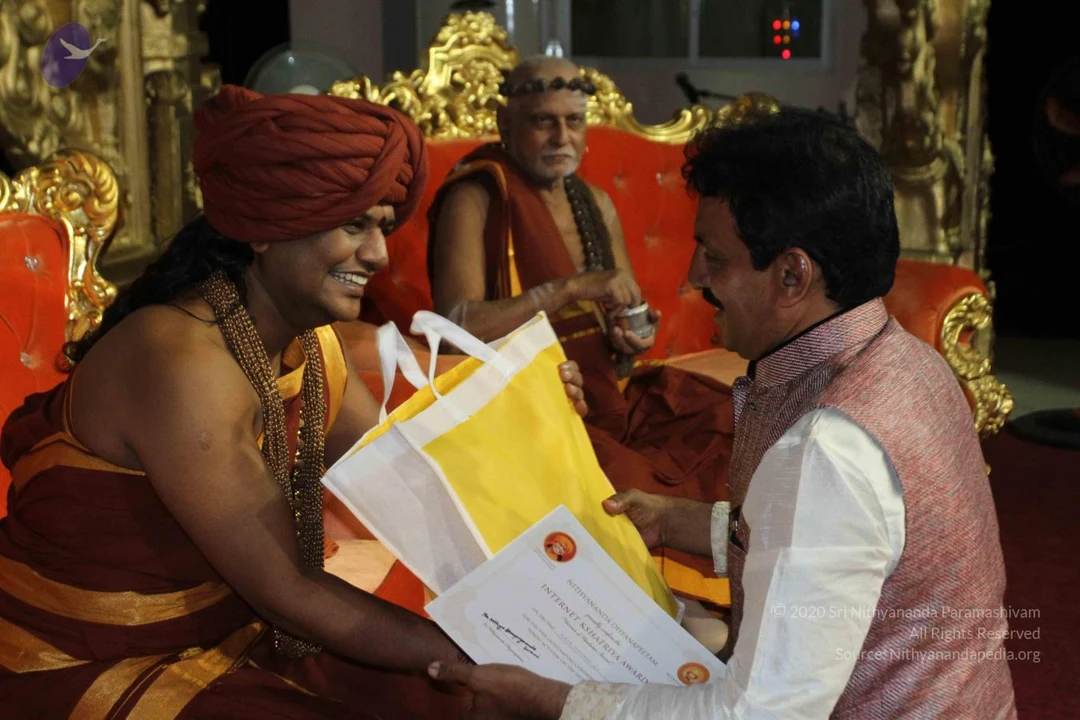
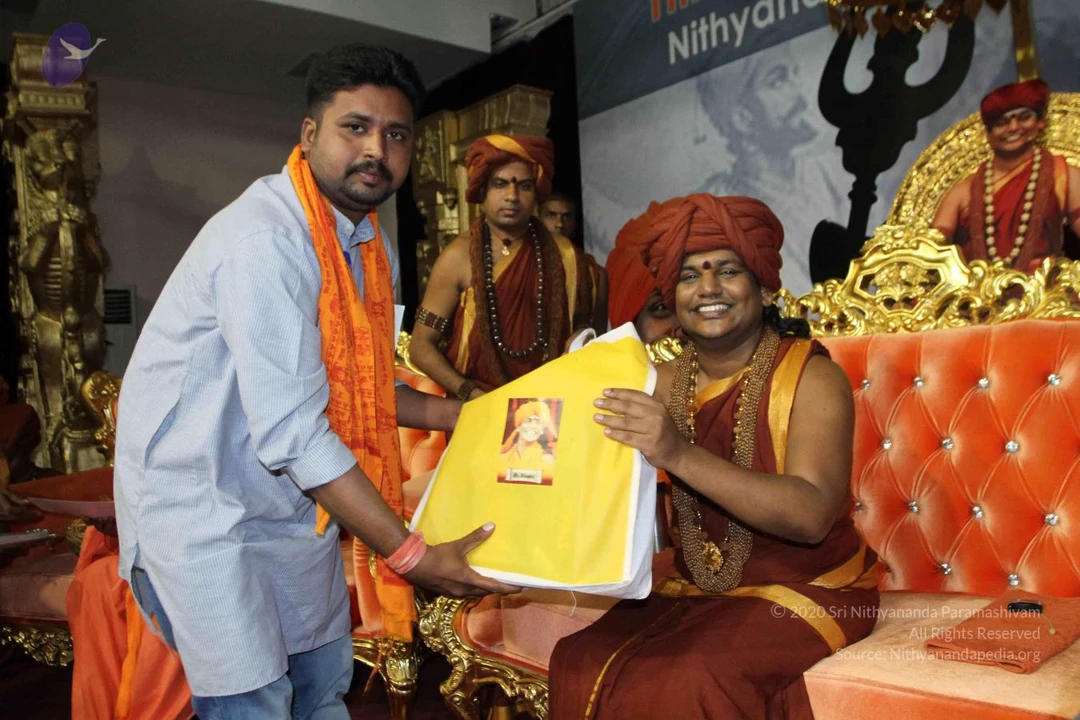
Awarding Giving Function

32 photosSource gallery
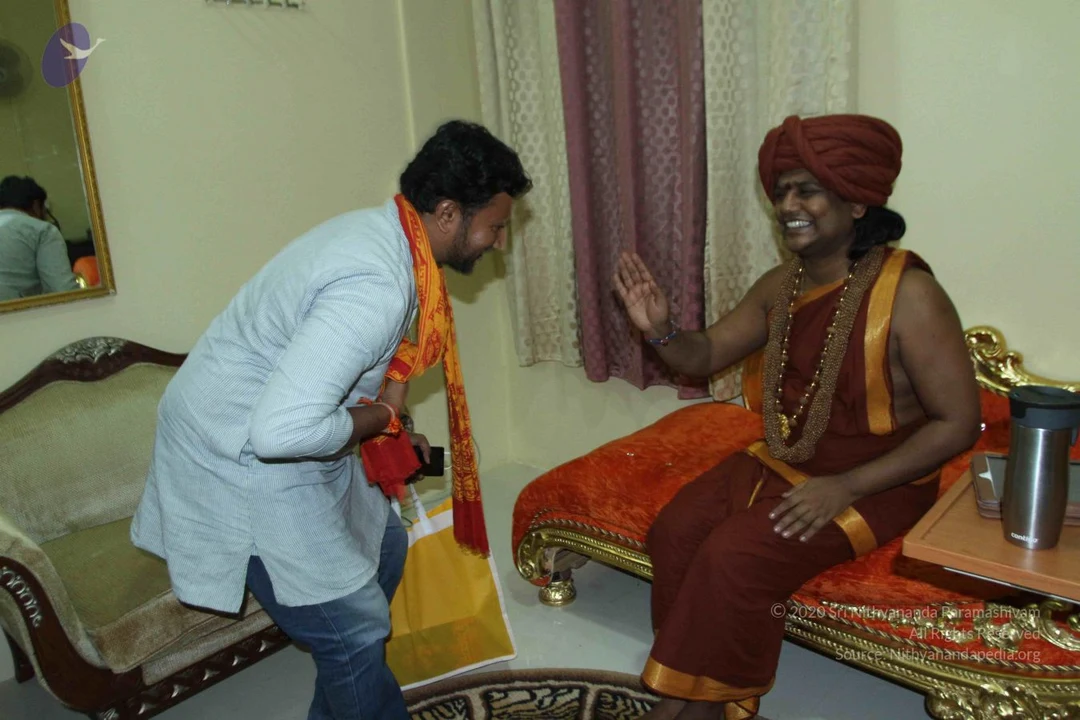
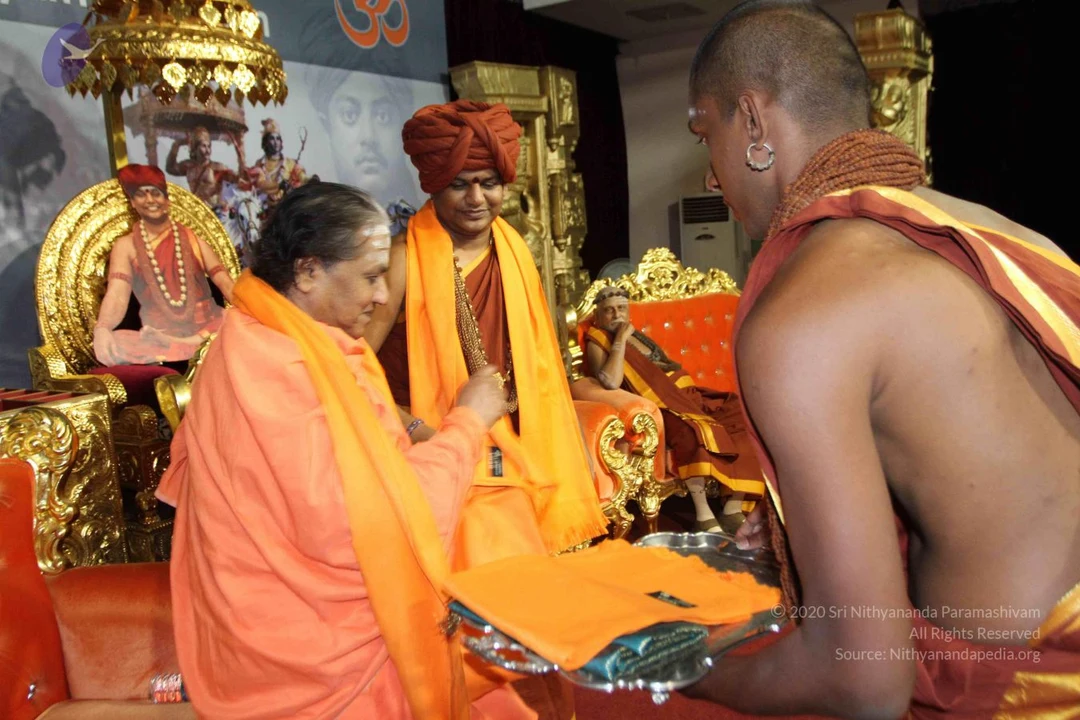
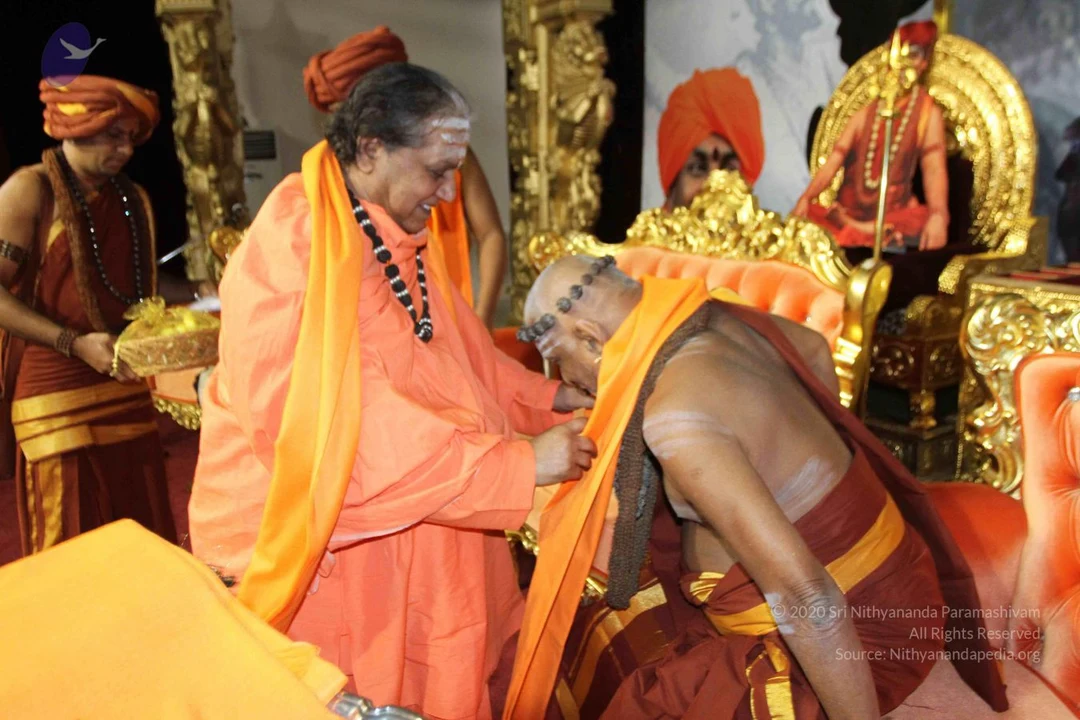
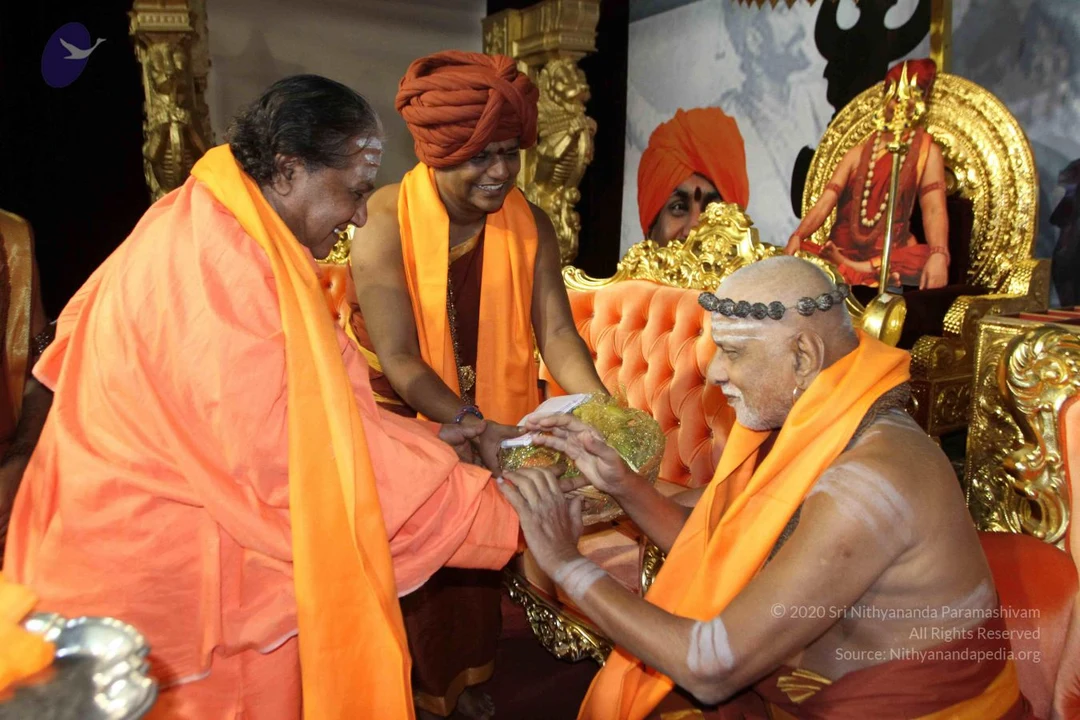
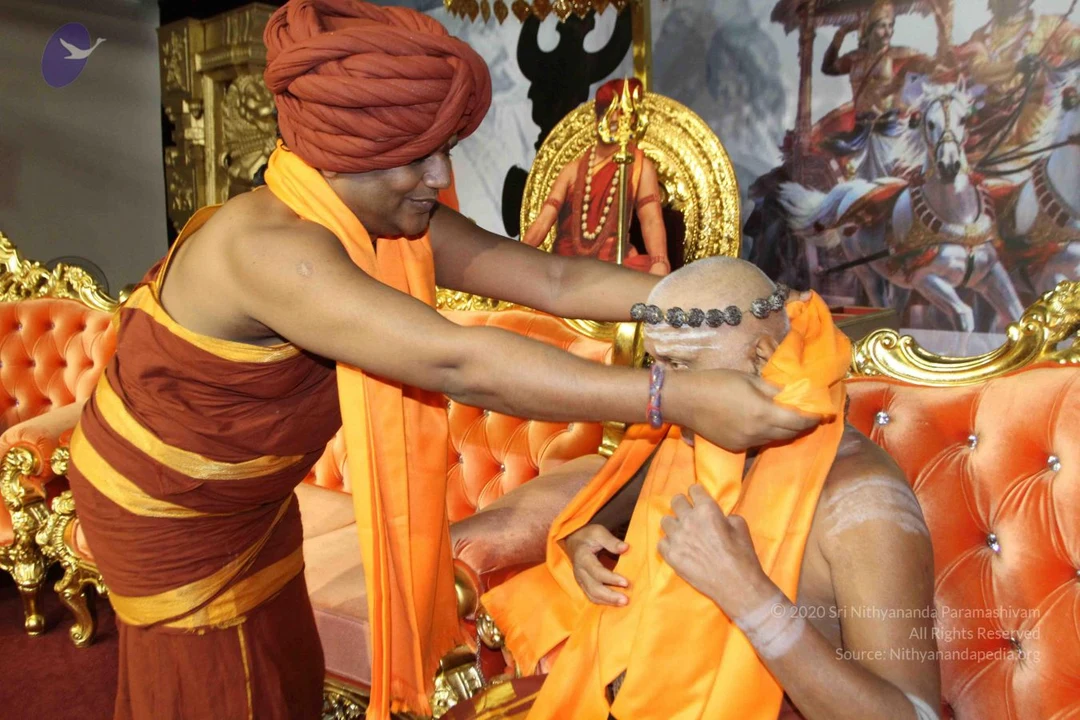
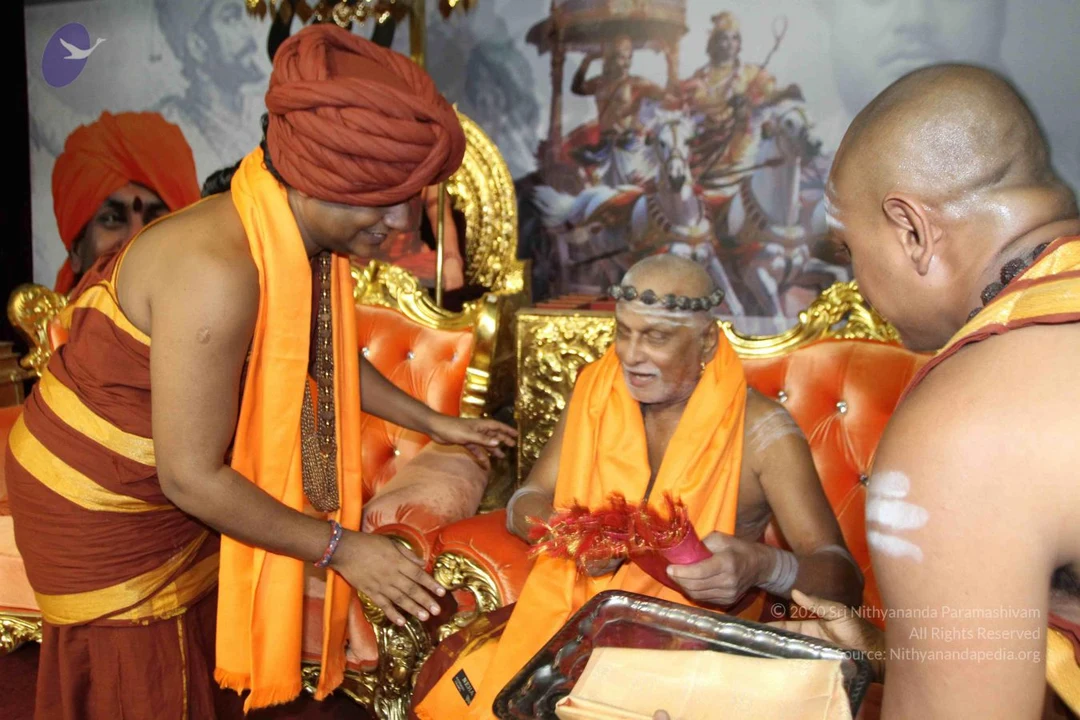
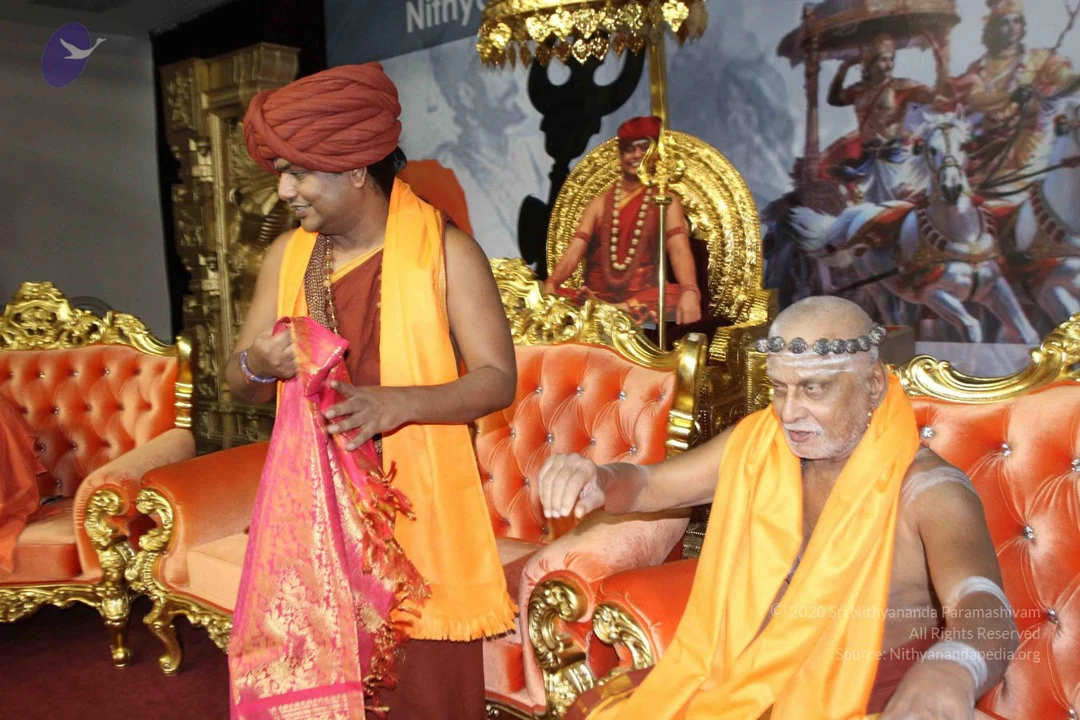
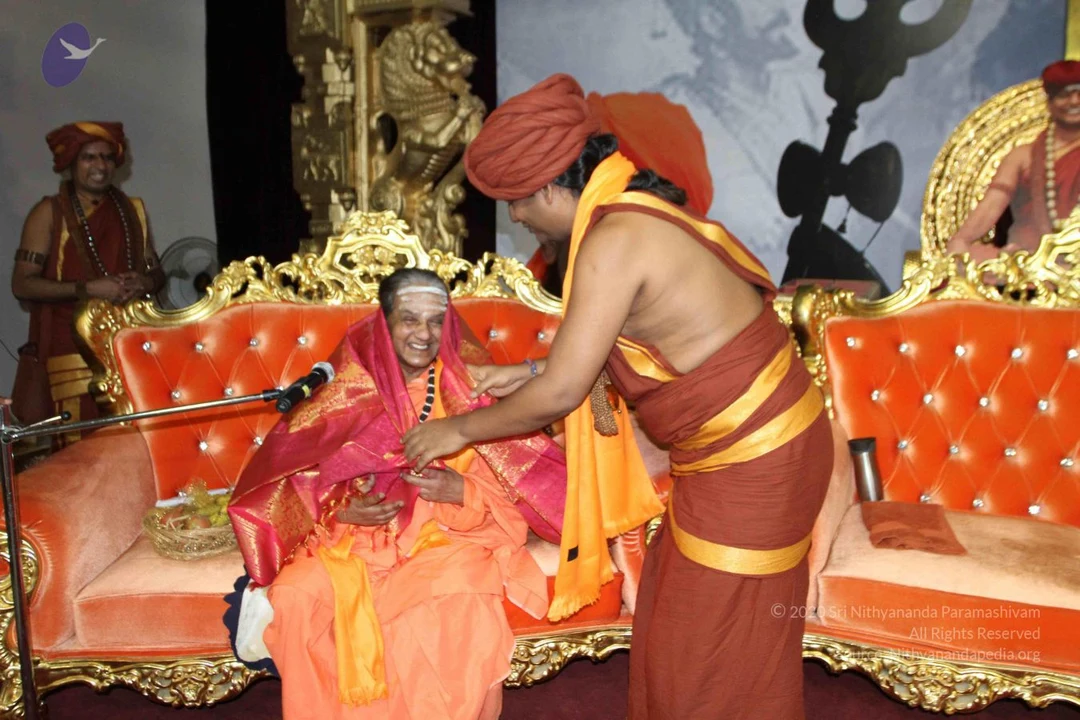
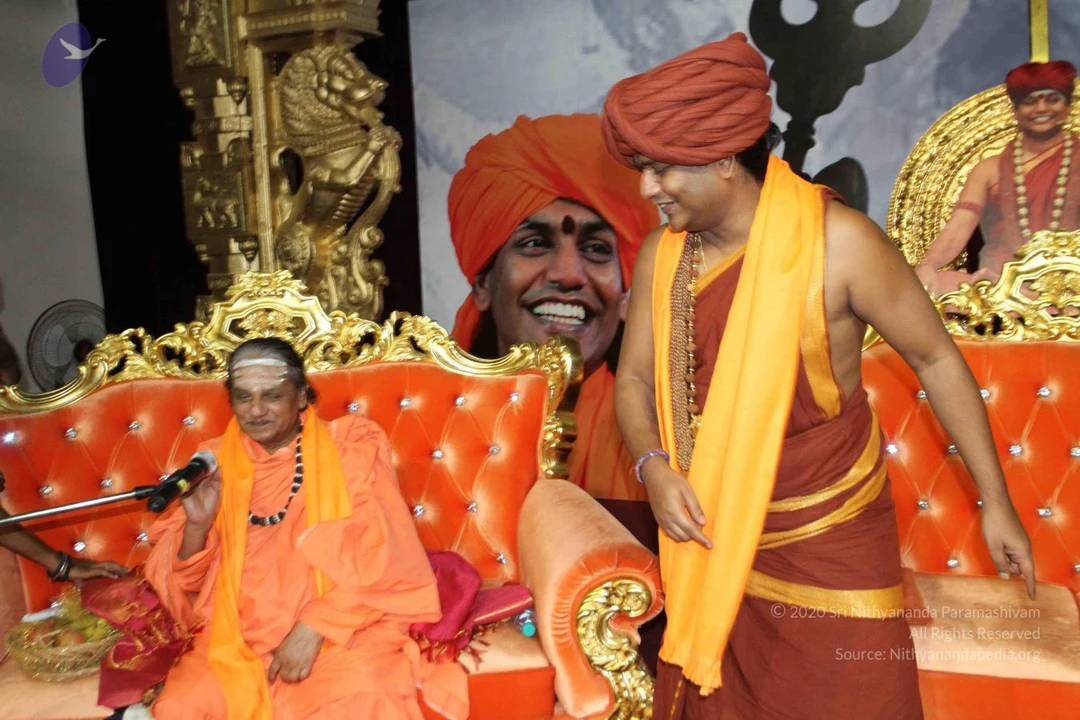
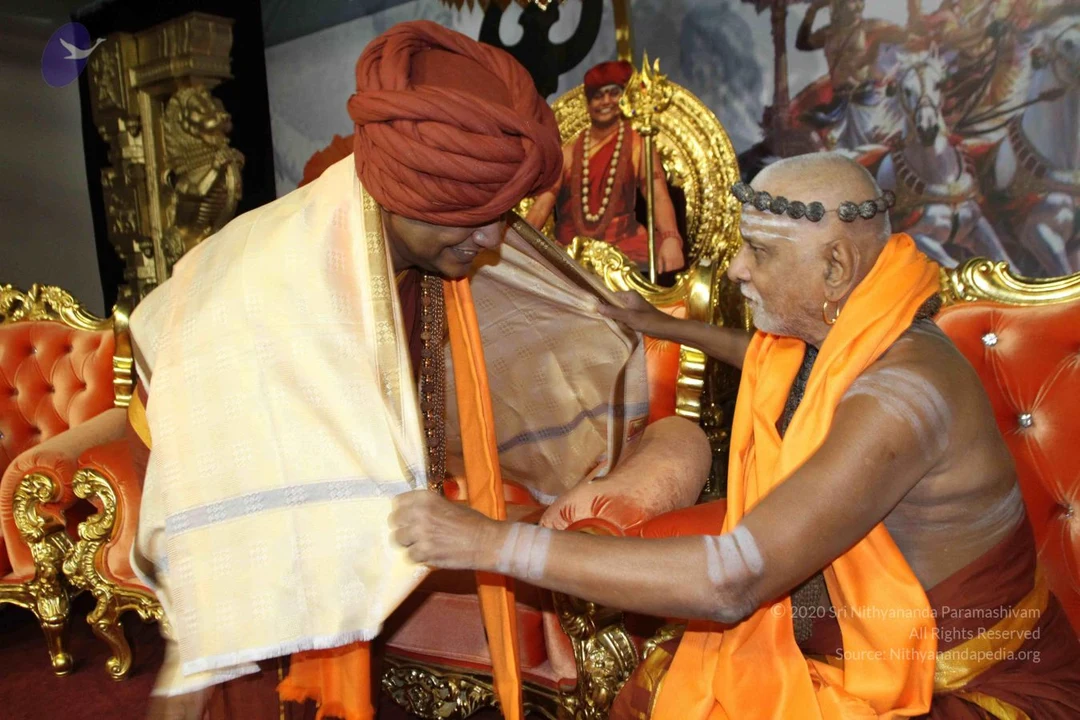
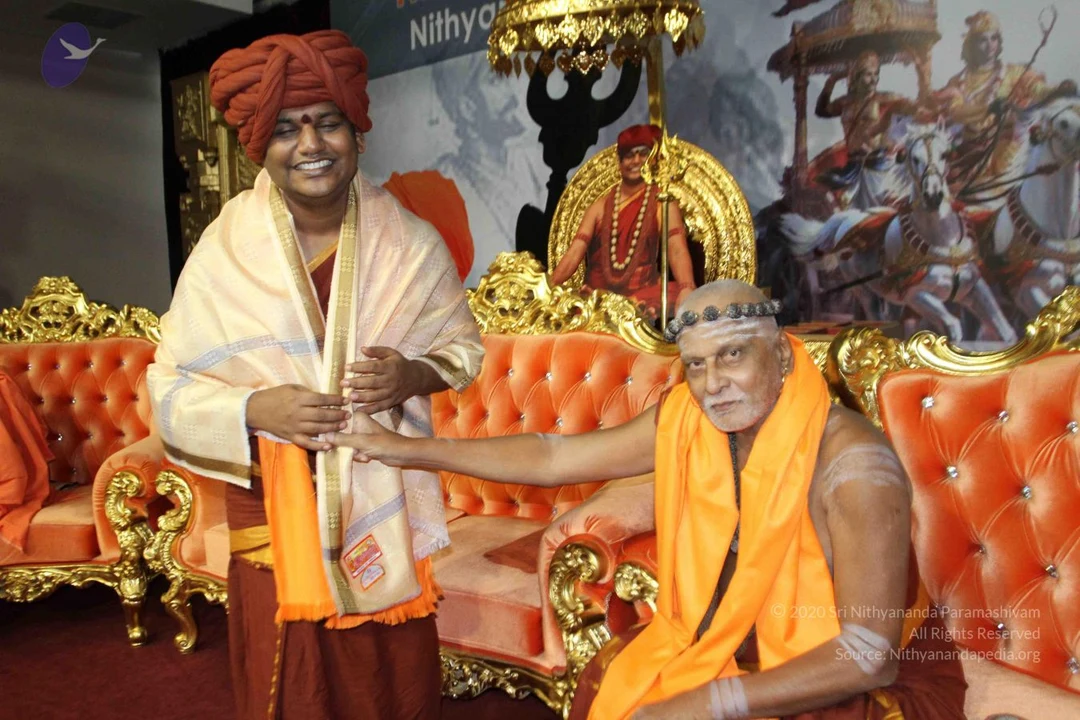
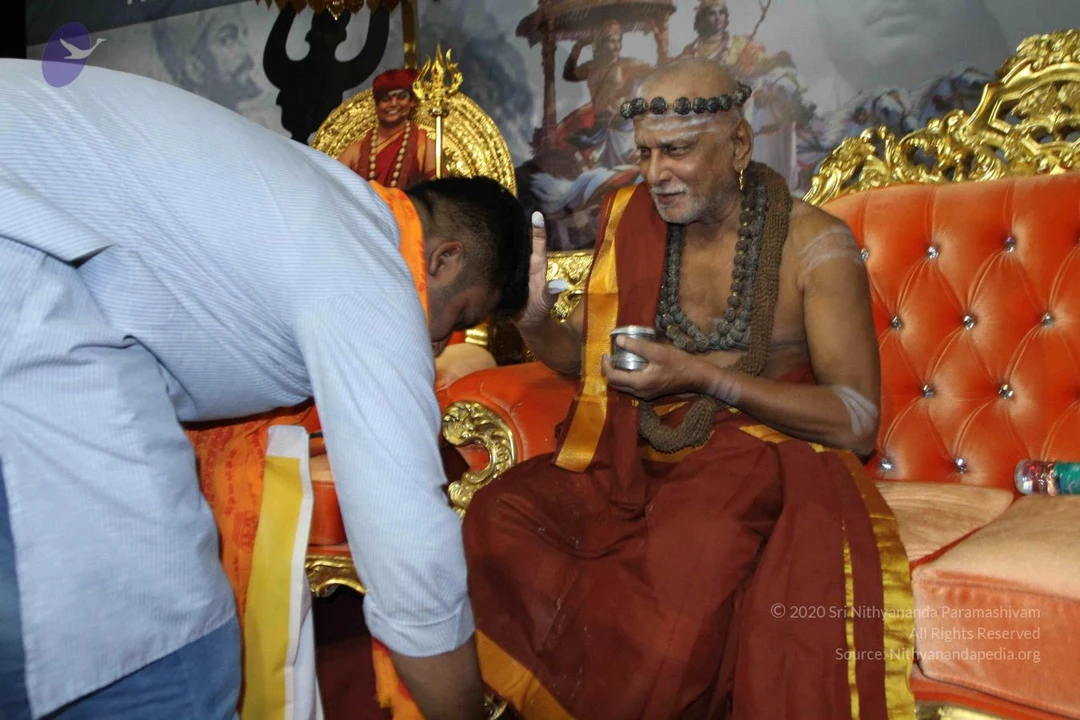
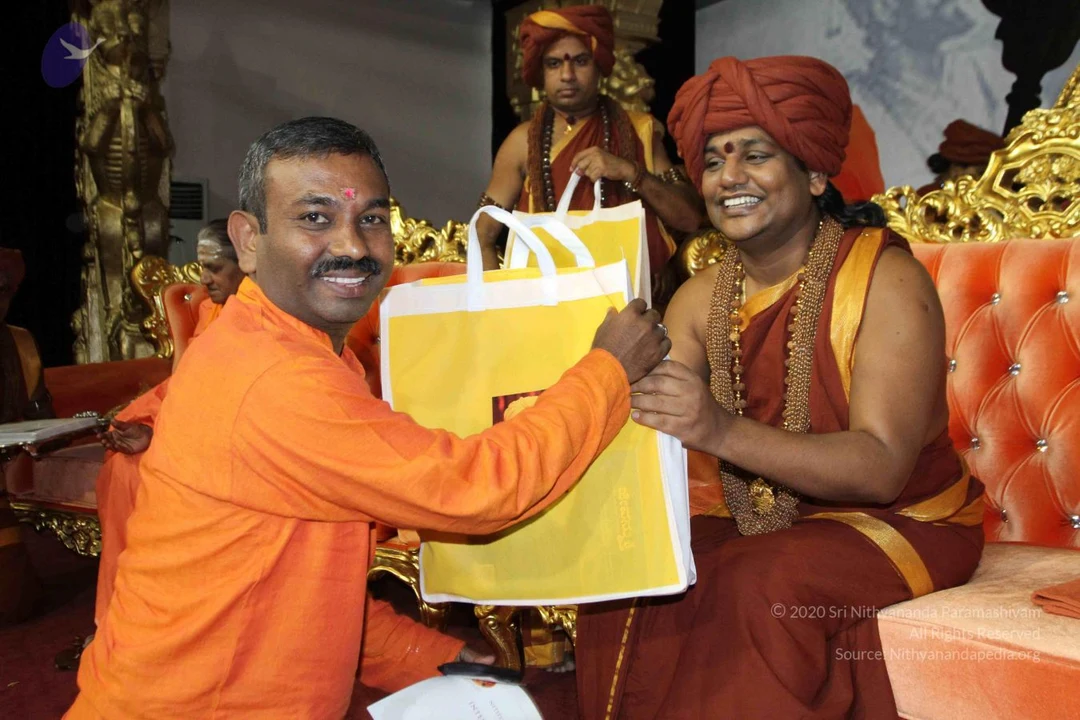
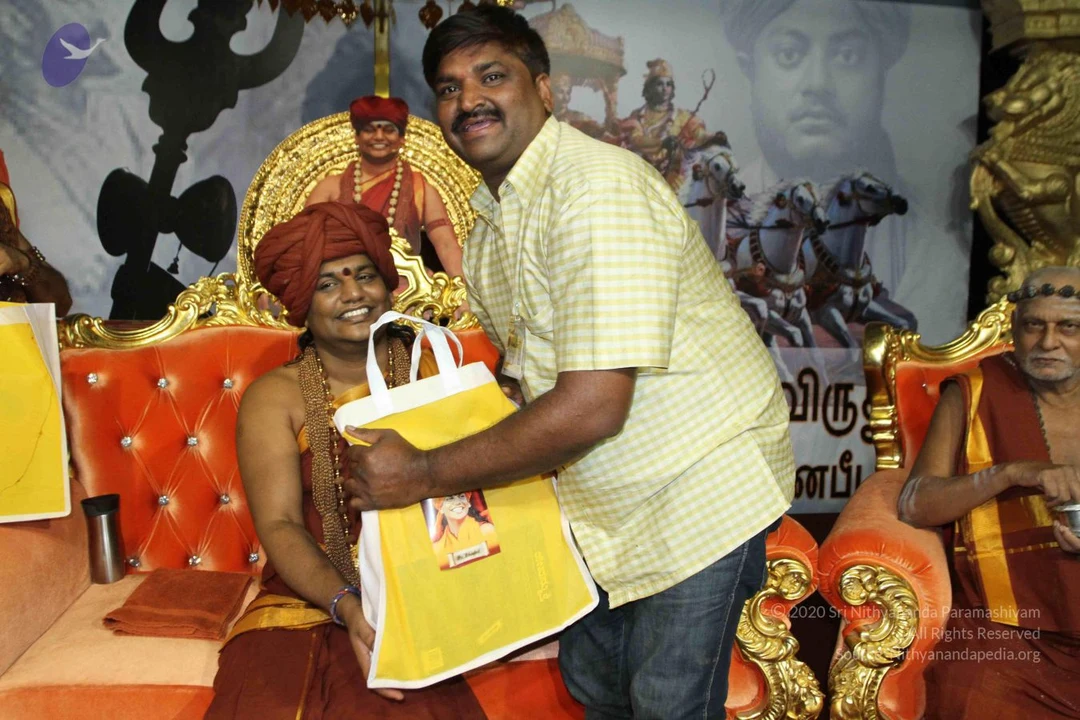
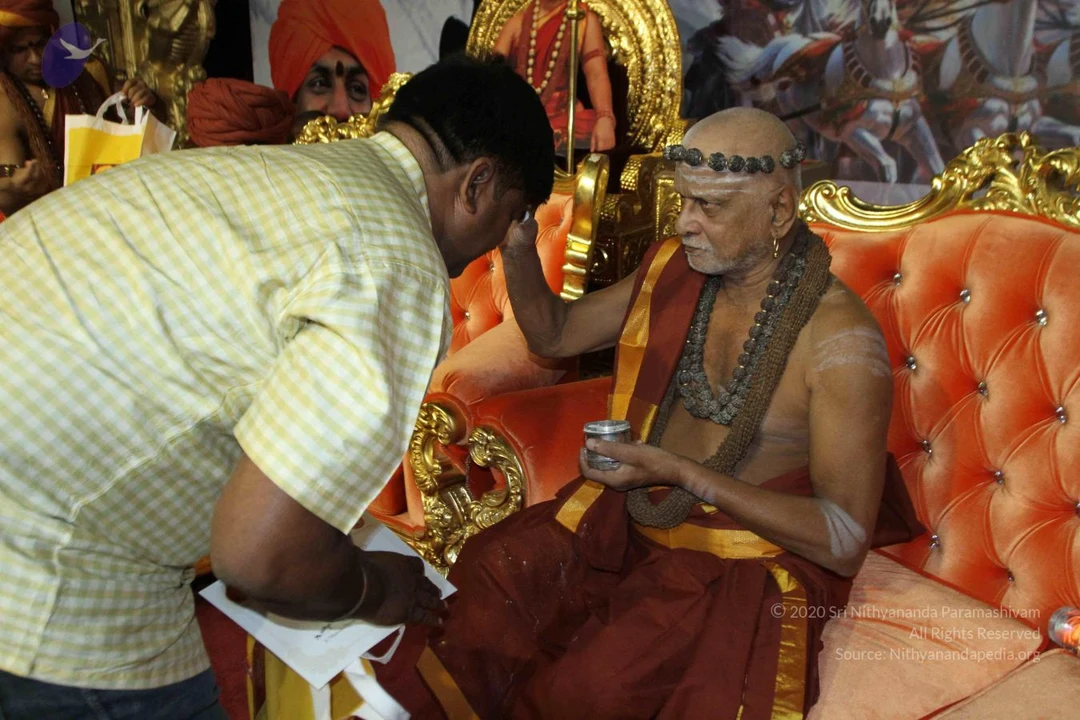
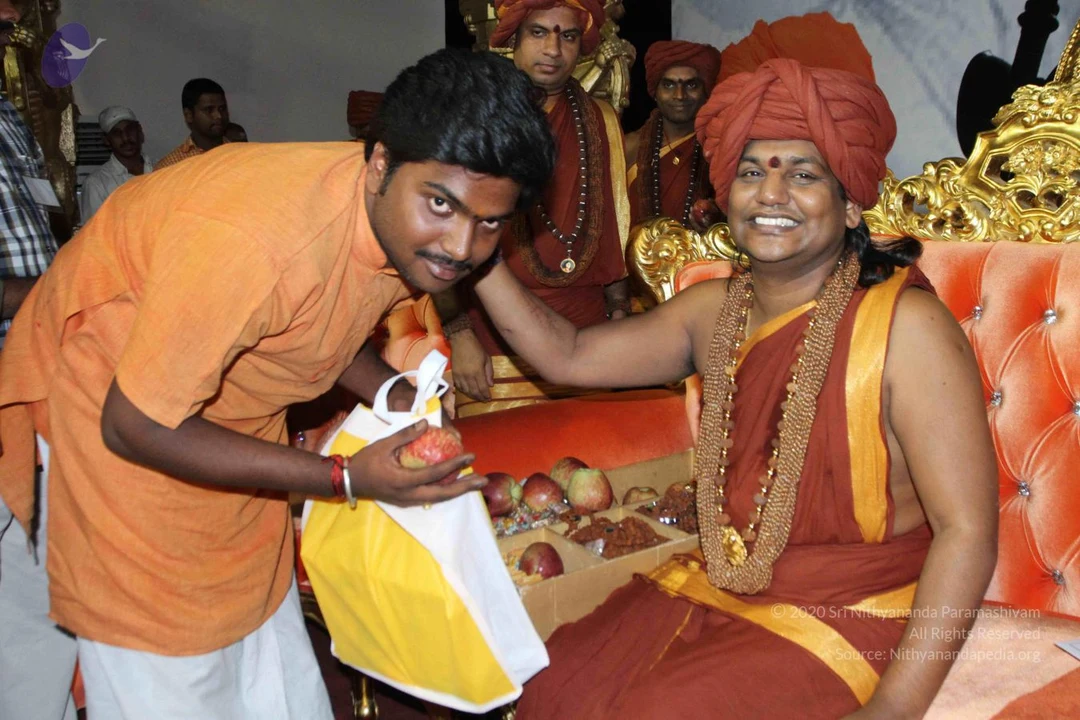
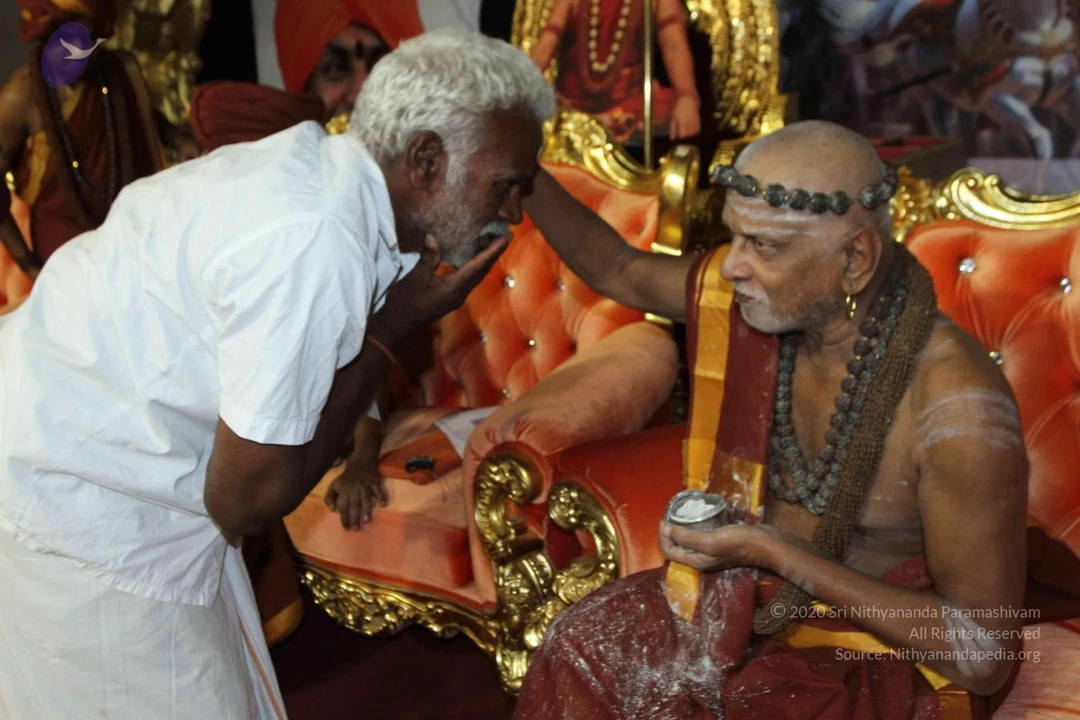
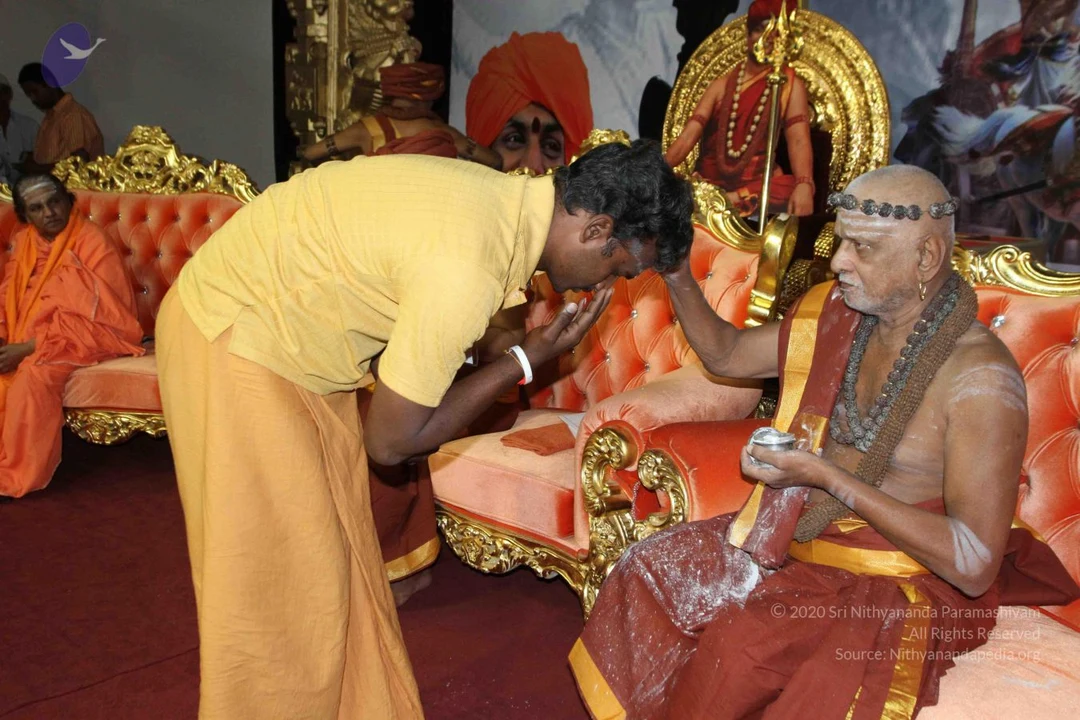
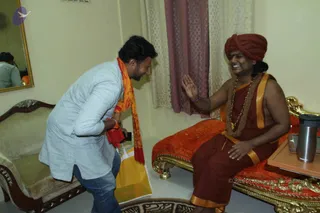
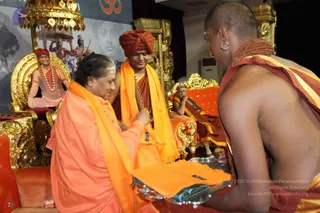
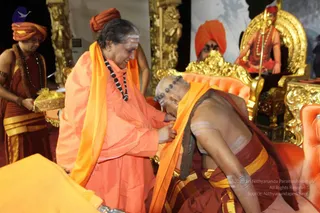
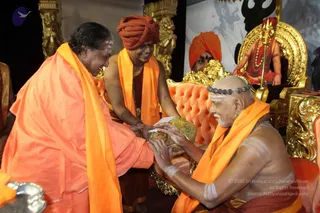
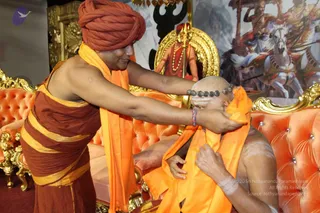
A photograph of a man in a light blue-grey collarless kurta and jeans bending forward with an orange-and-red scarf draped over his shoulders, holding a phone and a yellow cloth bag. Facing him, a seated figure in a deep maroon robe with gold-edged trim wears a maroon turban, a layered beaded necklace and a gold chain. He sits on an orange velvet ornate gold-trimmed couch, one hand raised in greeting, smiling broadly. A steel tumbler and a wooden side table are at right; a sofa, mirror and sheer curtains are behind them. The setting is a small room with cream walls. a person: the seated figure wears a maroon turban, layered rudraksha-style beads and a gold necklace in saffron-and-maroon clothing.A photograph of a ceremonial presentation on a stage with gold-and-red thrones and a backdrop showing a large Om symbol and painted figures. A woman in saffron robes with a white forehead mark sits at left, holding an orange shawl over a silver tray. Beside her, a smiling man in a rust-red turban and saffron robe with a long beaded necklace is seated, and at right a shaved-headed man with a hoop earring and a rudraksha mala faces the tray, bare-shouldered in orange cloth. An ornate golden canopy and a seated figure in orange and a sculpted figure on a throne complete the scene.A photograph of a ceremonial honouring in a temple-style hall with gold-carved decor. A tall man in an orange robe with an orange shawl and a rudraksha mala stands smiling and bends over a seated, bare-chested man with a shaved head and white sacred ash, who is bowing forward with his head touching an orange shawl held by the standing man. The seated man wears a maroon dhoti with a yellow border and a rudraksha mala. Behind them, two attendants wear orange turbans and maroon robes, one holding a gold tray. A gilded throne with orange cushions and a gold carved backrest stands at the right, and a figure in orange sits on it beside a tall gold staff. a person cues are the standing man's orange robe and shawl, rudraksha mala and sacred ash, and he is the honouring figure. Physical people visible: about five.A photograph of a ceremonial exchange in a golden-throned hall. On the left, an older man with a tilak on his forehead and a long orange shawl over orange robes extends his hands to offer a small gift wrapped in a green cloth. In the center, a smiling man in an orange turban and orange shawl steps forward to receive it. In the right foreground, a bald, white-bearded man with white body markings, a dark rudraksha-style headband, and an orange shawl kneels on an orange cushioned seat, reaching toward the offering. Behind them, a man in an orange turban sits near a gilded throne with an orange cushioned back, and a painted backdrop shows a seated figure with a trident and rudraksha mala, along with a deity murti near the throne.Photograph of a ceremonial honouring on an ornate orange-upholstered gilded sofa. A man in a rust-red turban and rust-red and gold-trimmed wrap stands at left, leaning in to drape an orange shawl over the head of a bald, bare-chested seated man with white vibhuti markings and a dark rudraksha mala across his head. A gilded throne-like chair with a trident-bearing deity murti sits behind them, and a painted chariot scene with white horses fills the backdrop. The setting resembles a stage or hall with red carpet.A photograph of a ceremonial scene on gilded orange-cushioned thrones in front of a painted backdrop of a horse-drawn chariot. A man in a dark red turban, saffron-orange shawl and gold-banded maroon wrap leans forward with his hand extended, while an elderly bald man with white sacred markings and a rudraksha-style beaded headband, wearing an orange shawl, sits holding red flowers. A bare-chested man with white markings on his arms and shoulders stands at right near a silver tray. A second turbaned man in orange appears at upper left. The seated elder is a probable depiction-free in-person candidate only by setting; appearance cues are insufficient to identify him, so he is described by role as a seated elder receiving honour.

NDY

24 photosSource gallery
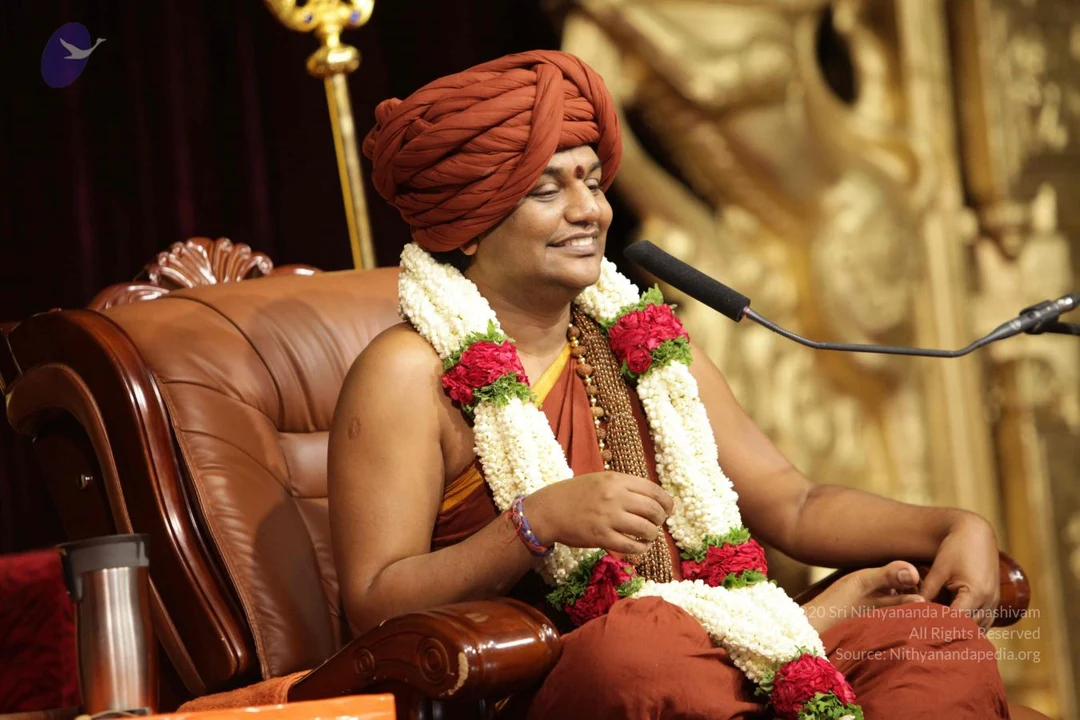
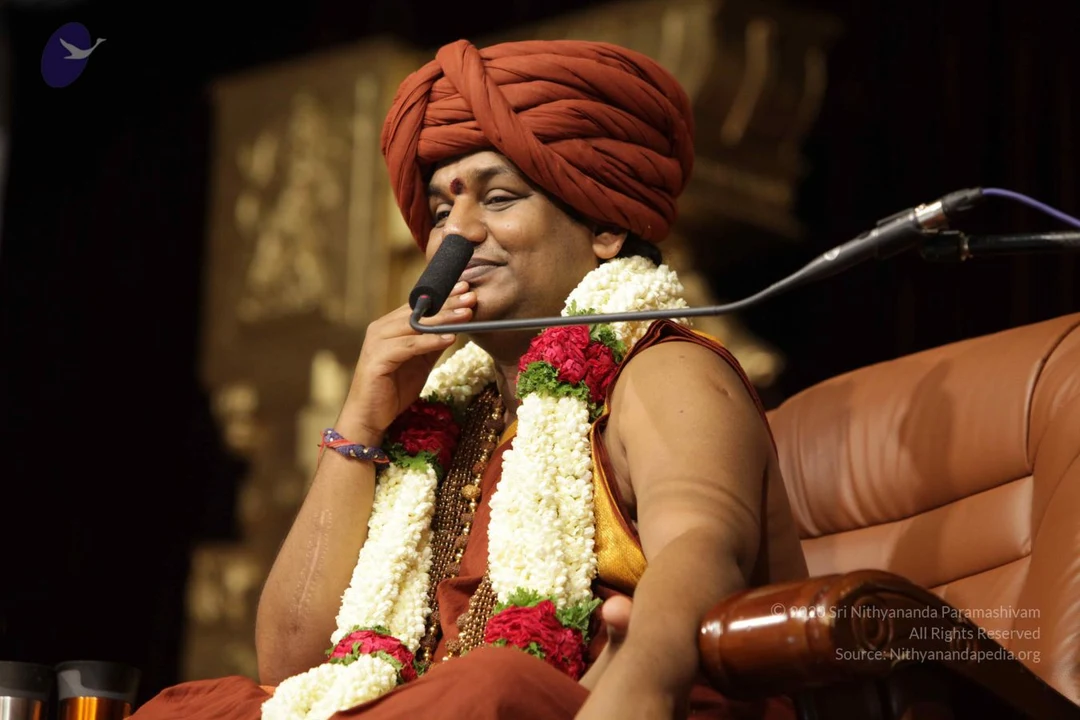
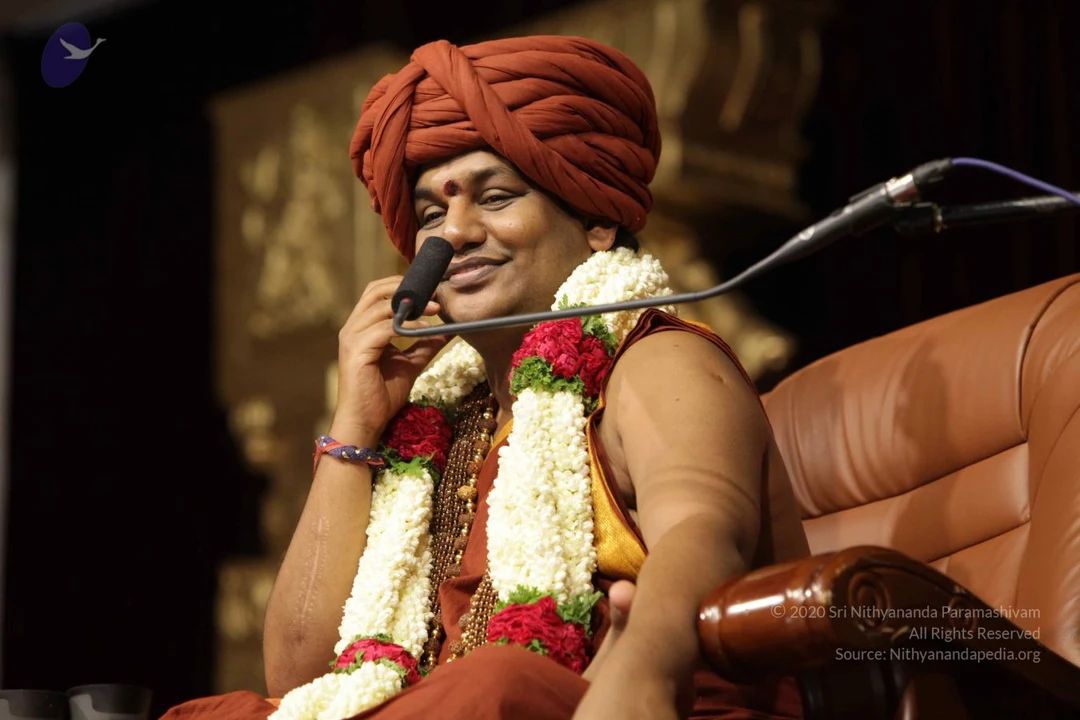
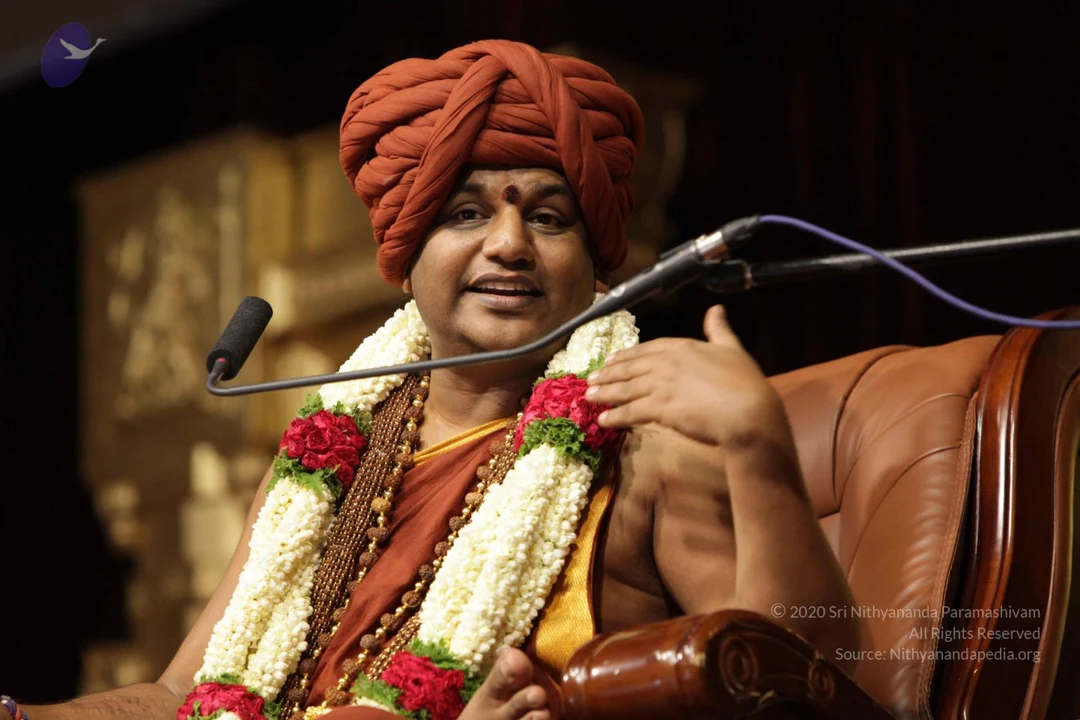
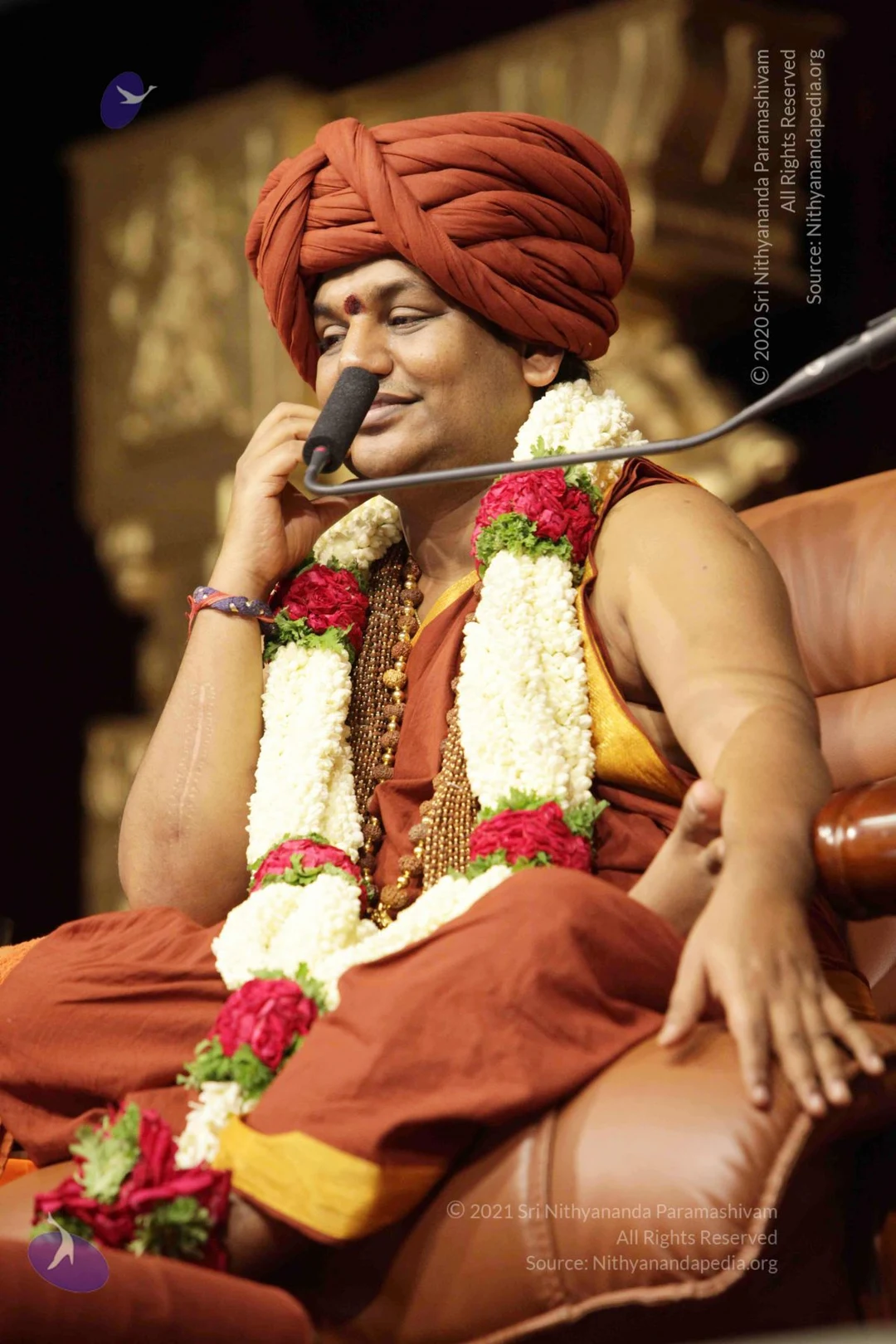
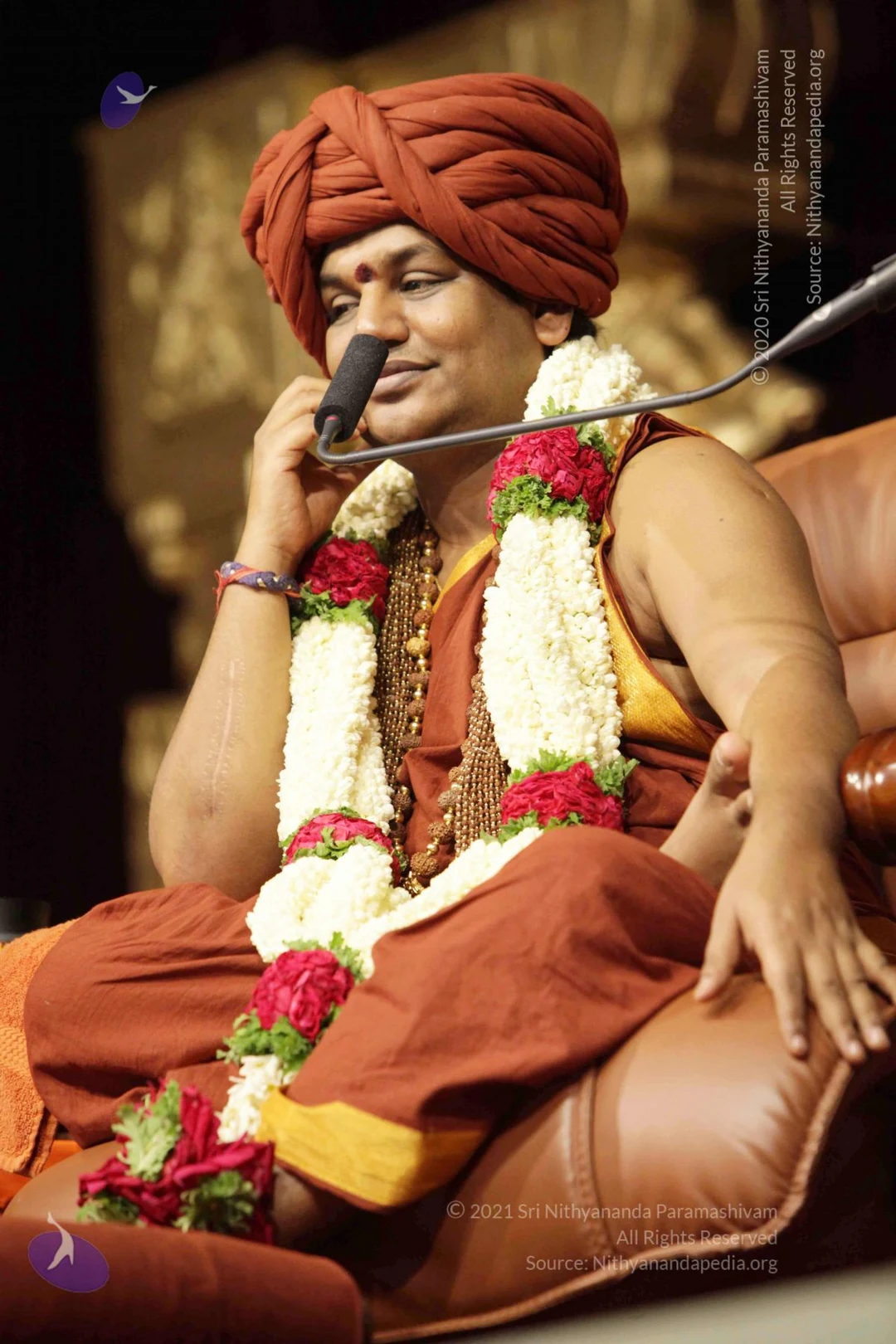
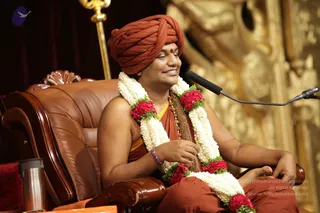
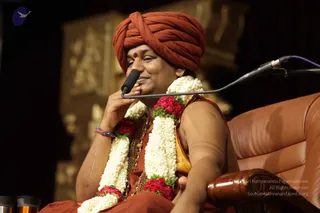
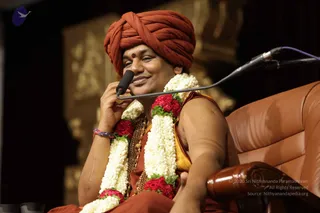
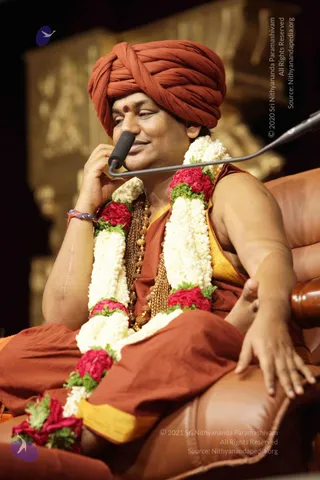
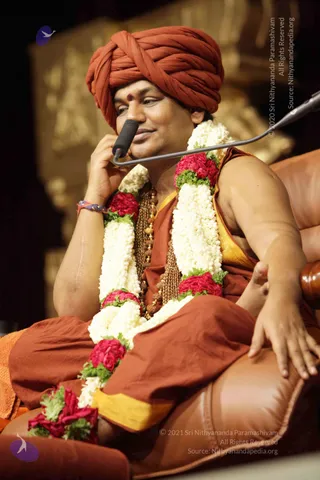
A man seated in a brown leather armchair on a stage, smiling with eyes lowered, wearing a rust-orange turban, bare upper body with an orange-saffron wrap, a brown beaded rudraksha-style mala, and a white and red rose garland draped over his shoulders. He rests his hands on his lap near a black microphone on a boom stand. Behind him are gold ornate carved panels and a dark red curtain, with a metal flask on a small table at left. a person appears as the seated speaker, a discourse setting.A man seated in a brown leather armchair speaks into a microphone held near his mouth while smiling. He wears a rust-orange turban with a small red bindi on his forehead, a bare-shouldered orange-red robe with a golden edge, a brown beaded necklace, and a long garland of white jasmine with red roses draped over his shoulders. A microphone stand with a gooseneck arm is at right, and a blurred golden temple-style backdrop fills the dark background.A man seated in a brown leather armchair speaks into a clip-on microphone held near his face with his right hand. He wears a rust-orange turban, a red bindi on his forehead, a saffron-orange garment, and layered garlands of white jasmine and red flowers with a beaded rudraksha-style mala across his chest. A wooden armrest is visible at lower right. Behind him is a dark backdrop with a gold-toned carved panel. The page identifies this as Swamiji (probable) with the appearance cues of turban, saffron clothing and garlands, so the appearance-based label applies to this in-person figure, who is seated and speaking during a talk.A man seated in a brown leather armchair speaks into a microphone during a discourse. He wears a rust-orange turban, a red tilak on his forehead, a saffron wrap over bare shoulders, layered white jasmine garlands with red rose accents, and rudraksha beads. His right hand rests on his chest while he gestures. Behind him is a dark backdrop with a blurred carved wooden panel. Appearance-based label: Swamiji (probable), seated and speaking, with orange turban, saffron wrap and rudraksha malas as qualifying cues.Swamiji (probable) seated in a brown leather armchair on a stage, speaking into a microphone held near his face with his right hand. He wears a red-orange turban with a small red bindi, an orange-red sleeveless robe with gold trim, a cascade of white jasmine garlands with red rose accents, and rudraksha beads on his chest. A gold-toned carved panel stands in the blurred background.A man seated in a brown leather armchair speaks into a headset microphone, his hand raised near his face. He wears a rust-orange turban with a red vermilion dot on his forehead, a rust-orange sleeveless garment with a gold border, and rudraksha beads. He is draped with white jasmine garlands interspersed with red rose-and-leaf garlands, and wears a multicoloured wrist band. Behind him is a blurred golden backdrop.
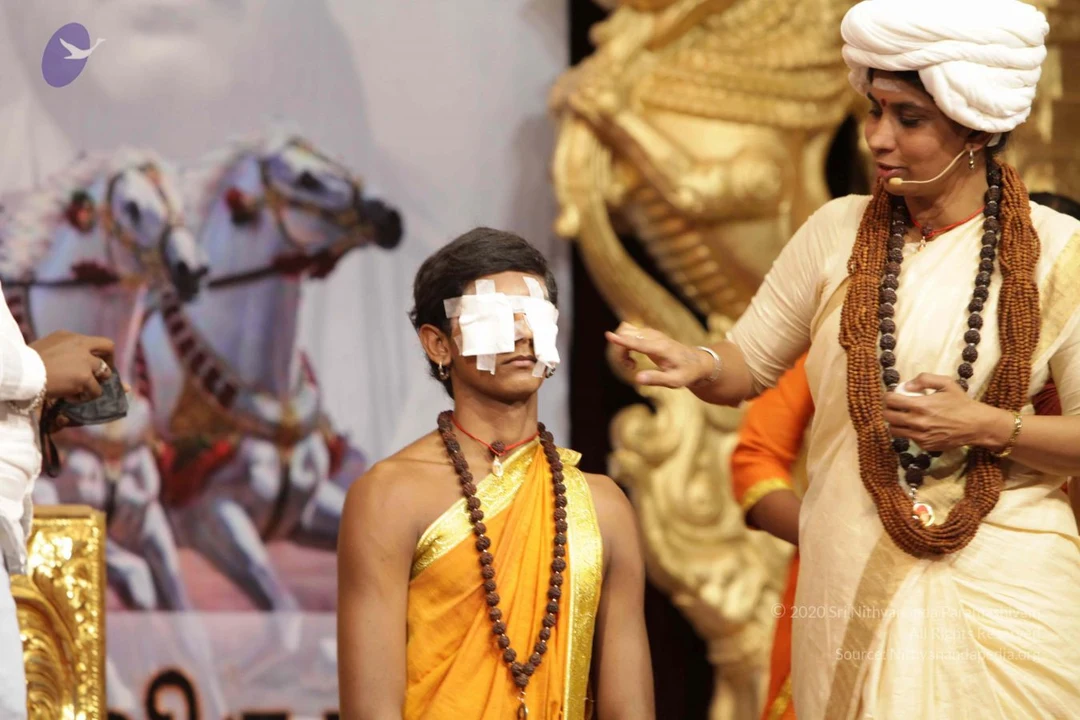
Shivoham Process

8 photosSource gallery
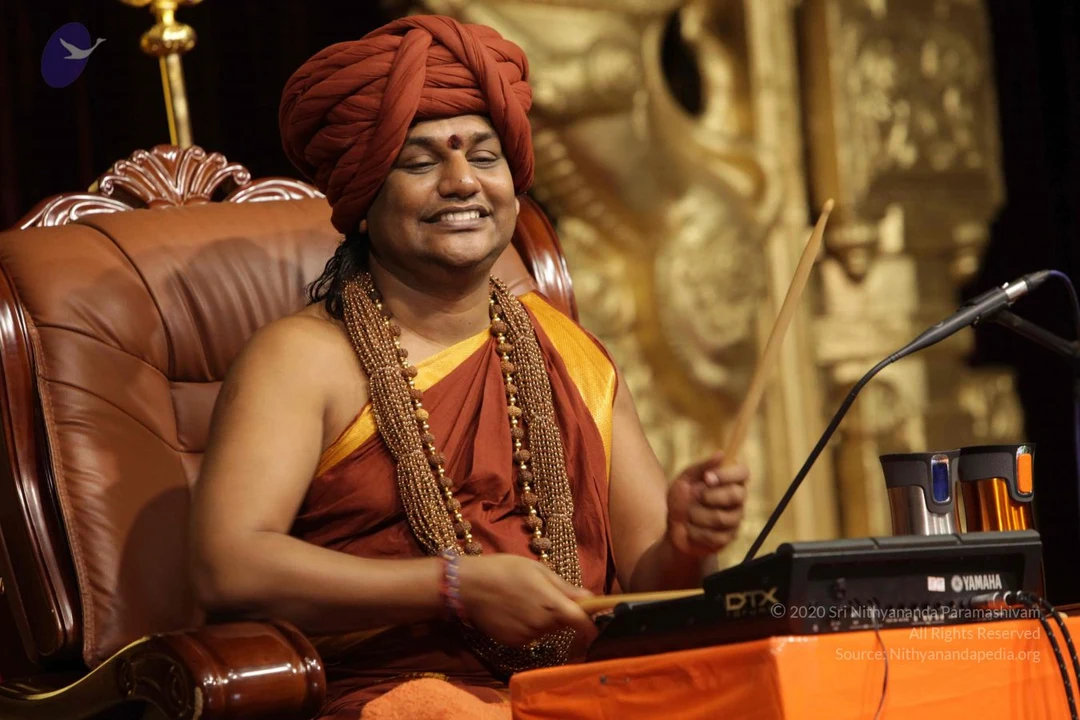
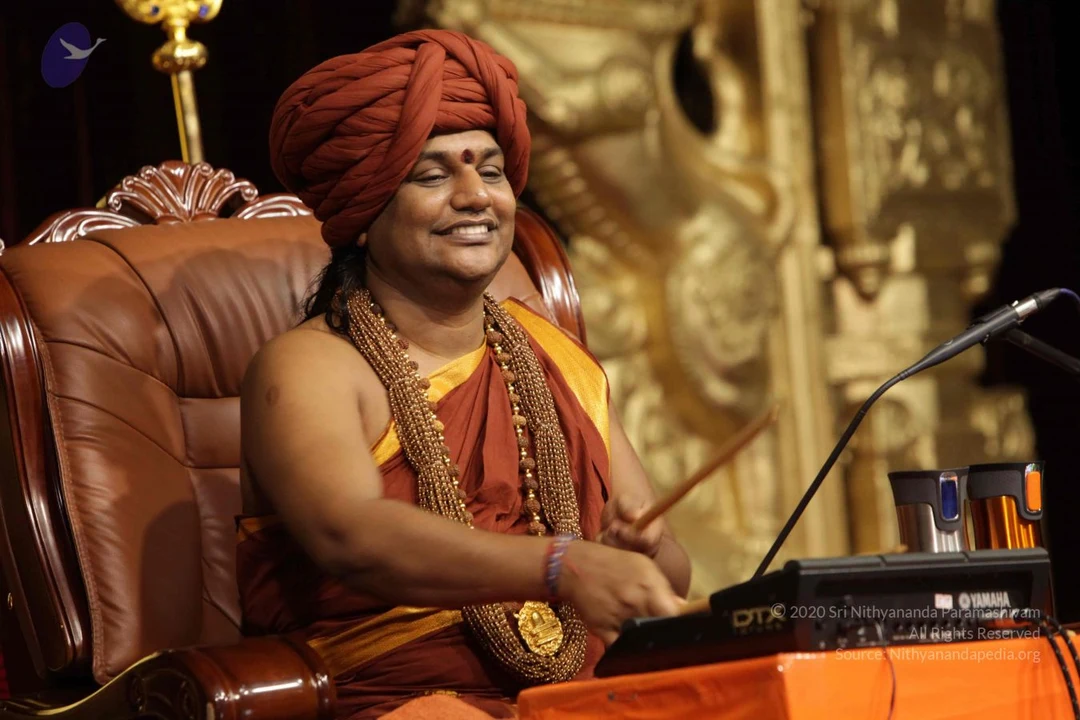
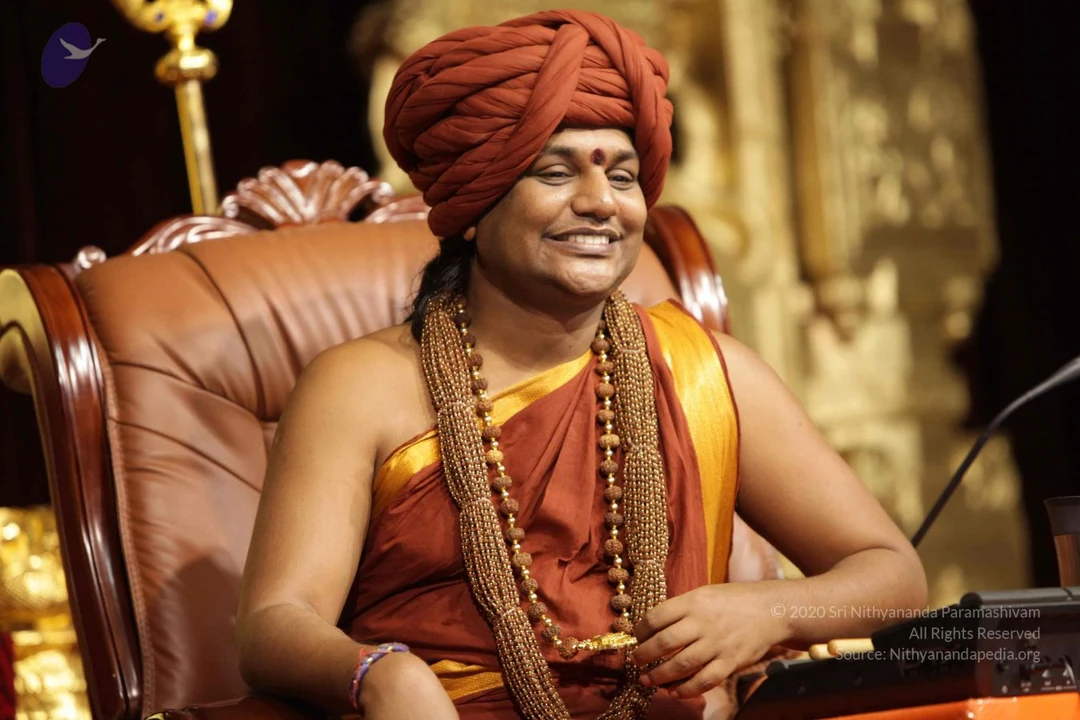
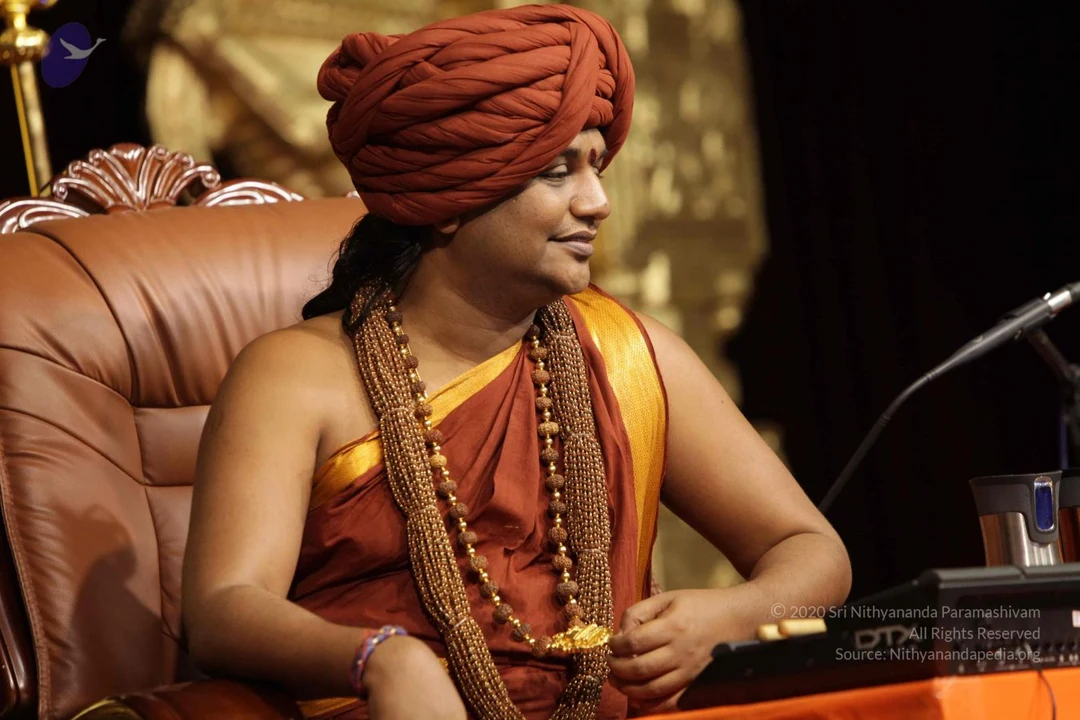
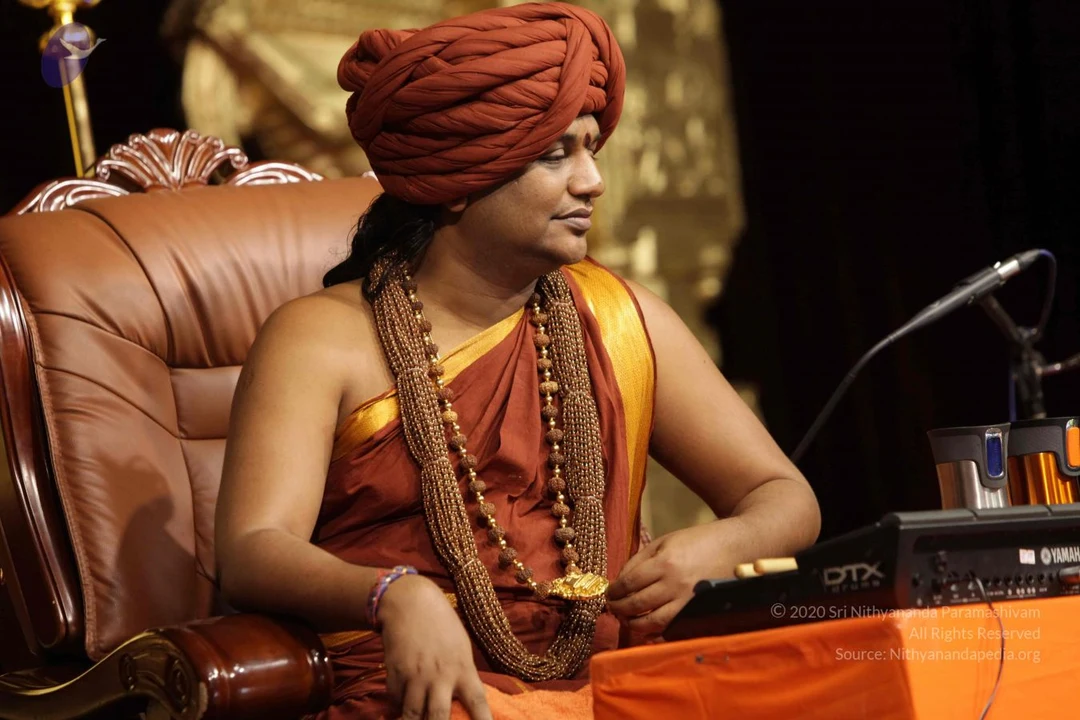
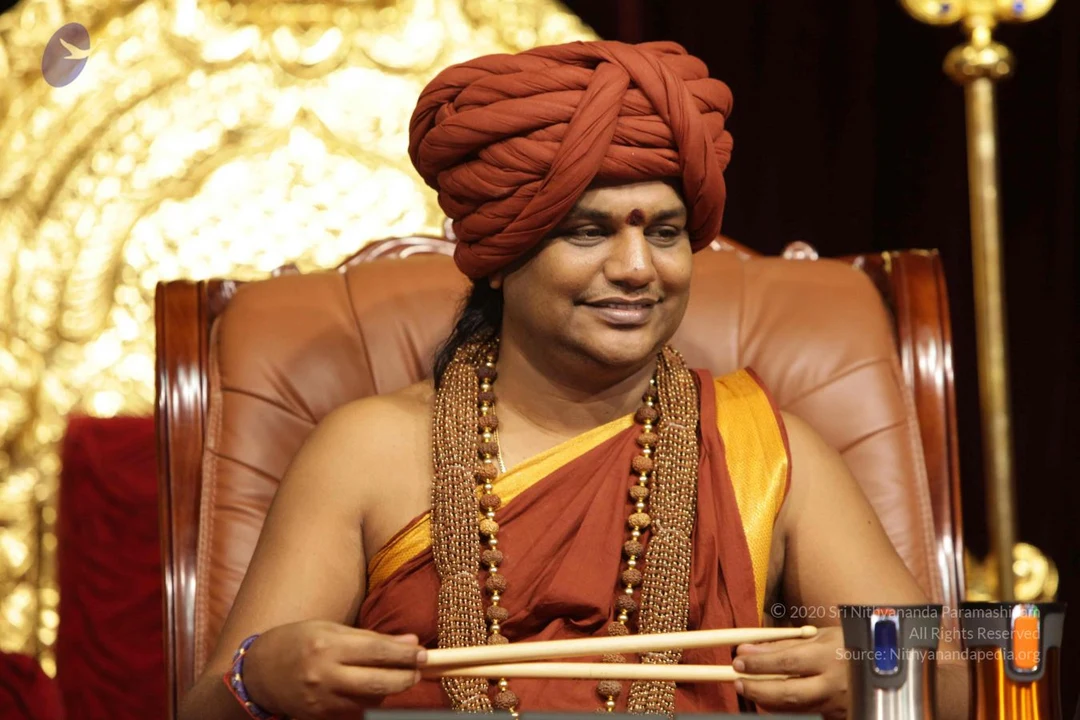
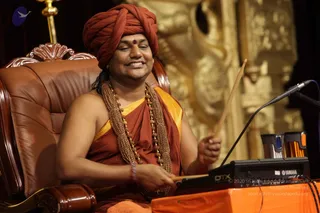
A smiling man in a reddish-orange turban and orange-red robe with a gold-yellow border sits in a brown leather high-backed chair on a stage. He wears multiple strands of wooden beads and a gold-toned necklace, a red tilak mark on his forehead, and red threads on his wrist. He holds a thin drumstick in each hand, playing an electronic drum pad (Yamaha DTX) on an orange-draped table, with a microphone and two cups on the table. Behind him is an ornate gold carved backdrop with a dark curtain. Swamiji (probable) is shown seated in a ceremonial chair with a turban, saffron robes and rudraksha beads, playing drums during a stage event.A smiling man in a rust-red turban and matching red-orange robe with a gold-yellow border sits in a brown leather armchair on a stage. He wears long rudraksha-style beaded malas and a large gold ceremonial pendant, with a red tilak on his forehead and a bracelet on his wrist. He holds a thin wooden stick over a black Yamaha DTX electronic drum pad on an orange-covered table, with two steel cups on top of the pad area. A microphone stand is at right and an ornate gold-carved wall stands behind him. Appearance-based candidate: a person, seated as the main speaker in a throne-style chair.A smiling man seated in a brown leather armchair with carved wooden arms, wearing a rust-red turban, a red bindi on his forehead, a rust-red and gold-bordered garment draped over one shoulder, and multiple long rudraksha malas with a gold ceremonial necklace. His right hand rests on a wooden table with a microphone stand nearby. A gold staff with a finial stands behind the chair, and an ornate gold carved backdrop fills the background. This is a photo; one person is visible.A man seated in a brown leather armchair with carved wooden armrests, smiling with eyes half-closed. He wears a rust-red turban with a small red bindi on his forehead, a rust-red robe draped over a saffron-gold border, and a heavy multi-strand necklace of gold beads and rudraksha malas. A bangle is on his wrist. Behind him stands a gold ornate throne-like backdrop and a golden staff, and a microphone sits at the right edge beside a wooden lectern.A photograph of a man seated in a brown leather armchair at a wooden desk with a microphone and a metal cup at right. He wears a rust-orange turban, a rust-orange and gold-bordered wrap over his shoulders, and long layered gold-toned beaded necklaces with rudraksha beads. A small red mark is on his forehead and a multicoloured bracelet on his wrist. He looks to the side with a slight smile, with a blurred gold ornamental backdrop behind him. Probable Swamiji by the turban, saffron-orange wrap, rudraksha mala and ceremonial necklaces, seated in a discourse setting.A seated man in a rust-red turban and matching red-orange robe with a gold-bordered shawl sits in a brown leather armchair on a stage. He wears multi-strand gold-toned beaded necklaces with rudraksha beads and a gold clasp, and a purple beaded bracelet on one wrist. A microphone stands at right beside a Yamaha DTX electronic drum pad and an orange cloth-draped table. A gold ornate backdrop is behind him. Swamiji (probable): the long-hair-free but turban, saffron-red robe, rudraksha malas and ceremonial gold necklaces are the appearance-based cues, seated as the presiding speaker at a discourse.

NDY

54 photosSource gallery
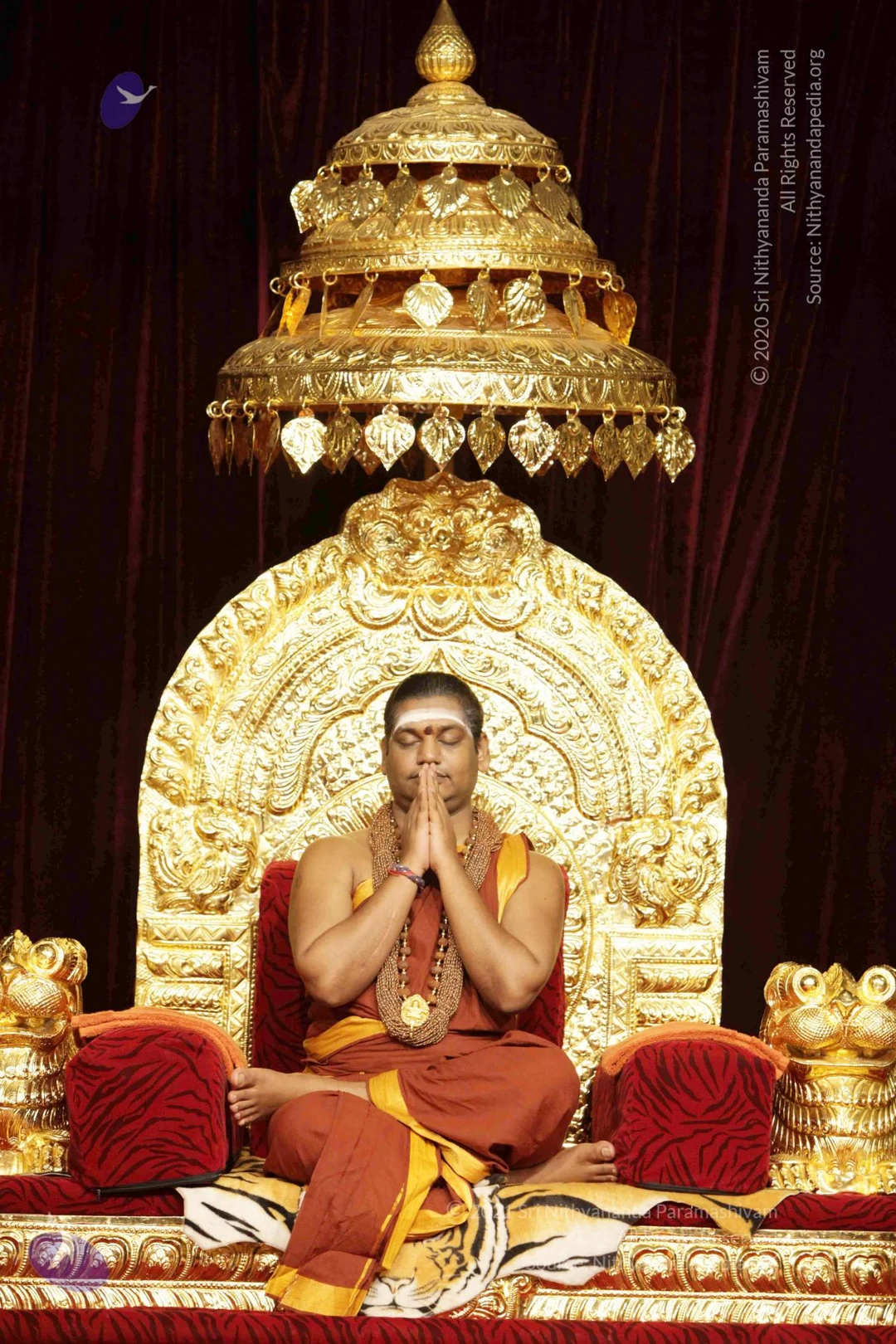
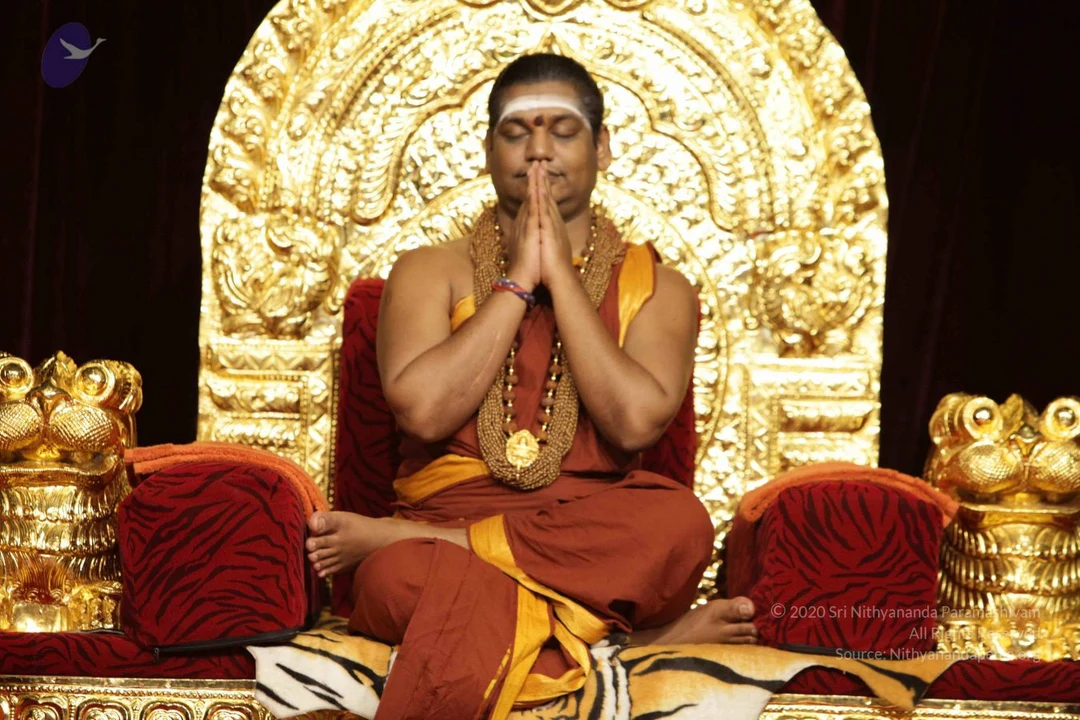
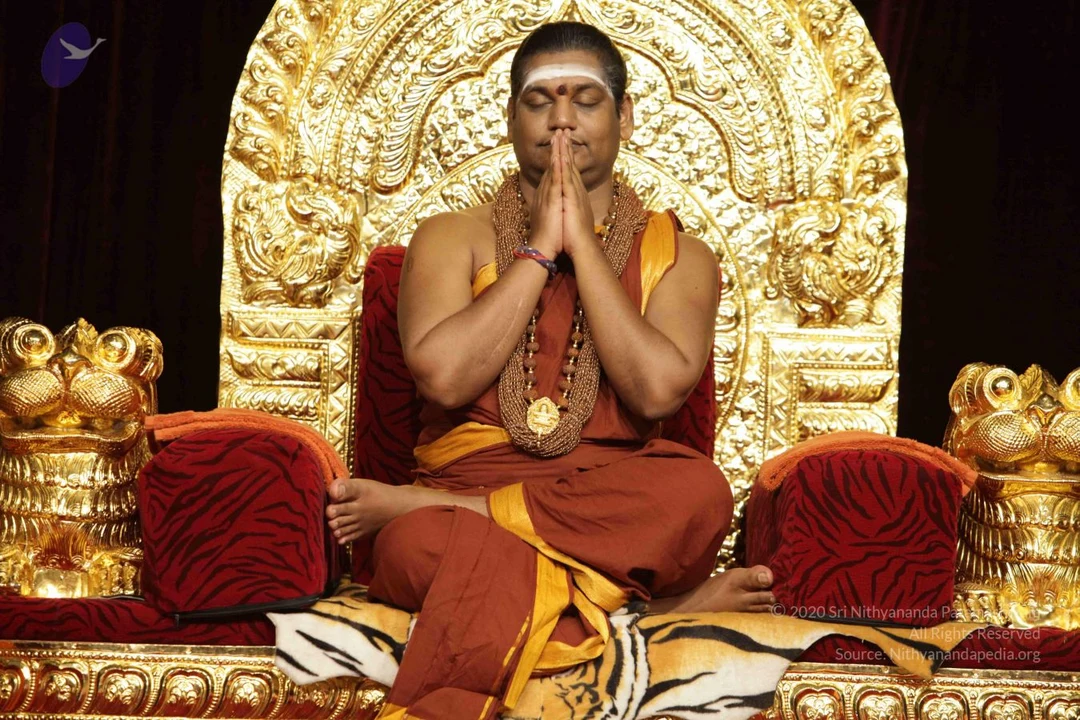
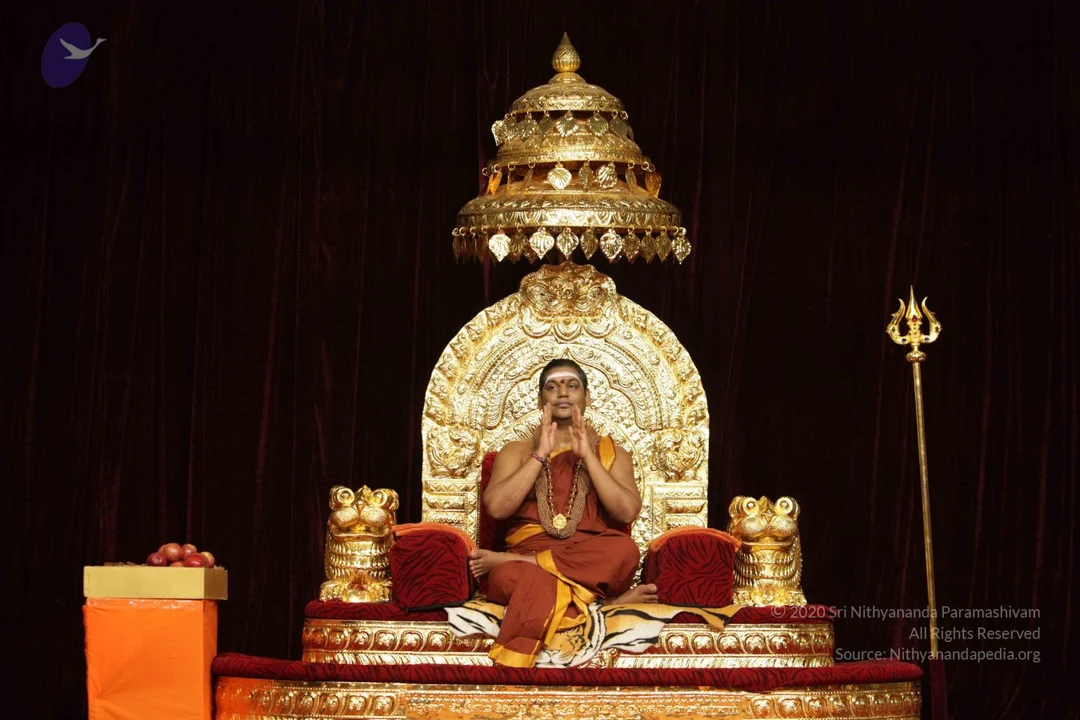
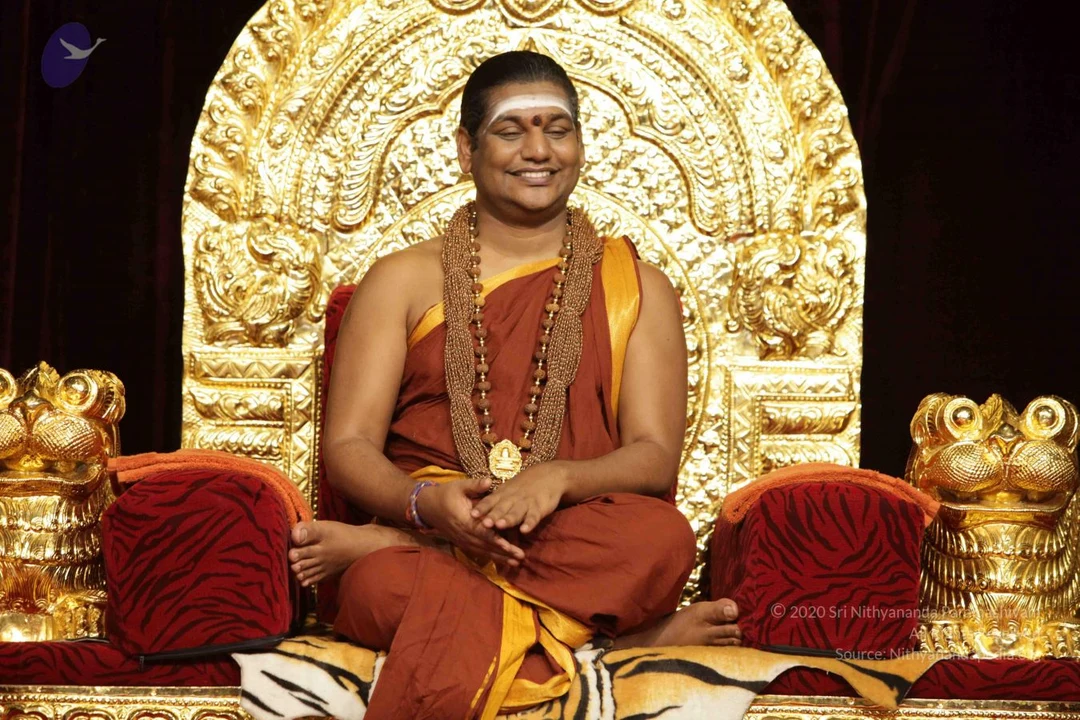
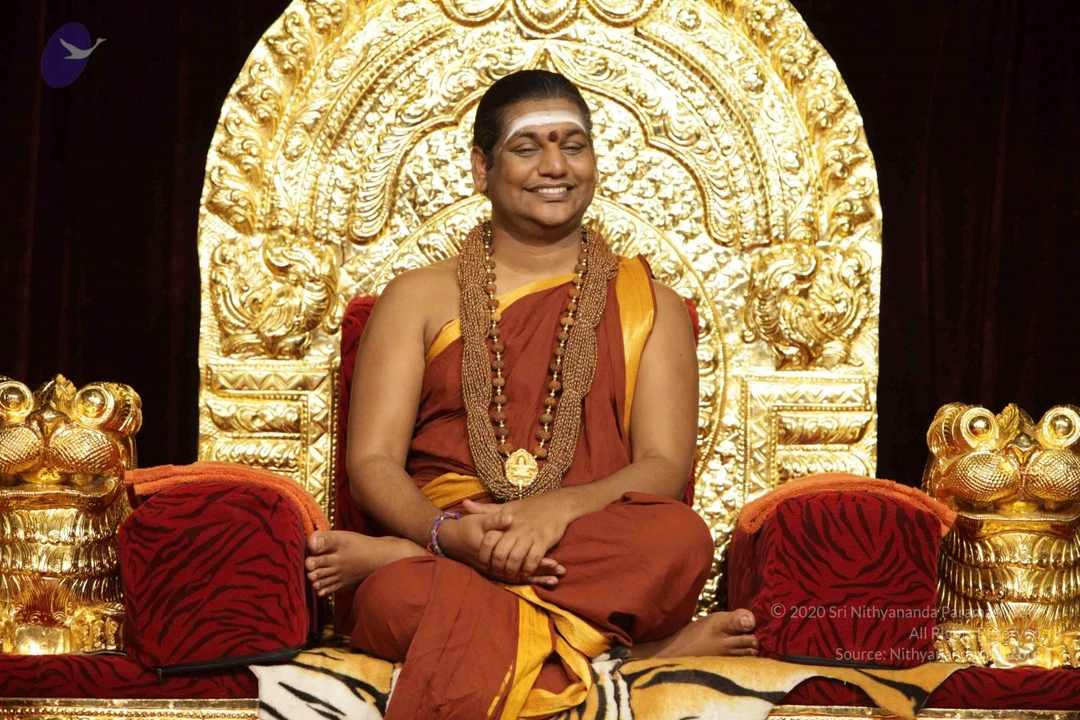
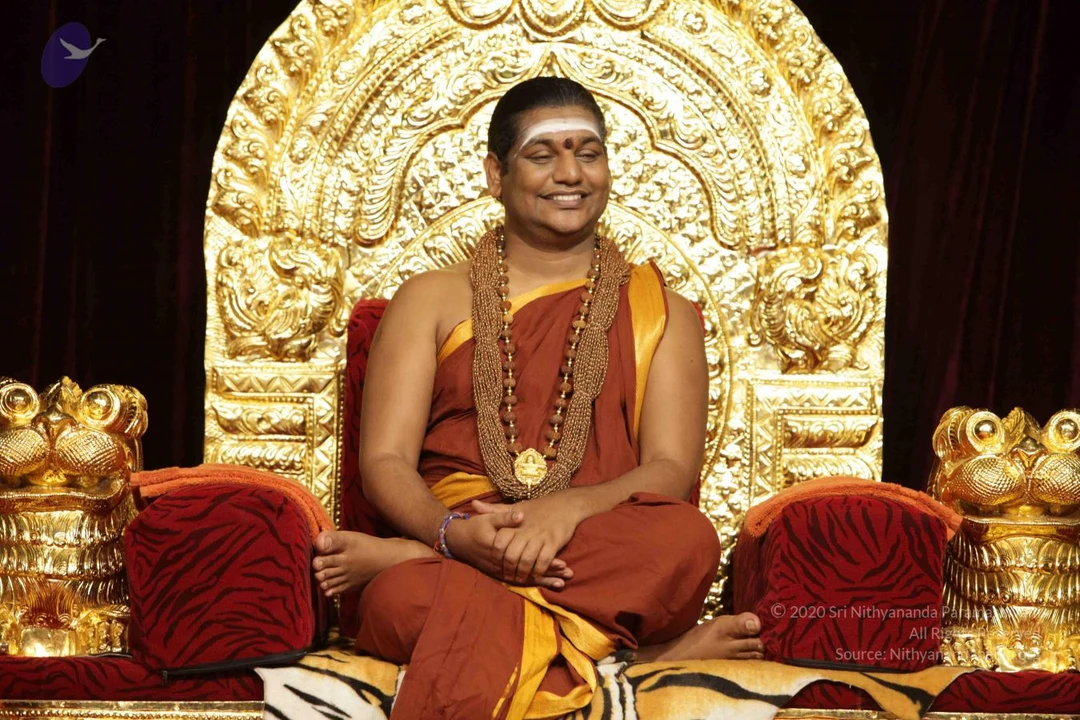
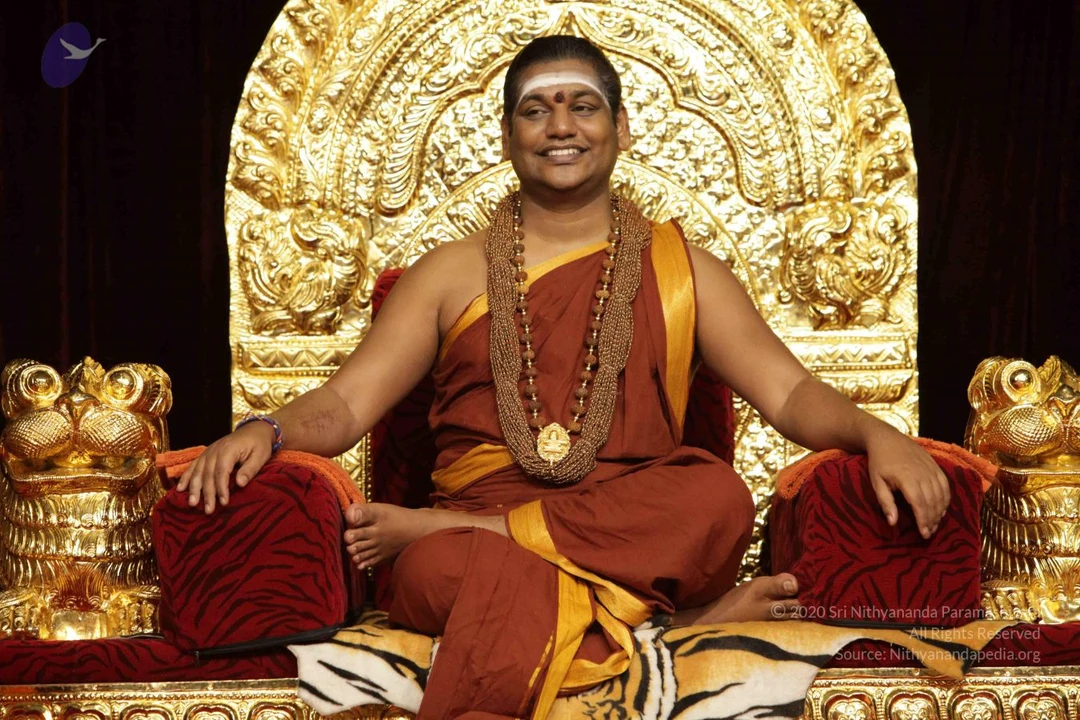
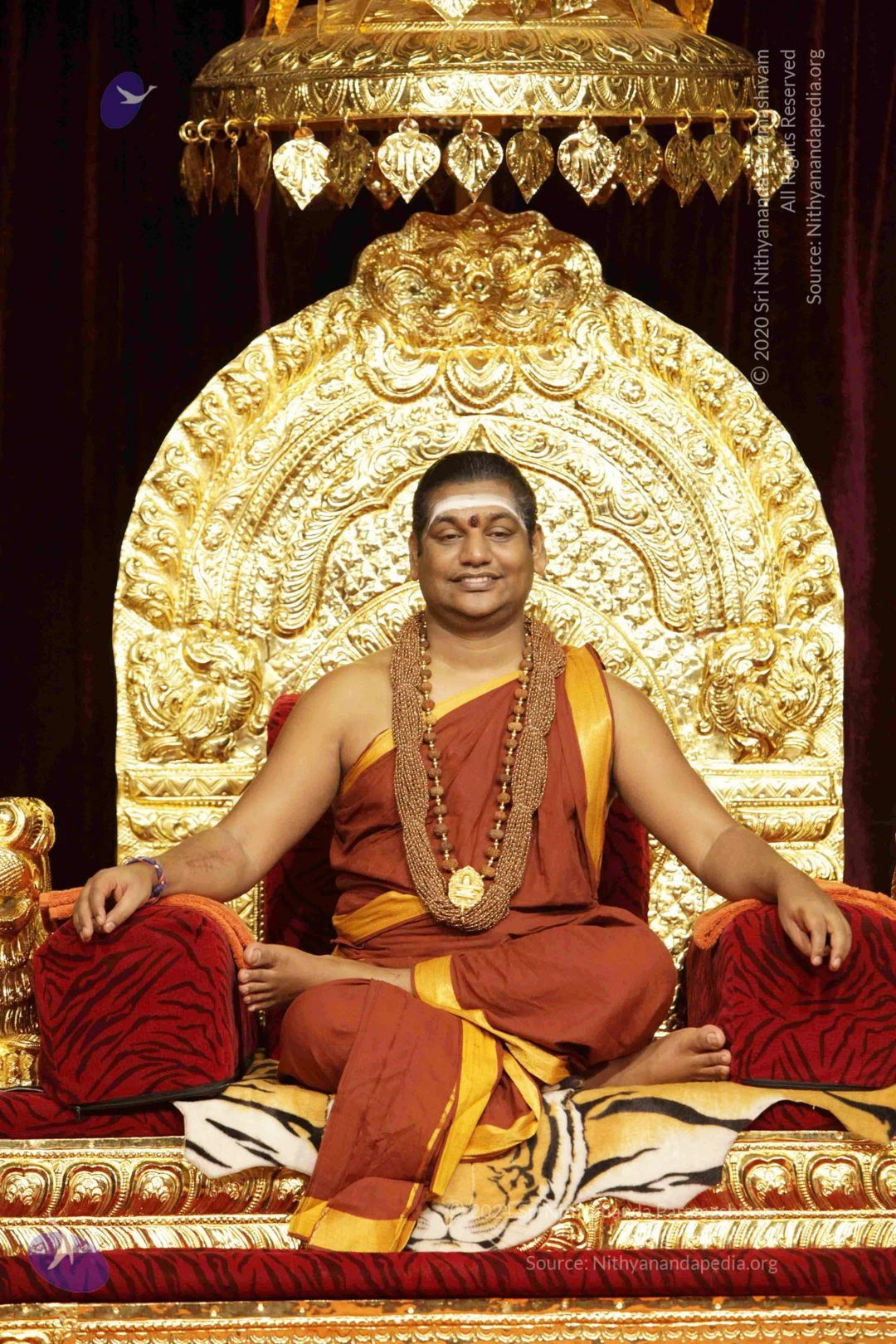
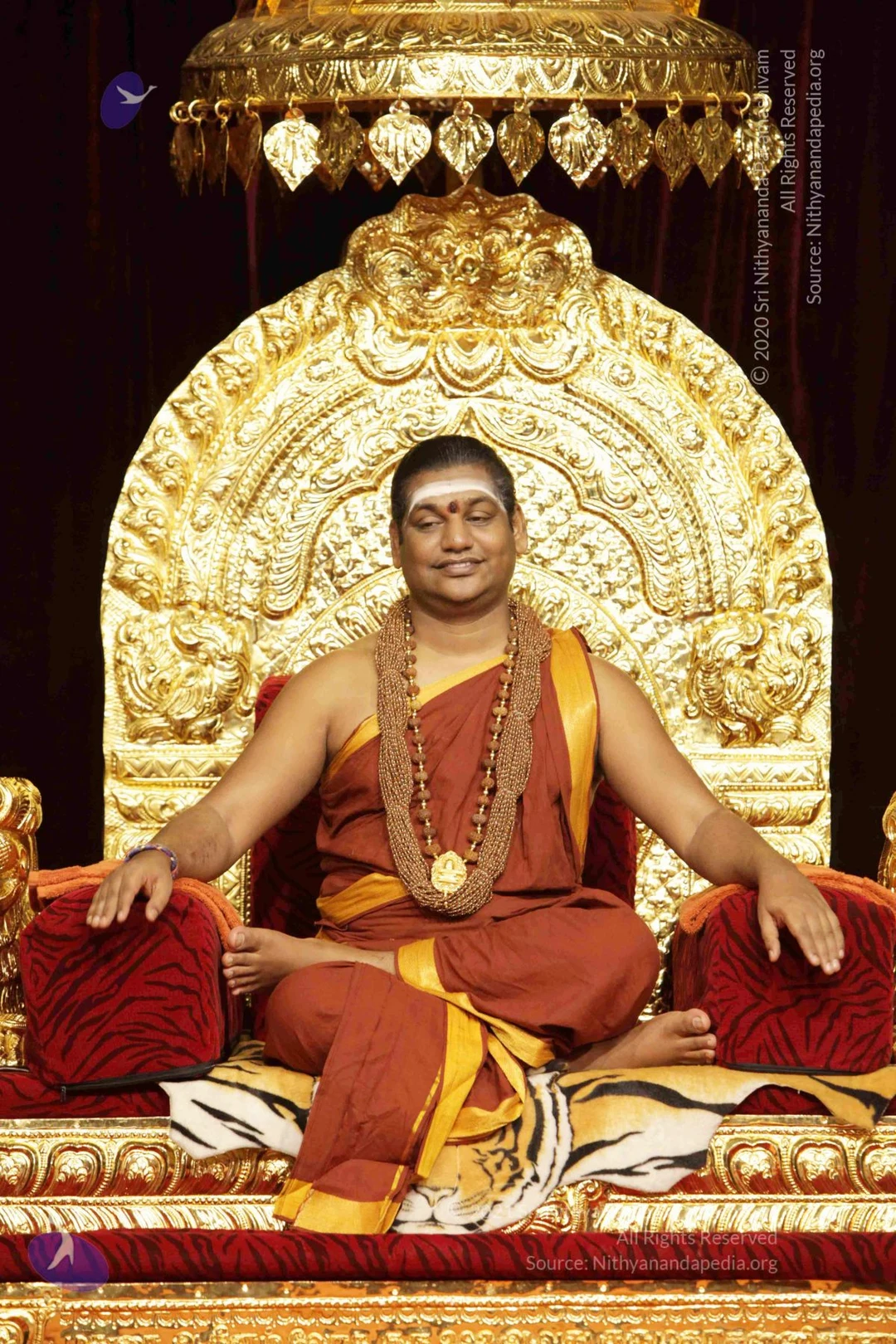
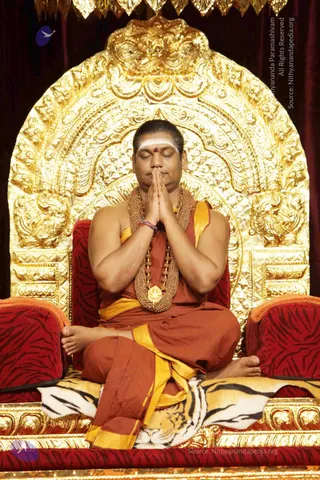
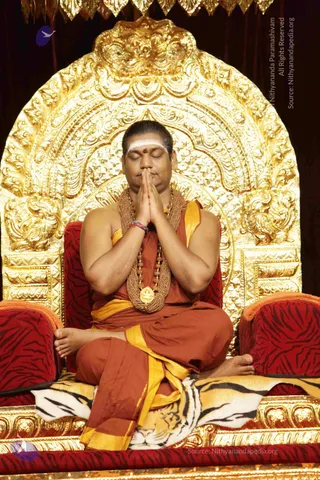
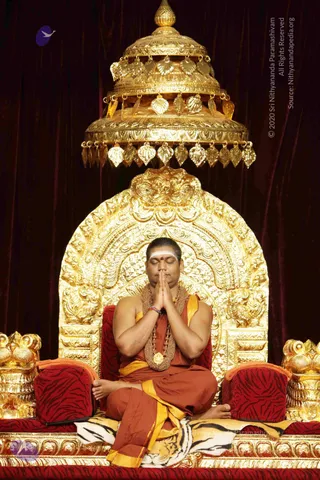
A seated man in saffron-orange robes with yellow borders sits cross-legged on an ornate gold throne with a carved, arched back, draped over a tiger-striped red and yellow cloth. He has his eyes closed and palms pressed together in namaste at his chest. He wears a thick, multi-strand gold necklace of rudraksha beads with a gold pendant, a red-and-blue beaded wrist band, and a white horizontal tilak with a red bindi on his forehead. Red velvet tiger-print armrests flank the throne against a dark red curtain, with gold chandelier-style decoration above.A seated man with closed eyes and palms pressed together in namaste sits on an ornate red-and-gold throne with a tiger-striped cushion. He wears an orange-red garment with yellow borders, multi-strand rudraksha malas and a gold pendant, and has a white vertical forehead mark with a red dot. Bare feet are crossed in front of him. A gilded arched backdrop and gold canopy frame the scene. Consistent with an appearance-based candidate for a person, the figure is shown in saffron/orange robes, rudraksha malas and ceremonial gold adornments, seated on a throne in a formal setting.A seated man with closed eyes and palms pressed together in namaste sits on an ornate gold throne with a tall gilded canopy above it. He wears a saffron-orange dhoti and shawl, a white vertical forehead mark, and a heavy beaded rudraksha-style mala with a gold pendant. Red and black tiger-striped cushions and a tiger-print mat sit beneath him, with gold lion-like armrest figures at each side. Dark maroon drapes form the backdrop.A seated man in rust-orange robes sits on a gold-and-red throne with tiger-striped cushions, palms pressed together in namaskar with eyes closed. He wears a rudraksha mala and a gold ceremonial necklace with a pendant, a white vertical tilak on his forehead, and a red bindi. Behind him stands an ornate golden carved arch, and gilded lion-head armrests flank the seat. The white tiger-skin rug beneath him continues the regal stage setting. a person is seated centre, performing a devotional gesture during a satsang-style session.A man seated cross-legged on an ornate golden throne with red tiger-striped cushions and a tiger-skin rug, hands pressed together in namaste with eyes closed. He wears a rust-orange robe with yellow borders, multiple rudraksha malas and a gold pendant, and a white tripundra with a red bindi on his forehead. Golden lion-head armrest carvings flank the throne. This appears to be a person, the presenter of the satsang, based on his saffron-orange ornate clothing, rudraksha malas and ceremonial gold necklace.
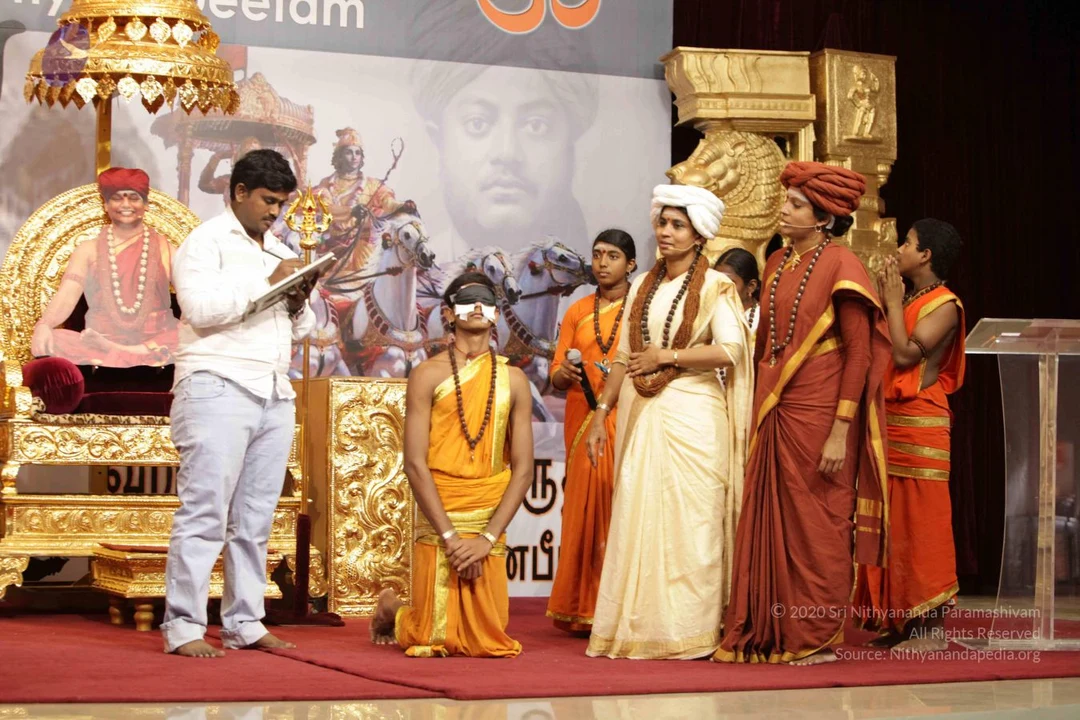
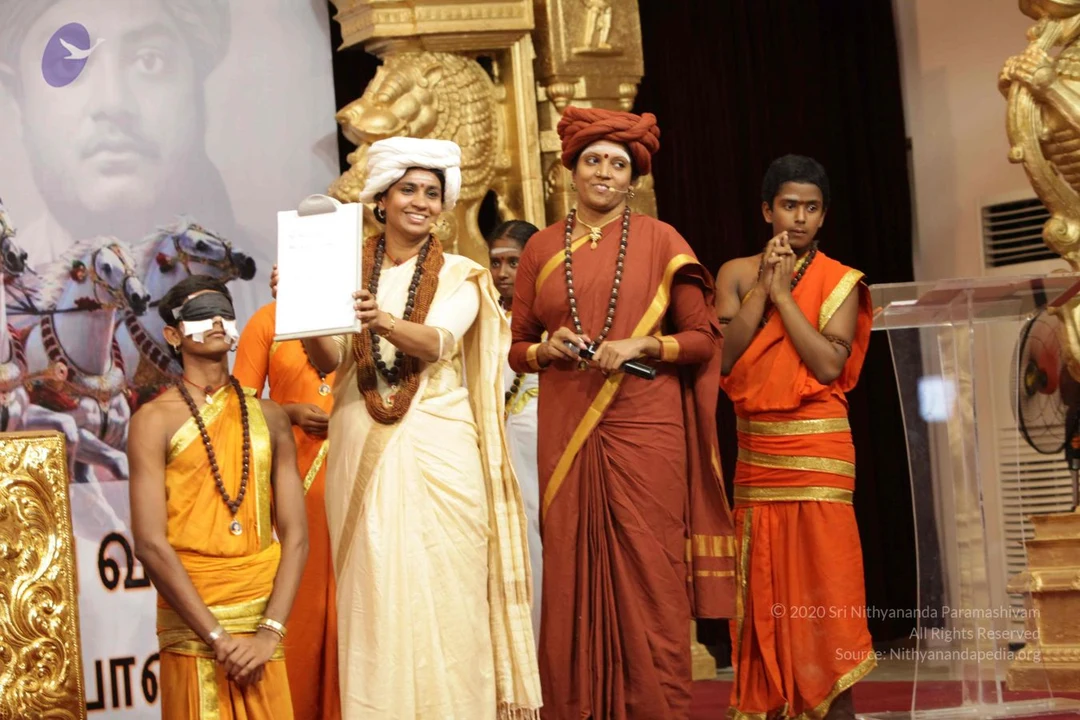
Delegates of NDY

8 photosSource gallery
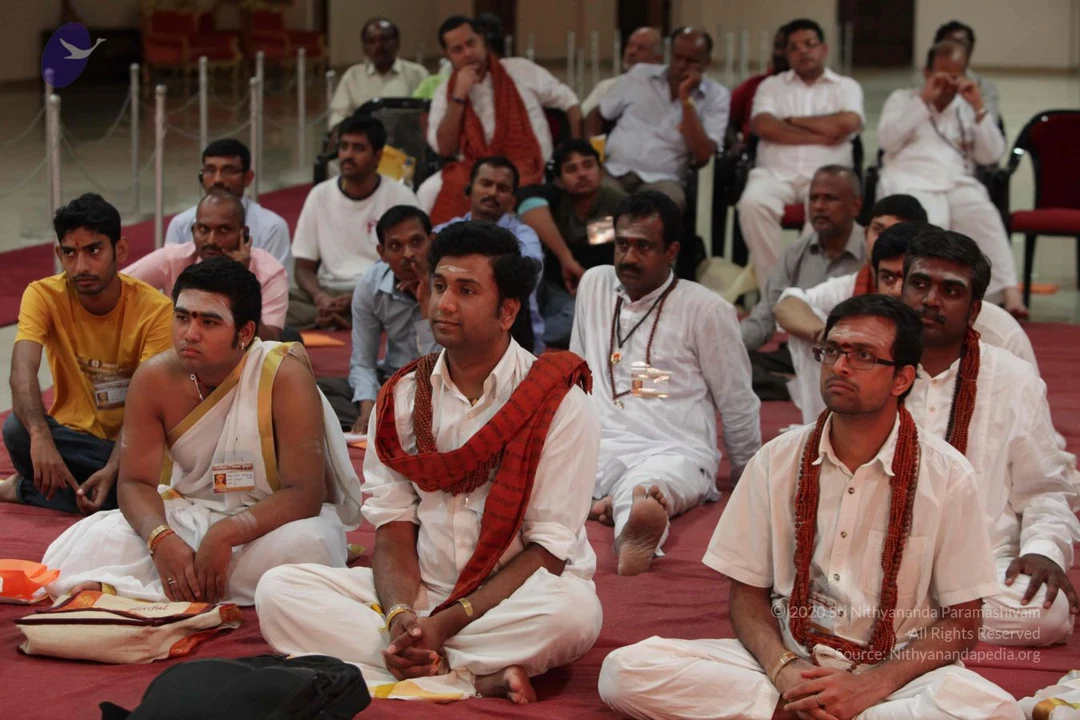
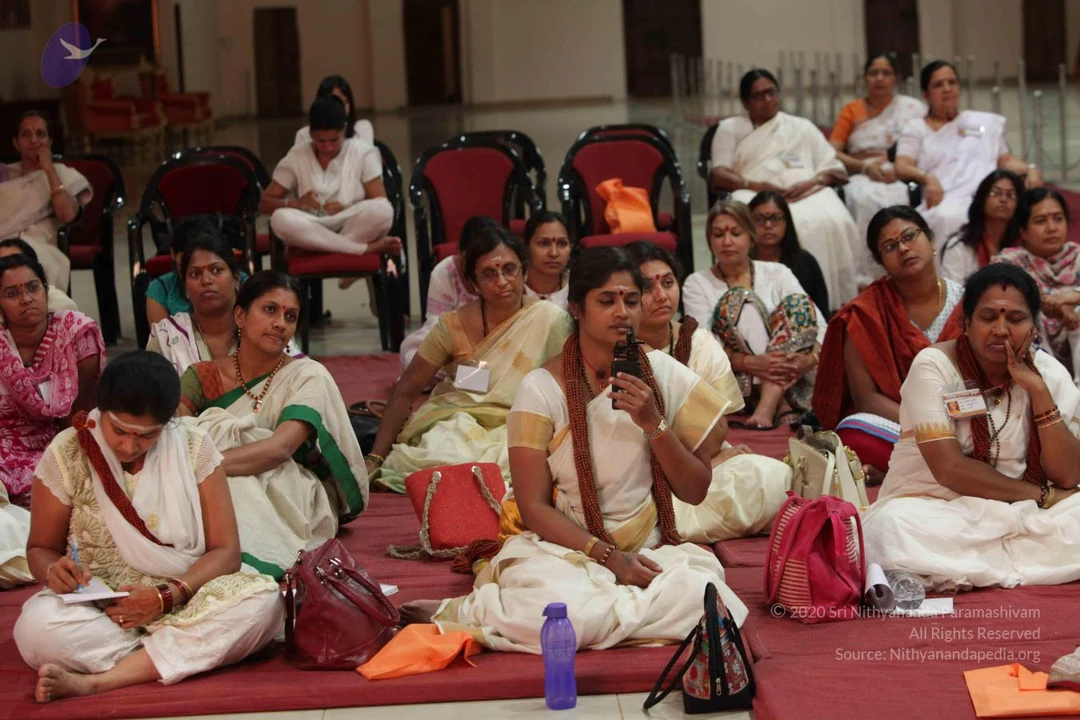
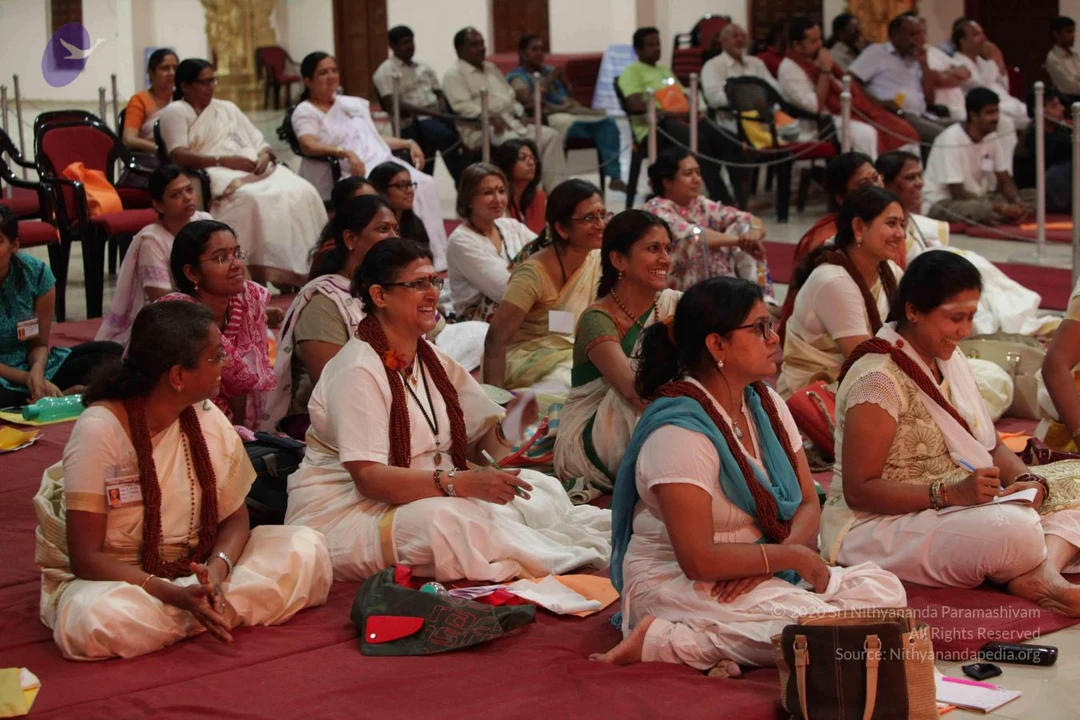
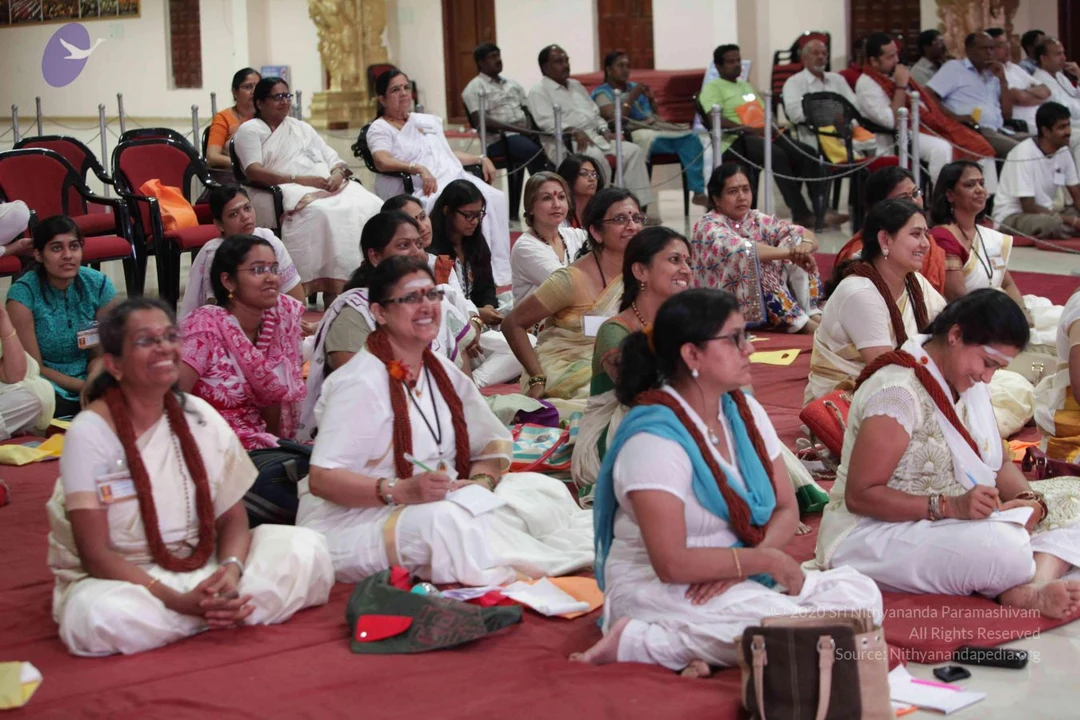
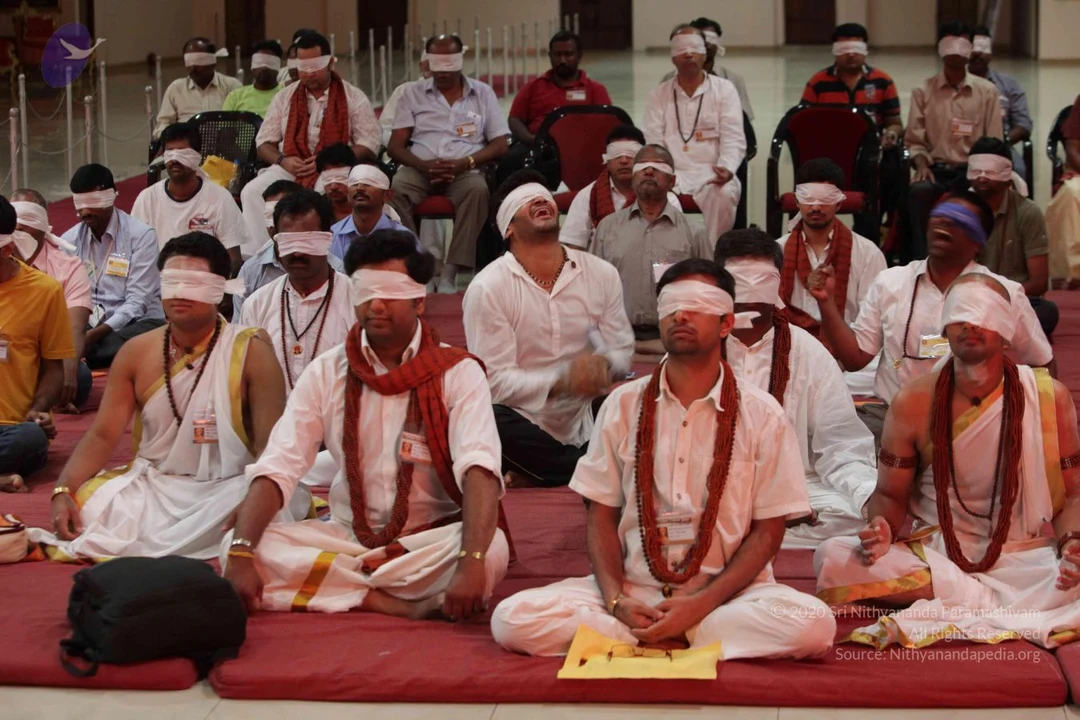
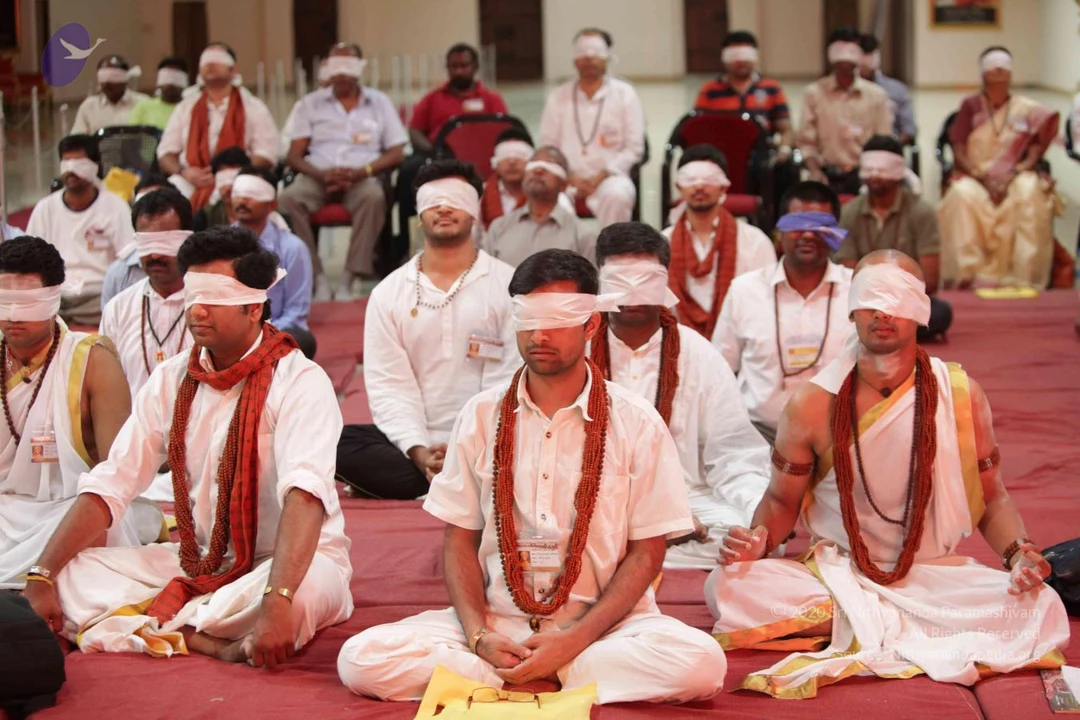
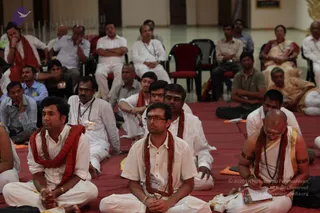
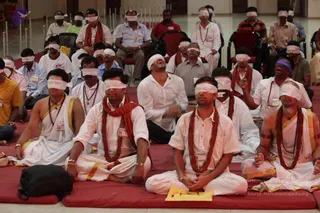
A seated audience in a hall during a teaching session, with devotees on a red floor covering. In the foreground, a young man in white dhoti and shirt wears a red shawl and a rudraksha mala and sits with hands clasped. Beside him, a bespectacled man in white wears a red shawl and rudraksha beads, looking forward. At the far right, a bald man in white with a gold armband and rudraksha malas writes in a notebook. Behind them, rows of people sit on chairs and mats, many in white ritual clothes with red and orange shawls, while others wear shirts and sarees. A framed artwork hangs on the back wall.A seated audience of devotees on a red carpet during a teaching session. In the foreground, a young man with a bare upper body wears white dhoti-style cloth with a gold border, gold bangles, and a badge on his chest. Beside him, a man in white kurta and dhoti with a red-and-gold shawl sits cross-legged with hands clasped. At the right, a man in a white shirt wears a rudraksha mala and sandalwood-coloured tilak, and another in white clothing sits behind him. Behind them, many more men in white, cream and blue shirts sit facing forward, some with red shawls and rudraksha malas. The setting is a hall with grey pillars and red chairs.A seated audience of women in white and cream saris fills a hall, sitting on red floor mats with red cushioned chairs behind them. In the foreground a young woman in a cream sari with a red-brown beaded mala holds a microphone and speaks, while a woman at left writes in a notebook and another woman at right rests her chin on her hand. Several attendees wear orange saris or stoles, and bags, water bottles and orange cloth lie on the mats. Some people sit on chairs in the background.A seated audience of women at a workshop, sitting on a red floor covering in a hall with wooden chairs and a gold-toned panel behind them. In the foreground, several women wear white or cream saris and dupattas with rudraksha-style brown beaded necklaces; one in a blue shawl and another in a cream sari with a pale patterned border are writing in notebooks, and others smile or look toward the front. Some women wear green, yellow and pink saris, and rows of attendees sit further back on chairs. No speaker is clearly visible, and the scene suggests attentive listening during a discourse.A seated audience of women and men attends a session in a hall with a red carpet and rows of red chairs. In the foreground, several women in white sarees and red-brown beaded garlands sit cross-legged, smiling and writing on notepads; one wears a turquoise shawl and another a pink patterned top. Behind them, more attendees sit on chairs and the floor, and a golden deity murti stands near the back wall. The setting suggests a seminar or satsang.A large group of seated participants wearing white blindfolds over their eyes sits on red mats in a hall with red-cushioned chairs behind them. Most wear white kurtas or shirts with white dhotis bordered in gold, and many have red shawls and rudraksha malas around their necks; some have red-orange dupattas. Several men in the front row sit cross-legged with hands resting on their laps, and one man in the centre-left appears to be laughing with his head tilted back. Name badges hang from some necks. A black backpack sits on the mat at the lower left and a yellow cloth lies at the front. The scene resembles a group meditation or guided exercise, though the details are visible only in the photograph.