Skip to content
Saturday

21 September 2013

Supreme Pontiff of Hinduism HDH Bhagavan Nithyananda Paramashivam

Dated photos
369
Source pages
1
Media
2
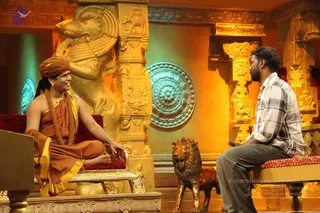
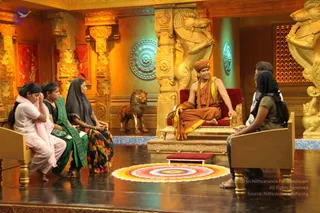
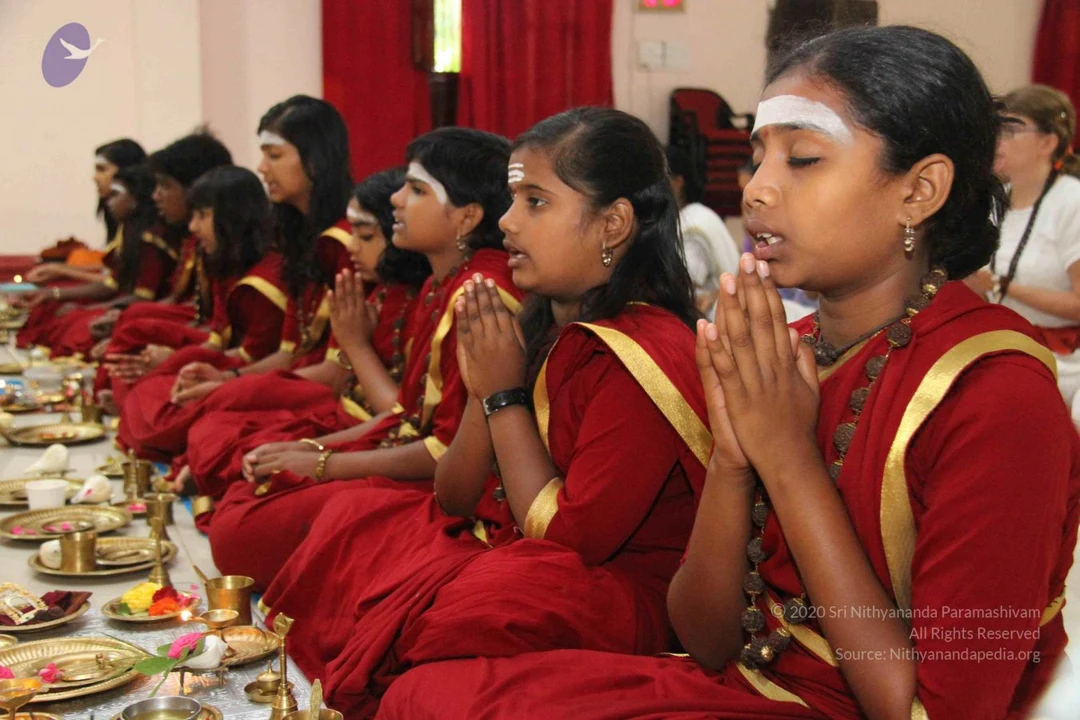
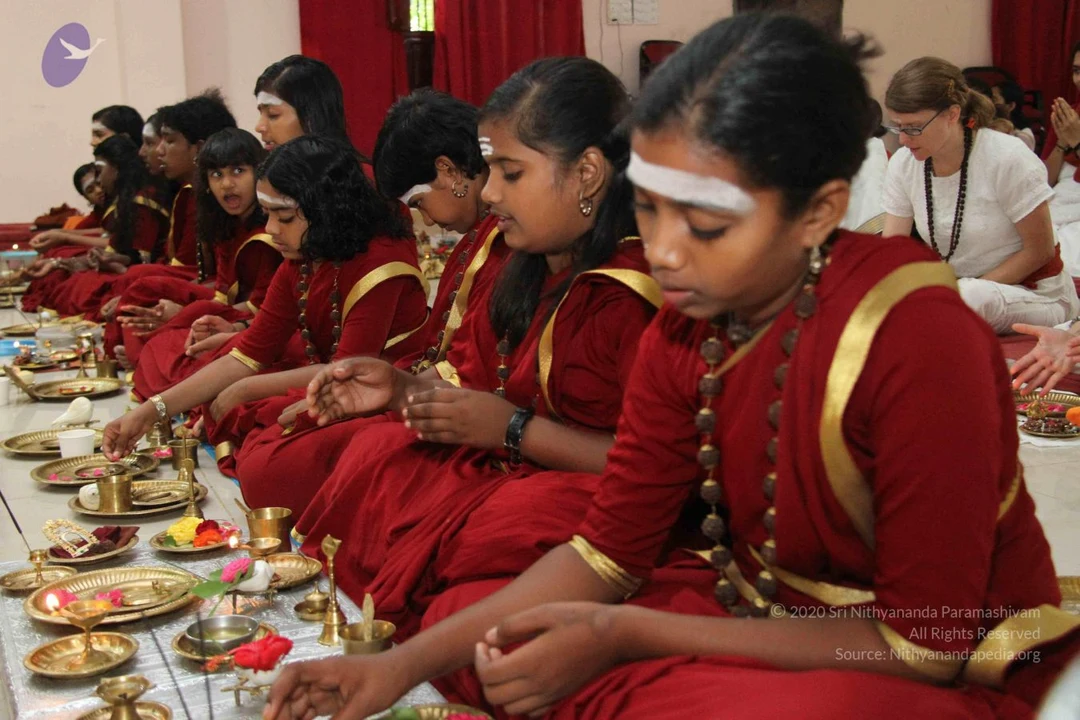
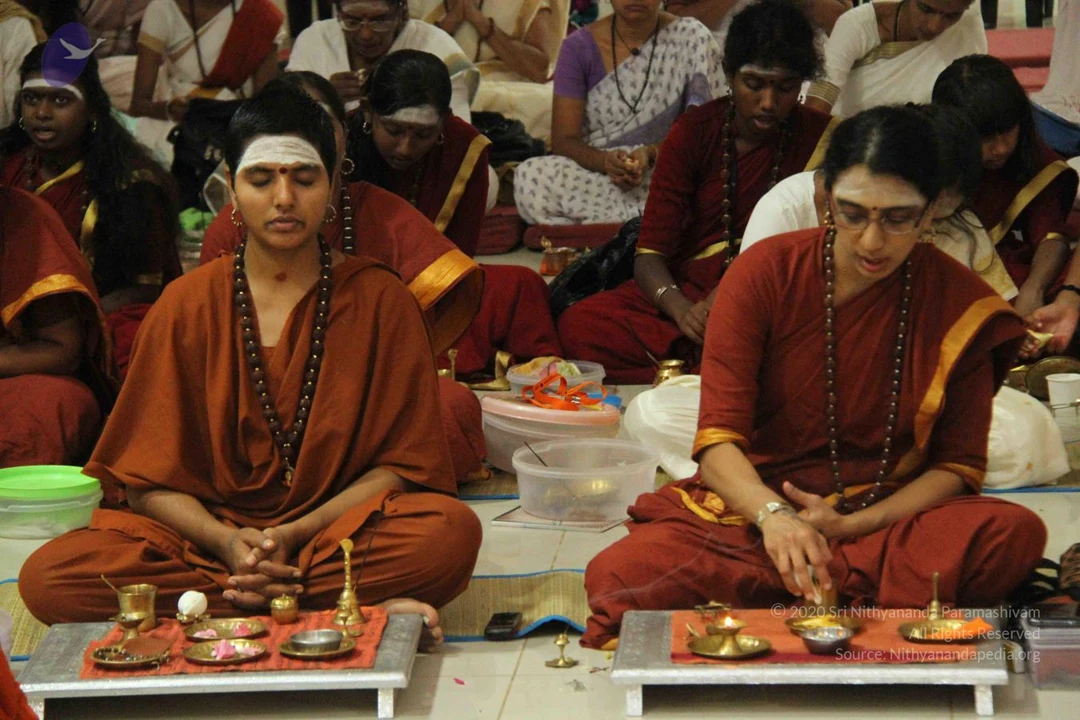
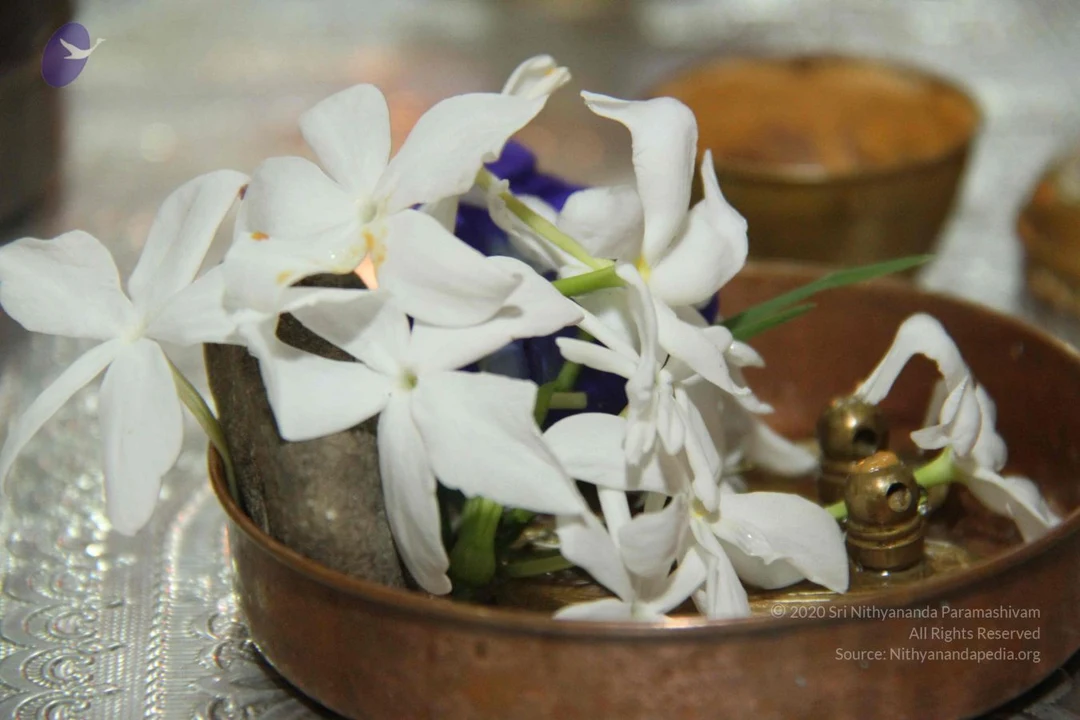
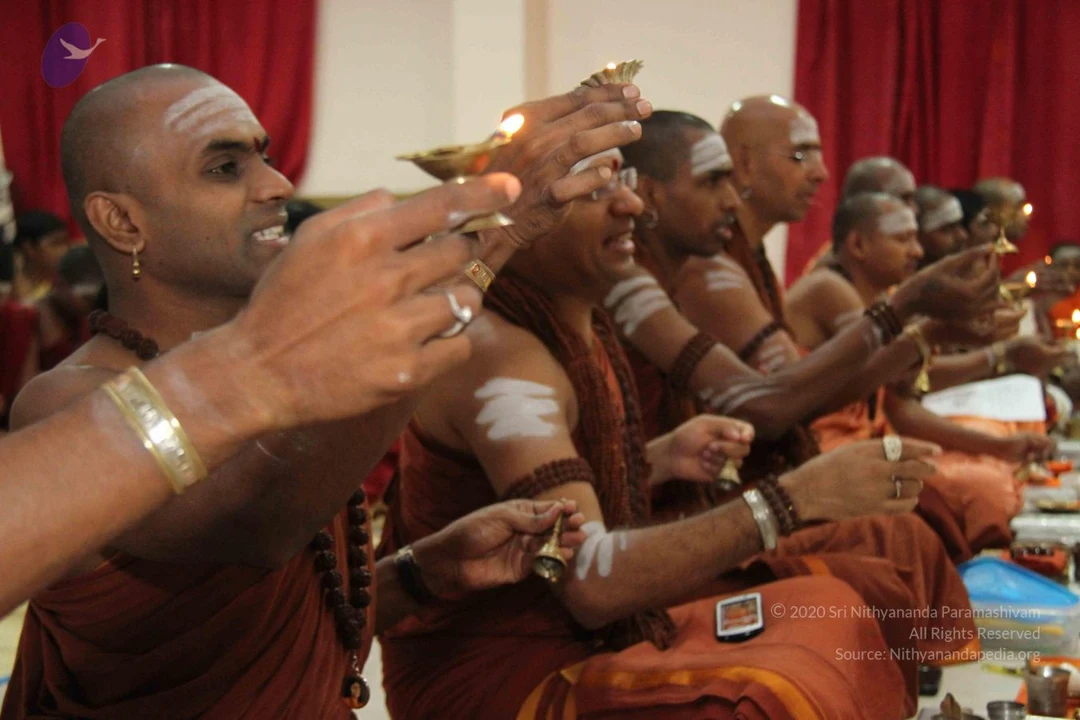
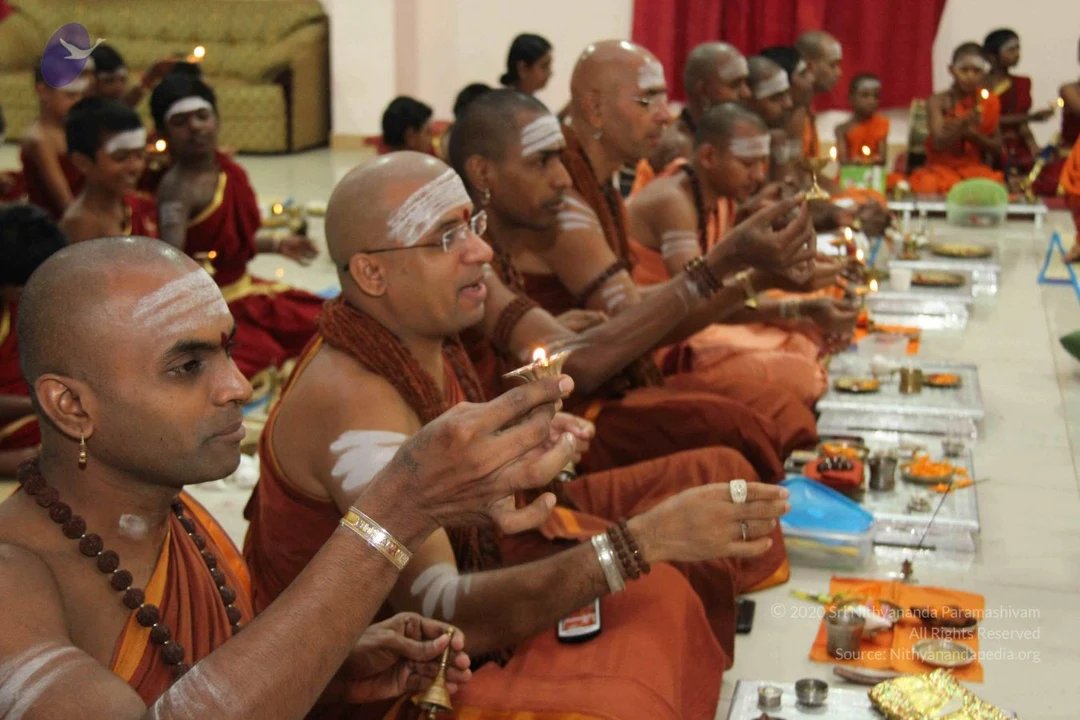
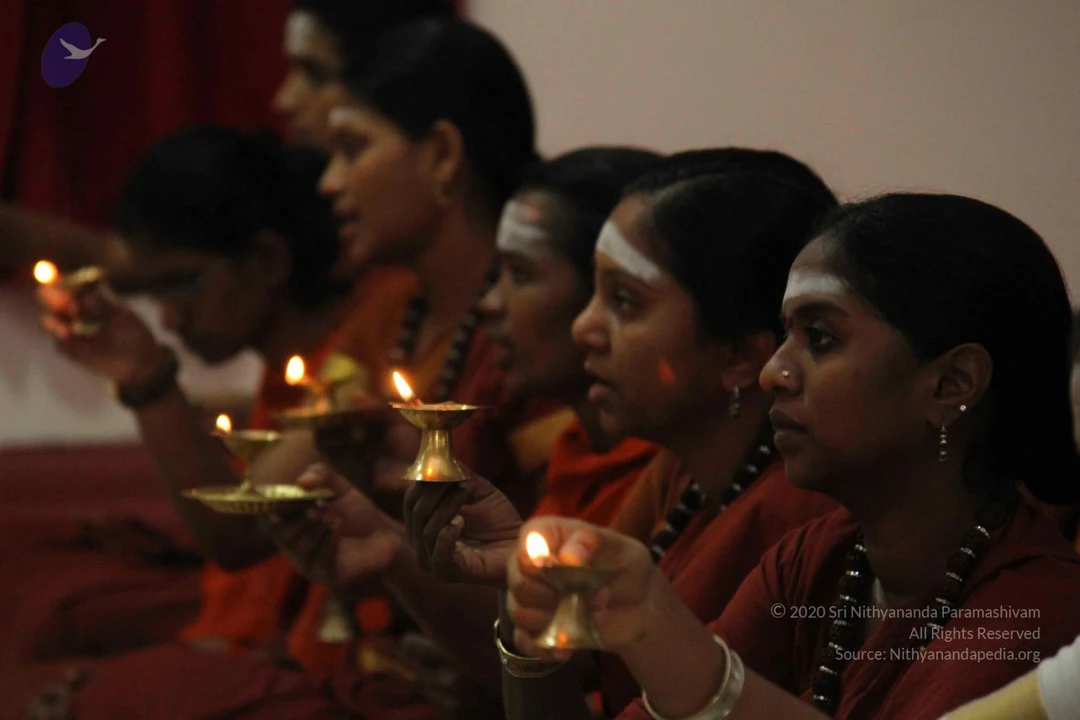
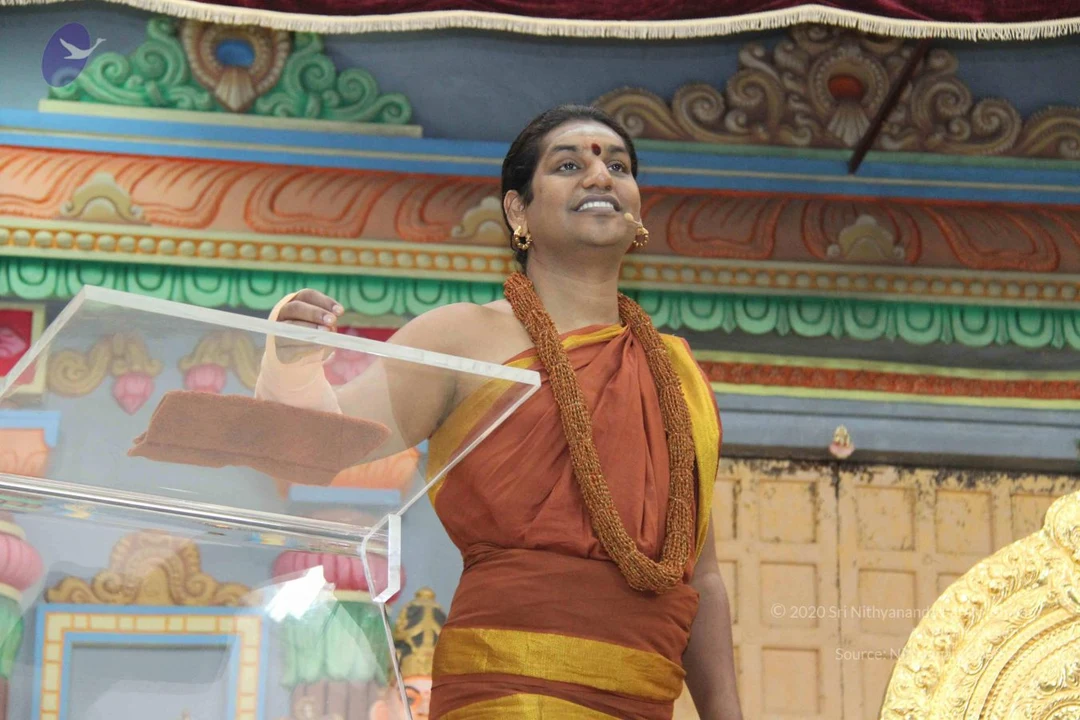
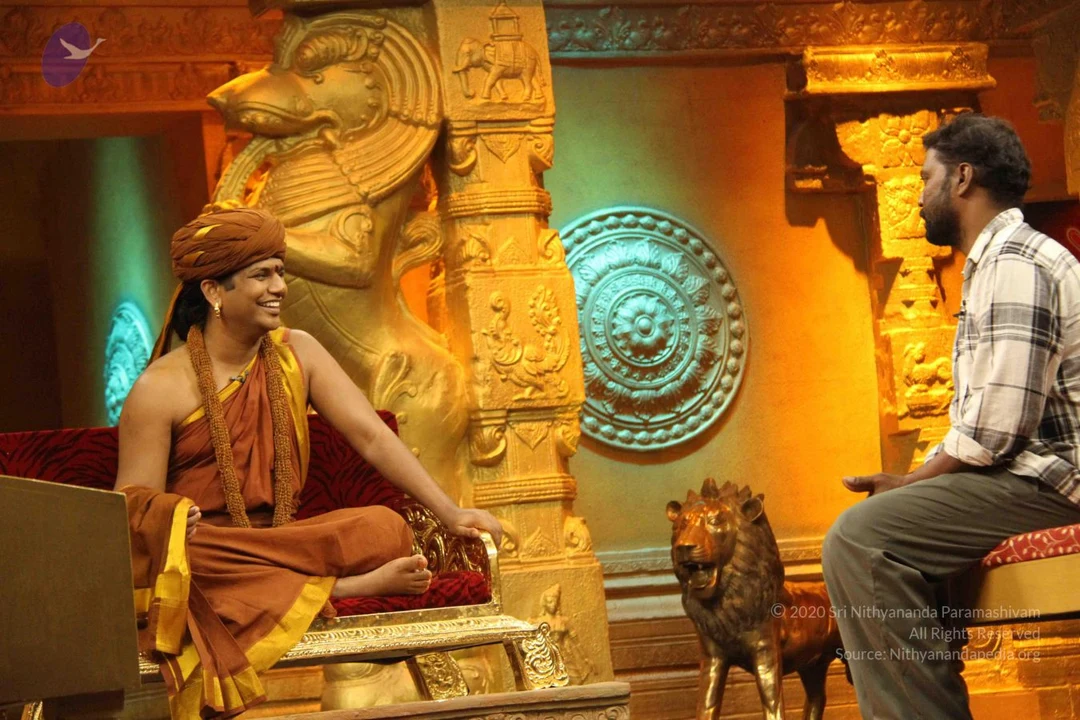
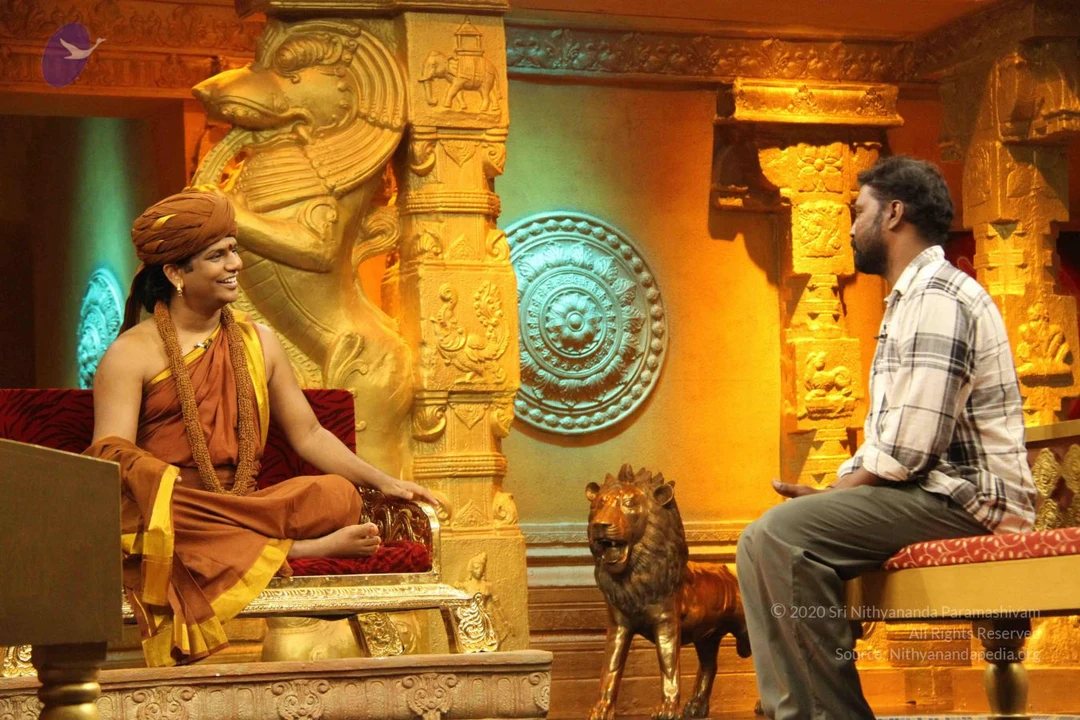
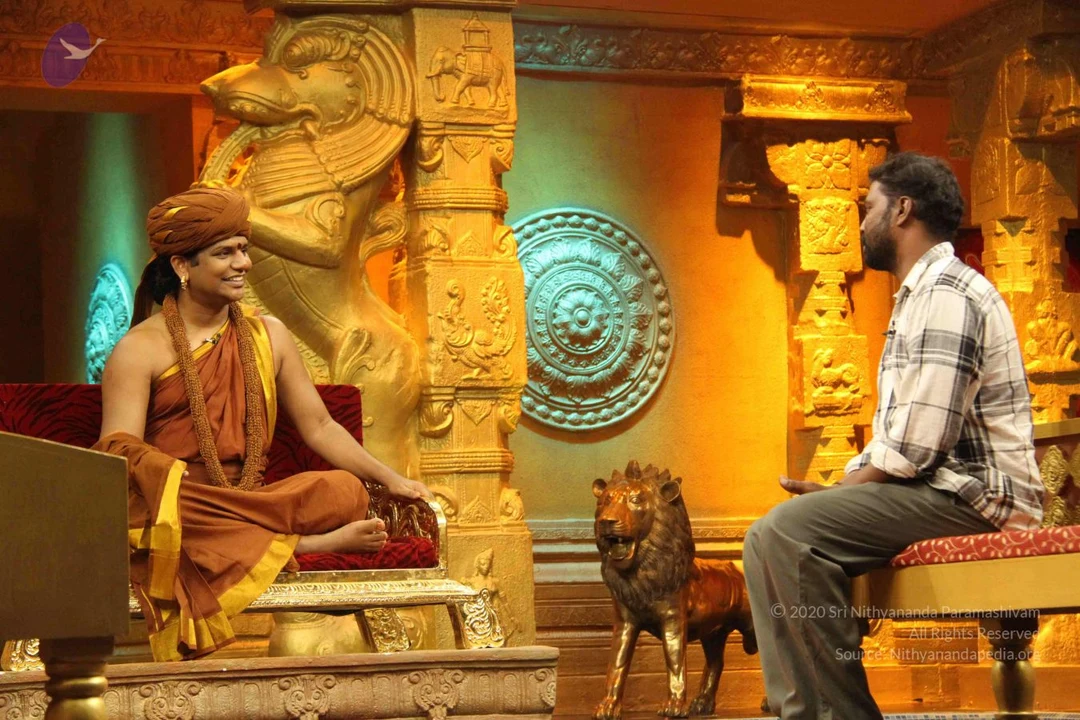
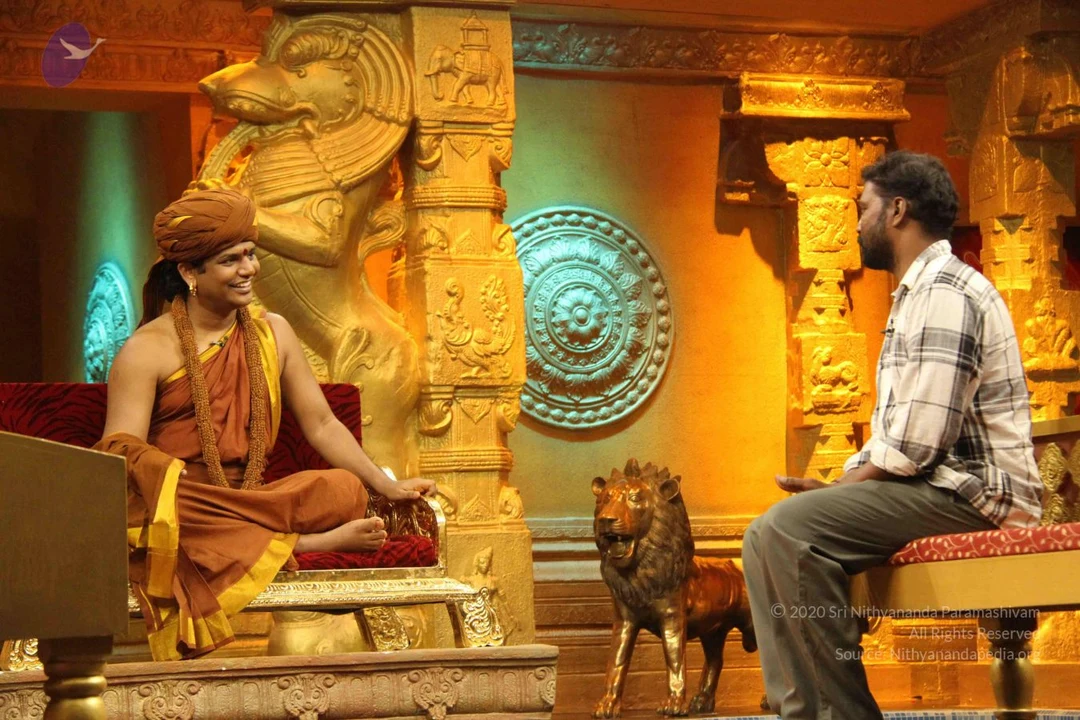
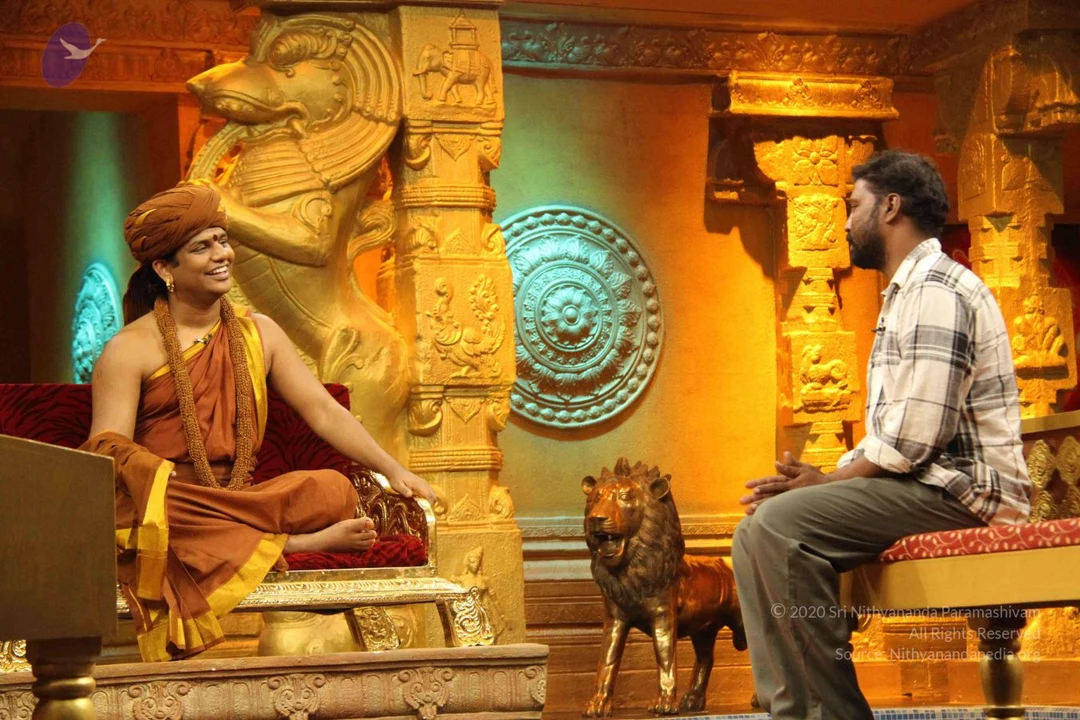
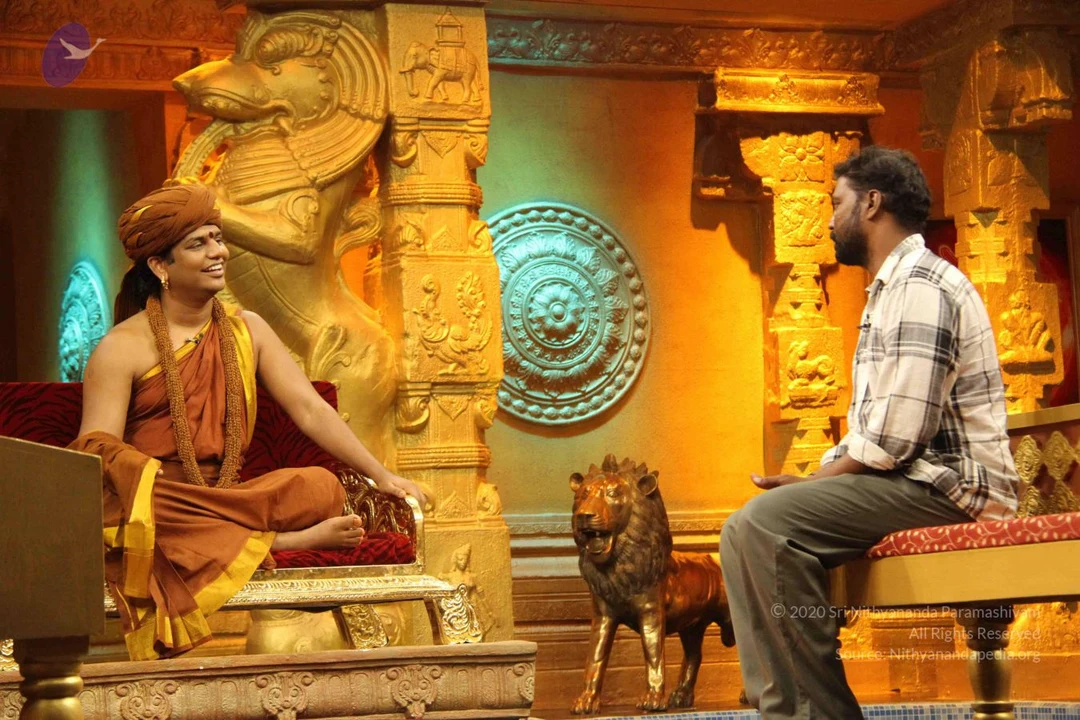
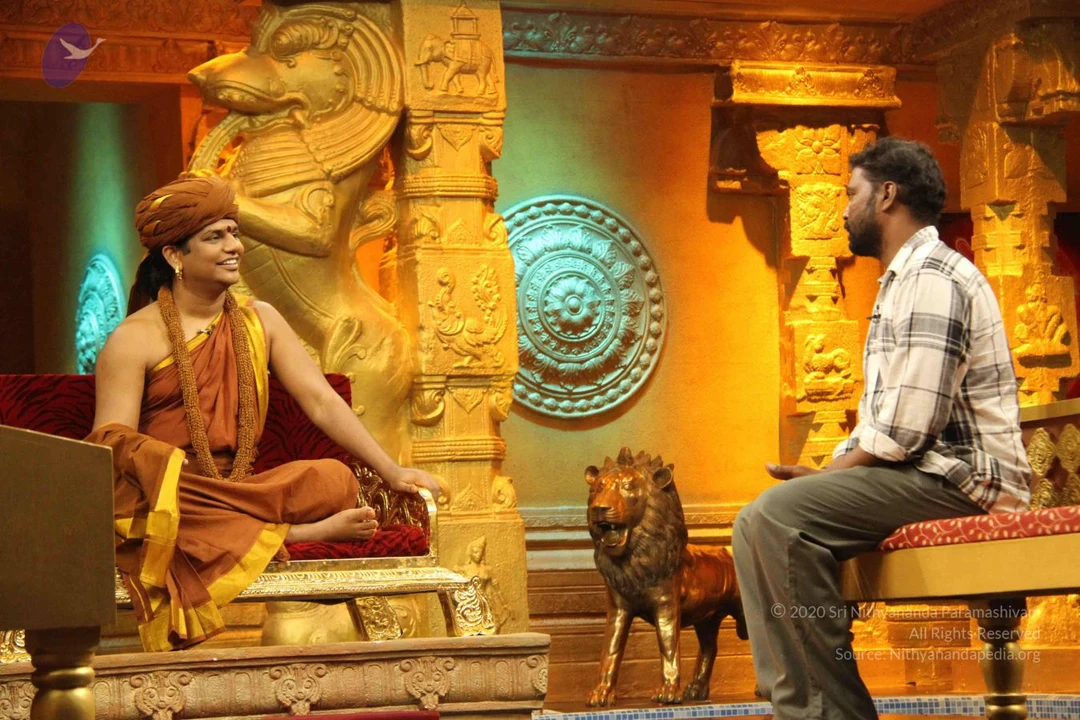
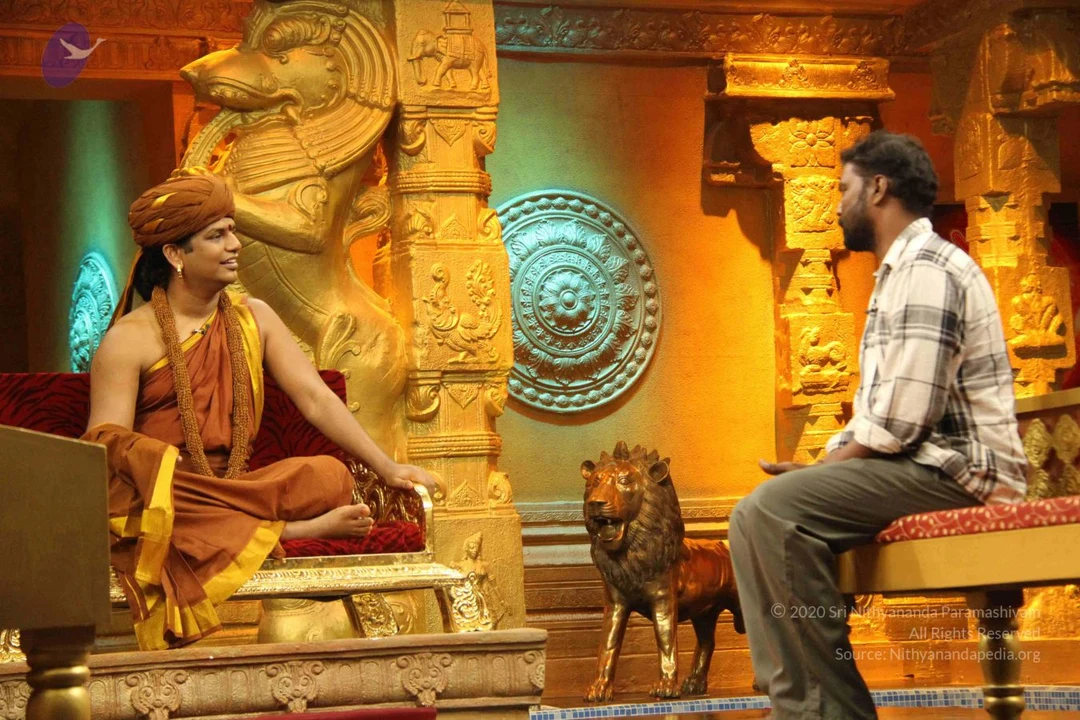
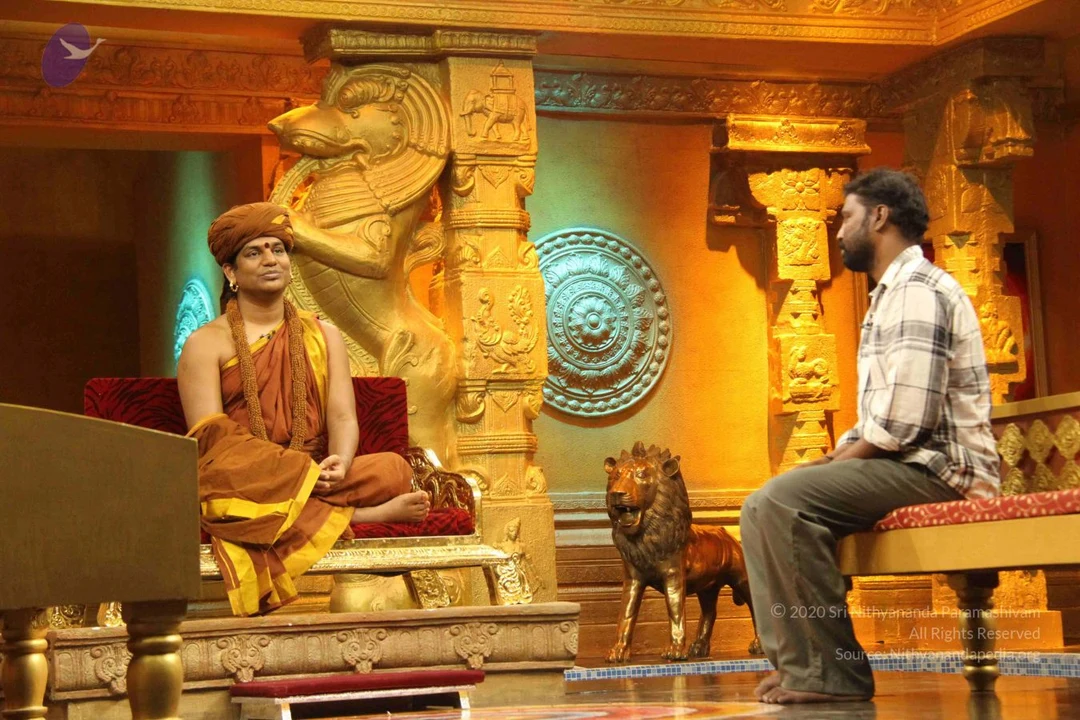
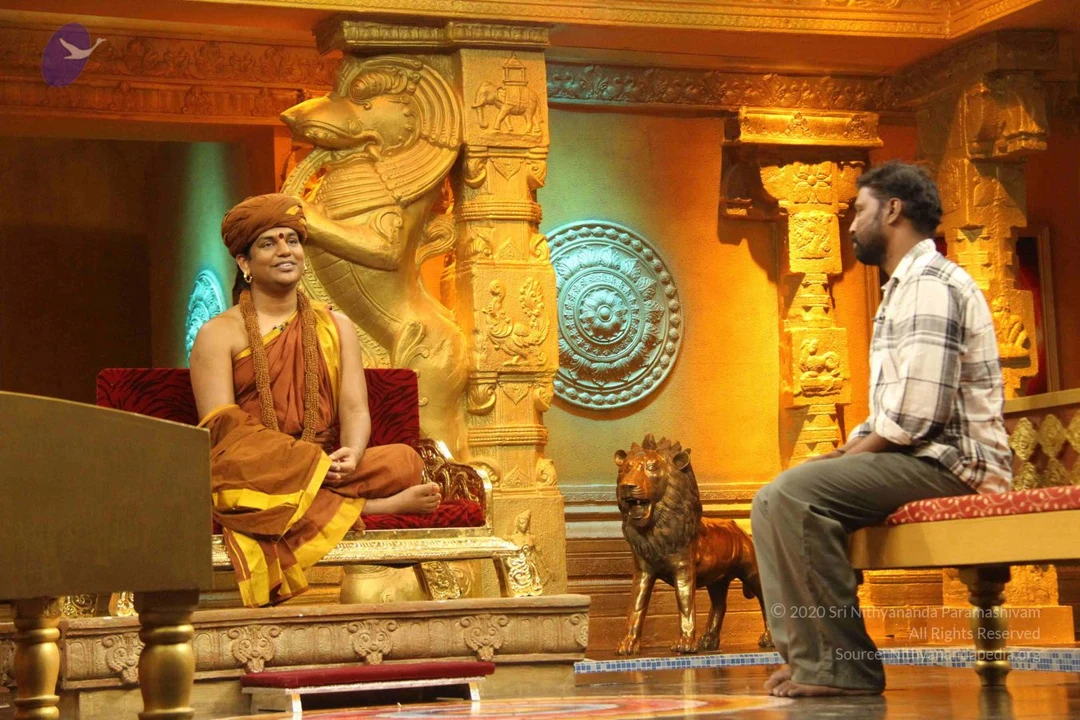
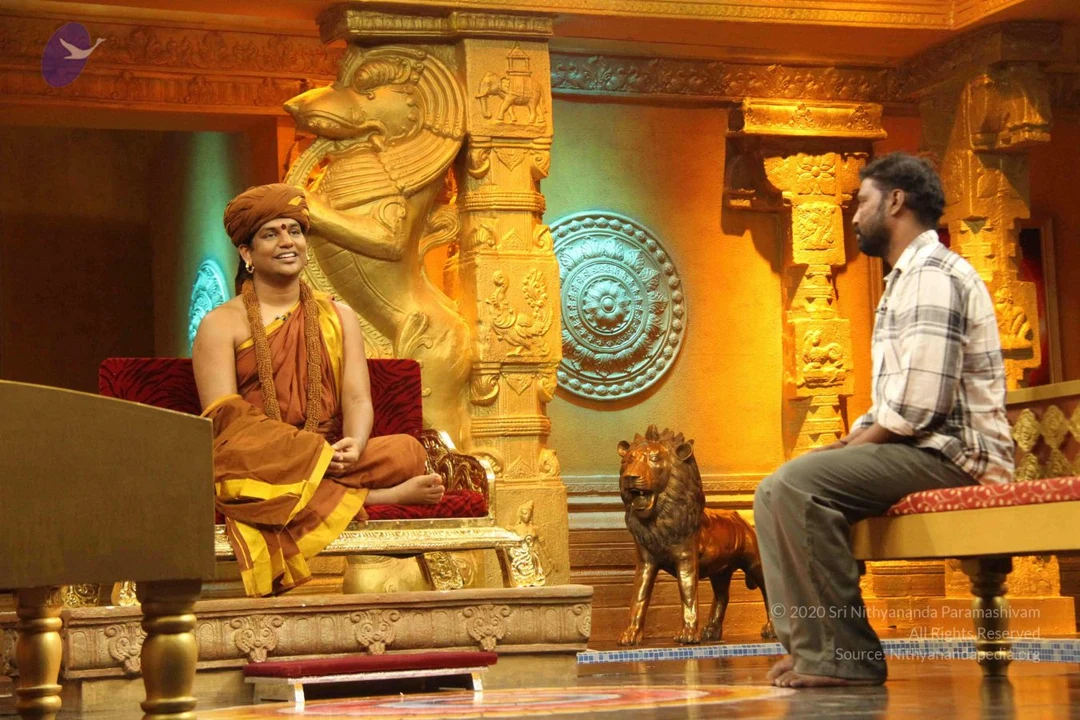
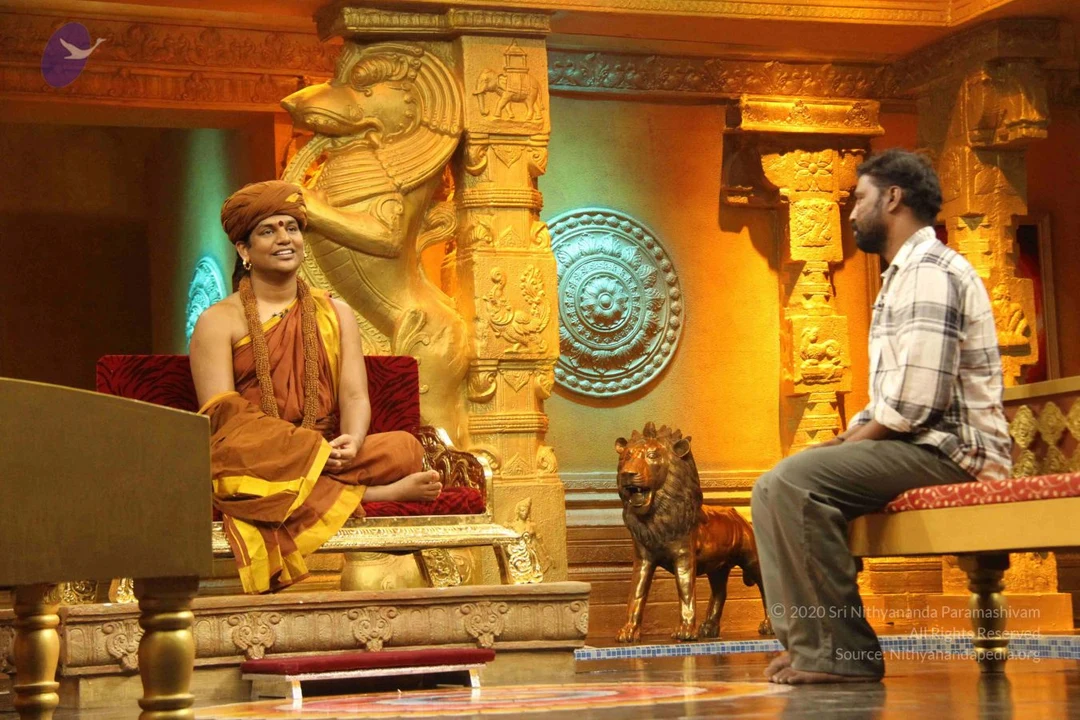
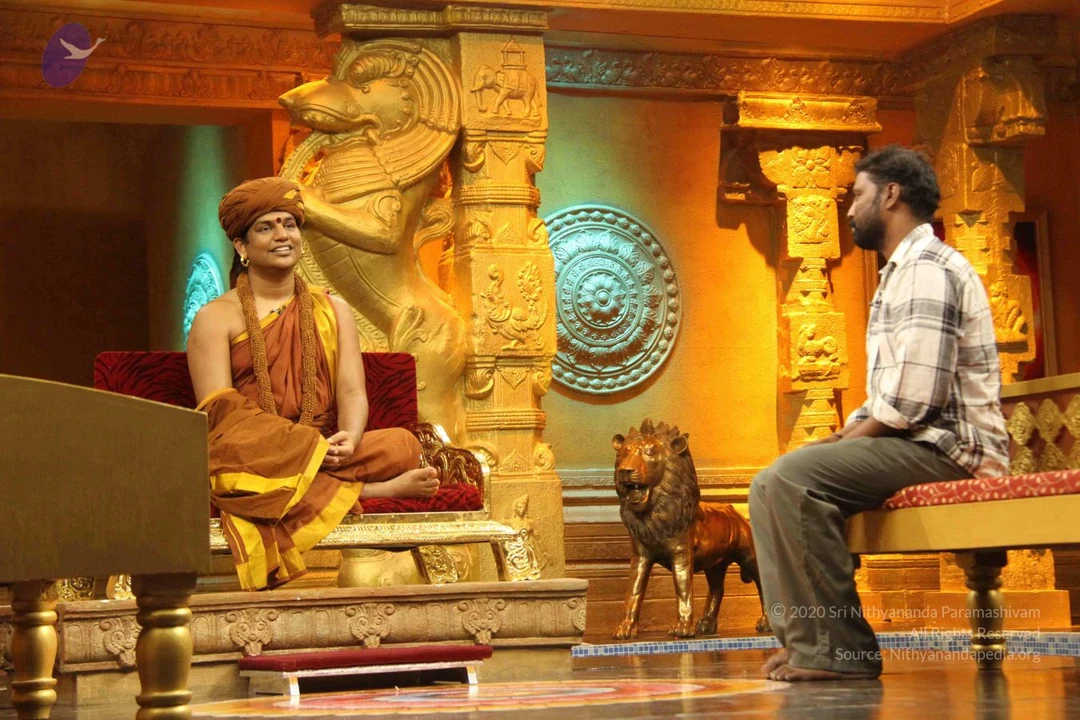
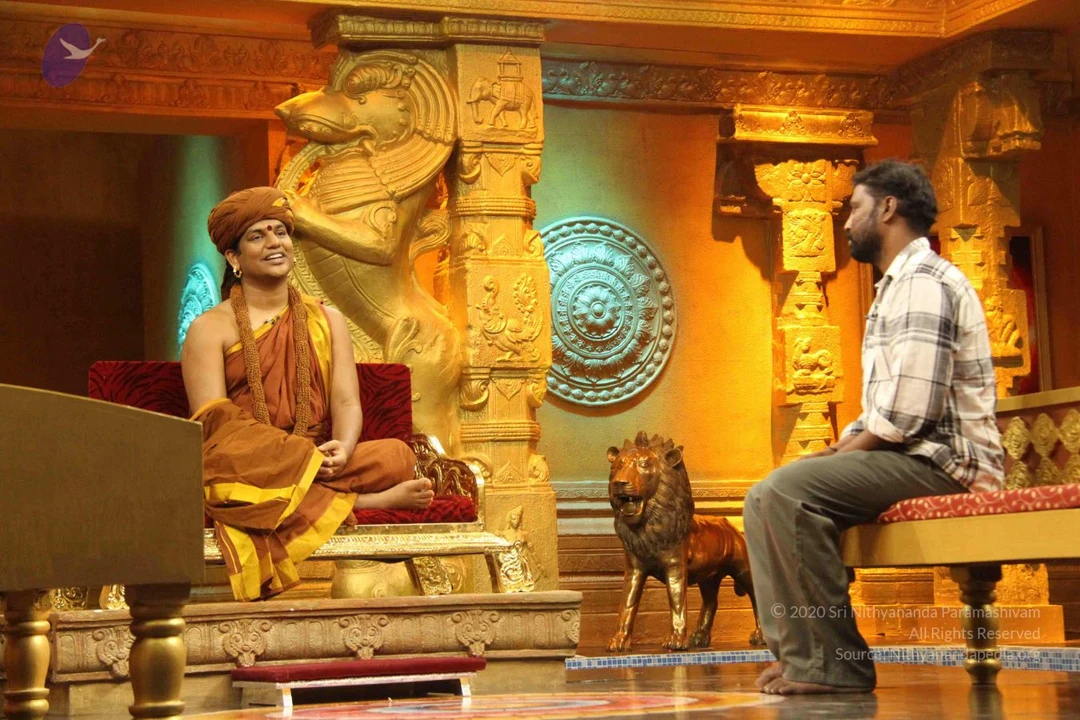
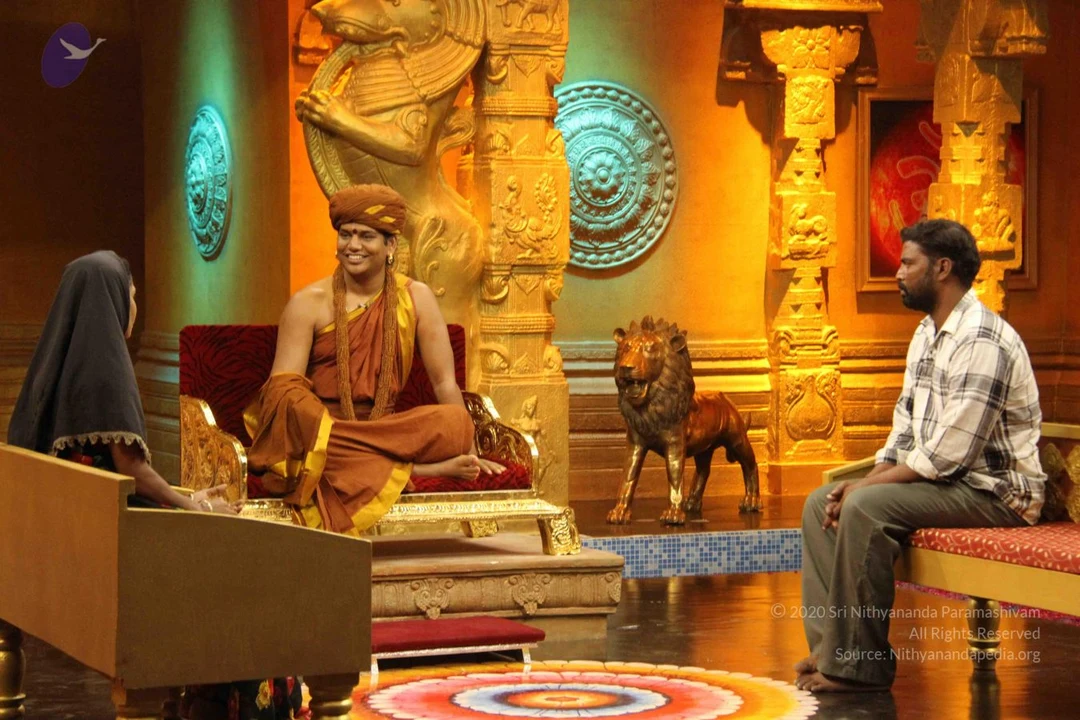
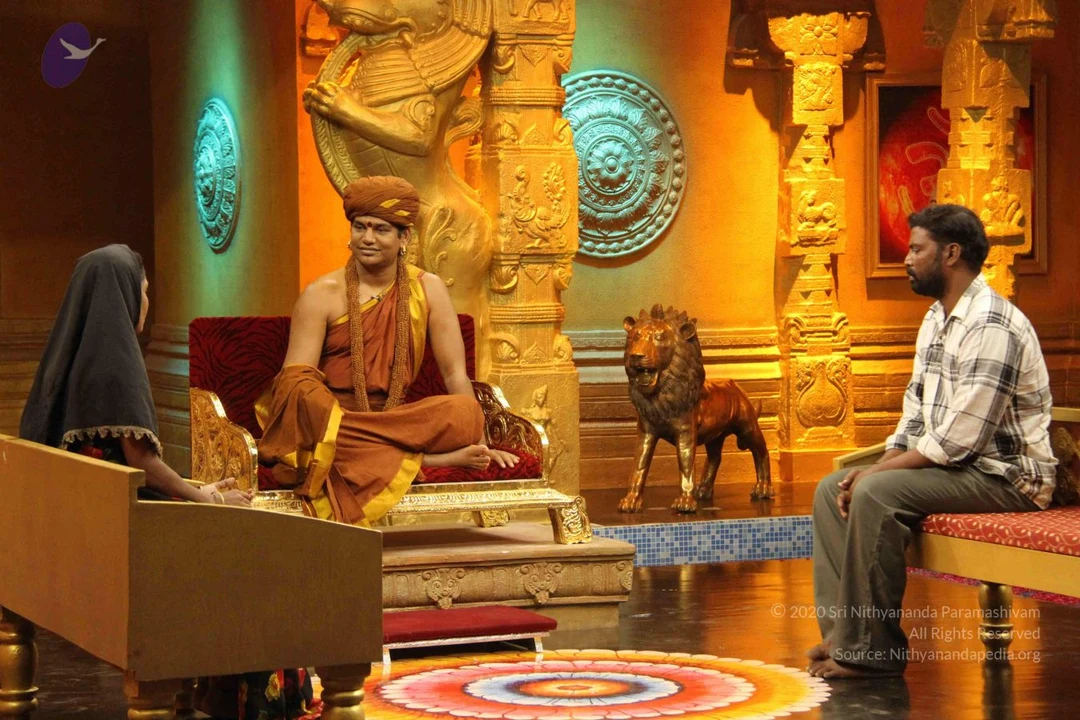
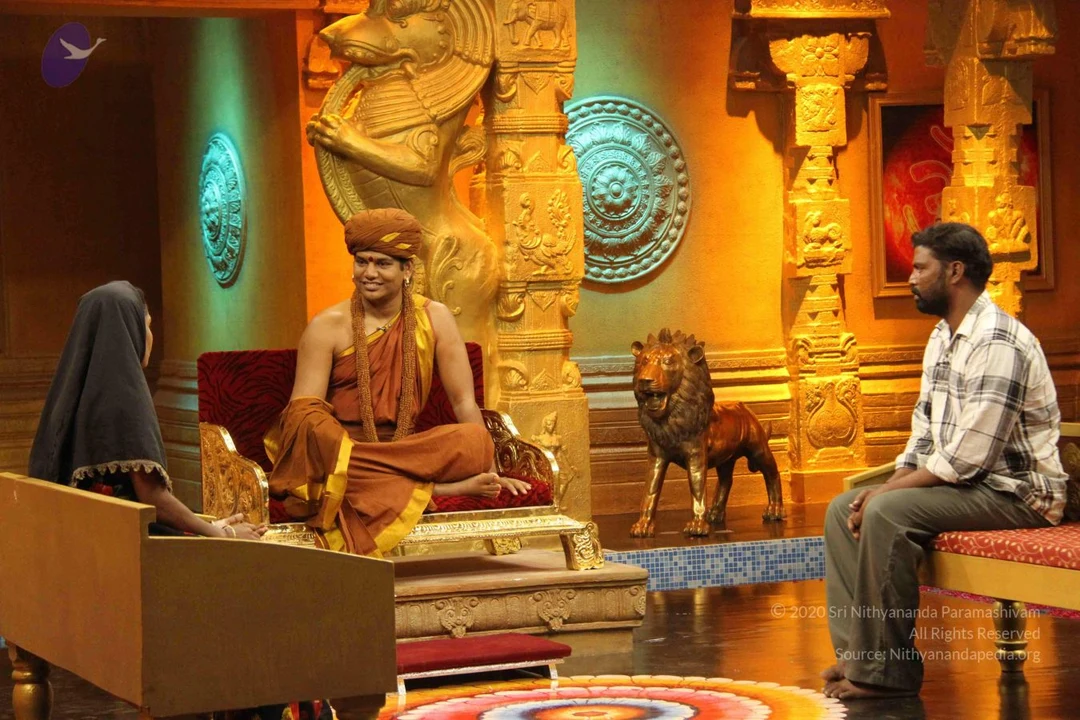
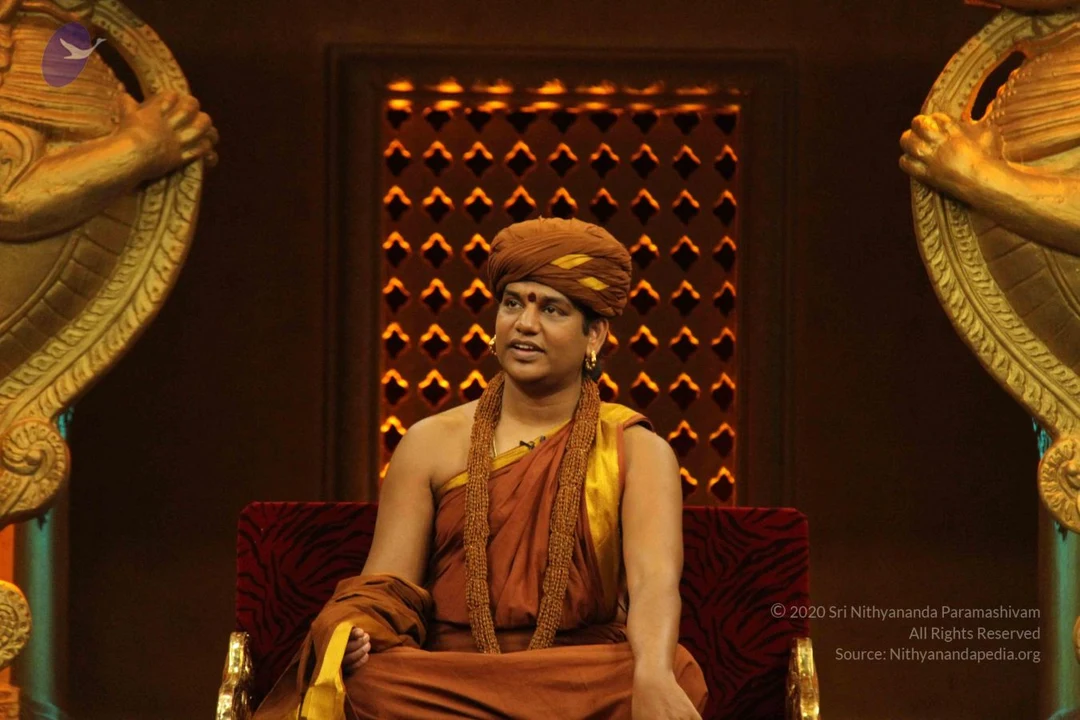
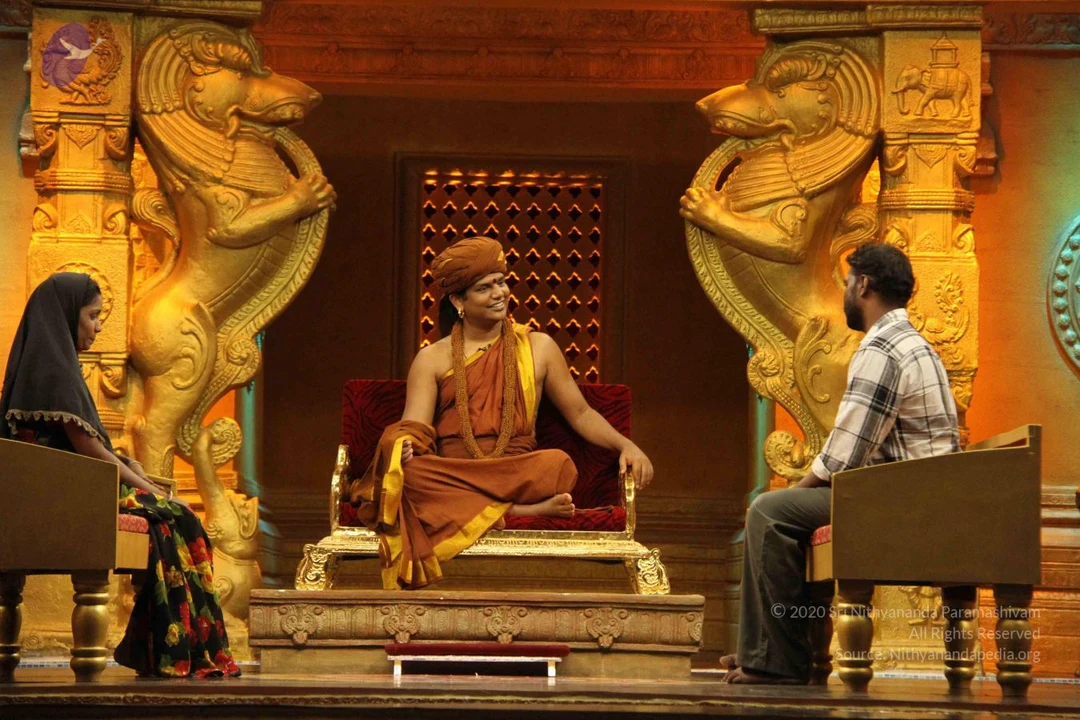
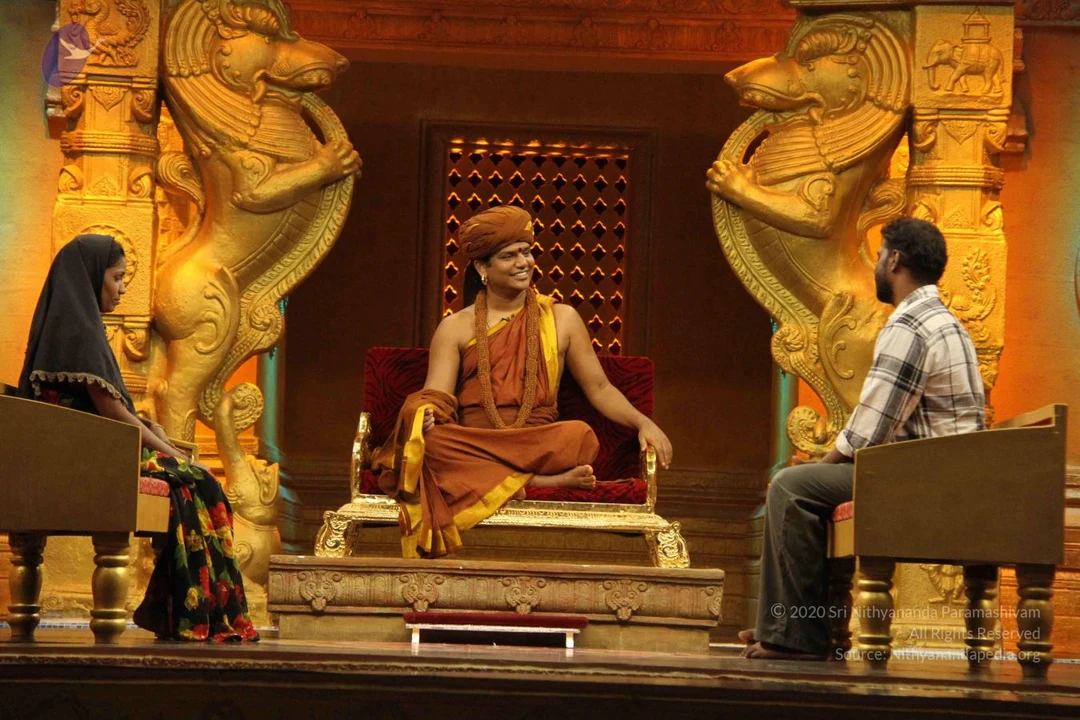
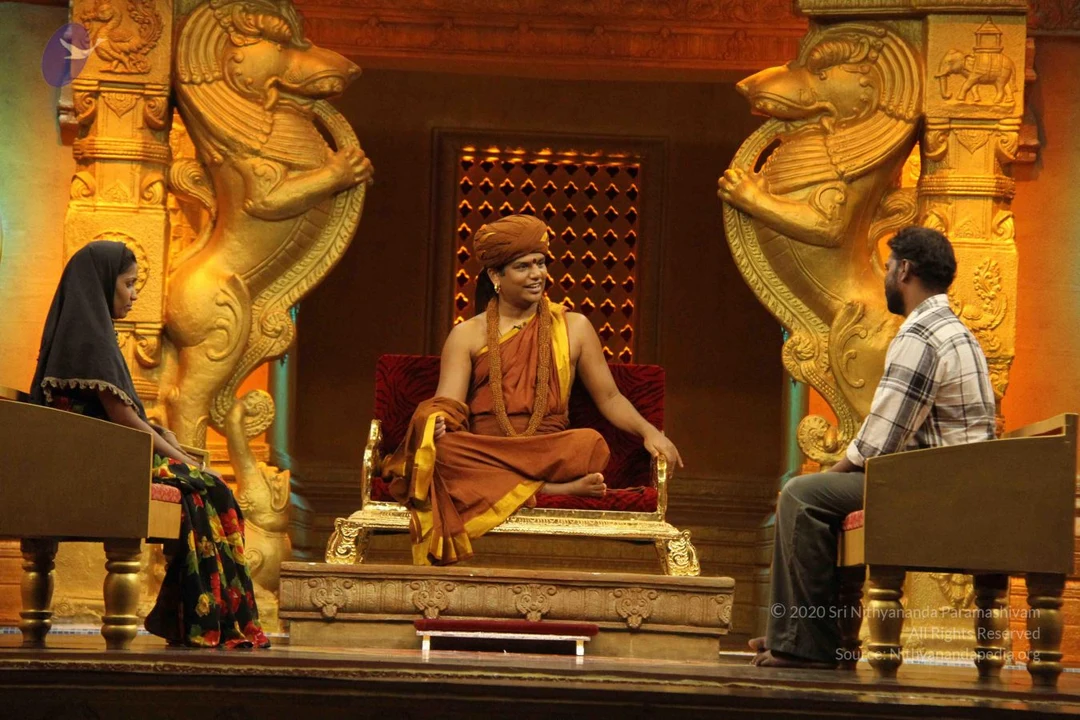
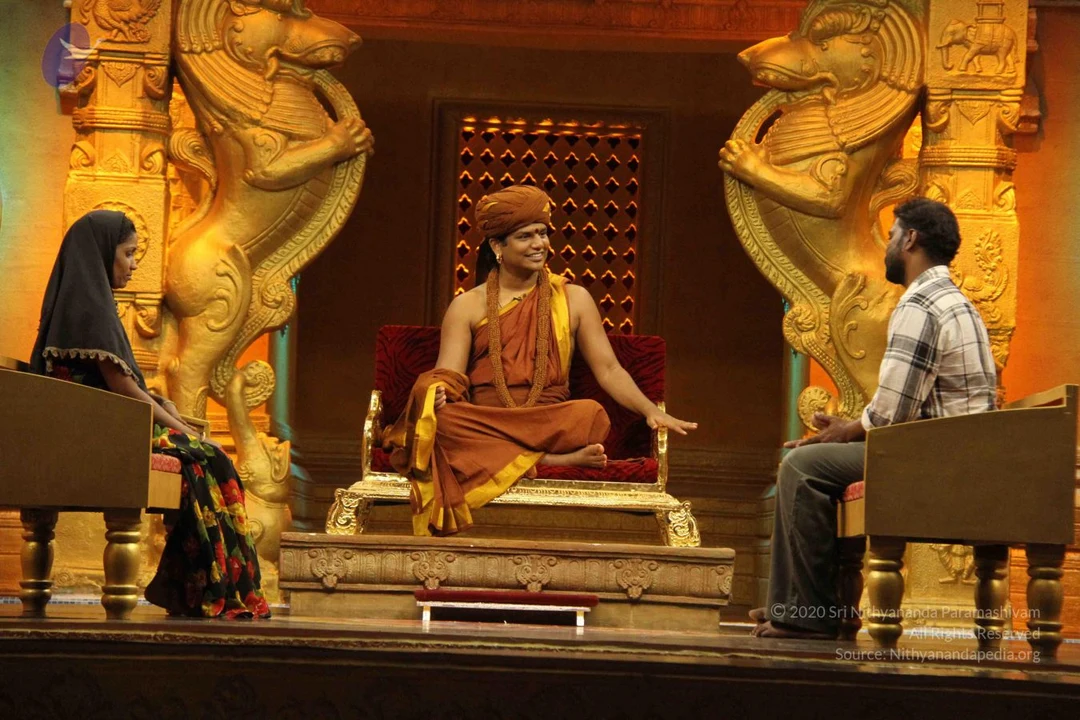
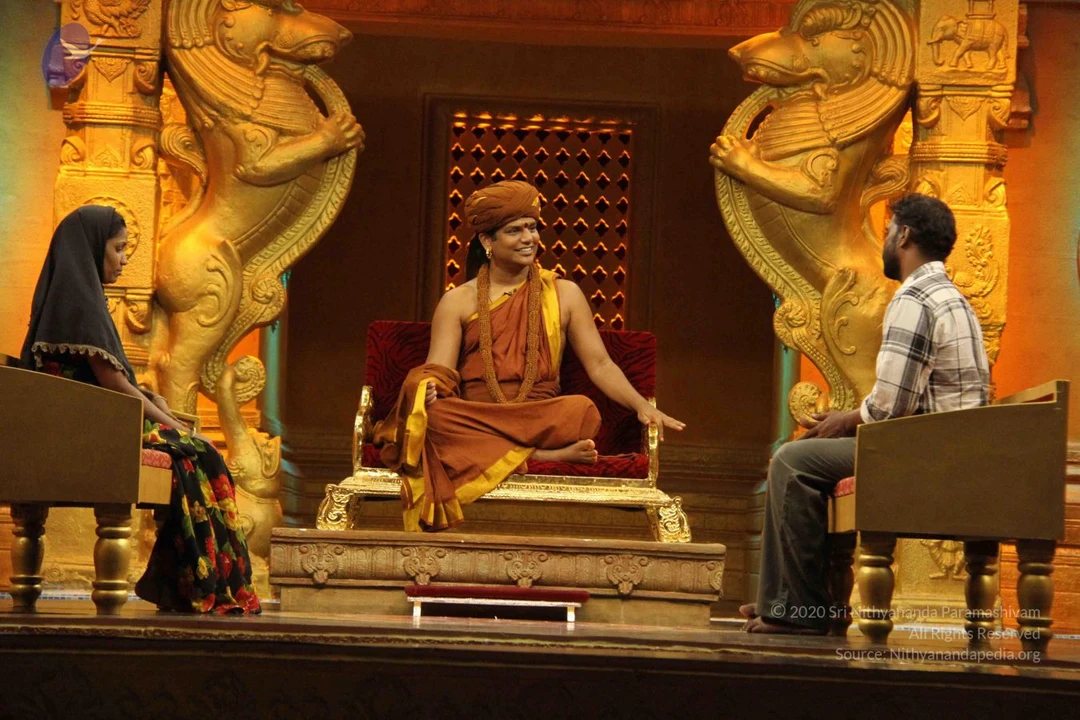
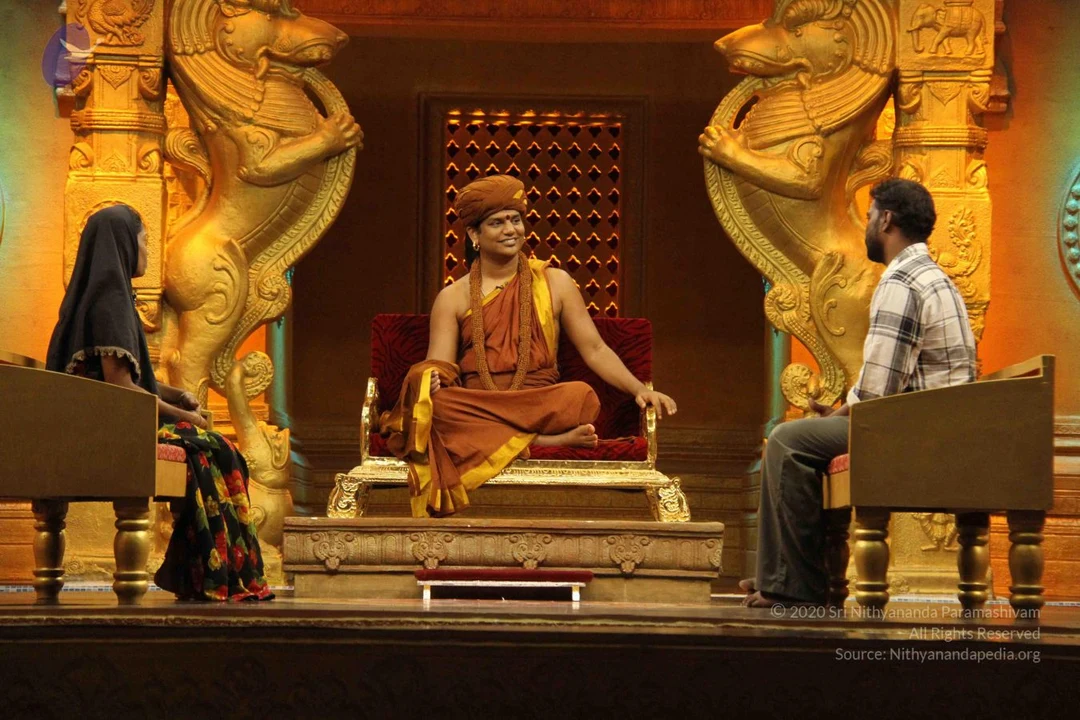
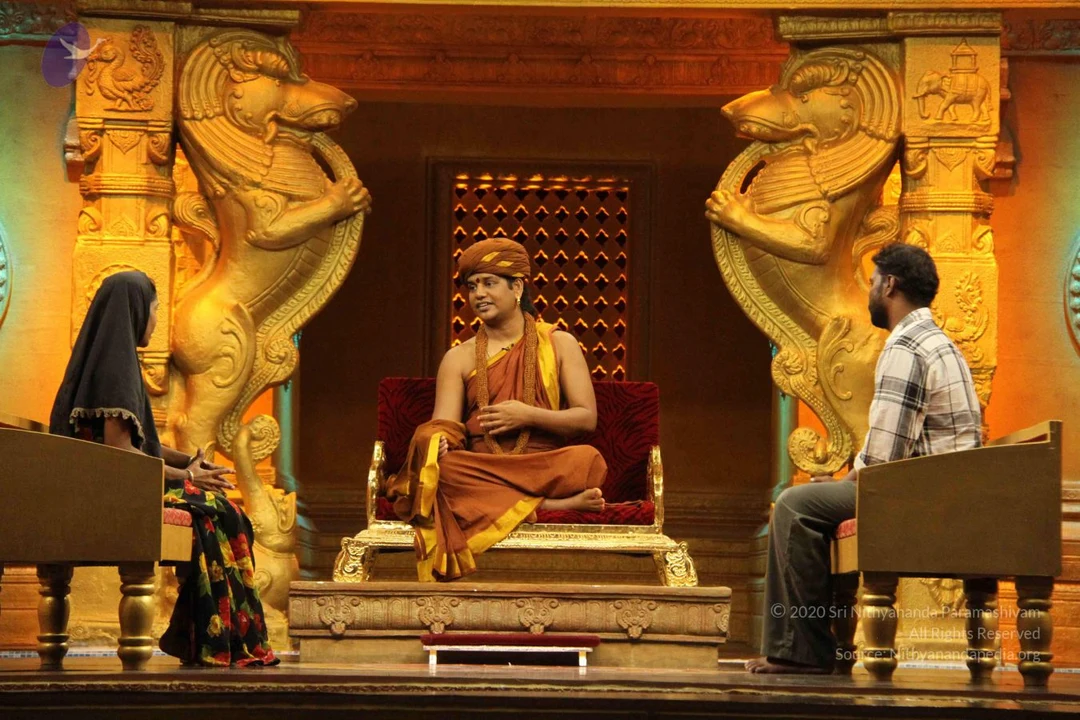
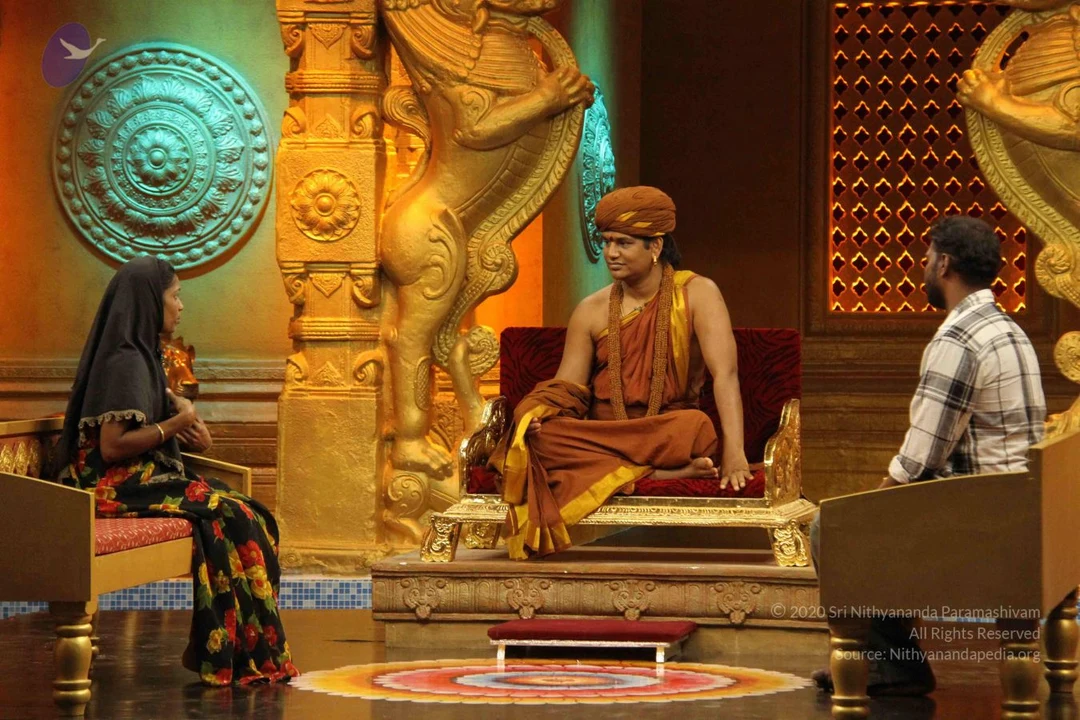
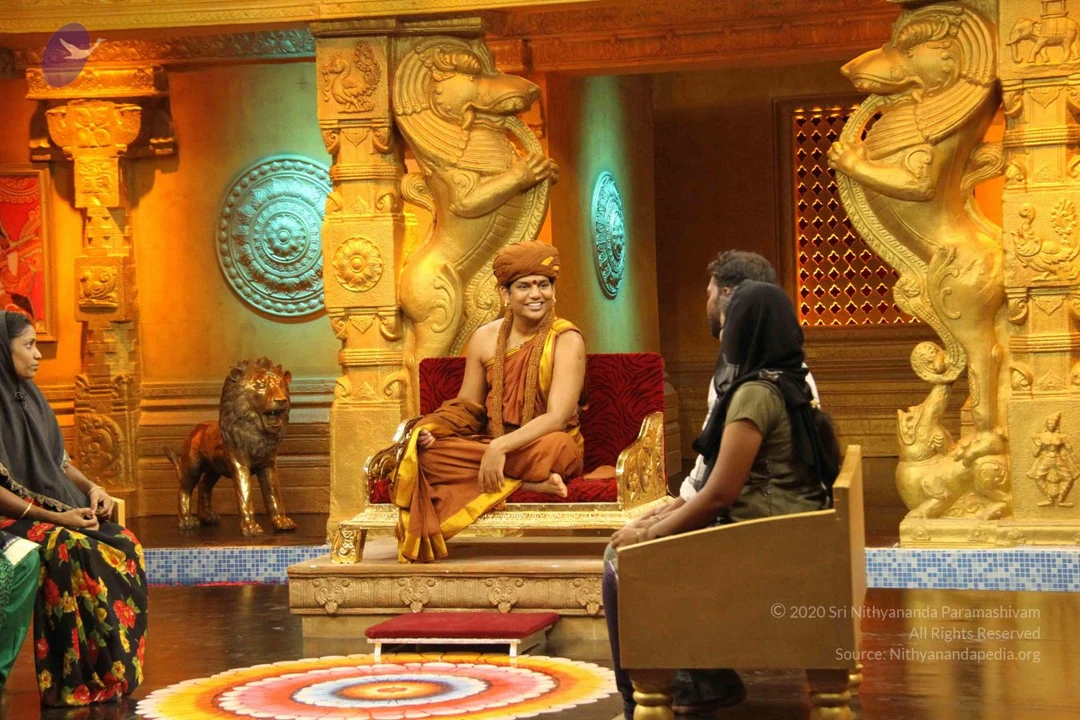
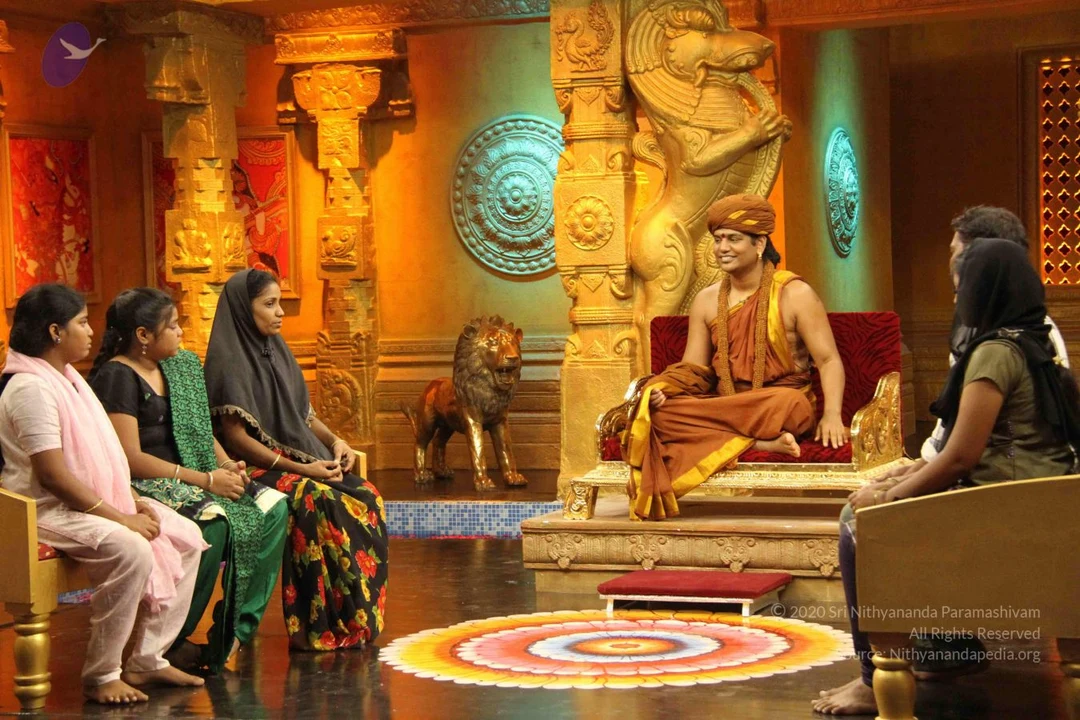
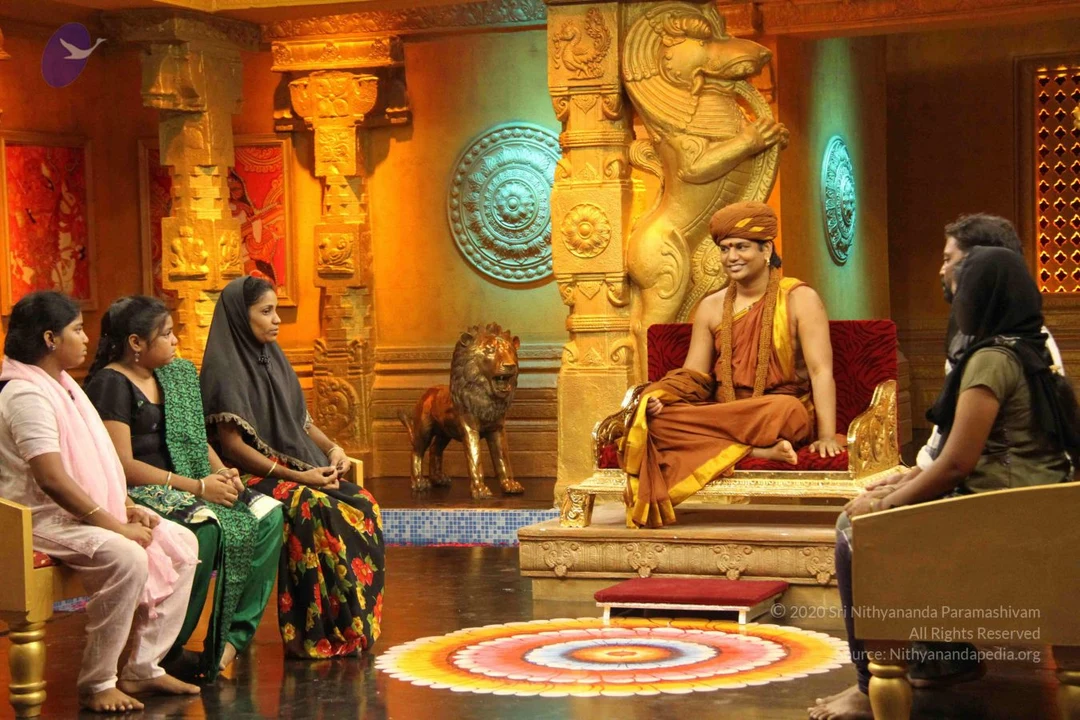
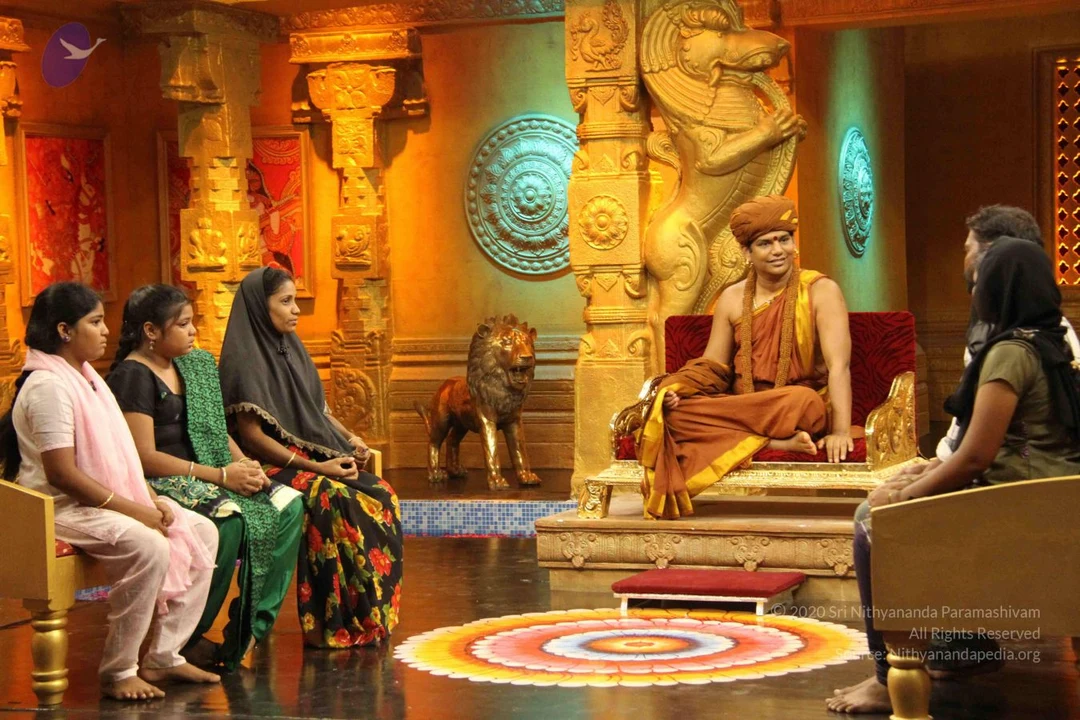
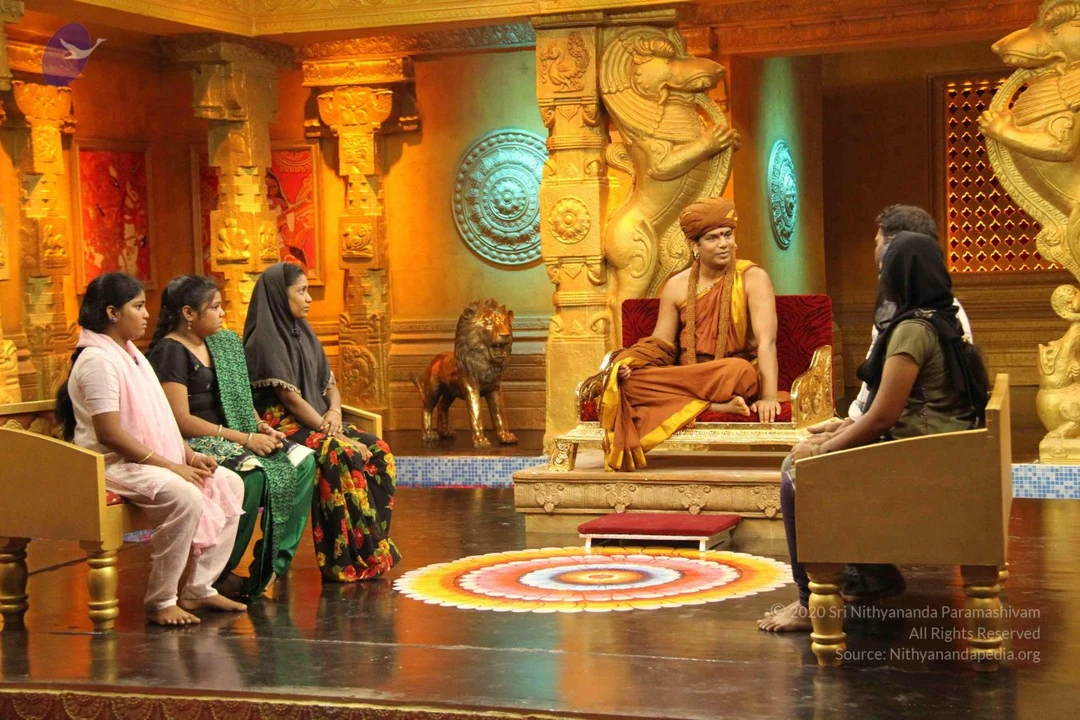
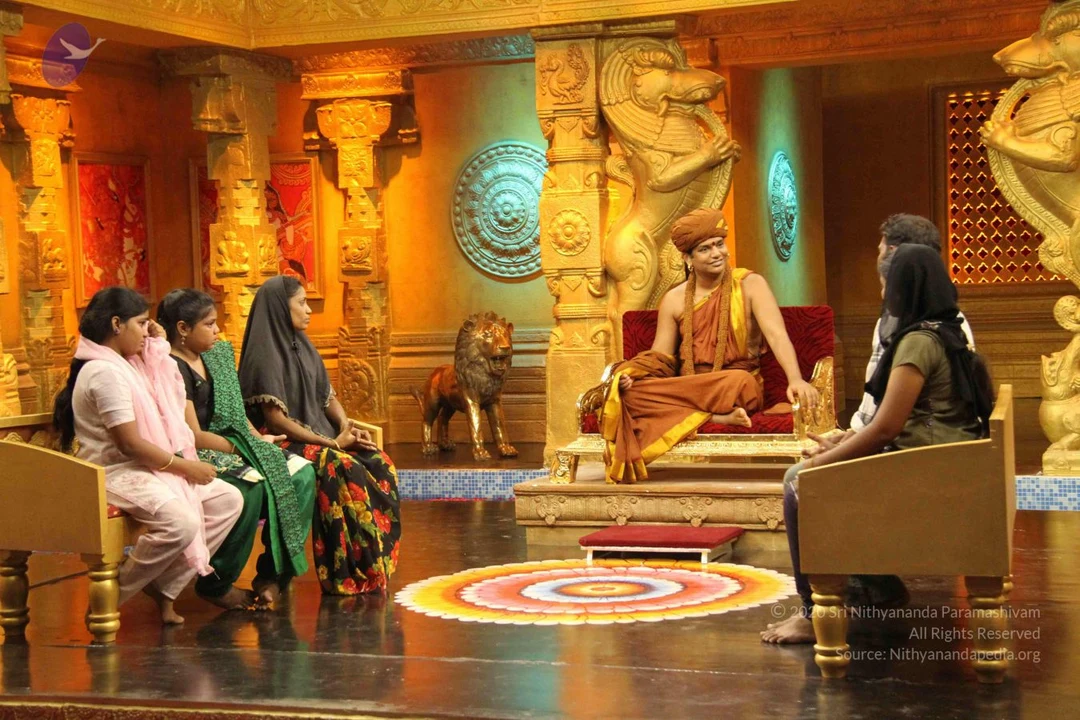
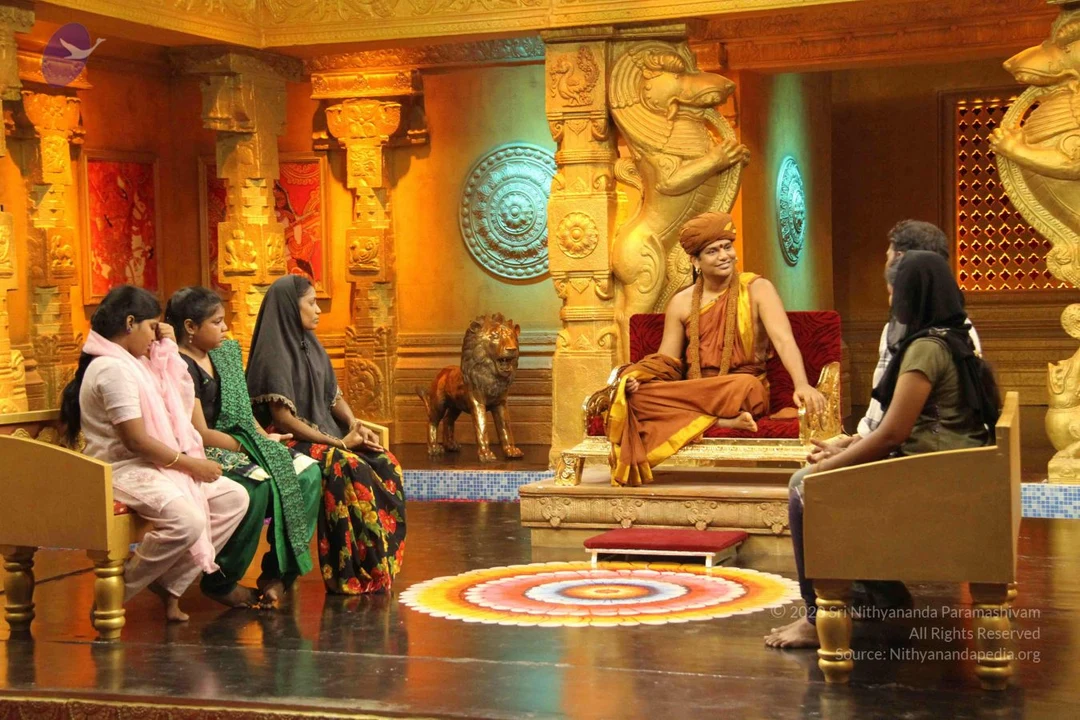
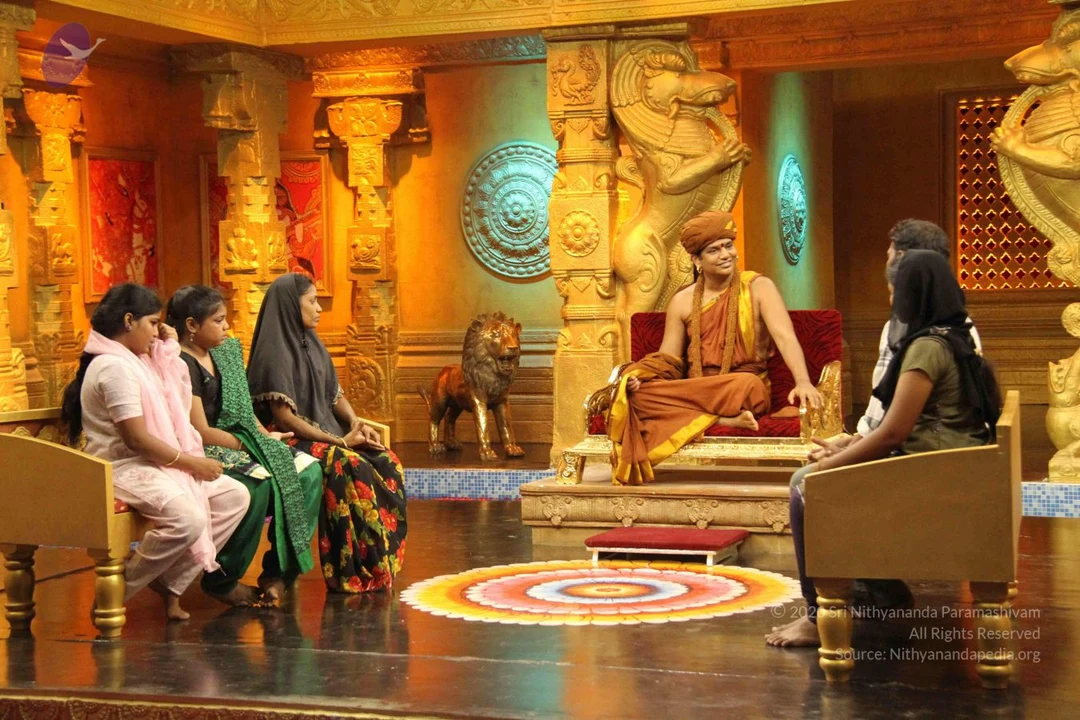
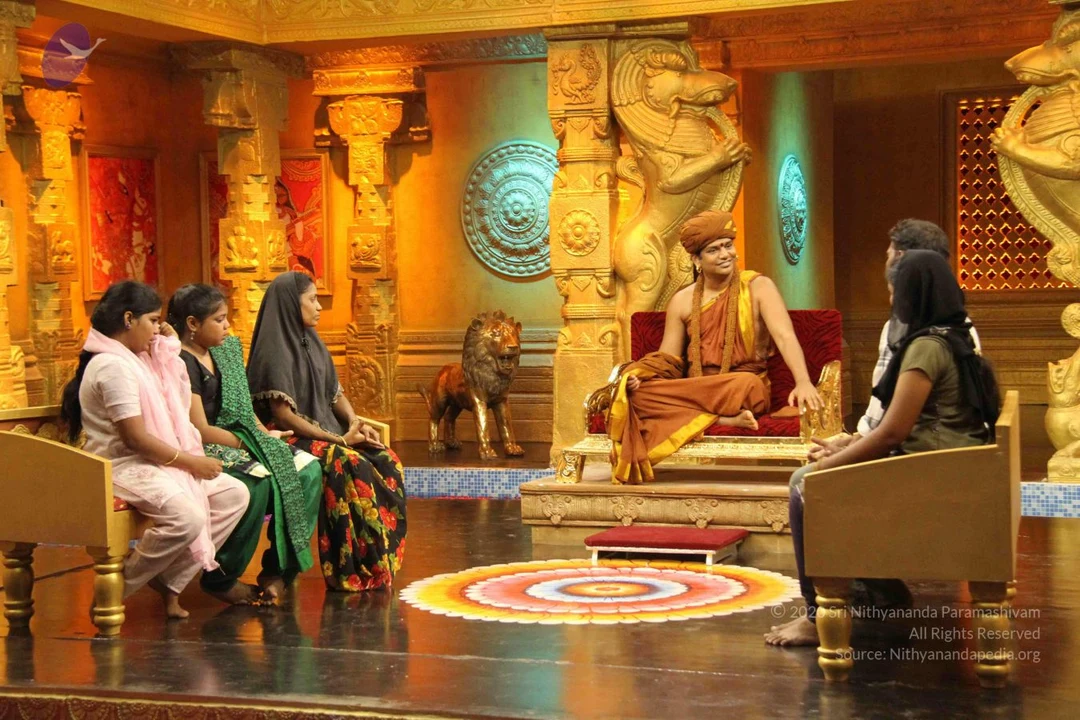
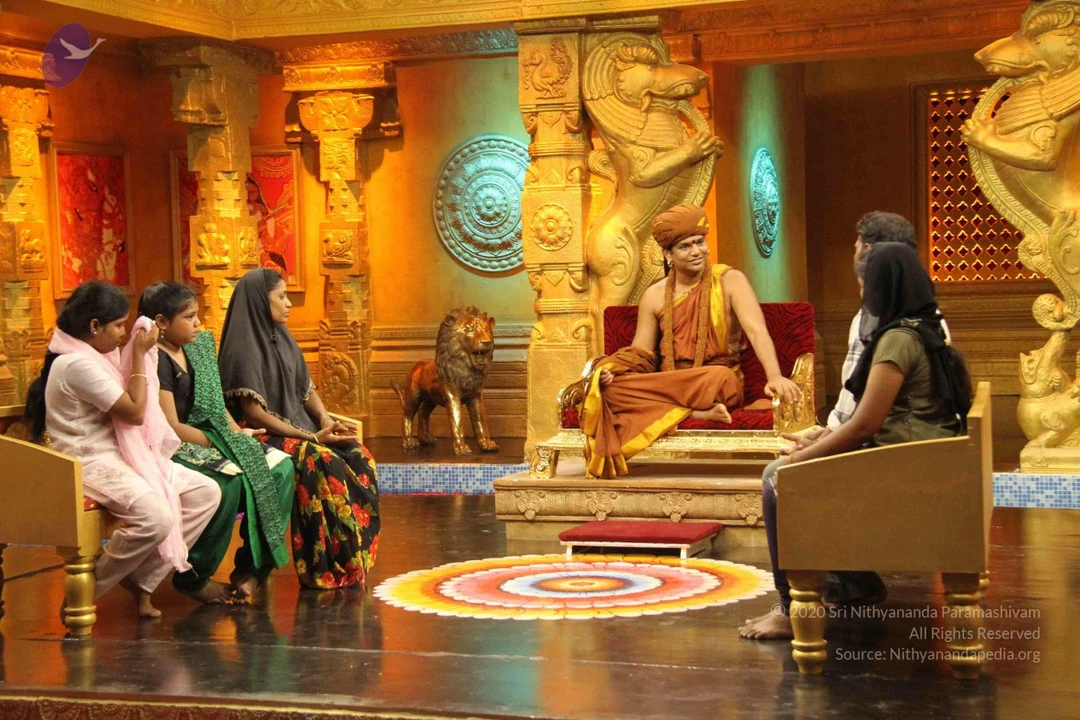
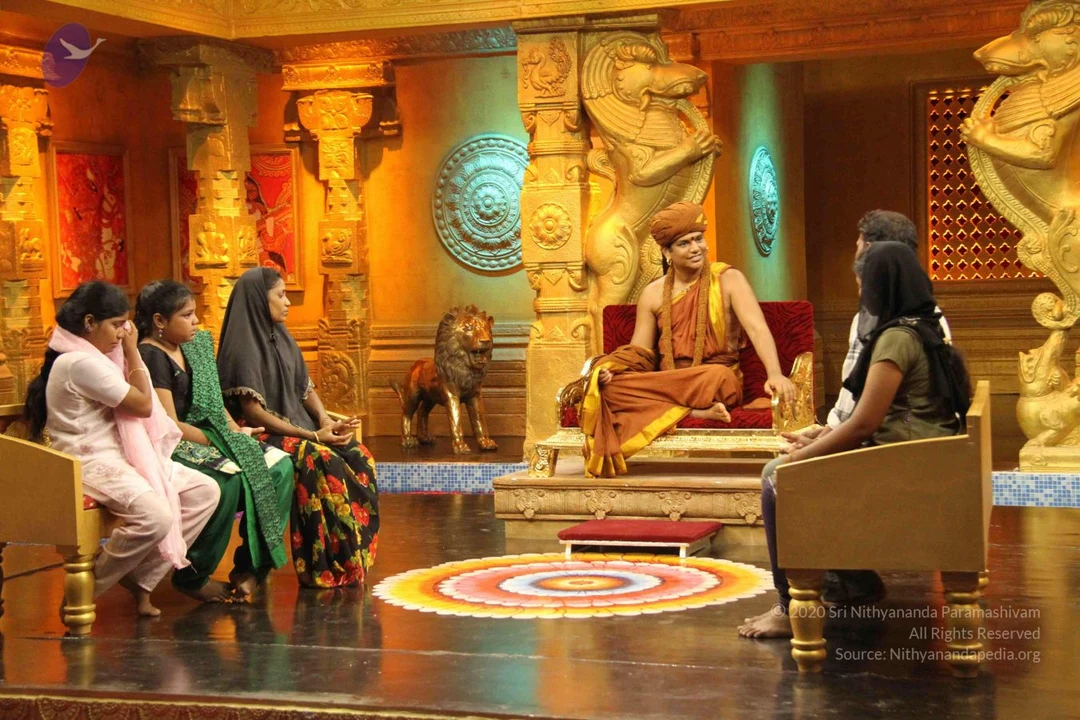
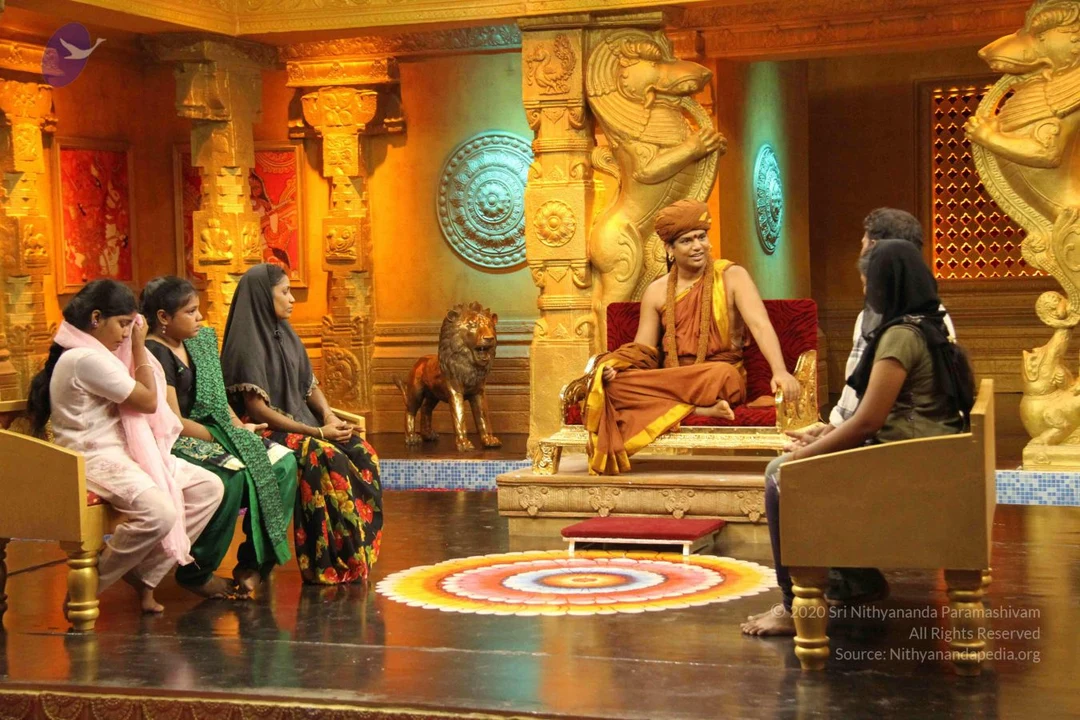
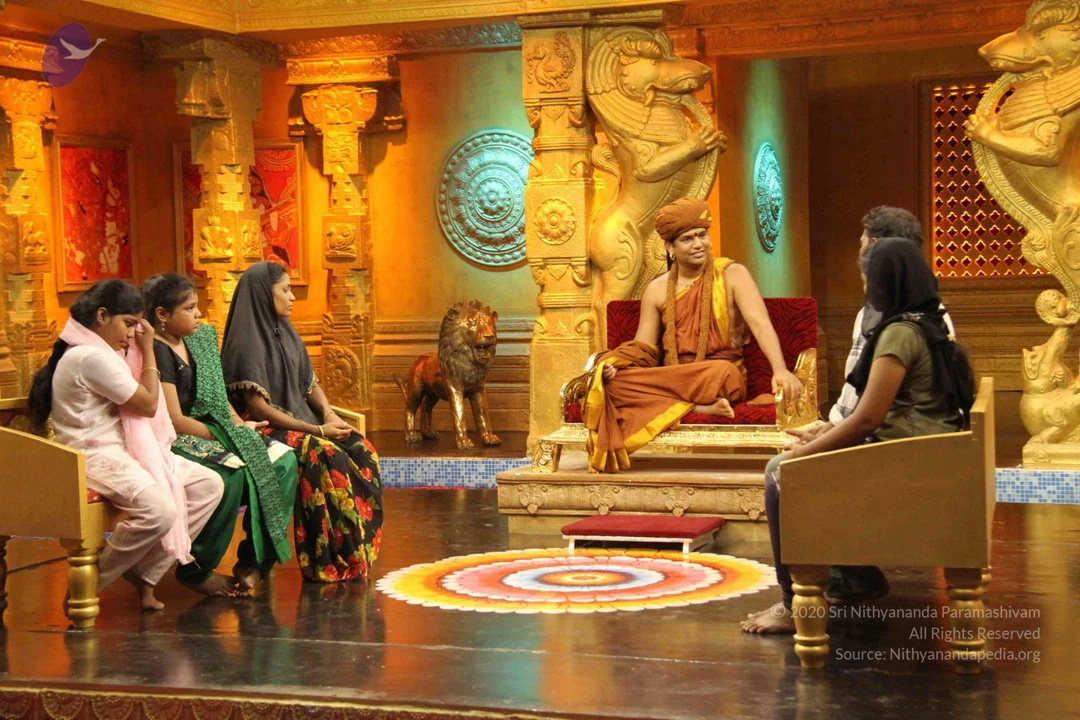
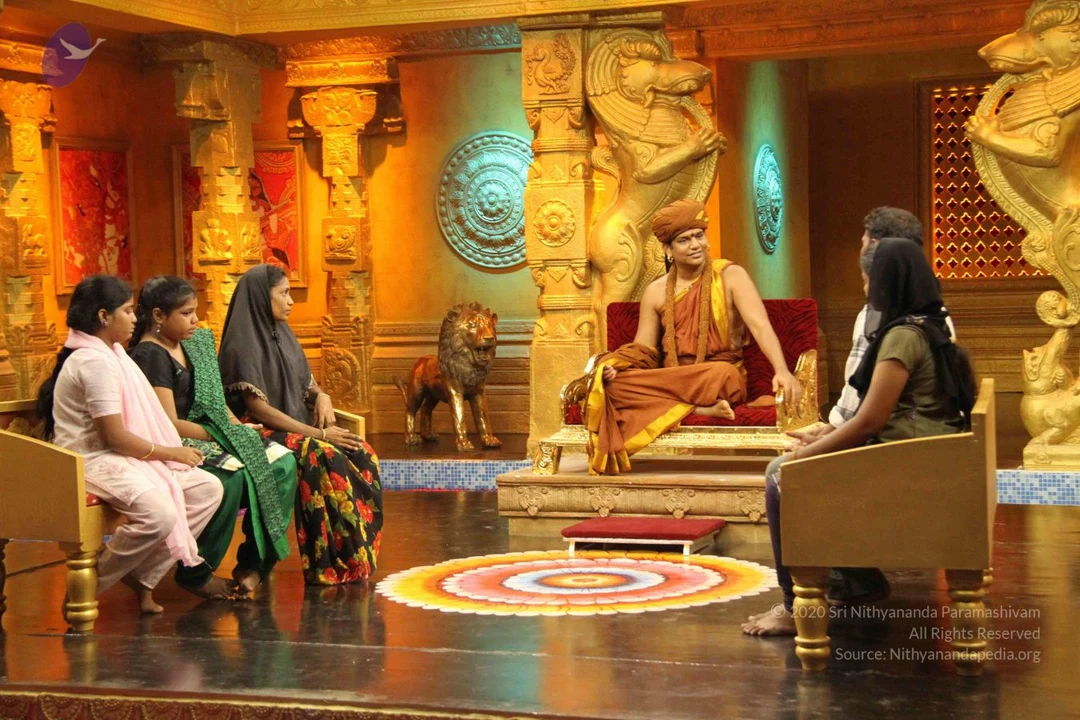
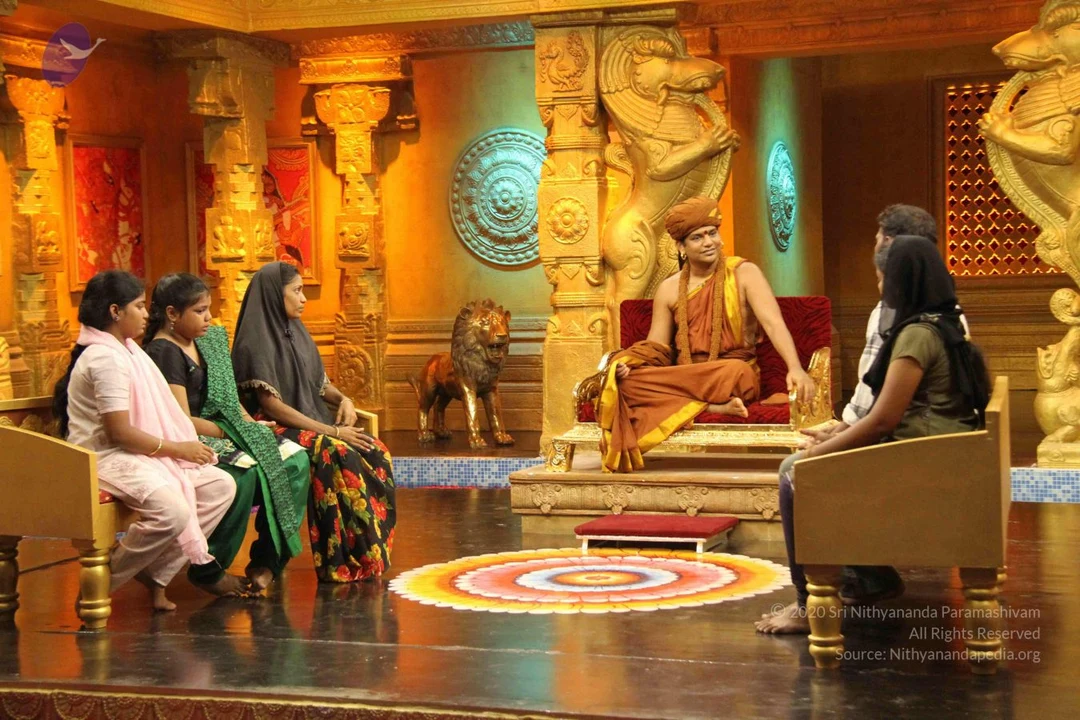
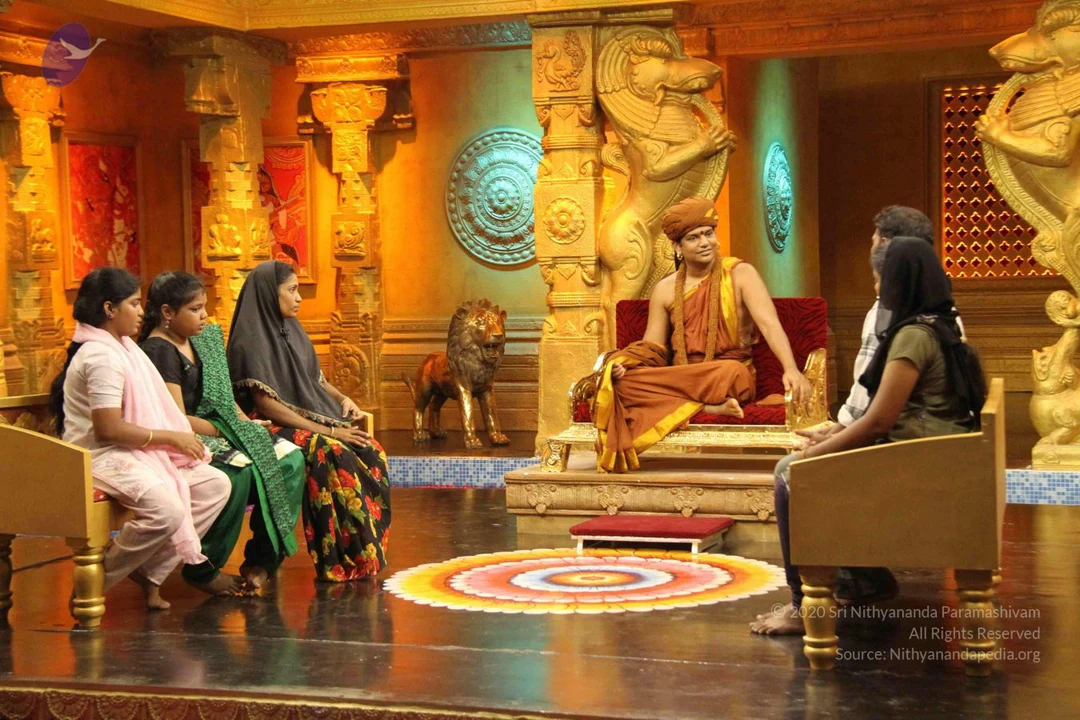
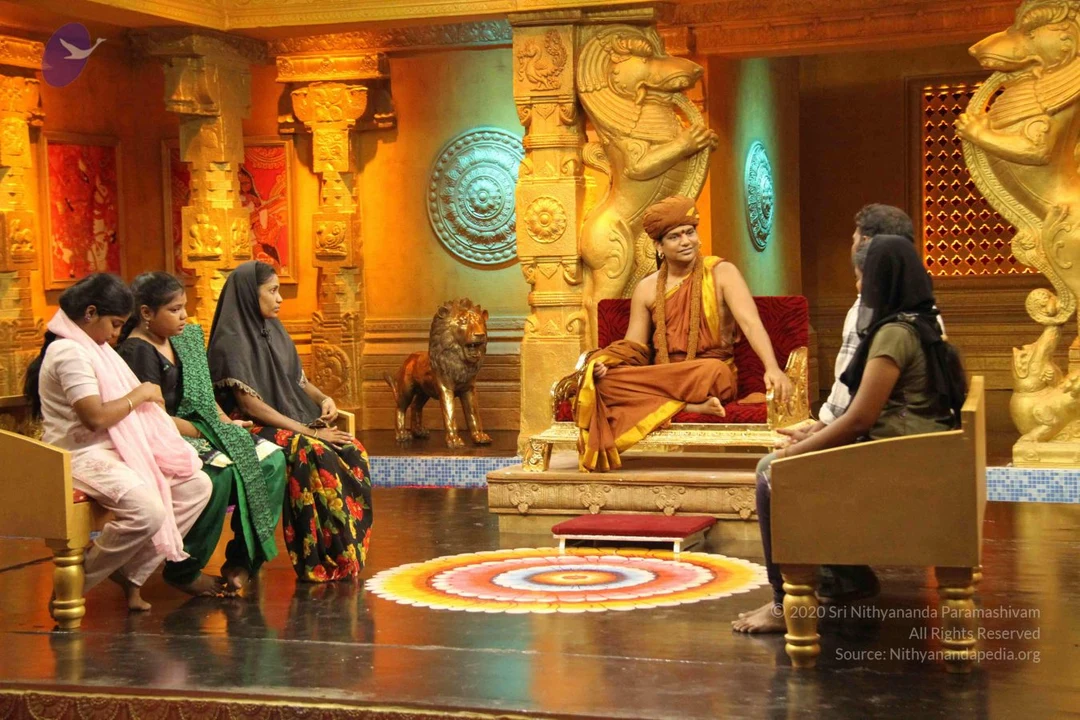
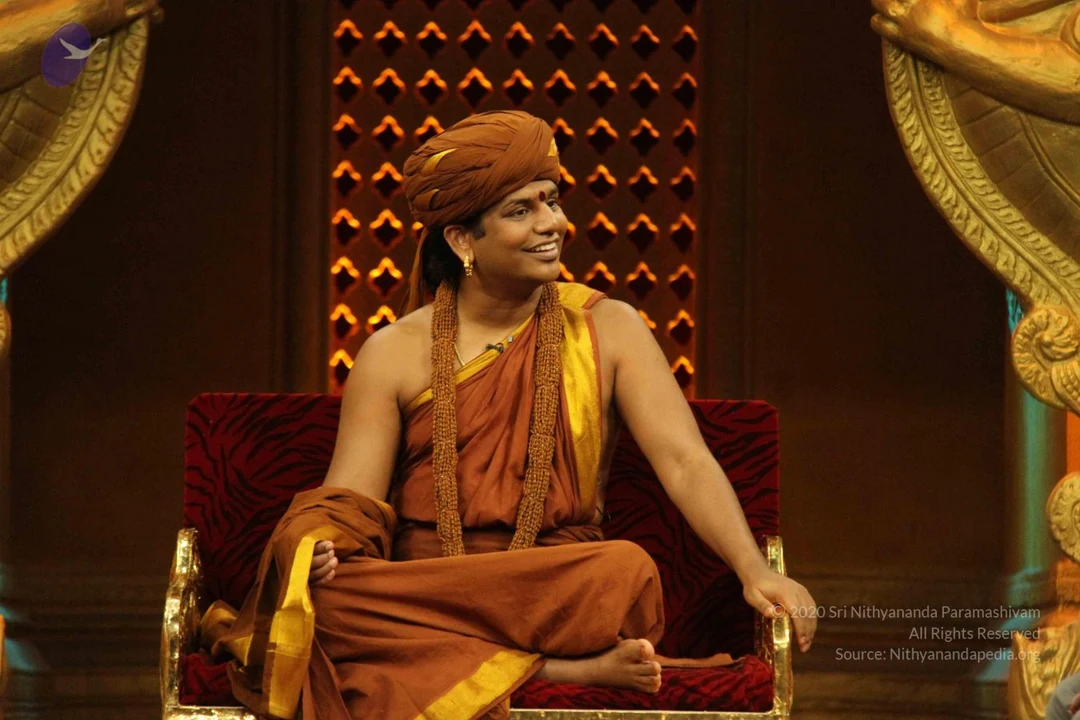
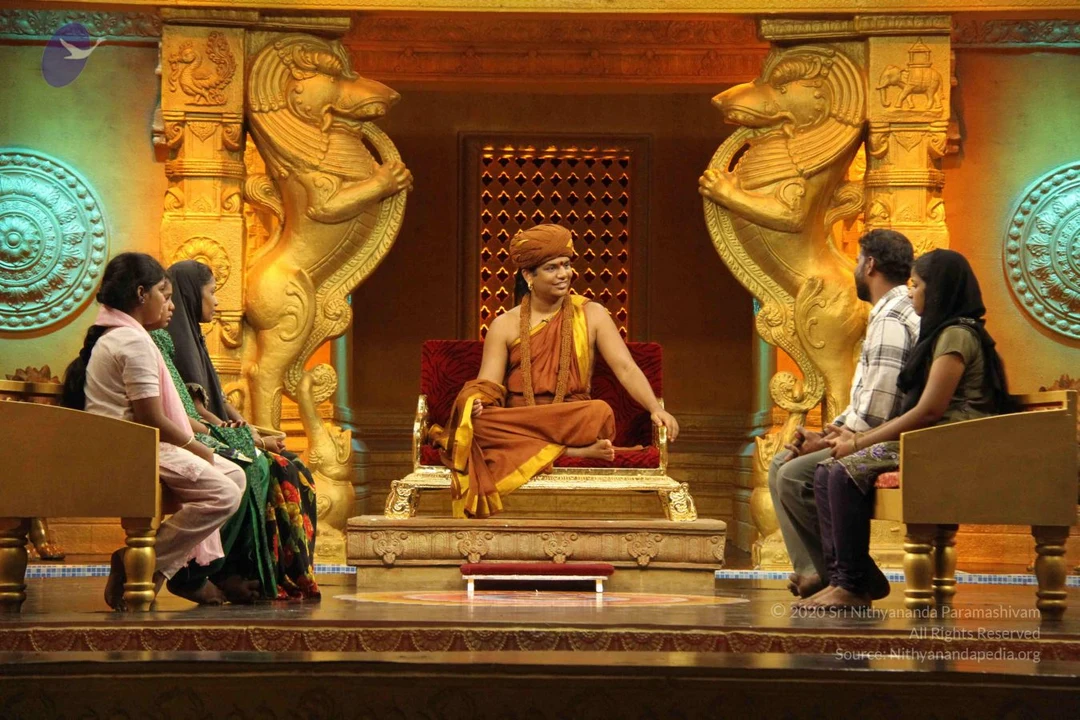
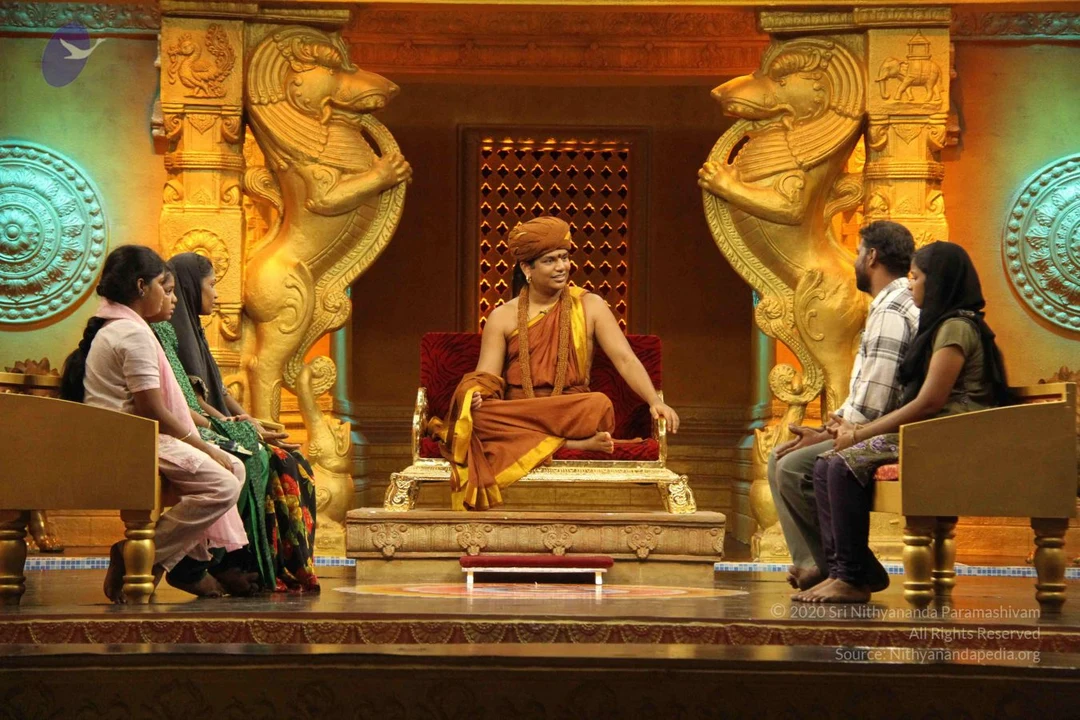
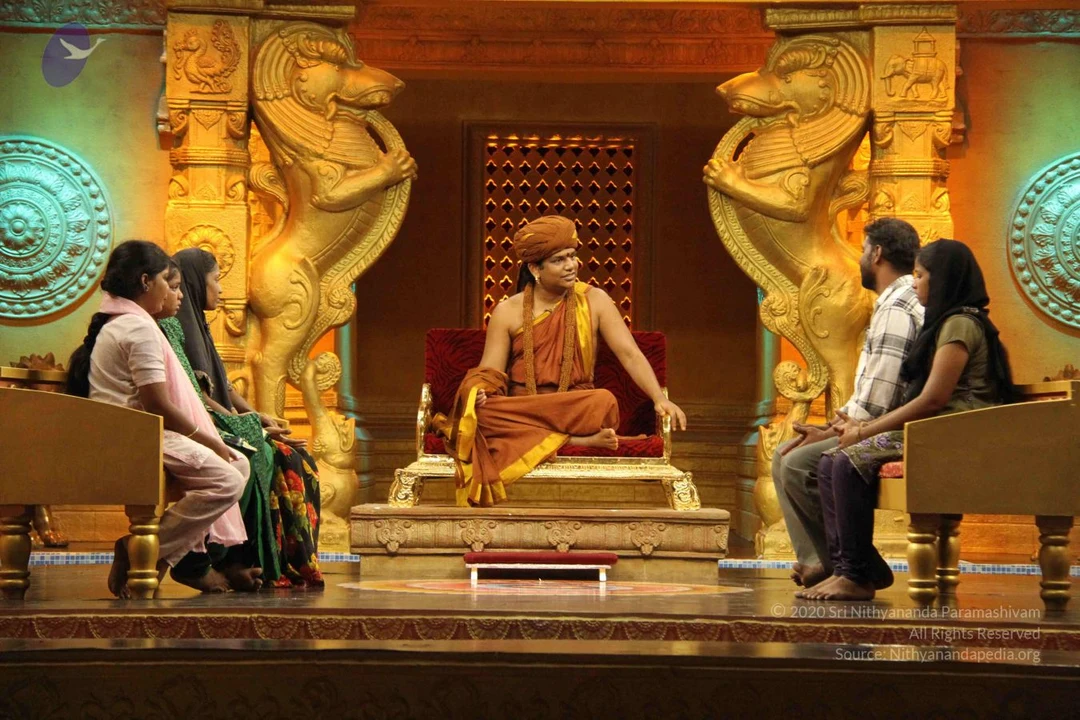
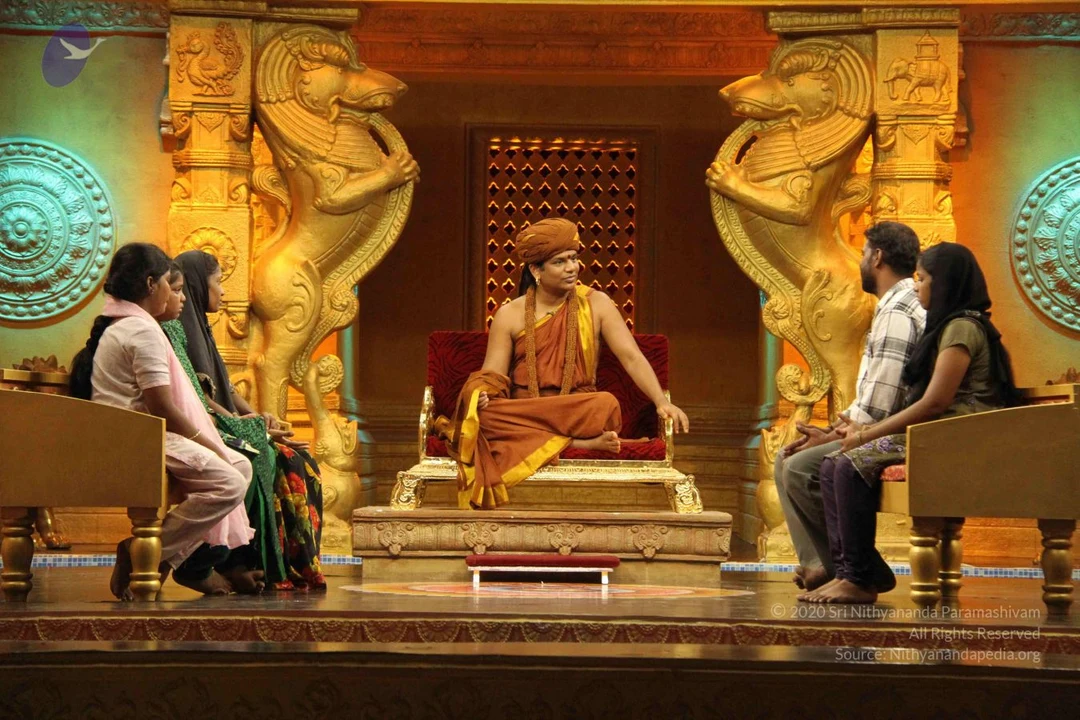
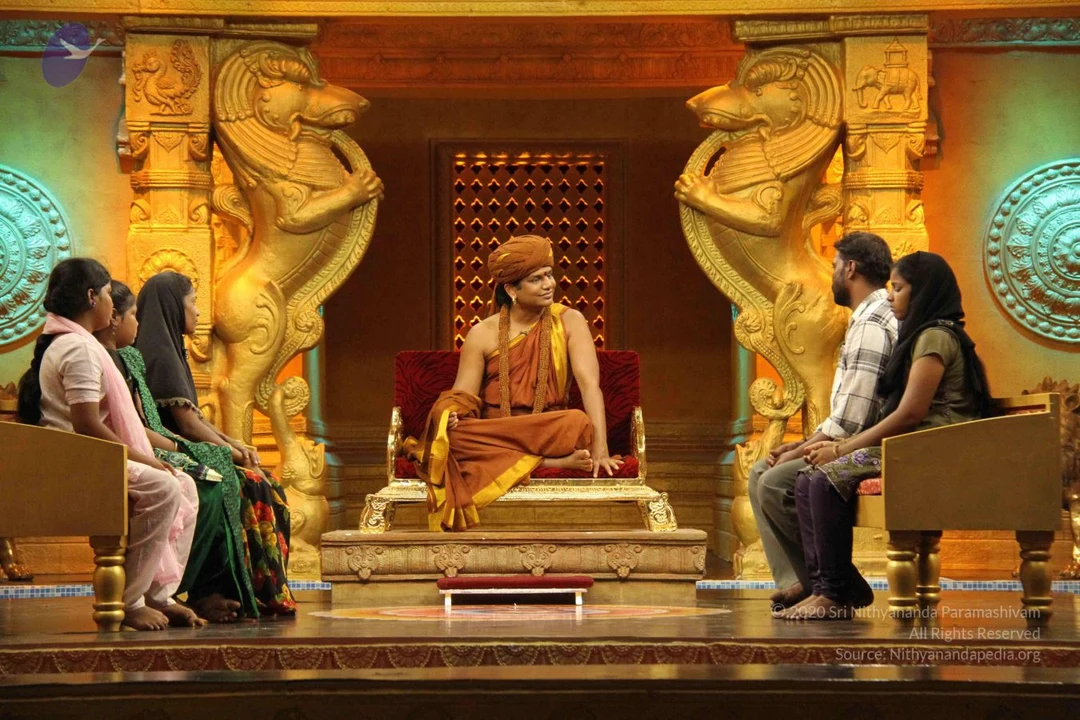
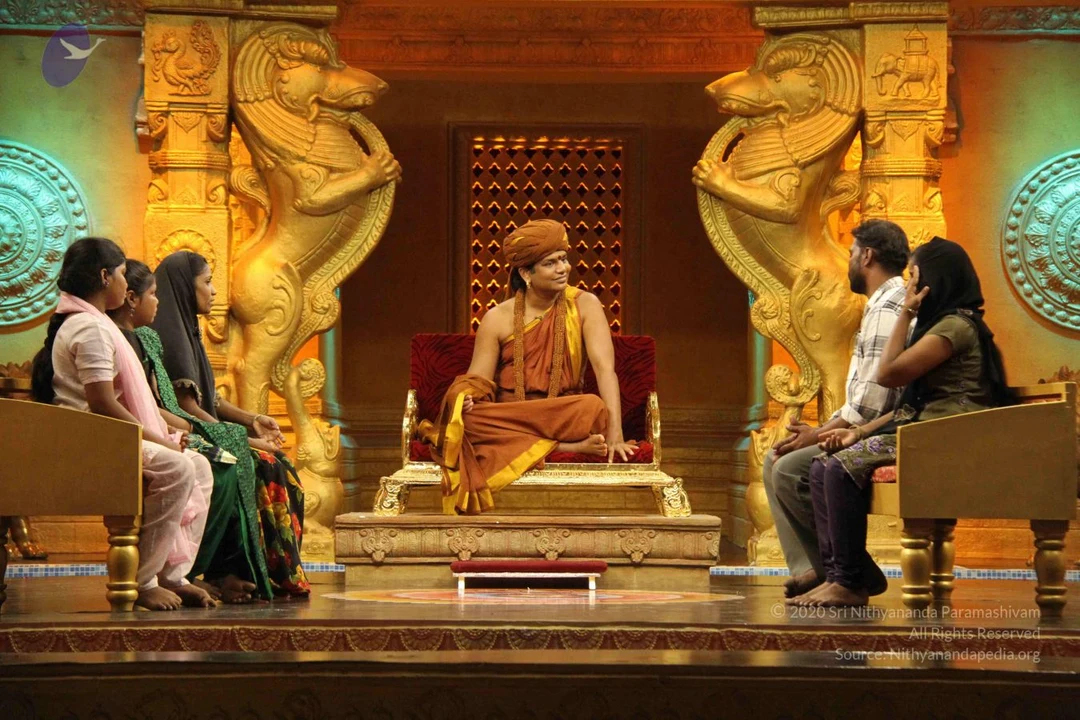
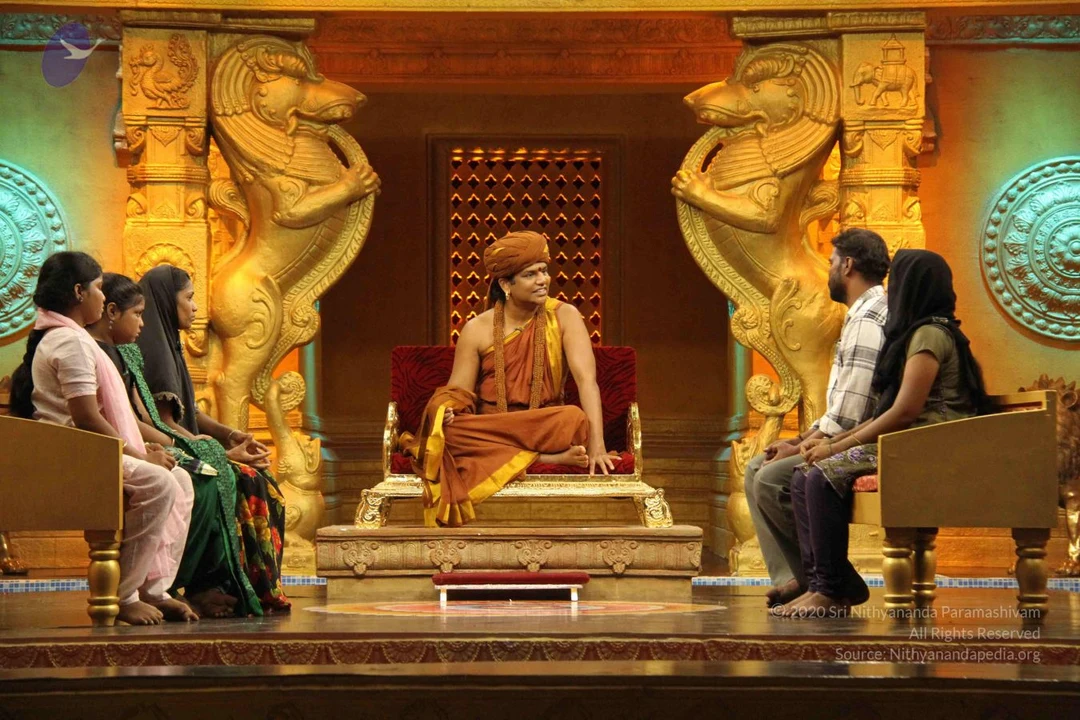
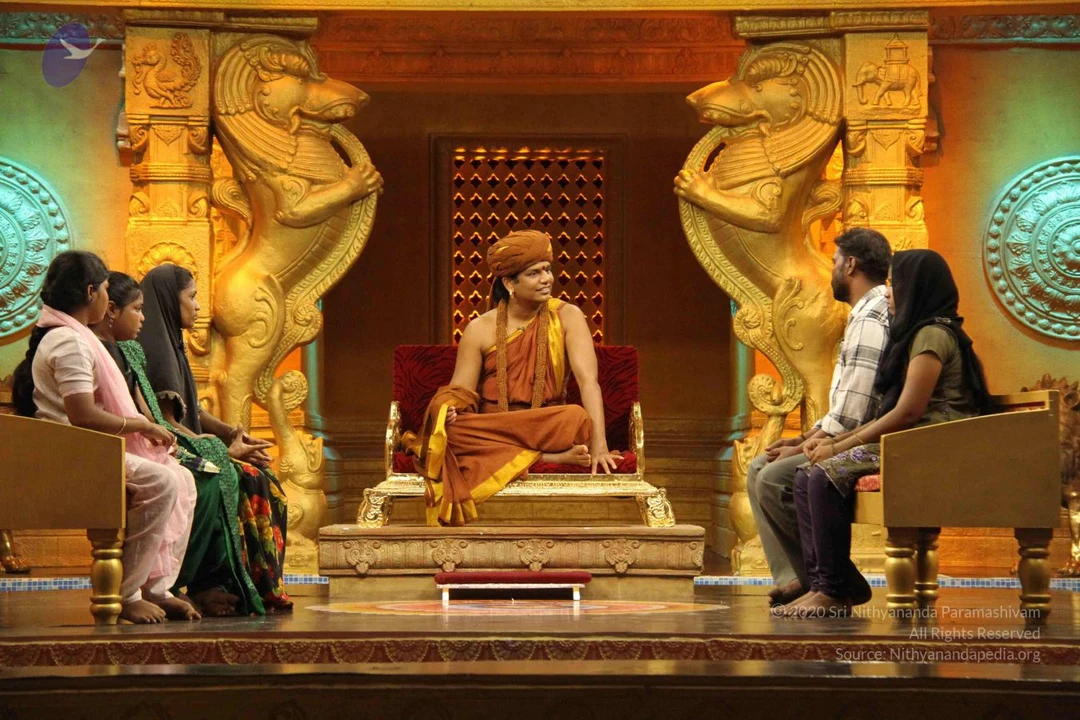
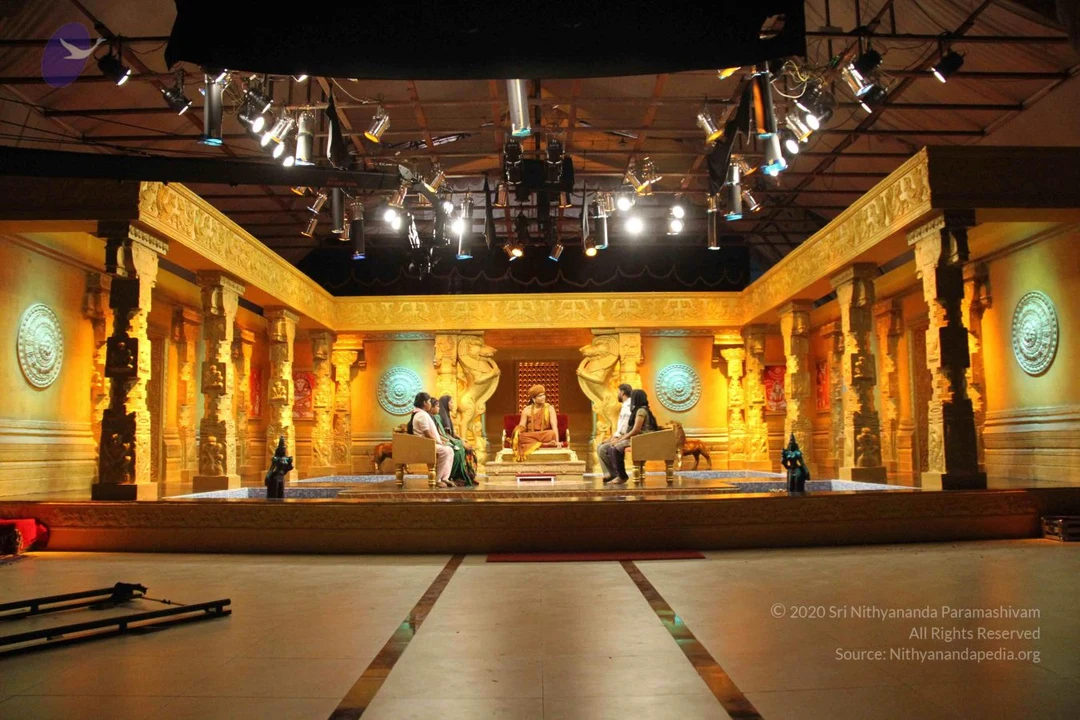
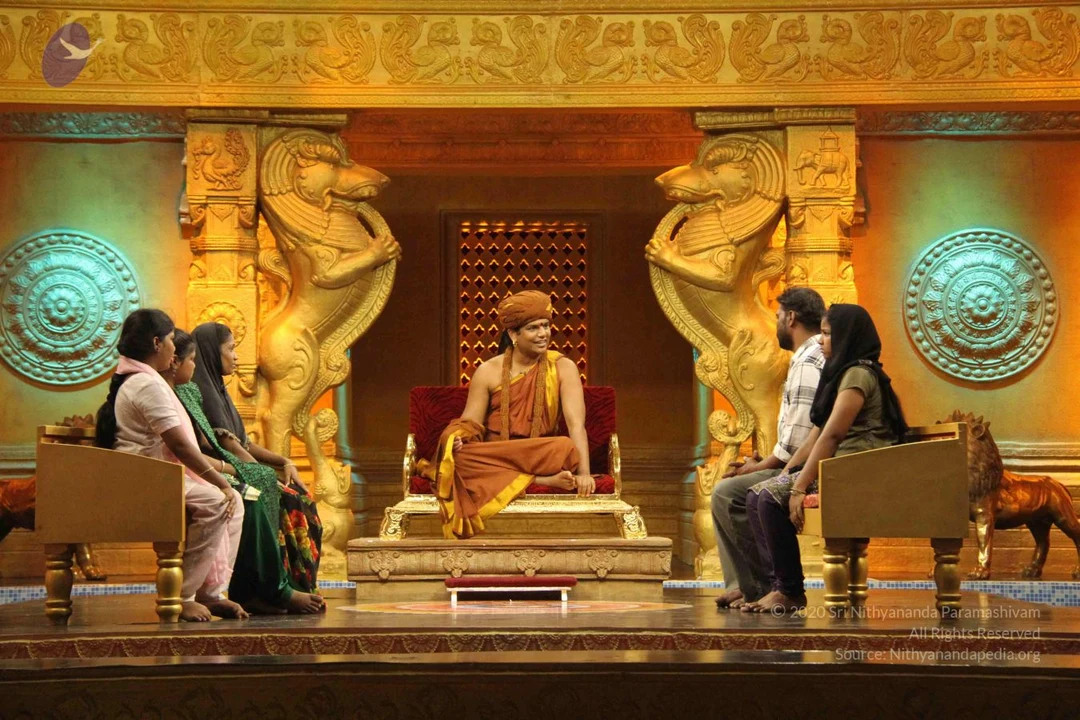
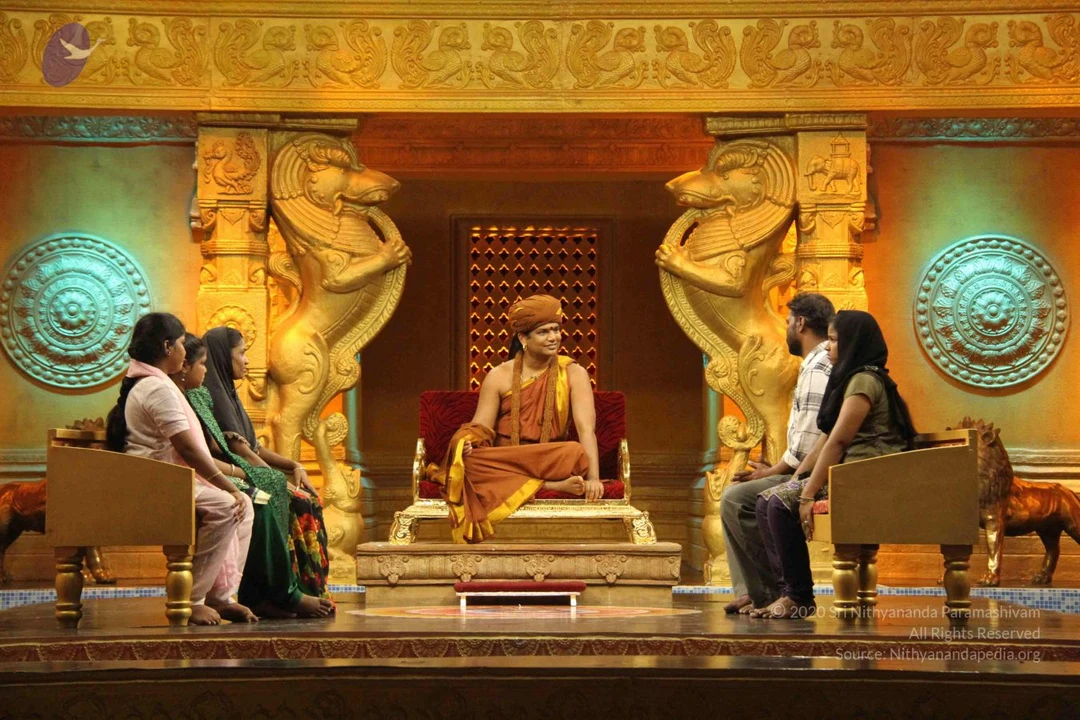
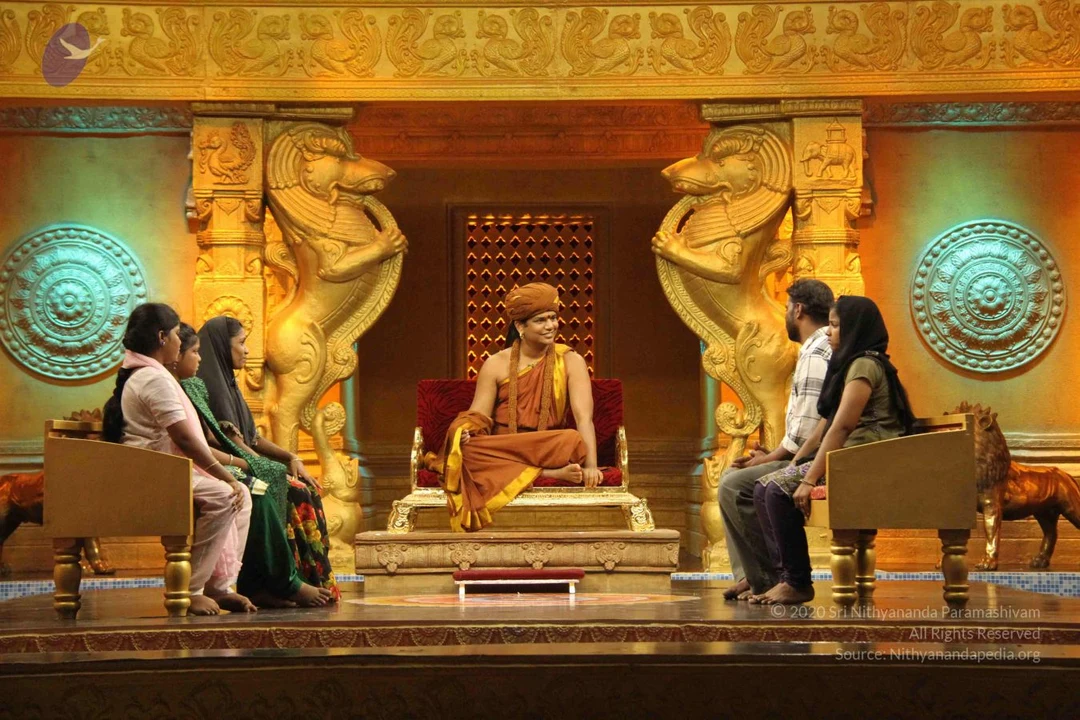
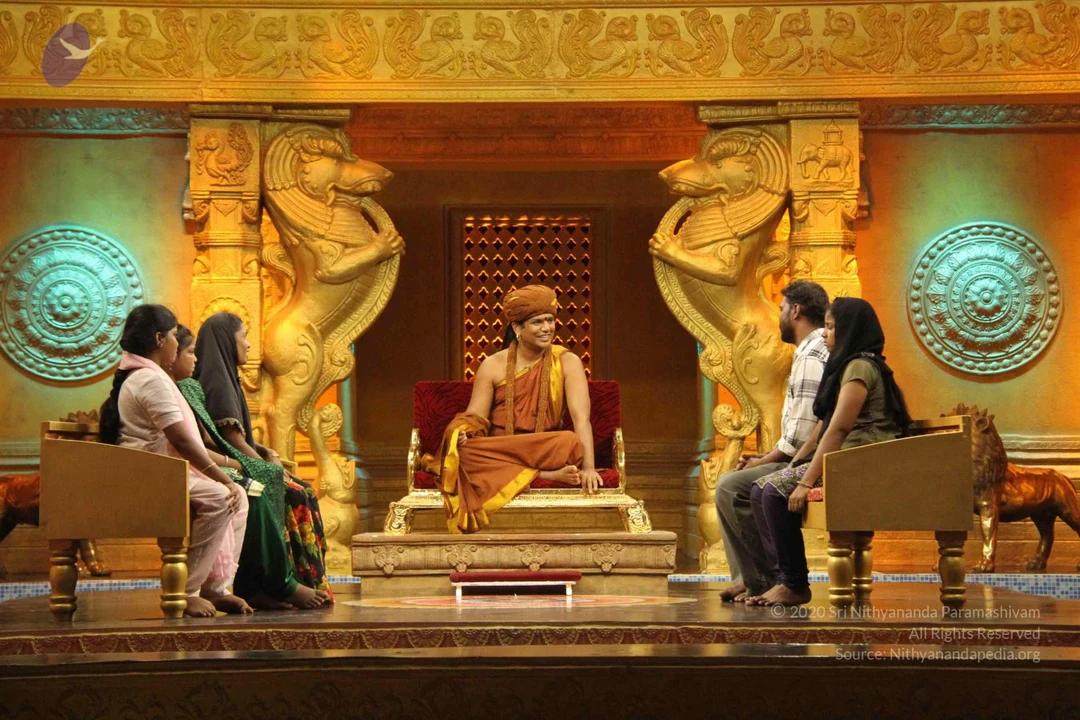
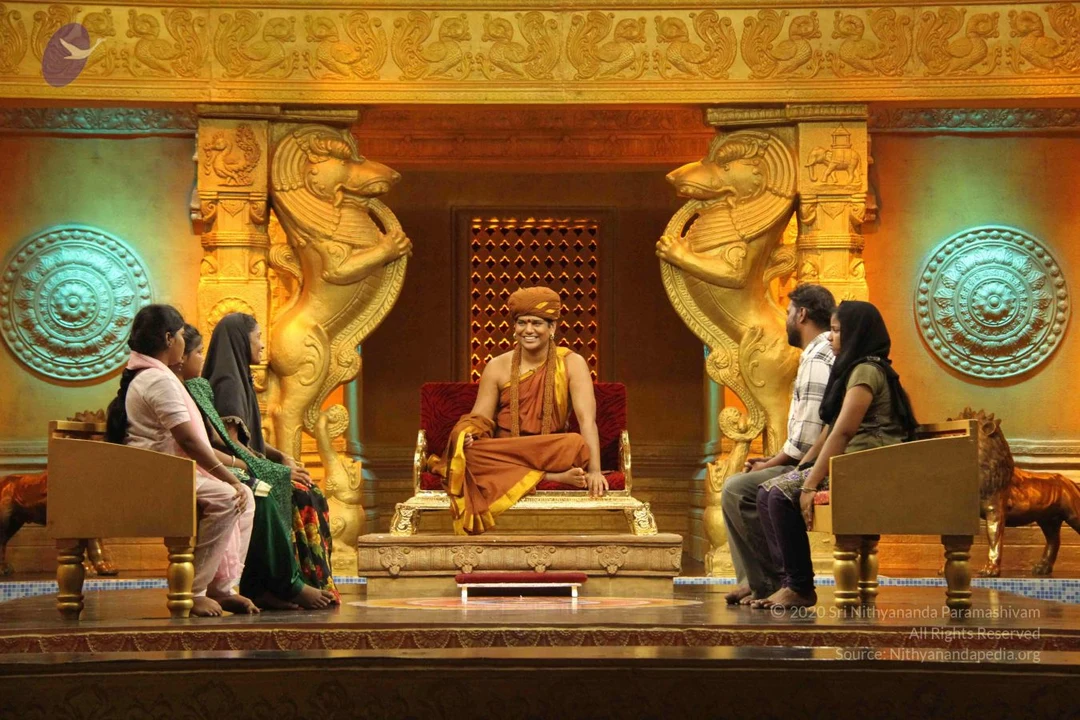
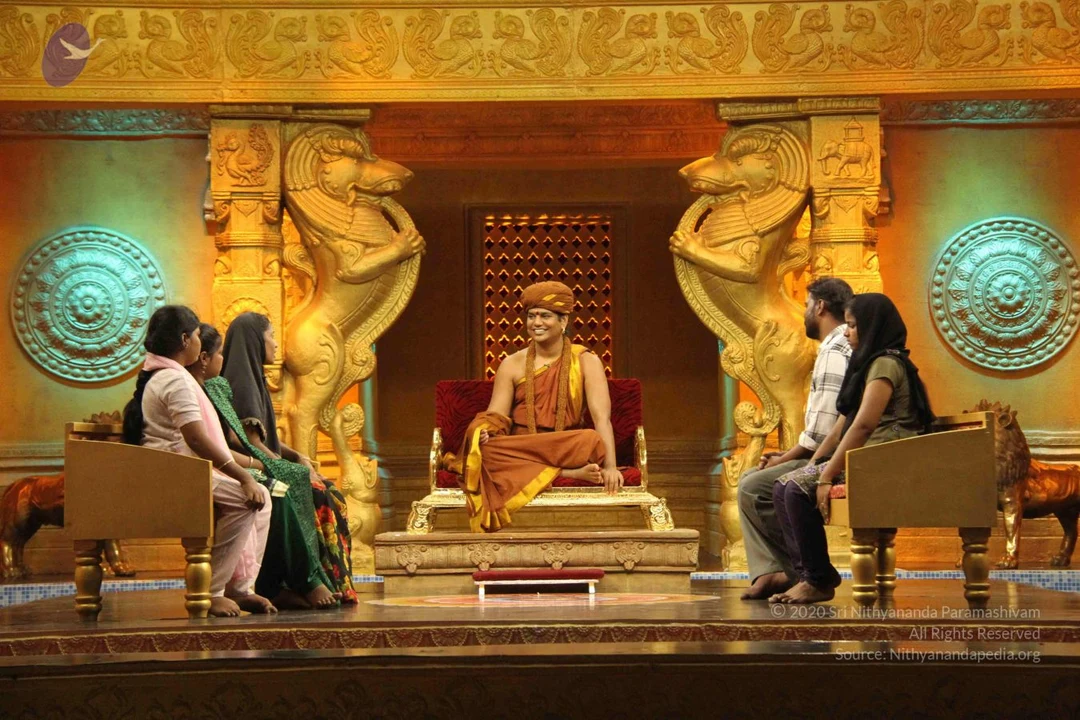
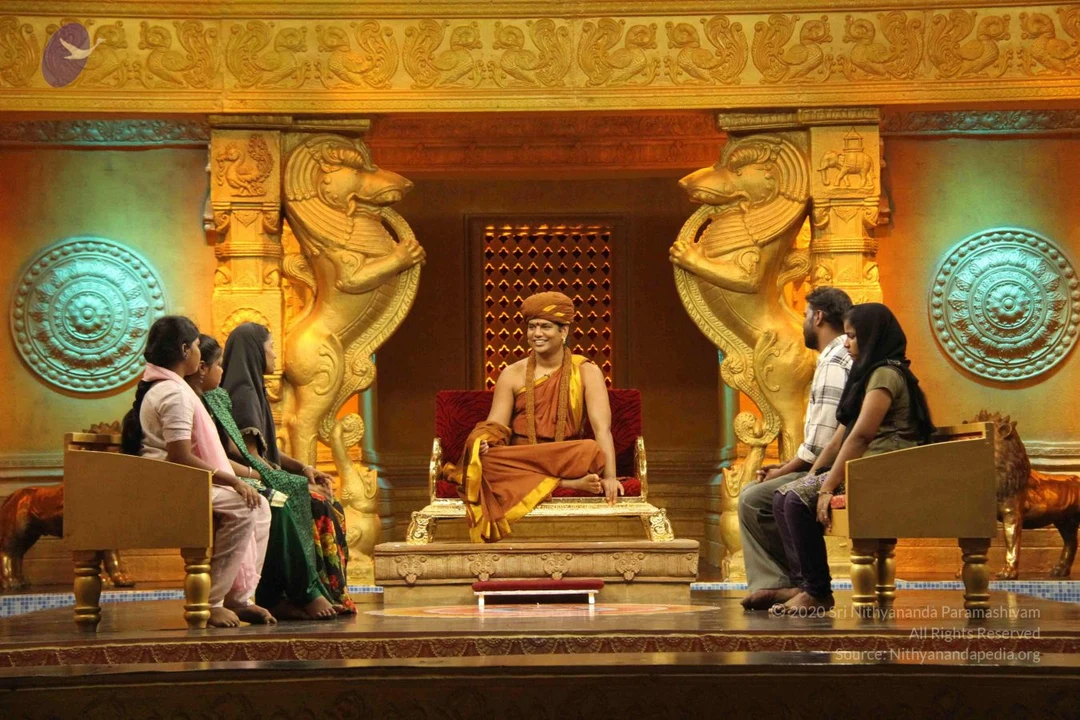
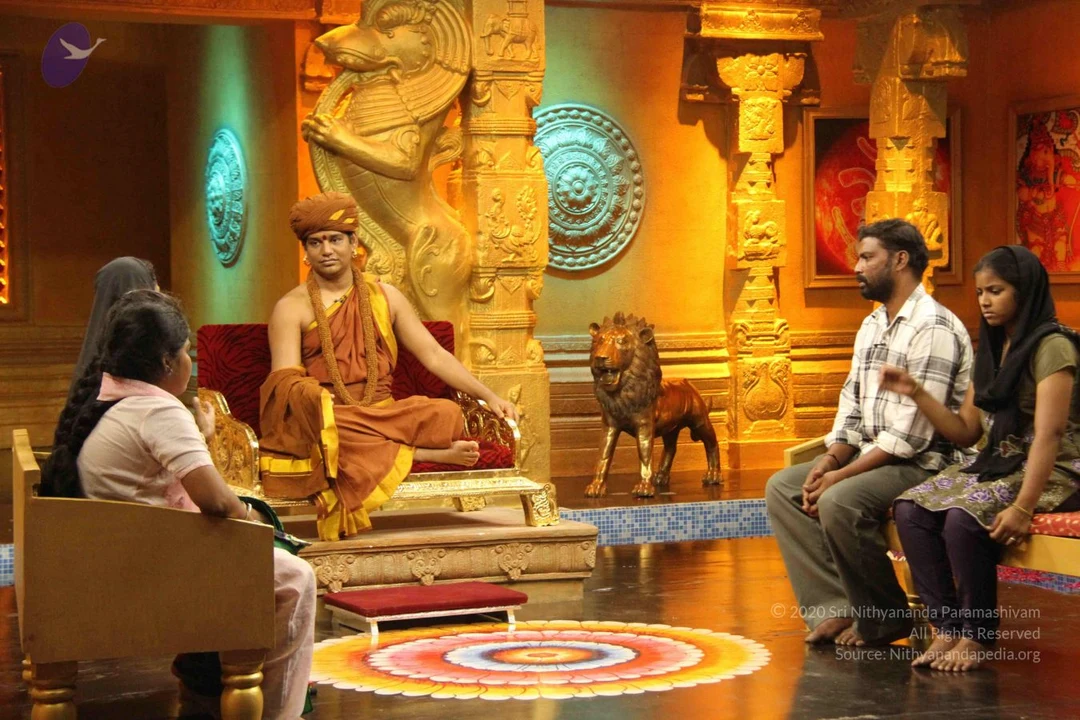
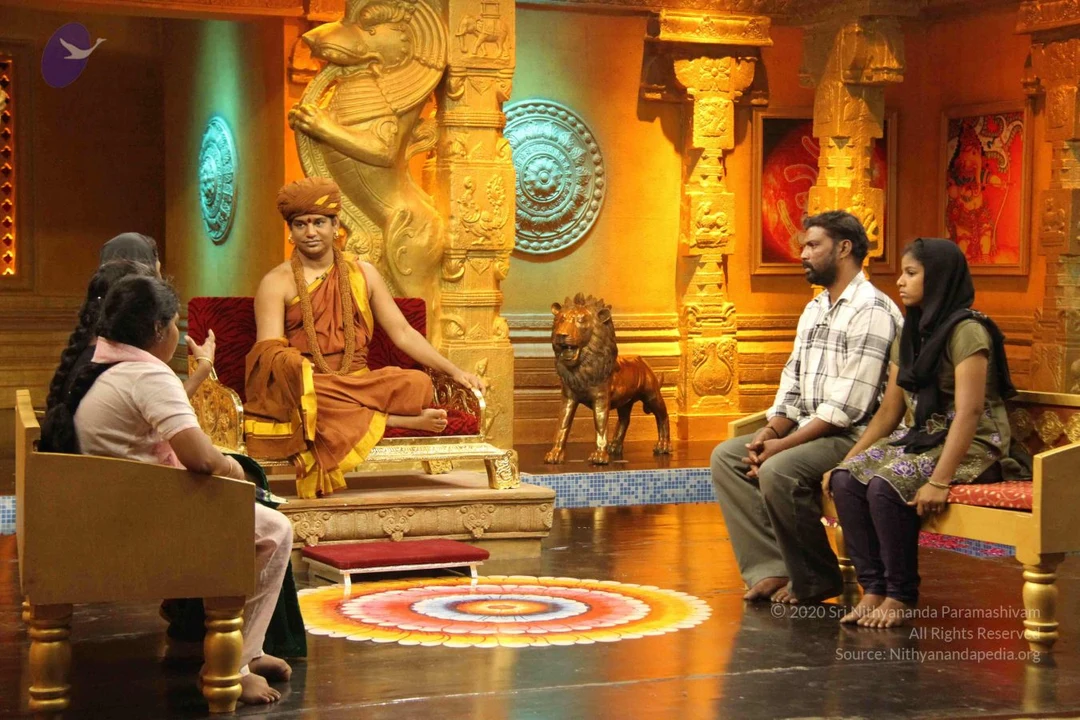
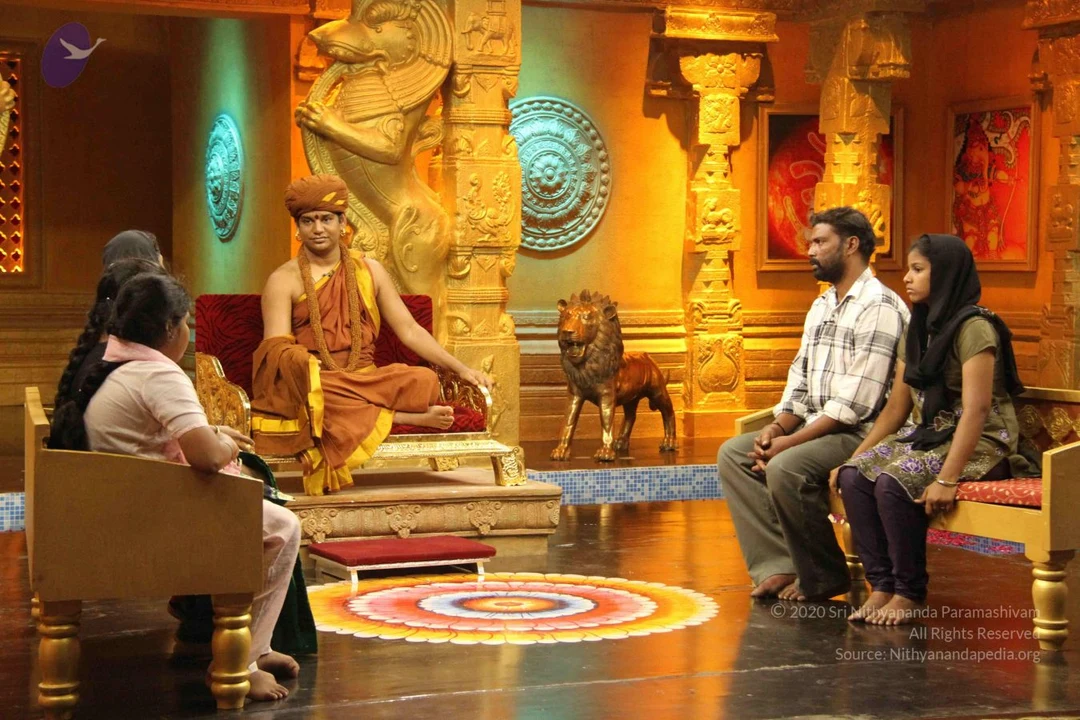
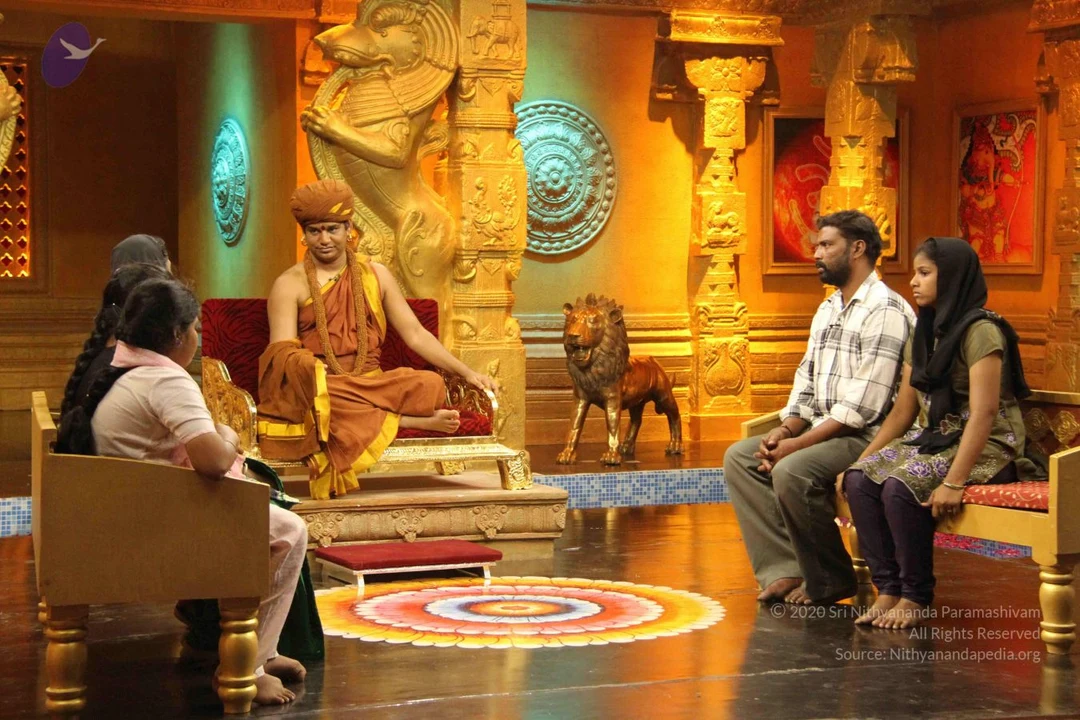
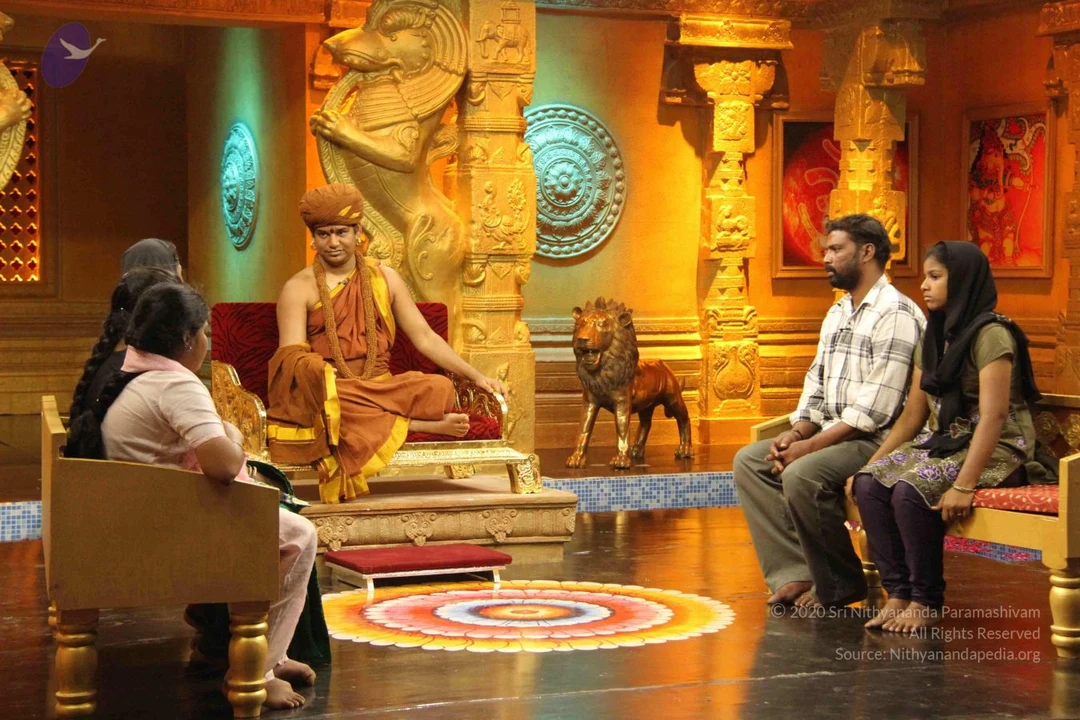
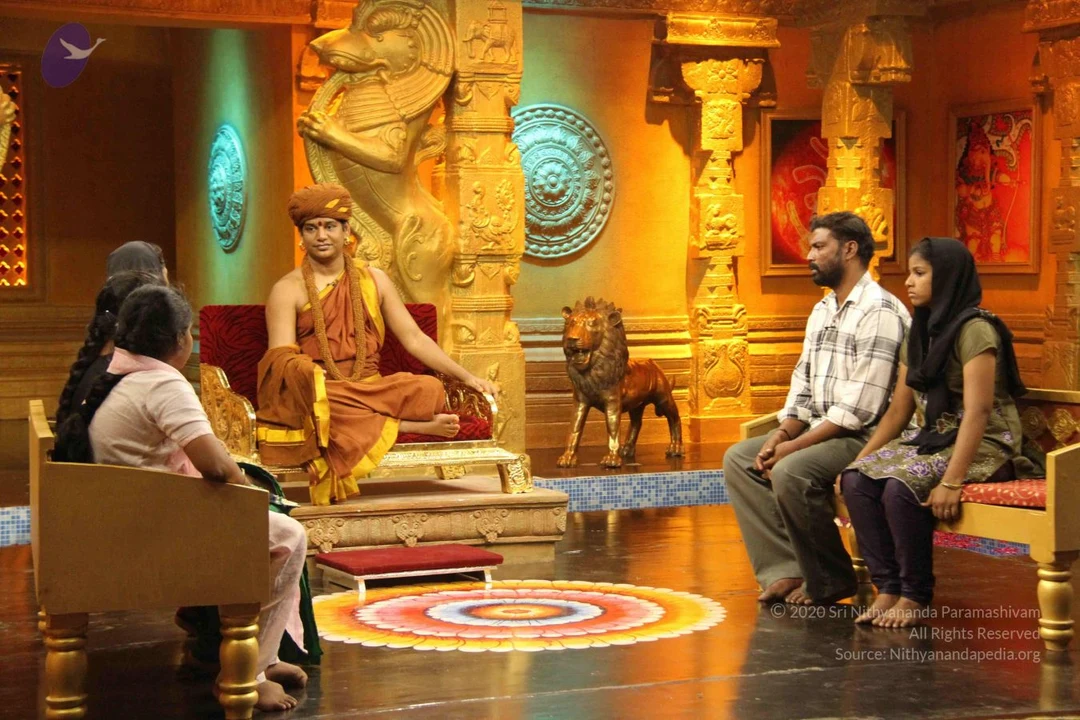
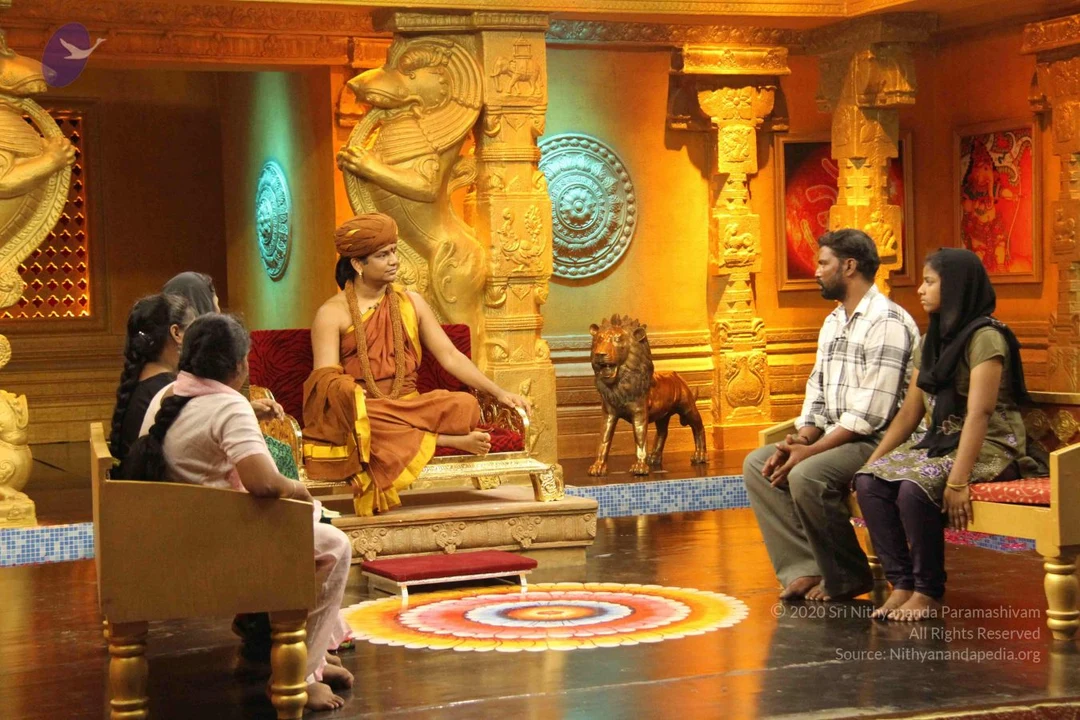
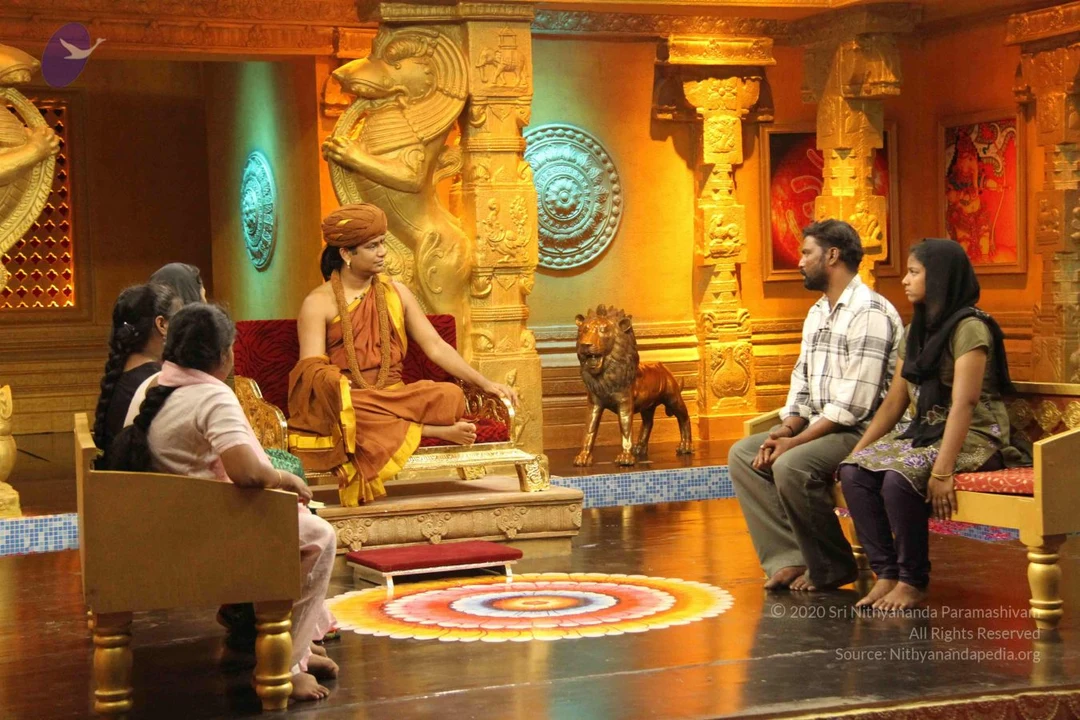
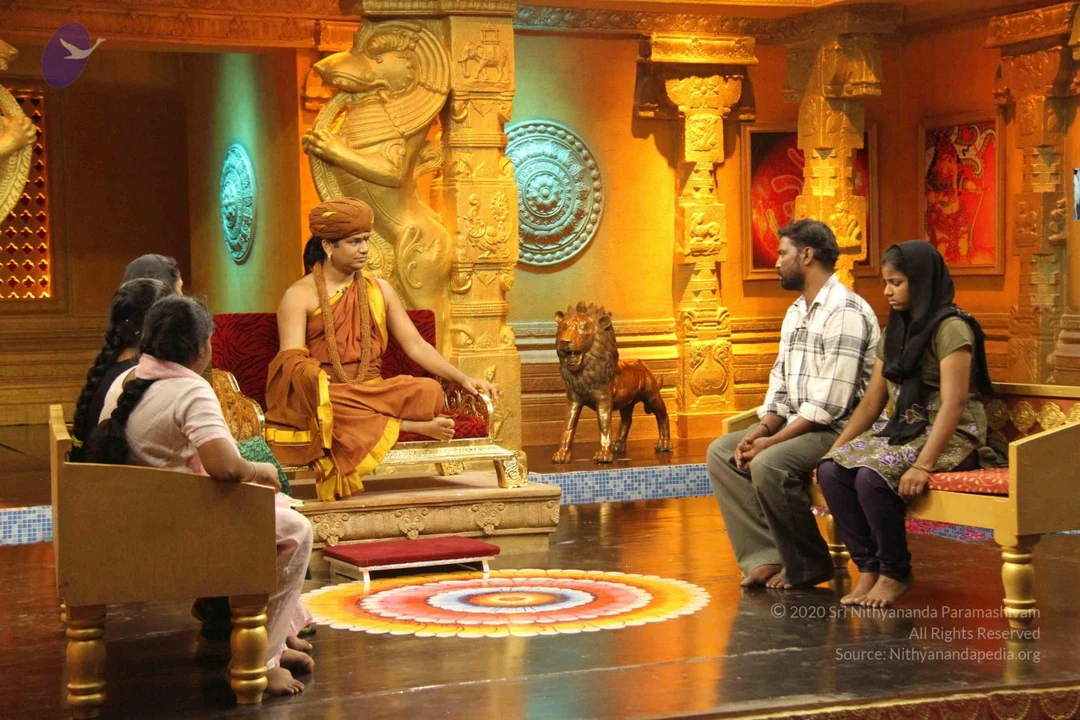
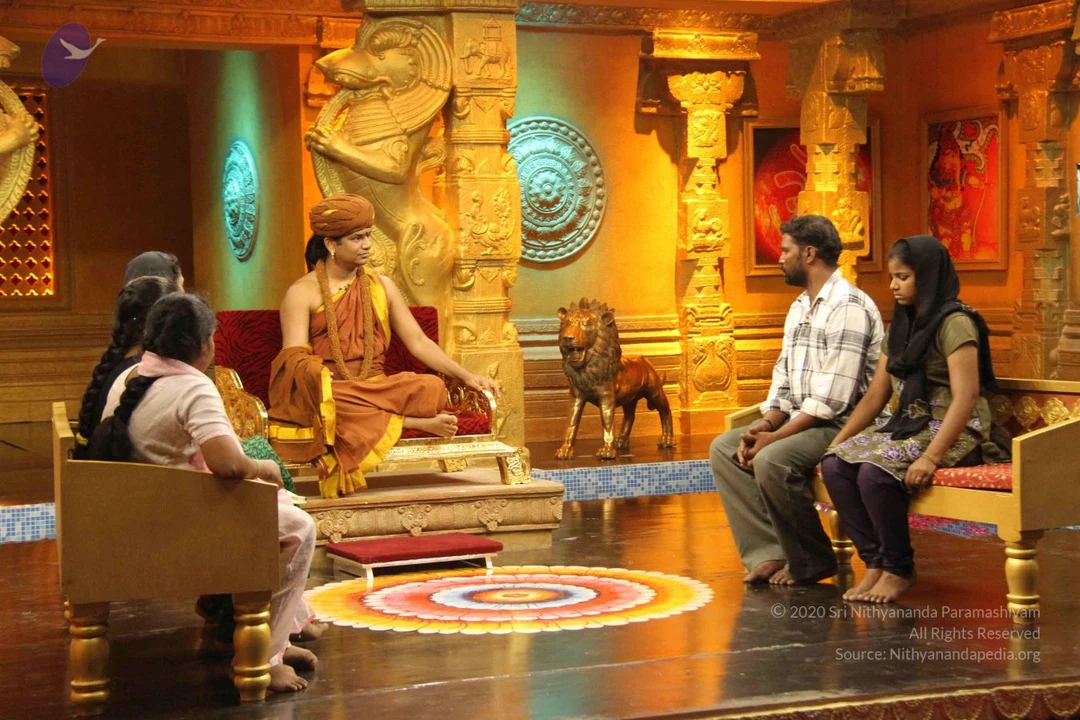
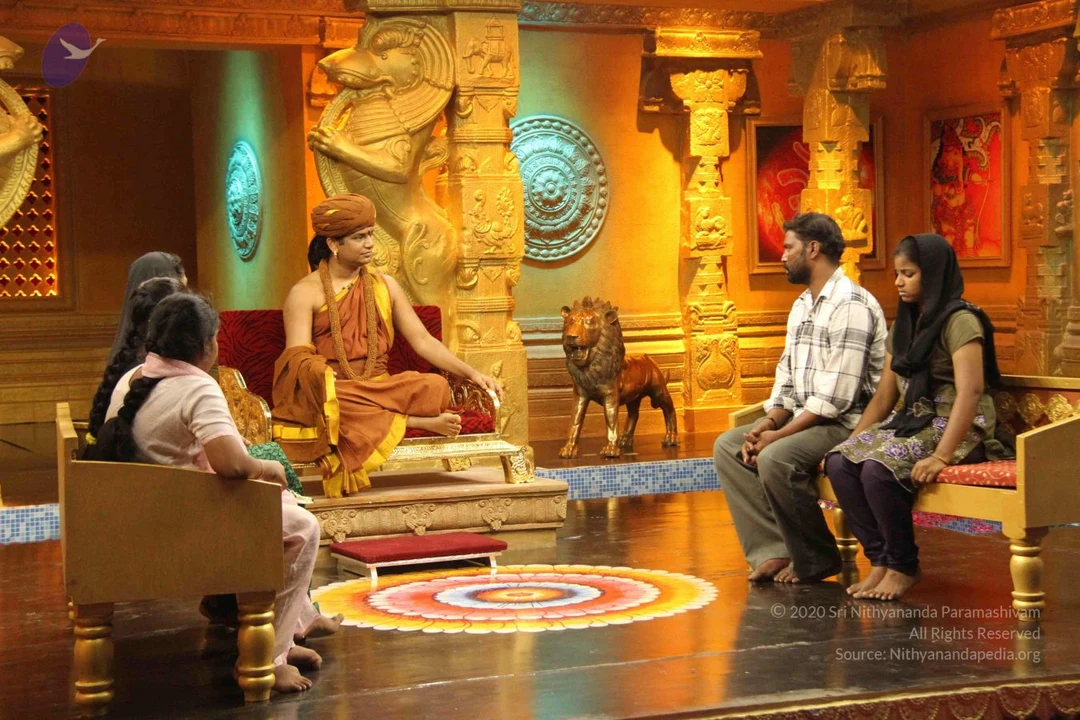
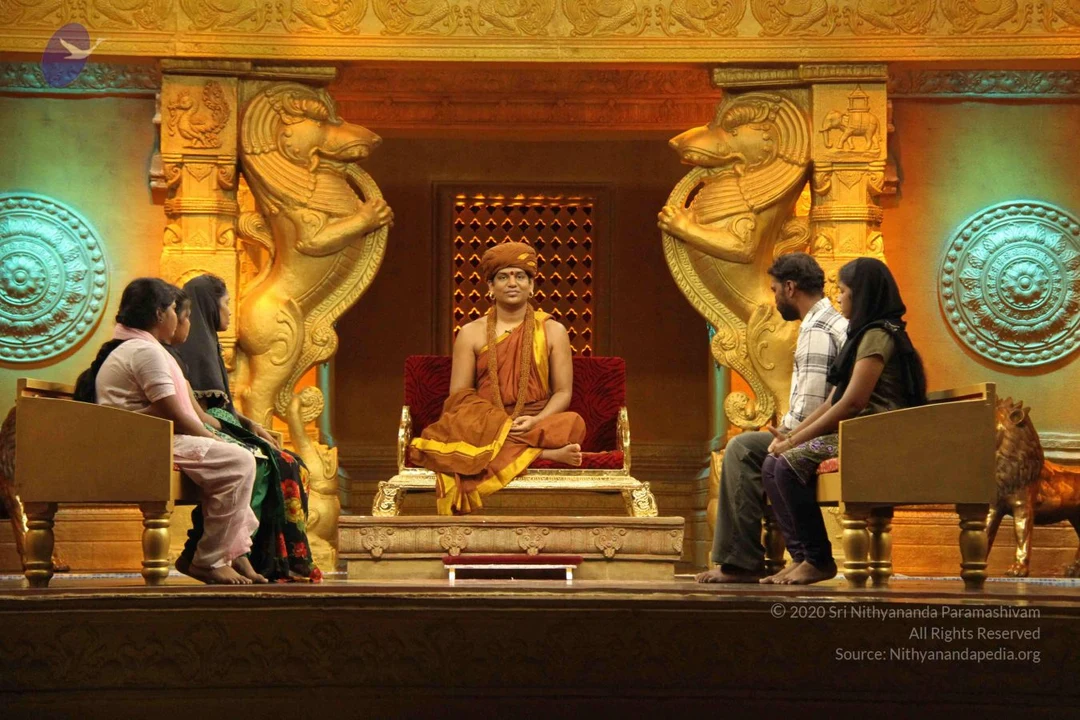
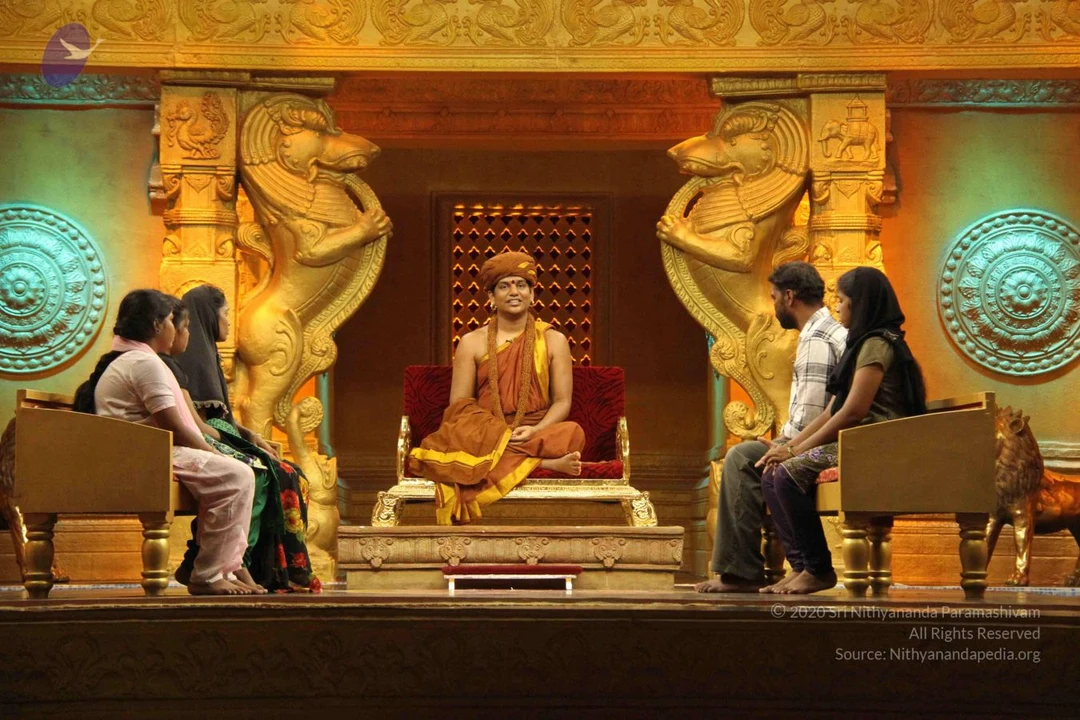
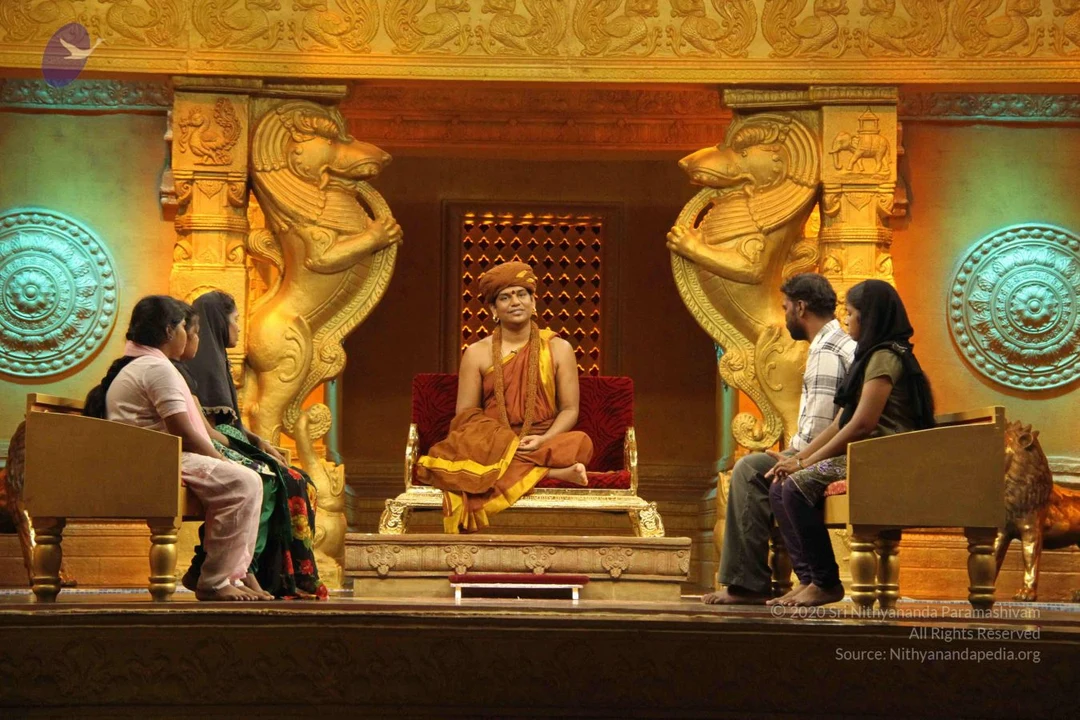
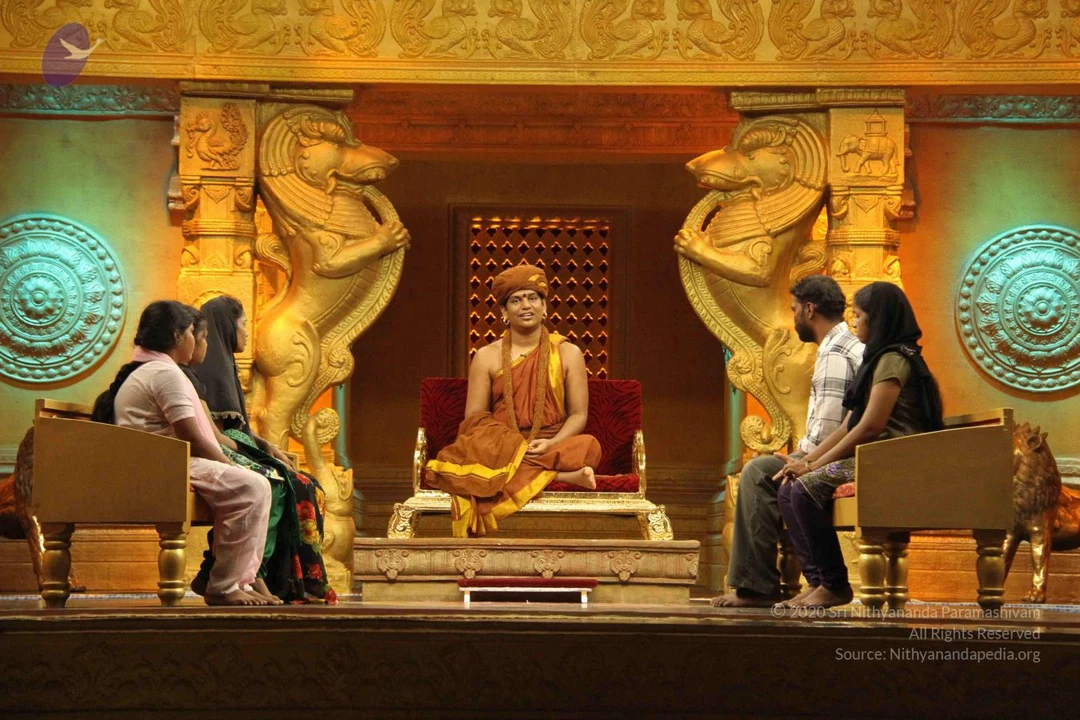
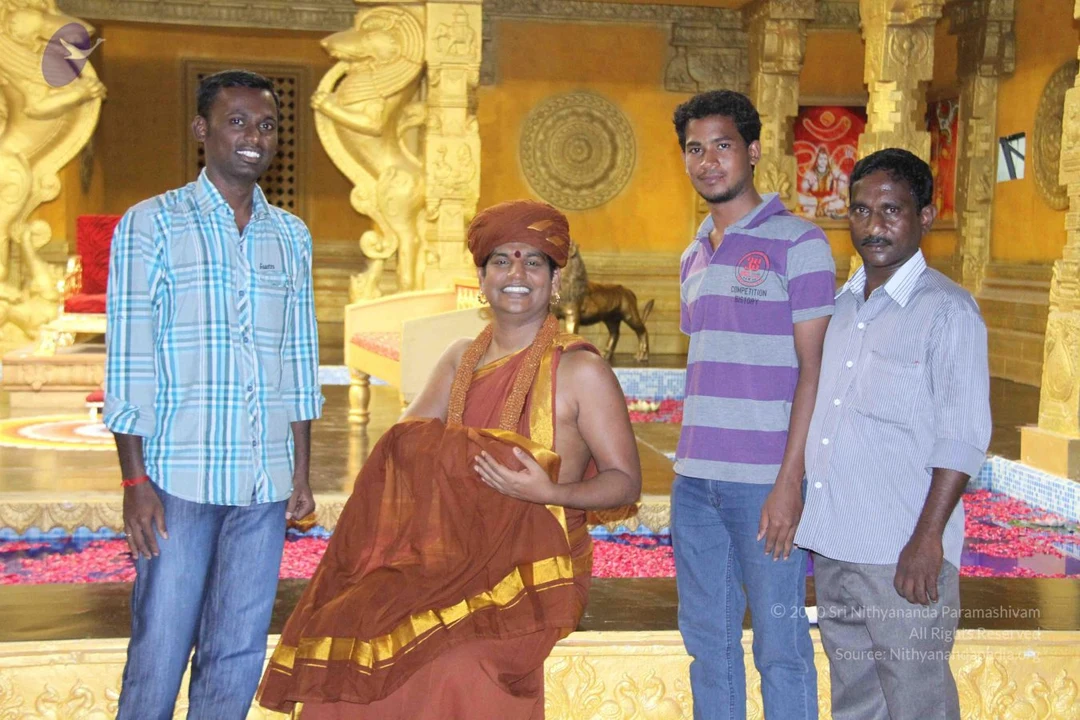
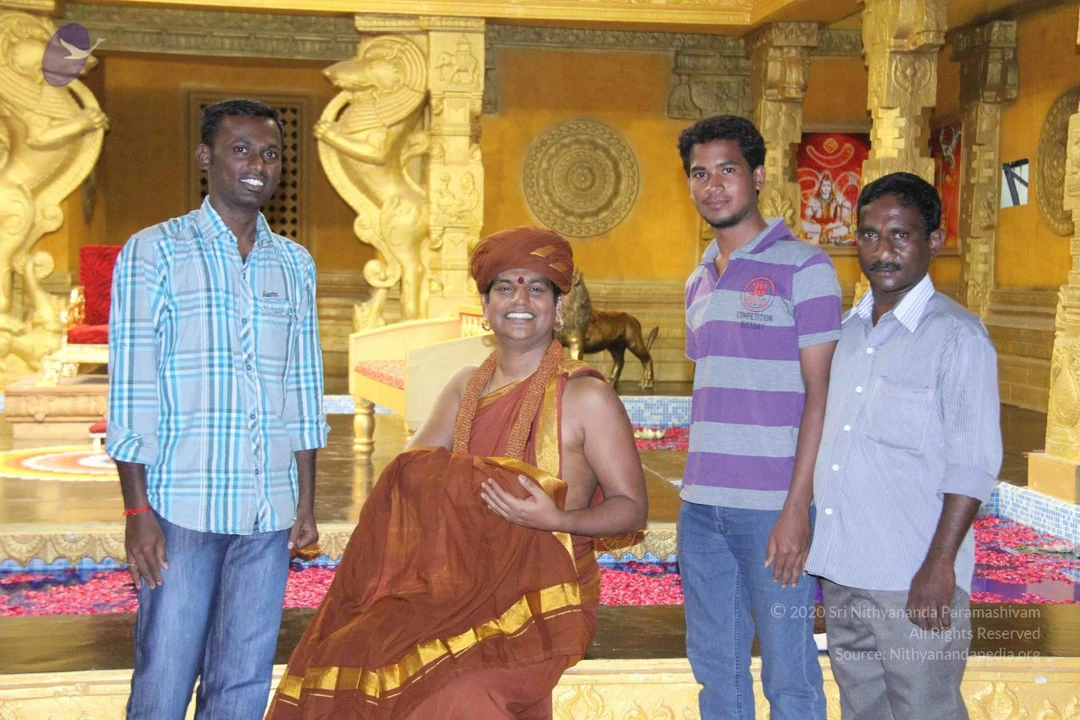
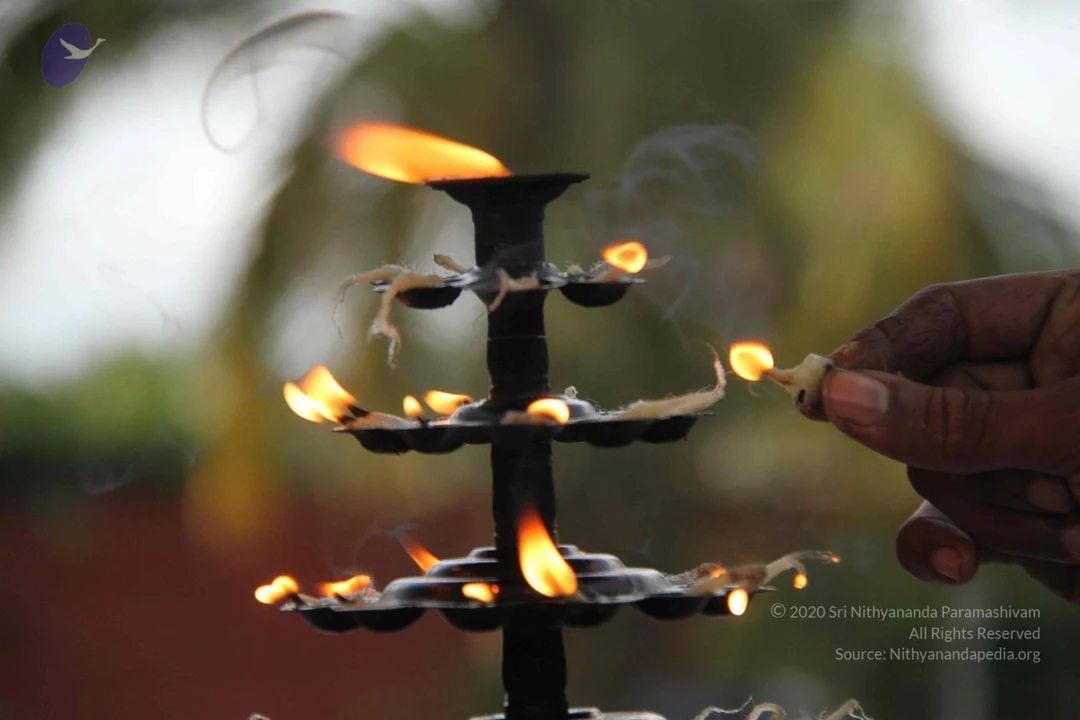
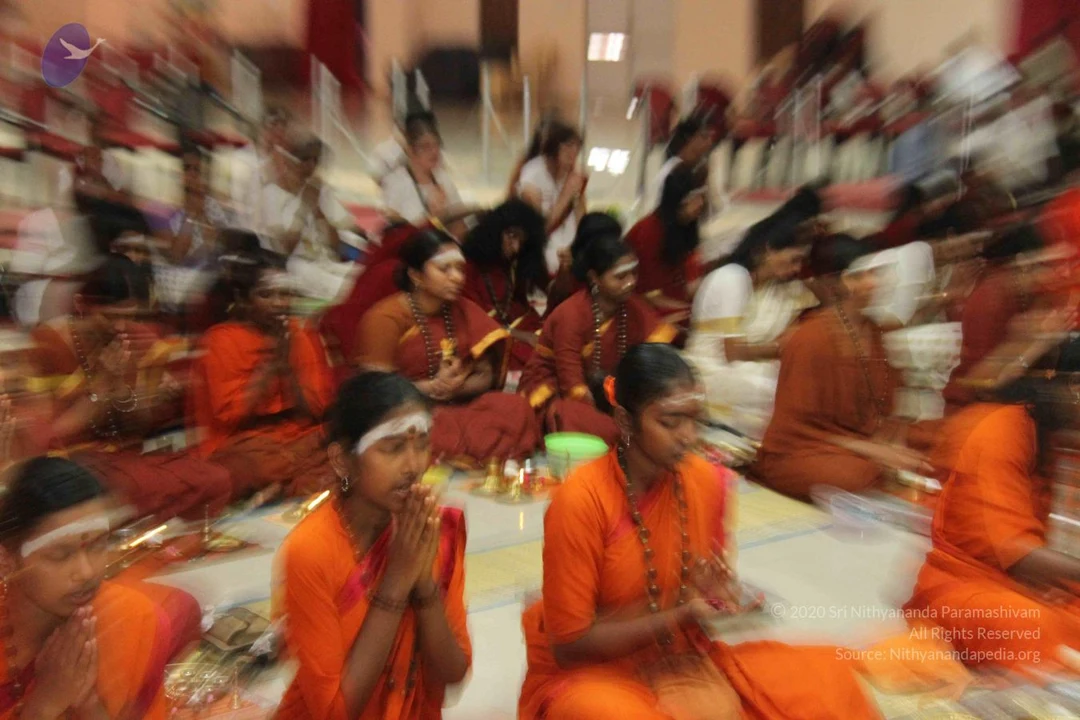
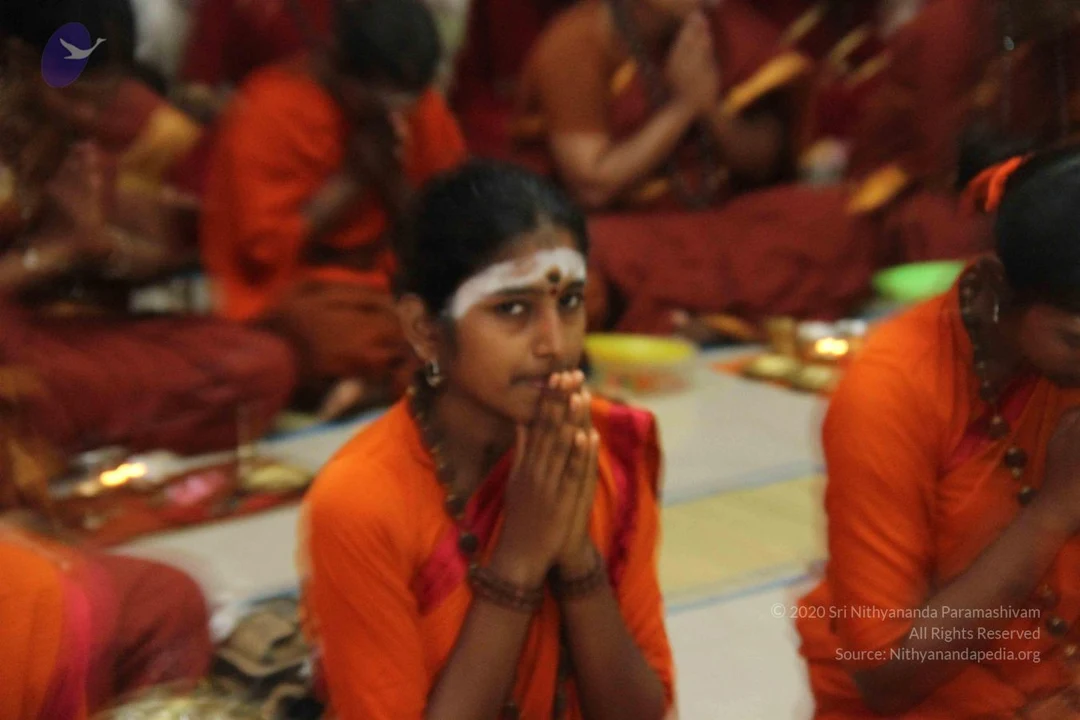
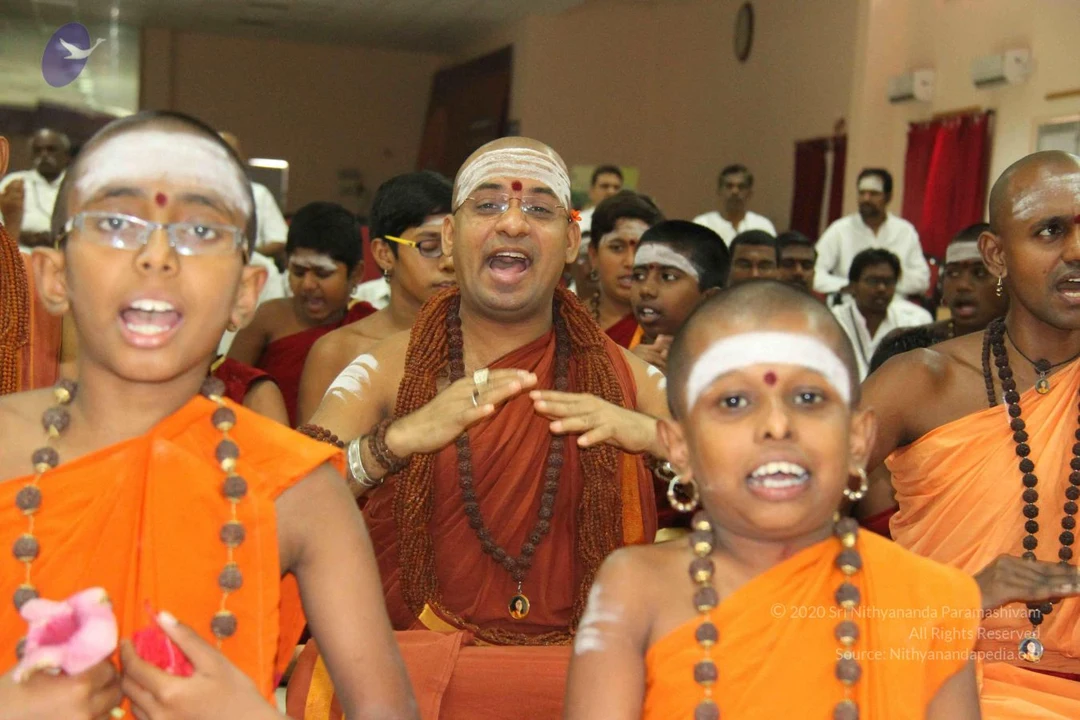
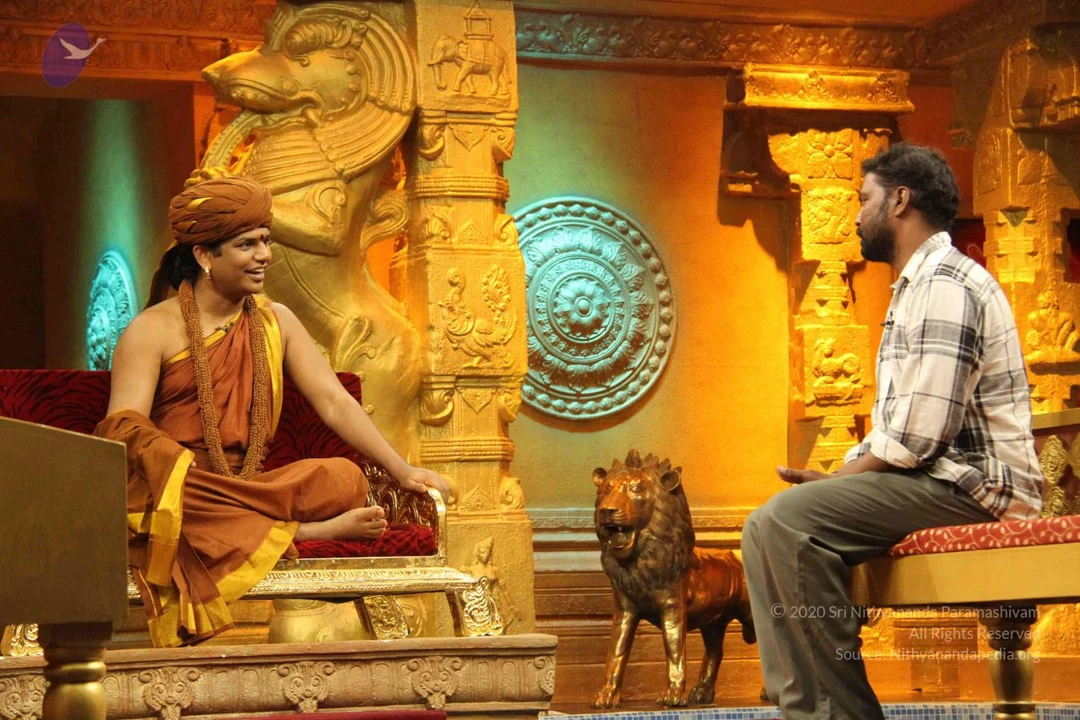
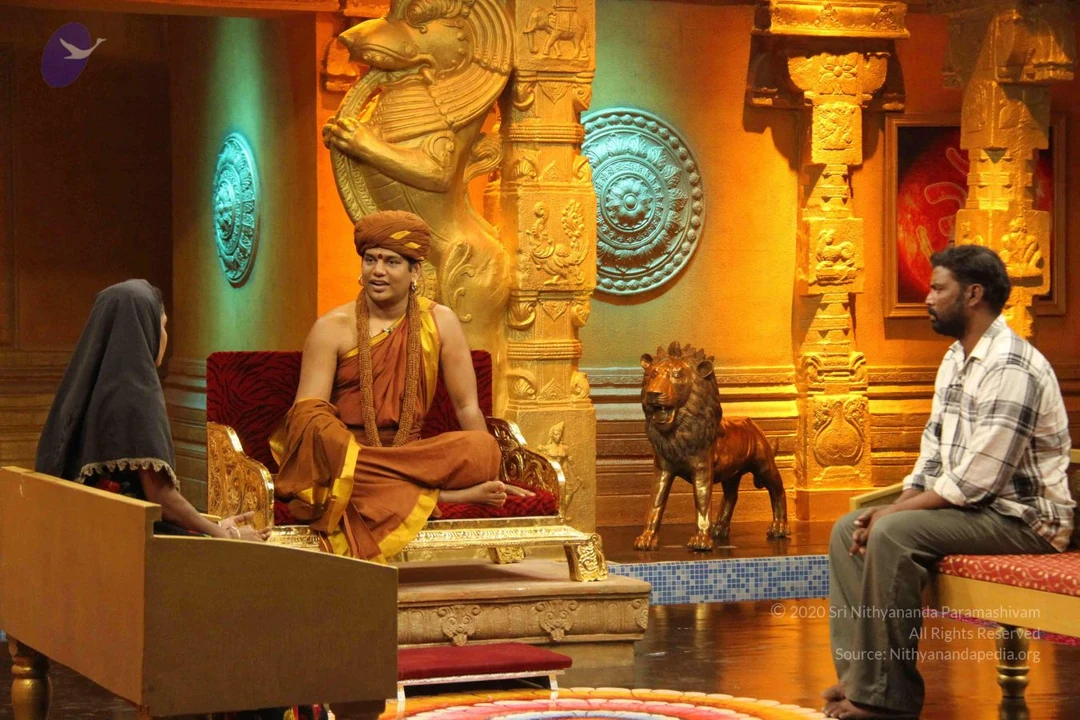
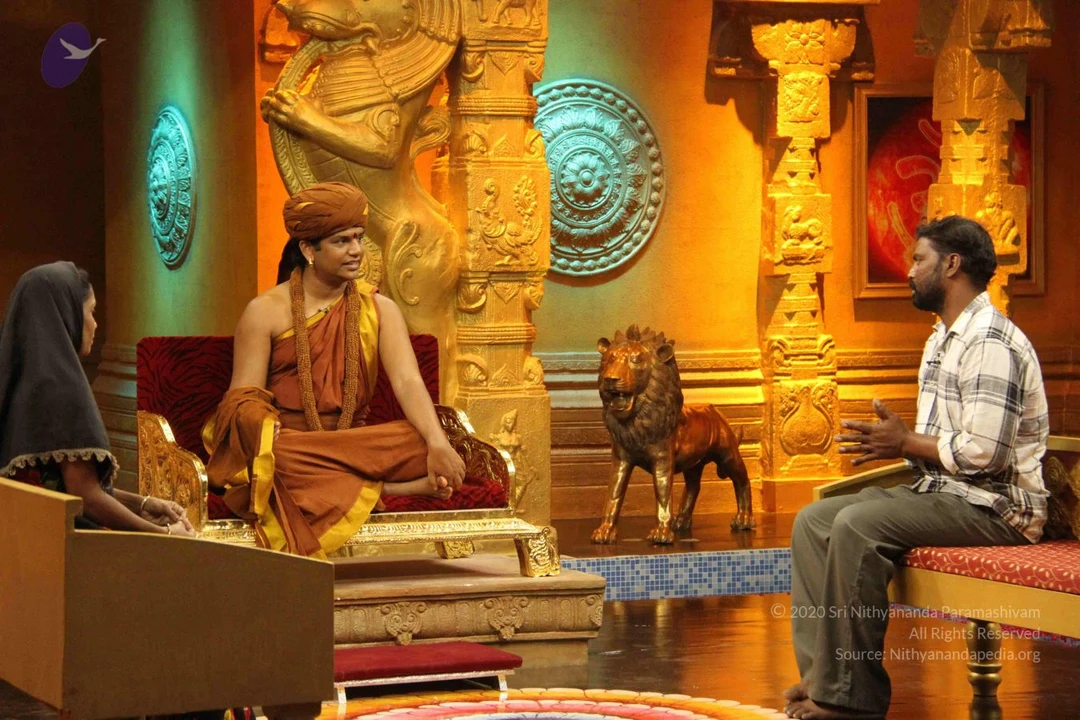
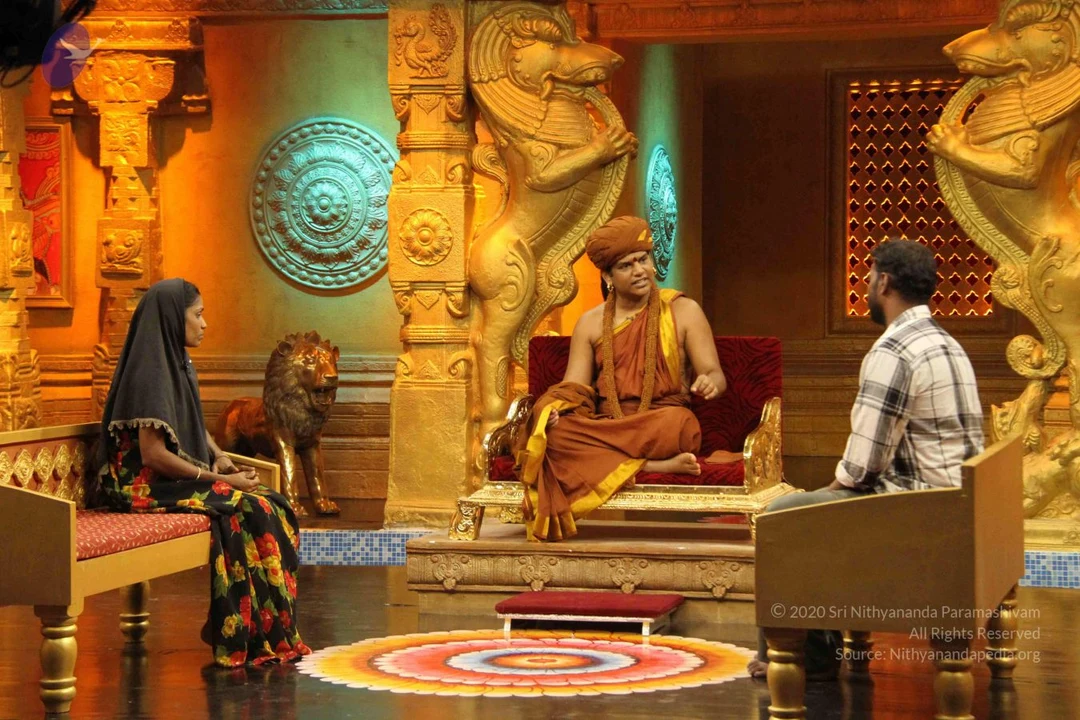
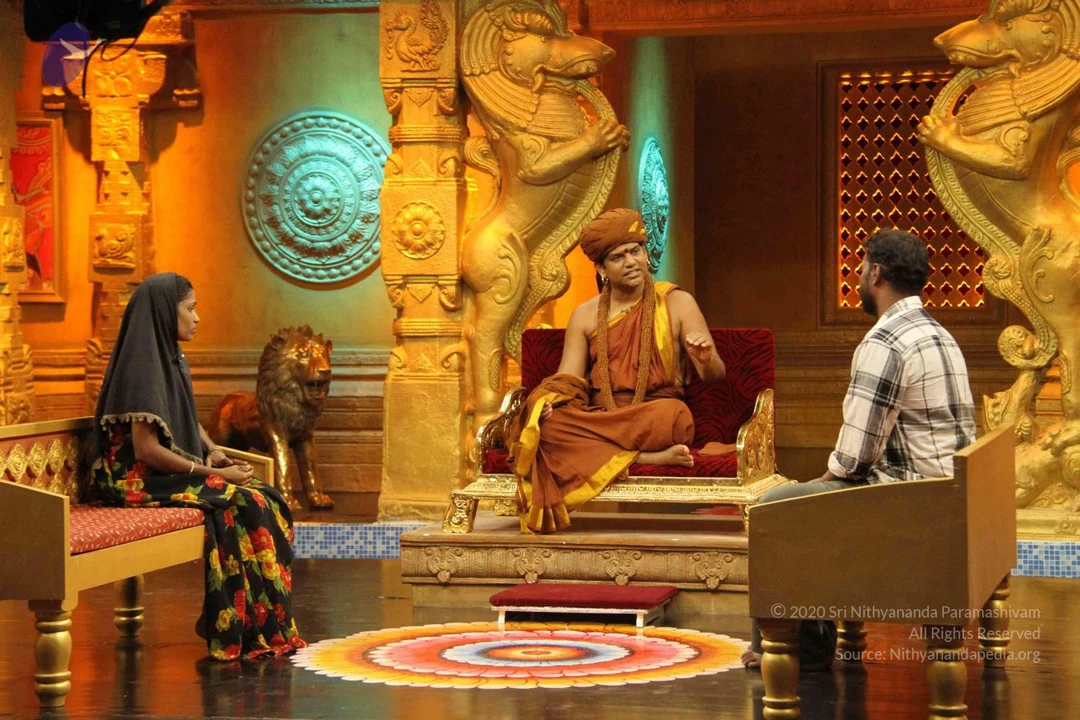
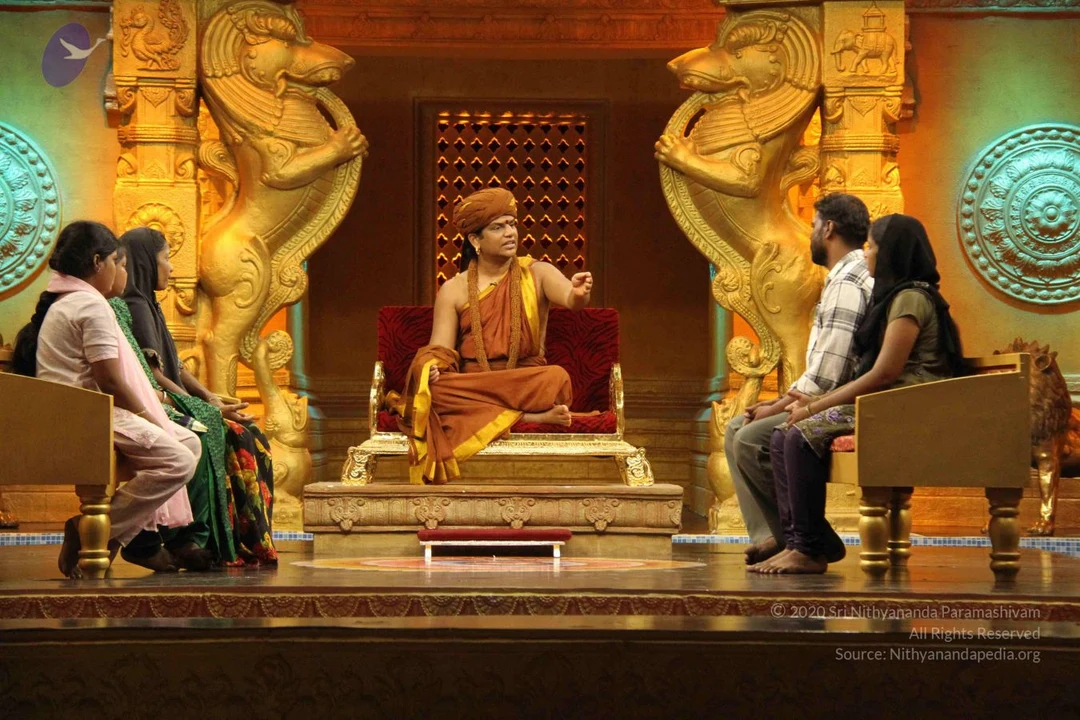
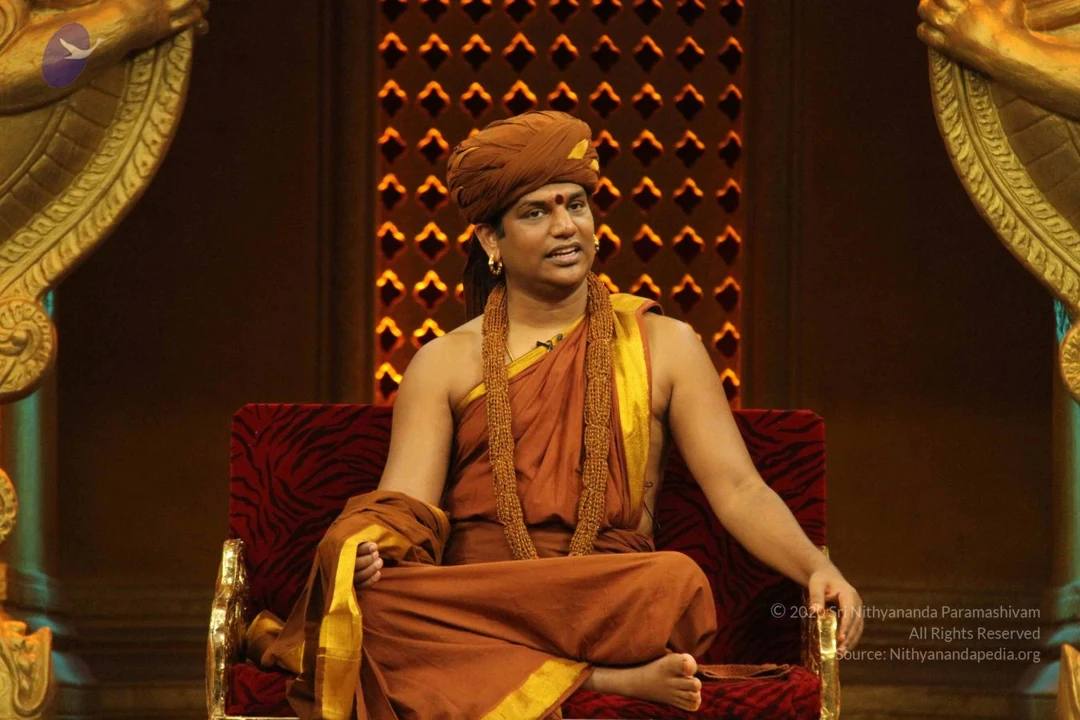
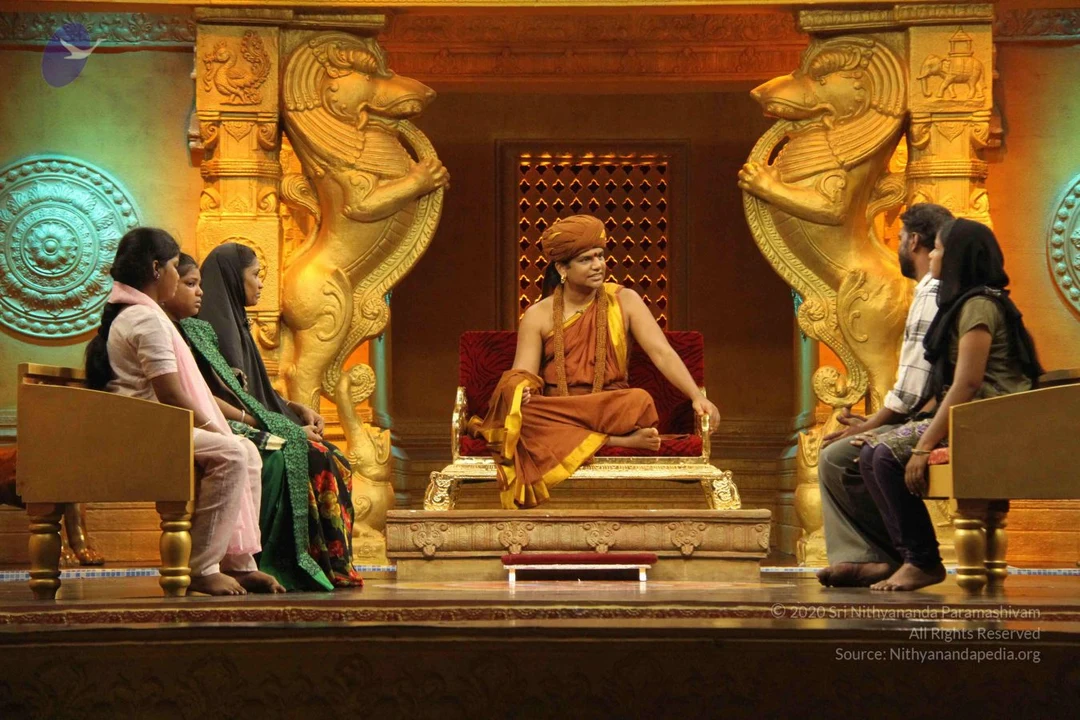
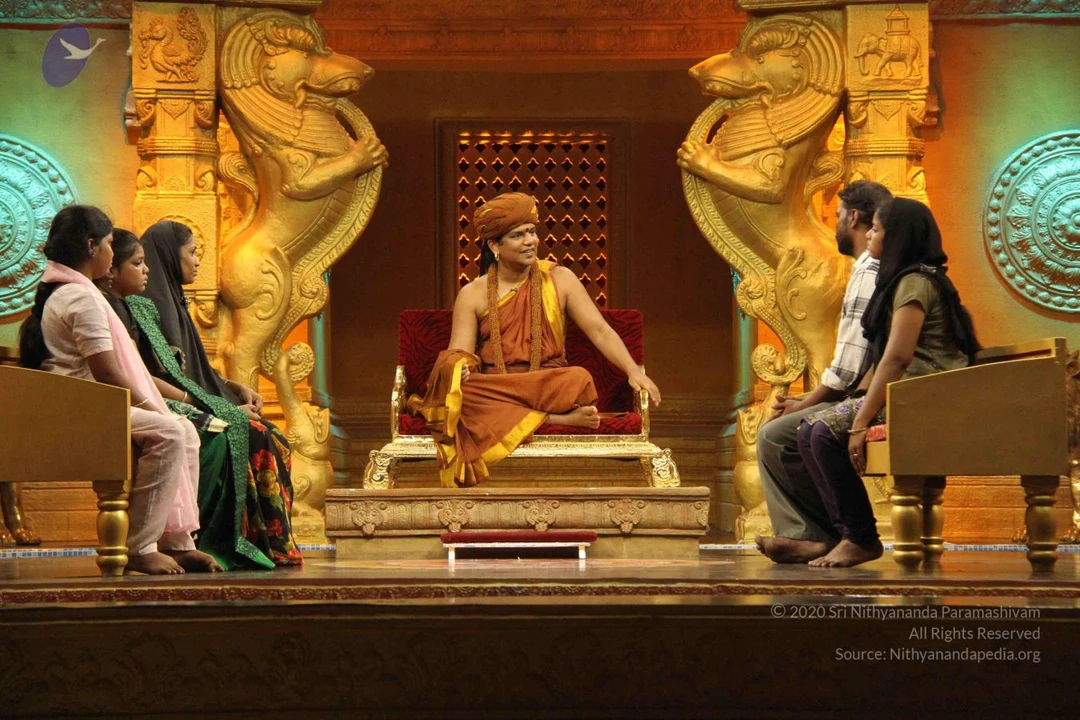
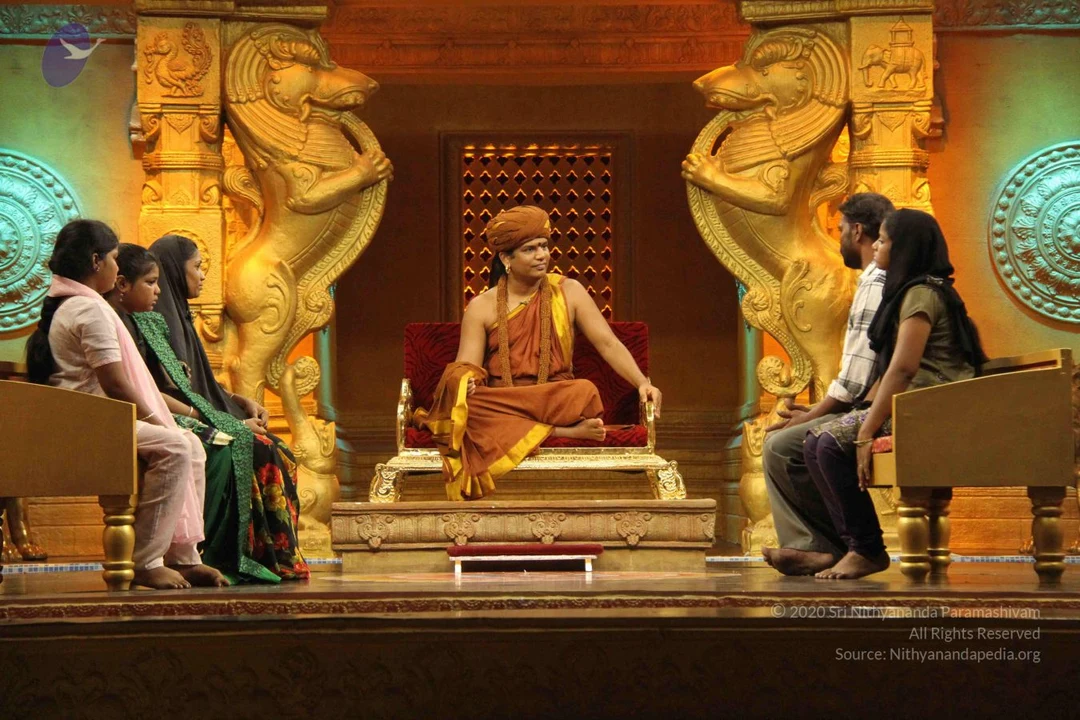
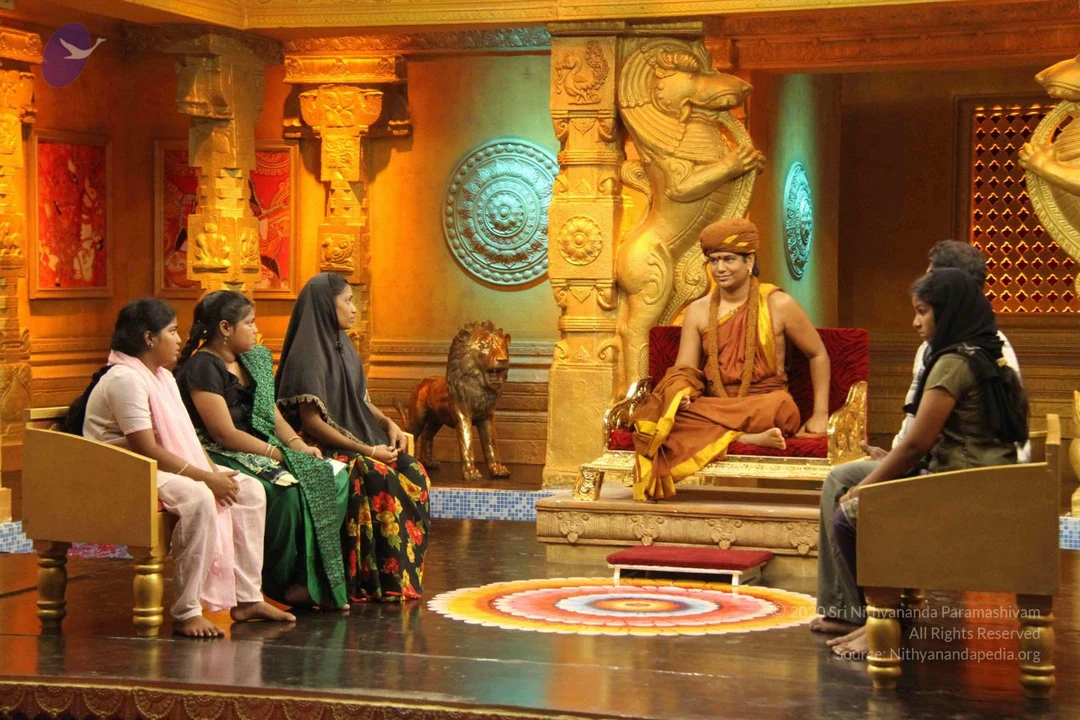
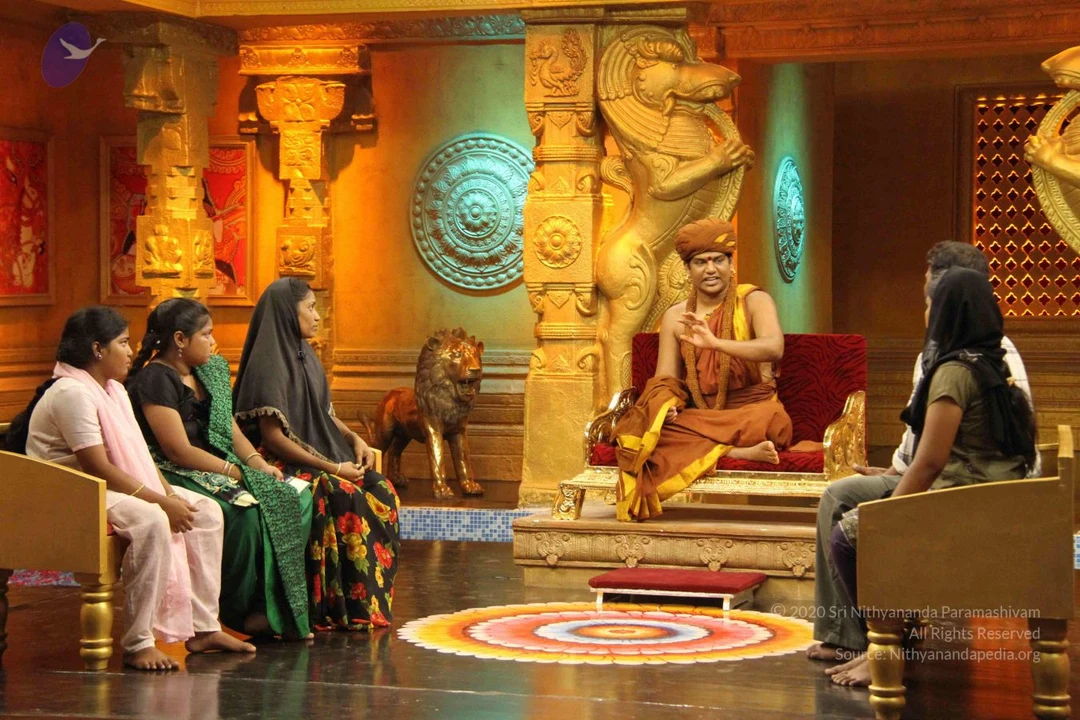
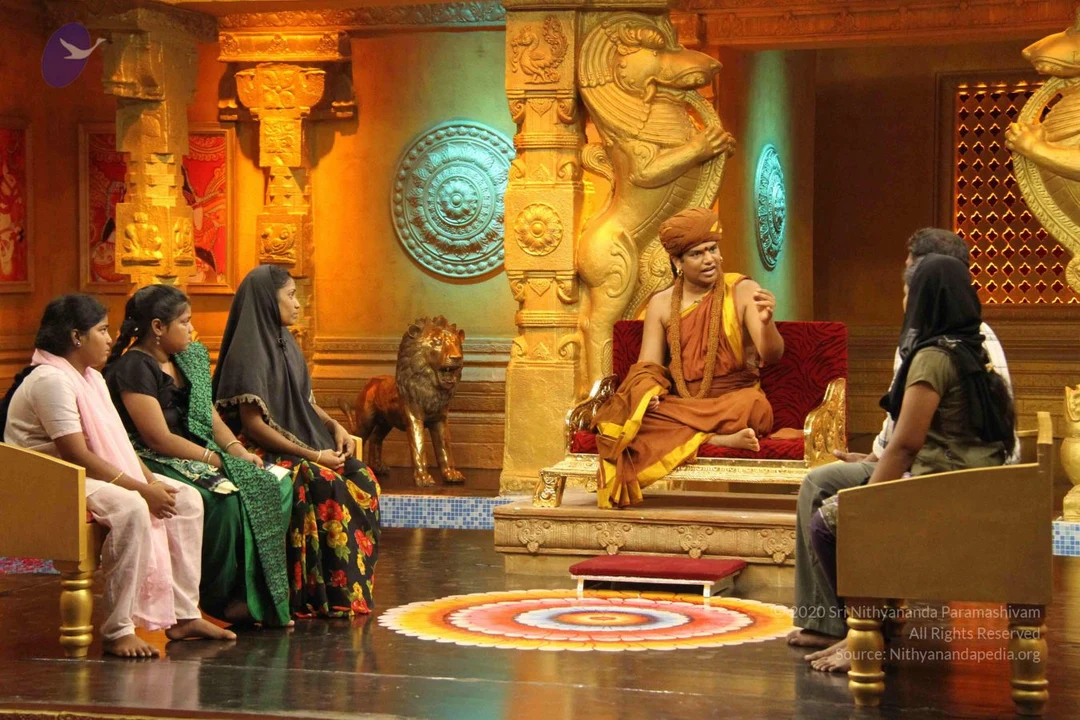
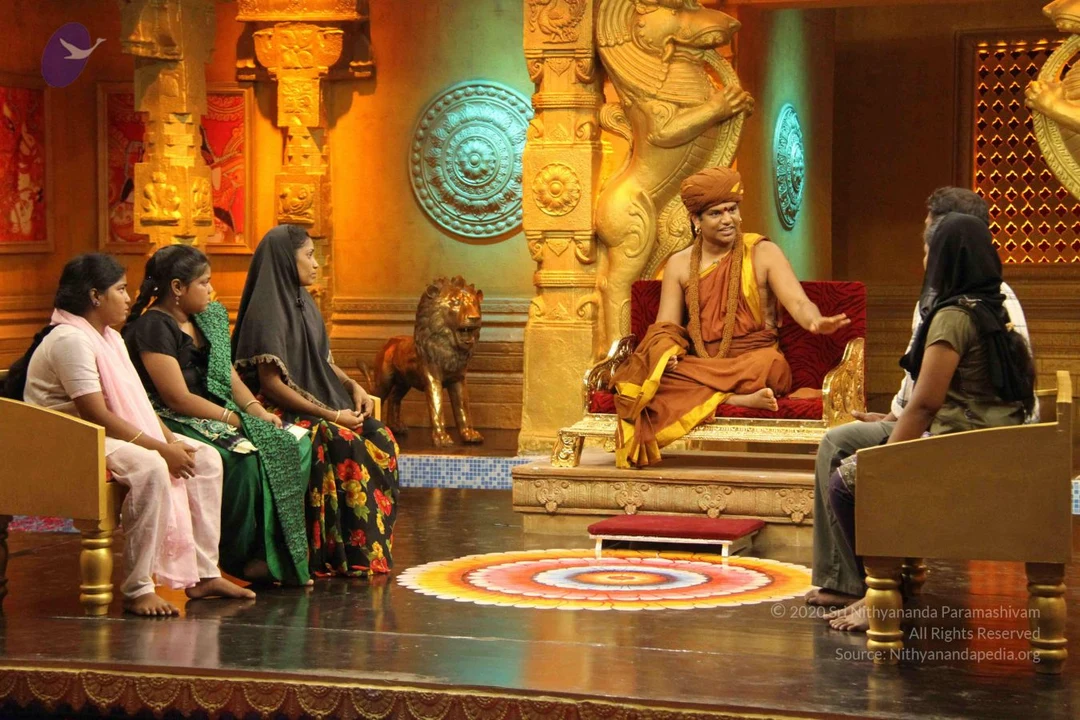
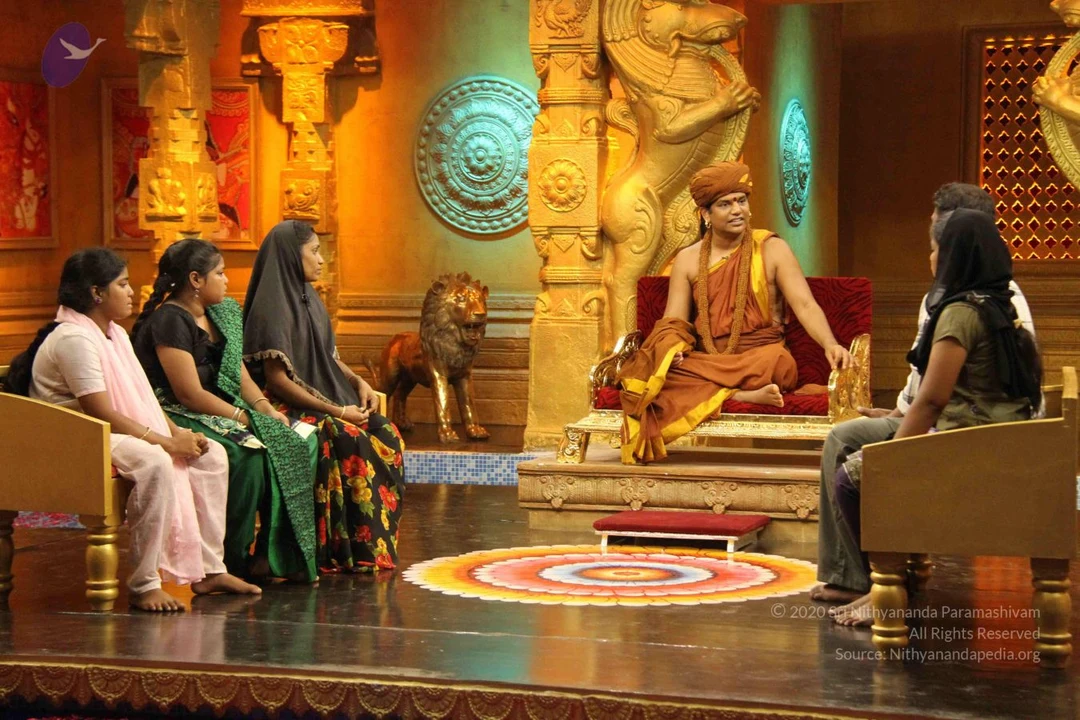
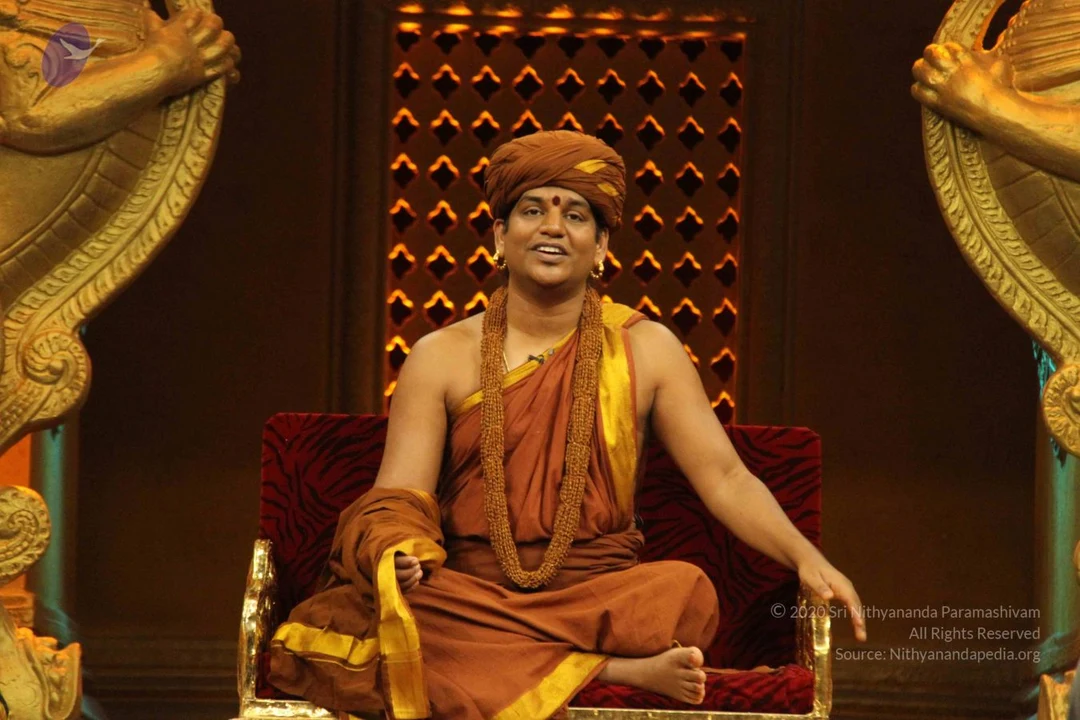
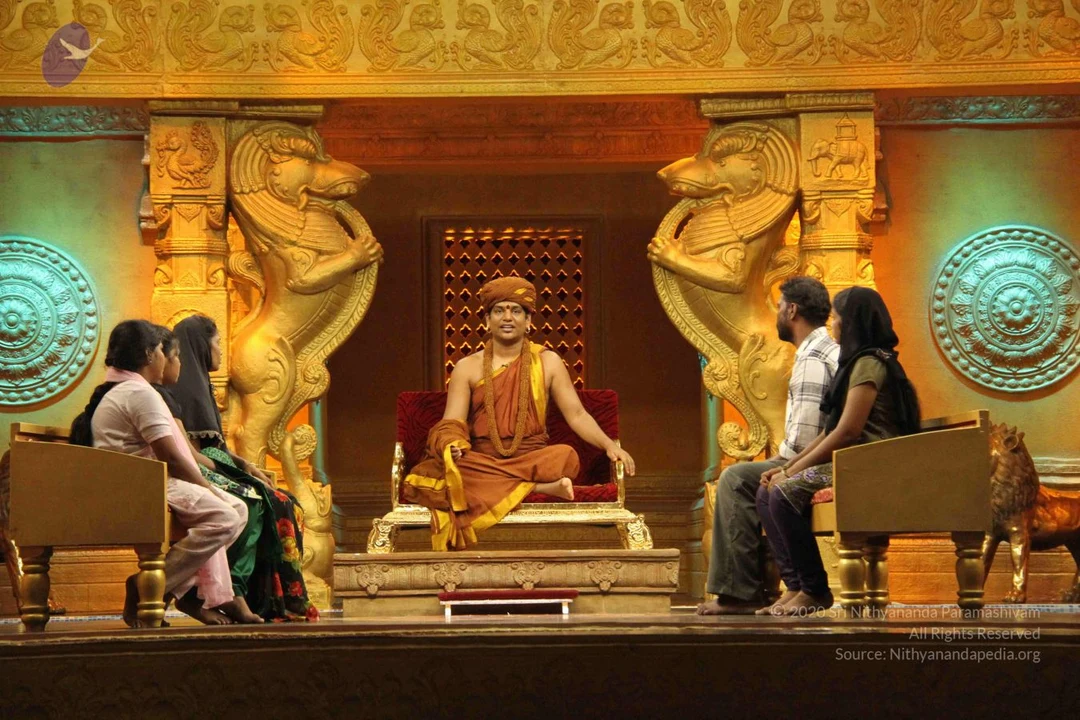
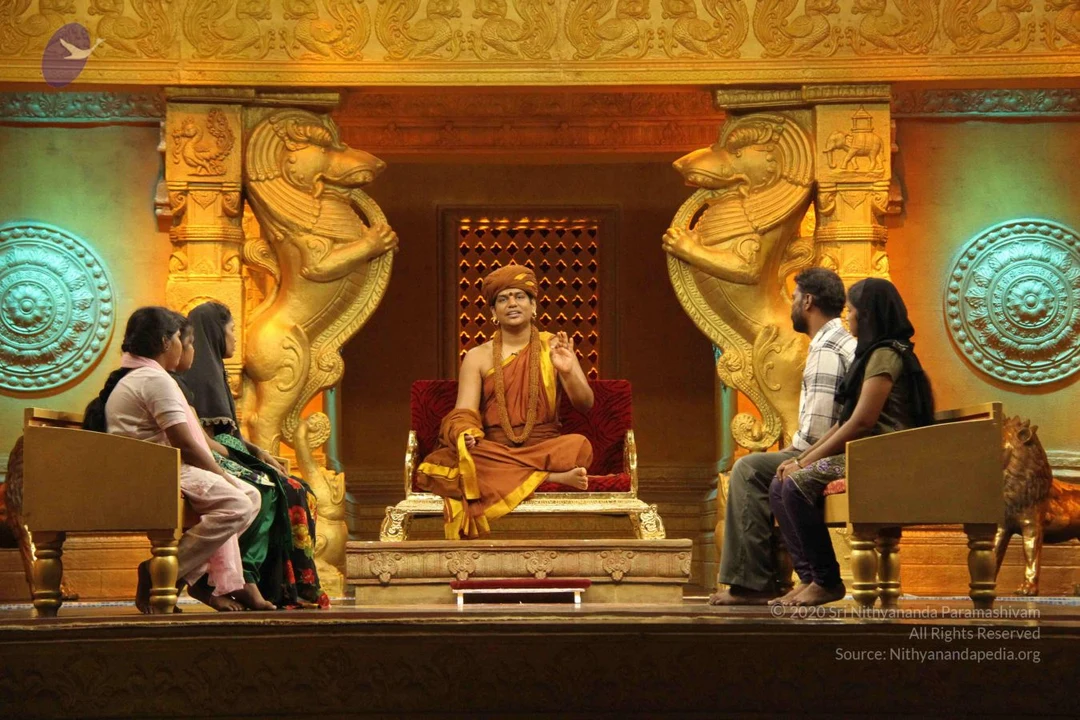
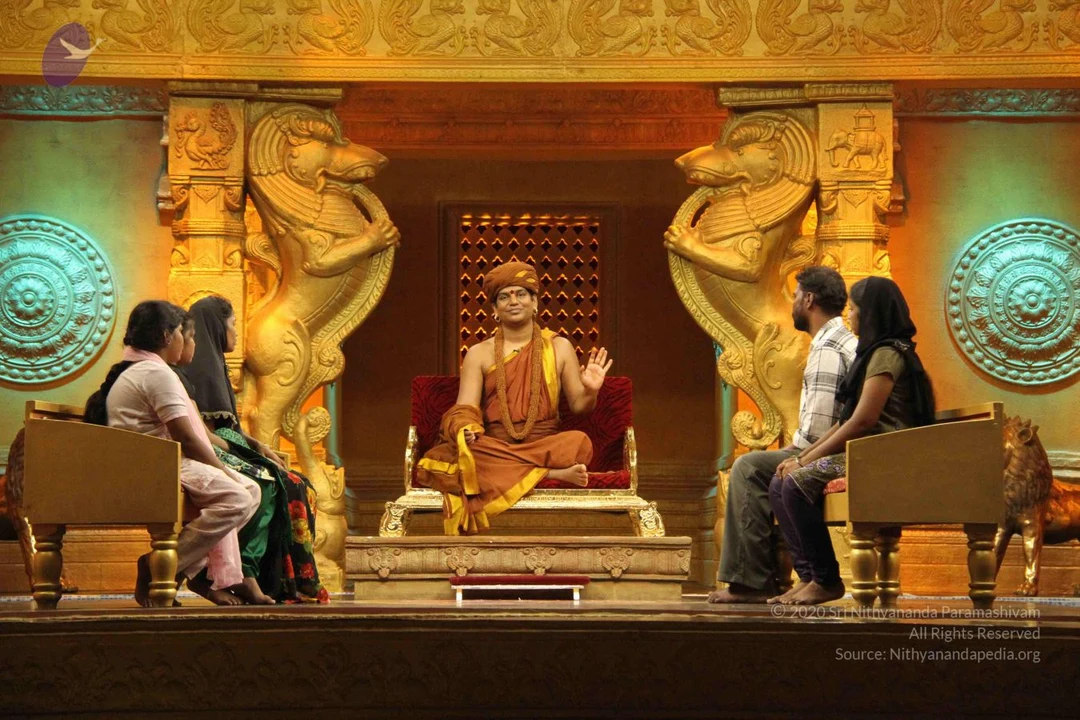
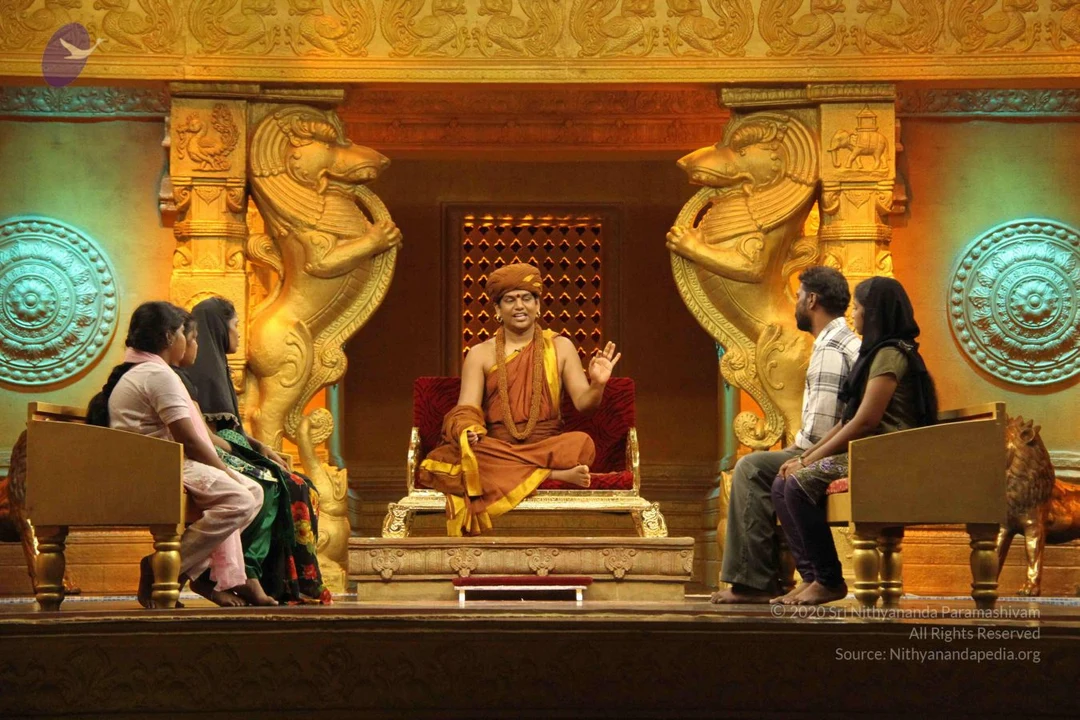
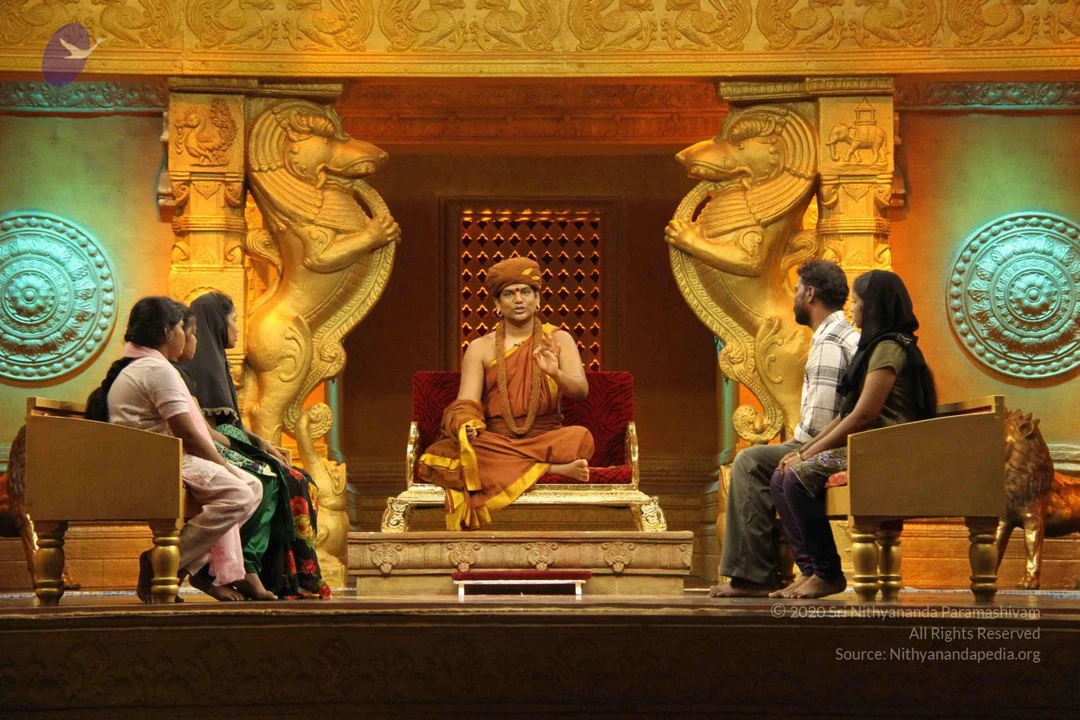
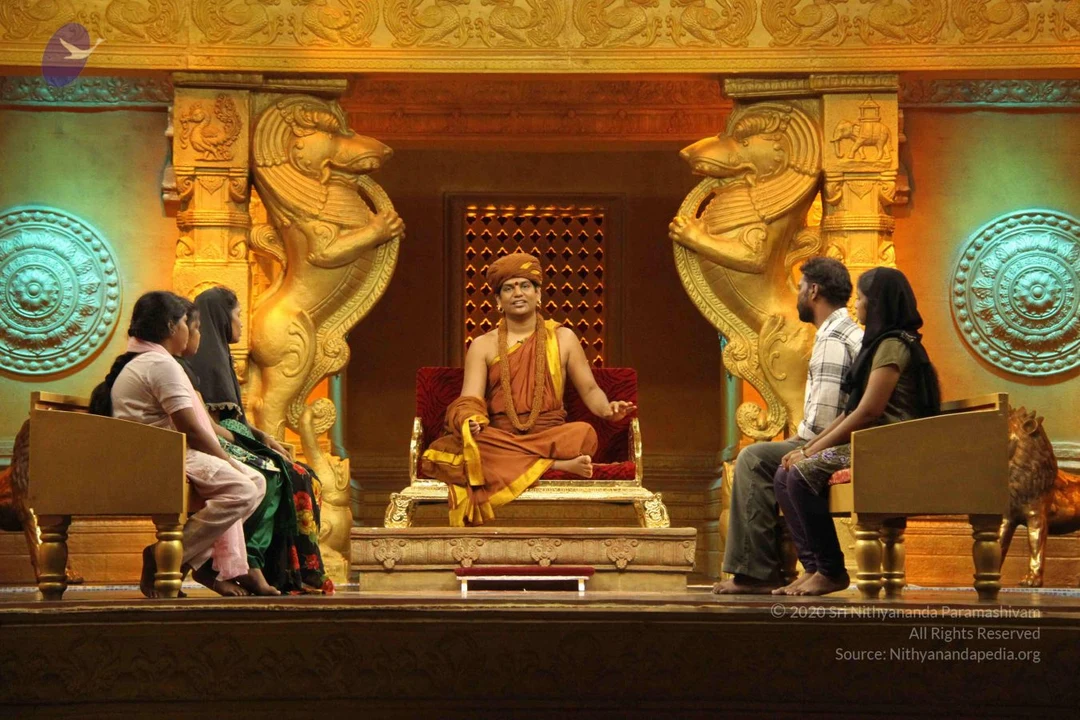
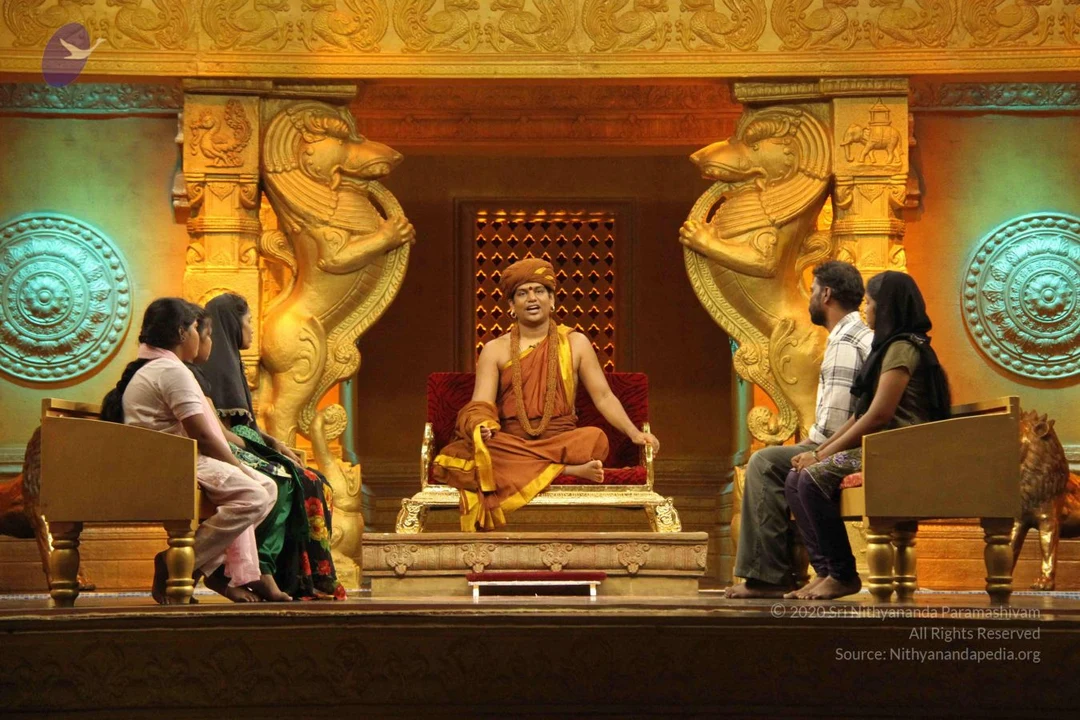
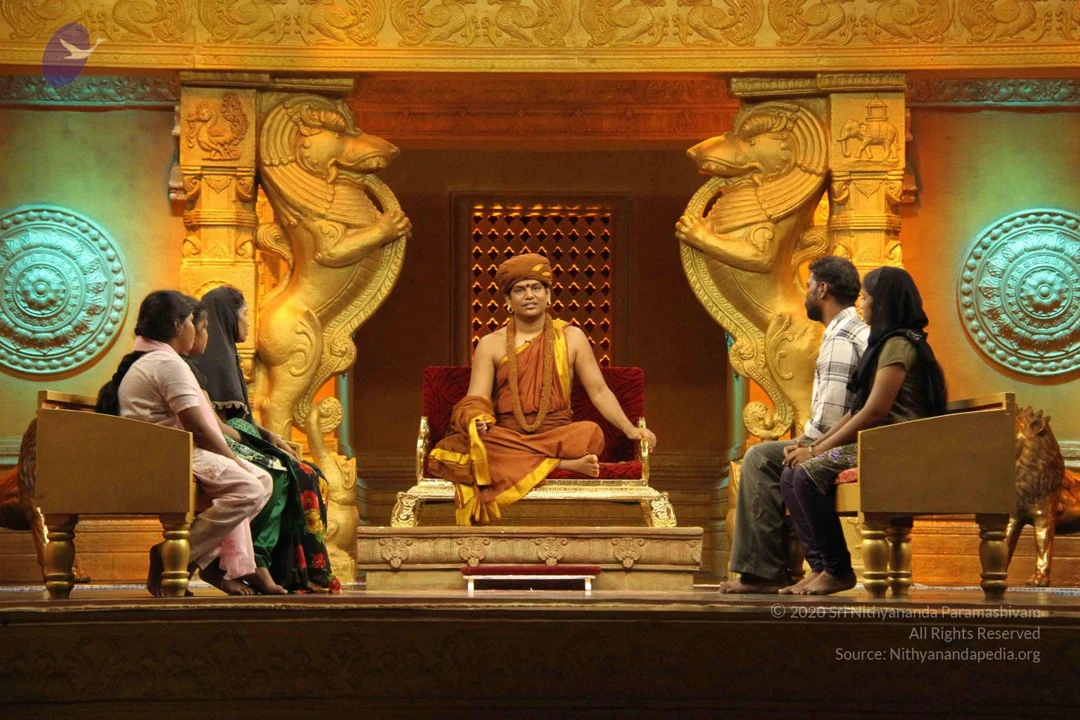
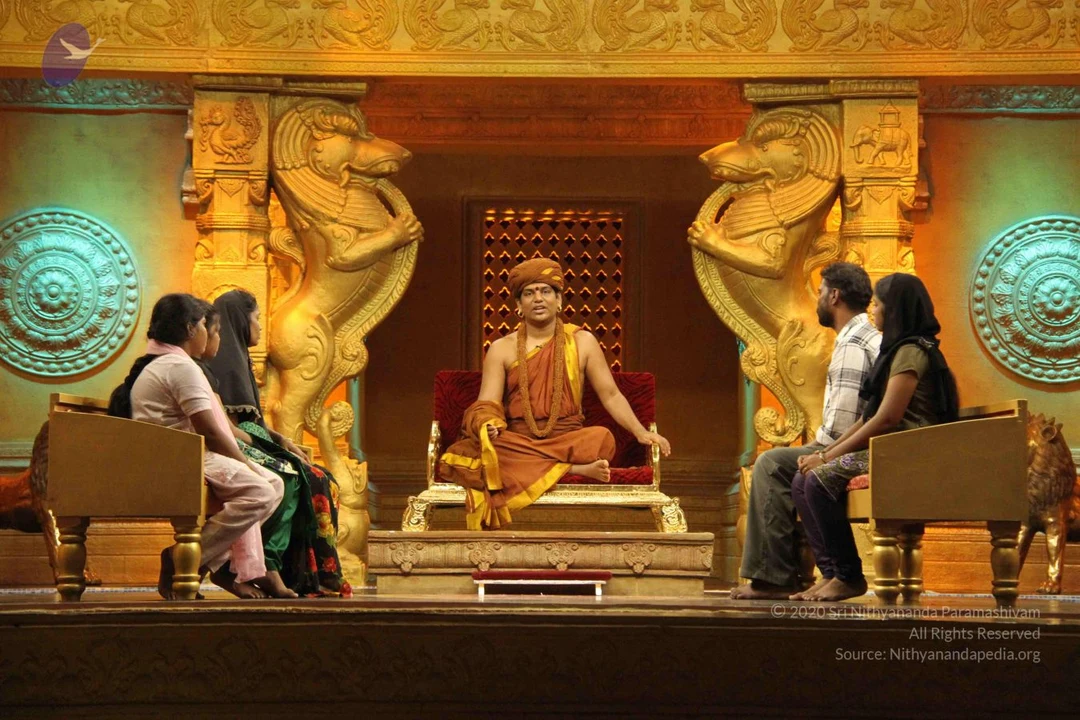
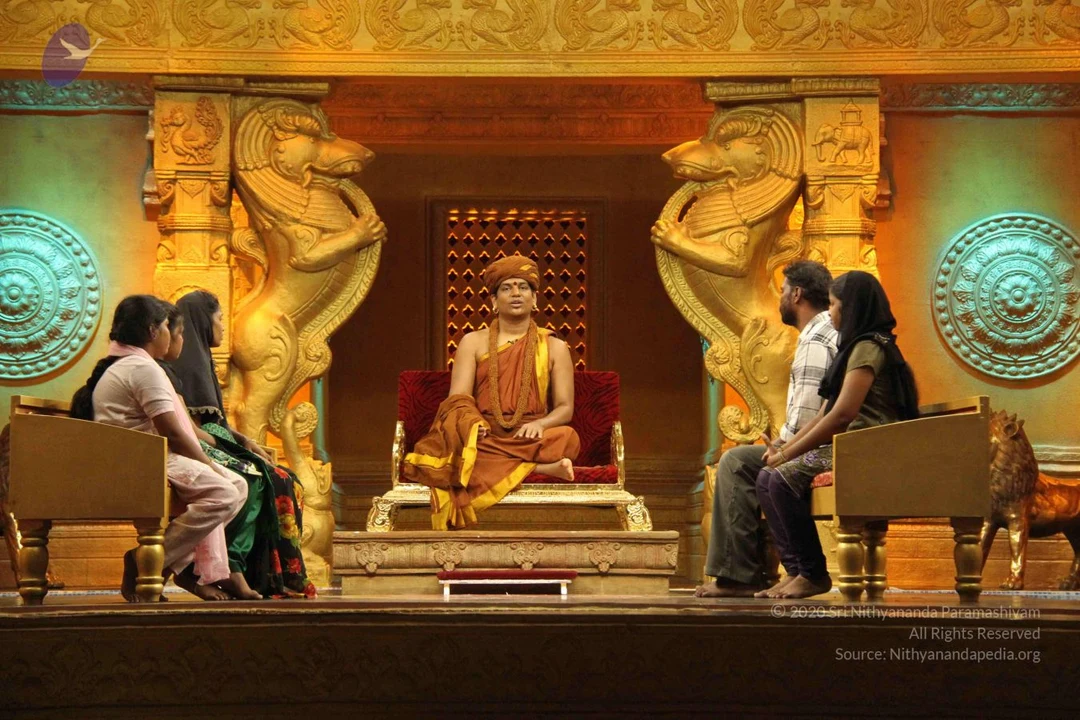
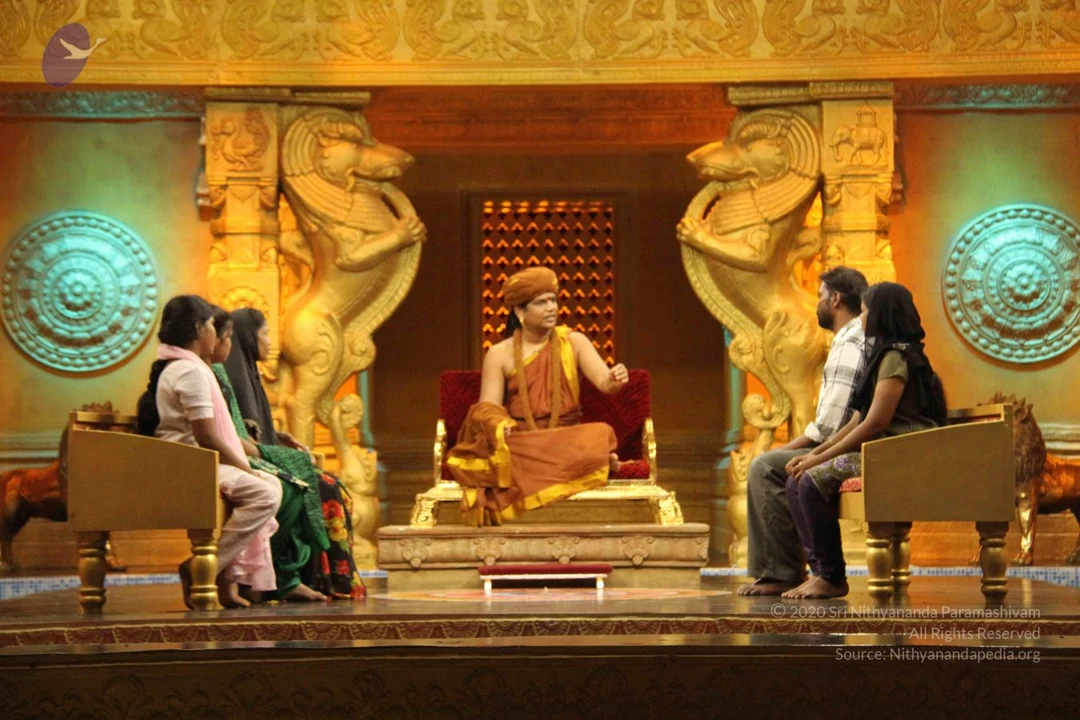
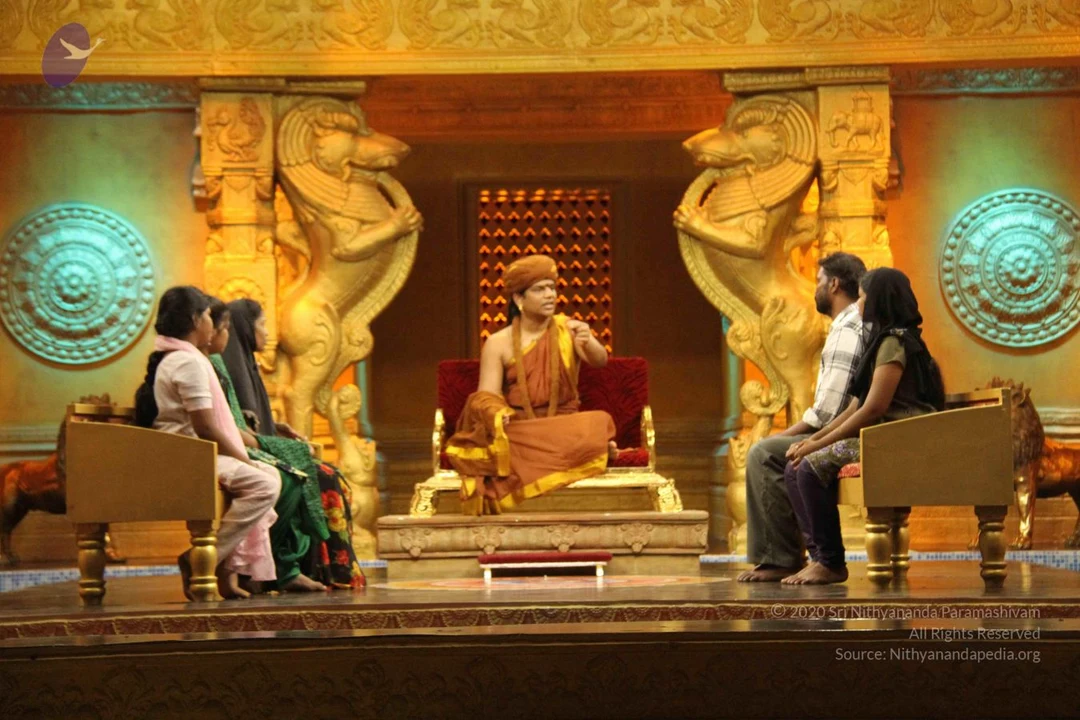
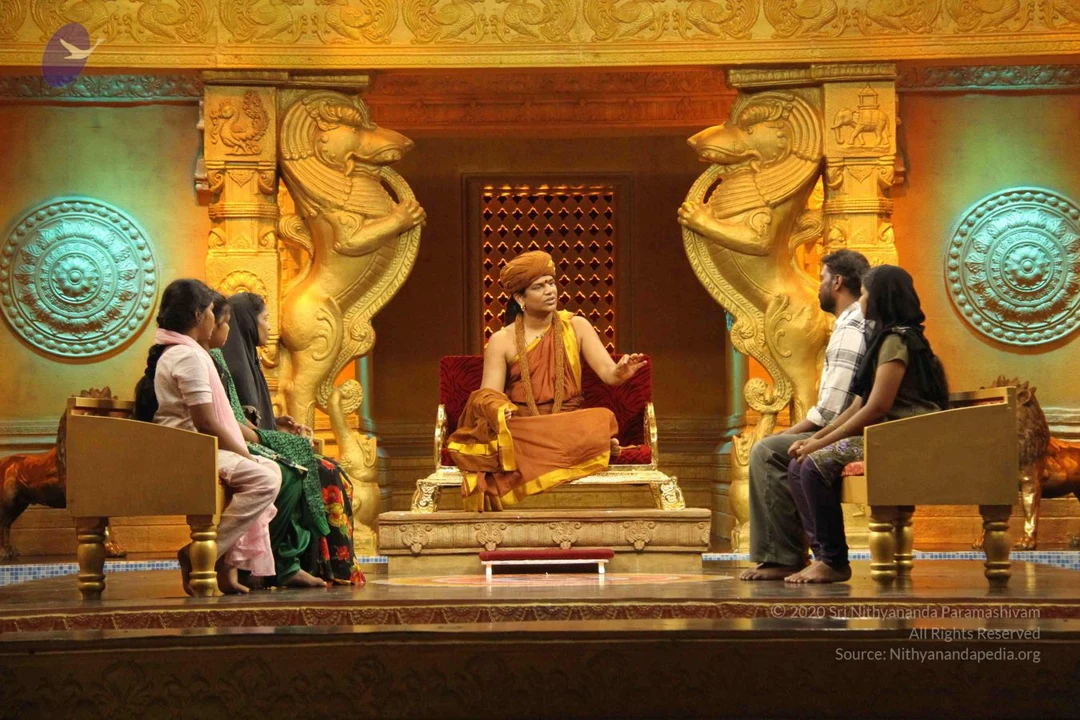
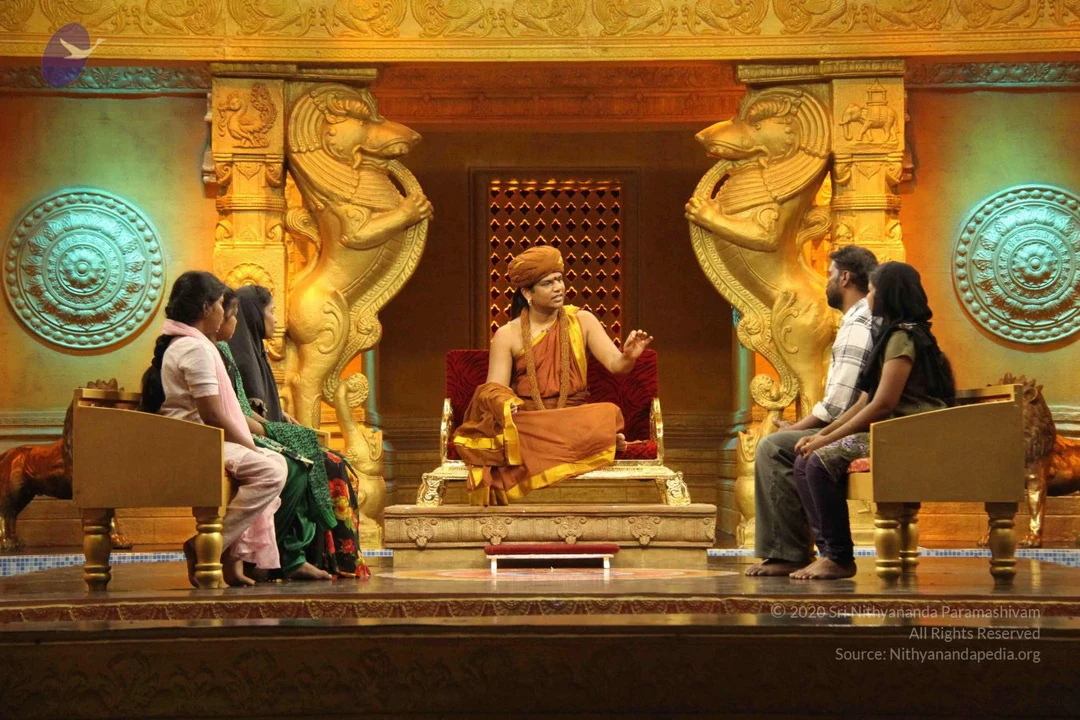
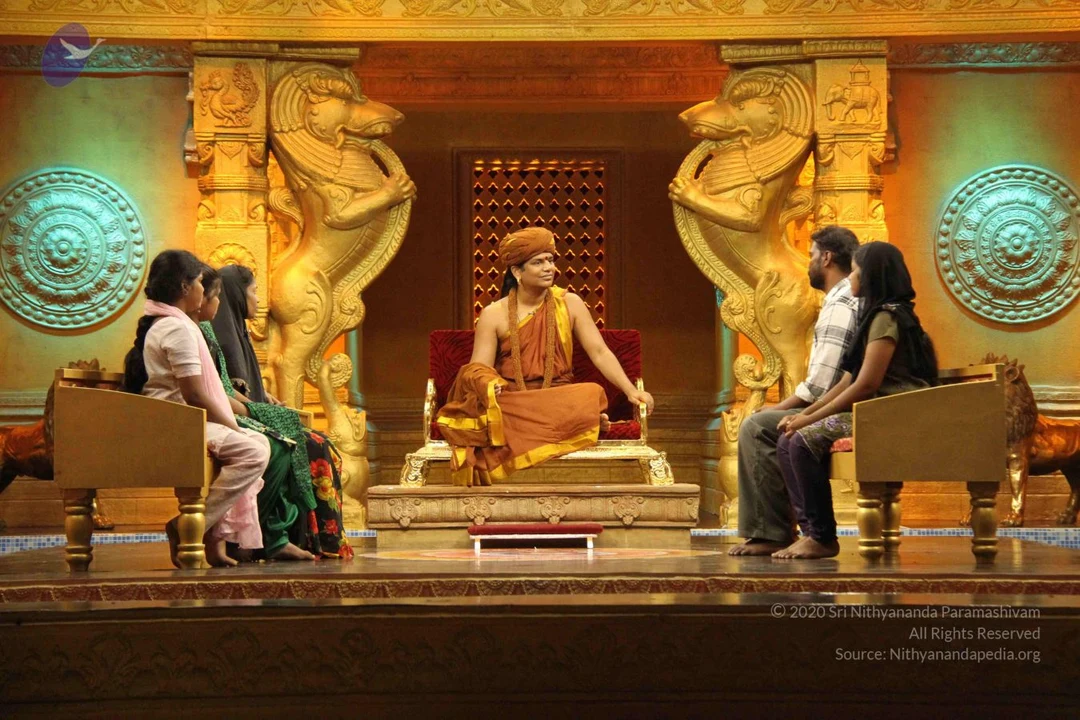
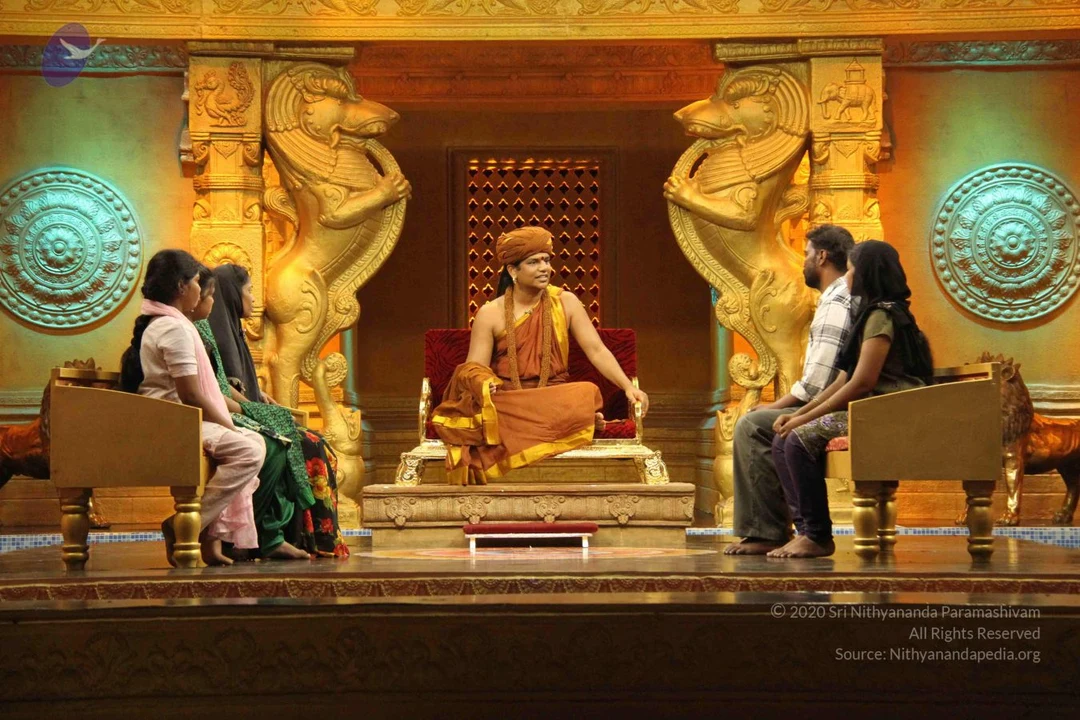
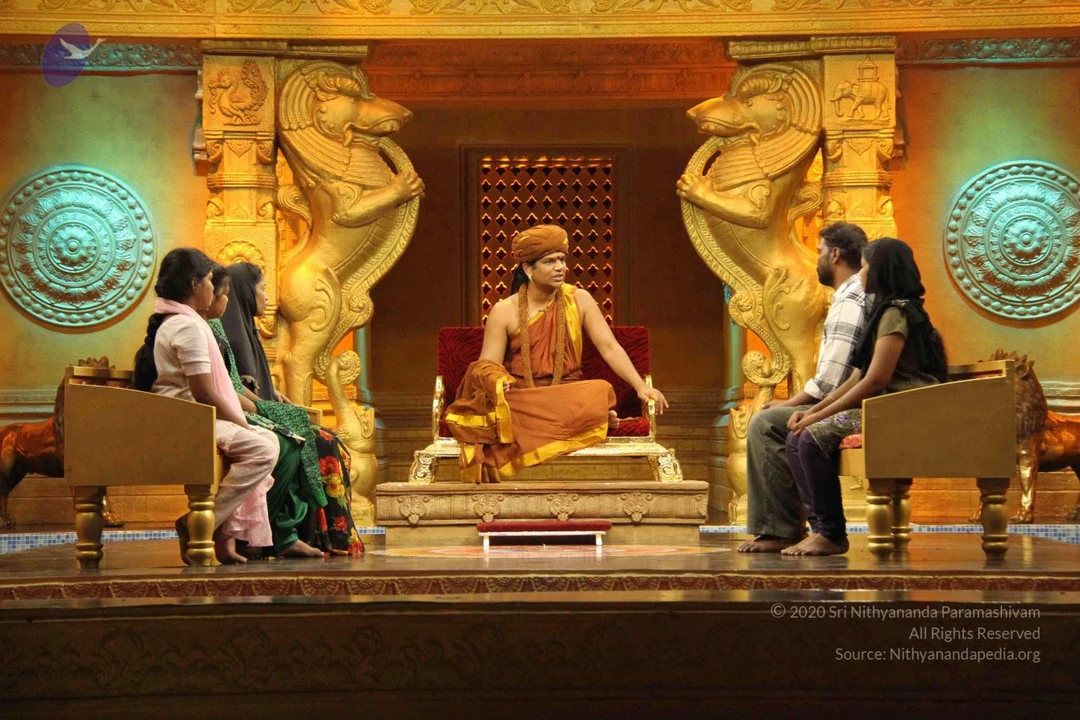
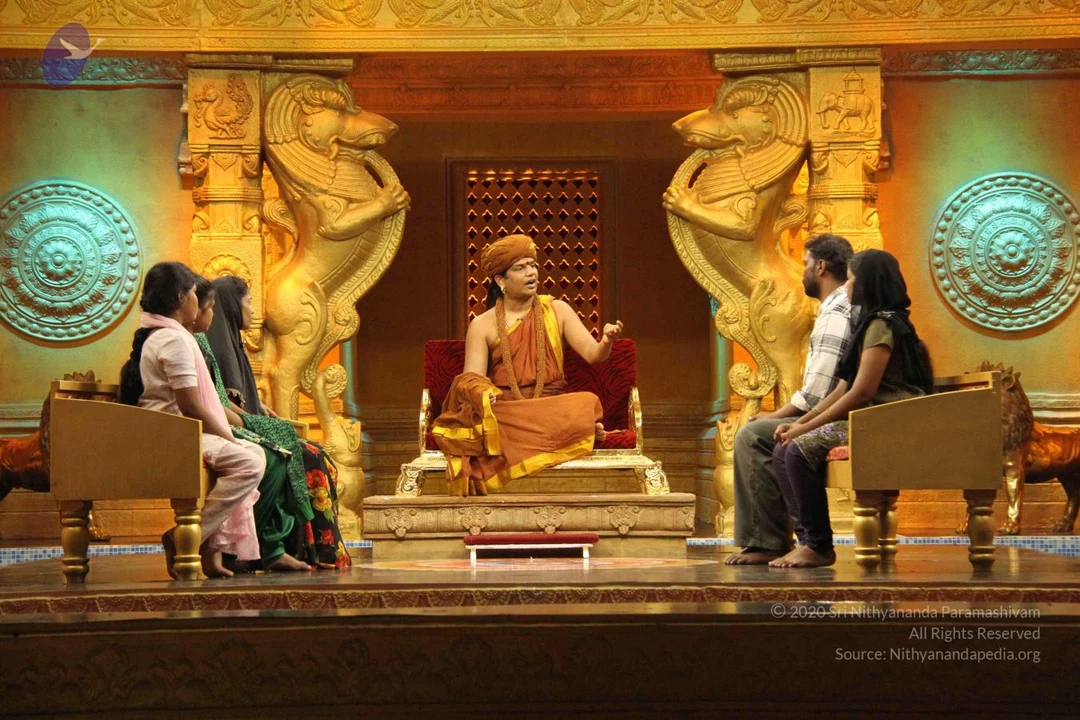
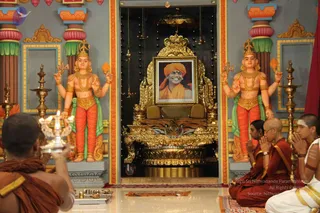
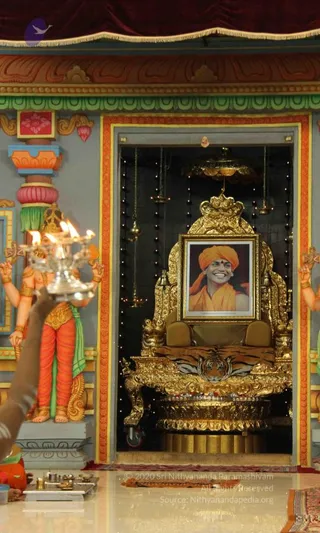
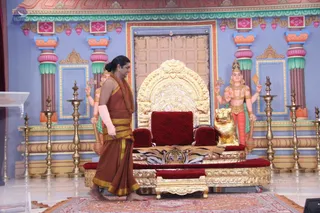
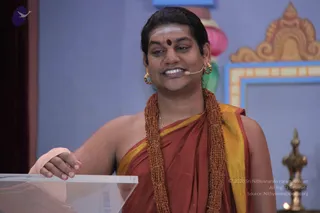
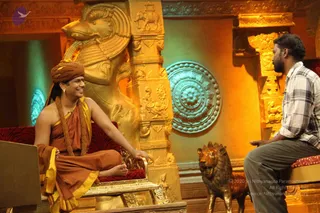
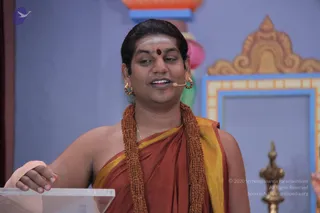
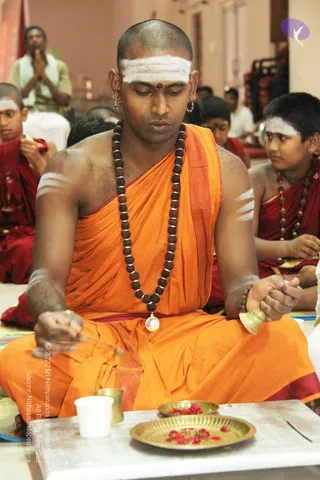
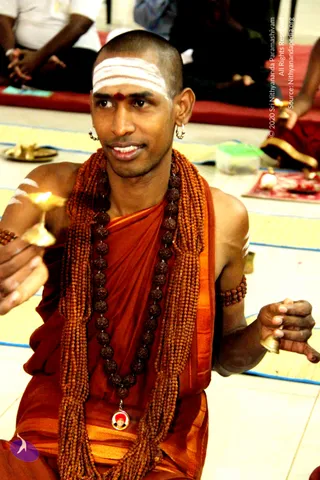
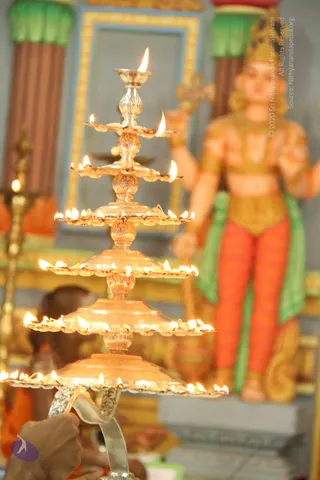
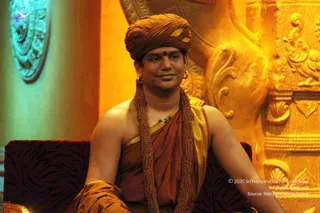
A photograph of a golden-carved stage set with a lion-headed carved pillar and a bronze lion sculpture in the foreground. A man in an orange-brown turban, orange-brown dhoti-style robe with a yellow border, and a long beaded rudraksha-style necklace sits cross-legged on a red cushioned golden throne at left, smiling and gesturing toward a second man seated at right. The seated man wears a white and grey plaid shirt and grey trousers and sits on a red-cushioned bench beside the bronze lion. Behind them stand ornate golden temple-style columns and a teal circular medallion.A photograph of a satsang on a decorated stage with golden carved pillars, a gilded lion statue and a multicoloured rangoli on the floor. A seated man in an orange-saffron robe and matching orange turban sits on a red-cushioned gilded throne with a yellow shawl draped over his shoulders, appearing to be Swamiji (probable) given the saffron robe, turban and ceremonial setting, while speaking. To the left, four women sit on golden benches: one in a pink shawl and white outfit with her hand to her head, one in green and black, and one in a black head covering and floral skirt. On the right, two people sit on a gold bench in dark clothing, one wearing a black headscarf and a backpack.Close-up photograph of a hand holding a small metal oil lamp (deepam) with a lit flame, the fingers wrapped around its base. The hand has tattoo markings on the back and wears a metal bangle and a wristwatch. Blurred hands and orange-clad forms are visible behind. Another hand near the bottom holds a gold-toned object and a metal bangle. The people are only partially visible and mostly out of focus, so they are counted as several.

September 21 2013

Original wiki page
Contents

Title:

Supreme Pontiff of Hinduism HDH Bhagavan Nithyananda Paramashivam

Description:

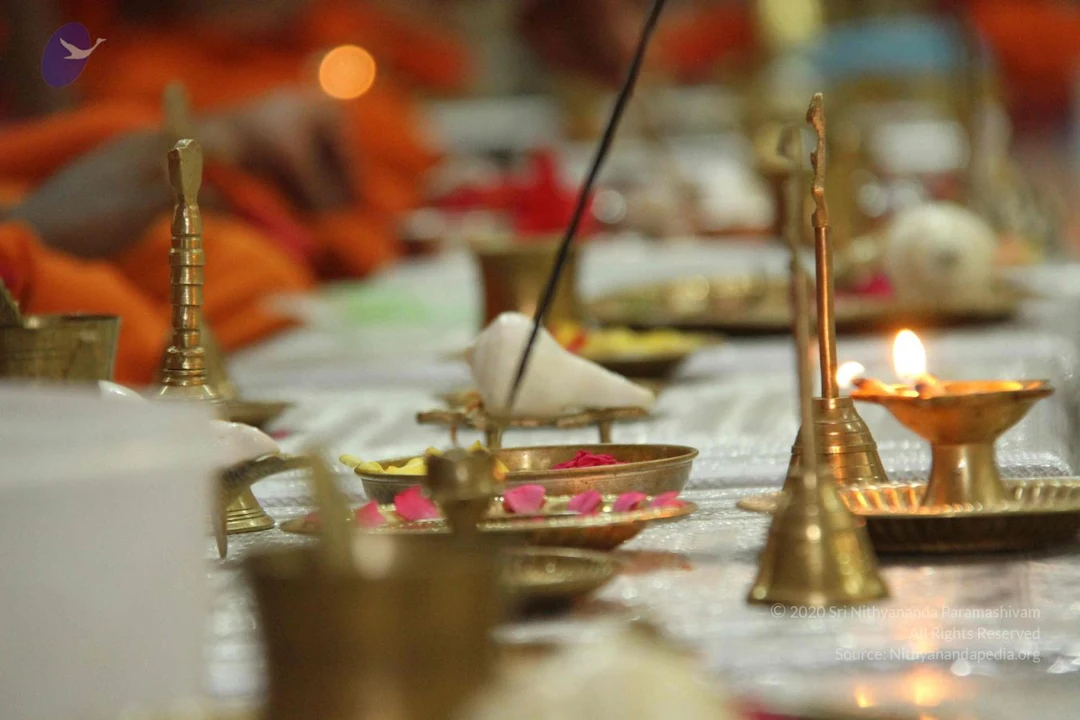
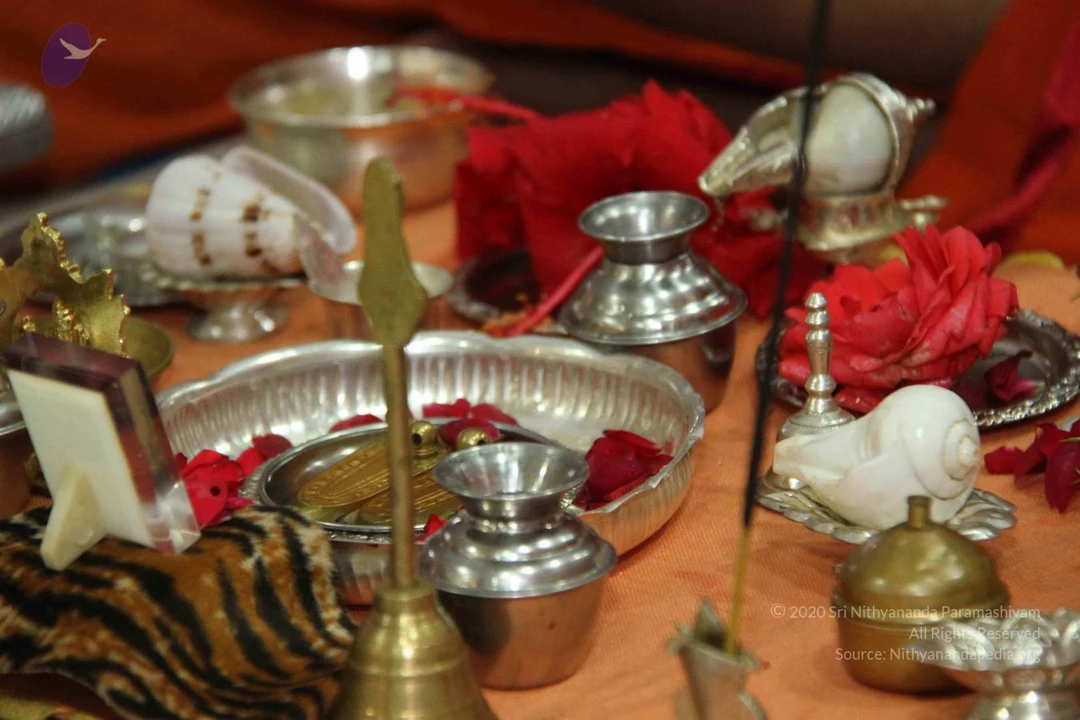
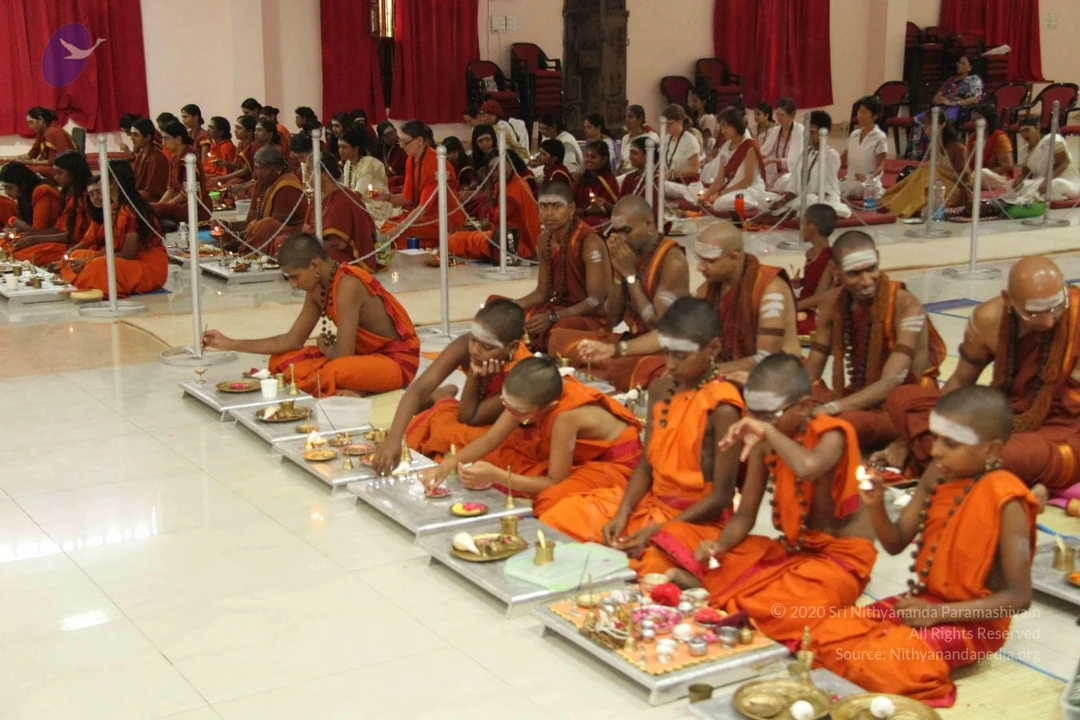
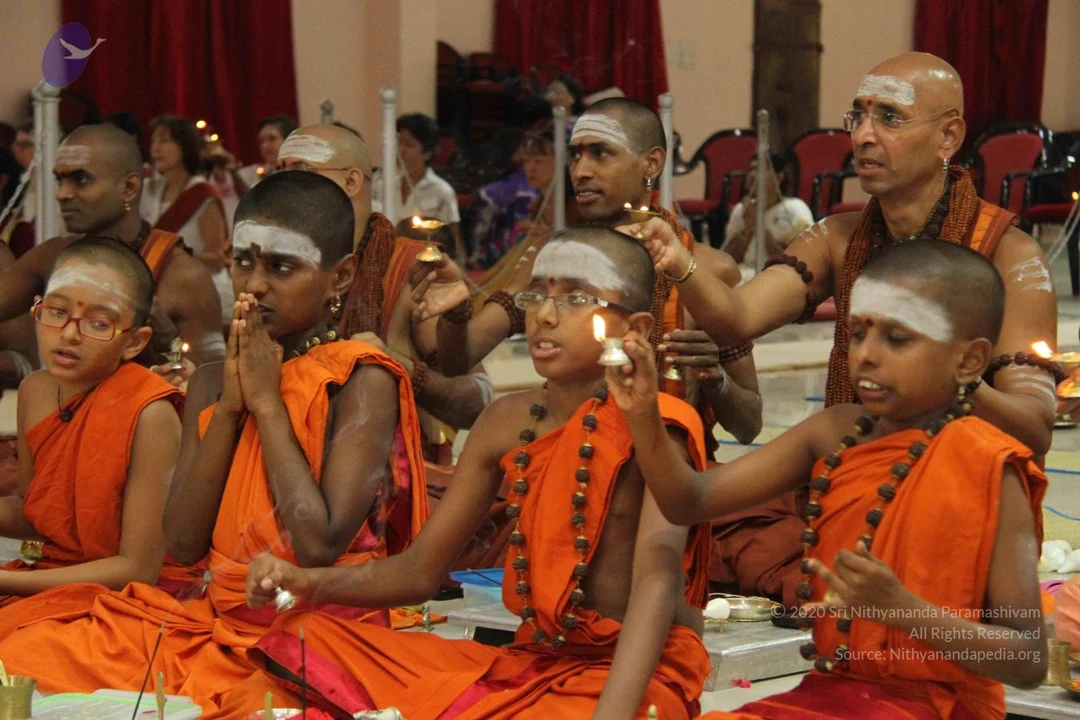
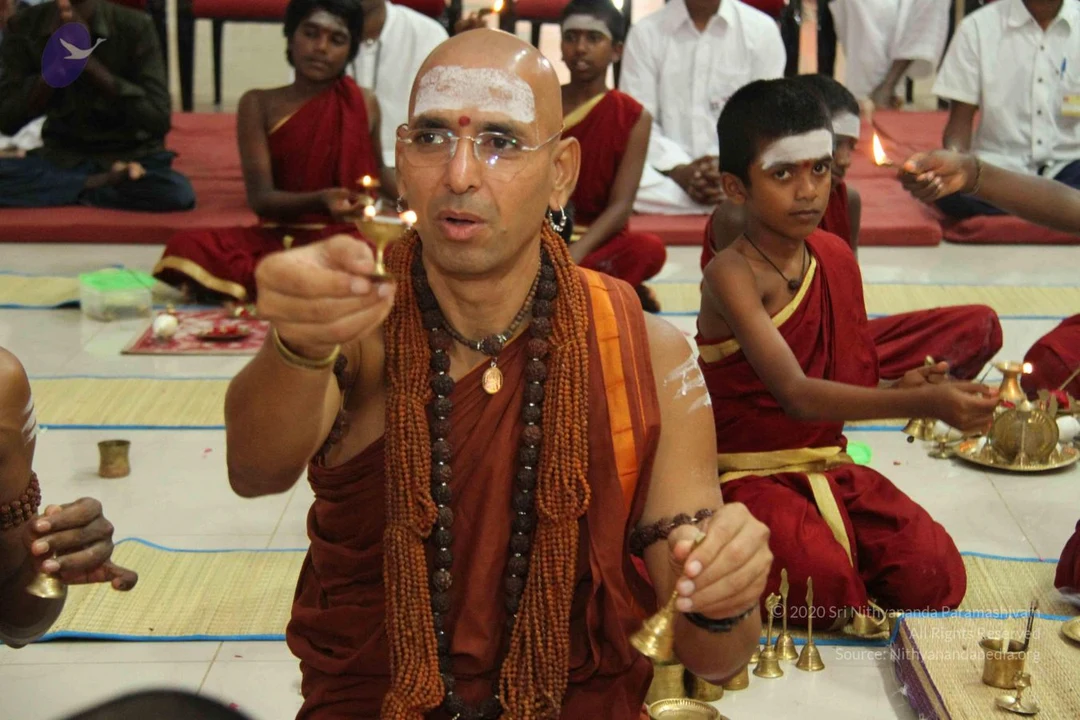
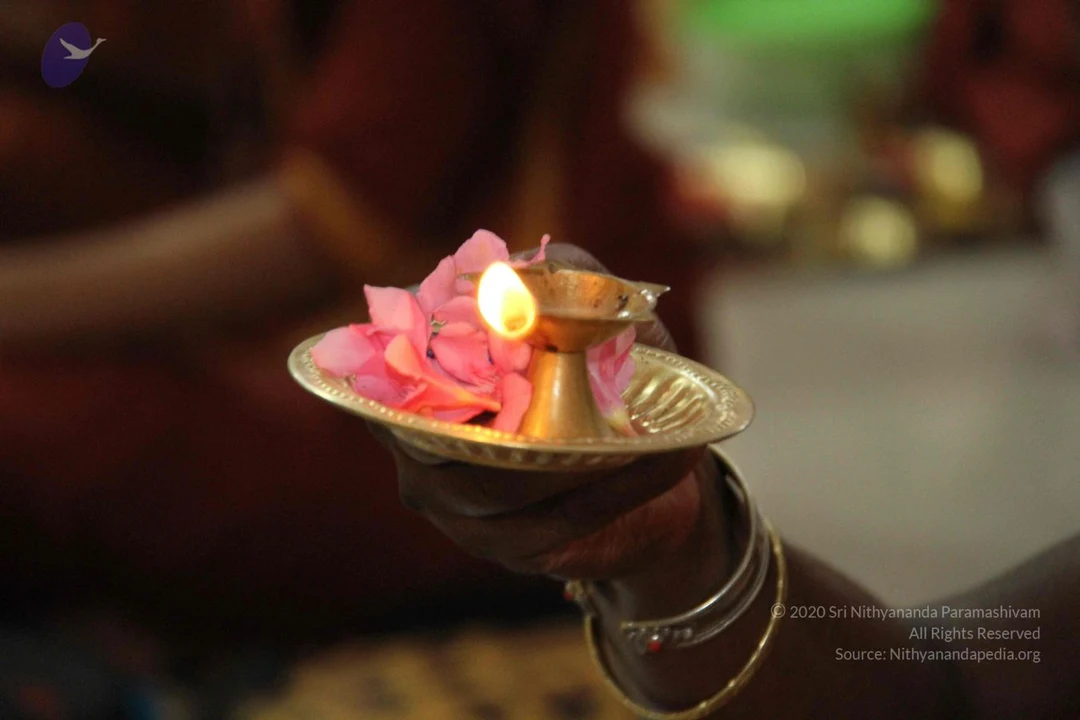
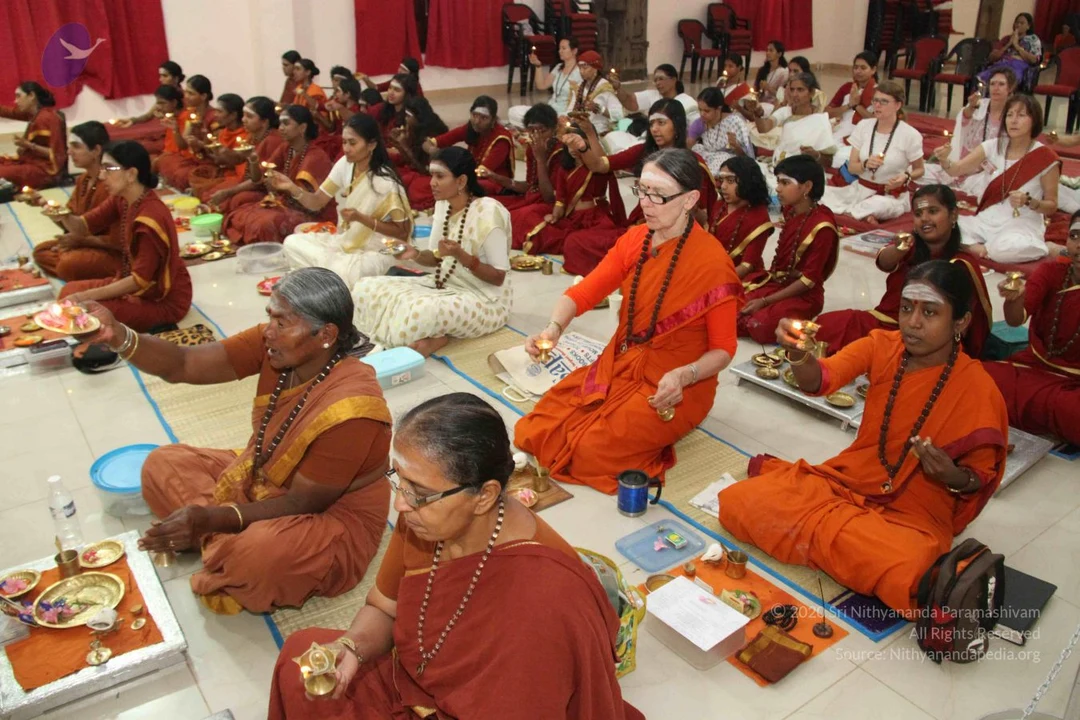
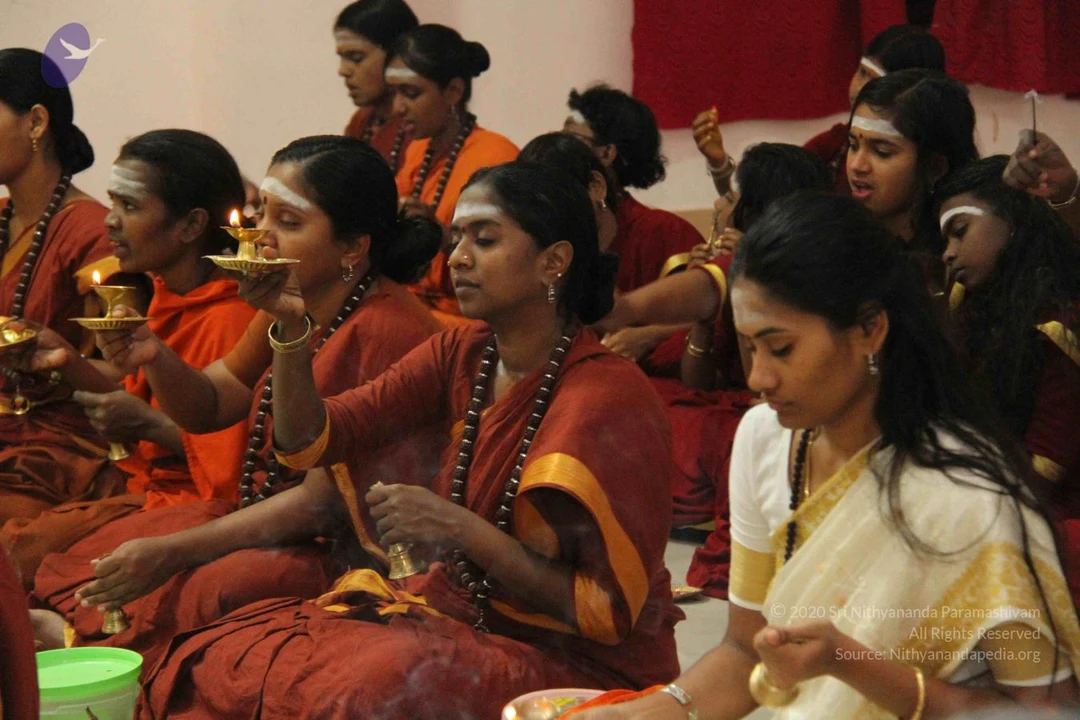
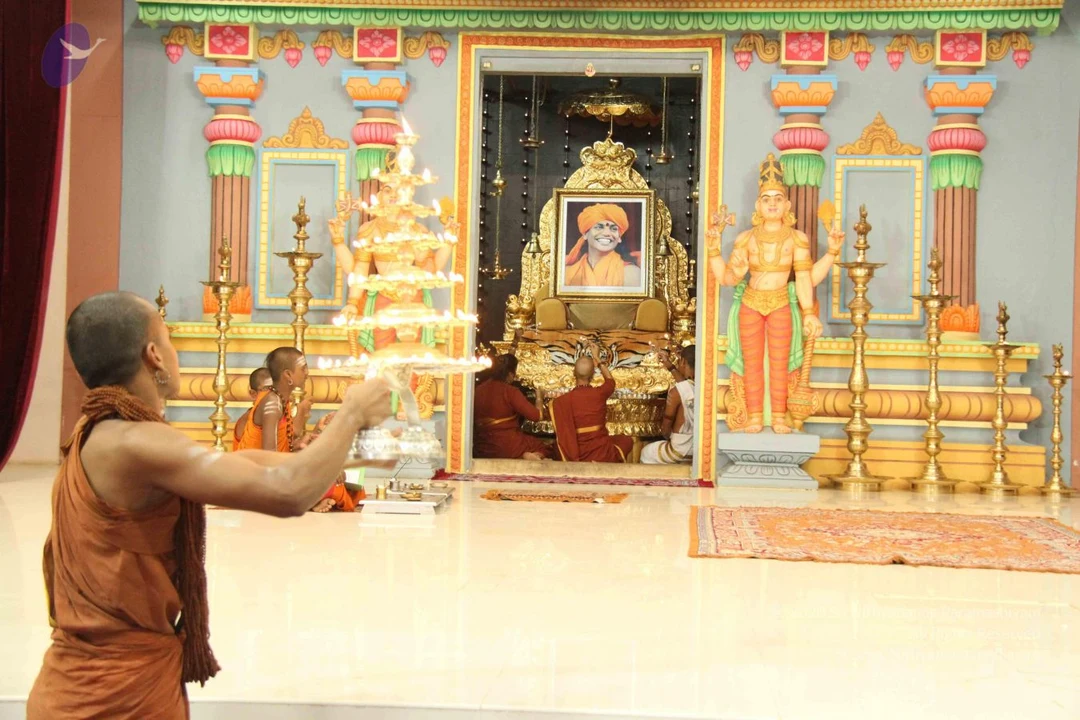
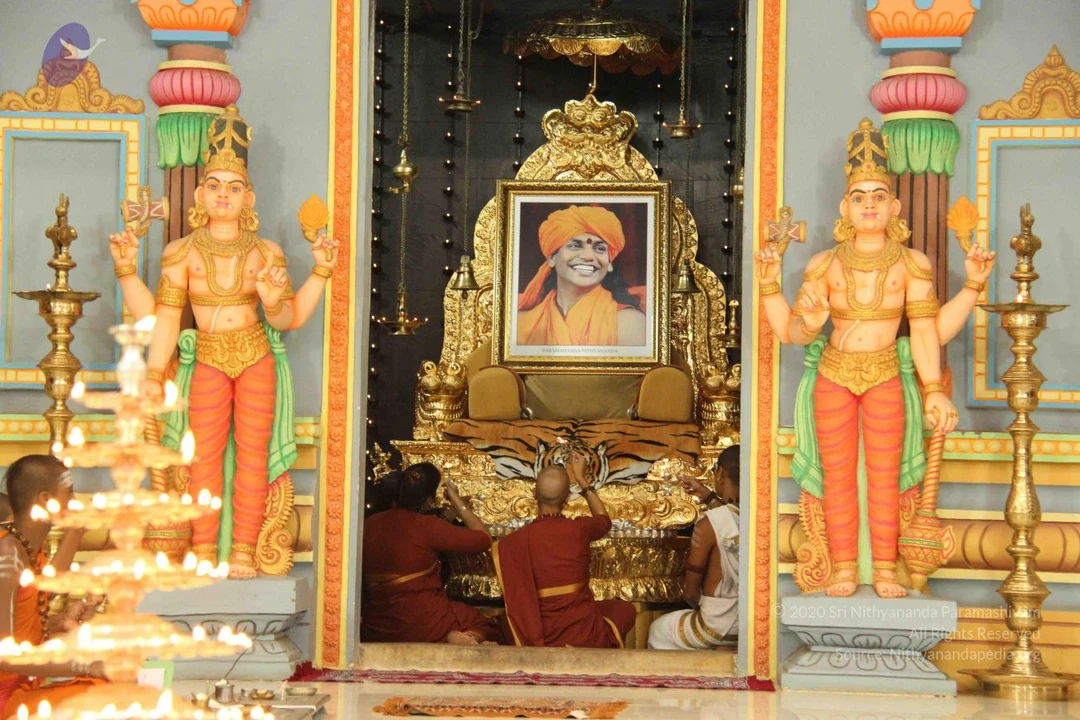
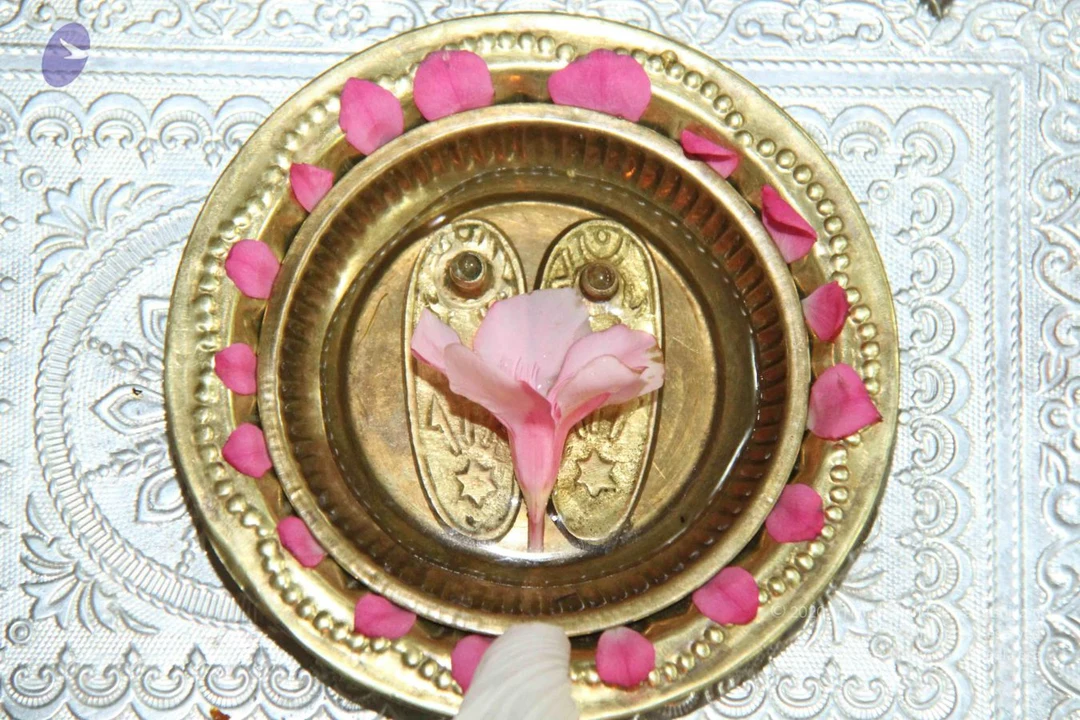
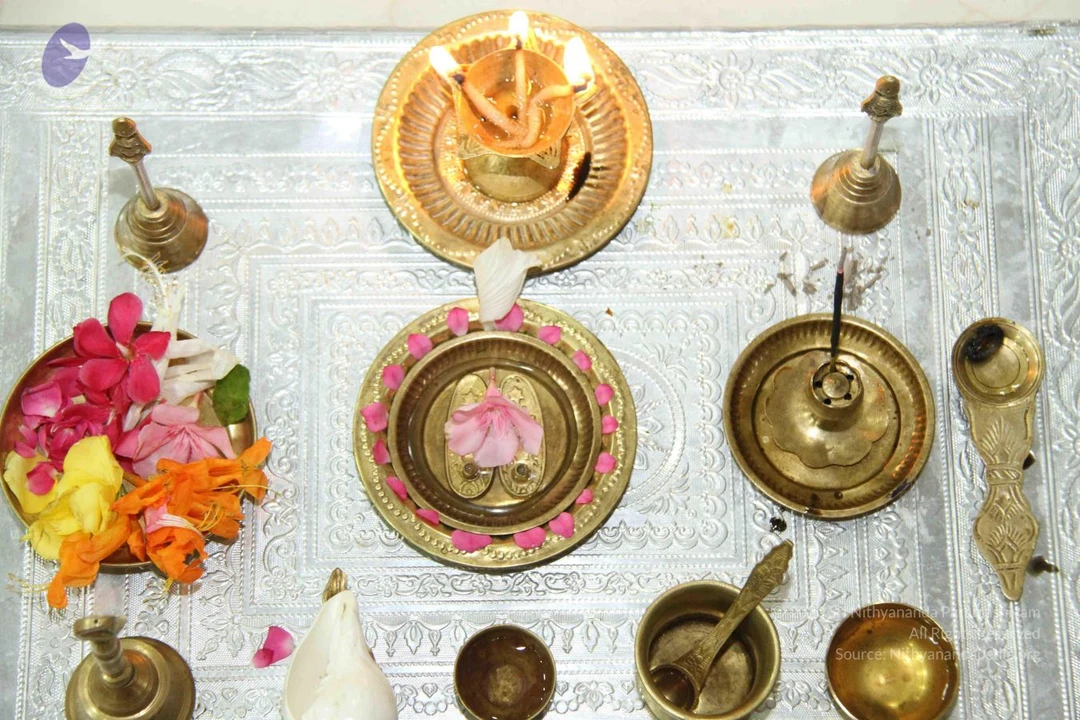
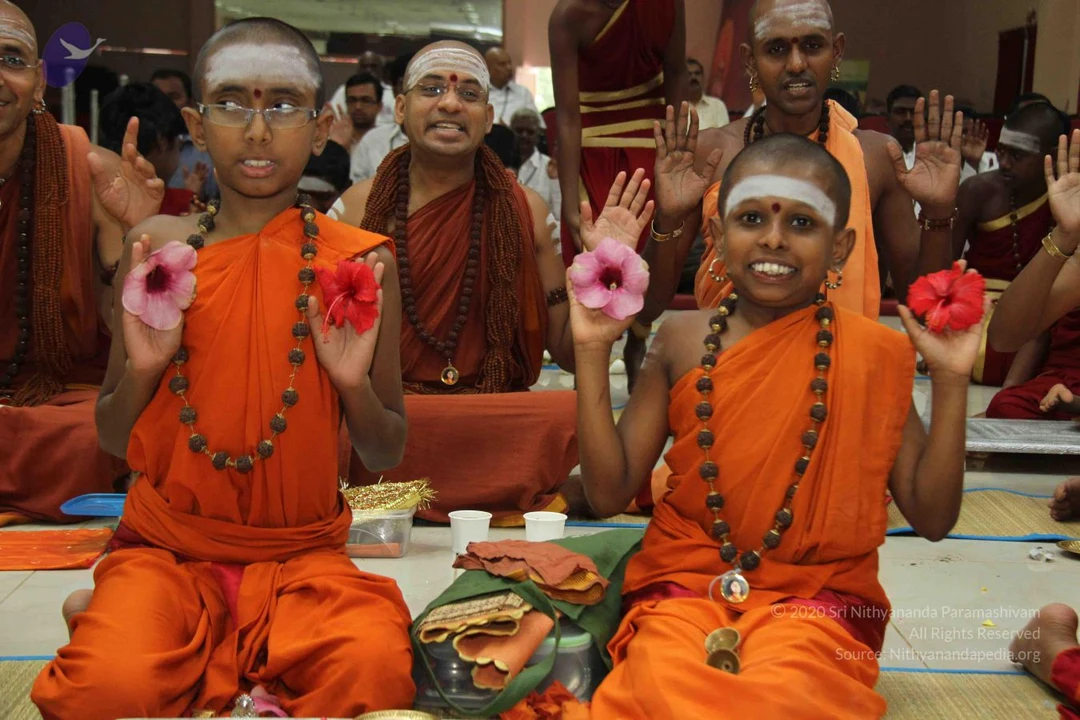
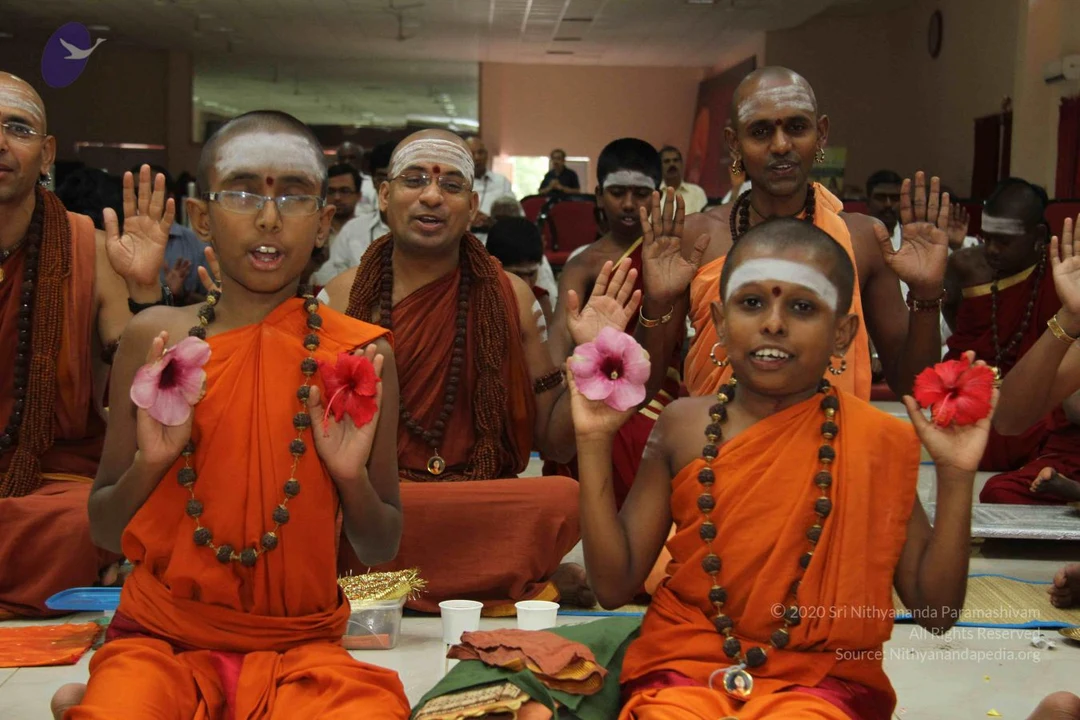
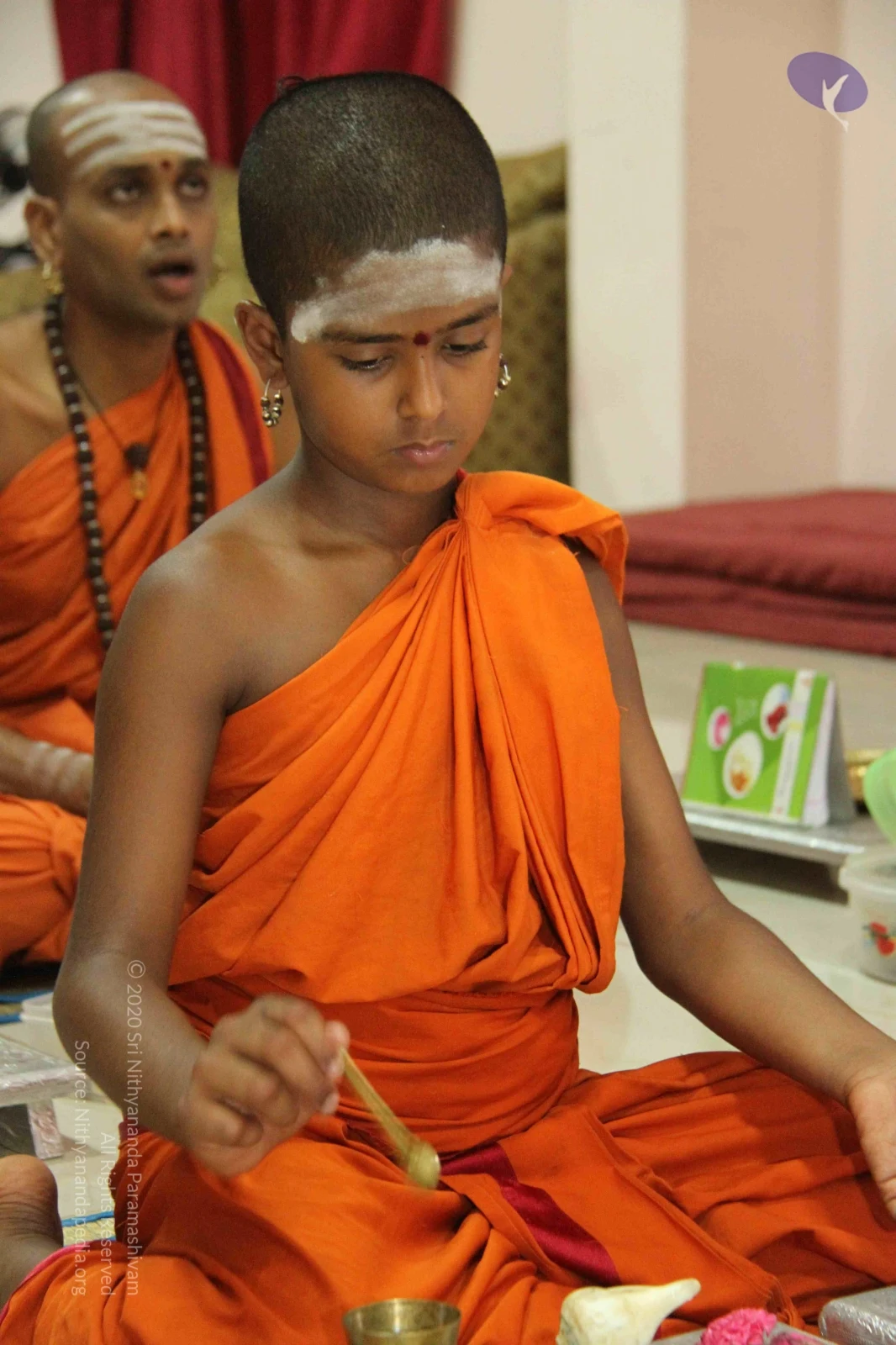
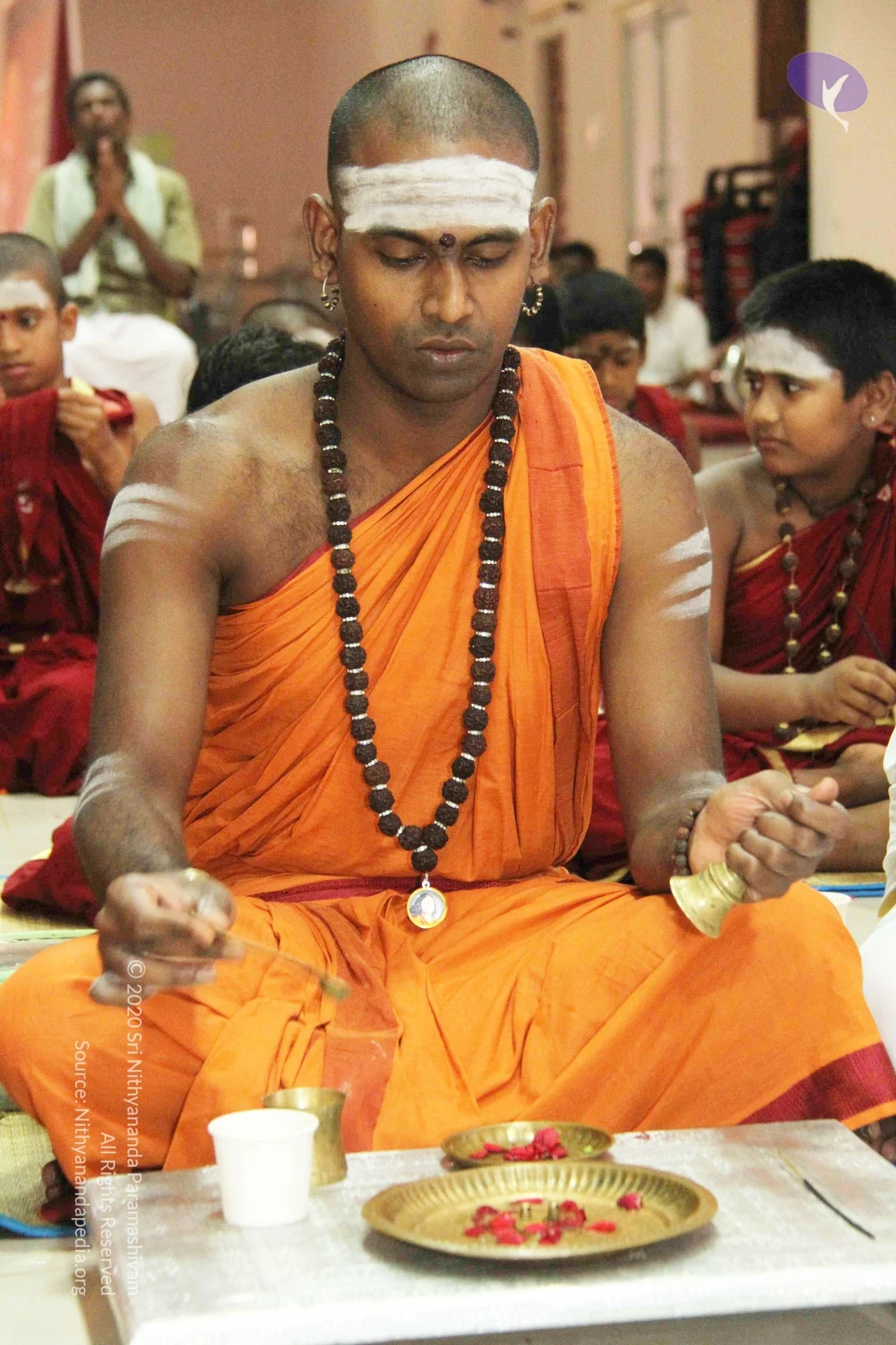
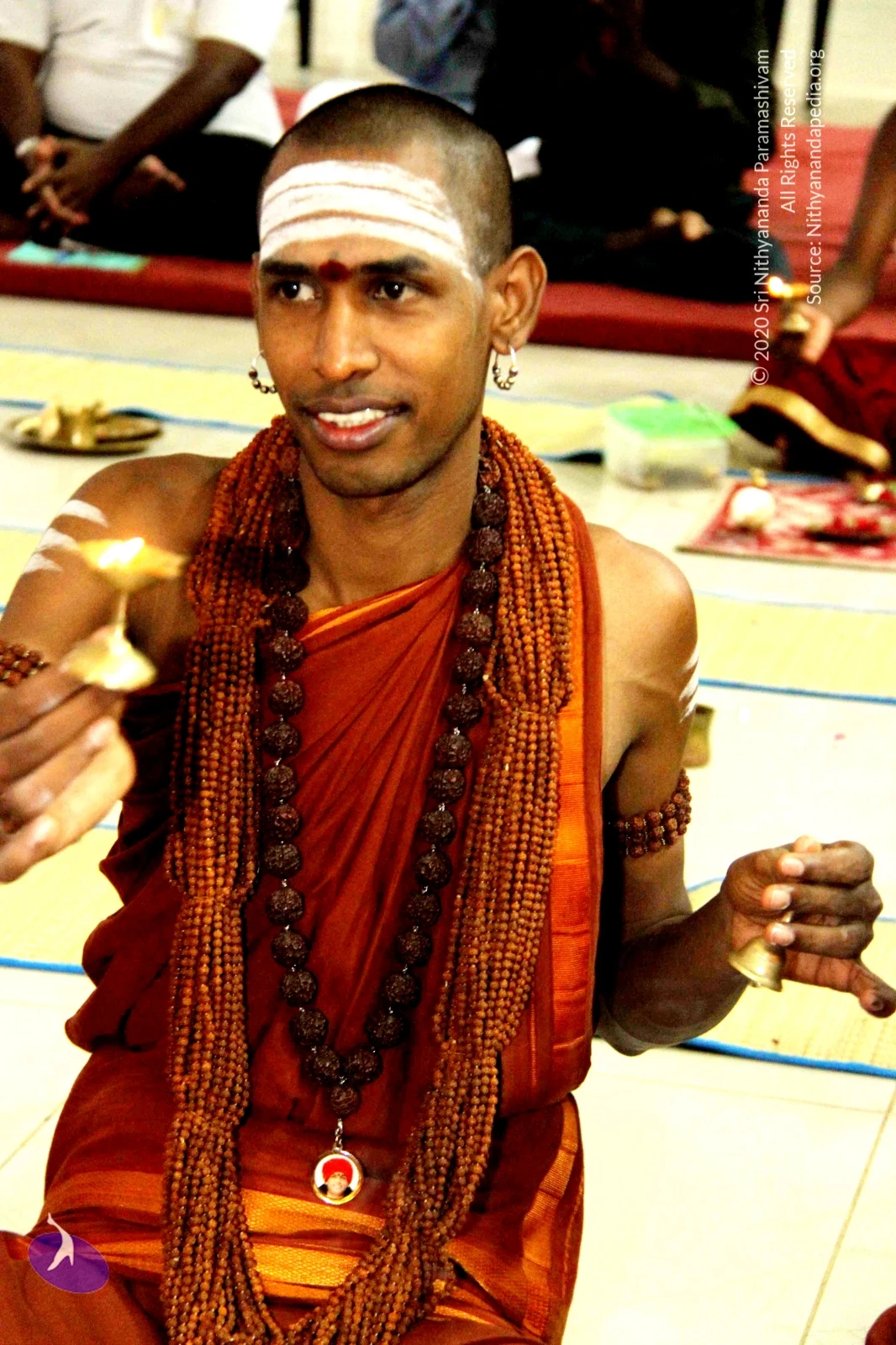
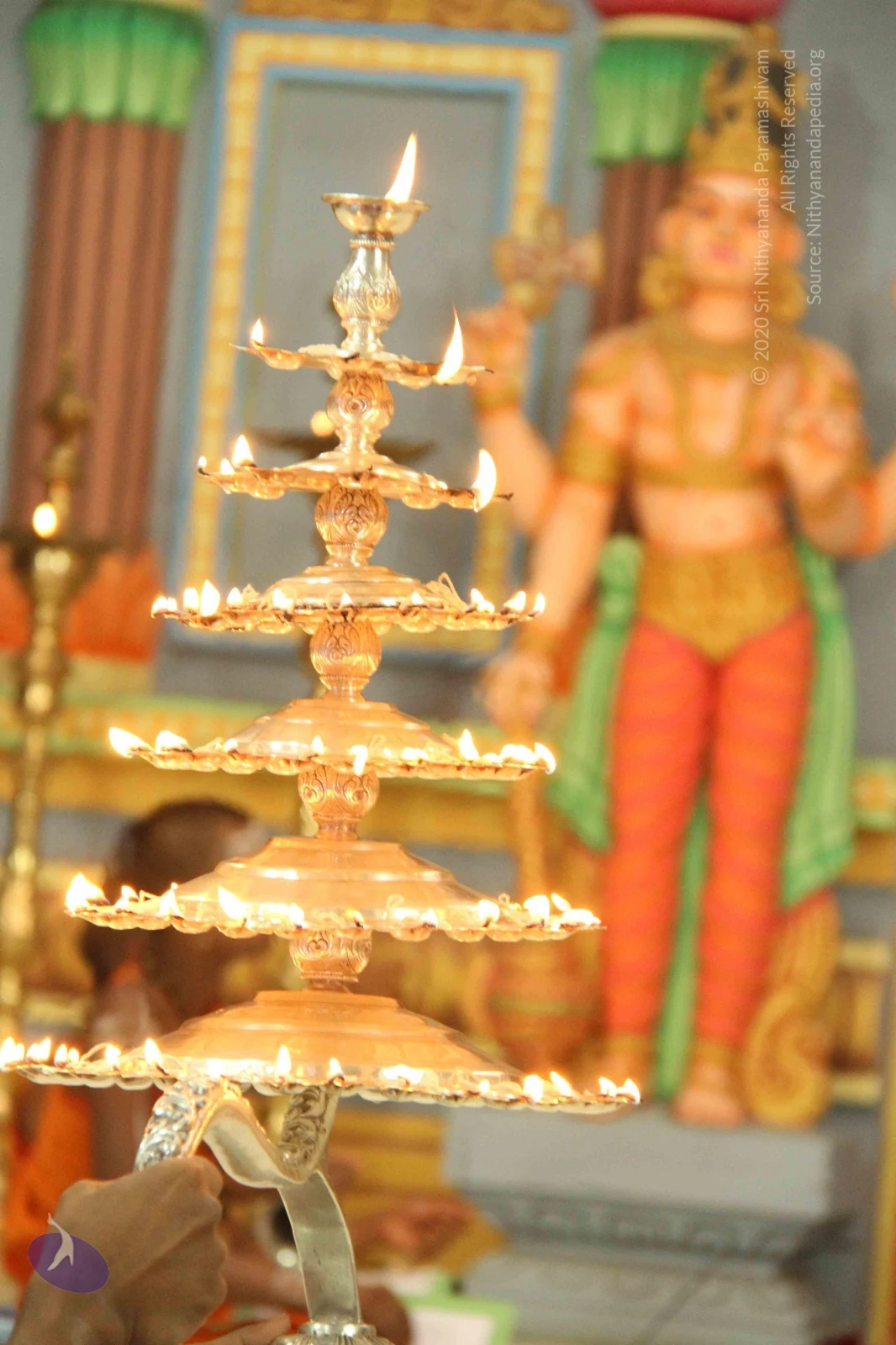
On this Day there was a Morning Paduka Puja that was followed by Satsang on the Tattva of Responsibility.

Link to Video

VideoAudio

Transcription

I welcome all of you with my love and respects. I welcome all the devotees, disciples, samajis, Satsanghis sitting with us around the world through Nithyananda TV, Sadhna TV, Lotus News Channel, and two-way video-conferencing.

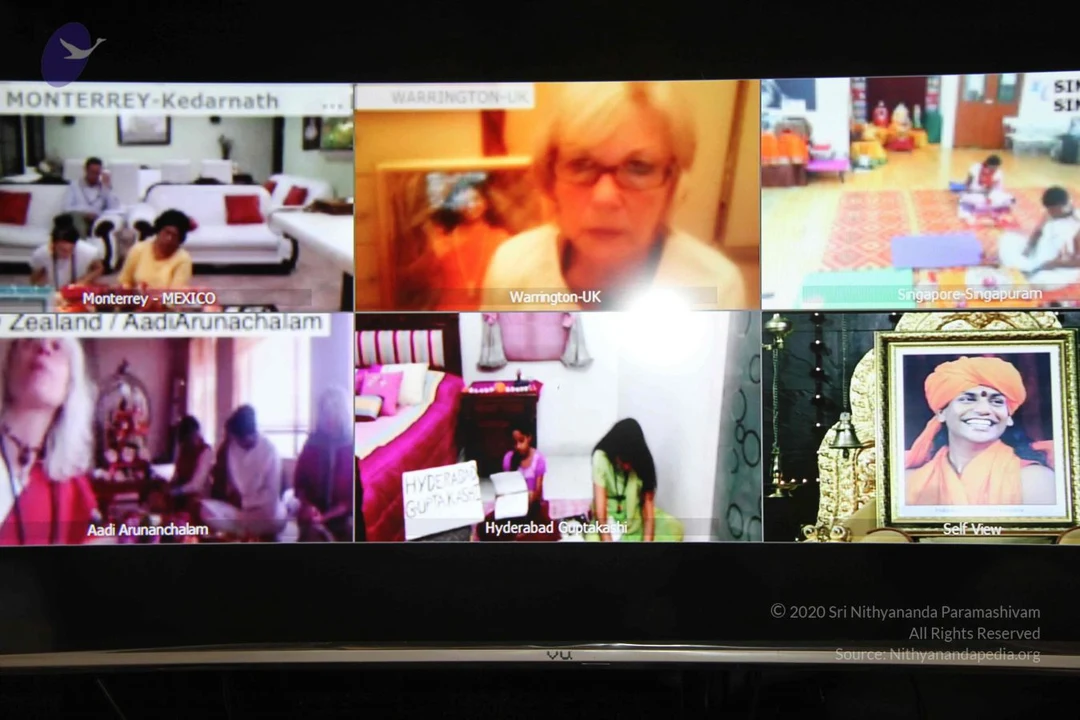
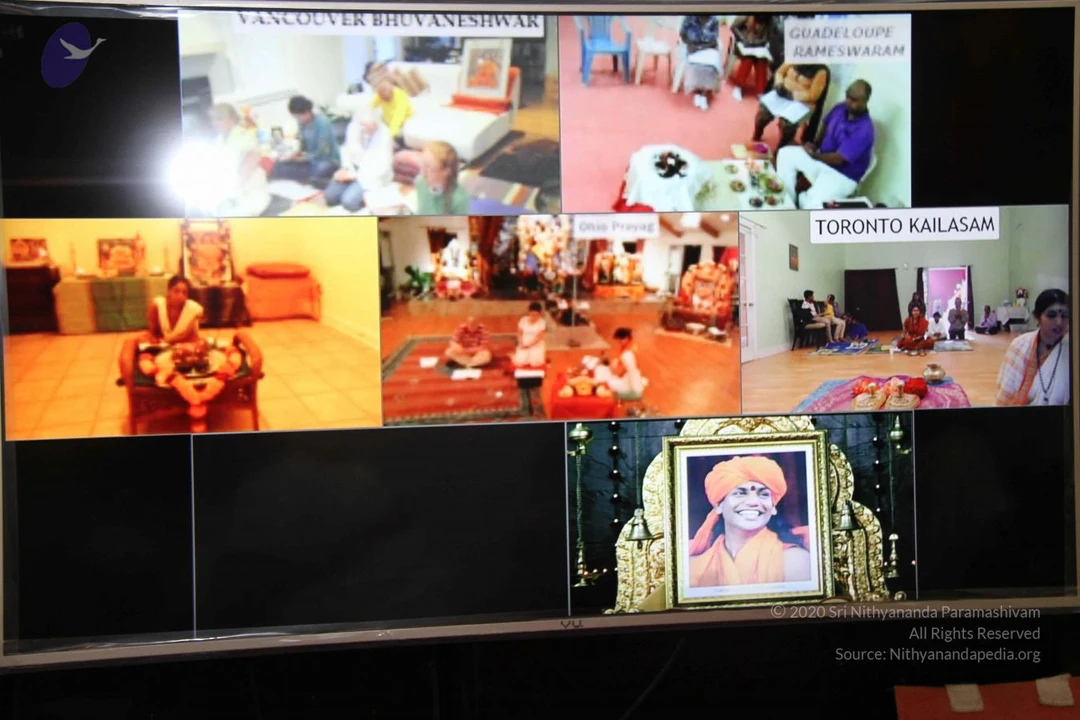
Cities sitting with us in two-way video-conferencing: Bangalore North, Monterrey-Kedarnath, Washington, San Diego, Atlanta, Hyderabad-Gupta Kashi, Enriching Temple-Bidadi, Devon-UK, Hong Kong, Warrington-UK, Singapore-Singapuram, New Zealand-Adi Arunachalam, East London-UK, Kathmandu-Nepal, Oman-Sivagangai, Seattle-Chidambaram, Paris Home Temple, Toronto-Kailasam, Muktananda, Ohio, Los Angeles, Houston-Kalahasti, Selangor-Malaysia, Kuala Lumpur, Charlotte, Kastav Croatia, Guadeloupe-Rameshwaram, Vancouver, Oklahoma, San Jose…!

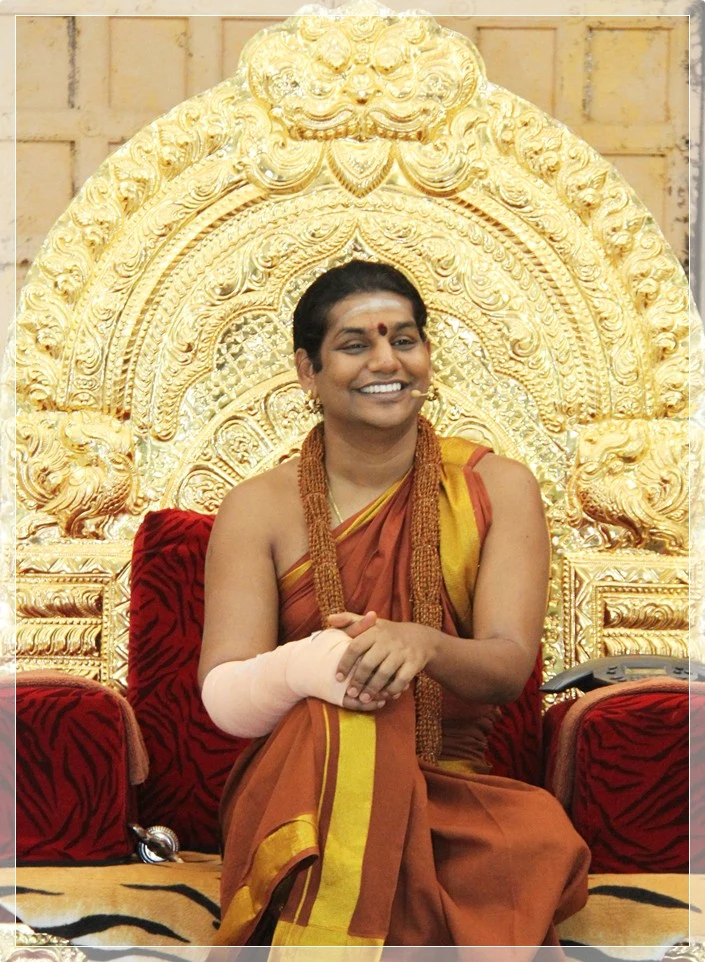
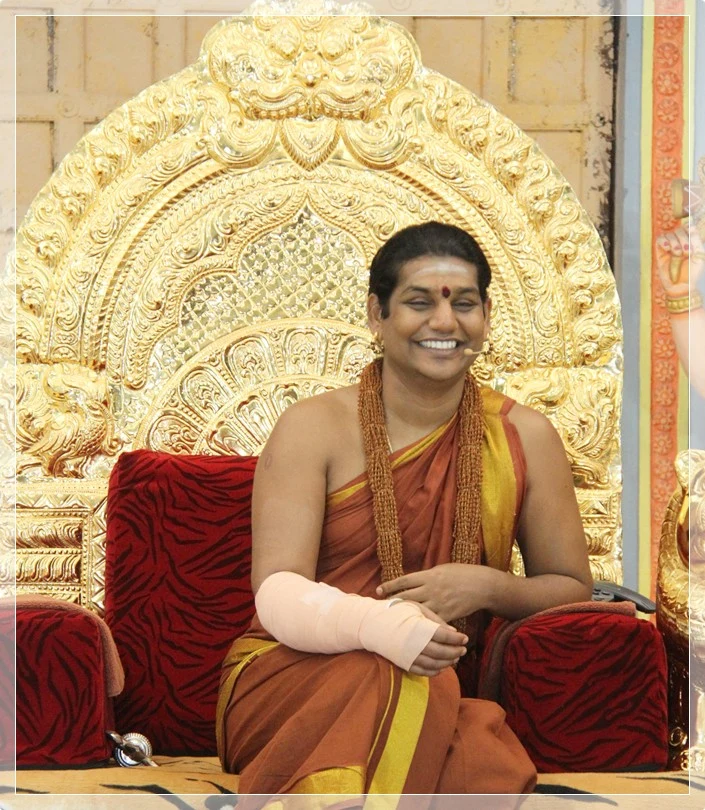
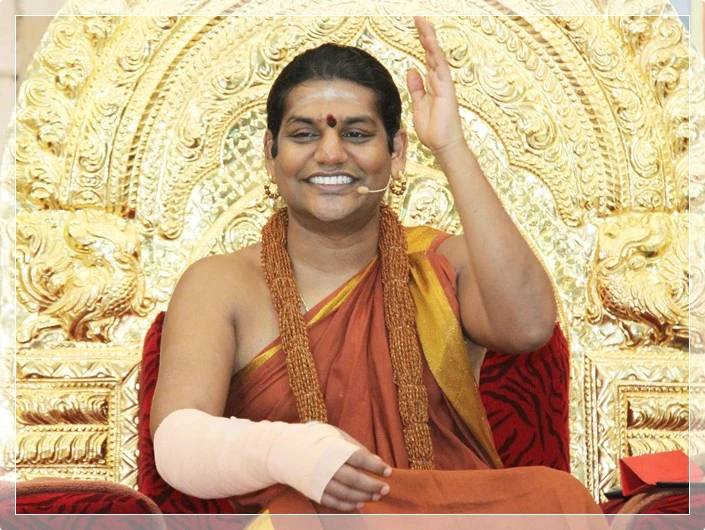
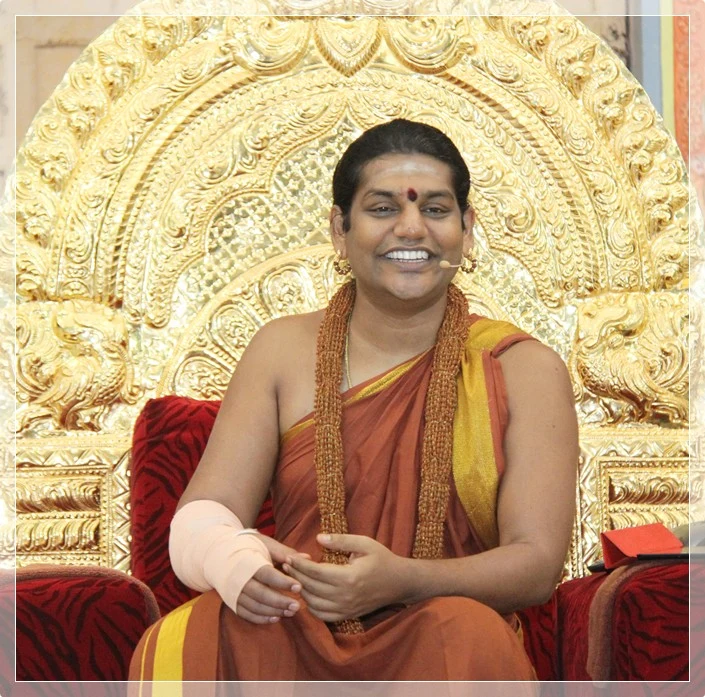
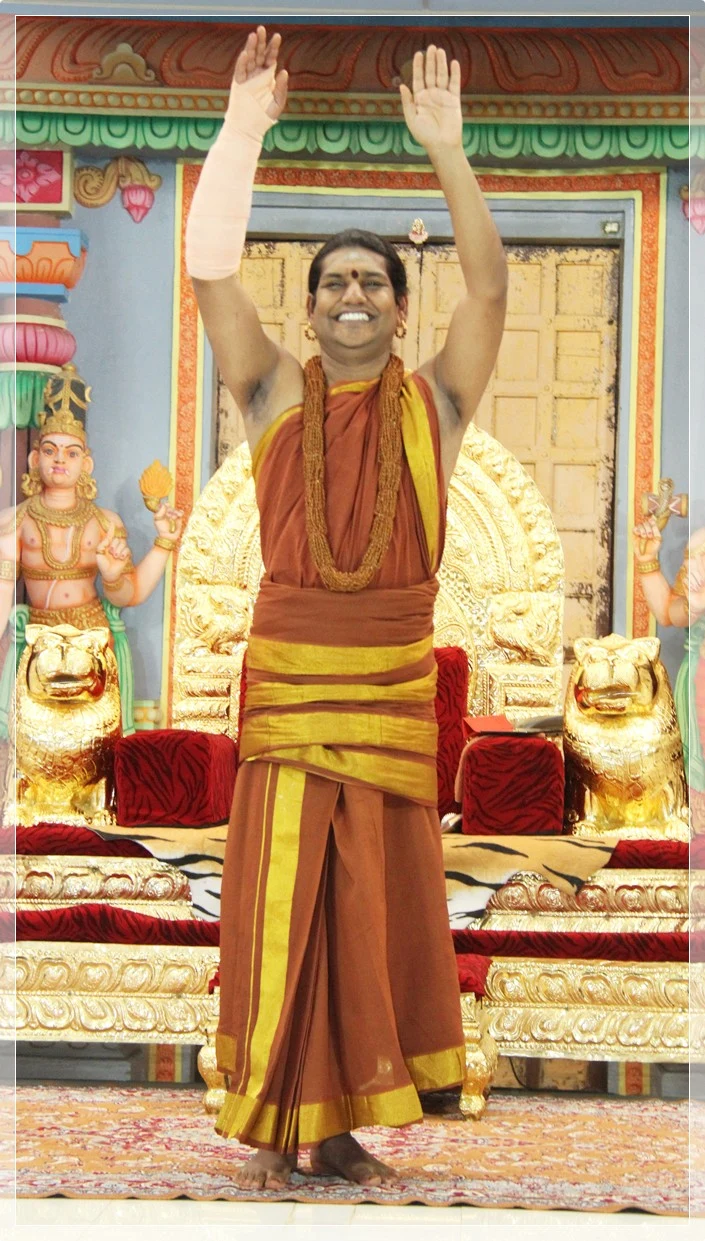
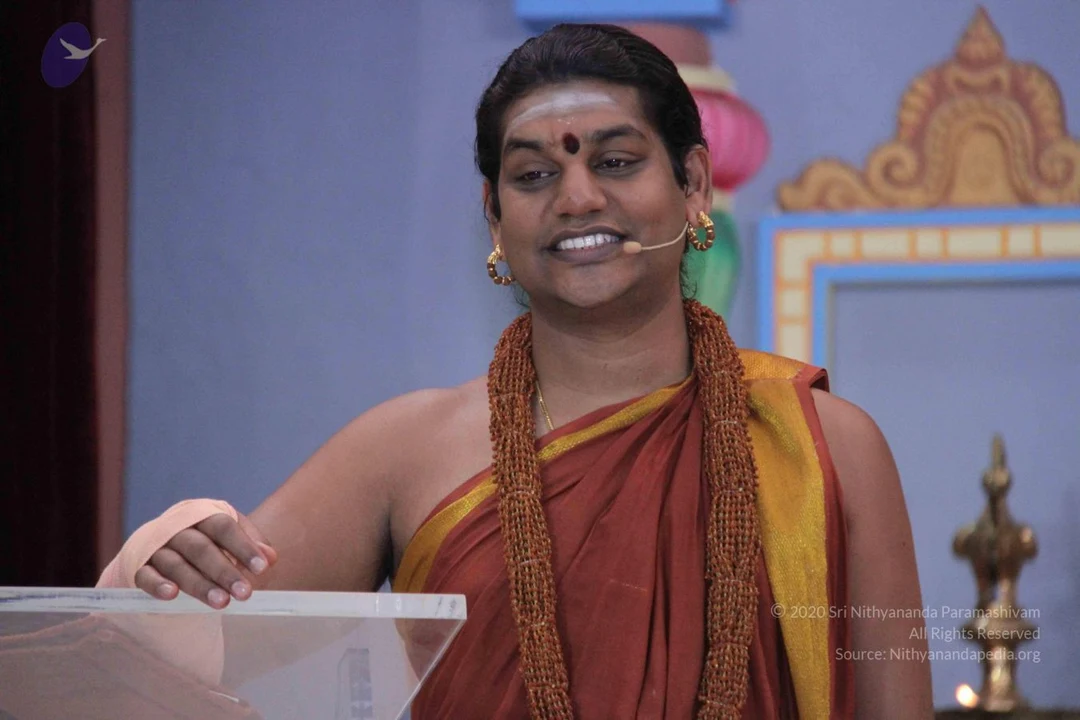
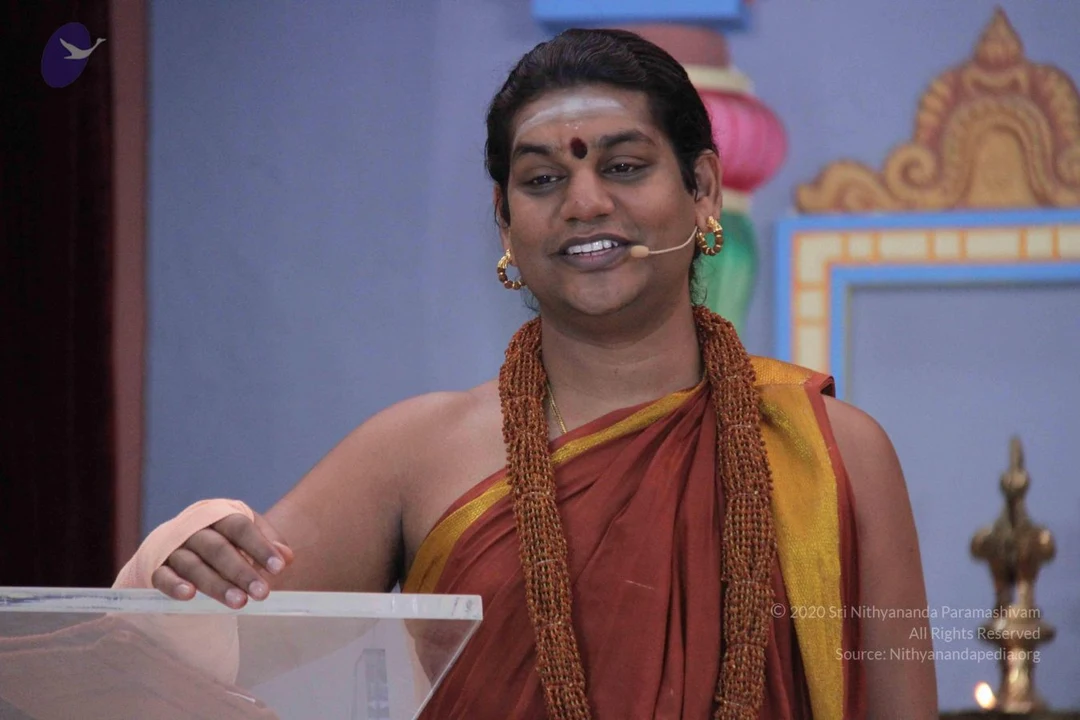
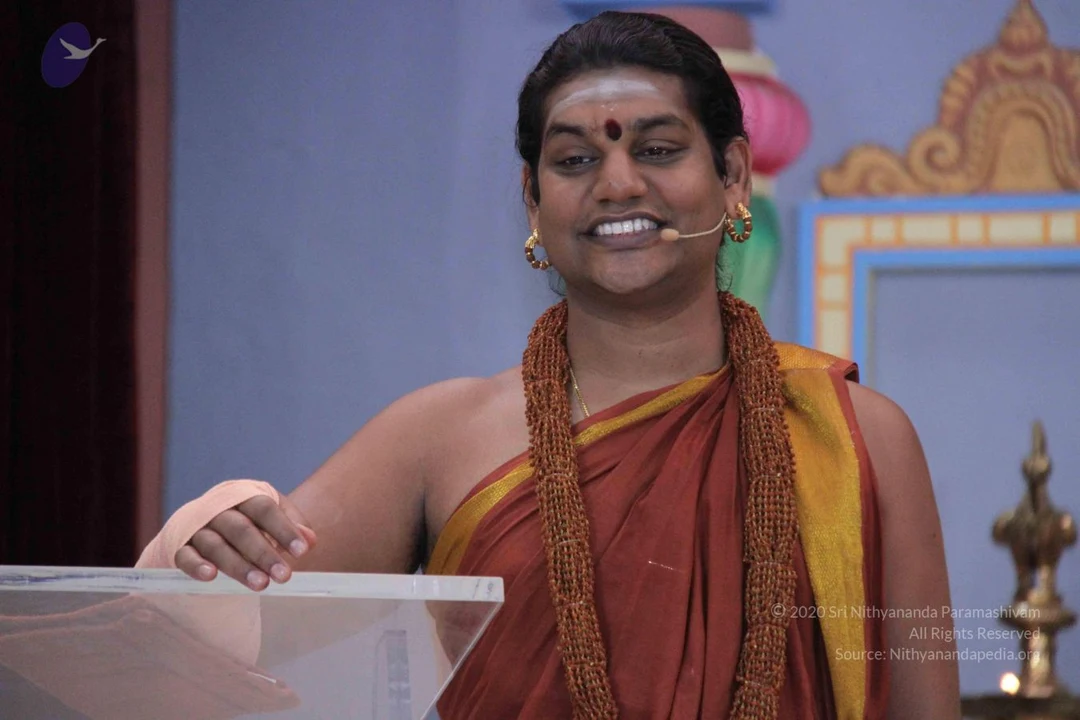
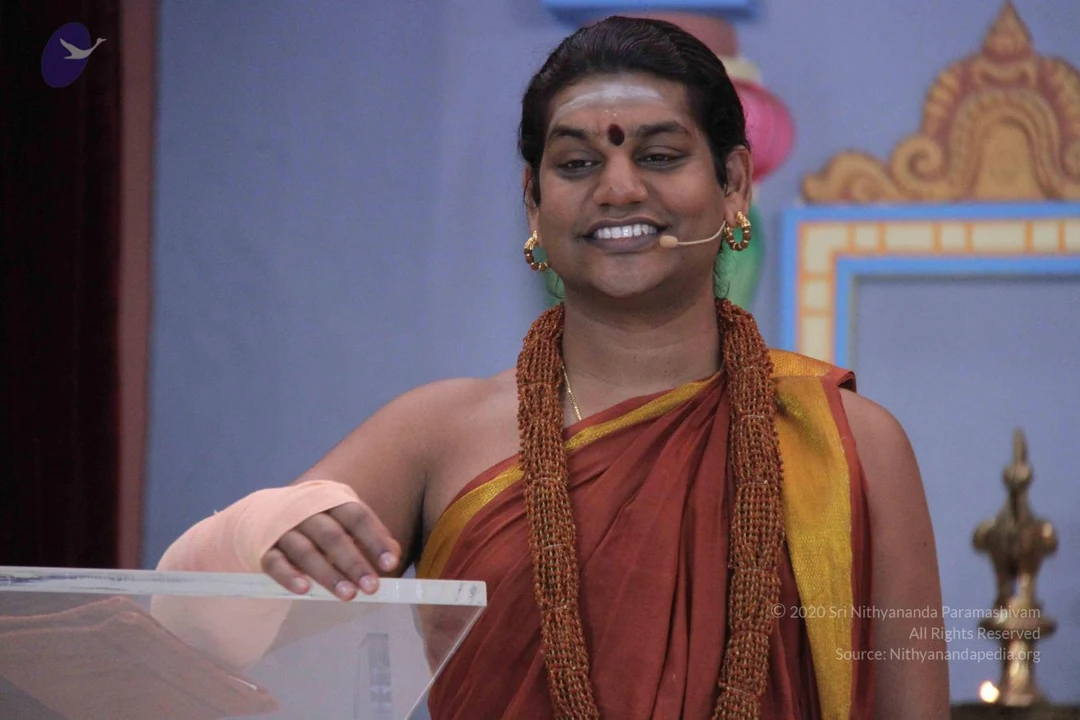
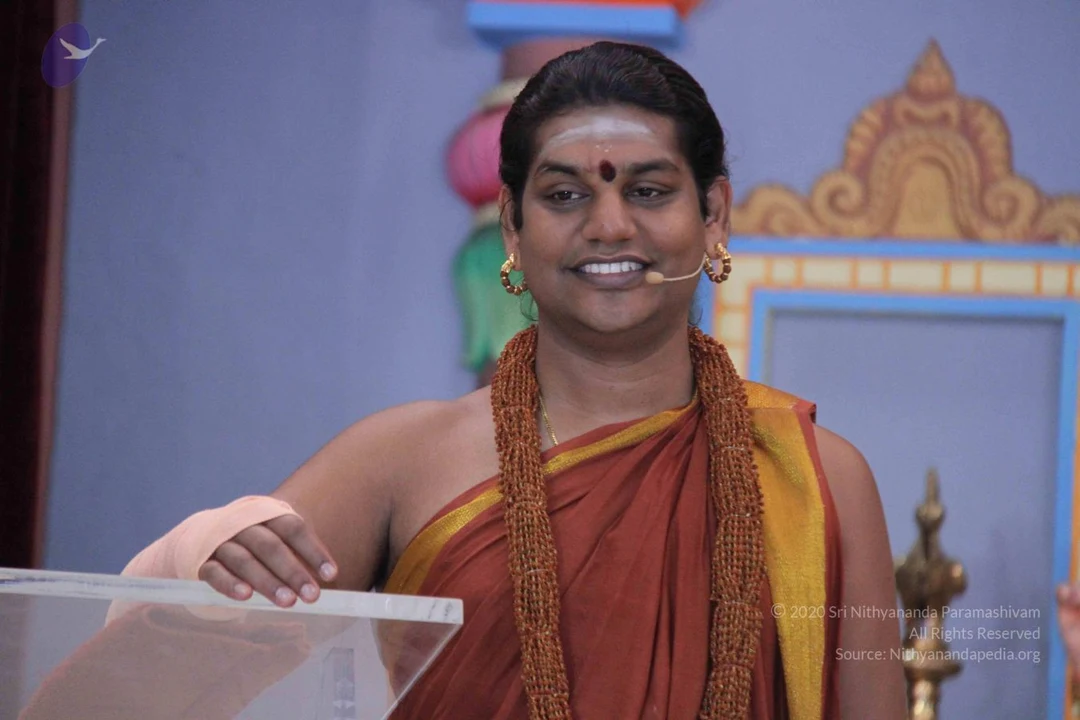
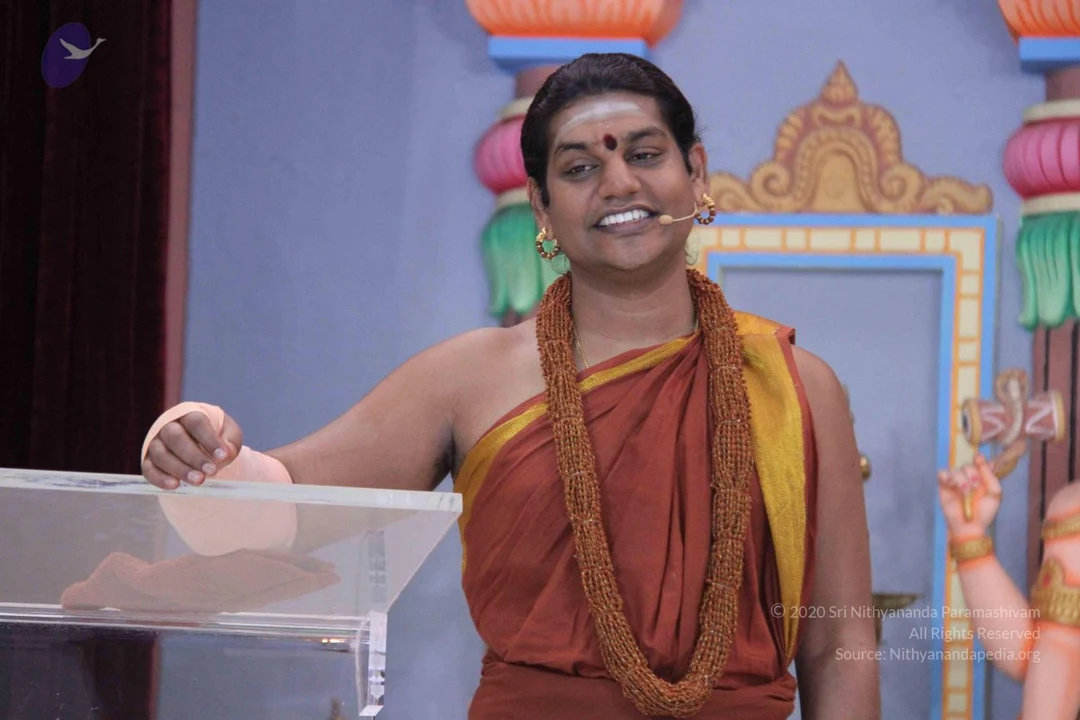
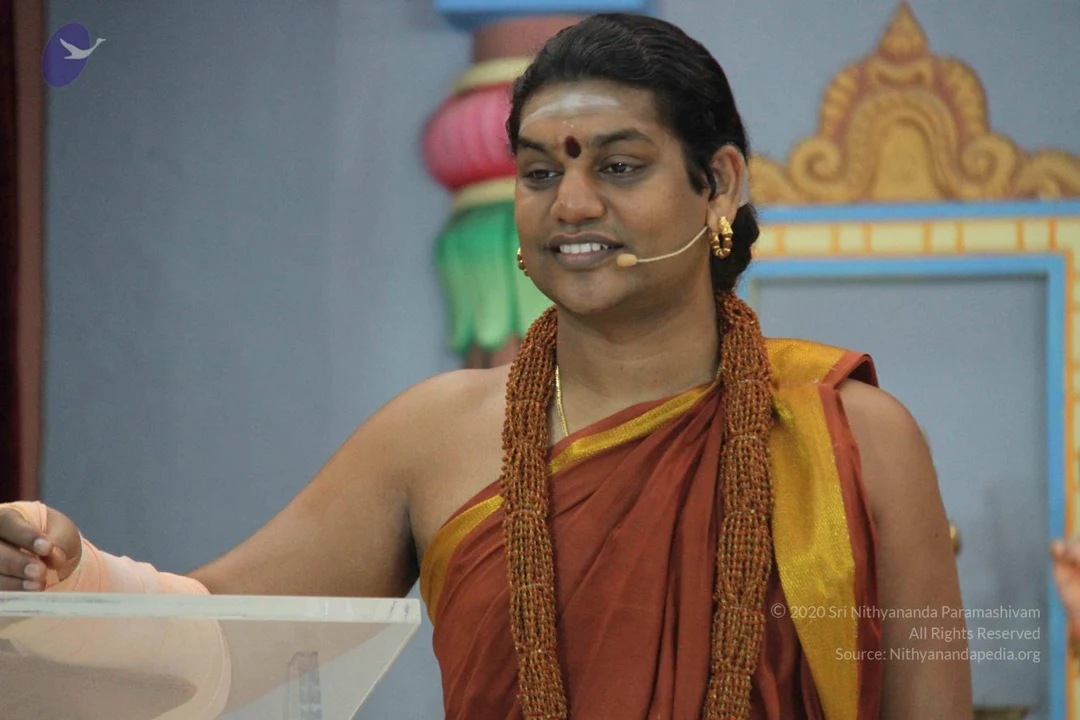
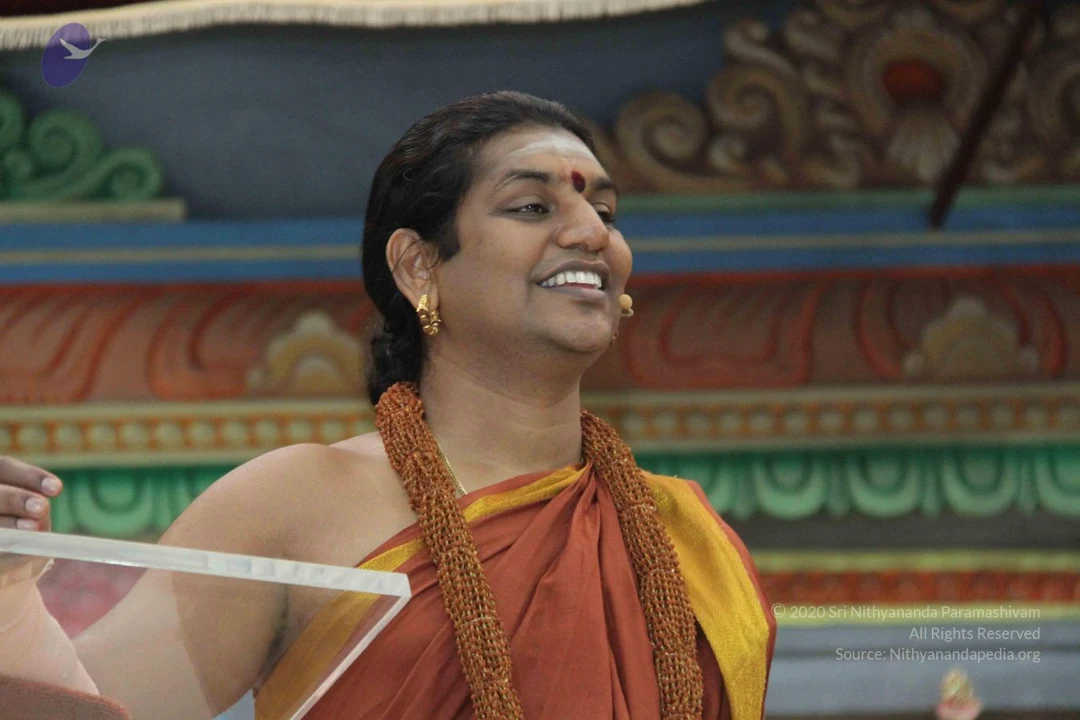
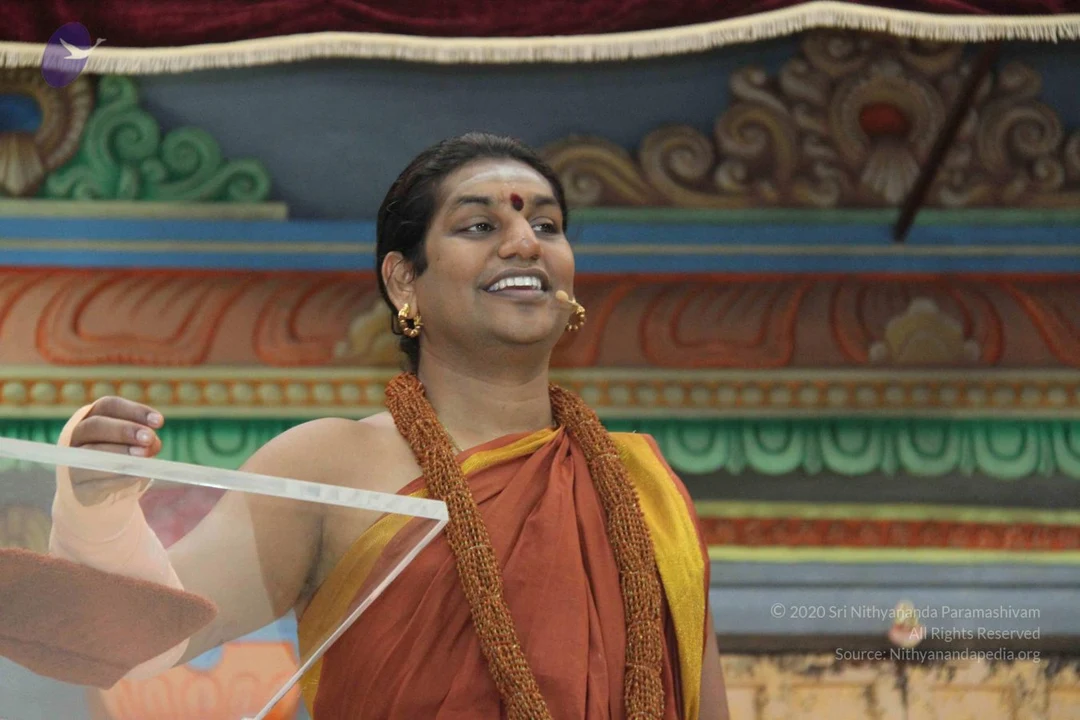
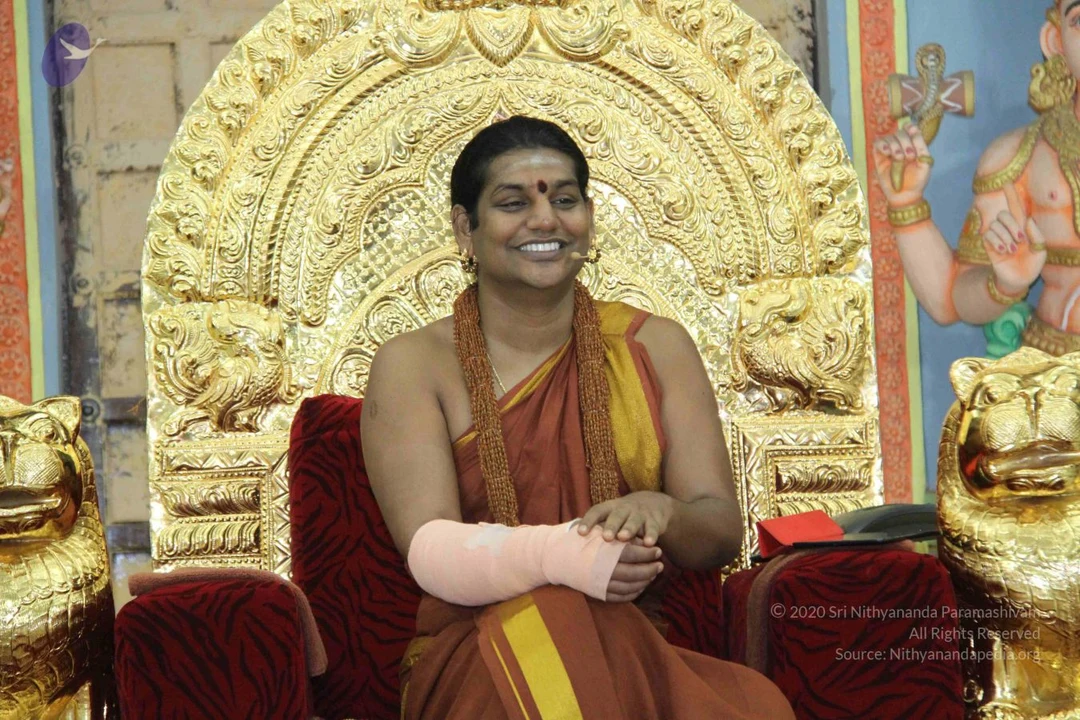
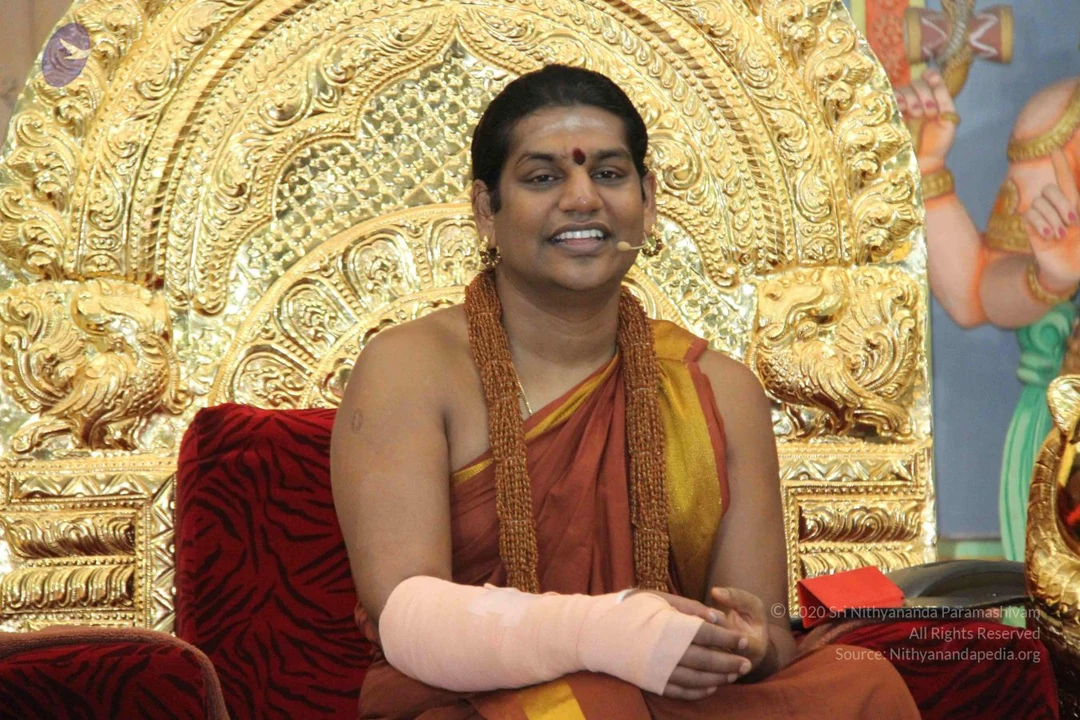
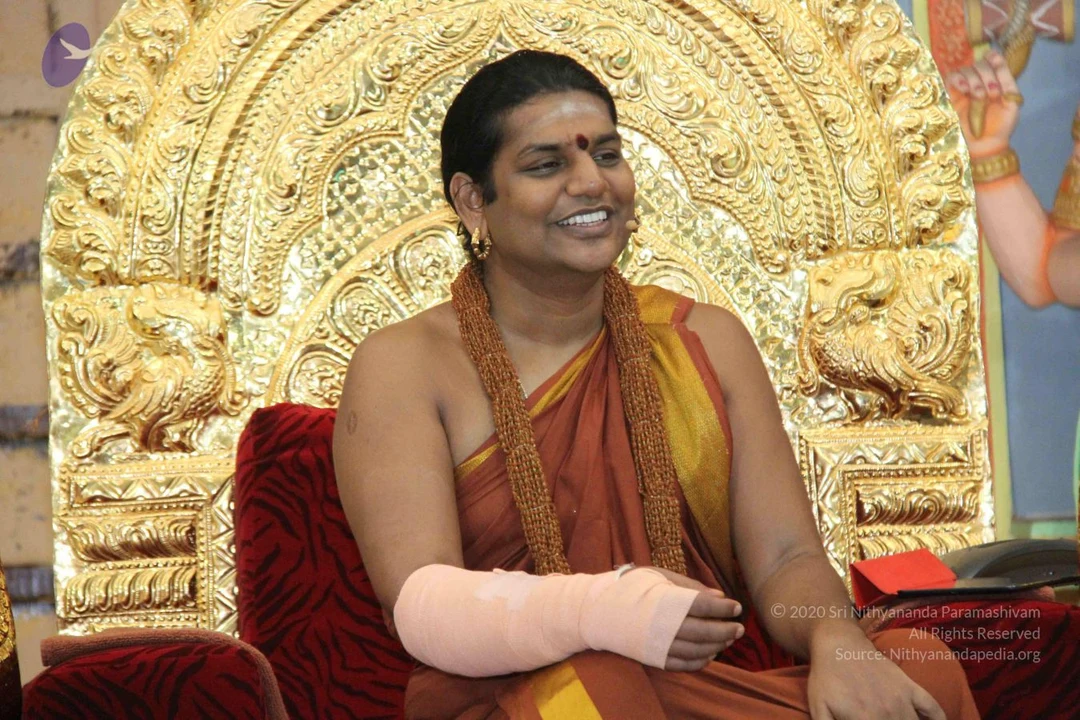
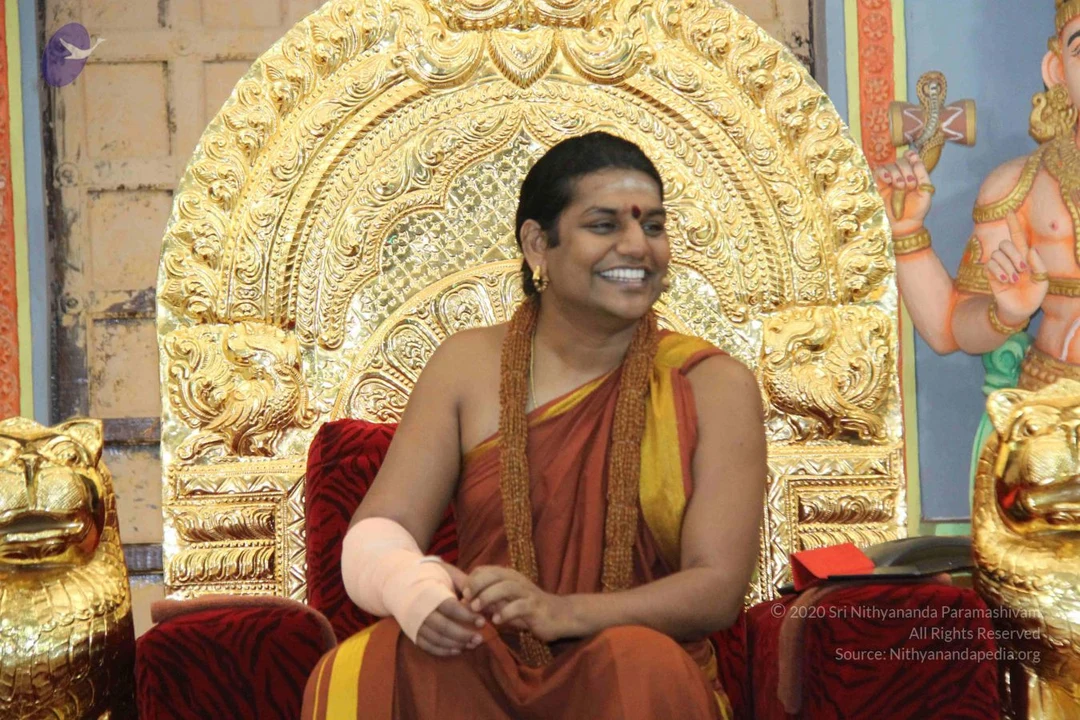
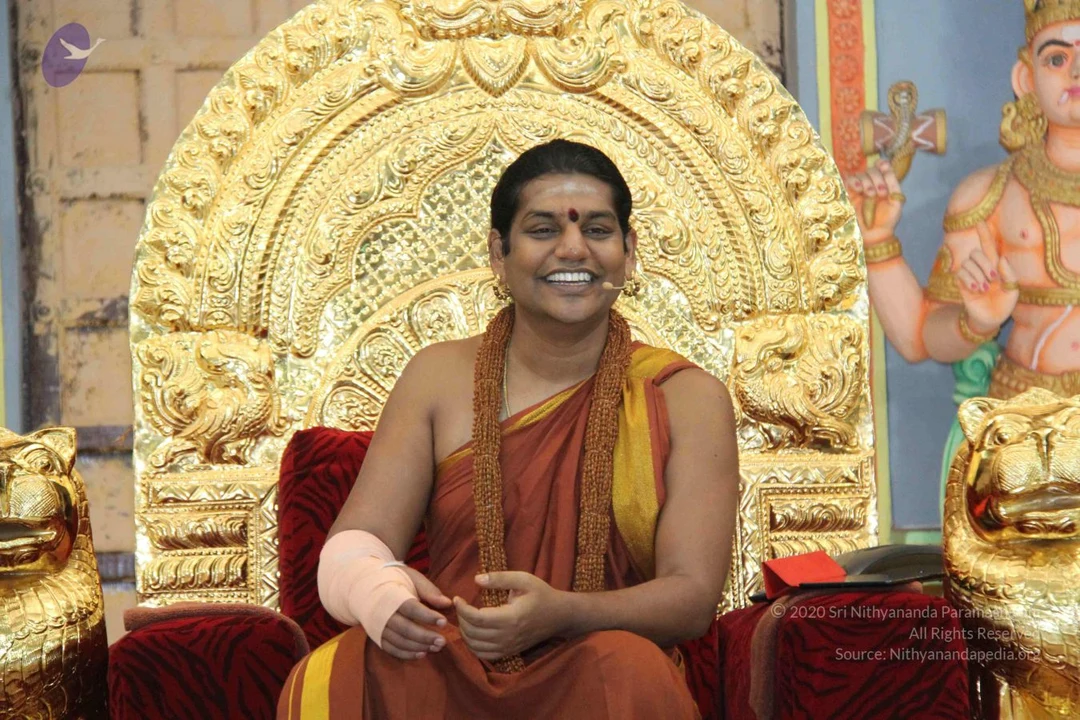
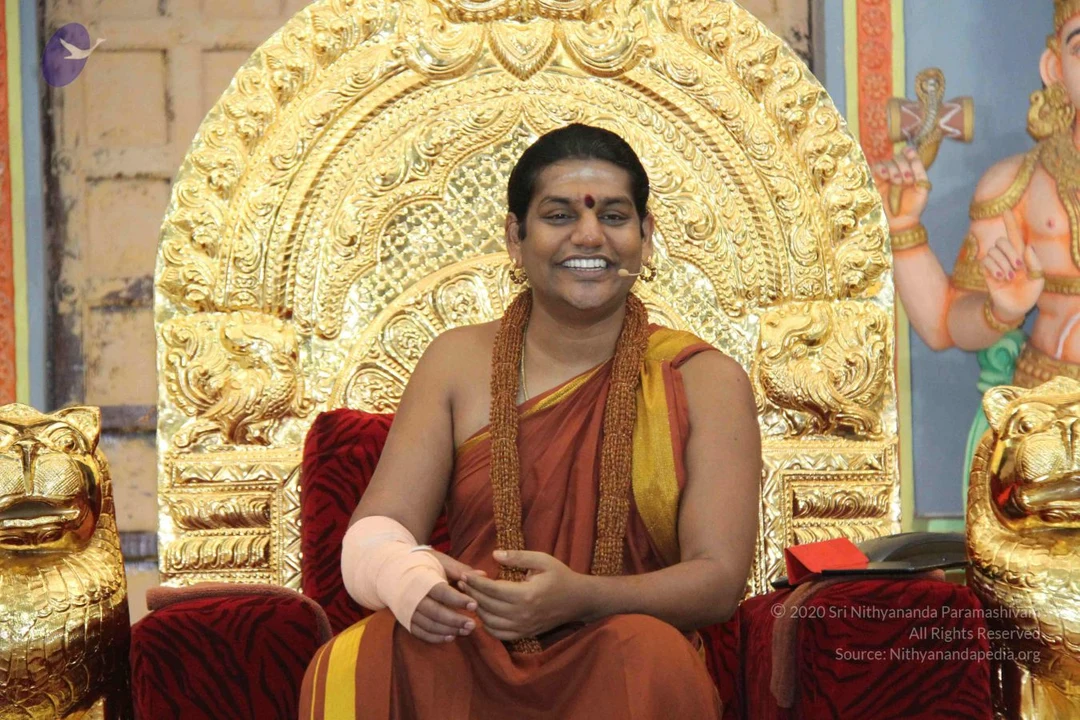
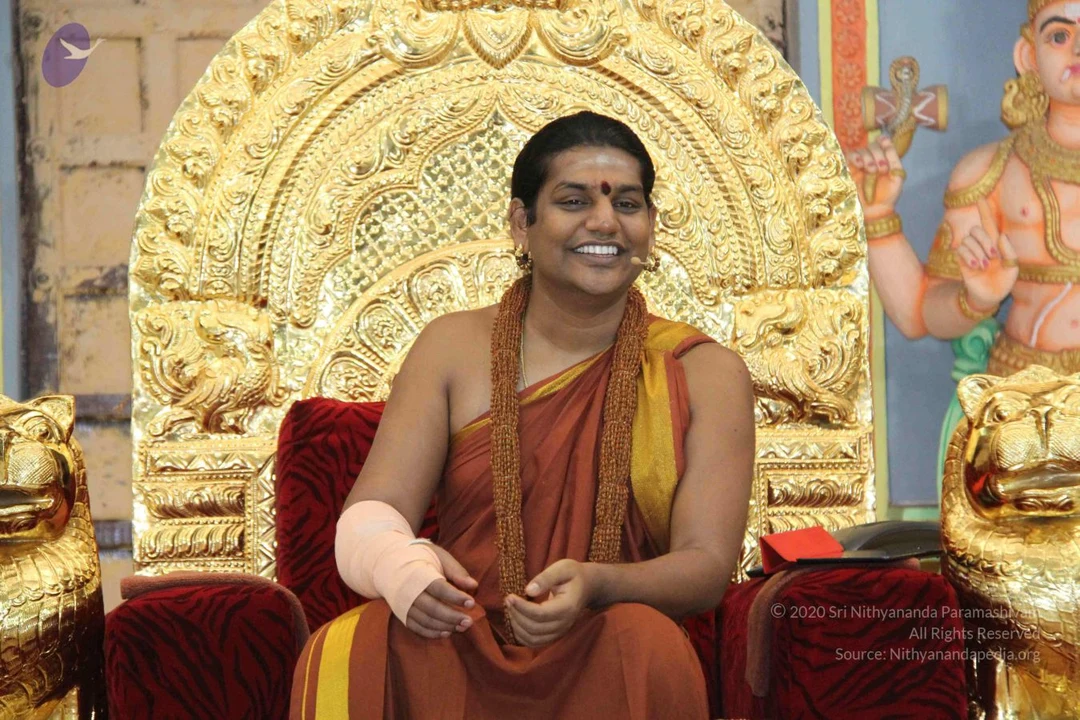
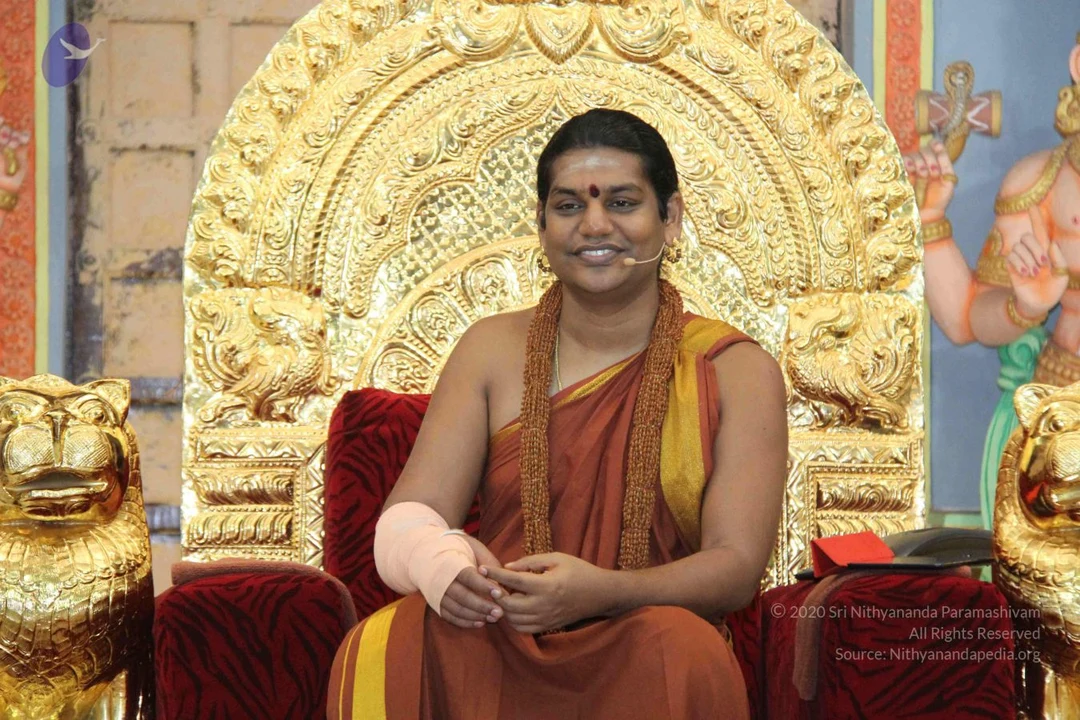
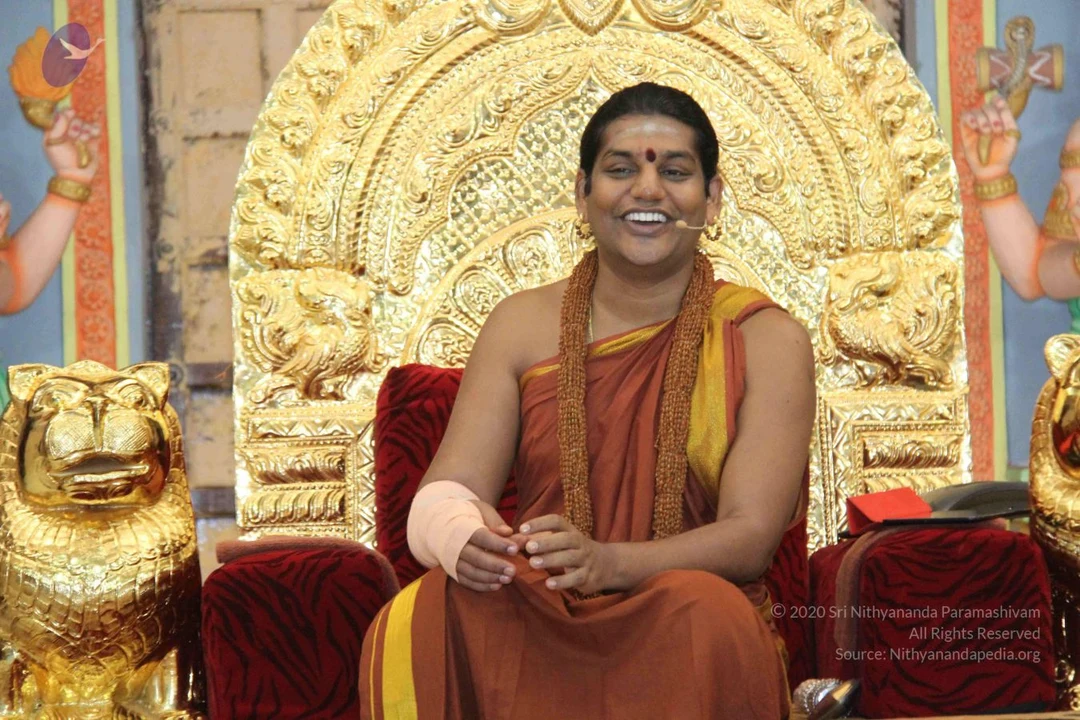
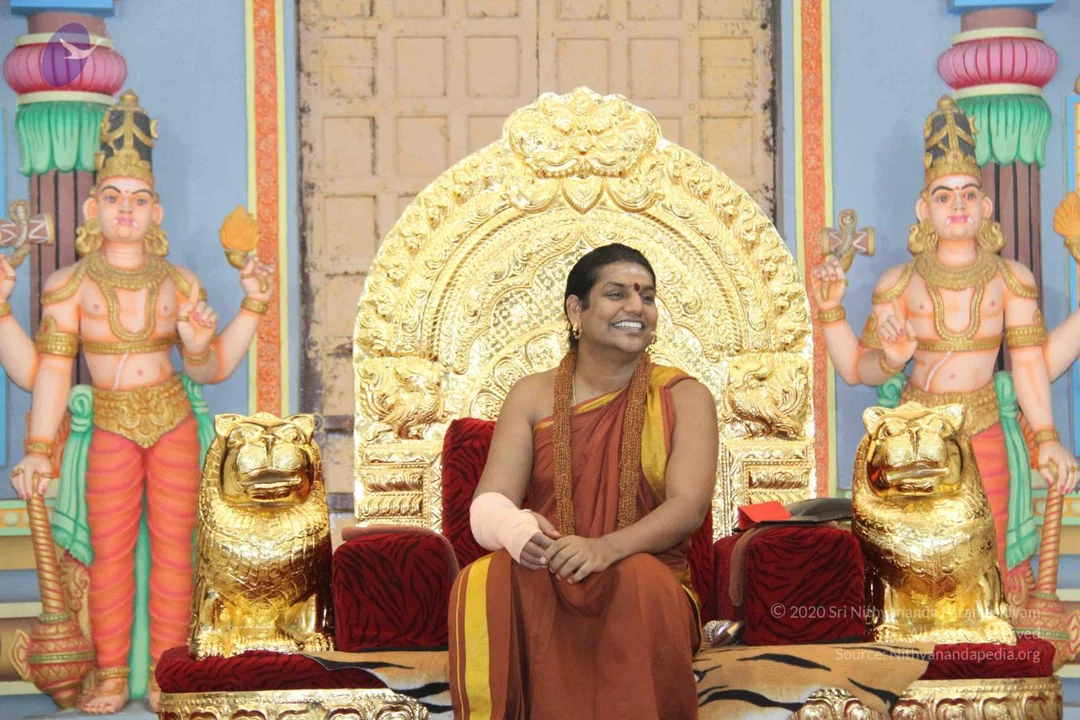
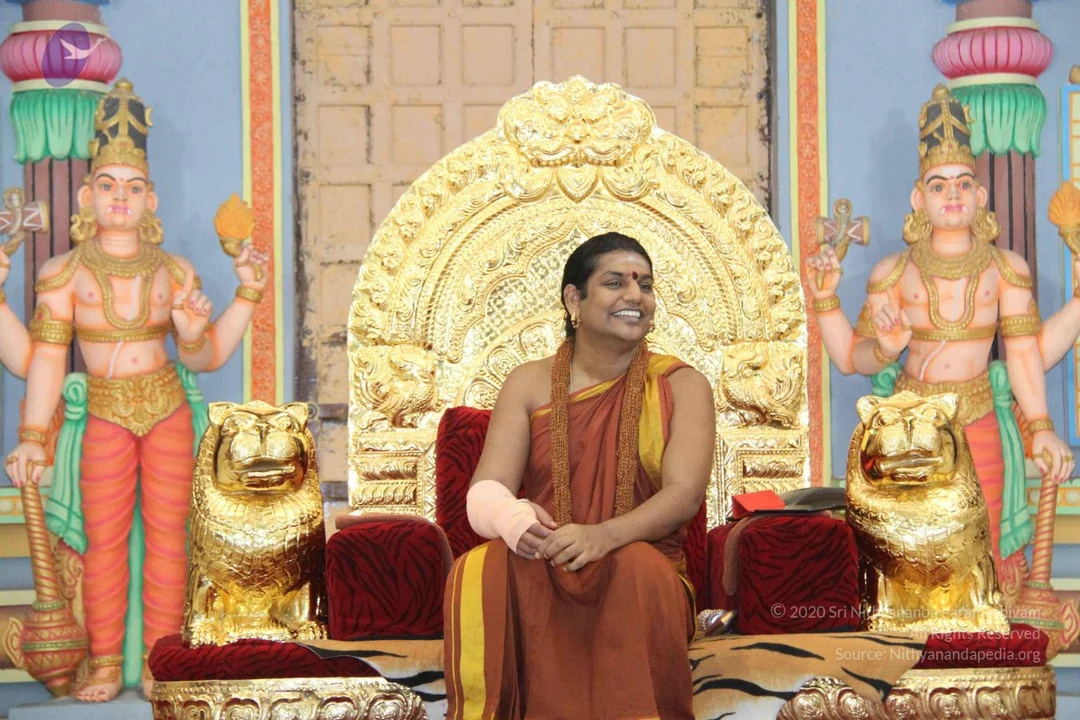
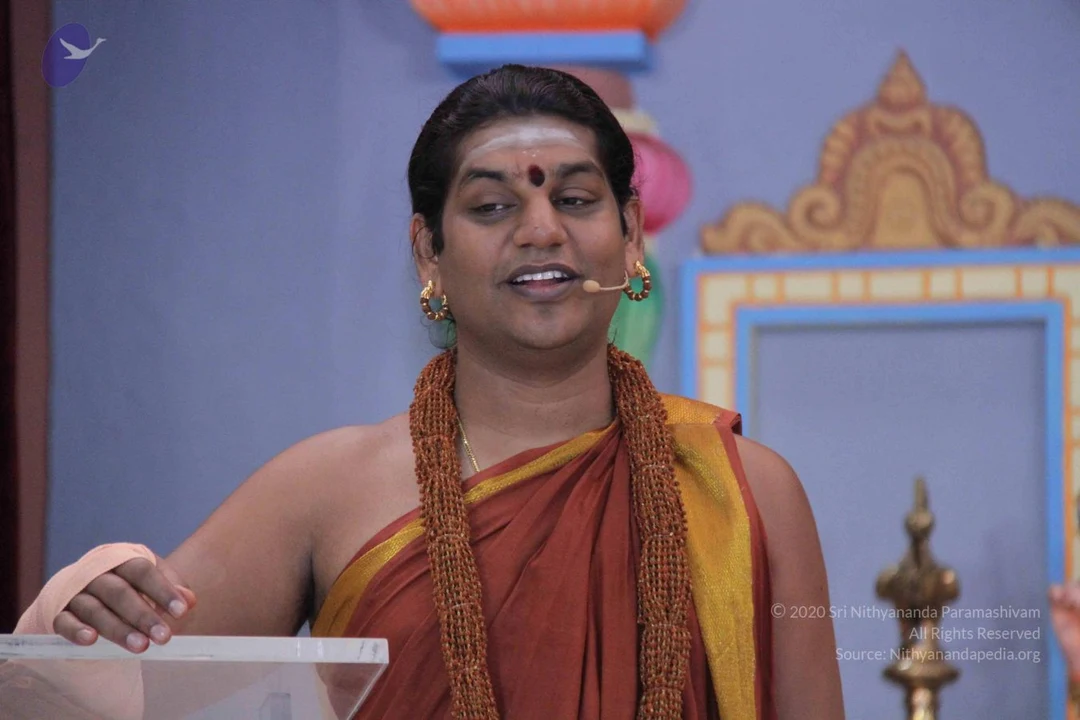
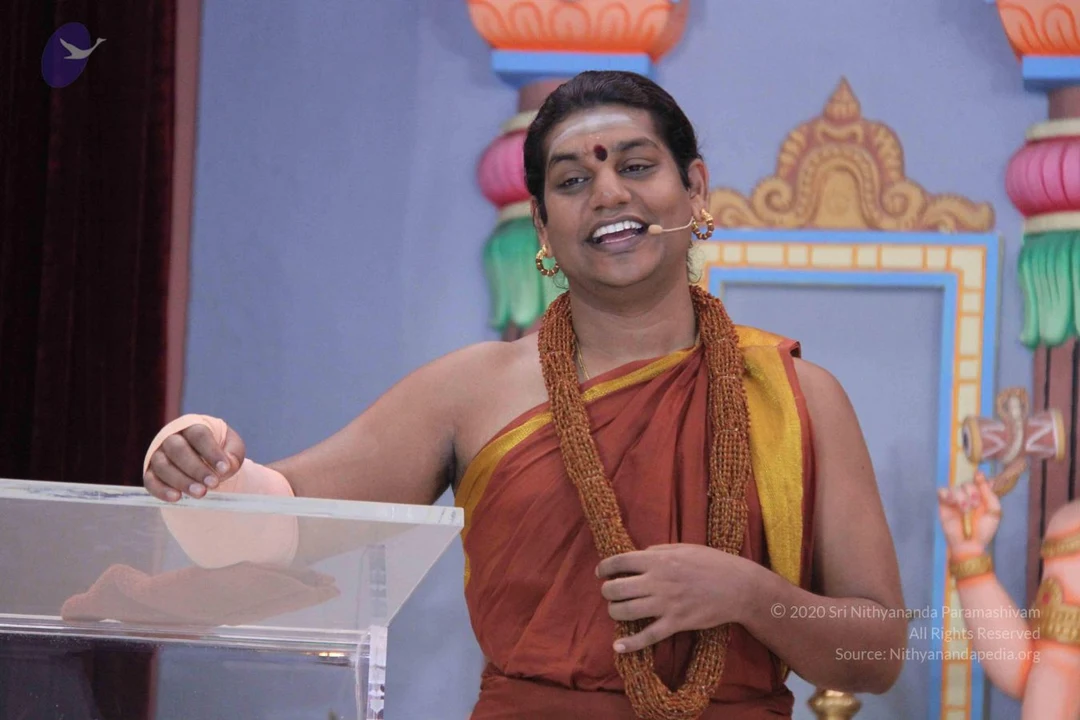
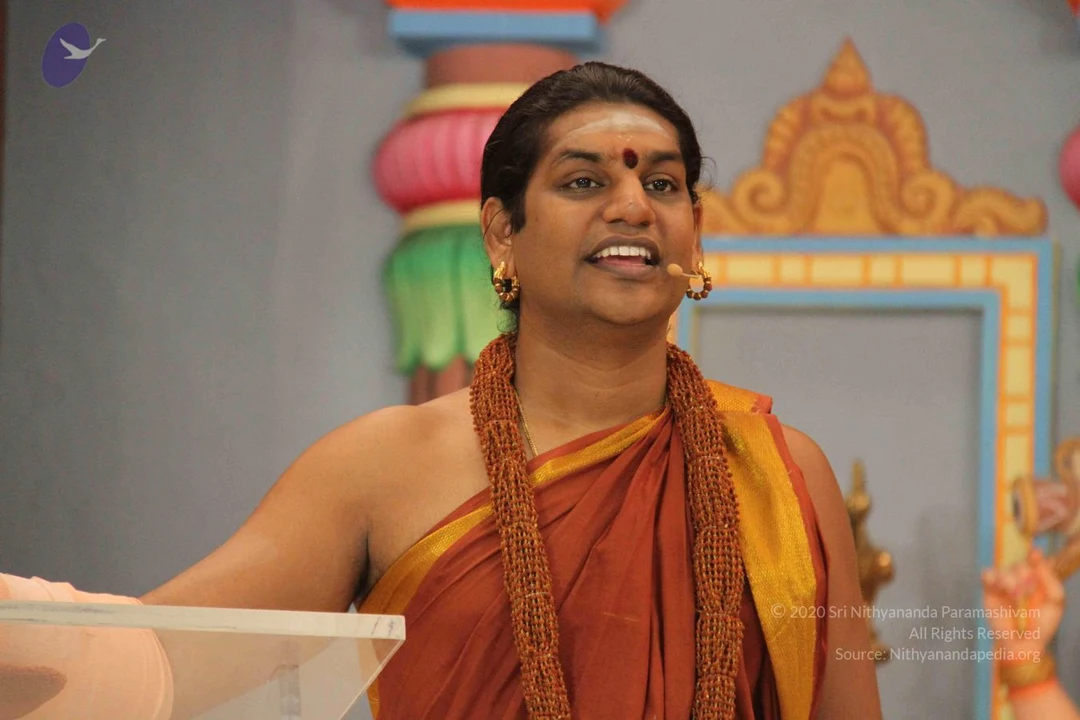
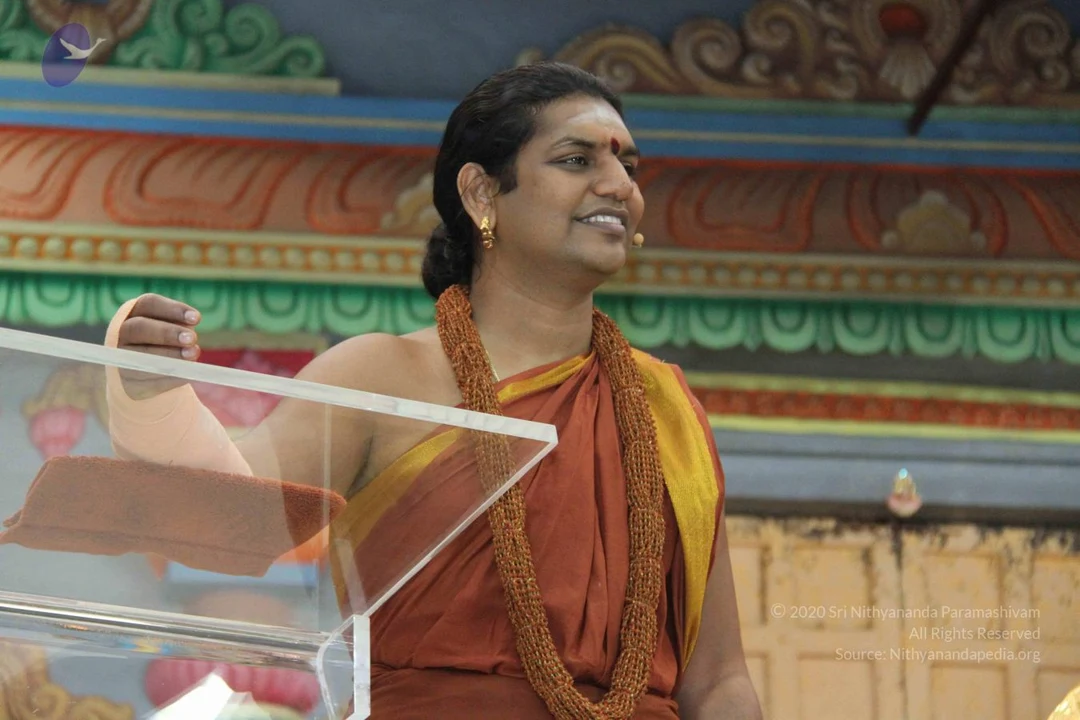
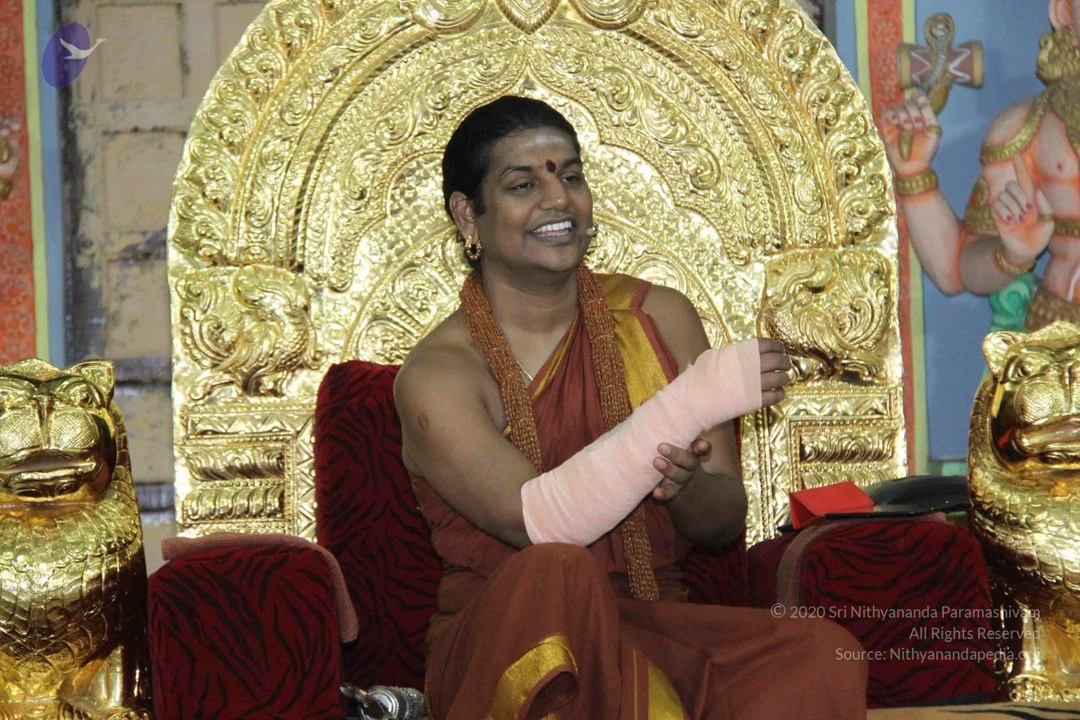
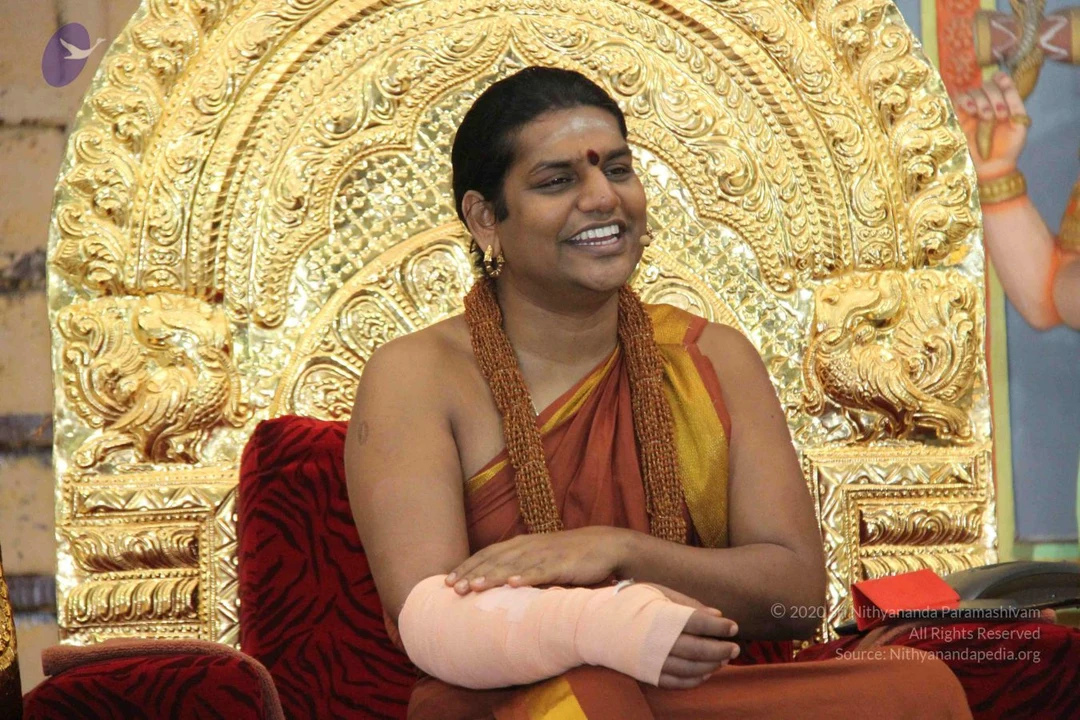
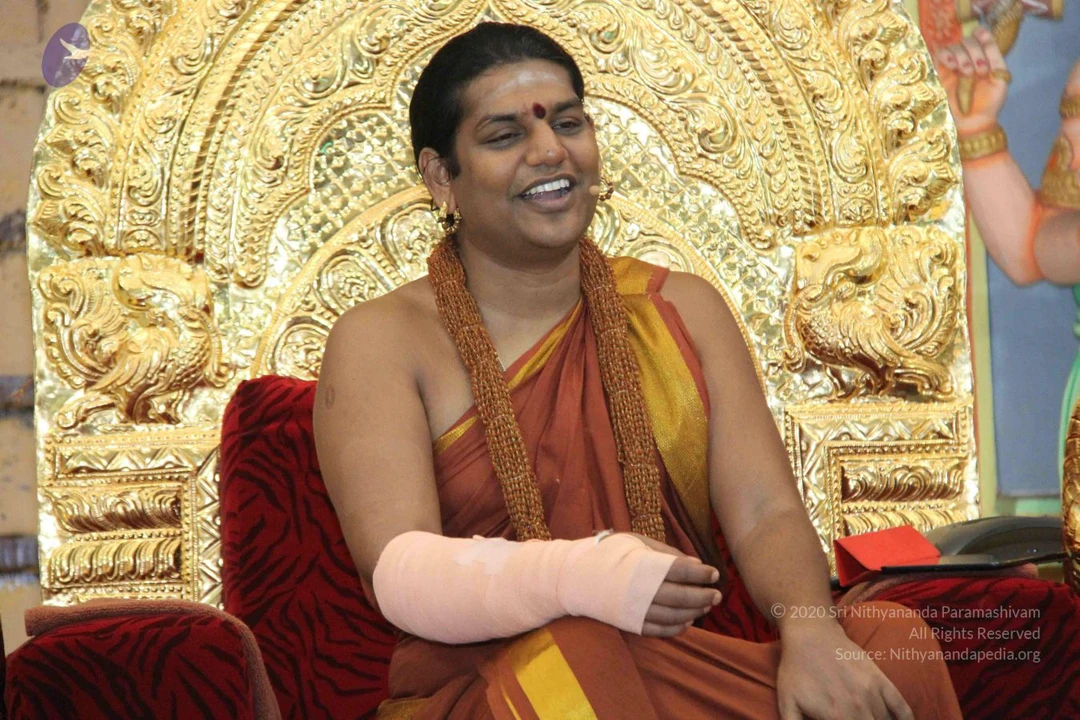
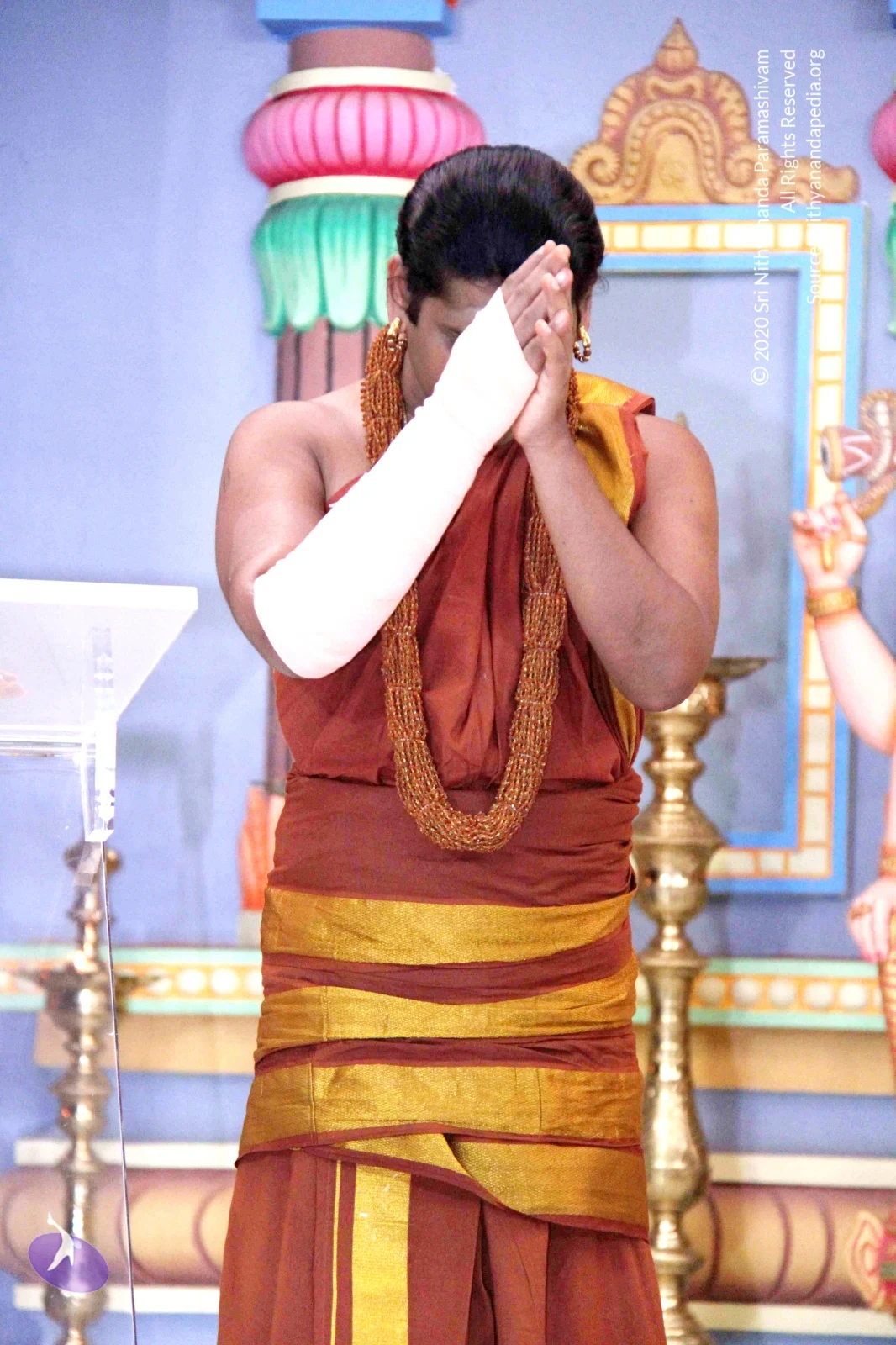
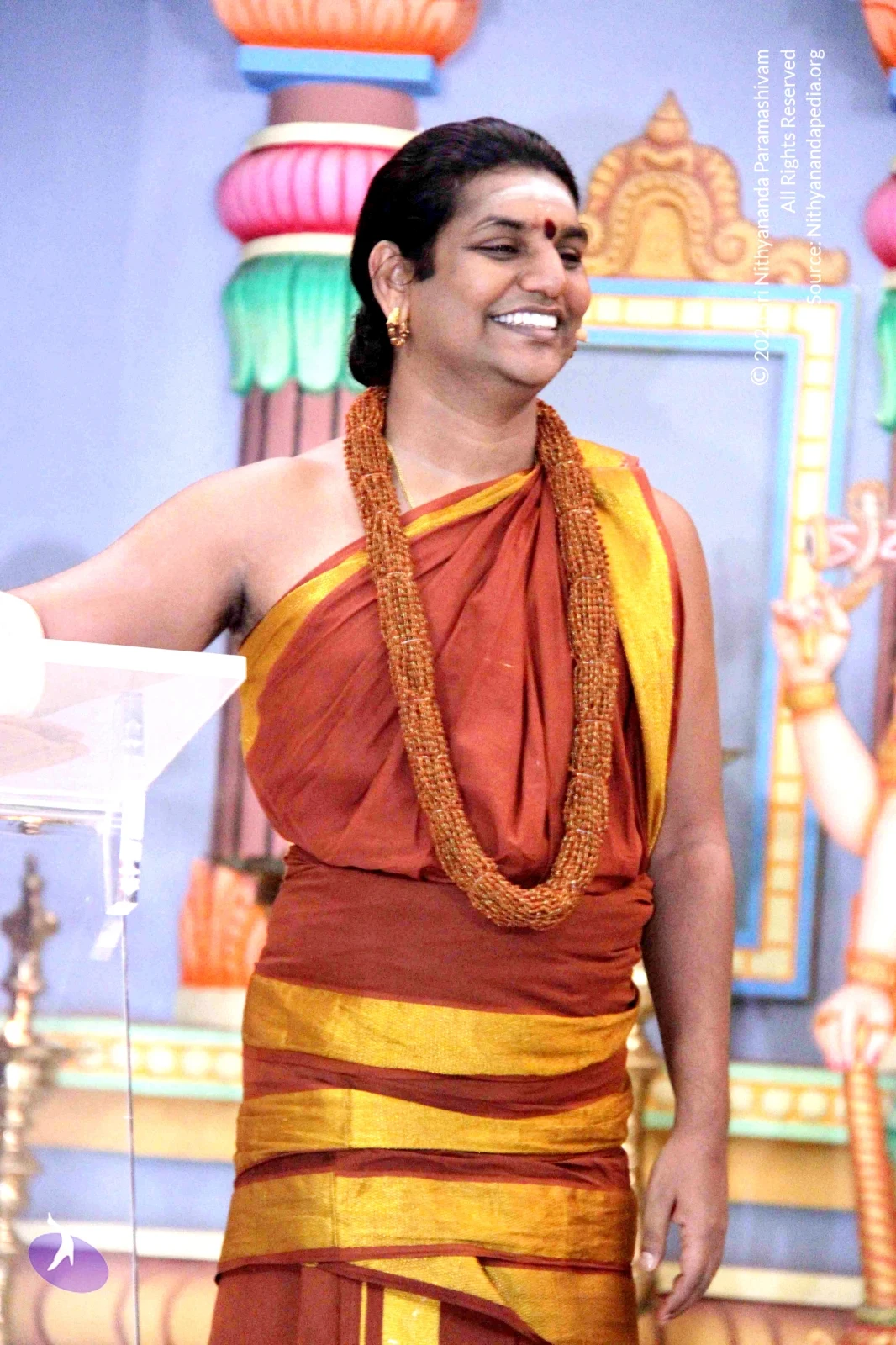
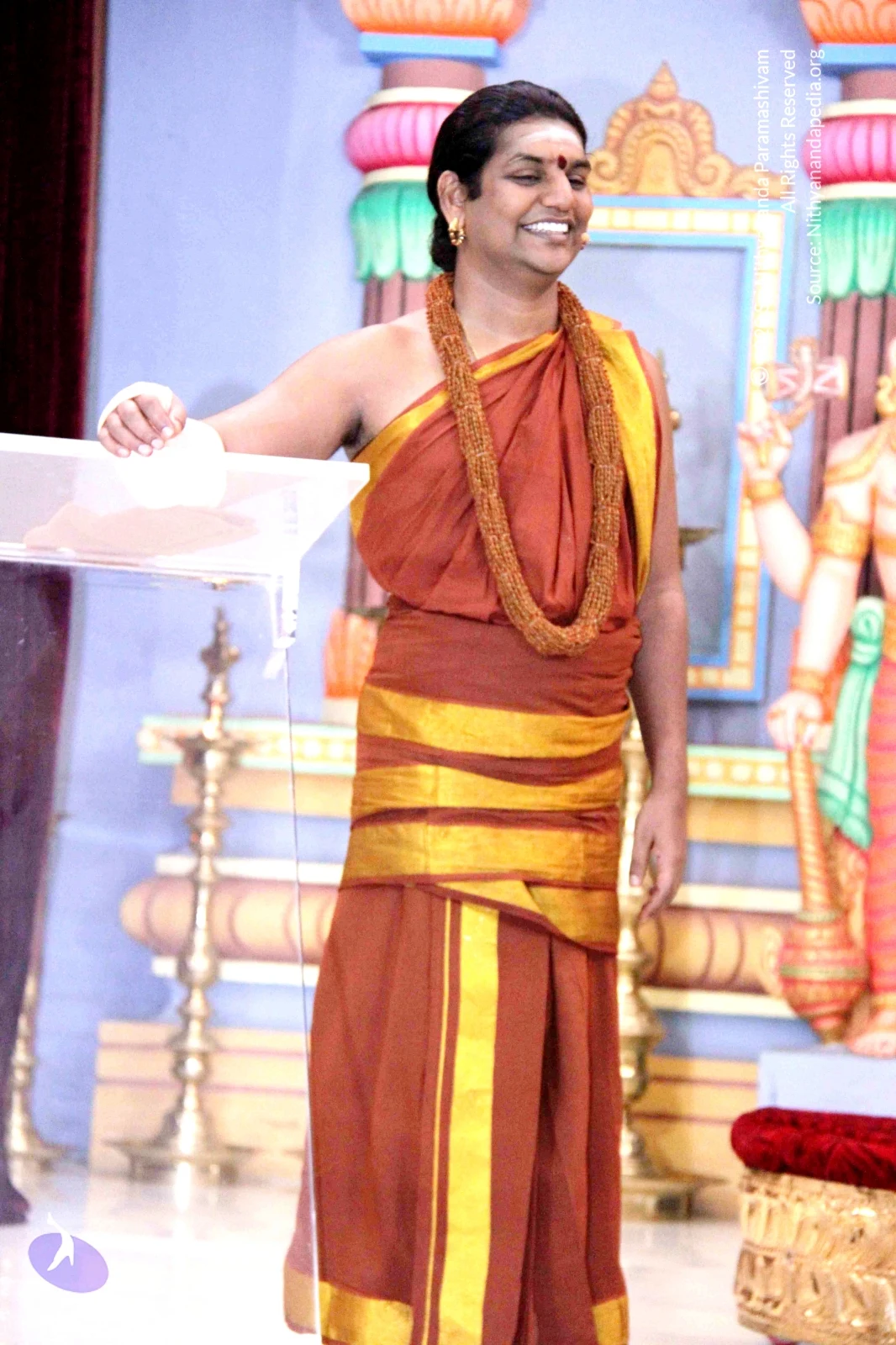
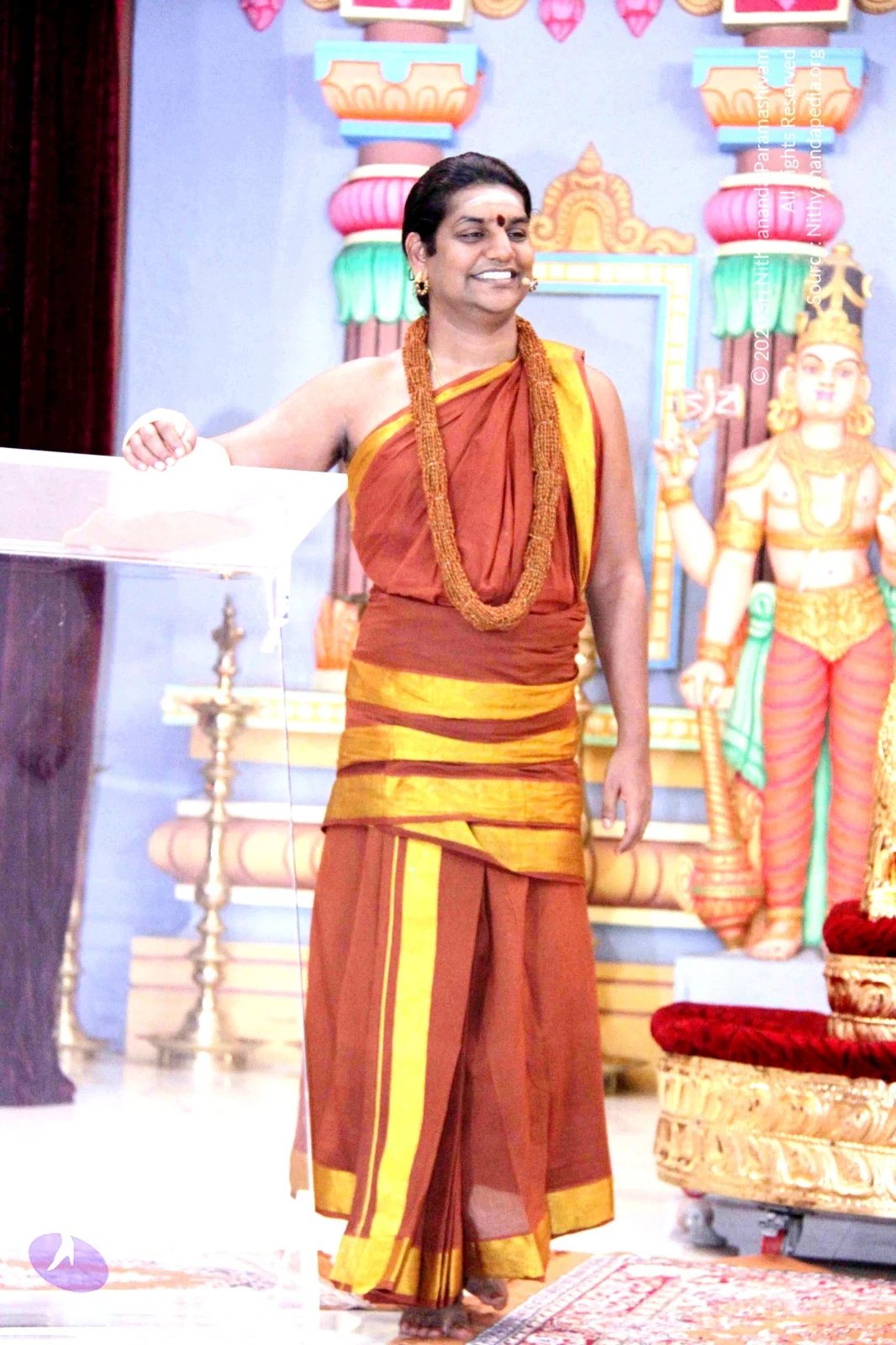
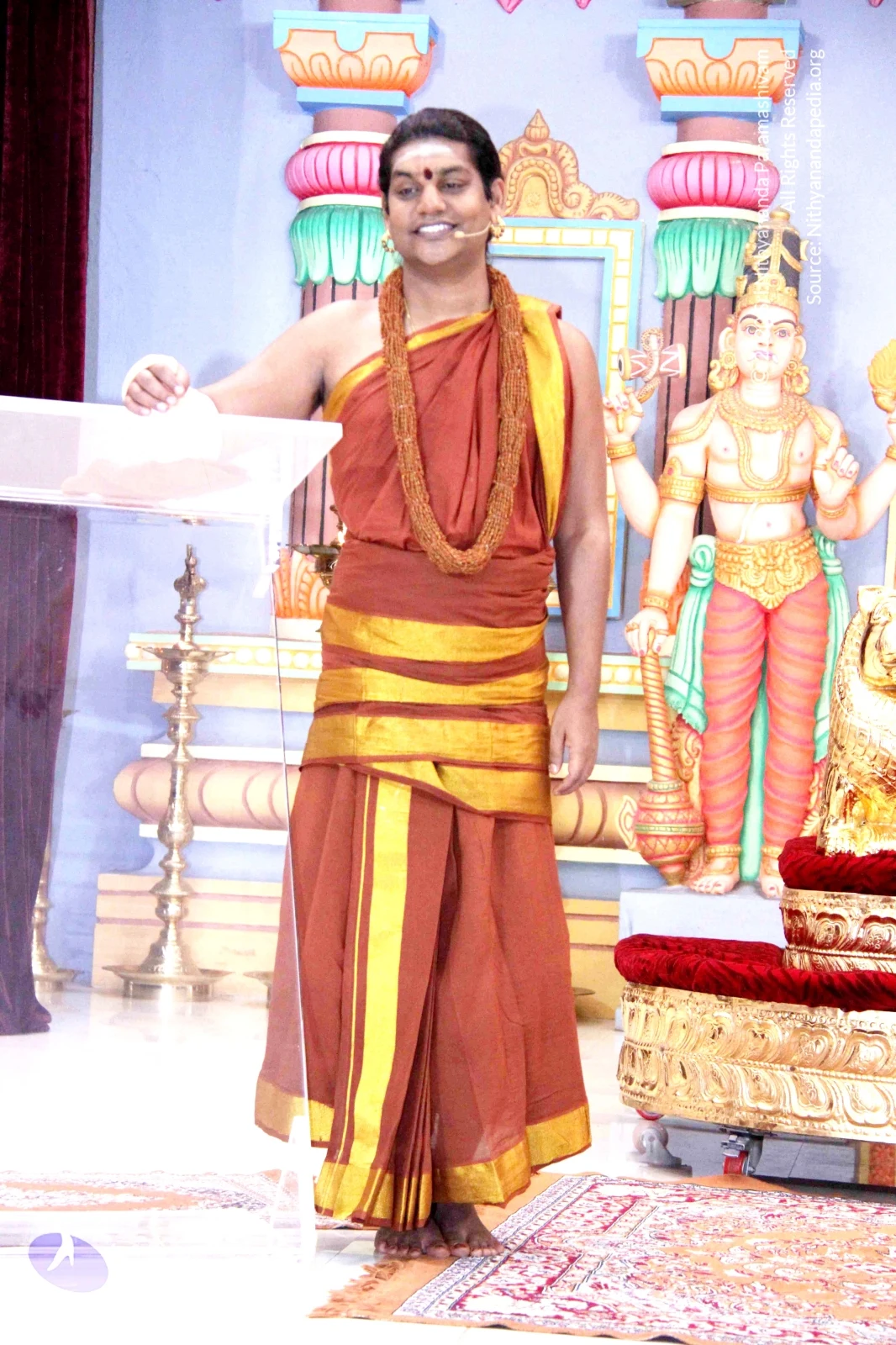
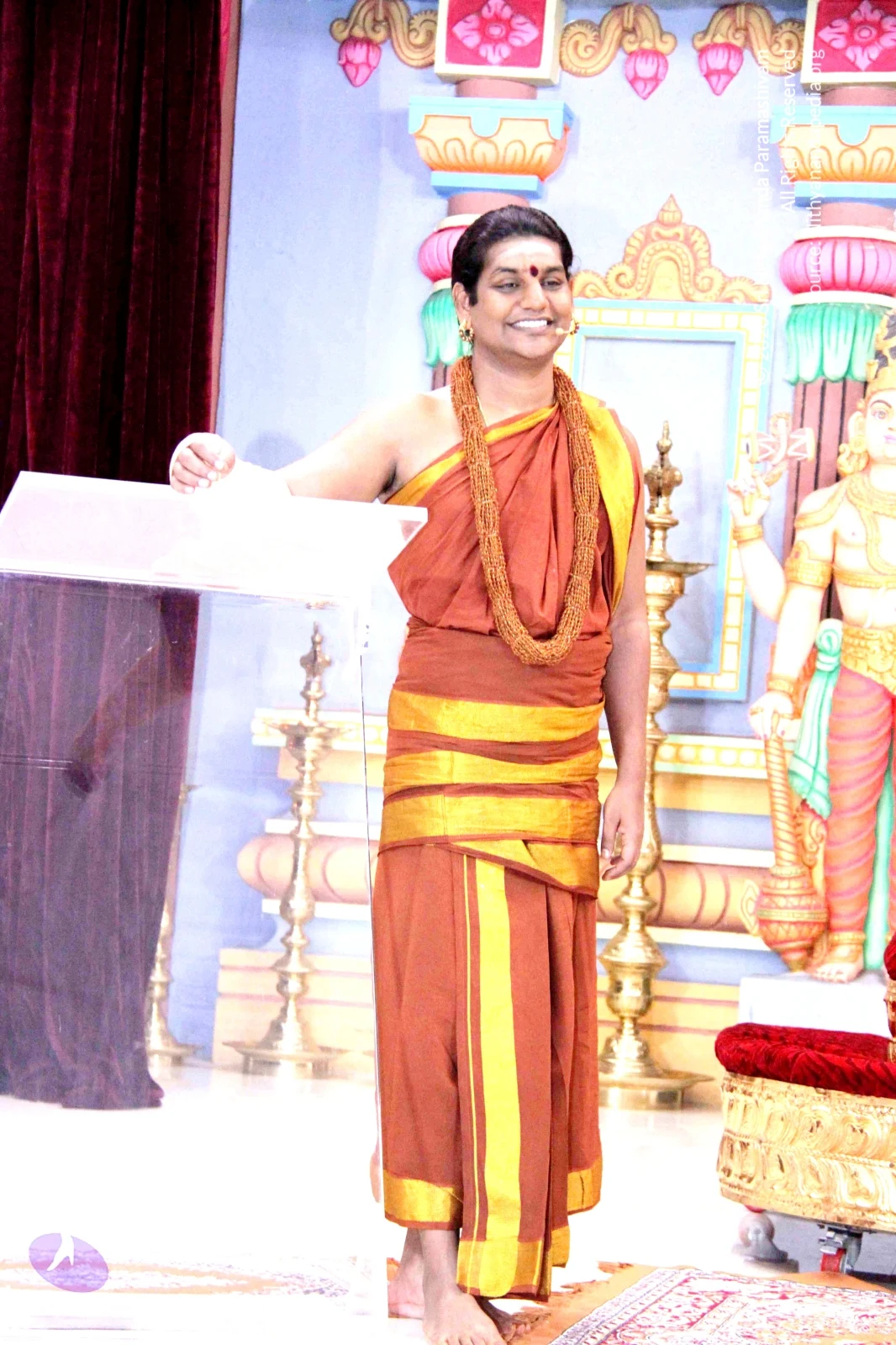
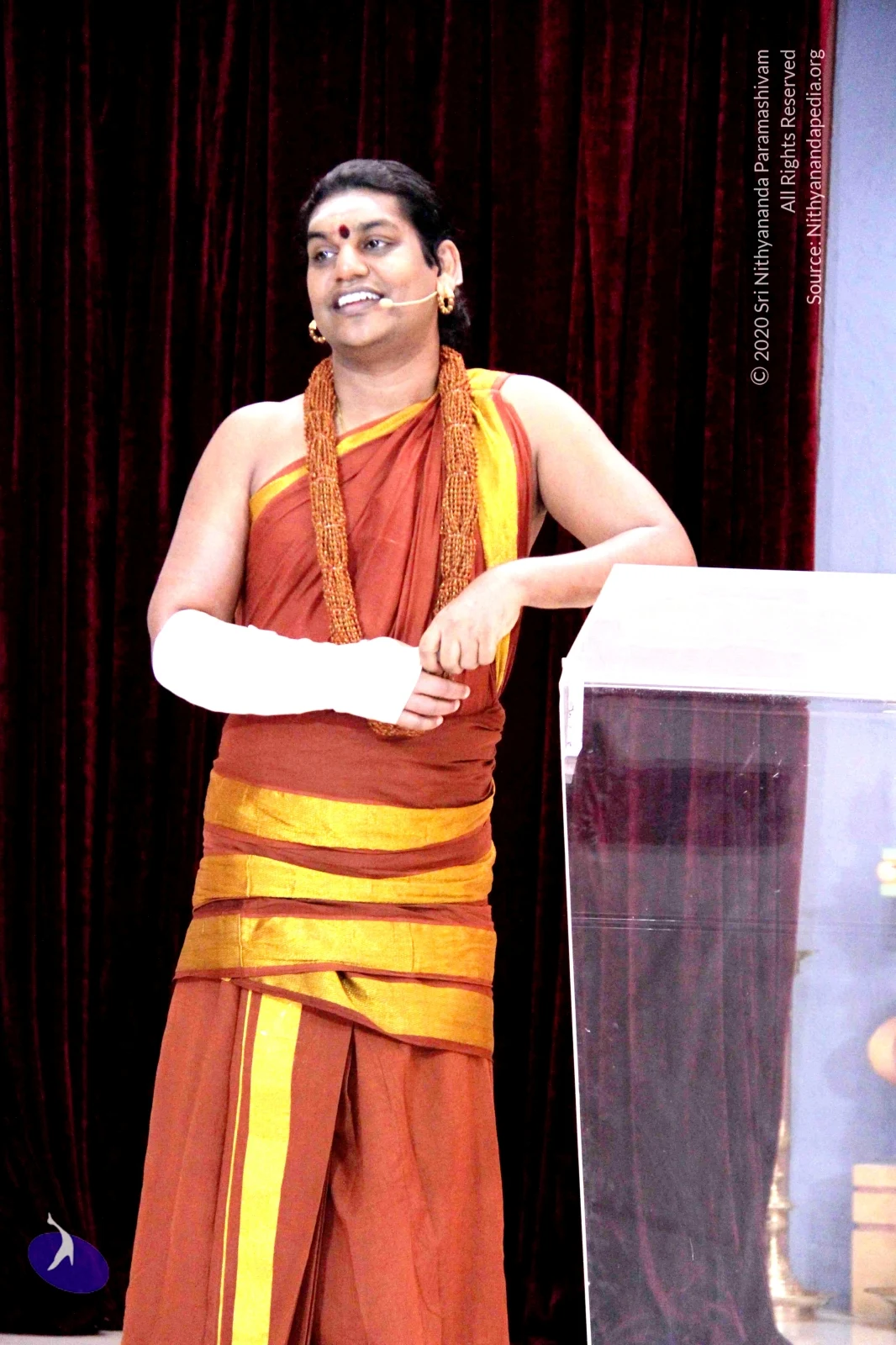
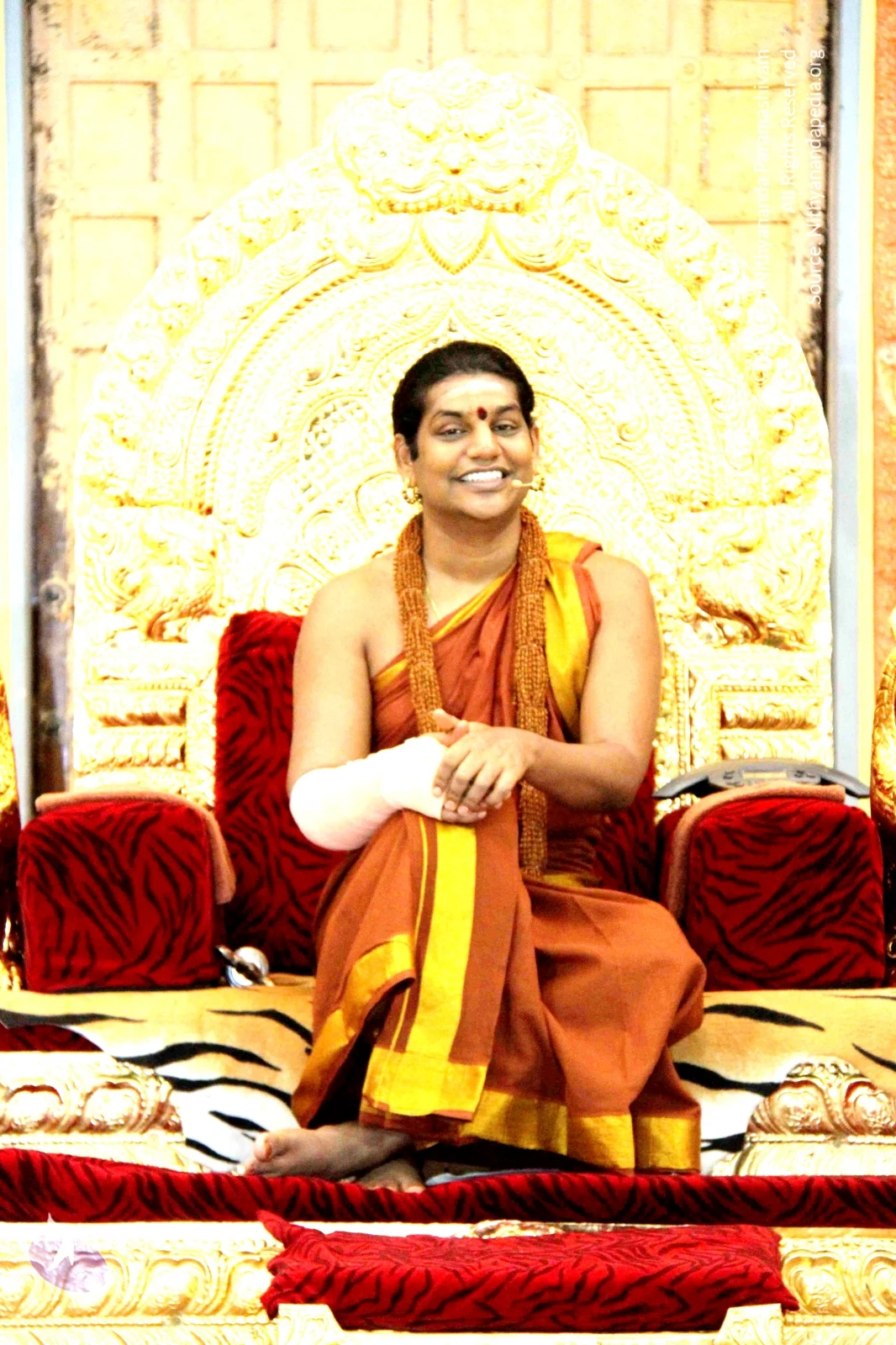
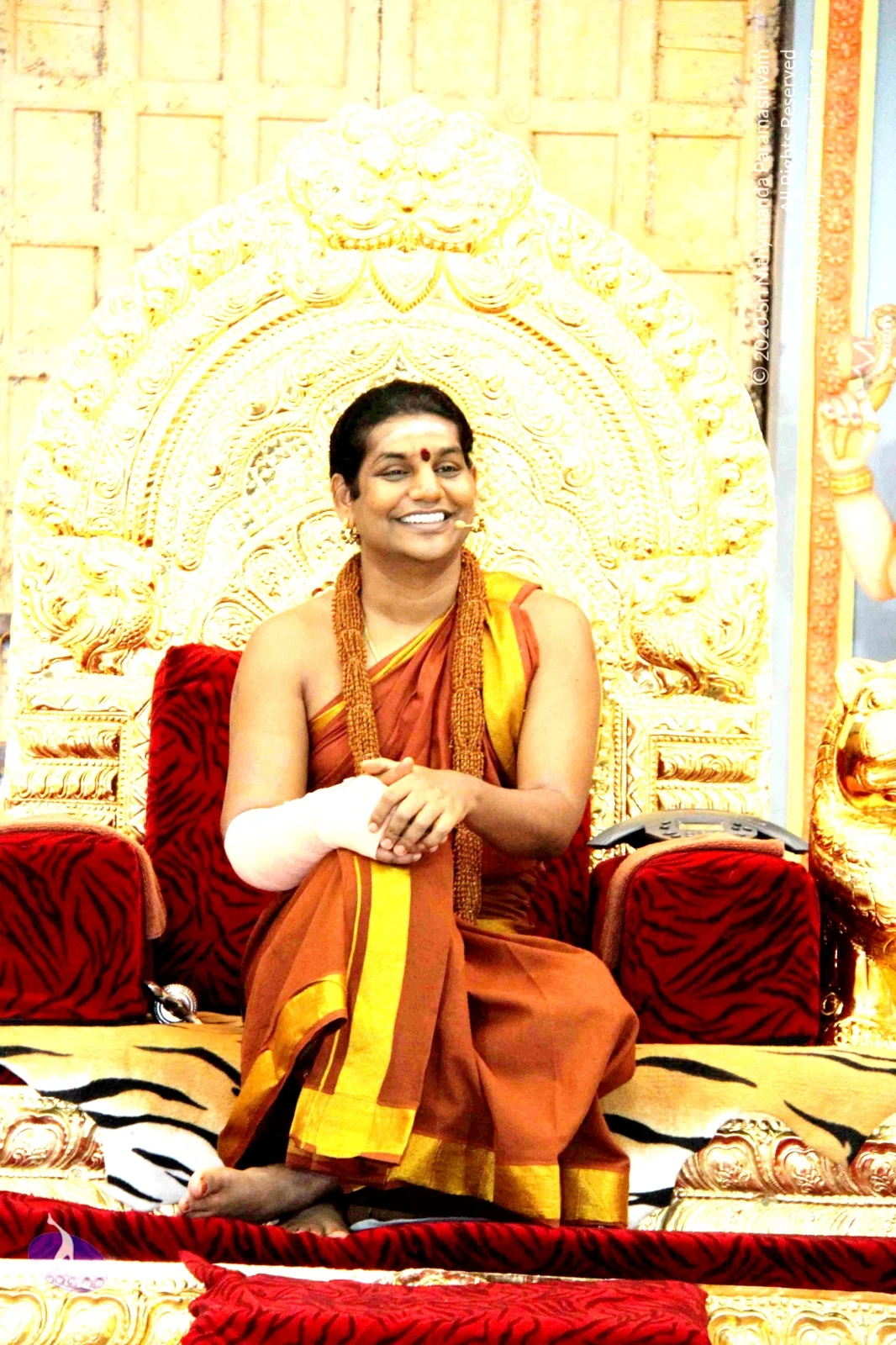
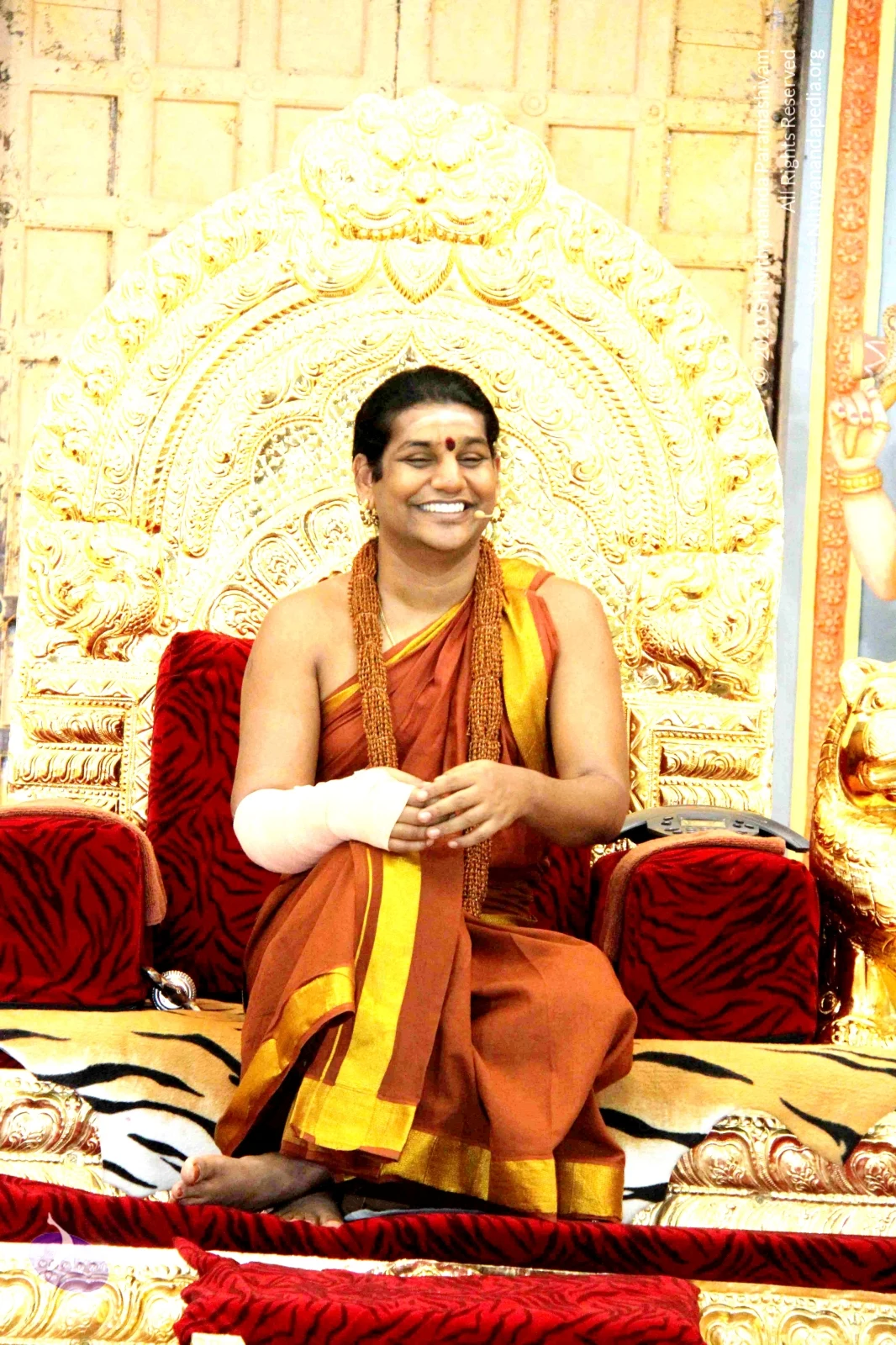
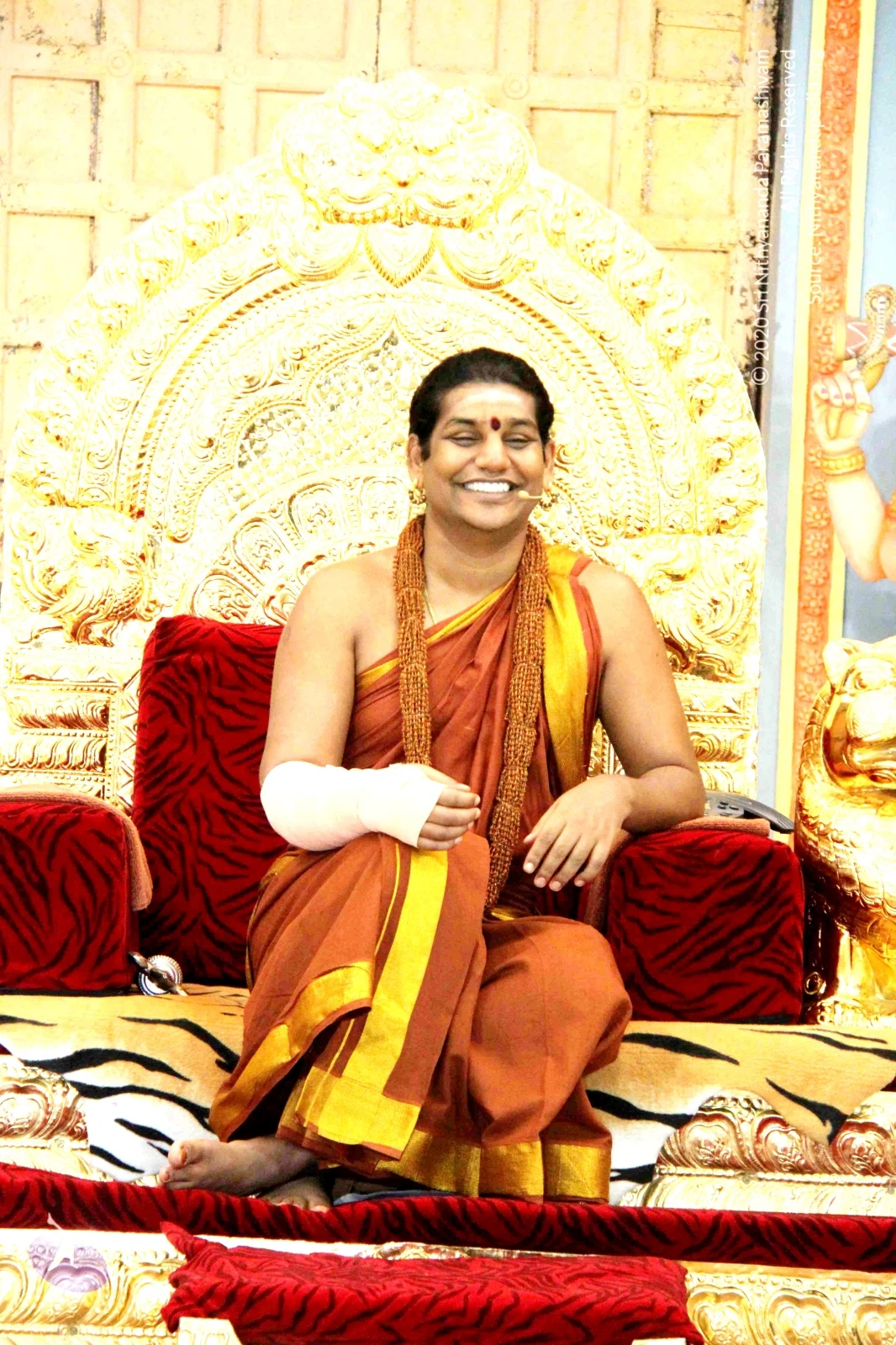
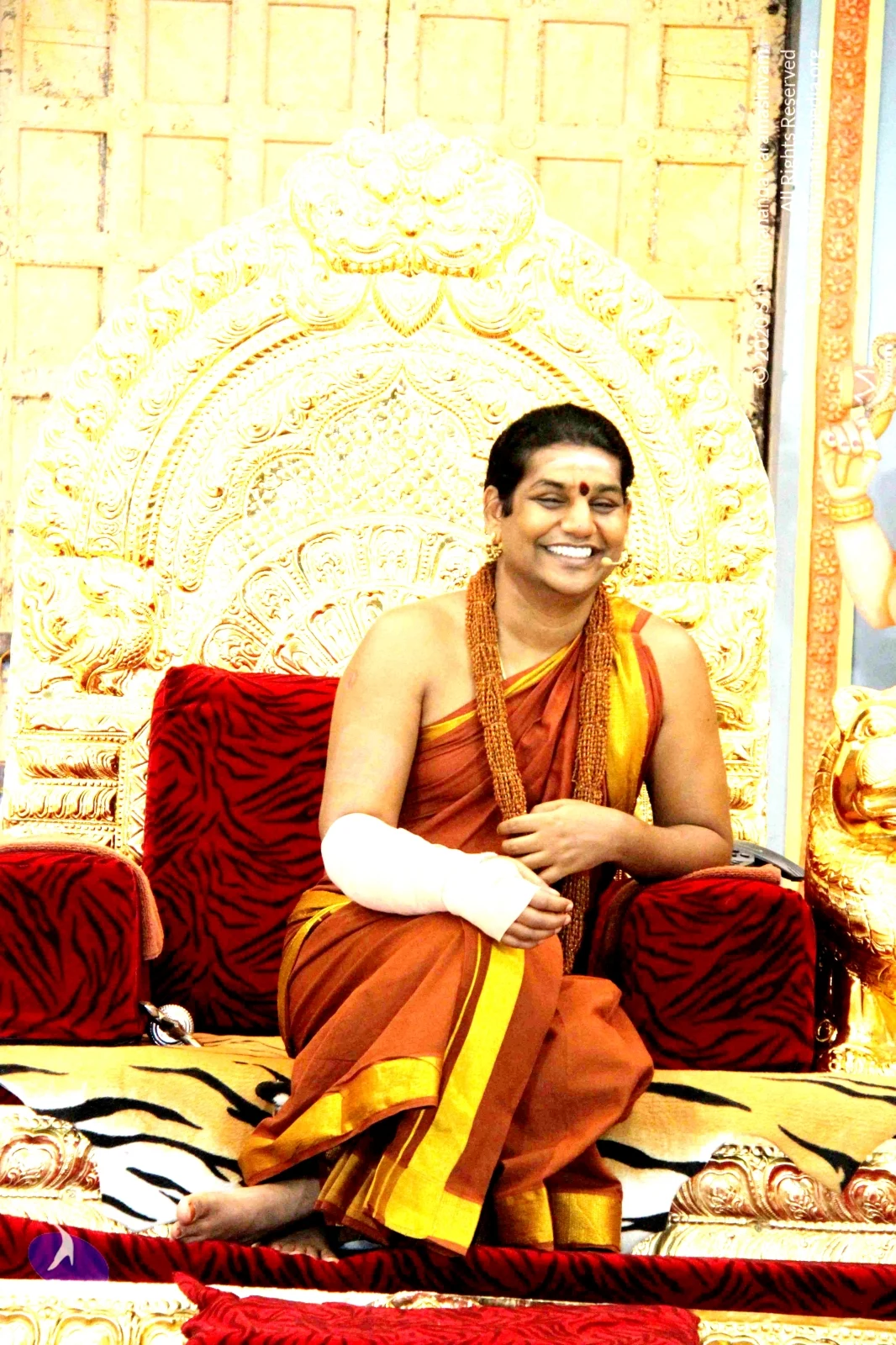
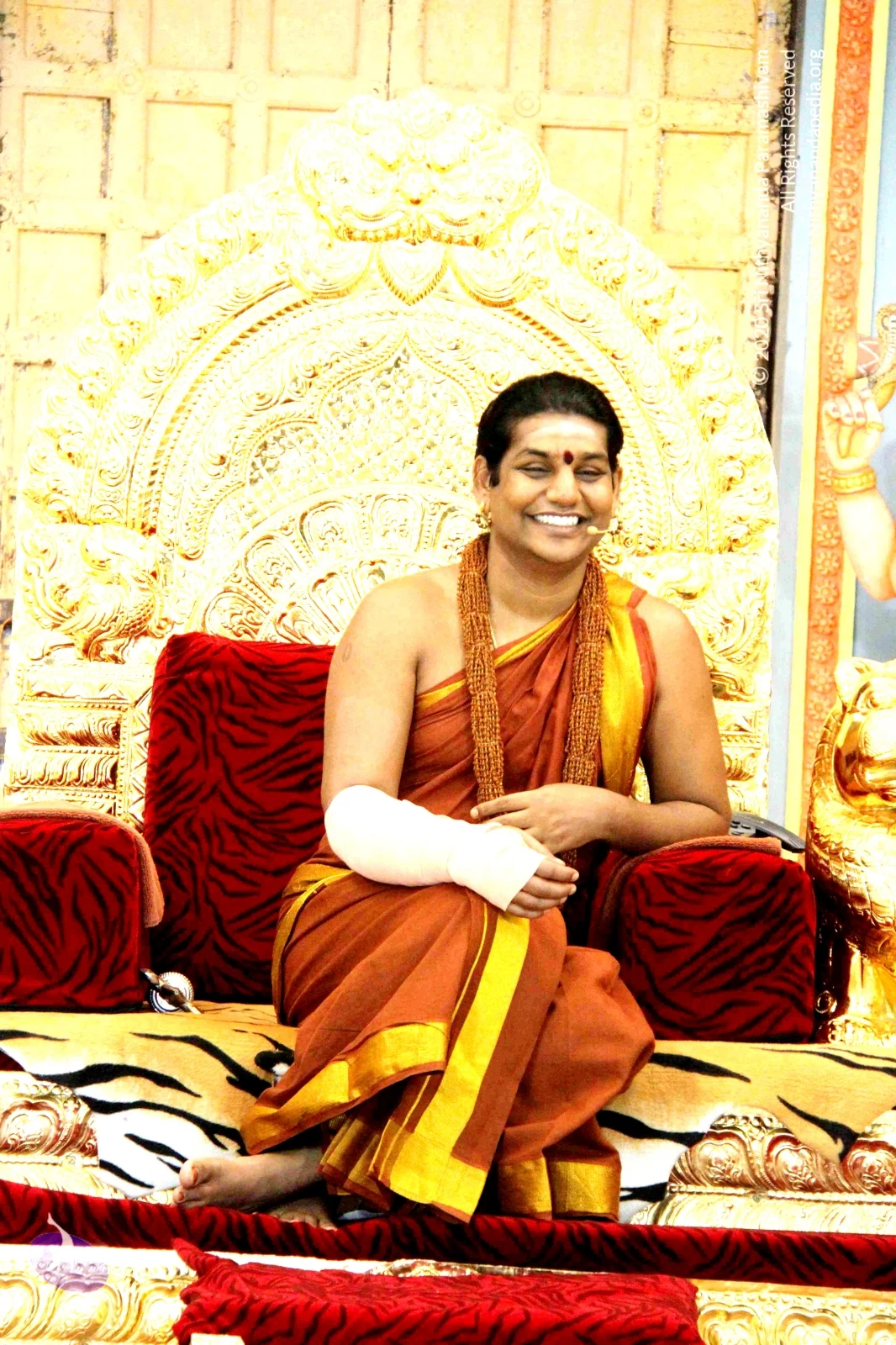
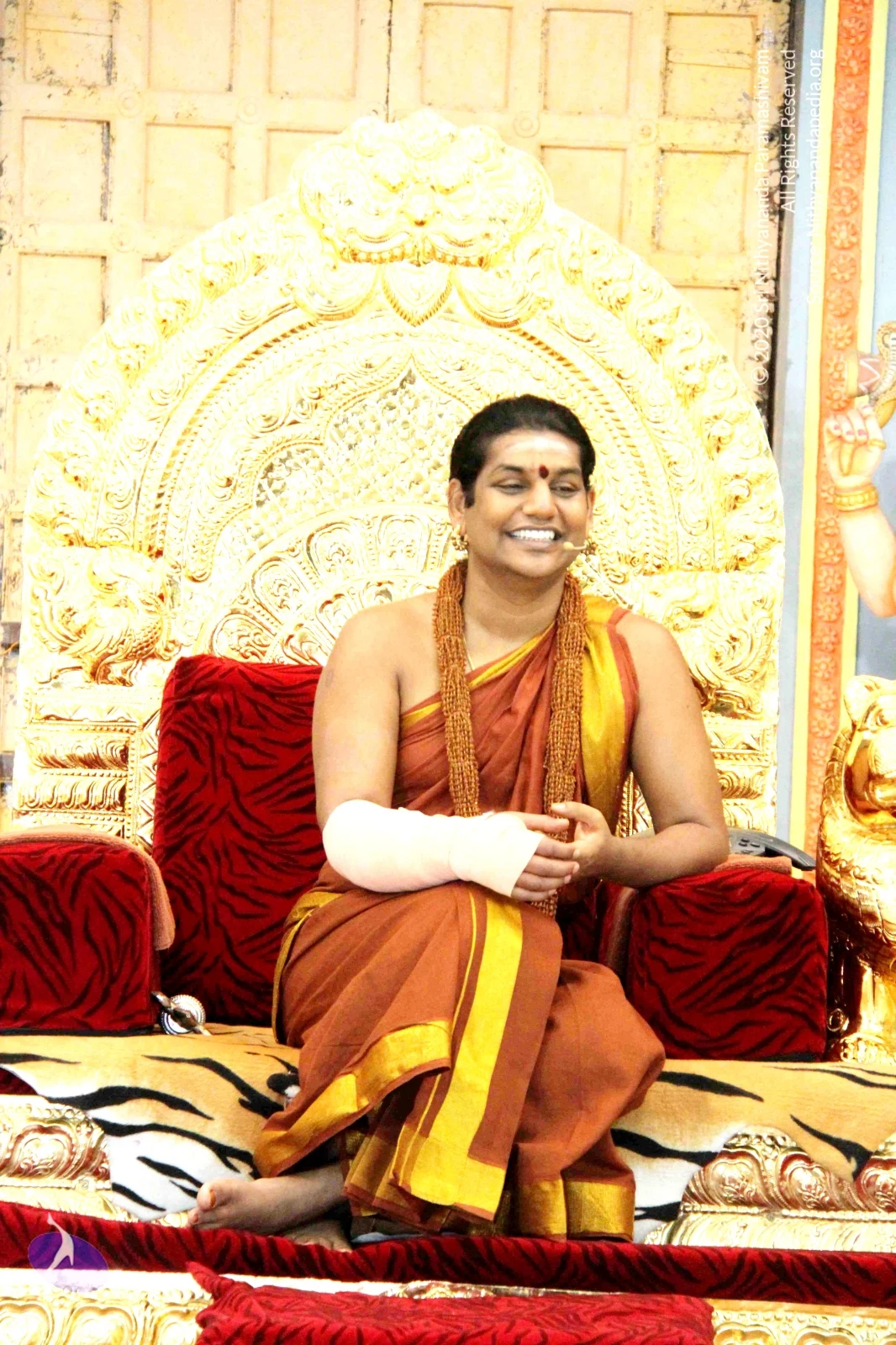
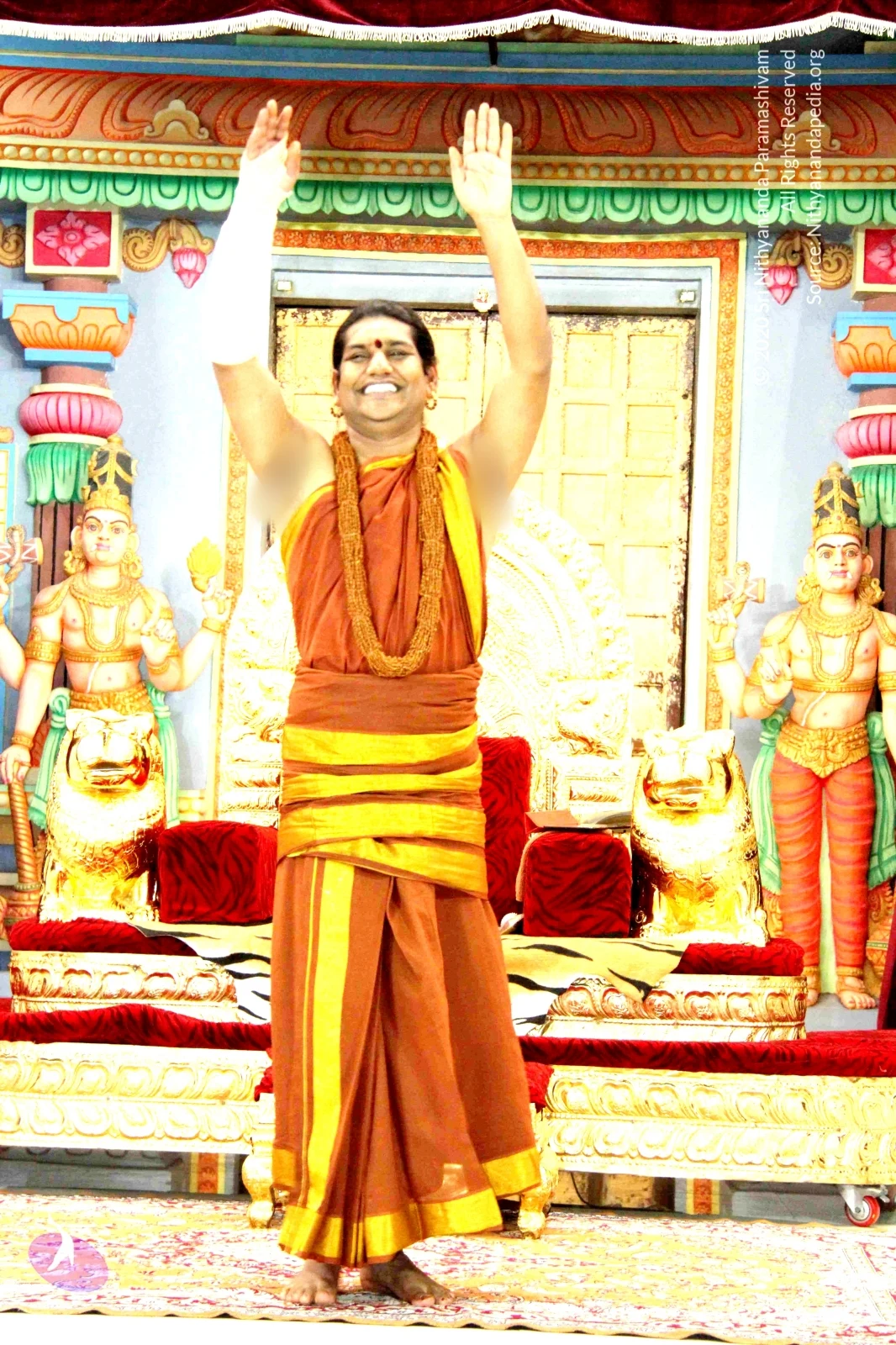
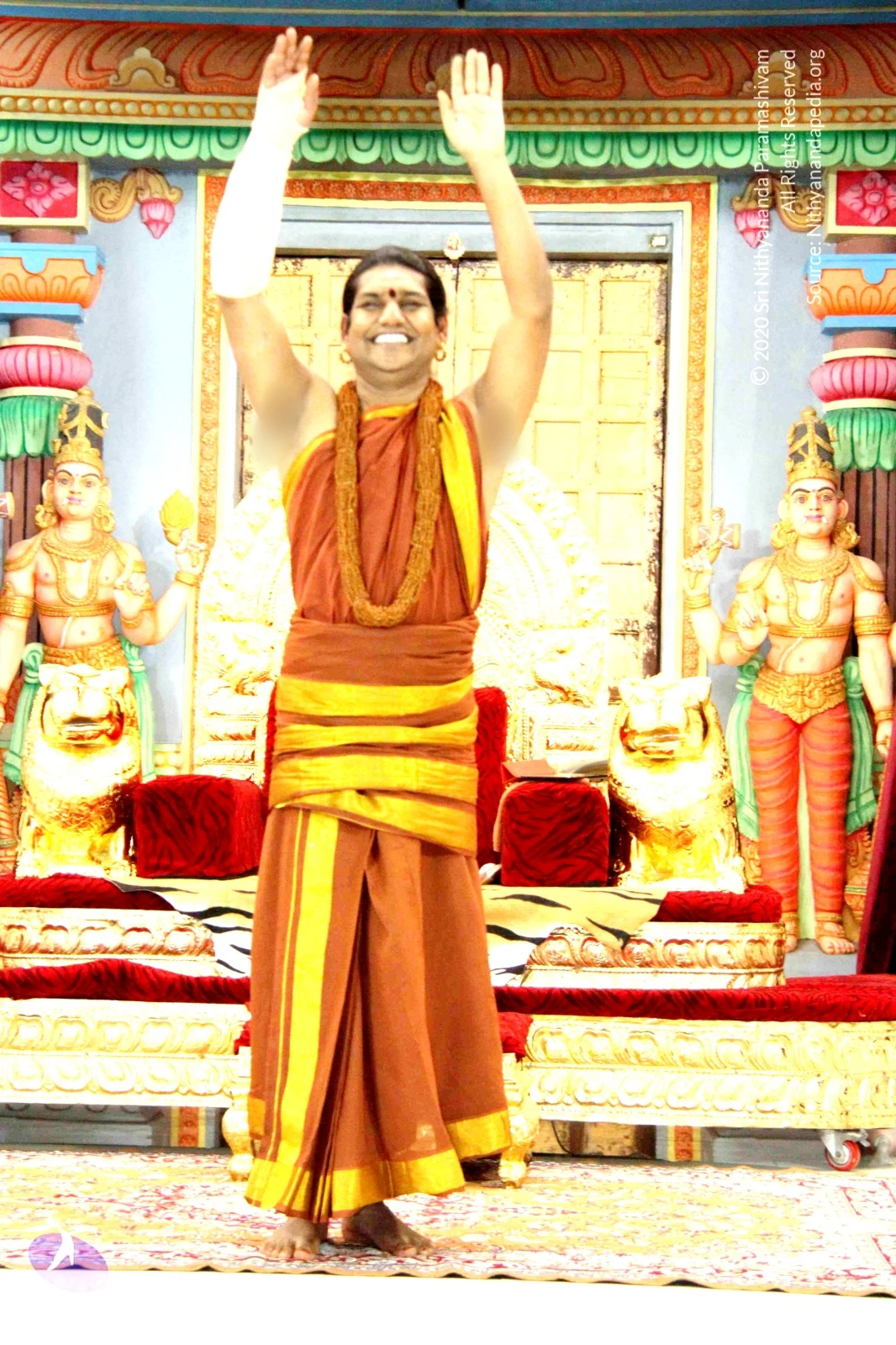
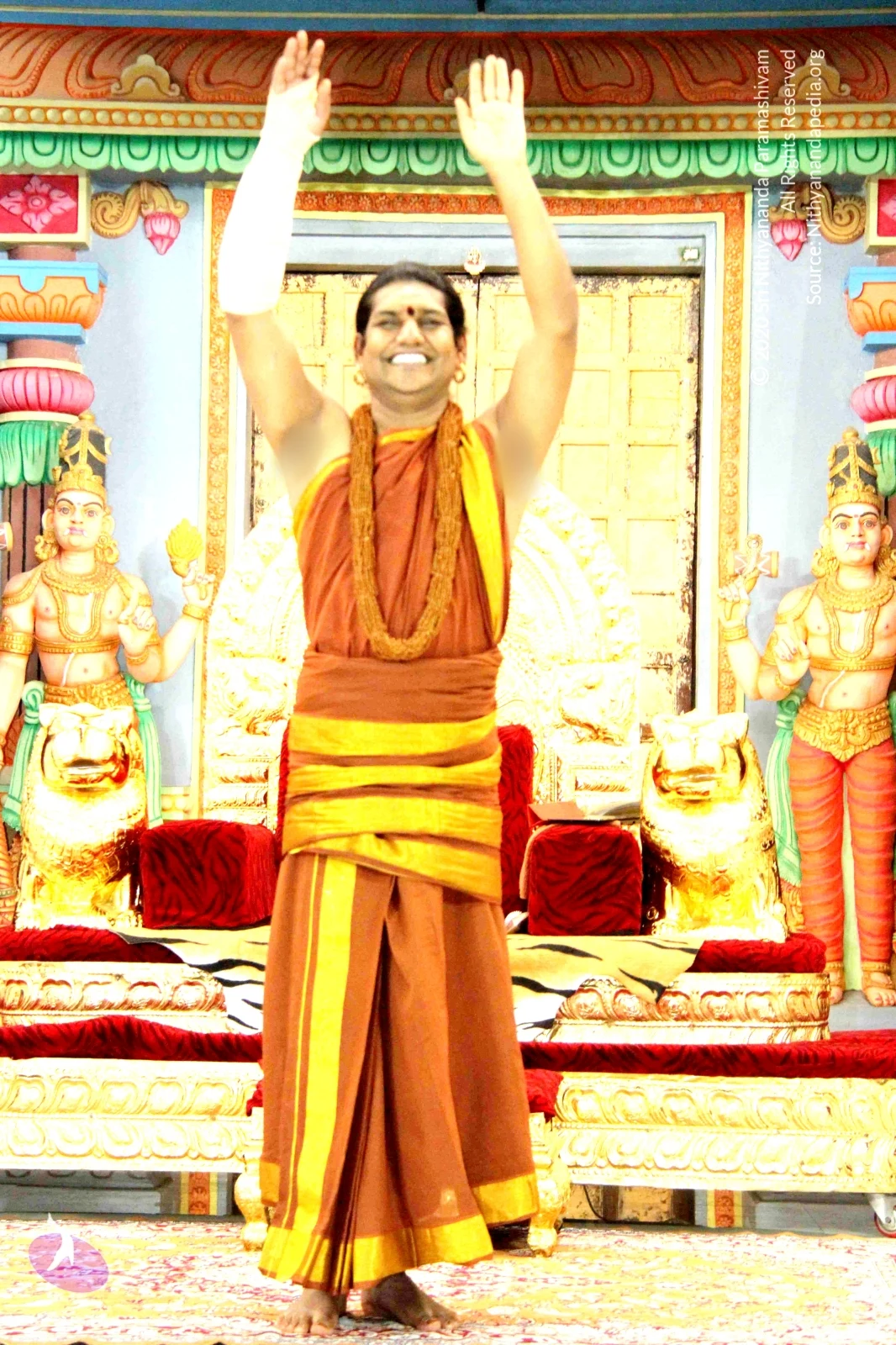
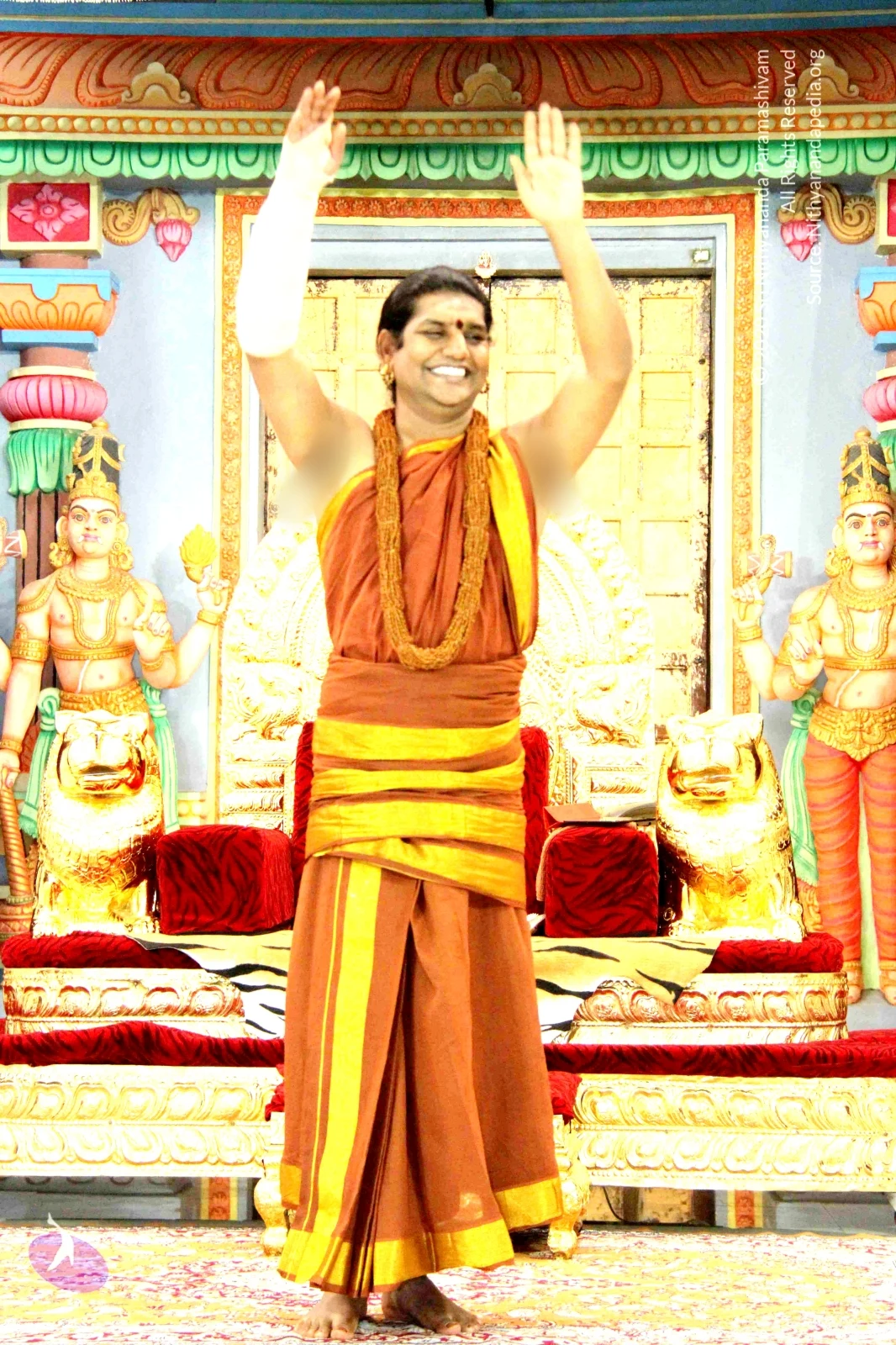
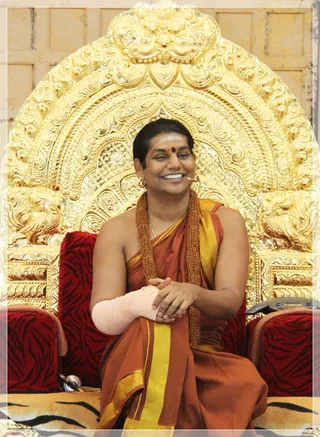
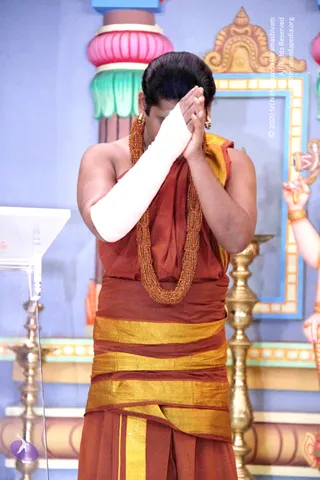
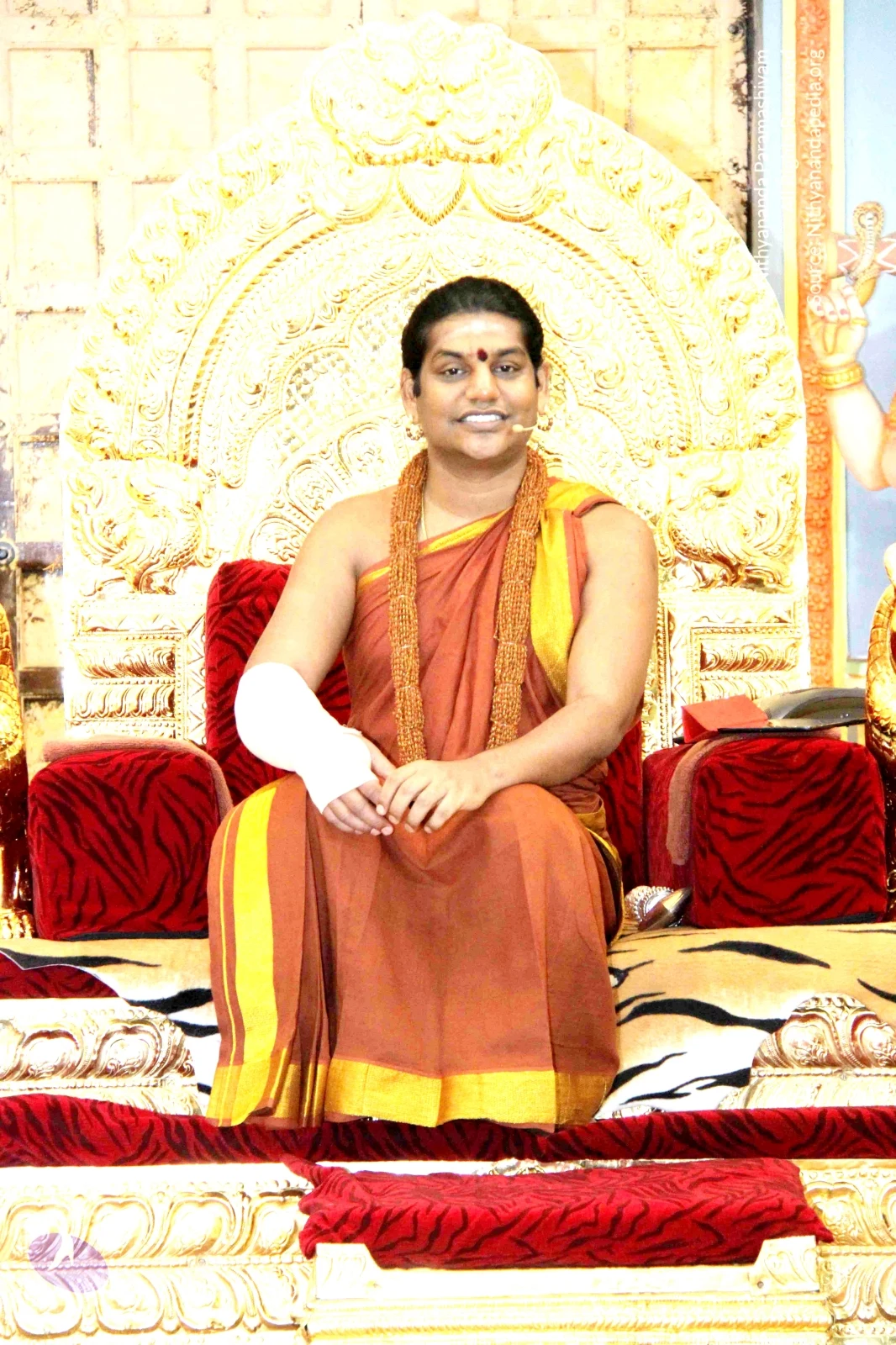
All of you may be having questions about the bandage in my right hand. I just removed the plates and screws yesterday; had a surgery. I was trying to teleport, it got loose and the screw got loose and it got stuck inside and the screw seems to be too big, especially the plate; two big plates are there and to teleport I have to be in Samadhi for quite a long time without moving the body, that’s the reason I opted for surgery itself. Then, in one hour they finished the surgery yesterday; today I’m back for the satsang. That’s it, 15 screws and 2 plates they have removed!

Alright, let’s enter into today’s satsangh.

Today is World Peace Day! Let us all meditate and pray to the ultimate consciousness, ‘Let there be peace in the world, O, the Cosmos, the peace which is in your center be with the world, and in all of us!’

I will continue expanding on Responsibility and Enriching. Day-before-yesterday, I was talking about Integrity and Authenticity. I was defining Integrity and Authenticity, and how Integrity and Authenticity directly work on our being; the deeper understandings about Integrity and Authenticity, I was explaining. Now I will move to Responsibility and Enriching.

Listen! When you bring Integrity into your thinking, the best pranayama happens, the best pranayama happens! When you bring Authenticity into your actions, the best activism, the right activism happens in you! Unfortunately, we become active in wrong zones. I have seen people become active in the wrong zones, not in the right zones. Activism in the right area, right zones, is very important. In a way, I can say, all incompletions you carry towards being active should be completed. All incompletions you carry towards being active should be completed.

One of the biggest diseases human-beings suffer physically is unable to be active, incompletions with being active! Unable to be active mentally, unable to be active mentally is lack of Integrity. Please understand, when you have incompletions mentally, unable to be active; actually when you have incompletions, in your thinking, lack of Integrity in your thinking, mentally you will be inactive. Even if you think, it will not be useful; thinking, not in the direction of useful. Many time, you are awake the whole day, but you are neither useful to yourself nor to others. Mentally you think the whole day, but it is not directed in one direction, you are not useful to yourself and others.

Today, I’ll expand on Responsibility in your being, Integrity in your thinking, Authenticity in your activities, in your actions. Responsibility in your being! Please understand, “Responsibility in your Being”, this word has to be understood very deeply. When you feel responsible in your being, for any problem, or anything, you find solution for that problem or that situation. We will have a question: What does “being” mean? Means, the zone from where you take decision, is “being”. The zone from where you cognize, is “being”. The zone from which the cognition happens in you, is “being”.

Please listen, the zone from which the cognition happens in you, is “being”, which is deeper than thinking. Unfortunately, only when you complete with your thinking, with your emotions, you will even understand the difference between thinking, being, emotions, and all that. Otherwise, it is all messed up! It is all like complete messed up!

Responsibility in your being means, the space from which you cognize, carrying Responsibility in that zone. Please listen! If you don’t feel you are responsible for something, you don’t even think in that line. If you feel you are responsible for something, only then you will even look into that part of your life.

I will give you one example. TV channel headlines reads: “Bomb Blast, 172 People Dead! Two Ministers Injured!” You will jump up and see, ‘Where? Where?’ Iran! You will settle down. How many of you have experienced this? Means what? You are responsible only for India, or your State where you are. You don’t feel responsible for the whole world. Restricting your being feeling responsible is what I call “conditioning”. Every guy who preaches patriotism tries to condition your responsibility to that country. Every man who tries to teach religion, conditions you, restricts your responsibility to that religion. Every person tries to teach you a language or the language-based affiliations, language or the language based affiliations, tries to restrict your responsibility to that language speaking people!

Please listen! I’m not against love for a country, love for a religion, love for a language, but I’m against restricting yourself only to that! Restricting yourself only to that; I’m against reducing your responsibility only towards that!

Understand, restricting your responsibility should never be allowed. You are a human-being; you are responsible for the whole Cosmos, not just Planet Earth! If you have an immediate action plan towards some responsibility, nothing wrong; but you not feeling responsible for the whole, is seriously wrong!

Your being, your being should be completely…..your being should be completely taking Responsibility for everything!

Listen! When you carry Responsibility in your being, please listen, that very carrying Responsibility in your being will raise you to a totally different level. I am really telling you, feeling responsible makes you a hero! Not feeling responsible makes you a comedian! It is feeling responsible that decides whether you are a hero or a comedian in your life. A being without feeling responsible is useless. A being filled with Responsibility is the most powerful energy. Being feeling responsible is an energy center! Listen! Even when you go near that being, you will catch that Responsibility, you will catch that feeling!

Understand, feeling responsible in your being, I can give you all this as a very powerful technique. You don’t need to do any action, you don’t need to do any thinking. Decide from your being you will feel responsible for the whole world! Suddenly, you will see all your actions will have Authenticity, thinking will have Integrity! A person who has ten-thousand crore rupees wealth will not lie for ten rupees. A person who is having ten-thousand crore rupees wealth surely will not cheat, out of Integrity for ten rupees! As a rule, a person with this much of wealth will not be without Integrity. Please understand, if you feel…. Just decide from today, from your being, you will feel responsible for the whole world, whatever way you think the world is, whether the world is suffering with diseases, world is suffering with poverty, the world is suffering with mental illness, world is suffering without peace, whatever! Whatever you think the world is, decide in your being you will carry Responsibility for it. The first thing that will happen is, you will become very integrated and responsible and authentic. Mainly, whatever you are doing, if you take Responsibility for the world, even if you are a doctor, you will become a better doctor; if you are a lawyer, you will become a better lawyer; if you are an engineer, you will become a better engineer; if you are a politician, you will become a better politician.

If your being feels responsible for the world, please listen, if your being feels responsible for the world, immediately Authenticity will happen in your actions, Integrity will happen in your thinking. Authenticity will happen in your actions, Integrity will happen in your thinking. Whether you understand or not, whether you directly apply it or not, please listen, whether you understand or not, directly apply or not, the moment you bring Responsibility in your being, your every action will become authentic.

You need to know a very important truth: The “it’s okay” attitude is the attitude which destroys your life. Like white ants eating the wooden furniture, the “it’s okay” attitude eats your whole life! Feeling responsible in your being, taking Responsibility in your being, takes away the “it’s okay” attitude. Takes away the “it’s okay” attitude! Please listen, it takes away the “it’s okay” attitude. This attitude of “it is okay” eats into your Authenticity, and into your Integrity. Being responsible clears your whole thinking and actions. Being responsible makes you active. Being responsible makes you integrated!

Understand, bringing Responsibility to your being, bringing Responsibility into your cognition! You always feel responsible for little, little, small, small things. If you feel responsible for your home, you expand only that much. If you feel responsible for your street, you expand only that much. If you feel responsible for your village, you expand that much. If you feel responsible for your district, you expand that much. If you feel responsible for your State, you expand that much. If you feel responsible for your country, you expand that much. If you feel responsible for the whole world, you expand to the whole world!

It is the amount of Responsibility you bring into your being that makes your life juicy. I tell you, if you bring more Responsibility into your cognition, your life becomes exciting!

Many a time, I feel why these people live in cognition poverty? Please understand, cognition poverty, poverty in your cognition is boredom! Poverty in your cognition brings boredom in your life! That is why you feel life is boring, dull. If you bring strength in your cognition, Responsibility in your cognition, you will be excited and you will be enlightened! You will be excited and you will be enlightened!

Responsibility in your cognition will bring so much excitement in your life. It will bring so much excitement! Understand, if your cognition shrinks, you also shrink, your actions shrink, your Integrity shrinks. If your cognition expands with more Responsibility, Authenticity happens in your action, Integrity happens in your thinking.

I have a story:

A newly married husband saved his wife’s number in his mobile phone as “My Life”. After one year of marriage, he changed the number to “My Wife”. After two years of marriage, he changed the number to “Home”. After five years of marriage, he changed the number to “Hitler”. After ten years of marriage, he changed the number to “Wrong Number”!!!

When your Responsibility changes in your cognition, your actions change. When your Responsibility

expands in your cognition, your life becomes more authentic, your actions become more authentic, and your thinking becomes more integrated. Please understand! Same way, when Enriching is brought in your whole life, your life expands multiple times – whether it is ability to live, or ability to think, ability to act, ability to feel, in every level it expands multiple level! Multiple level!

I bless you all! Let you all radiate with Integrity, Authenticity, Responsibility and Enriching, with eternal bliss, Nithyananda! Thank you!

Photos From The Day:
Photos Of The Day:

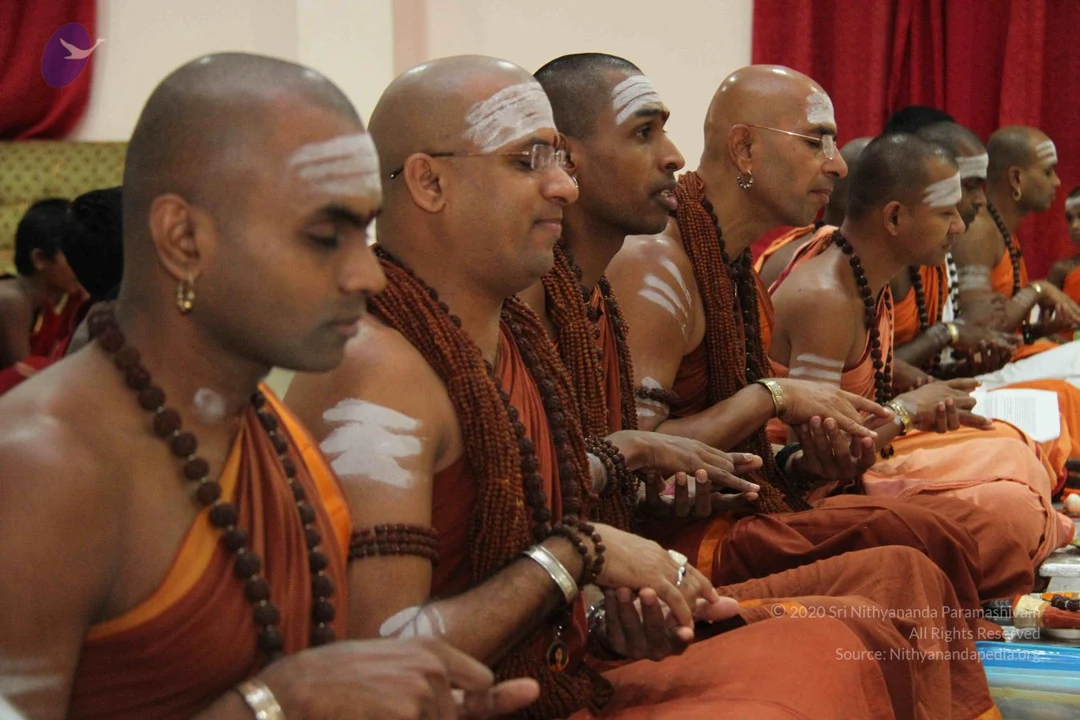
PadukaPuja_Crowds_Individuals
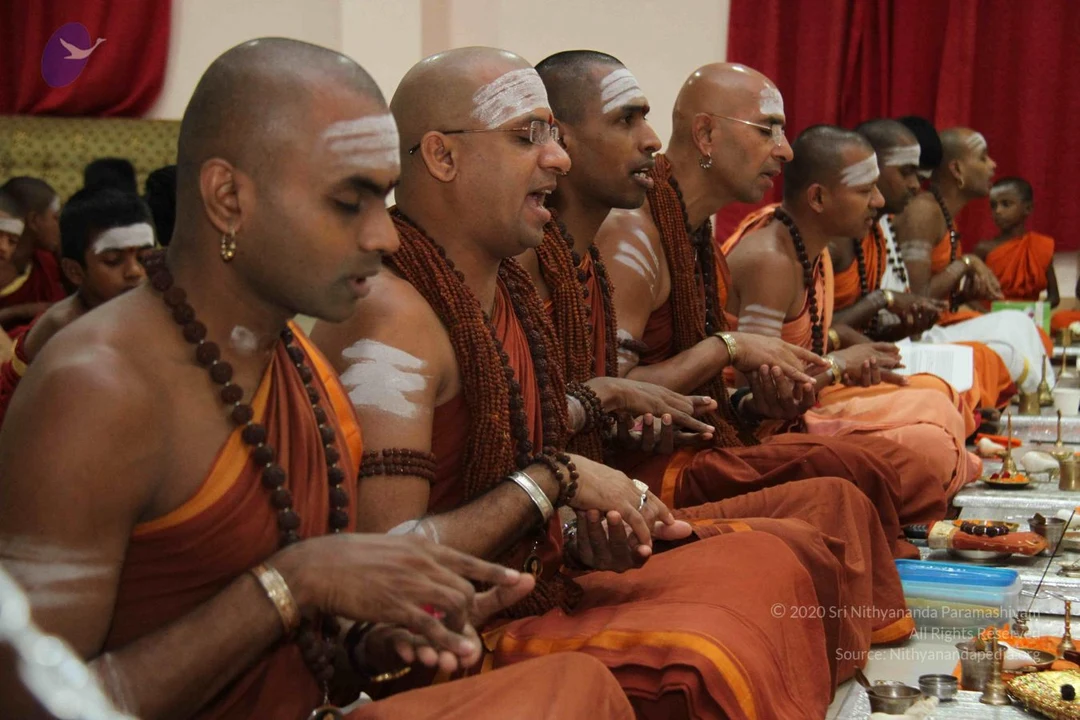
SwastiMantra_Amaayantu_Chanting

Gurukul_Instruments

Swamiji_Satsang

SarvaDarshan

NithyaDharmam_Day3

Temple_Picture

Facebook links

https://www.facebook.com/ParamahamsaNithyananda/posts/534988983255623

Photos Of The Day:

Paduka-Puja

Swasti-Mantra-Amaayantu-Chanting

Gurukul-Instruments

Nithya-Satsang

Sarva-Darshan

Nithya-Dharmam-Day3

Temple-Picture

1-Paduka-Puja

4-Satsang

5-Sarva-Darshan

Photos from this day

View all 369 photos

Photos From The Day:

10 photosSource gallery
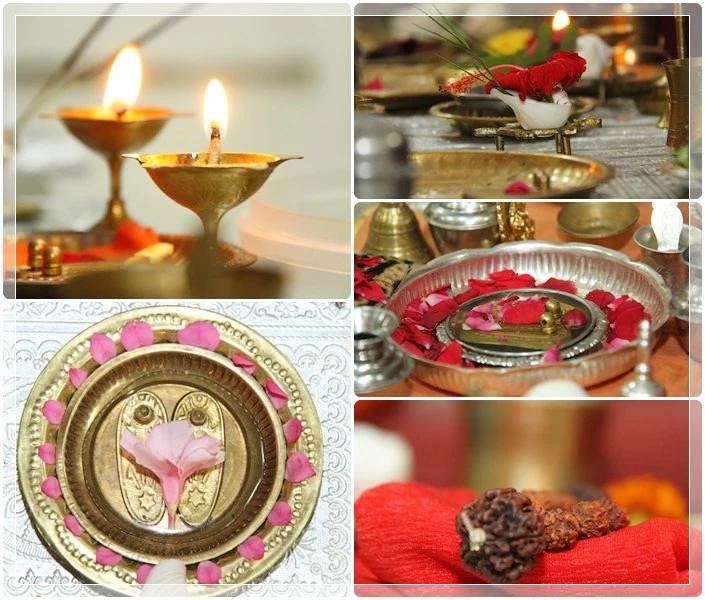
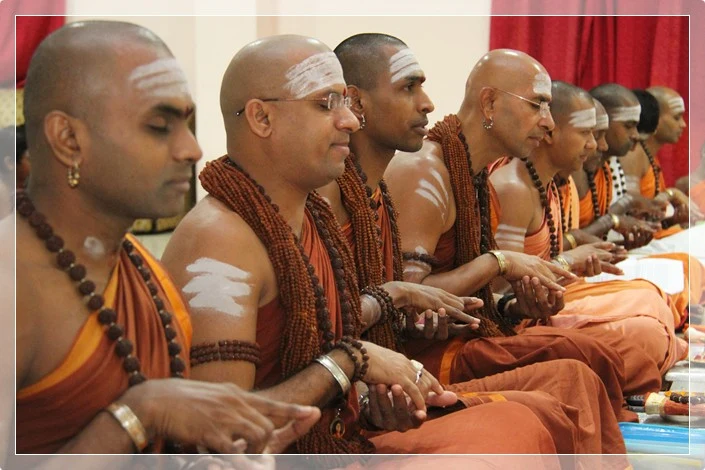
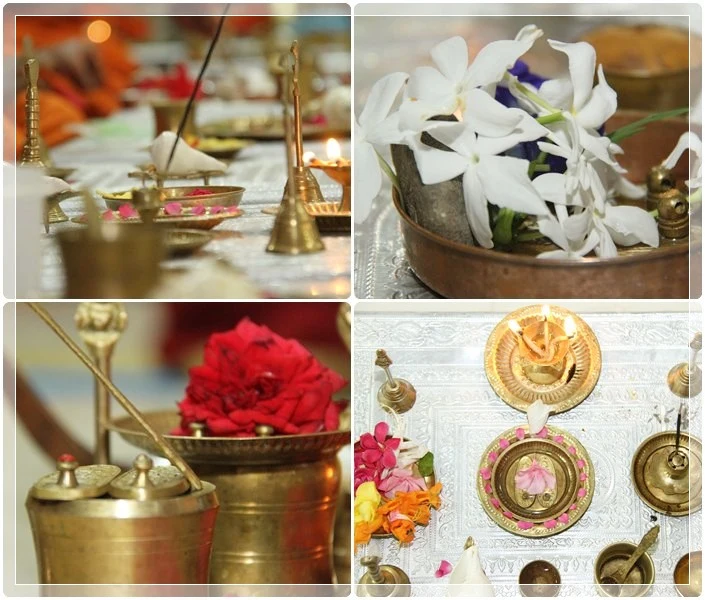
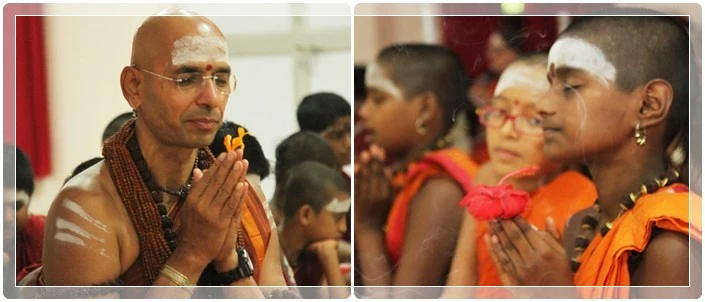
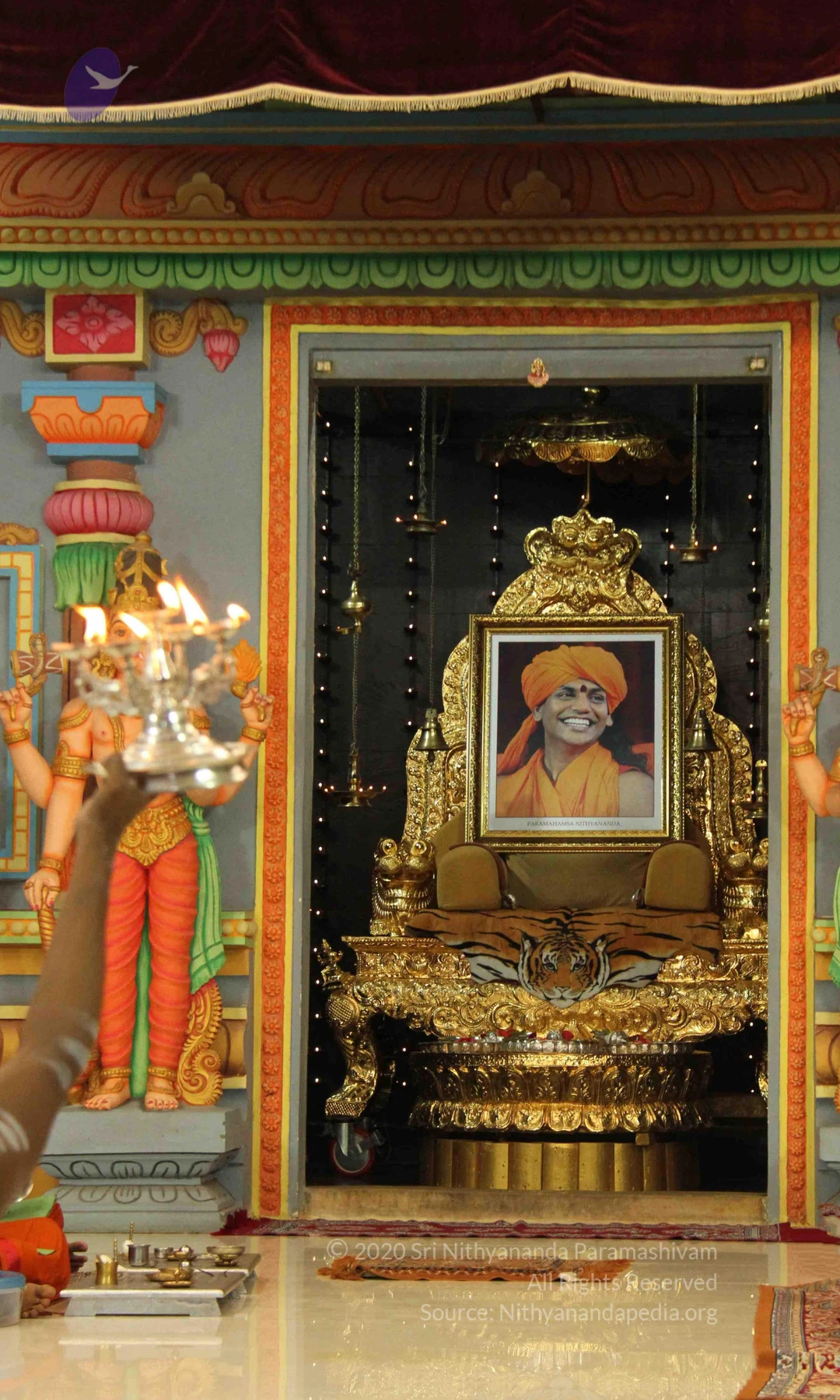
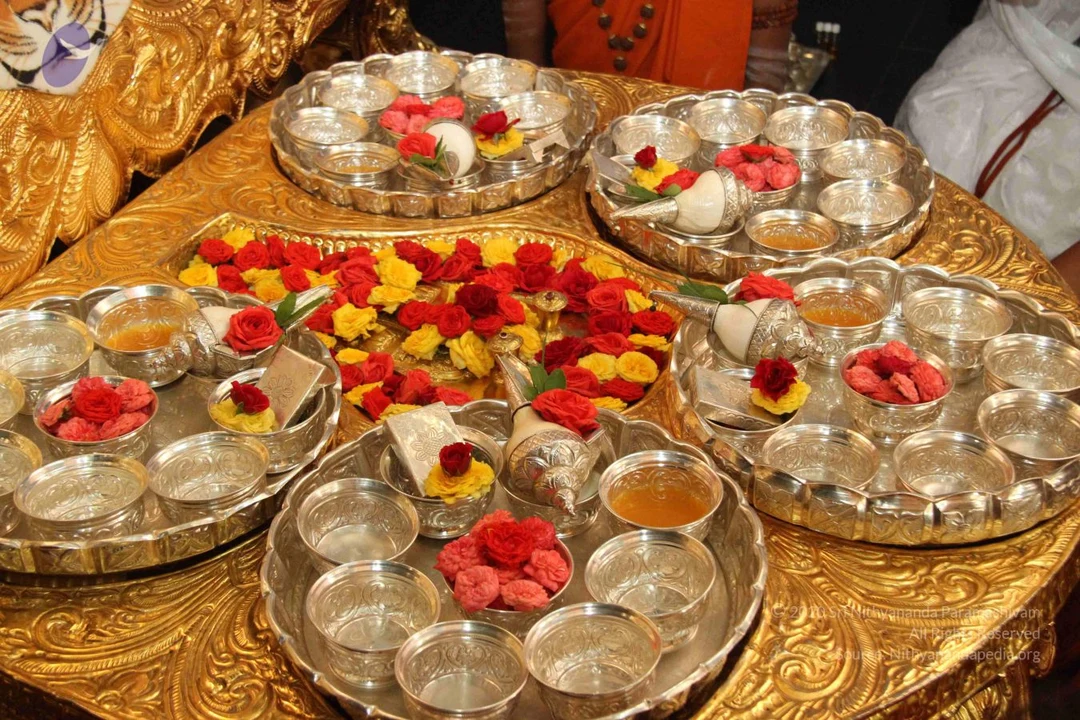
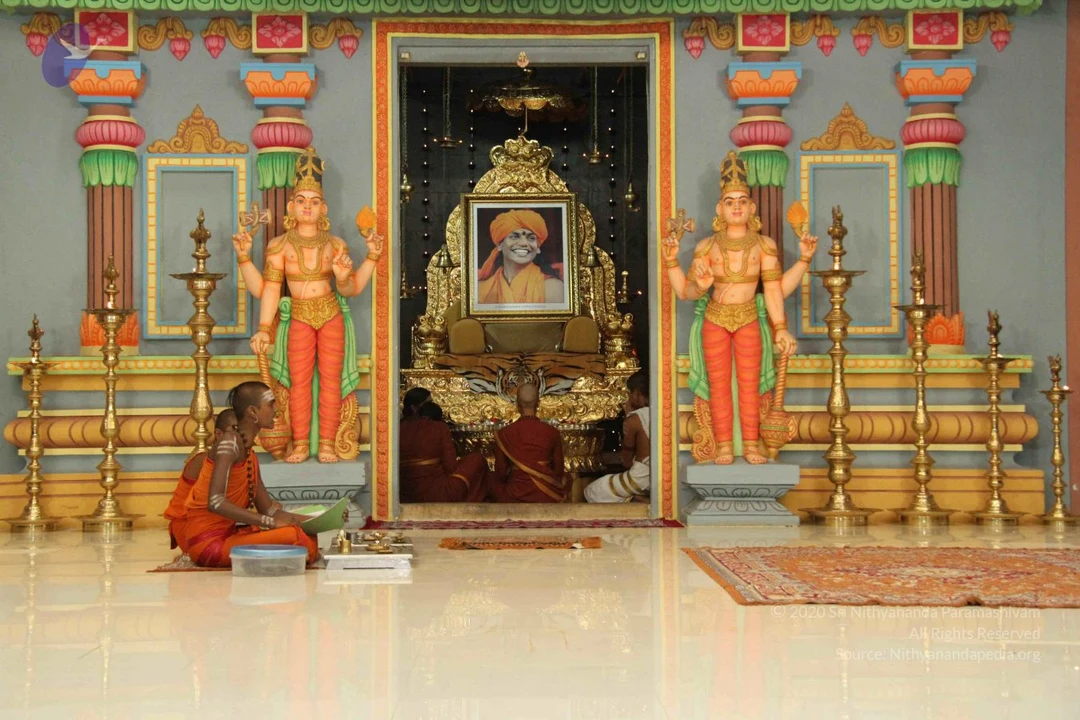
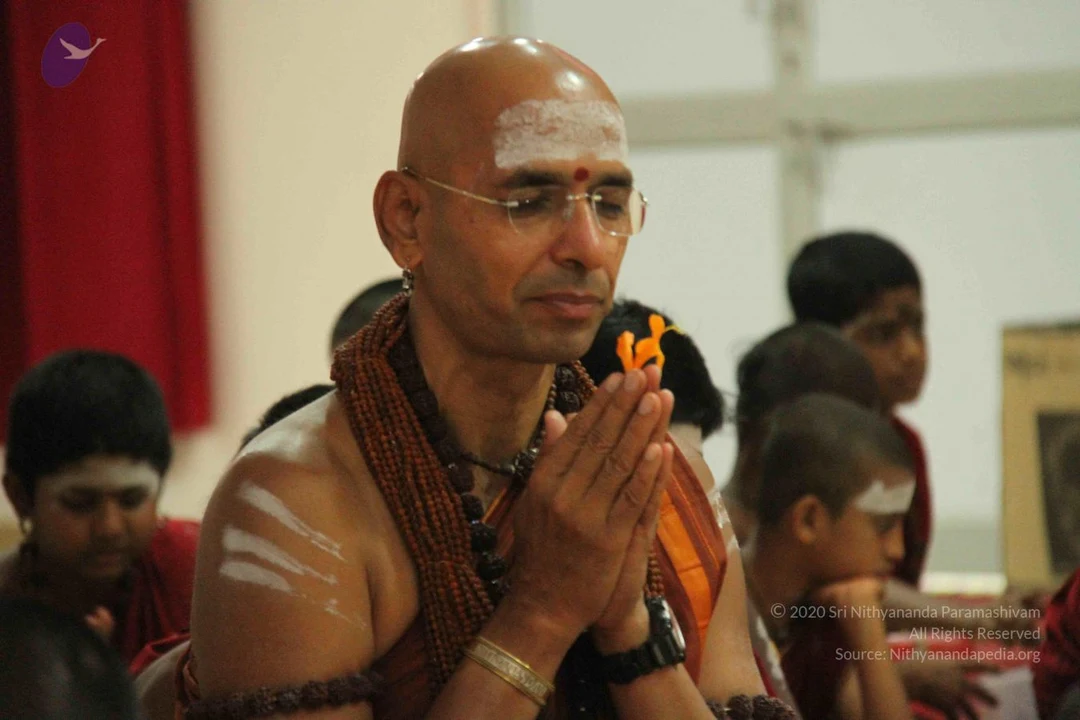
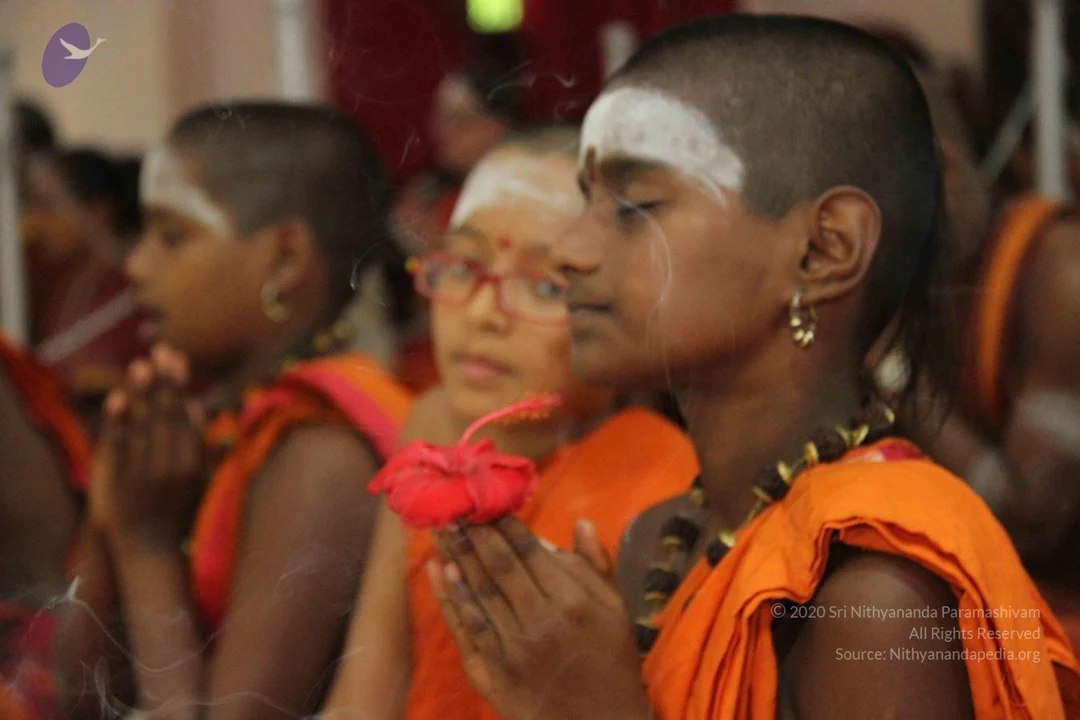
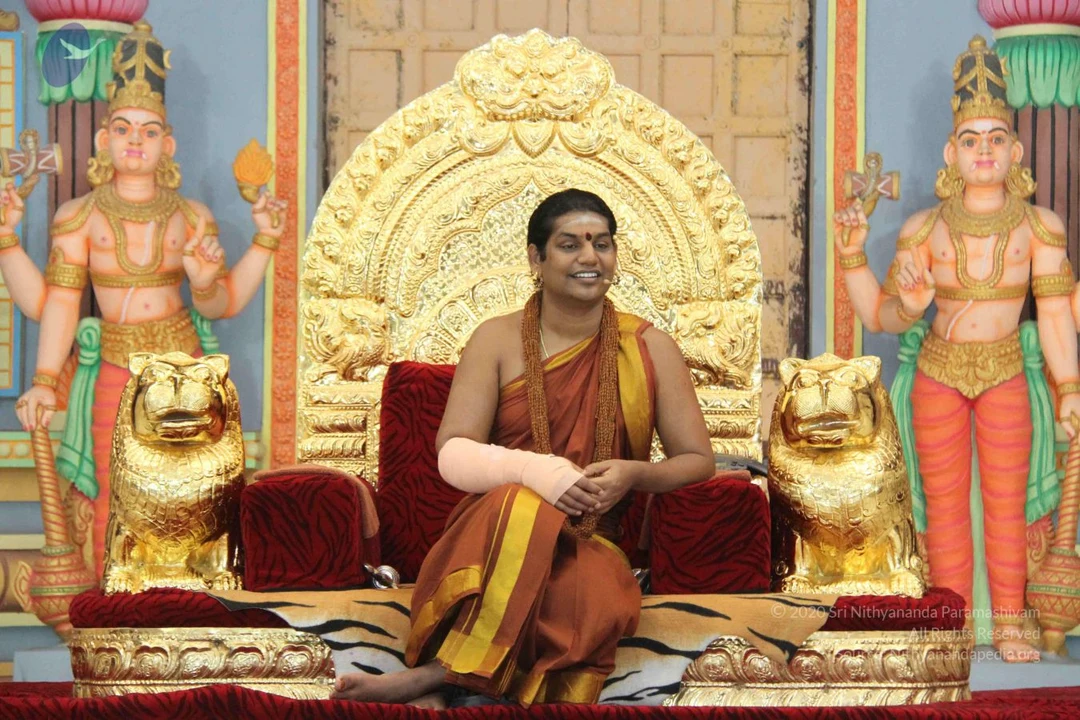
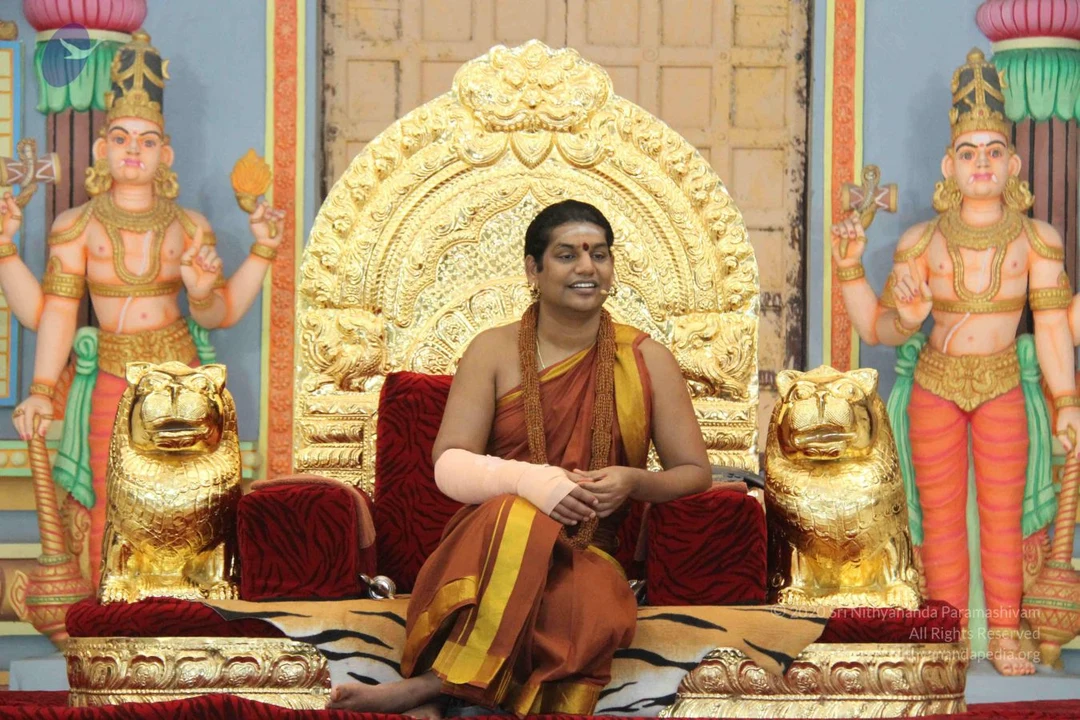
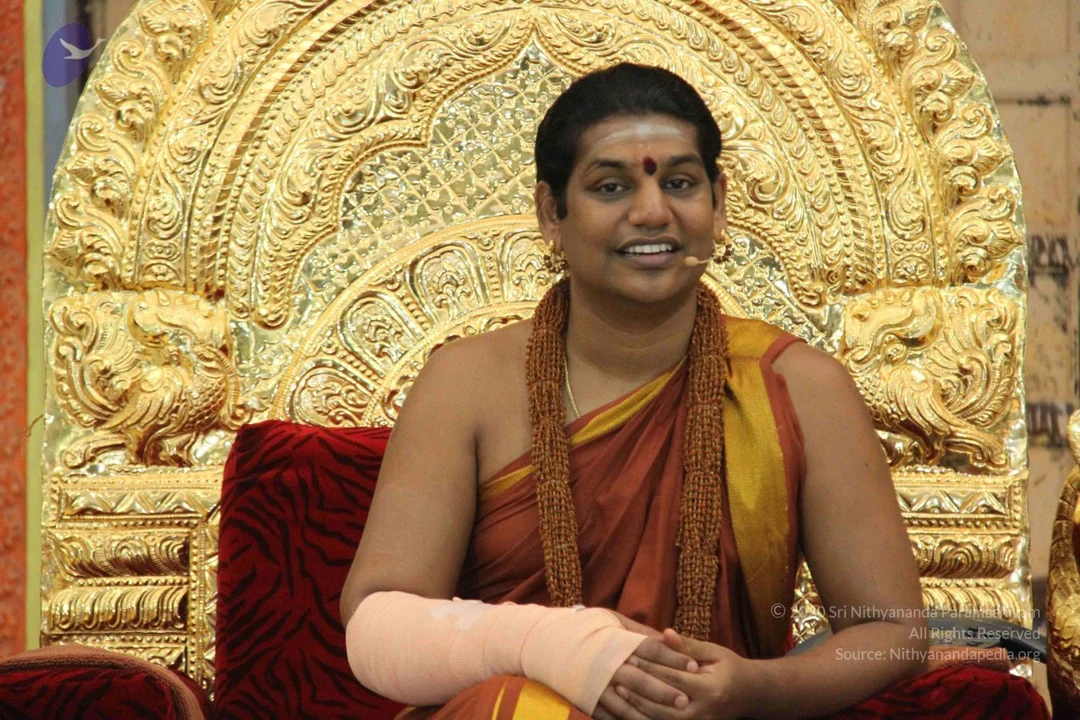
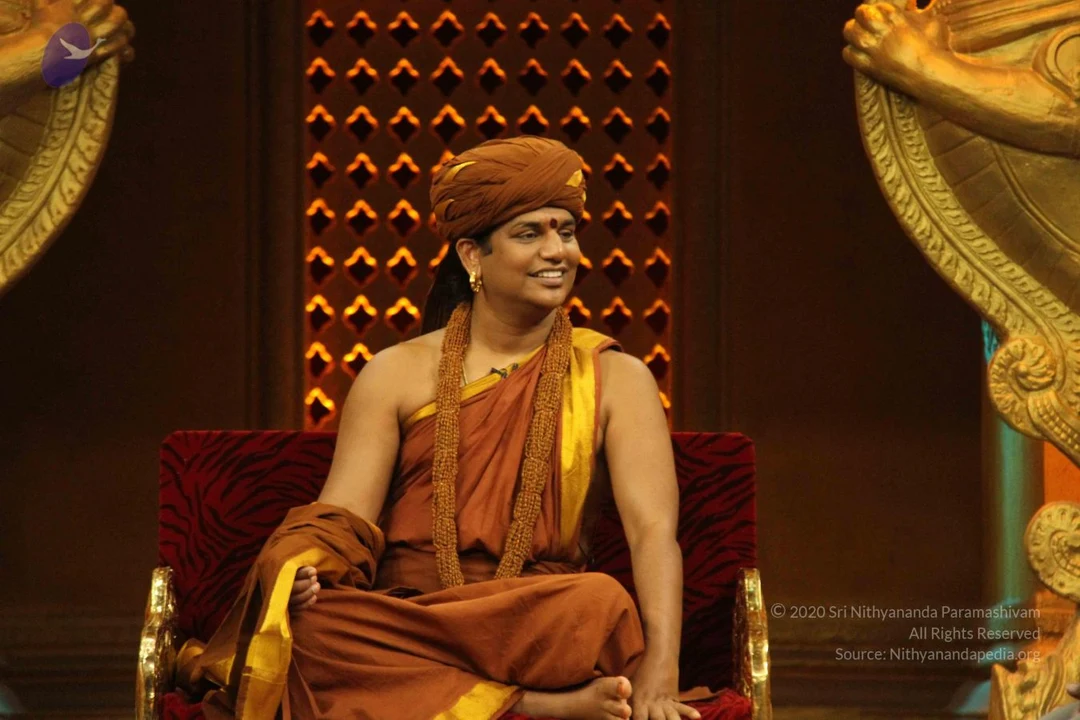
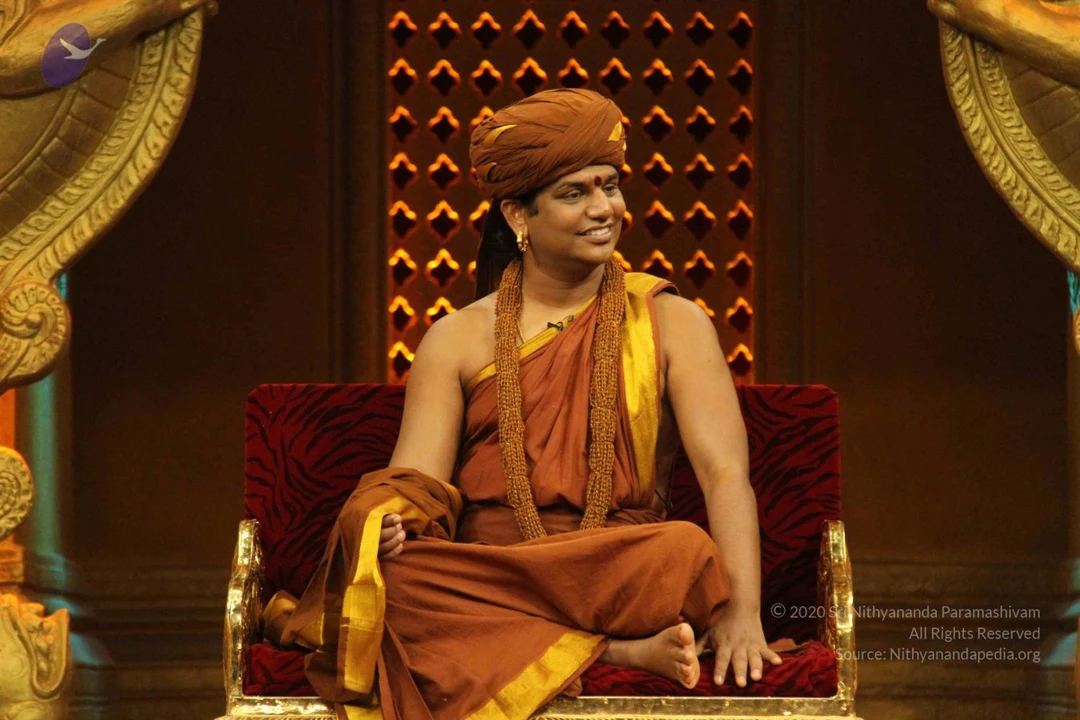
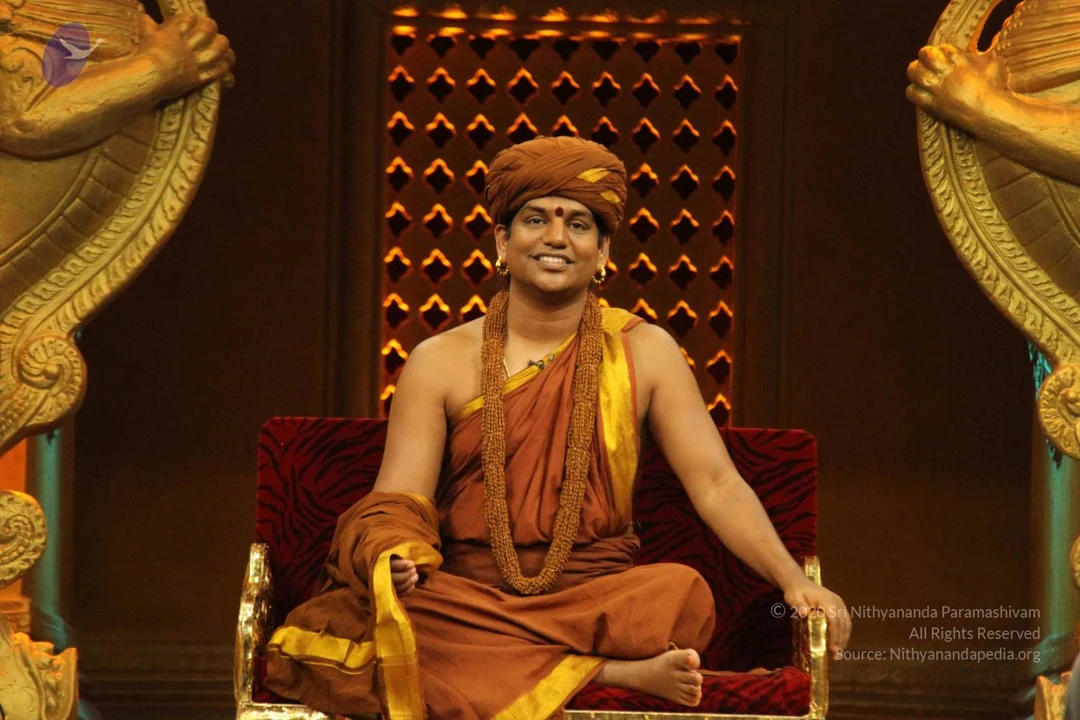
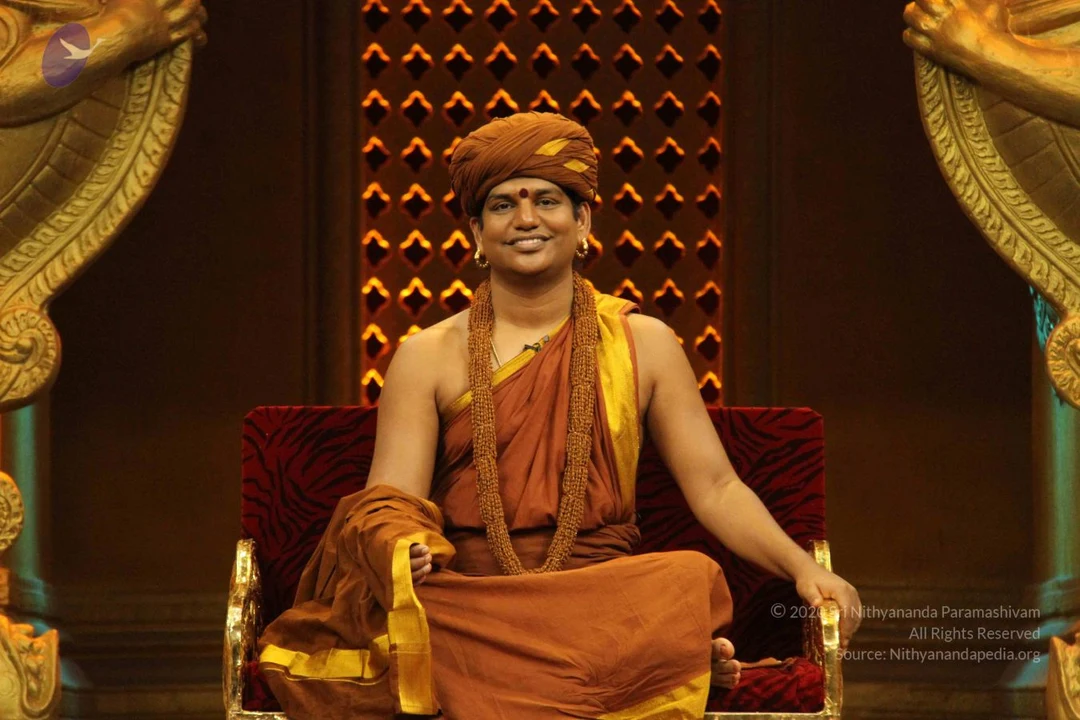
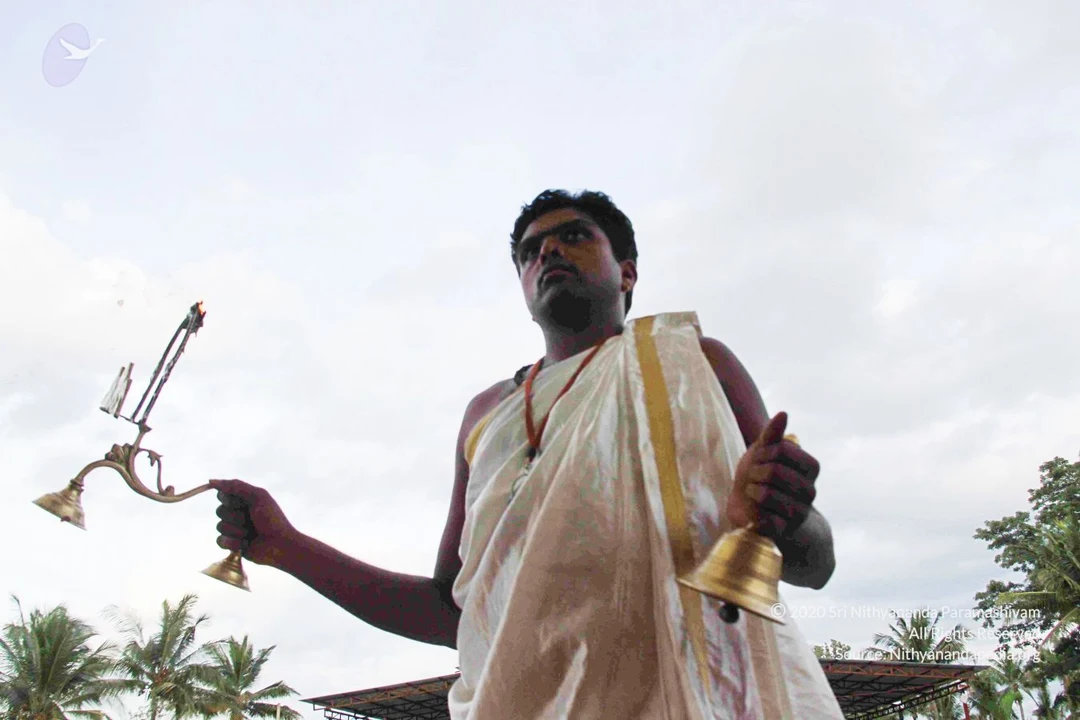
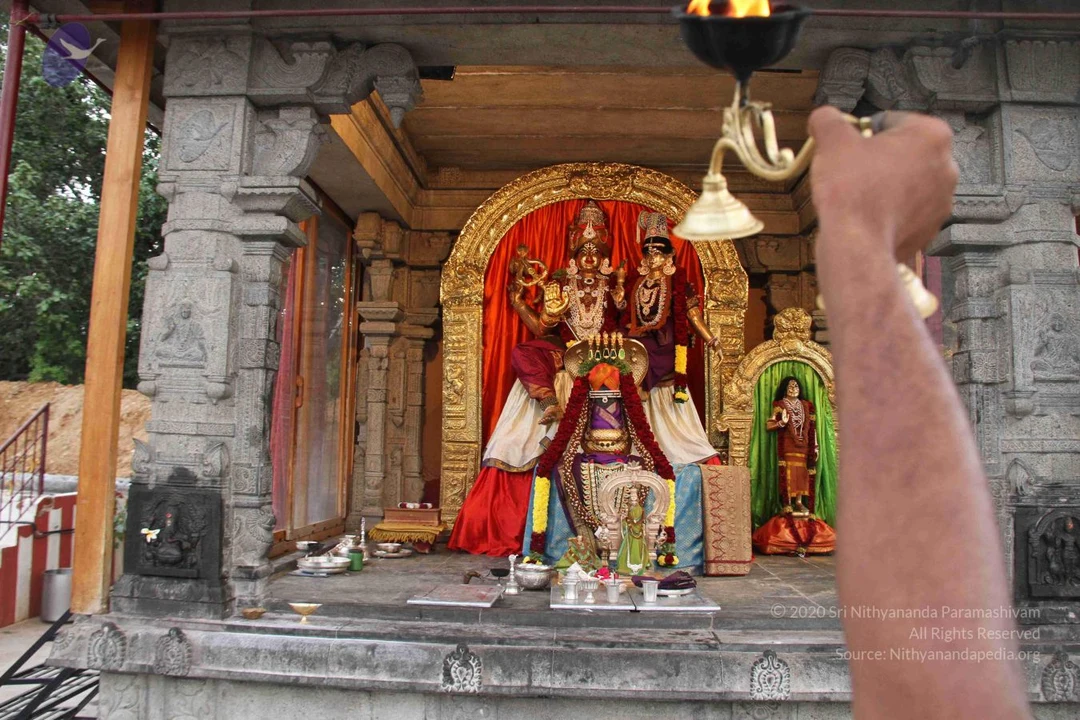
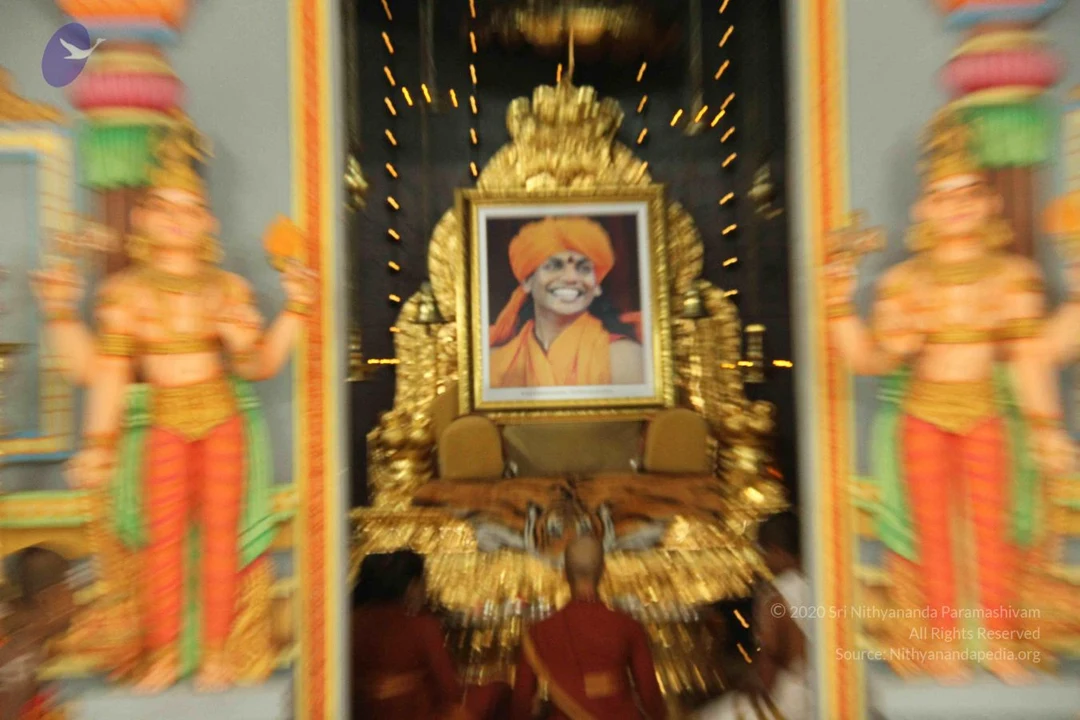
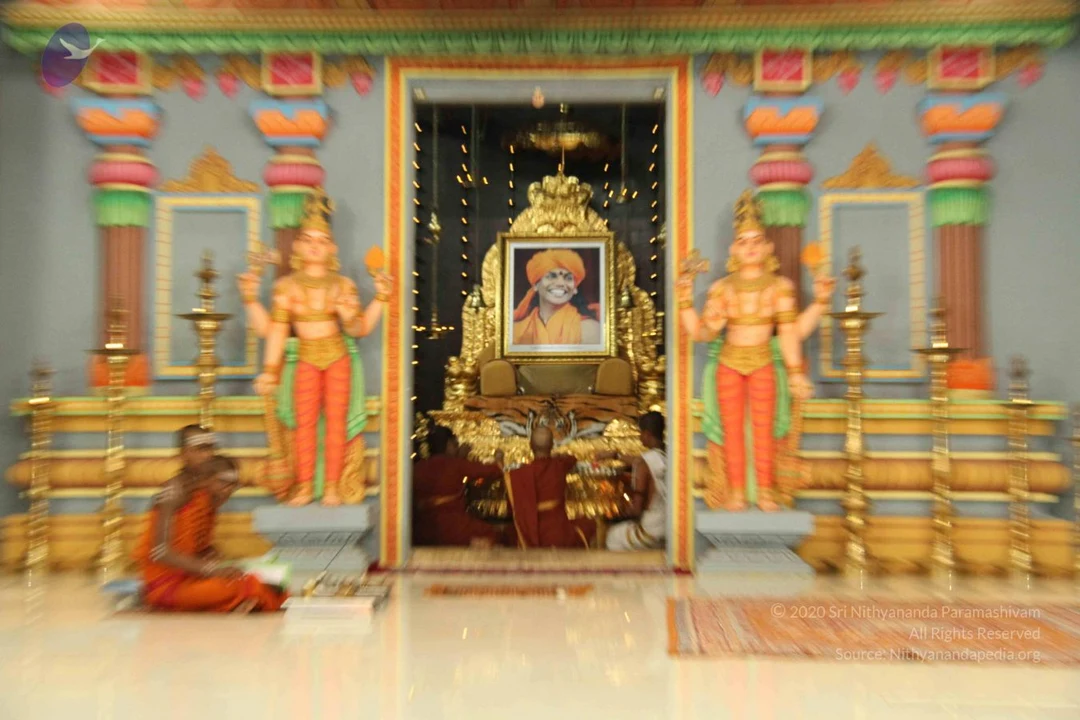
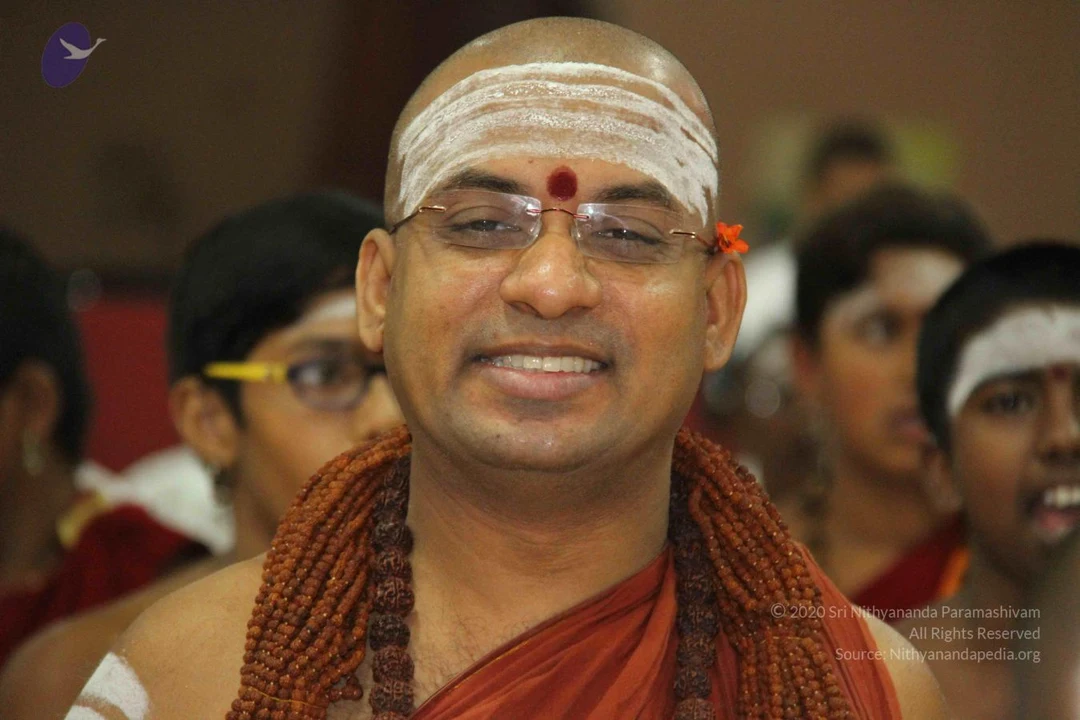
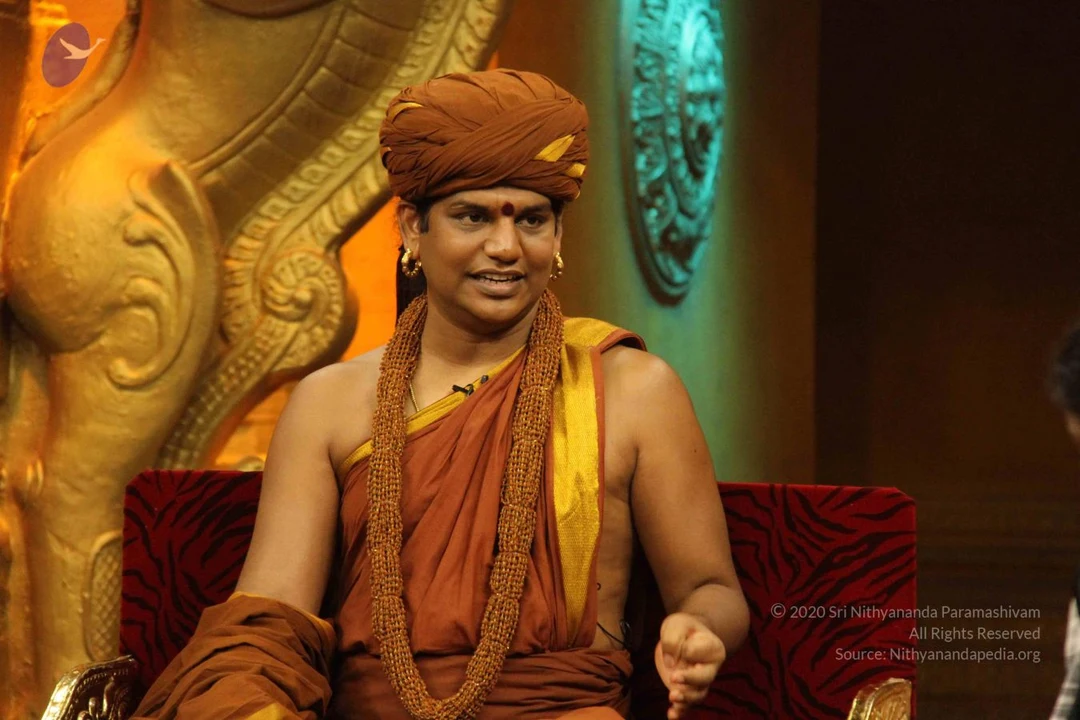
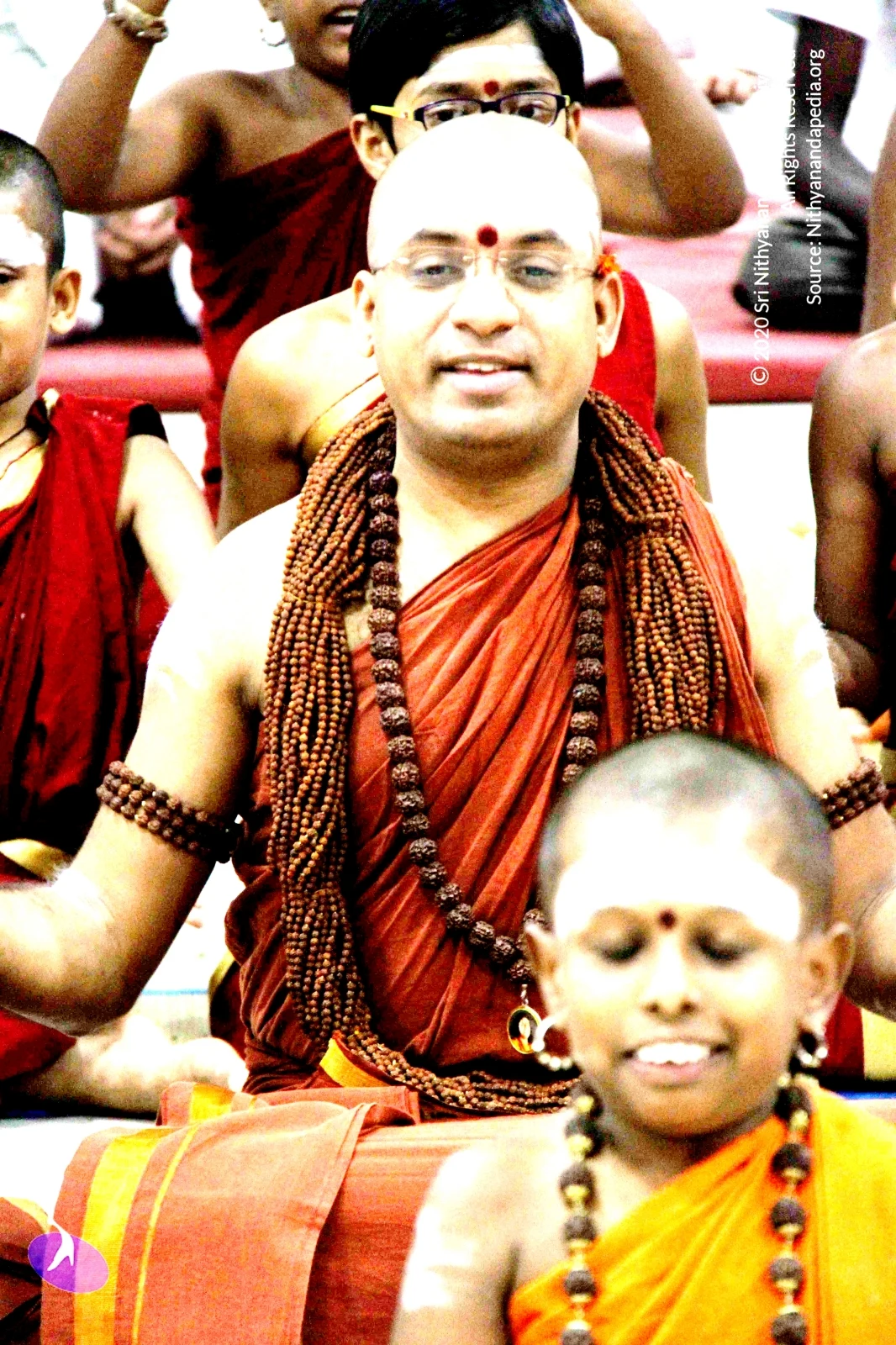
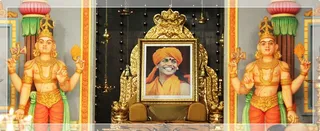
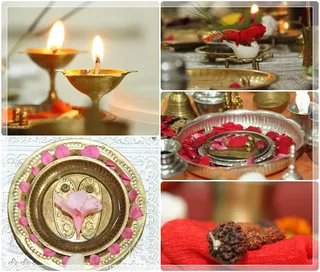
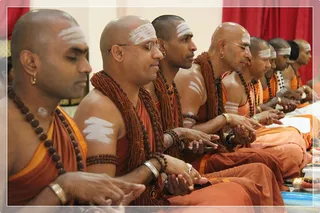
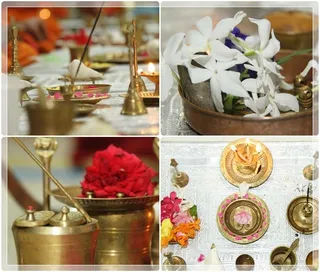
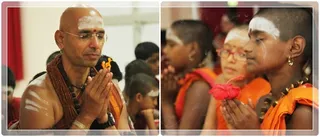
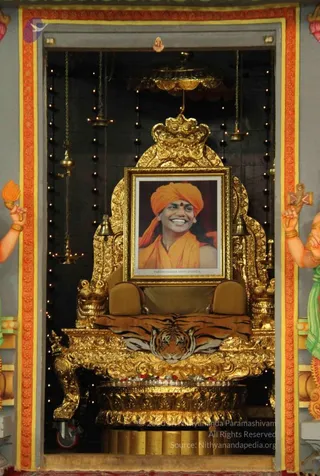
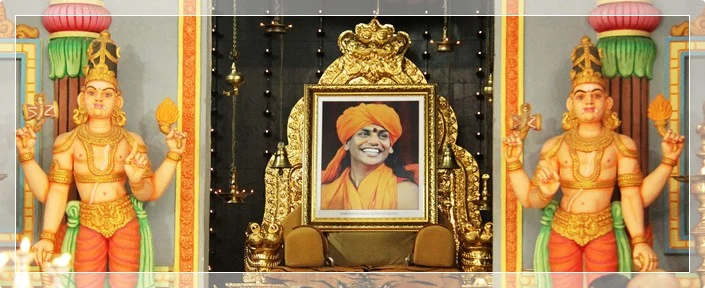
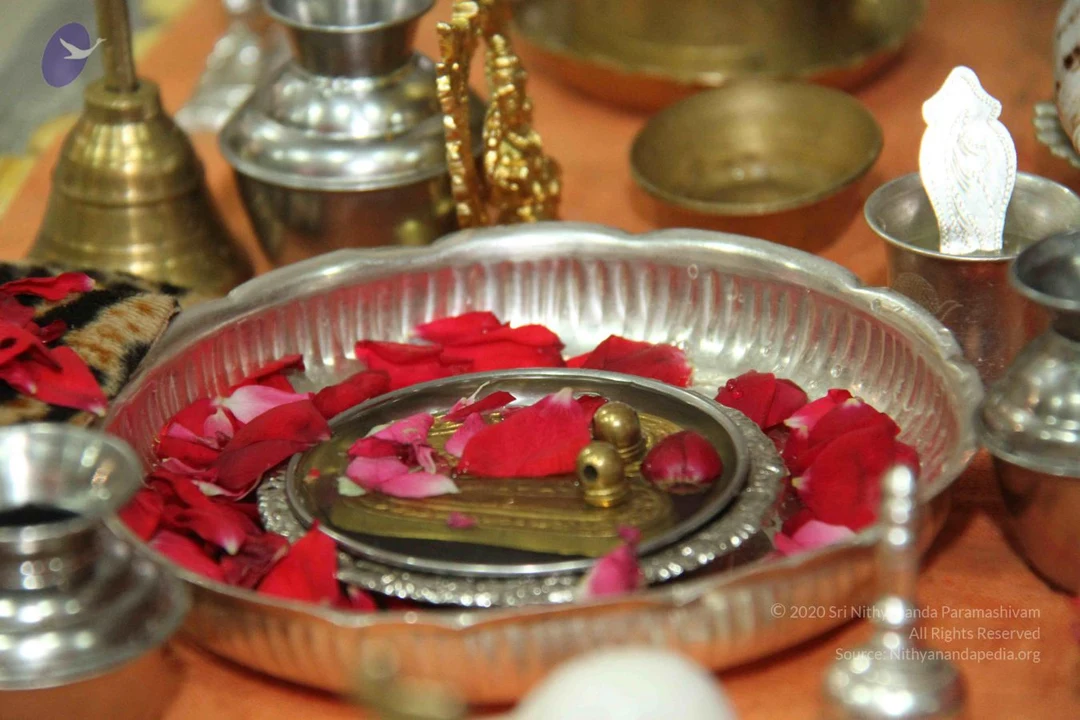
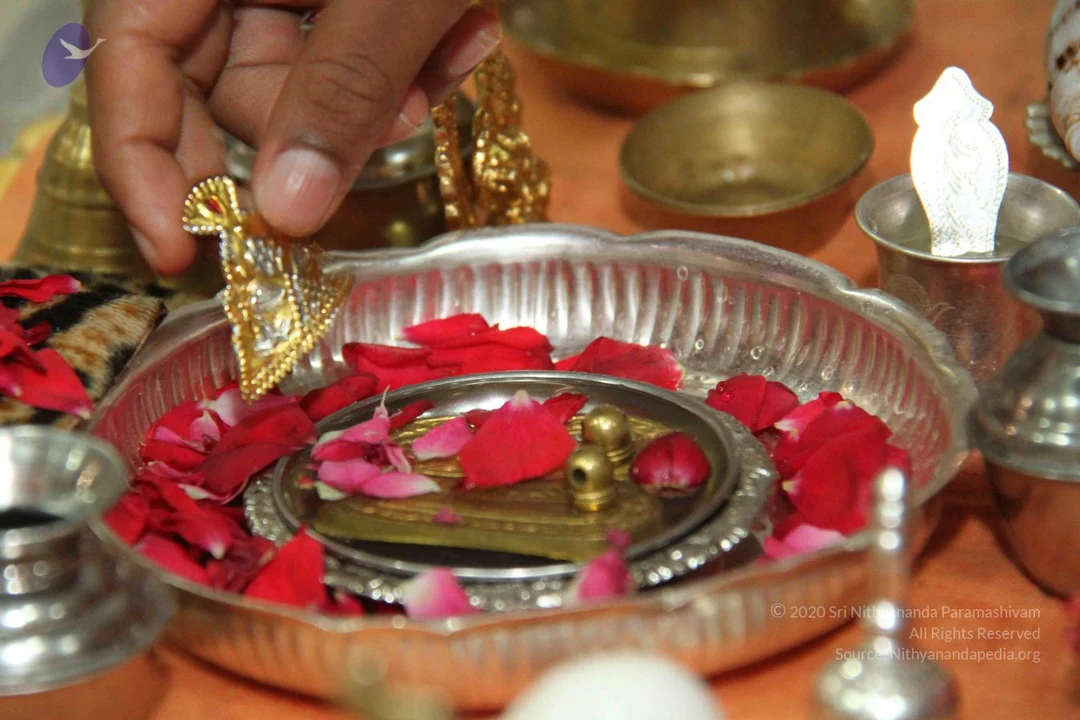
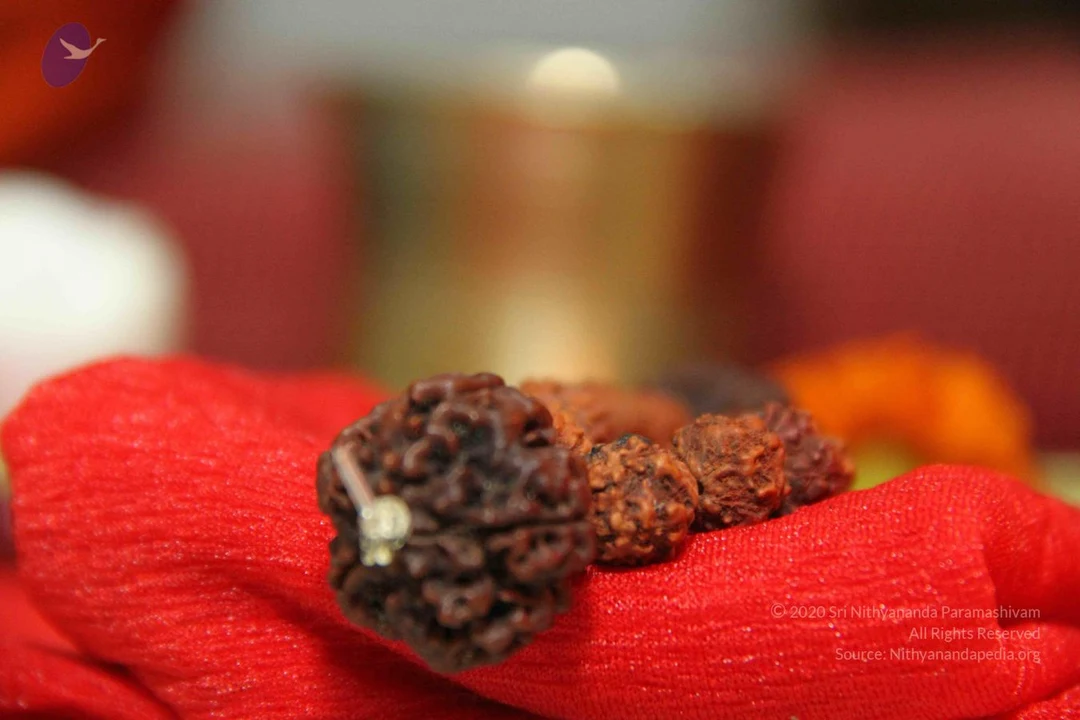
Shrine scene with a framed portrait on a golden ornate throne-like seat, flanked by two painted deity statues with four arms, gold crowns and gold jewellery, orange and red dhoti-style lower garments. The framed portrait shows a smiling figure in orange and saffron robes with a saffron head covering, labelled as a printed portrait rather than a physical person. Oil lamps hang and sit near the sides of the shrine, and small brass bells appear on the throne. No physical people are visible in the frame.A five-panel collage of puja items with no people visible. Top-left shows two brass oil lamps with lit wicks on a tray scattered with flower petals. Top-right shows a brass plate with a white and red cloth, a sprig of green grass and pink petals. Centre-right shows a silver tray filled with red and pink rose petals around a small brass object, beside a brass bell and a brass vessel. Bottom-left shows a round brass plate holding a pink flower and pink petals on a white lace-patterned cloth. Bottom-right shows a close-up of rudraksha beads resting on a red cloth. The scene depicts ritual worship items arranged for puja.A photograph of a row of seated men in saffron-orange robes and rudraksha malas, many with white vibhuti horizontal and striped markings on their foreheads and arms, eyes closed in meditation with hands resting on their laps. Several wear gold earrings, and some have silver bracelets. The people sit in a line in a hall with red drapery in the background. No individual is identified as a person from appearance; they are presented as devotees and sannyasis in a group seating.A four-panel collage of puja arrangements with no people visible. Top left: brass oil lamps and bells on a white-draped table, with small lamps and flower-filled bowls in front. Top right: white jasmine-type flowers heaped in a copper vessel beside brass items. Bottom left: a brass pot with a large red rose on top and a long brass ladle beside it. Bottom right: a silver-plated altar with a golden lamp, a brass bell, a pink-bordered circular plate with a small image, and orange and pink flowers. Scattered petals and brass lamps fill the scene.A two-panel collage of photographs. The left panel shows a bald man with white tilak and horizontal white markings across his bare chest, wearing wire-rimmed glasses, a saffron-orange cloth, and a rudraksha mala, with palms pressed together in namaste. Behind him, several young children are seated. The right panel shows a close group of young boys in orange robes and white forehead tilak, with hands folded in prayer; one boy wears red-framed glasses and holds a red flower, and another wears a gold-tone necklace. The collage is framed by a thin border on a light background.A smiling man with a shaved head, a red bindi and a tilak sits on an ornate gold throne with carved lion-head armrests and a red and black tiger-striped cushion. He wears an orange-red shawl over a bare chest with a gold-bordered dhoti, a long rudraksha mala and a gold chain, and a small head-mounted microphone. His right forearm is wrapped in a pale bandage and his hands rest together in his lap. The image shows one seated person.

PadukaPuja_Crowds_Individuals
68 photosSource gallery
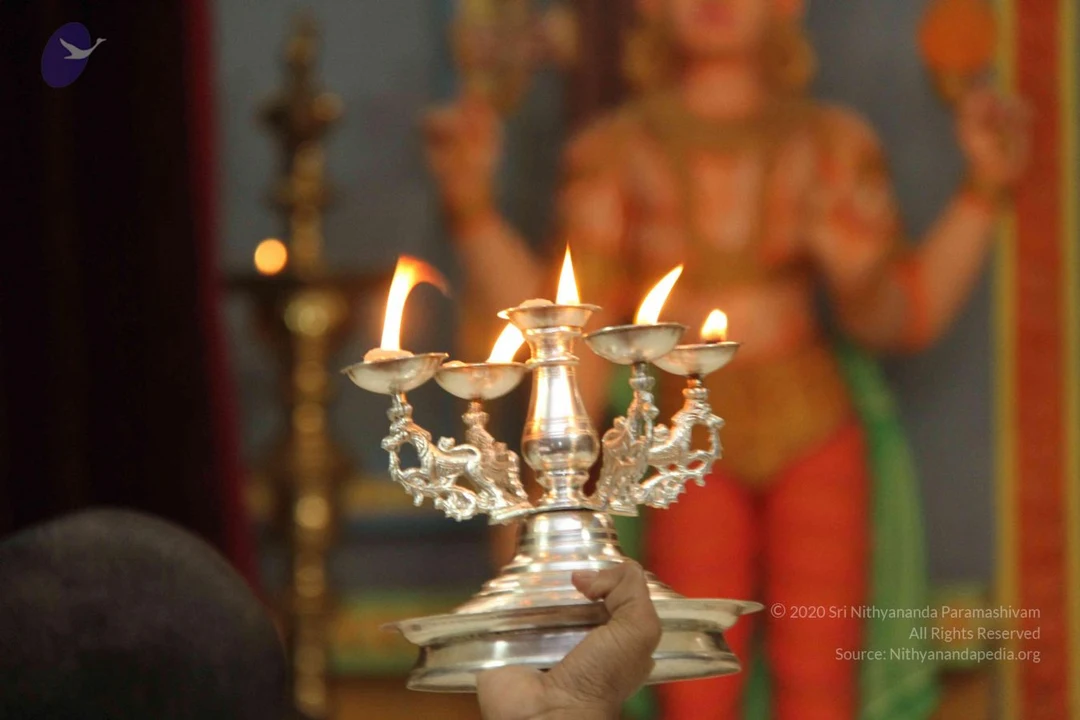
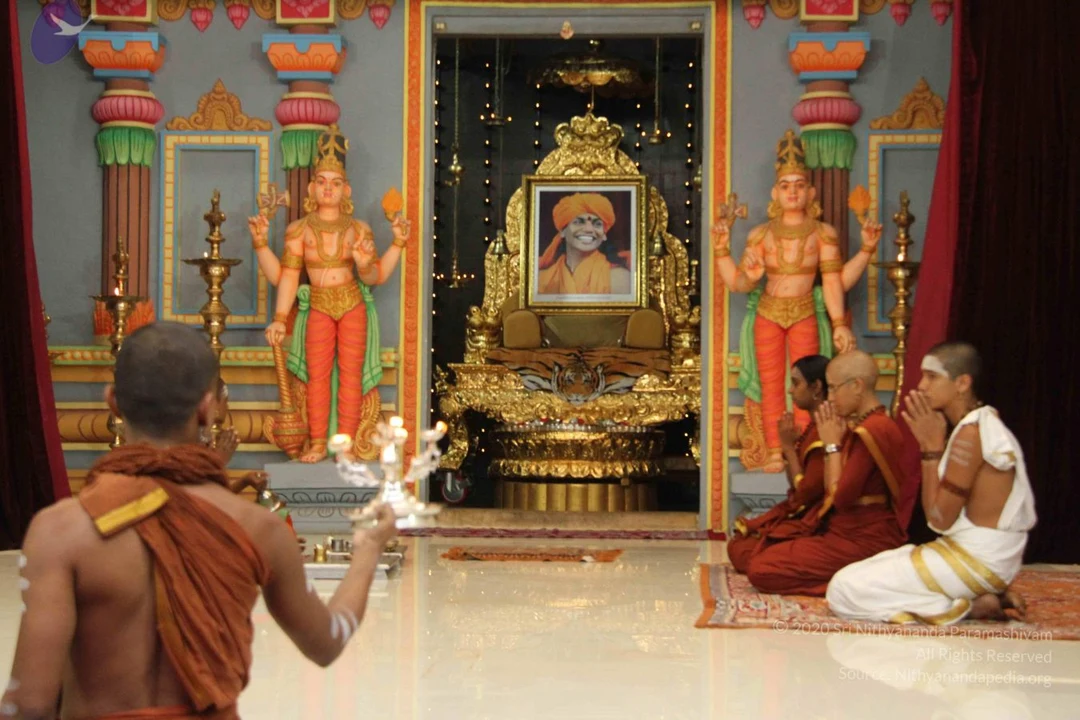
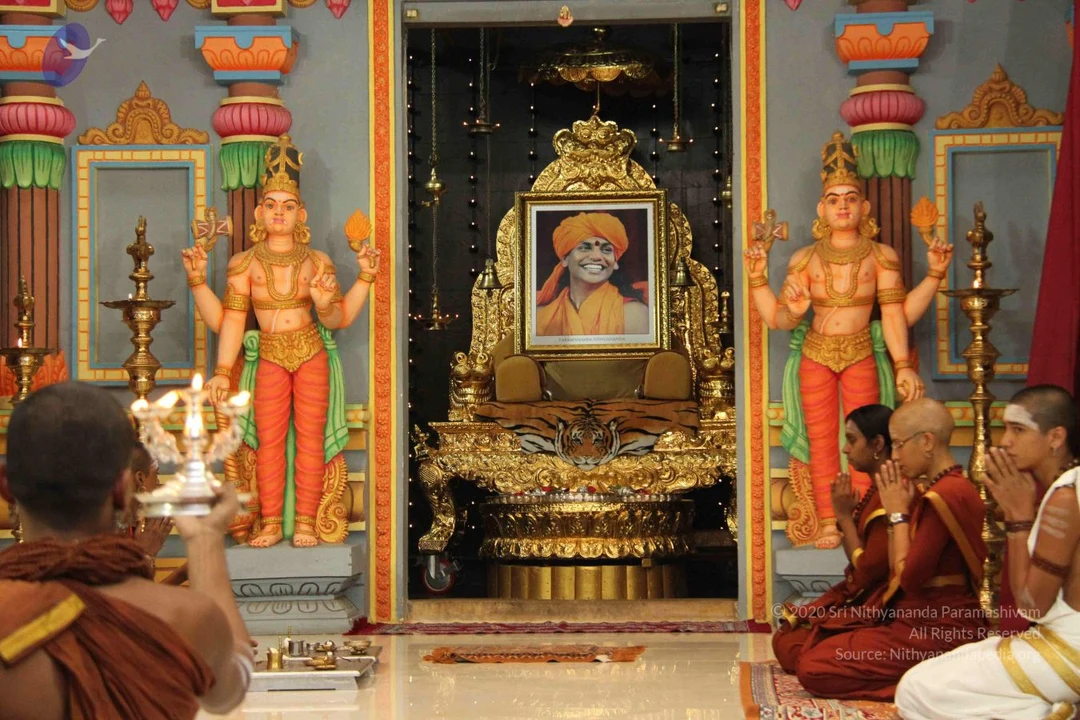
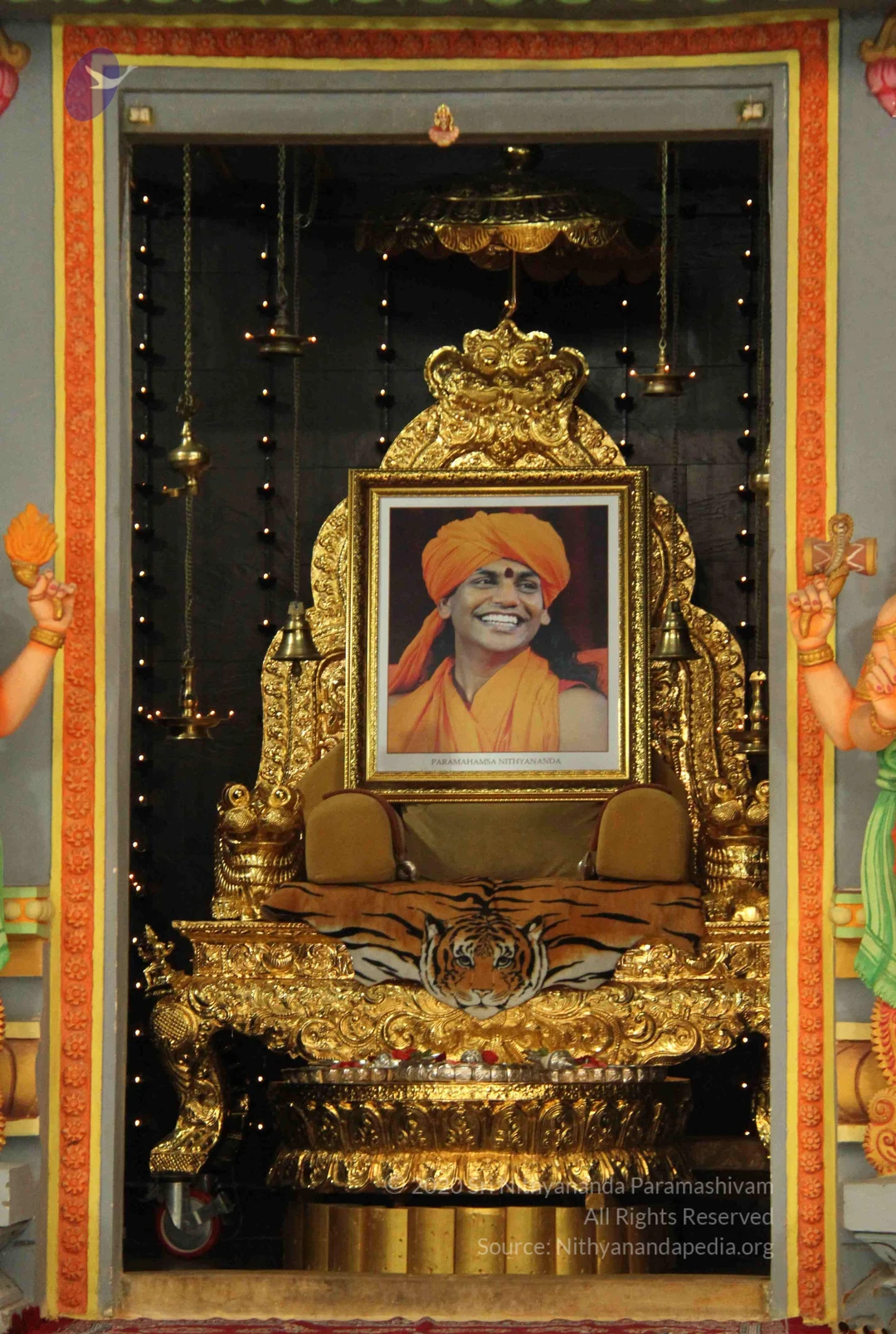
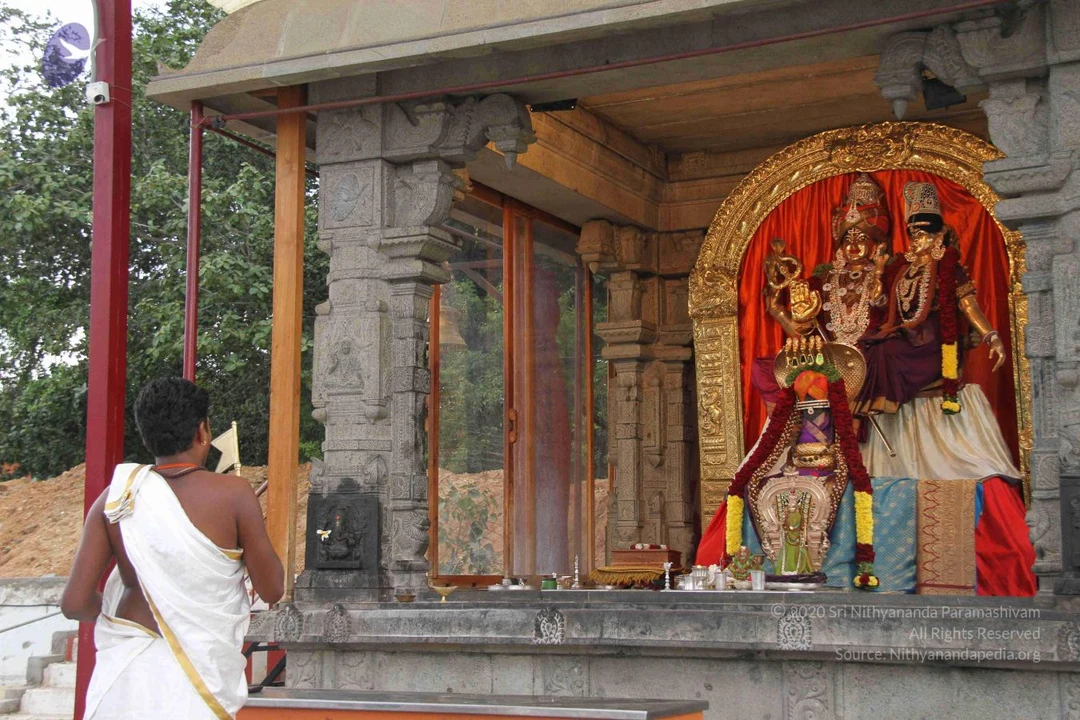
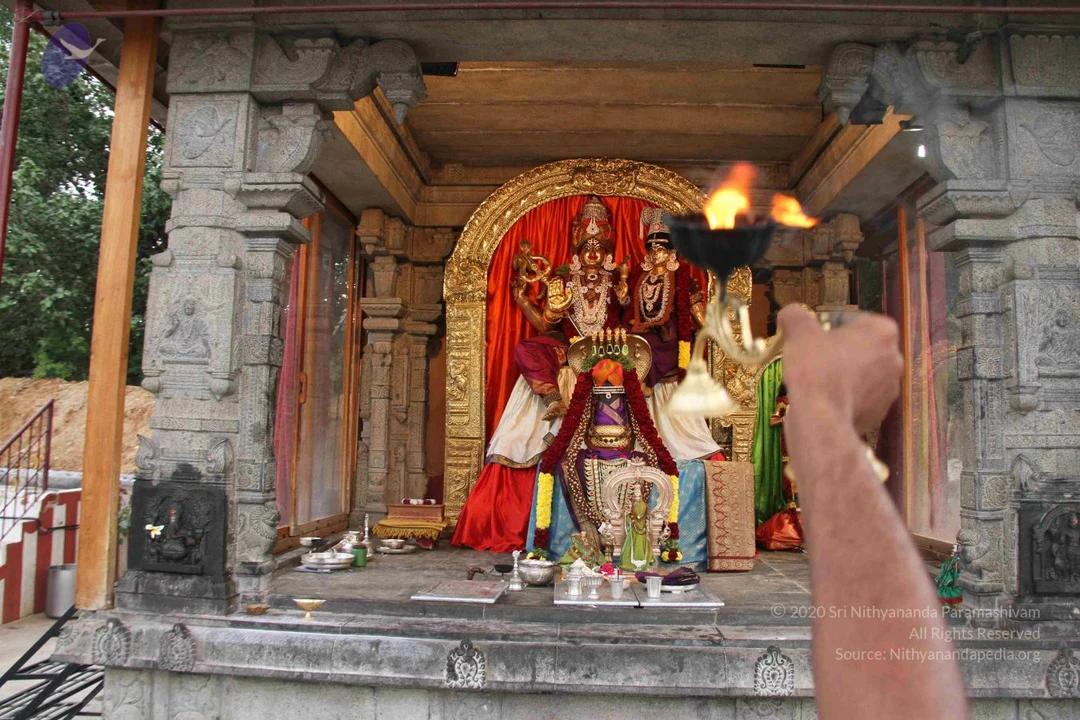
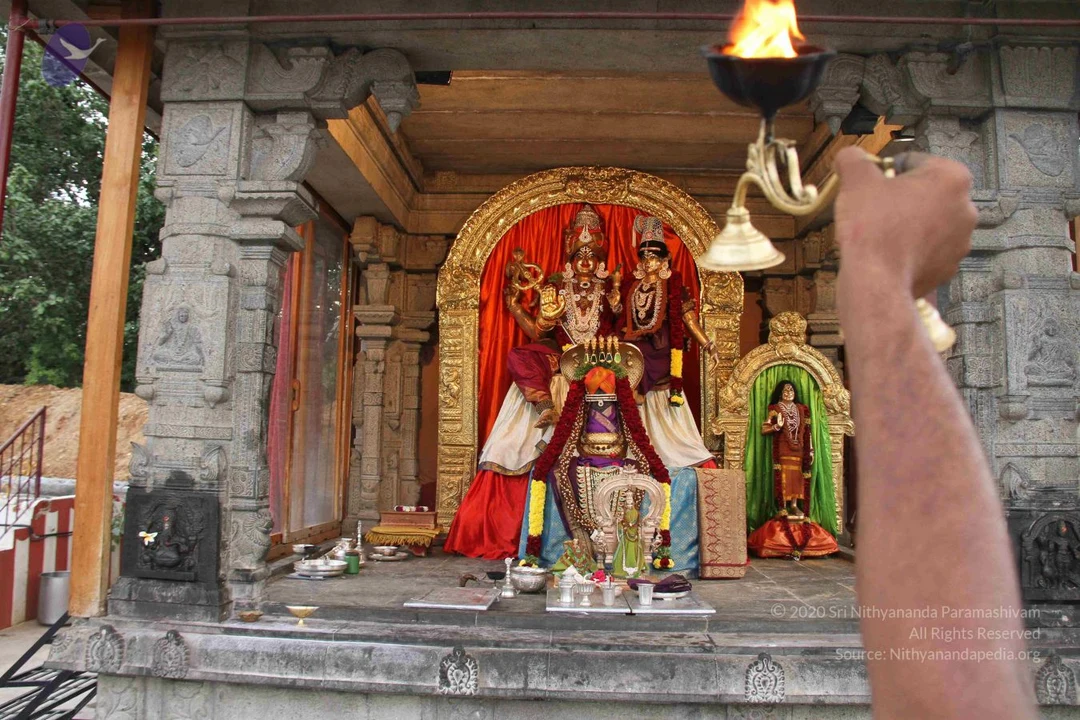
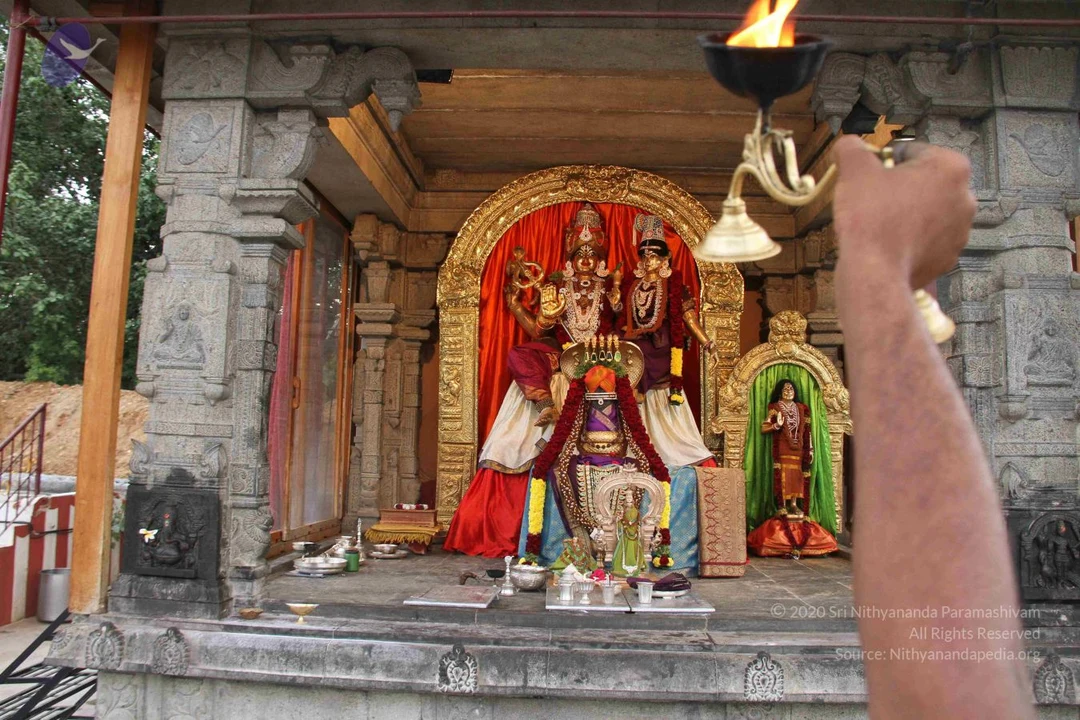
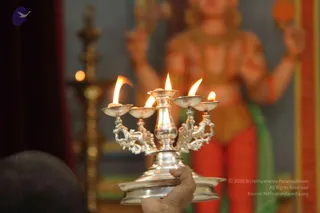
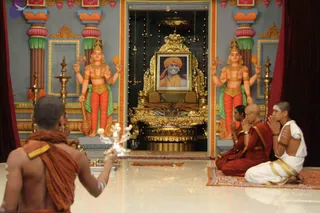
A blurred, out-of-focus photograph on a dark background showing a cluster of warm orange and pale white bokeh circles arranged in a vertical column. No people, faces or ritual objects are clearly identifiable.A close photograph of a silver multi-wick oil lamp (aarti lamp) with five lit flames, held up by a hand at the bottom edge in front of a blurred deity murti with raised arms and red-orange dhoti and green cloth. A blurred gold lamp stand and dark drapery frame the scene. The silver lamp has ornate animal-shaped supports on its sides. No people are clearly visible besides the partial hand and arm.Interior temple shrine with a golden throne-like seat (peetha) centred before a framed portrait of a smiling man in an orange turban and saffron robes, set between two large painted deity murtis with multiple arms, crowns and orange-red dhotis. A priest with a shaved head, bare back and orange cloth draped over his shoulder stands at the left foreground holding a lit oil lamp (aarti) toward the shrine. To the right, three devotees sit on a red-and-gold mat with palms pressed together in prayer: two in orange robes and one bare-chested man in a white dhoti with yellow border and sacred ash markings. Oil lamps stand on brass stands at the sides, and red curtains frame the scene. Padapuja or aarti at the shrine.Photograph of a temple sanctum shrine with a golden ornate throne bearing a framed portrait of a smiling figure in saffron and orange robes and a turban, draped with a tiger-skin cloth. Two painted dvarapala-style guardian figures with multiple arms, gold jewellery and orange dhoti stand on either side. In the foreground, a priest in orange robes holds a lit oil lamp aarti toward the shrine, while three seated devotees in orange and maroon robes sit with palms pressed together in namaskar; the figure at right wears a white dhoti with gold border and tilak markings.Photograph of an empty ornate gold-leaf throne (peetha) in a temple-style alcove with a tiger-skin cloth draped over the seat and a row of hanging oil lamps and bells on chains. A framed portrait labelled "PARAMAHAMSA NITHYANANDA" sits on the throne back, showing a smiling man with an orange turban, red bindi and saffron robe. No physical people are visible. Carved pillars with painted deity figures flank the doorway, and red and gold borders frame the shrine.A photograph of an ornate shrine inside a temple. Centre: a gilded throne with carved lion heads, draped with a tiger-skin cloth, under a golden canopy with hanging brass lamps. Framed on the throne is a large portrait of a smiling man with an orange turban and orange shawl, with a red bindi; the portrait is labelled PARAMAHAMSA NITHYANANDA. Left: a painted multi-armed deity figure in orange dhoti with green sash. In the foreground a person's arm holds a silver multi-wick oil lamp, lit with flames. A brass puja tray sits on the marble floor. Painted temple columns and red and green borders frame the scene.

SwastiMantra_Amaayantu_Chanting

12 photosSource gallery
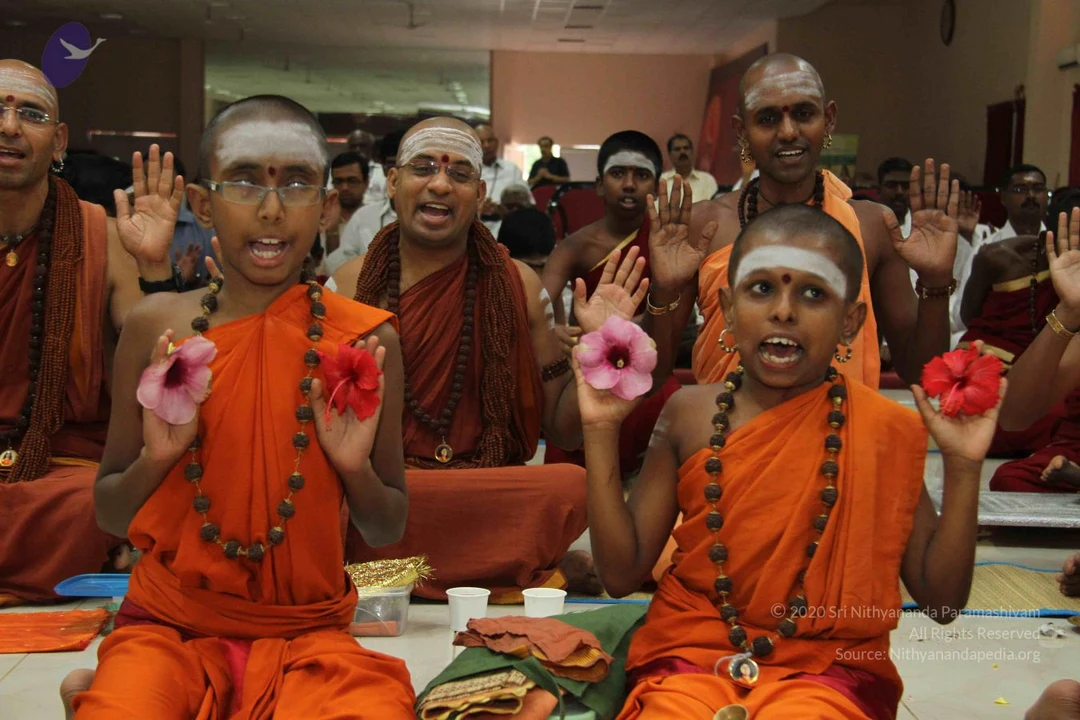
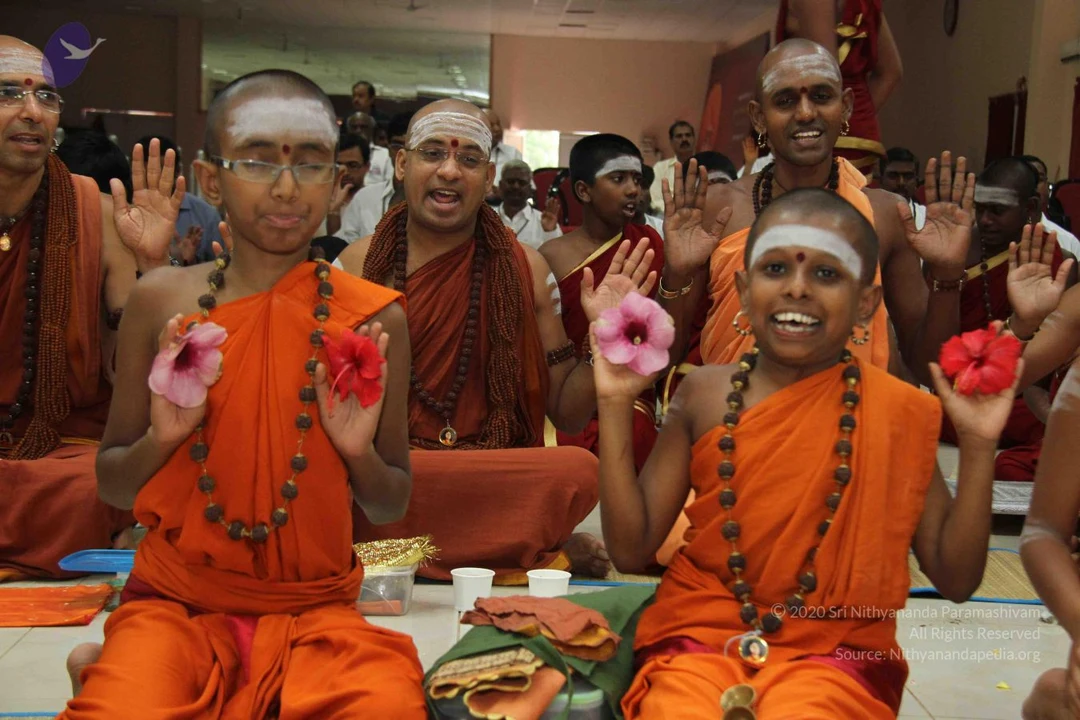
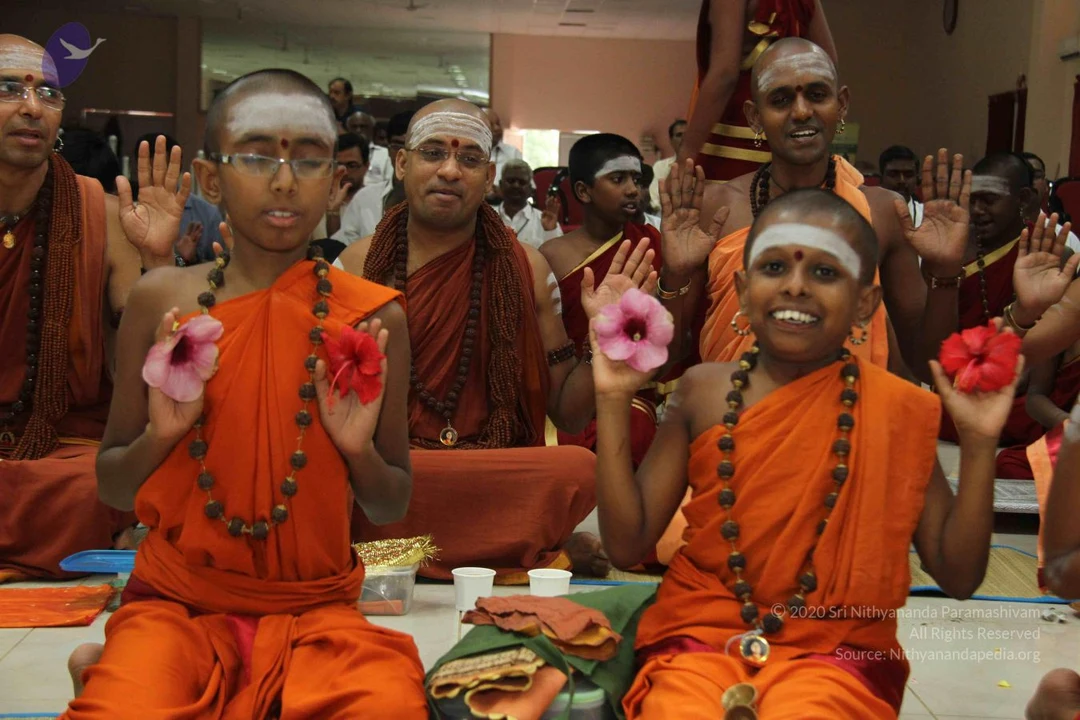
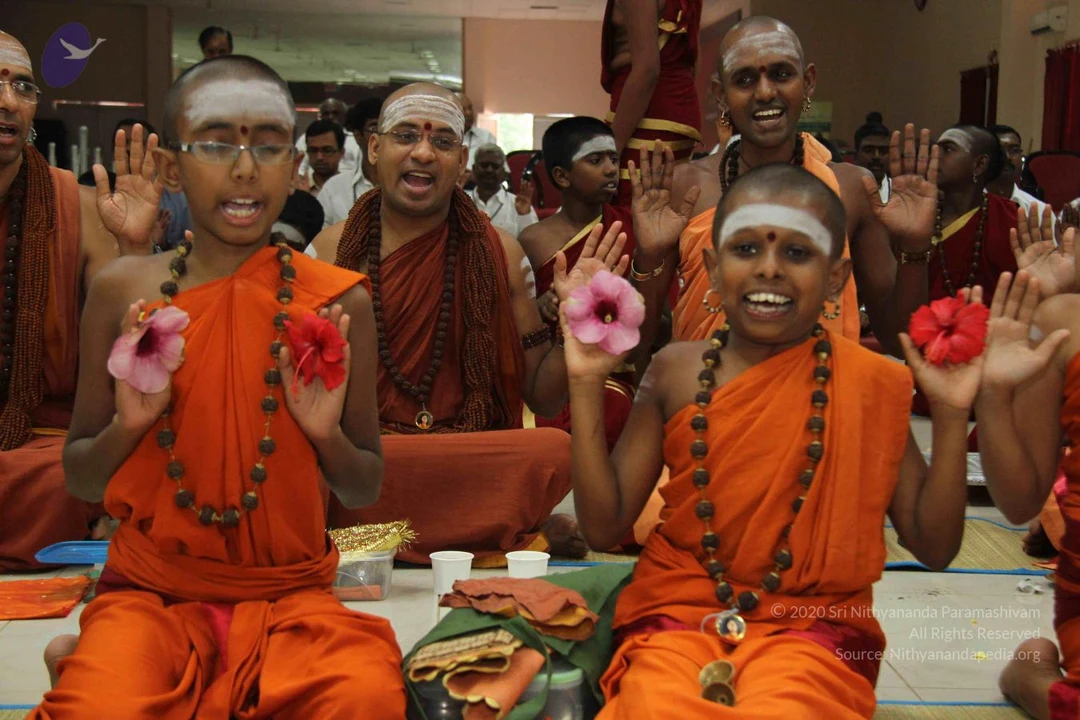
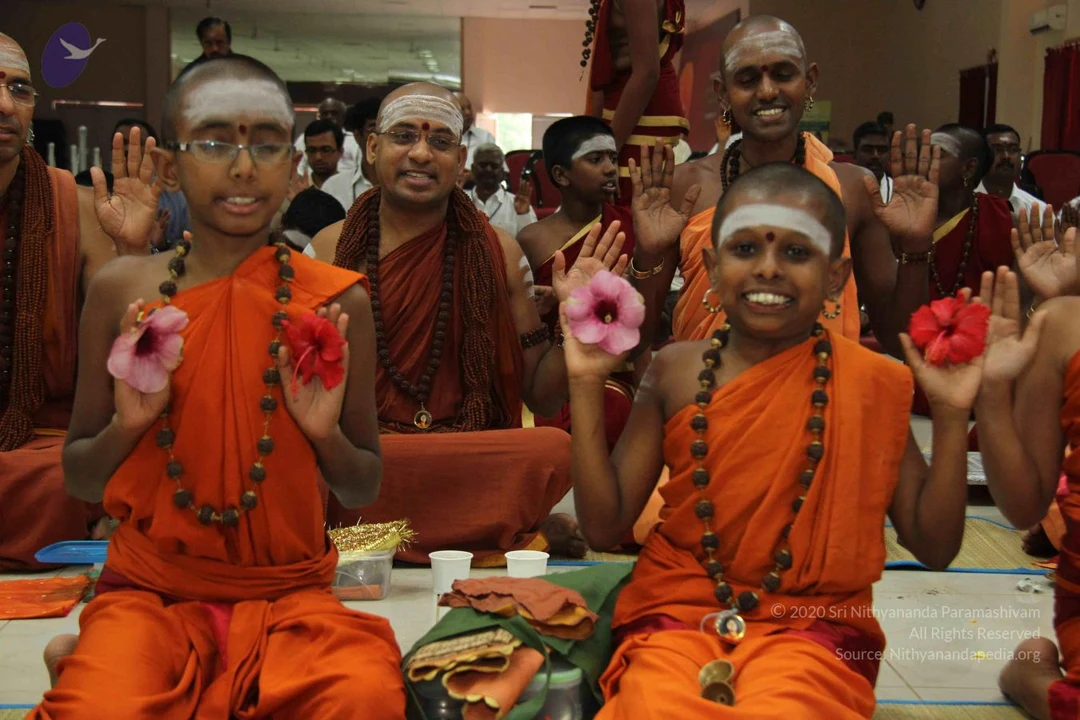
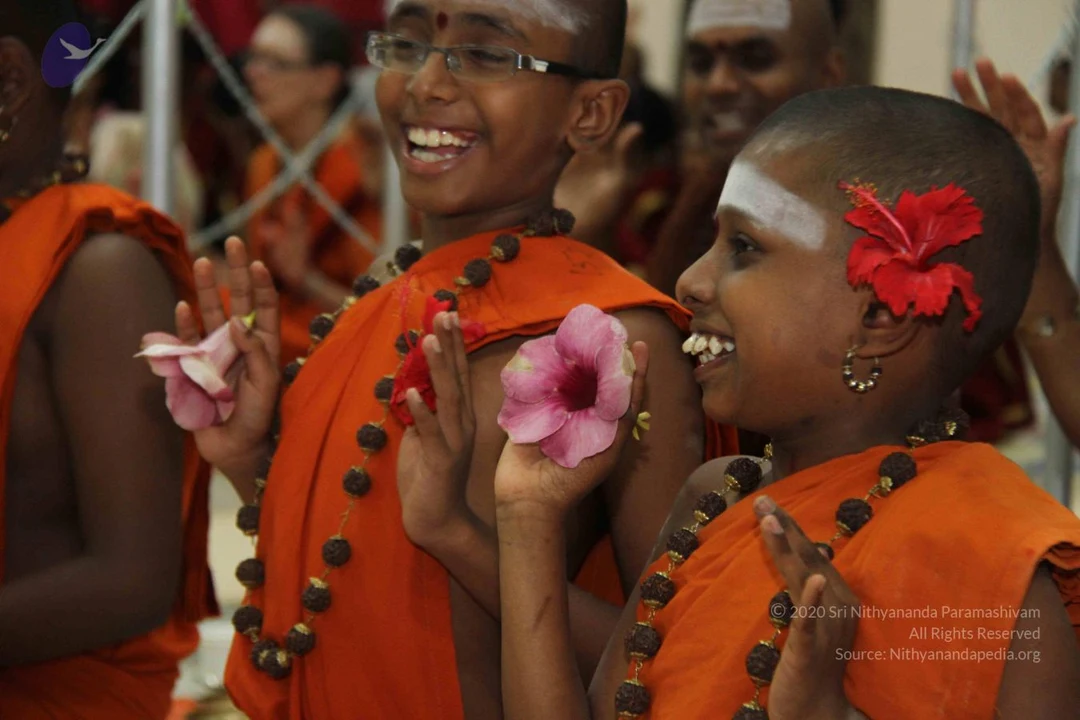
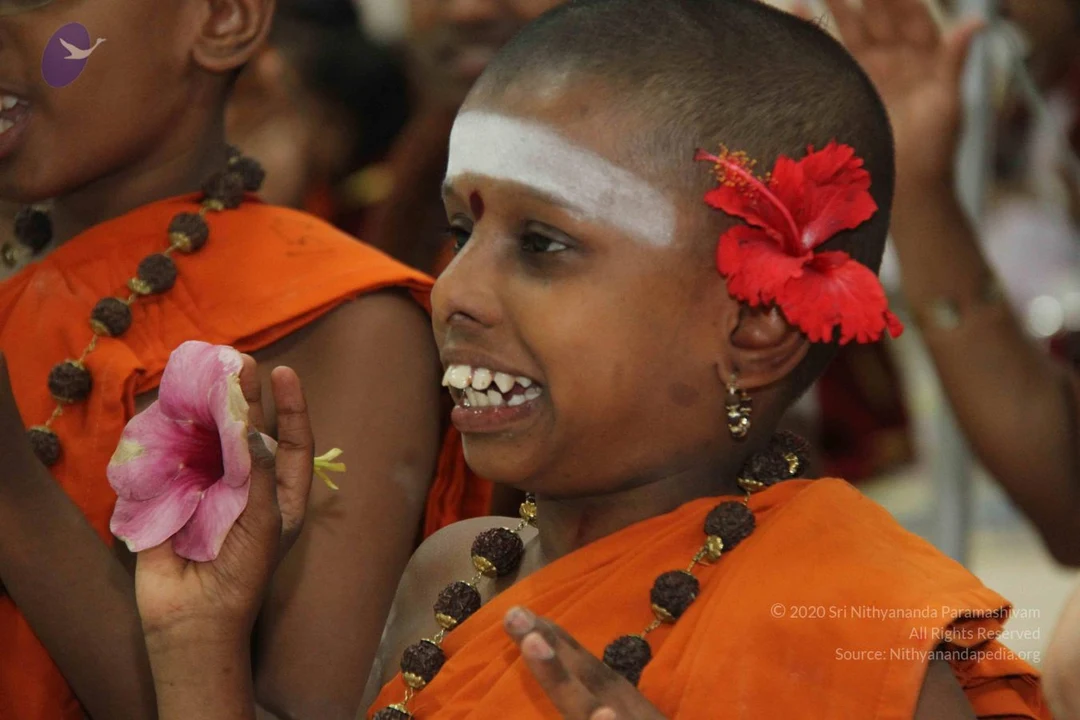
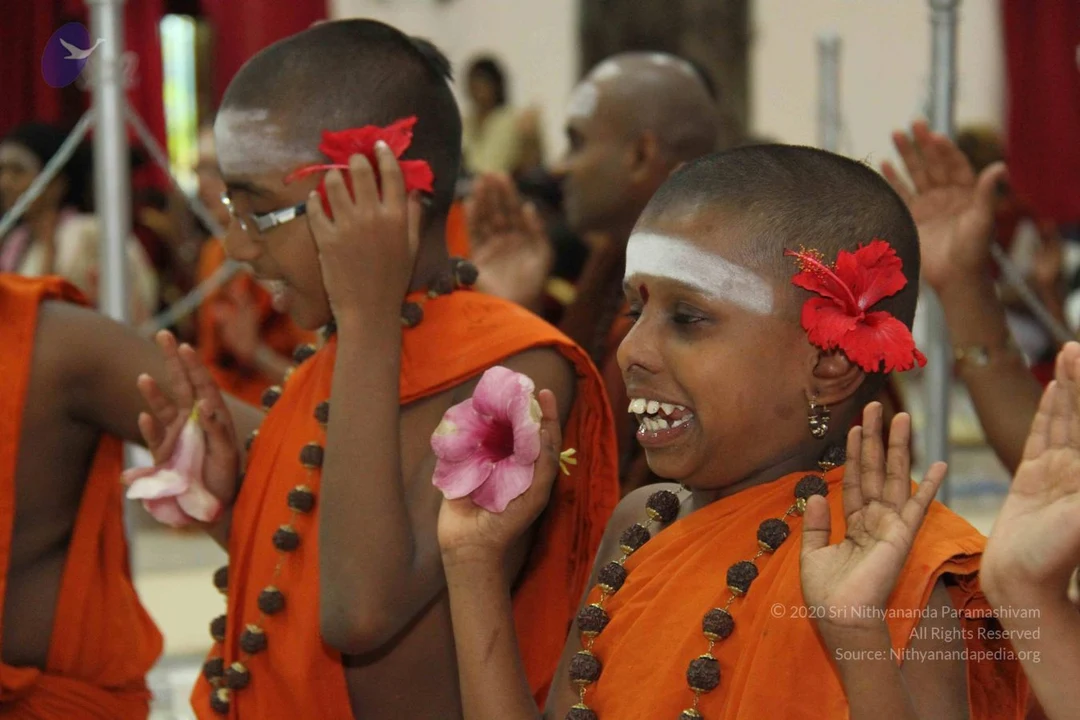
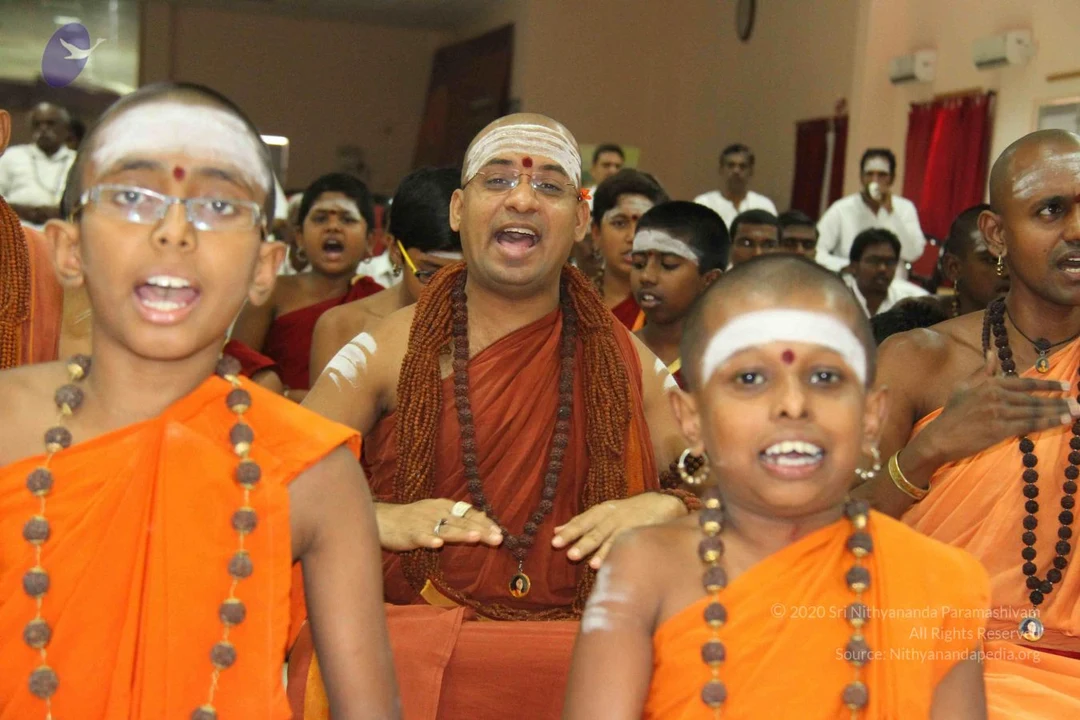
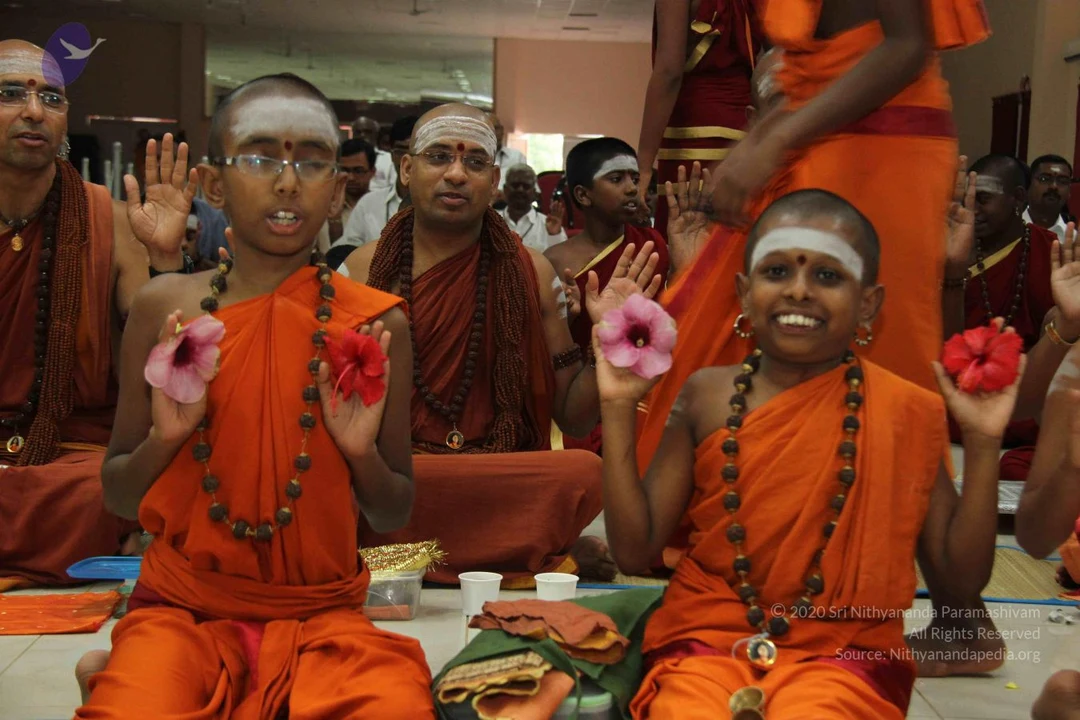
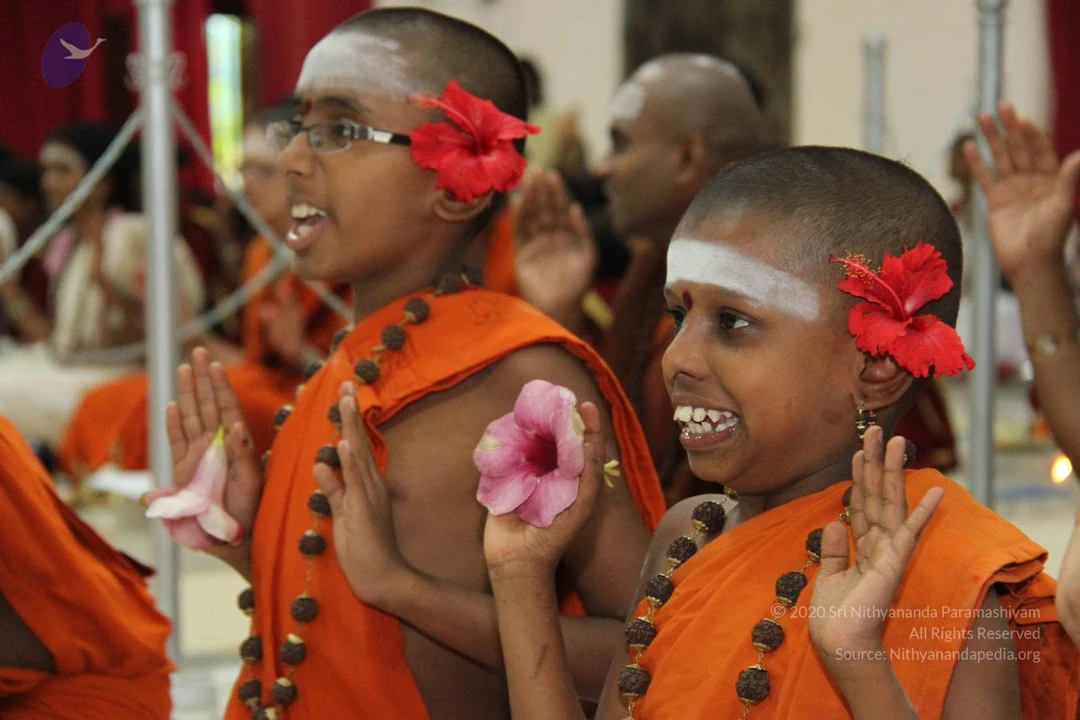
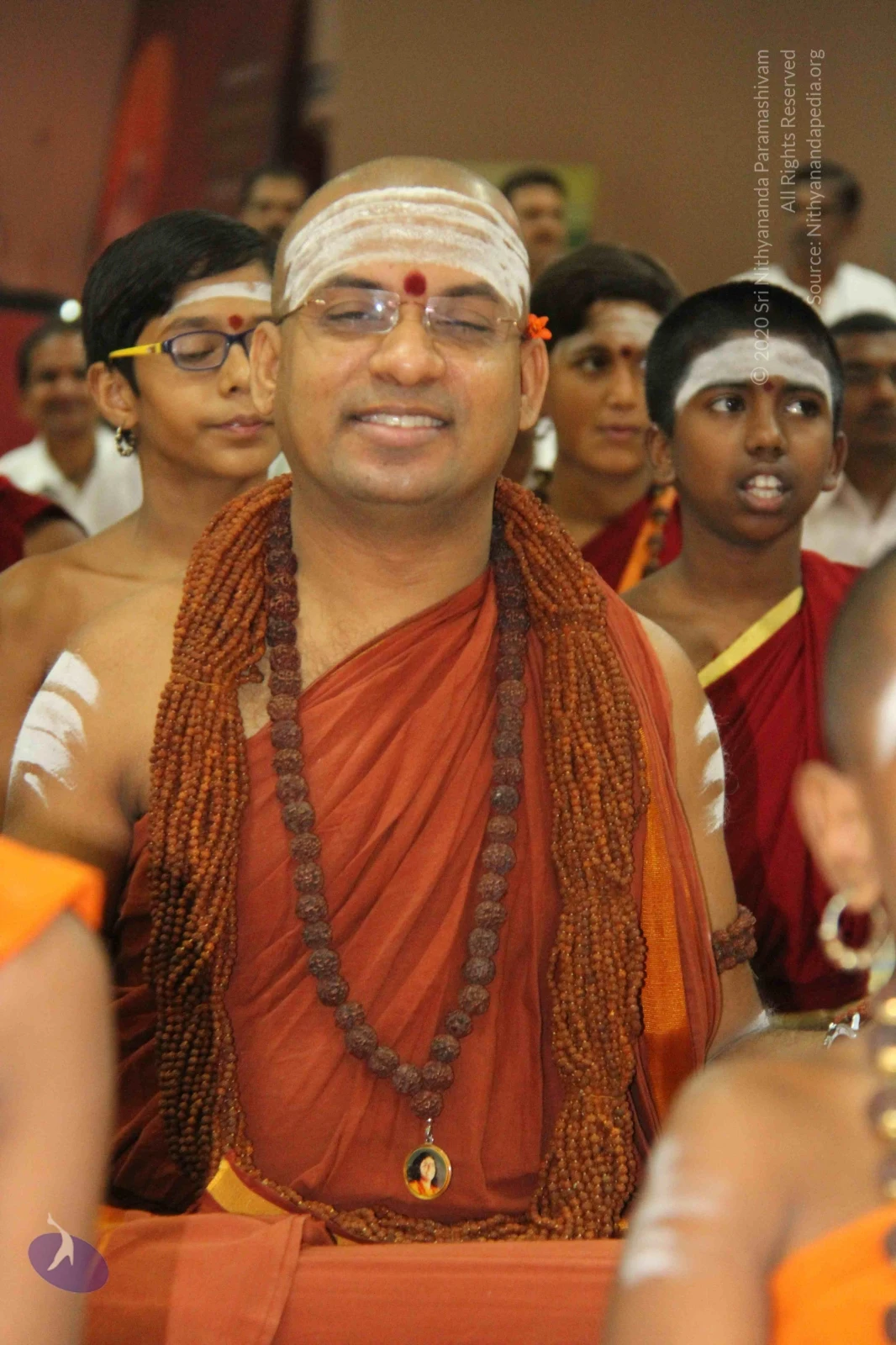
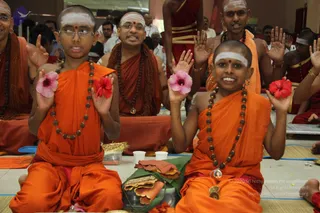
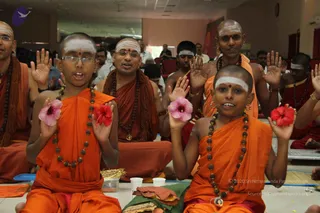
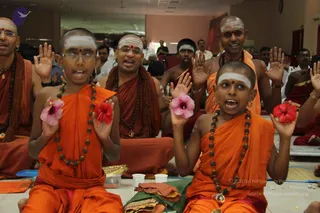
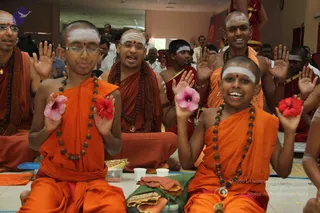
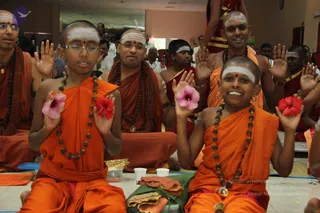
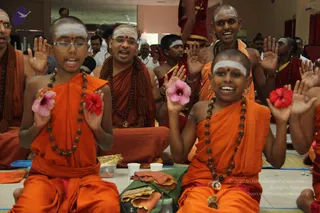
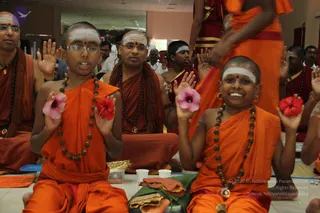
Two young saffron-robed boys sit on mats holding pink and red hibiscus flowers aloft, smiling, with rudraksha malas around their necks and white vibhuti lines on their foreheads. Behind them, several monks and devotees in saffron and maroon robes, some with white forehead markings and rudraksha beads, raise hands in greeting while others sit in a hall. Brass bowls, a folded cloth and paper cups sit on the floor in front. The scene suggests a satsang or puja gathering; no identifiable a person candidate is clearly present.Seated group of saffron-robed sannyasi and young disciples in a hall, many with white vertical tilak bands and red bindis. Foreground: two boys in orange robes and rudraksha malas each hold up pink and red hibiscus flowers and raise open palms, appearing to chant. Behind them a bearded man in orange with a rudraksha mala and a shaved-head man in orange with ornate earrings and bangles also raise hands. Background shows more seated devotees in white and orange and a few standing people. A small brass vessel and white paper cups sit on the floor, with red and green cloths nearby.Photograph of a group of young boys and adult monastics seated on a tiled floor in an indoor hall, chanting with raised open palms. The two front boys wear saffron-orange robes, rudraksha mala necklaces and white forehead markings, and each holds a pink and a red hibiscus flower. Behind them, shaved-headed monks in saffron and maroon robes sit with white tilak marks, and a few standing devotees in white clothes appear in the background. Brass cups, a small plastic container and folded cloths lie on the floor in front.Photo of a group of young sannyasi-style boys and men in saffron-orange robes with rudraksha malas and white vertical tilak marks on their foreheads, seated on the floor of a hall. Two boys in the foreground hold pink and red hibiscus flowers aloft with open hands, smiling and singing. Behind them a bald man in rust-red robes and a rudraksha mala sits with his mouth open in chant. A few white-clad devotees sit in the background, and a brass container, a folded cloth and a small cup are placed on the floor before the group.A photograph of shaven-headed young sannyasi boys and adult monks in saffron-orange robes seated on a tiled floor during a ritual gathering. Two boys in front, one in wire-rimmed glasses, hold up pink and red hibiscus flowers toward the camera, smiling. Each wears a long rudraksha mala and a white vertical tilak on the forehead. Behind them, older monks in rust-orange robes sit cross-legged with rudraksha malas, and a seated adult in glasses wears a brown-red robe. Brass cups, a small brass vessel, folded cloths and offering items lie on the floor. Seated devotees in white fill the background of a hall with pink walls. No identifiable a person is visible with confidence.Seated group of young saffron-robed boys and adult sadhus in a hall, performing a chanting or puja gesture with open palms raised. The two foreground boys, wearing orange cloth, rudraksha malas and white vertical forehead marks with red bindi, each hold a pink and red hibiscus flower. Behind them an adult in ochre robes and a long rudraksha mala sits with hands raised, and other devotees in orange and white clothing sit on a mat. Plastic cups and folded red and brown cloths lie on the floor in front, with a brass vessel nearby. Seated devotees fill the background, some in white dhotis.

Gurukul_Instruments

2 photosSource gallery
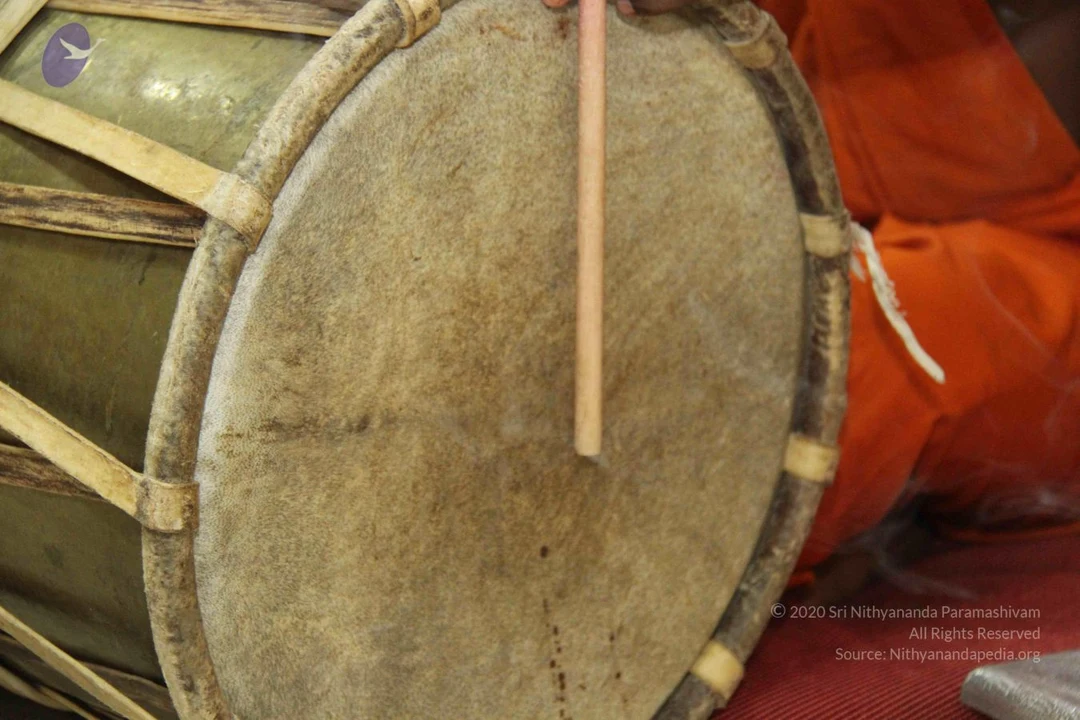
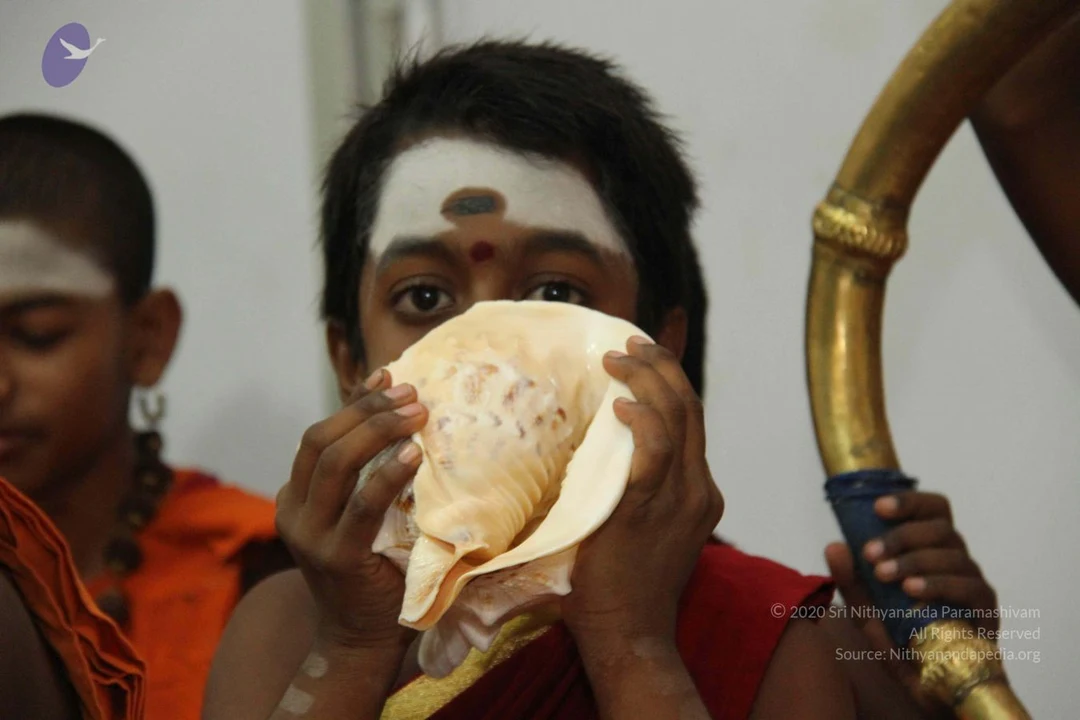
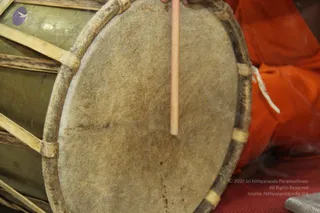
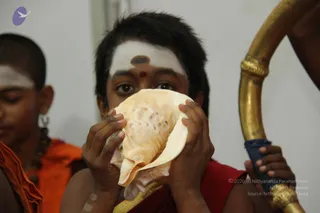
Close-up photograph of a large wooden barrel-shaped drum with a pale, weathered animal-skin head, held with a long thin wooden stick striking near the centre. A hand is partly visible at the top edge. Beside it, a person in orange saffron clothing sits on a red cloth. Thin smoke or incense haze drifts in the background.A young boy with short dark hair blows a large cream-colored conch shell held up to his mouth with both hands. He wears a white tilak with a dark central mark and a red bindi on his forehead, and a red garment over his shoulder. To the left, another boy in an orange robe with a shaved head stands partly visible, and a golden curved ceremonial rod rises at the right edge. The plain pale wall suggests an ashram or temple ritual setting.

Swamiji_Satsang

27 photosSource gallery
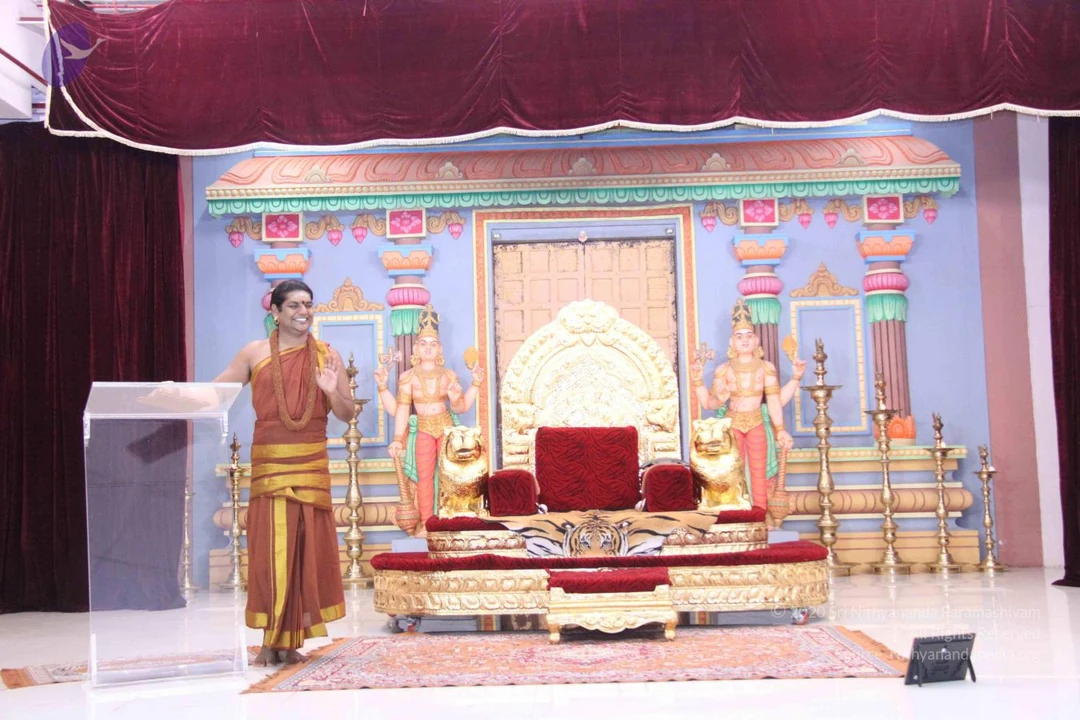
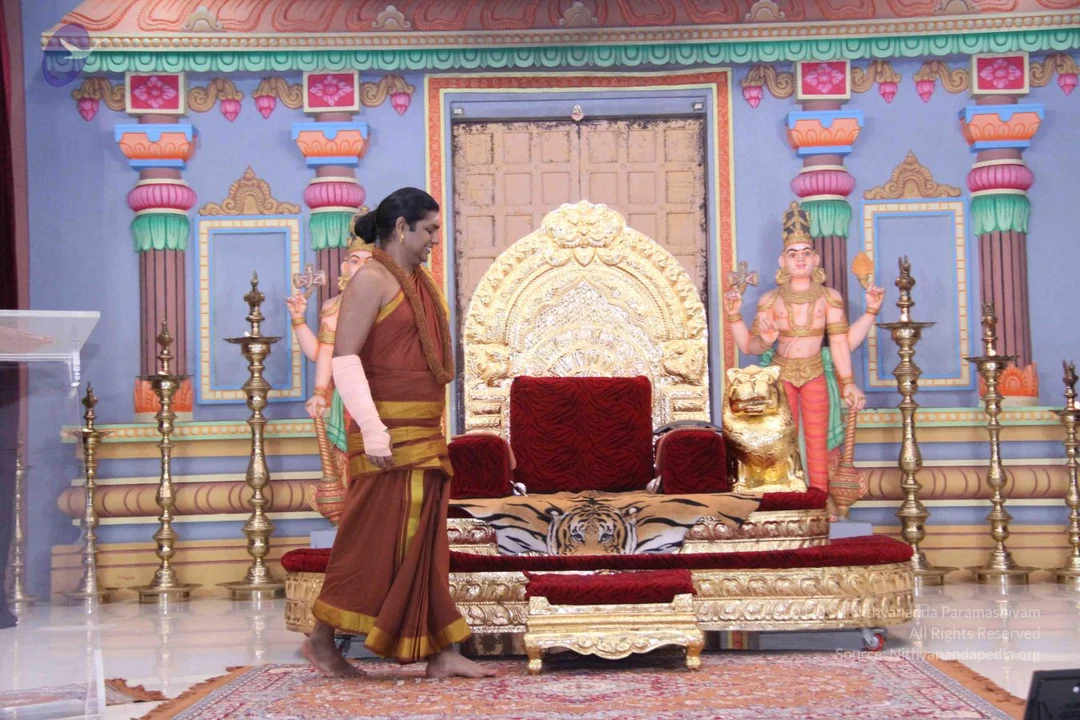
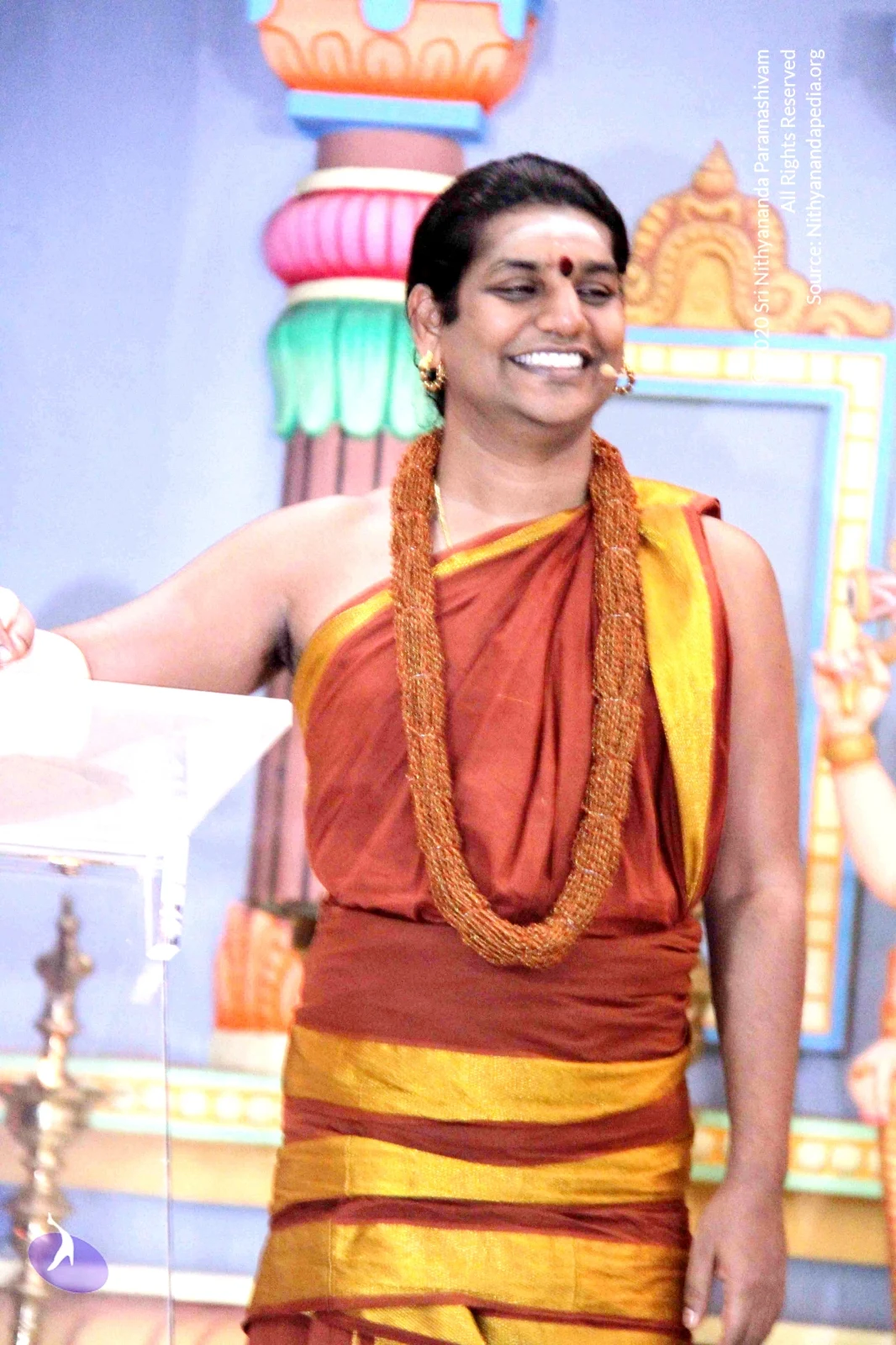
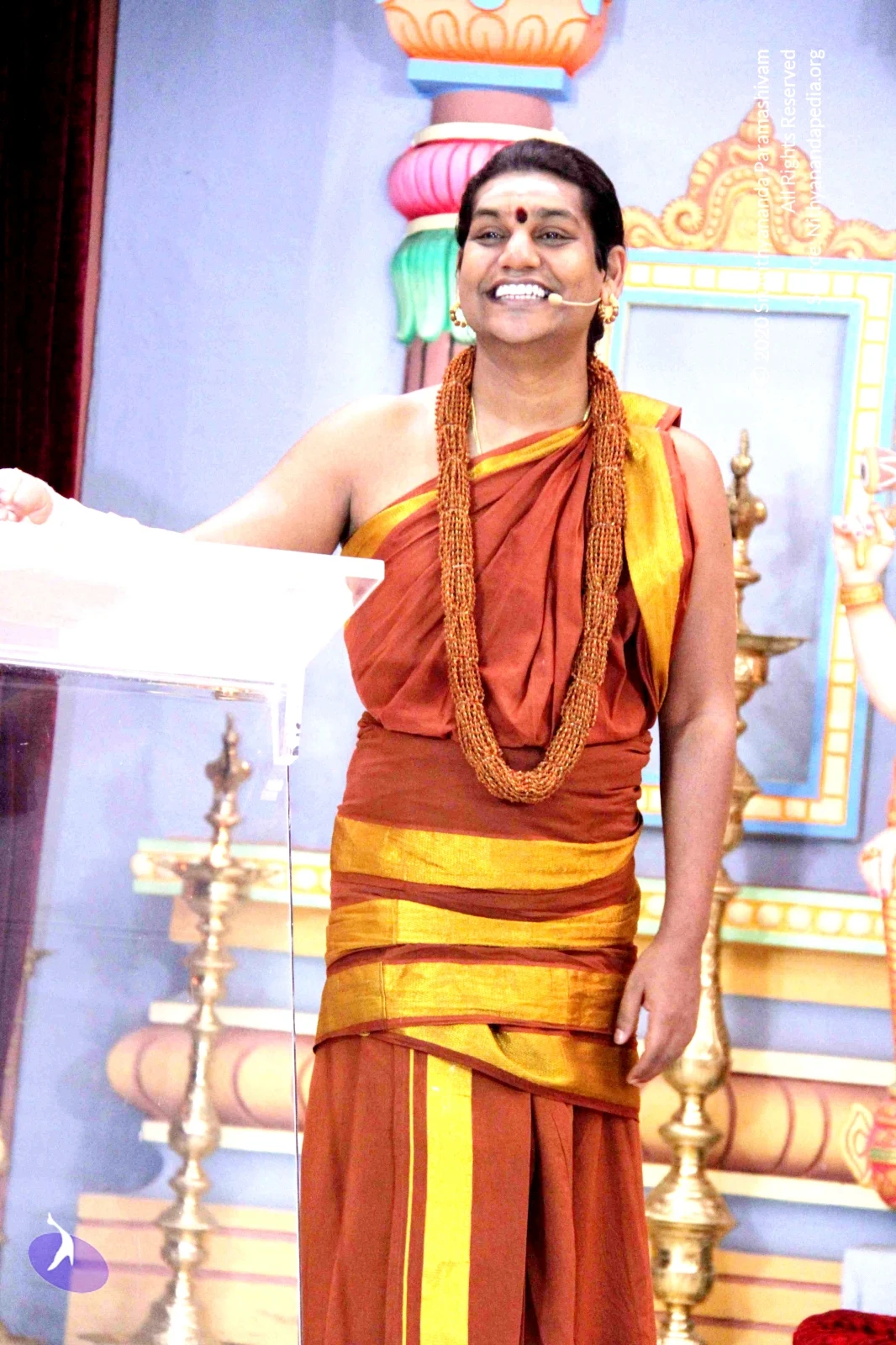
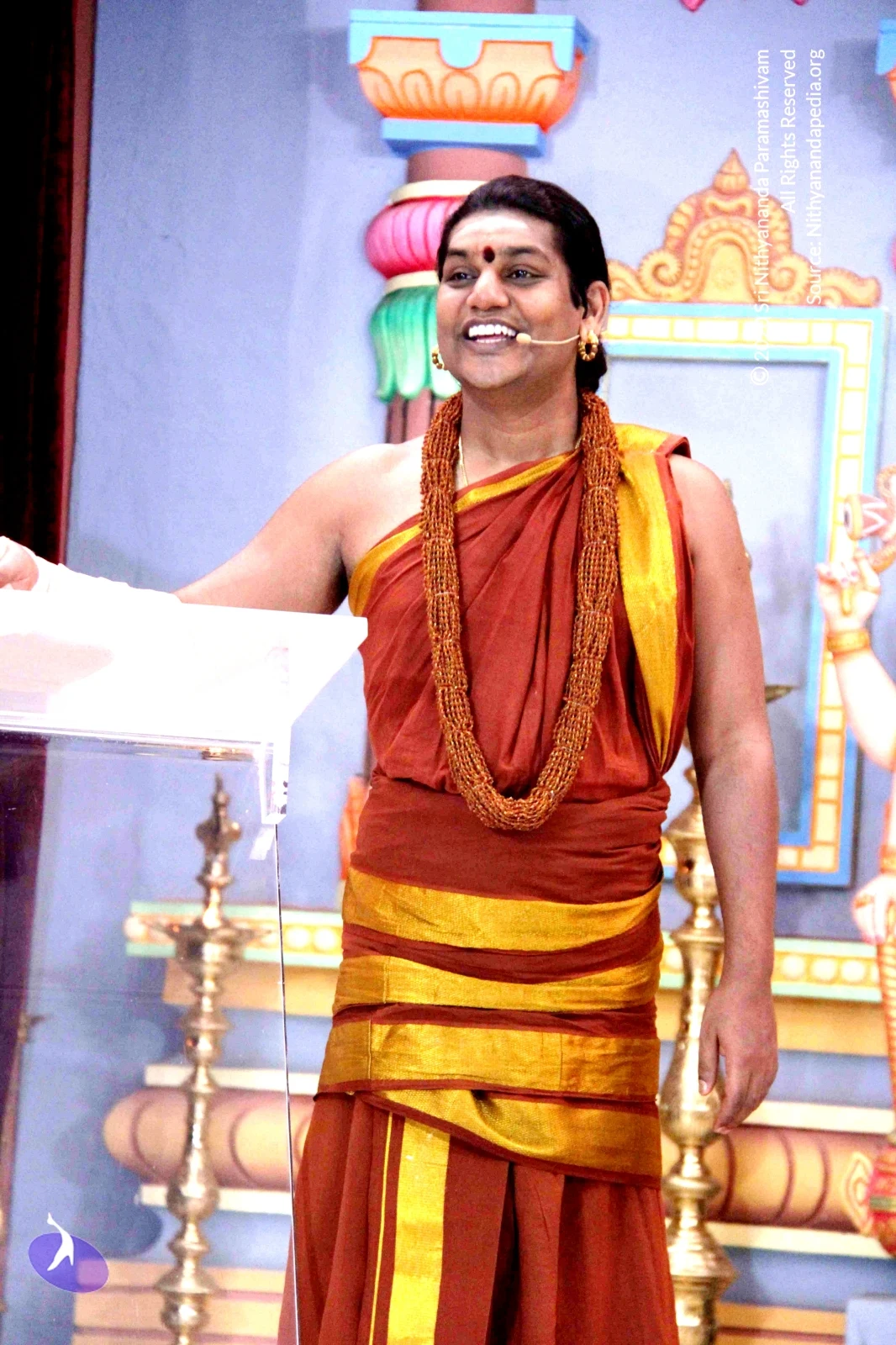
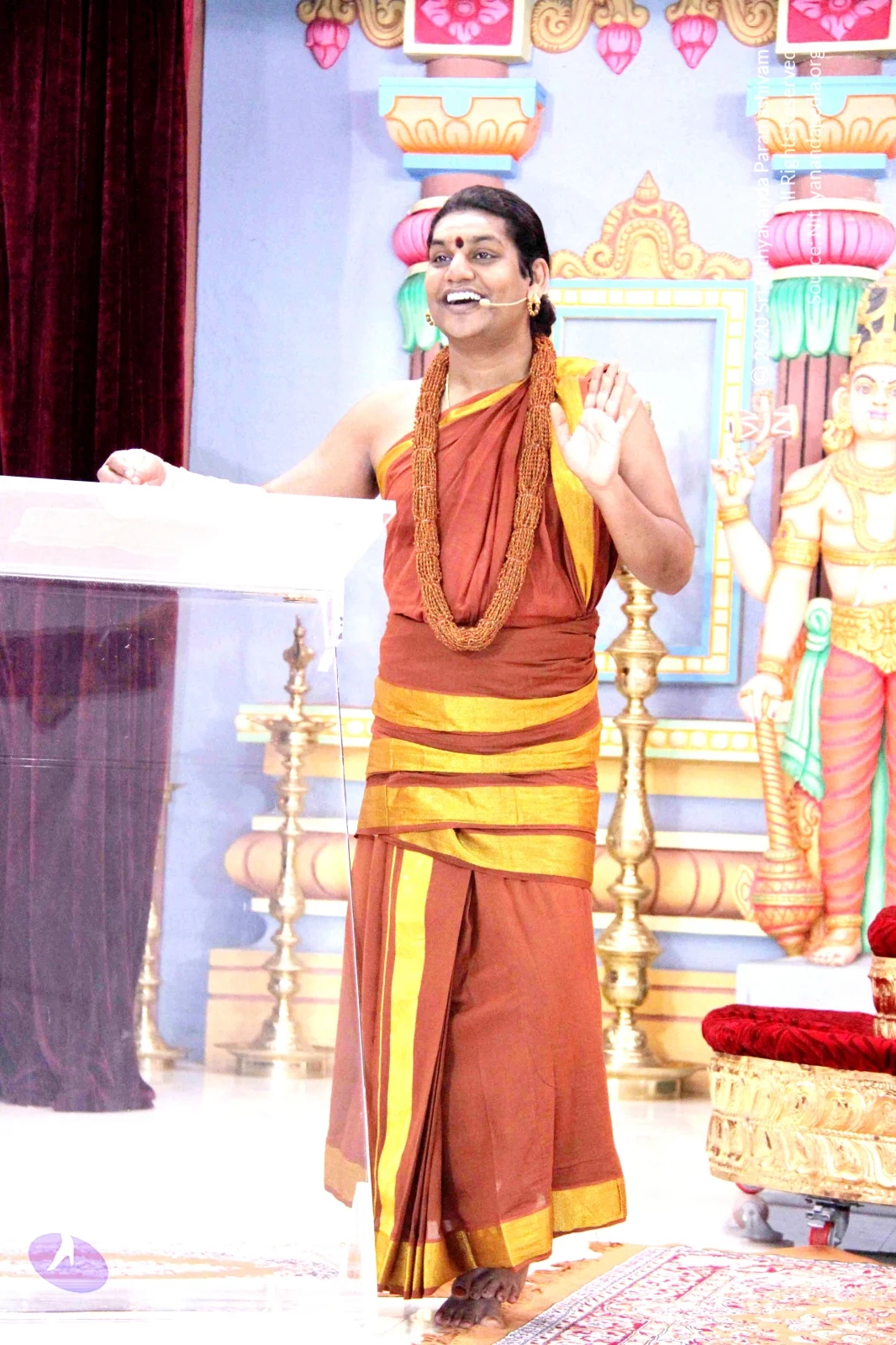
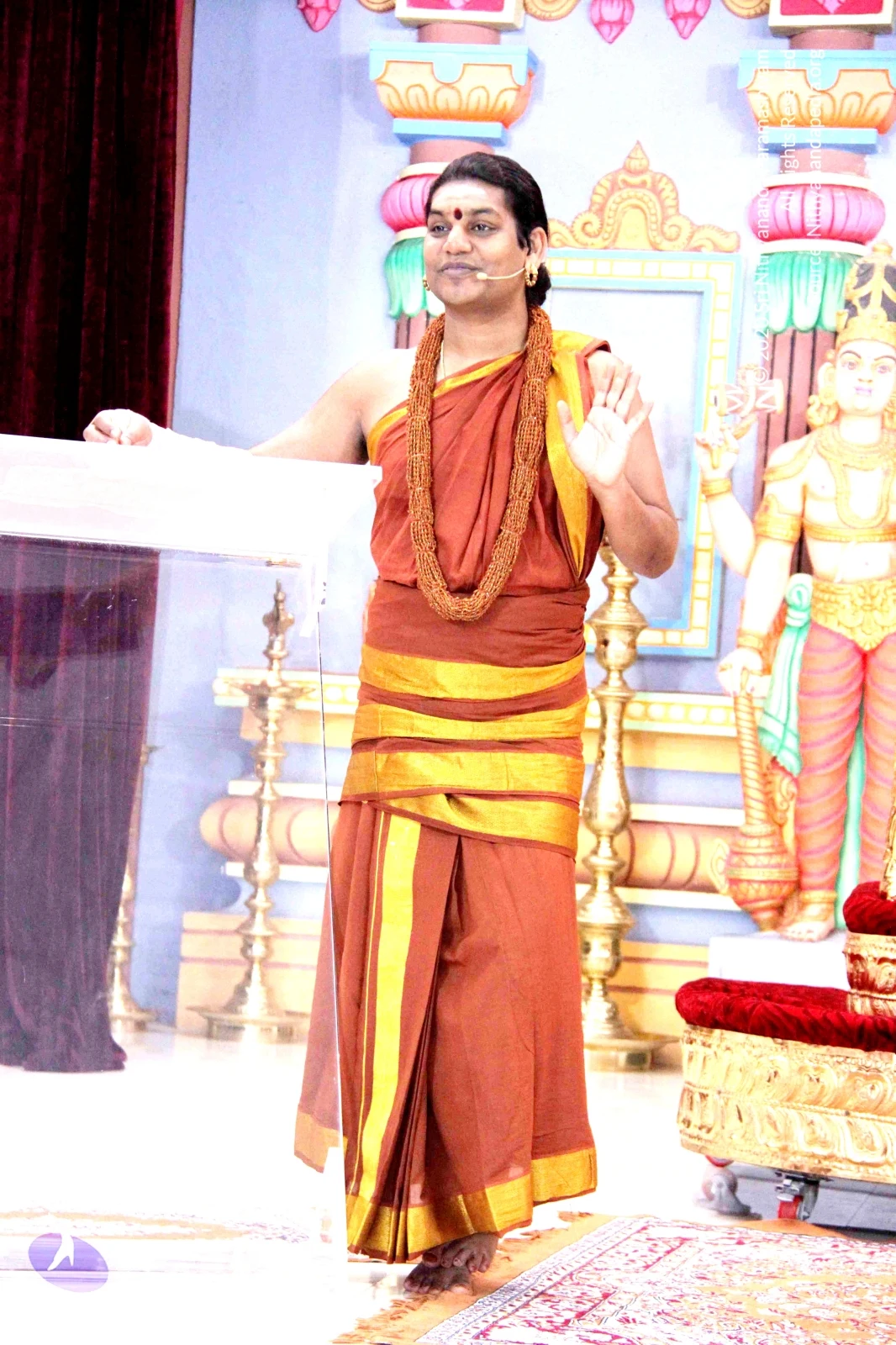
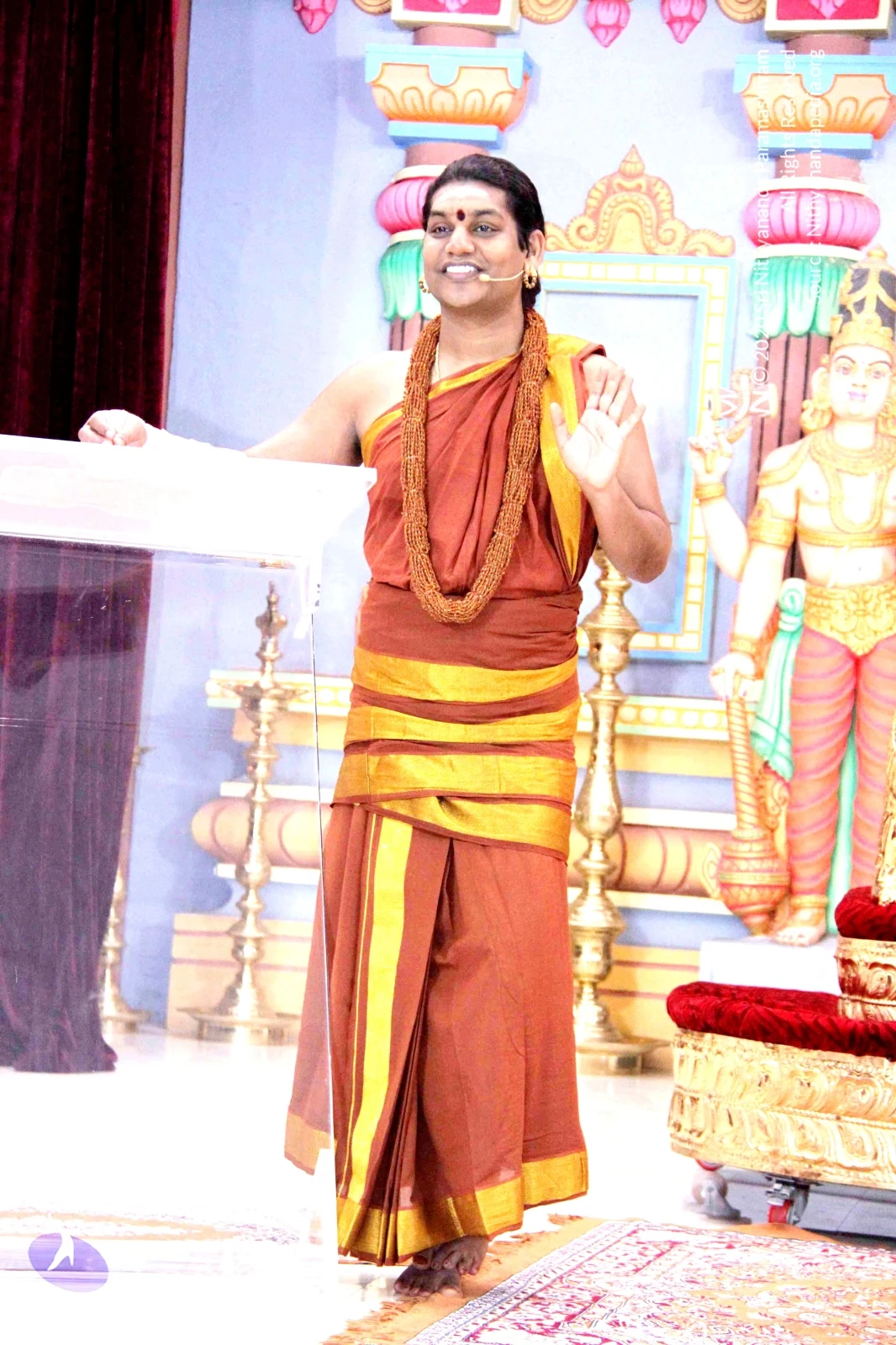
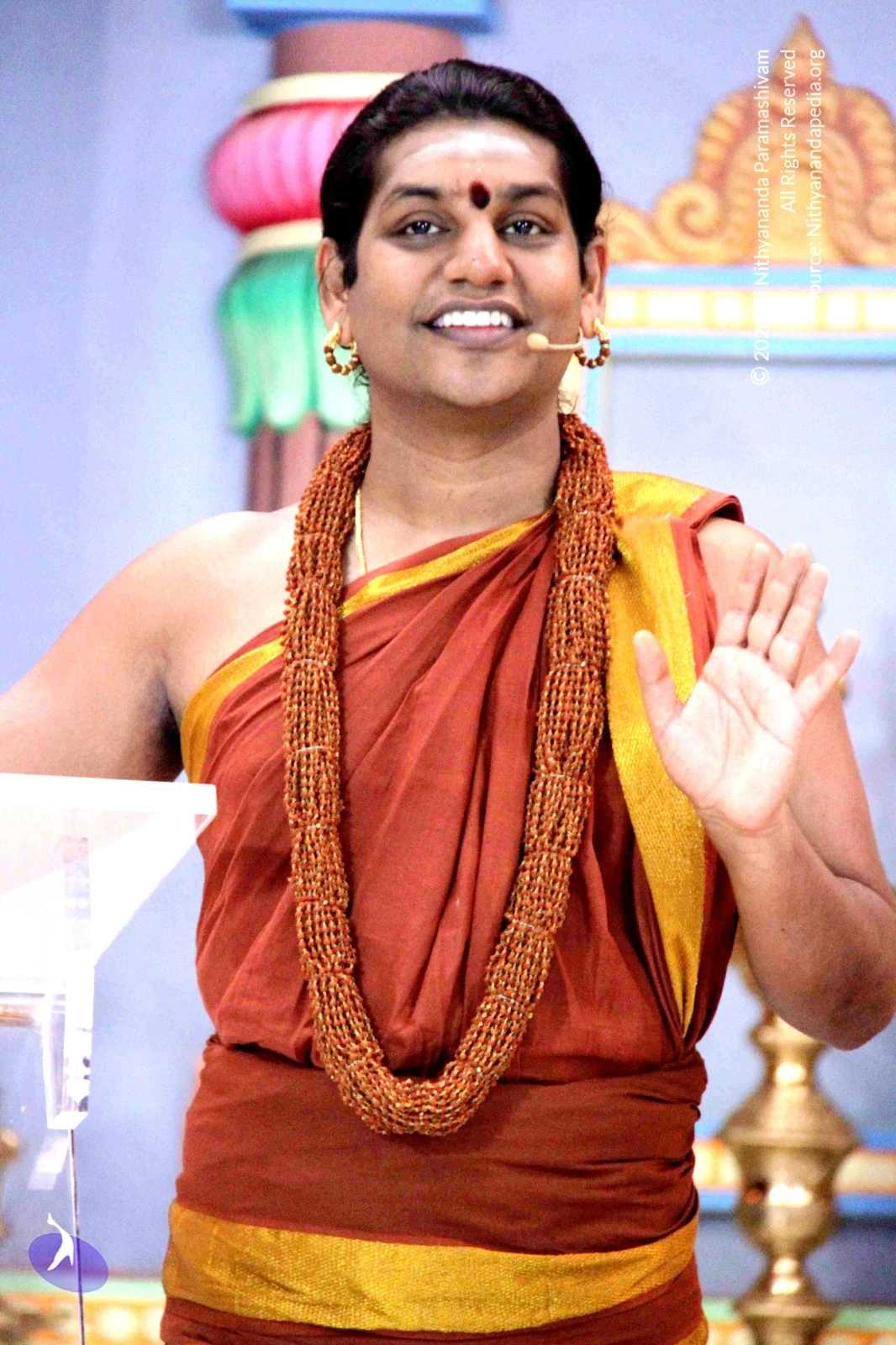
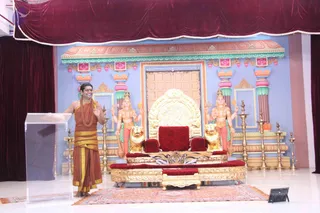
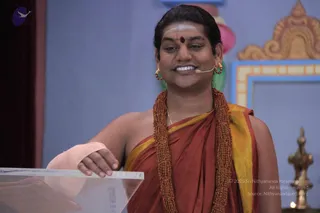
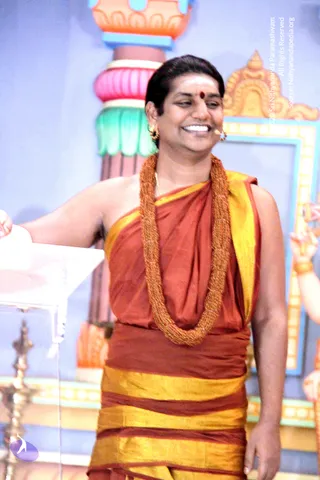
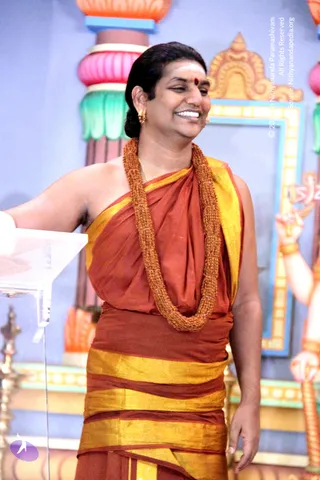
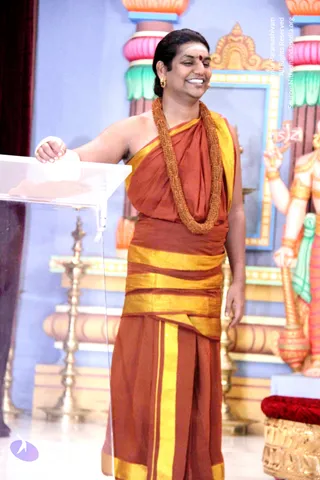
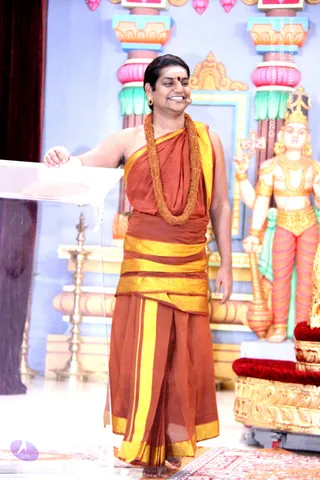
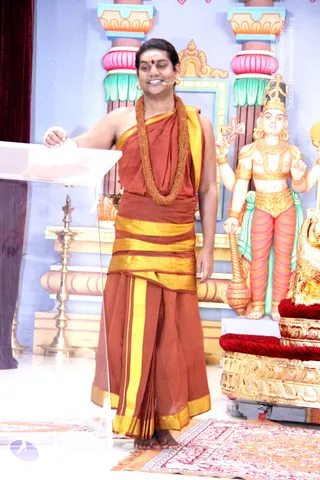
A man in saffron-orange robes with a gold-bordered dhoti stands on a carpeted stage beside a clear acrylic lectern, waving with one hand and wearing a beaded rudraksha-style mala necklace. Behind him is an ornate golden throne with red velvet cushions and lion-shaped armrests, flanked by two painted deity statues holding ceremonial objects. Brass oil lamps stand along the platform, and burgundy velvet drapes frame a blue and pink temple-style backdrop. The throne-like seat is empty. The man is a presenter on stage; the a person label is not used here because the cues are only a saffron-coloured robe and a mala, with no hair or crown, so identity is unsure.A man with long dark hair tied up walks barefoot across a stage in front of an ornate golden throne draped with a tiger-skin cloth and red cushions. He wears a rust-orange dhoti and shawl with gold borders and has a white bandage wrapped around his right forearm. Behind the throne stand two gold-coloured deity murti figures with multiple arms holding ceremonial objects, flanking a carved wooden door. Tall brass oil lamps line the stage, and the walls are painted in blue, pink and green temple-style motifs. The man is not positively identifiable from appearance; the page associates this event with a person, so the probable identity is noted here with the role of a devotee-walking figure: a person, walking before the peetha, bandaged right arm, saffron-orange robe with gold border.A photograph of a smiling person standing behind a clear acrylic lectern on a stage. The person wears a rust-red garment with a gold-bordered yellow edge draped over the shoulder, and a dense rudraksha-style mala of brown beads hangs down the chest. A small red bindi and white sacred ash mark the forehead, and small gold hoop earrings and a wireless headset microphone are visible. A pale bandage wraps the right hand resting on the lectern. Behind the stage are a blue wall with ornate gold and pink decorative motifs and a brass oil lamp on the right. a person (in_person) giving satsang, with rudraksha mala, saffron-red robe and gold-edged shawl as the qualifying cues.A man in a rust-red and gold-bordered dhoti-style wrap and a matching shawl stands at a clear acrylic lectern, smiling and speaking into a head-mounted microphone. He wears a thick rust-brown beaded mala around his neck, gold hoop earrings, a white vibhuti line and a red kumkum dot on his forehead, and his right hand rests on the lectern while a pink bandage covers his wrist. Behind him are a blue wall, a gold-and-blue decorative arch, a pink and green kalasha-style pillar and a brass oil lamp on the right. a person: the presenter wears saffron-toned ceremonial clothing, a rudraksha-style mala and gold earrings, consistent with the page's discourse context.A smiling person in a red-brown and gold-bordered wrap stands behind a clear acrylic lectern, with a headset microphone at the cheek. A rust-coloured knotted rudraksha-style mala hangs over the shoulders with a thin gold chain beneath, and gold hoop earrings are worn. A white tilak marks the forehead and a red bindi sits between the brows, with hair swept back. The left hand rests on the lectern edge. Behind, a blue wall is decorated with a gold ornamental arch and a pink-and-green pillar, and a brass lamp stands at the right edge. A single person is physically present.A smiling person stands behind a clear acrylic lectern, resting a bandaged right forearm on its top. The figure wears a rust-red garment with a gold-bordered cloth draped over the shoulders and a long rudraksha mala around the neck, plus gold hoop earrings, a white tilak on the forehead and a small red bindi. A small headset microphone is attached near the mouth. Behind, a blue wall with ornate gold carved panel and a pink hanging decoration; at right, a brass oil lamp. Wearing ornate dress and long rudraksha, the figure shows a person cues in a satsang setting.

SarvaDarshan

6 photosSource gallery
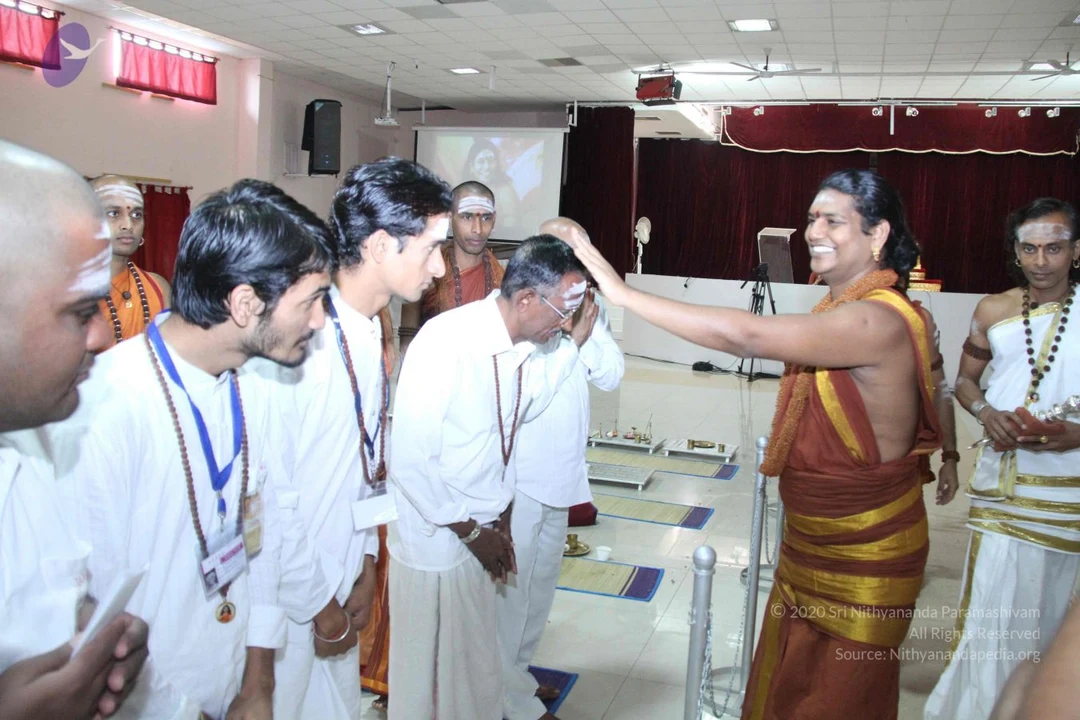
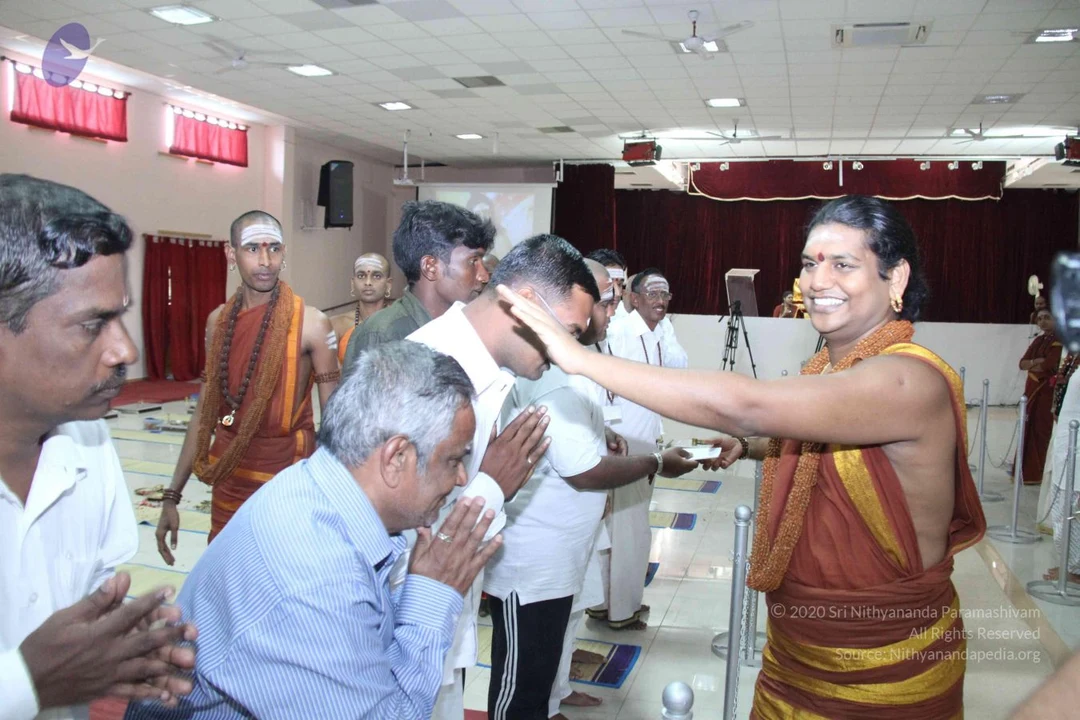
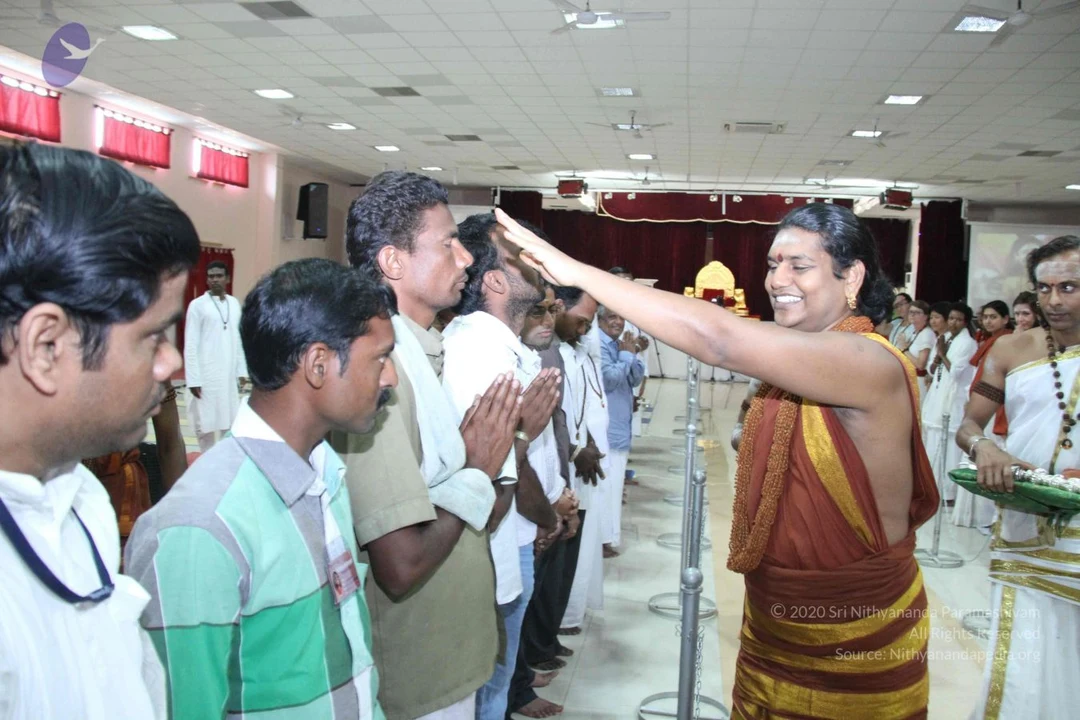
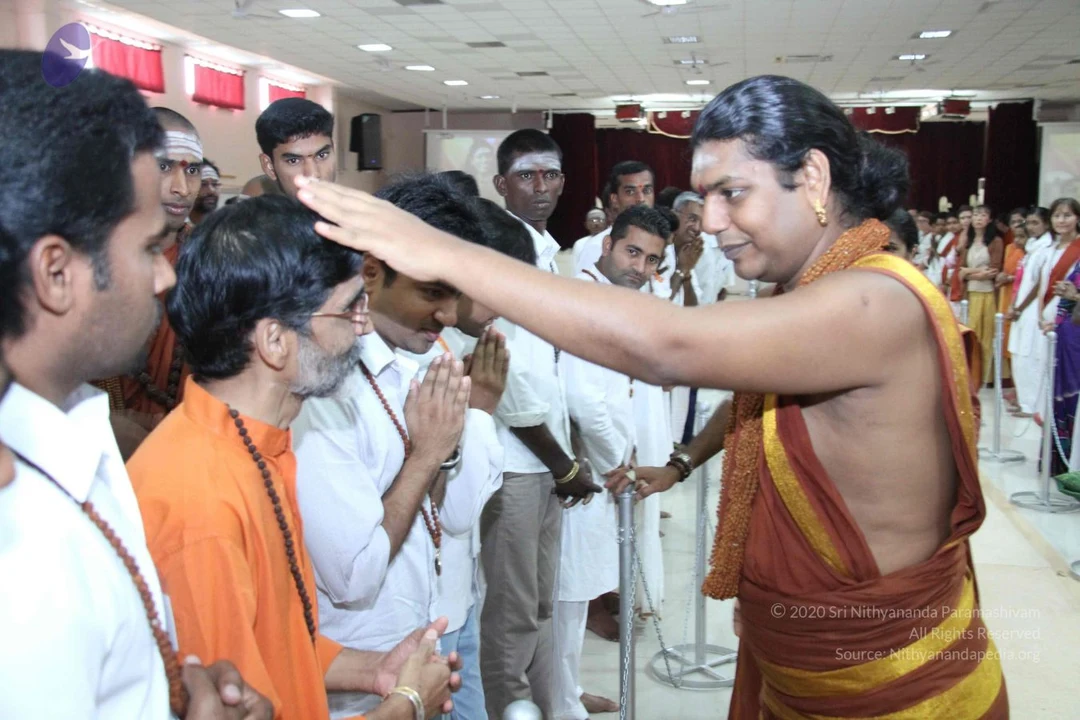
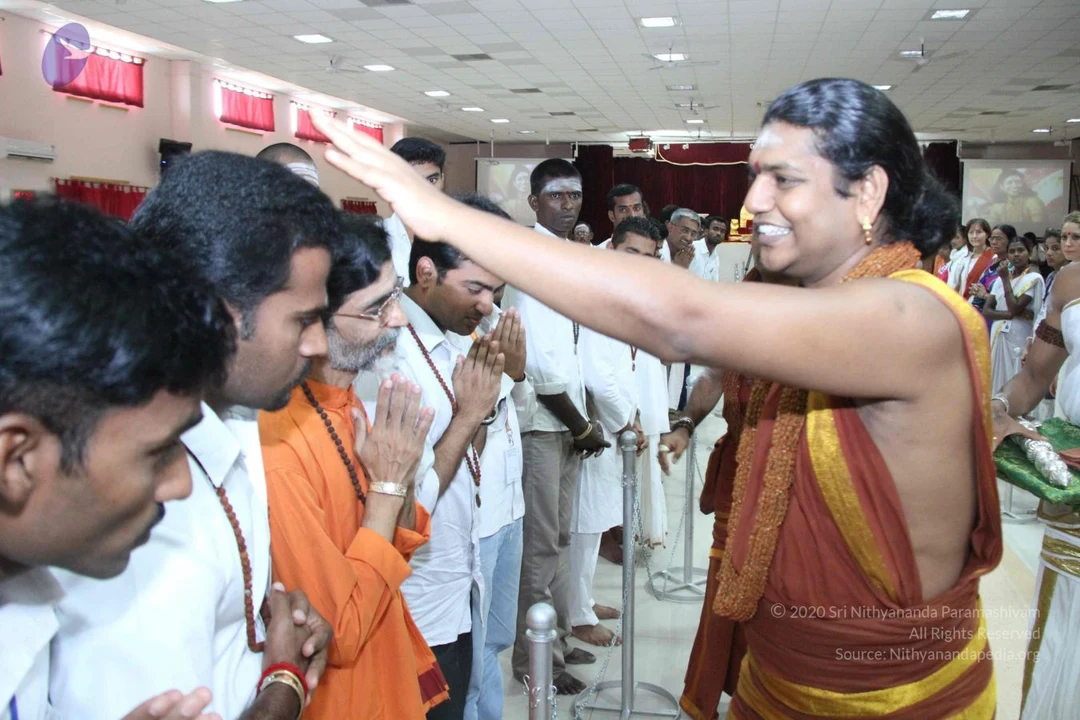
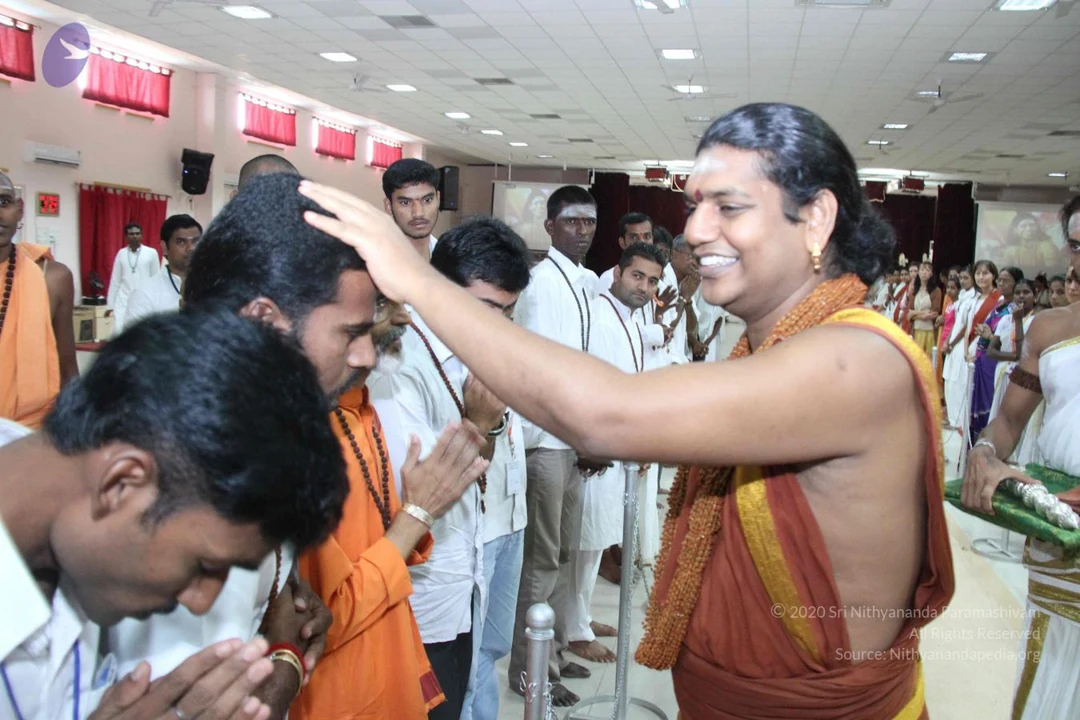
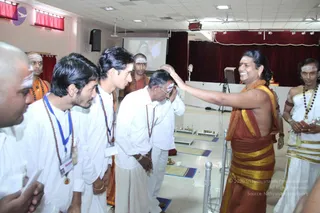
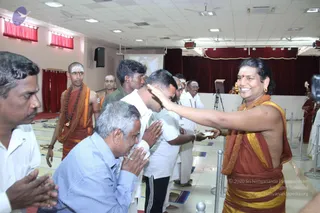
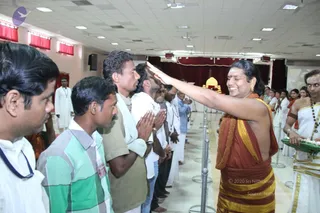
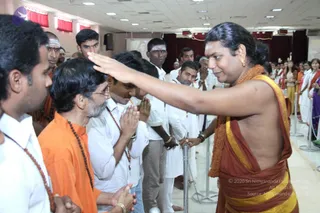
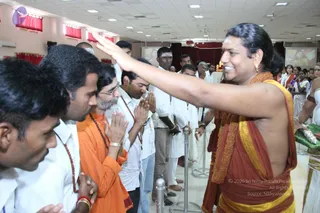
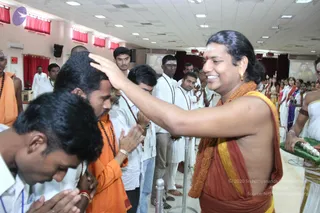
A photograph of a temple-like hall where a bare-chested man in an orange-saffron dhoti with gold-bordered cloth and an orange shawl stands with his right palm raised toward the forehead of a bald, white-clad devotee. A probable Swamiji candidate with long swept-back hair, a rudraksha mala, ornate gold-bordered cloth and gold jewellery, performing a blessing. Around him, several young men in white dhotis and shirts with tilak-marked foreheads and rudraksha malas wait in a line, some wearing lanyards, while a monk in orange stands behind. A white-clad devotee bows his head. Low tables with puja items and mats line the floor, a projector screen and stage with red drapes are behind, and a shelf of brass items is visible on the right.Indoor hall with red curtains and ceiling fans. A smiling person in an orange-and-gold sannyasi-style wrap, a rudraksha mala and gold ornaments extends a hand toward the forehead of a bowing devotee in a white shirt and black track pants. Other devotees kneel and stand with hands folded in namaste, one in a blue striped shirt, and several saffron-clad sadhus with white tilak stand behind. Devotees in white dhotis stand in the background near a projector screen and a microphone stand.A photo inside a hall with red curtains and a golden throne at the back. A person in a saffron-orange and gold-bordered dhoti with long hair and ornate gold-trimmed jewelry stretches out one hand to bless a line of men with folded palms, all standing and looking down. A man in white dhoti and a mala holds a silver tray at right. Several other people in white stand along the room.A photograph in a large hall with red curtains and ceiling lights shows a man with long swept-back dark hair, bare-chested, wearing a rust-brown dhoti-style wrap with a gold border and an orange shawl with a beaded mala, reaching out to bless the head of a devotee. Probable Swamiji's appearance matches the presentation cues of long swept-back hair, ornate gold necklace and saffron-orange shawl, and he is the one giving blessing. Around him, a row of devotees with folded hands and white clothes, some with white vibhuti lines on their foreheads, stand behind stanchions, and a man in orange robes with a rudraksha mala stands at left. Several people in white kurtas and saris are visible in the background. Roughly a dozen physical people are visible.A photograph inside a hall with red curtains and fluorescent ceiling lights shows a smiling figure in an orange-red and gold-bordered dhoti and shawl, with a long orange-marigold garland and gold earrings, extending a raised right hand in blessing toward a line of devotees. On the left, several men in white shirts and rudraksha malas stand with palms pressed together in namaskar, one wearing an orange robe and glasses. Behind them, more men in white and women in white saris stand in a queue behind metal stanchions, and a large screen on the wall shows an image. The figure with the garland is a person by appearance cues: long swept-back hair, ornate gold necklace and saffron-red clothing.A photograph inside a hall with red curtains and ceiling lights. A person in a bare-shouldered rust-orange wrap with a gold border and a long orange-and-saffron-beaded garland raises a hand in blessing over the head of a bowed man in a white shirt. Around them, devotees in white shirts and white dhotis press palms together in anjali, and a few wear rudraksha malas. Orange-robed attendants stand at the left edge, and a woman in a white sari holds a green-and-silver tray on the right. The person giving the blessing has long hair swept back, a red bindi, and gold earrings, which fits the a person appearance; the figure is shown as a blessing giver.

NithyaDharmam_Day3

118 photosSource gallery
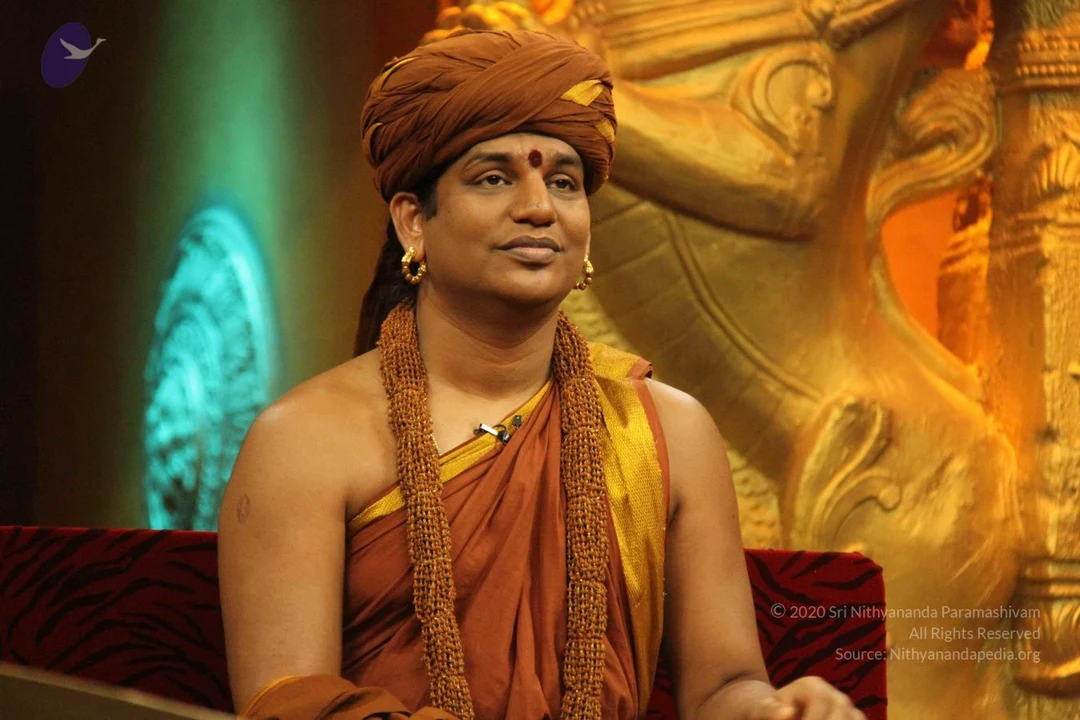
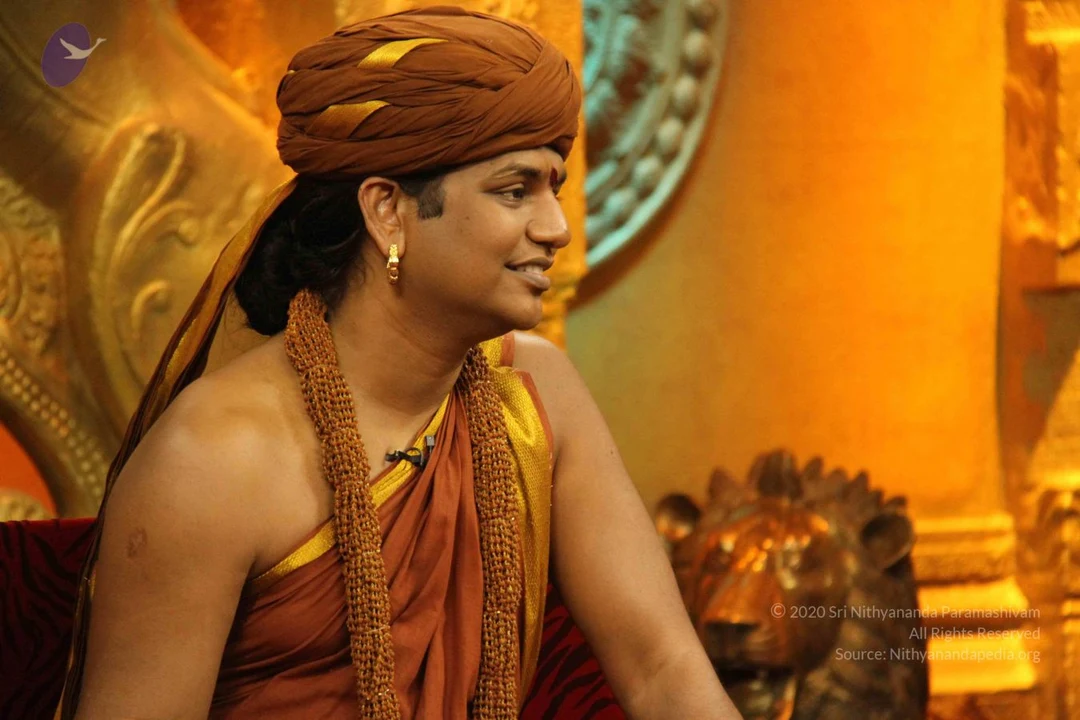
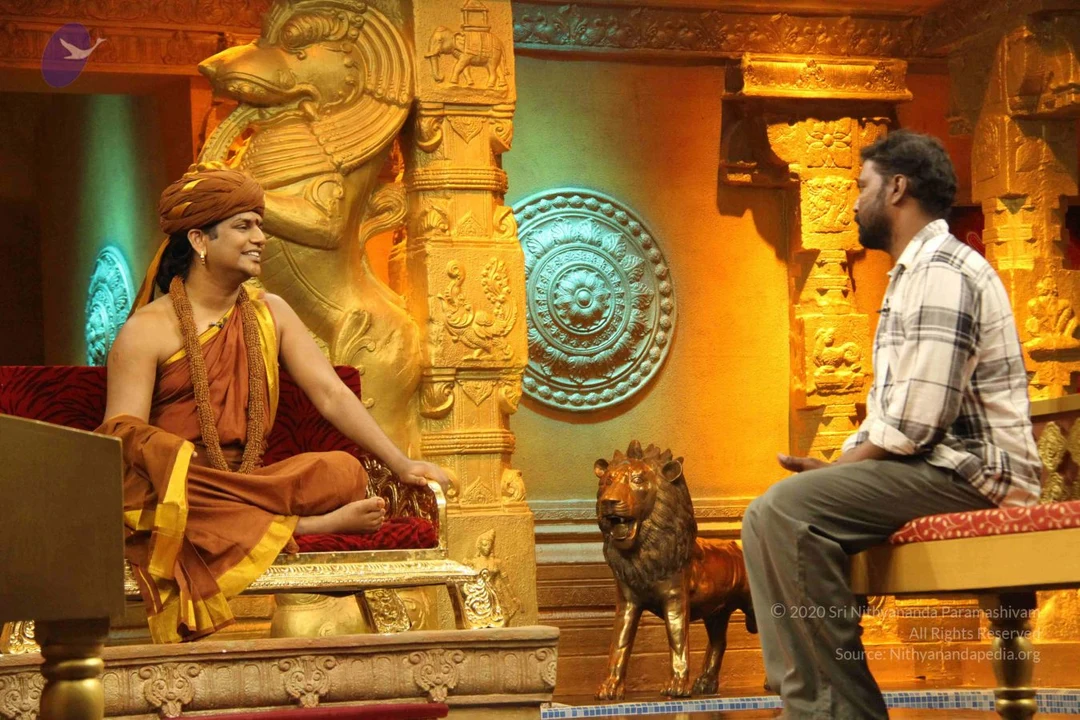
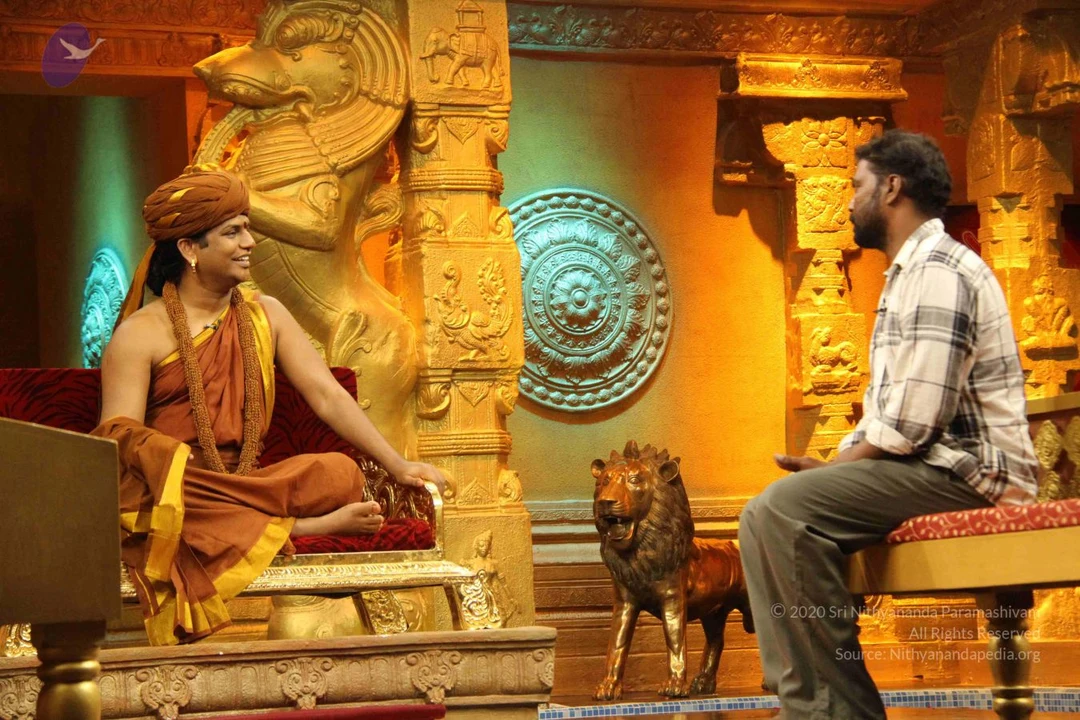
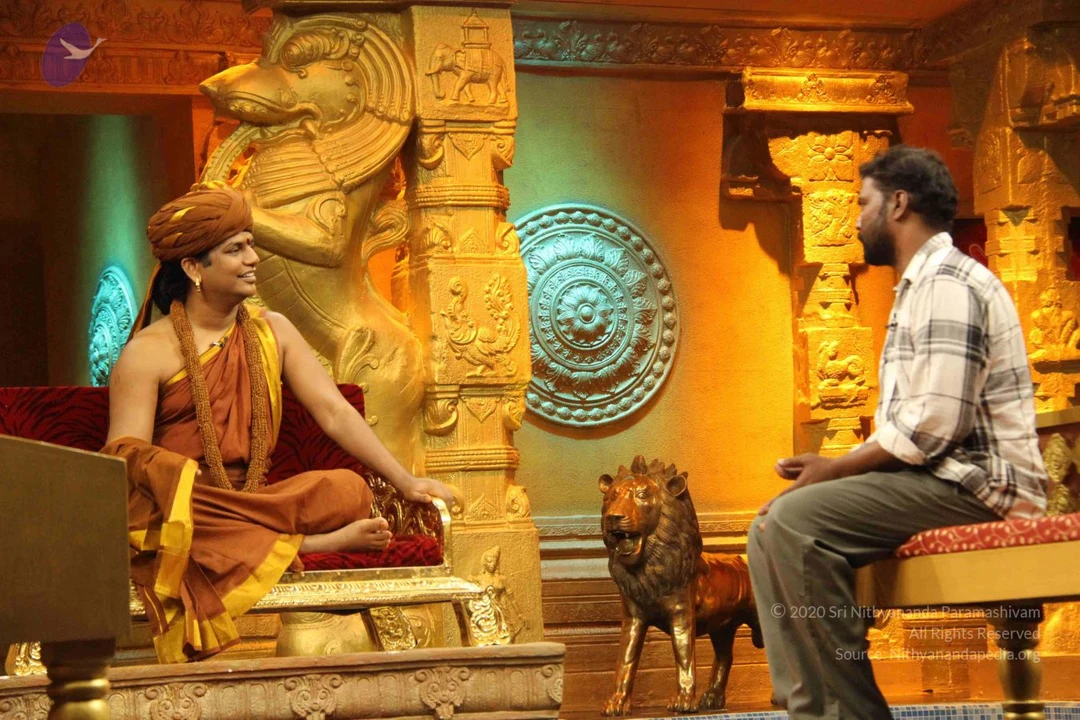
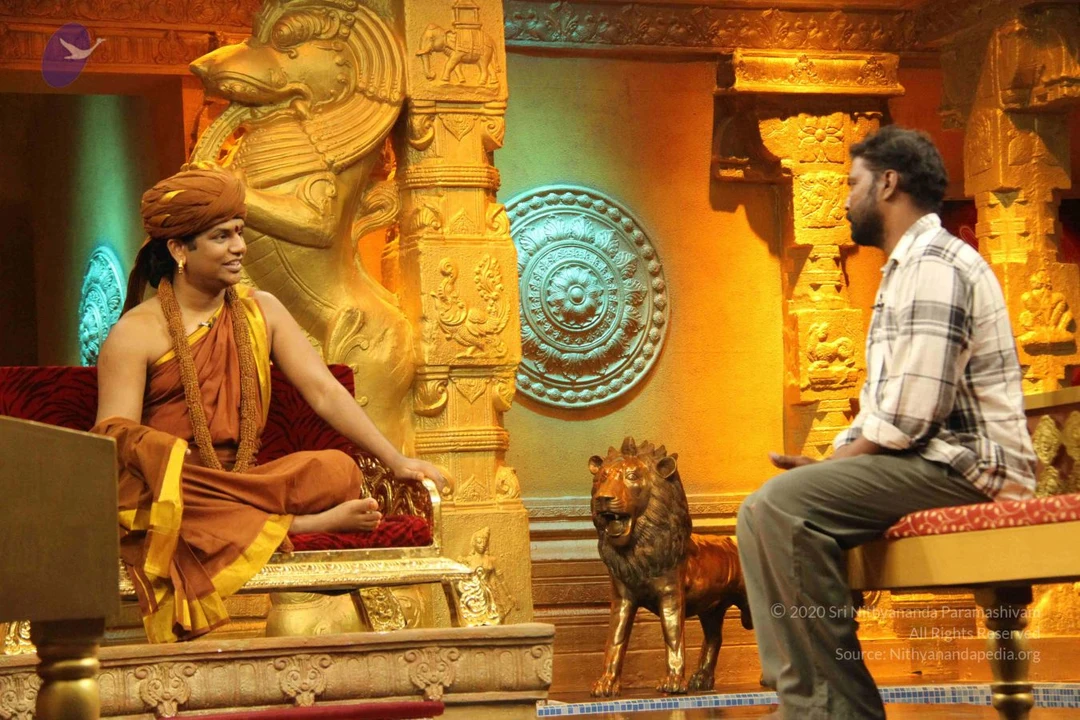
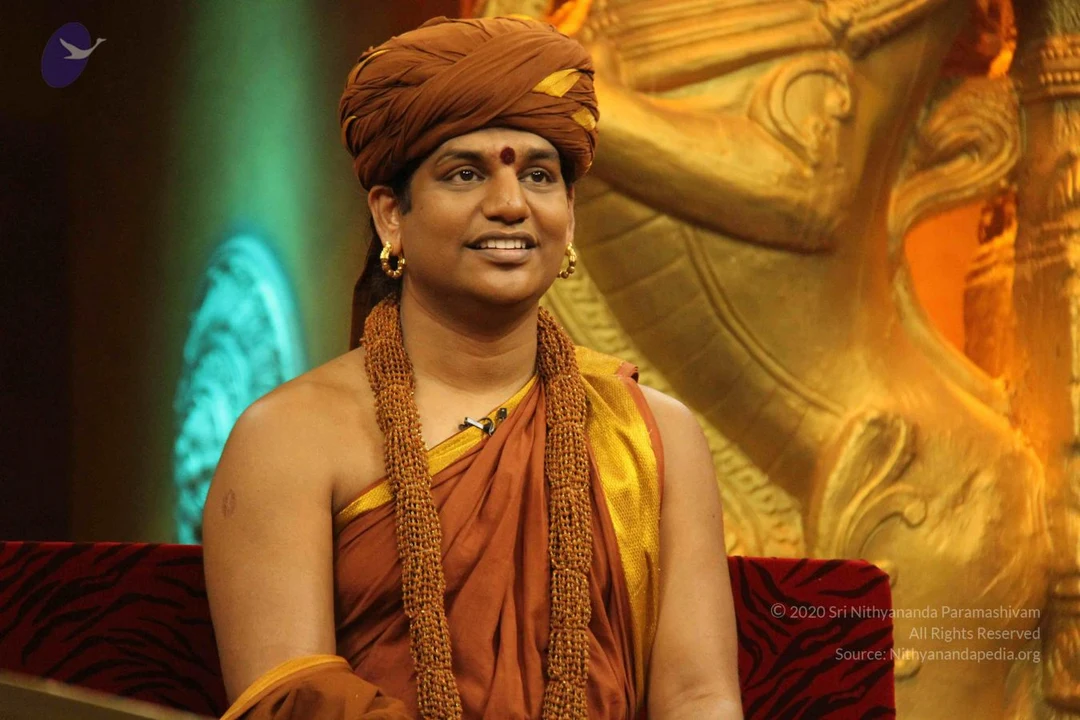
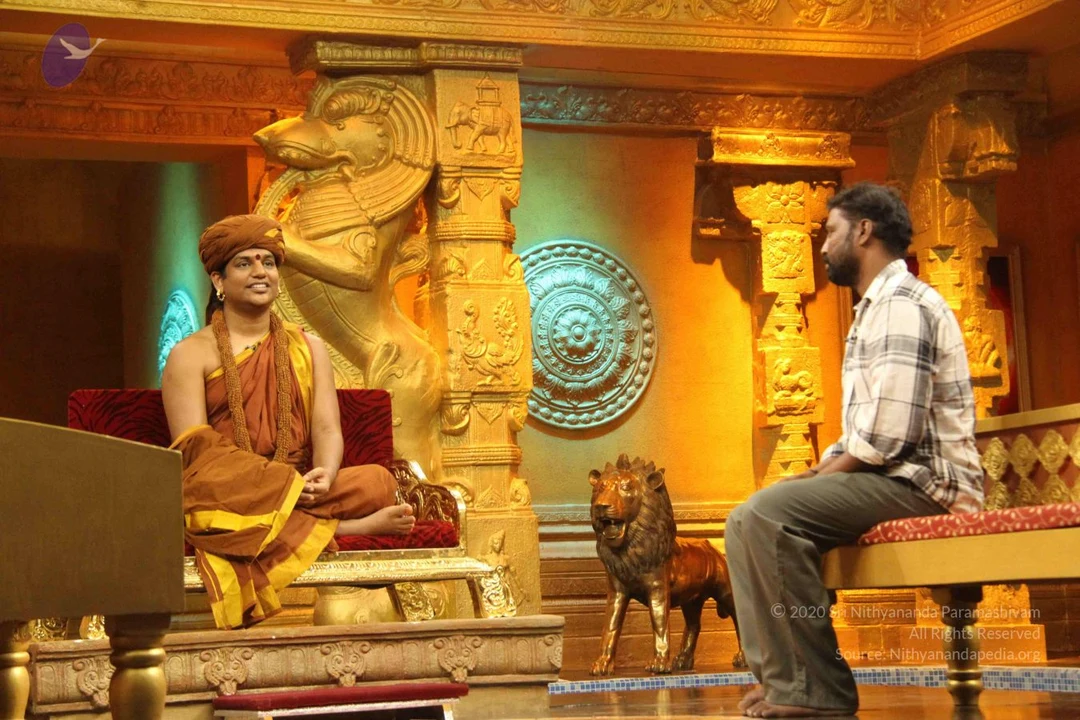
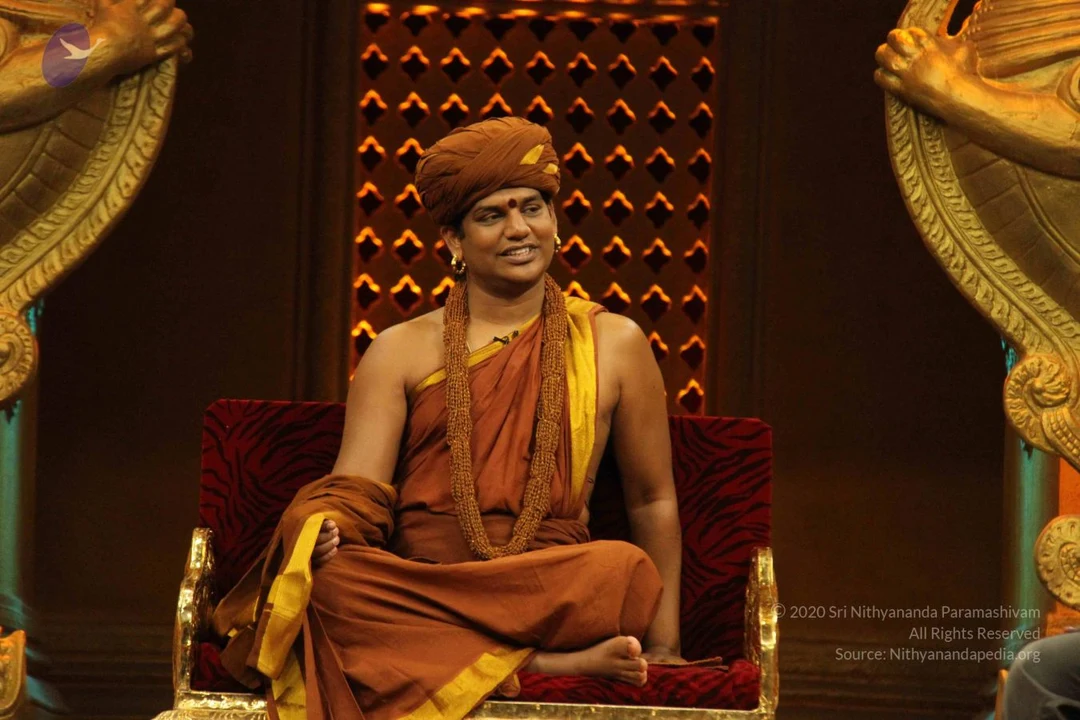
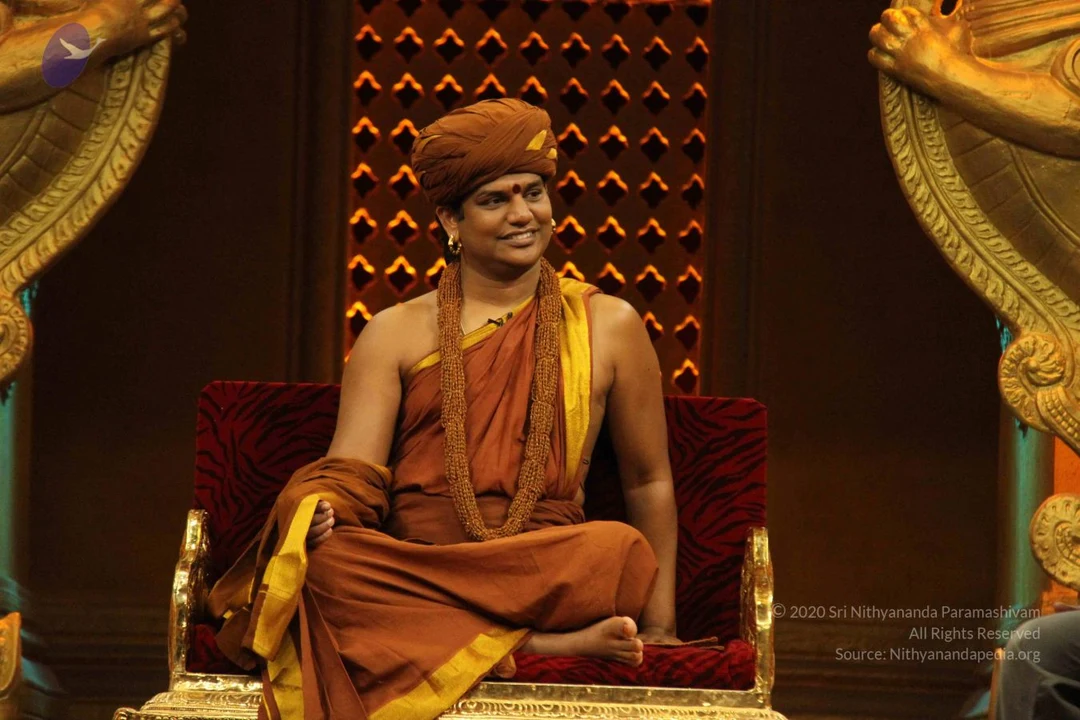
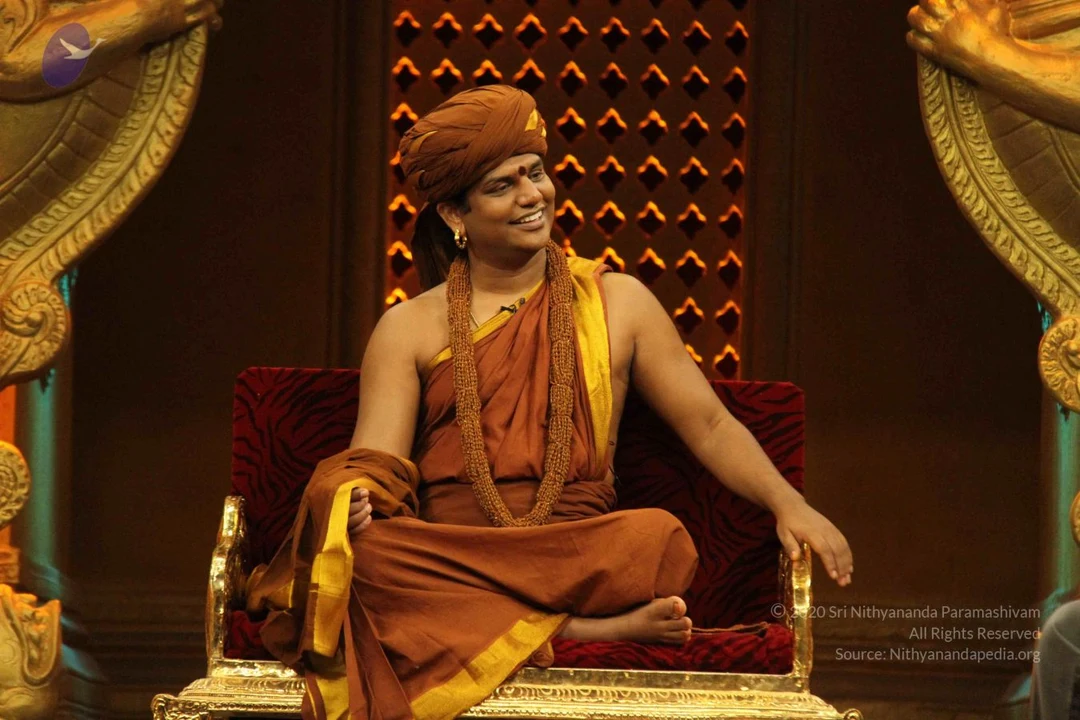
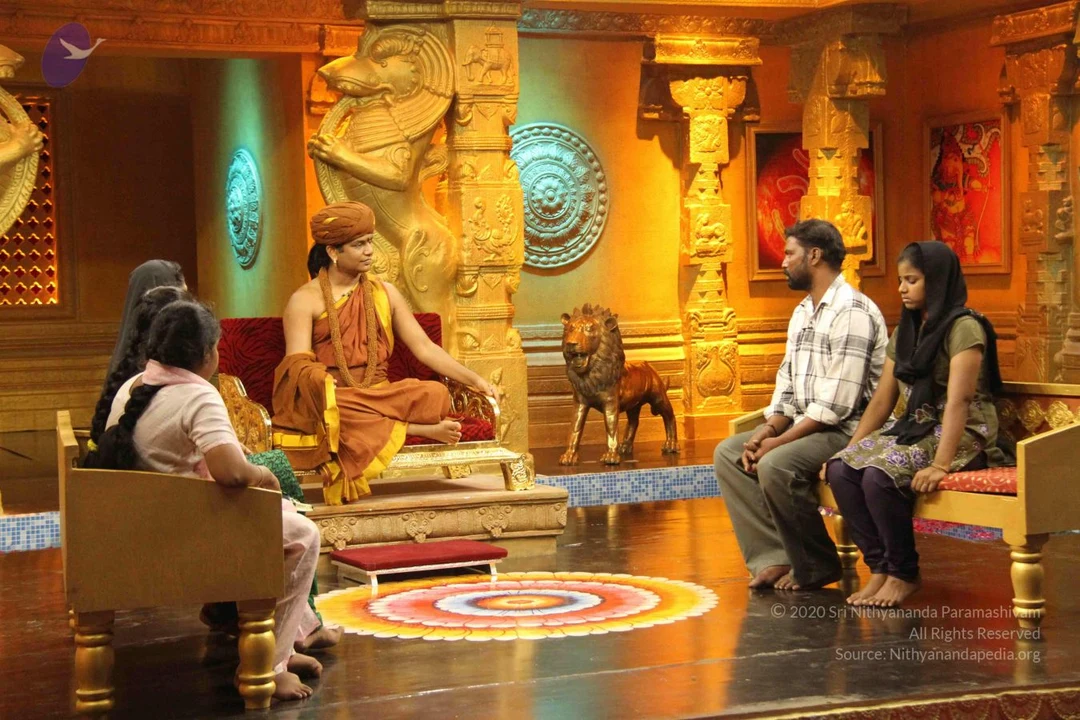
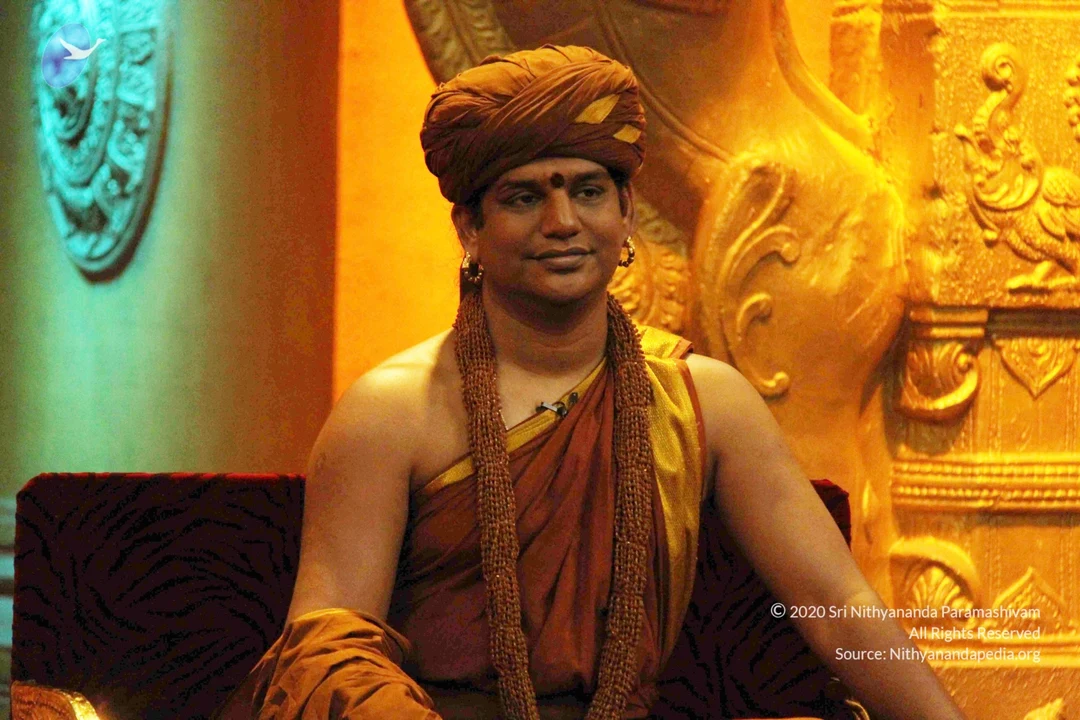
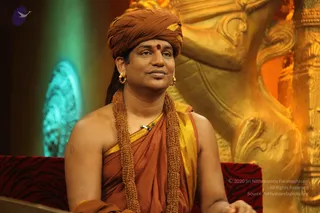
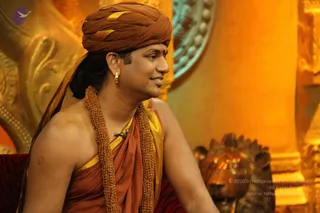
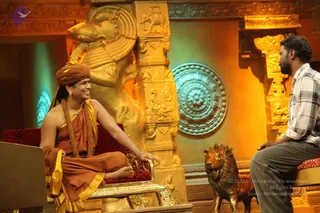
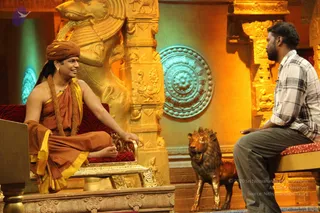
A man seated in a red and black tiger-striped chair on a stage, wearing a saffron-orange turban, orange-brown robe draped over a gold-bordered garment, and a long thick golden rudraksha-style mala necklace with gold earrings and a red bindi on his forehead. Behind him stands a large gilded carved sculpture with a teal-lit panel to the left. Appearance-based candidate: a person, seated in a saffron-robed, turbaned ceremonial presentation with distinctive ornate necklace and earrings; one person physically present.A man seated on a red and gold throne-like seat in a richly ornate golden hall, turned to his right and smiling. He wears a rust-orange turban with gold stripes, a rust-orange and gold draped garment, a long golden-brown beaded necklace, and a small gold earring; a small red mark is on his forehead. Behind him, a gilded lion sculpture and ornate golden carved panels frame the scene. Swamiji (probable): the saffron-orange turban, ornate ceremonial gold necklace and orange garments match the appearance cues for the page's Swamiji candidate, seated in a throne setting.A seated man in a rust-orange turban and rust-orange and gold-bordered dhoti-style wrap sits on an ornate red-cushioned gold throne, wearing a long rudraksha mala with a gold-toned pendant and a gold earring. He smiles toward a man in a white-and-grey checked shirt and grey trousers seated at right, who gestures with an open hand. Behind them stand gilded carved pillars, one topped by a golden makara-like beast, a teal-rimmed carved medallion, and a brass lion figure on the floor. The setting suggests a formal satsang stage. Probable Swamiji is seated on the throne in the centre-left, identified by the turban, rudraksha mala and saffron-orange ceremonial clothing.A seated figure in a red-brown turban and matching saffron-orange wrap, with a bare chest, long rudraksha mala beads and a gold necklace, sits cross-legged on a red velvet and gold-carved throne in a golden temple-style studio set. Carved golden pillars with a horse-and-rider relief and a teal lotus medallion frame the scene. Opposite, a bearded man in a checked shirt and grey trousers sits in conversation on a red-cushioned seat, and a bronze lion sculpture stands between them. The seated figure, a probable Swamiji with distinctive long mala beads, gold necklace and turban cues, appears in a talk-show-style interview setting.A seated man in saffron-brown and yellow robes, wearing a rust-orange turban, a long brown-gold beaded mala around his neck and a sash, sits on an ornate gold-and-red throne (peetha) with carved lion and floral motifs. He gestures toward a second man, seated at right, wearing a white-and-grey checked shirt and grey trousers, on a red-cushioned seat. Between them stands a gilded lion statue. Behind them, carved golden pillars and a teal circular floral medallion form a temple-like stage set. The seated man resembles the probable Swamiji by his turban, saffron robes and ornate mala.A photograph of a golden-carved stage set with a lion-headed carved pillar and a bronze lion sculpture in the foreground. A man in an orange-brown turban, orange-brown dhoti-style robe with a yellow border, and a long beaded rudraksha-style necklace sits cross-legged on a red cushioned golden throne at left, smiling and gesturing toward a second man seated at right. The seated man wears a white and grey plaid shirt and grey trousers and sits on a red-cushioned bench beside the bronze lion. Behind them stand ornate golden temple-style columns and a teal circular medallion.

Temple_Picture

22 photosSource gallery
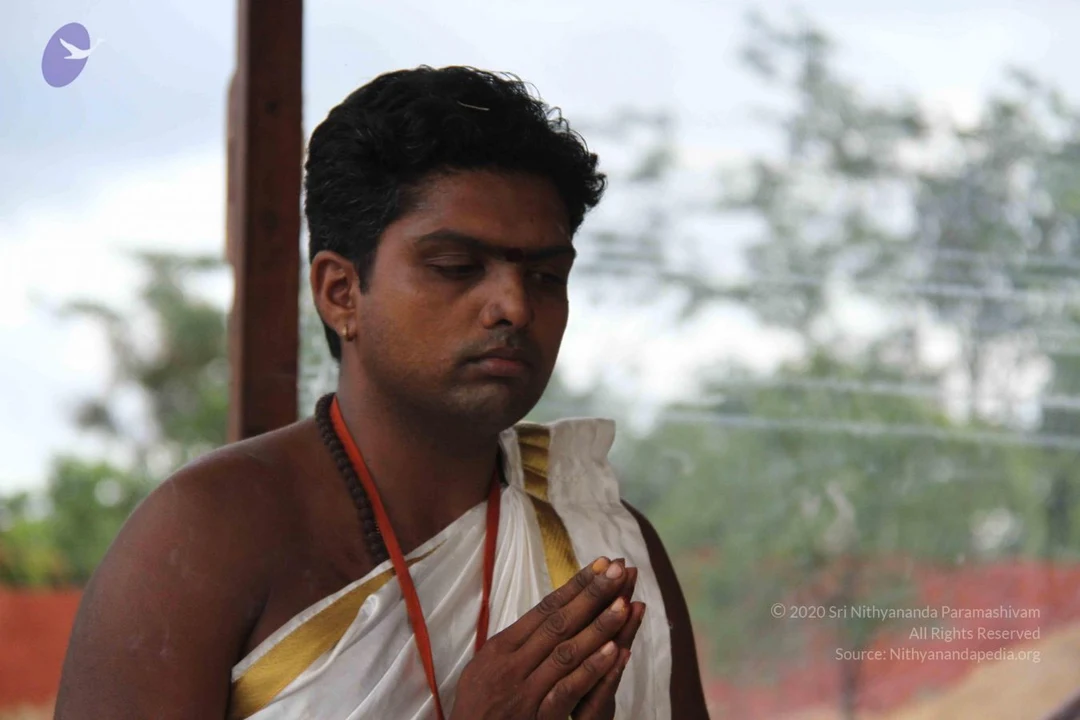
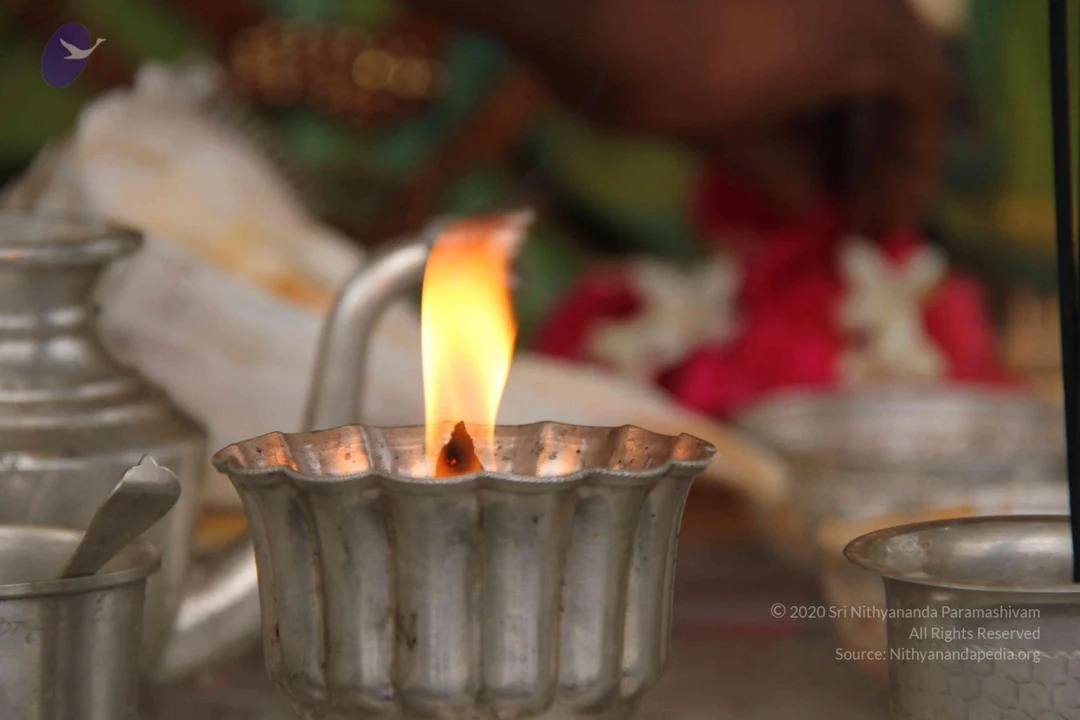
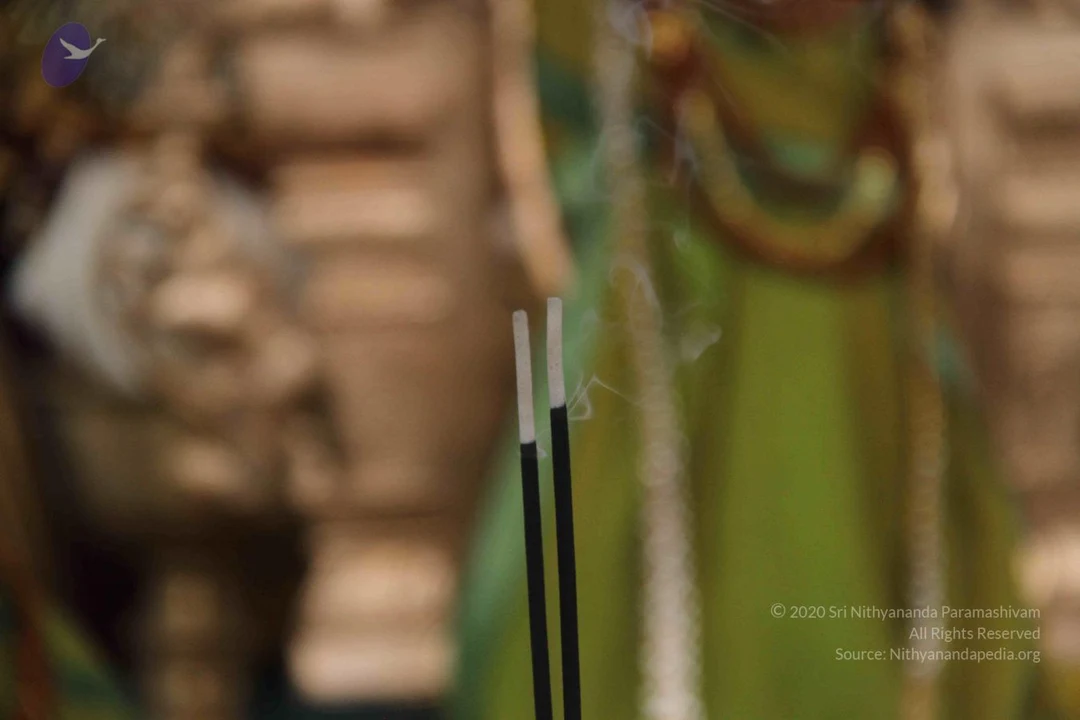
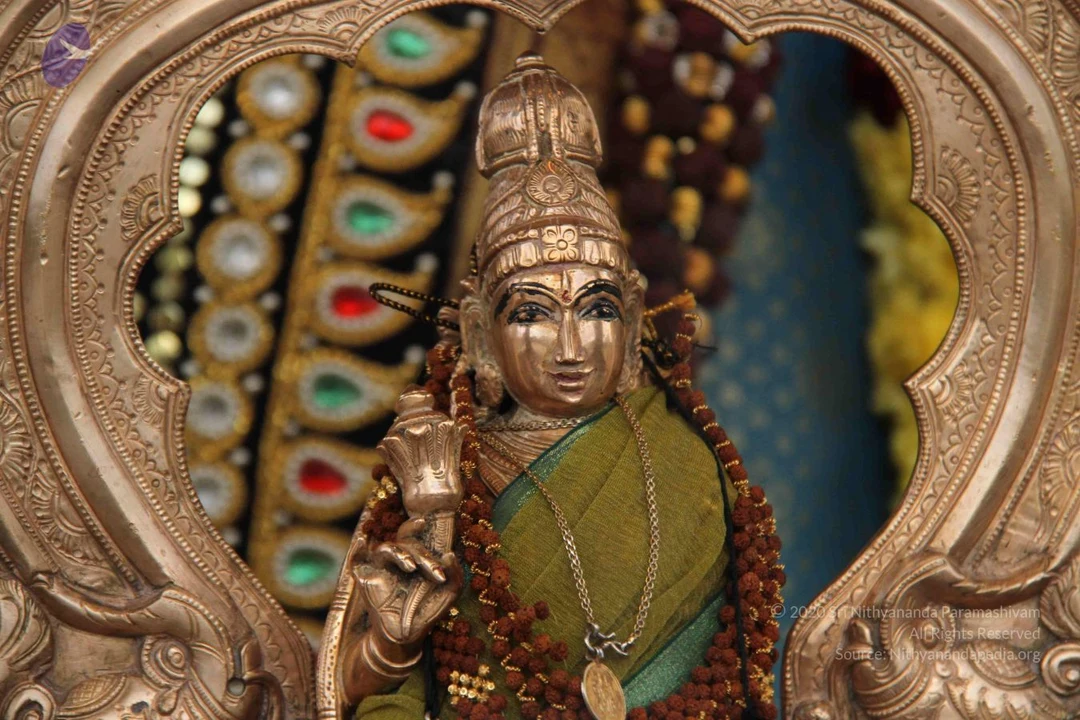
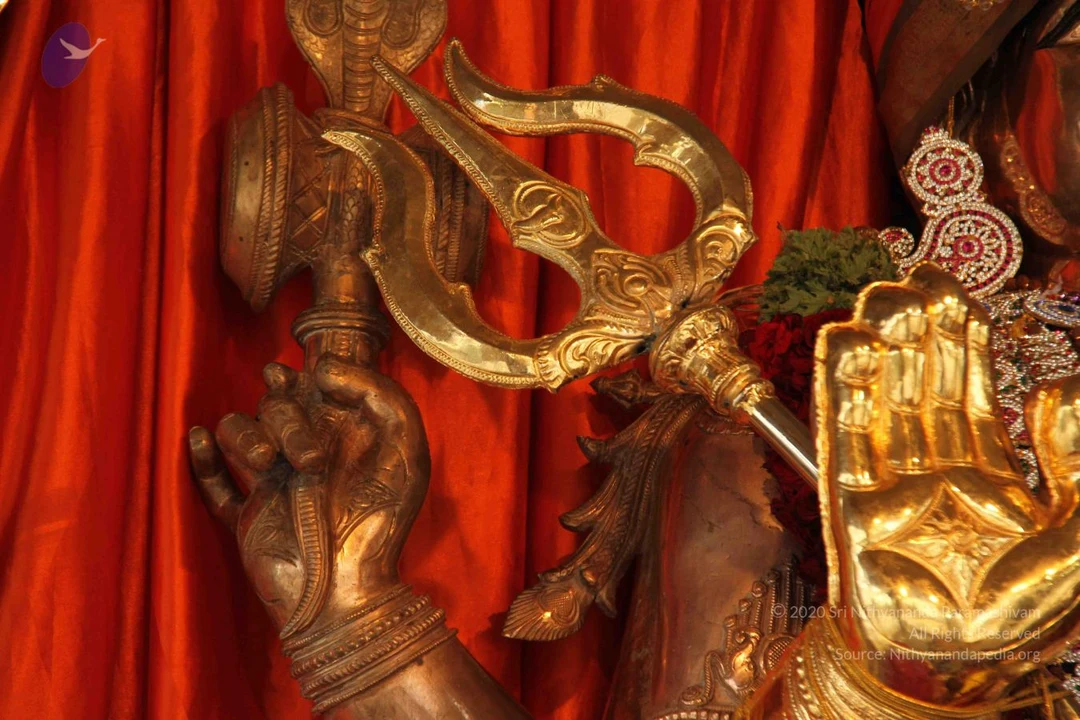
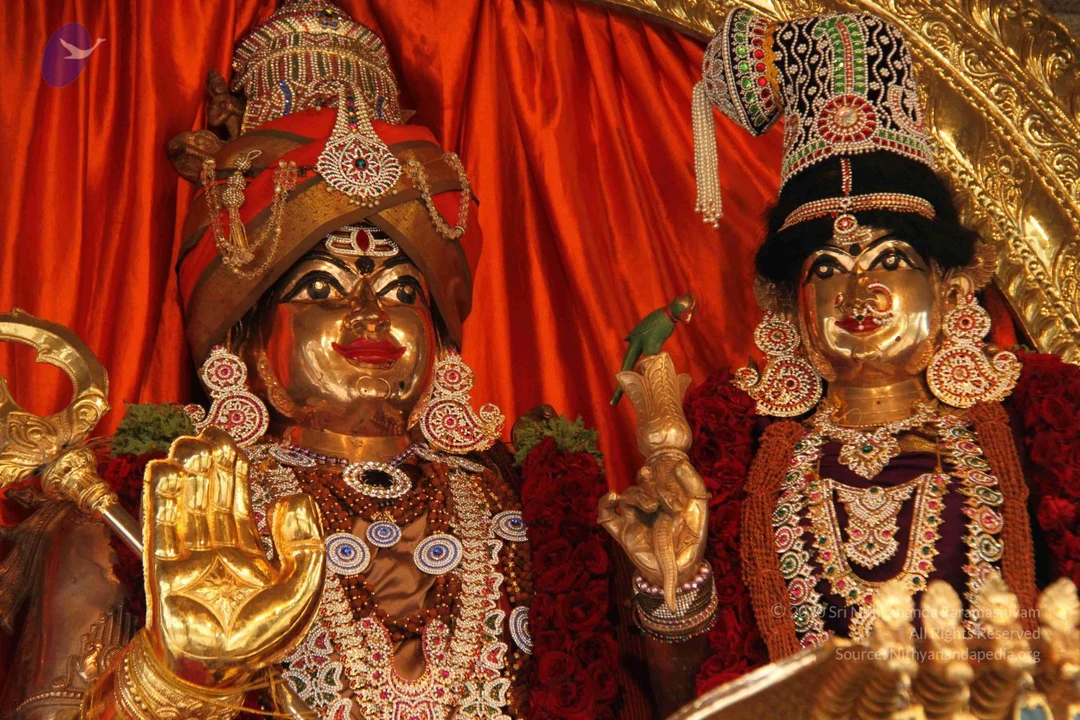
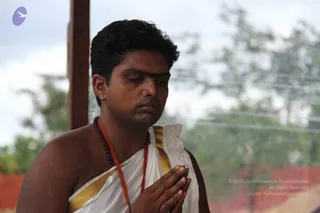
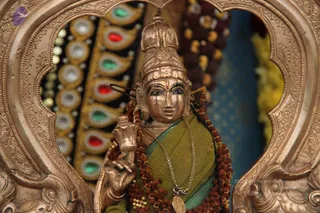
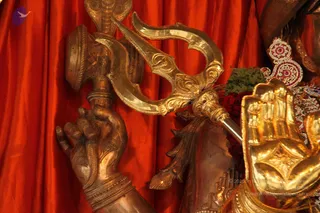
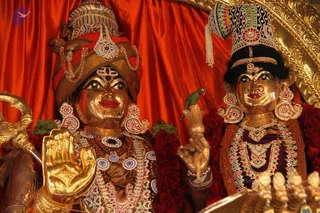
A close portrait photo of a man with short dark hair and a vertical tilak on his forehead, eyes lowered, hands pressed together in anjali mudra at chest height. He wears a white dhoti-style cloth with a gold border over his shoulder and bare chest, a rudraksha mala and a red-orange cord around his neck, and a small gold stud earring. Behind him, blurred trees and a red wall sit under an overcast sky, with a wooden pillar at left.Close-up photograph of a lit oil lamp in a silver scalloped cup in the foreground, its flame bright orange and steady. Behind it, out of focus, are silver vessels, a small silver spoon, a white cloth or shell-like object, and a red and white floral offering with a green fabric backdrop. No people are visible in the frame.Close-up photograph of two black incense sticks with white-tipped ash, smoking in the foreground. Behind them, blurred, is a green-robed deity murti with gold ornamental jewellery and a gold-toned carved backdrop. No people are visible. Thin wisps of incense smoke rise through the soft-focus background.Close view of a bronze-toned deity murti standing within an ornate copper-coloured arched frame. The figure wears a tall crown with a floral medallion, a green sari-like draped cloth, and a long chain with a pendant. Strands of dark rudraksha beads hang across the chest and shoulders, and the right hand holds a ceremonial staff. Behind, a jewelled border of green, red and white stones and a rudraksha garland frame the scene. Ornate metalwork encloses the deity in a shrine setting.Close-up photograph of a bronze-toned murti of a deity with raised arms holding a trident (trishula) and a small hand-drum or implement, set against a red-orange silk drape. A golden hand in an abhaya-type gesture is visible at right, and red flower garlands and a jewelled ornament are nearby. No people are visible; the statue is the only subject.Two gold-plated deity murtis stand side by side before a red satin backdrop with gilded carved edges. The figure on the left wears a red and gold turban with a jeweled crown ornament, a large rudraksha-style bead necklace, and rows of jeweled pendants; his right hand is raised in abhaya mudra and a trident rests against his left side. The figure on the right wears an ornate jeweled crown with red and green stones and tassels, layered jeweled necklaces, large earrings and bangles, and a small parrot perches on a raised hand. Red roses and green leaves decorate both figures. Visible and , which is excluded from the text list

Paduka-Puja

75 photosSource gallery
A blurred, out-of-focus photograph on a dark background showing a cluster of warm orange and pale white bokeh circles arranged in a vertical column. No people, faces or ritual objects are clearly identifiable.A close photograph of a silver multi-wick oil lamp (aarti lamp) with five lit flames, held up by a hand at the bottom edge in front of a blurred deity murti with raised arms and red-orange dhoti and green cloth. A blurred gold lamp stand and dark drapery frame the scene. The silver lamp has ornate animal-shaped supports on its sides. No people are clearly visible besides the partial hand and arm.Interior temple shrine with a golden throne-like seat (peetha) centred before a framed portrait of a smiling man in an orange turban and saffron robes, set between two large painted deity murtis with multiple arms, crowns and orange-red dhotis. A priest with a shaved head, bare back and orange cloth draped over his shoulder stands at the left foreground holding a lit oil lamp (aarti) toward the shrine. To the right, three devotees sit on a red-and-gold mat with palms pressed together in prayer: two in orange robes and one bare-chested man in a white dhoti with yellow border and sacred ash markings. Oil lamps stand on brass stands at the sides, and red curtains frame the scene. Padapuja or aarti at the shrine.Photograph of a temple sanctum shrine with a golden ornate throne bearing a framed portrait of a smiling figure in saffron and orange robes and a turban, draped with a tiger-skin cloth. Two painted dvarapala-style guardian figures with multiple arms, gold jewellery and orange dhoti stand on either side. In the foreground, a priest in orange robes holds a lit oil lamp aarti toward the shrine, while three seated devotees in orange and maroon robes sit with palms pressed together in namaskar; the figure at right wears a white dhoti with gold border and tilak markings.Photograph of an empty ornate gold-leaf throne (peetha) in a temple-style alcove with a tiger-skin cloth draped over the seat and a row of hanging oil lamps and bells on chains. A framed portrait labelled "PARAMAHAMSA NITHYANANDA" sits on the throne back, showing a smiling man with an orange turban, red bindi and saffron robe. No physical people are visible. Carved pillars with painted deity figures flank the doorway, and red and gold borders frame the shrine.A photograph of an ornate shrine inside a temple. Centre: a gilded throne with carved lion heads, draped with a tiger-skin cloth, under a golden canopy with hanging brass lamps. Framed on the throne is a large portrait of a smiling man with an orange turban and orange shawl, with a red bindi; the portrait is labelled PARAMAHAMSA NITHYANANDA. Left: a painted multi-armed deity figure in orange dhoti with green sash. In the foreground a person's arm holds a silver multi-wick oil lamp, lit with flames. A brass puja tray sits on the marble floor. Painted temple columns and red and green borders frame the scene.

Swasti-Mantra-Amaayantu-Chanting

21 photosSource gallery
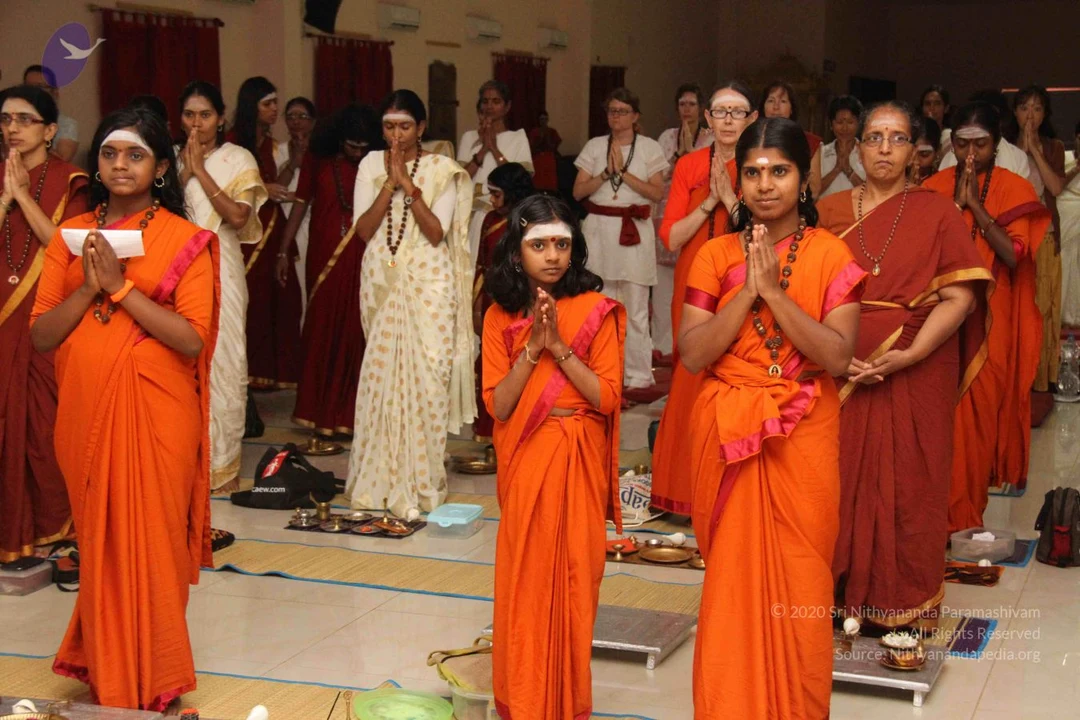
Two young saffron-robed boys sit on mats holding pink and red hibiscus flowers aloft, smiling, with rudraksha malas around their necks and white vibhuti lines on their foreheads. Behind them, several monks and devotees in saffron and maroon robes, some with white forehead markings and rudraksha beads, raise hands in greeting while others sit in a hall. Brass bowls, a folded cloth and paper cups sit on the floor in front. The scene suggests a satsang or puja gathering; no identifiable a person candidate is clearly present.Seated group of saffron-robed sannyasi and young disciples in a hall, many with white vertical tilak bands and red bindis. Foreground: two boys in orange robes and rudraksha malas each hold up pink and red hibiscus flowers and raise open palms, appearing to chant. Behind them a bearded man in orange with a rudraksha mala and a shaved-head man in orange with ornate earrings and bangles also raise hands. Background shows more seated devotees in white and orange and a few standing people. A small brass vessel and white paper cups sit on the floor, with red and green cloths nearby.Photograph of a group of young boys and adult monastics seated on a tiled floor in an indoor hall, chanting with raised open palms. The two front boys wear saffron-orange robes, rudraksha mala necklaces and white forehead markings, and each holds a pink and a red hibiscus flower. Behind them, shaved-headed monks in saffron and maroon robes sit with white tilak marks, and a few standing devotees in white clothes appear in the background. Brass cups, a small plastic container and folded cloths lie on the floor in front.Photo of a group of young sannyasi-style boys and men in saffron-orange robes with rudraksha malas and white vertical tilak marks on their foreheads, seated on the floor of a hall. Two boys in the foreground hold pink and red hibiscus flowers aloft with open hands, smiling and singing. Behind them a bald man in rust-red robes and a rudraksha mala sits with his mouth open in chant. A few white-clad devotees sit in the background, and a brass container, a folded cloth and a small cup are placed on the floor before the group.A photograph of shaven-headed young sannyasi boys and adult monks in saffron-orange robes seated on a tiled floor during a ritual gathering. Two boys in front, one in wire-rimmed glasses, hold up pink and red hibiscus flowers toward the camera, smiling. Each wears a long rudraksha mala and a white vertical tilak on the forehead. Behind them, older monks in rust-orange robes sit cross-legged with rudraksha malas, and a seated adult in glasses wears a brown-red robe. Brass cups, a small brass vessel, folded cloths and offering items lie on the floor. Seated devotees in white fill the background of a hall with pink walls. No identifiable a person is visible with confidence.Photograph of seated young sannyasi-style devotees in saffron-orange robes with rudraksha malas and white forehead markings, holding pink and red hibiscus flowers raised in devotional gesture during a ritual gathering. Two boys in front smile or speak, one with bare shoulders and gold earrings. Behind them an older bald man in deep red-orange robes and rudraksha mala sits in meditation posture, and other seated participants in orange and red clothing fill the room, with brass cups and folded cloths on the floor in front.

Gurukul-Instruments

3 photosSource gallery
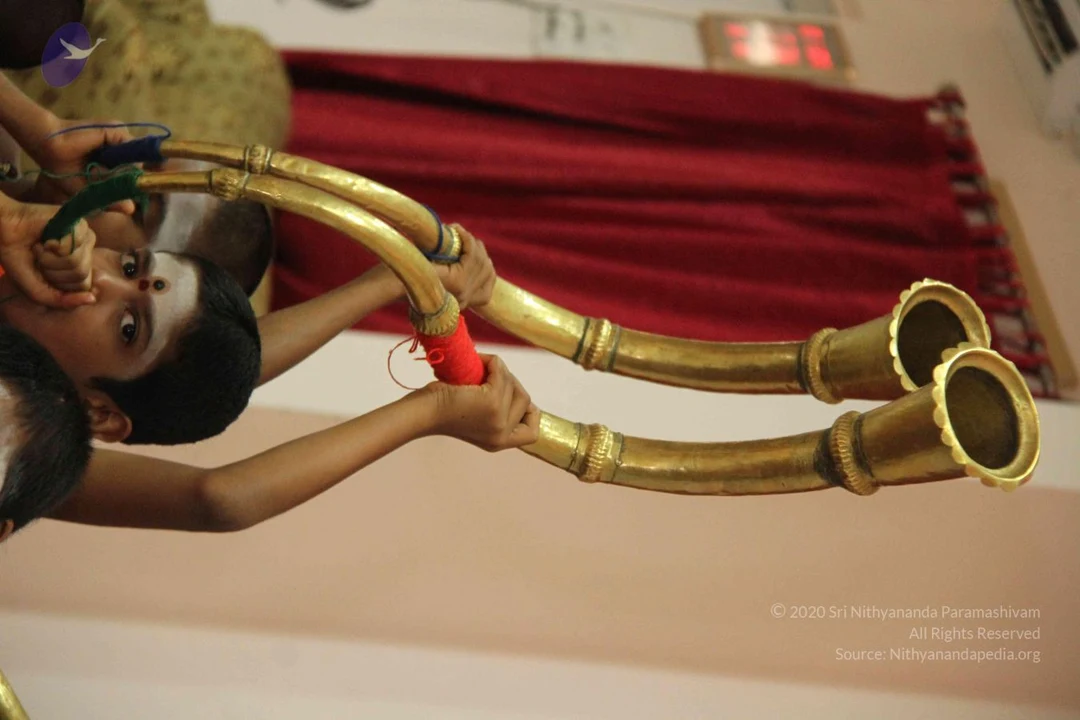
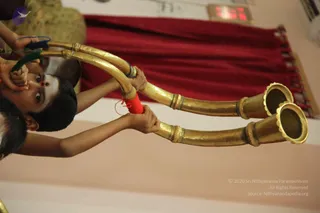
Close-up photograph of a large wooden barrel-shaped drum with a pale, weathered animal-skin head, held with a long thin wooden stick striking near the centre. A hand is partly visible at the top edge. Beside it, a person in orange saffron clothing sits on a red cloth. Thin smoke or incense haze drifts in the background.A young boy with short dark hair blows a large cream-colored conch shell held up to his mouth with both hands. He wears a white tilak with a dark central mark and a red bindi on his forehead, and a red garment over his shoulder. To the left, another boy in an orange robe with a shaved head stands partly visible, and a golden curved ceremonial rod rises at the right edge. The plain pale wall suggests an ashram or temple ritual setting.Photograph, rotated sideways, of a young boy playing a pair of long curved gold-coloured brass horns. He holds the red-wrapped grip of one horn with his right hand and steadies the other with his left, blowing into the bell-shaped mouth. He has a white vertical forehead mark and a black tilak dot, and wears a blue and green thread on his wrist. Behind him hangs a red cloth with tassels and a red digital display is visible at top. The scene suggests a ritual or temple music performance.

Nithya-Satsang

34 photosSource gallery
A man in saffron-orange robes with a gold-bordered dhoti stands on a carpeted stage beside a clear acrylic lectern, waving with one hand and wearing a beaded rudraksha-style mala necklace. Behind him is an ornate golden throne with red velvet cushions and lion-shaped armrests, flanked by two painted deity statues holding ceremonial objects. Brass oil lamps stand along the platform, and burgundy velvet drapes frame a blue and pink temple-style backdrop. The throne-like seat is empty. The man is a presenter on stage; the a person label is not used here because the cues are only a saffron-coloured robe and a mala, with no hair or crown, so identity is unsure.A man with long dark hair tied up walks barefoot across a stage in front of an ornate golden throne draped with a tiger-skin cloth and red cushions. He wears a rust-orange dhoti and shawl with gold borders and has a white bandage wrapped around his right forearm. Behind the throne stand two gold-coloured deity murti figures with multiple arms holding ceremonial objects, flanking a carved wooden door. Tall brass oil lamps line the stage, and the walls are painted in blue, pink and green temple-style motifs. The man is not positively identifiable from appearance; the page associates this event with a person, so the probable identity is noted here with the role of a devotee-walking figure: a person, walking before the peetha, bandaged right arm, saffron-orange robe with gold border.A man stands behind a clear acrylic lectern, speaking into a headset microphone. He wears a rust-red bare-shouldered garment with a gold border and a long rudraksha mala draped over his shoulders, plus small gold hoop earrings, a thin gold chain, a white forehead mark and a red bindi. A blue wall with an ornate golden arch and a golden kalasha-style lamp stand in the background.A photograph of a smiling person standing behind a clear acrylic lectern on a stage. The person wears a rust-red garment with a gold-bordered yellow edge draped over the shoulder, and a dense rudraksha-style mala of brown beads hangs down the chest. A small red bindi and white sacred ash mark the forehead, and small gold hoop earrings and a wireless headset microphone are visible. A pale bandage wraps the right hand resting on the lectern. Behind the stage are a blue wall with ornate gold and pink decorative motifs and a brass oil lamp on the right. a person (in_person) giving satsang, with rudraksha mala, saffron-red robe and gold-edged shawl as the qualifying cues.A man in a rust-red and gold-bordered dhoti-style wrap and a matching shawl stands at a clear acrylic lectern, smiling and speaking into a head-mounted microphone. He wears a thick rust-brown beaded mala around his neck, gold hoop earrings, a white vibhuti line and a red kumkum dot on his forehead, and his right hand rests on the lectern while a pink bandage covers his wrist. Behind him are a blue wall, a gold-and-blue decorative arch, a pink and green kalasha-style pillar and a brass oil lamp on the right. a person: the presenter wears saffron-toned ceremonial clothing, a rudraksha-style mala and gold earrings, consistent with the page's discourse context.A smiling person in a red-brown and gold-bordered wrap stands behind a clear acrylic lectern, with a headset microphone at the cheek. A rust-coloured knotted rudraksha-style mala hangs over the shoulders with a thin gold chain beneath, and gold hoop earrings are worn. A white tilak marks the forehead and a red bindi sits between the brows, with hair swept back. The left hand rests on the lectern edge. Behind, a blue wall is decorated with a gold ornamental arch and a pink-and-green pillar, and a brass lamp stands at the right edge. A single person is physically present.

Sarva-Darshan

6 photosSource gallery
A photograph of a temple-like hall where a bare-chested man in an orange-saffron dhoti with gold-bordered cloth and an orange shawl stands with his right palm raised toward the forehead of a bald, white-clad devotee. A probable Swamiji candidate with long swept-back hair, a rudraksha mala, ornate gold-bordered cloth and gold jewellery, performing a blessing. Around him, several young men in white dhotis and shirts with tilak-marked foreheads and rudraksha malas wait in a line, some wearing lanyards, while a monk in orange stands behind. A white-clad devotee bows his head. Low tables with puja items and mats line the floor, a projector screen and stage with red drapes are behind, and a shelf of brass items is visible on the right.Indoor hall with red curtains and ceiling fans. A smiling person in an orange-and-gold sannyasi-style wrap, a rudraksha mala and gold ornaments extends a hand toward the forehead of a bowing devotee in a white shirt and black track pants. Other devotees kneel and stand with hands folded in namaste, one in a blue striped shirt, and several saffron-clad sadhus with white tilak stand behind. Devotees in white dhotis stand in the background near a projector screen and a microphone stand.A photo inside a hall with red curtains and a golden throne at the back. A person in a saffron-orange and gold-bordered dhoti with long hair and ornate gold-trimmed jewelry stretches out one hand to bless a line of men with folded palms, all standing and looking down. A man in white dhoti and a mala holds a silver tray at right. Several other people in white stand along the room.A photograph in a large hall with red curtains and ceiling lights shows a man with long swept-back dark hair, bare-chested, wearing a rust-brown dhoti-style wrap with a gold border and an orange shawl with a beaded mala, reaching out to bless the head of a devotee. Probable Swamiji's appearance matches the presentation cues of long swept-back hair, ornate gold necklace and saffron-orange shawl, and he is the one giving blessing. Around him, a row of devotees with folded hands and white clothes, some with white vibhuti lines on their foreheads, stand behind stanchions, and a man in orange robes with a rudraksha mala stands at left. Several people in white kurtas and saris are visible in the background. Roughly a dozen physical people are visible.A photograph inside a hall with red curtains and fluorescent ceiling lights shows a smiling figure in an orange-red and gold-bordered dhoti and shawl, with a long orange-marigold garland and gold earrings, extending a raised right hand in blessing toward a line of devotees. On the left, several men in white shirts and rudraksha malas stand with palms pressed together in namaskar, one wearing an orange robe and glasses. Behind them, more men in white and women in white saris stand in a queue behind metal stanchions, and a large screen on the wall shows an image. The figure with the garland is a person by appearance cues: long swept-back hair, ornate gold necklace and saffron-red clothing.A photograph inside a hall with red curtains and ceiling lights. A person in a bare-shouldered rust-orange wrap with a gold border and a long orange-and-saffron-beaded garland raises a hand in blessing over the head of a bowed man in a white shirt. Around them, devotees in white shirts and white dhotis press palms together in anjali, and a few wear rudraksha malas. Orange-robed attendants stand at the left edge, and a woman in a white sari holds a green-and-silver tray on the right. The person giving the blessing has long hair swept back, a red bindi, and gold earrings, which fits the a person appearance; the figure is shown as a blessing giver.

Nithya-Dharmam-Day3

161 photosSource gallery
A man seated in a red and black tiger-striped chair on a stage, wearing a saffron-orange turban, orange-brown robe draped over a gold-bordered garment, and a long thick golden rudraksha-style mala necklace with gold earrings and a red bindi on his forehead. Behind him stands a large gilded carved sculpture with a teal-lit panel to the left. Appearance-based candidate: a person, seated in a saffron-robed, turbaned ceremonial presentation with distinctive ornate necklace and earrings; one person physically present.A man seated on a red and gold throne-like seat in a richly ornate golden hall, turned to his right and smiling. He wears a rust-orange turban with gold stripes, a rust-orange and gold draped garment, a long golden-brown beaded necklace, and a small gold earring; a small red mark is on his forehead. Behind him, a gilded lion sculpture and ornate golden carved panels frame the scene. Swamiji (probable): the saffron-orange turban, ornate ceremonial gold necklace and orange garments match the appearance cues for the page's Swamiji candidate, seated in a throne setting.A seated man in a rust-orange turban and rust-orange and gold-bordered dhoti-style wrap sits on an ornate red-cushioned gold throne, wearing a long rudraksha mala with a gold-toned pendant and a gold earring. He smiles toward a man in a white-and-grey checked shirt and grey trousers seated at right, who gestures with an open hand. Behind them stand gilded carved pillars, one topped by a golden makara-like beast, a teal-rimmed carved medallion, and a brass lion figure on the floor. The setting suggests a formal satsang stage. Probable Swamiji is seated on the throne in the centre-left, identified by the turban, rudraksha mala and saffron-orange ceremonial clothing.A seated figure in a red-brown turban and matching saffron-orange wrap, with a bare chest, long rudraksha mala beads and a gold necklace, sits cross-legged on a red velvet and gold-carved throne in a golden temple-style studio set. Carved golden pillars with a horse-and-rider relief and a teal lotus medallion frame the scene. Opposite, a bearded man in a checked shirt and grey trousers sits in conversation on a red-cushioned seat, and a bronze lion sculpture stands between them. The seated figure, a probable Swamiji with distinctive long mala beads, gold necklace and turban cues, appears in a talk-show-style interview setting.A seated man in saffron-brown and yellow robes, wearing a rust-orange turban, a long brown-gold beaded mala around his neck and a sash, sits on an ornate gold-and-red throne (peetha) with carved lion and floral motifs. He gestures toward a second man, seated at right, wearing a white-and-grey checked shirt and grey trousers, on a red-cushioned seat. Between them stands a gilded lion statue. Behind them, carved golden pillars and a teal circular floral medallion form a temple-like stage set. The seated man resembles the probable Swamiji by his turban, saffron robes and ornate mala.A photograph of a golden-carved stage set with a lion-headed carved pillar and a bronze lion sculpture in the foreground. A man in an orange-brown turban, orange-brown dhoti-style robe with a yellow border, and a long beaded rudraksha-style necklace sits cross-legged on a red cushioned golden throne at left, smiling and gesturing toward a second man seated at right. The seated man wears a white and grey plaid shirt and grey trousers and sits on a red-cushioned bench beside the bronze lion. Behind them stand ornate golden temple-style columns and a teal circular medallion.

Temple-Picture

23 photosSource gallery
A close portrait photo of a man with short dark hair and a vertical tilak on his forehead, eyes lowered, hands pressed together in anjali mudra at chest height. He wears a white dhoti-style cloth with a gold border over his shoulder and bare chest, a rudraksha mala and a red-orange cord around his neck, and a small gold stud earring. Behind him, blurred trees and a red wall sit under an overcast sky, with a wooden pillar at left.Close-up photograph of a lit oil lamp in a silver scalloped cup in the foreground, its flame bright orange and steady. Behind it, out of focus, are silver vessels, a small silver spoon, a white cloth or shell-like object, and a red and white floral offering with a green fabric backdrop. No people are visible in the frame.Close-up photograph of two black incense sticks with white-tipped ash, smoking in the foreground. Behind them, blurred, is a green-robed deity murti with gold ornamental jewellery and a gold-toned carved backdrop. No people are visible. Thin wisps of incense smoke rise through the soft-focus background.Close view of a bronze-toned deity murti standing within an ornate copper-coloured arched frame. The figure wears a tall crown with a floral medallion, a green sari-like draped cloth, and a long chain with a pendant. Strands of dark rudraksha beads hang across the chest and shoulders, and the right hand holds a ceremonial staff. Behind, a jewelled border of green, red and white stones and a rudraksha garland frame the scene. Ornate metalwork encloses the deity in a shrine setting.Close-up photograph of a bronze-toned murti of a deity with raised arms holding a trident (trishula) and a small hand-drum or implement, set against a red-orange silk drape. A golden hand in an abhaya-type gesture is visible at right, and red flower garlands and a jewelled ornament are nearby. No people are visible; the statue is the only subject.Two gold-plated deity murtis stand side by side before a red satin backdrop with gilded carved edges. The figure on the left wears a red and gold turban with a jeweled crown ornament, a large rudraksha-style bead necklace, and rows of jeweled pendants; his right hand is raised in abhaya mudra and a trident rests against his left side. The figure on the right wears an ornate jeweled crown with red and green stones and tassels, layered jeweled necklaces, large earrings and bangles, and a small parrot perches on a raised hand. Red roses and green leaves decorate both figures. Visible and , which is excluded from the text list

1-Paduka-Puja

8 photosSource gallery
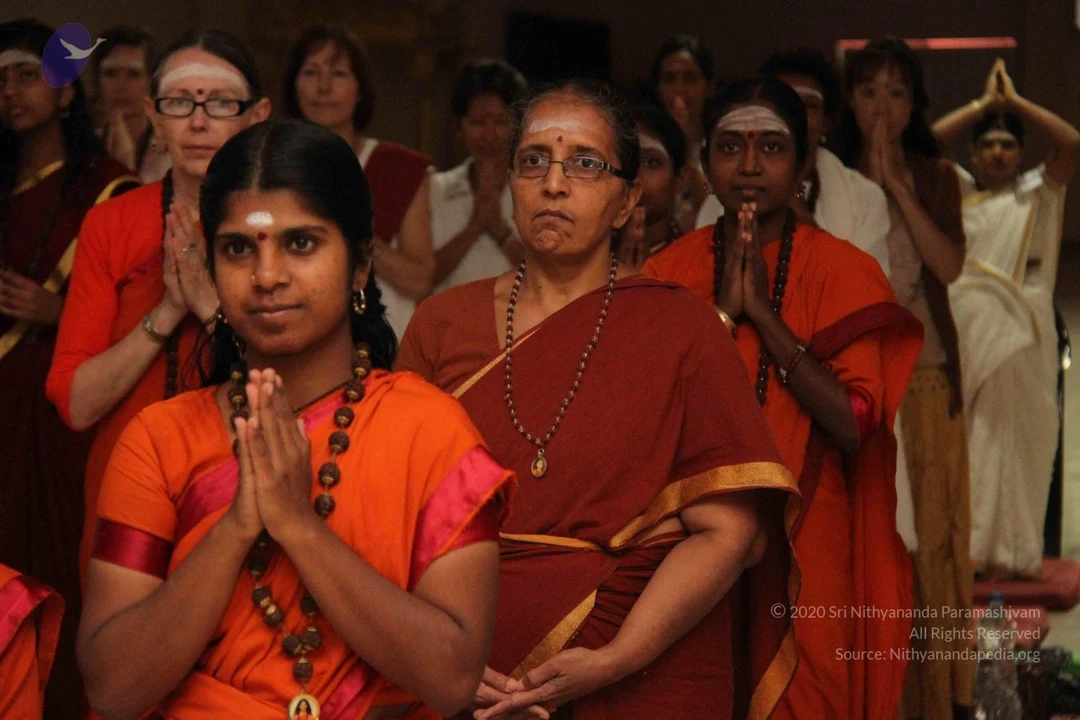
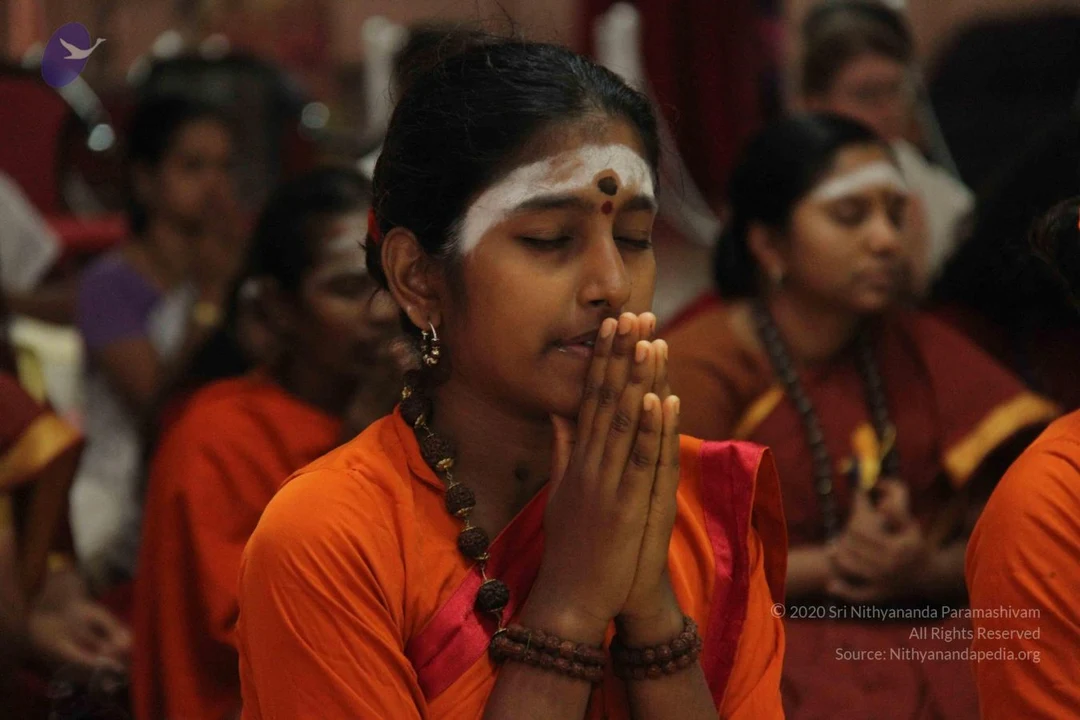
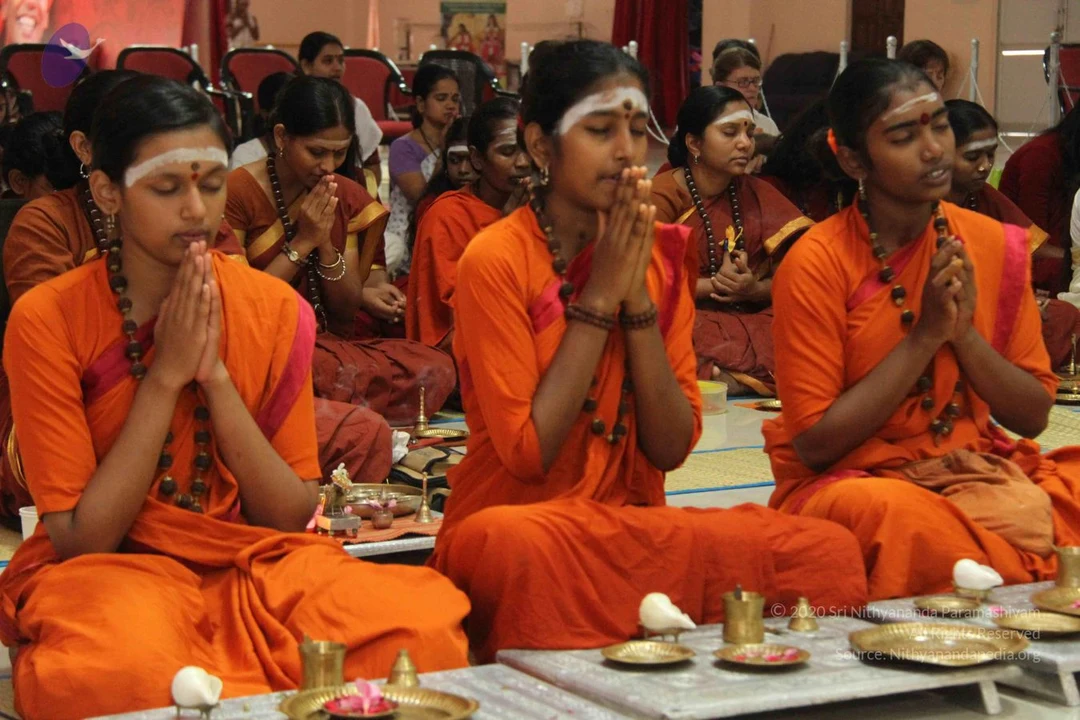
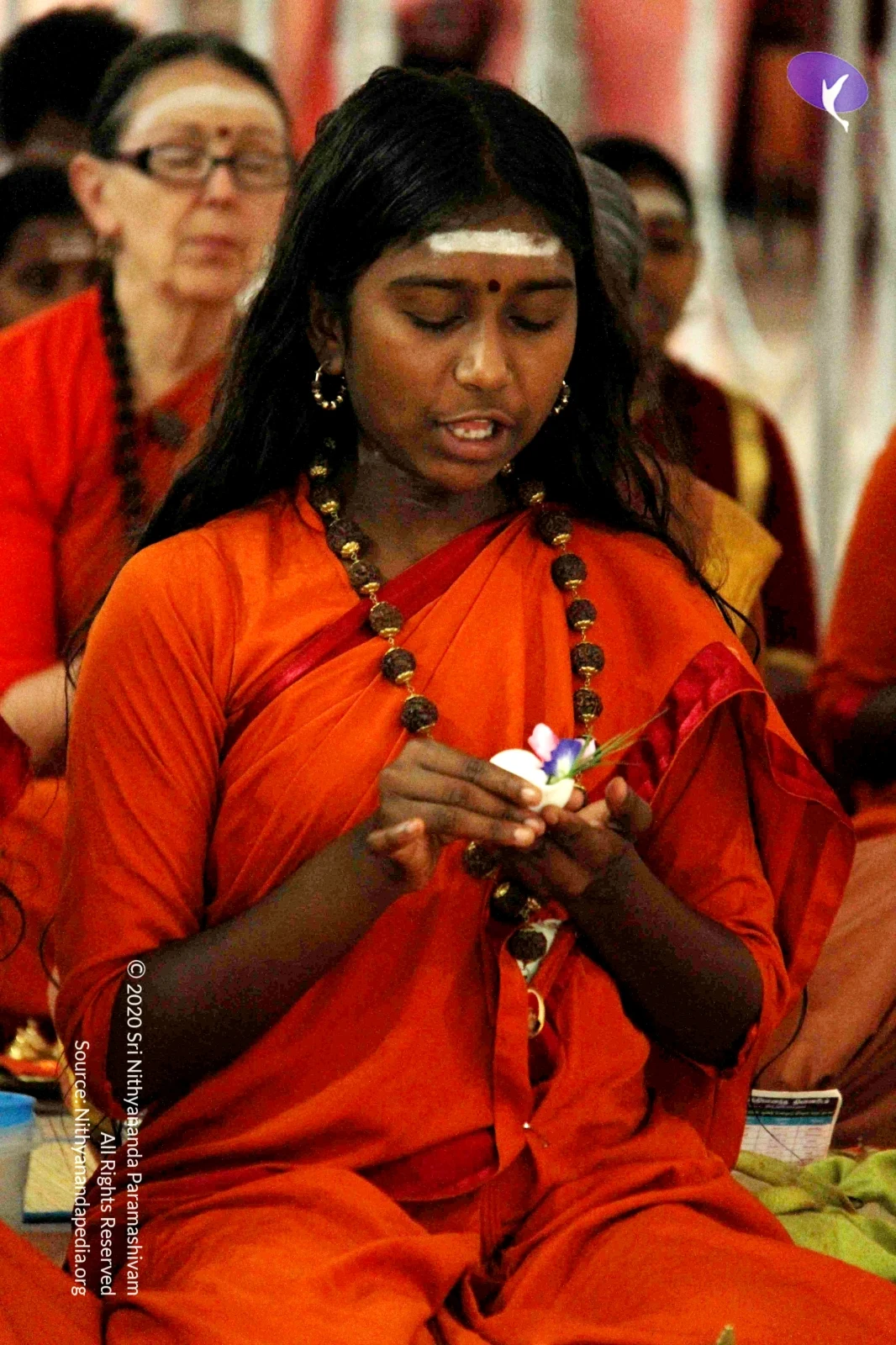
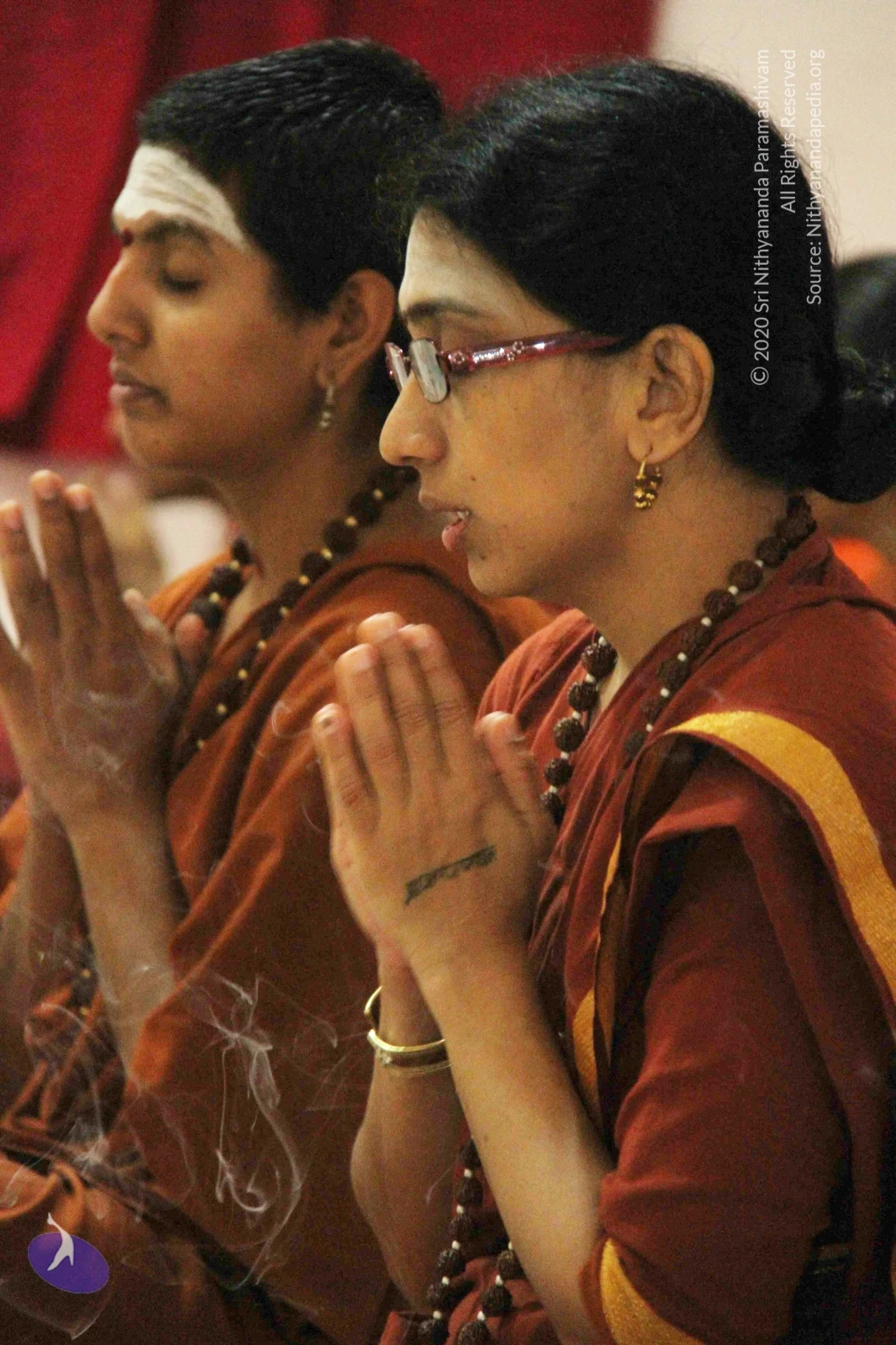
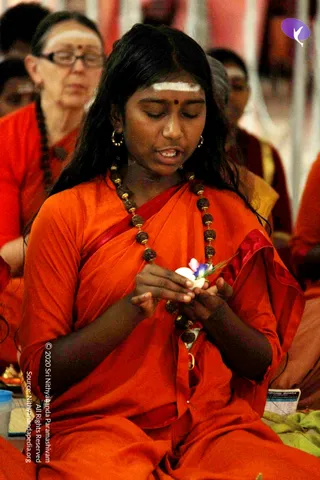
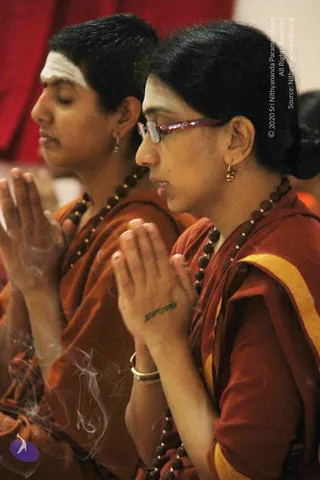
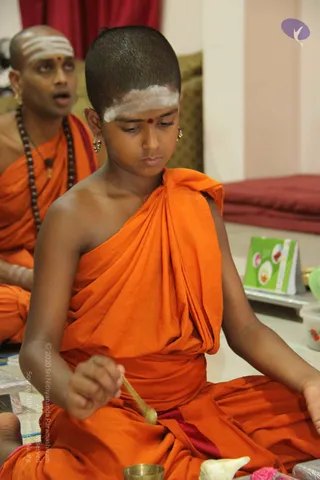
A young woman sits in close view wearing an orange sari-style garment with a red border and a long rudraksha mala with gold spacers around her neck. She has a white horizontal tilak across her forehead and a red dot between her brows, and her eyes are closed as she chants. She holds a small white flower with blue and purple petals cupped in her hands. Behind her, an older woman in orange with glasses and a white forehead mark sits in meditation among other seated devotees in orange and red garments.Close side-view photograph of two devotees in namaskar, palms pressed together, with eyes closed and wisps of incense smoke drifting past. The woman in front wears rust-red clothing with a gold border, large rudraksha mala beads, a gold bangle, gold earrings and red-framed glasses, with a dark hairline tilak mark on her palm. Behind her, a younger person in orange-saffron robes and rudraksha beads has a white vibhuti band with a red kumkum dot on the forehead. A red curtain forms the background.A young boy with a shaved head and a white vertical tilak with red bindi sits cross-legged in a saffron-orange cloth draped over one shoulder, holding a small brass bell-like implement in his right hand and looking down. Behind him, a man with a shaved head, white tripundra marks, a rudraksha mala and orange robes sits and appears to chant. In front are a brass cup, a white conch shell and a pink flower offering. a person is not clearly identifiable from appearance in this frame.A shaved-headed man in an orange saffron cloth wrapped over his shoulder sits cross-legged, eyes lowered, performing a puja with a brass hand bell in his right hand and an incense stick in his left. He wears a long dark rudraksha mala with a small locket pendant and white sandalwood lines on his forehead and arms. Beside him, several boys in red and maroon robes sit on the floor, one with a white forehead mark and a bead necklace, and a standing devotee in the background presses palms together in namaskar. In front, a brass plate holds red rose petals and a brass bowl sits on a white-draped cloth with a small paper cup. The scene is a devotional ritual in an ashram hall.A seated man with a shaved head and white horizontal tilak with a red dot on his forehead, wearing small hoop earrings, orange-red robes and multiple strands of rudraksha malas with a pendant. He holds a lit brass oil lamp in one hand and a brass bell in the other, appearing to perform a puja. Behind him, other seated people and brass ritual items are visible on a floor mat.Photograph of a tiered brass aarti lamp with multiple rows of lit oil lamps held up in the foreground by a hand at the bottom left. Behind it, blurred, stands a large painted deity statue with orange and green garments, golden ornaments and a crown, raising one hand. Another lamp stand with a lit flame appears at the left edge. A blurred orange-clad figure is visible in the background.
4-Satsang
22 photosSource gallery
A man stands in front of a blue-painted temple backdrop with pink and green lotus-style pillars and a golden arch, with his palms pressed together in namaste at his face. He wears a rust-red garment draped over the shoulder with wide gold borders, a long orange-beaded mala, gold earrings, and a white cast on his right forearm. Beside him stand tall brass oil lamps and a clear acrylic lectern. A partially visible hand holding a gold ritual object appears at the right edge. The pose suggests a greeting or reverence before a discourse.A smiling man stands beside a clear lectern in a decorated hall with a painted pillar and ornate gold-and-pink temple-style backdrop. He wears a rust-red wrap with broad gold borders, a thick orange-gold beaded mala around his neck, gold earrings and a small red dot on his forehead with white tilak marks; a small headset microphone is visible at his ear. His raised arm extends toward the lectern edge. a person: the visible cues are short dark hair, saffron-orange ceremonial wrap and a rudraksha-style mala, matching the page's claim that he is present, though appearance alone is not conclusive. No other people are visible.A smiling man in a rust-red and gold-bordered draped robe stands beside a clear acrylic lectern on a stage. He wears a long beaded rudraksha-style mala of orange-brown beads, a red bindi and a tilak on his forehead, and gold earrings. Behind him are painted pillars with pink and green lotus-style capitals and a decorative temple-style arch. A gold oil lamp stand is visible at the left edge. Appearance cues (long swept-back hair, saffron-toned draped clothing, rudraksha mala) are consistent with a probable Swamiji (probable) presence, identified only by these visible cues.A smiling man in a rust-orange saffron-style dhoti and shawl with broad gold borders stands beside a clear acrylic lectern, his right hand resting on its edge with a white bandage wrapped around the wrist. He wears a long rudraksha mala around his neck, a red bindi and tilak, and gold earrings. Behind him are painted temple columns in pink, green and gold, a large painted deity figure holding a mace-like staff on the right, a brass oil lamp stand, and a red velvet cushioned seat at the lower right. The scene resembles a satsang stage setting.A man stands on a marble stage beside a clear acrylic lectern, smiling and gesturing with his left hand. He wears a rust-orange unstitched robe with broad gold borders wrapped over one shoulder and around the waist, a long rust-coloured rudraksha-style bead garland of amber beads around his neck, gold earrings, and a small red bindi on his forehead. Behind him stands a painted deity murti with a crown, holding a trident-like staff, painted in pink and green on a blue ornate temple backdrop with pink and gold pillars. A red and gold cushioned seat is at the right edge, and a brass lamp stands at left.A man stands barefoot on a patterned rug beside a clear acrylic lectern, speaking into a headset microphone. He wears a rust-red draped garment with wide gold borders, a rudraksha mala around his neck, and a red bindi with a vertical tilak. His right arm is bent and his left hand rests on the lectern. Behind him stands a painted deity murti with four arms, gold ornaments and a green sash, beside a brass oil lamp on a stand and a gold-and-red-cushioned throne. The pillars are painted pink and green. The page suggests this is a satsang, and the man's appearance with the rudraksha mala and saffron-toned robe is a probable match for a person, but this is an uncertain appearance-based label.

5-Sarva-Darshan
6 photosSource gallery
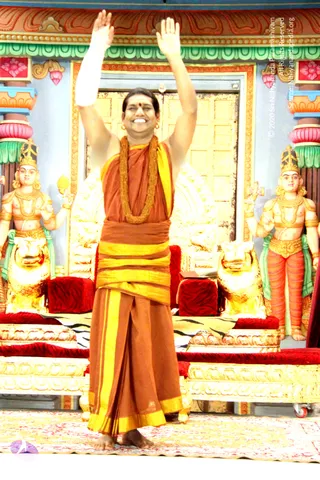
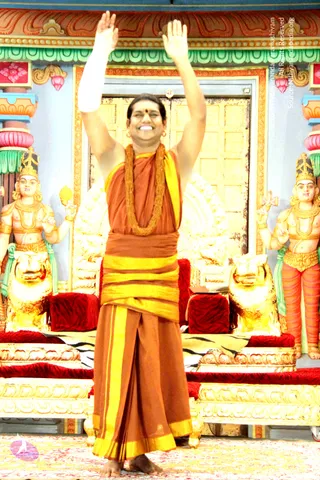
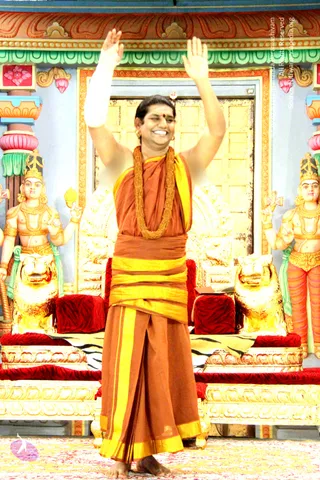
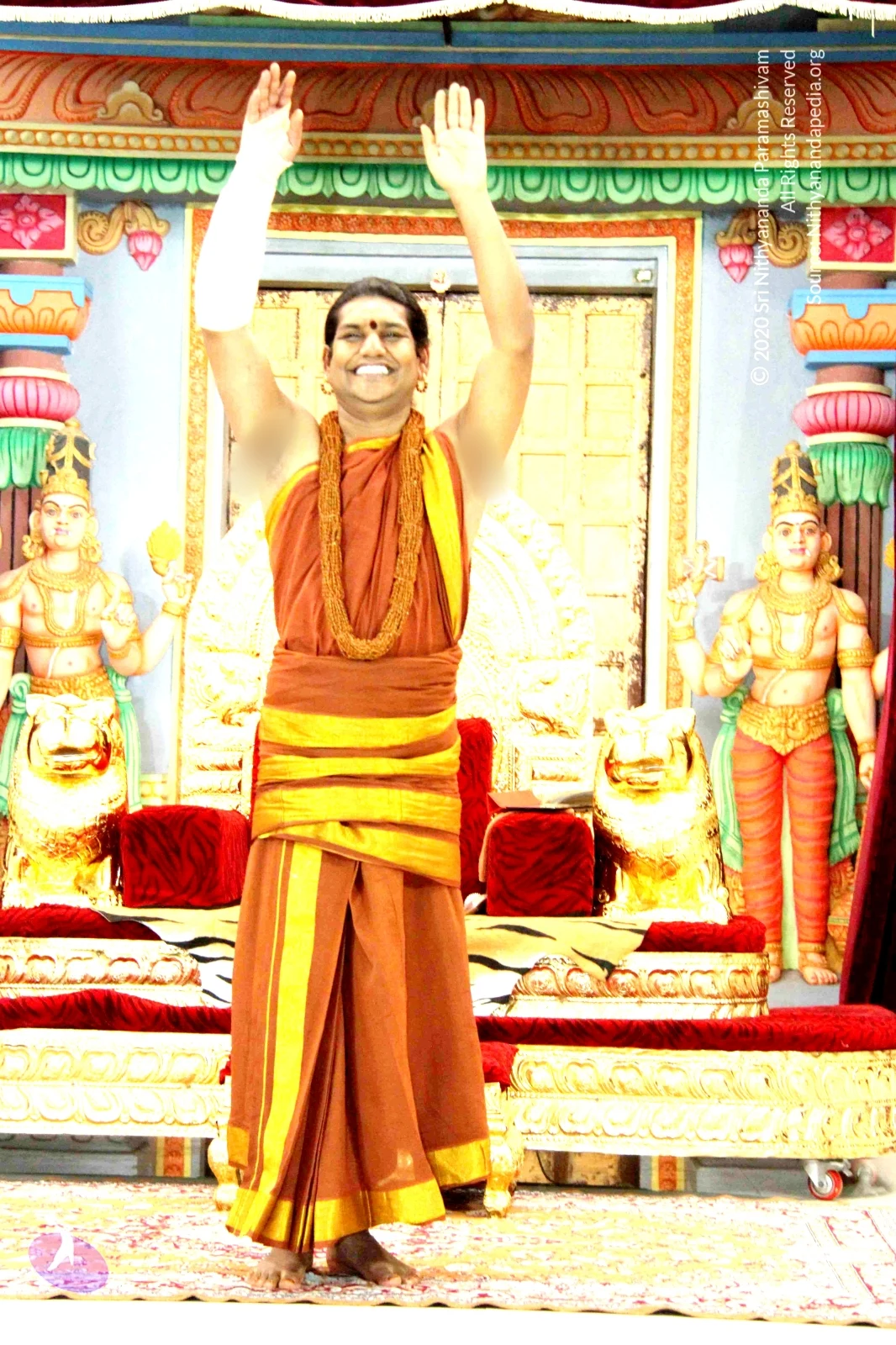
A standing man with both arms raised high, smiling, in front of an ornate golden-and-red throne platform with a tiger-striped cloth and red cushions. He wears an orange-brown dhoti and shawl with gold borders, a gold bead mala at the neck, and a red bindi; a white bandage is on his right forearm. Flanking him are two gilded deity statues with crowns and ornaments, and golden lion-shaped armrests. The setting has a carved gold door and painted temple-style pillars with lotus motifs.A smiling man stands barefoot on a patterned rug before a gilded throne with red velvet cushions, a tiger-striped cloth and golden lion-head armrests. He raises both arms high, palms open, in a welcoming gesture. He wears a rust-orange dhoti and upper cloth edged with gold borders, a thick golden-brown rudraksha mala, and a red bindi. Behind him stand two painted, gold-adorned guardian figures with crowns and ornate necklaces, flanking a gilded door. The setting suggests a temple-style stage. a person: the figure wears orange robes, a rudraksha mala and a red forehead mark on the stage, where he is greeting the assembly as a speaker.A smiling man in a rust-orange and gold-bordered dhoti and shawl, with a dark rudraksha-style mala of beads around his neck and a red bindi, stands barefoot on a patterned rug with both arms raised high. Behind him are a golden chair with red cushions and two gold-painted lion figures, flanked by painted stone deity murti figures with crowns and ornaments on a blue and green temple backdrop. a person is shown in person, appearing to be the central figure standing in an arms-raised greeting.A smiling man stands barefoot on a patterned rug with both arms raised overhead, one forearm wrapped in white bandage. He wears a rust-orange sannyasi-style garment with a wide yellow-gold border, a yellow-gold waist cloth, and a long rudraksha-style mala around his neck. Behind him is an ornate gold-and-red throne with carved gilt lions and red tiger-striped cushions, flanked by two painted, gold-jewelled guardian statues holding objects.A standing man in a saffron-orange dhoti and shawl with a gold-bordered yellow waist sash raises both arms high in a welcoming gesture while smiling broadly. A thick rudraksha-style mala hangs around his neck and a red bindi marks his forehead. A white bandage wraps his raised right forearm. Behind him stands an ornate golden throne with red velvet cushions, flanked by two golden lion figures. Two painted deity statues with crowns and gold jewellery stand on either side of the dais, and a carved wooden door with a golden frame sits in the background. The floor is covered with a patterned red and gold carpet.A man seated on a dark red velvet throne with a zebra-stripe pattern, in front of ornate gold carved panels with floral and bird motifs. He wears an orange-brown turban with gold accents, a red bindi, gold hoop earrings, a long rudraksha mala with brown beads, and an orange-saffron garment draped over bare shoulders with a gold-bordered cloth across the chest. A patterned orange shawl rests over his arm. Swamiji (probable): he has long swept-back hair framed by the turban, distinctive rudraksha mala and ornate saffron clothing, seated on a throne as presiding figure.