Skip to content
Monday

14 January 2008

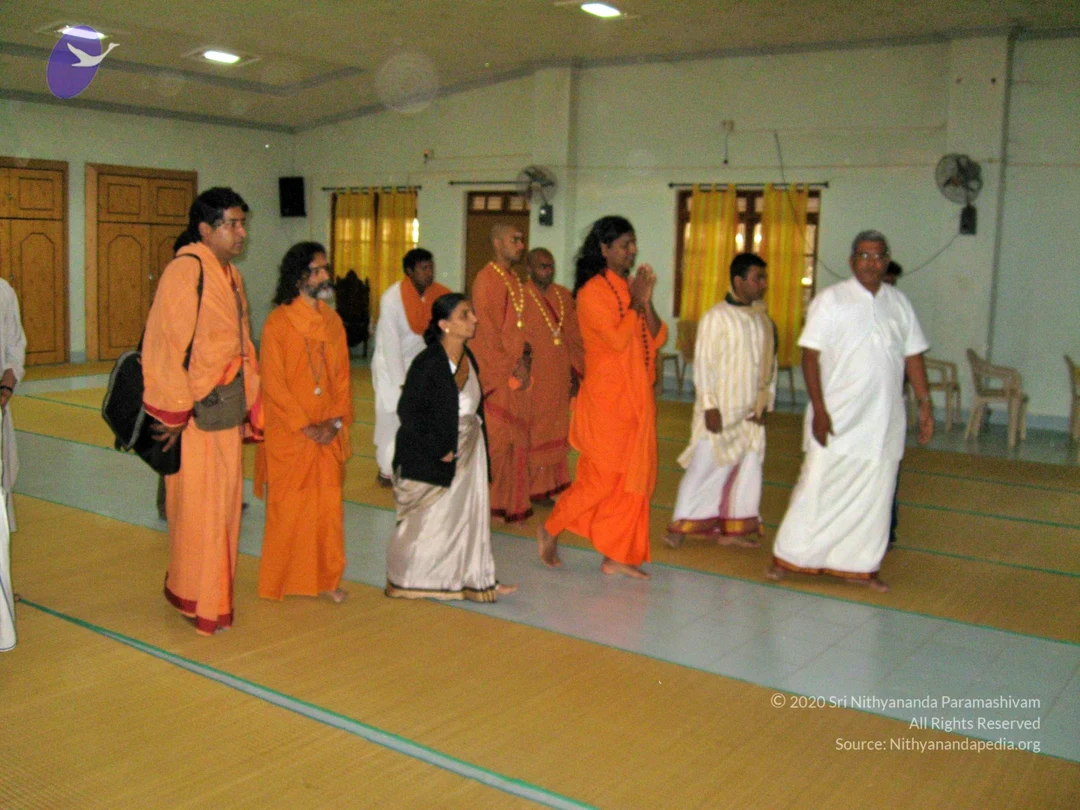
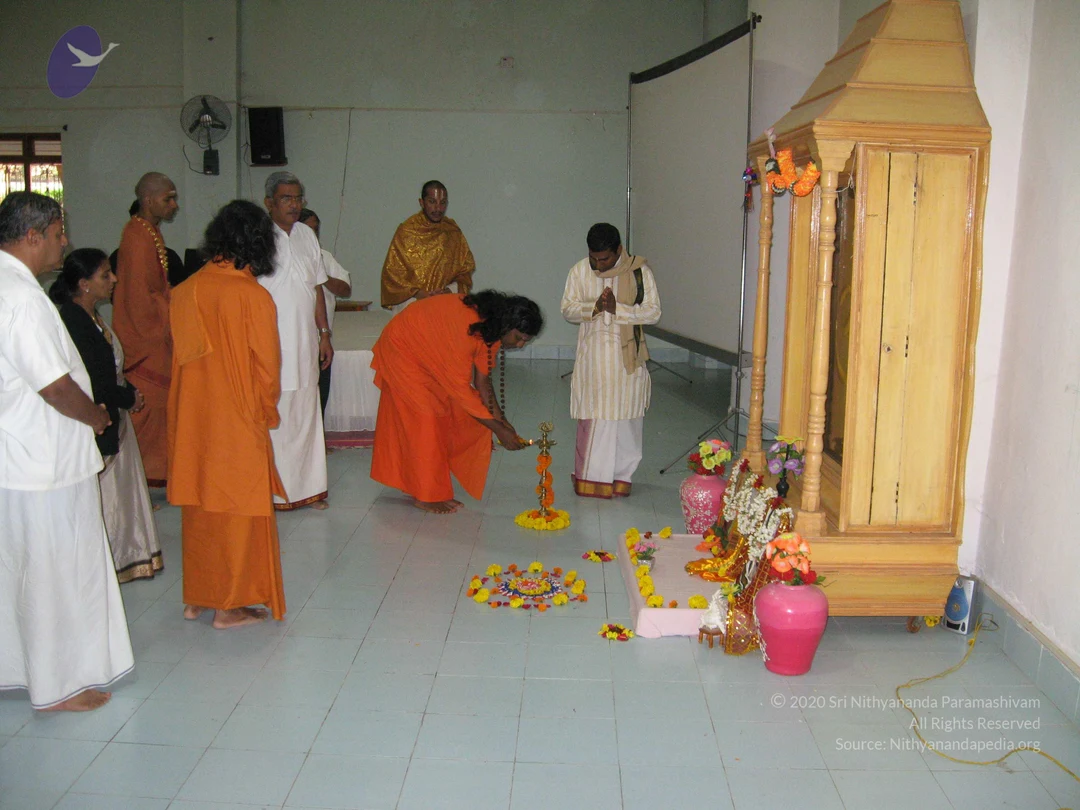
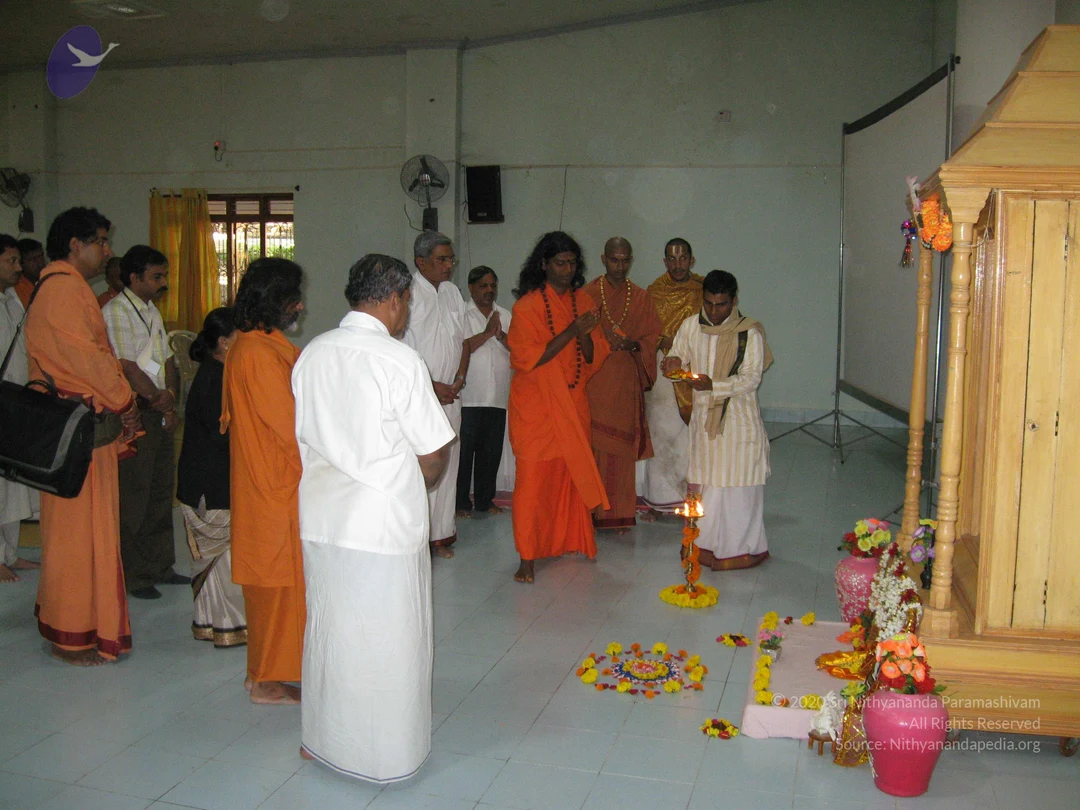
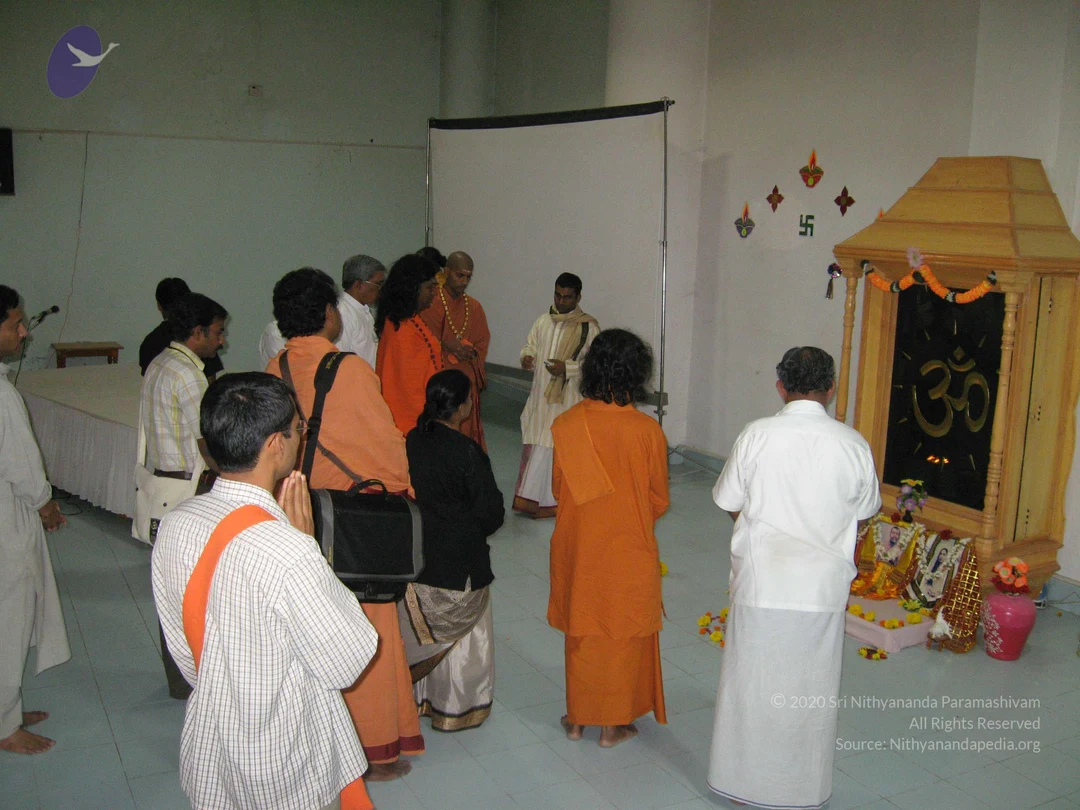
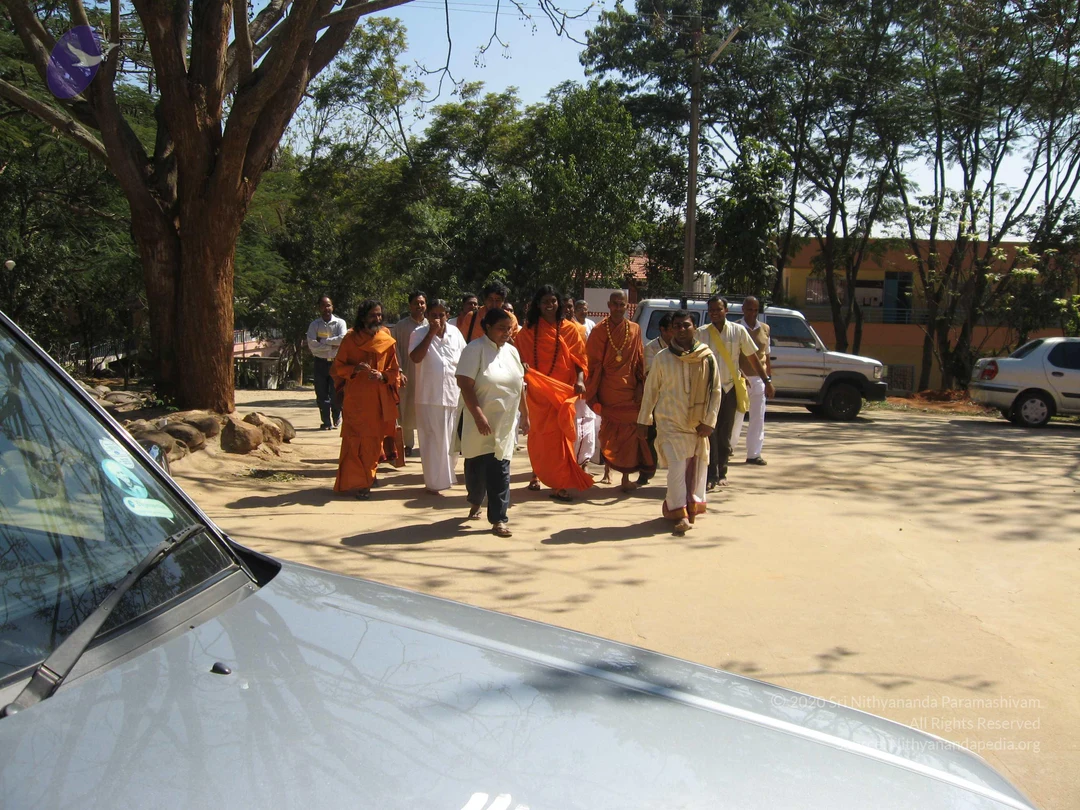
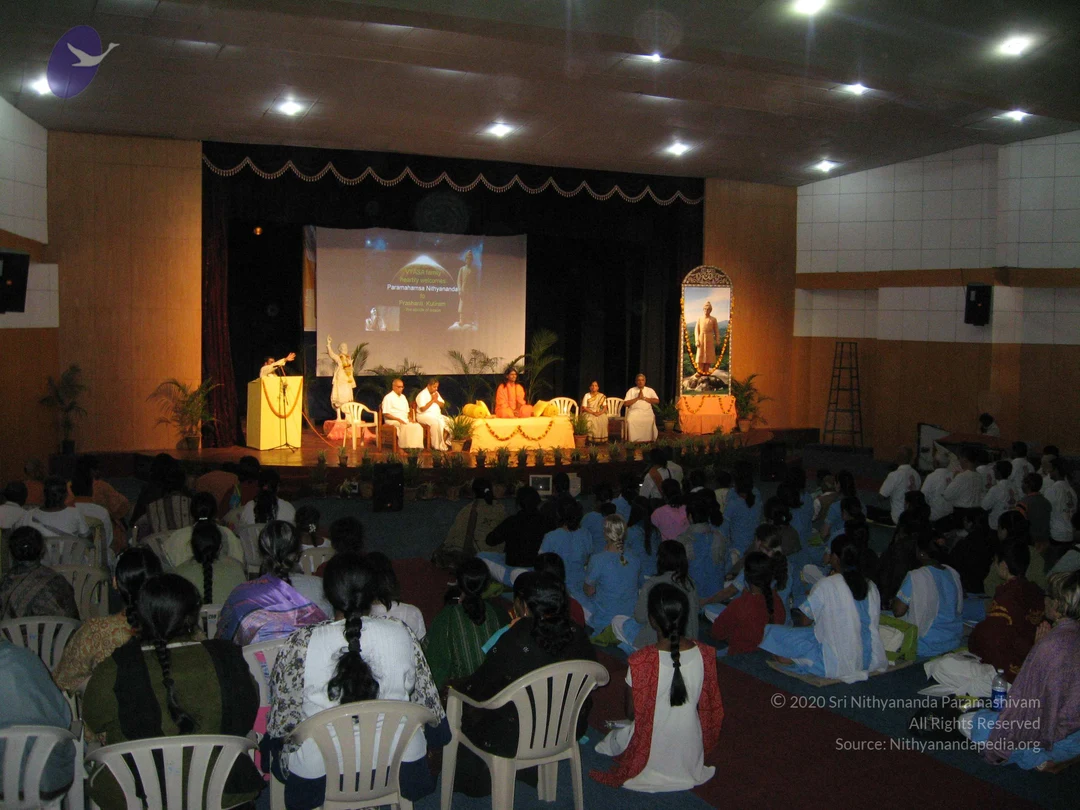
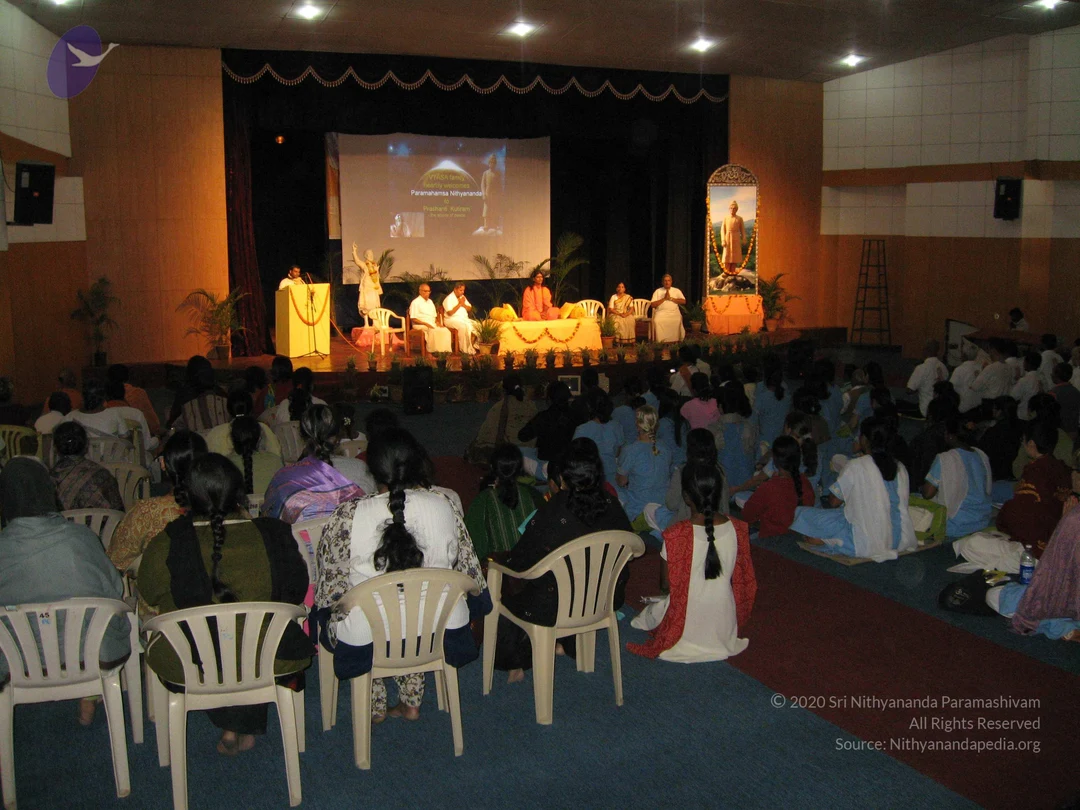
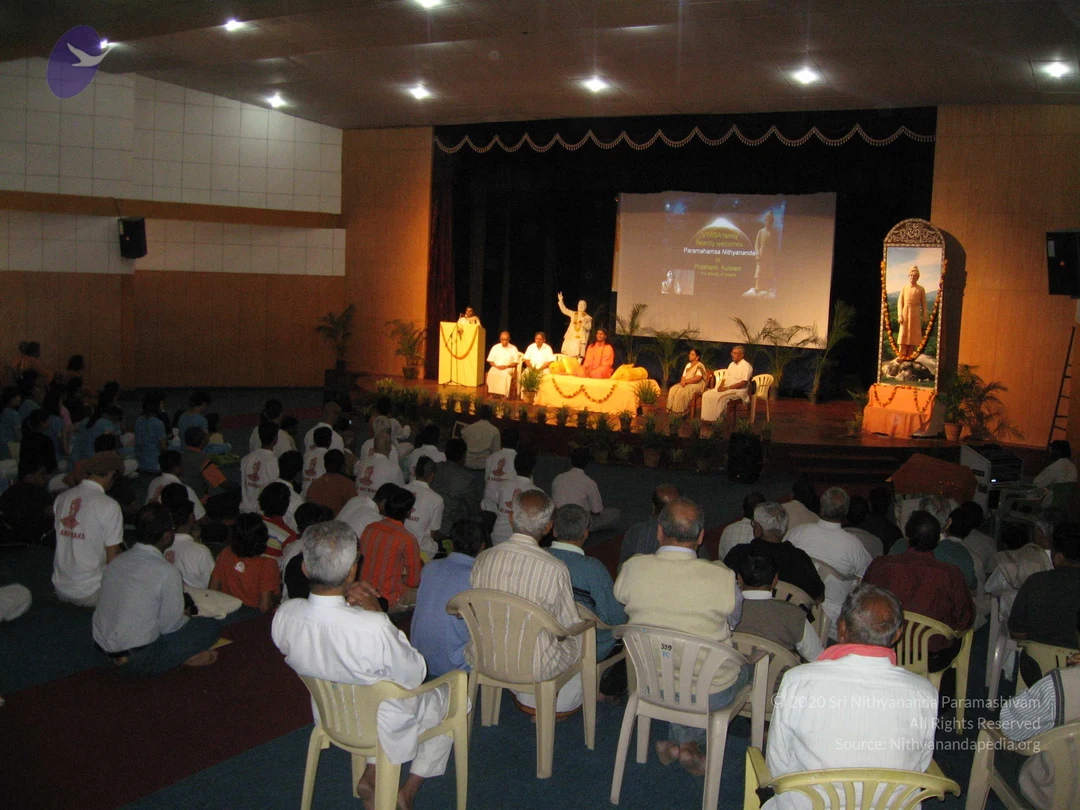
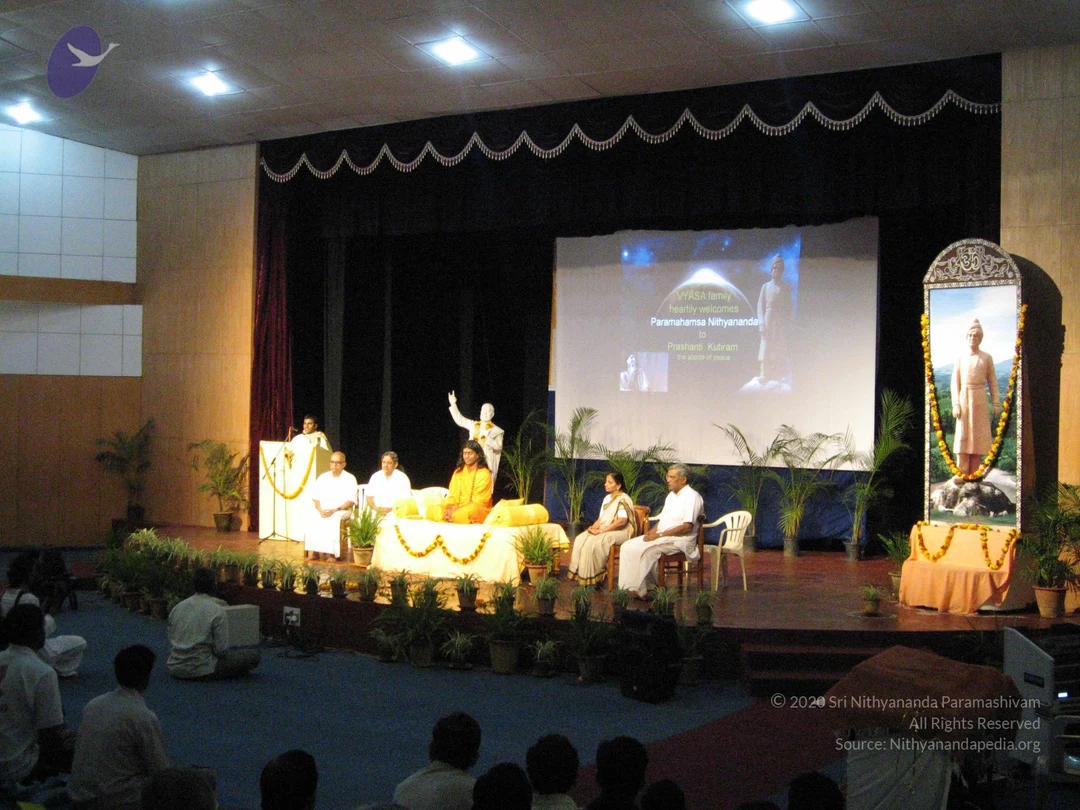
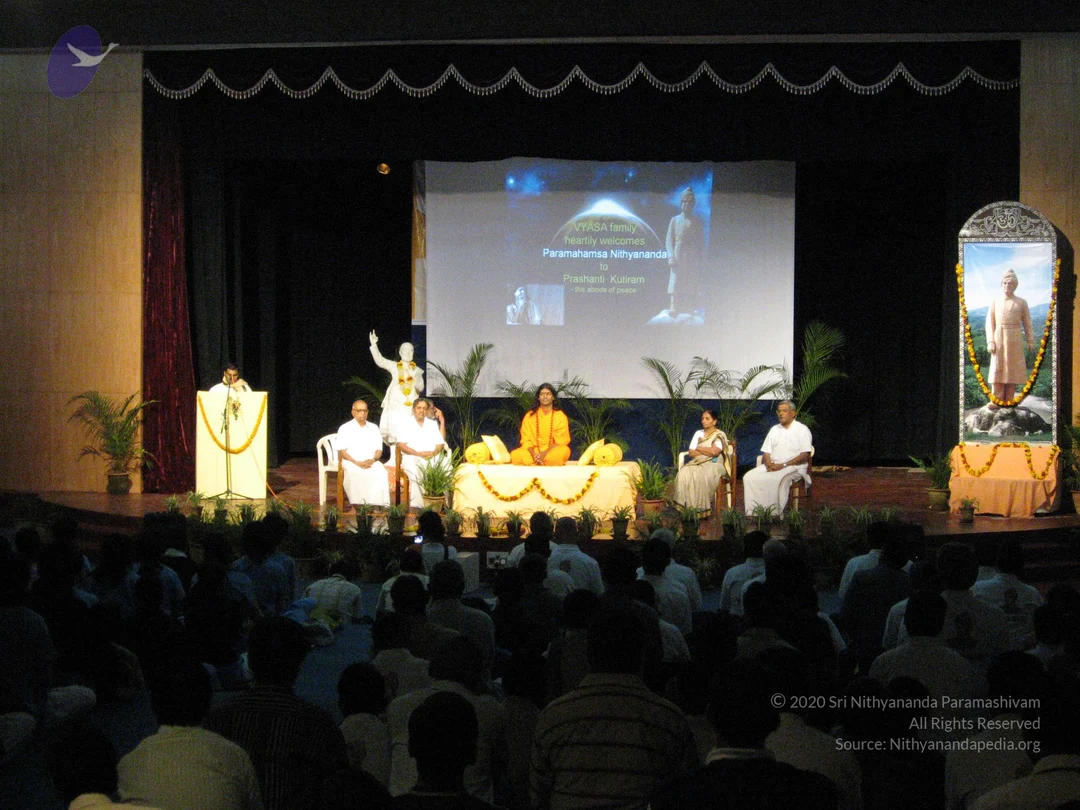
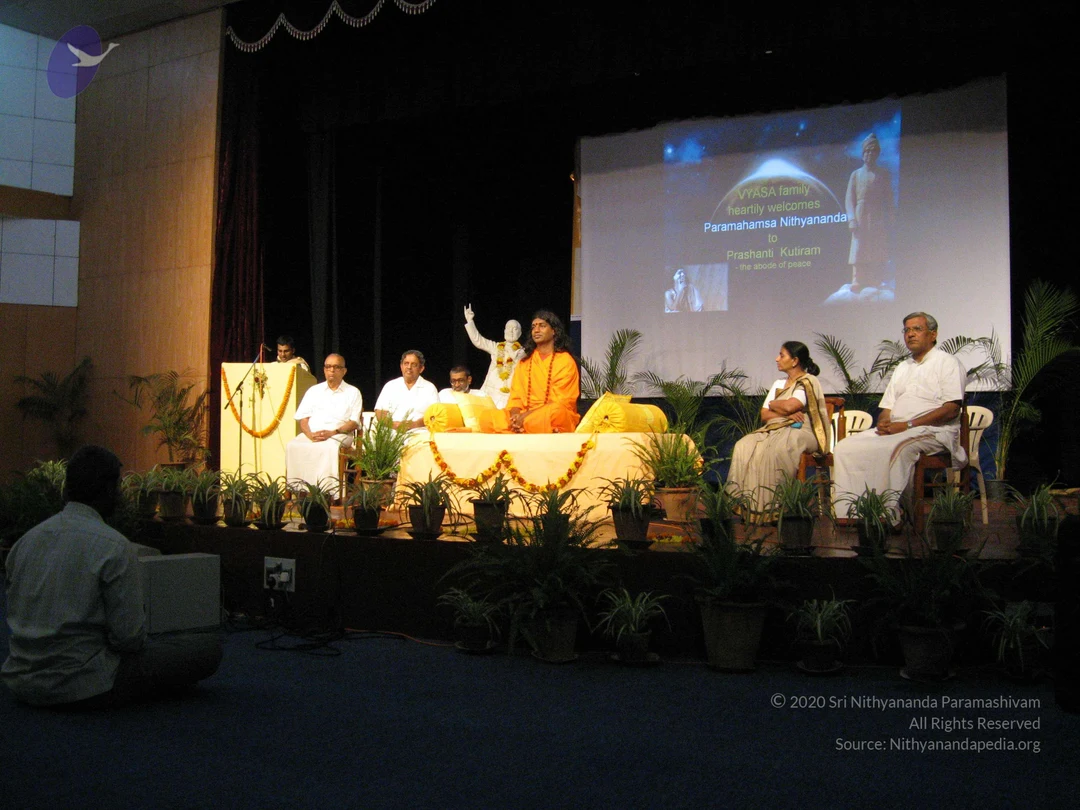
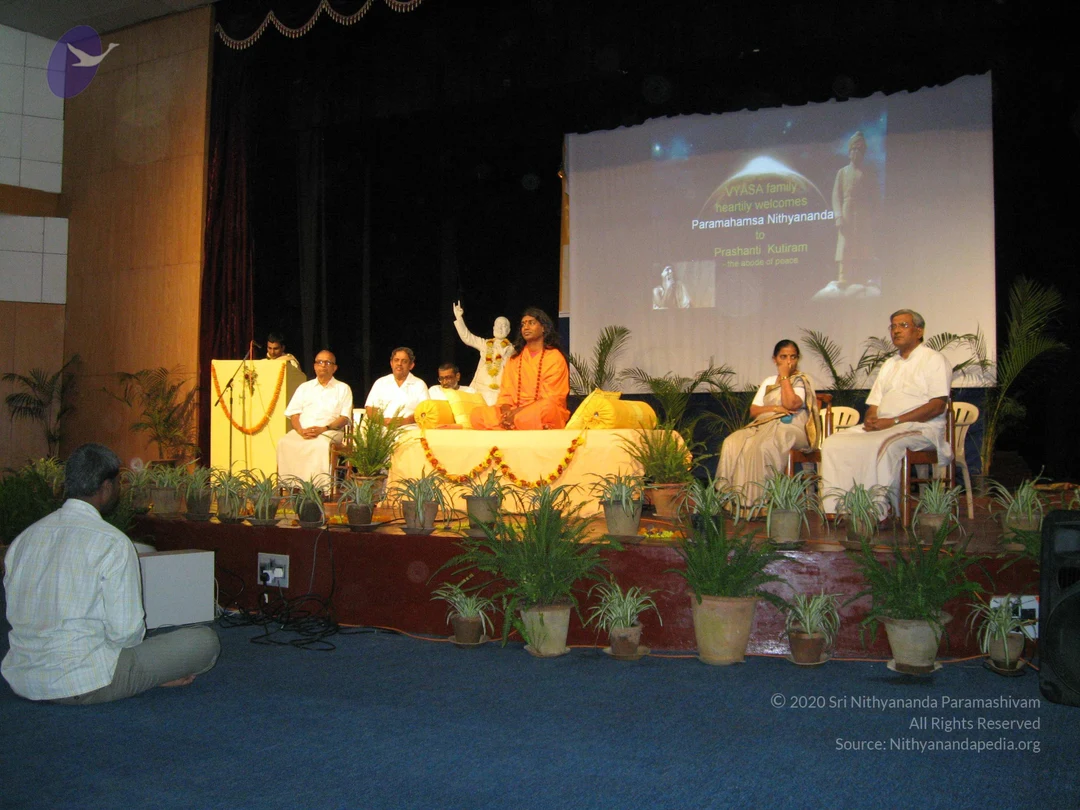
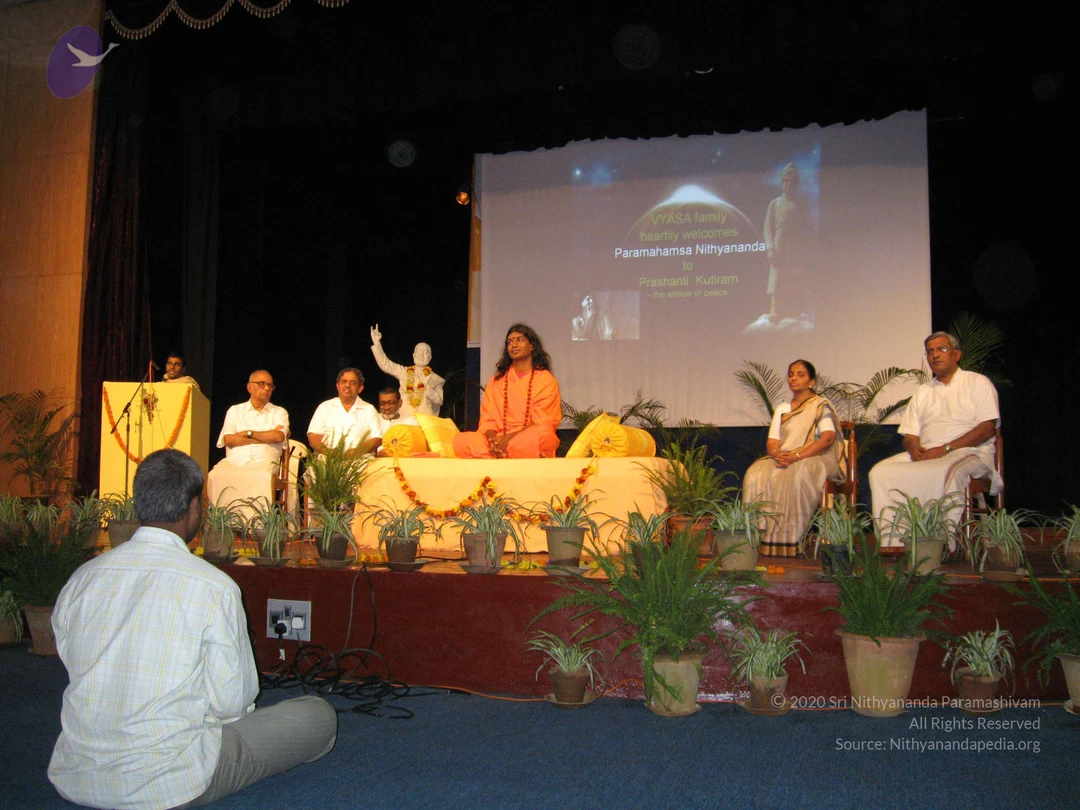
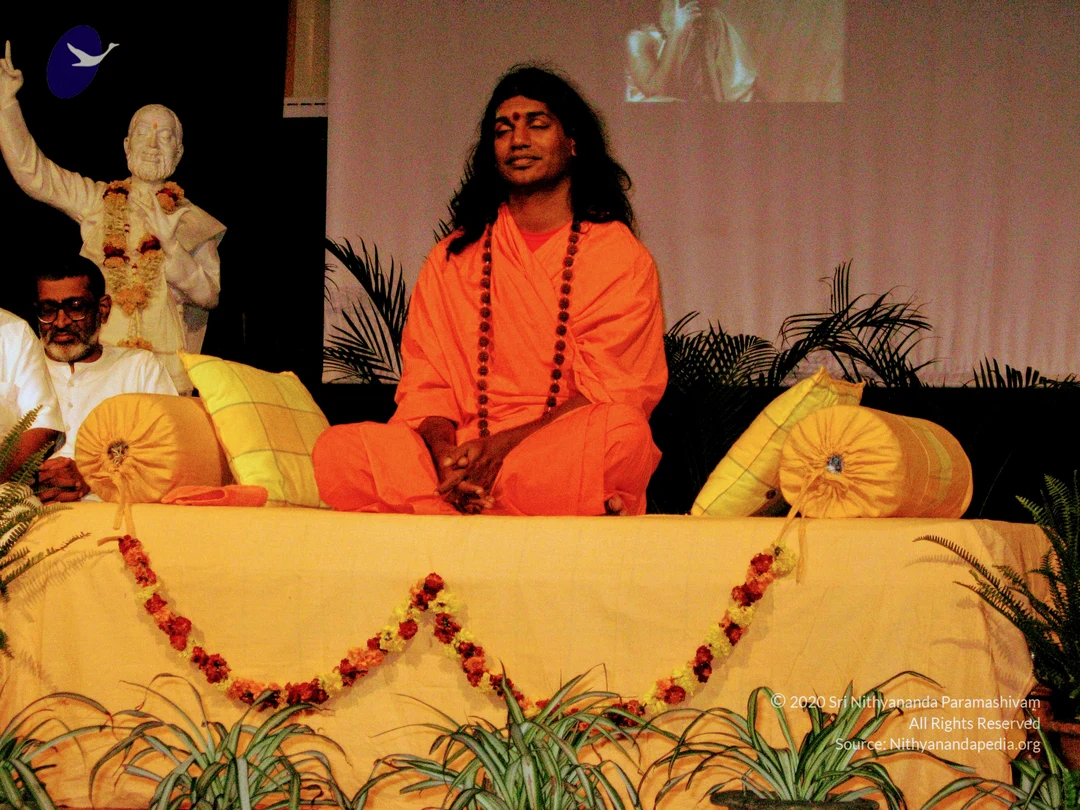
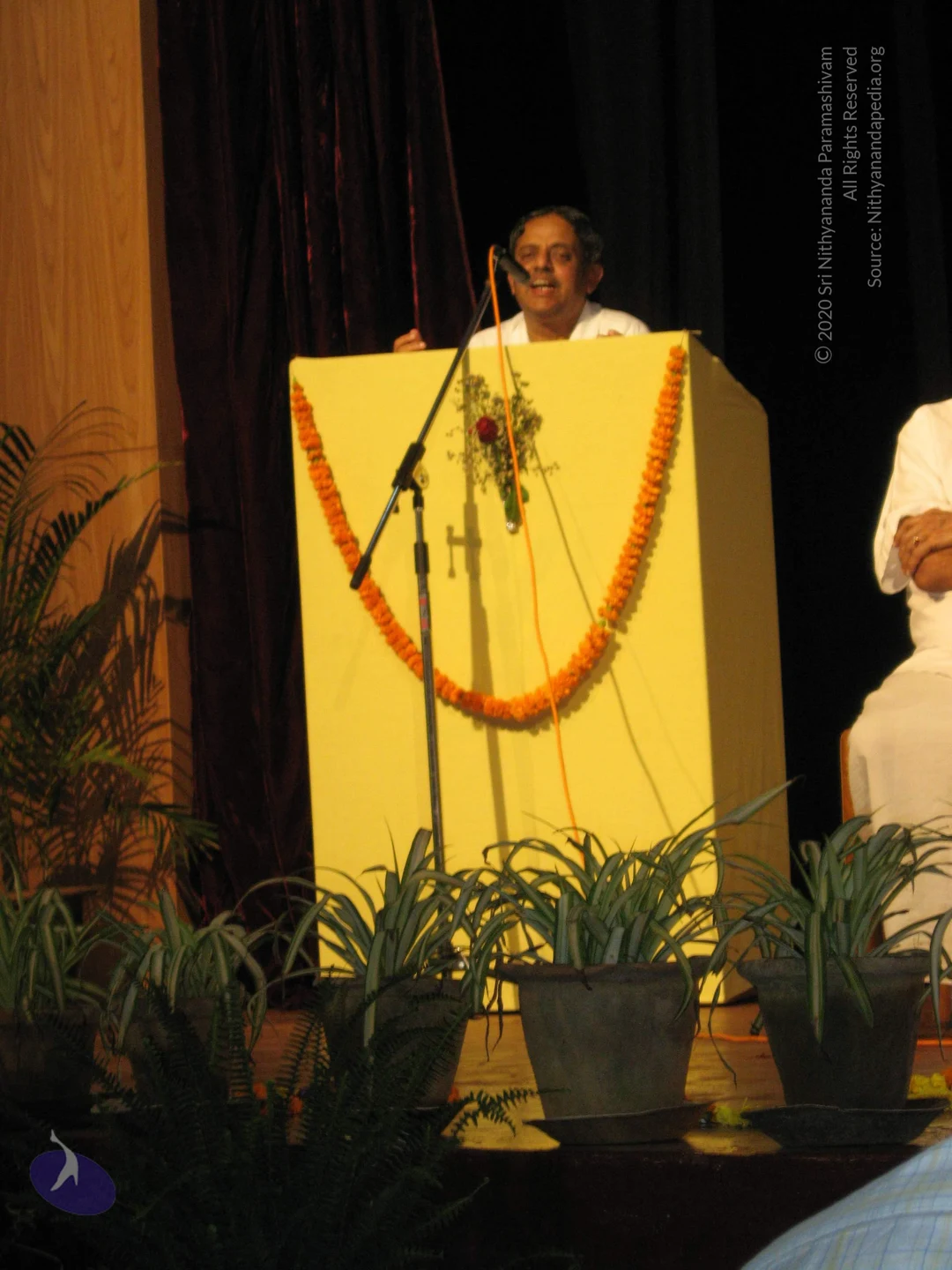
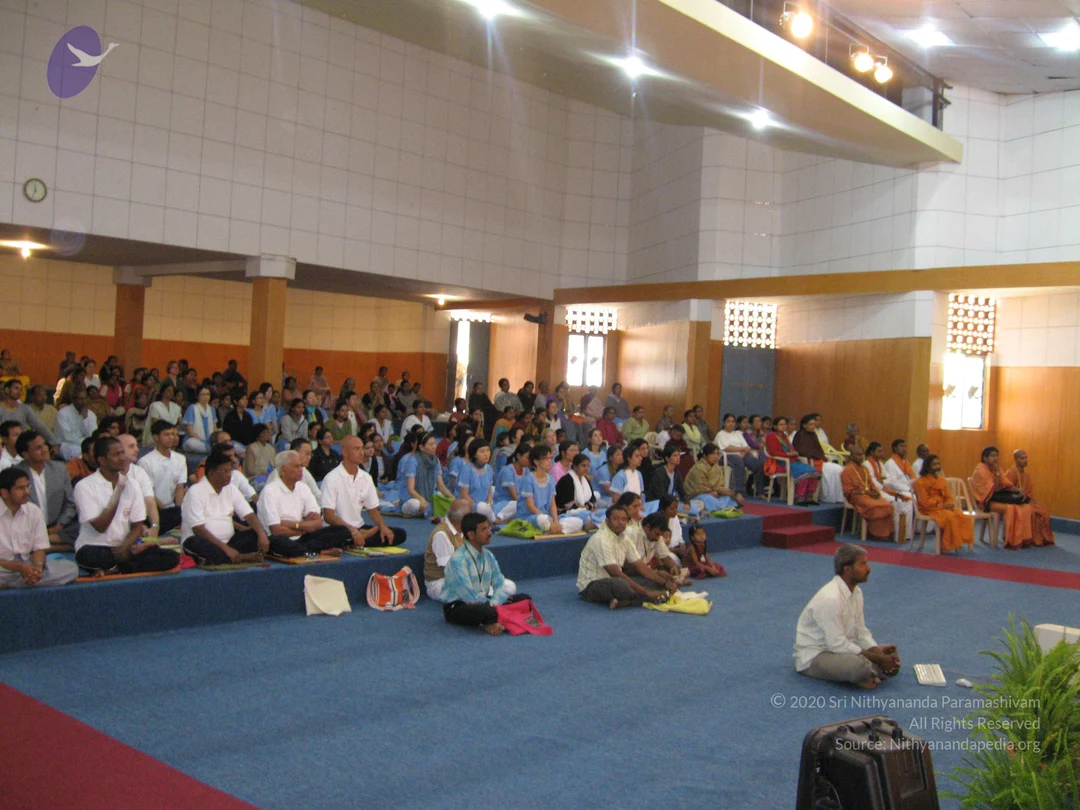
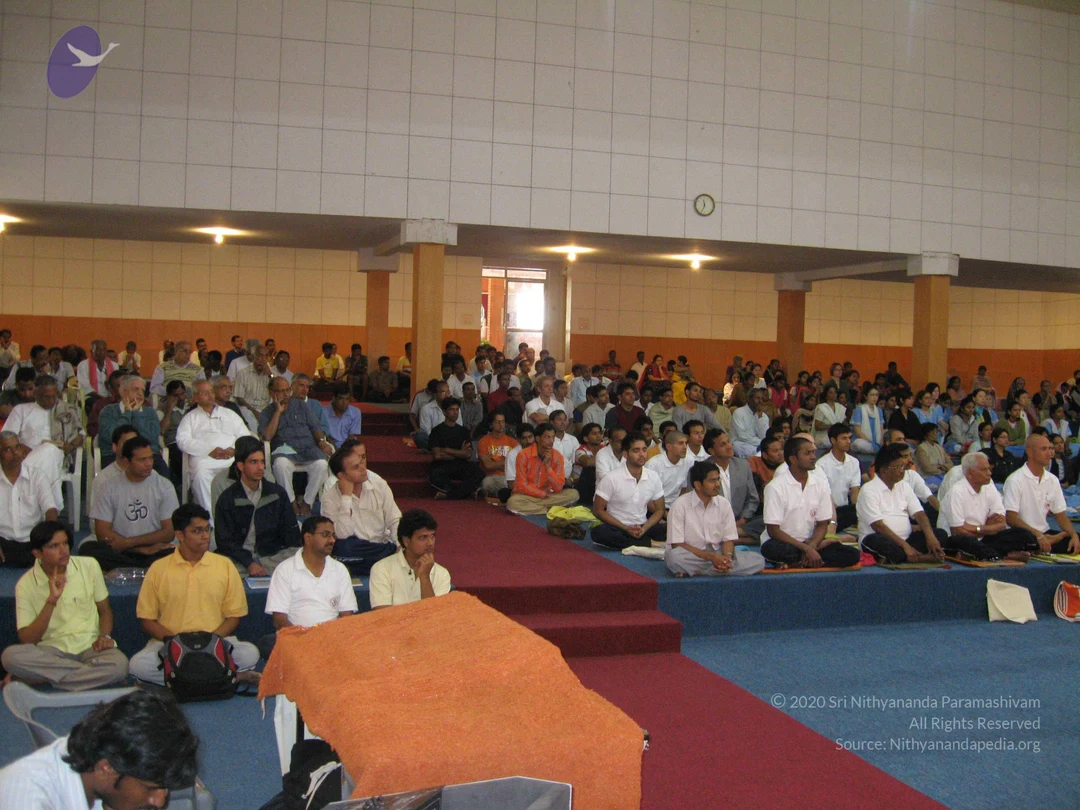
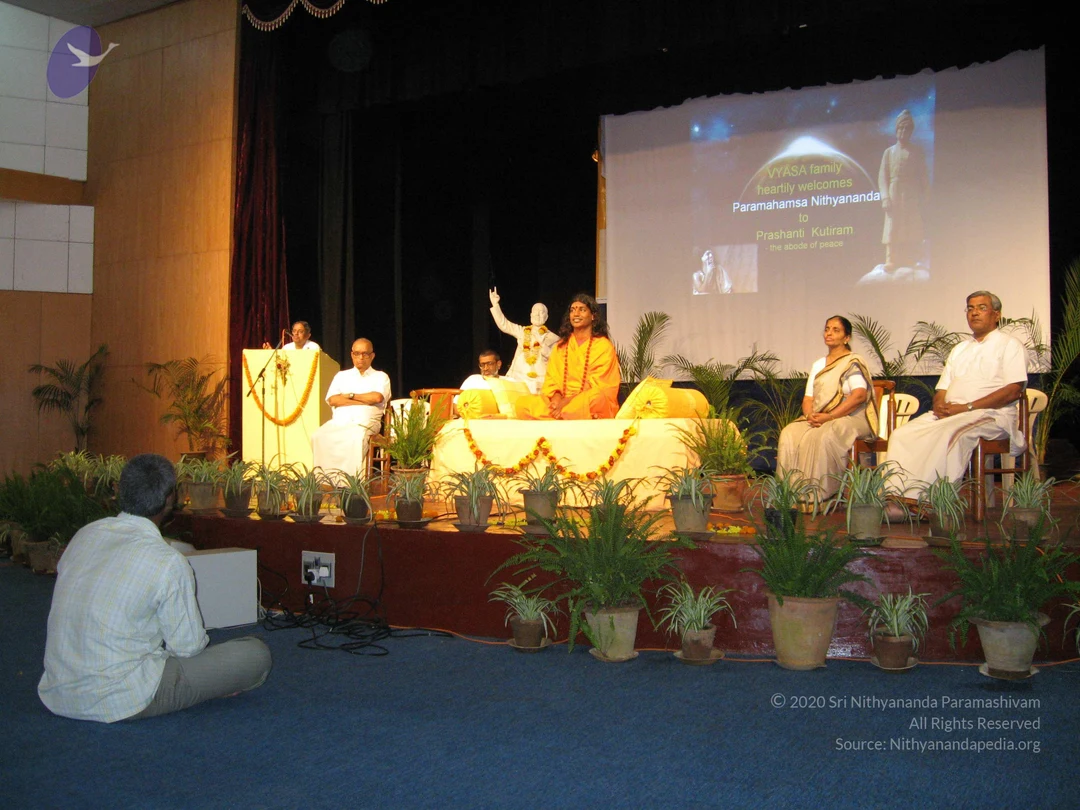
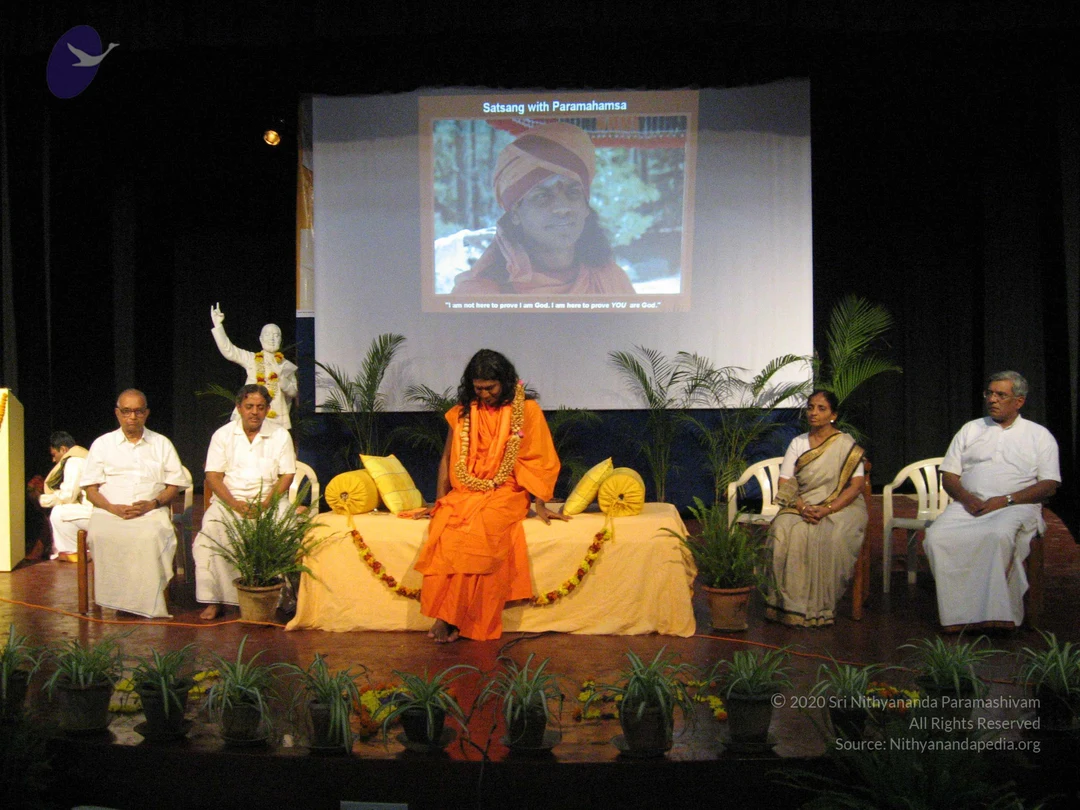
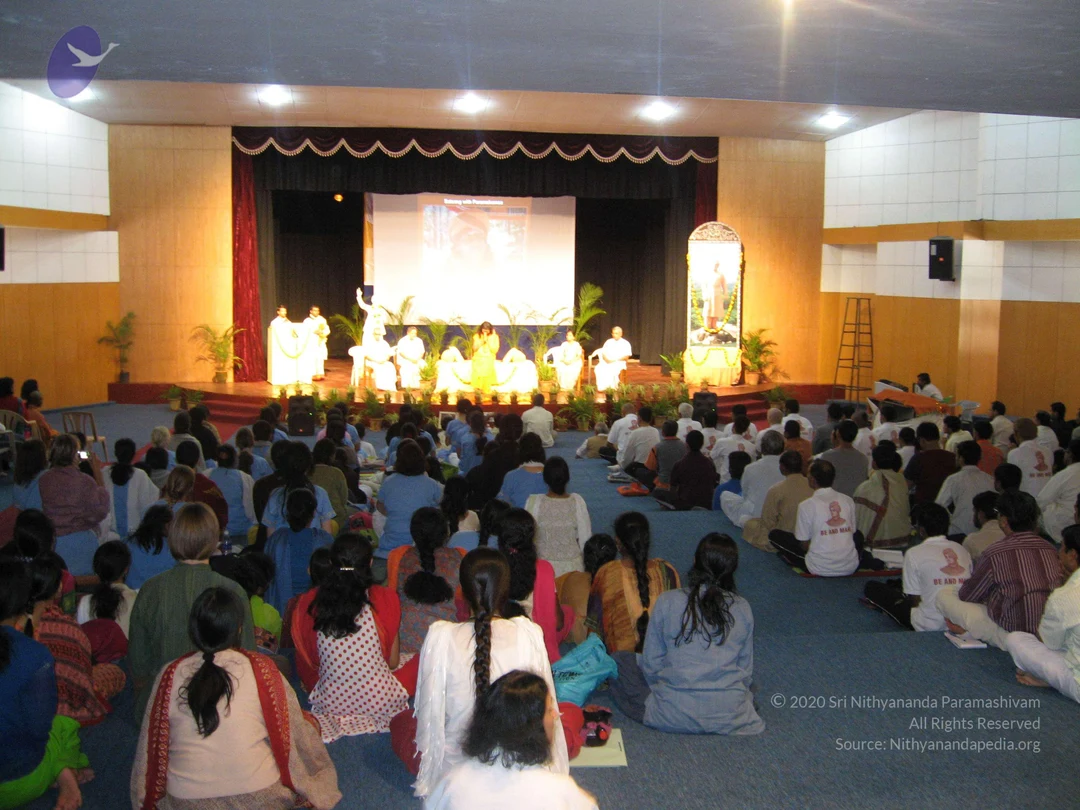
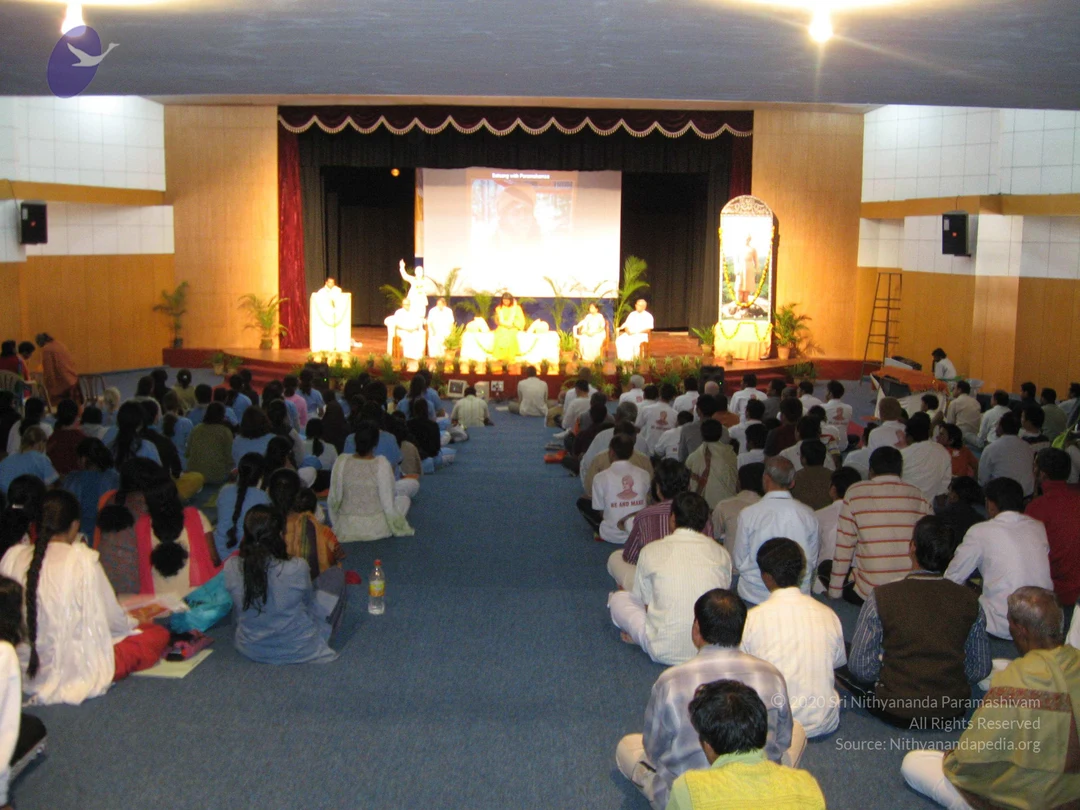
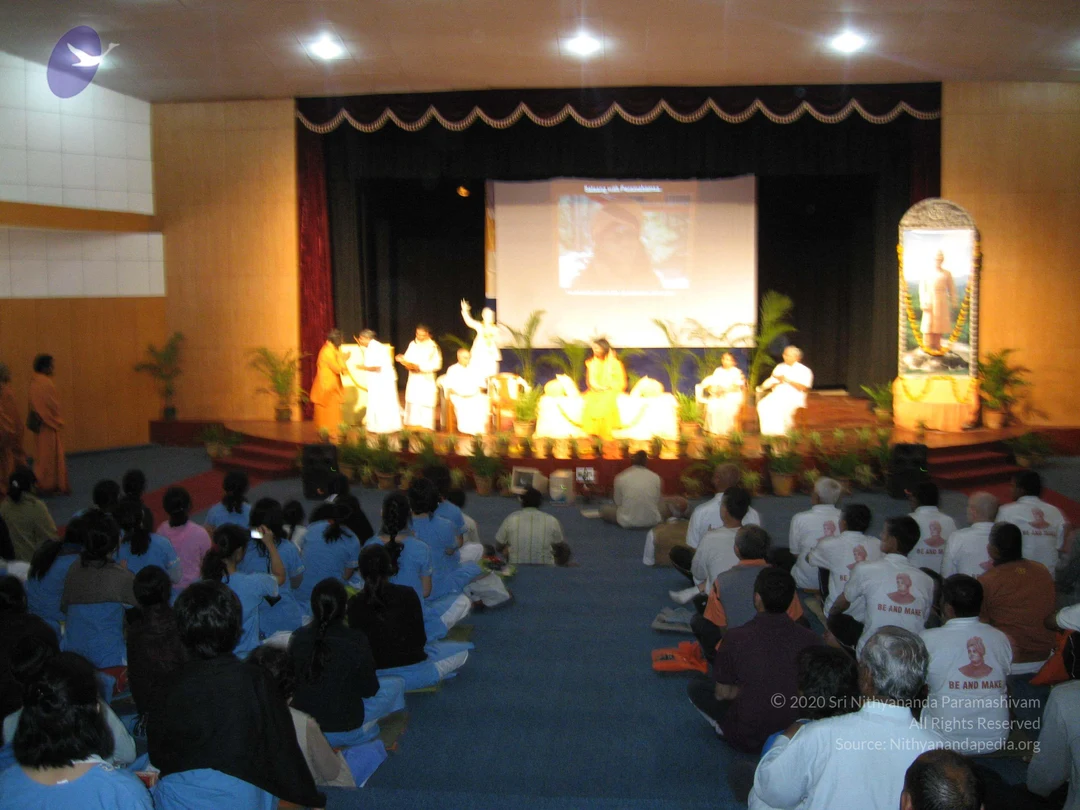
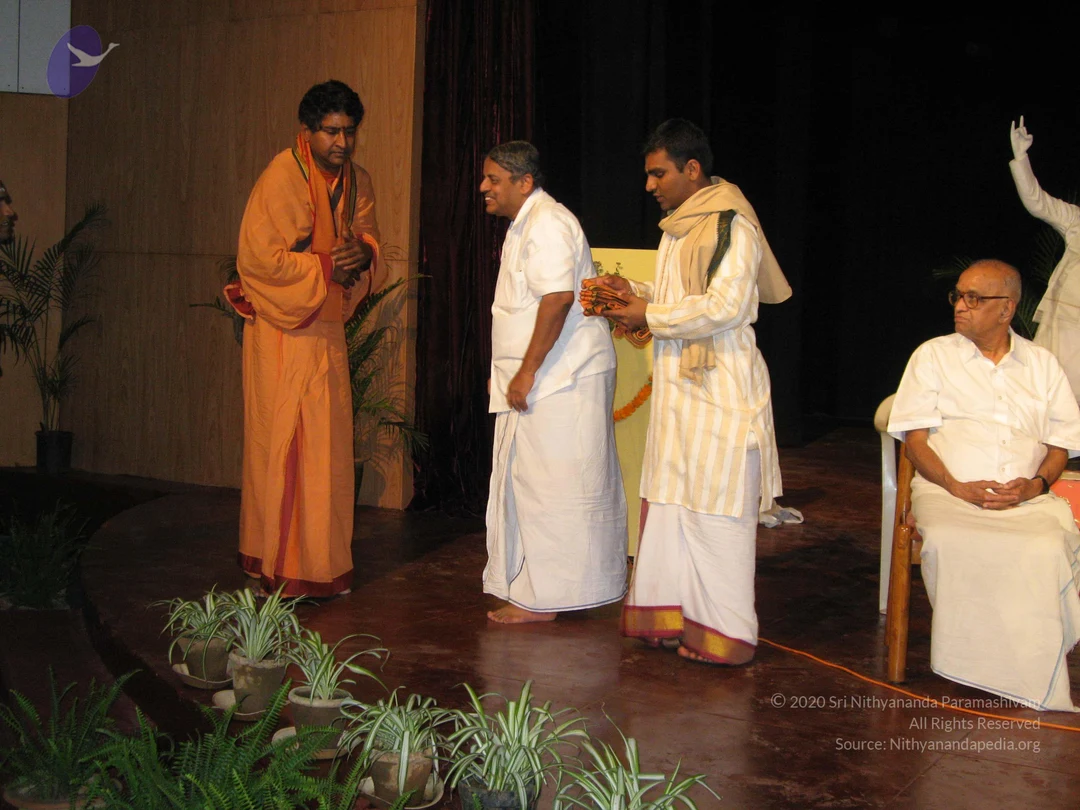
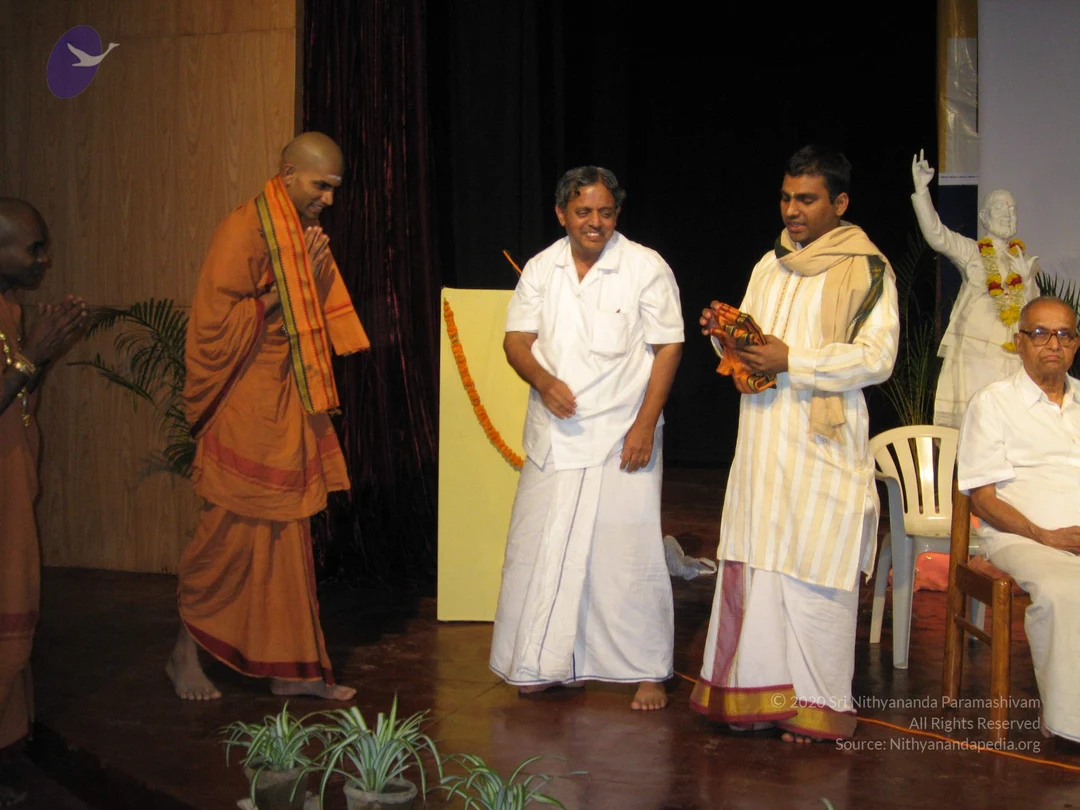
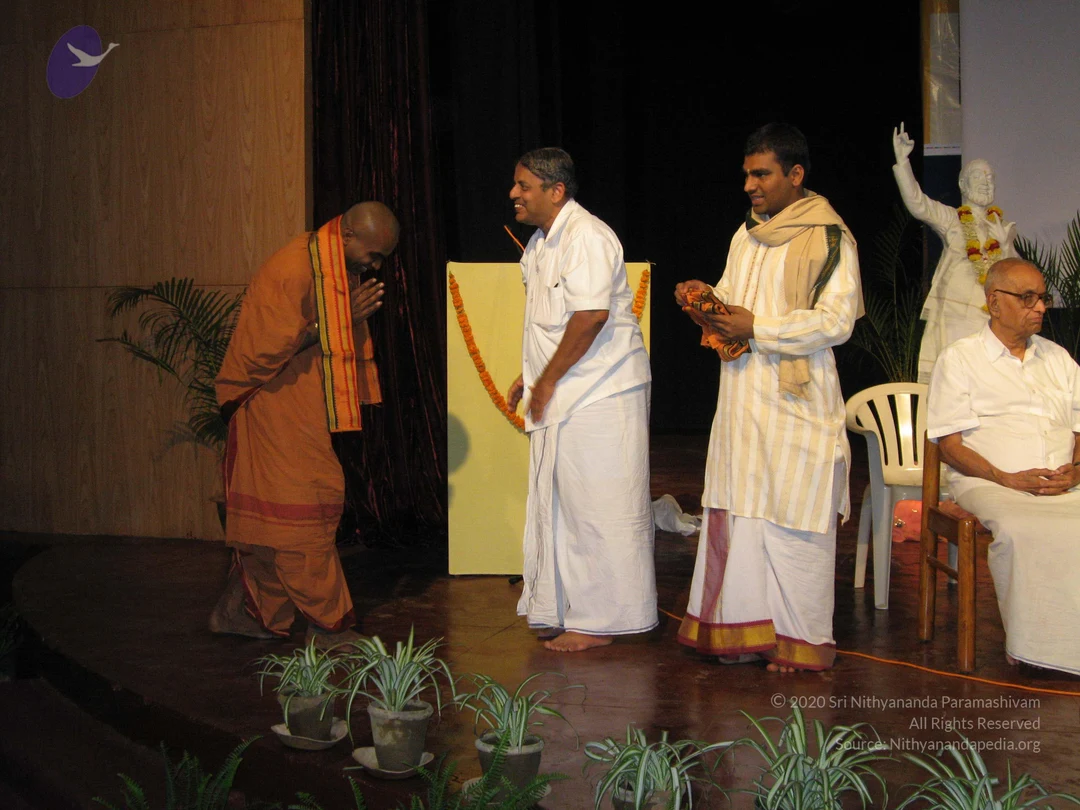
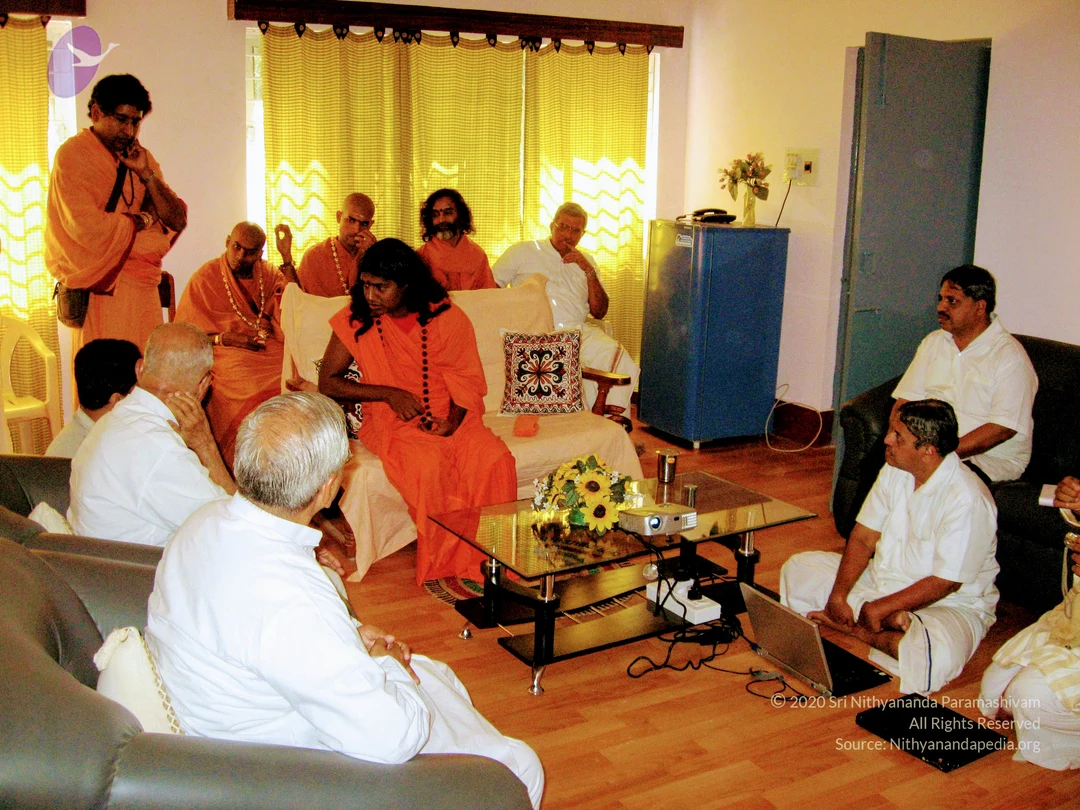
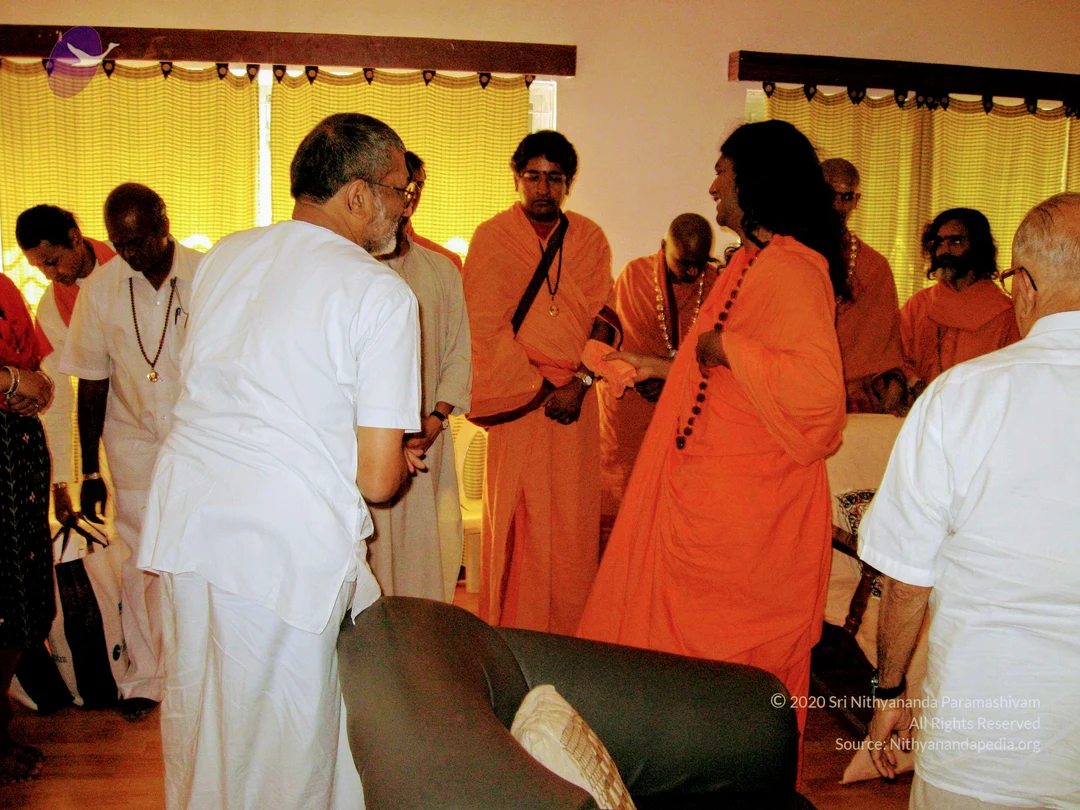
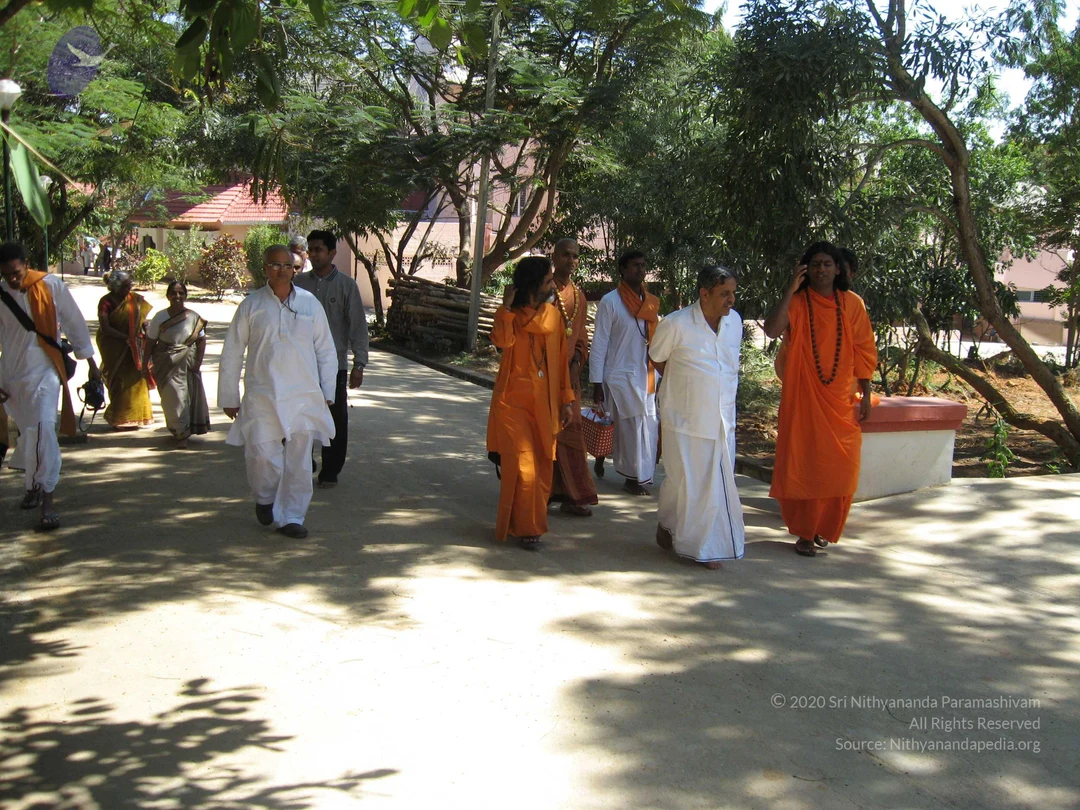
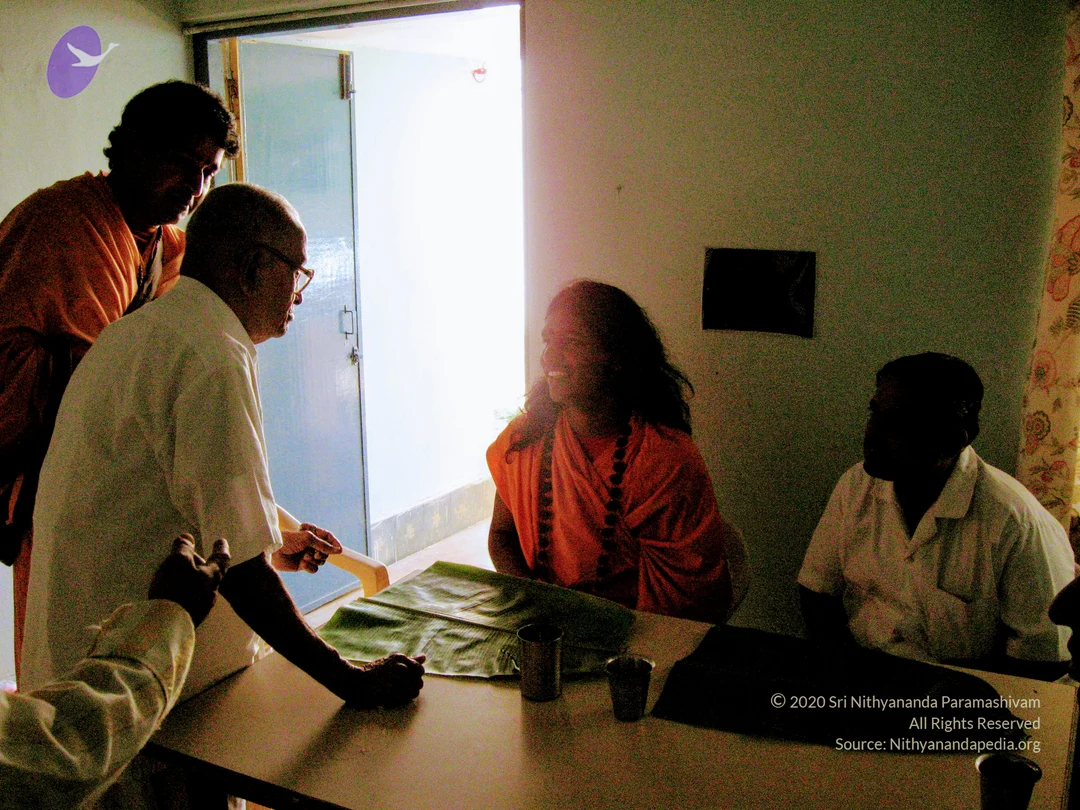
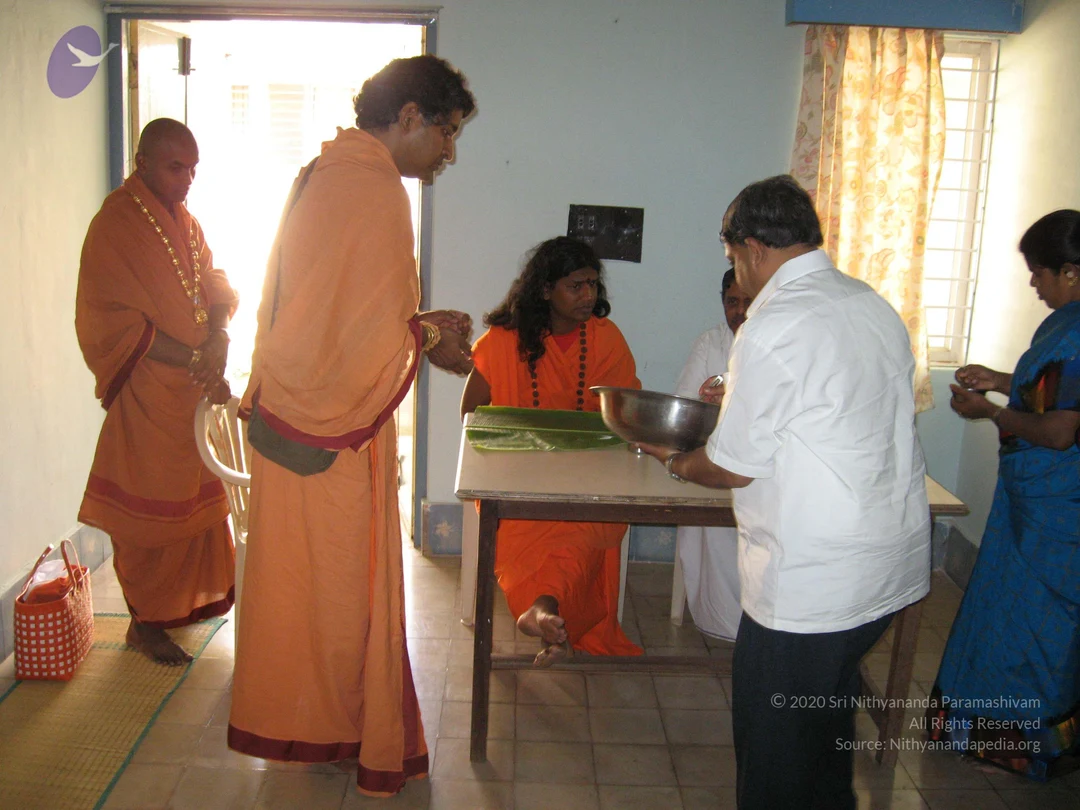
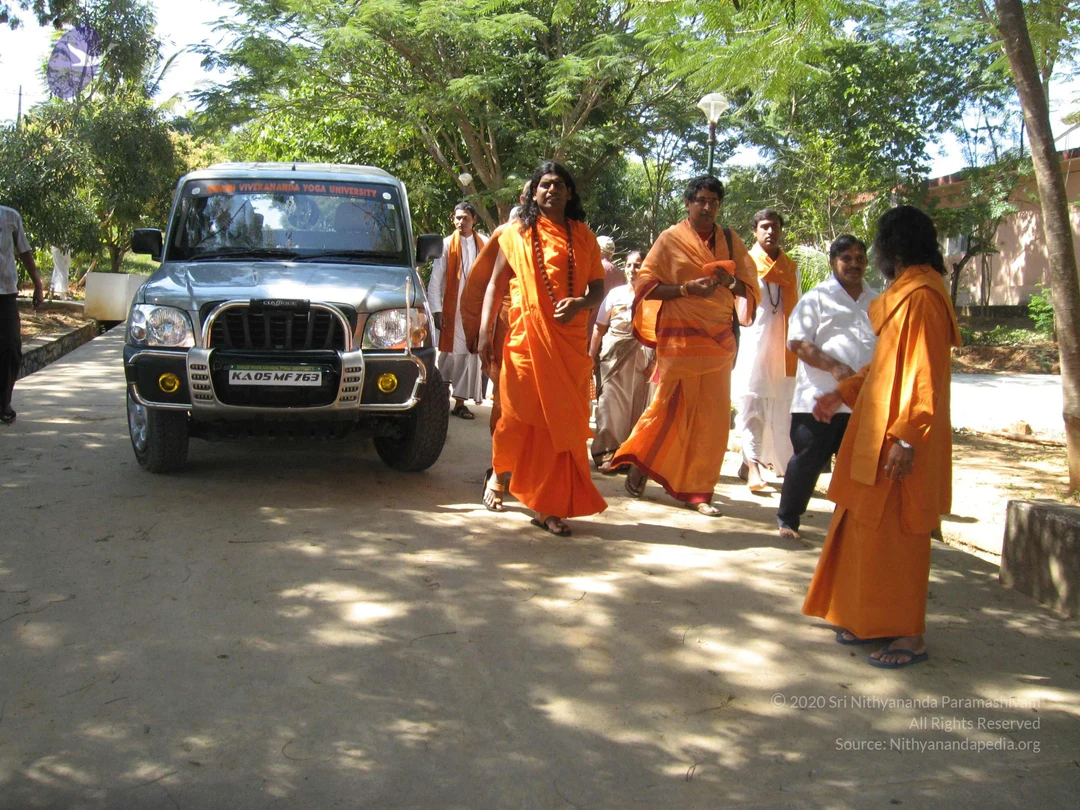
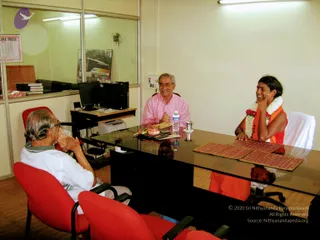
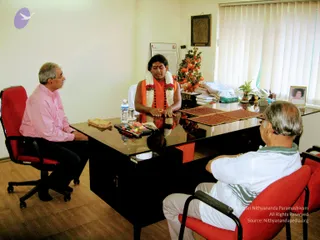
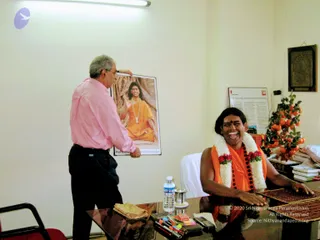
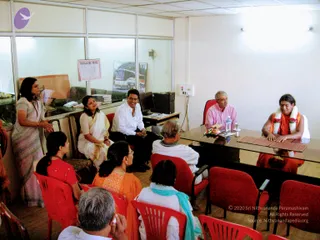
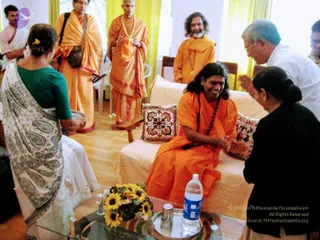
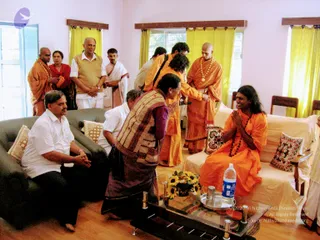
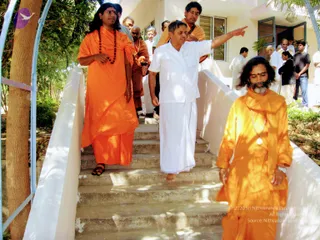
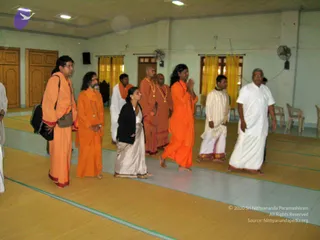
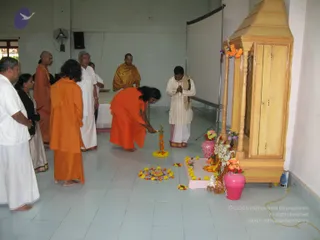
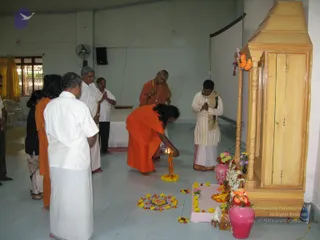
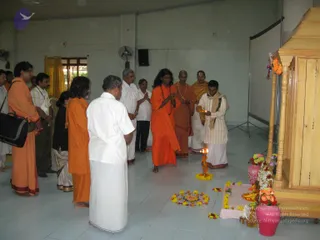
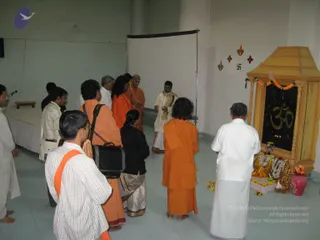
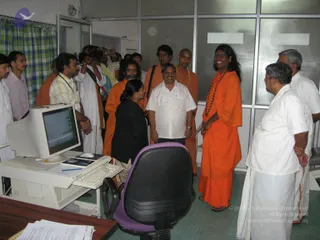
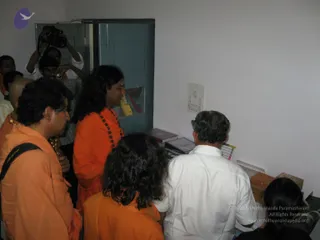
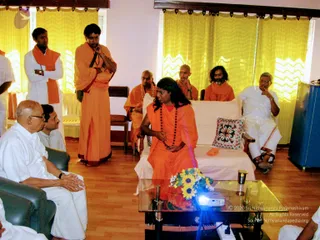
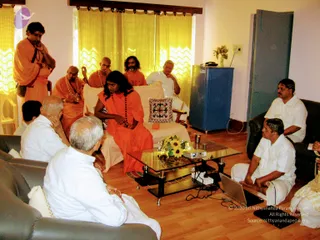
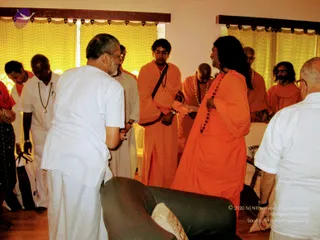
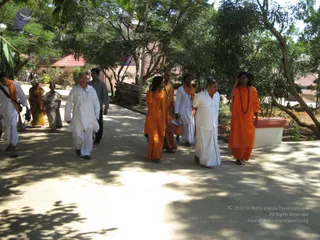
HDH Nithyanada Paramashivam visits Vivekananda Yoga University in Bengaluru

Dated photos
210
Source pages
1
Media
16
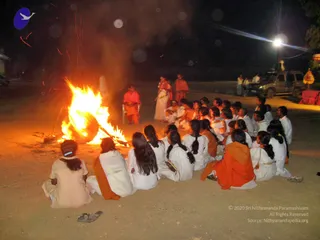
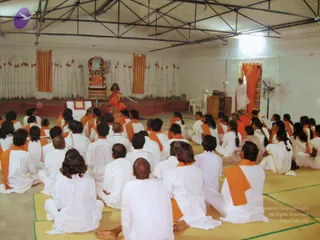
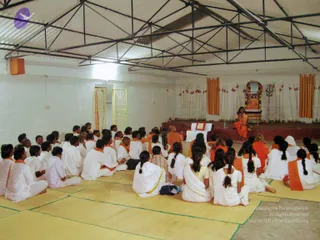
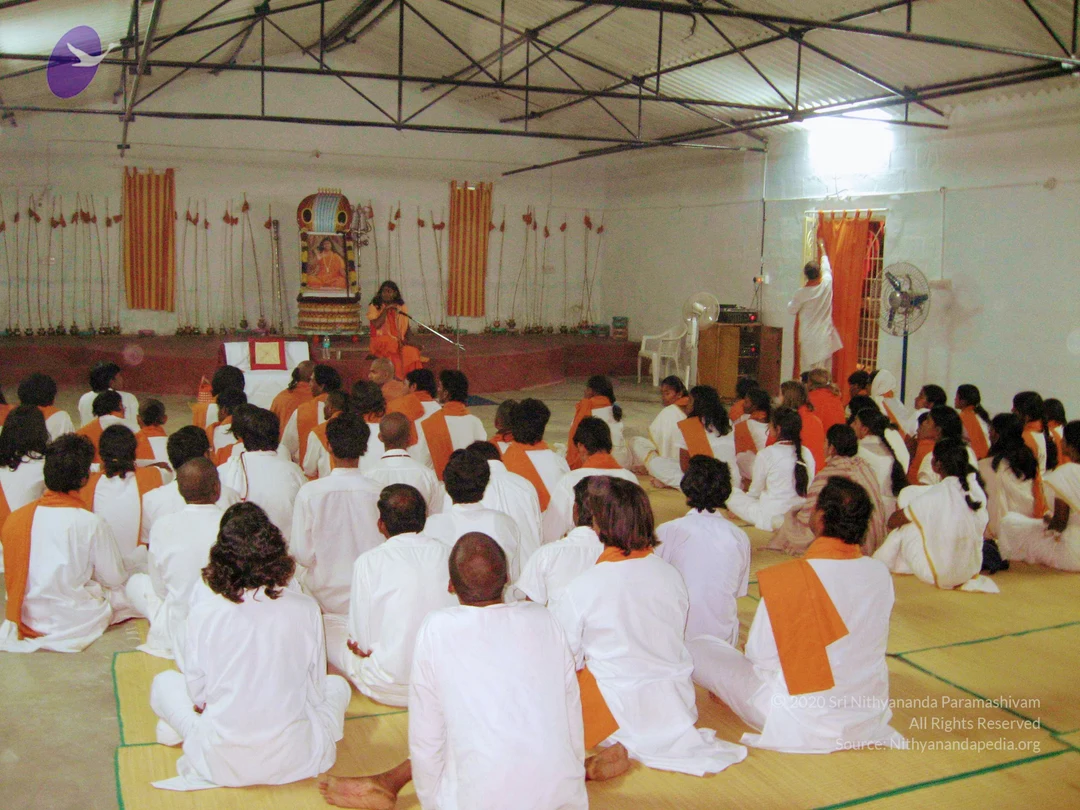
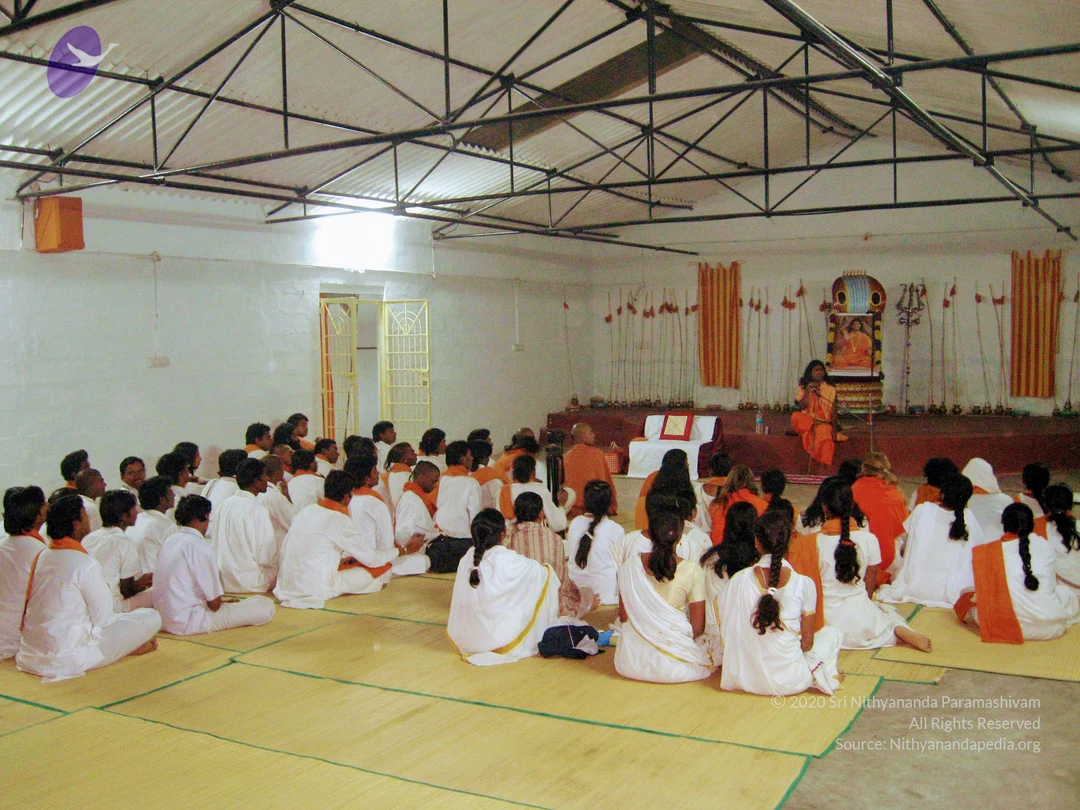
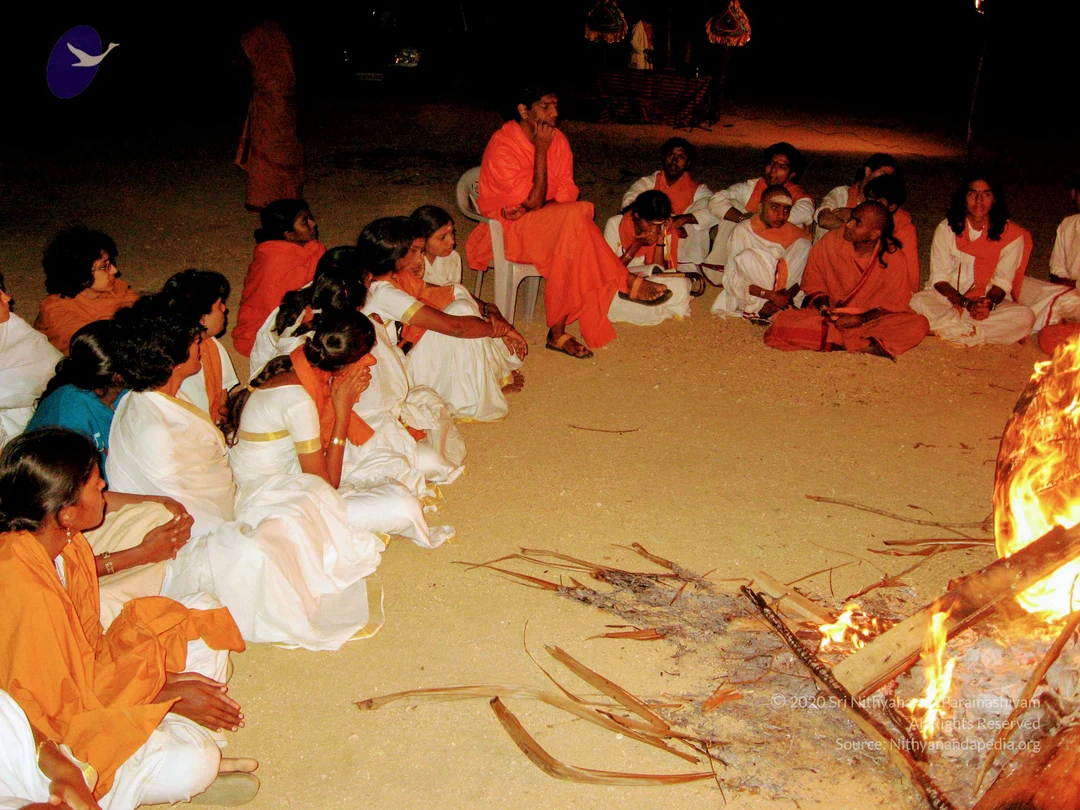
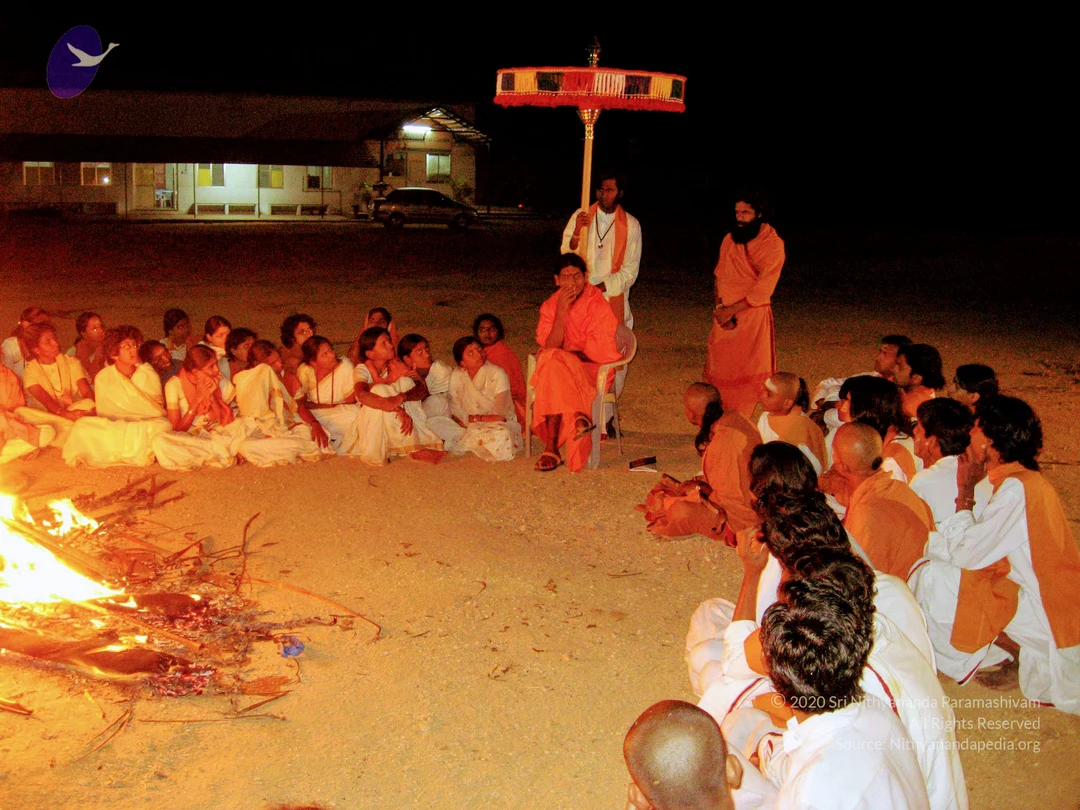
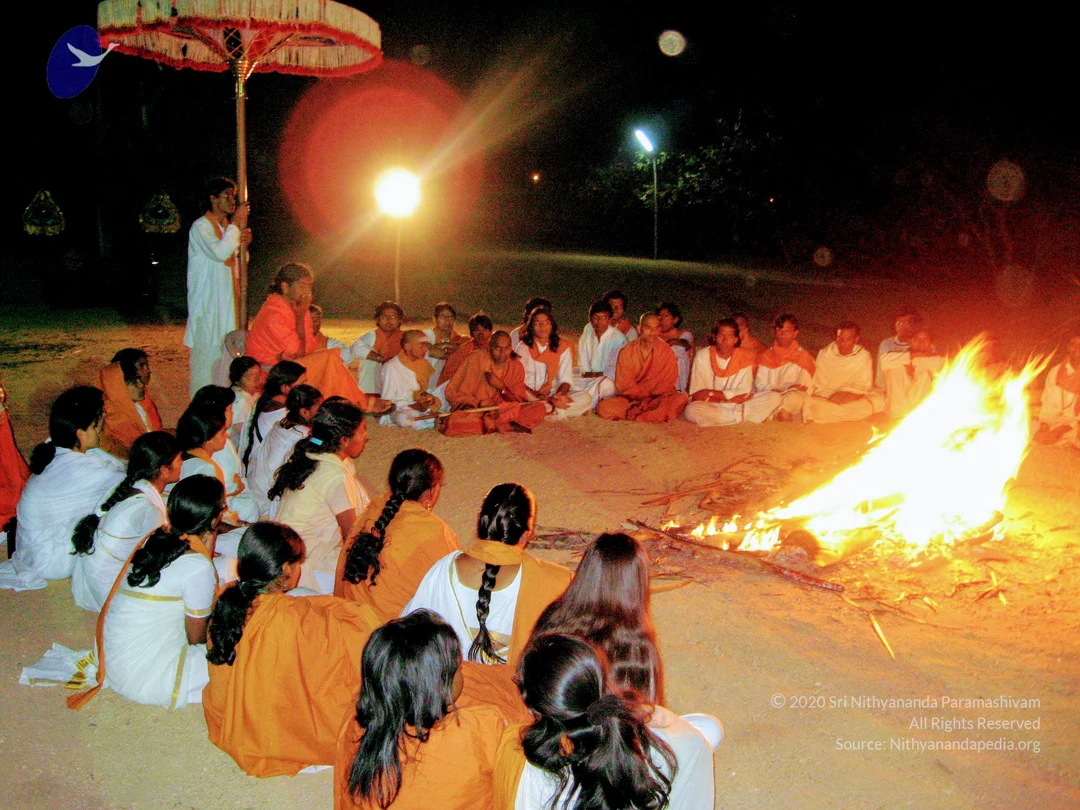
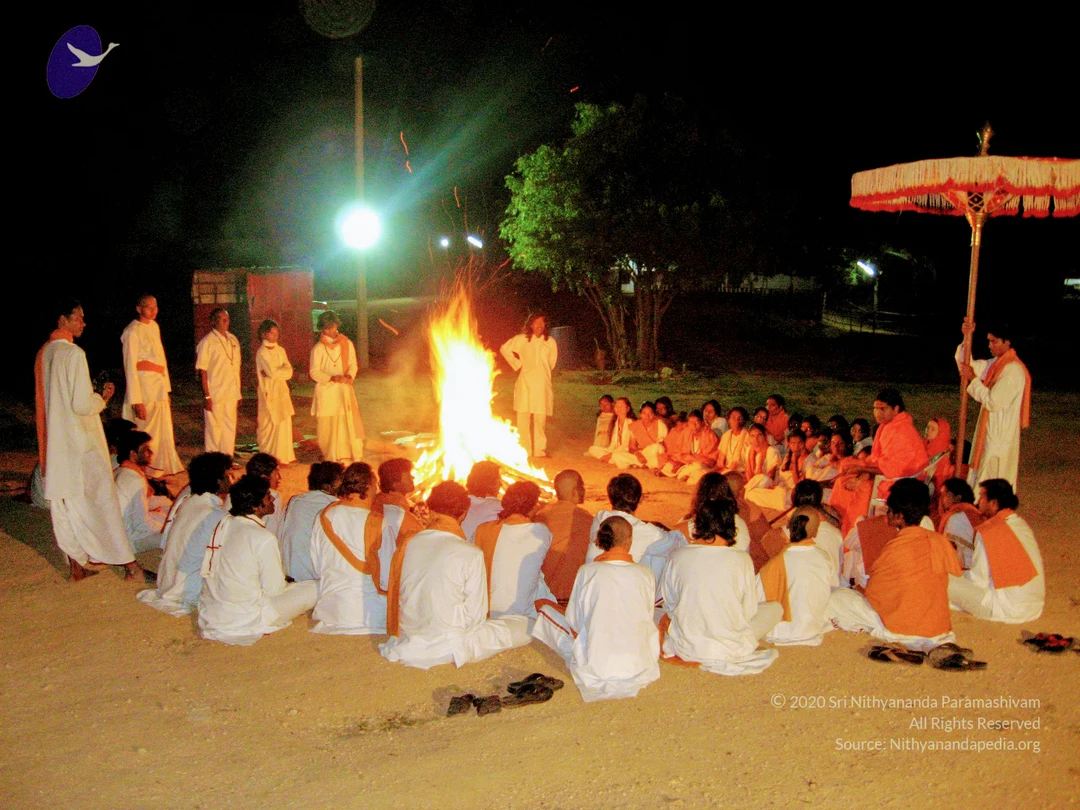
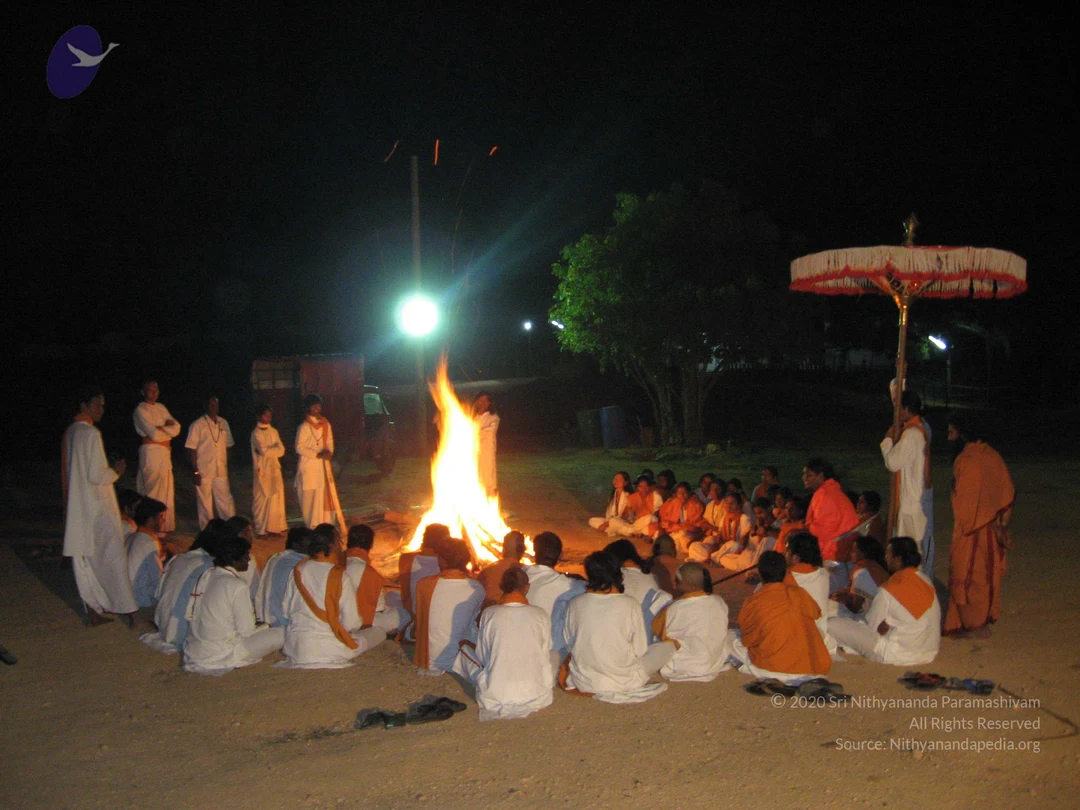
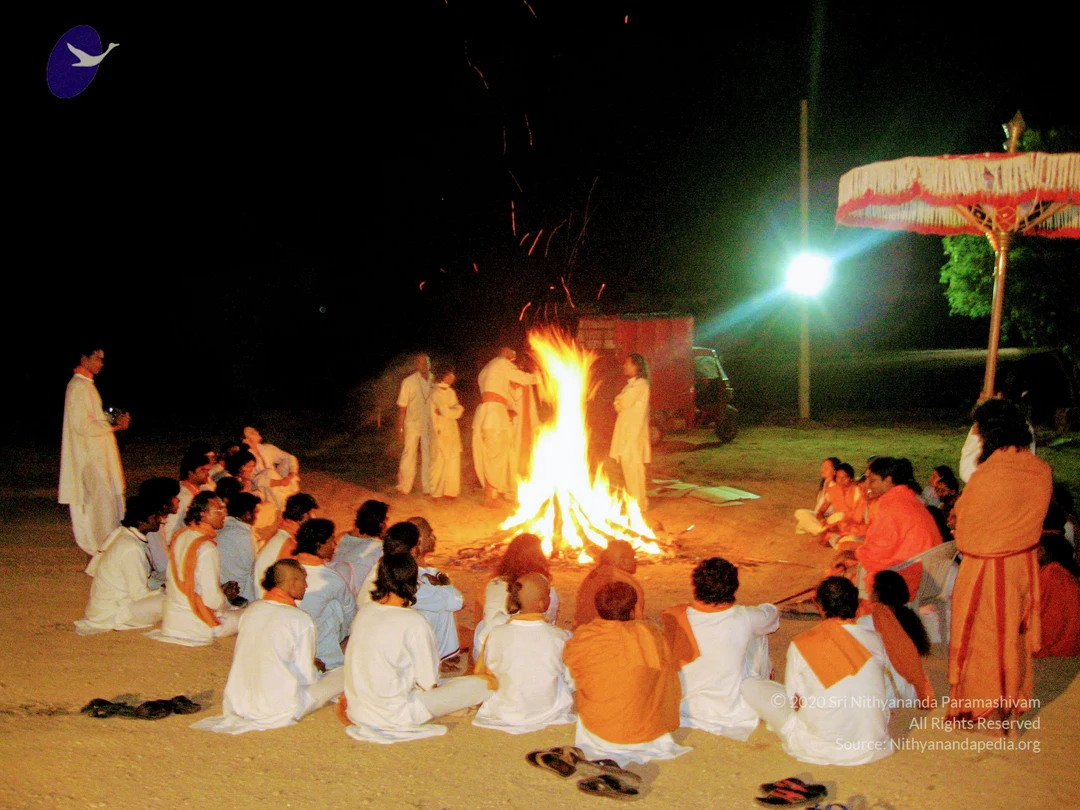
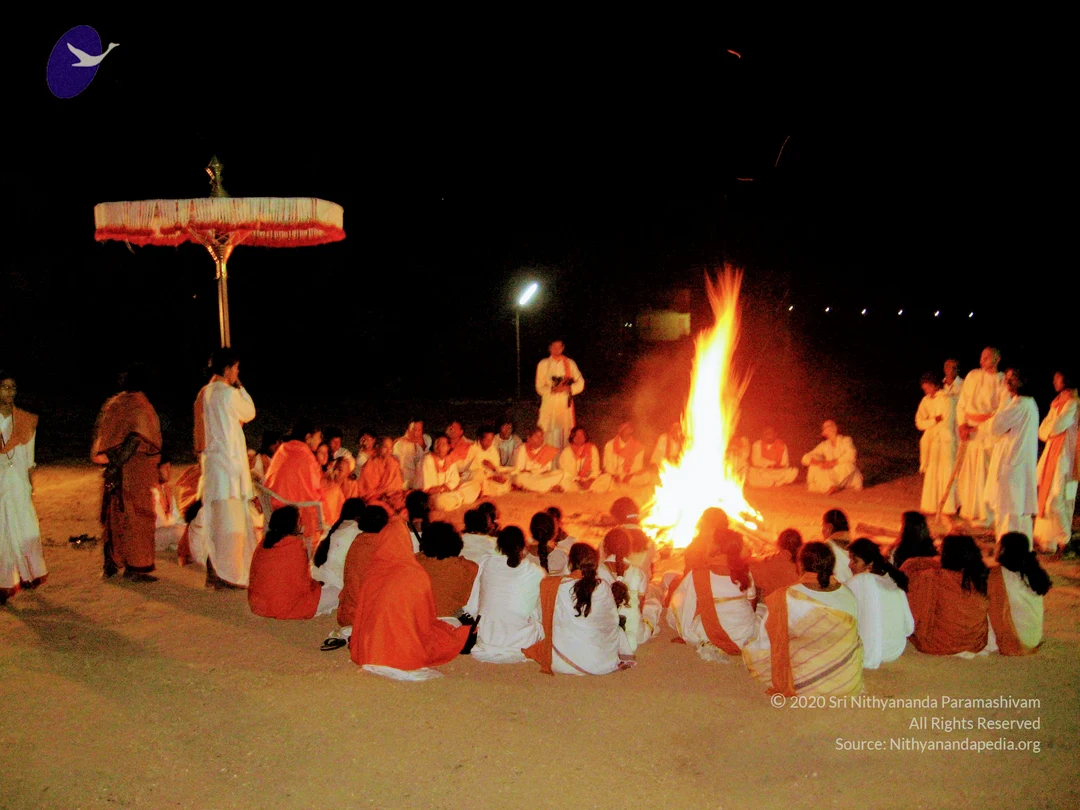
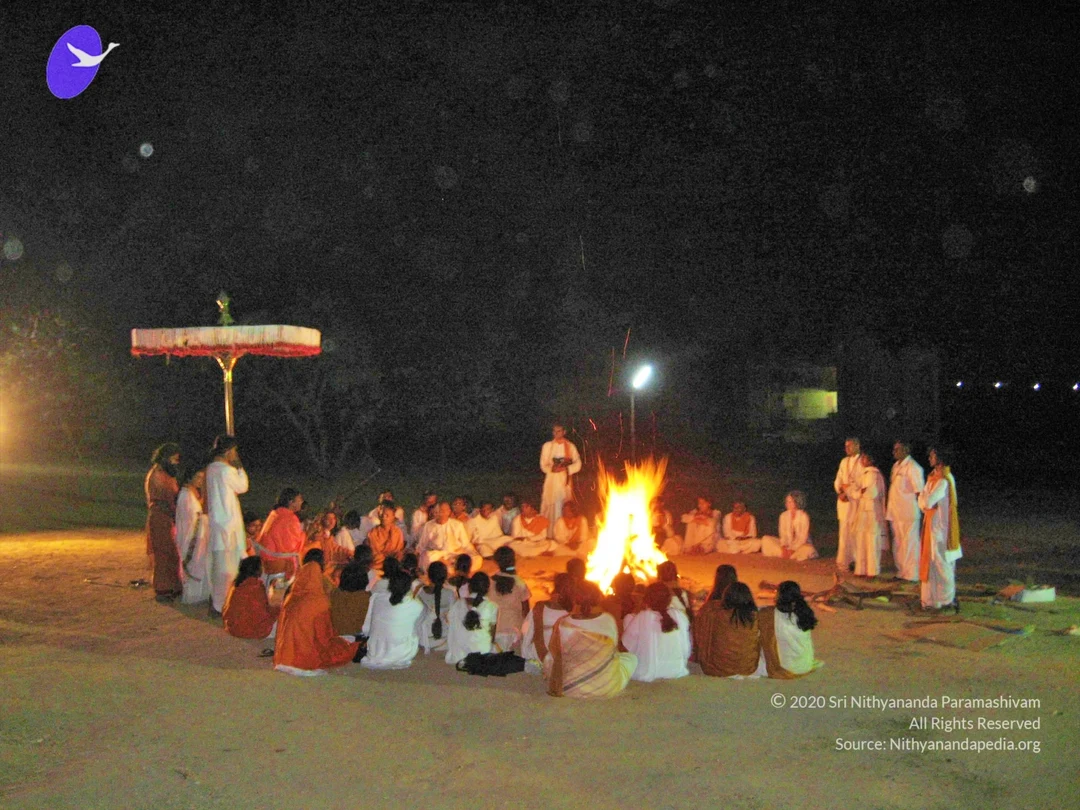
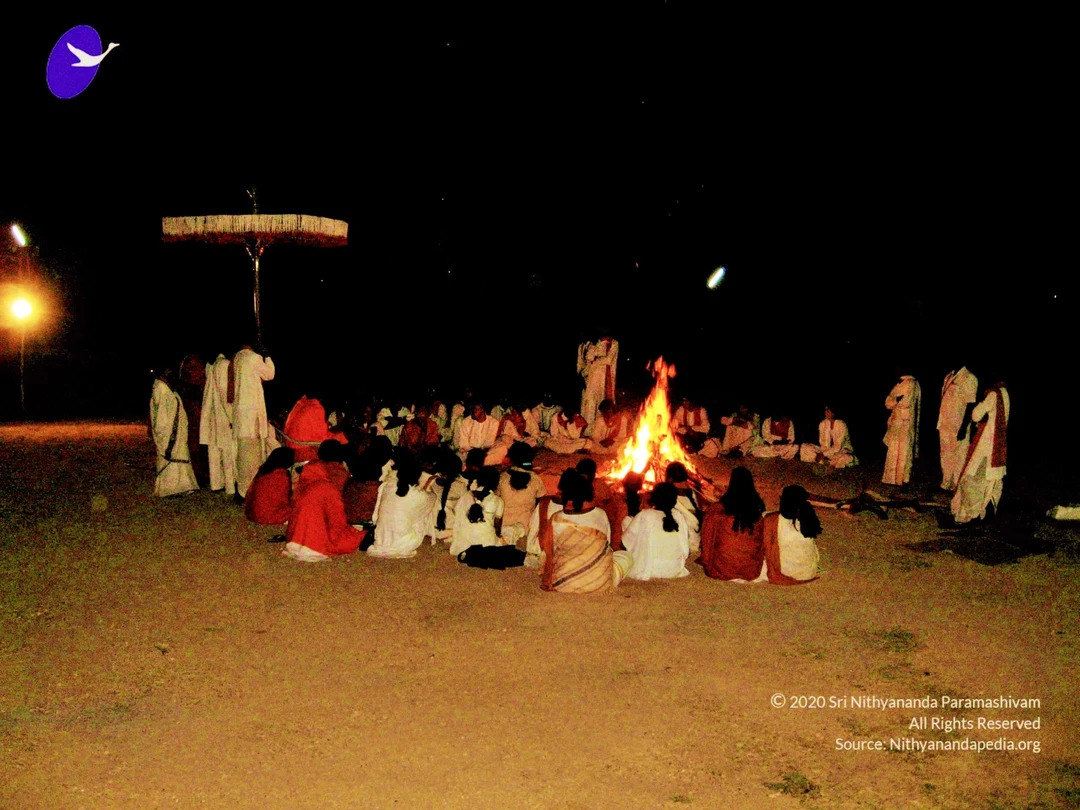
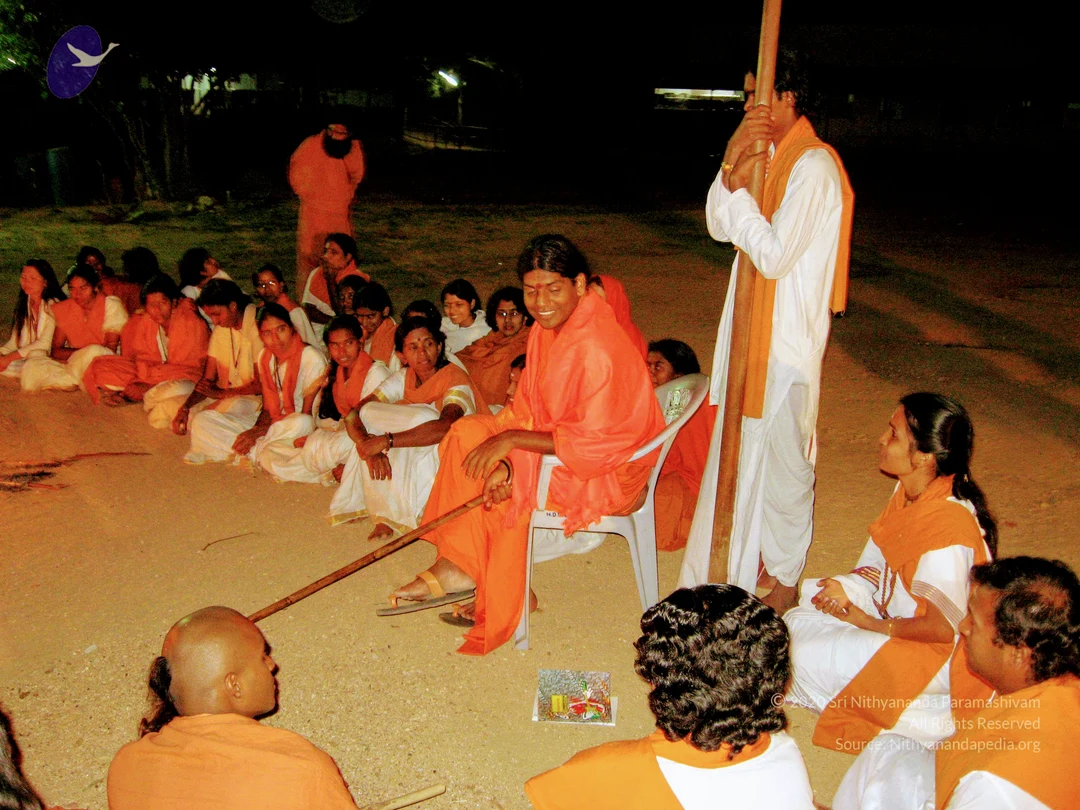
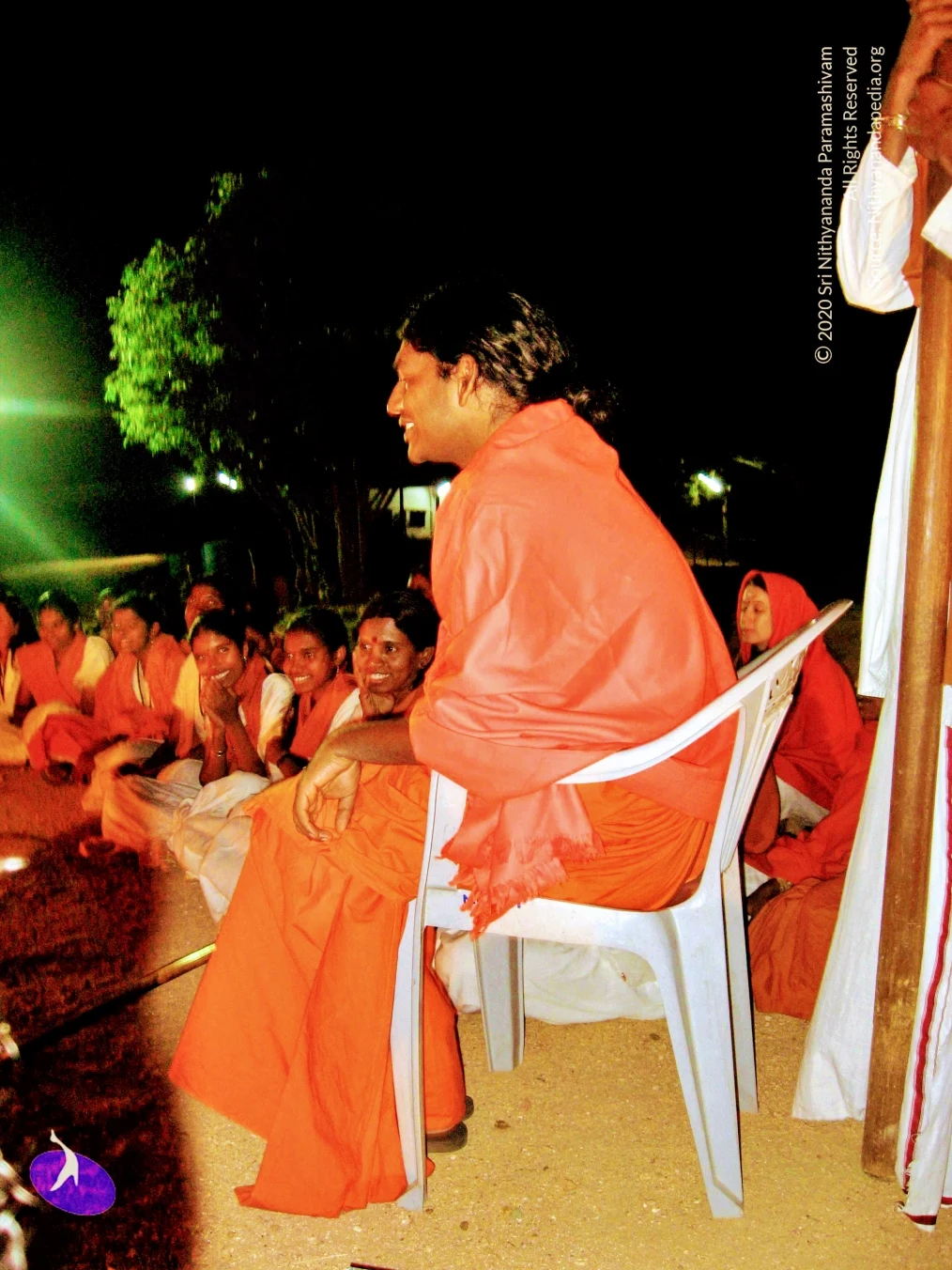
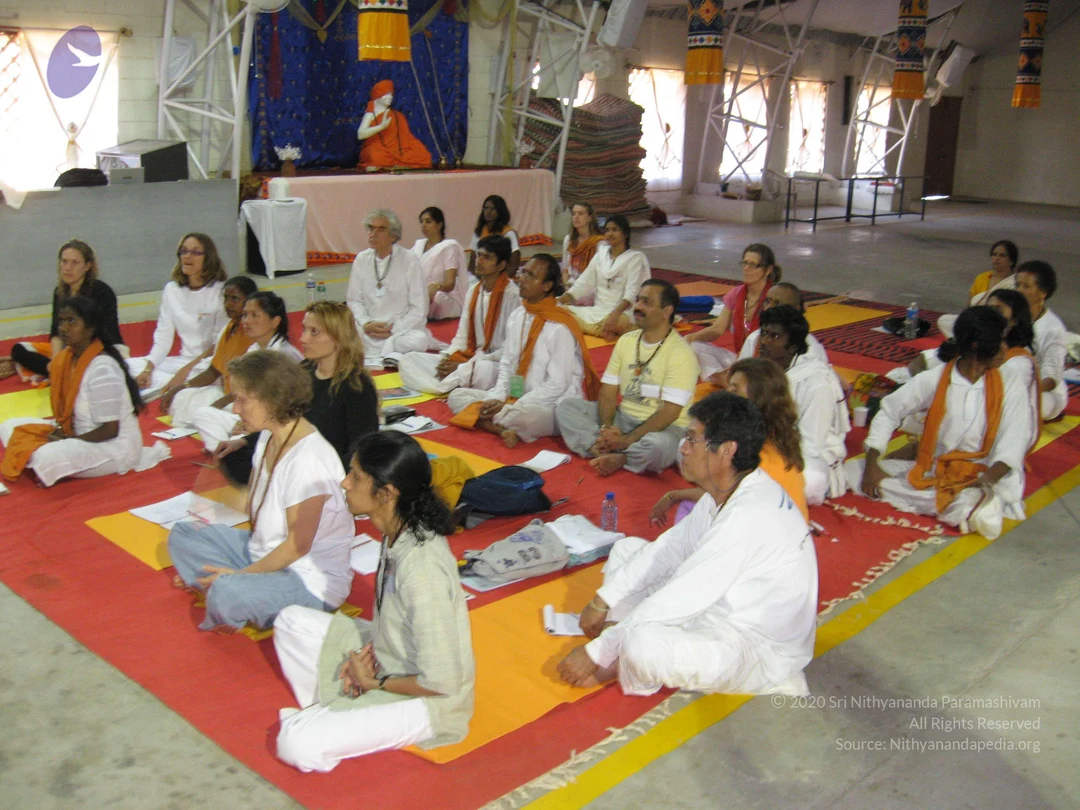
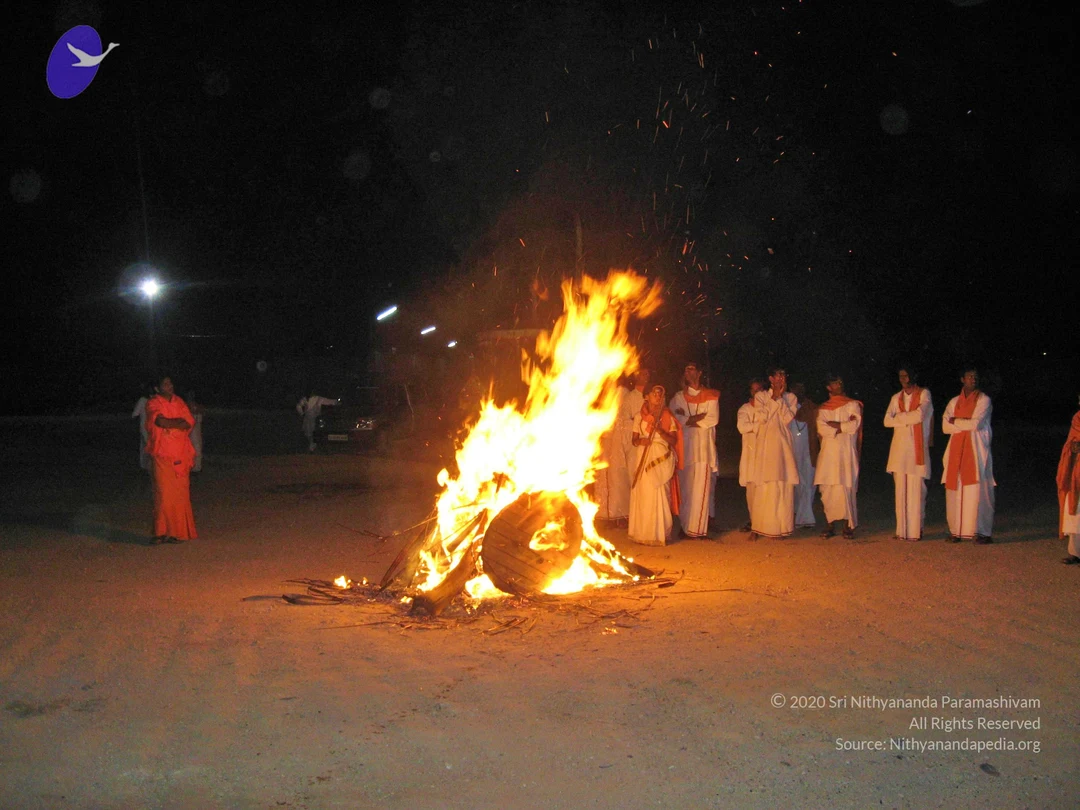
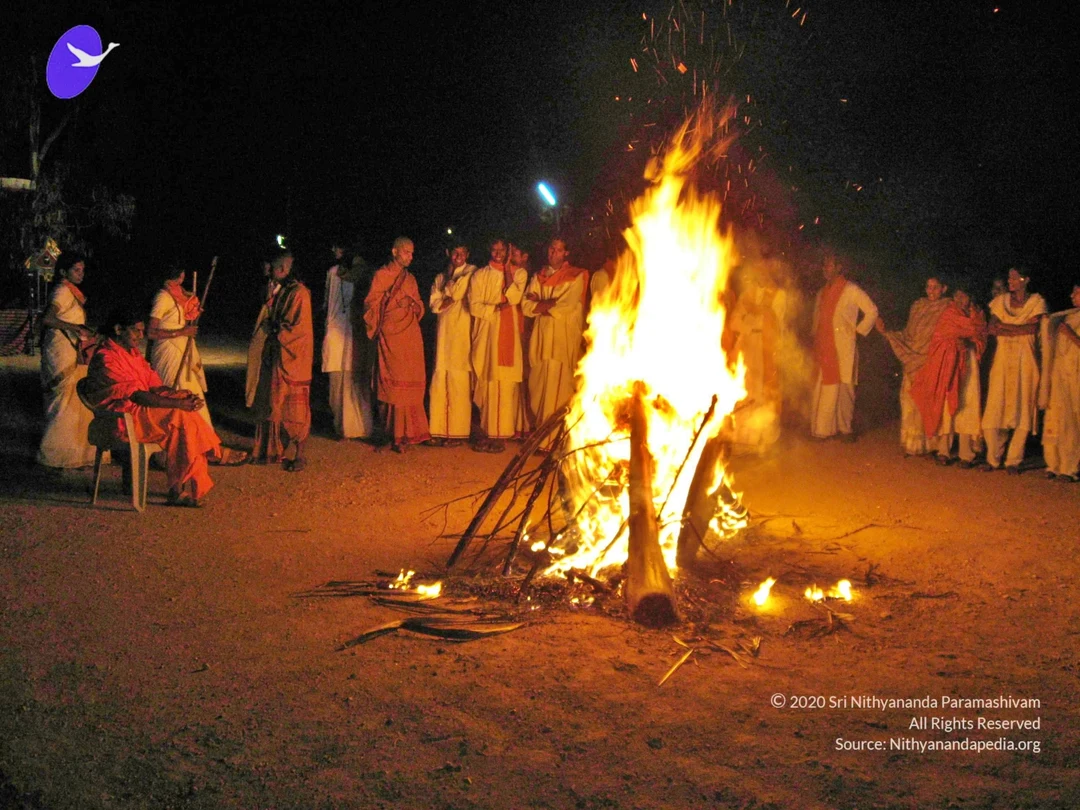
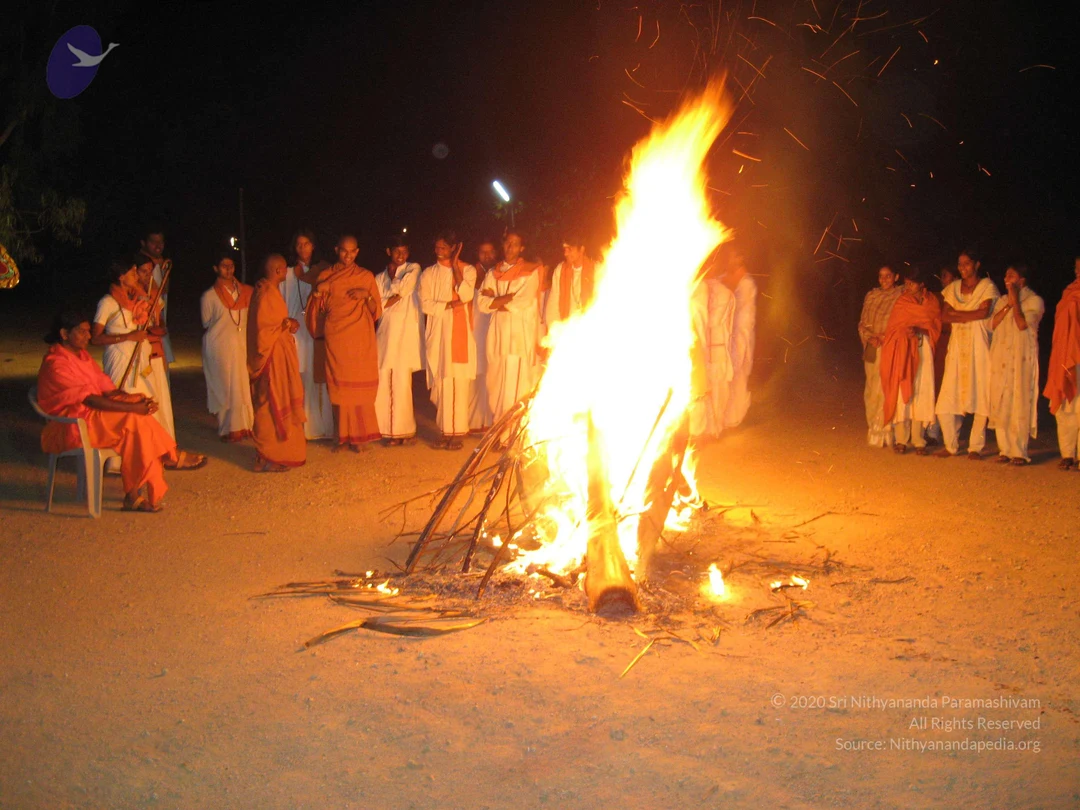
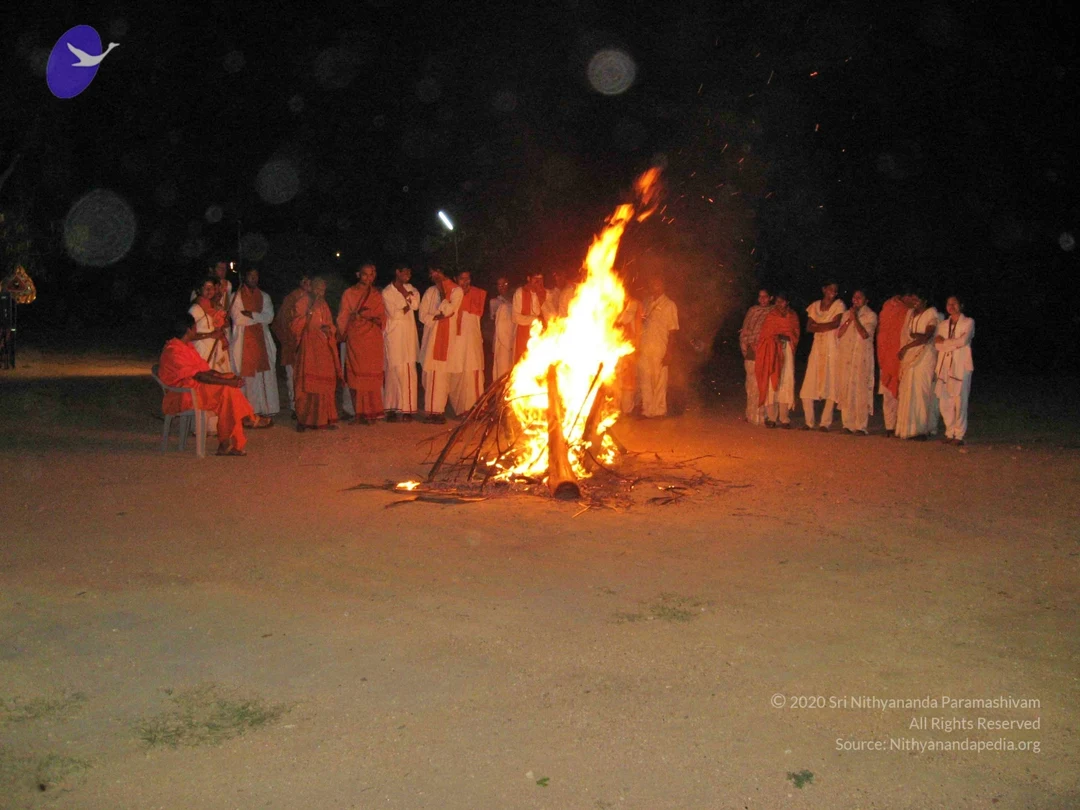
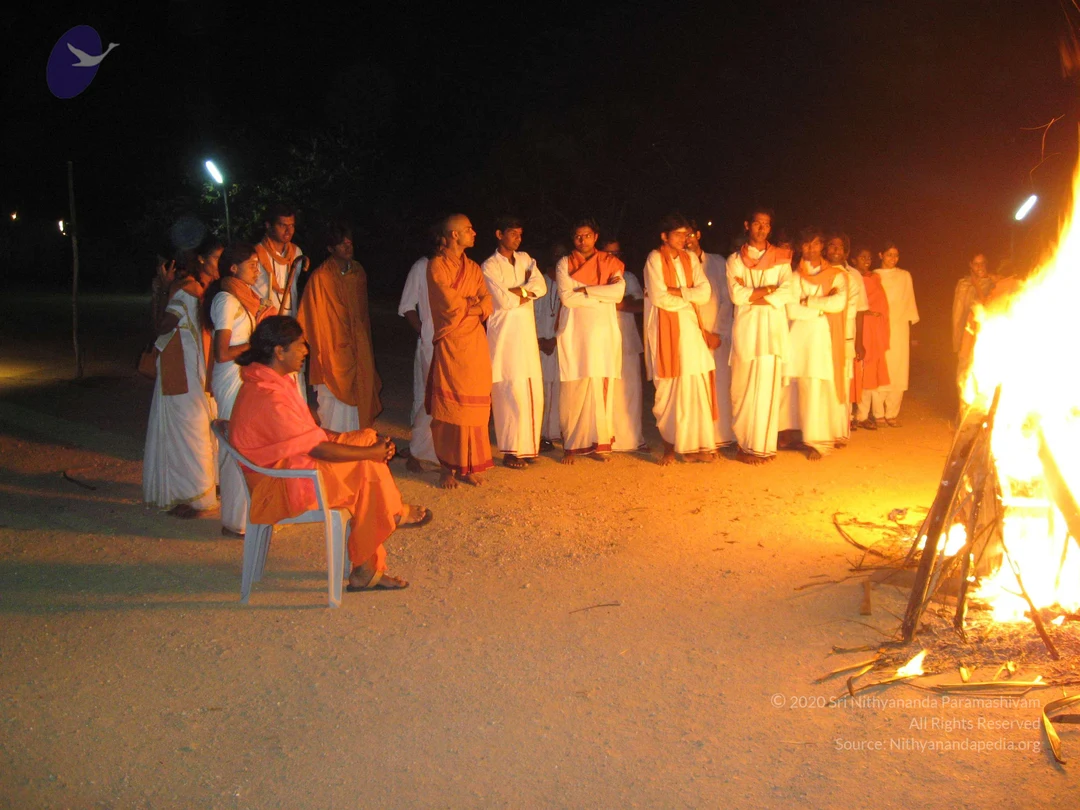
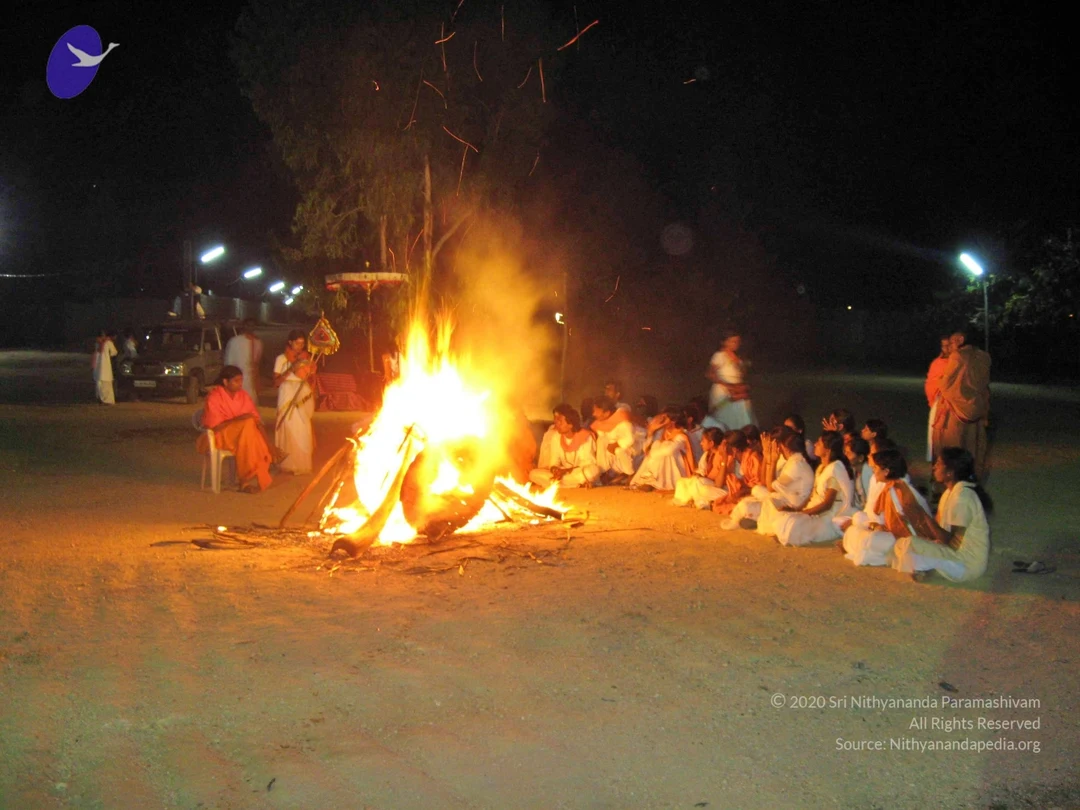
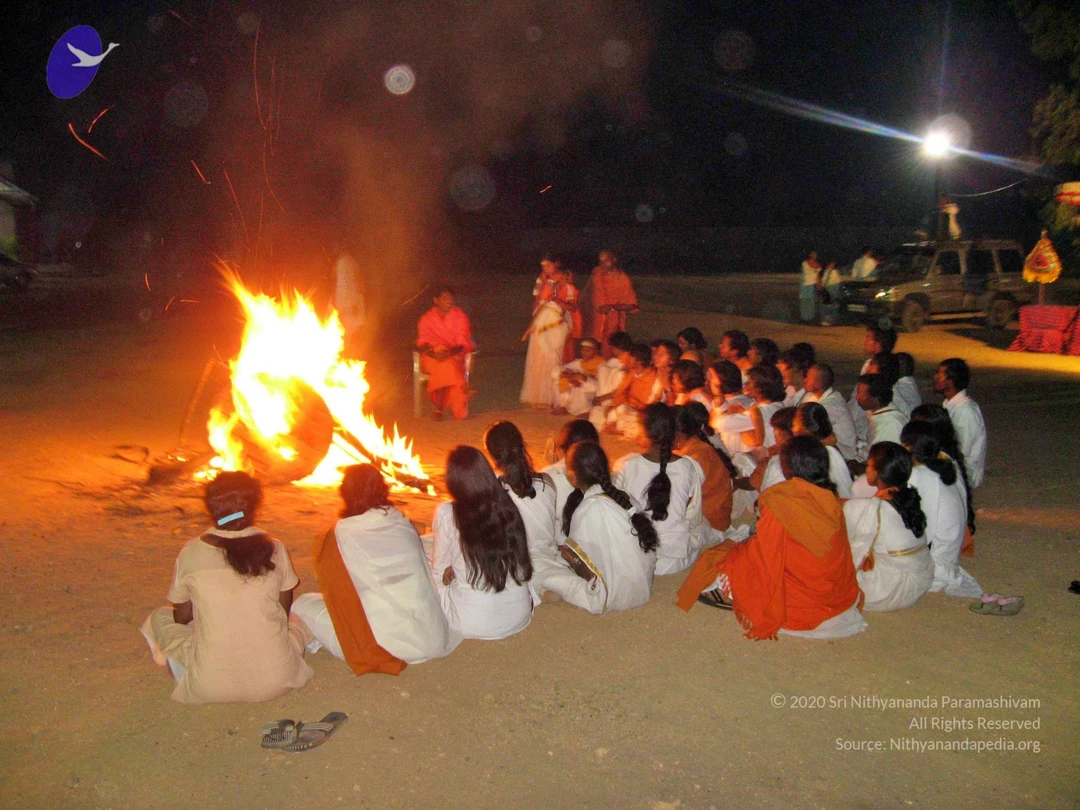
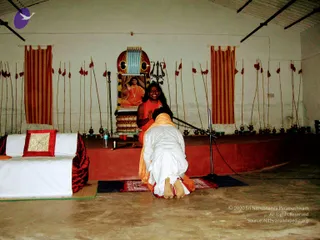
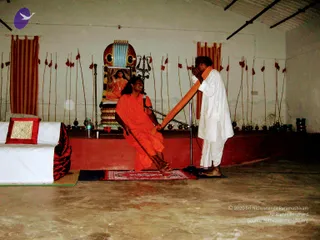
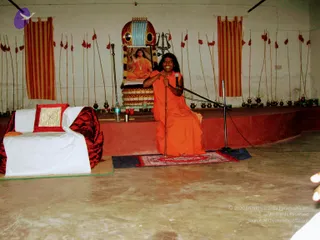
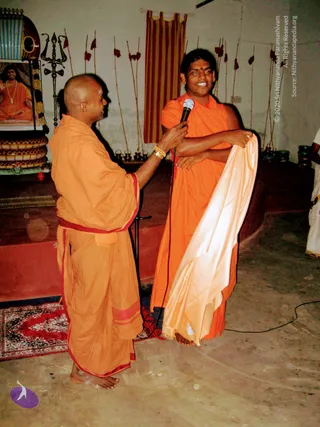
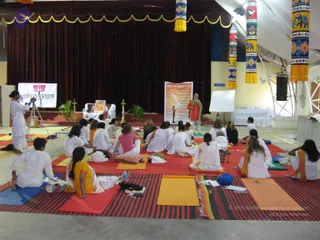
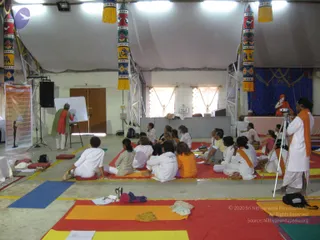
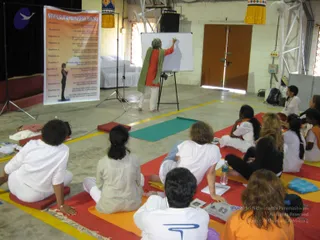
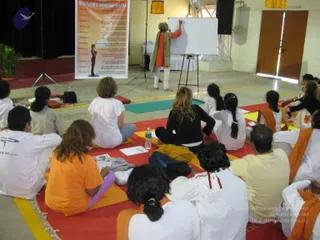
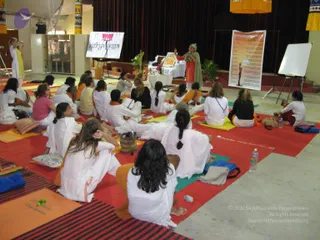
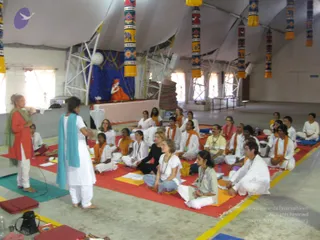
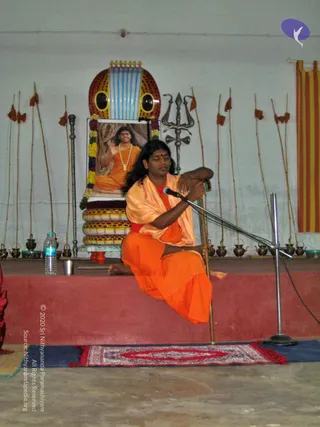
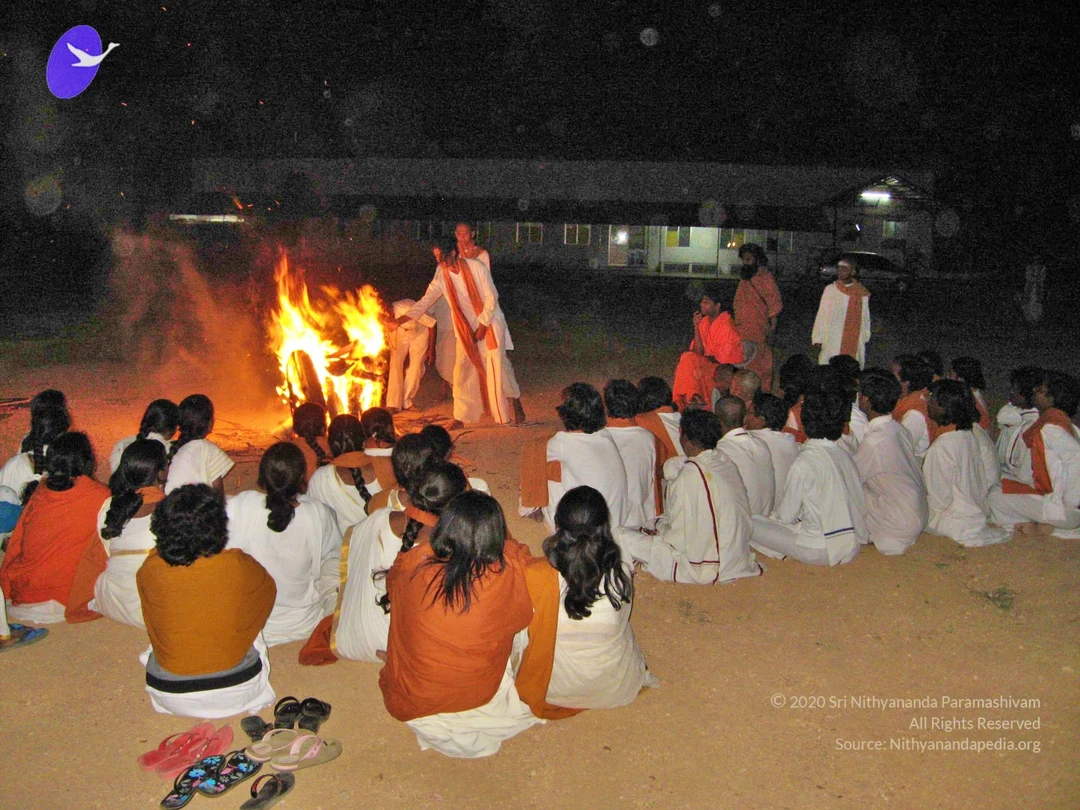
A night campfire gathering on a sandy open ground. A large bright fire blazes at left, sending sparks upward. About two dozen seated trainees, mostly women in white clothes with orange shawls and some with long braided hair, sit in a semicircle facing the fire. Standing behind them at center, a woman in white with an orange cloth and a man in orange robes face the group; a seated figure in orange sits on a chair near the fire. Other people stand in the background near a parked vehicle, a bright floodlight and a red-draped table with an orange flag at right.A hall with a tin roof and whitewashed walls hung with rows of decorative sticks and orange curtains, where a large group of people sits cross-legged on mats in white clothes with orange shawls. At the front, a woman in orange robes stands at a microphone on a raised platform beside a framed portrait of a figure in orange robes. A man in white clothing stands at the right by an orange curtained doorway, and a small table with a cloth and a pedestal sits to the left. Oil lamps and a small object sit on the stage, and a standing fan and speaker are visible.A hall with a corrugated roof and white walls where a seated audience of many people in white and orange clothing listens to a speaker. On a raised red stage at the back, a standing figure in orange robes speaks into a microphone beside a framed picture on a shrine-like altar with garlands and orange-and-yellow striped drapes. A seated figure in orange sits near a white-draped table on the stage. Most of the audience sits on yellow mats wearing white clothes with orange shawls, and some wear white saris.

January 14 2008

Original wiki page
Contents

Title

HDH Nithyanada Paramashivam visits Vivekananda Yoga University in Bengaluru

Narration

Video - and Audio - Q and A Straightforward Answers, Vivekananda Yoga University, Bengaluru

In this interactive Q & A session with students of Vivekananda Hindu University ,Bengaluru, Swamiji shares truth, as it is, from his experience. Swamiji exlplains his sadhana and autobiography. He answers questions related to Atma, Karma, enlightenment, desires and RamakrishnaPparamahamsa

VideoAudio

Video and Audio - Experiment with Truths || Part 1 || Inspirational Talks

This video is an excerpt from a lecture taken place at Vivekananda Hindu University conducted on 14 January 20087 in Bengaluru, India. In this question and answer session, HDH Sri Nithyananda Paramashivam shares one of his first spiritual experience as a child when he was initiated into the truth and technique given by Annamalai Swamigal at the age of 10.

VideoAudio

Transcript

(00:16)

Participant: Swamiji? HDH: Hmmm... Participant: Being at a young age you have gone through various deep Sadhana. Can you explain a little bit… your experience? HDH: Oh! Alright. Participant: Thank you. HDH: I had the fortune of sitting at the feet of Ramana Maharshi’s disciples. You must have heard of Ramana Maharshi, a Great Master who lived in Arunachala. There is a place called Tiruvannamalai, maybe five or six hours drive from here? Five or six hours drive from here, that’s My native place. I am born and brought up in that Arunachala.

(00:54)

Usually in India, Swamis don’t tell their native place or don’t feel proud about it but in My case, it is not geographical connection. I have a deep spiritual connection with Arunachala. So, I... I am proud of that place and I always feel connected and have a deep respect for that place. It’s a one of the very powerful spiritual energy centre and World’s biggest Shiva Temple. Something like a 27 acre built up area in granite and a huge tower, 220 feet or something. World’s biggest Shiva Temple is there. World’s biggest Vishnu Temple is in Srirangam; biggest Shiva Temple is there.

(01:40)

I had the fortune of sitting at the feet of the Ramana Maharshi’s disciples, one... Annamalai Swamigal, maybe some of you would have seen also… seen him also. A great soul who left the body only ’95. 10, 12 years ago he was… I can say that around the age of 10, I started visiting him. It’s like a... not any spiritual reason or anything, just My parents will take Me. In India, you know that... parents will force the kids to go with them when they go to these temples or to meet Swamis. One nice thing with that Swami is, he will always give candy; so, he will give some sweets, so I will never miss when I know that they are going to this… meet this Swami. I will go there and sit with him.

(02:33)

Many time he will give candy and maybe because of candy, I felt very connected to him, not anything else, just you don’t need to do anything and you can just sit and, and you don’t understand also, what he talks. It’s good in a way, you are not disturbed. You can mind your business and at the end you will have candy. So one day, somehow I don’t know whether fortunately or unfortunately I was drawn to what he was talking. He was talking something like, “We are not body, we don’t have suffering and we are beyond pain” these kind of words. I was not... not only I was not convinced. I was not able to understand. How can he say that we don’t have pain? If my mother beats Me, I have pain. In… In Indian villages, some of the parents will kick the kids if they do something wrong.

(03:32)

Anyhow I went to the home and continuously contemplating on this word. He saying that I don’t have pain and... we don’t have pain, we are beyond suffering and we are Atma and all those things. I was not able to brush him aside also because I somehow felt he is a very honest person. He is a very truthful person. He is not the person to tell lies maybe because of candy, I don’t know; that relationship is developed, because of that relationship, I was not able to just reject him, completely throw him away.

(04:13)

I was continuously contemplating then took a knife in the… from the kitchen and cut My thigh to see whether I have pain or not, still the mark is there. Of course not only I had pain, My mother gave Me few Puja and took Me to the hospital nearby and they did first aid and whatever they needed to do, something like 13 stitches they made, such as... deep cut, 13 stitches they put on… anyhow I became alright in maybe 10 or 15 days, I became alright and I went to him again and asked him, “What is this? What have you taught Me? You told Me we don’t have pain, we don’t have suffering and still I remember he was repeating some Gita sloka, नैनं छिन्दन्ति शस्त्राणि नैनं दहति पावकः | What is that? Hmmm…. See, this Arjuna, this guy is intelligent when he heard all this truth, he killed others and verified, not himself but in My case, I went and cut Myself, that’s where the problem started.

(05:27)

Anyhow, I went and asked him, “What is this? What have you taught? You did like this? I am... I am having pain and suffering. My mother was shouting at Me”. He said a beautiful word, still I remember. His eyes have become very compassionate and soft and he said, “My son, don’t bother. Just look inside and see from where the pain idea is coming into your being”. See, now I am using a very logical words to you. He was not using this many words. In Tamil he told... he said - Tamil is My mother tongue - in his... in that language he said, "வலி யாருக்குனு பார்ரா...". He told Me, “Who is having pain? Look inside”.

(06:24)

Please understand, I tell you honestly I am a 10 year old boy. I can’t understand the Vedanta philosophy. I can say honestly he Initiated Me. With that word, he Initiated, Initiated Me into that method of enquiring or going into the truth. Now I know all this big, big words, it’s a self enquiry, great Vedanta Vichara and all these words. To tell you honestly at that time, fortunately I did not have an intellectual stuff otherwise I would have idea, “Oh, it is a big thing, I cannot do”. Fortunately, I did not have all that intellectual background because of that, I was very simple, relating very simple way with him and he told Me, “Who is having pain? Look inside”.

(07:17)

Anyhow I told him, “Alright. I will look inside” then, even then I was not convinced. I was asking him, “Okay. You could have told Me about this meditation and all before I cut Myself. Why did you make Me... make Me cut Myself then you are teaching all these things”. He told very beautifully, “That word” still I remember. It’s a very strong word, “My son, don’t bother about this pain. Your spirit to experiment with the truth is much more valuable than this pain. Forget about it, keep that spirit alive. You will never have any pain”. It was a very strong word from him. “Keep this spirit of experimenting with the truth alive. Keep this spirit of playing with the truth”.

(08:12)

Maybe I can say, the first... the word which he uttered was Initiation means like initiating Me into the technique, into the truth. The second word which he uttered is giving courage and confidence to travel in that path, to travel in that path, to continue the journey, to do My Tapas, that was the first and very strong inspiration and I was playing with the technique. Whenever I find time, I will sit and see that from where the pain is coming. Sometime it will feel like the pain is in that area, same area where I had the pain, where I had the cut. Sometimes suddenly I feel the pain is coming from some other area, somewhere else I am remembering the idea of pain so it was just a play for few days; that technique or the method.

(09:16)

One day evening, I was sitting at the foothills of Arunachala and trying to play same way with this technique. It was not a serious meditation or Tapas or anything. It was just a playful remembrance or trying to see from where that idea, that I… I am suffering or I have pain, is coming. I was trying to find the source and by the grace of Arunachala or by the grace of the Annamalai Swamigal, the Guru Krupa and the Daiva Krupa, some strong experience happened, something opened up inside. I was sitting with closed eyes but the opening was so strong, I was able to literally see whatever was there around Me 360 degree.

(10:10)

Of course, it’s a very mystical experience. If you are not able to logically accept, please forgive Me, that’s the... forgive Me for intruding into your logic but what I am saying is honest truth as it happened, whoever can catch, catch. Complete 360 degree, this side and this side, all the direction I was able to clearly see at a time, not only I was able to see, it’s like a, that hill which is in front of Me, that temple which was on that side and the trees, plants, rocks which was around, and the sky and the ground, the whole thing not only I was able to see, to tell you more clearly, I was able to just feel everything is My very being. I can say... see, now usually people feel that they are alive inside their skin, how you feel alive inside their skin, that same depth of life I was able to feel in the pillow and the plant and the flower or the mic whatever is in front, whatever is around.

(11:37)

How you feel you are living inside your skin, inside your boundary. The same depth of intense life or feeling, “I exist, I am alive” happened with the whole surrounding whatever was there in the 360 degree. It was a very strong experience, very strong feeling, maybe I can say some two and a half hours or three hours I was there without moving the body then slowly I was able to move the body and the moment I came down, around two and a half days or three days, like a bliss fever, it was like a fever with intense bliss. It was not suffering fever, bliss fever, feeling like a... I have to go to that place again and again, the place where I had experience. One side it is pulling, the other side because of this newness or something unknown, the fear was also there. It’s like a... if a young boy falls in love, one side he will have a deep pull to meet that person, the other side because it is a unknown dimension, he himself never experienced he can feel for somebody so deeply, it’s a unknown dimension opening up that will naturally create a deep fear, “How can I open up so much? How can I be open so much? How can I be pulled so much beyond My logic?” that fear was also there.

(13:48)

I don’t know what happened by and by within few weeks, that fear to go and be in that state again and again has disappeared and after that, never the feeling to come out of that state came, never the feeling to feeling of boredom from that state happened, never moving out maybe I can say, it became like a undercurrent of all the activities and inspired, created more and more energy and intensity to continue the journey maybe different meditation techniques, different practices, different Tapas, different things; I don’t know why all this has happened and all those things. To tell you honestly, there was no… only one thing I can say, after that there was no suffering even during Tapas or penance. There was no suffering, it was a pure joy.

(15:00)

People ask Me, nine years I lived wandering, begging and eating, sleeping under the trees. Nine years, I spent maybe 10,000 kms; I would have walked and 2-3 years I spent in the organisations; like different organisations, “Ramakrishna mission” and many other organisations, spiritual organisations. So during My wandering, people ask Me, “Swamiji, it would have been a great suffering or how did you live? It’s very difficult”. My life was a joy, it was just an ecstasy. Everyday you have something more interesting, exciting, new, new things in the inner world and in the outer world. It’s a great... great explanation.

(15:48)

So after that first experience, there was no suffering whatever I did, whatever I lived. From others’ view it might… may be looking like a suffering or penance or Tapas or meditation. From My point of view, it was nothing but a simple exploration, a simple joy or simple expression. Now, sometime I sit and read the book. It’s not that I am suffering, I am just exploring. Same way, all My Tapas, all My meditation, everything was just exploration. It was not suffering. It was not painful at all.

(16:26)

Video and Audio - Drop The Pseudo-Knowledge || Part 2 || Inspirational Talks

VideoAudio

Transcript

[00:17] Participant: Swamiji, what is Atma? Atma is continuation?

HDH: Ok. You want an honest answer or a socially polite answer?

Participant: Honest. Really...

HDH: Alright. Please be seated. Whatever you think as Atma, whatever ideas you have about Atma, is just an idea. According to Me, if I have to tell an honest answer, just drop those ideas and be very clear that you don't know. Then, you will see the truth. Any idea you carry about Atma, only becomes a hindrance for realizing the Atma. Ramana Maharishi says very beautifully: “I did not even know the word Brahman, till I had Brahma Jnana. That is why I was able to have easily”.

[01:08] So, the concept of Atman, is good in the initial level as an inspiration, but after you start your path, better to drop the ideas which you carry about Atma and be very clear that I don't know. See sometime, the ideas which you carry gives you a pseudo feeling you know it, and you only need to live it. Then the thirst or the enquiry or the seeking drastically drops. You become a, more or less, like a manager - “Now I know the truth, I need to administer.” That is not the case. You don't even know. That is the case. If we know, it'll express by itself.

[01:53] I always tell people, “The urge should become urgent. The question should become quest.” For that better not to have an idea about Atman. I can give you any idea; long big big talks, big big idea, but I will be only disturbing you. I can say “It's in the form of light, consciousness, Supta, Swabhava, Swayamprakasha, Jyoti, Nirvikalpa, Nirananda, Niranjana, Nischala, Nir.. All those big, big words I can give you. But all the words are just nothing more than a brand names. No, true. Somebody says Nirvana, somebody says Advaita, somebody says Atma Jnana, somebody says Brahma Jnana. I have My own branding name “Nithyananda state”. So, something like that. I don't want to repeat all the different brand names.

[02:40] See, that's why I have asked you; if you want a social answer, I would have given a long social answer. I don't think that anyway going to help you. If you ask the same question in the public, I will give you a very long answer; quoting Ramakrishna, quoting Ramana Maharishi, quoting Buddha, quoting Shiva, quoting Shankara, quoting everybody, long answer because I need to convince him that I know something.

[03:04] Here I dont need to convince you. I can straight away help you. You understand? You are a seeker. I can straight away share with you what, what really can help you. Usually these big, big terms are used not to help that person; to help Myself. No, that is the truth. These are all, you see, after all I am a young person, so I need to use big, big words to tell that person, “you are sitting in front of a person whom you need to listen”. And I think with you, with seekers, I don't have to use the big, big words. I can straight away tell the truth.

[03:35] This is what I feel. Better not to have an idea, once you enter into the journey; just be very clear - You don't know. That clarity “you don't know” can lead to such a great depth, can give so much of strength, can gives, bring, will bring so much of inspiration; you will never be struggling or in depression.

[03:59] See, depression is the worst problem seekers face in the life. Why they face you know? They think, they know almost everything, they know everything. Only thing they have to make it as a, as a reality in their life. But that is not the case. If you know the fire will burn, naturally, you will not put your hand there. But people tell Me: “Swamiji I know everything, fire will burn, but again I am putting my hand there” No. It means, you don't know. That is the truth. You have a pseudo knowledge. I can say, breaking the pseudo knowledge is what I call Vijnanamaya kosha Bhedana. Breaking the Vijnanamaya kosha. We live with a very wrong knowledge. Very wrong idea, ‘we know everything’. That's what I call Vijnanamaya kosha. Breaking it, having a clarity “this is what I know, this is what I don't know. Let me be very clear”. That clarity, will break the Vijnanamaya kosha. And can bring so much of strength, clarity, peace into your being. Thank you. [05:12]

Video and Audio - Suffering versus Suffocation || Part 3 || Inspirational Talks

VideoAudio

Transcript

What is my question, does it mean that if you are suffering intensely you are progressing on your path towards God?”

[00:27] HDH: Two thing, the statement which I made “the same wife, same life, same car” was just a jovial statement. But to tell you honestly neither your wife nor your car or your house is same as yesterdays. It is different. You can't step into the same river twice. I tell you, you can't even step into the same river even once. See the moment you put your foot, before even it reaches the ground, water moves away. So, your wife is updating herself, your life is updating itself, the whole Existence is constantly updating itself. So My statement, ‘the same wife, same car, same thing’ was told in a more a casual sense and a jovial sense and how you feel; but that is not the case, actual truth. That is the first thing.

[01:21] Second thing, if we are suffering, are we going towards God?

No! Something seriously wrong. I can say, in the initial level you will not have suffering you will have suffocation. Suffocation is what Ramakrishna calls the ‘seeking’ or the ‘intense yearning’ - ‘Vyākulatā’ - that is the word Bhagawan uses, Ramakrishna is using - Vyākulatā, the intense yearning. There will be suffocation, not suffering. Suffocation means feeling that you are not enough. You have not expanded what you can. You are not doing what you can. Just like a, missing some part of you; it won't be a suffering. Suffering is different, suffocation is different.

[02:14] Suffering is something. When you think I need this and you're not achieving, that is suffering. Suffocation is you know you are something but you have not become that. Suffocation is from within, suffering from outside. Suffocation is from Prarabdha, suffering is from Agamya.

[02:35] Prarabdha means the potentiality which you brought with you is Prarabdha. Agamya is the desires which you accumulated after coming here. The accumulated desires bring suffering, the Agamya [Prarabdha] brings suffocation. Suffocation inspires and helps you to expand, open up, break. Suffering puts you in deep depression.

So I feel suffocation will just explode into joy. There won't be suffering between you and the Enlightenment or the Atmajnana. So I can't accept the word if you are suffering more you are going towards Divine, towards God. According to My experience, not only goal, even the path is Anandamaya. Path and goal, both are Anandamaya. In the initial level the suffocation will be there.

[03:40] Please understand the difference between the suffocation and suffering. Suffering is from the accumulated desires. Suffocation is from your inborn Prarabdha, tendency, the potential energy.

[03:54] So when a seed has not become tree, when the seed is about to break it has that suffocation Vyākulatā, but suffering is after you become tree, suddenly you want maybe 2-3 house built on you or 2-3 cars so that can you can get into that. Tree can't move; which you… you try to accumulate something which is not directly yours, your very quality. That is what I call suffering.

[04:25] Suffering is from Agamya, suffocation is from Prarabdha. Prarabdha, suffocation may be there in the initial level in your spiritual path, but Agamya, the suffering or depression cannot be there in your spiritual journey. Then there is something wrong if the suffering is there. First sit and clear the suffering; that’s a basic need to start your journey. Thank you. [04:53]

Video and Audio - Desires Have No Power Over You || Part 4 || Inspirational Talks

VideoAudio

Transcript

[00:15] Sit and contemplate. Make a list of all your desires, all your desires, whatever. List and sit and contemplate. Just visual... take up each desire and visualize that it has become reality. How you feel? Add Kriya Shakti to Ishta Shakti. Add your visualization and creativity to your desires. Suddenly you will see, many desires which you thought is your life, will drop, will lose its influence over you.

[00:54] Empower your visualization, your desires with your imagination power. Just see that they have become reality and how you feel now. Suddenly you will see, many desires which you thought is a important thing in your life, will lose its power over you - those desires are your Agamya, accumulated desires. And suddenly you will see some desires will become so strong in you - that's what I call Prarabdha, your own desires. With Prarabdha, you see Prarabdha, great quality of the Prarabdha karma is: Before fulfilling it will give you a deep inspiration and energy to run behind that desire. After fulfilling, automatically that will give you a deep satisfaction.

[01:48] But with Agamya, before fulfilling also you will have a deep irritation. Sometime if you see, if you remember some desires, you will have a deep irritation. After fulfilling you will feel the deep emptiness. Agamya will start with irritation and end with emptiness. Prarabdha will start with inspiration, end with fulfillment.

(02:14) So sit and contemplate on all the desires. Take this as a meditation. Everyday visualize one desire fully. Create your heaven and live half an hour in that. It may look like imagination. “ What am I doing?” But you will see, suddenly, there are many desires which you are carrying, without even knowing that they have no say over your being, they have no power over your being. When the Agamya drops, Prarabdha will have its own energy to fulfill itself. [00:02:49]

Video and Audio - Experience You are Divine || Part 5 || Inspirational Talks

VideoAudio

Transcript

(00:15)

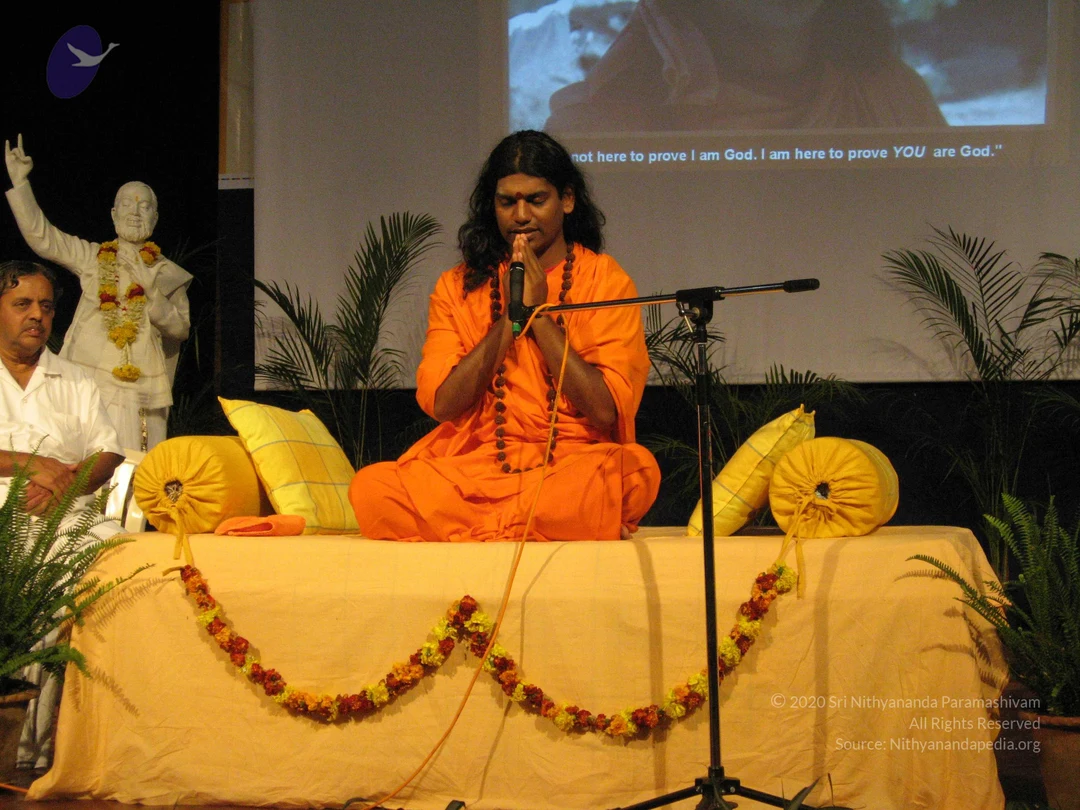
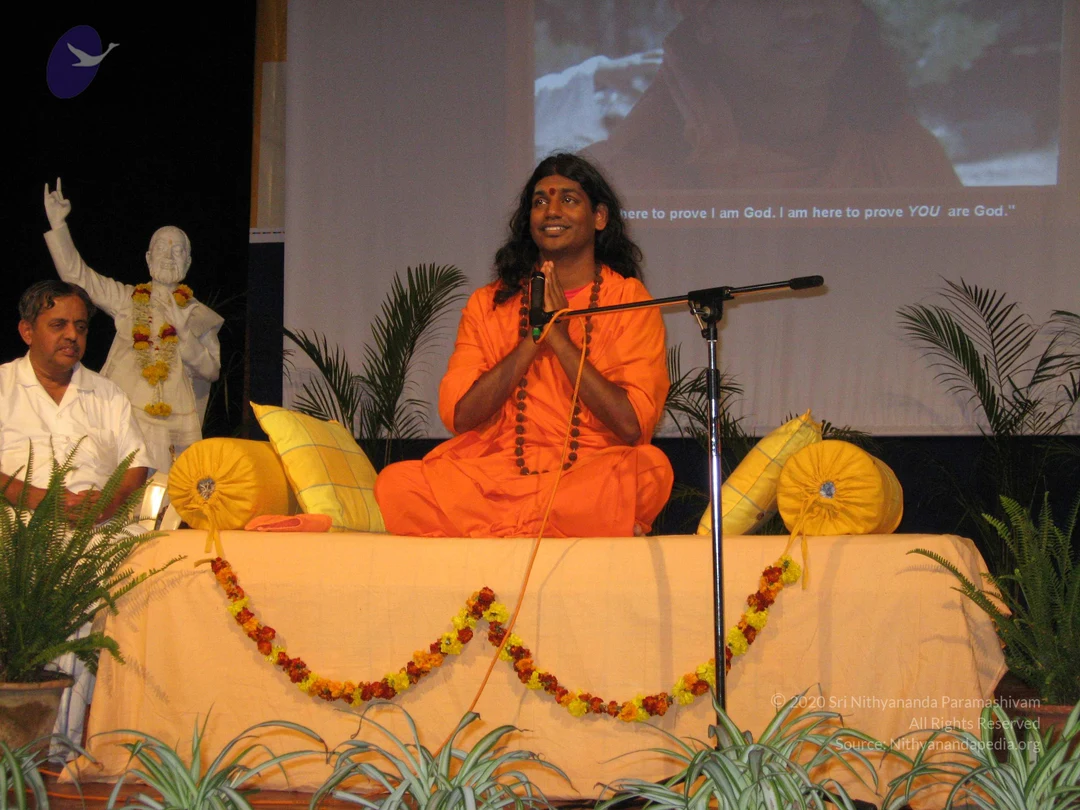
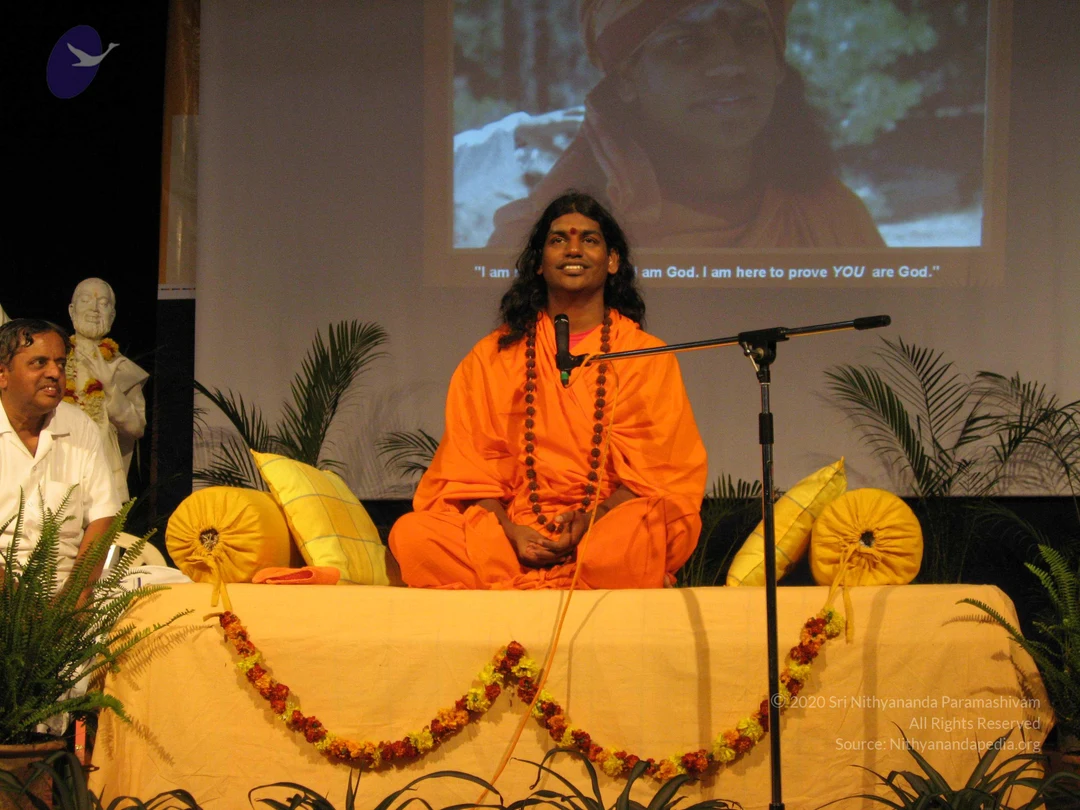
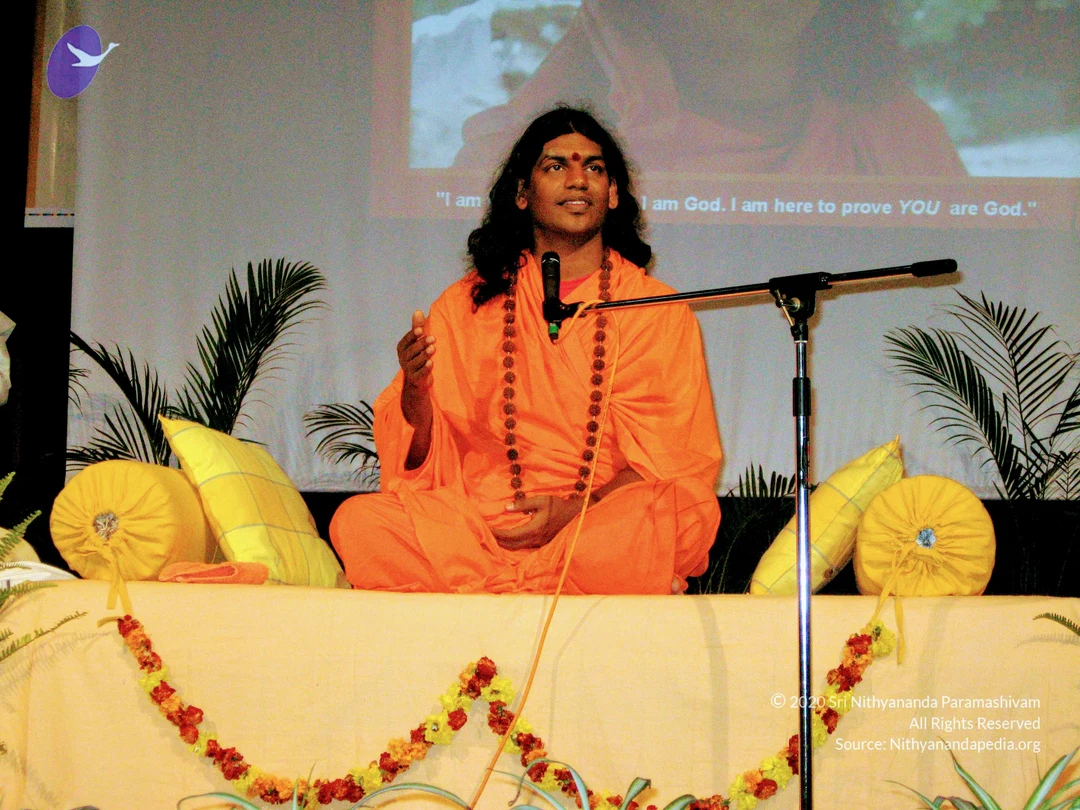
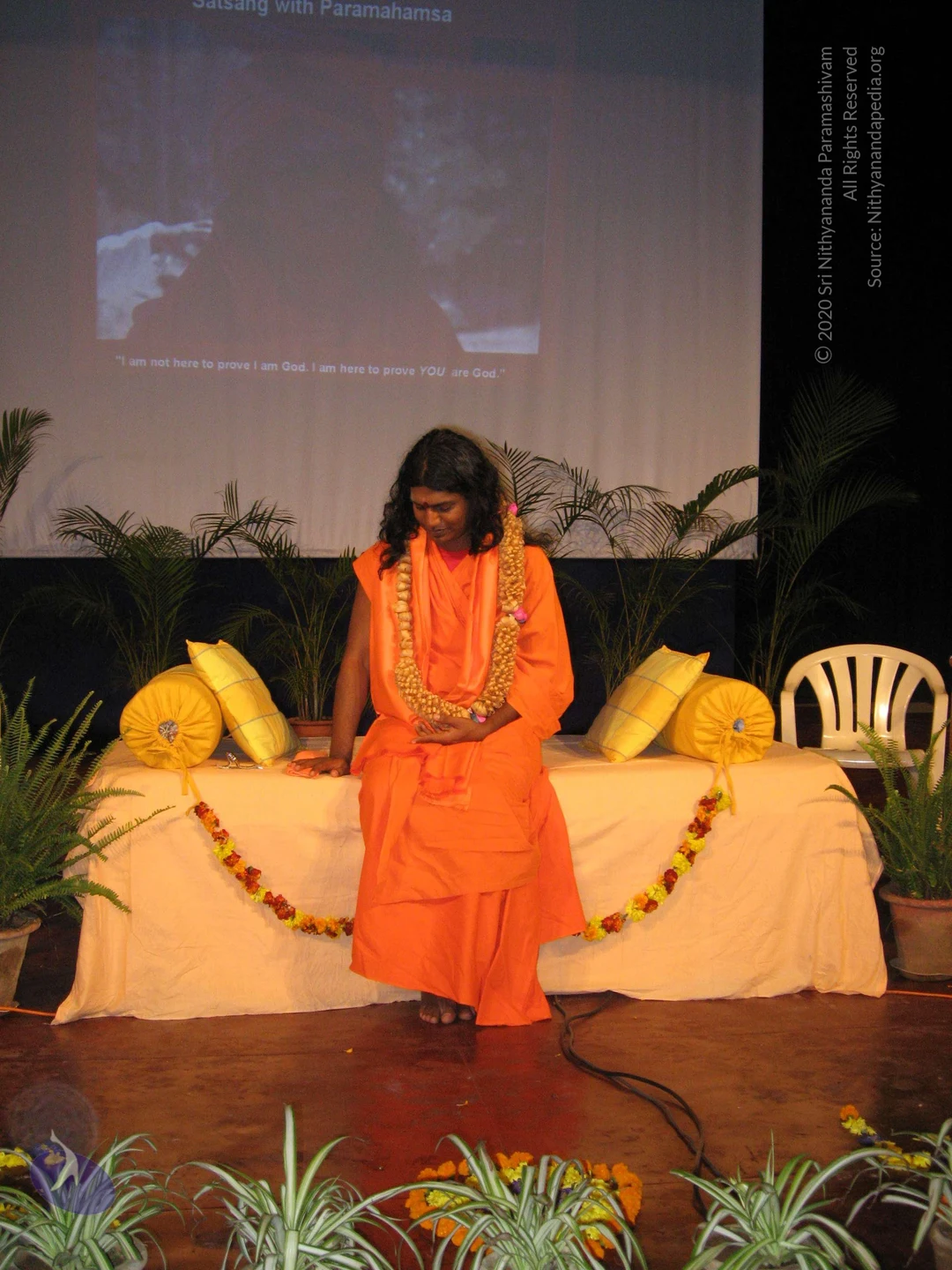
Participant: "I am not here to prove I am God. I am here to prove you are God. Please, why did you say you are God?

HDH: Please be seated. When I say you are God, I mean whatever you have an idea about God - you are much more than that. Can you describe what you understand by the word God? Can you describe? Hmm.

Participant: Uhh, explained in Shastras, how the Indian - when Bhagavan is saying in Bhagavad Gita, "I am Krishna, you are Arjuna..."

(01:04)

HDH: See, whatever you know about God - the quality or the experience or anything, you are much more than that. That's what I mean. Please understand, if you think God is all pervading energy or God - you see, if you say Krishna, what do you know about Krishna? The person is such a wonderful joy, power, glory and all the qualities.

(01:29)

He lived his whole life like a leela. See, whenever you start cherishing, enjoying your very existence, the whole life will look like a leela. Krishna lived in that space, that’s why we always call Krishna’s biography as Krishna leela. Krishna’s history is called Krishna leela - it was such a wonderful play. Whatever quality you remember, you identify, you associate, you understand in the name of Krishna, you have much more than that.

(02:07)

Possibility which is in you, potentiality which is in you is much more than that. Please understand, I am not disrespecting Krishna. Immediately your mind will say, "No, no, no, how can I be equal to God?" Person who says he is equal to God and person who says he is not equal to God - understand both are egoistic.

(02:30)

At least the person who claims himself as God will have his ego somewhere cornered - society will not allow that. Somebody will make fun of him, "Ahh, see this fool, he is claiming himself as God, he is a mad cap." But the person who is not - who is thinking,“I am not God" his ego will never be attacked. So he is the most cunning idiot, he is the most cunning fellow - topsy-turvy ego; inferiority ego. He can easily preserve himself, protect himself.

(03:00)

Please understand, neither the idea you are - nor the idea you are not is a ultimate truth. Understand, actually I can say this way - the inferiority ego is much more dangerous than superiority belief. Neither you need to say you are not God nor you need to say you are God - just experience you are God; that is the truth. Person who has experienced he is Divine will not feel - people ask Me: how do you know you are Enlightened? I tell them, "The doubt whether I am Enlightened or not or the ego 'I am Enlightened', both disappears - both are not there. That is the space - that is the symbol that you are Enlightened. Neither you will have a doubt whether I am Enlightened or not nor will you have ego I am Enlightened. Both will not be there - you will just be radiating; and the people around you will feel that you are living in it.

(04:08)

If you see the original words of Ramakrishna, very strong word and He uses lot of Bengali slang. Somehow unfortunately in English everything got edited and did not get translated. He is such a villager - such a joyful - joy to read his words and you should read in original Bengali to understand the juicy being. See, He is portrayed unfortunately by the:I think I can tell the truth these vedantic Swamis - as a very decent culture which appeals to the modern mind. But He was such a pure, simple, raw being - using straight words, straight cut examples. If you read the original Bengali - now the latest - the original Bengali, the Kathamrita is translated as it is and came out five volumes

(05:06)

If you read those things He is a very straight - no, just - why I am telling you this; please don't mind by the word 'idiot' - you may think that, "How can an Enlightened person use the word 'idiot'? What can be done? That is what I am using - so nothing can be done. If you want, learn the spirit from that word or judge and waste your time. That's all. I don't have a problem. But, why I am using this - this kind of strong words - this is the way; I don't feel like editing. The moment I edit these words the strength or depth with which I want to convince or convey this idea will lose its power over you. That's the reason I am using the exact word - I want to remind you once more if you think you are not God you are egoistic. Thank you.

(05:56)

Video and Audio - Even A Small Stone Can Teach You || Part 6 || Inspirational Talks

VideoAudio

Transcript

(00:15) Participant: “What kind of practise should we adapt to on the spiritual path if we don’t have any Guru?”

HDH: Okay, see the idea - let me be very honest, I always tell people in - in our Ashram, whenever people ask Me about this Guru and all these things I tell them - there is a beautiful example: if you allow the calf, it will go and be with the cow only for 10 minutes. But the calf will drink the milk and come out. The bee - fly, which is sitting on the cow 24 hours - it will drink only the blood. It is not being near a Guru’s physical presence - I don’t think that plays any major role in the seeking. It is the depth of seeking; that plays a major role. Ramakrishna very beautifully says, “Surrender to anything, surrender is important - not to what you surrender.” If you surrender even a stone can become God and guide you. That’s what happened in Ramakrishna’s life - it, just a black stone - 3 feet black stone; if you go and see this, it looks very funny. This 3 feet black stone showed this Ramakrishna the whole world.

(01:26) The Kali Murti, if you go to Dakshineswar - it’s not more than 3 feet. She’s just standing with 4 leg and 3 feet black stone. But the stone can show the divine or the Cosmic experience to Ramakrishna. So, when you surrender even stone can become God. When that intense seeking is not there even if God comes in front you will ask for ID card. You will ask for ID card and now you are saying, “Oh, I am not having a Guru.” You think living around Me is such an easy joke? Ask them - they will tell you. It’s not a joke. You understand? Let the seeking become strong, if the seeking becomes strong, even a small stone can teach you - the life can teach you. Life you see, the prana which is flowing inside My body coming out as words - the same prana is flowing everywhere. It can straight away enter your body also and create those same strong teachings inside your heart.

(02:28) Please understand, because I have become empty - empty, hollow bamboo - the air which is flowing inside Me coming out as a flute music. So the same depth if it can start happening in you - the air which flows inside your nose, can become a strong teaching or inspiration inside your heart. Without that intensity even if I tell something, even if I utter some word, after 2 days you will not even remember, “Oh, that young Swami came, first day brought out - okay He spoke something. I think He spoke well.” That’s all; people come and tell me usually, “You spoke well Swamiji.” I just catch that shirt and tell, “Tell me what I spoke.” “No, no, no, no, no, no - you spoke well - don’t ask the that and all.” It’s just a one more word - one more word, a courtesy or socially polite or just to get attention.

(03:27) You can get attention in 2 ways: one by throwing stone and the other one praising. Both way can get an attention - a polite way of getting attention; asking for attention. That’s all. So, I don’t think the physical nearness is directly relevant than the intense seeking. The intense seeking is what I feel is needed and maybe I can use one more word: psychological revolution, a cognitive shift seen - processing the information which you receive and decision making. This cognition should completely have a shift - as and now any experience which you add to your being adds more and more fear or greed. Instead of that, any experience add to your being should become strength and awareness - leading you to more awareness. If this cognitive shift happens, if this psychological revolution happens - I think that is what is Guru; that is what I call Guru.

(04:39) So, maybe you can work hard for that than being physically around the Master. If you prarabdha is to be physically around the Master - suddenly you will see, you will click with somebody; somebody, with somebody you will click. You won’t even have to think about it. People ask me, “Am I your Master?” I tell them, “As long as this question is there, forget about Me.” The moment is, "If I am your Master" - that question will just disappear and you know - you will see and the click happens. So the - till that click happens, don't bother. If that click does not happen also, don’t bother. Just go towards that psychological revolution. If needed you will have the click when it needed with whomever it needed. If not, you will become - you will achieve the truth as it is; there is no need to bother. (05:29)

Video and Audio - What is the True meaning of Happiness? || Part 7 || Inspirational Talks

VideoAudio

Transcript

two thing in the planet Earth one is suffering, another one is bliss. Understand bliss, bliss has a positive existence like a light. Suffering has a negative existence as a darkness - darkness has no positive existence. Understand.

(01:13) Light-lessness is darkness. So, bliss-lessness is suffering. So bliss is positive existence, suffering has negative existence - means it does not exist. When there is no bliss - suffering. The joy or happiness is a comparative reality. For something can be happy for that - something can lead you to happiness - but the same thing can lead the other person into suffering. So happiness is just a comparative reality - the comparative drama. It is only a comparative reality - it is not an existential reality.

(01:55) Please understand, happiness is not existential reality - so according to My experience there is no such thing as happiness. Either you have suffering or you have bliss. When you have less suffering you just give little courage to yourself - you need to justify your existence; you see. So, that is the reason you just tell yourself or console yourself, "I have happiness." That is, you see, see all the moments of happiness just inquire - inquire them. I have seen these guys - these people they will go for some vacation, picnic they will take big, big pictures. They will not enjoy at that moment - that thing - nature in front of them. They will take pictures and come back to the home and after two years see, “In those days when we went for honeymoon in the picnic you see how happy we were?" These guys forget that they only shouted “cheese” and they posed a smile for the photograph.

(02:57) See, when the photograph itself was taken - these guys shouted “cheese” and they all smiled 'eeeh', and the photograph was taken. After 2 years they forget It was forced smile. When they were in that space exactly in that spot the - what they think the joy was was not there. See, after two years when they look back what fantasy they have, "Oh, two years ago when we went there it was such a great joy." But when they were there, actually that experience itself was not there. So the photograph was posed. Just look your life, anything you claim as happiness you think as happiness is only the fantasy or the memory which is little better than the present. When you can't tolerate the present. You just attribute little joy to the past and hope that same past can be repeated in the future and pull your life, drag your life.

(04:01) That's all is the definition for happiness. If I have to say in one sentence: it is just nothing but trying to reproduce the hope about of the past into the future - into the future. Please Understand, neither the hope which you care - which you have about the - or the experience of the past nor the hope you can't reproduce in the future is going to be reality. Drop that and drop this - drop your idea of happiness about idea of happiness in the past and drop the hope to reproduce the same thing in the future - suddenly you will find bliss in your being. Your idea you had happiness in the past - your idea you can have that same happiness in the future; both which is not there but which gives you the idea as if it is there is what I call Maya.

(05:03) It was not there but you have an idea it was there. It is never going to be reproduced but you have a hope, it can be reproduced - this is what I call Maya. If you can relax from both - suddenly you will see the reality itself is such an ecstasy. The Prana going inside your body and making you alive and coming out of your body is existence - that is a great joy, a Leela. You are the part of Cosmic Leela - you are the part Cosmic play. Suddenly you will see when you remember you are part of the Cosmic play you feel that you are blessed - you are needed - you are here out of a reason or necessity. You are not an accident. You will feel your life is a needed and it is a fulfillment and it is a great ecstasy. So, let you all just understand and remember these few things. (06:08)

Title:

THE SUPREME PONTIFF OF HINDUISM JGM HDH BHAGAVAN NITHYANANDA PARAMASHIVAM

Photos

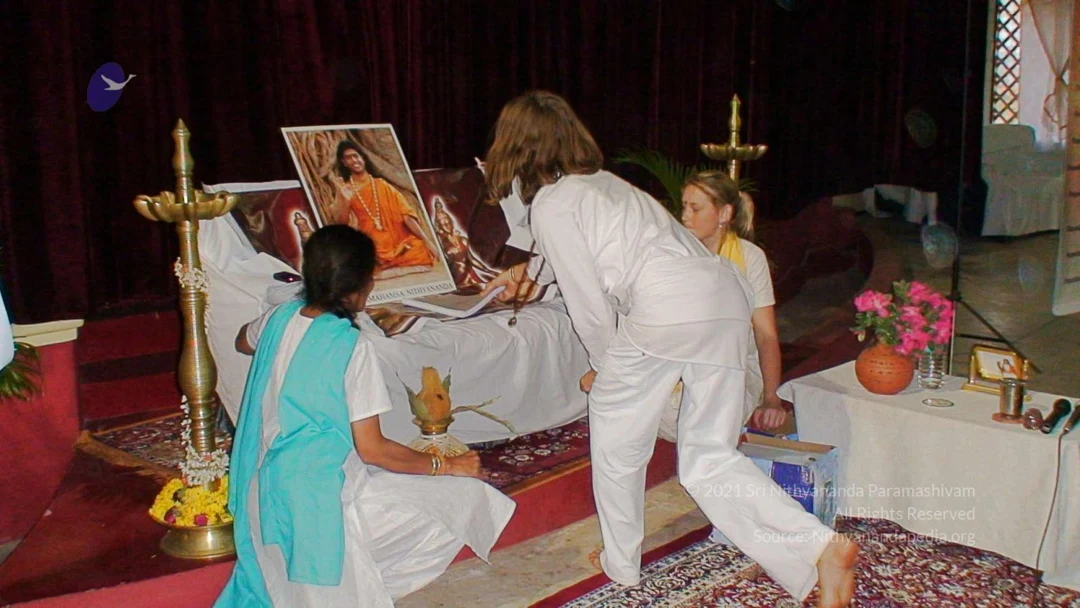
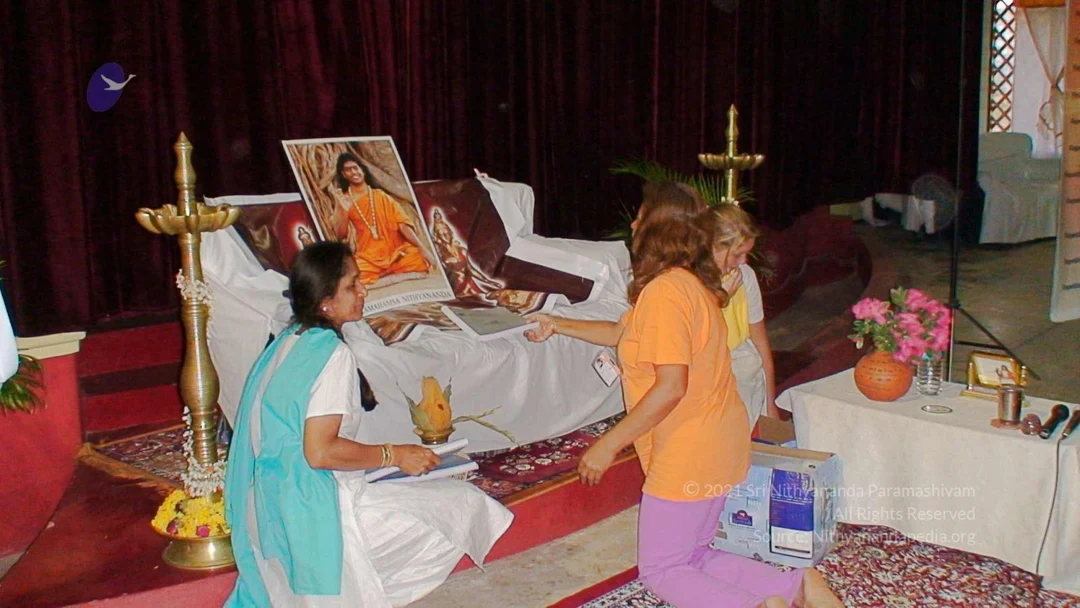
Maheshwara Puja at Aadikailaasa, Bengaluru, India
Nithya yoga Teachers Training At Aadikailaasa, Bengaluru, India

Photos Of The Day:

01--BRAMACHARRY-MEETING-CAMPFIRE

02--BRAMACHARY-TRAINING-CAMPFIRE

03--TEMPLE-VISIT

04--RECEVING-SWAMY

05--BLESSING-OFFICE

06--RECEIVING-SWAMY-VYASA-UNIVERSITY

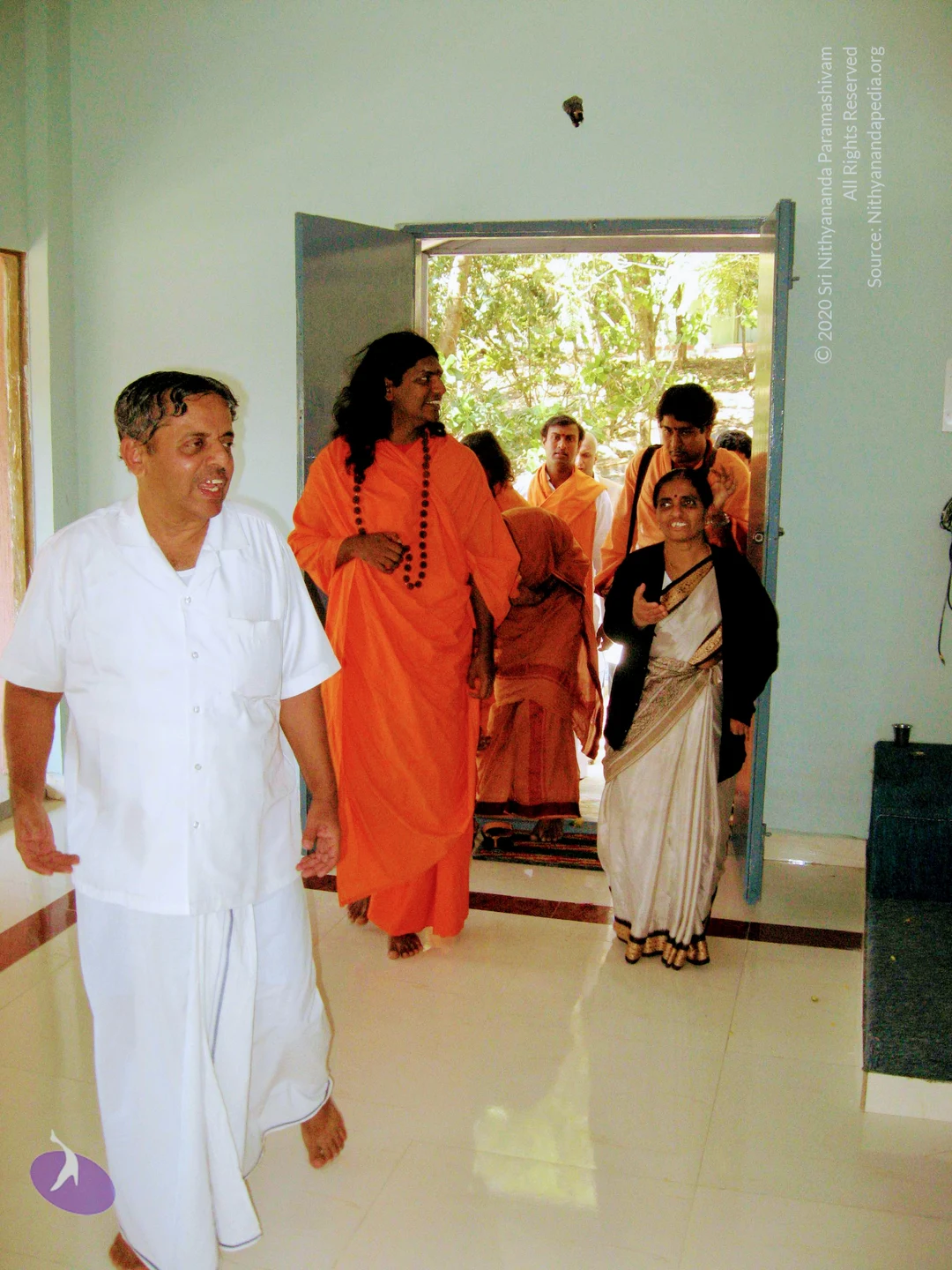
07--SWAMY-AT-PRAYER-HALL

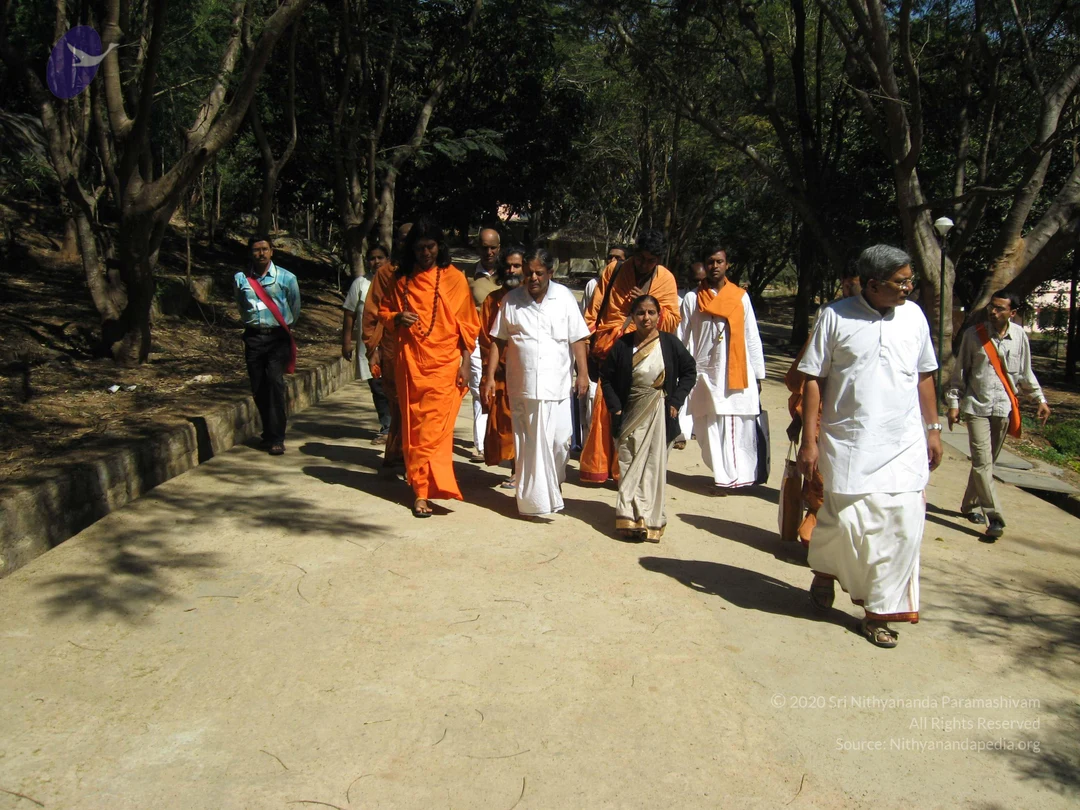
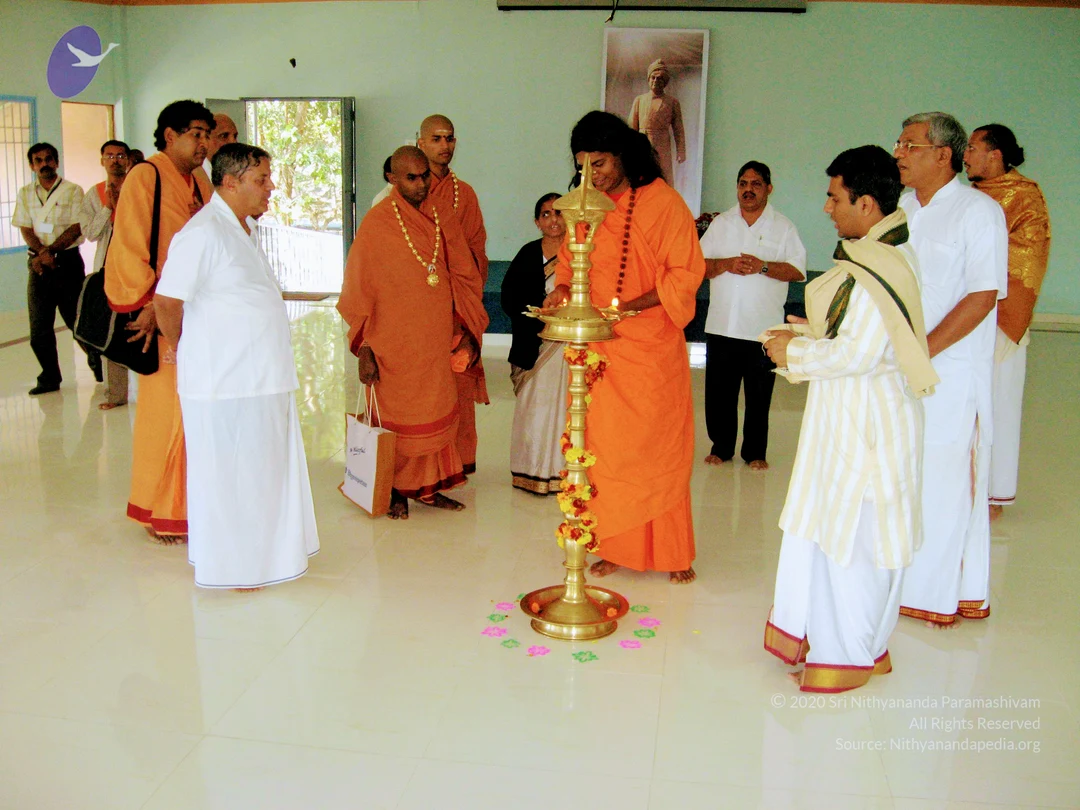
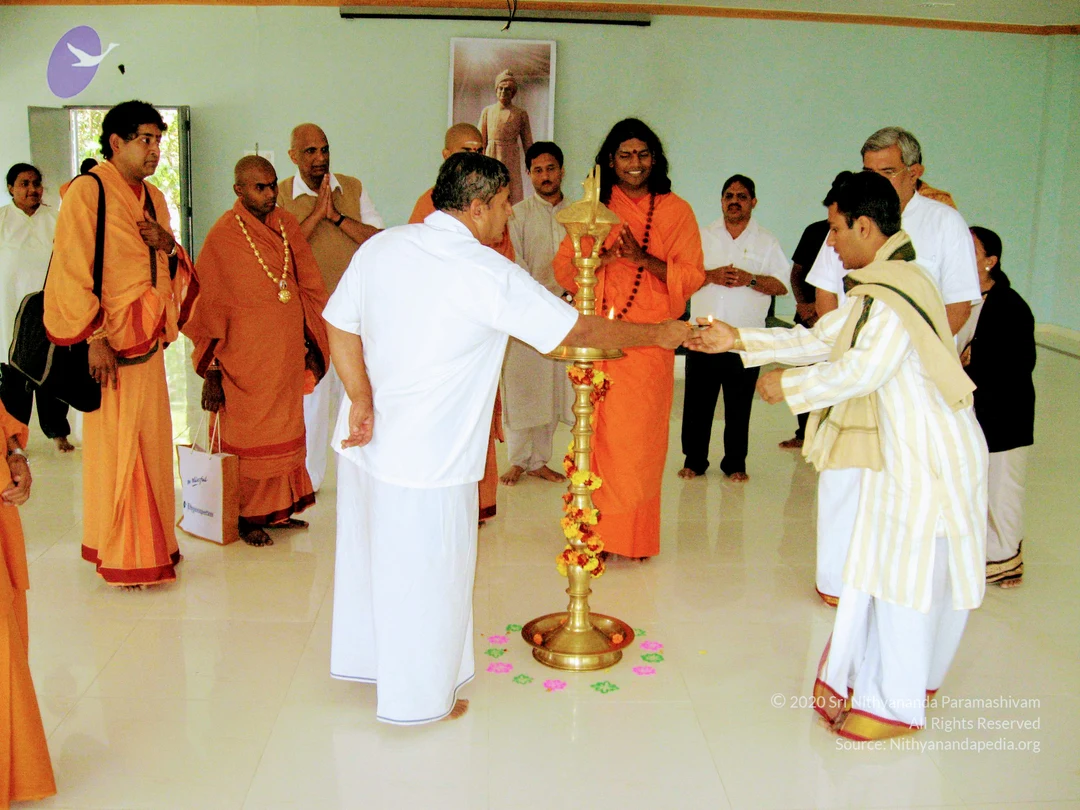
08--WALKING-AROUND-THE-CAMPUS-LIGHTING-LAMP

09--DELIVERING-SATSANG

10--DISCUSSING-VIPS-DINING-HONURING-HOST-STRARTING-OFF

Photos from this day

View all 210 photos

Maheshwara Puja at Aadikailaasa, Bengaluru, India
25 photosSource gallery
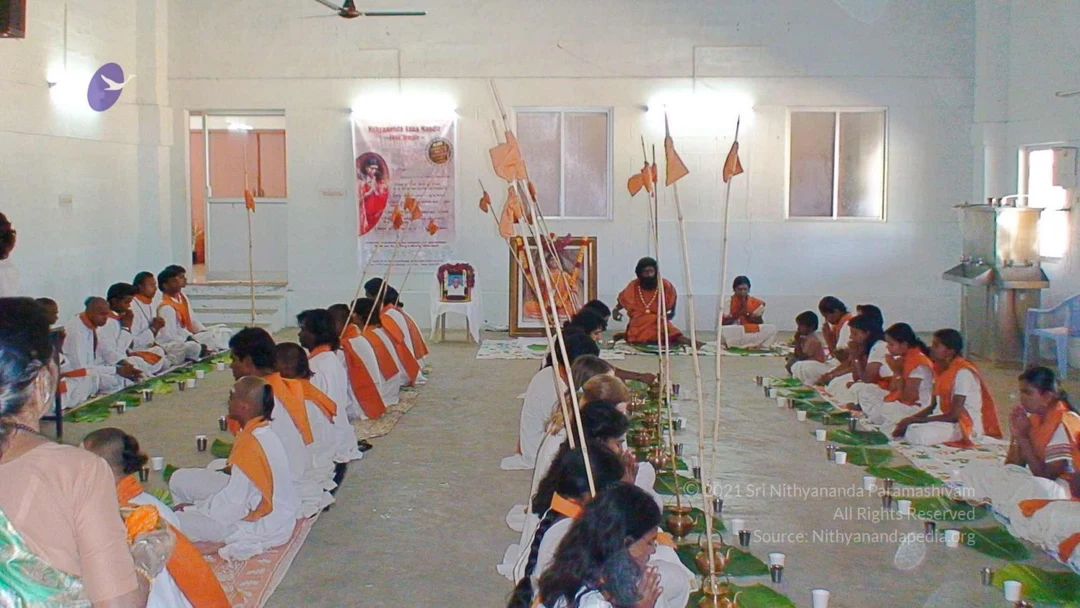
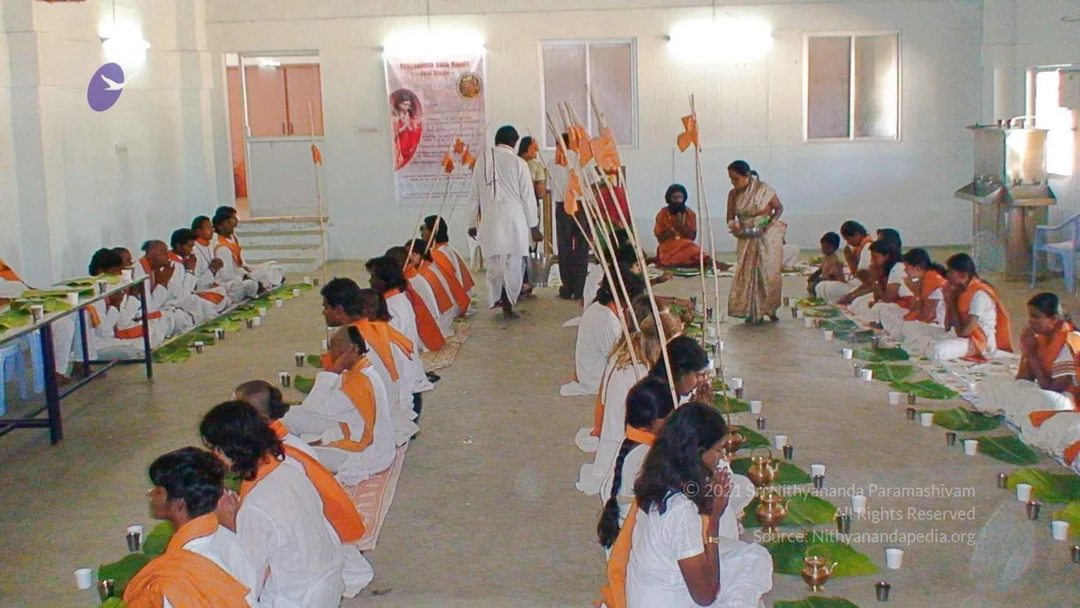
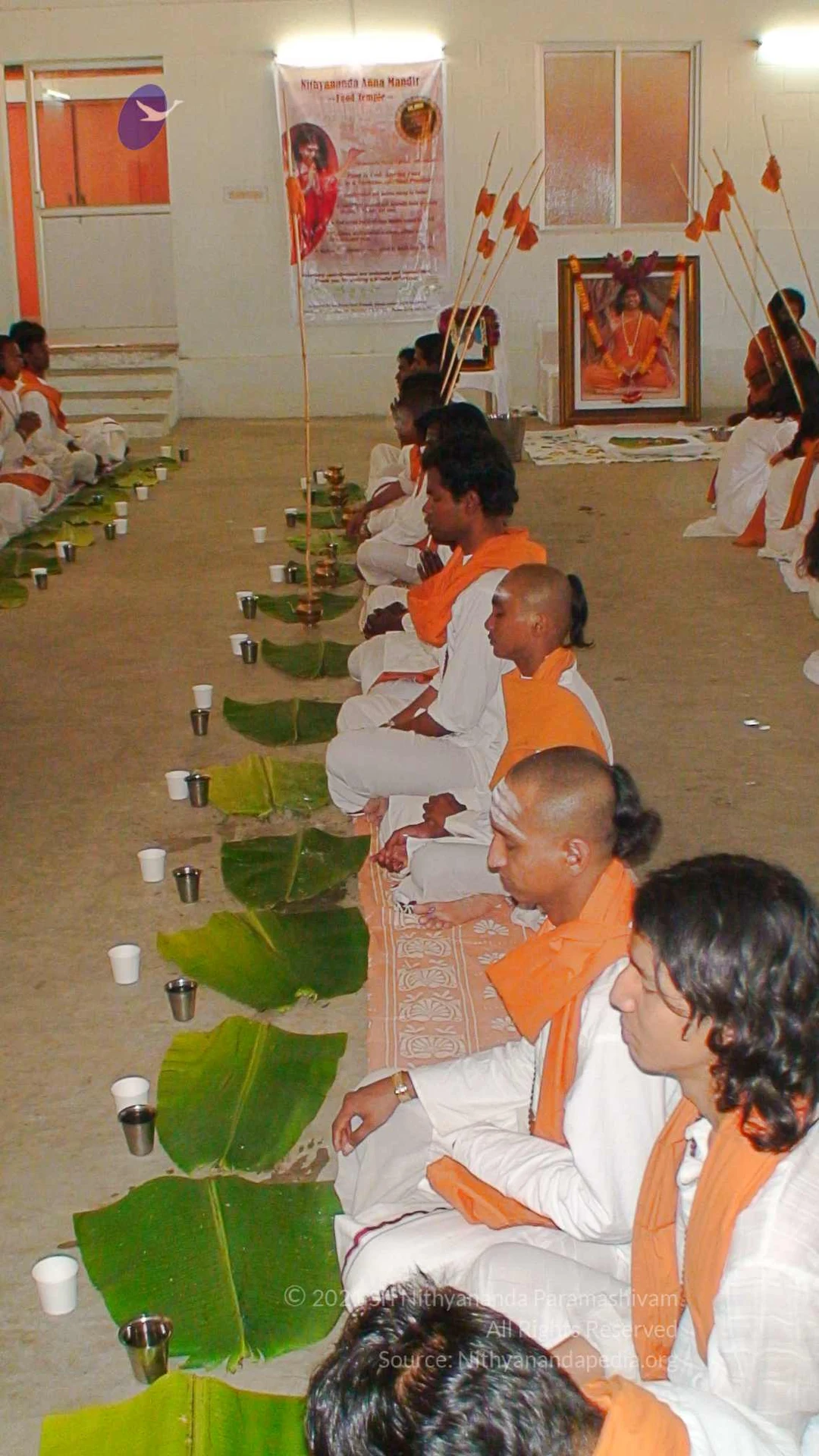
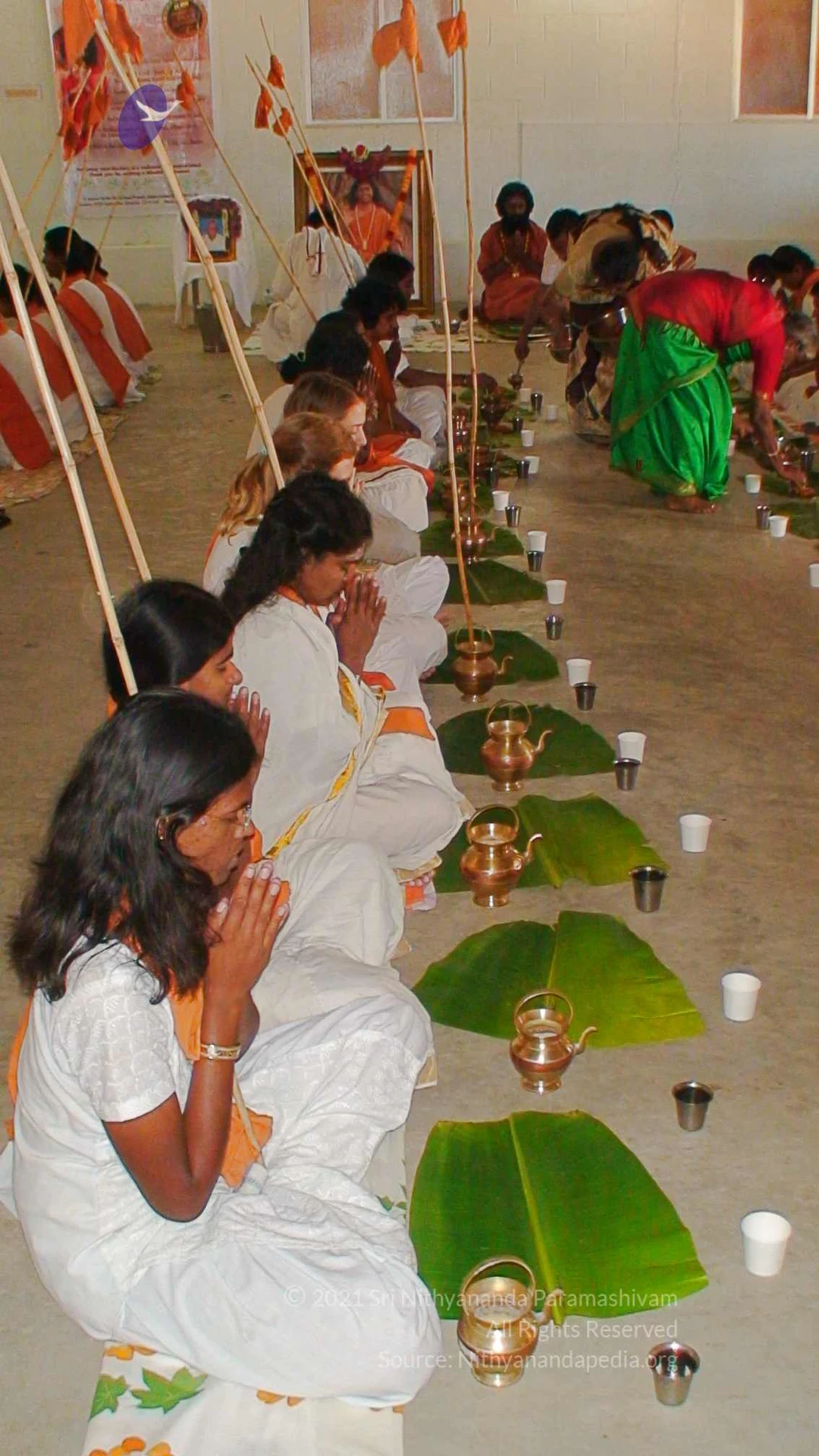
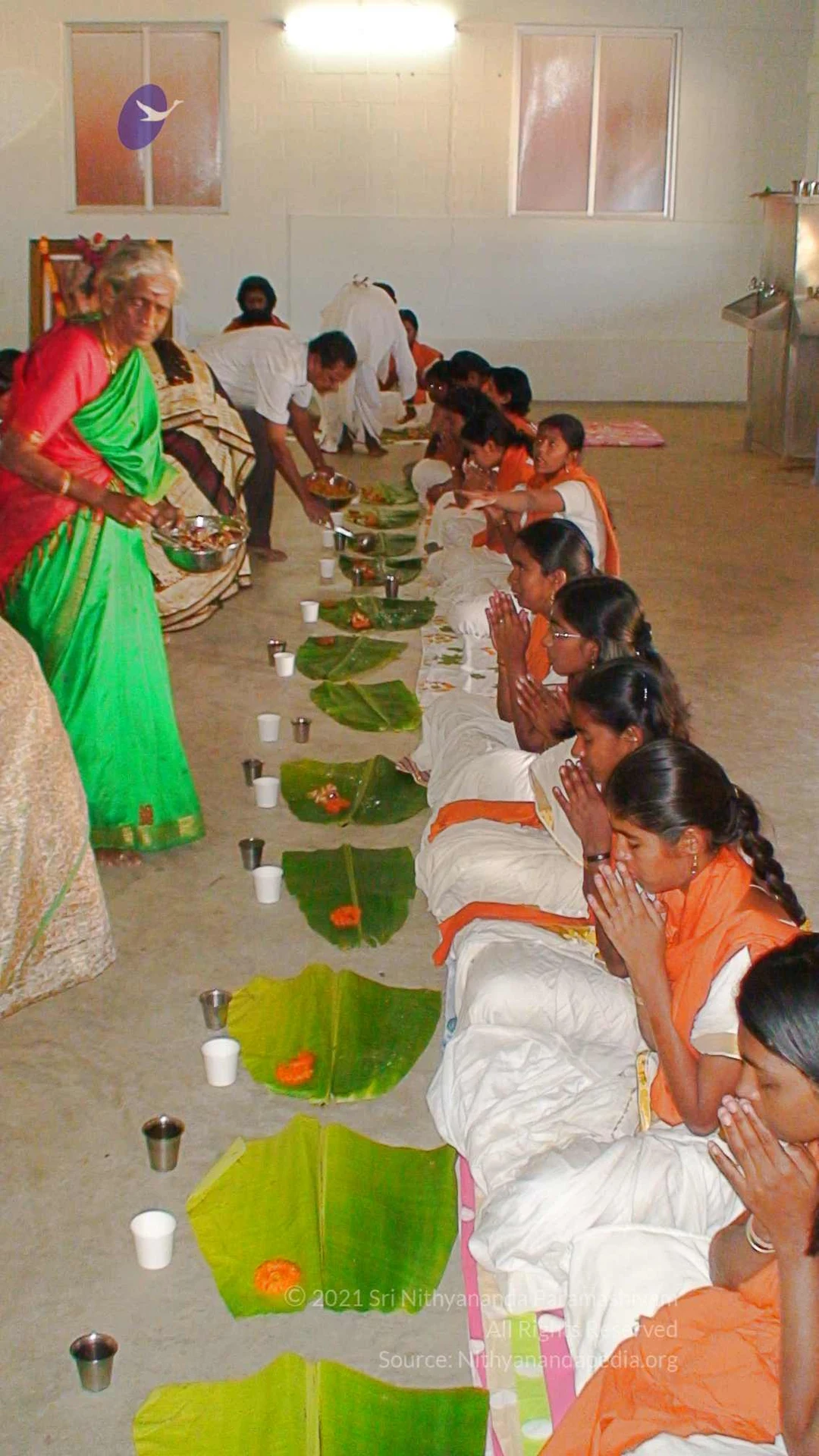
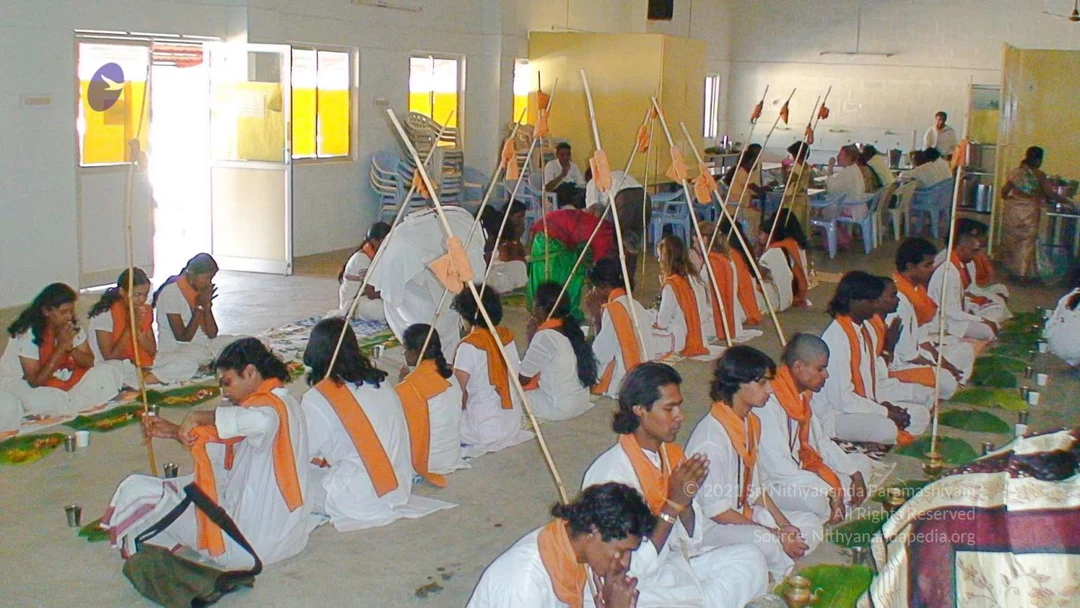
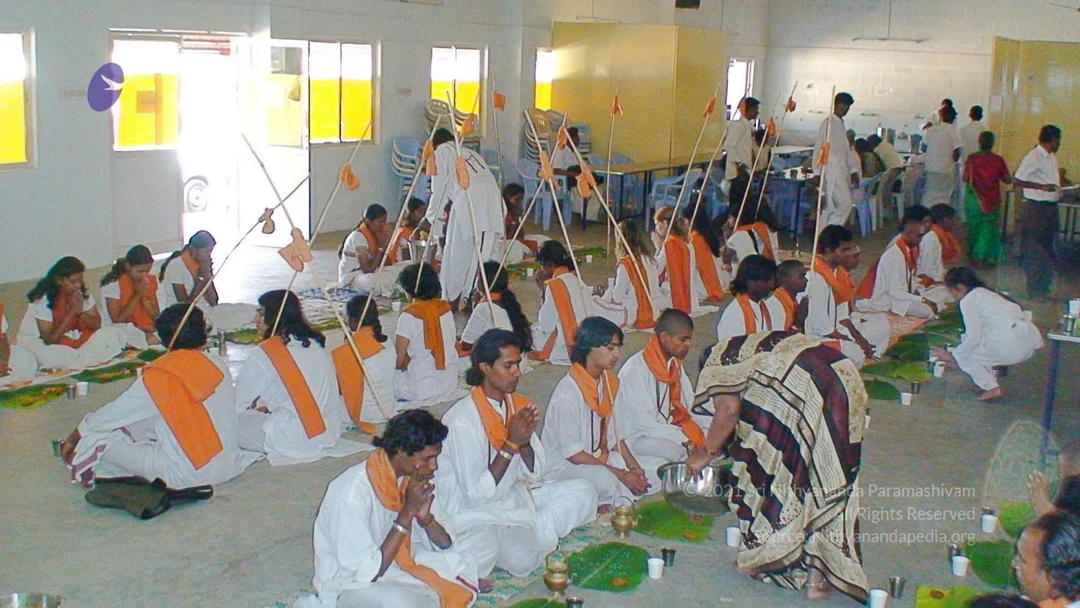
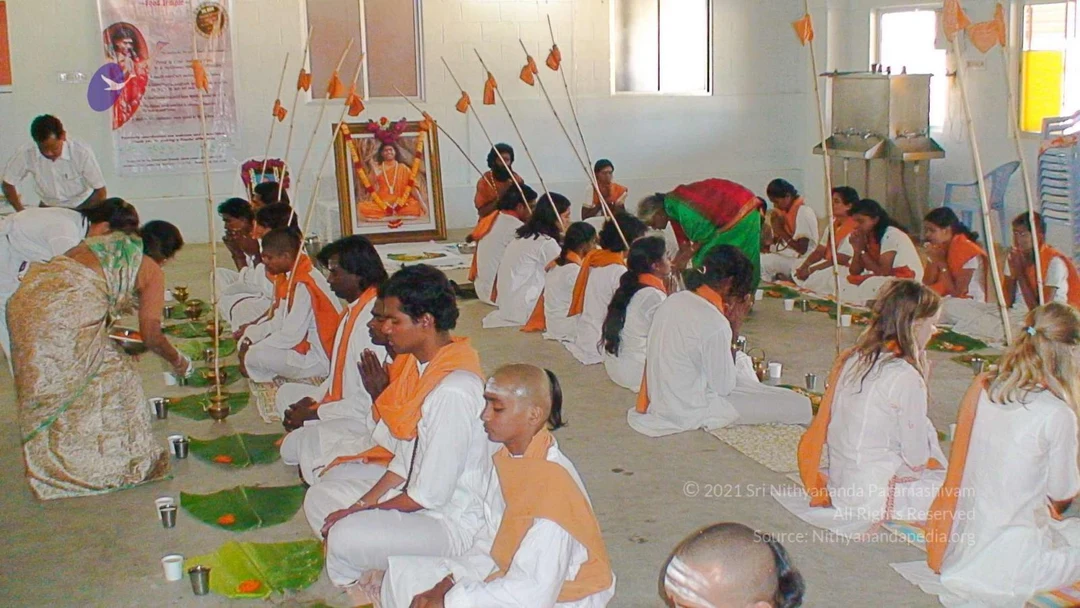
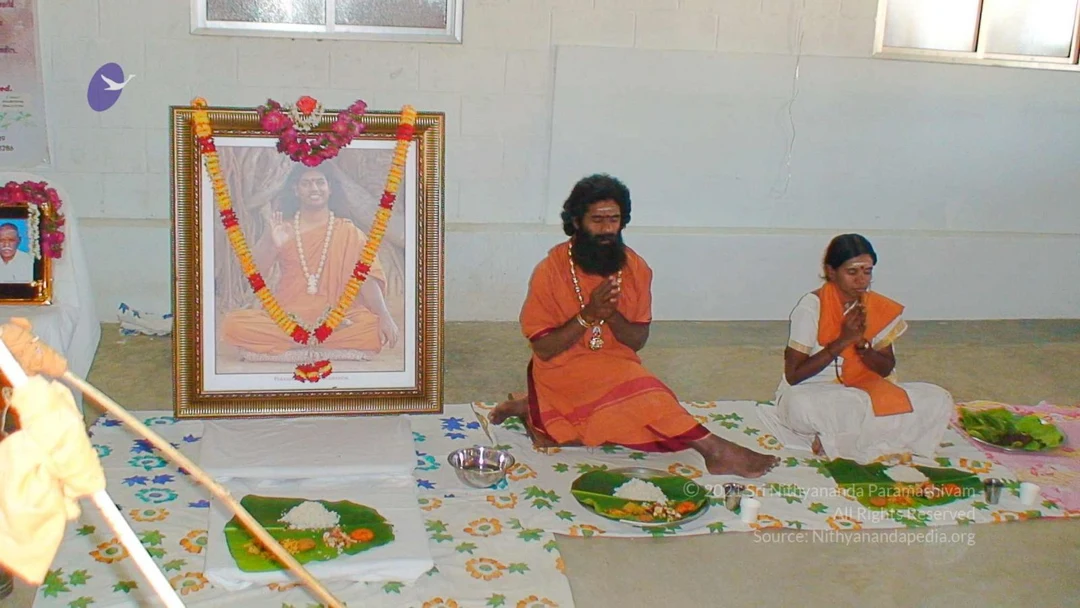
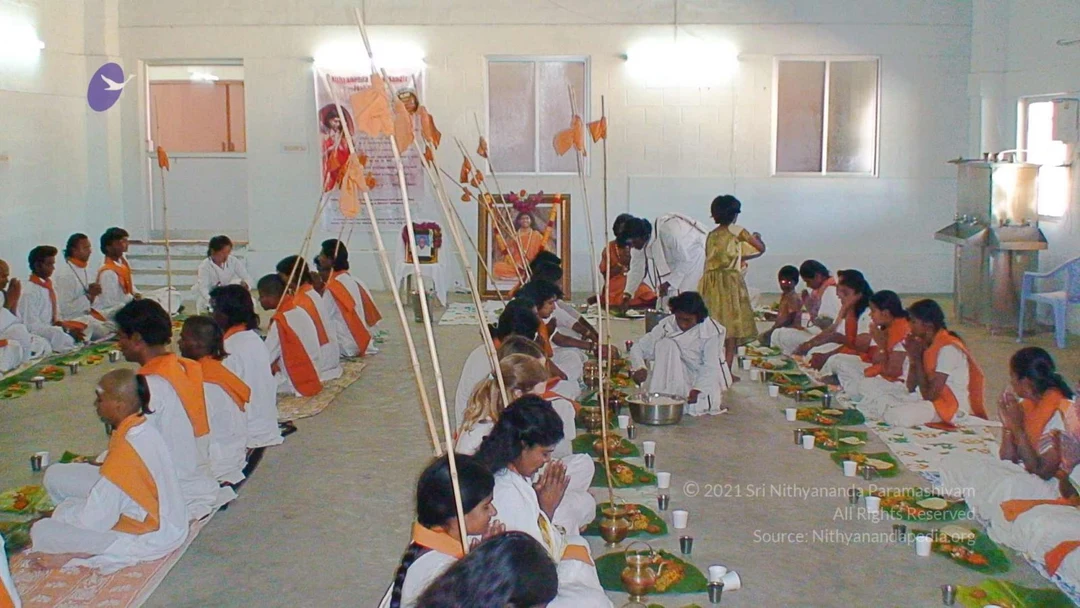
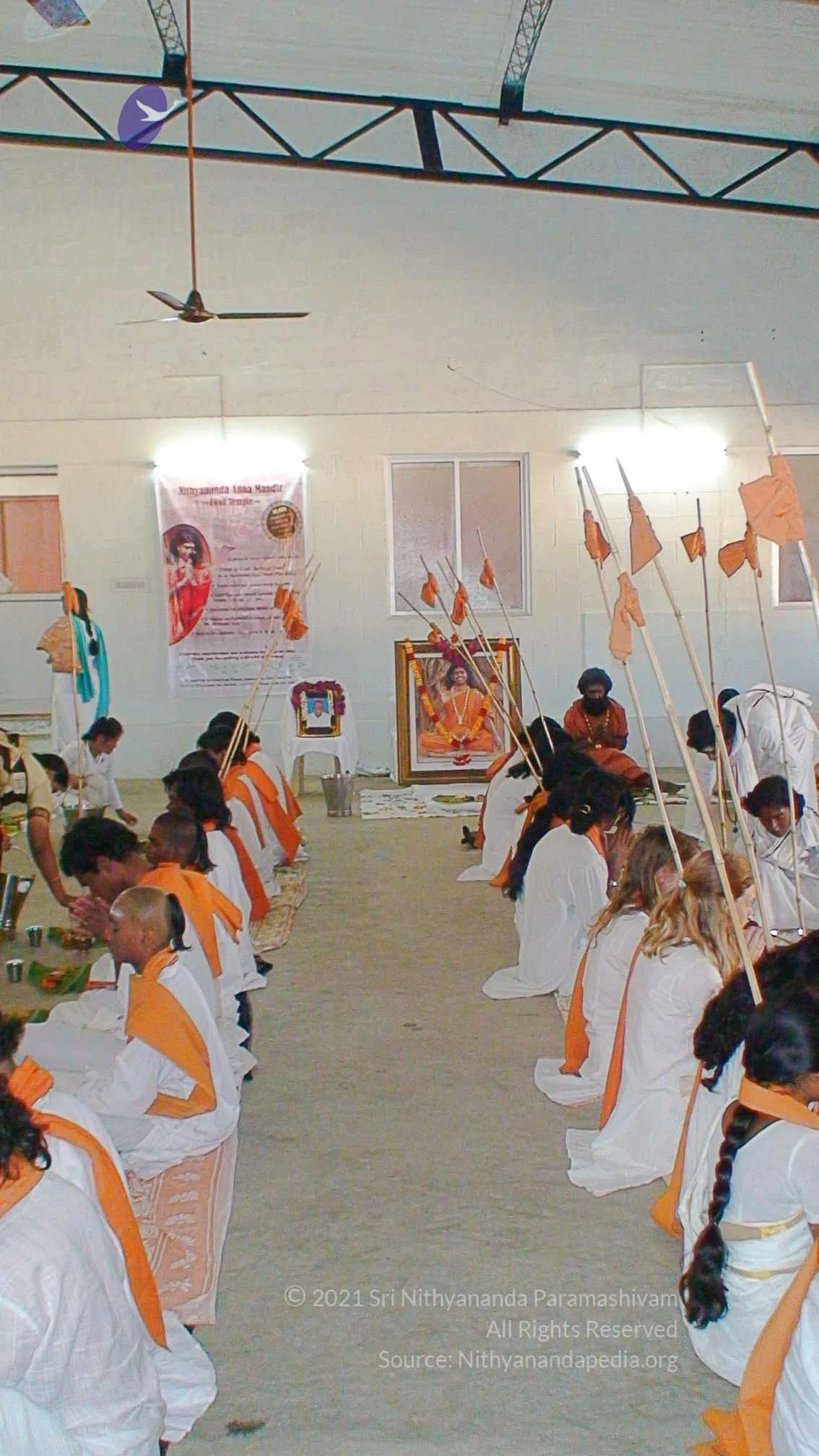
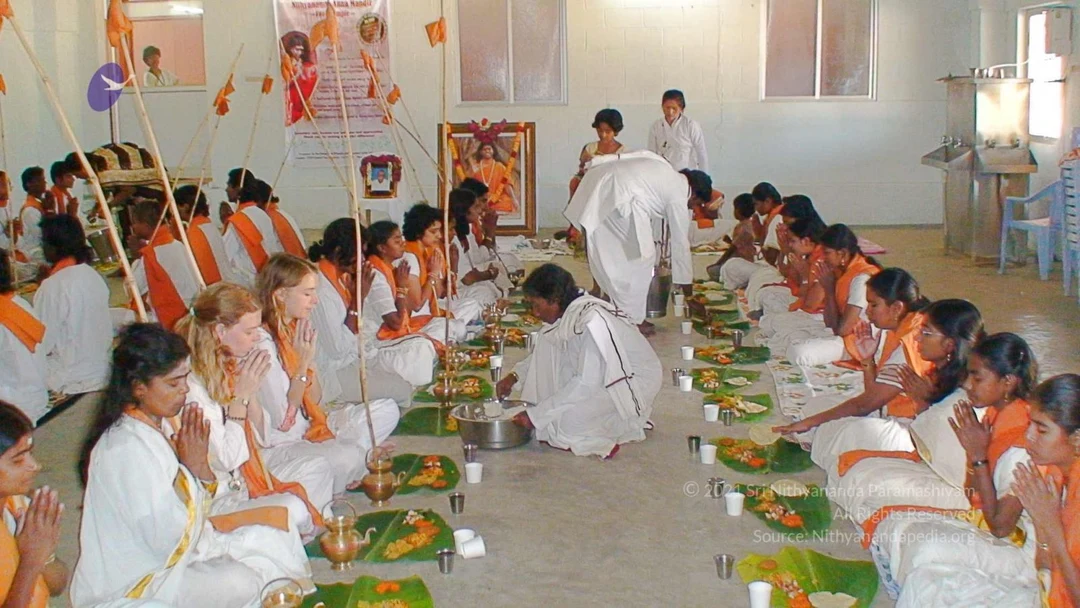
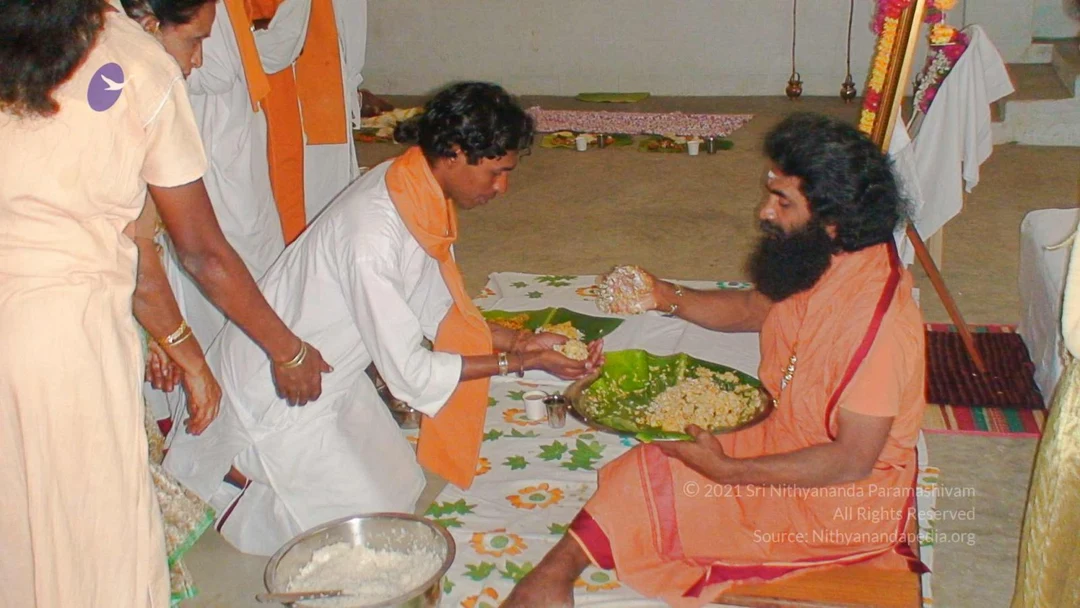
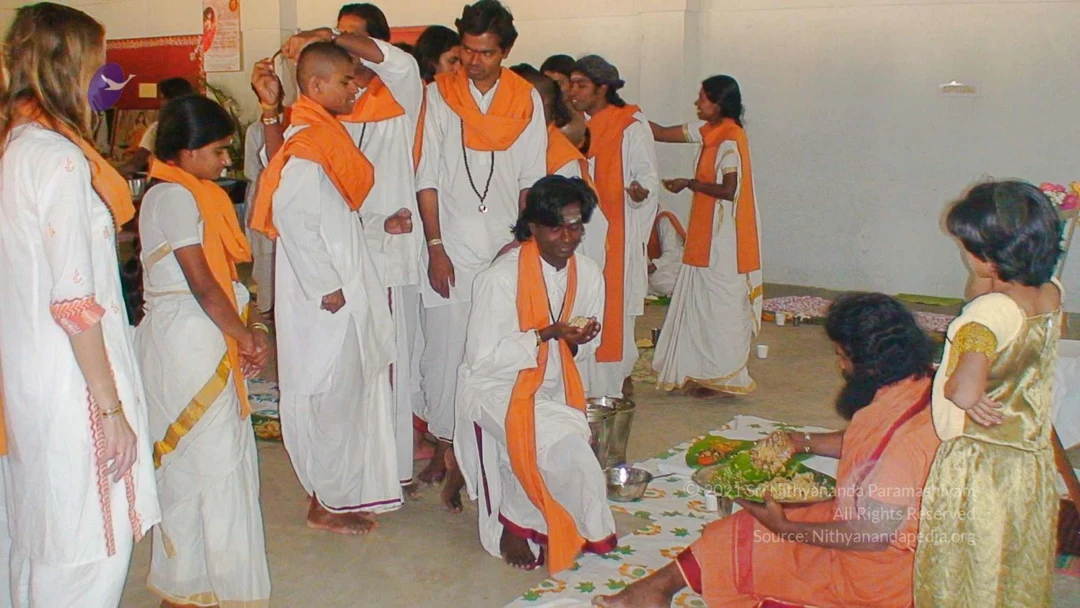
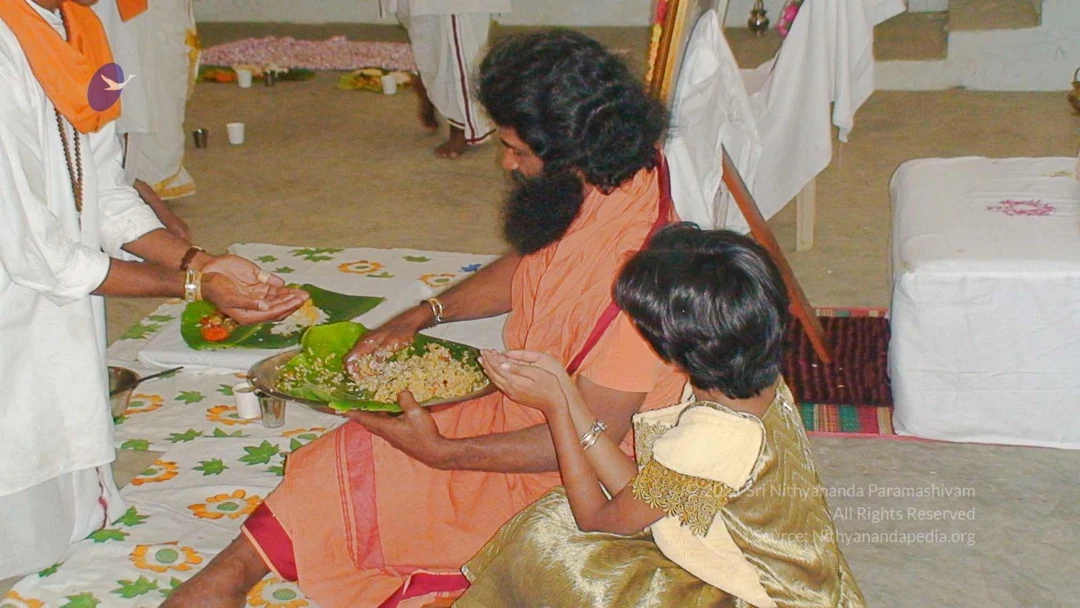
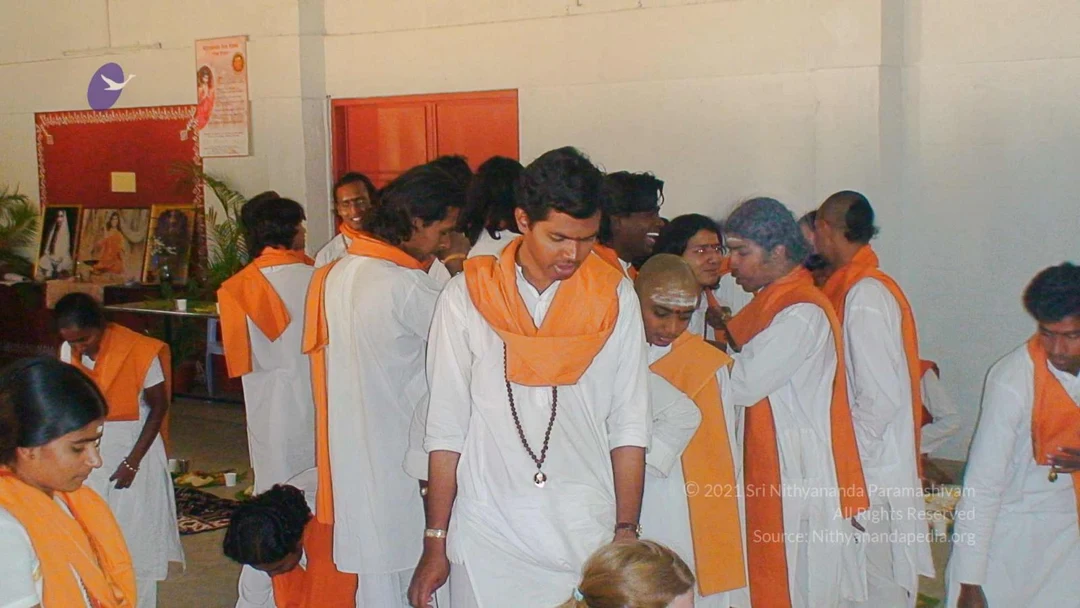
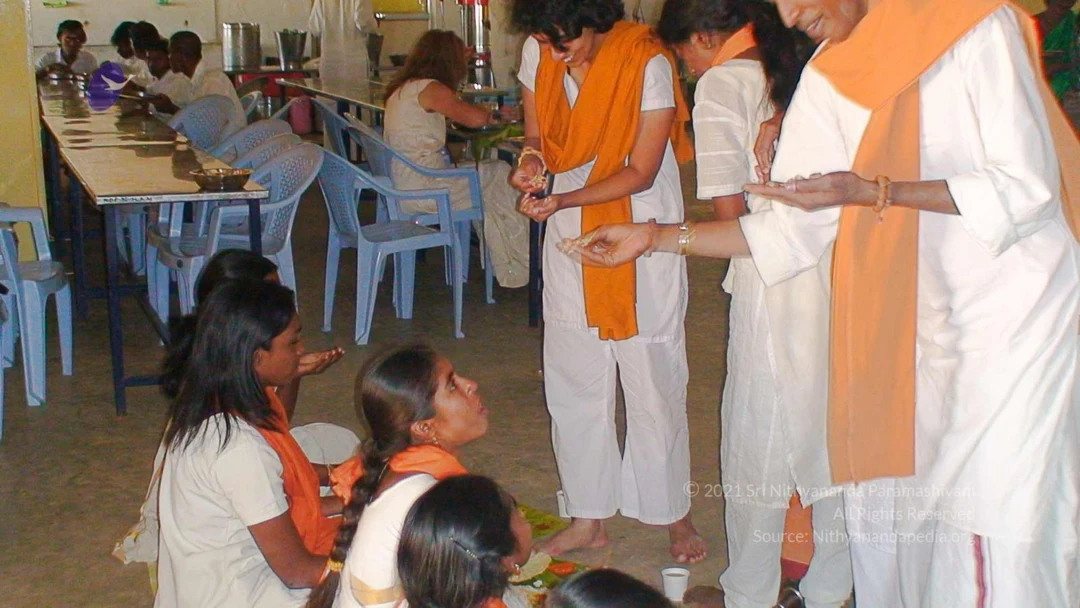
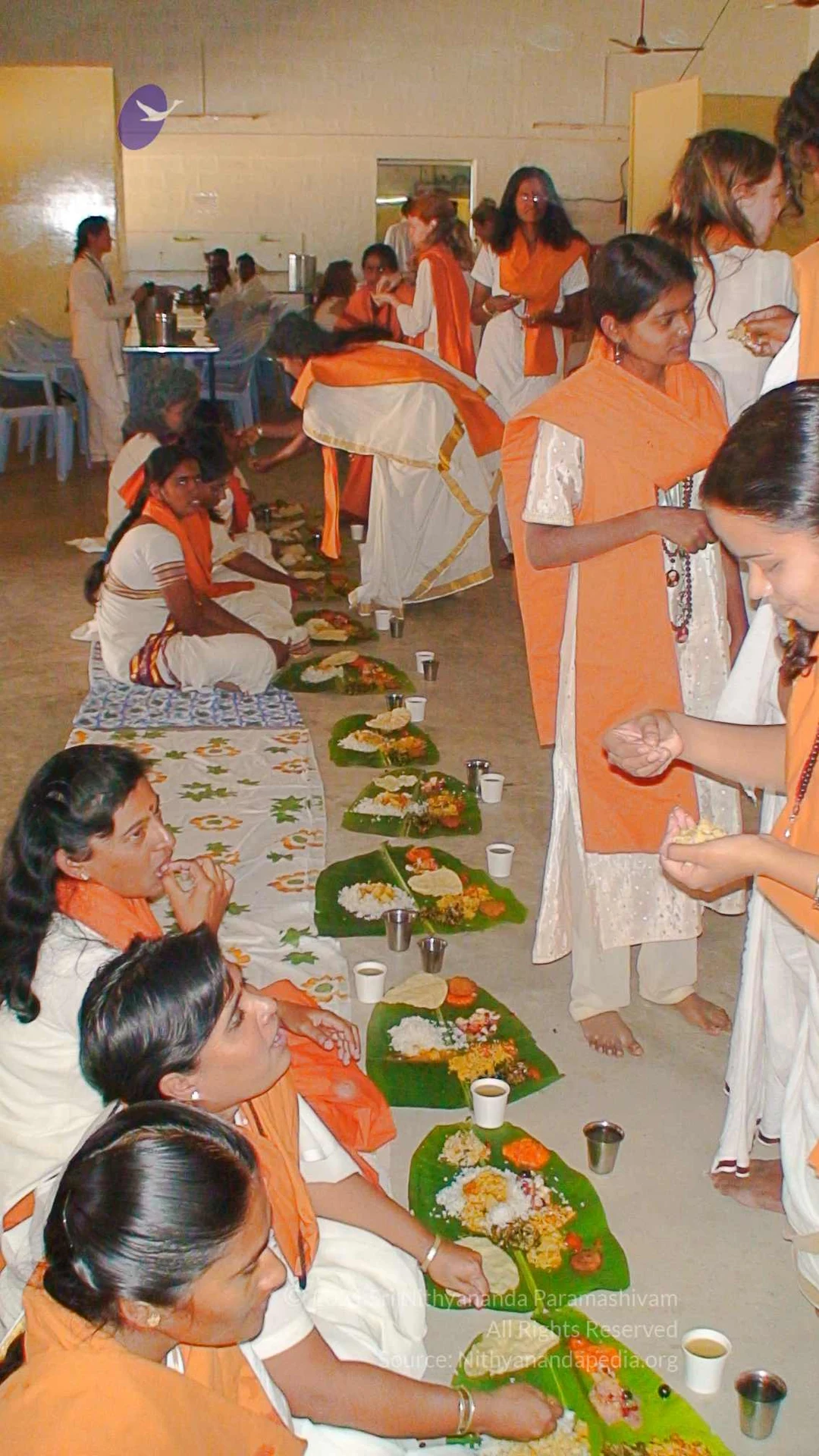
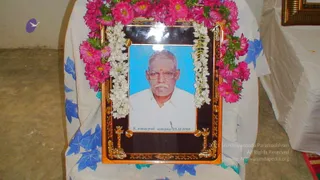
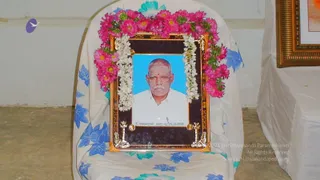
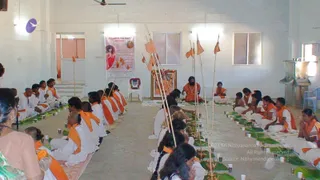
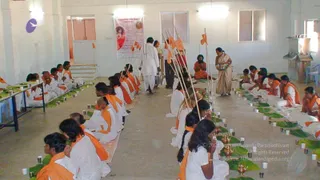
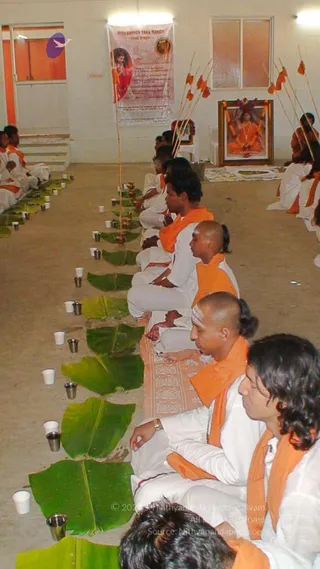
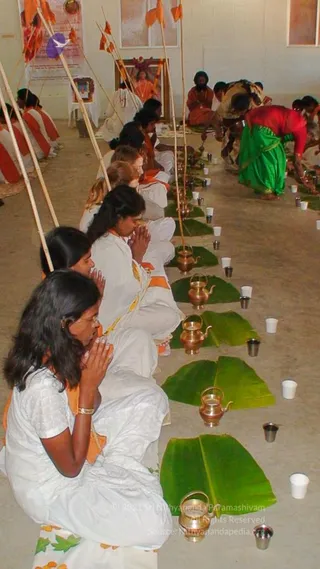
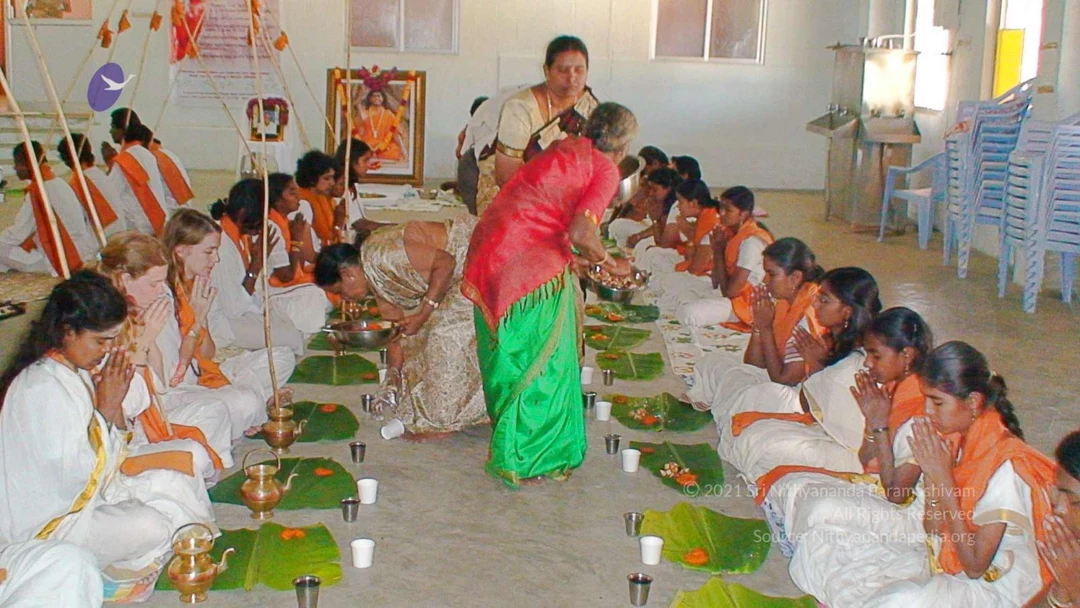
A framed photograph of an older man with white hair, white moustache, glasses and a red vibhuti or kumkum dot on his forehead, wearing a white shirt against a blue backdrop, rests on a white cloth with blue leaf motifs. The gold-coloured frame is garlanded with pink flowers and white jasmine strands, and gold ornamental brackets decorate the frame. No living people are present; the framed portrait is the only figure. A caption on the photograph reads a Tamil name with a date. The setting is an indoor floor with a white draped table at the right.A framed portrait photograph of an older man with white hair, a white moustache and glasses, wearing a white shirt, displayed on a white chair draped with a cloth printed with blue leaves. The portrait is garlanded with a white jasmine garland and pink flowers and sits beside gold-coloured ceremonial brass figures at the base of the frame. A caption beneath the photo reads a Tamil name with a date of 25.12.2006. The room has a plain floor and a gilded frame visible at the right edge. No physical people are present, only the printed portrait.Photograph of a seated group ceremony in a whitewashed hall with tube lights and a ceiling fan. Rows of devotees in white clothes with orange shawls sit on leaf-plate mats on the floor, with brass kalasha-style vessels and small steel cups set along the mats. Tall bamboo poles with orange pennants stand between the rows. At the far end, a man in orange robes and a beaded necklace sits in front of a framed portrait and a brass lamp; a banner on the wall shows a red-robed figure. A woman in peach clothes is at the left edge, and a few other participants in orange sit along the right. Visible people: about 25.Indoor hall with rows of seated devotees on the floor facing a long central aisle, many in white dhotis and orange shawls or sashes. Banana-leaf place settings with small brass or steel cups and vessels line the floor. Tall bamboo poles with orange flags stand in the aisle. A woman in a cream sari with a brown border holds a metal tray or plate near the centre. A man in white clothing walks the aisle, and a seated figure in orange robes sits further back. A red and white poster hangs on the back wall beside a doorway, showing a figure in red. The scene looks like a communal meal or ritual service, though no other activity is clearly identifiable.A photograph of a seated annadan meal line in a plain hall. Rows of devotees in white clothes with orange shawls sit on the floor facing banana leaves set with steel and paper cups. A vertical banner reading Nithyananda Anna Mandir Feed Temple hangs on the wall, and a framed portrait of a saffron-robed figure garlanded with orange flowers rests on the right. Bamboo poles with orange flags stand behind the row. Several men in front have shaved heads with tilak and topknots, one with hands folded in prayer. Visible people number about ten to fifteen in the foreground and background.Indoor ritual meal in a plain whitewashed hall. Rows of devotees in white clothes with orange shawls sit on the floor with hands joined in namaskar, before green banana leaves set with copper pots and small steel cups. A woman in a green sari and red blouse bends forward to serve. Bamboo poles with orange flags stand along the rows. At the far end a bearded man in orange robes sits near a framed photo of a figure in orange on an altar, with a standing portrait nearby. The setting appears to be a satsang or annadan-style gathering.

Nithya yoga Teachers Training At Aadikailaasa, Bengaluru, India
13 photosSource gallery
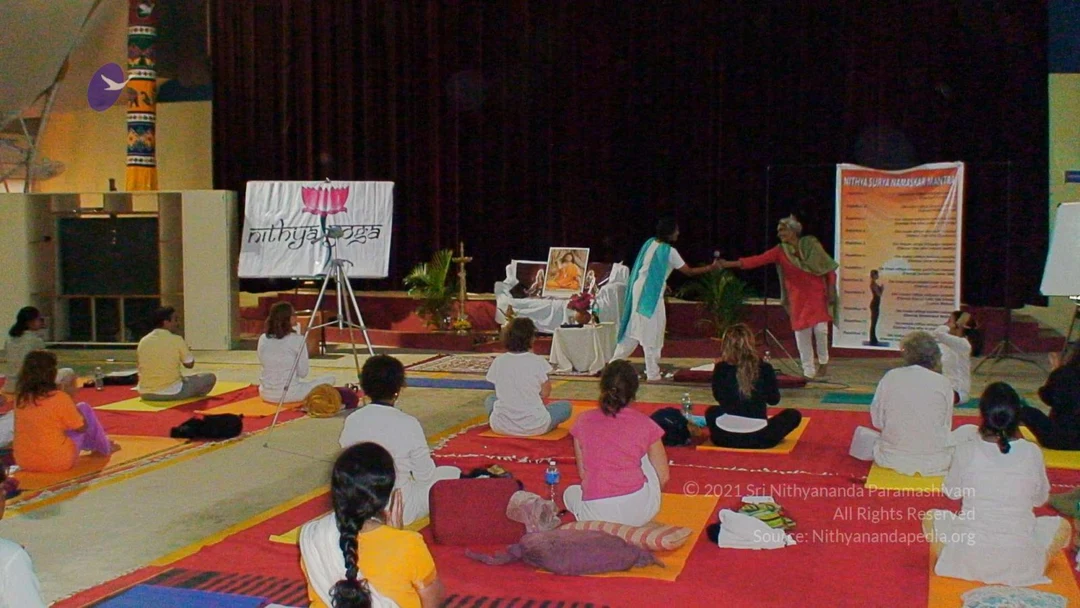
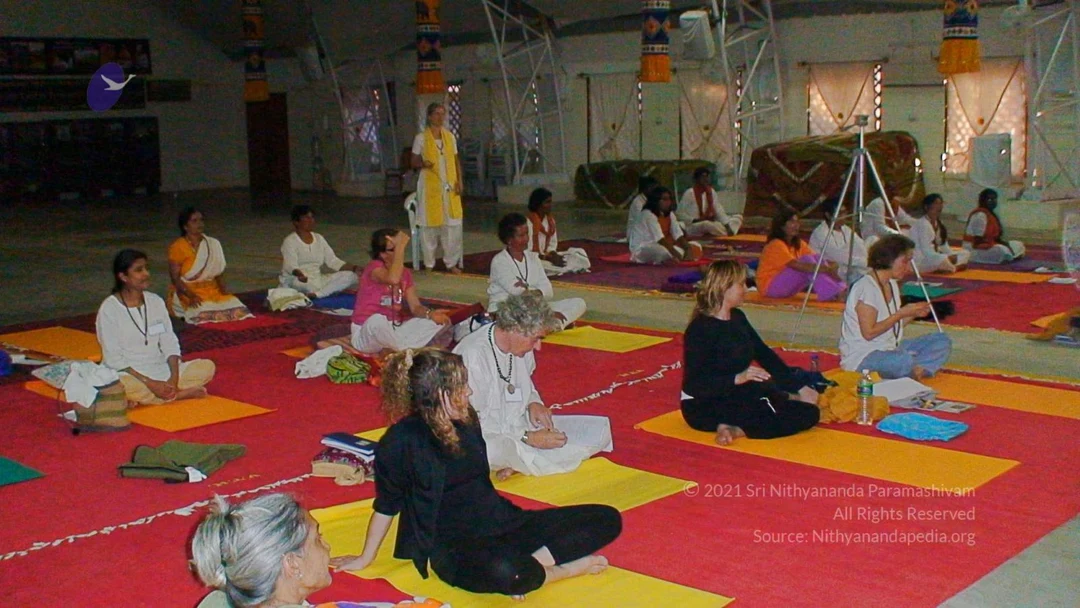
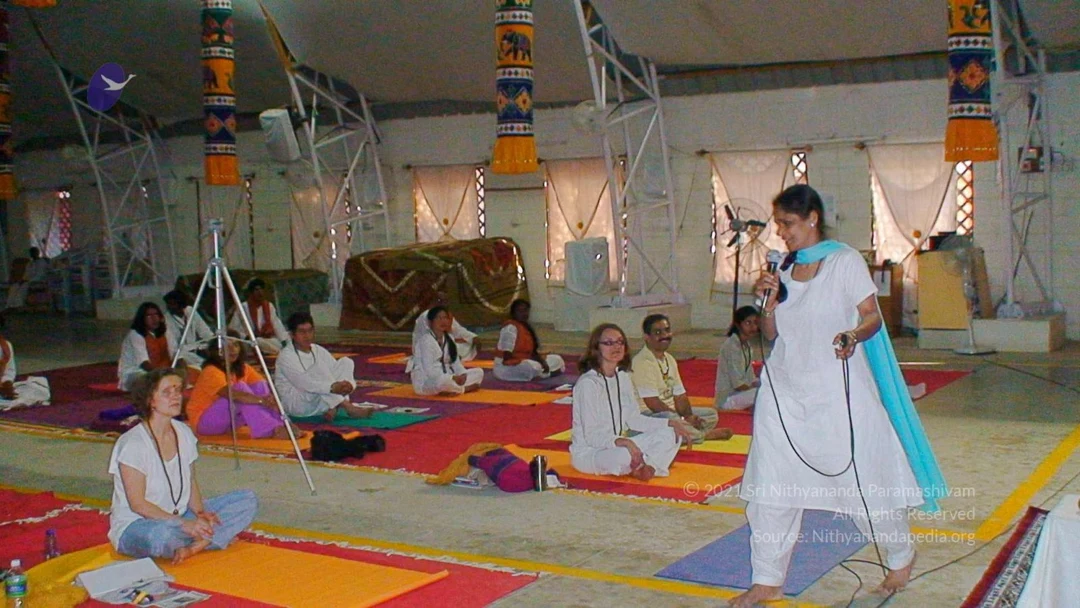
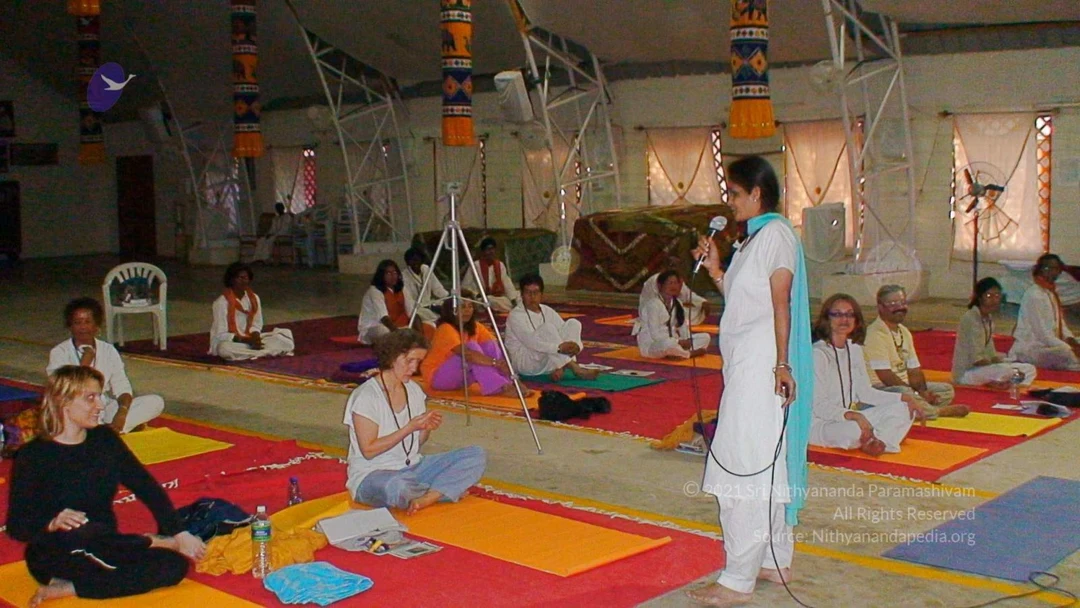
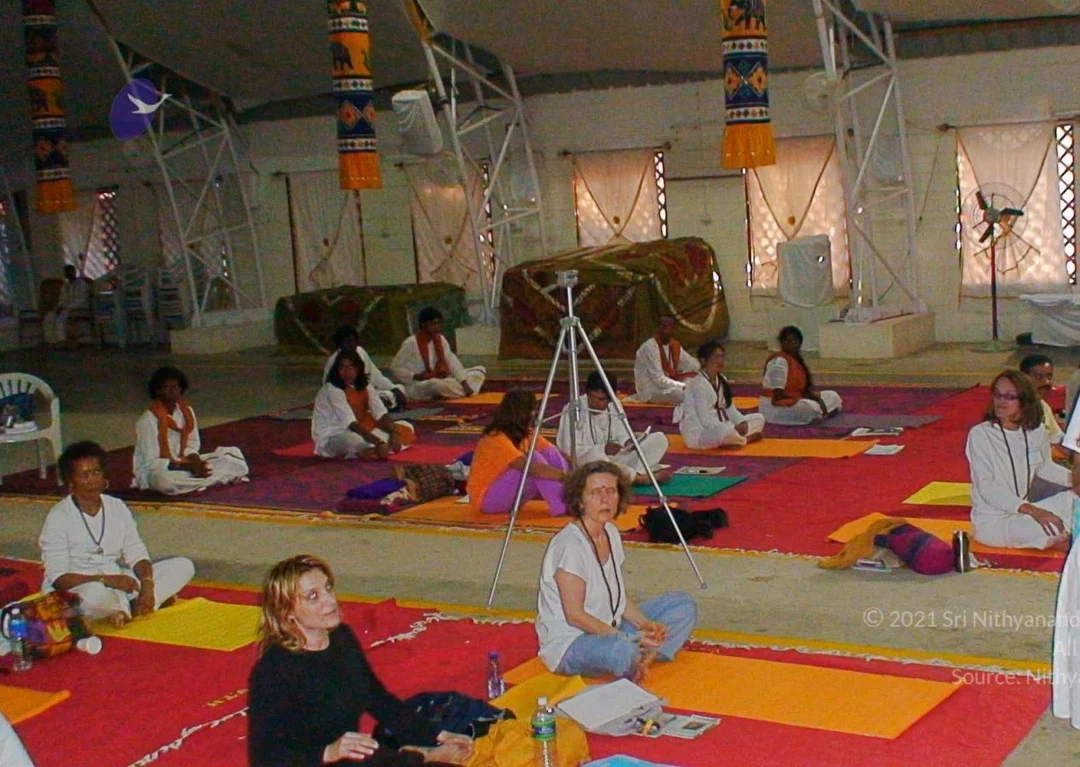
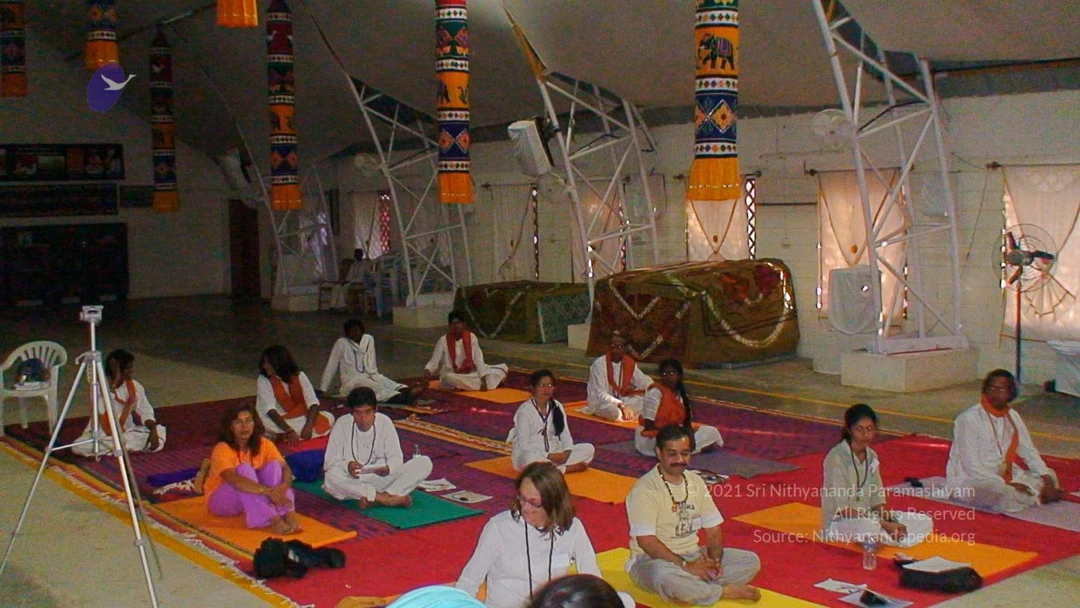
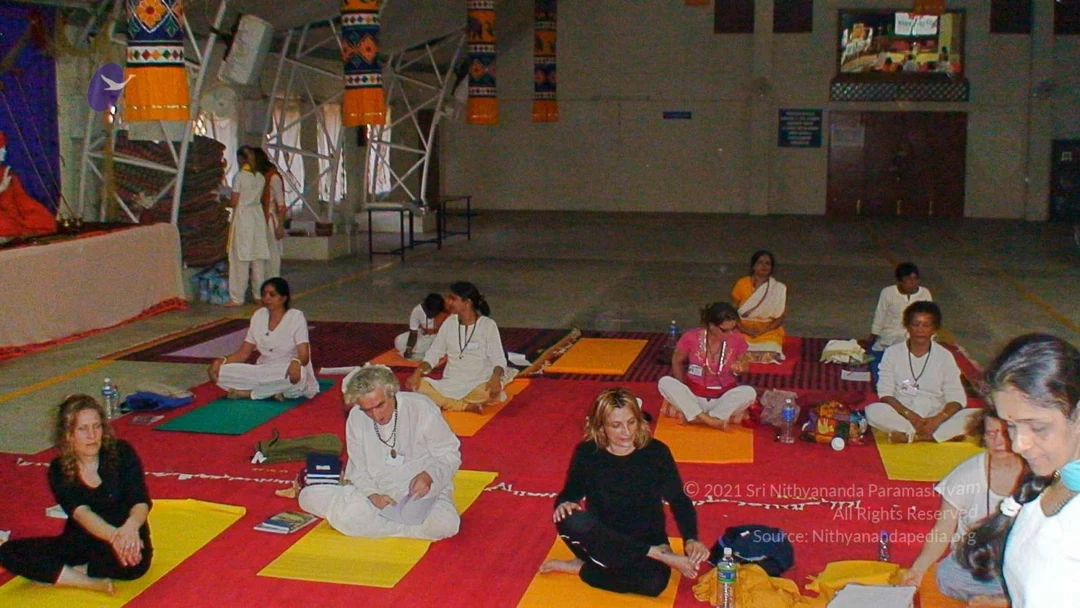
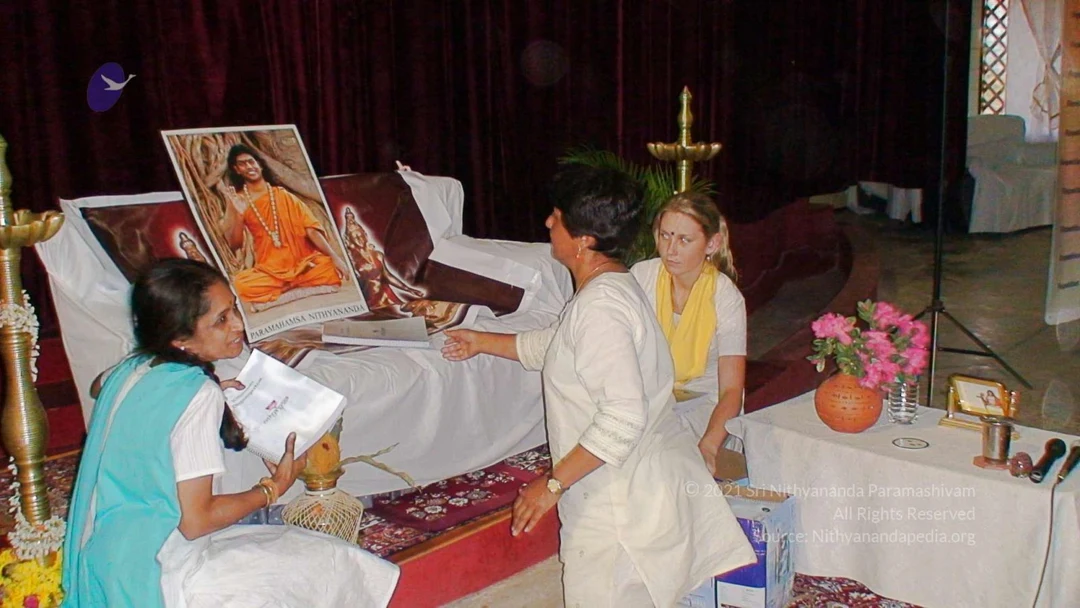
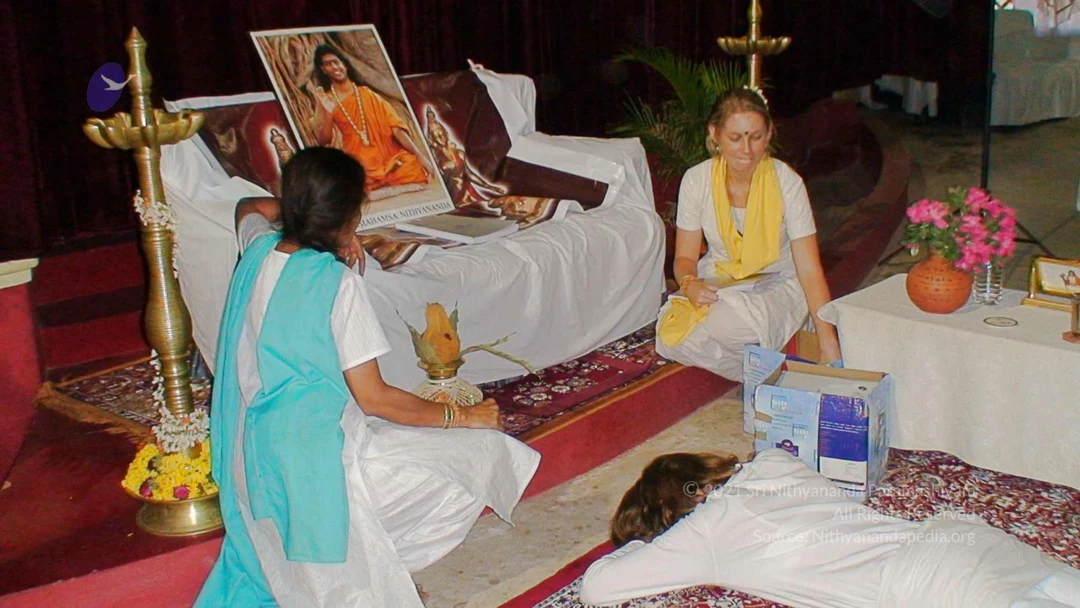
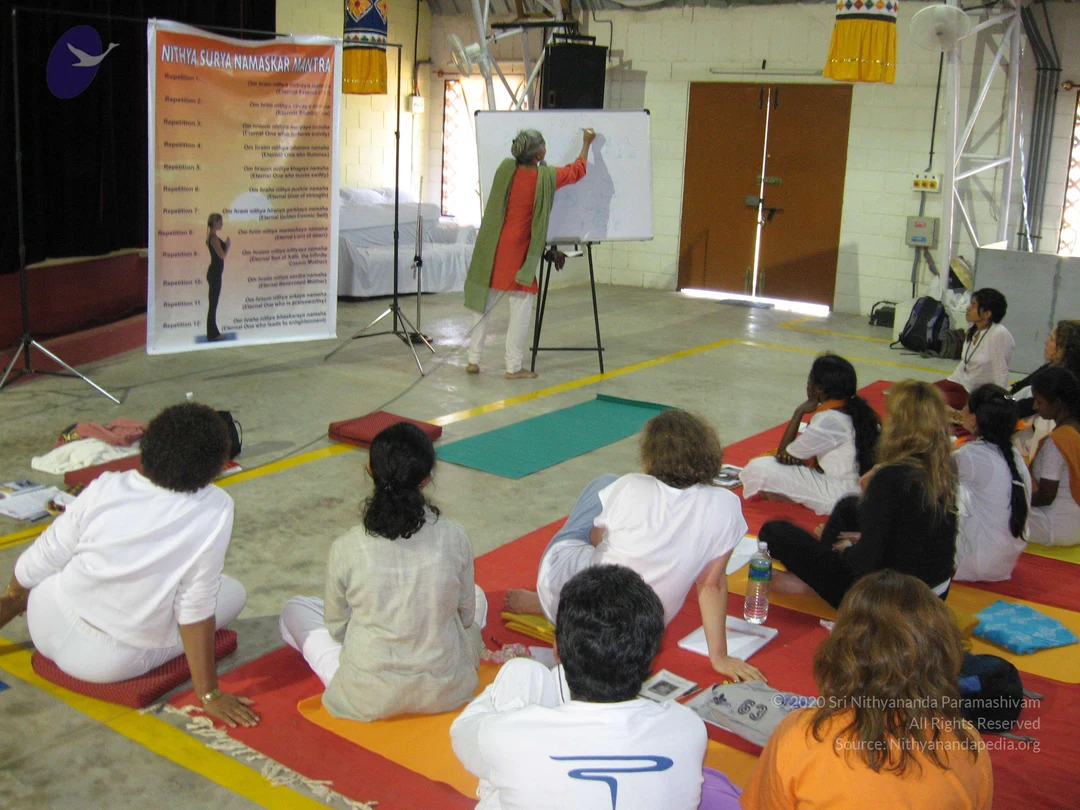
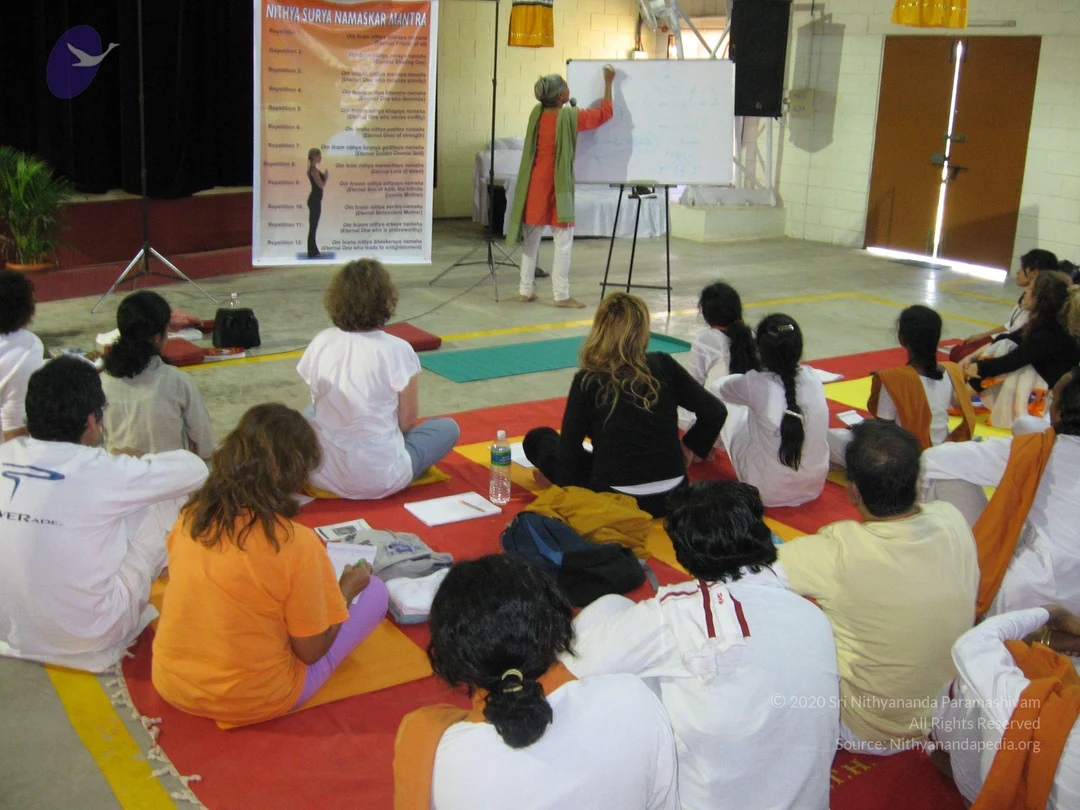
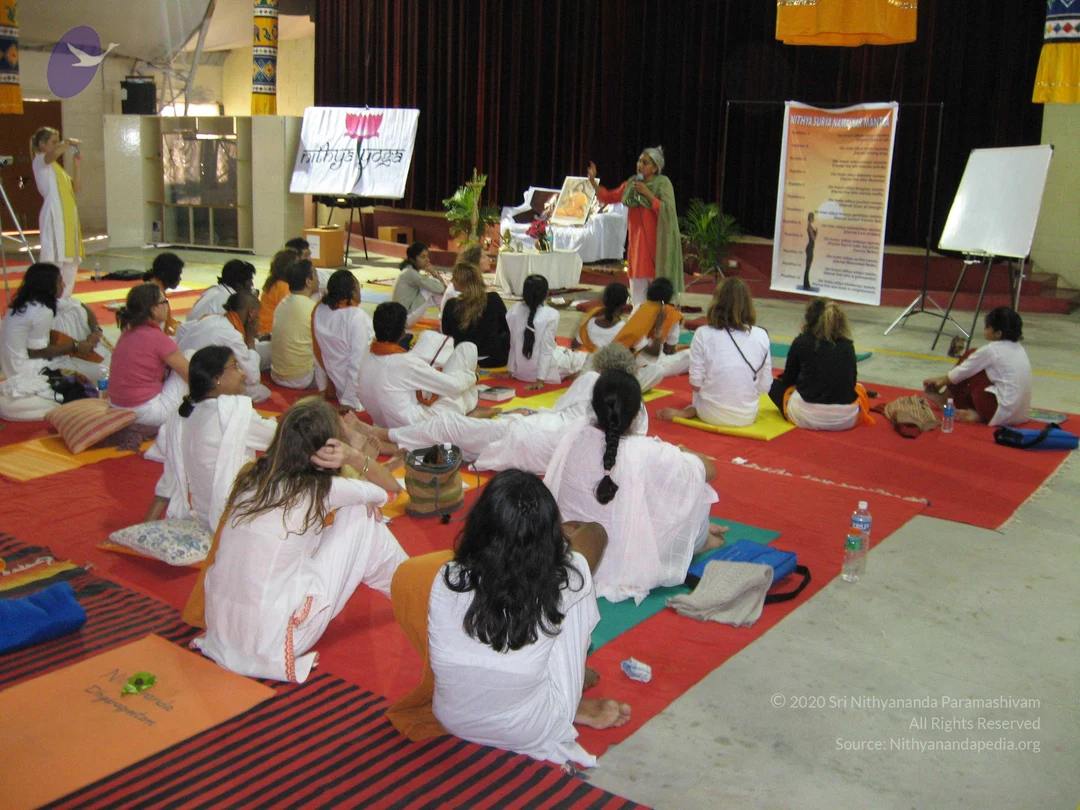
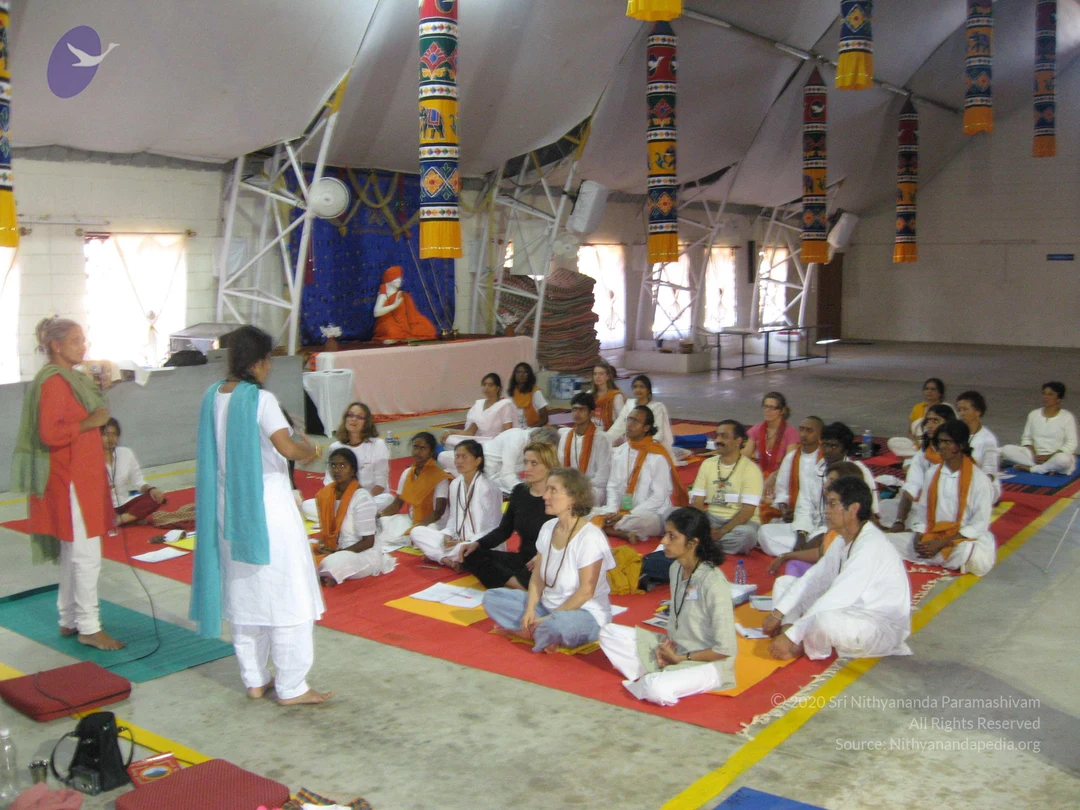
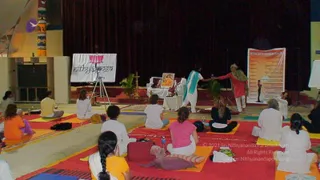
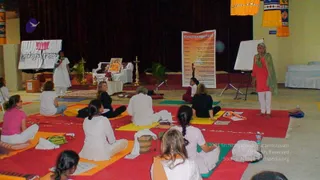
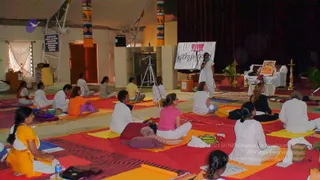
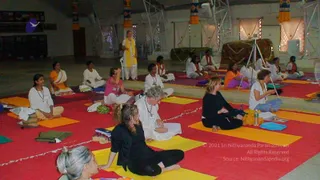
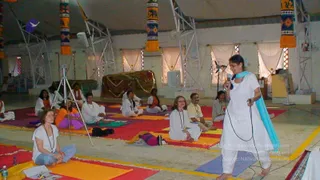
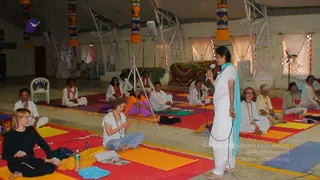
A yoga hall with many seated participants on red and yellow mats facing a stage. On the stage, a woman in a white top and turquoise scarf and an older woman in a red top and green shawl face each other and clasp hands near a small altar. A framed portrait of a woman in orange stands on a white-draped table with a flower arrangement. A banner reads Nithyayoga with a lotus, and another hanging chart reads Nithya Surya Namaskar Mantra. Several participants wear white, others orange, pink and yellow. The backdrop is dark red curtains with a wooden pillar at the left. No recognizable a person figure is visible.A photograph of a yoga session in a hall with a red-and-orange mat floor. Seated participants in white and pastel clothes face a stage. On the left stage a woman in white stands holding a microphone beside a banner reading "nithya yoga" with a lotus logo. On the right a woman in a red top and green scarf stands beside a whiteboard and a banner titled Nithya Surya Namaskar Mantra listing numbered Sanskrit mantras. A small altar with a framed portrait, brass lamps and a plant sits at centre, and a seated figure in white is near it. Yellow and orange mats and a water bottle are on the floor.A seated group session in a hall with red and orange floor mats, with participants sitting cross-legged on yellow and orange cushions. A woman in white stands at the front holding a microphone beside a white banner with a pink lotus and the word "nithyayoga". Attendees wear white, orange and pink clothing; one woman in orange sits at left and a woman in a yellow sari sits at the lower left. A framed portrait is displayed on a draped white table at the right with brass lamps beside it, and tall decorated pillars stand at the back. A tripod-mounted camera is set up in the centre aisle.A photograph of a yoga or meditation session in a large hall with a red floor covered in red and yellow mats. Around twenty people sit cross-legged facing forward, many in white clothes, with some in black, orange and pink tops. Several wear rudraksha or beaded malas and a few have red shawls or orange cloth. A standing woman in a yellow shawl and white outfit with a mala stands near the back left. A tripod-mounted camera stands among the mats at right, and a draped ceremonial structure with cloth covers sits along the back wall beside hanging banners and open windows.A woman in a white kurta and white trousers with a sky-blue dupatta draped over one shoulder stands barefoot on a blue mat at the right, holding a handheld microphone and speaking. Around her, about a dozen seated participants sit cross-legged on red, orange and yellow mats across a large hall with white pillars, lattice windows, hanging white drapes and decorative striped columns. Most seated attendees wear white or orange clothing with mala beads; a few sit in front with notebooks. A tripod-mounted camera and a stand microphone are at left, with water bottles on the floor.A standing woman in a white kurta and a light blue dupatta speaks into a handheld microphone in a large hall with white-draped windows and colourful striped pillars. Participants sit cross-legged on red, orange and yellow mats in rows, many in white or orange clothing, while a woman in a black top sits at left and a camera on a tripod is set up near the centre.

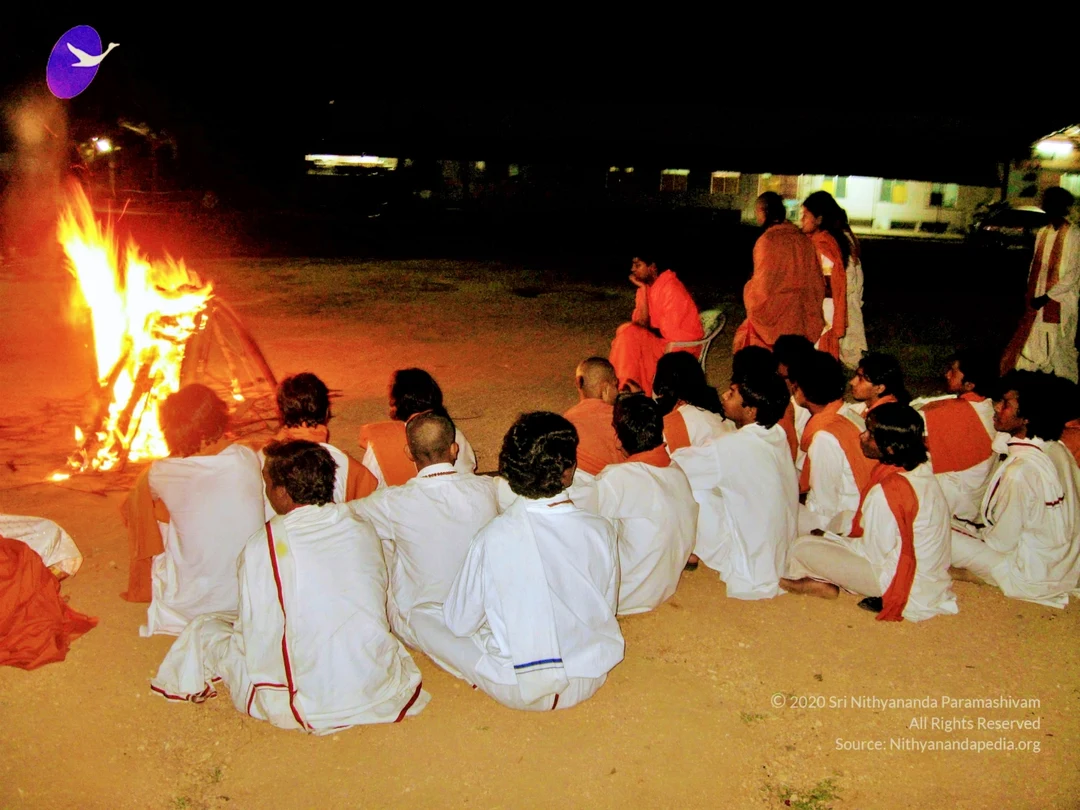
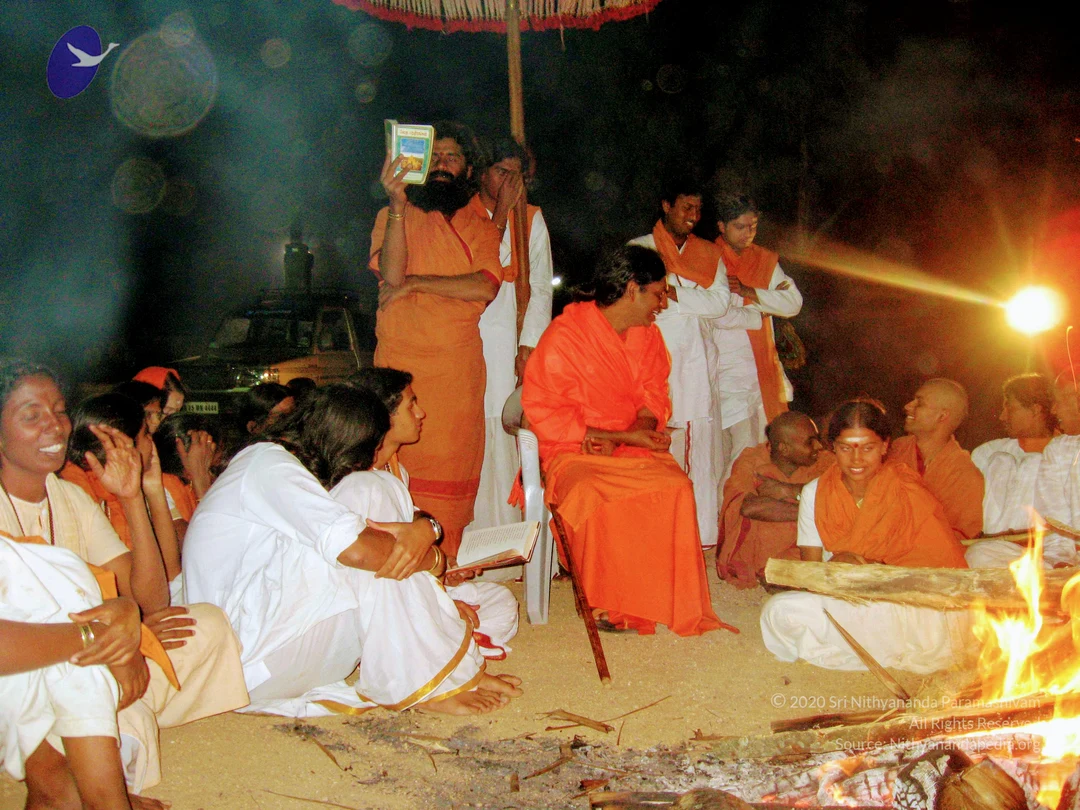
01--BRAMACHARRY-MEETING-CAMPFIRE
18 photosSource gallery
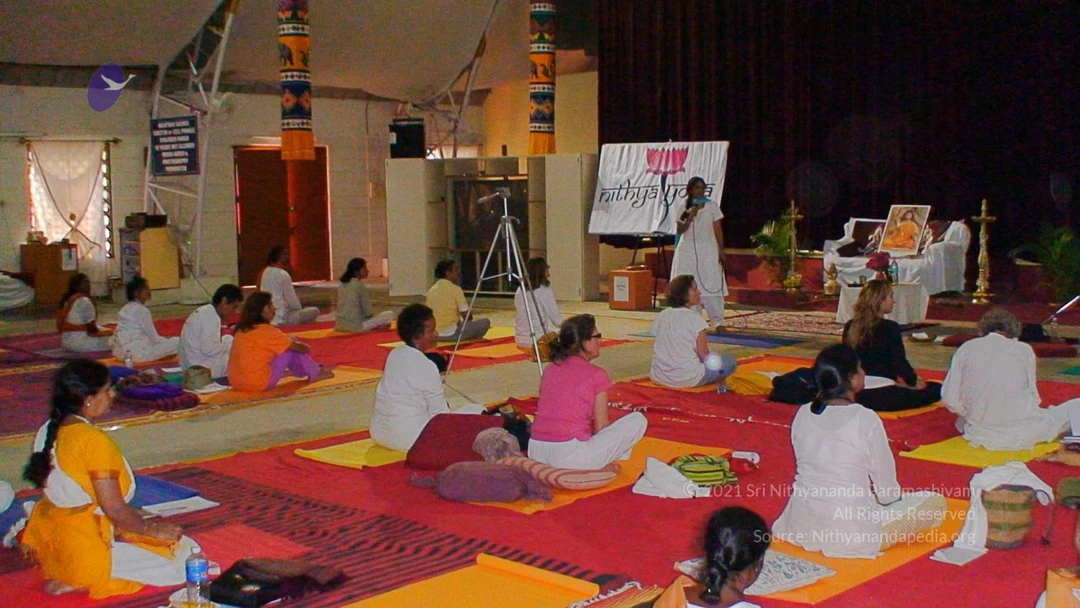
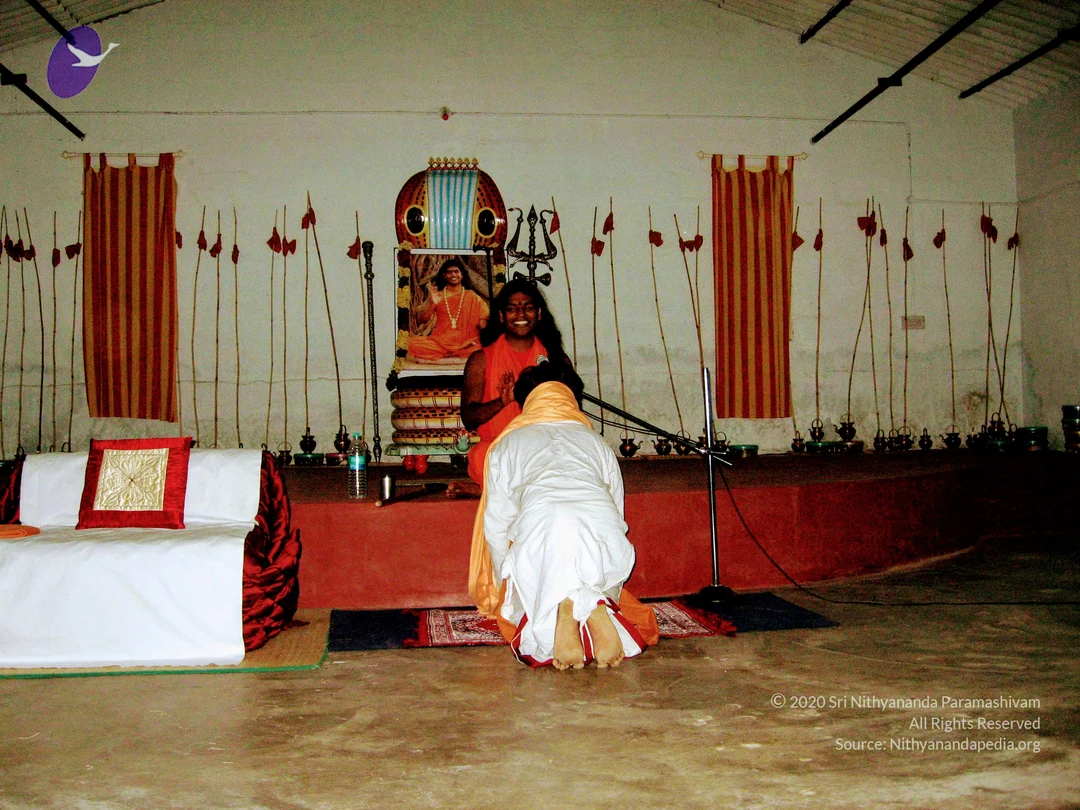
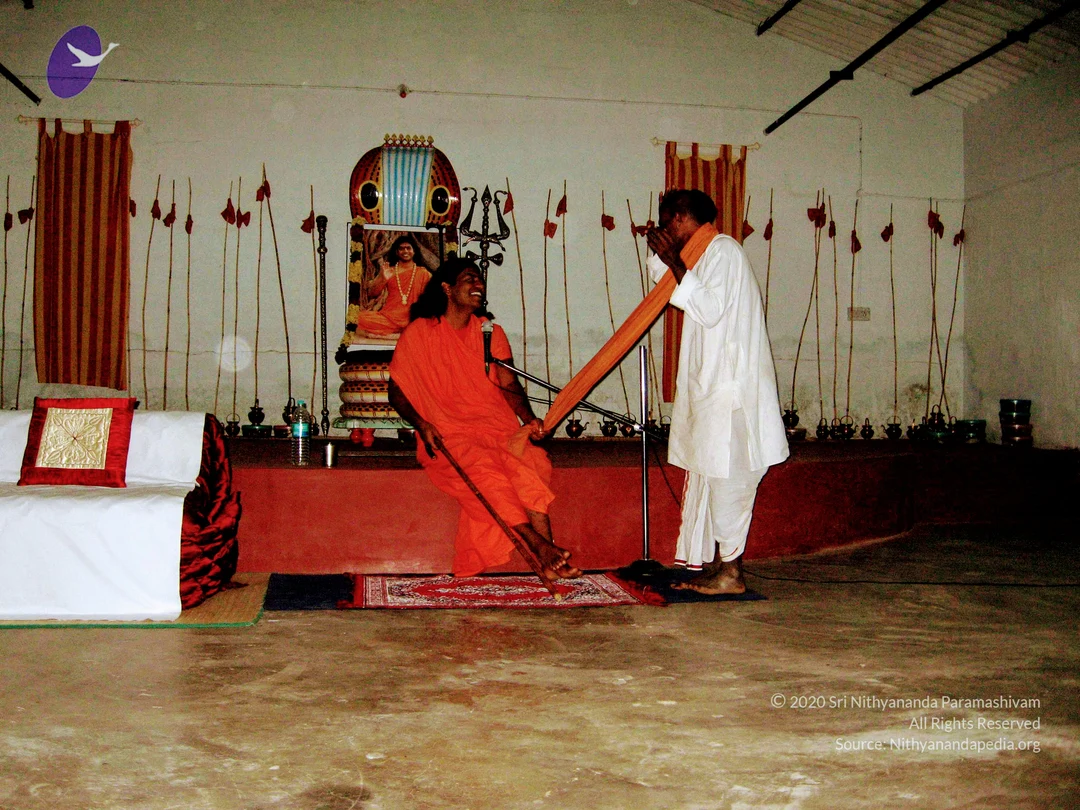
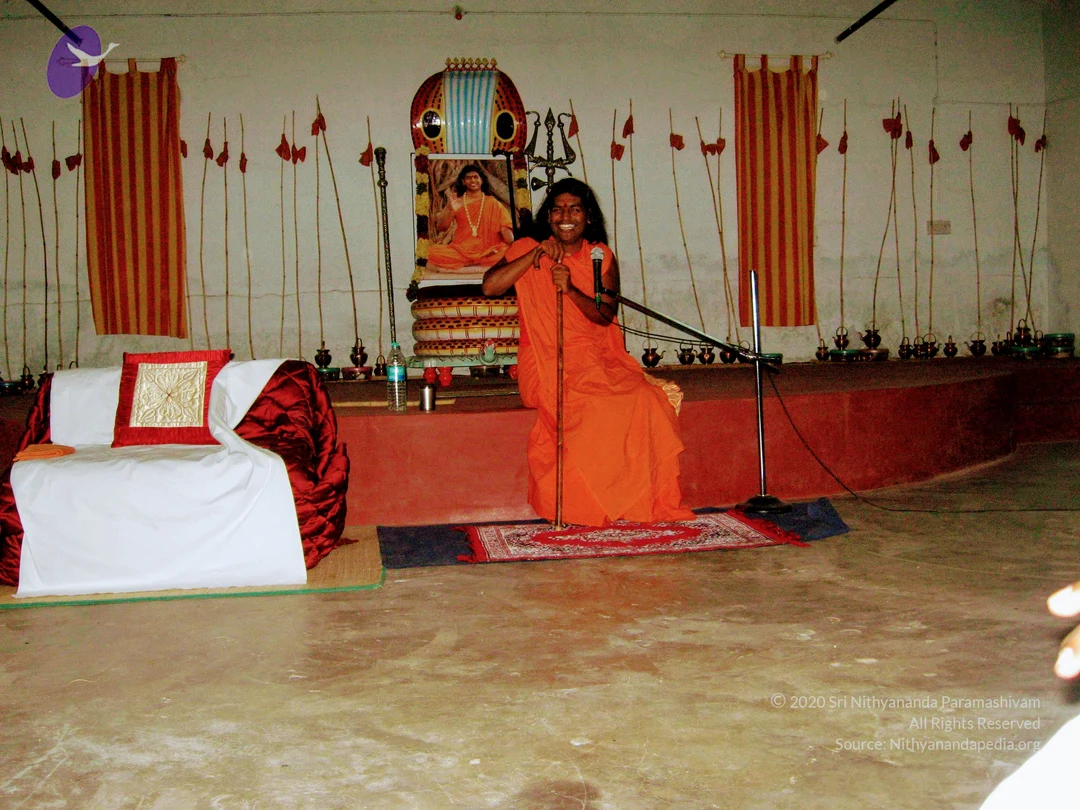
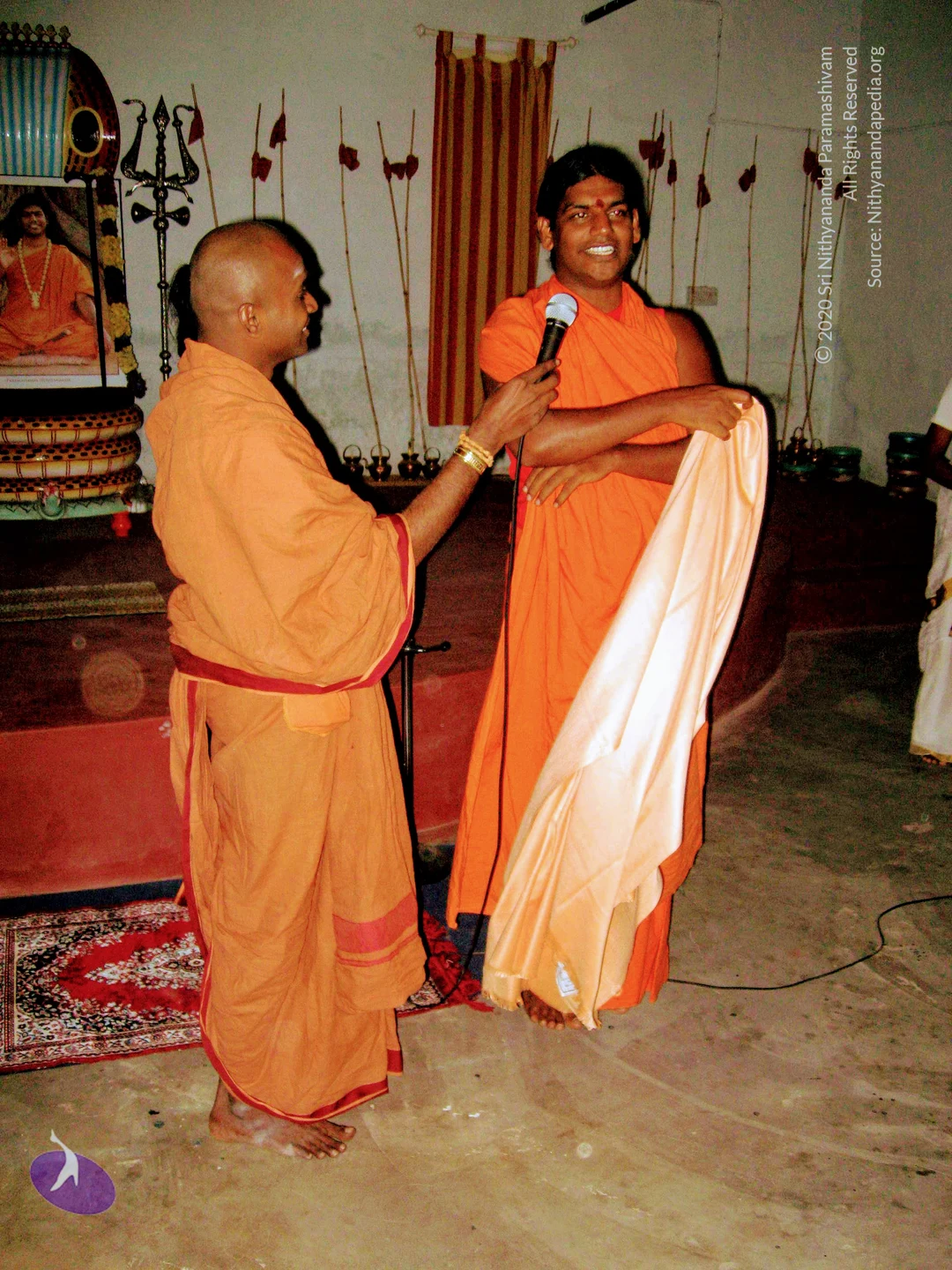
A hall with a tin roof and whitewashed walls hung with rows of decorative sticks and orange curtains, where a large group of people sits cross-legged on mats in white clothes with orange shawls. At the front, a woman in orange robes stands at a microphone on a raised platform beside a framed portrait of a figure in orange robes. A man in white clothing stands at the right by an orange curtained doorway, and a small table with a cloth and a pedestal sits to the left. Oil lamps and a small object sit on the stage, and a standing fan and speaker are visible.A hall with a corrugated roof and white walls where a seated audience of many people in white and orange clothing listens to a speaker. On a raised red stage at the back, a standing figure in orange robes speaks into a microphone beside a framed picture on a shrine-like altar with garlands and orange-and-yellow striped drapes. A seated figure in orange sits near a white-draped table on the stage. Most of the audience sits on yellow mats wearing white clothes with orange shawls, and some wear white saris.A photograph inside a plain hall with a concrete floor and a corrugated roof. A man with long dark hair, wearing an orange robe and smiling, stands on a raised red platform beside a framed portrait of a long-haired figure in orange clothing and a beaded necklace, set on a decorative throne-like stand with a trident behind it. In front, a person in white clothes with an orange shawl bows low with forehead to the mat-covered floor, prostrating. Red-and-gold cushions rest on a white-draped sofa at left, and striped orange curtains hang on the back wall, with rows of staffs and small brass pots along it. A water bottle sits on the platform.Indoor photo of a simple hall with whitewashed walls and a raised red platform. A figure in an orange saffron robe with long swept-back hair sits on a red-and-patterned rug, laughing, holding a long orange cloth and a wooden staff. Facing him, a man in white ritual clothes stands with palms pressed together in namaskar, holding the other end of the orange cloth. Behind them, a framed image labelled with a deity or saint portrait sits atop a decorated seat with a trident and rows of kalasha-like brass pots lining the wall. A white-covered bed with a red embroidered cushion sits at left. Two people are visible.A photograph of a speaker seated on a raised red platform in a plain hall, holding a long wooden staff upright and a microphone on a stand. He wears an orange saffron robe, has long dark hair swept back, and smiles broadly. Behind him stands a framed portrait showing a person in orange robes with a rudraksha mala, set on a decorated altar with a red-and-gold tiered base and a trident. The walls have red-and-gold striped curtains and rows of trident-topped staffs and brass kalasha-style pots. To the left is a white-draped chair with a red cushion. Floor is bare concrete with a red and blue carpet. Clothing and wall decor are orange and red throughout.Indoor photograph in a plain hall with a tiled floor and a red-patterned rug. On the left, a bald man in orange robes with a red border holds a microphone toward a younger man in orange robes who holds out a large pale peach silk shawl, smiling. The younger man wears a red tilak on his forehead. Behind them, a framed portrait labelled "Paramahamsa Nithyananda" shows a figure in orange with a rudraksha mala, beside a trident and ceremonial metal lamps. Strings of red and orange pennants hang on the wall and a striped maroon curtain is behind them.

02--BRAMACHARY-TRAINING-CAMPFIRE
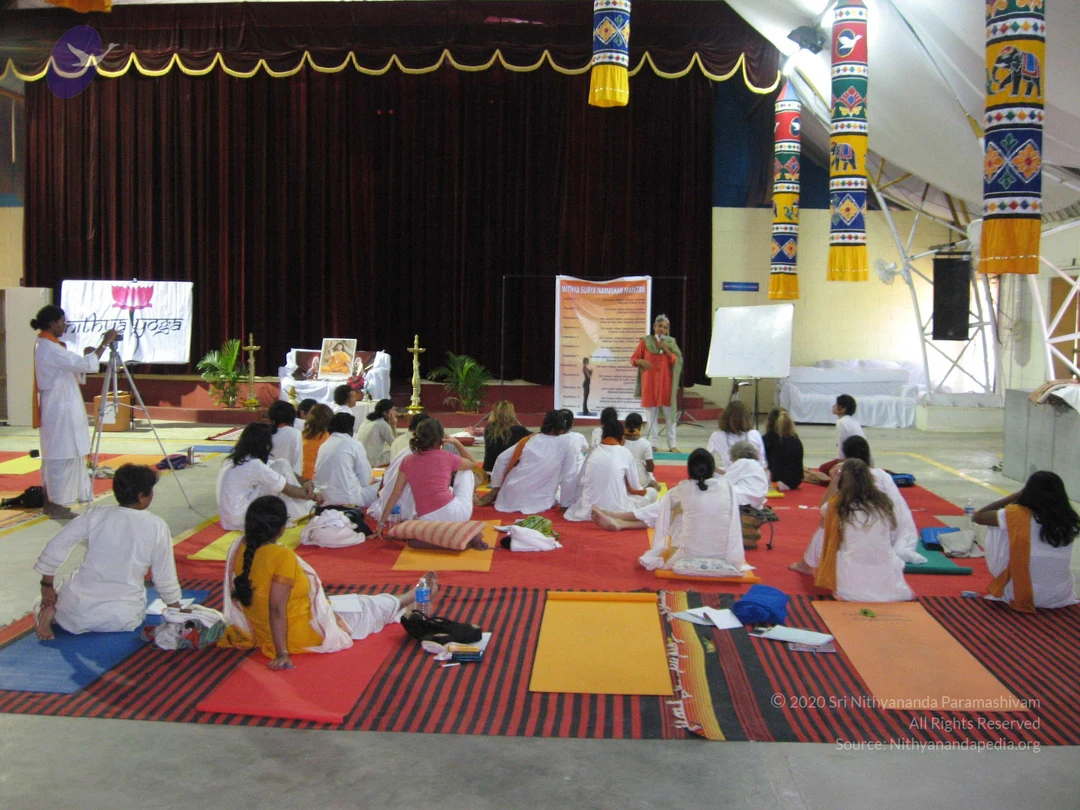
17 photosSource gallery
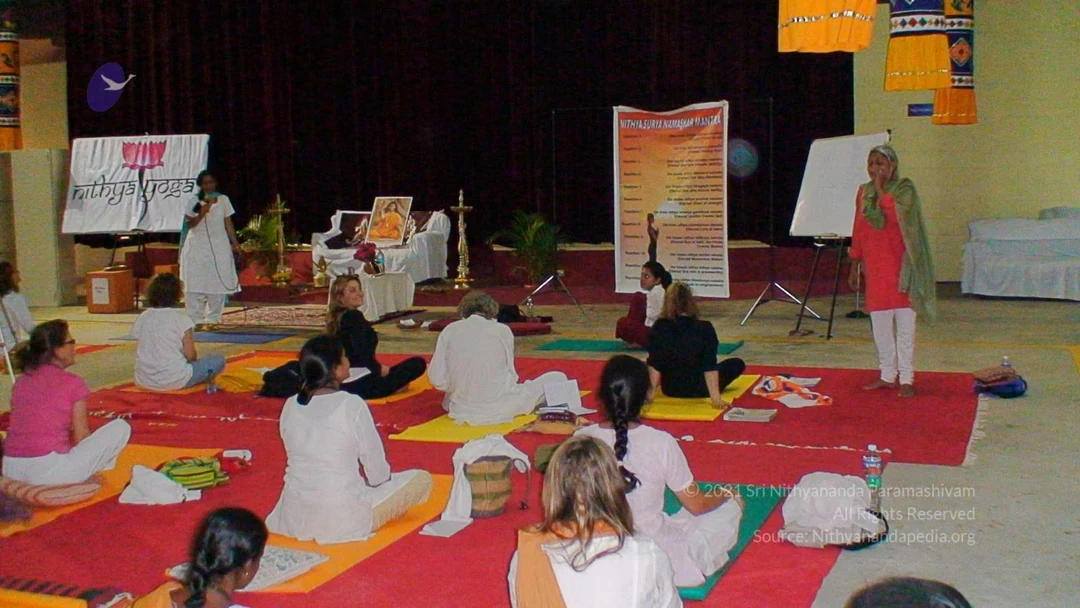
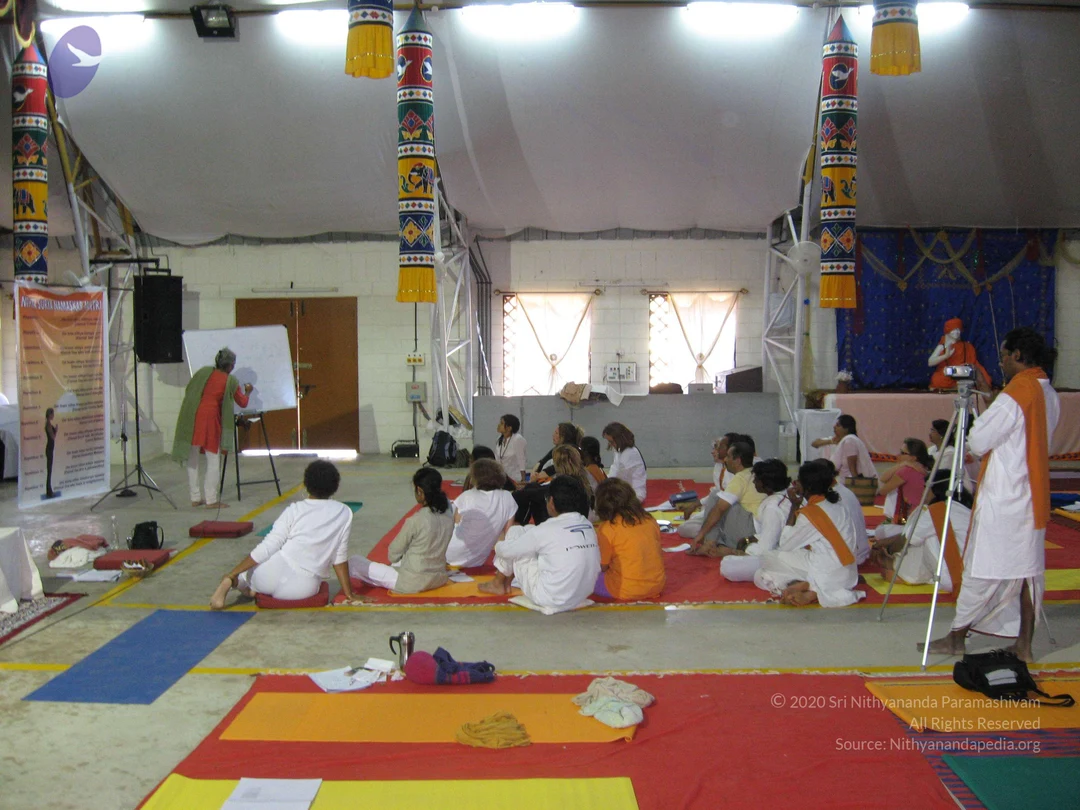
A photo of a seated group session in a large hall with a stage backdrop of dark red curtains and yellow-and-blue ceremonial banners. Around two dozen participants sit cross-legged or on mats on red and striped rugs, mostly in white clothes with orange shawls or stoles. A standing woman in orange robes with a microphone addresses the group in front of a banner showing a lotus and the word Nithyayoga; a cameraman in white films beside a tripod on the left. A framed portrait stands on a decorated table at the back of the stage, next to a brass cross-like stand. A printed banner labelled Nithyananda Paramashivam Satsang is pinned to a display board beside her. No a person candidate is clearly visible in the scene.A wide view of an indoor hall with a white tent ceiling and hanging yellow, red and blue decorative pennants. Several dozen seated participants in white and some orange clothing sit on colourful mats facing a whiteboard at left, where a person in an orange top and green wrap writes or draws. A tall sign at left reads in English and Hindi-style text. At the far right, an orange-robed figure sits on a platform before a blue draped backdrop, and a man in white dhoti with an orange shawl stands at a camera tripod. Yoga-style mats and cushions cover the floor.A photo of an indoor session in a plain concrete hall with a red and yellow floor mat. A standing woman with short grey hair, wearing an orange kurta, white trousers and a green shawl, writes on a whiteboard on an easel. Around a dozen seated students in white and other clothing face her on red and yellow mats; a banner beside the whiteboard lists the Nithya Surya Namaskar Mantra repetitions. A water bottle and cushions sit on the floor. No person is identified as a person.A photograph of a yoga or training session in a hall with a red and yellow floor mat. A standing instructor in a grey head covering, orange top, white trousers and a green shawl writes on a whiteboard at the back. Students sit cross-legged on the mats, many in white and orange clothing, some taking notes on paper. A tall banner on the left shows a Nithya Surya Namaskar mantra with twelve numbered repetitions. A water bottle sits on the mat, and a wooden door is at the right.A seated group of students in white and orange clothing sits on red, orange and green mats in a hall with a stage. A woman in an orange top and green shawl stands at the front holding a microphone and gesturing, beside a small table with a framed picture and flowers. Behind her hangs a banner reading Nithya Suryanamaskar Mantra, with a white lotus-logo banner reading Nithyayoga nearby. Several participants sit with bottles of water and bags, and a small drum rests among them. The scene resembles a yoga or Q&A session; no a person is visibly present in the image.A hall with a white tent ceiling and hanging colourful striped and patterned banners on poles. Dozens of seated participants in white clothes and orange shawls sit on red and yellow mats in rows, facing a raised stage at the back. On the stage, a seated figure wears an orange robe and a white head covering, in front of a blue draped backdrop. In the foreground, two women stand and speak: one in an orange kurta with a green shawl holds a mic-like object, the other in white with a teal shawl gestures toward the group. Water bottles and bags sit on the floor at the lower left.

03--TEMPLE-VISIT
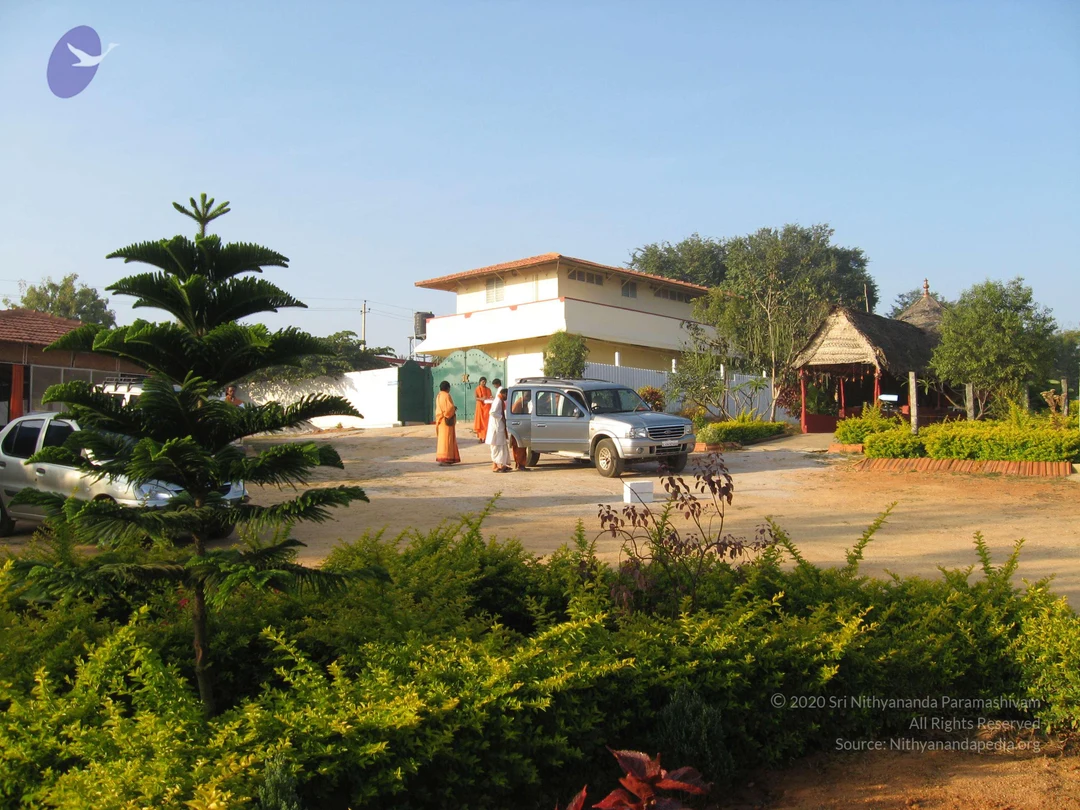
24 photosSource gallery
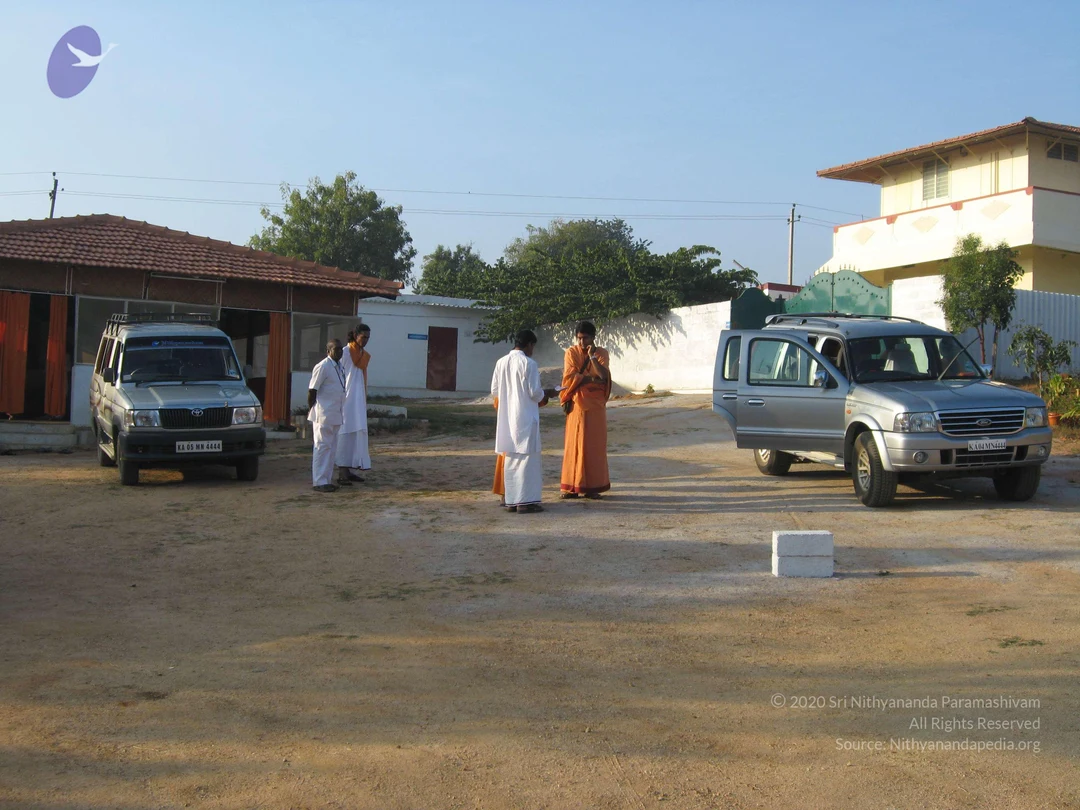
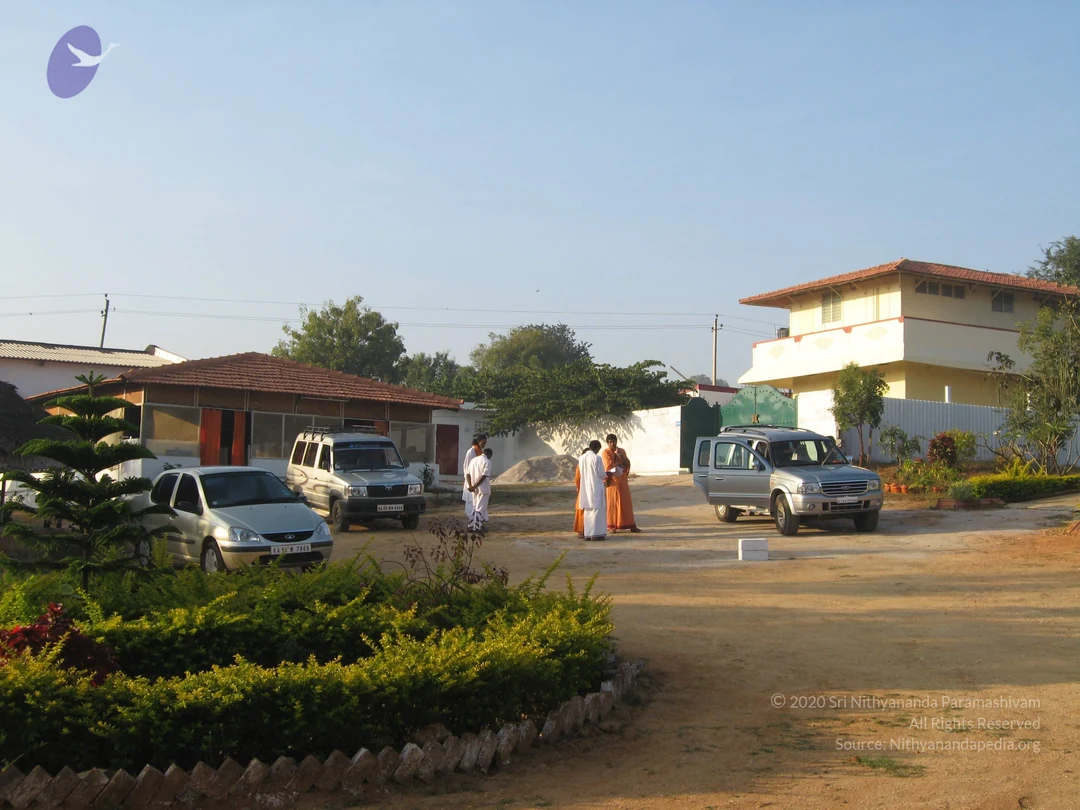
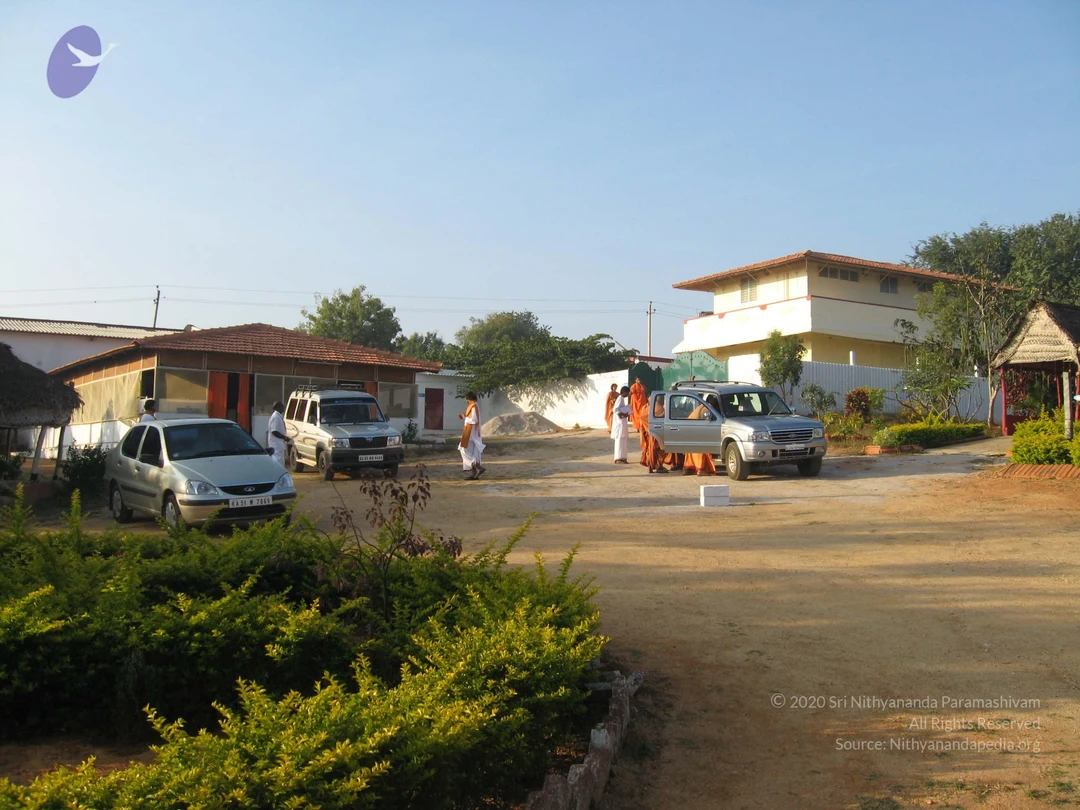
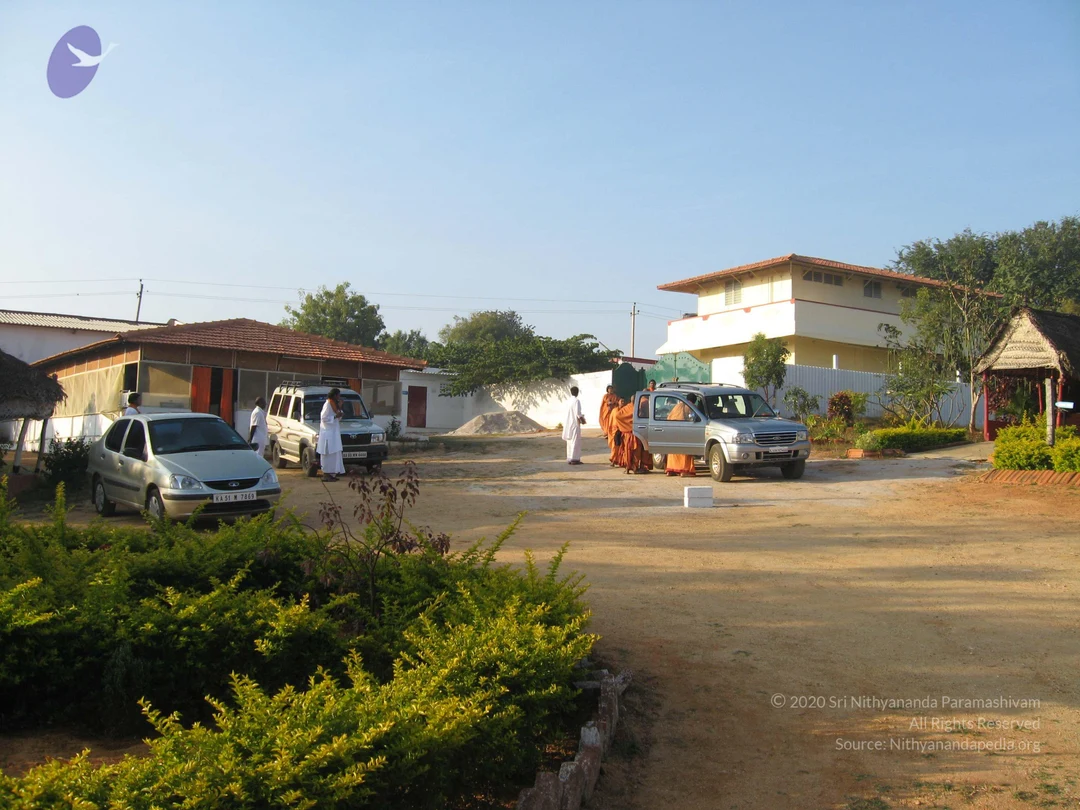
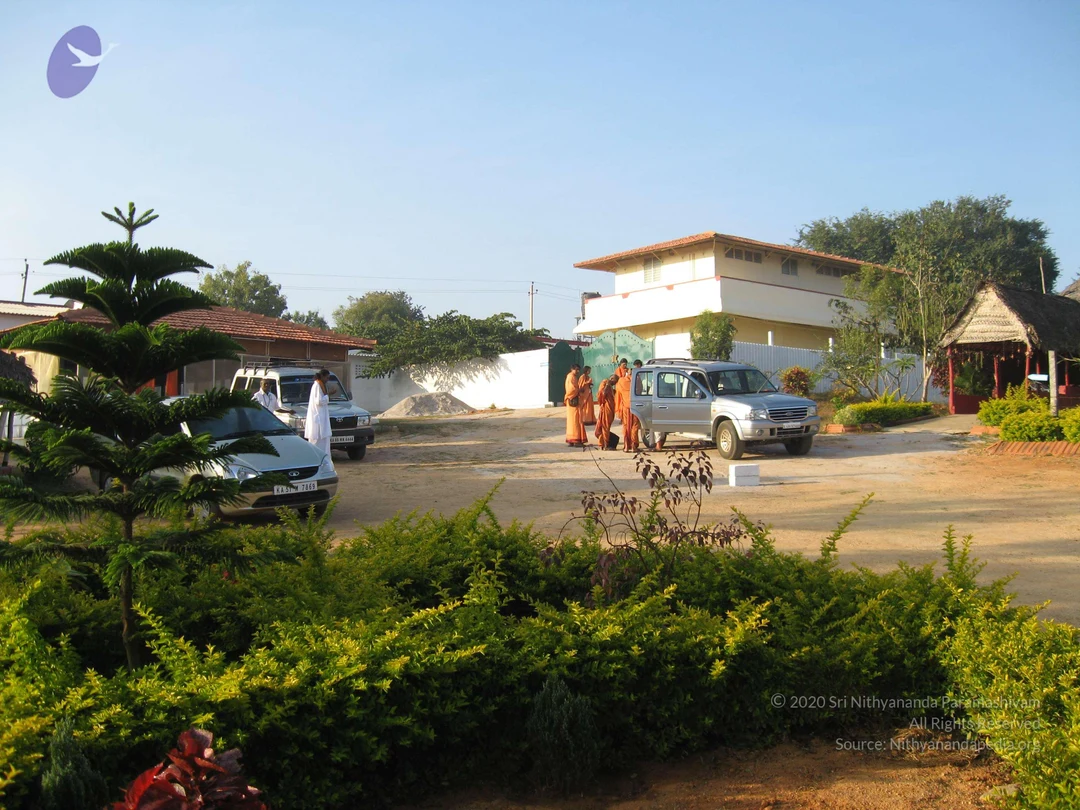
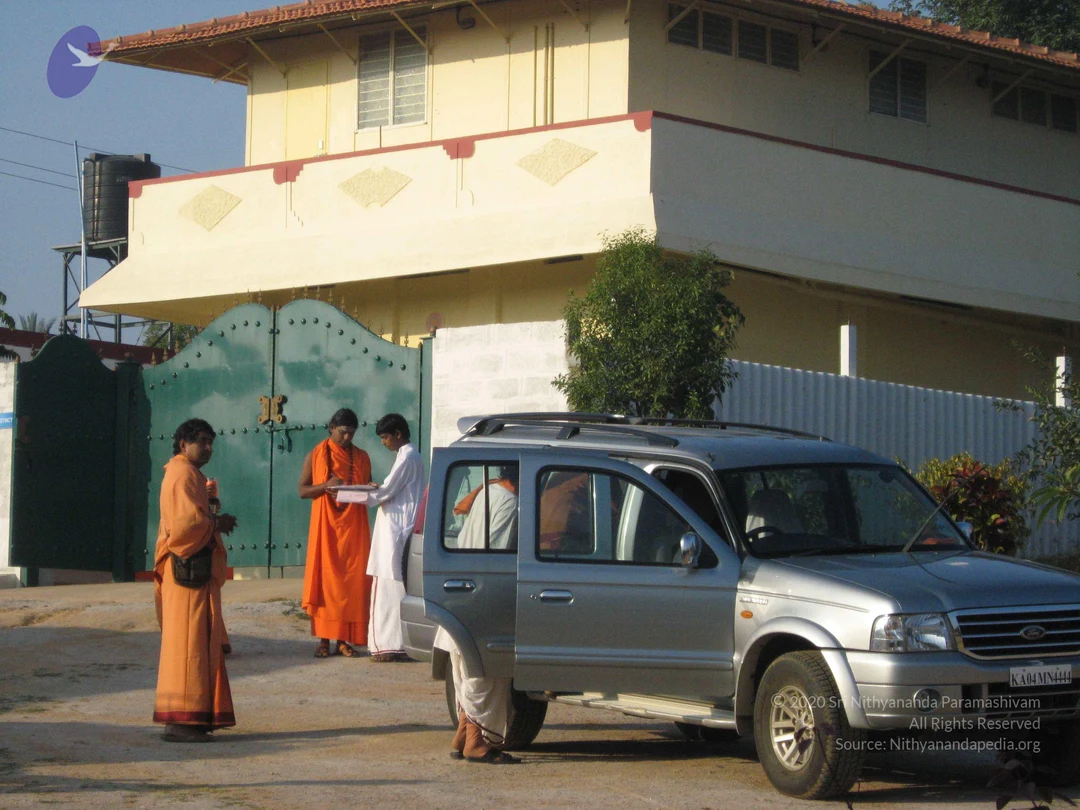
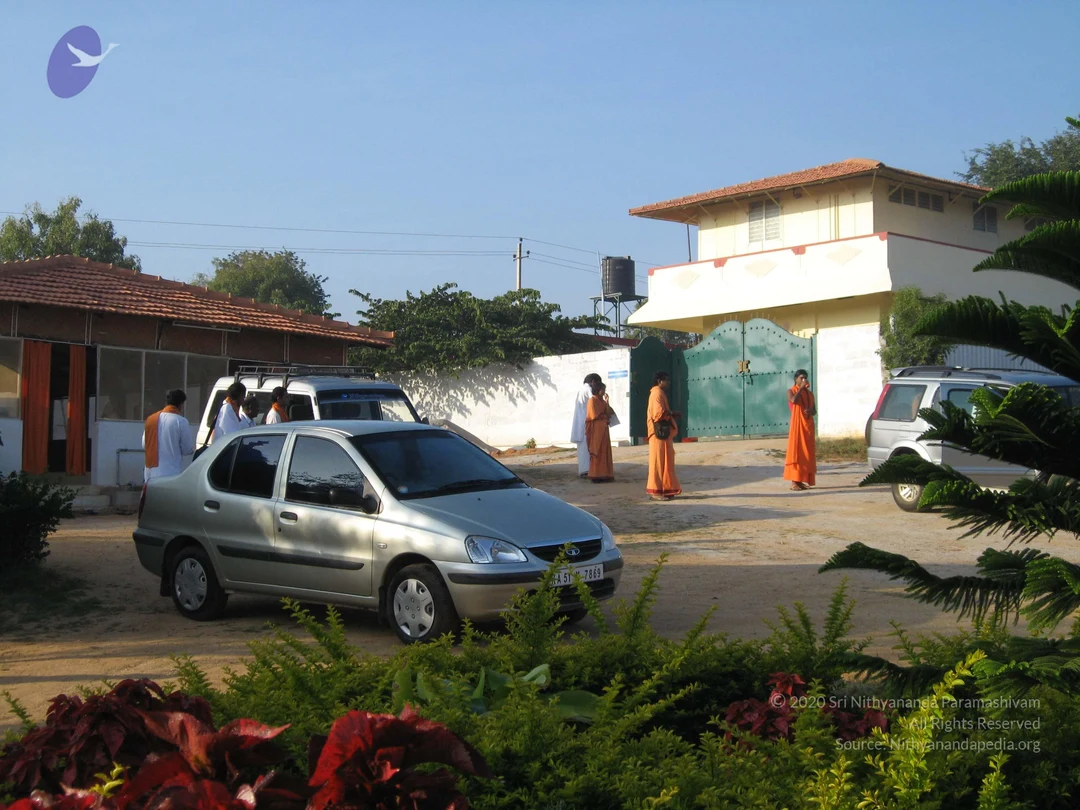
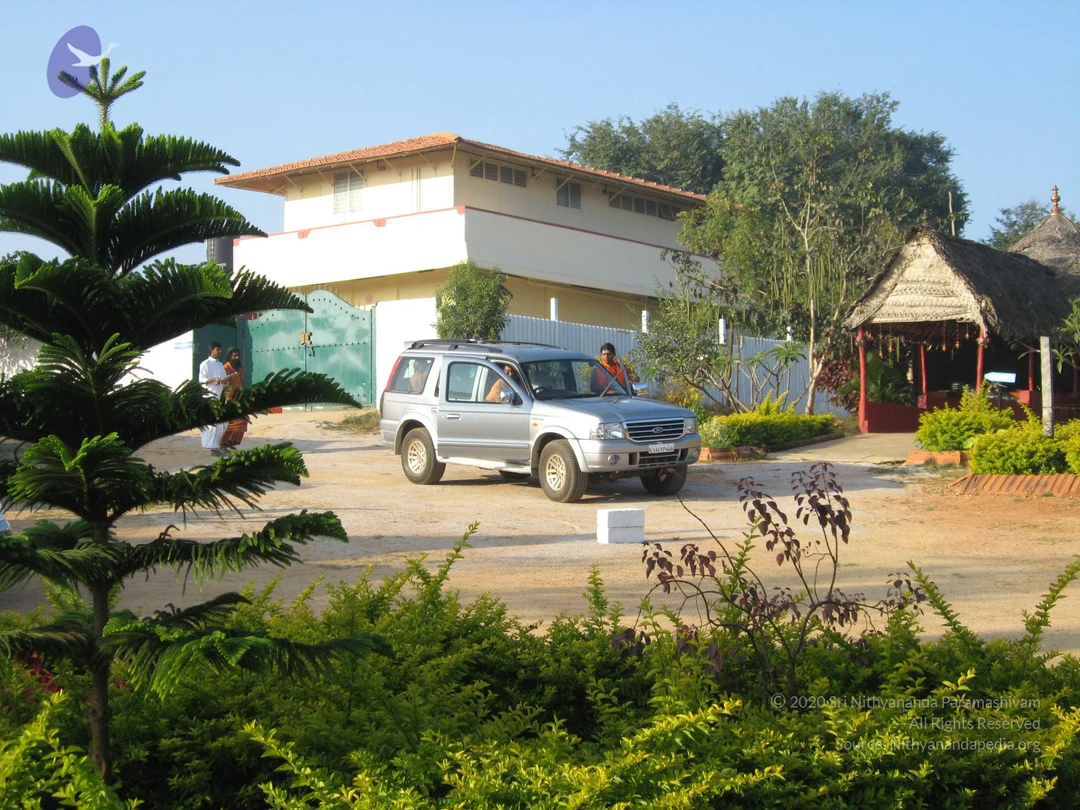
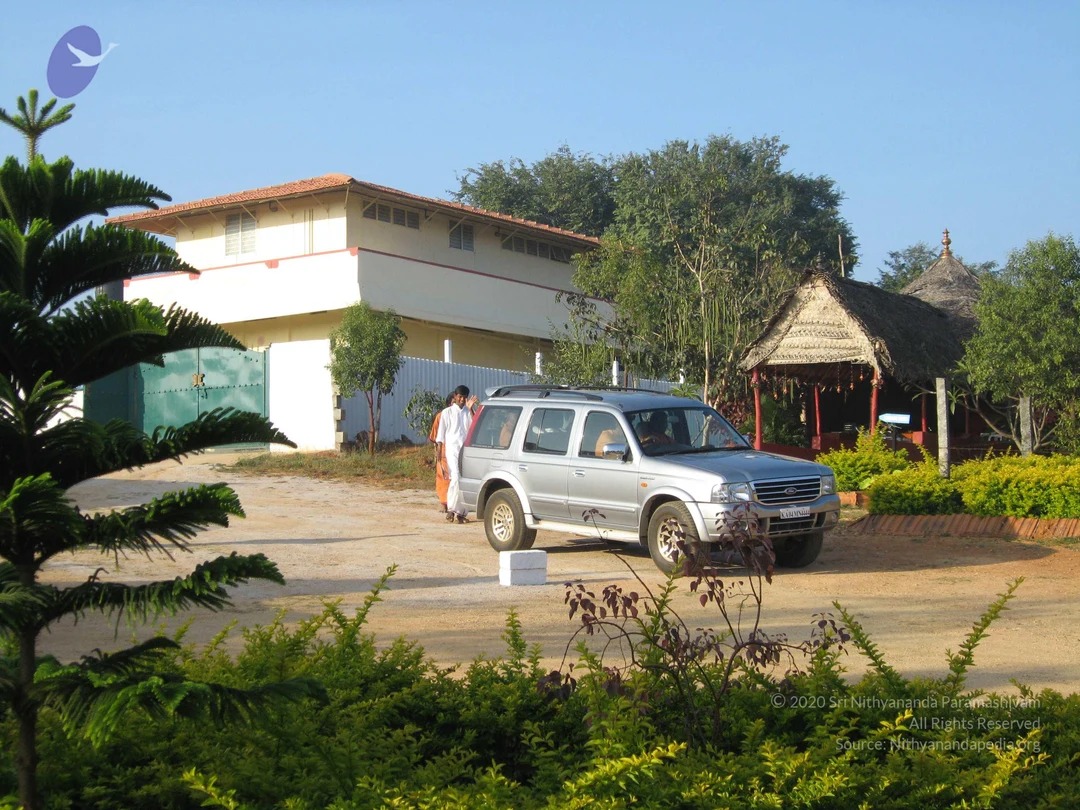
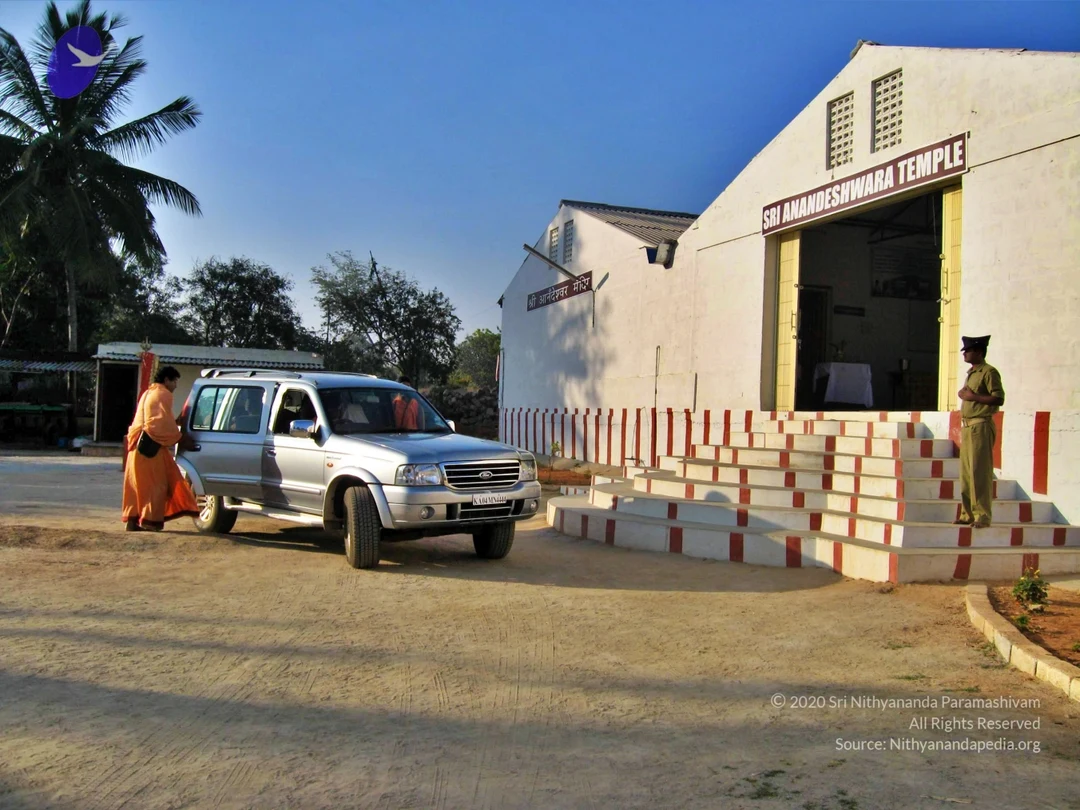
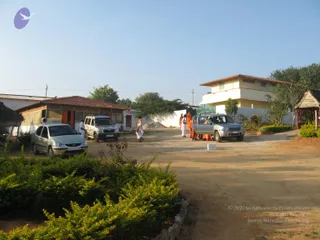
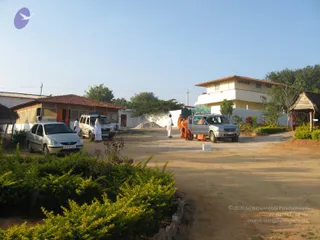
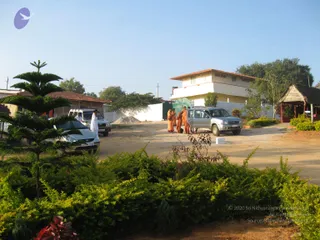
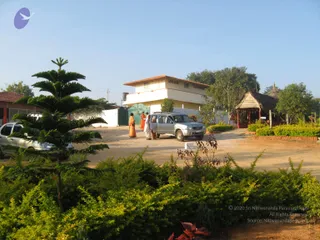
A dusty open courtyard in daylight with two parked silver SUVs and a small tiled-roof building on the left; a yellow two-storey building stands at right behind a white wall. Four people stand near the centre: two men in plain white dhoti and shirt, and two in orange saffron robes, one of whom wears a white garment and holds an object in his hands. A small white concrete block sits on the ground to the right. No readable event text appears in the scene itself.A sunlit dirt courtyard at an ashram-style compound with a row of parked cars: a silver Tata-style hatchback on the left, a dark grey SUV in the centre-left, and a silver SUV on the right with its door open. Low single-storey buildings with terracotta-tiled roofs sit on the left, and a two-storey yellow building with a red-tiled roof stands on the right behind a white wall. Trimmed green shrubs and a young tree line the foreground. Three people stand together near the middle of the courtyard: one in white clothes, another in white, and a figure in saffron-orange robes. Nothing ritual is visible.A dusty courtyard at an ashram-like compound in late daylight, with parked cars including a silver SUV, a white hatchback and a silver pickup. Several people in saffron or orange robes and white dhoti-style clothing stand and walk near the pickup, one man in orange seated or stepping near its open door. Low single-storey buildings with terracotta-tiled roofs, a two-storey cream building with orange trim, a thatched shelter at the right edge and green shrubs fill the scene under a clear blue sky.Outdoor photograph of a dusty courtyard at an ashram or institute compound in early light. Several silver and white cars are parked, including a silver SUV and a white van. A man in white clothes stands near the vehicles, and a group of people in saffron-orange robes gathers beside the silver SUV near its open door. Low modern buildings with terracotta tile roofs, a thatched-roof shelter on the right, green shrubs and trees surround the open yard. A small pile of sand is visible near a white wall.Outdoor photograph of an ashram courtyard in daylight under a clear blue sky. Several people in saffron-orange robes stand in a cluster on a dirt yard beside a silver SUV, while another figure in white clothing stands near a white car on the left. Behind them is a two-storey cream building with a terracotta roof and a white boundary wall. Trimmed green hedges and a tall palm-like plant fill the foreground, and a thatched open-sided shelter stands on the right. Whether any saffron-robed figure is a person cannot be determined from appearance, so no identification is made.A photograph of an open sandy courtyard at an ashram-style compound on a clear morning. A silver SUV is parked in the centre beside a white two-storey building with a red-tiled roof and green gate. Three people stand near the vehicle: one in orange robes on the left, and two in white and orange clothing beside the car. Trimmed green shrubs, a tall conifer, and a thatched-roof open pavilion with red pillars sit to the right, with a small temple spire behind. Sunlight warms the scene from the side.

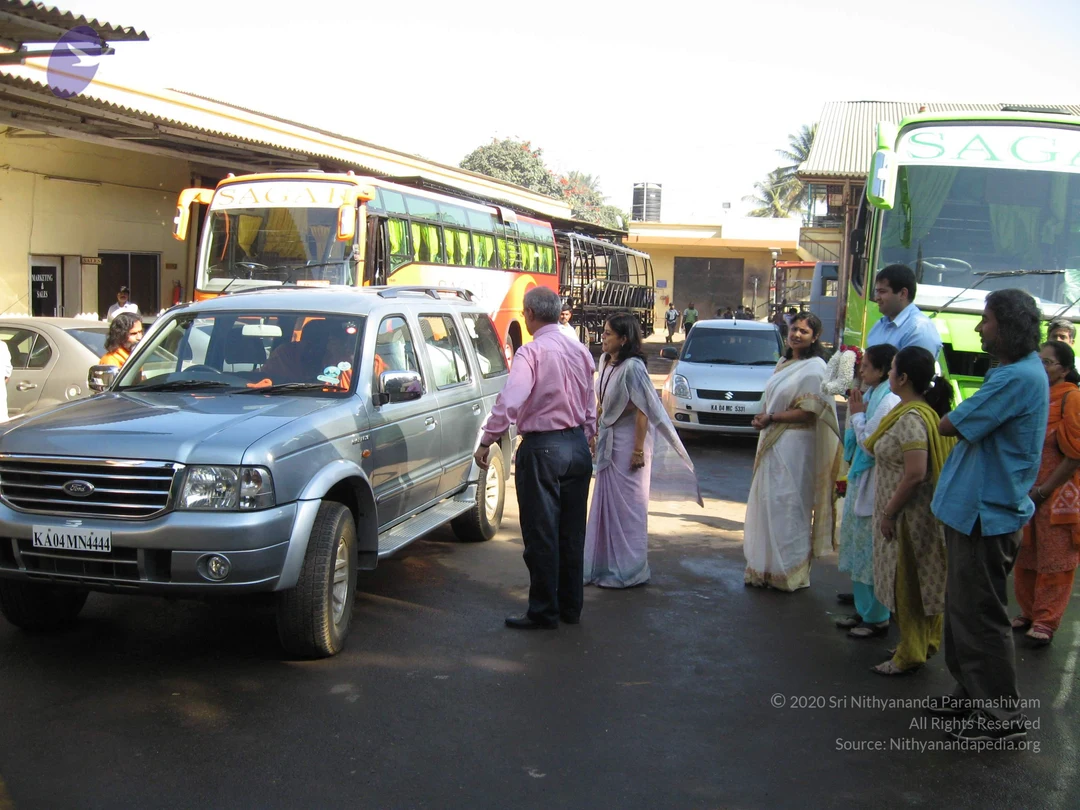
04--RECEVING-SWAMY
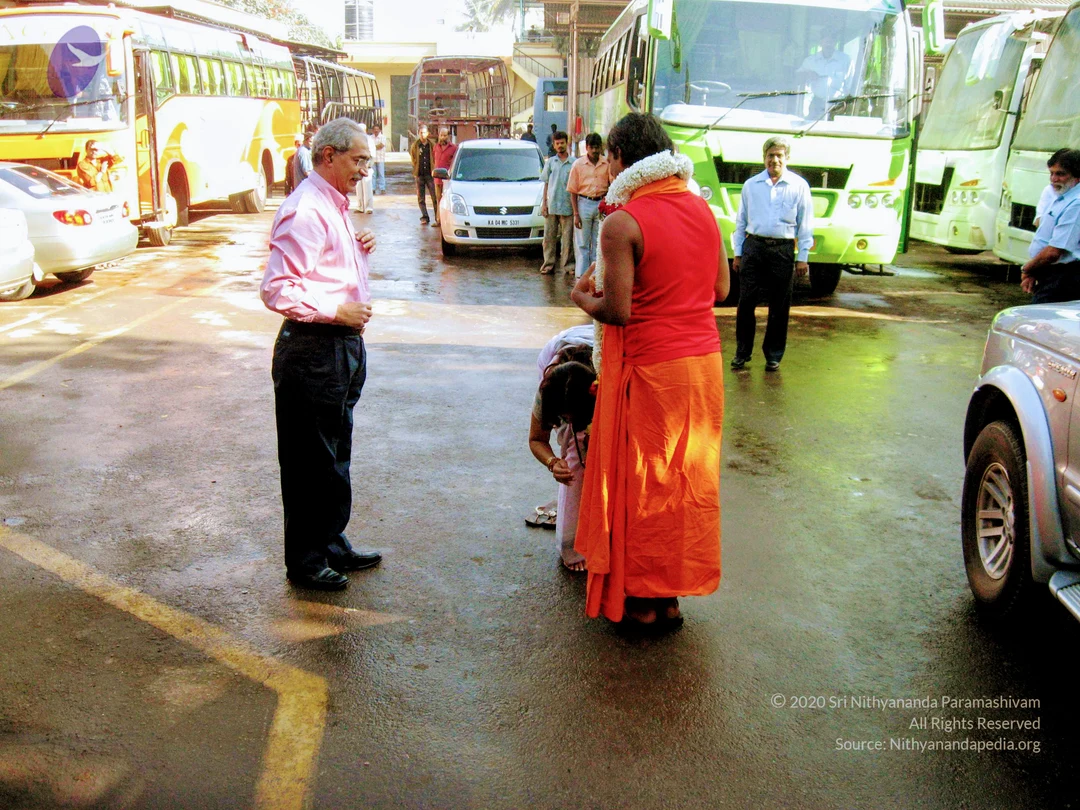
12 photosSource gallery
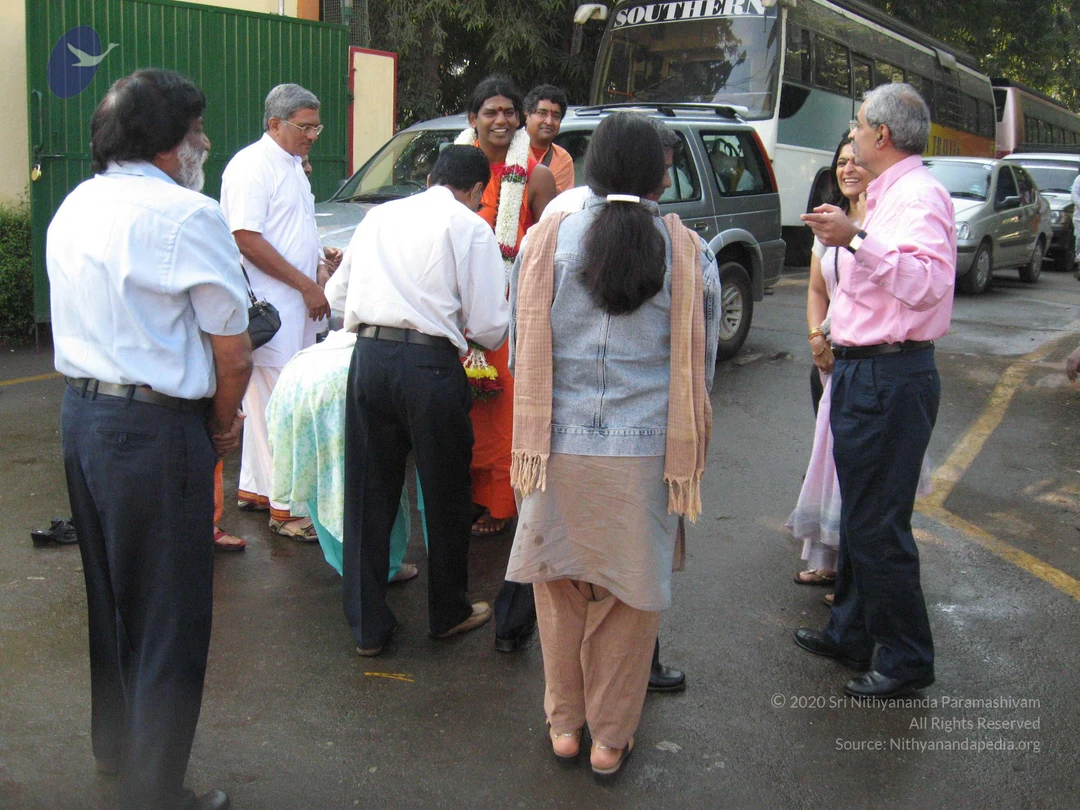
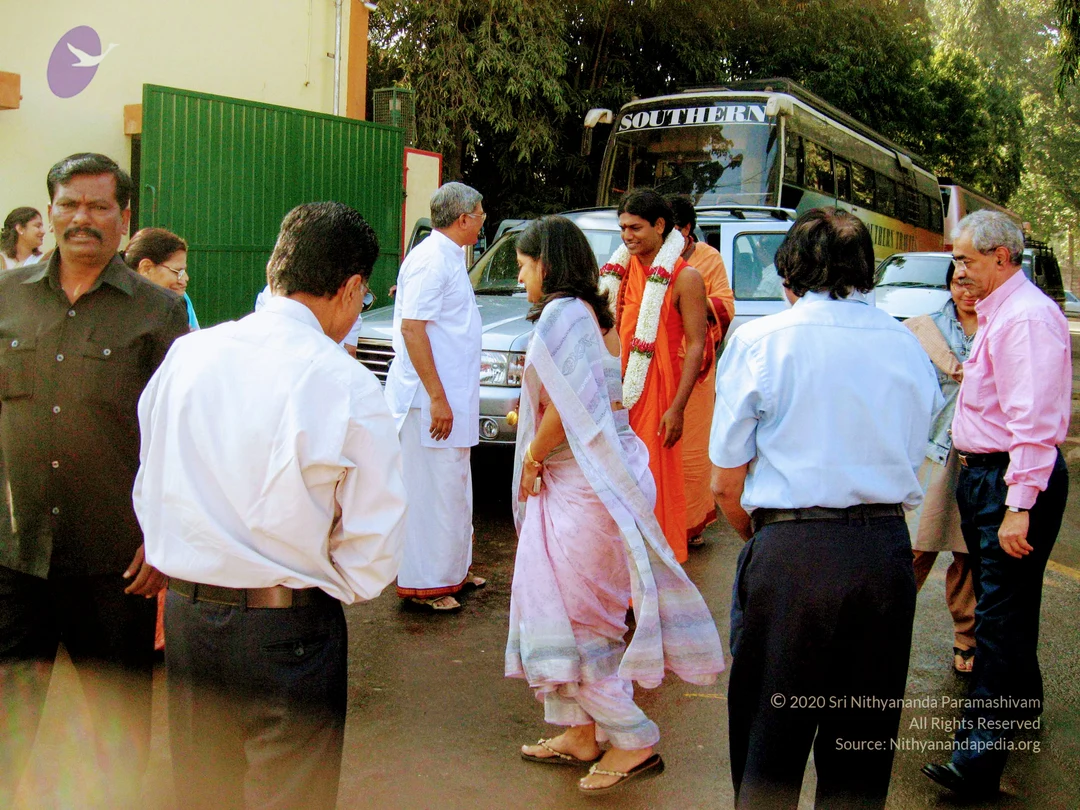
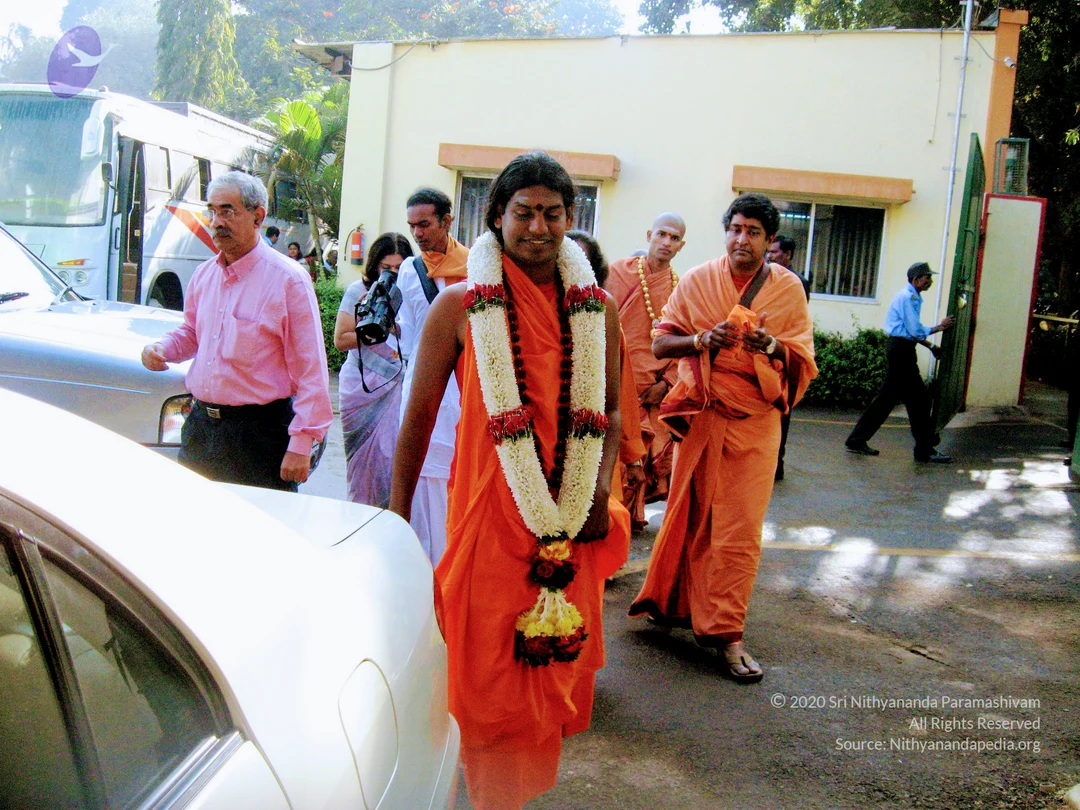
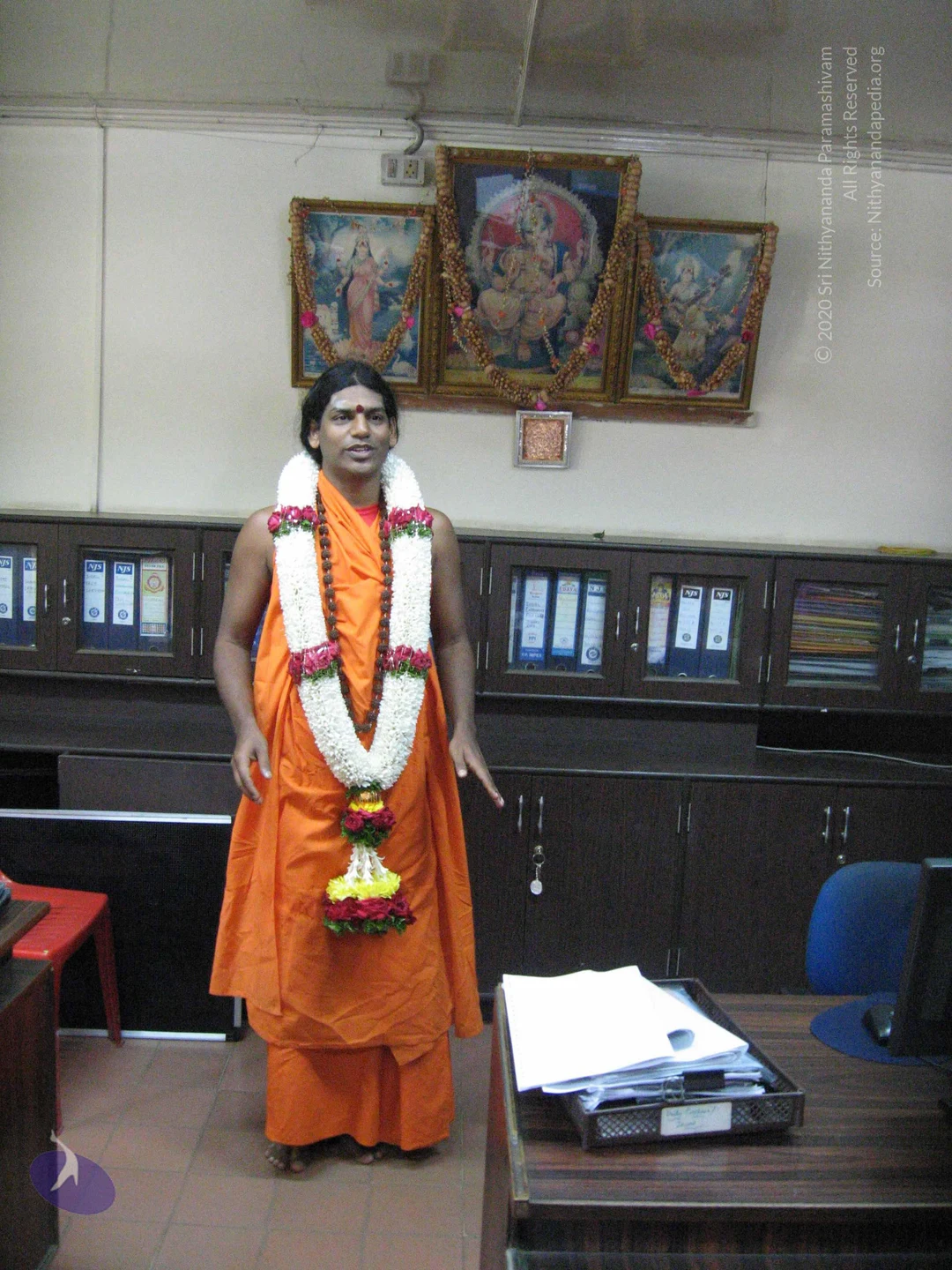
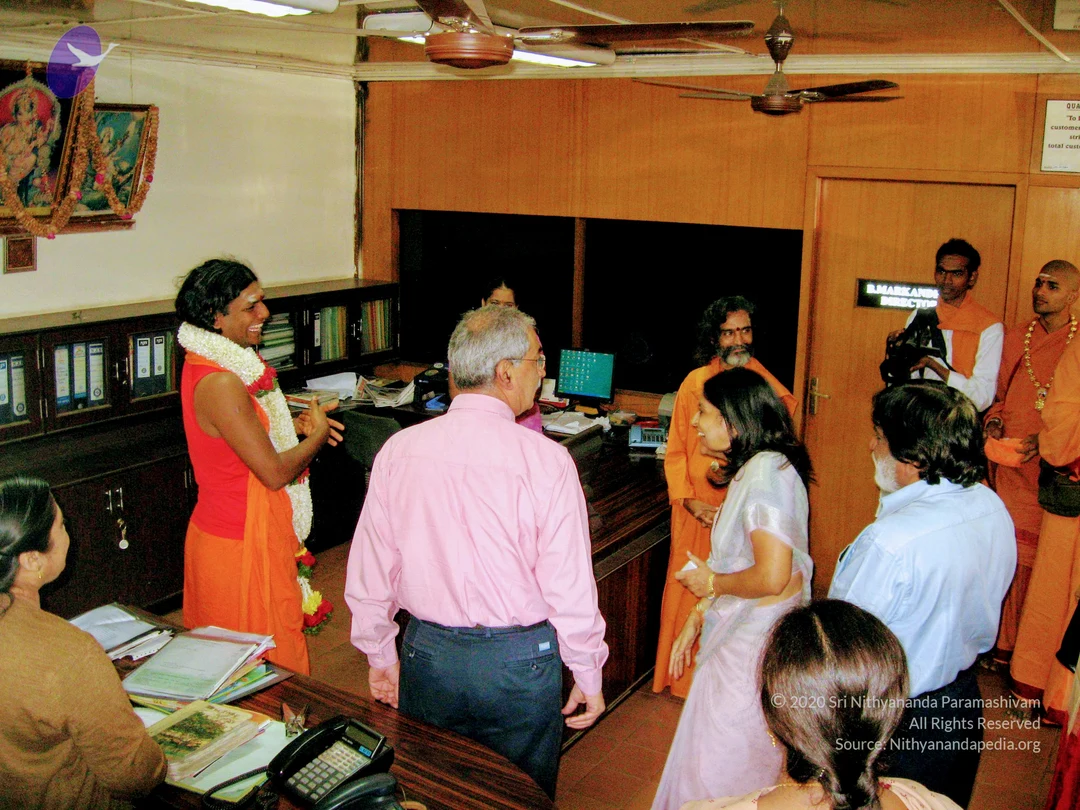
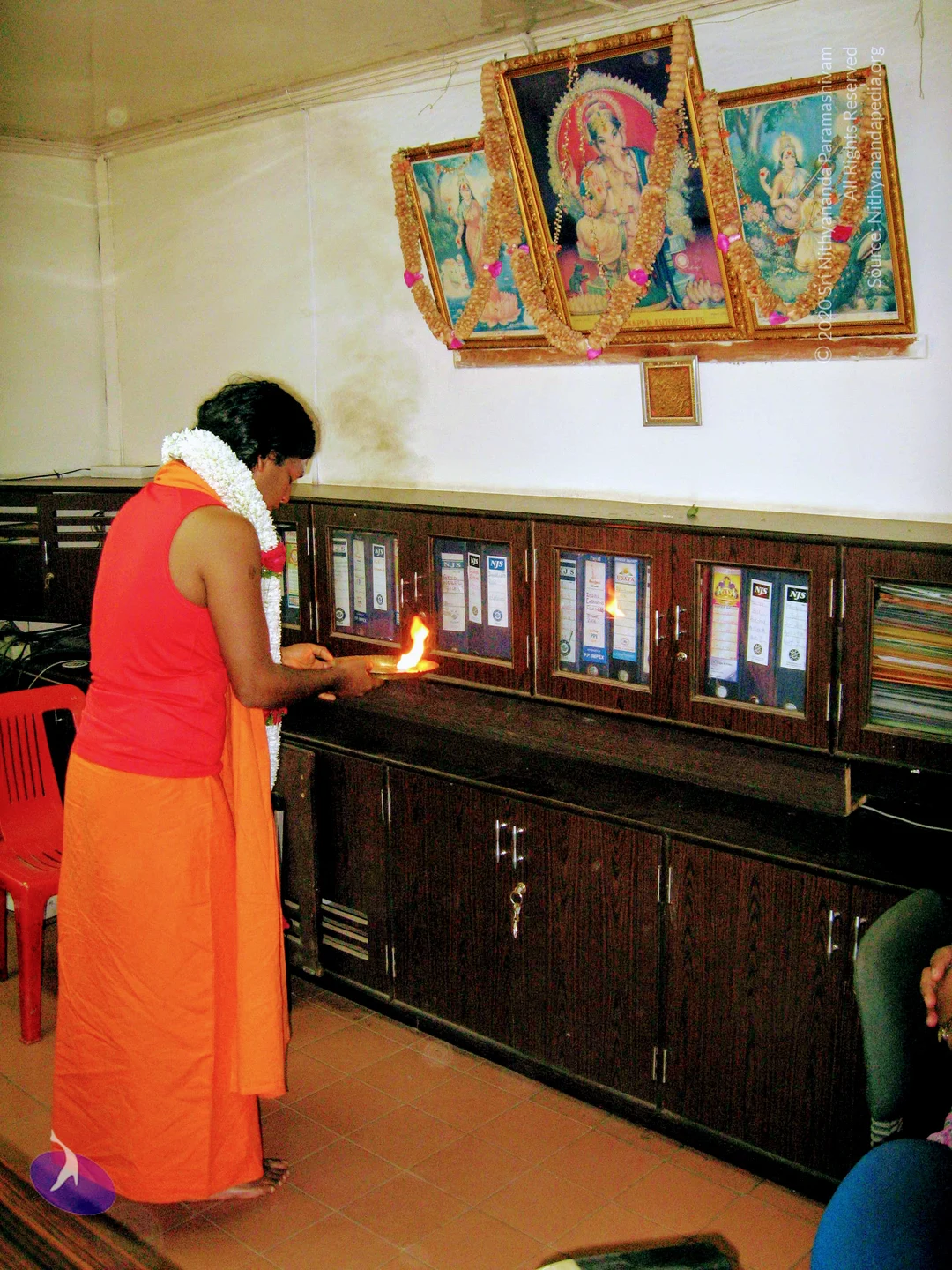
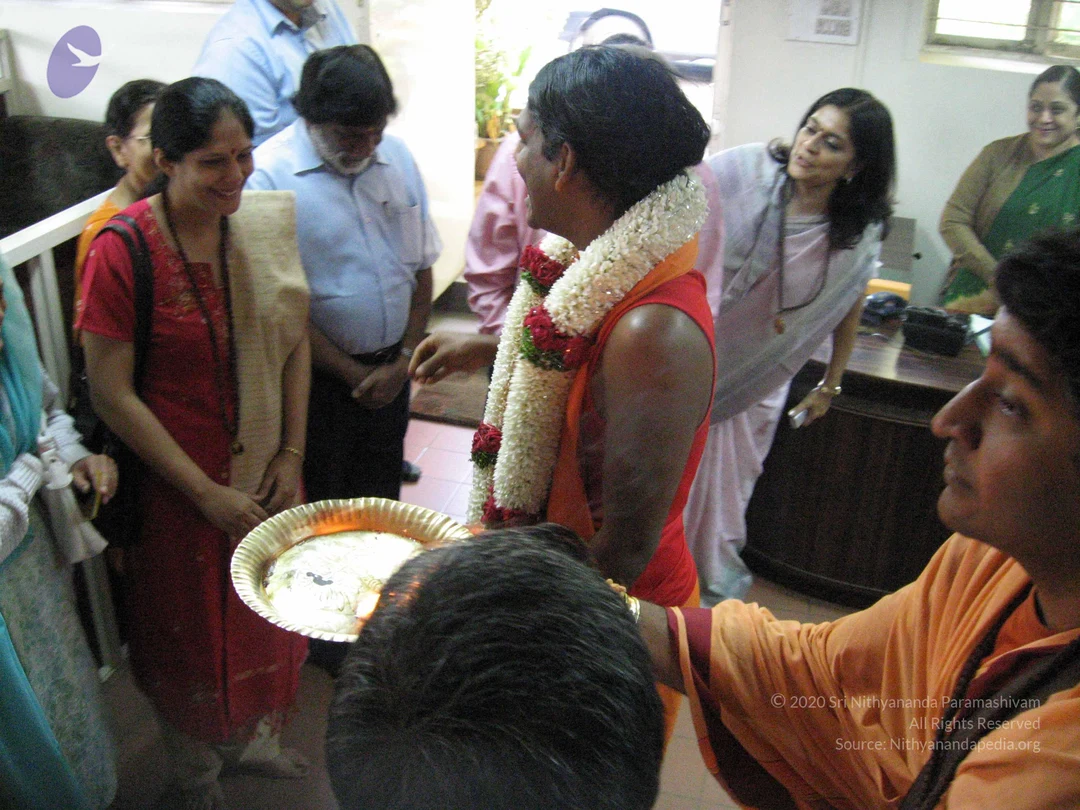
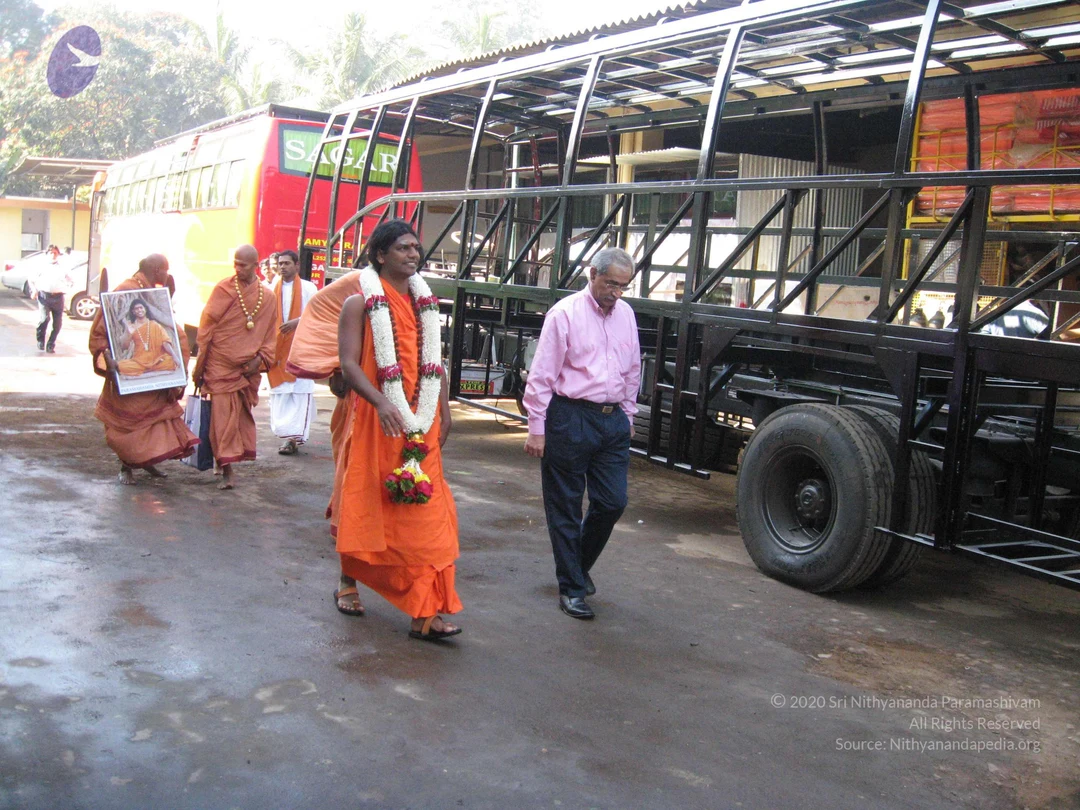
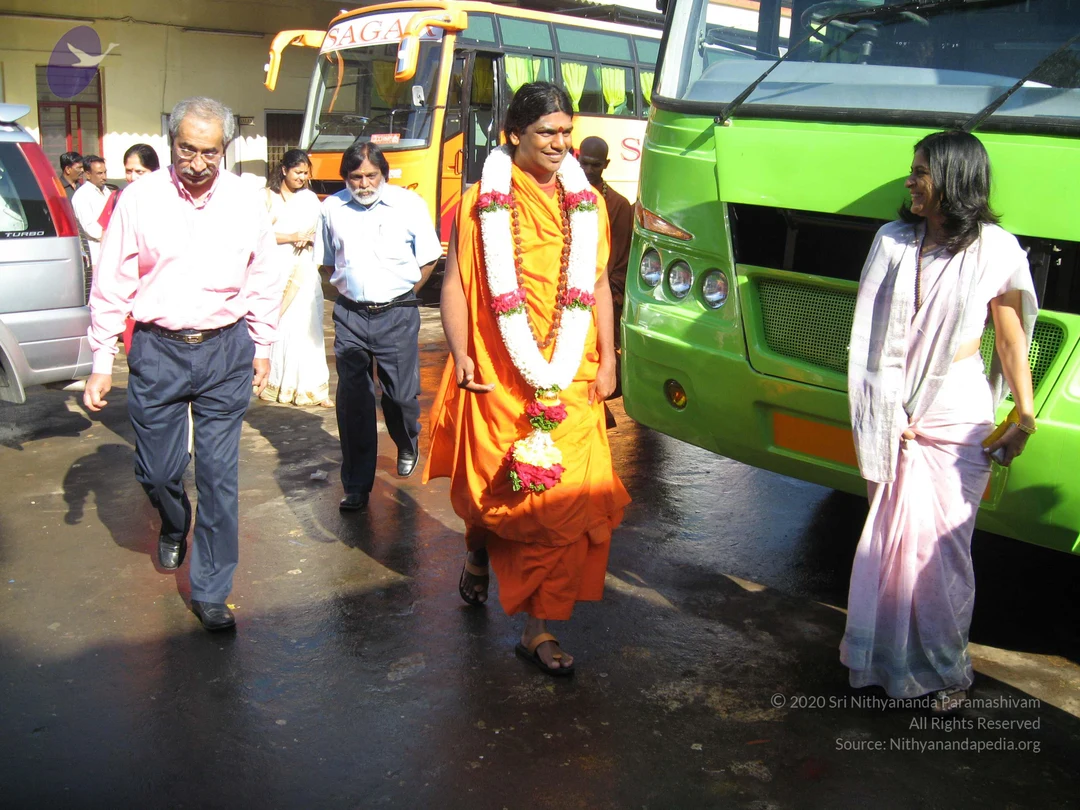
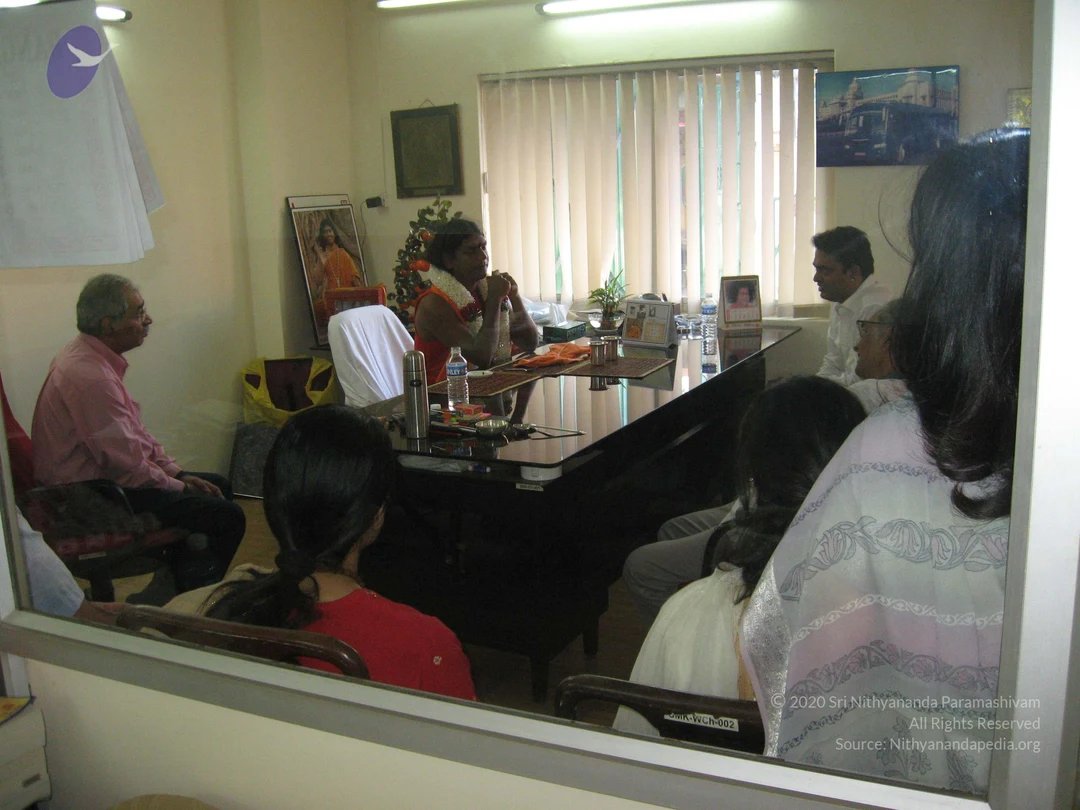
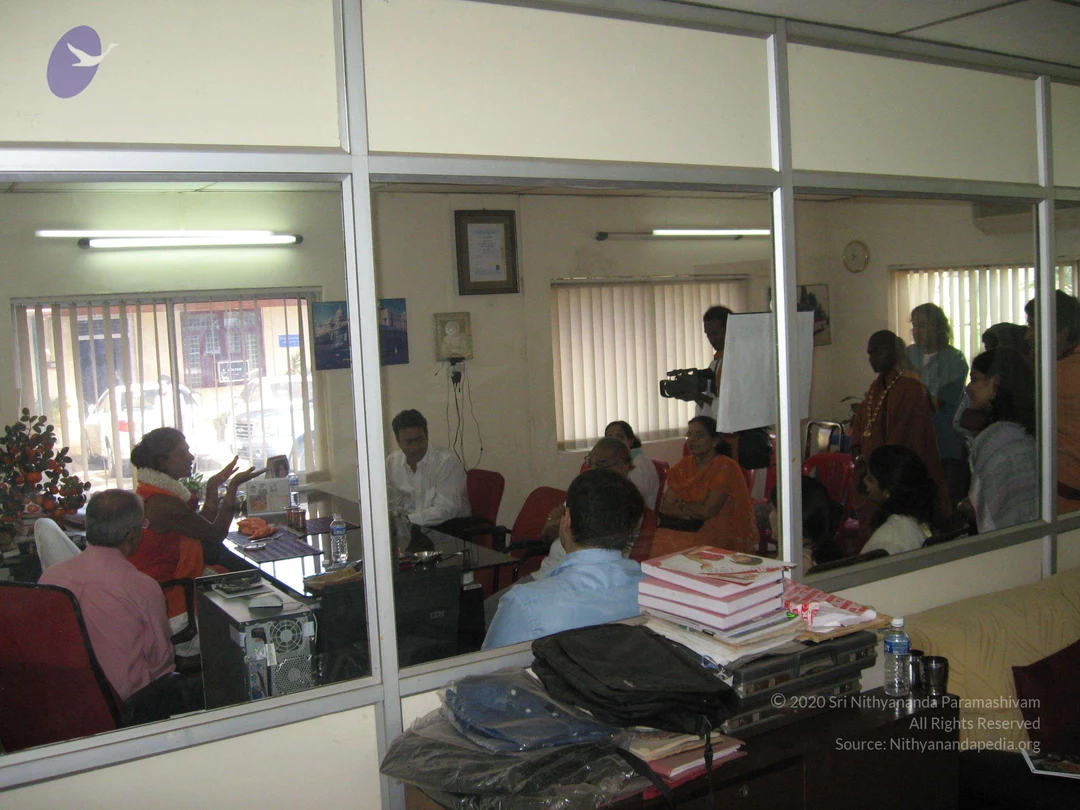
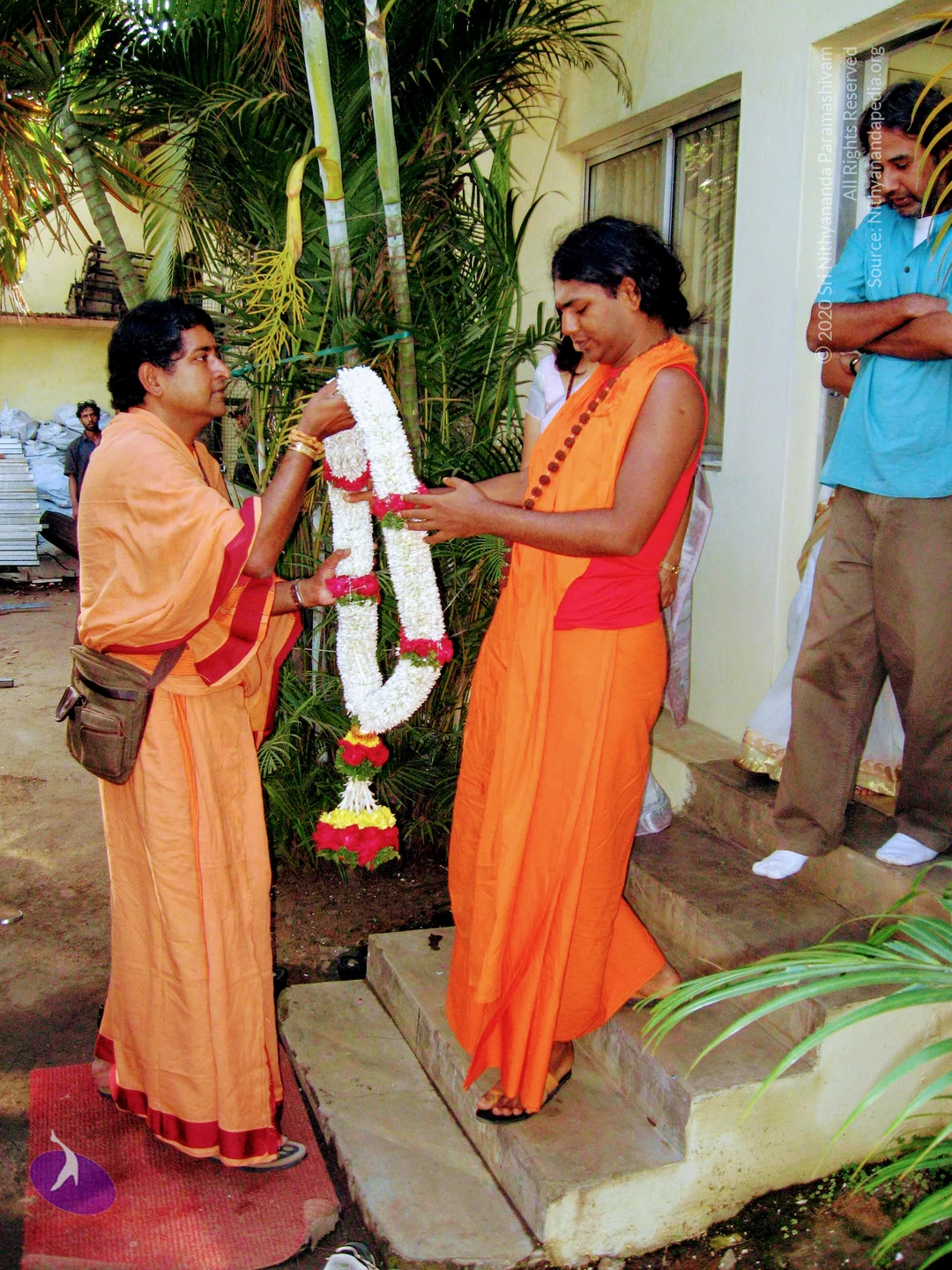
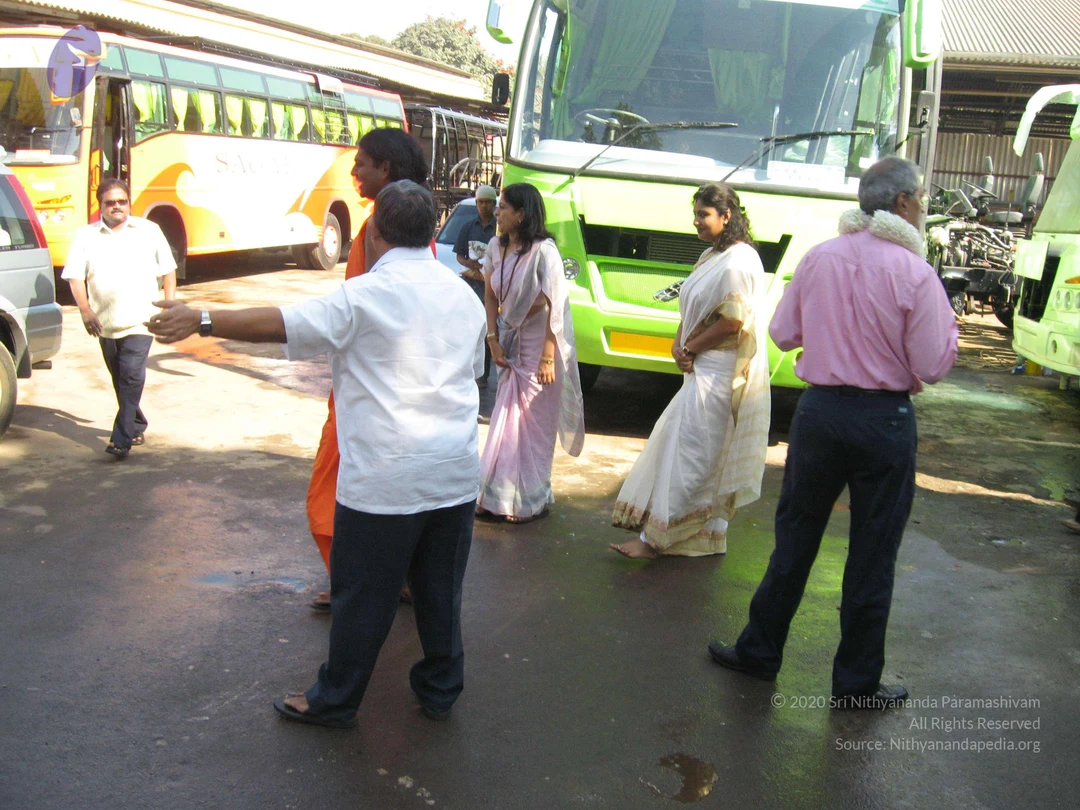
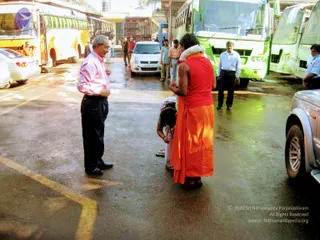
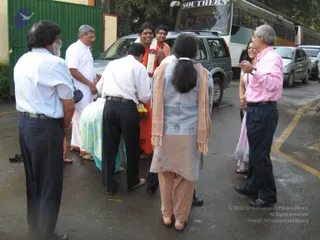
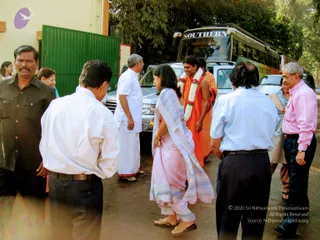
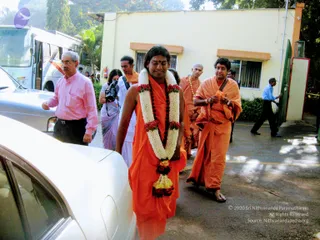
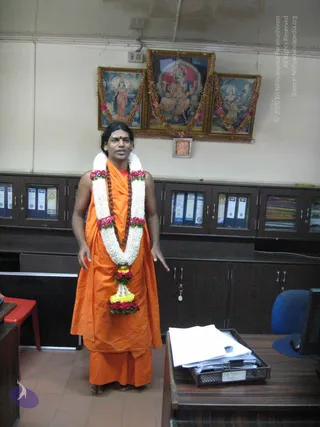
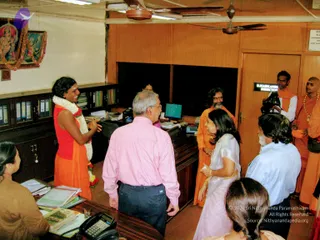
A photograph of a wet parking area beside rows of parked buses and cars. In the centre, a figure in an orange sleeveless top and orange wrap, wearing a white flower garland, stands with hands folded in front of a man in a pink shirt and dark trousers. A child in pink bends forward to touch the feet of the orange-clad figure. Other men in light shirts and dark trousers stand in the background among the vehicles.Outdoor photo on a wet paved forecourt beside a green gate, with a white Southern bus and parked cars behind. A smiling man in an orange robe with a red-and-white flower garland and a red tilak stands at centre, with a second man in an orange shirt just behind him. A man in a white shirt and dark trousers bends forward to offer something, while others in white kurta, pale blue shirt, pink shirt and a grey-blue vest with a beige shawl look on. a person (orange robe, garland, red tilak) appears in person, identified only by appearance cues.Outdoor street scene at a gated compound with a green metal gate and a pale yellow wall with a small purple logo. A large white Southern Travels coach bus and parked cars are behind a group of people. In the centre, a young man in orange saffron robes wears a long white and red flower garland and smiles, walking beside a woman in a pale pink and white sari with sandals. Around them, men in white shirts, one in a white dhoti, a man in a pink shirt with black trousers, and a man in a dark shirt look on. a person: the saffron-robed young man with a garland, but his appearance is not distinctive enough to confirm identity, so the figure is described only as a man in saffron robes with a garland.A photograph of a procession on a paved path outside a cream-coloured building with orange trim and a green gate. In the centre, a young man with long dark hair, wearing an orange saffron robe and a long white and red flower garland, walks forward smiling. Behind him, several saffron-robed monks follow, one bald and wearing a rudraksha mala, and another in a shawl holding folded hands. A man in a pink shirt and a woman in a lavender sari with a camera are visible at left, beside a white car, and a white bus stands in the background.A standing man in an office room wears a long saffron-orange robe with a bare right shoulder, a thick white and pink flower garland with a tassel of red and yellow flowers, and a rudraksha mala around his neck. He has long dark hair swept back, a red bindi on his forehead, and gestures with both hands while speaking. Behind him on a cream wall hang three framed devotional pictures garlanded with flowers, the central one showing a deity seated on a lotus. Dark wooden cabinets with binders line the wall, and a desk on the right holds papers and a computer monitor. Given the page's Swamiji flag and his cues of long swept-back hair, saffron robe, rudraksha mala and garland, he is a probable Swamiji candidate.A photograph of an office interior with wooden cabinets, binders on shelves, a wall fan, and a framed religious picture with marigold garlands at upper left. A woman in an orange top and orange wrap with a white and red flower garland, long dark hair pulled back, smiles and gestures toward a group. A man in a pink shirt and dark trousers stands with his back to the camera. A woman in a white sari with a pink border stands at center right, and a bearded man in an orange robe stands near the desk. At right, a man in orange robes with a shawl holds a camera, and another orange-robed man with a shaved head wears a beaded necklace. A woman in the foreground at lower right and another at left are partially visible. A desk holds papers, books and a black telephone.

05--BLESSING-OFFICE
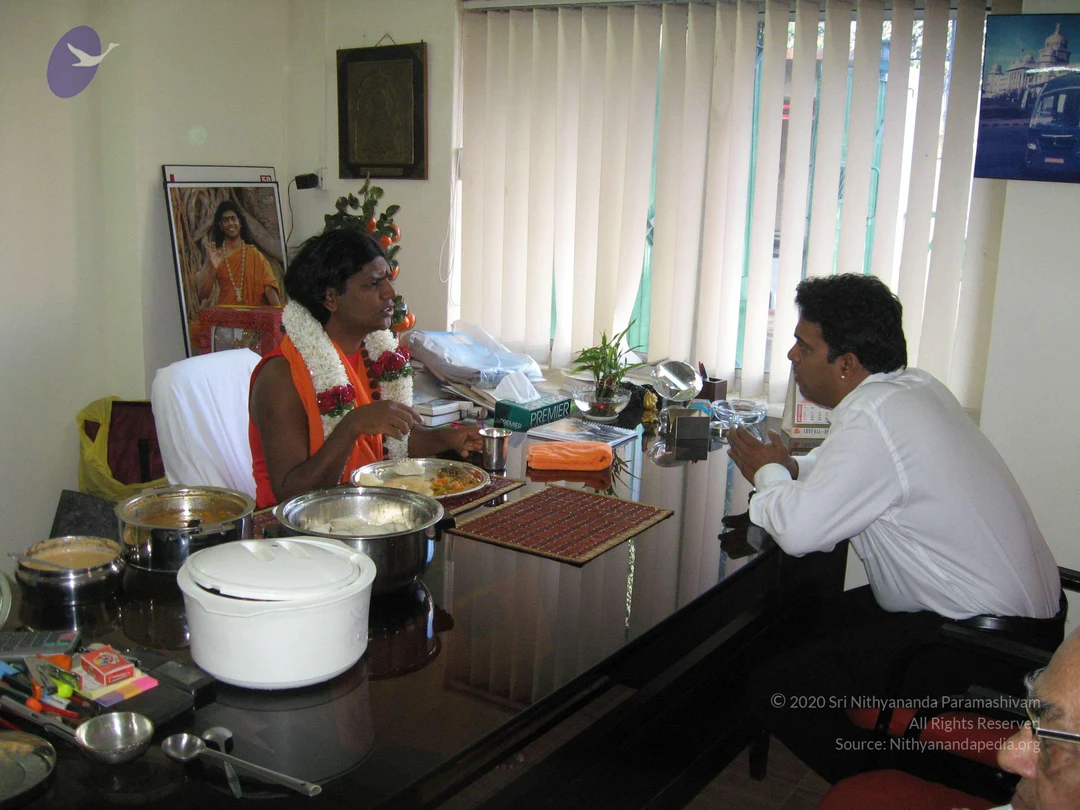
17 photosSource gallery
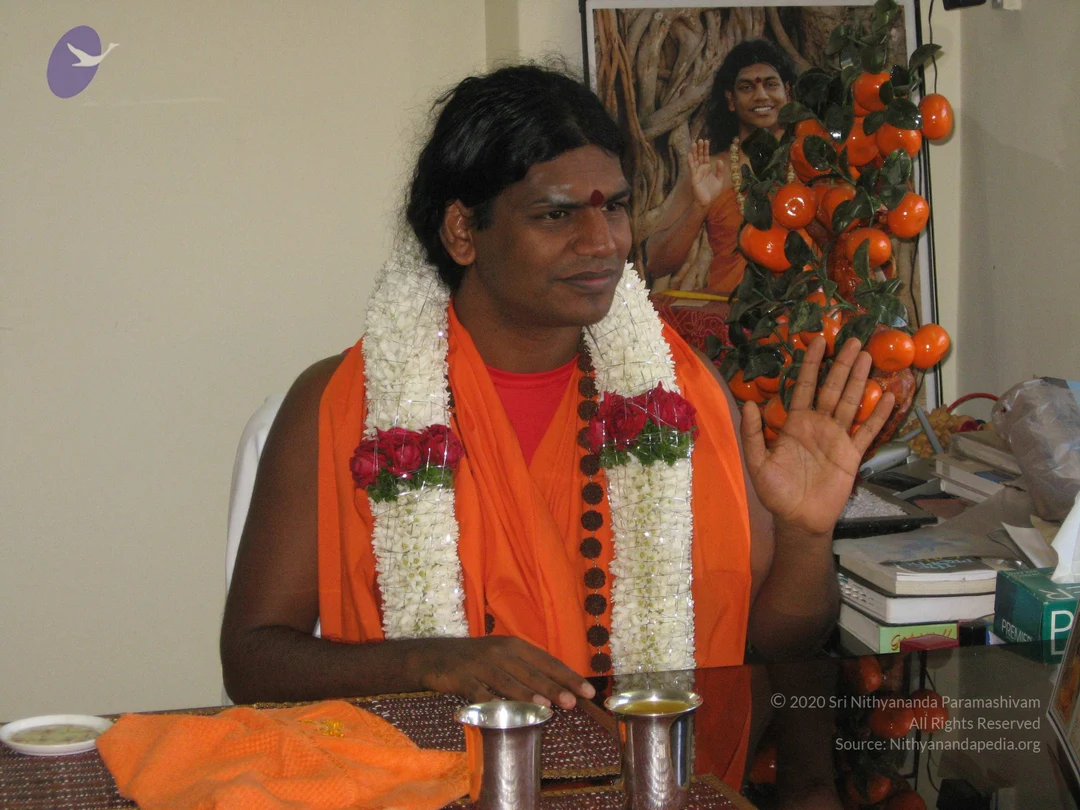
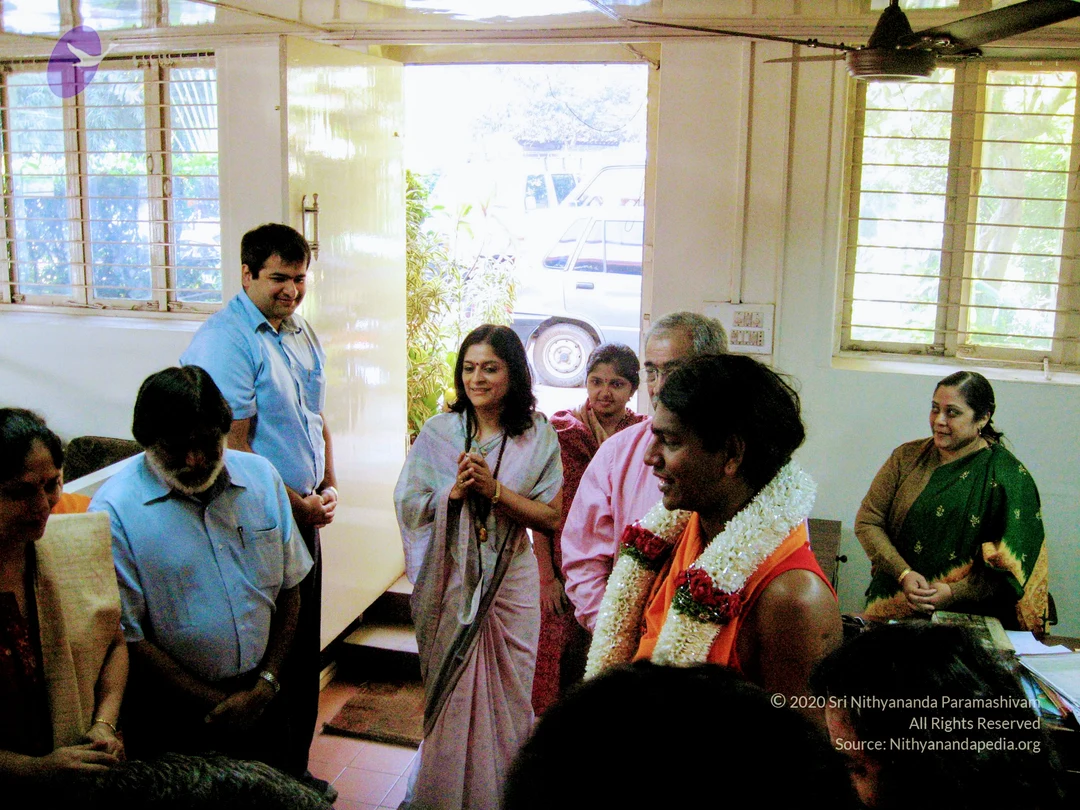
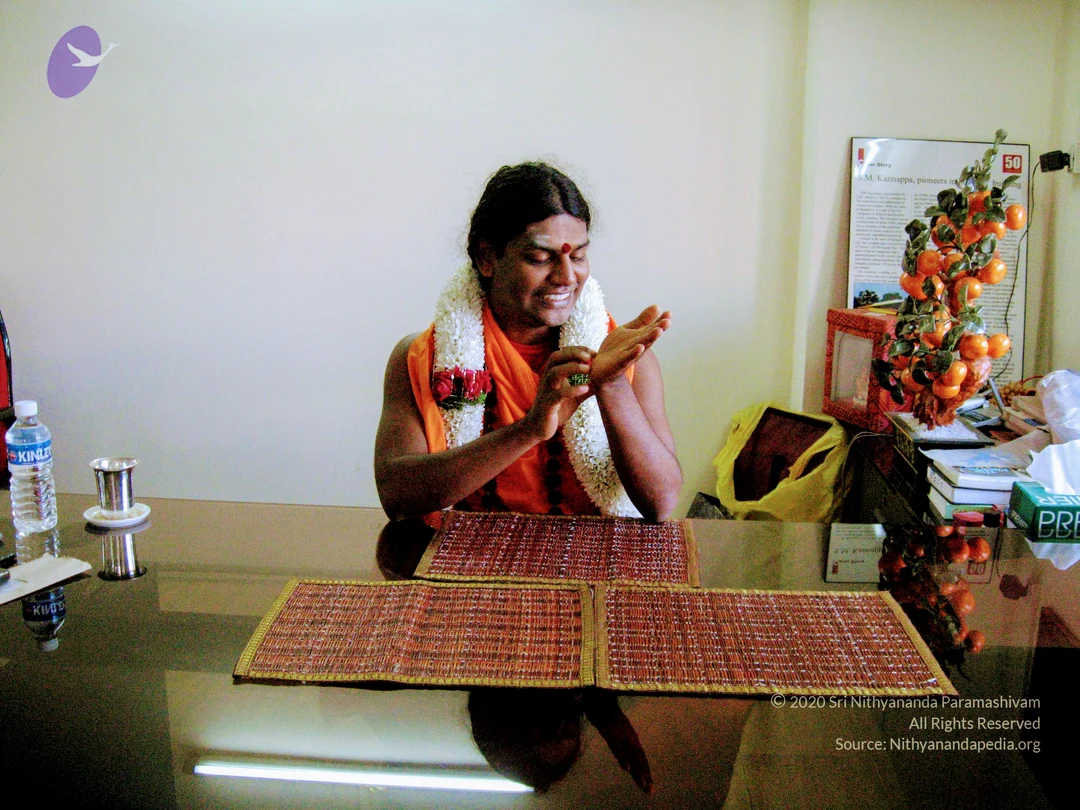
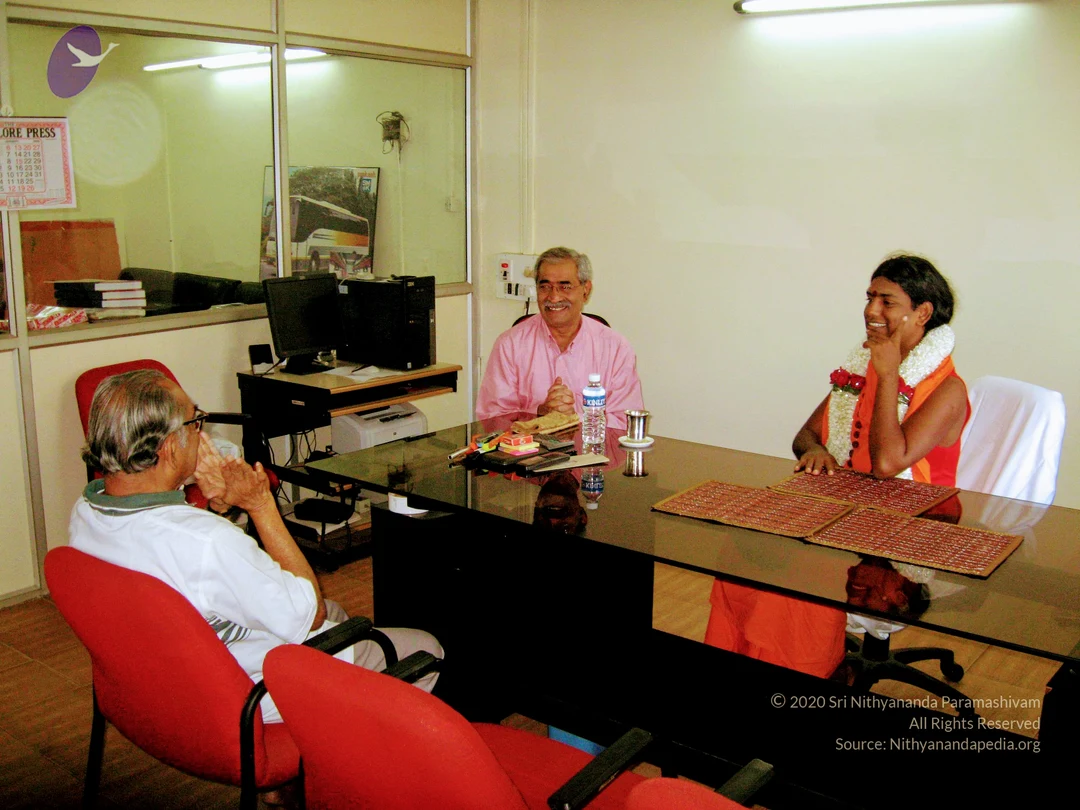
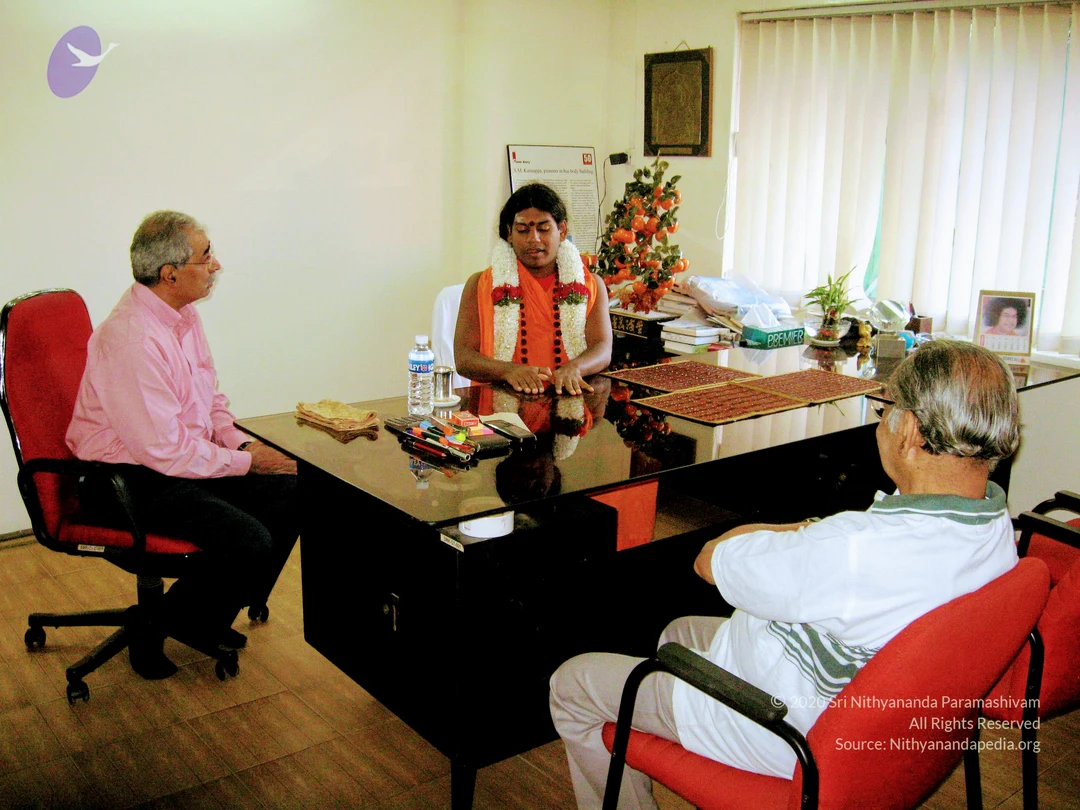
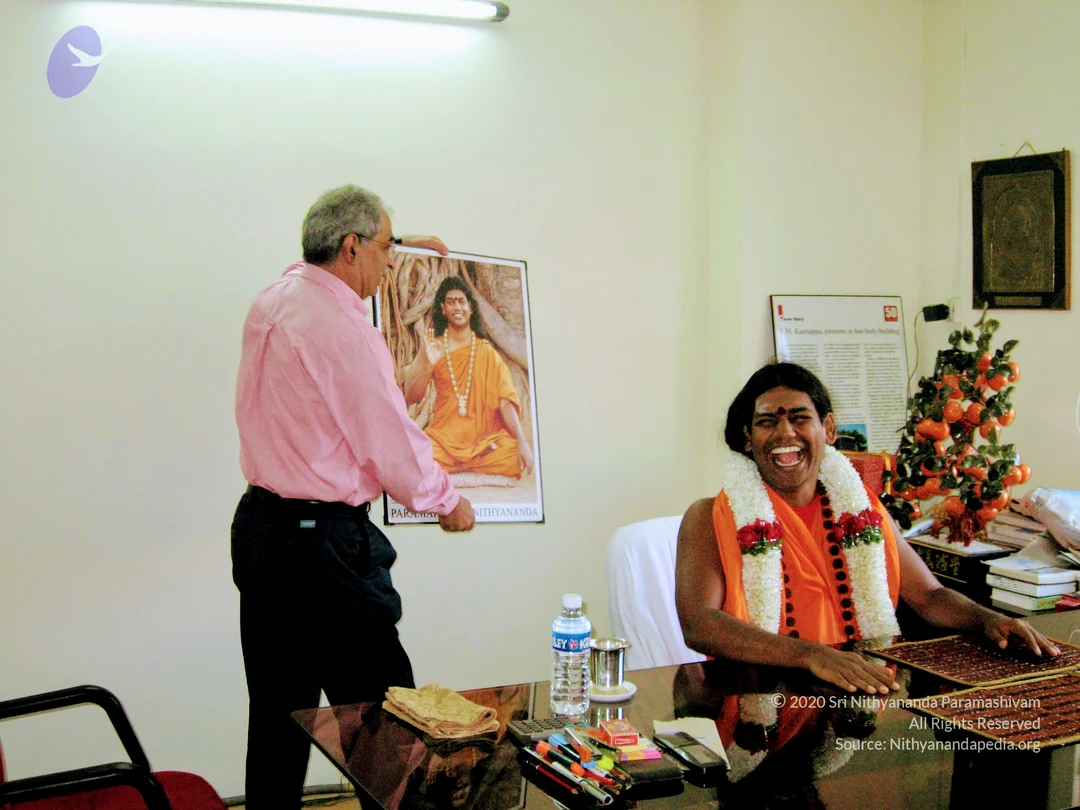
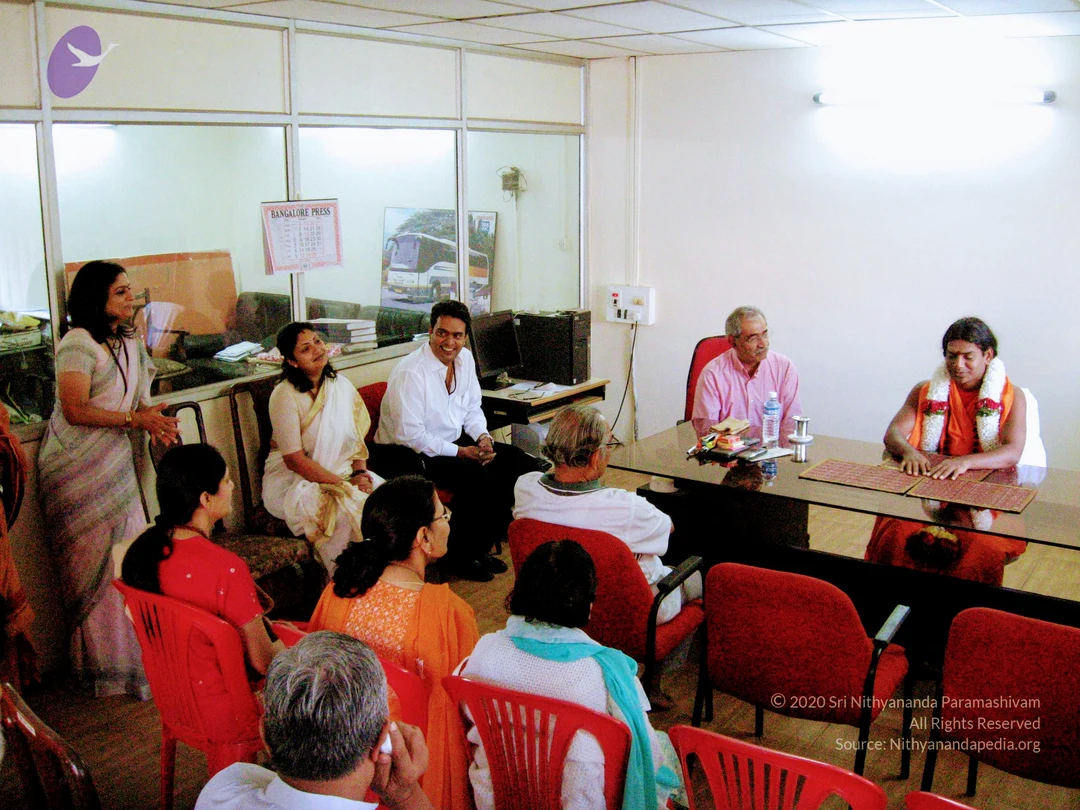
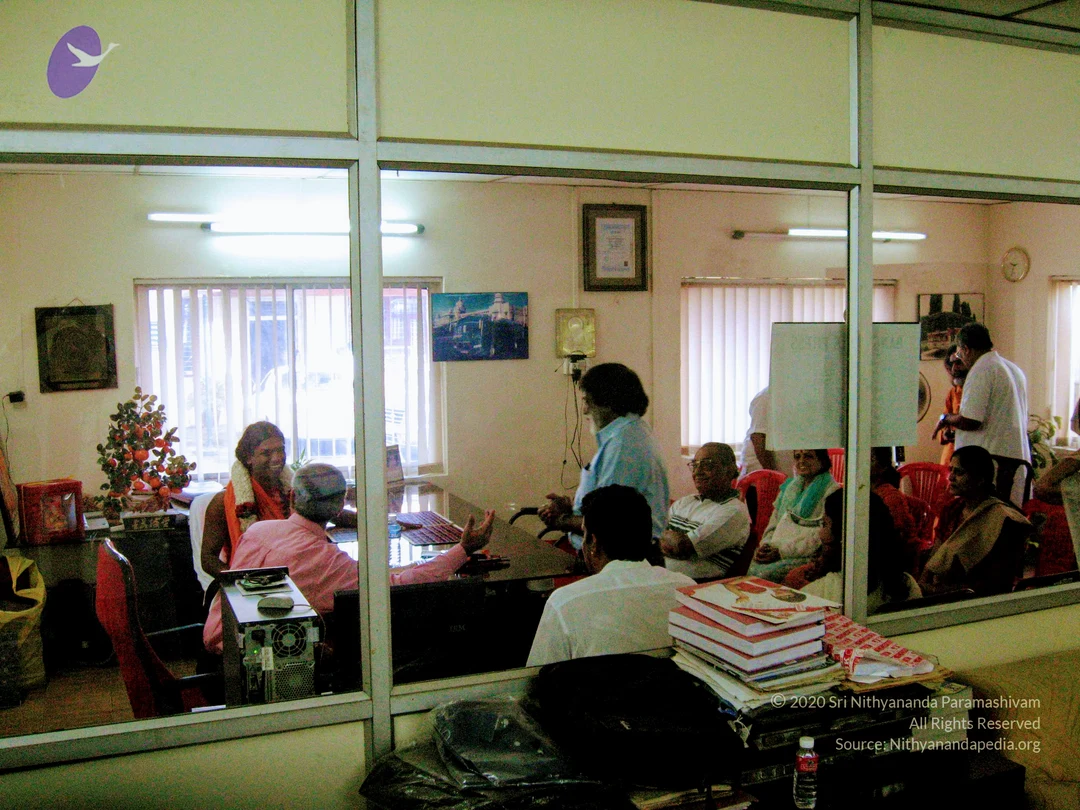
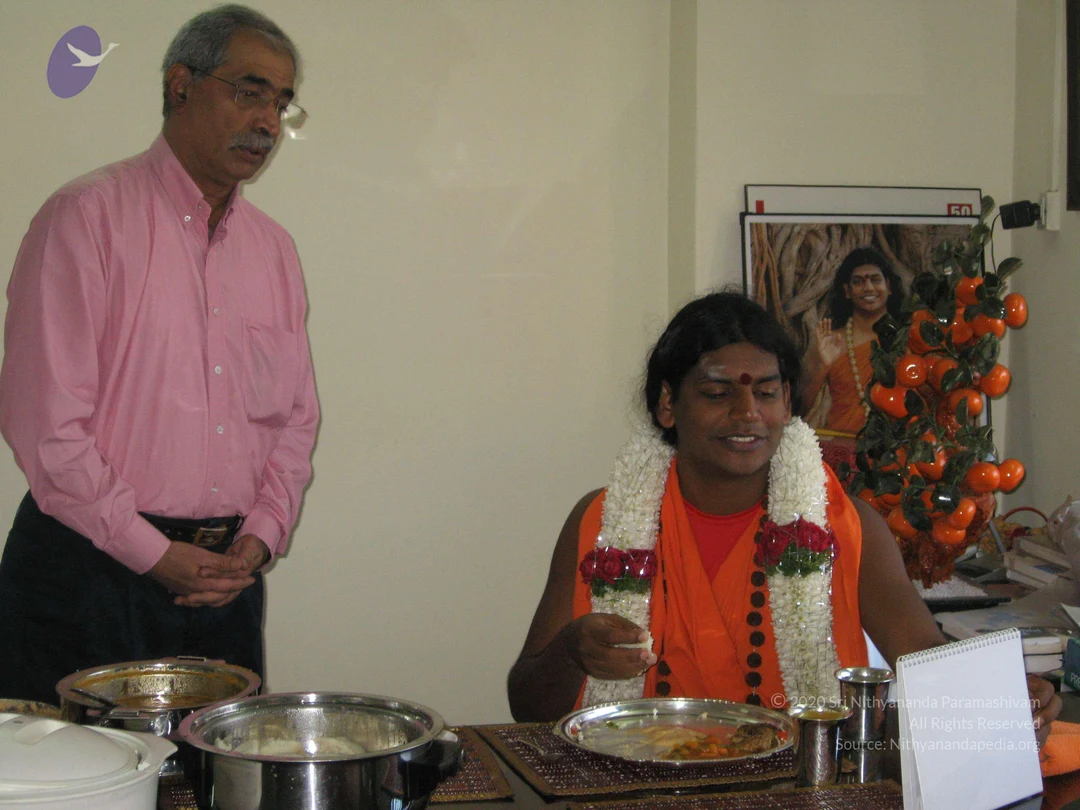
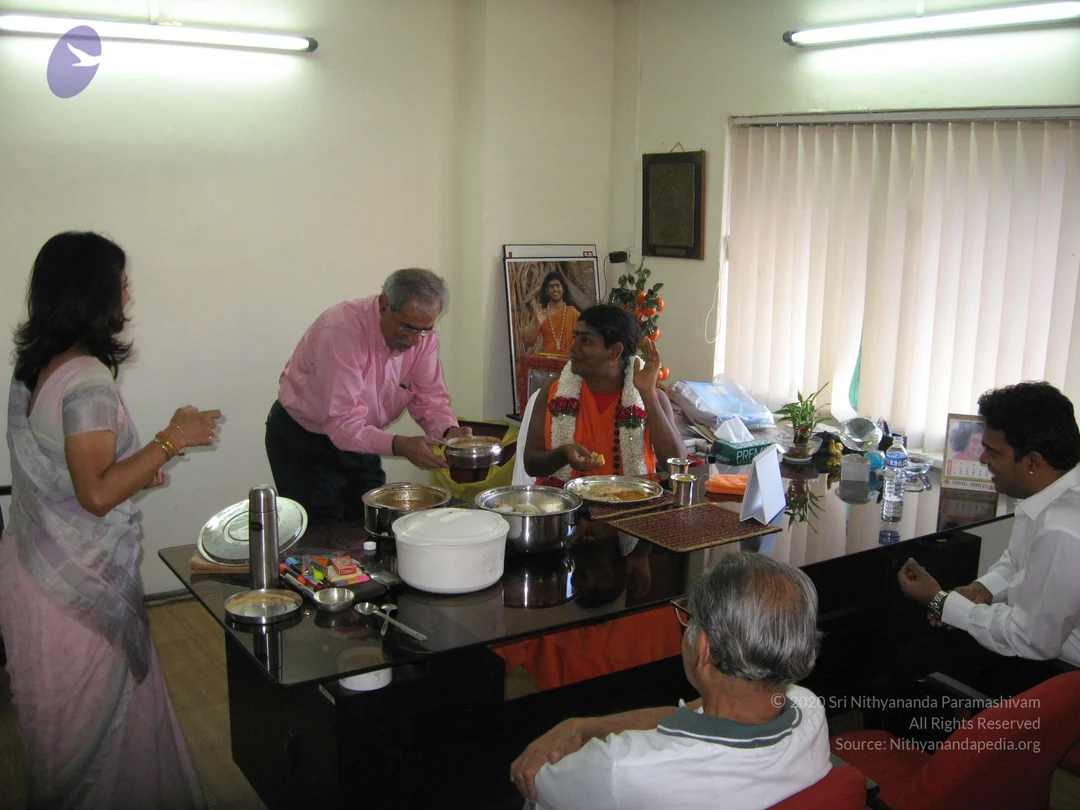
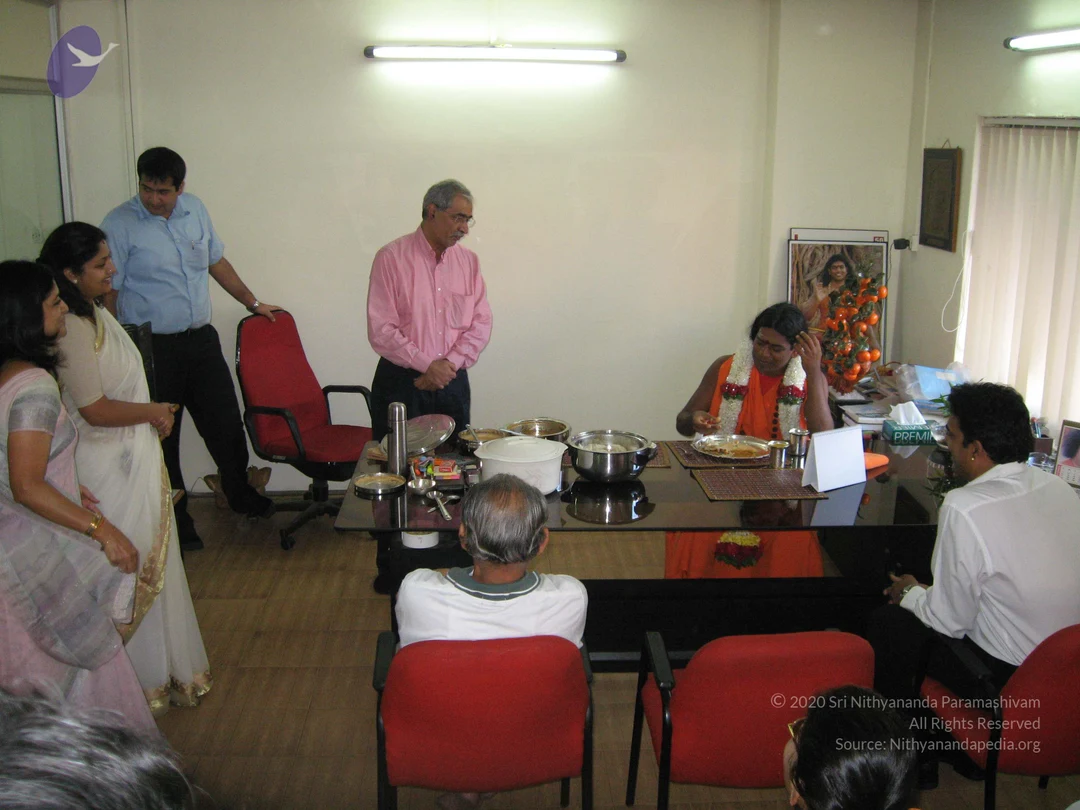
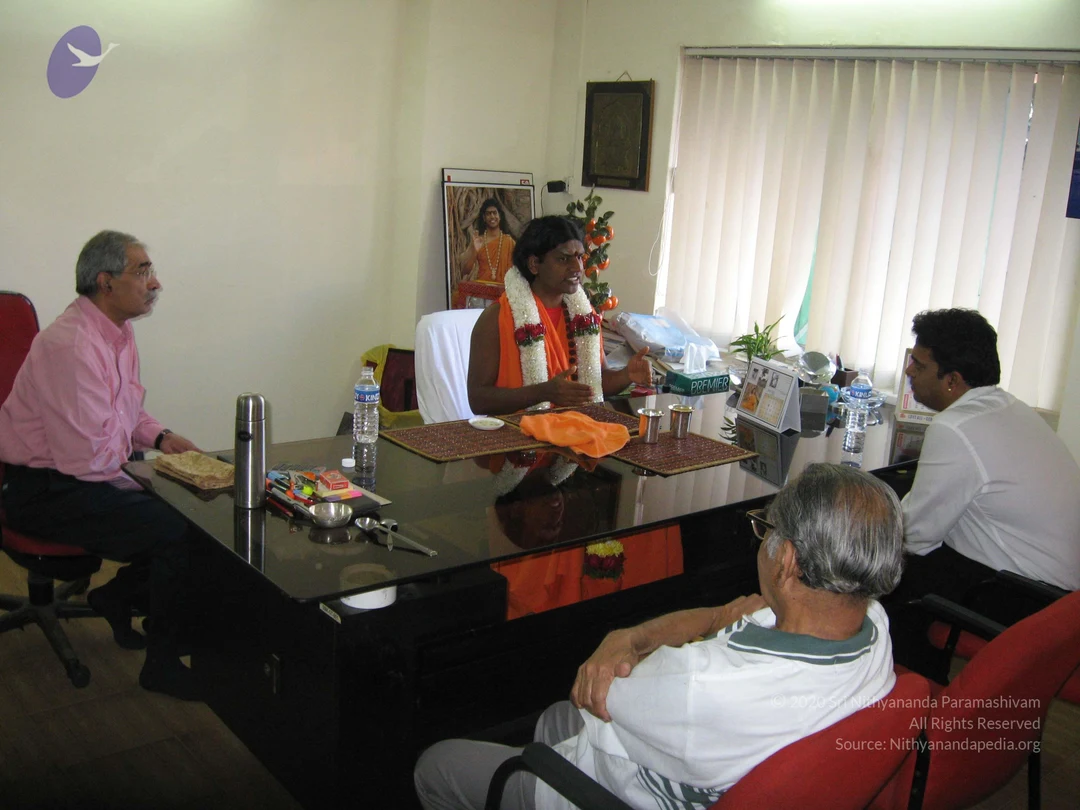
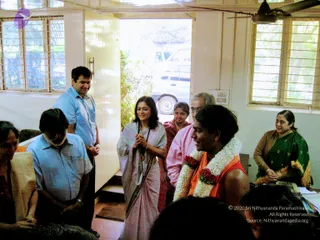
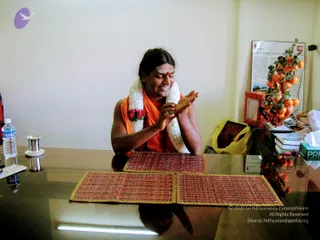
A photograph of an indoor office-like room with white walls, barred windows and a ceiling fan. Around him, a man in a pale blue shirt stands with hands joined near the doorway, a woman in a pale lavender sari with a shawl holds her palms together in greeting, a woman in a red top stands behind her, and an older man in a pink shirt stands beside the garland-wearer. A seated woman in brown and a seated woman in a green sari stand at the right, and a seated man in a light blue shirt and a woman with her head bowed sit at the left. Through the open door, parked white cars and greenery are visible.A photograph of a man with long dark hair seated at a glass table, smiling and pressing his palms together. He wears an orange saffron wrap over his shoulders and a white flower garland with red flowers around his neck, with a small red dot on his forehead. Two woven reed-style mats in red and gold border lie on the table before him. Behind him on the wall is a framed poster headed with a name and a large number 50, beside a red-framed picture and a tabletop arrangement of orange-fruited branches. A water bottle and steel tumbler sit on the left. The appearance is consistent with the page label, but the face and features are not clear enough to confirm identity.A photo of three men seated around a glass-topped conference table in a plain office with cream walls and red upholstered chairs. On the right, a man with a swept-back dark hair wears an orange-saffron robe and a white flower garland, one hand resting on the table and the other at his chin, smiling. Across the table, a man in a pink shirt with glasses sits with hands clasped, smiling. On the left, an older man with grey hair and glasses in a white shirt sits in the foreground, his hand raised to his face. A water bottle, steel tumblers and papers sit on the table; a computer monitor and printer stand behind a glass partition showing a poster on the wall.A photograph of an office meeting. A young person in a saffron-orange robe with a white flower garland and red floral garland sits behind a large dark glass desk with hands folded, a person by appearance cues of saffron clothing and garlands in an office setting. On the left, a man in a pink shirt and dark trousers sits in a red chair facing him. In the lower right foreground, an older man with grey hair wearing a white shirt sits in a red chair with his back to the camera. On the desk are a water bottle, a glass, pens and papers, and a small potted plant. A framed photograph of a woman and a vertical framed display sit behind the desk, with a red-and-orange floral arrangement and white vertical blinds by the window.An office interior where a man in a pink collared shirt and dark trousers stands at left, reaching up to hang or adjust a framed poster on a pale wall. The poster shows a seated figure in orange robes with a long beaded necklace, hand raised in blessing, against a tree trunk background. At right, a seated man with long dark hair, a red tilak, a rudraksha mala and a white flower garland over saffron/orange robes laughs heartily behind a glass desk. The desk holds a water bottle, a steel tumbler, pens, papers and a flatbread, and a decorated tree with orange fruit stands in the corner beside a framed notice on the wall.A photograph of an indoor meeting room with white walls and a glass partition. A man with a shaved head sits at the far end of a long table, wearing an orange shawl and a white garland, with a small silver vessel and a water bottle on the table in front of him. Seated opposite him in a pink shirt is an older man. Several people sit in red plastic and red padded chairs facing the table, including a woman in an orange top and another in a white and teal shawl. A standing woman in a grey-and-cream sari gestures toward the group near the glass partition. A wall calendar reads Bangalore Press, and a bus picture hangs in the background. The shaved-headed man's appearance does not clearly match the page's a person claim, so he is described by role only.

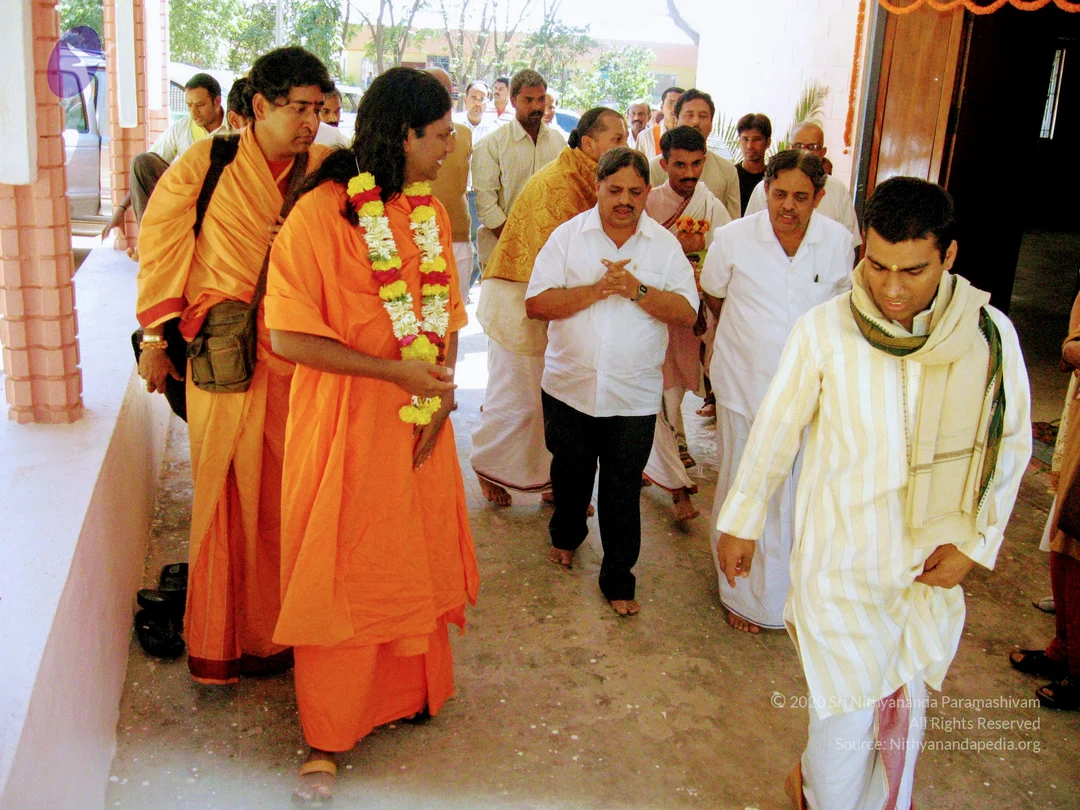
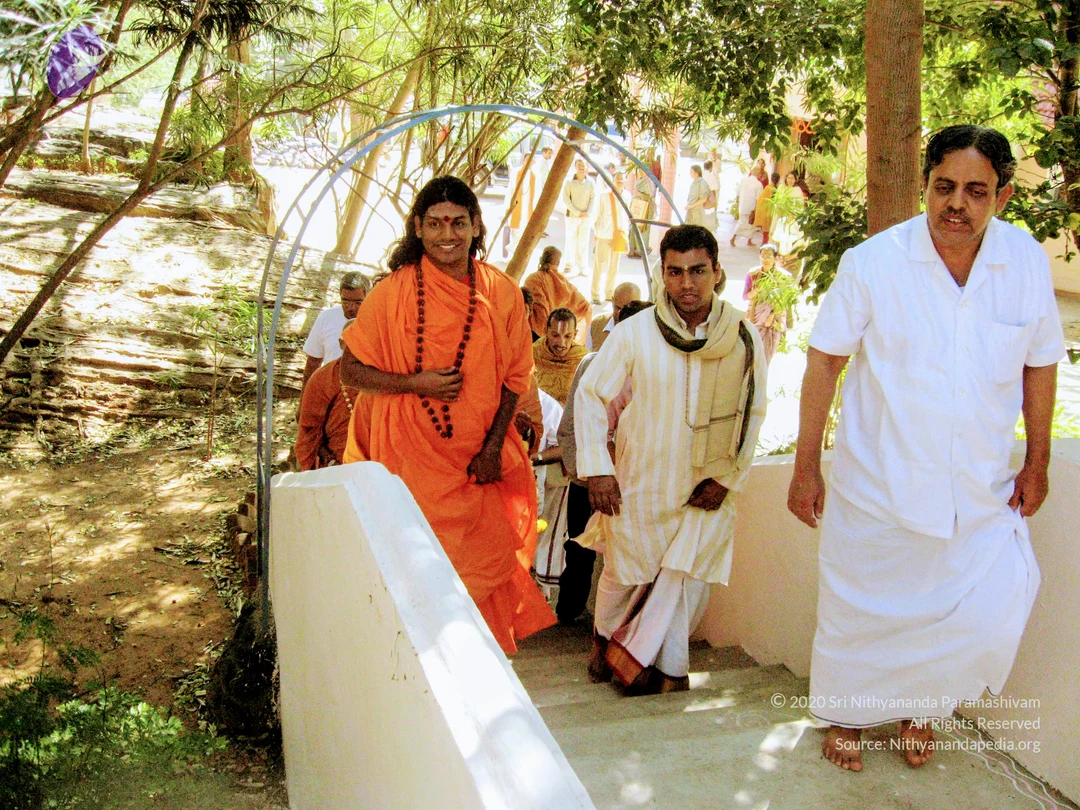
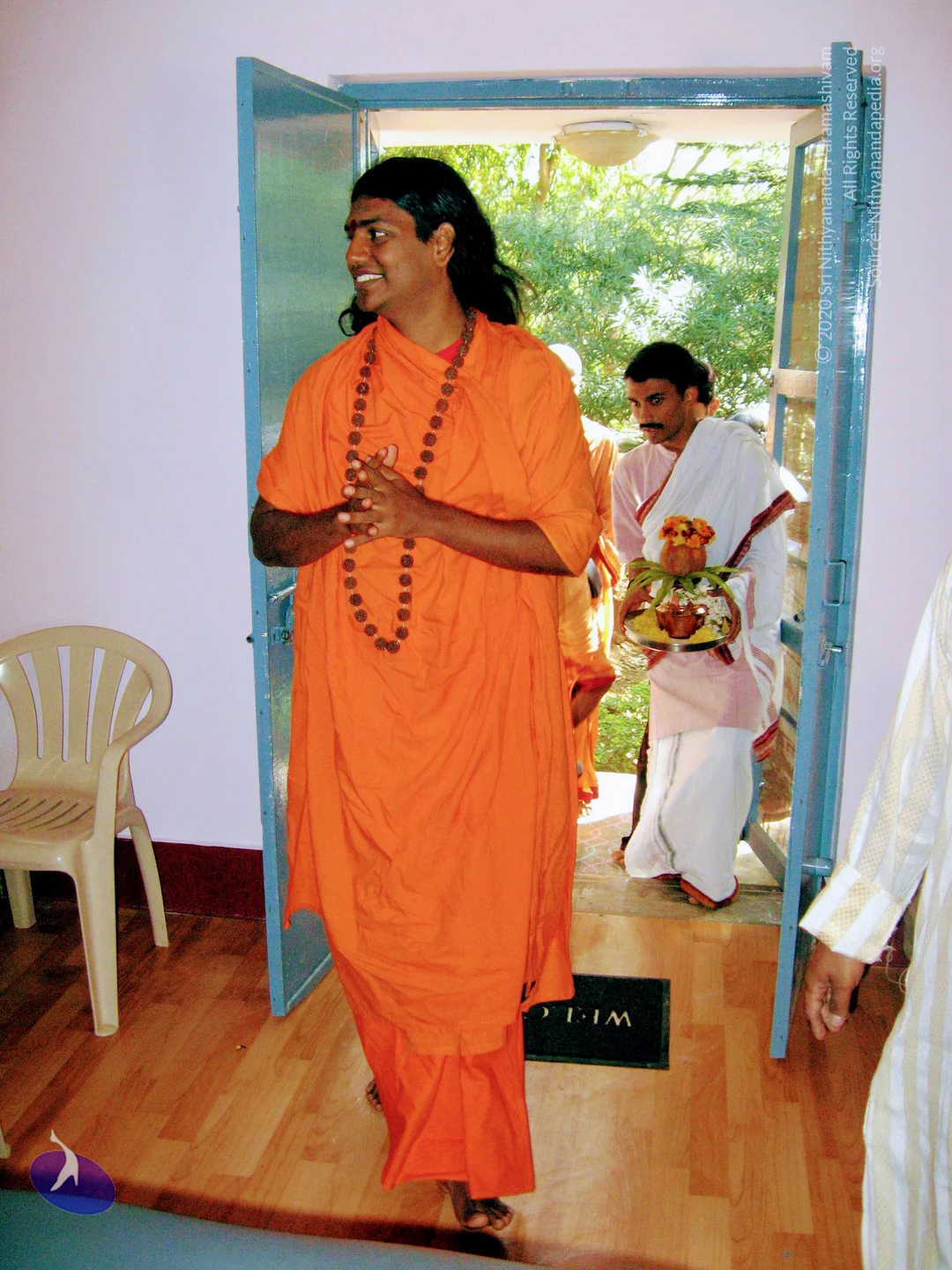
06--RECEIVING-SWAMY-VYASA-UNIVERSITY
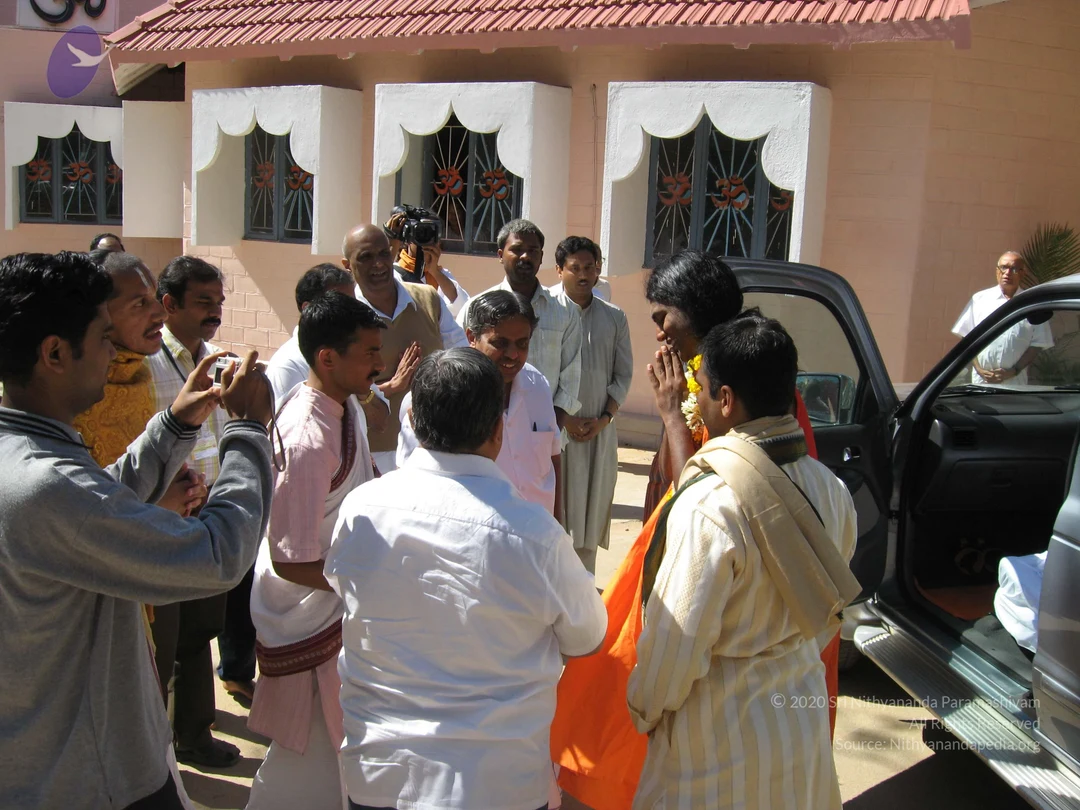
11 photosSource gallery
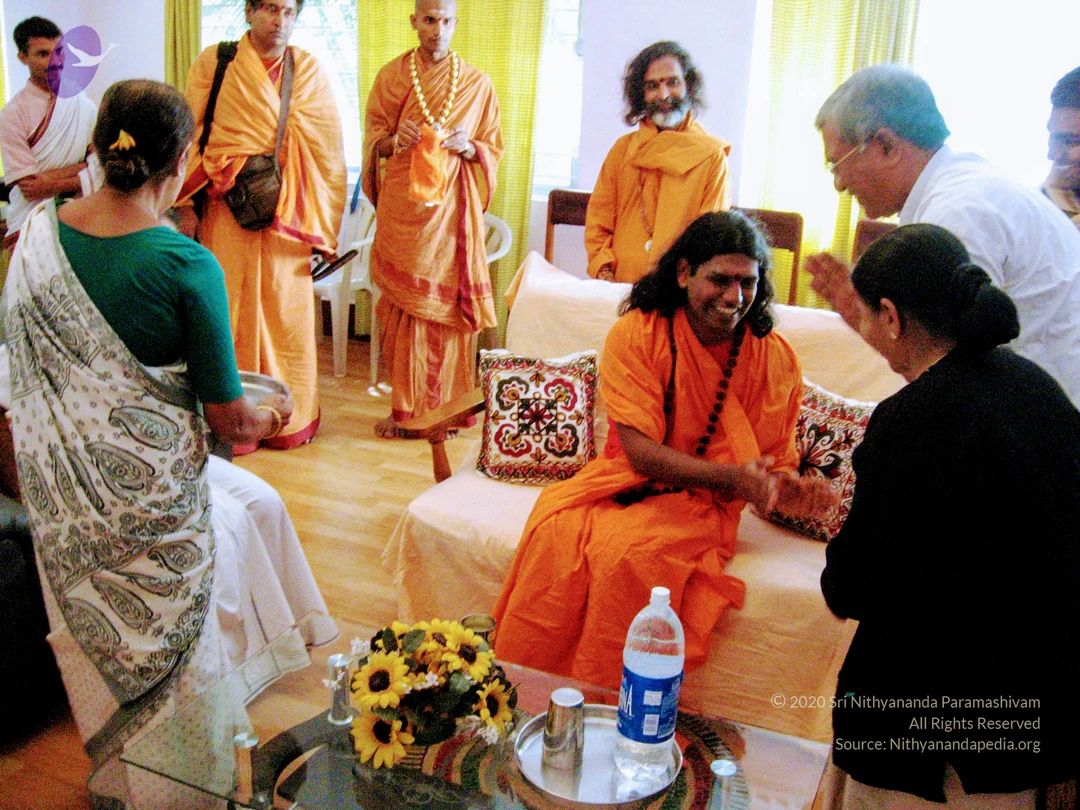
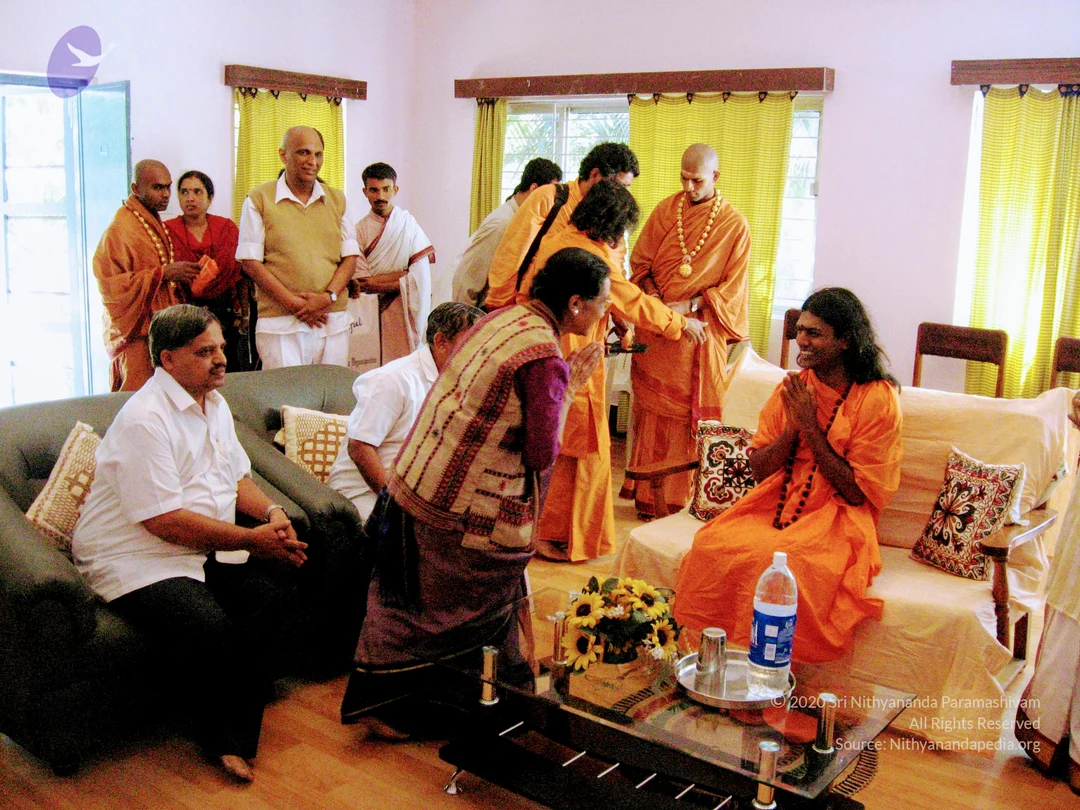
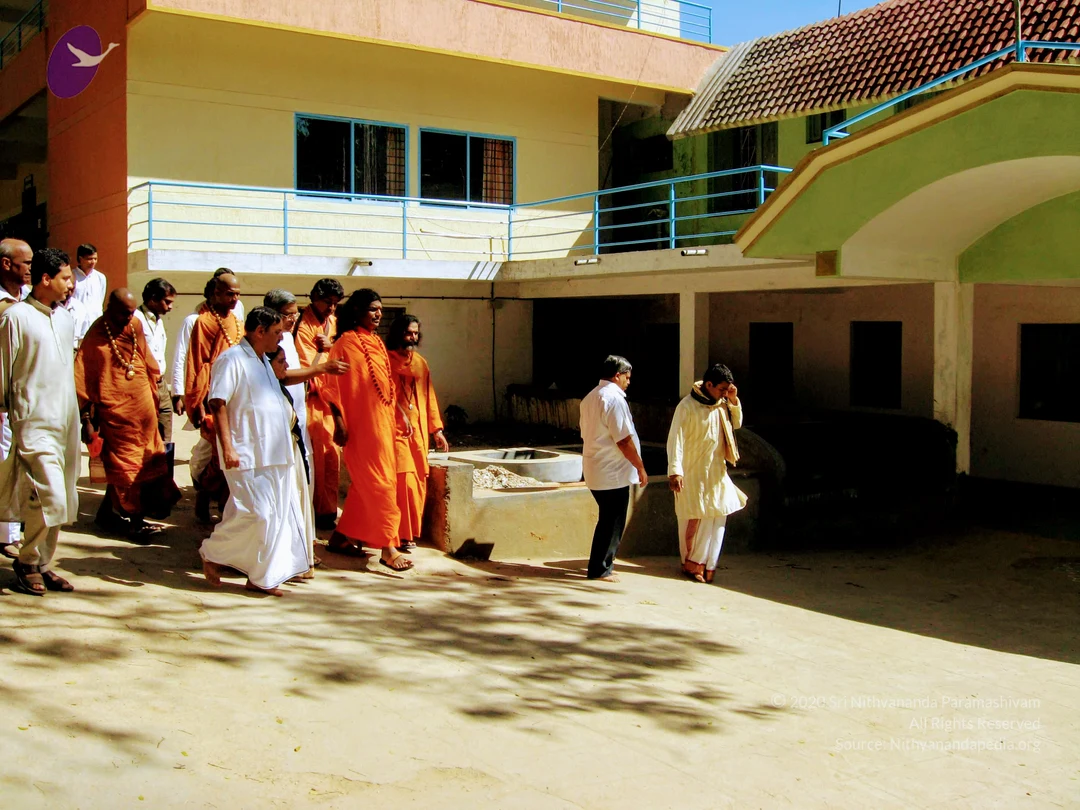
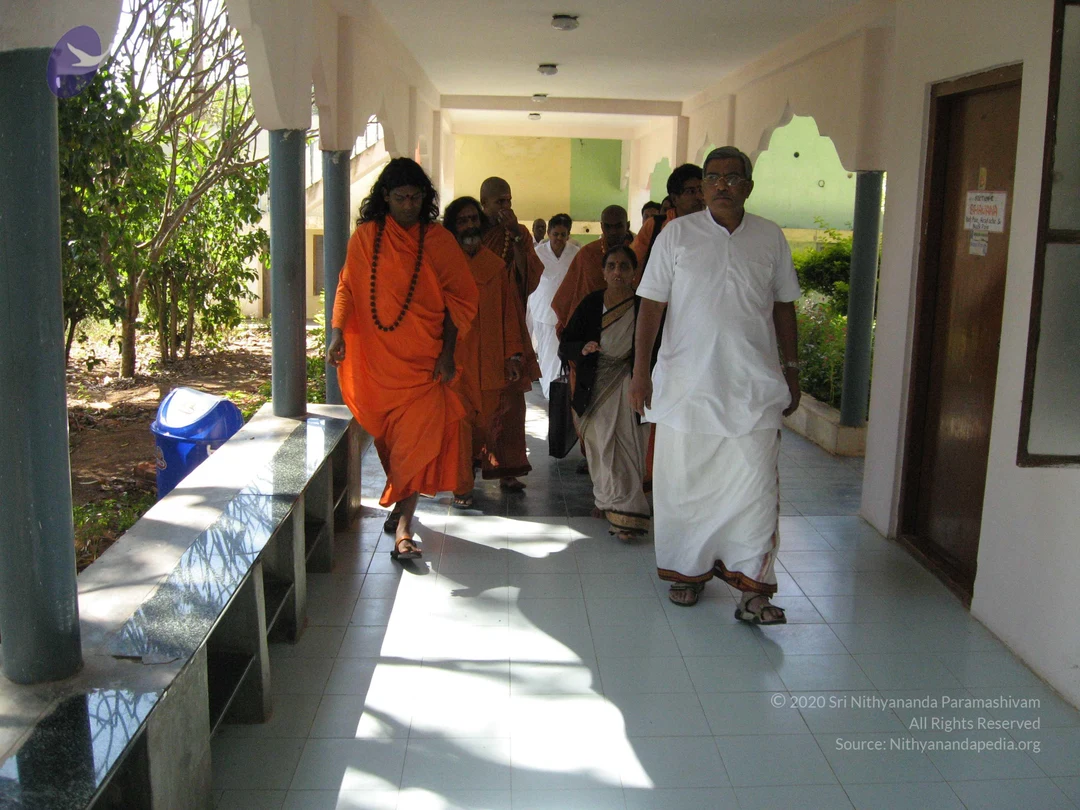
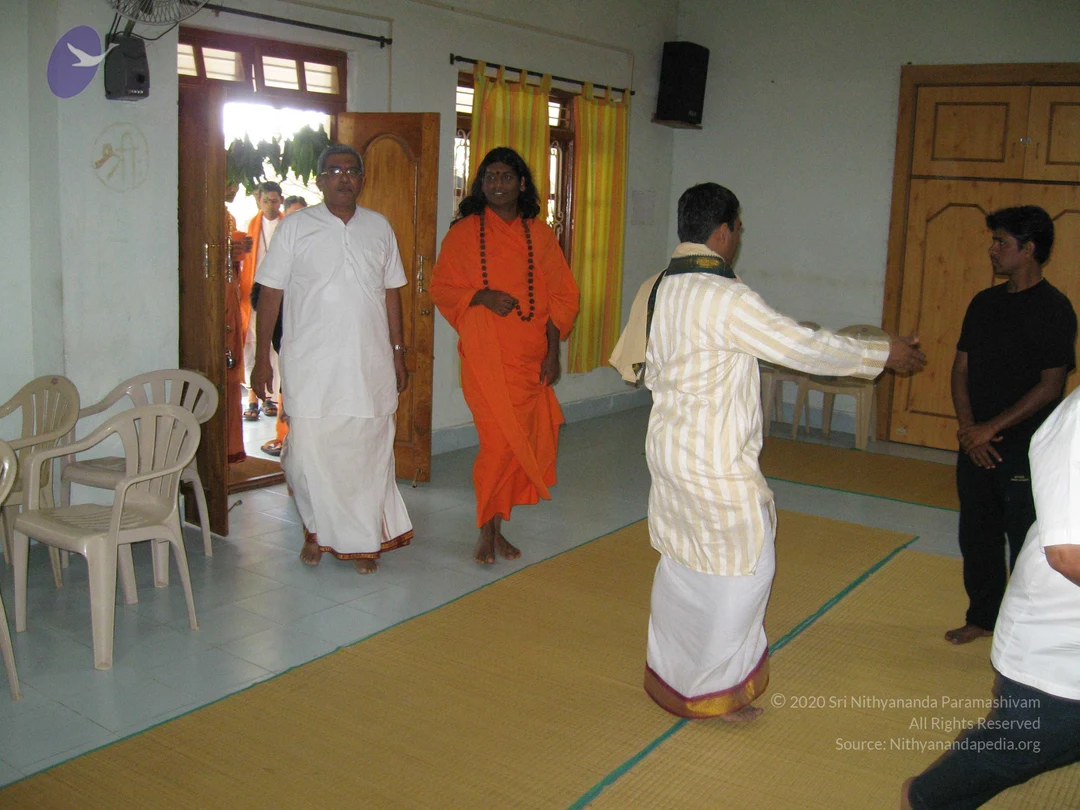
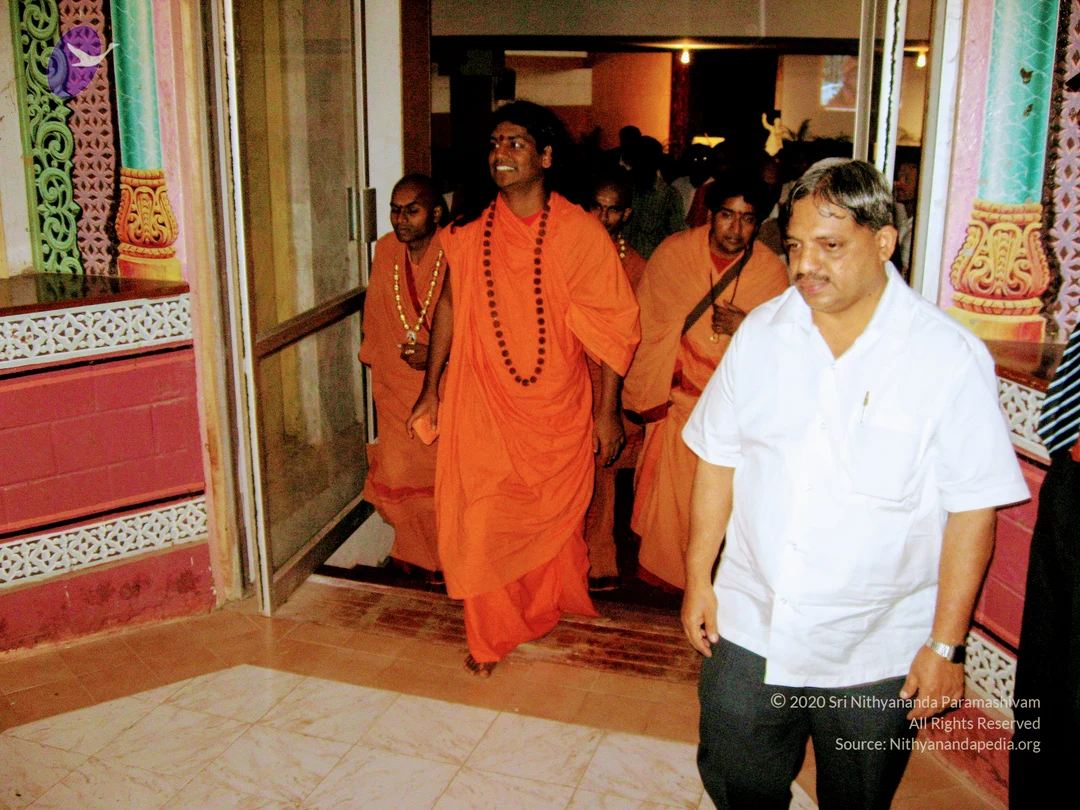
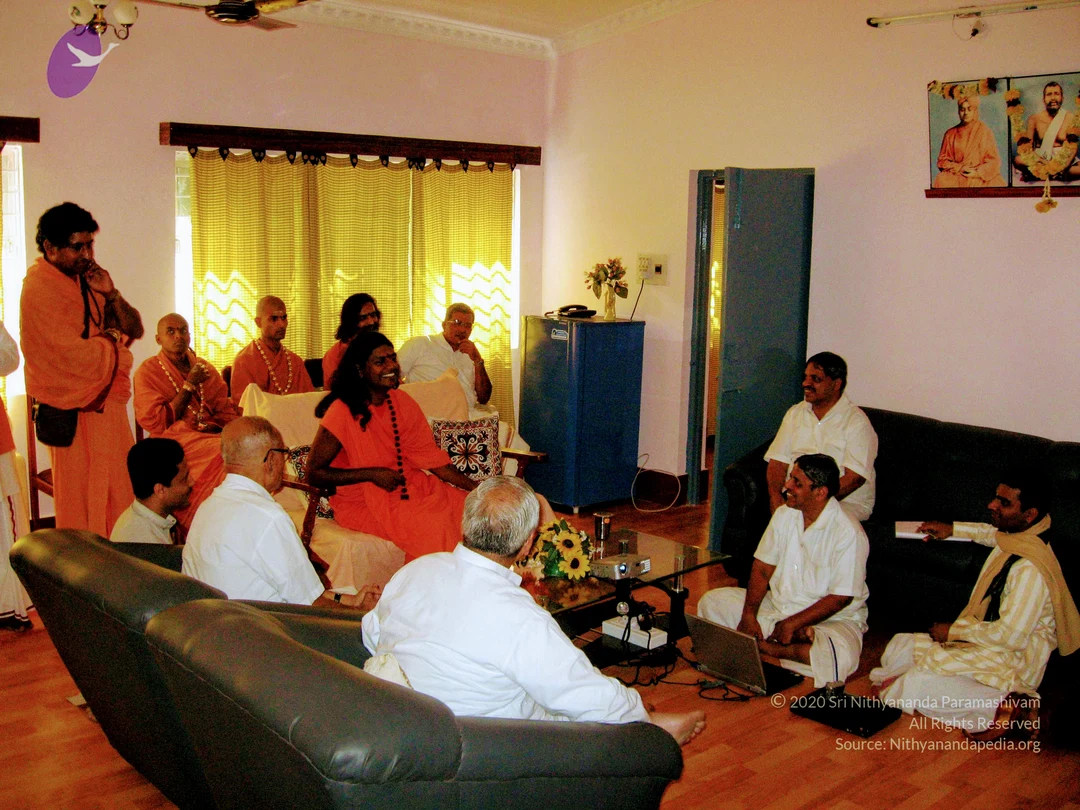
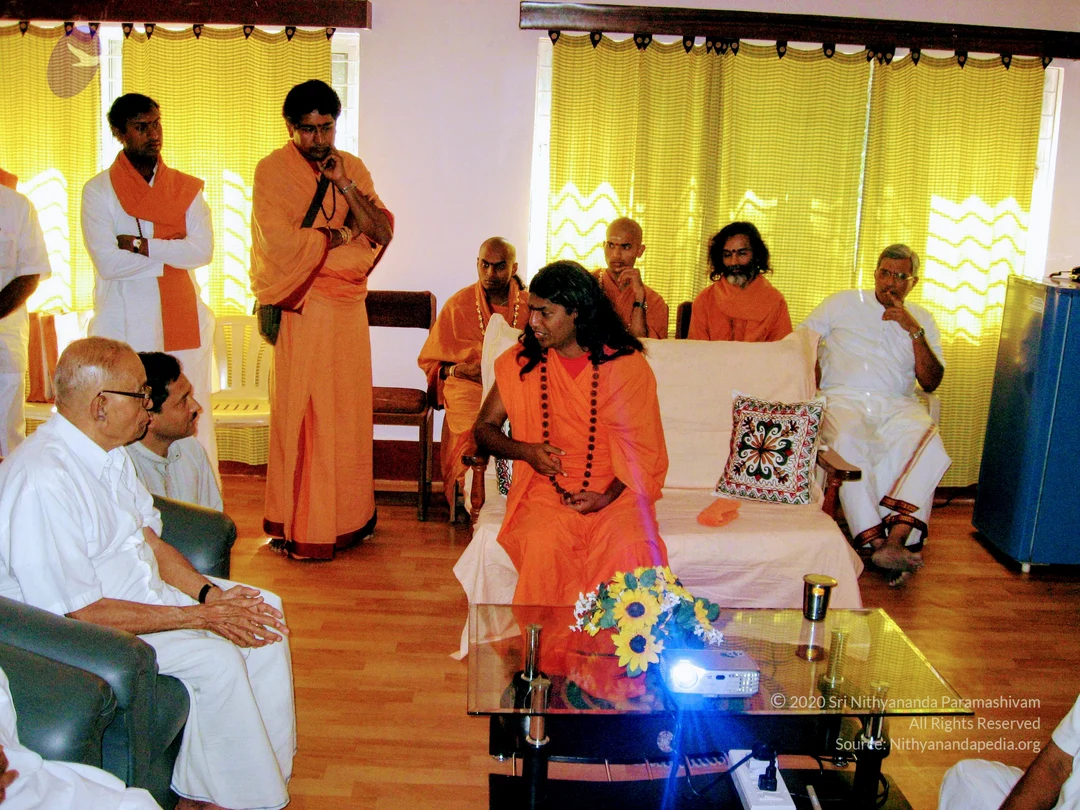
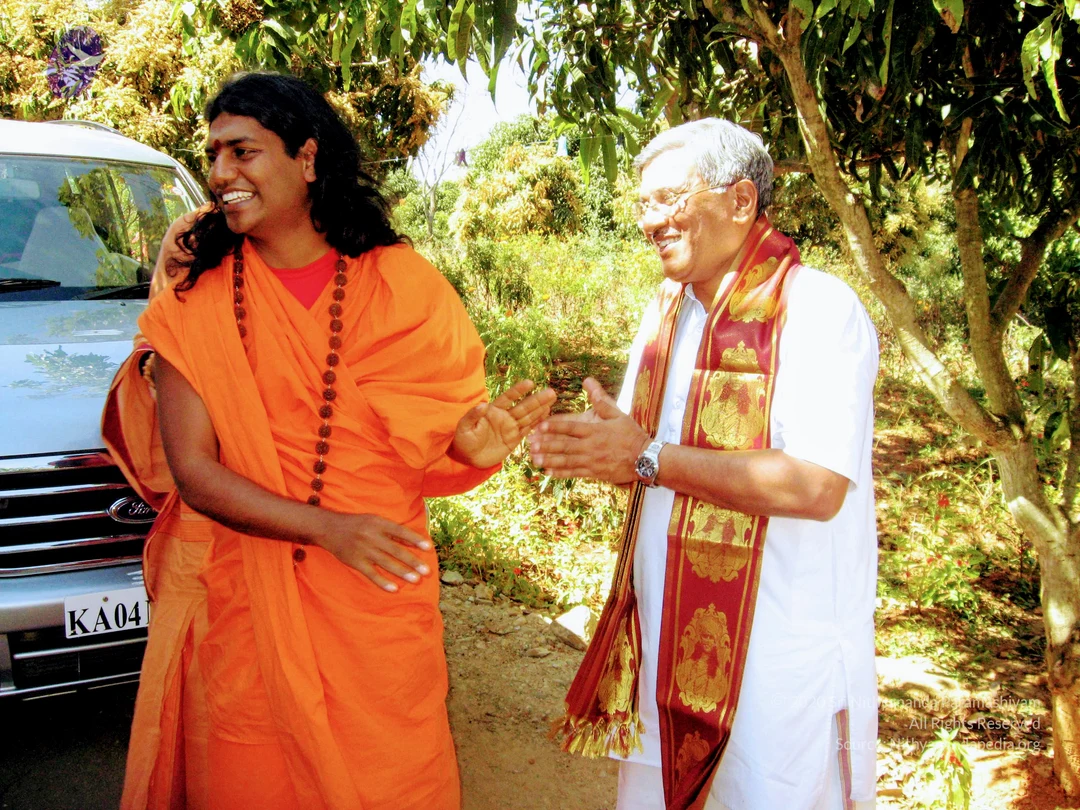
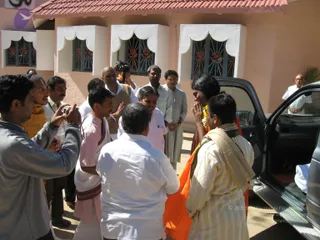
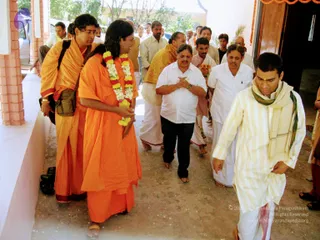
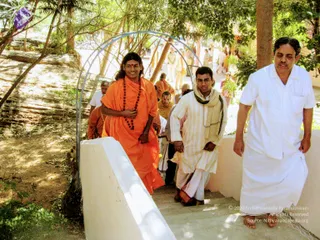
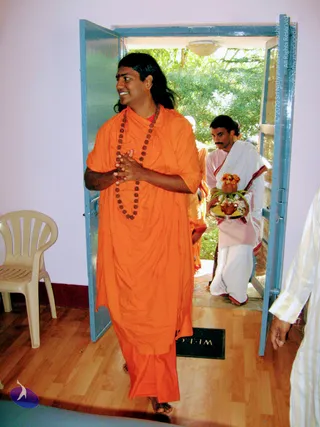
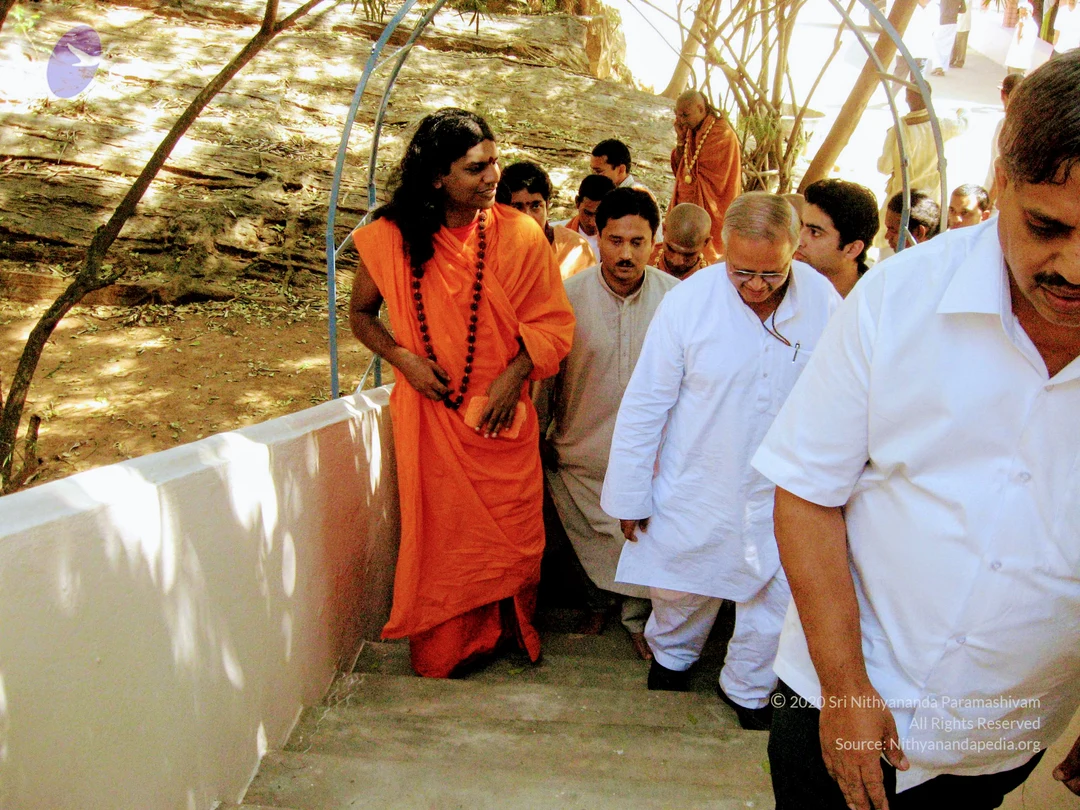
Outdoor photo at the entrance of a peach-coloured building with white-framed windows decorated with orange Om symbols. A woman with dark hair, wearing an orange-red sari and a yellow-white garland, stands at an open dark car door with hands joined in greeting. Around her a crowd of men in white shirts, grey and cream kurtas, and a pink dhoti-style garment gather closely; one man on the left holds a phone up to photograph, and a cameraman is visible behind the group. A man in a cream striped kurta with an orange cloth over his shoulder stands in the foreground near the car. Several onlookers in the background, including one in a white shirt at the right edge. Bright daylight, palm plant at right.A photograph of a group walking barefoot along a covered corridor in a building with pink brick pillars. In the centre, a person in orange robes wears a long garland of white, yellow and red flowers and gestures while speaking. Beside them, another person in orange robes and a shoulder bag walks alongside. Behind and around them, men in white shirts and white dhotis, one in a gold-yellow shawl, and others in white and cream kurtas follow. A man in a striped cream kurta and shawl walks in the right foreground. Garlands hang near the doorway and the scene is bright with sunlight.A photograph of people walking down a white-walled stone stairway beneath shady trees under an arched metal trellis. In front, a man in a saffron-orange robe with a long rudraksha mala, long swept-back hair and a red bindi walks with a slight smile, with a bare-chested presence wrapped in orange cloth, appearing to be a person candidate by long hair, saffron clothing and rudraksha mala. Beside him a young man in a white striped kurta with a cream shawl and white dhoti climbs the steps, and on the right an older man in white shirt and white dhoti walks barefoot. Behind them other people in white and saffron clothing move along a path, with a stone outcrop and foliage on the left.A man with long dark hair and a wide smile walks through a blue-framed doorway into a room with a wooden floor and a white plastic chair. He wears an orange saffron robe and a long rudraksha mala, with his palms pressed together in greeting. Behind him, another man in a white dhoti and pink-bordered shawl carries a silver tray holding a kalasha with orange flowers, a brass vessel and a pile of yellow rice, while a robed attendant in orange stands in the background. Trees show through the open door. a person cues present: long swept hair, saffron robe and rudraksha mala, shown in person as the central figure.A seated man in saffron-orange robes with long dark hair and a rudraksha mala sits on a cream-covered bench with embroidered cushions, smiling as a woman in a black top bows and reaches toward his hands. Nearby a woman in a green blouse and patterned white sari kneels beside a silver tray, while several standing men in orange robes and one with a beaded necklace watch. A man in white shirt leans in at right. A table holds sunflowers, a water bottle and small metal cups; yellow curtains hang behind. The scene shows devotees offering reverence in a room. Swamiji (probable): the seated man has long swept-back hair, saffron clothing and a rudraksha mala, a distinctive set of cues.Indoor photo of a living room with pale pink walls, yellow curtains and a glass coffee table holding sunflowers, a water bottle and a tray with glasses. A long-haired man in orange robes and rudraksha mala sits with palms pressed together on a white sofa, appearing to be receiving devotees. A woman in a striped shawl and maroon top bows with folded hands toward him. Two men in orange robes with garlands stand behind, one holding a small object, along with a man in a cream vest and a man in white dhoti. A seated man in a white shirt sits on a grey sofa at left. Swamiji (probable): the seated long-haired figure in orange with rudraksha mala and swept-back hair. Six people visible.

07--SWAMY-AT-PRAYER-HALL
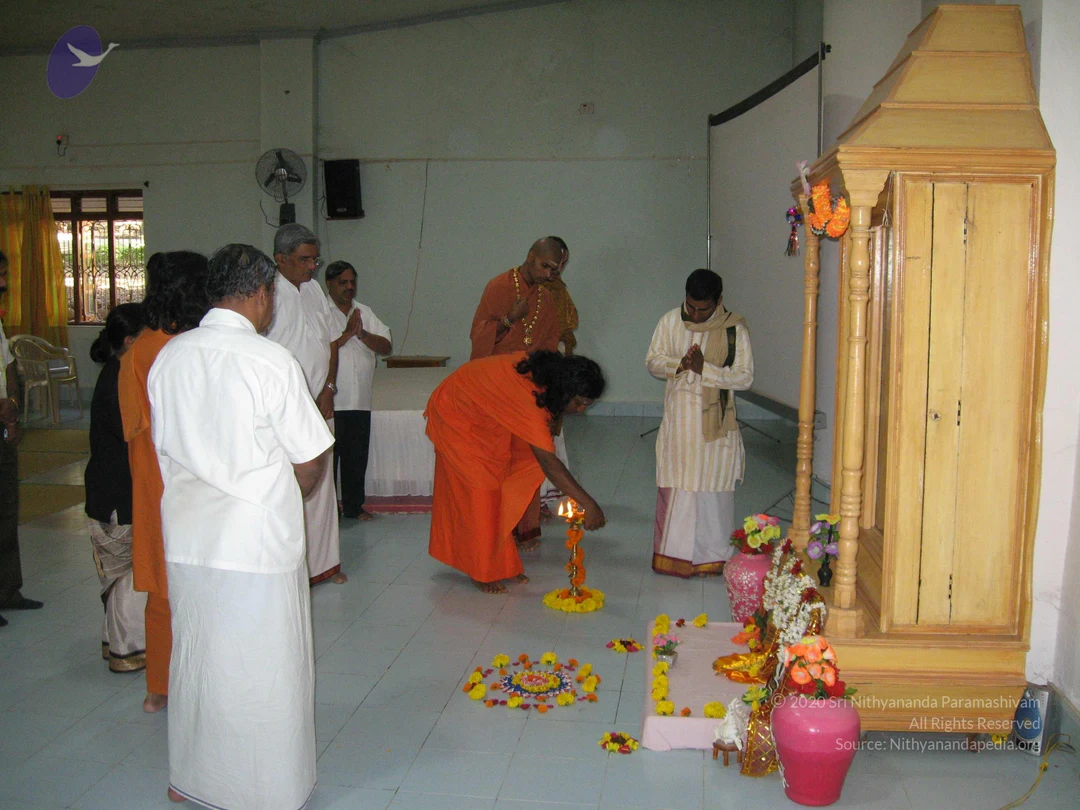
6 photosSource gallery
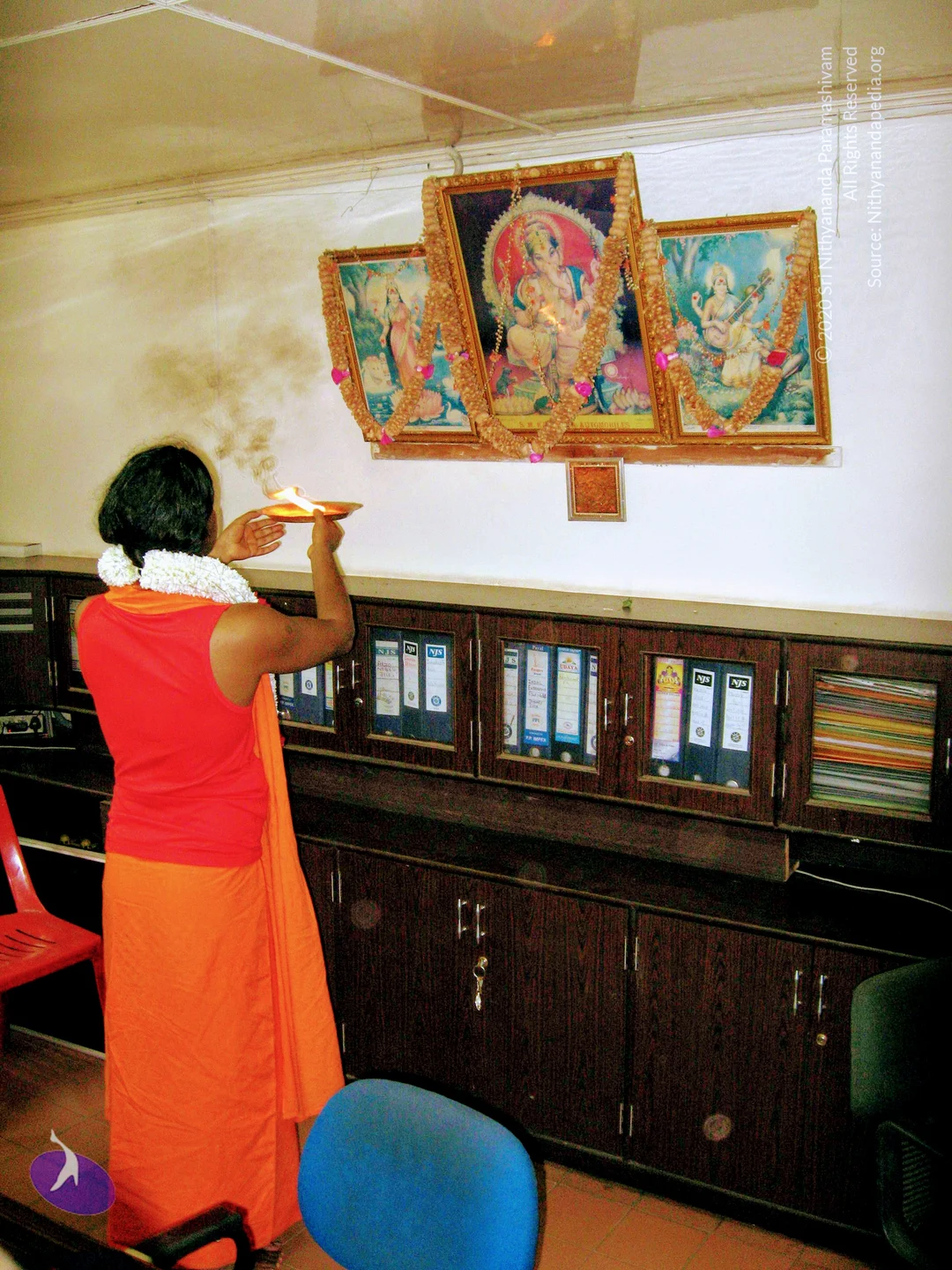
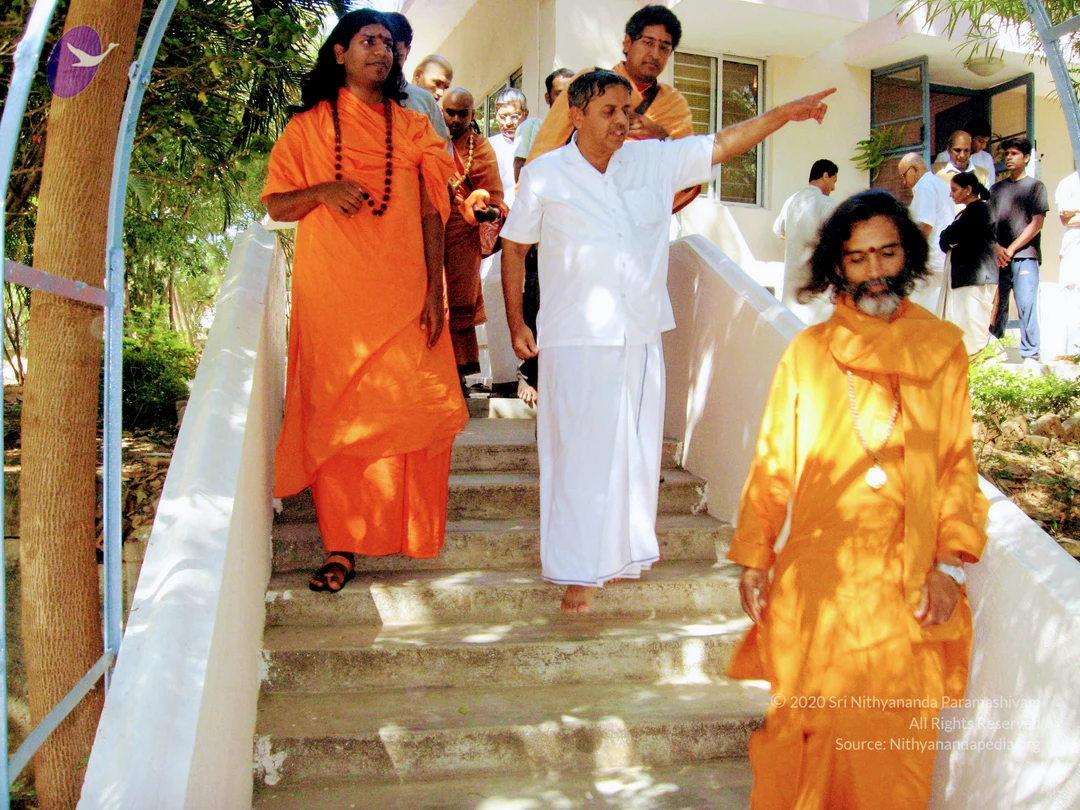
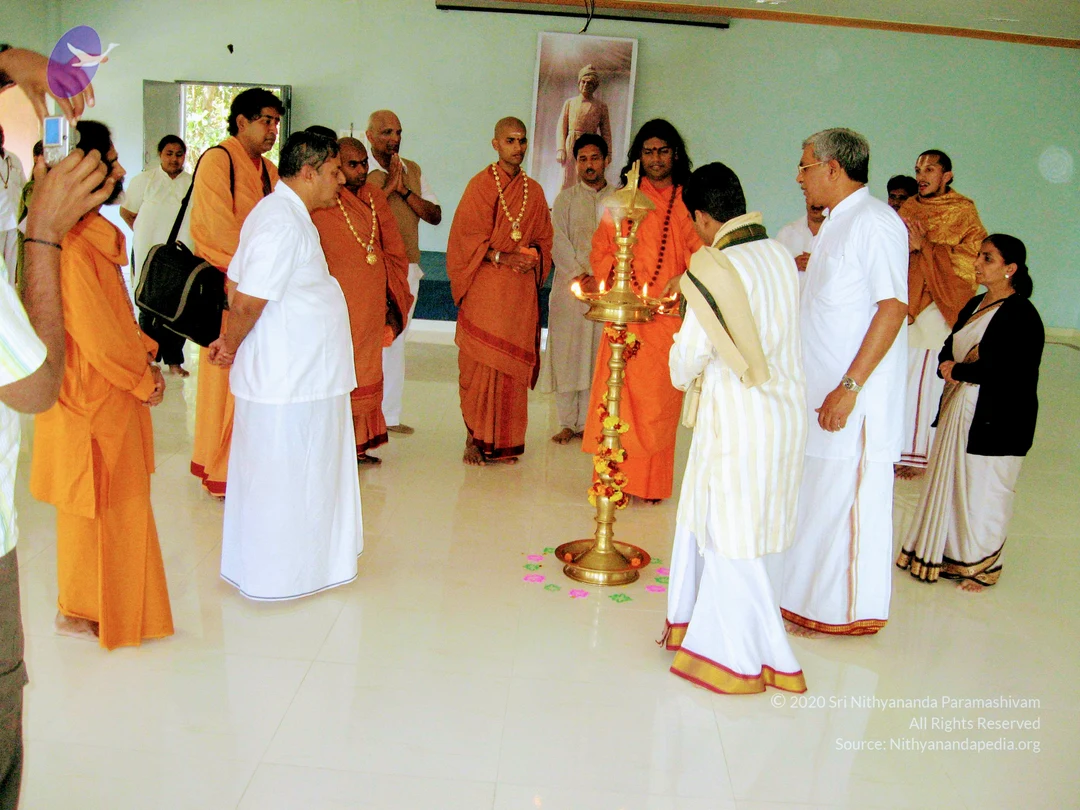
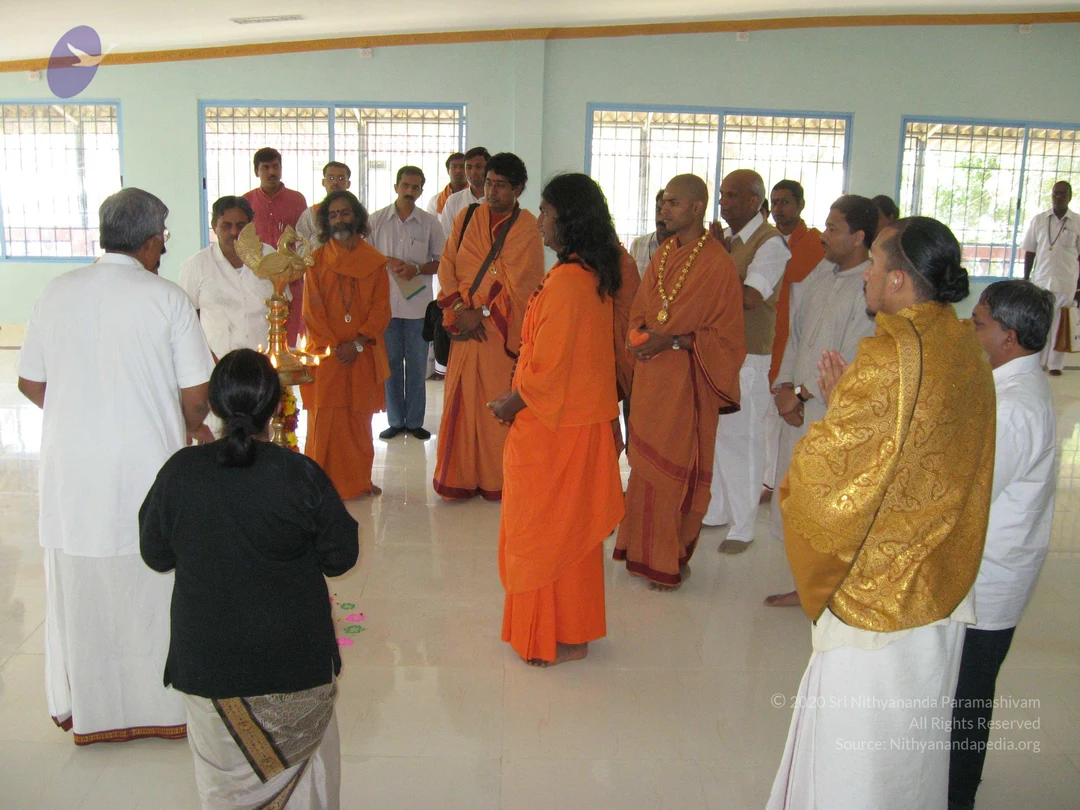
A photograph of people descending a concrete staircase outdoors beside a white building with green foliage. In the foreground a bearded man in saffron robes and a white bead necklace walks down the steps. Behind him a long-haired person in saffron robes with a rudraksha mala and a wristwatch walks ahead. A man in a white shirt and white dhoti, barefoot, points toward the building with his right arm. Several other people in white and saffron clothing follow along the stairs and stand near the entrance, along with a person in dark clothing on the right. Swamiji (probable) is the long-haired figure in saffron with dark rudraksha beads and a swept-back hairstyle, walking among the group.A group of people walks in a single file across a hall with a matted floor and pale grey strip, toward the right side of the frame. A woman in the centre wears a black jacket over a white and silver sari, and a woman in front right holds her palms together in namaste while wearing an orange robe and rudraksha mala. Several men in saffron and orange robes with beaded necklaces walk behind, and two men in white dhoti and shirt walk at the front and right edge. Yellow curtains hang at the windows, wall fans are mounted on the walls, and white plastic chairs stand against the far wall. The scene is a photograph of a visit to a hall with a procession-like walk.A tiled hall with a wooden cabinet shrine at right holding a deity murti decorated with flower garlands, and flower petals and a rangoli-style flower arrangement on the floor. A long-haired person in a saffron-orange robe bends forward holding a brass aarti lamp with a lit flame, performing a ritual before the shrine. Nearby, a shaven-headed person in orange robes and beads stands with several onlookers, including a man in white dhoti and shirt with hands folded, a man in white with a shawl, and a woman in black blouse and white sari. A person in a gold-yellow robe stands at the back, and a standing man in a white kurta with a shawl and a red-bordered dhoti presses his palms together. Pink pots hold flowers near the shrine.A prayer hall with pale green walls and white floor tiles. In the centre, a person in an orange-saffron robe with long dark hair bends forward to light an oil lamp on a floor arrangement of orange and yellow marigold petals and a coloured rangoli design. Behind them, a bald man in orange robes and a gold chain stands with palms joined, and a man in white with a striped shawl and white dhoti stands with hands folded. Other men in white shirts and dhotis stand to the left, and an older man in white stands near the back. On the right is a carved wooden cabinet-shrine with a pink vase of flowers and a garland. A rotating fan and speaker are mounted on the wall.A photograph of an aarti ceremony in a plain tiled hall with a wooden shrine cabinet on the right, decorated with flowers and pink pots. A figure in orange robes with long dark hair and a red rudraksha mala holds up a flame with clasped hands, while a bald man in saffron and a gold necklace stands beside them. A man in white dhoti and shawl holds a lamp tray near the cabinet. Several people in white dhotis and orange robes stand in a row, including a man in white with a grey-streaked head facing away. Flower rangoli and marigold garlands decorate the floor by the shrine. The a person candidate in orange with long hair and rudraksha is an appearance-based probable match, with the shrine and aarti setting consistent with a prayer hall.A photograph inside a plain white hall with a small wooden shrine on the right, its black panel bearing a golden Om symbol, decorated with orange marigold garlands and a swastika and diya motifs on the wall. Several people stand facing the shrine with hands folded in prayer. In the centre, a man with a shaved head wears an orange robe and a beaded necklace, with an orange-robed woman and a man in white dhoti beside him; a man in white kurta and dhoti stands at the centre-right holding what appears to be a book, and a woman in black top and silver-bordered sari stands near the front. A man in a checked shirt with an orange sash folds his hands in the foreground, and a man in white dhoti stands at the right near the shrine. Flowers lie on the floor around the shrine base. The scene reads as a devotional gathering or puja. a person identity cannot be confirmed from appearance.

08--WALKING-AROUND-THE-CAMPUS-LIGHTING-LAMP
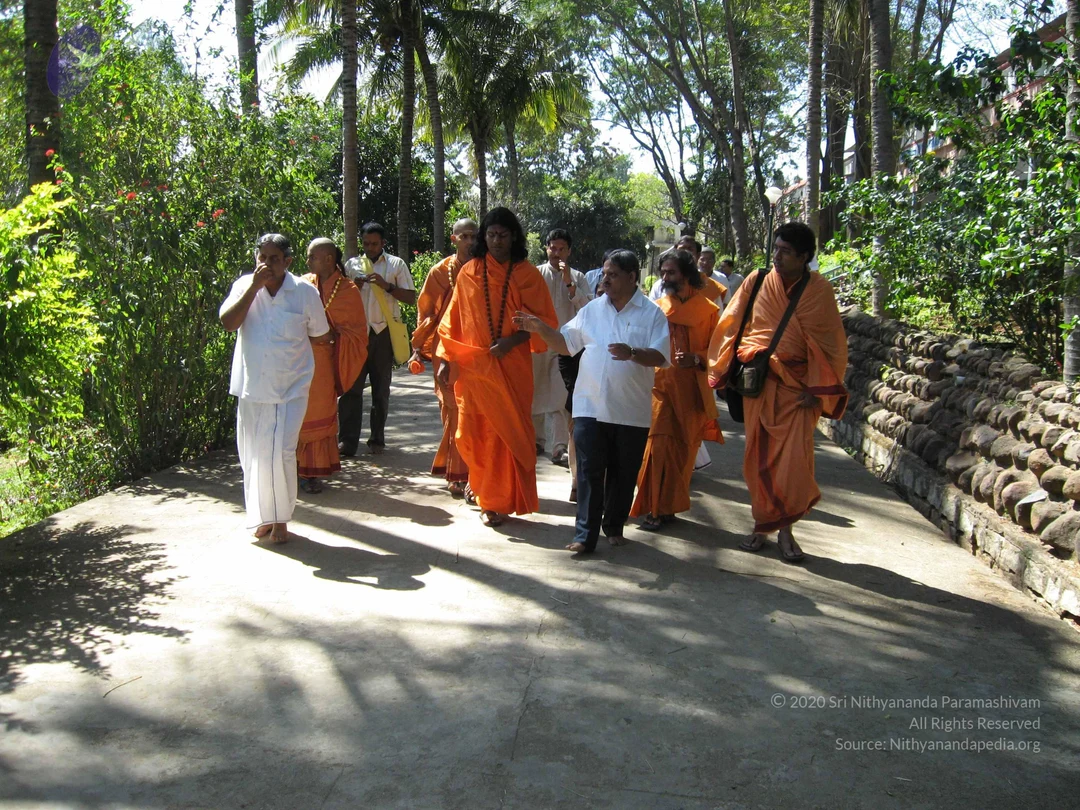
18 photosSource gallery
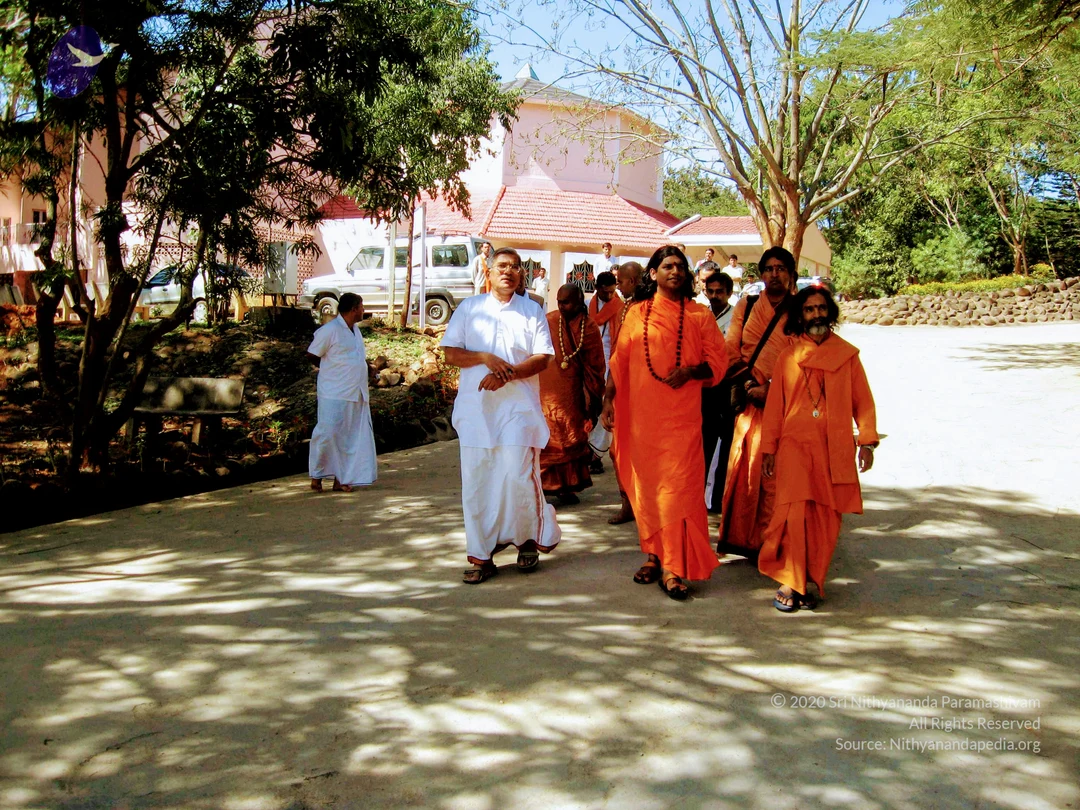
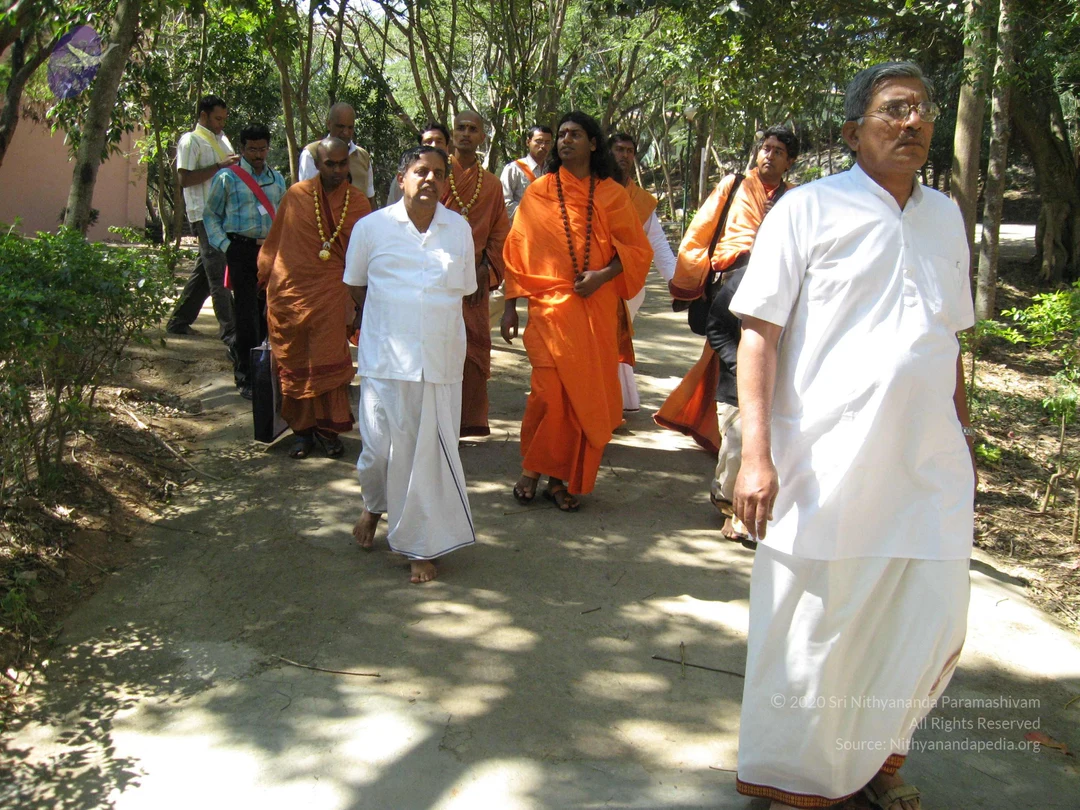
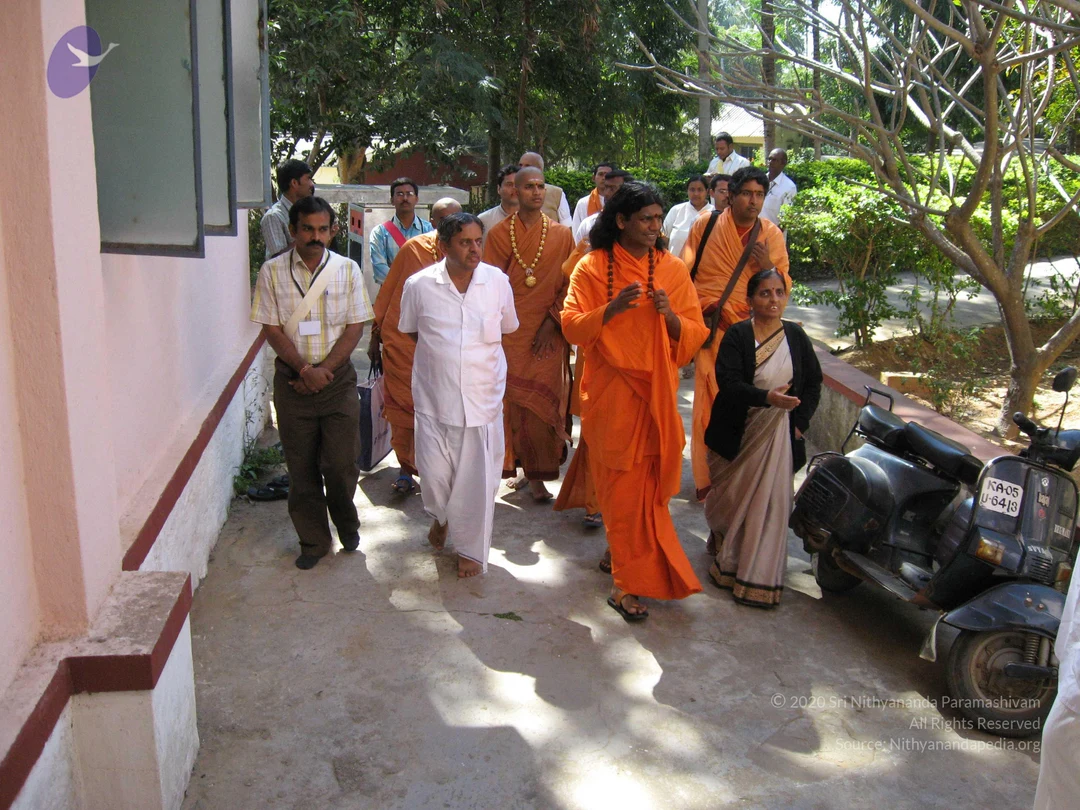
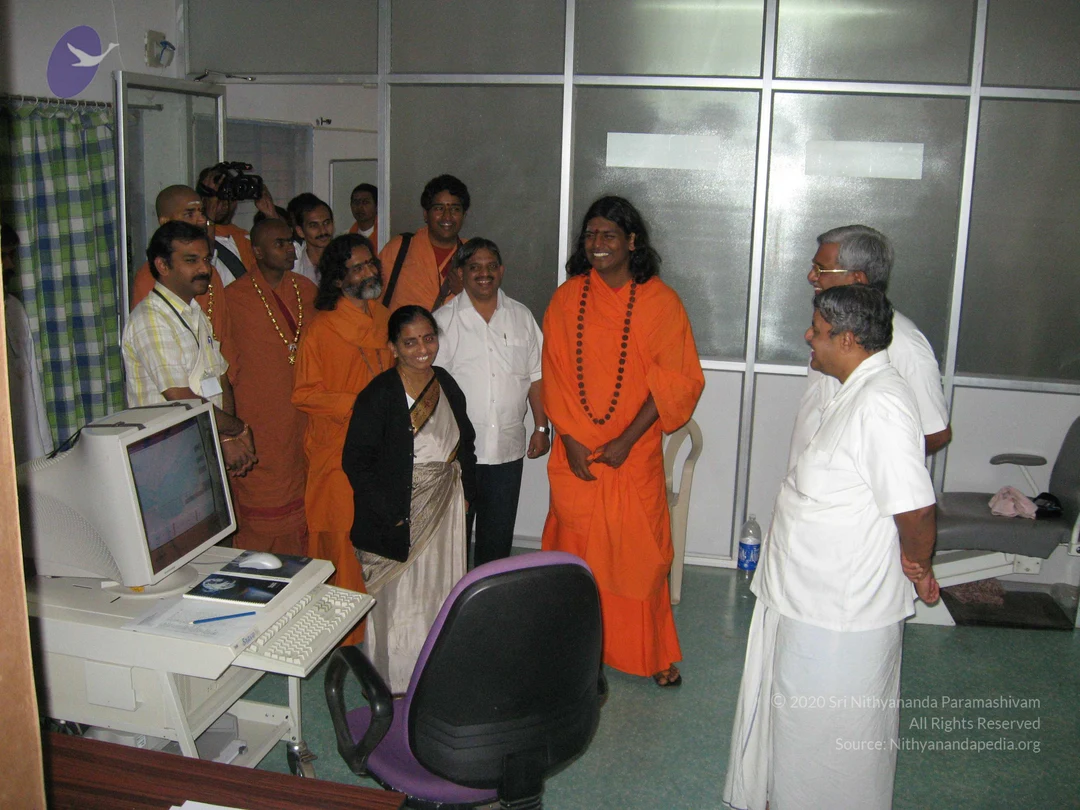
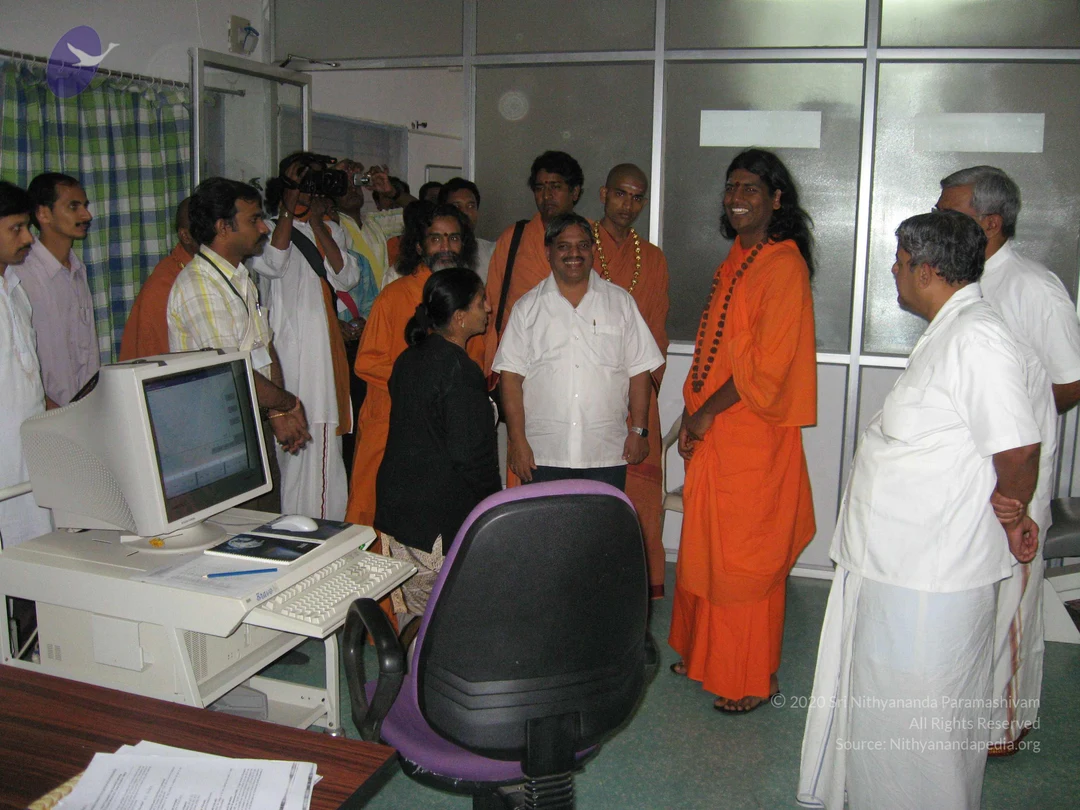
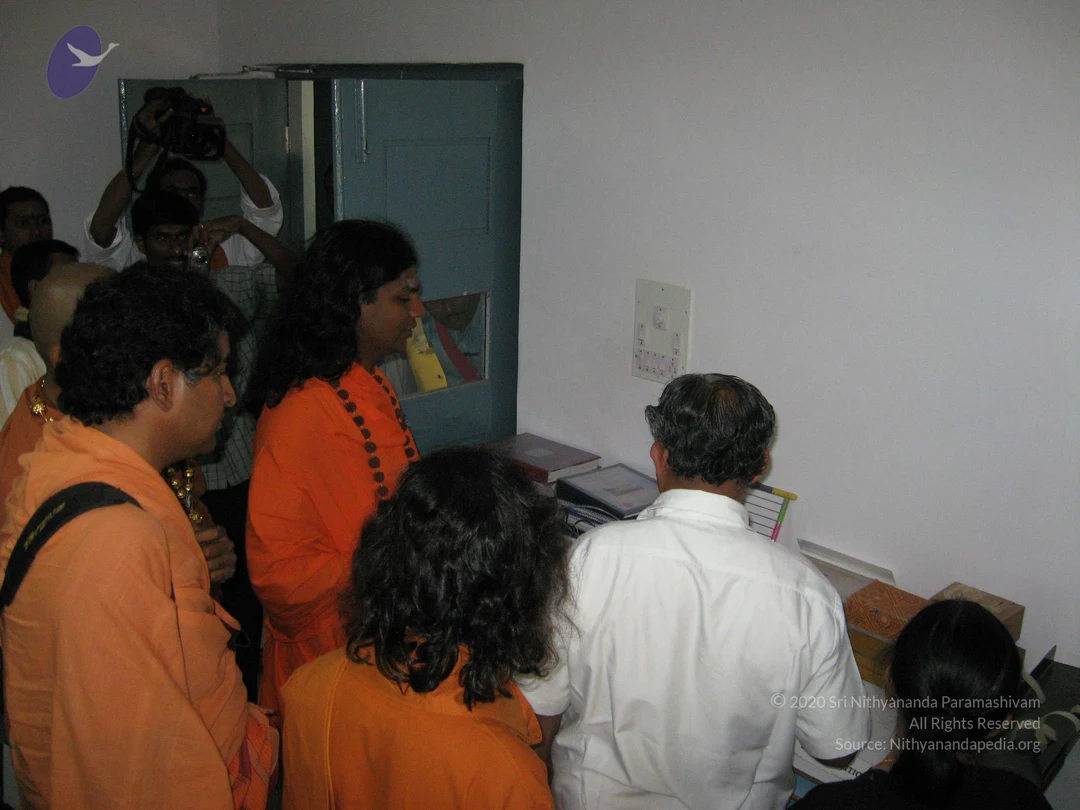
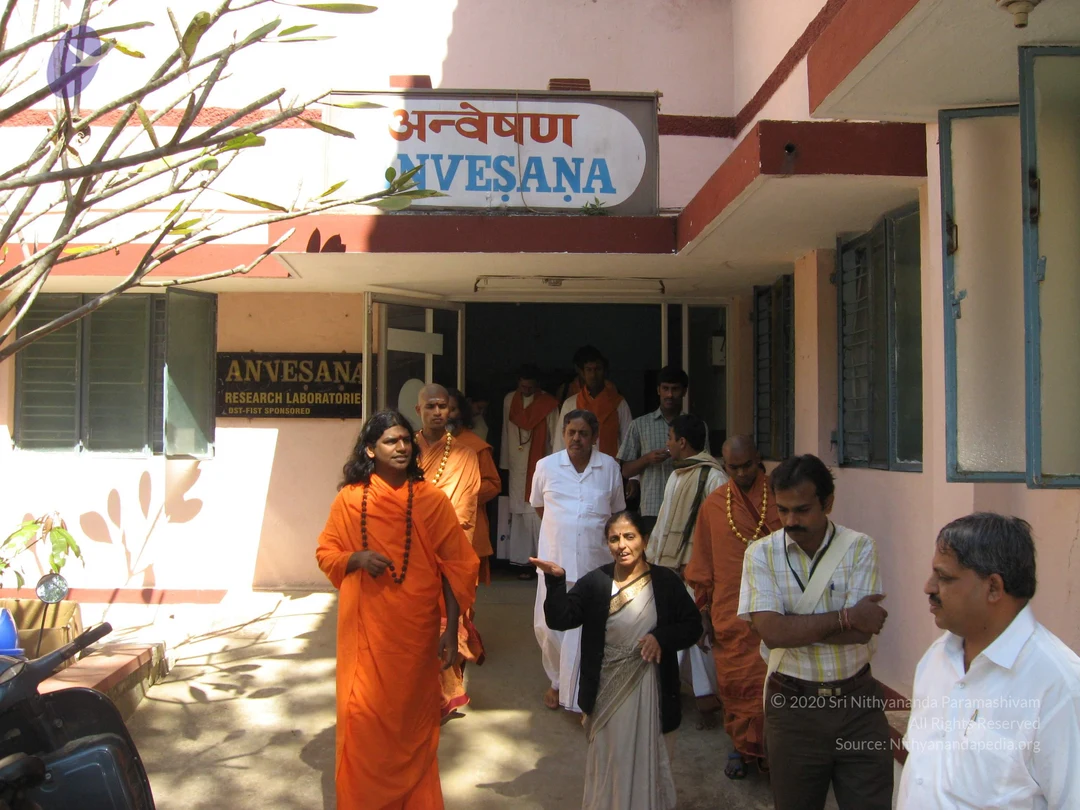
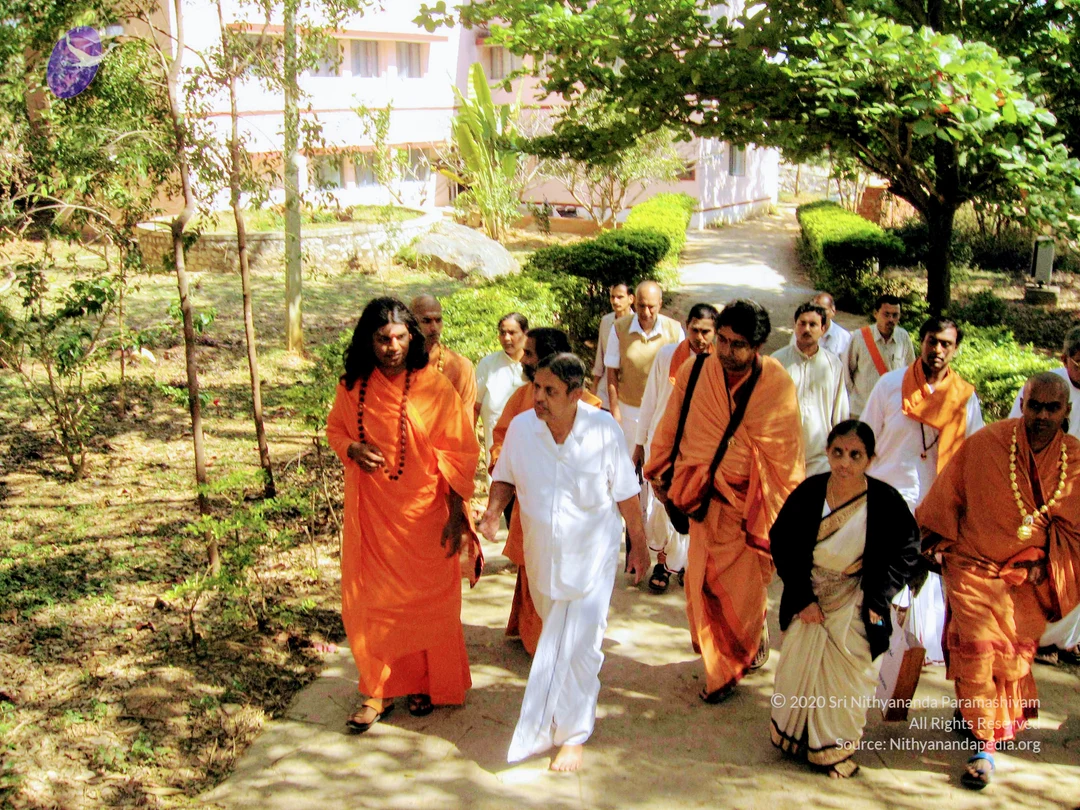
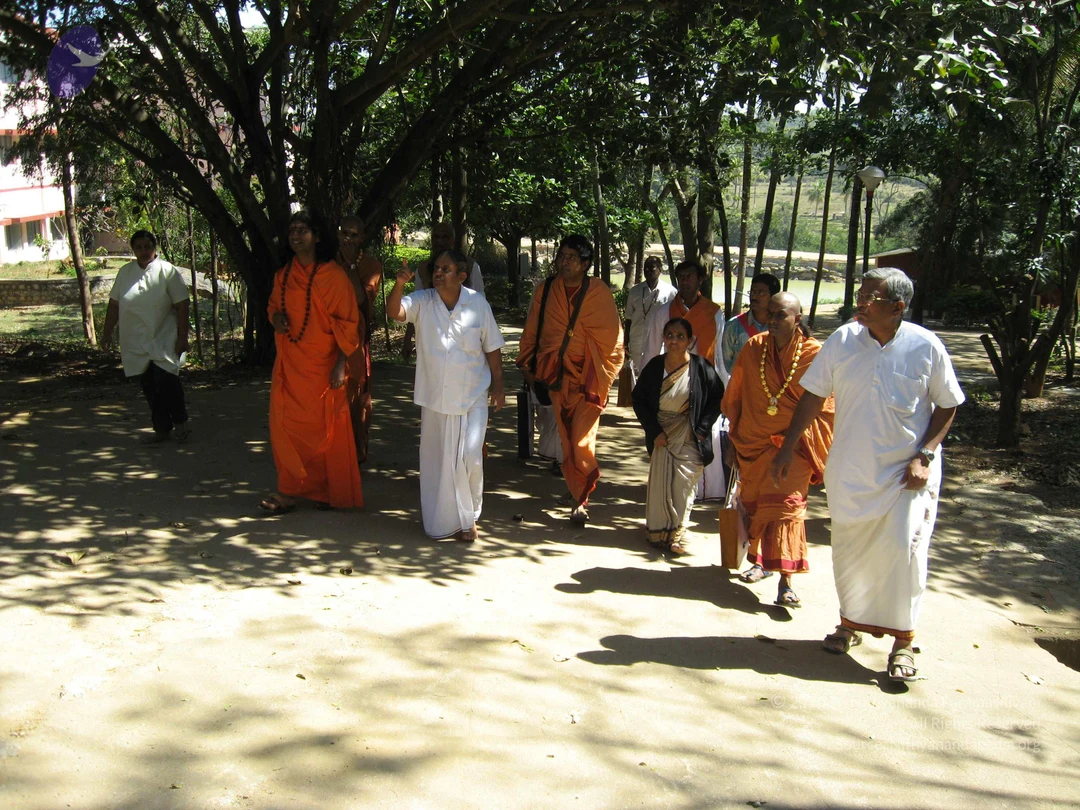
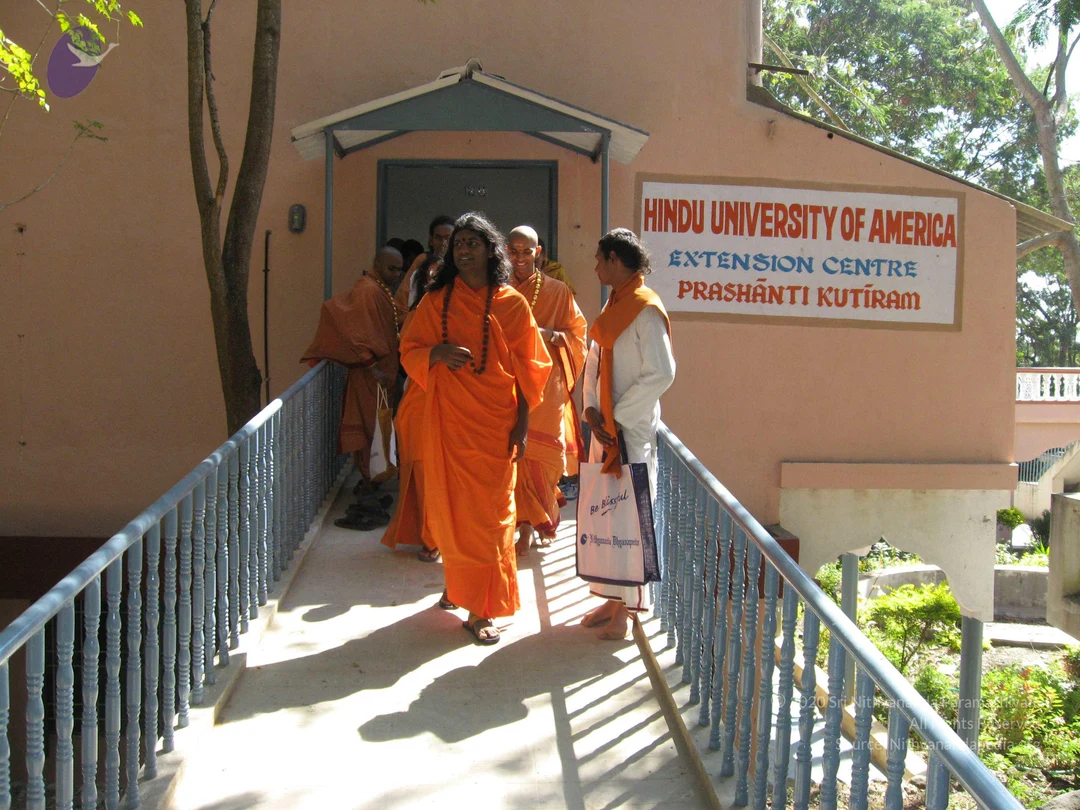
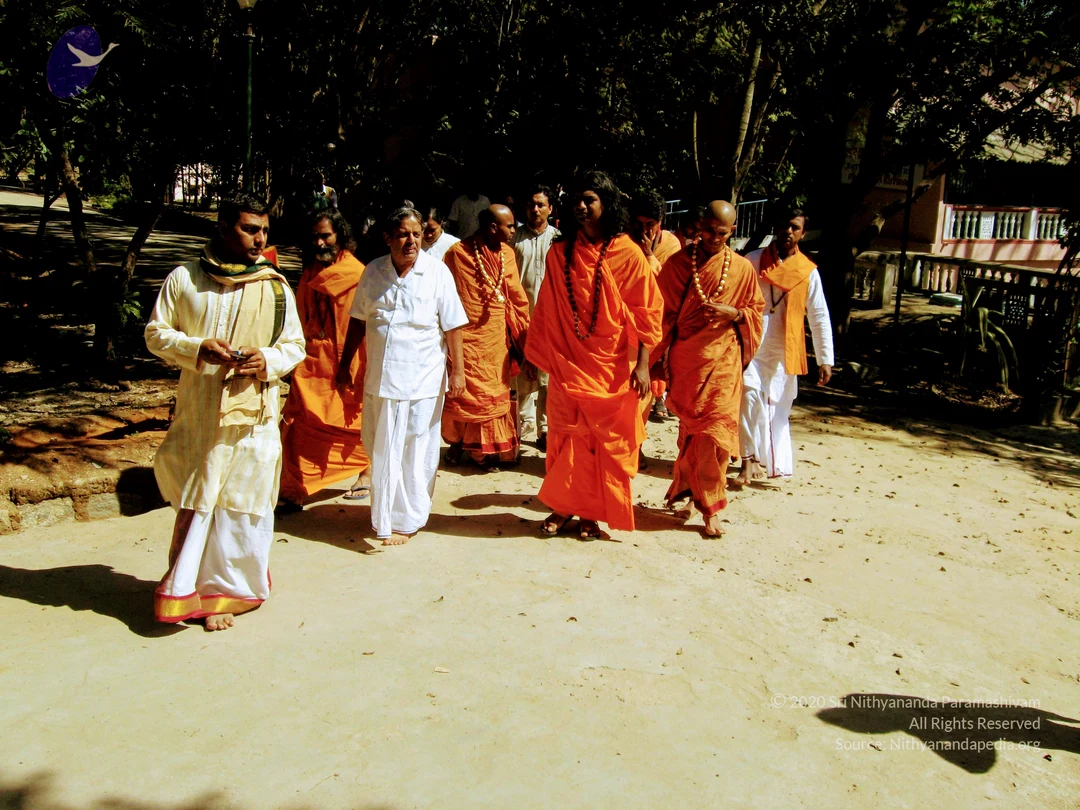
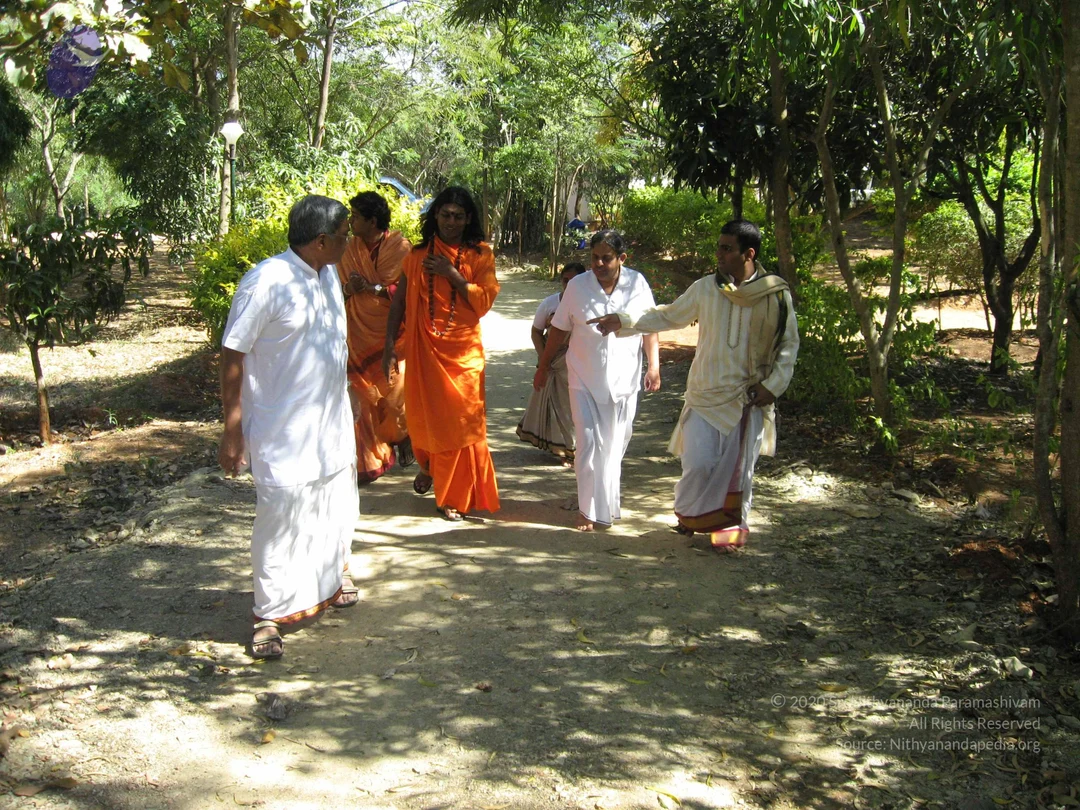
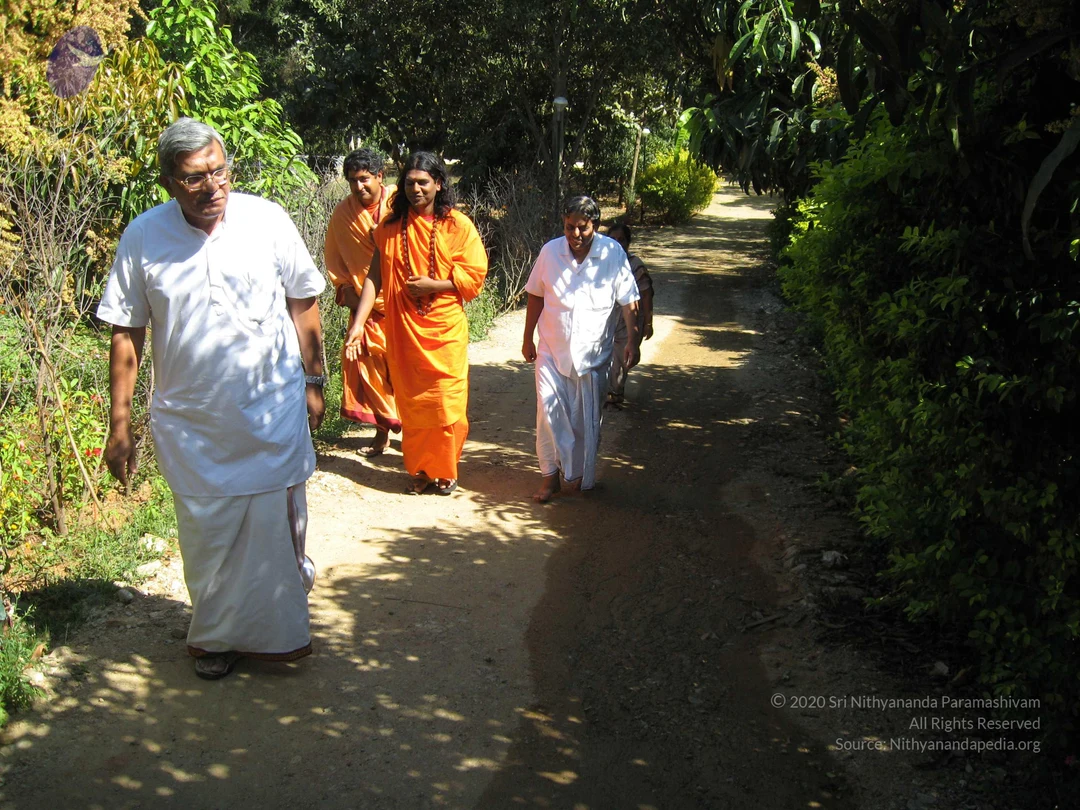
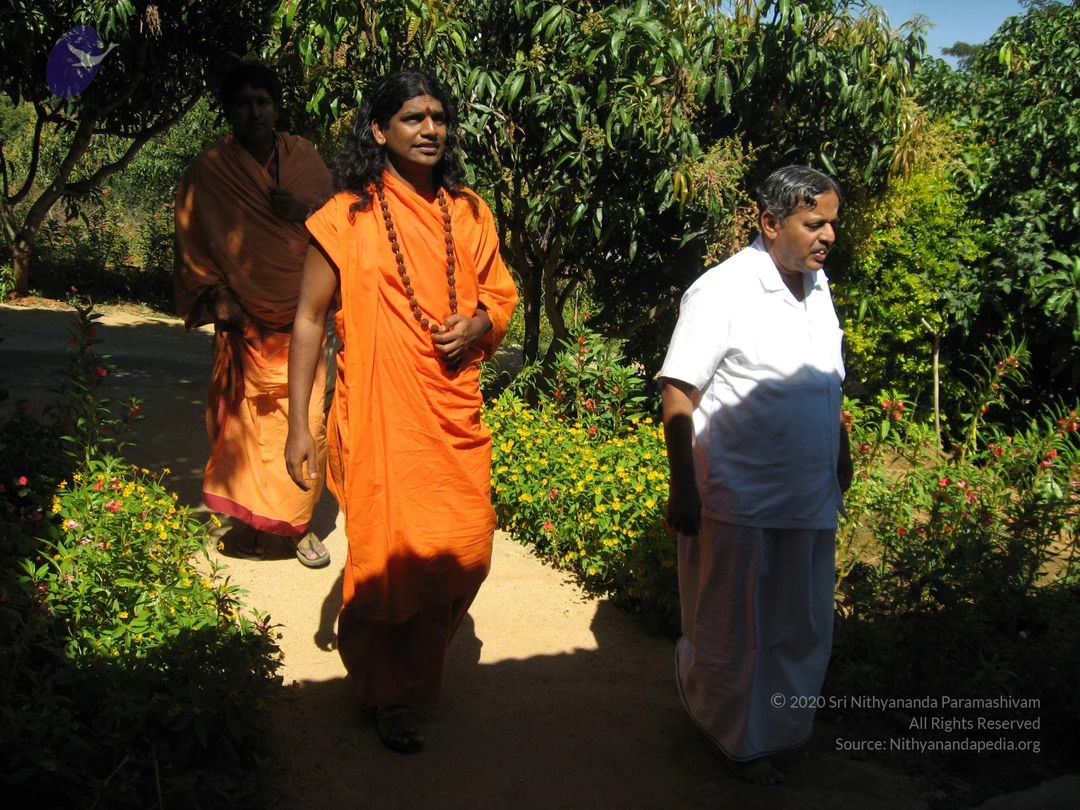
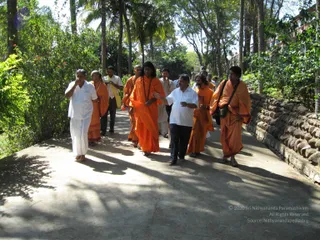
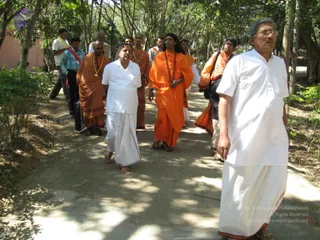
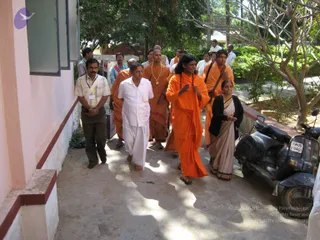
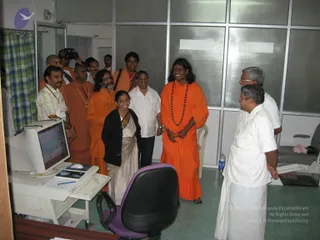
A group walks along a shaded concrete path lined with palm trees and leafy shrubs with red flowers. In the centre, a man with long dark hair in an orange-saffron robe and rudraksha mala walks forward, with a person candidate noted by his long swept hair, saffron robe and rudraksha mala. Around him, several men in orange robes and others in white shirts and white dhotis walk in step. A man in a white shirt and dark trousers gestures with his hand, and a stone retaining wall runs along the right. Seven or eight people are visible.A group walks along a shaded concrete path lined with trees and shrubs. In the centre, a man in a saffron-orange robe with long dark hair and a rudraksha mala walks forward. Beside him, a bald man wears an orange robe and a gold-coloured necklace, and to the left another bald man wears an orange shawl with a gold necklace. Two men in white shirts and white dhotis walk barefoot, one at the front right wearing glasses. Other men in white and orange follow behind, with a pink wall and trees in the background.Outdoor photo of a group walking along a paved path beside a pink building with tall windows, trees and shrubs behind them. In front, a man with long dark hair wears a saffron-orange robe with a rudraksha mala, hands raised in conversation, and a bare-footed devotee in white shirt and dhoti walks alongside. Several saffron-robed monks, one with a gold-toned necklace, follow. A woman in a beige sari with a black shawl walks beside them. A parked black scooter with plate KA05 sits at right.Indoor photo in a bright office or lab room with a computer desk on the left showing a monitor, keyboard and papers. A tall man with long dark hair, wearing orange robes and a dark rudraksha mala, stands smiling in the centre; the page links him to Swamiji, a probable identification based on his long swept hair, orange clothing and rudraksha mala. Around him, several men in orange robes and beaded necklaces, a woman in a dark cardigan and cream sari, and men in white shirts and white dhotis stand together, one man at the right in glasses. A man with a camera stands at the upper left, and a green-and-blue checked curtain hangs behind. Frosted glass partitions and a grey reclining chair complete the room. Eleven people are visible.A photograph of a group standing in a fluorescent-lit office with frosted glass partitions and a green-and-blue checked curtain at left. In the foreground a woman in a black top stands beside a beige computer monitor and keyboard on a desk, facing a man in a white short-sleeved shirt and dark trousers. To the right, a tall figure with long dark hair, wearing a saffron-orange robe and a dark beaded mala, smiles and stands with hands clasped. Beside him a bald man in orange robes wears a saffron-and-white beaded necklace. Behind them a man in orange robes with a shoulder bag stands near a figure with long hair and a beard in orange. At far right an older man in white shirt and white dhoti stands with hands folded. At left, several men in white shirts and dhotis watch, and a man in a checked shirt gestures. A cameraman in white clothing holds a camera at the back. Roughly fifteen people are visible.Indoor photo of a small room with white walls and a blue-green wooden door with a glass panel. A man in a long saffron robe with a dark beaded mala stands at the centre, facing the door, and a younger man in saffron robes and a shoulder bag stands at left. A man in a white shirt stands at right with his back to the camera, near a stack of books and papers. A woman with long dark hair in an orange top is at lower centre, and a man with a camera photographs from the upper left. Another man in white stands at left edge behind the robed figures. A wall switch panel is visible on the wall.

09--DELIVERING-SATSANG
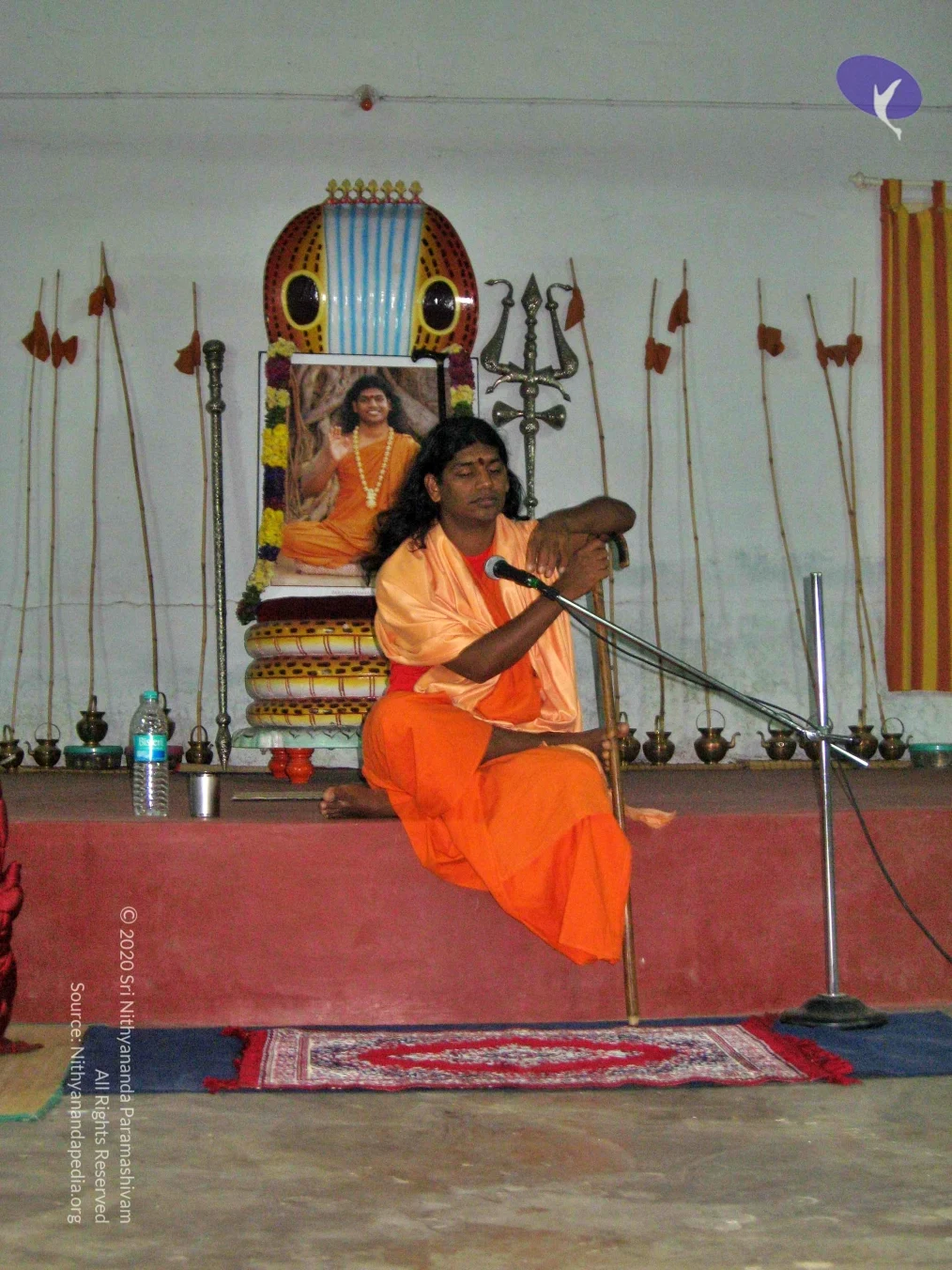
34 photosSource gallery
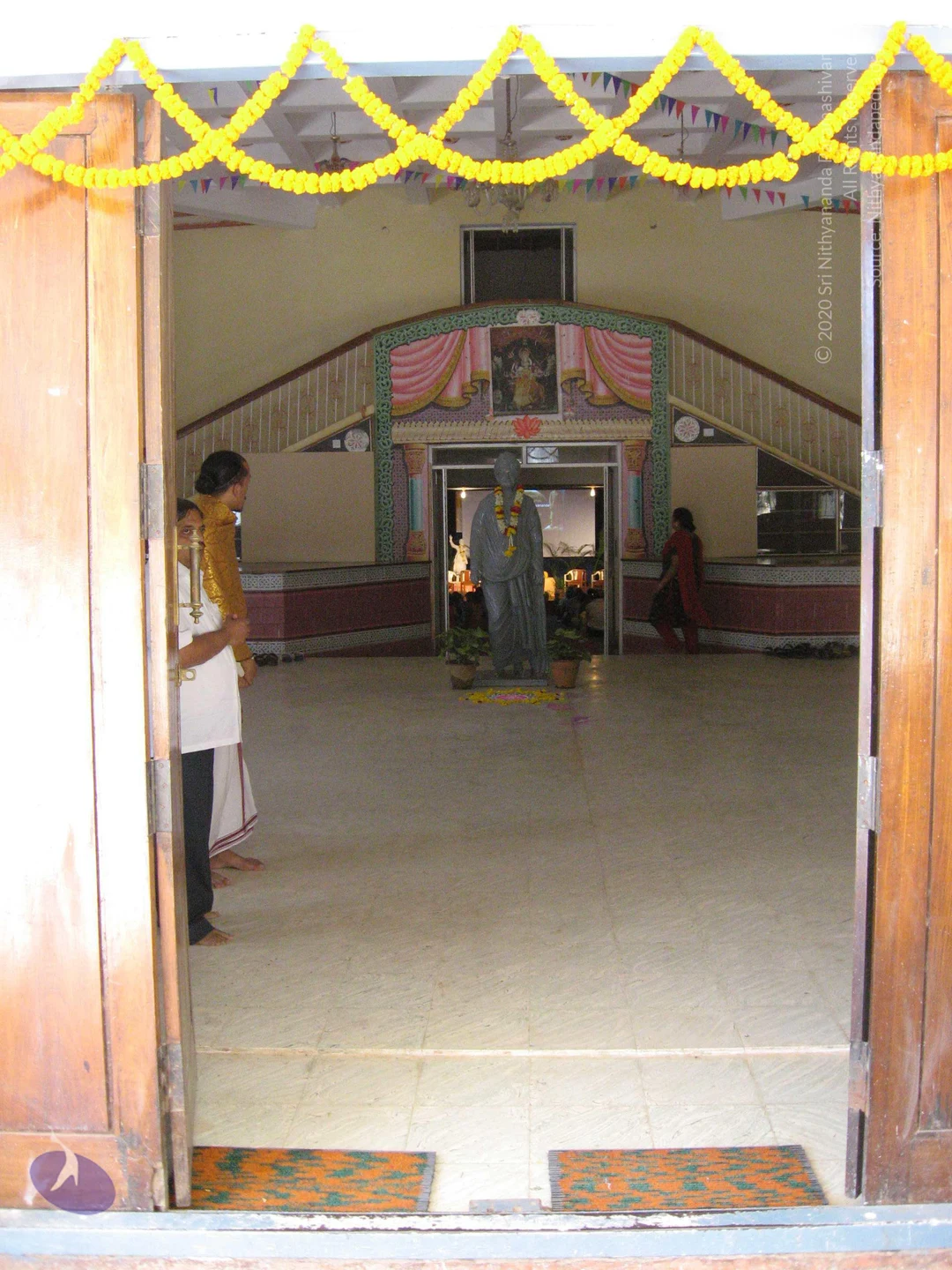
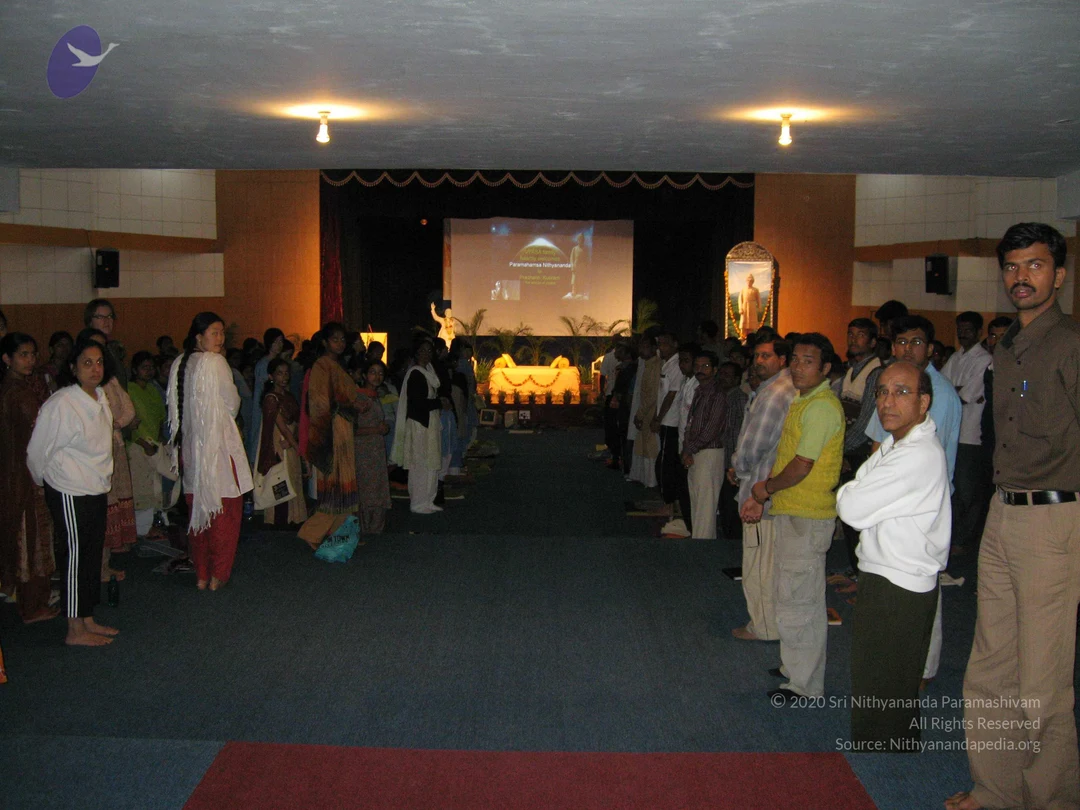
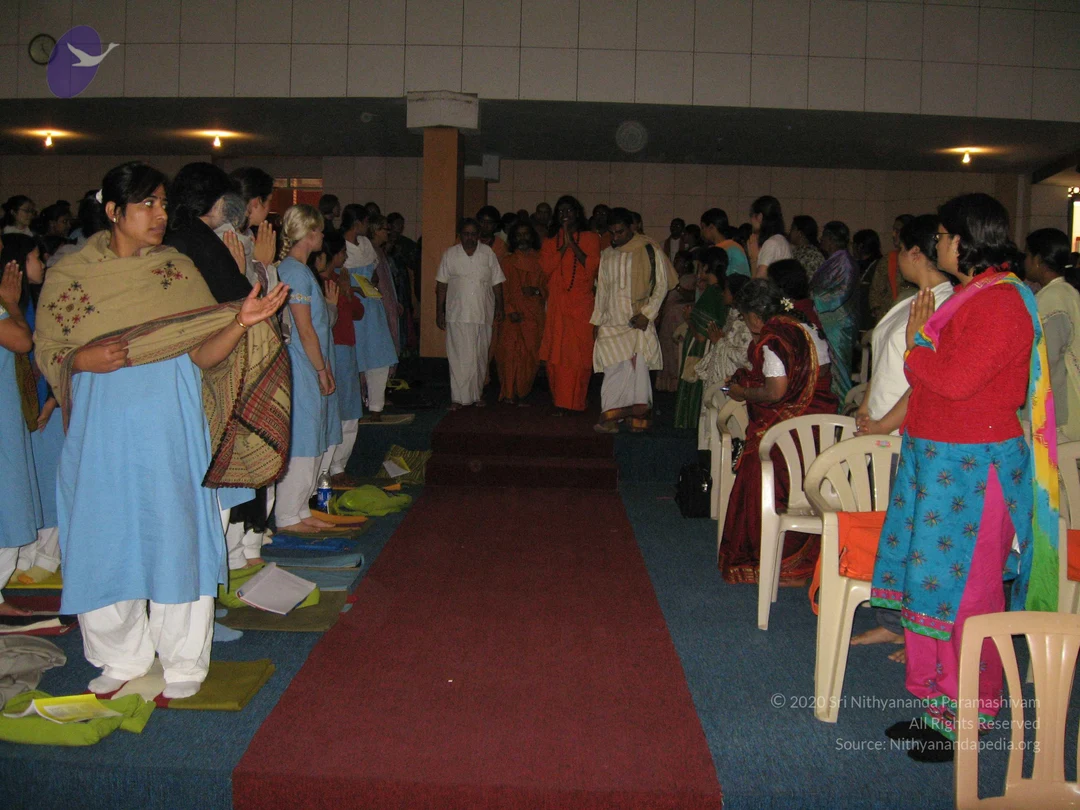
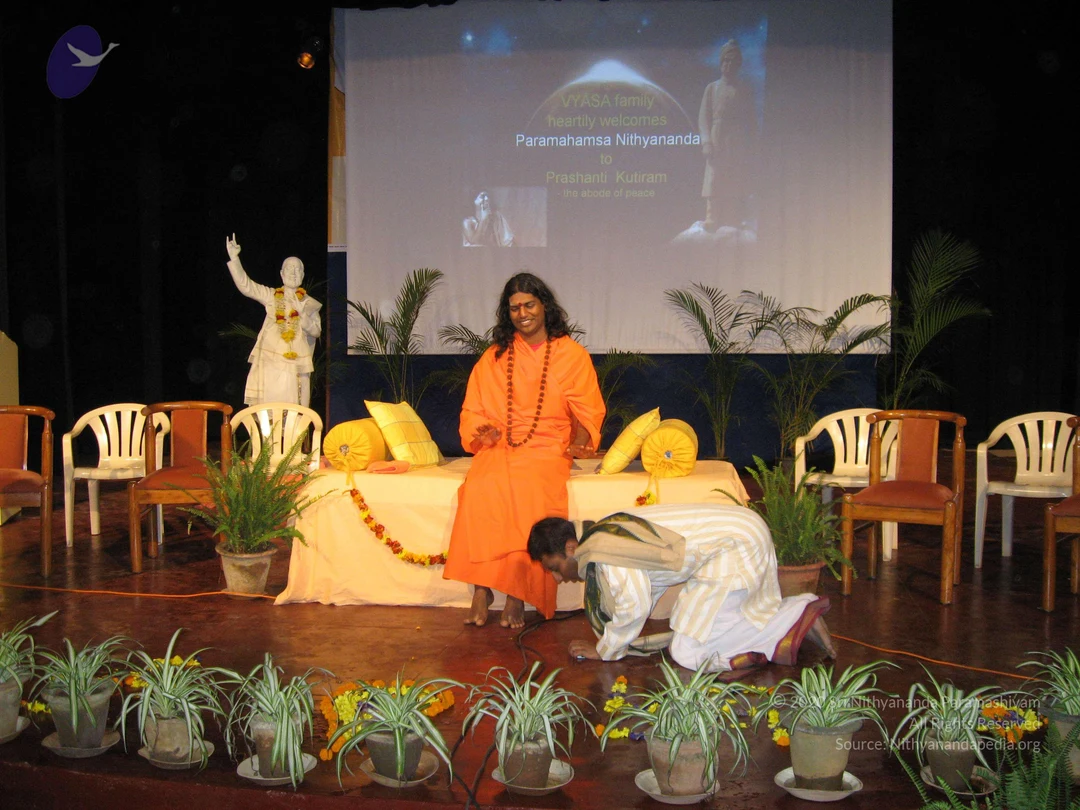
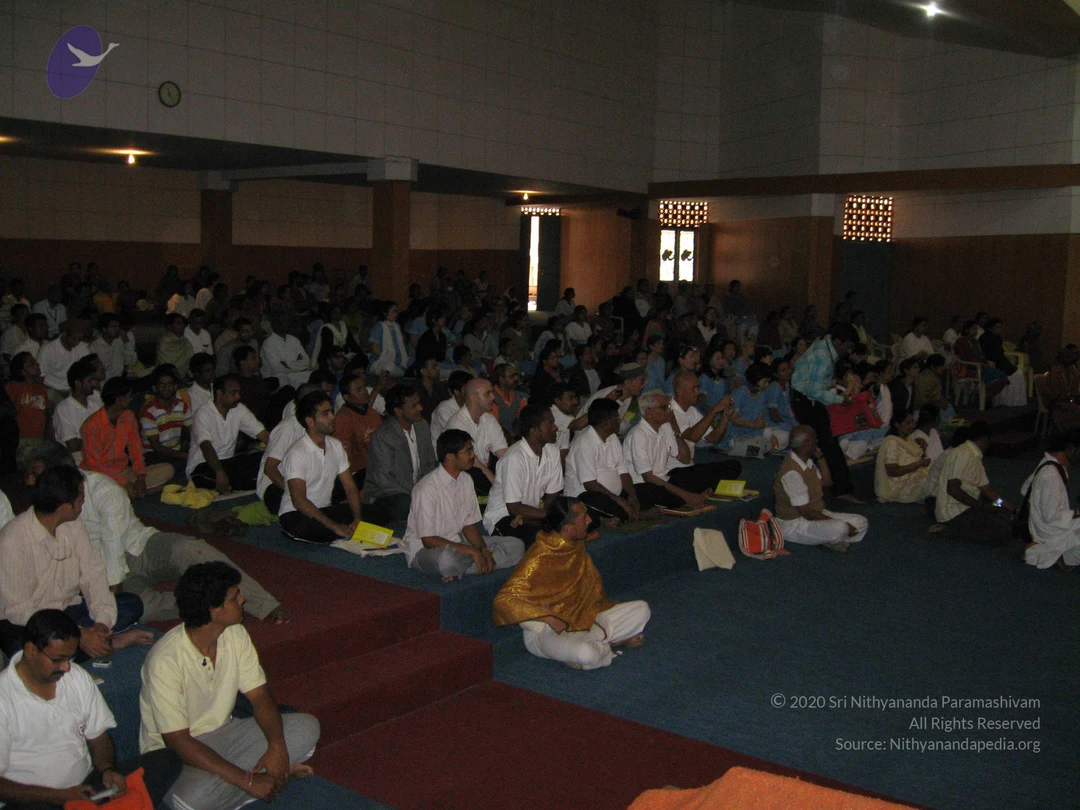
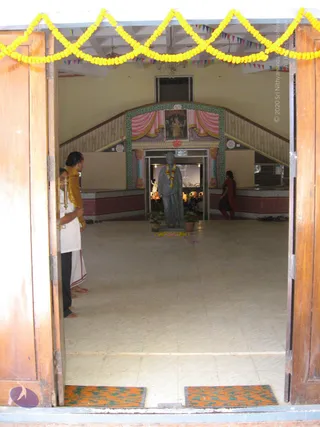
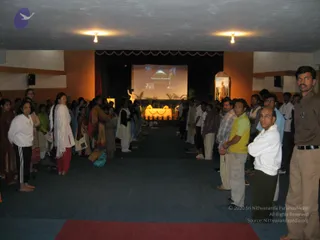
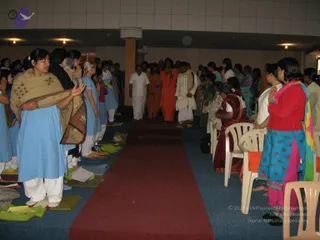
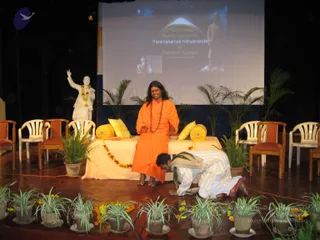
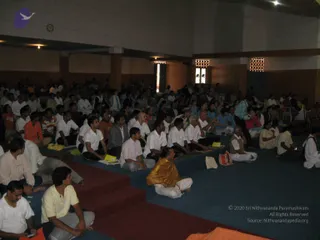
A man seated cross-legged on a red-painted stage speaks into a microphone on a stand. He wears an orange dhoti, a peach-coloured shawl over his shoulders and a red undergarment, with a red tilak on his forehead; his long dark hair falls past his shoulders and he holds a wooden staff. Behind him stands a framed portrait labelled "Paramahamsa Nithyananda" showing a saffron-clad figure with a rudraksha mala and a raised hand, garlanded with yellow and orange flowers, set on a cushioned seat in front of a large painted trident-and-cobra-hood style backdrop. Bronze kalasha pots, a trident, a red-and-yellow striped curtain and orange flags on bamboo poles frame the stage. Probable Swamiji (long hair, saffron clothing and rudraksha mala cues), seated and speaking as a teacher.Interior view through an open wooden doorway of a hall decorated with a yellow marigold garland along the top and small triangular bunting. At the far end, a grey stone statue of a robed standing figure with a marigold garland stands on a patch of flowers, flanked by potted plants, with a framed painting of a deity above a pink draped arch. Two people stand at the left doorway: a man in a gold-embroidered top and a person in white with a brass lamp in hand. A woman in a red outfit walks across the far right of the hall. Orange and green mats lie on the floor at the entrance.A photograph of a hall interior with a long line of standing attendees forming two rows down a dark blue carpet toward a stage. Men and women in casual and traditional clothes, including a woman in a white shawl and a man in a yellow vest, face the stage. On the stage a projection screen shows a slide, a golden-draped seat with a yellow cloth sits in the centre, and a framed picture of a seated figure garlanded with flowers stands at the right side of the stage. Palm plants and an orange-and-black drape frame the stage. Overhead lights are on the ceiling.Indoor hall with a red carpet runner leading between rows of devotees with palms pressed together in anjali. A woman on the left wears a light blue kurta with white trousers and a beige embroidered shawl. On the right a woman in a red top and blue-patterned dress stands with hands folded, and seated women sit on white plastic chairs. Near the centre, a figure in a long orange robe walks forward, flanked by a man in white dhoti and kurta and another man in a cream-striped shawl. The scene suggests a satsang or darshan gathering.A figure in a flowing saffron-orange robe with a rudraksha mala and long dark hair sits on a raised stage behind a white-draped table with yellow cushions and a garland. A second person in a white and yellow striped kurta kneels low before the seated figure, head bowed toward the stage floor. Potted plants with yellow and orange flowers line the front edge. Behind them, a projection screen reads VYASA family heartily welcomes Paramahamsa Nithyananda to Prashanti Kutiram, in the abode of peace. A white statue of a standing figure with a raised hand and a garland stands at left, and rows of white and wooden chairs fill the stage edges.Photograph of a large seated audience on a blue carpet with red steps in a hall with cream tiled walls and wooden panels. Many men in white shirts and white dhotis sit cross-legged, with some in pastel shirts and a few women in saris further back. One man in the foreground wears a yellow shawl and white dhoti, and several people hold yellow booklets. Light fixtures and lattice windows are visible on the back wall. No clear speaker is visible in frame.

10--DISCUSSING-VIPS-DINING-HONURING-HOST-STRARTING-OFF
15 photosSource gallery
Outdoor photo of a group walking up a concrete staircase beside a white wall, with a rock face and tree branches behind them under dappled sunlight. In front, a long-haired man in flowing saffron-orange robes with a dark rudraksha mala around his neck walks with hands clasped at his waist, looking toward a man beside him. Behind and beside them, men in white kurta-style clothes, a man in beige and cream clothing, and a shaved-headed man in orange robes with a mala follow. Arched blue metal frames and a bare tree frame the scene. Several more people are visible in the background.A seated discussion in a plainly furnished living room with pink walls, yellow patterned curtains and a glass coffee table holding flowers, a laptop and a small projector. A central figure in an orange robe with a long beaded mala sits smiling on a cream-cushioned chair, while standing and seated attendants in orange and saffron robes with rudraksha malas flank the room. Several men in white dhotis and shirts sit on black leather sofas facing them, one man in a yellow-striped shawl listens at right. On the wall at right are two framed portraits, one with a garland, showing robed figures.A photograph of an indoor room with yellow patterned curtains and wooden floor. A central figure in orange robes and a rudraksha mala sits on a white-covered sofa, with long swept-back dark hair, gesturing with both hands toward seated and standing listeners. The figure's distinctive long hair, orange clothing and rudraksha mala are visible cues, so this is a probable Swamiji presence; his role is a seated speaker. A glass table in front holds yellow sunflowers, a small projector and a metal cup. Around him, several men in orange robes and white dhotis stand or sit, and an older man in white sits in a grey armchair at left. Approximately eight people are visible in total.A meeting in a plain room with yellow patterned curtains and a wooden floor. A central figure with long hair, a rudraksha mala and an orange robe sits on a cream sofa with a patterned cushion, facing the room. Around him, several men in orange robes stand or sit, including one standing at left holding a bag. Seated on grey sofas and a chair in front are men in white shirts and white dhotis, watching attentively. A glass table holds a bouquet of sunflowers and a projector, with a laptop on the floor at right.Indoor photo of a group gathered in a room with yellow curtains and a dark sofa in the foreground. A man with long dark hair in an orange robe and rudraksha mala stands centre-right, smiling and clasping hands with a man in a white shirt and white dhoti who bows toward him. Other men in orange and white robes stand around, one in orange with a crossbody strap and one bald man in orange with beads. A man in white with a bag stands at left, and a balding man in white is at right edge. Six to twenty people are visible. The orange-robed figure with long hair and rudraksha beads is a probable Swamiji candidate by appearance, shown in person greeting a devotee.A group walks along a shaded concrete path between leafy trees and a low red-roofed building. In the right foreground, a woman in orange robes with long dark hair and a rudraksha mala speaks on a mobile phone while walking beside a man in white dhoti and shirt. Further left, several people in orange and white walk together, including a woman in orange with a woven basket and a man in orange shawl, and a woman in a yellow sari and another in a cream sari at the far left. A stacked pile of logs sits by the path, and a red-topped white concrete block lies on the right. Figures in orange and white dress move together in a relaxed procession.