Skip to content
Sunday

19 February 2012

God is Your Mirror.

Dated photos
17
Source pages
1
Media
4
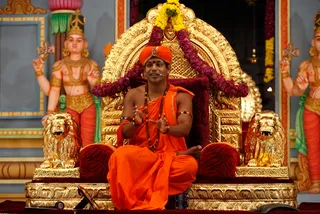
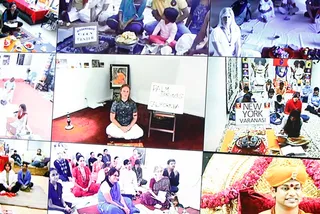
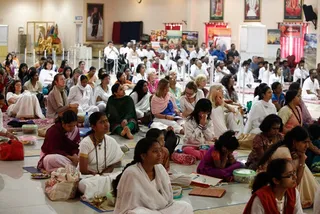
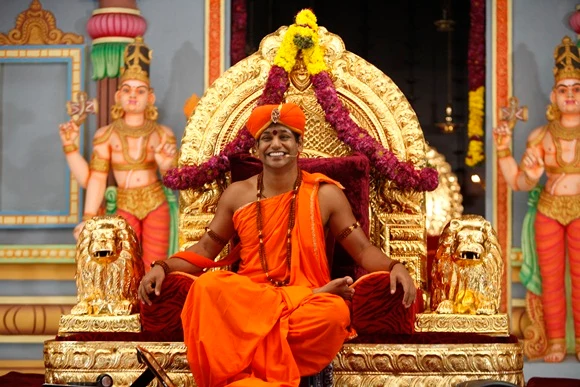
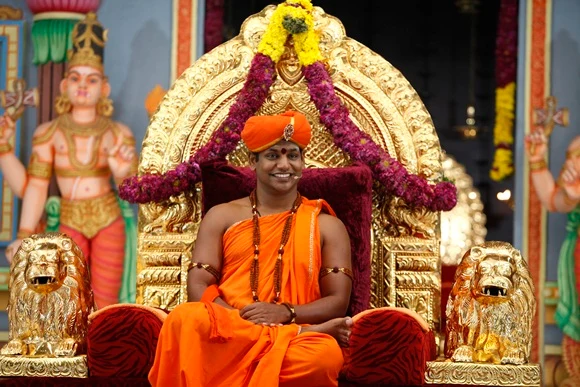
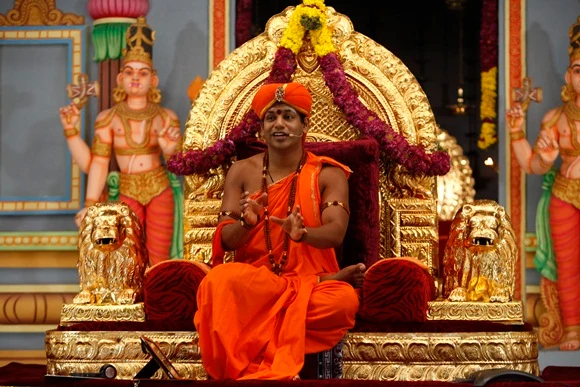
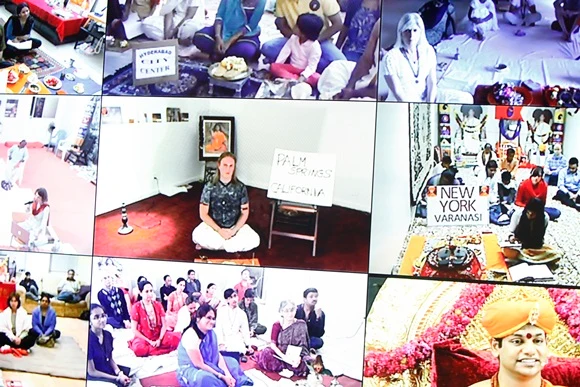
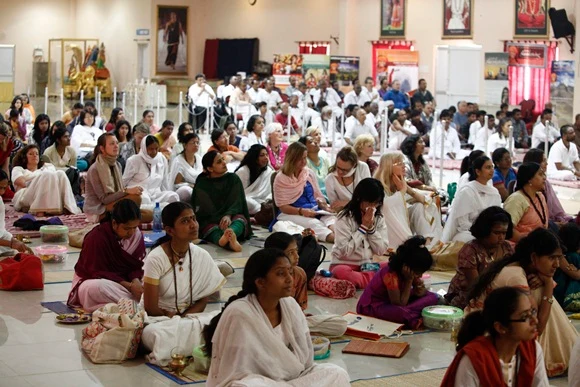
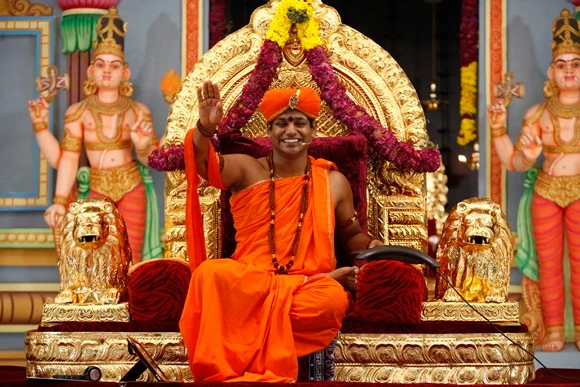
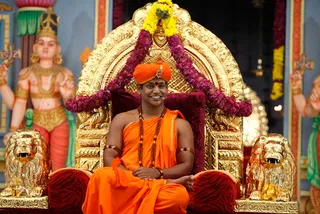
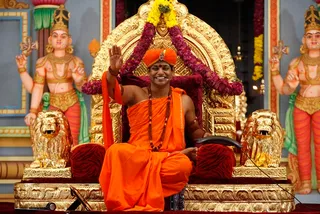
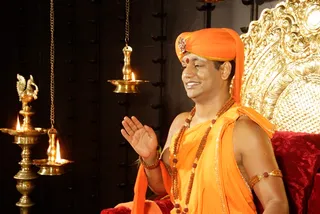
A man in saffron-orange robes and an orange turban sits cross-legged on an ornate gold throne with lion figures at its base and garlands of yellow and magenta flowers draped over the canopy. He wears a rudraksha mala and bangles and gestures with both hands, apparently giving a discourse. Behind him stand painted figures of deities with multiple arms, in orange and gold garments, and a small decorative lamp hangs in the upper corner. a person is seated in the central position on the throne, teaching in the manner of a satsang.A multi-panel video call collage of a group online satsang, with each panel a separate live camera feed of people seated on the floor. The centre panel shows a woman in dark patterned top and white trousers sitting cross-legged on a red mat before a framed picture, beside a paper sign reading PALM SPRINGS CALIFORNIA. A right panel shows people seated before a sign reading NEW YORK VARANASI with a decorated altar and offerings. A lower-right panel shows a smiling man with a red-and-gold turban and gold-edged garment, flanked by orange and pink flower garlands, and a face-level close-up whose appearance is uncertain. Other panels show seated devotees in white and colourful clothes, a table with brass items and red cloth, and a yoga-mat setting. The collage has no physical people itself; the people counted are those visible on the screens.A large hall filled with seated devotees on mats, many women and girls in white, cream, pink and red saris and salwar kameez, sitting cross-legged in rows facing a distant stage. Some hold small brass plates and sit near steel tins and cloth bags on the floor. A few men in white kurtas sit at the back. Behind them are framed pictures, a golden deity murti on a side altar, and red and gold decorative panels. No identifiable a person figure is visible in the frame.

February 19 2012

Original wiki page
Contents

Title

God is Your Mirror.

Link to Video:

VideoAudio

Transcript

Date: Sun, 2012-02-19 21:15

Transcript Status: Rough transcript Transcript in English:

Sunday, February 19, 2012

Today is 150th day of Bhagavad Gita discourse!

In Bhagavad G, 4th chapter, Jnana Karma Sanyasa Yoga, 11th verse –

Ye yathaa maam prapadyante taan tatha eva bhajaami aham | mama vartma anuvartante manushayaaha Paartha sarvashaha ||

Translation “O Paartha- son of Kunthi I cherish the people in the manner in which they approach me, for, human beings are guided completely by my course of action”

You cannot be more in sync. Whatever is happening here, almost he is talking the same thing! this word needs to be understood this sutra I cherish the people in the manner in which they approach me for human beings are completely guided by my course of action. This has many meaning – one whatever form you approach him he appears to you. If you approach him as father, he is there as father – mother, shiva, krishna ….whatever form you approach him he is there for you. That is one understanding. Second, whatever attitude with which you feel him, he will be there. He will be there.

Ye yathaa maam prapadyante taan tatha eva bhajaami aham | mama vartma anuvartante manushayaaha Paartha sarvashaha ||

Translation “O Paartha- son of Kunthi I cherish the people in the manner in which they approach h me, for, human beings are guided completely by my course of action”

Bhagavan is actually opening a new door. He says very clearly in whatever way you approach me, I am there. If you approach him as enemy he is there as enemy like Sisupala approached, Sakhuni approached. This is also called one bhaava virodha bhaava. …otherwise by blessing all of them I can prove to them that I am an incarnation. Now because they approached me with enmity, I have to destroy them to prove I am an incarnation. It is the same energy. It is just a word this way or that way. It is unfortunate this fellow approach with the krodha bhaava.

Ye yathaa maam prapadyante – Bhagavan is like a pure shining sun, with any prison you see that is the way you will see. So you need to understand if you see him with tremendous love he will be there responding as rasalila krishna. if you see him with tremendous insecurity he will be there as krishna approaching Sisupala. If you look at him with tremendous surrender he will be there like Krishna for Arjuna. If you see him as Guru, he will be there as Shiva teaching the Shiva sutras. Whatever way you approach him, he is there. Whatever way you look at him, he is there. I can say the whole world appears to you as you approach it. In this verse the technical terms the first term – I – maam – when Krishna says I, it means “I – the universe” I – the planet earth, I – the Krishna, I – the God, I – the ultimate self. I the Ishwara whatever meaning you can give it will match. I the ultimate self – maam prapadyante – whatever way you approach the ultimate. He says ye yathaa maam prapadyante – ye means who ever, yathaa - means whatever. Whoever approaches in whatever way, in the same way I approach them. He is giving tremendous assurance to prove. You cannot say only one path is right. God is too big to be branded and marketed in one religion, to be contained in one religion…so in whatever form, name, you approach him, he is there. I can say it is really a powerful assurance. It liberates you from millions of bondages and disturbances.

This verse is theological lesson. This verse can relieve you from so many psychological pains. Even the universe whatever way you approach, suppose I am failing, you are waiting for failure to happen. …Whatever climax you are expecting is bound to happen today or tomorrow. I am very clear Akshardham is my climax where millions of people sit and mediate and raise the consciousness of the planet.

So let your new vision be you. create. You always see the world the way you are, not the way the world is. So now, create the new world and new you. see it the way you are. If you are constantly seeing the new world, I tell you the climax will always be the way you expect. See what is climax – when you feel your life ends. If you are expecting the wrong things, your life has ended that moment. The climax is over. With right things, you reach fulfillment. Even with the world exactly what you expect that only becomes reality.

Ye yathaa maam prapadyante taan tatha eva bhajaami aham | mama vartma anuvartante manushayaaha Paartha sarvashaha ||

Translation “O Paartha- son of Kunthi I cherish the people in the manner in which they approach h me, for, human beings are guided completely by my course of action”

Bhagavan is very beautifully describing whatever form in which you approach me, I appear to you in that form. There is a very beautiful story in Ramadas’s life. In Varanasi a great Sadhu one Ramadas lived. Maybe 400 or 500 years before. He is from the suppressed class. He wants to take spiritual initiation and practice spirituality. But in the local area that Guru who was supposed to initiate said no I will not initiate you because then all the low class people will want it and will make it impure. Any how this Sadhu goes to another person to initiate him. He says I am not capable of initiating you. but I will give you one trick. This Guru early morning every day he goes to the Ganga. If you lie down on the steps in the dark in the early morning, he will step on you by mistake and when he slips and says Rama, rama, that is the mantra and his touch on your head is the initiation. So this guy goes and the plan is executed exactly as planned. But that fool is not filled with God’s name. see to chant God’s name especially when you suddenly slip you should be filled with God’s name. this fellow was not filled with Rama. So the moment he slipped and saw this fellow he said you buffalo you are here! But this guy was very sincere and said the word he said is the mantra. He took buffalo as the mantra. He sat in one corner and started meditating on buffalo! His sincerity and honesty, Shiva appeared in front of him in the form of huge golden buffalo and blessed him. it was such ecstatic powerful Darshan that Shiva wanted the whole world to know. When the devotion and formality criss-cross each other, then choose devotion. Not like the Gayathri initiation mistake – the spelling mistake we had yesterday. …

Finally the Shiva decided to tell the whole world he appreciates this guy and Shiva can be moved only by Bhakti not by Shakti. So on a festival day, in the temple, the main deity has to come out of the door. Suddenly the deity is stuck inside the door. This guy is sitting and watching and saw that in the form of buffalo the deity is there and it is stuck in the door because the horns are coming in the way. So he tells people just bend the deity, it will come out. They don’t understand what he is saying. Then he goes and bends the deity and it comes out. They ask him how he did it and he tells he saw the deity as buffalo and the horns were coming in the way. Then Shiva appeared and said it is not in formality but in intensity. Means in whatever form you approach, I am there for you. even the world, in whatever way you approach the world is there for you. understand this one truth God himself says whatever way you approach him, he also approaches in the same way to complete you. world also approaches you in the same way to complete you.

Link to Video:

VideoAudio

Photos From The Day:

Photos from this day

View all 17 photos
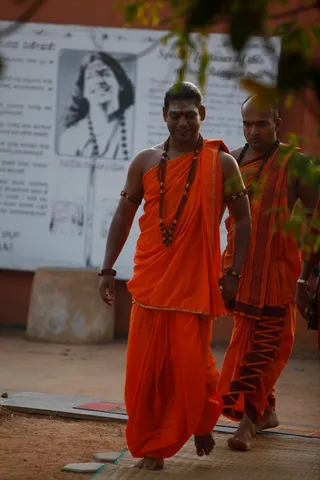
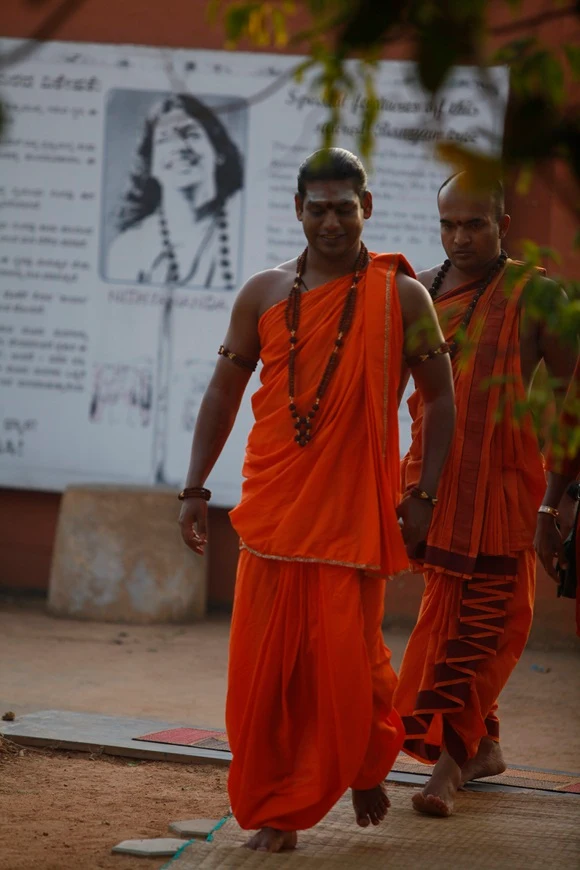
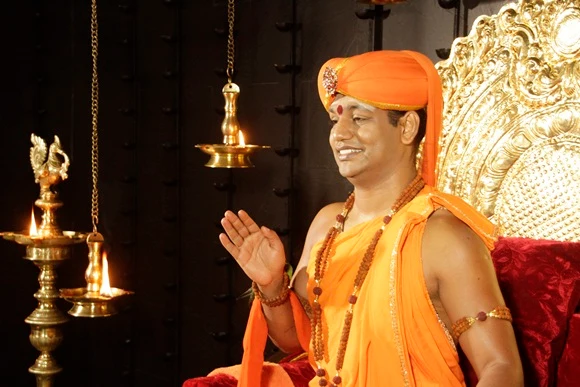
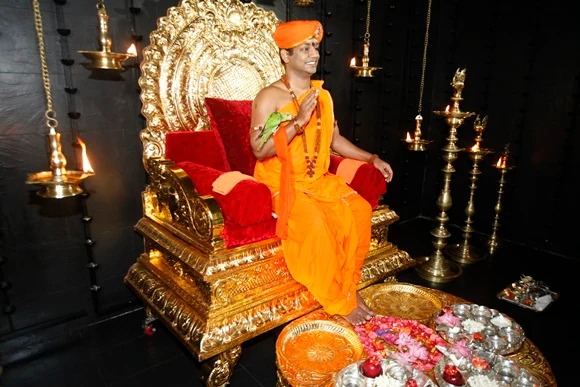
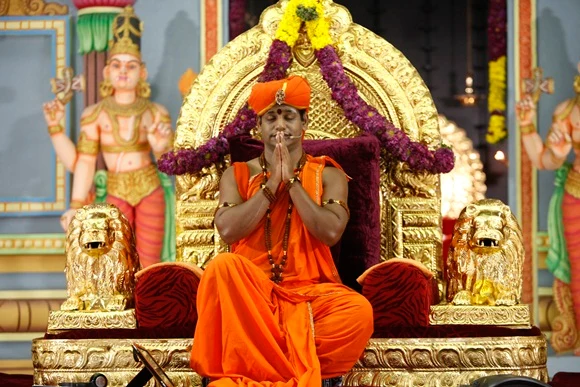
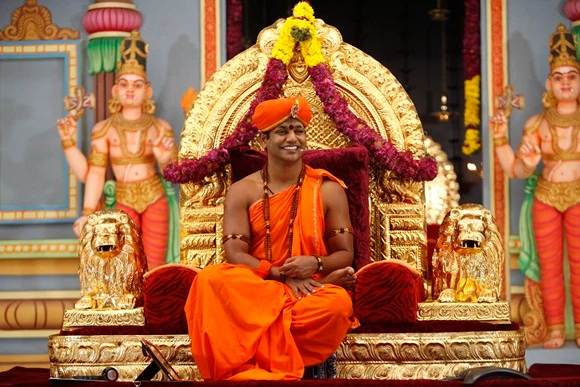
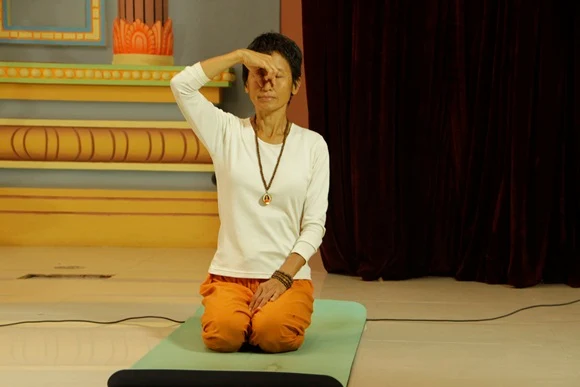
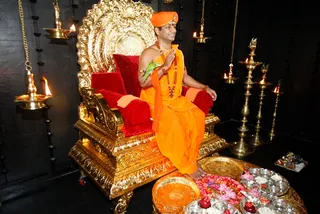
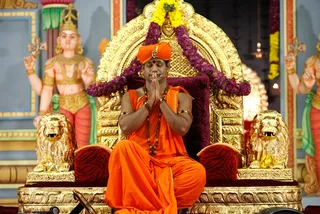
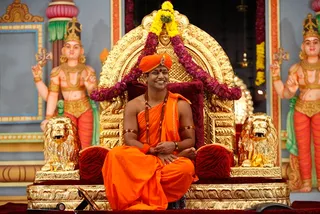
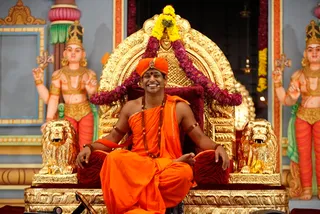
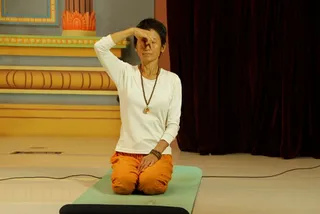
Photograph of two men walking barefoot on a mat-covered path outdoors in front of a large white board with printed text and a black-and-white portrait photo of a woman with long hair and beads. The foreground man in front wears an orange-saffron shawl draped over one shoulder, orange dhoti-style lower garment, multiple rudraksha malas, bangles and a reddish tilak on his forehead; he is smiling and looking ahead. A second man behind him, partly visible, wears orange-saffron cloth with a striped border and rudraksha beads, and a shaved head. Tree leaves frame the top of the frame and a concrete pedestal sits to the left.A seated man in saffron-orange robes and an orange turban with a red-and-gold ornament sits on a red cushioned throne before an ornate gold carved backdrop. He wears multiple rudraksha malas and gold bangles on his upper arm and wrist, and smiles while raising his right hand in a gesturing mudra. Two brass oil lamps with lit flames stand at left, one hanging from a chain and one on a stand with a bird-shaped finial.A seated figure in an ornate gilded throne with red cushions, set against a dark wall lit by several brass oil lamps on stands. The person wears a saffron-orange wrap over a bare shoulder, an orange head covering, and beaded necklaces, with hands joined in greeting. At the foot of the throne sit brass plates and bowls with flower petals, flower garlands and offerings. The scene appears to be a ritual or satsang setting.A seated man in saffron-orange robes and an orange turban sits on an ornate golden throne flanked by two golden lion figures, with palm-fronds of purple and yellow flower garlands draped over the throne's top. His hands are pressed together in anjali mudra with eyes closed, and a rudraksha mala hangs around his neck. Behind him, painted deity murtis with golden crowns and jewelry stand on a blue and gold backdrop. The scene appears to be a satsang or discourse setting.A smiling man in saffron-orange robes and an orange turban sits cross-legged on an ornate golden throne with a red velvet cushion and carved lion armrests. Garlands of purple and yellow flowers drape the throne's top, and a rudraksha mala hangs around his neck. Behind him, two painted deity figures with multiple arms and gold crowns flank the scene against a blue and pink temple backdrop. The setting resembles a stage or temple hall during a discourse. Appearance is consistent with the probable Swamiji, given saffron clothing, an orange turban, a rudraksha mala and a throne, though the presence of a throne alone is insufficient.A smiling man in saffron-orange robes and an orange turban sits cross-legged on an ornate golden throne flanked by two carved lion figures and draped with a garland of yellow and purple flowers. He wears a rudraksha mala and a gold necklace, with his hands resting on the throne arms. Behind him stand two tall painted deity murti figures in red and gold with elaborate crowns and jewellery, set against a colourful temple-style backdrop. The scene appears to be a discourse or darshan hall. Swamiji (probable): the seated figure has a saffron robe, orange turban, rudraksha mala and gold necklace, seated on a throne as the central speaker.A smiling man in orange saffron robes and an orange turban sits on an ornate gold throne with red velvet cushions, flanked by two golden lion figures. A garland of purple and orange flowers drapes over the throne's canopy. Behind him, painted deity figures stand in a temple setting, one holding a trident. Rudraksha beads and a sacred thread are visible on his neck and chest, with gold bangles on his wrists.A man in saffron-orange robes and an orange turban sits cross-legged on an ornate gold throne with lion figures at its base and garlands of yellow and magenta flowers draped over the canopy. He wears a rudraksha mala and bangles and gestures with both hands, apparently giving a discourse. Behind him stand painted figures of deities with multiple arms, in orange and gold garments, and a small decorative lamp hangs in the upper corner. a person is seated in the central position on the throne, teaching in the manner of a satsang.A multi-panel video call collage of a group online satsang, with each panel a separate live camera feed of people seated on the floor. The centre panel shows a woman in dark patterned top and white trousers sitting cross-legged on a red mat before a framed picture, beside a paper sign reading PALM SPRINGS CALIFORNIA. A right panel shows people seated before a sign reading NEW YORK VARANASI with a decorated altar and offerings. A lower-right panel shows a smiling man with a red-and-gold turban and gold-edged garment, flanked by orange and pink flower garlands, and a face-level close-up whose appearance is uncertain. Other panels show seated devotees in white and colourful clothes, a table with brass items and red cloth, and a yoga-mat setting. The collage has no physical people itself; the people counted are those visible on the screens.A large hall filled with seated devotees on mats, many women and girls in white, cream, pink and red saris and salwar kameez, sitting cross-legged in rows facing a distant stage. Some hold small brass plates and sit near steel tins and cloth bags on the floor. A few men in white kurtas sit at the back. Behind them are framed pictures, a golden deity murti on a side altar, and red and gold decorative panels. No identifiable a person figure is visible in the frame.A photograph of a man seated on an ornate golden throne flanked by two carved golden lions, raising one hand in greeting and smiling. He wears a saffron-orange dhoti and shawl, an orange turban, a rudraksha mala and a gold pendant necklace. The throne is draped with a magenta and purple flower garland. Behind him stand two large painted deity figures with gold jewellery and multiple arms against a gold and red temple backdrop, with a microphone visible in front of him. The setting appears to be a temple or hall during a discourse.A woman with short dark hair kneels on a light green yoga mat in front of a painted stage backdrop with ornate pillar and temple-style designs and a dark red curtain. She wears a white long-sleeved top, orange-saffron trousers, a wooden bead mala necklace with a red pendant, and beaded bracelets. Her right hand is raised to her forehead in a gesture of meditation or prayer while her eyes are closed. No other people are visible.