Skip to content
Wednesday

11 August 2010

What is Nithyananda: Morning Message by Nithyananda 11 Aug

Dated photos
44
Source pages
1
Media
2
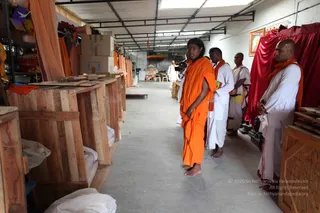
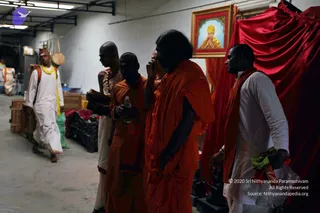
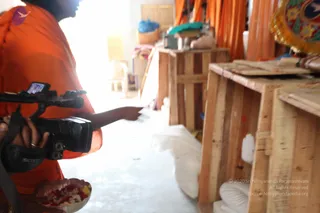
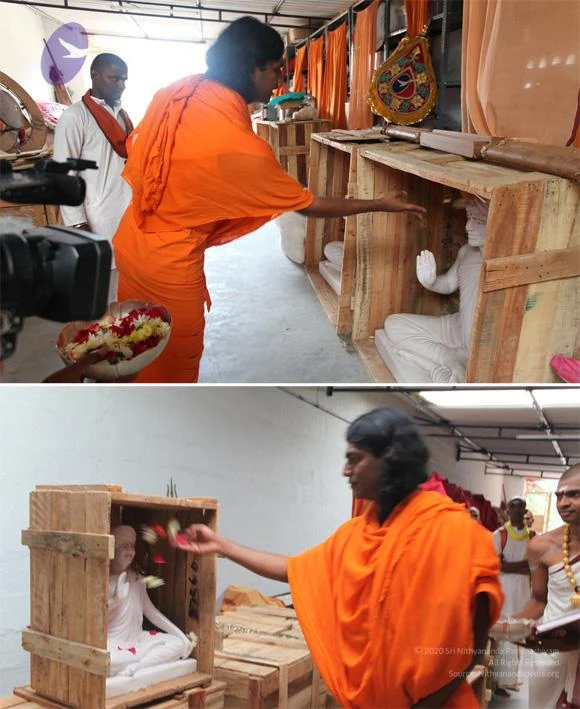
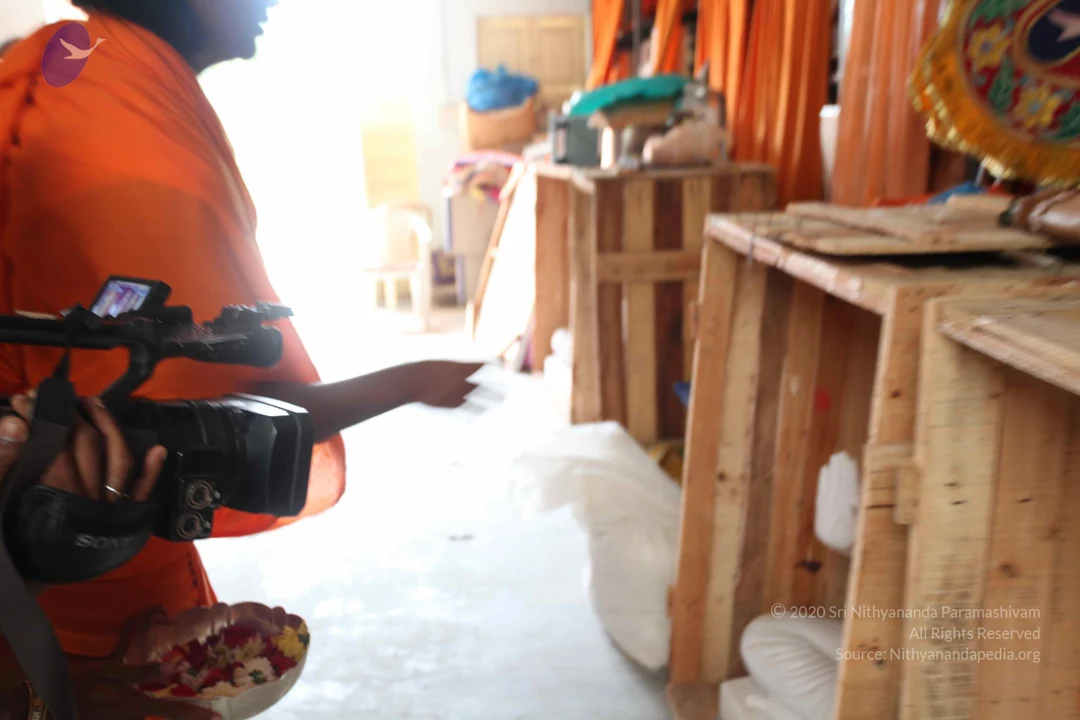
A photograph inside a plain concrete hall with a corrugated roof, lined with wooden crates and shelves holding folded orange and red cloth. In the centre, a barefoot man with long dark hair wears an orange saffron robe and stands looking to the side, with a camera operator filming him from behind. Behind him, several men in white dhotis and white shirts with orange shawls stand along the wall beside a red draped curtain and a framed picture of a deity. Further back, another figure in white stands near orange drapes. The scene appears to be a storage or preparation area, with bundled white cloth and cardboard boxes on the left.A photo taken in a plain warehouse-style hall with a concrete floor and red draped cloth at right. Several sannyasis in saffron-orange robes stand in a row, one holding a small water bottle and another with hands clasped near his chest. A person in white dhoti and kurta with an orange-and-yellow shawl walks at left carrying a bag, and a man in white kurta with an orange shawl stands at right holding a green cloth. A framed painting hangs on the wall above the drape, showing a figure in a golden turban with hands folded in prayer. Wooden crates and bags sit along the left side. Four people are visible, all in ritual white or saffron clothing.A photograph in a storeroom-like interior. In the left foreground, a person in orange robes holds a video camera on a rig and a shallow bowl of mixed flower petals. Behind them stacks of wooden crates and pallets are arranged along a wall, with orange cloth hanging from above, a folded green cloth, a small bag and white sacks on the floor. A decorative fringed embroidered cloth hangs at the upper right. The image is watermarked with a copyright notice. A visible person in orange with a camera is a cameraperson; no one is identified as a person.

August 11 2010

Original wiki page
Contents

Title

What is Nithyananda: Morning Message by Nithyananda 11 Aug

Narration

In the short discourse, Paramahamsa Nithyananda describes "Nithyananda".

Video and Audio

What Is Nithyananda Morning Message By Nithyananda 11 Aug

VideoAudio

Transcript

(0:09)

Sadāshiva samārambhām Shankarāchārya madhyamām | asmat āchārya paryantām vande guru paramparām ||

(0:44)

I welcome you all. From today, I will give My message everyday at least for 5 minutes on one word directly related to Jeevan mukthi, one truth from science of jeevan mukthi for the people who are watching the pratyaksha padapuja, participating in the pratyaksha padapuja, physically and virtually from around the world.

I was really shocked, I was really surprised, the day web camera was on for Anandeswara darshan within 48 hours almost 1 lakh and 12,000 people had darshan of Anandeswara. I could not believe the counter number. I was really surprised, when I enquired and asked, they said it was a real number and not a hype number, it’s a real number. So around the world, people are continuously interested in watching what is happening in this space, in this place and, I sincerely respect the devotion and commitment of disciple and devotee around the world who are waiting in front of the web camera just to have one glimpse of Me walking in to the temple and doing namaskar to Anandeswara.

(2:37)

Everyday 1000’s of email are mailed, what is the time Swamiji comes to the temple? when can we have the glimpse of Swamiji when He comes to the temple? Sitting whole day in front of web camera, so just to satisfy all the devotees every day I speak one truth of jeevan mukthi and one component of jeevan mukthi at least few minutes; Not only that everyday at least half an hour to 1 hr I will be available to devotees around the world through this web camera, either during darshan or during morning padapuja or this message. Of course this message is the earliest feature and from today we are launching another one important service, everyday from around the world, Nithyananda world news will be read out in front of the web camera; So practically... whole day, people around the world, people who are watching and waiting through this web camera for the happenings here, they will be having satsangs, reminisces, experiences mainly personal question answer sessions with senior swami’s and whenever I find time with Me, so practically, from today we are launching a new service called Nithyananda web TV. We will be running this as a 24hr web channel.

(4:26)

Today first, I will try to expand on the word, the very word which vibrates in the ananda gandha of all our devotees and disciples NITHYANANDA. The word... has its own unique vibration, Nithya means Eternal, please understand, eternal is not opposite to ephemeral. Nithya is not opposite to Anithya. We always have an intellectual understanding, a linguistic understanding. Anithya word can be opposite to the word Nithya, NO.

(5:34)

Nithya means the word which has no opposite. It is eternal, of course in Sanskrit, the word Nitya, what all it means very difficult to translate in English. In English the word eternal can have opposite, ephemeral, but in Sanskrit the word Nithya cannot have the word opposite anithya. It is standalone, Independent, complete word eternal. Because the word Nithya means past, present, future, all these three put together and something more. See the word Nithya does not mean just present, people will always insist on living in the present moment. Please understand living in the present moment is an impossible task, is almost like trying to fly by pulling your own shoe lace, or trying to fly holding your own shoes and jumping. No, living in the present moment is an impossible task just like a dog trying to catch his own tail, run run run run run and finally drop in frustration and you may call that frustration as silence of mind. NO

(7:16)

Living in the present moment is impossible; only one thing is possible, you can be inclusive of all, when the past memories comes … see, when the present thoughts are coming… see, when the future, ideas about future is coming… see. Be untouched by all these three that is what I call NIthya, eternal. Please understand, present moment has one good quality, you can touch the eternity only through the present moment. That is the only good thing we have about the present moment, otherwise present is nothing but a mixture of past and future. Present has no other sacred spiritual quality except being a doorway for eternity, but the eternity itself is not present moment or present moment itself is not eternity. There is a big difference. Present moment can be the doorway for eternity but present moment in itself is not eternity.

(8:35)

Nithya means past, present, future put to gather and something more. Ananda means alive, radiating, be existing. See be alive in the past, present, future and something more is what I call Nithyananda.

(9:08)

Being alive, vibrant, bubbling in the body is called health, in the mind is called joy, in the being is called Ananda. Just being, bubbling, overflowing, flowing, living, beyond this body, mind, being is called Consciousness. So Nithya and Ananda in a way two different words to describe the same happening. The same happening is described by two different words.

(9:51)

Maybe the word Nithya can be expressed, in the sense of the time and the word ananda is in the sense of space. I can say Nithya can be expressed in the feminine dimension, Ananda can be expressed in the masculine dimension of the same happening. Nithya can be expressed in the prakruthi dimension- the time dimension and ananda can be expressed in the purusha, the consciousness, masculine dimension of same happening.

(10:34)

So the same happening which is beyond Nithyananda is expressed by the word Nithya and Ananda. Constantly remembering the linguistic reality or the linguistic meaning, pointing towards the reality, which is expressed by the word Nithyananda is direct path, method, technique to relax in to the Nithyananda. The word has two importance, one the linguistic meaning, remembering the truth expressed by that concept Nithyananda and phonetic importance as this word is from the great, unique language developed and revealed by the Enlightened rishis Sanskrit. This word is from the great language Sanskrit; originally created for Enlightenment, because of that language the word has phonetic importance also.

(11:53)

So remembering the linguistic meaning, means the truth pointed by this word and uttering with the clear pronunciation, understanding the phonetic importance of this word becomes a direct technique to take you beyond the space and time. Uttering it with remembrance and the phonetic importance takes you beyond time, remembering the truth, shown pointed by this word beyond space, leads you beyond space. So to go beyond time and space meditate, relax into the word and meaning of the word NITHYANANDA.

(12:57)

Have restful awareness in your inner space and keep this word and the truth shown by the word, pointed by this word, as a seed inside your being. You will give birth to yourself. You will give new birth to yourself, you will become Nithyananda.

Let you all live, achieve and radiate Jeevan Mukthi. Let you all live, achieve and radiate Enlightenment. Let you all live, achieve, express, experience, radiate the Eternal Bliss- Nithyananda. Thank you.

(13:48)

Photos:
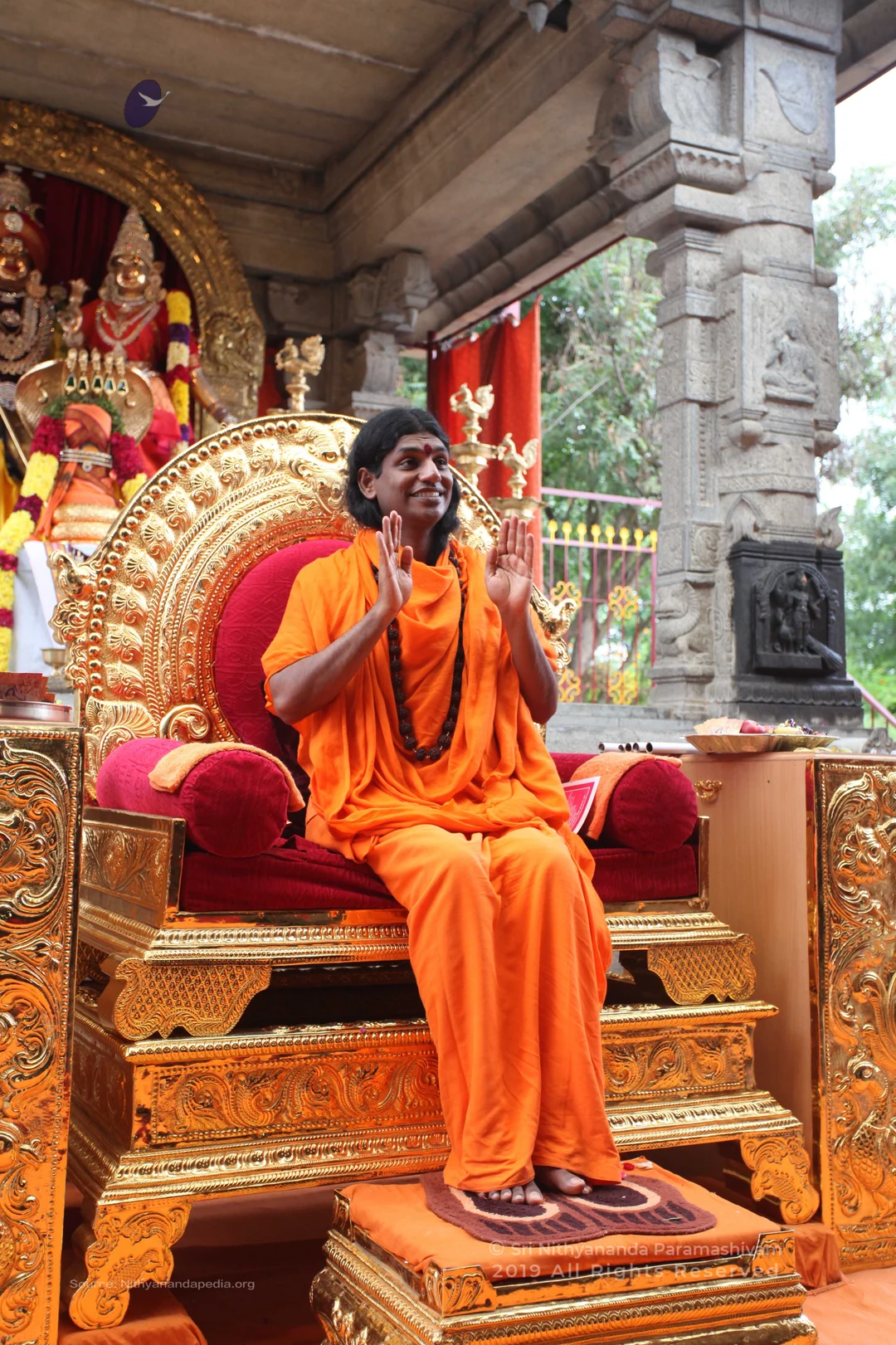
Photos Of The Day - IMG_8576.jpg

Photos Of The Day:

nithyananda-ashram
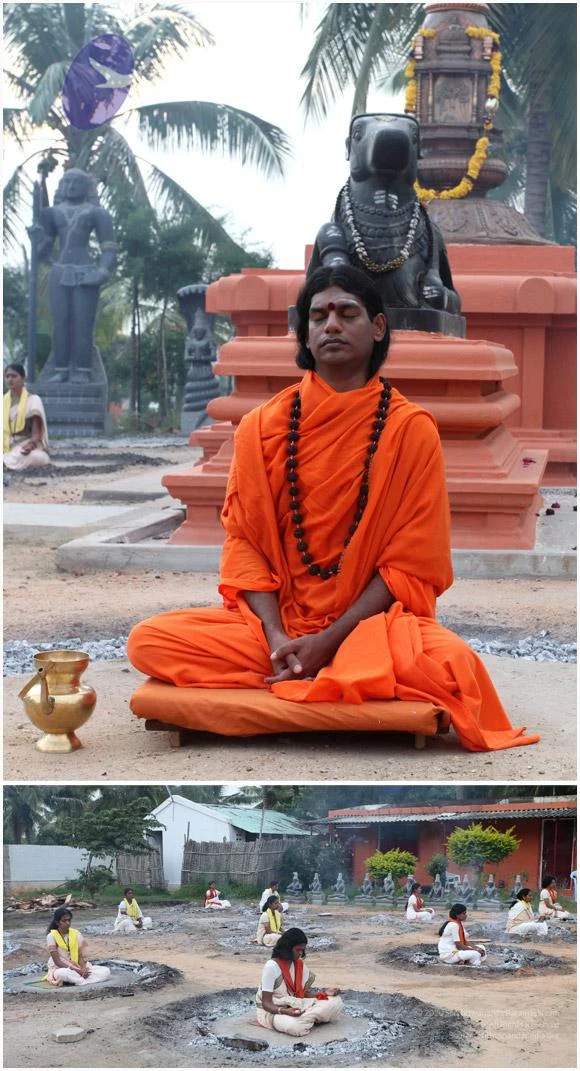
04-Welcoming-Temple-Murthis
06-Sarva-Darshan

07-Pujari-Initiation

Photos from this day

View all 44 photos

nithyananda-ashram

12 photosSource gallery
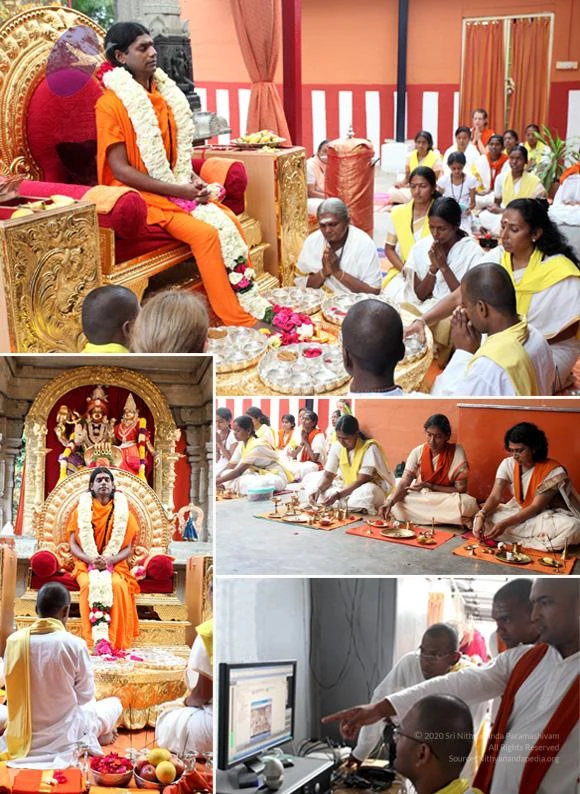
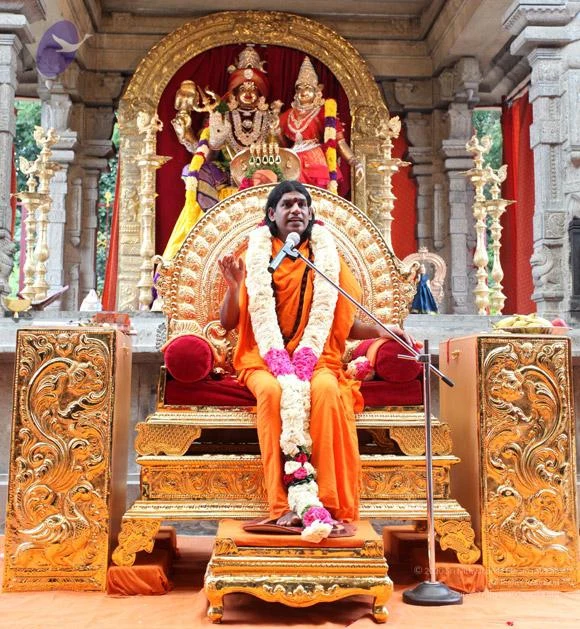
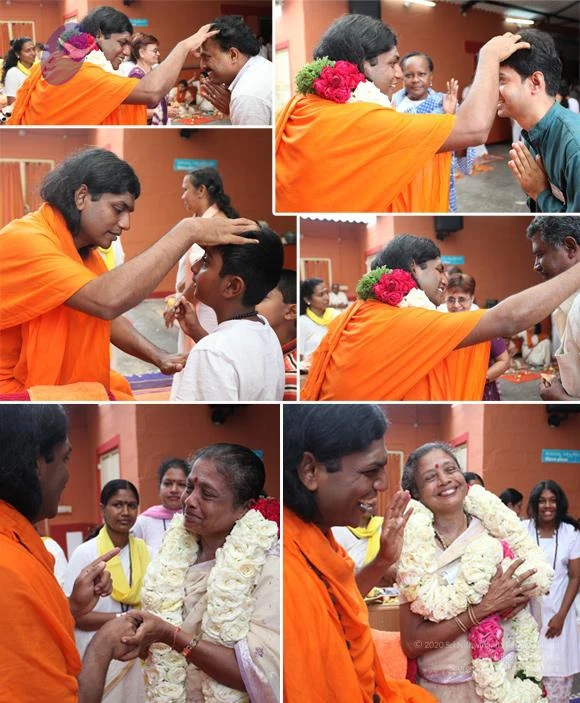
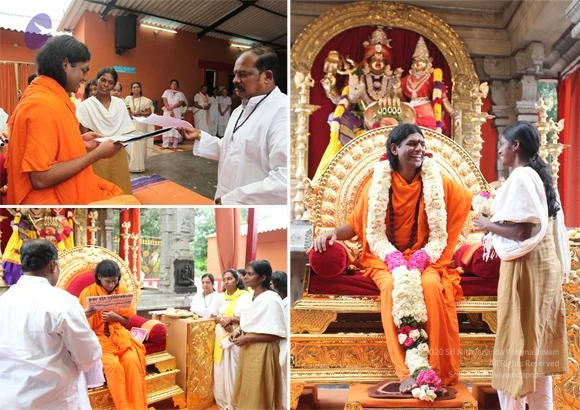
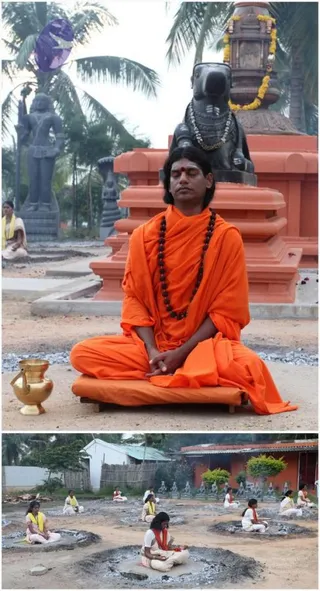
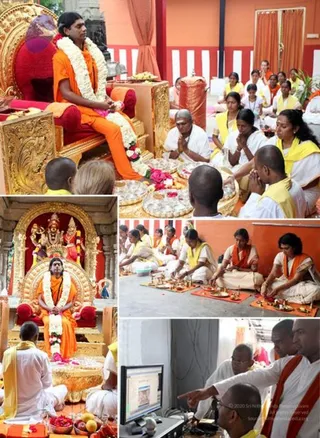
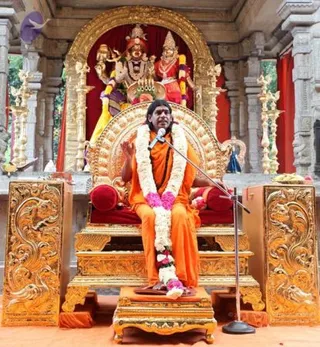
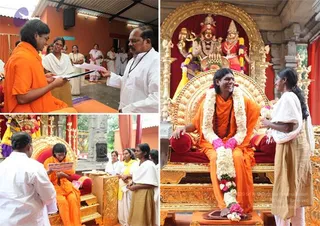
Two-panel collage of a temple courtyard with palm trees and orange-painted shrine structures. The upper panel shows a man with long swept-back hair and a red tilak, wearing an orange robe and dark rudraksha mala, seated cross-legged in meditation on an orange cushion before a black Nandi statue draped in garlands, with a brass kalasha at left and a standing deity statue behind. The lower panel shows about eight people in white with yellow shawls seated in meditation around circular fire pits with ash, in front of a row of statues and an orange-roofed building.A multi-panel collage of photographs from a KAILASA ashram event. The largest panel shows a man in orange robes with a white flower garland seated on an ornate gold-and-red throne, hands resting on his lap, with devotees in white and yellow shawls seated before him and offering plates of fruit and flowers. Another panel shows a seated figure in orange and white garland in front of a gilded shrine with deity murtis. Lower panels show devotees in white and yellow shawls and orange robes performing puja with brass plates, lamps and kumkum, and a bottom-right panel shows men in orange and white gathered around a computer monitor. A watermarked interface shows a webcam feed. Identity of the seated throne figure is uncertain from appearance.A seated man in saffron-orange robes and a long white-and-pink flower garland sits on an ornate gold-and-red throne (peetha) before a shrine. Behind him stand gilded deity murtis with a red backdrop and garlands, and gold pillars frame the scene. He gestures with one hand while speaking into a microphone on a stand. Gold-carved side panels flank the throne, and a small footstool sits in front of it. a person: the flowing dark hair, saffron robes, ornate gold throne and ceremonial garland are the visible cues; he is seated in a discourse setting.A six-panel collage of photographs from an ashram gathering. In several panels a long-haired man in saffron-orange robes, some wearing a red and white flower garland, presses his palm to the forehead of devotees, including a man in a green shirt with hands folded and a woman in a white sari. In the lower panels, the same robed man, smiling, holds hands with and places a hand on the cheek of women wearing large white flower garlands, one in a cream sari and one in a pink-bordered sari with gold bangles. Behind them, women in white and yellow-trimmed clothing and other devotees sit in a red-walled hall. a person cues: long swept-back hair and saffron-orange robes, with a rose garland; he is performing blessing gestures, and the page's a person claim was not decisive enough to name him. The image is a collage of photographs, so no single physical person count applies beyond the visible crowd.A four-panel collage of temple and ashram scenes. Top right, a figure in saffron-orange robes with long dark hair and a flower garland sits on an ornate gold throne with red cushions in front of a deity murti shrine; a woman in white stands to the right offering flowers. Top left, a saffron-robed figure stands facing a man in a white shirt who holds papers; other women in white stand behind. Bottom left, a seated saffron-robed figure reads from papers at a gold throne while women in white stand nearby. Bottom right, a woman in white with a yellow sash stands near the throne. The panels show ritual and devotional activity, not a single photo of one event.

04-Welcoming-Temple-Murthis
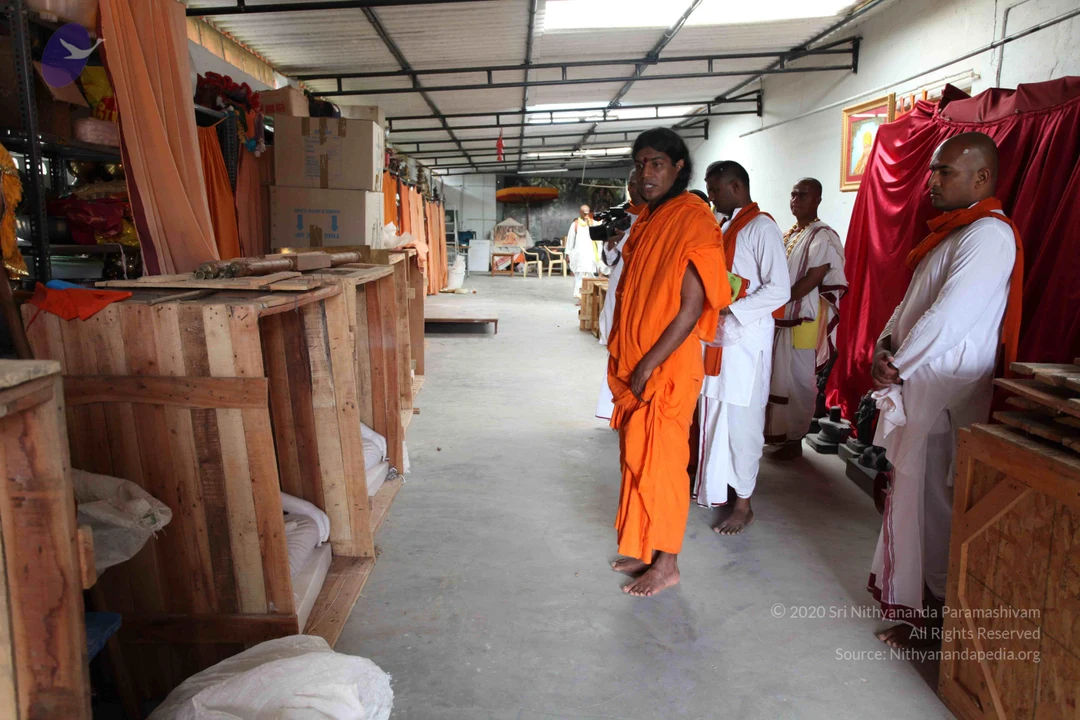
4 photosSource gallery
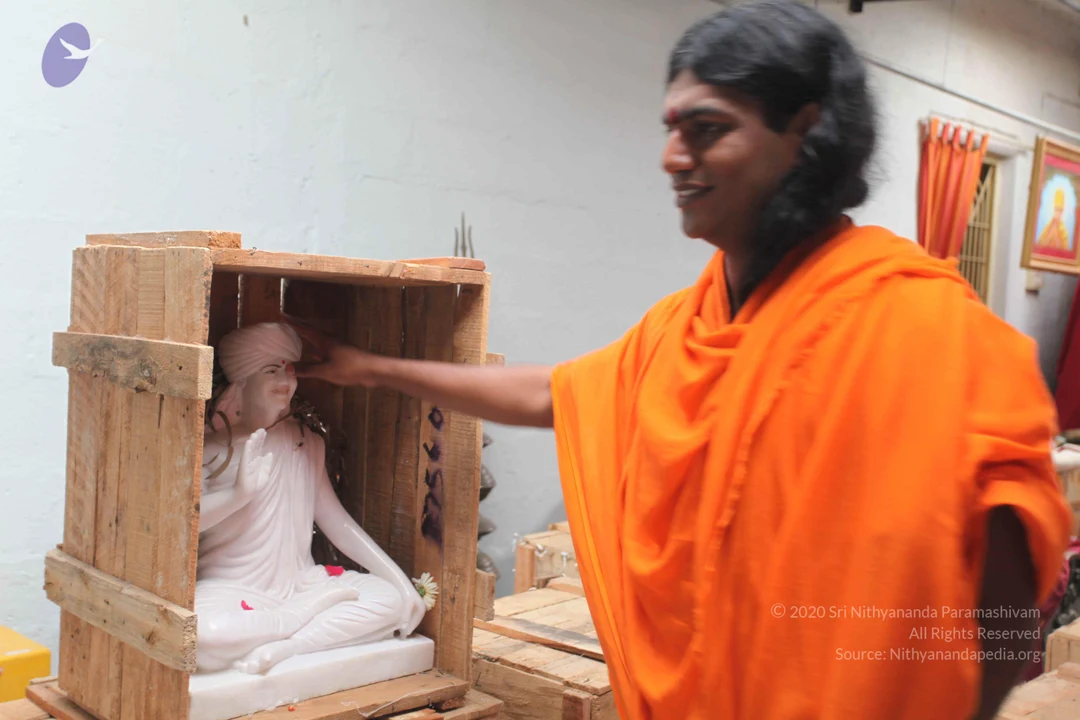
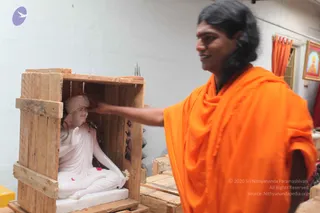
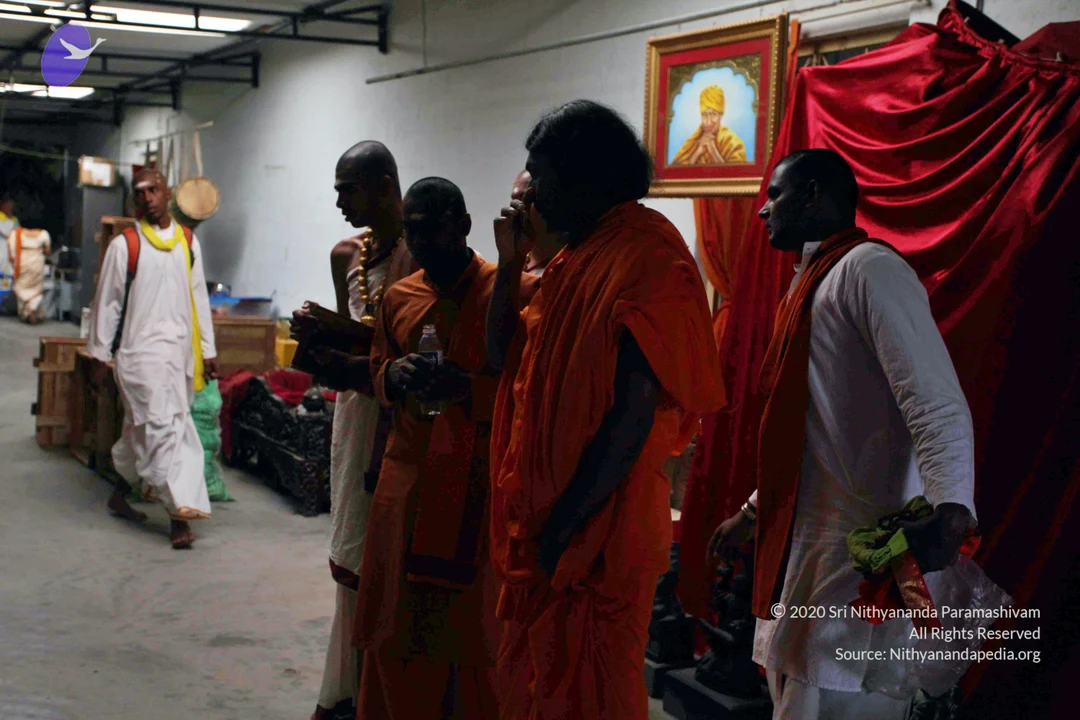
A photo taken in a plain warehouse-style hall with a concrete floor and red draped cloth at right. Several sannyasis in saffron-orange robes stand in a row, one holding a small water bottle and another with hands clasped near his chest. A person in white dhoti and kurta with an orange-and-yellow shawl walks at left carrying a bag, and a man in white kurta with an orange shawl stands at right holding a green cloth. A framed painting hangs on the wall above the drape, showing a figure in a golden turban with hands folded in prayer. Wooden crates and bags sit along the left side. Four people are visible, all in ritual white or saffron clothing.A photograph inside a plain concrete hall with a corrugated roof, lined with wooden crates and shelves holding folded orange and red cloth. In the centre, a barefoot man with long dark hair wears an orange saffron robe and stands looking to the side, with a camera operator filming him from behind. Behind him, several men in white dhotis and white shirts with orange shawls stand along the wall beside a red draped curtain and a framed picture of a deity. Further back, another figure in white stands near orange drapes. The scene appears to be a storage or preparation area, with bundled white cloth and cardboard boxes on the left.A photograph in a storeroom-like interior. In the left foreground, a person in orange robes holds a video camera on a rig and a shallow bowl of mixed flower petals. Behind them stacks of wooden crates and pallets are arranged along a wall, with orange cloth hanging from above, a folded green cloth, a small bag and white sacks on the floor. A decorative fringed embroidered cloth hangs at the upper right. The image is watermarked with a copyright notice. A visible person in orange with a camera is a cameraperson; no one is identified as a person.A man in flowing saffron-orange robes with shoulder-length dark hair and a red tilak on his forehead reaches toward a white marble seated figure inside an open wooden crate-like shrine. The seated white statue wears a pale pink head covering and draped white garments, with a white flower placed at its base. Behind them, a wall displays orange cloths and a framed image of a figure in orange against a yellow background. The statue is a deity murti in a wooden shrine during a preparation or placement setting.

06-Sarva-Darshan

16 photosSource gallery
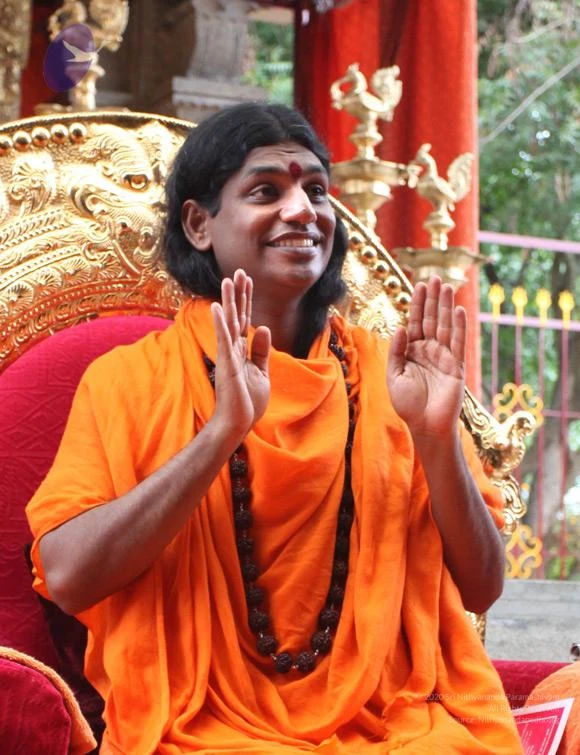
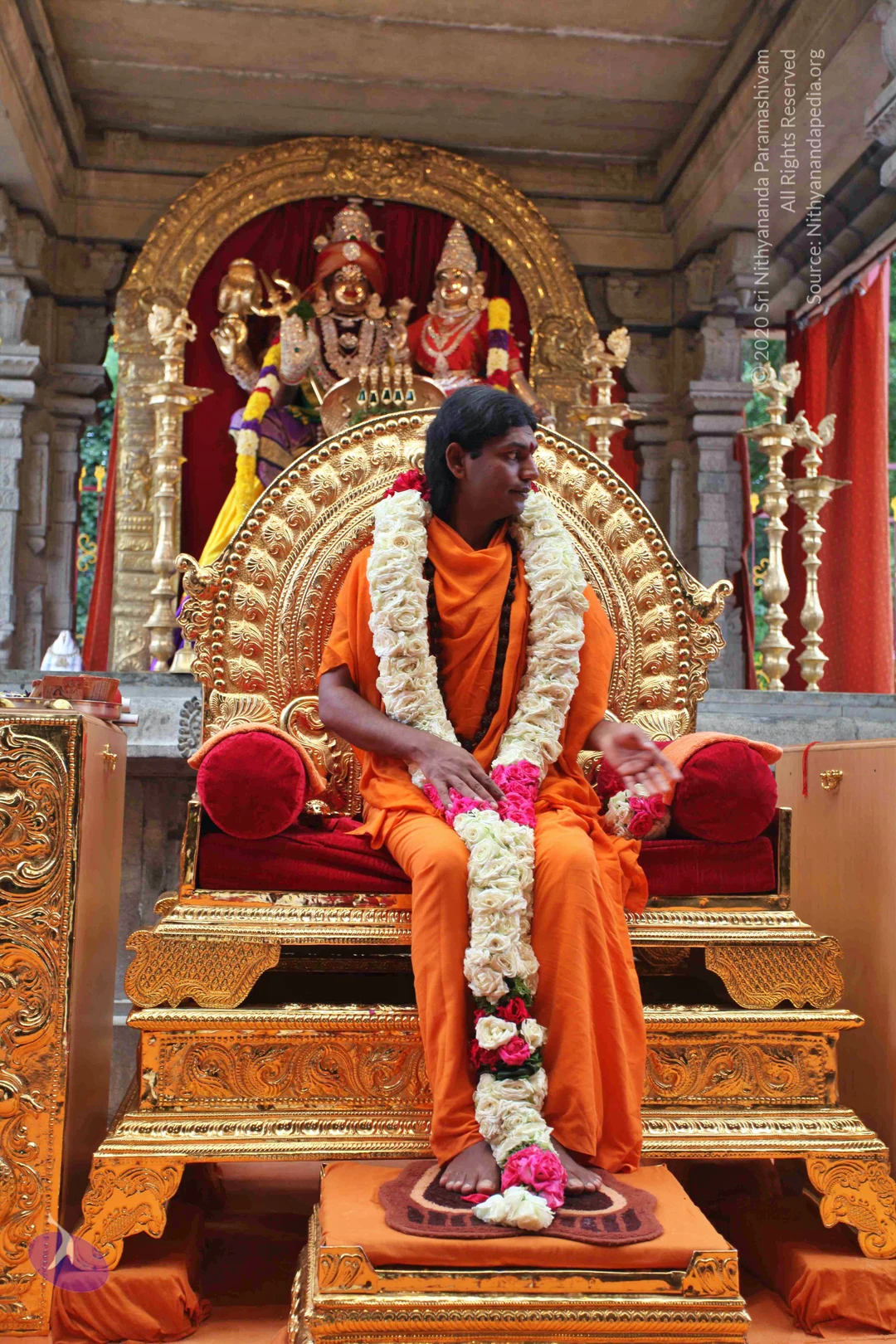
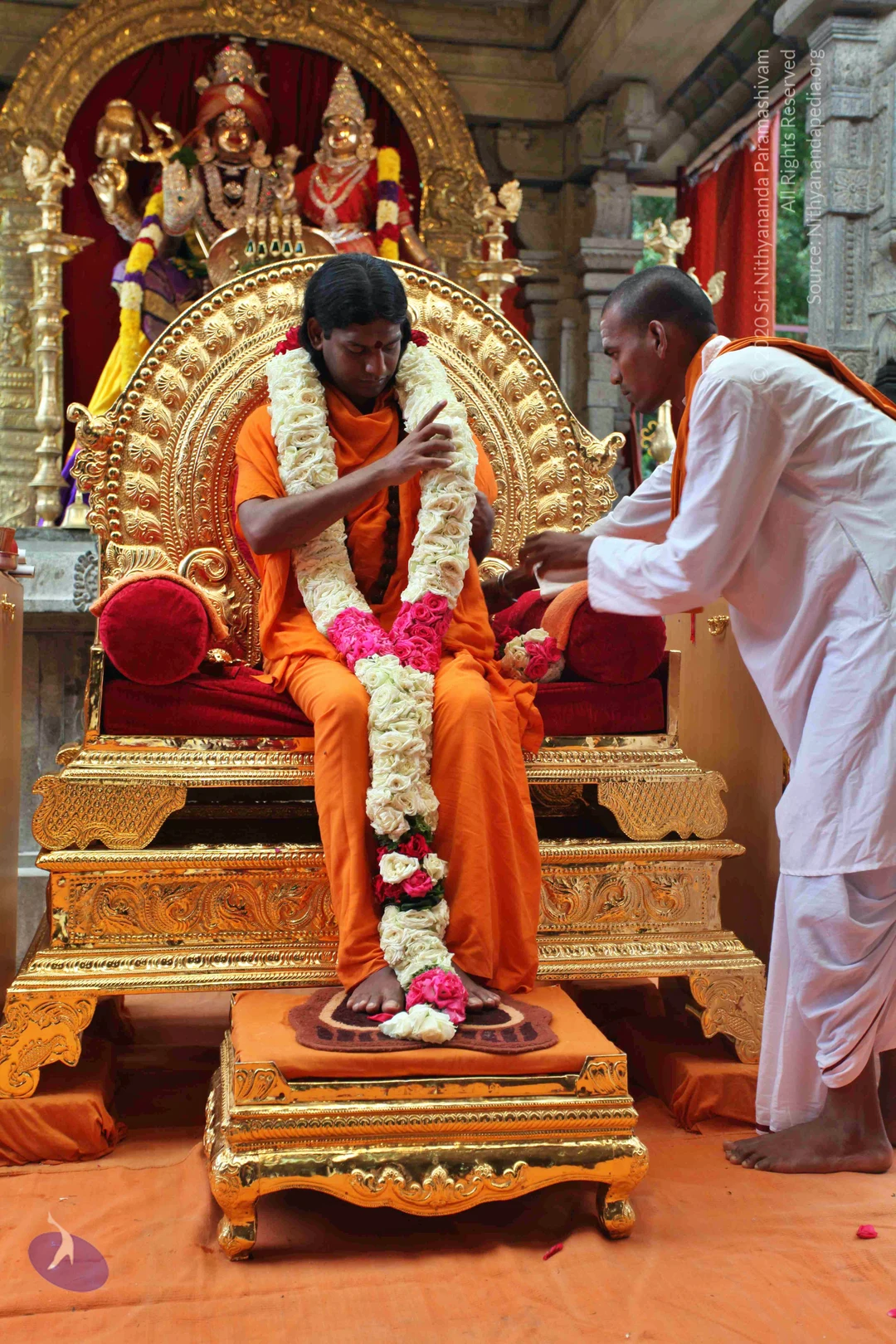
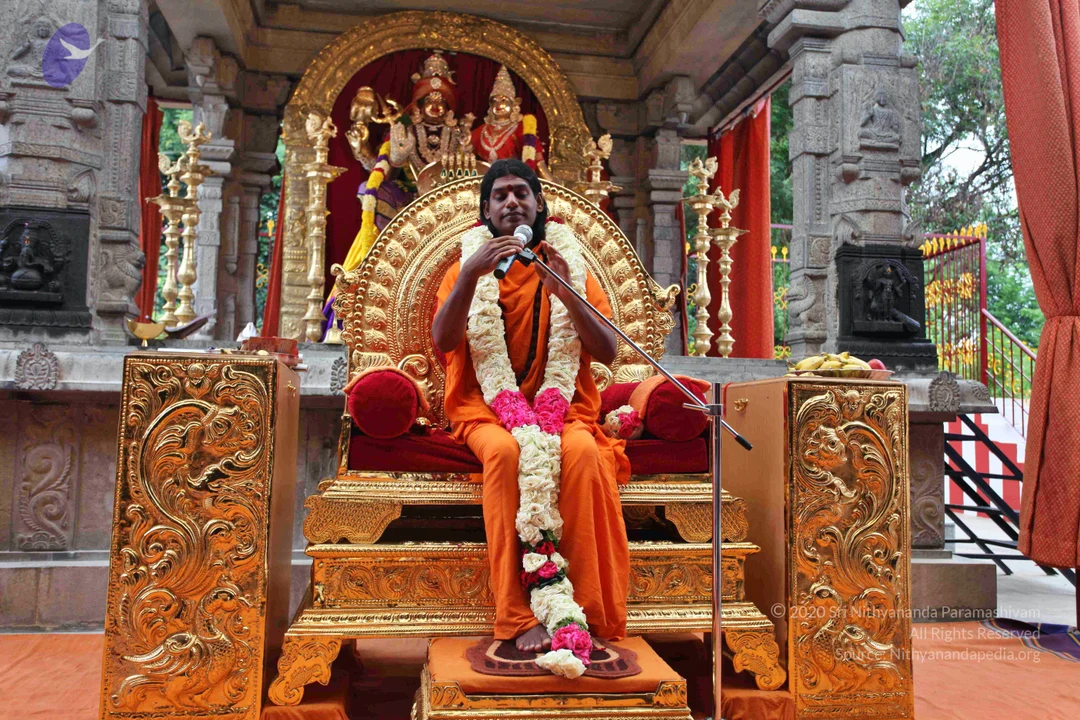
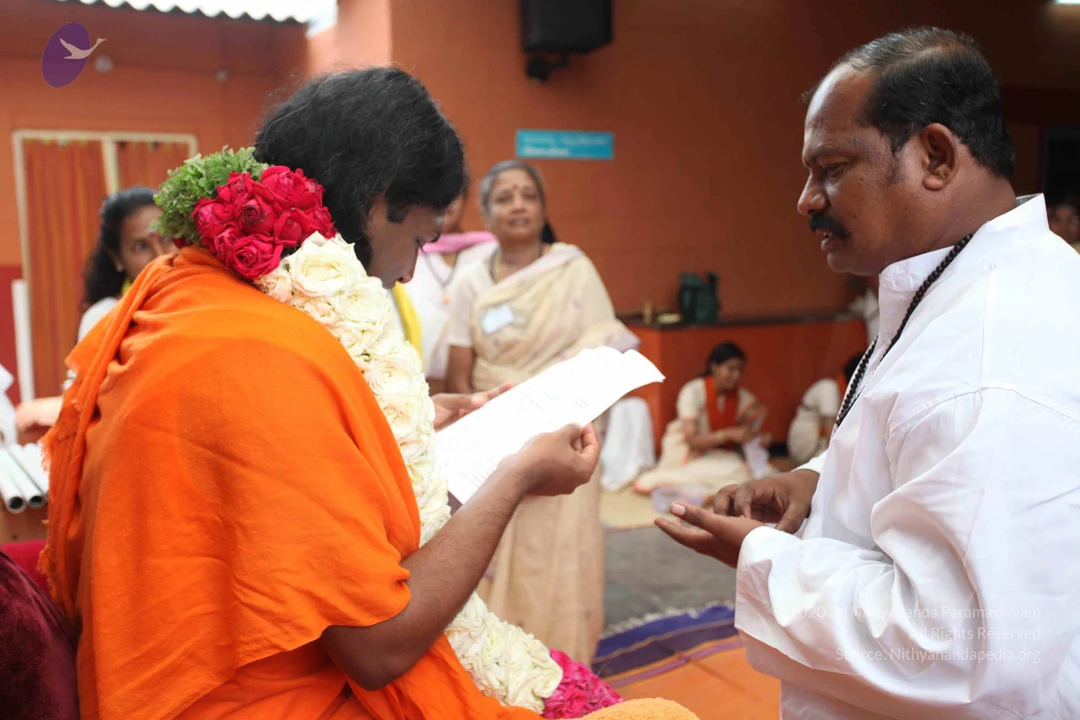
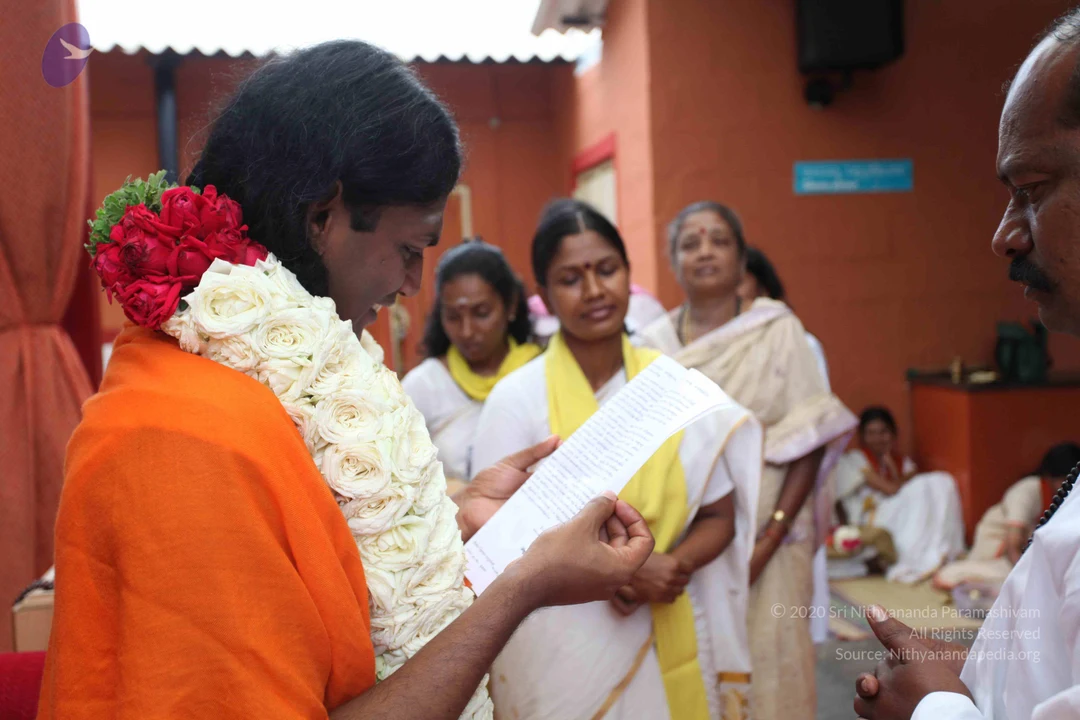
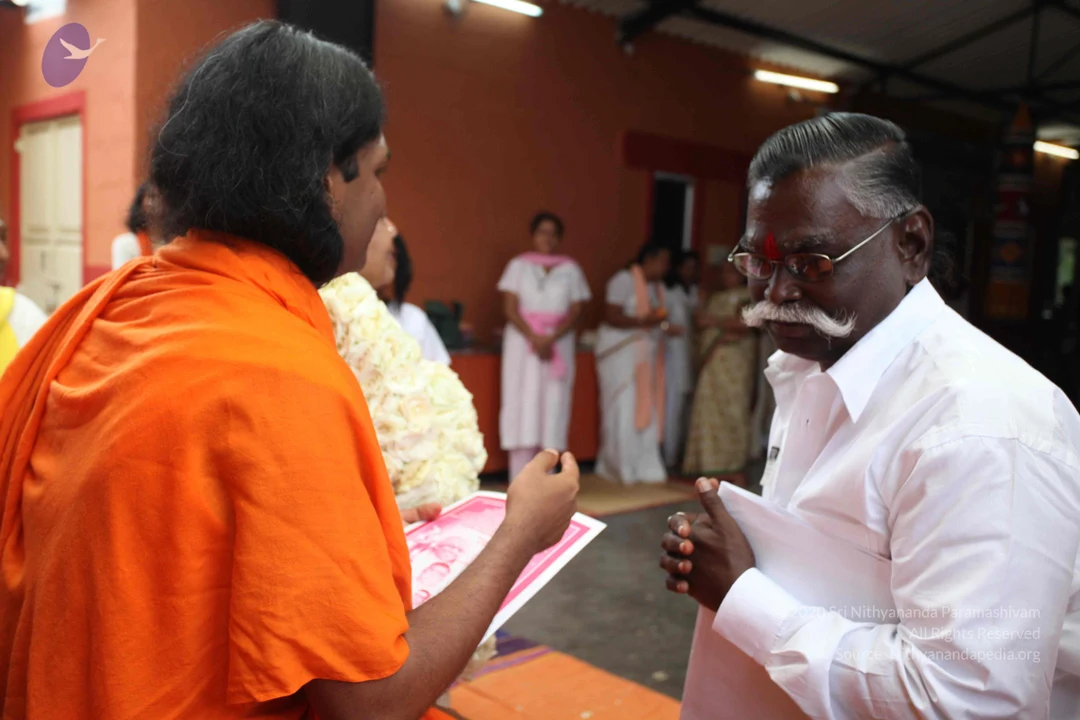
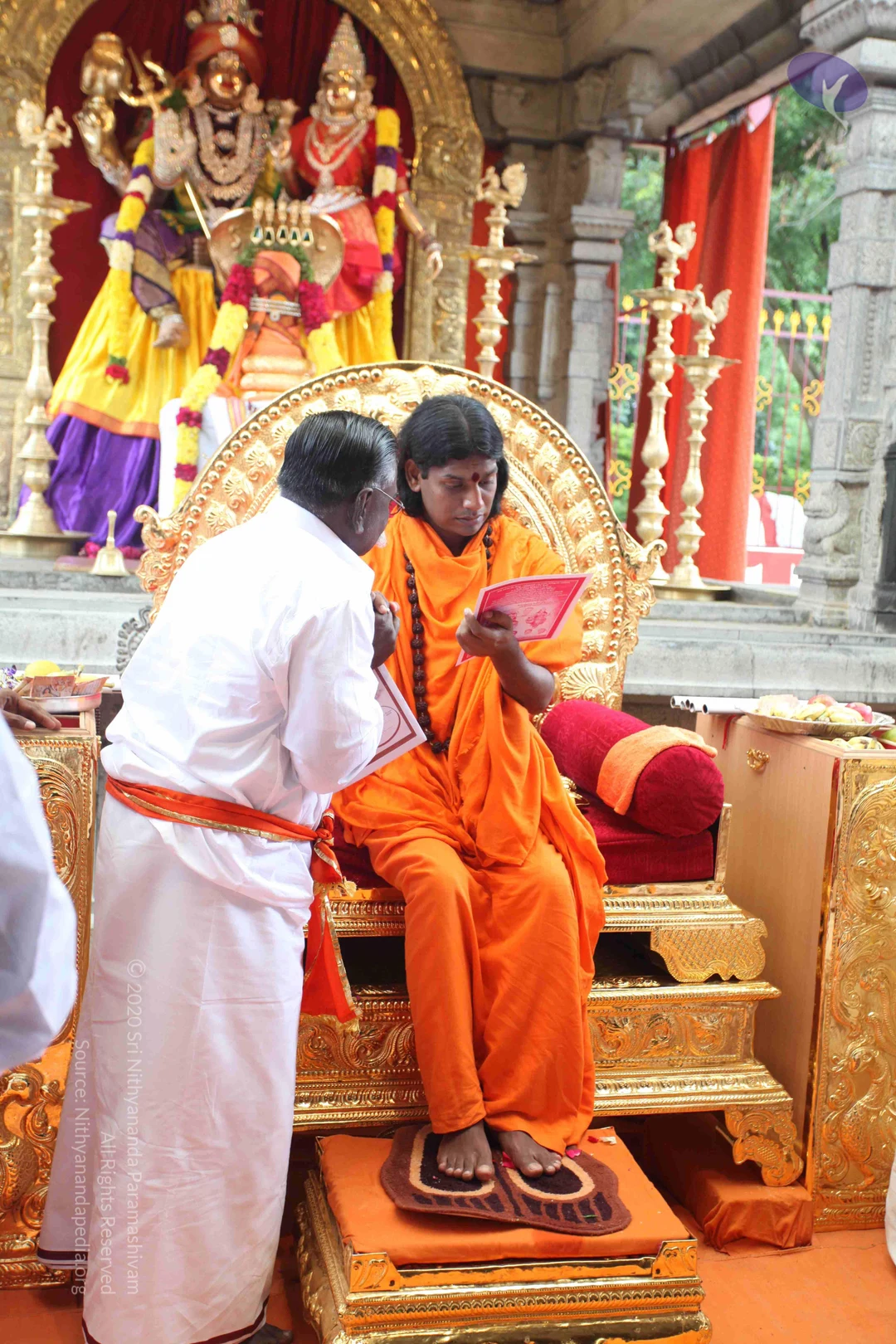
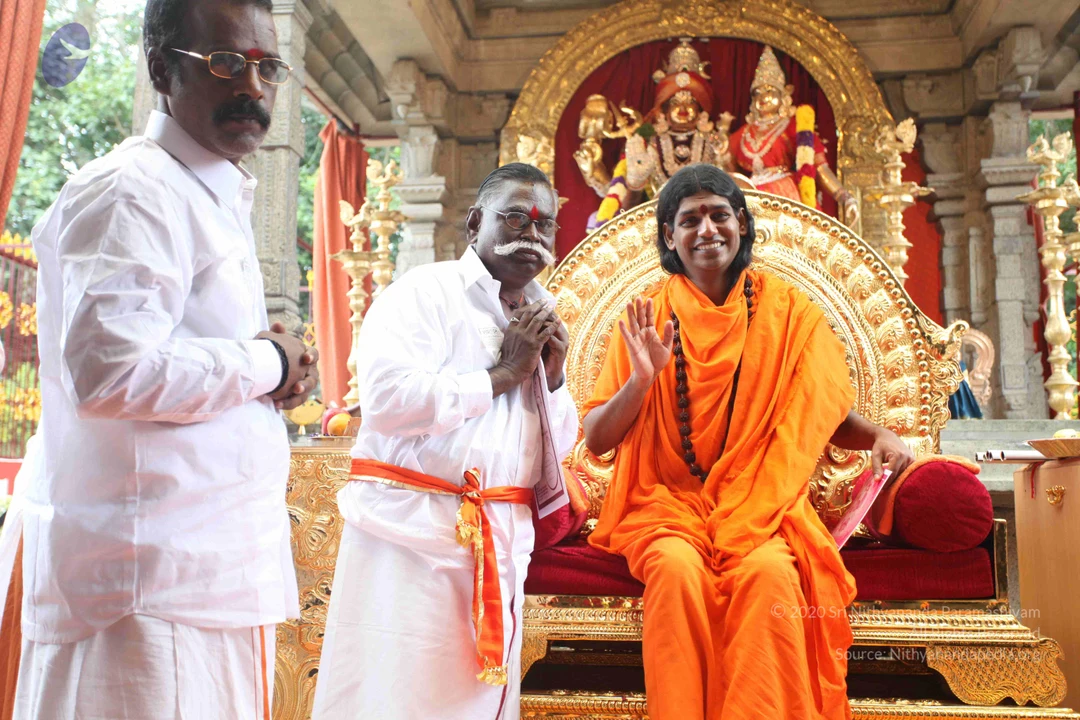
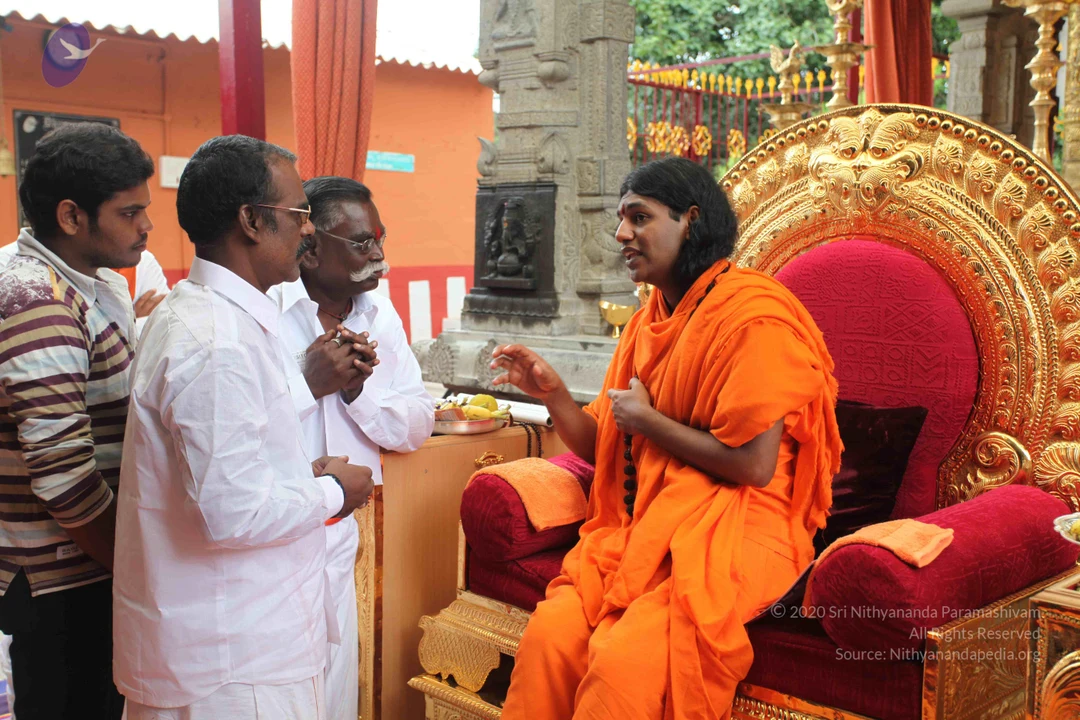
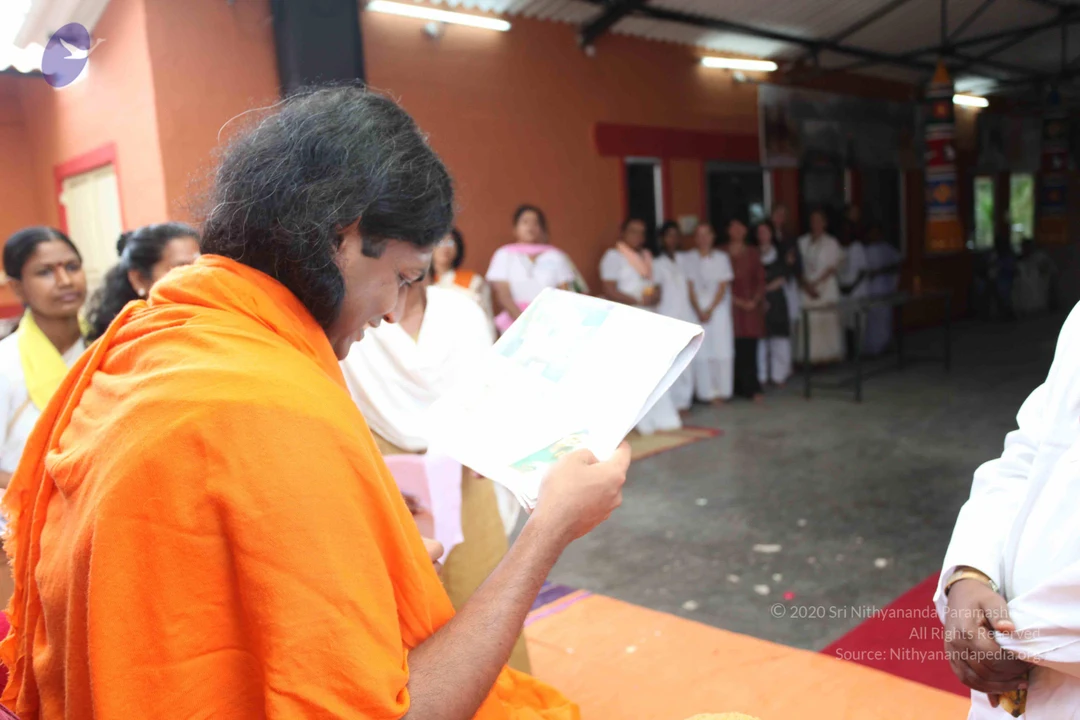
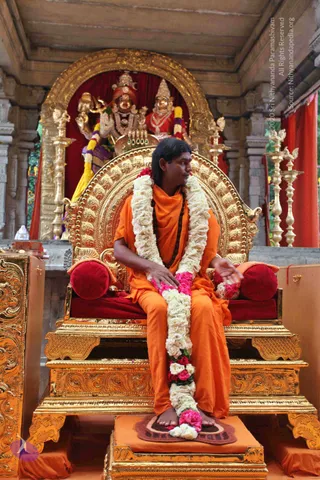
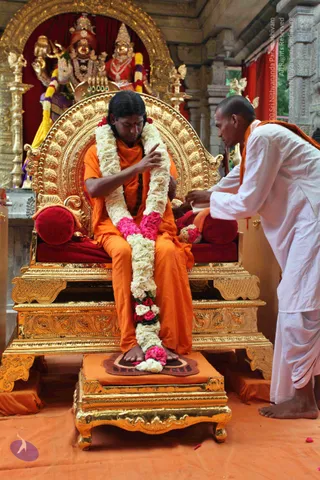
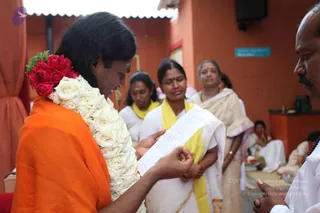
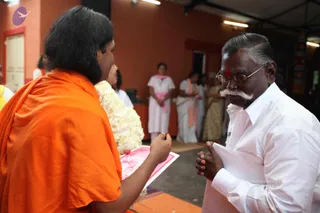
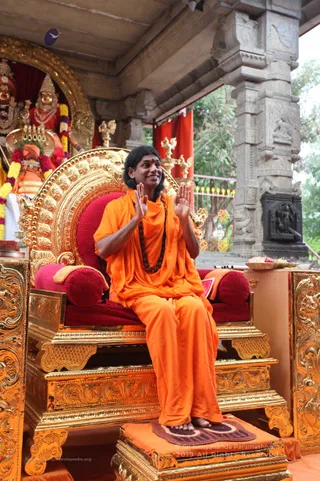
A man with long dark hair, wearing an orange saffron robe and a rudraksha mala, sits barefoot on an ornate gold throne with red cushions. A long garland of white and pink roses drapes from his shoulders to his feet, which rest on a small orange-cushioned footstool. He gestures with one hand while looking to the side. Behind him in a shrine niche, gilded deity murtis are adorned with garlands, and gold oil lamps stand on either side. The setting is a temple-style hall with red curtains and carved gold detailing.A seated figure in saffron-orange robes sits on an ornate gold throne with red cushions, wearing a long white and pink rose garland that drapes to his feet. He has long dark hair and a red tilak on his forehead. Behind him, a gilded arch frames a deity murti with a trident and a goddess figure in red and gold, with yellow and purple garlands. A man in white dhoti and an orange shawl bends forward, adjusting or arranging the garland on the seated figure, with a small pink flower bundle beside the cushion. Gold lamp stands and a red-carpeted floor complete the temple setting. The seated figure is an appearance-based probable Swamiji (long hair, saffron robes, rose garland, throne) present in person.A man in orange saffron robes sits on an ornate gold throne with red cushions, holding a microphone in his hands while speaking. A garland of white flowers and pink blossoms hangs around his neck, and he is barefoot on a small red and gold footstool. Behind him stands a gold-framed altar with a deity murti of a seated goddess with a crown, flanked by brass lamps and a red curtain. Carved stone pillars frame the open pavilion, with a red-and-gold railing and trees visible beyond, and a tray of fruit sits to the right of the throne.A photo in an orange-walled hall. A long-haired figure in a saffron-orange shawl, with a garland of white flowers and red roses around the neck and a rose cluster in the hair, sits with head bowed while reading a printed sheet held in both hands. Facing them on the right, a man in white shirt and white dhoti-style clothing with a dark rudraksha-style mala gestures with an open hand while speaking. Behind them, a woman in a cream sari with a beaded necklace stands near a doorway, and a few people in white and cream sit on the floor in the background. A blue directional sign hangs on the orange wall. The orange-clad figure is wearing saffron clothing and a flower garland but no clearly distinctive presentation cues beyond that, so identity is uncertain.A photograph of a long-haired figure in an orange-saffron shawl and a large garland of white roses with red roses, holding a printed sheet of paper and reading from it. Behind them, several women in white and cream saris, some with yellow shawls, stand in an orange-walled hall. On the right edge, a man in white with a mustache points toward the page. A blue wall sign is visible in the background.A photograph of two men in conversation indoors in front of an orange-red wall. On the left, a man with long swept-back dark hair wears a loose saffron-orange shawl over his body and holds a pink-bordered printed sheet in one hand while gesturing with the other. On the right, an older man with grey hair, a white moustache, glasses and a red tilak on his forehead wears a white shirt and holds a folded white paper with clasped hands. Behind them, several people in white and orange-pink garments stand near a flower-garlanded table, and a red-and-white floral garland hangs nearby. A purple logo appears in the upper left corner.

07-Pujari-Initiation
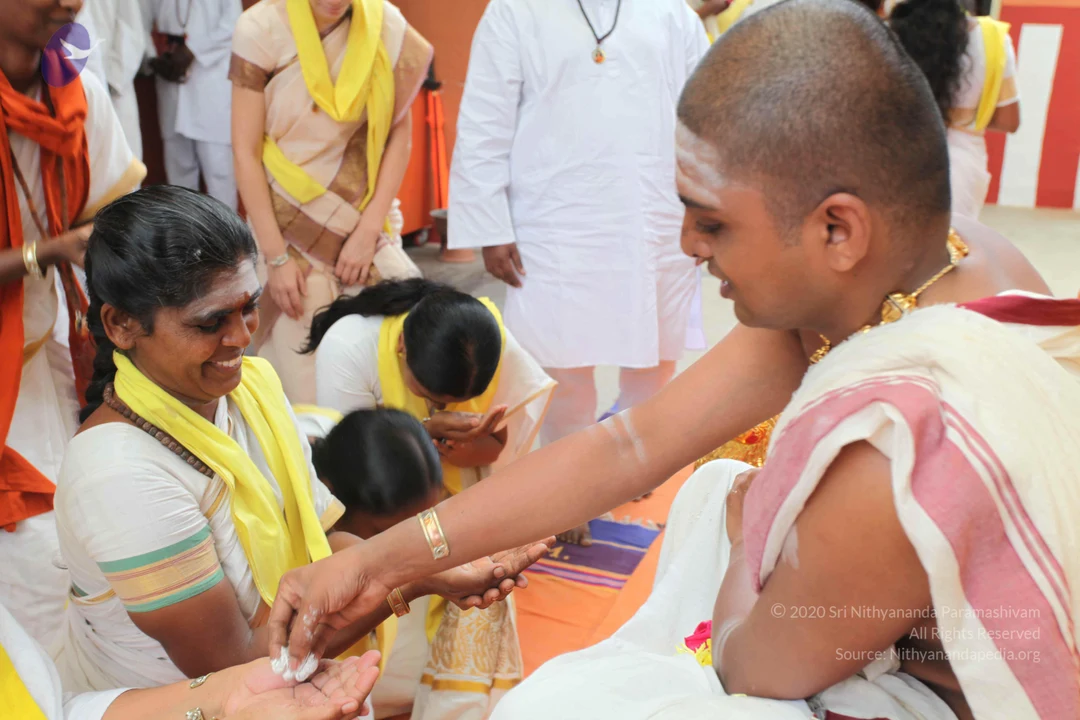
11 photosSource gallery
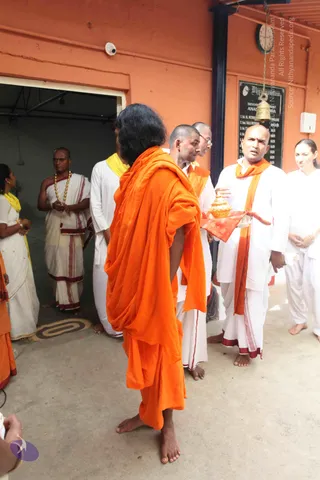
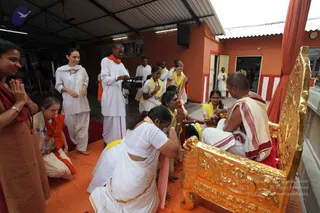
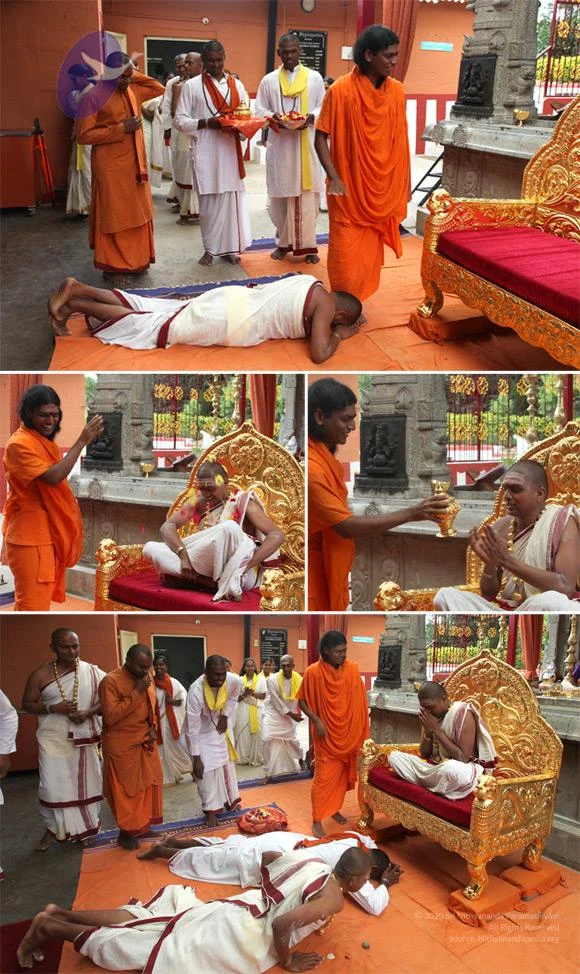
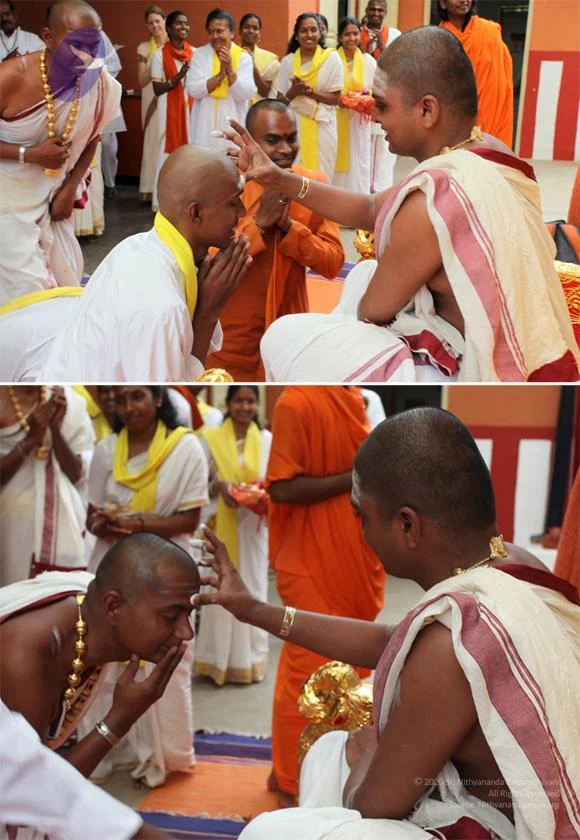
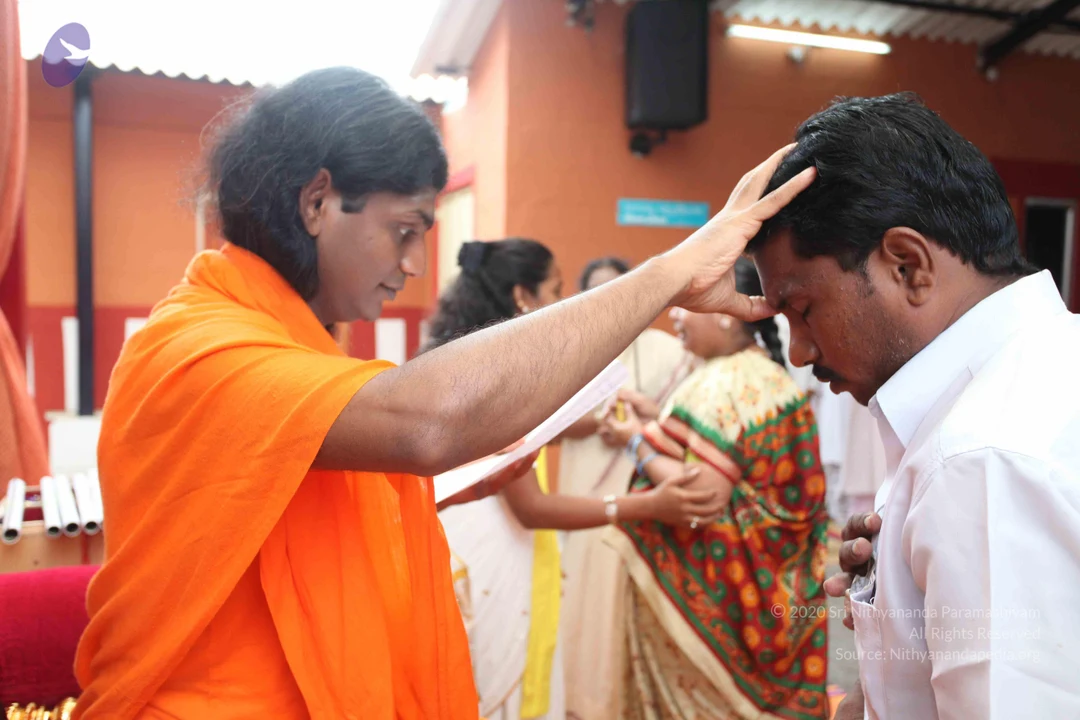
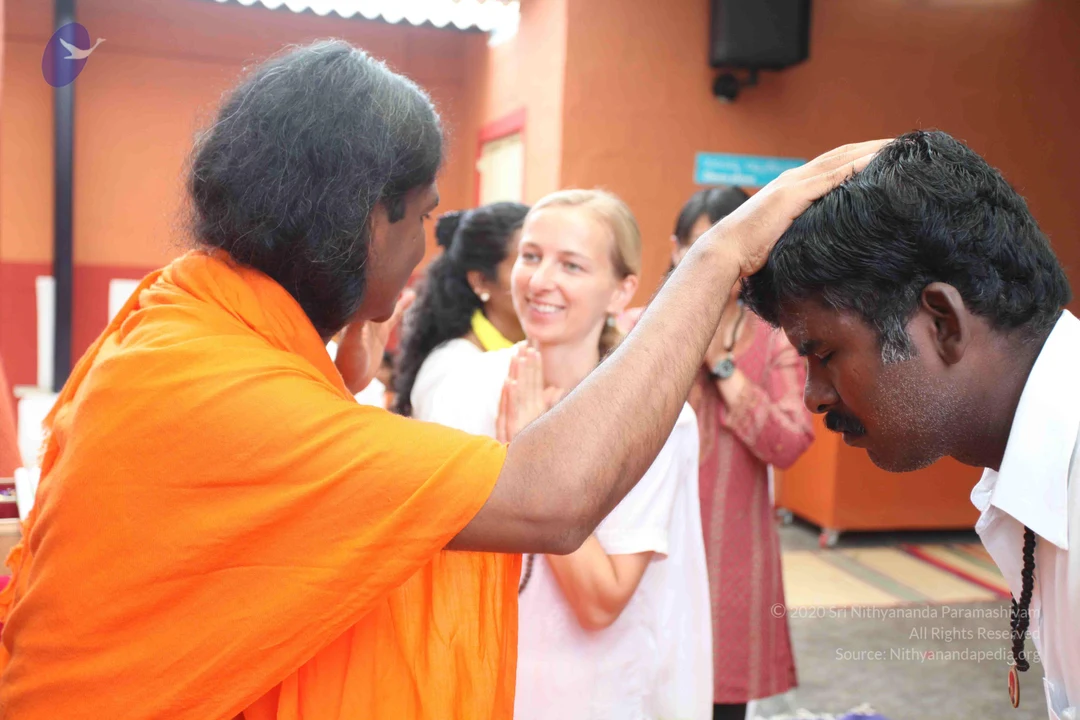
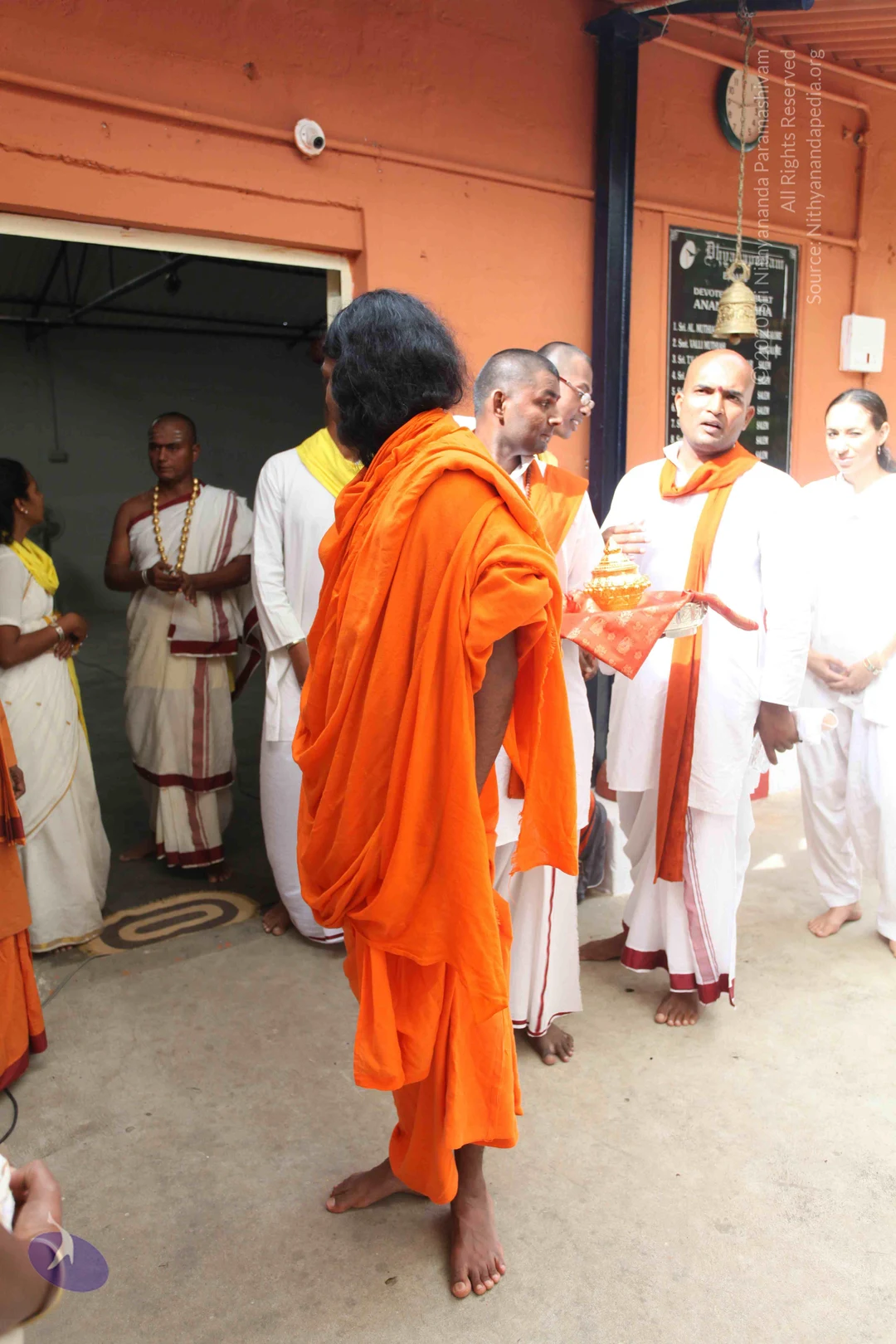
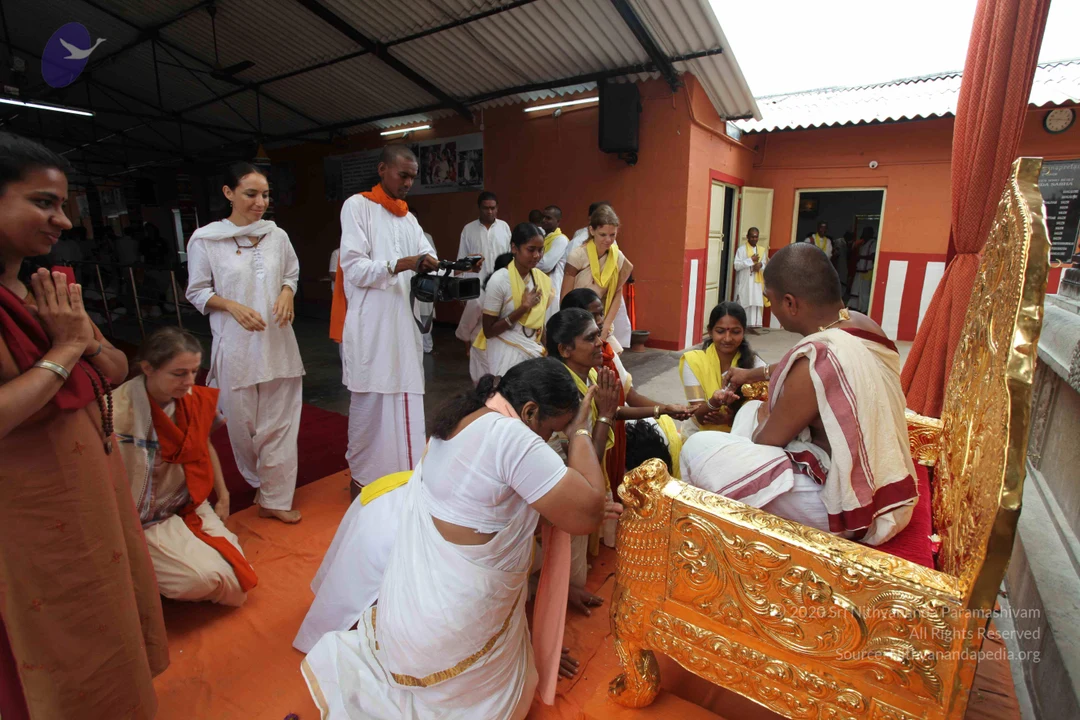
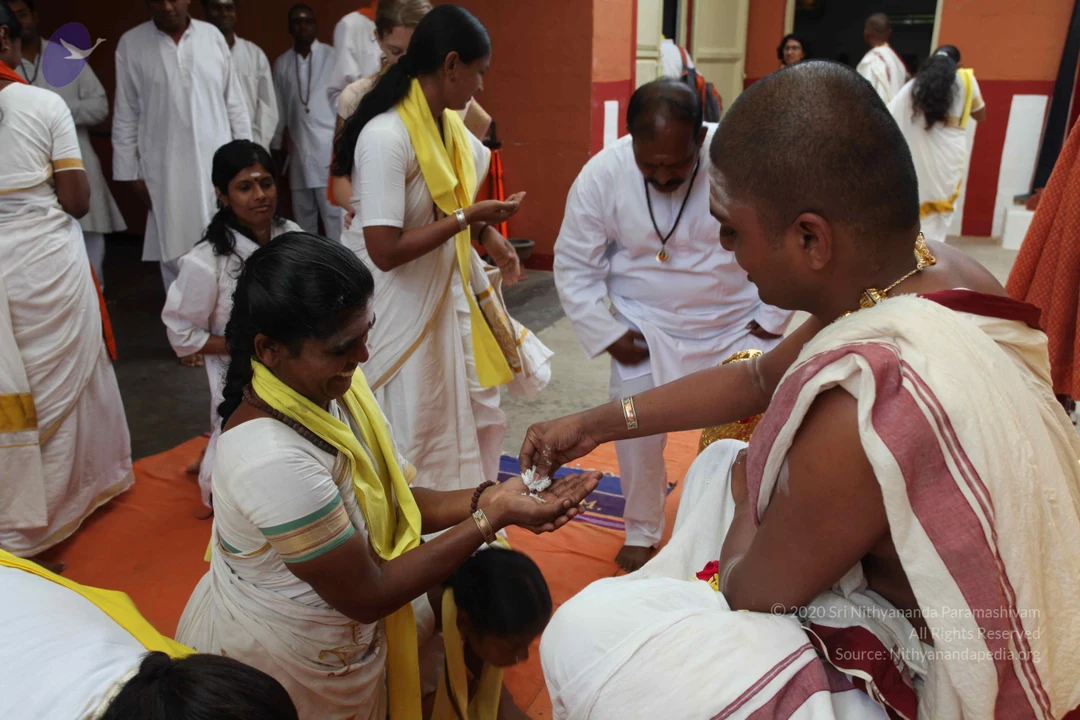
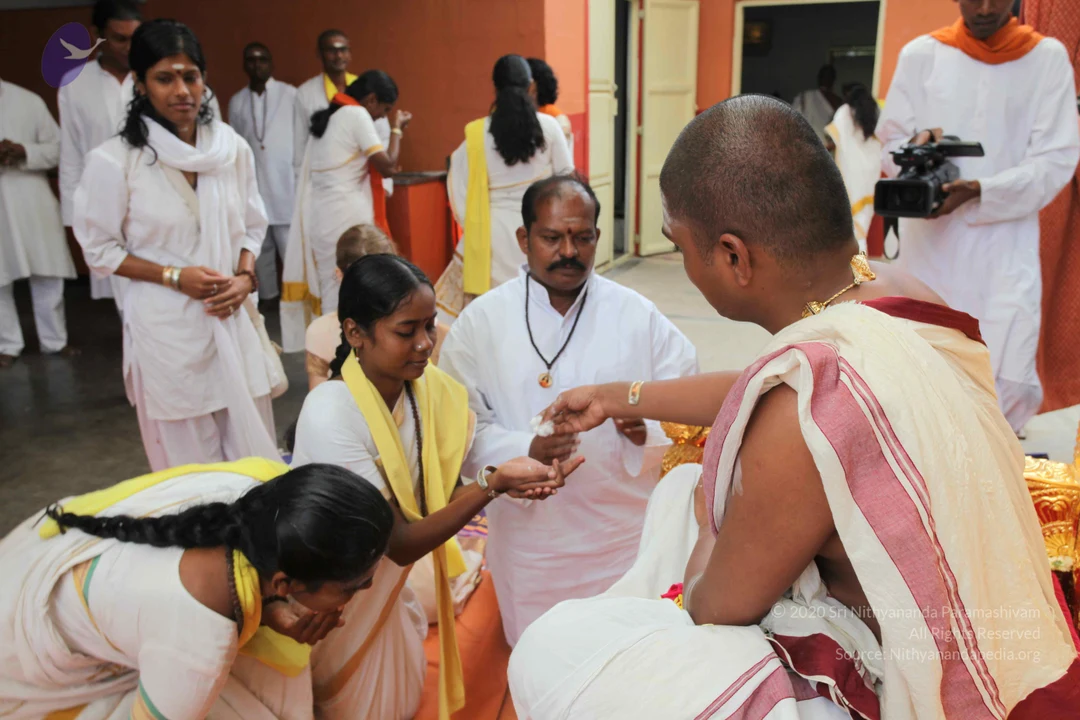
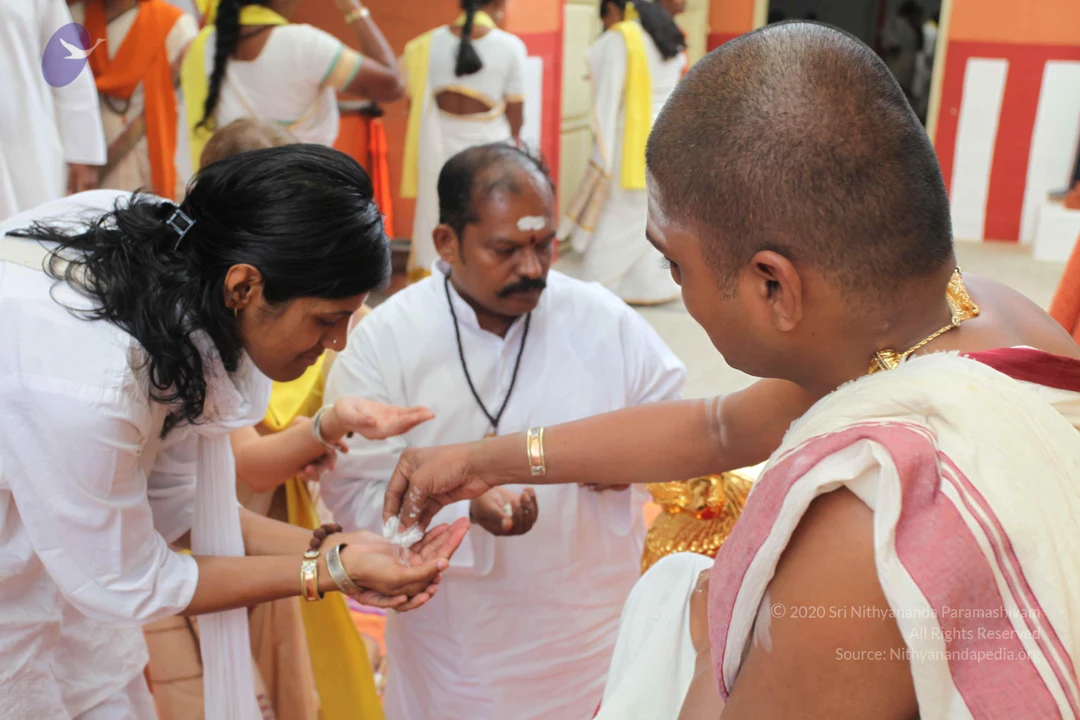
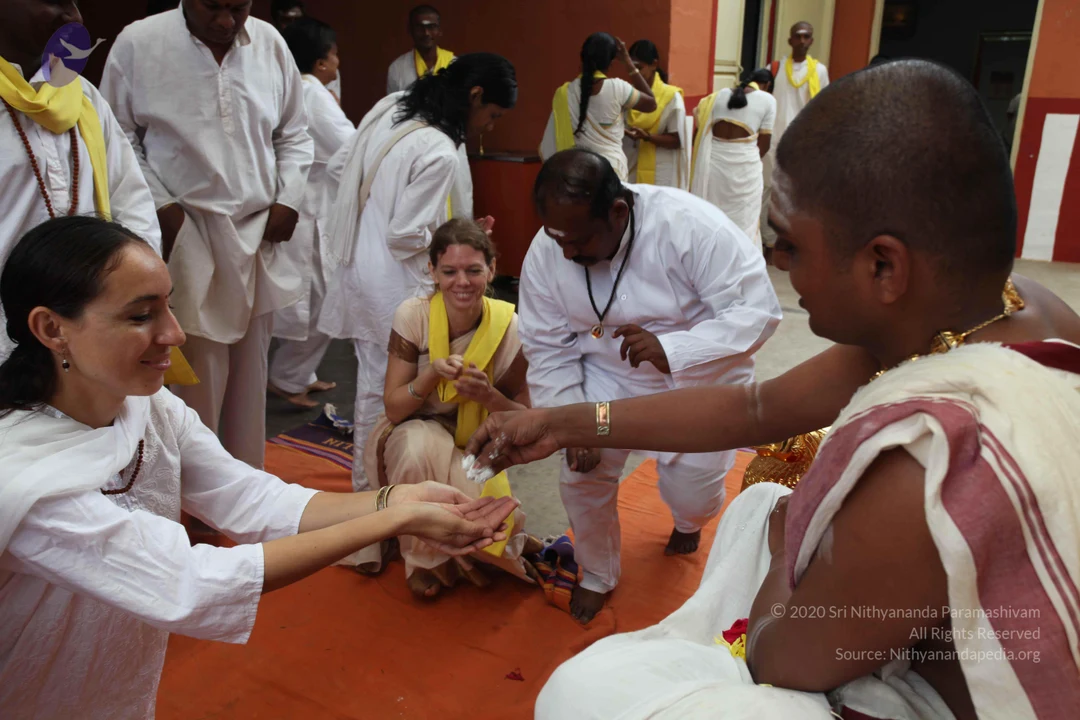
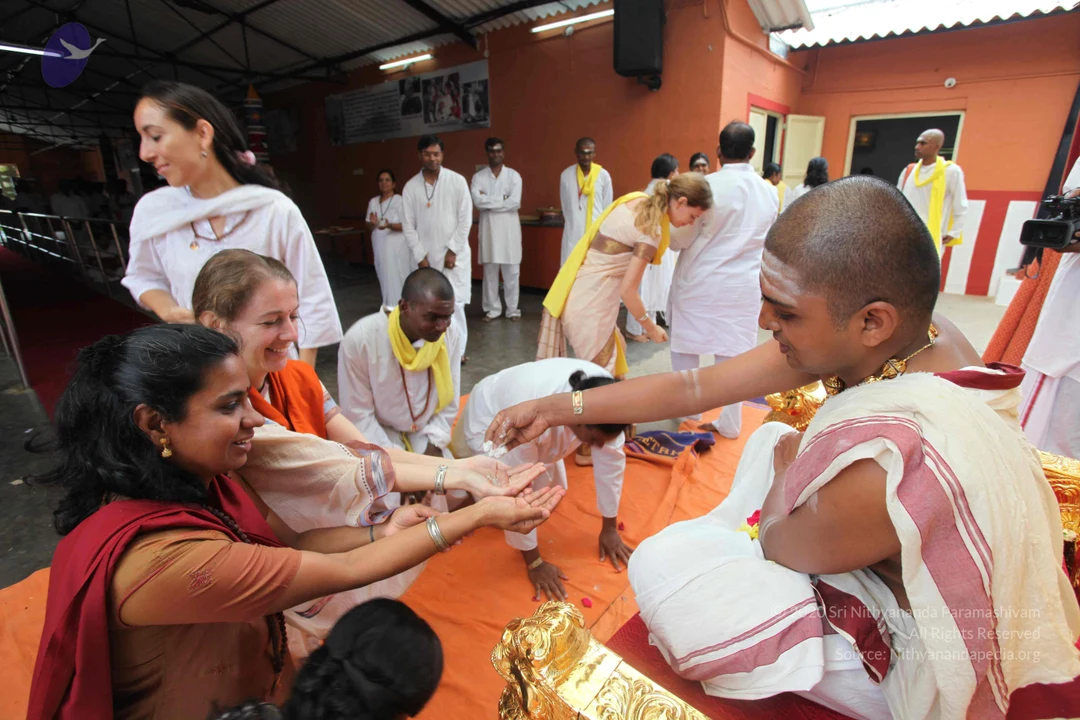
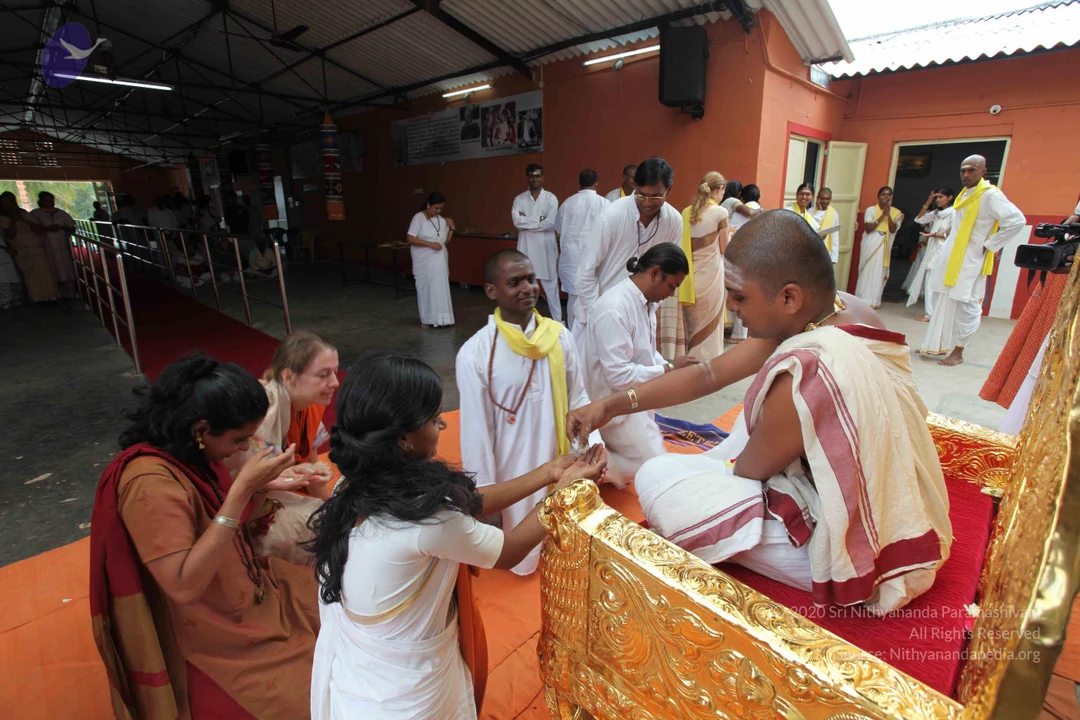
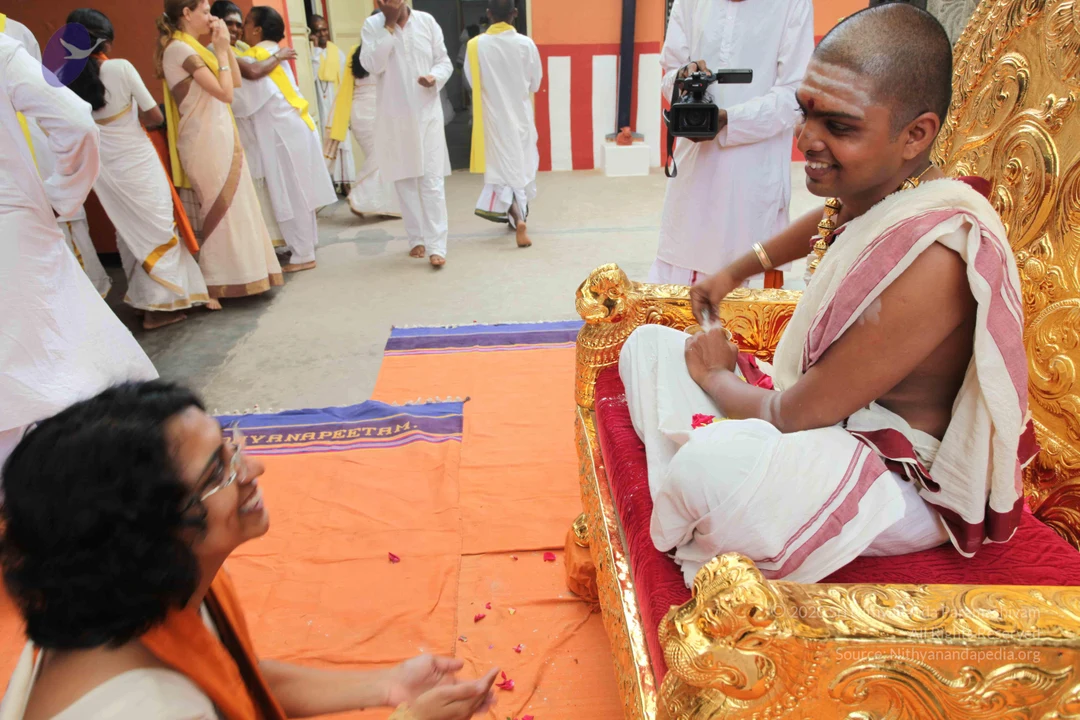
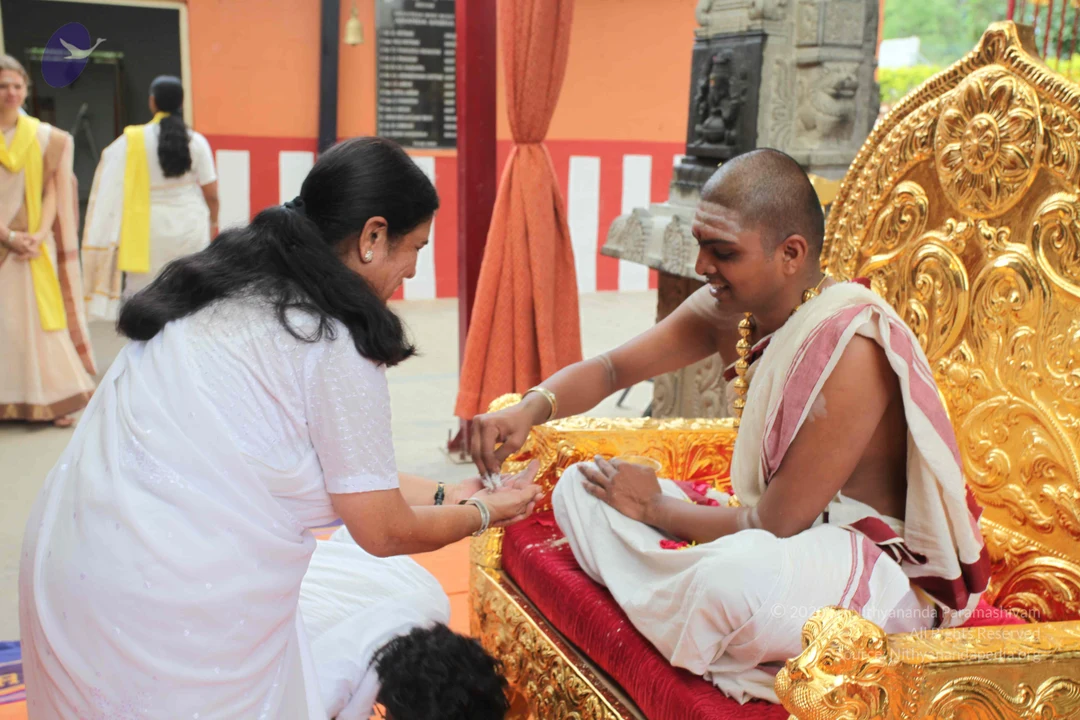
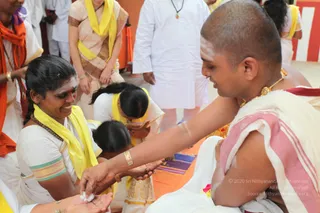
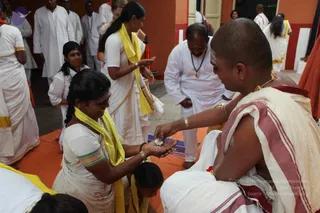
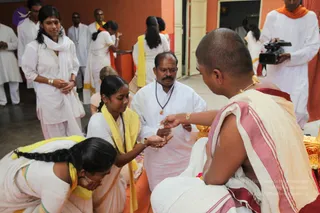
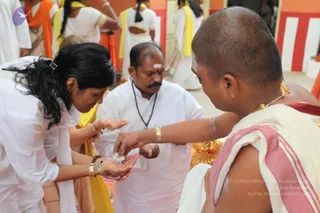
A photograph of a courtyard with orange-painted walls and a hanging brass bell beside a dark board with white lettering. In the centre, a figure with long dark hair wears a flowing saffron-orange robe and stands barefoot with their back to the camera, facing a group. To the right, a bald man in white kurta and dhoti with an orange shawl holds a gold ceremonial vessel draped in a red cloth. Beside him, another shaved-headed man in white with an orange shawl stands near a third person. On the left, a man in white dhoti and shawl wears a gold-beaded necklace, and a woman in white with a yellow shawl stands in the doorway. A woman in white stands at the far right edge. The scene suggests a ritual gathering in an ashram setting.Photograph of a padapuja-style ceremony in an open-sided hall with an orange-painted wall and corrugated roof. On the right, a shaved-headed man in white dhoti and shawl with maroon border sits on an ornate gold-carved throne with red cushions and a red curtain. A woman in a white sari with a yellow border kneels on an orange mat and reaches toward his feet, while women in white and yellow-bordered saris stand and kneel with hands folded in devotion. In the left foreground a woman in red and orange garments holds her hands in anjali mudra, and a woman in a white outfit with an orange shawl kneels. A man in white holds a video camera on a tripod-free handheld rig, and a woman in white stands nearby.A photograph of a seated priest with a shaved head, white vibhuti lines on his forehead, gold chain and bangle, wearing white dhoti with a pink-bordered cloth, pouring or placing white paste into the cupped hands of a smiling woman in a white sari with a yellow shawl and a beaded mala. Behind them, other people in yellow shawls and white clothes stand or kneel, some with hands folded, and a man in white kurta stands in the background beside a red and white wall. Orange cloth and a red flower garland are visible.A photograph of a temple ritual with devotees in white. A seated priest with a shaved head, gold necklace and red-bordered white cloth holds out a small offering of white flowers to a kneeling woman in white with a yellow shawl and a green-bordered blouse, who cups her hands to receive it. Behind her, another woman in white with a yellow shawl and a man in white with a rudraksha-style pendant look on. Orange floor mats cover the ground, with more devotees in white and yellow standing and kneeling in the background, beside orange and red walls.A photograph of a ritual scene indoors with orange-painted walls and a doorway. In the foreground, a seated man with a shaved head wears a white dhoti with a red-bordered cloth and a gold chain, and extends his hand toward a woman kneeling in white with a yellow shawl. Beside her, another woman in white with a long braid bows low with her hands folded. A man in white with a dark rudraksha-style pendant necklace stands between them, holding something small in his hands. Behind them, several people in white clothing and yellow or orange shawls stand and sit, and a cameraman in white holds a video camera at the upper right. The setting suggests a ceremonial initiation or puja.A photograph of a shaved-headed priest in a white dhoti and pink-bordered shawl, his bare upper body showing and a gold necklace at his neck, extending his hand to pour or offer a substance into the cupped hands of a woman in white with a black ponytail and gold bangles. Behind them a man in white with a rudraksha mala and a vertical tilak stands watching, and in the background other devotees in white clothes with yellow and orange shawls stand near orange and red painted walls.

August 11 2010

1 photoView all